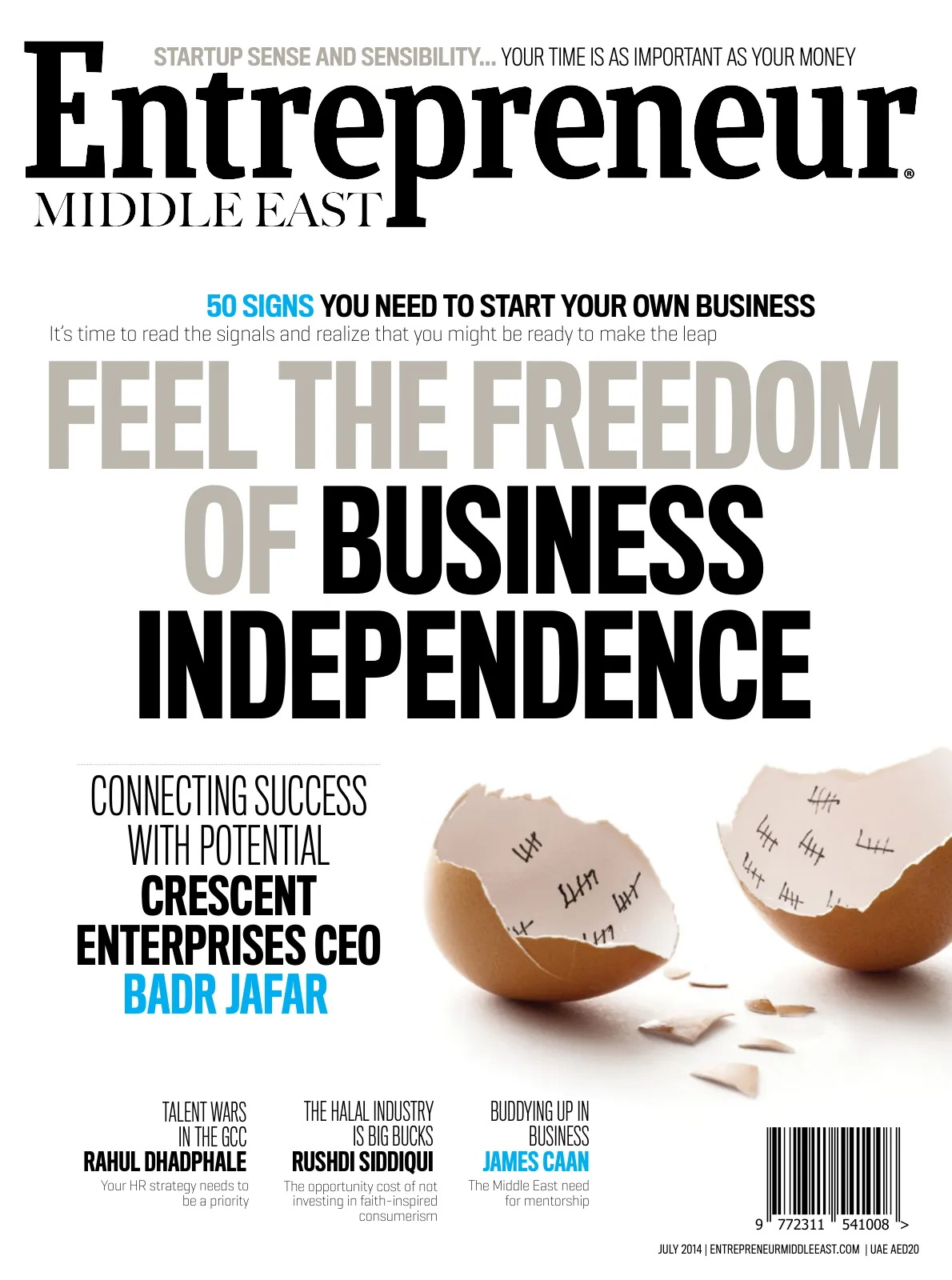
Entrepreneur Middle East, July 2014
Page 1
50 SIGNS YOU NEED TO START YOUR OWN BUSINESS
It’s time to read the signals and realize that you might be ready to make the leap
BADR JAFAR
CRESCENT
ENTERPRISES CEO
CONNECTING SUCCESS
WITH POTENTIAL
The opportunity cost of not
investing in faith-inspired
consumerism
Your HR strategy needs to
be a priority
The Middle East need
for mentorship
THE HALAL INDUSTRY
IS BIG BUCKS
RUSHDI SIDDIQUI
BUDDYING UP IN
BUSINESS
JAMES CAAN
TALENT WARS
IN THE GCC
RAHUL DHADPHALE
STARTUP SENSE AND SENSIBILITY… YOUR TIME IS AS IMPORTANT AS YOUR MONEY
FEEL THE FREEDOM
OF BUSINESS
INDEPENDENCE
JULY 2014 | ENTREPRENEURMIDDLEEAST.COM | UAE AED20
9
772311
541008 >
Page 2
Entrepreneur juLY 2014
2
CONQUER YOUR LUXURIOUS SIDE
One look is good, but a double take is what we all want in life. Patrol’s premium interior
and refined exterior means you are always the one that others are looking out for.
The Hero of all terrains in life
Stylish New Look | Premium Interior | Advanced Technology
THE NEW 2014 NISSAN PATROL
facebook.com/NissanME
/NissanME
nissanpatrol-me.com
• Saudi Arabia: Alissa Automotive, Tel: 92002 7744, Alhamrani United Co., Tel: +966 2 6696690 • Dubai & Northern Emirates: Arabian Automobiles,
Tel: +971 4 2952222 • Abu Dhabi & Al Ain: Al Masaood Automobiles, Tel: +971 2 6811118 • Kuwait: Abdulmohsen Abdulaziz Al Babtain Co., Tel:
+965 1804888 • Oman: Suhail Bahwan Automobiles, Tel: +968 24560111 • Qatar: Saleh Al Hamad Al Mana Co., Tel: +974 4 4283333 • Bahrain: Y.K.
Almoayyed & Sons BSC(C), Tel: +973 1 7732732 • Lebanon: Rasamny – Younis Motor Co. S.A.L. – RYMCO, Beirut, Tel:+9611 273333 • Jordan: Bustami
& Saheb Trading Co.L.T.D., Amman, Tel: +962 6 5532456
Page 3
juLY 2014 Entrepreneur
3
31 Huawei kicks
things up a
notch with the
new Ascend P7
smartphone.
66 Faith-based consumerism
CONTENTS
JULY 2014
20
INNOVATORS:
CONNECTING SUCCESS
WITH POTENTIAL
Crescent Enterprises CEO
Badr Jafar
Sharjah’s future entrepre-
neurs are getting a leg up
24
THE UNIVERSE IS
TRYING TO TELL YOU
SOMETHING
50 signs you need to start
your own business
An entrepreneurial type
reads the signals and
realizes it’s time to make
the leap.
34
TECH:
ASK A GEEK
Déjà vu isn’t exactly
“thinking different”
We’re not that blown away
by iOS8, and it’s certainly
not helping that Google
has usurped Apple’s brand
value throne.
36
ONLINE ‘TREP
Visual platform potency
Is Instagram right for your
brand? Here are some
case studies that worked
organically… and how to
judge if you can do the
same.
50
WEBSITE TO WATCH
Searching for the solution to
e-commerce in MENA
Telr’s Elias Ghanem is
bringing two decades
of experience to the
table with his newest
entrepreneurial venture.
66
MONEY:
ASK THE MONEY GUY
Faith-based consumerism
Rushdi Siddiqui believes
that you should be invest-
ing in the ever-expanding
halal lifestyle industry, and
where exactly you need to
wade in.
88
YOUR MONEY
Investing your own cash in
the biz
David Newton makes the
case for why you need to
convince outside investors
that you’re willing to take
on some of the financial
risk.
20 Sharjah’s future
entrepreneurs are getting
a leg up
AMERICAN UNIVERSITY OF SHARJAH © BASIL D SOUFI | LICENSE CREATIVE COMMONS
Page 4
Entrepreneur juLY 2014
4
Page 5
juLY 2014 Entrepreneur
5
Page 6
Entrepreneur juLY 2014
6
CONTENTS
JULY 2014
12
EDITOR’S NOTE
By Fida Z. Chaaban
42
CULTURE:
TRAVEL
Amazon adventures
Vodafone Qatar sends a
slew of voluntourists for
21 days to build a school,
and you’ll be able to tag
along via social media in
real-time.
43
BUSINESS UNUSUAL
Calling cards
If you worked at Lego,
you’d have cooler business
cards than anyone else.
We promise.
46
LIFE
Business book rundown
Amal Chaaban tells you
what’s up before you hit
the business book aisle.
Some reads you really can
do without.
62
LIFE
Coping mechanisms?
When you’re dealing with
an immense amount of
pressure, there are a few
tried and true methods
that can help you get
your focus in check.
Mark Sephton’s got you
covered.
44
‘TREPONOMICS:
ESQUIRE GUY
Asking for advice
Ross McCammon dis-
cusses what is and isn’t
appropriate in terms
of brain-picking. The
broader and more aimless
your subject, the worse it
is for the “pickee.” (His
word, not ours!)
48
ASK A PRO
Nowhere to go but up
Bayt.com’s Suhail Al-
Masri talks about hiring
practices in the Middle
East. Read his analysis
on what may work for
your business, and why
there is no one-size fits all
solution.
52
SKILLSET
Do things you can sustain
James Clear thinks that just
because you’re doing more,
doesn’t mean that you’re
doing it better. Sometimes
putting your own ceiling in
place ensures better qual-
ity… everything.
60
ASK A PRO
Weapons at the ready
Leading up to the UAE’s
Expo 2020 and the 2022
World Cup in Qatar, com-
panies are going to have to
think harder and faster to
recruit and retain top qual-
ity talent. It might even be
a war…
32 To see business boom,
established ‘treps need to
take new businesses under
their wing
52 James Clear thinks that just
because you’re doing more, doesn’t
mean that you’re doing it better.
Page 7
juLY 2014 Entrepreneur
7
GCC
Europe
US
Delivered Next Day
With 44 FedEx flights and 700 commercial flights every week
plus our own trucking network from our regional hub in Dubai,
FedEx gives you next-day1 deliveries to the US, Europe and
within GCC countries.
Open an account today with FedEx
and win your welcome gift.
Register on business.fedex.com/ship
1 For services availability, please contact Customer Service.
Page 8
Entrepreneur juLY 2014
8
CONTENTS
JULY 2014
64
‘TREPONOMICS:
MARKETING
The end all and be all
Be a successful entrepre-
neur by exploring your
valuable network. Hussein
Hallak has a plan for you,
and it’s as easy as crowd-
sourcing your contacts for
business development.
78
START IT UP:
WACKY IDEA
Snapp to it!
Loyalty programs are all
the rage. The co-founders
behind Snappcard have
seen to it that you actu-
ally want to participate…
because all you need is
your mobile to take part.
76
WACKY IDEA
Startup mechanics
Jordanian co-founders
talk about why their app
makes sense for both
Jordan and the GCC. The
only thing it doesn’t do?
Give your car a tune up.
84
Q + A
Transformation station:
Suwaidish Technologies
Emirati ‘trep Mubarak Al
Suwaidi is determined to
make a difference.
82
STARTUP FINANCE
Significant startup sense
and sensibility
Simon Hudson made it
happen for his startup
Brndstr, and it wasn’t
only his hard-earned dol-
lars that he invested. Here
he makes the case for
time commitment to your
business based on his own
experience.
Page 9
juLY 2014 Entrepreneur
9
Page 10
Entrepreneur juLY 2014
10
SUBSCRIBE
Contact subscriptions@bncpublishing.net to receive
Entrepreneur Middle East every issue
EDITOR IN CHIEF Fida Z. Chaaban editor@bncpublishing.net
MANAGING DIRECTOR Walid Zok walid@bncpublishing.net
DIRECTOR Rabih Najm rabih@bncpublishing.net
DIRECTOR Wissam Younane wissam@bncpublishing.net
SALES DIRECTOR Oliver Amos oliver@bncpublishing.net
PUBLISHER Nehme Abouzeid
CREATIVE LEAD Odette Kahwagi
ONLINE LIAISON Kareem Chehayeb
COLUMNIST Pamella de Leon
WEB DIRECTOR Haydar Mtayrek
James Caan
Amal Chaaban
Youmna Chagoury
Kareem Chehayeb
Tamara Clarke
James Clear
Rahul Dhadphale
James Dyson
Hussein Hallak
Simon Hudson
Dana Khairallah
Danielle Kamar
Pamella de Leon
Ross McCammon
Wassim Mourtada
Suhail Al-Masri
Shoug Al Nafisi
Octavia Nasr
Rani Nasr
David Newton
John Patrick Pullen
John Rampton
May Rostom
Mark Sephton
Rushdi Siddiqui
Erika Widen
CONTRIBUTING WRITERS
PO Box 502511 Dubai, United Arab Emirates
P +971 4 4200 506 | F +971 4 4200 196
For all commercial enquiries related to Entrepreneur Middle East contact
sales@bncpublishing.net
All rights reserved © 2014. Opinions expressed are solely those of
the contributors.
Entrepreneur Middle East and all subsidiary publications in the MENA region
are officially licensed exclusively to BNC Publishing in the MENA region by
Entrepreneur.
No part of this magazine may be reproduced or transmitted in any form or by any
means without written permission of the publisher.
www.entrepreneurmiddleeast.com
WE’RE HEAVILY INVESTED IN OUR WEB PRESENCE
In addition to our print edition, we’re bringing you all sorts of industry
news on our web mediums. Joining us online means getting relevant
business and startup content in real-time, so you’re hearing about
the latest developments as soon as we do. We’re looking forward
to interacting with our readers on all of our social media and web
platforms- like any thriving business, we’re looking to give and take.
#TrepTalkME is already happening on all of our digi platforms, and all
good conversations go both ways. See you on the web!
IS DIGITAL
MIDDLE EAST
Printed by Raidy Emirates Printing Group LLC
www.raidy.com
EntMagazineME
@EntMagazineME | @FidaChaaban
Entrepreneur-me
EntrepreneurMiddleEast
EntMagazineME
EntMagazineME
EntMagazineME
MIDDLE EAST
Page 11
juLY 2014 Entrepreneur
11
MARCH 2014 ENTREPRENEUR
55
Page 12
Entrepreneur juLY 2014
12
FEEDBACK
We’re pleasantly surprised to see
some real action on our Google+
account, especially since the
platform’s penetration is often
questioned. Google+ has recently
released a handy insights feature
which allows us to really see what’s
happening on our account.
They’ve got a tremendous
user-base in Egypt, and that’s
reflected in our followers and post
engagement. Something we found
surprising? The amount of website
traffic that we’re getting from Saudi
Arabia and Iraq (including Erbil)
routed via our Google+ account.
We’re also pleased that some of the
harder to reach MENA demographic
like Yemen and Sudan are hitting
us up on Google+ to keep apprised
of our latest articles. As is reflected
in our other social media platform
insights including Facebook and
Twitter, our readership hovers around
80% male and sits primarily in the
18 to 44 range.
How are we using Google+? To
share our web content and release
past issues online. The medium has
garnered us a slew of new readers,
and we’re happy to have you all
onboard! If you haven’t already
joined us online, we look forward to
engaging with you in real-time.
Surprise, surprise
Who is using Google+? Apparently a huge
amount of people across the MENA region!
On ISSUU you can access all of our current and past
issues complimentary, including Entrepreneur Al Arabiya,
our edition for those of you that prefer Arabic-language
publications. If you haven’t yet visited our ISSUU account,
check out issuu.com/entmagazineme
Page 13
juLY 2014 Entrepreneur
13
Page 14
Entrepreneur juLY 2014
14
EDITOR’S NOTE
I
t is often the case that people
state an opinion based on their
own experiences, both good
and bad, without explaining
the scenarios and back stories
that helped them formulate the
theory that they’re sharing. When
considering this in the context of
entrepreneurship and business, it is
just as important to hear about your
miscalculations (and your large and
small errors in judgment), as it is to
hear about your brilliant moments
of clarity. All too often I am forced to
vet an interview because the entre-
preneur doesn’t want to admit to a
single mistake or setback. If you, as
a successful businessperson, cannot
admit that there were bumps on the
long road up, then you are depriving
others from learning from your pre-
cious mistakes. Those same mistakes
were a valuable learning tool for
you- so what makes you think that
they aren’t going to serve that same
purpose for someone else?
Tons of effective motivational
speakers do exactly that. They will
share a story from their repertoire of
successes and failures, then explain
the process behind each learning
curve, and finally culminate with the
moral of the story. The moral of the
story isn’t necessarily a “moral”, but
it’s the point that we should be taking
away from the narrative. In essence,
it’s basically telling the audience,
“This is what I believe works for my
business, and this is how I arrived at
that operational strategy.” It is always
great to have global entrepreneurs
express interest in sharing their ups
and downs with our readership, but
it’s exceptional when these ups and
downs are anecdotal. This is primarily
because reading about the pitfalls
of starting your own business (and
the negative moments when no one
believed it could be done) is just as
useful as the story about the time
when you won an award for your in-
novation.
There are merits to admitting what
you weren’t good at, and how you
went about besting that specific
challenge. (Not the least of which is
the benefit of having the audience
eager to hear how you overcame that
major or minor setback, and what you
would have done differently in hind-
sight.) It is unfortunate that some of
the ‘treps who have volumes of useful
anecdotal support from their constant
trials with their now-skyrocketing
businesses choose not to talk about
the times when things didn’t go
exactly right
for them.
There are
tons of times
that my life
mentors
have shared
“What not to
do” stories
with me,
and I have
grown im-
measurably career-wise due to their
tutelage.
Entrepreneurs, I guess what I’m
asking is for you to continue to send
me your success stories, but along
with the goods send me the bads- I
look forward to learning from the
things you know that don’t work
and hearing how you learned what
does work.
Anecdotal evidence and the
efficacy of storytelling
Drawing on your own tough experiences
as a ‘trep can help others succeed
Fida Z. Chaaban
Editor in Chief
@fidachaaban
editor@bncpublishing.net
Page 15
juLY 2014 Entrepreneur
15
BBA
WITH MAJORS IN
MARKETING
FINANCE
INFORMATION SYSTEMS
INTERNATIONAL BUSINESS
TRAVEL & TOURISM
MANAGEMENT
Accredited by:
ADMISSIONS OPEN FOR
MAY & SEPTEMBER 2014
WEEKEND CLASSES ALSO AVAILABLE ON
FRIDAYS & SATURDAYS FOR BBA AND MBA
SCHOLARSHIPS
AVAILABLE
admissions@skylineuniversity.ac.ae
+971 6 5441155
MBA
WITH EMPHASIS ON
MARKETING
FINANCE
HUMAN RESOURCE
MANAGEMENT
STRATEGIC MANAGEMENT
& LEADERSHIP
Page 16
Entrepreneur juLY 2014
16
IN THE LOOP
E
gyptian billionaire Nassef
Sawiris has now set the record
for the most expensive co-op
ever sold in New York for an (wait
for it…), astronomical US$70
million (NY Daily News). Forbes
World’s Billionaires lister Sawiris,
who accumulated his US$7.3 bil-
lion net worth in the construction
industry, purchased the chichi 960
Fifth Avenue co-op even using his
own name on legal papers, instead
of an LLC (although sources told the
NY Daily News that the co-op board
prohibits LLCs). It was previously
owned by late billionaire Edgar
Bronfman Sr., and originally put
on the market for US$65 million-
the sale tops the previous record
by business magnate David Geffen,
who bought 785 Fifth Avenue for
US$54 million in 2012. This is no
ordinary pad: The 16-room apart-
ment boasts five fireplaces, five
bedrooms, eight bathrooms and a
wraparound terrace with a view of
Central Park. It looks like Sawiris
is going to have to spend a bit
more though, reports indicate that
his new digs need revamping.
Apparently North Africa is no longer
just the place that college students
visit for voluntourism (volunteer-
tourism) or an “exotic” vacay. The
University of San Diego (USD) sent
out a team of 26 of their MBA
program students with five members of their administration to École de Manage-
ment’s Casablanca (ESCA) campus in early June. Those who took part in the
four-day event learned about Africa’s politics and emerging markets, and had the
opportunity to meet various industry leaders and officials, including Mrs. Wissal
El Gharbaoui, the Principle Private Security to Morocco’s Minister of Tourism.
USD won’t be the last university that ESCA will be hosting; they’re planning on
more seminars for more foreign schools in the coming year. Start taking notes!
EGYPTIAN BILLIONAIRE BUYS MOST
EXPENSIVE CO-OP IN NYC
University of San Diego
sends students to learn the
emerging market ropes
IT’S JUST MY NEW
PIED-À-TERRE
FIELD TRIP TO CASABLANCA
T
he Syrian refugee crisis has been most
noticeable in Lebanon. Compared to Jordan
and Turkey, Lebanon is arguably the least
politically stable, and has the scarcest resources
(in terms of institutions, infrastructure, and
capital) to support refugees fleeing the ongoing
civil unrest in Syria. An estimated one million
Syrian refugees are in Lebanon- significantly
higher numbers than Jordan and Turkey. To make
matters worse, Lebanon is struggling to elect a
new president. During U.S. Secretary of State John
Kerry’s recent visit to Lebanon -the first visit by
a Secretary of State in five years- he spoke with
Prime Minister Tammam Salam, Speaker of Parlia-
ment Nabih Berry, and other Lebanese officials
about the refugee crisis in Lebanon. Secretary
Kerry also announced that US$290 million would
be allocated for UN agencies in Lebanon that are
involved with the Syrian refugee crisis. As the
situation escalates, it is important to question
the efficacy of mitigation action plans for Syrian
refugees in the small nation, and to consider alter-
native re-settlement options. Why? A mitigation
strategy where resources are allocated to establish
institutions might have been successful during
the earlier stages of the conflict. The time it takes
to execute coping institutions and train relevant
personnel means that developed countries will
have to welcome refugees on their soil- whether
they want to or not.
U.S. SECRETARY OF STATE
JOHN KERRY ANNOUNCES
US$290 MILLION TO SYRIAN
REFUGEES IN LEBANON
U.S. Secretary of
State John Kerry
École de Management
Casablanca (ESCA)
Page 17
juLY 2014 Entrepreneur
17
A
controversial social media campaign
has recently emerged out of Qatar,
bringing the Gulf state’s dress code
and conduct debate to a head. The initia-
tive, “Reflect Your Respect”, urges both men
and women to dress more modestly, encour-
aging the covering of shoulders, midriffs,
and thighs, conveying images that hemlines
should not be above the knee when dressing
for a public space. A flurry of debate has
ensued online with supporters emerging on
both sides of the issue, but “Reflect Your
Respect” is quickly gaining traction with
many Qatari nationals on the basis that
their cultural identity and the country’s
Islamic heritage are both intrinsically linked
to an ethos that includes modest dress.
The @Reflect_respect Twitter account and
Reflect_Your_Respect Instagram account are
active on a daily basis broadcasting events,
material, and even re-posting content
from social media users in support of the
campaign. One of the English campaign
materials currently being circulated cites
A
group of international donors,
including the Crown Prince of Abu
Dhabi H.H, Sheikh Mohamed bin
Zayed Al Nahyan privately met in Abu
Dhabi to sign a commitment to donate a
total of US$80 million to wild cats conser-
vation efforts. The funding effort will take
place throughout the next decade, and the
international donors have partnered with
Panthera, a New York-based wild cats con-
servation organization. Panthera’s founder
and chairman, mining investor Thomas Ka-
plan, took part in the pledge and hoped that
efforts towards wildlife conservation would
be more multinational, using this event as
a “template”. Among the other donors are
CEO of Hong Kong-based investment firm
Jynwel Capital, Jho Low, and chairman of
DSP Blackrock India and India’s Wildlife
Conservation Trust, Hemedera Kothari. In
neighboring Emirate Dubai, the Dubai Desert
Conservation Reserve has been active in con-
serving the biodiversity of its deserts, with
Emirates Airlines a key sponsor.
Looks like Dubai’s Metro is just the begin-
ning! Oman’s Ministry of Transport and
Communications is hosting the GCC Metro
and Rail Conference (GMRC 2014) on Sep-
tember 15 and 16, 2014. The event will bring
all six GCC member states together, working
to develop stronger manufacturing and serv-
ices industries to complement the currently
high levels of investment that have gone
towards metros and railways. The event in
Muscat will also host a panel of experts and
pivotal decision-makers in the GCC. If this
conference draws a wide variety of industry
leaders from the private sector, we should
expect a productive conference, and some
solid railways across the GCC.
Article 290 of the Qatar Penal Code which
states: “Whoever makes gestures, dares
to say or sing immoral things or perform
obscene acts in a public place or an open
space shall be punished with imprisonment
for a term not exceeding six months and/or
a fine not exceeding three thousand Qatari
Riyals” (Source: AlMeezan.QA Qatar Legal
Portal) accompanied by an illustration of
a female and male figure in half-embrace,
and also mentions Article 57 of the Qatar
Constitution: “Respect for the Constitu-
tion, compliance with the laws issued by the
Public Authorities, abiding by the require-
ments of public order and public decorum,
and observing national traditions and deep-
rooted customs are duties of all who reside
in the State of Qatar or enter its territory”
(Source: AlMeezan.QA Qatar Legal Portal).
Those in criticism of the campaign cite the
high number of ex-pats in Qatar, and they
also question the position of the 2022 World
Cup in light of the fact that an influx of for-
eign tourism is expected. An indicator of the
nation’s stance on the issue can possibly
be drawn from the public Qatar Museums
endorsement of the campaign; a sign has
been posted stating that the organization
“supports Reflect Your Respect”, encour-
aging people to view attached relevant
material. A copycat UAE initiative has also
launched on Twitter, but the account is
largely inactive thus far.
WHEN IN ROME... OR DOHA
THE ONLINE (AND OFFLINE) DEBATE OVER CONDUCT
AND ATTIRE HEATS UP IN QATAR
International donors pledge millions to
safeguard wild cats
Abu Dhabi feels
for felines
Oman Hosts the GCC Metro
and Rail Conference
PUSHING FOR PUBLIC
TRANSPORTATION
Page 18
Entrepreneur juLY 2014
18
Page 19
juLY 2014 Entrepreneur
19
Page 20
Entrepreneur juLY 2014
20
INNOVATORS
CRESCENT ENTERPRISES CEO BADR JAFAR
SHARJAH’S FUTURE ENTREPRENEURS ARE GETTING A LEG UP
CONNECTING
SUCCESS WITH
POTENTIAL
S
ome of the nation’s most active entrepre-
neurs are Sharjah-based, now they’re team-
ing up with the Sharjah Tatweer Forum to
bring their experience to the table for the good
of future ‘treps. The Sharjah Tatweer Forum, a
non-profit independent entity founded by H.H.
Sheikh Dr. Sultan Bin Mohammed Al-Qasimi,
Member of the Supreme Council, Ruler of Sharjah,
is collaborating with the American University of
Sharjah (AUS) to launch the Sharjah Leadership
Program (SLP), focused on entrepreneurial educa-
tion. Crescent Enterprises, led by CEO Badr Jafar,
recently signed a partnership agreement with
Sharjah Tatweer Forum to support the launch of
the SLP, in hopes of furthering the Emirate’s busi-
ness community’s aspirations. SLP candidates will
receive lecture-style tutelage at AUS, participate
in hands-on workshops and projects, as well field
training- including visits to various Crescent En-
terprises sites. The SLP begins in September 2014
and will run for a period of six months encompass-
ing 19 sessions, with a student capacity of 20
Emirati candidates and four expatriate candidates.
OPPOSITE PAGE:
AMERICAN UNIVERSITY OF
SHARJAH LIBRARY
Badr Jafar, CEO Crescent Enterprises and
Managing Director of Crescent Group and
Jassem Al Bloushi, Chairman Sharjah
Tatweer Forum
AUS LIBRARY © BASIL D SOUFI | LICENSE CREATIVE COMMONS
Page 21
juLY 2014 Entrepreneur
21
juLY 2014 Entrepreneur
21
Page 22
Entrepreneur juLY 2014
22
AS AN ENTREPRENEUR
AND ONE OF THE REGION’S
THOUGHT LEADERS, WHAT
DO YOU THINK IS THE MOST
IMPORTANT PART OF THIS
PROGRAM?
Programs such as this are
fundamental in contributing
to the development of Sharjah
and indeed the whole UAE
through its future business
leaders, and something we
are very proud to be a part of.
I believe the most important
part of the program is the
intense mentoring that the
participants receive, which is
crucial in developing entre-
preneurial ideas into revenue-
generating and sustainable
businesses. Although many
aspiring entrepreneurs may
be highly educated or even
experienced in a certain area,
they may not possess all the
skills and knowledge neces-
sary to establish and grow a
business, and this is where
mentoring and guidance is so
important. Of course, there
are other challenges which
face entrepreneurs, such as
access to capital, but without
the right knowledge and sup-
port from businessmen and
women who have successfully
worked in the region tackling
these challenges, it would be a
lot harder to transform great
ideas into meaningful busi-
nesses.
HOW WILL THE SHARJAH
LEADERSHIP PROGRAM
CHOOSE POTENTIAL
CANDIDATES FOR THE
ENTREPRENEURIAL
PROGRAM?
This program, developed by
Sharjah Tatweer Forum, looks
to cultivate leaders who are
well-informed and focused on
the development of the Emir-
ate of Sharjah, with an insight
into domestic, regional and
global trends in innovation
and sustainability, so there
are a number of attributes
taken into consideration when
looking for potential candi-
dates. The program is open
to bachelor degree holders
aged between 25 and 35 with
a minimum of three years of
experience working in public
or private sectors. In addition
to reviewing their educa-
tional achievements, potential
candidates are subjected to
rigorous testing, including
psychometric tests based
on aptitude and personality.
Once they have assessed the
scores of all candidates, pro-
gram leaders will then meet
with each one–on-one for a
more personal understanding.
Each individual is obviously
different, so is each oppor-
tunity, so you can’t employ
a one-size-fits-all approach;
the program will be assessing
each entrepreneur on a case
by case basis.
HOW DO YOU SEE SHAR-
JAH’S REPRESENTATION
IN THE ENTREPRENEURIAL
YOUTH SPHERE COMPARED
TO OTHER EMIRATES?
Sharjah has some great
organizations and support
groups in place to develop
entrepreneurial talent across
the Emirate. As well as the
Sharjah Leadership Program,
the Sharjah Tatweer Forum
manages several initiatives
to support Sharjah’s youth
in turning their business
ideas and passions into real-
ity. The Sharjah Chamber of
Commerce and the Sharjah
Business Women’s Council
also work hard to provide
the same type of support to
aspiring entrepreneurs, and
Ruwad, part of Sharjah’s
Department of Economic
Development, provides men-
toring as well as funding. On
a wider scale there are many
organizations doing the same
essential work across the rest
of the Emirates, and we are all
very fortunate to be working
together for the development
of a stronger and even more
successful UAE. As a private
sector firm, Crescent Enter-
prises will strive to play a sig-
nificant role in developing and
supporting entrepreneurship
in the country by nurturing
young talent and entrepre-
neurs, providing them with
a platform and the required
resources to establish and
scale up their businesses.
To this end, we also recently
launched ‘CE Ventures’ as our
own incubator to launch new
ideas developed from within
the UAE; we are already work-
ing on nurturing six new ideas
in various sectors.
BADR JAFAR DISCUSSES
THE SHARJAH LEADERSHIP PROGRAM
‘TREP TALK Q+A
INNOVATORS
The American University of Sharjah,
main building
AUS MAIN ENTRANCE © BASIL D SOUFI | LICENSE CREATIVE COMMONS
Page 23
juLY 2014 Entrepreneur
23
Badr Jafar is Managing Director of the Crescent Group, which has been
operating from the UAE as a family business group for over 42 years.
The Group today comprises two main companies: Crescent Petroleum,
the region’s first independent and privately-owned petroleum company
in the Middle East, of which Badr is President; and Crescent Enterprises,
the company’s conglomerate
operating across eight core sectors
of the global economy, of which
he is Chief Executive Officer. Badr
serves as Chairman of Gas Cities
LLC, a joint venture between
Crescent Petroleum and Dana Gas
PJSC, and serves as Chairman of
Pearl Petroleum, a partnership
between Crescent Petroleum,
Dana Gas, OMV of Austria and
MOL of Hungary. Badr is an active
member of the Young Presidents’
Organization, serving as Ex-Officio
Chair of the YPO Emirates Chapter.
He was honored as a Young Global
Leader by the World Economic
Forum and is Vice-Chair of their
Global Agenda Council on Energy
Security.
WHO DEVELOPED THE
SHARJAH LEADERSHIP
PROGRAM? HOW WILL
THE PUBLIC AND PRIVATE
SECTOR WORK TOGETHER TO
FOSTER ENTREPRENEURIAL
SUCCESS?
The program is the brainchild
of the Sharjah Tatweer Forum.
What is significant about the
participation of companies
like Bee’ah, Gulftainer and
Crescent Enterprises in the
Sharjah Leadership Program
is the partnership between
the public and private sector
in supporting the identi-
fication of and develop-
ment of entrepreneurs. The
government has a wealth of
resources to facilitate this de-
velopment, while the private
sector brings the expertise of
those who have first-hand ex-
perience in starting new busi-
ness, therefore a collaboration
between the two is vital.
There is often overdependence
in our region on the public
sector to solve our socio-
economic challenges, and I
personally believe there needs
to be a better balance between
public and private support
and engagement, which is
why we are so delighted to be
working with Sharjah Tatweer
Forum on this initiative.
DO YOU FEEL THAT THE SLP
PLAYS A ROLE IN EMIRATI-
ZATION? CAN YOU DISCUSS
THE DECISION TO INCLUDE
EXPATS IN THE PROGRAM?
Emiratization is about nurtur-
ing our local talent to become
the business leaders of tomor-
row behind the development
and growth of the Emirates.
Programs such as this make
a huge contribution to the
overall goal of Emiratization,
equipping candidates with the
necessary support and guid-
ance. At the same time, also
it is also very important to
recognize the immense value
and expertise that expats
bring to the Emirates, and it
is imperative that nation-
als and expats continue to
work together in achieving
our common goals. With this
in mind, it has already been
decided to include a number
of expats in the program who
will be working alongside our
Emirati youth and also benefit
from this training.
AS AN ENTREPRENEUR, HOW
IMPORTANT DO YOU FEEL
THAT MENTORSHIP AND
GUIDANCE IS FOR STARTUPS
IN THE REGION?
It is increasingly recognized
that mentorship and guid-
ance are crucial in helping
develop entrepreneurial ideas
into fully functioning SMEs,
providing entrepreneurs with
access to a close support net-
work to guide them through
the process of achieving
business success. Research
conducted by Ernst & Young
suggests that 88% of entre-
preneurs who have mentors
and the right support systems
have been successful in estab-
lishing their businesses, while
50% of those without the
necessary support have failed;
therefore it is imperative that
entrepreneurs make use of all
support networks available to
them. In my opinion, we are
especially lucky in the UAE
to have initiatives such as the
Sharjah Leadership Program
to provide such support, as
well as several highly effective
local networks across the UAE
specifically designed to help
entrepreneurs and small busi-
ness owners.
DOES CRESCENT ENTER-
PRISES SEEK TO SUPPORT
SOCIAL ENTREPRENEURS
AND BUSINESSES?
We are in a world now where
businesses can do good, while
doing well. There is no doubt
in my mind that through
purpose-driven business
practices and investments, we
can better tackle our region’s
socio-economic challenges
head on, and this is what
drove me towards advocating
and supporting social entre-
preneurship in the first place.
Through my involvement
with entities like Ashoka,
Endeavor, Synergos Institute,
and the Schwab Foundation
for Social Enterprise, I am
fortunate enough to regularly
be exposed to highly inspiring
young social innovators with-
in the UAE and the rest of the
Arab world. It is encouraging
to see an increasing trend of
business leaders starting to
think about their triple bot-
tom lines in business, that is
people, planet and profit, and
this is an ethos which is at the
core of CE Ventures incubator
which we recently setup.
“ALTHOUGH MANY ASPIRING ENTREPRENEURS
MAY BE HIGHLY EDUCATED OR EVEN
EXPERIENCED IN A CERTAIN AREA, THEY MAY
NOT POSSESS ALL THE SKILLS AND KNOWLEDGE
NECESSARY TO ESTABLISH AND GROW A
BUSINESS, AND THIS IS WHERE MENTORING AND
GUIDANCE IS SO IMPORTANT.”
Page 24
Entrepreneur juLY 2014
24
YOU NEED TO
START YOUR
OWN BUSINESS
AN ENTREPRENEURIAL
TYPE READS
THE SIGNALS AND
SUDDENLY REALIZES
IT’S TIME TO MAKE THE
LEAP AND READY A
LAUNCH By John Rampton
50
SIGNS
SPONSORED BY CADILLAC IN THE SPIRIT OF EDUCATING
TOMORROW’S ENTREPRENEURIAL TALENTS
LEADERSHIP
TRAINING
Page 25
juLY 2014 Entrepreneur
25
1. THE LIGHT BULB WENT OFF. Lately many are debating
whether entrepreneurs are born or made. No matter
which side you agree with, perhaps you’ve been
aware that you exhibit some classic entrepreneurial
traits. Maybe you’re ready to take the leap and start
a business? Even if you weren’t born that way, you
may have later developed some of these traits, such as
a driving passion. So if you begin to notice the signs,
perhaps you could launch that business of your own.
2. YOU’RE ALWAYS THINKING. Entrepreneurs never stop
cogitating. It’s a blessing and a curse. Should you exhibit
this behavior, maybe it’s time to move on from the
daily rat race and do something to put your thoughts in
motion. And there’s no better outlet than starting your
own business.
3. YOU’RE PASSIONATE. If there’s one business concept
that stays with you that you’ve completely fallen in
love with, perhaps you could turn it into a reality.
Entrepreneurs and business owners are truly passionate
about what they do and will do everything possible to
turn their vision into a product or service for the rest of
the world to enjoy.
4. YOU’RE INDEPENDENT. This doesn’t mean that you’re
socially awkward or don’t know how to ask for help.
It means that you’re a problem-solver who will try to
figure out most problems on your own. Now may be the
moment that you feel independent enough to build an
enterprise.
5. YOU’RE MOTIVATED. You don’t
always need something or
someone to get you moving. You
wake up every morning and do
what’s needed. This sense of self-
motivation might steer to initiate
and carry out a business launch.
6. YOU’RE ORGANIZED. Running
a business requires plenty of
organizational skills. At some
point you may want or need
to hire some experts, such as
accountants or lawyers, but in
the beginning you’ll probably
rely on yourself to track finances,
delegate responsibilities and
present ideas to investors. You
can’t do any of that without
being organized.
7. YOU FEEL A NEED TO HELP
PEOPLE. Should you feel a strong
desire to aid others by providing
a product or service, consider it
one telltale sign you’re primed
for starting a business. This
desire to help people enhance
their lives can keep you going
during the highs and lows of
running an operation. I’ve found
over the years that the strongest
companies emerge from a wish to
help the world solve a problem.
8. YOU’RE CERTAIN THAT YOU CAN
BUILD A BETTER COMPANY. Maybe
it’s your confidence or egotistical
side coming out, but you’re
realizing that you can build a
better company than anyone else
in the world.
9. YOU FEEL STUCK AT YOUR JOB.
If you dread waking up every
morning, then you’re probably
unfulfilled. A promotion or
another job might abate the
problem, but deep within you the
prospect of an ordinary 9-to-5
gig just doesn’t excite you. Figure
out whether you need to be your
own boss or if you just need to do
something different.
10. YOU FEEL A NEED TO PROVE
YOUR VISION. Let’s say you have
an idea but everyone is telling
you it can’t be done. What
are you going to do about this
situation? This experience might
be motivation enough for you to
try to one-up the naysayers.
11. YOU WANT TO MAKE A NAME
FOR YOURSELF. Several of the
greatest entrepreneurs and
business owners realized that
they wanted something more
from life. Steve Jobs knew he was
special. If you feel that way, too,
then big things could come out
of it.
12. YOU HAVE ALWAYS WANTED
TO BE YOUR OWN BOSS. Whether
you’re a control freak or just
don’t like being ordered around,
you have determined you have
always wanted to be the boss.
13. THE HIRING OF INDEPENDENT
WORKERS IS ON THE RISE.
The Harvard Business
Review reports, according to
MBO Partners, the number
of independent workers
(freelancers, contractors or
business owners) is on the
rise. It’s expected to increase
from about 17 million in 2013
to 23 million by 2017. And
Mavenlink’s 2012 infographic,
The New Independent Workforce,
projected that the number of
independent workers to become
40 percent of the American
workforce by 2020.
I
f you’re sitting at your desk, daydreaming about starting your own
business, this is the article for you. You already know that launching
a company can be an intimidating process requiring tons of hard
work. But the question has been lingering with you day and night.
Maybe you’re just unhappy with your current position. Perhaps
you’ve always dreamed of opening your own shop or consulting firm.
Or maybe you just need a drastic change in your life. Regardless of
the exact scenario, here are 50 signs that you may be seriously ready
to start your own business.
See James Caan’s opinion editorial
on the need for mentorship in the
Middle East, developed exlcusively
for Entrepreneur in our ‘Treponomics
section.
Page 26
Entrepreneur juLY 2014
26
14. YOUR FIELD LACKS JOBS. The economy hasn’t totally
rebounded and your industry sector has a hiring freeze.
Instead of waiting around or taking a job requiring fewer
skills than you have, you are considering setting up your
own business.
15. YOU CAN AFFORD TO TAKE RISKS. If you’re single or
without young children, you probably don’t have to
worry about supporting others. Take advantage of this
time in your life when you have the chance to be a little
adventurous.
16. YOU CAN’T STAND THE DAILY COMMUTE. If you sit in
traffic every day muttering expletive after expletive,
maybe you should set up your own business at home.
After all, successful businesses have even launched from
garages.
17. YOU POSSESS AN INCREDIBLE WORK ETHIC. If you don’t
mind putting in 12-hour days multiple times a week (as
people do when starting a business), then why not put
that to work for something that you’re really enthused
about?
18. YOU CRAVE UNCERTAINTY. You’re the type of person
who thrives when exploring the unknown. So starting a
business may be right up your alley. It definitely beats
being bored to death by performing that job that no
longer invigorates you. I am this type of person and very
proud of it.
19. YOU ALWAYS SEE POTENTIAL. No matter where you are
or what you’re doing, you always feel the need to make
improvements. You now understand that as a business
owner, you could realize enormous potential- making
money or enhancing the lives of others.
20. MORE PROJECTS ARE GOING TO CONTRACTORS. If
you’re seeing your current employer hiring outside
help for a job that you know you can do better, then do
something about it and venture out on your own.
21. YOU WANT TO BE PART OF A TEAM. Maybe you just
want to build your own team from the ground up with
a group of people who share your vision and who are
willing to embark on a journey with you.
22. YOU HATE WORKING FOR OTHERS. If you seriously
can’t stand taking orders, loathe your boss and all his
(or her) demands, start planning your exit strategy of
becoming your own boss.
23. YOU FEEL IT’S NECESSARY TO HANG OUT A SHINGLE.
While starting a business shouldn’t just be about the
money, sometimes that’s the case when your back is
against the wall. The bills are piling up and you need to
put food on the table. That sense
of desperation could be enough
to lead you to do something
great.
24. YOU WANT TO CREATE JOBS.
In this tough economy, you see
there really aren’t enough jobs
for the colleagues you studied
or worked with previously. If
you trust these people and know
their talents, you may wish to
help them out by creating a
company that employs them.
25. YOU HARBOR A STRONG
DESIRE TO DEVELOP A PRODUCT
OR SERVICE NOT YET AVAILABLE.
You’re a problem solver. You
have experienced that “aha”
moment, the realization that a
certain product or service isn’t
on the market. You could use
that moment of recognition to
inspire you to make that idea a
reality.
26. YOU CAN’T STAND BEING IN
THE OFFICE. If you feel restricted
at your current workplace, you
could set yourself free and work
where you want to work: at your
own company.
27. YOU WANT TO SET YOUR OWN
SCHEDULE. Maybe you’re most
productive from 4 a.m. to 9 a.m.
or you’re a night owl. Instead
of being told which hours to
work and when to take breaks
or a vacation, you could finally
determine your schedule.
28. YOU’RE CREATIVE. If you’re
tired of having your creative
ideas go to waste, then maybe
it’s time to get out there and
express yourself by setting up
the business you’ve always
imagined.
29. YOU NEED TO INSPIRE. Are
you the person whom people
turn to when they need advice
or a little pick-me-up? And you
actually like that role? Owning
a business gives you the chance
to inspire the people who
surround you.
30. YOU WANT TO BUILD A
LEGACY FOR YOUR CHILDREN.
You have kids and are thinking
of leaving them something that
they’ll be proud of. Even if they
don’t want to take over a family
business, they could witness
how your hard work and
dedication paid off.
31. YOU DON’T MIND GETTING
YOUR HANDS DIRTY. You’ll have
to do plenty of grunt work as a
new business owner. And that’s
not always enjoyable. But if that
doesn’t bother you, then why
not do these tasks for yourself
not someone else?
In case you
missed it, see
live video footage
of Richard
Branson’s Dubai
visit exclusively
on our Instagram
feed.
YOU NEED TO START
YOUR OWN BUSINESS
50
SIGNS
Page 27
juLY 2014 Entrepreneur
27
32. YOU’RE SEEKING A NEW
CHALLENGE. Maybe you’ve hit
a wall at your current position
and become extremely bored.
That’s not always the best
situation to be in if you’re
someone looking for a new
challenge. Starting your
own business is challenging,
however, you should fulfill
that need.
33. YOU’RE ABLE TO SOLVE
PROBLEMS. Are you the type
of person who assumes the
responsibility for problem
solving? Let’s say the pipes
under the kitchen sink come
apart and you not only fix
it, you make it better than
before. Take this as a sign
that you can start your own
business.
34. YOU LIKE TO ACQUIRE NEW
SKILLS AND KNOWLEDGE.
Some people have just an
unquenchable thirst to learn
new skills and knowledge. You
probably won’t get that from
doing the same job for many
years. But you can attain
that experience as a business
owner.
35. YOU DON’T MIND
MULTITASKING. There are
people who can handle
multiple tasks at once. If
you’re one of those who
doesn’t collapse under the
pressure of multitasking, then
you’re already on your way.
36. YOU’RE NOT AFRAID OF
FAILURE. As a business owner,
you’re probably going to
encounter a failure at some
moment. If that doesn’t scare
you to the bone, then chalk
that up as another sign.
37. YOU COULD ARRANGE FOR
YOUR OWN JOB SECURITY.
You’re noticing that one
of the worst things about
working for someone else is
contemplating the possibility
of being laid off or the
company being sold. Why not
create your own job security
instead?
38. THERE’S A GAP TO FILL.
If you notice that there’s not
only a market but also that
no one else is capitalizing on
a particular idea, then maybe
you’re the one to do some
disruption.
39. A POOL OF TALENT
SURROUNDS YOU. Whether
you just graduated college or
are observing your current
workplace, you’re surrounded
by really skilled people who
seem to be wasting their
talents. You might be able
to entice them to join your
startup by offering profit
sharing, stock options, a fun
environment or eventual
advancement.
40. YOU’RE THINKING, IF NOT
NOW, WHEN? Procrastination
may be the most fatal startup
killer. Instead of dragging your
feet, you could get the ball in
motion for that business idea
of your’s right now.
41. YOU UNDERSTAND THE TAX
INCENTIVES. Small business
owners are eligible for tax
incentives, you’ve learned.
If you don’t want to lose
out, then start getting to
work. You may even be able
to write off that new laptop
or smartphone you’ve been
eyeing.
42. YOU REALIZE THAT YOU’LL
SEE RESULTS. When you’re
working for someone else, it
can be difficult to see how all
your hard work is benefiting
the company. If you want to
see the direct results of your
actions, then running your
own business would give you
that opportunity.
43. YOU RELATE WELL TO
PEOPLE. Sometimes you just
want to get out there and
network with other people.
Unfortunately, your current
position doesn’t allow for that.
If you’re a people person, then
having your own business
would surely give you a reason
to network more.
44. YOU’RE TIRED OF FEELING
UNDERWATER. It’s not
uncommon to question your
values about work as well
as your personal life. If you
keep being passed over for
promotions or you feel like
you’ve hit a wall, maybe it’s
time to venture out on your
own. Starting your own
business will probably give
you an immense sense of
accomplishment.
45. YOU’RE A BORN LEADER.
Having a great idea is
one thing. Being able to
communicate that idea and
convince others to jump on
board is another. If you have
the leadership skills to round
up the troops and motivate
them, consider starting your
own venture.
46. YOU’RE A THRILL SEEKER.
Some people like to play it
safe. You, on the other hand,
are the adventurous type.
Nothing is more thrilling than
coming up with a business
idea and seeing it through,
amid all the unknowns and
highs and lows.
47. YOU CAN USE YOUR STREET
SMARTS. If you’re one those
unique people with street
smarts as well as professional
skills, then you might put
those talents to work at
something you’re truly excited
about.
48. ENTREPRENEURS CAN NOW
TAP INTO MANY DIFFERENT
TOOLS AND ADVICE. You’ve
become aware there’s
numerous online resources to
help a novice business owner
starting out. That’s not even
mentioning the low interests
rates available.
49. YOU’RE READY TO BREAK
FREE For some time that inner
entrepreneur has been quietly
nagging at you. Why not
unleash it? And once you’re
free to do as please, you may
be surprised by how much
happier you are.
50. YOU’VE ALWAYS WANTED
TO DO SOMETHING YOU ENJOY
Thomas Edison once said,
“I never did a day’s work in
my life. It was all fun!” Many
successful people have uttered
something similar. Instead of
merely thinking about doing
something that makes you
happy and content, take a leap
of faith and pursue your own
startup vision. If you follow
your dream, everything else
may fall into place.
SPONSORED BY CADILLAC IN THE SPIRIT OF EDUCATING
TOMORROW’S ENTREPRENEURIAL TALENTS
LEADERSHIP
TRAINING
See exclusive finance advice by Brndstr’s Simon Hudson in our Startup section-
he just completed a million-dollar raise for his company.
See this article in its entirety at Entrepreneur.com
Page 28
Entrepreneur juLY 2014
28
TOUGH AS NAILS…
AND NOT IN A GOOD WAY
DERIVING PLEASURE FROM DEALING WITH
“DIFFICULT” CLIENTS By Octavia Nasr
Over the years, I have been described
as difficult by some people, and it
is highly likely that you have been,
too. I always take it seriously and try
to understand the root of the claim.
Sometimes I’m proud of that descrip-
tion, because it means that the person
found me too “difficult” to alter my
beliefs or compromise my principles
and damage my reputation or allow
certain behaviors that I find unethical
to pass. At other times, I felt that the
claim was true -especially in trying
situations such as breaking news
scenarios or instances of sensitive
decision-making- or where the damage
from going forward with something
TREPONOMICS
ETHICS | ESQUIRE GUY | SKILLSET | MARKETING | PRO
I
n any business that involves human interaction, you are
bound to run into clients you deem “difficult.” In fact, dif-
ficult people are everywhere in every aspect of life, includ-
ing in business. Although difficult clients are a reality every
businessperson has to deal with, I find the term “difficult” to
be overused and misused, even abused in some instances.
Many people use it lightly without appreciation for the impact
their opinion has and the weight it can carry where it can
potentially unfairly damage or ruin someone’s reputation.
When I hear that term used, I take it to mean: “I don’t like this
person.” I tell myself not to pass judgment before I experience
that person’s “difficulty”, if any, on my own.
Page 29
juLY 2014 Entrepreneur
29
outweighs the benefits and
a firm unwavering position
was necessary. One thing I do
know, I am always grateful
for people who let me know
if I’m being problematic or
hard to deal with. Honesty is
always queen in my world and
I adjust accordingly.
So I take this lesson to
clients and when one is being
unnecessarily hard to deal
with, I make it known in the
most diplomatic ways. When
all else fails, I will make my
opinion known directly and
without hesitation. In extreme
cases, it is important to know
whether to walk away from a
client or to compromise and
save the relationship.
Every client has his or her
own way to be difficult, and
no two people are alike. The
following descriptors are the
most difficult types that I’ve
encountered during my time
as an entrepreneur. Are you
“difficult”?
1. THE CASH GRAB
The most difficult client is the
one who thinks she or he has
essentially bought you with
their money, and they expect
you to do everything they say
without questioning the logic.
When you contradict them
-no matter how politely and
tactfully- they are defensive
and usually very stubborn.
You can never change their
opinion no matter how wrong
you think it is. The best way
to deal with them is to allow
them to think about your
suggestions and reformulate
them in their own words, giv-
ing them the opportunity to
claim ownership over the idea
or concept.
2. THE CENTER OF THE
UNIVERSE
The egocentric client is annoy-
ing with a potential of being
difficult. They expect you to
be available to them at any
time of the day or night. They
relentlessly contact you via
email and SMS and through all
other social means until they
hear back from you. A client
like this becomes so depen-
dent on you that they start
blaming their failures on you.
For certain professions, where
it is necessary to be close to a
client, this becomes a serious
problem because the only
solution seems to be creating a
buffer between you and them
and that can end up being
very damaging to the working
relationship.
3. THE EDITOR
The client who likes to correct
your copy because they are
used to doing so with their
employees. They act like
teachers who love to use a
red pen scratching words out,
adding commas and semico-
lons. They change a sentence
construction and suggest what
they believe is a better ways
to express a thought. All this
can be good if the changes are
in the right places (and for
a good reason). But the dif-
ficulty stems from the client
weakening the copy, losing the
main idea, killing the flow and
destroying the thought-pro-
cess. Another danger here is
how this compulsive behavior
destroys the team’s morale
with constant nonsensical and
contradictory changes.
4. THE SHAPE SHIFTER
The client who has a restruc-
turing agenda and hires you
to do their dirty work for
them. These ones are sneaky
and ill-intentioned, but they
lack the courage or experience
to let people go. They put
consultants and strategists
in an awkward position: In
one instance, after an honest
assessment of the value each
employee brings and after
drawing a map for redistribu-
tion of duties and responsibili-
ties, a manager shared her own
list of people who “must go.”
One of the hardest situations
I had to deal with personally
is agreeing to simply eliminate
staff based on gender, age and
looks rather than qualifica-
tions, favoritism and function-
ality. I am still searching for
the best way to deal with that.
5. THE INEFFECTIVE
DELEGATOR
The unfocused client who
depends on his or her personal
assistants (executive assistant,
office manager or even signifi-
cant other) to make decisions,
conduct business or hold
negotiations on their behalf.
These are usually difficult to
deal with because they are
not available and because
their assistant, no matter how
qualified, is not them and
should not be in a position to
speak on their behalf because
in most cases they end up on
a power trip. This leaves room
for confusion, misunderstand-
ings and forced conflict that
can’t end well for the client
and the client might never
realize that until it is too late.
Comedy is my outlet: I often
find myself laughing hard
when talking about my most
difficult clients in circles
of friends and colleagues.
I believe the more difficult
the client, the more room
for comedy there exists, the
standup comedy type where it
is easy for anyone to identify
with the stories and charac-
ters.
Difficult clients are difficult
for a reason. Once you under-
stand the reason, it becomes
easier to maneuver your way
around them, and to manifest
results that are positive for
both you and them. Difficult
or not, we need clients and
they need us. Just like any
other relationship, it is bound
by principles and framed by
best practices. No matter how
difficult a client is, as long as
they respect you and appreci-
ate what you do for them,
they deserve to be served
wholeheartedly and with the
highest standards. Either this
or walk away and preserve
your dignity and peace of
mind.
THE MOST DIFFICULT
CLIENT IS THE ONE WHO
THINKS SHE OR HE HAS
ESSENTIALLY BOUGHT YOU
WITH THEIR MONEY, AND
THEY EXPECT YOU TO DO
EVERYTHING THEY SAY
WITHOUT QUESTIONING
THE LOGIC.
Octavia Nasr is the founder of the United States-based Bridges
Media Consulting (BMC). Specializing in integrating traditional and
digital media, media and newsroom management consulting. BMC
also executes staff training, talent coaching, in addition to reputation
building and management. BMC serves an elite clientele of brands,
businesses, and individuals in the Middle East, North Africa, Europe,
the U.S. and Asia. Nasr moved to the entrepreneurial world in 2010
after a long career in journalism, 20 years of which were in various
senior positions including Executive Producer, Anchor and Senior Editor
of Mideast Affairs at CNN. Nasr’s first job was with LBC in Lebanon;
she served as Assistant News Director, Executive Producer and later
War Correspondent. To read Octavia Nasr’s opinion editorials, visit her
blog octavianasr.com and follow her updates on Twitter @octavianasr.
ONE OF THE HARDEST
SITUATIONS I HAD TO
DEAL WITH IS AGREE-
ING TO SIMPLY ELIMI-
NATE STAFF BASED ON
GENDER, AGE AND LOOKS
RATHER THAN QUALI-
FICATIONS, FAVORITISM
AND FUNCTIONALITY.
Page 30
Entrepreneur juLY 2014
30
TECH
SHINY | WEBSITE TO WATCH | GEEK | MOBILE TECH | ONLINE ‘TREP | THE FIX
TPB CO-FOUNDER ARRESTED AFTER
YEARS ON THE LAM
Away from keyboard
I
f you’ve downloaded illegal tor-
rents, then you’ve heard of the
file-sharing website, The Pirate
Bay (TPB). After years of being on
the run, Peter Sunde TPB co-found-
er, was apprehended in Sweden
and sent off to serve his sentence.
Found guilty of violating copyright
laws, the co-founder also known as
Brokep, has been pursued by Inter-
pol since 2011 and will now serve
the eight-month jail term meted
out in 2010. At the time, Sunde
was also fined 46 million SEK
(TechCrunch), with several failed
appeals of trying to reduce prison
time from the sentence, along with
co-founders Fredrik Neji, Carl
Lundstöm, and Gottfrid Svartholm
Warg. Lundstöm has already served
his time and currently resides in
Switzerland, while Warg was ar-
rested in Cambodia in 2012. Only
Neiji remains at large
and according to
multiple news outlets
is believed to be in
Asia. The story of the
co-founders legal dif-
ficulties was partially
chronicled in popular
documentary TPB
AFK: The Pirate Bay
Away from Keyboard
released in February
of last year.
Though Sunde has
exited TPB, he has
stayed visible and ac-
tive in tech circles- at
one point even cam-
paigning to become a
member of European
Parliament. In 2010,
he co-founded Flattr,
a social micro-do-
nations startup that
lets users pay online
creators to support
them, relying on
funding from Passion
Capital and others.
Quite ironic, coming from someone
whose previous platform advocated
free (albeit, illegal) content for all.
Passion Capital board member Ei-
leen Burbidge told TechCrunch that
she is saddened by Sunde’s arrest,
adding that it’s in “stark contrast”
when compared to similar individu-
als who are considered “wunder-
kinds” and pioneers of content
file-sharing and peer-to-peer
development like Napster’s Shawn
Fanning and Sean Parker, and Kazaa
co-founders Niklas Zennstorm and
Janus Friis. Burbidge also pointed
out that P2P Napster and Kazaa
both settled civil lawsuits, while
TPB faced criminal prosecution and
custodial sentences. As of last Au-
gust, TPB has been operational for
a decade and continues to function,
now run by a non-profit organiza-
tion registered in Seychelles.
Till Facebook
do us part…
SOCIAL MEDIA
PRENUPS TO PREVENT
COMPROMISING YOUR
ONLINE REPUTATION
I
n a world where an embarrassing
picture or an inappropriate tweet
could cost you your job, or ‘revenge
porn’ from scorned exes can appear for
sale online, a new need has presented
itself: the ‘social media prenuptial
agreement’. It’s basically a legally bind-
ing document or a discourse on what’s
allowed to be published online about
your significant other. According to ABC
News, Ann-Margaret Carrozza, a New
York-based lawyer, says that about a
third of her clients are now opting to
have “social media clauses” in their
prenup or post-nuptial agreements.
Apparently it’s based on a sliding scale
with the price for breaching the agree-
ment relative to a person’s wealth- Fast
Company mentioned that at least one
couple agreed to pay up US$50,000
for a violation (such as posting an
unflattering swimsuit pic). The Ameri-
can Academy of Matrimonial Lawyers
stated that social networking as an
element in divorce cases is increasing
steadily, and a 2013 Gulf News report
positioned social media addiction as the
seventh reason for UAE divorces and
separation. With the amount of social
media mishaps soaring, have you and
your S.O. had the talk yet? After all,
love is a battlefield… especially on the
Wild West of the internet.
Page 31
juLY 2014 Entrepreneur
31
TECH
SHINY | WEBSITE TO WATCH | GEEK | MOBILE TECH | ONLINE ‘TREP | THE FIX
HUAWEI ASCEND P7
Make it possible
Huawei has kicked things up
a notch with the new Ascend
P7 smartphone. With a
5-inch full HD display, 13MP
rear facing camera and 4G
LTE capability, it seems like
every other smartphone on
the market. So what sets it
apart from the pack? First,
the Ascend P7 has an 8MP
5P front facing camera that
comes with a non-spherical
lens and panorama function
for taking better selfies. The
wider viewing angle also
makes it easier to capture ev-
eryone in a notorious group
shot (or a ‘groufie’ for all you
cool kids). A picture is worth
a thousand words or at least
10 seconds of audio when
using the Ascend P7. Huawei
has also added a new dimen-
sion to photos with the Voice
Photos function: it records 10
second audio clips with every
photo taken. How’s that for
innovation! -By Tamara Clarke
MICROSOFT SURFACE PRO 3
YOU’RE THE ONLY ONE FOR ME
Can a tablet really replace a full-fledged laptop? The
developers over at Microsoft Gulf sure think so. They’ve
announced the availability of their new Surface Pro 3, de-
signed to replace your laptop (and all of your other gadgets
for that matter). With a large 12” ClearType full HD display,
two 5MP cameras and a fourth generation Intel Core
processor with 8GB of RAM, Surface Pro 3 is positioned to
be the only device you need for both work and play. What’s
the secret behind this dynamic two-in-one? The optional
Surface Pro Type Cover and Docking Station that allows you
to prop it up on your lap to type on the go, flip the cover
back to use it as a tablet or draw with a Surface Pen. Sur-
face Pro 3 can mimic a laptop, but it functions like a mobile
device running Windows 8.1 Pro. It also features a full size
USB 3.0 port and microSD reader. With so many desirable
features, could the Surface Pro 3 be your one and only?
By Tamara Clarke
Hardcore gamers and future videogame
developers in the region will be pleased
to hear that Ubisoft has developed its
first mobile game out of their recently
opened Abu Dhabi office. Based on the
award-winning television series, CSI:
Hidden Treasures, will be available on
smartphones and tablets. The French
multinational videogame company
opened its first Middle East office De-
cember 2011, and brought in some of its
veterans to manage and train during the
initial stages. Located in Abu Dhabi’s
media zone authority, twofour54, Ubi-
soft is also involved in training the UAE’s
future videogame developers at their
gaming academy. Ubisoft has offices
around the world, but has an interesting
partnership with twofour54, who aim to
establish the ultimate media hub in the
MENA region. In less interesting gamer
news, Kim Kardashian has released a
game (cue eye-rolling). Why play Candy
Crush when you can journey with your
virtual character on the road to stardom?
We’re talking photo shoots, dates, and
other activities of the fame-hungry. In
terms of gaming downloads, we suggest
you stick to CSI: Hidden Treasures. At
least they’ve got a clue!
GAME ON IN THE GCC
Ubisoft and twofour54 release first mobile game
developed in Abu Dhabi
| MOBILE TECH |
Page 32
Entrepreneur juLY 2014
32
W
ith unemployment in the Middle East region rising
and now standing at 10.9%, the highest regional
rate in the world (ILO, 2013), Arab countries alone
need to create approximately 80 million new jobs by 2020
according to the World Bank. It is a daunting goal but I have
always been a firm believer that entrepreneurship is the best
method for job creation. Businesses are the key driver of any
economy, and the more successful entrepreneurs there are,
the better the chances of creating jobs.
I have been to the Middle East on a number of
occasions, particularly as one of my businesses 90
North conducts transactions for investors there.
There is absolutely no question in my mind that the
spirit of enterprise is well and truly alive within the
region. However, one area where there is room for
improvement is the issue of giving entrepreneurs
the required support system to succeed –primarily
growing a culture of mentorship. Running a busi-
ness is one of the most challenging things you can
do, and you cannot underestimate the importance
of mentorship. It is the most significant tool any
entrepreneur can access- somebody experienced and
impartial that you can turn to for advice. Mentors
can be a sounding board for any ideas you may have,
they can provide honest feedback, and they can
inspire you to realize your potential.
There is sometimes a school of thought amongst
entrepreneurs that asking for help is a sign of weak-
ness, but it isn’t. Being aware of your weaknesses is
strength in itself, and having a mentor to guide you
can only be a good thing. When I started my first
business over 30 years ago, the one thing I didn’t
have to begin with was a mentor. I made mistakes,
as any entrepreneur does in their early days, but I
wonder whether I could have avoided some of these
if I’d had someone to turn to. That’s why I’m so
passionate now about passing on my knowledge and
experience now. I am Chairman of the UK Govern-
ment’s Start Up Loans Company, where budding
entrepreneurs are given capital to start businesses.
TREPONOMICS
ETHICS | ESQUIRE GUY | SKILLSET | MARKETING | PRO
Making the case for
mentorship
By James Caan
To see business boom, established ‘treps need to take
new businesses under their wing
Page 33
juLY 2014 Entrepreneur
33
Crucially, every entrepreneur
who successfully applies for
funding also gets access to a
mentor– a person who knows
what starting a business is
about and the potential pitfalls
to avoid.
Even in my day job at Hamil-
ton Bradshaw Private Equity, I
see myself as a mentor to every
single CEO within my portfolio,
no matter their career stage.
They know that they can come
to me at any time for advice.
When we were in the midst of
the 2008 recession, our portfo-
lio didn’t suffer as much as ex-
pected– in fact it actually grew
in value. One of the reasons for
this was that I had been through
a bad recession before in the
early 90’s. The business I was
running back then went through
some extremely rough times, but
it recovered and the lessons I’ve
learned were passed on to the
CEOs I currently manage. Men-
torship is about developing the
whole person and maximizing
the potential of the business.
When I start out mentoring
a new budding entrepreneur,
these are three of the tips I make
sure to share with them.
CASH FLOW A lot of entrepre-
neurs operate on an accrual
basis, but I would urge people
to go back to basics, especially
if you’re just starting out. Oper-
ate on a cash basis. If you’ve
completed an order and have
invoiced for it– I still wouldn’t
class that as revenue until the
cash is actually in the bank. At
the end of the day can you pay
your staff or your bills with an
invoice? No, so only account for
money that you actually have.
BUSINESS FLEXIBILITY
Another key thing to remember
is to stay current and flexible.
A few years ago I invested in a
high-street shop that wasn’t
flexible and in-tune with its
customers. Quite simply, it
didn’t work out. The same
has happened to many large
companies over the years. Busi-
nesses that are flexible find it
easier to adapt and survive so
this is something I urge every
business owner to be aware of.
Look at your competitors, talk
to your customers, constantly
analyze the way you do things,
and adapt.
TECHNOLOGY Thanks to
technology, anybody, anywhere,
can now help others along their
entrepreneurial journey. Gone
are the days of only being able
to speak to others during office
hours on a landline. Nowadays
you can even conduct seven-
figure deals while being on the
other side of the world thanks
to smartphones and tablets!
I regularly use social media,
namely my LinkedIn Influencer
Blog and my Business Secrets
App to share some of my experi-
ences with a worldwide audi-
ence. And the mere fact that I
am able to give these little bits
of advice to Middle Eastern en-
trepreneurs whilst sitting at my
desk in London illustrates the
power of technology further.
My hope is that entrepreneurs
globally begin to seek out their
own mentors and that success-
ful entrepreneurs continue to
create an environment where
failure is celebrated as a valu-
able learning experience. When
you take all of this into account,
there really is no reason why
entrepreneurs who have been
there and done it, should not be
giving back to the business com-
munity in the form of advice.
James Caan is one of the UK’s most
successful entrepreneurs. He made his
fortune through the global success of
his recruitment companies, Alexander
Mann and Humana International,
before founding private equity firm
Hamilton Bradshaw in 2004. He is
best known for joining the panel of
the hit BBC show Dragons’ Den, and
more recently, The Business Class
on CNBC. A passionate supporter of
small businesses, James chairs the
Government’s Start Up Loans scheme,
which provides funding and mentoring
to budding entrepreneurs. James
Caan’s free Business Secrets App is
now available for download on iTunes
and Google Play.
Page 34
Entrepreneur juLY 2014
34
that Apple claims will take
development to a whole new
level. Some of the attention-
grabbing ones are the option
to sign in to third-party apps
using Touch ID, and the abil-
ity for photo apps to have
their pictures edited and
saved directly in the Camera
Roll. The one that I think is
the most interesting is being
able to use iCloud to sign
into apps without needing
to create an account, and I
can imagine that being the
most beneficial for users. A
lot of iOS 8’s updates for its
general user-base aren’t nec-
essarily the market’s greatest
innovations. That being said,
these upgrades are interest-
ing because they combine
features that are found in
both built-in and third party
apps. The new APIs for app
developers can become suc-
cessful, but I think it’ll take
some time. Developers need
TECH
SHINY | WEBSITE TO WATCH | GEEK | MOBILE TECH | ONLINE ‘TREP | THE FIX
OVERLY
FAMILIAR
in more ways
than one
iOS 8 overview By Kareem Chehayeb
W
henever Apple an-
nounces a new iOS
operating system,
you can expect the entire
tech crowd to be polarized;
you either love it or hate
it– there is no such thing as
indifference. Many iOS users
have been put off by some
recent updates (Apple Maps,
anyone?), but the folks over
at Apple are saying that iOS
8 is a whole new experience,
stressing that app developers
in particular are going to love
what it has to offer. But what
does iOS8 have to offer for us
ordinary users? One notable
feature is iOS 8’s upgraded
messaging system, allowing
users to now send video and
audio messages, start group
conversations, and share
locations. Sounds familiar,
doesn’t it? There’s also an
upgraded iCloud Drive on iOS
8; you can open up any file
in your iCloud and work on
it on your device. Hold on a
second, that sounds familiar
too… There’s also a built-in
health app that has a heart
rate monitor, and… that also
sounds familiar.
We’ll get back to this seri-
ous sense of tech déjà vu in
a bit. Now let’s look at the
standout aspect of iOS 8 the
new features and options
for app developers: Over
4000 new APIs (application
programming interfaces)
to experiment with these
different features, and I can
expect some of them to have
a few bugs that need to be
sorted out. It could prove
to be a huge success in the
medium to long-term, unless
Android has something else
in store for us.
All in all, iOS 8 looks
interesting, but we’ll really
see its potential with the new
features available for devel-
opers. It seems like Apple is
really trying to take on its
competitors, and at this stage
in the game it’s too soon to
tell what the outcome will be.
ONE NOTABLE FEATURE
IS IOS 8’S UPGRADED
MESSAGING SYSTEM,
ALLOWING USERS TO NOW
SEND VIDEO AND AUDIO
MESSAGES, START GROUP
CONVERSATIONS, AND
SHARE LOCATIONS.
Page 35
juLY 2014 Entrepreneur
35
TECH
SHINY | WEBSITE TO WATCH | GEEK | MOBILE TECH | ONLINE ‘TREP | THE FIX
SOMEONE IS ONTO TO “THINKING DIFFERENT”,
AND IT ISN’T WHO YOU EXPECT
Google trumps Apple as most valuable brand
in the world
T
he verdict is out: Google
is the world’s most valu-
able brand, outshining
Apple. According to the latest
findings from market research
firm Millward Brown Optimor’s
2014 BrandZ Top 100 Most
Valuable Global Brand, Apple,
which has reigned the title
for three years, has dropped
20% to $147,880 million while
Google’s brand value leaped
to 40% in the last year to
the tune of $158, 843 mil-
lion. What boosted Google’s
standing? Apparently, the tech
giant’s innovative streak and
Apple’s lack of thinking “differ-
ent” was the tipping point (and
we tend to agree). Google has
had a good year– its Android
mobile operating system is
steadily gaining popularity,
Google Glass is consistently
creating headlines in the wear-
able-tech space, and Google’s
self-driving car caused a global
buzz. There’s also Google
X- the company’s secretive
research lab that’s always got
something up their sleeve,
not to mention its inimitable
search engine. Meanwhile,
Apple, which had breakthrough
launches over the years under
Jobs, has been criticized for
simply introducing upgrades
to its products. Although,
Apple has recently acquired
digital-music company Beats,
so maybe all is not lost just
yet. Other tech companies on
the list are Amazon as the first
online retailer entering the
Top 10, Chinese social network
Tencent, Facebook, and Twit-
ter and LinkedIn making the
list for the first time. The
research, which has surveyed
two million consumers in more
than 30 countries, report-
edly base a brand’s value on
three measurements. First, on
how “meaningful” the brand
is, next how “different” it is,
and finally, how “salient” the
brand is. Calculations are made
based on “brand earning”
and “brand’s financial value”,
which BrandZ incorporates
with surveys to examine
whether a brand can “stand
out from the crowd”, induce
desire and foster customer
loyalty. With a 16% rise in
BrandZ’s technology category
list, it’s a sign of the times that
the tech industry is strong as
ever. Good job Google, but with
all this newfound influence,
you have to promise to keep
your mantra alive and well:
Don’t be evil. Pretty please?
INFOGRAPHIC MILLWARD BROWN OPTIMOR’S 2014 BRANDZ TOP 100 MOST VALUABLE GLOBAL BRAND
juLY 2014 Entrepreneur
35
Page 36
Entrepreneur juLY 2014
36
TECH
SHINY | WEBSITE TO WATCH | GEEK | MOBILE TECH | ONLINE ‘TREP | THE FIX
Visual platform potency
Can Instagram really launch your business?
W
hether a startup or
an established brand,
all businesses have
one common chip to play:
social media. For entrepre-
neurs especially, the rise of
social networks for digital
marketing has offered a new,
free arena to use for brand
awareness and visibility. The
cost of a traditional office
space, with all the bills it
brings, is spared through
the free platforms that allow
niche targeting straight to a
potential customer’s phone,
complete with product feed-
back.
While veteran startups may
manage to live on a well-
maintained Facebook page,
Instagram has proven to be a
better option for new names
looking to breakthrough. Not
only is it the most popular
visual platform of the region,
it is also better integrated
with hashtag discovery, both
of which work hand in hand
to help spike user inter-
est. Instagram has already
contributed to the launch of
several regional and local tal-
ents like designer Alanoud Al
Badr, better known as Fozaza
in fashion circles, Butter Des-
sert, a Dubai-based bakery
who now only works on pre-
booked orders, and Ahlam Al
Najdi, who made internation-
al headlines in 2013 for being
the first KSA female to reach
one million followers with
her lifelike clay sculptures
of desserts. She has since
written two books about her
craft. All three started their
businesses online with no
physical office and a strong
reliance on Insta- basically
word of mouth to grow brand
awareness.
by Danielle Kamar
Page 37
juLY 2014 Entrepreneur
37
Despite drawing from
different fields, the three
Instagram accounts have
a common range of best
practices that an aspiring
entrepreneur can integrate to
grow their own brand visibil-
ity. Three points of relevance
when considering Instagram
for your brand are discover-
ability, share factor, and the
product itself.
1. QUALITY HASHTAGGING
As a fresh account for a
brand, discoverability comes
through using the correct
hashtags for the content to
be found by the intended
audience. There is a balance
to maintain between a mix of
general hashtags and popular
ones that would apply,
without falling into hashtag
frenzy. It will get tempting to
tag every other word, but this
will only dilute the ability
of drawing in users with the
same interests.
2. UNIFYING CONTENT
Share factor feeds off a
brand’s identity and revolves
around having content people
would want to show their
friends. Posts need to have
enough character to unify
the community around them,
and encourage followers to
share them to their personal
accounts as a reflection of
who they are. In this sense,
Instagram becomes the digital
water cooler conversation
where brand content needs to
be catchy enough to be talked
about.
3. PRIORITIZE QUALITY
Last but not least, the
product itself needs to be
worthwhile for the social
marketing efforts to translate
into tangible results for the
company. A common miscon-
ception is that a strong social
presence can forgive quality
shortcomings. Loyal followers
will continue to interact with
a brand if they are truly able
to relate to its core identity,
and they will continue shar-
ing its content, but they will
not as easily be turned into
consumers from there. If the
service being marketed does
not live up to expectations,
the social strategy on Insta-
gram becomes limited to the
platform instead of being a
launch pad to create business
interactions.
G
uess who just joined the 21st cen-
tury? The U.S. Central Intelligence
Agency (CIA) has joined Twitter,
coming up with its first (and probably,
most notable) tweet: “We can neither
confirm nor deny that this is our first
tweet.” The tweet is a historical allusion
to the “Glomar response” popularized
by the CIA in the 70s after a journo
investigated a Russian submarine and
accused the CIA of a cover-up, prompt-
ing the CIA to reply that they would
“neither confirm nor deny”
the theories (Time). Just
in case anyone thought it
was a parody account, the
next tweet was more timid:
“We look forward to sharing
great unclassified content
with you.” Their first foray
into the Twittersphere was
shortly after their Facebook
debut, joining their already-
active Flickr and YouTube accounts.
Making up for lost time, the agency,
according to The Verge, will post career
opportunities, trivia, live-streamed
events, historical facts, and “reflections
on intelligence history”. The CIA joins
the U.S. State Department on Twitter,
who are known for their blunt approach
of “trolling America’s enemies” by reply-
ing to accounts with appalling pictures of
dead soldiers and beheaded civilians to
discourage online recruitment (Mother
Jones¬). Let’s hope the CIA opts for a
NASA-like Twitter voice instead of the
State Department’s hardline approach.
So far it looks like they’re choosing funny
over fundamentals.
The first rule of CIA is... you do not talk about CIA
CIA joins Twitter with a witty first tweet
By Pamella de Leon
juLY 2014 Entrepreneur
37
Page 38
Entrepreneur juLY 2014
38
HR INTEROFFICE DATING
STATS
By May Rostom
By John Patrick Pullen
DANGER ZONE
CULTURE
business unusual | LIFE | TRAVEL | DESIGN | TRAPPINGS
L
ooking like a magazine
cut-out, your new col-
league comes in with a
basket full of papers, a stapler,
some stationary, and a little
plant, only to sit down in the
cubicle next to you as the new
recruit on the team. Can you
sense the temptation building?
After five minutes of heavy
sweating and hot flashes I real-
ize, okay, I like him… In fact I love
him. Your head drifts away and
you start planning your lunch
breaks together, your drab work
week becomes all exciting in
your head, and suddenly you’re
ready to have an office affair
with the newbie. Stop for a mo-
ment. Ask yourself one key ques-
tion: What happens if you break
up? That question right there is
exactly why you shouldn’t date
someone you work with! Not yet
convinced? Let me elaborate
on why you should avoid dating
your colleague at all costs:
1. CLOSE QUARTERS If you break up,
it’ll be awkward. Depending on the
size of the company you work at, the
smaller the office, the more awkward
the end of this liaison will be. Sorry
to burst your bubble so soon, but you
gotta face the facts. If you run into
them by the water cooler or down-
stairs in the parking lot, it’ll suck for
the both of you.
2. TERRITORIAL CLAIMS If he or she
starts to like someone else on the
team, you’ll want to kill them both.
Even if you didn’t really like him or
her all that much, seeing them with
someone else from the office will
pique your curiosity (and not in a
good way). Your lunch breaks will
involve you stalking the new couple
all around the premises… this is not
cool, nor is it okay. The green-eyed
monster is a difficult look to hide.
3. UPWARD AND ONWARD If the object
of your affections gets a promotion,
you’ll want to quit. Seeing an ex do
better than you is deadly, especially if
they’re in the same field and you were
at parallel career-levels. Things might
get really weird if the colleague turned
ex gets promoted to a senior position
managing you. The same can be said if
you get promoted above your ex.
4. OVEREXPOSURE The relationship
has an expiry date. Being in constant
close contact with your partner day-in
day-out will set your romantic endeavor
up for failure. Not having enough space
to meet new people, and make new
friends, will bore one of you (or both of
you) easily. Why even bother? Keep your
personal life separate from the get-go.
As much as dating a colleague may
seem 007-ish and fun, it can get messy
pretty quickly. Make sure you avoid that
office romance for the security of your
career. You need to remember that it’s
a minefield of disappointment waiting
to happen, and when the inevitable
happens, you’ll not only be dealing with
hurt feelings, you’ll also be affected at
work.
Secret lovers, yeah, that’s what
we are. According to a survey of
employees and HR professionals
by the Society for Human Resource
Management (SHRM), 42% of
businesses had instituted either
written or verbal workplace-
romance policies, up 20% from
2005. However, 75% of HR profes-
sionals believe having employees
sign “love contracts” is ineffective
and simply causes them to hide
their interoffice relationships.
Evren Esen, SHRM’s Survey Research
Center manager, explains.
THE INTEROFFICE ROMANCE
THE RELATIONSHIP HAS AN
EXPIRY DATE. BEING IN CONSTANT
CLOSE CONTACT WITH YOUR
PARTNER DAY-IN DAY-OUT WILL
SET YOUR ROMANTIC ENDEAVOR
UP FOR FAILURE.
STOP FOR A MOMENT.
ASK YOURSELF ONE KEY
QUESTION: WHAT HAPPENS
IF YOU BREAK UP?
Page 39
juLY 2014 Entrepreneur
39
What did you find
surprising in the survey
results?
We asked employees whether
they’ve been involved in a
workplace romance, and I think
the difference between what
employees admit (24% say they
have been involved) and what HR
professionals are saying (43%
have been aware of relationships)
stands out.
What are the best
and worst kinds of
relationships to have at
work?
In 53% of relationships, employ-
ees are in different departments.
These are the best type because
they’re not actually in the same
workplace. They may have a
relationship, but it’s not necessar-
ily something that others may be
involved in or aware of. I think the
worst type of relationship is be-
tween a supervisor and his or her
direct report, which were found in
8% of organizations. Proximity is
an important guideline; the closer
the proximity, the more likely it is
to have a negative impact.
Over a five-year
period, about 50% of
HR respondents saw
flings turn into long-
term relationships or
marriages.
Work is a big part of many
individuals’ lives, so romances
can turn into long-term relation-
ships. It’s not so surprising... it’s
just that there need to be some
boundaries and guidelines to
ensure that their relationship will
not lead to unfair or perceived
unfair treatment.
See this article in its entirety at Entrepreneur.com
CULTURE
business unusual | LIFE | TRAVEL | DESIGN | TRAPPINGS
By Shoug Al Nafisi
Finding it a challenge to
boost your morale?
‘Trep tunes to keep you on the up and up
We’ve got your back! From the early
morning shower song to get you
suitably pumped, to your investor-score
victory dance, this playlist will help
you keep your chin up, not to mention
sounding pretty great when you want
to celebrate. Check out our feel good
beats and tweet our way with your own
#TrepTune at @entmagazineme!
It’s a big step, so you need to both celebrate and
give yourself a re-affirming burst of courage.
Remember the reasons you took this road in the
first place, keep your eye on the prize, and get
on track! If you think it might not be the right
time to leave your career for a ‘trep endeavor,
remember: “It’s now or never!”
When in doubt, bring out the big guns. This
Rocky III classic gets your fists ready to take
on the big and bad that get in your way. A real
T.K.O. is all about timing, so here’s to keeping it
steady and strong in the fast lane.
Kick-start your ego with a fake it ‘til you
make it kind of tune. This positive attitude
will set the tone for the rest of the day, so
be certain that you are already on the way
to making the money happen.
If you notice your team dragging their
heels a bit and feeling like the big break
just isn’t going to happen, this here is your
cue to get your stuff together. You’re lead-
ing by example, and setbacks are nothing-
and most of all, you’ve got to remind them
of that.
MOOD LEAVING YOUR
CAREER TO BECOME
A ‘TREP
It’s My Life | Crush 2000
Bon Jovi
MOOD FIELDING A PITCH
REJECTION
Eye of the Tiger
Eye of the Tiger 1982
Survivor
MOOD YOUR SECOND
ROUND OF FUNDING
I Feel like Money
Mann’s World 2010
Mann ft. 50 cent
MOOD MOTIVATING
YOUR TEAM
On My Way 2013
Charlie Brown
MOOD GETTING YOUR GAME ON
EVERY MORNING
Empire State of Mind
The Blueprint 3 2009
Jay Z and Alicia Keys
Positive affirmation early in the day is
great for your drive- plus to boot Jay Z
is one of the most successful entrepre-
neurs out there… even before he went
legit. This here is a call to step back,
look around, and get inspired to put
ideas into play and make it happen.
Page 40
Entrepreneur juLY 2014
40
CULTURE
business unusual | LIFE | TRAVEL | DESIGN | TRAPPINGS
You’ve got baggage!
FOR HIM
BOSS Malga two-tone leather briefcase
The front exterior pocket with zip closure and ad-
justable, webbed shoulder strap are two standout
features. This sturdy bag is great for frequent
business travel- a fabric-lined interior clears it
for your electronics, and the extended zip closure
qualifies as ergonomic.
RUNNER UP Liffo leather weekender by HUGO
Bamako leather weekender by BOSS
FOR HER
HUGO Lively-E leather shopper
In addition to a roomy fabric-lined interior
space and clean lines, the Lively-E is made
from fine quality calfskin. With a detachable,
adjustable shoulder strap and the option of two
pull-out handles, this bag can fill both the need
for on and off the clock needs.
RUNNER UP Lucille-E calfskin handbag with
top handles by HUGO
Scent scene
Hermès takes five
With notes of orange blossom and
galbanum, narcissi and a gentle
woody accord, Eau de narcisse bleu
is the highlight of the Hermès unisex
body care range. The House calls
this particular fragrance an “unusual
homage to freshness.”
EDITOR’S PICK
HERMÈS EAU DE NARCISSE BLEU
For ‘treps who like a morning indulgence, we
suggest the streamlined Hermès range of body
care products. The selection of five fragrant hair
and body washes in a smooth gel texture gives
you ample choice. Based on their famed cologne
range, the body care products are unisex, and
subtle enough that they won’t conflict with your
other scented products. Fans of lighter, crisper
scents should opt for Eau d’orange verte or Eau
de pamplemousse rose, while those who prefer
a more complex scent will enjoy the House’s
Eau de mandarine ambrée or Eau de gentiane
blanche. Available across the GCC, you may also
want to pick up the matching hand and body
cleansing gel for multi-use.
TRAVEL SOLUTIONS FOR ‘TREPS
Page 41
juLY 2014 Entrepreneur
41
CULTURE
business unusual | LIFE | TRAVEL | DESIGN | TRAPPINGS
HAVEN’T YOU EVER HEARD OF
A GENTLEMAN’S GAME?
SPORTSWEAR, SORT OF
THE DEVIL’S IN THE DETAILS
Accessories can make or
break your look. Here are two
notables that were brought
into the BOSS look for the
German team’s World Cup
official appearances.
HUGO BOSS is serious
about seeing Deutschland’s
footballers dressed and
pressed. The players, all
part of the German Football
Association, were impec-
cably turned out for the
official World Cup engage-
ments in midnight blue
BOSS suits paired with
shirts of fine denim and
knit ties. According to the
brand, the latter elements
in the ensemble were incor-
porated to lend a “modern
edge” to the overall look.
The management team,
including coach Joachim
Löw, appeared in custom-
made suits by BOSS MADE
TO MEASURE. And for
their trip to and from
Brazil? Comfortable (yet
put-together) leisurewear
outfits of grey knitted
Merino wool cardigans and
dark-blue trousers, also by
HUGO BOSS.
The BOSS
pocket
square in
fine denim
Belt and shoes in
stitched leather
Page 42
Entrepreneur juLY 2014
42
CULTURE
business unusual | LIFE | TRAVEL | DESIGN | TRAPPINGS
Decofair 2014, Saudi Arabia’s sixth interna-
tional furniture and interior design exhibition,
will be back from the 10th-13th of November
2014 at the Jeddah Centre for Forums &
Events. KSA’s furniture imports reportedly
total US$2.2 billion, making Decofair a fairly
relevant event. Organized by Reed Sunaidi
Exhibitors, show participants include notable
brands such as BoConcept, Roche Bobois,
Fendi home, Kenzo Maison, Roberto Cavalli,
Casa D’Argento, KA International, Dogtas,
Hans Grohe, Roca and Scavolini, along with
major local distributors Al Bonian Group, Al
Mutlag and Al Sorayai. With the Kingdom’s
government recently launching ESKAN, a
program for citizens to receive housing aid in
response to the shortage of affordable alter-
natives, it might be a good time to explore
real estate ventures too. For the first time,
this year Decofair will be staged in tandem
with the Saudi Real Estate & Investment
Show, giving event-goers some insight as to
KSA’s real estate investment opportunities.
www.decofair.com
JEDDAH DECOFAIR 2014
I
f you’re going to do something for the first
time, why not do something that benefits
society in addition to being adventurous… yes,
like voluntourism? In line with Vodafone’s global
“Firsts” initiative, a project encouraging people to
achieve an experience for the first time with the
help of mobile tech, Vodafone Qatar is launching
“My First Amazon Adventure” for six young Qa-
taris to go on a 21-day excursion through Brazil’s
Amazon. Mentored by philanthropist and avid
trekker Sheikh Mohammed Bin Abdullah Al Thani,
the adventurers aged between 17-24 years old will
be helping to build a school for the local commu-
nity. How will mobile tech be part of the experi-
ence? Vodafone and OM Signal Technology will
equip the first-timers with “compression skins
that enclose embedded biometric devices powered
by Machine 2 Machine (M2M) technologies” to
gather data including heart rate to help activate
blood circulation and allow muscles quicker
recovery. Besides their wearable wrist-band tech,
Vodafone will equip the school with an internet
connection, smart boards, and tablets. “My First
Amazon Adventure” is going to be digital- you can
keep tabs on the journey in real-time via Vodafone
Qatar’s social media platforms.
Help me,
help you
Vodafone Qatar’s
Amazon adventure for
young voluntourists
By Pamella de Leon
Kyle Whitehill,
Vodafone Qatar CEO
Decofair 2013
| DESIGN |
| TRAVEL |
Page 43
juLY 2014 Entrepreneur
43
CULTURE
business unusual | LIFE | TRAVEL | DESIGN | TRAPPINGS
L
ooking for a fine writing instrument with some per-
sonality? Parker might have just what you’ve been
looking for since the brand is celebrating 125 years of
craftsmanship with their Historical Colors 125th Anniversary
Special Editions. The range is a homage to the brand in bold
hues and sleek design, available in Ultra Premium Penman
Blue or Mandarin Yellow and IM Premium Blue-Black or
Big Red. The collection is suitable for both corporate and
personal gifting… or as a reward to yourself for signing off on
that big acquisition that you’ve been pining after. It’s worth
mentioning that Parker was awarded the Royal Warrant by
Queen Elizabeth II, and that the brand is present in over 100
countries globally, including the GCC. Now you’ve finally got
an excuse to work on your handwriting.
WORK ON
YOUR PENMANSHIP
PARKER IS ON POINT
| TRAPPINGS |
L
ego once again proves how awesome
their corporate culture really is by
arming executives with business
cards made of out… Lego (of course).
The miniature figures started when a
designer made a pint-sized Lego version
of CEO Jørgen Vig Knudstorp. What are
the criteria to qualify for a Lego mini-
me? According to Michael McNally, Lego
brand relations senior director, it’s “pri-
marily leveraged for leadership and indi-
viduals who have strong external focus
in their work.” The department respon-
sible for producing the minifigures when
the idea first came about also qualify
for the unorthodox business cards. Lego
execs have their regular business card
info (contact details appear on the back),
along with customized mini glasses and
hairstyles to represent them faithfully.
The rest of us will have to settle for the
Lego business card holder… and yes, we
too think it’s a poor substitute.
“EVERYTHING IS
AWESOME!”
Lego’s customized
mini figurines as exec
business cards
| business unusual |
Hotel
employee
posts image
of Lego
employee
business
card
If you’re planning on executing the work
of a lifetime, you might want to consider
treating yourself to the Duofold Senior
125th Anniversary Limited Edition. This
ergonomically-designed writing instrument
boasts an 18K solid gold nib and is cast in
silver paired with black resin for ease of
use. The design is a modern interpretation
on the brand’s hallmark ‘ciselé’ pattern.
PENNING
YOUR MAGNUM
OPUS
Duofold Senior 125th
Anniversary Limited Edition
Promotional film
outlining the history
of the Parker Pen
company on its 125th
anniversary in 2013
LEGO BUSINESS CARD IMAGE SOURCE IMGUR.COM
Page 44
Entrepreneur juLY 2014
44
ETHICS | ESQUIRE GUY | SKILLSET | MARKETING | PRO
KEY TECHNICAL MATTERS
> Never ask for more than 15
minutes of a person’s time. You’ll
probably end up with 30, but never
ask for more than 15.
> When making a brain-picking
request, frame it in terms of your
subject: “I’d like to ask you about
your career.” Not “I’d like to ask you
about my career.”
> Be as accommodating as possible:
“I’m available next week.” Not “I’m
available Thursday.” And definitely
not “I can squeeze you in from 8
to 8:15.”
> Be courteous: “I would be
grateful for your time.” Not “You
gotta help me out here.”
> And certainly not: “YOU GOTTA
HELP ME OUT HERE!”
> There’s no need to praise the
person. Your request to pick their
brain is praise enough.
> Never ask a mentor to help you
make a decision. Consultants
make decisions. Which is why
consultants get paid. Mentors give
feedback.
> Be grateful but not obsequious.
You’re not beneath the other person.
You’re just a little less experienced in
a certain category of business.
> Remember that they’re getting
something out of it, too: flattery.
And possibly a free coffee or
something. But mainly flattery.
> Remember to listen more than
you talk.
And never interrupt.
But don’t just sit there.
Really. Don’t just sit there.
... [PAUSE]
For the love of God, ask a question!
TREPONOMICS
guide to asking
for advice
The Esquire Guy’s
By Ross McCammon
F
irst of all, we have to come up
with a better word for whatever
this is. Brain-picking sounds like
a medieval surgeon’s treatment for
foot cramps. It sounds misguided and
painful. Probably lethal. And it’s a
strangely off-putting term for what is
almost always a delightful experience,
both for the picker and the pickee.
(Which are also off-putting terms,
and which I won’t be using again.)
The first rule of brain-picking: It
shouldn’t require your mentor to ac-
tually think. You should ask only for
something that is pre-made and ready
to be handed over: basic knowledge.
What the service does not include
is recommendations. Brain-picking
is meant to be a passive exercise on
the expert’s part. If you’re asking
for recommendations, then you are
forcing your subject to work. Offering
a recommendation involves analysis
and decision-making. Decisions are
hard. Decisions are work.
Don’t ask your subject if you should
switch careers. Ask
about the career you’re
considering switching to.
Don’t ask your subject if
you should go work for
so-and-so. Ask your sub-
ject what kind of person
so-and-so is to work for.
Don’t ask your subject
if you may go to the re-
stroom. Ask your subject
if he or she knows where
the restrooms are. (You
really should’ve taken
care of this before the
meeting.) Ask questions
that are easy to answer
but that you just don’t
know the answer to. Keep
it short. Request about
15 minutes of their time.
You’ll probably get 30,
but ask for 15. Says Alex
Iskold, founder and CEO of GetGlue,
a social network for TV, movie and
sports fans: “If someone asks me for
THE FIRST RULE OF
BRAIN-PICKING: IT
SHOULDN’T REQUIRE
YOUR MENTOR TO
ACTUALLY THINK.
YOU SHOULD ASK
ONLY FOR SOMETHING
THAT IS PRE-MADE
AND READY TO BE
HANDED OVER: BASIC
KNOWLEDGE.
Page 45
juLY 2014 Entrepreneur
45
Questions should begin with phrases like:
Could you tell me about...
How did you...
When you were in my position...
Questions should not begin with phrases
like:
Can I have...
Can you help me...
Will you excuse me while I tweet that I’m
hanging out with you...
Questions should never, under any
circumstances, contain the following:
If you’ll allow me to tell you the story of my
career. It all started ...
What, you think you’re better than me or
something?
Now for the lightning round...
Can I just have a damn job, dude?
The ecstasy of consultancy is
really just a “social reward,” as
the psychologists put it. Social
rewards are powerful things. “We
know that when you share your
experience with someone else,
then you activate the default
network in the brain, which
is associated with a sense of
social connection, empathy and
positive reward,” says Anthony
I. Jack, assistant professor of
cognitive science, philosophy
and psychology at Case Western
Reserve University. When your
brain is being picked, he adds,
“this network comes up, and the
analytic/critical thinking network
gets suppressed, and you’re
engaged.”
Brain-picking is a form of
“inter-subjectivity,” the shared
exploration by two people of
each other’s experiential world.
You’re getting social capital, but
you’re sharing social capital, too.
The reason this kind of reward
is so powerful -and the reason
why brain-picking has become
an important part of business-
is that you’re allowing another
person to personally invest in
your success, if only temporarily.
This is an honor. And it’s
uniquely flattering. Requests for
consultancy could be considered
the most important measure of
success. That’s a powerful gift
you’re giving someone. Brain-
picking is an even trade.
something that’s in my area of
expertise, and if it’s someone I
know or someone referred to me
by someone I know, and it’s 10,
15 minutes, half an hour, I think
that’s reasonable and totally fine,
and if I have the time, I’m happy
to be helpful. It’s all about time.”
Before making the request, ask
yourself why this person would
want to help you. The answers
should be: because it will be easy,
because you want to do what
they do at some point in your
career, because it allows them to
do a generous thing and because
whatever mutual connection you
share is an important one (you
went to the same school, you work
in the same building, you were
at the same conference, you both
seem to enjoy doing inventory).
The point is to give them a reason
to help you. “I tend to prioritize
people in college who are trying
to become their own entrepre-
neurs. It’s a personal preference;
these are people that inspire me,”
says Chantel Waterbury, founder
and CEO of Chloe + Isabel, a New
York-based jewelry company. “And
if someone needs branding advice
or design or product-development
advice, I always take those calls,
because I know it’s an area in
which I can add a lot of value.”
WHAT BRAIN-PICKING
MEANS TO THE MENTOR
The main force at work
with brain-picking could be
described as the ecstasy of
consultancy- an unacknowl-
edged but crucial factor in
business. The one being
consulted gets to yammer
on in relatively simple terms
about something involving
their area of expertise. Which
is easy and fun. (There is
nothing more satisfying than
being the smartest person
in the room, especially if the
room has only two people.)
Says Waterbury: “There are
people I reach out to who are
extremely seasoned and work-
ing in their industry for 40,
50 years, and I feel sometimes
like it’s a one-way street,
and I apologize, and they’ve
said to me, ‘I do this because
it invigorates me.’ I have to
remind myself that they are in
fact getting something from it,
and I’m not just taking.”
See this article in its entirety at Entrepreneur.com
HOW TO ASK QUESTIONS
ASK QUESTIONS THAT ARE
EASY TO ANSWER BUT
THAT YOU JUST DON’T
KNOW THE ANSWER TO.
KEEP IT SHORT.
Page 46
Entrepreneur juLY 2014
46
READ BETWEEN
THE LINES
BUSINESS BOOK RUNDOWN
By Amal Chaaban
J
ust because an author demonstrates great sales doesn’t mean their
business advice is applicable in the boardroom or even good for practi-
cal application otherwise. Our reviewer takes a look at some of the
titles getting hype recently and gives you the executive summary. Before
you hit the business bestseller aisle, read these reviews to see which of
these known books are actually worth your while.
We live in a world where we are inun-
dated with all sorts of minute by minute
distractions, not the least of which are
our instantly reachable electronics.
With this many diversions, one could
be forgiven for saying that our attention
spans are seriously on the wane. In his
latest book, Goleman sets out to dissect
what focus and attention actually are on
a neurological level (it’s very complex),
and how our brains are being rewired be-
cause we are accessing minute amounts
of information constantly- be it from
social media or other channels. Goleman
does an exceptional job of using anecdo-
tal evidence and real-life stories showing
the effect that this is having on the most
basic of daily tasks: Everything from a
complete lack of empathy to a profes-
sor’s inability to read more than a couple
of pages at a time. This is absolutely the
book to read when you want to under-
stand the costs of a lack of focus both in
dollars and human capital.
Navigating the labyrinth of
today’s corporate and organi-
zational structures can be an
endeavour rife with traps,
snares and pitfalls, unless
your employees have the tools
(emotional intelligence being
key) to recognize how to manage
their role relative to other roles
in an organization. (Check out
the EQ feature in our Culture
section.) It is this key fact that
author Dawn Metcalfe attempts
to impart in this book using
two fictional characters in an
organization that could be any
corporation in the world. While
the book itself is interesting, the
interspersing of conversations
between the characters does not
add to the information -and at
times distracts from it- as their
conversation veers and winds.
Metcalfe mentions several tests
for emotional intelligence, most
notably the Mayer-Salovey-Ca-
ruso Emotional Intelligence Test
(MSCEIT). The concept Metcalfe
tries to get across is a good one-
the best feature of Managing the
Matrix is that at the end of each
chapter, there is a Key Takeaways
section which encapsulates the
relevant information.
Managing the Matrix
The Secret to Surviving and Thriving in Your Organization
Dawn Metcalfe
Focus
The Hidden Driver of Excellence
Daniel Goleman
CULTURE
business unusual | LIFE | TRAVEL | DESIGN | TRAPPINGS
Page 47
juLY 2014 Entrepreneur
47
There are few skills in life more criti-
cal to success than communication
know-how. Bill McGowan, former news
correspondent and current media coach,
has laid out seven critical principles of
communication to help you succeed and
assist you in navigating communica-
tion pitfalls that can damage your career
prospects, sabotage relationships, and
stall your life trajectory. This book is
easily one of the best communication
books on the market- the layout is clear,
the principles are clearly defined, and the
application in several aspects of life are
well thought-out. These principles, for all
intents and purposes, are made up of years
of experience communicating and suc-
ceeding via multiple mediums. While all
of the tenets are important, the Scorsese
Principle is perhaps the most relevant in
this reviewer’s opinion; it discusses keep-
ing your audience engaged. Use this rule
of thumb as a starting point, and all of the
others should fall into a neat line.
If there is a single problem to be iden-
tified in breaking the glass ceiling for
women, people often identify gender im-
balances at the top and cite that women
don’t take higher level jobs or leave
jobs to have a better work-life balance.
The authors of this particular book are
looking to upend that belief as they feel
that no amount of gender-based hiring
or promotion programs can rectify the
situation. It is their opinion that gender
balance can only be achieved when each
gender is allowed to use their naturally
inclined intelligence instead of what is
considered an “acceptable” application
of skills. Once Gender Intelligence gains
traction, it will certainly cause a buzz,
and not just in business circles. This
writer predicts that the theories put
forth are going to cause a firestorm of
controversy from both feminists and old-
school entrepreneurs. The authors’ views
are most certainly provocative, and the
ideas not presented in a way that leaves
much room for argument. This is a book
to watch for the great boardroom debate.
Gender Intelligence
Breakthrough Strategies for Increasing Diversity
and Improving Your Bottom Line
Barbara Annis & Keith Merron
Pitch Perfect
How to Say it Right the First Time, Every Time
Bill McGowan and Alisa Bowman
AUTHORS ARE
‘TREPS, TOO!
THERE’S BIG BUCKS TO BE
MADE IN PUBLISHING
I
n 2013, according to numerous publish-
ing industry financial sources, authors
that grossest the highest were those
that appealed to the widest audience. A
few well-known writers that made some
serious cash last year? Horror-fiction
household name Stephen King, followed by
Inferno’s Dan Brown, and romance author
Nora Roberts. Erotic-romance author E.L.
James of 50 Shades of Grey fame unfor-
tunately reportedly raked in the most, beat-
ing out even James Patterson.
Stephen King
Dan Brown
Page 48
Entrepreneur juLY 2014
48
T
here can be no substitute for
sophisticated and thorough
recruitment processes and
methodologies as the cost of
getting the hiring process wrong can
be very steep, not only in terms of lost
recruitment expenses but also in terms
of training and on-boarding expenses.
A recruitment process that is not opti-
mized can lead to reduced productivity,
reduced employee morale and even po-
tentially lasting negative impact on the
brand, as well as suppliers and clients.
In light of the above, new joiner in-
duction programs are absolutely crucial
for any position. These programs can
last anywhere from one week to one
year depending on the nature of the job.
Existing employees should also be given
the opportunity to be part of these
training programs and impart knowl-
edge from experience whenever pos-
sible. It has been proven that relevant
and regular internal (both structured
and informal sessions) as well as
external training sessions always boost
employee performance and morale.
Another upcoming trend is creating
talent pools within the organization.
For example, creating a talent pool
of high potential employees (through
talent assessment centers) helps the
company during succession planning.
These talent pools also have to be
coached, mentored and trained on an
ongoing basis.
According to Bayt.com’s March 2011
The Importance and Adoption of New
Joiner Induction Plans in the Mid-
dle East Workplace poll, only 45.5%
of regional professional respondents
were assigned a mentor or trainer to
help them settle in their new job. On
the other hand, 57.6% of participants
said their company supported effective
induction plans for new joiners, 25.4%
said it did not and 17% said it depended
on the position. The respondents were
then asked if an effective induction plan
worked more for the benefit of employ-
ers or new joiners. Nearly three quarters
(73.1%) said both, 12.6% indicated more
the benefit of the employer and 14.3%
said more to the benefit of new joiners.
When asked if an effective induction plan
would increase a new joiner’s sense of
belonging in the long run, more than half
(53%) of respondents said ‘absolutely’,
24.6% said ‘yes to a certain extent’ and
3.8% said ‘not really’.
In terms of perception, the Bayt.com
Hiring Practices in the Middle East and
North Africa poll executed in Janu-
ary 2012 indicated that almost 61% of
employers consider the hiring practices
in their company to be sophisticated,
with 58.1% claiming that their organi-
zation provides training on interview
skills for those involved in the hiring
process. Despite the empirical evidence,
we would say there is no generic ‘best’
selection system- a “one-size fits all” so-
BUT UP
NOWHERE TO GO
HIRING PRACTICES
IN THE MIDDLE EAST
RECRUITMENT PROCESS EFFICACY AND YES, THERE IS ROOM
FOR IMPROVEMENT
By Suhail Al-Masri
TREPONOMICS
ETHICS | ESQUIRE GUY | SKILLSET | MARKETING | PRO
Page 49
juLY 2014 Entrepreneur
49
lution. Many a time, it depends
on the company itself. Some
companies prefer a candidate
who joins and gets the job
done, instead of worrying about
whether he is an introvert or
an extrovert, with a GPA of 2.0
or 4.0. Perhaps they’d give an
assignment to the candidate
or run a test, and performance
on that test would be their key
(sometimes even sole) selection
criteria. Meanwhile, other com-
panies might have a company
culture that they engrave in the
minds of every employee. For
them, identifying a candidate
who is a cultural fit would be
as critical as the job-knowledge
part. Their process could in-
clude something similar to our
process at Bayt.com where we
have telephonic screening (HR),
physical interviews (Direct
Manager), Assessment Centers
(panel selection) and/or further
tests or interviews depending
on the position the candidate is
being interviewed for.
Based on the results from
the Bayt.com Hiring Practices
in the Middle East and North
Africa poll, most prospec-
tive employees are likely to
be interviewed by one or two
people (27.3% and 28.8%,
respectively), though it is not
uncommon for them to meet
with more existing employees
in their potential new company;
22.7% of respondents say that
their interviewees will meet
three people, while 18.2%
claim that candidates will be
interviewed by more than four.
However, no matter how many
people the candidate meets,
the vast majority of employers
(70%) say that post-interview
follow-ups are essential.
However, and regardless of
the type of the selection system
in place, the hiring process
should have a clear, defined and
disciplined structure (complete
with skills and competencies
assessments, behavioral assess-
ments, ratings, etc.) where every
person involved should have a
clear idea of which competency
is being identified and assessed
at every step.
Another way to streamline
the selection system would be
to train every person involved
in the decision making process
on the corporate recruitment
process and have disciplined
systems in-house to ensure this.
Moreover, it always helps to re-
visit the company’s recruitment
process at least once a year to
see if changes, refinements, and
updates need to be made.
The good news is that internet
penetration today is higher than
ever before and makes it much
more possible for organiza-
tions of all budgets and sizes to
benefit from the tremendous
reach and choice their vast
professional communities af-
ford. Accessing large troves of
candidate databases is easier
now than ever, and companies
can worry less about sourcing
and more about getting their
process right.
Suhail Al-Masri is the VP of Sales at
Bayt.com. Al-Masri has more than 20
years of experience in sales leadership,
consultative sales, account manage-
ment, marketing management, and
operations management. His mission
at Bayt.com goes in line with the
company’s mission to empower people
with the tools and knowledge to build
their lifestyles of choice.
THE HIRING PROCESS
SHOULD HAVE A
CLEAR, DEFINED AND
DISCIPLINED STRUCTURE
Page 50
Entrepreneur juLY 2014
50
TECH
SHINY | WEBSITE TO WATCH | GEEK | MOBILE TECH | ONLINE ‘TREP | THE FIX
MENA is still searching for
the ultimate payment solution
Telr’s e-commerce equation
T
he Middle East’s e-commerce
market is growing at a rapid
rate, and we can safely say that
its development will be a massive
benefit to ‘treps across the region.
That said, we’re all still struggling to
find the ultimate payment solution
that will allow
e-commerce to
take that giant
leap forward.
According to
Elias Ghanem,
his company
Telr can pro-
vide just that.
His experience
with e-commerce and passion for
self-starting were the two critical
components that inspired him to
start Telr. “I realized how exciting the
entrepreneurship world is, and de-
cided to jump into the deep sea and
become an entrepreneur myself,” said
Ghanem. Ghanem has the experience
to pull this off: He’s worked in the
sphere for almost two decades as MD
of PayPal MENA, MD of PayPal South
East Asia and India, in addition to
Visa Inc. in the U.S. and Singapore,
where he held a few different senior
positions.
So what is Telr? Ghanem explains
that it aims to provide a “com-
prehensive, scalable and flexible
payment solution” for e-merchants.
This applies for both domestic and
international commerce. According
to Telr’s website, its services focus
on solving three challenges that it
considers to be the most significant
in the e-commerce industry. The
first is transaction processing, where
Telr hopes to provide a solid multi-
currency and multi-lingual “payment
gateway”. Second is what Telr calls
“unified logistics,” which improves
the efficacy and efficiency of deliver-
ies. The third challenge is cash man-
agement, where Telr hopes to sustain
a service that enhances cash flow.
By Kareem Chehayeb
Elias Ghanem, founder of Telr.com
Page 51
juLY 2014 Entrepreneur
51
While Ghanem did not make any
specific remarks when asked about
PayPal’s services and emergence in
the Middle East, he did claim that he
believes that Telr is the only payment
service that solves the three major
challenges explained above. All in all,
it looks like a service that SMEs will
enjoy.
Telr’s founder isn’t just thinking
MENA, though; while he is launch-
ing Telr’s services in the UAE before
expanding regionally, Ghanem is
hoping that Telr will be active in Af-
rican and Southeast Asian markets.
In fact, one of their two hubs is in
Singapore, which will be Telr’s “legal,
financial and operational support
[base] needed to expand fast across
all South East Asia and especially in
Indonesia.” The other hub is expect-
edly in Dubai, given that the UAE has
large e-commerce industry and is a
hotbed for corporate advancement
and logistics.
What’s his take on the current
state of e-commerce in the Middle
East? Unlike many others involved
with e-commerce, Ghanem sees the
Middle East’s market beyond its in-
fancy phase and at a stage of what he
describes as “fast growth”. That said,
his view on cash on delivery (COD) as
a payment method isn’t very different,
believing that it’s a massive obstacle
to e-commerce’s market growth in
the region. What Ghanem had to say
about COD made it seem borderline
criminal: “The sooner all players come
together and ban COD, the faster
e-commerce will grow.” Therefore,
it is no surprise to us that Ghanem
and the folks at Telr, like many other
companies who are trying to provide
the ultimate payment solution for
e-commerce, are working “days and
nights” to find the right alternative
to COD. Whether the supposed blight
of e-commerce is eliminated or not,
it will be interesting to see how Telr’s
services do in the region. Considering
Ghanem’s long-term plans, it’s also
worth contemplating whether neigh-
boring arenas -be they the emerging
markets of Africa or the rapidly grow-
ing markets of Southeast Asia- will
strengthen cross-border e-commerce
in the Middle East.
PayPal MENA
www.paypal-mena.com
PayPal and its popular digital
wallet is making headway across
the Middle East, and the folks at
PayPal MENA have been keeping
an eye out on growing e-commerce
markets, particular in the UAE, Qa-
tar, and Saudi Arabia. With PayPal
being popular internationally, and
PayPal MENA palling up with Qatar
National Bank and Aramex, we
can safely assume that consumers
in the GCC will be setting up their
digital wallets very soon. Watch for
the continued rise of m-commerce
in the Middle East- PayPal MENA
is on the ball there as well. All in
all, the online payment platform’s
successful digital wallet looks like
it could be a huge hit in the Middle
East, but only for markets with
high credit and debit card owner-
ship and usage.
PayFort
www.payfort.com
PayFort is optimistic that their
payment solution will sweep the
Middle East, given the fact they
take into consideration the lack of
credit card ownership in various
markets, notably high-populace
Egypt. Options like PAYatHOME
and PAYatSTORE hope to allow
merchants to expand its consumer-
base by selling online without a
credit card. PayFort hopes to make
this happen using alternatives,
notably vouchers that are sent via
e-mail or SMS. The online payment
platform’s focus on the region
means that their payment solu-
tions will benefit different markets
of the region, whether we’re talking
about Cairo or Dubai. Credit card
ownership regionally isn’t high as
yet, so we predict that PayFort’s
services will also be successful
outside the GCC.
THE RACE TO
ANNIHILATE COD
MENA E-COMMERCE
OVERVIEW
“THE SOONER ALL
PLAYERS COME TOGETHER
AND BAN COD, THE
FASTER E-COMMERCE
WILL GROW.”
Page 52
Entrepreneur juLY 2014
52
TREPONOMICS
ETHICS | ESQUIRE GUY | SKILLSET | MARKETING | PRO
I
n 1996, Southwest Airlines
was faced with an interesting
problem. During the previous
decade, the airline company had
methodically expanded from
being a small regional carrier
to one with a more national
presence. And now, more than
100 cities were calling for
Southwest to expand service to
their location. At a time when
many airline companies were
losing money or going bankrupt,
Southwest was overflowing
with opportunity.
So what did they do?
Southwest turned down over
95% of the offers and began
serving just four new locations
in 1996. They left significant
growth on the table. Why would
a business turn down so much
opportunity? And more impor-
tant, what can we learn from
this story and put to use in our
own lives?
WHAT IS YOUR UPPER BOUND?
Starting in the 1970s, South-
west was the only airline
company that made a profit for
nearly 30 consecutive years. In
his book Great by Choice, author
Jim Collins claims that one
of the secrets to Southwest’s
success was the willingness of
company leaders to set an upper
bound limit for growth. Sure,
Southwest executives wanted
to grow the business each year.
But they intentionally avoided
growing too much. The company
leaders chose a pace that they
could sustain, so the business
could grow while maintaining
the culture and profitability.
They set an upper bound limit
for their growth. This is an ap-
proach that can be applied to
nearly any goal, business or oth-
erwise. Most people, however,
tend to do the opposite and
focus only on the lower bound.
> An individual might say, “I
want to lose at least five pounds
this month.”
> An entrepreneur might say, “I
want to make at least 10 sales
calls today.”
> An artist might say, “I want to
write at least 500 words today.”
> A basketball player might say,
“I want to make at least 50 free
throws today.”
CAN SUSTAIN
DO THINGS YOU
By James Clear
WE TEND TO FOCUS ONLY
ON THE LOWER BOUND:
THE MINIMUM THRESHOLD
WE WANT TO HIT. AND THE
IMPLICIT ASSUMPTION IS, “HEY,
IF YOU CAN DO MORE THAN
THE MINIMUM, GO FOR IT.”
BUT WHAT WOULD IT LOOK
LIKE IF WE ADDED AN UPPER
BOUND TO OUR GOALS AND
BEHAVIORS?
Page 53
juLY 2014 Entrepreneur
53
We tend to focus only on the lower
bound: the minimum threshold we
want to hit. And the implicit assump-
tion is, “Hey, if you can do more than
the minimum, go for it.”
But what would it look like if we
added an upper bound to our goals
and behaviors?
> “I want to lose at least five pounds
this month, but not more than 10.”
> “I want to make at least 10 sales
calls today, but not more than 20.”
> “I want to write at least 500 words
today, but not more than 1,500.”
> “I want to make at least 50 free
throws today, but not more than 100.”
A SAFETY MARGIN FOR GROWTH
In many areas of life, there is a magi-
cal zone of long-term growth: Pushing
enough to make progress, but not so
much that it is unsustainable. Take, for
example, weightlifting. Over the past
year, I have slowly added five pounds to
my squat every few weeks. A year ago,
I started with a weight that was too
light: 200 lbs. for five sets of five reps.
Last week, I did 300 lbs. for five sets
of five reps. I never followed a magi-
cal program. I simply did the work and
added five pounds every two weeks or
so. Sure, the lower limit was important.
I had to keep adding weight in order to
get stronger. But the upper limit was
just as critical. I had to grow slowly
and methodically if I wanted to prevent
inflammation and injury. There were
plenty of days when I could have added
10 pounds. Maybe even 15 pounds. But
if I aggressively pursued growth I would
have quickly hit a plateau (or worse,
caused an injury). Instead, I chose to
stay within a safety margin of growth
and avoided going too fast. I wanted
every set to feel easy.
The power of setting an upper limit is
that it becomes easier for you to sustain
your progress. And the power of sus-
taining your progress is that you end up
blowing away everyone who chased suc-
cess as quickly as possible. Put another
way: Average speed wins.
DO THINGS YOU CAN SUSTAIN
There is a very simple way to put this
idea into practice: Let upper bound lim-
its drive your behaviors in the beginning
and then slowly increase your output.
Say you want to start working out. Most
people would focus on the lower limit
and say, “I have to start exercising for at
least 45 minutes on Monday, Wednes-
day, and Friday.” Instead, you could turn
the problem upside down and say, “I am
not allowed to exercise for more than
five minutes on Monday, Wednesday,
and Friday. By setting an incredibly easy
upper limit, you make the process of
getting started and sustaining your be-
havior much simpler. Once you establish
the routine of doing your behavior over
and over again, you can raise the limit
as needed.
It is better to make small progress
every day than to do as much as hu-
manly possible in one day. Do things you
can sustain.
James Clear writes
at JamesClear.com,
where he uses behavior
science to share ideas
for mastering your
habits, improving your
health, and increasing
your creativity. To get
useful ideas on improving your mental
and physical performance, join his free
newsletter JamesClear.com/newsletter, to
have James speak at your entrepreneurial
event contact him jamesclear.com/contact
A version of this article was first published on
JamesClear.com
BY SETTING AN INCREDIBLY
EASY UPPER LIMIT, YOU MAKE
THE PROCESS OF GETTING
STARTED AND SUSTAINING
YOUR BEHAVIOR MUCH
SIMPLER. ONCE YOU ESTABLISH
THE ROUTINE OF DOING YOUR
BEHAVIOR OVER AND OVER
AGAIN, YOU CAN RAISE THE
LIMIT AS NEEDED.
Page 54
Entrepreneur juLY 2014
54
TREPONOMICS
ETHICS | ESQUIRE GUY | SKILLSET | MARKETING | PRO
M
y sister has always had delusions of grandeur: she wants
to own a 15th century castle in Europe (anywhere on the
continent, it just needs to be a castle); she wants to be
so busy at work that she’ll need a personal assistant (or several);
she wants to buy her four sisters each a private island; she wants
to be recognized for her business achievements, and sometimes
she even dreams of a Nobel Prize. She set these highly ambitious
goals when she was 17 years-old, and three years later they haven’t
changed. Basically she just now knows what she needs to do to
make all these things happen. Here are five rules that I’ve learned
from her arduous, ambitious young self.
1. YOU’RE ALREADY AIMING
HIGH? AIM EVEN HIGHER.
“You want to own a Chanel bag
from the classic collection? You
should want to own Chanel.”
She knows it’s very unlikely that
I -or she, for that matter- will ever
be the owner of a 105-year-old
global conglomerate like Chanel,
but her point is that setting easily
achievable goals is not the way to
go. Great ambition might not be
for everyone, but from the moment
you decide to aim for a certain
objective, you will take every single
possible step towards it. Also, aim-
ing at a lower target could possibly
prevent you from giving it your
best shot- or worse, you could be
focusing your hard work on achiev-
ing a goal that doesn’t require
100% of your effort.
2. DON’T INVEST IN SOMETHING
YOU DON’T NEED IF YOU DON’T
HAVE THREE TIMES ITS COST.
“So you’ve paid your rent and all
of your bills, and now you’re left
with $150 in your bank account.
You can only spend $50 on shop-
ping this month.”
Okay, she learned this one from
my father, but still. This one
applies to both your personal ac-
counts and your business endeav-
ors. There’s this new, expensive
program that helps manage your
staff’s daily tasks, but will leave
your company penniless this year?
Unless you can’t run your business
without it, you’re not allowed to
buy it, no matter how valuable or
effective the software. You never,
ever know what might come up
and when you might need that
extra $150 -or $150,000- for more
important matters. Better safe than
sorry… and definitely better than
being broke.
Five business rules I’ve learned
from my little sister By Youmna Chagoury
UNLESS YOU CAN’T RUN
YOUR BUSINESS WITHOUT
IT, YOU’RE NOT ALLOWED
TO BUY IT, NO MATTER
HOW VALUABLE OR
EFFECTIVE THE SOFTWARE.
Page 55
juLY 2014 Entrepreneur
55
3. SCRATCH THE PREVIOUS
RULE. GO ALL IN!
“What if you can’t buy that
laptop next month? And the
one after? And the one after?
It’s now or never, dude.”
Being an entrepreneur and
managing a successful com-
pany is all about the risks you
take, and how far you’re will-
ing to go without a safety net.
Sometimes you’ll find that the
best (and only) way to make
more money or reach a broader
audience or increase your
productivity is to spend your
money down to the last cent.
You’re not supposed to do that
every time you manage to save
a few bucks, but when the
perfect opportunity –or brand
new, amazing laptop- knocks,
you can’t take forever to think
it through. Seize the chance
and carpe that business diem.
4. GIVE IT YOUR ALL BUT
REMEMBER IT’S NOT THE
ONLY THING IN YOUR LIFE.
“I know I need to work really
hard to have my own company
and my private jet, but there’s
no way that work becomes my
whole life.”
My sister believes she will be
a hard-working girl. Actually
she already is, in her own way-
she’ll do just about anything
to reach her goals. She’s on a
diet? She won’t reject a greasy
Chili’s invitation, she’ll just
plan it in her regimen as a
weekly cheat meal. She’s fol-
lowing a workout plan? She
will spend a whole day couch
potato-ing and then get back
on track the next day. The
brief pauses you take and the
invitations you accept are
not setting you back; they’re
a way for your body and your
mind to recharge. That drink
with the friends or that din-
ner with the family that you
haven’t seen in weeks will not
stop the earth –or your com-
pany- from spinning. Hard
work, dedication, and maybe
a little bit of luck are the only
things that will get you there,
but you can’t forget about all
the other things that could
make you happy. Under no
circumstance should you get
sidetracked from living your
own life- work-life balance is
not a myth.
5. BUSINESS IS NOT ALL
ABOUT THE MONEY
“I barely made any money
from that cheese and wine
kiosk at Christmas, but every-
one knew who Aïda was. Wait
and see how much money I’m
going to make next year.”
After buying the best chees-
es and giving away countless
platters and glasses of wine
to people who couldn’t af-
ford it or as an on-the-house
gesture to clients who had
placed several orders, she was
left with next to nothing. It
didn’t bother her in the least:
Not only was she having fun,
she was learning the ropes
of investment (a lot of her
kiosk money went to renting a
heater for her customers and
she actually gained new ones
because of it). She also got a
handle of the rules of supply
and demand by running out
of cheese the first day and
then over-ordering the next.
She decided that all of her
kiosk-related acquaintances
were PR opportunities, and
rightfully so. Invest in your
brand PR, be it personal or
corporate, and you will reap
the fruits of your moneyless
labor. A year after –or two,
or five-, they’re ripe and deli-
cious.
HARD WORK, DEDICATION,
AND MAYBE A LITTLE BIT
OF LUCK ARE THE ONLY
THINGS THAT WILL GET
YOU THERE, BUT YOU
CAN’T FORGET ABOUT ALL
THE OTHER THINGS THAT
COULD MAKE YOU HAPPY.
A
re you curious to know what mobile app your
friend is using to edit their photos? No need to
bug them, here’s a new social network to help
you out: AppMahal. Developed by an Arab entrepre-
neur specifically for Arab-speaking users, AppMahal
is a social mobile application that allows users to
see which apps their friends and other users in their
community have downloaded. By linking the app to
their Facebook account, users can discover new and
recommended apps by friends and people they know
without the fuss of skimming and trial and error.
Currently available for Android, it will be interesting to
see how AppMahal plans to gather a user-base- look
for the full interview on our website.
TMI? AppMahal shows you
the apps your pals are using
Page 56
Entrepreneur juLY 2014
56
CULTURE
business unusual | LIFE | TRAVEL | DESIGN | TRAPPINGS
Feelings, nothing
more than feelings
You need to work on
your emotional intelligence
T
here’s a familiar childhood
warning of counting to 10 before
speaking when you’re angry.
From a young age, we’re encouraged
to have emotional managing skills to
be the better person, if not, to at least
have the upper hand in facing conflict.
Is ‘managing emotional skills’ really
possible? Research by psychology pro-
fessors John Mayer of University of New
Hampshire and Peter Salovey of Yale
demonstrates how thinking and emo-
tions together can convey information
to push forward your potential. They
also maintain its influence in everything
from decision-making to your entrepre-
neurial streak, and yes, it’s present in
your workplace too.
Staff and prospective employees
are being measured not just by skills,
experience and intellectual capabilities,
but also how we handle each other and
ourselves. It’s important to understand
how to develop these capabilities for
the success of your career- after all,
it’s being smart with your feelings. It’s
not about ‘being nice’ or ‘freeing your
emotions’, it’s about how to manage
your feelings for effective expression.
According to Inc., research says EQ can
be learned and increased in adult-
hood, increase work performance in
any industry or position, and improve
organizational performance. So how is
EQ used on a daily basis, and how can
we do better? Dynamic Learning hosted
a workshop with Six Seconds to edu-
cate people on emotional intelligence
and discuss Six Seconds’ State of the
Heart report based on the Six Seconds
Emotional Intelligence Assessment (SEI
database) with an algorithm consisting
of 15 normative scales. Let the science
guide you.
RUNNING WITH THE FAST CROWD
The State of the Heart report, survey-
ing over 75,000 people from more than
75 countries between 2011 and 2013,
showed that worldwide emotional intel-
ligence is decreasing with increasing
empathy at -2.1%, navigating emotions
at -1.4%, exercising optimism at -1.4%,
and the Middle East having a score of
99.5 out of 150- slightly below than
global average. Among other factors,
these statistics reflect the current
lifestyle in the Middle East, fuelled by
people’s chase for a fast-paced life and
By Pamella de Leon
STAFF AND PROSPECTIVE
EMPLOYEES ARE BEING MEASURED
NOT JUST BY SKILLS, EXPERIENCE
AND INTELLECTUAL CAPABILITIES,
BUT ALSO HOW WE HANDLE EACH
OTHER AND OURSELVES.
Page 57
juLY 2014 Entrepreneur
57
instant gratification, whether it’s that
rush from a Facebook like or the allure
of getting things done, or even catch-
ing a cab ride via mobile app. People
don’t seem to have time to ponder and
evaluate their stance and feelings about
issues.
Six Seconds’ Model of Emotional
Intelligence has eight competencies:
Enhance Emotional Literacy, Recog-
nize Patterns, Apply Consequential
Thinking, Navigate Emotions, Engage
Intrinsic Motivation, Exercise Opti-
mism, Increase Empathy, and Pursue
Noble Goal. In the Middle East, the
highest scoring are Enhance Emotional
Literacy, Apply Consequential Think-
ing, and Exercise Optimism. The weak-
est competencies? Recognize Patterns,
Navigate Emotions, and Engage Intrin-
sic Motivation. During the workshop
staged in Dubai, the discussion led to
how those findings echo the traits of
residents in the region; this being com-
mitted, result-oriented, and focused
on the ‘now’. Though this is satisfac-
tory, it’s also essential that people
have time to evaluate their emotions
and be proactive about their actions,
instead of mere reactive thinking based
on immediate events. The absence of
that mindset develops the risks of being
focused on just short-term intentions,
and perhaps failing to direct people to
collaborate together toward common
goals. This is why EQ is important to
anyone, especially to those in a leader-
ship role.
Leaders are focused on human rela-
tionships, and if you really think about
it, emotions. A leader’s greatness is
often a reflection on how well he deals
with challenging situations and mo-
ments of self-doubt. Leaders can instill
EIM by letting employees value the ben-
efits of success outside of work. There’s
research behind successful CEO’s and
EQ too: Daniel Coleman’s Emotional
Intelligence: Why It Can Matter More
Than IQ analyzed data from “close to
500 competence models” of global
companies to narrow-down which per-
sonal capabilities stimulated striking
performance. The result? EQ provides
“80-90% of the competencies” that
differentiate industry leaders.
USE IT OR LOSE IT
The report also introduced the concept
of brain ‘apps’- based on research,
these “capabilities” allow people to
excel in work/school/life, and the eight
competencies of emotional intelligence
are linked to these ‘apps’ as elements
to “drive each talent.” Likened to phone
apps, everyone has these capabilities,
but only some are used often- the same
goes with brain ‘apps’. In the Middle
East population sample, the strong-
est talents were adaptability, reflec-
tion and problem-solving, while the
lowest were collaboration, vision and
entrepreneurship. The report also sug-
gests that in stress-inducing moments,
there’s pressure to conform. If there’s
a different opinion, there’s judgment,
since the status quo have influenced
us to think that anything different is
wrong. But if dissimilarity is met well,
it can lead to learning. In a world that’s
continually globalizing, and for innova-
tion to move forward, we need various
perspectives. >>>
IN THE MIDDLE EAST, THE HIGHEST
SCORING ARE ENHANCE EMOTIONAL
LITERACY, APPLY CONSEQUENTIAL
THINKING AND EXERCISE OPTIMISM.
THE WEAKEST COMPETENCIES?
RECOGNIZE PATTERNS, NAVIGATE
EMOTIONS AND ENGAGE INTRINSIC
MOTIVATION.
The 17th edition of the Abu Dhabi International Petro-
leum Exhibition & Conference (ADIPEC) kicks off on
November 10th and goes on until November 13th, 2014,
under the patronage of H.H. Sheikh Khalifa Bin Zayed
Al Nahyan, President of the UAE. Sponsored by the
Abu Dhabi National Oil Company (ADNOC) and the Abu
Dhabi Chamber, this year’s focus is global energy secu-
rity and the Middle East’s pivotal role. A recent report by
British Petroleum stated that global energy consump-
tion is projected to increase by 41% between 2012 and
2035- it makes perfect sense that 60,000 attendees
comprising of policymakers, industry leaders, academ-
ics, and technical experts will be visiting Abu Dhabi this
fall to attend ADIPEC. www.adipec.com
Abu Dhabi talks
global energy security
ADIPEC 2014
Page 58
Entrepreneur juLY 2014
58
How is this connected to EQ in the
workplace? Previously, people were
comforted by the knowledge that their
job is secure as long as they work
decently, but as we all know, after the
economic crash, no one’s assured of a
job and staff are all too often considered
dispensable. As previously pointed
out, life in the Middle East (or at least
in Dubai), is fast-paced and results-
oriented; compound that with the sense
that your job (along with your visa)
can be taken away at any time, creating
anxiety and even fear. Expat employees,
already consumed with a fast-paced life
fraught with short-term goals and little
plans for the future (you know you’re
in denial and haven’t thought about it
when you still talk of ‘going back home’
even though you’ve been an expat for
more than 15 years), become hesitant
of rocking the boat. Instead of correct-
ing workplace mistakes or pitching
new ideas, they cave, thus inhibiting a
person’s EQ. It simultaneously displays
an employer’s low EQ, as the mindset
to innovate and think entrepreneurial
-quite encouraged and talked a lot in
this region- is hindered by people’s fear
of losing their secure jobs.
A question that stirred in the work-
shop was, as expats, are we born this
way, or have our brains rewired after
coming here, because of the workplace
situations? Or does it go back deeper
to our childhood? The New York Times
aptly addressed the question in their
article that asks Can emotional intel-
ligence be taught? The piece mentions
growing programs for U.S. kids to im-
merse themselves with learning EQ, but
Dr. Thomas Achenbach’s Working with
Emotional Intelligence presents a dire
case. Achenbach discusses the “para-
dox” of how children’s IQ increases, yet
their EQ dwindles. As a result, accord-
ing to the survey with teachers and par-
ents, the present generation of children
is “more emotionally troubled than the
last.” The average child is lonelier, more
depressed, angry, nervous, prone to
worry, impulsive and aggressive.
WHAT’S NEXT?
For the Middle East, its scores for
health are below average compared to
the rest of the world, hinting of a risk
on physical and/or mental burnout.
By contrast, Middle East scores for
decision-making and influence are
above average, indicating the ability to
engage with people easily. That said,
the low scores on entrepreneurship and
vision indicate that these capabilities
may only being used for short-term
actions. There’s a lot to be done, but the
first step is recognizing the significance
of developing one’s EQ and strengths of
individuals of the MENA workforce.
THE GENDER GAP
IN PROBLEM-SOLVING
The biggest gap is in problem
solving and focus with men rating
higher in both, and reflection with
female rating higher. Women’s
highest capabilities are reflection,
adaptability and connection, and
UNDER 40 VS. OVER 40
The biggest gap is between
emotional insight and collabora-
tion. Those under 40 years of age
scored high on adaptability and
problem-solving- the over 40s’
lowest measures. Conversely,
while those over 40s had emo-
their lowest being risk tolerance,
focus and problem-solving. It’s
ironic, as men’s highest capabili-
ties are focus, problem-solving
and risk tolerance, while their
lowest were reflection, adapt-
ability and connection. Completely
opposite!
tional insight and collaboration as
highest, it was the lowest of those
for under 40. It’s quite obvious
there’s a ‘mirror image effect’ in
brain apps in both gender and age
differentiation– an indication that
creating diverse teams is best for
efficiency.
CULTURE
business unusual | LIFE | TRAVEL | DESIGN | TRAPPINGS
IN THE MIDDLE EAST
POPULATION SAMPLE, THE
STRONGEST TALENTS WERE
ADAPTABILITY, REFLECTION
AND PROBLEM SOLVING,
WHILE THE LOWEST WERE
COLLABORATION, VISION AND
ENTREPRENEURSHIP.
Page 59
juLY 2014 Entrepreneur
59
I
t’s more than just Facebook, Twitter, email, and your
phones- National Security Agency (NSA) data collection
doesn’t stop there. According to the documents leaked
by Edward Snowden, the agency is taking in millions of
images a day, and the agency claims that recent develop-
ments in facial recognition technology will “revolution-
ize” their ability to find targets worldwide. Recent failed
terrorist plots, most notably Faisal Shahzad’s attempt to
set off a car bomb in Times Square have been the catalyst
to facial recognition technology development and the
skyrocketing of gathering images and fingerprints. This
certainly isn’t just a phase; both the government and
private sector are investing heavily (supply and demand).
According to Jennifer Lynch, a lawyer at the Electronic
Frontier Foundation, the government is investing billions
in “developing facial recognition databases”, while the
private sector does the same in the facial recognition
technology itself. Is this legal under the U.S. constitu-
tion? We aren’t sure, and neither are legal experts from
various civil liberties groups. What legal experts are
saying though is that the law’s ambiguity places the whole
situation in a massive legal vacuum. Does this mean we’ll
be seeing less selfies all over the internet?
T
he open internet is some-
thing that many would
say is taken for granted. It
has become a platform for doing
all sorts of things both in your
professional and personal lives,
and it has become something so
constant and available that most
perceive it as a right. Setting that
aside, we tend to forget some-
thing very important about the
internet as an open platform; it
puts everyone on a relatively equal
playing field, also known as net
neutrality, whether you’re a sole
proprietor, small-medium enter-
prise or multinational corporation.
But things might be changing
very soon, and it could change the
internet as we know it.
In 2014, a court ruling removed
the Federal Communications
Commission (FCC) of its ability to
make sure that telecom companies
adhere to principles of net neutral-
ity, killing the FCC’s Open Internet
Order that was passed in 2010.
So what does this mean? Internet
service providers (ISPs) can block
or slow down websites and appli-
cations for personal gain, such as
market competition. If they’re not
blocked, they can also be charged
to run through that ISP. They
could also charge you extra based
on the amount of data consump-
tion you have, rather than charge
everyone with one flat monthly
rate. Many people are weighing
in on the debate: Organizations
like the American Civil Liber-
ties Union (ACLU) and even talk
show hosts such as John Oliver
have expressed their concern and
disapproval over this change, and
petitions have been circling trying
to bring back the open internet
that we are familiar with.
With most American inter-
net subscribers using internet
through AT&T, Verizon, and
Comcast, we can see this af-
fecting the vast majority of
users. Google might be able to
afford paying to have YouTube
run smoothly, but can you
imagine having to pay extra to
watch unlimited YouTube videos
everyday? Here’s some food for
thought: How are entrepreneurs
going to be affected by this new
era of internet? The internet has
been an effective tool, both for
marketing and cost-efficiency.
If the shackles of the FCC have
been cast aside, it might also
take away entrepreneurial spirit
right along with it.
George Orwell saw
it coming
Net Neutrality
on the brink
The end of the internet as we know it?
TECH
SHINY | WEBSITE TO WATCH | GEEK | MOBILE TECH | ONLINE ‘TREP | THE FIX
Page 60
Entrepreneur juLY 2014
60
T
he GCC states are experiencing phenomenal
economic growth. The UAE, led by Expo
2020, and the rapidly growing economy of
Qatar in the run up to 2022 present new challenges
for employers in the region when it comes to talent.
Whilst some 277,000 jobs are expected to be created
in the run up to Dubai’s Expo alone, employers must
ask where will the talent come from? High quality
talent is always at a premium and with the demands
for large numbers of employees starting to soar, this
premium is likely to increase, especially given the
close proximity of the two nations. As demand for ex-
perienced talent increases, could we be on the verge
of a regional talent war?
Attracting people to work in the Gulf is not in itself a huge issue
given tax-free salaries (and added benefits), but keeping them for
sustained periods is where the real challenge sits. How do we retain
high quality talent in the region? Until now, most organizations
have used salaries as their main weapon; however as the prospect of
a talent war brews in the GCC, businesses must also explore other
options to retain human capital. Organizations who want to attract
talent need to be looking creatively at where to find the right people
with the greatest potential and then offer them attractive packages
that include development opportunities amongst others. Human
Resource professionals must therefore think more strategically about
talent retention assuming we are employing good quality talent.
MEANINGFUL ON-BOARDING
One aspect many companies are trying to adopt is that of meaningful
on-boarding. This is not just the typical boot-camp approach, but
one where the new employee has a complete understanding of the
role on offer, expectations managed, and a thorough understanding
TREPONOMICS
ETHICS | ESQUIRE GUY | SKILLSET | MARKETING | PRO
LEADING UP TO 2020 AND 2022 COMPANIES MUST TRY HARDER
(AND BE SMARTER) WHEN TACKLING TALENT RETENTION
A REGIONAL
TALENT WAR?
By Rahul Dhadphale
Page 61
juLY 2014 Entrepreneur
61
of the leadership’s commitment
to the organizational develop-
ment. Employees must have a
better understanding of how
their career can and will grow
and be managed. This should
be made explicit to all potential
employees so everyone is clear
about what success can and will
look like for them.
SUCCESSION PLANNING
HR managers must work ac-
tively on succession planning,
not just around the milestone
dates of 2020 and 2022, but
way beyond that. Succession
planning will support business
and economic sustainability for
years to come if they are truly
committed to operating here.
Organizations must plan for-
ward and then ‘develop’ their
talent to meet the expected
demand. It would be unfair to
the employee to be promoted
beyond their current capability
and experience without giving
them the relevant tools.
PURPOSEFUL AND
CHALLENGING JOB ROLES
Often organizations can be
short-term in their hiring
demands or have a ‘tick-box’
approach to hiring. Thinking
more critically about ensuring
the roles and jobs on offer are
purposeful and challenging can
pay dividends. One implication
of this is to revisit job descrip-
tions and role definitions
already existing. Many recent
studies have shown that the
younger talent are, the less in-
clined they are to be loyal. They
are seeking fulfilment in the
jobs they do and the value they
create. Given this, we must give
potential employees a role that
has ‘meaning and purpose’- this
in itself will not stop attrition
but at least serve to mitigate
against it.
LEADERSHIP DEVELOPMENT
Leadership Development is the
current trend in the Gulf among
many companies. This is only
truly effective if the company’s
leadership can demonstrably
show what ‘good’ leadership
looks like. Far too many
companies are reluctant to
make the necessary investment
of time and money to make
leadership development truly
effective and meaningful for
employees, for fear of them
leaving. But the contrary is
worse- that is, we do not
develop this talent pool and
they stay! Each GCC nation’s
vision clearly has human
development as a key pillar,
something that is sometimes
not as effectively implemented
as it could be. Many business
and community leaders
will agree that leadership
development and its associated
skills are critical in markets and
environments that are changing
as dramatically as they are here
in the Gulf.
INNOVATION, CREATIVITY
AND ENTREPRENEURSHIP
Linked very much to leadership
are innovation, creativity and
entrepreneurship. This implies
creating a learning culture be-
yond compliance of processes.
These concepts are widely
talked about but few institu-
tions outside the usual suspects
of Apple and Google live and
breathe this, which is why they
seem to be able to attract and
retain top talent. Intelligent
young talent are seeking organi-
zations where these concepts
are not just talked about, but
truly applied regardless of
industry or sector. If we remain
tactical in our approach, for
example raising salaries alone,
we will hit a threshold that is
not sustainable– and talent re-
tention becomes transactional.
This therefore is an excellent
opportunity for us to stop and
think strategically about talent
and then implement properly
the appropriate tactics.
Organizations in the region
have a responsibility to making
sure they are creating an envi-
ronment where talent flour-
ishes. Whether there is a war
on talent or not in the region,
the challenge with retaining it
is here. The market demands
are huge and employee expecta-
tions are high, and talent is still
in relative short supply. How
we attract top talent into the
region in itself is not enough-
retention is key if we are to
develop a sustainable economy
over the many years to come.
Rahul Dhadphale, in his capacity
as Regional Director for Executive
Education for London Business School
(LBS) based in Dubai, has complete
responsibility for client relationship
and business development regionally
for Executive Education. In the Gulf,
Dhadphale has managed and continues
to manage relationships with some
of the most prestigious locally based
institutions including governmental, fi-
nancial services and oil and gas sectors.
Prior to LBS he worked as a Senior
Consultant with StratX, an international
boutique consulting firm based in Paris
(chaired by Jean-Claude Larréché the
Alfred H. Heineken Chaired Professor
of Marketing at INSEAD). Awarded
his MBA from Bradford Management
Centre, Dhadphale specialized in Inter-
national Business Strategy. In addition,
he is an alumni of the London Business
School (ADP80) and has successfully
participated in and completed a number
of specialist training programs.
ORGANIZATIONS WHO
WANT TO ATTRACT TALENT
NEED TO BE LOOKING
CREATIVELY AT WHERE TO
FIND THE RIGHT PEOPLE
WITH THE GREATEST
POTENTIAL AND THEN
OFFER THEM ATTRACTIVE
PACKAGES THAT
INCLUDE DEVELOPMENT
OPPORTUNITIES AMONGST
OTHERS.
Page 62
Entrepreneur juLY 2014
62
CULTURE
business unusual | LIFE | TRAVEL | DESIGN | TRAPPINGS
Coping with
pressure?
Six ways to deal with feeling
overwhelmed By Mark Sephton
We are creators, often visionary. We
love inventing and expressing multiple
ideas all at the same time. We need
to continually look up, see the bigger
picture and rediscover our current GPS.
The current cycle within our business or
endeavor often alters the way we think
and feel. There is something to be said
of our current feelings and circumstanc-
es, they are temporary, and we need to
stop seeing them as permanent. Here
are six steps to help you obliterate the
sense of feeling overwhelmed.
1. THINK BIG PICTURE
We can often be blindsided by our
current situation and endeavors. We
often feel overwhelmed by the here
and now. A mindset shift and realiza-
tion that what we are currently going
through will evolve and move us into
a different realm can reassure you and
it will also remind you to breath and
consider the feelings in a wider context.
It’s a great reminder that while feeling
overwhelmed over long periods is not
healthy for you, being out of your com-
fort zone is the best place to be. When
we lose the tension between where we
L
ife comes with so much
noise. People, media,
business, sports teams,
restaurants, shop brands…
they’re all vying and scream-
ing for our attention. So much
choice, so many possibilities,
doors and avenues that we
could potentially explore. What
is to be said for the entre-
preneurial men and women
who seek refuge and council
from the daily pressures and
responsibilities of not just work
or business, but of life itself?
What do you do when you feel
overwhelmed? Who do you
turn to? Do you cave in under
the seemingly insurmountable
deluge of pressure? As entre-
preneurs, we are often guilty of
bringing about our own noise
and self-made pressures.
Entrepreneur juLY 2014
62
Page 63
juLY 2014 Entrepreneur
63
are now and where we want to
be, we will stop growing. When
we go through new challenges,
difficulties and pressures that
we’re unfamiliar with, we
often have to go through the
pain, stress, and overwhelming
feelings during this transition
period. Considering the bigger
picture will keep you focused
and reaching forward.
2. PRIORITIZE
There is always something to
do; we all have an endless list
of tasks, requirements, goals,
and objectives. What do you
do? Freeze, panic or become
lethargic? When it comes to
prioritizing, I look at which
endeavor will give me the
greatest return of investment
on my time, money, and energy.
Which one launches me forward
towards my purpose and life
vision? Which one plays to my
strengths and harnesses my
passion? Which task will open
doors? Don’t be swayed by in-
stant gratification, instead look
at the end goal. Start with the
end in mind. It’s about manag-
ing your energy, and not your
time. Say yes to those things
which play to your strengths
and fuel your passions and say
no to everything else. You are
the author of your life.
3. ASK FOR HELP
As entrepreneurs it can take
years before we allow others
to help us. We love to problem
solve and we are great at it.
We achieve more when we play
to our strengths and hire our
weaknesses. I have worked with
a success buddy over the past
two years. A success buddy is
someone whom you trust, value,
and who has a similar entrepre-
neurial mindset. Each Friday I
meet for a coffee or have a 30
minute call with my success
buddy. We discuss our wins,
losses and challenges from the
week- it’s a great way to lean
on someone. Relationships do
take a time investment, but
when you have that level of
honesty, trust and account-
ability, it’s much easier to ask
for help because the key people
are already around you. If you
struggle with asking for help,
you need to consider the people
and framework that you’ve
built. Asking for help is not a
sign of weakness, it’s a need to
build a relationship and it’s an
acknowledgement that none of
us are indestructible.
4. TAKE ACTION
When we are drowning in
an overwhelming state, it’s
essential that we don’t allow
those feelings to paralyze us
and stunt our action. Tak-
ing action wages war against
this foe- if any of us die, let us
die in battle. There is a right
way to lose, a right way to be
defeated, there is no room for
self-sabotage in the entrepre-
neurial revolution. Be proac-
tive, don’t just live a life that is
reactive. Have a plan of action,
work that plan, and always
make room for the unexpected
to happen- the very best plans
come unstuck if there is no
room for the unexpected.
5. CREATE BOUNDARIES
Drawing lines prevents others
from dumbing on you, and it
also protects you from yourself.
If you are a key influencer,
everyone is going to want your
time, mind, and listening-ear.
Scheduling time out so that
you can consider your own
thoughts, and allowing your
soul to speak to you is a great
way to find solitude in the
storm. The safest place within
a tornado is in the very middle-
amongst the chaos, noise and
excitement, creating boundaries
where you center yourself and
find the eye of the storm is
going to be hugely important
to wrestle this adversary to the
ground and keep him pinned.
6. POWER DOWN
Do you have a switch-off time?
Do you schedule a time to
sleep? You should, otherwise
we are all in danger of going to
bed at 3a.m. because we never
stop. We love what we do- it’s
natural and exciting. Sleep
deprivation is prevalent in the
life of an entrepreneur, and it’s
affecting your brand, results,
and most importantly your ca-
pacity for decision-making. We
must power down, and just like
a computer you must do so via
a process and not be tempted
to just crash the system. Not
using electronic devices an hour
before bedtime helps your mind
unwind. If you’re checking your
email and thumbing-through
social media just before bed,
you are less likely to sleep as
your mind is stimulated and
aroused by ideas which often
only trigger the overwhelming
state of mind that we are trying
to combat.
See Mark Sephton speaking about this topic in a video on our website
www.entrepreneurmiddleeast.com
Mark Sephton is an international personal mentor to entrepreneurs, basing
his program on a GPS system with eight key fundamentals. This system
reveals blind spots, efficiencies and deficiencies, and is used to find your
“inner sniper” to improve your instinct, producing devastating results in
your own revolution of dis-
covery. It is hard to see the
picture when you’re in the
frame. Changing the way
you think through culture
and mindset shifts and in-
troduced to game-changing
habits helps increase your
productivity and skyrocket
your personal brand.
www.marksephton.com
Page 64
Entrepreneur juLY 2014
64
Peter Drucker said it best: “The pur-
pose of business is to create and keep
a customer.” If you have a customer,
you have a business, if you don’t,
you have a hobby. The biggest chal-
lenge with “creating and keeping a
customer” is that you may see it as a
marketing or customer care function.
It is not. It is the purpose of business,
and marketing is the process through
which this purpose comes to life in
every aspect of the business. Unfortu-
nately, with the increased use of tech-
nology and automation, and the rise
of social media networks, we have
lost touch with some fundamentals.
One widely misunderstood and poorly
practiced fundamental is networking.
You will not be alone if you think of it
as compiling a huge database of con-
tacts. Some see it as the opportunity
to sell to many people at once. And
many still perceive it as nothing more
than schmoozing and boozing, a way
to be seen and socialize; a waste of
time I hear you say.
Dr. Ivan Misner, the father of mod-
ern networking, gives a newer and
truer definition of networking: “The
process of developing and activating
your relationships to increase your
business, enhance your knowledge,
expand your sphere of influence or
serve the community.”
There is no one practice, tactic, or
strategy that can impact:
1. Growth Increase your business.
2. Learning Enhance your knowledge.
3. Reach Expand your sphere of
influence.
4. Value Serve the community.
That is why networking can make the
difference between the success and
failure of a business. So how can you
use networking to your advantage as
an entrepreneur? Here are some ideas
on how networking can help you solve
some of the top business challenges
you may face today or in the future.
GETTING STARTED
Be present at gatherings and social
functions with friends and family,
and in community activities. Get to
know the people who are already in
your sphere of relations, see where
you can help and add value. These
people will be the ones you rely on for
support when you face the challenge
of ditching your steady job. Some will
have the skills to help you write your
Be a successful entrepreneur
by exploring your valuable network
By Hussein Hallak
The end all
and be all
E
ntrepreneurs face big challenges that need a lot
of experience, tons of energy, and many sleep-
less nights. Be it marketing the business, secur-
ing enough capital, or finding the right people, these
are only the tip of the iceberg. As an entrepreneur, you
may be passionate, committed, and driven, yet, the
business may still fail. Why? Many things may contrib-
ute to a business failure, but there is one that even
veteran business leaders fall for: starting, running and
maintaining a business while forgetting its purpose.
Page 65
juLY 2014 Entrepreneur
65
TREPONOMICS
ETHICS | ESQUIRE GUY | SKILLSET | MARKETING | PRO
business plan, give expert
advice, and help you develop
your elevator pitch. Ask and
listen, you may find people
in your network with access
to valuable knowledge and
market insight.
BRANDING/MARKETING
We are social beings, driven
by social influence and pres-
sure. Advertising works, but
a recommendation from a
friend is 200 times more
powerful, 200 times more ef-
fective. If you have developed
your relationships with your
network, they will jump at
the opportunity to help you.
A recommendation from a
friend is paramount when
you are marketing a product
or service that’s ahead of its
time. Your friends will not
recommend your product
or service if they are not
convinced. Ask for their
feedback, so you can build a
product that is viral- one that
people will want to tell their
friends about. This becomes
even more amplified with
the use of social media. Your
friends’ reach and influence
extends your reach and influ-
ence. Ask them to share their
experience with their friends,
and even with the local radio
station or newspaper. Create
videos of them using the
product or service and build
on their perspective to get
fresh ideas for content. Even
if you start with 10 people
who believe in you, you can
reach their networks too.
MONEY MATTERS
You never know how deep the
network of the people around
you is. Instead of waiting
to pitch at the next startup
weekend, your ideal investor
might be a phone-call away.
Not only will you have the
chance to get financing, you
will also get proper feedback
and help if you don’t make the
cut. A person who you meet
through a recommendation,
is more likely to care about
you and be more interested to
help. If you have missed the
mark, they will most likely
tell you how to make it right.
Put simply they will give you
another chance, something
you might not get through the
usual channels.
MANAGEMENT
One of the challenges of run-
ning a business is managing
suppliers and partners. Hav-
ing a strong network of people
can help you find suppliers
and partners you can trust,
that cause you less stress and
come with great added value.
STAFFING
Internal networking with your
people is crucial. By cultivat-
ing relationships with your
team, you will get to know
them better and learn how
to manage them better as a
result. We always choose to
work with people we know,
like, and trust. Through
networking, people develop
an affinity for each other, and
they are more likely to want
to work with each other, even
if the pay is less. A network
of positive and powerful
relationships, built on open
and honest communication,
becomes a center of influence
in an organization. It shapes
the culture, and drives the
organization towards excel-
lence.
CLIENT RELATIONS
Finally, your network is the
ideal starting place to get the
word out and to get recom-
mended clients. Clients who
come through recommenda-
tions are the most valuable.
They are more likely to buy,
less likely to be price sensi-
tive, more likely to return and
recommend other people too.
As an entrepreneur, network-
ing and building relation-
ships is probably one of the
most important activity you
can engage in. Do it with pas-
sion to develop and cultivate
meaningful relationships. Do
it with unwavering drive to
add real value. And always
remember to do business
with people you know, like
and trust.
Hussein
Hallak is an
award-
winning
strategist
and com-
munication
specialist.
As the
Learning
& Development Director of BNI
Middle East, Hussein works with
the BNI Director Consultants team
to design and lead game changing
workshops for the leadership
teams of BNI chapters. As the
Group CEO of INFIN8VENTURES,
he leads a team to deliver strategy
and communication solutions to
leading UAE, GCC and International
clients. Hussein is also the Vice
President of Communication &
Marketing of the Business Market-
ing Association, the Executive Di-
rector of Thought Leaders and the
co-founder of The Content People
in Middle East. A recognized
keynote speaker and presentation
Zen master, Hussein presented at
the BMA Middle East Conference,
Training and Development Show,
Extraordinary Entrepreneurship
Mindset, Digital Media Forum and
The Internet Show.
Page 66
Entrepreneur juLY 2014
66
A
fter credit crisis I (US subprime)
and credit crisis II (Eurozone sov-
ereign debt), investors are looking
for the next risk-adjusted BRICS
(Brazil, Russia, India, China and
South Africa) opportunity: Growth story in a
growth opportunity with growth demographics.
Furthermore, after food scare incidents in the
U.S., E.U. and China, consumers are looking for
ingredient transparency for not only their foods,
but also in the arenas of cosmetics and phar-
maceuticals. The opportunity may no longer
be about a clustering of countries play, be it
MIST (Mexico, Indonesia, Saudi Arabia and
Turkey) or CIVENT (China, Indonesia, Viet-
nam, Egypt, Nigeria and Turkey). The new
BRICS may just be about faith inspired con-
sumerism, especially if the target population
is 1.8 billion and target market expenditure is
in excess of US$2 trillion.
It’s time for entrepreneurs to look at the opportunity cost
of not exploring faith-inspired consumerism
CONSIDER INVESTMENTS
IN THE GLOBAL HALAL INDUSTRY
money ask the money guy | vc viewpoint | startup financE | your money
THE NEXT
BIG THING
YOU’RE MISSING
By Rushdi Siddiqui
Page 67
juLY 2014 Entrepreneur
67
The Muslim market globally,
non-monolithic but united by
faith-based rules of engage-
ment, should be viewed in the
context of affinity clustering,
much like the large and
expanding Hispanic market
in the United States. It will
follow the consumerism path
laid out by the Hispanic mar-
ket, as it’s about business and
not promotion of a religion or
ethnicity. The right formula
will yield loyal customers re-
sulting in natural entry barri-
ers, hence minimizing margin
compression pressures.
SIX SILO OPPORTUNITY
Today, Muslims are consumer
investors in the six silos of
halal industry, and need to
become financial investors to
control their ‘halal’ destiny.
To date (at the befuddlement
of many), the $1.3 trillion
Islamic finance has at best
nominally financed, invested-
in, or insured (Takaful) the
asset-backed Halal industry.
Basically, it will compete
with conventional capital to
get a piece of the halal pie,
which just wants access to
capital at the SME level! As a
whole the Muslim consumer
expenditure globally on food
and lifestyle sectors -travel,
clothing, pharma/personal
care, media/recreation- is
estimated to be $1.62 trillion
in 2012 by the 2103 State of
the Global Islamic Economy
report (SGIE) by DinarStan-
dard and Thomson Reuters.
The SGIE projects that the
already-significant expen-
diture is expected to reach
$2.47 trillion by 2018. This
niche market is both ripe and
right for the taking, however
the landscape is mine-laden
with challenges like standard-
ization, compliance, supply
chain integrity, human capital
deficit, consumer educa-
tion, operational excellence,
venture financing, and so on.
Get it right and it will add to
the bottom line with headline
numbers, but get it wrong and
there is serious brand and
integrity risk to the company,
as confidence and trust is ex-
tremely difficult to recapture.
FOOD PLAY
Muslim consumers globally
spent $1.088 billion in F&B
consumption in 2012 (es-
sentially or 16.6% of global
expenditure), and that figure
is expected to grow to $1.626
billion market by 2018. The
usual suspects of (non-Muslim
owned) global brand food
companies are capturing the
market, but the halal pie is
expanding allowing for the
entry invitation of other play-
ers. Nestlé, the world’s largest
food manufacturer, has 150
halal-certified factories world-
wide. It would be interesting
to know how many of these
factories were financed with
Islamic finance structures for
an end-to-end halal solution.
TO DATE, THE $1.3 TRILLION
ISLAMIC FINANCE HAS
AT BEST NOMINALLY
FINANCED, INVESTED-IN,
OR INSURED THE ASSET-
BACKED HALAL INDUSTRY.
>>>
Page 68
Entrepreneur juLY 2014
68
Today Muslims do not control
the halal food supply chain,
and wealthy regions (like the
six-country GCC), are net
importers of food implying a
food security risk. Does this
present an investment op-
portunity for private equity?
In the Muslim world, halal
food companies, publicly
listed and privately held, are
dispersed and fragmented-
here an opportunity exists to
address food security issues
in the growing and expanding
Muslim world via a roll-up
strategy. In the private equity
agro-food buyout space the
right mix for traction includes
typical elements such as an
experienced fund manager,
team chemistry, proprietary
deal, etc., but the most im-
portant element is the ability
to connect with sellers.
It must not been seen as a fi-
nancial engineering play with
use of excessive leverage and
dividend take-out. It must
come across that you will help
them grow (alignment), espe-
cially into new markets as you
understand not only import
regulations, but also halal
certification issues and have
access-to or own a distribu-
tor. Thus, building a ‘Muslim
Nestlé’ will not happen organ-
ically; growth by acquisition,
especially distributors, in dif-
ferent geographies will build
an effective ‘hub and node’
halal-agro food company.
LIFESTYLE
The approach to the halal
non-food segment for inves-
tors and financial institutions
is a mixture of investing,
private equity and venture
capital, financing, from capital
equipment to operating expen-
ditures, to trade finance to fa-
cilitate access to new markets
via exports. The SGIE report
shows Muslim spent $70
billion on pharmaceuticals
(7% of global expenditure)
in 2012, and is expected to
grow to $97 billion by 2018.
The major pharmaceutical
companies Merck, Pfizer and
GlaxoSmithKline are presently
engaged in halal certification
of their medicines marketed
to Muslims globally, but an
untapped market exists for
halal vaccines. The cross of
appeal to non-Muslims of
halal pharma is ingredient
transparency. The same report
suggests that global Muslim
spending on cosmetics and
personal care products was at
$26 billion in 2012, and is ex-
pected to grow to $39 billion
by 2018 representing 7% of
global cosmetics expenditure.
The increasing use of plant-
bases (over animal-bases)
and alcohol-free product
preference has made halal
cosmetics attractive to both
a Muslim consumer base and
a non-Muslim eco-conscious
consumer base.
In terms of tourism, the
report estimates global
Muslim spending on travel
(outbound) to be $137 billion
in 2012 (excluding Hajj and
Ummrah), and is expected to
SIX SILO OPPORTUNITY LANDSCAPE
The halal lifestyle market, and the drivers fuelling the phenomenon forward.
money ask the money guy | vc viewpoint | startup financE | your money
THE STATE OF THE GLOBAL ISLAMIC ECONOMY 2013 REPORT PRODUCED BY THOMSON REUTERS IN COLLABORATION WITH DINARSTANDARD (AUTHOR/ LEAD RESEARCH)
TODAY, MUSLIM WEALTHY
REGIONS ARE NET IMPORTERS
OF FOOD IMPLYING A FOOD
SECURITY RISK.
Page 69
juLY 2014 Entrepreneur
69
TECH TARGET MARKET
BlackBerry 10 Zakat app
grow to $181 billion market by
2018 representing 12.5 % of
global expenditure. It should
be noted that the collective
global Muslim tourism market
is bigger than the largest
tourist-bound country: the
United States. The tie into
halal medical and wellness
tourism presents opportuni-
ties for countries to attract
medical tourists from the
GCC. The report also looks at
fashion: The Muslim popula-
tion is estimated to have spent
a total of $224 billion on
‘clothing & footwear’ in 2012,
representing 10.6% of global
expenditure, and is estimated
to reach $322 billion by 2018.
The Muslim spend on cloth-
ing/footwear is only second
after the largest market in
the world: the United States
at $494 billion of spending
over the same year. This is
indicative of a window of op-
portunity in relevant fashion
spheres!
The numbers speak for
themselves: The halal-
lifestyle market is $2 trillion
plus the six silo consumerism
market, and it’s expected
to grow with the growing
demographics and psycho-
graphics of Muslims plus the
cross-sell to non-Muslims.
It’s the new BRICS asset class
waiting to be tapped! As far
as Islamic investments go, a
huge opportunity exists for
the market that Muslims
globally are contributing to
as consumers. Finally, the
cross-appeal to non-Muslims
for halal products (branding
aside) is about ingredient
transparency- an easy enough
feat to address.
Rushdi Siddiqui is
a Senior Partner
at DinarStandard.
Featured in Global
Leaders in Islamic
Finance, Siddiqui pre-
viously co-founded
and acted as Manag-
ing Director of Azka
Capital, a private
equity advisory firm
for the halal industry
with former Prime Minister of Malaysia, Mr. Abdallah Badawi.
Rushdi is also co-founder of www.shekra.com, a Cairo Islamic
crowdfunding company. Formerly the Global Head of Islamic
Finance & OIC countries for Thomson Reuters, he is now an advi-
sor to the company for Islamic finance, the halal industry, and
OIC. He has held senior managerial positions at various Western
and global multinational companies, and led his global team to
establish the world’s first Islamic equity index, first Sukuk index,
first Islamic sustainability index, first halal food index (SAMI),
and first Islamic interbank benchmark rate (IIBR). Siddiqui
also contributed to the world’s first Islamic Exchange Traded
Fund (ETF) in Europe (Turkey and France), Asia (Malaysia) and
the U.S., led the index provider to be the first to have licensed
Islamic assets under management of $7 billion, and led a team to
establish the world’s first comprehensive pre-trade multi-asset
Islamic finance platform. In addition to his participation in the In-
ternational Islamic Advisory Committee for Malaysia’s Securities
Commission in 2011, Siddiqui was part of the Dubai International
Financial Center (DIFC) Islamic Finance Advisory Committee
(IFAC) from 2007 to 2011, and is also a Visiting Scholar in Islamic
finance for International Islamic University in Malaysia (IIUM).
RUSHDI SIDDIQUI IMAGE © TWITTER.COM
MUSLIM CONSUMERS
GLOBALLY SPENT
$1.088 BILLION IN F&B
CONSUMPTION IN 2012, AND
THAT FIGURE IS EXPECTED
TO GROW TO $1.626 BILLION
MARKET BY 2018
BlackBerry 10 users can now calculate
Zakat on their smartphones. Zakat is one
of the five pillars of Islam, where one pays
a small percentage of their annual wealth
to the needy. The Zakat Fund is a free app
that offers various services like calculat-
ing your Zakat with the Zakat Calculator,
and the Zakat Fund News that contains
a list of Zakat Deservers. BlackBerry
hopes that their existing users in the
Middle East will find this a beneficial and
practical app, especially during the holy
month of Ramadan. Looking at it from a
business angle, it’s safe to say that Zakat
Fund bodes well for BlackBerry’s Muslim
user base in the Middle East, as well as
CSR. With BlackBerry’s global user-base
diminishing, it seems ideal to sustain
its support in the Middle East, one of its
most concentrated markets.
juLY 2014 Entrepreneur
69
Page 70
Entrepreneur juLY 2014
70
TECH
SHINY | WEBSITE TO WATCH | GEEK | MOBILE TECH | ONLINE ‘TREP | THE FIX
I
n addition to their already-en-
gaging social media presence
and quick response time, du
has developed a CSR campaign
that both gives back to the com-
munity and has the social media
community send a bevy of user-
generated content their way.
The #30DaysofSharing campaign
is active on Twitter, Instagram,
and Facebook, and encourages du
followers to share their special
Ramadan moments. For each
shared post using the hashtag,
a 10 AED donation is made to
the telco’s annual “Iftar tables”
movement. The Iftar meals for
those in need are distributed at
three locations across the UAE:
Next to Hazza Bin Zayed mosque
in Abu Dhabi, next to Nad Al
Qusais mosque in Dubai, and next
to Al Fisht Mosque in Sharjah.
When done correctly, CSR social
media campaigns are a win-win
situation for both brand inter-
activity and demonstrated user-
engagement, and it also genuinely
fosters good feelings toward a
company, no matter how big. Get
active, and get it right… you’ve
got 30 days of Ramadan to du it!
CSR and social media can
work for your brand
Telco is du-ing it right during ramadan
T
he A. Lange & Söhne moon phase watch range makes a great
Eid gift. For the ‘trep on your list who appreciates fine timepiec-
es and holds a special affinity for Ramadan, any one of the five
Lange options is suitable. The watches boast star atlas images from
the Harmonia Macrocosmica by historic Dutch cartographer Andreas
Cellarius. The Harmonia Macrocosmica, published in 1660, can now
be found online in hardcover by Dr. Robert van Gent as Cellarius Atlas:
The Divine Sky - History’s Most Beautiful Celestial Atlas (Harmonia
Macrocosmica of 1660) on Amazon.com and Taschen’s online site.
Our suggestion? Get both so that the receiver knows the significance
and historic relevance of the timepiece’s singular design.
ONCE IN A BLUE MOON
RAMADAN GIFTING BY LANGE
Entrepreneur juLY 2014
70
Page 71
juLY 2014 Entrepreneur
71
Happiness, available at Lulu.
We at Lulu have always been trying to
widen our network, expand our range,
innovate our promotions and improve
our service so that more than 570,000
shoppers who come to our 106 stores
across the region daily, get exactly
what they want,
Happiness!
Ranked as No.1 Hypermarket Chain in the region by PlanetRetail UK.
Page 72
Entrepreneur juLY 2014
72
ASK (IN ARABIC)
AND YE SHALL RECEIVE
J
awabkom sounds like an Arabic
Ask.com, but Jordanian ‘trep
Raed Malhas has developed an
online service with greater depth-
and it’s filling the market need in the
MENA region for a majorly underrep-
resented online demographic. Malhas,
who says that his “passion is to build
products that can positively affect
tens of millions of lives,” noticed that
Arabic speakers don’t have a website
that provides a platform for them
to speak with experts in different
fields online if they have a particular
question. “When studying the Arab
market, we found that there isn’t a
Q&A site like Quora or JustAnswer
so, we saw an opportunity and built
Jawabkom.” Jawabkom has experts
from different fields, including law,
medicine, information technology,
and nutrition, all targeting the Middle
East’s 400 million strong Arabic-cen-
tric population. Malhas is a Purdue
University alumnus with a degree in
Computer Science, and comes from a
family of ‘treps. His dad co-founded
an Arabic computer company called
Sakher. His entrepreneurial idol? Paul
Thelen, founder of Seattle-based Big
Fish Games.
So what’s setting up an online
service with a variety of experts like?
Malhas worked at light speed- after
setting up a quick trial website last
October, Malhas and co. tested it in
a few countries and subsequently
formed Jawabkom “within weeks”.
They hired 14 employees through
another venture of Malhas’ R&D
Labs, and then connected with
Arabic-speaking experts in a variety of
different fields. It seems like a majorly
capital-intensive project, especially
with the experts who are taking in
questions on a daily basis. That said,
Jawabkom certainly have money in
the bank: “R&D Labs funded the first
couple of months of development,
operational, and marketing costs,”
said Malhas, who later garnered
US$250,000 through angel inves-
tors MENA Ventures. ROI? “Taking
out the operational cost, our ROI is:
210%. That means, for every $1 we
spend, we make $2.1 back on average.”
Jawabkom’s Raed Malhas has all of the answers
start it up
Wacky idea | who’s got VC | Q&A | STARTUP FINANCE
By Kareem Chehayeb
“FOR USERS WHO HAVE LESS ACCESS
TO PAYMENT METHODS OR ARE IN
LOW INCOME AREAS, WE DECIDED TO
LOOK INTO PROVIDING THOSE USERS
WITH POTENTIALLY FREE ANSWERS
DELIVERED BY VOLUNTEER EXPERTS,
WHEN THESE USERS INVITE FRIENDS
FROM FACEBOOK”
Page 73
juLY 2014 Entrepreneur
73
Despite having the capital,
when talking about keeping
Jawabkom running smoothly,
it seems that Malhas and
co. have a lot on their plate.
A lot of it has to do with
the straightforward fact
that they’re catering to the
Arabic-speaking audience of
22 different countries. Raed
Malhas said that “without
truly understanding our us-
ers in each and every Arabic
country, our product won’t
be ‘sticky’ or ‘relevant’, and
it won’t grow. While we
continue to grow rapidly,
it is crucial for our team to
continue to closely study the
behavior, and needs, of users
in each country, so we can
tailor our product.” I guess
it’s no surprise that most
of their operating costs are
allocated to marketing and
product development. And
what successful marketing
strategy was used to gain so
much traction? Facebook and
good old SEO.
Malhas currently has 60
experts for Jawabkom, and
they’re compensated to
answer all questions that the
wesbite’s users ask through
their paid services. That said,
he has adopted something
that slightly resembles a
freemium model. Aware of the
staggering differences in eco-
nomic conditions, specifically
GDP per capita, Jawabkom
also works with volunteer ex-
perts. “For users who have less
access to payment methods or
are in low income areas, we
decided to look into providing
those users with potentially
free answers delivered by
volunteer experts, when these
users invite friends from Face-
book,” explains Malhas. It’s
clear that Jawabkom does all
they can to make sure they are
able to provide the answers,
but are Arabs in the Middle
East asking questions? Since
Jawabkom launched in Janu-
ary, Malhas claimed that they
have grown “exponentially. We
started getting hundreds of
questions posted a day almost
immediately and now we’re
getting over 3,500 per day.”
Want to learn more about
their user-base? When it
comes to gender, it’s almost at
an even split, with males mak-
ing up 50.9% of Jawabkom’s
users. 42% of Jawabkom’s
users are under 25 years-old,”
said Malhas referring to an
UN report that concludes that
approximately 50% of the
region’s population is below
the age of 25. And finally, re-
garding geography, it appears
that most of Jawabkom’s users
are active in Egypt and Saudi
Arabia, but there is an evident
presence in Jordan, Morocco,
Kuwait, Iraq, and the UAE.
When asked about the
most high-volume question
categories, we were told that
there are three exceptionally
popular ones at the moment:
“Legal, medical, and dream
interpretation.” It doesn’t
stop there though; the folks at
Jawabkom are really keeping
tabs on their demograph-
ics. Malhas was very eager
to share some interesting
information that he believes
speaks volumes about the
region, including the fact
that 32.3% of people who
asked legal questions are
under the age of 25, 48% of
them being women. His take?
“My guess is that the Arab
Spring has had a hand in the
interest in law.” What really
stood out for us was dream
interpretation; it sounds
like some whacky psychol-
ogy experiment, but it really
has to do with theological
interpretations of people’s
dreams. The experts for that
category have backgrounds
in religion and theology, and
Malhas maintains that it was
an instant hit across the Arab
world. Malhas says that after
a mere two months, dream in-
terpretation has “become one
of the most popular topics
and has already had 60,000-
plus questions posted.”
Jawabkom’s team studied the
different kind of questions
asked for that category from
the different nationalities and
Web traffic per device: in Middle East | Q1 2014
Lawyer questions
“TAKING OUT THE
OPERATIONAL COST, OUR
ROI IS: 210%. THAT MEANS,
FOR EVERY $1 WE SPEND,
WE MAKE $2.1 BACK ON
AVERAGE.”
GRAPHS COURTESY JAWABKOM.COM
>>>
Page 74
Entrepreneur juLY 2014
74
THE SHOW THAT MIGHT GET
GEEKDOM RIGHT
HBO’S SILICON VALLEY POKES FUN
AT TECH CULTURE By Pamella de Leon
of US$200,00 for 5%. Just a reminder:
Facebook acquired Whatsapp for US$19
billion, while Snapchat’s founders declined
US$3 billion to sell their company.
The show was created by Office Space
writer Mike Judge, and portrays the
idiosyncrasies and fierce competition in
Silicon Valley. Friends are booted from
companies they helped launched, clever
college students are encouraged and paid
by an investor to drop out to start their own
ventures (something that billionaire PayPal
co-founder Peter Thiel’s fellowship program
offers in real life), launch parties where no
one cares that Kid Rock is performing, and
a montage of various pitches that their app
can “make the world a better place” that’s
familiar to startup conference veterans – the
show has plenty for anyone. Unfortunately
for female characters, there is still a glass
ceiling and we can only hope it gets better
next season. So far, the only regular female
character is an assistant to a tech mogul,
and subtly hinted as a possible romantic
interest for the protagonist. Whether a geek
or not, between its coding and business
talks, the show balances it with blunt jokes
and amusing characters. Overall, it’s inter-
esting to see, in only so ‘treps can reflect
on the best, the worst, and the craziest (as
promised from their season one finale) of
the tech bubble.
T
ech culture has been under-
represented –and often extremely
stereotyped- in television and film.
We’re in a time where social media platform
origins are turned into blockbuster movies
and everyone’s got a book out. It seems that
everyone wants more startup rags-to-riches
stories and we may now have a contender
with HBO’s Silicon Valley. It’s a comedy series
following the pursuits of a socially-awkward
computer programmer from Hooli, a
Google-like giant tech company who, like
most engineers, has a side project: an app
that helps people find out when someone is
stealing their music (and accidently creates
an efficient data compression algorithm).
Silicon Valley reflects and lightly mocks
contemporary startup life, with the pro-
tagonist first’s major decision familiar to
entrepreneurs and viewers alike: Whether
or not to let his employer Hooli acquire his
company for US$10 million or take a VC offer
yielded some interesting re-
sults. While Palestinians tend
to dream about land, Syrians
dream primarily about death
and the military, and Libyans
tend to dream about Syria…
We’ll leave that last one for
you to interpret.
behavior, adding that they
“actually studied the traffic
coming to Jawabkom.com
per device, and found that
mobile phones accounted for
the majority of our traffic in
several countries.” Until then,
you can log onto the website
from your smartphones and
have a more mobile-friendly
experience on their mobile
site. The big plans though are
rapid growth, revenue… and
then even more rapid growth
and revenue. Malhas further
elaborated on his big develop-
ment schema: “We’re averaging
around 3,500 questions posted
a day with our target being to
cross 10,000 questions per day
by mid-summer; then double
it again by fall.” Not only
that, he’s also hoping to raise
between $8 and $10 million by
the end of the year.
Jawabkom looks like they’re
going to sign off their debut
year on a good note, but
what’s next? You can expect
mobile and iPad apps to be
available by “mid-summer”
of this year. Malhas made this
decision based on consumer
Before signing off, we
couldn’t help but ask about
his end goal with Jawabkom.
“I’d like Jawabkom to become
the Quora of the Arab world,
with a tiny difference: I’d like
it to generate real revenue.”
There you have it, while
many startups often struggle
with the big question of how
exactly to monetize on their
ingenuity, it seems that this
founder has already found the
answer.
start it up
Wacky idea | who’s got VC | Q&A | STARTUP FINANCE
Nutrition questions
“WHILE WE CONTINUE
TO GROW RAPIDLY, IT
IS CRUCIAL FOR OUR
TEAM TO CONTINUE TO
CLOSELY STUDY THE
BEHAVIOR, AND NEEDS,
OF USERS IN EACH
COUNTRY, SO WE CAN
TAILOR OUR PRODUCT.”
GRAPH COURTESY JAWABKOM.COM
Page 75
juLY 2014 Entrepreneur
75
Porto Arabia Towers
Doha, Qatar
Hill International
The Global Leader in Managing Construction Risk
www.hillintl.com
Corporate HQ: 800 283 4088
If you can imagine it, we can manage it.
Doha, Qatar
Mall of Qatar
Doha, Qatar
Viva Bahriya Towers
Doha, Qatar
For nearly four decades, owners and developers in the Middle East have
programs throughout the region. Hill is proud to have helped our clients
resolve problems on some of the most complex projects throughout the
Middle East and around the world. To minimize risk and maximize results
Page 76
Entrepreneur juLY 2014
76
Y
ou’re in the middle of no-
where, and your car breaks
down. You never saw it com-
ing, you have no idea where you can
find the nearest mechanic, and you’re
now doomed
to living a real-
life episode of
Survivor. Abeer
Omar and Firas
Sahawneh hope
that with their
mobile app,
Markabaty,
that nightmare
won’t become
a reality. The
two co-founders
come from different professional and
academic backgrounds; Omar earned
a Bachelor degree in Management
Information Systems, and has eight
years of experience in business devel-
opment for various firms in Jordan.
Sahawneh on the other hand is a
self-proclaimed serial entrepreneur,
having founded IT-DEV, and has 12
years of experience in programming in
both Jordan and Saudi Arabia, work-
ing with a series of companies as well
as the United Nations.
What inspired them wasn’t this
morbid scenario in particular, but
some of the hardships they dealt with
while on the road in unfamiliar areas.
Every now and then they “had to call
our friends and family to help us on
the road for help or advice when we
had a problem with our cars.” That
said, it wasn’t always a successful
plea for help, and they’d end up hav-
ing to look for the nearest mechanic
who could fix their cars in an “honest
way”.
But what exactly is Markabaty and
what kind of features come with it?
“Markabaty App is a car ownership
pal; it’s designed for you to help you
find the right auto repair shop, keep
all your car records and expenses, and
to overcome the traffic.” That actu-
ally sounds really impressive, but a
traffic map and a database of garages
is something that we’ve seen done be-
JORDANIAN-BASED MARKABATY DOES EVERYTHING
EXCEPT GIVE YOU A TUNE-UP By Kareem Chehayeb
Startup mechanics
start it up
Wacky idea | who’s got VC | Q&A | STARTUP FINANCE
Co-founder
Firas Sahawneh
Page 77
juLY 2014 Entrepreneur
77
fore with different businesses,
most notably F&B for the
latter, so how does Markabaty
keep up with every type of
vehicle? No two cars function
alike; each car needs certain
services at different times.
The app lets you choose your
car model and year, and keeps
up with it based on its par-
ticular specs. That said, while
Markabaty doesn’t have every
car model and year on its app,
Omar and Sahawneh said that
they currently have 55,000
different models between
the years 1943 and 2014, and
they’re constantly upgrading
their database. Markabaty does
not sound like an easy app to
design, develop, and maintain.
The co-founders admit that
they “faced a lot of challenges
in the design phase,” but
explained that having their
friends test the app prior to
launch was a big help. In terms
of capital, we weren’t told
about how capital intensive
the app was, but they did say
that they were incubated by
SeedStartup.com, an interna-
tional accelerator program for
startups in the tech industry.
How do they maintain
Markabaty? By relying on the
consumer. Cheesy, but it can
work when it’s used outside
of your advertising pitch! “We
went beyond a listing model
to create a value for the user
by adding client ratings and
reviews for each auto
shop and adding the
troubleshooting fea-
ture.” And how have
people responded to
Markabaty? Com-
ments on Facebook
and Google Play
suggest a generally
positive reception-
people seemed to
find the app useful,
and that seems to
be very important
in the startup world
in the Middle East.
This echoes some-
thing that I was told
in an interview with
PayFort’s Omar Sou-
dodi, an e-commerce
payment solutions
platform: The en-
trepreneurial world
in the Middle East
is powered by the
many problems that
we face, regardless
of magnitude. The
co-founders say that
social media plays
pivotal role, and not
just in promoting the
brand. “Social media
is the best marketing
strategy for Marka-
baty, and it was
the most effective
platform reaching
users and even auto
repair companies.”
So what’s next for
the startup? Expan-
sion. The app pres-
ently only works in
Jordan, but they’re
targeting Saudi
Arabia next with their eyes
on the rest of the GCC in the
near future. KSA is the duo’s
next MENA target, appar-
ently because Saudis make
up a large percentage of their
8000-plus user base. Up
next are iOS and Windows
versions of the app, but they
have no plans to introduce
Markabaty on BlackBerry 10
despite the smartphone’s GCC
market share.
And since the co-founders
are pretty auto-savvy and
collecting droves of informa-
tion on makes and models, we
had to ask: Dream vehicles?
Abeer’s is a “Jaguar XJR 2014,
and Firas’ is a Mercedes Benz
AMG CLS 63.” Maybe they’ll
use Markabaty to keep their
dream rides in top shape,
once their startup hits the
bigtime.
“MARKABATY APP IS
A CAR OWNERSHIP
PAL; IT’S DESIGNED
FOR YOU TO HELP YOU
FIND THE RIGHT AUTO
REPAIR SHOP, KEEP ALL
YOUR CAR RECORDS
AND EXPENSES, AND
TO OVERCOME THE
TRAFFIC.”
ARABNET IMAGE © TWITTER.COM
Co-founder Abeer Omar presenting
Markabaty during ArabNet
Page 78
Entrepreneur juLY 2014
78
E
ver felt like you should
get rewarded for eat-
ing way too much at
your favorite restos, but feel
it’s too much of a hassle to
carry around loyalty cards?
The solution to ditching the
stack of cards bulking up your
wallet is to have it with you
digitally… on your device.
Alborz Toofani, Founder
of Snapp, a mobile loyalty
reward app, thought so too.
“I was carrying [loyalty] cards
to places I go to, digitalizing
it just makes more sense.”
After seeing glimpses of it in
Europe, Toofani decided to try
turning the traditional cards
to a modern tech application
in the Middle East, beginning
in Dubai. Born and raised in
Germany, Toofani studied
International Business at the
Cologne Business School, and
worked for a private investor
specializing in early stage app
investments to help startups.
Growing up in Europe, he saw
similar products that solved a
“real life problem,” and when
he found out that a friend was
starting an app agency in Abu
Dhabi, a year later he followed
to start his own venture.
Once in Dubai, the 25 year-
old discovered MAKE Busi-
ness Hub, a co-working café
space for entrepreneurs and
startups, where he met the
then-owner of the hub, Leith
Matthews, who later joined as
co-founder and COO. Meeting
Matthews, whose business
management and marketing
background was a benefit, as
he became a business advisor
and signed MAKE on as one of
the test clients, working with
Toofani’s early MVP (mini-
mum viable product). First
worked on by Toofani in July
2012, the app went through
testing phases, leading to
the launch of a prototype in
November 2012 and an official
launch in May 2013. “It was
simple enough that it would
work,” says Matthews, adding
that his staff enjoys using it
and customers appreciate
the interaction and rewards.
The concept is easy enough:
download the app, scan the
QR code in that shop and
you’ll collect points which
will lead to rewards and
freebies. It’s good for business
too since loyalty cards are
effective marketing collateral,
Startup duo focuses on sound design and
simplicity to gain market share
By Pamella de Leon
SNAPP TO IT!
start it up
Wacky idea | who’s got VC | Q&A | STARTUP FINANCE
Page 79
juLY 2014 Entrepreneur
79
turning casual consumers to
loyal customers who become
“card-carrying ambassadors.
That’s why it benefits me, the
user, and it benefits the venue
as well,” says Matthews, and
that the mobile revolution
enables the concept to be
“mobile, engaging and share-
able,” making it more popular
and accessible.
When they first started out,
Snapp signed a variety of
businesses– a hair salon, nail
spa, coffee shops and other
restaurants to get different
types of consumer feedback.
They were soon told that an
Android version was needed
(now newly launched), and
they also found out that busi-
nesses where the staff were
“old school” -like the hair sa-
lon- didn’t result in numbers
that were as good. “One of
the major things we realized
back then is although we were
a tech startup, we’re asking
clients to co-brand with us
therefore our branding has
to be good-looking.” This
brought about a decision to
fully revamp the branding to
give partnered businesses like
cafés and restos “something
they’re proud to show off on
their tables.” When they de-
cided to rebrand (which had a
bird mascot as the logo devel-
oped during the MVP stage),
they “wanted to keep the DNA
of where it came from. A bird
mascot was always gonna re-
main.” And remain it has in a
sense- look closer at Snapp’s
brightly-colored geometric
logo.
In terms of sales strategy,
the duo says that they work
with “the city’s best”, survey-
ing different F&B, grooming,
and other service-based busi-
nesses to identify the “trend-
leading” establishments in
each sector and entice them
to come on board with Snapp.
It worked. Ten months of im-
plementing the strategy and
they have an impressive list of
brands under their belt, with
plans to replicate the strategy
in other cities they grow into,
ensuring that it’s not “only a
platform that help[s] you get
rewarded from your favorite
venues, but a platform that
helps you discover the city’s
best venues as well.” Accord-
ing to Toofani, they get a lot
of inbound marketing since
when they manage to capture
the interest of an influential
leader, other people follow– a
feat considering they haven’t
done any “official” marketing
yet. They say their aim is to
let people discover Snapp
on their own, in the various
places they go to and learn to
interact with it organically.
According to research
from Martiz, 71% of smart-
phone and tablet users are
interested in using loyalty
programs with their devices.
In addition to their app being
available for both iOS and
Android, and their website,
Snapp is also very active
on Twitter, Instagram and
Facebook. Matthews says that
their users and early adopters
are very “switched-on” and
eager to give feedback. They
take the opportunity to have
real-time conversations with
the founder and co-founder
personally answering queries
online. Is feedback for more
features overwhelming?
Toofani says they are aware of
what people want, but plans
to add newer features (such
as rewards for discovering
new places) in other launches.
True to their stance on sim-
plicity, Toofani emphasized,
“Simplicity is key to make a
THE CONCEPT IS EASY
ENOUGH: DOWNLOAD THE
APP, SCAN THE QR CODE IN
THAT SHOP AND YOU’LL
COLLECT POINTS WHICH
WILL LEAD TO REWARDS
AND FREEBIES
Snapp co-founders
Alborz Toofani and
Leith Matthews
>>>
Page 80
Entrepreneur juLY 2014
80
user a long-time user.”
When asked of the app’s
tipping points of success, the
duo links it to the key part-
nerships they have formed
with brands such as Dubai’s
homegrown Taqado Mexican
Kitchen, Media City’s popular
café Urban Bistro and Noodle
House to name a few, as well
as early adopters Tips & Toes
and Sumo Sushi, who are
renewing contracts after a
year. “We grow with them
together,” says Toofani, and
Matthews joins, “And we’re
proud that they grow since
it’s sort of a testament to
their quality and our quality
as well.” The duo also remarks
how starting in Dubai was
an advantage, saying that the
Middle East “looks up” to
the UAE’s business hub and
head offices of their partners’
regional companies are always
located in the city too.
“There’s a thousand
mistakes we could’ve done
and didn’t do,” says Toofani,
crediting their lessons from
working at previous startups
and benefitting from mentor-
ships. They try to give back
too: “The startup scene is
fairly small, but high quality.
We try to help out,” adding
how they sponsor or partici-
pate in startup events such as
the STEP conference. “Don’t
be shy to tell people about
your product. Feedback is
key, whether from a competi-
tor, consumer or investor. It
doesn’t matter who it is, even
if it’s somebody who doesn’t
know the product. We have
two customers: our customers
and our customer’s consumer.
We have to give them both
what they want. You can only
give them what they want if
you understand what they
want. Share your story and
share your product to receive
feedback.”
What’s next for Snapp? In
the next few months they’ll
put forward additional
features to the app, and plan
to release BlackBerry 10
and Nokia versions. Toofani
knows the hurdles ahead,
such as dealing with licensing
problems in different coun-
tries, but is adamant that
they’ll reach their end goal- to
be the one platform in the
MENA region (and Turkey)
specializing in mobile loyalty.
METHOD “Quick Response codes are the
easiest and most simple way of information
transmission. They are directly bound to our
back-end. There’s quite a bit of information
in a QR code, and anybody who can see a QR
code knows that, ‘Okay, this is something
that I have to do with my phone’. In later
stages, we’ll be moving to NFC and new
technologies. But the QR code is the easiest
at the moment.”
FUNDING “We’re planning to raise [funding]
at the end of the year for regional expansion,
to not only be in Dubai and Turkey, but also
in Saudi, Qatar, Kuwait, Bahrain, maybe
Jordan and Lebanon at the end of the year.
But we also wanna be cash positive by then.
The plan is to be able to cover ourselves and
hit cash positivity, and then raise the bigger
round for regional expansions.”
MARKET PENETRATION “For now,
other than Dubai, we have one in Abu
Dhabi and two in Al Ain. These are all
multi-stores that we signed up.”
FOUNDER/CO-FOUNDER
RELATIONSHIP “I was doing many
things at once. Now, I can spend time
on doing things I want. We’re very
complimentary to each other”, says
Toofani, who leads the technical team,
operations and runs the business side.
Meanwhile, Matthews handles the
marketing, PR, day-to-day operations
and is “best at understanding things
from user’s perspective. I’ll fight for the
customers– our customers. I’ll still put
the restaurant hat on or the user hat on,
looking things from different angles,” says
Matthews.
start it up
Wacky idea | who’s got VC | Q&A | STARTUP FINANCE
Page 81
juLY 2014 Entrepreneur
81
Page 82
Entrepreneur juLY 2014
82
T
his month I have decided to
take a break from my usual
startup finance column and
write about what it takes to raise over
a US$1million in seed capital. The
Wall Street Journal recently wrote an
article about my company Brndstr,
and our latest raise. For a startup that
is just nine months old this has been
a great achievement. Since the news
broke I’ve been asked many times
about how I was able to raise such a
vast amount so soon, especially as a
tech startup based in Dubai.
So my fellow ‘treps, this month I
am going to write a brief overview on
what was needed to raise the funds,
the time it took, and as always my
personal advice gleaned from my own
experiences along the way.
ON THE CLOCK
I’ve just finished reading Malcolm
Gladwell’s hit book Outliers. For
anyone who has yet to read this beast
I suggest you put it on your to-do
list. In it, Gladwell explains how the
magical number of 10,000 hours
is the time it takes for a person to
notice a major pivot in their journey.
Whether you are an athlete playing
baseball, a designer or engineer build-
ing a product or a tech entrepreneur
with a killer idea, 10,000 hours is the
amount of time you need to make that
major dent, according to Gladwell’s
theory.
Now this won’t be the case for many
people, however if you break it down
Gladwell isn’t too far off. In my case,
since the age of 15 I was always craft-
ing an idea, trying to start a business,
and become the next Richard Branson.
After reading this book I looked back
and realized what I had actually be
doing all my life was just dipping
my toes in for the odd hour or 2. I
never really gave it 100%, as always I
needed that income so my focus was
not all there. I have heard investors
say that they need a 100% focus on
an idea to consider putting the cash
in, and I can see why. So looking back
at my past 15 years of toe-dipping and
brainstorming, I calculated my hours
to the time that I closed my latest
round. I worked out for 15 years- on
average I spent two hours per day,
either researching or tweaking my
ideas. Taking away 30 days a year
for holidays and partying, I did the
math: 2 hours X 335 days X 15 years =
10,050 hours. BOOM!
So what I am saying here is that my
$1.6m seed raise did not just take a
month or even a year- I have been in
training for most of my life. Taking
the mistakes on board and learning
along the way, I was able to achieve a
major pivot in my career and success-
fully raise the seed capital I needed.
STEPPING STONES
So you have accumulated your hours
and now you need something to show
potential investors. What do you
need? When people say to me now,
I have an idea and need $100k- do
you know anyone who might want to
invest? In my first article I discussed
that having a prototype is key. With-
out this concept and proof that what
you are wanting to build will work,
it’s hard to find someone who will
truly get what you are doing, and who
will believe in it. Also there needs to
be evidence of financial commitment
from your side. For myself, other than
the lifetime of dedication and money
spent on tweaking my skills, I also
Investing your money is necessary, but investing
your time is absolutely essential By Simon Hudson
SIGNIFICANT STARTUP
SENSE AND SENSIBILITY
start it up
Wacky idea | who’s got VC | Q&A | STARTUP FINANCE
Page 83
juLY 2014 Entrepreneur
83
Simon Hudson
is the CEO and
Founder of
Brndstr.com.
Having recently
closed a large
funding round,
Hudson is well
versed with the
challenges ahead
of any startup.
Prior to becoming
an entrepreneur,
Hudson worked
as Marketing
Director for Trump
Towers in Miami
and more recently
as a senior figure at Groupon Middle East. Over the
past two years he has been busy helping to grow,
build and develop the Dubai startup circuit. As the
Founder of ThinkTank.ae, ex-Chapter Director for
Startupgrind.com, moderator of the previous Young
Arab Leader event, and a coach at this year’s Dubai
Startup Weekend, in addition to contributing the
monthly entrepreneur column for newspaper 7days
UAE, Hudson is well positioned to offer help and advice
to any budding entrepreneur.
invested through partners and personal sav-
ings over $120k into Brndstr before any seed
funding was raised. Not only did this show
that I was serious about taking my company
forward, it also reduced the risk for our in-
vestors in turn giving them more confidence.
WHODUNIT?
One area I believe that often goes with
little or no consideration is who you should
consider a suitable partner. For myself and
Brndstr not only raising the funds, but who
to raise them from was a key factor. During
our fund raise I met with over 20 potential
investors, but none of them felt like they
were right for our tech family. I believe that
for a business to work and succeed, you need
to have the right people on board. If I am
to be honest, I’d say that this is the single
most important aspect of raising your funds.
There will come a time when you might
panic raise and accept an offer just because
it might seem correct- beware because it
probably isn’t.
As an entrepreneur looking to raise the big
bucks I would summarize by saying see how
many hours you’re up to, give your idea and
your business your all, and finally, choose
your partners wisely. Remember that the
seed raise is only the start- when the money
is in the bank, that’s when the hard work
really starts. Good luck as always ‘treps, and
have a fantastic summer. I’ll catch you next
month!
C
hina continues to face increas-
ing urban populace issues.
The country has tried coping
tactics like micro-apartments and the
controversial one-child policy, but still
space for new buildings is shrinking,
and their population just keeps grow-
ing. A new idea was recently tabled– a
floating city. Designed by the AT
Design Office and the China Com-
munications Construction Company
(CCCC), the floating city is proposed
to be a 10-square kilometer island;
the same kind of blocks used to build
a bridge that connects Hong Kong,
Macau and Zhuhai. Theoretically, the
floating city will have the features
of a regular metropolis, with work,
housing, entertainment, and parks
for residents. Some of the cooler ele-
ments put forward include underwater
and above-water levels, as well as
being self-sufficient and the island
rising and dropping in accordance with
sea levels. According to Fast CoExist
green spaces will be both above and
below water with “vertical gardens”
to link the two, to be used as docking
stations for submarines to travel from
“block to block” in the city. As for self-
sufficiency, they’re proposing options
of tidal energy and converted energy to
generate power. The floating city will
also have farms and hatcheries, and
its own factory for locally-produced
goods. A few pressing issues are being
addressed: Will people actually want
to live there and will the faux-island
be able to withstand typhoons and hur-
ricanes that frequent South East Asian
seas? The new design is currently
under review by a Chinese property
investment firm, with its potential and
feasibility being assessed.
China considers joining the faux-island trend
Whatever floats
your... city
By Pamella de Leon
CHINA FLOATING CITY IMAGES © AT DESIGN OFFICE
Page 84
Entrepreneur juLY 2014
84
M
ubarak Al Suwaidi wasn’t
always an entrepreneur, the
young tech-savvy founder of
Suwaidish Technologies (ST) is actually
an engineer with a higher diploma in
Aircraft Engineering and various Aviation
Engineering licenses, formerly employed
by Emirates Airlines. Al Suwaidi started
up his company due to a niche need he
found in the market- he was running
a home-based operation that sold
traditional Emirati women’s fashions
including Shailah using social media
platforms like Twitter and Instagram,
BBM, and a WordPress blog to encourage
online clients.
He decided on
creating a portal
to try his hand
at e-commerce
after having a
physical store at
Global Village
between 2012
and 2013,
and says that
he encountered huge difficulties in
the process including receiving online
payment, and online shipping logistics.
“Nowadays, many local entrepreneurs
have found the obvious and extraordinary
benefits of marketing and selling online.
Most of us dream to own our own online
store where we have full control over
our businesses,” explains Al Suwaidi
about what factors pushed him to
initiate ST. The road wasn’t as smooth
as one would hope, the ‘trep explains
that he encountered three primary
difficulties: “Finding local mentors for
SaaS [Software as a Service]
business, dealing-with and
speaking-to decision makers,
and finding affordable talent
with the right skills to hire.”
Thus far, he hasn’t been
seeded and hopes to launch
his startup publically in
September of this year. “I’m
seeking funds to fuel the
project’s operations with
employees and a marketing
budget to speed up the
process. I can’t measure the
ROI without clear look on how
much -and when- I will be
funded.” With an investment
of “around 500K from my
personal savings up until
now, I didn’t acquire personal
loans for the business yet.”
In addition to his financial
commitment, Al Suwaidi admits that
he has little time for a social life, and
daily dedicates “four to five hours during
the week,” on top of his full-time job,
and “weekends a minimum of six to ten
hours. Add to that meetings, conference
calls…” This Emirati’s goal? To see
technology in general, and that of his
startup, “reflect his visions and goals
start it up
Wacky idea | who’s got VC | Q&A | STARTUP FINANCE
Emirati ‘trep Mubarak Al Suwaidi is determined
to make a difference
Transformation
station
Suwaidish
Technologies
certified
graduate
sponsored by dubai
chamber in the spirit
of facilitating emirati
achievement via
entrepreneurship
Page 85
juLY 2014 Entrepreneur
85
‘TREP TALK Q+A
SUWAIDISH TECHNOLOGIES
HAS DEVELOPED THE
SUWAIDISH BASKET, AN
E-COMMERCE WEBSITE
BUILDER. CAN YOU EXPLAIN
THE FUNCTIONALITY?
Suwaidish Basket will
be available as a mobile
application or as a web-based
application. Its functionality
is to build and manage
web-stores, e-commerce
websites or dynamic
websites. Suwaidish Basket is
fundamentally targeting social
media businesses, individual
home businesses, micro, SMEs
in the UAE and worldwide, to
help them build their online
presence more efficiently. That
is through building their own
gorgeous, simple web-store
through our platform to display
their products in an organized
manner, and engage with their
customers from their mobiles
or tablets. Its innovative and
productive approach could
empower users to generate
their own services, extract,
and present data in a way
that is designed to meet their
individual requirements like
choosing the Basket’s various
ready themes, and build
website templates depending
on their style. Suwaidish
Basket will allow the users to
gain direct access to detailed
analytical information about
customer needs and wants
through analytics tools. More
importantly, Suwaidish Basket
allows its users to accept
orders in an efficient way and
get paid online or by COD,
and shipping with one simple
button. This project is the start
toward the e-commerce world
that will be valued at US$15
billion by 2015!
WHAT DO YOU THINK THE
BIGGEST CHALLENGE FACING
EMIRATI ENTREPRENEURS?
There are enough
institutions for supporting
the entrepreneurship in the
country, but in my opinion
most of these institutions
are not entrepreneurially-
effective enough. I know
there is much more that
can be done to evaluate and
improve ideas, and calculate
risks more efficiently. The
biggest challenges are that
there are not enough UAE
nationals acting as mentors,
not enough banks that
support entrepreneurship,
a lack of digital knowledge
centers that support the
Arabic language, and also
it’s hard to find affordable
talent in the market to hire. I
would desperately love to see
more Emirati products like
traditional clothing, traditional
foods, Bukhoor, UAE brands
like Feathers Fashion and
Tamashee, traditional jewelers
like Murta’asha and Murreya to
knock international customers’
doors, and that can be done
more efficiently through a
website by using effective
digital marketing and branding
strategies.
HOW DO YOU STAY
MOTIVATED?
By passion mostly. To stay
motivated I started to organize
and systemize myself with
many tools on my Apple
devices. Each new day brings
an opportunity to get things
right- if I don’t take the
initiative to act, someone else
will. I always keep to-do lists
with me so that I can capture
those late-night ideas, and act
or study them instantly the
next day. Besides, knowing
the fact that my business idea
will give back some value to
my country and community
motivates me a lot. I have
always wanted to make a
difference, and I see my
business as catalyst to allow
me to do that.
WHAT PROCESS DID YOU
GO THROUGH WITH TEJAR
DUBAI?
Actually, I went to other major
angel investor organizations
here in UAE, but I was
disappointed because they
could not see the potentials
of my project and how big
of an impact it is going to
have on the community and
UAE’s economy. I can see
lack of awareness in digital
trends and where the rest of
the world is heading, not just
among Emirati entrepreneurs
but among consultants
and mentors at these local
organizations, too. I was
hoping they would embrace
H.H. Sheikh Mohammed
bin Rashid Al Maktoum’s
visions more effectively
to turn Dubai into Smart
City, Smart Government,
Smart-everything by using
the foremost technologies.
At last, I heard about Tejar
Dubai through one of my
friends, Ahmed Harib, and I
tried my luck there too. First
they arranged a meeting and
listened to my pitch. They liked
my idea, Suwaidish Commerce
Project, because I convinced
them with facts and numbers
from the first meeting. Then
they wanted to make sure that
I know what I’m doing after
just two meetings. I explained
to them that I’m capable and
passionate about my idea, I’m
fulfilling a needed demand in
the community, and targeting
a big number of customers
by building a good business
model and a new financial
model! I attended a couple of
workshops in finance and I
thank Mr. Fadi El Ghattis with
his mentorship
services in finance, and he
also helped me stress test my
financial model.
Tejar Dubai is a development
program committed to nurturing
potential UAE nationals into becom-
ing entrepreneurs. Launched last
year under the patronage of H.H.
Sheikh Majid bin Mohammed bin
Rashid Al Maktoum, Chairman of
Dubai Culture and Arts Authority,
the program identifies, develops, and
mentors promising UAE nationals to
expedite the growth of an embryonic
business idea and advance it to the
point of being ready for immediate
implementation.
www.tejardubai.ae
@TejarDubai TejarDubai
Page 86
Entrepreneur juLY 2014
86
Foundation Sponsors
International
Strategic Partner
Project
Marketing Sponsor
Property Registration
Trustee Partner
Silver Sponsor
Supporter
OF INVESTMENT
OPPORTUNITIES
250+
110+
1,000s
EXHIBITORS
COUNTRIES
Page 87
juLY 2014 Entrepreneur
87
21 - 23 September 2014,
Dubai World Trade Centre, UAE
Organised by
Regional
Broadcasting Partner
Official Business
Publication
Official
Online Partner
Partner
Co-located Conferences
Cityscape Global 2014 is the largest and most influential real
estate investment and development event for emerging
markets globally. Bringing together investors, developers, real
estate professionals and global industry leaders, there is no
better place to find investment opportunities.
THE PRIME LOCATION FOR
REAL ESTATE INVESTMENT
Register now
for FREE entry!
+971 4 336 5161
www.cityscapeglobal.com
cityscapeglobal@informa.com
Follow us on:
Page 88
Entrepreneur juLY 2014
88
I
s there a formula or some
kind of rule of thumb by
which business owners
should abide in terms
of their own personal
investment into their com-
pany, relative to outside funds
invested by others? The
simple answer is that there
is no basic measure for gaug-
ing an owner’s equity stake
compared to investors’ equity
in the firm. But there are
two very important concepts
about business financing that
do apply to the general topic
of owners’ equity.
First, in virtually every
funding deal that I’ve ever
been involved in as a business
partner, consultant, inves-
tor or advisor, the outside
investors required that the
founding team have a vested
financial stake in the enter-
prise. The rationale is that the
owners need to demonstrate a
solid financial commitment to
the business plan, and having
their own money at risk-
alongside the outside capital
providers- provides a tangible
assurance to outside inves-
tors that the entrepreneur
believes strongly in the merits
of the company’s business
model and strategy. I always
tell my clients and students
to think about this logically.
Would you want to invest in
a business knowing that the
founding entrepreneur does
not have any of his or her
own money also invested? Of
course not!
When term sheet proposals
are being circulated along
with a company’s executive
summary, investors always
focus their initial attention on
four major areas:
1. What is the product or
service concept, and how
is it differentiated from the
competition?
2. How large is the potential
market for this product or
service?
3. Who on the management
team will drive the busi-
ness strategy forward?
4. What do the business
model and the financial
structure look like? This
fourth area examines the
way the company makes
money, as well as the
debt-equity arrangement
that capitalizes the assets
that will be employed to
achieve success with that
model.
When outside investors
see that the company
founders have already
invested significant
time into the business,
that’s well-received. But
sweat-equity alone is not
enough to persuade in-
vestors to fund the deal.
In addition to plenty of
hours invested working
in the business, the
owners must also be equity
investors with money at risk-
otherwise, capital providers
view the level of commitment
as being less than desirable.
The second important
concept is the form of the
founders’ capital commitment
to the company. Some entre-
preneurs will provide a loan
to their new venture, and it
may even be secured by fixed
assets purchased with those
funds. This is less positive
than if the founding team has
stock in the firm.
The time frame for the com-
pany to pay off a loan can also
be a concern to outside inves-
tors. If the owners have a pro-
vision to pay themselves back
within a year or 18 months,
the priority of payment sends
a signal to outside capital pro-
viders that the owners want
to be sure to cover their own
personal financial positions
first, and this can cause con-
cern. Outside investors would
much rather see the owners in
a side-by-side position with
them, where everyone has
an equity stake and no one is
getting priority of payments
Don’t let outside investors think for a second that you’re unwilling
to take on some financial risk By David Newton
money ask the money guy | vc viewpoint | startup financE | your money
INVESTING YOUR
OWN MONEY IN
YOUR BUSINESS
SPONSORED BY CADILLAC IN THE SPIRIT OF
LINKING SUCCESS WITH POTENTIAL
INDUSTRY
KNOW-HOW
Page 89
juLY 2014 Entrepreneur
89
from operating cash flow.
In summary, equity stakes for
the founders always look better
than short-term and/or secured
loans to the company. When out-
side investors do co-invest with
the entrepreneur, the deal will go
much more smoothly if owners
and founders are equity investors
and they’re both in the same class
of securities. For example, outside
capital providers will frown on
the situation where the founders
have preferred stock, while inves-
tors have lower-priority common
stock.
The best way to put these two
concepts together is to under-
stand the perceived risk of the
venture. Investors will always
look for ways to mitigate certain
risk exposure in order to reduce
the potential for capital loss.
Some companies pursue financ-
ing strategies that are entirely
based on using “other people’s
money” to grow the firm. That
makes sense when additional
funds needed for expansion come
in from outside investors, as
long as those are in addition
to the founders’ initial capital
invested. But when working with
outside funding sources, be sure
they understand clearly your
commitment to the venture -and
the reduced risk perception- by
bearing some of the company
risks through your own equity
investment. There are so many
other line items to be negotiated
in doing a funding deal that the
question of an owner’s equity
participation should not be one
of them.
See this article in its entirety at Entrepreneur.com
David Newton is a professor of en-
trepreneurial finance and head of the
entrepreneurship program, which he
founded in 1990, at Westmont College in
Santa Barbara, California. The author of
four books on both entrepreneurship and
finance investments, David was formerly
a contributing editor on growth capital
for Industry Week Growing Companies
magazine and has contributed to such
publications as Entrepreneur, Your Money,
Success, Red Herring, Business Week, Inc.,
and Solutions.
Gulf Information Security Expo & Confer-
ence (GISEC 2014) staged MENA’s first I.T.
Security Awards early last month, present-
ing I.T. experts from the region recogniz-
ing “excellence in information security”,
organized by the Dubai World Trade Centre.
Nearly 40 nominees competed in the area of
cybersecurity across five categories at the
trade-only event: Best Endpoint & Mobile
Device Security Implementation, Best Se-
curity Information and Event Management
(SIEM), Best Information Security Program
Implementation, Best Data Loss Preven-
tion, and Best Cloud Security Implementa-
tion. The winners by order of category were
the UAE Ministry of Environment & Water,
UAE telco du, the Roads and Transport
Authority (RTA), Bahrain’s Gulf Air, and
finally, the General Civil Aviation Authority.
The five points of judging criteria included
improving performance and efficiency, cost
reduction, and data security enhancement.
LOCK ME UP AND THROW AWAY THE KEY
GISEC 2014 I.T. Security Awards
| IN THE LOOP |
Mikko Hypponen,
Chief Research
Officer of F-Secure
at GISEC 2014
Robert Bigman.
former CISO at Central
Intelligence Agency at
GISEC 2014
du winner (left) with
Dubai World Trade Centre
representative
Page 90
Entrepreneur juLY 2014
90
H
adafi, a Massive Open Online Course (MOOC) part of
Potential.com, in partnership with Dell, Intel Corpora-
tion, Zain KSA, and Harvey Nichols KSA, awarded
three winners a total of $U50,000 in support of female
Arab entrepreneurship. Ten finalists were shortlisted from
over 1000 entries from six MENA region nations. The three
winners, respectively from Taif and Riyadh in Saudi Arabia,
and Amman, Jordan, were competing with women from
Qatar, UAE, Tunisia, and Palestine. Nour Al Harithy took first
place with her online marketplace for products made with
Saudi Arabian Taif roses, runner up Mariam Al Mutairi won
for her platform for online event management called IVant,
and third place winner, Jordanian-based Qamar Al Tarawneh,
is the inventor of a glove made for facilitating hearing-
impaired communication for those with no prior familiarity
with sign language, called Abjad. Hadafi is a free-of-charge
program centered around supporting women in entrepre-
neurial and business endeavors. The third rollout of Hadafi
will be launched October 2014 and is open to all MENA region
women. www.english.hadafi.me
The goal state
Hadafi rewards female ‘treps across the Middle East
start it up
Wacky idea | who’s got VC | Q&A | STARTUP FINANCE
| IN PICTURES |
Page 91
juLY 2014 Entrepreneur
91
Page 92