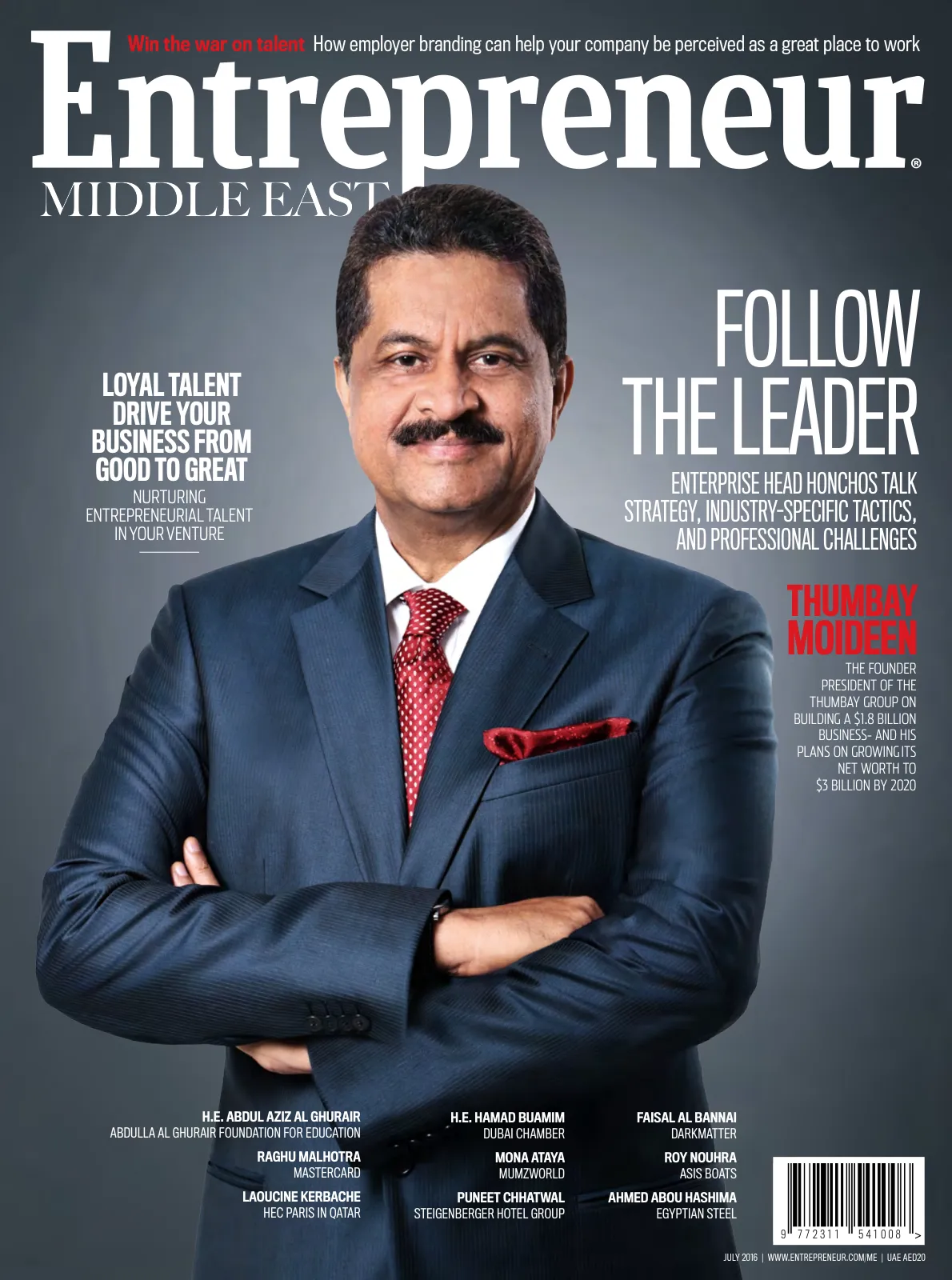
Entrepreneur Middle East, July 2016
Page 1
Win the war on talent How employer branding can help your company be perceived as a great place to work
july 2016 | www.entrepreneur.com/me | UAE AED20
9
7 7 2 3 1 1
5 4 1 0 0 8
>
H.E. Abdul Aziz Al Ghurair
Abdulla Al Ghurair Foundation for Education
Raghu Malhotra
MasterCard
Laoucine Kerbache
HEC Paris in Qatar
H.E. Hamad Buamim
Dubai Chamber
Mona Ataya
Mumzworld
Puneet Chhatwal
Steigenberger Hotel Group
Faisal Al Bannai
DarkMatter
Roy Nouhra
ASIS Boats
Ahmed Abou Hashima
Egyptian Steel
Loyal talent
drive your
business from
good to great
Nurturing
entrepreneurial talent
in your venture
Enterprise head honchos talk
strategy, industry-specific tactics,
and professional challenges
FOLLOW
THE LEADER
The Founder
President of the
Thumbay Group on
building a $1.8 billion
business- and his
plans on growing its
net worth to
$3 billion by 2020
Thumbay
Moideen
Page 2
Page 3
july 2016 Entrepreneur
3
CONTENTS
JUly 2016
28
Left to right:
CEO Maysa Jalbout,
Chairman H.E. Abdul
Aziz Al Ghurair
and Professor Eric
Grimson, Chancellor
for Academic
Advancement, MIT
at the launch of the
Abdulla Al Ghurair
Open Learning
Scholars Program
22 Thumbay Moideen, Founder President, Thumbay Group
Mona Ataya
Mumzworld
H.E. Hamad Buamim
Dubai Chamber
Faisal Al Bannai
DarkMatter
Roy Nouhra
ASIS Boats
Ahmed Abou Hashima
Egyptian Steel
64
MONEY:
ASK THE MONEY GUY
Finding common ground
First Equity Partners CEO
Qais Al Maskati on the
key to building fruitful
relationships between
entrepreneurs and
private equity firms.
68
MONEY:
ECON
Developing crowdfunding
ecosystems in the Middle
East
While crowdfunding is
slowly gaining popularity
in the MENA region,
it is still in the early
stages with only $23.1
million being raised via
crowdfunding in 2015.
74
START IT UP:
Q&A
Skip the queue
MadfooatCom envisions
cashless payments for
Jordan… and the rest of
the MENA too.
Thumbay Moideen
Thumbay Group
H.E. Abdul Aziz Al Ghurair
Abdulla Al Ghurair
Foundation for Education
Raghu Malhotra
MasterCard
Laoucine Kerbache
HEC Paris in Qatar
Puneet Chhatwal
Steigenberger Hotel Group
20
INNOVATOR:
Follow the leader
Enterprise head honchos talk
strategy, industry-specific
tactics, and professional chal-
lenges.
Our picks for ten business lead-
ers across different industry
sectors who have impacted the
MENA market, and continue to
shape its corporate trends
Page 4
Entrepreneur july 2016
4
CONTENTS
july 2016
72
Donna Harris,
Co-Founder, 1776
82
61
LIFE
The ancient problem of
procrastination
James Clear on why we
don’t follow through on
what we set out to do… and
what to do about it.
76
START IT UP:
Q + A
Clean sweep
MENA startup Justmop
wants to become the go-to
spot for home services in
the region.
79
STARTUP FINANCE
MENA startups get funded
Startups NOMADD and
Liwwa reveal details about
their latest funding rounds,
and how they went about
securing it.
72
ECOSYSTEM
Sparking innovation
The Arab world has seen
more new accelerator
programs launch in
recent years than ever
before, says a new
report.
14
EDITOR’S NOTE
By Aby Sam Thomas
58
‘TREPONOMICS:
ESQUIRE GUY
HowThe Esquire Guy’s
guide to profanity in the
office
According to Ross
McCammon, there are
times -in business and in
life- when unhinged and
manic are exactly what
you need to be.
Puneet Chhatwal,
CEO, Steigenberger
Hotel Group
76 The K500 smartphone by Four
42
‘TREPONOMICS:
MARKETING
Win the war for talent
Bayt.com’s Lama Ataya
explains how employer
branding can help your
company be perceived as a
great place to work.
50
SKILLSET
Pitch perfect
Pitching is basically
telling a story, one that
keeps your audience
hooked- here are four
tips to tell your startup
story better.
16
Page 5
Page 6
Entrepreneur july 2016
6
CONTENTS
JUly 2016
27
Henri Asseily,
Manager Partner,
Leap Ventures
Reed Hastings,
CEO and
co-founder,
Netflix
Achieving Women
Forum 2016
37
Faisal Al Bannai, CEO, DarkMatter
56
CULTURE:
TRAPPINGS
‘Trep gear
The executive selection
for the entrepreneur
on your list that has
everything. Okay, maybe
for a little self-reward
as well.
82
LIFE
Starting from scratch
Do you know why you’re
doing what you’re doing?
InnerFight founder
Marcus Smith explains
why knowing this
matters when you are an
entrepreneur.
46
SKILLSET
Overcoming obstacles
TripScout founder Konrad
Waliszewski offers seven
tips for startups operating
in emerging markets to
match up to their Silicon
Valley peers.
54
TECH:
SHINY
#TamTalksTech
Gadgets and doodads
that you might’ve missed
out on, sourced by a tech
aficionado. Yes, it’s okay
to want them all… and
no, it’s not our fault.
30
HEC Paris in Qatar
56
Aspinal of London
Passport Cover
Page 7
An oasis of tranquillity
The epitome of modern luxury
Discover the Hormuz Grand Hotel, Muscat
HORMUZ GRAND HOTEL, MUSCAT
Explore www.hormuzgrandhotel.com
MUSCAT EDINBURGH KUWAIT
QUORVUSCOLLECTION.COM
Page 8
BREITLING.COM
At the heart of the most extreme missions you’ll fi nd exceptional men prepared to entrust their security only to
the most high-performing instruments. At the heart of exceptional missions you’ll fi nd the Breitling Avenger. A
concentrated blend of power, precision and functionality, Avenger models boast an ultra-sturdy construction and
water resistance ranging from 100 to 3000 m (330 to 10,000 ft). These authentic instruments for professionals
are equipped with selfwinding movements offi cially chronometer-certifi ed by the COSC – the only benchmark
of reliability and precision based on an international norm. Welcome to the world of extremes. Welcome to the
Breitling world.
Page 9
WELCOME TO OUR WORLD
SUPER AVENGER II
Page 10
Entrepreneur july 2016
10
SUBSCRIBE
Contact subscriptions@bncpublishing.net to receive
Entrepreneur Middle East every issue
EDITOR IN CHIEF Aby Sam Thomas editor@bncpublishing.net
CEO Wissam Younane wissam@bncpublishing.net
MANAGING DIRECTOR Walid Zok walid@bncpublishing.net
DIRECTOR Rabih Najm rabih@bncpublishing.net
CREATIVE LEAD Odette Kahwagi
STARTUPS SECTION EDITOR Pamella de Leon
COLUMNIST Sindhu Hariharan
COLUMNIST Tamara Clarke
COLUMNIST Shoug Al Nafisi
COLUMNIST Erika Widen
EVENTS LIAISON Mark Anthony Monzon
PO Box 502511 Dubai, United Arab Emirates
P +971 4 4200 506 | F +971 4 4200 196
For all commercial enquiries related to
Entrepreneur Middle East contact
sales@bncpublishing.net
All rights reserved © 2016.
Opinions expressed are solely those of the contributors.
Entrepreneur Middle East and all subsidiary
publications in the MENA region are officially licensed
exclusively to BNC Publishing in the MENA region by
Entrepreneur Media Inc.
No part of this magazine may be reproduced or
transmitted in any form or by any means without written
permission of the publisher.
Printed by Raidy Emirates Printing Group LLC
www.raidy.com
Images used in Entrepreneur Middle East are credited when necessary. Attributed use of
copyrighted images with permission. All images not credited otherwise Shutterstock.
Lama Ataya
Philip Bahoshy
Tamara Bullock
James Clear
Sirine Fadoul
Miklos Grof
Konrad Waliszewski
Qais Al Maskati
Ross McCammon
Shakeeb Saqlain
Tareq Samara
Marcus Smith
CONTRIBUTING WRITERS
www.entrepreneur.com/me
Access fresh content daily on our website!
MIDDLE EAST
EntMagazineME
@EntMagazineME
Entrepreneur-me
EntrepreneurMiddleEast
EntMagazineME
EntMagazineME
EntMagazineME
MIDDLE EAST
In addition to our print edition, we’re bringing
you all sorts of industry news on our web
mediums. Joining us online means getting
relevant business and startup content in
real-time, so you’re hearing about the latest
developments as soon as we do. We’re looking
forward to interacting with our readers on all of
our social media and web platforms- like any
thriving business, we’re looking to give and take.
#TrepTalkME is already happening on all of our
digi platforms, and all good conversations go
both ways. See you on the web!
Page 11
Enjoy a 3-night escape to the shores of the picturesque Arabian Gulf, only a 30-minute drive from
Downtown Dubai, and pay only for 2 nights.
Your unforgettable stay includes a complimentary buffet breakfast, free Wi-Fi, access to the 500-metre
private beach and a late check-out.
* Terms and conditions apply and the offer is valid until 8 September 2016.
Kempinski Hotel Ajman
your perfect getaway...
Page 12
Page 13
Page 14
Entrepreneur july 2016
14
I
n the midst of all
the congratulatory
messages and notes of
encouragement that I
received for my new
role as the Editor in Chief
of Entrepreneur Middle
East, I must admit here that
I was a little surprised by
the memos that asked me
how wary I was about taking
on this role, given that it
is (indeed) an enormous
responsibility, and that I’d
be needing to fill some pretty
big shoes. Queries like these
always left me at a bit of
a loss on how to answer:
while I am, of course, well
aware of the nature of this
position and its importance
thanks to all that we have
accomplished so far at
Entrepreneur, do I really
want to be starting on this
role with a notion of fear
built into my psyche?
As I delved further into
this thought (yes, I do have
a habit of spending hours
and days on existential ques-
tions and the like), it quickly
became apparent to me that
it is sentiments like these
(which are often said with-
out any hint of malice what-
soever) that entrepreneurs
often hear from their friends,
family, and just about
anyone when starting up
their own enterprises. “How
does it feel to leave the calm
confines of a corporate job to
start a venture that’s barely
making any money?” Or,
“Aren’t you afraid of leaving
behind a monthly paycheck
to start up a venture that
you don’t even know will
work?” At first glance, one
may be inclined to deem
these as being realist ques-
tions that people starting up
new roles or ventures should
absolutely keep in mind. But
do consider, for a moment at
least, to whom you are pos-
ing these queries to.
More often that not,
these are people who have
performed quite well in
their existing endeavors,
and are now starting up on a
new journey that they have
-almost certainly- thought
about quite a bit, and are
now gearing themselves up
for the challenges ahead.
At this point in time, these
individuals have weighed
the pros and cons of what
they are setting out to do,
they are pretty aware of the
hurdles that will be staring
their faces, and they are also
probably having an inner
monologue of sorts that pits
themselves and their self-
doubt against each other.
Now, here, considering your
role as a friend or an ally,
should you be saying some-
thing that adds to their feel-
ings of insecurity, or should
you take on an approach that
is, well, a little more sup-
portive in nature?
This is not to say that you
should not call a spade a
spade, or not be the voice
of reason when this person
is seemingly lost in their
castle of dreams- but do be
appreciative of this entre-
preneur’s track record so far,
their own particular set of
skills and talents, and their
abject belief in what they are
about to set out to do. After
all, as cliché as it may sound,
your support can mean a lot
to your friends when they
are starting on their new
journeys. As for me, having
worked with Entrepreneur
for quite a while, and having
experienced first-hand the
sheer hard work, the strug-
gles we face on a day-to-day
basis, and the massive effort
that goes into building this
publication: let’s just say
that I don’t expect any of
that to change in my new
role here.
I, and my team here, re-
main as committed as ever to
this publication. We’ve had
a good run so far, and we’re
more than ready to take it
to the next level. Personally,
I’m quite glad about the
high bars that we have set
for ourselves- if anything; it
keeps us on our toes, and in
touch with reality every day.
So, in response to whether
I’m wary of what lies ahead:
well, I say, just bring it on. I
think we’re ready.
EDITOR’S NOTE
Aby Sam Thomas
Editor in Chief
@thisisaby
aby@bncpublishing.net
Looming large
Ask a big question… get a big answer
Page 15
july 2016 Entrepreneur
15
Page 16
Entrepreneur july 2016
16
IN THE LOOP
Fishy business
Y
es, you read
that right.
Norwegian
startup MiniPro
beat four other
finalists to take
home NOK1
million in funding after winning
the final round of the Angel
Challenge pitch competition at
the Startup Extreme conference
in Bergen, Norway. With the
aquaculture sector in Norway
continuing to grow, MiniPro
aims to solve an industry-spe-
cific issue of live feed produc-
tion for fishes- besides being
an expensive process, live feed
supply is often limited, and
adding to the problem is the
fact that fish larvae aren’t able
to digest nutrients in artificial
feed. So how does MiniPro fix
this issue? By developing and
producing baby food specifically
for baby fish. Through a series
of R&D experiments, MiniPro
has been able to develop an
alternative for live feed that can
be easily consumed by fishes.
The startup’s solution comes
at an opportune time, as the
aquaculture industry is growing
in markets like the European
Union, Eastern Europe, U.S. and
Asia. According to the Norwe-
gian Seafood Council, Norway
has exported salmon worth
NOK57.7 billion in 2015, which
increased 9% from NOK3.9
billion in 2014, despite a closed
border with Russia. TechCrunch
remarked that a noticeable trait
among Norwegian startup scene
is that it focuses on tradition-
ally strong markets such
as oil, gas, shipping
and fish. The country’s
government is also get-
ting in on the startup
scene- it had, along with
Innovation Norway, a
government organization
dedicated to developing
the country’s enterpris-
es, given away NOK100
million in matching
capital to match investments in
Norwegian startups. Certainly,
with all of its increased efforts
to support startups through
mentorship, training and finan-
cial assistance- we can’t wait
to see more from the nascent
ecosystem. And MiniPro’s
success just goes to show that
sometimes, entrepreneurs need
to take a close look at a nation’s
constant problems and create
solutions for it.
Norwegian fish food startup wins top honors
at Angel Challenge 2016
MiniPro founder
Ingmar Hogoy
MiniPro founder
Ingmar Hogoy at
Angel Challenge 2016
F
orget weapons
or martial arts,
all you need
is a button on
your bicycle to
feel safe riding
through streets of London.
The Give a Beep initia-
tive by Swedish company
Hövding (which produces
airbags for cyclists) and
PR platform Mynewsdesk
aims to make cyclists’
journey through London’s
urban roads safe and
comfortable. By pressing
a Flic button attached to
the handlebars of a cycle,
cyclists can “beep” out
hazards whenever they
feel unsafe or uncomfort-
able while riding through
the streets of the city.
Thanks to the button’s
connection to the cyclist’s
phone through Bluetooth,
the location data is fed
into a crowdsourced map
with the aid of the Flic
app, marking out routes
considered hazardous
for cyclists, while also
collating data on environ-
ments where riders felt
unsafe. Further, in order
to make it more effective,
each press of the button
also triggers an email to
be sent to the city’s Mayor
about the cyclists’ situ-
ation.
According to a BBC
report, the month of May
2016 saw deaths of 11
cyclists and pedestrians
on London’s roads, and
there have been increas-
ing demonstrations and
protests for fixing this
particular problem.
Currently, Hövding has
distributed 500 Flic
buttons to members and
supporters of the London
Cycling Campaign -a
12,000+ members group
that lobbies for better
cycling conditions in the
city– urging them to “give
a *beep*” about cyclist
safety. According to a
statement by Hövding,
though people of London
are increasingly enthusi-
astic about cycling, “the
infrastructure doesn’t
allow it,” and hence the
initiative hopes to let
cyclists themselves report
about places that need
attention. Amy Summers,
campaign coordinator,
London Cycling Cam-
paign, hopes that the 500
Londoners giving “a beep”
will remind London’s
Mayor Sadiq Khan to
work on fulfilling his
election pledge of making
London cycle-friendly.
According to a report by
the Washington Post, the
map had 1,000 locations
logged for its unsafe
conditions in just a week’s
time.
New tech-enabled initiative aims to make
London safer for cyclists
Giving a beep about
safety
Give a beep
initiative
minipro images by Dan Taylor, Heisenberg Media | give a beep images courtesy hovding
Page 17
Page 18
Page 19
Page 20
Entrepreneur july 2016
20
FOLLOW
THE LEADER
Our picks for ten business leaders across different
industry sectors who have impacted the MENA market,
and continue to shape its corporate trends
Enterprise head honchos talk strategy,
industry-specific tactics, and professional challenges
Brought to you by
thumbay moideen
thumbay group
H.E. Abdul Aziz Al Ghurair
Abdulla Al Ghurair Foundation for Education
Roy Nouhra
ASIS Boats
Ahmed Abou Hashima
Egyptian Steel
Mona Ataya
Mumzworld
Faisal Al Bannai
DarkMatter
Raghu Malhotra
MasterCard
H.E. Hamad Buamim
Dubai Chamber
Laoucine Kerbache
HEC Paris in Qatar
Puneet Chhatwal
Steigenberger Hotel Group
Page 21
july 2016 Entrepreneur
21
A
s the Presi-
dent and
CEO of an
enterprise
that has
played a key
and active
role in supporting the busi-
ness community in Dubai for
the last 50 years, H.E. Hamad
Buamim is emphatic on the
business sector being “the
vital ingredient” contributing
to the future of Dubai- and
you can rest assured that the
Dubai Chamber of Commerce
and Industry will continue
its bid to support and propel
business growth in the Emir-
ate. “Considering that innova-
tion is a fundamental pillar in
Dubai’s excellence and growth
strategy, the vision of Dubai
Chamber is to be a center for
creativity and innovation in
the private sector by offer-
ing innovative programs for
the business community,”
Buamim says. “The Chamber
will continue to contribute to
the development of Dubai and
the UAE through its various
initiatives and activities. Our
ambitious plans have taken us
to overseas markets, and we
are actively involved in the ef-
forts to connect Dubai’s busi-
ness community to a range of
markets from Central Asian
countries and West Africa to
Latin America. With its global
potential, the Chamber will
continue to represent Dubai’s
development agenda, and
strengthen Dubai’s reputa-
tion as a leading investment
destination.”
Dubai Chamber’s focus on
the private sector has led it
to initiate several different
campaigns and programs for
it, and its recent announce-
ment of The Mohammed Bin
Rashid Al Maktoum Business
Innovation Award is another
step in this regard, Buamim
notes. “The Mohammed Bin
Rashid Al Maktoum Business
Innovation Award has been
conceived as an effective
platform to stimulate innova-
tion in the private sector, and
help business enterprises to
improve their operational
performance,” he says. “By
supporting innovation in
various economic sectors,
the award will enhance the
ability of the business com-
munities to grow and expand
in the domestic and global
markets. The Mohammed Bin
Rashid Al Maktoum Business
Innovation Award will also
encourage national companies
and organizations to adopt in-
novation, both in their opera-
tions and services, which will
not only enhance the stature
of the country in global
competitiveness reports,
but will also help the UAE to
support and develop various
businesses to improve best
practices, while recognizing
them for their contribution to
the overall economic growth
of the country. The award
will go a long way in
stimulating various
economic sectors
to move towards
innovation, and will
also support the
country to strengthen
its global innovation
index in line with the
targets of UAE Vision
2021. It will also in-
spire entities in both
the public and pri-
vate sectors to spend
more on research and
development, and
build a sustainable
knowledge-based
economy.”
Given the sheer
scope and range
of activities that
Dubai Chamber as-
sociates itself with, and how
successful they turn out to
be, it must be said here that
Buamim’s leadership of the
institution is, by itself, some-
thing that is worthy of praise.
Interestingly enough, when
asked what drives him to
perform as he does in his role,
Buamim points back to his
organization and his nation.
“It is certainly a matter of
great pride and satisfaction to
contribute to Dubai’s growth
as the leading business center
in the region,” Buamim ex-
plains. “To derive the energy
to achieve this task, and get
inspired every day to take the
step towards the future, you
don’t need to look elsewhere.
My personal leadership strat-
egy is built on the aspirations
of Dubai, and the vision of
its leadership to ensure the
Emirate’s position as an inno-
vation hub, and the ultimate
place to do business.”
H.E. Hamad Buamim
“
President and CEO,
Dubai Chamber of Commerce and Industry
“Dubai Chamber believes that enterprises
of the future will be capable of adopting
real-time and applicable business
practices that can create value and foster
business growth. Innovation will be their
hallmark, both in their operations and
services, which will enhance the stature
of the country’s global competitiveness.”
Enterprise head honchos talk
strategy, industry-specific tactics,
and professional challenges
FOLLOW
THE LEADER
H.E. Hamad
Buamim,
President & CEO,
Dubai Chamber
The Q What, according
to you, is the importance
of Dubai Chamber’s
Tejar Dubai initiative for
Emirati entrepreneurs in
the UAE?
The A “The Tejar Dubai
program prepares young
Emiratis with extensive
skills and knowledge to gain
enough confidence to enter
and succeed in the competi-
tive world of business. It is
a model initiative that sup-
ports our young men and
women to enter the world
of entrepreneurship, enabling
them to build on the success
of the first generation of
Dubai traders. The program
is dedicated to provide a
tailored individual learning
experience to selected aspi-
rant entrepreneurs, and help
foster the development of
a more diverse, knowledge-
based economy to enhance
Dubai’s position in the global
economic landscape. The
program will have a key role
in ensuring the future growth
Dubai’s economy, well after
the end of the oil era.”
Ask the exec H.E. Hamad Buamim
IMAGE COURTESY: DUBAI CHAMBER
Page 22
Entrepreneur july 2016
22
T
humbay Moideen’s charming, unassuming
manner can come as a bit of surprise when
one meets with him for the first time- after
all, the Founder President of the Thumbay
Group is someone who established an
enterprise that started out in 1998 with a
path-breaking educational institution, and
has since grown into what is today an international business
conglomerate with a presence in 16 different industry sectors,
which includes everything from retail to real estate. But ask
Moideen to what factors he attributes his company’s success
to, his modesty is easily apparent when he answers with
a deference to the Thumbay Group’s brand motto: Growth
Through Innovation. “Since its inception, Thumbay Group
has been led by the vision to
innovate, and the mission to
explore new growth avenues,”
Moideen says. “Our growth
through the years has been
driven by a strong set of val-
ues, comprising of excellence,
trust, knowledge, innovation
and integrity. We have always
stuck to the core of ethicality.”
And if his business’ current
status is any indication, then
those are the principles every
entrepreneur should be basing
his or her enterprise on- it’s
quite clear that Moideen
has dreamed big with the
Thumbay Group, and make
no mistake, he hasn’t stopped
dreaming big either. “All of
our businesses are growing as
per plans, and we aim to scale
up our existing businesses at
least 10 times more in the next
five years,” Moideen reveals.
The story of how Moideen
started the Thumbay Group
in the UAE has become some-
what of a legend in business
circles in this region- the short
version of the story is that
Moideen had a chance meeting
in 1997 with a member of Aj-
man’s royal family, who asked
him for ideas on projects that
could help boost the Emirate’s
economy. Moideen proposed
an educational institution
modeled on the likes of a
similar establishment he had
seen in the state of Karnataka
in India, and lo and behold,
Moideen was invited to initi-
ate and lead the creation of
a medical academic center
in Ajman. While Moideen
didn’t have any experience or
knowledge about this space
at the time, he did see the
opportunity inherent in the
idea, and decided to swoop in
and try to capitalize on it. The
gamble paid off- 1998 saw the
establishment of Gulf Medi-
cal College, and it grew into
what is today Gulf Medical
University, one of the most
sought-after private medical
universities in the region. >>>
Moideen
Thumbay
Enterprise head honchos talk
strategy, industry-specific tactics,
and professional challenges
FOLLOW
THE LEADER
Founder President, Thumbay Group
“Innovation is such an important
aspect that nowadays, rather than
just a word, it’s a culture that
every company must follow. If an
organization is stagnant, it will
not survive; innovation is indis-
pensable for growth. The culture
of innovation has to permeate each
department and employee, so as to
achieve gains like efficiency and
cost-effectiveness, and to accom-
plish the organizational goals.”
Page 23
july 2016 Entrepreneur
23
Enterprise head honchos talk
strategy, industry-specific tactics,
and professional challenges
FOLLOW
THE LEADER
“Thumbay Group is con-
stantly striving to ex-
pand its operations and
reach to all parts of the
globe- as such, we are
always keen to partner
with and support individ-
uals and organizations
who are enthusiastic
about entrepreneurship
and innovation.”
Enterprise head honchos talk
strategy, industry-specific tactics,
and professional challenges
FOLLOW
THE LEADER
Thumbay
Moideen, Founder
President,
Thumbay Group
Page 24
Entrepreneur july 2016
24
Along the way, driven by a
need for teaching hospitals
for his students, Moideen
ventured into the healthcare
provider business as well-
the first Thumbay Hospital
came into being in Ajman in
2002, and today, it boasts of
locations in the Emirates of
Dubai, Sharjah and Fujairah,
as well as in Hyderabad,
India. The Thumbay Group
has made inroads into other
sectors as well- for instance,
there are the health, nutri-
tion and wellness stores run-
ning under the name of Nutri
Plus Vita Stores, a coffee
shop chain (Blends & Brews),
the network of spa facilities
(Body & Soul Health Club &
Spa), and a lot, lot more.
But as is often the case with
entrepreneurial success sto-
ries, the above oft-repeated
timeline makes it seem that
Moideen had an apparently
comfortable run in the world
of business. However, noth-
ing could be further from the
truth- while Moideen does
hail from a reputed business
family in India, setting up
the Thumbay Group in the
UAE in a sector and country
that were almost entirely in
my career, there is definitely
not an easy task. “One of the
major challenges we faced
as we set foot in the country
was that we had chosen to
enter a territory which was
completely new to us,” Moi-
deen recalls. “We have been
faced with challenging situ-
ations every now and then,
but we’ve developed a work
culture at Thumbay Group
which keeps us committed
to our goal and powers us
with the passion to stick to
our guns until the goal is
achieved. I’m fortunate to
have a team that has stood by
me during the tough times.”
But that was then- today, the
Thumbay Group is on quite a
solid footing (as is evidenced
by its current billion dollar
value in the market), and it
is now looking to expand fur-
ther. “Thumbay Group aims
to expand internationally,
creating a global presence,”
Moideen says. “By 2020, we
aim to develop 420 estab-
lishments including three
new university campuses in
three countries, develop an
alternative medicine hospital
and college; as many as 15
new Thumbay Academic
Hospitals in UAE and other
countries; 100 Thumbay
Pharmacy outlets; 25
Thumbay Labs; 100 Blends &
Brews Coffee Shops; 25 Body
& Soul Health Club outlets;
100 ZO and MO Opticals
outlets; 50 Nutri Plus Vita
outlets. The strategic growth
plan will nearly double the
group’s net worth to US$3
billion by 2020, from the
current value of US$1.8
billion. This will also triple
the 5,000 existing human
resources to 15,000.”
Now, those may seem like
very ambitious plans, but
once you consider that Moi-
deen will be the one driving
these initiatives forward at
the Thumbay Group, it’s safe
to say that those dreams are
well within reach for the
company. Moideen’s two sons
are also helping with the
realization of his grand vision
for the enterprise- while Ak-
bar Moideen Thumbay is the
Vice President of the Health-
care Division at the Thumbay
Group, Akram Moideen
Thumbay is the Director Op-
erations for the Construction
and Renovation Division of
the company, and both sons
are members of the Thum-
bay Group Board as well,
where strategic plans for
the conglomerate are made
and implemented. Moideen
also doesn’t shy away from
highlighting the importance
of the contributions of his
team to the enterprise- the
executive team, in particular,
is a case in point. “Finding a
good executive team is very
important, as these are the
people who handle the major
responsibilities,” he notes.
“We are fortunate to have a
strong HR department, which
has a strong framework of
human capital management.
Thumbay Group is driven
“We have been faced with
challenging situations every
now and then, but we’ve
developed a work culture
at Thumbay Group which
keeps us committed to our
goal and powers us with the
passion to stick to our guns
until the goal is achieved.
I’m fortunate to have a team
that has stood by me during
the tough times.”
Enterprise head honchos talk
strategy, industry-specific tactics,
and professional challenges
FOLLOW
THE LEADER
A Thumbay Group CSR initiative, a blood donation camp
Thumbay Moideen receiving the Dubai Quality Appreciation Award in 2016 for Thumbay Hospital Ajman from H.H. Sheikh Maktoum
bin Mohammed bin Rashid Al Maktoum
IMAGES COURTESY THUMBAY GROUP
Page 25
july 2016 Entrepreneur
25
by a strong set of values,
the vision to innovate, and
the unending quest for new
growth avenues. We have a
qualified team of executives
who not only understand
and appreciate the group’s
mission and vision, but are
also passionate to work for
it. The members of my team
are committed to ethicality,
and have the spirit of innova-
tion.” It’s interesting here
to note that while Moideen
continuously reiterates the
importance of his team at
the Thumbay Group, the
Founder President continues
to play a very hands-on
role at the company- here
is someone who believes in
leading from the front, and
knows the value of doing so.
“As the driving force of the
company, I constantly make
sure that we keep up with the
latest trends, as well as plan
ahead,” Moideen says. “Act-
ing as the facilitator for my
team, I oversee all day-to-day
operations, and at the same
time, resolving problems and
ushering in change.”
Moideen’s particular style
of leadership is easy to un-
derstand when one considers
his thoughts on what makes
someone a great leader who
inspires. “A great leader
must live up to the highest
standards of professionalism,
in addition to setting the
organization’s vision,” he
says. “The helmsman of an
organization must dream big
for its growth and success.
He/she must have the ability
to take intelligent risks, while
remaining optimistic at all
times. People management is
yet another important skill,
and the leader must trust
his/her team members, in
turn earning their trust and
confidence. Apart from the
above, personally, I make
sure that I lead my team
from the front, taking care to
infuse dedication, discipline
and hard work at all levels
of the organization.” In ad-
dition, Moideen is a firm
believer in giving back- be-
sides the firm entrenchment
of CSR in the culture of the
Thumbay Group, he is also
eager to see replications of
his entrepreneurial success
stories in the world around
him, and so, he is a keen fol-
lower and contributor to the
entrepreneurial ecosystem at
large as well. “I never miss a
chance to interact with young
and upcoming entrepreneurs
and to do my bit to inspire
them,” Moideen says. “More-
over, Thumbay Group is
constantly striving to expand
its operations and reach to all
parts of the globe- as such,
we are always keen to partner
with and support individuals
and organizations who are
enthusiastic about entrepre-
neurship and innovation.”
One instance of Moideen’s
drive in this regard is Gulf
Enterprise head honchos talk
strategy, industry-specific tactics,
and professional challenges
FOLLOW
THE LEADER
“The countries of the region
are increasingly diversifying
their economies and moving
away from oil dependency. They
are wholeheartedly welcoming
investments in various sectors.
Now is definitely a good time to
start a business in the region.”
Modular Operation Theaters,
Thumbay Group
>>>
Page 26
Entrepreneur july 2016
26
Medical University’s upcom-
ing innovation center at
its campus in Ajman. “The
innovation center we are
building at Gulf Medical
University aims to enhance
the culture of innovation,
entrepreneurship and
creativity, and to serve as a
launch pad for innovative
products and services,” he
says. “In addition to serving
as a contact point for scien-
tists, faculty and students
for medical innovation, it
will also foster collabora-
tions and partnerships with
international institutions,
universities, research labs,
pharma companies and the
healthcare industry.”
As an entrepreneur who
has seen much success
with his various business
ventures in the Middle East,
Moideen continues to be
encouraging of new entre-
preneurs who want to set up
shop in this region. “There
are opportunities aplenty
for entrepreneurs in the
Middle East,” Moideen
declares. “The visionary
leaderships of the Middle
East nations have laid a
strong economic founda-
tion for the region, as a
result of which we have
all these opportunities to-
day.” Moideen also alludes
to the changing dynamics
of economies in the region
as a potential advantage
for entrepreneurs in
the Middle East. “The
countries of the region
are increasingly diversify-
ing their economies and
moving away from oil
dependency,” he notes.
“They are wholeheartedly
welcoming investments
in various sectors. Now
is definitely a good time
to start a business in the
region.” And given that
comment comes from
Thumbay Moideen, one
may be wise to follow his
words to the tee.
Enterprise head honchos talk
strategy, industry-specific tactics,
and professional challenges
FOLLOW
THE LEADER
The Q You have often men-
tioned that for you, doing
business that also has a
social element is important.
Can you elaborate on this
aspect, and what are the
ways in which you implement
CSR/social support in your
business?
The A “Doing business with a so-
cial angle is part of the corporate
culture of Thumbay Group. This
is something that was imbued
in me by the elders in my family,
who themselves were successful
businessmen.
Corporate social responsibility is
a full-fledged activity of Thumbay
Group. The Thumbay Foundation
was formed as a charitable trust
established to support charitable
activities in healthcare, education
and social causes. Thumbay
Foundation provides funds and
support by the provision of schol-
arships, grants, bursaries, awards,
fellowships, endowments, dona-
tions and other forms of financial
assistance to students pursuing
any level of education or training
in any educational or training
institution or establishment.
Along with many other chari-
table initiatives, Thumbay Group
is at the forefront of business
houses that see philanthropy
as a duty to society and as an
act of giving back rather than
an act of charity. Our hospitals
have dedicated Patient Affairs
Departments, which ensure good
treatment to the poor, at subsi-
dized charges. We make sure that
no patient is denied treatment
because of his/her inability to
afford. Our hospitals also conduct
frequent medical camps for the
public.
At Gulf Medical University, we
give scholarships to deserving,
meritorious students to pursue
medical courses of their choice
through our Care & Share pro-
gram. GMU sponsors around 20%
of its students.”
Ask the exec Thumbay Moideen
Akbar Moideen Thumbay,
Thumbay Moideen
and Akram Moideen
Thumbay.
Page 27
Porto Arabia Towers
Doha, Qatar
������������������������������
Hill International
The Global Leader in Managing Construction Risk
www.hillintl.com
�����������������������������������������������������������������������
���������������������������������������������������������������������
��������������������������������������������������������������������������
������������������������������������������������������������������������
�������������������������������������������������������������������������
���������������������������������������������������������������������
��������������������
����������������������������������������������������������������������������
���������������������������������������������������������������������
�������������������������������������������������������������������������
�����������������������������������������������
��������������������������
�������������������������
��������������������������
If you can imagine it, we can manage it.
��������������������
Doha, Qatar
��������������
Doha, Qatar
Viva Bahriya Towers
Doha, Qatar
Page 28
Entrepreneur july 2016
28
H.E. Abdul Aziz Al Ghurair
Chairman
Abdulla Al Ghurair Foundation for Education
“There are always opportunities for an
entrepreneur in any economy. You need to
have a keen eye to identify an opportunity,
and work hard with great passion to re-
alize your dream. The Arab region is full
of opportunities, and we have innumer-
able examples of people who have created
large businesses through hard work.”
Enterprise head honchos talk
strategy, industry-specific tactics,
and professional challenges
FOLLOW
THE LEADER
The Q What do you con-
sider to be challenges in
finding a good executive
team for your enterprise?
The A “Selection of the right
team is critical for the success
of an organization. I do not
think it is very difficult to do so
in today’s world, where talent
mobility is global. However, the
challenge is the identification
of the right talent through a
thorough selection process
and use of the right assess-
ment tools. I spend a consider-
able time in interviewing
senior members of my team.
For me, the right behavior is
critical, as technical skills are
easy to learn and improve, but
behavioral change is far more
difficult. To retain the right
talent, first, they must have a
share in success, but equally
important is a conducive work
environment and a sense of
empowerment.”
Ask the exec H.E. Abdul Aziz Al Ghurair
H.E. Abdul
Aziz Al Ghurair,
Chairman,
Abdulla
Al Ghurair
Foundation for
Education
IMAGES COURTESY: ASIS BOATS
T
o say that
Mashreq
CEO H.E.
Abdul Aziz
Al Ghurair
dreams big
with whatever
he does would probably be an
understatement. Consider his
latest endeavor, the Abdulla
Al Ghurair Foundation for
Education, of which he is
the Chairman. Set up by his
father, Abdulla Ahmad Al
Ghurair, one of the UAE’s most
prominent and successful
businessmen, the Foundation
was established in July 2015
with a mandate to “provide
high-achieving, underserved
Emirati and Arab students
with the opportunity to study
at a top university, and pursue
a future in a STEM-related
(Science, Technology, Engi-
neering, and Math) field.” The
objective is, obviously, a grand
one, and the Foundation has
got a budget to match- the
enterprise has an investment
of US$1.1 billion to spend over
the next 10 years, making it
one of the largest privately
funded philanthropic educa-
tion initiatives in the world.
“My father’s motivation
behind setting up the Founda-
tion was very simple,” Al
Ghurair says. “He wanted to
tackle what he believes to be
one of the greatest challenges
facing the Arab world– access
to quality education. Knowing
that, there can be no better
investment than in educat-
ing today’s Emirati and Arab
youth. Education is the great-
est equalizer. Arab youth un-
derstand that only education
will help them overcome the
challenges they face whether
they are refugees or living in
a poor rural area. Education
will open doors for them to
become the next generation of
innovators, entrepreneurs and
leaders. Over the years, my fa-
ther has tried to help as many
young people as he could on a
personal level, and encouraged
all of his children to do the
same. Establishing the Foun-
dation ensures that education
philanthropy is his legacy to
us, and [that it] continues to
be deeply embedded in our
family’s DNA, generation after
generation.”
While the Foundation may
be a rather young organiza-
tion, Al Ghurair proudly
points out that it has made
substantial strides in its first
year- a strategy for the organi-
zation is in place, as is a team
(led by CEO Maysa Jalbout,
who was previously the found-
ing CEO of the Queen Rania
Foundation in Jordan), and
three programs have already
been launched as part of this
initiative: the Al Ghurair
Young Thinkers Program, the
Al Ghurair STEM Scholars
Program and the Al Ghurair
Open Learning Scholars Pro-
gram. The speed at which the
Foundation has accomplished
all this is indeed noteworthy,
but it is also necessary, when
you consider the scale of its
goals. “Over the course of the
next ten years, we are com-
mitted to ensuring that 5,000
Emirati students are ready to
make the transition from sec-
ondary to higher education,
15,000 Arab youth are sup-
ported through educational
opportunities, and 100,000s
of individuals have access to
cutting edge online learning,”
Al Ghurair says. “The success
of our Foundation will be
determined by our ability to
meet those commitments in
the ten-year dedicated time-
frame. We are implementing
Page 29
july 2016 Entrepreneur
29
Mashreq CEO H.E. Abdul Aziz Al Ghurair
on why innovation is key to the bank’s success today
(and in the future)
The Mashreq story
Enterprise head honchos talk
strategy, industry-specific tactics,
and professional challenges
FOLLOW
THE LEADER
Left to right: CEO Maysa Jalbout, Chairman H.E. Abdul Aziz Al Ghurair and Professor Eric
Grimson, Chancellor for Academic Advancement, MIT at the launch of the Abdulla Al Ghurair
Open Learning Scholars Program
a rigorous monitoring frame-
work that will track our prog-
ress against these goals year
over year. Our investments in
a dedicated impact evaluation
team and tailored electronic
systems will allow us to con-
fidently assess our reach as
the Foundation scales to meet
those large commitments.
Naturally, we will ramp up our
operations over time, reaching
more high school, university,
and online scholars year over
year. To assess our long-term
outcomes, we are designing
a framework to evaluate our
impact on different aspects
of our scholar’s educational
attainment. We will actively
collect data on our annual
cohorts to better understand
if and how support from the
foundation impacted their
ability to pursue, enroll, and
complete their studies.”
It’s an ambitious exercise, to
say the least, but it’s safe to
say that the Foundation is safe
in the hands of Al Ghurair.
He is, quite simply, one of
the UAE’s most accomplished
business leaders- besides his
role at Mashreq, he’s also
a member of the board of
directors of the Abdulla Al
Ghurair Group of Companies,
he’s the Chairman of the UAE
Banking Federation, he’s the
Vice Chairman of the Higher
Board of Dubai International
Financial Centre, he’s the
Chairman of Masafi Company
and Oman Insurance, he’s
the President of the Family
Business Network GCC: all of
this is suffice to say that Al
Ghurair has a lot of experience
backing him up to govern the
Foundation. One must also
take into account the personal
element driving Al Ghurair
forward to push ahead with
the Foundation. “For me, I am
committed to implementing
my father’s vision, and ensur-
ing the Foundation is suc-
cessful in achieving his dream
of educating thousands of
deserving young Emirati and
Arab youth,” Al Ghurair says.
“My business experience is
very useful, but I am also delv-
ing into the philanthropic and
education sectors, connecting
with some of the world’s most
innovative minds and working
with a highly qualified team
at the Foundation. I consider
this to be one of the most ex-
citing challenges in my career.
I am enjoying learning about
the issues, and questioning
the modus operandi. Being an
engaged philanthropist rather
than just a funder has given
me a new appreciation for
the challenge of making large
scale impact in education and
other issues. But, I am also
more hopeful than ever that
making impactful investments
is possible. I am energized and
somewhat impatient for the
first Al Ghurair STEM Schol-
ars to begin university in Sep-
tember 2016. I look forward to
watching the course of their
new lives, and what they will
make of it.”
“Mashreq has been a leader
in a number of areas in the
UAE and the region, and we
plan to continue doing so in
the years to come. Our goal
for the next five years is to
ensure that we fulfill cus-
tomer expectations across all
bank functions. The customer
is becoming more sophisti-
cated, so what we used to do
three years ago is no longer
sufficient. We must continue
to innovate and not only meet
our customers’ expectations,
but exceed them.
Innovation is in our DNA,
and it is what defines
Mashreq in everything we do.
Innovation is the lifeblood of
Mashreq– and perhaps what
Mashreq is best known for.
There is a long list of things
that Mashreq has introduced
to the market– ATMs, retail
banking offerings, traveler’s
checks, etc. in addition to
more recent breakthroughs
in digital and mobile banking.
One example of an innovative
product was the launch of the
Mashreq Millionaire in 1994.
Today, most banks have
products of that sort, but we
were the first to offer it.
Mashreq embraces consis-
tent change to innovate and
stay ahead. Our conscious
decision to invest in our
digital channels and change
the way we communicate and
market to our customers is
an example of that. Our inno-
vation ensures we are where
our customers want us to be.
Technology has been criti-
cal in helping us regain our
status as one of the most
innovative banks in the
region. Our investments in
innovation in state of the art
technologies have helped
Mashreq rapidly deliver
unique products that keep
us ahead of the competi-
tion. Mashreq is also first in
implementing iStatements,
interactive statements.
With the increased use of
electronic channels, technol-
ogy is focusing on high
availability of customer touch
points like ATMs, CCDMs,
mobile, online, IVRs and
POS. Mashreq continues to
invest in SMAC -Social, Mo-
bile, Analytics and Cloud- and
key innovation agenda items
in this space. It has also
restructured itself to strongly
align with its business part-
ners and thus build a strong
customer-focus.
The key drivers behind
Mashreq’s innovation
initiatives is omni-channel
convergence, which is aimed
at migrating our current
physical and traditional distri-
bution channels to a resilient
and robust digital business
model. Delivering a compel-
ling, simple, friction-free,
and trusted digital banking
experience to customers
has been supported by the
UAE’s superior connectivity
and smartphone penetration
levels, and the government’s
desire to create a Smart
City. An always-connected
tablet and smartphone is fast
becoming the norm amongst
the working population,
and leveraging the mass
consumption of video content
and real-time data analytics,
Mashreq is driving change
by radically redesigning
the services we offer to our
customers. No longer intent
on just providing traditional
banking services and prod-
ucts, the bank is executing its
multi-distribution strategy to
become the everyday bank
and primary financial app of
the consumer.”
Page 30
Entrepreneur july 2016
30
Laoucine Kerbache
Dean and CEO,
HEC Paris in Qatar
“The Qatar National Vision 2030 plans to
diversify the non-hydrocarbon economy
and recycle the country’s mineral wealth
into finance, infrastructure, education,
science and technology, and real estate.
For those with the knowledge and skills
within those fields, this presents an op-
portune time to invest and establish a
business that caters to the needs of the
nation. By being an early adopter of such
plans, you can reap in the benefits and
create a firm base to grow and prosper.”
Enterprise head honchos talk
strategy, industry-specific tactics,
and professional challenges
FOLLOW
THE LEADER
Laoucine Kerbache, Dean and CEO, HEC Paris in Qatar accepting the Education
Innovation award from Qatar Chamber Vice Chairman Muhammed bin Ahmed bin
Towar Al Kuwari at the 2015 Qatar Enterprise Agility Awards
IMAGES COURTESY: HEC PARIS IN QATAR
A
s the head
of the Qatar
division of
an institu-
tion that’s
been ranked
among the
top three providers of execu-
tive education in the world,
it’s safe to say that Laoucine
Kerbache has a lot on his plate
in his dual role as the Dean
and CEO of HEC Paris in Qatar.
But to his credit, Kerbache
seems to have been playing
his cards right- ever since the
France-headquartered HEC
Paris opened its campus in
Qatar in 2010, the school has
been steadfastly sticking to
the goals with which it was
established- which is, as Ker-
bache puts it, “to significantly
contribute to the development
of a knowledge-based economy
in Qatar, and to strengthen
corporate competitiveness in
the region.” And for what it’s
worth, Kerbache’s efforts are
certainly getting noticed- at
Entrepreneur Middle East’s
2015 Qatar Enterprise Agil-
ity Awards, HEC Paris in
Qatar took home the award
for Education Innovation, in
recognition of the institution’s
highly ranked, Qatar-specific
management programs and
research activities, as well as
for its influential list of Qatar-
based graduates, which today
includes H.E. Sheikha Hind
bint Hamad Al Thani, Vice
Chairperson and CEO, Qatar
Foundation for Education, Sci-
ence and Community Develop-
ment, Aysha Al Mudahka, CEO,
Qatar Business Incubation
Center, and others.
But all of this doesn’t mean
that Kerbache and his team at
HEC Paris in Qatar are taking
their success for granted- on
the contrary, Kerbache is
very tuned in on the changing
dynamics of the Middle East
economies, and is keen on
having his organization cater
to the specific needs of this
particular region. While the
Doha-based school’s executive
education programs have been
consistently lauded, Kerbache
also notes the importance of
evolving their programs and
offerings to better serve its
students in this region- for
instance, its custom programs,
especially with respect to
family-owned businesses in
this region, have been very well
received. “When HEC Paris
opened its campus in Qatar, it
was paramount that we didn’t
just take our programs from
Paris and apply them here,”
Kerbache explains. “For degree
programs, as well as for open
programs, we asked our faculty
to understand the local and
regional environment and to
inject, alongside the interna-
tional practices, any relevant
managerial practices to enrich
the content and the group dis-
cussions. As for the custom de-
signed programs, we work very
closely with the customers to
design content that specifically
cater to their needs and their
requirements. We have worked
very closely with our main
campus [in Paris] and with
Qatar Foundation to ensure
that the courses and programs
that we offer are tailored to the
regional needs.”
But, to use a cliché, the proof
of the pudding is in the eating,
and Kerbache proudly points
toward HEC Paris in Qatar’s
graduates to showcase the wins
his school has achieved. “A tes-
tament to this success is that,
to date, HEC Paris in Qatar has
graduated 347 participants, of
whom 220 are Qatari nation-
als,” Kerbache says. “All these
graduates hold top executive
management positions (CEOs,
COOs, CIOs, CFO, etc.) in pub-
lic, private, and governmental
organizations in Qatar and
in the region.” While this is
indeed a reason to celebrate,
Kerbache remains rooted to the
need for HEC Paris in Qatar
to be consistently evolving
and innovating. “We cannot
rest on our laurels, and we
continually strive to deliver
excellence to our participants,”
he explains. “And as business
models change, we have to
develop our programs offered
as well as create adaptable es-
tablishments and grow through
alliances. This has become an
integral part of modern strate-
gic management. In addition,
and an area I am very proud
of, HEC Paris in Qatar has
established a Research Office
in Qatar to develop local and
regional content. Over the last
two years, we have success-
fully developed over a dozen
case studies about companies
operating in Qatar. This has
not only fed into our programs,
Page 31
july 2016 Entrepreneur
31
Enterprise head honchos talk
strategy, industry-specific tactics,
and professional challenges
FOLLOW
THE LEADER
The Q What were some
of the challenges you
encountered in finding a
good executive team for
your enterprise?
The A “These are very
challenging issues in Qatar
and in the region. As we focus
on executive education, we
chose to rely essentially on
our home campus pool of
full-time and affiliate faculty
to staff most of the academic
positions, including the
executive team. Therefore, we
benefit from a great network
of experienced and highly
qualified professors. Further,
this enabled us to operate
with mostly variable costs. As
for the support staff, the local
market provides opportunities
to meet the demand.
However, it is important to
stress the need to train these
people to fit into a rigorous
academic environment, and
we achieve this through
training and frequent staff
exchanges with our main
campus in France.
Of course, one of the main
challenges in the region
for many companies is
retention. With increased
competition it is vital that
talent management and
talent retention are and
should remain top priorities.
Executive education is a
major lever to unlock the
talent of managers and
executives, of whom some
become true leaders and
agents of change leading to
competitive and sustainable
edge. These are some of
the key success factors that
CEOs and Presidents know
well, but they need to be
implemented.”
Ask the exec Laoucine Kerbache
HEC Paris interior
but also ensured that what
we offer remains relevant for
tomorrow’s leaders.”
Speaking of leadership,
Kerbache has set himself a very
straightforward goal (albeit a
rather arduous one) in his role
as the CEO of HEC Paris in
Qatar. “Personally, I have been
leading my team to continue
increasing the profile of HEC
Paris as the preferred institu-
tion for executive education
and higher learning in Qatar
and the region,” he says, quite
simply. “Over the next five
years, the objective is twofold:
first, we plan to consolidate
the existing programs, as well
as developing new executive
education programs in Qatar
and in the region. Second, we
shall continue to develop our
applied research activities by
working more closely with our
main campus in Paris, and
with companies based in Qatar
and in the region. More than a
dozen case studies have been
developed with the objective
to integrate them alongside
international cases in the
modules offered in Doha. We
will continue to build upon
them.” Kerbache’s plans are
thus in line with the country’s
vision for being a knowledge-
based economy in the years to
come, as per Qatar National
Vision 2030. “HEC Paris in
Qatar understands this, and
while its programs and re-
search activities aim to shape
business development within
the global economy, they are
also fully aligned with what
Qatar National Vision 2030
seeks to achieve,” Kerbache
notes. “Overall, the imparting
of world-leading executive
education in Qatar is only ever
going to have a positive impact
on the knowledge ‘levels’ of the
host economy. Our goal as an
educational institution is not
to be a carbon copy of our cam-
pus in France, but to support
the transformation of Qatar.
This being said, having a pres-
ence in Qatar brings something
unique to HEC Paris’ portfolio.
Primarily, being present in a
burgeoning marketplace such
as Doha, we have access to the
business community, which
fuels our capacity to create
knowledge, which then feeds
in to our global teaching activi-
ties.”
As someone who is focused
on building “tomorrow’s lead-
ers,” Kerbache is clear that
leadership today, be it as an
entrepreneur or as the head
of a corporate, needs to be
dynamic and in tune with the
times, and this is a principle
he follows through on as his
personal strategy for himself,
as well as for HEC Paris in
Qatar. “The global marketplace
today is under a number of
pressures, requiring successful
leaders to contend with stiff
global competition, political
and security turmoil and
adverse financial effects,” he
notes. “To be able to overcome
these challenges, it is impera-
tive that a leader is equipped
with the right knowledge and
skills to steer their business
through this minefield, and in
most cases, this knowledge is
obtained from their peers. In
all programs offered at HEC
Paris in Qatar, we enable par-
ticipants to share knowledge
and leadership approaches
with peers coming from diverse
cultural, educational and
professional backgrounds as
well as world-class renowned
faculty, researchers and guest
speakers. I am confident that
that our graduates will be
among the new leaders of
today and tomorrow, and who
will steer their organizations to
greater heights. At HEC Paris
in Qatar, as a firm believer in
a customer-centric approach,
I follow a similar mantra with
regular meetings with faculty
and alumni to understand
areas of improvements to our
programs and offerings for the
benefits of our participants
and to corporate partners.
Only by consolidating feedback
and knowledge from all our
shareholders can we develop
and sustain a competitive edge
in the MENA market.”
Page 32
Entrepreneur july 2016
32
Enterprise head honchos talk
strategy, industry-specific tactics,
and professional challenges
FOLLOW
THE LEADER
T
he life of an
entrepreneur
is not an easy
one, and it’s
not for every-
one.” If that
statement of
hers is any indication, then
Mumzworld founder and CEO
Mona Ataya is someone who
doesn’t believe in sugarcoat-
ing things- in a region where
being an entrepreneur has
somehow become the new cool
thing to be, Ataya is the voice
of caution for the upstarts
with stars in their eyes. “It’s a
24-hour job, 365 days a year,”
she says. “It’s ridden with
pressure and expectations. I
had to be ready to give up a
lot of things for myself, like
sleep, me-time, health, and
even friendships.” Okay, so
entrepreneurship’s not as
glamorous as some might like
to think- but why do it then?
“You push yourself, because
you are driven by a vision
and a commitment to doing
something impactful and im-
portant,” Ataya replies. “In my
16 years as an entrepreneur,
I have seen failed projects,
wrong hires, disappointing
outcomes, and worse, almost
daily. There are days when you
wake up and you are exhaust-
ed and overwhelmed, but you
still get up and do what you
have to do. You reach out to
the grit in your soul to push
you through another day. And
whenever you feel it cannot
get any worse, it does– and
then suddenly, you see the
light at the end of the tunnel,
and the vision shines bright
again. If I had to list all the
difficulties and disappoint-
ments [of being an entrepre-
neur], I would [have to] write
a novel, not a paragraph!”
With this being the case,
Ataya is insistent on wannabe
entrepreneurs to be very clear
about their reasons behind
getting into this field. “The
only advice I would give is
this: be 100% sure of why
you are doing what you are
doing. If your why vision is
compelling and important
enough to you, then just keep
on tracking along. Be smart,
be creative, surround yourself
with winners, and you will
get to where you need to be
eventually.” And if you need
any proof of this concept, just
look at Ataya’s own story for
inspiration: since its launch
in 2011, Ataya’s Mumzworld
has become the leading online
marketplace for all things
mother, baby and child in the
Middle East- and don’t forget
the fact that it was the first
such enterprise of its kind in
this region. The company has
been growing from strength
to strength, with its latest
announcement of note being
its multi-million dollar Series
B investment from a mix of
investors that include Wamda
Capital, twofour54, Endeavor
Catalyst and more. “The
funds will be used to continue
scaling the business both in
the UAE and KSA, and [then]
across the entire GCC, fol-
lowed by the rest of MENA,”
Ataya says. “KSA, this year,
has become a key market for
us, as has Qatar. We will con-
tinue to grow these markets,
and others.”
There is no question that
Mumzworld’s successes
have a lot to do with Ataya’s
leadership of the enterprise,
and when asked about her
modus operandi for doing
so, she throws the attention
on her team at the company.
“We try to hire people with
ownership and accountability
in their DNA,” she explains.
“They take responsibility for
their successes and mistakes.
We hire people who want to
build excellence, not average
products. We hire people who
believe that building a great
company is about building
a customer experience that
is bullet proof and superior.
We hire people who want to
change the world and create
positive social impact. We
hire people who are not only
super smart on paper, but
can analyze daily challenges
and come up with practical,
cost effective and creative
solutions. We hire people who
believe that innovation is key
to growth and being comfort-
able is not an option. To build
great companies, you hire
great people– that is my man-
tra.” But Ataya is quick to also
note that getting together a
great team is not an easy thing
to do. “Hiring in a startup or
SME environment is one of
the greatest challenges,” she
admits. “That’s because you
expect people to work harder
than they ever worked, make
less mistakes than they ever
did, earn less and work in an
ever-changing, risky, fluid,
unstructured environment
with limited processes. How
many people do you know
would willingly do that? Not
many- unless they are sold on
your vision: your why. If they
believe in the company, what
it stands for, and its mission,
then you can attract people
who share that vision. It’s not
easy, but it can be done– with
a lot of trial and error.”
Mona Ataya
“
Founder and CEO, Mumzworld
“The world conspires to present to you
opportunities that you are ready for.
Call it fate, or luck; I am a believer in both.
You can create your own luck by being
ready to take on opportunities through
a lifetime of hard work, commitment and
preparation. The more prepared you are,
the more opportunities come your way.”
Mona Ataya,
founder
and CEO,
Mumzworld
The Q In your current role,
what do you consider to be
among the most important
things you do to ensure
your enterprise functions
as expected, and, at the
same time, grows as well?
The A “Have the smartest
people, sitting on the right
seats, doing the job that
they are best at. We have not
always got this right. In fact,
we have made many mistakes
along the way, and will likely
continue making mistakes.
But my personal #1 priority
is ensuring that Mumzworld
continues to attract the best
talent out there.
Secondly, build bulletproof
operations that contribute to a
superior customer experience.
Our customer is at the core of
everything we do. As a cus-
tomer-obsessed organization,
everything we do daily is about
improving that experience.”
Ask the exec
Mona Ataya
IMAGES COURTESY: MUMZWORLD
Page 33
july 2016 Entrepreneur
33
H
aving returned
to the UAE
after a busi-
ness education
in the United
States, ASIS Boats founder
and President Roy Nouhra’s
enthusiasm for water skiing,
car racing and everything
mechanical -coupled with
“a passion for innovation”-
prompted him to launch his
company as a new arm to his
family business, the 50-year-
old Solico Group, special-
izing in the manufacture,
contracting and trading of
electro-mechanicals. Nouhra
established ASIS Boats,
manufacturers of rigid inflat-
able boats (RIB) and provid-
ers of end-to-end maritime
services, in 2006, catering
to three vastly different
customer verticals -military,
professional and recreation-
al- in a 60%-30%-10% ratio
respectively. “We started off
as a company catering to the
leisure segment in 2006,”
Nouhra says. “But then, in
2008, when the leisure mar-
ket worldwide crashed, as a
matter of survival, we decid-
ed to diversify.” That strat-
egy proved to be extremely
beneficial for ASIS Boats in
the long run. Designing and
manufacturing boats from
its facility in Dubai, ASIS
Boats now sells to almost 80
territories, across the MENA,
United States, Europe, South
America, the Far East and
other regions. With approvals
and certifications from both
European and the US indus-
try and government bodies,
and with offices in the U.S.
and the UAE, ASIS Boats
has also succeeded in going
global, even while its manu-
facture and R&D facilities
continue to be based out of
Dubai. When
quizzed about
his business
strategy for
breaking
geographi-
cal barriers,
Nouhra says
his insistence
on quality has
been the com-
pany’s major
differentiator.
“To be able
to sell to
these [global]
markets, you
need to abide
by certain
minimum
standards,”
he explains. “But I decided
that we will abide by the
maximum standards.” The
company’s efforts involved
making inroads into the
professional vertical (selling
to maritime companies),
while waiting on government
contracts to materialize, thus
wasting no time in building a
customer base. “The fact that
we have been here since the
1960s as a Group also gave
us credibility, [signifying] we
are not a hit-and-run busi-
ness, but we are here to stay,”
he adds.
In terms of recognition,
ASIS Boats was recently
named “Business of the Year”
at the 2015 Gulf Capital SME
Awards, and the company
had more to celebrate when
Roy Nouhra was declared
“Entrepreneur of the Year”
at the same event. But this is
not to say that it was smooth
sailing for ASIS Boats when
it started up- curiously
enough, the company’s key
hurdles were as a result of
not having direct competi-
tors in the region, and also
for being a first mover. “No
one knew anything about the
products we were making, so
I had to learn it from compa-
nies globally, bring the know-
how here, and keep it inside,”
says Nouhra. Besides talent
sourcing, getting the UAE
brand accepted across global
markets was also a challenge.
“[We achieved it] by saying
that I am not giving you just
a boat, but a full solution
from design to engineering
to manufacture to delivery to
after-sales service,” he says.
Advising homegrown SMEs
on ways to go global, Nouhra
says, “To catch the local
market is very important, but
make sure to not benchmark
yourself based on what other
local companies in your >>>
Enterprise head honchos talk
strategy, industry-specific tactics,
and professional challenges
FOLLOW
THE LEADER
Roy Nouhra
Founder and President, ASIS Boats
“Innovation is always about giving the customer
something to satisfy his needs, and also those
needs that the customer is not even aware of. We
always sit with our customers, understand their
environment, their operations, and requirements,
and also try to see needs that they don’t see.”
Bluebird Boat from ASIS
Roy Nouhra,
founder and
President,
ASIS Boats
“We started off as a
company catering to
the leisure segment
in 2006. But then, in
2008, when the leisure
market worldwide
crashed, as a matter of
survival, we decided to
diversify.”
IMAGES COURTESY: ASIS BOATS
Page 34
Entrepreneur july 2016
34
industry are doing.” Accord-
ing to Nouhra, SMEs must
model their products on
global companies, “have a
product better than theirs,
and offer it locally.” While
ASIS Boats has a lot to be
happy about with its current
operations, the company
is keen on not being com-
placent and continues to
innovate. For instance, as
emphasis on safety and ma-
rine technology takes center
stage in the industry, ASIS
launched an electric jet ten-
der for the environmentally
conscious sailor earlier this
year. The move is also di-
rected to fulfill its ambition
to operate as a green com-
pany and achieve sustainable
performance. But how does
the SME maintain momen-
tum on innovation? When
it comes to growth, Nouhra
is an advocate of reinvesting
profits into business and
achieving organic growth.
“You can grow smart even by
doing something as simple
as trying to get advance
payments on your orders,”
he says. “So go after such
orders which will
help your work-
ing capital.” Even
with all the fund-
ing alternatives
out there, ASIS
Boats remains
self-funded, and
Nouhra says he
wants to keep it
that way. “Even though you
[may] have to grow at a
smaller speed, at least you
have the freedom to choose a
direction [for yourself], and
move fast in that direction.”
For someone who believes
that “entrepreneurship is all
about jumping off a building
and growing wings as you go
down,” Nouhra may well be
on to something with that
C
onsidering
the fact
that Puneet
Chhatwal was
appointed the
CEO of the
Frankfurt-
headquartered Steigenberger
Hotel Group only in 2012,
the speed at which Chhatwal
has been pushing ahead with
the growth and expansion
of the Steigenberger Hotel
Group –one of Europe’s lead-
ing hotel companies- into
the rest of the world has
been remarkably exciting to
watch, to say the least. The
Germanic brand has been
making inroads into markets
all around the world, and
Chhatwal –who was previ-
ously the Chief Development
Officer at The Rezidor Hotel
Group, where he oversaw
Rezidor becoming the fastest
growing hotel company in
the world- definitely seems
to be the right person to
help Steigenberger realize
its global goals. “When I
joined in 2012, the ambi-
tion and the vision of the
company was to double
the size of its portfolio,”
Chhatwal says. “80 hotels to
150 hotels, double the size of
the EBDA at the same time,
and still be recognized for
quality, exporting the job and
excellence. So, there’s three
strategic factors: expansion,
in terms of the growth of
the company and portfolio;
the second was in terms of
the margins, because the
margins in our industry have
been continuously declining;
and [the third was] quality
leadership.”
This strategy thus explains
Steigenberger’s recent
launch in the Middle East
with a 365-room property
at Business Bay in Dubai,
UAE, which was made pos-
sible through a partnership
with Twenty14 Holdings,
LuLu Group International’s
hospitality division headed
by Managing Director Adeeb
Ahamed. While Twenty14
Holdings owns the five-star
hotel, Steigenberger is oper-
Puneet Chhatwal
CEO, Steigenberger Hotel Group
“I have one thing that has helped me do
well in my life: I get immense pleasure in
helping people grow, and they automati-
cally help me grow.”
Enterprise head honchos talk
strategy, industry-specific tactics,
and professional challenges
FOLLOW
THE LEADER
The Q What, according
to you, are some of the
challenges that SMEs in
the UAE should be wary
of when setting up shop
here?
The A “Starting a business in
the UAE is pretty challenging
for several reasons. Depending
on what kind of business you
are starting, the challenges are
different. The challenge that
you basically have is that banks
are not really backing startups
or SMEs. So, as a startup, you
have to get your finances right.
You can get access to banks,
but you have to structure your
company in the right way. As a
startup, you need to have the
right accounting and auditing
structure, then you can go to
a bank. Also, failure is not an
option here. So, that again puts
more pressure on you. Before
you start anything, make sure
that you are going to put in
100%, and there is no option
for failure. That makes it harder
initially.”
Ask the exec
Roy Nouhra
Puneet
Chhatwal, CEO,
Steigenberger
Hotelgroup
Asis Boats’
Electric Jet
Tenders
Roy Nouhra, founder and President, ASIS
Boats, won the Entrepreneur of the Year
award at the 2015 Gulf Capital SME Awards
Page 35
july 2016 Entrepreneur
35
ating it under a management
agreement. From Chhatwal’s
perspective, this partnership
has been a mutually beneficial
one- he has nothing but good
things to say about Ahamed
and his Twenty14 team’s
expertise and efforts, which
helped make Steigenberger’s
dreams of opening up in the
UAE a reality. “Within the
Middle East, in an ideal world,
you would want to start with
Dubai,” Chhatwal says. “So we
were very fortunate that we
got into contact with Twen-
ty14- the chemistry [between
us] worked from the very first
day.” According to Chhatwal,
the November 2015 opening
of the property was a good
showcase of the partnership
between Steigenberger and
Twenty14. “We worked very
well with Twenty14 to hire
all the staff, get all the work
permits, find the staff accom-
modation, train them, and
within a period of six weeks,
open the property,” he says.
“So, hiring [people], getting
them on board, work permits,
plus training, cleaning, etc.
was all six weeks. You can’t
achieve that in a property of
365 rooms, spread over such
a large space and closed for
two years, if both parties [in
the partnership] don’t work
together.”
Given the gains Steigen-
berger has achieved with its
partnership with Twenty14,
what are the factors Chhatwal
considers to be essential for
a successful collaboration be-
tween two parties? “As they
say, it takes two to tango,”
Chhatwal notes, smiling. “The
important thing in any part-
nership is not what I want.
It’s what the other part wants,
and how you align your wants
and needs with their wants
and needs. If these genuinely
meet, and you can comple-
ment each others’ interests,
then it could create a win-
win relationship. That’s the
basic principle of it.” Value
creation for both parties is
also essential if there is to be
a good partnership- Chhatwal
emphasizes on the importance
of thinking not just about the
short term, and instead focus-
ing on rewards that can come
over the longer term. “And as
I have always
realized in my
career, there
is a big place
for ethics and
thinking of
the whole,”
he explains.
“Eventually,
that’s a long-
term sustain-
able plan. If
your company
has core val-
ues that go in
that direction,
and the other
company has
the same, or
wants to be
–even if you
are not there
today, but
that’s your
ultimate goal,
to get there- then it helps [in
terms of a partnership that
can work]. But I think the
most important thing here is
[to think of] not what I want,
[but] what the other partner
wants, aligning your needs
and wants, and then doing ev-
erything to make it happen.”
With Steigenberger’s opera-
tions in the UAE having thus
begun, the hotel group is now
zooming ahead with its plans
for the rest of the region and
beyond. In the Middle East,
new Steigenberger hotels will
be opening in Qatar, Oman
and the UAE again very soon,
while, internationally, China
is on the company’s radar, as
is India, where it recently tied
up with the MBD Group for a
joint venture that will see it
open at least 20 new hotels in
the country over the next 15
years. The pace that Chhatwal
has set for the Steigenberger
brand’s growth is thus a rath-
er speedy one, but that is very
much in line with his own
persona as a leader- Chhatwal
says that one could call him
“an impatient leader,” who’s
very passionate about what
he does, and hence leaves no
stone unturned in attaining
the goals he has set for himself
and the brand. As for what
one can expect to see from the
Steigenberger Hotel Group in
the coming months and years,
Chhatwal looks to be quite
confident about its prospects.
“I would just say that Steigen-
berger is a company to watch,”
he says. “Why? As one of our
latest campaigns put it, [Stei-
genberger may be] difficult to
pronounce, but easy to love. I
think we are very proud being
a part of this journey we are
making, and we can become
the first Germanic brand in
this industry to become a
true global and international
player.”
Enterprise head honchos talk
strategy, industry-specific tactics,
and professional challenges
FOLLOW
THE LEADER
The Q What are your
thoughts on the economic
slowdown being experi-
enced in MENA hospitality
markets, like Dubai?
The A “The fact that these
markets are called emerging
markets means that there is
a certain amount of volatility
built into the system- if there
was no volatility, they would be
called mature markets. But the
way I have seen Dubai grow in
the last 20 years: if somebody
had told me this would hap-
pen, I wouldn’t have believed
it! Having gone through that
journey myself, and given the
leadership in this region, I
genuinely believe that they will
find the ins and outs, and ways
to keep this region going.”
Ask the exec
Puneet Chhatwal
Steigenberger
Dubai
Neunzehn
Executive Lounge
“Within the
Middle East, in
an ideal world,
you would
want to start
with Dubai.”
IMAGES COURTESY: STEIGENBERGER HOTEL GROUP
Page 36
Entrepreneur july 2016
36
F
or a company
that was es-
tablished only
in 2010, the
awards and
recognitions
that Egyptian
Steel and its
CEO Ahmed Abou Hashima
has racked up already are
definitely noteworthy- if the
rate of growth of Hashima’s
enterprise is any indication,
then here’s an entrepreneur
who’s well on his way to
becoming one of the region’s
most prominent businessmen.
But it’s not been a rosy path
for Abou Hashima- after all,
setting up a new enterprise
when Egypt was in the
throes of a political upheaval
couldn’t have been an easy
task. “There’s no doubt that
Egyptian Steel was founded at
a very critical time in Egypt;
[it was] only a few months
before the January Revolution
in 2011, which led to several
years of economic and politi-
cal turmoil,” Abou Hashima
says. “Yet, I consider that we
were already in the middle of
the ocean, [and] there was no
way back. We had to believe
in our country, and that we
will bounce back even stron-
ger than we were.”
It was a difficult period, yes-
but Abou Hashima kept going
with his eyes on the final goal.
“Egyptian Steel did not lay off
a single employee throughout
these tough times,” he re-
members. “Our strategy has
been to always invest in our
people, believe in them, and
make them understand that
they are the source of power
for this company. My partners
shared my vision as well, and
continued their investments
in Egypt, despite the rocky
times. Having a common
vision from the top manage-
ment all the way to the
smallest roles in the company
is what made us survive and
thrive, till we reached what
we have today.”
Cut to today, and Egyptian
Steel is still standing, and the
enterprise now aims to not
be known for just its steel,
but instead as a one-stop
shop for building materials.
To this effect, the company is
expanding in this regard, with
the first of its ventures being
Egyptian Cement. As Egyptian
Steel thus scales up, recruit-
ment of talent to fuel the
enterprise’s growth remains
a critical factor that Abou
Hashima takes particular at-
tention to. “I don’t believe in
limiting budget when it comes
to the employees,” he says.
“They’re the group’s biggest
asset, and if they function
well, everything else will go
well. I can spend billions on a
steel plant, but with an inef-
ficient team, they’d waste all
our investments.”
But while his endeavors in
business continue to grow
and make an impact, Abou
Hashima is insistent on being
concerned about a lot more
things than just Egyptian
Steel’s bottom-line. His
success as an entrepreneur
notwithstanding, this enter-
prising individual –winner of
the Responsible Leadership
award at Entrepreneur Middle
East’s 2015 KSA Enterprise
Agility Awards- has made it
his priority to give back to
the country he has set up his
business in, and he has put
into effect a definite plan for
corporate social responsibility
(CSR) as well.
“Starting 2014, Egyptian
Steel halted any TV advertise-
ments, which are known to
cost millions for production
and airing time,” he says.
“This whole budget has been
redirected to renovating and
revamping Egypt’s 20 most
impoverished villages. I creat-
ed a concept that I like to call
‘socially responsible capital-
ism,’ which emphasizes that
the civil society has rights
that should be fulfilled. In
my book, the business world
does not revolve around mate-
rialistic gains. It’s our duty to
improve people’s lives and to
lessen their suffering as much
as we can. It’s very flatter-
ing that our CSR efforts got
noticeable recognition on a
local and on an international
level. But what actually keeps
me motivated is the happiness
I saw on the villagers’ faces
when they moved into their
revamped homes, that for the
first time, they have ceilings,
windows, clean tap water and
electricity.”
And Egyptian Steel’s focus
on CSR continues even today,
Abou Hashima notes. “We
resumed TV ads this year, be-
cause we needed to announce
about our mega project in
Beni Suief,” he says. “Yet this
did not affect our CSR plans,
which are continuing as usual.
In fact, we have expanded
our CSR activities to include
paying debts of impoverished
prisoners who were sentenced
time for owing money (and
not for any criminal offences)
so that they are now free
to go back to their families,
and helping specific cases of
ill people who cannot afford
their treatment.”
Enterprise head honchos talk
strategy, industry-specific tactics,
and professional challenges
FOLLOW
THE LEADER
Ahmed Abou Hashima
“
Chairman and CEO, Egyptian Steel
“Focus on yourself. Do not compare
yourself to others. The only person you
should aim to be better than is yourself.
Any attempt to compare yourself with
others is a waste of energy you should be
exerting in improving yourself.”
The Q From a personal
standpoint, what’s the
strategy you use for lead-
ing your company?
The A “Choosing the right
people for the right positions,
and then trusting them and
delegating to them, is key. First
of all, that gives them confi-
dence and motivation to give
their best at work. Second,
I don’t believe in a one-man
show method in running a
business. Not every single de-
tail must go through me, this
will elongate procedures, waste
time, and it will demotivate
members of the team.”
Ask the exec
Ahmed Abou Hashima
“Our strategy has
been to always
invest in our
people, believe in
them, and make
them understand
that they are the
source of power
for this company.”
Ahmed Abou Hashima, CEO, Egyptian Steel
IMAGE COURTESY: EGYPTIAN STEEL
Page 37
july 2016 Entrepreneur
37
F
aisal Al Bannai
is perhaps best
known for being the
founder of Axiom
Telecom, a US$2.2
billion company established in
1997 that is today the official
regional distributor for some
of the most prominent elec-
tronic consumer brands in the
world- and it is probably this
distinction that makes most
of us curious about his latest
venture, DarkMatter. As the
CEO of DarkMatter, Al Bannai
leads a team of cyber security
specialists providing “secure,
trusted and integrated protec-
tion services” for individuals,
enterprises and governments.
According to Al Bannai, with
cyber security having become
a critical issue for protecting
nations and their digital as-
sets, DarkMatter is uniquely
positioned to provide for this
particular need, especially in
the Middle East region. “At
DarkMatter, we believe that
for this region to continue
growing economically and
socially, we needed to provide
cyber security expertise, right
here in the region, under
one umbrella,” Al Bannai
says. “This is DarkMatter’s
mandate, creating a company
with the vision to become an
international cyber security
powerhouse headquartered in
the UAE, with tier one global
security experts based in the
country. DarkMatter is already
a trusted cyber security part-
ner to the UAE Government
and other clients, and we
develop our own intellectual
property, as well as partner
with vetted global technology
companies to develop cyber
security products, solutions
and services.”
It’s interesting to note
here that while Al Bannai is
undoubtedly one of the most
successful Emirati entrepre-
neurs around in the country,
he claims that Axiom Tele-
com’s success does not add
any undue pressure in terms
of his aspirations and goals for
DarkMatter. “I am no longer
the CEO of Axiom Telecom; I
am the company’s Managing
Director now,” Al Bannai says.
“This allows me to focus the
majority of my time on being
the CEO of Dark Matter, and
my past is not a pressure
point at all. DarkMatter is a
new business in a new area
for me, and I enjoy being back
on a learning curve. It is an
opportunity that allows me to
bring my previous expertise
in building a multinational
organization, and combine it
with engaging global experts
who have vast experience in
cyber security.” But with Al
Bannai now back on the start-
ing up stage of a company, he’s
had to deal with some of the
expected hurdles that come
with being an entrepreneur
today in this region. “One
obvious challenge is recruit-
ing the best talent,” he says.
“There is a shortage of cyber
security expertise globally,
and so, to identify the best
talent and have them join us
in a competitive environment
continues to be something
that we are having to work
exceedingly hard to achieve.”
With this being the case,
how exactly has Al Bannai
dealt with this particular
issue? “Beyond offering
competitive remuneration,
we have found out that the
one factor that pushes top
talent to work for DarkMatter
above other international
cyber security firms is the
fact that the work they are
involved in has nation-scale
implications,” he explains.
“Our projects and engage-
ments are fundamental, and
the impact of the work we are
undertaking is set to be felt
for years and decades to come.
DarkMatter is working at a
national level to advise on the
development of regulations
and frameworks, and we are
delivering solutions that are
being deployed in critical
areas with a fundamental
impact on security. Motivated
people are attracted to that.
They want to be a part of
doing something that has
never been done before, and
which is important.” This
response is indicative of Al
Bannai’s leadership ethos, by
the way- according to him, for
an enterprise to innovate and
succeed, it’s important that
its leader be able to inspire its
people. “Innovation is about
inspiration, and should a
business leader have a vision,
and should he/she be able to
motivate others to believe in
the vision and work towards
it, I believe he/she stands a
greater chance of success,” Al
Bannai says. “A fine example
of inspiration is the leadership
of the UAE, and how they con-
tinue to inspire growth and
innovation in the country.”
“
Enterprise head honchos talk
strategy, industry-specific tactics,
and professional challenges
FOLLOW
THE LEADER
The Q In terms of oppor-
tunities available in the
market today for entrepre-
neurs in the Middle East, is
now a good time to start a
business in this region?
The A “I think the Middle East
region, and more specifically,
the UAE, is a fantastic place in
which to establish a business.
We have institutions in place
that ensure the environment
is a safe and progressive one
in which to do business, while
at the same time, we still have
an emerging market mentality
that makes us strive higher.
I believe that opportunities
exist across sectors, as many
economies in the region look
to move away from a depen-
dency on income from fossil
fuels. All I advise any budding
entrepreneur is to research
the opportunity thoroughly
before embarking on it, as well
as looking to have sufficient
sources of funding in place.”
Ask the exec
Faisal Al Bannai
Faisal Al Bannai
CEO, DarkMatter
“I believe having a vision of what you
are looking to achieve, and remaining
true to it, is a big part of good
leadership. Circumstances are going
to evolve and change, and having a
certain flexibility and adaptability is
also important- things don’t always
go according to plan.”
Faisal Al Bannai,
CEO, DarkMatte
IMAGE COURTESY: DARKMATTER
Page 38
Entrepreneur july 2016
38
Raghu Malhotra
“
President, Middle East and Africa, MasterCard
“At the very core, every business leader
is an entrepreneur, and the willingness
to innovate lies at the heart of
entrepreneurship, therefore, innovation
and leadership go hand in hand. Regardless
of the nature of the industry a business
operates in or its size, every enterprise
benefits tremendously from the vision and
direction of a leader who appreciates the
value of inspiring his/her colleagues to
innovate, contribute to a thriving culture
of creativity, and meet the company’s
business goals.”
Enterprise head honchos talk
strategy, industry-specific tactics,
and professional challenges
FOLLOW
THE LEADER
Raghu Malhotra,
President, MEA,
MasterCard
IMAGES COURTESY: MASTERCARD
M
asterCard is
a technology
company, and
that, in more
ways than
one, sets the context of how I
approach my job,” says Raghu
Malhotra, when talking about
his role as the President for
the Middle East and Africa
(MEA) regions at Master-
Card. “Technological innova-
tions are a by-product of col-
laborative, creative and open
work environments, and I
take great pride in being able
to work with individuals who
all firmly believe in the power
of technology and knowledge
sharing, and the impact these
two have on our consum-
ers’ day-to-day lives, and of
course, ours. At every level,
we are aware of our busi-
ness’ core objectives– both
long-term and short-term.
Looking at challenges from
all the angles- it’s ingrained
in our DNA, and forms part
of our everyday discussions.”
Given that MasterCard is a
company that reported net
revenue of US$2.4 billion in
the first quarter of 2016 (a
10% increase from its figures
over the same period last
year), Malhotra’s statement
on workplace environments
being key to stimulating
innovation is something all
you entrepreneurs out there
should be trying to copy
within your own enterprises,
as this basic principle is what
governs his leadership strat-
egy at the organization. “With
these foundations in place,
my formula for successfully
steering the company towards
growth becomes a simple
equation,” Malhotra explains.
“I have always believed in
leading by example and stay-
ing persistent. This becomes
especially important at
MasterCard, because, let’s
face it, we operate in highly
competitive times. So, it is
important to be realistic and
have a global view and learn
from experiences. This is not
to say that we do not set high
expectations for ourselves.
We understand that technol-
ogy flourishes in competitive
environments and we want to
continue surpassing our own
benchmarks, but without
losing sight of the fact that
it is the small changes, small
developments and small
progresses that together
result in some of the biggest
breakthroughs.”
With respect to Master-
Card’s operations in the
Middle East and Africa, Mal-
hotra notes that as a global
company, its core objectives
remain the same around the
world; however, the approach
to realize these visions is
dependent on the market,
consumer behavior and the
access they have to financial
services. “Localization of our
strategies, services and solu-
tions is therefore key to meet-
ing market-specific challeng-
es,” Malhotra says. “In the
Middle East and Africa, for
instance, financial inclusion
is among our top focus areas.
As an example, our work with
the Egyptian government to
roll out a digital ID program
that links citizens’ national
ID to the existing national
mobile money platform,
which will help extend the
benefits of financial inclusion
to 54 million citizens in the
country. Through a similar
program, we have worked
with the Nigerian government
in issuing National Electronic
ID (e-ID) cards to enable Ni-
gerians aged 16 and above to
have a similar national ID as
well as access to an electronic
payment platform. This will
help bring financial services
to Nigeria’s 170 million citi-
zens.” Once again, Malhotra
points toward innovative
thinking as being essential
to the company’s growth in
this region. “At the speed
Page 39
july 2016 Entrepreneur
39
with which MasterCard is
growing its footprint in MEA,
doings things creatively and
differently, is the only way
forward,” he notes. “We are
always looking for new ways
to enhance our operational
efficiency, streamline our
efforts to better serve our
partners and consumers, and
to help teams reach their full
potential to be the best at
what they do.”
Like many other brands
around the world, Mas-
terCard has also made
significant inroads into sup-
porting entrepreneurship and
innovation around the world.
According to Malhotra, this
is a reflection of knowledge
sharing being a critical com-
ponent of what MasterCard
does as a company. “From
a casual exchange of ideas
in our offices, to supporting
thousands of entrepreneurs,
SMEs and other entities
through our proven innova-
tion processes, we strive to be
a responsible company that
believes in doing well and
doing good,” Malhotra says.
“Our efforts in supporting
and enabling an entrepre-
neurship ecosystem are a
derivative of our commitment
to connecting 500 million
people, including millions of
merchants by 2020, in which
MEA has played and will con-
tinue to play a key role in its
realization. This represents
a powerful opportunity–
one that has the potential
to make a difference to the
lives of millions across MEA,
especially on the back of the
regional youth’s infectious
enthusiasm for professional
and financial independence.”
Examples of such programs
are already out in the mar-
ket- Malhotra points toward
the MasterCard Start Path
Global 2016 program, which
is aimed at providing startups
with an accelerated path to
scale innovative solutions.
“Similarly, through our work
with the Youth for Technol-
ogy Foundation in Nigeria,
we are paving the way for
a whole new generation of
female entrepreneurs to take
control of their lives, and
by doing so, contribute to
national economy through
financial solutions that work
for them,” he adds. “These
are only a few of the many
examples of our success in
encouraging enterprising pro-
fessionals, communities and
women to take charge of their
own lives and follow their
passions, while we power
their ideas with the technol-
ogy and innovation they need
to bring their visions and
ideas to life.”
While Malhotra’s reiteration
of innovation as being key to
everything that MasterCard
does is indeed a good thing,
one must wonder: in a region
where innovation has (argu-
ably) become a buzzword of
sorts that means everything
and anything, what exactly
does it stand for at Master-
Card? “Innovation can be
defined in many different
ways,” Malhotra admits. “It
can mean different things to
different people. But when
you are in the business of
innovation, you cannot afford
to have multiple definitions.
For us at MasterCard, innova-
tion translates into making a
difference in the way people
think about the cash in their
wallets or electronic pay-
ments that are just a click or
a tap away. For us, it begins
with the mindset of our
consumers, and we are on a
journey to changing mindsets
about cash through smaller
achievements that began
with one simple belief that
payment is just a means– a
facilitator of a specific, more
meaningful experience. To
hammer the point home, we
at MasterCard are often heard
saying that we don’t wake
up in the morning thinking
about making a payment. It
is something that happens
in the backend, while we
continue to focus on things
that matter more. Of course,
innovation without execution
is only ideation. Our commit-
ment to supporting the global
entrepreneurship ecosystem
fuels our ability to innovate,
scale ideas that work and
empower individuals through
real-time solutions that
drive their inclusion in the
financial mainstream. In
this context, we also like to
remember where we started.
The very experience of having
someone pay with just a piece
of plastic, securely, safely and
globally is quite a remarkable
progress for our generation,
isn’t it?”
Enterprise head honchos talk
strategy, industry-specific tactics,
and professional challenges
FOLLOW
THE LEADER
The Q What factors do you
think contribute to making
someone a great leader for
an organization? What is
your personal leadership
mantra?
The A “Believing in yourself
and your team’s abilities is
very important. Making it to
the top of the corporate ladder
is far from being an individual
achievement only; it is a collec-
tive effort made possible with
the innumerable contributions
of your colleagues, teammates
and lessons and experiences
that you have learnt along the
way, that help cement your
career trajectory. In the end,
and more importantly for
our industry that thrives on
creativity, individual success is
defined by team success.
Also, working in the technol-
ogy sector means you will see
new innovations take over old
ones at a breakneck speed. It
is easy to get overwhelmed
by the volume and frequency
of these disruptions and the
impact they leave on our
personal and professional lives,
but maintaining a stable work-
life balance and having other
interests outside of work, will
help one gain perspective and
bring things into focus during
times of turmoil and dismay.
Be yourself, understand your
strengths and weaknesses,
and be at harmony with your-
self and your personality.”
Ask the exec
Raghu Malhotra
MasterCard Start Path Global 2016 program website
www.startpath.com
Page 40
Page 41
Page 42
Entrepreneur july 2016
42
graphs © bayt.com
ETHICS | ESQUIRE GUY | SKILLSET | MARKETING | PRO
TREPONOMICS
Win the war
for talent
How employer branding can help your company
be perceived as a great place to work
By Lama Ataya
T
oday’s professionals want more. They expect their
employers to invest in their growth and development
and are hungry for skills acquisition and training,
a thriving culture, rewards and recognition, and
life beyond work. These needs raise an important
question for companies looking to hire top talent: what should
be at the core of a successful hiring strategy? The answer lies in
two words: employer branding. Simply put, employer branding
is the process of marketing your company as an employer of
choice by creating a positive image, or reputation, and showing
the company as a great place to work.
Companies that understand the
importance of this era of digitization
and transparency are also concerned
with their employer brand. Brand-
ing a company as an employer of
choice has important implications
for attracting and retaining the best
talents. Organizations that want to
win the war for talent should not
only aspire to become a great place to
work; they should aim to be per-
ceived as one too.
Trends in employer branding in
the Middle East
A proof of the importance of
employer branding is the fact that
job seekers everywhere are looking
up information about companies
they are targeting. According to the
Bayt.com What Makes a Company
an Attractive Place to Work? poll,
February 2014, nine out of 10 profes-
sional respondents in the Middle
East research a company online while
considering a job offer, and 75.6% of
respondents in the Bayt.com Trends
in Employer Branding in the Middle
East poll, June 2016, say they usually
check a company’s online profile
before applying for a job at that same
company.
Being perceived as a great place
to work results in better employee
engagement, according to 23.4% of
respondents in the Bayt.com Trends
in Employer Branding in the Middle
East poll. In fact, better employee
engagement, higher job acceptance
rates and recognition as employer of
choice, all emerged as the top benefits
of employer branding, according to
the poll.
The fact is, forging a compelling
corporate identity, or employer brand,
will not only spark candidate interest
and trust, but will also help to engage
candidates with the brand and, if
done right, have a great employee join
your company.
Your branding game plan
It is fundamental for employers to
take a holistic approach to branding
throughout all activities related to the
employment process, as the “per-
ceived” power of a company’s brand is
directly representative of the “actual”
power of the brand. A few tips below:
Page 43
july 2016 Entrepreneur
43
>>>
1. Personalize your job
postings
More often than not, job seek-
ers are drawn to minuscule
particulars of the job; they
wish to discover all there is to
know about it and no amount
of detail is superfluous. As an
employer aiming to have your
employer brand prevail, make
sure all the job vacancies you
publish comprise a thorough
job description. Throw in sup-
plementary excitement stimuli
here and there about perks,
benefits and development op-
portunities. Include your logo
and a brief narrative of who
you are, what you do as a com-
pany and what the company
stands for. At the same time
make it very clear that you are
firmly committed to your em-
ployees by expounding on such
items as company culture,
employee wellness and reten-
tion programs and employment
standards. Differentiate your
company in the job posting by
expounding on not just all the
items you require of prospec-
tive candidates, but also all the
items that make your company
a great place to work.
Here are some non-traditional
perks that will help you attract
the best candidates:
> Wellness programs
Wellness programs go beyond
traditional health insurance
to offer gym memberships,
nutrition counseling, anti-
smoking programs, and other
programs to improve health
and well-being. According to
the Bayt.com Health and Life-
style in the Middle East poll,
March 2016, 96% of polled
respondents believe it is the
employer’s responsibility to
promote employees’ health and
wellness.
> Flexible schedules
Top candidates are often self-
starters who can handle the
responsibility of setting their
own schedules and choosing
when and how to work. Flex-
ible hours, telecommuting, and
work-from-home options can
all play a role.
> Entertainment
The point here is to help em-
ployees balance stress by of-
fering holiday parties, retreats,
or other perks, like sports and
team-building activities. A
well-appointed break room can
also help relieve stress at work
and give top talent a place to
do their best creative thinking.
A rewarding workplace helps
boost people’s love and passion
for their jobs.
> Performance-based
compensation
Be sure to align the potential
hire’s future benefits with the
success of the company. Per-
formance-based compensation
is one of the best ways to get
top talent at a low base. If they
add value for the company, set
it up that they are rewarded
for that value.
> Quality work-life balance
The companies that are going
to be most successful mov-
ing forward are the ones that
understand the importance of
lifestyle balance. Whether it’s
the ability to work from home
or more vacation time, millen-
nials expect a lifestyle balance
much more so than the older
generations.
2. Create your digital
branding page
The millennial generation is
digital, and more and more
candidates today scrutinize
corporate websites while eval-
uating job offers. Make sure
yours is a winning one. This
is not simply a matter of us-
ing the right graphics, colors,
backgrounds and formats; you
need to make sure your vision,
mission statement, values and
culture are all very clearly
articulated. Show potential
candidates why they would
want to join your organization.
Include photos, videos and bi-
ographies of your existing staff
and management and keep
content up-to-date to make
your online profile even more
compelling and your job vacan-
cies even more in demand.
When visiting a company
website or corporate profile,
respondents in the Bayt.com
Page 44
Entrepreneur july 2016
44
Lama Ataya heads the Marketing department at Bayt.com and within that role is also responsible for communications, content, community experience, and
corporate social responsibility.
ETHICS | ESQUIRE GUY | SKILLSET | MARKETING | PRO
TREPONOMICS
Trends in Employer Branding in
the Middle East poll listed the
features they would love to see.
These include “reasons to join”
(32%), the “vision, mission
and values of the organiza-
tion” (9.5%), “testimonials
and actual experiences from
employees” (8.4%), “company
awards” (4.2%), and a “letter
from the CEO” (4%).
Recognizing the need for opti-
mal employer branding through
digital storytelling, Bayt.com
has come up with a solution
for companies looking to brand
themselves as employers of
choice: Premium Company
Profiles. Premium Company
Profiles by Bayt.com are simply
a way for companies that are
aware of the importance of
branding in the digital age to
create a crisp and effective
brand among so many other
brands fighting for talent. Com-
panies large and small can now
personalize their own corporate
profile and use it to update
their information, as well as
share their job vacancies, and
celebrate their culture and
milestones with our community
of over 25 million job seekers.
3. Conduct great interviews
The job interview represents
the perfect setting for you to
convey an exemplary image
about your company. Do be on
time, do be professional, do be
friendly and most importantly,
do put the interviewee at ease.
Remember, you are not simply
making a mere business trans-
action; you are aiming at re-
cruiting a “relationship” before
recruiting an “employee”, and
solid recruiting relationships
translate into an even more
solid employer brand, regard-
less of whether the candidate
gets hired or not.
A systematic approach to
funneling candidates and com-
municating effectively with
them is essential for success-
ful employer branding. Six in
10 professionals agree that no
follow-up or communication
by the company after applying
is the most harmful thing that
could happen to an employer
brand, as revealed in the
Bayt.com What Makes a
Company an Attractive Place
to Work? poll, February 2014.
It’s important for businesses to
invest in an applicant track-
ing solution that enables them
to seamlessly manage their
candidate pool. Bayt.com’s
Talentera, for example, serves
as a comprehensive recruitment
solution; it helps companies
create branded career channels
to source, track, assess and hire
candidates, right through their
own corporate websites.
4. Let your employees be
your brand ambassadors
Nothing can boost an em-
ployer brand better than
having existing employees
willingly want to brag about
your organization! Satis-
fied employees often tend to
volunteer to tell stories about
their company’s unrivaled
success, unique culture, and
exquisite bundle of values.
Bayt.com, for example, has an
official “Ambassador of the
Year” award where employ-
ees who actively promote the
Bayt.com brand receive special
accolades and a certificate of
appreciation from the CEO.
Make your employees happy:
reward them when due, sup-
port them when needed, and
leave the doors open for com-
munication at all times just
so they know they can come
to you for both positive and
negative feedback. Transpar-
ency, integrity, support and
gratitude are what talents are
after in their quest for their
ideal employer today.
Finally, the last ingredient in
the formula for attracting and
retaining top talent is innova-
tion in recruitment marketing.
Hosting virtual job fairs, for
example, is an excellent way of
engaging potential employees
in a vibrant and sophisticated
online environment that can
yield immediate results.
Bayt.com hosts a series of Vir-
tual Job Fairs (vFairs) across
the region. These recruitment
fairs offer a great opportunity
for professionals from around
the world, who are looking for
a job in the Middle East, to
get in touch with top regional
employers directly. The online
platform is ideal for regional
employers who are looking to
attract top talent, at a fraction
of the cost of a traditional job
fair, and from the comfort
and convenience of their own
corporate offices.
Page 45
Page 46
Entrepreneur july 2016
46
ETHICS | ESQUIRE GUY | SKILLSET | MARKETING | PRO
TREPONOMICS
Overcoming
obstacles
Seven tips for startups operating
in emerging markets
By Konrad Waliszewski
www.tripscout.co
A
s the founder
of TripScout,
and as some-
one who has
traveled to
over 75 coun-
tries, I spend
a lot of time
with startups,
investors, and incubators
in emerging markets. The
resourcefulness, drive, and
vision I see in these markets
continues to inspire, and
convince me that the “next big
thing” is increasingly likely to
come from Cairo, Mexico City,
Nairobi, or Saigon. The tal-
ent and access to technology
are there, but these markets
have to overcome significant
challenges. Reliable power,
high-speed internet, corrup-
tion, and lack of resources are
real obstacles emerging market
startups have to face on a daily
basis. However, if you are an
emerging market startup, I
have noticed a few consistent,
but easily avoidable, issues
that may be holding you back
from your Silicon Valley peers.
1 Remove the information
gap
The latest and best thought
leaders for growth, product
development, and business
topics are household names
in the Valley, but are often
unknown in emerging markets.
Do not try to navigate complex
topics on your own or rely
solely on your local accelera-
tor. Let the best in the world
be your digital mentors. These
experts have poured out their
knowledge into blog posts,
books, and interviews. Check
out the sidebar for some of the
best resources that you should
be following to accelerate your
business.
2 Stop complaining about
investors
“There are no investors here.”
This is the number one thing I
hear from founders in emerg-
ing markets. I get it; it’s a lot
more challenging for you, but
every startup faces hurdles
so stop complaining and find
a way around it. An increas-
ing number of investors do
not care about location. As
one of my former investors,
Paul Singh, likes to say, “Lazy
founders complain. Smart
founders ask, ‘How can I get
the attention of people who
aren’t here?’” First, how
much are you actually hustling
and conducting a methodical
fundraising process? Do you
have a pipeline of every inves-
tor who has ever invested in a
local startup, every
early-stage investor
in the region, every
rich local entrepre-
neur, and everyone
interested in your
industry and size?
Have you aggressive-
ly -without being
annoying- pursued
them and conducted
hundreds of meet-
ings, meticulously
crafting and refining
your pitch? Are
there other sources
of funding you can
pursue to fund
the business– like
having the team do
freelancing work,
paying in equity, or
finding alternative
short-term revenue
streams? If you are
not getting funding,
focus on improving
your fundraising
process, increasing traction,
better communicating your
vision, and finding creative al-
ternatives. Every problem has
a solution, and every moment
spent complaining about your
reality is waste of time.
3 Get over your idea
Every time I sit in a café in the
Mission District in San Fran-
cisco, I cannot avoid hearing
Page 47
july 2016 Entrepreneur
47
Startup resource roll
Konrad Waliszewski’s picks
on blogs, books and podcasts
for startup self-education
Companies are often too
busy with their own plans
to steal your idea, but even
if they do, you can’t steal
execution and passion. There
is a good chance someone
else is already working on a
similar idea anyways.
www.garyvaynerchuk.com
every surrounding table share their
next startup idea to some random
venture capitalist or unassuming
barista. When I am in emerging
markets, all of a sudden early-stage
founders act like they are on a
clandestine operation. Get over your
idea. You are a million times more
likely to fail because you cannot find
customers or a business model, than
someone taking your idea and run-
ning with it. Companies are often too
busy with their own plans to steal
your idea, but even if they do, you
can’t steal execution and passion.
There is a good chance someone else
is already working on a similar idea
anyways. Businesses die because
they do not make things people want
to pay for, or they move too slow and
lose momentum, not because some-
one swiped their golden idea ticket
from them. Forget about competi-
tors all together and talk as openly
as needed to get early customers,
validate your product, and attract
talented people to help you.
4 Identify your cultural biases
and get over them
Every culture is different. It is why
I love traveling and have visited so
many countries. I learn a new way of
doing something from every place I
visit. Emerging markets have many
cultural traits that may be great for
society, but restrictive for developing
high-growth companies. They vary
from country to country, but identify
any specific cultural hurdles you
have and get over it fast. Some com-
mon examples include:
I. Fear of failure
Treat nearly every decision as an as-
sumption that you will test and vali-
date. This means you will probably
be wrong more times than you are
right, but you need to give yourself
as many chances as you can and you
only need to be right a couple times
to succeed. Test different marketing
tactics, product features, and busi-
ness models. See what works and
move on quickly when something
does not. Make this a core part of
your company’s culture.
II. Modesty
Your job is to develop a thesis, bet
big on it, and convince customers,
employees, press, and investors of
your vision. You cannot be an effec-
tive founder by being overly modest.
This does not mean you act like an
arrogant jerk, but be confident and
speak with conviction about your
vision.
III. Patience
You should have a long-term and
patient view, but be very impatient
daily and weekly. Startups require
urgency. As a startup, you should
think in hours and days, because
you will not usually have quarters
and years if you do not reach your
milestones. Track daily metrics and
make sure you are driving everything
forward each day.
IV. Work ethic
Some developing countries amaze me
how hard and long they work. They
are hungry, driven, and seem to be
making up for lost time. Other de-
veloping countries have a more laid-
back work culture. They start late,
take a few long coffee or tea breaks,
and then leave in time for dinner.
This type of work ethic will make it
nearly impossible to build a high-
growth startup, so either change or
pick a different career.
5 Deeply understand your data
and business model
Emerging market startups tend to
lack proper data and analytics. Any
good startup should know their LTV,
CPA, ARPU, unit costs, conversion
rate, churn rate, etc. You should
know by heart the math that under-
lines and drives your business. How
much did it cost to acquire each cus-
tomer? How much do you make from
each customer? How much does >>>
Online marketing
• Neil Patel: neilpatel.com (Also check out his
company’s blog at QuickSprout: quicksprout.com/
blog and KISS Metrics: blog.kissmetrics.com)
• Noah Kagan: okdork.com/blog
Growth
• Gabriel Weinberg’s Traction: A Startup Guide to
Getting Customers
Sales
• Predictable Revenue: predictablerevenue.com/blog
UI/UX
• Lovely UI: lovelyui.com
• Mobile Patterns: mobile-patterns.com
• Capptivate: capptivate.co
• Pttrns: pttrns.com
Social media
• Gary Vaynerchuck: garyvaynerchuk.com
• Buffer: blog.bufferapp.com
Public relations
• Dmitry Dragilev: criminallyprolific.com/blog
• Ryan Holiday’s Trust Me, I’m Lying
Page 48
Entrepreneur july 2016
48
TREPONOMICS
Konrad Waliszewski is the founder and CEO of TripScout, a mobile app that provides self-guided city tours from top local guides. Prior to TripScout,
Konrad was the COO at Speek, a venture-backed startup that provides simple conference calling solutions and applications that enhance meeting
productivity. You can follow Konrad at @goKonrad on Instagram and Twitter.
ETHICS | ESQUIRE GUY | SKILLSET | MARKETING | PRO
You should have a long-term
and patient view, but be very
impatient daily and weekly.
Startups require urgency. As
a startup, you should think
in hours and days, because
you will not usually have
quarters and years if you do
not reach your milestones.
Startup resource roll
Konrad Waliszewski’s picks on blogs, books
and podcasts for startup self-education
it cost to service each customer?
When do you hit your goal or run
out of cash under different scenari-
os? What are the key variables that
could change your outcome for good
or bad, and how are they trending?
6 Take advantage of develop-
ing world insights and have the
confidence to think globally
As an emerging market startup, you
have unique insights into prob-
lems in the developing world that
startups in the developed world do
not understand. The way you think
about electricity, payments, connec-
tivity, entertainment, services, and
many other aspects of society are
different because of the realities on
the ground. This is intuitive for you,
so leverage your insight. Make your
product work for your market and
there is a good chance it will work
throughout Africa, India, Southeast
Asia, Latin America, and the Middle
East. While you should think about
solving those local issues you know,
have the confidence to think global.
Capital, technology, and talent are
increasingly global, so there is no
reason international unicorns can-
not increasingly come from emerging
markets.
7 Invest in your ecosystem
A good startup ecosystem can be a
powerful resource to a new startup.
It provides affordable places to
work, peers and mentors who can
collaborate on ideas, a pool of tal-
ent for hire, needed services, and
investors. Growing a good ecosys-
tem and getting the most out of it
does not happen naturally, it takes
work. You need to spend time giving
back, sharing what you learned, and
participating in events. The better
the community grows, the better all
companies do, as there will be more
investors and talent available. The
most important thing an ecosystem
needs are successful companies
though, so do not spend all your
time at events. I have also seen
several cities with more incubators
than startups, which is never a good
sign. Good ecosystems must start
with companies. Nearly every good
ecosystem has emerged from a hand-
ful of entrepreneurs who built a suc-
cessful company, hired and trained
people locally, made early employees
and investors a lot of money that
spawned the next generation of
startups, and had the desire to give
back.
Copywriting
> Neville Medhora’s Kopywriting Course:
kopywritingkourse.com
Content Marketing
> HubSpot: blog.hubspot.com
Blogging
> ProBlogger: problogger.net
SEO
> Moz: moz.com
Business and investment
> Ask the VC: askthevc.com
> Brad Feld: feld.com
> Paul Graham: paulgraham.com/articles.html
> Fred Wilson: avc.com
Creativity in businesses
Chase Jarvis: chasejarvis.com/blog
Managing through challenges
> Ben Horowitz’s The Hard Thing About Hard
Things
Prioritization
> Essentialism: gregmckeown.com/essentialism-
the-disciplined-pursuit-of-less
Podcasts
> Tim Ferriss: fourhourworkweek.com/podcast
> James Altucher: jamesaltucher.com/category/
the-james-altucher-show
> Lewis Howes: lewishowes.com/category/
podcast
> Amy Porterfield: amyporterfield.com
> Dale Partridge: startupcamp.com/podcast
Page 49
Page 50
Entrepreneur july 2016
50
Sirine Fadoul is Incubation Manager at DTEC Tech Startup Incubator, Dubai Silicon Oasis Authority. She is a founding member of Girls in Tech
Middle East and a mentor and coach for The Cherie Blair Foundation for Women’s Mentoring Women in Business Program. Fadoul is also the
founder of Generation Disrupt, a nonprofit product design educational program for children.
TREPONOMICS
ETHICS | ESQUIRE GUY | SKILLSET | MARKETING | PRO
perfect
Pitch
Four tips to tell your startup story better
By Sirine Fadoul
W
hat do inves-
tors want?
That is the
“golden ques-
tion” we often
hear in the
startup com-
munity; a topic that headlines
several pitching workshops.
However, that is not the ques-
tion entrepreneurs should be
asking. Regardless of what the
investor wants, there are a
few fundamental techniques
entrepreneurs must master
before going out and pitching
their startups. Here are a few
tips to help you do just that:
1. Master your one-liner
If you can’t describe the en-
tire concept of your business
in one line, you’re not ready.
This is one of the toughest
exercises entrepreneurs have
to endure, and for some, one
of the longest. A one-liner is
not a summary though- it’s an
opener for interesting ques-
tions. The best one-liners are
the intriguing ones; they con-
tain one or more attention-
seeking keywords that make
people want to learn more
about the startup.
A one-liner is the essence of
your startup: what your prod-
uct is, how users use it, and
how big the opportunity is
for this product. Throw in the
keywords that are dealmak-
ers: these can relate to your
USP (how is your product or
your model different), or to
the cutting-edge technology
that you are introducing.
The difficulty in doing
this lies in squeezing in and
structuring a great deal of
information in a logical, im-
pactful and audience agnostic
manner. Anyone, regardless
of how tech or business savvy
they are, should be able to
understand what your core
concept is.
For instance, a design soft-
ware startup can be described
as follows: a cross-platform
plug-in software that allows
any user to perform this ac-
tion in less time/less cost.
You can choose to add the
size of the market you are
addressing or how innovative
this solution is.
2. Show off what you’ve
got
Tactfully and modestly, guide
and accompany your audience
at your pitch to their own
conclusion, which should be
one that contains statements
and assumptions such as
“this startup is going to domi-
nate the market,” or “this
team is on to something big.”
But remember that showcas-
ing ambition can sometimes
be irritating to your audience;
you need to learn how to
package it. You need to show
them that you have what it
takes to dominate the market.
You want to make them feel
that they should be part of
the success you will become,
thanks to their support.
To dominate your market,
you need to understand it.
Design thinking is one of
the best methodologies that
help you understand your
users and develop solutions
they will want to use. In this
regard, talking to your users
is beyond crucial; it should be
mandatory.
To dominate is to win over
your competitors. One of the
best strategists out there, Sun
Tzu, once said: “If you know
the enemy and know yourself,
you need not fear the result
of a hundred battles. If you
know yourself but not the en-
emy, for every victory gained,
you will also suffer a defeat.”
But knowing your competitors
doesn’t mean a mere listing of
who they are and what they
offer; it’s a thorough under-
standing of why users select
them, and what you need to
do to attract those users and
retain them.
3. Understand your users’
journey
We often meet entrepreneurs
coming up with solutions to
problems they have never
faced. Before you launch
your MVP, take the time to
experience and understand
your users’ journey. Become
your user, and invest time
and effort in demystifying the
smallest and most boring of
tasks or users’ constraints.
By doing so, you will discover
new ways of innovating both
your product and your model
in a manner that ensures
growth and scalability.
The founders of a tech
startup I mentor developed
a product they assumed
all developers would die
for, until reality hit and no
sales deal was closed. The
tech team then revisited the
complete user journey and
engaged with many of their
customers to identify the gaps
in both their offering and
their marketing techniques.
As soon as new iterations
were rolled out, sales started
coming in.
As an entrepreneur, remem-
ber to avoid isolating yourself.
Surround yourself with key
mentors and advisors who
Page 51
J
ust because you aren’t pitching for funds
doesn’t mean you don’t need a well-devel-
oped pitch delivery plan to get your mission
and traction across. Conveying information
about your venture when trying to onboard new
users, cultivate valuable brand partnerships,
and bring people around to your idea should be
just as clear as your investor pitch deck. Here
are a few tips that I put to work when educat-
ing people about how and why my startup can
and will work for them:
1. Introduce yourself. Starting a pitch
with confidence sets the tone for the rest of the
pitch. The easiest thing to do is introduce who
you are and what you are representing- it will
help kill the nerves.
2. Keep information on slides to a
minimum. A pitch is different than an investor
presentation. Keep slides visual and engaging.
Have the least amount of information required
to get your message across. Use any wording
as prompts for you to speak about.
3. Always stick to the time frame
given. Keep your points clear, concise and to
the point.
4. Keep to the general guidelines of
articulating the six steps. These are:
i. Summary of idea
ii. The problem you are solving
iii. The size of the market
iv. The existing competition
v. The monetization approach
vi. Challenges and next steps
5. Practice, practice, practice! I
recently heard Hello by Adele playing in a taxi,
and I thought to myself, she must be so sick of
singing this song. Simultaneously, it dawned on
me that what makes these singers so success-
ful is their professionalism to portraying the
same passion for a song every time they sing it.
An entrepreneur is no different, and there is no
replacement for practice!
6. Come prepared. Expect the unexpected.
Prepare for different questions. The last thing
you want to happen is to be caught out about a
question you should know the answer to. How-
ever, note that the worst thing to do is to lie. If
you don’t know the answer to a question, just
acknowledge the fact and say you will revert
back. Honesty will go a long way!
A few more general points that entrepreneurs
should remember:
1. Listen; don’t react. I have learnt that
feedback is the most useful source of support
for any startup. At the same time, it can also
become overbearing. Avoid the urge to react to
each piece of feedback you receive. Internalize
the feedback, let it settle in, and then work out
how to use it. Too many entrepreneurs feel the
need to immediately defend or react to advice.
2. Take time and persevere. If you believe
you have a successful venture, be ready to
commit a minimum of five to seven years (if
not more) to making it happen. Unfortunately,
too many people naively believe you can make a
billion dollar company in a year or two- it actu-
ally takes a year or two just to work out which
direction you are walking in.
3. Be agile. An entrepreneur’s biggest ad-
vantage is their ability to be agile and change
course based on feedback. If a lot of people say
something is wrong with your offering, then
it may not be a bad idea to address it. Don’t
stay overly dear to any given concept. At a
minimum, explore the implications of changing
and how it will affect your proposition.
4. Solve a problem. Always challenge as to
whether something is an actual problem, or if
you are finding a problem that matches a solu-
tion you have come up with. Test the concept
with users. The best people to test with are
people you don’t know. Friends and family are
likely to have a bias towards making you happy!
Philip Bahoshy is the founder and CEO of MAGNiTT, an online community that connects MENA
entrepreneurs with investors. Raised in the UK with Iraqi origins, Philip obtained an MBA from INSEAD
in 2013 and a BSc in Economics from the London School of Economics. During his time in Dubai, Philip
worked at Oliver Wyman in the Financial Services practice for three years, followed by nearly three years
at Barclays Wealth working as Chief of Staff to the CEO advising on strategic initiatives.
By Philip Bahoshy
Pitch please
A how-to guide for
entrepreneurs sharing ideas
july 2016 Entrepreneur
51
truly add value to your work
and your entrepreneurial
journey. Select them thought-
fully and carefully, but be
open to accept their feedback,
even if harsh, and implement
their recommendations.
Coachability is a trait inves-
tors appreciate and look for.
4. Narrate it like a boss
Pitching is basically telling
a story, one that keeps your
audience hooked. The flow of
your story is paramount, no
flashbacks or long descrip-
tions allowed. It should be
as easy as 1-2-3, even if your
product is heavily technical.
The story needs to be about
you (and your team) and
what inspired you to come up
with a solution to a problem
a group of people face. It is
about how you will reach
those people, and convince
them to purchase your solu-
tion, and drop the competi-
tors- for a certain amount,
that will, hopefully, make you
rich! The end of the story is
the purpose of telling it.
The best pitches are the
ones that make your audience
the heroes of the story. If your
product is an app, then tell
it from a user’s perspective,
and invite your audience to be
the lead user in your story. If
your product is B2B software,
you can trace the story from a
before-and-after angle.
It takes time to master the
above pitching techniques,
and if you need help in this,
make it a point to network
more. Attend events, join a
community of like-minded
people, like, say an incubator
center, or a co-working
space. Entrepreneurs are
often some of the most
supportive people you can
come across- those who went
through the same challenges
and mastered the above
techniques will surely help
you. Good luck!
Page 52
Entrepreneur july 2016
52
TREPONOMICS
ETHICS | ESQUIRE GUY | SKILLSET | MARKETING | PRO
Loyal teams drive your business
from good to great
Nurturing entrepreneurial talent in your venture
By Tamara Bullock
Pass the leadership role at an
important meeting to one of your team
that has demonstrated potential,
ask this rising star to speak on your
behalf at a conference, and give them
an opportunity to lead an important
client presentation. Do all of this
with the candidate knowing that you
will always have their back.
D
uring his visit to the Gulf
two years ago, the founder
of YouTube, Chad Hurley,
said that the key factor
for the success of his mul-
timedia business startup
was finding the right
people who were ready to
follow him along his jour-
ney. Identifying and recruiting talent
is a challenge for large businesses, and
even more of an issue for small busi-
nesses, where a future employee needs
to demonstrate a high level of resilience
and entrepreneurial spirit in order to
develop with the business and adapt to
unexpected. This is something that is
common for each and every entrepre-
neurial endeavor.
When you set up your own business,
one of the first questions you ask
yourself is: “What kind of people do I
want to recruit?” Those who are simply
brilliant at what they do, regardless
of their social skills? Those who are
delivering great results? Or those who
have been proven ready to roll up their
sleeves and do whatever it takes for the
business to win and develop? For en-
trepreneurs, the latter would be ideal.
Small businesses have small resources
and big ambitions- and hence people
must be ready to grow quickly or step
aside. As the business owner or man-
ager, you can never underestimate the
power of people development. Genuine
commitment to people development
creates loyal teams, and loyal teams are
motivated to drive your business from
good to great.
Explore the option of untried
talent
Many small businesses are reluctant
to hire fresh graduates. Investing in
training and development falls at the
bottom of the priority list while you are
setting up your own business. However,
it is one of the key pillars of success
and that is exactly why young and inex-
perienced talent can be the best fit. You
are in a unique position to shape their
skills, cultivate a positive attitude, and
build up their ambitions. Make sure
you take them on a journey and explain
where it leads and how painful it might
be at times. If they still decide to come
on board, that means that you have the
right caliber of young, success-hungry
people around you. Of course, it is es-
sential that you create a good balance
between youth and experience; small
businesses always benefit from staff
that have some good professional mile-
age behind them, and on top of that,
trust one another.
Continuing to provide a learning
experience is key
The next step after hiring is a continu-
ous people development. Investing in
skills from subject matter expertise all
the way through to digital up-skilling,
to additional foreign languages or
business know-how courses. One issue
that probably immediately makes you
raise your eyebrows is the cost- but
it doesn’t have to be expensive. One
of the best ways to develop skills is to
transfer your own knowledge to your
associates– give them a piece of your
own know-how and watch them use it
for the benefit of the business. It takes
only a few hours per month and a tai-
lored teaching approach. Trainings such
Page 53
july 2016 Entrepreneur
53
T
oday’s work
environment
bears hardly any
resemblance to that of
a few decades ago. Call
it a passage of time or a
generational shift, there
is no denying that right
from the process of job
hunting to the way the
workforce communicates
with each other, the dif-
ferences are plenty and
drastic. Global recruit-
ment company Next
Generation along with
NeoMam Studios, has released an
infographic depicting a few of these
social and technological changes that
have transformed the way we work.
The research data suggests that while
most jobs in the market today didn’t
exist 20 years ago, it’s expected that
in around a decade’s time, 60% of
the jobs will be completely new com-
pared to today’s workforce. Further,
professional space has come a long
way from jobseekers waiting in long
queues of employment exchanges
to recruiters now seeking out hires
through professional social networks.
The traditional hierarchical structures
have also given way to a more flex-
ible, flat system- with horizontal
organizational orders more prevalent
than previous years. One of the most
evident changes is the relatively
balanced gender ratio in many fields
of work when compared to previous
years. The infographic suggests that
erosion of the conventional concept
of the workplace and traditional work
hours together with the rise of remote
working has emerged as a mixed
blessing, with employees working
from anywhere, and as a result, at any
time. www.nextgeneration.ie
Tamara Bullock is the Director
of Corporate Recruitment for the
Middle East at Hanson Search.
Paradigm shift
How the world of work is changing
By 2020, it is
estimated that 50%
of the U.S. workforce
will be freelancing
Apple and Facebook now offer to cover costs
of freezing eggs of their staff
The next step after hiring is a continuous
people development. Investing in skills
from subject matter expertise all the
way through to digital up-skilling, to
additional foreign languages or business
know-how courses.
www.nextgeneration.ie/how-the-world-of-work-is-changing/
as time management, presentation skills
or specific sales trainings are best done
one-on-one as this method will elimi-
nate embarrassment, and it will help
your trainee focus solely on the tasks
at hand. In some fields, group trainings
can be very beneficial for enhancing
team spirit and developing a sense of
camaraderie among staff. These are also
occasions where great work memories
are created.
Remember that leadership is
a transferable skill
Empowering teams to represent the
business is also crucial for self-confi-
dence and professional development.
Pass the leadership role at an important
meeting to one of your team that has
demonstrated potential, ask this rising
star to speak on your behalf at a confer-
ence, and give them an opportunity to
lead an important client presentation.
Do all of this with the candidate knowing
that you will always have their back.
As small businesses built on the spirit
of entrepreneurship grow fast -and by
the nature of their set up do experience
some rocky times- it’s very important to
develop a dialogue and constantly seek
feedback.
The success of new ventures is every-
one’s responsibility, and as a business
owner you are driving that dialogue. This
means that you, the entrepreneur, are
ready to carefully listen and team ideas
into consideration. It’s very important
to remember that we live and work in
a multicultural environment where
respecting cultural or religious differ-
ences can also make all the difference in
motivating staff.
Some businesses produce palpable
products, others sell ideas and services.
A common factor for all of us who have
ever run a startup? We want to win. And
we can only win with the people who
are motivated and who are eager to join
the journey, even if it sometimes means
taking a running leap into uncharted
territory.
Page 54
Entrepreneur july 2016
54
TECH SHINY | WEBSITE TO WATCH | GEEK | MOBILE TECH | ONLINE ‘TREP | THE FIX
Thin is in
HP releases thinnest laptop in the world
HP Spectre
HP Spectre is a fusion of great
design with top of the line
computing power. It weighs in
at just 1.1kg with a width of less
than 1.5cm, and offers the options
of an Intel Core i5 model or an
Intel Core i7 model. Spectre has
a hyperbaric cooling system that
doesn’t just push heat out of
the machine– it actually draws
in cool air and directs it over
the processor to keep it running
at peak performance. The PC
features a backlit keyboard, a glass
track pad, a full HD 13.3” diagonal
edge-to-edge display, and Bang
& Olufsen sound to create the
ultimate entertainment experience.
Unveiled as “the world’s thinnest
laptop,” Spectre has an aluminum
chassis as thin as a AAA-battery
with high gloss copper accents,
such as the hidden piston hinge
that complements the design, like
a piece of fine jewelry. Spectre
has a premium look and feel,
making it ideal for the fashionable
professional.
Entrepreneur july 2016
54
HP Spectre
Page 55
july 2016 Entrepreneur
55
TECH
SHINY | WEBSITE TO WATCH | GEEK | MOBILE TECH | ONLINE ‘TREP | THE FIX
Acer Predator 17X
desktop
The K500
smartphone
by Four
The LG
PuriCare
#TAMTALKSTECH Tamara Clarke, a former software
development professional, is the tech and lifestyle
enthusiast behind The Global Gazette, one of the most
active blogs in the Middle East. The Global Gazette
has been welcomed and lauded by some of the most
influential tech brands in the region. Clarke’s goal is to inform about
technology and how it supports our lifestyles. See her work both in
print regional publications and online on her blog where she discusses
everything from how a new gadget improves day-to-day life to how to
coordinate your smartphone accessories. Visit www.theglobalgazette.com
and talk to her on Twitter @GlobalGazette.
Safety first
Four releases a smartphone with no camera and no GPS
Breathe easy
LG introduces new line of air purifiers
LG is employing state-of-the-art
technology to support healthy
living with its new PuriCare
lineup of air filtration devices.
The products work by eliminating
invisible pollutants like sand,
pollen, dust mites, formaldehyde,
and other harmful airborne
contaminants like sulfur dioxide
and nitrogen dioxide from your
home. With features like the Smart
Indicator, which shows air quality
numerically, and Smart Lighting,
which shows indoor air quality
in four colors, LG PuriCare also
allows you to monitor changes
in air quality over time. PuriCare
works by using an array of
advanced filters, which include
Dual Protection, Allergy HEPA,
and Triple Care. The final round of
purification is achieved using the
Plasmaster Ionizer that sends out
over two million Plasmaster ions
to sterilize the air. LG PuriCare
air purifiers are equipped with
LG’s inverter core technology, the
Smart Inverter Motor, which helps
it to minimize noise and deliver
strong performance while also
saving energy- thereby allowing
you to care for your family without
hurting the environment. The
lineup also includes LG’s latest
humidifier and dehumidifier for an
end-to-end clean air system.
I
t’s a common sight in muse-
ums and cultural centers these
days to find visitors looking up
the work they are seeing on their
smartphones, or perhaps even
sneaking in selfies with the ex-
hibits. With this being the case,
UAE-based technology startup
Zero.1 wants to put smartphones
to use for a richer tour experi-
ence. Zero.1 has developed a
light fidelity (LiFi) powered app
called ART4U, which enables
interactive and information-rich
experiences for visitors at muse-
ums, galleries, and similar ven-
ues. With LiFi being an emerging
network technology that allows
high-speed data transfers using
light, Zero.1 has been putting it
to use building solutions for its
Intelligent Outdoor Tower Au-
tomation (IOTA) product range,
and now with the ART4U app.
The Zero.1 team is currently
working on refining the app, and
expects it to go live by the end of
2016. Activated by a LiFi beacon
positioning system, the ART4U
app can enable users to choose
between a quick tour and a full
tour option (in audio or text for-
mat), following which it creates
a personalized tour guide for
the user. Further, users can also
choose to receive trivia on their
favorite exhibits or artists in the
form of articles and videos that
can be downloaded directly on
to their smartphones.
UAE-based startup Zero.1 develops LiFi enabled app
to personalize museum visits
Digitizing experiences
Marc
Fleschen,
CEO, Zero.1
Smartphones are packed with
connected features like high-
definition cameras and GPS that
are meant to make life easier,
but are they safe? Those same
features can also compromise
your privacy by capturing
photographs and location data
without your knowledge or
permission. With this being the
case, the UAE-based company,
Four, is fighting back with the
release of its K500 smartphone.
In an unprecedented move,
the company has completely
removed the camera and the
GPS on the K500, as these are
features that malware depends
on. Otherwise, it’s a full-featured
smartphone with a quad-core
processor, 3G connectivity,
the latest Android 5.1 Lollipop
operating system, 1GB RAM,
8GB memory, and a 1900 mAh
battery. It comes with two
screen protectors and a free
flip cover inside the box, along
with a one-year warranty. But
without a camera and a GPS,
would you make the switch to
this smartphone for the sake of
privacy?
Page 56
Entrepreneur july 2016
56
You’ve got your standby suits,
shirts and ties, and now you’ve
got yet another event to attend.
This is when cufflinks come
into play- an integral acces-
sory when it comes to looking
your best. A few years ago, your
success in the workplace was
dependent on your ability to
excel and perform well on the
assigned tasks. The modern
day success story dictates that
you need to focus not only on
your performance, but on your
personal grooming routine as
well. How you pull together
your outfit for professional
events says a lot about your
personality.
Dressing the part boosts your
self-esteem, thus increasing
your chances of being a super-
hero at socializing. Working
a room well can help to open
doors for bigger and better op-
portunities, so give yourself an
additional confidence boost by
paying closer attention to your
wardrobe. Fortunately, execu-
tive fashion has become very
flexible in the past 10 years,
and there’s no reason why
your attire shouldn’t tastefully
reflect your personality. Given
that there are literally hundreds
of thousands of models of cuf-
flinks for you to choose from,
you can change things up quite
often.
In addition to enhancing your
overall look and giving you an
air of gearing yourself up for
achievement, cufflinks actually
serve to keep the shirt in line
with your choice of jacket. The
cufflink fastening function also
dispels with the standard-issue
unimaginative buttons- al-
ways a plus. In terms of outfits
for formal occasions, your
creativity is admittedly limited
regarding what you can and
cannot wear. Cufflinks play an
especially important role here,
and make it possible for you to
show off your individuality and
sense of whimsy, even.
There’s no need for you to
get confused with the broad
range of men’s cuf-
flinks available. As
the founder of a
startup solely-focused
on men’s acces-
sories, BoxKnocks,
you can imagine my
own broad personal
selection of cufflinks.
Here are some tips on
choosing price range and design
when building your cufflink
collection:
• How often will you wear cuf-
flinks? If you plan on wearing
cufflinks regularly, opt for the
affordable models. Inexpensive
themed cufflinks are a good
fit here, as you’re able to buy
many different types to suit
your mood and needs.
• Do you attend formal events
regularly? If so, invest in a
quality set of cufflinks that can
really convey elegance. This is
when you look for a more time-
less set, as you should consider
this type an investment that
can be worn for a few years.
• Are you willing to upgrade
your shirt style? Cufflinks are
meant to replace the button- if
you aren’t ready to forgo but-
tons completely, start with a
collection of three different
affordable styles with one in-
vestment set. Once you begin to
transition away from the button
cuff, you can continue adding to
your cufflink collection.
www.boxknocks.com
F
rom better goods to boardroom wardrobe
bests, each issue we choose a few items
that make the approved executive selection
list. In this issue, we present BoxKnocks’
cufflinks, skincare for men by Kiehl’s, and better
leathers by Aspinal of London.
Tips on accessorizing (reasonably)
By Tareq Samara
Off the cuff
business unusual | LIFE | TRAVEL | DESIGN | TRAPPINGS
CULTURE
‘Trep trimmings
The executive
selection
Lanvin
Homme
SS16
BoxKnocks
Batman cufflinks
BoxKnocks Ironman
cufflinks
Box Knocks
Stocks cufflinks
BoxKnocks
Superman cufflinks
BoxKnocks
Batman cufflinks
Page 57
july 2016 Entrepreneur
57
The RM 27-02
Aspinal of
London
Passport
Cover
Aspinal of
London Billfold
Aspinal of London
Small Harrison
Weekender
TURN BACK THE CLOCK
EDITOR’S PICK
Kiehl’s for men
ASPINAL OF LONDON
man up
Kiehl’s Ultimate Man Body
Scrub Soap
While men’s shower gels are outdoing
men’s bar soaps in the fragrance industry,
there are still a few skincare companies
who know that there are loyal fans of tra-
dition among you. Our pick? Get squeaky
clean and fresh with Kiehl’s Ultimate Man
Body Scrub Soap laden with bran and
oatmeal for a nice, wholesome scrub.
For your summer jaunts, we’ve
chosen better leathers by Aspinal
of London. Especially useful for
quick getaways and overnighters
is the Harrison weekender. We
like the Harrison presented in
vintage tan croc. Frequent flyers,
opt for one of the brand’s sturdy
passport covers in black or brown.
And for gents who like a slim
billfold, they’ve got you covered,
too. www.aspinaloflondon.com
image credit boxknocks, kiehl’s, aspinal of london
It’s been a long day, and those
frown lines on your forehead are
looking more pronounced than
usual. If this sounds familiar,
you’re going to like this month’s
skincare picks. Stress, time,
and even pollution all take a toll
on your skin, and to treat (and
prevent) the symptoms of aging,
we suggest visiting your nearest
Kiehl’s for some fixes.
On a cleansed skin, apply a thin
and even layer of the Kiehl’s Facial
Fuel Heavy Lifting Anti-Aging
Moisturizer. Ensure that you
avoid the eye area by a wide berth.
It hydrates, lifts, and firms the
skin for an all-around smoother
face. Next, take a very small dab
of the Kiehl’s Facial Fuel Heavy
Lifting Eye Repair and apply in a
gentle tapping motion all the way
around the orbital bone (your
eye zone). This product has dual
benefits: lightening and brighten-
ing dark circles, and it reduces
the appearance of fine lines. For
optimal results, apply both face
and eye products morning and
night. www.kiehls.com
Page 58
Entrepreneur july 2016
58
By Ross McCammon
The Esquire Guy’s guide to
profanity in the office
KEY TECHNICAL MATTERS
TREPONOMICS
ETHICS | ESQUIRE GUY | SKILLSET | MARKETING | PRO
D
isclaimer No. 1 This column
will assume that your every
professional move is not
determined by a team of
lawyers who are advising
you that any use of profanity -espe-
cially “sexualized” profanity- could
result in a lawsuit. (Although that’s
true. See sidebar.)
Disclaimer No. 2 The writer of this
column works in an office in which
profanity isn’t frowned upon. Mainly
because it’s fun and, sometimes, fun-
ny. (For instance, there are two ways
to say, “Hand me that stapler,” and
only one of those ways is amusing.)
Disclaimer No. 3 If you’re reading this
column to find out whether or not to
use profanity around customers, the
answer is: no [expletive deleted] way.
There are many problems with
profanity. It’s jarring. It’s potentially
offensive. It can seem a little familiar.
But there are many wonderful things
about profanity, too. It’s jarring. It’s
potentially offensive. It can seem a
little familiar… and unhinged… and
manic. But there are times -in busi-
ness and in life- when unhinged and
manic are exactly what you need to be.
Profanity can be useful.
But before we figure out how to
utilize profanity, let’s figure out why
it’s so powerful. According to Melissa
Mohr, whose fascinating book Holy
Sh*t: A Brief History of Swearing
focuses on that, we all have profane
thoughts- it’s just that our brains
typically knock them down before
we say them. Consider the 10-30%
of Tourette’s syndrome patients who
suffer from coprolalia, the uncontrol-
lable utterance of obscene words.
Mohr writes: “Many people have
[such thoughts], but their prefrontal
cortex -the executive area of their
brains- is able to override them and
shut them down. The current theory is
that people with Tourette’s syndrome
have a problem in an area of the brain
called the basal ganglia, which plays a
role in making choices among several
actions and inhibiting certain motor
functions. The executive areas of their
brains can fight against their limbic
urges for a time… but eventually the
lower brain wins.”
So it’s not that people with copro-
lalia have more profane thoughts
than the rest of us; it’s that they’re
unable to prevent them from being
spoken. Profanities aren’t added to
our thoughts- they’re there all along.
When we utter a profanity, we’re not
adding to our language, we’re simply
not suppressing it.
Profanities represent honest, au-
thentic thoughts, and hearing them
is a powerful, memorable thing. As
Mohr points out in her book, when
Massachusetts College of Liberal Arts
psychology professor Timothy Jay gave
subjects a list of 36 “taboo” and “non-
taboo” words, the top five the subjects
recalled were from the first category.
THE GOOD KIND
Not that many people want to go on
record saying it, but there is a good
kind of profanity.
Mikael Berner, co-founder and CEO
of Mountain View, California-based
EasilyDo, an all-in-one assistant app,
says of his company, “We don’t have a
hard and fast rule about swearing, but
we do have a hard and fast rule about
Everyone has profane thoughts. It’s
just that most of the time, our brain’s
prefrontal cortex shuts them down. In our
professional lives, the prefrontal cortex is
working very, very hard.
When employing a string of profani-
ties, it’s best not to jump up and down,
Yosemite Sam’s communication approach
notwithstanding.
It’s OK to say frickin’. It’s OK to say frack-
in’. It’s not OK to say frickin’ frackin’.
Unless of course you’re talking about
fracking, the process by which rock
layers are fractured by pressurized liquid
in order to release petroleum or gas, in
which case frickin’ frackin’ is the funniest
possible way to refer to the subject.
Dadgummit! works only if you’re from the
Deep South.
Curses! works only if you’re from the 19th
century.
“$#&*%” works only in cartoons. “Dollar
sign, pound sign, ampersand, asterisk,
percentage,” is not an effective profanity
when spoken aloud.
Either say it or don’t say it. “What the F?”
No. “You gotta be S-ing me.” No. “When
the K did you get here?” No.
(We have no idea what K stands for.)
“What the hey?” Absolutely not.
“What the H-E-double hockey sticks?”
We’re not even going to dignify that with
a [expletive deleted] response.
Page 59
july 2016 Entrepreneur
59
But What Does the Lawyer Say?
A Brief History of Swearing - IMAGE CREDIT AMAZON
being respectful to others.
Swearing can be used to
express surprise and delight,
and it can also be used to be
derogatory- and if it’s used
in that latter fashion, it’s
unacceptable.”
But then he told us a story
about a business he had
worked at in New Jersey,
where his manager was
adored by the employees.
“He was a really good leader,
and he served customers
well,” Berner says. “For
some reason swearing was
part of the culture. I don’t
know how they never man-
aged to make it seem deroga-
tory, but I never experienced
it that way.”
A couple of things here: if
you want to see the subtle
art of profanity employed
with nuance, skill and a
certain I-don’t-know-what,
look to the people of New
Jersey- from its governor on
down. Also, in the case of
Berner’s example, the reason
it didn’t seem derogatory
is that it probably wasn’t
derogatory. This is the good
kind of profanity. And what
good profanity can uncover
is, well, goodness, not bad-
ness. This is profanity spo-
ken out of joy, excitement,
comfort. Even if it’s spoken
out of frustration, its goal is
to bring people closer and
get them excited.
The test is: are you smiling
when you say it? (Even if
you’re not smiling on the
outside, are you smiling
on the inside?) Because
if there’s no smiling, then
what you’re getting involved
in is menace. Menace blows.
THE BAD KIND
The bad kind is very, very
bad. The fact that you’re
using profanity is almost
incidental; it’s the tone
of your voice that’s most
important- whether you
sound like you’re angry. If
you’re attempting to bluster
around and freak people out,
profanity is only going to ac-
centuate the fact that you’re
out of control. And out of
control never works. It may
work in the short term to
shut people down or moti-
vate them toward an action,
but in the long term, things
will break down. The awful
residue of angry profanity
isn’t worth the momentary
relief.
This is why most people say
not to use it. Ever. Even the
guy who wrote a book about
it says not to do it, mainly
because of the historical
volatility of the words them-
selves. Says Jesse Sheidlow-
er, editor of The F-Word:
“The important thing is how
words are used, not how
they have been used histori-
cally. Things do change over
time, and things become less
offensive over time, as is the
case with almost every-
thing; a term like bastard,
for instance. But any racial
or ethnic or religious term
referring to a specific group
has gotten vastly, vastly
more offensive over time. If
I were running a company, I
would always want to take a
cautious approach.”
Here’s a cautious approach:
Don’t do it. Unless. Unless
what you’re saying could be
made funnier, more enter-
taining, more memorable,
more honest, more authen-
tic. Because when profanity
is used the right way, what
you’re granting is honesty
and friendship. For your
professional associates, pro-
fanity is a window into what
you’re actually thinking.
When you’re forcefully mak-
ing a point via the employ-
ment of an expletive, you’re
bringing people closer to you
and letting them in. That’s
a kind of gift. It’s almost
touching. Damn.
See this article in its entirety at entrepreneur.com
We spoke with Michael P. Zweig, partner at the New York office of
Loeb & Loeb, to find out the legal issues related to the use of pro-
fanity in the workplace. (For the record, Zweig did not, even once,
say anything potentially offensive during our conversation.)
What are the possible legal issues surrounding profanity in a
work environment?
You make yourself a target for future litigation if you know an
individual is highly sensitized to certain types of speech, and it’s
repeated. If a particular individual is subjected to speech on a
repeated basis [after making it] known that it is offensive to them,
it could be regarded then as personal and directed at that person,
as opposed to the environment in general.
We’d never do that. Mostly we just yell out profanities due
to excitement.
With entrepreneurs it may be an open office environment, and some-
one may have a primal scream from their desk that may be disruptive
or inappropriate in a particular workplace, but it would not reasonably
be seen as being directed at a particular employee. If, on the other
hand, you’re using sexualized words, enough frequent usages of
those words and behavior may be taken as sexual harassment or
creation of a hostile work environment. Use common sense.
Bottom line?
Profanity need not be excised from the workplace completely.
Nice.
Page 60
16 - 20 OCT OBER 2016
DUBAI WORLD TRADE CENTRE
Launching the Most Global
Startup Movement
Your opportunity to get funding, pitch, meet investors,
find route to market and scale up
GITEX
S T A R T U P
MOVE M E N T
Startup Incubation
Partner
Organised by
Supporting Partners
To book your pod or secure industry partnerships, contact the GITEX STARTUPS team today:
T: +971 4 308 6012 | E: gitexsales@dwtc.com
www.gitex.com
#GITEXTECHWEEK
Page 61
july 2016 Entrepreneur
61
Why we don’t follow through on what we set out to do
(and what to do about it) By James Clear
The ancient problem of
procrastination
The circumstances differ, but the
message is the same: commitment
devices can help you design your
future actions. Find ways to automate
your behavior beforehand rather
than relying on willpower in the
moment. Be the architect of your
future actions, not the victim of them.
CULTURE
business unusual | LIFE | TRAVEL | DESIGN | TRAPPINGS
B
y the summer of 1830,
Victor Hugo was facing
an impossible deadline.
Twelve months earlier,
the famous French author
had made an agreement
with his publisher that he
would write a new book
titled, The Hunchback of Notre Dame.
Instead of writing the book, Hugo spent
the next year pursuing other projects,
entertaining guests, and delaying his
work on the text. Hugo’s publisher
had become frustrated by his repeated
procrastination and responded by setting
a formidable deadline. The publisher
demanded that Hugo finish the book by
February of 1831- less than six months
away.
Hugo developed a plan to beat his
procrastination. He collected all of his
clothes, removed them from his cham-
bers, and locked them away. He was
left with nothing to wear except a large
shawl. Lacking any suitable clothing to
go outdoors, Hugo was no longer tempt-
ed to leave the house and get distracted.
Staying inside and writing was his only
option.
The strategy worked. Hugo remained in
his study each day and wrote furiously
during the fall and winter of 1830. The
Hunchback of Notre Dame was published
two weeks early on January 14, 1831.
THE ANCIENT PROBLEM OF AKRASIA
Human beings have been procrastinat-
ing for centuries. Even prolific artists
like Victor Hugo are not immune to the
distractions of daily life. The problem is
so timeless, in fact, that ancient Greek
philosophers like Socrates and Aristotle
developed a word to describe this type
of behavior: akrasia. Akrasia is the state
of acting against your better judgment.
It is when you do one thing even though
you know you should do something else.
Loosely translated, you could say that
akrasia is procrastination or a lack of
self-control. Akrasia is what prevents
you from following through on what you
set out to do.
Why would Victor Hugo commit to
writing a book and then put it off for
over a year? Why do we make plans, set
deadlines, and commit to goals, but then
fail to follow through on them?
WHY WE MAKE PLANS, BUT WE
DON’T TAKE ACTION
One explanation for why akrasia rules
our lives and procrastination pulls us in
has to do with a behavioral economics
term called “time inconsistency.” Time
inconsistency refers to the tendency of
the human brain to value immediate re-
wards more highly than future rewards.
When you make plans for yourself -like
setting a goal to lose weight or write a
book or learn a language- you are actu-
ally making plans for your future self.
You are envisioning what you want your
life to be like in the future and when you
think about the future it is easy for your
brain to see the value in taking actions
with long-term benefits.
When the time comes to make a deci-
sion, however, you are no longer making
a choice for your future self. Now you are
in the moment and your brain is thinking
about the present self. And research-
ers have discovered that the present
self really likes instant gratification, not
long-term payoff. This is one reason why
you might go to bed feeling motivated to
make a change in your life, but when you
wake up you find yourself falling into old
patterns. Your brain values long-term
benefits when they are in the future, but
it values immediate gratification when it
comes to the present moment.
This is one reason why the ability to
delay gratification is such a great predic-
tor of success in life. Understanding how
to resist the pull of instant gratification
-at least occasionally, if not consistently-
can help you bridge the gap between
where you are and where you want to be.
THE ANTIDOTE: THREE WAYS TO
BEAT PROCRASTINATION
Here are three ways to overcome akra-
sia, beat procrastination, and follow
through on what you set out to do. >>>
Page 62
R E S T A U R A N T
L O U N G E
Solutions Leisure Group are looking for
franchise partners across the globe for
our award winning brands.
Our franchise opportunities have been
carefully designed to help you build a
business that will have an impact on
your local F&B market.
To discuss opportunities contact:
paul@solutions-leisure.com
This New York loft style venue is a multitude of seductive sins;
offering a combination of dining, lounge and true city nightlife.
The concept focuses on designer pool tables,
live DJs and the afterwork crowd.
The lavish Asia Asia takes its inspiration from the ancient Spice Route
travelled by traders of old. This unique restaurant and lounge
showcases the very best of Middle Eastern and Oriental flavours
L
E
I
S
U
R
E
G
R
O
U
P
Solutions Leisure Group
Office 2302, Swiss Tower, Cluster Y
Jumeirah Lakes Towers, Dubai U.A.E
+971 4 379 4963
www.solutions-leisure.com
Page 63
july 2016 Entrepreneur
63
Going by the results of a study undertaken
by Dubai Design and Fashion Council
(DDFC) and Dubai Design District (d3), the
MENA region’s design industry is poised
for a booming growth- if equipped with the
necessary human and material resources.
The MENA Design Education Outlook study
estimates that “at least 30,000 design
graduates” are needed in MENA (a nine-
fold increase) by 2019, in order to support
the growth projected for the sector. The
study reveals that the region’s design
industry is expected to grow at 6% over
the next five years, and creative industries,
emerging as a promising sector, account
for almost 1.5% of the region’s GDP.
Commenting on the study, Dr. Amina Al
Rustamani, Chairperson of DDFC, says
that the purpose of the study was to
help educators and policymakers identify
key industry trends, which can guide in
developing curriculums and policies to
“nurture the talent pool in the region.”
DDFC also says that it will host workshops
with design students and professionals
and build conversation around initiatives
that can better support the region’s design
industry with relevant talent. Considering
the scope for innovation in design, the
report notes that the sector can be a key
catalyst to Dubai’s Smart City ambitions.
In terms of specific roles, the study notes
architecture, fashion and interior design to
be professions that will emerge as sought
after and will require professionals. While
the lack of dedicated design education
facilities and courses are identified to
be key barriers to growth, structured
workforce planning and collaborations
among the region’s universities have been
cited as solutions that could help manage
demand. To address this, the report calls
on policymakers to restructure design
education in a manner more aligned with
industry needs. The study also touches
upon the need to learn from and adopt
global best practices of international design
education hubs such as the USA, U.K.,
Singapore and The Netherlands.
James Clear writes at JamesClear.com, where he uses behavior science to share ideas
for mastering your habits, improving your health, and increasing your creativity. To get
useful ideas on improving your mental and physical performance, join his free newsletter
JamesClear.com/newsletter. To have James speak at your entrepreneurial event contact
him jamesclear.com/contact.
MENA’s design industry
faces a nine-fold increase
in demand for
design graduates
CULTURE
business unusual | LIFE | TRAVEL | DESIGN | TRAPPINGS
Dr. Amina Al Rustamani, Chairperson, DDFC
Strategy I Design your future
actions
When Victor Hugo locked his clothes
away so he could focus on writing,
he was creating what psychologists
refer to as a “commitment device.”
Commitment devices are strategies
that help improve your behavior by
either increasing the obstacles or costs
of bad behaviors or reducing the effort
required for good behaviors.
You can curb your future eating
habits by purchasing food in individual
packages rather than in the bulk
size. You can stop wasting time on
your phone by deleting games or
social media apps. You can reduce
the likelihood of mindless channel
surfing by hiding your TV in a closet
and only taking it out on big game
days. You can voluntarily ask to be
added to the banned list at casinos
and online gambling sites to prevent
future gambling sprees. You can
build an emergency fund by setting
up an automatic transfer of funds
to your savings account. These are
commitment devices.
The circumstances differ, but the
message is the same: commitment
devices can help you design your
future actions. Find ways to automate
your behavior beforehand rather than
relying on willpower in the moment. Be
the architect of your future actions, not
the victim of them.
Strategy II Reduce the friction
of starting
The guilt and frustration of
procrastinating is usually worse than
the pain of doing the work. In the
words of Eliezer Yudkowsky, “On a
moment-to-moment basis, being in
the middle of doing the work is usually
less painful than being in the middle of
procrastinating.”
So why do we still procrastinate?
Because it’s not being in the work that
is hard, it’s starting the work. The
friction that prevents us from taking
action is usually centered around
starting the behavior. Once you begin,
it’s often less painful to do the work.
This is why it is often more important
to build the habit of getting started
when you’re beginning a new behavior
than it is to worry about whether or
not you are successful at the new habit.
You have to constantly reduce the size
of your habits. Put all of your effort and
energy into building a ritual and make
it as easy as possible to get started.
Don’t worry about the results until
you’ve mastered the art of showing up.
Strategy III Utilize
implementation intentions
An implementation intention is when
you state your intention to implement a
particular behavior at a specific time in
the future. For example, “I will exercise
for at least 30 minutes on [DATE] in
[PLACE] at [TIME].”
There are hundreds of successful
studies showing how implementation
intentions positively impact everything
from exercise habits to flu shots. In
the flu shot study, researchers looked
at a group of 3,272 employees at a U.S.
Midwestern company and found that
employees who wrote down the specific
date and time they planned to get their
flu shot were significantly more likely
to follow through weeks later.
It seems simple to say that scheduling
things ahead of time can make a
difference, but as I have covered
previously, implementation intentions
can make you 2x to 3x more likely to
perform an action in the future.
FIGHTING AKRASIA
Our brains prefer instant rewards
to long-term payoffs. It’s simply a
consequence of how our minds work.
Given this tendency, we often have to
resort to crazy strategies to get things
done- like Victor Hugo locking up all
of his clothes so he could write a book.
But I believe it is worth it to spend time
building these commitment devices if
your goals are important to you.
Aristotle coined the term enkrateia as
the antonym of akrasia. While akrasia
refers to our tendency to fall victim to
procrastination, enkrateia means to be
“in power over one’s self.” Designing
your future actions, reducing the
friction of starting good behaviors, and
using implementation intentions are
simple steps that you can take to make
it easier to live a life of enkrateia rather
than one of akrasia.
Page 64
money ask the money guy | vc viewpoint | your money | ECON
The key to building fruitful relationships
between entrepreneurs and
private equity firms By Qais Al Maskati
Finding common
ground
Entrepreneur july 2016
64
Page 65
july 2016 Entrepreneur
65
www.firstequity-partners.com
entrepreneurs initially view PE firms as having a completely
conflicting agenda to theirs- they think PE firms are expected
to acquire a substantial stake in the business at the lowest
possible valuation, they will seek to influence decision
making. However, reality forces entrepreneurs who seek to
substantially grow their business into one of two directions-
either shake hands with a PE firm and take the challenge of
working within their system of high-risk high-reward, or insist
on being the “kings” of their home turf and risk getting stuck in
the minor leagues, if not striking out altogether.
W
hen it
comes to
the rela-
tionship
between
entre-
preneurs and private equity
(PE) firms, it is, more often
than not, tensed and tangled.
On one hand, we have
entrepreneurs that aspire
to become the next Bill
Gates, and on the other, we
have the reality of PE firms
fighting over control of the
companies they invest in,
and eventually alienating the
founders. In between the two
scenarios lies a hazy area
of conflict that transcends
into admiration with time.
This dilemma stems origi-
nally from an inner conflict
within the entrepreneurs
themselves: they are trapped
between turning their in-
novative ideas into profitable
businesses, and maintaining
control over these busi-
nesses at any price. Until
the two parties find com-
mon ground between them,
entrepreneurs won’t be able
to realize their dreams, while
PE firms won’t be able to
facilitate the path to those
dreams.
Entrepreneurs live by a
belief that goes something,
like, “I came up with this
revolutionary concept, and
I’m the most suitable to
manage it.” This belief is
true at the initiation of any
venture, since the entrepre-
neur is the concept genera-
tor, and he/she is fully aware
of the market needs for this
concept. The entrepreneur is
also the founder of the first
business environment of this
concept by employing a team
and forming an organization
at its early stages. It is this
strong level of involvement
and commitment that makes
the entrepreneur deeply
attached to his “baby,” and
be willing to sacrifice time
and income just to see his
dreams of future wealth and
leadership materialize.
Not long after setting up
their establishments, entre-
preneurs start to realize that
their passion, commitment
and financial resources are
not enough to lead these es-
tablishments. Once the first
product of the organization
is launched, entrepreneurs
find themselves in front of a
new business challenge. It’s
a challenge that requires a
completely different set of
skills than what was needed
for innovation, and requires
an environment with a
high level of managerial
and administrative skills in
marketing, financial plan-
ning, customer services and
corporate governance- most
of which are lacking in most
first-time entrepreneurs. It
is at this moment, entrepre-
neurs start looking for out-
side investors starting with
friends and family, moving to
angel investors, and eventu-
ally entering the domain of
PE firms.
It is very natural for entre-
preneurs and PE firms to
start off their relationship on
the wrong footing. After all,
entrepreneurs initially view
PE firms as having a com-
pletely conflicting agenda to
theirs- they think PE firms
are expected to acquire a
substantial stake in the busi-
ness at the lowest possible
valuation, they will seek to
influence decision making,
they want to attempt to
control any major spending
on manpower or capital
items, and they will over-
burden the business with
debt. These expectations
push entrepreneurs into the
“stay alert” mode, and make
them wary of dealing with
PE firms. However, reality
forces entrepreneurs who
seek to substantially grow
their business into one of
two directions- either shake
hands with a PE firm and
take the challenge of working
within their system of high-
risk high-reward, or insist
on being the “kings” of their
home turf and risk getting
stuck in the minor leagues, if
not striking out altogether.
PE firms as
plenipotentiary
investors
Once entrepreneurs decide
to work with PE firms, these
companies engage in a long
process of restructuring the
business, corporatizing it
and infusing it with as much
efficiency as possible. But
this process tends to add
fuel to the fire in terms of
the relationship between
these two entities- at least
until positive results start >>>
Page 66
Entrepreneur july 2016
66
FEP (First Equity Partners) manages the largest ready mix producer in the Eastern coast
of UAE with 65% of that market
money ask the money guy | vc viewpoint | your money | ECON
to show up. It is only then
that entrepreneurs start tru-
ly appreciating the role of PE
firms in taking their dreams
closer to reality. But until
then, many businesses along
with their entrepreneurs
keep challenging the efforts
made by the newcomer in
their midst- the PE firm.
The main areas that usually
result in serious challenges
can be categorized into three
groups:
1. Organizational
restructuring
Corporate governance
Entrepreneurs start off their
dreams as a one-person-
show effort, more than a
structured set of processes.
This is where PE firms
contribute immensely in
transforming individual
entities into profit-seeking
corporates through:
• Introducing governance
structures for a board of
directors that address nomi-
nations, evaluations, remu-
nerations, and resolving any
conflicts of interest for board
members
• Setting clear guidance on
investment policies and risk
tolerances
• Introduction of periodic
monetary as well as opera-
tional performance reporting
systems
• Evaluation of executive
management’s performance
against a set targets, and
deciding on appropriate
compensation programs
• Introduction of opera-
tional manuals for different
divisions of the business
and proper distribution of
responsibilities
We at First Equity Partners
have had a rich experience in
this area. We are present at
the boards of all the compa-
nies under our management,
and we are actively pursu-
ing corporate governance
programs at these boards.
We have also introduced
comprehensive reporting
systems at our managed
companies that range from
monthly, quarterly and an-
nually keeping us on top of
both the operational as well
as the financial performance
of these companies.
Preparing tomorrow’s
entrepreneurs and manage-
ment teams
Entrepreneurs often refuse
to face the reality that their
skill set does not match the
needs for growing their busi-
nesses to the level they de-
sire. It is this deficiency that
makes them seek the help of
experts such as PE firms.
The other side of the
story is where PE firms start
grooming a second line of
management. This grooming
process has an economical as
well as an ethical angle to it.
PE firms make it well known
to all parties that they are
not seeking to become a
permanent investor in the
business, and thus will
ultimately seek an attractive
exit at some point in time
in the future. Once an exit
event takes place, PE firms
need to prove that upon
their departure, the business
can function just as efficient
as it had under their man-
agement. This can only be
proven with a second line of
management that is trained,
equipped and exposed to
the challenges of decision-
making.
We at First Equity Partners
have allocated extensive
resources to setting up a sec-
ond line of management in
most of the companies under
our management. We have
even gone beyond that by
liaising with higher educa-
tion institutions to nurture
several graduates through an
entrepreneurship program
that could produce a new
breed of young and talented
individuals who can one day,
in the not so distant future,
lead world-class organiza-
tions.
Change of management
(when needed)
Entrepreneurs sometimes
turn to PE firms when they
face financial difficulties
or when growth stall. Both
of these scenarios could be
linked to management style.
To make a change in these
areas, a change in manage-
ment might be required, and
PE firms are ready to take
such harsh decisions even if
the change entails limiting
PE firms allocate resources to
improve the financial position
of their investee companies
as they seek a future exit
event at attractive returns.
This is the key driver for PE
to gradually start showing
improved financial results. Over
time, entrepreneurs start to
appreciate the management style
of PE firms.
Page 67
july 2016 Entrepreneur
67
FEP manages a leading steel
manufacturing group targeting a 20%
market share in Egypt by 2017
Qais Al Maskati is the CEO of First Equity Partners. Al Maskati has over 20 years of experience in real estate development and private equity in
the GCC region. He was a co-founder of three leading real estate development companies in Bahrain and Saudi Arabia. He was instrumental in
listing Bahrain’s first real estate company on the local stock exchange with a parallel listing in Kuwait. Al Maskati established a mortgage finance
company in Bahrain and set up an asset management firm licensed by the Capital Markets Authority in Saudi Arabia. He holds a BSc in Industrial
Engineering from Kansas State University, USA.
In order to achieve financial
improvements, corporations
usually require process
enhancements and
productivity improvements.
This is an area where PE
firms tend to put a lot of
efforts trying to optimize
the processes and increase
productivity levels.
images courtesy fEp (first equity partners)
the entrepreneur’s role to
the Board of Directors and
assigning their hands-on
management roles to new
executives. This is why many
PE firms insist on acquiring
a majority stake or a block-
ing minority in order to
enforce decisions.
Change management
Entrepreneurs set up their
businesses with a certain
approach towards work
ethics, work execution and
personal interaction. As PE
firms come into the picture
and start to bring a change,
resistance heightens from
employees loyal to the
founders. Cooperation in
sharing information can be
minimal, interaction with
the PE management team
can be unproductive, and
commitment to new strate-
gies can be half-hearted. If
PE firms aim to succeed,
they need to address this
resistance, and win back the
attention of their audience.
2. Financial
Restructuring
Capital restructuring
PE firms use their financial
size and vast contact net-
work to secure competitive
finance facilities for smaller
entrepreneurs.
In the last five years, First
Equity Partners has arranged
close to US$1 billion in debt
for the benefit of our man-
aged companies. This fund-
ing is essential in growing
them to become influential
players in their industries
and markets.
Increasing revenues and con-
trolling costs
Even prior to investing into
the companies, PE firms
thoroughly study potential
options for increasing
revenue and cutting costs.
Once invested, they start
implementing these strate-
gies in an attempt to unlock
more value.
PE firms allocate resources
to improve the financial
position of their investee
companies as they seek a
future exit event at attrac-
tive returns. This is the key
driver for PE to gradually
start showing improved fi-
nancial results. Over time,
entrepreneurs start to ap-
preciate the management
style of PE firms.
Expansion through
acquisitions
It is not uncommon for PE
firms to seek mergers or
acquisitions into competing
or complementary business
lines. Many PE firms step
into investments with a vi-
sion of creating an industry
leader born out of the amal-
gamation of several smaller
businesses that share clear
synergies among them.
Our experience in First
Equity Partners, and
specifically in the building
materials sector, include
the creation of a dominant
industrial group in the GCC
with formidable market
position. This group was
the result of several rounds
of acquisitions of several
smaller companies some of
which were distressed and
then ultimately operating
them under a single vision
and strategy.
3. Operational
Restructuring
Process Reengineering
In order to achieve financial
improvements, corporations
usually require process en-
hancements and productiv-
ity improvements. This is an
area where PE firms tend to
put a lot of efforts trying to
optimize the processes and
increase productivity levels.
During First Equity Part-
ners’ entry into the heavy-
industry sector, we realized
that continuing with the
traditional production
process was futile. The
sector we were involved
with had a new set of rules
that governed it, mainly the
limited supply and high cost
of energy. As a result, we
sought partnership with a
leading technology provider
and introduced their latest
energy-efficient processes
to counter the rising energy
risk in the sector.
When entrepreneurs start
to believe in the miracles a
PE firm can achieve, and the
business transforms into a
successful venture, that’s
the moment when PE firms
decide to cut the cord. By all
means, not all ventures are
successful, and not all rela-
tionships end happily ever
after. But there is enough
academic research that
documents the substantial
value that PE firms bring to
their investee companies.
Entrepreneurship starts with
a vision, but needs a lot of
hand holding to be trans-
formed into a successful
reality. This is the true role
of PE firms.
Page 68
Entrepreneur july 2016
68
money ask the money guy | vc viewpoint | your money | ECON
0
10
20
30
Qatar
Bahrain
Saudi Arabia
GCC
Kuwait
Oman
UAE
Syria
Egypt
Palestine
Jordan
Non-GCC
Tunisia
Lebanon
Yemen
Morocco
.5%
%1
%2
%2
%2
%2
%4
%4
%5
%6
10%
%13
%15
%16
20 %
%24
Bank lending to SMEs in MENA Region (% total bank lending)
Source: AlYahya and Airey (2013)
Developing
crowdfunding ecosystems
in the Middle East
By Shakeeb Saqlain
F
or most founders and
CEOs, raising money for
their startups is never
fun. “Fundraising is hard,”
notes Paul Graham, co
founder of Y Combinator.
“Hard like lifting a heavy
weight, and hard like solv-
ing a puzzle. It’s hard like lifting a
weight because it’s intrinsically hard
to convince people to part with large
sums of money. [And] fundraising
only seems a puzzle because it’s an
alien world to most founders.”
In the Middle East, the fundraising
challenge is even greater. Startups
have very few sources of financing
with most being dependent on per-
sonal resources, family and friends.
They face immense difficulties in
obtaining bank financing in addi-
tion to bearing the burden of debt
repayment in the initial stages of
development. This is evident from
the fact that bank lending to SMEs
in the Middle East and North Africa
(MENA) region is, on an average,
only 8% of the total bank lending.
The limited sources of financing gives
rise to an estimated funding gap of
about US$360 billion in the region.
When Dubai-based self storage
company, The Box, needed funds to
expand further, it found that ob-
taining a bank loan was not only
time consuming and cumbersome,
involving a lot of paperwork, but for
small firms, it also meant unreason-
ably high rates and a high chance of
being rejected. To overcome these
difficulties, it chose to use a crowd-
funding site, Beehive, where it raised
AED400,000 within an hour of going
online.
Crowdfunding is an internet-enabled
collaborative activity that allows
organizations to raise funds by col-
lecting a small amount of money
from multiple individuals, and it
is changing the way startups raise
money by helping fill this “fund-
ing gap.” SMEs like The Box are no
longer dependent on banks only, and
have alternative means of fulfilling
their capital needs.
Benefits of crowdfunding
Crowdfunding has led to a funda-
mental shift in how entrepreneurs
raise funding and develop their busi-
nesses. Some of the key benefits of
crowdfunding include:
•Makes the funding process faster
and more efficient since the entire
process is online, with global reach.
• Increased transparency due to
“crowd vetting” which ensures genu-
ineness of a project and company.
• Improves the visibility for compa-
nies by providing investors with a
centralized database of projects.
• Allows entrepreneurs to determine
the possible demand and viability
of their products without having to
invest huge amounts in manufactur-
ing and distribution by gauging the
crowd’s response to their funding
appeal.
Types of crowdfunding
Crowdfunding platforms in the
Middle East are relatively young, but
already there is a diverse range:
Page 69
july 2016 Entrepreneur
69
Regulation and transparency
Develop a clear regulatory
framework that supports
transparency and allows market
development and innovation.
Education Increase awareness
about crowdfunding by organising
regular educational programs.
Networks Crowdfunding platforms
must collaborate with universities,
industry, incubators and
accelerators, building a network that
supports firms from concept stage to
becoming commercially viable.
Technology Effective
crowdfunding environments enable
entrepreneurs to easily share their
ideas through social media and the
internet.
Friends and family For most
startups, friends and family provide
the initial support. The success of
crowdfunding platforms depends on
their ability to tap into this network.
While the contribution of
crowdfunding in the Middle
East remains relatively small,
the potential is enormous. With
increasing government engagement
and investor appetite, the region’s
crowdfunding platforms are primed
for takeoff.
Shakeeb Saqlain is the CEO of IslamicBanker.com, a platform for the global Islamic banking industry. Shakeeb previously worked at Bloomberg
L.P., specialising on their Islamic finance portal. More recently, he has held senior roles at Dubai Islamic Bank, Morgan Stanley and Barclays
Capital. His academic interests center on development economics and creating entrepreneurial ecosystems in emerging markets.
july 2016 Entrepreneur
69
2015
2014
2013
2012
$34.4bn
$16.2bn
$6.1bn
$2.7bn
Funds raised via crowdfunding platforms globally, 2012-2015
Source: Massolution (2015)
Funds raised via crowdfunding platforms by region (2015), in $
Source: Massolution (2015)
20
Europe
MENA
23.1 million
6.48
17.25
North America
18
16
14
12
10
8
6
4
2
0
Donation-based crowdfunding
Such campaigns or projects collect
finances usually for social causes
and do not provide anything in
return to the funders. Example:
Zoomaal, Lebanon.
Rewards-based crowdfunding
Such projects lay out varying levels
of rewards depending on the amount
of funds contributed. Example: Af-
karmena, Jordan.
Equity crowdfunding These proj-
ects provide the funders with equity
shares in return for their contribu-
tion. Example: Eureeca, UAE.
Debt-based crowdfunding Contri-
butions towards a project are treated
as loans. Example: Beehive, UAE.
Global trends
in the adoption of
crowdfunding
Crowdfunding has seen phenomenal
growth globally with the total funds
raised increasing from $2.4 billion
in 2012 to $34.4 billion in 2015,
amounting to a CAGR of 88.93%.
The most popular crowdfunding
markets are the United States and
Europe, with 69% of the total fund-
ing volume being raised in these two
regions. United States’ crowdfund-
ing platforms raised $17.25 billion
in 2015, while European platforms
raised $6.48 billion. The United
Kingdom has the most well devel-
oped crowdfunding ecosystem with
clear regulations on transparency
and consumer protection, including
setting minimum capital standards
and requiring firms to have resolu-
tion plans in place, ensuring that
loans continued to be repaid even if
the platform collapses.
While crowdfunding is slowly gain-
ing popularity in the MENA region,
it is still in the early stages with only
$23.1 million being raised via crowd-
funding in 2015.
Building crowdfunding
ecosystems in the Middle
East
Burgeoning youth unemployment is
one of the biggest challenges facing
the Middle East. The good news is
that the region has a rich tradition
of entrepreneurship, and nowhere is
that more apparent than in the fast
growing startup scene. But creating
vibrant crowdfunding ecosystems
requires more than entrepreneurs
and investors, with a number of
important factors involved:
Page 70
Register now for FREE entry
THE HOME OF
REAL ESTATE INVESTMENT
Cityscape Global 2016 is the largest and most influential real
estate investment and development event for emerging
markets globally. Bringing together investors, developers,
government officials and real estate professionals, there is
no better place to find investment opportunities and new
business partners.
www.cityscapeglobal.com
+971 4 336 5161
info@cityscapeglobal.com
Organised By
Foundation Partners
Platinum Sponsors
Supporting Partner
Regional Broadcasting
Partner
Research Partner
Official Classified Partner
Official Magazine
Official Russian Publication
Official Turkish Business Publications
Registration Trustee
Partner
Page 71
july 2016 Entrepreneur
71
in pictures
Women-led local impact projects showcased and
rewarded at e7 summit 2016
Women on a mission
Ghanmt team being
awarded the project grant
by the judges
Sonia Weymuller, Founding Partner, VentureSouq and
mentor for e7 program 2016, with the Masaari team
Jury panel for the e7 pitch event
Mootary team being awarded the project grant by the judges
F
emale empowerment, youth
literacy, cultural education, envi-
ronmental protection, and family
counseling- these were just a few
of the issues that took center
stage at a projects showcase session of the
2016 class of e7 Daughters of the Emirates
(e7) program. e7, the flagship leadership
program of community platform Promise
of a Generation, held a pitching session for
its 2016 class (its second batch) to display
their projects and secure grants from
primary sponsor Emirates NBD on June 18,
2016. Since the commencement of the batch
in April, the young women aged 18-25, with
guidance from a network of e7 mentors,
have developed and refined their ideas into
workable solutions that allow them to both
realize their potential and also give back to
their respective communities.
Through the delivery of five-minute
pitches of their ideas, followed by Q&A ses-
sions, the teams enthusiastically attempted
to convince an elite panel of judges about
the core need for the project, its financial
feasibility and potential social impact,
among other factors. The jury included
Najla Al Midfa, General Manager, Sheraa
Sharjah Entrepreneurship Centre, Vikram
Krishna, Executive Vice President, Head of
Group Marketing & Customer Experience,
Emirates NBD, Elena Cruz, Vice President,
Head of Brand Management and CSR,
Emirates NBD and Michael Mansour, Chief
Innovation Officer, Microsoft Gulf. Fol-
lowing the pitches, grants amounting to
AED20,000 were awarded to four of the
projects: Let’s Lead, a project proposing
creation of a support community of young
women; Mootary, a project promoting
participation of women in the automotive
sector; Ghanmt, an idea aiming to create
awareness of Emirati culture and heritage;
and Masaari, an internship program for
high school students. Besides these grants,
Emirates NBD also awarded AED5,000 each
to support the remaining projects, putting
their total contribution towards the e7
cause at AED100,000. In addition, Al Midfa
of Sheraa Sharjah will help connect the
female innovators to organizations in her
network, while Microsoft Gulf has extended
a one-week internship to two of the teams.
www.poag.ae
Page 72
Entrepreneur july 2016
72
The Arab world has seen more new accelerator programs
launch in recent years than ever before
By Miklos Grof
start it up
ecosystem | who’s got VC | Q&A | STARTUP FINANCE
Sparking
innovation
graphs : global acceleration report 2015 by gust
T
he Middle
East, like
the world
economy, is
becoming
increasingly
shaped by
the innovation conceived
in startup companies. In
recent years, startup accel-
erators have come to play
a major role in fostering
the growth of the region’s
technology ideas and turn-
ing them into full-fledged
businesses. In many ways,
accelerators have become
the new business school for
thousands of entrepreneurs
across the Middle East and
around the world.
In an effort to better
understand the state of
the world’s accelerator
industry, Gust and Fundac-
ity partnered on the Global
Accelerator Report 2015
to understand how the
accelerator industry has
developed across five global
regions: the United States
& Canada, Latin America,
Europe, Asia & Oceania,
and the Middle East. The
results of this report un-
covered how accelerators
are funded and monetized,
while providing insights
into the direction of the
industry in the near future.
Broadly speaking, in all
regions around the globe,
the startup accelerator in-
dustry has integrated with
and influenced the growth
of their respective tech
sectors. They have become
fundamental in helping
early-stage ideas turn into
viable businesses and tech-
nologies. Angel investors
and VCs often heavily rely
on the work of accelerator
programs. For Arab na-
tions in the Middle East,
the accelerator industry is
characterized by its recent,
emerging strength and
interest in diverse business
models.
While in the West, the
growth of the accelerator
industry began to take hold
in 2005 with the launch
of Y Combinator, the Arab
nations of the Middle East
have seen more new ac-
celerator programs launch
in recent years than ever
before- in fact, most accel-
erator programs launched
in just the last three years.
In 2015, the Middle East
region as a whole grew fast-
er than the United States
& Canada, Asia & Oceania,
and Latin America, and
today, the Arab nations of
the Middle East are home
to 12 qualified accelera-
tor programs, supporting
over 236 startups with
investments totaling about
US$3.5 million.
Compared to other re-
gions around the world, the
Arab nations of the Middle
East are in parity in terms
of the ratio of non-profit
accelerators, totaling about
25% of all programs. Most
other regions around the
globe tend to be comprised
of 25% to 35% non-
profits. Unlike for-profit
models, these accelerators
typically do not require
equity stakes from startups
in their programs, and they
tend to focus on industries
that have a specific public
benefit, such as health tech
and ed tech. Non-profit
accelerators are often also
focused on providing op-
portunities for minority
groups who may not be able
to access capital as easily
through traditional chan-
nels. In the Middle East,
these are found in the UAE,
Lebanon, and Palestine.
Accelerators are notori-
ously difficult to monetize
in the short term (within
12 months), because early
stage ideas can often take
several years to develop
and test before they are
successfully marketable
and profits are returned to
shareholders. To support
this period of early incuba-
tion, governments around
the world often provide
subsidies and grants to
support accelerator pro-
grams. In the Arab nations
of the Middle East, 24% of
accelerators reported re-
ceiving a mix of public and
private funding, or were
100% publicly funded.
This is significantly lower
than in any other region
globally. Additionally, 75%
of accelerators reported
that they are solely funded
through private capital.
Traditionally, most ac-
celerator programs are
modeled to earn revenue
through startup exits, when
profits are returned to
shareholders. Yet, a global
trend is occurring where
more accelerator programs
have implemented or plan
to implement alterna-
tive revenue strategies,
including hosting events,
charging fees for mentor-
ship or housing, corporate
sponsorships, and other
similar strategies. In the
Middle East, the percent-
age of accelerators in Arab
nations that report their
willingness to implement
Page 73
july 2016 Entrepreneur
73
Miklos Grof is the Director of Product and Business Development at Gust.
these revenue models was higher
in both the long-term (66%) and
the short-term (91%), than almost
any other region. The only excep-
tion was Europe, where a greater
percentage of accelerators reported
plans to rely on alternative revenue
sources for the short term (97%).
Similar to other regions around
the world, a large number of
Middle Eastern accelerators in
Arab nations reported relying on
partnerships with corporations and
corporate sponsorship for revenue
generation in the short term (50%)
and in the long term (41%). In-
creasingly, both mid-sized and large
corporations look to startups for
innovation, and this will likely lead
to a closer relationship between the
Middle East accelerator industry
and corporate backers. Interest-
ingly, accelerators in the Middle
East reported that they are less
likely to monetize in-house services
(8-16%) compared to other regions
like Europe, Latin America, and
Asia & Oceania (20% on average).
For the Arab nations of the Middle
East region, the accelerator
industry has a substantial presence
in Lebanon, Jordan, Egypt, Saudi
Arabia, and the United Arab
Emirates. Among the top active
accelerators in the region in 2015
are in5 Innovation Center with 70
startups graduates, and the UK
Lebanon Tech Hub with 45 startups
graduates. In terms of total capital
investment, the leading accelerator
in the region is Flat6Labs with $1.2
million. Middle East accelerators
in Arab nations also reported a
substantially higher interest in
investing in startups over the next
12 months that are focused on the
mobile apps (83%), internet of
things (75%), fintech (66%), and
wearables (66%). The least favored
startup categories were in biotech
(25%), drones (25%), and real
estate (8%).
The Arab nations of the Middle
East’s accelerator industry stands
out among the other regions
examined in Gust and Fundacity’s
Global Accelerator Report 2015 as
having more diversified accelerator
business models and exceptionally
high and recent growth. Compared
to other regions, accelerators in
the Arab nations of the Middle
East, while equally likely to be a
non-profit, are more likely to rely
on corporate sponsorship. Yet
they are also resistant to the idea
of charging startups for in-house
services like events, housing,
mentorship, and other similar
strategies. All these characteristics
point to a robust accelerator
industry that will, in turn,
spark innovation, support local
economies, and in tandem with a
global technological trend, continue
to help transform and shape the
world around us.
Page 74
Entrepreneur july 2016
74
start it up
MadfooatCom envisions cashless payments for Jordan…
and the rest of the MENA too
By Sindhu Hariharan
ecosystem | who’s got VC | Q&A | STARTUP FINANCE
Skip the queue
Left to right: Ashraf Elayyan; COO , Nasser
Saleh, Founder and CEO, Samar Al-Banna,
Chief Commercial Officer, and Mohammed Abu
Adel, chief investment and expansion officer
From left to right - Ashra
and Mohammed Abu Ad
“The main strength was
our software applica-
tion and the strong team
behind it, and to compen-
sate for the weakness in
company infrastructure,
financials and credibility,
we partnered with EMP
[Emerging Markets Pay-
ments group], the ATM
switch operator in Jordan.
And then as a consortium,
we won the project.”
T
he popular saying, “Ne-
cessity is the mother of
invention,” best describes
Nasser Saleh’s start as
an entrepreneur, when
he returned to settle
down in Amman, Jordan,
after years of living abroad. Spend-
ing hours in long queues trying to
pay his utility bills in cash (they
did not even accept his credit card)
stimulated his ingenuity to solve the
difficulties encountered in mak-
ing payments for utilities, telecom,
government and other sectors. This
led to creation of MadfooatCom,
an electronic payments solution
company that connects banks, billers
and customers, facilitating digital
bill payments and inquiries. Be-
ing a first-time entrepreneur, Saleh
reached out to Oasis500 for sup-
port to launch the startup, and then
MadfooatCom eventually went on to
win the contract from Central Bank
of Jordan, becoming the operator for
the national electronic bill payment
services portal, eFawateerCom.
The startup’s solution acts as an
intermediate bridge between billing
entities and banks, allowing the
entire payment cycle to be carried
out digitally, in a secure manner.
This way, the platform benefits all
stakeholders involved– bankers
are able to save time and cost and
improve customer service, billers
can improve payment collections and
reduce physical queuing, and cus-
tomers make payments in one click
through internet banking, mobile
banking, etc. Saleh admits that while
it was difficult to acquire custom-
ers just on its merits, the Central
Bank’s vote of confidence, which they
achieved thanks to the “persistence
of the team,” was an inflexion point
of sorts for MadfooatCom. “Win-
ning the tender was not easy,” Saleh
explains. “The main strength was our
software application and the strong
team behind it, and to compensate
for the weakness in company infra-
structure, financials and credibility,
we partnered with EMP [Emerging
Markets Payments group], the ATM
switch operator in Jordan. And then
as a consortium, we won the project.”
There has been no looking back for
the fintech startup since then.
Since May 2014 (which was when
the startup went live), MadfooatCom
claims to have connected 95% of the
banks in Jordan with over 50 utili-
ties companies, telecom companies,
and other government entities, and is
today processing an average of 4,000
bills daily in what is largely a cash-
based nation. However, these num-
bers do not reveal the kind of uphill
journey the startup undertook to get
to this point. While fintech may seem
like an attractive sector to start a
company in today, things weren’t the
same back in 2011. “The main chal-
lenge [we faced] was changing the
mindset, not only of customer, but
[also] of corporate billers.” To tackle
this, MadfooatCom undertook mar-
keting efforts at the corporate level,
explaining benefits of e-payments
to the companies and their custom-
ers, and have now widened their
campaign to market directly to the
customers, which includes efforts to
support e-commerce payments.
According to a recent report by Ac-
centure that analyzes global fintech
trends, worldwide investment in
such ventures reached US$5.3 billion
in the first quarter of 2016- a 67%
increase over the same period last
year, and the share of investments
going to fintech companies in Europe
and Asia-Pacific nearly doubled to
62%. Seeing increased investor
interest, incubators and accelera-
tors across the region too have set up
niche accelerators to help build the
fintech ecosystem, and MadfooatCom
too is now considering “creating a
fintech incubator” to nurture this
sector. Speaking about this marked
rise of the sector as a disruptive
force, Saleh says that while progress
made by fintech in the region is
“good,” there is still a “big room for
enhancements.” The existing mindset
of the conventional industries about
Page 75
july 2016 Entrepreneur
75
Being a first-time
entrepreneur, Saleh
reached out to Oasis500
for support to launch
the startup, and then
MadfooatCom eventually
went on to win the
contract from Central
Bank of Jordan, becoming
the operator for the
national electronic bill
payment services portal,
eFawateerCom.
www.madfooat.com
‘TREP TALK ME
Nasser Saleh, founder and
CEO, MadfooatCom
On how Endeavor Jordan has
helped the startup
“Endeavor is really a great resource
that helped me and still helping
in many aspects. Their rich
network of mentors, advisors and
entrepreneurs is unmatchable;
I consider them like an HR or a
personal advisor who are neutral
and very helpful whenever you need
them.”
On starting up a business in
the MENA region
“Keep a positive attitude, be careful
of cash flow, and have strong
supportive network of mentors
like Endeavor... Create a solution
to an existing pain, find the right
people to help you (team, mentors,
angel investors, etc.), and the most
important thing to have a strong
belief in God, yourself and your
startup.”
On the importance of
corporate support for
startups
“Partnerships with large
corporations is vital for startups
as they boost the credibility of the
startup, complete the weakness
points that we have. It’s like when
a small boat in the ocean detaches
with a large ship to sail through
the large waves. In MadfooatCom’s
case, it was very difficult to win
the Central Bank tender without
partnering with EMP.”
Nasser Saleh,
founder and CEO
af Elayyan; COO , Nasser Saleh, Founder and CEO, Samar Al-Banna, Chief Commercial Officer,
el, chief investment and expansion officer
the concept of fintech, and availabil-
ity of investment remain key chal-
lenges in MENA, says Saleh.
On its part, even as a novice, Mad-
fooatCom raised seed funding from
the Jordanian incubator Oasis500
and angel investors from Jordan and
Saudi Arabia. More recently, three
banks -Capital Bank, Cairo Amman
Bank and Etihad Bank- have come
on board through a Series A capital
injection of $5 million in Madfooat-
Com. Saleh says they are also looking
to raise a Series B round of around
$15-20 million to fund their “expan-
sion in emerging markets.” Some of
these emerging economies that have
caught MadfooatCom’s eye include
Algeria, Palestine, Kenya and Moroc-
co, with significant headway already
made in Algeria. “We started estab-
lishing the company there [Algeria],
got the verbal approval from the
Central Bank and main banks and
billers there,” says Saleh. He
adds that Algeria is a country
that has almost 100% cash
payments and though he
expects it to be difficult
to disrupt such a culture,
there is a “great opportunity
once successful.” In terms
of competition, Madfooat-
Com claims to not have any
direct competitors in Jordan,
but nevertheless there are
companies such as Fawry
in Egypt and other players
across the region, transform-
ing the way we make pay-
ments. Notwithstanding the general
skepticism towards fintech in Jordan
and the larger MENA region, Saleh
is optimistic about the future, and
hopes to make strides on the back of
lessons he has learnt in building the
startup.
Page 76
Entrepreneur july 2016
76
Clean sweep
Startup JustMop wants to become the go-to spot
for home services in the region
By Pamella de Leon
start it up
ecosystem | who’s got VC | Q&A | STARTUP FINANCE
JustMop founders Ali Cagatay Ozcan and Kerem Kuyucu
F
rom transportation
to groceries, to
health and beauty
services and free-
lancer providers, on-
demand startups are on the
rise. In the U.S. alone, Harvard
Business Review gathered
from the U.S. Census Bureau’s
American Community Survey
that the on-demand economy
is engaging more than 22.4
million consumers annu-
ally and US$57.6 billion in
spending. Joining the MENA
ring of this particular sector
is the startup JustMop- an
online marketplace for
domestic cleaning services
operating in Dubai, Abu Dhabi
and Qatar. The startup was
launched in February 2015 by
Kerem Kuyucu and Ali Caga-
tay Ozcan, both of whom are
former Rocket Internet Turkey
department heads that have
launched operations in differ-
ent regions. Ozcan comes from
streamlining fashion ventures
of Rocket Internet South East
Asia, having launched and
expanded Foodonclick as Head
of Business Intelligence and
Marketing departments; he
also headed operations and
international expansions of
SellAnyCar.com as Director of
Operations. Kuyucu joined the
startup life as a founding team
member of Rocket Internet
Turkey, moving on to start
Foodonclick.com’s Qatar op-
erations from scratch, and was
then tapped to lead Carmudi’s
Middle East expansion to five
countries, before co-founding
JustMop. Clearly, it’s not their
first foray to entrepreneur-
ship; the co-founders have
developed their skillset and
know-how about the region
and market. And it’s exactly
the innate itch for entrepre-
neurship that has kept the duo
to keep a lookout for gaps in
the market- Kuyucu recalls
that after Rocket Internet Tur-
key shut down in 2012, “we
were unprepared and heart-
broken, but we thought it was
a sign for us to do something
on our own.” Fast forward to
2014, Ozcan moved to Dubai
with his wife, who asked him
to look for a cleaning service
company, and thus found
the city’s ineffectiveness of
finding the right crew for that
purpose. While he was sharing
this frustrating experience,
the two entrepreneurs noticed
an understated problem: “Peo-
ple were not able to find a top-
notch cleaning service in their
first trial. We then decided we
would build a marketplace,
where we provide our users
with all well-trained, five-star
maid services.”
And that they did- their
MVP was live in December
2014, which took, as Ozcan
points out, just 39 days from
ideation to execution: “When
we say MVP, we mean it.
If you want to implement
a globally proven business
model in a new market, speed
is the key and every day
counts.” JustMop’s develop-
ment stage included focus
groups with potential users,
individual cleaners and clean-
ing companies in the local
market, developing a business
plan, refining process flow,
and designing mock-ups,
followed by a soft launch of
the MVP to give access to
the beta platform to selected
participants, giving the team a
chance to refine the program.
Bringing in the idea for its
SaaS -which was what got me
intrigued about the startup
during its pitch at WOMENA’s
pitch event a few months ago-
Kuyucu explains how they’ve
been doing ground work too
since the beginning of the
platform- being the call center
agents, sitting down with the
customer service department
of partners and even driving
the cleaning crew members
to clients’ places. It was with
this that they’ve noticed
inefficiency problems: “The
cleaning industry was very
traditional and slow-moving,
and it needed a transforma-
tion from paper to digital.”
It was then that the duo
came up with the idea for the
feature- the JustMop SaaS, a
deep learning software, which
provides home service compa-
nies statistics and overview in
managing daily operations in
real-time, allowing companies
to schedule appointments,
manage clients, grow and
hire staff and accounting
processes, with an analytical
perspective and a fluid UX
design interface. Ozcan adds
that its next phases would in-
clude other home services and
multi-currency offerings for
other countries: “The whole
model is based on deep learn-
ing. The more companies use
our SaaS, the more capable
and complex but still simple
the product is going to be-
come. The broader vision we
have for the following phases
Page 77
july 2016 Entrepreneur
77
The consumer experience
“It is all very simple. A homeowner books our
services through our website or mobile app in under
a minute. If they are a first time user, they receive
a phone call within an hour of making the booking
to be welcomed and to see if they have any special
requirements. Our well-trained professional staff ar-
rives punctually at their doorstep and the homeown-
er just has to figure out what to do with the extra
four hours a week that they won back!”
Partnering with cleaning companies
“We work with only the best cleaning companies in
the region. Once we partner up, we give their clean-
ers an on-boarding training and conduct interviews
with each of their cleaners. Simply, we handpick the
cleaning providers that we work with. After the on-
boarding process is finalized, we start sending them
new customers to get them fully booked and give
them access to use our cutting edge SaaS platform
to manage all daily operations.”
The vetting process
“The cleaning companies and their cleaners are
vetted all in person by one of our founding core
team members. This entails investigating the living
premises of the cleaning company employees as well
as auditing their pay to ensure fair treatment. Once
we decide to partner up, a third-party specialist that
we contract background checks each of the cleaners
as well as their employers, and we give a compre-
hensive training to each of our cleaner partners.
Efficiency is ensured by our follow up system which
asks our customers to rate each cleaning session,
and if a cleaner’s rating falls below 4.0 out of 5.0,
they first receive additional training. If this repeats,
this cleaner is no longer qualified to work with
JustMop.com.”
How JustMop works
www.JustMop.com
is to give companies the power
to launch their online web-
sites in a few clicks and start
getting orders.”
As its business model,
once a cleaning company
completes a session, they pay
JustMop a commission, and
are additionally charged a fee
for JustMop’s software. The
self-funded startup recently
closed a round with an undis-
closed amount in December
last year (although Ozcan
says it’s sufficient for the next
12-18 months), led by Nevzat
Aydin, the founding CEO of
Yemeksepeti, joined by inves-
tors Aydin Ozol, Executive
Director and Gokce Kabatepe,
Managing Director, both from
Raiffeisen Investment. Bertan
Yeniceri, an angel investor
from Turkey, was their first in-
vestor, and with the new capi-
tal, they plan to attract top
talent, build proprietary tech
and international growth. At
the time of writing, Ozcan says
the startup has made “over a
million dollars in gross rev-
enue, with more than 30,000
cleanings in less than a year,”
and that their business has
“grown at a rate of over 20%
MoM since inception,” operat-
ing in three cities and two
countries, with preparations
to launch in a third country.
Talking about the hurdles of
growing in MENA, Kuyucu
says that if there’s one thing
that hinders the region’s start-
ups, it would be attracting
the right talent with limited
resources. “The dilemma here
is not to find the right person,
but finding the right person
in a timely manner within the
budget you set. It is very time
consuming, as it requires a
thorough research and then
a lot of motivational talks,
vision-sharing conversations
to get them on board.” Their
dedication on finding the right
team makes sense- though
they welcome competition as
it validates the market and the
idea. When asked about U.S.
counterparts breaking ground
in the region, and local and
regional competitors, the duo
believes they have great dif-
ferentiators to stand out. They
assert that their team (whose
background consists of famil-
iar MENA startups Foodon-
click, Carmudi, SellAnyCar
and Microsoft HQ), along with
their tech focus on having
a deep learning based algo-
rithms, and “our attitude in
which we conduct businesses”
of caring for their customers,
sets them apart.
Having launched their Abu
Dhabi and Qatar operations,
due diligence analysis for oth-
er potential markets and two
more countries, and building
their team is on the pipeline.
An online payment gateway
has also been released, let-
ting customers pay through
the app on iOS, Android and
Window phones. “The real
deal is on our SaaS side,” says
Kuyucu, speaking highly of
their CTO’s background in
deep-learning with a focus
on artificial neural network
based algorithms, as he shares
some of the cool features
that’s coming, which includes
being able to anticipate users’
booking habits and suggest
a crew member when they
need a service, plus matching
a first-time user with a do-
mestic service that was highly
recommended. Eventually,
the startup wants to become
the go-to for both users to
order any home services and
for home service companies
to utilize JustMop’s SaaS to
manage operations.
Page 78
NEW GOVERNMENT APPROVED
MEGA PROJECTS FOR 2015 - 2020
25 - 27 September 2016
Kuwait International Fair
www.big5kuwait.com
FOR STAND OR SPONSORSHIP ENQUIRIES
+9714 438 0355 | info@big5kuwait.com | www.big5kuwait.com
SECURE NEW CONTRACTS
OVER 500
GENERATE NEW LEADS
20% LARGER
ACROSS ALL PARTICIPANTS
GROW YOUR BUSINESS
US$118 BN
GOVERNMENT INVESTMENT IN
NATIONAL DEVELOPMENT PLAN
ACCESS THE
LOCAL MARKET
43% MORE
INTERNATIONAL EXHIBITORS
DID IN 2015
WHY EXHIBIT?
Page 79
july 2016 Entrepreneur
79
Jordan-based liwwa and Saudi
Arabia-based NOMADD on their latest
successful raises
By Pamella de Leon and Sindhu Hariharan
“We got funded!”
start it up
ecosystem | who’s got VC | Q&A | STARTUP FINANCE
TIPS FOR MENA STARTUPS
WHEN PITCHING TO INVESTORS
Ahmed Moor,
CEO and co-founder, liwwa
“Our breakthrough on fundraising
always seems to be when the lead
investor gets excited. We spent
a year-and-a-half fundraising in
Jordan before Omar J. Sati at
DASH Ventures got really engaged
on what we were building. Simi-
larly, Hagop Taminian [Investment
Principal at Silicon Badia] took an
early interest in the company and
constantly stayed in touch. Both
Omar and Hagop share financial
services backgrounds. In each case
we were able to engage the guys
on something they were equally
passionate about. There are VCs
who get excited about the online
game space, and other people who
love logistics management- it’s
important to know what motivates
the people you’re talking to, if only
so you know whether you’re speak-
ing with the right people. Beyond
that if you can find that common
ground it may act as a catalyst for
more serious conversations. It’s
worth highlighting the fact that
execution is all that matters at the
end of the day. And you want your
investors to see exactly how they
can help you execute.”
THE PROCESS
On the short span of time
between liwwa’s seed round and
latest round, Moor credits it to
the startup’s performance. “We
underwrote $1.8 million across 81
small businesses in our first year
of operations. We also closed
a big part of the gap on rolling
out our proprietary technology
around credit assessments.” As
for when they felt it was neces-
sary to seek funding again, Moor
says they’re always in touch
with investors, and says they
were “lucky” that Silicon Badia
approached them with a term
sheet, with the round establish-
ing a better relationship with
DASH Ventures as they (and
Silicon Badia) join the Board,
along with Moor and Atiani.
WHAT HAPPENS NEXT
Extending their services to
the UAE by the fourth quarter
of 2016 is on the works, with
Moor commenting how they’re
“doubling down” on the technol-
ogy development side of things.
“Building scale into our credit
assessment process will allow us
to underwrite debt responsibly in
markets like Egypt and Morocco,
eventually.”
liwwa CEO and founder Ahmed Moor
liwwa co-founder and CTO Samer Atiani
liwwa www.liwwa.com
According to a survey by the
World Bank and the Union of
Arab Banks in 2014, which
surveyed more than 130
MENA banks, 63% of small
and medium sized busi-
nesses don’t have access to
finance, with an estimate of
a US$210 million to $240
billion market gap in MENA.
It’s a gap that makes fintech
startups all the more preva-
lent, and the kind of oppor-
tunity that liwwa founders
Ahmed Moor and Samer
Atiani saw too. CEO Ahmed
Moor’s background consists
of structuring bonds in New
York, before transitioning
to journalism, with stints
at Al Jazeera English, The
Guardian, and others, and
later on enrolling at Harvard
University’s Kennedy School
of Government to complete
a Master’s in Public Policy
degree. CTO Samer Atiani’s
experience consisted of
leading software engineers at
Wireless Generation, a com-
pany building and deploying
software enabling parents
of New York public school
students to review their
children’s academic records,
as well as having worked
at Etsy.com as a software
developer. In 2013, while at
Harvard University’s Innova-
tion Lab, the duo co-founded
liwwa, a crowdfunding and
investing platform to address
the gap of small businesses
not having access to capital,
and therefore don’t have the
opportunity to grow. The
founders are also motivated
by the altruistic notion that
by helping SMEs grow, it
would improve economic
growth and jobs. The peer-
to-peer lending startup fo-
cuses primarily on providing
loans to small businesses,
operating almost entirely
online and sourcing capital
from retail and institutional
lenders, rather than deposi-
tors. Moor says liwwa has
two revenue streams: “First,
we collect 2% of every pay-
ment that a borrower makes
into our network. We also
lend our own money to bor-
rowers.”
The startup began
operations in Jordan in
March 2015, with an of-
fice in Amman and one in
New York, and a UAE base
planned before the end
of 2016- and their efforts
have caught the attention
of investors. In March 2015,
liwwa raised $500,000 in
a seed round that was led
by DASH Ventures, with
Bank al Etihad and MENA
Venture Investments, and
in April 2016, it raised $2.3
million in a Series A round
led by Silicon Badia’s Badia
Impact Fund, with DASH
Ventures and Samih Toukan,
Chairman of Jabbar Internet
Group, participating in eq-
uity financing- thus raising
$2.8 million in total. DASH
Ventures has helped liwwa
close significant deals with
local banks, while Silicon
Badia’s relationship with
finance institutions are
already generating results
too- indeed, Moor credits
that their implementation is
catalyzed by investors who
know and operate within the
local market. On the inves-
tors’ side, Dash Ventures
Managing Director and
co-founder Omar J. Sati saw
liwwa’s opportunity in the
online lending market and
believed in liwwa’s product,
team and technology. He
says, “liwwa’s innovative
and market leading credit
assessment technology, their
commitment to using data
to drive business decisions,
strong focus on customer
service, and an accomplished
and diverse team all signaled
towards a company capable
of establishing themselves as
a regional pioneer for market
place lending.” >>>
Page 80
BUSINESS EFFICACY IN REAL-TIME
Page 81
july 2016 Entrepreneur
81
start it up
THE INVESTOR VIEWPOINT
Nicola Bettio, Manager,
KAUST Innovation Fund
Sectors that KAUST con-
siders exciting investment
opportunities
“We believe that most of the
clean tech sector will represent
a great opportunity in the
Kingdom and in the region. In
the GCC, we expect a massive
roll out of solar installations,
driven by the decreasing capex
and opex [operating expenses]
of photovoltaics and the per-
fect environmental conditions
of the region. The increas-
ing demand of water is also
generating a strong need for
innovation in water desalina-
tion efficiency, membrane tech-
nologies, water/solar hybrid
processes, and waste water
treatment and recovery.”
Views on the MENA
ecosystem
“We are convinced that the
MENA startup ecosystem is
still in its infancy. Most of the
regional startups are focused
today in replicating and
‘localizing’ Western business
models. These are certainly
good businesses and interest-
ing VC investment opportuni-
ties, but we do not believe that
they will continue to represent
the core of the ecosystem in
the coming years. On the other
hand, the need for sustainable
energy and water, coupled with
the presence of large regional
players in these sectors, will
fuel the next generation of
high-tech GCC startups.”
KAUST has been hosting NOMADD
in their Research Park since the
startup’s inception, funded its
prototype, and has trained and
coached the team through KAUST
Entrepreneurship Center. With
15 companies/projects currently
in its portfolio, KAUST Innovation
Fund is focused on nurturing and
growing an innovation community
in the Saudi ecosystem.
Delegates from the Jeddah Smart Grid Convention visit the NOMADD test site
NOMADD Solar panel cleaner
ecosystem | who’s got VC | Q&A | STARTUP FINANCE
IMAGES COURTESY NOMADD
NOMADD
www.nomaddesertsolar.com
A recent report by the Inter-
national Renewable Energy
Agency reveals that solar
power is set to transform
global electricity generation
systems, with the share of
electricity generated from
solar panels estimated to
reach almost 13% by 2030,
from 2% in 2016. On the
threshold of such an exciting
era for sun power, a Saudi
Arabia-based startup looks
to unlock the complete po-
tential of solar power in the
region, with its solar panel
cleaning solution.
NOMADD Desert Solar So-
lutions has built NOMADD:
NO-water Mechanical Auto-
mated Dusting Device, a pat-
ent-pending, fully-automated
mechanical system that
cleans dust from the surface
of solar panels without caus-
ing damages and without use
of water. As per NOMADD’s
website, the company is
“a local solution, designed
to suit local conditions, to
solve a local problem,” and
wishes to put an end to the
manual cleaning of solar
panels by human labor, post
regular occurrences such as
sand storms. Developed at
King Abdullah University
of Science and Technology
(KAUST) by founder and
CTO Georg Eitelhuber and
his team, NOMADD obtained
its seed funding from KAUST,
and has also been supported
by KAUST’s legal teams for
its IP protection, and now
more recently in June 2016,
the startup closed Series A
funding of US$1 million from
KAUST Innovation Fund.
In a statement on the fund
raising, Jos van der Hyden,
CEO, NOMADD, says, “NO-
MADD’s dust mitigation
technology will help make
solar energy viable in the
GCC region, one of the major
global markets for solar ener-
gy in the coming decades. We
are grateful for the vote of
confidence that this funding
represents and look forward
to further commercializa-
tion.” NOMADD aims to
utilize the funds to “establish
a strong footprint in Saudi
Arabia, hire key staff and car-
ry out testing activities with
potential customers.” Speak-
ing about the experience of
funding NOMADD’s Series
A as a sole investor, Nicola
Bettio, manager, KAUST In-
novation Fund, says that the
finalization of the term sheet
was a relatively long process,
given that it was the fund’s
first early-stage investment
(the fund only undertakes
seed stage investment), and
because NOMADD didn’t
have prior experience in
dealing with investors.
However, once the term sheet
was signed, the drafting and
actual execution of the deal
was said to have happened in
a few hours.
But the relationship
between the two entities
goes beyond that of an
investor-investee. KAUST
has been hosting NOMADD
in their Research Park since
the startup’s inception,
funded its prototype, and
has trained and coached
the team through KAUST
Entrepreneurship Center.
With 15 companies/projects
currently in its portfolio,
KAUST Innovation Fund
is focused on nurturing
and growing an innovation
community in the Saudi
ecosystem. The fund claims
to have also recently closed
another Series A investment
in FalconViz, a company
capturing high-resolution
3D images through use of
drones. Regarding the fund’s
investment criteria, Bettio
says they are interested in
companies that are either
spinouts of the University,
or other startups relevant
to Saudi’s industrial ecosys-
tem. “We are interested in
technology-based companies
in the oil and gas, renewable
energy, water treatment and
desalination, new materials
and petrochemicals, biotech
and ICT sectors,” he says.
Page 82
Entrepreneur july 2016
82
Marcus Smith is an entrepreneur, motivational speaker and international athlete. With a clear vision of building brands that improve people’s lives
through health, culture and environment, he has developed and established three successful businesses, including international performance
company, InnerFight, Paleo food provider, Smith St Paleo, and culture and environment marketing agency, Dominate.
Starting from
scratch
Do you know why you’re doing what you’re doing?
By Marcus Smith
The Simon Sinek
TED Talk video
youtube.com
business unusual | LIFE | TRAVEL | DESIGN | TRAPPINGS
CULTURE
T
he stern
truth about
entrepre-
neurship is
that not eve-
ryone is going
to be blessed
with a truck-
load of cash
to get their
childhood dream of inventing
something, and then getting
rich off that in the market-
place. Some don’t have the
cash, some don’t have the
invention, some don’t know
what the marketplace looks
like as yet, and others are
suffering from all three.
But hey, that is part of the
fun, right? The excitement
of starting from scratch, the
butterflies in your stomach
like your first day at high
school- that really is one of
the first buzzes of being an
entrepreneur.
Being a successful entrepre-
neur is similar in many ways
to being a successful cor-
poration, or (if I was to tap
into my sports background)
a professional sportsperson-
so many of the character-
istics are just the same. Of
course, what is cool about
entrepreneurship is that it’s
about you; however, for it to
be about you, and for it to
be successful, the first thing
you are going to have to think
about is this: who are you,
and why are you here?
Did that question freak you
out? Too deep, too early?
Relax, grab a cup of coffee
and open your mind for a
few hours, as this stage is
vital, and to be honest, it is
one that so many people do
not give enough time and
respect to at the start. The
result of not doing this early
is that during the tougher
times (and, oh yes, they will
come) people find them-
selves having to do this same
exercise, and often realizing
it may have been done too
late. Remember you have the
time now; you are starting
from scratch, so let’s start
properly.
This exercise is actually
two-pronged. If you cannot
answer that question on a
personal level, then that is
the place to start. Once you
have that tapped away, then
ask the same question for
your business idea. Now, this
may not be quite so straight-
forward, since we normally
set out by telling people
what we do, but as anyone
who has watched the famous
Simon Sinek TED Talk (if
you haven’t watched it yet,
then do so right away) will
know, figuring out why we
do what we do should always
come first.
I have seen a ton of people
set out with what they
thought was a flawless busi-
ness idea and fail sooner
rather than later, as this key
foundation was not in place.
The truth be told, some of
their ideas were more than
sound, and should have
essentially “made it,” but
didn’t, because they never
established who they were,
and why they existed both as
a person and a business.
One of the major things
that has to reign through you
and your business from day
one is passion. If you’re sit-
ting there thinking about the
who and the why for yourself
or your business, and you
are not filled with passion,
and in turn, drive, then you
need to ask yourself why. If
you have nothing, not even
passion, for what you do,
then things are going to be
infinitely harder.
On the flip side, passion
brings energy beyond reason,
and people really feel it,
people will feel it in you, and
when they feel it in you, then
they will start to feel it in
your business idea or con-
cept as well. And that is it.
Don’t worry about all the
things that may come later,
as you cannot quite wrap
your head around them yet.
They will sort themselves
out- for now, just focus on
answering those initial ques-
tions for yourself. And once
you do that, well, for want
of a better cliché, remember
that once you have the right
foundations in place, you can
build those dreams as high as
you like.
Page 83
Page 84
At HSBC, our unique global network in over 60 countries,
where 90% of the world’s trade and capital flows originate,
provides you with immediate access to a world of
opportunities wherever your international business takes you.
So when entering a new market, you will not do so alone,
our in-depth knowledge of your business will go with you.
Our local experts on-the-ground will help you set up working
relationships with new partners quickly, easily and confidently.
Smoother global expansion. One of the benefits of partnering
with a bank that has both the expertise and in-depth
understanding of your business, to support your
ambitions globally.
Find out more at
www.business.hsbc.ae/network
Issued by HSBC Bank Middle East Limited U.A.E Branch, P.O.Box 66, Dubai, U.A.E, regulated by the Central Bank of the U.A.E for the purposes of this promotion and lead regulated by the
Dubai Financial Services Authority. CRN 160471. © Copyright HSBC Bank Middle East Limited 2016 ALL RIGHTS RESERVED. No part of this publication may be reproduced, stored in a retrieval
system, or transmitted, in any form or by any means, electronic, mechanical, photocopying, recording, or otherwise, without the prior written permission of HSBC Bank Middle East Limited.
OPENING THE DOOR
TO A WORLD OF
OPPORTUNITIES.