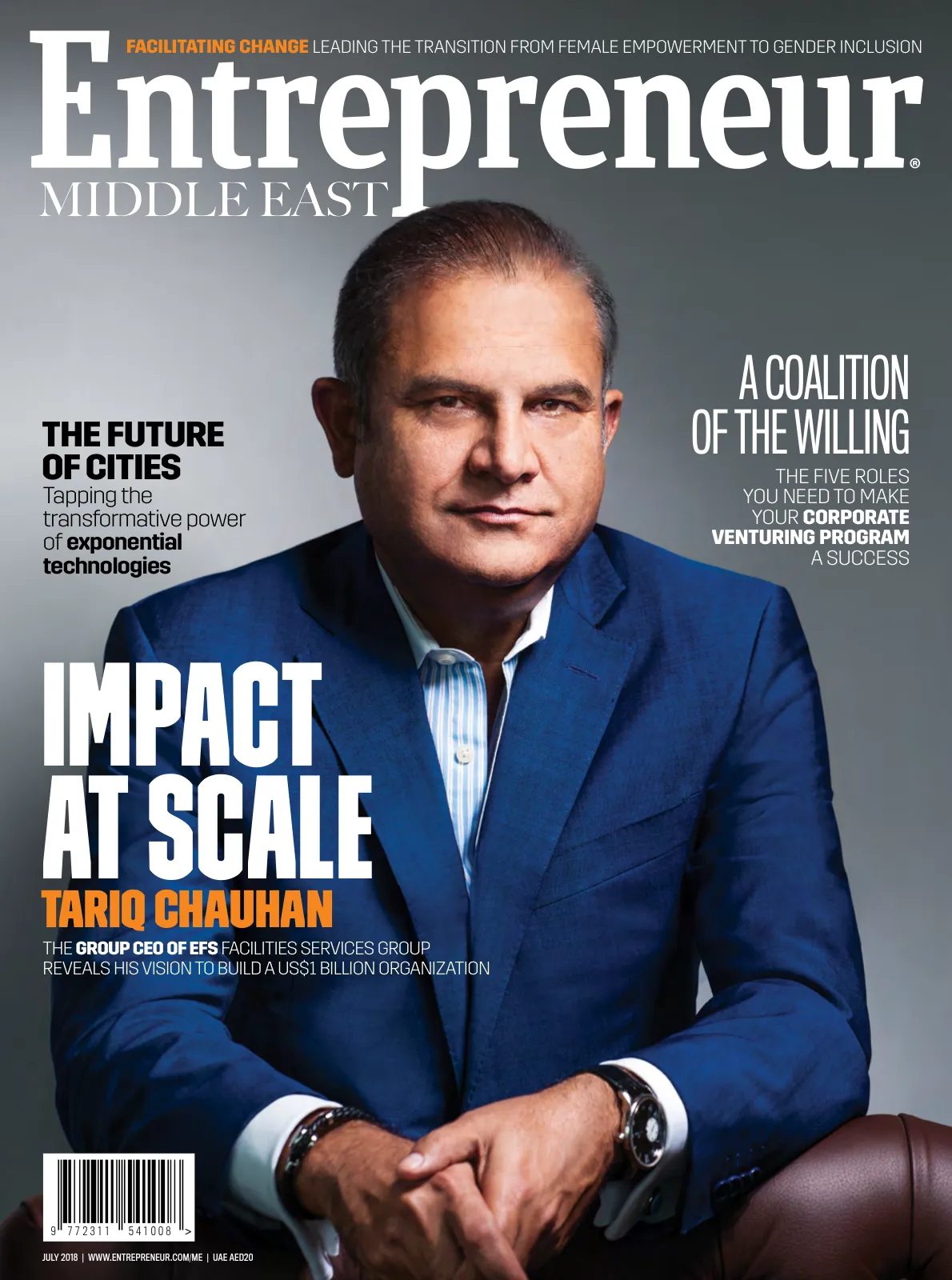
Entrepreneur Middle East, July 2018
Page 1
JULY 2018 | WWW.ENTREPRENEUR.COM/ME | UAE AED20
9
7 7 2 3 1 1
5 4 1 0 0 8
>
A COALITION
OF THE WILLING
THE FUTURE
OF CITIES
Tapping the
transformative power
of exponential
technologies
THE FIVE ROLES
YOU NEED TO MAKE
YOUR CORPORATE
VENTURING PROGRAM
A SUCCESS
FACILITATING CHANGE LEADING THE TRANSITION FROM FEMALE EMPOWERMENT TO GENDER INCLUSION
THE GROUP CEO OF EFS FACILITIES SERVICES GROUP
REVEALS HIS VISION TO BUILD A US$1 BILLION ORGANIZATION
TARIQ CHAUHAN
IMPACT
AT SCALE
Page 2
Wake up to
Following outstanding sales in phases 1, 2 & 3,
ARADA presents Nasma Residences Phase 4.
Located in the lush surroundings of
a record-breaking community.
from AED 899,000
*
BAREEM TOWNHOUSES
800-ARADA (27232)
arada.com
• No service fee for life
• Pay 60% on completion
• Up to 10% ROI
Visit our Sales Office
Badriyah Ballroom,
Radisson Blu Resort, Sharjah
10am – 7pm
*T&C apply
No residency visa required to buy property
Open to all nationalities
Page 3
3
July 2018 / ENTREPRENEUR.COM /
68 Kuwait Vision 2035
22
Tariq Chauhan,
Group CEO,
EFS Facilities
Services Group
JULY 2018 CONTENTS
22
INNOVATOR:
IMPACT AT SCALE
Tariq Chauhan, Group CEO,
EFS Facilities Services
Group, reveals his vision
to build a US$1 billion
organization.
28
INNOVATOR:
DESIGNS ON THE FUTURE
Dubai’s Area 2071 is all
set to deliver on the vision
of making the UAE the
leading nation in the world
by 2071.
32
INNOVATOR:
THE FUTURE OF CITIES
Singularity University
co-founder and Executive
Chairman Dr. Peter H.
Diamandis on how the
world should tap the
transformative power of
exponential technologies.
36
‘TREPONOMICS:
PRO
Bring in the new blood
Bayt.com’s VP of Employer
Solutions Suhail Al Masri
gives you the lowdown
on hiring fresh graduates
at your enterprise this
summer.
62
‘TREPONOMICS:
PRO
Building tomorrow’s
workforce
Jugal Paryani, VP of
Marketing, Oliv, explains
why we need to think
about talent the way we
think about sales.
80
START IT UP:
Q&A
Safety is productivity
Dubai-based tech startup
WakeCap aims to disrupt
the construction industry
by focusing on the
wellbeing of the workers
actually on a project site.
Page 4
Page 5
Page 6
Take your business to
new heights.
Business Complete
Give your business all the tools it needs to reach its
maximum potential with our Business Complete Plan.
• High-speed internet
• Business devices
• Free Wi-Fi router
• Free national and international minutes
For more information, call 800 188 or visit
du.ae/businesscomplete
Page 7
Page 8
Page 9
Page 10
Page 11
Page 12
12 / ENTREPRENEUR.COM / July 2018
80 WakeCap team
JULY 2018
CONTENTS
32
68
START IT UP:
ECOSYSTEM
Shaping the future
Jared Willis, General
Manager, Berkeley Research
Group, offers three
recommendations to help
spur entrepreneurship in
Kuwait.
54
FRANCHISE
Executing an experience
Sloan’s Ice Cream
founder and owner Sloan
Kamenstein, writes about
maintaining brand and
product quality on a global
scale, while franchising
your business.
The future of cities
58
MONEY:
ASK THE MONEY GUY
A coalition of the willing
Duval Union Consulting
co-founder and CEO
Dado Van Peteghem and
Omar Mohout, Professor
of Entrepreneurship at
Antwerp Management
School, list the five roles
you need to make your
corporate venturing
program a success.
84
‘TREPONOMICS:
PRO
Moving with the times
Eelco van Keimpema, Head
of Commercial Insurance -
Middle East & Africa, AIG,
says collaboration is key,
as old and new business
models collide.
41 LG Q Stylus
40
TECH:
SHINY
#TamTalksTech
Gadgets and doodads
that you might’ve missed
out on, sourced by a tech
aficionado. Yes, it’s okay to
want them all… and no, it’s
not our fault.
Page 13
Page 14
14 / ENTREPRENEUR.COM / July 2018
28 Area 2071
74
JULY 2018
CONTENTS
46
CULTURE:
LIFE
Bullies at work
Stamping out abuse at
the workplace can be an
uphill battle for everyone
involved, says Manfred Kets
de Vries, Clinical Professor
of Leadership Development
& Organisational Change at
INSEAD.
74
START IT UP:
STARTUP FINANCE
We got funded!
Bahrain-born food tech
enterprise Eat, UAE-
based insurtech platform
Aqeed.com, and Egypt’s
online couture rental
startup La Reina reveal the
details behind their latest
fundraising wins.
42
CULTURE:
TRAPPINGS
‘Trep gear
The executive selection for
the entrepreneuron your
list that has everything.
Okay, maybe for a little self-
reward as well.
52
TECH:
THE FIX
Disrupting the status quo
Vuclip President and COO
Arun Prakash believes that
the OTT market is changing
the way content is created,
desired, discovered, and
consumed.
78
START IT UP:
Q&A
Off the beaten path
Dawaami founder and CEO
Kamal Al-Samarrai is all
set to wage war against
industry incumbents with
his new online platform
that aims to disrupt the
recruitment sector.
48
CULTURE:
LIFE
Facilitating change
Servcorp General Manager,
Laudy Lahdo, on leading
the transition from female
empowerment to gender
inclusion.
44
CULTURE:
TRAPPINGS
Visible spectrum
Mr. Draper offers a
gentleman’s guide to color
matching.
66
MONEY:
YOUR MONEY
Cut your losses
Five easy ways startups can
manage debts from day one,
by Virtuzone’s Director
of Domestic Structuring,
Paul Bryson.
70
TECH:
ONLINE ‘TREP
Changing the game
Founder Akanksha Goel on
the evolution and growth
of her digital media agency
Socialize.
64
‘TREPONOMICS:
PRO
From operator to service
provider
Hany Fahmy Aly, Executive
Vice President - Enterprise
Business, du, on the role
of telcos in achieving
tomorrow’s digital future.
50
‘TREPONOMICS:
SKILLSET
Back to work
Louise Karim, Managing
Director, Mums@Work,
lists six tips for the region’s
mothers to get back on
track after a career break.
Eat team
Page 15
C O M E TO T H E B L U ,
S TAY F O R T H E V I E W
TAKE IN THE SPECTACULAR VISTAS OF THE DUBAI SKYLINE, THE DUBAI CANAL AND BURJ KHALIFA
FROM THE NEW RADISSON BLU HOTEL, DUBAI WATERFRONT. THE PERFECT PLACE TO CAPTURE THAT ULTIMATE
PICTURE MOMENT, WHETHER THAT’S FROM THE HOTEL’S PRIVATE ROOM BALCONIES, MEETING ROOMS,
SPA OR RESTAURANT TERRACES. THE HOTEL IS IN THE HEART OF THE ACTION AND WALKING DISTANCE
TO THE BEST SHOPPING AND ENTERTAINMENT IN DUBAI.
NOW OPEN IN BUSINESS BAY
Radisson Blu Hotel, Dubai Waterfront, Business Bay, PO box 16021, Dubai
T: +971 4 249 7800 info.waterfront.dubai@radissonblu.com radissonblu.com/hotel-dubaiwaterfront
Page 16
16 / ENTREPRENEUR.COM / July 2018
SUBSCRIBE
Contact subscriptions@bncpublishing.net to receive
Entrepreneur Middle East every issue
EDITOR IN CHIEF Aby Sam Thomas editor@bncpublishing.net
CEO Wissam Younane wissam@bncpublishing.net
DIRECTOR Rabih Najm rabih@bncpublishing.net
CREATIVE LEAD Odette Kahwagi
MANAGING EDITOR Tamara Pupic
STARTUPS SECTION EDITOR Pamella de Leon
FEATURES EDITOR Sindhu Hariharan
GROUP SALES DIRECTOR – B2B GROUP Joaquim D’Costa
COLUMNIST Tamara Clarke
EVENTS LIAISON Mark Anthony Monzon
PO Box 502511 Dubai, United Arab Emirates
P +971 4 4200 506 | F +971 4 4200 196
For all commercial enquiries related to Entrepreneur Middle East
contact sales@bncpublishing.net
All rights reserved 2018.
Opinions expressed are solely those of the contributors.
Entrepreneur Middle East and all subsidiary publications in the
MENA region are officially licensed exclusively to BNC Publishing
in the MENA region by Entrepreneur Media Inc.
No part of this magazine may be reproduced or transmitted in any
form or by any means without written permission of the publisher.
Printed by United Printing and Publishing
www.upp.ae
Images used in Entrepreneur Middle East are credited when necessary. Attributed use of
copyrighted images with permission. All images not credited otherwise Shutterstock.
Suhail Al Masri
Joby Beretta
Paul Bryson
Fida Chaaban
Mr. Draper
Hany Fahmy Aly
Sarah Jones
Sloan Kamenstein
Louise Karim
Manfred Kets de Vries
Laudy Lahdo
Omar Mohout
Jugal Paryani
Arun Prakash
Eelco van Keimpema
Dado Van Peteghem
Jared Willis
CONTRIBUTING WRITERS
www.entrepreneur.com/me
ACCESS FRESH CONTENT DAILY ON OUR WEBSITE!
MIDDLE EAST
EntMagazineME
@EntMagazineME
Entrepreneur-me
EntrepreneurMiddleEast
EntMagazineME
EntMagazineME
EntMagazineME
MIDDLE EAST
In addition to our print edition, we’re bringing
you all sorts of industry news on our web
mediums. Joining us online means getting
relevant business and startup content in
real-time, so you’re hearing about the latest
developments as soon as we do. We’re looking
forward to interacting with our readers on all of
our social media and web platforms- like any
thriving business, we’re looking to give and take.
#TrepTalkME is already happening on all of our
digi platforms, and all good conversations go
both ways. See you on the web!
Page 17
REDEFINING
YOUR FREEZONE
EXPERIENCE
• Easy access via key highways with no access gates
• Easy & efficient business set up
• Smart office solutions from shared facilities to permanent offices
• Variety of business licenses
• Turnkey business solutions and services
• On site licensing & visa authority
800-SOUTH (76884)
businesscenter@dubaisouth.ae
DUBAISOUTH.AE
Page 18
18 / ENTREPRENEUR.COM / July 2018
F
or those of you who go
through every line in a
business contract, the
force majeure clause that’s
often included as stan-
dard in such documents
shouldn’t be hard to miss:
it is the provision that exempts the
contracting parties from fulfilling
their respective obligations due to
circumstances that are beyond their
reasonable control- these can range
from unexpected natural disasters
to unanticipated governmental
directives that cripple or destroy the
business activity that was agreed
upon. Now, there are, of course,
actual events in the world that fit
the literal meaning of force majeure
(which is Latin for “a superior
force”) and occur –thankfully- not
on a regular basis.
But if one were to consider only
the devastating effects these kinds
of unforeseen events have on people
and businesses, then I’m going to
wager that it wouldn’t be so hard
to find parallels of that happening
around us on a day-to-day basis. For
instance, there are those who get
suddenly laid off from jobs they’ve
had (and, by all accounts, performed
well in) for quite a while. Regardless
of the reasons for their dismissal,
it’s always disconcerting to see
how such people’s lives are thrown
into complete disarray owing to
reasons that they often simply don’t
understand or comprehend. In the
world of entrepreneurship, similar
scenarios can be seen to arise rather
regularly. It could be the last-minute
loss of a deal on which a startup was
pinning all of its hopes on owing
to someone else’s stronger clout
(wasta, as the Arab world would call
it), or the crumbling of a what was
once a perfect relationship between
co-founders at an enterprise.
In the past month, I’ve been
personally witness to quite a few of
these kind of unexpected situations:
there was a friend who got abruptly
fired from an enterprise he had been
working for about a decade, the
break-up of a couple that literally no
one in their social circle saw com-
ing, and an entrepreneurial venture,
which was once a business to watch
out for, now suddenly finding itself
in the doldrums, thanks to a slew of
bad decisions. It is, of course, dis-
tressing to see such things happen
to people you actually know- but
the way some of them react to such
curveballs can be rather instructive
and inspirational as well. When
faced with such situations, one
should be allowed (heck, encouraged
even) to buckle down and grieve for
what has been lost, but wallowing in
self-pity shouldn’t be the only order
of the day, there also has to be a
game plan to get back up after a fall.
As debilitating as such occur-
rences may seem, it is in getting past
them that will define us- not these
failures themselves. Indeed, we at
Entrepreneur Middle East have often
seen that the toughest hurdles that
happen along an entrepreneur’s
lifecycle are what contribute to their
greatest strengths and successes in
the long-term. And that’s something
all of us should take to heart when
faced with our own versions of force
majeure events: these don’t have to
be the end- perhaps it’s just time for
a new beginning.
Aby Sam Thomas
Editor in Chief
@thisisaby
aby@bncpublishing.net
When disaster strikes (hard)
Perception is everything
EDITOR’S NOTE
Page 19
Page 20
20 / ENTREPRENEUR.COM / July 2018
IMAGE CREDIT CHALHOUB GROUP, MOHAMED ALABBAR
M
ENA entrepre-
neurs, if you are
working on a
solution that has
the potential to
shake up the retail sector,
this new challenge is sure to
help you. Chalhoub Group, a
Middle East luxury retailer,
is looking for tech startups
with ready to deploy prod-
ucts addressing a set of retail
challenges through their new
Greenhouse Accelerator.
Referring to their initiative
as “not a typical startup
accelerator,” Chalhoub
Group notes on the official
website that the “equity-free
program will accelerate the
implementation of the right
solutions” at the heart of its
own company. Essentially,
the ideas emerging out of
the program stand a chance
to carry out pilots and case
studies with brands from
Chalhoub Group, and get an
opportunity to deploy their
solutions at the MENA retail
major.
In the process, the entre-
preneurs/teams will also
get to work closely with
and gain mentorship from
retail and digital experts.
Chalhoub Group’s Head of
Customer Experience and
Marketing, Grégoire Charpe-
Civatte, Chief Transforma-
tion Officer, Rania Masri,
and Head of Greenhouse
Accelerator/Innovation Lab,
Dina Sidani, are a few of the
mentors who are set to be
involved in the process. “As
a leading retailer of luxury
in the Middle East, we’ve
decided to transform,” said
Patrick Chalhoub, Co-CEO,
Chalhoub Group, announcing
the initiative on the website.
“Our north star vision is
to become a hybrid retailer
delivering luxury experi-
ences to the fingertips of our
customers everywhere. This
is a unique opportunity for
tech companies and startups
from all over the world to
implement and test their
solution with the largest
fashion group in the Middle
East.”
“We are looking to collabo-
rate with you with the goal
of being your customer or
licensing your technology,”
he adds. “We may also invest
in you at later stages,” reads
the information on the equi-
ty-free program, taking place
from September to Decem-
ber 2018 in Dubai, UAE, and
accompanied with a grant of
US$20,000, and access to
a co-working space. Some
of the retail challenges that
the accelerator is looking to
tackle relates to creating a
personalized in-store experi-
ence, optimizing operations,
omni-channel retail, and
human capital allocation in
the sector. Applications for
Chalhoub Group’s Green-
house Retail Accelerator are
open until July 10.
www.chalhoubgreenhouse.com
IN THE LOOP
Middle East luxury retailer Chalhoub Group
invites tech entrepreneurs and startups
for its new retail accelerator
Inviting innovation
”Our partnership with eBay opens a whole new
world of shopping experience,” says founder
Mohamed Alabbar
NOON ANNOUNCES
PARTNERSHIP WITH EBAY
The Mohamed Alabbar-
founded e-commerce platform
noon has inked a partnership
with the California-based
multinational eBay, which will
see the former’s customers
in the Middle East be able to
buy products from the latter’s
global marketplace.
“noon is connecting the
region with the global
e-commerce market through
our partnership with eBay,”
said Alabbar, in a statement.
“With this, we are offering our
customers access to products
that are not otherwise readily
available in the region. As
a brand from the region,
we listen to our customers
and tailor the online retail
experience to suit their
needs.”
The partnership will see
noon fulfil all eBay orders
made on noon, and deliver
it directly to the customers’
doorstep. According to a
release, noon and eBay
will also “explore joint
opportunities in marketing,
know-how and best practices
sharing to leverage the strong
growth of online shopping in
the region.”
“Our partnership with eBay
opens a whole new world
of shopping experience,”
Alabbar added. “E-commerce
continuously evolves, and this
partnership guarantees noon
stays on top of the trends and
consumer preferences.”
noon’s partnership with
eBay follows fellow regional
e-commerce venture
Souq’s announcement in
December 2017, which saw
the enterprise, thanks to
its acquisition by Amazon
earlier that same year, offer
its customers in the region
the opportunity to shop over
million products on Amazon.
Patrick Chalhoub,
Co-CEO,
Chalhoub Group
Mohamed Alabbar
Page 21
#BeatTheHeat
THIS SUMMER.
CAMBODIA CHINA INDONESIA MALDIVES MOZAMBIQUE PORTUGAL OMAN QATAR
SRI LANKA THAILAND UNITED ARAB EMIRATES VIETNAM ZAMBIA
LIFE IS A JOURNEY. Visit anantara.com
Al Jabal Al Akhdar 27°C
Muscat / Dubai 43°C
Cool off at the highest five star resort in the Middle East.
Only a short 4 ½ hours drive from Dubai or Abu Dhabi and 2 hours from
the new Muscat International Airport, enjoy a journey past date plantations
and dramatic Omani mountain ranges to reach our majestic hideaway.
Choose your ideal haven – a spacious room with a captivating canyon view,
a private pool villa with garden or cliff views. An abundance of
Spa and Recreation activities from hiking to sunrise yoga.
GCC RESIDENTS PACKAGE*
Up to 15% off Best Flexible Rate for a room or villa
Daily buffet breakfast for two persons
Daily dinner for two persons
10% off Anantara Spa
10% off food & beverage in all outlets
Book at anantara.com and get resort credit of up to OMR 20.
*terms and conditions apply.
Page 22
22 / ENTREPRENEUR.COM / July 2018
INNOVATOR
THE GROUP CEO OF EFS FACILITIES SERVICES GROUP
REVEALS HIS VISION TO BUILD A US$1 BILLION ORGANIZATION
by TAMARA PUPIC
I
n 2009, Tariq Chauhan, the newly-appointed CEO of EFS Facilities
Services Group (EFS) at the time, was thinking big, despite personally
recovering from a few scars of the 2008 global financial crisis.
EFS was well-positioned in the integrated facilities management
services sector, but Chauhan was about to unleash a series of
shrewd moves. “I felt that to have the critical mass and to be large
was no more an option, but a necessity,” he says. “There was no
room for me to remain in the small to medium space -to be a US$100 million
company- we had to have the critical mass, because of the challenges
that the business was facing.” At the time (2010), EFS had 2,000 people on
the books, enjoyed 76% of contract retention, and 21% revenue growth.
However, Chauhan’s vision was only beginning to take shape.
IMPACT
AT SCALE
>>>
TARIQ CHAUHAN
Today, EFS is a regional
leader in delivering integrated
facilities management ser-
vices with its network of 26
operating companies in 21
countries across the Middle
East, Africa, South Asia, and
Turkey. With 97% client
retention rate, it enjoyed an
AED3.5 billion contract back-
log, 26% revenue growth,
and 7% profit increase in
the last year alone. Interest-
ingly, that is the same year
which the company’s media
pack describes as a period
of challenges and introspec-
tion, since EFS experienced a
18.76% drop in gross margins
driven by difficult market
conditions, economic slow-
down, and emerging competi-
tion. Two interesting points
are to be noted here: firstly,
Chauhan does not shy away
from stating the unpleasant
facts, and secondly, the mar-
ket difficulties haven’t dra-
matically affected his plans,
as EFS has already achieved
the status of a large company.
However, being a large busi-
ness is no longer enough for
Chauhan. “We have defi-
nitely established ourselves
amongst the large, but this
large is still far from where I
want to be,” he says. “To be
successful and sustainable in
the long-run, we need a quan-
tum leap in our approach, and
that is exactly what we have
done this year. Besides some
obstacles, we have enjoyed a
90% growth this year. We’ve
been growing by 25%, and
by any global standard, that
is considered extraordinary.
There has been a lot of work
in progress to develop our
capabilities to take on mega
projects, and that is what has
led us to this 90% growth.
Three core mega projects have
come our way. In the past,
we did have some misses, but
eventually everything hap-
pens for a reason.”
Page 23
INNOVATOR
23
July 2018 / ENTREPRENEUR.COM /
Page 24
24 / ENTREPRENEUR.COM / July 2018
INNOVATOR
“THERE IS A LOT OF INDIVIDUALISM
THAT COMES IN WHEN ORGANIZATIONS
ARE UNDERGOING TRANSFORMATION.”
WWW.EFSME.COM
“I REALIZED THAT
I NEEDED TO BE A PART
OF A LARGER BUSINESS,
WHICH IS IN A SUNRISE
INDUSTRY, SO
I DECIDED TO LEVERAGE
MY EXPERIENCE AND
JOIN EFS.”
The reason for the current
dissatisfaction is in the
details of Chauhan’s grand
plan which is only now being
fully revealed- it includes
spurring social change by
empowering individuals to
pursue their own potential.
To achieve that, his eyes are
set on building a $1 billion
organization. “I seek social-
ism in capitalism,” he says.
“As a $1 billion organization,
my business would employ
about 100,000 people. These
people and their families
would enable me to make an
impact on a larger percentage
of the population. If you can
create your good in others’
good, how better can it be?”
His belief is strongly rooted
in the company’s unique
ability to influence the blue-
collar worker segment, which
forms the majority of EFS’
15,000-strong workforce. “I
believe that CSR is embed-
ded in this role, because of
the structure of the business
itself- there is a large section
of people who are at the
lowest part of the self-actu-
alization curve,” Chauhan
explains. “So, with the suc-
cess of this organization, we
are doing better for everyone,
and mostly for this section
of people. When I talk to an
average cleaner, there are two
things in life that he wants
to have- to make sure to send
money to his family, and
to own a house of his own.
Furthermore, 90% of people
who earn AED500 per month
have dreams to finance their
sister’s marriage ceremony,
to have their own house, and
then to get married. When
employing people, how often
do managers discuss these
things? But here, we try to
do that.”
In 2012, EFS adopted
“People, Passion, Precision”
as its mantra, not just as
a marketing slogan, but
as a fundamental part of
its internal purpose. Hav-
ing aligned his employees
towards achieving one goal,
Chauhan then focused on
building organizational
systems and structures. “You
can pick and choose the right
people but for them to flour-
ish you need to create the
right ecosystem,” he adds.
“Every organization must
have the right structure.
Then, you need to focus on
building systems, technology
and processes in order to
achieve success. These are
fundamental basics. Global
knowledge, regional pres-
ence, and local experience
have become pillars of our
organization. Then I again
ask people where they can
find themselves in this.” In
helping others, Chauhan is
firm to point out those who
have helped him along the
way too- from a chance en-
counter with the Chairman
of EFS in a hotel bar in Dubai
nearly a decade ago, when he
got the offer to take on the
challenge of transforming the
company, to his sharehold-
ers, clients, and employees
today. “Your choices in life
come from your personal
conviction, which does not
only come through your own
stubbornness, but through
others believing in you and
letting you succeed and col-
laborating with you,” he says.
“That eventually leads to the
formation of your conviction.
Success is not an individual
Page 25
25
July 2018 / ENTREPRENEUR.COM /
Tariq Chauhan,
Group CEO, EFS
“YOU NEED MULTIPLE
ENDORSEMENTS TO
BE SUCCESSFUL,
AND IT DOES NOT
NECESSARILY MEAN
MONEY. IT INCLUDES
THE IMPACT YOU
CREATE, AND THE
OTHERS BUYING INTO
IT, WHICH EVENTUALLY
EVOLVES INTO A
PYRAMID.”
EFS at the IFMA event, April 2018
>>>
story, but a mix of many col-
laborative approaches com-
ing from different people-
your colleagues, your clients,
your shareholders, and so
on. You need multiple en-
dorsements to be successful,
and it does not necessarily
mean money. It includes the
impact you create, and the
others buying into it, which
eventually evolves into a
pyramid. CEOs are the agents
of the company’s success,
and they cannot put them-
selves ahead of the company.
It is the institution that
matters. Many have done
that, trying to create their
personal brand, without
realizing that their personal
brand’s sustainability lies in
the overall sustainability of
the company’s brand. CEOs
lead companies, but in this
pursuit, they must not lose
the balance. The horse must
not become the brand. I am
being careful, because there
is a lot of individualism that
comes in when organizations
are undergoing transforma-
tion.”
Today, EFS’ goal is to con-
tinue integrating automation,
technology, and processes in
order to create an integrated
management system- the last
part of Chauhan’s machine
for making a quantum leap.
This was preceded by the
phase of stabilizing the busi-
ness (2010-2012), and then
transforming it (2012-2016).
“In the transformation stage,
we started expand our ser-
vice lines and our geographi-
cal presence, changing our
client mix, and many other
things, which have taken
the organization to the next
level,” he says. “In achieving
this, we have carefully cho-
sen clients who haven’t kept
us in the cycle of payments,
which is usual in this part
of the world, but it has been
maximum 60 days. That has
helped us to keep reinvesting
in our business. Also, our
shareholders have been very
strategic in their approach.
They weren’t looking for any
cash dividends or cash pay-
outs, but they wanted us to
reinvest in the business. In
addition, we’ve built strong
relationships with the banks
to support our usual working
capital requirements. Busi-
ness without the alignment
of bottom line and cash flows
can never be a sustainable
business. One of my prin-
ciples has always been that
three alignments are impor-
tant. Firstly, zero tolerance
for top line growth without
cash flow sustainability. Sec-
ondly, a consistent year-on-
year growth. Consistency is
critical to any sustainability.
Lastly, it’s about alignments
of all stakeholders- employ-
ees, clients, suppliers, and
shareholders. They all have
to have a common vision. It
is important for a CEO to be
trusted by employees and
respected by clients.”
However, over the last two
years, the growth pace hasn’t
been as strong as expected.
“The facilities management
is not a capital intensive
business; however, it does
require investments in the
times of austerity when you
are playing on low margins,
meaning in times when you
don’t have enough profit
generated internally to sup-
port developmental projects,”
Chauhan says. “This business
is now going through a rapid
paradigm shift, from a con-
ventional to a digital model,
and, for me, digital is again
about a mindset change. I
am not overwhelmed by this,
although the price of our
success is the extraordinary
pressure that the core team
has had to take on, and the
pressure on me to keep those
members engaged. But, if I
was not personally convinced
and able to take the risk, I
wouldn’t have reached this
stage.”
Therefore, the company
is still on its growth trajec-
tory, and Chauhan exhibits
nothing but patience and
conviction. This wisdom, as
in many other cases, comes
from experience. Chauhan’s
career started in banking in
1987 in Oman, and saw him
working for three different
banks and operating in 11 dif-
ferent countries. He moved
to the UAE in 1995 to start
managing a high-network in-
vestment portfolio for Elfina
Banking & Financial Invest-
ments Co., which would
eventually become his own
company. With the wisdom
of hindsight, he describes it
as a challenging period, but
it did not prevent him from
making further entrepre-
neurial attempts. Later, he
started up other businesses,
including KOL Corporation,
an IT company providing
e-business integration,
supply chain and real estate
solutions. “Unfortunately,
the 2007/2008 [period]
shook me completely, and I
was near financial collapse,”
he says.
Page 26
26 / ENTREPRENEUR.COM / July 2018
INNOVATOR
Tariq Chauhan,
Group CEO, EFS
“IF I WAS NOT
PERSONALLY
CONVINCED AND
ABLE TO TAKE
THE RISK,
I WOULDN’T HAVE
REACHED THIS
STAGE.”
“WE HAVE ENJOYED A 90% GROWTH THIS
YEAR. WE’VE BEEN GROWING BY 25%,
AND BY ANY GLOBAL STANDARD, THAT IS
CONSIDERED EXTRAORDINARY.”
“Then I decided that I had
to focus on capital, and if
I had to do that, I needed
partners. I needed to work
with people, not by myself.
So, having gone through
those previous experiences,
and having realized that
the capital requirement
was critical for building a
sustainable business, I knew
that chasing $1 billion on
my own was not feasible
against the backdrop of one
of the biggest recessions in
the past 75 years. I realized
that I needed to be a part
of a larger business, which
is in a sunrise industry, so I
decided to leverage my expe-
rience and join EFS.”
In less than a decade
Chauhan has grown the com-
pany’s portfolio to include
more than 300 governmen-
tal and international orga-
nizations, delivering over
75 service lines across 15
business verticals. In doing
so, however, the emphasis
was on building solid foun-
dations and defenses from
any future market downturn.
“We diversified our opera-
tions,” he says. “More than
10% of our businesses must
not be in one single country.
No single contract should be
larger than 10% of our busi-
ness. We have also brought
diversity in terms of ethnici-
ty of employees as well. That
helped us to be sustainable
long-term and against mar-
ket dynamics. I’m not grow-
ing in all countries; in some,
I’m trying to consolidate, for
example. You should keep
your company above mar-
kets. Preparing the core of
your organization for tough
times, being able to take
shocks, to mitigate risks, and
to preserve a certain level
of sustainability starts with
doing that to yourself first.
That is exactly what I did
from 2012 to 2016.”
Having witnessed and suc-
cessfully navigated two eco-
nomic slowdowns, Chauhan
ends our conversation by ad-
vising other entrepreneurs to
remain calm, focused,
and patient. “In 2008, we
weren’t prepared, and it
was a reminder for people
to wake up,” he concludes.
“So, when the recent reces-
sion came to be, fortunately,
we were well informed, we
had the past to remind us,
and that helped us prepare.
Recessions are a part of life,
and serve for companies to
build their own character,
the overall organizational
bloodstream. So, markets are
affected by it, but companies
should not be.”
Page 27
In Collaboration with
Page 28
28 / ENTREPRENEUR.COM / July 2018
Designs on
the future
AREA 2071
INNOVATOR
Dubai Future Foundation Deputy CEO Abdulaziz Al Jaziri
explains the vision for the path-breaking initiative launched
by Dubai and the UAE by ABY SAM THOMAS
A
s someone who has been involved with Area 2071 ever since it
was first announced in 2017, Dubai Future Foundation Deputy CEO
Abdulaziz Al Jaziri remembers a meeting with a global consulting
firm during the initiative’s early days, where he and his team
presented its aim to be an ecosystem to “design the future.” In
response, the consultants asked for a benchmark on which Area
2071 was being modeled on, and Al Jaziri and his team replied that,
well, there hadn’t been anything like this done ever before in the world.
Abdulaziz Al Jaziri, Deputy CEO,
Dubai Future Foundation
IMAGE CREDIT AREA 2071 | WWW.AREA2071.AE
Now, this little anecdote
should, I feel, serve well as
an indication of the pioneer-
ing nature of this particular
initiative being led by Dubai
and the UAE, and why, by
virtue of this factor alone, it
can be hard for many among
us to understand what Area
2071 is all about. With this
in mind, it perhaps makes
sense to go back to the ori-
gins of this initiative, which
Al Jaziri says were through
a speech delivered by H.H.
Sheikh Mohamed Bin Zayed
Al Nahyan, Abu Dhabi
Crown Prince, and Deputy
Supreme Commander of the
UAE Armed Forces, at the
conclusion of the Mohamed
bin Zayed Majlis for Future
Generations in early 2017.
At the event, which had
about 3,000 Emirati youth
in attendance, Sheikh Mo-
hamed noted how surveys
had revealed that 70% of
Arab youth wanted to come
and live in the UAE. “The
reason is that 47 or 50
years ago, Allah blessed us
with a wise leadership that
laid the sound foundation
and infrastructure for the
launch of nation-building
and development. Now, we
breathe fresh air, and live a
happy life. Yet, we have to
make further efforts, and
develop a long-term vision,
and plan in a sound way to
reach the set goals, and en-
able the coming generation
to live happily and safely
just like you do.” It was this
idea that provided the basis
for the UAE Centennial 2071
project, which H.H. Sheikh
Mohammad Bin Rashid Al
Maktoum, Vice President
and Prime Minister of the
UAE, and Ruler of Dubai,
launched in March 2017 as a
five-decade government plan
that aims to make the UAE,
by the time of the 100th
anniversary of its founding
in 1971, “the world’s leading
nation.”
This is, of course, a decep-
tively simple premise, but,
as an ambitious plan that’s
focused on setting up future
generations of the UAE with
continued success and pros-
perity, its visionary aspect
cannot be denied. But how
can this actually be realized?
“It’s not just about being the
best at things,” Al Jaziri re-
plies. “We truly believe that
you, being the leading nation
in the world, means that
you have the most outsized
contribution to humanity.”
And it is to realize this grand
dream that Area 2071 has
come into being- it is, as
its official website declares,
“a physical manifestation
of this vision, with the sole
purpose of creating positive
global impact.” In terms of
its actual location, Area 2071
is located at Emirates Tow-
ers in Dubai, with the first
Page 29
29
July 2018 / ENTREPRENEUR.COM /
“WHAT AREA 2071 IS
TRYING TO BUILD IS
AN ECOSYSTEM THAT
CHANGES WITH TIME,
BUT AN ECOSYSTEM
THAT’S FOCUSED ON
SOLVING UNIVERSAL
CHALLENGES.”
Area 2071
>>>
INNOVATOR
phase of the space having
been officially inaugurated
by Sheikh Mohammad in
May this year. But describing
what the space actually is re-
mains a fairly difficult task,
according to Al Jaziri. “It’s
not a startup ecosystem,” he
says. “It’s not an incubator.
It’s not an accelerator… It’s
not [just] a government play.
It’s much more than that.”
Indeed, having had this
conversation with Al Jaziri,
I have now come to the
conclusion that Area 2071 is
not just one of those things
he has listed- it’s better de-
scribed as a combination of
all those things, and much,
much more.
Area 2071 wants to bring
together the government, pri-
vate sector, youth, academia,
entrepreneurs, and startups
to work on how the world
should be in the future. This
community is thus tasked
with thinking up solutions
to some of the world’s most
pressing questions and chal-
lenges- and this will also
involve an innovative reimag-
ining of the various sectors
that will drive the future,
such as education, transport,
healthcare, etc. “What Area
2071 is trying to build is an
ecosystem that changes with
time, but an ecosystem that’s
focused on solving universal
challenges,” Al Jaziri says.
This, in turn, should explain
why Area 2071 has tied up
with both local and inter-
national partners to help
facilitate this redesign of the
world as we know it- this list
of allies includes the United
Nations, IBM, Proctor &
Gamble, SAP, Emirates, Ernst
& Young, Pfizer, Wamda
Capital, GEMS Education,
and other prominent enti-
ties. Its physical location
at Emirates Towers is also
especially significant- the
office tower today plays host
to everything from the Office
of the Prime Minister of the
UAE, to the Dubai Future Ac-
celerators, to the Youth Hub,
and much, much more. Now,
all of these different entities
at Area 2071 are here to rei-
magine either themselves or
their respective industries-
but that doesn’t mean they
are going to be working in
isolation either.
Under the umbrella of Area
2071, the common location
at the Emirates Towers
Boulevard means that all of
the different players housed
there will now be walking
distance away from each
other, which will allow for
collisions between the enti-
ties to happen –sometimes
in a literal sense- that will
Page 30
30 / ENTREPRENEUR.COM / July 2018
INNOVATOR
“IF YOU ABIDE BY THE
PRINCIPLES OF THIS
SPACE, OF YOU BEING
OPEN TO CHANGE,
OF YOU BEING OPEN TO
WORKING WITH THIS
ECOSYSTEM, THEN,
SURE, THERE’S A SPACE
FOR YOU.”
Area 2071
Area 2071
IMAGE CREDIT AREA 2071 | WWW.AREA2071.AE
Page 31
31
July 2018 / ENTREPRENEUR.COM /
AREA 2071 WANTS
TO BRING TOGETHER
THE GOVERNMENT,
PRIVATE SECTOR,
YOUTH, ACADEMIA,
ENTREPRENEURS, AND
STARTUPS TO WORK
ON HOW THE WORLD
SHOULD BE IN THE
FUTURE.
Area 2071
INNOVATOR
enable the collaborative
aspect envisioned for this
space. “So, if a startup [at
Area 2071] needs to work
with a government entity,
or if it needs to work with
a private sector entity, they
can just walk towards them,”
Al Jaziri notes. “What I real-
ly love about this -and I hear
it from our partners; I don’t
hear it from my team- is
[hearing] that GEMS going
to SAP, or Pfizer, or Ernst &
Young, and saying how can
we work collaboratively.” In-
deed, Area 2071 encourages
all of the entities it has on-
board to interact with each
other, learn from each other,
and, indeed, work with each
other. The openness of the
space is rather forthcoming,
and while one may assume it
to be a detractor in terms of
interest, the fact that Area
207 is getting pretty crowd-
ed should serve as an indica-
tion of its attractiveness as a
concept. “After we launched
Area 2071, we haven’t done
any business development,”
Al Jaziri says. “All of these
partners have been flooding
in, coming to us, to talk to
us, and seeing how they can
work with us. And we always
say, if you abide by the prin-
ciples of this space, of you
being open to change, of you
being open to working with
this ecosystem, then, sure,
there’s a space for you. If
you just want to close doors,
and work by yourself, this is
not the space for you. If you
are open to working with
everyone in this ecosystem,
then this is home.”
At this point, I’m going to
wager that for most of us,
the fact that Area 2071 is
focused on a future that is,
to put it quite simply, so
far ahead in time, can be a
reason for not being able
to comprehend it. Al Jaziri
agrees with this notion, but
he also notes that it is the
far-reaching aspect of Area
2071 that makes it such a
landmark initiative. The
north star, Al Jaziri explains,
is the UAE’s vision to be the
leading nation of the world
by 2071- and Area 2071 is
simply bringing together the
people and the companies
needed to realize this future.
“They’re not looking at how
much is this going to cost
us, how much is it going to
bring us, what’s the return
on investment,” AL Jaziri
says. “I think everyone here
believes in that vision of His
Highness that you need to
come together to redesign
the future, and the fruits of
your labor are going to come
to life then.” And while
communicating what Area
2071 is may seem like a chal-
lenge now, Al Jaziri is firm in
his belief that when we see
actual results and outcomes
come out of this space a few
months down the line, its
significance will be better
ascertained then. After all,
the efforts in the reimagina-
tion of existing entities and
sectors have already begun,
and so have the creative
collaborations that Al Jaziri
and his team hoped for. “I
think at the beginning, we
were anxious about the
space, how would people
understand and perceive it,
and the support we’re going
to get,” Al Jaziri remembers.
“But we got all that and
beyond; things that have
been happening have been
enormously successful. And
just saying we’re running
out of space -I mean, we can
actually pick and choose
our partners, depending on
what our needs are- means
success for us. Now, we’re
at a stage where we actually
know the vision- I think,
[earlier,] it was a bit more
of walking through a foggy
space of how this is going
to come to life. Now, every-
thing’s clear; our mandate is
clear- our vision is clear for
the future.”
Page 32
THE FUTURE
OF CITIES
TAPPING THE TRANSFORMATIVE POWER
OF EXPONENTIAL TECHNOLOGIES
by DR. PETER H. DIAMANDIS
32 / ENTREPRENEUR.COM / July 2018
INNOVATOR
Page 33
33
July 2018 / ENTREPRENEUR.COM /
>>>
THE UN ESTIMATES
THAT CONTINUING
URBANIZATION
AND POPULATION
GROWTH WILL ADD
2.5 BILLION PEOPLE TO
THE WORLD’S URBAN
POPULATION BY 2050.
INNOVATOR
If you could build a city from
the ground up using first prin-
ciples, how would you do it?
What would it look like?
By 2050, two-thirds of the
population, more than six bil-
lion people, are expected to live
in urbanized areas.
Exponential technologies will
radically change the way we
build and organize our cities in
the future.
In this article, I will cover
mass urbanization trends,
building future cities, and ex-
ponential technology implica-
tions.
Considering the transforma-
tive power of exponential tech-
nologies, is it better to take
a top-down approach when
designing cities, or a bottom-
up approach?
Let’s dive in.
MASS URBANIZATION
Cities currently house over
50% of the world’s popula-
tion, and generate 80% of the
world’s GDP.
The UN estimates that
continuing urbanization
and population growth will
add 2.5 billion people to the
world’s urban population by
2050, with nearly 90% of the
increase concentrated in Asia
and Africa.
While the city population is
growing dramatically, the foot-
print of the city (the number
of square kilometers it covers)
will grow at a faster rate,
ultimately causing the city
densities (people per square
kilometer) to decline.
The expected increase in ur-
ban land during the first three
decades of the 21st century will
be greater than the cumulative
urban expansion in all of hu-
man history.
This poses a unique challenge
for sustainability endeavors, as
low-density cities tend to pro-
duce higher carbon emissions
than higher-density cities of
a similar population size. By
2050, the UN projects that
demand for water and energy
will increase by 55%. By 2035,
the demand for energy will
increase by 33%.
As people migrate to cities,
existing infrastructure will
need to be improved, or we will
face significant shortages.
Technology has the potential
to dramatically reduce the
downsides of urbanization.
With big data, ubiquitous
sensors, computer intelligence,
and transportation technology
(autonomous cars, flying cars,
Hyperloop, and so on), we can
imagine central systems that
are far more efficient and offer
far greater performance than
the ones around today.
BUILDING FUTURE CITIES
Four recent projects in this
area have caught my eye:
1. SIDEWALK LABS
Sidewalk Labs is Alphabet’s
urban development organiza-
tion that seeks to imagine
what cities would look like
if they were built “from the
internet up.”
In 2012, Sidewalk’s subsidiary
Intersection began converting
old payphones into free, tech-
nologically advanced access
points, complete with video
call capability and screaming-
fast Wi-Fi. Over the next sev-
eral years, 7,500 “links” will
be installed throughout New
York City.
In October 2017, Sidewalk
announced its plans to build
a tech-centered neighbor-
hood southeast of downtown
Toronto called Quayside.
Waterfront Toronto, Side-
walk’s partner in the project,
said that the city will be “a
testbed for emerging technolo-
gies, materials and processes
that will address these chal-
lenges and advance solutions
that can be replicated in cities
worldwide.”
2. BILL GATES & BELMONT
PARTNERS
Bill Gates recently announced
his commitment of US$80
million to build a “smart city”
just outside of Phoenix, Ari-
zona with the help of Belmont
Partners, a real estate investing
group.
In a press release, the com-
pany described the city as a
“forward-thinking community
with a communication and
infrastructure spine that em-
braces cutting-edge technology,
designed around high-speed
digital networks, data centers,
new manufacturing technolo-
gies and distribution models,
autonomous vehicles and
autonomous logistics hubs.”
Unlike Sidewalk’s project in
Toronto, this city would liter-
ally be built from the ground
up– currently, the 24,800-acre
site is a patch of empty land in
the desert.
Grady Gammage, a spokesper-
son for the Belmont Partners,
argues that this fact gives the
company a unique advantage:
“Envisioning future infrastruc-
ture from scratch is far easier
and more cost efficient than
retrofitting an existing urban
fabric.”
Eventually, the city (currently
called Belmont) will boast
80,000 homes, 3,800 acres
of industrial, office, and retail
space, and 470 acres for public
schools.
3. DUBAI’S “SMART DUBAI 2021”
PLAN
Over the next decade, Dubai
will look more and more like it
came from a sci-fi movie.The
city has laid out 2021 goals
that include:
> 3D-printing 25% of the city’s
buildings
> Making 25% of transpor-
tation trips automated and
driverless
> Installing hundreds of artifi-
cial trees that use solar power
to provide the city with free
Wi-Fi, screens with mapping
information, and ports for
charging phones
> Integrating passenger drones
that can carry individuals into
their public transportation
system
> Becoming one of the top 10
sustainable cities by 2020
> Becoming the happiest city
on Earth
With this top-down approach,
Dubai is setting a prime ex-
ample for other governments
around the world to follow. As
other nations see Dubai’s tour-
ism and efficiency exponential-
ly increase, I’m confident that
other cities will follow suit.
Page 34
34 / ENTREPRENEUR.COM / July 2018
Dr. Peter H. Diamandis is an international pioneer
in the fields of innovation, incentive competitions,
and commercial space. In 2014, he was named one
of “The World’s 50 Greatest Leaders” by Fortune
Magazine. In the field of innovation, Diamandis is
founder and Executive Chairman of the XPRIZE
Foundation, best known for its $10 million Ansari
XPRIZE for private spaceflight. Diamandis is also
the co-founder and Vice-Chairman of Human
Longevity Inc. (HLI), a genomics and cell therapy-
based diagnostic and therapeutic company focused
on extending the healthy human lifespan.
He is also the co-founder and Executive Chairman
of Singularity University, a graduate-level Silicon
Valley institution that studies exponentially growing
technologies, their ability to transform industries
and solve humanity’s grand challenges. In the field
of commercial space, Diamandis is co-founder/
Co-Chairman of Planetary Resources, a company
designing spacecraft to enable the detection and
prospecting of asteroid for precious materials. He
is also the co-founder of Space Adventures and
Zero-Gravity Corporation. Diamandis is The New
York Times bestselling author of Abundance – The
Future Is Better Than You Think and BOLD – How to
go Big, Create Wealth & Impact the World.
He earned an undergraduate degree in Molecular
Genetics and a graduate degree in Aerospace
Engineering from MIT, and received his M.D. from
Harvard Medical School. www.diamandis.com
SAUDI ARABIA IS ALSO
REDESIGNING THE IDEAL
FUTURE CITY WITH
NEOM, A $500 BILLION
INDEPENDENT ECONOMIC
ZONE CURRENTLY UNDER
CONSTRUCTION IN
A 26,500 SQ. KM. AREA
IN TABUK.
Saudi Arabia’s NEOM project
Dr. Peter H. Diamandis
INNOVATOR
And, as cities begin to intel-
ligently incorporate big data
into their infrastructure, they
will become more efficient,
sustainable and prosperous.
4. KINGDOM OF SAUDI ARABIA’S
NEOM PROJECT
Saudi Arabia is also redesign-
ing the ideal future city with
NEOM, a $500 billion inde-
pendent economic zone cur-
rently under construction in a
26,500 sq. km. area in Tabuk.
This tech utopia, part of the
Saudi Vision 2030 plan, will be
powered solely by sustainable
energy. Economic incentives
in nine sectors aim to reduce
regional dependence on oil,
while an open source approach
invites global data scientists
and entrepreneurs to catalyze
urban innovation.
Other goals in the NEOM
road map:
> Automate and democratize
access to government services
> Free highest-speed Internet
and free online continuous
education for residents
> Net-zero carbon footprint on
all buildings
> A transportation system built
in anticipation of future mo-
bility platforms, with a layout
equally suitable for pedestri-
ans, cyclists and commuters
Saudi Arabia is already
demonstrating how legacy
regulations and linear systems
must adapt to our exponential
future.
In November 2017, Saudi
Arabia granted the first citi-
zenship to Sophia, a humanoid
robot by Hanson Robotics. In
June 2018, many Saudi women
drove for the first time, as a
decades-old ban was lifted by
royal decree.
How will futuristic, open
source, utopian cities like
NEOM and Dubai interface
with linear, slow-moving gov-
ernments? How will the rise of
such global innovation hotbeds
rebalance economic activity
and investments?
IMPLICATIONS AND BIG
QUESTIONS
The implications of exponen-
tial technology on cities are
vast. In our lifetimes, we will
see exciting developments that
blur the lines between science
fiction and reality.
If I was starting a city from
scratch, here are the questions
I would ask and think about.
What about you?
> Would you begin with a Mas-
sively Transformative Purpose
(MTP) for the city?
> Would you incorporate a
city-wide Token/Coin and do
an ICO for city services?
> Would you make human-
driven cars illegal?
> Would all-autonomous cars
allow the elimination of all
parking lots, parking garages
and street parking?
> Do you need traffic lights?
> Would you make the city
and all transportation 100%
renewable electric, with maxi-
mum solar penetration?
> Would you put a Hyperloop
station at the center of the city
plan?
> How would you leverage AR
& VR for creating citizen ava-
tars that potentially disrupt
transportation even further?
> Would you require vertical
farming to generate 50% of
the food supply?
> Would you offer wireless
gigabit services for free within
the city footprint?
> How would you enable
movement of human capital to
encourage innovation?
> How would you deliver edu-
cation? (Wait for my next arti-
cle for my thoughts on this.)
We must ask all these ques-
tions as we adapt to large and
fast-growing city populations.
Some cities, like the ones I’ve
mentioned above, have a head
start on this with their proxy
MTP announcements. Will
they attract better talent, or
dominate future trade?
How will these implications
change the geopolitics in an
oil-based region like the Mid-
dle East?
To me, one thing is crystal
clear: the future of cities is an
exciting place for innovation
and disruption.
This is the first in a four-part
series by Peter H. Diamandis,
M.D., co-founder and Executive
Chairman at Singularity University,
on how exponential technologies
will create abundance and
opportunities for entrepreneurs
and governments alike.
Dr. Diamandis will be in Dubai on
Oct 29-30, 2018.
Contact team@a360dubai.com
with comments or feedback.
Page 35
Page 36
36 / ENTREPRENEUR.COM / July 2018
A
s you approach your hiring pipeline and you
sum up your needs for new talent to be added
to your workplace, consider the abundant
resource that is available more and more every
summer: fresh graduates. Although this group
of job seekers is well-educated, is highly eager to estab-
lish their career, and is aggressively competing in the
market, some companies remain reluctant towards them.
Here are a few reasons why hiring more fresh graduates
may be a highly beneficial business decision.
THE LOWDOWN ON HIRING FRESH GRADUATES
AT YOUR ENTERPRISE THIS SUMMER by SUHAIL AL-MASRI
‘TREPONOMICS ETHICS | SKILLSET | MARKETING | PRO
BRING IN THE NEW BLOOD
[THE HOW-TO]
GRAPHS © BAYT.COM
If the company is a
startup or has a limited
budget for salaries, then
it’s a good opportunity
to hire fresh talent and
train them to grow with
the company. Even
larger companies with
clear structures and
job descriptions can
easily benefit from fresh
graduates.
HIRING FRESH
GRADUATES
GRANTS YOU THE
OPPORTUNITY
TO SHAPE THE
INDIVIDUAL INTO
YOUR CURRENT
NEEDS AND
TO BECOME
PART OF YOUR
ORGANIZATIONAL
CULTURE.
12
18
12
10
12
9
6
3
17
Less than US$250
US$251 to 500
US$501 to 750
US$751 to 1,000
US$1,001 to 1,500
US$1,501 to 2,000
US$2,001 to US$3,000
More than US$3,000
Don’t know/can’t say
First salary received/expected
1. COMFORT WITH NEW TECHNOLOGIES
No doubts, a big advantage of hiring a
fresh graduate is their ability to adapt
to the new and innovative technologies
that are constantly developed, specifi-
cally work-related software and applica-
tions that could facilitate processes and
tasks at work. A big portion of the current
workforce has begun their careers prior
to the big advancements in technologies
that have unfortunately replaced job roles
and individuals. The new and upcoming
generations tend to be more familiar and
dependent on technologies and are more
likely to adapt and introduce advance-
ments that can boost overall organiza-
tional performance.
Without doubt, technology is a corner-
stone of business success nowadays. The
Bayt.com Ideal Workplace in the Middle
East and North Africa Survey showed less
than four in 10 employers promote the use
of advanced technology in their workplace,
despite that fact that 83% of job seekers
feel that a workplace should promote this
aspect. In addition, the Bayt.com Middle
East Skills Report forecasts that “technology
and computer skills” will remain the most
important skill in 10 years.
2. QUICK LEARNERS
Hiring fresh graduates grants you the op-
portunity to shape the individual into your
current needs and to become part of your
organizational culture. Since most fresh
graduates have limited work experience, they
are often eagerly seeking to learn and adapt
to new work environments. Fresh gradu-
ates are often perceived as a “blank canvas,”
which means they are always open to new
ideas and opportunities. This should make
the onboarding, training, and teamwork
processes much smoother.
3. LOWER SALARIES
With little to no experience, fresh graduates
aren’t expecting high salaries. They are step-
ping into the job market to learn more about
how to perform the job and get hands on
experience of the job. In fact, the Bayt.com
Fresh Graduates in the Middle East and
North Africa Survey showed that “lower
expectations on salary” is one of the main
reasons behind why some industries hire
more fresh graduates than others, according
to 42% of respondents.
Page 37
37
July 2018 / ENTREPRENEUR.COM /
‘TREPONOMICS
ETHICS | SKILLSET | MARKETING | PRO
All figures are %’s
42%
34%
28%
22%
18%
6%
Fresh graduates have lower expectation on salary
Fresh graduates are compliant and willing
to follow instructions
Fresh graduates are able to handle more challenge
Fresh graduates are more creative
Fresh graduates have better teamwork skills
Other
Lower expectations on salary (42%) and being more willing to follow instructions (34%) are the main reasons
why respondents believe that some industries hire more fresh graduates than others.
Reasons to hire fresh graduates
YOUNGER PROFESSIONALS
WHO HAVEN’T EXPERIENCED
OFFICE POLITICS WILL HELP
CREATE A NEW EQUILIBRIUM
AMONG YOUR TEAMS.
>>>
This indeed doesn’t mean unfair compen-
sation for fresh graduates, as there are
many tools out there, such as Bayt.com
Salaries, which help job seekers evaluate
the competitiveness of their job offers and
compensation packages. It simply means
that hiring a fresh graduate doesn’t break
budgets and can still yield very impressive
outcomes in terms of productivity and
growth potential.
4. NEW PERSPECTIVES
Having the young generation in your
workplace means that there is room for
having new innovative and fresh per-
spectives. Unfortunately, only 30% of
respondents to the Bayt.com Ideal Work-
place in the Middle East and North Africa
Survey believe that their workplace en-
courages innovation and creativity. Fresh
graduates can be one of the resources
that bring in creativity, which is needed
for every organization. They can bring in
many new ideas that could take increase
productivity at the workplace.
5. DIVERSITY
Diversity at the workplace plays a vital
role in an organizational success. Hiring
fresh graduates and young profession-
als is one way to increase the diversity of
your teams. University graduates come
from different backgrounds and have had
different experience that developed their
skills. Diversity is also seen as a critical
element in the ideal workplace and a posi-
tive influence on company culture, team
dynamics, and overall employee satisfac-
tion.
6. LACK OF OFFICE POLITICS
Office politics can create delays, tension,
and decreased productivity at any com-
pany. Younger professionals who haven’t
experienced office politics and haven’t
been in the job market to know what it
entails, will help create a new equilibrium
among your teams. In most cases, they
will come in with a neutral and open-
minded attitude and will want to impress
the employer by focusing on performing
their best and avoiding unnecessary fuss.
GETTING THE NEWBIES IN
There are cases in which companies aren’t
sure when to hire fresh graduates. First,
if the organization has employees with
specific skills who need an assistant or
someone in a junior position, then fresh
graduates are the perfect fit. They will
learn from the experienced employees on
how to perform the job and work closely
with them.
Also, if the company is a startup or has
a limited budget for salaries, then it’s
a good opportunity to hire fresh talent
and train them to grow with the com-
pany. Even larger companies with clear
structures and job descriptions can easily
benefit from fresh graduates. Employ-
ers tend to look for job roles with small
business risk or roles that handle new or
temporary projects and assign them to
fresh graduates.
Alternatively, offering an internship
opportunity benefits you and the fresh
graduate. Internships mitigate the risk of
hiring an individual who the organization
isn’t fully sure of. Within the internship
period, the hiring manager can observe
performance, learning potential, work-
place ethics, and other qualifications
that the interns possess. Internships can
help the hiring manager predict future
performance instead of giving an unfair
judgment from the fresh graduate’s CV.
In a Bayt.com poll, titled Internships in
the Middle East and North Africa, more
than seven out of ten employers (73.6%)
stated that internships allow them to
Page 38
38 / ENTREPRENEUR.COM / July 2018
‘TREPONOMICS ETHICS | SKILLSET | MARKETING | PRO
Suhail Al-Masri is the VP of Employer Solutions at Bayt.com, the #1 job site in the Middle East with more than 40,000 employers and over 30,600,000
registered job seekers from across the Middle East, North Africa and the globe, representing all industries, nationalities and career levels. Masri has more
than 20 years of experience in sales leadership, consultative sales, account management, marketing management, and operations management. His
mission at Bayt.com goes in line with the company’s mission to empower people with the tools and knowledge to build their lifestyles of choice.
Within the internship
period, the hiring
manager can observe
performance, learning
potential, workplace
ethics, and other
qualifications that the
interns possess.
INTERNSHIPS
MITIGATE
THE RISK OF
HIRING AN
INDIVIDUAL
WHO THE
ORGANIZATION
ISN’T FULLY
SURE OF.
2. THE WRONG IMPRESSION
First impression plays an indirect yet
critical role in the hiring process. It can
attract the most attention to one candidate
or push away the interviewer from another
candidate. These distractions lead to hiring
the wrong talent and fail to give the hiring
manager the opportunity to further explore
real qualities and traits.
Fresh graduates are new to the job search
and interviewing process, and often find
it difficult to give in their best during
an interview. Therefore, employers are
encouraged to be comforting and thorough
in their selection process to minimize
stress, and to avoid relying on first
impressions.
3. NOT DISCOVERING POTENTIAL
Some fresh graduates have had some ex-
periences in internships or leadership pro-
grams, while others might not. However,
their quality cannot be measured by past
experiences and most recent job perfor-
mance. Thus, they need more opportuni-
ties to widen their skills set and get on site
training. Hiring managers should evaluate
their willingness to learn and adapt to new
environments.
As fresh graduates enter the job market
and workforce with little experience, they
are just short of training from management
and seasoned employees to unleash their
creativity and potential. Learning from
previous experienced employees with the
creativity and innovation that the younger
generation holds can be a huge asset to
all organizations to reach their objectives.
They are also a huge segment in the Middle
East and North Africa region, which af-
fords companies more choice when hiring.
On Bayt.com, over 32 million job seekers
are registered on the platform, many of
whom are fresh graduates and young tal-
ent. Employers regularly navigate through
the database but also make use of precise
filtering tools to ensure they don’t compro-
mise on relevancy and qualification, even
with young talent.
Hiring the younger generation is a reality
that organizations have to make use of at
one point or another. They are the upcom-
ing professionals that could lead organiza-
tions into innovative and creative spaces.
identify talent for future positions. At the
same time, internship opportunities help
fresh graduates to get hands-on experience
and further develop skills and qualifica-
tions needed for the job market and the
industry.
Another way that companies usually
follow to have a successful experience
with fresh graduates is by having train-
ing schemes that create a smooth transi-
tion for students between university and
work. Some companies usually invest in
hiring and retaining candidates who have
a strong academic background and little to
zero years of experience. These programs
usually last a year or two and they offer
students the chance to rotate around dif-
ferent business sectors before settling for
their final career path within the company.
Sometimes, hiring managers focus solely
on the CV and interview, and in some cas-
es, overlook the right candidate. Therefore,
it is recommended for hiring managers to
further explore the potential of the fresh
graduates’ applicants pool. To hire the top
talent, employers are advised to be aware
of the following common mistakes:
1. NOT TREATING THEM AS YOUNG
PROFESSIONALS
Some employers fail to treat fresh
graduates as young professionals and often
perceive them as amateurs or students.
In fact, many fresh graduates are serious
about their career and are approaching
every opportunity they come across with
excitement and determination to develop
their skills and impress the company.
Therefore, employers are recommended to
treat fresh graduates exactly as they treat
experienced employees.
Page 39
Page 40
40 / ENTREPRENEUR.COM / July 2018
GADGETS AND DOODADS THAT YOU MIGHT’VE MISSED OUT ON, SOURCED BY A TECH AFICIONADO.
YES, IT’S OKAY TO WANT THEM ALL… AND NO, IT’S NOT OUR FAULT.
HUDDLE UP
LOGITECH RALLY
TECH SHINY | WEBSITE TO WATCH | GEEK | MOBILE TECH | ONLINE ‘TREP | THE FIX
IMAGE CREDIT LOGITECH, LG
Logitech
Rally
modular
conference
cam
Jabra Elite Active 65t
earbuds
Logitech Rally
automated
video conferencing
Logitech Rally is a premium,
modular conference cam that
delivers studio quality video,
clear audio, and automated
video conferencing. Rally
features Ultra-HD 4K video,
modular audio components, PTZ
capabilities that capture every
seat in the room, and Logitech
RightSense technologies that
automatically frame people. So,
what makes Rally different from
traditional video conferencing
systems? It can be tailored
to your meeting space. Rally
separates the speakers from the
microphones- when speakers
are mounted near the display,
the audio is better aligned with
video, and voices of far-end
participants come from the
front of the room, which is
what people intuitively expect.
Basically, conference participants
get a live listening experience.
Thoughtful cable management
also makes setup and installation
a breeze. Logitech Rally is
compatible with almost any
video conferencing service, such
as BlueJeans, Google Hangouts
Meet, Microsoft Skype for
Business, Microsoft Teams,
Zoom, and more.
Page 41
41
July 2018 / ENTREPRENEUR.COM /
TECH
SHINY | WEBSITE TO WATCH | GEEK | MOBILE TECH | ONLINE ‘TREP | THE FIX
#TAMTALKSTECH Tamara Clarke, a former software development professional, is the tech and lifestyle enthusiast behind The Global Gazette, one
of the most active blogs in the Middle East. The Global Gazette has been welcomed and lauded by some of the most influential tech brands in the
region. Clarke’s goal is to inform about technology and how it supports our lifestyles. See her work both in print regional publications and online on
her blog where she discusses everything from how a new gadget improves day-to-day life to how to coordinate your smartphone accessories.
Visit www.theglobalgazette.com and talk to her on Twitter @TamaraClarke.
STYLE ON CUE
LG Q STYLUS
GET IN THE GAME
LOGITECH G512 KEYBOARD
Logitech G512
mechanical gaming keyboard
LG Q Stylus
LG Q Stylus is a mid range
smartphone packing premium
features. It’s a handwriting
input smartphone equipped
with a no-nonsense stylus to
add more convenience and
functionality beyond the typical
keyboard experience. The intel-
ligent palm rejection system
ensures that accuracy is never
an issue, even when resting
your hand on the display. Even
with the display off, the LG Q
Stylus will recognize and record
handwritten notes, which is
ideal when sudden flashes of
inspiration hit. Beyond notes
and memos, the stylus can
also be utilized to personalize
captured images and videos
to create animated GIFs. LG
Q Stylus also has advanced
camera technology like QLens,
which allows you to capture
an image of a product, and
instantly get more informa-
tion on where to purchase that
item, or learn about similar
products. QLens is intelligent
enough to recognize images of
food, fashion, celebrities, and
even landmarks, making online
shopping a breeze. And don’t
worry, QLens takes great pho-
tos too. It’s sporting an 8MP
front camera and 16MP rear
lens. The Phase Detection Auto
Focus (PDAF) feature makes
the camera 23% faster than
conventional auto focus, while
Portrait Mode delivers great-
looking bokeh selfies. Addition-
al features include USB Type-C
fast charging, IP68 water and
dust protection, and MIL-STD
810G compliance. The Smart
Rear Key fingerprint sensor not
only provides easy-to-reach
security, it also doubles as the
selfie camera shutter button.
You can get all of this in a sleek
metallic body, with a 6.2-inch
FHD+ FullVision display. The
18:9 screen ratio, thin bezel,
curved tempered glass, and
optimized body width all work
together to make the phone fit
comfortably in just one hand.
Logitech expands its high-
performance gaming gear
with the addition of the G512
mechanical gaming keyboard.
The keyboard offers three
different key switch choices
-Tactile, Linear, and the new
GX Blue- to fit your personal
player preferences. The Tactile
key switch provides discernible
actuation for gamers who
prefer direct feedback, while
the Linear version delivers a
smooth keystroke. The new
GX Blue key switch provides
audible “click” feedback during
actuation that you can feel
and hear. The Logitech G512
is powered with four lighting
zones using the free Logitech
Gaming Software (LGS), which
can be customized across
approximately 16.8 million
colors. With its slim, durable
design, the keyboard is sturdy
on-the-go. It has an anodized
and brushed aircraft-grade
5052 aluminum top case,
with an integrated USB cable
connecting the USB 2.0 pass-
through port to its own input
for 100% power throughout.
The mechanical gaming
keyboard is available in Carbon
Black, and it’s the gear you
want to get your game on.
Page 42
42 / ENTREPRENEUR.COM / July 2018
THE EXECUTIVE
SELECTION
From better goods to better wardrobe bests, every
issue we choose a few items that make the approved
executive selection list. This edition includes an
eyewear collection to consider for your summer
ensemble, a luxury brand with a riveting story to tell,
and more.
IMAGES COURTESY BREMONT, SAMA, NOUS, ROSSANO FERRETTI
‘TREP TRIMMINGS
CULTURE
BUSINESS UNUSUAL | LIFE | TRAVEL | DESIGN | TRAPPINGS
Sama
eyewear
Sama
eyewear
Bremont ALT1-C
STEPPING UP
BREMONT
Bremont is giving a new take on the
ALT1-C, a core model in the brand’s
lineup. As the first watch designed
by founding brothers, Nick and Giles
English, it set off a series that now
incorporates polished cases and different
dial colors. And now, a modern approach
to the timepiece has been launched,
inspired by the British Royal Air Force
(RAF). Running on the BE-50AE
chronometer, it offers a power reserve
of 42 hours, encased within a 43 mm
satin-brushed Trip-Tick case. Flip the
watch over to appreciate the brand’s
craftsmanship in showcasing movement.
The collection offers two different dial
variations- a blue dial (which is a nod
to the British RAF), and a silver dial
with black sub-dials. For those with
an eye for detail, you’ll notice that the
Arabic numerals traditionally used on
the dial have been replaced by baton-
style indexes for a stylish, subtle touch.
For a chronometer that can go from the
boardroom to a night out, you won’t go
unnoticed with this. www.bremont.com
SHADES ON
SAMA
Fresh out of Los Angeles,
luxury eyewear brand Sama
is now in the Middle East.
Designed in California using
custom Japanese acetate
and other materials, these
showstoppers can help you
beat the heat and accentuate
your look at the same time.
www.samaeyewearshop.com
Page 43
43
July 2018 / ENTREPRENEUR.COM /
CULTURE
BUSINESS UNUSUAL | LIFE | TRAVEL | DESIGN | TRAPPINGS
Billionaire
SS18
I can count on the fingers of one hand
the number of times I have written about
beauty entrepreneurs, and even then,
we mainly talked about business plans,
funding rounds, or marketing strategies.
These monthly beauty reviews, however,
have taken me out of my comfort zone,
both on paper and in real life. The reason
is that, on ordinary days, my skincare
routine is pretty basic, and my makeup is
hardly visible. But, on those other days
when we attend various high-profile
gatherings and glamorous events, all of
that changes, with my hair paying the
highest price. Yes, like many other women,
I treat it with ample heat styling, which
leads to it being weaker and with dry,
brittle strands that flake and break off.
Having recently grown my hair out, I was
happy to keep the length, but I wanted to
bring it back to a healthy form. Therefore,
I booked a haircut appointment at the
Rossano Ferretti Hair Spa in Dubai’s
Jumeirah neighborhood. The renowned
Italian hairstylist is responsible for one of
the most distinctive haircutting techniques
to date, The Method, which he developed
together with his sister, Lorenza, more
than two decades ago. The Method brings
out the natural beauty of each client’s hair
by taking into consideration its texture
and fall to produce a bespoke haircut
for each and every client. It delivers the
so-called “Invisible Cut,” meaning that the
hairstylist takes off between 12% to 18%
less of your hair than a traditional haircut,
and cuts it in a way that allows it to fall
with natural movement.
Located on Jumeirah Beach Road,
Ferretti’s first salon in the UAE (there
is one in Abu Dhabi as well) was clean,
modern, and flooded with natural light,
and I was welcomed by one of the brand’s
Method Directors, Christina Preinstorfer.
She gave me an in-depth consultation
not only about the style I wanted for
my hair, but also about my typical
maintenance. Then, she performed the
well-known “Invisible Cut,” and soon
enough my hair looked healthy, shiny,
and strong again. And if you think that
your summer plans will prevent you from
making an appointment at Rossano
Ferretti salons in Dubai or Abu Dhabi,
know that the brand has over 20 hair spas
located around the world.
By Tamara Pupic
www.rfhairspa.com
A GOOD HAIR DAY AT ROSSANO FERRETTI DUBAI
EDITOR’S PICK
Rossano Ferretti
Hair Spa, Dubai
STYLE AND SUBSTANCE
NOUS
Launched in May 2018 by Christina
Noussis, Nous is a luxury brand that
curates distinctive jewelry and accessories
from around the world. It aims to empower
local artisans by providing them with
an outlet to exhibit their pieces, thereby
allowing them to share their stories
of culture and traditions, while also
supporting their respective communities.
The online platform currently features
three collections –The Bian Collection, The
Stained Collection, and The Silversmith
Collection, all of which take in influences
from local cultures, ranging from ceramic
fragments found at the bottom of the
sea bed in Vietnam, to silk-making
process and handmade ceramic pieces
produced from a pottery technique called
Raku. Going forward, Noussis sees the
company expanding to a lifestyle concept
store, offering not just jewelry, but also
homeware, statement accessories, and
lifestyle products. “We want to share
more of what this world has to offer, and
celebrate the talents behind them.”
www.bynous.com
Nous
jewelry
Page 44
44 / ENTREPRENEUR.COM / July 2018
Mr. Draper: some say he wasn’t born, but tailored. A treasure trove of information, and author of the gentleman’s rulebook. Effortless style, and permanently
fashionable. Elusive, but always appears when you need him. Let us know if you spot him! www.mrdraper.com | www.instagram.com/mrdraperae
THE GENTLEMAN’S (EASY) GUIDE TO COLOR MATCHING
IMAGES COURTESY MR. DRAPER
Visible spectrum
CULTURE
BUSINESS UNUSUAL | LIFE | TRAVEL | DESIGN | TRAPPINGS
by MR. DRAPER
Styling suggestions
from Mr. Draper
T
he addition of color
can make or break an
outfit. In the wrong
hands, it can be gar-
ish, distracting, and
downright disastrous. And
yet, when it’s done properly,
the use of color can not only
theme an outfit, but also add
a dash of daring bravado. So,
when it comes to selecting the
right colors to go with which
outfit, how exactly do you
decide? Using color match-
ing theory as our guide, we’ve
pieced together the ultimate
painting-by-numbers guide to
help you nail your color com-
bos each and every time.
Us men aren’t renowned
for our grasp of colors. While
women seem to be born with
a natural sense of what colors
work and which ones will
clash, most guys seemed to
skip that particular lesson. In
fact, science is against us in
this regard. Color blindness
affects around one in 12 men
(8%) worldwide, compared
to 1 in 200 women. That’s a
lot of blokes hamstrung by
genes even before they even
get started.
For the remainder, it’s a lack
of understanding, confidence,
and commitment that’s gen-
erally their undoing. But not
anymore. With these color
matching essentials under
your belt, you’ll soon be ready
to mix and match brave new
color blends that you might
never have considered before.
It’s all about that base
The base color of any outfit is
what you’ll build the rest of
your look around. As a gen-
eral rule, black or white are
the safest baseline colors to
go for. Some may argue that
neither are strictly colors,
but from a wardrobe perspec-
tive they’re crucial because
they form the basis of most
classic combinations. The
same could be said for beige.
As a base color, it has more
scope and possibilities than
you may think. Beige goes
extremely well with black,
green, red, and brown– and
that’s just for starters.
Play it too safe with your
baseline combinations
though, and you’ll run the
risk of looking bland and
unadventurous. But trust the
theory, and the world can be
your oyster. So, if you’ve ever
wanted to push the boat out
and experiment with colors
like pink or purple, then
knowing which base color
goes with a host of other
colors will definitely give you
the confidence to go out there
and try something new. A
pink shirt with a navy blue
suit looks the business, for
example. Or, for a more casual
look, you could try a purple
polo with beige shorts.
Start to think of your ward-
robe as the equivalent of your
very own swatch chart. You
wouldn’t redecorate your
house without checking that
all the swatches matchup,
would you? Well, it’s exactly
the same with clothes. You
could even start to see
yourself as a human canvas
on which to paint your own
individual style and combi-
nations. But, when it comes
to clothing, we’re aiming for
color coded realism, rather
than abstract chaos!
Color combinations–
putting it all together!
The fundamental principle
to follow when selecting your
clothes and accompanying
accessories is to choose colors
that harmonize with one an-
other. Plus, you’ll need to take
into account your own indi-
vidual coloring. Skin tones
and hair color can all look
very different when matched
with different clothes. It’s a
well-known fact that red hair
doesn’t go well with pink. It’s
also hard to carry off yellow
with certain complexions.
But these colors are exciting,
and, if you can unlock the
key to each combination, we
guarantee you’ll start to have
a whole lot of fun with your
wardrobe again.
But enough of the theory,
let’s put the plan into action
and try out some actual
clothing and color matches.
Placing the base or main color
first in our combinations,
we’ve balanced out a selec-
tion of clothing you can piece
together that will perfectly
complement your core ward-
robe items.
1. CREAM CHINOS
Chinos are the Roger Federer
of menswear; they never
seem to age, and they just
keep on serving up winning
combinations. They really are
an essential base color layer,
from which you can build the
most stylish of outfit ideas.
With such a neutral trouser,
you can afford to experiment
with your choice of shirt.
We’re talking pink cotton
shirts, burgundy or black
polos– think outside the box!
For a real suave statement
piece, you’ll want to slip on
your blue blazer (more on
that later!), over a fresh white
shirt and a grey, fine-knit
sweater for a simple –but ef-
fective– chino killer combo.
2. DARK DENIM JEANS
Dark jeans give you options.
They’re smart enough to
partner with a button-down
white shirt with a subtle
print, an unstructured grey
marl jacket, and a patterned
pocket square. This whole
ensemble perfectly balances
sophistication with a relaxed
vibe. And they’re casual
enough to switch the shirt for
a dark navy or black T-shirt
for a more athletic alterna-
tive. Either way, your dark
denims give you the freedom
and flexibility to throw on
your favorite white sneakers
and trusty black leather belt
to complete the look. This
really is the gold standard of
hassle-free styling.
3. LIGHT DENIM JEANS
Here’s the rub with light den-
im jeans; they really do give
you the best of both worlds.
Page 45
45
July 2018 / ENTREPRENEUR.COM /
Styling suggestions from Mr. Draper
Dress to impress with your
jeans as the base, combined
with a darker denim shirt up
top (yes, we did just suggest
double denim!), overlaid with
a grey V-neck sweater and
finished with black leather
Chelsea boots for the ultimate
smart casual look. On the
flipside, if you’re aiming for
an even more relaxed style,
you can go for the classic
light jeans and white sneakers
combo, with a white T-shirt
on top and a grey hoodie
outer layer. Simple!
4. NAVY BLAZER
We have to mention the
navy blazer, a particular Mr.
Draper favorite, as one of the
most versatile base items
in our color coordinated
wardrobe selection. This style
icon does all the hard work,
making your clothing choices
an absolute breeze. Heading
out to a flash restaurant?
No problem, your essential
navy blazer will look amazing
with a complementary pair
of lighter blue chinos, classic
white button-down shirt,
a pair of dark suede loafers
and finished with a colorful
pocket square. Or how about
that date you’ve been plan-
ning? Simple. Dig out those
dark denim jeans again, but
this time pair them with a
vibrant monochrome shirt
(red, yellow, green, or blue
are perfect), a smart pair of
brown leather Oxford shoes–
all tied together by your
multi-purpose navy blazer.
5. COLORFUL SHORTS
There is a time and a place
for colorful shorts. If the
sun’s shining and the beach
is beckoning, that’s generally
their cue. As a guy, this is one
of those rare opportunities to
make a bold statement with
your color choices. Bright yel-
low shorts go brilliantly with
a short sleeved, navy linen
shirt, or a subtle grey polo
shirt. Otherwise, a bright blue
pair of shorts can be teamed
with a smart white shirt for
a dazzling contrast. Or offset
them with a navy and white
striped polo for a nautical
twist. Finally, would sir care
for the salmon? Shorts, that
is! This option goes great with
a navy polo or striped, light
blue shirt to achieve the ulti-
mate preppy style. Any one of
these outfits will be finished
perfectly with a pair of light
tan espadrilles.
6. WHITE SHIRT
We challenge any man to
show us a wardrobe that
doesn’t include a white shirt.
Aside from the obvious black
accompaniment –whether
this be suit, dress pants, or
even black jeans– you can
also build an outfit around
a classic white shirt with a
variety of other darker and
lighter tones. Like your chi-
nos, this blank canvas gives
you the chance to play around
with what suits your style
best. Partner with chinos,
dark jeans, or a navy blazer
for those smarter occasions.
Or, when you’re heading to
the beach or an al fresco
lunch, team your white shirt
with colorful shorts, or more
colorful chinos (sky blue,
salmon or green) and loafers.
Whatever your regular cloth-
ing selections might be, by
adding some must-have base
items to your wardrobe, and
applying some color match-
ing logic, you can quickly and
easily begin building up your
layers of colors. So, give it a
go, and take a fresh look at
your wardrobe with a com-
pletely new and more colorful
perspective. Armed with
these handy hints and tips,
isn’t it time you brought some
color back into your life? Join
Mr. Draper today, and let our
dedicated stylists redefine
your style.
Page 46
46 / ENTREPRENEUR.COM / July 2018
Stamping out abuse in the workplace can be an uphill battle
for everyone involved by MANFRED KETS DE VRIES
Bullies at work
CULTURE
BUSINESS UNUSUAL | LIFE | TRAVEL | DESIGN | TRAPPINGS
T
ed, a senior VP at
a large media com-
pany, was famous for
publicly deriding and
humiliating others.
Working for him was like
walking on eggshells, as he
could fly into a rage over
the most trivial matters. He
would also impose deadlines
designed to set his staff up
for failure. To top off his bul-
lying behavior, he expected
his staff to work 24/7, lead-
ing many to complain about
stress-related problems.
Ted’s management style
sapped the morale of his
division, which was afflicted
by a disturbing absenteeism
rate and high turnover.
When we think of bullies,
we tend to remember the
ones we knew as kids. Un-
fortunately, bullying doesn’t
end in high school. Some
of these bullies-in-training
turn into full fledged ones in
adulthood. Although there
can be a fine line between
a tough boss and an abu-
sive one, bullying generally
refers to being subjected
to repeated emotional or
even physical abuse. Bullies
deliberately manipulate,
belittle, intimidate, control,
or undermine their victims.
And in our digital age, the
bully’s playing field has now
extended to cyberspace.
To determine if you work
for a bully, ask yourself the
following questions: Do I
regularly feel intimidated,
criticized, and insulted?
Have there been occasions
when I have been humiliated
in front of my colleagues?
Have I been called names?
Are my efforts constantly un-
dervalued? Do I dread going
to work? Is working for my
boss making me feel sick? If
your answers to these ques-
tions are affirmative, there
is a good possibility that you
are working for a bully.
Many organizations have
a “resident bully,” someone
who’s often (but not always)
in a position of authority.
According to a 2017 survey
by the Workplace Bully-
ing Institute, 19% of adult
Americans have experienced
abuse at work, and another
19% have witnessed it. Bul-
lying is a silent epidemic,
causing stress-related health
problems, including de-
bilitating feelings of anxiety,
panic attacks and clinical
depression. In some instanc-
es, bullying can even lead to
suicide.
THE BULLYING PERSONALITY
The personality makeup of
the bully is difficult to pin
down. There may be a rela-
tionship between bullying
and narcissistic personality
disorder, the latter charac-
terized by an exploitative
way of dealing with the
world and the perception
that one is entitled to special
treatment. Given bullies’ fre-
quent lack of empathy and
remorse, some even ascribe
psychopathic characteristics
to them. Furthermore, it is
fair to say that most bullies
fall among the autocratic
personality types which
include a strong need to con-
trol and dominate others.
MOTIVATIONS
Why do bullies behave the
way they do? One explana-
tion is that they’re looking
for attention. Being noticed
makes them feel important.
In addition, they may be
motivated by feelings of envy
and resentment. Bullies are
typically insecure and don’t
need very much to see other
people as threats. They may
also be projecting their own
feelings of vulnerability onto
their victims. In order to
avoid feeling ashamed and
humiliated for their own
shortcomings, they go to
great lengths to shame and
humiliate others.
Page 47
47
July 2018 / ENTREPRENEUR.COM /
Manfred Kets de Vries is the Distinguished Clinical Professor of Leadership Development & Organisational Change at INSEAD and the Raoul
de Vitry d’Avaucourt Chaired Professor of Leadership Development, Emeritus. He is the Founder of INSEAD’s Global Leadership Centre and the
Programme Director of The Challenge of Leadership, one of INSEAD’s top Executive education programs. Professor Kets de Vries is also the
Scientific Director of the Executive Master in Coaching and Consulting for Change (EMCCC). His most recent books are You Will Meet a Tall, Dark
Stranger: Executive Coaching Challenges; Telling Fairy Tales in the Boardroom: How to Make Sure Your Organisation Lives Happily Ever After; and
Riding the Leadership Rollercoaster: An Observer’s Guide.
THERE MAY BE
A RELATIONSHIP
BETWEEN BULLYING AND
NARCISSISTIC PERSONALITY
DISORDER, THE LATTER
CHARACTERIZED BY AN
EXPLOITATIVE WAY OF
DEALING WITH THE WORLD
AND THE PERCEPTION
THAT ONE IS ENTITLED TO
SPECIAL TREATMENT.
DEVELOPMENTAL
OBSERVATIONS
Many bullies had a dis-
turbed childhood. They
often grew up in homes with
little warmth and positive
adult attention, raised by
emotionally and physically
abusive caretakers. Such an
environment would have
quickly taught them that
vulnerability leads to abuse
and that the best defense
is to lash out. By becoming
bullies themselves, they gain
more control over their lives
and compensate for the lack
of attention (or the abuse)
they experienced at home.
MANAGING THE BULLY
Despite the prevalence of
workplace bullying, surveys
show that the majority of
employers do far too little,
or even resist taking action
when bullying behavior is
identified. Why is that?
The easiest answer is that
culprits could be in top
management. But even when
that’s not the case, a fair
amount of denial, ration-
alization, and even tacit
acceptance of bullying can
be observed.
Those in power may turn a
blind eye because many bul-
lies are perceived as “rain-
makers” contributing to
profitability. In such cases,
bullies are tolerated so long
as they ensure short-term
company success. But this
neglects the potential costs
in terms of an organization’s
culture, not to mention that
health deterioration, stress
reactions and depression
among employees can all
impact the organization’s
long-term bottom line and
survival.
Top executives who realize
the danger of bullying and
want to do something about
it are in for a challenge. It
may be difficult for bullies to
unlearn what has become in-
grained behavior over time.
And if bullying has already
become part of the organiza-
tional culture, the challenge
is even more formidable.
If coaching is sought as
a way to deal with bullies,
coaches should note that
bullies have limited self-
insight and empathy, which
makes changing their behav-
ior all the more problematic.
Coaches would do well to
start with a surface-level
discussion of simple actions
that warrant change before
exploring the underlying dy-
namics for the dysfunctional
behavior.
Equally challenging is put-
ting some kind of “treatment
plan” in place. For example,
coaches may consider a
behavioral carrot-and-stick
approach: The bully should
be made aware of the con-
sequences that will follow
if their dysfunctional way
of relating to others doesn’t
change. Another approach
could be to agree on one neg-
ative behavior pattern that
needs to be replaced with
more positive behavior. Once
this change has occurred,
other seemingly harder to
modify behavior patterns
could be next in line. In this
educational journey, bullies
should realize the negative
impact of their actions and
take responsibility.
THE OTHER SIDE OF THE COIN:
BEING BULLIED
What should you do if you
are the target of a bully? The
wisest strategy is to com-
pletely avoid such people.
But if that’s not an option,
the challenge becomes not
to play their game. Don’t
allow yourself to be baited
or get emotionally hooked. If
bullies are denied a reaction,
there is a chance that they
may stop.
If bullies continue their
unpleasant behavior, another
strategy would be to set
boundaries. You should make
it clear to them that their
behavior will be documented
and that they may face some
form of disciplinary action.
Furthermore, you should ask
your co-workers to support
you, to serve as witnesses
and also to document what’s
happening. However, bul-
lying is often sustained by
the silence of bystanders
unwilling to help. You should
inform such people that this
stance could be viewed as
another form of bullying.
When building a case for
HR, it is crucial to demon-
strate how bullying affects
the productivity of the peo-
ple working in the organiza-
tion. You need to make a very
clear and convincing busi-
ness case to senior manage-
ment that the bully (in spite
of his or her contributions to
the bottom line) will be just
too expensive to keep in the
long-term.
Finally, if you’re being bul-
lied, you would be wise to
build a personal support net-
work to bolster your feelings
of confidence and resilience,
as bullies are experts at cre-
ating self-doubt. Of course,
there are always going to be
instances where top manage-
ment is complicit in encour-
aging bully-like behavior. In
that case, the final strategy
may be to quit this toxic
environment. Staying would
only make you sick.
Whatever bullies try to do
to you, keep in mind Eleanor
Roosevelt’s wise statement:
“No one can make you feel
inferior without your con-
sent.”
Page 48
48 / ENTREPRENEUR.COM / July 2018
Leading the transition from female empowerment to gender inclusion
by LAUDY LAHDO
Facilitating change
CULTURE
BUSINESS UNUSUAL | LIFE | TRAVEL | DESIGN | TRAPPINGS
A
s a woman in a leading position, I am very pleased to see that
the conversation on women in the workplace has evolved from
female empowerment to gender inclusion. Progressive and leading
businesses realize the strategic benefit of creating an equal-level
playing field for both men and women. We are, as a society, moving
from female inclusion being a tactical consideration to a strategic
directive by senior leadership. I am especially proud as an Arab-
Australian woman of the great advancements in inclusion underway across the
Middle East, with leading women from the region owning the charge. Female
empowerment has enabled women to break into the workplace; now that we are
here, the goal is to advance our positions within the corporate world.
There are many ways and op-
portunities to facilitate this
change, not just for female
leaders, but also women in
general to step up and move
forward within their working
lives. Here are three of my
favorite and especially com-
pelling thoughts on inclusion
in the workplace:
1/ Choose your seat wisely
From an inclusion perspec-
tive, I think that choosing
your seat wisely is a fun-
damental consideration for
involvement in strategic
meetings. You should ensure
that you are faced in front
of, or very close to the key
decision maker(s). This is
vital to ensuring that when
at the table, you are in a
position where your points
of view can be heard and
appreciated. This non-verbal
message of where you choose
to sit also indicates that you
have relevant and worthy
ideas and insights to contrib-
ute. It is not uncommon to
see women contributing to
discussion with a “buffer” on
her contribution- typically
some apologetic phrase, such
as: “I don’t know if this is
relevant here,” or “I could be
mistaken, but…” Instead, sit
in a “power seat” and deliver
your points of view with
confidence.
Organizations such as the
30% Club are making excel-
lent strides in paving the way
for more female leaders to
be present on the boards of
leading multinational organi-
zations. Female leaders on
the board will soon become
the new norm, and it is my
hope that with this sustain-
able framework being imple-
mented at the board level of
market-moving corporates,
inclusion across all levels of
organizations will become a
systemic standard practice,
because there is clearly a
case for business.
Page 49
49
July 2018 / ENTREPRENEUR.COM /
Laudy Lahdo is the General Manager of Servcorp. During her
tenure in this position, she has helped grow the company from
just one office in Dubai’s Emirates Towers to 14 locations spread
across the UAE, Bahrain, Kuwait, Lebanon, and Turkey. She is
playing an instrumental role in building a strategic relationship
with the Department of Economic Development (DED) in Dubai, a first of its
kind, and continues to work with the DED on regulations and compliance for
the local market in the industry. She has led a team in working with several
leading international law firms and corporations including Sotheby’s, Rolls-
Royce, Bloomberg, Dow Jones Indexes and Tiffany & Co, as well as local SMEs,
some of which have grown to become multinationals. A founding member of
the Dubai Capital Club, a member of the Australian Business Council of Dubai
and Abu Dhabi, as well as the Dubai British Business Group, Laudy has built
a strong foundational network for Servcorp. Laudy also serves as a board
member of Reach, the first non-profit organization in the Middle East dedicated
to structured mentoring and leadership development for female professionals.
Established in 2013, Reach has seen more than 200 women at various stages of
their careers. www.servcorp.ae www.reachmentoring.org
CHOOSING YOUR SEAT
WISELY IS A
FUNDAMENTAL
CONSIDERATION FOR
INVOLVEMENT IN
STRATEGIC MEETINGS.
YOU SHOULD ENSURE
THAT YOU ARE FACED
IN FRONT OF, OR VERY
CLOSE TO THE KEY
DECISION MAKER(S).
EFFECTING POSITIVE
CHANGE IN THE
WORKPLACE BEGINS WITH
YOURSELF. IF WE ALL SAT
AROUND AND WAITED
FOR POLICY CHANGES TO
OCCUR BEFORE WE TOOK
NOTICE AND ADOPTED
THE CHANGE, WE WOULD
BE GETTING NOWHERE
EXTREMELY QUICKLY.
2/ Be the change you want to
see in the workplace
Effecting positive change
in the workplace begins
with yourself. If we all sat
around and waited for policy
changes to occur before we
took notice and adopted
the change, we would be
getting nowhere extremely
quickly. Change starts with
an individual who notices
a gap and endeavors to fill
it. Removing unconscious
biases is integral to design-
ing behavioral change. Small
changes in the workplace can
lead to the removal of these
biases, and create oppor-
tunities for both men and
women to succeed and play
to each other’s strengths.
This scenario is the ideal
working model in an office
environment. For example,
the law in the UAE stipulates
45 calendar days for women
working in the private sector
for maternity leave. As the
General Manager of Serv-
corp, I use my authority to
ask the pertinent question to
my female mother-to-be em-
ployees: “How much time do
you need?” Allowing women
to take the time they require
allows them to fully “return”
to work both physically and
mentally after bringing their
new child into the world.
Given the proper resources
and ability to take the time
required, “we” don’t have to
have this bias that women
need to take a backseat in
their careers because of
motherhood.
Another way to be a behav-
ioral designer is for each of
us to acknowledge that we
have the potential to become
an agent of change to and
for ourselves. This not only
means supporting others,
but for women to take steps
to their own self-empow-
erment, by recognizing and
overcoming our own mental
barriers and self-imposed
restrictions, which may be
inadvertently preventing us
from reaching that level of
inclusion in our places of
work. It is an adage, but very
relevant: change starts from
within.
3/ Find your opportunities,
and take advantage of exist-
ing resources
I am a proud board member
of Reach, a mentoring pro-
gram that aims to help wom-
en advance in their careers.
Mentoring is a great platform
for career advancement, not
just for the mentee, but for
the mentor as well. By ensur-
ing a proportionate focus on
accessibility to senior pro-
fessionals and cross-sector
mentors and role models for
both men and women alike,
there is much inspiration,
ideas, and insights that can
emerge. Mentorship provides
many positive attributes
for both the mentor and the
mentee through increasing
leadership skills, boosting
confidence, and improv-
ing communication skills. I
encourage women to look for
opportunities to grow and
advance through programs
like Reach.
I would like to end with
an inspiring story that is an
entrepreneur’s dream. Serv-
corp, where I lead as a Gen-
eral Manager, today is a large
multinational corporation
and the global provider of
flexible workspace solutions.
What is lesser known is that
our company was founded
many years ago as the vision
of one man, our founder and
CEO, Alfred Moufarrige. His
vision was brought to life
through organic and sustain-
able growth. He has long
since understood the value of
inclusion, and has developed
an entity that sees men and
women in leading positions.
Now, with over 160 locations
globally, we are proud to say
that most of our leadership
team are female. In fact,
80% of our global workforce
are women. We have also just
rolled out a global co-work-
ing template in the region
that allows for a collabora-
tive working environment
with leading infrastructure
and resources to help drive
businesses forward.
The way we work is chang-
ing and how we work is
changing thanks to technol-
ogy, and the multitude of
resources that we have now
to take an innovative idea
and bring it to life. Through
our collective actions to pave
the way for great inclusion,
the economy becomes more
sustainable and the oppor-
tunities for greater work life
balance are available to both
women and men.
Page 50
50 / ENTREPRENEUR.COM / July 2018
Back to work
Getting back on track after
a career break by LOUISE KARIM
Living in Dubai since 2009, Louise Karim has led teams at leading regional and international companies including DABO & Co, The Dubai World
Trade Centre and Emirates Airlines. Representing a vast number of global brands including Virgin, Coca-Cola and The Four Seasons, Louise, a
natural communicator with a drive to achieve, specializes in developing digital plans, which deliver strategic results. 2016 saw Louise take a shift
in her career path, when she joined the Mackenzie Jones group to develop and lead the Mums@Work business. Louise’s insight into the target
market through her own personal experience of juggling her role as a mother while still sustaining a successful career is an integral part of the
partnership with co-founder David Mackenzie. www.mumsatwork.ae
‘TREPONOMICS ETHICS | SKILLSET | MARKETING | PRO
WE OFTEN HEAR OF PEOPLE STRUGGLING
to reenter the workforce after a career hi-
atus. People who have taken career breaks
for elder care, personal health issues, and
most commonly for full time parenting-
the responsibility of which largely weighs
on women. Returning to work thereafter
is undoubtedly hard. Employers can be
hesitant to hire people with a gap on their
resume, while returnees may have doubts
about their competency, especially if they
have been out of work for a long time.
These barriers lead to a lost talent pool,
and significantly contribute to the gender
gap in mid to senior positions. In more
general terms, the impact on the economy
is tremendous: US$28 trillion could be
added to the global economy if women
participated in the workforce equally to
men.
A recent survey by LeanIn.Org and
McKinsey revealed that 43% of educated
women exit their jobs at some point to
tend their homes. Of these, up to 90%
would eventually want to resume work-
ing, but only 40% return full time. In
the UAE, the average of mothers looking
to resume work adds up to 77% of the
female population, rising to 98% if the
work schedule offered flexibility.
In light of these statistics, returning
to work might seem daunting. Luckily,
there are inspiring stories from all over
the world, of women who have taken
breaks and returned stronger than ever.
Perhaps one of the most famous examples
is Brenda Barnes, the former CEO of Pep-
siCo, who took a seven-year career break
and returned as COO, and then went on to
become CEO of the Sara Lee Corporation.
The reality on the field is that there
is still much to do in terms of changing
employer mindsets. The good news is
that there are some key steps that tal-
ented mothers can take to increase their
chances of success. Here’s a list:
1. GO PUBLIC WITH YOUR JOB SEARCH
Reach out to your ex-colleagues, clients,
friends and family. Tell everyone you
know of your interest to return to work.
While most of these conversations will
not land you a job interview, there will be
at least a handful that can ultimately lead
to a dream job opportunity.
2. BE CONFIDENT Whether you’ve been
away from work for a few months or a
few years, getting back into the workforce
can be nerve-racking. If you’re inter-
viewing at a new company, remember
that a confident demeanor can go a long
way towards leaving a positive lasting
impression on the HR. If you’re looking
to return to a company where you were
previously employed, know that although
your confidence may have diminished,
your ex-colleagues will remember you
for the quality of your work before your
career break.
3. KNOW YOUR STUFF One of the biggest
concerns that employers have with re-
gards to returnees is that they will not be
up to date with the latest advancements,
processes, and practices in their industry.
This may mean that interview questions
will be a bit more difficult, as the hiring
manager looks to see if you know your
stuff. The best way to prepare yourself is
to stay connected throughout your career
break. This means making sure that you
are staying on top of the latest trends, and
keeping up with news and key influencers
in your industry.
4. ASSESS YOUR SITUATION Although
you may feel ready to return to work, it
is important that you take a step back to
evaluate what you are particularly looking
for and whether your interests and skills
have changed. Also, ask yourself whether
the job you are applying for is suitable to
your new home life. What may have been
right for you pre-career break may not
necessarily be the best fit for you now.
Start by reviewing your support network
and openly discuss how the home will
operate when you return to work. Having
a clear sense of what the deal breakers
are will help you narrow your search, and
avoid wasting precious time.
5. HONE YOUR CV Avoid leaving a big
gap in your CV, even if your break was for
a significant amount of time. Instead, an
option could be to include a “relevant ex-
perience” section that highlights how you
have developed characteristics that are
considered desirable for an employee in
your industry. If you are uncertain on how
to structure your CV, you can seek advice
from a job coach or attend workshops.
6. CONSIDER RETURNSHIPS Around the
world, returnships have become increas-
ingly popular, creating a bridge back to
senior roles for experienced professionals
who have taken an extended career break.
In the region, however, this concept is
fairly nascent though we have begun to
see world-class companies in the UAE
such as EY, IBM, and Visa start to realize
the important benefits that come with
offering returnships. This means that we
are likely to see this offering grow tremen-
dously in the coming years. Returnships
are a win-win for both parties, because
they give mothers a chance to see how
they will balance work and home life
while giving employers an opportunity to
test the waters before offering a full-time
contract.
Taking a career break is more common
than you may think. Bridging this discon-
nect is what drove Mums@Work to its in-
ception in 2016. We recognized a need to
change perceptions and show companies
that a woman’s ability to have a success-
ful career does not change, just because
she has children.
Page 51
Page 52
52 / ENTREPRENEUR.COM / July 2018
Disrupting
the status quo
The OTT market is changing the ways content is
created, desired, discovered, and consumed
by ARUN PRAKASH
TECH SHINY | WEBSITE TO WATCH | GEEK | MOBILE TECH | ONLINE ‘TREP | THE FIX
Arun Prakash is the President and COO of Vuclip. www.vuclip.com
What The Duck
on Viu
IMAGE CREDIT VUCLIP
BILL GATES FAMOUSLY SAID
that “content is king” in 1996,
and that became a guiding
principle for the internet age.
But it has never been more
accurate than when it comes
to describing millennials
around the globe today, and
their expectations when it
comes to mobile video.
Unlike previous generations,
mobile consumers now have:
Accessibility Anything hap-
pening anywhere in the world
is available to them in real
time.
Awareness Social media
has taught them to be savvy,
and access to global content
has given them heightened
expectations when it comes to
production quality of shows.
Aspiration As today’s youth
are constantly aware of global
fashion trends, consumer
goods, and retail trends, they
have sought to become true
global citizens that wear, buy,
and consume the same. This
is also true for their enter-
tainment consumption.
Affordability More consum-
ers have rising disposable
income, reduced costs for
mobile data, and over-the-
top (OTT) premium content
is able to benefit from both
these trends, and deliver
more options and opportuni-
ties for consumers.
These are realities that will
only continue to evolve in
the Middle East and around
the world. Of course, we have
first-hand knowledge of this
at Viu, Vuclip’s OTT service,
with our users each consum-
ing an average of 1.2 to 1.8
hours of content per day. By
keenly listening to consumers
and observing their habits to
draw conclusions, as well as
applying a conscious effort
not to be tripped up by so
called industry best practices,
we have been able to bring a
fresh new approach to OTT
content in the region.
GLOBALIZATION OF LOCAL
CONTENT, AND LOCALIZATION
OF GLOBAL CONTENT
Video content isn’t concerned
with borders or language. If
people like something that
airs in another country,
they often have the means
to watch it. But even better
than just watching a dubbed,
low-quality version, now they
can watch shows that were
successful in one part of the
world that have been tailored
to air as localized versions
with high production value.
A recent example of this
includes Tollywood Squares,
our Indian reboot of the
global franchise, Hollywood
Squares. This also marks the
first major CBS game show to
be produced in India.
Viu also recently teamed
up with the Endemol Shine
Group to produce a local-
ized, ten-episode season of
The Bridge, a crime drama
that was already popular in
Europe and the United States.
This adaptation will take the
original premise and make it
unique for the local audience,
appealing to the diverse ar-
rays of people, cuisines, and
ethnicities that call Malaysia
and Singapore home, high-
lighting both the diversity
and similarity between the
two countries. This will affect
every aspect of the series,
with both sides speaking local
languages.
This is in addition to shows
such as India’s What the
Duck, a cricket-centered
comedic talk show, and In-
donesia’s The Publicist, a ro-
mantic drama series, proving
to be highly popular outside
of their respective countries
with expat communities
around the world.
LIFTING UP LOCAL TALENT AND
CONTENT
We’ve also found that the
engagement of local talent
and key opinion leaders in de-
veloping unique content has
been a winning formula.
We first identify, nurture,
and provide an opportunity
for local talent. Once we do
that, we can empower them
with the financial and
technical support to create
high-quality content that
showcases their talent. And
then we can distribute it on
Viu, where an audience of
millions is ready to enjoy it
around the globe.
For an example of this, Viu
conducted a recent pitching
forum in Indonesia, where
we held auditions in five
cities across the country
and received hundreds of
submissions, before picking
Halustik by Sally Anom as the
submission that we will turn
Page 53
53
July 2018 / ENTREPRENEUR.COM /
TECH
SHINY | WEBSITE TO WATCH | GEEK | MOBILE TECH | ONLINE ‘TREP | THE FIX
IT’S GETTING HOT IN HERE
2
3
Worried about a summer slowdown in your e-commerce business?
Here’s how to plot a (better) business strategy for when the region travels
by SARAH JONES
Sarah Jones is the founder and CEO of Sprii, the Middle East’s #1 shopping destination
providing everything for mums. www.sprii.com
The Publicist on Viu
1
into an original series. This
annual event helps us develop
top talent and gives us ideas
on how to raise the status of
the entire Indonesian content
industry.
On a similar note, we noticed
that the amount of time
spent watching shows during
Ramadan increased every
year, so this year we devel-
oped specific content to watch
during this time. This brought
eight Arabic shows to Viu,
many of which were devel-
oped by social media creators
throughout the region.
RANGE OF CONTENT FORMATS
AND LENGTHS PROVE POPU-
LAR
In addition to the trends
above related to content de-
velopment and consumption,
we’ve also noted that the
smartphone generation isn’t
as concerned about historic
video formats, such as what
defines a clip versus a TV
show versus a movie. Now,
the video will fit into the con-
sumer’s life and habits, and
not the other way around.
This is why most Viu
content has various lengths,
including movies such as
India’s High Jack; mini-series
such as It Happened in Hong
Kong, and our Ramadan
series in the Middle East;
30 to 50-minute run time
shows, such as Indonesia’s
The Publicist; and then there
are What the Duck Googlies,
which are short form 3-5
minute clips from the very
popular What the Duck
series.
IN CONCLUSION
The OTT market is changing
the ways content is created,
desired, discovered, and
consumed. We have a unique
opportunity to spotlight
amazing talent within our
own regions, make dramatic
content and localize shows
from other regions, and
experiment in ways that
traditional ratings-driven
television era never allowed.
And as the audience grows,
and their expectations
change, and more people use
their access to find and share
their voice, vision, and tal-
ent with the world, we look
forward to being there to help
give them a platform and an
audience.
Everything changes so
rapidly, but when you boil it
all down, we’re giving more
people more access to hear
more voices, and tell more
stories- and I can’t wait to
see them all.
Summer in the Middle East can be aptly
described as stepping into a hot oven. This
season brings unique challenges to every
dweller in the region. With the hottest tem-
perature reaching over 50 degrees, residents
see this season as the best opportunity to
leave the country and cool down somewhere
else in the world, making it even more
challenging to forecast the demands of
our consumers and service them too. So,
how do we at Sprii gear up to prepare for
this season, keeping in mind that we have
targets to hit, and growth to deliver? Here’s
an explainer:
PRODUCT MIX AND CHANGING
TRENDS We’re in hyper-growth
mode at the moment, so, planning in
our business is key. Summer isn’t easy
as consumers demand change– whether
that be the products they’re shopping, or
the hours they’re ordering or wanting to
speak to us. Summer is the peak season for
travelling, so we need to ensure inventory is
plentiful across all our travelling categories,
whether that be basic necessities like
feeding bottles and strollers, or last-minute
sunscreens and soothers. Aside from the
travel focus, demand in other categories
changes dramatically as well. One example
of this is toys- no one would want to be
jumping around on a trampoline in their
garden under the scorching heat of the sun,
right? So instead we’re fully focused on
pushing our range of indoor toy wonders
for excitement instead. Therefore, from
a sales perspective, this season can be
considered slightly bipolar. Sales skyrocket,
because consumers shop their travel
essentials, and at the same time, plummet
because consumers are off travelling. This
makes daily sales forecasting, staffing, and
planning much more challenging than other
times of the year.
BUSINESS PARTNERS Brands and
business partners going on vacation is
another challenge during the summer.
Large percentages of all workforces in this
country tend to take the summer months
as an opportunity to leave, recharge, replen-
ish, and gear up for the next busy season.
E-commerce, however, sees none of this
slowdown, so proper planning is the key
to survive. At Sprii, we are still shipping 24
hours a day, seven days a week; however,
when you’re dependent on third parties to
process your orders, or logistics to deliver
your packages, smaller workforces test us in
all areas as we never want to let the service
levels drop or the delivery times extend.
WORKING HOURS AND
STAFFING Shorter working hours dur-
ing the month of Ramadan brings with
it additional challenges. Hiring in new staff
to create shift patterns to cover our 7 a.m.
to 11 p.m. customer service hours that are
still running seven days a week is a must.
The hours people are ordering with us also
takes a real turn– orders scale up late in the
evenings and overnight, and we always want
to be replying and processing within a few
minutes of receiving every order. So, what’s
the solution? We quite simply need to get
more creative and more efficient and plan
well weeks in advance.
Page 54
54 / ENTREPRENEUR.COM / July 2018
by SLOAN KAMENSTEIN
Maintaining brand and product quality on an international scale
FRANCHISE
Executing an experience
Sloan Kamenstein is the founder and owner of Sloan’s Ice Cream. Kamenstein’s rise to prominence stemmed from years of culinary practice in some
of the best kitchens in the world, including London’s Le Cordon Bleu culinary school and kitchens throughout France. Sloan’s Ice Cream is known for
its toy covered walls, colorful décor, and delicious sweets. The first shop opened in 1999 in South Florida and the brand began franchising in 2012.
Since that time, it has grown to 11 locations in the United States and six in the Middle East.
Sousse, Tunisia
BY ESTABLISHING
AN OPEN DIALOGUE FROM
THE VERY BEGINNING,
YOU CAN BUILD A RAPPORT
WITH THE PARTNER
TO HELP ENFORCE
BRAND STANDARDS AND
GUIDELINES IN THE FUTURE.
W
hen we made
the strategic
decision to
expand our
brand interna-
tionally in 2015, we recog-
nized that doing so required
an in-depth look at how we
were going to maintain the
Sloan’s Ice Cream experience
in markets that were, at the
time, wholly unfamiliar and
thousands of miles away.
Three years later, we have
six locations open across
Kuwait and Saudi Arabia,
and are sharing our proprie-
tary Sloan’s experience with
entirely new cultures. But,
that road hasn’t always been
easy– it’s been paved with
learning curves and chal-
lenges for both our corpo-
rate team and our franchise
partners in the Middle East,
as we strive to strike a bal-
ance between maintaining
the brand’s personality and
product quality, and adapt-
ing the concept for new
markets.
As we continue to grow our
presence in Saudi Arabia
and Kuwait, here are a few
best practices I’ve found on
how to maintain a brand on
an international scale.
1/ BE DISCERNING WITH
PARTNER SELECTION
It’s easy to get stuck in a
mindset of quantity over
quality when developing
a brand internationally
–brand recognition is key
in helping a concept find
success in any market– and
many brands set goals to
grow a certain percentage
annually. In my experience,
however, we’ve found that
focusing on quality franchise
partners has brought us the
most success in develop-
ing our brand in the Middle
East.
Beyond finding franchise
partners that share our
values, behaviors, and atti-
tudes, we have paid signifi-
cant attention to searching
for franchisees who have ties
to the Middle East business
community. Clout can be
extremely important when it
comes to real estate, import-
ing goods, and other vital
functions, so those existing
connections can carry a lot
of weight in helping to get
things accomplished.
When vetting partners that
are existing business own-
ers, it’s important to observe
the way they support their
current business ventures,
their existing development
schedules, and how many
other brands they currently
own or operate to get an idea
of their overall track record
of performance. We have
also seen success in allow-
ing our existing interna-
tional franchisees that are
interested in growing their
portfolios the opportunity
to build their presence in
other countries where they
have established operations
and business experience. By
sourcing from your current
network, you can better en-
sure that the product quality
and brand experience will
be the same as your brand
expands into new markets.
2/ ESTABLISH OPEN LINES OF
COMMUNICATION FROM THE
ONSET
I’m sure it’s much to the
chagrin of most business
owners that they can’t
be everywhere for their
business at once. But, as a
business continues to grow
and expand, business lead-
ers need to loosen the reigns
and let others take control
of some aspects– especially
when expanding the pres-
ence internationally.
Within the franchising
industry, this means trusting
your franchise partners with
the successful execution
of your business in a new
market. For us, this starts
with extremely open lines
of communication between
both the corporate team and
our franchise partners.
When an individual be-
comes a Sloan’s franchisee,
they are looking to us for all
of the answers as to what
to do, how things should
look and how their business
should operate. From the
beginning, we strive to be
attentive in enforcing our
Page 55
55
July 2018 / ENTREPRENEUR.COM /
FRANCHISE
FRANCHISING YOUR BRAND
A checklist to keep in mind when you are approaching franchisees for your brand in the Middle East
by JOBY BERETTA
Sloan’s Aziz Mall
>>>
standards and in helping the
franchisee find the resources
that they need on the local
level. This includes a robust
initial training process, daily
and weekly check-ins, and
visits to the international
stores multiple times per
year.
By establishing an open
dialogue from the very be-
ginning, you can build a rap-
port with the partner to help
enforce brand standards and
guidelines in the future.
3/ KEEP AN OPEN MIND ABOUT
PRODUCT ALTERNATIVES OR
SUBSTITUTIONS
We go through great lengths
to maintain the same
Sloan’s experience that we
established in the US on an
international scale, as that’s
proven to be very successful
in the Middle East with our
brand and others. That being
said, very few concepts can
expand into new markets –
let alone countries– without
making some alterations to
the products or services that
they offer. Varying cultural
norms, product availability,
or local laws can all affect a
brand’s offerings in interna-
tional markets.
For example, when ship-
ping food products inter-
nationally, you have to take
into account the shelf life
of those products. In some
cases, we’ve had to find
alternatives or sample lo-
cal products that meet the
brand standard, and are
easy to obtain by the local
franchise partner.
Additionally, there may be
instances in which interna-
tional partners find products
at a cheaper rate locally than
what it would cost to import
them from the US. While we
always encourage our part-
ners to save money where
they can, it is extremely
important to maintain the
quality that Sloan’s is syn-
onymous with and follow the
quality control process. This
includes sharing pictures
and samples of the substi-
tute product so that our
corporate team can ensure
guests at any location are all
receiving the same overall
Sloan’s experience.
Replicating the brand
experience and product
quality on an international
scale can be difficult, but
with the right business
partners, open lines of
communication and an open
mind, you can find continued
success in international
markets.
Once your homegrown F&B concept has
proven to be successful with the first
outlet or two, it may be time to consider
franchising to further its growth. Here is
a basic checklist of points to keep in mind
when franchising out your brand.
PART ONE
PREPARING TO FRANCHISE
If this is the first time you are considering
franchising, before approaching any
franchisees, there is some homework you
need to do beforehand:
1. Protect your brand
First, you will need to make sure your
brand name has been registered as a
trademark in the relevant territories in
which you are looking to franchise. As a
bare minimum, a clearance search should
be undertaken to make sure the proposed
name isn’t already in use by a third
party in those countries. Remember that
here in the Middle East, there are some
restrictions on registering certain products;
for instance, alcoholic drinks.
2. Build your manual
The next step to creating a franchise is to
develop the franchise manual. This docu-
ment essentially sets out the way in which
the franchisee should operate the business
under the brand. There are various consul-
tants out there that can assist with this if
you need professional help.
3. Perform due diligence
As the franchisor, you will want to
undertake sufficient due diligence in
relation to both the proposed territory
(e.g. the competition, specific local laws,
etc.) and the franchisee (e.g. checking
public records, their financial accounts,
background checks on the shareholders,
etc.) The franchisee will also be doing
similar due diligence on you and your
brand, so you may wish to prepare
a standard pack of information for
franchisees, which is a legal requirement in
some countries in Europe and around the
world.
PART TWO
BUILDING THE FRANCHISE AGREEMENT
The final piece of preparation for
franchising is to ask your franchise
specialist lawyer to prepare a template
agreement for you. It is market standard
for the franchisor to prepare this, and you
will need to decide your approach- i.e.
putting forward a fair and reasonable short
form agreement, or going for a more “belts
and braces” franchise agreement.
Page 56
56 / ENTREPRENEUR.COM / July 2018
Joby Beretta is Director of The Bench, an award-winning innovative legal services provider offering cost-effective legal services, legal
recruitment, and lawyers on demand. The Bench was set up in the UAE in 2016 based on client demand in the Middle East for a boutique firm
focusing on the technology, media and telecom, and hospitality sectors. www.thebenchlaw.com
FRANCHISE
Key points to consider in the franchise
agreement include:
1. Term/Renewal
You will need to decide the initial term
(often 5-10 years) and terms for renewal
(including whether it’s mutual, or subject
to the franchisee meeting certain criteria).
2. Territory
Here in the region, the franchisee often
requests exclusivity for one or more
countries in the GCC, but that will
obviously come at a cost. Alternative
options are to grant rights to a single
country, but give a first right of refusal on
additional countries.
3. Development plan
Is this franchise agreement going to be
for a single outlet, or a development
agreement which provides the framework
for multiple outlet agreements? If
the latter, what is the roll-out plan/
development schedule for the territory
i.e. how many outlets to you expect the
franchisee to roll out?
4. Fees
How are you going to structure the fees?
For example: is there a territory fee, a
royalty fee, an outlet fee, a training fee,
etc.? How are these paid- i.e. upfront, or
on opening of outlets, or quarterly, etc.?
5. Tax
Remember to set out who pays for any
applicable taxes such as VAT on the fees,
and whether the fees will be grossed up
for any taxes, including withholding tax?
Find out which of your entities will be
entering into the franchise agreement, and
if tax advice has been obtained on this in
relation to this particular territory.
6. Franchisor obligations
What will you be offering in terms of
support/training for the franchisee? Will
this be provided from your own country,
or will you travel to the franchisee? This
will impact the tax advice, so it should be
decided upfront.
7. Granted rights
Will the rights be exclusive (bearing in mind
the commercial agency laws in the UAE
and wider Middle East, which may protect
the franchisee)? Also, will any of the rights
be subject to amendment (e.g. removal
of exclusivity) for failure to perform (e.g.
failure to meet the development plan)? Will
there be separate rights for development
and operation of the outlets?
8. Specific assignment or termination
rights
Do you want any specific rights of
termination? Are your IP rights restricted
in duration in any way (e.g. patented
systems/licenses from third parties)? Do
you need any specific rights of assignment
e.g. upon sale of the brand/intra-group
reorganizations?
9. Sub-franchising
What rights, if any, will the franchisee have
to sub-franchise in the territory? Will such
sub-franchises be on an agreed form of
sub-franchise agreement attached to the
main franchise agreement? Will you be
a party/have third party rights to directly
enforce against the sub-franchisees?
10. Specific restrictions on the
franchisee
Are there any specific restrictions on the
franchisee e.g. no internet sales/no re-sales
to discount shops/malls? What restrictions
(if any) are you expecting to place on
the franchisee in relation to franchising/
operating a competing business, and how
long will this last, and which brands does
it apply to?
11. Competition law issues
Consider whether any particular
restrictions on the franchisee could
give rise to competition law issues (e.g.
restrictions on exclusivity, setting of
prices, non-competition, etc.).
12. Governing law and dispute resolution
What is the preferred approach for
governing law and dispute resolution i.e.
courts or arbitration (applicable rules,
seat, language)? Consider applicable
mandatory local laws in the territory.
Is the country where the franchisee is
located a signatory to the NY Convention
on Arbitration? Do the local courts have
power to assume jurisdiction on matter of
public policy?
13. Applicable foreign laws
Are there any applicable anti-bribery laws
(e.g. US FCPA and/or UK Bribery Act) or
data protection laws (e.g. GDPR) that
you are required to pass down to the
franchisee?
14. Right of step-in
Do you want the option to step-in upon
termination of the franchise agreement,
to the extent possible, taking into
consideration the foreign ownership
restrictions onshore in the UAE and
elsewhere in the region?
15. Specific requirements
Do you have any other specific
requirements such as purchasing of
equipment/special ingredients from you,
the process for approval of suitable sites,
format of monthly reporting, etc.?
Page 57
GET
YOUR
BUSINESS
OFF TO
A GREAT
START
As the most awarded company formation specialist in the UAE, we
know how important it is to have a good foundation when starting
your own business. This is why we have introduced our affordable
start-up packages.
We take care of your branding, IT support, mail management and
much more, so you can focus on running your business.
Because trust is priceless.
For more information visit
www.vz.ae
VZAE
8923
Get in touch
today for a free,
non-commitment
consultation.
VIRTULINK
COMMUNICATION SERVICE
VIRTUMAIL
MAIL MANAGEMENT
VIRTUTECH
IT MADE SIMPLE
VIRTUDESIGN
BRANDING FOR STARTUPS
VIRTUACCOUNTS
ACCOUNTING, VAT, PAYROLL & ADVISORY
VIRTUPRO
AT YOUR SERVICE
Page 58
58 / ENTREPRENEUR.COM / July 2018
A coalition of the willing
The five roles you need to make your corporate venturing program a success
by DADO VAN PETEGHEM and OMAR MOHOUT
MONEY ASK THE MONEY GUY | VC VIEWPOINT | YOUR MONEY | ECON
W
e probably don’t have
to convince anyone
that the world is
changing faster than
ever. That tech-
nology is evolving
exponentially, and
that consumer behavior and economic
markets are radically changing as a
result. We’re clearly up for a challenge
in our companies. Many organizations
are falling behind the rapidly chang-
ing customer, market and technology
landscape. As a result, their business
models are being challenged by the
new players on the block. To prevail in
this new world, you need a faster clock
speed than the market. Unfortunately,
most companies are behind the curve.
And we all know it won’t slow down
from here; on the contrary, it will con-
tinue to accelerate.
Having the opportunity of working
with a lot of different organizations, I
believe that corporate venturing can
help you to move faster, together. A
brilliant misquote of Mark Twain, “The
reports of my death are greatly exag-
gerated,” describes to a tee the state
of larger companies and corporations
today. Corporations and small- and
medium-sized businesses (SMBs)
are in the best possible position to
leverage their brand, talent, resources,
network and scale to defend and even
grow market share. However, corporate
venturing is already happening in many
companies and industries, but not
necessarily in the right way.
Page 59
59
July 2018 / ENTREPRENEUR.COM /
MONEY
ASK THE MONEY GUY | VC VIEWPOINT | YOUR MONEY | ECON
WHAT YOU NEED TO SET UP
A CORPORATE VENTURING
FRAMEWORK IN YOUR COMPANY
THE FIVE C’S OF
CORPORATE VENTURING
1. COALITION
Selecting the right team and
competences is of crucial
importance to make your
corporate venturing activities
successful. What type of roles do
you need to put in place?
2. CONFIGURATION
Corporate venturing comes in
many forms and it’s important
to choose the right configuration
for your company and maturity
in collaboration with ventures.
Where to start?
3. COMMUNICATION
How are you going to signal the
market about your activities and
collaborations, and what channels
are you going to set up to enable
that?
4. CODE OF CONDUCT
Defining the partnership and
behavior of both parties involved
in the very beginning of the
collaboration can avoid difficult
situations later on. What do you
need to take into account?
5. CULTIVATION
Evaluating the collaboration
from both sides is needed to
continuously learn & adapt to
meet each other’s expectations.
What are the right KPIs?
YOUR CORPORATE VENTURING
PROGRAM REQUIRES SOME
OF THE BRIGHTEST PEOPLE
IN YOUR ORGANIZATION.
YOU WILL FIND PEOPLE WITH
BROAD BACKGROUNDS AND
SKILLSETS TO BE SUITABLE FOR
THE ROLES YOU NEED.
>>>
Let’s first begin with defining corporate
venturing. It is about setting up struc-
tural collaborations with external ven-
tures/parties to drive mutual growth.
The problem arises when corporates
think startups are evil, and vice-versa.
Everything depends on the clear intent
and expectations of both parties.
Your corporate venturing program
requires some of the brightest people in
your organization. You will find people
with broad backgrounds and skillsets to
be suitable for the roles you need. You
need to form a “coalition of the will-
ing,” people who are 200% committed,
and have a passion to set up collabora-
tions.
To address your first concern, you
don’t need a completely new team to
run this program. We’re defining roles
here, some of which will be performed
by multiple people, while others are
done by the same person depending
on their skillset. You will likely get the
best results when people can focus on
one role, but this is not feasible for all
organizations. Try to find the best with
the people that you have.
Here are the five roles we defined as
crucial to making your corporate ven-
turing program a success.
1/ Fleet manager
The fleet manager is the primary
responsible for your corporate ventur-
ing activities. This person is deeply
involved in the overall corporate strat-
egy, and helps direct it based on their
experience and learnings from turning
the mothership into a fleet.
This person needs to both understand
the framework of the corporate world,
and the radical new approaches that
startups employ. Ideally, this person
has experience with both, but if you
can’t find someone like that, then pick
the startup side over the corporate side.
It is easier to learn how to function in a
corporate, since they move slower and
often in more structured ways, than it
is to execute on the startup side.
The fleet manager’s main responsibil-
ity is to ensure the program gives the
maximum possible ROI for all parties
involved. This is not just about short-
term financials, but growth in all areas.
He or she needs to ensure that when a
new venture becomes part of the fam-
ily, there is a plan ready to help them
add and receive the maximum amount
of value. This plan will be created to-
gether with the “connectors”- more on
that in a moment.
Other responsibilities of the fleet
manager are reporting to the corporate
management, proposing new ventures,
negotiation with new ventures and
setting targets. The fleet manager is
connecting the dots between the speed-
boats and the mothership.
2/ Mentors
Mentors are a key to success. They
guide the ventures in their strategic
decisions and daily operations. Like the
fleet manager, mentors must under-
stand how to execute like a startup. You
may find some of these people inside
your organization, but it is more likely
that you will need to find external men-
tors in startups and scaleups.
The mentor role is intentionally
loosely defined, because there are no
perfect solutions. Mentorship requires
chemistry and a genuine interest in
what the venture is trying to accom-
plish. Simply paying some tech guru
to help your venture won’t get you the
kind of results you’re hoping for.
Ideally, a venture will have multiple
internal and external mentors to guide
them. We would advise against set-
ting this up through structural meet-
ings. Instead, let the connection grow
organically and see what kind of setup
they prefer. If either party is unhappy
with the relationship, there are no
strings attached to find other mentors.
Different stages and challenges for the
ventures will require different types of
expertise anyways.
Avoid focusing only on the big
“known” names in the industry who
will attract startups, but also try to
bring in hands-on experts as mentors
that can really deliver detailed exper-
tise.
3/ Connectors
While mentors help the ventures deal
with obstacles and opportunities, con-
nectors help create those opportuni-
ties. These roles can be performed by
the same people, if the mentor shows a
deeper involvement on both the corpo-
rate and venture side.
Page 60
60 / ENTREPRENEUR.COM / July 2018
Omar Mohout is a Professor of Entrepreneurship at Antwerp
Management School.
Dado Van Peteghem is the co-founder and CEO of Duval
Union Consulting.
MONEY ASK THE MONEY GUY | VC VIEWPOINT | YOUR MONEY | ECON
Connectors need to be able to identify,
judge and create valuable connections
between the ventures and internal or
external parties. Together with the fleet
manager, the connectors will create a
plan to do this in a structural way.
When a new venture joins, you’re at
a make-or-break moment and many
corporates get this wrong. They often
acquire a venture, and then start think-
ing afterwards about what they can
do to create a valuable and mutually-
beneficial relationship.
We urge you to come up with a plan
for this beforehand, along with owner-
ship and accountability. The connec-
tors create this plan together with the
fleet manager, so that all ventures are
supported in a structural way.
The plan can consist of simple steps
like:
> Onboarding process in the assets the
corporate provides.
> Contact details of go-to people inside
the corporate for things like distribu-
tion or event organization.
> Pitch events to introduce the venture
to the organization.
> Invitations for upcoming company
events.
> Encouraging employees with similar
ideas to approach the new ventures.
4/ Scouts
Your scouts are the people responsi-
ble for finding interesting ventures to
invest in or to collaborate with. You
can compare this role to sports scouts
that spot and track young or undiscov-
ered talents. Observant people with a
passion for networking are perfect for
this role. You will find people like these
across different departments in your
organization and probably primarily in
business development.
The more people that can help you
spot opportunities, the better; as long
as they have the strategic insight to
spot the kind of ventures which is
the vision of the program. They also
shouldn’t be afraid to bring up radical-
ly new ideas. Scouts can use platforms
such as ProductHunt and AngelList
to find opportunities, but they should
primarily be out in the field as often as
possible. Scouts report their findings to
the fleet manager, who can then move
in to negotiate and potentially set up
the collaboration.
5/ Evangelists
Do not only rely on scouting oppor-
tunities; you will need evangelists to
“signal” the market. They will spread
the word on what you’re trying to ac-
complish with your corporate ventur-
ing program.
While your fleet manager has the
right vision for this, chances are they
may have their hands full running the
program and won’t always be available
for this.
Your evangelists spread the story,
both online and offline, to put you in
the market and claim your corporate
venturing position. This may invite the
right parties to collaborate with and
add value to the program. So, going to
events, speaking at the right confer-
ences, communicating about the out-
come of collaborations, etc. are of vital
importance to attract the right parties.
Evangelists need to be advocates,
ambassadors, and great storytellers.
Some of your most outspoken scouts
will be evangelists, but there is a dif-
ference between networking and seeing
opportunities, and marketing a story
across different channels.
The team described above should
connect optimally with people in the
business units (which can be inno-
vation/digital/startup leads for the
units), and each party needs a clear
role. The best approach to set up suc-
cessful corporate venturing is match-
ing people in the field (drivers), who
know the needs of the customers with
a central unit (enablers) for coherence
and inspiration.
The end goal of your corporate ven-
turing program is to generate impact
on your organization on many different
levels- business, innovation, culture,
etc. This implies that it’s important to
infuse the collaborations within the
business as much as possible, to avoid
it becoming a separate unit acting as a
black box.
This is an edited excerpt from the book Corporate
Venturing: Accelerating Growth Through Collabora-
tion with Startups by Dado Van Peteghem and
Omar Mohout. The book is now available to buy
from: www.corporateventuring.co
Page 61
Q
obundonce
360
1.oubai
LEVERAGE EXPONENTIAL
TECHNOLOGIES, TRANSFORM YOUR
ORGANISATION AND DISRUPT
YOUR INDUSTRY
Being offered for the first time in
the Middle East, Africa & South
Asia, Abundance 360 is Peter H.
Diamandis' mastermind for CEOs,
entrepreneurs, executives,
investors and government leaders.
Join Peter's Community and attend
the Abundance 360 Dubai
Summit to learn about the most
exciting developments in
disruptive technology and
innovation.
Topics will include Computation,
Sensors, Networks/loT, Artificial
Intelligence, Longevity, Robotics,
Virtual Reality, Augmented Reality,
3D Printing and Blockchain.
OCTOBER 29-30, 2018
APPLY NOW! WWW.ABUNDANCE360.COM/DUBAI
In partnership with:
•
-���-t�=j!._ Singularity
••• •••
·••J�
UNIVERSITY
•
Page 62
62 / ENTREPRENEUR.COM / July 2018
We need to think about talent the way
we think about sales by JUGAL PARYANI
BUILDING TOMORROW’S
WORKFORCE
Jugal Paryani is the VP of Marketing at Oliv, leading performance and growth marketing strategy with the aim to help youth employment rates in
the Middle East. He recently led the company rebrand from InternsME’s to Oliv, crafting the brand story, design guidelines, and garnering media
support. Jugal was a guest lecturer at the University of Toronto, Canada, and has delivered talks at AstroLabs, UAE. He is regularly invited to panels
on marketing, startup growth, and tech events such as Social Media Week Dubai, Thomson Reuters’ 150th Anniversary in MENA and Dubai Eye
103.8 Radio Station. He holds a Bachelor’s degree in Economics, Books, and Media Studies from the University of Toronto, Canada. www.oliv.com
‘TREPONOMICS ETHICS | SKILLSET | MARKETING | PRO
CREATE STRUCTURED
PROGRAMS THAT WATCH
YOUR STAR PERFORMERS
AND SUPPORT THEM
TO ACCELERATE THEIR
GROWTH, WHETHER
IT MIGHT BE FOR
SKILL OR LEADERSHIP
DEVELOPMENT.
Everyone’s looking for senior
developers, digital market-
ing managers, and seasoned
sales professionals- but
where do they all come
from? There’s a culture
of talent poaching that’s
becoming exponentially
more expensive, rather than
building sustainable talent
structures.
69% of employers say that
their inability to attract and
retain middle-skills talent
frequently affects their com-
pany’s performance. There’s
another way to solve that
problem.
USING SALES STRATEGY FOR
TALENT MANAGEMENT
Sales strategy typically
works in funnels, with teams
helping prospective clients
move across key milestones
in a sales process, thereby
building a pipeline of rev-
enue based on the likelihood
of deals closing.
This way we can manage
sales processes, predict
revenues and make plans for
the future. More companies
need to start thinking
the same way in terms of
managing talent and that
starts with building talent
pipelines.
Adopt a funnel approach
where revenue is the
jobs you’re looking to fill,
milestones are skills that
need to be developed,
and leads are potential
candidates. Using talent
pipelines, companies can
solve major challenges
for mid-to-senior level
requirements by developing
junior employees’ skills
relevant to their business.
CRAFTING YOUR TALENT
ROAD MAP
In most companies, revenue
targets are typically set on a
quarterly or monthly basis,
and with younger companies,
even weekly, to align the
overall company strategy and
goals. Yet most companies
don’t have set plans for tal-
ent. Talent projections can
be mapped out in a similar
way- what should your
team look like in 6, 12, 18,
months?
It’s imperative that those
plans are aligned with rev-
enue targets, road maps of
your products and where you
see your competitive advan-
tage materialize.
T
alk to founders of any growing
business and you will find one
common pain point- lack of access to
top talent with the right skill sets.
Even the most successful companies
in the Middle East are not immune
to the region’s skills gap, a widening
mismatch between the demand for skills, and the
supply of talent that has them. This, of course,
isn’t a problem unique to the region. But with
one of the youngest populations in the world,
it’s more important now than ever that we see
significant investments in education and learning
to prepare our workforce for tomorrow. But
what can business leaders do today to prepare
for tomorrow? It starts by rethinking talent
management.
Page 63
63
July 2018 / ENTREPRENEUR.COM /
MAKING (REAL) DEALS HAPPEN
DUBAI STARTUP HUB LAUNCHES SECOND EDITION
OF MARKET ACCESS PROGRAM
Dubai Startup Hub (DSH),
the entrepreneurship initia-
tive of Dubai Chamber of
Commerce and Industry, has
kicked off the second edition
of Market Access, its program
that aims to bridge the gap
and facilitate deals between
startups, SMEs, and leading
companies and government
entities in Dubai. DSH has
called on startups and SMEs
to submit ideas and solutions
that solve key challenges
faced by prominent compa-
nies and organizations in the
Emirate.
DP World, Emirates NBD,
Sanofi, and NIKAI Group are
the four large enterprises par-
ticipating in the second edi-
tion of the program, and the
companies have also listed
projects or core challenges
they are facing, with an aim
to attract solutions that can
be implemented within their
entities. DP World is looking
for smart technologies to
be implemented within its
headquarters including those
related to virtual reality, face
recognition and urban farm-
ing. Emirates NBD is seeking
solutions that can enhance
customer service and opera-
tional efficiencies, in addition
to new banking products for
retail, SME and corporate
customers and digital only of-
ferings for millennials, among
others. Sanofi, a biopharma-
ceutical company, aims to
attract solutions to enhance
relationships with its custom-
ers, and global conglomerate
NIKAI Group is looking for
products and services in the
areas of technology, digital
transformation, blockchain,
logistics, education and
healthcare.
“Following a very successful
first edition of Market Access,
we are aiming to broaden the
scope of participants and at-
tract startups and SMEs with
new ideas and cutting-edge
solutions,” Dubai Chamber’s
Manager for Entrepreneur-
ship Strategy Natalia Sycheva
said in a statement. “This
unique program provides an
ideal platform for participants
to market their solutions
and products and benefit
from new growth opportuni-
ties,” she added. Selected
candidates are offered an
opportunity to tailor their
ideas to meet specific needs,
gain experience, and network
with industry players, while
also getting the chance to
secure real deals for their
enterprises.
www.dubaichamber.com/
dubaistartuphub/marketaccess
ADOPT A FUNNEL APPROACH
WHERE REVENUE IS THE
JOBS YOU’RE LOOKING
TO FILL, MILESTONES ARE
SKILLS THAT NEED TO BE
DEVELOPED, AND LEADS ARE
POTENTIAL CANDIDATES.
IMAGE COURTESY DUBAI CHAMBER
flydubai and VUL9 signing an MoU at the first edition of Dubai Startup Hub’s
Market Access program in 2017
BUILDING TALENT PIPELINES
Start setting up talent fun-
nels with milestones that
structure early-stage careers
at your company. This starts
with building frameworks
across your hiring process-
defined job descriptions, can-
didate experience, hiring KPIs
and insights, career pathways
and people analytics.
These milestones should
be varied depending on the
career paths outlined- for a
developer, it might look like
shipping a product feature
end-to-end, for sales, it
might be leading new revenue
streams, or for marketing, it
might be setting up growth
engines, and so on.
PREDICTING LEADERS AND
CHAMPIONS
There’s no reason to map
out milestones if they aren’t
going to be tracked. Use
milestones and the pace in
reaching them to identify star
performers, similar to using
probabilities on deals in your
revenue pipelines.
Create structured programs
that watch your star per-
formers and support them
to accelerate their growth,
whether it might be for skill
or leadership development.
PLANNING SUPPLY BASED ON
COMPANY GOALS
Once you’ve set up talent
pipelines and have a reason-
able idea on what your team
might look like down the line,
you can start mapping data
points against your talent
road maps.
Are you on track? Where
are you still seeing mis-
matches between demand
and supply of skills needed?
How can you pivot your
talent pipeline strategy to
correct course? It will need
the investment of your time
to answer these questions to
make sure your business is
ready for tomorrow.
MAKING TOMORROW EASIER
Bringing in that early stage
talent and developing it actu-
ally helps solve another chal-
lenge looming over business-
es today- employee retention.
Studies show talent that have
gone through a company’s
internship program are 34%
more likely to stay at the
five-year-mark compared to
external hires.
That means with effective
talent pipelines, not only
are you developing talent
relevant to your business, but
are also more likely to retain
that talent after those skills
are developed.
Government and education
sector intervention necessary
to close in on the skills gap
often lags behind, and given
the pace of technological
innovation rapidly increas-
ing, businesses can no longer
afford to rely on market
forces for talent, but begin
developing the skills needed
internally.
Or else risk become obso-
lete, just like the hundreds
of jobs at risk.
Page 64
64 / ENTREPRENEUR.COM / July 2018
Hany Fahmy Aly is Executive Vice President – Enterprise Business at du. Hany brings more than 18 years of experience to his position at du, where
he heads up the company’s Enterprise Business division. His past experience leaves him well-positioned to do this, having worked in diverse sectors
such as marketing, sales, customer experience and relationship management, with a strong foundation of financial skills. Prior to joining du in 2013,
Hany worked with Vodafone in Egypt, where he spent 13 years working up to the position of Chief Business Officer. Hany started his professional
career with Procter and Gamble in Egypt. Hany holds a Master of Business Administration from Columbia Business School in New York, from which
he graduated with honors.
The role of telcos in achieving tomorrow’s
digital future by HANY FAHMY ALY
From operator
to service provider
‘TREPONOMICS ETHICS | SKILLSET | MARKETING | PRO
I
n recent years, the world
has plunged head-first into
a technological transfor-
mation that has altered
almost every aspect of our
lives. This is the new normal,
and we foresee the continua-
tion of this trend into the fu-
ture. As the world grows more
digitally dependent, the role
of telcos in achieving the con-
nected future will continue
to evolve at a rapid pace.
While connectivity is found
at the center of all things
digital, telecoms operators
must endeavor to increase
their agility and versatility as
service providers, delivering
disruptive services and solu-
tions that will catapult the
digital transformation ahead
of the competition.
Particularly in business, and
for the ever-growing SME
category in the region, the
digital future will rely on the
provision of a comprehensive
suite of services– from basic
connectivity to high-end ICT
solutions. Currently, SMEs
represent 94% of the total
number of companies operat-
ing in the UAE. As SMEs
continue to function as the
backbone for the business
landscape and economy in the
UAE and across the region,
telcos will become the nerve
center of a digital future, sup-
porting the stark majority of
businesses by facilitating in-
novation and transformation
from every angle. Achieving
this will depend on the ability
of operators to adapt to the
convergence of life, mobility,
economy, governance, and en-
vironment under an overarch-
ing technological umbrella,
and to embrace a change of
mindset with a visionary ap-
proach towards digitalization.
In so doing, telcos must
overcome obstacles associat-
ed with achieving the digital
vision for the future– espe-
cially as they pertain to SME
operations. These obstacles
revolve around data moneti-
zation, operational efficiency,
converged access, and adding
value. As telcos’ business
models evolve, they must
be able to monetize services
and streamline operations
on a fundamental level; from
there, they must develop a
converging framework for
customer access and devise
new strategies to offer cus-
tomers more as their needs
change. The SME sector is
constantly changing to fulfill
new demands and adapt to
the business landscape– and
in the coming years, overcom-
ing these obstacles to keep
pace with SMEs will require
operators to focus on three
key business components:
connectivity infrastructure,
digital media, and informa-
tion and communication
technology (ICT) solutions.
In the digital revolution,
infrastructure plays an
integral role as the founda-
tion for digital uptake and
technological transformation.
It facilitates connectivity and
acts as a major instrument
in the economic, social, and
digital development of cities
and countries. Next is digital
media, which acts as the
primary vehicle for moving
beyond traditional services of
voice and data connectivity.
It presents an opportunity to
capitalize on new, revenue-
generating business strategies
that will come as natural next
steps in the digital transfor-
mation. Finally, ICT solutions
are fundamental: they are
the tool that operators have
always had and will, in the
presence of evolution and
adaptation, continue to be
telcos’ most valuable asset.
By zeroing in on key compo-
nents like these, and address-
ing how they can be adapted
to best serve enterprises and
other customer segments,
operators can expect to see
continued growth as the digi-
tal transformation unfolds.
A new business model that
caters to the demands of
businesses, and particularly
SMEs, will ensure that ICT
players stay ahead of the
pack in terms of maintain-
ing a competitive edge and
establishing a leading posi-
tion in the digital transfor-
mation. The crucial aspect
of this adaptive phase is the
willingness to expand beyond
connectivity and become true
service providers, embracing
the vital role of telcos in the
technological takeover. In or-
der to maximize and optimize
resources, competencies, and
experiences, operators must
channel their efforts to be-
come more versatile and agile
in their role.
In line with these senti-
ments, du is working towards
implementing these strategic
changes as it prepares for
the digital future in the UAE.
Particularly in terms of the
smart city agenda, which
will revolutionize Dubai as
a global innovation hub, du
is laying the groundwork
for SMEs to lead the smart
city transformation through
innovation and technol-
ogy implementation. With
initiatives like Dubai Pulse, a
central operating system for
the city’s smart services and
technologies; and Smart Con-
cierge, which helps business-
es solve visitor management
problems through blockchain
technology, du is providing
the value-added services
that support the smart city
future for both the public and
private sectors. With a focus
on SMEs, which are already
acting as a driving force
behind the digital transfor-
mation in the UAE, du is thus
making strides towards the
successful shift from operator
to service provider.
Page 65
65
July 2018 / ENTREPRENEUR.COM /
IMAGE CREDIT NATIONAL TREASURE
IN PICTURES
National Treasure Conference 2018 focuses on socially
responsible entrepreneurship
Sustainable growth
A panel discussion
at STEP 2018
Winners of the National
Treasure Business
Excellence Awards 2018
Dr. Fatima Al Aydaroos, Space Science Senior Specialist, UAE Space Agency; Fatima Al Kaabi, Youngest
Emirati Inventor; H.E. Dr. Maryam Matar, Chairman, UAE Genetic Disease Association; Dr. Ismahane
Elouafi, Director General, International Center for Biosaline Agriculture; and Maya AlHawary, Chairwoman
of Board of Governors and Director of Planning at Dubai Carmel School
Isobel Abulhoul Obe, CEO & Trustee - Emirates
Literature Foundation and Director - Emirates Airline
Festival of Literature, and Dr. Farooq Wasil, CEO &
Global Head - Affordable Schools, GEMS Education
G
athering experts in
healthcare, education,
sustainability, women
entrepreneurship and
social enterprises,
the second edition of
the annual National
Treasure Conference was held in
April 2018 at the Amity University
Dubai. Hosted under the patronage
of H.H. Sheikh Nahyan bin Mubarak
Al Nahyan, Cabinet Minister and
Minister of Tolerance, and President
of UAE Genetic Disease Association,
the conference focused on sustainable
growth, entrepreneurial opportunities
and socially responsible ventures in the
region.
The event kicked off with an opening
note by Dr. Maryam Matar, founder
and Chairperson of the UAE Genetic
Diseases Association, who addressed
the need for supporting ecosystems
that enables STEM careers. The confer-
ence also emphasized on taking strides
in the education realm, particularly
on building inclusive institutions to
achieve sustainable development. It
also explored how technologies such as
AI can be sustainable in building future
smart cities, plus the shift in healthcare
to build business models that are more
patient-centric using new technologies
such as mobile apps, virtual care cent-
ers and personalized interactions with
health specialists. Some of the speakers
included Dr. Fatima Al Aydaroos,
Space Science Senior Specialist of the
UAE Space Agency, Heather Henyon,
founder of WAIN, Helen Al Uzaizi, CEO
of Bizworld UAE, Dr. Lance E. De Masi,
President of the American University
in Dubai, Isobel Abulhoul OBE, CEO
and Trustee of the Emirates Literature
Foundation, and Dr. Raza Siddiqui, CEO
of Arabian Healthcare Group.
The conference ended with the
National Treasure Business Excellence
Awards 2018, which recognized promi-
nent entities and entrepreneurs in their
fields. Neha Shaikh, founder and Chief
Innovation Officer of National Treasure,
commented, “The series of excellence
awards is much more than recognizing
successful organizations or individuals;
it is an encouragement and motivation
to our winners to excel further in their
respective fields. The winners were
shortlisted and selected for extraordi-
nary work towards youth, sustainabil-
ity, women empowerment, society and
innovation.”
Page 66
66 / ENTREPRENEUR.COM / July 2018
Paul Bryson is the Director of Domestic Structuring at Virtuzone, based in Dubai, UAE. He is also a member of the Board of Directors for the
British Business Group, Dubai and Northern Emirates. A knowledgeable and active member of the business community in the UAE, Paul advises
large multinationals and small startup businesses on how to best establish their commercial presence in Dubai and across the rest of the UAE
and Gulf region. Before embarking on his career in the Emirates, Paul graduated from the University of the West of Scotland with a Diploma in
International Business. www.vz.ae
Five easy ways startups can manage debts from day one
by PAUL BRYSON
CUT YOUR LOSSES
MONEY ASK THE MONEY GUY | VC VIEWPOINT | YOUR MONEY | ECON
S
tarting your own business often means getting into debt.
You might have a little equity of your own for the setup,
but chances are you’ll also be using a loan, a credit card, or
even a few investors. And as startups generally don’t see
profit for three to five years, this means you’ll be in debt to
some degree until business takes off. So, here are five easy ways to
keep on top of it– along with a few warnings to keep in mind.
1 STAY CALM AND ACCEPT IT
A lot of articles focus on managing debt
once you’re already in it. But there’s
no better way to avoid problems than
by preparing for what to expect in
advance.
Setting realistic expectations about
being in debt can take off some of the
pressure. New business owners have
enough to worry about in terms of
setting up shop, finding new clients,
pleasing investors, and doing the work.
Worrying unnecessarily about debt
is only going to detract from focus on
growing the business and create an
obstacle to success.
Research experts CB Insights found, in
a recent study of 101 startups, that the
top two reasons for failure were run-
ning out of money (29%) and a lack of
market need (42%). These reasons are
inexorably interlinked– not only with
each other, but more importantly with
a lack of forward thinking. It demon-
strates the importance of making sure
you’re spending your money strategi-
cally, while also keeping business focus
on filling a market need. As a startup,
this is where your focus needs to be,
not on fretting about debt.
As entrepreneur and author Tim Fer-
ris wrote in The 4-Hour Work Week: “It
is far more lucrative and fun to leverage
your strengths instead of attempting to
fix all the chinks in your armor. Focus
on better use of your best weapons
instead of constant repair.” Accept you
will be in debt at some stage, and con-
centrate on those tasks which are going
to bring profit.
2 ASSIGN A BUDGET (AND ANALYZE IT)
A 2016 study in the UK showed that
some 9% of startups had no set budget,
which means these businesses are set-
ting themselves up for trouble. Why?
Because assigning a startup budget
doesn’t just mean planning on how
to spend your money, but also how to
control your costs.
Setting a startup budget means
identifying both setting up and ongoing
business costs from day one. These will
be a mixture of variable and fixed ex-
penses, such as office space, staff wages,
utilities, equipment, and marketing. But
don’t just guess at these numbers. Do
your research to make sure you haven’t
underestimated anything.
Remember that in the UAE it is not
always easy for startups to get access
to credit in the first place: according to
the Organisation for Economic Co-op-
eration and Development, loan applica-
tions are rejected between 50 and 70%
of the time. This can be a good thing in
the sense that it is more difficult to get
into debt– but one thing you should not
do is take out loans from less reputable
sources to help with your setup costs.
Setting a startup budget helps identify
those costs essential to getting your
business running, as well as giving you
a spending plan that allows you to grow
while paying off your debts. By creating
this kind of budget, and analyzing it on
an ongoing basis to allow for movement
in the market and the economy, you’re
giving your business the best chance of
success.
3 CONSOLIDATE WHAT YOU CAN
Many startups get their start through
funding from multiple sources. Re-
search based on data of the fastest
growing companies in America showed
Page 67
67
July 2018 / ENTREPRENEUR.COM /
MONEY
ASK THE MONEY GUY | VC VIEWPOINT | YOUR MONEY | ECON
ASSIGNING A STARTUP BUDGET
DOESN’T JUST MEAN PLANNING
ON HOW TO SPEND YOUR MONEY,
BUT ALSO HOW TO CONTROL
YOUR COSTS.
that over half had financed through a
bank loan, while other main sources
included credit cards and angel inves-
tors. And with each debt there are on-
going requirements, repayments to the
creditors, and the threat of penalties for
missed payments.
Managing just one source of fund-
ing is tough enough, let alone dealing
with multiple streams. Burdening your
startup with unnecessary stress and
time-consuming accounting, when its
focus needs to be on earning money, is a
good way to find yourself with spiraling
money problems.
Pulling all of your debts into one
consolidation loan is a great way of
managing them. It means turning sev-
eral repayments (all at different times
of the month) into a single payment,
which makes it easier to keep track of
your financial situation and set your
budget accordingly. Depending on
which consolidation loan you opt for –
secured or unsecured– the interest rate
may be lower too, although, given the
risks involved in taking on a secured
loan against assets such as your house,
car, etc., it would be wise to talk to a
professional debt consolidation service
provider to discuss your options.
It’s easy to let multiple debts (and
repayments) get out of control. Consoli-
dating them into a single loan is a great
way of managing your total debt and
will allow you to better stick to your
budget. Which also relates to an impor-
tant warning: avoid taking on unneces-
sary loans when your startup is in its
fledgling phase if you’re not confident
you’ll be able to pay them back in time.
Take time to think very carefully about
which expenses are vital to the running
of your business, and which can wait.
4 TRIAGE YOUR PAYMENTS
Remember that in business,
everything is relative. Shikhar Ghosh
from Harvard Business School has
illustrated this by pointing out that
not all company “failures” are equal.
If failure means literally liquidating
all assets, then the rate is around
30-40%. However, if it is defined as
simply falling short of a projection, the
rate is up in the 90-95% region.
This applies to debt, too– not all of
them are equal. Some are essential to
the survival of your business, while
others are a little more flexible. So,
manage them better by prioritizing
which are the most important, and
which can wait a little longer.
Priority debts are the ones that
will cause you serious problems if
they remain unpaid. These could
include things like utility bills, rents,
mortgages, and taxes, or in more
extreme cases possibly even court
fines and bailiff action. They might
not be the largest debts, but they are
the ones that you absolutely must take
care of first, otherwise you could be
facing penalties of anything from loss
of power, to bankruptcy, or even losing
your home.
Any non-urgent debts can wait until
you’ve taken care of the important
ones. These non-priorities might
include things like bank loans, credit
cards, or overdrafts, where you might
be able to pay the minimum amount
required until you can afford to pay
more. The consequences of non-
payment with these will also be less
serious than your priorities, with small
fines the most likely, so this will again
help take the pressure off, although
repeated non-payments will still lead
to serious consequences, so consider
this only a very short-term fix to get
you out of trouble.
Write a list of all your debts
and highlight those where the
consequences of non-payment will be
catastrophic for your business. Also
include those debts with the highest
interest rates. Make these your priority
repayments and clear them as soon as
possible. Meanwhile, pay as little as
you can on the non-urgent payments
until such time as you can spare the
money to clear them too.
5 CUT BACK ON ALL UNNECESSARY
EXPENSES
It’s easy to get into debt by chasing a
vision. And you wouldn’t be alone: ac-
cording to the Institute of International
Finance, global debt hit a record high
of US$233 trillion in the third quarter
of 2017- and the largest chunk of this,
$68 trillion, belongs to non-financial
companies.
But if debts are beginning to stack up
to an unmanageable level, you need to
think about where you can scale back
operations. This not only means iden-
tifying priority debts (as above), but
looking at every expense and figuring
out what is essential and what can go
or be reduced. For example, having the
latest technology might not be essential
for most startups, in which case you
could look at moving to second-hand
equipment, or even explore leasing,
which could allow for more updated
technology with a lower upfront cost.
There are always expenses you can
cut back on. Second-hand or leased
equipment is usually an option, and
you can also investigate cheaper utility
alternatives, more flexible working
arrangements (staff working remotely
equals lower office overheads), and
reducing your service offering to a more
manageable level until you can invest
more as the business grows. And don’t
get yourself into worse debt by putting
extra expenses –such as advertising
costs– onto your credit card.
Keep it simple
As stated in the Small Business Sur-
vival Book, “Just about every business
faces difficult financial periods at some
time. Despite the best of business
plans, tough times can result from
things beyond your control.” So, debt
is an often unavoidable part of being a
startup. But developing a smart, cost-
effective business mindset will keep
you out of trouble– putting you in a
great position to manage your debt, and
keep your startup fighting fit.
Page 68
68 / ENTREPRENEUR.COM / July 2018
START IT UP ECOSYSTEM | WHO’S GOT VC | Q&A | STARTUP FINANCE
THREE RECOMMENDATIONS TO HELP SPUR ENTREPRENEURSHIP IN KUWAIT
by JARED WILLIS
DRIVING OPPORTUNITY
Kuwait Vision 2035
KUWAIT VISION © NIGEL HUNT
I
n recent years, there has been a strong trend amongst oil-rich
nations in the Middle East to diversify their economies in order to
reduce dependence on oil and its cyclical swings. This policy is
presented in Abu Dhabi’s Vision 2030, which aims to create a secure,
open economy through sustainable diversification, as well as in
Saudi Arabia’s Vision 2030, unveiled by HRH Prince Mohammed bin
Salman in 2016. In Kuwait, Vision 2035 aims to transform Kuwait
into a commercial and financial hub, and among other targets, aims to
create 3,500 small businesses. The concept of diversification in this
context goes beyond simply increasing the number of sectors taking part
in economic activity- it also involves fostering innovation and encouraging
entrepreneurs, small businesses, as well as foreign direct investment (FDI).
The opportunity for a coun-
try such as Kuwait is clear.
There is a homegrown phe-
nomenon of local concepts
in food & beverage (F&B)
and retail, often taking ad-
vantage of avid use of social
media amongst Kuwaitis
to promote and distribute
products and services. The
innovation is not just in the
creativity behind the busi-
nesses, but includes finding
unique workarounds to the
challenging bureaucracy
and business environment
dominated by international
brands and large conglom-
erates. Kuwait’s extreme
connectivity enables firms
to sell and promote their
products and services
through innovative medi-
ums such as Instagram and
WhatsApp.
Page 69
69
July 2018 / ENTREPRENEUR.COM /
Jared Willis serves as General Manager of Berkeley Research Group’s (BRG) Kuwait subsidiary. He has extensive experience and expertise working
on and managing strategy-related engagements in the Middle East and particularly within the Gulf Cooperation Council (GCC) countries, facilitating
the best approaches and methods from both the private and public sectors to solve complex business and public policy challenges. Willis is fluent
in Arabic and has advised Middle Eastern governments, non-governmental organizations, and private businesses. He has managed several large
projects involving teams from diverse business cultures operating around the world. He has worked with Middle Eastern businesses on marketing
strategy, branding, and export opportunities to the United States. Willis has experience in public policy strategy and reform, economic and foreign
policy, governance issues, entrepreneurship ecosystem development, business environment reform, healthcare, energy, construction, banking and finance, and
intellectual property. www.thinkbrg.com
AN OVERHAUL OF THE
ENTIRE ECOSYSTEM
IS REQUIRED, FROM
PRIMARY EDUCATION
TO EXTRACURRICULAR
ACTIVITIES, FROM
UNIVERSITIES TO
SCIENTIFIC RESEARCH
BODIES.
Kuwait Vision 2035
Berkeley Research group
(BRG) recently studied the
entrepreneurial ecosystem
in Kuwait to explore ways
the government can better
align its support of SMEs to
the aspirations and strategic
goals of Kuwaiti entrepre-
neurs. Our study noted that
due to the relatively high
purchasing power of Kuwaiti
nationals, subsidies, and
other government programs
to support the private sec-
tor, many of these F&B and
retail businesses are highly
profitable in Kuwait but
their business models are
not duplicable elsewhere.
Our study also looked at
the phenomenon of Ku-
waiti businesses that aim
for global markets from the
outset. Many of these find
Dubai a more suitable busi-
ness environment, because
of its easier (albeit more
expensive) and more open
regulatory environment, and
larger talent pool.
Our study concluded
that Kuwait’s support of
entrepreneurs risks fail-
ing to achieve the country’s
ultimate economic goal
of diversifying sources of
income, as many of the small
businesses in F&B and retail
are not scaling up into global
businesses. As a result, oil
earnings remain the most
dominant driver of revenue
into the country. In addi-
tion, many of the high value
and scalable businesses are
relocating out of Kuwait, and
so, the country is losing out
on the value, either in jobs
or spillover effects, created
by their innovations.
Nevertheless, by draw-
ing on lessons learned from
other “clusters of inno-
vation” such as those in
smaller European countries
or Singapore, we found that
Kuwait has an opportunity
to be strategically focused
on areas of local strength–
the country’s economic
vision can be accomplished
by properly capitalizing on
these phenomena, and align-
ing government support with
the needs and aspirations of
local entrepreneurs.
One key source of income is
Kuwait’s budding reputation
as an F&B and retail cluster.
Large numbers of GCC na-
tionals and expats could be
attracted to visit Kuwait by
leveraging Kuwait’s existing
reputation and marketing
it in target markets, as well
as by providing incentives.
Examples of this include dis-
counts on Kuwait Airways
for weekend trips to Kuwait,
and establishing a website
(e.g. www.visitKuwait.com)
that organizes information
on local festivals and activi-
ties, promotes Kuwait’s tra-
ditional restaurants and cof-
fee shops, as well as pop-ups
of Kuwaiti retail stores that
may be Instagram-based and
managed from home. A small
and coordinated investment
could go a long way towards
encouraging visits by high-
spending tourists to increase
the country’s revenue and
bolster the energy and
investment in small busi-
nesses.
A second way to capitalize
on the homegrown F&B and
retail phenomenon in Ku-
wait would be to encourage
large Kuwaiti conglomerates
to identify and partner with
SMEs to help them expand
into regional and global
chains in the Middle East
and beyond. The possibili-
ties are worth exploring as
an investment and partner-
ship of this nature would
merge the key strengths of
the Kuwaiti private sector.
A final recommendation
involves implementing
protocols to create and retain
high-value and high-risk
entrepreneurial ventures
in Kuwait. This is more
complicated as not only do
the business and regulatory
environments have to keep
up with global competition,
but it has also become easier
for other countries to attract
Kuwait’s top talent through
their economies of scale. To
combat these issues, Kuwait
needs to better coordinate
its strategic efforts around
education and R&D in areas
it thinks it can add value.
An overhaul of the entire
ecosystem is required, from
primary education to extra-
curricular activities, from
universities to scientific re-
search bodies, all supported
by the presence of multina-
tional corporations.
The seeds of success are
already in place, yet it will
take strong leadership, a
sense of urgency to act, an
appetite for risk-taking, and
a coordinated effort for the
current initiatives to bear
fruit. Fortunately, Kuwait has
a relatively small population,
and the resources are in place
that will allow it room to ma-
neuver. In a region filled with
so much hype and cynicism,
Kuwait has an opportunity
to set an example of how a
country can overcome the
“resource curse,” and com-
bine its historic reputation as
a hardworking and innova-
tive business community
with its natural resources to
both maintain its high stand-
ard of living, and support the
needs and aspirations of local
entrepreneurs.
Page 70
70 / ENTREPRENEUR.COM / July 2018
Founder Akanksha Goel on the evolution and growth of her
digital media agency Socialize by PAMELLA DE LEON
Changing the game
IMAGE CREDIT SOCIALIZE | WWW.SOCIALIZEAGENCY.COM
WakeCap team
‘TREP TALK
Akanksha Goel, founder and
Managing Director, Socialize
What’s your advice to ear-
ly-stage entrepreneurs?
“My first tip is simple: dare
to try. Only those who dare,
succeed and only those who
succeed make a difference.
While it is comfortable to
continue doing what you
have always done, the way it
has always been done, you
need to have the audacity
to follow your dreams if you
wish to lead and create. Do
not be afraid to say you do
not know. We cannot know
everything and as strong as
we may be at our skills, we
are as easily brought down
by refusing to accept our
weaknesses. Surround your-
self by people who are pas-
sionate and believe in your
cause and values. It is easier
to teach someone technical
skills than to teach them to
care. Listen. Information is
everywhere. Knowledge is
power and in every piece of
knowledge, there is an op-
portunity, which could make
your (next) success. My last
tip comes from Sir Richard
Branson, ‘If you don’t know
how to do something, say
yes and learn how to do it
later.’ Opportunity favors
the bold.”
TECH SHINY | WEBSITE TO WATCH | GEEK | MOBILE TECH | ONLINE ‘TREP | THE FIX
Akanksha
Goel, founder
and Managing
Director,
Socialize
F
or a company
that started out
as a one-woman
show, Akanksha
Goel, founder and
Managing Director
of Socialize, cent-
ers the company’s
accolades to its team: “The
truth is, an entrepreneur
starts a business, but it is
the team that makes it suc-
cessful.” In 2010, Goel recalls
launching the company at
a time when social media
was dubbed as “Web 2.0,”
and social networks weren’t
considered as marketing
channels. Socialize sought to
fill the gap in the market by
being an agency that “could
help brands connect with the
region’s increasingly digitally
savvy consumer, and harness
the untapped potential of the
then-emerging social plat-
forms.” With a clear vision
of the solution, Goel set out
“transliterating the vision
into a tangible service offer-
ing that clients could under-
stand.” The founder empha-
sizes on the significance of
choosing the right people to
“maintain the integrity, the
purity, and thus the success
of the Socialize value propo-
sition,” and thus, has been
closely involved in recruiting
and onboarding talent. This
selectiveness also extends to
clients the company works
with: “To win in a world that
is rapidly changing, due to
the disruptive forces of tech-
nology, brands need to be
nimble. Nimble brands need
agile agencies, and agility is
impossible in an environ-
ment constrained with hier-
archy or predefined bureau-
cracy. Our tight selection of
clients and people enabled
us to create an ecosystem of
like-minded individuals, that
came together to do great
work, taking Socialize from
just a startup to becom-
ing one of the region’s most
widely recognized independ-
ent agencies.”
The company’s first-mover
advantage, says Goel, was
the catalyst for their growth
to being a one-stop shop
for a client’s digital market-
ing needs. Building a strong
foundation of “process-
driven operations” was
essential: “We’ve adopted a
full-service-agency busi-
ness model and built a truly
integrated offering that cov-
ers everything from planning
and ideation, to creative and
technical execution, to social
strategy and digital media
buying.” With a 40-person
strong team and a regional
client base including Sony,
General Mills, Mercedes-
Benz, Bioderma, GEMS Edu-
cation and Singapore Tour-
ism, Socialize rose at a time
when social platforms were
being perceived as a way to
interact with customers, and
not as critical tools to drive
business. On its strategy,
Goel explains, “Everything
we know in marketing today
started with the introduction
of radio, and then television.
These were the tools that
allowed us to reach millions
of potential customers, and
we believed that if we could
get our message in front of
people- that motivational,
emotional message that
caused people to change their
minds, that would create
business results. Today, that
is still true, but the platforms
have changed. The message,
the creative [content] is still
important- but the single
platform is no longer avail-
able for the single message.
The platforms are fragment-
ed across different digital
and analog tools, with brands
needing to tailor their mes-
sage for the target audience
and for the platform. Finding
the intersection between the
appropriate message and
ideal platform is key. And the
most personal platform we
have is mobile- especially in
a region that has moved to
mobile at record speed and
spends more time within
social networking apps
than anywhere else in the
world. This makes the social
newsfeed the most valuable
media entity for brands, to
reach and engage potential
customers. And this social
newsfeed, is our playground.
At Socialize, we help brands
leverage social platforms and
tools to effectively reach the
right audience, with the right
message, at the right time–
and when done right, this
has the power to instantly
convert online social engage-
ment into offline business
actions.”
Page 71
71
July 2018 / ENTREPRENEUR.COM /
Socialize
office
“OUR TIGHT SELECTION
[...] ENABLED US TO
CREATE AN ECOSYSTEM OF
LIKE-MINDED INDIVIDUALS,
THAT CAME TOGETHER
TO DO GREAT WORK,
TAKING SOCIALIZE FROM
JUST A STARTUP TO
BECOMING ONE OF THE
REGION’S MOST WIDELY
RECOGNIZED INDEPENDENT
AGENCIES.”
>>>
So, how has Socialize actu-
ally gone about doing this?
Goel reveals its strategy to be
something she calls “ART +
SCIENCE.” “ART stands for
thumb-stopping creative,”
she says. “In a region where
people spend so much time
on mobile, a brand’s content/
message/story needs to stand
out while their audience
is scrolling. Our creative
team specializes in creat-
ing this content that is built
for the mobile newsfeed.
SCIENCE stands for innova-
tive media, harnessing the
power of real-time social
data to target audiences with
military precision, allowing
our personalized messages to
be seen by the right people,
at scale– driving measurable
business growth for clients.”
An example of Socialize’s
modus operandi can be seen
in a recent project it did for
a client. For Mercedes-Benz
Cars Middle East, Social-
ize created an automotive
bilingual chatbot called
Kamal that “brought the car
showroom directly” to the
Messenger app. Their target
was the younger consumer
who’d rather scroll through
a newsfeed than through a
showroom, while also placing
a high importance on speed
and convenience of com-
munication- which is why
Socialize decided on making
use of a messaging app like
Messenger for this project.
Using AI and natural lan-
guage processing, customers
were able to make use of the
chatbot to virtually explore
the full range available from
the automaker, and get model
recommendations based
on habits, among others, to
get real-time personalized
engagement.
And what Socialize has
been doing has caught global
interest too. We Are So-
cial, the global socially-led
creative agency, announced
in June 2018 that it had
acquired a “majority stake”
in Socialize. The acquisition
would extend We Are Social’s
reach to the MENA market,
adding to its 11 offices across
nine countries, while also
increasing its employee count
to over 700. As of writing,
the transaction is subject
to regulatory approval from
relevant UAE authorities.
Socialize would continue to
operate as an independent
brand under Goel’s leader-
ship, while leveraging We Are
Social’s global infrastruc-
ture and agency ecosystem.
Though the company has
been approached for acquisi-
tions or partnerships over
the years, Goel noted that
they had sought for a fit that
would “complement our
vision, escalate our brand,
and provide growth oppor-
tunities, while also valuing
Socialize’s unique strengths
and culture.” It was impor-
tant for the team to bring on
a partner that would help
them scale, and not someone
who would “rescue” them.
Key criteria, says Goel, was
finding a partner that would
“give us the freedom to con-
tinue being Socialize,” and
We Are Social’s leadership
team was someone they’d
share similar passion and vi-
sion for the future with.
One’s leadership prowess is
exemplified by the quali-
ties one tries to live by, and
when asked about the kind
Page 72
72 / ENTREPRENEUR.COM / July 2018
AKANKSHA GOEL’S
FIVE STEP PLAN
TO BEING SUCCESSFUL
IN YOUR INDUSTRY
1. OBSERVE
Everything you need to know
is already out there and never
before have we had such
easy access to information.
2. PLAN
It is important to have a plan,
but equally important to
know sufficient planning is
enough planning.
3. LEAP
Innovation is what happens
outside of your comfort zone.
Take the first step and trust
yourr team/agency to be able
to learn and improve along
the way.
4. IMPROVE
Test and iterate constantly.
Accept data with an open
mind, even if it means going
back to the drawing board.
5. REPEAT
Innovation is a virtuous
circle. You are never finished-
you’re just at the start of
something else.
TECH SHINY | WEBSITE TO WATCH | GEEK | MOBILE TECH | ONLINE ‘TREP | THE FIX
Socialize
team
“WE’VE ADOPTED A
FULL-SERVICE-AGENCY
BUSINESS MODEL AND
BUILT A TRULY INTEGRATED
OFFERING THAT COVERS
EVERYTHING FROM
PLANNING AND IDEATION,
TO CREATIVE AND
TECHNICAL EXECUTION,
TO SOCIAL STRATEGY AND
DIGITAL MEDIA BUYING.”
of qualities that have led
to where she is today, Goel
lists three main ones. First,
having a constant desire to
know more. As someone who
loved to study and research
how tech changes consum-
ers’ lives, Goel says she’s also
compelled as to how compa-
nies and brands respond and
react to such changes. Next
is having attention to detail,
which Goel says, drives
her and her team forward
as their business involves
building brands. “It takes
years to build trust, and one
careless logo placement to
shatter it,” she says. “I am a
strong believer that the key
to success is in the details,
in these little things, and it
is important, when laying
out the broad strokes, to
pay attention to these little
details. History is full of
stories where a single detail
has changed the destiny
of millions, and in today’s
digital world, we remain
conscious that it all comes
down to the smallest pixel in
the end.” And finally, being
a good listener is essential,
says Goel, as it’s important to
have an open mind to listen
to her team, clients and
mentors. “I’d say that half of
what I know today, I learnt
on the job, and the other half,
I’ve learnt by listening to
others. Having the humility
to constantly listen and seek
advice allows you to benefit
the most, after all, ‘You don’t
know, what you don’t know.’”
Taking in her years of doing
business in the UAE, Goel
also notes the range of fac-
tors, which contributed to
molding her to not just being
an entrepreneur, but being a
great leader of an organiza-
tion too. “The transition from
entrepreneurship to leader-
ship is never an easy one,
as one needs to transit from
being passionate about doing
only one thing and doing it
well, to being able to manage
everything, and still doing
that one thing, which defined
you as an entrepreneur in the
first place, well.” She regards
being a great leader as know-
ing one’s strengths, having
the humility to acknowledge
one’s weaknesses, and finding
the right people to comple-
ment you in your moments of
weakness. Another vital trait
Goel emphasizes on is empa-
thy: “Our business is based
on fulfilling an existing need,
or solving a client’s problem.
It’s impossible to identify a
need or a problem without
the ability to put oneself in
in another person’s shoes; be
it client or employees.” And
her mantra to leading her
teams and achieving targets?
Goel believes that the key
is for every team member
to “understand the bigger
picture and the importance
that they personally play in
the achievement of this tar-
get.” No detail should be left
unnoticed, says Goel, as even
the most menial of tasks con-
tributes to the success or loss
of a campaign. She also says
that her other principle is to
“never let evolution slow us
down.” With the changes in
the industry, Goel says, “As
we grow, we need to maintain
our agility. So, I regularly
encourage my team to think
on their feet and make deci-
sions quickly. Being able to
pivot on a dime is a quality
that wins games and evolves
business strategies.”
Page 73
+971 6 7431333, +971 6 7030691 - 96 admissions@gmu.ac.ae www.gmu.ac.ae
UNDERGRADUATE PROGRAMS
GRADUATE PROGRAMS
• Bachelor of Medicine and Bachelor of Surgery
• Bachelor of Biomedical Sciences
• Associate Degree in Pre-Clinical Sciences
• Doctor of Dental Medicine
• Doctor of Pharmacy
• Bachelor of Physiotherapy
• Bachelor of Science – Medical Laboratory Sciences
• Bachelor of Science – Medical Imaging Sciences
• Bachelor of Health Science in Anesthesia and Surgical Technology
• Bachelor of Science in Nursing
• Master of Public Health
• Master of Physical Therapy
Why Study at GMU?
• Internationally Recognized Curriculum
• Innovative teaching learning methods
• Joint program with International
Universities
• Clinical Training at Thumbay Academic
Health Care Centers
• International Elective Training programs
• Prospects for employment within the group
• International Alumni Network
• Diverse culture of students and faculty
Page 74
74 / ENTREPRENEUR.COM / July 2018
“WE GOT FUNDED!”
Bahrain-born food tech enterprise Eat, UAE-based insurtech platform Aqeed.com,
and Egypt’s online couture rental startup La Reina reveal the details behind their
latest fundraising rounds by SINDHU HARIHARAN and PAMELLA DE LEON
START IT UP ECOSYSTEM | WHO’S GOT VC | Q&A | STARTUP FINANCE
“EAT IS WELL POISED
TO BECOME THE
LEADING PROVIDER
OF TECH SOLUTIONS
TO F&B PLAYERS
ACROSS THE MENA-
BEYOND ITS CURRENT
CORE MARKETS,
AND BEYOND TABLE
MANAGEMENT.”
IMAGE CREDIT EAT
Eat team
EAT
www.eatapp.co
Eat, a Bahrain-born regional
restaurant reservations plat-
form, has raised an undis-
closed amount of investment
led by VC firm Middle East
Venture Partners (MEVP).
Existing investors Tenmou,
Pinnacle, and 500 Startups
also took part in this round,
and with this, the total funds
raised by Eat are now at
US$3.4 million. “MEVP’s
investment [the current
round] will help us accelerate
our growth, and expanding
our offering across the Middle
East, as well as scale our team
size and product portfolio,”
says Nezar Kadhem, founder
and CEO, Eat. Besides helping
Eat accelerate its growth,
the entrepreneur believes
that MEVP’s expertise in
SaaS, scheduling software,
and restaurant technology
can aid them in scaling the
platform. From an investor
perspective, Walid Mansour,
Partner and Chief Investment
Officer, MEVP, believes Eat
offers a strong product and
is backed by a model that is
“sustainable and valuable
in the medium/long run.”
He considers the startup “a
true success story out of the
Bahraini entrepreneurship
ecosystem,” and notes: “Eat
is well poised to become
the leading provider of tech
solutions to F&B players
across the MENA- beyond
its current core markets, and
beyond table management.”
Following Kadhem’s own
tedious experience in early
2013 in trying to make a res-
ervation at a restaurant, Eat is
a result of the entrepreneur’s
efforts at finding a better way
to do the same. “Reservations
over the phone are time-
consuming and frustrating;
if I can book an Uber or
reserve a hotel room online,
why can’t I do the same for
restaurants,” asks Kadhem.
Launched in 2014, Eat now
covers the entire MENA
region, with customers in
Bahrain, UAE, Kuwait, and
Saudi Arabia, among others.
Eat also claims to have paying
customers based outside the
region, from over 35 countries
globally, and reports to have
“seated more than 3.5 million
customers to date, generat-
ing over $250 million worth
of orders for restaurants in
mainly two countries so far-
Bahrain and UAE.” On the
supply side, Eat says it has
grown its restaurant base four
times over the last 12 months,
and monthly revenues by
over 250%. “Currently, our
business model includes
selling our SaaS product, and
making a commission on each
actualized online reservation,”
Kadhem notes.
Elaborating on the fundrais-
ing process and the team’s
takeaways from it, Kadhem
says that the process is (not
surprisingly) a “long and
tedious” one, and the time
from the initial contact to
having the funds in the bank
can take up to six months,
and often longer. “Therefore,
we have made it a point to
maintain relationships and
open communication with all
major VC funds in the region
before any fundraising takes
place,” he says. “We typically
send a report every quarter
to every major VC, updating
them on Eat’s progress and
achievements. That way,
when the business becomes
the right fit for the VCs,
they typically reach out to
us, which was the case with
MEVP.” As for the negotiation
skills that entrepreneurs need
to work on to close a deal on
favorable terms, the founder
is emphatic that it all depends
on leverage. “It really helps
when more than one VC is
involved, as this allows for
counter offers. Also, cash in
the bank is leverage, allowing
you to extend the negotiation
process, or decline the offer
Page 75
75
July 2018 / ENTREPRENEUR.COM /
Ahmed Wadi,
founder and CEO,
Moneyfellows
What are your three top tips
for the region’s startups to
secure investments for their
ventures?
1. Get traction. “Before you
even begin thinking about pitch-
ing, grow your business. Get
some traction in the industry,
and focus on creating a product
or service people want.”
2. Become a part of the
ecosystem. “We understand
running a startup is difficult, but
it’s incredibly important to make
the time to attend conferences.
It helps to show up and make
your presence in the ecosystem
known. We make it a point to
attend regional conferences such
as STEP, GITEX, etc., whenever
we can. Over time, you start
to see the same faces, and the
industry starts to feel more
familiar.”
3. Share your updates with
relevant stakeholders. “It’s
okay, and even encouraged,
to be transparent about your
results. Whether you do this on
the web through an official blog
post, or by sending quarterly
reports to some of the biggest
investors in your industry, it’s
great to let people know what
you are up to.”
‘TREP TALK
Nezar Kadhem,
founder and CEO, Eat
“RESTAURANTS PLUG
INTO US, AND WE
ACTIVATE ONLINE
RESERVATIONS FOR THEM
ACROSS A MULTITUDE
OF THE LARGEST B2C
CHANNELS, INCLUDING
TRIPADVISOR, GOOGLE,
AND TIME OUT… NO ONE
ELSE IS DOING THIS.”
Eat’s restaurant manager product
Walid Mansour, Partner and
Chief Investment Officer, MEVP
Nezar Kadhem,
founder
and CEO, Eat
>>>
and search for a new VC, all
while continuing to run the
business. Having no money
means there is immense pres-
sure to just accept the offer
due to urgency,” he explains.
A tactical decision-making
sense is another positive that
seems to have worked to Eat’s
advantage right from its early
days- in fact, as early as the
time of its launch. “Dubai has
the highest number of fine
dining restaurants, compared
to all other GCC countries,”
Kadhem explains. “As a result,
restaurants receive cold calls
all day, and have been become
extremely selective and
unforgiving; a less than stel-
lar product will find it very
difficult to get a meeting. As
a young startup, we knew we
needed a user base that was
more forgiving; a core group
that allowed us to test our
technology, and that would
give us crucial feedback.
So, we decided to launch in
another market, just an hour
flight from Dubai, but far
away from competitors. We
launched in Bahrain. It had
almost 20% of the number of
restaurants in Dubai, but it
was perfect; we could launch
uninterrupted and work our
way to a solid product. That
strategy worked; we managed
to acquire 92% of the fine-
dining market, including the
Four Seasons Hotel.” Then,
moving to Dubai eight months
later, Eat was also able to
project its market leadership
in Bahrain as a selling point to
restaurants “that previously
would have refused to speak
to an unknown startup.”
While its fundraising strate-
gies seemed to have worked
in the startup’s favor, Eat is
now working on its vision for
its extended growth. “We’re
positioning Eat to become a
platform for restaurants to
acquire users online,” notes
Kadhem. “Restaurants plug
into us, and we activate
online reservations for them
across a multitude of the
largest B2C channels, includ-
ing TripAdvisor, Google, and
Time Out… No one else is
doing this.” He adds that their
“robust table management
system and consumer facing
app” is also a plus, and so is
their availability and brand
recall globally. “We have
paying restaurants in major
markets like Australia, USA,
and UK, but also in smaller
geographies like Malta, Guam
and Ibiza,” he says. Given its
food tech focus, I can’t help
but ask Kadhem if we’d soon
see Eat make an entrance in a
related vertical- food delivery,
where it’d have to compete
with the likes of Deliveroo and
Uber Eats. He replies, “At this
stage, it makes more sense for
us to focus on our vertical and
keep building on our offering
to become more rooted at the
restaurant level. It will be
easier to enable online deliv-
ery, as well as other verticals
such as automated marketing,
loyalty, etc. at a future stage
once we’ve completed the
ecosystem part.”
In line with this thought
process, the company’s short-
term goals are to develop
the product, and grow the
team that would help them
expand- especially in other
GCC countries. Having said
that, the company also claims
to have something “exciting”
in store for their users in the
medium-term. “We’ve been
working on eat0x- the world’s
first blockchain product in
the food tech space,” Kadhem
says. “eat0x will address
major challenges in our space,
including payments and filling
seats when restaurants need
it the most.” We’ll have to
wait and watch to see how
this plays out though- keep
your eyes on Eat!
Page 76
76 / ENTREPRENEUR.COM / July 2018
IMAGE CREDIT AQEED
START IT UP ECOSYSTEM | WHO’S GOT VC | Q&A | STARTUP FINANCE
Left to right:
Aqeed Chief Product
Officer Hadi Radwan and
CEO Rachid Abi Nader
What are your three top
tips for the region’s start-
ups to secure investments
for their ventures?
1. Validate your business.
“Make sure you have nailed
the product-market fit before
asking for money. I have seen
a lot of entrepreneurs pitch for
funding before proving that
their idea solves a real prob-
lem. More importantly, vali-
date your idea before seeking
investment. A cool technology
alone will not cut it.”
2. Be transparent with your
prospective backers. “Tell
your investors how you will be
using their money and what is
your expected cash runaway.
It is crucial that you are very
transparent and candid with
the investors. They hate being
taken by surprise.”
3. Nail your demo. “While
fancy graphics on a pitch deck
is nice, there is nothing more
powerful than a product in
action. Investors have seen
plenty of pitches with a lot of
standardized presentations.
Be different!”
‘TREP TALK
Hadi Radwan, Chief Product
Officer, Aqeed.com
“INSURANCE IS ONE OF
THOSE INDUSTRIES BEING
DISRUPTED GLOBALLY. IT
IS BEING REVOLUTIONIZED
THANKS TO NEW
TECHNOLOGIES ALLOWING
THE REINVENTION AND
DIGITIZATION OF THE
BUSINESS. HOWEVER,
INSURANCE IN THE MIDDLE
EAST IS STILL LAGGING
BEHIND.”
AQEED
www.aqeed.com
Having the “DNA of a startup,
and the strength and stability
of a corporation,” sure sounds
like something every fledgling
venture out there would envy,
and Aqeed.com, a new UAE-
based insurtech platform,
claims to be blessed with such
a structure. Aqeed, a technol-
ogy company focused on help-
ing consumers understand,
manage, and buy insurance
on their platform, is founded
by the shareholders behind
international reinsurance
corporation Barents Re, and
Equitrust, a group company of
MENA’s media and advertis-
ing enterprise Choueiri Group.
Launched in April 2018, rais-
ing an investment of US$18
million in funding from their
founders, Aqeed’s manage-
ment is led by experienced
industry hands including CEO
Rachid Abi Nader (previously
a Lead Consulting Director,
Insurance, Middle East at
PwC), and Chief Product Of-
ficer Hadi Radwan, formerly
head of M&A with a leading
insurance group in Dubai.
“Insurance is one of those
industries being disrupted
globally,” Radwan says. “It is
being revolutionized thanks to
new technologies allowing the
reinvention and digitization of
the business. However, insur-
ance in the Middle East is still
lagging behind.” Referring to
the current perception of the
industry as being “complex,”
he says Aqeed was built to
accelerate the digital trans-
formation of the conventional
sector in the region, and align
it with global trends. Being
focused on consolidating their
presence in the UAE, as well
as entering Saudi Arabia and
other Middle East markets,
CEO Abi Nader says, “We are
also in the process of hiring
the right talents, and invest-
ing in the latest insurance
technology… Our objective
is to go beyond the tradi-
tional and online distribution
model, and invest heavily in
bringing the latest insurtech
innovation- from artificial
intelligence, machine learn-
ing, internet of things (IoT),
telematics, as well as business
process enhancement and
automation.”
With regard to the monetary
boost for the startup right at
its inception, Radwan and Abi
Nader say they are fortunate
to have two tier-one corporate
shareholders who are bringing
much more than just funds to
Aqeed. “Insurance companies
and customers would like to
work with companies that po-
tentially will still exist in the
coming few months,” Abi Nad-
er says. “The same applies to
our teams- they want to work
in a startup environment full
of new challenges, however,
they want sustainability and
security at the same time.”
Sharing a few key takeaways
from their experience in
launching Aqeed, Radwan
says that raising money “can
be an intimidating process”
that needs to be managed
well. “It is critical that you ar-
ticulate to investors what pain
point you are solving, how you
are solving it differently than
what already exists in the
market. More importantly, in-
vestors have to be convinced
that the return on their in-
vestment is a substantial mul-
tiple to compensate for their
opportunity cost,” he says.
“Our shareholders were very
conscious about having the
business case nailed to per-
fection. That is why we had to
build a fully working platform
before committing any money
to the project.” From the in-
vestor’s point of view, Patrick
Thiriet, Chief Strategy Officer,
Choueiri Group says the com-
pany is “delighted” to partner
Page 77
77
July 2018 / ENTREPRENEUR.COM /
IMAGE CREDIT LA REINA
Why did Algebra Ventures
decide to get on board as
investors for La Reina?
“When a tech startup is taking
steps to transform an industry
as big as fashion, this attracts
our attention. This is happen-
ing because La Reina offers
a 10x improvement in what
someone can wear for any spe-
cific amount of money. When
such a startup is also led by
founders, like Ghada and Amr,
who are visionary, smart, and
resourceful, we get excited.
Fashion is sizable, it is a
multi-billion dollar industry.
Shifting consumption behavior
from owning to sharing can
turn around the whole industry.
Being early-stage investors,
we aim to realize substantial
returns on a successful exit.”
THE INVESTOR’S VIEW
Ziad Mokhtar, Managing
Partner, Algebra Ventures
“WE AIM TO BECOME
THE BIGGEST FASHION
CLOSET IN EGYPT
THROUGH REACHING THE
THRESHOLD OF 5,000
ITEMS BY NEXT JANUARY.”
Amr Diab,
founder,
La Reina
Ghada El-Tanawy,
founder,
La Reina
Members of the Aqeed team
with Aqeed in their endeavor
to ease the life of MENA
consumers. “Our capacity to
reach out to those consumers
in the region is certain to be
an asset, as they gain traction
with their unique offering,”
he adds.
Having kicked off with
motor insurance, Aqeed al-
lows customers to buy and
compare car insurance in a
matter of minutes on their
platform, and at the time of
writing, a mobile app is also
in the works to facilitate the
process further. Customers
can make use of a dashboard
that’ll allow them to access
documents and policies in
force, contact insurance com-
panies, view how much they
are paying, and get notified of
their upcoming renewal dates.
The team is also planning to
add home and travel insur-
ance products to the portfolio
soon. “The typical MENA
customer expects to be well
informed about the options
available to them, pay the
right price, and be properly
taken care of when they have
a claim,” says Radwan. And
with Aqeed’s emphasis on
showcasing its “key pillars of
simplicity, transparency, and
accessibility” in the region’s
insurance space, addressing
these needs figures high on
the startup’s agenda. Good
times ahead!
LA REINA
www.lareinagowns.com
Founded in 2016 by Ghada
El-Tanawy and Amr Diab,
La Reina, an online platform
for couture rental, has raised
US$1 million in a Series A
funding round led by venture
capital fund Algebra Ventures
and global investors 500
Startups. The Egypt-based
couture rental platform al-
lows women to rent their
evening and bridal gowns,
wherein its business model
is based on partnership with
clients, working hand in hand
with dress owners, as the
startup receives a rate upon
consignment. El-Tanawy had
the idea for the enterprise
after facing difficulties in
finding the right designer
dress for her budget at her
own wedding, and sought to
develop a digital solution for
the problem. The company’s
USP, Diab says, is its distinc-
tive offering in Egypt- in the
past two years, according to
El-Tanawy, La Reina counts
having 250 clients and 80
brides, with the dress own-
ers themselves collecting
$3.5 million. “Now that the
concept itself is gaining mo-
mentum, our USP is in how
systematically we operate,”
Diab says. “Our process se-
cures the safety of each dress
through standard paperwork
and insurance. On the other
hand, our USP in comparison
to new competitors is in the
diversity and volume of our
inventory.”
With respect to the investors
they got on board for La
Reina, the founders have
known 500 Startups since
2016, with the startup having
benefited from its expertise
on digital strategy and
marketing. As for Algebra
Ventures, El-Tanawy noted
that the initial meeting
itself made it clear that the
two entities shared similar
visions. “We consider them
more of partners rather than
investors,” he notes. With
the newly acquired capital,
the founders intend to utilize
it on finding talent, with a
long-term outlook on being
a player in the local fashion
industry. As for their future
plans, Diab says, “When you
think online fashion in Egypt,
La Reina should become the
answer. We continuously
work towards the day
when renting becomes a
daily choice for millions of
Egyptian women.” El-Tanawy
adds, “We aim to become
the biggest fashion closet in
Egypt through reaching the
threshold of 5,000 items by
next January. This would not
only mean a revenue worth
of EGP8 million for the dress
owners; but also, a humble
boost for the local economy,
and a starting point for an
underrated business model.”
Page 78
78 / ENTREPRENEUR.COM / July 2018
Dawaami founder and CEO Kamal Al-Samarrai is all set to wage war
against industry incumbents with his new online platform that aims
to disrupt the recruitment sector by TAMARA PUPIC
START IT UP ECOSYSTEM | WHO’S GOT VC | Q&A | STARTUP FINANCE
Off the beaten path
“WE NOT ONLY GIVE
YOU A CANDIDATE,
BUT WE HAVE
GUARANTEE PERIODS
FOR THEM. AND THAT
IS WHAT BIG GROUPS
HERE STILL DON’T
UNDERSTAND ABOUT
RECRUITMENT.”
Kamal
Al-Samarrai,
founder and
CEO, Dawaami
WWW.DAWAAMI.COM
F
rustration is a risky
state to be in, es-
pecially if you are
an entrepreneur. To
Kamal Al-Samarrai, a
Dubai-based banker-
turned-entrepreneur, it
has served as inspiration to
overcome limitations of the
global recruitment industry
by launching Dawaami, an
online marketplace disrupting
the sector.
But, in doing so, he aims to
first put one entrepreneur out
of business- himself.
In 2012, Al-Samarrai
launched Dawaam, a Dubai-
based specialized recruitment
agency, out of his living room,
and self-funded and grew it
to employ 12 people and fill
around 160 roles for 87 differ-
ent clients per each of its peak
years- 2014 and 2015. With
12 years of banking experience
behind him, including stints
at Merrill Lynch in London
and Abraaj Capital and Al Mal
Capital in Dubai, it wasn’t an
arduous task. “In 2012, my
idea was that since Dubai had
started to move up again, it
would need more staff,” he
remembers. “I had bank-
ing experience, and I knew a
lot of people, so I decided to
start a recruitment company.
Business was much easier at
that time. I remember that we
were sending CVs out, people
were hiring, and the business
grew really well until about
the end of 2016. Our USP was
the so-called Dawaam prom-
ise –a one-week promise–
meaning that in a week, we
would send you interviewed
candidates specifically for
the role you need, and not
just people from a database.
The problem with traditional
recruitment in this part of
the world is that, firstly, a
lot of the big, international
groups have contracts with
big, international recruiters
from abroad. Secondly, local
companies that own 90% of
the rest of the business have
massive recruitment teams
internally, because they hire a
lot across the board. Thirdly,
those small companies that
you can go after source Asian
recruitment teams that will
charge much less than 15%
of the annual salary. So, if
they have one sales guy here,
and the whole recruitment
team in India, they can charge
5% or one-month salary.
That was killing our mar-
gins.” However, Al-Samarrai
managed to find a niche in
catering to medium-sized
enterprises that employ 50 to
100 people, and appreciated a
personalized approach in re-
cruitment. He describes them
as businesses “where the CEO
is easily accessible, the HR
can speak directly to the CEO,
they know what they are look-
ing for, and they don’t mind
paying that small recruitment
fee to get the right person.”
Recruiters and executive
search firms usually get paid a
fee of the candidate’s annual
starting remuneration, which
ranges from 5% to 35%,
and is billed on the first day
of employment. In difficult
times, however, it is a burden
for smaller companies looking
for ways of cutting cost. For
that reason, the impact of the
slower market conditions on
Al Samarrai’s business has
been evident over the last
two years- the client list has
reduced dramatically to just
37 names. “My traditional
recruitment business is doing
okay only because of the rela-
tionships I’ve built,” he says.
“The people who work for me
have built their relationships
with certain clients that con-
tinue to give us roles, because
they trust us. We’ve been
here for five years, we know
the market well, we know the
right people. We not only give
you a candidate, but we have
guarantee periods for them.
And that is what big groups
here still don’t understand
about recruitment. They sign
up lots of recruitment firms,
Page 79
79
July 2018 / ENTREPRENEUR.COM /
1. Be mindful of who you do
business with
“Contracts are often not
respected here, so make sure
to know your clients before
you do business with them.
Notice how they do business
with you, how quickly they sign
a contract, whether they come
to see you, and so on. All of
those can be warning signs.
The more warnings signs add
up, the more you want to avoid
the client.”
2. Take care of your finances
“Avoid taking loans from banks.
I would have closed my doors
long time ago had I been in
debt to a bank. The pressure
that amounts on you is huge,
just to pay your staff, let alone
paying a bank on top of it.”
3. Get the best people
around you
“Loyalty is very important, and
I look for that in people that I
have around, because times will
get bad, and you need people
who will stick around while you
are going through that. I’ve lost
some good people over time,
because I couldn’t afford to
keep them. But it is important
how they leave- they should do
it with honesty and openness.
People forget how much a busi-
ness means to an entrepreneur,
and how hurtful it is when
someone they trust and is key
to them leaves them.”
‘TREP TALK
DAWAAMI FOUNDER AND
CEO KAMAL AL-SAMARRAI’S
TIPS FOR ENTREPRENEURS
“WE DON’T PAY THE RECRUITER STRAIGHTAWAY,
BUT WE HOLD IT FOR 60 DAYS FOR OUR 100%
MONEY BACK GUARANTEE.”
and when they get a job,
they send it to all of them.
Everyone ends up chasing the
same people. We are small,
personalized, and we want to
grow, but we need the support
of the groups here. If those
big groups work only with big
recruitment players, then the
middle market doesn’t work.
For all those reasons, my cli-
ent list hasn’t changed over
the last year at least. And that
is the reason why I started
my new business, and why I
am really excited about it. I
want to disrupt my current
business model, because it’s
old and archaic. Dawaami will
be the largest recruitment
company that doesn’t have
any recruiters.”
This irritable situation has
given rise to Al Samarrai’s
mission to lower the time
and the cost of recruitment.
Launched in May 2018,
Dawaami is an online market-
place that connects recruiters
and hiring companies globally.
It not only cuts out the mid-
dleman, but it also embeds a
bidding system that enables
the two parties to conduct
real-time auctions, setting
the terms of each interaction
as per their own preferences.
“Throughout my six years in
recruitment, I have started
to understand the faults in
recruitment, from my own
perspective, and from the
perspective of HR manag-
ers,” Al-Samarrai explains.
“Firstly, HR managers have
to sign terms of business,
which takes time and effort.
Secondly, you are stuck
with the same fee with that
recruiter, no matter what you
look for, a driver or a CEO.
Thirdly, when an HR manager
has a job opening and goes to
a recruitment company, you
don’t know who will be the
recruiter actually working on
it. All those three things are a
problem. On the other hand,
as a recruiter, I also have to
sign terms of business with
companies, which takes too
much time and effort. Then, I
know that there are roles that
I can fill, but I cannot reach
them because I don’t have
terms of business with them
at that very moment. Lastly,
my fee is fixed regardless
of the time and effort that
particular job opening might
require.”
He continues, “When
I realized all these three
points, I started to think
how to change this indus-
try. So, I thought, what if I
could design a platform that
both a hiring company and a
recruiter agree to sign up to,
and they are governed by the
principles of the site? A hir-
ing company places a job on
the site, posts it for free and
anonymously, and recruit-
ers start to bid on that job,
depending on how much they
want to bid for- a percent-
age of the annual salary, or a
fixed fee. Also, they can bid
on the jobs that they think
they can do, allowing them to
specialize for certain roles. A
hiring company can pick and
choose up to five recruiters
work with on any one role.
It makes recruiters to work
for them more efficiently,
because they can pick the
exact specialization that they
need. So, if you sit in London
and want to open an office
in Dubai, but you don’t have
any recruiters here, you can
hire them via our platform
without signing terms of busi-
ness, and you can pick and
choose a fee that you want.
It’s important to say that the
HR manager is still protected
by the system. When a hiring
company hires someone, we
invoice the hiring company,
but we hold the money in
escrow. So, we don’t pay the
recruiter straightaway, but
we hold it for 60 days for our
100% money back guarantee.
On the 61st day, we pay 50%
to the recruiter, and on the
91st day, we pay the other
50%. So, the hiring company
is protected for 90 days which
is better than most guarantee
periods that you have. For
recruiters, it’s the other way
around- I can work with any
company I want that posts on
there, and for the fee that I
want. Those are the struggles
that I’ve had as a recruiter.
As a recruiter, if I could go
on a platform where there
are enough clients giving me
roles, without the limitations
of the contracts that I have
and the geography I operate
in, I could do it all day and
night. If I could access job
openings globally, I wouldn’t
stop. It is about not being
limited by constraints of a
traditional business, like any
recruiter is right now.”
When it comes to revenue
generation, and consequently
profit, Dawaami charges a
percentage of the recruit-
ment fee. The business model
seems to be too simple to be
overlooked by major recruit-
ment players, which is a
question Al-Samarrai gets
asked a lot. “People ask me
why LinkedIn isn’t doing
it,” he says. “It’s a database
that connects people, we are
not. LinkedIn would have to
change their business model
from B2C to B2B. We are a
very niche B2B marketplace
that connects HR managers
to recruiters. Also, this is a
US$350 billion industry glob-
ally, it’s a huge market that is
controlled by a few who don’t
want to change it. Adecco
made $22.7 billion in revenue
last year, Hays was at around
$7.2 billion. So, why would
they change it? What incen-
tive do they have?” But Al-
Samarrai has that spark the
incumbents miss, and that
is how we end our interview.
“Dawaam has been a means
to an end, Dawaami is a pas-
sion,” he concludes.
Page 80
80 / ENTREPRENEUR.COM / July 2018
Dubai-based tech startup WakeCap aims to disrupt the construction industry
by focusing on the wellbeing of the workers actually on a project site
by SINDHU HARIHARAN
START IT UP ECOSYSTEM | WHO’S GOT VC | Q&A | STARTUP FINANCE
Safety is productivity
IMAGE CREDIT WAKECAP | WWW.WAKECAP.COM
Left to right:
WakeCap co-founders
Rami Nassouh, Software
Engineer, Roy Gilsing,
Industrial designer,
Rene Wassenburg,
Electronic Engineer,
and Hassan Albalawi,
founder and CEO
F
rom drones to
3D printers to
augmented reality,
there’s no dearth
of technologies
impacting the
way traditional
industries function, and even
though most of these may
sound as fads or luxuries,
there’s no denying that the
world at large (including the
MENA region) is closer than
it has ever been to imple-
menting such solutions.
However, if you take the
construction sector -pretty
much the lifeline of the GCC
economy- it’d be safe to say
that it is perhaps quite be-
hind its peers when it comes
to embracing and deploying
smart technologies, with
the industry not being very
welcoming of new digital
solutions that often need
upfront investment, though
their benefits are spread out
long-term.
“We noticed that construc-
tion is still running on the
same foundations as it was
a 100 years ago, and it’s
getting worse,” says Hassan
Albalawi, founder and CEO
of WakeCap Technologies,
explaining the origin of his
Dubai-based construction
tech startup. “We have a
global productivity problem
on our hands, and much of it
is due to the slow, outdated
information sharing, and
the reliance on inefficient
manual processes on site.”
WakeCap believes that labor
is the largest (and also the
least understood) compo-
nent in the construction
world, and the enterprise
aims to connect and stream-
line tools, equipment, and
workers at the job site.
Started as a response to a
near-death incident faced
by its founder Albalawi -an
incident that inspired him
to find a way to detect the
drowsiness levels of onsite
laborers- WakeCap’s mission
is to empower the construc-
tion worker with technology.
To achieve this, WakeCap
makes use of mesh network
technology, which works in
combination with integrated
sensors attached to the
construction helmets. These
sensors are able to extract
data that pertain to the
safety and productivity of
the workers, which include
attendance, live-location,
and common accidents.
“Our technology is currently
patent pending,” Albalawi
says. “In the future, we plan
to roll out more productiv-
ity features, such as track-
ing tags for equipment and
machinery on construction
sites, where the dynamic
environment demands real-
time knowledge of all the
moving parts.” Launched in
August 2017, the startup is
currently finalizing the de-
velopment of their product
in the form of a pilot with
Consolidated Construction
Contractors (CCC), one of
the largest construction
players in the Middle East.
“Our pilot with CCC is tak-
ing place on the Opera Grand
Tower Project, a 70-storey
building in Dubai, where the
management will be able
to achieve total worksite
visibility over their 400
workers, improve communi-
cation and injury response
times, as well as reduce time
spent on collecting data on
worker attendance, loca-
tion and project progress,”
Albalawi says. By focusing
on fine-tuning its product
and securing new projects
where the technology can be
deployed, the company aims
to “start generating revenue
as of early 2019.”
Speaking of goals, one look
at the core team’s skills, and
their respective contribu-
tions to the business, and
you’d believe WakeCap is
well-equipped to meet their
business goals. The techni-
cal mind behind the product,
Albalawi, is supported in
development by three senior
software, electrical, and
industrial engineers, Rami
Nassouh, Rene Wassenburg,
and Roy Gisling- all of whom
collaborated to win the third
place in the Stars of Science
competition television show-
well-equipped, for a helmet
that was able to detect
drowsiness levels of the peo-
ple wearing them. Further,
Page 81
81
July 2018 / ENTREPRENEUR.COM /
WakeCap co-founder Ishita Sood pitching
at 1776 Challenge Cup
“WORKERS RECEIVE
AUTOMATIC ALERTS WHEN
ENTERING PRE-DEFINED
DANGER ZONES OR
UNAUTHORIZED WORKSITE
AREAS, WHILE MANAGEMENT
RECEIVES A PHONE
NOTIFICATION OF THIS EVENT,
ALONG WITH THE NAME AND
ZONE OF THE WORKER.”
WakeCap
helmet
>>>
Badis Glaied, the business
development professional,
helped Albalawi work out
the early stages of the market
analysis, business develop-
ment, and investor relations
tasks, and the entrepreneur,
through the region’s ecosys-
tem platforms and activities,
also met co-founder Ishita
Sood, who’s been integral in
establishing the company’s
operations in Dubai, closing
investments, and working on
the pilot as well. “Currently,
our team has nine members,
all based in Dubai, except
our three senior engineers,
who are working remotely
from the Netherlands and
Lebanon,” says Albalawi. He
notes that in this early stage,
having a small team proves
to be quite beneficial to the
fledgling venture, since they
are able to have an “active
and direct communication
with each other, [and able
to] see the impact of your
work in the company.”
In a region (and specifi-
cally in the UAE, as a nation)
that is characterized by a
skyline dotted with numer-
ous construction works
in progress, the WakeCap
solution could well be a big
boon by enabling automation
and digitization of a number
of tasks. “Firstly, attendance
is automated by detecting
every time a worker enters
the worksite or leaves it,
thereby ending long check-
in/out queues,” says Alba-
lawi. “WakeCap transmits
real-time count and loca-
tion of all workers on-site
without having to spend
valuable time doing visual
checks. WakeCap sensors
detect whether a worker is
being inactive and provides
real-time, accurate, and
automated data collection on
the number of construction
workers deployed for specific
work activities.” If you think
that it’s just the bosses that
benefit from WakeCap, you’d
be wrong. “Workers receive
automatic alerts when enter-
ing pre-defined danger zones
or unauthorized worksite
areas, while management
receives a phone notifica-
tion of this event, along
with the name and zone of
the worker,” explains the
entrepreneur. “Addition-
ally, WakeCap streamlines
evacuation of workers by
activating the simultaneous
alarms on their WakeCap
hard hats no matter where
they are located on the site…
Through the data collected,
we can quantify productivity
and improve safety to deliver
projects on time and under
cost.”
As for the impact that the
enterprise hopes to have on
the industry as a whole, the
team is keen on altering the
status quo of the state of
productivity in the sector.
“Construction’s poor pro-
ductivity leads to 98% of the
construction projects incur-
ring cost overruns or delays,
due to the lack of connectiv-
ity, slow information shar-
ing, and a lack of automation
on site,” notes Albalawi.
Further, making the spaces
more safer for workers is also
on the top of the enterprise’s
agenda. “Most accidents
occur because a worker was
not where he was supposed
to be; moreover, accord-
ing to a study conducted
by Deloitte, workers are
reluctant to wear an ad-
ditional piece of equipment
[to tackle safety],” notes the
entrepreneur, explaining why
they put in that additional
effort in integrating their
technology into workers’
helmets. However, in terms
of a measurable market, the
entrepreneur admits that
industrial IoT wearables in
construction is an area that
does not have a known or
calculable size via publicly
available data. “Using a bot-
tom up approach of 542,000
construction workers and 30
million square meters of to-
tal project area in Dubai, we
estimate the serviceable GCC
market to reach a number of
US$1.4 billion, that includes
only Dubai, KSA, Oman,
Kuwait, Bahrain, and others,”
says the founder. WakeCap’s
product and services are of-
fered on a weekly, monthly or
annually subscription basis.
Page 82
82 / ENTREPRENEUR.COM / July 2018
‘TREP TALK
Ishita Sood, co-founder and
COO, WakeCap
What’s your take on
MENA’s current entrepre-
neurship ecosystem?
“More and more startups are
emerging from the MENA
region. Everyone is trying to
do something new and dif-
ferent. The entrepreneurship
ecosystem is definitely rising,
and I feel the support system
is very strong too, in terms
of ease to setup your venture
and getting the right platform.
In the last one year, we have
attended multiple startup
events, where you meet all
kinds of people and you learn
a lot from these events, be it
the corporate initiatives for
innovation and development,
or meeting individual people
for mentorship. However,
the system lacks robustness.
Fundraising in the region is a
bit difficult for startups. The
valuations are much lower,
and the rate at which the com-
mitment from the investors
materializes to real investment
is very low. This market still
has a lot to learn from other
emerging markets.”
What are your top three
tips for an entrepreneur to
start a business in MENA?
“[First], investigate deeply
the problem you’re trying to
solve. [Second], form a good
team. [Finally], land your first
customer.”
WakeCup team
START IT UP ECOSYSTEM | WHO’S GOT VC | Q&A | STARTUP FINANCE
“WE PLAN TO ROLL OUT
MORE PRODUCTIVITY
FEATURES, SUCH AS
TRACKING TAGS FOR
EQUIPMENT AND MACHINERY
ON CONSTRUCTION SITES,
WHERE THE DYNAMIC
ENVIRONMENT DEMANDS
REAL-TIME KNOWLEDGE OF
ALL THE MOVING PARTS.”
“We would charge a one-
time fee for the helmets and
then a subscription fee based
on the number of workers,
the construction site, and the
desired features,” he adds.
The startup’s objective
to disrupt the convetional
industry is also slowly but
surely being recognized by
global and regional play-
ers. An endorsement for
the startup’s product first
came from global entity HAX
Accelerator, a seed stage pro-
gram focused on hardware
startups that selects startups
for investment and offers on-
site support and mentoring
in Shenzhen, China. Besides
honing their product during
the program, WakeCap also
received $175,000 in funding
from HAX. “In seed funding,
we have raised $300,000
from CCC, we have another
commitment of $400,000
from other sources that is
yet to be signed [at the time
of writing],” says Alba-
lawi. Further, the startup
also managed to impress
the who’s who of Dubai’s
business community as it
emerged the top winner of
the third cycle of the Dubai
Smartpreneur Competition,
organized by Dubai Startup
Hub, the entrepreneurship
development arm of Dubai
Chamber of Commerce and
Industry. “It was an ex-
hilarating experience for us,”
says Ishita Sood, co-founder
and COO, WakeCap, who
was part of the team that
showcased the product at
the challenge. “There were
more than 300 applicants
for the competition, and we
got shortlisted to top 50,
and then top 10. We didn’t
expect we would win.” She
adds that the enterprise also
benefited greatly from the
resources provided through-
out the competition, as well
as the networking opportuni-
ties. “The team at the Dubai
Startup Hub was really
encouraging and helpful,”
she notes.
Even as fundraising
remains a key issue for
startups working on solu-
tions across industries,
Albalawi’s views on investor
appetite for product/hard-
ware startups such as theirs,
comes as no surprise. “Inves-
tors in the MENA region are
reluctant to back hardware
startups, and that has been
our biggest challenge yet,” he
says. “With regards to this
aspect, investors are mostly
worried about the problems
that frequently arise when
mass producing hardware,
which could ultimately cause
a startup to fail.” But to allay
any such concerns from the
investors’ side, the team is
also in talks with helmet
manufacturers to manufac-
ture and manage the supply
chain of helmets. Another
challenge that the startup
foresees and is working to
counter, is the reluctance
on the part of construction
companies to take a bet on
new technologies. “One of
our objectives for our pilot is
to quantify labor productiv-
ity and safety, which we be-
lieve when shown how much
a construction company can
save by using our technology
will help us penetrate the
market,” says Albalawi. Find-
ing the right people with the
right background to expand
the team is also something
that the startup has its
struggles with.
As for the way ahead,
WakeCap is focused on
their pilot with CCC in the
short-term in order to final-
ize the development of their
product, and begin manu-
facturing the product. In the
long-term, the company’s
priority is to deploy their
technology in the various
construction projects across
the MENA region, and also
to expand to other industries
such as oil and gas. “We are
ambitious about the expan-
sion of WakeCap, because
the construction productiv-
ity crisis is a global issue,”
Albalawi says. “Previous
worksite technologies have
failed, because they demand-
ed time and attention for
learning, using, and trouble-
shooting, thus affecting other
work processes and eventu-
ally causing their rejection
by field personnel.” Stating
that WakeCap has taken all
of these considerations into
account, Albalawi makes a
declaration that may well put
the product and its benefits
into context for you. “We aim
to disrupt the construction
industry, without disrupting
the construction work,” says
the entrepreneur.
Page 83
Page 84
84 / ENTREPRENEUR.COM / July 2018
Eelco van Keimpema is Head of Commercial Insurance Middle
East & Africa at AIG. To download a full copy of the AIG White
Paper, please visit https://goo.gl/y5GSpc.
by EELCO VAN KEIMPEMA
Collaboration is key as old and new business models
collide in traditional industry sectors
Moving with the times
‘TREPONOMICS ETHICS | SKILLSET | MARKETING | PRO
T
he sharing
economy, whilst
still in its infancy
in the GCC, is
rapidly gaining
momentum across
the region. This
growth is an encouraging
sign that the region’s invest-
ment to become a tech- and
innovation-friendly environ-
ment is paying off.
For traditional business
sectors, however, it also
represents a significant chal-
lenge. For most, their busi-
ness models have been able
to evolve and adapt over long
periods of time, and until
recently this was perfectly
acceptable– but this is the
age of digital disruption.
Insurance companies are
certainly among those which
need to move with the times–
ours is a sector which is not
renowned for technological
innovation, but which now
must quickly adapt in order
to meet the changing face of
demand. Those businesses
which are complacent will
soon find themselves left
behind, selling services which
are no longer fit-for-purpose.
The sharing economy has
seen particular growth across
five main industry sectors:
transport, financial services,
household services and ac-
commodation. A report by
Strategy& found that in
2016, more than US$10.7
billion was spent on sharing
economy platforms across the
region, mainly in the UAE.
For companies working
within this business model,
flexibility is key. For example,
they might typically be ex-
pected to include on-demand
or pay-as-you-use micro
cover in response to the
growing number of peer-to-
peer, small-scale, or short-
term transactions.
While meeting these chang-
ing needs is, of course, a
major test to the status quo,
it also represents a future
opportunity for insurance
companies that take an
innovative approach. The
concepts of insurtech and
digital disruption are impos-
sible to ignore for insurers if
they want to stay alive– and
this demands an ability to
introduce new products and
innovations at a pace previ-
ously unthinkable.
It’s little wonder that
insurtech has ruffled feathers
among traditional industry
competitors, but those who
resist change will most cer-
tainly pay the price. So how
should the sector respond?
I believe both insurers and
startups will need to change
their collective mindset and
approach to extract maximum
value from working together,
and to overcome differences
in culture, workforce, agility,
and technology.
From a recent roundta-
ble debate AIG held for key
industry leaders to discuss
the challenges and oppor-
tunities facing business in
the UAE’s sharing economy,
it was highlighted how this
region already has the key
ingredients in place needed
to ensure a successful sharing
economy. The UAE is highly
urbanized, with a population
that is largely tech-savvy.
Importantly, customers are
already reacting positively to
the services on offer.
An important point which
was noted is that sharing
economy platforms capture
far more data than tradi-
tional companies do. They
are able to provide a more
accurate, real-time measure
of the risk exposure looking
forward, which is naturally
an advantage for insurers to
design better-fitting products
and mitigate risks more accu-
rately. This represents a huge
opportunity for insurance
companies to develop solu-
tions, which truly respond to
the needs of these fast-mov-
ing markets.
One significant challenge
when it comes to insuring
within the sharing economy,
is how personal and business
lines of insurance can become
blurred. Creating new, in-
novative insurance products
for these markets will require
close cooperation and risk
expertise from across the
personal (personal auto and
personal insurance) and
commercial (public liability,
professional liability and
employer’s liability) areas.
Insurers therefore need to
develop the overall innova-
tion agenda within their
business models, and then
determine where startups
or the sharing economy
sit within it. Traditional
businesses need to embrace
innovation as part of their
everyday businesses, and this
means it needs to be em-
braced by everybody in the
organization as part of the
corporate culture.
The sharing economy may
only be in its infancy here,
and its effects on many
industries are yet to be fully
understood. However, it’s
clear from our observations
and discussions that we need
to find a common ground
between traditional business
models and those which are
only just emerging. For insur-
ers, a clear understanding of
which parts of a company’s
offering requires cover is key.
For those insurance com-
panies which are up to the
challenge, and which are
able to rethink some of their
products to suit the sharing
economy model, I believe
there are exciting times
ahead.
As a global leader in the
insurance sector, AIG is
committed to strong col-
laboration with sharing
economy businesses, and
our experience to date has
been overwhelmingly positive
and fruitful. Companies in
the sharing economy sec-
tor are keen to engage and
be listened to because the
resulting solutions will be a
win-win for all stakeholders,
as old and new worlds come
together.
Page 85
Business
Boost employees’ productivity
with 4G smartphones
from AED 10/month.
Available with zero upfront fees and interest
free instalments.
du.ae/budgetsmartphones
Page 86