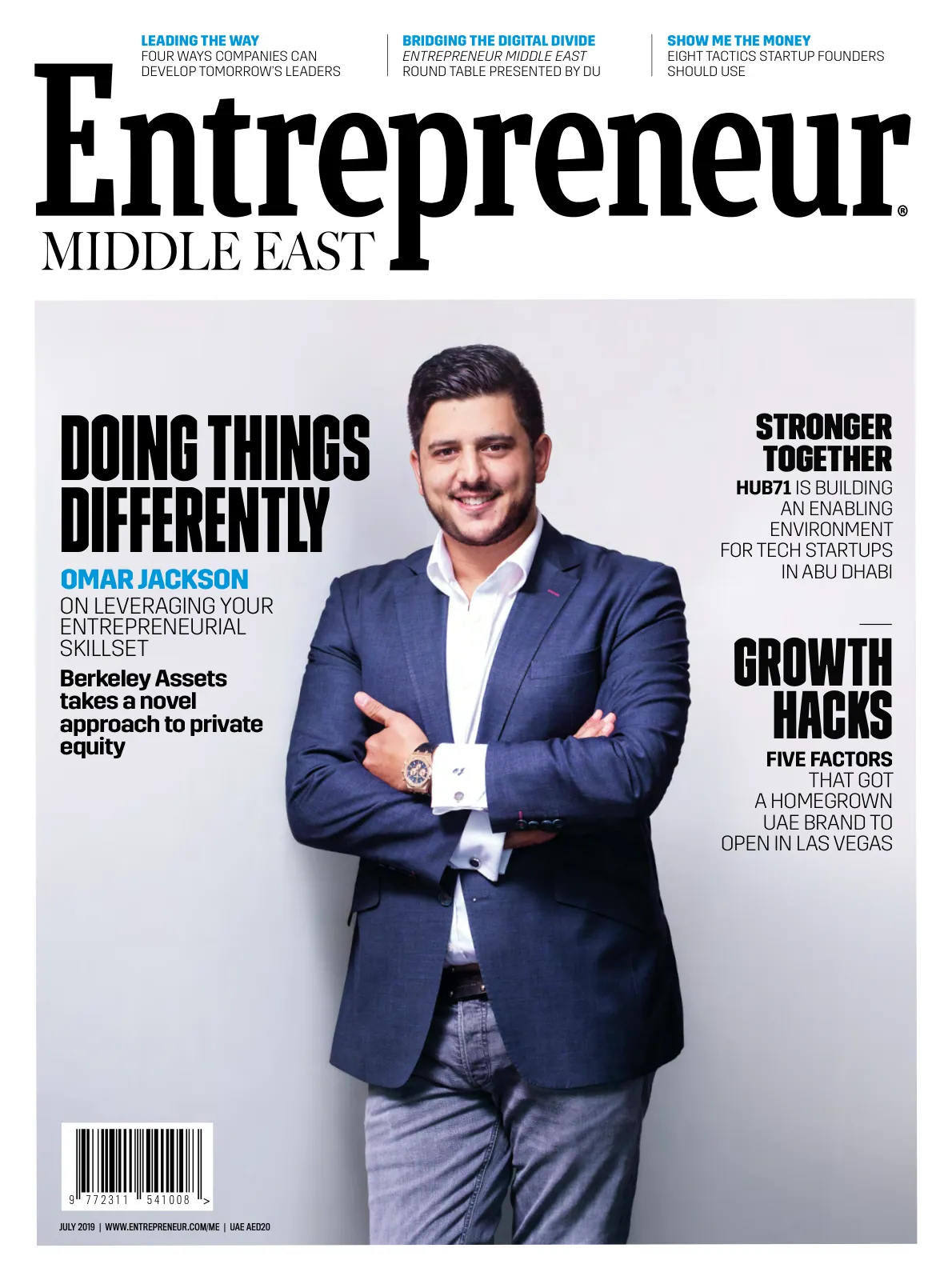
Entrepreneur Middle East, July 2019
Page 1
JULY 2019 | WWW.ENTREPRENEUR.COM/ME | UAE AED20
9
7 7 2 3 1 1
5 4 1 0 0 8
>
LEADING THE WAY
FOUR WAYS COMPANIES CAN
DEVELOP TOMORROW’S LEADERS
BRIDGING THE DIGITAL DIVIDE
ENTREPRENEUR MIDDLE EAST
ROUND TABLE PRESENTED BY DU
SHOW ME THE MONEY
EIGHT TACTICS STARTUP FOUNDERS
SHOULD USE
DOING THINGS
DIFFERENTLY
STRONGER
TOGETHER
HUB71 IS BUILDING
AN ENABLING
ENVIRONMENT
FOR TECH STARTUPS
IN ABU DHABI
GROWTH
HACKS
FIVE FACTORS
THAT GOT
A HOMEGROWN
UAE BRAND TO
OPEN IN LAS VEGAS
ON LEVERAGING YOUR
ENTREPRENEURIAL
SKILLSET
Berkeley Assets
takes a novel
approach to private
equity
OMAR JACKSON
Page 2
A brand new way to
invest in real estate!
Guaranteed 10% returns
every year for 5 years
*
Launching Nest by Arada
The Middle East’s premier
student housing complex
Walking distance from University City, Sharjah
Open to all nationalities
arada.com
800-ARADA (27232)
*T&C Apply
Page 3
3
July 2019 / ENTREPRENEUR.COM /
32 Entrepreneur Middle East Round Table presented by du
Omar Jackson,
Partner,
Berkeley Assets
26
CONTENTS JULY 2019
26
INNOVATOR
DOING THINGS
DIFFERENTLY
Omar Jackson on
leveraging your entrepre
neurial skillset
Berkeley Assets takes a
novel approach to private
equity.
32
BRIDGING THE DIGITAL
DIVIDE
Entrepreneur Middle East
Round Table presented by du
Experts from across different
industry spectrums came
together to exchange know-
how on keeping up with the
pace of digital transformation.
50
INNOVATION
FOR IMPACT
ON THE FAST TRACK
Osama Ashri analyzes Saudi
Arabia’s thriving and steady
growth, which has been
coupled with rewarding
opportunities in the
entrepreneurship ecosystem.
20
IN PICTURES
Initiating ideas
Entrepreneur Middle East
Academy kicks off with its
inaugural edition held in
partnership with the UAE
Ministry of Health and
Prevention.
60
START IT UP
ECOSYSTEM
Geared for growth
This year’s second edition
of the Dtec Forum, powered
by Entrepreneur Middle
East, focused on building
impactful businesses out of
the Middle East.
74
START IT UP
Q&A
Setting a precedent
Emirati entrepreneur Fahim
Almas, founder and CEO of
Almas Robotics, wants to
make robotics accessible to
the average consumer.
Page 4
To learn more, visit du.ae/business.
Subscribe to our roaming packs and
stay connected to your business
right from take off.
Page 5
Page 6
Page 7
Call: 800 UPSALE | up.ae
*Terms and conditions apply
MOTOR CITY
Own Your Dream Home In Dubai
& Move In Today
Aed 80,000*
30 months
Post-Handover Payment Plan
50% DLD
Fee Waiver
1,2,3,4
Bedroom Apartment
Page 8
Page 9
Page 10
COVER THE CITY
Unlocking the Power
of Digital Signage Advertising
Page 11
WITH YOUR ADS
Visit www.lifeonscreen.com
Page 12
12 / ENTREPRENEUR.COM / July 2019
CONTENTS JULY 2019
Carole Moawad,
founder, M’OISHÎ
42
44 Cove Beach in Dubai
38
Asus ZenBook S
44
‘TREPONOMICS:
SKILLSET
Growth hacks
Adel Ghazzawi, co-founder
of Cove Beach, rounds up
five factors that allowed his
homegrown UAE brand to
open up in Las Vegas.
55
‘TREPONOMICS:
SKILLSET
Beyond the comfort zone
The secret to business
success? LinkedIn UAE’s
Ghassan Talhouk says it’s
all about creating a curious
workforce.
43
START IT UP
STARTUP FINANCE
“We got funded!”
Sprii raises US$8.5 million in
a Series A round.
80
START IT UP
Q&A
Seamless play
Egyptian startup Weelo wants
to offer a digital grocery
shopping experience that
benefits not just consumers,
but supermarkets and
suppliers as well.
66
MONEY
VC VIEWPOINT
Show me the money
Mark Pearson gives eight
tactics startup founders
should use to improve their
chances of getting funded.
64
‘TREPONOMICS
PRO
Changing dynamics
Ahmed Auda explains why
organizations need to adapt
to an ageing workforce.
38
TECH
SHINY
#TamTalksTech
Gadgets and doodads
that you might’ve missed
out on, sourced by a tech
aficionado. Yes, it’s
okay to want them
all… and no, it’s
not our fault.
Page 13
Page 14
14 / ENTREPRENEUR.COM / July 2019
The Hub71 workspace
56
50 Saudi Arabia: An entrepreneurship ecosystem on steroids
41
Tudor’s Heritage
Black Bay Bronze
CONTENTS JULY 2019
56
START IT UP
ECOSYSTEM
Stronger together
Corporates were all startups
once, says Mahmoud Adi,
CEO of Hub71. Now it’s their
turn to help propel startup
success.
54
‘TREPONOMICS
SKILLSET
Leading the way
Magesvaran Suranjan of
P&G APAC and P&G IMEA
gives four ways companies
can develop tomorrow’s
leaders.
42
CULTURE:
BUSINESS UNUSUAL
Sophisticated indulgence
Carole Moawad on founding
M’OISHI, the UAE’s first
(and only) mochi ice cream
manufacturer.
78
START IT UP:
Q&A
Incentivizing attention
The Lock&Stock app rewards
students for putting their
phones away during class.
70
START IT UP
STARTUP FINANCE
Playing the odds
Zach Ferres looks at
understanding the 6% rule
when fundraising for your
startup.
18
EDITOR’S NOTE
By Aby Sam Thomas
40
CULTURE:
TRAPPINGS
‘Trep gear
The executive selection for
the entrepreneur on your list
that has everything. Okay,
maybe for a little self-reward
as well.
Page 15
800 9090 rta.ae
Dedicated bus lane
locations around
Dubai:
Naif
Al Mamzar
Al Ghubaiba
Jumeirah Lakes Towers
Stay in your lane
so everyone
reaches faster.
Stay clear of bus lanes. These are dedicated
lanes for buses, taxis, police vehicles, civil
defence, ambulances on emergency calls
and accessing them will get you a fine of
AED 600. Simply keep to your own lanes
and reach your destination on time.
Page 16
16 / ENTREPRENEUR.COM / July 2019
SUBSCRIBE
Contact subscriptions@bncpublishing.net to receive
Entrepreneur Middle East every issue
EDITOR IN CHIEF Aby Sam Thomas editor@bncpublishing.net
CEO Wissam Younane wissam@bncpublishing.net
DIRECTOR Rabih Najm rabih@bncpublishing.net
CREATIVE LEAD Odette Kahwagi
MANAGING EDITOR Tamara Pupic
STARTUPS SECTION EDITOR Pamella de Leon
GROUP SALES DIRECTOR – B2B GROUP Joaquim D’Costa
COLUMNIST Tamara Clarke
PO Box 502511 Dubai, United Arab Emirates
P +971 4 4200 506 | F +971 4 4200 196
For all commercial enquiries related to Entrepreneur Middle East
contact sales@bncpublishing.net
All rights reserved 2019.
Opinions expressed are solely those of the contributors.
Entrepreneur Middle East and all subsidiary publications in the
MENA region are officially licensed exclusively to BNC Publishing
in the MENA region by Entrepreneur Media Inc.
No part of this magazine may be reproduced or transmitted in any
form or by any means without written permission of the publisher.
Printed by United Printing and Publishing
upp.ae
Images used in Entrepreneur Middle East are credited when necessary. Attributed use of
copyrighted images with permission. All images not credited otherwise Shutterstock.
Mahmoud Adi
Najla Al-Midfa
Osama Ashri
Ahmed Auda
Fida Chaaban
Tamara Clarke
Zach Ferres
Adel Ghazzawi
Mélanie Lapointe
Megha Merani
Mark Pearson
Sidra Raihan
Farooq Salik
Magesvaran Suranjan
Ghassan Talhouk
Hanna VanKuiken
CONTRIBUTING WRITERS
entrepreneur.com/me
ACCESS FRESH CONTENT DAILY ON OUR WEBSITE!
MIDDLE EAST
EntMagazineME
@EntMagazineME
Entrepreneur-me
EntrepreneurMiddleEast
EntMagazineME
EntMagazineME
EntMagazineME
MIDDLE EAST
In addition to our print edition, we’re bringing
you all sorts of industry news on our web
mediums. Joining us online means getting
relevant business and startup content in
real-time, so you’re hearing about the latest
developments as soon as we do. We’re looking
forward to interacting with our readers on all of
our social media and web platforms- like any
thriving business, we’re looking to give and take.
#TrepTalkME is already happening on all of our
digi platforms, and all good conversations go
both ways. See you on the web!
Page 17
Page 18
18 / ENTREPRENEUR.COM / July 2019
Learning to let the small stuff slide is an art in itself
Easier said than done
Aby Sam Thomas
Editor in Chief
@thisisaby
aby@bncpublishing.net
EDITOR'S NOTE
W
e’ve been experi-
menting with quite
a few new things
of late at Entrepre-
neur Middle East,
be it in terms of the
topics we are look-
ing to explore in an editorial capacity,
or the different streams of business
that the management is looking into
as they try to diversify their revenue
streams. As someone who has long
subscribed to the school of thought
that “if it’s not done right, then don’t
bother doing it,” I’ve begun to rethink
this particular notion of mine as the
aforementioned changes happen in
my workplace, and I’ll admit here
that attempting to control my often
overbearing impulse to ensure all of
the new things that we’re doing is
as per the exacting standards we’ve
traditionally set ourselves up with has
been, to put it mildly, quite a fraught
process.
Sure, there are plenty of management
journals out there that advise leaders
against trying to do everything or
micromanage, but I can now officially
declare that all of that is, as the cliché
goes, much easier said than done.
Having said that, I was determined
to unplug myself from this sort of
ultimate overseer role that I had
found myself increasingly playing,
and as such, I decided to let go (just
a little bit), and see how things flow
when I am not putting my eye on
everything that is going on in the
business. After all, I strongly believe
that there’s something fundamentally
wrong with the way you as a leader
are doing things if everything
that goes on in your enterprise is
wholly dependent on you, and I was
particularly eager to make sure that
this principle was adhered to in my
own workplace as well.
As I set out on this personal project,
one of the things I quickly learned
is that for those of us blessed (or
cursed, depending on how you see
it) with the perfectionist’s eye at
work, it’s pretty safe to say that
there will always be something you
see in things that are done around
you that you might not approve of,
or that you could have definitely
improved. Now, it’s one thing to stand
by and offer your input to those who
are taking the lead, but doing this
all the time can be exhausting and
defeats the purpose of delegation in
the first place. However, I feel that
if one allows others to exercise their
own acumen in situations, figure out
mistakes by themselves, and learn to
independently manage every scenario
they’re exposed to, then that’s what
will result in a more productive
outcome for everyone involved.
Of course, this doesn’t (and
shouldn’t) apply to everything you
do in your enterprise, but it can
certainly be put to use in all of your
experimental efforts. The people you
have onboard for these undertakings
may find a way to make it work, and
yes, they might also crash and burn-
but unless you let them do these
things, they (and you) will never
know. As a leader, as tempting as it
may be to tackle every fire that you
see within the enterprise, as LinkedIn
co-founder Reid Hoffman put it,
“smart entrepreneurs don't try to
fight every fire. Instead, they figure
out which fires they can let burn-
so they can focus on the ones they
absolutely have to fight.”
Page 19
A MEMBERS OF EMIRATES TRANSPORT BUSINESS CENTERS:
Page 20
20 / ENTREPRENEUR.COM / July 2019
I
t’s not just those who start up
businesses that can benefit from
an entrepreneurial mindset- es
tablished enterprises have a lot
to gain by having employees who
embody this kind of spirit as well.
As the importance of intrapreneurship
within organizations gains traction
around the world, Entrepreneur Middle
East has launched a new initiative,
Entrepreneur Middle East Academy,
which aims at conducting specialized
workshops and customized classes
for organizations seeking to ignite the
innovative spirit in their employees,
and thus gain a competitive advantage
themselves.
In its inaugural outing, Entrepreneur
Middle East Academy partnered with
the UAE Ministry of Health and Pre
vention to conduct an empowerment
workshop for a selection of the latter’s
employees at its Training and Develop
ment Center located in the Emirate of
Sharjah. The half-day session kicked
off with a welcome address from Saqr
Alhemeiri, Chief Innovation Officer
at the UAE Ministry of Health and
Prevention, who noted the need for
disruptive thinking styles in employees
to help their respective organizations
get ahead. This was followed by a
talk from serial entrepreneur Fodhil
Benturquia, founder and CEO of the
UAE-headquartered healthcare startup
Okadoc, who took the audience through
the principles that have governed his
career so far, which has included stints
at companies like MarkaVIP, Souq.com,
and Noon.com.
INITIATING IDEAS
Entrepreneur Middle East Academy kicks off with its inaugural edition held in partnership
with the UAE Ministry of Health and Prevention
Entrepreneur Middle East
Academy workshop
Fodhil Benturquia,
founder and CEO, Okadoc
Entrepreneur Middle East
Academy workshop
Saqr Alhemeiri, Chief Innovation Officer,
UAE Ministry of Health and Prevention
Entrepreneur Middle East
Academy workshop
IN PICTURES
Page 21
21
July 2019 / ENTREPRENEUR.COM /
INITIATING IDEAS | ENTREPRENEUR MIDDLE EAST ACADEMY
To have such a tailored
workshop by Entrepreneur
Middle East Academy
staged at your own
enterprise, email
sarah@bncpublishing.net
for more details.
Entrepreneur Middle East
Academy workshop
Entrepreneur Middle East Academy workshop
Entrepreneur Middle East
Academy workshop
Fodhil Benturquia, founder and CEO, Okadoc
Left to right: Fodhil Benturquia, founder and CEO, Okadoc,
Saqr Al Hemeiri, Chief Innovation Officer, UAE, and Wissam Younane, CEO, BNC Publishing
Saqr Alhemeiri, Chief Innovation Officer,
UAE Ministry of Health and Prevention
After Benturquia shared his insights
on building an entrepreneurial mind
set, the Entrepreneur Middle East
Academy audience then got a chance
to explore this for themselves through
a hands-on workshop conducted by
Blooming Eloquence founder and
Lead Consultant Mélanie Lapointe.
Through a series of interactive les
sons and exercises led by Lapointe,
the UAE Ministry of Health and
Prevention employees got a firsthand
look into what it means to think dif
ferently, the skillsets that they can
(and should) develop for this purpose,
and how doing so can enable them
and their organizations to develop
and grow. With the positive feedback
received for this edition of Entrepre
neur Middle East Academy, this new
initiative has certainly proved to be
a success, and one can expect more
instalments of this series in the near
future.
Page 22
22 / ENTREPRENEUR.COM / July 2019
3
6
9
HOW SPEARHEADING INTRAPRENEURSHIP IN ORGANIZATIONS LEADS EVERYONE TO BETTER SUCCESS
by MÉLANIE LAPOINTE
IGNITING INNOVATION
Cove Beach in Dubai
Mélanie Lapointe is a coach, trainer, and speaker. She is the founder and Lead Consultant at Blooming Eloquence, a unique consultancy
specialized in intercultural agility, women recognition, and millennials growth, amongst other tailored services. Mélanie is a Dubai-based
global citizen on a mission to make the world a better, more equitable, and sustainable place, through enhanced human interactions and
improved business practices. Mélanie was featured as the most International External Facilitator 2019 Q1 for Google #IamRemarkable
initiative. In addition to her Masters in Business Management and Teaching Certification, Mélanie is an Inter-Cultural Intelligence Coach,
which complements her Executive Coach ICF Certification. With a strong background in educational leadership and a distinguished sense
of etiquette, Mélanie always works to the highest standard with ethical and culturally respectful approaches.
bloomingeloquence.com |
bloomingeloquence |
www.linkedin.com/in/mllemelanielapointe
Entrepreneur Middle East
Academy
workshop
‘TREPONOMICS SKILLSET
S
upporting courage is a key ele-
ment to genuine differentiation and
meaningful innovation in today’s
world. Providing employees with a space
for them to shine their full selves, and
encouraging creativity is at the heart of
an honest intrapreneurship mindset for
organizations.
Intrapreneurship is much more than a
trendy buzzword. More and more leaders
understand and recognize its unique
added value to a truly successful work
culture driving meaningful changes and
lasting growth. Linked to the Fourth Indus-
trial Revolution, encouraging human skills
to be developed to their full potential, and
capitalizing on our humanity is our only
edge over robotics and AI, and as such, the
qualities of an intrapreneur will become
more and more sought after. Leaders who
acknowledge the essential qualities of
intrapreneurship programs in their organi-
zation are strategically investing in their
employees' growth, which undoubtedly
leads the entire entity to better success.
Leaders at the top of their industries
have applied intrapreneurial mindsets for
decades. Multiple companies and organi-
zational success that are today thriving
for their innovative, forward thinking have
had the courage of capitalizing on their
employee’s creativity, recognizing their
singular potential, and offering a sup-
portive system. Harvard Business Review
says that for companies to be successful,
they need to recognize innovation as a
permanent function within the business,
and a holistic approach is necessary for
real innovation-driven changes. Empow-
ering people to act their best self, and
working to their full potential and ability is
at the core of a company’s success. The
reason we speak about intrapreneurship
programs and intrapreneurial mindset
is because no individual alone can bring
an idea into reality. A committed integral
system with adapted resources needs to
be in place. A supportive organizational
structure, with a genuine work culture
based on collaboration and authentic
communication, creates and empowers
intrapreneurship behaviors to benefit all
levels. The recognition of employees leads
to trust and liability, encouraging everyone
to work to their full potential, with a com-
mitment to the organization's success.
Intrapreneurship is a system that allows
an employee to act like an entrepreneur
within a company or other organization. In-
trapreneurs are self-motivated, proactive,
and action-oriented people who take the
initiative to pursue an innovative product
or service. According to Forbes, optimiz-
ing a product or service already existing
is key for lasting growth and profitability.
Creativity, service orientation, critical
thinking, cognitive flexibility, and emotional
intelligence are all part of the top ten
skills needed to successfully address the
Fourth Industrial Revolution, according to
the World Economic Forum. These skills
are also an integral part of an intrapre-
neur’s mindset. Creativity being the main
one, leaders gain from encouraging their
employees to think and act as business
owners, as entrepreneurs. By allowing a
safe space for ideas to arise, employees
gain confidence and power in their work.
To think and behave like they are owners,
employees drive change, and thus em-
body the principles of a supportive work
culture. Intrapreneurs are not afraid to
take risks, they are accountable for their
work, and are driven by a genuine desire
to improve the customer experience. The
organization's values play a key role in
encouraging an intrapreneurship mindset.
It is critical for the employees to have
a sense of belonging and appreciation
for them to invest time and energy into
new ideas, which may possibly become
groundbreaking in the industry, and set a
clear competitive advantage.
The intrapreneur mindset is equally
relevant for the recognition and empower-
ment of women in the workplace. Many
companies now look for initiatives and
programs to support their female employ-
ees, to encourage them to speak up, take
the place they deserve, ask for promo-
tions, and influence the C-suite executive
decisions by becoming one of them. The
intrapreneur mindset encourages these
behaviors in women. It tackles their crea-
tivity, their confidence in asking power-
ful questions, and them taking the lead
on projects. They feel comfortable and
confident to volunteer ideas and unique
insights, contributing a necessary balance
and added value to the impactful work be-
ing done. After all, recognizing the feminine
force is essential in all innovation-driven
culture.
Intrapreneurship is, in short, supporting
courage in employees. Granting employ-
ees the space to bring their full selves
to work, and being genuinely open and
curious to their bright ideas and unique
insights is key for a fruitful work environ-
ment. With them feeling safe and cared
for, as well as respected and valued as
individuals, real meaningful innovative
breakthroughs can see light from empow-
ered employees.
Page 23
The iconic jewel of Kuwait City; Symphony Style Kuwait
commands the finest views of Kuwait’s bay.
An oasis of calm amidst the city’s vibrant energy
designed for lofty living.
Welcome to the
EXCEPTIONAL
radissoncollection.com/symphony-style-hotel
A R A D I S S O N CO L L E C T I O N H OT E L
Page 24
24 / ENTREPRENEUR.COM / July 2019
Scaling impact
The tenth edition of Arabnet Beirut sees more than
4,000 people turn up for the two-day event
The tenth edition of Arabnet Beirut
The tenth edition of Arabnet Beirut
IN THE LOOP
IMAGE CREDIT ARABNET
W
e've been able to cre
ate a real impact for
the MENA economy,
with our alumni -the
startups that pitched
at Arabnet across the
years- collectively
employing more than 3,500 today,”
said Arabnet founder and CEO Omar
Christidis, opening Arabnet Beirut X,
the celebratory 10th edition of one of
the MENA region’s most active tech
innovation-focused program organiz
ers- Arabnet.
Indeed, Arabnet Beirut X’s primary fo
cus was on regional entrepreneurs once
again- MENA-based startups, Searchie,
Hadiyati, and YNG, stole the spotlight
by each winning one of the event’s
three startup competitions. Searchie,
a Dubai-based AI-based recruitment
platform, won the Startup Champion
ship powered by Touch, taking home
a cash prize of US$20,000 and an
acceleration scholarship to Silicon
Valley, while Hadiyati and YNG were
declared the winners of the Ideathon
and Creative Combat sponsored by
Ogero competition tracks respectively.
The two-day event, held on June 12-13,
in Beirut, also featured a Startup Show
case, bringing together 100 startups
from Lebanon and beyond to exhibit
and connect with industry experts and
more than 100 regional investors.
Overall, the event brought together
more than 4,000 attendees for a total
of 22 panels, keynote speeches, and in
terview sessions across the two forums
taking place simultaneously. The event
was held under the High Patronage
of His Excellency the President of the
Republic of Lebanon,
General Michel Aoun,
and in collaboration
with Banque du Liban,
along with the partici
pation of H.E. Prime
Minister of Lebanon
Saad Hariri, as well
as H.E. Mohamad
Choucair, Minister of
Telecommunications
and H.E. Dr. Riad Sal
ameh, Governor of the
Central Bank of Leba
non. “It is a priority for myself and for
my government to do all that is in our
power to support and further enable
the digital economy in Lebanon,” said
H.E. Hariri at the opening ceremony,
which was preceded by a ministerial
panel, titled “The Roadmap To A Digital
Economy In Lebanon,” which explored
the government’s plan to support the
country’s further digitization process.
The first day of the event also featured
The LaunchPad Forum, which explored
how Lebanese diaspora could bring
technology opportunities back to the
country, and The Finverse Forum that
analyzed the current state of innova
tion in fintech and the banking sector,
further opportunities of financial
inclusion, and much more. Bank Audi
launched a new banking solution, My
Novo, which is the first digital, rela
tional banking platform in Lebanon,
allowing users to open an account
and personalize it, conduct local and
international transfers, pay bills, talk to
advisors through video conference, and
many other features, seven days a week.
Furthermore, Abu Dhabi-based Hub71
announced a partnership with MIT
Enterprise Forum Pan Arab, aiming to
support regional startups with global
ambitions.
Kicking off the second day of the
event, Arabnet and The Mohammed
Bin Rashid Establishment for SME
Development (Dubai SME) launched
the fourth edition of the State of
Digital Investments in MENA 2013-
2018 report, which investigates the
technology investment landscape in the
Middle East and North Africa (MENA)
region by analyzing investments made
by MENA-based investors into MENA-
based startups.
Page 25
—
R ADISSON BLU
WELCOME TO
RIYADH
—
r a d i s s o n h o t e l s . c o m
Call us at : 00966 11 479 1234
Email us at : reservations.riyadh@radissonblu.com
BOOK NOW AND SAVE UP TO 20%.
Offer valid from May till August 2019
Page 26
26 / ENTREPRENEUR.COM / July 2019
INNOVATOR
DOING THINGS
DIFFERENTLY
ON LEVERAGING YOUR ENTREPRENEURIAL SKILLSET
Berkeley Assets takes a novel approach to private equity
by ABY SAM THOMAS
OMAR JACKSON
26 / ENTREPRENEUR.COM / July 2019
>>>
F
or someone who is today a Partner
at private equity (PE) firm Berkeley
Assets, Omar Jackson’s first foray into
the world of business may come as a
bit of a surprise- here’s someone who
found his entrepreneurial chops as a
pre-teen selling cakes at his school, with
the profits then used to fund his outings with
friends. At the time, his mother was raising him
and his brother by herself at Slough in the United
Kingdom, working a number of jobs, and as such,
Jackson didn’t want to ask his mother for money
to participate in frivolities that more privileged
kids his age were accustomed to- think things like
going out on a school trip, or heading to the local
Pizza Hut for a meal together. But Jackson did want
to be a part of these kinds of activities, and that’s
how he decided to make the money he needed-
he used his culinary skills to bake cakes that he
would then sell at his school for a profit. “At the
best times, I was making around GBP50 a week,”
Jackson remembers, a proud smile still lighting up
his face as he recalls the experience. His career
in the cake business was short-lived though- his
school was quick to shut Jackson’s side hustle
down when they heard of it. But this episode,
which essentially kicked off Jackson’s career in
business, is a good exhibit of his particular prowess
at identifying potential opportunities early on,
and then successfully capitalizing on it- a talent
that has seen him venture into everything from
e-commerce, to crypto currency, to private wealth
management, and today, sees him in his current
role at Berkeley Assets, where he’s using his brand
of innovative acumen to shake things up on the
private equity landscape. “We’re not looking to
follow a set mould,” Jackson says. “We are looking
to innovate at every opportunity we can.”
Page 27
27
July 2019 / ENTREPRENEUR.COM /
Omar Jackson,
Partner, Berkely Assets
"IT'S GREAT TO BE PART
OF DOING SOMETHING
DIFFERENT, PART OF
EDUCATING THE SOCIETY IN
A WIDER MARKETPLACE OF
AN ALTERNATIVE THAT THEY'RE
NOT OTHERWISE USED TO, TO
INNOVATE A LITTLE BIT.”
DOING THINGS DIFFERENTLY | OMAR JACKSON ON LEVERAGING YOUR ENTREPRENEURIAL SKILLSET
Page 28
28 / ENTREPRENEUR.COM / July 2019
"IT'S ALL ABOUT EFFICIENCY- YOU DON'T
WANT TO HAVE UNNECESSARY OVERHEAD;
YOU DON'T WANT TO HAVE UNNECESSARY
PEOPLE IN YOUR WORKFORCE THAT DON'T
REALLY SERVE AN ULTIMATE PURPOSE.
EVERY ONE THAT'S THERE [AT BERKELEY
ASSETS] IS HIGHLY VALUED FOR WHAT THEY
DO, AND THEY HAVE VERY SPECIFIC JOB
ROLES. AND I THINK THAT'S VERY CRUCIAL."
IMAGE CREDIT OMAR JACKSON
Omar Jackson,
Partner, Berkely Assets
INNOVATOR
With a diversified portfolio of
investments across sectors like
real estate, hospitality, logis
tics, and technology, Berkeley
Assets currently operates over
150 businesses across multi
ple industries, with its offices
spread across Europe, Latin
America, and the Middle East.
“We like to see ourselves as a
low risk PE firm,” Jackson says.
“One of our unique points
is that everything is tangi
ble- so, what we work with
are asset-backed businesses,
tangible assets. We are looking
at real estate as 80-85% of our
portfolio, all in the UK and the
US, because those are notori
ously two of the most stable
and historically strong real
estate markets in the world.”
This kind of reasoning governs
Berkeley Asset’s forays into
other sectors as well, wherein
the company takes charge of all
the assets under its purview,
thereby ensuring its clien
tele’s peace of mind. “We, as a
company, have a lot of security
in terms of our charge over the
assets,” he explains. “So, we
are able to protect our clients'
money at all costs, at all times.
And it's great for the clients
just to know that. Because
if you're doing everything
through a fund, something you
can't physically see or touch, it
becomes a lot more difficult. So
that's our framework, to offer
clientele, retail or institutional,
something physical, something
tangible.”
According to Jackson, this is
the differentiating factor that
makes Berkeley Assets stand
out as a firm. “PE is very sim
ple,” he says. “You raise money
one side, and you invest it on
the other side. Now, some PE
firms go down the fund route;
others go down direct place
ment. We're direct placement,
so a client knows his money
comes in the door from one
end, and it goes into projects
on the other end. There's no
fees; it's a simple arrangement,
they can come in for two years,
five years, or 10 years, we give
them a fixed rate of interest on
their loan to us. So that could
be 4%, 6%, or 8% per annum.
They can get paid that interest
bi-annually, and we do that in
order so that clients can physi
cally see the rewards of their
investment, not just see it on
paper. It's physical, it's real.
That's the whole concept of
Berkeley Assets; it's tangible.”
In terms of raising capital,
Jackson reveals that Berkeley
Assets has a global outlook in
that respect, while also noting
that it is one of the few PE
firms in the world to have a fo
cus on the retail sector. “80%
of our capital is raised through
institutions; 20% from the
retail arm,” Jackson says. “A
lot of our capital is raised in
Asia as a continent. The Mid
dle East is a great jurisdiction
for us. We've also expanded
to Hong Kong and Singapore
over the last couple of years.
So, that's seen us achieve some
good figures in terms of raising
capital, from institutions espe
cially. And the retail arm is re
ally growing. We had to spend
a lot of time educating the
marketplace in terms of private
equity for the retail market,
because it's all a bit of a mys
tery to most people. It's only
ever been available to ultra-
high net worth [individuals]
and institutions. So, it's great
to be part of doing something
different, part of educating the
society in a wider marketplace
of an alternative that they're
not otherwise used to, to in
novate a little bit.”
This spirit of tapping into
new opportunities can be seen
in Berkeley Asset’s investiga
tion into locations (other than
the UK and US) that they could
be investing into, with the
Middle East figuring promi
nently in these conversations
at the company. “Investment-
wise, we’ve always been into
British real estate, US real
estate, but in the last 12 to 18
months, we've started looking
at other opportunities in other
fields and other landscapes,”
Jackson says. “So, we are now
looking in the Middle East
actively; my investment com
mittee is searching for and
discussing various opportuni
ties that can take place in the
Middle East. It may not be real
estate, but it will still be asset-
Page 29
29
July 2019 / ENTREPRENEUR.COM /
backed, tangible assets that
we can invest in, which will be
profitable for businesses in this
jurisdiction.”
But it’s not just in the invest
ments space that Berkeley
Assets is trying to innovate in-
there’s also work being done in
reimagining how the company
is perceived by those around it.
It seems pretty apparent that
Jackson is leading the charge in
this department, with Berkeley
Assets making its presence felt
through everything from bill
boards along Dubai’s Sheikh
Zayed Road, to partnerships
with celebrity brand ambas
sadors in the sporting arena,
like British boxer Amir Khan.
When I point out that it was a
surprise for me to see the for
mer unified light-welterweight
world champion promoting
Berkeley Assets, and that it did
make me curious about the PE
firm and what it does, Jackson
gleefully declares that this is
exactly the kind of reaction he
is hoping to elicit from these
kinds of initiatives. “It is that
curiosity, that stunt factor,” he
says. “And then, when people
look into it more deeply, they
realize there actually can be
a lot of correlations... If you
look at boxing, and you think
about the amount of diligence
it takes, the mental strength it
takes, the careful planning it
takes, the dedication it takes,
there's a lot of similarities in
terms of the qualities of that
individual, and to those of our
firm. So, that's what's excit
ing. And it's also popularizing
what we do, it's showcasing,
in a positive manner, with a
very well-known face, who has
himself, like life and invest
ments, had some volatility in
his career, but has matured,
and he has ultimately come
through, and is a double world
champion. So, I think it's a
nice element to us. PE firms
don't do that traditionally- we
like to do things differently.”
At this point, I ask him if he’s
faced any blowback on doing
these things at Berkeley Assets
that PE firms aren’t typi
cally known for doing, and he
replies, “I’m very much the
force of innovation within the
company, and I’m glad the
other partners don’t hold me
back in that sentiment. They
actually appreciate it, because
they're seeing the rewards on
the back of that.”
Jackson points out that his
torically, most PE firms have
preferred to stay in the back
ground- they were never keen
on being known, or becoming
household names. But given
the landscape Berkeley Assets
operates in today, Jackson
believes that there is a need for
the enterprise to be seen as an
accessible brand, and as such,
it needs to be present, work
with the public, and put itself
out there as a force to be reck
oned with. “I think you need
to be proud of what you do,”
he adds. “You need to popu
larize what you do, and you
need to make the idea of doing
something with your money
a fun, enjoyable experience,
not a stressful experience. So,
if we were just working in an
institutional framework like
traditional PE firms do, maybe
we would stay a little bit more,
well, not in the background,
"WE ARE ABLE TO PROTECT OUR
CLIENTS' MONEY AT ALL COSTS,
AT ALL TIMES. AND IT'S GREAT
FOR THE CLIENTS JUST TO KNOW
THAT. BECAUSE IF YOU'RE DOING
EVERYTHING THROUGH A FUND,
SOMETHING YOU CAN'T PHYSICALLY
SEE OR TOUCH, IT BECOMES A LOT
MORE DIFFICULT. SO THAT'S OUR
FRAMEWORK, TO OFFER CLIENTELE,
RETAIL OR INSTITUTIONAL,
SOMETHING PHYSICAL, SOMETHING
TANGIBLE.”
DOING THINGS DIFFERENTLY | OMAR JACKSON ON LEVERAGING YOUR ENTREPRENEURIAL SKILLSET
WWW.BERKELEY-ASSETS.COM
>>>
Page 30
30 / ENTREPRENEUR.COM / July 2019
"IF YOU JUST FOCUS ON MONEY,
ONCE YOU DO EARN THAT MONEY,
IT IS NOT AS IMPRESSIVE AS YOU
MIGHT THINK IT IS. THAT'S NOT
THE BIT THAT GIVES YOU THE KICK.
YOU KNOW THE BIT THAT GIVES
YOU THE ENJOYMENT, THAT HAS
TO BE SOMETHING ELSE. IT HAS TO
BE A PASSION UNDERLYING THERE
SOMEWHERE, BECAUSE OTHERWISE,
ONCE YOU GET THE MONEY [...]
THEN YOUR MOTIVATION ENDS."
INNOVATOR
"WE ARE NOW LOOKING IN THE MIDDLE
EAST ACTIVELY; MY INVESTMENT
COMMITTEE IS SEARCHING FOR AND
DISCUSSING VARIOUS OPPORTUNITIES THAT
CAN TAKE PLACE IN THE MIDDLE EAST. IT MAY
NOT BE REAL ESTATE, BUT IT WILL STILL BE
ASSET-BACKED, TANGIBLE ASSETS THAT WE
CAN INVEST IN, WHICH WILL BE PROFITABLE
FOR BUSINESSES IN THIS JURISDICTION.”
but reserved. But because
we work in the retail sector
as well, we need to present
ourselves in the right way.
We need to be able to provide
transparency to people. I think
that the transparency aspect
of it gives confidence anyway,
even to institutions. Just
because we are very transpar
ent as a company, in terms of
what we invest in as a firm,
or what we do in terms of PR,
we still don't talk about who
our clients are. So, we're still
private in that sense. Institu
tions know that, and they like
the fact that we can be very
transparent, very open, very
popular, but at the same time,
where discretion is needed, we
are discreet, and we protect
their interests at all costs.”
As I chat with Jackson, it
seems to me that the reason
why the seemingly disparate
aspects of Berkeley Assets still
work together as a cohe
sive whole is because of the
ingrained culture within the
company, and that forward-
thinking approach is what
drives everyone within it. As
Jackson put it, “Everyone is
reading from the same hymn
sheet. And as long as every
one within the walls of the
firm understand the future
where we're heading, it makes
presenting being consistent
to the outside world to be
very simple.” Now, company
culture is a topic that Jackson
is quite passionate talking
about, and he readily admits
that it’s something he’s been
a champion of at Berkeley
Assets. “PE firms, in general,
don't have huge teams. But the
way I see it is that every posi
tion that you need filled needs
to be worthwhile, and it needs
to have a specialist in that
position. Whether that be an
office manager, or whether that
be someone in your invest
ment committee, they need to
be a specialist at what they do.
It's all about efficiency- you
don't want to have unneces
sary overhead; you don't want
to have unnecessary people in
your workforce that don't re
ally serve an ultimate purpose.
Every one that's there [at
Berkeley Assets] is highly val
ued for what they do, and they
have very specific job roles.
And I think that's very crucial.
I think all businesses should
adopt that kind of mindset
to the staff they're hiring.
This process starts from the
hiring stage- that's how you
get the right people with the
right mindset.” These words
shouldn’t come as a surprise to
those of you who regularly read
Entrepreneur Middle East, as
the importance of hiring the
right people is something that
has been reiterated on the
pages of this magazine many a
time, and Jackson is emphatic
about replugging this particu
lar notion as well.
When it comes to advice
for entrepreneurs, Jackson
reiterates that building a good
company culture at the outset
is absolutely critical if they
wish to see their businesses
grow and thrive. But this starts
with the people at the helm of
such enterprises taking a good
hard look at themselves, says
Jackson. “I think the biggest
part of it is learning what kind
of entrepreneur you are,” he
explains. “Because only once
you understand your strengths
and weaknesses do you know
how to, well, set up a team
around you, and that is crucial.
I love racing, I love cars, I've
raced for a lot of my life. And
it's the same thing like taking
a car round a track in testing.
You only know how fast you
can go if you go off the track-
then you know the limit. As a
racing driver, you're told by
your team to push, and push,
and push at every corner when
you're testing, so that you can
see how far you can take it.
That's the only way you really
know how much you've got-
how much ability, how much
willpower, how much strength
you've got. So, I think that's
the first thing, it is establish
ing who you are as an entre
preneur, getting your right
mindset in place, and then,
it's putting a process in place
for your business that you're
focusing on. I think if you are
comfortable in your own skin
with what you're doing, and
you've got the right mindset
in place, you can then instill
that into others, if you can find
the right individuals… I think
that's the fundamental sort
of entrepreneur- understand
ing himself, getting his right
mindset in place, knowing his
weaknesses, and getting the
right people who are passion
ate to form his guard, if you
like, step by step, and then, you
can take it forward to year one,
year two, year three. I think
that's kind of my advice to
entrepreneurs. I'm very much
about positioning your mindset
in the right place.”
That, in essence, seems to
be the mantra that Jackson
personally lives by, with him
noting that he’s not driven
to do all that he does by the
Page 31
31
July 2019 / ENTREPRENEUR.COM /
DOING THINGS DIFFERENTLY | OMAR JACKSON ON LEVERAGING YOUR ENTREPRENEURIAL SKILLSET
Omar Jackson,
Partner, Berkely Assets
prospect of, say, money, or
power, but instead, by the
intoxicating nature of success.
“I'm always addicted to the
feeling of success,” Jackson
says. “I’m addicted to the
feeling of winning. And I'll do
what it takes, I'll put my heart
and soul, my sweat and blood
into any projects I'm working
in, or any team that I am work
ing together with, to make sure
we do the best we can possibly
do.” It should be clear here
that Jackson has come a long
way from his entrepreneurial
beginnings as a kid trying to
earn some extra money- today,
he’s more keen on building his
own profile up to a position of
influence, through which he
can have a positive impact on
the world at large. He’s already
got himself on this path, be it
with him spearheading char
ity projects around the globe,
or by setting aside time for
inspirational interactions with
children and youth- but this
is only just the beginning. “I
think, once upon a time, I was
motivated by money, when I
was a kid,” Jackson says. “But
if you're just motivated by
money, you actually don't get
anywhere. If you just focus on
money, once you do earn that
money, it is not as impressive
as you might think it is. That's
not the bit that gives you the
kick. You know the bit that
gives you the enjoyment, that
has to be something else. It
has to be a passion underly
ing there somewhere, because
otherwise, once you get the
money, then what? Then your
motivation ends. See Richard
Branson, Bill Gates, War
ren Buffet- it's obviously not
money that motivates them to
be as hungry and passionate
as they continue to be today. I
think real entrepreneurs, and
the real entrepreneurial spirit,
aren't motivated by money. For
me, it's a desire to be a leader.
And I want to establish myself
as a leader, and make as much
of a difference as I can. I can't
change everything, of course,
but I can make life better, and I
can make a difference to com
munities and people. So, I will
do that.” It’s clear Jackson’s
brand is on the ascent- and
the rest of us need to just stay
tuned.
Page 32
32 / ENTREPRENEUR.COM / July 2019
presented by
ROUND TABLE
BRIDGING
THE DIGITAL
DIVIDE
At the Entrepreneur Middle East Round Table presented by du,
experts from across different industry spectrums came together
to exchange know-how on keeping up with the pace of digital
transformation within their respective sectors
by TAMARA PUPIC and ABY SAM THOMAS
Page 33
33
July 2019 / ENTREPRENEUR.COM /
BRIDGING THE DIGITAL DIVIDE | ENTREPRENEUR MIDDLE EAST ROUND TABLE PRESENTED BY DU
>>>
I
t’s not a stretch to say that
digital transformation is
one of the most talked
about subjects in the UAE’s
business realm today, and
as such, it’s not a surprise to
see institutions in the country,
from both the private and
public sectors, figure out ways
in which they can integrate
this paradigm shift in doing
business into their day-to-day
operations. However, it’s one
thing for an enterprise to em-
bark on a digital transforma-
tion initiative- and it’s another
thing entirely to do it right.
This was one of the main
points of discussion at the En-
trepreneur Middle East Round
Table presented by du, held in
June at the Kempinski Hotel
Mall of the Emirates in Dubai,
which had experts from across
different industry spectrums
giving their takes on how
organizations can go about
successfully accelerating the
pace of digital transformation
within their respective lines of
businesses.
Moderated by Entrepreneur
Middle East Editor in Chief
Aby Sam Thomas, the discus-
sion featured the insights of
Saqr Alhemeiri, Chief Innova-
tion Officer, UAE Ministry of
Health and Prevention; Raja
Al Mazrouei, Executive Vice
President, FinTech Hive, Dubai
International Financial Centre;
Hany Fahmy Aly, Executive
Vice President - Enterprise
Business, du; Marwan Bin
Dalmook, Senior Vice Presi-
dent ICT Solutions and Smart
City Operations, du; Benjamin
Boesch, Head, Digital and
eCommerce, VFS Global; Zeina
Kaissi, Head of Emerging Tech-
nology, Smart Dubai; and Wai
Lum Kwok, Executive Direc-
tor, Capital Markets, Financial
Services Regulatory Authority,
Abu Dhabi Global Market.
The discussion kicked off with
Kaissi sharing a glimpse into
the digital transformation
drive that the Government of
Dubai has initiated across the
Emirate under the banner of
her enterprise, Smart Dubai.
As the government office
charged with enabling the
digital transformation of the
city as a whole, Smart Dubai
has been entrusted with the
mission of making “Dubai
the happiest city on earth
through technology innova-
tion,” which is rooted in the
far reaching vision of H.H.
Sheikh Mohammed Bin Rashid
Al Maktoum, Vice-President
and Prime Minister of the UAE,
and Ruler of Dubai, for the
Emirate. “We have this almost
nearly impossible ambition
(but we like nearly impos-
sible ambitions, I think, as a
nation) to completely digitize
the government 100%, to have
the government 100% paper-
less,” said Kaissi, referring to
the Dubai Paperless Strategy,
which aims to have all of the
city’s applicable government
transactions moved to digital
platforms by 2021. “What we
are doing at Smart Dubai right
now is working with every
single government organiza-
tion to onboard their services
into one channel, which is our
app, DubaiNow, so that the
user has a one-stop shop for
government services,” Kaissi
explained. “These services,
when they are onboarded, they
are fully digitized, and so, we
do not leave any space for [the
user to have to make] customer
service center visits, and we
don't leave space for paper-
work as well.” As for the im-
pact this initiative would have,
Kaissi pointed toward the stats
that were a key factor in Smart
Dubai’s Paperless Strategy
winning one of the prestigious
Interactive Innovation Awards
at the South by Southwest
(SXSW) Festival in March this
year at Austin, Texas in the
United States. Through this
drive, the government would
be, by 2021, eliminating the
use of more than one billion
pieces of paper in its day-to-
day transactions, which would,
besides preventing the cutting
down of 130,000 trees, result
in cost savings of up to AED1.3
billion, and also save people
Page 34
34 / ENTREPRENEUR.COM / July 2019
40 hours a year of their time,
which they’d otherwise be
spending traveling between
service centers to process
paperwork.
As Kaissi noted, it’s through
showcasing tangible savings
like these that enterprises can
get their various stakeholders
-be it their employees, their
partners, or their customers-
to get invested in the digital
transformation processes they
set out for themselves. In the
case of UAE telco du, Aly and
Bin Dalmook explained that,
three years ago, the company
decided to pursue its digital
transformation plans more
aggressively than ever before,
with the aim being to change
the company’s customer expe-
rience models. “That was the
pillar, let's say, the keystone,
to start all the transforma-
tion within du,” Bin Dalmook
said. “We had to focus on new
technologies and new services,
to forge new partnerships,
and to develop a new business
model.” Today, while du has a
lot to celebrate having recently
launched 5G services in the
UAE, Aly pointed out that en-
terprises like his shouldn’t rest
on their laurels for too long-
they should instead be making
sure that they are on top of the
latest technological develop-
ments. “Some telcos have their
own wallets and compete with
banks in their countries and
vice versa, some internet play-
ers want to become telcos or
to become banks, so what tech-
nology does is removing the
boundaries between industries,
and therefore, our constant
challenge is in knowing from
where our next growth op-
portunity will come,” Aly said.
“The question comes down
to what you want to focus on,
being an information and com-
munications technology (ICT)
player, or being a payment
provider, or being a consultant
to companies, or just a simple
infrastructure player. Also,
it’s not only technology which
we can develop that makes an
impact, but also bringing in
the people who can turn it into
something even bigger.”
VFS Global is an outsourc-
ing and technology services
specialist for governments and
diplomatic missions worldwide
that manages visa and passport
issuance processes for its
clients. As Boesch put it, the
company is “in the business of
eliminating queues,” operating
in more than 100 countries,
serving more than 60 client
governments, all of which has
required them to make the best
out of the digitization efforts
underway in each of the re-
spective countries. “We don't
make a visa decision, but we
collect all the evidence, docu-
ments, plus biometric data,
that is required for the visa de-
cision,” Boesch says. “So, in a
way, we are a private company,
but then we're not, because we
act as an outsourcing partner
to governments. I think we are
at the intersection between
policy set forth by all of our
60+ governments and consum-
er needs in various countries.
If I take, for instance, our Chi-
nese customers, Chinese visa
applicants, you can see how
far ahead in terms of expecta-
tions they are, because they're
actually spoiled by all the con-
sumer products, all the digital
apps, they're using over there.
Then, some other countries are
less progressed, so, in a way,
the pressure actually comes
from the consumer. And it is
our job to take the pressure of
those expectations off our cli-
ents’ shoulders, and translate
it into products that fit with
the policies of their respective
countries. In doing that, we
don't call it transformation but
digitization, because transfor-
mation creates a certain degree
of fear and resistance, because
it sounds like a huge leap.”
Alhemeiri agreed with
Boesch’s sentiment, not-
ing how although the UAE
government had initiated the
conversation around digital
transformation by announc-
ing the National Innovation
Strategy a few years back, the
UAE Ministry of Health and
Prevention (MOHAP) has been
taking cautious steps on this
particular path in its particu-
lar line of business. “Digital
transformation within the
healthcare sector worldwide
has been facing big challenges,”
he said. “While other sectors
are speeding up really fast, the
healthcare sector is more hesi-
tant, and even the technologies
available for digitization are
not up to standard, such that
organizations can actually take
the risk and go ahead with
"THE FINANCIAL SERVICES
SECTOR IS A VERY HEAVILY
REGULATED ENVIRONMENT,
AND THAT'S FOR A GOOD
REASON. THEY ARE AN
INSTITUTION OF TRUST, THEY
CANNOT AFFORD TO LOSE THAT
TRUST, BECAUSE ONCE THEY
LOSE IT, THEY WILL LOSE THEIR
BUSINESS COMPLETELY.”
"DIGITAL TRANSFORMATION WITHIN THE HEALTHCARE
SECTOR WORLDWIDE HAS BEEN FACING BIG CHALLENGES [...]
THE TECHNOLOGIES AVAILABLE FOR DIGITIZATION ARE NOT
UP TO STANDARD, SUCH THAT ORGANIZATIONS CAN ACTUALLY
TAKE THE RISK AND GO AHEAD WITH THAT."
presented by
ROUND TABLE
Saqr Alhemeiri, Chief
Innovation Officer, UAE
Ministry of Health and
Prevention
Wai Lum Kwok, Executive Director, Capital Markets, Financial Services
Regulatory Authority, Abu Dhabi Global Market
>>>
Page 35
35
July 2019 / ENTREPRENEUR.COM /
BRIDGING THE DIGITAL DIVIDE | ENTREPRENEUR MIDDLE EAST ROUND TABLE PRESENTED BY DU
Raja Al Mazrouei,
Executive Vice President,
FinTech Hive, DIFC
Aby Sam Thomas,
Editor in Chief,
Entrepreneur Middle East
35
July 2019 / ENTREPRENEUR.COM /
Speakers at the Entrepreneur Middle East round table presented by du.
Left to right: Benjamin Boesch, Head, Digital and eCommerce, VFS Global, Wai Lum Kwok, Executive Director, Capital Markets, Financial Services Regulatory Authority,
Abu Dhabi Global Market, Saqr Alhemeiri, Chief Innovation Officer, UAE Ministry of Health and Prevention, Zeina Kaissi, Head of Emerging Technology, Smart Dubai, Raja
Al Mazrouei, Executive Vice President, FinTech Hive, DIFC, Hany Fahmy Aly, Executive Vice President - Enterprise Business, du, and Marwan Bin Dalmook, Senior Vice
President - ICT Solutions & Smart City Operations, du
Page 36
36 / ENTREPRENEUR.COM / July 2019
presented by
ROUND TABLE
“THAT WAS THE PILLAR, LET'S
SAY, THE KEYSTONE TO START
ALL THE TRANSFORMATION
WITHIN DU. WE HAD TO FOCUS
ON NEW TECHNOLOGIES AND
NEW SERVICES, TO FORGE
NEW PARTNERSHIPS, AND TO
DEVELOP A NEW BUSINESS
MODEL.”
Marwan Bin Dalmook,
Senior Vice President -
ICT Solutions & Smart
City Operations, du
Benjamin Boesch, Head, Digital and
eCommerce, VFS Global
that. However, even though
this is one of the most chal-
lenging sectors, I think it's very
exciting, because disruption
does not wait for legislation, so
we need to build an infrastruc-
ture that will enable us to sur-
vive within that disruption.”
Indeed, during the UAE Month
of Innovation last February,
the MOHAP launched its In-
novation Strategy 2019–2021
which includes four key pillars:
healthcare leadership, R&D,
healthy society, and leading
operations and services. “It
happened in association with
all stakeholders in the market,
local governments, federal gov-
ernments, and private sector,”
Alhemeiri noted. “However, we
did it not only to focus on us-
ing digitization to increase the
quality of healthcare, but also
to create a healthcare system
that transforms traditional
model of care towards a value-
based healthcare.”
Looking toward the financial
sector in the UAE, Abu Dhabi
Global Market (ADGM), since
its launch in Abu Dhabi in
2015, has been playing a key
role in driving digital trans-
formation in the industry
it operates in. “We are, in a
way, a young startup regula-
tor trying to establish our
credibility on the international
stage of our fellow regulators,”
Kwok said. “Most traditional
regulators tend to adopt a wait
and see approach, because I
suppose that's the reality, but
for us, the future of financial
services is going to be technol-
ogy driven. There's no doubt
about it. And, one part of our
objective, apart from mak-
ing sure that there's financial
stability and control in place,
is that we want to help banks
and financial institutions to
start embracing and adopt-
ing this process. So, we are
both a regulator, as well as
a financial center developer,
in a sense.” Kwok added that
ADGM’s attitude toward digital
transformation was similar
to that of the MOHAP, since
they have learned that they
need to juggle their roles as
regulators, while also ensur-
ing they are not hampering
innovation in their respective
sectors. In ADGM’s case, the
international financial center
has focused on creating an
environment of innovation in
the sector, with initiatives like
the Digital Sandbox, a virtual
space where fintech startups
can connect with other institu-
tions and regulators in order
to experiment and develop
innovative solutions, or its
launch of the region’s first
comprehensive crypto asset
regulatory framework last year
intended at regulating entities
operating businesses in this
arena. “In a way, as a regula-
tor, we have been quite busy
in getting the banks ready for
such a transformation, not to
disrupt, but to slowly evolve,”
Kwok explained. “Because at
the end of the day, just like the
health industry, the financial
services sector is a very heavily
regulated environment, and
that's for a good reason. They
are an institution of trust,
they cannot afford to lose that
trust, because once they lose
it, they will lose their business
completely.”
FinTech Hive’s Al Mazrouei
agreed that taking a cautious
and measured approach had
been a crucial part of the
success she had seen at her
enterprise as well. Launched by
Dubai International Financial
Centre (DIFC), FinTech Hive
has been billed the Middle
East, Africa, and South Asia’s
first financial technology ac-
celerator, which aims to drive
innovation by enabling selected
startups to create tailor-made
solutions that will fit the
needs of the region’s financial
industry. “At FinTech Hive,
we started working with 11
financial institutions towards
identifying their challenges,
and we worked with them as
an industry- we don't work
on an individual institution's
needs. This year, we're working
with 22. So, the adoption of
the idea of working with proofs
of concepts, startups, proto-
types, and so on, is actually out
there. Last year, we had about
20 proof of concept cases as
a result of the program, two
of which went live during the
program. So, it's evident that
the institutions are aware of
the disruption of the technol-
ogy, and they want to be part of
it. This is why they're open-
ing their doors, their systems,
their minds to working with
the startups,” Al Mazrouei
noted. When it comes to the
hurdles she had to face in
developing this pro-innovation
approach to doing things,
Al Mazrouei acknowledged
that she and her team had to
cognizant of legacy issues in
her industry, but, at the same
time, noted that the UAE was
still ahead of the curve when it
comes to the region as a whole.
As the discussion veered into
how digital transformation is
being actually realized in the
UAE, Kaissi pointed out that
while many government bodies
had launched several of their
own digitization projects in
line with the directives of H.H.
Sheikh Mohammed, the result-
ing output can be seen as not
being optimal for the consumer
whose needs they should have
been focused on. “When you
start giving awards to govern-
ment organizations for the best
app, what you end up with is
124 Dubai government apps on
the App Store today, and that’s
for a city of 3.1 million people,”
Page 37
37
July 2019 / ENTREPRENEUR.COM /
BRIDGING THE DIGITAL DIVIDE | ENTREPRENEUR MIDDLE EAST ROUND TABLE PRESENTED BY DU
“WHAT WE ARE DOING AT
SMART DUBAI RIGHT NOW IS
WORKING WITH EVERY SINGLE
GOVERNMENT ORGANIZATION
TO ONBOARD THEIR SERVICES
INTO ONE CHANNEL, WHICH
IS OUR APP, DUBAINOW, SO
THAT THE USER HAS A ONE
STOP SHOP FOR GOVERNMENT
SERVICES.”
“THE QUESTION COMES DOWN TO WHAT YOU WANT TO
FOCUS ON, BEING AN INFORMATION AND COMMUNICATIONS
TECHNOLOGY (ICT) PLAYER, OR BEING A PAYMENT
PROVIDER, OR BEING A CONSULTANT TO COMPANIES, OR
JUST A SIMPLE INFRASTRUCTURE PLAYER."
Hany Fahmy Aly,
Executive Vice
President - Enterprise
Business, du
Zeina Kaissi,
Head of Emerging Technology,
Smart Dubai
she said. “Why? Because when
the directive came out, it said
digitize, but it didn't say how.
And what happened was that
everybody ran and digitized,
and we now have a plethora of
apps which are impossible to
keep up with.” Kaissi went on
to add that her team investi-
gated the issue and found that
there were only 5,000 down-
loads on average per each of
those 124 apps, meaning that
the user was not really using
them, and as a result, was still
going back to the customer ser-
vice centers to get their govern-
ment transactions done. Given
this realization, Kaissi and her
team at Smart Dubai are now
trying to bring together all of
the various applications on a
singular app, DubaiNow. Of
course, making this happen
is easier said than done, with
Kaissi pointing out that one
key issue was a lack of proper
sharing of data across differ-
ent organizations. “It does not
happen only in Dubai, but it is
a universal government situa-
tion, which means that we are
using our citizens or residents
as walking USB sticks, which is
how I call it, requesting them
to submit the same documents
to different institutions for
their different needs,” she said.
“So, now that person is a data
transfer tool, he makes photo-
copies of his papers, puts them
in a file, and he goes around,
and gives a copy to every
governmental organization. But
today, technology is far more
advanced- you can share data,
and you could share it securely,
and you can share it immuta-
bly on the blockchain. You can
do many things with that data
to prevent any issues, in terms
of consumer protection. But
yet, our citizens and residents
still need to get into their cars
and go around, and submit that
data personally. So, what we're
saying to the citizens and resi-
dents is to create that pressure
to get back their time.”
Al Mazrouei agreed that the
most important point for any
digital transformation initia-
tive was to remain focused on
the point of view of the end
user. “If you look at the most
successful technology applica-
tions today, which are Uber
and Airbnb, they transformed
the user experience more than
anything else,” she said. “It's
not really the technology. It's
really the user experience,
and how the users are using
it. Uber really transformed
logistics, Airbnb has really
transformed the hospitality
industry, and has made all
the other hospitality play-
ers rethink how do they offer
that. So, definitely engage a
focus group from within the
organization, who will be the
ultimate user of your technol-
ogy, engage your customers,
and then experiment with
new technologies.” And a key
factor to realizing this, du’s Aly
noted, was installing a proper
corporate culture. “Some time
ago, once we at du had agreed
about what spaces we wanted
to play in, the second point
was to get the whole organiza-
tion on board, which meant the
top management, including the
shareholders of the company,
but also and more importantly
the team,” Aly said. “So, you
need to energize all the differ-
ent layers of the company to
buy on to this vision. If you
don't have this positive energy
flowing throughout the whole
organization that you need
to change, then it's not going
to work. However, once you
have the vision, and once you
energize the people, you can't
just leave them, but you need
to also remove obstacles, and
enable that new environment.
You have to see how you can
help them achieve whatever
frameworks they have set out
for themselves, or you might
need to spin off certain things,
or you might need to change
and evolve the strategy. And
then, you have to set small
steps and baby steps, and, as
you move forward, take bigger
and bigger steps.” Of course,
all of this has to start from
the top, but as the speakers at
the Entrepreneur Middle East
Round Table presented by du
concluded, an organization
that seeks to digitally trans-
form needs to have everyone
within it clued in to that goal-
that’s what will set it apart,
and essentially make sure the
business stays on course for
the long term.
Page 38
38 / ENTREPRENEUR.COM / July 2019
GADGETS AND DOODADS THAT YOU MIGHT’VE MISSED OUT ON, SOURCED BY A TECH AFICIONADO.
YES, IT’S OKAY TO WANT THEM ALL… AND NO, IT’S NOT OUR FAULT.
PREMIUM POWER
ASUS ZENBOOK S
IMAGE CREDIT ASUS, HP, LOGITECH
Asus ZenBook S
Asus
ZenBook S
TECH SHINY
Get things done more
quickly (and efficiently)
with the Asus ZenBook S,
which features a Core i7
processor and up to 16GB
RAM. This ultralight laptop
weighing in at just 1kg is
designed for the seasoned
traveller who needs on-the-
go computing power with-
out the bulk. Its ultrathin
aluminum body slips easily
into a carry-on bag, while
its ErgoLift hinge tilts the
keyboard to the most com-
fortable typing position, so
you can work comfortably
in any environment. Zen-
Book features a spun metal
finish that comes in two
striking colors, including
Deep Dive Blue and Rose
Gold. And don’t worry,
this device renders visuals
that are just as stunning
as the device itself with
an ultra-high-definition
NanoEdge display. You
can view lifelike colors on
a 3840x2160 4K UHD
monitor with 331ppi pixel
density. If you’re craving for
more than aesthetics, this
laptop also keeps you going
for up to 13.5 hours with
its 50Wh high-capacity
battery that charges up to
60% in just 49 minutes.
ZenBook works hard, but
it also maintains its cool
with an all-new fan design,
which improves airflow by
gently expelling warm air
from the interior of the
device via hidden vents
in the hinge. ZenBook S
rounds out with Harmon
Kardon audio to keep
you entertained and
working at peak
performance.
Page 39
39
July 2019 / ENTREPRENEUR.COM /
IN THE ZONE
LOGITECH ZONE WIRELESS HEADSET
#TAMTALKSTECH Tamara Clarke, a former software development professional, is the tech and lifestyle enthusiast behind The Global Gazette, one
of the most active blogs in the Middle East. The Global Gazette has been welcomed and lauded by some of the most influential tech brands in the
region. Clarke’s goal is to inform about technology and how it supports our lifestyles. See her work both in print regional publications and online on
her blog where she discusses everything from how a new gadget improves day-to-day life to how to coordinate your smartphone accessories.
Visit theglobalgazette.com and talk to her on Twitter @TamaraClarke.
STYLE QUOTIENT
HP TANGO
Logitech Zone
Wireless headset
HP Tango
HP Tango
HP Smart App scanning
#TAMTALKSTECH | GADGETS AND DOODADS THAT YOU MIGHT’VE MISSED OUT ON
Get your home office in
gear with HP Tango. This
voice-activated three-in-
one device is the perfect
accessory to help you be
more productive at home.
Tango is the first printer
with a cloud-based, two-
way network connection
that lets you print, scan,
and copy from anywhere.
It also connects seamlessly
to Amazon Echo, Google
Assistant, and Microsoft
Cortana, so you can use
voice commands if you are
nearby. The HP Smart app
acts as an assistant as well
by automatically straight-
ening documents for
scanning, or ordering ink
when the printer runs low.
If you’re short on space,
don’t worry: Tango fea-
tures a compact, minimal
design, and covers made
from linen and cork to look
great in any room.
Never lose focus again with
the Logitech Zone Wireless
headset, which gives you su-
perior audio quality, and the
ability to tune out the rest
of the world. Designed for
open office environments,
the headset has a noise
cancellation feature that
removes background noise
to help you concentrate.
Zone Wireless connects to
your computer via Bluetooth
or Unifying Receiver, and
it works seamlessly with
leading software solutions,
as well as the Logitech Tune
app. The device is outfitted
with five buttons to activate
noise cancellation, control
volume, play or pause
music, and answer or decline
calls. With its sleek, foldable
design, leatherette earpads,
and padded headband, the
Logitech Zone Wireless is
the perfect companion in
any work setting.
Page 40
40 / ENTREPRENEUR.COM / July 2019
‘TREP TRIMMINGS
IMAGE CREDIT BRIONI | TUDOR | BARRETT | YVAN TUFENKJIAN
Brioni SS19
Brioni SS19
Brioni SS19
Brioni SS19
Brioni SS19
THE EXECUTIVE SELECTION
From better goods to better wardrobe bests,
every issue we choose a few items that make
the approved executive selection list. In this
issue, we present our picks from the Brioni
Summer/Spring 2019 line, a new diver’s watch
to add to your collection, as well as a new
jewelry line that’s caught our eye.
CULTURE TRAPPINGS
BACK TO THE ROOTS
BRIONI SS19
Founded in Rome in the 1940s, Brioni, the Italian
menswear couture house known for its ready-to-wear
collections and made-to-measure suits has revealed its
Summer/Spring 2019 line- and it certainly does not
disappoint. Utilizing real people -like journalist Gerard
Holtz, artist Hisao Hanafusa, and gallerist Sam Pratt- to
showcase the collection’s adaptability, the line presents
core looks from the winter collection reinvented as
lighter versions for the warmer weather. Our pick from
the selection is the Brioni travel jacket, which has been
reinterpreted for warmer days with lightweight Japanese
wool and a lighter shoulder structure. Embodying
versatile tailoring, this collection caters to your style
needs, be it at work in the office, or at festivities over the
weekend. brioni.com
Page 41
41
July 2019 / ENTREPRENEUR.COM /
EDITOR’S PICK
YVAN TUFENKJIAN
'TREP TRIMMINGS | THE EXECUTIVE SELECTION
Yvan Tufenkjian's
Stacked collection
Yvan Tufenkjian's Stacked collection
Yvan Tufenkjian's Stacked collection
Tudor’s Heritage Black Bay Bronze
Barrett's Capsule collection
ALL IN THE DETAILS
BARRETT
Seamless is the theme for Barrett’s Spring/Summer
2019 Capsule collection, with its loafer line having
been designed without seams. There’s quite a few you
can choose from in this collection, but the one that
caught our eyes were the calfskin loafers with engraving
and contrasting, borer detailing. With softness and
comfortability at its core, it’s safe to say that there is
hardly any outfit that couldn’t be improved with these
new loafers from Barrett. barrett.it
Having started with a humble
storefront in Beirut’s historic
gold souk in 1909, the Yvan
Tufenkjian jewelry brand
represents a family enterprise
that has thrived over the years
by staying true to its promise
of providing one-of-a-kind
jewelry, with its pieces today
being adorned by celebrities
like Lady Gaga, Lupita Nyong’o,
Jennifer Lopez, Priyanka Chopra,
and more. Take a look at the
brand’s Stacked collection,
which personifies the journey
of diamonds, with a nod to
femininity and minimalism.
With its clean and intricate
distinct shapes, the collection
merges traditional motifs with
modern and edgy elements.
yvantufenkjian.com
HERALDING HERITAGE
TUDOR
Tudor’s Heritage Black Bay Bronze caused quite a stir at
Baselworld 2016, even getting the award for the Petite
Aiguille prize at the 2016 Grand Prix d’Horlogerie de
Genève, and now the Swiss watchmaker is back in a new
slate-grey model with a shaded dial. An ode to Tudor’s
naval heritage, the new color scheme highlights the dial
and bezel on the divers’ watch. There’s a certain charm
to the subtle ombre of the dial, and if you look closely
enough, the dial has a gradient too. It also contains
bronze, lume-filled applied markers, an homage to
early submariners with a 3/6/9 dial, and the brand’s
characteristic snowflake-like shape for the hour hands.
The watch comes in at 43mm in diameter, and runs on
the brand’s MT5601 in-house automatic movement,
which offers a high technical performance under the
cool and collected aesthetic. tudorwatch.com
Page 42
42 / ENTREPRENEUR.COM / July 2019
Sophisticated indulgence
Carole Moawad on founding M’OISHÎ, the UAE’s first (and only)
mochi ice cream manufacturer by TAMARA PUPIC
IMAGES COURTESY M’OISHÎ | SPRII
1. Know your customer well
(and never take them for
granted) “UAE residents are
well exposed and, therefore,
they are hard to please. To keep
innovating is a crucial sustain-
ability component.”
2. Dubai is not the only
Emirate in the UAE “You will be
surprised how much benefits
you would get from Abu Dhabi,
and the rest of the country.”
3. Go with the experts when
it comes to franchising
“Work with consultants and/
or employees who have done
franchising concepts many
times before.”
4. Keep in mind that the
franchise model is not set
in stone “It can be amended
based on the country, the
franchisee, and the momentum.
Be generous with the manuals
and the franchise contract.”
5. Always be on top of your
finances “Don’t underestimate
hidden costs of permits and HR
related expenses.”
‘TREP TALK
M’OISHÎ founder Carole
Moawad shares her tips for
entrepreneurs in the UAE
M’OISHÎ at Dubai Opera
Carole Moawad, founder, M’OISHÎ
CULTURE BUSINESS UNUSUAL
W
hen it
comes
to brand
loyalty,
Carole
Moawad,
founder
of Dubai-based M’OISHÎ, has
set a new standard for fans of
mochi ice cream around the
world. For the uninitiated,
mochi ice cream is a novelty
Japanese dessert that wraps
varied flavors of ice cream in
a layer of mochi, a traditional
Japanese sticky rice dough
that is considered to be a
symbol of good fortune- a
concept that Moawad first
tried during a vacation in
Beirut, Lebanon, a few years
back. Instantly, she became
not just a good enough cus
tomer and a raving fan, but
this also led her to become
the founder of the first (and
so far, the only) factory of
the Japanese mochi ice cream
concept in the UAE: M’OISHÎ.
Originally Lebanese and
a chemist by education,
Moawad moved to the UAE
in 2014 to take up a series of
posts in some of the country’s
healthcare institutions. How
ever, after the fateful holiday
back home in 2016, she found
herself ready for a career
shift. “I quit my job when I
opened the first shop, which
was the first proof of poten
tial success,” Moawad says.
“However, quitting a career is
not an obvious and easy step.
If someone is not passionate
enough about their new idea,
quitting their job will take a
toll on them sooner or later.
This step has to be backed by
a strong belief in the idea, a
lot of passion, and commit
ment to be persistent at all
times, which will require a lot
of sacrifices. As long as the
entrepreneur has the required
character to commit to the
latter, than he/she is ready to
quit.” Upon her return to the
UAE, Moawad realized that
while mochi ice cream was
sold in restaurants across the
country, it had always been
imported. In 2017, she teamed
up with three silent partners
to launch M’OISHÎ -the first
brand that manufactures mo
chi ice cream in the country–
using only ingredients from
the UAE and Japan. Its name
derives from the Japanese
term oishi, meaning “deli
cious,” while the “m” was
added on as a reference back
to mochi.
The initial few months of
M’OISHÎ, Moawad explains,
were incredibly difficult and
challenging, and included
her experimenting with a
variety of flavors and recipes
Page 43
43
July 2019 / ENTREPRENEUR.COM /
SPRII, a Dubai-based curated
e-commerce platform for moth
ers and children, has raised
US$8.5 million in a Series A
funding round with undisclosed
investors. “In the Series A round
we’ve just closed, we had huge
support from our previous
round investors, which was
very humbling,” explains Sarah
Jones, founder of Sprii. “The
additional investors we brought
in were regional investors
that have synergies across
our whole supply chain- retail,
distribution, logistics- and can
open doors in the new markets
we’re entering.” The successful
closing of its Series A round
follows Sprii’s debut into Saudi
Arabia earlier this year, with
the latest injection of funds
earmarked to support further
expansion into Kuwait, Oman
and Bahrain.
The new funds bring the total
investment Sprii has received
since launching in 2014 to
$13 million, which has enabled
Jones to make expert hires
within the fields of tech, mar
keting, big data, and analytics.
“As a business, Sprii is scaling,
and scaling fast,” Jones says.
“This funding round will allow
us to invest even further in
highly advanced technology to
support automation at every
step of the process, continu
ing to improve the customer
experience for busy moms on
the go, which has always been
our mission. It will also allow
us to scale our commercial
team and product range, along
with our operations and data
teams, allowing us to enter new
markets quickly and efficiently,
expanding our footprint across
the region.”
The technology platform
is currently delivering 20%
month-on-month growth, while
sales in 2019 are on track to
be triple those of 2018, Jones
says. “The MENA region has
so much potential, and we are
proud to be a part of it,” she
adds. “Customers are crying
out for access to global brands
and products in our vertical,
along with quick delivery and
convenience at every stage
of the process. Product range
and customer experience have
been our focus since day one,
and really set us apart from the
competition.” Sprii’s inventory-
free model has always been
an attractive plus point for the
business, as it has allowed an
agility to move and scale at
an incredibly fast pace. Sprii
doesn’t manage inventories
directly, instead the site con
nects directly to partner inven
tory and provides impeccable
customer support, including
same-day deliveries and a 14-
day return policy. sprii.com
SOPHISTICATED INDULGENCE | CAROLE MOAWAD ON FOUNDING M’OISHÎ
Sprii raises US$8.5 million in a Series A round
“WE GOT FUNDED!”
“OUR UNIQUE SELLING PROPOSITION
IS ‘SOPHISTICATED INDULGENCE,’
THEREFORE WE HAVE CREATED A
CONCEPT OF ADDING MOCHI ICE
CREAM AND ITS SUBSIDIARIES TO
PEOPLE’S LIFESTYLES WITH THE
SUPPORTED LOGISTICS, ALONG WITH
A STRONG BRAND TO INTRODUCE IT.”
The Sprii app
M’OISHÎ Momo box
Sarah Jones, founder, Sprii
at her own home, carrying out
photoshoots at her partner’s
house, partnering with a
startup agency in Lebanon for
all branding materials, but
also trying to overcome rent
related problems, and figuring
out the UAE’s laws and regu
lations relevant to her and her
enterprise. “This adds sig
nificant hidden cost, and con
sumes a lot of time,” she says.
Nevertheless, since opening
the first M’OISHÎ store in
City Walk, Dubai, in March
2017, Moawad has expanded
M’OISHÎ to 13 concept cafes
across the UAE, with one
franchise in Saudi Arabia,
proving that the GCC region
was a good target market for
this kind of concept. “The
concept resonates with an
economy that supports high
revenues, leisure time, and
sophisticated culinary taste,”
Moawad says. “Our unique
selling proposition is ‘sophis
ticated indulgence,’ therefore
we have created a concept of
adding mochi ice cream and
its subsidiaries to people’s
lifestyles with the supported
logistics, along with a strong
brand to introduce it.”
When it comes to franchis
ing one’s business, Moawad
describes it as a critical and
sensitive expansion model
that can go either way. “Our
approach when it comes to
choosing the franchisee is
targeting medium size players
with broad experience in F&B
and franchising,” she says. “It
is very important to choose a
partner/franchisee who has
already run another success
ful franchise, or has a record
of successful franchisees,
because choosing the wrong
or the right partner can ruin
or elevate your brand.” And
for those eyeing the Saudi
market, Moawad adds a sound
piece of advice. “Spend
enough time and resources to
choose the right partner and
franchisee,” she says. “Don’t
count on the contract; this
won’t save you in case things
go complicated in Saudi
Arabia. Good intentions and a
professional partner are your
only guarantees.” Looking to
the future, there are three
items on Moawad’s agenda:
expanding into Kuwait and
across the rest of Saudi
Arabia, launching a distribu
tion channel to Lebanon
and Egypt, and developing
a Japanese café concept.
Undoubtedly, all three will be
crossed soon.
Page 44
44 / ENTREPRENEUR.COM / July 2019
WE TOOK A RISK WITH COVE WHEN WE
DIDN’T FOLLOW THE CONVENTIONAL
(AND SAFE) OPTION OF SIMPLY
PROVIDING EXPERIENCES THAT WOULD
DRIVE THE MOST REVENUE- IT’S REALLY
NOT ABOUT THAT FOR US.
IT’S ABOUT STICKING TO OUR MISSION
OF DOMINATING THE HIGH-END
AFFORDABLE BEACH CLUB SECTOR, AS
A WELL-DEFINED LIFESTYLE BRAND,
NO MATTER HOW THAT EFFECTS THE
NUMBERS.
FIVE FACTORS THAT GOT A HOMEGROWN
UAE BRAND TO OPEN IN LAS VEGAS
by ADEL GHAZZAWI
IMAGE COURTESY COVE DUBAI
GROWTH HACKS
Cove Beach in Dubai
‘TREPONOMICS SKILLSET
1. Have a vision (and stick to it)
First and foremost, it’s important to fig-
ure out where you want to be as a brand,
and then do whatever needs to be done to
get there. We took a risk with Cove when
we didn’t follow the conventional (and
safe) option of simply providing experi-
ences that would drive the most revenue-
it’s really not about that for us. It’s about
sticking to our mission of dominating the
high-end affordable beach club sector, as
a well-defined lifestyle brand, no matter
how that effects the numbers. Because of
that, people recognize that we are main-
taining that balance of being high-end yet
affordable, humble and not aggressive,
and most importantly, that we deliver
an amazing product and service, day
after day. Our unwavering commitment
to executing this mission has attracted
attention among our key partners, such
as Meraas, who appreciate what we’ve
accomplished, and, as a result, are very
supportive of our future plans.
2. Focus on exceptional customer service
This should be an obvious one, but so
many places get it wrong. The staff act
as the face of a brand and the primary
touchpoint for customers, making them
instrumental in the success or failure of
a brand or venue, particularly in hos-
pitality. When we opened Cove Beach,
we set a firm benchmark for customer
service, which is that every person who
walked through the door would get the
levels of service and experience that I
would personally want to experience as a
customer, delivering nothing less than my
own expectations in terms of service and
consistency.
Our staff are well-informed and trained
to be able to deliver and exceed this,
with many coming from backgrounds of
premium lifestyle experience, such as key
international hospitality tourist markets
like St. Tropez and Mykonos. The wealth
of knowledge that they bring to the brand
has been instrumental in elevating the
entire Cove Beach experience, while
transferring the customer service skills
they’ve learnt around the world to team
members who’ve not yet had the chance
to work in those locations.
This level of service works both ways,
and, as an employer, it’s also important
to take care of your team in the same
manner as you expect them to take
care of our guests. In addition to train-
ing, growth, and personal development
opportunities, we’ve spent a lot of time
creating an environment that feels like
family, meaning our turnaround is incred-
ibly low, particularly for the hospitality
sector, which typically sees high levels of
employee churn. Moving forward, we’ll
also be giving our staff the opportunity
to move with Cove Beach as it expands
around the globe.
3. Create differentiation
When we started Cove Beach, the idea
was to create a lifestyle brand, not just
a beach club. The whole premise was
formed around being able to take Cove
I
t was a proud moment for me as the co-founder of Cove Dubai
to have my award-winning concept launch its first international
expansion, and thereby become Dubai’s first lifestyle brand
to be exported to Las Vegas. Taking over the Venus Pool and
Lounge at Caesars Palace, the move marks the first step in a
long line of plans to grow the brand’s international footprint.
Here are a few of my ideas on how you too can build a brand in the
UAE that’s primed for international success:
Page 45
45
July 2019 / ENTREPRENEUR.COM /
Adel Ghazzawi is the co-founder of Cove Beach. covebeach.com
THE WHOLE PREMISE
WAS FORMED AROUND
BEING ABLE TO TAKE
COVE BEACH, THE BRAND,
TO ANYWHERE IN THE
WORLD, FROM A ROOFTOP
IN SINGAPORE TO A
BEACH IN MONTENEGRO,
AND IT WOULD WORK.
Cove Beach in Dubai
Adel Ghazzawi,
co-founder,
Cove Beach
GROWTH HACKS | FIVE FACTORS THAT GOT A HOMEGROWN UAE BRAND TO OPEN IN LAS VEGAS
Beach, the brand, to anywhere
in the world, from a rooftop in
Singapore to a beach in Mon-
tenegro, and it would work. In
order to do that, however, we
have to justify being a lifestyle
brand in our own right, out-
side of just our logo or how we
talk about ourselves, and that
justification comes down to
creating relatable focus points.
I like to think of Cove Beach
as “the calm before the
storm”- it can be anything for
everyone, from a cool, relaxed
Sunday afternoon to a party
on a Friday. It’s subtle and
relaxed, while at the same
time, being edgy and pushing
the envelope. We reflect this
through the venue’s aesthetic–
it’s white, clean, zen, peaceful,
but strategically complement-
ed with contrasting pieces of
art that also inject fun and
energy.
As an example, most typical
high-end beach clubs don’t
have a fitness program, but
we’re building a whole ecosys-
tem called Cove Fitness, which
will include everything from
spinning, boot camps, and
yoga, to healthy food and juice
bars- this summer, we’re even
building a functional training
gym right on the beach. This
is just one of the ways we’re
working to further elevate
the brand as a true lifestyle
destination.
Art is also a very important
focus when it comes to justify-
ing our lifestyle brand status
– just recently, we had one
of the top artists in this part
of the world paint live in our
lounge, in front of guests– as
is our F&B offer. We are inter-
ested in providing an amaz-
ing food experience that goes
above the simple comfort food
people come to expect from
beach clubs, which is why we
hired a world-class head chef
and create experiences such as
making ice-cream for guests
right at their table.
Ultimately, we’re not a one-
trick pony who bring in DJs
once a month for a big “house
party.” We’ve worked hard to
deliver tailored experiences
every day of the week, from
live music on a Monday, to
salsa lessons at our Latin-
themed Tuesdays, and our
Jamaican Beach BBQ on a
Saturday. It’s not just about
making as much money as
possible every day of the
week- instead, it’s about
creating different activations
and experiences that make
people want to keep com-
ing back, because we reflect
their personality and lifestyle,
and it becomes part of their
routine, something that they
love so much that they just
can’t miss it, week after week.
Anyone looking to take their
brand internationally needs to
make sure they nail this and
not just become a copy-paste
of existing concepts.
4. Think global from the
outset
Right from when we began to
conceptualize Cove Beach, our
global plans were reflected in
our mission. It wasn’t about
starting small, and then trying
to change the brand to adapt
to international markets- we
knew we wanted to be there
from the beginning, and that
foresight set the foundation
for our success in achieving
that goal.
For the first time, this sum-
mer we’re exporting Cove
Beach to Las Vegas, and we are
currently in talks to open ven-
ues in at least five new coun-
tries in the next three years.
These aren’t necessarily the
typical locations people might
expect- we’re deliberately go-
ing against the grain, identify-
ing long-season locations that
won’t compete with existing
beach clubs, and where our
lifestyle brand will resonate
and drive as much attention
as it already does in Dubai.
Without a doubt, our ambition
to dominate the space globally
is well underway, and we hope
that Cove Beach is just the
first of many local brands to
follow the same path.
Page 46
46 / ENTREPRENEUR.COM / July 2019
LEVELING
THE
PLAYING
FIELD
AN EXPLORATION OF THE STARTUP SCENE
IN NORTHERN IRELAND by TAMARA PUPIC
Alastair Hamilton,
Chief Executive, InvestNI
START IT UP ECOSYSTEM
One of the first hurdles to overcome,
Hamilton says, was a lower level of
confidence among people that their
previously troubled Northern Irish
market would be a fertile ground for
new business ideas to flourish. “Our
IT space in Northern Ireland has been
found out of three companies, the
BT Group (a telecom giant dubbed
the world's oldest communications
company), Nortel, and Fujitsu, which
were great companies to work for,
but they got to a point where they
had to downsize or close, and people
found themselves out of work. All of
a sudden, you had a lot of people who
had a high-quality domain expertise,
but said, ‘I don’t want to leave here, I
want to stay here.’ About 15 years ago,
we saw a lot of those people becoming
entrepreneurs, and we crossed the
bridge at that stage, in that the fear of
being an entrepreneur got reduced.”
Dr. Godfrey Gaston, Director of
the Centre for Secure Information
Technologies (CSIT), based at Queen's
University Belfast, Northern Ireland
Science Park, explains that the region
is known for its highly educated and
entrepreneurially focused workforce,
due to its strong secondary and high
education institutions, which include
two leading universities, Queen’s Uni
versity Belfast and Ulster University.
However, he states, today’s younger
T
here is a big heritage of entrepreneurship here,” says
Alastair Hamilton, Chief Executive of Invest NI, an
economic development agency for Northern Ireland.
“If you were to go back 20 years ago, many of the
founders of big businesses were all individuals
from Northern Ireland, majority of them engineers,
who had great ideas, capability, and there was a
piece that grounded them here at home.” Hamilton is one of
many I spoke to during my recent trip to Belfast to get more
familiar with its startup scene, but they all seemed to have one
thing in common- tirelessly supporting an economic revival of
Northern Ireland over the two decades since the 1998 Good
Friday Agreement, which brought an end to the conflict with the
Republic of Ireland.
Page 47
47
July 2019 / ENTREPRENEUR.COM /
LEVELING THE PLAYING FIELD | AN EXPLORATION OF THE STARTUP SCENE IN NORTHERN IRELAND
"CURRENTLY, THERE ARE
APPROXIMATELY 1,700 CYBER
JOBS IN NORTHERN IRELAND,
AND THE PLAN IS TO GROW
THIS TO 5,000 BY 2030. ONLY A
COORDINATED ECOSYSTEM-WIDE
APPROACH CAN MAKE THIS
HAPPEN. A FOCUS ON SKILLS
DEVELOPMENT WILL BE KEY.”
“HISTORICALLY, REALLY GOOD
IDEAS WERE DEVELOPED HERE
IN NORTHERN IRELAND, AND
UNLIKE ELSEWHERE AROUND
THE WORLD AND PARTICULARLY
ACROSS THE UK, THOSE WERE
THEN TAKEN SOMEWHERE ELSE,
WHERE THERE WAS A VENTURE
CAPITAL NETWORK, OR A BIGGER
MARKET TO BE ABLE TO SELL
MORE, AND SO ON, AND WE LOST
THEM AS A RESULT OF THAT.”
Belfast, Northern Ireland
Godfrey Gaston, Director, CSIT - Centre
for Secure Information Technologies
>>>
generation has gone a step
further by being more likely
to take the risk of joining
a startup, or founding
one. “This is a particular
advantage in the case of the
growth of the cybersecurity
ecosystem, with the CSIT
acting as a strong attractor
to the region and driver of
the ecosystem,” Dr Gaston
says. “Therefore, the vibrant
ICT ecosystem in general, not
just the startup scene, acts
to reduce the risks for new
entrepreneurs. If a startup
fails, there are many ICT jobs
available in the corporate
sector, so the startup risk is
easily managed. Currently,
there are approximately
1,700 cyber jobs in Northern
Ireland, and the plan is to
grow this to 5,000 by 2030.
Only a coordinated ecosys
tem-wide approach can make
this happen. A focus on skills
development will be key.”
Last year’s report by the
Global Entrepreneurship
Monitor echoed this senti
ment- the entrepreneurial
activity rate was the highest
in Northern Ireland among
those aged 25-34 (10%),
which was a significant rise
from 5.5% in the period
2002-2004, and higher
than 9.2% in Scotland and
6.5% in Wales. Furthermore,
the report recorded 29.1%
people saying that there
were good opportunities
for a startup in Northern
Ireland- an increase of
almost half (47.8%) in the
past five years. While Dr.
Gaston keeps a close eye on
the cybersecurity ecosystem,
he states that the increase in
entrepreneurial activity can
be found in other business
sectors in Northern Ireland
as well. Indeed, last year’s
report by the Enterprise
Research Centre showed that
Northern Ireland performed
above the UK average in
many key metrics of entre
preneurship activity, such
as that 3% of their startups
were capable of surpassing
a GBP1 million turnover in
their first three years, higher
that 1.9% nationally. “It is
because Northern Ireland
is in the unique position
in that the region is large
enough to be a global player,
and have the critical mass
in terms of skills, support,
and so on, yet at the same
time, it is small enough to
be able to be strategically
well-aligned with all relevant
stakeholders sharing key
objectives and common
goals,” Dr. Gaston says. “In
addition to the attractive
ness of the skills outlined
above, compared to other
global destinations, such as
the USA and indeed other
parts of the UK, salaries and
commercial rental rates are
often significantly less. This
is in additional to financial
support from local and na
tional government R&D grant
funding mechanisms.”
Once my questions turned
to the challenges that might
still be preventing the North
ern Irish business environ
ment from thriving, both
Hamilton and Dr. Gaston
point out to outdated per
ceptions about their market.
To begin with, Dr. Gaston
says, “The major one is the
perceived remoteness from
the rest of the UK. Particu
larly in the case of attracting
foreign direct investment,
there can be an additional
hurdle to ensure companies
look beyond London and the
South East of England. In
the case of the cybersecurity
ecosystem, the above ad
vantages have in many cases
Page 48
48 / ENTREPRENEUR.COM / July 2019
“TODAY, OUR IDEA IS NOT
TO DISPLACE BANKS
OR ANGEL FUNDING OR
VENTURE CAPITAL, BUT TO GO
ALONGSIDE THEM, AND WHERE
THERE IS A GAP IN THAT
FUNDING MODEL, OR WHERE
THE RISK IS TOO HIGH, TO STEP
IN AND CLOSE THE GAP.”
LAST YEAR’S REPORT BY THE
ENTERPRISE RESEARCH CENTRE
SHOWED THAT NORTHERN
IRELAND PERFORMED ABOVE
THE UK AVERAGE IN MANY KEY
METRICS OF ENTREPRENEURSHIP
ACTIVITY, SUCH AS THAT 3% OF
THEIR STARTUPS WERE CAPABLE
OF SURPASSING A GBP1 MILLION
TURNOVER IN THEIR FIRST THREE
YEARS, HIGHER THAT 1.9%
NATIONALLY.
Belfast, Northern Ireland
START IT UP ECOSYSTEM
outweighed this disadvan
tage.” However, that is also
slowly becoming a thing of
the past- the authors of the
Enterprise Research Centre’s
report stated that Northern
Ireland had been successful
in attracting foreign invest
ment, possibly due to the
region’s high productivity,
which was almost 2% above
the UK average, and because
of which many national and
international companies
opened back offices in
Northern Ireland.
Similarly, over his decade-
long tenure at the helm of In
vest NI, Hamilton’s primary
focus has been ensuring
that local businesses are
perceived as worthy of finan
cial support at every stage
of their growth. “Ten years
ago, there was just fund
ing at the proof of concept
level, but we didn’t provide
follow-on investments, there
was a real market failure in
that space,” Hamilton says.
“Venture capitalists used to
tell us, ‘It’s the same amount
of work to do a GBP1 million
deal in Northern Ireland
and a GBP10 million deal in
London. So, why would we
do a GBP1 million deal in
Northern Ireland?’ Today,
our idea is not to displace
banks or angel funding or
venture capital, but to go
alongside them, and where
there is a gap in that funding
model, or where the risk
is too high, to step in and
close the gap.” In addition to
bank loans and asset-based
finance, today’s Northern
Irish businesses can choose
from a range of Invest NI’s
funding mechanisms. There
is a series of initiatives for
early-stage startup founders,
which, it seems to me, have
been developed after closely
listening to the founders’
real needs. Those include
the nine-month-long Proper
Program for founders at the
proof of concept stage; or the
Development Grant covering
a range of targeted costs for
founders, such as external
consultancy, marketing
costs, or employing a key
worker; or the Interim Man
ager grant which covers costs
of contracting an external
consultant over a period of
nine months; or the Innova
tion Voucher which covers
costs of acquiring specialist
knowledge from one of 39
universities, to name but a
few.
“Historically, really good
ideas were developed here in
Northern Ireland, and unlike
elsewhere around the world
and particularly across the
UK, those were then taken
somewhere else, where there
was a venture capital net
work, or a bigger market to
be able to sell more, and so
on, and we lost them as a re
sult of that,” Hamilton notes.
For that reason, the Invest
NI team has also worked
on plugging fundraising
gaps for businesses at later
stages of growth, develop
ing debt and equity funds.
“We provided subordinated
equity investments alongside
other investors at a fund
level, not at a deal level as
when co-investing, and we
said, ‘If the market failure
here is due to a risk around
the return, we will provide
75% of the pot in the fund,
and we will subordinate our
return.’” Hamilton explains.
“We wanted firms to be
located in Northern Ireland,
but they could be interna
tional firms as well. So, we
have increased the amount
of funding, and then, we
have stretched it across the
lifetime of a business; so, we
do proof of concept funding,
we then do development
funds, co-investment funds,
so we have a range of funding
mechanisms. Then, about
five years ago, we entered
debt-based schemes, and
therefore, we have a really
good mix now. Our aim is to
stimulate the market, to have
other venture capitalists
think of us as a viable place
to be in, and then, over a
period of time, to start pull
ing back out of these things
and let the market take its
place. We have no desire to
displace people, we are just
stepping in to stimulate the
activity.”
Mark Dowds, co-founder
of Ormeau Baths, a hub
in downtown Belfast for
tech startups, says that the
startup scene in Northern
Ireland has started to move
beyond the public sector,
and now needs more support
from those who have walked
the path and have had suc
cess on the journey. Dows
moved back to Northern
Ireland a few years ago,
having spent two decades
working in the startup
space in Canada and Silicon
Valley, including being a
limited partner in Bullet
Time Ventures, an early seed
investor in Uber. Currently,
besides being co-founder
and chief strategy officer
of Trov Inc., an on-demand
insurance platform, Dowds
is the Chairman of Techstart
Page 49
49
July 2019 / ENTREPRENEUR.COM /
"NORTHERN IRELAND NEEDS MORE
FOLLOW-ON AND GROWTH CAPITAL
FOR COMPANIES TO SCALE, AND
IT LACKS SOPHISTICATED ANGEL
INVESTORS IN THE TECHNOLOGY
SPACE, WHICH WILL BE SOLVED
WHEN WE HAVE MORE COMPANIES
THAT SUCCEED LOCALLY.”
Invest Northern Ireland, the
economic development agency
of Northern Ireland, has been op-
erational in Dubai for the past 25
years, pushing trade, investment
opportunities in the region. The
GCC currently accounts for 64%
of the total exports from Northern
Ireland to the IMEA region and is
growing 37% year-on-year (2017-
2018). investni.com
JOE BOYLE, CO-FOUNDER AND CEO
OF SALTDNA, A BELFAST-BASED
STARTUP THAT DEVELOPS SECURE
MOBILE COMMUNICATIONS
FOR ENTERPRISES, SHARES HIS
EXPERIENCE, ON WORKING IN THE
MENA REGION
“Our core value as a company
is to always be open, honest,
and build trusted long-term
relationships with customers. I
believe this ethos has led us to
be successful with customers in
the region. Obviously, negotiating
and concluding business within
the region requires a lot of time
spent in face-to-face meetings,
which we have committed to.
Building that personal relation-
ship is key to progressing and
finalizing deals. The clients in this
region are sophisticated, smart,
and have great personalities. At
a personal level, it makes most
engagements very enjoyable.
Our approach at SaltDNA is not
to have millions of customers but
have a relatively small number of
high value customers. We work
hard to ‘win’ the best customers,
and then work even harder to
build successful partnerships
with them. That works well in this
region, where long-term relation-
ships matter.”
BUILDING BRIDGES
Joe Boyle,
founder,
SaltDNA
Mark Dowds,
co-founder,
Ormeau Baths
LEVELING THE PLAYING FIELD | AN EXPLORATION OF THE STARTUP SCENE IN NORTHERN IRELAND
Ventures, and of Generation Innova
tion, a program designed to bring
entrepreneurial experiences to high
school students throughout Northern
Ireland. “Northern Ireland is a perfect
place to start a company if you are half
decent at what you do, and the startup
scene here, which was originally seeded
by Invest NI and Catalyst (Belfast’s first
dedicated fintech co-working space),
has been heating up over the last five
years,” Dows says. “Today, it is not
difficult to receive a proof of concept
grant for no equity, and if you have
a great idea, venture capitalists like
Techstart can back you for up to GBP1
million on a few rounds. However, it
becomes more difficult in Northern
Ireland if you are genuinely successful,
and have a product that can fly on a
global scale. Northern Ireland needs
more follow-on and growth capital
for companies to scale, and it lacks
sophisticated angel investors in the
technology space, which will be solved
when we have more companies that
succeed locally.”
There is still work to be done; how
ever, the concerted effort has already
resulted in quite a few noteworthy
startups springing to life out of North
ern Ireland and making it on the global
stage. Dr. Gaston mentions two spin
outs from Queen’s University Belfast –
Kainos, a London Stock Market-listed
digital service provider which employs
1,300 people worldwide, and Titan
IC, a developer of security analyt
ics acceleration technology for next
generation networks and cloud infra
structure- while Hamilton takes pride
in the success of First Derivatives, a
software development and consulting
group which reached a stock market
valuation of more than GBP1 billion
last year, less than two decades since
starting up in Newry in 1996. “There
is still a very strong engineering and
manufacturing heritage here, so I
would say that there is a potential for
us to have the most advanced precision
engineering manufacturing capability
in Northern Ireland, as we have hun
dreds of companies that are successful
in aerospace,” Hamilton concludes.
“Also, I think we will have some busi
ness stars in the financial services tech
space, cybersecurity, and one more
area which is only now beginning to
be tapped into, but will set us aside,
and that is data analytics. Those are
the three areas where I expect the next
Northern Irish stars in business to
come from.”
Page 50
50 / ENTREPRENEUR.COM / July 2019
SAUDI ARABIA
ON THE FAST TRACK
An entrepreneurship ecosystem on steroids
by OSAMA ASHRI
INNOVATION
FOR IMPACT
BROUGHT TO YOU BY
S
audi Arabia is a land of immense
opportunities in many spheres, and
this is also true when it comes to
entrepreneurship. According the 2019
Global Entrepreneurship Monitor
report, around 76.3% of the adult
population in Saudi Arabia has perceived good
opportunities to start a business– with the
percentage ranking second highest out of 49
countries analyzed. The ambitious yet achievable
long-term blueprint of the Saudi Vision 2030 is
based on three key pillars: a vibrant society, a
thriving economy, and an ambitious nation. The
second pillar in particular –a thriving economy,
coupled with rewarding opportunities– aims to
stimulate the economy and diversify revenues,
which also underscores SMEs as “important
agents of economic growth that create jobs,
support innovation, and boost exports.” In fact,
the Saudi Vision 2030 pledges to raise the
contribution of SMEs to Saudi Arabia’s GDP from
20% to 35% by 2030.
50 / ENTREPRENEUR.COM / July 2019
Page 51
51
July 2019 / ENTREPRENEUR.COM /
>>>
GOVERNMENT
SAR72 billion stimulus
for the private sector from
the Saudi government
TAPPING INTO TRENDS
> FinTech ExPermit launched by the Saudi Capital Market Authority
> Sandbox regulatory environment and experimental licenses launched
by the Saudi Arabian Monetary Agency
> Through TAQNIA, a PIF subsidiary, companies launched include Business
Incubators and Accelerators Company (BIAC), Riyad TAQNIA Fund, and
Research Products Development (RDP)
1 These elements are adapted from the six domains of an entrepreneurship ecosystem framework developed by Daniel Isenberg.
2 These stakeholders are defined based on MIT Regional Entrepreneurship Acceleration Program (REAP) Stakeholder Groups Model.
SUPPORT
FUNDS
Public Investment
Fund (PIF)
creates SAR4 billion
investment fund
The Saudi Association
of Venture Capital
and Private Equity
launched to promote
the industry
The Saudi Venture Capital
Company has made
a financial commitment
as a limited partner in
more than 10 VC funds
Saudi Arabia’s Ministry of
Communications and IT and
the Ministry of Labor and
Social Development allocate
SAR1billion for tech sector
ON THE FAST TRACK
Accelerating the growth of Saudi Arabia’s
entrepreneurship ecosystem
It takes an ecosystem
Capitalizing on such a tremendous
opportunity and realizing the aforemen
tioned Saudi Vision 2030 mandates
demands invigorating a robust entrepre
neurship ecosystem. For this to happen,
there needs to be enabling policies, ap
propriate funding vehicles, a stimulating
culture, a range of support mechanisms
(including infrastructure and accelera
tors), a pool of human capital with en
trepreneurial drive, and venture-friendly
markets1. Such an ecosystem encom
passes an array of stakeholder groups
that include universities, corporations,
risk capitals, and entrepreneurs2. The
stakeholders’ chief role is to cultivate the
aforementioned ecosystem requirements
in order that enable the creation and
growth of startups and SMEs.
As part of Saudi Vision 2030, the
government is forging the necessary
commitments to further fuel entrepre
neurship and the SME sector. Translat
ing such commitments into action has
put entrepreneurship in Saudi Arabia
on steroids, as it has been supercharged
and fuel-injected by a range of attractive
initiatives and hug funding boosts. The
Saudi government has injected SAR72
billion (US$19.2 billion) stimulus
package to boost the private sector, an
enormous part of which was allocated to
different programs and initiatives sup
porting the SME sector, such as govern
ment fees reimbursement, a government
VC Fund, indirect financing to SMEs,
and export financing. Furthermore, the
Public Investment Fund (PIF) created an
investment fund, with a capital of SAR4
billion ($1.1 billion) that will attract
private sector participation through in
vestments in venture capital and private
equity funds.
The government has also launched
the Meras program, which provides
all the government and private sector
services an entrepreneur needs to set
up a business in one day. In addi
tion, the government established The
General Authority for SMEs, otherwise
known as Monsha’at, with a number of
pledges that include removing obstacles,
facilitating access to funding, support
ing SMEs in marketing and exporting
products and services, and enabling
national entities to collaborate with
relevant stakeholders. All of these reflect
the Saudi government’s considered ef
forts to make positive changes across the
entrepreneurial ecosystem. Inspired by
Saudi Vision 2030, a multitude of enti
ties, from the private, public and third
sectors, have forged ahead to design and
implement a spate of initiatives and pro
grams to accelerate the growth of Saudi
Arabia’s entrepreneurship ecosystem.
Here are a few examples that showcase
this new development:
Page 52
52 / ENTREPRENEUR.COM / July 2019
SAUDI ARABIA | AN ENTREPRENEURSHIP ECOSYSTEM ON STEROIDS
Human capital is strategic to the growth
of the local entrepreneurship ecosystem
To nurture the necessary talent needed
in Saudi Arabia, the MiSK Foundation
has been playing a pivotal role. A very
recent example is the MiSK Innovation
500 Startups program, which brought
Silicon Valley growth techniques to sup
port MENA-based companies to scale up
and fundraise. Also, in partnership with
the Ministry of Education, Ministry of
Communications and IT, as well as Saudi
Telecom Company, MiSK Innovation at
tracted more than one million people to
participate in Saudi Codes, an education
al initiative which teachesbasic coding
skills. In addition, a multitude of sector-
focused hackathons attracted thousands
of developers. One stand-out example
was the Hajj Hackathon organized by
the Saudi Federation of Cybersecurity,
Programming, and Drones, which broke
the Guinness World Record for the most
participants with around 3000 develop
ers from 100 countries.
Funding SMEs and initiatives is another
crucial component for the development
of the entrepreneurship ecosystem
The Ministry of Communications and
IT has recently signed a cooperation
agreement with the Ministry of Labor
and Social Development to allocate up
to SAR1 billion fund to support initia
tives across the tech sector, including
tech startups. The fund will be targeting
investors, entrepreneurs, government
entities, accelerators, and tech develop
ers in Saudi Arabia. The Saudi Venture
Capital Company (SVC), which was
recently launched, has made a financial
commitment as a limited partner in
more than 10 VC funds. SVC is a govern
ment VC company that was established
as part of the Private Sector Stimulus
Plan (PSSP) to minimize the existing
equity funding gap for startups. It has
also co-invested in about 14 startups
through a matching program. To further
advance this vital sector, the Saudi As
sociation of Venture Capital and Private
Equity was established to promote the
industry’s contribution to the growing
Saudi economy, helping to determine and
improve best-in-class regulatory policies,
as well as raising awareness and foster
ing collaborations between industry
professionals.
The Saudi entrepreneurship ecosystem is
nimble to adapt to emerging trends
The Saudi Capital Market Authority
(CMA) established the Financial
Technology Experimental Permit
(FinTech ExPermit) granting permission
for equity crowdfunding platforms to
operate. In addition, the Saudi Arabian
Monetary Agency (SAMA) designed
a sandbox regulatory environment,
and granted a number of banks and
companies experimental licenses to
provide various services in the field
of digital payments. It also launched
Fintech Saudi, which brings together
key stakeholders to foster a culture of
innovation in the financial sector in
Saudi Arabia. Furthermore, a bundle
of support companies has sprouted up
out of TAQNIA, a subsidiary owned by
PIF, with the mission to create value
from technology. A few examples of
such companies include Business
Incubators and Accelerators Company
(BIAC), Riyad TAQNIA Fund, and
Research Products Development (RDP),
a center for technology development and
commercialization.
Diversity and inclusion augment
developing local entrepreneurship
ecosystems The Saudi General
Investment Authority (SAGIA) has been
playing an integral role in making local
entrepreneurship more inclusive to the
global entrepreneurship scene, as well as
to the international business community
wanting to access the diverse and
lucrative Saudi market. Since 2017, the
authority has been granting international
entrepreneurs an innovation license to
pilot the expansion of their startups in
Saudi using partner Saudi universities
and business incubators. In addition,
SAGIA has recently launched VENTURE,
an initiative aimed at attracting global
venture capital firms to the kingdom.
During the recent Financial Sector
Conference, held in Riyadh earlier this
year, 20 venture capital firms signed
agreements as part of the initiative.
Page 53
53
July 2019 / ENTREPRENEUR.COM /
Osama Ashri is the founder of Saudi Entrepreneurial Ecosystem Lab (SEE Lab), which aims to accelerate the growth of entrepreneurship in Saudi Arabia.
He is also a member of the Board of Directors of Wadi Makkah Ventures. Previously, Osama has assumed multiple leadership roles dedicated to cultivating
regional entrepreneurship ecosystems. His publications include Navigating Saudi Arabia's Entrepreneurship Ecosystem, The Role of Universities as Catalysts
within Entrepreneurial Ecosystems, and The Global Entrepreneurship Monitor of Saudi Arabia. seelab.sa.com
ULTIMATELY, THE LOCAL ENTREPRENEUR-
SHIP ECOSYSTEM COULD LEVERAGE A
RICH POOL OF LESSONS LEARNED TO AC-
CELERATE ITS EVOLUTION. IT COULD THUS
FURTHER IMPROVE ITS CONDITIONS TO
INCREASE THE CHANCES OF SUCCESS FOR
ENTREPRENEURS AND SMES.
NGOs are an essential building block of
the Saudi entrepreneurship ecosystem. A
prime example of this is Saudi Endeavor,
which has been supporting a number of
high-impact, high-growth local entre
preneurs in scaling up their companies,
creating thousands of jobs and increasing
their annual revenue by an average of
16%.
MEASURING IMPACT
With such a proliferation of initiatives,
a couple of inextricably linked recom
mendations come to mind. First, key
stakeholders should build a repository of
the ongoing initiatives’ outcomes in or
der to keep track of and gauge the impact
on the local entrepreneurship ecosystem.
Secondly, these initiatives have a cost
burden which necessitates having shared
ecosystem metrics to measure the
returns that entrepreneurship generates
locally.
One overall ecosystem metric is the
National Entrepreneurship Context Index
(NECI) that was introduced by the Global
Entrepreneurship monitor this year.
NECI, which assesses the environment
for entrepreneurship in an economy, is
based on 12 framework conditions such
as internal market dynamics, entrepre
neurial finance, government policies, and
entrepreneurial education, evaluated by
local experts. Other ecosystem metrics
could also be developed based on the
indicators proposed by the Kauffman
Foundation, such as density, fluidity,
connectivity and diversity. Each of these
indicators measures an entrepreneurship
ecosystem in specific ways.
Ultimately, the local entrepreneurship
ecosystem could leverage a rich pool of
lessons learned to accelerate its evolu
tion. It could thus further improve its
conditions to increase the chances of
success for entrepreneurs and SMEs. A
word of caution though: published indi
ces and rankings should not be perceived
as the “guardrails” of entrepreneurship
ecosystem development. Rather, policy
makers and other stakeholders should
keep their fingers on the pulse of the
ecosystem to assess the validity and con
tribution of their initiatives, and iterate
accordingly.
The aforementioned efforts have gained
lots of impetus at a national level, show
ing a fertile ground for a variety of en
trepreneurship ecosystem stakeholders.
However, the real yardstick that will re
veal how the entrepreneurship ecosystem
is developing is embedded in the regions.
Hence, efforts at a national level should
be also cascaded down to a regional level
in order to harness the wide spectrum
of comparative advantages that Saudi
regions enjoy. The Saudi Entrepreneurial
Ecosystem Lab, or SEE LAB, was devel
oped for this purpose. It is an integrated
platform with the mission of contribut
ing to the growth of every Saudi region’s
entrepreneurship ecosystem through
three key levers: enabling the interaction
between the ecosystem stakeholders,
engaging the entrepreneurial community
in generating and implementing relevant
initiatives, and educating the stakehold
ers about trends and issues in the re
spective region’s ecosystem for potential
improvements. The initiative was piloted
in 2018 and started to take root in the
Almadinah and Ha’il regions.
To further reinforce the development
of the entrepreneurship ecosystem in
the regions, I have led the efforts to set
up an arrangement with MIT Regional
Entrepreneurship Acceleration Program.
This arrangement is structured around
having different regions from Saudi Ara
bia engage in the program to design and
implement specific interventions that
will enhance the participating regions’
respective entrepreneurship ecosystem.
The Makkah and Madinah regions have
already participated in previous cohorts
of the program focusing on the compara
tive advantage of Hajj and Umrah, and
Ha’il region will take part in the upcom
ing cohort starting later this year.
A BOULEVARD OF FULFILLED DREAMS
It takes an ecosystem to get a fledgling
startup off the ground. It is equally
important to have an ecosystem to help
SMEs grow and create the desired impact
on the social and economic levels. It is
becoming more evident that Saudi Vi
sion 2030 has fueled the efforts of many
players in the Saudi entrepreneurial
ecosystem– indicating the emergence of a
healthy, stimulating ecosystem platform.
Aligned with Saudi Vision 2030’s entre
preneurship related objectives, fostering
an entrepreneurship ecosystem has be
come imperative to enable the alignment
of these stakeholders’ efforts towards a
collective impact at both regional and
national levels. Such stakeholders must
dovetail their efforts to nurture such
entrepreneurial ecosystems, and thereby
create a boulevard of fulfilled dreams.
Page 54
54 / ENTREPRENEUR.COM / July 2019
CHARACTER AND VALUES ARE THE
PREREQUISITES OF ANY SUCCESSFUL
EXECUTIVE. WHEN WE HIRE, WE
LOOK BEYOND EXPERIENCE AND
SKILLS TO A PERSON’S BELIEFS. WE
WANT THEM TO HAVE THE ABILITY
TO BE ABLE TO BOTH DO THE RIGHT
THING, LOOK LONGER-TERM, AND SEE
A BUSINESS OPPORTUNITY WHERE
OTHERS SEE NOTHING.
FOUR WAYS COMPANIES CAN DEVELOP
TOMORROW’S LEADERS by MAGESVARAN SURANJAN
LEADING THE WAY
Cove Beach in Dubai
Magesvaran Suranjan is President, P&G APAC and President, P&G IMEA. He leads P&G’s Asia Pacific and India, Middle East and Africa
operations, a US$12 billion business with more than 17,000 employees serving consumers in over 105 countries through leadership brands
across all P&G product categories He works with retail partners to create value for consumers by presenting P&G products in a clear, shoppable
way, and at a good value, and to ensure joint category growth.
‘TREPONOMICS SKILLSET
I
have been incredibly fortunate,
having had multiple, diverse as-
signments and responsibilities
during my 25-year career. From
beginning my career as a Cost
Analyst in the US, to leading a
beauty business in China, having
a Global Sales role, handling business
planning for an entire company, leading
marketing for billion-dollar brands across
Asia Pacific; today, I get to serve our con-
sumers at Procter & Gamble (P&G) across
105 countries in Asia Pacific Middle East
and Africa. These remarkable opportuni-
ties are why I believe firmly that I have
two degrees; one at university, and the
other I got at P&G.
Strong leaders have mentored and
coached me throughout my career, which
has been a special blessing. But I also rec-
ognize that the business world is chang-
ing, and the job market today is very
different to what it was 30 years back. We
are in the age of the gig economy, where
technology is disrupting the workplace
and workforce. We are also faced with the
two issues of millions of young people en-
tering the job market in my region (Asia
Pacific, Africa, and the Middle East), and
education systems which must pivot to
produce leaders who are ready for the
fourth industrial revolution.
Traveling throughout the region, what
is most striking is the talent and energy of
this region’s youth. What I also see is an
opportunity for the private sector to come
together, to help develop the region’s
talent, and specifically to build the next
generation of entrepreneurs and shapers.
I believe that today’s business leaders
should pay back our good fortune. Take
P&G as an example: we are described as
an engine that makes leaders, and we
have helped develop many CEOs. What
we have done recently is open our in-
ternal training programs to help develop
the next generation of leaders externally.
We have begun this with our distributor
partners from across Asia, Africa, and the
Middle East with our one of a kind “CEO
of the Future” program.
What we have done is unusual, but I
believe that it is more important than
ever for business executives and firms
to take up this cause, and build a legacy
of future CEOs who will, in turn, create
wealth and shape the future.
Here are the four reasons why this
cause should matter to every business
leader today.
1. Practice makes perfect
There is a mismatch between graduate
skills and the needs of the job market.
Companies can fill a gap to promote
practical, on-the-job learning through
internships that offer young people and
future leaders an opportunity to tackle
real business problems. Is there anything
more inspiring than giving them a chance
to be part of a successful business, and
working alongside business leaders who
see their potential? It will provide them
with the fundamental lessons they need
to become successful business leaders.
2. Culture is key
Leadership does not exist in a vacuum.
Character and values are the prerequi-
sites of any successful executive. When
we hire, we look beyond experience and
skills to a person’s beliefs. We want them
to have the ability to be able to both do
the right thing, look longer-term, and see
a business opportunity where others see
nothing. With the younger generation,
I meet many people who want to have a
social impact as well as make a profit. By
Page 55
55
July 2019 / ENTREPRENEUR.COM /
THE SECRET TO BUSINESS SUCCESS? CREATE A CURIOUS WORKFORCE
by GHASSAN TALHOUK
BEYOND THE COMFORT ZONE
Cove Beach in Dubai
LEADING THE WAY | FOUR WAYS COMPANIES CAN DEVELOP TOMORROW'S LEADERS
Ghassan Talhouk is the Head of Talent Solutions at LinkedIn UAE. He is a senior executive with over
20 years of experience, of which 14 years were spent in business development and sales management
across Middle East and Africa. With a multi-industry experience with specialty in financial services
and telcos, Ghassan has worked in a number of multinational companies in leadership roles including
Libanpost, Oracle, Microsoft, and now, LinkedIn.. In addition to his corporate experience, Ghassan is
the co-founder of Addresscope, a Dubai based startup aiming at revolutionizing addresses.
THE BUSINESS WORLD IS CHANGING,
AND THE JOB MARKET TODAY IS
VERY DIFFERENT TO WHAT IT WAS
30 YEARS BACK. WE ARE IN THE
AGE OF THE GIG ECONOMY, WHERE
TECHNOLOGY IS DISRUPTING THE
WORKPLACE AND WORKFORCE.
helping to forge their charac-
ters, and showing them how
much the notion of integrity,
and doing the right thing mat-
ters in business, they will
become entrepreneurs who
champion social causes for
value creation.
3. Reverse learning
One reason why I believe in
building the capabilities of
those who are about to enter
the workforce is the opportu-
nity to see the world through
their eyes. Many of you will
have heard about reverse men-
toring, where senior executives
are given an education by their
younger peers on subjects
like technology, social media,
and current trends. There is
much business leaders have to
learn from youth if we hope to
remain relevant.
4. Confidence to call your shot
In a world that is changing at
such a dramatic pace –and
will change even faster for the
coming generation– future
leaders will not always know
what is around the corner.
Many of our successes at P&G
have been because we called
our shot, and put a stake in the
ground. Future CEOs will need
to learn this skill, and navigate
an uncertain tomorrow, if they
hope to be in the driving seat
of the future.
I have been fortunate enough
to have had a diverse, fun, and
successful career, helped in
part by people who have role
modelled leadership. Today’s
business leaders must do the
same, and pay it back to create
the CEOs of tomorrow.
I
s curiosity engrained in the culture of your
company? What is the response that managers
give to employees who ask questions and seek to
learn more about the business?
Much like other soft skills, this trait is seemingly
elusive and hard to measure. According to Linked-
In’s Global Recruiting Trends Report 2019, 92% of
talent professionals say that soft skills matter as
much -or more- than hard skills when they hire, and
80% say they’re important to company success.
But most hirers struggle to assess them accurately.
In the UAE, where the workforce is culturally
diverse, we recognize the importance of embrac-
ing different skillsets, attitudes, and best practices,
and we are positioned well to utilize our differences
to generate and answer questions. The exposure
to myriad different influences in itself encourages
curiosity and being open-minded. We are on the
right track, but companies need to take the lead in
driving an organizational culture that asks ques-
tions and constantly evolves.
Dr. Diana Hamilton, author of Cracking the Curios-
ity Code, wrote: “To remain competitive in a global
marketplace that is changing rapidly and continu-
ally, employers need the innovation that individuals
who display high levels of curiosity can bring.” In
another example, the 2018 fall cover story of Har-
vard Business Review celebrated curiosity, pointing
to research that indicated that it reduced group
conflict and promoted more open communication
and better team performance.
Here are three measures you can introduce in
your company to help bolster curiosity:
1. HIRING PRACTICES You’re looking for employees
who have a strong desire to learn and a fascination
with the world. But how can you identify this trait in
a potential candidate? Start by probing candidates
about the most recent thing they read that was
interesting, or about their learning process- for
example, do they learn best via visual tools, or
by simply reading? As you listen to a candidate’s
answers, make sure to notice if they ask questions.
Does your candidate have questions about you
and your role? About other parts of your company?
About why your company does things certain ways,
and not others? There is also an array of online
tools that use predictive assessment to measure
behavioral attributes such as curiosity.
2. LEADING BY EXAMPLE Part of running a busi-
ness is leading by example- the way you behave
is likely to be the way your organization behaves.
LinkedIn Chief Executive Jeff Weiner told CNBC in
an interview that reading at a young age developed
an intellectual curiosity that was instrumental to
developing his leadership style. Books offered an-
swers –pre-Google days– which drove him to read
more to quench his curiosity. Another way to instill
curiosity is to work on your engagement as a lis-
tener. This requires humility. By actively listening to
your employees and asking them questions where
you are genuinely wondering about something, you
send a clear signal that you alone don’t have all the
answers, perspectives, and insights your company
needs.
3. EMPHASIZE LEARNING At organizations, employ-
ers often have the unfortunate tendency of focus-
ing on the short-term over the long-term. This can
result in us neglecting the learning objectives for
our teams, fixating instead on performance goals
and results. As business leaders, we need to focus
on reskilling our existing workforce to meet current
skills gaps, so learning goals have many advan-
tages. By framing work around learning outcomes
rather than performance goals, employees are likely
to be more motivated. Drafting potential learning
targets also leads employees to carve out their
career path, and become personally invested in
their growth.
Curiosity is what predominantly defines the
early formative years of any person, and can be
confused with interference, and consequently be
dissuaded, hence cultivating an organization-wide
culture of curiosity is imperative. A diverse, driven
and curious workforce can have organizations
reach heights of success, but more importantly,
sustain this success, and boost it.
Page 56
56 / ENTREPRENEUR.COM / July 2019
Stronger together
Corporates were all startups once: now, it’s their turn
to help propel startup success by MAHMOUD ADI
IMAGES COURTESY HUB71
EMBEDDED IN THE MENA REGION
STARTUP SCENE FOR THE PAST
14 YEARS, MITEF PAN ARAB HAS
CREATED 14,000 JOBS, AND HAS
AN ALUMNI THAT’S ADDED AROUND
$415 MILLION TO THE ARAB
WORLD’S GDP.
Jida Itani, Head of Marketing and Communications, Hub71,
announcing Hub71 and MITEF Pan Arab partnership at Arabnet Beirut 2019
START IT UP ECOSYSTEM
T
he UAE
dominates the
MENA startup
technology
scene with the
“highest of
share of inves
tors, number of
deals, and value
of deals,” according to the
latest report by Arabnet. With
a significant 31% share of
all MENA investors based in
the UAE, the Emirates boasts
almost a third of all transac
tions, and 70% share of the
MENA region’s total funding,
according to MAGNiTT. At
the same time, it’s no wonder
that UAE-born companies are
making headlines for them
selves after the US$3.1 billion
dollar acquisition of Careem
by rideshare giant Uber. And
now, startups are trickling in
from across the globe to real
ize the growth and potential
of the Middle East region.
How can we ensure this
momentum is maintained,
and what can traditional
corporates do to support the
growth of startup ecosys
tems?
Of course, it all begins with
the startups themselves– the
passion, the ideas, the digital
innovation that can create
something from nothing.
As an economy, and as a
society, we need to continue
celebrating these people and
their successes. But equally
important is putting in place
the infrastructure and sup
port that creates an environ
ment in which startups can
flourish.
Startups already see the
UAE as an attractive destina
tion for new technology com
panies and market-changing
innovations. With the highest
mobile penetration rate in the
world at 173%, and with the
arrival of 5G in the coming
months, it’s easy to see why.
But that’s not enough. We
need to focus on ensuring Abu
Dhabi sustains this growth,
nurtures the best startups
and talent, and provides what
they need to grow faster, scale
globally, and beat the odds.
At Hub71, the intercon
nected tech ecosystem located
in Abu Dhabi’s financial dis
trict Abu Dhabi Global Market
Square, this is precisely what
we’re trying to do. There
aren’t many people that would
disagree with this goal. The
question is: how do we get
there, and how can the busi
ness community support?
Boosting the rate of success
The first thing we need to
address is improving the
success rate for startups. It’s
important that entrepreneurs
have a platform where trial
and error doesn’t have to be
make or break for a business,
where there’s a safe and open
environment, and where some
of the upfront costs are taken
care of to enable the innova
tion and startup process to
move forward.
Through Hub71, we’ve devel
oped incentive packages that
are designed to support start
ups with their day-to-day
expenses like housing, office
space, and health insurance,
which we believe provides
them with a soft-landing
pad for those who are brave
enough to launch new ideas,
and balance the risk.
Partnerships are another
key pillar of boosting the odds
for success. This is critical to
enabling knowledge transfer,
and builds those all-impor
tant networks that are the ar
teries of a successful startup
and entrepreneurial ecosys
tem. We’ve partnered with
the likes of MIT Enterprise
Forum Pan Arab (MITEF) to
help do this. Embedded in the
MENA region startup scene
for the past 14 years, MITEF
Pan Arab has created 14,000
jobs, and has an alumni that’s
added around $415 million to
the Arab World’s GDP. MITEF
Pan Arab and Hub71’s newly
announced collaboration
is engineered to provide an
integrated all-in-one program
that encourages MENA’s best
entrepreneurs to think of Abu
Page 57
57
July 2019 / ENTREPRENEUR.COM /
INFOGRAPHIC © MIT ENTERPRISE FORUM PAN ARAB, COMMUNITY JAMEEL
STRONGER TOGETHER | CORPORATES WERE ALL STARTUPS ONCE: NOW, IT’S THEIR TURN TO HELP PROPEL STARTUP SUCCESS
IT’S IMPORTANT THAT
ENTREPRENEURS HAVE A
PLATFORM WHERE TRIAL AND
ERROR DOESN’T HAVE TO BE
MAKE OR BREAK FOR A BUSINESS,
WHERE THERE’S A SAFE AND
OPEN ENVIRONMENT, AND WHERE
SOME OF THE UPFRONT COSTS
ARE TAKEN CARE OF TO ENABLE
THE INNOVATION AND STARTUP
PROCESS TO MOVE FORWARD.
“We are in the business
of enriching people’s lives
through the creation of vibrant
communities, and a dynamic
entrepreneurial landscape is a
key part of that. New technolo-
gies create new jobs which
drive demand, so of course
we want to be supportive and
leverage the culture of innova-
tion that is so present within
the UAE today.”
THE EXECUTIVE
SUMMARY
BEN DAVIS, DIRECTOR OF
STRATEGY AND INNOVATION,
ALDAR PROPERTIES,
ON HER ENTERPRISE’S
PARTNERSHIP WITH HUB 71
DISTRIBUTION OF
PARTICIPATING STARTUPS
AND IDEAS ACROSS
DIFFERENT INDUSTRIES
The Hub71 workspace
>>>
Dhabi as their next growth
market. We believe that it’s
only through partnerships
like this that new models can
flourish, and the ecosystem
take root.
The corporate connection
Hub71 itself is, at its very
core, built around partner
ships. It has been made
possible by a unique col
laboration between the
major technology investors,
Mubadala and the SoftBank
Vision Fund, the technology
giant, Microsoft, and the
business regulator, Abu Dha
bi Global Market. As a flag
ship project of the Abu Dhabi
Government’s economic
accelerator program, Ghadan
21, it is the connections
across all these partners that
is enabling growth.
It is perhaps here that
we think one of the most
profound changes is happen
ing– where partnerships are
forging startup growth, and
where corporates are seeing
the value and responsibility
they have to help drive these
changes. Part of that equation
is bringing together big play
ers like Aldar Properties, Abu
Dhabi’s Department of Health
(DoH), and Abu Dhabi Global
Market, and introducing them
to a cohort of qualified start
ups to challenge traditional
industries with new ideas and
technologies that will further
invigorate the real estate,
healthcare, and banking
industries in the UAE. Each of
these bodies have signed up
to our MENA Growth Com
petition, in partnership with
MITEF Pan Arab.
Aldar Properties, which
reported 20% year-on-year
increases in revenue for the
first quarter of 2019, has
been instrumental in turning
the government vision for
development and growth in
Abu Dhabi into reality. But
with this latest initiative
with Hub71, it’s clear that
the baton is being passed.
Corporates like Aldar are
recognizing the role they can
play in paving the way for the
next generation of private
industry success stories. Not
Page 58
58 / ENTREPRENEUR.COM / July 2019
“Our goal is to innovate
healthcare for the sake of our
patients and communities,
contributing to Abu Dhabi’s
economy and prosperity. By
aligning on our shared pur-
pose of economic prosperity
and better livability standards
in Abu Dhabi, through Hub71,
we can better support start-
ups who are ready to help us
strive for excellence within
Abu Dhabi’s best-in-class
healthcare setting. We’re
very excited about the quality
of startups that MITEF Pan
Arab and Hub71 will bring on
board, and we look forward
to providing the winner of
the competition an elevated
platform for growth across
the Emirate and beyond.”
THE EXECUTIVE
SUMMARY
DR. ASMA AL MANNAEI,
DIRECTOR OF HEALTHCARE
QUALITY IN HEALTH AUTHORITY
ABU DHABI (HAAD) AND
MEMBER OF HAAD EXECUTIVE
COMMITTEE, ON HER
ENTERPRISE’S PARTNERSHIP
WITH HUB 71
Mahmoud Adi is the CEO of Hub71. hub71.com
THE PRIVATE SECTOR AND
ESTABLISHED CORPORATES
HAVE BENEFITED FROM
GOVERNMENT INVESTMENT
AND ECONOMIC GROWTH,
BUT THE NEXT WAVE OF
DEVELOPMENT WILL RELY ON
THE SUCCESS OF BUSINESS
CREATORS, STARTUPS, AND
INNOVATORS.
Dr. Asma Al Mannaei
The Hub71 workspace
START IT UP ECOSYSTEM
only is this good for the wider
economy, but it makes good
business sense for Aldar too.
If startups succeed, there are
more jobs, more investment,
and increased demand for its
properties.
At Abu Dhabi’s DoH, we’ve
seen a similar appetite to em
brace digital innovation and
startup culture. The newly
launched HealthTechHub at
Hub71, is aimed at supporting
local and international start
ups to commercialize their
products and services in Abu
Dhabi. Part of this narrative
is about a collective focus on
improving the lives of citizens.
At the DoH, there’s a clear
recognition that tech talent
and innovation can help un
lock new healthcare solutions
that can have a big impact on
quality of life and healthcare
outcomes– whether that’s
through data analytics leading
to new insights for services
and products, or the applica
tion of technology in medical
procedures. As a partner in
Hub71’s MITEF Pan Arab
MENA Growth competition,
the DoH is leading the way in
its approach and openness to
innovation and new ideas.
It is this mindset that is
bearing fruit, and which we
need to encourage across the
wider economy. The private
sector and established cor
porates have benefited from
government investment and
economic growth, but the
next wave of development will
rely on the success of busi
ness creators, startups, and
innovators. Collaboration and
open innovation across these
worlds will enrich the wider
economy and society, and is
therefore a critical long-term
priority, whichever side of the
equation you’re on.
Building a community
We strongly believe that this
mindset shift is good news for
Abu Dhabi and the economy.
It also helps nurture a sense
of community and shared
purposes, which has always
been central to Abu Dhabi’s
mission. That’s why at Hub71,
our approach is far more than
bricks and mortar. We want
to provide a nurturing com
munity with access to men
tors, accelerator programs,
corporate market access, and
regulators. It can be a lonely
world as a startup, and if cor
porates and government can
work together to provide an
enlightened support network,
that can only be good for
enabling startup success.
Last month, we announced
our first four startups who
have recognized the value of
this unique model. BitOasis,
the region’s first trading plat
form and custodian for digital
assets, Lamsa, the award-win
ning Arabic language learning
app, Bayzat, an insurance
technology startup serving
1,000 companies, and US-
based experiential marketing
technology platform Surkus,
all announced they were set
ting up shop with us at Hub71
to pursue their ambitious
global expansion plans, using
Abu Dhabi as base camp.
For us, that’s what’s most
important. It’s about the
stories of these startups; their
ambitions, creativity, and in
novation.
At Hub71, we are unique,
because we’ve brought
together the key ingredients
that startups need. But it’s
those entrepreneurs and their
businesses that are most
important. That’s why with
successful corporate organiza
tions like Aldar and the DoH
embracing their role in stimu
lating and engaging startups,
we believe we’ll all benefit.
After all, every business and
every corporate organization
was a startup at some point in
Page 59
A rare jewel in the rocky contours of the vast Saiq Plateau on Oman’s fabled Green Mountain,
Anantara Al Jabal Al Akhdar Resort is the highest five star luxury resort in the Middle East.
ln this extraordinary destination, the true source of adventure is revealed through Anantara’s
distinctive natural luxury and innovative Omani hospitality.
Telephone: +968 2521 8000
Email: reservations.aaja@anantara.com
Book at anantara.com
Your #MountainEscape Awaits.
VISIT ANANTARA.COM
ASIA MIDDLE EAST AFRICA EUROPE
LIFE IS A JOURNEY
Page 60
60 / ENTREPRENEUR.COM / July 2019
This year’s second edition of the Dtec Forum, powered by
Entrepreneur Middle East, focused on building impactful
businesses out of the Middle East by SIDRA RAIHAN
GEARED
FOR GROWTH
A
gainst the backdrop of the Uber-Careem acquisition, the startup to
scale-up journey has undeniably become the talk of the town in Dubai,
and, indeed, the wider Middle East region as well. As such, with the
theme, Built To Win: Scaling Up From The Middle East, this year’s second
edition of the Dtec Forum, powered by Entrepreneur Middle East, saw
a stellar cast of speakers, including Mona Kattan, co-founder and
Global President, Huda Beauty, Sima Ved, founder and Vice Chairperson,
Apparel Group, and Kunal Kapoor, founder and CEO, The Luxury Closet. Kicking off the
event, which happened in June at the Dubai Technology Entrepreneurship Campus
(Dtec) in Dubai Silicon Oasis, was William Chappell, Chief Financial Officer and EVP
- Technology and Entrepreneurship, Dubai Silicon Oasis Authority, who, while noting
the speakers’ industry acumen, also drew attention to the potential of e-commerce
in the region, which currently enjoys a compound annual growth rate of 25%, with its
net worth forecasted to peak at US$28.5 billion by 2022.
“WE LOOK FOR PEOPLE
WHO ARE AS HUNGRY AS
WE ARE, AND WHO WILL
BE REWARDED FOR THEIR
WORK ETHIC- BUT WE LET
THEM KNOW THAT WE
ARE NOT DISNEYLAND.”
Dtec Forum panel Built To Win: Scaling Up From The Middle East
Powered by
Dtec Forum
Stealing the limelight at the
event was a fireside chat on
Building A Global Brand In The
Digital Age with Mona Kattan,
who, along with Huda Kattan,
built the Dubai-born beauty
empire, Huda Beauty, which is
currently valued at $1 billion.
Walking down memory lane,
Kattan shared how, in 2010,
her sister, Huda, quit her job in
finance to train as a profes
sional make-up artist in Los
Angeles, and also start her own
beauty blog, which eventually
garnered attention for sharing
genuine tips and not having any
paid advertisements. Today,
Huda Kattan ranks 36 on
Forbes’ America’s Richest Self-
Made Women list, which also
states her net worth to be $610
million. “We never started with
the aim of making money, but
we knew we had a mission of
building a brand that resonated
with people,” Kattan said.
“When Huda started, there
were no Middle Eastern blog
gers, and it was this gap that
she was trying to fill.”
Today, the Huda Beauty brand
is a multiple award-winning
venture- the brand boasts of
an Instagram fan-following of
about 38 million, as well as a
Facebook Watch show called
Huda Boss. On how, in today’s
social media buzz, an influ
encer’s voice could cut through
the noise, Mona Kattan pointed
out that being an influencer
is a full-time job, and that
content is a priority. “Being
honest helps in being human,
so share your struggles,” she
said, stressing the importance
of building a connection with
the followers, to value their
Page 61
61
July 2019 / ENTREPRENEUR.COM /
GEARED FOR GROWTH | THIS YEAR’S SECOND EDITION OF THE DTEC FORUM, POWERED BY ENTREPRENEUR MIDDLE EAST
"WE NEVER STARTED WITH
THE AIM OF MAKING MONEY,
BUT WE KNEW WE HAD A
MISSION OF BUILDING A
BRAND THAT RESONATED
WITH PEOPLE. WHEN HUDA
STARTED, THERE WERE NO
MIDDLE EASTERN BLOGGERS,
AND IT WAS THIS GAP THAT
SHE WAS TRYING TO FILL.”
Mona Kattan,
co-founder and
Global President,
Huda Beauty
The audience
at the Dtec Forum
William Chappell, Chief Financial
Officer and EVP Technology and
Entrepreneurship, Dubai Silicon Oasis
Authority (DSOA)
>>>
feedback. In 2013, the Kattan
sisters launched their beauty
line, having realized the false
lashes that Huda Kattan had
been making and wearing were
garnering a lot of interest in
their social circle. But Kattan
remembers how launching this
product faced severe delays,
mainly because it was an
ordeal convincing the requisite
stakeholders in the UAE, who
were so allured by Western
brands, that a Middle East
ern product could be equally
successful. Although Kattan
noted it was their dream to be
the Estee Lauder of the region,
she added, “We were sure that
we would not be launching
something that everybody else
was doing. There was no point
in being another me-too brand,
when we knew our product was
unique.”
Expanding on their startup
challenges, Kattan remem
bered how, at one point, they
had been ready to launch a
new concealer under the Huda
Beauty, only to later realize that
the formula was not exactly
what they wanted. Despite hav
ing spent a fortune on product
development, the sisters de
cided to halt their production,
and further apologized to their
suppliers and distributors.
“Often, when things are going
downhill, founders don't reveal
it to investors, but surprisingly,
having open conversations can
be the way out,” Kattan said.
“We told our investors that we
couldn't go ahead, and that we
wanted to cancel the product.
We wanted to get the formula
right. It was tough, but that's
how trust builds up.” When
asked about the burning ques
tion of maintaining positive
cash flow as a startup, Kattan
reflected on how difficult it
was for the sisters to weigh on
whether they should agree to
an acquisition by a big name or
venture into a merger, both of
which were supposed to help
them grow, or whether they
remain independent and regain
full control. Eventually, the
sisters agreed to sell a minor
ity stake to private equity.
Kattan regarded it as the best
decision they could have made.
“They were the best mentors
you could ask for,” she said.
“Private equity and acquisi
tion bring guidance; however,
sometimes entrepreneurs sell
too much, then you lose what
you created, so it’s better to
sell minority stakes early on.’’
Wrapping her thoughts on this
subjected, she added, "My
advice to those thinking of en
trepreneurship is please don’t
start a business if it’s not your
real passion. It’s just not worth
the time and effort. There are
so many other ways to make
money, so do what truly speaks
to your soul.”
Talking about the transition
from being self-employed to
a 70+ team, Kattan confessed
that hiring people who knew
more than them, especially in
senior positions, was intimi
dating during the early days of
Huda Beauty. Furthermore, she
recalled how time-consuming
recruiting by oneself could be,
and how expensive recruitment
agencies could get, suggesting
that having a good internal HR
was a better option. “First,
make sure to choose people
who have different strengths
to you, and never recruit
those who think the way you
do, because you will just be
duplicating yourself,” Kattan
said. “Second, if you treat an
employee as a partner, they will
behave as a partner. Other
wise, why should the millen
nial generation, who all can be
easily self-employed, choose to
work for you? However, that
doesn’t mean you shouldn’t
be tough on yourself and your
people. Third, don’t hire if it’s
an urgency to fill positions- you
will end up firing them, and
you will be wasting money, and
tarnishing your image. Finally,
choose the ones who have the
right attitude- skills can still be
taught.’’
In the ensuing panel dis
cussion, titled Built To Win:
Scaling Up From The Middle
East, Kattan was joined on
stage by Ved and Kapoor, who
both agreed that founders
often fell prey to tunnel vision,
because of their own obsession
with their ideas which would
prevent them from anticipating
and even accepting problems.
In Kapoor’s words, as much
as it was important to have
a founder to pursue an idea
relentlessly, it was important
that someone else, perhaps
Page 62
62 / ENTREPRENEUR.COM / July 2019
Sidra Raihan is a student at BITS Pilani, Dubai Campus. A passionate writer who has been involved in organizing Techstars Startup
Weekend Dubai events, she enjoys reporting on entrepreneurship stories.
"IN ALL HONESTY, WHEN
YOU HEAR ENTREPRENEURS
HAVING A WORK-LIFE
BALANCE, WHAT THEY
MEAN IS THAT THEY WORK
93% OF THE TIME, BUT FIND
THAT 7% TO STILL CATCH UP
ON THINGS.’’
Powered by
Dtec Forum
Left to right: Mona Kattan, co-founder and Global President, Huda Beauty,
Sima Ved, founder and Vice Chairperson, Apparel Group, and Kunal Kapoor,
founder and CEO, The Luxury Closet
a co-founder, to be there for
a mid-way correction. Ved
agreed, saying that her husband
played this role, while Kattan
considered her sister as a good
kind of rebel. Another talking
point related to the impostor
syndrome, with both women
talking about a moment when
they had reached burnout,
and thus needed to cultivate
hobbies and remain social with
friends and family. Ved com
mented, “In all honesty, when
you hear entrepreneurs having
a work-life balance, what they
mean is that they work 93%
of the time, but find that 7%
to still catch up on things.’’
Talking about relationship
building, both internally and
externally, Ved, who looks
over 15,000 employees spread
across 2,000 stores in about
14 countries, pointed out how
crucial it was for her not just to
create a healthy work culture
for employees, but also to forge
strong relationships with other
partners. Ved noted how, when
Aldo came on board as a brand
under the Apparel Group, the
company was so inspired by
their Canadian office culture
that they quickly embraced
Aldo's practices in their office
in Dubai. Similarly, she said, a
Ramadan-inspired campaign
designed by Apparel for the
MENA region was adopted
by their Canadian counter
part. “Good partnerships are
important,” Ved said. “And you
shouldn't just complement
each other, but also supplement
each other.”
The Luxury Closet’s Kapoor
added, “People ask us if we
are a family working together.
And I am, like, no way- we are
a professional sports team.
As a family, we used to only
chit-chat, and not get any
work done.” Resonating similar
thoughts, Ved said, “We look
for people who are as hungry
as we are, and who will be
rewarded for their work ethic-
but we let them know that we
are not Disneyland.” Busting
other entrepreneurship-related
myths, Kapoor painted an
interesting analogy of the Burj
Khalifa to demystify the two
popular mindsets- “go with the
flow” vs. “think big.” Kapoor
said that if one were to build
the tallest tower in the world,
like that of the Burj Khalifa,
one couldn't build the first
five floors, and, years later,
decide to build the next five,
and so on. Building an empire
required mapping a big vision,
but for startups, Kapoor said, a
step-by-step evolution worked
better. In conclusion, he opined
that luxury brands interested
in growing more needed to shift
away from building a minimum
viable product to a “most love
able product” instead.
When the conversation
turned to recounting their
worst nightmares as entre
preneurs, Ved remembered a
situation wherein, owing to
Apparel’s ownership of many
stores in each of the malls in
Dubai, this required them to
open every single store on time,
and as scheduled. At one point,
she explained, they had to open
a store in just 17 days. “The
middle name of our company
would be pressure,” Ved said.
"Since we have 20 to 30 stores
in each mall, we are their
anchor partner, the malls trust
us, so when our store isn't able
to open on time, there must
be a really important reason
for that.” On his part, Kapoor
stressed the importance of
failing fast, describing how his
team decided to opt for influ
encer marketing over paid ads.
However, when the obvious
path of reaching out to mega-
influencers had failed, The
Luxury Closet team decided to
try targeting micro and macro-
influencers, but that also led
to no avail. In the end, Kapoor
said, he thought of approaching
different kinds of influencers,
but not even that worked out,
and that’s when he resorted to
digital marketing- and that paid
the dividends he was looking
for. The lesson from this whole
exercise: “Entrepreneurship is
no one-size-fits-all formula,”
Kapoor declared.
The final few minutes of this
instalment of the Dtec Forum
were marked with a few impor
tant announcements- Kattan
announced that the Kattan
family would be opening an
angel fund for newcomers in
the beauty industry, while Ved
said that she had decided to
take the matter of the fashion
industry’s pollution problem
in her own hands by launch
ing a CSR policy that forbids
the use of plastics by any of
their brands. In conclusion,
the panelists shared how their
“why” for starting a business
had changed from when they
started off. “We did it because
we were truly passionate about
beauty,” Kattan said. “When
we started, we didn’t even take
any salary. All we wanted to
do was to create what we love,
but when our office expanded
to 11,000 sq.m., and we had
been hearing from investors, we
realized that it was quite seri
ous, and that we were impact
ing people’s careers. It was so
much bigger than ourselves.’’
In contrast, Ved said, “I wish
I could say that we had this
beautiful vision, but initially,
it was only about survival, to
make enough money for our
family. And now, with 25 years
of our growth behind us, we
consider ourselves to be in
a position of having a global
impact. With our 15,000 em
ployees, we can perpetuate the
message of the world that we
want to see, and that’s our why
now.’’ Kunal added, “For us, it
was not the why but, the size of
that why that has changed. We
wanted to make a mark glob
ally. And voila, we did it!’’
Dtec Forum, powered by Entrepre
neur Middle East, will return for its
third edition this year in Septem
ber- stay tuned to @dtec_dso and
@entmagazineme on Twitter and
Instagram for updates. #DtecForum
Page 63
800 9090 rta.ae
Purchase your ticket and relax in our new air-conditioned
station at Dubai Festival City. Cruise between the mall
and the Al Jaddaf Marine Station or easily connect to your
journey onward as we are integrated with the
Creek Metro Station.
Enjoy easy
connectivity across
the Al Jaddaf area.
BM2
BM2
DC1
BM2
DC1
DC1
Creek Park
Dubai Creek Harbour
Dubai Festival City
Deira City Centre
Dubai Creek
Floating Bridge
Floating Bridge
Garhoud Bridge
Business Bay
Crossing
Business Bay Canal
ZAA'BEEL
AL GARHOUD
AL RASHIDIYA
Dubai Design District
Dubai
Festival City
Dubai Creek Golf
& Yacht Club
Al Boom
Tourist Village
Creek Park B
Creek/Al Jaddaf
Creek Park A
Metro Green Line
Abra
Water Bus
Routes
Abra and Ferry timings:
Air-conditioned Abra
Al Jaddaf Marine Station
to Dubai Festival City
(BM2)
Saturday – Thursday
7:00 am - 12:00 midnight
Friday
9:00 am - 12:00 midnight
10 minutes (Peak Hours)
20 minutes (Off-peak Hours)
AED 2 per person,
per trip in one direction
Ferry
Round Trip – DFC
Every day
4:00 pm
Min. of 8 passengers
Timings
Frequency/Fares/Features
For detailed timings and information, visit the respective customer service office inside the station.
Children under 5 years travel for free only for commuter trips.
Page 64
64 / ENTREPRENEUR.COM / July 2019
Why organizations need to adapt to
an aging workforce by AHMED AUDA
CHANGING DYNAMICS
A
fter years of hand-wringing and think pieces about how
we need to accommodate millennials, how they require
a different approach to hiring, leading and developing,
businesses now need to be aware of their “perennial”
workforce. Whereas millennials are in their 20s and 30s,
to be a perennial is to be over 55. Why the new focus?
Because perennials are now the fastest growing segment of workers
in a number of industrialized countries.
Ahmed Auda is Managing Director, Middle East, Turkey, and North Africa (METNA) at VMware. vmware.com
‘TREPONOMICS PRO
By 2030, more than 23% of working age
population across GCC countries will be
above the age of 50– a dramatic increase
up from just 13% in 2015, according to a
report by Mercer and Oliver Wyman.
In Europe, countries like Spain, Ireland,
Portugal, and Italy are expected to see a
significant increase in their over 55 work-
forces, while in the UK, over 50s now
make up nearly one third of employees,
up from around one in five in the early
1990s. In the US, they’re predicted to be-
come the largest demographic in work by
2024, having been the smallest in 1994,
while in the likes of Japan and South Ko-
rea it’s happening at an even faster rate.
The reasons for this are fairly straight-
forward. People are living and staying fit-
ter for longer, pensions aren’t stretching
as far, age is no longer a legal constraint
in most countries, and the work we do
isn’t perhaps as physically strenuous as it
once was.
What that does mean, however, is that in
the very near future, we’re going to have
workforces which range in age from 18
or 21, to late 60s and early 70s. So how
do we go about accommodating these
increasingly varied demographics, while
contending with the changing dynamics of
how people want to work, in order to get
all employees as engaged and productive
as possible?
The changing nature of the workforce
Increasingly diverse age ranges are just
one macro factor having an impact on
how we work. It’s coming at a time when
expectations about how we interact
with organizations, as both employee
and customer, have evolved beyond all
recognition. I want something now, I click
a button and I get it, whether it’s a book,
a car, or a takeaway. Call it the Amazon/
Uber effect or the consumerization of
IT– whichever way we cut it, people want,
and expect, to have the same level of
experience, at home, at work, or in a shop,
irrespective of provider.
It’s a clash with the classic supply of IT
equipment and services, where everyone
has the same device, access to the same
apps, and works in the same way.
This is no longer the experience em-
ployees want, and it doesn’t work for
employers either. They want engaged and
productive workforces to deliver better
services to customers. Those organiza-
tions that empower employees with the
apps and tools they want to do their jobs
almost double the increase in service
quality compared to those that don’t
(17% versus 9%), according to a VMware
study with Forbes.
Once enterprises understand that, they
start to look at how they design their
workplaces in ways that enable a less
restrictive, but still controlled, approach
to working. By doing so, they are able to
deliver multiple working approaches to
their staff– so the perennial can work in
one way, the millennial in another if they
chose, but the output and results remain
the same.
They can also unlock new approaches to
roles which can create a real differentia-
tor– the smart colleague.
Why millennials and perennials don’t
matter (but the smart colleague does)
Consider a supermarket. It’s where many
of us have our first experience of work,
as sullen teenagers tasked with stacking
shelves and managing checkouts. To be
honest, while the labor might be cheap,
the customer experience matches the
lack of vision and thus investment in this
role– perhaps one of blank stares and
surly responses when asked if a certain
product is in stock, or where something
can be found. A few years ago, that might
be acceptable, but with the retail land-
scape in constant flux, and consumers
more generally more than twice as likely
to recommend a company or brand based
on the quality of service (66%) than
they are on price (31%) according to one
report, established players need new ways
of differentiating.
To be honest, the experience we get is
the result of years of not placing value
in these roles. What if we started to?
Page 65
65
July 2019 / ENTREPRENEUR.COM /
The Dubai Free Zones (DFZ)
Council plans to launch a new
initiative that would allow com
panies licensed at a single free
zone in Dubai to also operate in
other free zones in the Emirate,
without the need for a second
license.
UAE national news agency
WAM said in a statement that
the council reached a prelimi
nary agreement on the “One
Free Zone Passport” during its
12th meeting headed by H.H.
Sheikh Ahmed bin Saeed Al
Maktoum, Chairman of Dubai
Civil Aviation Authority and
Chairman, Chief Executive of
Emirates Airline and Group, and
DFZ Council Chairman.
The council members also
agreed to meet with repre
sentatives of the Dubai Land
Department and the Supreme
Legislation Committee to dis
cuss the possibility of exempt
ing free zone companies from
registering leased property.
Commenting on the new
initiative, H.H. Sheikh Ahmed bin
Saeed said in a statement: “The
DFZ Council aspires to position
Dubai as a regional driver of
sustainable economic growth,
as well as a reference point for
forecasting the future in vari
ous fields, including education
and innovation, while reflecting
the outcomes of the Fourth
Industrial Revolution.”
He added that the council
works tirelessly to build on its
pioneering experience in imple
menting successful initiatives
through leveraging promising
opportunities that emerge as
an outcome of new economic
systems, such as the sharing
economy, the green economy,
and the digital economy.
Meanwhile, in line with the
DFZ Council’s sustained ef
forts to improve ease of
doing business across the free
zones in Dubai, the members
endorsed a recommendation to
implement the requirement of
an insurance policy instead of
a bank guarantee for free zone-
based companies. In addition to
safeguarding employee rights,
the move is devised to help
boost liquidity for companies
and attract greater investment
capital.
H.H. Sheikh Ahmed bin Saeed
added that the DFZ Council
aims to continue exploring
new horizons and examine
new operational frameworks
for a sustainable economy as
it develops a comprehensive
geo-economic map of Dubai, in
line with the Emirate’s 50-Year
Charter issued by H.H. Sheikh
Mohammed bin Rashid Al
Maktoum, Vice President, Prime
Minister and Ruler of Dubai,
which aims to position Dubai as
a leading destination for invest
ment and business set up.
dubaifreezonecouncil.ae
New “One Free Zone Passport” initiative in the works to permit businesses
to use single license to operate in all free zones in Dubai by MEGHA MERANI
CHANGING DYNAMICS | WHY ORGANIZATIONS NEED TO ADAPT TO AN AGING WORKFORCE
Limitless opportunities
BY 2030, MORE THAN 23% OF
WORKING AGE POPULATION
ACROSS GCC COUNTRIES
WILL BE ABOVE THE AGE OF
50– A DRAMATIC INCREASE
UP FROM JUST 13% IN 2015,
ACCORDING TO A REPORT BY
MERCER AND OLIVER WYMAN.
We’re talking about retail, but
it could just as easily apply to
travel, transport, healthcare,
banking. What if we make
these frontline roles aspira-
tional, rather than something
to endure?
How do we do that? By
empowering employees. Give
them the tools to know what’s
happening at any given mo-
ment. That means technology,
but not simply behind a till
or workstation. On the floor,
getting to customers rather
than making the customer find
them. How much better would
a train cancellation, or stock
issue, be for those wanting to
use the service if employees
were able to proactively engage
with them, rather than be
forced into queues. Using mo-
bile devices with chatbots, for
example, a worker can engage
with the customer and provide
guidance, see if something is in
stock or on time, offer alterna-
tives, and act as a point of sale
in the right circumstances. The
customer receives a consistent,
positive experience, delivered
through a human touch en-
hanced by technology– in other
words, a smart colleague.
Not only does this improve
the customer experience, it
stands out as a real employ-
ment differentiator. It upends
the way we perceive certain
roles. Suddenly it’s not about
cheap labor, but about hav-
ing the right skills, and the
compensation to reflect that.
It might be that rather than
natural progression meaning
moving away from the shop
floor, it’s actually moving on to
the shop floor and becoming a
smart colleague.
It’s not a route that is only for
perennials, or that millennials
are barred from, but one that
is designed with the customer
in mind, and then asks who
we have that fulfils that role’s
criteria.
Employee, not platform, choice
It’s time for the worker to
dictate how they work, not be
dictated to by the platform.
That could mean it’s peren-
nials on the shop floor with a
tablet, millennials in an office
with a desktop. Whatever it
looks like, every single person
deserves the same considera-
tion and access to the devices
and apps they need to do their
job. It’s the only way to ensure
improvement in productivity
and engagement and, most im-
portantly, a better experience
for the customer.
Page 66
66 / ENTREPRENEUR.COM / July 2019
SHOW ME THE MONEY
Eight tactics startup founders should use to improve their
chances of getting funded by MARK PEARSON
A
s the majority of founders will have experienced on
their entrepreneurial journey, it’s difficult to launch a
successful business without some form of funding. Even
if you do have a meticulous plan, that is often just the
beginning– it’s the investment that brings an idea to
life. Attracting funding bridges the gap between having
a great idea and building a successful business. So, what can
entrepreneurs do to actually achieve that funding? Here’s a primer.
Mark Pearson is the founder of investment fund Fuel Ventures, which specializes in early-stage companies and offers a London-based
incubation studio to its startups. Fuel Ventures currently has more than 20 startups under its umbrella and delivers a 70x average return on
investments in the European e-commerce sector. The investment fund recently closed a GBP20 million round from multiple high net-worth
investors and corporate institutions, which spans across China, the Middle East and Europe. fuel.ventures
MAKE SURE YOU SHOW
THAT YOU HAVE DONE YOUR
RESEARCH, FAMILIARIZE
YOURSELF WITH THEIR
PORTFOLIO, BACKGROUND, AND
INTERESTS, AND TAILOR YOUR
INITIAL MESSAGE.
AN INVESTOR WILL KNOW IF YOU’RE
TRYING TO AVOID A PARTICULAR LINE OF
QUESTIONING, AND IT WILL LEAD THEM TO
WONDER WHAT ELSE YOU’RE NOT TELL-
ING THEM. RESPECT THEIR INTELLIGENCE,
AND BE UPFRONT.
MONEY VC VIEWPOINT
1. START THE CONVERSATION Sending
an email blast to hundreds of investors
will not work– simple. There’s too much
competition between entrepreneurs, and
if you send out the same email over and
over again, you’re hardly going to stand
out from the crowd.
The best way to connect with a po
tential investor is through their own
network, for example, a colleague or a
founder who has already benefitted from
investment, although not everyone will
have these contacts.
The next best option is to make a
personal connection yourself. Many VCs
are active on social media, so it’s worth
taking the time to follow them, find out
more about them, and introduce yourself
virtually. Make sure you show that you
have done your research, familiarize
yourself with their portfolio, background,
and interests, and tailor your initial
message. These conversations create
awareness, build greater interest in your
business, and increase your chances of
receiving funding.
2. PREPARE Once you have an opportu
nity to pitch to an investor, you need to
prepare thoroughly. It’s a pretty obvious
point to make, but you’d be amazed by
the number of entrepreneurs I’ve met
who have clearly only spent a few hours
on their presentation.
While I’m not expecting founders to
slave away for weeks on end, a pitch
should be well put together and informa
tive. You need to pre-empt the questions
an investor will ask and be able to
answer them with confidence– investors
will want to test your knowledge of your
industry and business.
If you can’t answer questions such as
how much money your market generates,
how you plan to scale your business,
and how much disposable income your
audience has, then investors will have no
confidence in your abilities as a company
founder. There are plenty of entrepre
neurs out there looking for funding; if
you can’t demonstrate your value, there
will always be someone who can.
3. MAKE IT PERSONAL Investors aren’t
inhumane monsters; we like to talk.
Essentially a pitch meeting is about get
ting to know an entrepreneur and their
business.
Be friendly and personable. I know it
can be difficult to stay relaxed if you’re
nervous, but if an investor is going to
invest in you, they need to get to know
you on a professional level at least.
Invite investors to ask questions during
the presentation, or let them know that
you’re happy to discuss any points fur
ther if needed.
Remember, we’re not just investing in
your company; we’re investing in you. It’s
important that we get to know you and
believe in your vision.
4. TELL A STORY There can be a real lack
of personal connection when it comes to
pitching for investment– while charts
and numbers on a spreadsheet includes
key information about your organiza
tion, they don’t tell an investor why you
started your business, how you got to
where you are, and the lessons you’ve
learnt along the way.
Page 67
67
July 2019 / ENTREPRENEUR.COM /
SHOW ME THE MONEY | EIGHT TACTICS STARTUP FOUNDERS SHOULD USE
The art of the sprint: The how-to
by HANNA VANKUIKEN
Delivering at speed
T
he pace of business today is
faster than ever before. For
marketers, this is especially
true in today’s idea economy,
because through ever-
evolving digital and media channels,
ideas and content are on a constant
and rapid exchange, and consumers
are exposed to more messages and
consuming more advertising than ever
before.
As Meg Whitman, former Chief
Executive Officer, Hewlett Packard
Enterprise, put it: “We’re now living
in an idea economy, where success
is defined by the ability to turn ideas
into value faster than your competi
tion.” Delivering content, ideas and
campaigns to market at pace and in
a relevant and strategic way is an
increasing pressure and challenge for
marketers across all industries.
So, how do we keep up with the
speed of business? How do we not
just join the idea economy, but lead
the conversation with new ideas and
greater value?
Speed to market requires dedication,
the right cohort of talent, and the
drive to make ideas real. The sprint
is an organized forum that brings
these requirements together for five
dedicated days, in order to strategi
cally resolve a business problem, or
harness a market opportunity and
turn an idea into value. A sprint is suc
cessful because of the principles that
make it so:
1. Knowing your goal is essential to
achieving it.
What is the business problem or
opportunity to be addressed? Why is
it important, and what is the desired
outcome or business goal? Defining
the objective is critical to govern the
focus of the sprint, and therefore, the
potency of ideas.
2. All perspectives are welcome.
And required.
To achieve the most multi-faceted
ideas, this requires multiple perspec
tives. The sprinters should be a
diversely expert cohort and include
agency (creative, strategy, and sprint
facilitators) and client collaborators,
from marketers to experts in the prod
uct lifecycle (R&D, consumer insights)
or sales cycle (buyers, sellers). While
the expertise is broad, the number of
sprinters should be concentrated and
selective, to ensure dedication and
consistency within the sprint.
SOME FOUNDERS WILL START WITH A
LARGE SUM AND OVERESTIMATE THEIR
NEEDS, WHILE OTHERS WILL UNDERESTI-
MATE THEIR REQUIREMENTS IN FEAR OF
PUTTING OFF AN INVESTOR BY ASKING
FOR TOO MUCH MONEY. NEITHER STRAT-
EGY IS LIKELY TO RESULT IN SUCCESS.
>>>
Effective storytelling is one of the best
ways to engage your audience. If you
turn a pitch into a story, your busi
ness will be much more memorable,
which is a big plus for investors who
meet multiple founders every day. Tell
the investor about you, your history,
and what inspired you to start your
company.
5. BE PASSIONATE When you walk into
a meeting with an investor, you’re
asking them to put their trust and
money into your idea, which is a lot
to ask of a perfect stranger in most
cases. To help sell yourself and your
business, the best thing you can do is
be passionate.
If you’re excited about what you’ve
created, it’s much easier for an inves
tor to get onboard. Starting your own
business is hard– it’s one of the most
challenging projects anyone can pur
sue. Without passion driving you, the
wear and tear of entrepreneurial life
can really grind you down. Passion is
therefore one of the main characteris
tics I look for in an entrepreneur.
I want to see your eyes light up when
you tell me about your idea, because
behind every great business, is a pas
sionate founder. If I can’t see or feel
the passion, then I know the business
will likely fail.
6. UNDERSTAND YOUR SECTOR You
need to know as much about your
sector as possible. Not only to answer
an investor’s questions, but also to
impress them. Investors want to know
that you understand your industry–
what’s the market size and value, do
you have competitors, what are your
competitors doing in the space, what
does your audience look like, etc.
These are all important questions that
investors are likely to ask, and that
you should be able to answer.
Page 68
68 / ENTREPRENEUR.COM / July 2019
Hanna VanKuiken leads account management for Rapp, a global advertising
agency and creative consultancy. She has over eight years of experience leading
teams in branding and design agencies as well as traditional advertising
agencies. In the span of her career, she has led work with Proctor and Gamble,
Mondelez International, FedEx, Hewlett Packard Enterprise, CA Technologies and
MetLife. She is passionate about cross-functional collaboration and breaking
down silos in order to achieve business goals and deliver to consumers and buyers in new and
innovative ways. Originally from US, Hanna is currently based in Dubai. rapp.ae
WITHIN THE SPRINT FORUM, ALL SPRINT-
ERS ARE STRATEGISTS, CREATIVES, AND
SOLVERS. WHILE THE SPRINT IS FACILI-
TATED BY AGENCY LEADS, THE SPRINTERS
HAVE A SHARED OWNERSHIP OF THE
PROCESS, DEVELOPMENT, AND OUTCOME.
MONEY VC VIEWPOINT
As an investor, I expect the entrepre
neur to be the expert in the room when
it comes to their industry, even if I’ve
invested in a similar sector. It’s your
job to educate and inform, giving me as
much information as I need to help me
reach a decision.
7. BE HONEST An essential part of any
pitch should be about establishing cred
ibility and trust, both in you as an en
trepreneur, and your business. The best
pitches will take the investor through
failures alongside successes, how these
issues were handled, and the lessons
learnt from the experience.
Investors are effectively taking a
chance on your business, so if you
have made mistakes, can’t answer
every question, or your figures aren’t
quite what you’d like them to be, you
shouldn’t hide the truth, shy away, or
exaggerate the numbers. An investor
will know if you’re trying to avoid a
particular line of questioning, and it will
lead them to wonder what else you’re
not telling them. Respect their intel
ligence, and be upfront.
8. BE REALISTIC One of the most impor
tant questions entrepreneurs need to
ask themselves is: “How much money
should I ask for?”
Some founders will start with a large
sum and overestimate their needs, while
others will underestimate their require
ments in fear of putting off an investor
by asking for too much money. Neither
strategy is likely to result in success.
When sizing your request, you should
consider the type of investor you’re
pitching to, the investment terms, your
company stage, what you’ll be using the
funds for, and the projected return on
investment. It’s no easy task– if you’re
greedy or change your request under
pressure, you will be at risk of losing
your credibility, but it’s one of the most
crucial factors when it comes to secur
ing funding.
Getting into the room is one thing– it’s
capturing an investor’s attention that
will set you up for success. Be as pre
pared as you can be, be passionate about
your business and be honest about your
journey, and you will really increase
your chances of getting funded.
3. Broadening the context broadens
the availability of solutions.
The sprint begins with a holistic
immersion of the opportunity or
problem landscape. This deepens the
sprint team’s understanding of the
situation and environment, while also
considering the broader context for
how that problem can be solved. The
immersion enables more dynamic
collaboration throughout the sprint,
empowering each sprinter with a
robust understanding of the context
beyond their specific expertise. This
immersion delves into the customer,
culture, competition, company, and
leverages those experts participating
in the sprint to speak to each aspect
of the context.
4. Collaboration requires shared
ownership.
Within the sprint forum, all sprinters
are strategists, creatives, and solv
ers. While the sprint is facilitated by
agency leads, the sprinters have a
shared ownership of the process,
development, and outcome.
5. A concrete idea is an idea that can
be executed.
How will the consumers or customers
experience this idea? What changes
to the product or marketing would the
idea require? Throughout the sprint, all
ideas must be made tangible. In order
to do this, the sprint team must not
only deliver ideas, but also low-fidelity
prototypes of those ideas. This hustle
to prototype means that the idea is
developed through to execution plan
ning, and keeps feasibility in check.
6. Test (and learn) with real-time
consumer feedback.
The tech industry has proven that
testing and learning enables speed
to market. But how do we take this
principle to other industries? By bring
ing our consumers or buyers into our
ideation process, real-time feedback
enables a feedback loop that allows
for optimization and relevancy of the
final idea. Throughout the sprint, con
sumers join parts of the discussion
to feedback on the low-fi prototype
ideas, and to guide the iterative devel
opment of each ideas throughout the
week.
The time to hustle is now. It’s a fast
world, and we’ll only keep up if we
sprint together.
Page 69
Page 70
70 / ENTREPRENEUR.COM / July 2019
Playing the odds
Understanding the 6% rule when fundraising for your startup
by ZACH FERRES
S
ecuring a fresh injection of investment capital can drastically
accelerate your startup's growth, so it's good to know that there's
no shortage of money up for grabs these days. According to a
recent venture capital report from Magnitt, nearly US$800 million
in investments were made in the MENA region last year.
But just because the money is out there doesn’t mean the
fundraising process will be a breeze. The reality is that investors are picky and
often guided by strict criteria to fit their investment thesis. When you seek
them out, most will reject you- that’s just part of playing the game. Luckily,
there are some rules that can make the process a bit more predictable.
KEEP IN MIND THAT THE 6%
RULE HOLDS UP FOR QUALIFIED
INVESTORS WHO CUT CHECKS
OF THE SIZE YOU'RE SEEKING
AT COMPANIES THAT ARE AT
THE SAME STAGE YOU ARE. IF
YOU HIT UP THE SOFTBANK
$100 BILLION VISION FUND
FOR A $50,000 UNIT SIZE, THAT
WOULDN'T COUNT AS
AN INVESTOR.
START IT UP STARTUP FINANCE
Odds are you get a “no”
Taking into consideration
the media's infatuation with
writing articles on multimil
lion-dollar investments into
startups on a daily basis,
it can look like these deals
happen overnight. They
don't. In fact, most entre
preneurs will openly tell you
about what a struggle the
fundraising process can be.
Author and business guru
Steve Schmitz puts this in
perspective in the context of
his own fundraising journey.
He wrote: "We raised $40
million of equity from 63 in
vestors. We contacted more
than 1,000 prospects. That’s
about 6%. That means
94% of the people said
no." Blackstone CEO Steve
Schwarzman had the same
6% hit rate when starting
out, too, and his company
now manages more than
$500 billion of capital.
Think of it this way: let's
assume you're raising a
$600,000 seed round, and
the average check size for
your investors participating
in the round is $100,000.
This would mean you'd
need six investors in on your
round. If you operate under
the 6% rule, you would have
to meet with 100 investors
to close your round.
Keep in mind that the 6%
rule holds up for qualified
investors who cut checks
of the size you're seeking
at companies that are at
the same stage you are. If
Page 71
71
July 2019 / ENTREPRENEUR.COM /
VENTURE DEALS BOOK COVER IMAGE COURTESY WILEY
Zach Ferres is the CEO of Coplex, a venture builder that partners with industry experts, entrepreneurs, and corporate innovators to start
high-growth tech companies.
BEING TOLD "NO" IS NORMAL. FAMED
SPEAKER AND AUTHOR TIM FERRISS
HAS AN EXCELLENT PODCAST EPISODE
ABOUT JUST HOW CRITICAL IT IS TO
LEARN FROM EVERY "NO" WE GET.
PLAYING THE ODDS | UNDERSTANDING THE 6% RULE WHEN FUNDRAISING FOR YOUR STARTUP
you hit up the SoftBank
$100 billion Vision Fund for
a $50,000 unit size, that
wouldn't count as an inves
tor.
Being told "no" is normal.
Famed speaker and author
Tim Ferriss has an excellent
podcast episode about just
how critical it is to learn
from every "no" we get. One
of his guests mentions that
she heard "no" at breakfast,
at mid-morning coffee, at
lunch and twice during the
afternoon, before ever get
ting to dinner (where she
heard it again).
Founders have to be re
silient and thick-skinned.
Prepare yourself to exhaust
your network of investors,
and accept the fact that fun
draising is going to take time,
even if that's a hard pill to
swallow.
How to secure the magic 6%
The 6% rule can apply in
any part of the world, but
some places will have to
stretch outside their borders
to make it work. In the
MENA region, fundraising
often forces founders to go
outside their hometowns
and home countries to
complete fundraising. Online
crowdfunding platforms
have been instrumental
in removing geopolitical
borders stateside, and this
will surely benefit the 344
million households in the
developing world, too.
Regardless of where your
investment comes from, you
can set workable goals to
achieve success under the
6% rule. Here’s how:
1. Use your unit size to set
your investor target list size.
It’s easiest to break the
total investment you're
seeking into smaller units
for starters. Think back to
the example above of the
$600,000 investment.
If you were aiming for
$50,000 units, the 6%
rule would require you to
talk with 200 qualified
investors (assuming each
investor bought one unit in
the worst-case scenario), or
100 investors at $100,000
unit sizes. You can use the
rule and your unit sizes to
determine the size of your
investor target list. Egyptian
startup Swvl did this when
it secured five investors
for its $8 million Series A
round in April 2018, and the
Series B that followed at the
end of the year.
Once you determine your
list size, create a pitching
schedule. Assuming it's not
Ramadan -which tends to
bring the investment world
to a screeching halt- start
pitching five times each
week for 20 weeks. Factor in
eight weeks of researching
targets and eight weeks for
term sheets to close the deal,
and you’re looking at 36
weeks minimum from start
to finish.
2. Be ready with prepped
materials.
I always have the staples
ready to go during fundrais
ing time. Read Venture Deals
by Brad Feld to get your
lingo down, and understand
the basics, it's VC 101. Then,
put together a pitch deck,
a term sheet, a clean cap
table, a data room, accurate
and up-to-date financial
statements, and a financial
forecast. Preparation is key
to secure and close deals,
and doing this homework
in advance shows that you
know what you're doing.
Verifiable forecasts coupled
with a concrete plan to reach
them is what secured Wuz
zuf its $8 million invest
ment. This Egyptian startup
bootstrapped its job site and
recruiting platform in the af
termath of the 2011 Egyptian
revolution. Having survived
the toughest economic con
ditions, the company is now
one of the fastest-growing
internet companies in
Egypt, with more than 250
employees expecting to help
1 million people get hired by
the end of this year.
3. Lose the materials when
it's more about relationships.
Pitch decks are great for
angel group presentations
and pitch competitions, but
I’m not a big fan of bringing
all of that to one-on-one
pitches. If you’re meeting
an investor at your nearest
Costa Coffee, pitch without
materials. Building a per
sonal connection is what
got Jamalon its $10 million
Series B investment, not a
stack of papers.
Founder Ala Alsallal credits
the mentorship he received
from Fadi Ghandour, Aramex
founder and Wamda Capital
chair, with his success,
saying relationships made
the difference in getting
him where he is today. So
put away your computer,
break the ice, share your
story, and dive into your
big vision. If the person
shows interest, you can talk
materials.
4. Maintain a pipeline, and
take your time.
Organize your resources
and manage the investors
you talk to in a customer
relationship management
system or a spreadsheet,
just as you would a sales
pipeline. Take a note from
the Sandler Training book,
and use the "submarine
trick," which is inspired
by World War II movies in
which crews handle attacks
on their submarines by
closing the door to each
compartment behind them.
Salespeople should close
each step completely as they
go, that way there's no risk
of needing to turn around,
and go back on something
that's already been decided.
Never forget that a signed
term sheet is an engage
ment, not a marriage. Defin
itive documents take time to
prepare. Wires take time to
transfer. Plan ahead so you
don’t run out of cash before
you complete your raise.
Ultimately, you won't
fundraise for your startup
overnight. And rejections
will come. Period. Just re
member that even if 94% of
investors say "no," 6% will
give you the "yes" you need
to make the grind pay off.
Page 72
72 / ENTREPRENEUR.COM / July 2019
PRIVATE LABEL & LICENSING MIDDLE EAST TAKES PLACE ON 29 - 31 OCTOBER 2019
ADVERTORIAL
P
rivate labeling is a fast-growing
route to new business, not only
for SMEs, but also for estab
lished manufacturers who want
to expand their portfolio, test
new markets, and increase their
control within the retail landscape.
Launched in response to overwhelming
feedback from the Gulfood community and
beyond, Private Label and Licensing Middle
East Expo is the only private label and licens
ing event serving the MENA region. This
hotly anticipated exhibition and workshop
platform is powerfully co-located with Gul
food Manufacturing, attracting the full FMCG
supply chain to Dubai this October.
According to recent industry reports,
consumers today prioritise good value and
choice more than ever before and are less
willing than ever to sacrifice quality. This
preference towards premium products at a
non-premium price point is fueling oppor
tunities for manufacturers of private label in
the MENA region.
“Between 2015 and today, 40% more con
sumers in the UAE and KSA are more price
conscious. In terms of brand loyalty, 2x more
consumers have switched to a less expensive
brand or a private label,” notes Abdellah If
tahy, Partner, McKinsey & Company - Leader
of Consumer and Retail practice in Middle
East.
According to Nielsen, Private Label is grow
ing 4x faster than branded products, while
analysis by Daymon reveals that over half
of consumers visit a store specifically for its
private brand products, and more than 80%
not only have full trust in private label, but
also purchase it during every shopping trip.
As the only FMCG event covering both
food and non-food profiles, market response
to Private Label and Licensing Middle East
Expo has been overwhelming, underlined by
a massive 55% of Gulfood exhibitors who
state Private Label to be the single most
important opportunity in today’s market.
The Private Label Expo will showcase fast
moving consumer goods from household
items and cosmetics to office supplies, baby
products and of course the full spectrum of
F&B products. Licensors such as entertain
ment, sports and lifestyle brands will also be
present to lease their high profile trademarks
across both food and non-food consumables
– offering a powerful inroad to increased
demand.
To maximise supplier ROI at the show,
pre-qualified buyers from major brands in
cluding including Panda, Spinneys, Emirates
Airlines, Fairmont Hotels and many more
will be personally hosted in Dubai during the
show. This tourism programme for business
visitors highlights major opportunities for
both food and non-food manufacturers
to showcase in front of the biggest hotel
groups, retailers, airlines, Spa’s, salons &
major corporations from MENA and beyond.
www.prime-expo.com
Page 73
Gain exposure utilizing
one of the most powerful
trade event databases in
the industry
Page 74
74 / ENTREPRENEUR.COM / July 2019
“THE M FIRST’S SIMPLE DESIGN MAKES IT AN
IDEAL TEACHING TOOL FOR THE CLASSROOM.
IT IS EXTREMELY EASY TO USE AND CONTAINS
NO SCREWS, ENABLING A SAFE AND HANDS-ON
LEARNING EXPERIENCE FOR CHILDREN WHO
INTERACT WITH THE ROBOT."
Emirati entrepreneur Fahim Almas, founder and CEO
of Almas Robotics, on making robotics accessible to the
average consumer by TAMARA PUPIC
Setting a precedent
IMAGE CREDIT ALMAS ROBOTICS | WWW.ALMASROBOTICS.COM
Fahim Almas,
founder and CEO,
Almas Robotics
START IT UP Q&A
R
esearch is a way to bridge
the gap between a good
idea and a great startup;
however, not often do we
hear about entrepreneurs
rolling up their sleeves
and considering the
various scenarios for their
new business concepts before taking
the leap. Yet, the desk of Fahim Almas,
founder and CEO, Almas Robotics, a
Dubai-based robotics manufacturing
startup, was covered with piles of re
search notes for a very long time.
“An important area that many start
ups overlook in the early stages is doing
proper due diligence in order to fully
understand the market and what your
potential customers are looking for,” he
says. “This process can be a challenging
one, as it requires you as an entrepre
neur to change your vision and expecta
tions. Educating consumers about your
services and products takes time and
patience. You cannot expect people to
automatically understand the value of
what you are offering.”
Prior to launching his startup, this
35-year-old Emirati mechatronic and
aviation maintenance engineer spent
several months gauging people’s interest
about robotics and the types of prod
ucts which he envisioned to create. The
research led him to conclude that 2019
was going to be a breakthrough year for
the robotics industry, not only because
general perceptions and attitudes about
robots had evolved, but also because the
value of the global industrial robotics
market itself was expected to more than
double to US$97.41 billion by 2026.
“Almas Robotics was something that
has been in the back of my mind for
years, but it took some time to convince
myself to finally break free from the
stable corporate world, get out of my
comfort zone, and take a leap of faith,”
Almas says. “While I was very content
in my various roles as an aviation
engineer and manager, I always yearned
to build something completely different
and unheard of– something that I could
call my own and manage on my own
terms. For me, Almas Robotics is just
that; it is not only my first startup, but
a product of my passion, and a platform
that allows me to make my mark, and
share my inventions with others.”
Having realized that the UAE offered
a great deal of support to startups spe
cializing in innovation-focused indus
tries and advanced technologies, such
as 3D printing, AI, computer numerical
control (CNC), and blockchain, Almas
launched Almas Robotics in April 2019,
registering it as a Dubai Economy De
partment company. In the same month,
he enrolled in the Hamdan Innovation
Incubator, part of the Mohammed Bin
Rashid Establishment for SME Devel
opment (Dubai SME), enjoying a low-
cost registration fee, a low-cost shared
office, and their unlimited guidance and
support. Today, Almas Robotics has a
two-pronged business model. Firstly,
it focuses on designing and marketing
software and hardware products that
utilize state-of-the-art technologies
to address industry challenges. One
example is his first product M First, a
multi-purpose robotic arm, which is
designed to lift light objects of any kind
and can be used for a variety of things,
such as in education and demonstra
tion, or to support with photography,
cooking, surgery, engineering, or manu
facturing jobs.
Page 75
75
July 2019 / ENTREPRENEUR.COM /
SETTING A PRECEDENT | EMIRATI ENTREPRENEUR FAHIM ALMAS
M FIRST IS A MULTI-PURPOSE
ROBOTIC ARM, WHICH IS
DESIGNED TO LIFT LIGHT
OBJECTS OF ANY KIND AND
CAN BE USED FOR A VARIETY OF
THINGS, SUCH AS IN EDUCATION
AND DEMONSTRATION,
OR TO SUPPORT WITH
PHOTOGRAPHY, COOKING,
SURGERY, ENGINEERING, OR
MANUFACTURING JOBS.
M First multi-purpose
robotic arm
>>>
Not long after launching the
product, Almas reached an
agreement with MyMini
Factory, a UK-based social
platform for 3D printable
objects, to sell its M First
educational robotic arm,
3D printing design, and
the robot program codes
internationally through the
latter’s online portal. “The
M First’s simple design
makes it an ideal teaching
tool for the classroom,”
Almas explains, adding
that he is in the process of
patenting the technology he
used to create M First. “It
is extremely easy to use and
contains no screws, enabling
a safe and hands-on learning
experience for children who
interact with the robot. At
the end of the day, my goal is
to show people that anyone
can learn about robotics.
and create new tools that
serve humanity and improve
people’s lives for the better.”
The second part of Almas
Robotics’ business model is a
direct result of the extensive
research he had conducted
before starting up the busi
ness. Almas surveyed a large
sample of UAE nationals
to analyze whether people
had let go of their fears of
robots and accepted them as
some of the main drivers of
innovation, only to realize
that 72% of respondents
were keen for their children
to learn about robotics and
programming, while 91%
stressed the importance of
building such future-ready
skills. Realizing this market
need, he began organizing
four-hour evening work
shops designed specifically
to familiarize young children
with the basics of robotics in
a fun and engaging way. “The
only way to fully understand
robotics is to familiarize
yourself with the various
parts and their functions,”
Almas explains. “Once you
have the basics, you can
then start learning about the
programming process, which
is more complicated and
time-consuming. The most
rewarding part of it all is get
ting the chance to see the re
sults of your efforts, and test
out the robotic functions.
As with any new solutions
or technology, there is a lot
of trial and error and tweaks
along the way, but the end
result is always something
that you will be proud of.”
However, there is a
business-related importance
of learning robotics as well.
“Due to growing interest
and demand, the robotics
industry is slowly shifting,
and companies are looking
to simplify robotics and
make it accessible to the
average consumer,” Almas
says. “Before that transition
can happen, people must be
educated and trained on the
basics. This is a key area of
focus for me, and I hope that
through the workshop series,
I can show how robotics can
simplify business and add
value to our everyday lives.”
To reach this stage of his
business, Almas has decided
not to seek investor support,
but to grow the business or
ganically with AED150,000
of personal investment. “I
felt that it was important to
first understand what Almas
Robotics could become,
before I could even consider
selling stakes, or handing
over control to an outsider.”
Taking part in the Hamdan
Innovation Incubator has
been beneficial in forging
valuable partnerships with
other startups and industry
stakeholders, he says, and
reverts to the topic of seek
ing external investors too
early with a word of caution
for other founders. “It can
be challenging to find a bal
ance between securing much
needed funding, and ensur
ing that you retain most of
the control of the business
decisions,” Almas says. “A
lot of startups are thrilled
that investors are taking
notice of their business, and
quickly agree to venture cap
ital funding, only to realize
later that they cannot keep
up with the expectations, or
often they end up losing the
essence of what made them
unique, exciting, and mar
ketable in the first place.”
Another important decision
was to outsource a big part
of Almas Robotics’ opera
tions, with the enterprise
relying on five freelancers.
“I opted to work with third-
party companies that were
highly experienced in the
field of robotics. This type
of specialty is not easy to
find here in the UAE, so this
decision served the business
well, as it reduced our risks,
and gave us an opportunity
to learn about other mar
kets, and grow the business
without investing in a large
team in Dubai.” Once the
business develops, Almas
says building a reliable team
will become his first priority.
“With any startup, making
the transition from a young
Page 76
76 / ENTREPRENEUR.COM / July 2019
Fahim Almas,
founder and CEO,
Almas Robotics
START IT UP Q&A
Ten startups from the UAE and Africa selected
to participate in GBF Mentorship Program
Collaborative connections
IMAGE CREDIT DUBAI STARTUP HUB
The UAE entrepreneurs selected for the GBF Mentorship Program
with Dubai Chamber personnel
business to an established one comes with
common challenges, such as redefining the
roles within your team,” he says. “In the
early stages, every member of your team
is wearing many different hats, but once
you begin to have a steady flow of busi
ness and customers, it is important that
you invest capital in the areas that are
most crucial to the business’ success and
growth. Sometimes, this means entrusting
someone more experienced than yourself
to handle a specific part of the business.”
In conclusion, we touch upon who he
looks up to, and Almas enthusiastically
explains that his vision for Almas Robotics
is bold, hoping for it to become a test bed
for the UAE’s most cutting-edge technolo
gies, and a platform that continues to
launch new and innovative inventions that
can change the world, “much like Elon
Musk has done with Tesla, SpaceX and
Hyperloop, or what the UAE is doing with
its mission to Mars.” He adds, “In a few
years’ time, I would like to get the busi
ness to a point where its name becomes
synonymous with innovation technology.
At that stage, I would aim to have a wide
range of patents and products intended for
various types of industries and uses.”
In terms of advice for his peers, Almas
says aspiring entrepreneurs need to be
honest with themselves about why they
want to launch a business. “The ‘why’ part
of that question is extremely important,
as it sets a precedent for everything else
that comes afterwards,” he says. “There is
a fine line between having the confidence
you need to succeed, and being too set
in your own ways. As an entrepreneur,
you have to be willing to get out of your
comfort zone, and listen to your team and
customers in order to understand what
your business needs, and adjust your ap
proach and business model as needed.”
T
en startups from the UAE and Af
rica have been selected to partici
pate in the Global Business Forum
(GBF) Mentorship Program by the Dubai
Chamber of Commerce and Industry.
The GBF Mentorship Program is an
initiative of the Dubai Chamber that
aims to foster cross-border cooperation
between the two startup communities
by pairing entrepreneurs with mentors
and helping participants expand their
global presence.
The five UAE startups –members of
Dubai Chamber’s entrepreneurship
initiative Dubai Startup Hub– selected
to take part in the three-month program
are: Evolvin Women, a startup helping
unemployed women from developing
countries; ORENDA+Bloom, a gender bal
ance consultancy; Tuitify, a startup using
AI and virtual reality to improve employ
ee training and productivity; Designhubz,
a SaaS platform that enables retailers
and brands to sell their products in 3D;
and Pixel House, a production agency
offering video production, photography
and branding solutions.
Meanwhile, five other startups from
Africa will join the program: FarmGate
Africa, a startup using advanced tech
nologies to connect international buyers
and farming clusters; quip.link, an online
marketplace for renting and selling con
struction equipment; Complete Farmer,
a crowd-farming platform focused on
building sustainable farms; Engineering
Hub Ltd, a provider of IT services and so
lutions for mobile and bank
ing integration platforms;
and RideSafe, an mobile
application offering real-time
health solutions.
The selection marks the
start of the second phase of
the program, which involves
intensive training and men
torship sessions. Following
the three-month period, se
lected startups will be given
an opportunity to participate
in a session at the fifth Global Business
Forum on Africa in November 2019, as
well as exhibit during the high-level busi
ness forum in Dubai.
H.E. Hamad Buamim, President and
CEO of Dubai Chamber of Commerce
and Industry said the program is an
important step forward in establishing
bridges of communication and cross-
border cooperation between UAE and
African startups. He pointed out that
many of the selected startups specialise
in advanced technologies, smart solu
tions, artificial intelligence, and fintech,
paving the way for mutual benefit and
growth in key sectors for both business
communities.
He said: “Startups are playing an
active role in fostering innovation as
they leverage and test out cutting-edge
technologies that improve the way
we live and work. The GBF Mentorship
Program provides an ideal platform for
high-potential startups to develop their
business concepts, benefit from collabo
ration, access new growth opportunities
through the Global Business Forum
on Africa platform, and build valuable
partnerships.”
The 10 shortlisted startups also par
ticipated in the first-ever Chamberthon
which took place in Kigali, Rwanda earlier
this year. During the Chamberthon, 20
startups from the UAE and Africa worked
together to develop the structure and
criteria of the GBF Mentorship Program.
globalbusinessforum.com/africa
Page 77
THE VOICE OF ENTREPRENEURSHIP AROUND THE WORLD
Page 78
78 / ENTREPRENEUR.COM / July 2019
The Lock&Stock app rewards students for putting their phones
away during class by TAMARA PUPIC
IMAGE COURTESY LOCK&STOCK
Incentivizing attention
“WE TRY TO GET AS CREATIVE
AS WE CAN WHEN IT COMES
TO STUDENTS UTILIZING
THEIR POINTS. OUR JOBS AND
SCHOLARSHIPS PLATFORMS,
WHERE STUDENTS CAN
APPLY FOR INTERNSHIPS AND
UNIVERSITY SCHOLARSHIPS
RESPECTIVELY, ARE
TESTAMENT TO THAT.”
The Lock&Stock app
START IT UP Q&A
I
n February 2017, Craig
Fernandes, who was a
student at the Uni-
versity of Iowa in the
United States at the
time, exchanged a few
messages with his father
during a class which, he now
admits, was quite boring.
This seems to be an ordinary
story that everyone can share
when looking back at their
university years, and the truth
is that tales like these are
indeed perhaps too common-
according to a 2016 study by
the University of Nebraska
Lincoln, the average student
spent a fifth of their class-
room time on a digital device.
Not long after the realiza-
tion that had made him fully
awake to the menace of digital
addiction and its impact on
today’s classrooms, Fernandes
launched Lock&Stock with
the support of his father, Ian
Fernandes as co-founder and
COO, with his friend, Hussain
Ali Asgar, joining as Chief
Marketing Officer a couple of
weeks later.
“If you do the math behind
every single student spend-
ing 20% of their time on
their smartphone, instead
of learning, that’s a lot of
tuition money and human
potential wasted,” notes Craig
Fernandes, co-founder and
CEO. How does Lock&Stock
try to turn things around?
Currently active in the UAE,
Lock&Stock is a free mobile
app that allows students to
earn points each time –one
point for every three minutes–
their phones are locked during
a class. And rest assured that
cheating is not allowed- the
app tracks the user's loca-
tion, and it is programmed
to work only on university
and college campuses. So,
why would students use it?
It’s simple– every point that
they get can be used for offers
and discounts from over 350
brand partners on the app,
which in the UAE includes the
likes of VOX Cinemas, Baskin
Robins, Tim Hortons, Dunkin’
Donuts, Nando’s, Splash,
Forever 21, and Aquaventure.
“There are three common-
alities among all students–
they’re broke, they want work
experience, and they find
university tuition expensive,”
Fernandes explains. “There-
fore, Lock&Stock provides
students with attractive dis-
counts– all they have to do is
stay off their phones. There’s
actually nothing quite like
Lock&Stock. Yes, there are
other apps that provide users
with offers, but almost all of
them tend to charge the end
user. Students are extremely
price sensitive, and most are
unwilling to pay for access to
discount apps with subscrip-
tion charges, meaning that
most can’t pay, because they
don’t have access to a debit
or credit card. Lock&Stock
is, and will always be, free for
students.”
The Lock&Stock app is cur-
rently available for download
on the Google Play Store, and
it’s slated to be on the App
Store very soon. Saying that
students like the app would
be an understatement– it has
been downloaded by roughly
30,500 registered students,
out of which approximately
19,200 are weekly active
users. These students come
from 423 schools, colleges,
and universities across the
UAE. “Then there’s the brand
offering,” Fernandes adds.
“Students tell us which
outlets they want through
the ‘Recommend an Outlet’
feature on Lock&Stock, and
then our sales team goes out
there and brings them on
board. This ensures that the
partnerships we have lined
up are always relevant for our
audience. How do we know
this? Because the students
told us themselves.” How-
ever, there is also more to the
Lock&Stock app than these
offers, since it also lists avail-
able internships and exclusive
scholarships from over 20
university partners based in
Page 79
79
July 2019 / ENTREPRENEUR.COM /
INCENTIVIZING ATTENTION | THE LOCK&STOCK APP REWARDS STUDENTS FOR PUTTING THEIR PHONES AWAY
“IN OUR 18 MONTHS OF OPERATION
TO DATE, WE HAVE ACCOUNTED
FOR ROUGHLY 55 YEARS OF TOTAL
TIME SPENT OFFLINE. THIS NUMBER
AVERAGES TO ABOUT 21 HOURS
PER REGISTERED STUDENT, BUT
WHEN TAKEN IN THE ABSOLUTE,
IT IS EQUIVALENT TO A LIFETIME
IN TEACHING TIME THAT WE HAVE
RETURNED TO TEACHERS, PROFESSORS
AND EDUCATORS ACROSS THE UAE.”
Craig Fernandes, co-founder and CEO, Lock&Stock
Ian Fernandes, co-founder and COO, Lock&Stock
Dubai, including Heriot-Watt, UOWD,
CUD, Amity, RIT and many more. “We try
to get as creative as we can when it comes
to students utilizing their points,” Fer-
nandes says. “Our jobs and scholarships
platforms, where students can apply for
internships and university scholarships
respectively, are testament to that.”
The Lock&Stock Scholarship platform
was launched last April, and it already
has close to 300 students active on it.
“The average admissions scholarship
tends to range from between AED5,000
to AED10,000, depending on the part-
ner university, with merit scholarships
then applying on top of that,” Asgar says.
“If you do the math on that, it’s close to
something like AED1 million that we’ve
saved students going to university this
fall.” Yet, the process of building this
feature did have quite a few twists and
turns along the way. “It was definitely
challenging at the outset, because there
was some blowback from universities who
were accustomed to marketing their edu-
cational products through the standard
practices of print ads, radio, billboards-
basically, traditional media. Over our first
six months, we were only able to attract
five or six partner universities. But what
we’ve learned is that if you have a good,
solid product, and you stick to your game
plan over a period of time, it’s bound to
work. Today, we’ve got about 20 univer-
sity partners, including most of the big-
gest universities in the UAE, available to
Lock&Stock students.”
Currently, Lock&Stock boasts 30,000
student users, more than 400 offers
from over 350 partner brands, and most
importantly, clocks 55 years of total time
spent offline. “Our impact so far has been
incredible, by any standard,” Asgar says.
“In our 18 months of operation to date,
we have accounted for roughly 55 years
of total time spent offline. This number
averages to about 21 hours per registered
student, but when taken in the absolute,
it is equivalent to a lifetime in teaching
time that we have returned to teachers,
professors and educators across the UAE.”
While reaching these impressive results,
acquiring brand partners was another
hurdle the Lock&Stock team had to over-
come with patience and persistence. “In
the beginning, acquiring brand partners
was extremely challenging, because the
UAE especially is rather saturated when
it comes to discount mobile applications,
and many a time we would walk into a
meeting, begin our pitch, and then get
interrupted 20 seconds in with ‘Oh, not
another discount application,’” Fernandes
remembers. “What we realized was that
this mindset wasn’t going to get changed
overnight, and we picked up the phone,
and called anybody and everybody we
could, and tried to convince them to work
with us. Often times, we’d call them up,
until the point where they actually said
no. Now obviously it’s a lot easier, with
Lock&Stock having a very strong line-up
of brands awaiting launch on the platform,
but back in the early days, I think persis-
tence and determination were perhaps our
strongest attributes.”
Another issue the Lock&Stock team
faced back in the day is now seen as a
key learning moment for the startup.
“I think everybody on the team would
agree that our biggest mistake when we
first launched was not having a more
professionally designed user interface,”
Fernandes admits. “The user interface
that we had got us by, but I think we
could’ve had so much more of an impact
on launch with a better look and feel
for the application itself. Thankfully,
we’ve since rectified our error there, but
I still think that was a huge opportunity
which we let slip.” As for the future,
Lock&Stock’s plans and ambitions include
dominating the student space in the UAE,
before expanding internationally, with
mid-term plans including opening regional
offices at student hubs in the vicinity,
particular the wider Middle East and
India. “The biggest advice I could give any
aspiring entrepreneur would be to trust
your gut feelings,” Asgar says, when asked
about his tips for his peers in the startups
space. “Yes, there’s loads of data, research
and numbers available, but at the end of
the day, you have to learn to balance the
information you receive with your won
instincts. You’ll be a lot more successful.
Another piece of advice that I wish I had
received is try and build a better work life
balance. I know there are entrepreneurs
out there who boast about working 17 or
18 hours in a day, but if your mind isn’t
in the right place, then honestly what’s
the point? And finally, you have to learn
to focus. 90% of events that affect your
company will be by outside, third-party
entities over which you have absolutely
no control. Your task, as a founder, is to
identify the crucial 10% that does fall
within your umbrella of control, and
optimize for that. If you can do this well,
things will eventually work out.”
Page 80
80 / ENTREPRENEUR.COM / July 2019
Egyptian startup Weelo wants to offer
a digital grocery shopping experience
that benefits not just consumers,
but supermarkets and suppliers as well
by PAMELLA DE LEON
IMAGE COURTESY WEELO | WWW.WEELO.COM
Seamless play
Weelo CEO
and founder
Mohamed Asfour
START IT UP Q&A
T
he grocery e-com-
merce space is one
that’s been seeing a
lot of interest lately
in the Middle East,
and Egyptian startup
Weelo has found a certain
niche in this space: it delivers
groceries to your doorstep
with a click of a button, by
connecting you to the nearest
supermarket in its network.
There’s no need to figure out
the store closest to you before
you make a purchase, and you
wouldn’t have to get on the
phone either- the Weelo app
is a marketplace that con-
nects customers to the nearest
supermarket in its network,
while also allowing suppliers
to connect to them as well.
With the goal of digitally
transforming the supply chain
process, Weelo’s network al-
lows both supermarkets and
suppliers to communicate and
trade efficiently by offering a
dashboard with access to an
order and transaction system,
analytics, back office, custom-
er support, manage inventory,
and tracks orders and invoices
in one seamless digital supply
chain system. The result is
a platform connecting three
parties, customers, super-
markets, and suppliers, which
founder and CEO Mohamed
Asfour says is what sets Weelo
apart from its competitors.
Founded in 2017, the cloud-
based delivery platform came
from a need to “transform
the current ordering process
in Egypt.” Asfour, who has
over 10 years experience
in building SaaS and ERP
systems specializing in last
mile provider platforms,
noticed Egypt’s home delivery
infrastructure to be flawed, as
the process is often managed
manually, causing inefficien-
cies in basic ordering and
delivery needs, and thus, ad-
versely affecting customer sat-
isfaction. From being an expat
based in the UAE capital of
Abu Dhabi, Asfour took a leap
of faith when he decided to
set up Weelo in Egypt, along
with co-founder and COO
Sophia Ahmed, who, besides
being a mentor of over 90 tech
startups in MENA, and as the
director of various centers of
excellence in innovation and
entrepreneurship, also brings
in over 15 years of experience
in strategy. With the co-
founders aiming to run Weelo
as a lean organization, Egypt
proved to be an ideal market
to launch in, as Asfour notes
its operational costs are lesser
than any other country in the
region. Plus, seeing Egypt’s
wide market, Asfour is confi-
dent in its potential. “With a
population of over 100 million
people in Egypt, 25 million
households, and 5,200 suppli-
ers with the highest consump-
tion of food in the region,
this service would make B2C
and B2B more effective and
efficient, and improve the
market exchange process in
the country.”
With ideation, R&D, and
product development kicking
off in 2017, the startup built
its MVP in 2018, followed
by a launch which gained its
early adopters, while also rais-
ing an undisclosed pre-seed
capital from an accelerator. In
the same year, Weelo signed
with 20 major chain hyper-
markets, got featured under
the ‘New Apps We Love’ in
the iTunes App Store, and it
also received a second round
of funding from angel inves-
tors. Weelo also became the
first enterprise in Egypt to
become a Microsoft-managed
startup, wherein it received
US$25,000 in funding
(including technical sup-
port and more), expandable
to $250,000 as the business
scales. As of writing, Asfour
states Weelo currently serves
70% of Cairo and Hurghada,
with more expansions in the
works, while also enjoying
a customer retention rate
of 75%. With 50,000 stock
keeping units (SKUs) in its
database in both English and
Arabic, Weelo has notable
players on its platform like
Pepsi, Clorox, Dilmah Tea,
Bavaria, Grandos, Ludwig, Tif-
fany, Monarch and majority of
the large hypermarkets chains
and traditional trade outlets
in Egypt.
Page 81
81
July 2019 / ENTREPRENEUR.COM /
WITH IDEATION, R&D, AND
PRODUCT DEVELOPMENT
KICKING OFF IN 2017, THE
STARTUP BUILT ITS MVP IN
2018, FOLLOWED BY A LAUNCH
WHICH GAINED ITS EARLY
ADOPTERS, WHILE ALSO
RAISING AN UNDISCLOSED
PRE-SEED CAPITAL FROM AN
ACCELERATOR.
Cove Beach in Dubai
SEAMLESS PLAY | WEELO OFFERS A DIGITAL GROCERY SHOPPING EXPERIENCE
What’s an unexpected
lesson you learned as an
entrepreneur?
“Trust your instincts, and
never give your services for
free. The biggest lesson I’ve
learned is never offer your ser-
vices for free. As a startup, the
big players in the market may
try to pressure you to invest
your time and resources for
the possibility of future busi-
ness. I’ve learned that when
you offer anything for free,
your value automatically loses
worth. So, value your time and
effort, your resources and
your team, and offer discounts
sparingly, never free.”
How would you describe your
leadership style?
“My style is a participative
leadership approach. I en-
courage group members to
participate, but retain the final
say in the decision-making
process. This enables group
members to feel engaged in
the process, and are more mo-
tivated and creative. I believe
this approach tends to make
team members at all levels of
the organization feel like they
are an important part of the
team, which helps foster com-
mitment to the goals of the
company.”
‘TREP TALK
MOHAMED ASFOUR,
FOUNDER AND CEO, WEELO
Weelo co-founder and COO Sophia Ahmed
Of course, Weelo has had its
fair share of stumbling blocks
too. Just like other ventures
in the region, finding the right
talent, mainly for technical
positions, has been a pivotal
hindrance. Real-time inventory
management control, a core
feature offered by Weelo, as
well as the integration and tech
readiness of the supermarkets
in Egypt, was an obstacle for
the smaller supermarkets. “We
were able to overcome this and
provide them with a viable
solution for both small and
medium supermarkets, as well
as hypermarkets,” says Asfour.
As a company offering SaaS
solutions to predominantly
offline supermarkets, fostering
change in customer buying be-
havior patterns has also been
an obstacle, as most Egyptians
are used to ordering over the
phone. It’s another factor to
get offline entities -such as
supermarkets and suppli-
ers- to integrate tech to their
processes. “It has taken us a
lot of time to gain trust in the
market, to access confidential
data and figures from super-
market and suppliers,” says
Asfour. He credits Weelo’s high
customer retention rate that
allowed them to gain trust, and
maintain strong relations with
key accounts and traditional
clients.
On addressing the different
needs of the wide market in
Egypt, Asfuor comments, “We
have been focusing on digital
transformation of the sup-
ply chain in Egypt. We have
projects under development
to enhance and improve the
procurement process for all
players in our marketplace.”
To cope with the difficulties
of technology integration and
adoption, and changing man-
agement, Asfour notes that
they ensure they work closely
with their partners, suppli-
ers and customers to “help
them move forward towards
a more digital experience,
to ultimately a high level of
satisfaction for the end user.”
They also work closely with
supermarkets in their network
and customize a logistics plan
for each entity. For its business
model, the self-funded startup
charge supermarkets a com-
mission on basket, and charge
the customer a delivery fee. As
Weelo continue to scale, As-
four says that they anticipat-
ing finding the right channel
partners to scale would be a
barrier, as well as responding
to competition.
As for what’s in store for
them, Asfour says they’re plan-
ning to expand to the GCC and
North Africa region, starting
with Saudi Arabia, Tunisia,
Morocco, and Jordan. There’s
an online payment and e-wal-
let functionality feature in the
works to ease payment, plus
AI and machine learning to
enhance the customer journey,
as well as loyalty programs,
a Weelo points system, and a
supplier management plat-
form coming up too. And as
they move forward, customer
satisfaction remains is their
main priority as they aim to
emulate a stress-free environ-
ment for the mundane daily
tasks of placing an order for
both customers and retailers.
“Weelo is a lifestyle, it’s not
just a grocery delivery app,”
Asfour says. “It’s an experience
for our customers to engage
with retailers and suppliers.”
Page 82
82 / ENTREPRENEUR.COM / July 2019
A look at Sheraa’s journey in building an entrepreneurial culture
in Sharjah and the UAE by NAJLA AL-MIDFA
Najla Al-Midfa is the Chief Executive Officer of Sheraa -Sharjah Entrepreneurship Center, a government entity that aims to inspire the next
generation of entrepreneurs and provide them with a launchpad for success. She is also the founder of Khayarat, a platform that enables young
Emiratis to make informed career choices. In additon, Al Midfa is a member of the Board of Directors, and Risk Committee; Chairman of the
Audit Committee at United Arab Bank; Vice-Chairman at Young Arab Leaders; a founding board member of Education for Employment UAE,
and Women Corporate Directors GCC. sheraa.ae
Going the distance
A scene from Sheraa's Ramadan Majlis in 2019
IMAGE COURTESY SHERAA
START IT UP ECOSYSTEM
A
question that has been con
sistently asked of accelerators
across the region is: where are
the investible, high-impact
startups?
With the launch of the Sharjah Entre
preneurship Center (Sheraa)’s three-year
impacta report, now feels like the perfect
time to address this question, and mark
how we have evolved in pursuit of the
answer.
Today, Sheraa offers a full-stack entre
preneurship experience, from ideation
through to growth, with over 160 ideas
validated and 72 startups graduated from
our programs since launching in 2016.
These ventures have raised over US$37
million in investment, generated over
$24 million in cumulative revenue, and
created over 500 jobs.
Looking back to when Sheraa first
launched, however, we had initially mis
judged how easy it would be to develop
successful startups. We optimistically
believed that we would build an accelera
tor program, have entrepreneurs come
in with their ideas, and in three months,
they would graduate with startups that
would go on to raise and impact millions.
We quickly learned that this was a very
simplistic -almost naive– way of looking
at entrepreneurship and the ecosystem
as a whole.
The fact is, the ecosystem in the UAE is
still developing, and accelerators are not
a panacea for this. It is not enough to
create another program or build another
co-working space, and expect startups to
be produced automatically through cook
ie-cutter curriculums. Nor is it enough
to provide business incentives such as
subsidized licensing and pools of capital
to attract successful ventures. We must
also focus on cultivating a culture that
embraces entrepreneurship, providing
local talent with individualized support,
and building an encouraging community
of entrepreneurs.
That is what makes Sheraa different. At
the heart of Sheraa’s mission to develop
Sharjah’s entrepreneurship ecosystem
are our founders.
In the three years between 2016 and
2018, Sheraa has dedicated over 2000
hours of mentorship to our entrepre
neurs. We have conducted over 200
workshops, that focus not only on core
business skills such as fundraising,
growth hacking, and corporate gover
nance, but also on personal skills for the
founders themselves, with topics such
as people management, leadership, and
self-care.
But above everything else, the core of
what we provide is the one of the most
founder-friendly communities in the
region. Our startups know that they
will always have a home in Sheraa, and
that no matter what, they will always be
family.
This sense of camaraderie and continu
ous support, cultivated over the years,
is what keeps our founders coming
back, and what attracts new startups
to Sheraa. Even the founders of the 20
Sheraa startups that are no longer active
have each told us that they have either
launched a new venture, or intend to
return to entrepreneurship in the future.
There is no doubt that we have been on
a tremendous growth trajectory. How
ever, as the quote goes, “After climbing
a great hill, one only finds that there are
many more hills to climb.”
Take, for example, the 20 inactive start
ups. Through these founders’ stories, we
have learned how important access to
early-stage capital can be. Indeed, it is
the main reason for younger entrepre
neurs ceasing their ventures as they often
do not have the security, or the savings,
provided by a full-time job.
Additionally, Sheraa’s experience
with our more advanced startups has
showcased the need for greater access to
the Sharjah market, as well as increased
collaboration with corporate and govern
ment entities. Such partnerships, both
local and global, will be essential to our
growth and the continued success of our
startups.
These learnings inform Sheraa’s strat
egy for the future, with plans for addi
tional offerings –be it investor education,
or supplier matchmaking platforms– that
will ensure a more founder-friendly eco
system for our entrepreneurs.
We have yet to scratch the surface of
our full potential, and we know that in
order to succeed, we must be willing to
play the long game. As is Sharjah’s legacy
with all other initiatives that the emirate
has committed to –whether it is in the
arts, literature, or education– we strive
for excellence.
Which is why Sheraa has always been
more than just a PR exercise. We are a
small, dedicated team on a mission to
build high-impact startups, conquering
each hill as it comes, no matter how long
it takes.
Page 83
To learn more, visit du.ae/business.
Subscribe to our roaming packs and
stay connected to your business
right from take off.
Page 84