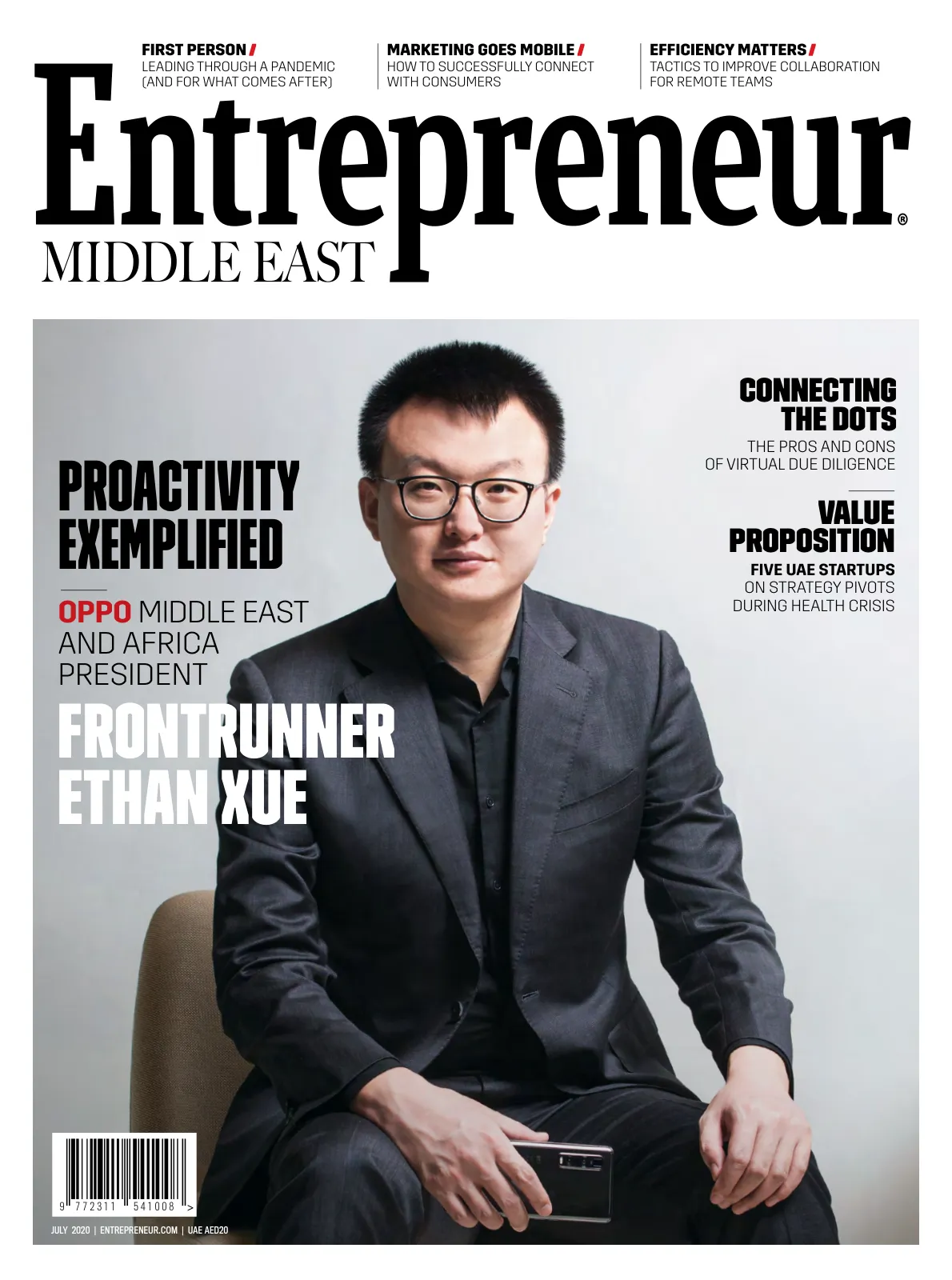
Entrepreneur Middle East, July 2020
Page 1
ETHAN XUE
FRONTRUNNER
OPPO MIDDLE EAST
AND AFRICA
PRESIDENT
PROACTIVITY
EXEMPLIFIED
JULY 2020 | ENTREPRENEUR.COM | UAE AED20
9
7 7 2 3 1 1
5 4 1 0 0 8
>
CONNECTING
THE DOTS
VALUE
PROPOSITION
FIVE UAE STARTUPS
ON STRATEGY PIVOTS
DURING HEALTH CRISIS
THE PROS AND CONS
OF VIRTUAL DUE DILIGENCE
FIRST PERSON
LEADING THROUGH A PANDEMIC
(AND FOR WHAT COMES AFTER)
EFFICIENCY MATTERS
TACTICS TO IMPROVE COLLABORATION
FOR REMOTE TEAMS
MARKETING GOES MOBILE
HOW TO SUCCESSFULLY CONNECT
WITH CONSUMERS
Page 2
Page 3
Page 4
4 / ENTREPRENEUR.COM / July 2020
CONTENTS JULY 2020
18
INNOVATOR
PROACTIVITY
EXEMPLIFIED
Frontrunner Ethan Xue
OPPO Middle East
and Africa President shares
his advice for leaders.
18
42
MONEY
VC VIEWPOINT
Connecting the dots
Al Waha Fund’s Areije Al
Shakar looks at the pros
and cos of virtual due
diligence.
26
START IT UP
ECOSYSTEM
Catalyzing online
commerce
Visa’s COVID-19 CEMEA
Impact Tracker shows how
the COVID-19 pandemic
has radically altered how
customers interact with
businesses today.
14
EDITOR’S NOTE
By Aby Sam Thomas
50
START IT UP
Q&A
Value proposition
Aalia Mehreen Ahmed looks
into how five UAE startups
went about pivoting their
business models amid the
COVID-19 crisis.
40
CULTURE
LIFE
First person
Loretta Ahmad, founder
and CEO of Houbara Comms,
reflects on leading a company
through a pandemic.
32
‘TREPONOMICS
PRO
Making Milestones
Samir Ranavaya shares
10 lessons from 10 years of
running a business in the
Middle East.
57
START IT UP
STARTUP FINANCE
“We got funded!”
The story behind the recent
fundraising success of
MENA startups Ajar.
Ethan Xue, President,
OPPO Middle East and Africa
36 Acer ConceptD 3 Ezel
Page 5
5
July 2020 / ENTREPRENEUR.COM /
experience
downtown
living
The UAE’s most exciting new destination.
A journey of discovery for the whole family.
Where nature, fun and entertainment
come together.
800-Arada (27232)
arada.com
Page 6
Page 7
Page 8
Page 9
Page 10
10 / ENTREPRENEUR.COM / July 2020
CONTENTS JULY 2020
Samir Ranavaya, Managing
Director of Innerspace, shares 10
lessons from 10 years of running
a business in the Middle East
32
43
IN THE LOOP
DOUBLING DOWN
KBW Ventures, founded
by HRH Prince Khaled bin
Alwaleed bin Talal, has
participated in food tech
startup TurtleTree Labs.
48
‘TREPONOMICS
MARKETING
Marketing goes mobile
Surkus’ Bhaji Illuminati
on the secret to
successfully connecting
with consumers.
38
CULTURE
TRAPPINGS
‘Trep gear
The executive selection
for the entrepreneur
on your list that has
everything. Okay, maybe
for a little self-reward as
well.
60
‘TREPONOMICS
PRO
Weathering the storm
Pilar de Miguel Viera
explores why organizations
should take a customer-
first approach during
unprecedented times.
58
START IT UP
Q&A
Boots on the ground
Behind the scenes at
Dublin-headquartered
RentalMatics as it
expands into the Middle
East.
36
TECH
SHINY
#TamTalksTech
Gadgets and doodads
that you might’ve missed
out on, sourced by a tech
aficionado. Yes, it’s okay
to want them all… and
no, it’s not our fault.
52 Tabby, a buy-now-pay-later fintech startup launched in 2019 by
Hosam Arab, has raised US$7 million in a new round to propel its growth
and entry to the Saudi Arabia market.
Page 11
Ready to get
rewarded?
Join Radisson Rewards
for exclusive benefits
We can’t wait to welcome you as a member across our
six hotel brands and 1,100+ locations worldwide. Thank
you for choosing Radisson Hotels.
Award Nights
Use your points for stays - it’s that simple!
Members Only Rate
Save up to 10% when you book on
radissonhotels.com/rewards
More benefits
Including savings of up to 20% on food and
beverages, room upgrades for Elite members
and more
Join today at the front desk
or on radissonhotels.com/rewards
Page 12
12 / ENTREPRENEUR.COM / July 2020
SUBSCRIBE
Contact subscriptions@bncpublishing.net to receive
Entrepreneur Middle East every issue
EDITOR IN CHIEF Aby Sam Thomas editor@bncpublishing.net
CEO Wissam Younane wissam@bncpublishing.net
DIRECTOR Rabih Najm rabih@bncpublishing.net
CREATIVE LEAD Odette Kahwagi
MANAGING EDITOR Tamara Pupic
STARTUPS SECTION EDITOR Pamella de Leon
DIGITAL SOLUTIONS DIRECTOR Mahdi Hashemi mahdi@bncpublishing.net
GROUP SALES DIRECTOR – B2B GROUP Joaquim D’Costa
COLUMNIST Tamara Clarke
INTERN Aalia Mehreen Ahmed
PO Box 502511 Dubai, United Arab Emirates
P +971 4 4200 506 | F +971 4 4200 196
For all commercial enquiries related to Entrepreneur Middle East
contact sales@bncpublishing.net
All rights reserved 2020.
Opinions expressed are solely those of the contributors.
Entrepreneur Middle East and all subsidiary publications in the
MENA region are officially licensed exclusively to BNC Publishing
in the MENA region by Entrepreneur Media Inc.
No part of this magazine may be reproduced or transmitted in any
form or by any means without written permission of the publisher.
Printed by United Printing and Publishing
upp.ae
Images used in Entrepreneur Middle East are credited when necessary. Attributed use of
copyrighted images with permission. All images not credited otherwise Shutterstock.
CONTRIBUTORS
entrepreneur.com/me
ACCESS FRESH CONTENT DAILY ON OUR WEBSITE!
MIDDLE EAST
EntMagazineME
@EntMagazineME
Entrepreneur-me
EntrepreneurMiddleEast
EntMagazineME
EntMagazineME
EntMagazineME
MIDDLE EAST
In addition to our print edition, we’re bringing
you all sorts of industry news on our web
mediums. Joining us online means getting
relevant business and startup content in
real-time, so you’re hearing about the latest
developments as soon as we do. We’re looking
forward to interacting with our readers on all of
our social media and web platforms- like any
thriving business, we’re looking to give and take.
#TrepTalkME is already happening on all of our
digi platforms, and all good conversations go
both ways. See you on the web!
Loretta Ahmad
Areije Al Shakar
Fida Chaaban
Tamara Clarke
Bhaji Illuminati
Panos Linardos
Iba Masoob
Pilar de Miguel Viera
Page 13
FUN COMES
GUARANTEED
YOU DECIDE WHEN THE PARTY
STOPS WITH 24HR FOOD & DRINK.
NOW OPEN AT DUBAI DIGITAL PARK.
RADISSONHOTELS.COM/RED
Page 14
14 / ENTREPRENEUR.COM / July 2020
O
ne of the entertaining
aspects about our use
of video conferencing
platforms amid the
COVID-19 crisis is
how they offer, often
accidentally, a no-
filter look into how
we are going about
our lives and livelihoods today. Work-
ing from home over the course of the
coronavirus pandemic has meant that
we’ve had to juggle our personal and
professional lives from a singular set-
ting, and this has led us to quite a few
unfortunate (but almost always amus-
ing) moments where our dual selves
collide with each other.
I feel it’s safe to say that we’ve all
witnessed these kind of snafus by
now- consider, for instance, those viral
videos showing how kids interrupted
their parents’ live television interviews
on BBC and Sky News recently. Closer
to home, we’ve seen the son of UAE
Minister of State for International
Cooperation H.E. Reem Al Hashimy
make a cameo as she made a speech
for a high-level global conference con-
ducted online, and I’ve personally had
to deal with the meows of my pet cat,
Kat, come through on multiple Zoom
discussions that I have been moderat-
ing from my home.
Such moments, as funny as they
seem in hindsight, can be quite hor-
rific to experience in real time- I can
personally attest to the feeling of
absolute embarrassment that envelops
me when Kat makes an appearance on
my professional calls. But while I may
be cringing during these instances,
I’ve yet to experience anyone actually
making me feel that way about them
either- on the contrary, people have
been absolutely gracious and accepting
of these moments, with many of them
telling me that they have only made
me seem more relatable and easier to
identify with, especially given our cur-
rent circumstances.
Indeed, whenever Kat caused my
pretenses to fall in the middle of
my discussions, I found out that the
conversations I was having also turned
for the better- the discourses became
a lot more open and friendly, with the
resulting levity also allowing for can-
dor to take precedence over charisma
in the dialogues that we were having.
Stripping off the supposed norms that
are expected of these chats made it
possible for informal yet insightful
viewpoints to come into the limelight,
and that’s what ended up making it
an enriching experience for everyone
involved. And that’s something I’d
advise all you entrepreneurs to take
to heart in the times we live in today.
Let’s drop the act, let’s be real, and
let’s have everyone feel like they can
be themselves- without our judgment,
and with our support.
EDITOR'S NOTE
Strange circumstances make for quality takeaways
CANDOR OVER CHARISMA
Aby Sam Thomas
Editor in Chief
@thisisaby
aby@bncpublishing.net
Kat
Page 15
Page 16
16 / ENTREPRENEUR.COM / July 2020
Registration for Dubai trade licences
can now happen entirely via WhatsApp,
according to the latest announcement
by Virtuzone, a company setup specialist
in the UAE, and KIKLABB, the company
setup jurisdiction located in Port Rashid.
In addition to ease of opening a busi
ness in Dubai, the new service will also
transform how the licensing industry has
been traditionally managed.
Using the popular messaging service
WhatsApp, Virtuzone and KIKLABB pro
vide customers with a detailed step-by-
step licencing process, including quick
to fill and user-friendly forms that are
designed to be used on smartphones.
The new provision also facilitates a
channel for customer service (which
allows quotations, enquiries, requests)
that can be availed using email or phone,
and allows for payment links to be
shared.
Despite the adverse impact on indus
tries, due to the COVID-19 pandemic,
Virtuzone and KIKLABB have seen an in
crease in the demand for trade licences
in the first half of 2020.
“KIKLABB and Virtuzone are leaders
within their respective fields, and with
the use of WhatsApp, it’s never been
easier to set up and register a business,”
commented Tasawar Ulhaq, CEO of
KIKLABB.
“WhatsApp has become the most
popular form of communication among
our clients and by facilitating the entire
company formation process via this
platform, we not only ensure social
distancing in times of COVID-19, we also
make it as convenient as possible to set
up a business in Dubai,” added George
Hojeige, CEO of Virtuzone.
facilitate new service that will
allow you to register for a Dubai
Trade License using WhatsApp
Virtuzone and KIKLABB
Dubai Chamber launches business mentoring and support
program to help SMEs navigate impact of COVID-19
Responsible business
D
ubai Chamber of
Commerce and
Industry has launched
its Business Mentoring
and Support Program
(BMS), a CSR initiative which will
pair large corporations with SMEs
in Dubai that require ongoing
support and mentorship in light
of the new challenges from the
COVID-19 pandemic.
The program, established
by Dubai Chamber’s Centre
for Responsible Business, will
match SMEs with companies
offering professional advice and
resources tailored for their needs,
and help strengthen business
efficiency. At the same time, it
provides an avenue for large
corporates to broaden their CSR
impact and contribute in giving a
hand to Dubai’s entrepreneurial
ecosystem and economy.
The program also aims to create
a business support platform that
fosters stronger links between
large companies and SMEs in
Dubai. Dr. Belaid Rettab, Senior
Director, Economic Research
and Sustainable Business
Development Sector, Dubai
Chamber, notes that it will offer
other benefits for participants
such as recognition, training, CSR
support, mentorship and business
partnerships.
First up who will launch the
first initiative supported Dubai
Chamber’s BMS Program is The
Coca-Cola Company, which will
introduce its Open Like Never
Before initiative. The company will
donate 250,000 face masks and
US$240,000 worth of products
to 3,000 restaurants and small
stores across UAE. Coca-Cola
will also advise retailers with
in-store safety communications
and social awareness campaigns
to encourage customer
engagement.
For companies interested in participating
in Dubai Chamber’s BMS program, contact
the team at:
responsiblebusiness@dubaichamber.com
IN THE LOOP
Page 17
Page 18
18 / ENTREPRENEUR.COM / July 2020
INNOVATOR
18 / ENTREPRENEUR.COM / July 2020
Page 19
19
July 2020 / ENTREPRENEUR.COM /
ETHAN XUE
FRONTRUNNER/
OPPO MIDDLE EAST AND AFRICA PRESIDENT
PROACTIVITY
EXEMPLIFIED
PROACTIVITY EXEMPLIFIED | FRONTRUNNER ETHAN XUE
by ABY SAM THOMAS | PHOTOGRAPHY FAROOQ SALIK
19
July 2020 / ENTREPRENEUR.COM /
“本分” (pronounced “benfen”) is a Chinese term that refers
to one’s willingness to take responsibility, and this is one of the
principles that Ethan Xue, President for the Middle East and
Africa (MEA) at OPPO, shares with me when I ask him about
the ideals that he’d recommend fellow business leaders to keep
in mind as they go about leading their enterprises. Now, this is
a rather small detail from the wide-ranging interview I had with
Xue, but given the times we are living through right now, it was
this sentiment he shared that particularly struck me, especially
when he explained how one could go about exemplifying
“本分” (which, by the way, is also one of OPPO’s core values)
in our day-to-day lives and businesses: “When issues emerge,
be the first to take responsibility, and act proactively.” >>>
Page 20
20 / ENTREPRENEUR.COM / July 2020
Xue, who is originally from China, has
been leading OPPO’s MEA operations
since August last year, but he’s been
working with the company for the past
eight years- he reveals that he joined the
Dongguan-headquartered enterprise in
2012 right after his graduation, and he’s
since worked his way up in a variety of
different roles there. Prior to his current
role, Xue previously led the marketing
team in China for the 2018 launch of
Reno, one of OPPO’s premium series of
smartphones, and he is today tasked with
leading all of the company’s sales and
marketing teams based in the MEA re
gion. When asked to describe his duties
as OPPO’s President for the MEA region,
Xue replies, “My main focus is to under
stand the local market needs (includ
ing culture and consumer behaviors),
management of our well-selected talent
for the MEA team, and relationships
between OPPO and our local partners.”
As a brand, OPPO is per
haps primarily known for
its smartphones- from the
aforementioned Reno line,
to the recently launched
Find X series, its devices
have found favor with
an audience around the
globe- Gartner had ranked
it fifth in its list of top
five smartphone brands
in the world for the first
quarter of 2020. But
smartphones aren’t the
only thing that OPPO has
under its banner. “There
is no doubt that smart
phones are now contrib
uting the biggest profits
in this market; however,
OPPO is expanding,” Xue
says. “Our products range
from smartphones to
IoT (Internet Of Things)
products- we’ve launched
our first wireless ear
phones and smartwatch
earlier this year, and they
will hit the local markets
very soon. And that is not
the end of the story- as
the world’s leading smart
device manufacturer and
innovator, we’d like our users to see
technology as an art form, and provide
them with products that can truly affect
the way they live.”
OPPO’s latest release in the region has
been the Find X2 Pro, with reviews large
ly casting it as one of the best Android
phones you can buy right now. Given his
role at OPPO, it’s to be expected that Xue
would echo this sentiment- however,
there is still something rather relat
able as he voices his excitement about
the device. “I really fancy the black
ceramic back of the Find X2 Pro,” Xue
says. “The first time I touched it, I was
very impressed by the unusual texture.
And the journey of surprise only starts
there. You will love it more when you
find that you can take great photos of,
say, running kids, even at night, or when
you suddenly realize that taking notes is
now never a problem- Find X2 Pro can
transfer an image to text with a blink!
This is the phone for people who care
about work-life balance, who want an
easier life, without compromising the
quality of their communication and daily
activities.”
OPPO made its debut in the MEA re
gion when it joined the Egyptian market
place in 2015, and a hub for the region
was set up in Cairo the next year. In
2019, the brand decided to make Dubai
the center of its operations in the region-
Xue says this was done because the UAE
and Saudi Arabia were the key countries
OPPO wanted to focus on in the region in
2020. “I’m pleased to see that the Can
alys Q1 2020 report indicated that OPPO
is now ranking fifth amongst smartphone
vendors in Middle East,” Xue says.
“Meanwhile, we also scored the high
est year-on-year growth (214%) when
comparing all the brands.” While OPPO’s
success in the local market can be drawn
back to a variety of reasons, Xue points
out that the brand’s efforts in under
standing the region and the multicultural
people who live in it has been especially
key. “The MENA region is a market full of
opportunities for people who dare to try
and always think about local users before
they act,” Xue declares.
This is a philosophy that Xue has inte
grated into his leadership strategy for his
team in the region as well. “A good leader
should be humble, and have a generous
heart to welcome team members with
comprehensive backgrounds and believe
in them,” Xue says. “As the leader of the
MEA market, where we have both Chi
nese employees from our headquarters as
well as from the region, respecting each
other and respecting the local market, is
the bottom line for us to operate here.
I encourage all team members to get to
know each other well, and get to know
the market from a deeper perspective,
which means that they need to be always
INNOVATOR
“I ENCOURAGE ALL TEAM
MEMBERS TO GET TO
KNOW EACH OTHER WELL,
AND GET TO KNOW THE
MARKET FROM A DEEPER
PERSPECTIVE.”
Ethan Xue, President,
OPPO Middle East and Africa
Page 21
21
July 2020 / ENTREPRENEUR.COM /
willing to try new things, while also
never stopping learning from the past.”
And when it comes to making sure his
team feels motivated and supported,
Xue believes that a clearly defined goal
is absolutely integral to achieving that.
“Based on my personal experience of
taking management roles, setting up
the right goal at the very beginning
can affect the whole team and their
morale all the way to the end,” he says.
“Rumors that lead to negative feelings
will travel fast inside the team when
they cannot see the finishing line, and
as a consequence, that will see them
achieve less than expected as well.”
But Xue also notes that once goals
are set for the team, they should be
allowed to realize them at their own
paces- undue pressure from leaders
in the beginning can have a negative
impact rather than a positive one.
“Passion can be stimulated when
people get near to realizing a goal,” he
says. “So, it’s important for leaders
not to push too hard at an early stage-
we’ll get there when we get there.”
It should be clear here that Xue is
not a fan of micromanaging when it
comes to leading teams- he subscribes
instead to the belief that leaders create
leaders. “Good leaders should always
trust their teams,” he declares. “I’m
not talking about just believing in their
skills; of course, that’s the bottom line.
But the trust that I’m talking about is
allowing team members to make deci
sions, so that they feel like they really
belong to the team. They will also be
bonded together via responsibilities
of the decisions that they made. You
may also see that as a trick to retain an
excellent executive team, as each one
of them can have a sense of personal
achievement at the end of the day, but
at the same time, they are also willing
to share with each other.”
At this point, it’s worth noting that
my conversation with Xue is happen
ing as the world continues to grapple
with the effects of the global corona
virus pandemic, and much like every
one else, he too has been personally
affected by the COVID-19 crisis. “The
last time I hugged my parents or met
with my friends back in China was
half a year ago… I miss my hometown
so much,” Xue admits. Of course,
the business landscape in which Xue
operates has been rattled too by the
COVID-19 crisis- Gartner says that
global sales of smartphones to end
users have declined by 20.2% in the
first quarter of 2020, with OPPO be
ing one of the brands (alongside Sam
sung, Huawei, and Apple) that had
registered these falls in demand. But
there are opportunities to be found in
crises as well, Xue notes.
“We’ve witnessed the massive
potential of e-commerce because of
the widespread COVID-19 situation,
and it is quite impressive to me that
so many brands and platforms are
switching the way they do business
with such remarkable speed,” Xue
says. “OPPO is one of them- apart
from the CSR campaigns we did with
media and third party organizations,
we’ve achieved satisfactory results
in the past quarter, and I’m look
ing forward to the performance of
e-commerce department. In addi
tion, COVID-19 reshaped consum
ers’ purchase behavior- they’re now
tending to spend more time browsing
online content, while also starting to
pay attention to physical and mental
health. I think this is a sign for us to
invest even more on social platforms,
and also enhance offline experiences
to attract consumers who will now
evaluate shopping experiences with a
higher standard.”
“The MENA region is a market full of
opportunities for people who dare
to try and always think about local
users before they act.”
OPPO launches the Find X2 Pro
in the UAE
A true flagship experience
OPPO has announced the launch of its much-
awaited flagship smartphone, Find X2 Pro, in
the UAE in partnership with Etisalat. Packed
with the game-changing 5G technology, a
pioneering camera system, and the most
advanced screen in the industry, Find X2 Pro
has been declared to be “an embodiment of
design elegance that delivers OPPO’s industry-
setting ultra-premium experience.” The coveted
flagship was made available in its black
ceramic model with 512GB ROM at Etisalat
stores across the UAE and Etisalat website
from June 18, 2020 for AED4,999. The Find X2
Pro smartphone is powered by OPPO’s most
powerful triple-camera system that adopts a
Sony IMX689 48MP primary camera, a 48MP
ultra-wide-angle lens, and a 13MP telephoto
lens. With a 5G-ready Snapdragon 865 chipset,
a smooth 120Hz refresh rate, 3K QHD+ Ultra
Vision Screen that is capable of displaying over
one billion colors, and an innovative 65W Super
VOOC 2.0, the fastest charging technology in
the industry, the OPPO Find X2 Pro has been
designed to deliver a true flagship experience.
PROACTIVITY EXEMPLIFIED | FRONTRUNNER ETHAN XUE
>>>
Page 22
22 / ENTREPRENEUR.COM / July 2020
“A GOOD LEADER SHOULD
ALWAYS PUSH THE
BOUNDARIES AND BREAK
RULES- YOU CAN’T IMAGINE
THE NUMBER OF TIMES
I’VE UPGRADED MEETING
AGENDAS WITH DIFFERENT
DISCUSSIONS!”
INNOVATOR
Ethan Xue, President,
OPPO Middle East and Africa
Page 23
23
July 2020 / ENTREPRENEUR.COM /
“it’s important for leaders not to
push too hard at an early stage-
we’ll get there when we get there.”
THE EXECUTIVE
SUMMARY
Ethan Xue, President -
MEA, OPPO, shares his advice
for leaders
1/ Don’t limit the definition of learning
“Don’t define learning as just as going
to a forum, a keynote, a workshop, an
e-learning exercise, etc. Learning can
sometimes be done by just paying
attention to the latest television shows,
toys that your kids like to play with,
etc.- simple, everyday observations and
thinking can provide fresh perspectives
to look into the market and users.”
2/ Build your network early on
“In business, you cannot overstate the
importance of support you can get
from people you know from way back in
your career. Remember to keep in touch
with them- that can also help refresh
your interpretation of the market
sometimes.”
3/ Use positivity as a tool
“Fuel your team with compliments. It’s
always good to show your appreciation
and trust as a leader, because when
morale is high and people are confident,
you will be surprised to see that there
is still so much space for them to climb
higher up.”
4/ Consider your past ambitions
“Instead of comparing the kind of job
or business you wanted to do when
you were a kid and your current state,
revisiting a childhood dream can
remind you of the kind of person you
wanted to become- understanding the
reason behind it may call back a lost
soul, and it’s a good way to review your
practice of enterprise as well.”
5/ 本分
“Pronounced ‘benfen,’ this is a Chinese
term which is one of OPPO’s core
values, and it means being willing to
take responsibility. So, when issues
emerge, be the first to take the
responsibility, and act proactively.”
PROACTIVITY EXEMPLIFIED | FRONTRUNNER ETHAN XUE
Xue is thus clearly optimistic about
what the future holds for OPPO in
the MEA region, with him believ
ing that his company’s innovations
are certain to find an audience here.
“I come from a country where the
internet has an impact on almost
every aspect of life,” he says. “Peo
ple browse online when they have to
hunt for a nice restaurant, call a cab,
book a ticket, or get bored- the young
generation there cannot live without
technology. And after spending some
time in the MEA region, I see similar
great opportunities here- the demand
for technologies that can switch life
styles from offline to online is boom
ing, and this applies to everything
from software developments to smart
devices. COVID-19 has perhaps even
accelerated the trend, and as such, it
is, for sure, a good time to make the
maximum use of it.”
When asked about the kind of
innovations one can expect from
the OPPO brand in the future, Xue
points toward the user-centric
nature of his company to answer
that. “Some people tend to define
innovations as groundbreaking
technologies or shocking functions
that can change your life. From my
point of view, innovation can also
focus on minor changes, such as, say,
slightly moving up the position of a
button- the kind of changes where
users will benefit, and OPPO always
put the demand of users ahead
of everything.” From a personal
standpoint though, Xue is looking
forward to enabling his team to
think both daringly and differently
to ensure OPPO’s prosperity on the
road ahead. “A good leader should
always push the boundaries and
break rules- you can’t imagine the
number of times I’ve upgraded
meeting agendas with different
discussions!” Xue says. “After all,
an idea from a chat over lunch could
spark the innovation for the next
generation of products- who knows!”
“We’ve witnessed the massive
potential of e-commerce
because of the widespread
COVID-19 situation.”
OPPO Find X2 Pro
IMAGE COURTESY OPPO
Page 24
What do you think are the three most
important facets of Radisson Hotel
Group in the MENA region, especially in
the current market climate?
Our development team is at the heart
of our growth strategy, and they all are
individually and collectively translating
it to execution. We have created a dual
approach regarding our growth strategy
in particular for Africa. One part con
centrates on focus countries, while the
other centers around creating clusters;
both resulting in critical mass and a
scale strategy.
Each member of our development
team leads through this approach with
both the proximity of their geographical
zone, as well as, and very importantly,
their cultural and language understand
ing, reinforcing our alignment with each
focus market- North Africa, Franco
phone, and Anglophone Africa.
Another significant factor which drives
our ability to succeed in establishing
long-term partnerships with our invest
ment community is our responsiveness-
always quick to provide answers and
support, our pragmatic design approach,
our transparency throughout the pro
cess, in combination with our continu
ous guidance throughout each phase,
including construction and financing.
Can you explain how the aforemen
tioned factors relate to and comple
ment the brand value of the Group?
At the heart of Radisson Hotel Group is
our brand promise– every moment mat
ters. It is simply how we do business, and
who we are at the core.
Relating to our core beliefs, I think the
following reflects what makes us apart,
but also the reason why many investor,
guests, and employees have decided to
either work or stay with us.
On our people– we grow talent, and
talent grows us. This shows the trust
and empowerment in every single team
member we demonstrate, but also the
mutual humility in allowing new thinking,
innovative ideas and constant desire for
improvement.
On our relationships– we value open
and direct interactions to build trust.
We have always shown transparency
in our business dealings, and we value
honest and open discussions in every
partnership we enter into, but we have
also learned to listen to feedback, fur
ther improving our offerings and tailored
solutions.
Finally, on our diversity– we are many
minds with one mindset. We believe in
cultural diversity, and we operate in most
countries further translating our ambi
tions to become a true global catalyst of
growth, inclusion, and opportunities.
Have the past few months affected
Radisson’s pipeline, and what do you
think the long-term effect will be on the
MENA hospitality industry?
We have obviously witnessed delays
on sites due to the lack of movement of
goods, but also of people. Some coun
tries have had more restrictions than
others, but overall, we have seen most
of our pipeline in line with schedule,
with delays not expected to exceed six
to nine months. A natural decision is to
reassess the timing of opening, as while
a property could be completed on time,
it is also important to ensure its opening
in a positive commercial environment, so
that preservation of cash and liquidity is
ensured to our owners.
ADVERTORIAL
Redefining hospitality
Ramsay Rankoussi
“At the heart of Radisson Hotel Group is our brand promise– every moment
matters. It is simply how we do business, and who we are at the core.”
Vice President and Head of Development for Africa and Turkey, Radisson Hotel Group
H
aving been part of the Radisson Hotel Group for over six years leading
its development efforts in various mandates, Ramsay Rankoussi was
recently appointed the enterprise’s Vice President and Head of Develop
ment for Africa and Turkey, after previously overseeing its strategic
growth across the Middle East, Turkey, and French-speaking Africa. In an
interview with Entrepreneur Middle East, Rankoussi shared his thoughts on the road
ahead for Radisson, as well as the hospitality industry as a whole:
24 / ENTREPRENEUR.COM / July 2020
Page 25
ADVERTORIAL
Our growth objectives remain unchanged
for the region, but Africa will represent
the biggest land of opportunities, while
the Middle East will represent a priority of
conversions of operating hotels willing to
join our network. Across the African conti
nent we are working on offering tailored
solutions for green-fields and takeovers,
and we are geared up to further acceler
ate our growth journey in key countries.
What sectors and geographies do you
see the biggest demand for hotels in
the MENA region right now, and which of
Radisson’s brands complement them?
Egypt and Morocco represent two of our
focus countries in the region, and the op
portunities exist in every segment– from
the midscale Park Inn by Radisson brand,
to the upscale Radisson but also lifestyle
Radisson Red, our core upper-upscale
brand Radisson BLU, but also our entry
level luxury, Radisson Collection.
Morocco is one of our top priorities, as
we seek to accelerate our presence from
two operating hotels to over 15 hotels
within the next five years. We will also
focus on reinforcing our operational
strength in the holy cities of Makkah
and Madinah with the ambition to reach
over 5,000 rooms in the coming years
between the two. Our
regional strategy remains
on creating scale further
helping us to translate
clustering efficiencies
across every segment we
represent.
Finally, what’s your out
look for the hotel group
for the rest of 2020?
The priority for everyone is
the preservation of capital
and liquidity, as cash flows
are negatively impacted
with the reduction or ab
sence of any inflows dur
ing the various lockdowns.
Both owners and opera
tors will work hand in hand
to protect their capital, but
also minimize the impact
on employees to preserve
as much as possible job
safety and security during
these difficult times.
Our ambitions across the
region remains the same,
and we are further accelerating our
development priorities to assist owners
in needs with conversion solutions and
creative commercial offerings. There will
also be an acceleration of newer technol
ogy that was ongoing, but now will just be
implemented at a faster pace and across
many touch points of the industry.
LEADING THE WAY
Ramsay Rankoussi, Vice President and Head of Development for Africa and Turkey, Radisson Hotel Group
Based in Dubai, Ramsay leads Radisson Hotel Group’s strategic
growth across Africa and Turkey with a team based in Dubai
and Cape Town. Ramsay Rankoussi has been with the company
for more than six years and has recently been appointed to
lead Radisson Hotel Group’s growth in Africa. The appointment
reinforces Radisson Hotel Group’s confidence that Africa
continues to be a region of growth.Tasked with increasing the
Group’s hotel portfolio and footprint in his assigned markets,
the Group’s largest geographical area, Ramsay is an expert
dealmaker, leading transactions from sourcing through to
execution.
Radisson Hotel Group’s development and growth strategy in
Africa follows a two-fold approach. The first part concentrates
on focus countries while the second centers around creating
key hubs. By creating a mass city scale development strategy
with a focus on key countries and surrounding markets
including Morocco, Egypt, Nigeria and South Africa, the group’s
‘hub approach’ ensures synergy among neighboring countries
and creates further value for its hotels, in terms of both
development and operations. Each member of Radisson Hotel
Group’s development team is a leader in this approach because
of their geographical proximity as well as their local cultural
knowledge and linguistic understanding of each focus market.
Ramsay is proficient in legal contract negotiations, due
diligence, and financial analysis. He oversees the underwriting,
strategic planning, investment analysis and asset management
activities for all type of deal structuring, including conversions
and take overs, financial commitments, franchise and straight
management agreements. A Belgian national, Ramsay is fluent
in multiple languages and with a multi-cultural background.
He holds a Bachelor’s degree in Business Administration and
an MBA specialized in Hotel Real Estate Finance and Asset
Management from the ESSEC Business School (IMHI) in Paris.
radissonhotelgroup.com
Radisson Blu Hotel, Cairo Heliopolis
Hormuz Grand, A Radisson Collection Hotel
Hormuz Grand Muscat Waterside Terrace
Page 26
26 / ENTREPRENEUR.COM / July 2020
Visa’s COVID-19 CEMEA Impact Tracker shows
that the COVID-19 pandemic has radically altered
how customers interact with businesses today by TAMARA PUPIC
CATALYZING
ONLINE/COMMERCE
START IT UP ECOSYSTEM
Page 27
27
July 2020 / ENTREPRENEUR.COM /
N
othing
lasts
forever”
has
been a
popular
say-
ing for
a long
time,
but it
seems
that, in our current circum-
stances, business owners are
contemplating its truth more
strongly than ever before. After
all, the global COVID-19 pan-
demic seems to have changed
the face of commerce, with the
recently released COVID-19 CE-
MEA Impact Tracker by Visa,
which surveyed merchants and
consumers throughout the CE-
MEA region, showing that the
crisis has absolutely altered
the way customers interact
with businesses today.
The survey stated that
the impact of the pandemic
on merchant revenues and
profits has been high in all
regions, with merchants in
the Kingdom of Saudi Arabia
being hit the worst, and South
African retailers being only
slightly more resilient. When
asked to assess their custom-
ers’ purchase frequency during
the COVID-19 crisis, mer-
chants across all regions re-
ported a decrease, with the
UAE and Russia seeing the
highest dips at 86% and 84%
respectively, and South Africa
the lowest, with two-thirds
(66%) of merchants recording
a decrease and 27% seeing an
increase in customer visits.
“As we have seen in our report,
merchants are understand-
ably anxious about the future
with economic uncertainty and
changing shopper behavior,”
noted Marcello Baricordi,
Group General Manager -
MENA, Visa.
It’s in response to this senti-
ment that throughout this
crisis, and after it, Visa has
been committed to helping
small and micro businesses
bounce back from COVID-19.
“As a company that enables
digital payments at more than
61 million merchant loca-
tions around the world, Visa’s
priority is to help small and
medium businesses thrive
at every step,” Baricordi
explained. “Globally, Visa is
committed to digitally enable
50 million small businesses to
power recovery in communi-
ties worldwide. Regionally,
we’ve already launched our
SME focused campaigns in the
UAE and Pakistan, which are
really focused on helping SMEs
have the tools they need to
hasten recovery.”
This is the reasoning behind
Visa’s latest initiative, “Where
You Shop Matters,” which is
centered on encouraging con-
sumers in the UAE to support
the country’s small businesses.
One of the facets of the cam-
paign is Visa’s Small Business
Hub, a platform that equips
merchants with information
toolkits for digital growth as
well as resources on how to
move to new digital ways of
working and, eventually, aid in
their business recovery. “For
small businesses looking to get
back on their feet, it is impor-
tant to adopt and embrace new
ways of working, integrate digi-
tal solutions, spruce up your
e-commerce offerings while
making sure the foundation
of great security is in place to
give consumers a great smooth,
secure, and frictionless experi-
ence,” Baricordi said.
But there’s been some silver
linings even amid this crisis,
as noted by the co-founders of
Little Majlis, an online arts
CATALYZING ONLINE COMMERCE | VISA’S COVID-19 CEMEA IMPACT TRACKER
1
COVID-19 CEMEA Impact Tracker
COVID-19 CEMEA Impact Tracker
“
"CONTACTLESS PAYMENTS WILL PLAY A
MAJOR PART IN YOUR RETURN TO BUSINESS.
UNDERSTANDING AND PLANNING FOR
THIS IS ESPECIALLY CRUCIAL FOR SMALL
BUSINESSES IN THE REGION.”
Marcello Baricordi, Group General Manager, Middle East and North Africa, Visa
IMAGES COURTESY VISA
>>>
Page 28
28 / ENTREPRENEUR.COM / July 2020
and crafts marketplace based
out of the UAE. “Since we
launched eight years ago, our
intent has been to cham-
pion locally made and make
it the norm, rather than the
exception,” said co-founder
Anna Bolton-Riley. “These
days, with border restrictions
in place and a sense of the
unknown prior to and dur-
ing the height of the current
coronavirus wave peak, both
existing and new corporate
clients sought out Little Majlis’
services and products, as a
more reliable and manageable
approach to gifting.”
Indeed, co-founder Anna-
belle Fitzsimmons noted that
when Dubai Duty Free faced
difficulties with their sup-
ply chain of products sourced
from abroad in the early days
of the coronavirus pandemic,
it was Little Majlis to whom
the retailer turned to when
they wanted to stock up their
shelves. Unfortunately, the
restrictions around movement
in Dubai and the temporary
closure of Dubai Duty Free
happened soon after- but
Fitzsimmons still believes this
to have been a win for her
homegrown enterprise. “While
this is a short-term setback,
we can’t lose sight of the fact
that without the pandemic,
the advantages of ‘Made in the
United Arab Emirates’ may not
have been so convincing, and
we wouldn’t be looking for-
ward to the world opening up
again, and #MadeInUAE being
promoted to a global audience
at this prime retail location,”
she said.
This crisis, Fitzsimmons
added, has also shown that the
overall support given to the
SME community in the UAE
has not been diminished. “We
have worked hard to build a
strong base of quality repeat
wholesale, retail, and corporate
clients who share an aligned
vision,” she explained. “In the
months prior to the pandemic,
we were getting more and more
corporate enquiries for locally-
made products. We reached
out to these entities during the
height of the crisis, reminded
them that we were open for
business, and ready to service
their needs. As the movement
restrictions started to ease, we
began collaborating on some
unusual projects, including
some fun ‘welcome back’ office
gift sets. Never did we think
that face masks and quirky
face mask stickers would be on
our product delivery list.”
Raed Hafez, CEO, el Grocer, a
Dubai-based grocery market-
place platform, also reports
that the COVID-19 crisis has
changed how their business is
perceived- for the better. “Our
business is built to focus on
high density populated areas,
and this is how we get the best
return on our investment,”
Hafez said. “However, dur-
ing the COVID-19 movement
restriction period, our service
offering was no longer driven
by need for convenience, it be-
came an essential service and a
necessity. We were approached
by government bodies to
ensure that the continuity
and increased coverage of our
service. Given this new ‘mis-
sion,’ we looked at expanding
our network coverage to ensure
that everyone has the option
of ordering their groceries
through el Grocer, rather than
risking their health to battle
the crowds in the stores. We
worked with our retailers to
identify the gaps, and made
How would you gauge the
impact of COVID-19 crisis on
revenue / profit so far for your
business / store?
UAE
59
66
64
54
55
15
26
4
28
14
3
21
12
3
27
4
24
16
3
1
KSA
RUSSIA
UKRAINE
SOUTH AFRICA
High impact
Medium impact
Low/No impact
Difficult to assess
83
93
85
83
70
Sum of High + Medium impact
Impact on merchant revenues and profits has been high in all
regions, with KSA merchants worst hit, and South African retailers
only slightly more resilient
Based on your experience with
the business, what is your
assessment of your customers’
purchase frequency DURING
this COVID-19 crisis?
UAE
86
70
84
81
66
7
27
7
12
9
7
14
16
9
5
KSA
RUSSIA
UKRAINE
SOUTH AFRICA
Decrease
Stable
Increase
CHARTS COURTESY VISA’S COVID-19 CEMEA IMPACT TRACKER REPORT
START IT UP ECOSYSTEM
Page 29
29
July 2020 / ENTREPRENEUR.COM /
sure that every town had at
least one retailer available to
order from. Our grocery mar-
ketplace was the first and only
online grocery business that
covered 100% of the UAE.”
Another consequence of the
COVID-19 crisis is that it has
brought many new shoppers
online. According to Visa’s
COVID-19 CEMEA Impact
Tracker, two-thirds of UAE
consumers (68%) and Saudi
consumers (66%) and 71%
of Kenyan consumers say that
COVID-19 has led to their first
online grocery shopping, while
70% of those surveyed in UAE
and 69% in Kenya are making
their first online purchases
from pharmacies. Plus, this
crisis has driven nearly two-
thirds of consumers in the UAE
(68%) and Saudi (66%) to do
their shopping online for the
first time.
Another study showed why
the UAE has been so well-
equipped to handle this in-
creased demand. A recent anal-
ysis by the Dubai Chamber of
Commerce and Industry based
off latest data from Euromoni-
tor showed that the UAE’s
e-commerce sector has been
comparatively more success-
ful than in more than 38 other
advanced and emerging market
economies. Comparing the per-
centage of goods that are not
in stock, levels of inventory for
their major e-commerce plat-
forms, and daily percentage of
stock keeping units that were
marked as “goods not avail-
able” on the retailer websites
for each country, the Dubai
Chamber analysis revealed that
the UAE adopting supportive
government initiatives, having
modern infrastructure, and
strengthening its evolving lo-
gistics sector have all contrib-
uted towards building a strong
supply chain and addressing
current e-commerce challenges
effectively.
In a nod to these stats, Hafez
pointed out that the future
grocery shopping missions will
be driven by a mix of conveni-
ence and reliability. “The cus-
tomer will continue to demand
top selections and variety of
products and offerings,” he
said. “However, the customer
will also demand a high level of
dependability and consistency.
Their purchasing is recurring,
and in order for el Grocer to
earn and keep their trust, [it]
requires a service level that
goes well beyond providing the
best pricing or promotions.
Further, our target customer
is no longer just the digital
native. Our customers span all
demographics. Our tech and
service must be intuitive to all
users, no matter how comfort-
able they are with technology
and digital services. Finally,
ensuring that food and grocery
supplies are available to all
citizens redefined our mission
and highlighted the need for
business continuity planning
even for a startup like ours. We
are now well connected with
the authorities to deal with
any new guidelines and regula-
tions immediately.”
Apparently, merchants across
the MENA region are following
in el Grocer’s footsteps- more
than a third of merchants in
KSA (38%) reported that they
had acquired an e-commerce
platform as a direct result
of COVID-19, while 93% of
merchants in Ukraine and 91%
of those in UAE had estab-
lished their platforms before
the pandemic. A majority of
merchants in all markets are
optimistic that consumer use
of online services will grow
after the pandemic ends, with
WHEN ASKED TO ASSESS
THEIR CUSTOMERS’ PURCHASE
FREQUENCY DURING THE COVID-19
CRISIS, MERCHANTS ACROSS ALL
REGIONS REPORTED A DECREASE,
WITH THE UAE AND RUSSIA
SEEING THE HIGHEST DIPS AT
86% AND 84% RESPECTIVELY,
AND SOUTH AFRICA THE LOWEST,
WITH TWO-THIRDS (66%) OF
MERCHANTS RECORDING A
DECREASE AND 27% SEEING AN
INCREASE IN CUSTOMER VISITS.
GOING ONLINE
GOES WELL
BEYOND
OFFERING
A WEBSITE
OR AN APP.”
Raed Hafez, CEO, el Grocer
CATALYZING ONLINE COMMERCE | VISA’S COVID-19 CEMEA IMPACT TRACKER
>>>
Page 30
30 / ENTREPRENEUR.COM / July 2020
this conviction particularly
apparent in KSA, where 80%
of merchants predict an in-
crease in use after the COVID
crisis.
However, Hafez advises all
not to underestimate the work
required for a business to go
online. “Going online goes
well beyond offering a website
or an app,” he said. “It’s a
complete set of activities
and services that must work
hand in hand seamlessly to
provide a fluid and comfort-
able service to the customer.
It’s important to partner with
a professional service provider
who can provide the full of-
fering including customer ac-
quisition, logistics, customer
service and technology. Each
industry got impacted differ-
ently, and the lasting effect
will vary drastically from one
sector to another. However,
one thing is common: digital
transformation is no longer a
‘nice to have.’ The business’
ability to continue offering its
products and services must
be consistent regardless if the
customer is present physically
or virtually at its premises.
This must be well planned
and executed across all cus-
tomer touchpoints.”
Another important fact
that businesses cannot avoid,
Baricordi says, are contact-
less payments. Today, VISA
reports that more than half of
the transactions in the UAE
are contactless, while in Saudi
Arabia that figure is even
higher at 89%. “Amid social
distancing guidelines, there’s
been a fast-growing demand
for contactless payments on
cards and on mobile phones,
because consumers prefer
the speed and convenience
of it and trust its security
features,” Baricordi said. “We
can expect the popularity of
contactless to be sustained
and further increase post-
pandemic. And therefore, if
you are an existing business,
contactless payments will play
a major part in your return to
business. Understanding and
planning for this is especially
crucial for small businesses
in the region.” Furthermore,
Visa’s COVID-19 CEMEA
Impact Tracker showed an
assumption that merchants
who claim contactless will
increase in preference among
consumers, since contactless
is gaining at the expense of
cash. In Saudi Arabia, 43% of
merchants said they have seen
a decline in the use of cash,
while 80% have witnessed a
rise in contactless.
In conclusion, Baricordi
advises that anyone look-
ing to set up shop in a post
COVID-19 era should bring
their A-game to online busi-
ness development to ensure
business sustainability and
longevity. “It is clearly evident
that small businesses which
adopted digital solutions
were the ones that were able
to survive and thrive during
the worst of the COVID-19
lockdowns,” he said. “Inte-
grating digital solutions at
the start allows for a seamless
introduction and consumer
journey which is more likely
to build customer loyalty. In
fact, for a new small business,
it is relatively easier to prior-
itize digital solutions across
their supply chains, logistics,
e-commerce, and digital pay-
ments, as they are free of the
burden of legacy systems and
processes.” In effect, the road
ahead is clear: it’s time for all
businesses to deploy a digital-
first strategy.
THE EXECUTIVE SUMMARY
MARCELLO BARICORDI,
GROUP GENERAL
MANAGER – MENA, VISA
Customer experience
matters “Small merchants
need to look at how to
enhance their online
avenues/e-commerce
offerings to remain popular
with regular customers, and
acquire new ones too.”
Prioritize contactless
payments “Sellers that still
use cash on delivery as the
primary mode of payment
need to swiftly implement
a contactless consumer
journey to stay in the
game.”
Security shouldn’t be
ignored “With increased
reliance on digital
commerce, cybercriminals
have been preying on more
vulnerable first-time online
shoppers. And therefore,
making customers
feel secure online and
educating them about safe
payment behavior is critical
to building trust in an
e-commerce offering.”
"WITHOUT THE PANDEMIC,
THE ADVANTAGES OF
‘MADE IN THE UNITED ARAB
EMIRATES’ MAY NOT HAVE
BEEN SO CONVINCING,
AND WE WOULDN’T BE
LOOKING FORWARD TO THE
WORLD OPENING UP AGAIN,
AND #MADEINUAE BEING
PROMOTED TO A GLOBAL
AUDIENCE AT THIS PRIME
RETAIL LOCATION.”
“FOR SMALL BUSINESSES LOOKING
TO GET BACK ON THEIR FEET, IT IS
IMPORTANT TO ADOPT AND EMBRACE
NEW WAYS OF WORKING.”
Annabelle Fitzsimmons and
Anna Bolton-Riley, cofounders,
Little Majilis
START IT UP ECOSYSTEM
Page 31
MIDDLE EAST
FOR THE MOST
DARING LEADERS
FOR THE MOST
DARING LEADERS
BNCPUBLISHING.NET
Page 32
32 / ENTREPRENEUR.COM / July 2020
IMAGES COURTESY INNERSPACE
10 lessons from 10 years of running
a business in the Middle East by SAMIR RANAVAYA
Marking milestones
‘TREPONOMICS PRO
M
y company, Innerspace, is best known as the team who
host Hacker Kitchens, Hulsta Furniture and Rolf-Benz in the
region, and we’ve just reached a major business milestone-
ten years of operations in the Middle East.
We opened our Hacker Kitchens showroom on Sheikh Zayed
Road in 2010, and with a vision of bringing excellence to the interiors
market, in terms of design and customer experience, we quickly grew in
both size and reputation. I’m proud to say we now have a robust team
of 35 people working across design and installation, working with the
region’s most renowned architects, interior designers and consumers.
Here are 10 lessons that I’ve learned from a decade of running a
successful business in the UAE:
Samir Ranavaya is the Managing Director of Innerspace. innerspaceme.com
Page 33
33
July 2020 / ENTREPRENEUR.COM /
The Concept team at Intelak Incubator
MARKING MILESTONES | 10 LESSONS OF RUNNING A BUSINESS IN THE MIDDLE EAST
1/ AUTHENTICITY MATTERS
Innerspace is built on values such as qual-
ity, honesty, and authenticity. Building
trust through authenticity has always
been crucial: from the outset, we were
committed to creating a long-term, life-
long relationship with the brands we rep-
resent, with the region, and with our con-
sumers. Think about how we feel when
someone breaks a promise, or we are told
a lie, and we know just how highly we all
regard truth, honesty, integrity, and trans-
parency. Truth is an absolutely fundamen-
tal principle to be valued and protected
at all costs. Put simply, an authentic at-
titude is truth in action. Authenticity is
doing what we say, and saying what we
do, but the important piece of the puzzle
is we must do it with consistency. You re-
ally gain trust when you deliver on your
promises day in and day out. Ten years
of consistently delivering on promises to
our team and clients has really made us a
trusted brand.
2/ SHARE A CLEAR VISION
First and foremost, a clear vision for the
business is crucial- and it has to resonate
with your team, it’s our compass for this
enterprise. We quickly outgrew our initial
vision, which was to be the market leader-
so then what? It sounds cliché, but start
with the why- what positive impact do
you want to make on your family, your
wider family or organization, the commu-
nity, the industry, the world? This wider,
growing vision gave us the depth we need
to keep growing and getting through chal-
lenges too. Our vision is to shape creative
spaces with timeless designs, and most
importantly, enrich people’s lives through
excellent interior design. When it comes
to profit, we reframed it as benefits- we
want to maximize the benefits for our
team and clients alike. This is when it
really becomes fulfilling as a business
owner, you see how you are making a
positive impact on people’s lives, whether
it’s creating more security for staff, or an
inspiring environment for clients to cook,
enjoy, reflect, and entertain in. When we
break it down like this, we find a common
thread that drives us all in the same direc-
tion. I see profit as what good we’re all
getting out of it. >>>
Page 34
34 / ENTREPRENEUR.COM / July 2020
3/ VALUE INTUITION,
AND TUNE IN
When it comes to decision
making, if you are clear on
your highest values, your
deepest desires, and in tune
with your vision, then you
can make fast, accurate, and
courageous decisions aligned
with your purpose. When
we were conceptualizing In-
nerspace in 2008 during the
international financial crisis,
we were warned against taking
such a huge risk in seemingly
uncertain times. We saw this
as a fantastic opportunity, a
no-brainer: during a financial
crisis, clients are more dis-
cerning with their money, their
expectations are much higher.
In uncertainty, values become
an even stronger compass and
more important to clients-
they want to know who is be-
hind the brand, and what they
stand for, in order to get that
connection. We were focused
on the opportunity, and the
appetite for an excellent qual-
ity product and genuine ser-
vice- nothing could deter us.
Our clients are very intuitive,
and they can just sense when
a company genuinely cares-
this is key when entrusting a
designer to create such a per-
sonal space like their home.
4/ FOCUS YOUR ENERGY
ON A SINGLE POINT
As I’ve stripped away the
non-essentials in my life, the
things that don’t serve me,
I see the business flourish.
We eschewed flamboyance,
embraced humility, and pared
down our office space. This
dispassion for distractions
meant we are completely fo-
cused on making our clients’
experience better. For exam-
ple, at face value, we have a
beautiful kitchen showroom;
however, every detail, every
cabinet, each square metre
of space has a function that
demonstrates ergonomics,
comfort, safety, aesthetics,
and usability, so that clients
can make informed decisions
about their bespoke designs.
It fits in line with our design
ethos, that form must follow
function; after all, design is the
allure of function. On another
level, the mind by its nature
is fickle, and it’s important to
have the discipline to keep it
aligned with our purpose and
vision. We collectively do our
best to create a work environ-
ment that helps us focus every
bit of energy and attention to
the task at hand, making our
organization a better place to
work and enriching people’s
lives through excellent design.
We have a passionate dispas-
sion for distractions.
5/ CHECK YOUR EGO AND
YOUR EMPATHY
The old African proverb comes
to mind: “If you want to go
fast, go alone; if you want to go
far, go together.” The power of
the team and a collaborative
mindset has been a key fac-
tor for success in our journey.
When we work together, share
strengths, and blend ideas,
the level of creativity and ef-
ficiency sky rockets. Our team
comes from so many different
backgrounds, religions, nation-
alities, experiences, all with
different perspectives. If egos
get in the way, it can be in-
credibly limiting and stressful,
but empathy, the ability to put
ourselves in someone else’s
shoes, unlocks an efficient,
harmonious, and stress-free
path to success in any endeav-
or, for you and everyone else
involved. Our strength is in the
unity of our diversity.
6./ BUILD RESILIENCE
The enterprising spirit of the
UAE can be traced back to its
origins as an international
trading hub, and this filters
through to business today.
It reminds me of the tough
Arctic explorers and moun-
tain climbers from the days of
yore. When I arrived in Dubai
15 years ago, I was impressed
with the pace of growth and
the visionary leadership- there
is an adventurous, ambitious,
and pioneering mindset that
permeates day to day life. It
makes an entrepreneur feel
right at home. As the story of
the UAE will show you, it's
your attitude when you meet
with challenges that will en-
able you to succeed. History
has proven time and time
again, your team needs the
mental stamina to endure the
journey with equanimity, cour-
age, and a smile. This fortitude
is contagious.
7/ PRACTICE EQUANIMITY,
POISE, AND STAYING COOL
All enterprises face chal-
lenges, and we’ve had our fair
share over the last ten years.
The outcomes of these chal-
lenges are all based on how
you choose to respond to them.
When it’s a technical issue, a
calm mind is most efficient at
problem-solving. Many prob-
lems are caused by miscommu-
nication. When we approach
those situations from a place of
empathy, by listening to under-
stand, and treating everyone
with dignity, we can make good
decisions and restore peace
of mind. Words and actions
coming from a place of fear or
clouded judgement can land us
in hot water, which is why we
embrace a cool, calm approach
at Innerspace.
‘TREPONOMICS PRO
Innerspace Project - Hacker Kitchen designed by Bruno Guelaff
Page 35
35
July 2020 / ENTREPRENEUR.COM /
8/ EMBRACE FREEDOM
It used to be so frustrating for me
when things don’t go to plan. Frustra-
tion comes from a fear of loss and our
outcomes being out of sync with our
expectations. Instead, focus on excellent
work in the here and now; don’t allow
yourself to think “what if.” If you let go
of selfish attachment to an outcome and
let things grow and develop at their natu-
ral pace, you will end up on the correct
trajectory. Real freedom lies beyond the
mental shackles of self limiting beliefs
and barriers we create in our minds. This
is when we can let our creativity blos-
som whether it’s planning, designing, or
problem-solving. It’s a liberating feeling
to work from freedom, rather than work-
ing for freedom.
9/ BELIEVE IN SELF-MASTERY
AND INTELLIGENCE
We’re always fine-tuning our business,
and it’s equally important to fine-tune
ourselves. Rigorous self-observation and
analysis are crucial parts of self mastery–
learn to manage yourself so you can ef-
fectively manage others. The importance
of emotional intelligence is well-known,
and going beyond that is an awareness of
our social intelligence– demonstrated by
our power of connecting, influencing, and
inspiring. It’s determined by our level
of empathy and skill in interaction with
people, and it shows in how comfortable
we make our team and clients feel when
we interact. The greater our social intelli-
gence, the greater our sphere of influence
and impact. It simply starts by listening
(really listening!), genuinely caring, and
acknowledging. When thoughts, emo-
tions, words, and actions align first, then
we connect with people- that’s when the
magic happens.
10/ NURTURE MENTORS AND
POSITIVE PEERS
I quickly learned that good mentors
and peers are not to be confused with
cool looking entrepreneurs with a
pile of money and blinding charisma.
When I scratched beneath the surface
of many successful business people, I
found that the apparent success was
achieved at the cost of their health,
reputation, friends, family, community,
and exploitation. That just didn’t make
sense to me- that didn’t sound like
true success. The most effective and
genuine mentors are time-tested,
have impeccable reputations, have
nothing to gain from you, want noth-
ing in return, and give seemingly
infinite wisdom to help you live a full
life of purpose, progress, and peace
of mind. This attitude to mentorship
and learning works within your team
too, and will enable you to flourish as
a leader and teacher.
AS I’VE STRIPPED AWAY THE
NON-ESSENTIALS IN MY LIFE, THE
THINGS THAT DON’T SERVE ME, I’VE
SEEN THE BUSINESS FLOURISH. WE
ESCHEWED FLAMBOYANCE, EMBRACED
HUMILITY, AND PARED DOWN OUR
OFFICE SPACE. THIS DISPASSION
FOR DISTRACTIONS MEANT WE ARE
COMPLETELY FOCUSED ON MAKING
OUR CLIENTS’ EXPERIENCE BETTER.
Innerspace Project - Hacker Kitchen - Um Suqeim
MARKING MILESTONES | 10 LESSONS OF RUNNING A BUSINESS IN THE MIDDLE EAST
Page 36
36 / ENTREPRENEUR.COM / July 2020
GADGETS AND DOODADS THAT YOU MIGHT’VE MISSED OUT ON, SOURCED BY A TECH AFICIONADO.
YES, IT’S OKAY TO WANT THEM ALL… AND NO, IT’S NOT OUR FAULT.
FOR THE CREATORS
ACER CONCEPTD 3 EZEL
IMAGES COURTESY ACER | HUAWEI | SWITCH
Acer ConceptD 3 Ezel
TECH SHINY
The ConceptD 3 Ezel is a convertible
notebook designed especially for
creative professionals. The device
itself is a work of art boasting
amber-backlit keys against a white,
all-metal chassis, and a large glass
trackpad that supports multi-finger
gestures. The crown jewel of this
device is Acer’s innovative Ezel
hinge, which enables you to switch
between six usage modes such as
stand mode for drawing, or display
mode for presenting. The notebook
features a 14 or 15.6-inch touchscreen
display with brilliant color accuracy.
Furthermore, the large display is
perfect for drawing using Acer’s Active
Stylus, which features 4,096 levels of
pressure sensitivity. You’ll never
miss a stroke with this stylus!
Weighing in at just 1.68 kg (14-inch
screen) or 1.95 kg (15-inch screen)
the device features an SD card reader,
USB Type-C Thunderbolt port and
1 TB of PCIe SSD storage. ConceptD
3 Ezel is powered by a 10th Gen Intel
Core i7 or i5 processor and promises
18 hours of battery life to work as
long as you do.
Page 37
37
July 2020 / ENTREPRENEUR.COM /
#TAMTALKSTECH Tamara Clarke, a former software development professional, is the tech and lifestyle enthusiast behind The Global Gazette, one
of the most active blogs in the Middle East. The Global Gazette has been welcomed and lauded by some of the most influential tech brands in the
region. Clarke’s goal is to inform about technology and how it supports our lifestyles. See her work both in print regional publications and online on
her blog where she discusses everything from how a new gadget improves day-to-day life to how to coordinate your smartphone accessories.
Visit theglobalgazette.com and talk to her on Twitter @TamaraClarke.
#TAMTALKSTECH | GADGETS AND DOODADS THAT YOU MIGHT’VE MISSED OUT ON
Huawei Sound X, a premium dual-
subwoofer speaker, blends cutting
edge acoustic technology with minimal
design. The smart speaker co-
engineered by Devialet comes equipped
with patented signal-processing
Speaker Active Matching (SAM)
technology and Push-Push symmetrical
structure to deliver an immersive
experience. Sound X integrates 3.5-inch
dual subwoofers that deliver 60W of
booming bass and also offers Huawei
Share- to pair a Huawei smartphone
with the HUAWEI Sound X, simply
tap the handset against the speaker.
If you receive a phone call, Sound X
will pause the music allowing you to
answer calls, and when the call ends,
music automatically resumes. Last but
definitely not the least, Huawei Sound
X also allows for gesture controls. To
pause audio playback, simply cover
the top of the speaker with your hand,
and give it a tap when you are ready
to resume. Huawei Sound X gives you
ultimate control and excellent audio.
LISTEN UP
HUAWEI SOUND X
SCREEN ON DEMAND
SWITCH MINI PROJECTOR
Forget watching movies on
a standard TV: the Switch
Mini Projector gives you a
cinema experience at home.
With popular streaming apps
such as Netflix and YouTube
loaded and ready to go, you
can stream and watch your
favorite shows from the
projector. Plus, the Switch
Mini Projector connects to
your smartphone and gaming
console to mirror photos and
videos or create an immersive
online gaming experience.
The powerful DLP lens
projects up to a 150-inch
screen, and its 90-degree flip
feature allows for project-
ing onto ceilings and walls.
This compact projector is
designed to fit in your pocket,
making it portable. Whether
you’re wanting to bring
entertainment on a camping
trip, or looking to spice up a
social gathering, the Switch
Mini Projector is the ideal
companion.
Huawei Sound X
Huawei Sound X
Page 38
38 / ENTREPRENEUR.COM / July 2020
CULTURE TRAPPINGS
IMAGE CREDIT JOHN LOBB | AUDEMARS PIGUET | ZADIG&VOLTAIRE | WISHFUL
‘TREP TRIMMINGS
THE EXECUTIVE SELECTION
F
rom better goods to better wardrobe bests, every issue
we choose a few items that make the approved executive
selection list. In this issue, we present our picks from the
Zadig & Voltaire SS20 collection, a new timepiece collection to
splurge on, an addition to your summer’s skincare routine, and more!
Hendra from John Lobb SS20
FOOT FORWARD
JOHN LOBB
If you’re going to splurge
for style, you may as well go
with the finest. John Lobb
has produced bespoke and
ready-to-wear men’s shoes
and boots since 1866 in
London, and for its Spring/
Summer 2020 collection, the
brand introduces a casual
offering with the Hendra soft
loafer. Taking in the brand’s
inherent adventurous spirit
to evoke its versatility, the
smooth suede loafers is made
on flexible leather sole and is
available in a range of suede
colors. johnlobb.com
PUT YOUR BEST
Hendra from John Lobb SS20
Hendra from John Lobb SS20
Page 39
39
July 2020 / ENTREPRENEUR.COM /
As we welcome the summer (and the
dust and humidity that comes with it), this
season’s must-have is from Huda Kattan,
the entrepreneur behind cult beauty blog
and global cosmetics line Huda Beauty-
say hello to her new skincare brand,
Wishful, and its Yo Glow Enzyme Scrub.
It’s formulated with pineapple and papaya
enzymes, alpha and beta hydroxy acids,
as well as soft physical exfoliants to
remove dead skin, reduce dark spots, and
brighten your overall complexion. Made
in South Korea, the brand formulated the
three key ingredients into a gentle yet
powerful formula. Use it once or twice a
week- after your cleanser, take a dime-
sized amount to use on clean, dry skin.
Gently massage the scrub in circular
motions across the face and neck, rolling
and sweeping away dead skin cells and
impurities. After which, just rinse, gently
pat the skin dry, and let that skin glow!
hudabeauty.com/wishful
'TREP TRIMMINGS | THE EXECUTIVE SELECTION
EDITOR’S PICK WISHFUL
EVOLVING BEAUTY
AUDEMARS PIGUET
After a year of being in the market,
the Code 11.59 by Audemars Piguet
continues to evolve, boasting five
new self-winding date, hour, minute,
and second references, and five new
self-winding chronograph models.
Powered with the manufacture’s
latest generation of chronograph
movement, there’s now a new twist
to the fine timepiece collection. The
brand’s craftsmanship is seen on its
new lacquered dials with sunburst
patterns that comes in a palette of
blue, burgundy, purple, and grey.
Designed for both men and women,
the dials are enhanced by the watch’s
extra-thin bezel and double curved
sapphire crystal, giving it a distinct
glass that plays with depth and light,
as well as optimal curved ergonomics
for comfortable wearing. For those
who want an extra oomph (and we
have a feeling you do), the collection
also features refined two-tone gold
cases in shades of grey, enhanced
with an 18-carat pink gold middle
case that comes with a light grey or
black inner bezel. If you’re one for
details, you’ll notice the Audemars
Piguet gold signature engraved on
the side. There’s certainly more than
what meets the eye with this timeless
watch. audermarspiguet.com
IS EVERYTHING
ZADIG & VOLTAIRE
The Paris-born brand Zadig
& Voltaire infuses style,
genres and eras to create
looks infusing art and rock
‘n’ roll. Founded in 1997 by
Thierry Gillier and Cecilia
Bönström, the ready-to-
wear brand evokes the
aesthetic of an everyday
stylish man. With a palette
of monotone colors of grey,
black, and navy blue, it sets
the tone for a collection
inspired by the 90s, with a
touch of the era’s signature
attitude. We’re a fan of the
brand’s Vegas jacket pairing
with drawstring trousers in
a checked fabric, as well as
the House’s tailored jacket
in cotton velvet for a luxe,
statement look. Discover
your essentials from this
season’s line to express
your free style.
zadig-et-voltaire.com
ATTITUDE
Zadig & Voltaire SS20
Code 11.59 by Audemars Piguet
Page 40
40 / ENTREPRENEUR.COM / July 2020
LEADING THROUGH
A PANDEMIC
(AND FOR WHAT COMES AFTER)
by LORETTA AHMAD
FIRST
PERSON
CULTURE LIFE
Page 41
41
July 2020 / ENTREPRENEUR.COM /
L
ike many business leaders,
I’m navigating the roller
coaster of challenges and
emotions that come with
driving a business through
the new normal caused by
the COVID-19 crisis.
However, unlike many others, I had
completed the buyout of my communi
cations business from a global agency
network just six months before this
crisis hit.
After many years, I had managed to
pull it off! We were finally independent!
We redefined ourselves, rebranded, and
relaunched. We were on a high and busi
ness was booming. Yes, I thought, it was
worth taking the financial risk, worth
remortgaging property in the UK, and
worth putting a return to the UK on the
backburner for many years.
First up, we had to move offices. Yes,
I’d wanted shiny new offices. How could
we feel like a new business if we had to
come into the same building every day?!
In December, we served notice on our
lease, and signed for a lovely boutique
villa facing the beach road. We got to
work on fit out plans, and set our move
date for May 1, 2020.
And then the crisis hit.
Slowly at first. We had a member of
staff on holiday in the Philippines, and
we asked him to work from home on his
return, as we were a little worried about
the coronavirus pandemic that was just
starting to make the news at the time.
However, like everyone else, we had no
idea of what was coming next. We would
not even be able to access our old office
to pack up, let alone fit out a new one!
However, it has meant we have been
able to plan an office that is absolutely fit
for our post COVID-19 world. More free
flowing space, less “traditional” desks,
as we’re unlikely to ever return to a
five-day office-based week, while also to
emphasize a more lounge-style approach
to prioritize comfort over corporate.
Granted there have been days where
it has been hard to stay positive, but
overall, I like to think I’ve risen to the
challenge. Of course, that’s not possible
to do alone, or without a business that
was well managed, and was in the right
shape moving into this crisis. So, what
have we done that has got us through to
this point, and what does the future look
like? Here’s my viewpoint:
1/ Cash flow is king, along with stellar
financial advice and support. If you went
into this crisis with a cashflow issue,
your days were probably already num
bered. Thankfully, my financial director
is beyond obsessive about always having
three months of salary in the bank at
any one time. I used to find that a bit
frustrating really- but not anymore. It’s
been a godsend.
2/ Forecasting matters more than ever.
Forecasting for the next four quarters
ahead is critical, and this applies for
every line, i.e. revenues, costs, cashflow.
And then reforecast. Plan every sce
nario, and know the points where you’re
going to have to pivot. If you’ve got the
right financial director in place, this
part is a lot easier. I limit this as much
as I can, as it stops me focusing on the
team and clients and new business– the
things that can change our fortunes! But
no, that’s a fool’s game in these times.
You have to know your numbers, and
you have to know when to act, and what
you’re going to do.
3/ Be as transparent as you can. I share
pretty much everything with my team.
Sometimes, I’m sure that’s been a bit
scary lately, but I take the view it’s bet
ter to worry about what you know than
what you don’t know. And trust mat
ters– breach that trust, and it can get
toxic pretty fast.
4/ Start planning the future. What kind
of office will you need? How will you
protect your teams and your clients who
visit? How can you take all the best
experiences from the last few months to
maintain a new flexi-working model?
5/ Get inside your business– really inside.
Live every part of it. For me, this
has been the biggest learning, and
it has brought me the most joy. I’ve
realised how much I love what I do,
and that has come from actually doing
it relentlessly day in, day out right at
the coalface. I can honestly say I know
my people and my clients better than
ever. You can’t expect everyone to put
their shoulders to the wheel if you’re
not doing it, and team spirit doesn’t
just miraculously appear– it has to
be cultivated, nurtured, fueled. This
has been the biggest gain from this
crisis for me– the support we’ve given
each other. Colleagues looking out for
each other, clients doing everything in
their power to support our business,
and a network of industry friends all
checking in with each other. There was
a defining moment about two months
in when a client called me to say they
had received my invoice, and would put
the payment straight through on the
same day. We will all remember these
actions.
I hope we all come out of this
remembering everything we have
learned. I know for a fact, I am far
better at what I do now than before.
I didn’t think my business was ever
managed badly, but it’s definitely
managed a whole lot better now. But
more than anything, I will be happier.
More balanced, less stressed, and more
appreciative of what really matters.
FIRST PERSON | LEADING THROUGH A PANDEMIC (AND FOR WHAT COMES AFTER)
Founder and CEO of Houbara Communications, Loretta Ahmed is
a public relations, brand reputation, and crisis communications
expert with over 30 years of solid experience guiding clients
through transformational times. She is experienced in leading
multi-channel campaigns, creative thinking, business planning,
and nation branding. Loretta has been previously recognized for her “outstanding
contribution to the PR industry” by the Chartered Institute of Public Relations
(CIPR), and is a former chair of Public Relations and Communications Association
(PRCA) MENA, as well as a former Vice President for the Middle East Region for
International Communications Consultancy Organization (ICCO). She is now a
board member for Global Women in PR MENA, and was recognized by PRCA MENA
as the Middle East PR Leader of the Year in 2020. houbaracomms.com
You can’t expect everyone to put their shoulders to the wheel if you’re
not doing it, and team spirit doesn’t just miraculously appear– it has to
be cultivated, nurtured, fueled. This has been the biggest gain from this
crisis for me– the support we’ve given each other.
Page 42
42 / ENTREPRENEUR.COM / July 2020
I
have written previously on the
growing significance of team
culture for VCs when making
investment decisions, espe
cially in the wake of global,
headline-grabbing scandals
such as Uber and WeWork. In
this time of crisis, that focus
on team culture has grown
more important than ever before, as
fund managers are forced to deploy
capital more sparingly and strategi
cally.
But in an age of social distancing and
remote working, the all too crucial
first step of meeting a founder in
person is out of reach for investors.
VCs must adapt to this new reality and
ask themselves some tough questions.
How can you get a gauge of company
culture if you can’t visit the team?
And how can you make an investment
decision regarding a founder you’ve
never met?
Yet in many ways, for the VC world,
the pandemic is business as usual.
Innovation never sleeps, and neither
does the money that funds it. If
anything, due diligence checks have
become more rigorous than before, as
the crisis has forced VCs to be more
diligent in how they deploy their
capital. So much of due diligence today
is already conducted online. VCs scour
online repositories for data, while
physical documents are effectively a
thing of the past– and meetings or even
office tours can
be conducted via
video conferencing
tools. In short,
virtual settings can
all but replicate
the relationship-
building process
most fund manag
ers undertake with
their founders.
Certainly, deals are still happening.
In fact, according to recent analysis
from data provider Crunchbase, over
March and April 2020 (the period
where social distancing took hold
in most parts of the world), funding
actually increased by as much as
US$2 billion to $5 billion per month
over the first two months of the year.
This is despite global funding in the
first four months of 2020 being down
by 11%, compared to the same period
in 2019. VCs, it seems, are adapting.
But in lockdown conditions, it is not
just how we communicate that has
had to change.
In these unprecedented times, the
key factors to look for in an invest
ment prospect have also shifted. Al
Waha Fund of Funds, the Bahraini
government initiative established
to kickstart a VC community across
the Middle East, has recently an
nounced a substantial investment
in seed stage venture capital firm
Shorooq Partners, which now plans
to enhance its presence in the island
Kingdom, while working to find,
support, and enable the next wave
of regional founders. The addition
of Shorooq Partners to Al Waha’s
portfolio shows that despite the on
going global pandemic, investors are
actively seeking new opportunities to
THE PROS AND CONS OF VIRTUAL DUE DILIGENCE
by AREIJE AL SHAKAR
MONEY VC VIEWPOINT
Connecting the dots
Areije Al Shakar is Director and Fund Manager at Al Waha
Venture Capital Fund of Funds. alwahafund.com
THE OPPORTUNITIES ARE
STILL THERE, AND THEY CAN
STILL BE ACCESSED, STUDIED,
AND NURTURED. BUT CAN
VIRTUAL DUE DILIGENCE EVER
COMPLETELY REPLACE THE
INTIMACY AND CANDOUR OF
HUMAN CONTACT?
CHART © CRUNCHBASE
Page 43
43
July 2020 / ENTREPRENEUR.COM /
Following its investment in cellag startup TurtleTree Labs’
pre-seed round, Prince Khaled Bin Alwaleed's KBW Ventures
has now participated in its US$3.2 million seed round
VC VIEWPOINT MONEY
support startups– but with
a renewed focus on sectors
such as fintech and health
tech, which have played an
increasingly important role
during the crisis.
Indeed, the pandemic has
seen a surge in the uptake
of new technologies across
the region. A recent survey
by Mastercard found a 70%
growth in the use of contact
less payments across the
Middle East and Africa, as
consumers sought to main
tain social distancing mea
sures. In fact, this region-
wide growth reflects global
trends. According to a recent
study by financial advisory
firm deVere Group, the use of
fintech apps in Europe surged
by 72% in just one week at
the beginning of the crisis.
BenefitPay, the Kingdom of
Bahrain’s national e-wallet,
saw a staggering 1257% surge
in transactions in March
alone. In May, the fund
ing announcements in the
Middle East were dominated
by e-commerce platforms.
So, the opportunities are
still there, and they can still
be accessed, studied, and
nurtured. But can virtual due
diligence ever completely
replace the intimacy and
candour of human contact?
VCs are having to rely more
on their own trust circles
now than ever before, phon
ing around their networks
to learn what they need to
about a prospect. But we
must all be conscious of the
risk of overreliance on our
own networks: the emergence
of a closed “old boys club,”
where funding stays within
a circle of known industry
players, leaving those at
tempting to break into the
market by the wayside. VCs
are having to be more careful
than ever before, but that
shouldn’t mean that real op
portunities are lost.
K
BW Ventures, founded by HRH Prince
Khaled bin Alwaleed bin Talal, has an
nounced its latest venture capital com
mitment in foodtech startup TurtleTree Labs.
The first-cell based biotechnology company
creating real milk from mammalian cells
without the need for animals, TurtleTree Labs
now has more than 20 full-time scientists and
engineers.
In addition to KBW Ventures, investors
taking part in TurtleTree Labs' US$3.2 million
seed round are Green Monday Ventures, CPT
Capital, Artesian, and New Luna Ventures.
Prince Khaled has doubled down on his bet
on the Singaporean startup, as KBW Ventures
previously invested in the company’s pre-
seed round led by Lever VC.
“We see the founding team’s commitment
and the potential of this company and its
technology as a winning combination," said
Prince Khaled. "Now more than ever, people
are waking up to the benefits of food technol
ogy and the massive positive implications of
innovations in cellular agriculture."
TurtleTree Labs co-founders Fengru Lyn
and Max Rye said that due to the support of
the Singaporean government and Enterprise
Singapore, the startup was able to further its
work during the COVID-19 pandemic.
“Our teams are firing on all cylinders thanks
to Enterprise Singapore and the support from
our investors. We remain as focused as ever,
and we aim to continue hitting milestones,”
said Rye.
Bernice Tay, Director of Food Manufacturing
Division at Enterprise Singapore, called the
startup’s solution “novel,” and emphasized
that it had implications for sustainable dairy
production globally as well as strengthening
Singapore's long-term food diversification
efforts.
TurtleTree Labs is one of seven finalists in
the Temasek Liveability Challenge, vying for
the first prize of $1million undiluted funding.
Presented by Temasek Foundation and
organized by Eco-Business, the Liveability
Challenge Grand Finale is scheduled for July
8 with a wider view of supporting the United
Nations Sustainable Development Goal #11.
KBW Ventures is currently the only MENA VC
investing in food tech and cellular agriculture,
with four portfolio companies in the space
including Memphis Meats and BlueNalu.
Most recently, KBW Ventures invested in
a $5.8 million Series A raise by UAE-based
live streaming and video mobile app 360VUZ
alongside Shorooq Partners, Media Visions,
Vision Ventures, Hala Ventures, 500 Startups,
and other global investment firms.
kbw-ventures.com
DOUBLING DOWN
IMAGE COURTESY KBW VENTURES
TurtleTree Labs co-founders
Fengru Lin and Max Rye
with KBW Ventures founder
HRH Prince Khaled Bin Alwaleed
Page 44
44 / ENTREPRENEUR.COM / July 2020
PART ONE / THE PROBLEM
At Tara, half our team is globally distrib-
uted, with software engineers and growth
marketers working from different regions
of the world, alongside our team in San
Jose, California. Here are some of the big-
gest challenges we face while navigating in
an environment of remote collaboration:
1/ NO CLEAR BOUNDARIES
When your home is your office, it can be-
come difficult to separate the two. Walking
out of the office building or driving home
can trigger your brain to check out from
work mode and switch over to downtime.
Unfortunately, moving from the desk to the
couch doesn’t have the same effect.
Without clear boundaries and routines
during the workday, you can end up re-
sponding to emails at all hours, and feel
like you’re working around the clock. This
will make you less productive and eventu-
ally lead to burnout.
Another downfall of blending home and
work is that it is harder to focus on work-
ing during prime hours. Sure, some people
achieve increased focus and productivity
when working remotely, but this isn't true
for everyone.
An obstacle our team members often face
while working remotely is a lack of focus,
especially for those working from home
with small children. But even someone
with a dog at home wanting attention, or
a spouse sharing the same working space,
will need to overcome new distractions
they wouldn’t face in the office environ-
ment.
2/ ASYNCHRONOUS COMMUNICATION
When your whole team is within throwing
distance, it’s easy to take instant commu-
nication for granted. Want to know the sta-
tus of something? Just yell across the room
to “Andrew,” and ask for an update. But,
what happens when “Andrew” is not only
miles away but also in another time zone?
When everyone is geographically spread
out, effective collaboration becomes sig-
nificantly more difficult. Working remotely
requires your whole team to change their
expectations around how quickly discus-
sions can happen, and how fast you should
expect responses.
‘TREPONOMICS SKILLSET
R
emote work has a ton of perks- no lengthy commutes,
the ability to work in your PJs, and fewer interruptions
are a few of the major ones that come to mind.
But anyone who's worked remotely knows that
working from home comes with its own downsides,
especially when you're part of a team.
As a hybrid team, we at Tara AI understand that adapting to
digital work can be a struggle, especially if you’re part of a team
working in a fast-paced, highly collaborative environment.
So, how can teams thrive and remain high-performing in
this remote era? Here is our quick take on some of the key
challenges with remote work and six strategies on how to
foster team collaboration- while preserving everyone’s sanity
during social isolation.
Efficiency
matters
SIX TACTICS TO IMPROVE COLLABORATION
FOR REMOTE TEAMS by IBA MASOOD
THE CHALLENGES
WITH REMOTE COLLABORATION
IMAGES COURTESY TARA AI
The Tara AI team
Page 45
45
July 2020 / ENTREPRENEUR.COM /
Instead of being able to pop over to
someone’s desk for a quick chat, you may
have to send an email or message, and
wait hours before their day starts and
they come online.
This transition from instant to
asynchronous communication (where
you don’t expect an immediate response)
is a huge hurdle for a lot of teams going
remote for the first time.
3/ DECISION-MAKING STRUGGLES
At Tara, we believe in making key
decisions together as a team. Being
able to come together and hash out the
pros and cons of different options and
brainstorm new and innovative solutions
helps us deliver the best possible
outcomes.
But when you can’t physically come
together, brainstorming and debating
ideas becomes a lot harder. Our team
often relies on video conferencing tools
like Zoom to stay connected, but these
tools can make piping up with ideas
challenging.
Technical issues arise, and people can’t
hear others; it’s easy to get drowned
out by chatting and background noise,
and there are more distractions to take
people off-topic. Yet, shutting down
microphones and asking people to
request to speak kills the momentum and
spontaneity that promotes innovative
thinking.
Plus, arranging a time where everyone is
available for a call can be a huge hurdle
all on its own, especially when you’re
dealing with multiple time zones.
4/ COLLABORATION HURDLES
Nailing down decisions isn’t the only
time a remote team has to come together.
Collaboration is a huge part of any
project. Sure, there are some tasks that
one person can take on and complete in
isolation. But what happens when you
need people to work together on specific
features that require more collaboration?
When you’re working on a project
together, but your colleague isn’t just
down the hall, it’s harder to coordinate
activities, share information, and make
sure you’re both on the same page. The
last thing you want is to discover you
both tackled the same task and left
something else undone because you each
assumed the other was doing it.
With a team consisting of global
developers, our team understands
the challenges of keeping remote
communications fluid when your
colleagues aren’t a couple of desks away.
No in-person interaction means having
to reach out via email or other online
means of communication- even multiple
times until they finally reply. Waiting for
replies can lead to significant delays in
work progress, frustration, and decreased
team efficiency.
5/ CULTURE BREAKDOWNS
If you’ve ever worked in an office with
bad workplace culture, you know how
critical culture is for happy, efficient
teams. Creating a positive culture of
trust and camaraderie isn’t easy- it
takes a lot of effort to promote and
maintain even in an office environment.
When you add in the fact that your
team is physically isolated from each
other, the struggle to maintain a strong
culture becomes 10x greater. People
can easily feel forgotten, overlooked,
or ignored, which can cause them to
mentally check-out or step-back from
the team and their work.
Without the casual watercooler
chats, going out for lunch together, or
sharing after-hours drinks, it’s harder
for your team to bond and build the
trust they need to work together well.
The introverts on your team can really
struggle with having to reach out to
others, especially if they get too used to
working from home and not socializing
on a regular basis.
EFFICIENCY MATTERS | SIX TACTICS TO IMPROVE COLLABORATION FOR REMOTE TEAMS
Create dedicated
channels for separate
groups, topics, sprints,
etc. as needed. You
can even create
a “watercooler”
channel just for social
communications and
team bonding.
Iba Masood,
co-founder and CEO, Tara AI
>>>
Page 46
46 / ENTREPRENEUR.COM / July 2020
PART TWO / THE SOLUTION
Despite the significant challenges that
remote development teams can face,
there are fundamental practices you can
implement to overcome them and help
your team thrive in a remote workplace
environment.
Below are six tactics that we use here
at Tara that can help your remote teams
collaborate more effectively and efficient-
ly than ever before:
1/ SET SOLID GOALS, AND ASSIGN TASKS
EFFECTIVELY
At Tara, we realize that setting clear,
detailed goals can help remove any un-
certainty around what is expected of your
team members. It also improves remote
communications, maintains productivity,
and makes it easier to track progress.
There are two areas you should focus on
when goal setting and assigning tasks:
Monthly milestones We strongly believe
in over-communicating. Your team
should always know what their overarch-
ing goals for the month are. While it's
easy to get wrapped up in the day-to-day
work, everyone on the project needs to
focus on the set outcomes for the month,
and how their daily work helps the team
achieve those outcomes. Defining and
continually communicating the big-pic-
ture goals are key.
Weekly or bi-weekly sprints At Tara, after
we set our monthly milestones, we break
tasks down into weekly sprints, on our
own platform (meta!). With our dash-
board, we can clearly define what tasks
and deliverables are expected each week,
and each team member has their priori-
ties set up daily, due to ongoing tasks in a
weekly sprint cycle. Using a tool like Tara
can help you groom your backlog, prior-
itize tasks, and plan upcoming sprints.
Planning 1–2 sprints ahead enables you
to optimize your resources and efficiently
assign tasks while still remaining agile.
Teams can decide to set sprints to weekly
or bi-weekly depending on their own
cadences.
In remote environments, sprints are
now effectively used by marketing, sales,
and content teams to drive execution and
strategy, while prioritizing what needs to
be done. Sprints aren’t just for engineer-
ing and product development.
2/ SET UP RECURRING MEETINGS
It’s always challenging to find meeting
times that work for everyone. To help
remove this obstacle, find a time early on
that works for as many people as possible
and set it to be recurring. When people
know a meeting is coming in advance, it’s
much easier for them to schedule their
work and lives around it.
Here are three critical meetings that
should be recurring in everyones’ calen-
dars:
Daily standup (15 mins) The daily standup
is a foundation of the agile methodol-
ogy. This is a quick, daily huddle to take
the project's pulse and help your remote
team focus on the work of the next 24
hours. Unless you have a really large
team, this meeting should take no more
than 15 minutes. Try to schedule it as
early in the day as possible (keeping in
mind different time zones), and focus on
three key questions:
1. What is everyone planning on accom-
plishing in the next 24 hours?
2. What do they need to complete that
work?
3. What hurdles do they think may crop
up to stop them from hitting their goals?
Weekly sprint planning A sprint plan-
ning meeting should happen every week,
to plan (or adapt the plan for) future
sprints. At Tara, we usually allocate
30-45 minutes on Thursday or Friday
to plan next week’s sprint. This meeting
should help provide the structure, set the
expectations, and define the backlog for
your upcoming sprint. It needs to answer
the questions, “What can be delivered in
this next sprint?” and “How will we ac-
complish that goal?”
Weekly story time We use this meeting as
a pre-planning meeting with the team to
discuss the next sprints. At Tara, we call
it “Story Time,” and we typically host
these meetings on Thursdays at 9:30 am,
right before our standup. This meeting is
your chance for everyone to sit down and
review upcoming work so your team has
time to think through and ask questions
on the requirements, design specs, and
implementation plan, and then work on
breaking everything into development
tasks before the planning meeting.
Weekly engineering demo/Weekly sales
meeting The engineering demo or sales
meeting is a key step in completing any
product sprint. It’s your team’s chance to
show off their hard work and keep stake-
holders engaged in the project. It’s also
your opportunity to answer questions
and gain feedback. The weekly demo
should focus on celebrating team wins
and promoting team collaboration.
Monthly retro Scrum centers around flex-
ibility, organization, and continuous im-
provement. Not everything will go exactly
as planned, and a monthly retrospective
is your team’s opportunity to look back
at how the month went and figure out
how to make the next month even better.
This meeting gives your team a chance to
candidly discuss what worked well and
what didn’t. It’s a moment to bring up
‘TREPONOMICS SKILLSET
HOW TO FOSTER EFFECTIVE
COLLABORATION WHEN REMOTE WORKING
Page 47
47
July 2020 / ENTREPRENEUR.COM /
areas for improvement and to brainstorm
as a team how you can become more ef-
fective and productive.
3/ CREATE DISCUSSION CHANNELS FOR A
MORE COLLABORATIVE ENVIRONMENT
Live chat is a powerful resource for re-
mote teams, but if every conversation
flows through one channel, information
will quickly get lost. Plus, if people con-
tinually see a deluge of information that
has nothing to do with them, they can
disconnect.
Use channels for separate discussion
topics to better manage your online
communications and avoid information
overload. We use a dedicated channel
for engineering teams to discuss tasks,
technical issues, and share engineering
resources, so our engineers can find key
info in one central place, and that in-
formation isn’t flooding the people who
don’t need to read it.
Create dedicated channels for separate
groups, topics, sprints, etc. as needed.
You can even create a “watercooler”
channel just for social communications
and team bonding.
4/ ENCOURAGE REAL-TIME TEAM
COMMUNICATION (VIDEO CHAT)
Video chat is a stronger, more valuable
form of team communication than writ-
ten or over the phone. Video chat helps
you remember your teammates are real
people, and enables you to feel closer to
them. Plus, it can convey important body
language that isn’t captured in the other
remote communications, meaning fewer
misunderstandings and more effective
discussions.
At Tara, we love using video chat for
our meetings. We’ve also set up several
fun video conferences to help boost
team bonding and cut down on isolation.
These include virtual lunches, Workout
Wednesdays, house tours, Furbaby fif-
teens (where our pets join the call), and
more!
5/ FIND A SMART WAY TO KEEP TRACK OF
TEAM PROGRESS
Finding a way to effectively keep track of
development progress is a challenge for
remote teams. Managers can be tempted
to micromanage to overcome this hurdle,
but that will negatively affect your team
and harm productivity. We believe in ac-
tively cultivating a friendly, collaborative,
and communicative work environment to
help empower and encourage our team.
By using the right software and solid
work structures, you can track your
team’s progress and keep a handle
on how things are going without mi-
cromanaging and constantly nagging
for updates. We use naming systems,
documentation, tagging, and workflow,
among other things, to keep a handle on
who’s working on what, who had it last,
who’s getting it next, and when it’s done.
Plus, Tara helps us gain visibility into
the team's progress by effortlessly view-
ing open pull requests, task completion,
completed effort, and more.
6/ USE TIME ZONES TO YOUR ADVANTAGE
There are obvious benefits of having your
team all in one timezone. It makes it a
lot easier to schedule group meetings, for
one. But, there are also significant advan-
tages of having your team spread across
multiple time zones.
Are some of your developers working
while it’s night time for others? This pre-
sents a unique opportunity for your team
to achieve “round the clock” productiv-
ity. When it’s time for one team member
to end their day, they can pass the work
off to someone just starting their shift.
Plus, if your developers are ahead of your
reviewers' time zone, their work can be
reviewed in their off-hours, cutting down
on delays and speeding up turnaround.
If there’s at least some overlap in time
zones, we at Tara find those hours are
best used for collaboration and connec-
tion. Then, your team can focus more on
productivity during the quiet times when
fewer team members are logged in.
Team collaboration is critical for any
team to succeed. But, creating and main-
taining a collaborative environment can
be challenging when your team works
remotely. By implementing the six tac-
tics outlined above, you can foster col-
laboration among your remote team to
help them improve their efficiency and
productivity, resulting in more successful
projects.
We strongly believe in
over-communicating.
Your team should
always know what their
overarching goals for
the month are.
Iba Masood is the co-founder and CEO of Tara AI, a smart platform helping thousands of engineers and teams deliver on planned releases by providing
weekly sprint planning, a unified view of tasks and a clear overview of daily priorities. Tara AI, is venture-backed and headquartered in San Jose, California.
Iba is a YCombinator Alum, and was awarded Forbes 30 under 30, for the 2018 list, under the field of Enterprise Technology. She is the youngest winner of
the Cartier Women's Initiative Award, and has an undergraduate degree in finance from the American University of Sharjah, graduating magna cum laude.
Iba has also previously worked at McKinsey & Co, and GE. tara.ai
EFFICIENCY MATTERS | SIX TACTICS TO IMPROVE COLLABORATION FOR REMOTE TEAMS
Page 48
48 / ENTREPRENEUR.COM / July 2020
The secret to successfully connecting
with consumers by BHAJI ILLUMINATI
MARKETING
GOES MOBILE
Mobile marketing is a multi-channel, digital
marketing strategy aimed at reaching target
audiences right where they spend time
most- on their devices. Mobile phones are
now the most common consumer accessory-
everyone has one. And rarely is it not in our
hands, or, at the very least, within reaching
distance. This is a complete transformation
of modern lifestyle. According to a survey by
The Media Lab, 99% of the UAE population
owns a mobile phone, and of them, 96% own
a smartphone. A total of 8.75 million people
across the region are active internet users via
their mobile phones, with people spending
an average of seven hours a day interacting
with media through the internet.
When a brand is developing their marketing
strategy, it must be mobile-first, or else, they
will fail to capture and maintain the atten-
tion of consumers. This includes everything
from copywriting to creative media, intent
behavior, and conversion funnels. Mobile-
first must be the primary consideration for
every aspect of your strategy.
Does this mean we should turn our backs
on traditional advertising? No, but the strat-
egy must evolve in order to stay relevant.
‘TREPONOMICS MARKETING
T
he way people consume content has fundamen
tally changed, and as a result, marketing is evolving
at unprecedented speeds. From spending an hour
reading a magazine and consuming every word
and image, to spending just about two seconds per
post on Instagram, people’s behavior has changed,
and attention has become the most important currency.
The attention economy is fast, furious, and can be perplexing
for brands built on traditional marketing tactics. How does
a brand keep up? How can they connect with people when
their audience is so fickle and fleeting? The answer is simple:
mobile marketing.
Page 49
49
July 2020 / ENTREPRENEUR.COM /
Brand marketing is no longer about
getting your logo in front of as many
eyeballs as possible. It’s about making a
connection with consumers. Brands can
achieve this by showing personality and
creating memorable moments that will
grab people’s attention.
Consider, for instance, US delivery
platform Postmates and dating app
OkCupid, both of whom are still bullish
about the billboard space. Their creatives
are smart, unique, and drenched in brand
personality. Why does it work? Because
the content is so good, it’s shared on
mobile. These are the kind of ads you
snap a photo of to share with friends via
WhatsApp, or upload on to Instagram.
Right now, consumers are spending the
majority of their passive time on their
mobile devices. Here are the top three
points to consider when creating a mo-
bile marketing plan for your business:
1/ Be data-driven
According to the Marketing Rule of 7, the
average person will see a brand seven
times before converting. People are
bombarded with ads on all platforms at
all times. Consumers have ad fatigue and
content-induced lack of focus. It is cru-
cial that brands learn to understand their
consumers, both existing and future, and
use this data to help inform decisions.
Too many marketers have an inside-out
approach- they push who they want to
be, what they want to do, and how they
want to communicate, without bothering
to really understand their consumers. It’s
time to transition to an outside-in ap-
proach. Understand who your consumers
are, what they do, and how they want to
be communicated to. Let your consumers
drive your marketing strategy.
2/ Make meaningful content
With mobile marketing, brands are able
to reach audiences across multiple chan-
nels, sometimes up to several times in a
single day. The Mad Men days are over.
Brands need to think in a completely
new way about content creation. It’s
simply not enough to push high-gloss
images with the hope they will connect
with consumers. You need to create au-
thentic, relatable content at scale, and
on demand. Focus on the why, not the
what of your brand. Create bitesized
content that can be consumed on-the-go
via a mobile phone. Most people skip a
YouTube ad as soon as they’re able to, so
ensure your message and USPs are clear
and present in those first five seconds.
3/ Think 360
Make sure your mobile marketing strat-
egy has influence on all customer touch-
points, including post-sales communica-
tions and community building. Maintain
a clear focus on virality, and turn your
customers into an extension of your
marketing team. Real customers become
advocates, sharing your brand with their
inner circle who are more likely to listen
to someone they know and trust, and,
therefore, convert. Brands must prior-
itize lifetime value (LTV) over customer
acquisition cost (CAC). At Surkus, our
core focus is to help businesses con-
nect with their ideal customers through
custom activations, tailored to their
interests and needs. Through our mobile
app, consumers discover brands and try
out their offerings, gaining rewards for
doing so (free products, cash rebates
etc). By controlling the way in which a
consumer meets and interacts with their
brand, a business can actively encourage
loyalty and return customers. They can
also derive useful insights and data post-
campaign, helping to fuel future digital
marketing campaigns.
In essence, with so many options
available to people at any given time of
the day, the brands that win are those
that cut through the noise to create
meaningful connections with consum-
ers. Consumers want to feel seen. They
want to feel understood. Great marketing
is the culmination of memorable touch
points across all relevant channels until
the consumer finally trusts your brand
enough to convert. Mobile marketing and
clever content will accomplish this.
MARKETING GOES MOBILE | THE SECRET TO SUCCESSFULLY CONNECTING WITH CONSUMERS
BRAND MARKETING IS NO
LONGER ABOUT GETTING YOUR
LOGO IN FRONT OF AS MANY
EYEBALLS AS POSSIBLE. IT’S
ABOUT MAKING A CONNECTION
WITH CONSUMERS. BRANDS
CAN ACHIEVE THIS BY SHOWING
PERSONALITY AND CREATING
MEMORABLE MOMENTS THAT
WILL GRAB PEOPLE’S ATTENTION.
Bhaji Illuminati is the VP of Global Marketing for Surkus. surkus.com
Page 50
VALUE/
PROPOSITION
Over the past few months, the COVID-19 crisis has brought umpteen
changes to life and business as we know it- across the globe, both
businesses and businesspeople have had to adapt to what we now call
“the new normal.” With a greater emphasis on remote working, minimized
physical interactions, reduced working hours, and strict health and
safety rules in place, companies have had to go back to the drawing
board to identify new and innovative ways of ensuring sustained
customer demand and reliable revenue streams. During such a time, five
startups in the UAE have not only managed to survive the repercussions
of this pandemic, but have also shown increased success in comparison
to their pre-crisis performances. Cloud Restaurants, Hotel Data Cloud,
Fixerman, Tabby, and Spotii are all local startups that have managed to
adapt to a constantly fluctuating environment. They all credit different
reasons for their performance, but forward-thinking innovation emerges
as the common denominator.
FIVE UAE STARTUPS
ON STRATEGY PIVOTS DURING HEALTH CRISIS
START IT UP Q&A
50 / ENTREPRENEUR.COM / July 2020
by AALIA MEHREEN AHMED
>>>
Page 51
51
July 2020 / ENTREPRENEUR.COM /
F
ounded by husband
and wife duo Ziad
and Rowan Kamel,
Dubai-based Cloud
Restaurants, was
established in 2017
to create a series of online,
delivery-only restaurants in the
UAE. “The crisis presented us
with new opportunities as more
and more people turned to
online businesses,” Ziad says.
“Cloud Restaurants is a 100%
online, delivery-only restaurant
business, so our business
model was resilient to the
crisis. As a matter of fact, we
continued to grow during the
crisis. We couldn’t have wished
for a better business model.”
Go! is Cloud Restaurant’s
first chapter of delivery-only
restaurants developed for
cloud kitchens, and several
different concepts have been
created under this banner
including Go! Pasta, Go! Greek,
Go! Healthy, and Go! Chinese.
With their business model well-
suited to continue operating
in these new, unforeseen
circumstances, the founders
were able to shift their focus
towards other facets of
their operations, particularly
customer satisfaction. “Early
on, we understood that
dine-in restaurants –and any
businesses where people
congregated– would be shut
down, while everything shifted
online,” elaborates Ziad. “We
saw how food delivery was
designated as ‘essential
business’ and allowed to
operate. So, we had to quickly
adjust our operations, and pivot
our strategies to adhere to the
regulations, and better suit
customer behavior.”
Adhering to the regulations
meant that the Kamel’s had
to bring in some stringent
changes in the health and
safety department, including
contactless ordering with
delivery partners, a 100%
sanitization program, and staff
training. Customers could also
opt for contactless delivery
and provide instructions to
the driver like, “Please leave
my order near my door.”
The National Sterilization
Program in the UAE meant
public transportation was no
longer available, so, authority-
approved private modes of
transportation had to be
arranged for.
But amidst all these
modifications and changes to
their day-to-day operations,
Cloud Restaurants launched
two new brands in their
Go! Series - Go! Combo
and Go! Cook. Interestingly
enough, the latter was also
a way of adapting to the
new ecosystem. With more
people increasingly opting to
cook at home instead eating
out, the founders felt a new
opportunity was created. “Go!
Cook addressed the need to
cook your own food, and offers
our most loved food in DIY
cooking kits like pasta, sauces,
marinated chicken, etc.,” Ziad
explains. “During the lockdown,
people wanted to cook their
own food. They certainly had
the time at home! They did it to
fill the time, to learn new skills,
to mitigate food safety fears
they may have, to save money,
or just to have fun!”
It is important to note here
that Cloud Restaurants had
zero layoffs during this crisis;
a rare feat during a time when
unemployment has risen due
to cost-cutting measures.
Ziad explains the approaches
they took to ensure better
financial decisions. “Ensuring
cash liquidity was the key
for our survival. This means
ensuring sufficient top line
(revenue), while reducing
costs across the board. On
the revenue side, although
we had reduced working
hours enforced by curfews,
we worked our hardest to
ensure customers felt safe
ordering from our brands. On
the cost side, less operating
hours permitted meant less
shifts for staff to work which
in turn resulted in lower staff
cost of 12%. We had zero
layoffs. At the moment, our
team is back at full working
capacity, and we even resumed
hiring! We are super proud of
our team.”
Cloud Restaurants was built
with an ethos of innovation,
so it comes as no surprise
that even through this crisis,
new ideas and concepts
were being introduced. Asked
about what aspects of their
business model have been
brought to the forefront during
this crisis, Ziad replies: “The
only tendency we have learnt
is that the only constant in
life (and business) is change
(and innovation). The values
learnt and experienced are
now engrained in our business
model and our people:
constant change, innovation,
flexibility, resourcefulness.
There is no turning back, and
this is a good thing!”
VALUE PROPOSITION | FIVE UAE STARTUPS ON STRATEGY PIVOTS DURING HEALTH CRISIS
“WE HAD TO QUICKLY ADJUST OUR
OPERATIONS, AND PIVOT OUR STRATEGIES
TO ADHERE TO THE REGULATIONS, AND
BETTER SUIT CUSTOMER BEHAVIOR.”
CLOUD RESTAURANTS
cloudrestaurants.com
IMAGE COURTESY CLOUD RESTAURANT
Ziad Kamel and Rowan Kamel, founders, Cloud Restaurant
Page 52
52 / ENTREPRENEUR.COM / July 2020
START IT UP Q&A
Launched in 2019 by Hosam
Arab, Tabby is a UAE-based
fintech startup that offers a
“buy now, pay later” solution
that allows for consumers
to easily purchase items
whenever they want, while
also keeping in mind the state
of their personal finances.
“We want to give customers
who value the convenience
of cash on delivery(COD) an
alternative that is even more
convenient for them, which still
allows them to purchase online
without having to pay by credit
card at checkout, yet doesn’t
require them to pay in cash at
the door,” Arab says.
“We also want to give custom
ers the ability to split pay
ments for their purchases over
time, without the burdens and
costs associated with applying
and carrying a credit card.
These value propositions held
true before COVID-19, and hold
true today.”
With consumers in the UAE
shifting towards online shop
ping in the wake of the crisis,
Arab says that the desire to
expand the business to new
markets only increased. “The
importance of a solution that
addresses slowing consumer
demand became even more
apparent,” he says. Unsurpris
ingly, the original business
model needed almost no
modifications to function in
this new environment where
there was a greater shift to
e-commerce from offline retail
ers. “Our business model hasn’t
really changed, and with the
Tabby team spread over three
countries (UAE, KSA, and Rus
sia) from day one, working re
motely was something we did
by design,” says Arab. “We just
needed to ensure that the tools
and processes enabling easy
communication and knowledge
sharing were available.”
But this rapid change in pace
in the online shopping market
meant that Tabby had to adapt
just as quickly. So, while many
companies were laying off em
ployees during the crisis, Tabby
was hiring new ones. “Now as
we go to market in the UAE and
KSA, expand our partner reach
out, and address new verticals,
we naturally expect to make
some adjustments as well as
introduce new exciting prod
ucts, but our value proposition
of providing what customers
want, when they want them,
while staying in control of their
finances will always be at the
core of what we do.”
While the business model
and employee turnover rate
remained largely unscathed, so
did the enterprise’s digital com
munication channels with con
sumers. What did change, how
TABBY
tabby.ai
“THE ENTIRE SALES PROCESS HAS MOVED
ONLINE, INCLUDING PITCHING AND DEMOS
TO CONTRACT SIGNING AND ONBOARDING.
IT’S BEEN INCREDIBLY EFFICIENT.”
IMAGES COURTESY TABBY
Hosam Arab, founder, Tabby
Page 53
53
July 2020 / ENTREPRENEUR.COM /
Tabby strives to awaken the
shopaholic in all of us- and its mission
has got a boost from its latest
fundraising round. The buy-now-pay-
later fintech startup has raised US$7
million in a new round to propel its
growth and entry to the Saudi Arabia
market. The round was led by Raed
Ventures, along with MSA Capital and
existing investor Arbor Ventures.
Launched in 2019 by Hosam Arab
(who is perhaps best known for being
the co-founder and former CEO of
e-commerce platform Namshi) with
an initial $2 million in seed funds,
Tabby allows consumers to easily buy
products with a deferred payment
solution, while also helping retailers
increase their sales by offering
their customers flexible options.
Commenting on Raed Ventures’
involvement in the startup’s funding
round, Founding Partner Saed Nashef
says, “Hosam and his team have
built an impressive product that
structurally solves key friction points
in a transaction for both consumers
and merchants, which is especially
relevant given the current pandemic.”
Tabby’s Pay Later option is an
alternative to cash on delivery, as
customers can purchase products
online merely using their mobile
phone number and email address,
with no pre-registration or credit card
required, and pay in up to 14 days
later without interest. Meanwhile,
its Pay in Installments option offers
flexibility to users in multiple, interest-
free installments of two, three, or six
months, which can be paid with either
a debit or credit card. The startup
does not charge customers with a
fee or interest and generates revenue
through the merchants. Tabby has, so
far, partnered with over 20 regional
e-commerce retailers, some of which
include Mr. Draper, Bare Essentials,
Farah Asmar, Gold Scent, and others.
It also recently signed an agreement
with MENA retail conglomerate
Apparel Group to offer its solution
across the group’s entire online
portfolio, which consists of 6thStreet,
Aeropostale, Tommy Hilfiger, and Aldo.
Given how the COVID-19 crisis has
influenced consumers’ purchasing
behavior, the UAE-based startup
now aims to “empower consumer
spending, increase customer
loyalty and open up retailers to new
customers across the region” with
its payment solution. Arab notes how
the current situation has expedited
the move for both e-commerce
merchants and consumers alike as
retailers rush to set up or expand
their digital presence and customers
start shopping more online. His advice
to entrepreneurs fundraising amid
the COVID-19 pandemic is pretty
straightforward: “Preserve cash,
hire cautiously, remain flexible and
humble, and reach out to investors
who understand your business
model, and as such, can add value
and are more comfortable making
investments.”
We got funded!
Tabby raises US$7 million in a new round
ever, was the communication with merchant partners.
“When we first started reaching out to our clients, pre
COVID-19, we found it important to have face-to-face
meetings to explain the solution, walk them through
the customer journey, and essentially sell them on the
concept,” Arab says. “However, we’ve adapted, and so
we have all our partners moving this process entirely
online, and to be honest, to our surprise, it has worked
exceptionally well. We’ve always used digital tools to
prospect and qualify potential clients. However, now,
the entire sales process has moved online, including
pitching and demos to contract signing and onboard
ing. It’s been incredibly efficient.”
With a shift towards more online interactions in an
already digitized industry, Arab believes that the new
normal is incredibly efficient for interactions with both
consumers and merchant partners, and is something
that will be continued in the long run. When asked
about how the new changes will affect future endeav
ors for Tabby, Arab remains enthusiastic. “We have
now also launched in KSA, which is, by far, the biggest
e-commerce market in the region,” he says. “We have
a number of exciting products in plan that we will be
announcing as they become ready. We will be adding
more products in the short-term and expanding to
new verticals as well. The current reality has shown us
that we’re able to effectively adapt, grow, and run our
business, while also fundraising, despite the challeng
ing environment surrounding us, which has served to
further strengthen our belief in our mission.”
VALUE PROPOSITION | FIVE UAE STARTUPS ON STRATEGY PIVOTS DURING HEALTH CRISIS
Page 54
54 / ENTREPRENEUR.COM / July 2020
Launched in 2016 by Gregor
Amon and Kevin Czok, Hotel
Data Cloud (HDC) is a central
ized global database for de
scriptive hotel content that dis
seminates hotels’ information
and pictures across all major
travel websites, travel agent
databases, and points of sale.
“Our business model caters
to a two-sided market, where
hotels are charged a nominal
yearly fee to distribute their de
scriptive content and booking
partners or travel agents can
use it for free,” Amon explains.
“We have a lean management
team with high expertise.”
HDC currently has a portfolio
of over 11,400 hotels in 153
countries. But the COVID-19
crisis wreaked unprecedented
havoc on the travel industry,
which subsequently meant
that the hotel industry was ad
versely affected too. “When we
realized the global scale and
impact of the crisis, and the
fact that the travel industry is
expected to have an estimated
loss of 60 to 80% of interna
tional tourist arrivals, equaling
850 million to 1.1 billion fewer
tourists, we thought travel is
the worst industry to be asso
ciated with,” Amon notes.
This led to two major
changes being made at HDC:
a COVID-19 preparedness
program, and speeding up the
introduction of HDC’s artificial
intelligence (AI) and machine
learning (ML) based recom
mendation engine. While the
latter was built specifically to
help hotels overcome a range
of pain points and reach a
wider customer base, it was
the first change that led to
HDC being officially recognized
by the United Nations World
Tourism Organization (UNWTO)
as a “Healing Solutions for
Tourism,” beating out over
1,000 contestants from over
100 countries.
The preparedness program
was built to address the need
to assure travelers of their
safety and well-being, and
regain customer confidence.
“Hotels can now easily com
municate their health and
safety measures by creating
a profile on HDC and filling in
the COVID-19 preparedness
section, which will then be au
tomatically shared and freely
accessible by any travel com
pany, tourism board, govern
ment agency and other institu
tions, and in turn be accessible
to potential travelers,” Amon
says. But the second change
brought in at HDC addressed
(and highlighted) a very glaring
problem in the hotel industry
that had been overlooked and
ignored until now.
“Hotels have traditionally
been slow to adapt new tech
nologies, but COVID-19 has
been a wakeup call to try new
technological solutions to re
coup some of their losses dur
ing the shutdowns, but more
importantly to reestablish trust
amongst travelers,” says Amon.
HDC’s AI and ML engine was,
therefore, created to enable
hotels to promote their tailor-
made offers, amenities and
other important factors, as per
individual travelers’ specific
and personal preferences. “By
building and constantly updat
ing customer profiles that are
based on analytics, psycho
graphics and other meta-data,
customers are not inundated
with irrelevant information,”
explains Amon. “Instead, the
engine filters information
that allows travelers to make
informed decisions quickly. It is
estimated that with this tech
nology, the click through rate
(CTR) across online bookings
will increase by over 35%.”
Amon also advises hotels to
take charge of the informa
tion distribution process
and communicate changes
quickly, efficiently and in a
structured manner. “In order
to successfully rise from
the coronavirus crisis, they
need to get the word out,” he
explains. “Not only work with
bigger online travel agencies
or pray for direct bookings.
Being accurately showcased
on as many booking channels
as possible, with as much
information as possible, is key
to their future success.” On the
company’s internal operations,
Amon notes that the newly
implemented rules of social
distancing did not produce any
potential difficulties to HDC’s
day-to-day work– a lot of its
team members work remotely,
its customer support team is
located in the Philippines, and
its in-house developers work
from Vietnam.
While the apparent short
comings have been identified,
there are still a lot of techno
logical changes that will be re
quired for the hotel and travel
industry to be rebuilt, notes
Amon. “We are certain that
the future will be dictated by a
combination of technology and
AI-driven solutions, combined
with a deeper understanding of
what travelers need and want,”
he says. “We look forward to
helping rebuild the industry,
and will continue to offer cre
ative and easily implementable
solutions.”
“HOTELS HAVE TRADITIONALLY BEEN
SLOW TO ADAPT NEW TECHNOLOGIES, BUT
COVID-19 HAS BEEN A WAKEUP CALL TO
TRY NEW TECHNOLOGICAL SOLUTIONS TO
RECOUP SOME OF THEIR LOSSES DURING THE
SHUTDOWNS, BUT MORE IMPORTANTLY TO
REESTABLISH TRUST AMONGST TRAVELERS.”
START IT UP Q&A
HOTEL DATA CLOUD
hoteldata.cloud
IMAGES COURTESY HOTEL DATA CLOUD | FIXERMAN
Gregor Amon and Kevin Czok, founders, Hotel Data Cloud
Page 55
55
July 2020 / ENTREPRENEUR.COM /
Launched in 2018, Fixerman is a
mobile service center that pro
vides gadget-related care by
converting a large-sized Toyota
Hiace van into a solar-powered
built-in laboratory capable of
conducting all phone repairs
and other services wherever
the customers are located. Led
by Jassim Bangara, founder,
Ziyad Bangara, co-founder
and CMO, and Prathwi Raj,
co-founder and COO, Fixerman
has been billed as a first-of-its-
kind venture, given that every
single service provided inside
its vehicle is done using clean
energy.
“Our business model is es
sentially built on three primary
principles: quality, convenience,
and speed,” Jassim says. “We
do this by offering three kinds
of services: #FixerVan (We
will come to you), #FixerHawk
(We will come pick it up), and
#FixerStudio (You come to
us).” While #FixerVan enables
for a device to be fixed at your
doorstep in the solar-powered
van, #FixerHawk makes use of
a #FixerHawk Bike messenger.
The device is picked, fixed in
the Fixerman studio, and then
delivered back to the customer
with a turnaround time of up to
24 hours. #FixerStudio allows
customers to have the option
of visiting the company’s loca
tion in Business Bay, which is
equipped with the latest tech
nology and an open kitchen
concept to see your device
being worked on in real time.
But the onset of the COVID-19
crisis and the subsequent
social distancing restrictions
meant that not only would
customers be unable to visit
the studio, the Fixerman team
members themselves would
have to take extra precautions
to ensure the strictest health
and safety regulations. “Our
workers’ safety is our top prior
ity,” Ziyad declares. “We en
sured that they were equipped
with the necessary assets that
will ensure they are protected
and our customers are not
exposed to any risk. We even
went to the extent of arranging
temporary accommodation for
our team for safety reasons.
Also, all our systems are cloud-
based. In order to ensure our
work is never disrupted, we
invested in the right infrastruc
ture from the very beginning,
which made it possible to oper
ate remotely with relative ease
whenever needed.”
The availability of their
#FixerVan and #FixerHawk ser
vices meant that the Fixerman
team could still continue their
work, albeit with more caution
and extra safety. But some
hard decisions still had to be
made by the team on how they
were to carry on their opera
tions. “We were apprehensive
of continuing operations due to
the fear of contracting the vi
rus ourselves,” Prathwi admits.
“However, we sat together and
revisited the vision of Fixerman.
As a team, we took a call to
continue work on the field.”
Fascinatingly enough, despite
the uncertainties that came
with the pandemic, Fixerman
had a surge in inquiries, with
the demand nearly doubling
during the lockdown period.
Ziyad attributes this to an
increased use of technological
gadgets due to the movement
restrictions. “During the lock
down, people realized the true
importance of their devices,”
he says. “With access to shop
ping malls and other service
centers cut off, it was the only
thing that allowed people to
carry on with their lives. We
were often booked days in
advance and had to increase
our capacity by approximately
30% during the crisis.”
With increased efforts to
communicate better with
consumers in line with its
“impactful, fun, factual” theme,
as well as an uptick in terms of
operational digitization, Fixer
man has witnessed not only
increased consumer demand
amidst this crisis, but also a
20% increase in employee pro
ductivity. “Despite the reliance
on digital solutions we have
tactically included a human
touch as part of the fixing pro
cess,” Prathwi adds. “Getting a
device fixed through Fixerman
is not just about the fix, but an
experience overall.”
When asked about what the
changes to its business model
will mean for Fixerman in the
long-run, Jassim replies, “As
far as the new normal goes,
unless we see a definitive end
to the coronavirus, we will not
go back to our usual ways. The
lessons we have learnt during
the crisis have made us more
resilient. Our supply chain has
not been disrupted due to
our well-diversified sourcing
model. We will continue to
invest in the well-being of our
team members even more, as
we have realized there is no
crisis we cannot overcome
when we stand together.”
FIXERMAN
fixermanme.com
The Fixerman Team, from left to right: Ziyad Bangara (CMO and co-founder),
Jassim Bangara (founder), and Prathwi Raj (COO and co-founder)
“OUR WORKERS’ SAFETY IS
OUR TOP PRIORITY,” ZIYAD
DECLARES. “WE ENSURED
THAT THEY WERE EQUIPPED
WITH THE NECESSARY ASSETS
THAT WILL ENSURE THEY
ARE PROTECTED AND OUR
CUSTOMERS ARE NOT EXPOSED
TO ANY RISK.”
VALUE PROPOSITION | FIVE UAE STARTUPS ON STRATEGY PIVOTS DURING HEALTH CRISIS
Page 56
56 / ENTREPRENEUR.COM / July 2020
START IT UP Q&A
Launched in April this year
by Anuscha Iqbal and Ziyaad
Ahmed, Spotii is a “buy now pay
later” platform that partners
up with fashion, beauty, and
lifestyle ecommerce retailers in
order to provide their custom
ers with a simple instalment
plan. “Essentially, a customer
can split his payment up into
four equal instalments, and no
credit card is needed,” Iqbal
explains. “Most importantly,
the customer isn’t charged
any fees; no interest fees, no
processing costs, no sign-up
fees, and no hidden fees what
soever. Spotii makes money
by charging the merchant a
fee only nominally above what
they currently pay in online
processing fees.”
Spotii belongs to an exclu
sive group of startups that
launched in the middle of a
global pandemic. But despite
the unforeseen, unique cir
cumstances in which it started
business, not many alterations
had to be made to the original
idea. “The fundamental busi
ness model did not shift, but
our focus on supporting small-
and medium-sized businesses
was sharpened, as we realized
they would benefit from our
services the most,” says Iqbal.
“As a product Spotii is meant
to enhance merchant revenue
growth during good times and
support the community during
bad times.”
Prepared for the bad times,
they were, and that helped
them see an increase in
demand and sales over
the lockdown period in the
UAE. “We were aware of the
changes the crisis would bring,
and how that would impact
sentiment,” Iqbal notes. “Spotii
is a very data-driven business,
and our team of data analysts
had been (and continues to do
so) tracking consumer interest
and behavior changes. We
used that information to inform
our choices such as which
business segments to focus
on,” says Iqbal. “Combining
sophisticated data analytics
with flexible payment options
allows consumers to spend in
a responsible manner and mer
chants to get more sales. Since
our launch, our merchants
have reported that their aver
age order value has increased
by 50%, while revenue from
new customers brought to
them by Spotii has increased
by 40%.”
When it comes to the aspects
of social distancing and remote
working, Iqbal says the Spotii
team have had no qualms in
working from home, given that
the startup was founded on a
flexible work culture. But while
the human factor plays a major
role in how they function as
a group, the Spotii team have
had to spend some time in
understanding the best way to
cater to the millennial and Gen-
Z customer groups. “As such,
social media has been a big
part of us building our brand
and reaching our consumers,”
says Iqbal. “Given we are a plat
form and have to reach both
consumers and businesses we
have used different platforms
for different audiences.”
Very obviously, the signifi
cance of digitization isn’t only
restricted to Spotii’s marketing
tools. “Spotii is a tech/digital
business first, and so, digitiza
tion is embedded in everything
we do,” Iqbal says. “Our data
analytics team comes from
Silicon Valley and brings with
it a wealth of experience with
partnering up with merchants
to provide them insights into
changing consumer demands
and to help direct traffic to
their websites.” As for future
plans, Iqbal remains confident
the shift to e-commerce will
continue to grow even beyond
the pandemic. “We have seen
shoppers who had never
shopped online do so, and then
having experienced the conve
nience this brings, continue to
do so. We think these changes
will accelerate the shift from
offline to online, and that bodes
well for our business model.
COVID-19 also revealed cash
to be an outdated technology.
With cash purchases limited
to prevent the spread of the
virus, more people were forced
to turn to alternative payment
methods, including credit
or debit cards to complete
purchases. Spotii offers the
premier digital instalment pay
ment method.”
SPOTII
spotii.me
“THE FUNDAMENTAL
BUSINESS MODEL DID NOT
SHIFT, BUT OUR FOCUS
ON SUPPORTING SMALL- AND
MEDIUM-SIZED BUSINESSES
WAS SHARPENED, AS
WE REALIZED THEY WOULD
BENEFIT FROM OUR
SERVICES THE MOST.”
IMAGE COURTESY SPOTII
The Spotii Team
Page 57
IMAGE COURTESY AJAR
P
roptech startup Ajar has
closed its pre-Series
A round with the par
ticipation of investors SBX
Capital, 500 Startups, and
Seed Partner. Though the
size of the latest capital infusion was
undisclosed, the startup announced
that its latest investment was a multi-
million round, with it stating that it
has raised a total of US$7.5 million
to date. The platform had previously
raised capital from BECO Capital and
Sharq Ventures.
The startup, which was originally
launched in Kuwait and is now head
quartered in Dubai, was founded in
2016 by Shaheed Al Khudhari as an
online payment solution and property
management solution catered to help
landlords and tenants digitize rent
payments and collection in a flexible
and seamless approach. It has grown
to include a wide variety of automa
tion solutions that can help real estate
investors and companies manage
their properties efficiently, with over
35,000 units across Kuwait and the
UAE on the platform currently. Prop
erty owners can manage the leasing
cycle of their properties, along with
insights and reports, while users can
use Find Ajar, the startup’s classified
platform for consumers to rent and
buy properties in Kuwait.
Amid the COVID-19 crisis, Ajar
found itself becoming a useful
resource for clients. The platform
ensured business continuity with
its cloud-based solution that offered
safe and secure online collection
and efficient property management
while cities were under lockdown. “It
quickly became very clear to land
lords that going digital was the way
forward,” says Al Khudhari. “Rent
collection for those who depended on
cash and cheque payments completely
stopped, affecting the majority in the
market. Landlords saw Ajar as an op
portunity to not only go digital, but to
also gain insights on how the industry
was minimizing losses, what tactics
worked, and what didn’t. We have
become our clients’ advisors.”
Amid the crisis, the startup also
decided to focus on market educa
tion by releasing several studies and
partnering with government entities
to help them understand the state of
the real estate market and guide their
strategies. “The current economic
climate has also forced many compa
nies to rethink their costs, and [how]
adopting a cloud-based solution is
a great cost-cutting strategy,” Al
Khudhari adds. He also notes that the
pandemic has allowed for his startup
some advantages when it came to
fundraising: “Ditch the traditional
pitches, and focus on the startup’s
growth or resilience during the crisis.
[Plus], showcase the acceleration in
digital adoption you’ve seen across all
industries, and how that’s reflected in
your numbers and projections.”
Commenting on Ajar’s fundraising
round, Sharif El-Badawi, Managing
Partner MENA of 500 Startups, notes
that the work for the past few months
has been “a testament to the startup’s
resilience.” And with the newly raised
capital, the startup is leveraging on
the opportunity by improving its plat
form features, investing on its team to
boost its growth, and gearing up for
a regional digital expansion to Saudi
Arabia, Egypt, and Bahrain. “Our
strategy is to enable anyone -from
a landlord with one unit, to a real
estate company with 10,000 units- to
create an account online, and im
mediately start automating their real
estate management, wherever they
may be,” Al Khudhari declares.
“WE GOT FUNDED!”
The story behind the recent fundraising success of
MENA startup Ajar by PAMELLA DE LEON
START IT UP STARTUP FINANCE
Shaheen Alkhudhari, founder and CEO, Ajar
“LANDLORDS SAW AJAR AS AN
OPPORTUNITY TO NOT ONLY GO
DIGITAL, BUT TO ALSO GAIN INSIGHTS
ON HOW THE INDUSTRY WAS
MINIMIZING LOSSES, WHAT TACTICS
WORKED, AND WHAT DIDN’T. WE HAVE
BECOME OUR CLIENTS’ ADVISORS.”
57
July 2020 / ENTREPRENEUR.COM /
Page 58
58 / ENTREPRENEUR.COM / July 2020
F
or many startup founders, attract-
ing highly skilled senior manage-
ment talent who can identify and
address specific pain points is an
opportunity that leads to a com-
petitive advantage for an enter-
prise in the long run. And that’s a strategy
the Dublin-headquartered RentalMatics,
a provider of fleet management solutions
for the rental industry, is using as it makes
its entry into the Middle East and Africa
(MEA) region.
“We are not engineers who built
something new and are attempting to
adapt it to the environment- it is rather,
the reverse,” says Bob Barton, President
of Global Mobility, RentalMatics, as he
describes what makes his company’s
offering stand out. “We’re coming at this
from the perspective of the car rental
business, we’re realistic and pragmatic,
and we have been putting a focused
effort into addressing specific pain points
with rental fleets, using our experience
and now, our technology, to address the
challenges of a new normal.” Launched
in 2015 in Ireland, RentalMatics has
rapidly expanded its footprint to include
clients from Europe, North America,
South America, and is now moving into
our region, with Barton bringing in Sunita
Gomes as Vice President, Mobility Sales
and Marketing, Middle East and Africa.
Barton, who previously served as
Senior Vice President, Global Franchise
Operations for The Hertz Corporation,
and holds several board positions to
advise enterprises and industry groups
in the sector, says that Gomes’ wealth of
experience in the region made her the right
person to lead the company’s business
development in the MEA. Explaining
his reasoning behind Gomes’ inclusion
in RentalMatics, Barton says, “It is very
simple- boots on the ground. You can have
the best products and software known to
the market, but if you do not have a local,
professional team with experience and a
strong reputation in the market, you will
not be successful. Understanding Middle
East culture and business etiquette is
paramount. Relationships and mutual
trust are key for any successful business
interaction in the region and can be best
developed through face-to-face meetings.
It is important for us to spend time and
ensure future meetings take place to
continue cultivating the relationship.”
As a former Senior Director at Hertz
Middle East, Gomes is already well known
in the region, Barton says, and is, above all,
very well trusted in the market. “Culture is
key, and that’s why this pandemic has been
so hard,” he adds. “This is a market where
face to face interaction and trust is so
important. There really is no substitute for
just sitting in each other’s presence, even if
you’re not saying anything.” From Gomess’
point of view, her decision to join a four-
year-old startupis based on a realization
that the RentalMatics solution is a
perfect fit for the region given the rental
and leasing activity here. “In talking to
customers, we discovered that many have
already established telematic solutions,
but what they don’t have is high quality
data to feed those solutions and make the
data work efficiently for their businesses,”
Gomes says. “Fleet managers are amongst
some of the busiest people we’ve ever met,
and what they really need is clear insights
into what they have to do to keep operating
safely, legally, and efficiently. They don’t
want too much data, they just want those
critical things that keep them operating
profitably.”
Barton observes that most of the rental
car companies in the region concentrate
their activity towards long term leasing-
few companies want to own a fleet of cars
and manage them, which gives rental
companies a focus in the evolving car
ecosystem. To corporate fleet procurement
managers, he explains, several things
are of critical importance: the location
of the vehicle, a checklist of sanitization
practices, and how the vehicle is being
operated, and so on. “All this behavioral
BEHIND THE SCENES AT DUBLIN-HEADQUARTERED
RENTALMATICS AS IT EXPANDS INTO THE MIDDLE EAST
Boots on the ground
IMAGES COURTESY RENTALMATICS
START IT UP Q&A
by TAMARA PUPIC
“RATHER THAN FOCUS ON THE
TECHNOLOGY ITSELF, I’M MORE
FASCINATED BY THE BUSINESS
MODEL THAT IT CAN ENABLE.
THIS IS ABOUT A CAR RENTAL
COMPANY LEVERAGING
TELEMATICS TO EMPOWER
ITS VALUE PROPOSITION.”
Bob Barton,
President of Global Mobility, RentalMatics
Page 59
59
July 2020 / ENTREPRENEUR.COM /
“In talking to customers,
we discovered that many have
already established telematic
solutions, but what they don’t
have is high quality data to feed
those solutions and make the
data work efficiently for their
businesses.”
and vehicle data may be
available, but there is so much
of it,” Barton adds. “We find
it’s the combination of all the
data and the relevant insights
that we generate to key people
in the car rental business,
from the frontline customer
service executives to fleet and
operations managers, that is the
most valuable. Fleet telematics
has been around for the best
part of 10 years, so tracking
movement and behavior of
vehicles is not new; however,
combining this with driver data
as well as environmental factors
and providing real-time insights
based on data is. Rather than
focus on the technology itself,
I’m more fascinated by the
business model that it can
enable. This is about a car
rental company leveraging
telematics to empower its value
proposition.”
The advent of the COVID-19
pandemic has led to car fleets
being largely inactive during
March, April, and May of this
year, and Barton notes that
several forward-thinking car
rental companies have been
taking this time for a strategy
review and preparing for a new
touchless future. “Changes
that would in pre-pandemic
times have generated weeks
and weeks of discussion,
postponement, hesitation,
opposition and delay, turn
out to be possible overnight,”
Barton says. “So, while the
global economy has literally
been placed in intensive care
during the lockdown, this has
been the perfect time for our
company to understand and
take a new path on how we
operate our business and where
one can add or enhance client
solutions in order to increase
efficiencies where they are
most needed.” The reduction
in transactions and lower car
utilization at present allows
car rental companies to revisit
their methods and install new
technology without being
disruptive to the business,
Barton says, adding that
RentalMatics can help those car
rental companies collect data,
analyze the data and act on it.
In addition, the RentalMatics
team wishes to constructively
participate and work on the
right regulations per country,
per region, in order not only
to help develop technology
responsibly, but to safeguard
it within the framework of the
regulatory authorities in the
countries where their clients
operate their businesses.
“It’s tough to run a fleet-
based business, because even
before the pandemic, a few
car rental companies were
struggling,” he explains. “You
have to deal with all kinds of
costs; you have to deal with
utilization; you have to deal
with regulation. Dealing with all
these challenges is tough for a
fleet-based business. And most
of our customers are franchise
operators of global brands.
Our software really helps them
manage these things. It helps
them reduce their costs; it
helps them reduce their risks; it
helps them improve their safety.
These are really important to
these businesses. In essence,
we help them thrive, so that’s
what our business is all about–
helping fleet-based car rental
businesses survive and thrive.
As they try to manage their way
through the crisis, car rental
companies, local and global,
need a way to link current
moves to future-proofing
outcomes.”
Looking to the future, Barton
adds that the COVID-19
pandemic has fast-tracked
the accelerated adoption of
technologies that promise
enhanced safety along with
opportunities for greater social
control (a contactless rental
solution) as the entire travel
sector grapples with new
solutions to provide comfort
and security to consumers.
“Touchless car rental will
now roll out quicker and be
of greater demand by the
consumer globally. Car rental
locations have suddenly become
less relevant, car rental delivery
options are on the rise, and
ultimately, the point of arrival
for all car rental companies is
where a customer can book a
car and sign a rental agreement
on an app, locate their assigned
car, unlock it, and drive away
safely.”
For that reason, the
RentalMatics offering is a good
response to changing demands
of consumers. “We recognize
that there’s no going back to
normality,” Barton says. “That
train has left the station.
Companies are learning now
to build supply chains with
resilience built in. White collar
workers will have discovered
that they don’t have to do as
much commuting as before.”
To that end, the RentalMatics
team has been investing
their time in developing and
accelerating solutions that will
significantly benefit their car
rental customers in the long-
term. “Our philosophy is not
that we are going in to disrupt
the industry, but we are there
to partner and help the existing
car rental companies become
more successful,” Barton
concludes. “This helps to start
the conversation.”
BOOTS ON THE GROUND | RENTALMATICS EXPANDS INTO THE MIDDLE EAST
Sunita Gomes, VP Mobility Sales and
Marketing - MEA, RentalMatics
Page 60
60 / ENTREPRENEUR.COM / July 2020
T
he rapid outbreak of COVID-19 has
caused a serious health crisis with
significant commercial impact around
the world. Throughout this period,
the way organizations engage and interact
with their customers is critical. Companies
focusing on customer experience (CX) may
stand the best chance of protecting their
own business, while also planting the seeds
for future growth.
With 4.5 billion people, half the world’s
population, under lockdown in the past few
months, businesses have had to find new
ways to connect. Firms need to understand
evolving consumer and community needs
and react to them– fast. This means both
reassuring their customers and adapting
quickly to provide the right products, services
and solutions. By treating consumers in the
right way now, organizations can continue to
nurture their relationship, and will likely retain
clients in the long-term.
As the global situation becomes more com-
plex, determining how and when companies
lend support is not easy. Unlike disaster relief,
there is no roadmap or recipe for involvement.
However, organizations must keep their em-
ployees’ trust, understand evolving consumer
and community needs and provide products,
services and resources as appropriate.
KPMG Nunwood’s Six Pillars provide a
framework to help businesses navigate chal-
lenges by taking a customer-first approach.
They help shape successful, sustainable and
ethical businesses in normal times and can
be an invaluable guide to corporate behavior
in uncertain times. During the COVID-19
outbreak, two pillars –integrity and empathy–
play a more important role than ever before.
Integrity is one of the most important as-
pects of CX. People want to do business with
companies they trust. While those that act
responsibly and ethically will likely prosper,
some organizations may take advantage of
the situation, by raising prices or mis-selling,
and quickly lose customers’ trust. In the
wake of the coronavirus, with job uncertainty
clouding the retail sector, the UAE’s Majid Al
Futtaim group pledged that it would not lay
off or reduce salaries for its 44,000 work-
ers, and announced a rent freeze for its mall
tenants. Staff from locked-down businesses,
such as cinema and leisure, were retrained
and redeployed in grocery businesses. By
acting with integrity, MAF is likely to win over
more customers during this period.
At a time when all of us are worried for the
safety of our loved ones, organizations that
demonstrate empathy by putting themselves
in their customers’ shoes and adapting the
way they do business, are likely to ensure
loyalty. Now is a time for firms to show they
care and demonstrate to customers how
their activities are changing based on a
sense of understanding. For instance, as a
show of support to frontline medical workers,
UAE hotel group JA Resort & Hotels provided
1,200 medical staff with free stays across its
temporarily closed properties.
Across the world, COVID-19 is affecting
people in different ways and organizations in
all sectors are innovating apace to respond
to their customers’ changing needs. In our
research, airlines ranked highly as CX leaders
were some of the first to undertake swift ac-
tion as countries closed their borders. Some
waived rebooking fees and deep cleaned
aircraft to maintain the safety of passengers
and crew. Emirates Airline became the first
to conduct on-site rapid COVID-19 tests for
travelers. These organizations have been
listening to the changing needs of their
customers and responding with solutions
to make people’s lives easier during this
troubling time.
Keeping the above in mind, it’s safe to
say that to be successful in the long-term,
organizations would be advised to:
Be a forward thinker / Adapt to this rapidly
changing situation, combining intelligent
insight with technology and vision.
Be everyone-centric / Walk in customers’
shoes to understand what they need and
where. And be prepared to be flexible to the
needs of different groups.
Be human / Keep language simple to explain
what steps are being taken, why and how
it benefits customers. Providing clear and
ongoing communication is vital in a crisis.
Listen and respond / Continually monitor
the situation and the response of customers
to measure your success. If it’s not working,
change it!
Companies can survive and even grow
through this crisis. Those that display real
integrity and empathy will maintain customer
loyalty and weather the storm.
Pilar de Miguel Viera is Partner and Head of Customer Experience at KPMG Lower Gulf. home.kpmg/ae
Why organizations should take a customer-first approach
during unprecedented times by PILAR DE MIGUEL VIERA
Weathering the storm
‘TREPONOMICS PRO
KPMG Nunwood’s Six Pillars
Empathy
Showing that you care, choosing the right emotional response to meet the customer’s circumstances.
Personalization
Understanding the customer’s circumstances, prioritizing effectively, putting the customer back in control.
Time and effort
Making it easy for customers to access information, get essentials, access customer communities helpfully.
Expectations
Setting, managing and meeting customer expectations accurately in these difficult times.
Resolution
Responding rapidly to customer needs and finding solutions to new customer problems, accelerating innovation.
Integrity
Doing the right thing, ensuring the needs of the many are met, prioritizing safety, protecting the vulnerable,
being seen to act fairly and in all customers best interests.
10
8-9
5-7
4-5
3-4
0-3
Page 61
Your business continuity is our top priority.
Our initiatives and remote solutions have got you
covered in all situations.
du.ae/wegotyourb
Page 62