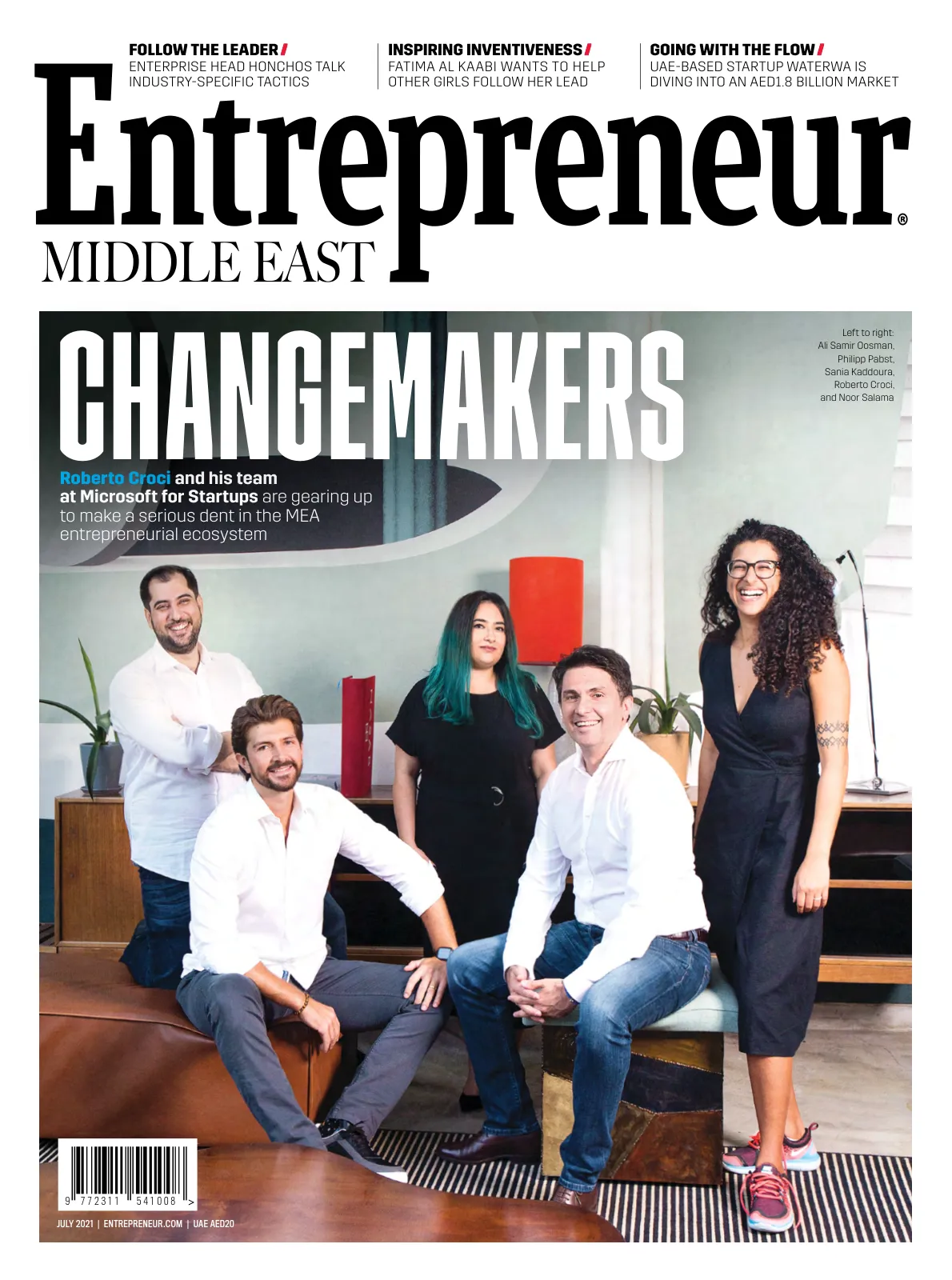
Entrepreneur Middle East, July 2021
Page 1
FOLLOW THE LEADER
ENTERPRISE HEAD HONCHOS TALK
INDUSTRY-SPECIFIC TACTICS
9
7 7 2 3 1 1
5 4 1 0 0 8
>
JULY 2021 | ENTREPRENEUR.COM | UAE AED20
INSPIRING INVENTIVENESS
FATIMA AL KAABI WANTS TO HELP
OTHER GIRLS FOLLOW HER LEAD
GOING WITH THE FLOW
UAE-BASED STARTUP WATERWA IS
DIVING INTO AN AED1.8 BILLION MARKET
Roberto Croci and his team
at Microsoft for Startups are gearing up
to make a serious dent in the MEA
entrepreneurial ecosystem
Left to right:
Ali Samir Oosman,
Philipp Pabst,
Sania Kaddoura,
Roberto Croci,
and Noor Salama
CHANGEMAKERS
Page 2
Page 3
Page 4
Page 5
Page 6
The Harbour Row combines the best of business
and leisure providing world-class residences in
the heart of Bahrain Financial Harbour.
For more information, please call us
or WhatsApp us on +973 3304 4044.
Best Development
in MENA
gfhproperties.com
THE NEW
PLACE TO BE
TAKE ADVANTAGE OF OUR EXCLUSIVE
5-YEAR POST-HANDOVER PAYMENT PLAN
Page 7
Page 8
8 / ENTREPRENEUR.COM / July 2021
60
IN PICTURES/
THE RECAP
A look at the Leaders in
Fintech Awards 2021, staged by
Entrepreneur Middle East, which
celebrated the individuals and
enterprises that are shaping the
future.
44
INNOVATOR/
INSPIRING INVENTIVENESS
She was once the UAE’s youngest
inventor- and now, Fatima Al
Kaabi wants to help other girls
follow her lead.
76
‘TREPNOMICS/
PRO
WHEN INDUSTRY MEETS RESEARCH
Ramesh Jagannathan, Managing
Director of startAD, reflects
on how corporates and
universities can work together
to bring scientific innovation to
commercial markets.
72
START IT UP/
Q&A
THINKING OUTSIDE THE BOX
Wadih Haddad’s startup, The
Box, is reinventing the Middle
East’s self-storage sector.
68
CULTURE/
BUSINESS UNUSUAL
SHIFTING TRENDS
The Grooming Lab CEO Zein
Arbeeb is ushering modern day
masculinity into the MENA
region with her enterprise.
70
START IT UP/
Q&A
GOING WITH THE FLOW
UAE-based startup Waterwa is
diving into an AED1.8 billion
market with its online water
delivery platform.
16
INNOVATOR/
CHANGEMAKERS
Roberto Croci and his team
at Microsoft for Startups
are gearing up to make a
serious dent in the MENA
entrepreneurial ecosystem.
30
INNOVATOR/
FOLLOW THE LEADER
Enterprise head honchos
across the MENA region talk
strategy, industry-specific
tactics, and professional
challenges.
38 Budreya Faisal,
founder and CEO, Ghost Concept
Page 9
02 – 04 NOVEMBER 2021
DUBAI EXHIBITION CENTRE
GET INVOLVED TODAY
Next generation mobility
and logistics event
3,000+ VISITORS | 200+ SPEAKERS | 100+ HOURS OF CONTENT
hypermotion@uae.messefrankfurt.com
www.hypermotiondxb.com
Page 10
10 / ENTREPRENEUR.COM / July 2021
SUBSCRIBE
Contact subscriptions@bncpublishing.net to receive
Entrepreneur Middle East every issue
EDITOR IN CHIEF Aby Sam Thomas aby@bncpublishing.net
CEO Wissam Younane wissam@bncpublishing.net
DIRECTOR Rabih Najm rabih@bncpublishing.net
CREATIVE LEAD Odette Kahwagi
MANAGING EDITOR Tamara Pupic
STARTUPS SECTION EDITOR Pamella de Leon
FEATURES WRITER Aalia Mehreen Ahmed
EDITORIAL DESIGN Christian Harb
DIGITAL SOLUTIONS DIRECTOR Mahdi Hashemi mahdi@bncpublishing.net
HEAD OF INNOVATION Sarah Saddouk sarah@bncpublishing.net
GROUP SALES DIRECTOR – B2B GROUP Joaquim D’Costa
COLUMNIST Tamara Clarke
PO Box 502511 Dubai, United Arab Emirates
P +971 4 4200 506 | F +971 4 4200 196
For all commercial enquiries related to Entrepreneur Middle East
contact sales@bncpublishing.net
All rights reserved 2021
Opinions expressed are solely those of the contributors.
Entrepreneur Middle East and all subsidiary publications in the
MENA region are officially licensed exclusively to BNC Publishing
in the MENA region by Entrepreneur Media Inc.
No part of this magazine may be reproduced or transmitted in any
form or by any means without written permission of the publisher.
Printed by United Printing and Publishing
upp.ae
Images used in Entrepreneur Middle East are credited when necessary. Attributed use of
copyrighted images with permission. All images not credited otherwise Shutterstock.
CONTRIBUTORS
entrepreneur.com/me
ACCESS FRESH CONTENT DAILY ON OUR WEBSITE!
MIDDLE EAST
EntMagazineME
@EntMagazineME
Entrepreneur-me
EntrepreneurMiddleEast
EntMagazineME
EntMagazineME
EntMagazineME
MIDDLE EAST
In addition to our print edition, we’re bringing
you all sorts of industry news on our web
mediums. Joining us online means getting
relevant business and startup content in
real-time, so you’re hearing about the latest
developments as soon as we do. We’re looking
forward to interacting with our readers on all of
our social media and web platforms- like any
thriving business, we’re looking to give and take.
#TrepTalkME is already happening on all of our
digi platforms, and all good conversations go
both ways. See you on the web!
Fida Chaaban
Tamara Clarke
Ramesh Jagannathan
Yassir Max Corpataux
Page 11
Page 12
12 / ENTREPRENEUR.COM / July 2021
H
ave you ever come across
the description of some-
thing or someone that
turned out to be more, for
the lack of a better word,
aspirational than it actu-
ally is in real life?
I have personally experienced this in
quite a lot of places recently- be it a
superfluous pitch that’s been e-mailed
to me, an overtly gushing review by an
Instagram “influencer,” or, heck, even
profiles on dating apps.
But it’s the increasing prevalence of
such exaggerations in the entrepre-
neurial arena and the business world
at large that I’ve been finding particu-
larly worrisome of late.
Maybe it’s the frantic race to make up
for time lost as a result of the ongoing
COVID-19 crisis that’s causing many
among us -enterprises included- to
paint a faux picture of what we can do
or provide, as opposed to what we can
actually bring to the table.
This isn’t exactly anything new
though- after all, entrepreneurs
especially have been known to over
promise or oversell in terms of what
their business can offer, and then
either give it their all to deliver, or just
fail miserably.
But this is not the issue that
I am troubled by in our current
circumstances. My problem is with
those individuals and entities that are
well-aware of their limitations, and yet,
still choose to inflate the truth to suit
their particular purposes, without a
care about who or what gets in the line
of fire as a result of their actions.
There’s a subtle distinction
between the two aforementioned
scenarios, and understanding it
is important- thankfully, we have
American philosopher Harry Frankfurt
to explain the difference between
them. According to him, the former
can be called lying, which occurs
when individuals know the truth, and
misrepresent it. On the other hand, the
latter represents “bullsh*tters,” who
don’t care what the truth is.
I’d like to think that keeping this
differentiation in mind is important in
our interactions with those around
us. When an individual or business is
feeding you drivel, they’re deliberately
choosing to disregard the truth for
reasons that are almost certainly
linked to ensuring their personal gain,
and no one else’s; that’s a showcase of
their apathy, plain and simple.
And this is what I’d like to ask all of
you to keep in mind the next time you
come across flashy jargon, tantalizing
terminologies, or extravagant pitches.
Don’t fall for it at face value, and
instead, take the time to drill into the
logic and reality of it all, and then
analyze for the value that they’re truly
able to deliver.
Rest assured that making this effort
is almost certain to be worth your
while- after all, given everything we’ve
gone through in the past couple of
months, we certainly don’t need any
more, well, bullsh*t.
Do you care?
There are two camps when it comes to truth
(and it’s time to choose)
Aby Sam Thomas
Editor in Chief
@thisisaby
aby@bncpublishing.net
EDITOR’S NOTE
Page 13
Page 14
14 / ENTREPRENEUR.COM / July 2021
IN THE LOOP
IMAGE COURTESY MUMZWORLD
M
umzworld, a
Dubai-head-
quartered
mother,
baby,
and child
ecommerce
platform,
has accepted the proposed ac-
quisition of a majority stake
by Tamer Group, a Saudi
healthcare distributor.
Mumzworld will retain a
high degree of autonomy,
including the retention of the
Mumzworld branding and
its founders Mona Ataya and
Leena Khalil continuing to
drive the business, sit on the
board, and remain material
shareholders.
The proposed transaction,
whose financial details have
not been disclosed, is subject
to formal regulatory clearance
from the General Author-
ity for Competition in Saudi
Arabia.
In a press release, Mumz-
world announced the signing
of a sales and purchase agree-
ment with the Jeddah-based
Tamer Group, highlighting
that it deliberately chose to
partner with a regional player
because it would allow its
e-commerce platform to con-
tinue to grow in key regional
markets and expand its digital
footprint.
Jeddah-based Tamer Group
is one of the largest regional
healthcare distributors with
annual turnover of SAR9.2
billion and a compound an-
nual growth rate of 11%.
“The deal coincides with our
100 year anniversary -operat-
ing as the largest healthcare
distributor in the region, and
major player in FMCG, logis-
tics and beauty care- and this
is a further, hugely significant,
milestone for Tamer Group,”
said Ayman Tamer, Chairman
of Tamer Group. “We believe
that e-commerce is the future
for the GCC. As a major player
in the FMCG space, e-com-
merce is no longer an option,
but a necessity. The world
has shifted to a customer-
centric model with consumer
behaviours, trends and data
having become the new gold.
Players in the space need to
understand their customers,
and adapt to their changing
needs.”
Founded in October 2011 by
CEO Ataya and COO Khalil,
Mumzworld has been enjoy-
ing a 10x growth over the
last five years. In addition,
Mumzworld is a preferred
partner for over 5,500 global
and regional brands, with
250,000 products and includ-
ing a proprietary, exclusive
distribution of over 15,000
leading international prod-
ucts. The strong potential of
Mumzworld in the mother,
baby, and child market -which
is worth over US$10 billion
in the MENA region and its
online segment growing ap-
proximately 39% per annum-
has been attributed to the
region’s young population,
strong birth rates, robust
purchasing power, and highly
digitized consumers.
“Over the last 10 years,
Mumzworld’s founders have
demonstrated their steadfast
commitment to creating the
leading mother, baby, and
child e-commerce business in
the Middle East, with a com-
munity of over 2.5 million
mothers,” said Noor Sweid,
General Partner at Global
Ventures, and one of the first
investors in Mumzworld. “Its
founders have become true
pioneers and leaders in an
extremely competitive space
and shaped the e-commerce
sector in the region.”
When asked about her
experience of negotating this
deal during the COVID-19
pandemic, Ataya is firm that
the fundraising processes
and mergers and acquistions
did not stop just because the
whole world has had to adapt
to a new way of working. “As
pioneers and innovators in
mother, baby, and child e-
commerce in the Middle East,
we are naturally comfortable
with embracing new challeng-
es,” she says. “Good business
rapidly adapts and moves on.
My advice to other entre-
preneurs would be to never
be scared of innovation. Run
towards it, not away from it.
Much better to get there first,
than be late to it. This is what
Mumzworld has always done,
and it has served us very
well!”
Ataya concludes by saying
that the Mumzworld team
has big plans for the future.
“This transaction will give
Mumzworld access to a large,
committed pool of capital
allowing us to supercharge
our growth,” she says. “We
will drive wider geographic
expansion and continue to
build a tech footprint serving
customers better than ever.
We will continue to own the
supply chain for mother and
child; both our customers and
suppliers are at the forefront
of this next exciting phase for
Mumzworld. We are intent
on digitizing the regional eco-
system, particularly in Saudi
Arabia. With Tamer Group’s
scale, size, reputation and
regional knowhow, our com-
bined complementary entity
will be transformative for the
Saudi business conglomerate
Tamer Group acquires a majority
stake of Mumzworld
The MENA’s first woman-led
e-commerce acquisition
Mona Ataya, co-founder, Mumzworld
Page 15
15
July 2021 / ENTREPRENEUR.COM /
T
he Dubai Chamber of
Commerce and Industry
has been restructured as
three separate entities
that will now collec-
tively be known as Dubai
Chambers.
Dubai Chambers will thus be comprised
of the Dubai Chamber of Commerce,
Dubai Chamber of Digital Economy, and
Dubai Chamber of International Trade.
A new board of directors has also
been established for Dubai Chambers,
which was recently approved by H.H.
Sheikh Mohammed bin Rashid Al Mak-
toum, Vice President and Prime Minister
of the UAE and Ruler of Dubai.
In a statement, the restructuring of
Dubai Chambers was described as part
of the efforts being made to catalyze
Dubai’s economic transformation and
further reinforce the city’s rise as a
global business hub.
“In the light of the changes sweeping
across the globe, we need to adopt
new business models that enable us to
raise our sustainability and attain con-
tinued success,” Sheikh Mohammed
said. “Deploying innovative operational
frameworks and developing flexible
legislations will help us foster further
growth and achievement in Dubai’s
economy.”
The three new chambers are thus
integral to Dubai’s new drive to create
a highly competitive, advanced invest-
ment environment geared for rapid
growth, he noted.
“Dubai Chambers will be one of the
organizations spearheading our efforts
to further transform the Emirate’s
business environment and enhance
its position as a dynamic regional and
global center for business, trade and
finance,” Sheikh Mohammed added.
“The members of Dubai Chambers will
be active stakeholders in executing
Dubai’s international trade strategy,
which aims to expand our external
trade to AED2 trillion in five years.”
The release noted that the newly
formed Dubai Chamber of International
Trade will represent and support the
interests of local companies with in-
ternational presence and international
companies based in Dubai. It will also
support Dubai’s vision to expand to
new global markets, forge new eco-
nomic partnerships, and support local
companies in achieving global success,
while also attracting promising talent
and investors from across the world.
Meanwhile, the Dubai Chamber of
Digital Economy has been tasked with
launching projects and developing
studies on the new future economy, as
part of efforts to build the world’s best
digital infrastructure, and transform
Dubai into an international technology
hub. With the objective of promoting
the interests of technology companies,
and advancing the role of the digital
economy in the Emirate, the new
chamber will build a network of rela-
tionships with local and international
tech entrepreneurs and investment
funds, while also helping draft legisla-
tions in Dubai and the UAE to create a
growth-friendly environment for the
digital economy.
Juma Al Majid was named as the
Honorary Chairman of the Dubai Cham-
ber of Commerce and Industry, while
Abdulaziz Al Ghurair was appointed as
its Chairman. Sultan bin Sulayem was
named Chairman of the Dubai Chamber
of International Trade, and H.E. Omar
Al Olama was named Chairman of the
Dubai Chamber of Digital Economy.
The Board of Dubai Chambers is
chaired by Abdulaziz Al Ghurair, and
its members include Omar Al Futtaim,
Khalid Jumaa Al Majid, Rajaa Al Gurg,
Omar Al Olama, Sultan bin Sulayem,
Butti Saad Al Kendi, Helal Saeed Al
Marri, Faisal Jumaa Belhoul, Patrick
Chalhoub, Ghassan Al Kibsi, Dr. Amina Al
Rustamani, and Tariq Hussain Khansa-
heb. dubaichamber.ae
Geared towards growth
IN THE LOOP
IMAGE COURTESY DUBAI CHAMBER
Dubai Chamber of Commerce and Industry
restructured as three separate entities to support
the city’s ambitions as a global business hub
Page 16
16 / ENTREPRENEUR.COM / July 2021
INNOVATOR
are gearing up to make a serious dent in the MEA
entrepreneurial ecosystem by ABY SAM THOMAS | PHOTOGRAPHY FAROOK SALIQ
AND HIS TEAM AT MICROSOFT FOR STARTUPS
ROBERTO CROCI
I
f I remember correctly, the first time I
met with Roberto Croci was after he had
just been appointed as the Managing
Director of Microsoft for Startups for the
Middle East and Africa (MEA) region in
2019. He had not even officially started
work in his new role then, but he none-
theless reached out to me and my team
over LinkedIn to meet up for a conversa-
tion around the entrepreneurial ecosys-
tem of the region. I’ll admit now that,
at the time, I didn’t quite know what to
make of the zeal with which Croci was approach-
ing this new chapter in his career trajectory. I
mean, he was literally the first person on the
ground for Microsoft for Startups MEA- yes, the
initiative had indeed been running in other parts
of the world, but it was an entirely new undertak-
ing for the multinational company’s operations in
this region. But Croci didn’t seem to care about
being the only one who was a part of this entity
then- he seemed more eager to dive deep into
the work he had been appointed to do, and that
was why, in a bid to gain a better understanding
of the region’s startup space, he was seeking out
people who were actually a part of this ecosys-
tem. The two of us remained in touch after that
first meeting, and I watched from the sidelines
as Croci continued to doggedly go about engaging
with different stakeholders in the MEA business
arena. Even the outbreak of the coronavirus pan-
demic in 2020 didn’t stop him- Croci had told me
in our first meeting that he was on a mission to
find ways in which he and Microsoft for Startups
MEA could deliver real value for startups and en-
trepreneurs in the region, and that remained the
premise with which he both led and contributed
to discussions and collaborations through the
course of the ongoing COVID-19 crisis. Today, as
the region starts to make a gradual recovery from
the repercussions of this global calamity, Croci is
moving ahead with an ambitious agenda that he
and his team have built for Microsoft for Startups
MEA, and his drive and dedication remains as
resolute and radiant as it was the first time I met
him. “From the very beginning, the idea was to
contribute to a connected ecosystem,” Croci tells
me today. “We knew we could not solve the gaps
in the ecosystem by ourselves, so our aim was to
bring together different players in a meaningful
way to maximize the impact for the founders and
startups of the region. And that is pretty much
how we are rolling out things at Microsoft for
Startups MEA now.” >>>
CHANGEMAKERS
Page 17
17
July 2021 / ENTREPRENEUR.COM /
SKY-HIGH AMBITIONS | SAUDI STARTUP FIRNAS AERO
“I quickly realized that driving
on a 5,000-meter runway with
an SUV, and looking out the
window for small objects that
might have fallen on the runway
and removing them was very
inefficient.”
“MICROSOFT FOR STARTUPS
IS [...] MICROSOFT’S
INVESTMENT IN THE
DIGITAL ECOSYSTEM.
THROUGH THIS INITIATIVE,
WE ARE SUPPORTING
BOTH CORPORATE
DIGITAL INNOVATION,
AS WELL AS GROWTH
AND ACCELERATION FOR
STARTUPS.”
17
July 2021 / ENTREPRENEUR.COM /
Left to right: Ali Samir Oosman,
Philipp Pabst (with Baloo),
Sania Kaddoura, Roberto Croci,
and Noor Salama
Page 18
18 / ENTREPRENEUR.COM / July 2021
As a program that aims to “acceler-
ate growth with a customized set of
offerings and resources that evolve
with your startup from idea to exit,”
Microsoft for Startups operates with
a pretty specific (and straightforward)
ethos from a global perspective. But
when launching the initiative in the
MEA, Croci came to the realization
early on that making use of a cookie-
cutter approach to kick things off in
the region wouldn’t probably work. “I
think my mindset originally was that
Microsoft had built this global propo-
sition, and I needed to figure out ways
to make it work here in our region,” he
remembers. “But that idea soon shift-
ed- I realized I needed to learn about
the gaps and challenges here, as well
as the opportunities, to figure out how
we at Microsoft for Startups can pro-
vide tailored offerings that addressed
these different factors. Yes, we had
a global mandate and strategy, but
we had to shape it in a meaningful,
relevant manner for the regional eco-
system.” Now, Microsoft for Startups
operates with a rather clear directive-
as Croci put it, it’s a platform that,
quite simply, “helps startups grow
with the best of what Microsoft has to
offer.” With its focus currently on B2B
tech startups, especially those in the
early stages of their business cycles,
Microsoft for Startups aims to help
entrepreneurs in a myriad of ways.
For starters, participants get access to
Microsoft’s tech and tools like Azure,
GitHub, and Microsoft Teams to run
their businesses better. They are also
treated to personalized tech mentor-
ship, content, and training compiled
by the Microsoft for Startups team, all
with the aim to move their businesses
ahead. Perhaps most importantly, the
startups in the program get to take
advantage of Microsoft’s standing on
the global market landscape to unlock
high-value business opportunities
for themselves, which can range from
access to funds, to commercial tie-
ups. “The global program is meant
to be a journey where we take B2B
startups on board and nurture them
to become, say, more enterprise-ready
and market-ready,” Croci adds. “So,
it’s about teaching them how to go
to market, how to sell to enterprises,
how to do proper marketing, and so
on and so forth. And once they get to
a certain stage, we can turn them into
our partners, and sell with them to
accelerate their sales and growth.”
It’s this part of the Microsoft for
Startups plan that is perhaps going
to be the most interesting to watch
unfold in the MEA. The region has
been known to have a chasm of sorts
between its corporates and startups,
where the former aren’t often aware
of the myriad of entrepreneurial in-
novations out there they could use
to their advantage, and the latter are
usually found to be lacking in the
know-how needed to realize such im-
portant business relationships.
INNOVATOR
Roberto Croci,
Managing Director, Microsoft for Startups MEA
Page 19
19
July 2021 / ENTREPRENEUR.COM /
“Startups don’t necessarily know how to navigate to go
about working with a corporate,” Croci notes. “But there
are similar issues to be found in corporates too- maybe
they don’t have the commitment to see such relation-
ships through, or maybe they don’t have the right cul-
ture or top-down alignment, or things of that nature.
So, that’s where we come in- we want to bridge the gap
between startups and corporates.” And Croci believes
there’s a plethora of ways he and his team can go about
doing this in the MEA. Maybe a startup could plug in its
offerings at a corporate to help it realize its digital trans-
formation objectives. Or perhaps it’s a corporate that
wants to diversify its portfolio, and therefore decides to
support a startup that is set to be a gamechanger in its
industry. Of course, we can keep guessing the various
ways in which startups can leverage Microsoft for Start-
ups’ offerings in the region, but perhaps the most impor-
tant thing to remember here is that Croci and his team
will be there to guide them through all of it. However,
there is a question the more suspicious among us might
be wondering about at this point: what’s Microsoft get-
ting out of doing all this? What does the multinational
corporation actually get by investing in startups? Croci
graciously answers my query by saying for starters, the
obvious benefit is that Microsoft gets to ensure that its
products like Azure, Teams, etc. are being used by these
new, up-and-coming enterprises. However, he also notes
that’s only a small part of the long-term game Microsoft
is aiming to play. While the startups it supports today
stand to become Microsoft’s partners (“For Microsoft,
they aren’t customers, they are partners”) in the long
run, the company is also aiming to bolster its relation-
ships with existing clientele by offering new innovations
and outlooks that will help secure their futures as well.
“Microsoft for Startups is thus Microsoft’s investment in
the digital ecosystem,” Croci declares. “Through this ini-
tiative, we are supporting both corporate digital innova-
tion, as well as growth and acceleration for startups.”
To kick off its operations in the MEA (which, by the
way, includes Pakistan and Turkey), Microsoft for Start-
ups has currently launched two major initiatives catered
to the region’s entrepreneurial ecosystem. The first is its
GrowthX Accelerator program, which has built in part-
nership with the Abu Dhabi Investment Office (ADIO).
Running through the course of 12 weeks from August to
November this year, GrowthX aims to provide 15 startups
from the region with the technology, mentoring and mar-
ket knowledge they need to grow their respective busi-
nesses, while taking advantage of the access they get to
Microsoft’s global network of customers and partners,
>>>
CHANGEMAKERS | MICROSOFT FOR STARTUPS
“OUR AIM WAS TO BRING
TOGETHER DIFFERENT
PLAYERS IN A MEANINGFUL
WAY TO MAXIMIZE THE IMPACT
FOR THE FOUNDERS AND
STARTUPS OF THE REGION.”
>>>
Page 20
20 / ENTREPRENEUR.COM / July 2021
INNOVATOR
as well as the slew of benefits that
ADIO will offer them in the UAE capi-
tal of Abu Dhabi. Besides making this
select group of entrepreneurs an at-
tractive proposition for the investors
that GrowthX will bring together at
its conclusion for a demo day, all of
these efforts are also geared at mak-
ing them ideal candidates for the
corporate matchmaking program that
Microsoft for Startups will be curat-
ing as well. “We have worked with our
corporate partners to identify a few
challenges that they face for which
our startups could potentially provide
solutions for,” Croci explains. “So, with
GrowthX, the idea is to get to a stage
where we’ll have enabled our startups
to co-create with corporates.” With big
names like Unilever, Etihad Airways,
IKEA, Accenture, and others already on
Microsoft for Startups’ roster of cor-
porate partners for the MEA, GrowthX
has also been seeing a stupendous
amount of interest from startups in the
region, Croci reveals. And unlike those
early months of the COVID-19 crisis
when he was the sole person work-
ing at Microsoft for Startups MEA,
Croci now has a fledgling team behind
him to identify, from the applications
that have come in, the startups that
make the most sense to be included
in GrowthX’s first cohort. Today, the
Microsoft for Startups MEA payroll in-
cludes Strategic Partnerships and Deal
Flow Managers, Ali Samir Oosman and
Philipp Pabst, Cloud Architect, Sania
Kaddoura, as well as Community and
Program Manager, Noor Salama, with
Croci adding that he is hoping to grow
the team further soon. Given that all
of them have had experiences with the
startup space in one way or the other,
there is a rather palpable camaraderie
among all of the members in the team
(which seems to have also been aided
in part by Pabst’s dog, Baloo), and it
bodes well for the entrepreneurs who
will soon be working closely with them
in the GrowthX program.
Besides GrowthX, ADIO and Micro-
soft for Startups MEA are also collabo-
rating on a virtual conference series
called “Highway to 100 Unicorns,”
which will feature more than 100
regional and international speakers
talking about topics of importance to
the region’s entrepreneurs and start-
ups. It’s clearly an effort at building a
community, and given its accessible
nature, “Highway to 100 Unicorns” is
hoping to bring together innovators
from around the region and beyond
and eventually have them become
part of, say, Microsoft for Startups’
GrowthX Accelerator program, or
other such initiatives that it has in the
pipeline. Indeed, Croci makes it clear
that “Highway to 100 Unicorns” and
the GrowthX Accelerator mark only
the start of what Microsoft for Start-
ups have in mind to boost the region’s
startup ecosystem. For one, there’s
already work being done in the back-
ground to expand GrowthX’s focus on
B2B startups to include B2C startups
as well, with Croci saying that he and
his team believe the latter domain to
also offer significant opportunities that
can be tapped into by corporates in
the regional landscape. Besides this,
there are a couple of other initiatives
in the works with ADIO that Croci says
he can’t reveal much details about at
this stage; however, he does let slip
that one of them is aimed at ensuring
the region continues to have a healthy
population of entrepreneurs in every
generation to come. As he speaks about
initiatives like these, I can’t help but
notice Croci’s eyes lighting up with ex-
citement about what the future holds
for Microsoft for Startups MEA, and
it becomes quickly apparent that he,
like other changemakers we have in the
world today, is being driven by the im-
pact his and his team’s efforts will have
on the region not just for now, but for
the long term as well. “There are coun-
tries in our region for whose people
entrepreneurship is a matter of life and
death,” Croci concludes. “So, keeping
that in mind, having this opportunity
to really influence entrepreneurship,
and make an impact here, is truly the
only driver one needs.”
“WE WANT TO BRIDGE THE GAP BETWEEN
STARTUPS AND CORPORATES.”
“IT’S ABOUT TEACHING [STARTUPS]
HOW TO GO TO MARKET, HOW TO
SELL TO ENTERPRISES, HOW TO DO
PROPER MARKETING, AND SO ON
AND SO FORTH. AND ONCE THEY GET
TO A CERTAIN STAGE, WE CAN TURN
THEM INTO OUR PARTNERS, AND
SELL WITH THEM TO ACCELERATE
THEIR SALES AND GROWTH.”
Page 21
21
July 2021 / ENTREPRENEUR.COM /
“WE HAD A GLOBAL MANDATE
AND STRATEGY, BUT WE
HAD TO SHAPE IT IN A
MEANINGFUL, RELEVANT
MANNER FOR THE REGIONAL
ECOSYSTEM.”
21
July 2021 / ENTREPRENEUR.COM /
Left to right:
Ali Samir Oosman, Noor
Salama, Roberto Croci, Sania
Kaddoura, and Philipp Pabst
(with Baloo)
Page 22
22 / ENTREPRENEUR.COM / July 2021
She was once the UAE’s youngest inventor- and now,
she wants to help other girls follow her lead by TAMARA PUPIC
Fatima Al Kaabi
INSPIRING/
INVENTIVENESS
IMAGE COURTESY CAPTURED PHOTOGRAPHY
INNOVATOR
Page 23
23
July 2021 / ENTREPRENEUR.COM /
From robotics kits she was gifted at the age of seven, to
watching sci-fi movies, shows, and documentaries on tech-
nology and innovation, Al Kaabi has spent years exploring
various ideas and possibilities. “My love for inventions has
been with me since I was a child, and I continued to invent
whenever I had spare time, as a personal passion for innovat-
ing. I was only 10 when I built my first robot that could take
pictures. With each invention, I try to expand my horizon
and think outside the box as much as possible. For exam-
ple, I developed a solar charging bag for devices, as well as
a robot called The Teleporter that attends school in place of
sick children, in addition to an electronic belt for the hear-
ing impaired, and a smart steering system that stops people
from texting while driving.” Each of her inventions, Al Kaabi
explains, is inspired by a specific story or situation. “For ex-
ample, with The Teleporter, I had visited the Tawam Hospital
[in Abu Dhabi, UAE] and saw children there suffering from
cancer,” she says. “I realized their treatment would deter
them from going to school, and this made me think of a ma-
chine that would record their classes for them, similar to the
remote learning system we have in place today. It’s incredible
how small day-to-day situations can inspire anyone to create
something new using resources within reach.”
However, Al Kaabi’s inventiveness did not always find a wel-
coming environment outside the walls of her home. “I have
also faced some backlash simply for being a girl interested
in STEM,” she says. “I wasn’t made to feel very welcome by
many people who thought I was unfit for certain opportuni-
ties, or still had old-fashioned ideas of what women could
and couldn’t do, but luckily, my family stood firm behind me.”
Over the years, there has been a change in attitude towards
young women excelling in STEM. “There are many resources
today that young children, specifically girls, can use to edu-
cate themselves and build their skillset,” she says. However,
Al Kaabi notes that the UAE has been especially progressive
in terms of opening the doors for women and girls in techni-
cal fields. For her, it was in 2015, when she was named as the
UAE’s youngest inventor, that she felt as if she had finally got
a stamp of approval from society at large. “It has helped me
gain some validation in places where I have been seen as un-
fit, even if it came with a lot of responsibility,” she confirms.
“I am honoured and privileged to carry that title, especially as
it came from H.H. Sheikh Mohammed bin Rashid Al Mak-
toum. Getting the support and recognition from the govern-
ment has been one of the highlights of my journey.”
Investing in Innovation: The Future Is Here, a new docu-
mentary being powered by the UAE’s Mubadala Investment
Company to showcase the country’s efforts in accelerating a
knowledge-based economy, is expected to contribute to the
greater social acceptance of the nation’s young women pursu-
ing -and thriving in- STEM careers. It should come as no sur-
prise then as to why Al Kaabi was chosen as this film’s host.
INSPIRING INVENTIVENESS | FATIMA AL KAABI
F
atima Al Kaabi is a young Emirati inventor who can boast of being the
recipient of a number of industry accolades from the UAE like the Robot
Olympics Award in 2014, the UAE Pioneer Award for being the UAE’s youngest
inventor in 2015, the Arab Award for the Best 10 Inventors and Innovators
of 2015, and the Sheikha Fatima bint Mubarak International Award for Arab
Youth in 2017. According to Al Kaabi, all of her achievements can be drawn down
to a passion for innovation and inventing that has been honed from a very early
age. “I grew up in a household with parents interested in the science, technology,
engineering, and mathematics (STEM) field,” Al Kaabi says. “My father is an engineer,
and my mother is an information technology major. Seeing them passionately speak
about their work at the dinner table, or them explaining to me how things worked
around the house got me engaged and interested in STEM.”
Fatima with His Highness Sheikh Mohamed bin Zayed Al Nahyan, Crown Prince of
Abu Dhabi and Deputy Supreme Commander of the UAE Armed Forces, and Fatima’s
father, at His Highness’ Majlis to discuss her inventions
>>>
Page 24
24 / ENTREPRENEUR.COM / July 2021
“Hosting the documentary was a one-
of-a-kind experience; the chance to
speak to individuals who are changing
the world with innovation and tech-
nology is truly inspiring, and the fact
that I was representing my country
as a female Emirati inventor filled me
with national pride,” she says. While
filming the documentary, Al Kaabi
got to visit one of Mubadala’s invest-
ments, the Strata facility at the Nibras
Al-Ain Aerospace Park in Al Ain, which
was established in 2009 to meet the
demands of the evolving aerospace in-
dustry. There, Al Kaabi explains, a large
portion of the workforce comprises of
young Emirati women. “It was truly
impressive and inspiring to watch them
manufacture and handle aircraft parts,
something that has always been deemed
as purely masculine,” she says.
Recently, the World Economic Forum’s
Global Gender Gap Report revealed
that the UAE ranks among the top five
countries in the world that have made
remarkable headway towards bridging
the gender gap and striving for gender
equality- and it has done that despite
the outbreak of the COVID-19 pandemic
that stalled progress towards gender
parity in many countries. Indeed, the
UAE ranks first among Arab countries
in the advancement of women in all
sectors, including space and STEM.
One example of the country’s forward-
thinking approach can be seen in the
announcement of the first female Arab
astronaut Nora Al Matrooshim, who
will be joining her colleague Moham-
med Al Mulla to form the second
batch of the UAE Astronaut Program.
According to Al Kaabi, this is just one
indication of how the UAE has been
increasing education and work oppor-
tunities for young women in the STEM
field. “Gender stereotypes are quickly
becoming a thing of the past where
STEM subjects were seen as completely
masculine, and there was a lack of
visible female role models to inspire
the next generation of young girls,”
she says. “Also, schools are being more
encouraging in pursuing STEM subjects
where young girls are given the skills
and confidence to succeed, and there is
an increased public awareness in how
parents can encourage their daughters
in STEM as much as their sons- some-
thing that I was very fortunate with in
my own family.”
While she credits her family for
playing a major role in motivating
her to excel in her STEM career, Al
Kaabi notes that she has had other
role models too. “I would also like to
acknowledge Reem Al Marzouqi, an
inventor and engineer who created a car
that can be driven entirely using your
feet,” she explains. “She also developed
an interactive robot for children on the
autism spectrum. As you can see, a lot
of her work revolves around creating
inclusive spaces and devices for the
benefit of humankind. Reem was kind
enough to guide me through some of
the challenges women face in this field
and has supported me throughout this
process.” Another woman who has been
a source of support in Al Kaabi’s career
is Roudha Bin Baher. “She is an Emirati
engineer, who was the only woman to
participate in the World Skills competi-
tion in the refrigeration and air con-
ditioning category,” Al Kaabi explains.
“Her work has since gained recognition
globally, and she has inspired females
everywhere to follow suit. She also
started a mentoring program with
Danfoss Engineering to promote female
representation in the field, emphasiz-
ing that this is a field for both men and
women.”
Going forward, Al Kaabi believes that
it will be crucial to continue pushing
the envelope when it comes to jobs and
gender roles, with the focus needing to
remain on engaging girls and women
in STEM and providing them with
an environment to thrive in. “I think
amplifying stories of women inventors
and just recognizing the struggles we
face can make a big difference,” she
says. One day, Al Kaabi hopes to earn
a Master’s as well as a PhD degree in
artificial intelligence (AI), and then
start her own AI company, and even
become an AI professor- and we are
sure that she will continue inspiring
many more girls from across the UAE to
follow suit.
“I THINK AMPLIFYING
STORIES OF WOMEN
INVENTORS AND
JUST RECOGNIZING
THE STRUGGLES WE
FACE CAN MAKE A BIG
DIFFERENCE.”
Alanoud Al Hashmi, CEO, and Paul Marsh, Chief Strategy Officer, The Futurist Company
INNOVATOR
Fatima Al Kaabi with H.H. Sheikh Mohamed bin Zayed bin Sultan Al Nahyan
and H.H. Sheikh Mohammed bin Rashid Al Maktoum
OPPOSITE PAGE: IMAGE COURTESY JOHNNY VACAR
Page 25
25
July 2021 / ENTREPRENEUR.COM /
1. Keep looking for programs or initiatives that can help
you achieve your dreams “The UAE has been a pioneer
in encouraging an interest in STEM education among the
youth, with various entities such as Mubadala or ADNOC
giving people like me the chance to better understand
these fields and perhaps pursue a career with this in
mind.”
2. Become your own source of inspiration “When I was
growing up, I didn’t have many female role models to look
up to, but now we are surrounded by female success
stories such as Emirati innovator Maryam Al Hashimi,
who made petrol and solar panels out of plastic, and Alia
Al Mansoori’s Genes in Space experiment, focusing on
investigating gene expression of heat shock proteins
induced by stressors found in space, is also a great
example. These are a few of our young, female Emirati
talents who are role models for our women to succeed.”
3. Think beyond what you already know– trust in the
process “Though you may not know much about STEM,
or where it can take your career, remember that life is
about pursuing a career that you enjoy and are passion-
ate about. It may seem difficult at first, or challenging, but
don’t forget what made you consider STEM to begin with:
your love for education, and making a positive impact on
those around you. It may take years for you to figure out
which particular area of STEM you prefer, but I promise
the feeling of success in your own right is unlike anything
else.”
4. Don’t be intimidated by teams that are predominantly
male “When you enter a field that has previously been
dominated by men, it’s normal to be nervous about
whether or not you can do as well as they can. Don’t
underestimate yourself or sell yourself short. You can be
just as successful as anyone if you put your mind to your
studies, and remember that you’re doing this for a bigger
purpose. As long as you remember the reasons why you
entered the STEM field to begin with, this will motivate
you to succeed despite all obstacles.”
5. You are your best teacher “Though we are seeing
more resources that welcome young children, especially
girls, and teach them how to build projects and code, I
taught myself the foundational skills I needed to explore
innovation. I turned to the internet, specifically YouTube,
to understand the basics, and you can too. Remember,
your education spans outside the classroom too– the
world can be your teacher if you know where to look.
You can also keep an eye out for my sessions; I speak
at schools across the UAE and am an avid mentor. I also
love hosting hands-on workshops for people of all ages.”
‘TREP TALK
FOCUSED ON THE FUTURE
Fatima Al Kaabi’s tips for young women
considering a career in STEM
INSPIRING INVENTIVENESS | FATIMA AL KAABI
“MY LOVE FOR INVENTIONS HAS BEEN WITH ME
SINCE I WAS A CHILD, AND I CONTINUED TO INVENT
WHENEVER I HAD SPARE TIME, AS A PERSONAL
PASSION FOR INNOVATING. I WAS ONLY 10 WHEN I BUILT
MY FIRST ROBOT THAT COULD TAKE PICTURES. WITH
EACH INVENTION, I TRY TO EXPAND MY HORIZON AND
THINK OUTSIDE THE BOX AS MUCH AS POSSIBLE. FOR
EXAMPLE, I DEVELOPED A SOLAR CHARGING BAG FOR
DEVICES, AS WELL AS A ROBOT CALLED THE TELEPORTER
THAT ATTENDS SCHOOL IN PLACE OF SICK CHILDREN, IN
ADDITION TO AN ELECTRONIC BELT FOR THE HEARING
IMPAIRED, AND A SMART STEERING SYSTEM THAT STOPS
PEOPLE FROM TEXTING WHILE DRIVING.”
Page 26
26 / ENTREPRENEUR.COM / July 2021
GADGETS AND DOODADS THAT YOU MIGHT’VE MISSED OUT ON, SOURCED BY A TECH AFICIONADO.
YES, IT’S OKAY TO WANT THEM ALL… AND NO, IT’S NOT OUR FAULT.
ROLL WITH IT
LG SIGNATURE OLED R
IMAGES COURTESY LG | LOGITECH | FITBIT
TECH SHINY
The LG SIGNATURE OLED R rollable TV is a game changer
for user-centric entertainment. It boasts of a 65-inch flexible
OLED display created from one sheet of glass, with it also
featuring self-lit pixels and independent dimming control to
improve picture quality. The TV has three viewing modes
-Full View, Line View, and Zero View- depending on how
much the screen is rolled. The LG SIGNATURE OLED R also
features voice-activated control in a number of languages,
as well as Natural Language Processing (NLP) technolo-
gies, so that the TV can understand complex questions. For
example, you can ask for the name of an actor, the films
they have starred in, background music titles, and more.
Meanwhile, in Line View, you can choose from features and
modes including Clock, Frame, Mood, Music, and Home
Dashboard to operate other home appliances remotely.
Unlike other TVs, which take up visual space even when not
in use, the rollable screen offers greater flexibility. When in
Zero View, the OLED display disappears without a trace,
creating perfect spatial and visual harmony in any interior
setting. But, even in this format, you can enjoy music and
other audio content through the 4.2-channel, 100W front-
firing Dolby Atmos audio system.
LG SIGNATURE OLED R
Page 27
27
July 2021 / ENTREPRENEUR.COM /
#TAMTALKSTECH Tamara Clarke, a former software development professional, is the tech and lifestyle enthusiast behind The Global Gazette, one
of the most active blogs in the Middle East. The Global Gazette has been welcomed and lauded by some of the most influential tech brands in the
region. Clarke’s goal is to inform about technology and how it supports our lifestyles. See her work both in print regional publications and online on
her blog where she discusses everything from how a new gadget improves day-to-day life to how to coordinate your smartphone accessories.
Visit theglobalgazette.com and talk to her on Twitter @TamaraClarke.
#TAMTALKSTECH | GADGETS AND DOODADS THAT YOU MIGHT’VE MISSED OUT ON
THE BIG PICTURE
LOGITECH SCRIBE
Virtual meetings just got better with
the Logitech Scribe, a whiteboard
camera powered by artificial intel-
ligence. Capturing dry erase surfaces
up to six by four feet, Logitech Scribe
is a dedicated whiteboard camera
that gives virtual meeting partici-
pants a clear, real-time view of the
whiteboard. Whether you’re in the
room or remote, you have a perfect
view of the board. The camera is
compatible with any video conferenc-
ing application including leading
services such as Microsoft Teams and
Zoom. Using built-in artificial intel-
ligence, Scribe can render the pre-
senter transparent, so remote users
can see the whiteboard with nothing
in the way, and it also automati-
cally enhances the color of markers
such that the content on the board
is easier to read. Scribe even has the
ability to detect other non-digital con-
tent like Post-it notes- a fave tool for
collaboration sessions. With a clean,
wall-mounted design and thoughtful
cable management, Scribe blends
into any modern office, and whether
you’re viewing from a laptop at home
or on the meeting room display, the
camera makes sure everyone has the
best seat at the table.
Fitbit Luxe is a new fashion-forward
version of the fitness and wellness
tracker many have grown to love.
Designed to help you take a more
holistic approach to your health and
wellness, Luxe offers everything
from stress management tools to
automatic activity and sleep track-
ing– all in a chic bracelet design.
With a color touchscreen and up
to five days of battery life, Luxe
also gives you insights into your
wellbeing through the health metrics
dashboard in the Fitbit app, which
includes a stress management score.
Other health tools on the Luxe
include food, hydration, and weight
logging, as well as menstrual health
tracking. In addition to its health and
fitness features, Luxe has a soft,
gentle shaped design that sits lightly
on the wrist. Available in a variety of
finishes and styles, Luxe is versatile
to be used in any kind of occasion
and comfortable for both day and
night wear.
FIT CHIC
FITBIT LUXE
Fitbit Luxe
Logitech
Scribe
Page 28
28 / ENTREPRENEUR.COM / July 2021
CULTURE TRAPPINGS
IMAGE CREDIT PERPÉTUEL | VILEBREQUIN | SAWWAD | KING C. GILLETTE
‘TREP TRIMMINGS
THE EXECUTIVE SELECTION
F
rom better goods to better wardrobe bests, every issue we choose a
few items that make the approved executive selection list. In this issue,
our picks include limited edition timepieces, luxury swimwear just in
time for the summer, and more.
THE CALL OF THE SEA
VILEBREQUIN
Want to look your best as you take off for a
break this summer? Well then, check out luxury
swimwear brand Vilebrequin’s newest collection,
which is also a celebration of its 50th anniversary.
To mark this momentous occasion, the brand has
unveiled a collection of 50 swimsuits to represent
every year from 1971 to 2021. Featuring everything
from pop prints to flashy florals, the collection is
an ode to the timelessness of holidays by the sea.
Vilebrequin.com
Page 29
29
July 2021 / ENTREPRENEUR.COM /
'TREP TRIMMINGS | THE EXECUTIVE SELECTION
FEEL THE FANTASY
SAWWAD
Launched by UAE-based entrepreneur Salma Awwad, Sawwad
has been billed as “a character-driven fashion brand,” and its
debut collection, Awaken The Dragon, is a fitting showcase of the
label’s style ethos. Fantasy and
folklore are resplendent
in Sawwad’s creatively
crafted handbags,
which means that
wearing them ensures
that you are the
cynosure of all eyes, no
matter where you go.
Sawwad.com
AN ODE TO THE REGION
PERPÉTUEL
Compromising of horological timepieces, vintage
collectables, and rare objects, Perpétuel is a platform
that’s made for the collectors among you. Thanks to
a collaboration with New York-based watchmaker
Hoffman, Perpétuel is currently showcasing a
collection titled Khaleejuna Wahed (meaning “Our
Gulf” in Arabic), which features 300 one-of-a-kind,
limited edition watch designs catered for clients in
the UAE, Saudi Arabia, Kuwait, Qatar, Oman, and
Bahrain. With the collection featuring distinct colors
for each country, the pieces are encased in 40mm
stainless steel with a black aluminum bezel and a
20mm Italian-made Saffiano leather strap. With an
aim to be representative of the culture and heritage of
the region, these luxury timepieces are being powered
by the Seagull ST-1901 manual winding chronograph,
with 37 hours power reserve. Perpetuel.com
EDITOR’S PICK
KING C. GILLETTE
As men, you should know that it’s one thing to sport a beard- but
it’s another thing altogether to sport a fine-looking beard. And if
you wish to have your facial hair fall in the latter category, then
King C. Gillette’s new line of male grooming products is certainly
something you should consider including in your beard care
regimen. With the collection including everything from razors
and trimmers to shave gels and beard oils, the impressive bundle
of products is a clear testament to the years of experience King
C. Gillette has in the male grooming sphere. Indeed, the brand’s
history and heritage are especially evident in the signature scent
used for its beard and skin care products, which also feature
natural ingredients like avocado, argan oil, cocoa butter, and
others. Check them out for yourself by keeping an eye out for
the brand at supermarkets across the UAE, Saudi Arabia, Oman,
and Qatar- and yes, they’re available on the region’s leading
e-commerce platforms too. gillettearabia.com/en/kingcgillette
Perpétuel
Kuwait edition
Perpétuel
UAE edition
Perpétuel
Saudi edition
Perpétuel
Bahrain edition
Page 30
30 / ENTREPRENEUR.COM / July 2021
30 / ENTREPRENEUR.COM / July 2021
the leader
Follow/
Page 31
SALMA AL MAAWALI
AFRAA AL-NOAIMI
KARIM AWAD
H.E. DR. TARIQ BIN HENDI
BUDREYA FAISAL
NICOLAS GIROTTO
LAUDY LAHDO
SUKANT MISHRA
NISREEN SHOCAIR
ENTERPRISE HEAD HONCHOS TALK STRATEGY,
INDUSTRY-SPECIFIC TACTICS, AND PROFESSIONAL CHALLENGES
Insights and inspiration from 9 business leaders
impacting the MENA market today
31
July 2021 / ENTREPRENEUR.COM /
Page 32
32 / ENTREPRENEUR.COM / July 2021
IMAGES COURTESY 1309
32 / ENTREPRENEUR.COM / July 2021
the leader
Follow/
Page 33
33
July 2021 / ENTREPRENEUR.COM /
PHOTOGRAPHY BY WALEED SHAH
CEO /
YOOX NET-A-PORTER
MIDDLE EAST
by ABY SAM THOMAS
NISREEN
SHOCAIR
AS THE CEO of the YOOX Net-a-Porter Group in the
Middle East, Nisreen Shocair is leading the regional arm
of an online luxury fashion retailer launched in 2000
that today boasts of four million active customers in 180
countries around the world. With the Group made up of
four separate brands (YOOX, Net-a-Porter, Mr. Porter,
and The Outnet), Shocair clearly has her hands full in
terms of working to strengthen each of these businesses
either by adding new and exciting products and services
to their offering, or simply by growing into new markets
in the region. Having launched in the Middle East as
a joint venture with Mohammed Alabbar’s Symphony
Investments in 2016, YOOX Net-a-Porter’s focus on the
region is pretty evident, with it recently launching an
Arabic platform to foster communities around each of
its brands. “We are a global business that understands
the needs of this region by city, and we are committed
to make the Middle East an even more key part of our
business, and as we grow our local capabilities, this
dream is becoming a reality,” Shocair explains. “The
newly-optimized platform has been designed to reflect
the interests and needs of our Middle East customer, via
dual language product search, alongside local edito
rial content, product curation, and local pricing. Our
in-market personal shopping team completes the full-
service proposition, and they help us to fully cater to the
individual needs of our Middle East customers.” >>>
Page 34
34 / ENTREPRENEUR.COM / July 2021
A 2019 McKinsey report had noted that
annual fashion sales in the Middle East’s
GCC markets amount to US$50 billion,
with the spending in some of these coun-
tries ranked as among the highest on a
per capita basis annually. Now, these
numbers may have gone through a fair
amount of fluctuations in subsequent
years thanks to the ongoing COVID-19
crisis, but the sentiment in the market at
large seems to be that it is on its way to
recovery now. And this seems to be cor-
roborated by the behavior that is being
shown by YOOX Net a Porter’s clientele
in the region. “We don’t like to general-
ize, as every city across the region differs
in styles and trends, but what we do
know is the Middle East woman is highly
digital, mobile-savvy, and wants service
and speed like never before,” Shocair
says. “Over the recent months, we have
seen our customers exhibit excitement
and optimism, investing more in forever
investment pieces, including fine jewelry,
watches, and luxury bags that they can
buy now and wear forever, and with sus-
tainability front of mind. More and more,
our customers are showing an interest in
supporting designers and initiatives that
are charitable, inclusive, and sustain-
able, such as the ones included in our
Net Sustain edit.”
Shocair looks to be quite confident
about leading her business through the
repercussions of the coronavirus pan-
demic, and it’s safe to say that her self-
assuredness stems from the experiences
she had in her career so far. Indeed,
Shocair enjoyed leadership positions in
companies like HSE24, Virgin Megastore,
Hearst Entertainment and Bertelsmann
AG before taking on her current role at
YOOX Net-a-Porter in early 2020. “I
have lived in so many countries, worked
in two other related industries, and
five other companies prior to coming to
YOOX Net-a-Porter,” she says. “I always
chose the industry I wanted to work in,
that was the right fit for me, and me for
them, and chose companies with strong
management teams I believed in. The
YOOX Net-a-Porter opportunity felt so
right for exactly the same reasons: its
commitment to sustainability, coupled
with me believing in the company vision,
I felt that this is a company I could help
drive future success for.”
And Shocair certainly seems to be
doing a good job at it- according to her,
while the business she leads has had to
deal with repercussions of the corona-
virus pandemic, the circumstances have
also allowed it to double down on its
innovative edge. “The past year has chal-
lenged us all to adapt and develop in all
that we do,” she says. “It has, of course,
been a challenging time for us all person-
ally, but through great hardship is when
change and positivity emerge. It has
challenged us as a business to be produc-
tive in new ways, and, of course, it has
changed the way we communicate with
and deliver for our customers. These be-
haviors will not reverse. We are also not
going back to anything we knew before.
The world going forward is unchartered
territory, and the strongest are those
who are able to cope with this adversity,
and are able to adapt to the customers’
ever-changing needs fastest. The future
is experiences (digital and physical), and
the future is localized. Through best in-
class products and services on our new
digital and localized platforms, we are
best positioned to keep this business in
growth mode.”
“The world
going forward
is unchartered
territory, and
the strongest are
those who are able
to cope with this
adversity.”
1. DO WHAT YOU LOVE
“It’s so important to have passion and
to love what you do. Without that drive
and determination, you will struggle
to put all of your time and energy into
something when starting out.”
2. FOCUS ON YOUR PEOPLE
“For me, the team and people around
me are so important. You need to
build a team who are aligned and that
believe in your vision, and will strive to
help meet the businesses goals.”
3. LEAD WITH THE BUSINESS
IN MIND
“Whether you are the CEO or the
founder, it’s key to be at one with the
organization.”
4. DON’T FOLLOW THE HERD
“Playing it safe is not an option- it is
key to not be afraid of failure, and to
be determined and focused on your
path to succeed.”
5. LEAN TOWARD THE
OPTIMISTIC SIDE OF THINGS
“A positive, can-do attitude is always
in trend.”
THE EXECUTIVE SUMMARY
Nisreen Shocair’s tips
for entrepreneurs
the leader
Follow/
YNAP.COM
Page 35
lyveglobal.com
E-COMMERCE
MADE EASY
Supercharge your ecommerce and online operations
with Lyve. Get fast, flexible, and full-featured delivery and
technology solutions that meet your customers’ needs
and allow you to focus on what you do best.
Go Lyve Today �
lyveglobal.com/ecommerce
#golyve
Page 36
36 / ENTREPRENEUR.COM / July 2021
H.E. DR. TARIQ
BIN HENDI
“ADIO IS AN EXTENSION OF ABU DHABI.
Our success is tied to the Emirate’s suc
cess.” This statement by ADIO Director
General H.E. Dr. Tariq Bin Hendi should
serve as a good indication of how the Emi
rati professional is going about leading the
government hub that’s all about enabling
investment opportunities in the UAE capital
of Abu Dhabi. As an entity that aims to help
companies set up for long-term success in
Abu Dhabi, ADIO aims to connect investors
with relevant stakeholders in the Emirate’s
innovation ecosystem, bringing together the
right partnerships to help them grow and
expand in the UAE, while also setting up for
regional growth opportunities. Dr. Bin Hen
di is clearly bullish about the potential that
Abu Dhabi represents for businesses today,
and he’s making sure he and his team at
ADIO are able to showcase this to the world
at large. “I have seen firsthand the growth
and development in Abu Dhabi over the
past decades, in comparison to countries
around the world,” Dr. Bin Hendi says. “I
fully believe that, thanks to the leadership’s
long-term vision and foresight, Abu Dhabi
is one of the best places globally to live,
work, and do business. We have built and
continue to build a competitive, business-
friendly environment for investors. We
are investing to attract the world’s most
innovative international companies, and to
support the best homegrown ideas. We have
shaped an innovation-driven, knowledge-
based economy ready to welcome the world.
As the Director General of ADIO, I have the
privilege to tell this story to a global audi
ence, and show what Abu Dhabi can offer.”
the leader
Follow/
DIRECTOR GENERAL /
ABU DHABI INVESTMENT OFFICE
(ADIO)
by ABY SAM THOMAS
IMAGE COURTESY ADIO
Page 37
37
July 2021 / ENTREPRENEUR.COM /
And Abu Dhabi certainly has a lot to
offer- just take a look at the AED2 billion
Innovation Program that ADIO has spear
headed, which offers companies globally
competitive rebates and grants, in addi
tion to other non-financial incentives,
to support their investment journeys in
Abu Dhabi. With a focus on high-growth
industries like financial services, informa
tion and communications technology
(ICT), health services and biopharma,
tourism, agtech, and others, the initia
tive has seen quite a lot of interest from
startups around the world already- for
instance, Dr. Bin Hendi reveals that ADIO
has already supported seven global agtech
innovators to establish R&D and produc
tion facilities in Abu Dhabi. “We have
also partnered with ICT leaders, including
Anghami and Bespin Global, to establish
their headquarters in Abu Dhabi,” he
adds. “ADIO also works with world-class
startup enablers to provide founders and
entrepreneurs with tools and resources
to successfully scale their businesses. We
have partnerships with Microsoft and
Plug and Play to bring in their expertise
to run accelerator programs and engage
ment initiatives in Abu Dhabi. The goal
is to accelerate opportunities for local
startups by providing them greater access
to financing, networks, and mentorship.”
As someone whose career trajectory
has included stints at Emirates NBD
Bank Group, Commercial Bank of Dubai,
Mubadala, Dubai Holding, and other such
institutions, Dr. Bin Hendi is of the opin
ion that the MENA region has emerged
as a great place to do business, with each
country pursuing their own specific goals
in innovation, investment, tourism, trade,
and infrastructure. But while this brings
forth a lot of opportunities for entrepre
neurs to tap into, Dr. Bin Hendi notes
that they cannot adopt a one-size-fits-all
approach to capitalize on them as well.
“There are significant opportunities here,
but entrepreneurs must recognize that
each market is substantially different,
and choose an ecosystem that aligns with
their long-term ambitions,” he says. “In
Abu Dhabi, we are continually creating
an environment that puts entrepreneurs
on solid footing from the get-go. We have
established infrastructure, enabling laws
around business and investment, and
strong support for innovation.” Indeed,
the rise of entrepreneurship in Abu
Dhabi has led to him and his team at
ADIO having to roll up their sleeves to
better support this groundswell of ideas
and innovation. “To ensure we provide
entrepreneurs with relevant support, we
prioritize agility and speed when working
with them,” he says. “We are constantly
engaging with startups to understand
what they need. We work quickly and can
pivot when needed. Innovation is not the
preserve of entrepreneurs and startups.
It is important in entities of all sizes to
ensure agility in responding to emerging
challenges.”
It should be pretty apparent by now that
Dr. Bin Hendi has quite a lot of work on
his plate on a day-to-day basis, but he
makes it clear that he’s got support to do
all of that as well. “To me, the individuals
that make up the ADIO team are the key
drivers of the entity’s overall success,”
Dr. Bin Hendi explains. “They are the
ones spreading Abu Dhabi’s message of
innovation to the world, and working
relentlessly to support entrepreneurs
and businesses. As Director General, I
have the privilege of setting the direc
tion and empowering the ADIO team to
fulfil our collective mission. No one day
is the same, with every day bringing fresh
opportunities and challenges. Much of
my time is spent engaging with investors,
government entities, other members of
the Abu Dhabi innovation ecosystem, and
the ADIO team. There is a strong spirit of
collaboration, and a desire for progress.
Increasingly, more is being done virtually,
through online meetings and webinars.
This has allowed us to move more quickly,
increase our reach, and do more to sup
port companies.” At the end of the day,
Dr. Bin Hendi says that the important
thing for him and his team at ADIO to
remember is the underlying objective that
defines all of their work. “At ADIO, we
have a clear message: Abu Dhabi is open
for business and ready to support your
ambitions,” he concludes. “Everything we
do leads back to this.”
THE EXECUTIVE SUMMARY
TARIQ BIN HENDI’S TIPS FOR
ENTREPRENEURS
1. THINK LIKE YOUR CUSTOMER
“Put yourself in the shoes of your
customer, and think from their
perspective. It should never be
about what you want to say or what
you can offer, but about how your
customer benefits.”
2. BE PASSIONATE
“Do work that you care about. It’s
not enough to have a great idea–
you need the passion that will
provide the motivation and ambition
to get you through the ups and
downs that any entrepreneur will
inevitably face.”
3. BUILD A WINNING TEAM
“Hire a team that shares your
vision. Having the right people is
more central to an entrepreneur’s
success than the product or
service.”
4. KEEP LEARNING
“Learn from mistakes, be inspired
by challenges, and stay on your
toes. With the pace of change,
entrepreneurs must constantly
educate themselves to stay ahead.”
5. ASK FOR HELP
“There are many resources to help
entrepreneurs get off the ground–
seek them out, and use them. Abu
Dhabi’s innovation ecosystem
provides founders support in the
form of funding, networks, access
to markets, and more. ADIO can
be the first port of call to unlock
the opportunities that the Emirate
offers.”
We are investing to attract the
world’s most innovative international
companies, and to support the best
homegrown ideas.”
“
Page 38
38 / ENTREPRENEUR.COM / July 2021
There is no better
feeling than
realizing your own
vision, seeing
the effect your
own concepts
and work have on
people,
industry, and
country.”
“
38 / ENTREPRENEUR.COM / July 2021
the leader
Follow/
Page 39
39
July 2021 / ENTREPRENEUR.COM /
“ANDRIY MYKOLAYOVYCH
SHEVCHENKO CHANGED MY LIFE.”
When Ghost Concept founder and CEO
Budreya Faisal told me this line, I must
confess that I did a double take. How on
earth could the worlds of the Ukrain
ian football legend -perhaps best known
for his time on the Associazione Calcio
Milan (A. C. Milan) team, and today
for being the manager of the Ukrainian
national football team- and this Emirati
entrepreneur who founded an athlete
brand development agency collide? But,
of course, a moment later, it made com
plete sense- that’s the power of football,
after all. In effect, “the beautiful game”
is what led Faisal to her current career
in the sports marketeering field, with
her essentially being the only athlete
brand expert in the MENA region. “This
all started with me falling in love with
football, while I was doing postgraduate
studies in car design with Lamborghini
in Italy in 2004,” Faisal recalls. “I went
on a San Siro Stadium tour with some
friends, having no interest in football or
the actual game when we got there, but
by the time I walked out of that stadium,
I was hooked. Shevchenko changed my
life. A. C. Milan became my team. Foot
ball became my passion, and eventually
my life’s work, calling, and purpose.”
With Faisal’s interest in the sports
domain ignited, she went on to choose
marketing the same as her career, with
its trajectory beginning by her taking on
the role of a Creative Projects Advisor
in the CEO’s office for the inaugural
Formula One Abu Dhabi Grand Prix in
2009. She then moved on to work at the
Dubai Sports Council, where she ended
up becoming the first person to become
its Head of Sports Tourism. That was
followed by a stint at the UAE Pro League
as its Marketing Director for three years,
and Faisal then moved to work at the
Al Ahli Football Club as its Commercial
Director for 10 months. Looking back at
this career trajectory, Faisal says, “This
background and experience gave me the
chance to look at football from every
angle, council, league, and club. I worked
with some great people; I made a differ
ence. But it wasn’t enough. There were
always political roadblocks, as there are
in every organization. When I felt like I
wasn’t able to make the real change I had
hoped to make, I temporarily got out of
football.”
But Faisal’s exit from the world of
sport didn’t last for long. It was around
this time she heard about a great player
who got embroiled in what she calls “an
insignificant, so-called scandal” that
made it to the news, and that essentially
forced him to sign a club contract at a
lower value than what Faisal thought he’s
actually worth on the pitch. “This made
my blood boil,” she recalls. “Our players,
while very talented, lacked the under
standing of their actual value in the sport
and country, and let it be whatever these
contracts told them they were worth.
They weren’t surrounded by empower
ment and advisors. I decided to change
that, protect them, educate them on their
value, while also building it up, helping
them, their clubs, and the countries they
play for. A month later, I had the keys to
my first Ghost Concept office.”
FOUNDER AND CEO / GHOST CONCEPT
BUDREYA FAISAL
by ABY SAM THOMAS
>>>
Page 40
40 / ENTREPRENEUR.COM / July 2021
Faisal launched Ghost Concept with the
aim to help athletes in their personal and
digital brand development, with its focus
being on professional players in the Arab
league, especially Arab players, so as to
give them the benefits they’ve only seen
players abroad enjoy. “We initially started
with working with the bigger names, the
National Teams’ above-29 players, think
ing they would need our services the most
to help them build value and a legacy,
before their sporting careers come to an
end,” Faisal says. “But 18 months into our
start, we changed courses.” This shift in
strategy was precipitated by something
Faisal didn’t really expect- as it so hap
pens, the people she was targeting were
simply not keen on accepting what she
had to offer. “It was all too new, untried,
or untested,” she says. “People had never
heard of these offerings that I’d put to
gether based on the needs of this region,
and of course, a lot of research.”
But Faisal was also not ready to accept
the status quo. “Having only a handful of
companies globally specialize in the areas
of athlete brand development and man
agement made it even more important for
me to trust in the fact that nobody knows
our football and our football culture like
we do, and we’ve come too far in this
country to think we need to simply copy
what’s been done abroad,” Faisal declares.
“We’re industry leaders and gamechang
ers here, and this challenge and business
was going to be no exception. Once we
realized it was too difficult for the older,
nationally celebrated players who were
more set in their ways to see why they
needed us, we changed our strategy. Now,
our most important criteria is that a
player is hungry for growth and willing to
put in the work.”
This course correction proved to be
exactly what Ghost Concept needed to do
in order to move ahead on its premise.
Today, once the company agrees to work
with a player, it signs a two- or three-
year contract with them on a monthly
retainer. Besides having their work cut
out in terms of making their clients
camera-ready, media-ready, and yes, even
style-ready, Faisal and her team develop
an athlete’s brand and growth strategy
for each of them, which is implemented
monthly by a dedicated account man
ager who oversees everything from their
partnerships and performances, to their
social media accounts. “So far, we’ve got
ten seven out of ten of our clients deals
with Nike or Adidas, with us working to
make their accounts professional, yet per
sonal enough, to attract advertisements
and other endorsements,” Faisal reveals.
One of Ghost Concept’s success stories
in this regard has been its work with the
Saudi League’s top scorer and Captain
of the Syrian National Team, Omar Al
Somah. “Though he was already famous
and the most followed Arab footballer
in the GCC when he signed with us in
2018, we have changed things around for
him so much that he never shies away
crediting Ghost Concept and the value
we have added,” Faisal says. “Once Omar
signed with us, he trusted our strategy
to not accept any advertisements for the
first six months. At the six-month mark,
we changed his then nickname, ‘OS9’ to
‘SOMAH,’ with us releasing a very special
logo and photoshoot we designed and
directed for him that almost instantly
elevated his image. Now, SOMAH ad
vertises with Call of Duty, Pepsi, Paco
Rabanne, PlayStation, and FIFA 21. We
also managed his move back to Adidas,
and ensured we got maximum exposure
from the brand.”
Another player whose story Faisal is
excited to share is that of UAE National
Team player Ali Saleh, the left-winger of
Al Wasl Club who was awarded the title
of the Arabian Gulf League’s Golden Boy
for 2018/19, which is an honor bestowed
on the best young player in the divi
sion that season. However, when Ghost
the leader
Follow/
Page 41
41
July 2021 / ENTREPRENEUR.COM /
Concept signed him on, Saleh had yet
to receive that award, nor was he in the
national team- but Faisal remembers him
as one of the first “hungry” players she
signed. “Besides being seen as a promis
ing player, Ali was not very known back
then, outside of football that is,” she
says. “We built him up online and offline,
and he is now one of the most spoken of
players in the league, and even watched
closely by many of the biggest players in
the surrounding leagues. He is also the
most commercially attractive player, and
has done more ads and shoots than most
of the biggest names in GCC football, but,
of course, not too many that it becomes
a distraction. Our work with him has
helped changed the mindset of other
players and the fans, while giving media
(and/or haters) a lot to talk about- and
we don’t hate that, as long as football
always comes first.”
Faisal says that the manner in which
Ghost Concept was able to boost the pro
files and careers of Al Somah and Saleh
has led her to receive a lot of interest
from other players wanting her help so
that they too can follow in the footsteps
of the two footballers. Faisal, however,
has her hands full already- but that
doesn’t mean she has left those who seek
her out by the wayside either. “Since I
am personally unable to take on too many
more players, I have changed gear again,”
she reveals. “We are now focused on
monthly content packages that we offer
to any and all players and athletes in the
region, and we train them on how to post
on and use social media. This helps us
generate more revenue, and achieve our
main goal: to elevate the representation
of GCC football.” And this is the same
ethos that Faisal uses to lead her team
at Ghost Concept. “As guardians of our
athletes’ personal brands, it is incredibly
important for my team to recognize the
honor and responsibility we are granted,”
she explains. “And with that comes the
most important lesson I teach from day
one: integrity. We do it right, we think,
we overthink, we go out of our way to
deliver what our athletes deserve from
us, and that’s nothing short of what’s best
for them.”
“Doing
something
bigger than
yourself
will prove
to be
rewarding
in more
ways than
one.”
IMAGES COURTESY GHOST CONCEPT
UAE National Team player
Ali Saleh
>>>
Page 42
42 / ENTREPRENEUR.COM / July 2021
At this point, one may think that Ghost
Concept is what is on Faisal’s mind, 24/7-
however, this is the part where I need to
tell you that she is also the founder of
a fashion label called Bleach, which she
launched around the same time she was
getting into sports marketing. “In 2009,
there was only one other independent
womenswear/abaya label, as people were
still used to getting their outerwear from
cookie-cutter stores, wearing cookie cut
ter designs,” Faisal says. “But coming to
live in Italy helped me find myself in more
ways than one, including my personal
style and my need for self-expression.
Bleach made a name for itself relatively
quickly, as it stood out easily. I struggled
at times to keep my business on a high,
while focusing on my sports market
ing career, but I found that I couldn’t do
one without the other. They represented
different creative sides of me. And now,
all these years later, both businesses are
flourishing, which is made easier by hav
ing my Bleach atelier and showroom only
four doors down from my Ghost Concept
office.”
As Bleach’s Creative Director, Faisal is
today responsible for designing the label’s
three annual collections, fabric selection,
attending photo shoots, and approving
its digital marketing strategy. “I love my
label, and every time I tell myself to close
its doors and focus on Ghost Concept
only, I get an incredibly touching message
from a client or two that sets me straight,”
she says. “It’s not always easy to manage
multiple businesses, but it’s definitely
worth the long nights.” As someone who
has been able to launch two different
enterprises in the UAE, Faisal also has
a unique perspective on the changes in
the country’s entrepreneurial ecosystem.
“When I started Bleach, it was quite a
mission, with too many places to visit,
and processes that seemed inefficient, or
didn’t make sense,” Faisal admits. “But
by the time Ghost Concept came around, I
was in disbelief of how easy and pleas
ant the entire experience was. I have no
doubt that that being an Emirati granted
me many luxuries through this experience
that I am grateful for. I can’t imagine I
would have gone from idea to office keys
within one month otherwise. But I know
it is now so much simpler with commer
cial and establishment laws and rights
evolving in the country for the benefit
of all, and the competition that they
will bring to all industries and niches is
incredibly exciting.”
As we return the conversation back
to Ghost Concept, Faisal looks to be ex
tremely excited about the prospects that
will be coming up for the company in the
region in the near future. “For the football
industry specifically, with the FIFA World
Cup 2022 being right around the corner,
Qatar is the place to be,” she notes.
“While I am currently looking into the
process of setting up in Doha, I know it
will require more time and effort to set up
a business there. Guaranteed to be worth
it though- I had two business trips there
in the past two weeks, and just being in
the city housing these incredible stadiums
gave me goosebumps with the drive to
do more.” Now, Faisal’s exhilaration for
the next leg of Ghost Concept’s journey is
clearly palpable, and the reasons for it can
be drawn back to her personal motiva
tions to be an entrepreneur in the first
place. “There is no better feeling than
realizing your own vision, seeing the effect
your own concepts and work have on peo
ple, industry, and country,” she says. “It is
incredibly challenging, and beyond hard
at times, especially if you tend to attempt
businesses that may be too out there
at first. But it is absolutely worth every
stress-generated grey hair.” And this leads
into what she suggests anyone in the UAE
or the MENA region to keep in mind when
contemplating a move into entrepre
neurship. “Now is the only time to start,
always!” Faisal declares. “Homework and
preparation go a long way, but you can’t
get caught sleeping on your plans. Growth
is so important, and this country and
region is too focused on advancing for
anyone to have cold feet.”
THE EXECUTIVE SUMMARY
BUDREYA FAISAL’S TIPS FOR
ENTREPRENEURS
1. PURPOSE OVER PASSION
“While starting a business
as a passion project can be
exhilarating, try instead to find
purpose in your passion, and
make that the foundation of your
work. Doing something bigger
than yourself will prove to be
rewarding in more ways than one.”
2. VALUE YOUR TIME
“Everyone starts by doing
everything they can and speaking
to everyone they can to get their
business going. But eventually,
you learn to value your time
more and not waste any of it on
meeting with people who don’t
get you or your business, or
people who need to be convinced
that they need you. If they’re
going to be that difficult to bring
on board, they will be more
difficult to work with.”
3. LEARN THE CULTURE
“Being fluent in local culture
relevant to your industry is the
only way to offer your role, your
company, your client unique
insight that almost all companies
coming in from abroad will never
grasp. For instance, what applies
in the English Premier League will
not suit us here as it is. And the
same goes for the beasts of every
industry. Learn the culture, and do
a better job for the city you call
home.”
4. EDUCATE YOURSELF DAILY
“There is no lack of reading
material on the latest
developments in every industry.
Don’t get lazy now that you’ve
started; stay on top of the news
and trends, so you can quickly
shift gears when your company
needs you to.”
5. TRAIN YOUR TEAM,
AND LEVEL UP
“If you consider yourself to be an
industry expert, you have to teach
your team everything you know,
so they can be trusted to protect
what you’ve built, and also be
empowered to help you expand in
other cities or countries.”
the leader
Follow/
Page 43
Page 44
44 / ENTREPRENEUR.COM / July 2021
INFUSING INNOVATION into a brand that already has 170 years
of history in the luxury market may seem like an impossible task
to many, but it’s one that Nicolas Girotto has skillfully taken on in
his stride in his role as the CEO of the Swiss luxury brand, Bally.
Established in 1851, Bally is globally renowned for its craftsman
ship and heritage, having grown from being known as the creator
of well-made and intricate leather footwear, to what is a thriving
business today dealing in everything from bags and accessories,
to shoes and ready-to-wear collections. And leading the company
from the front is Girotto, who joined Bally in 2015 as its Chief
Operations Officer, and was appointed its Chief Executive Officer
in April 2019. Born in Agen, France, Girotto leads a global team
of 1,400 employees and a wide network of more than 300 retail
stores from offices headquartered in Caslano, Switzerland, and Mi
lan, Italy. With over 20 years of industry experience in fashion and
retail, as well as stints in Zurich-based leading travel retailer The
Nuance Group and Italian fast fashion retailer Conbipel, Girotto
has brought to Bally a distinct set of skills and insights.
“My personal motto is to never give up.” That’s how Girotto
describes how he goes about his role at Bally on a day-to-day basis.
As part of Bally’s Executive Committee, Girotto is responsible
for prioritizing the brand’s repositioning, dedicating resources
towards reorganizing supply chain, product and collection
developing, buying, and merchandising, as well as planning and
optimizing its retail portfolio. Girotto has also been playing an
instrumental role in furthering Bally’s sustainability advocacy-
indeed, the brand published its first sustainability report under
his leadership. Girotto is also the driving force behind commit
ting Bally to the Fashion Pact, a global coalition of fashion and
textile companies dedicated to combatting the industry’s impacts
on the environment. In 2019, Girotto also led the launch of the
Bally Peak Outlook Foundation, an initiative built in collaboration
with Nepali environmental activist and mountaineer Dawa Steven
Sherpa, with the ambitious goal of cleaning up eight 8,000-meter
mountains, starting with Mount Everest, from its base camp to the
peak. While the following year brought with it a lot of unprecedent
challenges, the enterprise made sure not to pause the first phase
of activities planned by the Bally Peak Outlook Foundation, which
resulted in the removal of 2.2 tons of waste from the base camps of
Cho Oyu, Lhotse, Everest, and Makalu through the course of 2020.
CEO / BALLY
by PAMELLA DE LEON
NICOLAS GIROTTO
IMAGE COURTESY BALLY
the leader
Follow/
Page 45
45
July 2021 / ENTREPRENEUR.COM /
Such efforts offer a glimpse into the mind
set that Girotti is making use of as he leads
Bally through the ongoing COVID-10 crisis.
“I was appointed Bally CEO six months
prior to the pandemic,” he reveals. “Since
then, my days have been characterized by
uncertainty and the unexpected. Yet, my
team and I have stayed focused, deter
mined and positive, and I am in constant
awe of their fortitude and resilience.” To
confront the crisis head on, Girotto made
sure to inculcate a sense of discipline
and solidarity in employees navigating
challenges brought on by the coronavirus
pandemic, while also ensuring that safety
measures were adopted across the board in
order to protect the health and well-being
of staff. On the business side, as height
ened restrictions forced stores to close
during various periods (“At one point,
90% of our network was closed,” Girotto
says), the team took immediate actions to
protect cash flow and reduce costs, slowing
down production to avoid excess inven
tory and reducing capex expenses. Indeed,
throughout the pandemic, embracing
change has been a key aspect of the compa
ny’s approach to work. “Transforming Bally
into a more digital company was one of the
first priorities upon my appointment, and
this priority was further reinforced as a
result of the pandemic,” Girotto reveals.
Evolving the enterprise with customer
behaviors is thus clearly something that
Girotto believes in, especially when it
comes to having a mindset that embraces
digitalization. “While e-commerce has
always played an important role in servic
ing the customer through a multi-channel
experience, the shift towards a digital-first
strategy is in place and only further accel
erated by the pandemic,” says Girotto. This
is evident in his role of leading the accel
eration of Bally’s digital strategy in 2020:
“We re-allocated resources and invest
ments to maximize opportunities in digital
marketing to increase site traffic, improve
conversions, drive social media growth
and expand our influencer engagements, as
well as focused on omni-channel services
to ensure a seamless integration between
offline/online.” The good news here is that
this hands-on approach to accelerating the
enterprise’s digital transformation was met
with success- wholesale sales campaigns
were carried out through virtual show
rooms, and seasonal collections were pre
sented digitally through microsites. Other
milestones included the redesign of the
website, the roll-out of a state-of-the-art
clienteling app, as well as a new platform
for product development.
“Ensuring a seamless transition from of
fline to online has been critical to our suc
cess,” says Girotto, noting that customer
experience is at the core of Bally’s current
strategy. “Whether we are talking about
the final client shopping in our stores or
online, a wholesale buyer considering the
assortment in our showroom or virtually,
or a journalist reviewing the new collection
via personal appointment or accessing our
dedicated microsite, ultimately, it comes
down to providing a consistent, conveni
ent, and engaging experience regardless of
whether digital or physical.” But it’s not a
case of replacing one thing with the other,
Girotto points out. “It’s not just about try
ing to replicate the physical into the digital
world, but to enhance the online platform
through additional features and function
ality that create an immersive experience,
such as 360-degree imagery and video
content that gives a closer look to the
products, in lieu of an in-person visit,” he
explains. Of course, the proof of the pud
ding is in the eating, and Girotto is only too
happy to point out that such efforts have
led Bally’s global e-commerce figures to
rise by 45%.
This seems to be the manifesto in mind
as the enterprise further expands its reach
in the MENA market as well. With its retail
network spanning across UAE, Kuwait, and
Bahrain, the enterprise already has flagship
stores in Dubai Mall, Mall of the Emirates,
The 360 Mall, and The Avenues Mall. The
next goal is to expand in Saudi Arabia,
with the aim being to open five stores there
over the next three years. In collaboration
with Jashanmal, the enterprise has also
launched an e-commerce platform, specifi
cally for the Middle East. “[This will] en
able us to reach additional markets where
we do not yet have stores, such as Af
ghanistan, Egypt, Israel, Iran, Iraq, Jordan,
Lebanon, Oman and Pakistan,” he says.
“We also plan to extend e-commerce ser
vice to Syria and Yemen in a next phase.”
While he acknowledges the presence of
a large number of entities in the MENA’s
e-commerce luxury market, Girotto points
out Bally’s identity as a brand will surely
resonate with its target customer, regard
less of geography. “We’ve carefully devel
oped a digital strategy to support the new
website, which includes dedicated content
creation for regional festivities, such as
Ramadan, and geo-targeted performance
marketing and social media advertising, as
well as influencer partnerships to build our
local following,” he adds. As Girotti thus
prepares to take Bally ahead with its global
aspirations, he emphasizes “the power of
purpose” that he’s come to learn during his
tenure as the company’s CEO. “It’s more
apparent than ever before that my role is
to ensure Bally will evolve to capture to
morrow’s world,” he concludes. “And this
means being better, by doing better, and
creating better things.”
It’s not just about trying to replicate
the physical into the digital world,
but to enhance the online platform through
additional features and functionality.”
“
THE EXECUTIVE SUMMARY
NICOLAS GIROTTO’S TIPS FOR
ENTREPRENEURS
1. RISK COMES BEFORE REWARD
“Do not be afraid to go outside of your
comfort zone. It is through challenging
ourselves that we can achieve new
things.”
2. AIM HIGH
“Be ambitious when setting goals.
The biggest risk is to do nothing.
Making small steps in the right direction
is already an achievement.”
3. CONSIDER THE IMPACT OF YOUR
ACTIONS ON THE WORLD AT LARGE
“As an industry, we each need to take
responsibility in mitigating our impact
on the environment. Be part of the
solution, not the problem.”
4. TALK LESS, LISTEN MORE
“Listen more than talk to your
customers and your employees.
This is not just your duty, but a
fundamental privilege and practice to
building long-term success.”
5. SAY IT LIKE IT IS
“Be transparent. Honest work ensures
accountability.”
Page 46
46 / ENTREPRENEUR.COM / July 2021
THE DISCOURSE SURROUNDING
THE NEED for global corporate
organizations and business leaders
to better adhere to sustainable
development goals and social
justice causes has been ongoing for
well over a decade now. From the
pressing issues of climate change and
carbon emissions, to the discussions
surrounding gender parity in the
workplace, there have been constant
conversations on why companies need
to take more responsibility for the
impact of their operations. Over the
years, some brands have yielded to
the pressure; others have remained
deafeningly silent. But in recent
times, what may have been perceived
as mere token activism in the past
has been receiving growing interest
from investors and other stakeholders
in the ecosystem. This has partly
been due to the United Nations 2030
Agenda for Sustainable Development-
a framework of 17 Sustainable
Development Goals (SDGs) which was
adopted by all UN Member States in
2015. The other major catalyst has
been, of course, the ongoing global
COVID-19 crisis.
“It is no longer a ‘nice-to-have’
but a ‘must-have.’” That’s how
Laudy Lahdo, Senior Advisor and
interim CEO at UAE-based social
enterprise Companies Creating
Change (C3), encapsulates the
urgency of the need for change in
our current circumstances. During
my conversation with Lahdo, there
is one abbreviation she brings up
repeatedly: ESG. It is a term that is
all the rage in the corporate world
at the moment, and one that forms
the crux of Lahdo’s work at C3. ESG
stands for “environmental, social,
and governance,” and it essentially
provides a framework for businesses,
and its leaders, to ensure that the
non-financial impacts of their
operations do not have adverse effects
on society and the environment as a
whole. And in her role at C3, Lahdo
works with CEOs and business leaders
across various organizations and
family offices in the Middle East to
seamlessly incorporate ESGs into the
core of their business frameworks.
INTERIM CEO AND SENIOR ADVISOR /
COMPANIES CREATING CHANGE (C3)
by AALIA MEHREEN AHMED
LAUDY LAHDO
IMAGE COURTESY C3
the leader
Follow/
Page 47
47
July 2021 / ENTREPRENEUR.COM /
“Essentially, I help companies with their
development strategies, and guide them
on how to grow and scale and enter
new markets, particularly in the Middle
East,” she explains. “Additionally, I also
help them execute their business plans
to deliver profitability, but with ESGs as
their core focus and center.”
Now, for Lahdo, who was the former
Managing Director at ServCorp Middle
East, what she is currently doing isn’t
exactly new territory for her. During her
time at the Australia-headquartered
multinational selling virtual offices,
office and coworking spaces, to both
small and large businesses, she helped
grow and scale the enterprise from
a single location at Dubai’s Emirates
Towers to 14 profitable locations spread
across the Middle East and Turkey.
For Lahdo, this experience has come
in handy as she goes about identifying
the best ways to incorporate ESG
frameworks into business strategies.
“In just that role alone, I had dedicated
almost two decades of being a facilitator
of corporate and enterprise-level
businesses, and really delved into
understanding what the real issues
that impact corporate companies and
entrepreneurs in their business growth
journey are,” she explains.
Before delving further into Lahdo’s
expertise, it is also important to
gauge an idea of the company she
works for. With a vision to help
social entrepreneurs and enterprises
grow their businesses in the MENA
region, Dubai-headquartered C3 offers
customized flagship programs as well
as accelerator and incubator programs.
One such program is the C3 Social
Impact Accelerator Program, powered
by HSBC, currently in its third edition,
which has already helped over 600
early-stage to advanced startups in
over 11 countries. “We help companies
to unlock the financial benefits of
having a social mission,” explains
Lahdo. “Our value proposition at C3
is to really help organizations define
their ESG strategy and their theory of
change, whilst maximizing their impact
on society and helping them embed
environmental, social, and governance
missions into the core of their business
model. So, what we do is develop these
tailored flagship programs for advanced
and early-stage companies as well as
aspiring entrepreneurs, and we help
to accelerate their growth and their
impact through the help of a network of
experienced professionals, experts, and
impact investors.”
The mention of impact investors
is particularly noteworthy here. In
the wake of the COVID-19 crisis,
there has been a rapid acceleration of
impact investing in the Middle East.
To those unaware, impact investing
refers to an investment strategy that
aims to generate beneficial social or
environmental effects in addition to
financial profitability. This blends in
very nicely with what ESG essentially
stands for, but Lahdo believes
that while the COVID-19 crisis has
accelerated the awareness surrounding
ESG in the region, there remains a lot
of confusion over how to incorporate it
into the core of a business framework.
“I think with ESG, it’s very new to a lot
of business leaders and organizations,
and everyone’s sort of grappling with
how to use it as part of their core
strategy, and not just have it as an add-
on department,” explains Lahdo. “While
many organizations want to do the
right thing in terms of ESG, they don’t
actually have the right answers.”
This is where Lahdo brings in her
wealth of knowledge and expertise
to adhere to what she calls a “triple
bottom line”- people, performance, and
profits. Through a focus on all three,
Lahdo believes business leaders can
be better equipped to cater to the ESG
agenda, while ensuring it isn’t done as
a mere token move. “When it comes
to the ‘E’ in ESG, it’s about identifying
how to minimize the firm’s impact
on nature,” she further elaborates.
“Whether it’s through its products or
services, supply chain distribution,
or operations- issues such as waste
landfill and carbon emissions need to
be minimized. When we talk about
the ‘S,’ it is about the contribution
of a company to the fairness in
society- this includes labor rights, an
inclusive and diverse supply base, and a
workforce that is focused on inclusion
and diversity across all employee
designations.” Lahdo also notes that
inclusion and diversity ranges from
ethnic diversity, gender diversity,
and pay equality, to human capital
development in terms of skills training
and employee wellbeing programs. >>>
Our value proposition
at C3 is to really help
organizations define
their ESG strategy and
their theory of change,
whilst maximizing
their impact on society
and helping them
embed environmental,
social, and governance
missions into the core of
their business model.”
“
Page 48
48 / ENTREPRENEUR.COM / July 2021
The final aspect of ESG alludes to the
issues of governance. Lahdo says she
has been actively working with the
UAE government to look into not only
how ESGs can be better used in the
ecosystem, but also to identify how it
can be aligned with national priorities
such as job creation. “I have also had
many dialogues on not only supporting
government task forces, but also on
the importance of accreditation for
entrepreneurs to prove their impact on
society with their contribution to the
UN SDGs,” says Lahdo. The point Lahdo
raises about accreditation is rather
significant. While all the discourse
surrounding faster adoption of ESG
agendas and sustainable development is
important, there is one elusive facet to
it: how can something as intangible as
a business’ social impact be measured?
And how can it be done in a way that
can prove its financial efficacy as well?
This, in fact, appears to be an issue
across the globe. A 2021 Harvard
Business Review article argues that
current ESG measurement still “fails to
capture the complex, systemic nature of
social and environmental systems, and
indeed that of business organizations
themselves.” But Lahdo believes C3 is
already positioning itself quite uniquely
in the Middle East in this regard
by offering the only internationally
available accreditation specifically
designed to support social enterprises:
the Social Enterprise Mark (SEM),
awarded by UK-based Social Enterprise
Mark CIC (SEMCIC). “We have received
the mark seven years in a row, and are
currently SEMCIC’s exclusive partners
in the Middle East,” elaborates Lahdo.
“We’ve also launched a pilot program
where we are supporting entrepreneurs
that are so advanced in their journey
that they wish to have support in
receiving that accreditation. It’s a huge
task, and there is a lot of governance
involved, but these entrepreneurs are
on a mission to prove their impact, and
the SEM accreditation will help them
do that.”
Lahdo also points out that while the
issue of social impact accreditation,
and indeed the adoption of ESGs, is still
an ongoing process, the Middle East
is particularly lagging behind in terms
of more standardized measurement
metrics. The incentive to solve these
issues largely lies in attracting more
foreign direct investment (FDI), she
says. “The FDI in the region is also
driving the focus towards sustainability,”
she adds. “If we start having global
investors wanting to see metrics or data
on certain ESG criteria, it might push
the companies that are lagging behind
towards faster ESG adoption. ”
As our conversation draws to a close,
Lahdo highlights the urgency behind
realizing that sustainable development
is no longer done in the traditional,
one-dimensional way. “The global
pandemic has really highlighted
the value of ESGs from a multiple
stakeholder perspective,” she adds.
“Sustainability has become the focus
of not just investors and corporates,
but also customers and employees and
governments, as they face the need for
a safer, healthier, and more equitable
world. So, to make an effective ESG
framework, it cannot be set up as a
stand-alone department that focuses
solely on ESG; instead, it should be the
core of business strategy. The tone needs
to be set by the top management, and it
should filter through to every element of
the organization.”
The global
pandemic
has really
highlighted the
value of ESGs
from a multiple
stakeholder
perspective.”
“
the leader
Follow/
Page 49
FUN COMES
GUARANTEED
YOU DECIDE WHEN THE PARTY
STOPS WITH 24HR FOOD & DRINK.
NOW OPEN AT DUBAI DIGITAL PARK.
RADISSONHOTELS.COM/RED
Page 50
50 / ENTREPRENEUR.COM / July 2021
“YOU NEED TO ALWAYS BE READY
to adapt,” states Karim Awad, Group
CEO of EFG Hermes, as he gives his take
on how one should go about doing busi-
ness in the MENA region. “The region
offers massive opportunities, but it has
its challenges of operating here. You
need to have a business model that is
always adaptive, that understands the
circumstances that you’re dealing with,
and then navigates those circumstances
in the best interest of the business. If
you are not flexible enough in a region
like this, it will become more difficult to
survive.”
Entrepreneurs in the region would be
wise to take Awad’s words to heart, as he
speaks from his years of experience and
insights of being at the forefront of EFG
Hermes, a premier financial services cor-
poration in frontier emerging markets.
Established in 1984, EFG Hermes started
off as a “pure play investment bank,” of-
fering solutions for corporate advisory,
brokerage, securities, research, private
equity, and asset management in Egypt,
before expanding into the GCC in the
early 2000s. Since then, Awad contin-
ues, the company has become one of the
leading investment banks in the MENA
region, becoming known as a provider of
financial services and solutions in Egypt
and other frontier emerging markets. In
Egypt, Awad notes that EFG Hermes has
also added a non-bank financial platform
to its portfolio, through which it allows
for consumer finance, leasing, factoring,
micro-finance, insurance, mortgages and
payments. EFG Hermes is also investing
in banking businesses in a number of
markets, including Pakistan, Bangladesh,
Kenya, Nigeria and Vietnam, and since
recently, it has been trying to acquire a
bank in Egypt as well.
With an operation that’s spread over
75 markets in 13 countries, Awad says
that it is the investment banking arm of
the company that currently generates
the biggest profit, while the non-bank
financial institutions business is also
growing at a fast-paced rate. “In the first
quarter of this year, it generated roughly
38% of our bottom-line, up from zero
since we started in 2015,” Awad notes.
He adds that EFG Hermes’ core markets
are Egypt, Saudi Arabia, Kuwait, and
the UAE, which is a matter of pride for
him and his team, because they had
started out in these countries. “We have
the largest share on Dubai Financial
Market,” he declares, as he starts listing
a few of the company’s key accomplish-
ments in the recent past. “We have
the second largest market share on
Abu Dhabi Securities Exchange. We
have the largest market share in Kuwait.
GROUP CEO / EFG HERMES
by PAMELLA DE LEON
KARIM
AWAD
IMAGE COURTESY EFG HERMES | EFGHERMES.COM
the leader
Follow/
Page 51
51
July 2021 / ENTREPRENEUR.COM /
We are among the top foreign brokers
in Saudi Arabia. We’re doing a lot of
initial public offerings (IPOs) across the
region, including Kuwait, Oman, Saudi
Arabia, UAE, and Egypt.”
Awad also points toward the develop-
ment of Tanmeyah, the microfinance
business in the EFG Hermes portfolio,
as a new project that the company
considers as a key win for itself. “It’s
a business that we bought in Egypt in
2016, and we have grown it immensely,”
he explains. “It plays a very important
role in increasing financial inclusion in
the country by providing financing for
micro-enterprises and small enterprises
in the country.” Another of EFG Hermes’
success stories is its consumer finance
company, valU. Launched in 2018, this
fintech mobile application developed by
EFG Hermes operates as a buy-now-pay-
later platform that allows users to make
purchases from a wide network of mer-
chants in Egypt, and then pay for them
in a series of agreed-upon installments.
Since its inception, valU has financed
total gross merchandise value (GMV)
exceeding US$140.5 million, with its
monthly GMV having crossed $10 mil-
lion. As the first business of its kind in
the country, valU has seen more than
90,000 clients sign up for it, which also
serves to explain why it was awarded
the “Best Buy Now Pay Later Platform”
title at Entrepreneur Middle East’s
Leaders in Fintech Awards 2021.
For the many accomplishments that EFG
Hermes can claim to its name today,
Awad boils the reason for all of them
to one single factor: it’s because the
company has the best people working
for it. “I have been lucky, because I’ve
been surrounded by some very, very
good people as a team,” Awad says. “We
have grown up together in this company,
and we operate very closely, with a lot
of synergies between us… I think having
the right team is key to a company’s
success, and that means giving them
the proper delegation to run with the
different businesses. And then, making
sure that they have enough latitude
and the authority to execute the overall
strategy of the firm is something that is
important for our business to continue
to thrive.” That said, one cannot deny
Awad’s role in stewarding the EFG
Hermes brand to its success in today’s
market. Interestingly enough, he’s been
with EFG Hermes for 22 years, having
joined the company straight out of
university. “I started in the corporate
advisory side of the business, and I have
been the Group CEO of the company
since November 2013,” he notes.
Given his track record at EFG Hermes,
it’s safe to expect Awad to have a good
perspective on the opportunities that
are available in the MENA business
landscape today- entrepreneurs, this
is where you need to take notes for
yourselves. “We definitely like fintech
a lot,” Awad says. “Of course, we’re
definitely biased towards that, given
our consumer finance business valU
is a fintech solution at the end of
the day, but we do see a lot of other
opportunities in fintech. We’re seeing
that in companies in Egypt, one of
which we took public two years ago,
and it is now a $2.5 billion company.
We’re also seeing a lot of interest in
payments solutions, as well as buy now
pay later models. We’re seeing a lot of
them spring across the region, and we
expect to see it even more. In general,
we believe that entrepreneurs should
also try to operate in areas that are
not overcrowded, where they can bring
in a novel proposition, they can add a
lot of value, they can create a niche in
the market, or even just create a new
market. After all, these are all important
factors for the growth and stability of
their businesses going forward.” And
for those wondering when would it be
opportune to start a business in the
region, Awad suggests that there’s no
time like the present. “I think it is a
very good time to start a business in
the Middle East,” he concludes. “I think
we’re seeing a lot of regulatory changes,
a lot of openness from the different
regulators, to allow disruption to take
place, and help young entrepreneurs.
And it’s not just in the financial sector,
it’s across all industries- you can see
a number of opportunities that are
springing up. At the end of the day,
it’s all about finding your niche and
knowing what you can operate well, and
then simply going ahead.”
“It’s all about
finding your niche
and knowing what
you can operate
well, and then
simply going ahead.”
1. KEEP AN OPEN MIND
“Listen, always listen. Sometimes
you can fall into the pitfall
of thinking that you know
everything, and that is never a
good thing. You have to always
listen to the team, and listen to
their different perspectives.”
2. LEADERSHIP DOESN’T MEAN
RUNNING A ONE-PERSON SHOW
“At the end of the day, you might
have the burden of taking the
final decision, but involving all the
stakeholders in the decisions,
making sure that everyone is on
the same page, and that you’re
all moving in the same direction
is key for the organization to
continue to do well.”
THE EXECUTIVE SUMMARY
KARIM AWAD’S TIPS FOR
ENTREPRENEURS
Page 52
52 / ENTREPRENEUR.COM / July 2021
“IT HAS BEEN MY PRIVILEGE to lead the company through
numerous changes and challenges to achieve one of the highest
market shares of any mobile virtual network operator anywhere
in the world,” declares Salma Al Maawali, the CEO of FRiENDi
Mobile Oman, the first ever mobile virtual network operator in
the Middle East, and the third largest mobile service provider in
the region.
Having earned a Bachelor of Science in Business Administra
tion, University of South Carolina, Columbia, and Master of
Accountancy, University of Nevada, Reno, Al Maawali spent six
years at telecommunications company Ooredoo Oman (formerly
Nawras), before continuing her career as the Finance Director at
FRiENDi Mobile Oman. In 2018, FRiENDi Mobile Oman opened
yet another door for her by appointing her as CEO, making her
the first ever female CEO of a telecommunications company in
Oman. “My appointment was announced on Omani Women’s Day
[October 17], and it received a great reaction on social media,”
Al Maawali recalls. “The telco industry is often viewed as being
male-dominated, and so many people, especially women in the
sector and my female colleagues, were exceptionally proud and
happy to see a female CEO in the telco sector in the region.”
Today, Al Maawali is pleased to state that at Virgin Mobile Mid
dle East and Africa, which is the holding company for FRiENDi
mobile Oman, 40% of the total workforce is currently made up of
women, with 25% of leadership positions in the business being
held by women. “Gender diversity clearly continues to represent
not only a key challenge, but also a significant opportunity for the
future of our industry,” she says. “Diverse teams, including those
with greater gender diversity, are on average more creative and in
novative, so I hope that female leadership appointments, such as
mine and the recently announced appointment of Noor Al Sulati
at Ooredoo Oman, can inspire more businesses to follow suit.”
Last year, Al Maawali was recognized as the Best Woman in
Telecoms at the World Communications Awards 2020. Having
seen such success in her career, she lists three key lessons she’s
grasped through the course of this journey. “Firstly, it is to stay
SALMA AL MAAWALI
IMAGE COURTESY FRIENDI MOBILE OMAN
the leader
Follow/
CEO / FRIENDI MOBILE OMAN
by TAMARA PUPIC
Page 53
53
July 2021 / ENTREPRENEUR.COM /
focused,” she explains. “Focused on your
key values, and focused on the needs of
your customers. As part of the Virgin Mo
bile Middle East and Africa Group, our core
focus is always to listen to our customers,
in order to ensure that we are delivering
an outstanding customer experience and
meeting their needs.” Secondly, Al Maawali
believes that embracing change and
constantly learning is crucial to achieving
success. “If the past 18 months have taught
businesses anything, it is how quickly the
world can change and keep on changing,
and therefore, companies and leaders
must be agile enough to move with these
changes.” The COVID-19 pandemic, she
adds, has sharpened consumers’ appetites
for digital services, and that means brands
need to continually learn new ways to de
liver the best proposition possible. Finally,
her third lesson is to always focus on doing
one’s best. “Contribute to the maximum of
your abilities, and always have a positive
attitude, especially in challenging times,”
she says.
With this mindset, it should not come
as a surprise why FRiENDi Mobile Oman,
under Al Maawali’s leadership, has
increased its customer base to almost
500,000 users since October 2018. Look
ing back, Al Maawali says that achieving
these numbers and growing the company’s
presence in Oman, a market where it had
been operating for more than 10 years,
was her key challenge, which also required
the company to implement and oversee
a change of host operator in 2019. “This
involved securing an agreement that has
set the stage to allow FRiENDi Mobile
Oman to provide better services, such as
larger data bundles and more international
minutes, at a lower operational cost, sow
ing the seeds for FRiENDi Mobile Oman
to continue to grow significantly for the
coming years,” Al Maawali says. “This also
involved migrating our entire customer
base. And to achieve this, it was essential
that we had a highly qualified and moti
vated team in place, and by bringing in the
best talent and empowering each individ
ual, we were able to successfully drive the
needed change and complete the migration
in record time. Since the migration, we
have witnessed a significant increase of
over 50% in our active customer base, and
an increase of 30% in terms of subscrip
tion growth. Data has more than doubled,
and we have experienced a phenomenal
increase in the number of voice minutes
consumed by our customers, growing by
over 300% since the migration.”
Al Maawali has also put a focus on sus
tainability at the forefront of her enter
prise, and it is due to her initiatives that
FRiENDi Mobile Oman became the first
company to be 100% single-use plastic-
free among Virgin Group’s companies
worldwide. Such results stem from the
core principles that guide all her deci
sions, she explains, which are analytical
thinking and listening. “When I approach
a problem, I listen to all available opinions
and options, and then I apply analytical
thinking to work out the best solution,” Al
Maawali says. “For example, in line with
the Virgin Group’s dedicated global strat
egy to tackle climate change, we wanted
to take a leading role in driving a greener
approach to the use of single-use plastic
in the region. In order to assess the most
effective changes that we could implement
to eliminate plastic, the team undertook a
study into all the company’s plastic usage
options. We then assessed the most effec
tive changes we could make to our SIM
and recharge cards. The outcome showed a
staggering 20 tons of estimated reduction
in plastic production per year.”
Apart from delivering financial and busi
ness results, Al Maawali also considers
developing young talent at FRiENDi Mobile
Oman as one of her key achievements in
her time there. “As a woman, I feel that we
have a duty to mentor and encourage the
next generation of female leaders, as well
as to nurture young talent in general, and
I pride myself on playing an active role in
the development of all my team,” she says.
According to her, it is due to the vision
of the late Ruler of Oman, His Majesty
Sultan Qaboos Bin Said Bin Taimour, that
the country is a place where aspirational
women can dream of doing and accom
plishing big things, and Al Maawali is
determined to contribute to that goal even
more in the future. “Omani women are
very much empowered,” she says. “Contra
dictory to the traditional view of women in
the region, Omani women have had equal
opportunities in education, healthcare,
job vacancies, and participation in making
political decisions for a long time, and
women’s empowerment is a key pillar of
Oman’s economic vision.” And that leads
into Al Maawali’s advice for women not
just in Oman, but around the region and
beyond. “Never stop learning, and never
step developing yourself,” she concludes.
“Look back at what Omani women have
achieved and strive for more.”
“Value your strengths and
the qualities that make you unique;
embrace them, and use them to lead.”
THE EXECUTIVE SUMMARY
SALMA AL MAAWALI’S TIPS
FOR ENTREPRENEURS
1. BE RESILIENT
“Never attribute failures to being a
woman- everyone fails, everyone
has setbacks. What is important is
how you pick yourself up, and the
learnings you take away from your
failures.”
2. BUILD ON YOUR BEST FACETS
“Value your strengths and the
qualities that make you unique;
embrace them, and use them to
lead.”
3. ALWAYS BE OPEN TO NEW IDEAS
“Listen. Listen to your staff, listen
to your suppliers, listen to your
customers, and always be open to
new ideas that come from listening.”
4. EMPOWER YOUR TEAM
“I believe in having a flat structure,
and empowering my staff through
a culture of meritocracy. Building a
culture of inclusion and equality and
empowering your team will allow
you to get the very best from each
individual, and harness their unique
strengths.”
5. STEP OUT OF YOUR COMFORT
ZONE
“Just because an industry is
typically seen as male dominated, or
is on the edge of your comfort zone,
doesn’t mean you should be afraid
to challenge it. Being on the edge of
your comfort zone will only expand
your comfort zone.”
Page 54
54 / ENTREPRENEUR.COM / July 2021
IMAGES COURTESY OCTAGON INTERNATIONAL FZCO
AS THE NEGATIVE RIPPLE EFFECT
of the coronavirus pandemic was felt
across the globe, it resulted in many novel
shifts in the way traditional businesses
run and operate. From the hastened move
to e-commerce and online selling, to
employees having to work from home, the
business ecosystem witnessed a sudden,
greater dependence on technology. In the
midst of such a technological revolution,
UAE-based information technology (IT)
equipment company Octagon Internation
al FZCO experienced a period of increased
demand and revenues. “Predominantly,
the very method of doing business has
changed completely,” says Octagon’s
founder and owner Sukant Mishra. “The
transformation of business models from
one-on-one meetings with customers, to a
completely digital way of communication
created a new landscape for the IT indus
try altogether. The pandemic also opened
up the industry to more competitiveness,
by giving many smaller and new organiza
tions the opportunity to compete in the
open environment of a digital world.”
Of course, Mishra is no stranger to how
the IT industry works. With an entrepre
neurial career that has spanned over 22
years in the fields of strategic business
planning, organizational design devel
opment, and operational and financial
turnaround, he is well-versed with the ins
and outs of the sector he currently oper
ates in. Mishra launched Octagon in the
UAE nearly 16 years ago with the core aim
of providing technology-driven business
solutions that cater to its clients’ strategic
objectives. The firm essentially distributes
IT equipment, including computers (from
legacy equipment, to the latest models of
basic consumer laptops), computer pe
ripherals, as well as IT software. In doing
so, Octagon offers industry-specific solu
tions to its clients, through services such
as networking, security systems, high-end
storage and cloud options, as well as asset
recovery and disposition.
Describing itself as a “channel alterna
tive,” Octagon operates as an independ
ent entity and isn’t bound to the original
equipment manufacturers, which ensures
that the firm’s pricing isn’t influenced by
external factors. Among the many brands
Octagon works with are world-renowned
ones such as Cisco, Dell, Huawei, HP,
and Samsung. “Our core business is IT
hardware distribution, and the jump in
global demand for computing products has
helped the company greatly in ramping up
revenues,” explains Mishra. “The impact
of the pandemic created this huge demand
for IT products, and thus created an
unprecedented opportunity. So, we were
fortunate to be on the right side of the
COVID-19 crisis’s impact, and have seen
exceptional growth in line with industry
as a result. In fact, Octagon has witnessed
a growth of over 100% from 2019 to
2021.”
With points of sale in the USA, Hong
Kong, Singapore, the Netherlands, India,
the UK, and the UAE, Octagon’s global
presence was a major factor that kept the
company on a firm footing throughout the
coronavirus pandemic, adds Mishra. He
also believes it is his firm’s biggest USP.
“Multiple stock points globally helped
our customers to save the time of transit
from origin, in addition to operating with
low working capital,” he says. “The key
differentiator for Octagon is its ability to
provide access to cutting-edge technol
ogy across many markets simultaneously,
by being present in mature markets like
the USA as well as emerging markets like
India. Our ability to cater to a sudden rise
in demand efficiently happened largely
due to the firm’s international presence,
and our in-depth knowledge of these
markets. In essence, we are democratizing
the traditional limitations on logistics,
and making technology available to all at
the same time.”
In addition to this, there were a couple
of other trends that opened up new op
portunities for Octagon- these include
the boom of the cryptocurrency market as
well as the increasing growth of the gam
ing industry, both of which rely heavily
on technological solutions, particularly IT
hardware. “Seeing the growth of cryp
tocurrencies and the gaming industry,
Octagon was quick to recognize the
potential, and we immediately added a
portfolio of products that not only helped
in revenue, but also acquired a larger base
of customers,” explains Mishra. “The
potential of the gaming industry is huge,
and as of today, only 0.1% of people are
invested in the crypto market. But we see
a large potential in both.” At the same
time, as schools closed down during the
COVID-19 crisis and the edtech sector
came into prominence, Mishra saw yet
another opportunity for his business. >>>
FOUNDER AND OWNER /
OCTAGON INTERNATIONAL FZCO
by AALIA MEHREEN AHMED
SUKANT MISHRA
“The pandemic
also opened up
the industry
to more
competitiveness,
by giving many
smaller and new
organizations
the opportunity
to compete in the
open environment
of a digital
world.”
the leader
Follow/
Page 55
55
July 2021 / ENTREPRENEUR.COM /
THE EXECUTIVE SUMMARY
SUKANT MISHRA’S TIPS
FOR ENTREPRENEURS
1. ALWAYS LOOK AHEAD TO
THE BIG PICTURE
“Visionaries have always
been able to pave the path to
success. Their unique ability
to predict the future makes
them ahead and winning.”
2. BE PATIENT AND
PERSEVERE
“I feel the quality of
perseverance is very
important, especially as the
CEO of a company.”
3. KEEP AN EYE OUT FOR
OPPORTUNITIES
“A leader most importantly
needs to be a risk taker, and
to be ready to jump on an
opportunity, without a fear of
failure.”
4. REMAIN HUMBLE
“I personally believe humility
and empowerment help in
gaining trust of people, and
loyalty is the best reward one
can expect in return. Allow
people to make mistakes,
and let it be a motivation to
innovate.”
55
July 2021 / ENTREPRENEUR.COM /
Page 56
56 / ENTREPRENEUR.COM / July 2021
“The tremendous growth in the education
sector, and the general rise in corporate
demand, has been icing on the cake, as re
mote functioning and work from home is
now a new normal,” he says. “Many more
businesses are going to adopt technology
widely, necessitating the requirement
for hardware, which will increase the ad
dressable market size by 2022.”
When it comes to advice for entre
preneurs setting up businesses in the
MENA region, Mishra asserts that one
mustn’t rely on using the same approach
for different locations in the region.
“One must be careful when it comes to
socio-economic beliefs in the region,”
he says. “A proper research is required
before entering any market, as there are
large differences in the type of products
required within the Middle East itself.
A country of low population density like
Kuwait needs more luxurious products
than Egypt, which requires more practical
products despite having a larger popula
tion. So, it is important to study each
country’s market individually, in isola
tion, instead of adopting a uniform policy
for the entire region.”
Mishra also asks budding entrepreneurs
to be wary of factors such as currency
inflation and trade policies. “Currency is
another important factor, as some coun
tries have very high fluctuations, whereas
other currencies are pegged against the
dollar,” he adds. “Trade policies and
economic structure are also very criti
cal, and must be understood well since
each country is unique in its policies of
international trade.” Raising funds in the
MENA region remains a tedious task, he
adds, and so, entrepreneurs should set
aside enough time for this effort. “Barring
the UAE, most of the markets are still
opening up to the idea of venture funding
or private investments,” he notes. “So,
one must be very careful in planning
business, and must lay out all contin
gency plans for the long term.”
According to Mishra, the UAE’s strategic
location provides his firm with a robust,
logistical advantage for its distribution
and trading, and the lack of corporate tax
in the nation allows Octagon to have com
petitive pricing. And with the upcoming
Expo 2020 Dubai just around the corner,
Mishra believes it will only propel the
UAE’s position as a global business hub.
“The growth of venture capitalism and
abundant initiatives by the government
to promote entrepreneurship will lead to
innovation and development,” he says. “I
see huge potential in digitalization and
social media marketing, blockchain tech
nology, fintech, and clean energy.”
Despite the future looking bright for
his firm and the industry it operates in,
Mishra is clear that that innovation is
the only sure-shot way to ensure success.
“The recent trend of entrepreneurship
has impacted almost all businesses, and
capital flow is becoming a key determi
nant for any business to succeed,” he
adds. “Traditional methods of business
valuations are obsolete, and new disrup
tive ways of defining business viability
is the culture for tomorrow. You have to
be constantly innovating, changing, or
adapting new methods of doing business,
or else be ready to tank!”
the leader
Follow/
“The growth
of venture
capitalism
and abundant
initiatives by
the government
to promote
entrepreneurship
will lead to
innovation and
development.”
Page 57
Page 58
58 / ENTREPRENEUR.COM / July 2021
QATARI SERIAL ENTREPRENEUR Afraa Al-Noaimi believes
that being able to provide creative solutions that are in line
with market needs is crucial for accelerating the develop
ment of economies within the Gulf region. And Al-Noaimi
has personally acted upon that belief more than once. Her
enterprises -Incubate, a business development and startup
hub that offers entrepreneurs a complete set of services and
tools, and Brain Trust, an educational platform that brings
together community experts to enable the sharing of best
practices, strategic guidance, and executive coaching for
aspiring future leaders- stem from her desire to empower
young adults. “I constantly strive to understand the market
challenges, and facilitate milestones that can help businesses
and entrepreneurs leap over the hurdles they face, as well as
any discrepancies that may follow along their track to creat
ing scalable businesses,” Al-Noaimi says. “That is how I aim
to position myself and our value proposition in the business
ecosystem.”
An artist by nature, Al-Noaimi has channeled her creative
talent into developing initiatives that would support others
too. In that manner, she started up ArtistiQ, a multi-sided
e-commerce platform that enables artists to sell their art
directly to consumers. “In addition to offering regional art
ists an online community where they can share knowledge,
connect with other artists, and display their artwork, Artis
tiq also focuses on knowledge sharing among Arab artists
through workshops, webinars, and networking events,” she
explains. Al-Noaimi also has her own fashion label, AFRAA,
AFRAA
AL-NOAIMI
the leader
Follow/
FOUNDER AND CEO / INCUBATE QATAR / BRAIN TRUST
by TAMARA PUPIC
Page 59
59
July 2021 / ENTREPRENEUR.COM /
which works on the principle of boost
ing women’s confidence to help them
achieve their personal and profes
sional goals. “With the use of rich,
colorful, and high quality materials,
the AFRAA brand assists women with
tools to cultivate their imagination
and to nurture their original taste,”
she explains. In addition, her social
media initiative, In the Hands of Ve
nus, aims to connect women in Qatar
of all ages, backgrounds, religions, and
ethnicities to help and empower each
other to become valuable members of
society.
When speaking about the COVID-19
crisis, Al-Noaimi says it provided
her with an opportunity to create a
lean business approach that helped
transition her business operations
into online platforms. This offers an
insight into how Al-Noaimi goes about
creating business development strate
gies for her enterprises, and she uses
Incubate to provide an example for
her approach on this particular topic.
“The marketing division is currently
leading the revenue growth within our
establishment, as a result of the vast
pool of creativity for businesses to ex
pand their online presence, along with
configuring different marketing strate
gies from the business development
division,” she says. “Ultimately, they
complement and complete each other.
This pivot within our growth is pri
marily due to businesses transitioning
into having a wider digital presence,
and seeking solutions for online mar
keting and sales. Through our support,
we have generated conversions from
leads and stronger brand positioning.”
In the same manner, Al-Noaimi uses
one of her other ventures, Brain Trust,
as an example of how she gained an
insight that the scalability of all her
entrepreneurial endeavors is limitless.
“Brain Trust has gained wide attention
and growth within its industry, be
cause of our support,” she says. “And
we seek to give that same support to
many businesses in the coming years,
in order to showcase the value of hav
ing an enterprise that gives the right
tools for businesses to flourish.”
This particular mindset is why Al-
Noaimi believes that having a vision
is crucial for entrepreneurs to realize
success with their businesses. “I
believe that each industry has its own
forthcoming boom, with respect to the
constant room for growth, because the
private sector never achieves timeless
maturity without timeless vision,” she
says. When asked about her leader
ship style, Al-Noaimi expands on the
importance of having a vision, but now
adds that the whole team needs to be
aligned with it. Secondly, she believes
in being proactive in seeking oppor
tunities, and thirdly, in being able to
observe and analyze different aper
tures for growth, while addressing the
process framework to fit the targeted
segments. In conclusion, she adds that
having determination and consistency
for achieving one’s goals is crucial for
any leader. “This has helped me strive
to further develop myself and pursue
my passions, along with setting up a
business ecosystem that complements
each division within the enterprise,”
Al-Noaimi says. “As for the strategy,
we need to constantly evaluate the
market, and shift between having an
adaptive malleability, a vision, and a
shaping determination.”
Build your team on the basis of
understanding the value that each
of them brings to the table.”
“
THE EXECUTIVE SUMMARY
AFRAA AL-NOAIMI’S TIPS FOR
ENTREPRENEURS
1. STICK TO YOUR CHOSEN PATH
“Stay disciplined and focused on
achieving your goals.”
2. BUILD YOURSELF
(AND YOUR BUSINESS)
“Understand what your best
qualities are, in order to stay true
to yourself while striving
for growth everyday.”
3. CREATE YOUR OWN
SELF-SUPPORT GROUP
“Surround yourself with people
who reinforce successful
behaviors in order to attain a
success mindset and positive
reinforcement.”
4. FIND PEOPLE TO WORK
WITH YOU, NOT FOR YOU
“Build your team on the basis of
understanding the value that each
of them brings to the table.”
IMAGES COURTESY AFRAA AL-NOAIMI
Brain Trust team
Page 60
60 / ENTREPRENEUR.COM / July 2021
On Thursday, June 10, 2021, at Sofitel Dubai The Obelisk,
key players from the MENA region’s fintech ecosystem
came together for the Leaders in Fintech Awards
2021, an event staged by Entrepreneur Middle East
to showcase the individuals and enterprises that are
shaping the future of this dynamic industry.
With the support of Gold Sponsors EFG Hermes, Life
On Screen, and Microsoft for Startups Middle East,
the Leaders in Fintech Awards 2021 was able to bring
together the movers and shakers of what is predicted
to be a US$2.5 billion market by the year 2022.
With the winners ranging from forward-thinking banks
to enterprising entrepreneurs, the Leaders in Fintech
Awards proved to be a celebration of the innovations
that are powering the Middle East’s business arena not
just today, but into the future as well.
GOLD SPONSORS
60 / ENTREPRENEUR.COM / July 2021
Page 61
61
July 2021 / ENTREPRENEUR.COM /
BEST NEWCOMER 24GOLD
BEST USER EXPERIENCE FOR TRADING CFI FINANCIAL
BEST FINTECH SOLUTION M2P SOLUTIONS
BEST INSURTECH SOLUTION BEEMA
BEST E-PAYMENT SOLUTION PAYTABS EGYPT
BEST MOBILE FINTECH SOLUTION NOWNOW NIGERIA
MOST INNOVATIVE FINTECH SOLUTION CASHEE
FASTEST GROWTH XARE
BEST CUSTOMER EXPERIENCE FOR A FINTECH COMPANY CASHEW
BEST BUY NOW PAY LATER PLATFORM VALU
BEST PERSONAL FINANCE PLATFORM STASHAWAY
BEST CROWDFUNDING PLATFORM EUREECA
MOST INNOVATIVE FINTECH COMPANY OF THE YEAR CENTURY FINANCIAL
MOST INNOVATIVE BANK OF THE YEAR THE COMMERCIAL BANK OF DUBAI
FINTECH STARTUP OF THE YEAR XARE
FINTECH ENTREPRENEUR OF THE YEAR SAHIL ARORA, FOUNDER AND CEO, ZELAAPAY
FINTECH LEADER OF THE YEAR RAJA AL MAZROUEI, EXECUTIVE VICE PRESIDENT,
FINTECH HIVE AT DUBAI INTERNATIONAL FINANCIAL CENTRE
VISIONARY LEADER OF THE YEAR TALAL AL AJMI, FOUNDER AND CEO, VI MARKETS
Wissam Younane, CEO,
BNC Publishing
Winners of the Leaders in Fintech Awards 2021
Raja Al Mazrouei,
Executive Vice President of Fintech Hive at Dubai International Financial Centre
61
July 2021 / ENTREPRENEUR.COM /
Page 62
62 / ENTREPRENEUR.COM / July 2021
Katie Overy, emcee
Best Newcomer - 24Gold
Best Fintech Solution - M2P Solutions
Best Insurtech Solution - Beema
62 / ENTREPRENEUR.COM / July 2021
Page 63
Best Mobile Fintech Solution -
NowNow Nigeria
Fintech Leader of the Year - Raja Al Mazrouei, Executive Vice President
of Fintech Hive at Dubai International Financial Centre
Best Buy Now Pay Later Platform - ValU
Cloud Kitchen Business of the Year - IKCON
Visionary Leader of the Year - Talal Al Ajmi, founder and CEO of VI Markets
63
July 2021 / ENTREPRENEUR.COM /
Page 64
64 / ENTREPRENEUR.COM / July 2021
Best Personal Finance Platform - StashAway
Best User Experience For Trading - CFI Financial
Best E-Payment Solution - PayTabs Egypt
Page 65
65
July 2021 / ENTREPRENEUR.COM /
Fastest Growth | Fintech Startup of the Year - Xare
Most Innovative Bank of the Year -
The Commercial Bank of Dubai
Most Innovative Fintech Solution - Cashee
65
July 2021 / ENTREPRENEUR.COM /
Page 66
66 / ENTREPRENEUR.COM / July 2021
Best Crowdfunding Platform - Eureeca
Most Innovative
Fintech Company of the Year -
Century Financial
66 / ENTREPRENEUR.COM / July 2021
Page 67
67
July 2021 / ENTREPRENEUR.COM /
Best Customer Experience
for a Fintech Company - Cashew
Fintech Entrepreneur of the Year - Sahil Arora, founder and CEO of ZelaaPay
67
July 2021 / ENTREPRENEUR.COM /
Page 68
68 / ENTREPRENEUR.COM / July 2021
T
he concept of masculinity and its many
connotations has seen a seismic social
shift over the past decade, with it now
no longer being defined by the restrictive
viewpoints that were typical of past
generations. One of the topics that have
come out of this discourse is on how
skincare and/or makeup are no longer the
sole domain of women, and The Grooming
Lab, launched in 2017 by Zein Arbeed, was born out
of this gradual breakage in social constructs. The
Dubai-based distributing platform offers skincare,
shaving, hairstyling, and haircare items for men.
Arbeed’s previous work as a client servicing manager
at an ad agency and in the UAE’s fast-moving
consumer goods (FMCG) sector allowed her to
notice a lack of dedicated premium male grooming
products in the region. “Men today want to feel good
about themselves, and they are also more actively
and openly seeking skincare and beauty services,”
explains Arbeed. “But I noticed that barber shops
and pharmacies had more mass-market male
grooming brands, and I realized there was a gap for
niche and exclusive brands. We wanted to convert
the concept of ‘must have’ to ‘can’t do without.’”
In its opening year, The Grooming Lab launched the
sale of the very first brand on its platform- Captain
Fawcett, a beard grooming and shaving products
range. Soon after, it distributed a hairstyling
brand called Dapper Dan. In 2019, the firm started
distribution of Jaxon Lane, a Korean skincare clean
beauty brand for men, with the most popular item
being a facemask for men called BROMASK. “Face
masks have always been a thing in the cosmetics
and skincare industry, but recent trends are leaning
towards creating masks that cater to the male
demographic,” Arbeed reveals. “BROMASK uses
hydrogel to ensure active ingredients are absorbed
into the skin, for maximum results. This mask is
also made in two pieces, so men with beards can
use it.” This was followed by the distribution of
The Groomed Man C, an Australian men’s skincare
and grooming brand with a focus on botanicals
and clean beauty for men, in 2020. The visibly
recurring phrase in a lot of these products is “clean
beauty.” Arbeed says that this facet of the business
is important more than ever now owing to a shift
in consumer psychology. “Men are increasingly
demanding clean and environmentally responsible
credentials from the brands they support,” she
explains. “The importance of using ‘clean beauty’
products will only continue to gain traction in the
Middle East, since consumers are becoming savvier
by the day. At The Grooming Lab, ‘doing good’ is
part of our culture, and although we aren’t perfect,
we’re continuously looking at ways to become more
sustainable.”
by AALIA MEHREEN AHMED
Shifting/trends
CULTURE BUSINESS UNUSUAL
The Grooming Lab CEO Zein Arbeed
is ushering modern day masculinity into
the MENA region with her enterprise
IMAGE COURTESY THE GROOMING LAB
Page 69
Apropos of the rise in demand for male grooming
products in the MENA region, Arbeed says that fac-
tors like the role of social media and the increase in
spending power among millenials have all led to the
rapid diminishing of male grooming as a social taboo.
Notably, recent studies have shown that this changed
perception around the globe is being imbibed from East
Asian and South East Asian cultures, where skincare
for men is seen as a necessity and is often taught from
a very young age. Take, for example, the global impact
of South Korean boyband BTS, arguably the biggest
group in the world and the face of the K-pop industry,
and how they’ve made the notions of softer masculin-
ity increasingly more accessible and mainstream. “As a
modern man, you know that neither you nor your peers
consider it feminine to visit a skin clinic or use special-
ized products,” adds Arbeed. “Social taboos, which a
few decades back implied that men who took pride in
their appearance were less masculine, are fast dropping.
There is a collective transition towards a healthier and
more matured version of masculinity now.”
The results of these modern trends translate well
into business numbers too. Research by Statista shows
that the global male grooming market is expected to be
worth approximately US$81.2 billion by 2024. This is
reflective of what is happening in the MENA region, in
particular, too- a Euromonitor study showed that the
GCC has high levels of per capita spending on men’s
grooming, and that it is comparable with that of West-
ern European countries. According to Arbeed, these
trends will continue well into the future as well. It is
this optimism that highlights Arbeed’s hopes for the
future of The Grooming Lab. “Over the next few years
I want to revolutionize the men’s grooming industry in
the region,” she says. “I want The Grooming Lab to be
a one-stop-shop for all things men’s grooming- from
haircare and hair styling products to beard and shaving
items, dedicated skincare ranges for the face and body,
and other aspects of men’s personal hygiene and care.
From an industry perspective, I would like to cover a
considerable amount of the B2B market (men’s barber-
shops, salons, and spas) and the luxury retail market,
both in-store and online, across the UAE, and then
move to other areas in the GCC.”
A point must be made here about the fact that Arbeed
is -quite literally- a woman in a man’s world, because
after all, she’s the CEO of an enterprise that caters solely
to the male population. When asked how her experience
has been in this regard, Arbeed responds positively. “It’s
been challenging, fun-filled and very rewarding to be
an Arab woman selling men’s grooming products in the
Middle East,” she says. “I do get asked a lot by owners
and decision makers if I own the company, and often,
they are surprised when they discover it’s I who owns
and runs the company. But I also get a lot of respect
from them, and that’s the great part of being an Arab
woman in this business in this part of the world!”
SHIFTING TRENDS | ZEIN ARBEED, CEO, THE GROOMING LAB
E
ntrepreneurs: ever wonder
about how you could
encourage better interactions
between people at the
workplaces that you run?
Well, here’s one thing you
could do: make sure you’re
offering better coffee in your
offices!
Yes, you read that right.
According to a recent
survey done by Nespresso
Professional, 75% of managers
said that they’d provide
quality coffee over any other
office environment changes
(including the ever-popular
open plan layout) to help
facilitate better conversations
within the offices they lead.
This shouldn’t come as much
of a surprise, especially since
the coffee machine is fast
replacing the water cooler
(or any other area, really) for
chats and catch-ups among
people in an office.
But it’s not just about the
tête-à-tête- be it to simply
fuel one’s creativity, or even
to just go the extra mile when
it comes to completing a task
(86% of employees feel more
productive at work following
a coffee break), the right cup
of coffee can do wonders,
especially when it is of
sustainable quality.
Here are a few ideas on the
various kinds of coffee you
can enjoy, depending on your
preference:
> For a proper caffeine fix,
go for a blend with a higher
Robusta content- and
preferably in a longer cup.
My suggestion would be the
Nespresso Guatemala- you
won’t regret it.
> Want an indulgent moment
for yourself? Lose yourself
in the delicious, harmonious
notes of the Nespresso
Caramel Crème Brûlée. (P.S.
You’re welcome.)
> Like your coffee with milk?
Look no further than the
Nespresso Chiaro- this
epicurean pairing is the one
the coffee and milk lovers are
all looking for.
Connecting over premium coffee
Did you know 86% of employees feel more productive
at work following a coffee break?
by YASSIR MAX CORPATAUX
Yassir Max Corpataux is the Coffee Ambassador at Nestlé Nespresso SA for
the Middle East and Africa. buynespresso.com
Page 70
70 / ENTREPRENEUR.COM / July 2021
START IT UP Q&A
E
stablished as a hold-
ing company and
registered in Abu
Dhabi Global Market
(ADGM), Waterwa
has a distinct offer-
ing that’s not what
you would typically see every
day in the Middle East re-
gion. That said, it’s got a very
simple proposition: the app
offers a variety of brands of
drinking water and beverages
to be delivered at your door-
step with just a few clicks.
Available on both iOS and
Android devices, the Waterwa
app allows customers to sub-
scribe for weekly or monthly
deliveries to their homes and
offices, with the option of
cash-on-delivery or credit
card payments. From small-
sized bottles to large gallons
of various brands of beverag-
es, as well as snacks, the app
(and its website) is simple
enough to use, starting with
prompts whether you live in
UAE or Bahrain, followed by
your area to see the available
options to choose from.
The platform is the brain-
child of Abdulla Najem and
Essa Adel Alzaabi, both of
whom have had other entre-
preneurial ventures before,
with stints in a media com-
pany, to a co-working space,
a network marketing consul-
tancy, a web and app develop-
ment services provider, and a
last-mile delivery app. Upon
arriving to Dubai in 2018,
Najem noticed how the mar-
ket in Dubai is particularly
tech-savvy, with consumers’
shopping habits shifting al-
most completely online. Co-
incidentally, Najem was also
encountering the hassle of
carrying heavy drinking water
twice a week from a super-
market, and after a conversa-
tion with Al Zaabi (who is
now the startup’s co-founder
and CTO), the duo realized
that though the market of-
fers a variety of grocery apps,
there isn’t one specializing
on selling, purchasing, and
delivering water. “We did our
research and found out that
water is actually the second
biggest selling grocery item in
the UAE, with a market size
of AED1.8 billion- and this is
where the idea of Waterwa
came up,” says Najem.
Combining Najem’s business
background and Alzaabi’s
technical skills, the co-
founders immediately started
to develop the app. The team
had a soft launch for a couple
of months to test the mar-
ket, validate the data, and
monitor it to see if there is a
demand for such a solution.
“Luckily, the market needed
Waterwa,” says Najem. In the
beta period, according to the
co-founders, the platform
received over AED150,000 in
sales with over 20,000 app
downloads, and around 1,000
customers on a monthly ba-
sis, while also amassing 5-10
partners in the industry. So
far, Najem notes that the
startup’s biggest challenge
had been achieving significant
growth, while maintaining the
retention rate and providing
the best service. “We worked
on solving that by taking the
process step by step, where
we onboard new companies
as a first stage, then work
with them on reconciliation
basis if the products have
potential, and lastly, list-
ing them under us where we
control logistics and manage
the service. By doing that, we
ensure growth in our part-
nerships, and our custom-
ers know which orders are
fulfilled by us and which [are
the ones] by our partner com-
panies, so it doesn’t affect our
retention, if any unfortunate
experience occurs.”
And the strategy seems to
be working- since its launch
in 2019, from a four-member
UAE-based startup Waterwa is diving into an AED1.8 billion
market with its online water delivery platform
GOING WITH THE FLOW
by PAMELLA DE LEON
IMAGES COURTESY WATERWA
Abdulla Najem and Essa Adel Alzaabi, co-founders, Waterwa
Page 71
71
July 2021 / ENTREPRENEUR.COM /
GOING WITH THE FLOW | WATERWA IS DIVING INTO AN AED1.8 BILLION MARKET
team, Waterwa has since grown to
have 24 employees and over 110,000
downloads. As of writing, Najem
states that they have 150 partners
(such as Masafi, Al Ain, Mai Dubai,
Arwa and Voss, among others), and
have over AED850,000 in monthly
sales. In January 2020, the startup
also successfully secured AED1 mil-
lion in a pre-seed funding round from
undisclosed investors. As entrepre-
neurs in the business of water, the co-
founders believe it to be a lucrative
venture, simply because Waterwa ful-
fills a very particular need in the mar-
ket. “We serve trendy [and] healthy
people here in the UAE, who have the
knowledge about the importance of
hydration,” Najem explains. “Also,
given the diversity of the population
in Dubai and the UAE, with everyone
each having different preferences for
water, we’ve managed to cater to all of
them in one place, with our platform
offering over 150 brands and choices
for customers.”
Initially, the team utilized influencers
to reach out to the local community
and acquire initial customers. Later
on, their approach utilized digital
marketing, offline marketing, and
even cold calling to build personal re-
lationships with customers. This is an
indication to the kind of doggedness
that the co-founders used to build up
the business as well. “Our first signed
partnership actually materialized in
the strangest way,” says Najem. “We
were trying to reach out to them
months before we launched, and
since we were still in the idea stage,
no one took us seriously. So [when]
we decided to launch, [we] started
taking orders and submitting them
to the partner’s companies through
their call centers on our custom-
ers’ behalf! When the orders started
increasing, it created a little bit of
noise, and they agreed to meet us and
sign the deal with us.” This led to five
more partnerships, Najem says, and
the startup today boasts of over 100
partnerships.
Being proactive in this manner
significantly helped the company
through the outbreak of the COVID-19
pandemic. The duo says that being
an e-commerce business has been
helpful, with Alzaabi remarking that
they’ve seen “higher than average
growth in water consumption, as peo-
ple are more aware of the benefits of
water during the pandemic.” Najem
elaborates, “We were one of those
companies who benefitted from the
pandemic impact, since our core busi-
ness is home delivery, and everyone
was on lockdown. That helped us to
shift from being an aggregator to our
partners, to building our own fulfill-
ment centers and delivering to our
customers on our own. That, in turn,
protects our data and ensures a better
service to our customers, and it also
gives us more control on the user ex-
perience with Waterwa to fulfill their
needs with excellent satisfaction.”
Going forward, the co-founders want
to keep Waterwa focused on water
and beverages, with a plan to expand
its offerings across UAE and regional-
ly. “We also aim to focus more on B2B
and B2G partnerships, with a dream
to be the only platform you refer to
for your need of water and beverages
for your home or business.”
1. Brave the unknown
“Don’t be afraid to start something new
that nobody tried to start before you, or
started and did not succeed. If you truly
believe in it, go ahead and do it.”
2. Focus comes first
“In the startup industry, it’s very easy to
lose focus as you start small and have
the flexibility to shift and jump and divert.
But if you want to reach a niche goal, you
need to be super focused throughout the
journey.”
3. Ship, then fix
“A startup company, to me, is like a baby-
if you work on growing and developing it
behind closed door for years, it will come
out unprepared for the real world. If you
have an idea and concept ready, push it
live, and learn to fix and change along the
way- that’s also how babies learn their
life skills from the world outside!”
4. Keep moving ahead
“When things get tough and you feel
you have reached a dead end, take one
more step forward, and see the magic
happen!”
‘TREP TALK
Tips for entrepreneurs from
Abdulla Najem, co-founder and
CEO, Waterwa
“We worked on solving
that by taking the process
step by step, where we
onboard new companies
as a first stage, then work
with them on reconciliation
basis if the products have
potential, and lastly, listing
them under us where
we control logistics and
manage the service.”
Page 72
72 / ENTREPRENEUR.COM / July 2021
F
rom storing a few boxes in his
villa in 2006 to help out a few
friends, and to eventually run-
ning out of space which pushed
him to look for other options,
Wadih Haddad’s dive into the
self-storage industry was driven
by his curiosity to bring better solu-
tions to the market. Since then, his
passion for the self-storage industry
has not only grown, but also thrived.
Bringing in his years of experience as a
sales executive, which Haddad says has
instilled in him the importance of hav-
ing a clear business operations, mission,
and sales strategy, the entrepreneur
took the leap to entrepreneurship and
officially launched The Box in 2007. He
started with a 15,000 square foot facil-
ity offering self-storage in Dubai. “I was
hand delivering shipments, and I was
obsessed by exceeding customer expec-
tations- it just gave me a kick!” Haddad
recalls.
At a time when the self-storage in-
dustry in the Middle East consisted of
warehouses renting out excess space,
the startup homed in on offering end-
to-end moving and storage solutions.
Contrary to the market’s usual offerings
of minimum commitment periods, huge
sizes and costs of warehousing, The Box
started bridging the gap by offering self-
storage solutions to enable consumers
to rent storage units of any size, ranging
from 16 square foot lockers, all the way
up to 1,000 square foot mini warehouses
with flexible contracts. It also expanded
to include local moves, international
shipping, packaging, order fulfillment
and other related services to serve as a
one-stop-shop for both its commercial
and individual clients, though the core
focus still remains self-storage, consti-
tuting 80% of the business.
How Wadih Haddad’s startup, The Box,
is reinventing the Middle East’s self-storage sector
Thinking
outside the box
START IT UP Q&A
by PAMELLA DE LEON
Page 73
73
July 2021 / ENTREPRENEUR.COM /
Setting up the company in Dubai then
-at the height of the global financial
crisis- wasn’t an easy endeavor. Haddad
remarks that the startup ecosystem was
non-existent in 2007, with “more ob-
stacles than opportunities, [and] more
bumps than support.” He faced various
issues, from finding the right location,
to landlords who didn’t fulfil commit-
ments. “You go through so much pain
and frustration just to set up, and then,
you don’t even open up shop yet,” he
says. But Haddad persevered, building
up his company with limited resources,
and bootstrapping it to fuel its growth.
“Setting up a business is relatively easy,
but only when you have the right re-
sources and people in place to support
you,” he says. “When setting up, you of-
ten don’t have access to these resources,
and everything is relatively a first-time
experience.”
Brand awareness was also an initial
challenge they faced as a lot of people
didn’t know that such a service actually
exists. Producing educational videos and
being present at business events were
their first steps to tackle such issues,
as well as hosting their own events to
raise awareness and understand cus-
tomer needs. But being faced with these
hurdles allowed Haddad to learn the
significance of a great team. “You need to
develop the right people, have a culture
of innovation, and always keep your eyes
and ears open in order to know what’s
out next and to make sure that you’re
the first to one do it, remaining the
industry leader whom everyone else fol-
lows,” he says. Passion was a crucial fac-
tor too, he notes. “Passion is what kept
me going after being met with frustra-
tion after frustration.” Though the com-
pany had early seed investors, The Box
grew with the support of bank funding
and debt solutions such as peer-to-peer
platforms. It grew and, in 2010, he was
able to buy out his early investors too- a
commendable feat for any entrepreneur.
“Without my commitment to my team,
innovating a deal structure that kept
everyone happy and the passion to keep
going, I would have given up like nine
out of 10 businesses do.”
Today, Haddad happily states that they
have grown without any equity rounds,
and instead calls their customer as their
biggest investor. “We focus on bringing
in more revenue to support our growth
and to better the customer experi-
ence. We then take all that revenue and
reinvest it into our growth which has
brought us to where we are today.” With
offices in Dubai, Abu Dhabi, and Beirut,
The Box serves across more than 30
facilities and operates 250,000 square
feet warehouses. Its newest mega facility
in Jumeirah Lake Towers, DMCC Free
Zone, just opened its doors this year,
providing over 140,000 square feet of
storage solutions across four floors and
convenient drive-up units. Haddad notes
that they have ongoing discussions with
several parties interested to bring the
venture to their home countries too. The
Box also has an ongoing partnership ini-
tiated in 2019 with online afforestation
community Tree Nation to plant a tree
on behalf of every customer that signs a
new storage contract. And the partner-
ship has borne fruit, literally- in 2020,
they’ve planted 2,000 trees for each
customer. Besides this, in 2020, Haddad
says, The Box was awarded the CSR La-
bel for Environment by Dubai Chamber,
and became the officially recommended
self-storage provider in Dubai by the
Dubai Municipality. And The Box is not
done yet- it’s got plans to grow further.
“[We plan] to take our 14 years of learn-
ing and put into action for expansion
through joint ventures and franchises,”
Haddad says. “To lead the way in raising
awareness about our industry in the re-
gion which is still underserved.”
It’s worth commending here that
throughout this interview, Haddad reit-
erates the value of what his team brings,
and the impact of the company’s focus
on the welfare of his employees. “When
you start up a business, all your success
depends on yourself, your energy and
passion. When you start recruiting team
members, the formula changes since
your success depends on the success of
your team. I was fortunate enough to
learn this at an early stage,” he explains.
The entrepreneur believes in the ad-
age that it’s the people that make the
companies, sharing how they hold on-
spot awards for outstanding service and
public recognition as a motivational tool
for his employees. Haddad also talked
about having a ‘daily morning huddle’
to encourage team dynamics, share team
wins, collaborate easily on their day-to-
day activities, and get help from the rest
of the team, if needed. “This gets each
and every person focused on protecting
our people and culture, which results
in an overall positive impact on the fi-
nancials of the company, and this is the
reason for our success,” he says.
This is an indication of the startup’s
approach to harnessing their company
culture. Culture is, according to Haddad,
the company’s key differentiator. “It’s
the invisible mesh. We love our staff and
always do our best to invest in their hap-
piness, because we believe that if cus-
tomers are to experience the best in con-
venience, we must first lead by example.
You can copy everything, but a culture is
hard to replicate.”
THE BOX IS REINVENTING THE MIDDLE EAST’S SELF-STORAGE SECTOR
>>>
Page 74
74 / ENTREPRENEUR.COM / July 2021
Haddad states that having a clearly
defined mission, vision and core values
helps in navigating their decisions. “We
hire and fire based on our values and
celebrate success,” he says. “We bring
together individuals who have these val-
ues, and then delivering on the promise
comes naturally, and doing it every day
together becomes a lot of fun.”
This foundation on culture has
been pivotal as the company operated
through various crises. “I believe suc-
cess is easy, but maintaining success
is the challenge,” Haddad notes. As a
company that is still thriving after the
2008 crisis and the ongoing COVID-19
pandemic, Haddad reflects on how im-
portant is to have the right mindset.
“Resilience, if it doesn’t break you, it
makes you stronger,” he says. “We are
luckily in that space, and it’s a constant
struggle you have to go through every
day.” He continues, “But you have to
go through it, [because] the ones that
preserve through it are the ones who
succeed. You need to be focused on tak-
ing the right decisions as a team, taking
risks, and having faith that it will pass.
The rewards might not come immedi-
ately for the hard work you put in as a
team, but you have to remember that as
the valley passes, you’ll be heading to-
wards the peak.”
Much like any other company in this
period, the COVID-19 pandemic caused
The Box to adjust their offerings. It
introduced contactless check-ins to en-
able customers to move belongings to
storage without human contact, with
an increased number of virtual surveys
through Whatsapp and other tools. “As
people needed to adapt -move homes,
downsize, start working from home or
move to their home countries temporar-
ily- we were essential. We recognized
the importance of this, and we made
sure we were there for them when they
needed us most,” says Haddad. The team
strategized to ensure proper precautions
as recommended by authorities were
enforced to protect staff, clients, and
vendors.
As residents feel the impact of the pan-
demic, with people losing jobs or having
to move back to their home countries,
I asked Haddad’s thoughts on the
startup’s market validity for a company
such as his- especially as it relies on the
permeance of people in the country. To
which, Haddad gladly answers, “Our
service essentially buys people time. In
times of uncertainty, such as now for
example, when they aren’t sure whether
to renew their tenancy contract or to
downsize or to temporarily return to
their home countries, they have their
life’s belongings in a box. They are able
to count on us to take care of their
things until they are sure of their next
move. I see us as an enabler to help
people get through tough times.” He
believes that as people leave, some will
arrive too. “Ours is one of those few
industries that people are able to count
on during times of uncertainty, and as
such, our demand has grown during the
pandemic.”
Given all that has happened in the re-
gion over the past year, I asked whether
the entrepreneur still thought it was a
good time to follow through on one’s
entrepreneurial dreams. “In my experi-
ence, there is no right or wrong time,
there’s just circumstances that you need
to maneuver around. In a time like this
there are many opportunities. Things
are cheaper, and suppliers are stand-
ing in line.” He continues, “I began my
entrepreneurial journey during the 2007
global financial crisis. I was getting fa-
vorable rates, I had people’s attention
which is hard to get in the boom time,
so there are always pros and cons to any
situation. Part of being an entrepreneur
is spotting those opportunities and act-
ing on them.” He concludes by sharing
his advice to aspiring entrepreneurs. “Do
it today, do it now,” Haddad says. “I have
come across many people who have great
ideas but keep it for later. Life is about
learning by doing, that’s the experience.
If you fall down, you will learn, or you
will ultimately make it if you keep going.
Never let go of that mindset that failure
is part of progress and a prerequisite for
success. You rather do it today, mak-
ing the best of what you have at your
disposal, and then better it over time,
rather than waiting for the perfect time
to start something in the perfect way.”
START IT UP Q&A
“In my experience,
there is no right or
wrong time, there’s just
circumstances that
you need to maneuver
around. In a time like
this there are many
opportunities. Things are
cheaper, and suppliers
are standing in line.”
Page 75
Page 76
76 / ENTREPRENEUR.COM / July 2021
T
he last two decades of technological transformation and
globalization have created profound new challenges –
and opportunities– for how and where innovation is lo-
cated, organized, and capitalized. In this emerging global
knowledge economy, the roles and responsibilities for
invention, innovation, and entrepreneurship are being
redefined and must be shared by the primary players;
namely, universities, governments, corporations, and venture
capital firms. From our perspective as a university, this begs the
question: how do we ensure that exciting research is turned into
profitable, real world solutions?
In the “Flat World” that Thomas Friedman predicted in 2007,
it is no longer sufficient for the universities to limit their focus to
teaching and knowledge creation, especially in an increasingly in-
secure job market. It is not uncommon to find a focus on project-
based, experiential learning processes where multi-disciplinary
student groups, drawn from liberal arts, sciences and engineer-
ing, create local solutions to global social needs.
A handful of leading universities around the world have gone
a step further to create more proactive accelerator support pro-
grams, which are continuously evolving. For example, startAD,
which is powered by Tamkeen and anchored at NYU Abu Dhabi
(NYUAD), has plans to create a digital platform where corpora-
tions can interact with the university on a systemized and con-
tinual basis. In the future, this will even extend to embedding
our faculty in corporate product teams, as we remove the re-
maining barriers between innovation and real-world application.
One of the critical challenges to solve is that most new innova-
tions fail not because of the technology, but because they fall
down on the market side. To ensure product/market fit, it is im-
portant that the incubation process doesn’t just focus on ensur-
ing a new product is lab-perfect. Pilot projects offered by accel-
erators offer a safe space for innovators to test their products, as
well as a de-risked way for corporations to test the efficacy and
receptiveness of their customers to the innovation being tested.
It is also important to reach out to potential investors and
customers at an early stage to develop and test the idea in the
context of all stakeholders, which is also critical when it comes
to raising funds. While a good venture capitalist will help refine
a product or idea based on their previous experience, they also
want to know the idea has an inherent value proposition, and
what the developer will bring to the table beyond a good idea
that has no clear application.
In the UAE, university research is rightly viewed as the bedrock
for future innovation. The Emirates Science, Technology, and
Innovation Higher Policy initiated in 2015 has fostered research
in areas such as space research, aviation, pharmaceuticals, solar
power, civilian nuclear energy, robotics, and others– all fields
that have thrived in the years since the initiative was launched.
The Advanced Technology Research Council (ATRC), established
in 2020, aims to strengthen Abu Dhabi’s position as a global
research and development hub. And as NYUAD celebrates its
first decade, innovations from our 80 faculty labs and projects,
as well as some 15 designated Research Institute Centres, span
fields as diverse as genomics and climate science to humanities
and Arabic literature. Just in the past year,
NYUAD developed a saliva-based COVID-19 testing method and
a 3D-printed N-95 masks for frontline health workers. Mean-
while, since 2016, startAD entrepreneurs have raised US$70 mil-
lion in investment, generated $50 million, created 300 jobs, and
secured over 50 pilot projects with international corporations.
We are proud of these achievements but recognize that higher
education must continue evolving to support the transition of
cutting-edge scientific innovation to the commercial markets.
In doing so, the scope for transformative solutions to global is-
sues dramatically increases. For example, Strategy& predicts
that regional governments can unlock more than $2 trillion in
economic growth and create more than one million jobs by 2030
by promoting the critical issue of sustainability through national
policies.
To this end, startAD’s forthcoming DeepTech program will ex-
pand beyond our NYUAD faculty to run at the national level. Last
year’s DeepTech program, which develops cutting-edge research
projects into entrepreneurial ventures, was won by TrustChip, a
startup focused on preventing intellectual property theft in the
chip design industry –which is crucial to the advance of technol-
ogy– and Pivot, a startup focused on quantifying property risks
from hazards such as climate change and sea level rises.
Overcoming these great challenges requires truly disruptive
innovation– as does the more general and equally important
transition to knowledge-based economies. Many of these new
technologies will be pioneered in university and corporate re-
search labs. The key to their success is to clearly recognize from
the beginning that an invention is not a technology, a technology
is not a product, and a product is not a business. Keeping that
in mind, it thus remains vital that we continue to develop the
framework for the transfer of these exciting new ideas.
by RAMESH JAGANNATHAN
How corporates and universities
can work together to bring scientific
innovation to commercial markets
When industry
meets research
‘TREPONOMICS PRO
Ramesh Jagannathan is the Managing Director of startAD and also the Vice Provost of Innovation at NYU Abu Dhabi. startad.ae
Page 77
arada.com
At Arada, we build high quality communities.
Diverse neighbourhoods that come to life when
people share, exchange and celebrate.
arada.com
At Arada, we build high quality communities.
Diverse neighbourhoods that come to life when
people share, exchange and celebrate.
discover
Page 78