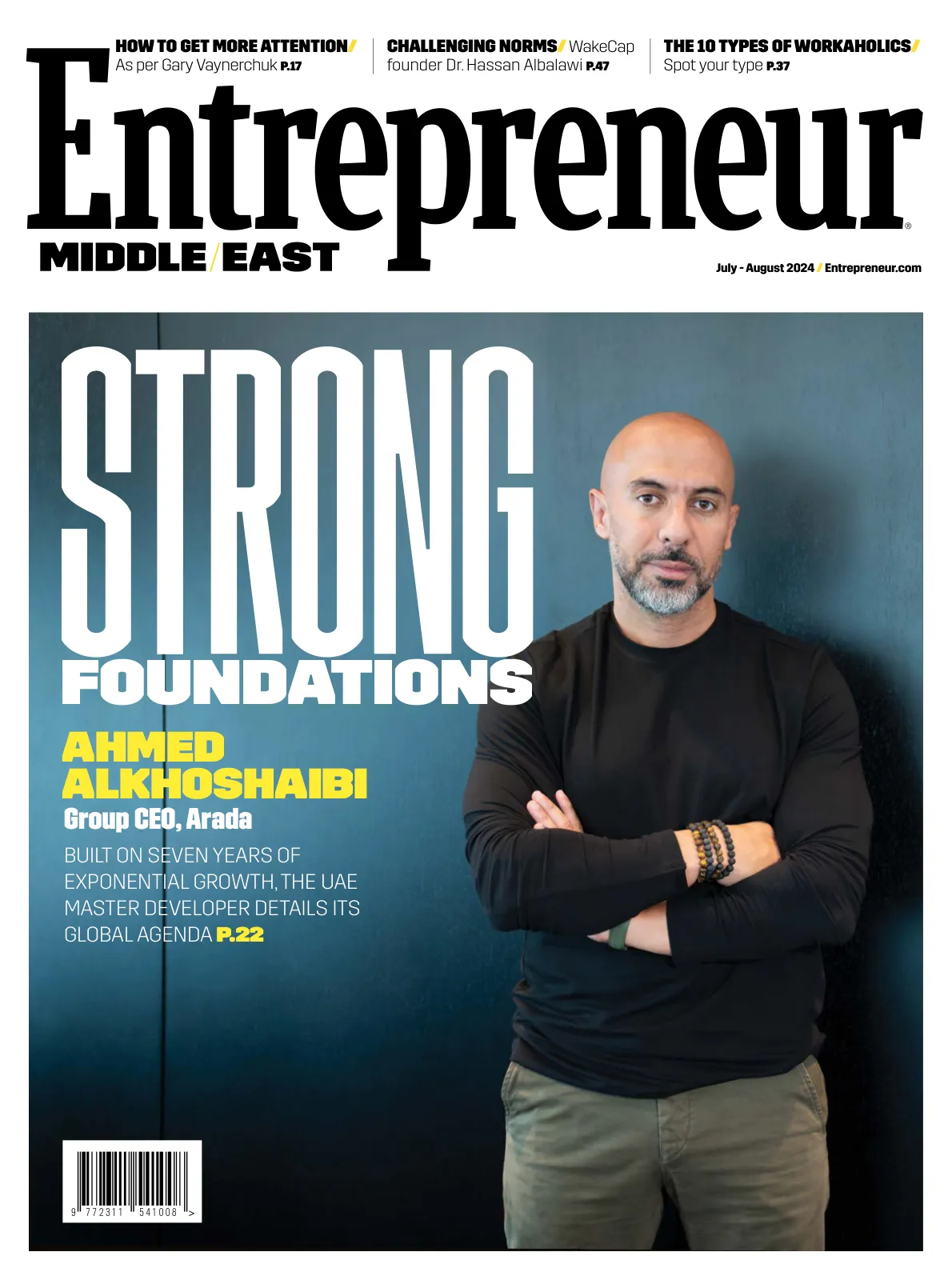
Entrepreneur Middle East, July - August 2024
Page 1
July - August 2024 Entrepreneur.com
STRONG
FOUNDATIONS
BUILT ON SEVEN YEARS OF
EXPONENTIAL GROWTH, THE UAE
MASTER DEVELOPER DETAILS ITS
GLOBAL AGENDA P.22
AHMED
ALKHOSHAIBI
Group CEO, Arada
HOW TO GET MORE ATTENTION/
As per Gary Vaynerchuk P.17
CHALLENGING NORMS/ WakeCap
founder Dr. Hassan Albalawi P.47
THE 10 TYPES OF WORKAHOLICS/
Spot your type P.37
Page 2
ANANTARA SHARJAH RESIDENCES
A NEW CHAPTER OF LUXURY EXPERIENCES
BY THE SEA
Bringing luxury seaside living to Sharjah for the first time, owners at the Anantara Sharjah
Residences enjoy access to the Anantara Sharjah Resort’s world-class amenities, including an
infinity pool, five distinctive restaurants, an Anantara Spa and a state-of-the-art gym.
As an investment, owners can enjoy the benefits of a rental management scheme operated by
Anantara Hotels, Resorts & Spas, allowing them to maximize their returns when they are not
resident in the property.
To register your interest, visit arada.com
LIFE IS A JOURNEY.
Page 3
P.22
Strong
Foundations
Built on seven years of exponential
growth, Arada Group CEO AHMED
ALKHOSHAIBI details the UAE master
developer’s global agenda.
FEATURES
Contents/July - August 2024
← Ahmed
Alkhoshaibi is the
founding Group
Chief Executive of
Arada.
3
July - August 2024 / ENTREPRENEUR.COM /
Page 4
Nestled by the coast of Lusail sits the splendor of
Raffles and Fairmont Doha, where luxury is rooted
in even the smallest details. Open the doors to
mesmerizing hospitality and make memories in a
world of sophistication.
Page 5
Page 6
Page 7
SUITE TREAT
Step into a world of opulence when you book a Suite at Raffles Doha.
Experience the added luxury of QAR 750 credit to spend
on dining in the hotel, and QAR 500 towards any Spa treatment.
Children aged 12 and below are welcome to indulge in the
enchantment of complimentary dining.
Rates starting from QAR 3,500 per night
For reservations, please call +974 4030 7100
or email reservations.doha@raffles.com
Raffles Doha, Iconic Towers, Marina District, PO BOX 4747, Lusail, Qatar
Page 8
Page 9
Welcome to the
E X C E P T I O N A L
An iconic hotel featuring
luxury rooms and apartments
with trendy dining options
in the heart of Riyadh
BOOK NOW
Mansard Riyadh, A Radisson Collection Hotel
4248 Prince Mohammed Ibn Salman Ibn Abdulaziz Road, Riyadh 6721-13315, Saudi Arabia
00966118290900 info.mansard@radissoncollection.com
radissonhotels.com/collection
Page 10
DataPatrol is a cutting-edge information and data security company specializing in advancing the
data security journey and addressing existing gaps with innovative solutions.
With years of experience in data security, we specialize in mitigating insider threats and safeguarding
sensitive information.
DataPatrol provides companies with a comprehensive, innovative, and user-friendly full set of features,
to secure sensitive and confidential data from unauthorized disclosure.
A full set of features to prevent internal data breaches
OUR SOLUTIONS ARE:
Easy to use
Seamless Setup and integration
Fully Customizable
MultiOS
Android-Ready (Android Oreo and above)
Prevent
Internal Leaks,
Protect
Sensitive
Information.
Page 11
EMPOWERING
TRUST
ENSURING
SECURITY
An internal breach can have devastating consequences on your organization, far beyond the immediate
financial loss. When sensitive data is compromised from within, it can erode trust with clients and
partners, damage your brand's reputation, and lead to costly legal repercussions.
With the continued rise of insider threats, organizations need to implement robust internal
security measures and fill in the gaps in their data protection protocols.
74% of organizations say insider attacks have become
more frequent
Don’t let a
malicious insider
destroy your
business.
Visit our website:
www.datapatrol.com�
Page 12
12 / ENTREPRENEUR.COM / July - August 2024
47 Challenging Norms
WAKECAP founder and CEO DR.
HASSAN ALBALAWI is building a
business centered on improving
workforce productivity in the
construction industry.
58 “We Got Funded!”
The stories behind the recent
fundraising successes seen by
MENA-based startups KEYPER
and MYSAFE.
52 The Road to
Successful Exits in Saudi
Arabia
IMPACT46 Managing Partner
BASMAH AL SINAIDI shares
lessons from the venture capital
firm’s investment strategy.
56 Driving Growth
MICHAL SOBIERAJ makes the case
for why your company needs a
fractional CFO.
‘TREPONOMICS
Contents/July - August 2024
37 The 10 Types of
Workaholics
ANDY BROWN explains how to spot
your type, understand what’s
driving you, and what to do
about it.
44 Beyond the Basics
YOLK BRANDS founder and CEO
STEVE FLAWITH shares six branding
lessons no one will teach you.
17 How to Get More
Attention
You can’t run a great business
if you can’t capture people’s
attention, says GARY VAYNERCHUK.
20 “Be the Change” Might
Need a Change
ATTELINE’S DUSHANE SOLOMON
believes a rethink is necessary in
how we go about global pleas for
a more sustainable future.
STARTUP
SPOTLIGHT
↑ Wingman Executive founder
Paul Littlejohn was featured in
the second episode of
Entrepreneur TV Middle East’s
Paradigm podcast series. P.54
EDITOR IN CHIEF Aby Sam Thomas
aby@bncpublishing.net
CEO Wissam Younane
wissam@bncpublishing.net
MANAGING DIRECTOR Rabih Najm
rabih@bncpublishing.net
ART DIRECTOR Simona El Khoury
MANAGING EDITOR Tamara Pupic
tamara@bncpublishing.net
FEATURES WRITER Aalia Mehreen Ahmed
aalia@bncpublishing.net
DIGITAL SOLUTIONS DIRECTOR
Mahdi Hashemi mahdi@bncpublishing.net
DIRECTOR OF INNOVATION
Sarah Saddouk sarah@bncpublishing.net
GROUP SALES DIRECTOR – B2B GROUP
Joaquim D’Costa jo@bncpublishing.net
COLUMNIST Tamara Clarke
CONTRIBUTING WRITERS
Basmah Al Sinaidi, Andy Brown, Fida Chaaban,
Steve Flawith, Scott Gilbey, Brittany Hunt,
Nicole Lapin, Dushane Solomon, Mina Vucic
SUBSCRIBE
Contact subscriptions@bncpublishing.net to receive
Entrepreneur Middle East every issue
COMMERCIAL ENQUIRIES
sales@bncpublishing.net
ENTREPRENEUR.COM
Access fresh content daily on our website
All Rights Reserved 2023. Opinions expressed are solely those of the contributors.
Entrepreneur Middle East and all subsidiary publications in the MENA region are
officially licensed exclusively to BNC Publishing in the MENA region by Entrepreneur
Media Inc. No part of this magazine may be reproduced or transmitted in any
form or by any means without written permission of the publisher. Images used in
Entrepreneur Middle East are credited when necessary. Attributed use of copyrighted
images with permission. All images not credited otherwise Shutterstock. Printed by
United Printing and Publishing.
PO BOX 502511 DUBAI, UAE
P +971 4 4200 506
EntMagazineME
Entrepreneur-me
BUSINESS
UNUSUAL
Page 13
Booking Period: Till 10 June 2024 | Stay Period: Till 10 July 2024
Scan the code
to book directly
Immerse yourself in unparalleled luxury at
Dusit Thani Abu Dhabi. Enjoy up to 10% off
on room rates and indulge in the ultimate
pampering with a 20% hotel credit for dining
and spa experiences during your stay.
For reservations and inquiries,
contact +971 2 698 8888 or email
reservations.abudhabi@dusit.com
Dusit Thani Abu Dhabi
Delight in your Getaway
The Art of Travel
Exclusive Savings + 20% Hotel Credit
Page 14
14 / ENTREPRENEUR.COM / July - August 2024
T
he third edition of Red Sea Foodtech Connect, an annual Saudi
Arabia-based conference for foodtech startups, entrepreneurs, and
stakeholders, which was held in Riyadh on June 11, 2024, saw the
convening of major decision-makers, innovators, and investors from
across the foodtech ecosystem in the Kingdom and the wider region.
This edition of the annual event was hosted by the Sunbolah Program, an
initiative of the KSA Ministry of Environment, Water, and Agriculture
(MEWA), and sponsored by Jahez, Saudi Arabia’s online food-delivery
unicorn. Red Sea Foodtech Connect founder Mohammed AlQurashi
shared that the 2024 edition of the annual event saw hundreds of attendees
from the UAE, Bahrain, Kuwait, Egypt, Jordan, Australia, and France,
among many others. The Sunbolah Program’s main representatives at the
conference were H.E. Mansour Mushaiti, Vice Minister, MEWA, Dr. Ali
Alsabhan, General Manager of Entrepreneurship, MEWA, as well as other
members of the Ministry.
Held under the theme “Meet The Big,” this year’s edition of Red Sea
Foodtech Connect saw the participation of a number of key entities from
the sector including the National Center for Palms and Dates (NCPD), an
organization that aims to develop KSA’s dates sector through improving
production efficiency and quality, Nadec, a Riyadh-based F&B company,
Calo, a Bahrain-based app that provides nutritious meals for busy people,
and the Saudi Agricultural and Livestock Investment Company (SALIC), a
KSA joint-stock company owned by the country’s sovereign wealth fund,
Public Investment Fund (PIF).
This year’s conference held a plethora of discussions and talks by national
and regional industry experts headlined by HRH Prince Khaled bin
Alwaleed bin Talal Al Saud, founder and CEO of KBW Ventures. During
the fireside chat titled “Venture Capital View,” and moderated by Abdulrah-
man AlJiffry, Partner at KSA-based venture capital (VC) fund 500 Global,
Prince Khaled shared how he has made investments across multiple
technology sectors, his insights on growth stage-financing, and how he has
adopted a first-mover approach in backing startups in the foodtech and
Converging Ideas
Hundreds of foodtech stakeholders from across Saudi Arabia and
the GCC come together for Red Sea FoodTech Connect 2024
In the Loop/
IMAGES COURTESY RED SEA FOODTECH CONNECT 2024
→ Red Sea Foodtech
Connect 2024 saw
hundreds of attendees
from the KSA innovation
landscape.
↓ H.E. Eng. Mansour Mushaiti,
Vice Minister, Ministry of
Environment, Water, and
Agriculture, Saudi Arabia, at Red
Sea Foodtech Connect 2024.
alternative proteins sectors. “Saudi is smart
money; we know what we’re doing,” said Prince
Khaled during the session “So, while we have
people coming from all over, success here isn’t free.
You need to invest as well, you need to have skin in
the game, in our ecosystem, if you want to
succeed.”
Other key speakers at the event included Dr.
Mohammed Alnuwairan, CEO, NCPD, Dr.
Sulaiman Altwaijri CEO, Nadec Food, Samer
Alsourani, SVP, SALIC, and Dr. Mazen Alzaidi,
General Partner, STV, a Saudi-based technology
VC fund. MEWA’s Dr. Alsabhan and Mushaiti also
offered talks at Red Sea Foodtech Connect that
respectively highlighted the Sunbolah Program’s
impact on the food value chain, as well as the
significance of fostering innovation in the foodtech
economy. redseafoodtech.com
↓ HRH Prince Khaled bin Alwaleed
bin Talal Al Saud, founder and CEO,
KBW Ventures, at Red Sea Foodtech
Connect 2024.
Page 15
Page 16
FACEBOOK.COM/CBNME
@CBNME
CONSTRUCTION BUSINESS NEWS ME
WWW.CBNME.COM
| AUGUST 30TH
| DUBAI
FOR EDITORIALS
VIBHA MEHTA +971 58 6314145
vibha@bncpublishing.net
FOR SPONSORSHIP OPPORTUNITIES
JOAQUIM D’COSTA +971 50 440 2706
jo@bncpublishing.net
ALEX BROWN +971 56 308 2946
alex@bncpublishing.net
SARAH SADDOUK +971 55 536 7011
sarah@bncpublishing.net
2024
SUSTAINABILITY
Innovation Awards
Gold Sponsors
Silver Sponsors
Page 17
17
July - August 2024 / ENTREPRENEUR.COM /
How to Get More Attention
You can’t run a great business if you can’t capture people’s attention, says Gary
Vaynerchuk. And today, that requires getting very creative. by NICOLE LAPIN
IMAGES COURTESY GARY VAYNERCHUK
Page 18
18 / ENTREPRENEUR.COM / July - August 2024
B/THE BIG IDEA
E
veryone wants attention. Few of us know how to get it.
Why? According to attention-getting master Gary Vaynerchuk, it’s because most people mis-
understand where attention comes from—and that the means of getting it keep changing.
“Social media was once more like email marketing,” he says. “You would get as many people to
follow you as possible, and when you would post, a percentage of them would see it. Today, one of
your clips on TikTok can get 10 million [views], and another might get 4,000. The distribution now
happens with algorithms, and that is a massive land grab that I want people to know about.”
Vaynerchuk has built a massive social following, and a constellation of successful businesses under
his company VaynerX, by understanding how the means of attention keep shifting. His new book,
Day Trading Attention: How to Actually Build Brand and Sales in the New Social Media World, is a guide
to understanding attention—and how to spot and exploit “undervalued” opportunities. Here, he
explains how to do that, why he’s not afraid of AI, and why attention will never be in short supply.
Are you using AI tools for your
own content yet?
We’ve been slow to, and that’s
because of the terms of service.
A lot of these AI companies were
very spooky to me, because if we
ingested our content, it wasn’t
clear if they could use it.
I have unlimited content on the
internet, so I know that anyone
can take it, ingest it into an AI
tool, and think or act like me. But
it’s one thing if someone went on
the internet and took my stuff. If I
self-deposit my content into an AI
tool, I want to know what’s going
w
Page 19
19
July - August 2024 / ENTREPRENEUR.COM /
to happen. Now it seems like AI
companies are starting to write
terms of services where they say,
“You can use our tool, but we have
no rights to your information.”
So what is scaring you with AI?
Nothing scares me per se, but
the thing that everybody should
always be vigilant on is: What
don’t we know? I am not overtly
scared of the robots killing our
children, but I don’t eliminate it
as a possibility.
Anything can happen. I just
don’t demonize new technol-
ogies. I look at the optimism. I
don’t think about all the jobs that
AI is going to take out; I think
about all the jobs that AI is going
to create. When the tractor was
invented, the number of people
who worked on farms in this
country was insane. It put many
of them out of work. You know
what that meant? People went on
to do more profound things. The
jobs we’ll lose because of AI in
the next decade will be replaced.
For example, this will be a mas-
sive job: prompt engineer. Being
good at asking AI questions is a
skillset. So for every kid that’s like,
“Oh, my God, I can’t be an Adobe
designer anymore”—well, first of
all, I’m old enough to know when
that wasn’t a job. Adobe replaced
the people who used to design on
paper. People forget that the world
has worked this way forever.
Do you worry that AI will
replace the work you do at your
ad agency, VaynerMedia?
I’ll put myself out of business
before I let someone else do it—
meaning, I will adjust to the real-
ity of the game. We’ve built one
of the largest global independent
agencies in the world by taking
money directly away from the
Don Drapers of the world. Every
dollar that VaynerMedia has is a
dollar that older, larger agencies
had. So if I’m taking from some-
one else, I can’t be a hypocrite.
I don’t think that I am entitled
to benefit from entrepreneur-
ship. I think I need to respect
entrepreneurship, and be a
good entrepreneur, and then I
will reap the benefits of it. This
is my biggest problem with fake
entrepreneurs that make a lot
of money, and then go use their
money in politics to try to change
laws to keep their money. I don’t
respect that, because I think
they’re losers. If AI is destined
to come and kill me, then I will
Obi-Wan Kenobi that shit.
In your book, you describe
attention-getting tools as either
undervalued, where there’s an
opportunity to get in early and
establish yourself, or overval-
ued, where it’s crowded and
more expensive and difficult to
stand out. TikTok might seem
to be overvalued, because it’s
so crowded—but that doesn’t
mean it’s too late for someone
to start posting there, right?
Correct. It would be like saying,
“There’s no room for Billie Eilish
because Madonna and Cyndi
Lauper and Whitney Houston
were pop stars, and all the pop
star opportunities are done.” It’s a
merit-based game. Every platform
is fertile ground—but especially
once one gets overpopulated, you
need creativity to be the best.
So what’s something very
undervalued right now?
Live streaming the mundane.
There’s going to be a big move-
ment of that in the next three to
to bring awareness of what I’m
doing, that’s ROI positive. Also,
I love a twofer. For example, I
do podcasts for two reasons:
One, it brings me the attention
of that podcast’s audience. But
two, I’m also filming it, because
I need the content! My life is my
production facility.
You’re launching a new book,
which reminds me of great
advice that you gave me when
I launched a book: You said to
go off the grid for two weeks,
write a list of everyone I know,
and then contact them.
I still give that advice! Asking is
okay—so long as you don’t judge
them if they don’t deliver. People
struggle with this, because their
feelings get hurt when someone
doesn’t buy a bunch.
The most impactful story I
have on this is: I helped some-
one get an eight-figure exit on
an investment, and then asked
him to buy copies of my book...
and he ghosted me. I asked
four times! I was baffled. But I
also remember being excited,
because I was able to call my
bluff on myself. I’ve continued
to have a relationship with that
person, because my brain goes
to, “Maybe he was busy. Maybe
he was in a bad place. I don’t
know. Who am I to judge?”
Here’s the key: I was asking—
and when you ask, you’re not
allowed to judge.
To hear more of the conversation,
listen to Nicole Lapin’s podcast,
Money Rehab.
four years. A stay-at-home mom
or dad is going to stream their
morning of cooking, cleaning,
and getting the family ready, or
mowing their massive lawn, and
that person will go on to make
seven figures.
Don’t forget—when Twitter was
new in 2006, everyone was say-
ing, “This is so stupid. Who cares
if you’re having a pizza? Who
cares that you’re walking your
dog?” And my answer back then
was: Everyone. It’s how human
communication works.
I struggle with this. Because
as a business owner, I think,
“I’m running a business, and
I’m already supposed to be on
social all the time. Now I should
be streaming all the time?”
Well, that’s why I suck at stream-
ing right now. I’m streaming
my office right now—but my
problem is, my day-to-day is so
boring. I’m literally sitting at my
desk doing 12 straight hours of
meetings, and the entire stream
is on mute because the meetings
have sensitive information.
But there are ways to be clev-
er. Years ago, when I decided
that I wanted to vlog, I was like,
I can’t do that. But then I took a
crazy step and hired [my former
videographer] D Rock, who
literally started following me
around with a camera.
But how do you run a business
when you’re doing content all
the time?
Listen, I am very busy—but if I
can allocate 30 or 40 minutes
I DON’T THINK THAT I AM ENTITLED TO BENEFIT FROM
ENTREPRENEURSHIP. I THINK I NEED TO RESPECT
ENTREPRENEURSHIP, AND BE A GOOD ENTREPRENEUR,
AND THEN I WILL REAP THE BENEFITS OF IT.”
S
D
S
f
“
Page 20
20 / ENTREPRENEUR.COM / July - August 2024
child, if I knew data could be
manipulated this easily,
avoiding my veggies may have
been easier.
Maybe my parents’ mindset
did help hungry kids in Africa,
but without transparent
metrics to measure how my
diet impacted starving children
globally, I’ll never know.
Similarly, I don’t know how we
produce more than enough
food to feed 1.5 times the global
population—but up to 783
million people suffer from
chronic hunger.
That’s about 10% of all the
people on our planet—but
carbon emission reductions
seemingly remain the priority.
}As a copywriter at UAE-based
communications agency
Atteline, I know that research
supports my content, much like
a comedian’s timing does the
perfect punchline, and I
accordingly leverage statistics
to help elevate my clients’
brands. However, I doubt the
sustainability data I’ve come
across will elevate your spirit—
since it unfortunately disheart-
ened mine.
I was initially optimistic
about Atteline’s journey to
achieve B-Corp certification
(something only seven UAE
businesses out of 6,700 globally
have attained), but my
optimism has since wavered.
You see, the United Nations
Sustainable Development
Goals (SDGs) were created in
2015, and as of 2023, only 15%
of these SDGs were on track,
48% were off track, and 37%
were stagnating or regressing.
Simply put, the United Nations’
progress on SDGs is lacklus-
ter—but who does the onus fall
on?
I assume it’s the “key
stakeholders,” the ones who
have frequent conversations
about creating a more sustain-
able world—yet, somehow,
B
e the change that you wish to see in the world” is a quote with
origins that trace back to 1913. While my origins aren’t nearly as old,
I’ve always believed—despite having once viewed our world like
Louis Armstrong (as wonderful)—that this quote was more idealistic
than realistic. ChatGPT agrees with me—it says: “This quote is
flawed, because individual efforts alone are insufficient to address
systemic issues that require collective action and structural
change.”
IMAGES COURTESY MINDFORCE
B/STRATEGIES
“Be the Change”
Might Need a Change
A rethink is necessary in how we go about global pleas for a more
sustainable future by DUSHANE SOLOMON
}Why so pessimistic?
I was born in Canada but raised in a Tamil
household where, thanks to my parents, my
sustainable mandates unintentionally
became running water at a trickle since
“money didn’t grow on trees,” and clearing
my plate because “kids were starving in
Africa.”
Lifestyle creep makes it harder to abide by
these teachings; my plastic water bottle usage
and Deliveroo mileage exemplify this, but I
blame Statista for proving my adolescent
efforts were futile: indeed, the prevalence of
undernourishment in Africa in 2008 was
19.5%, and as of 2022, it worsened to 19.7%.
But like an iceberg is just 10% visible above
water, I have intentionally painted only part
of the picture. In reality, Africa’s underfed
population in 2008 and 2022 represent
significant progress from 2000 (24.1%). As a
Page 21
21
July - August 2024 / ENTREPRENEUR.COM /
more than 700 million people
are still living below the
poverty line. From where I’m
typing, it feels like global pleas
for a more sustainable future
are often veiled behind
financial incentives rather
than genuine humane
intentions.
}In essence, I feel like B-Corp
certification won’t make a
dent in the grand scheme of
things when our priorities, as
citizens of the world, don’t
seem to be in order.
Maybe it’s because Amazon
proudly highlights sustainable
achievements online, but
downplays its workplace safety
concerns claiming there’s no
regulatory metric called
“serious injury rate” —and
thus, it couldn’t possibly
contribute negatively to
SDG3: Good Health and
Well-Being.
Maybe it’s because we, as
humans, consume 400% more
clothing than 20 years ago,
and fast fashion brands like
Shein are at the forefront of
this shift- while negatively
contributing to SDG 12:
Responsible Consumption and
Production.
Maybe it’s because I can
write this piece from my
iPhone while wearing Air
Jordans, knowing both Apple
and Nike have been under fire
for using sweatshops and child
labor—and I, myself, am
negatively contributing to
SDG1: No Poverty.
Perhaps that’s it—we talk the
talk, but don’t walk the walk.
As a semi-conflicted
Sustainability Ambassador at
Atteline, how can I convince
my colleagues that their
sustainable efforts could be
impactful if I don’t feel like my
concern is sufficient? After all,
I’m not a multi-billion
conglomerate with the
financial means to make a true
impact—or like a greenwash-
ing company that refuses
accountability for its actions,
that’s the excuse I recycle.
Truthfully though, I’m aware
action is being taken. For
example, Canada has imple-
mented a carbon tax to
decrease fossil fuel use and
adopt greener forms of energy
while locally, initiatives like
UAE Net Zero 2050 have been
issued by the government to
achieve similar targets.
}On the surface, these
directives seem great.
However, if the proverb “It
takes a village to raise a child”
holds any weight, then, the
sentiment that our actions
today are for tomorrow’s
children is not being suffi-
ciently upheld.
Because sustainability is about
more than the environment,
it’s about the people living in
it—or with what’s happening
across the water, the people
struggling to live in it.
My parents were victims of
genocide, fleeing a war-torn
Sri Lanka decades ago to
prevent me from having to
deal with the same hardships,
including perpetually living
life in fear of death. Being far
removed from my culture, I
can’t comprehend what their
struggle truly entailed, but I
can empathize with the
current situation of the
Palestinians.
Unfortunately, I feel like
nothing I do will change their
fate despite the collective
effort I see from my Instagram
network. Why would I think
my efforts could make a
difference, if “key stakehold-
ers” seem more focused on
reducing our carbon footprint,
than halting the violence that
has taken, and continues to
take, the lives of tens of
thousands of human beings?
While human footprints
seem to be less important than
our carbon ones, I’m still
working to reduce my use of
plastic water bottles. However,
this effort is inherently selfish
by nature, since it benefits my
physical and financial
health—but then again, maybe
it’ll help reduce the 14 million
tons of plastic that find its way
into the ocean every year.
As I do this, I’m trying to
remember that achieving
sustainability is like working
out. The first few days of
getting back into the gym are a
drag, and the first couple of
weeks are discouraging when
progress is slow, but I’ll try
and stick with it since I’m
privileged to. Similarly,
through my sustainability
efforts, I’ll hopefully inspire
others to be responsible
citizens of the world.
Until then, I maintain my
initial sentiment: working to
“be the change we want to see
the world” is irrelevant,
because we (as citizens in
society) aren’t enacting our
citizenship strongly enough to
create the change we need for
equity, let alone the preserva-
tion of not only our natural
resources but of our society as
a whole—despite today’s
headlines suggesting the
opposite.
With that said, I’ll be the
change I wish to see for
myself—because if I don’t, I’d
be just as hypocritical as those
“key stakeholders.”
Dushane
Solomon is a
copywriter and a
Sustainability
Ambassador at
Atteline, an award-winning
public relations agency
headquartered in Dubai, UAE.
atteline.com
THE UNITED NATIONS SUSTAINABLE DEVELOPMENT GOALS
(SDGS) WERE CREATED IN 2015, AND AS OF 2023, ONLY 15%
OF THESE SDGS WERE ON TRACK, 48% WERE OFF TRACK, AND
37% WERE STAGNATING OR REGRESSING.
Page 22
→ Ahmed Alkhoshaibi is
the founding Group Chief
Executive of Arada.
22 / ENTREPRENEUR.COM / July - August 2024
Page 23
23
July - August 2024 / ENTREPRENEUR.COM /
-
STRONG
FOUNDATIONS
Building on seven years of Arada Group’s exponential
growth, its Group CEO AHMED ALKHOSHAIBI details the
UAE master developer’s global agenda.
Ahmed Alkhoshaibi
Group CEO, Arada
IMAGES COURTESY ARADA
Page 24
24 / ENTREPRENEUR.COM / July - August 2024
During the course of this
rare sit-down interview,
the conversation drifts
over a wide range of
topics, including the ethos
behind community
creation, trees –undeni-
ably one of Alkhoshaibi’s
favourite subjects– the
importance of retaining a
startup mentality, and, of
course, expansion and the
future.
Arada has certainly
grown exponentially in the
seven years since the
company was founded.
From small beginnings
with the launch of the
Nasma Residences villa
community in early 2017,
Arada now oversees a
project portfolio valued at
over AED60 billion,
including Sharjah’s largest
ever mixed-used commu-
nity, Aljada, the UAE’s
first forested development,
Masaar, and the ultra-
luxury Armani Beach
Residences at Palm
Jumeirah in Dubai.
Arada has now complet-
ed over 9,000 homes
(with another 21,000 in
the pipeline), has a
workforce of over 1,000,
and is the youngest private
company in the UAE to
have obtained ratings, and
completed successful
issuances on the global
bond markets (via a debut
US$500 million sukuk in
2022, and more recently a
$400 million deal in June
this year).
All this has been
shepherded since
inception by Alkhoshaibi,
under the watchful eye of
the company’s Chairman
and Vice Chairman,
Sharjah’s Sheikh Sultan
bin Ahmed Al Qasimi and
Saudi Arabia’s Prince
Khaled bin Alwaleed bin
Talal, respectively. Not
bad for a company that
started out with little
more than a core team of
just 12 professionals as
well as a highly entrepre-
neurial mindset. So,
what’s really been the
secret to Arada’s rapid
growth? Alkhoshaibi is
unequivocal.
The founding Group Chief Executive of Arada, an affable
Australian national who leads what is now one of the UAE’s
largest master developers, is sitting comfortably in an office
whose walls are covered with architectural plans and renders,
with 3D scale models on every desk and surface.
On one side of the office, the view stretches away over the
runways of Dubai’s airport to the distant towers of Sharjah,
where Arada first began its operations. And on the other side,
there’s an even more impressive view over the elbow of Dubai
Creek, with the Sheikh Zayed Road skyline looming on the
horizon. When questioned as to whether these two views
reflect the company’s past and future, Alkhoshaibi smiles.
“Arada was born in Sharjah, but we’ve always been a UAE
company. We wanted to focus on Sharjah and transform the
market there, but it was never our plan just to stay in one
Emirate. Before Arada came, there was a certain perception of
the Sharjah market, that there was more demand for afford-
ability rather than quality, but the fact that we are selling villas
for AED10 million in Sharjah proves that there is definitely a
premium there. And having transformed that market, it was
time to go to Dubai.”
↓ Madar, the family
entertainment and retail
district at Aljada, an
Arada project.
We’ve never been a short-term
company–that’s the secret to our
success,” says Ahmed Alkhoshaibi.
Page 25
25
July - August 2024 / ENTREPRENEUR.COM /
“We had a vision that was clear
from day one,” he points out. “We
believe that when people and spaces
connect, great things happen, and
we create spaces that allow people to
enjoy happier, healthier, and more
meaningful lives. That’s our
compass, so when we design our
communities, we have principles we
follow to make sure we stay true to
our purpose.”
Perhaps the most notable prin-
ciple, which is immediately obvious
when entering any Arada commu-
nity, is the landscaping. At least 50%
of every master-planned development delivered by the
company is made up of open space, the majority of
which is covered by dense greenery, including trees and
shrubs. The most famous example of this is Masaar, the
UAE’s first “forested” community, which includes a
“green spine” of 70,000 trees, part of which has already
been completed.
“We always give hierarchy to nature,” Alkhoshaibi
says. “So, we design the nature aspect first, the tree lines
and so on, and then we do the infrastructure and the
buildings. Other developers will do infrastructure and
the buildings first, and then give over whatever is left for
trees and plants, but we prioritize our trees.”
“Keeping that open space level at 50% is in itself
discipline,” he continues. “You have the finance depart-
ment saying that we need to make more money and
squeeze in more homes, but that’s what I mean by
short-term thinking. We invest in open space, and we
activate that space, allowing people to walk more, play
more sports, and be more social. A great example of that
is the park at Nasma Residences, which is over half a
million square feet in size. It’s one of the nicest parks in
Sharjah, it’s always full, and this was done by a private
developer using its own budget–this is just one of the
ways we can support the government.”
However, the landscaping is just one of the Arada
principles of community building. Others include the
need for great architecture and design, as evidenced by
the inclusion of luminaries such as Japan’s Tadao Ando
and Zaha Hadid Architects in the design of its projects–
not to mention the 40 in-house architects Arada
employs in its design department.
Another feature is the importance of world-class
facilities, whether it’s the many schools, hotels, office
buildings, shops, restaurants, and sports amenities that
help to make up the colossal Aljada master plan, or the
AED100 million invested to create a continuous looped
professional woodland cycling circuit in Masaar. Most of
these amenities are available to residents and visitors
even before the first homes have been completed,
helping to create a destination, encouraging people to
get outside, and adding value to the project at the
earliest possible point.
Other key considerations include careful stewardship
of the local environment. Alkhoshaibi says that all
landscaping at Arada communities is fed by treated
wastewater from onsite plants, and all homes contain
extensive smart features, as well as Arada Care, the
division set up specifically to look after owners and
residents after the sales process has been completed.
The company has also made waves globally with its
Home for a Home campaign–a first-of-its-kind initiative
that has seen Arada donate homes for vulnerable
families in Kenya and Syria for every home sold in its
communities during Ramadan over the last three years.
“This approach comes from our founders–it’s in their
DNA,” says Alkhoshaibi. “They put people first, and }}
→ HH Sheikh Sultan bin
Mohammed Al Qasimi,
member of the Federal
Supreme Council of the
UAE and Ruler of Sharjah,
visiting Aljada in 2023
DEVELOPERS WILL BE FINE WITH SHORT-TERM THINKING IN A BOOM
MARKET, AS PEOPLE WILL BUY ANYTHING. BUT OUR LONG-TERM STRATEGY
DOES CONVERT TO FINANCIAL SENSE PRETTY QUICKLY.”
Page 26
26 / ENTREPRENEUR.COM / July - August 2024
WE BELIEVE THAT WHEN PEOPLE
AND SPACES CONNECT, GREAT
THINGS HAPPEN, AND WE
CREATE SPACES THAT ALLOW
PEOPLE TO ENJOY HAPPIER,
HEALTHIER, AND MORE
MEANINGFUL LIVES.”
“
26
they are extremely active and healthy. This ethos has to come
from the top; I have similar values myself, and that’s how we
came up with these principles. In fact, it’s not just corporate
strategy, it’s something we live by. That’s one of the core
reasons for our growth.”
“Developers will be fine with short-term thinking in a boom
market, as people will buy anything,” he continues. “But our
long-term strategy does convert to financial sense pretty
quickly. Investing in the public realm does cost money, but it
beautifies the area, and the asset appreciates. At Aljada in our
first phase, we were selling at AED700 per square foot, and
now, we’re at AED1,300. Why? Because people want to live in
Aljada. And it’s not because of the homes, nice as they are–it’s
because of the community. And that’s why I predict you’ll see
that figure double to AED2,600 over the next five years.”
This long-term thinking has clearly paid off, with sales
jumping steadily year on year, culminating with a 100%
growth in the total value of property sold in 2023 compared to
2022, to AED7 billion, boosted by Arada’s entry into Dubai via
the Jouri Hills at Jumeirah Golf Estates community, and the
ultra-luxury tie-up with Armani on the Palm Jumeirah. Two
more Dubai projects are imminent, the Group CEO adds,
indicating that both will again target the luxury market and
will be based in Dubai Harbour and Dubai International
Financial Centre, respectively.
But a key plank of Arada’s approach has also been to diversify
its revenue streams, both in terms of recurring revenue
through verticals such as retail leasing, which has benefited
from the ever-increasing number of shops and F&B outlets,
which saw over five million visits last year alone. The firm is
also concentrating on education, with one K-12 international
school open and two more on the drawing board, and it has
additionally launched a series of complementary brands.
These include Wellfit, now the UAE’s fastest growing fitness
brand, with three large-scale fitness centres in Jumeirah
Village Circle, Meydan, and Aljada, and new venues on the
way in more locations across the UAE and beyond. In the
process, Wellfit has become a money-spinner in its own right,
with over 14,000 memberships won so far, and some estimates
suggesting the company is on track to reach a valuation of up
to AED1 billion over the next seven years.
“These are incredible spaces that not only feature state-of-
the-art equipment, but have plenty to do for the kids,”
Alkhoshaibi says. “It’s one of the brands that really helps our
destinations–you put a Wellfit in, and it activates the space.”
↑ Armani Beach Residences at
Palm Jumeirah, an Arada project
Page 27
27
July - August 2024 / ENTREPRENEUR.COM /
Alongside Wellfit, Arada has
also launched Manbat, a social
impact partnership with the UAE
Ministry of Climate Change and
Environment that focuses on
connecting Emirati farmers with
local consumers; Zad, a food
truck park; Hungry Wolves, a
healthy eating brand; Artal, an
Emirati fashion store; and Yalla,
an e-mobility solution for the
company’s communities. In
addition, Arada signed its first
master franchise agreement with
Boost Juice, a popular brand
from Alkhoshaibi’s native
Australia, which now has six
branches already open across
Dubai, Sharjah, and Abu Dhabi,
with another 20 to follow.
In addition, Arada has also
recently announced the
creation of a new hospitality
and entertainment division,
headed by industry veteran Amit
Arora, whose mandate is to
ensure that 20% of the company’s
revenues derive from this division
in five years’ time. As for
geographical expansion, Alkhos-
haibi says he has always been
clear about Arada’s strategic
direction.
“There was always a plan to
launch in Sharjah, establish a
dominant position there, and
then shift to Dubai. From Dubai,
we’re looking to expand into
Saudi Arabia, and from there,
internationally–so, some of the
markets we have mentioned
previously include the UK, Italy,
and Australia. We don’t rush–we
took a leadership position in
Sharjah, where we now have
about 50% of the off-plan
market, and it took time for us to
find the right locations to be able
to launch in Dubai.”
But it’s also clear that the Group
CEO feels that there are no limits
THE TEAM THAT WE’RE BUILDING, THE IDEAS THAT WE’RE CREATING, AND THE
SYSTEMS THAT WE’RE IMPLEMENTING CAN BENEFIT NOT JUST THE UAE, BUT
ALMOST ANY COUNTRY AROUND THE WORLD.”
Arada by
the
numbers
} 150,000
Number of trees in Arada’s
nursery in Aljada, one of the
largest of its type in the UAE
}50%
Arada’s share of the off-plan
market in Sharjah
}346
Number of women working
at Arada (over a third of the
workforce)
}14,000
Number of homes sold by
Arada since foundation
}AED35 billion
Total value of Aljada,
Sharjah’s largest ever
project
}5.3 million
Visitors to Aljada in 2023
to how far Arada can go, given the structure and
procedures he has put in place, hinting that interna-
tional expansion may be on the cards even before the
end of this year.
“The team that we’re building, the ideas that we’re
creating, and the systems that we’re implementing can
benefit not just the UAE, but almost any country
around the world,” he concludes. “We don’t want to be
known for just being successful in one Emirate or one
country. You can apply our set of rules and principles
everywhere, and that’s why we’re so confident.”
↑ Anantara Sharjah Resort and Residences, an Arada project
↓ As Group CEO of Arada, Ahmed Alkhoshaibi leads
what is now one of the UAE’s largest master developers.
Page 28
28 / ENTREPRENEUR.COM / July - August 2024
I
Know Why
Your
Customer
Service
SUCKS
That’s because I left my high-paying executive job,
worked five low-wage frontline
jobs, and experienced the problem firsthand.
Here’s what I learned about fixing it.
by SCOTT GILBEY
U K
by
Page 29
29
July - August 2024 / ENTREPRENEUR.COM /
Page 30
30 / ENTREPRENEUR.COM / July - August 2024
IF
you’ve ever worked a mini-
mum wage job, you’ve surely
watched a lot of training vid-
eos. Narrated training vid-
eos are a key component
of Learning Management
Systems, or LMS, and they’re
how you learn your job.
I am now ashamed to admit this, but I made a lot of those
videos. I spent years in the executive suite of an international
company, working as a global senior vice president of customer
experience, where I directed and produced many training
videos. I thought they were smart and helpful. I assumed they
increased efficiency.
And then I left my well-paying job and became a frontline work-
er making $16 an hour at a big-box retailer in Florida. I spent my
first two weeks watching LMS videos, which trained me on the art
of customer service and how my store functioned, and then I was
thrust out into the store itself. That’s when I realized: Most of this
stuff didn’t help me at all. The videos got me “lawyered up” with
cautions and “branded up” with soothing marketing messages,
but they left me incapable of doing anything useful on the job.
All I kept hearing from customers was, Where’s my order? I need a
refund! What do you mean you don’t know?
After 10 weeks, I decided to cut the phrase “In Training” from
my name badge. It was starting to feel embarrassing. For how
long could I possibly be in training? I showed this to my coworker
Jim—a guy I had met while hunched over a shared laptop in the
corner of a manager’s office, watching yet another LMS video
together—but Jim laughed and said I was crazy.
“I’m staying ‘in training’ forever,” he told me. “That way, I don’t
have to explain to customers why I don’t know what I’m doing.”
I have a lot of stories like this. Over a period of 30 months, I
went on a “frontline immersion” by working at three retail brands
across six different stores, plus an airline and a public school dis-
trict. My goal was to see what I never saw as an executive—where
customer experience breaks down, and why customers and em-
ployees become frustrated. It was emotionally difficult and often
embarrassing. Yet I also came away hopeful. These problems
aren’t unfixable. We really can make our customer experiences
better, for businesses big and small.
But first, we need to see where it all starts to go wrong—on the
frontline.
I
didn’t set out to be a customer experience (CX) executive.
Instead, like many people, I started in the service industry.
At age 17, I worked as a black-tie waiter/bartender and then
on a cruise ship. This taught me a lot about how good experiences
were profitable. The more food and drinks I sold, and the more
pleased the customer, the more cash I took home. I never once met a
dining customer who said, “Glad I didn’t eat or drink or dance.”
After a stint in engineering, I migrated into manufacturing sales,
fascinated by how other managers worked, shadowing the best of
them. One was a purchasing manager named Ron, from whom I
ironically learned how to sell. I remember how he’d work:
RON: “What is your best price?”
BIDDER: “$590,000.”
RON: “Is that your best price?”
BIDDER: “OK, $570,000.”
RON: “Is that your best price?”
BIDDER: “Ron, you’re killing me. Will $530,000 get me the order?”
RON: “Is that your best price?”
BIDDER: “My boss is going to fire me. We have no margin left.
$520,000.”
There were initially seven bidders. One by one, they dropped
out, deflated, defeated, until only one was left standing. Ron nev-
er once said, “Your price is high.” He never suggested, “Can you
lower your price?” He only asked, “Is that your best price?”
Years later, I would understand this to be a key component of
closing sales and building customer experiences, and employee
experiences too. It’s all about asking good questions. Would you
recommend it? What could be better? The key is to listen to what
is being asked and what is being said—or not said.
Listening is the greatest skill you can develop and use. In theo-
ry, my peers in CX know this. As I reflect on my career, I realize I
could have practiced better listening in many arenas—engineer-
ing, sales, marketing, data, and general management. I became
certified by the Customer Experience Professionals Association
(CXPA), which involves taking a test in customer insights and
understanding, customer experience strategy, metrics, measure-
ments, and return on investment (ROI). All of which is to say: It’s a
test about listening. How well can you find and process feedback?
I wound up working at a global industrial service and equip-
ment company, rising in the ranks to senior vice president of
customer experience and service offering. In early 2020, the
company went through cutbacks and a change in direction. I left.
It was an emotional, perhaps rash, decision. I thought there’d be
plenty of work out there for someone like me—or maybe I’d start
a consultancy. Then the pandemic froze me in place. I couldn’t
find work. I couldn’t find clients. I kept busy with DIY projects at
home, like remodeling the bathroom.
Then, one day, I was talking to a friend in the CX world, and
he said something that stopped me cold: “You love customer ex-
perience. You also keep talking about your DIY home renovation
projects. Why don’t you combine those interests somehow? Go
get a job at a hardware store.”
Out of sheer curiosity, I applied for a job doing customer
service. Not as an executive, mind you. I mean an on-the-floor
job, paying $16 an hour, wearing an apron at a big-box retailer in
Naples, Florida. I applied on Thursday. The following Tuesday, I
was on the schedule as an hourly employee.
That’s when my education in customer experience really began.
E
ighty percent of CEOs say they deliver a great customer
experience. Only 8% of customers agree.
That’s what Bain & Company found in 2005, in a study
that’s famous among customer experience professionals. The
study called this the Delivery Gap (a.k.a. Experience Gap): Exec-
utives often overestimated the quality of service their companies
were delivering, while customers themselves were often dissatis-
fied with the actual service they received.
As a CX executive, I knew about this. Similar findings have
been published over the years—and while the numbers may
change, the skew never does. Overwhelmingly and consistently,
company leaders tend to think more of themselves than do cus-
tomers. And when I was a company leader, I really, truly did think
we were the exception.
As I stepped into my first day at the national retailer, I started to
think: The executives here probably think that they are the exception
too. Now I get to see the reality.
IF
I
E
Page 31
31
July - August 2024 / ENTREPRENEUR.COM /
I quickly encountered unexpected problems, starting with the
onboarding process. I wondered if these problems were unique to
this one retailer, so I took a job at another and then another—and
experienced the same things! Then I wondered if these problems
were specific to retail, so I took a customer-service job at an air-
line, and then as a guest teacher with a local public school. Once
again, the same problems emerged. I was onto something.
I won’t name these organizations, because I don’t want to be
viewed as criticizing them. Aside from the local school, these
are national companies you’ve shopped and flown with. They
are admired leaders in their respective fields. I love them all and
have learned a lot from them. Each has a strong mission, fantastic
people, superb products, excellent service, and top financial or
operational results.
But as I’d find out, they are not immune to the difficult reality
of customer service, especially as the bar of CX continues to rise.
While already great, each is looking for ways to improve.
In the rest of this article, I’m going to share stories from my
frontline immersion. I won’t attribute individual experiences to
specific organizations, and I want to stress: I do not believe these
problems are unique to these institutions. These are problems that
everyone struggles with, which is why it’s so important to recog-
nize and take advantage of a new perspective.
What I learned was this: The Experience Gap is not a singular
thing. It is really the combination of three more specific gaps—a
Competence Gap, a Supervision Gap, and a Data Gap. To solve the
big problem, we must look closely at the smaller ones.
The Competence Gap
I
have been onboarded five times now—by four great compa-
nies, and one great school board. The onboarding experience
is big on compliance, marketing, and socialization. Each
brand instills pride in the new employee. I meet nice people. I hear
stories. I end my first day giddy with satisfaction and excitement.
The emotion is real.
And then the work begins.
As a frontline worker, I want to be competent, and I want to be
Companies must
redefine the role
of supervision,
emphasizing
mentorship and
skill development
rather than
blindly focusing on
compliance.
seen as competent. So do my peers. According to a Washington
Post/Ipsos poll from 2023, most workers (61%) say they try to excel
in their jobs; 33% say they do their job well but don’t go beyond
what they’re paid to do; and only 4% say they’re doing just enough
to get by.
So the question is: How do we become competent? This is where
the Experience Gap begins.
In my time at the frontline, I saw onboarding happen in four
phases:
PHASE 1/ Videos
And more videos! These are the LMS training videos I described
earlier. I watch hour upon hour of these things. Some are long.
Some are snippets. Few are easy to remember. Part of the problem
is simply volume; I’m receiving so much information, all at once,
that it’s impossible to process it all. Another part of the problem
is context; learning is low because I don’t yet understand the basic
context and vocabulary these videos are using.
There is typically no secondary way to learn. I have no other
avenues for reviewing or following up on information. “Just
watch it,” one supervisor said when I asked for clarification.
Ultimately, these videos are efficient for sharing mass informa-
tion—which is why, as an executive, I thought they were a good
idea. However, practically speaking, unless these videos are
paired with other learning actions during training, video learning
is low and fades quickly.
PHASE 2/ Checklists
Every company has checklists. They are essential. As an executive,
I loved checklists: They ensure that procedures are followed, and
that small things aren’t overlooked.
But in practice on the frontline, checklists are not a failsafe.
They feel like one more thing to do—a very literal box to check,
just to make corporate happy. I rarely saw them used as designed
or intended. I asked one supervisor to review my checklist and
the response was essentially, “Don’t waste my time.” At another
job, I attempted to book a 90-day review with a manager but could
not because the activity had already (unbeknownst to me) been
marked as completed.
PHASE 3/ Ad hoc tribal knowledge
What happens if I can’t consult a checklist? The answer is: I figure it
out while a customer waits.
This is how I learn to do the critical tasks of my job. Whether
ordering a piece of 2-by-4 lumber, searching for lost luggage, or
providing substitute lessons in school, there is zero practice be-
fore I interact with customers—zero. I simply jump in and try my
best. Over time, the tasks gradually become familiar. And that’s
the thing: They’re just familiar. Competence is something else.
As a fellow frontliner, Sondi, says to me: “No one trains me on
nothing. I just use my brain.”
PHASE 4/ The honeymoon period
During my first 10 or so days, I am considered fragile and new. Next
is a period of 30 to 90 days when I am simply new. One day I am
suddenly expected to know and do everything, whether my capa-
bility has been validated or not.
I managed this honeymoon phase. Unfortunately, I saw others—
both young and seasoned—struggle and talk of quitting even while
their onboarding was underway.
I
z
.
PHASE
PHASE
PHASE
PHASE
Page 32
32 / ENTREPRENEUR.COM / July - August 2024
Now, let’s review: I have come to do a job. While I want to feel
competent in that job, the path to competence is agonizingly slow
and filled with distractions. Sometimes I am showered with fake
empathy. Supervisors assume I need to be motivated, but what I
really want is to identify the 10 to 20 specific, recurring, and critical
tasks I need to perform each day. I want to be good at those tasks.
Otherwise, my interactions with customers can be ad hoc and awk-
ward, which is frustrating for the customer and embarrassing for
me. Watching videos doesn’t cut it.
And that’s not even the worst part. If I get through all of this,
and I actually do achieve competence, then I discover something
horrible:
I am not required to be competent!
This is my biggest takeaway from my 30 months on the frontline.
The key word is “required.” I am not required to be competent. The
company may expect me to become competent, and I might even
become competent. My supervisors, however, are entirely focused
on my being compliant and obedient. Whether I am competent at
my job does not seem to matter.
“No way!” you say. “Yes way,” I answer. In each of my five front-
line engagements, without exception, what I do during the day with
customers is rarely acknowledged or questioned. What matters is
when I clock in, when I clock out, and where I stand or otherwise
position myself during my shift.
Here’s a classic example: One day, I am speaking with a customer
building a $5,400 order. Out of the corner of my eye, I see my one-up
supervisor say something to my direct supervisor, who approaches
me, leans into my personal space, and says, “Scott, you have to leave!”
It was 5:07 p.m. My shift was to 5:00 p.m. and my name would now
appear the next day on the “overtime offenders” list. That’s what I’m
talking about: My compliance with the time-clock rules was more im-
portant than my competence to secure a $5,400 sale.
Many companies will say their onboarding is strategic and well-
thought-out. Please think again! Most companies are rightly con-
cerned about employee experience. At the same time, widely pub-
lished data show an alarming trend of low employee engagement
and an increasing Experience Gap between boardroom strategy
and frontline reality.
The gap begins on day one with onboarding. I was there and I
saw it. It can be different. It must be better.
The Supervision Gap
A
ll day, every day, I run into unique customer challenges.
Someone will ask me something, and my response will
be, “I’m sorry, I don’t know.”
To whom do you think I turn?
If I need rules, I ask headquarters (via online search). If I need
permission, I ask a supervisor (by radio if I have one). If I need
help, I ask a peer (standing next to or near me).
My peers, I quickly realize, are the real training resource at
every company. My supervisors are often unsympathetic to my
needs; they’re here to supervise me, not to develop me. Frontline
workers therefore create an unofficial peer-to-peer training sys-
tem—and this is how I learn the day-to-day details of my job, the
keystrokes, how to avoid trouble, and how to be successful.
Is this a problem? In theory, no: Peers should help each other!
But this ad hoc training slows everyone down. It also allows mis-
information to spread; if one of my peers only half-knows how to
do something, I will only half-learn it. And it creates an us-versus-
them mentality, where we believe our success comes from sticking
together, not from rising through proper channels.
As I see this evolve, I keep wondering: What’s wrong with the
supervisors?
Then I realize the answer: They’re who I would become.
My supervisors tend to be good people. Good companies attract
good people. However, being a good person does not automati-
cally make one a good supervisor. Supervisors are frontliners too,
with different job roles. They’ve learned their tasks and assumed
behaviors on the fly, just as I’m doing. Their peers helped them
when they were at my level. Now they expect my peers to help
me. It’s not their job. This is an oral tradition, superseding what-
ever organizational structure the company has created.
It leaves me with a question: What is the purpose of frontline
supervision in the organizational layer? Imagine if, instead of
expending time and energy on compliance and obedience, your
frontline supervision was single-mindedly focused on helping
the frontline be competent, and to help each other serve custom-
ers. “Servant leadership” comes to mind. The Experience Gap
would shrink.
The Data Gap
I
n my prior life as senior vice president, I would immerse
myself in data—real-time machine data, supply chain data
(where is that 2-by-4?), financials, customer master data,
access and login rights, GDPR regulations, and much more.
Data can set you free. As an executive, I wanted to know things
like: If we increase this here, does it improve the business over there?
Questions like those cascade down the ladder. If an executive
wants some metric to increase, then many people must now work
to make that happen. Honestly, I never thought about how disrup-
tive that is...until I worked the frontline.
Here’s an example: A customer asks me about a branded adver-
tisement offering 50% off, and as usual, I don’t know the answer.
No peer recognizes the promotion, so I ask a supervisor. To my
confusion, the supervisor asks, “Has the customer enrolled in our
loyalty program?”
Huh? That doesn’t address the customer’s question.
“Does the customer have a store-branded credit card?” the
supervisor continues.
Again, I tell her I don’t understand.
“Last week we had only 23 new credit cards,” she says. “We need
more this week.”
Now I have a different task. My customer, who wanted an answer
about the sale, is further from my mind. “How many more credit
cards do we need?” I ask.
“Just get more!” she curtly demands.
Why did this happen? Probably because the supervisor had
recently attended the weekly store manager meeting, and the low
number of credit applications was high on the agenda, and there-
fore top of her mind. Now it was top of my mind.
My frontline colleagues and I are awash in data. Everywhere we
look, there is a new number to hit, a new metric to achieve, a new
goal to count. It is rarely contextualized. I don’t know why we’re
interested in that number, or how long we’re supposed to care
about it, or what happens when we reach it. I don’t know if it’s my
responsibility, or our collective responsibility, or really nobody’s
responsibility. And this information rarely helps me navigate the
bulk of my daily tasks. I am awash in seemingly useless informa-
A
I
Page 33
33
July - August 2024 / ENTREPRENEUR.COM /
tion, and short on the information I actually need, such as my log-
on credentials, on-hand inventory, and customer identification.
This is the Data Gap at the frontline. It is the gap between the
truckloads of information (alphanumeric and otherwise) gushing
from headquarters and the cupful I need right now. Every corpo-
rate data-related decision or proclamation will ripple outward in
real-world ways, like a butterfly flapping its wings in California and
creating a tsunami across the Pacific.
S
o, how do we fix this?
As a CX executive, I thought I understood what was hap-
pening on the frontline. Now I realize that I mostly heard
about two things—the extremely good stuff that makes executives
happy, and the extremely bad stuff that hits social media.
In reality, the exceptional and the terrible together might ac-
count for 5% of all customer experiences. The rest occurs in what
I call the Boring Middle—the everyday customer interactions that
keep a business afloat, with all its accompanying boredom, some-
times confusion, and routine interactions and transactions.
Now that I’ve recently lived at the frontline myself, I know: Here
lies the secret to breaking the mystery of the Experience Gap.
Executives must turn their attention to fixing the Boring Middle.
How? Let’s start by
closing those three gaps.
THE COMPETENCE GAP Frontline employees often embark
on their roles armed with theoretical knowledge from LMS videos,
and devoid of practical experience. This results in employees
struggling to perform basic tasks, leading to customer dissatis-
faction and employee frustration. The prevailing approach to
training—with a focus on participation rather than skill acquisi-
tion—exacerbates this issue. To bridge this gap, companies must
prioritize hands-on training and real-world practice, ensuring
that frontline staff are equipped with the necessary skills to excel
in their roles. AI-driven simulators, for example, could speed the
path to competence.
Supervisors
assume I need to
be motivated, but
what I really want
is to identify the
10 to 20 specific,
recurring, critical
tasks I need to
perform each day.
THE SUPERVISION GAP While frontline employees crave
guidance and support from their employer, we often encounter a
lack of effective local leadership. Supervisors, burdened with com-
pliance responsibilities and performance metrics, prioritize tasks
over mentorship. As a result, frontline workers turn to their peers
for assistance, bypassing the supervision layer. To address this
gap, companies must redefine the role of supervision, emphasiz-
ing mentorship and skill development rather than blindly focusing
on compliance and obedience. By empowering supervisors to act
as “servant leaders,” companies can foster a culture of continuous
learning and improvement at the frontline.
THE DATA GAP In today’s data-driven landscape, frontline
employees are inundated with information, much of which is irrele-
vant to their immediate tasks. This “data deluge” distracts employ-
ees from their core responsibilities and hampers decision-making.
Moreover, frontline staff often lack access to critical data that could
enhance customer interactions. If you don’t have a data strategy,
start there! Tackle the Data Gap head-on and provide frontline
employees with specific and relevant data tailored to their roles and
the tasks at hand.
D
oing this won’t be easy. It requires a shift in mindset, pri-
oritizing employee skills and empowerment. By investing
in hands-on training, fostering supportive supervision,
and streamlining data delivery, companies can transform their
frontline operations to deliver consistently exceptional customer
experiences in an increasingly competitive landscape.
I sure would have appreciated that during my time on the frontline.
M
y final task, after working those five jobs across 30
months, was to be a substitute teacher for a three-day
stretch. Seven class periods per day, each a 49-minute
duration, and each with 24 to 33 students, in grades 9 to 11.
I arrived home wondering whether I had mattered to those
students. Would I have loved to make an inspirational impact on
their lives? Absolutely! In reality, however, I was a temporary blip
to them. My job was to ensure a continuity of service, not to insert
or create anything new myself. Success meant getting the students
(my customers) through the next 49 minutes, on task with assign-
ments completed.
Then I realized something else: “On task with assignments com-
pleted” is a great definition of experience success generally—and
organizations should embrace such focus rather than constantly
chasing the ethereal moonshot.
Together, collectively as an organization, we want to create
long-lasting and wonderful experiences for people. But to get
there, we need to truly embrace the short-term, seemingly small
things. Good teachers tend to model this very well; they deliver
small wins daily. We CX people also need to become very good
at the immediacy of now, which means appreciating the severe
importance of specific moments and specific transactions. We
need to look at our frontline workers and say: I will help you
be great right now, so you can help customers be happy today
and tomorrow.
And we need to mean it.
Scott Gilbey advises on experience-themed, profitable business trans-
formation.
S
H w?
cl in
H
S
g
k
H
H
D
M
Page 34
Page 35
Page 36
Page 37
37
July - August 2024 / ENTREPRENEUR.COM /
The 10 Types of Workaholics
How to spot your type, understand what’s driving you, and what to do about it by ANDY BROWN
I’ve met many entrepreneurs who proudly declare they are
“married to the job,” “chained to their desks,” or “perpetually
busy.” Like burnout, workaholism has become something of a
badge of honor.
The 24/7 hustle is often seen as the only path to success,
encouraging entrepreneurs and leaders to prioritize work above
all else. They sacrifice time with family and friends, neglect
physical health and mental wellness, and push themselves
harder and harder.
The consequences? Decreased resilience, stress and deteriorat-
ing relationships. I refer to this as running up an “emotional
overdraft”—where business successes are subsidized at the cost
of personal resilience and well-being.
Understanding your emotional overdraft, and identifying the
specific drivers behind your workaholic tendencies, can help you
regain balance and improve your overall effectiveness.
There are 10 drivers of an emotional overdraft—each of which
can lead to workaholism. These drivers represent ways of
thinking and behaving that can either support or diminish your
impact in your business.
Overloading your thinking with these drivers impacts your
performance as a leader by creating interference in your capacity
to perform. Removing the interference allows your natural
talents and abilities to shine through effortlessly. Understanding
these drivers will help you manage your emotional overdraft and
enhance your leadership effectiveness. }}
Page 38
38 / ENTREPRENEUR.COM / July - August 2024
‘T/PRO
1/ THE CONTROL-OBSESSED WORKAHOLIC
DRIVER: Trust
Entrepreneurs who score highly on this trust driver show up as, “I
only trust myself; I don’t trust others.” This leads to micromanag-
ing and reluctance to delegate, stifling team growth and innova-
tion. Constantly worrying about whether work is being done to
your standards, juggling too many balls, working late every night,
and doing tasks that are other people’s responsibility can be
exhausting and demoralizing. This behavior drains your resilience
and negatively impacts your well-being.
SOLUTION: Delegate tasks, build trust through accountability and
communication, hire for attitude, train well, and structure tasks
without micromanaging.
2/ THE URGENT WORKAHOLIC
DRIVER: Urgency
For entrepreneurs, the urgency driver leads them to feel that
everything is immediate and urgent, often leading to stress and
poor decision-making. We’ve all been in situations where the day
starts to unravel, pulling us from one crisis to another. This
constant state of urgency can make you feel like you’re always
acting on reflex, unable to properly solve problems, or think
critically about your actions. It’s a stressful way to live and work,
often leading to health problems due to prolonged exposure to
adrenaline. Moreover, it can demotivate your team and strain
relationships at home as your constant state of urgency spills over
into your personal life.
SOLUTION: See urgency for what it really is: Understand that what
feels urgent is often self-created. Assess whether a situation truly
requires immediate attention, or if it can be scheduled. Plan,
establish robust processes, and regularly review business plans.
3/ THE EXPECTATIONS WORKAHOLIC
DRIVER: Expectation
When you expect to feel stressed a lot of the time, you’re likely to
explain it away as the natural lot of a leader. This mindset means
you’re not sensitive to the level of stress you’re experiencing, which
in turn means that you’re not inclined to do anything about it. It’s
a self-fulfilling prophecy.
SOLUTION: Track stress levels, change your mindset, reframe failure,
seek professional help, and prioritize self-care.
4/ THE DUTY-BOUND WORKAHOLIC
DRIVER: Duty
When you’re ruled by a sense of duty, you often work late because
you feel it’s expected of you. You handle other people’s problems
because you think you should, and you sacrifice your own needs
for the sake of others. This is a classic way to build up an
emotional overdraft. As Greg McKeown says in his book Essential-
ism: “If you don’t prioritize your life, someone else will.” When
you’re in constant duty mode, you’re not only exhausting yourself,
but also disempowering those around you by not giving them the
chance to develop their own sense of responsibility.
SOLUTION: Define personal goals, develop a vision and plan, clarify
your role, set up an organizational structure, and challenge your
sense of duty.
5/ THE DOER WORKAHOLIC
DRIVER: Just Flipping Do It
The phrase “just flipping do it” captures the mindset of leaders
who thrive on action and decisiveness. While this can drive
progress, it often stems from a need for control, leading to
micromanagement and reluctance to delegate, which increases
emotional overdraft. Doers can be difficult to work with due to
their impatience and lack of concern for others’ input. This can
alienate team members and lead to rushed, ill-informed decisions.
The habit of always stepping in can create a passive team,
perpetuating the belief that only the doer can handle tasks
effectively.
SOLUTION: Recognize your behavior, value other approaches,
prioritize, delegate, create structure, and take positive pauses.
6/ THE CASH-STRAPPED WORKAHOLIC
DRIVER: Cost
“We’re short of money.” “We don’t have the resources.” “I can’t
justify the expense.” Cost concerns are a common driver for
workaholics, especially when business owners believe they can’t
afford the resources they need. This mindset often leads to
increased workloads and stress, both for themselves and their
teams. For example, you might delay hiring an extra pair of hands
due to budget constraints, forcing your current team to handle
more work. This not only affects productivity, but also leads to
burnout. When leaders focus excessively on saving money, they
often end up increasing their emotional overdraft and that of their
team. This approach can stall growth and innovation, ultimately
costing more in the long run.
SOLUTION: Question budget constraints, ensure accurate financial
information, adjust pricing, prioritize spending, view hiring as
growth, and protect personal wages.
Page 39
39
July - August 2024 / ENTREPRENEUR.COM /
7/ THE SOLUTION-SEEKING
WORKAHOLIC
DRIVER: At a Loss
“I’m out of ideas.” “I’ve no other
solution.” When we’re
overwhelmed, it’s easy to act on
autopilot, and jump to the
most obvious solution without
considering alternatives. This
reactive approach often
increases stress and emotional
overdraft. Operating under
pressure makes it difficult to
see the big picture. This
narrow focus can lead to
decisions that add to your
stress rather than alleviate it.
SOLUTION: Seek input from
others, create a personal board
of advisors, recognize and
challenge negative self-talk,
focus on learning, and reframe
problems.
8/ THE LOAD BALANCING
WORKAHOLIC
DRIVER: Load-balancing
“I have a short-term need.” “I’m
stepping in to fill a gap.”
Load-balancing workaholics
step in to fill gaps during
urgent situations, often taking
on tasks unrelated to their
leadership roles. While it can
be necessary occasionally,
making a habit of it leads to
neglected priorities and
increased stress. This behavior
can undermine team members,
as they miss opportunities to
solve problems themselves,
leading to dependence on the
leader and a cycle of frustra-
tion.
SOLUTION: Set up processes to
prevent repeat problems, avoid
over-servicing clients, and label
your behavior to recognize and
address it.
9/ THE EMPATHETIC
WORKAHOLIC
DRIVER: Empathy
“I’m part of the team.” “I’m
showing care and commit-
ment.” “I feel guilty if I don’t.”
Empathy is often praised as a
valuable trait, but it can drive
your emotional overdraft if
misapplied. Feeling guilty
about not helping others or
getting too involved in their
issues can drain your
resilience.
Empathy should not stem from
a need to be liked or a desire to
belong. Leaders who absorb
their team’s emotions too
deeply can become over-
whelmed and ineffective. It’s
crucial to distinguish between
supportive leadership and
over-identifying with
employees’ problems.
Misapplied empathy can lead
to burnout, and undermine
your leadership.
SOLUTION: Understand
WHEN WE’RE OVERWHELMED, IT’S EASY TO ACT ON AUTOPILOT,
AND JUMP TO THE MOST OBVIOUS SOLUTION WITHOUT
CONSIDERING ALTERNATIVES. THIS REACTIVE APPROACH OFTEN
INCREASES STRESS AND EMOTIONAL OVERDRAFT.”
empathy in leadership,
distinguish types of empathy,
avoid needy empathy, and
remember your team isn’t your
family.
10/ THE VALIDATION-SEEKING
WORKAHOLIC
DRIVER: Self-Worth
“It makes me feel needed.” “My
work is important to me.” Many
leaders derive their sense of
self-worth from their profes-
sional achievements and their
perceived importance within
their organizations. When you
tie your self-worth to your job,
your emotional stability becomes
vulnerable to the ups and downs
of business life. A good week
boosts your self-esteem, but a
bad week can devastate it. This
imbalance spills into your
personal life, straining relation-
ships and personal well-being.
SOLUTION: Seek constructive
validation, identify activities that
boost resilience, build a business
that runs smoothly without
constant intervention, and
recognize neediness.
Entrepreneurs can achieve
success without sacrificing their
health by understanding their
drivers and making intentional
changes. By delegating
effectively, setting boundaries,
and prioritizing self-care, you
can create a sustainable balance
that supports both personal
well-being and business
success.
Andy Brown is
an award-win-
ning leadership
coach and
Amazon best-
selling author. His book, The
Emotional Overdraft: 10
Simple Changes for Balanc-
ing Business Success and
Wellbeing, is available on
Amazon. For more insights,
follow Andy on LinkedIn.
linkedin.com/in/andybrown-
profile
Page 40
40 / ENTREPRENEUR.COM / July - August 2024
I
n the fast-paced business landscape of
the Middle East, where entrepreneurial
spirits soar and work culture often
pushes the limits of dedication, the fine
line between hard work and work
addiction can sometimes blur.
Understanding and addressing work
addiction is crucial, not only for the well-being of
individuals but also for the overall health of
organisations.
Work addiction, often colloquially referred to as
“workaholism,” is a condition characterised by
compulsive work habits that significantly disrupt
personal health, happiness, and interpersonal
relationships. According to a 2018 study in the
Journal of Behavioral Addictions, the prevalence of
work addiction is estimated at around 5-8%,
varying based on the definitions and criteria used
to identify the condition. These figures underline a
critical challenge within the corporate sector, one
that resonates deeply in regions fueled by robust
economic ambitions like the Middle East.
‘T/PRO
Through the Highs and Lows
Analyzing work addiction and its impact on business in the Middle East by BRITTANY HUNT
Page 41
41
July - August 2024 / ENTREPRENEUR.COM /
T
hose who are
addicted to their
work are distinct
from those who are
highly dedicated or
hard workers,
primarily in their compulsiv-
ity and the negative impact
the work has on an individu-
al’s life. While dedication
and hard work are charac-
terized by a conscientious
commitment to job respon-
sibilities, they are generally
balanced with other life
activities, and do not
compromise personal health
or relationships. In contrast,
work addiction involves an
obsessive need to work
excessively, driven not just
by professional commit-
ment, but by an internal
compulsion that disregards
health, personal happiness,
and social interactions.
Dedicated workers are able
to detach from work,
enjoying and valuing their
downtime, whereas worka-
holics struggle to disengage,
often resulting in stress,
burnout, and anxiety.
Understanding this distinc-
tion is crucial for maintain-
ing a healthy work-life
balance, and ensuring that
professional enthusiasm
does not evolve into a
harmful addiction.
The implications of work
addiction extend beyond
personal health, impacting
organizational effectiveness.
Work addiction and
excessive work pressures
often lead to chronic stress,
which is a well-documented
precursor to both depression
and anxiety. When individu-
als consistently overextend
themselves to meet demand-
ing work obligations, they
may experience prolonged
periods of stress that can
deplete their mental and
emotional reserves. Re-
search indicates that 12
billion productive workdays
are lost annually to mental
health issues such as
depression and anxiety,
costing the global economy
nearly US$1 trillion. This
statistic is particularly
concerning in the context of
the Middle East, where the
intense drive to innovate and
succeed places immense
pressure on individuals,
potentially exacerbating
these mental health
challenges.
Moreover, the lack of
recovery time in cases of
work addiction means that
the natural repair mecha-
nisms, which are triggered
during rest periods, do not
have the opportunity to
engage. Without these
periods of rest, individuals
are less able to cope with
daily stresses, and over time,
this can lead to severe
mental health issues. In the
Middle East, where long
work hours and high
expectations are common,
the absence of a balanced
work culture can increase
not only the risk of these
mental health disorders, but
also the productivity and
effectiveness of organiza-
tions. When the drive to
innovate and succeed is
paramount, and employee
wellbeing is so closely
linked to business success
and growth, it is imperative
for leaders to foster a
balanced work culture.
Here are a few things that
business leaders can do to
achieve just that:
1/ ENSURE EARLY
IDENTIFICATION AND
SUPPORTIVE POLICIES Imple-
menting policies that
recognize the signs of work
addiction—such as declining
physical health, decreased
productivity despite long
hours, or strained
relationships due to
work—can help in early
identification and
intervention.
2/ PROMOTE WORK-LIFE
BALANCE Encourage a
culture where work-life
balance is prioritized. Simple
strategies like flexible work
hours, mandatory time off,
and support for mental
health not only enhance
productivity but also prevent
burnout.
3/ OFFER REGULAR TRAINING
AND RESOURCES Provide
training sessions that help
employees manage time
effectively, set achievable
goals, and detach from work
after business hours. Access
to counselling and mental
health resources can also
support those struggling
with work addiction.
4/ LEAD BY EXAMPLE
Business leaders should
model the work-life balance
they advocate. By setting an
example, leaders can directly
influence the workplace
culture, promoting healthier
work habits among
employees.
5/ PROVIDE MENTAL HEALTH
ASSESSMENTS Regularly
offer confidential mental
health assessments as part of
health benefits packages.
These assessments can help
RESEARCH INDICATES THAT 12 BILLION PRODUCTIVE WORKDAYS ARE LOST
ANNUALLY TO MENTAL HEALTH ISSUES SUCH AS DEPRESSION AND ANXIETY,
COSTING THE GLOBAL ECONOMY NEARLY US$1 TRILLION.
}}
Page 42
42 / ENTREPRENEUR.COM / July - August 2024
identify employees who might be at risk of work
addiction, allowing for timely interventions.
6/ CREATE NO-EMAIL HOURS Establish specific
times, especially during evenings and weekends,
when sending non-urgent work emails is
discouraged. This helps enforce boundaries
between work and personal time, encouraging
employees to truly disconnect.
7/ ENCOURAGE REGULAR BREAKS Promote a
workplace culture where taking breaks is
normalized and encouraged. For instance, set up
break rooms or quiet spaces where employees can
relax without work interruptions.
8/ MONITOR WORKLOADS Regularly review
employee workloads to ensure they are
manageable. Utilize project management tools to
track progress and identify when the team might
be overstretched or need additional resources.
9/ FOSTER A SUPPORTIVE ENVIRONMENT Cultivate
an environment where seeking help is seen as a
strength, not a weakness. This includes training
managers to recognize signs of work addiction,
and providing them with the tools to help
affected employees.
For organizations in the Middle East, addressing
work addiction is not just about enhancing
employee welfare, but also about boosting
productivity and sustaining growth. As the region
continues to advance on the global economic
stage, the ability to balance intense work
demands with effective health and wellness
strategies will be key to enduring success.
Brittany Hunt is a therapist at
Clinic Les Alpes, an exclusive
medically-licensed sanctuary in the
Swiss Alps. Situated in Les Avants,
Clinic Les Alpes offers a secluded
escape with panoramic views of the mountains
and Lake Geneva. Hunt is a mental health and
addictions clinician from New Zealand, who has
worked in a variety of settings including
residential rehabilitation centers, hospitals, and
outpatient mental health services. She focuses on
using a holistic therapeutic approach to
supporting clients, and empowering them in
their recovery and growth. Passionate about
client empowerment, Hunt strives to always
maintain a strength-focused perspective, and
work in collaboration with her clients to help
them achieve their best lives.
cliniclesalpes.com
‘T/PRO
TruKKer, the MENA's largest land freight ecosystem,
inks partnership with Dubai's Roads And Transport
Authority
T
ruKKer, the MENA’s
first and largest
digital land freight
network, has
announced the
signing of a strategic public-
private partnership (PPP) with
Dubai’s Roads and Transport
Authority (RTA), the government
entity that is in charge of planning
and executing transport and traffic
projects in Dubai. With the
partnership signed by Abdulla
Yousef Al Ali, CEO, Licensing
Agency, RTA, and Gaurav Biswas,
founder and CEO, TruKKer, the
move is set to result in the
establishment of a new digital
platform that will focus on
improving the delivery of
commercial transport services in
Dubai.
The new platform is expected to
leverage cutting-edge technology
that will integrate all Dubai-based
fleet service providers and vehicles
into one unified system.
Business-to-business (B2B) and
business-to-consumer (B2C)
customers will thus be able to
experience wider and more
streamlined access to road freight
transport services.
“RTA is always keen on elevating
the standard of services offered to
individuals and corporate
customers,” said Al Ali. “We intend
to align this initiative with the top
international practices driven by a
commitment to developing a
refined network and systems to
provide sustainable and smart
commercial transport solutions for
individuals and businesses. It
requires delivering sophisticated
yet user-friendly services to a
diverse spectrum of the
community.”
TruKKer’s Biswas too spoke
about his expectations from this
PPP, and what it could entail for
Dubai’s commercial transport
landscape. “This agreement marks
a strategic move towards providing
advanced yet user-friendly
solutions to meet the varied
transportation needs of individuals
and businesses in Dubai,” Biswas
said. “Through automation, the
platform will provide real-time
and actionable information to
users, ensuring a smooth journey
for both customers and operators.
This initiative thus prioritizes user
convenience, ensures reliability
with registered service providers,
and aligns with the long-term
commitment to environmental,
social, and governance principles
for TruKKer and RTA. We will
transform intra-city transport
services across Dubai and soon
across other regional metropo-
lises.” trukker.com | rta.ae
Restructuring
Transport
Page 43
Oikos Atelier Dubai
Warehouse nr. 9, 45 4th St, Al Quoz,
Al Quoz Industrial Area 3, Dubai - UAE
T +971 4 589 3332 | M + 971 52 556 7376
atelierdubai@oikos.it | oikos.it
Made in Italy Entrances
Designed by You
Page 44
44 / ENTREPRENEUR.COM / July - August 2024
N
o matter the sector, the size or
the success of any company,
the most common point that
comes around each time
remains the same: the brand
matters.
It’s no different in the restau-
rant industry, at least to a
certain size. We all see the power and
might of the big chains, and the money
thrown at brand creation may be
intimidating to the small and medium
players out here. But when you are
starting your first business, this all can
seem like a galaxy away, and each
misstep can feel cataclysmic.
‘T/MARKETING
Six branding lessons no one will teach you by STEVE FLAWITH
Beyond the Basics
And yet, even five years ago when we at Yolk Brands were setting up our
humble outfit, the message was clear; we aren’t here to start a restaurant,
we’re here to build a brand. But why does that matter anyway? Here’s an
explainer:
1/ A brand is more than a logo.
We all get caught up in this, and so do the very designers creating the logo.
Don’t get me wrong, it is important, but a brand is not a logo. A logo is a
start to your branding journey. It all comes down to a healthy mix of
product, marketing, tone of voice and how people really see and engage
with you. What point of difference will your brand have in the market
you’re in? How do you create that unbreakable proximity and connectivity
to your audience? What do you really stand for, and how do you communi-
cate that? These questions are important to ask, and they will help you to
establish your identity in the market.
Remember, brands are all-encompassing; a successful brand should
become part of lifestyle, ever so subtly. Brands garner trust over time, and
this directly contributes to your revenue down the line. When you speak to
your branding agency, look deeper than the aesthetics of the logo, and push
the boundaries of identity.
→ Yolk Brands'
portfolio started
with Pickl, a
burger joint that
came into being
in 2019.
Page 45
45
July - August 2024 / ENTREPRENEUR.COM /
2/ It’s not just a name. It’s
people.
Brand names matter, sure,
but that’s just the surface
of it all. We’ve spent
countless hours writing,
re-writing, scribbling out,
and whiteboarding the
name. Even to the point of
going through a full
creative cycle of logo
development just to wipe
it out and start again. Yet,
you have to ask yourself
would Apple be as
successful as they are
today if they were called
Flipper?
I’m sure they would,
simply because names
become logos, logos
become products, and
products, if you hit it just
right, become a brand. My
true drive for brand
creation comes from
people. It’s the people that
surround you, the ones
you bring in, the ideas you
encapsulate. For the most
part, wholehearted
creativity doesn’t neces-
sarily come in isolation.
So, as you talk about a
brand being people-led, it
folds in both ways; one
side is about the people
that build the creative, the
product, the tone of voice,
and the vision, while the
other is about the people
you are talking with, not
to. Audiences want to feel
included in every step of
the process, and they want
to see a piece of themselves
in what you produce. It’s
not about just finding a
catchy hook and idea
anymore, it’s more so
about being a mirror for
the customer.
3/ Let brands breathe—
over a 6-9 month period
Breathing room is
important, don’t neglect
this. Don’t wade in with
stringent brand guide-
lines. Instead, be flexible
because, at the end of the
day, you don’t know what
your brand is yet, and
your audience certainly
doesn’t know either.
Learn from the process,
listen to the people,
understand and celebrate
the wins, but also learn
from the failures. In time,
you’ll pivot and create
more, you’ll nurture and
master the position of
who you want to be. Too
many people want to
build walls around their
creations, but ultimately,
audiences crave being let
in with complete
transparency.
4/ Don’t be stubborn-
understand the market,
take input, develop
Picture this: you’ve just
launched your very own
brand, and it now feels
like no one else truly gets
it. Product-wise, you’re
now on the market, and
your advertising machine
is now officially at full
throttle, but it’s just not
clicking with audiences.
The vision (both short-
term and long-term), the
trajectory, the brand’s
essence—you’re the
founder that’s poured
everything into this after
all, so you should have all
the answers, right?
Think again. I’m here to
tell you this mindset is a
trap we all are prone to
fall into at some point.
While being laser-focused
on achieving your vision is
key to getting there,
there’s a very fine line
between that and
stubbornness. If you ever
cross that line, you may
very well, unwillingly, be
giving your startup a
small life cycle.
5/ Conversation
matters—visual and copy
The bandwidth of a social
conversation nowadays is
very short; it’s the 24
hours of a story on
Instagram, it’s a post that
someone would scroll over
in 10 seconds, it’s a Reel
or a TikTok video that you
can capture people with
in less than 15 seconds.
The goal is to make it
count, and build the
conversation with those
who follow you, giving
them a reason to keep at
it. It’s time we claim back
the right of copy, inspire
people with your words,
as much as you do with
the visuals and video.
6/ Trust your gut
This one is on you. As
much as it’s an intuition,
this also leans into more
tangible aspects such as
market trends, people
that surround you, and
opportunities that arise.
Challenge yourself, leave
a print, and inspire those
who work with you and
are part of your brand.
Believe in what you do,
because you’re carrying
this brand through
people, through plat-
forms, and you’re
becoming a part of
someone’s lifestyle habits.
Stephen
Flawith is the
founder and
CEO of Yolk
Brands, an
innovator in the F&B
industry within the GCC
and beyond. Starting with
a single Pickl burger joint
in Dubai’s Jumeirah Lakes
Towers neighborhood in
2019, he expanded to 22
locations across the GCC,
including Qatar, Bahrain,
and Egypt, in just five
years. Under his leader-
ship, Yolk Brands intro-
duced several Dubai-born
brands, including BonBird
Chicken Shop, offering top
quality fried chicken, and
Southpour Coffee Roasters
and Juice Bandits. The
acquisition of 1762 Deli in
2023 further diversified
Yolk Brands. Flawith’s
passion for creating
brands, not just restau-
rants, and his strategic
vision have driven Yolk
Brands’ rapid growth and
global recognition.
yolkbrands.com
→ Serving up
bucketfuls of
fresh fried
chicken, BonBird
is the latest
concept from
Yolk Brands.
Page 46
Page 47
47
July - August 2024 / ENTREPRENEUR.COM /
Challenging Norms
WakeCap founder and CEO Dr. Hassan Albalawi is building a business centered on
improving workforce productivity in the construction industry by TAMARA PUPIC
→ Dr. Hassan Albalawi
is the founder and CEO
of WakeCap, a
Dubai-based
construction
technology company.
Page 48
48 / ENTREPRENEUR.COM / July - August 2024
IMAGES COURTESY WAKECAP
S/Q&A
This is how Dr. Albalawi went
on to launch WakeCap with
co-founder Ishita Sood by his
side, and it now has offices in
Dubai, Riyadh, and San
Francisco. According to Dr.
Albalawi, such a structure has
allowed his company to
leverage the two locations of
the Middle East’s booming
construction industry, while
also being right in the centre
of one of the most advanced
technology capitals of the
world. In terms of its offering,
WakeCap provides an internet
of things (IoT)-based
enterprise solution to monitor
workforce activity, and thereby
collect profit-impacting data
on actual hours, progress, and
safety, in large construction
projects. In gathering data
through a knob that attaches
to a standard hard hat worn
by site workers, WakeCap
offers real-time visibility and
highly accurate project data
through its innovative
wearable and cloud solution.
Today, the WakeCap offering is
used on more than 30 mega
sites and giga sites in Saudi
Arabia and the United States,
each with more than 2,000
workers per project, and it has
cumulatively logged over 70
million worker hours. “One of
the biggest developers in the
region said that by imple-
menting WakeCap, they
reduced the number of
‘non-productive’ worker hours
on site from 3.5 hours a day to
just 45 minutes,” Dr. Albalawi
shares. “On a site with 1,000
workers or more, that’s a
significant cost saving. We
B
ack in 2017, Saudi entrepreneur Dr.
Hassan Albalawi founded the Dubai-
based construction technology (aka
Contech) startup WakeCap out of a
conviction that technology held the
key to improving the future of the construction
industry. And while the construction sector may
seem like a good choice for testing one’s
entrepreneurial strengths (keeping in mind that it
is globally valued at US$12 trillion and that it
employs 200 million people), it is, however, also
known to rely on offline and inefficient processes
that lead to miscommunication, poor collaboration,
and worker shortages, and ultimately to crews
wasting hours per week on non-productive tasks.
“I was convinced that technology could mitigate
risks and improve operational processes on sites,
while saving site owners money,” Dr. Albalawi says.
“It inspired me to create a solution–and a
company–that would improve the industry for
everyone in it.”
→ WakeCap founder
and CEO Dr. Hassan
Albalawi and Crews
By Core founder
Di-Ann Eisnor signing
the acquisition deal.
Page 49
49
July - August 2024 / ENTREPRENEUR.COM /
always believed that improving
visibility and transparency
benefits everyone, from site
owners to consultants and site
workers, and seeing how our
technology has done exactly
that is incredibly motivating.”
H
owever, Dr. Albalawi’s
entrepreneurial path
was filled with
challenges, which included the
industry’s resistance to change,
as well as its relatively slow
adoption of technology. “Many
construction stakeholders have
traditionally been wary of
digital solutions, partly because
very few have catered specifi-
cally to the unique and
dynamic nature of construction
sites,” he explains. “There’s also
a general perception that
technology can’t address each
site’s uniqueness, which adds
to the hesitancy. To overcome
these challenges, we focused on
education and demonstrating
clear value. Change manage-
ment in construction cannot be
forced; it requires a strategy
that highlights gradual
improvements. By showing
how our solution saves time,
and integrates seamlessly into
existing site infrastructure
(taking less than a minute per
worker to set up without
disrupting workflows), we
were able to gain trust and
buy-in from stakeholders.”
Given Dr. Albalawi’s own
experiences in this domain, he
advises other entrepreneurs in
the sector to have a deep
understanding of the issues
that the industry faces.
“Understand where the
challenges come from, and why
(don’t just stick to the surface
level), and tailor your solutions
to address these pain points
directly,” Dr. Albalawi says.
“Then, I’d say gradual
implementation is more likely
to get accepted and integrated
successfully. Lastly, demon-
strate the value of your
solution with the use of reliable
data to show tangible benefits.
Your transparency in this
aspect also builds trust.”
I
n June 2024, WakeCap
acquired Crews by Core,
which is a Palo Alto-based
artificial intelligence (AI)-
powered project delivery
platform for the construction
industry. Its solution is
expected to allow WakeCap to
create the world’s most
comprehensive software as a
service (SaaS) and IoT solution
for construction mega projects.
“Acquiring Crews by Core
significantly expands Wake-
Cap’s capabilities, making us
the most comprehensive
platform for construction
operations,” Dr. Albalawi adds.
“This acquisition allows us to
integrate AI-powered field
scheduling with our existing
IoT solutions, providing a
single platform that supports
owners and contractors
throughout project delivery. By
combining our technologies,
we bring the latest cutting-
edge tools available worldwide
to the Middle East, enhancing
productivity, safety, and
profitability on job sites.” When
making the decision about
acquiring Crews by Core, Dr.
Albalawi says that it helped
knowing that its founder
Di-Ann Eisnor and her team
had worked on some of Silicon
Valley’s most notable enter-
prises, including fintech
company Paypal, traffic
navigation startup Waze,
internet browser Google
Chrome, and big data analytics
software platform Palantir.
“They [Eisnor and her team]
know how to scale technology
platforms,” Dr. Albalawi points
out, which is a nod to how he
sees the acquisition helping
WakeCap in the long term. For
other entrepreneurs negotiat-
ing an acquisition deal, Dr.
Albalawi advises them to go
with trust when it comes to the
“other” side, but also to verify
it. “Thoroughly investigate
potential partners,” Dr.
Albalawi explains. “Ensure
they share your values in order
to create a seamless and
ACQUIRING CREWS BY CORE SIGNIFICANTLY EXPANDS WAKECAP’S
CAPABILITIES, MAKING US THE MOST COMPREHENSIVE PLATFORM
FOR CONSTRUCTION OPERATIONS.”
↑ WakeCap was founded in 2017 with the aim to answer job site digitization challenges using emerging
technologies. Its innovation focused on the development of a non-intrusive technology that could be
implemented to existing job site operations to create a turnkey solution that adds value to operational
excellence.
Page 50
50 / ENTREPRENEUR.COM / July - August 2024
harmonious working
relationship.” Plus, having
a common goal would
enhance synergy and
effectiveness, with Dr.
Albalawi also highlighting
that any acquisition deal
should lead to accelerating
the }} acquirer’s core
business. “Scale up
together, and leverage each
other’s strengths,” he says.
“Work collaboratively to
harness opportunities,
ensuring that both entities
benefit from what the
other can offer.”
W
akeCap’s
acquisition of
Crews by Ciore
is considered to be one of
the first acquisitions of a
Silicon Valley tech startup
by a Saudi company, and
according to Dr. Albalawi,
it is a testament of the
innovative potential
birthed by the growth of
the construction sector in
the GCC. Through the
acquisition, WakeCap will
open an R&D headquar-
ters in Silicon Valley,
though the technologies of
these two companies have
already been deployed
across large sites and mega
projects in the United
States, Saudi Arabia, UAE,
and Japan, managing tens
of thousands of workers
performing millions of
hours of labor each year.
Customers include energy
giant Saudi Aramco, Saudi
Arabia’s Public Invest-
ment Fund-owned
developer Jeddah Central
Development Co.,
Japanese construction
companies Kajima and
Takenaka, and New
York-based contractor
Apex Building Group.
Such accomplishments
bode well for the future of
WakeCap, and Dr.
Albalawi believes that the
industry at large is going
to benefit as a result as
well. “The contech sector
in the GCC is undergoing
significant transforma-
tion, particularly in Saudi
Arabia,” he says. “Initia-
tives like the National
Transformation Program
[an economic action plan
included in Saudi Arabia’s
Vision 2030 development
plan] are crucial in
driving digital transfor-
mation, enhancing
governance, and improv-
ing resource sustainability.
These initiatives align
with Vision 2030, which
aims to provide innovative
housing to over 85% of the
urban population. This
creates immense opportu-
nities for proptech
companies.”
I WAS CONVINCED THAT TECHNOLOGY COULD MITIGATE RISKS AND
IMPROVE OPERATIONAL PROCESSES ON SITES, WHILE SAVING SITE
OWNERS MONEY. IT INSPIRED ME TO CREATE A SOLUTION–AND A
COMPANY–THAT WOULD IMPROVE THE INDUSTRY FOR EVERYONE IN IT.”
S/Q&A
WakeCap founder
and CEO Dr. Hassan
Albalawi shares his
tips for entrepreneurs
} Empower your team "As a
technology company, fostering an
innovative work culture is
essential. Our diverse team,
drawing expertise from various
global regions, plays a critical role
in our success. Ensuring that
each team member feels valued
and empowered to contribute has
significantly driven our growth
and the continuous improvement
of our solutions."
} Collaboration is key
"Expanding globally has
underscored the importance of
strategic partnerships. It helps
solidify our global presence and
enables us to stay ahead of the
game. By collaborating with
industry leaders, we’ve been able
to expand our suite of solutions
and harness cutting-edge
technologies."
} Focus on gradual change,
and demonstrate clear value
"This has been crucial in
overcoming resistance to new
technologies. In an industry
traditionally wary of digital
solutions, showing how our
IoT-based innovations can
seamlessly integrate into existing
workflows and improve safety
and productivity has been vital.
This approach helped us to build
trust and encourage our
customers to adopt new
technologies."
'TREP TALK
→ WakeCap’s
solution is designed
to improve safety,
efficiency and
productivity on
construction sites,
manufacturing
facilities, oil and gas
operations, and
mining sites–even if
they’re
underground.
Page 51
Page 52
52 / ENTREPRENEUR.COM / July - August 2024
The Road to Successful Exits in
Saudi Arabia
Lessons from Impact46's investment strategy by BASMAH AL SINAIDI
V
enture capital (VC) firms have often been described
as the lifeblood of innovation, providing not only
funding, but also strategic support to startups with
the potential to disrupt markets and industries. And
the ultimate testament to a VC firm’s success is its
ability to guide companies to “successful exits,” often
through a sale or an initial public offering (IPO).
We at Impact46 are committed to supporting top
Saudi startups and reinforcing the incredible potential they have. As a
leading VC firm in Saudi Arabia, Impact46 has proudly backed startups
on their path to the stock market, which is a milestone that presents itself
as a celebration of the company’s growth and legitimization of its
sustainability.
S/VC VIEWPOINT
The first investment and exit we did
at Impact46 was through the Saudi
Arabia-based financial services
marketplace Lendo. Impact46 was
the first institutional backer for the
company in 2019, recognizing the
fintech revolution opportunity in
Saudi, and the impact of crowd-
lending on the SME sector. We
invested at the idea stage, and
exited after multiple investment
rounds. This exit allowed the
company to better align with its
other stakeholders, and demon-
strated the importance of creating
Page 53
53
July - August 2024 / ENTREPRENEUR.COM /
value, and attracting
potential buyers or investors
who recognize that value.
The second exit for Im-
pact46 was Tamara, another
startup where we were the
first institutional investor
who invested at the ideation
stage, and then followed on
in further multiple rounds,
before selling our shares to a
global payment service
provider. This exit empha-
sized that a local player like
Tamara has the consumer
needs understanding as well
as the technology expertise
required for transforming
retail experiences, and it also
highlighted how Saudi
startups could effectively
cater to contemporary
consumer needs. This
transaction in 2021 sent
waves through the startup
community, as it showed the
viable path for local and
global collaborations in the
fintech field.
Additionally, KSA-based
online food delivery
company Jahez’s debut on
the stock exchange—with a
market cap of SAR8.9
billion—allowed it to achieve
a stellar exit within three
years of impact46’s invest-
ment, which amounted to
SAR137 million in exchange
for 40% of the company.
Securing an IPO in the
Saudi parallel market
(Nomu) is a milestone
showcasing the strategic
vision in identifying scalable
ventures. As one of Saudi
Arabia’s leading food
delivery apps, Jahez
demonstrated incredible
growth dynamics that
aligned with global trends
towards on-demand
services. The company’s
successful IPO is indicative
of a healthy appetite
amongst investors for
innovative tech-driven
companies from Saudi
Arabia.
Our most recent listing
transaction is KSA-based
fintech firm Rasan’s public
listing on the primary Saudi
market with a valuation
range up to SAR2.8 billion.
Impact46’s strategic
investment of SAR90
million in the company in
2021 anticipated the
pressing need for the
insurance sector to adopt
tech solutions. Rasan’s
advancements in tech-driven
insurtech solutions appeal to
modern customers’ evolving
preferences, and demanding
dynamic response from
traditional sector players.
Today, Rasan stands as the
first and largest insurance
aggregator in KSA by gross
written premiums (GWP),
boasting a market share of
approximately 47% in motor
for its insurance platform,
Tameeni.com.
The past transactions only
emphasize the promising
future of Saudi Arabia’s
entrepreneurial ecosystem.
These evolutions in the
market demonstrate the
global potential of Saudi-
based startups, and they also
attract further investment
and support from both local
and international players.
The opportunity to pave a
local homegrown exit , and
to forge a path towards an
international exit have all
been demonstrated by the
previous portfolio and
startup scene. Now, we look
forward to fostering further
growth and development
with the upcoming revolu-
tionary technology compa-
nies in Saudi Arabia.
Basmah Al
Sinaidi is a
Managing
Partner and
Head of Asset Management at
Impact46. Founded in 2019,
Impact46 has quickly
established itself as a leading
venture capital firm in the
Kingdom of Saudi Arabia, and
gained the distinction of being
one of the first asset
management companies to be
authorized by the Capital
Market Authority (CMA).
Impact46 focuses on
alternative investment
opportunities in Saudi Arabia,
investing in theme-specific
venture capital and private
equity opportunities from the
seed stage to mature, profitable
businesses. impact46.sa
SECURING AN IPO IN THE SAUDI PARALLEL MARKET (NOMU) IS A
MILESTONE SHOWCASING THE STRATEGIC VISION IN IDENTIFYING
SCALABLE VENTURES.
Page 54
54 / ENTREPRENEUR.COM / July - August 2024
Paul
Littlejohn
ON NAVIGATING LEADERSHIP WITH MILITARY PRECISION by BY MINA VUCIC
In the second episode of our
Paradigm podcast series,
Entrepreneur TV Middle East explored
the remarkable journey of Paul
Littlejohn, founder of Wingman
Executive. Littlejohn's career is a
testament to the fusion of military
discipline and corporate strategy,
where he has excelled in both the
high stakes realm of military aviation,
as well as the dynamic boardrooms of
multinational corporations.
WINGMAN EXECUTIVE
FOUNDER
From Fighter Pilot to Corporate Strategist
Littlejohn’s career began in the Royal Air Force, where he
served as a fighter pilot and squadron leader. His early years
were marked by intense decision-making and strategic
planning under extreme pressure, experiences that laid the
groundwork for his future leadership style characterized by
agility and resilience. Transitioning seamlessly from the
cockpit to the boardroom, Littlejohn brought a unique
perspective to companies such as Emirates Group, Meeting
Point International, and PA Consulting. Here, he played
pivotal roles in driving operational efficiencies, enhancing
governance standards, and integrating cutting-edge technolo-
gies into business operations.
As a leadership consultant, Littlejohn goes beyond traditional
mentoring. His reputation as a visionary problem solver and
strategist stems from his ability to uncover innovative solutions
and explore untapped opportunities. This approach has earned
“THE PLAN
COULD BE
USELESS, BUT
PLANNING IS
ESSENTIAL.”
54 / ENTREPRENEUR.COM / July - August 2024
Page 55
55
July - August 2024 / ENTREPRENEUR.COM /
THE RECAP
}Littlejohn’s journey from a fighter pilot to an
executive consultant exemplifies how diverse
experiences can shape a robust leadership style
}The importance of visionary problem-solving in
leadership consulting, going beyond conventional
mentoring
}Micromanagement can stem from a desire for
control, but it often leads to a toxic work environment,
and stifles employee creativity
}According to Littlejohn, leadership is all about
adaptability and resilience
Mina Vucic is the Director of Production and Multimedia at BNC
Publishing. She hosts Paradigm, an Entrepreneur TV Middle East
podcast series that delves into the triumphs and challenges on
industry pioneers in the dynamic world of business and
entrepreneurship. instagram.com/entrepreneurtvme
him recognition across organizations, where he has
consistently enhanced operational performance and
profitability.
Littlejohn’s expertise extends to strategic leader-
ship, operational excellence, and high-stakes
decision-making. His people-first approach has
revolutionized leadership dynamics across diverse
sectors, significantly improving business outcomes
and employee satisfaction. By championing team
empowerment and development, Littlejohn has
helped companies reduce customer complaints,
enhance productivity, and boost employee engage-
ment, ultimately amplifying profits.
Currently serving as the founder and CEO of
Wingman Executive Consulting, Littlejohn remains
dedicated to mentoring and advising senior
executives and high-potential leaders. His extensive
background uniquely positions him to offer insights
that blend military precision with corporate agility,
providing clients with a competitive edge in today’s
dynamic business environment.
Littlejohn’s mentorship is particularly valued by
leaders navigating complex challenges or seeking to
elevate their organizations. His strategic acumen and
people-focused solutions make him an ideal partner
for executives committed to driving meaningful
change and achieving sustainable success.
Littlejohn’s journey from fighter pilot to executive
consultant exemplifies the transformative power of
leadership rooted in adaptability, resilience, and
visionary thinking. His ability to navigate the
rigorous demands of military aviation and translate
those skills into corporate strategy underscores his
role as a guiding force in today’s business landscape.
Through his Paradigm podcast episode, Littlejohn
inspires leaders to embrace innovation, foster team
empowerment, and drive positive change within
their organizations.
P a r a d i g m
Scan these QR codes to check out the full Paradigm episode.
55
July - August 2024 / ENTREPRENEUR.COM /
Page 56
56 / ENTREPRENEUR.COM / July - August 2024
S/STRATEGIES
A
sk any business
owner what the
most important
element of
commercial
success is, and
you’ll probably
get a number of different
answers. Some may say a
great product or service,
others might highlight the
importance of a sound
marketing and sales
strategy, and there may
be a few that emphasize
the significance of strong
leadership and teamwork.
Driving Growth
Why your company needs a fractional CFO by MICHAL SOBIERAJ
Of course, these are all valid points. Yet, amidst this diversity
of perspectives, there’s one fundamental element that
underpins them all: effective financial management.
The Chief Financial Officer (CFO) is a company’s ultimate
asset for growth. They drive a business’s sustained success by
providing critical financial oversight that aligns financial
goals with business objectives.
While some businesses opt for a traditional full-time CFO,
others are increasingly unlocking the power of a more
flexible solution: the fractional CFO. Unlike their full-time
counterparts, fractional CFOs offer tailored expertise on a
part-time basis, providing strategic financial guidance
without the burden of a long-term commitment or the hefty
price tag of a full-time executive.
Many companies are already seeing the value of this.
According to a survey by Deloitte, over 80% of mid-market
organizations have used or are considering using interim
executives. And a separate survey by Clutch revealed that
37% of businesses outsource accounting functions, while tax
ranks as the second most outsourced business process at
61%.
What all these companies understand is that high-level
financial expertise is critical to business success, and that
without it, even the most promising business can falter. But
what exactly does a fractional CFO do, and why does your
company need one? Here’s a primer.
INCREASE PROFITS AND LIQUIDITY One of the main
responsibilities of a CFO is to optimize a company’s financial
structure and improve cash flow. This is something that too
often gets neglected when a company doesn’t have access to
a finance professional.
Attention tends to be directed towards revenue-generating
areas like product development and sales, meaning cash flow
issues can go unnoticed until they hinder growth opportuni-
ties, create bottlenecks with clients or suppliers, or cause
more severe problems. In fact, a study by U.S. Bank found
that 82% of business failures are due to cash flow issues.
Using a fractional CFO, you can ensure your business
maintains operational stability, and avoids disruptions from
liquidity problems.
GROW A COMPANY’S VALUE Beyond managing day-to-day
finances, fractional CFOs play a big part in improving the
overall value of a company. A study by the National Bureau
of Economic Research found that companies with effective
financial oversight experienced a 20–30% higher valuation
than those without.
Page 57
57
July - August 2024 / ENTREPRENEUR.COM /
Fractional CFOs do much
more than just balance the
books. They refine revenue
models, identify high-growth
opportunities, and streamline
operations, which can lead to
profit margin improvements of
up to 15%, according to data
from Deloitte. Additionally, by
aligning financial goals with
broader business objectives,
they help build a sustainable
and scalable business model.
RAISE CAPITAL This combina-
tion of a solid financial
foundation and clear growth
strategy is vital to attracting
investors, and securing the
necessary funding to drive
expansion. Too often, compa-
nies stagnate because they
can’t attract funding or scale
effectively due to a lack of
expert financial guidance.
A report by CB Insights
backs this up. It found that
38% of startups fail because
they either run out of cash or
fail to raise new capital.
Fractional CFOs can help with
this. As well as preparing
detailed financial projections
and crafting persuasive
business plans, they are
experts at cultivating relation-
ships inside and outside the
company, and then leveraging
those networks to connect with
potential investors.
They can also help to identify
the best funding option,
whether that be a bank loan,
venture capital or an initial
public offering (IPO), and then
securing the best terms
through market research and
negotiation skills.
HANDLE MERGERS, ACQUISI-
TIONS, AND EXITS Navigating
mergers, acquisitions, and
exits is another area where
fractional CFOs bring huge
value. Complex transactions
like these require skillsets that
often go beyond the capabili-
ties of typical in-house teams.
According to Harvard Business
Review, between 70% and
90% of all mergers and
acquisitions (M&A) fail to
achieve their projected goals,
largely due to poor financial
planning and integration.
Fractional CFOs play a
pivotal role in overcoming
these challenges by conducting
comprehensive financial
analyses, and ensuring all
potential risks are assessed
before any deal is made. They
also help to structure the
transaction in a way that
maximizes value and aligns
with the company’s long-term
objectives.
In the case of exits, whether
through a sale or an IPO, a
fractional CFO ensures that
the company is financially
attractive to buyers or the
public market. They can
oversee the preparation of
detailed financial documents,
ensure regulatory compliance,
and manage the financial
narrative presented to
potential buyers or investors.
ENSURE COMPLIANCE AND
CORRECT FINANCIAL REPORT-
ING Investors and stakeholders
thrive on transparency.
Fractional CFOs foster trust by
ensuring financial reports are
accurate, transparent, timely,
and clear, fixing any anomalies
if necessary.
They’re also tax optimization
wizards, helping navigate tax
codes, and legally minimize a
company’s tax burden. This
includes ensuring accounting
and tax compliance and
optimizing processes within
the department, including
hiring, training and managing
people.
WHY CHOOSE A FRACTIONAL
CFO OVER A PERMANENT
HIRE? The proficiencies
summarized above are just
some of the diverse
attributes fractional CFOs
bring to the table. Beyond
these specialized skills, they
also handle all core financial
needs such as budgeting,
resource allocation, financial
reporting, and development
of key performance
indicators (KPIs).
One of the great advan-
tages of a fractional CFO
over the full-time equivalent
is that they usually possess a
more diverse skillset, having
often worked with multiple
clients across various
industries and business
stages. This cross-functional
expertise is invaluable for
businesses looking to grow
and adapt in a dynamic
market.
A fractional CFO can also
integrate seamlessly into
your current finance team
without needing to be there
eight hours a day. Most of
their critical contributions
are not day-to-day opera-
tional tasks anyway; so, it
doesn’t make sense to hire a
full-time CFO. Instead, with
a fractional CFO, you can
access high-level financial
expertise as needed tailoring
their involvement up or
down based on your
company’s current demands.
This flexibility ensures you
receive the right level of
support when you need it,
without the long-term
commitment and expense of
a permanent hire.
This lower cost is perhaps
one of the most appealing
aspects of CFOs. You can
expect to pay only 25–40%
of what you would for a
full-time CFO. This lower
cost democratizes access to
professional financial
management, allowing
smaller companies to benefit
from the same high-level
expertise and strategic
insight that large multina-
tionals enjoy. Levelling the
playing field enables them to
compete more effectively in
the market. This, combined
with the flexibility to scale
involvement based on
demand, makes fractional
CFOs an ideal solution for
companies aiming for
growth without the financial
burden of a permanent hire.
Don’t get left behind. As
more businesses turn to
fractional CFOs for strategic
financial leadership, now is
the time to join this
forward-thinking move-
ment. By adopting this
model, you’ll ensure your
company benefits from
top-tier financial expertise,
while remaining agile and
cost-effective. The advan-
tages are clear, and the trend
is undeniable–fractional
CFOs are the key to
unlocking your company’s
full potential.
Michal
Sobieraj is the
founder and
CEO of Royal
CFO, a
company providing CFO
services to businesses in the
UAE and abroad. He enjoys
helping businesses grow and
operate more efficiently by
leveraging his more than 20
years of diverse experience in
finance and
entrepreneurship.
Throughout his finance
career, he has worked in
various fields, including
corporate finance, guiding
companies through the IPO
process, equity research, and
M&A transactions. He also
served for more than five
years as Group CFO at
major companies across the
UAE, KSA, and Qatar.
royalcfo.com
Page 58
58 / ENTREPRENEUR.COM / July - August 2024
KEYPER, a UAE-based rent-now-pay-later (RNPL) platform,
has raised US$4 million in a pre-Series A equity round led by
BECO Capital, a UAE-headquartered early-stage venture
capital (VC) firm, and Middle East Venture Partners (MEVP),
a Middle East-focused VC firm that invests in early and growth
stage tech startups. The round, which was announced in May,
also saw the participation of some of Keyper’s existing investors
such as Vivium Holding, Jabbar Group, Signature Developers,
as well as new investors including Annex Investments, Pin
Investment, and Al Qahtani Investment.
In addition to the pre-Series A equity capital raise, Keyper
has also signed a term sheet agreement for an additional
US$30 million in Shari’ah-compliant sukuk financing from
Franklin Templeton Middle East, a UAE-based global asset
manager that is regulated by the Dubai Financial Services
Authority. With both sets of financing, the proptech startup’s
accumulated capital has now reached over US$40 million.
With this influx of funds, Keyper co-founder and CEO Omar
Abu Innab explains that his platform is set to further digitize
the UAE’s rental ecosystem, while also allocating an amount
towards innovating its RNPL solution.
“At Keyper, our rental experience is already digital-first, from
digitally onboarding owner property portfolios, triggering, and
activating a listing of a unit, to booking a viewing, to signing
and most importantly, paying for your rent” Abu Innab says.
“Moreover, artificial intelligence (AI)-driven automations are
already empowering our team to handle more leads in less time
than the market standard. Additionally, it is also giving the
landlord full visibility during the leasing journey. In the coming
weeks and months, we will thus be launching more digital
solutions not only aimed at improving the experience of
property search, but also post offers. For example, a feature we
are excited about is the first fully digital tenant screening tool
in Dubai. This will bring Keyper tenants at par with the
standards in top real estate markets like New York and
London, ensuring that every tenant placed by Keyper is fully
vetted in a fair and transparent manner.”
But according to Abu Innab, apart from introducing more
S/STARTUP FINANCE
“WE GOT FUNDED!”
The stories behind the recent fundraising successes seen by MENA-based startups
Keyper and Mysafe by TAMARA PUPIC
KEYPER
realkeyper.com
↓ OMAR ABU INNAB
is the co-founder
and CEO of Keyper.
'TREP TALK
Keyper CEO Omar Abu Innab’s
tips for entrepreneurs
}FIND A SPECIFIC PROBLEM
“Always look for a problem you are
solving for consumers or businesses,
and have a key total addressable
market."
}BUILD A NETWORK "Speak to as
many investors (individuals and VCs) as
possible. Continue building
relationships and maintaining dialogue
for future rounds and partnerships."
}CREATE A ROADMAP "Focus on
showing proof of early traction
(successful case studies), path to
profitability, and healthy margins-
growing revenues is no longer enough!"
Page 59
59
July - August 2024 / ENTREPRENEUR.COM /
digitally accessible amenities
within the UAE real estate sector,
there is one particularly dire need
within the market that needs to be
addressed: rental cash flow
solutions in the UAE market. And
according to the co-founder, his
startup’s sukuk financing could
hold the key to negating this
bottleneck.
“Keyper’s sukuk financing
enables landlords to access their
future rental cash flow at any
point during the lease and across
their entire portfolio, allowing
them to buy a new unit, or pay for
an unexpected expense,” Abu
Innab explains. “For tenants, it
offers monthly rent payments that
address the growing pain points
of ongoing rental costs. This
alleviates the need to pay up to 12
months of rent in advance,
allowing them to manage their
expenses. The effects will thus be
two-fold. It will introduce UAE
landlords to a more financial
perspective of their real estate
investments, triggering an
expectation that other ecosystem
players provide them with the
same level of data and access to
financial solutions. For tenants, it
will create an expectation that
monthly digital payments are
available for all units. Our hope is
to collaborate with other
ecosystem players to enable digital
rental payments and cashflow
solutions for their clients. Abu
Innab also notes that Keyper’s
$30 million sukuk financing also
holds additional gravitas owing to
the amount raised. “This
financing will be the largest
Shariah-compliant financing
raised by an early-stage startup in
the Middle East, which will
benefit landlords and tenants that
have been limited by the lack of
Islamic financing options
available in the real estate
market,” he says.
So far, Keyper’s operational
model to serve the nation’s real
estate market seems to have held
the proptech startup in excellent
→ KEYPER is
a UAE-based
rent-now-
pay-later
(RNPL)
platform.
stead. In 2024 alone, the platform
onboarded more than 3,000 residential
units worth $2 billion, thereby processing
over $10 million in annual rent payments
and deploying over $1 million in annual
rent facilitation through its RNPL
product. And the secret to unlocking such
milestones, Abu Innab says, lies in the
Keyper team’s ability to recognize the
trends that dictate the sector’s perfor-
mance.
“We have seen a growing sophistication
among UAE landlords- they want data
and financial offerings contextual to their
real estate investments, the same way
that they do with their stocks,” he says.
“To do this, there must be the integration
of technology, data, finance and real
estate expertise. Keyper is the only player
in the UAE market (and one of the few
globally) that combines these four key
elements. Landlords have been eagerly
waiting for a solution like ours, which
explains our growth in property accounts,
in spite of our limited marketing to date.”
Abu Innab also points out that keeping a
keen eye out for shifts in the ecosystem is
not just reserved for the property
owners. “On the consumer side, there is a
growing concern around affordability of
rent,” Abu Innab reveals. “A growing
population that is not being matched by
the increase in rental supply, which is
significantly composed of young profes-
sionals, is struggling to make sense of
how and why to pay 12 months in
advance. They either don’t have the funds
or struggle to justify the opportunity cost
of putting up that much money in
advance, instead of investing it or
keeping it for their emergency fund. That,
coupled with their growing expectation of
digital payment solutions, has made
RNPL a no-brainer for them.”
With the above trends in mind, and the
whopping $34 million freshly injected
into the startup’s operations, Abu Innab
will now hope to continue Keyper’s
mission to keep digitally transforming the
UAE’s real estate market. “Our goal is that
the rental journey in the UAE becomes
digital-first!” he declares. “For that, you
will, of course, need agents and in-person
viewings, but many of the components of
the journey that today lead to unsatisfac-
tory experiences will be disrupted and
digitized. This will not only make the
journey smoother for all involved parties,
but also bring fairness and transparency
to the rental processes.”
LANDLORDS HAVE BEEN EAGERLY WAITING FOR A
SOLUTION LIKE OURS, WHICH EXPLAINS OUR GROWTH IN
PROPERTY ACCOUNTS, IN SPITE OF OUR LIMITED
MARKETING TO DATE.”
Page 60
60 / ENTREPRENEUR.COM / July - August 2024
S/STARTUP FINANCE
WITH THIS CAPITAL INFUSION, WE ARE WELL-POSITIONED TO EXPAND OUR
FOOTPRINT, AND DELIVER UNPARALLELED SECURITY SOLUTIONS TO A BROADER
RANGE OF CUSTOMERS.”
↓ From left to right, the Mysafe
executive team of SASCHA WINTER
(Deputy CEO), TERRY DOWNES (CEO),
and JASFER RASHEED (General
Manager - Middle East/East Africa).
MYSAFE
mysafeglobal.com
MYSAFE, A UAE-BASED PROVIDER OF AUTOMATED
SAFE DEPOSIT BOX CENTERS, announced in June that
it has secured US$4 million in a Series A funding
round, which the company aims to use to accelerate
its growth trajectory, while also advancing its mission
of revolutionizing the security landscape with
cutting-edge solutions.
Founded in 2016, Mysafe calls itself a pioneer in
fully automated safe deposit box centers, and it
currently has a presence in the UAE, Kenya, and the
United States. Its state-of-the-art facilities provide
top-notch security and convenience, featuring
advanced biometric scans for access, and given that
they are open 24/7/365, Mysafe ensures that one’s
valuables are accessible at any time.
Its Series A round was led by Evanox, a venture
capital firm known for its strategic investments in
high-growth technology companies, and it marks a
significant milestone for Mysafe as it looks to expand
its network and to bolster its presence in the market.
“We are thrilled to have secured $4 million in funding through
our Series A round,” said Terence Downes, CEO of Mysafe, in a
statement. “This investment underscores the confidence that
investors have in Mysafe’s vision, and the value we bring to the
market. With this capital infusion, we are well-positioned to
expand our footprint, and deliver unparalleled security solutions
to a broader range of customers.”
Sascha Winter, Deputy CEO of Mysafe, added, “The successful
completion of our Series A financing is a testament to the
dedication and hard work of the entire Mysafe team. We are
excited about the opportunities that lie ahead. This funding will
enable us to further enhance our product offerings, and scale
our operations to meet the evolving needs of our customers.”
Commenting on the fundraising process for Mysafe, Winter
told Entrepreneur Middle East that it all began thanks to
investors coming upon their offerings and being awed by them.
“We were thrilled when clients who had rented several boxes at
our Al Manzil Souq branch in Dubai approached us, highly
impressed by our technology,” Winter revealed. “Their enthusi-
asm led to a meeting in September last year, where we discussed
potential expansion opportunities. Shortly after, we signed a
memorandum of understanding and a non-disclosure agree-
ment, marking the beginning of a thorough due diligence
process that spanned several months. By May, we had reached a
definitive conclusion.”
Mysafe’s Series A round comes at a time when a surge has
been noted in investments in the MENA; however, Winter
notes that such a situation also means that the region’s
entrepreneurs are competing with each other to secure funds
for themselves. “Navigating this competitive environment is
indeed challenging, with numerous entrepreneurs presenting
innovative ideas, and a plethora of investors eager to support
them,” Winter noted. “Finding the perfect match requires
persistence and perseverance. Conducting diligent research,
leveraging your network, and maintaining visibility both online
and offline are crucial steps. Don’t hesitate to step back if the
chemistry isn’t right; it’s essential to ensure a harmonious
partnership for future success.”
Page 61
Invests
In
Entrepreneurs
What Are
You Building?
Learn more at entrepreneur.vc
Page 62
62 / ENTREPRENEUR.COM / July - August 2024
T
here was a time
when I would have
been horrified to
know that someone
thought of me as the
proverbial “bad guy”
at work. Nowadays,
however, I tend to see it as
a badge of honor.
Now, before any of you
start visualizing me as a
beast from your favorite
childhood fantasy, I
suppose it’s important to
clarify that the “bad guy” I
am likening myself to here
falls into the category of the
good kind of villains in the
workplace.
Being the “bad guy” here
isn’t about being unkind or
untoward. Instead, it’s
about having the courage to
make tough decisions that
won’t be liked by everyone
around you. It’s about
speaking up even when the
rest of the world is
seemingly content to keep
mum. It’s about calling out
anyone—and I mean
anyone— and holding them
accountable for their
actions.
This includes, for
example, the managers who
would call out their most
trusted subordinates when
they commit a mistake. Or,
say, the employees who
decide to be the voice of
dissent when the leadership
announces a move that is
almost certain to be a
misstep. Sometimes, it’s the
colleagues who insist on
quality and following
standards, even if it means
slowing down or reworking
a project.
In an era where many
among us are driven by an
all-encompassing need to
be liked, such “bad guys” do
not apologize for taking on
unpopular stances, and
they stand firm on the
principles or ideals that
drive their decisions. These
kinds of people are all
about integrity and the long
term; they understand that
honest feedback, though
often uncomfortable, is
essential for growth.
This is essentially why I
value the “bad guys” in my
life. As much as I like
cheerleaders for whatever I
do, I’ve learnt to treasure
those well-meaning
individuals in my life who
will not think twice to tell
me when I am in the
wrong, or when I could be
doing something better.
Their critiques can sting-
but I cannot discount their
value either. Such voices
have an important role to
play in an entrepreneurial
setting too. After all, as
founders, would you rather
have someone applauding
your faulty offerings, or
someone who’d tell you how
to make them better?
So, the next time you
encounter a “bad guy” at
work, take a moment to
consider that their
intentions might stem from
a genuine desire to see the
organization—and
everyone in it—thrive and
perform in the best way
possible. If nothing else,
remember that every good
fairytale needs a villain to
move the narrative
forward—and this
individual might just be the
one you need to further
your story.
Let’s Hear It for the Bad Guys
More of us need to embrace the role of the workplace “villain” by ABY SAM THOMAS
The Last Word
Page 63
Page 64