Entrepreneur Middle East, June 1, 2025
Page 1
June 1, 2025
UAE FUTURE 50/ Emirati List
of Future Companies P.68
BEYOND HOSPITALITY/ Mehmet Tulunay,
General Manager, Rixos Marina Abu Dhabi P.50
ROOTS REIMAGINED/ Katya
Kovtunovich P.38
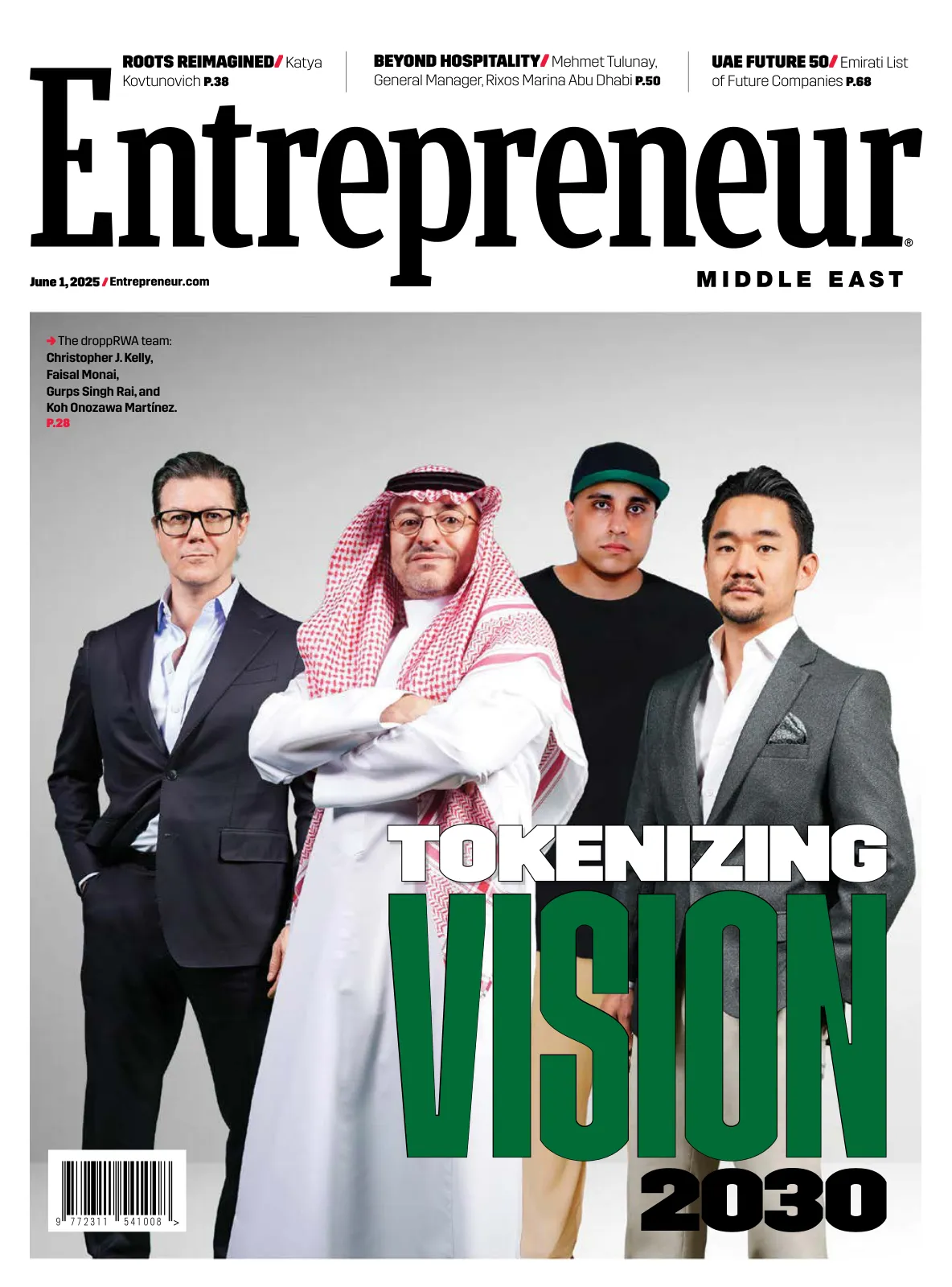
→ The droppRWA team:
Christopher J. Kelly,
Faisal Monai,
Gurps Singh Rai, and
Koh Onozawa Martínez.
P.28
TOKENIZING
TOKENIZING
VISION
VISION
2030
Page 2
THE ALL NEW NISSAN PATROL
BOOK NOW
Page 3
3
June 1, 2025 / ENTREPRENEUR.COM /
P.28
Tokenizing
Vision
2030: Meet
the team
architecting
the future of
capital
FEATURES
Contents/June 1, 2025
Page 4
Discover homes where
A LIFESTYLE THRIVING
WITH INNOVATION.
We redefine modern living with spaces that inspire,
amenities that indulge, and locations that connect.
www.samanadevelopers.com
vacation
every day feels like a
Page 5
Page 6
Page 7
SUITE TREAT
Step into a world of opulence when you book a Suite at Raffles Doha.
Experience the added luxury of QAR 750 credit to spend
on dining in the hotel, and QAR 500 towards any Spa treatment.
Children aged 12 and below are welcome to indulge in the
enchantment of complimentary dining.
Rates starting from QAR 3,500 per night
For reservations, please call +974 4030 7100
or email reservations.doha@raffles.com
Raffles Doha, Iconic Towers, Marina District, PO BOX 4747, Lusail, Qatar
Page 8
Page 9
Welcome to the
E X C E P T I O N A L
An iconic hotel featuring
luxury rooms and apartments
with trendy dining options
in the heart of Riyadh
BOOK NOW
Mansard Riyadh, A Radisson Collection Hotel
4248 Prince Mohammed Ibn Salman Ibn Abdulaziz Road, Riyadh 6721-13315, Saudi Arabia
00966118290900 info.mansard@radissoncollection.com
radissonhotels.com/collection
Page 10
STARTUP
SPOTLIGHT
IN THE LOOP
TREPONOMICS
Contents/June 1, 2025
P.61 Unlocking Possibilities
How KARIN DRANE built a multi-
million dollar empire.
P.66 “We Got Funded!”
Shake Your Plants secure SHARK
TANK funding
P.68 UAE Future 50 Unveiled
H.H. SHEIKH HAMDAN champions
innovation at UAE Future 50
Launch Ceremony.
P.15 When Plans Fell
Through, She Pivoted to
AI—and Found Her Next Big
Break
How ANGELA KLASS is helping others
future-proof their operations in a
world where staying ahead means
thinking smarter.
P.38 Designing A Cultural
Renaissance
How KATYA KOVTUNOVICH’S fashion
label turned the traditional UAE
Sadu fabric as a means to bridge
the world with Emirati culture.
P.22 Cutting Through
Cobwebs
UAE-based MS CONSULTING is
helping organizations untangle
the complexities of building ESG
frameworks.
P.50 Leading with Heart and
Precision
RIXOS MARINA Abu Dhabi’s GM
MEHMET TULUNAY reveals the secrets
that drive the resort’s extraordinary
growth.
BUSINESS
UNUSUAL
CEO Wissam Younane
wissam@bncpublishing.net
MANAGING DIRECTOR Rabih Najm
rabih@bncpublishing.net
ART DIRECTOR Simona El Khoury
EDITOR IN CHIEF Anil Bhoyrul
anil@bncpublishing.net
MANAGING EDITOR Tamara Pupic
tamara@bncpublishing.net
FEATURES EDITOR Aalia Mehreen Ahmed
aalia@bncpublishing.net
REGIONAL DIRECTOR
Mahdi Hashemi mahdi@bncpublishing.net
DIRECTOR OF INNOVATION
Sarah Saddouk sarah@bncpublishing.net
GROUP SALES DIRECTOR – B2B GROUP
Joaquim D’Costa jo@bncpublishing.net
HEAD OF PARTNERSHIPS
Samir Glor Samir@bncpublishing.net
COMMERCIAL LEAD
Anna Chipala anna@bncpublishing.net
COLUMNIST Tamara Clarke
CONTRIBUTING WRITERS
Fida Chaaban
SUBSCRIBE
Contact subscriptions@bncpublishing.net to receive
Entrepreneur Middle East every issue
COMMERCIAL ENQUIRIES
sales@bncpublishing.net
ENTREPRENEUR.COM
Access fresh content daily on our website
All Rights Reserved 2025. Opinions expressed are solely those of the contributors.
Entrepreneur Middle East and all subsidiary publications in the MENA region
are officially licensed exclusively to BNC Publishing in the MENA region by
Entrepreneur Media Inc. No part of this magazine may be reproduced or
transmitted in any form or by any means without written permission of the publisher.
Images used in Entrepreneur Middle East are credited when necessary. Attributed
use of copyrighted images with permission. All images not credited otherwise
Shutterstock. Printed by United Printing and Publishing.
PO BOX 502511 DUBAI, UAE
P +971 4 4200 506
EntMagazineME
Entrepreneur-me
10 / ENTREPRENEUR.COM / June 1, 2025
P.46 Purposeful Investment
Inside SHUROOQ’S model of
enterprise-driven development,
where infrastructure meets
opportunity and entrepreneurship
is shaped by design, not chance.
→ ANGELA KLASS
helps entrepreneurs
make their mark in
the digital space
through the power of
AI.
Page 11
Enlighten Your Eternal Beauty,
Inside and Out!
info@muarjewels.com
@muarjewels
www.muarjewels.com
Page 12
12 / ENTREPRENEUR.COM / June 1, 2025
12
5
3% of employees say they would consider
quitting if asked to increase their in-office
presence, emphasizing the ongoing demand for
flexible work arrangements
The new survey on employment sentiment in
the UAE, by Michael Page, a global recruitment
consultancy, makes fascinating reading.
“Despite economic uncertainty, 77%of professionals
in the UAE are actively exploring new job
opportunities, a sharp rise from 65% in 2024,” the
survey said.
Basically a polite way of saying the majority of your
colleagues (and probably you as well) are job hunting.
“Companies that can offer clear answers to the
pressing questions of today’s professionals are better
positioned to stand out in a complex talent market,”
the survey said.
It added that recent years have brought dramatic
shifts in workplace dynamics in the country, fueled by
evolving priorities, new expectations, and rapid AI
advancements.
But here is the really key bit: while only 34%
currently work hybrid, 53% of employees say they
would consider quitting if asked to increase their
in-office presence, emphasizing the ongoing demand
for flexible work arrangements, it said.
Unless I read that wrong, what this is saying is that
the majority of people would give up their job, and
step into the unknown, rather than having to consider
actually coming into work.
I know there are multiple views on this. But the
main point I believe is that companies need to be clear
from the outset what their policy is, otherwise, it leads
to a muddled work environment where nobody is
quite sure who is where and what they are doing.
This is especially true is companies with over 200
staff, where communication break downs between
those in and out of the office are more common. I have
heard many stories of fairly large organizations – some
with over 500 staff – where at least 10% are often
believed to be “missing.” The bigger the organization,
the easier it is to disappear from everything but the
payroll.
“The message from UAE professionals is loud and
clear. They want clear answers, purpose, trust,
flexibility, and future-focused leadership, said Jon
Ede, Regional Director UAE at Michael Page.
He couldn’t be more right. But in my view, home
working policies can be very effective – until
companies reach a certain scale, probably the 200
staff mark.
Anil Bhoyrul
Editor-in-Chief
HOME WORKING IS GREAT – UNTIL
THE COMPANY GETS TOO BIG
Editor’s Note/
Editor’s Note/
Page 13
Page 14
Invests
In
Entrepreneurs
What Are
You Building?
Learn more at entrepreneur.vc
Page 15
15
June 1, 2025 / ENTREPRENEUR.COM /
When Plans Fell Through,
She Pivoted to AI
With a rare blend of technical insight and business acumen, Angela Klass is helping others
future-proof their operations in a world where staying ahead means thinking smarter.
by TAMARA PUPIC
—and Found Her Next Big Break
→ ANGELA KLASS has
made it her mission to
help entrepreneurs
and brands scale their
presence, simplify
production, and make
their mark in the digital
space — all through
the power of AI.
Page 16
16 / ENTREPRENEUR.COM / June 1, 2025
G
erman entrepreneur Angela Klass caught the artificial intelligence (AI) wave
early on- actually, she immersed herself in the technology just in time and
made it her specialty right on time. In 2022, AI adoption by businesses was
less than 50%, but it was then that Klass started exploring AI tools,
automation, and media production.
B/AI
Page 17
17
June 1, 2025 / ENTREPRENEUR.COM /
In 2025 - when surveys report a
significant increase in AI adoption by
businesses, with 78% of organizations
using AI in at least one business
function - Klass has a fully developed
offering to help companies, govern-
ments, and innovators to scale
content, automate production, and
stand out with high-end, futuristic
media — without the cost or effort of
traditional methods.
“For example, a company in the UAE
can scale their content into Chinese,
Spanish, or Arabic markets using the
same avatar — with localized speech
and native-level delivery,” Klass
explains. “This enables international
growth without the traditional
barriers of location, filming logistics,
or language limitations.”
She also works as an international AI
educator for a US-based company
that operates in over 160 countries.
“I’m helping develop the German-
and English-speaking markets by
building a global AI community,” she
F
rom “At that time, AI wasn’t yet capable of creating the high-end video quality
we now see, but I could clearly see the potential. So, I spent that year learning,
testing, and building my foundation,” she says.
In 2023, she launched a German-language digital course focused on helping
entrepreneurs use AI to automate and grow their businesses. Plus, she started
offering B2B services to companies looking to scale content creation through
avatars, automation, and branded storytelling.
HERE’S THE
TRUTH: THE
AI DOESN’T
CREATE THE
VIDEO. THE
ARTIST
DOES.”
Page 18
18 / ENTREPRENEUR.COM / June 1, 2025
}Start small — but
start now.
“If you’re a creative
professional looking to
integrate AI, the best first
step is to explore tools that
complement your existing
workflow. Whether you’re in
design, content,
photography, video, or
branding — there’s an AI
tool that can help you save
time or amplify your output.”
}Don’t aim for
perfection but
experimentation.
“Focus on mastering one
tool at a time — and most
importantly, understand
prompt engineering. That’s
the real superpower. AI is
only as good as the
instructions you give it. You
don’t need to become a
programmer — you need to
become a creative director
who knows how to speak
AI’s language.”
}AI is not a magic
button.
“The biggest mistake I see?
People underestimate how
much skill and strategy it
still takes. It doesn’t
replace creativity — it
enhances it. But only if you
know what you’re doing.
The worst assumption is,
‘AI will do it for me.’ No,
you do it, and AI helps you
do it better and faster.”
}Don’t wait for perfect
timing or perfect
tools.
“In this space, perfection is
your enemy. Speed and
adaptability win. If you
hesitate too long, you’ll
miss the wave. The tools
will get better, but so will
your competition.
Also: don’t try to be
everything at once. AI is a
massive field — from text
and image to video, code,
music, automation, and
agents. Pick your lane, get
strong in it, and build from
there. The world is moving
fast. The earlier you adapt,
the bigger the advantage
you’ll have. And the great
news is: AI rewards
creativity, not just technical
skill. So if you’re creative,
you’re already ahead.”
IMAGES COURTESY YY ANGELA KLASS
'TREP TALK
AI in Business — Angela Klass’s Insights
THE AI IS THE TOOL — BUT THE
DIRECTION, THE STYLE, THE
EMOTIONAL TONE, AND THE
VISUAL ACCURACY COME FROM
THE HUMAN BEHIND IT. THAT’S
WHY EXPERTISE MATTERS.”
“
↓ After building a strong foundation in Germany, Klass moved to
the UAE with an idea to launch a business in the beauty and
education space. Yet, she faced severe construction delays in
launching her beauty salon.
B/AI
says. ‘The focus is on teaching business professionals how
to integrate AI into their workflows to grow faster, smarter,
and with more creative freedom.”
Today, Klass has made it her mission to help entrepreneurs
and brands scale their presence, simplify production, and
make their mark in the digital space — all through the
power of AI.
However, it was only when she began working with AI that
she fully realized its potential. “At first, I noticed how fast
avatars could be created. Then I saw how AI could
generate entire video scenes without a camera. And finally,
I realized: this technology isn’t just a shortcut — it’s a
transformation,” she says. “We’re witnessing the
beginning of AI-driven cinema. I believe we’ll see the
first full-length AI-generated film by 2026. The tools
aren’t fully there yet, but they’re moving fast — and the
efficiency is undeniable.”
Her focus on AI has also led her to realize that its impact
will be wide-raging. “The more I studied AI, the more I
understood that it would redefine how we live and work,”
Klass says. “In the near future, we won’t be typing on
laptops or tapping on phones — we’ll be communicating
with AI agents through voice, chips, or wearables.
Everything will be based on prompt-driven execution.
Our minds are faster than our fingers, and AI gives us a
way to finally work at the speed of thought.”
The fear that artificial intelligence will steal our jobs has
echoed across industries for years. But Klass quickly
dispels those concerns. “Here’s the truth: the AI doesn’t
Page 19
create the video. The artist does,” she says. “The AI is the
tool — but the direction, the style, the emotional tone, and
the visual accuracy come from the human behind it. That’s
why expertise matters.” She goes on to explain that a great
AI video is not a one-click solution but a curated process
that combines creative direction with technical skill. “The
person behind the video must understand camera move-
ment, cinematic lighting, scene composition, color theory,
and storytelling — and be able to translate all of that into
AI-generated prompts and assets,” Klass adds.
One interesting fact about Klass is that long before AI
became a powerful tool, she was building businesses the
old-fashioned way—through grit, instinct, and years of
hands-on experience.
The first time she took the plunge into entrepreneurship
was in 2010 in Germany where she launched a B2B
business in the high-end beauty industry, specializing in
permanent make-up. “In 2016, I was featured on one of
Germany’s biggest national television shows, which made
me widely known in Germany, Austria, and Switzerland,”
Klass recalls. “That TV appearance elevated my brand
massively and brought in high-profile clients, including
politicians and public figures who traveled specifically to
work with me or attend my academy.”
By 2018, she expanded the business by opening her own
permanent makeup academy, an online store for German-
manufactured tattoo machines and pigments, and a mobile
education app — one of the first in the niche — to offer
flexible digital learning. “The German market at that time
was ideal for what I was doing,” Klass recalls. “I entered
early, before the big wave of demand for permanent
make-up services, and positioned myself as a specialist with
a strong media presence. I was highly visible on social
media, in the press, and on national TV, which helped me
build a trusted brand in a market with very little competi-
tion at the time.”
After building a strong foundation in Germany, Klass
moved to the UAE with an idea to launch a business in the
beauty and education space. Yet, she faced severe con-
struction delays in launching her beauty salon. “The
quality of work was far below expectations. I faced
construction errors that would be unthinkable in Ger-
many,” Klass says. “Coming from Germany, where
craftsmanship is taken seriously and precision is expected,
this experience pushed me to my limit. I learned that what
works in one country cannot be assumed in another —
even basic communication and quality standards require
cultural translation.”
19
June 1, 2025 / ENTREPRENEUR.COM /
Page 20
But in the quiet aftermath, a silver
lining emerged: the pause gave Klass
time to reassess, redirect, and ultimate-
ly discover a new path. “While con-
struction dragged on, I used the
downtime to start learning about AI. I
began experimenting with avatars and
automation tools. I signed up for
international training programs and
slowly began laying the foundation for
a new business model,” she says. “In
March 2023, I finally opened the salon
— five and a half months late. And in
October 2023, after careful reflection, I
sold the business and fully transitioned
into the digital space. That is how I got
to now work in AI-powered content
creation and video production, fully
online and with a global client base.”
With one foot in Europe’s structured,
process-driven economy and the other
in the UAE’s fast-paced, opportunity-
rich environment, Klass’ adaptability
can serve as a roadmap for anyone
IN THE NEAR
FUTURE, WE
WON’T BE TYPING
ON LAPTOPS
OR TAPPING ON
PHONES — WE’LL BE
COMMUNICATING
WITH AI AGENTS
THROUGH VOICE,
CHIPS, OR
WEARABLES.”
“
→ ANGELA KLASS
used to run a
permanent makeup
academy, an online
store for German-
manufactured tattoo
machines and
pigments, and a
mobile education app
in Germany.
B/AI
20 / ENTREPRENEUR.COM / June 1, 2025
Page 21
scaling across borders. “While the setup
is inexpensive, maintaining a business
in Germany is far more demanding due
to high taxes, complex reporting, and
constant government obligations,” she
says. “The UAE is the opposite: you
need a higher upfront investment, but
ongoing costs are lower and the system
is more flexible for entrepreneurs.”
In the end, Klass’ deep understanding
of AI is not a departure from her
entrepreneurial roots—it’s an evolution
of them. Grounded in years of
building and managing businesses
across continents, her approach to AI
is pragmatic, strategic, and refresh-
ingly human. Her advice to fellow
business leaders? “What we’re seeing
now, in 2025, is just the beginning. I
believe that by 2027, AI will be fully
embedded in most businesses — and
no one will be asking “if” they need it.
The question will be, How fast can we
implement it?’ That’s why I do what I
do: I help entrepreneurs move now,
before the wave becomes overwhelm-
ing. Because in business, speed wins
— and AI is the ultimate accelerator,”
Klass concludes.
IN THE UAE, YOU NEED A HIGHER UPFRONT INVESTMENT, BUT ONGOING
COSTS ARE LOWER AND THE SYSTEM IS MORE FLEXIBLE FOR
ENTREPRENEURS.”
→ Klass also works
as an international
AI educator for a
US-based company
that operates in
over 160 countries.
} "If you’re working in AI and
thinking about where to start
— the UAE is the best place to
begin right now. The country has
made a clear and bold decision
to lead in this space, and it’s not
just talk — it’s visible everywhere.
From smart city infrastructure to
government AI initiatives and
AI- integrated education, the
Emirates are moving faster than
most other countries in the world.
}"One of the greatest
advantages of launching in the
UAE is the entrepreneurial
mindset. Founders here are
open, future- focused, and willing
to embrace innovation. That
makes it much easier to offer
cutting-edge services like
AI-powered branding,
automation, or content creation
— because clients here are
already mentally prepared for the
next step.
}"At the same time, building an
AI business is not tied to a
physical location. You can
operate globally — work with
business owners in the U.S.,
Europe, Asia — without being
bound to one timezone or
country. That’s the beauty of this
industry: you can scale
internationally while being based
anywhere."
}"In comparison, many
European countries are more
cautious. They will adopt AI, but
more slowly. U.S. entrepreneurs
are risk-takers — and excellent
clients for AI services — but the
UAE gives you the foundation
and credibility to scale toward
both East and West. It’s a
launchpad for global growth.
}"In short: if you’re serious
about AI, the UAE offers not just
infrastructure, but momentum.
You’re starting in a place where
people already understand the
value of AI — and that makes
your work easier, faster, and
more impactful."
'TREP TALK
Angela Klass on starting up an AI business in the UAE
21
June 1, 2025 / ENTREPRENEUR.COM /
Page 22
Cutting Through Cobwebs
As calls for standardized corporate sustainability policies grow louder, UAE-based
MS Consulting is making quiet waves by helping organizations—both big and small—untangle
the complexities of building ESG frameworks that go beyond mere optics. by AALIA MEHREEN AHMED
← Faisal Sajwani
and Ahmed Hassan
are the Managing
Partner and Senior
Partner, respectively,
at UAE-based
sustainability
consulting firm MS
Consulting
22 / ENTREPRENEUR.COM / June 1, 2025
B/Sustainability
Page 23
23
June 2025 / ENTREPRENEUR.COM /
B
etween November
and December 2023,
as the world watched
the UAE’s historic
hosting of the
COP28, it inspired
within the nation’s
business community
a renewed sense of
belief in the possibility of a
sustainable future. The
launch of multiple
government initiatives
—particularly the Net Zero
by 2050 strategy— buoyed
that vision, with 2023’s title
of “The Year of Sustainabil-
ity” being extended to 2024
as well. But while much of
that initial vigor remains, a
lot of companies –across
the growth stages– have
found that their attempts
to create effective environ-
ment, sustainability and
governance (ESG) policies
haven’t always led to
optimal results. Few
individuals in the UAE are
able to view the challenges
that cause this stagnation
as closely as Faisal Sajwani
and Ahmed Hassan, who
are, respectively, the
Managing Partner and
Senior Partner at UAE-
based sustainability
consulting firm MS
Consulting. “I’d say the
biggest challenge now is
execution,” Sajwani says. “A
lot of companies made bold
announcements at COP28,
which is a great start—but
without the right gover-
nance structures, data
systems, and accountability
mechanisms, those goals
risk remaining aspirational.
Our role is to bridge that
gap. We work with clients
to move from high-level
vision to actionable
strategy—so that sustain-
ability becomes a measur-
able part of how the
business operates, not just
how it communicates.”
Mirroring Sajwani’s
sentiments, Hassan adds
that a glaring lack of
consistency in the already
implemented ESG policies
is another problem area.
“After COP28, we saw a
surge in interest and public
commitments, but many
organizations are still
struggling with the internal
capacity and technical
know-how to move from
ambition to implementa-
tion,” Hassan continues.
“ESG isn’t something you
A LOT OF COMPANIES MADE BOLD ANNOUNCEMENTS AT COP28, WHICH
IS A GREAT START—BUT WITHOUT THE RIGHT GOVERNANCE STRUCTURES,
DATA SYSTEMS, AND ACCOUNTABILITY MECHANISMS, THOSE GOALS RISK
REMAINING ASPIRATIONAL. OUR ROLE IS TO BRIDGE THAT GAP.”
↓ MS Consulting designs sustainable business models that meet its clients’ immediate and long-term goals,
while addressing their financial, social, and environmental responsibilities.
activate once—it
requires sustained
investment, cross-func-
tional ownership, and
continuous measure-
ment. That’s the gap
we’re focused on
helping clients close.”
Indeed, this is where
MS Consulting comes
in. In the absence of
standardized ESG
policies, Sajwani and
Hassan have taken it
upon themselves to
deliver tailored
sustainability frame-
works to businesses in
the UAE. “Different
regions, industries, and
regulators follow
different frameworks—
whether it’s GRI, SASB,
or TCFD—so compa-
nies are often over-
whelmed by what we
call the “alphabet soup”
of ESG,” Sajwani points
out. “This lack of
standardization creates
confusion, slows down
implementation, and
can lead to inconsistent
reporting.”
“At MS Consulting, we
approach this by
simplifying the path for
our clients,” Hassan
adds. “We help them
cut through the noise
and focus on what’s
material to their
business—whether
that’s climate risk,
supply chain transpar-
ency, or social impact.
We align the right
frameworks to their
strategic goals, so ESG
isn’t just about
compliance—it
becomes a clear,
Page 24
24 / ENTREPRENEUR.COM / June 1, 2025
value-generating roadmap
that supports long-term
performance and stake-
holder trust.”
As a starting point for any
given client, MS Consult-
ing conducts what it calls a
materiality assessment– a
diagnostic to identify
which ESG issues matter
most to a business and to
its stakeholders. “Not every
company needs to address
everything at once,”
Sajwani warns. “In fact,
trying to do so often leads
to diluted impact. A
focused, materiality-driven
approach helps align your
ESG efforts with what
actually drives value, risk,
and opportunity for your
business. It’s about being
strategic, not reactive.
From there, we co-create a
tailored roadmap that’s
practical, measurable, and
embedded into core
operations. It’s not just
about long-term commit-
ments; it’s about making
sustainability part of daily
business decisions, from
decarbonization to ESG
reporting.”
But coming up with a
customized sustainability
plan is only winning half
the battle– as Hassan
repeatedly points out, such
a framework is only
effective when the gravitas
of its necessity trickles into
every internal branch of an
organisation. “A key part of
our process is employee
engagement,” Hassan
continues. “You can’t build
a sustainable culture
unless people understand
the “why” behind it. We
lead workshops, training
sessions, and campaigns to
build awareness and
capability across the
organization. As we often
say to clients: ‘Sustainabil-
ity works best when it is
second nature—not a
separate effort.’ When
teams understand the
‘why’ and are empowered
to act, the strategy
becomes part of the
culture. Without internal
buy-in, even the best
frameworks tend to stay on
paper.”
Using this approach, MS
Consulting promises to
incorporate structured
stakeholder engagements,
peer benchmarking, as
well as relevant industry
analyses in building the
right ESGs for its clients.
In the process, Sajwani
and Hassan have found
that some industries are
more challenging to
navigate than others.
“Sectors like real estate
and logistics pose unique
challenges, particularly
when it comes to measur-
ing indirect emissions and
managing complex supply
chains,” reveals Sajwani.
“These industries often
have significant Scope 3
emissions, which aren’t
directly under a company’s
control but still have a
major impact. That’s why
we take a sector-specific
approach to ESG. Rather
than applying generic
frameworks, we tailor key
performance indicators by
mapping material impact
areas to the risks and
opportunities specific to
each industry. The goal is
to create metrics that are
both relevant and action-
able.”
MS Consulting’s ability to
tailor their services “makes
all the difference,” Sajwani
notes. “Take logistics in the
UAE, for example. We
worked with a client to
track greenhouse gas
emissions across fleet
operations, but also
B/Sustainability
DIFFERENT REGIONS, INDUSTRIES, AND REGULATORS FOLLOW DIFFERENT FRAMEWORKS—
WHETHER IT’S GRI, SASB, OR TCFD—SO COMPANIES ARE OFTEN OVERWHELMED BY WHAT WE
CALL THE “ALPHABET SOUP” OF ESG. THIS LACK OF STANDARDIZATION CREATES CONFUSION,
SLOWS DOWN IMPLEMENTATION, AND CAN LEAD TO INCONSISTENT REPORTING.”
↓ The MS Consulting team is
committed to helping
organizations navigate the
complex landscape of
sustainability by providing
tailored solutions that align with
their business values and goals.
Page 25
25
June 1, 2025 / ENTREPRENEUR.COM /
A KEY PART OF OUR PROCESS IS
EMPLOYEE ENGAGEMENT. YOU CAN’T
BUILD A SUSTAINABLE CULTURE
UNLESS PEOPLE UNDERSTAND THE
“WHY” BEHIND IT. WE LEAD
WORKSHOPS, TRAINING SESSIONS,
AND CAMPAIGNS TO BUILD
AWARENESS AND CAPABILITY
ACROSS THE ORGANIZATION. AS WE
OFTEN SAY TO CLIENTS:
‘SUSTAINABILITY WORKS BEST
WHEN IT IS SECOND NATURE—NOT
A SEPARATE EFFORT.’”
→ Ahmed Hassan is a
global executive,
entrepreneur, and
advisor who spent
more than 30 years at
Colgate-Palmolive
leading teams and
initiatives across
multiple regions and
disciplines. As a
Senior Partner at MS
Consulting, he plays a
pivotal role in shaping
the firm's strategic
direction
and delivering
high-impact advisory
services for a global
client base.
“
integrated labor welfare indicators, reflecting the region’s
social priorities. That dual lens—environmental and
social—gave a more accurate picture of performance and
areas for improvement. ESG isn’t a one-size-fits-all exercise.
When you design metrics that speak directly to an industry’s
context, you get insights that actually drive progress.”
But with fragmented policies come fractured perceptions of
sustainability– which can prove to be a hurdle in and of
itself. “There’s this idea that ESG is only for the big players—
multinationals and large corporations with the budget and
bandwidth to implement it,” Hassan says. “But that’s
outdated thinking. ESG principles are scalable, and in many
ways, small and medium enterprises (SMEs) are better
positioned to adopt them quickly and authentically. When
sustainability is embedded into a business’s DNA early on, it
drives resilience, builds trust, and aligns the company with
where the market is headed. In a fast-moving environment
like the UAE, that kind of foresight gives you a real competi-
tive edge.”
Also required for a more sustainably equitable business
ecosystem is to do away with the notion that ESGs are a
marketing strategy, Sajwani notes. “Some companies still
see ESG as a box-ticking exercise—something they report
on once a year as a PR move,” he says. “But that mindset
misses the point. ESG isn’t just about optics; it should be a
strategic lens through which you evaluate business decisions
every single day. When embedded properly, it influences
everything from operations and procurement to innovation
and risk management. The companies that treat ESG as a
business driver—not a branding exercise—are the ones
attracting talent, earning investor confidence, and staying
ahead of the curve.”
Of course, all these statements don’t come without compel-
ling hard facts to back them. Ernst & Young’s 2024 Global
Institutional Investor Survey showed that 88% of investors
have increased their use of ESG information in decision-
making. Meanwhile, KPMG’s 2024 Global ESG Due
Diligence Study revealed that 55% of investors are willing to
pay a premium of 1-10% for assets with high ESG maturity.
When it comes to hiring talent and employee turnover rates,
a 2024 study published in US-based management research
platform Academy of Management showed that higher
levels of ESG performance and changes in ESG perfor-
Page 26
26 / ENTREPRENEUR.COM / June 1, 2025
B/Sustainability
mance over time have a
positive correlation with
increased employee
satisfaction in S&P 500
companies. On the flip
side, the PwC Global
Workforce Sustainability
Study 2024 revealed that
while choosing an
employer, 68.6% of
employees prioritize the
firm’s environmental
policies.
All of this inevitably
validates perhaps what is
the most significant
statistic in this prose- that
by 2030, ESG assets are
projected to surpass a
whopping US$40 trillion.
“The link between ESG
and financial performance
is not just theoretical
anymore,” Hassan says.
“While there may not be a
one-size-fits-all formula,
the data and real-world
outcomes are increasingly
clear. ESG reduces
operational and reputa-
tional risk, improves
employee retention and
engagement, and makes a
company far more
attractive to investors,
especially those focused on
long-term value. I’ve seen
clients unlock cost savings
through efficiency
improvements and even
open up new revenue
streams by aligning with
sustainability trends.
When ESG is embedded
into core operations—not
just marketing—it
becomes a powerful lever
for growth and resilience.”
The Ernst & Young study
that was mentioned earlier
offered yet another
relevant statistic: while
93% of global investors
are confident that
companies will meet their
sustainability targets, a
significant 85% of them
also believe that green-
washing is a growing
problem. The UAE’s
businesses too have been
privy to this phenomenon.
“Avoiding greenwashing
starts with one principle:
transparency,” Sajwani
says. “At MS Consulting,
we emphasize the
importance of setting
clear, measurable goals
and backing sustainability
claims with credible,
third-party-verified data.
It’s not enough to say
you’re sustainable—you
need to prove it. That
means aligning disclosures
with global frameworks,
being honest about where
you are on your ESG
journey, and resisting the
urge to overstate progress.
If a claim can’t be
substantiated, it shouldn’t
be made. We help clients
build trust by focusing on
substance over spin.”
All of these tangential
conversations, however,
lead back to one point: the
SOME COMPANIES STILL SEE ESG AS A BOX-TICKING EXERCISE—SOMETHING THEY REPORT ON ONCE A
YEAR AS A PR MOVE. BUT THAT MINDSET MISSES THE POINT. ESG ISN’T JUST ABOUT OPTICS; IT SHOULD BE
A STRATEGIC LENS THROUGH WHICH YOU EVALUATE BUSINESS DECISIONS EVERY SINGLE DAY.”
→ Faisal Sajwani is an Emirati
entrepreneur and strategic advisor. As
the Managing Partner at MS
Consulting, Sajwani has grown the
company into a trusted advisor for
government entities, corporations, and
institutions looking to embed
sustainability into their core strategies
and business models while achieving
long-term competitiveness in a rapidly
evolving global economy.
↓ In 2024, MS Consulting received a certificate of recognition from the
UAE’s National CSR Fund “Majra”, the federal arm setting up the
framework and governance for Sustainable Impact, Sustainability and
Corporate Social Responsibility (CSR) in the nation
Page 27
need to create more standardized ESG
frameworks. And while MS Consulting
is quietly doing its part in clearing the
misconceptions and incoherence within
this space, Sajwani and Hassan don’t shy
away from noting that a large-scale shift
is required to create real impact. “One of
the most impactful steps would be the
introduction of clearer, standardized
ESG disclosure requirements at the
national level—not just for publicly listed
companies, but across all sectors,”
Sajwani shares. “Right now, reporting
practices vary widely, which makes it
difficult to benchmark progress or hold
companies accountable. A unified
framework would not only create
consistency but also send a strong signal
that ESG performance is a core part of
doing business in the UAE. It’s about
creating a level playing field and setting
a baseline that everyone can build from.”
But regulation alone isn’t enough,
Hassan observes. “Incentives too play a
crucial role in accelerating adoption,” he
says. “Whether it’s green procurement
preferences, preferential access to
government tenders, tax incentives, or
ESG-linked financing, we need mecha-
nisms that reward companies for
prioritizing sustainability. When the
regulatory environment aligns with
economic opportunity, we see much
faster progress—and more innovation—
from the private sector.”
On their part, Hassan and Sajwani
already have plenty in the pipeline to
achieve their shared vision. “We’re
continuing to grow our advisory
presence across the GCC and investing
heavily in digital sustainability tools,”
Hassan says. “At the same time, we’re
looking beyond the traditional ESG
playbook. For example, we see food
security as a critical sustainability
frontier in this region. The UAE
currently imports nearly 90% of its food,
so strengthening local, sustainable
production isn’t just forward-thinking—
it’s essential. That’s why we’re exploring
innovations like vertical farming, which
supports year-round cultivation with
drastically reduced water usage and
aligns with the UAE’s Food Security
Strategy 2051. It’s a perfect example of
how sustainability, technology, and
national priorities intersect.”
MS Consulting’s foray into the world of
real estate sustainability is also set to
continue, notes Sajwani. “One of our
most exciting initiatives is a series of
next-generation luxury villas,” Sajwani
shares. “These homes aren’t just
energy-efficient—they’re redefining what
sustainable luxury means. Through
smart design, renewable energy, and
integrated clean technologies, we’re
demonstrating that sustainability can
enhance quality of life rather than
restrict it. But we’re not stopping at
individual homes. Our long-term vision
is to scale this model into fully sustain-
able communities, and eventually into
cities where energy, food, water, and
waste are managed holistically.”
As the duo prepare for these multiple
plans, they also agree that to optimally
achieve sustainability ambitions as a
nation, strategic collaborations are the
way forward. “The scale and complexity
of today’s sustainability challenges
require coordinated efforts across the
entire ecosystem,” Sajwani says. “That
means deeper partnerships between
government, private sector, academia,
and investors. Each brings unique
expertise and influence to the table, and
only by aligning these strengths can we
drive systemic change. At MS, we see
ourselves as both a catalyst and connec-
tor in this space.”
“Exactly—and we’re very intentional
about that role!” Hassan adds. “At MS
Consulting, we’re not just advising from
the sidelines. We’re actively building
bridges—whether that’s through
facilitating public-private dialogues,
supporting cross-sector coalitions, or
co-developing thought leadership with
industry stakeholders. Our goal is to help
shape a shared vision for sustainability
in the UAE, one that’s actionable,
inclusive, and long-term. We believe real
progress happens when the right people
are in the room—and we’re committed to
being the ones who help bring them
together.”
} Ahmed Hassan:
“Both face challenges, but
they’re very different in nature.
Startups and small businesses
often struggle with limited
resources—they may not have
dedicated sustainability teams or
the capacity to invest heavily in
reporting systems. But what they
do have is agility. They can adapt
quickly, make sustainability part
of their DNA from the outset, and
build with purpose. Large
corporations, on the other hand,
usually have the resources and
infrastructure, but they often face
internal complexity and
bureaucracy. Aligning multiple
departments, shifting legacy
mindsets, and rolling out ESG
across global operations can be
a very challenging process.”
} Faisal Sajwani:
“That’s why our approach is
always tailored. For startups, we
focus on embedding ESG into
their growth journey—helping
them see it as a value creator,
not just a cost. We support them
in setting the right foundations
early, so they scale responsibly
and with resilience. For larger
companies, it’s more about
systems, metrics, and
transformation. We work across
functions to align ESG strategy
with business objectives,
integrate digital tools, and drive
cultural change. Ultimately,
effective ESG isn’t one-size-fits-
all. It has to be context-specific,
practical, and tied to long-term
value.”
Who struggles more to
establish a strong ESG
framework—startups and
small businesses, or large
corporations? MS
Consulting's Faisal
Sajwani and Ahmed
Hassan answer!
TREP
TALK
27
June 1, 2025 / ENTREPRENEUR.COM /
Page 28
28 / ENTREPRENEUR.COM / June 1, 2025
TOKENIZING
VISION
MEET THE TEAM
ARCHITECTING THE
FUTURE OF CAPITAL
by ENTREPRENEUR MIDDLE EAST
2030
Page 29
29
June 1, 2025 / ENTREPRENEUR.COM /
I
t began with an audacious
question: What if ownership
could be reimagined? Not
just digitized, but
fundamentally transformed
- decentralized, fractionalized and
made programmable. That
question sits at the heart of
droppRWA, a pioneering real-world
asset tokenization ecosystem
that’s not just riding the
blockchain wave - it’s helping
shape it.
Behind the momentum of
droppRWA stands a team of
visionary founders with roots as
diverse as Wall Street trading
desks, government Web3
sandboxes, global fintech
ecosystems and early Bitcoin-
backed trades. Together,
Christopher J. Kelly, Faisal Al
Monai, Koh Onozawa Martínez,
and Gurps Singh Rai are writing
the playbook for how real-world
assets (RWAs) are turning from
illiquid, inaccessible holdings into
instantly tradeable, programmable
units of economic potential.
Page 30
30 / ENTREPRENEUR.COM / June 1, 2025
WHAT IS RWA TOKENIZATION AND HOW DOES IT
WORK?
Real-World Assets (RWAs) refer to tangible or intangible
assets that exist outside the blockchain, such as real estate,
commodities, infrastructure, fine art or even intellectual
property. Tokenizing RWAs involves creating a digital
representation of these assets on a blockchain, enabling
them to be traded, owned, and managed in a decentralized
digital environment.
The process starts with the identification and valuation of
an asset. Once verified through legal, financial, and
technical due diligence, a digital token is issued that
represents ownership or economic rights to a portion (or
the entirety) of the asset. These tokens are governed by
smart contracts, which automate functions like income
distribution, transfer restrictions, compliance checks, and
voting rights.
Ecosystems like droppRWA integrate additional infra-
structure like oracle networks, custody layers and insurance
coverage to ensure institutional-grade security and
real-world data integration. For example, a tokenized
residential tower in Riyadh may have each apartment unit
represented as fractional shares, where token holders
receive their share of rental income in real-time, automati-
cally executed by smart contracts and validated by data
from oracles.
This approach not only increases liquidity in markets
traditionally limited to large capital holders, but also
expands financial inclusion. As Christopher J. Kelly put it:
“Fractionalization, 24/7 settlement and programmable
compliance open up Real World Asset investment to anyone
with a smartphone - not just institutions.”
Moreover, the traceability and immutability of blockchain
records enhance transparency and reduce fraud. The
architecture allows regulators to monitor transactions in
real-time, audit smart contract executions and enforce
compliance directly through code.
This technological shift is particularly significant in the
Middle East, where massive infrastructure and real estate
projects under Vision 2030 can now tap into a new
generation of digitally empowered investors. From high-
net-worth individuals to everyday citizens, RWA tokeniza-
tion represents a powerful step toward democratized asset
ownership and more efficient capital formation.
The benefits are significant: increased liquidity for
traditionally illiquid assets, enhanced transparency through
immutable records, reduced transaction costs and broader
investor participation - making it possible for someone to
invest in high-value Real World Assets with just a smart-
phone and a few dollars
THE OPPORTUNITIES IN REAL-WORLD ASSETS
TOKENIZATION
In a blockchain landscape often dominated by speculative
cryptocurrencies and meme-driven tokens, Real World
Assets stand apart. They offer something tangible, verifiable
and inherently valuable.
Christopher J. Kelly, whose career has transitioned from
Goldman Sachs to co-founding droppRWA, sees RWA
tokenization as the logical evolution of traditional finance.
“Institutional rigor is timeless - whether on a Wall Street
trading desk or deep in blockchain architecture,” he says.
“We brought those disciplines into droppRWA, ensuring
every tokenized deal meets institutional-grade standards.”
For institutional investors, this means unlocking liquidity
from assets like real estate, infrastructure and energy
reserves and moving into a realm of fractional ownership,
24/7 settlement and programmable compliance.
Kelly adds, “The lightbulb always goes off when they
realize they can unlock liquidity from traditionally illiquid
assets. But the learning curve still includes custody, smart
contracts and regulatory frameworks. Where education is
needed is around custody, smart contracts and the evolving
regulatory perimeter. Many still conflate tokenization with
cryptocurrency volatility - but RWA tokenization is about
asset integrity, not speculative hype”
SAUDI ARABIA, VISION 2030, AND THE BLOCKCHAIN
REVOLUTION
Saudi Arabia’s Vision 2030 initiative represents one of the
most ambitious national transformation projects in the
Page 31
31
June 1, 2025 / ENTREPRENEUR.COM /
modern era. It aims to
diversify the Kingdom’s
economy beyond oil,
develop public service
sectors, attract global
investment and create a
tech-driven society
powered by innovation.
Within this transforma-
tive blueprint, blockchain
and tokenization technolo-
gies have found fertile
ground to flourish. Vision
2030 emphasizes digital
sovereignty, inclusion, and
economic empowerment
- all of which align with
the promise of real-world
asset tokenization.
Faisal Al Monai high-
lights how this alignment
is intentional. “Tokeniza-
tion isn’t just a tech
upgrade. It’s a structural
shift that aligns with
Vision 2030’s mandate to
build a diversified,
inclusive and high-growth
economy,” he explains.
“droppRWA is helping lay
the infrastructure that
allows every citizen to be
an investor, every asset to
be programmable and
every transaction to be
transparent.”
“When we connected
SADAD in the early 2000s
between banks and
government billers, we
weren't just building a
payment gateway, we were
fundamentally reimagin-
ing how citizens interact
with the government
services,” Monai recalls.
“The skepticism was
immense. People would
ask, 'Why would I pay my
electricity bill online when
I can walk to the office?'
Today, that same question
echoes with tokenization.”
“But here's what I
learned from SADAD
experience,” he continues,
“transformational
technology isn't about
convenience, it's about
possibility.”
Saudi Arabia’s govern-
ment isn’t standing on the
sidelines. Regulatory
bodies such as the Capital
Market Authority (CMA)
are actively supporting
innovation through
sandbox programs and
pilot initiatives. The
RAFAL transaction, Saudi
Arabia’s first tokenized real
estate deal, is a direct
result of these progressive
policies. “The same way
SADAD redefined bill
payments in Saudi Arabia,
droppRWA is redefining
asset ownership.” adds
Monai
“The difference today is
speed and scale,” he
emphasizes. “With
tokenization, we're
building on decades of
digital trust. The infra-
structure exists, the
regulatory framework is
coming and most impor-
tantly, the vision - Vision
2030 - provides the North
Star that we didn't have in
the early 2000s.”
Tokenization serves the
broader Vision 2030
agenda by enabling foreign
direct investment,
unlocking liquidity in
infrastructure projects and
democratizing access to
the nation’s growing
portfolio of mega-projects
- whether NEOM, Qiddiya
or The Line. With
blockchain, economic
participation is no longer
reserved for institutional
investors or high-net-
worth individuals. Instead,
it's scalable, borderless and
inclusive. One of the most
TOKENIZATION ISN’T JUST A TECH
UPGRADE. IT’S A STRUCTURAL SHIFT
THAT ALIGNS WITH VISION 2030’S
MANDATE TO BUILD A DIVERSIFIED,
INCLUSIVE, AND HIGH-GROWTH
ECONOMY. DROPPRWA IS HELPING LAY
THE INFRASTRUCTURE THAT ALLOWS
EVERY CITIZEN TO BE AN INVESTOR,
EVERY ASSET TO BE PROGRAMMABLE,
AND EVERY TRANSAC- TION TO BE
TRANSPARENT.”
“
Page 32
32 / ENTREPRENEUR.COM / June 1, 2025
ambitious national
transformation projects in
the modern era. It aims to
diversify the Kingdom’s
economy beyond oil,
develop public service
sectors, attract global
investment and create a
tech-driven society
powered by innovation.
Within this transforma-
tive blueprint, blockchain
and tokenization technolo-
gies have found fertile
ground to flourish. Vision
2030 emphasizes digital
sovereignty, inclusion and
economic empowerment
- all of which align with
the promise of real-world
asset tokenization.
Faisal Al Monai high-
lights how this alignment
is intentional. “Tokeniza-
tion isn’t just a tech
upgrade. It’s a structural
shift that aligns with
Vision 2030’s mandate to
build a diversified,
inclusive and high-growth
economy,” he explains.
“droppRWA is helping lay
the infrastructure that
allows every citizen to be
an investor, every asset to
be programmable and
every transaction to be
transparent.”
THE RAFAL MILESTONE:
SAUDI ARABIA'S FIRST
TOKENIZED REAL
ESTATE TRANSACTION
The moment that cata-
pulted droppRWA into the
regional spotlight was the
RAFAL real estate
transaction, a historic
milestone that marked the
first-ever tokenized real
estate transaction in Saudi
Arabia. But for co-founder
Faisal Al Monai, it wasn’t
just a tech demo. “Every
revolution appears sudden,
but it’s always the result of
meticulous preparation,”
he says. “The RAFAL deal
is a ‘first,’ but it’s standing
on the shoulders of a
decade of digital transfor-
mation work across the
Kingdom.”
This transaction
represents the convergence
of regulatory clarity,
institutional trust and
sovereign-grade technol-
ogy infrastructure. With
ongoing work from
government ministries to
the CMA, droppRWA
established the foundation
that enabled the transac-
tion to meet compliance,
transparency and scale
expectations.
FROM SADAD TO
SOVEREIGNTY: FAISAL
MONAI ON THE SAUDI
VISION
Faisal Monai’s journey
Faisal Al Monai’s journey
from connecting SADAD,
Saudi Arabia’s national
electronic bill payment
system, to co-founding
droppGroup and then
droppRWA is a blueprint
for how digital infrastruc-
ture can reshape a nation’s
economy. “When we
connected SADAD in the
early 2000s, we weren't
just building a payment
gateway, we were funda-
mentally reimagining how
citizens interact with the
government services,” he
says.
Skepticism was high.
“People would ask, 'Why
would I pay my electricity
bill online when I can walk
to the office?' Today, that
same question echoes with
tokenization - ‘Why would
I own a fraction of a
building through a token
when I can buy property
the traditional way?’”
“But here's what I
Page 33
33
June 1, 2025 / ENTREPRENEUR.COM /
learned from SADAD,” Al
Monai reflects. “Transfor-
mational technology isn't
about convenience, it's
about possibility.” SADAD
democratized access to
government services.
Tokenization, he argues, is
about democratizing
wealth creation.
“When a young Saudi can
own a piece of premium
real estate for the price of
a coffee,” Al Monai
continues, “we're not just
innovating technology,
we're reshaping the very
fabric of economic
participation.”
The contrast lies in speed
and scale. “SADAD took
years to gain trust because
we were building the first
digital bridge that enabled
online government
services. With tokeniza-
tion, we're building on
decades of digital trust.”
Having led projects at
Microsoft, HP and Oracle,
Al Monai has seen
first-hand the evolution of
public sector technology.
“In the past, we were
solving operational
problems - faster process-
ing, better record-keeping.
Today, under Vision 2030,
it's about creating new
economic sectors, enabling
citizen empowerment and
positioning the Kingdom
as a global technology
leader.”
He emphasizes how the
Kingdom’s approach to
innovation has changed:
“Back then, decision-mak-
ers wanted safe, proven
solutions. Today, they are
first movers. They’re
piloting blockchain, AI
and tokenization in a
considered and process
driven manner because
they understand that
standing still is the biggest
risk.”
One of the most telling
signs of this shift is
HUMAIN, a $77 billion AI
initiative announced under
Vision 2030. “That level of
investment signals a new
kind of ambition - one
where Saudi Arabia leads,
not follows,” he says.
“Tokenization is part of
this broader transforma-
tion.”
Critically, Al Monai sees
blockchain not as a
disruption but as an
evolution of sovereignty.
“Just as SADAD gave
Saudi Arabia control over
its payment rails, tokeniza-
tion gives us control over
our asset infrastructure.
We're not adopting
Western models - we're
building indigenous
capabilities that serve our
own context.”
“There’s often prudence
in our institutions, which I
respect,” he adds. “But
prudence without vision is
paralysis. The institutions
that led on digital
payments became regional
powerhouses. The same
will happen with block-
chain.”
With droppRWA’s work
on the RAFAL tokenized
real estate deal - the first
of its kind in the Kingdom
- Al Monai and his team
have proven tokenization
isn’t speculative hype, but
a foundation for the new
economy. “It’s not an
experiment. It’s a business
transformation tool
aligned with Vision 2030’s
mission of economic
diversification.”
WHEN A YOUNG SAUDI CAN
OWN A PIECE OF PREMIUM
REAL ESTATE FOR THE PRICE
OF A COFFEE. WE'RE NOT
JUST INNOVATING
TECHNOLOGY, WE'RE
RESHAPING THE VERY
FABRIC OF ECONOMIC
PARTICIPATION.”
“
Page 34
34 / ENTREPRENEUR.COM / June 1, 2025
He concludes, “We’re not
just implementing
blockchain - we’re creating
public goods. We’re
building the digital
infrastructure of the future
Saudi and GCC economy.
This isn’t just about
innovation. It’s about
sovereignty, inclusion and
opportunity for all.”
FROM ARCHEOLOGY TO
ARCHITECTURE: KOH
ONOZAWA'S GLOBAL
PERSPECTIVE
Koh Onozawa Martínez,
CEO and Co-Founder of
droppRWA, brings an
unconventional back-
ground to the world of
blockchain and real-world
asset tokenization. With a
career that spans from
crafting bamboo speakers
to practicing marine
archaeology and building
one of Spain’s largest
digital asset platforms,
Bit2Me, Onozawa’s
interdisciplinary path fuels
his strategic vision.
“My weird mix of
experiences shapes
everything I build,” he says.
“Crafting bamboo speakers
taught me to obsess over
user-friendly design -
blockchain products need
that same intuitive feel to
go mainstream. Marine
archaeology trained me to
solve puzzles with
incomplete data, which is
basically what I do when
stitching together
blockchain protocol with
legal frameworks or
ensuring smart contract
reliability.”
His experience scaling
Bit2Me across Spain,
Brazil and the UAE helped
crystalize a clear under-
standing of how regional
culture and regulation
shape blockchain adop-
tion. “In Spain, crypto
adoption is high but
conservative - it's about
AML compliance and
stable offerings. In Brazil,
WE’RE NOT JUST
IMPLEMENTING
BLOCKCHAIN—
WE’RE CREATING
PUBLIC GOODS.
WE’RE BUILDING
THE DIGITAL
INFRASTRUCTURE
OF THE FUTURE
SAUDI AND GCC
ECONOMY. THIS
ISN’T JUST ABOUT
INNOVATION. IT’S
ABOUT
SOVEREIGNTY,
INCLUSION, AND
OPPORTUNITY
FOR ALL.”
“
Page 35
35
June 1, 2025 / ENTREPRENEUR.COM /
it's a hedge against
inflation. In the UAE, it's
a full-scale institutional
play,” Onozawa explains.
“Each market demands a
tailored approach.”
Working from Abu
Dhabi, he describes the
emirate as “a unique
trifecta of support: a
progressive regulatory
framework through
ADGM, active capital
initiatives from govern-
ment entities, and a
growing talent pool via
programs like Hub71.”
He sees the Middle East
- especially the UAE and
Saudi Arabia - as offering
unparalleled opportunity.
“We can pilot sovereign-
grade blockchain systems
here that wouldn’t get
regulatory approval in
slower jurisdictions. That
gives us a first-mover
advantage in shaping
global tokenization
standards.”
Onozawa also acknowl-
edges the underestimated
complexity of tokeniza-
tion. “People hype
tokenization but don’t
realize that the simplest
things - regulatory clarity,
data integrity, liquidity -
are the hardest to execute.
We’ve built an ecosystem
that prioritizes these
fundamentals.”
A strong advocate of
lean, high-performing
teams, Onozawa empha-
sizes that AI and block-
chain must work together.
“We use AI as a force
multiplier - to focus our
human capital on what AI
can’t do yet: creativity and
empathy. That’s how we
scale without losing our
edge.”
His long-term vision? “To
make tokenized assets as
usable and trusted as any
traditional investment.
Maybe one day we’ll even
tokenize underwater relics
to preserve cultural
heritage on-chain.”
THE GURPS RAI
PERSPECTIVE: SCAL-
ING PROOF OVER HYPE
Before tokenizing real
world assets, Gurps Singh
Rai was already redefining
value. As a one of the
pioneering team members
of the digital currency
VEN (2007) and in early
Bitcoin commodity trades,
he witnessed firsthand the
leap from theory to
trillion-dollar execution.
Few voices in the block-
chain space combine
experience with vision like
Gurps Singh Rai, who
brings a legacy of
pioneering stable
currencies and executing
the first-ever Bitcoin-
backed commodity trade.
His conviction is rooted in
practice: “A decade ago,
we asked institutions to
take a leap of faith. Today,
we walk in with proof -
real deployments, real
economic value, real
outcomes.”
“We moved from
evangelism to evidence,”
he reflects. “Today,
institutions don’t ask ‘Will
this work?’ They ask ‘How
do we not get left
behind?’”
With sovereign-grade
deployments across
entities like Aramco and
the Saudi government,
Rai’s droppOne operating
system proved tokeniza-
tion isn’t just possible - it’s
essential.
He adds, “Our institu-
tional partners don’t care
about blockchain hype.
They care about solving
real capital formation,
liquidity and compliance
problems.”
For Rai, droppGroup’s
partnership with Saudi
Aramco underscores that
shift. “We didn’t sell
Aramco blockchain
technology - we solved
their business problems
using blockchain and AI
infrastructure,” he
explains. It’s this ability to
create “sovereign-grade
systems” that’s enabled
droppRWA to earn the
trust of global corpora-
tions and governments
alike.
Rai, with Chief Strategy
Officer Aly Dahya, led the
platform’s "compliance-
by-design" architecture
based on TradFi logic
marrying DeFi efficien-
cies. Drawing lessons from
his work with Bermuda’s
forward-thinking
regulatory approach, he
brought that same level of
rigor to the Kingdom.
“Regulators don’t want to
chase innovation - they
want visibility and trust.
That’s what we’re giving
them,” he says.
Beyond compliance, Rai
believes that tokenization
isn’t digitization - it’s
reinvention. “Most
executives think we’re just
putting a stock certificate
on-chain. That’s like
saying the internet is just
a digital fax machine.
Page 36
36 / ENTREPRENEUR.COM / June 1, 2025
What we’re actually
doing is enabling
programmable econo-
mies.”
Rai's team is building
programmable assets
that execute income
distribution, track asset
performance via data
oracles and handle
real-time compliance.
These features, once
impossible or operation-
ally complex, are now
automated, transparent
and instantaneous.
Perhaps most impor-
tantly, Rai understands
that trust scales through
interoperability.
"Aramco's trust becomes
RAFAL's proof point.
RAFAL's success
becomes PIFs' blueprint.
Each deployment creates
compounding credibility
- not just for us, but for
the entire tokenization
ecosystem," he explains.
In his words: “Tokeni-
zation solves the real
problems - capital
formation, liquidity and
governance. That’s why
droppRWA isn’t just a
project. It’s a move-
ment.”
INSTITUTIONALIZA-
TION OF
TOKENIZATION
What sets droppRWA
apart in the global
tokenization ecosystem
is its unrelenting
commitment to institu-
tional-grade compliance,
regulatory clarity and
operational integrity.
The team has engineered
a system where compli-
ance is not retrofitted -
it’s embedded from day
one.
Christopher J. Kelly, a
Goldman Sachs veteran
and co-founder, explains:
We brought TradFi logic
into droppRWA,
ensuring every tokenized
deal meets institutional-
grade standards.”
This ethos is reflected
in droppRWA’s “Insur-
ance Tower” model,
designed to mitigate risk
through layers of
protection - from smart
contract auditing and
data oracle security to
global reinsurance
coverage.
“We’re building risk
frameworks that mirror
structured finance,” says
Kelly. “And we expect
rating agencies to evolve
alongside this market.”
Gurps Singh Rai
underscores the impor-
tance of practical utility:
“Institutions aren’t
adopting droppRWA
because it’s flashy.
They’re adopting it
because it makes capital
Page 37
37
June 1, 2025 / ENTREPRENEUR.COM /
formation more agile,
liquidity more accessible
and compliance more
programmable.”
To that end, droppRWA
has developed real-time
regulatory APIs, automat-
ed audit trails, and a
modular architecture that
enables interoperability
with traditional financial
systems.
“It’s not about replacing
the old system overnight,”
Rai adds. “It’s about
building a better one -
alongside it, with clearer
transparency and smarter
governance baked in.”
This commitment to
institutional adoption is
why droppRWA is gaining
the trust of sovereign
wealth funds, commodi-
ties trading groups,
traditional banks and even
government bodies. The
result is a tokenization
infrastructure that feels
less like a blockchain
experiment - and more
like the future of finance.
SCALING TRUST
THROUGH
INFRASTRUCTURE
One of the most distin-
guishing features of
droppRWA is its belief
that infrastructure - not
speculation - drives the
future of tokenization. The
founders agree that
without dependable,
transparent and interoper-
able infrastructure, no
tokenized asset can gain
institutional trust or
regulatory approval.
As Gurps Singh Rai puts
it: “We’re not in the
business of hype. We’re
building programmable
economies. And program-
mable economies require
programmable trust.”
This means smart
contracts must not only
automate ownership and
revenue distribution but
also integrate real-time
compliance checks, data
oracle-based asset
tracking and instant
dispute resolution.
droppRWA’s infrastructure
supports modular APIs
that enable regulators and
financial institutions to
plug into the system
without friction.
Christopher J. Kelly
highlights the parallels to
traditional finance: “We’re
introducing concepts like
tranching, securitization,
insurance and credit
rating - within a block-
chain-native framework.
It’s a fusion of Wall Street
fundamentals and Web3
transparency.”
The team's Insurance
Tower architecture
provides layered risk
mitigation through
comprehensive coverage
spanning both Web2 and
Web3 environments.
Traditional insurance
providers handle underly-
ing asset protection, while
Bermuda-based specialists
like BREACH and Web3
insurance wrappers
protect against smart
contract vulnerabilities
and oracle failures.
"Companies like Breach
are crucial because they
understand both tradi-
tional risk assessment and
blockchain-specific
exposures," Kelly adds.
"This hybrid approach is
what unlocks real
institutional capital - in-
vestors need to see that
every layer of risk, from
physical asset damage to
code exploits, has proper
coverage and clear liability
frameworks.
As Rai emphasizes,
“droppRWA's mission isn't
to disrupt traditional
finance - it's to provide it
with cryptographic truth.
"We're building the
infrastructure layer that
makes every asset
programmable, every
transaction verifiable and
every economic relation-
ship mathematically
certain."
SO, WHAT’S THE
FUTURE OF REAL-
WORLD ASSET
TOKENIZATION
Tokenization, the founders
agree, isn’t about revolu-
tion - it’s evolution.
“Within a decade, the
majority of securities will
be natively digital,” Kelly
predicts. “Tokenized will
be as normal as digitized.”
Al Monai points to Vision
2030 and the birth of
digital-first infrastructure
that includes retail
investors, foreign capital
and AI-led platforms.
“We’re creating the rails for
a digital economy - not just
in Saudi, but globally.”
Onozawa sees AI and
blockchain as symbiotic
enablers. “The more we
use AI to manage com-
plexity, the more human
creativity can focus on
building value.”
And Rai? He says "We're
making it possible for a kid
from the Bronx to own a
piece of a Ugandan
goldmine with the same
ease as buying a pair of
sneakers. That's not just
technology - that's
economic democracy at
scale."
The rise of droppRWA
signals a broader transfor-
mation underway in global
finance. As governments,
enterprises and individuals
rethink value, ownership
and inclusion, real-world
asset tokenization is no
longer a speculative
concept. It’s a deployed
reality.
With vision, regulation
and trust aligned, drop-
pRWA isn’t just watching
the future happen. It’s
building it.
Page 38
38 / ENTREPRENEUR.COM / June 1, 2025
↑ Katya Kovtunovich
is the fashion
designer and
entrepreneur behind
her eponymous
fashion label, which
uses the traditional
UAE Sadu fabric to
create tunics and
dresses.
Page 39
39
June 1, 2025 / ENTREPRENEUR.COM /
E
ven before I get to meet
UAE-based fashion
designer and entrepre-
neur Katya Kovtunovich
in person, at the
Pullman Downtown Hotel in
Dubai on a searing summer
afternoon, there are enough
instances during our prior
email and phone conversa-
tions to suggest that a lot of
her decisions in life are wildly
fuelled by two aspects:
creativity and inspiration (the
most striking one being when
she shared that she’d stopped
all her sports-related
activities two days before the
interview to “get back to my
deeper creative self” for the
main day– a practice she said
she’d learnt from professional
ballet dancers and MMA
fighters). Now, some might
conflate the two but, as you
will gradually find out, while
creativity has been innate to
Kovtunovich, it is her sources
of inspiration that have
channeled where and how
she has allowed her imagina-
tion to flow. “On my seventh
birthday, I got a Barbie doll
as a gift,” Kovtunovich recalls.
“Something about beauty
mesmerizes me- she was so
perfect and I was like, “Oh,
my God, let’s design some-
thing beautiful to dress her.”
It just happened completely
out of nowhere! I lived in a
very simple family. I never
went to a restaurant with my
parents. We didn’t have a
luxurious lifestyle. So all we
did was go to the forest, take
sausages, and grill them on
the fire. And we spent
weekends not in fancy places
but in the garden taking care
of carrots and doing very
simple things. That was my
life. But maybe because I was
reading books that were
inspired by the Middle Ages,
when women wore long
dresses with fur…something
from these books inspired me
so much that I started
designing clothes for my
Barbie. So that’s how it
happened. Out of nowhere!”
Many years later, it was
precisely that internal
concoction of inspiration and
creativity that led Kovtunov-
ich to create a unique fashion
line using the Sadu fabric- a
traditional textile, made up of
intricately weaved geometric
patterns, that is deeply
associated with the UAE’s
bedouin culture and has
historically been used only to
make tents, carpets, camel
DESIGNING
A CULTURAL
RENAISSANCE
KATYA KOVTUNOVICH’S ENTHRALLMENT WITH THE UAE’S TRADITIONS AND AN
INNATE LOVE FOR FASHION CULMINATED IN THE LAUNCH OF HER EPONYMOUS CLOTHING
LINE ELEVEN YEARS AGO. TODAY, WITH MULTIPLE CELEBRITIES AND LOCAL GOVERNMENT
DIGNITARIES HAVING DONNED HER DESIGNS, SHE SHARES HER HOPES FOR THE BRAND TO
BECOME GLOBALLY SYNONYMOUS WITH THE WIDER EMIRATI CULTURE./
by AALIA MEHREEN AHMED
saddlebags, majlis seating,
and decorative items.
Launched in 2014, the
eponymous fashion brand
—which offers flowy tunics
and dresses— turns eleven
this year. Over the past
decade and a bit, the brand
has been recognized by the
UAE government multiple
times, with Kovtunovich
having been invited to be a
part of the official delegation
representing the UAE at
WE HAVE SHIPPED
IT TO OVER 70
COUNTRIES. WHEN
I GO THROUGH THE
LIST OF COUNTRIES
WE’VE SHIPPED IT
TO, I’M LIKE, ‘OH, MY
GOD. PEOPLE IN HALF
OF THE WORLD’S
NATIONS HAVE MY
SADU TUNIC!’”
“
IMAGES COURTESY ANNA GAGARINA PHOTOGRAPHY
Page 40
40 / ENTREPRENEUR.COM / June 1, 2025
both Expo 2015 Milano and Expo
2020 Dubai. Kovtunovich’s designs
–tailored for both women and
men– have been worn by global
icons such as American singer Lady
Gaga, Italian tenor Andrea Bocelli
and his wife Veronica, and Holly-
wood star Lindsay Lohan. In further
proof of its allure, the Katya
Kovtunovich brand has also been
worn by important UAE govern-
ment officials including H.E. Ohood
bint Khalfan Al Roumi, the current
Minister of State for Government
Development and Future, who
sported a jacket by the brand at a
United Nations speech she delivered
during her tenure as the UAE Minis-
→ ↓ Andrea Bocelli (right)
and his wife Veronica
Bocelli (left) in
KatyaKovtunovich tunics.
← Hollywood actress
Lindsay Lohan
wearing a Katya
Kovtunovich dress.
→ H.E. Ohood bint
Khalfan Al Roumi,
the current UAE
Minister of State for
Government
Development and
Future, sported a
jacket by Katya
Kovtunovich at a
United Nations
speech she
delivered during her
tenure as the UAE
Minister of
Happiness and
Wellness
CREATIVITY CAN
SOMETIMES COME FROM
LACK OF RESOURCES;
NOT FROM HAVING
ALL THE RESOURCES.
WHAT I SEE NOW IN THE
WORLD…ACTUALLY, I
FEEL A LITTLE SORRY FOR
THE KIDS NOWADAYS
BECAUSE THERE IS TOO
MUCH. YOU GO TO A
CREATIVITY SHOP, THERE
IS EVERY SINGLE THING
YOU DREAM OF. IN MY
CHILDHOOD, THERE WAS
NOTHING. SO I HAD TO
COME UP WITH THINGS.”
“
ter of Happiness and Wellness; as
well as H.E. Reem Bint Ebrahim Al
Hashimy, Minister of State for
International Cooperation and the
CEO of Expo City Dubai Authority.
“This is my absolute best-selling
piece!” Kovtunovich tells me,
pointing to the plain black tunic
embroidered with the eye-catching
red Sadu fabric, gracefully laid out
behind us on a mannequin. “We
have shipped it to over 70 countries.
When I go through the list of
countries we’ve shipped it to, I’m
like, ‘Oh, my God. People in half of
the world’s nations have my Sadu
tunic!’ The pieces that are heavier,
they’re harder [to design] because
they need to be fitted. So you need
to create more sizes. But with the
tunic, it’s a free size, and has a
flowing silhouette. It gives you this
royal flow when you walk. Women
love it! Women of all nationalities;
of all faiths. Muslim women wear it
as abaya [a traditional outer
garment worn by many Muslim
women]. Non-Muslim women
wear it for informal events or to the
IMAGES COURTESY KATYA KOVTUNOVICH
Page 41
beach. And actually a lot of
girls who come to Dubai,
they want to wear some-
thing inspired by the abaya,
but they don’t necessarily
want to wear the abaya
itself because it makes
them look like they want to
be Emiratis. But what I
created, it’s a piece that
shows respect to Emirati
culture without trying to
emulate it. It’s cultural
diplomacy, you know? I get
goosebumps. This, for me,
is so important…to teach
people respect because you
come to a different world. I
myself didn’t know
anything about this world.
It took years to learn, to go
to people’s homes, to talk,
to ask questions, to really
understand the UAE
culture. So that’s what
made me so passionate
about sharing it [with the
world].”
But to understand how
Kovtunovich landed upon
such an unconventionally
innovative idea –i.e.
creating a clothing line
using furniture fabric– it is
necessary to continue the
opening story which takes
place in Sakhalin, a small
town in Russia, where she
grew up. A life of frugality
meant that Kovtunovich’s
family couldn’t always
afford what she wanted
growing up– which, in
hindsight, allowed her
creativity to flourish. “I
would walk into a store and
always choose the most
expensive thing, and my
parents couldn’t afford it,”
AT THE TIME, PEOPLE RIDICULED MY IDEA- THEY COULDN’T FATHOM A FURNITURE FABRIC BEING
TURNED INTO TEXTILES. BUT FOR ME, WHAT KEPT ME GOING WAS MY GOAL TO MAKE SADU
RESPECTED BY EVERYONE…I ACTUALLY LIKED THIS FABRIC AND I WANT TO MAKE IT WORLD FAMOUS.
I WANTED TO MAKE IT A SYMBOL OF UAE CULTURE. THAT WAS MY MOVING FORCE, AND I ACHIEVED IT.”
she recalls. “So I
thought, okay, let me
try to take a piece of
this curtain or a small
piece of that carpet and
try to design some-
thing. I once took my
grandmother’s old skirt
and made it into a
jacket. By the age of
nine, I started design-
ing for myself!
Creativity can some-
times come from lack
of resources; not from
41
June 1, 2025 / ENTREPRENEUR.COM /
Page 42
42 / ENTREPRENEUR.COM / June 1, 2025
having all the resources.
What I see now in the
world…actually, I feel a little
sorry for the kids nowadays
because there is too much.
You go to a creativity shop,
there is every single thing
you dream of. In my
childhood, there was
nothing. So I had to come up
with things.”
Fast-forward to a few years
later, and Kovtunovich —
who had by then managed to
graduate with a degree in
Linguistics from the
prestigious St. Petersburg
State University in Russia—
found herself struck by
another lightning of
inspiration. This time, it was
courtesy the tale of re-
nowned British fashion
designer and couturier
Alexander McQueen. “It all
I ALWAYS ASK
QUESTIONS BEFORE I
DO ANYTHING. EVEN
BEFORE I WRITE A
PRESS RELEASE OR I
WRITE A POST, IF IT
CONCERNS THE UAE
CULTURE, I HAVE TO
ASK AT LEAST THREE
TO FOUR PEOPLE
TO MAKE SURE ALL
OF THEM ARE OKAY
WITH THAT.”
“
← Born in a small town in Russia, Kovtunovich moved
to London with US$200 to pursue a career in fashion,
where she eventually became a Vogue journalist. In
2011, following a move to the UAE to work at Chalhoub
Group, she came across the Sadu fabric which led to
the launch of the Katya Kovtunovich brand in 2014.
started because of a
magazine interview, which
is why I believe magazines
are so important, because
you never know who it can
inspire,” Kovtunovich says.
“I read an interview with
Alexander McQueen, where
he said that he’s the son of a
taxi driver and that he was
poor. His parents couldn’t
afford a fashion school. And
instead of crying and being
sad for himself, he went to
Savile Row, which is a street
where all the tailors are in
London, and worked there
for free. In return, he was
learning. I was like, wow,
this is brilliant!”
What that one moment of
awe sparked in Kovtunovich
was a decision to move to
London with a mere
US$200 in her pocket.
Working multiple jobs at a
time to sustain herself in the
new city, she set out with a
singular goal: to make it to
the top of the fashion
industry. “That is what I
said to myself and then,
three months later, I was
invited for an interview at
British Vogue to do an
unpaid work experience
internship,” Kovtunovich
reveals. “When I got that
phone call, I remember
jumping up and down. My
dream had started coming
true in so many ways! I used
to wake up at 5 a.m. every
day back then, because I
was doing four jobs. I had a
night job at a restaurant
because at least there I
could get good food once a
day. I also used to work at a
French bakery on weekends.
Then I was working at
Vogue itself, so I was writing
articles late into the night
because I was starting to be
a journalist. All these
experiences I was gaining…
Page 43
43
June 1, 2025 / ENTREPRENEUR.COM /
not everyone has done it. So
I was really doing every-
thing in my power. And I
was so happy!”
It was in the midst of this
whirlwind phase of Kovtu-
novich’s life, when she was
working as a cashier at a
Prada store in London, that
she forged a cordial
friendship with the store’s
Director at the time— a
bond that eventually opened
Kovtunovich’s doors to the
UAE. You see, when
Kovtunovich reconnected
with her former manager,
long after both their tenures
at Prada had come to an
end, he was already working
for Chalhoub Group, a UAE-
based luxury goods retailer
and distributor that has a
strong presence in the
fashion industry. It was then
that he introduced Kovtu-
novich to a marketing
assistant job opening at
French luxury fashion brand
Kenzo. “It was a big decision
for me to move to Dubai,”
Kovtunovich recalls.
“Because at the time I had a
visa that was leading to a
British passport- I knew I
had to give up that opportu-
nity. But I decided to come
here for 10 days and give
myself the time to discover
what Dubai is. And when I
did, I was so happy for no
reason. Out of nowhere, I
got so much happiness. So I
said, ‘No, no, no, I’ll choose
happiness.’ That’s how I
came here in 2010. I really
liked my boss at Chalhoub
Group too; I really wanted
to learn from her. So it was a
great idea for me to learn
how to do marketing from a
big fashion brand.”
It was during those initial
days in the Emirates, in the
middle of a spontaneous
visit to the old souqs in
Dubai’s Satwa area to
discover more about the
local fashion scene, that
Kovtunovich first came
across the Sadu fabric. “I
saw a roll of it, and I was
like, ‘Oh my God, this is
amazing!’ Then I pulled a
few meters out, started
measuring it, and realized I
wanted to make a coat out of
it. That’s why I brought this
coat [points to her outfit].
Because all of this started
with a coat! I made the first
one by myself that very night
using a sewing machine at
the house of a friend. I
thought to myself that I
wanted to wear it back in
Russia when it’s winter. And
when I eventually did when
I went back home for a few
days, the reactions I got were
crazy. There was a special
energy, because everybody
wanted to talk to me about
it. So I thought, ‘God is
trying to tell me some-
thing…!’”
That was in early 2011 (later
in the same year, in a fateful
turn of affairs, the tradition-
al UAE Sadu was added to
the UNESCO list of
Intangible Cultural Heritage
of Humanity). In the months
that followed, Kovtunovich
continued making jackets,
coats and skirts made up of
Sadu , which picked up
steam everywhere but in the
UAE- including a time
where her coats got featured
in a two-page spread in
fashion magazine Harper
Bazaar’s Russia edition. “At
the time, people ridiculed
my idea- they couldn’t
fathom a furniture fabric
being turned into textiles,”
she adds. “But for me, what
kept me going was my goal
to make Sadu respected by
everyone. At the time, people
laughed at me. They said,
“Nobody will wear a sofa. Do
you know it’s a sofa?” I
received so much of that. But
I actually liked this fabric
and I want to make it world
famous. I wanted to make it
a symbol of UAE culture.
That was my moving force,
and I achieved it.”
With her brand now
accompanied with the
hashtag #SaduGoesGlobal
–validated by the multiple
nations the brand ships to,
and the myriad of global and
regional celebrities who’ve
worn its designs– Kovtunov-
ich certainly has achieved
her goal. And the turning
point came when, in early
2014, UAE-based architect,
designer and fashion
entrepreneur May Barber
expressed her interest in
having Kovtunovich display
her pieces at a Ramadan
market in Dubai. “It was
during that exhibition that
May suggested that I pair
Sadu with a sheer fabric.
But I said, this fabric is
I WANT MY DESIGNS WITH SADU TO BE AN OFFICIAL GIFT FROM THE UAE TO
THE PEOPLE WHO COME HERE. THIS IS WHAT I ENVISION NEXT, AND I’M JUST
WAITING FOR THE RIGHT MOMENT FOR THIS TO HAPPEN. AND THINGS WILL
ALWAYS HAPPEN AT THE RIGHT TIME; THIS IS SOMETHING I’VE LEARNED.”
Page 44
44 / ENTREPRENEUR.COM / June 1, 2025
furniture fabric; it’s heavy! It’s not going to go together
with the sheer fabric. She persisted and then said, “why
don’t you try something with chiffon?” I still didn’t want
to do it. But then I came to my studio, threw a piece of
chiffon on a mannequin, and cut a stripe here and there.
And this is how the tunic happened! We then made anoth-
er similar tunic, but with more intricate work, which did
well. But you know what? The most simple thing –this
black tunic– the thing I expected the least to be a success,
became my best-selling piece!”
It was that year that the Katya Kovtunovich brand
officially launched in the UAE. Since then, Kovtunovich
has had a series of milestones, including the aforemen-
tioned Expo 2020 invite where she sold 500 pieces to
visitors from across the world. The brand has also been
exhibited at the iconic luxury hotel Burj Al Arab. “There
was also this time I was offered a kiosk by The Dubai Mall
where I got to sell over a 100 tunics in just a week!” she
tells me. “They had two free spots at the mall, and wanted
to support local designers who bring value to their
customer experience- and I was one of the two chosen
designers. This was so mindblowing to me because they
charged a very small amount from our overall sales. And
we ended up selling so many pieces to people from China,
Australia, and so many other nations– all with no
marketing, no advertisements. Simply because people
wanted to buy my designs as a souvenir from the UAE.”
Now, it is evident in Kovtunovich’s words that it has been
her deep affection for the UAE/Emirati culture that has
allowed her to stay dedicated to the brand– especially in
the face of ridicule early on. It is that respect that has also
allowed her to carefully tread the line between cultural
appreciation and cultural appropriation. So just how did a
Russian who learnt fashion in the heart of London
manage to create a design that not only pays tribute to the
Emirati culture but has been heartily accepted by its
people too? “It’s very simple- you just ask!” she says.
“Before I design anything, I will always ask my Emirati
friends, and I have so many of them. I will reach out to my
Emirati male acquaintances and friends if it has some-
thing to do with men’s fashion. For example, I made sure
to ask around if it is okay for men to wear my tunic as a
bisht. I always ask questions before I do anything. Even
before I write a press release or I write a post, if it
concerns the UAE culture, I have to ask at least three to
four people to make sure all of them are okay with that.
For me, this is so important because I understand that it’s
not my culture and I cannot know everything. And of
course, if the Emiratis support what I do, then why should
I listen to somebody else’s opinion? There are actually
plenty of people from other nationalities who wrote to me
using phrases like ‘cultural appropriation’ or saying that
an abaya shouldn’t be transparent or worn to the beach.
But, you know, the very first comment I got from Dubai
Tourism was that it is amazing that my designs can also be
worn by men. So for me the support from Emirati people
means everything. For me, the fact that UAE government
officials wore my pieces on multiple occasions, or that
Emiratis say what I do is fantastic, it makes me cry! It
really makes me cry because how could, like you say, a girl
from Russia create something that wins so much respect
from Emiratis when, really, I’m nobody to them. But I
have been so lucky to be with the Emirati people from day
one- to be asked to observe Ramadan together, and invited
to weddings and special occasions. So I want to share that
with others. That’s why I decided that my work with Sadu
will be like a symbol of introducing the UAE to the world.”
But beyond the cultural implications, there is also the fact
that Kovtunovich has achieved something that few in the
fashion world are able to achieve: a timelessness in her
designs. In an industry where trends change often and
new collections are dropped every season, the Katya
Kovtunovich brand has managed to remain appealing and
fresh even after a decade in the business with the same
trademark designs. When asked how she’s managed to
pull this off, the designer says she’s befuddled by this
result too. “I also ask myself this question because
honestly sometimes I don’t understand,” she says. “I’ve, of
course, tried to introduce other designs along the way and
while they’ve done well, the best-selling piece is still the
same black, very simple tunic. Maybe it’s like a Chanel
bag, or like a Diane von Furstenberg wrap dress- you
know, like every designer has their signature, maybe this
has become a signature of my brand. So, even if I try to
introduce something new, people don’t necessarily look at
it with the same passion. Honestly, I don’t know. I feel
sometimes simplicity has the most power, because when
you try to overcomplicate things, it doesn’t have the same
Page 45
45
June 1, 2025 / ENTREPRENEUR.COM /
energy. But to be honest…I
don’t know, I wish I knew
the answer.”
At the heart of the brand’s
success is perhaps its
strategic pricing strategy
—the flagship tunics are
sold at a modest range of
US$250-$350— which
have earned it a spot in the
“affordable luxury”
category. Kovtunovich says
this has been an intentional
move on her part. “It was
an absolute must for me to
keep the prices accessible,
because my idea was that
every woman who works,
who has her own salary,
should be able to afford my
piece,” she says. “Maybe not
from one salary if she’s just
a beginner. You know, I
knew girls who work at
hotel receptions buy my
pieces. And to me, that
means so much! Because I
always teach young girls,
please, if you need to save
up money for fashion, then
don’t! Save up for your edu-
cation. Save up, learn a new
language. Save up for your
career! Take a course that
will enhance your career.
And then when $250 is not
a problem, you come back
and buy it. Because nobody
teaches us that. Why is it
that for someone like a
Mark Zuckerberg, it’s okay
to wear the same t-shirt
every day, but a woman has
to invest all her salary in
her shoes and outfits. I
don’t agree with that. If you
have other priorities,
please, focus on them!”
Kovtunovich’s statements
here may seem to be at
odds with the purpose of
running a business. But
owing to her own early life
experiences –and entirely in
line with her previous
comments to use Sadu as a
means to connect cultures
and foster respect for
all– the designer is
adamant not to position her
brand as a financially
unattainable one. “For a
large portion of my life, I
used to buy from vintage
stores [a shop that sells
secondhand high-quality
and fashionable items from
a particular era or period],”
she tells me. “And, you
know, the excitement is the
same because you’re buying
something that’s new to
you, and you actually feel
the same emotions you have
while buying in the most
expensive store. Look, when
the most expensive stores
become your norm, then
you can absolutely buy from
there, of course. But to do
that is also a kind of
freedom, you know, where
you have the privilege to
choose. But having this
[brand] or that, doesn’t
define you. Your story
defines you. Struggles that
you overcome define you.”
At this point, through tears
stinging her eyes, she adds,
“We all have a different
starting point. If I compare
myself to, say, someone
born in New York and think
about how successful they
are? Or ask myself, well,
why are they billionaires
and I’m not? But we all
have so much to overcome,
and all of it is different. We
cannot compare ourselves
with a person who is
already born like a plant
that is under the land with
a certain fertilizer. And
then there’s you, the plant
that’s growing through
asphalt. I am this plant, you
know, that grew up against
all odds. And I’m here!”
Despite the hurdles,
having achieved much of
what she set out to do,
Kovtunovich is now
committed to her next big
goal: for Katya Kovtunov-
ich pieces to become an
official souvenir of the
UAE. “I want my designs
with Sadu to be an official
gift from the UAE to the
people who come here,”
Kovtunovich declares.
“This is what I envision
next, and I’m just waiting
for the right moment for
this to happen. And
things will always happen
at the right time; this is
something I’ve learned.
When you want it, it will
not happen. In 2023, I
was invited to meet H.H.
Sheikh Hamdan bin
Mohammed bin Rashid
Al Maktoum, The Crown
Prince of Dubai, when I
was chosen among 26
leading experts, innova-
tors, entrepreneurs from
different industries to join
the Dubai Future
Fellowship program
under His Highness’
patronage. They chose me
from fashion because they
wanted somebody
successful and visionary,
so I was very honored.
But it came out of
nowhere. Maybe I wish
this had happened 10
years ago, but it happened
then. So sometimes things
happen in their own time.
I’ve already built my
name; people already
know me. How did a girl
from a small Russian
town get recognized by
dignitaries from the UAE
government? This is
something you cannot
buy. Nowadays you can
buy followers. You can
buy a lot of things.But you
cannot buy respect. For
me, that’s so important as
I forge ahead.”
↑ Kovtunovich with H.H. Sheikh Hamdan bin Mohammed bin Rashid
Al Maktoum (extreme left),The Crown Prince of Dubai, Deputy Prime
Minister and Minister of Defence of the UAE, and Chairman of The
Executive Council of Dubai, and H.E. Khalfan Belhoul (middle), CEO of
the Dubai Future Foundation, during the Dubai Future
Fellowship program in 2023
Page 46
46 / ENTREPRENEUR.COM / June 1, 2025
Purposeful Investment
Inside Shurooq’s model of enterprise-driven development, where infrastructure meets
opportunity and entrepreneurship is shaped by design, not chance.
I
n a region defined by rapid growth and
high-stakes ambition, the Sharjah Invest-
ment and Development Authority (Shu-
rooq) has charted a distinct course—one
built on measured resilience, long-term
value, and economic diversification that
places people and purpose at the centre of
progress.
Page 47
47
June 1, 2025 / ENTREPRENEUR.COM /
FROM CAPITAL PROJECTS TO
CAPITAL CONFIDENCE
Fifteen years since its establishment,
Shurooq’s portfolio spans AED 7.2
billion in total investments and
partnerships across 52 integrated
developments. But to reduce its story
to numbers would be to overlook its
real achievement: building an
economy where purpose, perfor-
mance, and people align.
Across real estate, tourism, cultural
development, and commercial
infrastructure, Shurooq has consis-
tently prioritized value over volume.
Each investment is designed not just
to fill space, but to fill gaps — in
opportunity, employment, sustain-
ability, and competitiveness.
“True development is not measured
by concrete alone,” says H.E Ahmed
Obaid Al Qaseer, CEO of Shurooq.
“It’s measured by the confidence we
generate — among investors,
entrepreneurs, visitors, and our own
people. That trust is our most
The real return
on investment
is not in what
we build,
but in what
we enable—
jobs, ideas,
partnerships,
and long-term
confidence.
That’s the
business
Shurooq
is in .”
“
Page 48
48 / ENTREPRENEUR.COM / June 1, 2025
valuable return.”
This philosophy has
shaped how Shurooq oper-
ates. It has created over
5,000 jobs across sectors
and formed more than 10
joint ventures, building
platforms that invite both
local enterprise and global
investment. Its real estate
developments alone have
attracted buyers from
nearly 100 countries,
reflecting the emirate’s
growing appeal as a stable,
opportunity-rich market.
A PLATFORM AP-
PROACH TO ECONOMIC
GROWTH
Shurooq’s impact isn’t
measured solely by
projects completed or
revenue generated. Its true
legacy lies in the commer-
cial ecosystems it has
enabled—particularly for
small and medium-sized
enterprises (SMEs), which
now form the backbone of
the UAE’s economic
agenda.
Unlike accelerators or
incubators, Shurooq
doesn’t provide direct
mentorship or funding.
Instead, it builds the
destinations that serve as
the platforms on which
entrepreneurs can
succeed. From leisure and
tourism destinations to
revitalized heritage
quarters, each Shurooq
asset is developed with
commercial visibility,
footfall, and long-term
access in mind.
Today, over 600 busi-
nesses operate across
Shurooq-managed
destinations. Among
them: 87 SMEs and nearly
300 women-led enter-
prises, active in sectors
ranging from artisanal
crafts to boutique
hospitality. These
businesses aren’t posi-
tioned on the periphery—
they are woven into the
very fabric of Sharjah’s
cultural, tourism, and
retail assets.
This is particularly visible
at places like Al Heera
Beach, Al Qasba, Al Majaz
Waterfront, Khorfakkan
Beach, and the Heart of
Sharjah, where hundreds
of local vendors and
creatives run outlets,
design studios, and F&B
concepts. In Shurooq’s
model, place-making is
not a backdrop to
enterprise—it is the
foundation of it.
INFRASTRUCTURE AS
EMPOWERMENT
What differentiates
Shurooq from traditional
development entities is its
infrastructure-led
approach to empower-
ment. Instead of compet-
ing with incubators or
SME-focused entities, it
complements them—offer-
ing built environments
that facilitate access,
footfall, and operational
viability.
Working closely with
semi-government entities,
Shurooq ensures that
entrepreneurs operating
within its destinations
benefit from fast-tracked
licensing, regulatory ease,
and business support
services.
“We are the platform
builders. Others deliver
capacity-building.
Together, we support
TRUE DEVELOPMENT IS NOT MEASURED BY CONCRETE ALONE. IT’S MEASURED BY THE
CONFIDENCE WE GENERATE — AMONG INVESTORS, ENTREPRENEURS, VISITORS, AND
OUR OWN PEOPLE. THAT TRUST IS OUR MOST VALUABLE RETURN.”
‘T/Investment
Page 49
49
June 1, 2025 / ENTREPRENEUR.COM /
long-term enterprise
growth,” says Al Qaseer.
This collaborative model
is bearing measurable
results. In the 2024
Global Startup Ecosystem
Report, Sharjah ranked
4th in the GCC and 7th in
the MENA region—an
indication that the
emirate is gaining
recognition not just for
infrastructure quality, but
for its start-up friendli-
ness and business
accessibility.
BUILDING WITH
VISION, LEADING WITH
PURPOSE
Shurooq’s development
philosophy has always
been guided by Sharjah’s
broader vision—anchored
by the directives of His
Highness Sheikh Dr.
Sultan bin Mohammed Al
Qasimi, Supreme Council
Member and Ruler of
Sharjah, and the leader-
ship of H.E. Sheikha
Bodour bint Sultan Al
Qasimi, Chairperson of
Shurooq. Under their
guidance, the Authority
has embraced long-term
thinking over short-term
gain, focusing on sustain-
able sectors that serve
both economic and
societal goals.
Its real estate investments
have delivered returns
without inflating risk. Its
hospitality assets,
including the eco-driven
Sharjah Collection, have
married tourism with
SME integration. And
through destinations that
welcome both global
investors and local
artisans, Shurooq has
proven that sustainability
and profitability can move
in lockstep.
Through the Sharjah FDI
Office (Invest in Sharjah),
its dedicated FDI arm,
Shurooq has attracted
AED 96.75 billion in
capital since 2016, across
617 projects, contributing
to 46,761 new jobs.
Yet beyond the statistics,
Shurooq’s leadership
remains focused on one
thing: creating a develop-
ment legacy that enables
others to grow.
WHAT COMES NEXT
As the world recalibrates
its economic assumptions,
Shurooq continues to
prioritise integration,
circular economies, and
enterprise access. New
developments will carry
forward the same
principles that defined the
last 15 years—accessibility,
heritage, environmental
consciousness, and
inclusivity—while embrac-
ing innovation and
entrepreneurship at their
core.
In the words of H.E
Ahmed Obaid Al Qaseer,
“The real return on
investment is not in what
we build, but in what we
enable—jobs, ideas,
partnerships, and
long-term confidence.
That’s the business
Shurooq is in.”
For entrepreneurs looking
not only for capital or
incubation, but for a place
to grow their vision—the
path, quite literally, runs
through Sharjah.
We are the platform
builders. Others deliver
capacity-building.
Together, we support long-
term enterprise growth."
“
Page 50
50 / ENTREPRENEUR.COM / June 1, 2025
W
hile innovation, service
excellence, and
financial stewardship
are common talking
points among hotel
general managers,
Mehmet Tulunay
exemplifies these
values in action.
At one of the UAE capital’s most iconic
hotels -Rixos Marina Abu Dhabi- his
leadership is not only reflected in impres-
sive performance metrics, but also in the
deeply personal guest testimonials that
speak volumes.
Tulunay is already considered a bench-
mark of leadership and excellence in the
hospitality industry - he boasts over 30
years of professional experience, including
the past 14 years as General Manager of
city hotels and resorts under the esteemed
Mehmet Tulunay, General Manager of Rixos Marina Abu Dhabi, reveals the secrets that drive the
resort’s extraordinary growth and cement its position in the luxury market. by TAMARA PUPIC
→ Rixos Marina Abu
Dhabi is one of the
UAE capital’s most
iconic hotels.
LEADING WITH
HEART AND
PRECISION
Page 51
Rixos brand. He has led
eight properties to success,
including four operational
and four pre-opening.
However, listening to
Tulunay recount guest
experiences reveals that he is
one of the rare General
Managers who have
transcended luxury in the
traditional sense and
managed to deliver not just
comfort and indulgence, but
also emotional safety,
dignity, and a deep sense of
belonging.
“We once welcomed a
guest from a different
cultural background who
felt the check-in process
lacked sensitivity to their
traditions,” Tulunay recalls. I
met with them personally,
not just to apologize, but to
genuinely understand their
perspective.” Through that
conversation, Tulunay
uncovered small yet
meaningful ways in which
his team could make their
stay more reflective of their
heritage, and created a
personalized welcome
amenity, adjusted in-room
details, and curated a
bespoke dining experience
celebrating their culture. “By
the end of their stay, what
began as disappointment
turned into sincere appre-
51
June 1, 2025 / ENTREPRENEUR.COM /
Page 52
52 / ENTREPRENEUR.COM / June 1, 2025
ciation,” Tulunay says.
“The guest left us a
handwritten letter
expressing how deeply
they felt respected and
understood. That
moment reminded us
again that true hospital-
ity goes beyond service,
it’s about cultural
empathy, emotional
intelligence, and the
power of human
connection.”
Every insight that
Tulunay shares is backed
by numbers that speak
as convincingly as his
words. In 2024, under
his forward-thinking
approach, Rixos Marina
Abu Dhabi achieved out-
standing performance,
with the resort gradually
transitioning its
all-inclusive offerings to
an ultra all-Inclusive
model. This transforma-
tion attracted new
markets, including the
EU and the UK, leading
to occupancy increasing
by 30%, and total guests
in-house by 35%,
average daily rate by
16%, all-inclusive share
by 32%, and total
revenue by 43% - all
year-on-year. “I take
great pride in our
all-inclusive concept,
which redefines luxury
hospitality by offering
guests an immersive,
high-end experience,”
Tulunay says. “Another
initiative close to my
heart is Ride with Rixos,
our cycling event that
promotes fitness and
fosters community
connections. With
participation ranging
from 100 to 250 cyclists,
the event has become a
staple in Abu Dhabi’s
cycling scene. These
initiatives reflect my
vision of integrating
sustainability and social
responsibility into the resort’s culture, ensuring we create
meaningful connections and contribute to a healthier,
more inclusive future.”
Tulunay also led the strategic upgrades to several of the
hotel’s key dining venues, including Vero Italiano, Isla
Beach Bar, and People’s, while overseeing the expansion
of The Turquoise Restaurant and introducing new
concepts such as The Flame and Prive Lounge. These
additions brought our total number of dining outlets to
16, further positioning Rixos Marina Abu Dhabi as a
premier culinary destination.
On the entertainment front, he spearheaded the
Page 53
53
June 1, 2025 / ENTREPRENEUR.COM /
transformation of the Mini
Club into the immersive
Rixy Kids Club, enhanced
the Amphitheatre and
Sports Club experience,
and expanded the hotel’s
outdoor facilities with new
courts for tennis, football,
volleyball, and basketball.
“To diversify our leisure
offerings, we are preparing
to launch the Aqua Tower
and Splash Park, introduc-
ing exciting water
attractions that appeal to
both families and thrill-
seekers,” Tulunay says. “In
line with market demand
and our all-inclusive
strategy, I also initiated a
comprehensive room
reconfiguration project to
better accommodate larger
families, maximizing both
occupancy and revenue
potential.”
Looking ahead, Rixos
Marina Abu Dhabi is
developing a Gathering
Lounge and a private
beach zone with exclusive
cabanas and an adults-
only area, set to debut by
2026. “These enhance-
ments reflect my long-
term vision to firmly estab-
lish Rixos Marina Abu
Dhabi as a benchmark in
the region’s luxury
all-inclusive segment,
combining high-end
hospitality with excep-
tional value and unforget-
table experiences,” Tulunay
says.
He is also committed to
innovations, such as
AI-driven personalization
and sustainability-focused
technology, which he
believes will continue to
transform the hospitality
industry in meaningful
ways. “Smart room
controls, energy-efficient
systems are redefining
how we balance comfort
with operational efficien-
cy,” Tulunay says. “At Rixos
Marina Abu Dhabi, we’re
proud to be at the
forefront of this shift, from
integrating digital
concierge services to
offering customizable
smart room experiences
through intuitive smart
control panels. These
advancements not only
make each guest stay more
seamless and personalized,
but also reflect our deep
commitment to sustain-
ability and responsible
hospitality.”
When it comes to future
travel trends, Tulunay
explains that today’s
travelers are no longer just
looking for a place to stay,
but a place that aligns with
their values and aspira-
tions. “At Rixos Marina
Abu Dhabi, we’re seeing a
clear shift toward immer-
sive, wellness-focused, and
purpose-driven travel,” he
says. “Guests are seeking
experiences that nourish
both body and mind, foster
meaningful connections
with their destination, and
leave a lasting emotional
impact.” In response, Rixos
Marina Abu Dhabi has
been curating wellness-
centric programs,
expanding its offerings to
better serve multigenera-
tional families, and
integrating sustainability
into every layer of its
operations. “This approach
isn’t about following
trends—it’s about leading
the future of hospitality,”
Tulunay says. “A future
where luxury is deeply
personal, intentionally
crafted, and rooted in
meaning—transforming
every stay into a story
worth remembering.”
“I TAKE GREAT PRIDE
IN OUR ALL-INCLUSIVE
CONCEPT, WHICH
REDEFINES LUXURY
HOSPITALITY BY
OFFERING GUESTS AN
IMMERSIVE, HIGH-END
EXPERIENCE.
53
”
Page 54
54
TREP
TALK
Rixos Marina Abu Dhabi's
MEHMET TULUNAY Shares
Advice for General
Managers in the UAE
} Lead with empathy, empower
through purpose
"Your people are your greatest
asset. Take the time to listen,
support, and elevate them. A
culture rooted in empathy fuels
trust, innovation, and
excellence, from the back office
to the guest experience."
}Adapt with cultural intelligence
"In the UAE’s uniquely diverse
market, understanding and
respecting cultural nuances is
non-negotiable. Flexibility and
inclusivity are key to building
meaningful relationships and
delivering exceptional service in
a constantly evolving
landscape."
}Innovate with clarity and
intention
"Not every trend is worth
chasing. Focus on innovations
that align with your brand’s
identity and long-term vision—
whether in technology, guest
experiences, or sustainability.
True innovation creates value,
tells a story, and leaves a
legacy."
/ ENTREPRENEUR.COM / June 1, 2025
Page 55
55
June 1, 2025 / ENTREPRENEUR.COM /
In line with this, Tulunay
shares the story behind a
heartfelt piece of
feedback that Rixos
Marina Abu Dhabi
received from a family
with a child on the
autism spectrum. “From
the moment they arrived,
every detail, whether it
was the calm, accommo-
dating check-in experi-
ence or the thoughtful
sensory-friendly adjust-
ments made to their
room and public spaces,
was tailored to help them
feel safe, comfortable,
and truly at ease,”
Tulunay recalls. “What
resonated with us most
was a line in their
message, ‘For the first
time in a long time, we
felt like every member of
our family was genuinely
seen, understood, and
welcomed, not just as
guests, but as individuals.’
This feedback became
more than just a moment
of gratitude; it became a
powerful reminder of the
impact we can make
when hospitality is
delivered with intention
and heart.”
His long-term vision is
to position Rixos Marina
Abu Dhabi as the region’s
luxury ultra all-inclusive
urban resort, where the
serenity of a private,
resort-style escape meets
the energy and accessibil-
ity of the city. “We are not
only reimagining the
all-inclusive model but
elevating it to a level
where luxury, leisure, and
lifestyle intersect
seamlessly,” Tulunay says.
With plans that include
the development of
splash parks, an exclusive
beachfront experience
with private cabanas,
curated lounges, and an
ever-evolving portfolio of
international culinary
destinations, Rixos
Marina Abu Dhabi will
be a resort that serves as
a cultural, social, and
experiential hub. “This
vision goes beyond
amenities—it’s about
creating a place where
guests feel deeply
connected, where every
visit offers something
new, and where we
continue setting bench-
marks for hospitality in
the region,” Tulunay
concludes
WE ARE NOT ONLY
REIMAGINING THE
ALL-INCLUSIVE MODEL
BUT ELEVATING IT TO A
LEVEL WHERE LUXURY,
LEISURE, AND LIFESTYLE
INTERSECT SEAMLESSLY.”
“
Page 56
FUN COMES
GUARANTEED
YOU DECIDE WHEN THE PARTY
STOPS WITH 24HR FOOD & DRINK.
NOW OPEN AT DUBAI DIGITAL PARK.
RADISSONHOTELS.COM/RED
Page 57
57
June 1, 2025 / ENTREPRENEUR.COM /
Listen up →
/Sony WH-1000XM Headphones
B/Gear
#TamTalksTech
Gadgets and doodads that you might’ve missed out on,
sourced by a tech aficionado. by TAMARA CLARKE
TAMARA CLARKE, a former software development professional, is the tech and lifestyle enthusiast behind The Global Gazette,
one of the most active blogs in the Middle East. The Global Gazette has been welcomed and lauded by some of the most
influential tech brands in the region. Clarke’s goal is to inform about technology and how it supports our lifestyles.
Talk to her on Twitter @TAMARACLARKE. theglobalgazette.com
IMAGES © SONY | HONOR | ACER
Sony is back with premium
upgrades to its WH-1000XM
wireless noise cancelling
headphones. With processor
speeds seven times faster
than its predecessor, the HD
Noise Cancelling Processor
QN3 fine-tunes 12
microphones in real time,
delivering a dramatic leap in
noise cancelling and sound
quality. The precise detection
of the twelve optimally placed
microphones allow the noise
cancellation to adapt more
precisely to fit you and your
environment. Whether you are
looking to block out noise on
a busy commute or stay
focused in the office, your
sound experience will be
seamless and powerful. The
iconic design of the WH-
1000X series has been taken
to the next level with an
Game on ↑
/Acer Nitro 16 AI Laptop
Nitro AI laptops are equipped with up
to NVIDIA GeForce RTX 5070 Ti Laptop
GPUs. Powered by NVIDIA Blackwell,
GeForce RTX 50 Series GPUs offer
gamers and creators game-changing
capabilities. Equipped with a massive
level of AI horsepower, the RTX 50
Series gives you new experiences and
next-level graphics. These new Nitro AI
devices come with up to 32 GB of
DDR5 dual memory and PCIe Gen 4
SSDs of up to 2 TB. Both the Nitro 16
AI (AN16-61) features up to WQXGA-
resolution displays, blazing fast 180 Hz
refresh rates, and 400 nits peak
brightness. This device also comes
with NVIDIA G-SYNC display
technologies that help minimize the
nuisance of screen tearing, stuttering
and input lag for smooth frames.
Cooling-wise, Nitro 16 AI is equipped
with dual-fan, quad-intake and quad-
exhaust technology. The device’s
thermal system has been given a boost
with liquid metal thermal grease on the
processors and vector heat pipes for
optimized heat transfer.
elegant, soft fit wider headband infused with vegan leather
ensuring a pressure-free fit. Plus, the asymmetrical headband
design makes it easy to identify the left and right side with just a
glance. The earpads are designed for all-day wear thanks to
stretchable material that provides a secure yet gentle fit to
reduce pressure whilst blocking external noise. The headphones
allow you to listen and charge all at once. Simply plug in the
USB charging cable and keep listening to your favorite tunes. On
the go? Even quicker charging is possible, with three minutes
giving you up to three hours of charge.
Honor Magic7 Pro was made for the modern
professional with everything from a large battery to
cutting-edge AI enabled features. With the newly
updated Magic Portal, you can access information
more easily than before. Just circle an address, an
event name, or a product photo on your screen, and
the phone will immediately suggest the next action,
whether that's booking a table, navigating to a
meeting, or shopping online. The AI Translation
Honor it ←
/ Honor Magic7 Pro
feature, allows you to seamlessly communicate in up
to 13 languages in two distinct modes – either face to
face, or side by side. Furthermore, the AI-empowered
HONOR Notes app can summarize any meeting in a
fraction of the time it would take to do the same task
by hand, thanks to the Real-time Transcript feature. It
records and transcribes every word spoken and
distinguishes between multiple speakers. AI
Deepfake Detection built into the HONOR Magic7 Pro
protects against AI-driven scams and impersonation.
Equipped with an ultra-large 5850mAh battery, the
HONOR Magic7 Pro ensures you power through your
most demanding days with ease.
Page 58
B/Gear
← IN PARTNERSHIP WITH
MANDARIN ORIENTAL JUMEIRA
|Dima Ayad’s limited
collection
→ Style Savvy
BRINGS PERSONAL
STYLING TO UAE
DOORSTEPS
From better goods to better wardrobe bests,
every issue, we choose a few items that
make the approved executive selection list.
In this edition, our picks are from Style Savvy,
Dima Ayad, and Heleo4.
The Executive
Selection
Dima Ayad, a renowned Dubai-based fashion
designer of size-inclusive luxury, has teamed
up with Mandarin Oriental Jumeira, on Oriental
Dreaming, a limited-edition collection of five
bespoke kaftans,
With a deep connection to the heritage and
modernity of the region, Dima’s designs
celebrate individuality while embodying the
elegance and sophistication synonymous with
Dubai's style and innovation. These artisanal
creations reflect the essence of a woman who
is self-assured, radiant and limitless, much like
the Silk Road itself, where every destination
becomes part of a greater story.
dimaayad.com
Style Savvy, a new luxury
tailoring atelier specializing in
bespoke suits, shirts, and
trousers for both men and
women, has opened its first
studio in Oud Metha, Dubai. To
further elevate the customer
experience, Style Savvy’s
signature mobile tailoring service
brings expert tailors directly to
clients’ homes, offices, or hotels.
Style Savvy’s offerings include
one-on-one consultations,
personal shopping, curated
fabric selection, and multiple
fittings. www.stylesavvy.com
58 / ENTREPRENEUR.COM / June 1, 2025
Page 59
59
June 1, 2025 / ENTREPRENEUR.COM /
Dubai’s skincare scene has welcomed a transformative
addition: the Heleo4 Skin Cellular Detox.
Developed by a team of international dermatologists and
biochemists, Heleo4 combines advanced LED light therapy
with a proprietary chlorella-based active complex. This
synergy aims to detoxify skin cells, stimulate healthy cell
division, and restore the skin’s natural barrier, addressing
issues like inflammation, dullness, and premature aging.
My treatment began with a gentle exfoliation to prepare the
skin, followed by the application of the active complex.
Subsequently, the Heleo Pro LED Plus device emitted light
wavelengths, targeting various skin concerns.. The session
concluded with a nourishing cream application, leaving the
skin radiant and refreshed. I can report report noticeable
improvements after just one session, including enhanced
skin tone, reduced fine lines, and a healthy glow. Heleo4
Skin Cellular Detox offers a promising solution for those.
If you seek to combat the effects of urban stressors on
your skin, book this treatment at Evolution Aesthetics Clinic,
Umm Al Sheif Road 49, Dubai. www.heleo4.com
EDITOR’S CHOICE
HELEO4 SKIN CELLULAR DETOX: DUBAI’S
NEWEST GLOW-GETTER ↓
Tapping into the power of skincare biohacking
Page 60
Vision
GOLFE
2025
The main business event between
Gulf countries and France
-
Ministry of Economy and Finance
June, 17 & 18
Page 61
61
June 1, 2025 / ENTREPRENEUR.COM /
Unlocking Possibilities
How leveraging the boutique business model in two different entrepreneurial pursuits has allowed Karin Drane to
build a multi-million dollar empire (all while championing a four-day working week!). by AALIA MEHREEN AHMED
→ Karin Drane is the
founder of Curveball
Events & Talents, as
well as the
co-founder of
UAE-based exclusive
commercial
brokerage MSKD.
Page 62
62 / ENTREPRENEUR.COM / June 1, 2025
L
aunched in 2014,
Curveball had
something of a
scurried start when Drane
was –for the sake of
getting the pun out of the
way– thrown a curveball
just as she began working
on the business idea.
“Clients needed an
activation done immedi-
ately, and I had no choice
but to set up the company
overnight,” Drane recalls.
“I sat down and brain-
stormed words that stood
out, signalled speed,
accuracy, and creativity,
and, importantly, had
both the domain and
trade license available.
The name “Curveball”
thus stuck. It’s one of
those words that hold dual
meaning; sometimes it’s
positive and other times it
has a negative connota-
tion. I even had a cheesy
tagline at the start: “Life
either throws you a
curveball, or you throw
one at life.” In hindsight,
not my finest copywriting
moment but we live, we
learn, and we launch
anyway.”
The company thus began
as solely an events
management company a
little over a decade ago.
“Events, for me, have
always been satisfying,”
Drane says. “The creative
S/Big Idea
T
here is a certain visceral honesty
that emanates from Karin Drane’s
replies— even though I receive
them over email. Over time, as I
peruse her words, it becomes
evident that it is perhaps her
refusal to mince words that has
allowed her to successfully build two
UAE-based boutique businesses: events
and talent management company
Curveball Events & Talents (Curveball);
and investment platform MSKD, which she
co-founded with Maha Al Shamsi. The
former of the two is today a multimillion
dollar company that manages the likes of
widely adored UAE radio personalities Kris
Fade and Priti Malik. “I’m a two-time
university dropout- I started with law in
Sweden and then went into hospitality in
Dubai– I’ve always been good at starting
things, less good at finishing them,” Drane
reveals. “But with events, I started from
the very bottom: handing out soda
samples as a part-timer. That gave me a
feel for what it means to work on the
ground. Eventually, I was offered the
chance to run an event company — and to
manage the challenge, I hired my own
former agent. After a steep learning curve
(and a burnout to match), I realised clients
were coming directly to me, and the
demand was there. I had just started a full
time role in petrochemicals and then I
launched Curveball on the side. The job in
petrochemicals taught me what real
leadership looked like, and I applied those
lessons, the good and the bad, to
Curveball.”
← An exhibition stand put
together by the Curveball team
at GITEX Global.
Page 63
63
June 1, 2025 / ENTREPRENEUR.COM /
process, the challenge of
going up against the best,
the adrenaline of execu-
tion, and the deep
relationships you build
with clients over years of
working together — it’s all
part of the magic. It’s a
privilege to create some-
thing people remember,
and still make it look
effortless.”
That emphasis on building
the right business founda-
tions eventually led Drane
towards a chance to
manage the aforemen-
tioned Fade, a radio jockey
and Netflix reality show
Dubai Bling star– an
opportunity which opened
Curveball’s doors to the
world of talent manage-
ment. “One of our core
strategies has always been
to over-deliver rather than
over-promise,” Drane says.
“That mindset builds trust
and in this business, trust
is everything. I started out
purely in events, and when
the opportunity came to
manage Kris Fade, I didn’t
hesitate to say yes. That
decision opened up an
entirely new lane for us.
We’ve never chased growth
for growth’s sake. Instead,
we’ve invested deeply in the
people we work with — our
clients, our talents, our
team. I genuinely believe
being likeable, reliable, and
going the extra mile makes
a difference. Relationships
are the heart of everything
we do.”
This sentiment has
extended to the other
talents Curveball manages
as well- today, the company
handles a number of
well-known names from
across the country
including Dubai Bling star
Brianna Fade, radio jockey
and host Brent Black, and
content creator Laila
Loves. Here, Drane
emphasizes that achieving
stardom, contrary to
popular belief, isn’t the end
goal of her business. “When
it comes to talent, I believe
it’s not just about fame, it’s
about work ethic, attitude,
and the ability to deliver
when it counts,” she
continues. “We have the
privilege of working with
the best in the business and
subsequently, we’re very
selective about who we
represent. Most impor-
tantly, we don’t take on
anyone who directly
competes with our existing
roster, because our priority
is to look after the people
already trusting us. We see
our talents as family, and
we take it seriously that
they’ve entrusted us to
support them on this
journey. Talent manage-
ment, at its best, is
fast-paced, challenging,
and absolutely life-enhanc-
ing. You’re negotiating
deals, working with
incredible clients, and
bringing big ideas to life,
all while being “never really
off, but never really
working,” because it’s that
fun. As for our talents,
their success is a result of
their own hard work,
consistency, and grit. We’re
just the support system.
We’re here to handle the
chaos behind the scenes so
they can shine in front of
the world!”
While the talent manage-
ment vertical at Curveball
took off, the agency’s events
have also steadily kept
creating a buzz in and
across the country. “One of
my favourite projects was
when we transformed the
Dubai Mall Ice Rink into a
multi-experience zone with
IMAGES COURTESY CURVEBALL
WE CAN ALWAYS CHASE ANOTHER PROJECT, BUT YOU CAN’T GET
TIME BACK. SO FOR ME, BALANCE ISN’T ABOUT SPLITTING TIME
EQUALLY, IT’S ABOUT BEING PRESENT FOR WHAT TRULY MATTERS,
WHEN IT MATTERS MOST.”
Page 64
64 / ENTREPRENEUR.COM / June 1, 2025
a massive stage, football
activations, F&B area,
and lots of games,”
Drane says. “We had
over 120 people on-site
pulling an all-nighter to
get it done. The
pressure was intense,
but so was the sense of
accomplishment. That
was a turning point for
me, making me
reevaluate the scale of
operations we could
handle. But closest to
my heart is probably
our first major event
— the first time I billed
over half a million. I
was incredibly proud,
but also nervous. I let
the client influence
parts of the stage
program that carried
creative risk, and while
the event itself was
great, I overheard a
senior agency exec call
the reveal “a disaster.”
That stung — but it was
also a defining lesson in
client management and
trusting our own
expertise. Most recently,
being awarded the
GITEX VIP Lounge
build was a meaningful
milestone. It involved a
complex two-floor
structure, a highly
competitive request for
proposal (RFP), and
some of our best design
and production work to
date. I really enjoyed
the process and seeing
the end result.”
The little over 11 years
that Drane has been
running Curveball have
allowed her to formu-
late her own idea of
what good leadership
looks like. “Give more
than you expect to get
back, and work with
people you actually
like–that’s where the
magic and the longevity
comes from,” she says.
Drane’s ability to build
purpose-driven
connections with
like-minded crowds is
thus what led her
towards another
entrepreneurial
venture- this time in the
business investment
space. “Over the years, I
found myself becoming
part of an informal
network of introduc-
tions and referrals —
helping connect people
to opportunities, deals,
and decision-makers,”
Drane explains. “It
wasn’t structured at
first, but it became clear
that there was real
value in that, which was
worth pursuing in a
more formal, systematic
way. Years ago, I
connected with Maha
Al Shamsi and we share
very similar values both
personally and
professionally… MSKD
was thus born from a
shared vision, to build a
discreet, high-level plat-
form for investment
facilitation, project
introductions, and
capital matchmaking
across the region and
beyond. At its core,
MSKD is about trust,
access, and long-term
relationships — values
that matter just as
much in investments as
they do in events.”
Built as a commercial
brokerage that connects
S/Big Idea
→ Maha Al Shamsi with her
MSKD co-founder Drane.
MSKD specialises in
connecting the right
investors with the right
projects and facilitating
meetings for business
synergies.
Page 65
investors with global
opportunities, MSKD
too has adopted the
boutique agency model
which has allowed it to
maintain a level of
exclusivity that isn’t
typical of traditional
investment bodies. “At
MSKD, we act as
high-level matchmak-
ers,” Drane explains. “For
example, if a client is
seeking capital for a new
app or business venture,
we assess the proposal,
and if it meets our
standards, we reach out
to our investor network
to find the right fit.
Conversely, when an
investor comes to us
with a clear mandate,
whether it’s acquiring
land, backing a business
in a specific sector, or
entering the UAE
market, we source vetted
opportunities that align
with their objectives.
What sets us apart is our
discretion. We don’t
mass-market anything.
Every introduction is
personal, curated, and
built on trust.”
With tales of entrepre-
neurs juggling multiple
ventures comes the
inevitable question of
work-life balance, or
rather how they achieve
it. On her part, Drane
seems to have cracked
the code to achieving this
often elusive goal. “Truth-
fully? I don’t balance — I
prioritise,” she says. “For
many years, I kept the
business running at half
speed so I could spend
more time with my
beautiful daughters.
Those moments were
everything to me, and
I’ve never regretted
choosing them over
“growth-at-all-costs.” I
try to extend that same
flexibility to my team as
well, because I believe life
moments matter. We can
always chase another
project, but you can’t get
time back. So for me,
balance isn’t about
splitting time equally, it’s
about being present for
what truly matters, when
it matters most.”
It is this approach that
Drane has extended
towards her employees
at Curveball too, with
the company having a
four-day work week with
flexible timings.
“Business, to me, is all
about give and take,” she
says. “Sometimes all a
person needs is to work
from home in a hoodie
instead of dressing up
and heading to the
office, and that little
reset can bring them
back at full speed. We’re
just human. We need
flexibility. With schools
having shorter days and
Friday prayers being a
priority for many,
making Fridays optional
at Curveball just made
sense. Our industry
already demands a lot of
evening and weekend
work, so why not offer a
bit more freedom during
the week? The result? A
happier, more energised
team. Flexibility and
celebrating pretty much
everything with cake
goes a long way in
keeping everyone sharp
and happy.”
For a company that
continues to be success-
ful in its eleventh year,
this is advice that is
certainly worth heeding.
But Drane herself isn’t
done just yet. “We’ve got
plenty of exciting plans
in the pipeline, but for
now, we’ll just keep our
heads down and let the
results speak for
themselves later on,” she
shares. “As Elvis said: “A
little less conversation, a
little more action,
please.” As for me as an
entrepreneur— I’m
gearing up for full speed.
2025 is about pushing
boundaries, building
stronger teams, and
leaning fully into what
we’ve built with both
Curveball and MSKD!”
65
June 1, 2025 / ENTREPRENEUR.COM /
↑ A boutique agency specialising in long-term management
of talents and event organising for corporates, Curveball
represents some of the most notable talents such as Priti
Malik (left) and Kris Fade (pictured with Drane).
Page 66
66 / ENTREPRENEUR.COM / June 1, 2025
E
ntrepreneurs Lia
Coelho and Justine
Dampt have never
been discouraged
from their mission to
launch their func-
tional drinks startup
Shake Your Plants
(SYP).
And they got a huge boost
with a recent appearance on
Shark Tank Dubai that led to
an investment of AED1.2
million from Amira Sajwani,
Managing Director at
DAMAC, Founder of Prypco,
co-founder and COO at Amali
Properties, in exchange for
20% equity in Shake Your
Plants. The deal also comes
with a AED2 million line of
credit.
The female entrepreneurs
were also offered deals from
fellow Shark Tank Dubai
judges Elie Khoury, CEO and
Chairman at Vivium Holding,
and Mona Ataya, founder of
Mumzworld.
“We are thrilled to partner
with Amira, whose entrepre-
neurial insight and strategic
support will help us scale
responsibly while retaining
most of our equity through
smart capital diversification.
She is a strong advocate for
female founders, and we will
be very proud to be part of her
portfolio companies,” said
Dampt, who welcomed a new
baby just two weeks prior to
the show which was filmed
last year.
The SYP founders have
Shake Your Plants (SYP) Secure Shark Tank Funding
Shake Your Plants founders talk about their setbacks after securing Shark Tank funding.
by JUSTIN HARPER
“We Got Funded!”
S/Big Idea
Page 67
bounced back from multiple setbacks
but are now enjoying plenty of upward
momentum for their brand, positioned
as a clean, plant-powered alternative
to sugary electrolyte drinks.
Lean and clean
Their journey began during COVID-
19, when Dampt started experiment-
ing with powders in her kitchen to
make a different kind of wellness
drink. “We have had a lot of challenges
physically (including failed pregnan-
cies) and what really helped us was to
keep a lifestyle that was very clean and
plant-based,” says Dampt.
As a health coach and certified
nutritionist, she has always recom-
mended people to add more water and
more plants to their diets. So the pair
started experimenting and came up
with Shake Your Plants, which comes
in sachets to make an instant hydra-
tion drink.
“We’re challenging people’s habits,”
Coelho explains. “We want to use
water as a vehicle for wellness.” This
means moving beyond traditional
electrolyte drinks to create products
that support overall health. And they
prioritize “ugly” fruits that might
otherwise be discarded, turning
potential waste into nutritional
powerhouses, while reducing waste
and their carbon footprint.
Their first major hurdle came in
summer 2022 when they were forced
to recall 80,000 sachets due to
crystallization issues, just days before
their launch. “We almost did not
survive that moment,” Dampt recalls.
But resilience became their trademark.
Instead of giving up, they picked
themselves up and recovered.
The manufacturer carried out a
lengthy investigation before finally
recognizing it was its mistake. “I
literally sat down for two months in
Germany in the office to get our
money back on the product, because it
was kind of like a make-it or break-it
moment,” says Dampt.
“We had invested a lot of money in
this product launch. All the campaign
was done and we were ready to go.”
While others might have decided to
quit then and there, something kicked
in and the business partners pushed
forward. “I don’t think we wanted to
quit, because we are very resilient
people. But it was very difficult
because, especially in the beginning,
you need to pay everything up front.
So we paid for the entire production
100% upfront, and we invested
everything that we had,” adds Coelho.
More water
With summer here, hydration
becomes even more vital. The SYP
founders cite statistics showing that
94% of people are chronically
dehydrated, and 92% lack key
vitamins or minerals—a clear opportu-
nity to make hydration functional and
enjoyable.
Currently, the company offers three
products focusing on gut health and
hydration, and uses natural, carefully
sourced ingredients. Its kombucha-
based sachets incorporate elements
like organic blueberries from the UK
and fermented tea from Taiwan.
The products are natural, with no
added sugars or artificial colors,
appealing to health-conscious
consumers, while each sachet costs
less than AED8.50. But what truly
makes Shake Your Plants stand out
from the crowd? “The taste,” Lia
emphasizes. “A drink has to taste
delicious for people to want it.” While
it sounds like a simple philosophy,
creating products people genuinely
enjoy consuming, not all companies
get it right.
And they are starting to win fans and
followers. They prefer to use micro-
influencers to spread the word on
social media about their products, and
some have approached SYP about
doing it for free. A new product is in
the pipeline at the end of the year.
“I think that it’s so important to build
a strong community. Everything we’re
trying to do, the way we’re communi-
cating to people on our struggles, the
running the business, we’re being very
open about it. And we’re very open
about the ingredients that we use,”
says Coelho.
The Female Founder Edge
Being women founders brings its own
set of challenges. “There’s no such
thing as balance,” Dampt admits. “I’m
a full-time founder and a full-time
mum.” But instead of letting that
hinder them, they’ve used it to sharpen
their focus and time management.
With eyes on new markets, SYP is
preparing to scale into Saudi Arabia
and the UK, where consumer testing is
already underway. The roadmap also
includes new products, targeting
everything from sleep to energy, as
they continue to broaden their
wellness offerings.
Justin Harper is an
award-winning business
journalist and editor who has
worked across four continents
and for the biggest names in
media, including the BBC, FT Business,
Daily Mail, and others. He is the
co-founder of The Crypto Radio and an
experienced podcast host.
LinkedIn: https://www.linkedin.com/in/
harperjustin
↑ Lia Coelho and Justine Dampt are the co-founders of the functional drinks
startup Shake Your Plants (SYP).
67
June 1, 2025 / ENTREPRENEUR.COM /
Page 68
68 / ENTREPRENEUR.COM / June 1, 2025
In The Loop/
H.H. Sheikh Hamdan Attends Launch of UAE Future 50
Companies List
CHARTING THE FUTURE:
The initiative aims to highlight promising Emirati startups in future-focused economic sectors.
by ENTREPRENEUR MIDDLE EAST STAFF
O
n June 28, 2025, H.H. Sheikh Hamdan bin
Mohammed bin Rashid Al Maktoum,
Crown Prince of Dubai, Deputy Prime
Minister and Minister of Defence,
witnessed the launch of the inaugural
UAE Future 50 – Emirati List of Future
Companies, a joint initiative between the
UAE Ministry of Economy and the Govern-
ment Development and the Future Office, at
Dubai’s Emirates Towers.
Page 69
69
June 1, 2025 / ENTREPRENEUR.COM /
The initiative is part of
the Riyada entrepreneur-
ship ecosystem, which
aims to enhance the
national startup and
innovation landscape.
The UAE Future 50 list
identifies and lauds some
of the most promising
Emirati-led companies
across 15 key future
economic sectors such as
fintech, healthtech,
edtech, agritech, space,
renewable energy, and
cybersecurity, among
others.
H.H. Sheikh Hamdan
underscored the UAE
leadership’s commitment
to empowering entrepre-
neurs and fostering an
economic environment
that supports startups in
future-focused sectors.
He noted that Emirati
innovators are playing a
key role in driving
economic diversification,
advancing future-focused
industries, and strength-
ening the nation’s global
competitiveness—efforts
that align with the
ambitions of ‘We the UAE
2031’ vision.
He also highlighted the
crucial role entrepreneurs
play in turning innovative
ideas into impactful
ventures that drive the
growth and diversifica-
tion of the UAE’s rapidly
evolving economy. He
also stressed the impor-
tance of inspiring the
younger generation to
explore the world of
entrepreneurship,
commending initiatives
that nurture and
empower entrepreneurs
to reach new heights of
success.
The launch was attended
by Mohammad bin
Abdullah Al Gergawi,
Minister of Cabinet
Affairs; Omar bin Sultan
Al Olama, Minister of
State for Artificial
Intelligence, Digital
Economy, and Remote
Work Applications; H.E.
Ohood bint Khalfan Al
Roumi, Minister of State
for Government Develop-
ment and the Future.
H.E. Al Roumi highlight-
ed the UAE’s position as a
global leader in future
readiness, thanks to its
strong innovation
ecosystem and invest-
ment in national talent.
She emphasised that the
‘UAE Future 50’ show-
cases Emirati entrepre-
neurs transforming ideas
into pioneering ventures,
supporting the govern-
ment’s goal to prepare the
economy for future
challenges. She added
that these startups,
working alongside major
companies, will drive
growth in key sectors and
enhance the UAE’s
competitiveness and
leadership worldwide.
Abdullah Al Saleh,
Undersecretary of the
Ministry of Economy,
highlighted the crucial
role of innovative
ventures and Emirati
talent in driving the
UAE’s transition to
futuristic industries and
boosting its global
standing. He reaffirmed
the government’s
commitment to creating
an environment that
supports sustainable
H.E. AL ROUMI HIGHLIGHTED THE
UAE’S POSITION AS A GLOBAL
LEADER IN FUTURE READINESS,
THANKS TO ITS STRONG
INNOVATION ECOSYSTEM AND
INVEST- MENT IN NATIONAL
TALENT.
H.E. Ohood Al
Roumi, UAE Minister
of State for
Government
Development and
the Future
Page 70
70 / ENTREPRENEUR.COM / June 1, 2025
growth and strengthens the
national economy.
The initiative aims to
highlight promising
Emirati startups in
future-focused economic
sectors by providing
targeted support to
accelerate their growth,
recognising entrepreneurial
achievements, and
celebrating the contribu-
tions of Emirati innovators.
It also seeks to foster a
strong culture of entrepre-
neurship and inspire the
next generation of national
talent.
The launch of the ‘UAE
Future 50’ was marked by a
dedicated event celebrating
these pioneering ventures.
The gathering featured an
engaging talk by Emirati
entrepreneur and Dubai
Chambers Board Member
Faisal Belhoul, who shared
insights on the foundations
of entrepreneurial success
and the vital role entrepre-
neurs play in shaping the
future economy.
In The Loop/
IMAGES COURTESY BNC PUBLISHING
THE ‘UAE FUTURE 50’ BUILDS
ON THE SUCCESS OF THE
FUTURE 100 INITIATIVE,
LAUNCHED BY THE GOVERN-
MENT DEVELOPMENT AND
THE FUTURE OFFICE WITH THE
MINISTRY OF ECONOMY.
The event brought
together young entrepre-
neurs, investors, repre-
sentatives from invest-
ment funds, incubators,
accelerators, family
businesses, and leading
companies. It also
included an exhibition of
the selected start-ups,
giving attendees a closer
look at their innovative
ideas, achievements, and
growth journeys.
UAE startups have
exhibited strong growth
potential and play a key
role in driving job
creation, economic
diversification, and
national development
objectives. Specifically
chosen for their ability to
boost the competitiveness
of the future economy,
these companies reflect
the country’s innovation-
driven vision.
The ‘UAE Future 50’
builds on the success of
the Future 100 initiative,
launched by the Govern-
ment Development and
the Future Office with the
Ministry of Economy. The
initiative annually
highlights top emerging
companies advancing
future-focused sectors
and supports the UAE’s
global standing in
innovation, entrepreneur-
ship, and investment. By
recognising and empow-
ering high-potential
ventures, Future 100
contributes to shaping a
resilient, diversified, and
globally competitive
economy.
Faisal Belhoul,
Vice Chairman of
Dubai Chamber, and
Chairman of J&F
Holdings
Page 71
The voice of
entrepreneurship
around the world
Access fresh content daily on our website
Page 72