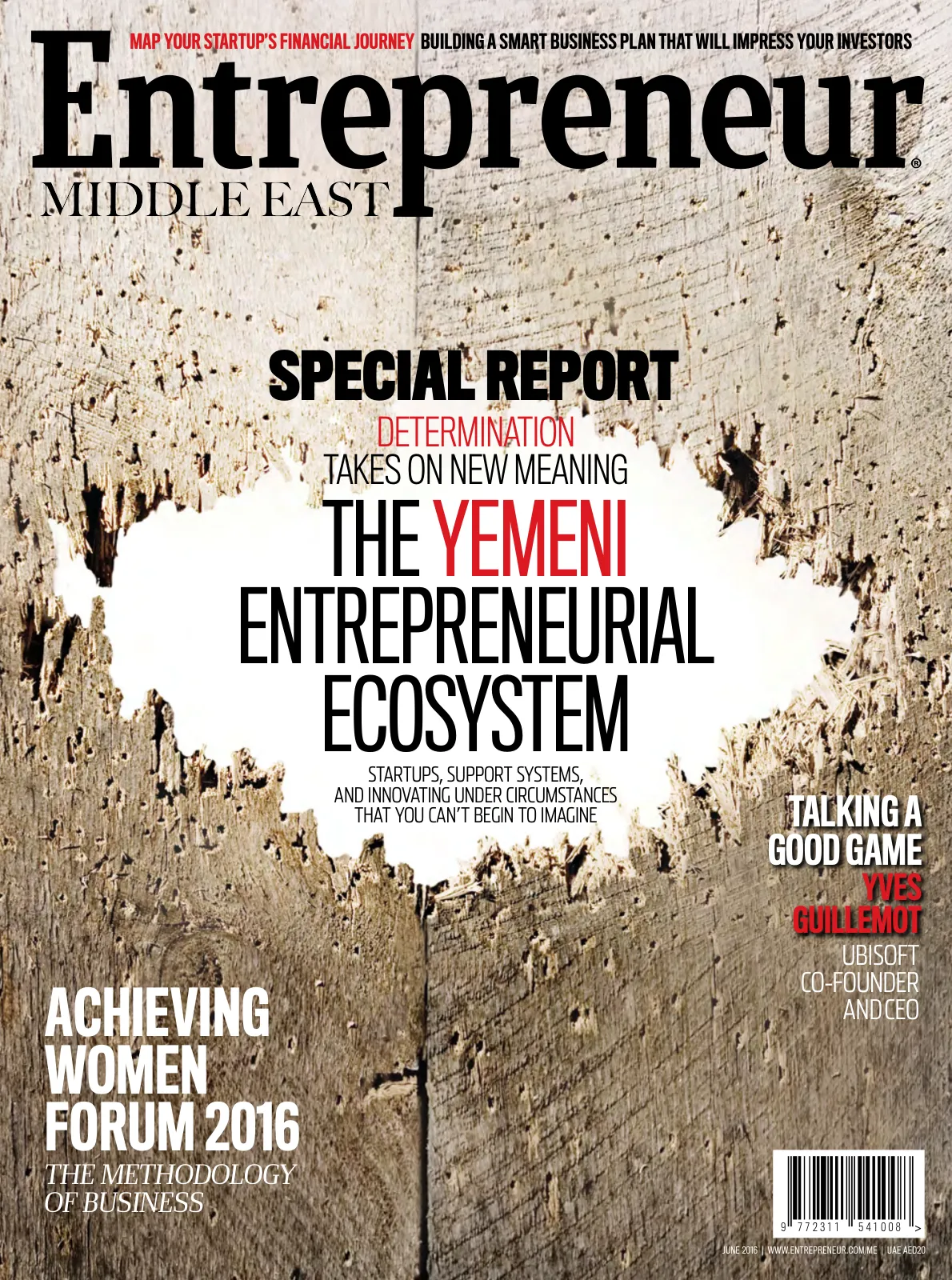
Entrepreneur Middle East, June 2016
Page 1
THE YEMENI
ENTREPRENEURIAL
ECOSYSTEM
Startups, support systems,
and innovating under circumstances
that you can’t begin to imagine
SPECIAL REPORT
Determination
takes on new meaning
JUNE 2016 | www.entrepreneur.com/me | UAE AED20
9
7 7 2 3 1 1
5 4 1 0 0 8
>
Map your startup’s financial journey Building a smart business plan that will impress your investors
Achieving
Women
Forum 2016
The methodology
of business
Talking a
good game
Yves
Guillemot
Ubisoft
co-founder
and CEO
Page 2
Page 3
june 2016 Entrepreneur
3
CONTENTS
JUNE 2016
16
Bassem Warafi,
Founder and CEO,
Tamween
16 Solar Ray team at work
16
Special report:
Determination takes
on new meaning
THE YEMENI
ENTREPRENEURIAL
ECOSYSTEM
Startups, support systems,
and innovating under
circumstances that you can’t
begin to imagine.
28
Talking a good
game
Yves Guillemot
Ubisoft co-founder and CEO.
80
START IT UP:
Q&A
Smarten up
Startup Dashroad, founded
by Faheem Gill, wants to
set the stage for MENA’s
connected car future.
82
ECOSYSTEM
Networking
Washington D.C.-
headquartered global
entrepreneurship support
network 1776 has signed a
MoU to launch in Dubai!
44
Achieving Women
Forum 2016
The sixth Entrepreneur
Industry Intel event, the
Achieving Women Forum,
and 11 points of reference on
the methodology of business.
76
INNOVATOR:
Growth surge
The Next Web co-founder
Patrick de Laive
Staying on top of Generation-T,
business verticals, and a whole
lot more.
Page 4
Entrepreneur june 2016
4
CONTENTS
JUNE 2016
27
Henri Asseily,
Manager Partner,
Leap Ventures
72
Reed Hastings,
CEO and
co-founder,
Netflix
Achieving Women
Forum 2016
44 Achieving Women Forum 2016, Panel Three The Rules of Engagement:
Making Working Capital Actually Work
58
Skullcandy Grind Wireless
headphones
44
36
‘TREPONOMICS:
SKILLSET
The struggle is real
The Middle East has a
skills gap crisis, and
Bayt.com’s Lama Ataya
explains how it will affect
your enterprise.
62
ESQUIRE GUY
How and why to offer
words of encouragement
Ross McCammon talks
about the fine line
between empowering your
team, and leaving them
directionless.
14
EDITOR’S NOTE
By Fida Z. Chaaban
52
ASK A PRO
The investor’s
viewpoint
We asked investors based
in the Middle East, from
angels to VCs, to talk back
and give us their views
on whether startups
attending events were
better positioned to
garner investor interest.
70
ASK A PRO
Landing the bid
The five components
of a highly effective
RFP including what an
efficient tendering process
looks like, and what to
avoid when running your
next tender process.
Page 5
Page 6
Entrepreneur june 2016
6
CONTENTS
june 2016
72
Donna Harris,
Co-Founder, 1776
82
76
Startup Dashroad wants
to set the stage for MENA’s
connected car future
28 Ubisoft’s co-founder and CEO talks a good game
tainbowsix siege image © ubsifot
72
MONEY:
VC VIEWPOINT
Map your startup’s
financial journey
How to build a smart
business plan that will
impress your investors by
covering all of the bases.
42
FRANCHISE:
The best fit
Founder Sloan
Kamenstein explains how
to adapt a franchise for
an international market,
based on his business’
Middle East market entry.
40
CULTURE:
LIFE
Rediscover your hustle
muscle
Startups are not simply
smaller versions of large
companies, so here’s
five tips for corporate
professionals moving
into the entrepreneurial
ecosystem.
60
TRAPPINGS
‘Trep gear
The executive selection
for the entrepreneur
on your list that has
everything. Okay, maybe
for a little self-reward
as well.
64
LIFE
Upgrade your brain
Olympian and entrepre-
neur James Clear outlines
how to spot a common
mental error that leads to
misguided thinking.
Page 7
BREITLING.COM
WELCOME TO OUR WORLD
AVENGER BLACKBIRD
At the heart of the most extreme missions you’ll fi nd exceptional men
prepared to entrust their security only to the most high-performing
instruments. At the heart of exceptional missions you’ll fi nd the Breitling
Avenger. A concentrated blend of power, precision and functionality,
Avenger models boast an ultra-sturdy construction and water resistance
ranging from 100 to 3000 m (330 to 10,000 ft). These authentic instruments
for professionals are equipped with selfwinding movements offi cially
chronometer-certifi ed by the COSC – the only benchmark of reliability
and precision based on an international norm. Welcome to the world of
extremes. Welcome to the Breitling world.
Page 8
Page 9
Page 10
Entrepreneur june 2016
10
SUBSCRIBE
Contact subscriptions@bncpublishing.net to receive
Entrepreneur Middle East every issue
EDITOR IN CHIEF Fida Z. Chaaban editor@bncpublishing.net
CEO Wissam Younane wissam@bncpublishing.net
MANAGING DIRECTOR Walid Zok walid@bncpublishing.net
DIRECTOR Rabih Najm rabih@bncpublishing.net
CREATIVE LEAD Odette Kahwagi
MANAGING EDITOR Aby Sam Thomas
STARTUPS SECTION EDITOR Pamella de Leon
COLUMNIST Sindhu Hariharan
COLUMNIST Tamara Clarke
COLUMNIST Shoug Al Nafisi
COLUMNIST Erika Widen
EVENTS LIAISON Mark Anthony Monzon
PO Box 502511 Dubai, United Arab Emirates
P +971 4 4200 506 | F +971 4 4200 196
For all commercial enquiries related to
Entrepreneur Middle East contact
sales@bncpublishing.net
All rights reserved © 2016.
Opinions expressed are solely those of the contributors.
Entrepreneur Middle East and all subsidiary
publications in the MENA region are officially licensed
exclusively to BNC Publishing in the MENA region by
Entrepreneur Media Inc.
No part of this magazine may be reproduced or
transmitted in any form or by any means without written
permission of the publisher.
Printed by Raidy Emirates Printing Group LLC
www.raidy.com
Images used in Entrepreneur Middle East are credited when necessary. Attributed use of
copyrighted images with permission. All images not credited otherwise Shutterstock.
Ghada Abdelkader
Youmna Chagoury
James Clear
Liam Farrell
Sloan Kamenstein
Suhail Al-Masri
Ross McCammon
Rani Nasr
Soukaina Rachidi
May Rostom
Jawanna Sawalha
Tarig El-Sheikh
Dr. Petar Stojanov
Erika Widen
CONTRIBUTING WRITERS
www.entrepreneur.com/me
Access fresh content daily on our website!
MIDDLE EAST
EntMagazineME
@EntMagazineME @Fida
Entrepreneur-me
EntrepreneurMiddleEast
EntMagazineME
EntMagazineME
EntMagazineME
MIDDLE EAST
In addition to our print edition, we’re bringing
you all sorts of industry news on our web
mediums. Joining us online means getting
relevant business and startup content in
real-time, so you’re hearing about the latest
developments as soon as we do. We’re looking
forward to interacting with our readers on all of
our social media and web platforms- like any
thriving business, we’re looking to give and take.
#TrepTalkME is already happening on all of our
digi platforms, and all good conversations go
both ways. See you on the web!
Page 11
Page 12
Page 13
Page 14
Entrepreneur june 2016
14
Aby Sam Thomas
@thisisaby
Fida Chaaban
EDITOR’S NOTE
Talking about agility and innovation means you actually
need to be agile and innovate
Change is good
W
e’ve always
prided ourselves
on transparency
and frankness
at Entrepreneur
Middle East. Our consistent
readers and our friends
in the entrepreneurial
ecosystem -both online and
offline- know us as the “real
talk” medium. That trans-
parency extends to shifts in
direction and to changes in
the existing team and setup.
This month, I’m happy to
announce some positive and
much-needed structural
realignment. To begin with,
Aby Sam Thomas, previously
Managing Editor, will be
replacing me as the Editor in
Chief. Some of you, especial-
ly those from the ecosystem,
already know Aby well as he
and I pretty much co-manage
every part of our business
and all of the verticals we
Page 15
june 2016 Entrepreneur
15
Wissam Younane, CEO,
BNC Publishing
@Wissamyounane
Fida Z. Chaaban
Editor in Chief
@fida | @fidazchaaban
fidachaaban@bncpublishing.net
have. He will be taking over
as Editor in Chief as of next
edition, and I couldn’t have
made Entrepreneur what it is
now without him. (Aby, this
doesn’t mean our #social-
mediawar is over. The fray
continues…)
I’m also announcing that
on a corporate level, Wissam
Younane has been appointed
as CEO of BNC Publishing,
our parent entity. Wissam,
for us, has been part and
parcel of the advancement of
the Entrepreneur brand since
inception. He has pushed
me harder and further than
any of you can imagine- he is
(and was) the catalyst behind
all that we are today. Some
of you already know Wissam
from his online and offline
ecosystem participation, and
in the coming year you’ll be
seeing much more of him.
(Wissam, I am proud to
have worked with someone
who sees his business as
limitless- even if you ignore
my calls 10-15 times per day.
I’m still going to call you, so
don’t turn off your ringer.)
To the entrepreneurial
ecosystem: I appreciate that
we, as Entrepreneur, were
immediately considered
worth inclusion in the
community. Your faith in our
brand, and your faith in my
direction for our brand, is
what made my position as
the founding Editor in Chief
worth every second. It is
with your support that I was
able to take Entrepreneur
Middle East from being a
media outlet, to acting as
an integral member of the
region’s ecosystem. I didn’t
want to be representing just
another publication, I wanted
to actually do something.
And we did, thanks to you.
To my loyal readers: I have
exponential gratitude for
your loyalty and for your
conviction. Pictures of the
magazine, screenshots of
articles, constant feedback
online and offline- all of this
is what any Editor in Chief
hopes for (but rarely gets).
You, readers, have shared
our content, acted as brand
advocates, taken part in our
events, and promoted every
aspect of our work. This
relentless boost has kept
me going as the head of this
magazine, and I send you all
my deep thanks.
Finally, the question: why
am I leaving? It’s very simple.
We advocate innovation.
Advocating innovation,
by default, means that we
should constantly innovate
as well. We also advocate
things like shifting corporate
structures for agility, and
never just ‘resting’ during
periods of success. To be
more innovative, agile, and
active during this period of
our immense success, it’s
time for someone new to
inject fresh perspective and
personality into our medium.
I’ve given Entrepreneur my
all, and now our readers
deserve more. I’ll be staying
on as a contributor, of
course, and this will also
allow me to explore different
avenues of writing that I
couldn’t during my tenure as
Editor in Chief.
And that’s what this brand
is really about: I’m happy
that I can confidently say
that Entrepreneur is as agile
and as forward-thinking
as any SME or startup
out there. To keep this
momentum, and to give our
valuable supporters what
they deserve, this venture
will change when and if
change is needed. Would you
expect anything less from us?
I hope not.
Page 16
Entrepreneur june 2016
16
THE YEMENI
ENTREPRENEURIAL
ECOSYSTEM
Startups, support systems,
and innovating under circumstances that you
can’t begin to imagine
By Pamella de Leon and Sindhu Hariharan
SPECIAL REPORT
Determination
takes on new meaning
Entrepreneur june 2016
16
Page 17
june 2016 Entrepreneur
17
Ubisoft Abu Dhabi
ROWAD Entrepreneurs Foundation
is catalyzing Yemen’s startup ecosystem
Against all odds
By Pamella de Leon
www.rowad.org
Talking
Business
event
BlockOne Training Bootcamp
THE YEMENI
ENTREPRENEURIAL
ECOSYSTEM
SPECIAL REPORT
T
here’s no way to sugarcoat
this: Yemen is a nation that’s
being stifled by civil conflict
and unrest, adversely affect-
ing everything from its econ-
omy to individual citizen livelihoods. A
survey research by the United Nations
Development Program (UNDP) and Ye-
men’s Small Micro Enterprise Promo-
tion Service (SMEPS) from August to
September 2015 examined to quantify
the impacts of the conflict on Yemen
businesses- one-fourth of businesses
closed from March 2015, with the
service sector -which includes private
health and education- reportedly most
affected by closure. SMEs shouldered
the biggest hit, with 35% of medium-
sized and 27% of small enterprises
closing, compared to 17% of large
businesses. But as dire as the situation
may as seem, there’s no lack of really
trying among Yemen’s entrepreneurs.
In situations when it’s tempting to
give in to failure, their attitudes have
remained steady and resilient. We saw
this first-hand with the founders of
ROWAD Entrepreneurs Foundation,
and the entrepreneurial community it
has fostered. Such is their enthusiasm,
that in fact, it was the ROWAD team
that first reached out to us, asking us
to shed light on the country’s ecosys-
tem. Even later, during a Skype call,
they patiently real-time translated an
Arabic language event supporting en-
trepreneurs; their
earnest passion,
despite their spe-
cial circumstances,
was easily evident.
The establish-
ment of ROWAD
Entrepreneurs
Foundation began
from the ground up
by entrepreneurs
for entrepreneurs.
In 2012, Ahmed
Qasem, Ameen
Sanad and Yasser Alwan started a
business management consulting firm,
Dipherent Training, that would provide
training courses to Yemeni profession-
als. It was then that they experienced
the limited support for founders with
“ideas that have growth potential.”
They felt that existing organizations
focused on self-employment initiatives
or micro-business ideas, while others
focused on already established fam-
ily businesses. “We needed channels
to network with other like-minded
entrepreneurs as well as successful
businesspeople,” says Qasem, which is
why they started Talking Business in
2013, an event hosting successful Ye-
meni businesspeople to share stories,
thus creating a network of successful
up and coming ‘treps. It was through
running these events that the trio real-
ized that they could play a bigger role
in supporting entrepreneurs based in
Yemen: “So, we established ROWAD…
We wanted to create a hub to support
entrepreneurs and streamline efforts
to create a supportive ecosystem, so
we launched our first business com-
petition BlockOne, where we helped
create six startups.” BlockOne Venture
Competition was held in 2014, with
240 applicants -all aspiring entrepre-
neurs- seeking to start their own ven-
ture. It was followed by the three-day
BlockOne Training Bootcamp, which
hosted 52 entrepreneurs and focused
on strengthening entrepreneurial skills
for the final stage of the contest.
Currently, there isn’t a set date for
the next round of competition and
bootcamp, as they’re seeking funding
to add an incubation component and
to expand its duration to three months.
With that momentum, ROWAD also
started BlockOne Business Accelera-
tion Program and BlockOne Incubator,
wherein the winning teams of the
competition were supported for three >>>
Page 18
Entrepreneur june 2016
18
Yasser Alwan,
co-founder
Ameen Sanad,
co-founder
Adeeb Qasem,
Executive Director
Adeeb Qasem, the Executive Director of
ROWAD Entrepreneurs Foundation, is also
one of the business coaches to some of the
Block One winning teams, Business Incu-
bator & Acceleration program, the Afkar
competition, and the Mubadara Program
by SMEPS. He is also an entrepreneur-
ship lecturer at the Lebanese International
University (LIU) in Sana’a, Yemen. The
second co-founder is Ameen Sanad, whose
background is in web development and
pursued a career with the UN in Yemen,
and with Qasem co-founded Yemen HR
and Dipherent Training. Yasser Alwan is
also a co-founder, and his background is
in project management. Alwan is the co-
founder of Griffin Telecom, a subsidiary of
Griffin Group.
MEET THE TEAM
THE ROWAD ENTREPRENEURS FOUNDATION
Talking
Business
event
“We wanted to create a hub to
support entrepreneurs and
streamline efforts to create
a supportive ecosystem, so we
launched our first business
competition BlockOne, where
we helped create six startups.”
THE YEMENI
ENTREPRENEURIAL
ECOSYSTEM
SPECIAL REPORT
months in the acceleration
program with office space,
infrastructure, seed money,
and mentors for support.
The BlockOne Incubator is
open to all startups, with
mentorship, training and
networking opportunities
from ROWAD. BlockOne
also had its own activities
like Founders Event (a
platform for founders to
share experiences), Startup
Doctor (for startups to seek
business consultation) and
ROWAD seminars. A recent
project is its How To Start
seminar series, featuring
sessions on the different
aspects of running a startup, such as
business models and finance basics,
catered to those thinking of starting
businesses but that have no formal
background to draw on.
Besides BlockOne, another competi-
tion catered toward Yemen’s youth
was Afkar, the Youth Innovation and
Creativity Award, supported by UNDP,
which aims to utilize the potential
of turning Yemeni youth’s ideas to
sustainable businesses. “It is an oppor-
tunity for the large unemployed youth
population of Yemen to confront the
country’s development challenges.” Qa-
sem worked on designing the process of
Afkar 1.0, and after ROWAD partnered
with UNDP to implement Afkar 2.0,
ROWAD had already completed its
BlockOne Venture Competition and
Qasem felt prepared in going forward
with Afkar. ROWAD is presently work-
ing with UNDP to secure funding for
Afkar 3.0. With BlockOne and Afkar,
while the competitions are a valuable
resource for entrepreneurs, Qasem as-
sures that ROWAD continues to check
in on past winners to see how they’re
progressing, as well as connecting op-
portunities when suitable. As for the
Afkar 2.0 winners, they’re currently
going through the acceleration phase,
that provides them with coaching,
trainings, and networking avenues.
Even with a plan in hand, starting
ROWAD’s projects wasn’t easy, Qasem
notes. “There is very limited funding
that goes into skilled entrepreneurs
or innovative businesses with growth
perspective. This funding is focused
on capacity building for direct employ-
ment or micro-businesses.” The same
challenges that they faced when they
launched -lack of funding and com-
mitment from active players- are still
there, though Qasem adamantly says
that they’re still looking for partners
to help reach their vision. A current
obstacle, Qasem says, is supporting
the tech startup scene in Yemen, and
indicating how businesses in the tech
sector can really create
more jobs and op-
portunities for Yemeni
youth: “We want the
Yemeni tech market to
export services into the
region, and that will
only happen if we build
faith and demonstrate
it through startups that
we can support.” As an
NGO, ROWAD’s finan-
cial sources include
events and activities
with minimal registra-
tion fees, as well as
the BlockOne Training
Bootcamp and Talking
Businesses events.
Both of the latter are income generating
events for the foundation, while Block-
One Incubator accepts startups based
on membership fees. Qasem also credits
their relationship with the private sec-
tor for support- some of the funding
towards BlockOne Incubator has been
contributed by partners Alkuraimi Mi-
croFinance Bank and Yemen Liquefied
Natural Gas Company. From about 20
entrepreneurs for the first Talking Busi-
ness event, to over 80 entrepreneurs
today, Qasem adds, “Despite the start
of the war in 2015, and having to close
down for three months, we were able
to run 22 events and engage over 600
young entrepreneurs”- undoubtedly an
impressive feat.
Page 19
june 2016 Entrepreneur
19
YEMENI ‘TREPS NEED ANGEL AND VC ATTENTION
ROWAD Executive Director Adeeb Qasem
INVESTOR OUTREACH
BlockOne Training
Bootcamp
“There is no venture capi-
tal scene in Yemen- and
although there are some
cases of funding through
support of established
businessmen, they are
rare and presently there
are no clear access chan-
nels to them.”
THE YEMENI
ENTREPRENEURIAL
ECOSYSTEM
SPECIAL REPORT
According to the research of UNDP and
SMEPS, 73% of businesses have had
no access to external funding since
the war broke out. In Sa’dah, Sana’a,
Abyan, Hajjah, Taiz and Aden, the top
three contributors to business closure
were infrastructural damage, capital
and customer loss, and mounting
debt. Qasem sums up their challenges
as having limited access to proper
financing channels, limited access to
guidance and coaching services, and
limited access to proper infrastructure.
Finance options are from primarily
personal savings/family and friends
or micro-finance loans, which, Qasem
points out, doesn’t allow “for support
of bold and creative ideas with high
growth potential.” Angel investors?
“There is no venture capital scene in
Yemen- and although there are some
cases of funding through support of
established businessmen, they are rare
and presently there are no clear access
channels to them.” Infrastructure is a
major obstacle, especially in the cases
of Internet and electricity. “There has
been no public electricity in Sana’a
since the start of the war in March of
2015,” says Qasem, making business
incubators such as BlockOne more
relevant and needed for SMEs and
startup founders. However, amidst
the instability the country is weather-
ing, perceptive entrepreneurs have
emerged to solve problems and provide
services- it’s worth mentioning here
that the UNDP and SMEPS research
indicates that 29% of business owners
pursued “income diversification as a
survival strategy.” Among the top three,
fuel tops as the most lucrative new
opportunity at 21%, followed by food
at 29%, and the black market at 17%.
Given the loss of public electricity, a
demand for solar solutions came about,
with Qasem giving examples of how en-
trepreneurs started small businesses >>>
“Yemeni entrepreneurs are the most
committed and determined I have seen,
and they have proved it throughout
the recent war. They work against
extreme conditions, yet they manage to
overcome and prevail. The 10 winning
startups of Afkar 2.0 award show-
case how, with some support, these
entrepreneurs are taking solid steps
towards creating profitable and scal-
able businesses. These entrepreneurs
are not looking for easy access to cash;
they understand the difficult situation
they are in and they have practical ideas
to make advantage of whatever op-
portunities they have available to them.
There is a lot of potential for growth in
Yemen, but there is even more potential
in working with Yemeni entrepreneurs.
What most investors look for [in] busi-
ness teams and partners are mostly
the commitment, hard work and ability
to learn fast- Yemeni youth have these
qualities and are always innovative.
Investing in Yemeni entrepreneurs will
always pay off in a good way.”
COMMON MISTAKES MADE BY
YEMENI ENTREPRENEURS
“First is the haste [in getting] into
partnerships without thinking carefully
about ‘chemistry’ and understanding
between partners. Partnership done
right is one of the main reasons that
leads to startups’ ability to succeed,
however, many of the failed initiatives I
have seen were founded by people who
didn’t think critically about going into
partnerships and what each partner
is bringing to the business. These
partnerships failed fast at the first sign
of stress, despite [the fact] that some
of them have got access to finance and
coaching. Another common mistake
among Yemeni entrepreneurs is over-
estimating the importance of the idea
while underestimating the need to vali-
date it and building a proof of concept;
being very protective of an idea and
thinking that all is needed is financial
support to make it a success- without
putting in the needed work to validate
the solution and customer need. An-
other common mistake amongst Yeme-
ni entrepreneurs is underestimating the
scalability potential of their businesses
and not pushing their startups to grow
and expand nationally and internation-
ally. Many Yemeni entrepreneurs have
the skills and ideas to compete at a
regional level, but the lack of exposure
limits their efforts to expand.”
ADDITIONAL ENTREPRENEURIAL
INITIATIVES IN YEMEN
“It is great to see other organizations
working towards supporting local
entrepreneurs here, [such as] Yemen
Our Home, a crowdfunding platform
currently being developed by UNDP,
Mubadara Initiative by SMEPS. Muba-
dara is working with the government
and ILO (International Labour Organi-
zation) to introduce entrepreneurship
as a curriculum to be taught to all
university students. Another is the
Business Support Center established in
partnership with Yemen Business Club,
Sparks and
UNDP to
support
Yemeni busi-
nesses. The
first Yemeni
Entrepreneurs
Conference
being organ-
ized by the
Association
of Chambers
of Commerce
[will] take place
in Sana’a.”
Page 20
Entrepreneur june 2016
20
BlockOne Training
Bootcamp judges panel
Afkar 2.0 coaching
sessions
“There is very limited
funding that goes into
skilled entrepreneurs
or innovative businesses
with growth perspective.
This funding is focused
on capacity building for
direct employment or
micro-businesses.”
THE YEMENI
ENTREPRENEURIAL
ECOSYSTEM
SPECIAL REPORT
to import panels, batteries, installation
services and maintenance services. An
enterprising Afkar 2.0 winner is work-
ing on assembling solar panels, while
another is working on a prototype for
biogas production. Qasem also adds
that another sector they have noticed is
booming is social media marketing and
content creation- the need and space
for Arabic and Yemeni content online is
still unaddressed. “We are also working
on creating programs to support local
entrepreneurs to catch the wave of
mobile app development and big data,”
adds Qasem.
More on the positive side, ROWAD is
working on partnering with local mi-
crofinance networks and partnerships
at a regional level to create an avenue
of financing options suited to the needs
of Yemeni entrepreneurs looking to
scale up. “Yemeni entrepreneurs have
the will to walk the distance, but in
order to grow and avoid unneeded
failures they need support and guid-
ance throughout the startup process.”
Qasem gives the example of the Afkar
competition, which has made ROWAD
certain of the value of access to busi-
ness coaches and mentors in support-
ing startups with hands-on advice. One
of ROWAD’s major projects in the com-
ing year is expanding their coaching
service at a national level by creating
an online platform to facilitate access
to business experts, and advocates for
support from ecosystem stakeholders:
“I believe we need to keep on pushing
entrepreneurship as the solution for
unemployment and economic stagnan-
cy in Yemen, not just to Yemeni youth,
but to government, to international
and local organizations, and to donors.”
Qasem admits that most college gradu-
ates prefer employment, rather than
starting up: “The culture in general is
critical of failure and not very support-
ive of [the] reiterative process needed
to increase chances of startup success.”
He continues, “A good number of youth
feel that the only obstacle between
them and starting a business is financ-
ing, which is not always the case, as
more work needs to be done to validate
their proposed solution to improve
their ideas and make the investment
worthy.” Qasem also notes that with
women, cross-gender interaction is
limited: “Thus most female entrepre-
neurs seem to take advantage of this
culture and focus on services/products
that are provided only to females and/
or can only be provided by females.”
And issues such as these, Qasem as-
serts, is why ROWAD makes the case
for entrepreneurship in Yemen as a
major pillar of economic development.
“These entrepreneurs understand the
challenges facing them and facing the
country, yet they keep on navigating
the circumstances around them and
prove that their solutions are much
needed by the market. They have to
constantly adapt to restrictions to be
able to overcome these obstacles. Un-
der the current situation, simple tasks
like importing needed equipment and
transferring money are not straightfor-
ward anymore. But as entrepreneurs,
they are proving their resourcefulness
in finding work around like assembling
equipment locally, or transferring
money through many hubs in order to
get results.”
There is still a lot more work to be
done, as Qasem feels a vibrant entre-
preneurial ecosystem is “where [the]
choice of becoming an entrepreneur
is not restricted by limited resources
and unfavorable conditions, but rather
a function of the value added to the
economy and humanity. We define our
work on three fronts: the creation of
sufficient and proper finance channels,
the provision of the needed business
support and coaching services, and
the advocacy for entrepreneurship-
friendly laws and public policies.”
Qasem wants budding ‘treps to know
that there is a need for entrepreneurs:
“Yemen faces major challenges in
all sectors, and these challenges are
further complicated due to the ongo-
ing war,” and concludes that Yemeni
entrepreneurs can play an active role in
solving these issues. “It is their skills
and local knowledge that can discover
[the] best ways to address local needs.”
In Yemen, there isn’t only a passion for
entrepreneurship, there’s a desperate
need for it.
Page 21
Page 22
Entrepreneur june 2016
22
THE YEMENI
ENTREPRENEURIAL
ECOSYSTEM
SPECIAL REPORT
Yemeni startups work under circumstances
that you can’t begin to imagine
Moving
mountains
By Sindhu Hariharan
Skoolsbook at BlockOne BootCamp
Solar Ray team at work
“[There was] no
electricity at all for
a year, and gas prices
were raised to five
times [the cost] in the
black market! We cut
our salaries in half
to cover those extra
expenses. At the end,
the company was hit
by an explosion [in May
2015], and everything
was blown up.”
W
hen you
speak to an
entrepreneur
about his or
her fledgling
business,
scaling up
usually crops up as a key challenge, and
product development or marketing often
figures as common need for funds. That
said, it can be quite unsettling to talk to
founders and have them share a predica-
ment wherein the core survival of the
business stands threatened by an ongo-
ing war- as happens to be the case in
Yemen. “We established our [company]
Lumlim in Sana’a [in January 2015], but
we never expected that war would com-
mence in the next two months,” remem-
bers Mohammed Abdulbaqi, founder,
Lumlim. “[There was] no electricity at
all for a year, and gas prices were raised
to five times [the cost] in the black
market! We cut our salaries in half to
cover those extra expenses. At the end,
the company was hit by an explosion [in
May 2015], and everything was blown
up.” Not every entrepreneur wishing to
make a business out of their pet project
comes across such obstacles, and it takes
herculean conviction to persevere in
such conditions.
For Yemen, entrepreneurship seems to
have emerged as a helping hand for an
economy drowning in political instabil-
ity. “Yemenis have opened shops to
sell everything from ice to cold drinks
to solar systems to fuel,” says Tarik
Alsharafi, Startup & Business Growth
Coach. “Many employees have lost their
jobs, especially in the private sector.
Those who are smart enough, and have
access to capital or savings, have turned
into opening their own stores one way or
another to serve the new market needs,
and generate some income for them-
selves and their families.” He admits to
seeing “exponential growth” in Yemen’s
entrepreneurial ecosystem during the
last year. Take for instance the afore-
mentioned Abdulbaqi, for whom entre-
preneurship is an avenue to escape a life
of “being locked up with tasks that did
not reflect [his] visions.” With Lumlim-
a mobile-oriented engagement platform
– Abdulbaqi wants to inspire young
Yemenis to start their own companies,
since he believes that “entrepreneurship
is the way to push Yemen out of its cur-
rent misery.” With its finger on the pulse
of today’s social-savvy generation, who
insist on being a part of the content they
consume, Lumlim wants to personalize
online content viewership experience.
Launched in January 2015 in Sana’a,
Lumlim’s app is equipped with a patent-
pending voice recognition technology
that enables users to identify online
audio/video content, share it and engage
with it real-time, thereby encouraging
wider engagement. For content creators,
the startup helps build interactive cam-
paigns.
Analyzing the nature of the fledgling
ventures coming up in Yemen, it’s quite
evident that entrepreneurship in Yemen
is directed at fulfilling real, basic needs,
than being a matter of an entrepreneur’s
choice. The entrepreneurs say that they
are not looking to “disrupt” traditional
businesses, but instead believe that
entrepreneurship is their best bet for
solving significant social challenges of
Yemen. “Entrepreneurship is one of the
most important economic growth ac-
celerators for Yemen today,” says Bassem
Warafi, founder and CEO, Tamween. “A
couple of entrepreneurs who have smart
Page 23
june 2016 Entrepreneur
23
THE YEMENI
ENTREPRENEURIAL
ECOSYSTEM
SPECIAL REPORT
Transcending
borders
Ecosystem participation
for Yemeni startups is integral
to success
“entrepreneurship is
the way to push Yemen out
of its current misery.”
Abdulbaset
at Oasis500
bootcamp in
Jordan
Bassem Warafi,
Founder and CEO,
Tamween
Mohammed
Abdulbaqi,
Founder,
Lumlim
ideas in e-commerce or video
engagement may be able
to build a parallel national
income equal or maybe ex-
ceeding other sectors, in poor
countries such as Yemen.”
Warafi, winner of the 2015
Best MENA Entrepreneur
Award from the Regional
Office of the U.S. State De-
partment, founded Tamween,
a portal where suppliers
and retailers have their own
accounts/dashboards to man-
age their business and satisfy
consumer’s needs for basic
goods. Warafi realized early
on that a typical B2C e-com-
merce model would require
high operational costs on his
part, and hence Tamween
pivoted from being an online
catering service into a B2B
player facilitating commercial
transactions between suppli-
ers and clients by digitizing
the process and offering key
metrics in real-time.
Similarly, another sector
emerging as a popular choice
for entrepreneurs to tackle,
to support the nation’s
survival, is renewable energy.
At a time when electricity is
scarce and often unreliable
in Yemen, a large number of
solar-energy based startups
have started operations in
Yemen. Solar Ray is one such
startup that launched in
June 2015 assembling solar
panels, installation units and
fixing batteries for the same.
“We have around 50-70 ac-
tive customers,” says Faisal
Alshabi, founder, Solar Ray.
“And for the future, we are
planning to expand and get
our products to each home
in Yemen and also bring
new products for customers
energy needs.” Operating
in a non-tech field, Alshabi
has unique hardships of his
own to deal with. His biggest
issue, he says, is absence of
a fixed exchange rate for the
U.S. dollar in the banks and
market of Yemen, leading
to complications in import
procedures.
Abdulbaset M. Bakhdar,
CEO, Skoolsbook is another
concerned Yemeni entrepre-
neur- but his concern is not
specifically about business,
but about the development
of future Yemeni generations
and their education. With a
team of six employees, Bakh-
dar runs Skoolsbook, a portal
that aims to bridge access to
education in Yemen. While
the portal helps educational
institutions share informa-
tion on their services and ac-
tivities, subscribers wishing
to ensure stable education
for their children stand to
gain from the data. Perhaps
the most significant social
contribution of Skoolsbook
lies in publishing electronic
versions of Yemeni school
syllabuses and materials for
free, after the Ministry of
Education stopped printing
school textbooks due to the
war. “Currently, we have 30
subscriptions of educational
institutions and each of
them include 700 students,”
Bakhdar says. “Recently, an
agreement has been signed
with Al-Awon Foundation
for Development, with the
supervision of Ministry of
Education of Hadhramout, to
activate Skoolsbook inside 17
government schools.”
Usually, for any startup to
scale, the key ingredients
are the trio of idea, fund-
ing and mentorship. While
The importance of net-
working and learning from
exposure to global entrepre-
neurial ecosystems cannot
be stressed enough. As is
often the situation for en-
trepreneurs in conflict areas,
being cut off from the larger
ecosystem has been a major
drawback for Yemen’s start-
ups. They confess to have
missed out on the awareness
and recognition that the
connection with adjoining
regions can bring. Neverthe-
less, these entrepreneurs
have had their share of suc-
cess reaching outside Yemen.
Tamween was adjudged
the Best MENA Entrepreneur
2015 in the Entrepreneur-
ship challenge organized by
the U.S. State Department.
Warafi says that the compe-
tition gave him something
better than money. “Besides
the connections, and besides
shedding light on such an
ambitious project, they gave
me the certainty that I was
on the right way. I’ve been
told by high profile mentors
that Tamween could be the
next Alibaba,” says Warafi.
Lumlim has been finalists
in both ArabNet Riyadh and
ArabNet Beirut, and also
qualified for the semi-finals
of MIT Enterprise Forum
Arab Startup competition.
Unfortunately, the team
could not travel to Saudi Ara-
bia to compete in the semi-
finals as they couldn’t get a
visa, owing to the political
situations. “It’s okay; we are
working on Lumlim and look-
ing for success, not just an
award,” says Abdulbaqhi.
Skoolsbook applied
with their project idea to
Oasis500 and had an op-
portunity to attend one of
their boot camps in De-
cember 2015 in Amman,
Jordan. “Our experience with
Oasis500 was very inspiring
to us,” says Bakhdar. “They
helped us develop skills
needed for entrepreneurship,
for example, how to per-
suade the investor with your
idea within minutes, and how
investors evaluate startups
and how to scale ideas.”
>>>
Page 24
Entrepreneur june 2016
24
“What we have really
learnt from this
experience is that you
have to fight against
all odds for your
startup to survive,
and get ready to sell
whatever you own,
even your laptop.”
THE YEMENI
ENTREPRENEURIAL
ECOSYSTEM
SPECIAL REPORT
MONEY MATTERS
Lumlim app
Skoolsbook
skoolsbook.com
Tamween So far, this startup has
been making do with sponsorship and
advertising revenue. However, Warafi
has drawn up his financial projections
and estimates that around $500,000 is
needed to operate business for the next
one year, out of which there is an im-
mediate need for $60,000 for product
developments before the Ramadan sea-
son. “Most of the biggest suppliers who
run the FMCG market here, and some
major stores and financial institutes
have welcomed the idea to buy equities
in Tamween,” says Warafi. He added
that he’s evaluating the crowdfunding
as an option to raise part of the amount
in a month’s time. www.tamween.biz
Lumlim raised seed funding from
local investors during their launch, but
sadly for the company, it admits to
have faced “severe damage” in the local
crisis, leading to material losses. “We
are now looking to raise $200,000 to
build our iOS and Web CMS in addition
to expanding into advertising market to
empower video ads engagement,” says
Abdulbaqhi. He considers the recogni-
tion received at ArabNet Beirut 2016 as
an inflexion point for the startup, which
has since then been contacted by many
investors and is “welcoming investment
offers.” www.lumlim.io
Skoolsbook set its operations
in motion thanks to initial monetary
support extended by the BlockOne
incubator. Subsequently, the Al-Awon
Foundation for Development has invest-
ed in Skoolsbook to help them continue
their work in the field of education in
Yemen. With already two branches in
Yemen, the company is looking to fur-
ther expand inside and outside Yemen.
www.skoolsbook.com
Solar Ray received around $13,000
from Afkar program of ROWAD Entre-
preneurs Foundation followed by and
influx of capital of around $22,000
from new partners brought into the
business by the founder. Alshabi says
that they plan to take stock of the situ-
ation in the next three months to decide
about funds.
www.facebook.com/solar.ray.ye
there seems to be a healthy count of
entrepreneurs in Yemen with novel
ideas, the situation on the funding and
mentorship front remains a worry.
“Many of the rich companies have
closed or temporarily suspended their
operations,” Alsharafi says. “These
used to provide most of the business
funding for large projects and local
Yemeni businesses.” He also notes
that since anyone who had the means
to move out of Yemen has already
left, there has been an adverse effect
on the retail spending in the country.
The loss of this demographic has
created a large void when it comes to
mentoring or investments for Yemen’s
startups. “Most funding resources
here come from humble organizations,
as the idea [of entrepreneurship] still
hasn’t got across to our government,”
adds Warafi. In such difficult times,
organizations such as the ROWAD
Entrepreneurs Foundation and its
BlockOne Acceleration program have
played the role of much-needed pillars
of strength for Yemen’s
entrepreneurs. “All we
had initially was just a
mere concept, which was
turned into a startup in
a short time through the
incubation and accelera-
tion program provided by
BlockOne,” says Bakhdar.
Even now, after almost
a year of graduation,
Skoolsbook continues
to go back to the Foundation and its
mentors for assistance. But the trials
for this persistent group of Yemeni
go-getters don’t end there. Besides
the constant risk of an interruption in
business, a lack of basic infrastructure
has made day-to-day operations a
daunting task. It is often seen that
necessity propels innovation, and that
is true of Yemen’s SMEs too. Lumlim,
for instance, decided to tap into solar
energy to satisfy
their requirement
for power. Work-
ing on solar cells
and batteries (and
under extreme
pressure, since
power used to last
only for six hours
a day), Lumlim
kept going with
its enterprise.
“What we have
really learnt from
this experience
is that you have
to fight against
all odds for your
startup to survive,
and get ready to
sell whatever you
own, even your
Page 25
june 2016 Entrepreneur
25
“Many of the rich
companies have
closed or temporar-
ily suspended their
operations. These
used to provide
most of the business
funding for large
projects and local
Yemeni businesses.”
THE YEMENI
ENTREPRENEURIAL
ECOSYSTEM
SPECIAL REPORT
Yemeni entrepreneurs on starting up
a business
‘TREP TALK ME
Tarik Alsharafi,
Startup and
Business
Growth Coach
Faisal Alshabi,
founder, Solar Ray
Tamween app
1. ONLY ONE YES MATTERS
Bassem Warafi, CEO and
founder, Tamween
“We live in a region that’s full
of troubles. Define problems
very well and try to find out
innovative solutions that can
massively save resources.
Secondly, be ready. You don’t
know where and when the
next idea pops up! Jot it
down immediately on your
smartphone, there are many
apps can help you out with
this. Third, get noticed by
engaging with regional forums.
Follow market influencers and
ask the right questions to the
right experts. Get new skills
and improve the old ones.
Finally, remember, it doesn’t
really matter how many times
you hear no. Only one ‘Yes’
matters.”
2. INVESTORS WANT
TRACTION
Mohammed Abdulbaqi,
founder, Lumlim
“You carry the burden of taking
Yemen out of its misery and
we can do so together. Another
advice I have for all MENA
entrepreneurs is that you will
not know your product unless
you talk to your customers.
Don’t waste time in coding and
building your own perspective.
Your customers know your
product better than you do.
With respect to raising funds,
especially in MENA region,
don’t ever go to any investor
unless you have traction. Believe
me, most investors will not
understand a word about your
technology and innovative ideas.
They want only one thing -
traction.”
3. LEARN, LEARN, LEARN.
Tarik Alsharafi, Startup &
Business Growth Coach
“Find a customer that needs
something and start a business
around that need instead of
finding a product then building
a business around the product.
Start small even if you have
the money. Do not spend any
money on the establishment
of your business unless you
are willing to borrow it from
someone and you are sure
you will get positive ROI on
it. [Second] spend 80% of
your time on selling. Make
sure you spend most of your
time outside your office talking
to your customers. Only the
business owner can know
what the market needs and
can adapt to the customers’
demands. [Third] learn, learn,
learn. Learn about the lean
startup, sales, marketing,
finance, and accounting. Your
job as an entrepreneur is a
problem-solver so be ready to
solve problems every day. Seek
mentorship as early as possible.
Try to find people who have
grown their businesses in the
same or similar markets that
you are operating in. A mentor
can help you grow your business
faster, can provide guidance,
and can help you avoid mistakes
that you don’t expect on the
way ahead. Finally, aim to serve
people with class. Do not start a
business for the profit, but do it
because you like to serve people
and want to help solve their
problems. Profit will come later.”
laptop,” notes Abdulbaqi.
Warafi, on the other hand,
counts resistance to anything
new, more so given the condi-
tions in Yemen, as his major
barrier. “Introducing a totally
new concept to such envi-
ronment and push it to get
involved is an achievement,”
he says. As a mentor, Alsharafi
remains positive. Without
denying the rocky journey, he
claims that new markets like
renewable energy, power stor-
age and manufacturing have
all opened up as a result of the
crisis, and for entrepreneurs
who are willing to listen and
adapt, growth is certain.
When prodded about what
change he would like to see in
Yemen, he says that the mind-
set of Yemen’s people that
they cannot start businesses
until they have a big estab-
lishment, capital and employ-
ees, etc. needs to change. “The
most difficult concept to grasp
for a new entrepreneur is to
start small and grow from
profits,” he says.
Despite the onslaught of po-
litical volatility, lack of financ-
ing opportunities, unstable
infrastructure, and absence
of an overall supportive eco-
system, Yemeni entrepreneurs
are relentless in their pursuit
of business success, and re-
main optimists. “We have an
ambitious vision to be a pio-
neer service provider in the
region by creating the biggest
virtual FMCG store that owns
no store,” says Warafi. “One of
our strategic goals is pushing
to make these transactions
[Yemen’s expat remittances]
flow through our gateway.”
And as Abdulbaqi puts it, no
amount of attending events
or going through literature
can prepare entrepreneurs
for a scenario of “surviving
sudden severe crisis like war,”
and all they can do is remain
steadfast in solving problems
around them.
Page 26
Page 27
Page 28
innovator
GUILLEMOT
YVES
UBISOFT CO-FOUNDER AND CEO
By Sindhu Hariharan
GUILLEMOT
Entrepreneur june 2016
28
A GOOD GAME
TALKING
A GOOD GAME
TALKING
YVES
Page 29
june 2016 Entrepreneur
29
innovator
IMAGE CREDIT UBISOFT | WWW.UBISOFT.COM
“We used to have games that were played
20-30 hours and now we are heading
towards games that are played 100-500
hours. So that is changing our business
model, [content] of the games we create.”
Michel
Guillemot,
co-founder,
Ubisoft
I
walked into the meeting
preparing myself for an
intimidating experience-
to sit down with the
person heading the organi-
zation behind some of the
most renowned, successful
and engrossing video
games globally, had to be tough, I
thought. However, the down-to-
earth and talk less, but say more
persona of Yves Guillemot, co-
founder and CEO, Ubisoft, left me
pleasantly surprised. It wouldn’t
be a stretch to say that Guillemot
has seen it all- right from what’s
widely considered as the classic
years of gaming dominated by the
now-ancient Atari 2600s, to the
more modern Nintendo era, to the
onset of PC gaming, up until the
present mobile gaming revolution.
Ubisoft has played a key role in
defining this transformation of the
industry.
The Guillemot family started
Ubisoft -developer, publisher and
distributor of globally-acclaimed
videos games such as Assassin’s
Creed, Far Cry, Rainbow Siege,
Ghost Recon, and The Division,
among others- almost 30 years
ago, in the small town of Carentoir
in France. Launching Ubisoft was
admittedly a big shift for the Guil-
lemot brothers, who picked the
gaming business to diversify from
their family business of farming.
“[Gaming] was something that was
of a big interest to all of us at that
time. That’s why we all quickly
considered it as a good business
to get into, and at that age, it was
also interesting,” says Guillemot.
Ubisoft has come a long way
since then, creating exhilarating
experiences for gamers world-
wide. With a team of over 10,000
people across 96 nationalities, the
company has its ear to the ground
when it comes to satisfying the ap-
petite of gamers- a fact evident by
the popularity of its creations and
its position in the top five slot of
global game publishers. However,
Guillemot does not believe in tak-
ing it easy at the top, and speaks of
a need to constantly innovate their
model. “We used to have games
that were played 20-30 hours and
now we are heading towards games
that are played 100-500 hours.
So that is changing our business
model, [content] of the games we
create,” says Guillemot. “We make
the game but then gamers are go-
ing to interact with the game and
create content.”
Keeping up with evolution of the
industry, themes such as player
engagement, digital gaming tech-
niques, and virtual reality domi-
nate Ubisoft’s current business
strategy. With the introduction of
infrastructure that allows users to
play with VR settings, Guillemot
says that Ubisoft is investing
substantially on that front. “We
are investing in both talent and
the technology, and you also need
to create content that has to adapt
to the constraints being brought
by those [VR] machines,” he says.
He adds that Ubisoft’s efforts to
capture this growing market starts
right from the game development
stage. VR has been winning over >>>
Page 30
Entrepreneur june 2016
30
“We are investing in both
talent and the technology,
and you also need to
create content that has to
adapt to the constraints
being brought by those
[VR] machines.”
innovator
UBISOFT MILESTONES
www.ubisoft.com
1986
Ubisoft is founded
1987
Zombi, the first game developed
by Ubisoft, is launched
1995
Ubisoft releases Rayman
2002
Tom Clancy’s Splinter Cell is a
success
2003
Prince of Persia is introduced to
the gaming world
2006
Tom Clancy’s Ghost Recon wins
BAFTA for ‘Game of the Year’
2007
Assassin’s Creed releases on
Playstation 3 and Xbox 360
2011
Ubisoft Motion Pictures is created
Christian
Guillemot,
co-founder,
Ubisoft
avid gamers
recently, which
has resulted in
developers like
Ubisoft increasing
their focus on
the medium. For
instance, Ubisoft’s
game Eagle
Flight, which
offers players a
chance to virtu-
ally maneuver
their way around
the skyline of
Paris, is slotted
for availability on VR platforms,
including PlayStation VR, Oculus
Rift and HTC Vive for PC, later
this year. Guillemot admits that as
gaming gets increasingly advanced,
“games are getting more and more
immersive” creating the need for
developers to continuously churn
out something new. On tackling
player engagement rates -a require-
ment to monetize game apps today-
Guillemot says that thorough
market research and “being close
to the people who play the games,
making sure that the creators keep
in touch with player community,”
are ways by which Ubisoft achieves
the new metric.
And Ubisoft does seem to know
its users well. The game publisher
recently unveiled posters of the
upcoming movie adaptation of one
of its blockbuster successes, Assas-
sin’s Creed. With huge enthusiasm
already palpable for the movie,
Ubisoft believes that the film will
break the track record of video
game movies leaving fans disap-
pointed. Through its internal film
division Ubisoft Motion Pictures
headed by Gérard Guillemot, Ubi-
soft has been closely involved in the
production of the movie. Reflecting
on the industry’s future, Guillemot
says he is fairly certain that the
popularity of streaming will gradu-
ally begin to eat into demand for
gaming consoles. He also believes
that the Free to Play (F2P) model is
a reality the gaming industry must
work around, as the model is here
to stay. “In the last two years alone,
it has gone from 90% premium to
90% freemium and so that is a big
jump,” he observes.
Closer to home, Ubisoft’s relation-
ship with the Middle East region
goes beyond a large gamer base, and
extends to a dedicated game de-
velopment team in Abu Dhabi. Es-
tablished in 2011 at twofour54, the
team, which is now 60 in number,
is from over 20 countries and is the
brain behind CSI: Hidden Crimes, a
mystery-solving game that gained
huge acceptance among the region’s
gamers. Guillemot says exciting
things lie ahead for the unit as it
is soon commencing work on a
game based on American criminal
investigation TV series NCIS, for
both mobile and tablet devices.
He also recognizes the support
(monetary and otherwise) offered
by twofour54 in Ubisoft setting
up at Abu Dhabi. “twofour54 has
really helped us a lot, in finding and
setting up offices, to organize the
company and they also invested in
our projects.” Commenting on the
MENA’s gaming market, Guillemot
says that Ubisoft has seen a “big
growth in the last few years” and
Page 31
june 2016 Entrepreneur
31
“Each time, it’s important to have in
mind that if you fulfill needs, you
will be able to make money out of
it. In a crowded market, you have
to give the customer something
unexpected and make sure you are
seen by your differences.”
IMAGE CREDIT UBISOFT | WWW.UBISOFT.COM
Ubisoft Abu Dhabi
has “almost doubled turnover in
the MENA.” He estimates two times
the growth for the MENA segment
of their business in the next five
to six years. Dissecting customer
demographics, he observes that like
many other regions, MENA gamers
display a preference to play games
in their own language. “We are
trying to adapt to that,” he says,
without revealing specifics on
Ubisoft’s plans.
As I ask him about the pur-
pose of his current (first) visit
to Dubai, Guillemot says that
besides business engagements,
he came to meet “potential part-
ners” and “to scout the markets.”
A quick web search of Ubisoft-
related news can explain the
nature of partnerships Guillemot
seeks at this juncture. For a few
months now, Ubisoft
has been in the news
as it shores up support
to thwart off a hostile
takeover bid from
French multimedia
company Vivendi. As
per recent Bloomberg
reports, Vivendi, led
by billionaire Vincent
Bolloré, has acquired
shares giving it over 17% ownership
in Ubisoft (The Guillemots hold
around 15% ownership), and has
also stated that it intends to contin-
ue buying. While Ubisoft spared no
time to classify Vivendi’s actions as
“unsolicited,” Guillemot says Ubi-
soft wants to make sure that their
shareholders/investors subscribe
to the same values as them. “And
that is a big difference in the new
guy who is coming, he is not coming
with the same interests,” he says,
referring to Vivendi. At the time of
writing, Vivendi had already taken
over Gameloft, a mobile game pub-
lishing company also founded by
the Guillemot brothers. The Guil-
lemot family scouted the Canadian
markets for supportive investors
recently. Interestingly, Ubisoft has
found a helping hand in its em-
ployees- a group of developers have
been reported to have made a state-
ment to Vivendi that proceeding
with the unwelcome buy-out would
likely result in a talent exodus.
One would think that such test-
ing experiences would turn any
individual skeptical about external
funding, but Guillemot clarifies
that he believes external growth
capital to be very “crucial for
any growing entrepreneur” and
acquisitions are “not bad” but
a problem only when “pursued
aggressively” by those not shar-
ing similar values. The best way
for fledgling ventures to deal
with competition, he says, is to
know their industry peers well
enough to understand what they
are trying to do, and be “early or >>>
Page 32
Entrepreneur june 2016
32
even first movers in their line of
business.” With the global entrepre-
neurship ecosystem having changed
drastically from the 80s, Guillemot
urges aspiring entrepreneurs to
make best use of today’s ecosystem
where “there is more access to cash
than before” and “more possibili-
ties and opportunities.”
So, how does a person who has to
fight as many battles professionally
as any character in his video games
unwind? No prizes for guessing.
Guillemot confesses to be an avid
gamer himself who “doesn’t get to
play as much as he would like to,”
due to professional constraints.
While Ubisoft’s website counts
Rayman (a Ubisoft classic) as his
favorite game, Guillemot says, more
recently Tom Clancy’s The Divi-
sion is a game close to his heart.
And what keeps him motivated
even after 30 years of managing a
business? “The lineup of games we
are coming up with this year, and
what we will be able to show at the
next Los Angeles show [Annual E3
gaming expo], is an amazing one
and everyone should watch out for
them,” says a visibly excited Guil-
lemot, answering the question.
innovator
Yves Guillemot co-founder and CEO, Ubisoft
THE EXECUTIVE SUMMARY
“[Gaming] was something that was of
a big interest to all of us at that time.
That’s why we all quickly considered
it as a good business to get into, and at
that age, it was also interesting.”
IMAGE CREDIT UBISOFT | WWW.UBISOFT.COM
Yves Guillemot,
co-founder and
CEO, Ubisoft
ON STIMULATING CREATIVITY WITH
AN EYE ON THE FINANCIALS
“Make them win– if they win in what
they do, they actually want to take
more risks, and they compare them-
selves with everybody on the planet,
and they are proud and they put
more energy and take more risks. It
has to be a collaboration. Yes, we all
have to be conscious of the financial
aspects. That’s why it is very impor-
tant to consider how you will create
an experience to please the gamer.
If you do that, he’s going to pay for
it. Each time, it’s important to have
in mind that if you fulfill needs, you
will be able to make money out of
it. In a crowded market, you have to
give the customer something unex-
pected and make sure you are seen
by your differences.”
On the evolution OF FAMILY
BUSINESSES
“Well, I don’t think starting or
managing family businesses has
changed at all. In fact, it is very
much the same that it used to be.
The most important thing in fam-
ily businesses is trust, and trust
in families hasn’t changed in the
last 30 years. So it’s still the same
characteristics that you need in
creating something together as a
family. Managing family businesses
is always more long-term. Families
are looking at 20-50 years while
other companies look more in the
next quarter sense or medium-term.
Strategies need to be devised on a
long-term basis.”
“In the choice of business you do,
you have to make sure you are in
a new market, because that way,
you have a chance to be starting at
the same time as other players and
maybe even before others, so that
you can see the opportunities that
the technology is bringing. So, that’s
a good way to quickly fulfill a need
differently than how it has been
done before. Secondly, consider
talent as the most important thing–
take along the best people you can
possibly find. Thirdly, trust- make
sure you do with them what you
want them to do with you and work
together to build something strong
for the long-term. You want people
to stay with you in the journey so
you want them to be motivated.
Make sure they have lots of fun in
doing what they do.”
TIPS FOR ASPIRING ENTREPRENEURS
Page 33
Page 34
Entrepreneur june 2016
34
W
hen talking about
games, there is no
doubt that the Mid-
dle East has been
one of the biggest
markets for the
same. When gaming
consoles were first introduced into the
region, they were instant hits, especially
the Sony PlayStation 3, which had more
than 60% market share upon its release
in late 2006.
Smartphones, however, were a game
changer. With very high penetration rates,
especially in the Gulf, the mobile gaming
industry has been booming rapidly. The
numbers speak for themselves: in 2014,
the global mobile games market was worth
US$83.6 billion, and it was expected to
grow by 11% amounting to $91.24 billion.
By the end of 2015, the market broke the
$100 billion mark.
The mobile gaming industry in the Mid-
dle East and North Africa (MENA) region
is still emerging, and is in its growth
stages. With very high demand from
countries like Saudi Arabia, Egypt and the
UAE, the supply for Arabic games is still
very low. There are over 60 million users
in the region, and less than 1% of games
on the App Store and Google Play are
in Arabic. The huge opportunity in this
sector can be seen when you realize the
MENA has a growing population of more
than 400 million people that only speak
Arabic, with more than half of them under
the age of 25.
When marketing a mobile game to the
MENA region, there are several factors
developers and gaming studios should
take into consideration. Here are three
key points to remember:
1. Language matters
Gamers who speak Arabic as a first
language often prefer playing games in
Arabic, and therefore, the language should
be a priority. The Moron Test, for example,
was one of the world’s most successful
games on the App Store. Upon its initial
release, it became the number one top
selling app in the U.S. App Store. In the
Saudi Arabia App Store, however, it was
ranked at number 77. But after localizing
the game and changing its language from
English to Arabic, it topped at number
one in less than a week.
2. Use social media to your advantage
The MENA region has very high Internet
and social media penetration. Facebook
was the top used social media platform
in 10 Arab countries, while WhatsApp,
YouTube and Instagram follow with high
usage as well. To properly market a mobile
game in the region, picking the right social
media tools to promote it plays a very big
role in whether the game succeeds or not.
3. Create games that cater to local
interests
Arab audiences have very specific hobbies
and interests. For example, people from
Saudi Arabia (and other Gulf nationals
as well) are enthusiasts of car drifting-
which can be correlated to why games in
the Saudi Arabia store that have topped
charts are mostly racing, drifting and car
games. Creating or localizing games that
are relevant for every market can either
make or break the number of downloads a
game gets in the region.
As the mobile gaming industry grows
year over year, there have been several
regional companies that have strived to
localize and create Arabic games. More
than half of the games have shown to be
very successful, top charts and bring in
revenue. Many games such as Shake the
Metal, Escape the Past, Awad the Delivery
King, and The Moron Test are few of the
games that have unlocked millions of
downloads in very short periods of time.
Finding that edge that attracts Arab gam-
ers to downloading the game, purchasing
in app and promoting all depends on how
localized the game is.
Jawanna Sawalha is the Media & PR specialist at Tamatem in Amman, Jordan. Founded by Hussam Hammo in 2013, Tamatem is the Arab
region’s leading mobile games publishers and developers that focuses on serving Arabic smartphone users with tailored mobile games for the
language and culture of the Arab region.
TREPONOMICS
ETHICS | ESQUIRE GUY | SKILLSET | MARKETING | PRO
By Jawanna Sawalha
Marketing Your Mobile Game
To The MENA Region
The How-To
Hussam Hammo, founder, Tamatem
The Moron Test
Shake the Metal
by Tamatem
Page 35
Porto Arabia Towers
Doha, Qatar
������������������������������
Hill International
The Global Leader in Managing Construction Risk
www.hillintl.com
�����������������������������������������������������������������������
���������������������������������������������������������������������
��������������������������������������������������������������������������
������������������������������������������������������������������������
�������������������������������������������������������������������������
���������������������������������������������������������������������
��������������������
����������������������������������������������������������������������������
���������������������������������������������������������������������
�������������������������������������������������������������������������
�����������������������������������������������
��������������������������
�������������������������
��������������������������
If you can imagine it, we can manage it.
��������������������
Doha, Qatar
��������������
Doha, Qatar
Viva Bahriya Towers
Doha, Qatar
Page 36
Entrepreneur june 2016
36
graphs © bayt.com
ETHICS | ESQUIRE GUY | SKILLSET | MARKETING | PRO
TREPONOMICS
The struggle is
real
The Middle East has a skills
gap crisis
By Lama Ataya
F
or an economy to advance, it needs human talent. And
for those economies rapidly expanding and seeking to
diversify into a broader spread of sectors, the problem
of sourcing enough talent with the necessary skills is a
pressing one. For years, employers in the Middle East
have reported a sizable gap between the talent they need to
keep their companies growing and the talent they can actually
find. This gap between the demand and supply of talent is
called a skills gap. The skills gap is a universal problem that
impacts nearly every industry, job and employer. Such an
imbalance can be crippling to economic progress; it puts strain
on governments, and leaves millions unemployed.
Communication Skills
Negotiation Skills
Collaboration/ Teamwork
Ability to Work Under Pressure
Personality & Demeanor
Creative Thinking
Efficiency
Adaptability/Managing Multiple Priorities
Technical Skills
Relevant Industry Experience
Local Work Experience
Regional Work Experience
Planning/Organisational Skills
Critical Thinking & Problem Solving
+80+68+80+79+75+73+81+76+74+67+67+63+70+75
+53+56+55+58+55+62+59+59+53+52+50+53+58+61+
80%
53%
68%
56%
80%
55%
79%
58%
75%
55%
84%
58%
81%
59%
76%
59%
74%
53%
67%
52%
67%
50%
63%
53%
70%
58%
75%
61%
Most important skills when looking to recruit mid- to junior-level positions
(Employer’s perspective)
+31+30+30+30+26+18+14
Executive
Senior Executive
Junior Executive
Coordinator
Manager
Analyst
Director
31%
30%
30%
30%
26%
18%
14%
Career levels most in demand by job
seekers (MENA overview)
Importance of the Skill
Difficulty in Finding the
Skill in Junior to
Mid-Level Candidates
It is not just the Middle East region
that faces this ever-widening skills
gap, CEOs the world over have cited
similar concerns. There is genuine
worry across most industries that if
the skills gap is not closed, or at least
reduced, the ability to grow and to
innovate will be severely constrained.
According to the just-released
Bayt.com 2016 Middle East Skills Gap
Survey, employers across the Middle
East are experiencing difficulty filling
open positions as they struggle to
find candidates with the required
skillsets, especially for senior posi-
tions. ‘Soft skills’ are regarded as
most lacking in prospective employ-
ees, while ‘technical skills’ are often
seen as posing the least challenge.
According to the same survey, soft
skills, such as ‘creative thinking’
(63%) and ‘critical thinking’ (63%),
were seen as the most difficult skills
to find at a senior level.
Putting things in context
The MENA region suffers from the
highest youth unemployment rate in
the world. As reported by the ILO,
the 2014 youth unemployment rate
was 28.2% in the Middle East and
30.5% in North Africa, the highest in
the world and more than double the
global average of 13%.
In a survey published in 2014,
Middle East millennials were asked
about their priorities in life. The
overwhelming response was what
you would expect from young people
anywhere in the world: they want
good health, financial stability and a
successful career. Unfortunately, the
Page 37
june 2016 Entrepreneur
37
Communication Skills
Negotiation Skills
Leadership Skills
People Management Skills
Collaboration/ Teamwork
Ability to Work Under Pressure
Personality & Demeanor
Creative Thinking
Efficiency
aptability/Managing Multiple Priorities
Technical Skills
Relevant Industry Experience
Local Work Experience
Regional Work Experience
International Work Experience
Planning/Organisational Skills
Critical Thinking & Problem Solving
+85+78+84+82+88+84+85+80+87+83+75+78+72+68+56+84+83+78
+80+68+0+0+80+79+75+73+81+76+74+67+67+63+0+70+75+0
Strategic Vision
85%
80%
78%
68%
84%
82%
88%
80%
84%
79%
85%
75%
80%
73%
87%
81%
83%
76%
75%
74%
78%
67%
72%
67%
68%
63%
56%
84%
70%
83%
75%
78%
Senior Position
Mid-Level/Junior Position
Most important skills for senior vs. mid- to junior-level positions
(MENA overview)
When comparing the feedback of
employers to the perception of job
seekers, the skills gap is seen even
more clearly. Contrary to employer
feedback, job seekers generally
regard themselves as having a high
degree of competency across most
skills, with those seeking senior
positions being more confident
regarding their skills and rating
themselves higher on all skills,
including soft skills.
Once a company understands its
skills supply and demand and
has established a sustainable
talent pool, it is time the skills
gap is closed with sound staffing
practices. This is accomplished
by revamping talent attraction,
talent assessment and talent
development systems.
Government stakeholders play an
important role in funding skills
development and pushing education
reform. Unfortunately, most employ-
er-government relations to date have
focused on lobbying for tax incen-
tives and cheaper labor. Employers
should move beyond this conversa-
tion and focus on long-term skills
development in the community.
same survey also showed the
gap between these hopes and
reality: 59% rely on their fam-
ily for supplementary income,
and 28% find it difficult to
make ends meet. According
to the 2015 Fresh Graduates
in the MENA survey, 76% of
fresh grads said that the fore-
most challenge of their genera-
tion is finding a job. Moreover,
almost 30% stated that their
jobs were not related to their
studies, and more than 80%
viewed their current jobs as
interim and are looking to
leave.
The employer vs. job seeker
split
Among the myriad factors
contributing to the exist-
ing skills gap, our research
has shown that one stands
out: a profound disconnect
between the perceptions held
by employers and the percep-
tions held by job seekers. In
fact, evidence shows that it
is challenging for employers
across the Middle East to find
candidates with the required
skills. This difficulty is ac-
centuated when recruiting for
senior positions, with seven in
10 respondents (70%) claim-
ing they find it difficult to find
senior-level candidates with
the required skills. The situa-
tion seems to be slightly easier
when recruiting for junior
positions, although almost half
of them (49%) still rate the
hiring process as ‘difficult.’
The Bayt.com 2016 Middle
East Skills Gap Survey, re-
leased last month, investigates
the skills gap crisis in the Mid-
dle East. It provides a thorough
investigation of the skills gap
crisis, both from an employer’s
point of view and job seeker’s
point of view, and ends with a
list of solutions to tackle this
problem in the best way possi-
ble. The report describes what
employers mean when they say
job seekers are ‘unemployable.’
When comparing the feedback
of employers to the percep-
tion of job seekers, the skills
gap is seen even more clearly.
Contrary to employer feed-
back, job seekers generally
regard themselves as having
a high degree of competency
across most skills, with those
seeking senior positions being
more confident regarding their
skills and rating themselves
higher on all skills, including
soft skills. Despite this general
positive view of their own skill
level, half of the job seekers
surveyed say it is still difficult
for them to secure a job.
Causes of the skills gap
Generally speaking, the skills
gap is a by-product of multiple
trends that can be summa-
rized into two main categories:
economic conditions leading
firms to institute rigorous cost
management strategies, and
modern-day skill requirements
outpacing formal education.
By understanding these issues,
companies, education provid-
ers and governments can learn
to combat the skills gap and
develop strategies to protect
from future skill deficits. The
following sections will analyze
these causes.
1. Economic conditions
The first driver of the widen-
ing skills gap are the financial
decisions that companies make
in response to globalization,
increased competition, global
economic events, and investor
growth expectations. These >>>
Page 38
Entrepreneur june 2016
38
factors have intensified in recent dec-
ades forcing corporations to operate
with thinner profit margins and make
long-term skills development conces-
sions in order to meet short-term
financial goals. While this practice
is necessary for corporate survival,
intense cost management has led to a
drop in skills development programs,
like apprenticeship programs and
training and development budgets.
2. Skill requirements outpacing
the formal education system
A second contributing factor are the
changes to the skills required in the
modern workforce. Employers now re-
quire skills such as ‘critical thinking’,
‘leadership’ and the ‘use of technol-
ogy.’ The workplace has become more
automated requiring employees to
possess advanced analytical and
mathematical skills. High-technology
jobs are growing at a very rapid rate.
The issue is that current education
systems have not kept pace with
the demand for these skills. We see
many students pursuing education
outside of science, technology and
engineering, and are therefore being
ill-equipped to take on jobs that rely
on critical thinking, teamwork and
problem solving.
Solutions to overcome the skills
gap
Now that the causes of the skills gap
are understood, it’s time to review
combative strategies. Current research
and best practice points to three
remedy areas. First, a firm must gain
a comprehensive understanding of its
own skill supply and demand through
rigorous workforce planning. Second,
firms need to engage in external part-
nerships to develop talent sources.
Finally, companies must refine inter-
nal talent attraction and assessment
practices to widen talent pools. These
three recommendations are discussed
in depth.
1. Understanding skills supply
and demand Companies must begin
by understanding their own local
skills gap through well-defined work-
force planning. This starts with a clear
understanding of the talent require-
ments to meet organizational growth
goals. Human resources’ role is to then
implement a data-driven workforce
planning process that predicts the
company’s short and long-term hiring
needs. Understanding supply and
demand allows companies to strategi-
cally allocate resources to bridge skills
gaps in the most critical areas.
2. Develop talent through part-
nerships
The magnitude of the skills gap
should leave no one firm solving
the issue alone. Companies need to
recognize that bridging the skills gap
requires multilateral participation
from governments and educational
institutions.
a. Education
Perhaps the biggest mistake a
company can make is to stand idle
and expect the education system to
provide the skills of the future. Com-
panies must get involved by dedicat-
ing resources in the form of money,
time and people. Firms should play an
active role in influencing curriculum
by networking with faculty members
and sitting on advisory boards. They
should also provide students with
hands-on training by donating equip-
ment, offering real-world projects and
funding vocational training programs.
This type of partnership ensures that
education systems are aligned with
employer demand while gaining the
added benefit of building intimate
relationships with prospective job
seekers.
b. Government
Government stakeholders play an
important role in funding skills
development and pushing education
reform. Unfortunately, most employ-
er-government relations to date have
focused on lobbying for tax incentives
and cheaper labor. Employers should
move beyond this conversation and
focus on long-term skills development
in the community. According to the
2016 Middle East Skills Gap Survey,
25% of respondents believe that
governments should offer programs
for the unemployed to develop their
skills, and 40% think that companies,
educational institutions and govern-
ments should work together to predict
future skills needs.
3. Revise internal talent attrac-
tion and assessment practices
Once a company understands its
skills supply and demand and has
established a sustainable talent pool,
it is time the skills gap is closed
with sound staffing practices. This is
accomplished by revamping talent at-
traction, talent assessment and talent
development systems.
a. Talent attraction
When battling for talent, a company
ETHICS | ESQUIRE GUY | SKILLSET | MARKETING | PRO
TREPONOMICS
y
+10
+56 +55+35
5342
1365 1354 134 195 124 147 170 29** 374 740
215
402
93
+55+35+58+33+44+44+31+52+35+48+36+62+31 +59+31+58+32+69+21+54+40+59+35+52+39
Total
Saudi
Arabia
UAE
Kuwait
Qatar Bahrain Oman Lebanon Syria
Jordan Egypt Morocco AlgeriaTunisia
55% 58% 44% 56% 52% 48% 62% 55% 59% 58% 69% 54% 59% 52%
35% 33% 44% 31% 35% 36% 31% 35% 31% 32% 22% 40% 35% 39%
Yes
No
Don’t Know/Can’t Say +10
+10 +12+13+12+16+7 +10+10+9+7+6
+9
10% 9% 13% 12% 16% 10% 7% 6% 10%
12%
7%
10%
10%
9%
Is there a ‘skills gap’ in the Middle East and North Africa (MENA) region?1
graphs © bayt.com
evidence shows that it is challenging for em-
ployers across the Middle East to find candi-
dates with the required skills. This difficulty
is accentuated when recruiting for senior
positions, with seven in 10 respondents (70%)
claiming they find it difficult to find senior-
level candidates with the required skills. The
situation seems to be slightly easier when
recruiting for junior positions, although
almost half of them (49%) still rate the hiring
process as ‘difficult.’
Page 39
june 2016 Entrepreneur
39
needs to be proactive about
talent attraction and position
itself as the best place to work
in its industry, country or
region. Attraction takes place
at the firm level through job
postings, premium company
profiles, and information ses-
sions at the macro-industry
level.
b. Talent assessment
With limited talent sup-
ply, firms need to widen the
selection pool by looking
beyond traditional indicators
of candidate success. Such
a practice omits the CV and
focuses on statistically-valid
and reliable candidate predic-
tors of future performance.
For example, companies can
hire individuals based on
general competencies and
expertise displayed on leading
professional platforms, such
as Bayt.com Specialties, or by
looking at biographical data
and aptitude-testing, rather
than years of experience,
education or certifications.
This type of approach allows
companies to access tradition-
ally untapped talent pools.
c. Talent development
The final piece of the skills
gap puzzle is to create and
revise training programs that
fill the gaps identified in the
workforce planning process.
According to 42% of respond-
ents in the 2016 Middle East
Skills Gap Survey, the best
solution to tackle the skills
gap crisis is by having compa-
nies provide enough training
opportunities to employees.
Programs should include both
in-house development for re-
skilling and externally focused
apprenticeship programs. If
the training is done appropri-
ately, then companies should
have a healthy supply of em-
ployees to achieve their goals.
The skills gap poses a genu-
ine threat to economic pro-
gress and has the potential to
leave nations stalled, millions
unemployed and prosper-
ity dwindling. The skills gap
problem should be everyone’s
problem; not just an employer
or job seeker concern. It is a
problem that requires mul-
tilateral participation from
many stakeholders: employers,
governments and education
providers. Employers can
do their part by engaging in
thoughtful planning, cooperat-
ing with others and reaching
across boundaries, and getting
strategic about their staffing
practices.
Lama Ataya heads the Marketing department at Bayt.com and within that role is also responsible for communications, content, community experience, and
corporate social responsibility.
Total
GCC
Levant
North Africa
Base
227
155
22**
50
Weak Recruitment Process
30%
32%
27%
26%
Lack of Relevant Work Experience
23%
24%
36%
14%
Candidates’ Lack of Interest in
Developing their Skills
23%
20%
27%
30%
Lack of Soft Skills
9%
8%
-
18%
Lack of Technical Skills
7%
6%
9%
10%
Others
7%
10%
-
2%
Difficulty in finding a job with current skills (Country split)
Main reasons why job seekers have difficulties in finding jobs that match their skills
Companies must get involved
by dedicating resources in
the form of money, time and
people. Firms should play
an active role in influencing
curriculum by networking
with faculty members and
sitting on advisory boards. 733719194682643728
Senior Position
Mid-Career/Junior Position
+4+6+2+4+3+2+3+4+10+3+6+2+4+5
+22+28+17+29+30+29+22+31+20+28+29+31+17+27+23+29+17+24+22+30+20+28+21+24+20+25+14+25
Total
Saudi
Arabia
UAE
Kuwait
Qatar Bahrain
Oman Lebanon Syria
Jordan
Egypt Morocco Algeria Tunisia
22% 17% 30% 22% 20% 29% 17% 23% 17% 22% 20% 21% 20% 14%
28% 29% 29% 31% 28% 31% 27% 29% 24% 30% 28% 24% 25% 25%
+37+40+32+34+39+31+39+36+34+36+39+48+41+43
37% 40% 32% 34% 39% 31% 39% 36% 34% 36% 39% 48% 41% 43%
+8+8+6+9+11+6+14+8+14+9+8+5+9+13
8% 8% 6% 9% 11% 6% 14% 8% 14% 9% 8% 5% 9% 13%
4% 6% 2% 4% 3% 2% 3% 4% 10% 3% 6% 2% 4% 5% 02879092108917739742008140545702491964698131443
Very Difficult
Difficult
Neutral
Easy
Very Easy906737311486432
UAE
Kuwait
Qatar Bahrain
Oman Lebanon Syria
Jordan
Egypt Morocco Algeria Tunisia9067
Saudi
Arabia906
Total+29+71+30+70+26+74+37+63+33+67+27+73+33+67+41+59+31+69+24+76+38+62+16+84+23+77+32+68
29% 30% 26% 37% 33% 27% 33% 41% 31% 24% 38% 16% 23% 32%
71% 70% 74% 63% 67% 73% 67% 59% 69% 76% 62% 84% 77% 68%28790210897739742008140545
Total
Saudi
Arabia
UAE
Kuwait
Qatar Bahrain
Oman Lebanon Syria
Jordan
Egypt Morocco Algeria Tunisia
Page 40
Entrepreneur june 2016
40
Five tips for corporate professionals moving into
entrepreneurship
By Dr. Petar Stojanov & Tarig El-Sheikh
Rediscover
your hustle muscle
CULTURE
business unusual | LIFE | TRAVEL | DESIGN | TRAPPINGS
A
few weeks ago, two close
friends in high-power corpo-
rate roles were given notices
from their employers on the
very same day. Both were
told similar versions of the
same thing: no hard feelings,
but the company wasn’t
doing great given the recent economic
situation, and the company (one was an
investment bank, and the other, a pri-
vate equity firm) simply couldn’t keep
them on the payroll. Their predicament
got me thinking. Are we at a point in
history where the promise of a regular
monthly paycheck -a construct that has
formed the backbone of the post-WWII
economy for the last 70 years- is about
to disappear?
But what followed next was more
interesting. These two, the two most
“corporate” people I know, struggled to
reconcile their need for a job to sustain
their affluent lifestyles, with a deeper
yearning to be free of the corporate life
forever. However, their true motivations
were deeper. Why should they continue
to use their carefully honed skillsets
to create value for companies whose
interests served their own and not their
employees, especially when the alterna-
tives have never been as compelling as
they are right now. Their next move?
Entrepreneurship, of course.
But moving from the corporate life
to the startup life is not an easy task.
The issue is that entrepreneurship is a
wholly different beast than the corpo-
rate world, for the reason that startups
are not simply smaller versions of
large companies. Startups are actually
“experiments” in search of a repeat-
able and scalable business model, and
the approach to success in startups has
more in common with the science lab
than the corporate boardroom. For that
reason, corporate skillsets don’t neces-
sarily guarantee success in the startup
world. Here are five tips we believe
are critical for corporate professionals
looking to make the transition to entre-
preneurship:
1. Embrace your inner rebel
That naughty kid in the back row
questioning everything the teacher
said might have made him an annoy-
ing subordinate to a boss in a corpo-
rate setting, where HR managers often
misdiagnose entrepreneurial tendencies
as insolence or contempt for authority.
However, when properly channeled and
incentivized, the curiosity to see things
from a different perspective and chal-
lenging established norms is a critical
skill as an intrapreneur (an entrepre-
neur working within an organization to
serve the best interests of a company),
as well as an entrepreneur (working to
serve their own interests, in their own
company).
The mind shift is realizing that there
is nothing wrong with you, or the work-
place; it’s simply that some people are
simply not hardwired to have a boss.
On a side note: this should serve as a
warning to parents. Be careful when
punishing your disobedient kids for the
above reasons- their contempt for the
status quo might produce a break-
through that, if cleverly cultivated and
channeled, could fund your retirement!
2. The ego of academia (and why
you should never stop learning)
The path to startup success is fraught
with pitfalls. Corporate professionals
that successfully navigate the transition
to entrepreneurship realize that they
never stop learning, and this should be
ideally from mentors who have transi-
tioned this same path before them.
The three most important commodi-
ties in an entrepreneur’s arsenal are
time, money, and mental energy. Any-
Page 41
june 2016 Entrepreneur
41
thing that makes more efficient use of
these keeps the ship sailing for longer,
which gives it a better chance of finally
discovering treasure.
University graduates, particularly
MBAs, have two big problems. The
first is ego (“I already learnt this at
B-school”), which is understandable
given the justification required for the
price tag. The second is less obvious,
but more important: the fear of failure.
A business MBA is thought to be the
epitome in preparation of business suc-
cess. For the same reason that a senior
executive is never fired for having hired
McKinsey –regardless of the outcome–
the MBA has the added pressure of
failing in their venture given how much
has been invested into their education.
The “sunk cost” fallacy of academic
education can be a dangerous trap.
The fundamental difference between
a startup and an established business
bears repeating, given that the startup
venture has more in common with the
science lab than the corporate board-
room. One of the biggest ironies of
entrepreneurship is that a background
in the hard sciences is probably a far
better (and arguably, cheaper) prepa-
ration for success in a startup than a
business degree.
3. Don’t calculate success;
calculate your risk
Three important facts to consider
regarding startup success:
> 90% of startups won’t live to see
their third birthday.
> 42% of startups were successful sim-
ply because they were launched at the
“right time.”
> A lack of “product-market fit” has
been cited as the reason for 36% of
startup failures.
We humans have a habit of fetishizing
success. We raise successful entre-
preneurs on pedestals and ask what
they did to be successful, not realizing
that about half of their success can be
statistically attributed to launching at
the right time- or in other words, luck.
So, instead of concentrating our efforts
on what makes successful companies
successful, given the three facts above,
isn’t it far more informative to consider
instead why the other 90% of compa-
nies weren’t successful?
Dr. Petar Stojanov is the Managing Partner of GPP Global,
a boutique consultancy specializing in step-change growth
for MENA-based SMEs.
Tarig El-Sheikh is the co-founder of Beneple
(formerly known as Aythan DMCC), an HR and health
management platform.
Taschen has made a name for itself as a
publishing house known for introducing
works in art, design, history and fashion-
developing tomes on everything from
comics to literature to fine art. Taschen,
with offices in Amsterdam, Beverly Hills,
Brussels, Paris and more, has now added
Dubai to the list of cities it is present in.
Bringing Taschen to the UAE scene is Cities
Boutique, a home design and accessories
retail store featuring design and lifestyle
products from around the world. The
entrepreneur behind the publishing house
is Benedikt Taschen, who, at 12 years old,
ran a mail-order business from home
using his own collection of comics, and
at 18, opened his first store in Cologne,
Germany, to sell comics (Vanity Fair).
Known for turning books into works of art,
in 1999, he published Sumo, a 494-page,
66-pound collection of controversial fashion
photographer Helmut Newton’s works,
which weighed so much it was designed
with its own table by designer and architect
Philippe Starck, and sold for US$1,500 as
a limited edition at the time. The limited
edition sold out, with its value increasing
over the years, with the book currently
selling for $15,000 according to the Taschen
website, which also features other books
such as Ai Weiwei, a signed monograph
of the artist’s life and work selling at
$15,000, and 965 Elephants, a signed book
illustrating the works and diaries of history
and wildlife photographer of Peter Beard
priced at $18,000. Taschen books will be
available in the UAE at Dubai Mall, and so,
if you’re looking to making an investment in
art, do consider taking a look at Taschen’s
art books, too. www.taschen.com
L’art pour l’art
Taschen Books joins the UAE market
A publication of Taschen Books
Whilst it might seem counterintuitive
to manage failure rather than suc-
cess, consider that as failure is the far
more likely outcome, the real strategy
for any startup is to minimize their
downside and maximize their upsides.
The “lean” startup movement is really
nothing more than a philosophy that
emerged out of this idea: stay in the
startup game for long enough to finally
stumble upon the right time or the
right business model that will succeed.
4. Iterate furiously
Following on from the above point,
most business models rarely succeed
in their first iteration. Beneple, a HR
platform and recent success story in
the UAE, recently exited through an
acqui-hire only eight months after
beginning its operations in January of
2015. A lesser known fact is that they
iterated their business model many
dozens of times based entirely on in-
sights and learning from their client’s
own needs. Had they continued with
their original business model, they
would most certainly have failed.
Many entrepreneurs, particularly
those in the creative space, tend to fall
in love with their own creations. This
is understandable, given how deeply
they are involved in the process. But
just as parents can’t imagine others
not finding their own children cute,
entrepreneurs too have a tendency to
reject feedback from paying custom-
ers.
The advice here: listen to customer
feedback and lose the ego about the
product. Customers really are always
right, because without them, there is
no product and no business.
5. Rediscover your hustle muscle
This is arguably the most important
point of all. Entrepreneurial hustle
requires taking measured risks; ones
where the downside is small, but the
upside could potentially be very large.
Learning to “beg, borrow and steal”
(metaphorically, not literally) is a
skillset we often lose when we enter
the corporate workplace. Relearn-
ing these skills and exercising your
“hustle muscle” are key ingredients in
developing resilience, a central quality
of all successful entrepreneurs.
Page 42
Entrepreneur june 2016
42
franchise
How to adapt a franchise for an international market
By Sloan Kamenstein
The best fit
When thinking of how to
strategically grow the
brand, our team decided
to explore international
franchise opportunities.
After researching
available opportunities in
the Middle East, the UAE
and Kuwait quickly stood
out for us as attractive
markets.
Sloan’s outlet in Kuwait
Sloan’s outlet in Kuwait
I
spent many summers at
Martha’s Vineyard in Mas-
sachusetts, which is where
the idea of Sloan’s Ice Cream
first originated. During
the warm summer days, I
found ice cream to be a cool,
refreshing treat that my friends
and I could all enjoy. I dreamed of
a place where candy and toys lined
the walls, ice cream flavors were
uniquely delicious, and scents
of fresh baked cookies and waf-
fle cones wafted through the air.
After years of refining my culinary
skills at London’s Le Cordon Bleu
culinary school, combined with the
help of my parents who assisted in
the design and artwork creation, my
vision became a reality. Sloan’s Ice
Cream, known for its toy-covered
walls, colorful décor and delicious
sweets, first opened in 1999 in
South Florida. As a brand, we began
franchising in 2012, and since that
time, we’ve grown to eight locations
in the United States and recently
signed two development deals in
the Middle East. These signings will
bring the company’s international
presence to 10 locations in the next
five years. The first Kuwait shop
opened in spring 2016, and a Dubai
location is being planned as well,
set to open its doors to the public
summer 2016.
Currently, the enterprise has corpo-
rate and franchise shops throughout
South Florida and California, which
have quickly developed into hot
spots for tourists and locals with a
sweet tooth. When thinking of how
to strategically grow the brand, our
team decided to explore interna-
tional franchise opportunities. After
researching available opportunities
in the Middle East, the UAE and
Kuwait quickly stood out for us as
attractive markets. Many people ask
why we decided on the Middle East
for our first international expan-
sion. My response: the concept fits
the market. Throughout this pro-
cess, I have learned the importance
of figuring out where our model
will work best to determine
future growth plans.
As we launch our presence
in Kuwait, here are a few key
takeaways I’ve learned from in-
troducing a franchise concept
into a foreign market for the
first time.
1. The concept must fit
into the market
It’s extremely important to
research potential growth
markets, especially new inter-
national markets, to ensure
the environment and culture
is ripe for the concept. For
example, restaurant brands need to
consider menu item ingredients and
availability, interior and exterior
architecture and design, operating
hours, etc.
While researching the Kuwait
market, a few things jumped out at
us that symbolized that it was the
right market for Sloan’s Ice Cream.
One component was the central
role dessert plays in the dining
scene. Similar to the United States,
people enjoy gathering with friends
and family to indulge in a sweet
treat after dinner. Additionally,
we found that many stay out late
into the night. After the sun goes
down, locals take advantage of the
cool temperatures that are absent
during the high heat days. Seeing
that these are peak business hours,
we’ve shifted our focus to offer our
treats late into the evening hours.
2. Strategically choose
franchise partners
Often times, numbers bog down
franchisors and their development
team; they want to grow a certain
percentage each year. With this
mindset, many franchisors sign
Page 43
june 2016 Entrepreneur
43
Sloan Kamenstein is the founder and owner of Sloan’s Ice
Cream. Kamenstein’s rise to prominence stemmed from
years of culinary practice in some of the best kitchens in the
world, including London’s Le Cordon Bleu culinary school
and kitchens throughout France.
S
uperheroes unite!
Or villains, if that’s
more your thing-
let your inner geek out,
as Warner Bros. has
announced its plan to
open a theme park in Abu
Dhabi, scheduled to be
completed in 2018. As one
of America’s biggest film
studios, Warner Bros. has
several divisions under
its umbrella- including
DC Entertainment (which
has comic book publisher
DC Comics, comic book
publisher Vertigo and sat-
ire magazine MAD). This
means that the theme
park will have access to
DC universe characters like
Batman, The Flash and
Wonder Woman, among
others, as well as his-
torical cartoon characters
from Warner Bros. pro-
ductions like Bugs Bunny,
Tom and Jerry, and more.
Abu Dhabi-based
property developer Aldar
Properties and Abu Dhabi
Media Company had origi-
nally signed a deal with
the entertainment com-
pany in 2007 to roll out
Warner Bros. projects in
the region. We’ll soon see
this come to fruition as
UAE destination developer
Miral Asset Management
has invested, according to
its release, “an estimated
US$1 billion” to develop
the branded theme park
in the UAE market. The
Warner Bros. World Abu
Dhabi theme park, along
with the first Warner
Bros. branded hotel, will
be built on Yas Island,
where amusement parks
like Ferrari World Abu
Dhabi, Yas WaterWorld
and Yas Marina Circuit
(which hosts the Abu
Dhabi Grand Prix) are also
currently located. Along
with Warner Bros. Movie
World in Gold Coast, Aus-
tralia and Parque Warner
Madrid in Spain, the UAE
will be the third country
globally to have a Warner
Bros. theme park.
| in the loop |
Cosplay
Warner Bros. theme park under
construction in Abu Dhabi
When opening a concept
in an unfamiliar market,
we have found that
it’s wise to choose
a partner who is
experienced. Finding one
that has established
relationships with
vendors in the area will
make the site selection,
design and construction
phases much easier.
Warner Bros.
World Abu Dhabi
rendering
Sloan’s outlet in Kuwait
image credit sloan’s / warner bros.
franchise partners who may
not be a good fit. This ap-
proach has shown to play a
role in the lack of franchisee
satisfaction and eventual
turnover rate in the years
following. It has always
been a priority of ours to
vet prospective franchise
partners that have values,
behaviors and attitudes that
mirror ours. As a franchisor,
it’s extremely important that
I have people in the system
that I can work with and who
will be compatible with the
corporate team.
This becomes even more
important when searching
for franchise partners over-
seas. It’s much more difficult
and expensive to check in on
or visit a franchise location
in a different country, which
is why it’s important to
choose a partner that under-
stands the franchise model
and has both the desire and
skills necessary to replicate
it.
When opening a concept
in an unfamiliar market, we
have found that it’s wise to
choose a partner who is ex-
perienced. Finding one that
has established relationships
with vendors in the area will
make the site selection, de-
sign and construction phases
much easier.
3. Consider what
changes have to be made
to the brand
Very few concepts can go
from one country to another
without making any changes.
As each market has dif-
ferent cultural norms, it’s
important for concepts to
identify items that need to be
changed in order to make the
concept fit the culture.
For example, we have a
few ice cream flavors that
contain alcohol, but since it
is prohibited in Kuwait, we
have adjusted the ingredient
list to not include the same.
Another change we have
made is adjusting the hours
of business. As I touched on
above, Kuwait has a late-
night culture and we want
to make sure the shop is
open while the majority of
people are still out on the
town. Though some of the
necessary changes may seem
minor, it’s vital for brands to
do their due diligence as they
venture into launching their
business in an international
market.
For those looking to grow
their business internation-
ally it’s important to remem-
ber these three main points:
take the time to research
the market to make sure it’s
the right fit, thoroughly vet
franchise partner leads, and
be open to making changes
that will allow the brand to
be a welcomed addition to
the country.
Page 44
achieving
women
forum 2016
THE METHODOLOGY OF BUSINESS
LUXURY PARTNER
PLATINUM ALLY
I N V E S T M E N T S
T h e E l i t e s P o r t f o l i o
A PRODUCTION BY
Entrepreneur june 2016
44
W
omen in business came
together at The St. Regis
Dubai on May 11, 2016 for
the second edition of the
Achieving Women Forum, which featured
some of the region’s most prominent
female figures in business sharing their
insights with the 300 attendees of the
half-day conference. The 2016 Achieving
Women Forum, staged under the Entre-
preneur Industry Intel banner, was mod-
erated by Maya Hojeij, Editor in Chief and
Presenter of Mal, a daily business news
show on Dubai TV, and began with open-
ing remarks by Entrepreneur Middle East
Editor in Chief, Fida Chaaban. Chaaban
addressed the assembly, explaining that
it was thanks to her own career experi-
ences, both positive and negative, that
she became an advocate for women in
business to have dedicated spaces where
they can “capitalize on the value their
peers bring to the table, and maybe even
look for help and mentorship when they
need it.” Chaaban also noted that she was
there at the event to learn as much as the
audience, and encouraged them to use the
day to build their respective networks.
The keynote address for the 2016
Achieving Women Forum was given by
Huda Al Lawati, who was most recently a
Partner and Chief Investment Officer for
the MENA region at The Abraaj Group.
Al Lawati, who has more than 12 years of
experience in private equity and finance,
also participated in the first panel discus-
sion of the day at the forum, which was
centered on moving past barriers to grow-
ing one’s business. In her opening speech,
Page 45
SILVER ALLY
HOTEL OF CHOICE
GOLD ALLY
GOLD ALLY
june 2016 Entrepreneur
45
GOLD ALLY
Al Lawati drew upon her own experiences
in the region’s entrepreneurial ecosystem
to encourage others to follow their own
dreams and aspirations with respect to
their careers and business endeavors. In
the Voice of Entrepreneurship segment
of the conference, a fireside chat was
executed with H.E. Dr. Aisha Bin Bishr,
Director General of the Smart Dubai
Office, the government entity charged
with overseeing Dubai’s citywide smart
transformation, engaging with leadership
in the public and private sector to make
Dubai a global benchmark smart city. Dur-
ing her conversation with Chaaban and
Hojeij, Dr. Bin Bishr highlighted that now
is the golden age in terms of opportuni-
ties for women in the region, urging the
entrepreneurially minded members of
the audience to be truly passionate about
what they do, as that is a key factor that
will decide their success in their respec-
tive enterprises.
The first of the Talking Series brought
forward ideas under the title of Jumping
the Fence: Barriers to your Business
Growth, which had as its panelists
keynote speaker Huda Al Lawati, Naseba
co-founder and CEO Sophie Le Ray, and
Balthazar Capital founder and Managing
Partner Heather Henyon. The second
discussion for the day brought forward
tenets of strong networking and how
that can be leveraged to help women in
business, under the title of Navigating
Networking: Making Relationships Count
for Your Enterprise, and was headlined
by Ema Linaker, Director of Digital,
Edelman MEA, Sirine Fadoul, Incubation
Manager at DTEC/DSOA, Stephanie
Fernandez, Head of Search & Staffing
MENA at LinkedIn Talent Solutions and
Zeina Sleiman, Associate Director of
Institutional Relations and Alumni Affairs
at INSEAD. The third and final panel
of the event revolved around financial
literacy, funding and strategic steps
toward seeking capital injections under
the title of The Rules of Engagement:
Making Working Capital Actually Work
with panelists Mona Ataya, founder
and CEO, Mumzworld, Joy Ajlouny, co-
founder and Creative Director, Fetchr
and Tena Pick, co-founder and CEO, The
Sustainability Platform.
The 2016 Achieving Women Forum was
conducted with the support of Platinum
Ally, AJSM Investments, Luxury Partner,
Cadillac, Hotel of Choice, The St. Regis
Dubai, Gold Allies Sama Santé Medical
Center, Skyline University College and
Cosmetrix by Saudi German Hospital
Dubai, and Silver Ally, compareit4me com. >>>
Page 46
Entrepreneur june 2016
46
Enterprise
learning curves
Eleven points of reference
on the methodolog y of business
achieving women
forum 2016
THE METHODOLOGY OF BUSINESS
An
Industry Intel event
Mona Ataya
@Mumzworld
Huda Al Lawati
@HudaAlLawatiUAE
Maya Hojeij
@MayaHojeij
By Soukaina Rachidi
I
n the opening of the
second edition of
Entrepreneur Middle
East’s 2016 Achieving
Women Forum, Maya
Hojeij, Editor in Chief
and Presenter of Dubai
TV’s Mal daily business
news show, shared that while
female participation in the
MENA workforce has experi-
enced a steady increase in re-
cent years, there is still much
work that needs to be done.
The current unemployment
rate for working-age women in
the MENA is over 40%, which
is much higher than Europe
and North America. According
to the McKinsey Global Insti-
tute’s Power of Parity report,
published in September 2015,
if women’s participation in the
MENA workforce were to equal
the participation of their male
counterparts, the regional
GDP could increase annually
by 47% or US$600 billion.
While the financial benefit of
incorporating women in the
workforce has mobilized some
Arab nations to take strides
to increase their participation
across various sectors and
industries, the fact remains
that this process isn’t the sole
responsibility of the govern-
ment.
Regardless of gender, as a
community of professionals,
we need to work together to
create ecosystems of success,
instead of successful ecosys-
tems. While these two phrases
might seem synonymous on
the surface, they are vastly dif-
ferent in principle. In my opin-
ion, a successful ecosystem is
a superficial label, because it
only focuses on the output of
a corporate or entrepreneurial
community. It’s a label that
overlooks the mechanics of an
ecosystem and the inherent
privileges and obstacles that
different individuals and busi-
nesses face on a day-to-day
basis. Unfortunately, success
is not always a function of a
person’s effort, and that’s why
we must focus on promoting
ecosystems of success. Not
only does this ecosystem look
at the output of the corporate
and entrepreneurial com-
munities respectively, it also
focuses on understanding and
improving the mechanics of
said communities in an itera-
tive process. Any entrepreneur
will tell you that success is not
a destination- it’s a journey.
It’s time that we, as Arab com-
munities, work collectively
towards empowering more
females to join these ecosys-
tems in bigger numbers. In the
meantime, each one of us can
start improving our own lives
and business by implementing
some of the following ideas.
1. Adopt authenticity as
a core value
As a professional, the most
important thing you need
to know is how to establish
long-lasting relationships
with people. Whether you’re
trying to build a team, pitch
an investor or onboard a
customer, you have to know
how to gain people’s trust and
authenticity plays a key role in
this process. So, how can you
incorporate authenticity as a
core value of your reputation
and business? Be known as a
person who establishes honest
and transparent relationships
that are mutually beneficial.
Always look for ways to lever-
age your business and contacts
to empower others and, in
time, your good reputation will
attract the kind of people who
will return the favor. On the
other hand, if you’re looking to
create a positive reputation for
your startup, you should know
what your unique selling point
is, and how to communicate
it in a creative way to your
intended audience. Now, this
would seem fairly obvious. But
believe me, I’ve seen people
look “obvious” straight in the
face and walk right past it.
Let’s be honest, there’s
nothing more irritating than
hearing an entrepreneur des-
perately say whatever it takes
“to sell” their idea. Not only is
this a sign of sloppy marketing,
it’s also a sign of poor market
research. Those two things
that will inevitably harm your
business’ long-term credibility,
if they aren’t revamped as soon
as possible. In fact, when asked
to leave the forum’s female
entrepreneurs with one piece
of advice, Mona Ataya, CEO of
Mumzworld, urged the audi-
ence “to do [their] research
and be prepared,” because
“people remember the last
thing you’ve done, not the first
thing.” So, entrepreneurs, be-
fore you start marketing your
digital or physical business,
make sure you understand
what your customers want.
Once you can identify that,
align your value proposition
with these needs and create
Page 47
june 2016 Entrepreneur
47
Zeina Sleiman
@zeina_sleiman
Sirine Fadoul
@SirineFad
H.E. Dr. Aisha Bin Bishr
@Aisha_BinBishr
If you’re a busy
entrepreneur, you
should try to be
selective about the
kinds of professional
networks that you
cultivate, because
you want to invest in
relationships that are
both long-term and
mutually beneficial.
marketing strategies that ad-
dress these pain points. At the
end of the day, good businesses
focus on adding value, but “au-
thentically good” businesses
put their customers at the
center of everything they do,
which means that they provide
value in the best way.
2. Hack the psychology
of leadership
“You can’t be a leader and
act like a junior.” This quote
from H.E. Dr. Aisha Bin Bishr,
Director General, Smart Dubai
Office, succinctly summarizes
the internal struggle that many
women face when they occupy
leadership positions. Leader-
ship isn’t just a title; it’s a
state of mind, and if you don’t
think you’re a capable leader,
why should people follow
you? If you want to unlock
your full potential, you have
to understand what is holding
you back. Are you trying to be
a leader just so you can outdo
a colleague? Do you think
that people don’t take you
as seriously because you’re a
woman? If you’ve fallen prey
to the competitive nature of
the former trap, or the decep-
tive nature of the latter, then
you need to take a step back
and start integrating new posi-
tive thinking habits and physi-
cal hacks into your day-to-day
routine to undo some of this
negative “self-speak.”
3. Make risk-taking part
of your modus operandi
According to research conduct-
ed at Harvard Business School,
“simply holding one’s body in
expansive, ‘high-power’ poses
for as little as two minutes
stimulates higher levels of tes-
tosterone (the hormone linked
to power and dominance in the
animal and human worlds) and
lower levels of cortisol (the
‘stress’ hormone that can, over
time, cause impaired immune
functioning, hypertension,
and memory loss).” As you can
see, even incorporating simple
hacks like this can make you
feel more confident as a person
and a leader. However, you
can’t be a good leader until
you believe in yourself. As the
2016 Achieving Women Forum
keynote speaker Huda Al La-
wati said, “If you’re not willing
to take a risk on yourself, why
should anyone else?” So, take
the time to think about how
you can improve the way you
think about yourself and your
leadership skills, so you can be
the kind of leader that people
want to follow and take a leap
for.
4. Combine the powers
of offline and online
networking
Whenever I connect with
interesting entrepreneurs or
corporate executives on Twit-
ter, Instagram or LinkedIn, I’m
almost always more likely to
take the private communica-
tion to WhatsApp or email,
instead of a phone call or
Skype session. Thankfully, I’m
not the only one. According
to a Gallup poll conducted in
2014, more than two-thirds of
Americans between the ages of
18 and 29 prefer to send and
receive text messages. While
various social networks are
allowing busy professionals to
connect with more people on-
line, the convenience of online
networking has caused many
to neglect offline network-
ing. This is especially true for
self-professed introverts like
Sirine Fadoul, the Incubation
Manager at DTEC Tech Startup
Incubator in Dubai Silicon
Oasis who urged the female
entrepreneurs in the crowd “to
join a physical community” to
meet more people. Not only
does face-to-face communica-
tion force entrepreneurs to
hone their pitching skills, it
also gives them a chance to
improve their overall commu-
nication capabilities and their
ability to read body language.
5. Remember to take
digital relationships
into the real world
According to Zeina Sleiman,
the Associate Director of
Institutional Relations and
Alumni Affairs at INSEAD,
in order for the networking
experience to be truly effective,
it is necessary for a “digital
relationship” to translate into
a physical meeting or a profes-
sional relationship in the real
world. Having said that, not all
relationships require the same
amount of effort. If you’re a
busy entrepreneur, you should
try to be selective about the
kinds of professional networks
that you cultivate, because
you want to invest in relation-
ships that are both long-term
and mutually beneficial.
Ultimately, when it comes to
networking, you want to make
sure that you can combine the
power of “online and offline
connectivity.” And if you forget
everything I’ve just said, just
remember these three essen-
tial things about networking:
do your research, be active in
networking circles, and be a
person people trust.
6. Raise money that
empowers your startup
Arab entrepreneurs frequently
say that a lack of funding is
one of the biggest problems
facing entrepreneurs in the
MENA region. However, Tena
Pick, co-founder and CEO of
The Sustainability Platform,
argues “many startups raise
money too soon, and then they
realize that they don’t have in-
ternal bandwidth to deal with
it.” Is there really such a thing
as raising money too soon?
Yes, there is. Unfortunately,
many entrepreneurs use the
fundraising process as a form
of concept validation. The idea
being that somehow invest-
ment makes a startup worthy,
or at least worthy of attention.
But there are three problems
with this mindset. Firstly, >>>
Page 48
Entrepreneur june 2016
48
achieving women
forum 2016
THE METHODOLOGY OF BUSINESS
An
Industry Intel event
Sophie Le Ray
@SophieLeRay
Stephanie Fernandez
@StarBright77
Tena Pick
@TenaPick
Heather Henyon
@BalCap
if we’re going
to promote a
sustainable and
healthy ecosystem
in the region, we
need to encourage
more entrepreneurs
to pursue “smart
money” and teach
more investors
what “smart money”
looks like for every
industry.
it can make entrepreneurs
overlook more innovative ways
(i.e. cheap or free methods) of
getting things done, especially
in the early stages of a startup.
It can also push them to give
up equity too early, when they
could pursue other funding op-
portunities that are less risky
or more “stage-appropriate.”
Lastly, it could push them
to accept investments with
reckless terms, which will hurt
their business in the long run.
As you can see, the focus of
the funding debate is slowly
shifting from the amount of
money that an entrepreneur
should raise to the quality of
the money.
7. Not all money is
smart money
Quality money is also known
as “smart money,” which
Heather Henyon, founder and
Managing Partner, Balthazar
Capital, defines as “money that
comes with support, connec-
tions and backing.” However,
it’s not always easy to find
“smart money” in the MENA
region, which means that Arab
entrepreneurs have to be even
more vigilant about who they
take investments from. Having
an investor is like having a
partner, and if you don’t have
the right chemistry, it can be
a difficult and trying relation-
ship. So, if you’re an entre-
preneur and you feel that your
company is ready to manage
an investor relationship and
an influx of capital, you need
to check two things before you
receive a check. Firstly, you
need to look at an investor’s
track record to see what kind
of investments they’ve made in
the past and what they offered
to the startups that they’ve in-
vested in. Secondly, you should
explore a potential investor’s
network to see if they have
networks that you can leverage
as your business continues
to grow. Ultimately, if we’re
going to promote a sustainable
and healthy ecosystem in the
region, we need to encourage
more entrepreneurs to pursue
“smart money” and teach more
investors what “smart money”
looks like for every industry.
8. Establish support
networks with
different ranks and
industries
Although we’d all love to
believe that the fight for equal
opportunities for women in
the workforce is over, unfortu-
nately this is not the case- es-
pecially in the corporate world.
According to an analysis con-
ducted by CNN Money, “only
14.2% of the top leadership
positions in S&P500 compa-
nies are held by women.” Actu-
ally, if we narrow in on the
position of CEO, there are only
24 female CEOs out of 500
companies. As Sophie Le Ray,
co-founder and CEO of Naseba,
highlighted during the forum,
“businesses fail, whether they
have women or not.” So, if the
problem isn’t a woman’s capa-
bilities, what is it? Our prob-
lem is our lacking commitment
towards establishing “cultures
of empowerment” at all stages
in the workforce. In the case
of our male counterparts, this
culture is infamously called
the “boys’ club.” In this “club”
men don’t only spend time
smoking cigars, shisha and
engaging in idle talk, they also
build relationships, negotiate
deals and share professional
advice. This is what we lack
as a community of female
professionals: a girls’ club
that permeates all levels of the
professional world.
9. Curate connections
for career growth and
development
The workforce isn’t a level
playing field, so it is our re-
sponsibility as female profes-
sionals, regardless of our rank
or industry, to start “building
pipelines” that allow more
female talent to reach senior
positions, or any opportunity
for that matter. And the best
thing is that you don’t have to
wait for the HR department in
your company to implement a
gender diversification initia-
tive to make a change. You can
start your own by hosting
regular meetings with other
women in your company (or
industry) where you can work
together on grooming a pool of
female professionals, who are
ready to take on the challenges
of senior leadership, or any
opportunity that comes their
way. Don’t know many women
in your company? No problem.
Stefanie Fernandez, Head of
Search and Staffing, Talent
Solutions, for LinkedIn MENA,
suggests creating a good
LinkedIn profile and curating a
strong network of connections
that you can add value to and
eventually connect with “of-
fline”- maybe at your company
or industry’s new girls’ club?
When it’s all said and done,
we all have a responsibility to
help build this “pipeline” for
all female professionals in our
communities, because even
though we might not benefit
from it today, who’s to say
that we won’t sometime in the
future? >>>
Page 49
achieving women
forum 2016
THE METHODOLOGY OF BUSINESS
An
Industry Intel event
Panel Three The Rules of Engagement: Making
Working Capital Actually Work
Panel One
Jumping the Fence:
Barriers to your
Business Growth
june 2016 Entrepreneur
49
Page 50
Panel Two
Navigating Networking:
Making Relationships Count
For Your Enterprise
achieving women
forum 2016
THE METHODOLOGY OF BUSINESS
An
Industry Intel event
Entrepreneur june 2016
50
Page 51
june 2016 Entrepreneur
51
10. Produce data and
knowledge that sheds
light on our ecosystem
If you were to ask any en-
trepreneur where the most
successful startup ecosystem
is, they would probably say
Silicon Valley. But what makes
Silicon Valley attractive to
entrepreneurs? It is the avail-
ability of both finance and
data, which are both necessary
in the process of driving inno-
vation and changing cultures
of consumption. While various
organizations in the UAE’s
public and private sector are
diligently working on building
a knowledge economy (whose
main commodity is data) there
are still many data gaps that
need to be filled. According to
Ema Linaker, Head of Digital
at Edelman MEA, the best way
that you can bridge these gaps
is by “listening to what people
are saying in your industry,”
and generating valuable con-
tent and information streams
that empower the different
stakeholders in the MENA
region’s startup ecosystem.
So, where can you go to collect
data about the region? Or
better yet, where can you go
to learn how to compile this
data? You can always go to The
World Bank, The International
Monetary Fund, The Interna-
tional Labor Organization etc.,
but these will inevitably give
you a more occidental view of
this region.
If you’re interested in data
that was produced by the
region for the region, you can
check out the Mohammed
Bin Rashid Foundation and
UNDP’s Knowledge4All initia-
tive, which seeks to establish a
digital reference hub for people
looking for data and knowl-
edge-related topics in the Arab
world. You can also check out
the Arab Development Portal,
which was recently launched
by UNDP in collaboration
with other organizations.
This portal, which is available
in Arabic and English, is a
comprehensive, one-stop shop
knowledge resource that aims
to improve the scope and qual-
ity of development knowledge
in the Arab World. There are
also local startups like PayFort,
which produce the annual
State of Payments reports,
and MAGNiTT, a platform that
allows different stakeholders
in the MENA startup ecosys-
tem to be visible and learn
about each other. Both of these
startups, and many more, are
providing valuable information
that both existing and aspir-
ing entrepreneurs can use to
bolster their knowledge of the
region. Knowledge is power, so
whether you decide to publish
an annual report based on your
startup’s data, or if you aggre-
gate existing information in a
new way, making your content
available is adding value to the
community’s collective knowl-
edge and resource base.
11. Avoid labeling
actions and outcomes
as failures
Most dictionaries define fail-
ure as a lack of success, which,
in my opinion, is completely
false. For me, failure is the
inability to learn or pivot when
the plans in your head diverge
from the “reality on the
ground.” Unfortunately, there
is no place for entrepreneurs
in the startup world, who view
life as a dichotomy of failure
and success. Especially in the
MENA region, where they will
constantly be faced with well-
meaning naysayers in their pri-
vate lives or outright critiques
in their public lives. As Joy
Ajlouny, co-founder of Fetchr,
said to the forum’s audience,
“You have to be the kind of
person who doesn’t care, you
have to develop the no-shame
gene.” The fact of the matter is
that “failure” is really a matter
of opinion, because some-
times your failure might be
the stepping-stone to another
woman’s success. By “failing”
publicly, not only are female
entrepreneurs encouraging
other female entrepreneurs
and professionals to pioneer
new attempts to “remove”
glass ceilings (because shat-
tering anything is a bad idea),
they are also allowing women
to re-imagine what success
could mean to them.
Any entrepreneur will tell
you that success doesn’t come
without its hard-learned les-
sons, and if you’re the kind of
entrepreneur who’s unwilling
to learn them, then you’re
definitely going to struggle.
Agile thinking is a key part of
success in any entrepreneurial
or professional setting. So, if
you’ve hired “affordable” tal-
ent, but you didn’t get the re-
sults that you hoped for, spend
more money (or give equity)
to get top-tier team members.
If you’ve spent money on mar-
keting on a social media plat-
form and it didn’t work, stop.
If you’ve made a mistake with
a customer or investor, own it.
These are not failures; they are
teachable moments that make
the entrepreneurial process an
iterative one. By owning these
moments, you can choose how
to brand your “failures,” before
anyone else does. Not only will
“re-branding your snafus” get
you in the habit of pivoting
your business strategies to
promote continued success,
it will also make you more
willing to share these lessons
with other entrepreneurs in
the industry. At the end of the
day, knowledge is power. So,
the more knowledge that our
female pioneers can impart on
others, the more effective that
our female MENA talent pool
will become in the future.
achieving women
forum 2016
THE METHODOLOGY OF BUSINESS
An
Industry Intel event
Ema Linaker
@EmaLinaker
Joy Ajlouny
@JoyAjlouny
Fida Chaaban
@Fida
“You have to be the
kind of person who
doesn’t care, you
have to develop the
no-shame gene.” The
fact of the matter is
that “failure” is really
a matter of opinion,
because sometimes
your failure might be
the stepping-stone
to another woman’s
success.
Page 52
Entrepreneur june 2016
52
ETHICS | ESQUIRE GUY | SKILLSET | MARKETING | PRO
TREPONOMICS
Entrepreneur june 2016
52
THE Q When assessing startups for potential investment, do you consider
how often they attend events in the ecosystem?
H
ow many ecosystem events have you attended this year as an
entrepreneur hoping to meet a potential investor? Startups tell us that
one of the primary reasons they choose to go to MENA region events is
to improve their chances of funding. We asked investors based in the Middle
East, from angels to VCs, to talk back and give us their views on whether startups
attending events were better positioned to garner investor interest.
THE INVESTOR’S
VIEWPOINT
EIGHT MENA INVESTORS TALK SHOP
Page 53
june 2016 Entrepreneur
53
A
s a startup, it’s com-
mon to convince your-
self that attending
events is necessary for
networking and meet-
ing investors. While
that always feels like a
perfectly good reason,
if you’re not there to
pitch on stage in front of serious inves-
tors and potentially walk away with great
feedback or some money, then I think it’s
a waste of time, and you’re much better off
spending it with your team and customers.
In fact, meeting investors in a conference
setup is usually very limiting, here’s why:
1. Most investors attend events as speak-
ers. They’re not primarily there to network
or meet startups, because they know that
a good startup will eventually be referred
to them by someone they trust.
2. They are busy either networking with
other investors or writing emails to the
startups they are or want to be working
with, and a lot of those emails are in this
format: ‘Hey, I just saw a startup that
does exactly what you do, but they have a
great UI. Check them out.’
3. Humans (normal humans) can only
have one conversation at a time, and with
the founder to investor ratio at confer-
ences being 50:1 or worse, even the most
engaged investor would want to spend as
little time as possible talking to any single
startup.
4. If you’re doing a great job and talking
to as many of them as possible, exhaus-
tion will set in and the whole thing will
become self-defeating. You’ll want to be
focused and awake when you pitch your
startup, because you’ll get only one chance
at making a good first impression that is
hopefully memorable enough for the in-
vestor to be thinking about you at bedtime
that night.
5. You are one card in a big stack of cards
that may or may not be memorable after
one or two long days of walking, talking,
and eating.
The ecosystem is small, and it’s almost
the same people at every event. You’d
probably need to go to just two of them to
get a chance to meet 90% of investors in
MENA. Beyond that, you’ll just be seeing
the same faces over and over again and
they’ll see you, and if you’re not moving
up from the hallways to the stage, speak-
ing on a panel, or giving a keynote at some
point, then to them, you’re just a desper-
ate entrepreneur who can’t get the neces-
sary funding to keep you busy building a
great company.
In short, conferences are the worst set-
ting to meet investors. The best time and
place, however, is a one-on-one meeting
anywhere through a reference. The best
way to get to an investor is through a re-
ferral, because people trust their networks
to do the initial filtering. The best refer-
ence in my opinion is a reputable fellow
founder. It may sound counterintuitive,
but whatever you do, don’t get another
VC to refer you, unless they’re invested
in you. The second best approach is to
just directly reach out to an investor with
three to four lines explaining who you are,
what you do, and what you’ve achieved so
far. The ecosystem being small also means
there aren’t that many good startups, so if
you’re good, a smart investor will see it.”
Laith Zraikat,
Senior Investment
Manager, Arzan
Venture Capital
“Most investors attend
events as speakers.
They’re not primarily
there to network or
meet startups, because
they know that a good
startup will eventually
be referred to them by
someone they trust.”
Laith Zraikat
Senior Investment Manager at Arzan Venture Capital
www.arzanvc.com |
@LaithZ
“
>>>
Page 54
Entrepreneur june 2016
54
Sonia Weymuller
Founding Partner at VentureSouq www.venturesouq.com |
@SoniaWey @VentureSouq
Sonia Weymuller,
co-founder,
VentureSouq
“
“From a MENA perspective,
regional events are useful
experiential platforms for
us for startup discovery
purposes in terms of
understanding where an
industry is heading, the
types of issues and gaps
that are currently being
addressed by new ventures
and the various players in
that space or market.”
“these events are also
key from a community
building perspective. Each
of us represents various
nuts and bolts in the value
chain of this burgeoning
‘ecosystem’ we all like to
refer to.”
ETHICS | ESQUIRE GUY | SKILLSET | MARKETING | PRO
TREPONOMICS
W
e do not consider
whether a startup
is present at
various events or
not to be a deal-breaker. Let’s
keep in mind that Venture-
Souq is a Dubai-based equity
funding platform that focuses
on early stage ventures both
regionally and internation-
ally, so we need to keep our
finger on the pulse of various
markets simultaneously. From
a MENA perspective, regional
events are useful experiential
platforms for us for startup
discovery purposes in terms
of understanding where an
industry is heading, the types
of issues and gaps that are
currently being addressed by
new ventures and the various
players in that space or mar-
ket. If the events are outside of
the UAE, all the better, as they
can provide a good opportu-
nity for face-to-face interac-
tion with entrepreneurs based
elsewhere (even if limited). We
receive hundreds of introduc-
tory emails, referrals and
pitches from across the globe,
but nothing beats meeting an
entrepreneur in person and as-
sessing their vision, drive and
understanding of the market
they are attempting to address.
Generalist industry events
can be useful to entrepreneurs
for networking purposes,
brand awareness creation,
mentor scouting, potential
team recruiting, press oppor-
tunities, and initial investor
contact and feedback. None-
theless, many great ventures
do not have the bandwidth
nor do they have the deep
pockets to attend every single
event that takes place– there
are quite a few in this region
alone and they will likely see
the same investors at each.
Adopting a more targeted ap-
proach by attending sector-
specific events regionally or
internationally may be more
beneficial and time efficient
for them.
Furthermore, in my opinion, in
today’s age of porous national
borders, industry-specific
events that attract stakehold-
ers from various parts of the
world are the most pertinent.
Transnational connections are
made and synergies explored
whether it be on the product
development/expansion front,
or that of fundraising. We have
subsequently seen companies
from the U.S., Europe, India,
and Hong Kong pitch and
receive funding from regional
angels at our Investor Round-
Ups in Dubai.
Last but certainly not least,
let’s not glean over the fact
these events are also key from
a community building perspec-
tive. Each of us represents
various nuts and bolts in the
value chain of this burgeoning
‘ecosystem’ we all like to refer
to. These events serve a great-
er purpose in this sense of
bringing entrepreneurs, men-
tors, angel investors and VCs
together in one space during a
specific timeframe. This is one
way the regional ecosystem is
ultimately brought to life. And
yes, this is relevant.”
Page 55
june 2016 Entrepreneur
55
Amir Farha,
co-founder,
BECO Capital
“Ecosystem presence is neces-
sary. It shows the strength of
the entrepreneurs’ network,
their approach to business
development, and helps verify
reputation. On the downside,
a regular presence without
significant progress between
events is an indicator of lack
of substance or traction. And I
prefer to stay away from those
addicted to competitions.”
Managing Director of
Vodafone Ventures Egypt
www.vodafone.com.eg
@Ayouti
Mohammed
Al-Ayouti
Mohammed
Al-Ayouti,
Managing
Director,
Vodafone
Ventures Egypt
Omar J. Sati,
Managing Director,
DASH Ventures
Omar J. Sati
Managing Director, DASH ventures
www.dashventures.com |
@OjSati @DASHVentures
Amir Farha
co-founder of BECO Capital www.becocapital.com |
@AFarha @BecoCapital
“
“
“I think events will become
an interesting source of
deal flow as the ecosystem
matures and more entre-
preneurs are looking for
funding so much so that it’s
difficult for VCs to review
all the incoming deals, and
attending events
allows them to separate
signal from noise.”
“startups that have
raised funding generally
attend a less number of
conferences, limiting at-
tendance to only a couple
key events a year, as they
spend most of their time,
resources, and focus on
building the business.”
ETHICS | ESQUIRE GUY | SKILLSET | MARKETING | PRO TREPONOMICS
I
n short, none of the companies that we’ve
invested in today were found through events.
One can argue that the best entrepreneurs
are the ones who don’t have time to attend
events, and are too busy working on their existing
business. That said, I think events will become an
interesting source of deal flow as the ecosystem
matures and more entrepreneurs are looking for
funding so much so that it’s difficult for VCs to
review all the incoming deals, and attending events
allows them to separate signal from noise.”
T
he value gained from
attending events
and conferences is
subjective and differs
from one company to the
next. How often or not a
startup or its founders attend
conferences/events does not
play an independent role
when making an investment
decision. In fact, I find the
frequency of attending
startup events to be irrelevant
with no correlation to
potential performance. At
the end of the day, we are
investing in a team, and
we must have faith in their
ability to manage their time,
bandwidth, and budgets, and
decide for themselves which
events (and how often) to
attend.
To this date, we have not
invested in a single oppor-
tunity that originated at a
conference such as ArabNet,
STEP, RiseUp, etc. Attending
such events is important for
multiple reasons: exposure,
meeting investors, mentors,
advisors, co-founders, talent,
and generally keeping up with
the ecosystem. From my per-
sonal experience, I’ve noticed
that startups that have raised
funding generally attend a
less number of conferences,
limiting attendance to only a
couple key events a year, as
they spend most of their time,
resources, and focus on build-
ing the business.” >>>
Page 56
Entrepreneur june 2016
56
W
hat is important
[for investors] is
the quality of the
entrepreneurs
and their ability to drive
their ideas forward to achieve
success. Part of that is their
knowledge and ability to
understand and work within
the ecosystem, which is very
important in evaluating any
startup. Attending events
and being part of places
like ArabNet, STEP, RiseUp,
MITEF etc. is one way of
getting that knowledge. That
said, we have to remember
that some entrepreneurs
have it by instinct -but those
are not many- and therefore
each and every entrepreneur
should evaluate themselves
honestly to decide how much
of that knowledge they lack,
and accordingly decide on
how much they need to be
involved in such places.
Mentors should play a big
role in the evaluation and
selection process.”
Walid Tahabsem,
co-founder and
board member,
Oasis500
Walid Tahabsem
founder and CEO of ITG, and co-founder and board member of Oasis500
www.oasis500.com |
@wtahabsem
Chairman of Jabbar
Internet Group
www.jabbar.com
@SamihToukan
Samih Toukan
Samih Toukan,
Chairman,
Jabbar Internet
Group
Henri Asseily
Founding Partner at Leap Ventures www.leap.vc |
@Rikkles @LeapVC
“We look for founders
who do, not founders
who talk. That said,
startups can use such
events sparingly at
different stages of
their growth.”
“What is important
is the quality of the
entrepreneurs and their
ability to drive their
ideas forward to achieve
success. Part of that is
their knowledge and
ability to understand
and work within the
ecosystem, which is very
important in evaluating
any startup.”
“
“
Henri Asseily, Founding Partner,
Leap Ventures
“Actually, I have never used
attending events as part of
the assessment. However, I
do encourage our portfolio
entrepreneurs to participate
in events in the ecosystem.
I think it’s important for
networking and learning
and sharing experiences.
It can also help in building
relationships with investors
and other stakeholders in the
ecosystem.”
I
do not put any positive
value in startups attending
ecosystem events when
evaluating investment
potential. On the other hand, in
extreme cases, if the startup’s
management is seen too often in
events, this can be detrimental
to their fundraising chances. We
look for founders who do, not
founders who talk. That said,
startups can use such events
sparingly at different stages of
their growth:
• Before formation, it might be
worth looking for potential co-
founders and sounding out the
market.
• During fundraising, using an
event as an easy logistical tool
for having meetings with VCs
(but they must always set up
such meetings in advance).
• During a major release
with PR/marketing blitz for
awareness, but that should be
used very sparingly and for
really big things that can impact
the audience.
The word is always ‘sparingly.’”
ETHICS | ESQUIRE GUY | SKILLSET | MARKETING | PRO
TREPONOMICS
Page 57
Page 58
Entrepreneur june 2016
58
TECH SHINY | WEBSITE TO WATCH | GEEK | MOBILE TECH | ONLINE ‘TREP | THE FIX
A New Frontier
Samsung introduces Galaxy TabPro S
Samsung Galaxy
TabPro S
images © Samsung, Sandisk, HTC, Skullcandy
Ultra-thin and lightweight,
Samsung’s Galaxy TabPro
S will redefine the way you
do business on-the-go.
Weighing just 693 grams
and 6.3 millimeters thin, this
device is portable and ideal
for business travel. It runs
the full version of Microsoft
Windows 10 and features a
sAMOLED touchscreen- a first
in its class. The Galaxy TabPro
S boasts a 12-inch multi-touch
screen, a sixth generation Intel
Core M processor clocking
2.2GHz, 4GB of RAM, a 128
GB solid state drive and a
5200 mAh battery. The tablet
takes just two and a half hours
to reach full charge -which
gives you up to 10.5 hours of
use- and it comes with a full-
size keyboard and trackpad.
Even better, TabPro S is
compatible with other Galaxy
products like the optional
Galaxy TabPro Pen. With the
Samsung Flow application
TabPro S connecting with
Galaxy smartphones via
Bluetooth, this allows you to
use the phone’s fingerprint
scanner for device log-ins. You
can also receive and reply to
notifications, and remotely
start a wireless hotspot mode
on the phone right from the
TabPro S. Add to that the
ability to stream Xbox One
games to your Galaxy TabPro
S, and it takes computing to a
new frontier.
Page 59
june 2016 Entrepreneur
59
#TAMTALKSTECH Tamara Clarke, a former software
development professional, is the tech and lifestyle
enthusiast behind The Global Gazette, one of the most
active blogs in the Middle East. The Global Gazette
has been welcomed and lauded by some of the most
influential tech brands in the region. Clarke’s goal is to inform about
technology and how it supports our lifestyles. See her work both in
print regional publications and online on her blog where she discusses
everything from how a new gadget improves day-to-day life to how to
coordinate your smartphone accessories. Visit www.theglobalgazette.com
and talk to her on Twitter @GlobalGazette.
Skullcandy, the brand synon-
ymous with cool audio acces-
sories, has cut the cord on its
popular Grind headphones.
The new Grind Wireless are
Bluetooth enabled, on-ear
headphones that sound as
good as they look. Available
in six color combinations,
Grind Wireless supports up
to 33 ft. of long-range wire-
less connectivity. And what
about actual listening time?
Get ready for up to 12 hours
of sound on a fully charged
battery. The brand didn’t
eliminate features to make
this version possible either.
Instead, Skullcandy has inte-
grated a microphone into the
right earcup so that you can
receive calls while paired to
a smartphone. Also included
is a backup AUX cable in the
box just in case you want
to plug in, otherwise enjoy
your favorite tunes with no
strings attached.
No strings attached
skullcandy introduces the Grind Wireless
A perfect 10
HTC releases new flagship device
Limitless
Sandisk creates expandable memory for iPhone
What Apple won’t give you,
Sandisk will. While other
smartphone brands include
expandable memory ports on
mobile devices, the iPhone
remains limited to its internal
memory… or maybe not.
iXpand is a flash drive made
specifically for use with iPhone.
It has both a flexible Lightning
connector and a USB 3.0
connector which plugs into your
Mac or PC so you can easily
move your stuff where you
want it. The iXpand Flash Drive
includes encryption software
that allows you to password-
protect files, and it supports
streaming of popular video
formats directly from the drive.
Managed using the iXpand
mobile app, the drive resolves
the memory limitations iPhone
users tend to loathe, making it
your newest problem-solving
innovation.
The newly designed HTC 10
features a metal unibody with
chamfered edges and a matte
finish. The device’s slightly
curved back meets a 5.2-inch
Gorilla Glass display; it looks
and feels fluid but there’s more
to this smartphone than good
looks. It sports a Qualcomm
Snapdragon 820 processor with
new BoomSound Hi-Fi edition
speakers that separate the
tweeter and woofer (like leading
acoustic systems). Each speaker
has a dedicated amplifier to
deliver better audio quality.
The rear camera is 12 MP
with laser autofocus, Optical
Image Stabilization (OIS)
and f/1.8 aperture. It features
several modes including Pro
mode, hyperlapse, and 12K
slow motion. It even records
4K video with Hi-Res Audio.
The front-facing camera is
designed to give selfies a new
level of quality with Optical
Image Stabilization (a first
for front-facing smartphone
cameras), f/1.8 aperture, and
an ultra-wide angle lens. HTC
included a 3000 mAh battery
that promises up to two days
of battery life. This smartphone
rounds out with a microSD card
slot for expandable memory up
to 2TB, and the USB Type-C
connection makes it a near
perfect option for your next
upgrade.
Skullcandy
Grind
Wireless
headphones
HTC 10
Page 60
Entrepreneur june 2016
60
business unusual | LIFE | TRAVEL | DESIGN | TRAPPINGS
CULTURE
‘Trep trimmings
The executive
selection
ETRO’S One-stop shop
AT YOUR SERVICE
Etro at the Mall
of the Emirates in
Dubai, UAE
Valentino Uomo
and Valentino
Uomo Intense
images copyright etro, valentino
F
rom better goods to boardroom wardrobe
bests, each issue we choose a few items
that make the approved executive
selection list. In this issue, we present Le
Sur-Mesure Hermès, a time-maximizing one-
stop shop for ‘treps, and a new scent to add to
your olfactory collection.
Editor’s pick
VALENTINO UOMO
INTENSE
For the man who exudes
confidence and boldness of
spirit, the latest iteration of
the fragrance by the House
of Valentino is your perfect
olfactory match. Valentino
Uomo Intense, developed
by master perfumer Sophie
Labbé, is the Eau de Par-
fum version of the original
Eau de Toilette. Unapolo-
getically intense with notes
like sage, iris absolute and
tonka, offset with a touch
of citrus? Yes, sir.
www.valentino.com
The Italians are known for a
few celebrated exports, one of
which is hallmark House Etro.
The brand’s newest standalone
boutique, situated in Mall of the
Emirates, went all out with an
art deco inspired interior in 150
sq. meters. The new standalone
outlet carries menswear and wo-
menswear ranges, together with
accessories (including eyewear),
and the fragrance lineup. Made
it Italy… now in Dubai.
www.etro.com
Page 61
june 2016 Entrepreneur
61
Hermès takes bespoke to another level
MADE TO MEASURE… EVERYTHING
(SERIOUSLY)
Hermès
leather
Hermès
informal wear
Véronique
Nichanian,
Artistic
Director,
Hermès
men’s
universe
images copyright Hermès
If you’re situated in the
Middle East, you know
you can order up almost
anything that strikes your
fancy. And while the exist-
ing selection of bespoke
gentlemen’s attire is
abundant, somehow there
was still something miss-
ing. That something was
Hermès, and now, you’re
about to understand why
nothing out there com-
petes with the experi-
ence of made to measure
by this historic French
House.
With some aspects of the
made to measure expe-
rience spearheaded by
François Doré, it isn’t only
about handcrafted shirts
-although those certainly
are at the top of the list-
it’s about creating pretty
much anything. (And that
includes fitting out your
flat or your private jet…
but more on that later.)
Artistic Director for Her-
mès men’s universe, Vé-
ronique Nichanian, wants
you to know that the cuff
you always wanted but
never found, the collar you
never thought possible,
and the elusive drape of
a fine, lightweight leather
coat are all within your
reach. “The choice of
fabric, the feel of a grain
of leather, the suitability
of a cut, [and the] finish-
ing details [are] just for
you,” explains Nichanian
in the House’s release. The
“just for you” part of this
includes the privacy of
the Hermès salon, where
you’ll be met by a tailor
who outlines your needs
one-on-one.
For the really ambitious
bespoke client: tech is
involved in the Hermès
process using 3D model-
ling, and for the tradition-
alists, rest assured that
time-honored hand-
sketching is also in place.
The injection of technol-
ogy isn’t a coincidence,
as Doré, the Managing
Director of Le Sur-Mesure
Hermès, is an engineering
aeronautics graduate (now
remember we mentioned
private planes), who
joined Hermès in 2006 to
lead the brand’s logistics
overhaul. In 2012, he tran-
sitioned into the lead role
to cultivate the large scale
made to measure projects,
specifically in the arena of
mobility, which includes
yachts and automotives.
Page 62
Entrepreneur june 2016
62
TREPONOMICS
ETHICS | ESQUIRE GUY | SKILLSET | MARKETING | PRO
How and why to offer words
of encouragement
By Ross McCammon
KEY TECHNICAL MATTERS
Encouragement has two parts: pointing
out potential and challenging the
person to succeed at a specific goal.
You have to point out what it is you
believe the other person could do. And
you have to challenge him or her to
do it. Which is why it’s so much more
meaningful than motivation.
You can motivate anyone. You can
encourage only someone you actually
believe in.
Encouragement requires specificity.
You don’t encourage someone to climb
a metaphorical hill, that’s motivation.
You encourage someone to climb
an actual hill. You don’t encourage
someone to succeed, that’s motivation.
You encourage someone to succeed at
a specific task or job.
You don’t encourage people to ‘do
it’- that’s a potential criminal charge,
depending on what ‘it’ is. You
encourage people to do that thing you
think they are prepared to do but that
has never occurred to them.
Behind every successful person is
someone who said: “You should try
this. I think you’d be good at it. And
here’s how you should try.”
That last part is important.
Encouragement without guidance isn’t
encouragement. It’s discouragement:
“Here’s what you’re not doing! Bye!”
When you encourage, you don’t just
change how people work. You change
the way they perceive their abilities.
You change their careers, which
changes their lives- which is a really
big deal.
When you’re encouraging,
you’re instilling courage.
That’s huge, and that’s
hard. And it’s way more
compelling than motivation.
Motivation doesn’t depend on
circumstances. Motivation is
for people who are already
inclined to try to succeed.
E
ncouragement. It sounds like
such a small thing. Subtle.
Cute. It’s what we do with
timid kittens. But encourage-
ment isn’t cute- it’s fraught and
powerful. When you’re encourag-
ing, you’re instilling courage. That’s
huge, and that’s hard. And it’s way
more compelling than motivation.
Motivation doesn’t depend on
circumstances. Motivation is for
people who are already inclined to
try to succeed.
The commencement addresses
that go viral are always more en-
couraging than they are motivation-
al. The speakers recognize a specific
concern -like needing to get a job or
facing an uncertain future- and dis-
cuss ways it can be overcome. They
don’t offer some vague challenge
like ‘surmounting an obstacle’ or
‘seizing upon your dreams’ or ‘sur-
mounting your dreams by seizing
upon an obstacle’ or whatever the
current motivational clichés are.
Do these addresses involve moti-
vation? Yes. Are they ‘motivational’
in that unctuous way that motiva-
tional things are? No- commence-
ment addresses make listeners
accountable. Encouragement inher-
ently involves accountability- and
not just for the one being encour-
aged. The encourager is account-
able, too.
HOW TO ENCOURAGE
PRAISE THE ACTUAL
If you read all the research on
motivation, it pretty much comes
down to this: praise works better
than criticism.
“We all have an emotional tank.
It works like the gas tank of a car.
There has to be way more tank-
filling than tank-draining,” says
Ruben Nieves, former Stanford
University men’s volleyball coach
and current national director of
training for the Positive Coaching
Alliance, a nonprofit organization
based in Mountain View, Califor-
nia, that focuses on teaching and
encouraging positive character-
building in youth and high school
sports.
ACKNOWLEDGE THE POTENTIAL
Encouragement involves the
acknowledgment of a negative
thing—that the people being
encouraged don’t know they’re not
doing (or trying to do) the thing
they should be doing. They might
think they’re doing just fine, that
they’re being appropriately effec-
tive and ambitious. Encouragement
often involves bursting a confidence
bubble.
To be encouraging, you must be-
lieve two things to be true. One, the
person is not trying hard enough,
Page 63
june 2016 Entrepreneur
63
DIY PAT ON THE BACK
Encouragement requires that we tell
people that they aren’t realizing their
potential and then challenge them to
achieve their goals with a specific plan.
But what if no one is doing that for you?
• Determine that you know how to do
pretty much everything that’s required in
your work.
• Realize that this is obviously absurd and
that there is so much more you could do!
• Pretend you are your own supervisor.
Adopt another personality if you have to.
Stern taskmaster. Benevolent mentor.
Bumbling villain- Dabney Coleman in 9
to 5, say. Whatever you want to do here
is fine. You want to put on a different
outfit? Put on a different outfit.
• Realize that you were really good in your
high school production of Bye Bye Birdie
and that maybe you should’ve stuck with
that.
• Enough with the wistfulness.
• Answer common questions used in
workplace self-assessments: “What am I
good at? What do I need to improve? Do I
make use of available resources? Do I ask
questions when I need help? Do I examine
current best practices? Am I proud of my
work?”
• Add this question posed by Denzel
Washington as legendary high school
football coach Herman Boone in
Remember the Titans:
“Will you ever quit?”
Answer, “No.”
“I can’t hear you.”
“No!”
• Write down the steps required to
achieve your new goal.
we know from research
that people are much better
at work when they feel
empowered, which consists
of having meaning on the
job, a sense of autonomy,
a sense of confidence, and
also an impact on what you
do and the people you’re
trying to help.
which is probably not something
the person wants to hear; and two,
if the person tried, he or she could
do great things, which is good. The
key to encouraging is to deliver
the bad news in a way that doesn’t
force the person to dwell on inad-
equacies. The key to encourage-
ment is tact.
Says Whitney Wolfe, founder
and CEO of Bumble, a dating app:
“Start off by telling them their
strong points and acknowledging
their efforts and talents. ‘You’re
extremely creative and you’re
brilliant, and you’re wonderful
at coming up with new ideas.’
And then from there you can say,
‘I would love to see you be able
to segue that into a more organ-
ized manner.’ It’s very easy for
people to kind of lose track of
what they’re doing right and what
they’re doing wrong.”
CHALLENGE SPECIFICALLY
You motivate generally. But you
must encourage specifically.
This holds the person account-
able. “You should ask this person
for help.” “You should go after
that job.” “You should consider
switching to this career.” Like that.
“For example,” says Wolfe, “‘I
think you have the potential to
be a fantastic leader and to have
three people work under you…
but in order to do that, I think we
need to improve upon your time-
management skills, your organiza-
tion skills,’ versus coming at them
saying, ‘You’re disorganized.’ Ap-
proach it from a potential route.”
WHY IT MATTERS
“Encouragement means empower-
ment,” says Samir Nurmohamed,
an assistant professor at the
Wharton School at the University
of Pennsylvania.
“A lot of it comes down to guided
autonomy,” he says. “So, on the
one hand, we know from research
that people are much better at
work when they feel empowered,
which consists of having meaning
on the job, a sense of autonomy,
a sense of confidence, and also an
impact on what you do and the
people you’re trying to help. Yet
you don’t want to feel so autono-
mous that you have no direction.
It’s one thing to feel autonomous
in terms of your motivation, but
it’s another thing to be autono-
mous and go in the wrong direc-
tion.”
You have to discourage before
you encourage. That challenge is
scary- for both parties. But the
reward is sweet. Not only have you
helped someone achieve a goal;
you’ve helped someone achieve a
goal that he or she didn’t previ-
ously have. That’s not merely mo-
tivational- that’s magical. You’re
a wizard, a coach, a seer and (if
we’re being honest) kind of a pain,
all at the same time.
See this article in its entirety at Entrepreneur.com
Page 64
Entrepreneur june 2016
64
How to spot a common mental error that leads
to misguided thinking
By James Clear
Upgrade your brain
CULTURE
business unusual | LIFE | TRAVEL | DESIGN | TRAPPINGS
James Clear writes at JamesClear.com, where he uses behavior science to share ideas for mastering your habits, improving your health, and
increasing your creativity. To get useful ideas on improving your mental and physical performance, join his free newsletter JamesClear.com/newsletter.
To have James speak at your entrepreneurial event contact him jamesclear.com/contact
H
uman beings have been blam-
ing strange behavior on the
full moon for centuries. In
the Middle Ages, for example,
people claimed that a full
moon could turn humans into
werewolves. In the 1700s, it
was common to believe that a
full moon could cause epilepsy or fever-
ish temperatures. We even changed our
language to match our beliefs. The word
lunatic comes from the Latin root luna,
which means moon.
Today, we have (mostly) come to our
senses. While we no longer blame sick-
ness and disease on the phases of the
moon, you will hear people use it as a
casual explanation for crazy behavior.
For example, a common story in medical
circles is that during a chaotic evening at
the hospital one of the nurses will often
say, “Must be a full moon tonight.”
There is little evidence that a full
moon actually impacts our behaviors. A
complete analysis of more than 30 peer-
reviewed studies found no correlation
between a full moon and hospital admis-
sions, casino payouts, suicides, traffic
accidents, crime rates, and many other
common events.
But here’s the interesting thing: even
though the research says otherwise, a
2005 study revealed that seven out of 10
nurses still believed that “a full moon led
to more chaos and patients that night.”
What’s going on here? The nurses who
swear that a full moon causes strange
behavior aren’t stupid. They are simply
falling victim to a common mental error
that plagues all of us. Psychologists refer
to this little brain mistake as an “illusory
correlation.” Here’s how it works…
HOW WE FEEL OURSELVES WITHOUT
REALIZING IT
An illusory correlation happens when we
mistakenly over-emphasize one outcome
and ignore the others. For example, let’s
say you visit New York City and someone
cuts you off as you’re boarding the sub-
way train. Then, you go to a restaurant
and the waiter is rude to you. Finally,
you ask someone on the street for direc-
tions and they blow you off. When you
think back on your trip to New York it is
easy to remember these experiences and
conclude that “people from New York are
rude” or “people in big cities are rude.”
However, you are forgetting about all
of the meals you ate when the waiter
acted perfectly normal or the hundreds
of people you passed on the subway plat-
form who didn’t cut you off. These were
literally non-events because nothing
notable happened. As a result, it is easier
to remember the times someone acted
rudely toward you than the times when
you dined happily or took the subway in
peace.
Here’s where the brain science comes
into play: hundreds of psychology studies
have proven that we tend to overestimate
the importance of events we can easily
recall and underestimate the importance
of events we have trouble recalling. The
easier it is to remember, the more likely
we are to create a strong relationship be-
tween two things that are weakly related
or not related at all.
HOW TO SPOT AN ILLUSORY
CORRELATION
There is a simple strategy you can use
to spot your hidden assumptions and
prevent yourself from making an illusory
correlation. It’s called a contingency
table and it forces you to recognize the
non-events that are easy to ignore in
daily life. Let’s break down the possibili-
ties for having a full moon and a crazy
night of hospital admissions.
Cell A Full moon and a busy night. This
is a very memorable combination and is
over emphasized in our memory because
it is easy to recall.
Cell B Full moon, but nothing happens.
This is a non-event and is under empha-
sized in our memory because nothing
really happened. It is hard to remember
something not happening and we tend to
ignore this cell.
Cell C No full moon, but it is a busy
night. This is easy to dismiss as a “crazy
day at work.” >>>
Page 65
Page 66
Entrepreneur june 2016
66
CULTURE
business unusual | LIFE | TRAVEL | DESIGN | TRAPPINGS
Social and professional networks
set to dominate MENA recruitment in 2016
H
ave you not been receiving
any responses to the employ-
ment applications you have
sent out? This infographic
released by PayFort based
off the findings of LinkedIn’s MENA
Recruiting Trends 2016 report may
explain why that’s been the case.
According to this study, relationship-
based hiring is redefining the way
the MENA region’s employers fill
open positions, with 41% of recruiters
admitting to tapping their social and
professional networks as a preferred
source for staffing. Recruitment
based on employee referral programs
is also emerging as another key mode
of staffing. The infographic also high-
lights the emphasis placed by talent
acquisition specialists on “quality”
as an employee performance metric,
and how the new hire’s contribution
to “employer branding” is playing a
critical role in hiring. The study also
notes that at a time when employee
retention figures as top priority for
recruiters, the inadequate number
of “qualified” candidates and the
inability to meet the compensation
expectations of top talent continue to
be key obstacles. www.payfort.com
50 great myths of popular psychology © wiley blackwell | infographic © payfort
Cell D No full moon and a normal night.
Nothing memorable happens on either
end, so these events are easy to ignore as
well.
This contingency table helps reveal what
is happening inside the minds of nurses
during a full moon. The nurses quickly
remember the one time when there was a
full moon and the hospital was overflow-
ing, but simply forget the many times
there was a full moon and the patient
load was normal. Because they can easily
retrieve a memory about a full moon and
a crazy night, so they incorrectly assume
that the two events are related.
I first learned about this contingency
table strategy while reading 50 Great
Myths of Popular Psychology and I find
that this simple table can be adapted to
many different situations. Ideally, you
would plug in a number into each cell
so that you can compare the actually
frequency of each event, which will often
be much different than the frequency you
easily remember for each event.
HOW TO FIX YOUR MISGUIDED
THINKING
We make illusory correlations in many
areas of life:
• You hear about Bill Gates or Mark
Zuckerberg dropping out of college to
start a billion-dollar business and you
over-value that story in your head.
Meanwhile, you never hear about all of
the college dropouts that fail to start a
successful company. You only hear about
the hits and never hear about the misses
even though the misses far outnumber
the hits.
• You see someone of a particular ethnic
or racial background getting arrested and
so you assume all people with that back-
ground are more likely to be involved in
crime. You never hear about the 99% of
people who don’t get arrested because it
is a non-event.
• You hear about a shark attack on the
news and refuse to go into the ocean dur-
ing your next beach vacation. The odds of
a shark attack have not increased since
you went in the ocean last time, but you
never hear about the millions of people
swimming safely each day. The news is
never going to run a story titled, “Mil-
lions of Tourists Float in the Ocean Each
Day.” You over-emphasize the story you
hear on the news and make an illusory
correlation.
Most of us are unaware of how our
selective memory of events influences
the beliefs we carry around with us on
a daily basis. We are incredibly poor at
remembering things that do not happen.
If we don’t see it, we assume it has no
impact or rarely happens.
If you understand how these errors in
thinking occur and use strategies like
the Contingency Table Test mentioned
above, you can reveal the hidden as-
sumptions you didn’t even know you had
and correct the misguided thinking that
plagues our everyday lives.
Page 67
Page 68
Entrepreneur june 2016
68
in pictures
Startup Weekend Beirut seeks solutions
to protect Lebanon’s environment
Take a deep breath
Stephane Atali fom
Smart ESA
Womanity Foundation’s Panel Discussion
at Startup Weekend Beirut
LIMM, winner of Startup Weekend Beirut
Ambassador
Christina
Lassen, Head
of the EU
Delegation to
Lebanon
T
he Beirut network
of the global
Startup Weekend
community held
Startup Weekend
Beirut, with an
environmental
theme, from May
13-15, 2016. The nonstop 54-
hour “marathon” event aimed
to bring together the region’s
innovators to work on develop-
ing ideas that could solve Leba-
non’s environmental issues.
The community event that
believes in “turning ideas into
action” saw 50 participants or-
ganized in seven teams work on
viable solutions for the coun-
try’s environmental challenges.
The teams were able to learn
from 30 local and international
mentors present at the gather-
ing, which hosted over 300
guests including entrepreneurs
and students. Three ideas with
“the right customer validation
and proper technical and design
execution” were rewarded with
cash and in kind (incubation),
as well as access to AltCity’s
Startup Bootcamp. Limm app
(pick up in Arabic) bagged
the first place for its solution
promoting sorting of recyclable
waste, winning US$3,000 and
three-month incubation at
Berytech. CoBite, an app facili-
tating donation or sale of excess
food came second, winning
$2,500 and an incubator pack-
age from Smart ESA Incubator.
The third winning team was
Strash, developing a concept of
a glass bottle crusher for pubs
as a method of recycling, with
an award of $1,000.
Entrepreneurs Elias Ghanem,
Layal Jebran and Tala Azzam
led the organizing team for
the volunteer-driven event.
The European Union, École
Supérieure des Affaires (ESA
Campus), Berytech incubator,
AltCity, Middle East Venture
Partners (MEVP), Speed@BDD
accelerator, and other entities
supported the 2016 edition.
www.facebook.com/SWBeirut
Page 69
Page 70
Entrepreneur june 2016
70
TREPONOMICS
ETHICS | ESQUIRE GUY | SKILLSET | MARKETING | PRO
The five components of a highly effective RFP
By Liam Farrell
Landing the bid
N
othing gets your
pulse racing
like a nice juicy
RFP (request for
proposal) drop-
ping into your
in tray. Okay, this is probably
far from reality, but they are a
key part of the weekly diet for
most consultants and certainly
a regular feature of every com-
pany. Responses to RFPs are
how companies judge, shortlist
and select candidate firms to
work with- so why are RFPs
highly inefficient, the cause of
so much pain and confusion,
and the kind of thing people
rarely cite as a career high?
After filling in more RFPs
than we’d care to remember,
we feel uniquely appointed to
comment on what an efficient
tendering process looks like
and what to avoid when run-
ning your next tender process.
While we can’t guarantee it,
this simple to follow five-
point-checklist may help
your organization’s next RFP
process run more smoothly.
1. Release the RFP only if
you can see it through
Okay, before we get started, a
little whine from a person who
has responded to more RFPs
than he cares to remember.
Only ever release an RFP if you
have the commercial backing
and political support to see it
through. Organizations who
release RFPs with no commit-
ment (to appoint) lose cred-
ibility quickly with good con-
sultants and firms. The world
is surprisingly small and word
gets around quickly. Remem-
ber, time-wasters are no one’s
friends. Even responding to
a RFP with limited scope can
take days of a company’s time,
so be respectful of other’s time
and efforts- you’ll feel better
about yourself for doing so.
2. Know what you want
Understand the issue deeply-
envision the outcome, ohm
a little. Knowing what you
really want is key. Gathering
your requirements fully is best
achieved by understanding the
issue from the perspective of
key stakeholders- the lad in
accounts might be quiet but he
can derail your project. Inter-
view the stakeholders vigor-
ously- or until they squeal.
Also clearly define the pro-
ject experience the candidate
firms must be able to show for
them to make in through your
shortlisting process. Sift out
the ‘expats-that-have-done-it-
once-honest-mate’. Envision
the perfect candidate clearly
and confirm their profile with
project stakeholders. Finally,
outline how winning candi-
dates will work with you (are
they dynamic, powerful, care-
ful, precise), where are they
located (local, regional, global)
and how much experience do
they need (little to none: this
project is totally greenfield,
extensive: we are a large cor-
poration and we need to know
we can trust them implicitly).
3. Make a shortlist
Life is finite and you have bet-
ter things to do- so, shortlist!
Shortlisting is essential. You
and your team have to evalu-
ate three (probably monster-
sized) submissions and time is
money and your life is finite.
If you can’t shortlist to three,
you have not got the right five
to begin with, or are you per-
haps confused about the finite
nature of existence?
Find five firms that you can
prove have what it takes to
deliver a project like yours-
successfully. Ask them to send
credentials showing experi-
ence in delivering similar
projects. While a highly
seasoned expert is no guaran-
tee of a successful outcome,
it is best if the candidate firm
has some relevant experience
to draw upon. If you appoint
a consultant with no similar
experience, you can bet they
will be learning as they go- on
your fees, dammit!
Now, shortlist these five
Page 71
june 2016 Entrepreneur
71
Liam Farrell is Unisono’s Founding Partner and Executive Creative Director. The branding firm Liam started back in 2006 is the only
branding practice in the entire Middle East to be inaugurated into the REBRAND Hall of Fame. Liam is also the current Chair of the Bahrain
Chapter of Entrepreneurs’ Organization.
It’s harder than you think
Four challenges you’ll face as a freelancer
By Youmna Chagoury
A
little less than a year ago, I wrote
a piece for Entrepreneur Middle
East where I explained quite
thoroughly how being a freelancer was
so much better than being an employee.
I haven’t changed my mind, but I do
believe it’s just not so clear-cut any
more- I’m stuck somewhere in that
grey area. I haven’t given up writing
and doubt I ever will, but hindsight is
20/20 and I just wish I knew what I was
getting myself into at the time. Here are
the four top challenges you will most
probably face at the beginning of your
freelance career:
1. People will forget you
Technically, they will not forget you
immediately. First, you will rest on your
laurels, because everyone’s always
told you that you’re a good writer, and
people have asked you to write and/or
edit for them, and so you thought the
offers would keep coming without you
lifting a finger (for anything other than
doing the actual writing). But doing
so will see your frequent writing jobs
become less frequent, and you’ll wake
up one day and freak out, because you
haven’t written a piece in weeks.
WHAT TO DO
Get off your high horse- there are liter-
ally hundreds of thousands of writers
who are just as good as you, and even
better. Get back in touch with the edi-
tors and editorial teams you used to
work with, and let them know you’re
looking for writing jobs. You have to do
the asking, not them.
2. You will have a hard time
managing your time
You quit your job to focus on your
freelance career, and now, you have all
the time in the world. Somehow, you
start procrastinating- you’re your own
boss, after all, and no one is there to
push you to do your best and meet your
deadlines. You’re the only one with your
best interests at heart, and you start
forgetting that.
WHAT TO DO
Make it a point to dedicate at least the
same amount of working hours that
you used to, at least at the very begin-
ning. Once you reach the cruising speed
of your new lifestyle, you can work more
or less depending on your needs and
goals, but every freelancer needs some
kind of time-management structure.
3. You will have to learn your
financial value
It’s not your value as a person. It’s the
value of the hours you’re putting in,
your education, your experience, your
stylization and creativity, your ability to
follow through your train of thought,
your accuracy, your fact-checking, your
deadline-meeting skills, and so on. You
think you can value the worth of your
work the same way you did when you
were a regular employee, but that’s
not how it works. You had a monthly
salary that included writing both easy
and more complex pieces and editing
other writers’ works (as well as a series
of everyday tasks). Now, you just can’t
ask for the same writing fees, whether
you’re proofreading, editing a personal
essay, or writing a beauty piece- it’s not
fair to them, it’s not fair to you.
WHAT TO DO
Write down the different types of work
that you do. Ask yourself how much
time and effort it takes you to do each
one, and price them accordingly. You
can (and I think you should) offer better
rates for the editors or businesses that
you’ve been working with for a long
time, but you shouldn’t be afraid to
draw the line when they start asking for
ridiculous “discounts.”
firms down to just three who fit your pro-
file and have the relevant experience. The
results they show you and importantly,
how they present them to you, will give
you a feeling about the firm’s capabili-
ties. If the feeling isn’t good, you can bet
your guts know something- ignore them
at your peril.
Also, don’t waste yours or your candi-
date’s time by making them respond to
an RFP unless they have some chance of
winning. It ain’t right, and it isn’t clever.
4. Remember the KISS principle
Keep it stupidly simple. Many RFPs can
be summed up in a single page so why not
keep it simple and save time? You won’t
fool anyone with your pages and pages
of “important company content.” Keep
your historical references to on-point
examples- consultants only need to read
relevant material, the rest is a waste of
everyone’s time.
Note that complexity is not your friend.
You are trying to select a consultative
and trustworthy partner to help you
deliver a critical business solution- you
are not trying to get them to solve the
problem in their response. Also, ask
the candidates to keep their credentials
simple. Three relevant case studies will
be enough and it shows you how good the
candidate is at selection and filtering.
5. Ask respondents to follow
a template
It’s good to send a submission template
with the RFP. If you want to compare ap-
ples with apples, send a submission tem-
plate that shortlisted firms have to use.
A framework will enable candidate firms
to work through the RFP in a logical man-
ner, and save them wasting man hours
putting content together that you are not
interested in sifting through. With the
framework in place, the content will be
focused on the issues and the review of
the submissions will become simpler and
the selection process easier!
While you will probably not be spend-
ing your last breath recalling your “best
RFP moment,” they are a fact of commer-
cial life and we have to live with them.
Hopefully the pointers above will make
your next one simpler, easier, and more
effective.
Page 72
Entrepreneur june 2016
72
money ask the money guy | vc viewpoint | your money | ECON
Building a smart business plan that will impress your investors
By Ghada Abdelkader
Map your startup’s
financial journey
T
he entrepreneurial eco-
system in the UAE has
grown substantially in
the last five years, with
startups now a crucial
element of the govern-
ment’s Vision 2021
development plan. This
makes the time now better than ever for
local entrepreneurs, with the nation’s
leadership facilitating innovation in a big
way. The National Innovation Strategy
(NIS), announced in 2014, aims at mak-
ing the UAE one of the most innovative
nations in the world within seven years,
across seven sectors including renew-
able energy, transportation, technology,
education, health, water, and space. The
NIS will focus on building an innovation-
enabling environment, which will address
key aspects concerning entrepreneurs
including the right regulatory frame-
work, fostering a culture of innovation
and entrepreneurship through providing
incubators, enhancing the technology
infrastructure, and providing investments
and incentives.
The private sector is now more focused
on backing the new wave of ventures
with corporations eager to fund young
entrepreneurs armed with niche yet prag-
matic ideas. The rise of corporate venture
capital is evidence, and we see large
corporations creating separate arms to
invest in new ventures, such as STC Ven-
tures, MBC Ventures, Mobily Ventures,
and Crescent Enterprises’ CE-Ventures,
and Vodafone Ventures, to name a few.
Funding for a dream enterprise, however,
hinges on how effectively you pitch your
idea to potential investors. With strategic
investment being the core focus of my
job, I spend a great deal of time vetting
business proposals. By far, the most at-
tractive aspect of a new business idea is
its lucidity– a simple, streamlined and
well thought-out road map goes a long
way in grabbing the attention of an inves-
tor. Here is an adaptable four-point guide
to give you this leverage– at one shot.
1. THE IDEA
A good business plan must clearly identi-
fy whether it is trying to solve a problem,
fill a gap in services or create a whole new
demand area- and offer solutions that can
be monetized and scaled up. You should
clearly explain your business model:
> How do you propose to make money?
> Can it be easily replicated in other
markets?
> Is it designed for local markets only?
The plan should also indicate differentia-
tion or uniqueness, and demonstrate the
competitive advantages that you believe
will make your business a success, such
as the location, efficiency of operation, or
the potential to appeal to cross-border
populations. Remember, investors are
not interested in companies that cannot
distinguish themselves from their com-
petition.
To do this, clearly define the market
space you are trying to capture whether
it’s to resolve carpooling problems,
provide a platform for medical services,
or fill gaps in the luxury and entertain-
ment sector. Indicate who your customers
are, how many you expect to attract in
an area, and the mode of reaching out to
them.
While laying out your objectives, make
sure they are kept concrete and measur-
able. Do not use generalities like “rapid
growth potential,” and try and include
authentic surveys.
KEY TAKEAWAYS
> What is the Big Idea and why does it
work? Quantify benefits in customer-
centric terms.
> How is it different from existing
offerings?
> How scalable is the idea or the business
model?
2. THE EXECUTION
Investors want to make sure a company’s
founder really understands the industry
he or she plans to enter in to, and can
transform an unlikely idea into a success-
ful business. Define your supply chain
and identify its components. If your
business involves physical products and
Page 73
june 2016 Entrepreneur
73
Fashion forward
YOOX Net-A-Porter gets a
€100 million boost from Alabbar
enterprises
Ghada Abdelkader, CFA, is Manager, Corporate Development & Investments, Crescent
Enterprises. She is responsible for monitoring existing portfolio companies within the
aviation, healthcare, and private equity sectors, as well as the evaluation, structuring,
execution and post-acquisition management of new investment opportunities.
Mohamed Alabbar,
Founder and Chairman of
Emaar Properties
logistics, make sure you exhibit an inti-
mate knowledge of who your suppliers,
vendors or logistics support will be and
their ability to scale up swiftly.
Entrepreneurs should also discuss the
areas that are problematic or risky and
should not shy away from enlisting the
hurdles, as an experienced investor will
anyway spot the problems right away.
Displaying an ability to foresee obstacles
will assure the investors that you know
your product and market, and that you
are ready to work on the practical dif-
ficulties.
Investors should also be able to see a
clear roadmap with definite milestones
and a sensible timeline to achieve
targets that have real meaning to the
business, be it additional customers or
number of cities entered or new prod-
ucts introduced.
KEY TAKEAWAYS
> Show your knowledge of the business
> Create an execution timeline
> Highlight hurdles clearly and how you
plan to overcome them
3. THE TEAM
According to legendary investor Ron
Conway (of Google, Twitter, Square and
PayPal fame), the most important factor
in a new-age startup is the team. More
often than not, investors are willing to
bet on the “big idea” only if they are
convinced about the quality of the intel-
lectual asset they are backing.
Make sure to bring quality people on
board who are as passionate about the
new venture as you are, and willing to
take the risk along with you.
Investors also want to see if you are
making optimum use of manpower.
Your business plan should include your
company’s proposed organizational
structure, profiles of your technical
and management team, their qualifica-
tions and how they are suited to your
business. Include their past ventures,
experience and previous entrepreneurial
projects if any.
Try to show that you are leaving noth-
ing to chance, that you have thought
out exactly who is doing what, and that
there will be no duplication of work. To
a potential investor, this is very impor-
tant. If entrepreneurs do not have a team
in place, seek professional help.
KEY TAKEAWAYS
> Identify your team, their qualification
and experience
> Clarify the value they bring to the
business
> State how you will incentivize the core
team
4. THE FUND PITCH
Now we come to the basic purpose
of this exercise, which is pitching for
funds. Try to give a clear idea of the kind
of returns you expect from your venture,
how it can be achieved, and when you
intend to break-even. State clearly how
much investments you have put in to
the venture to date, whether initial cash
or sweat equity, and whether you plan
to further inject funds or not. Investors
want to see how much skin in the game
an entrepreneur has.
Entrepreneurs can learn about their
investors’ background and the suc-
cessful businesses they have backed
previously so as to tailor their pitch
appropriately. Moreover, it is just as
important to gauge whether the investor
has experience backing similar busi-
nesses or startups in general.
Timing is critical when you speak to
the investment community. Do not go
to investors with half-developed ideas,
and be very careful and honest while
projecting the current status of your
project and product. Specify your cur-
rent funding requirement, and map out
a five-year projection detailing how you
intend to use the funds.
Be clear as to whether the funding
request is for capital expenditures or
working capital, and whether it should
be in equity or debt form. Clarify future
plans if they include a buyout, acquisi-
tion, or debt repayment plan. Also in-
clude the time period that each request
will cover and the terms that you would
like to have applied.
KEY TAKEAWAYS
> Know your investors, numbers, and
the plan in its entirety
> State your funding needs and do not
hold back
> If there is a long-term vision, make
sure you present them right at the start.
Z
eroing down on the Middle
East market as its next frontier
for expansion, luxury fashion
e-retailer
YOOX Net-
A-Porter Group
(YNAP) has raised
€100 million in equity
stake from Dubai’s
business house
Alabbar Enterprises,
founded and owned
by Mohamed
Alabbar. Alabbar
is also the founder
and chairman of Emaar Properties, the
group behind various malls and retail
businesses in Dubai, including The Dubai
Mall. Alabbar gains a 4% stake in YNAP
as a result of the capital raise, which is
in the form of 3,571,428 shares issued
at €28 per share- a premium of 5.7%
on YNAP’s share price. Alabbar has also
committed to an 18-month lock-up period
on the subscribed shares.
“With an unrivalled product offering
and superior customer experience, I
look forward to collaborating with the
Management team and Board [of YNAP],
as the Group further expands within the
region,” Alabbar, Chairman of Emaar
Properties and Emaar Malls Group, said in
a statement. YNAP came into existence
with the merger of YOOX Group (an
Internet partner for fashion retailers) and
luxury fashion retailer, Net-A-Porter, in
October 2015. Federico Marchetti, CEO,
YNAP, considers the partnership with
Alabbar a valuable one, since he expects
Alabbar’s track record in delivering luxury
and retail experiences across Middle East
to facilitate YNAP’s growth in the region’s
luxury market.
Citing the Euromonitor Passport
estimates of January 2016 for the luxury
personal goods market, YNAP says that
the Middle East holds almost a 5% share
of global luxury consumption and has
been witnessing growing e-commerce
penetration in this retail segment. YNAP
plans to deploy the funding over the
years 2016-2018 to localize their business
in key geographies, develop an omni-
channel tech-logistics platform and to
invest in customer service innovation.
Page 74
UNIVERSITY
Queen’s University Belfast
Queen’s University Belfast is the
9th oldest university in the UK and
a member of the Russell Group,
the UK’s prestigious Ivy League
equivalent of research-intensive
universities. Queen’s is highly
respected across the globe as a
centre of teaching excellence and
innovative research, placing it in
the top 1% of universities in the
world. The University is situated
in the heart of Belfast, one of
Europe’s most dynamic and con-
nected cities, with one of the UK’s
fastest-growing economies. Its
historic, city-based campus is just
a 15-minute walk from the vibrant
city centre and less than one hour
by plane from London. The Global
Research Institutes at Queen’s
are flagships for interdisciplinary
research in areas of major societal
challenge. They bring together a
critical mass of excellent research-
ers from a wide range of disci-
plines in world-class facilities to
tackle some of the greatest global
issues of our age, including Global
Food Security, Technologies for a
Future Digital Society, and Peace
Security & Justice. In 2014, the
University was placed joint 8th
in the UK for Research Intensity
and has recently been ranked 1st
for overall learning experience for
international students. Queen’s
enjoys successful collaborations
in the Middle East with some of
the top universities and organi-
sations in the region, including
Mohammed Bin Rashid University
of Medicine and Health Sciences,
Dubai Healthcare City. Her
Excellency Dr Raja Easa Al Gurg,
Vice-Chairperson and Executive
Director of Dubai Healthcare City
Authority (DHCC), said: “DHCC
has established an academic
partnership with Queen’s Univer-
sity Belfast to provide advice and
guidance on the development of
its first medical university – the
Mohammed Bin Rashid University
of Medicine and Health Sciences
(MBRU). This partnership pro-
vides an opportunity for MBRU to
achieve its vision to be an inter-
nationally recognised provider of
high quality healthcare educa-
tion and a centre for healthcare
research. We are confident that
this partnership will extend its
reach beyond the campus of the
Mohammed Bin Rashid Univer-
sity of Medicine and Health.”
Queen’s boasts a diverse and
global student population and
is proud to be ranked 1st for
internationalisation and 20th in
the world for international outlook
(Times Higher Education 2015).
With over 1,800 international
students from more
nearly 100 countries, it
attracts the brightest
and best international
staff and student
leaders of the future.
With £350 million
invested in providing
world-class student
facilities, including
accommodation,
Queen’s Sport and the
award-winning McClay Library,
Queen’s students from across
the globe have unique exposure
to the University’s long heritage
and its cutting-edge facilities.
Queen’s welcomes applications
from all over the world and offers a
range of international scholarship
packages to support students.
www.qub.ac.uk
UNIVERSITY
Ulster University
Ranked by the prestigious Times
Higher Education Rankings as one
of the top 150 universities in the
world under 50 years old, Ulster
University is a modern, multi-
Known for its inspirational locations and stunning landscapes,
Northern Ireland also offers one of the most friendly welcomes
in the world. Tourists come in their millions from all four corners
to experience a flavour of this unique country. However, each
year Northern Ireland also welcomes a different kind of visitor,
as it plays host to thousands of international students who
choose to come and study in this corner of the UK. Whether at
one of the five boarding schools, two world-class universities,
English language schools or within the network of colleges and
further education establishments - the high quality, affordable
and respected education system is proving to be an increasingly
popular pull factor for international students and their families.
This excellent value for money, coupled with the ever-increasing
accessibility of Northern Ireland via new air routes, consolidates
the case for choosing it as a study destination and a region to
partner with in the delivery of education related projects.
Northern Ireland.
A Place to Learn.
Queen’s University Belfast
Students in Northern Ireland
Ulster Univeristy Belfast Campus
Page 75
campus university delivering
high-quality teaching informed
by world-leading research. It is
one of the top 15 UK universities
for student satisfaction and is in
the top 3 per cent of universities
in the world. Ulster University’s
research covers sectors inte-
gral to economic growth and it
is amongst the top in the UK,
with Ulster University ranked as
one of the top 25 percent of UK
universities for world-leading
research, based on research
power. From being top in the UK
for research impact in law, to be-
ing in the top five UK universities
for Biomedical Sciences research
power, which covers research
into areas including disease
development, diagnosis and
personalised treatments, Ulster
University is leading the way.
This world-leading research
not only has impact at home
and internationally, it crucially
informs University teaching which
in turn enables students to meet
their personal and professional
ambitions and positions them
to take advantage of careers in
priority areas targeted by Invest
NI, including: ICT, life/health sci-
ences; legal services; the creative
industries and, business and
financial services. Over 90 percent
of Ulster University graduates are
in employment or further study
within six months of graduating
and they are highly sought after
by leading global companies and
indigenous firms alike. Ulster
University is officially ranked 6th
in the UK and 41st in the world
for Nursing, with a long history
of working in the Middle East.
In 2016, the third year running,
Ulster University was ranked as
the top university in the UK at
which to study Pharmacy and
Pharmacology. Other research
priorities include Biomedical
Science (stratified medicine,
genomics), Computing Science
(assistive tech-
nologies, telecom-
munications, data
analytics), Engi-
neering (connected
health, composites),
Built environment
(energy sustain-
ability, energy
storage, housing,
design), Financial Services,
Law, and Entrepreneurship.
Ulster University has a major
impact on the economy and busi-
ness. The University has created
20 spin-out companies which
have a turnover of £28 million
and employ over 290 staff. In
2014 alone, it contributed £810
million to the local economy and
generated over 8600 jobs. Ulster
University has close partnerships
with hundreds of globally focused
companies. These partnerships
involve high-level research collab-
orations or student placements
with companies including Ran-
dox, Norbrook, Almac Discovery,
BT, Gaelectric, Bombardier, Bar-
clays, Allstate and Allen & Overy.
www.ulster.ac.uk
FURTHER EDUCATION
COLLEGES
Northern Ireland has a vibrant
Further Education sector, with
six Colleges spanning over 40
campuses across the region. An
international focus has been
central to the development of
the Colleges in recent years
with significant activity in EU
programmes such as Interreg and
also Erasmus+ which has facili-
tated student and staff mobility.
This has contributed to a network
wide diversity and international
culture. Colleges are active across
a range of Technical Education
and Vocational Training (TVET)
covering a comprehensive range
of subject areas, provision of
Foundation degrees in associa-
tion with Northern Ireland’s ex-
cellent universities and leading on
the delivery of apprenticeships.
The Colleges are also embracing
modern educational technology
and have experience in deliver-
ing online and blended learning
in international environments.
NI’s Further Education Colleges
work with the Department for
the Economy, Invest Northern
Ireland and industry to deliver
‘The Assured Skills Programme’
to assist local industry and inter-
national investors to recruit “job
ready”, high calibre graduates.
www.nidirect.gov.uk/articles/
further-education
BOARDING SCHOOLS
Often representing the first step
into the post primary education
system for international students,
Northern Ireland offers the choice
of five excellent boarding schools,
each with its own unique heritage
and all sharing a rich history of
academic and extra-curricular
excellence. Whether single sex or
co-ed, city centre or rural, each
school nurtures the individual
within a supportive and welcom-
ing community environment.
All five schools provide a clear
pathway for pupils to progress to
the next stage and boast close
links with Queen’s University
Belfast, University of Ulster and
other leading Russell Group
institutions in the UK, including
Oxford and Cambridge. The five
boarding schools in Northern
Ireland are Campbell College
Belfast, Rockport School, Royal
School Armagh, Royal School
Dungannon and Victoria College.
In total, these five schools offer
over 300 boarding places for boys
and girls aged between 11 and 18.
With pupils coming from as far
afield as Australia, Russia, China,
India, Africa, Europe and America,
as well as many local pupils from
the UK and Ireland, the appeal
of studying in Northern Ireland
for this age group is increasing.
www.boardingni.com
ENGLISH LANGUAGE
TRAINING
Northern Ireland has a thriv-
ing English Language Sector
with 7 British Council accredited
schools. Three are private busi-
nesses: International House,
Foyle and North West Academy.
Two Further Education Colleges
(SERC and Belfast MET are also
accredited as are OPEN at Queens
and CELT at Ulster University. The
language schools offer a range
of flexible courses in English
Language courses as well as
specialist programmes aimed at
learners wishing to specialise in
areas such as English for Medicine
and for Oil and Gas and which
can also include visits to relevant
local businesses and even work
placements to further enhance
student learning. The schools
also offer immersive social
programmes where students can
further develop their use of the
language. Northern Ireland’s Fur-
ther Education Colleges provide a
range of English courses for those
seeking to improve their employ-
ability, to communicate more
effectively or develop knowledge
of English for future study.
www.englishukni.com
CONTACT
For more information about
education in Northern Ireland,
please contact Invest NI:
www.investni.com/
international/me.html#shortform
Dubai T: + 971 4391 4700
E: dubai@investni.com
Jeddah T: + 966 2622 5550
E: Jeddah@investni.com
@InvestNI_MEast
Invest Northern Ireland Middle East
advertorial
Ulster University Magee Campus
Students in Northern Ireland
Page 76
Entrepreneur june 2016
76
INNOVATOR
Growth surge
Staying on top of Generation-T, business verticals,
and a whole lot more By Aby Sam Thomas
The Next Web co-founder
Patrick de Laive
www.thenextweb.com
Patrick de Laive,
co-founder,
The Next Web
T
here was a point
during my chat
with The Next Web
co-founder Patrick
de Laive when
he, well, digressed a little
from the subject we were
talking about then, and told
me instead of an “amazing”
moment at his company’s
headquarters in Amsterdam,
when a few members of his
team sort of banded together
out of their own accord and
put together a live music jam
session in the office. As de
Laive told the story, it was
hard not to be taken in by
his obvious glee at what had
happened at his workplace,
something that he had
played a part in building: his
eyes were shining, and his
passion for his enterprise
was infectious- this was
de Laive exulting in his
element as an entrepreneur.
I could thus imagine the
enthusiasm with which de
Laive and co-founder Boris
Veldhuijzen van Zanten
established The Next Web in
2006, which started out not
as the namesake tech news
website most of us associate
the brand with today, but as
a startup-centric conference
in Amsterdam.
Events in the realm of
The Next Web Conference
are aplenty today, but at
the time, it was breaking
new ground. Interestingly
enough, the conference came
to be because de Laive and
van Zanten, who had a tech
startup of their own then,
were looking for an event
to showcase at and having
found their options then to
be lacking, then put together
their own summit in Am-
sterdam. The event proved to
be a hit, and it continues to
run on a yearly cycle today,
with it having a presence
now not just in Amsterdam,
but in New York as well. The
media arm of the enterprise
came later, with TheNext-
Web.com today being one
of the Web’s most popular
resources for news and
insights relating to the tech
world. But that’s not all- The
Next Web enterprise today
boasts of another division
called index.co, which pro-
vides market intelligence on
tech companies around the
world, as well as TQ, which
is set to be an Amsterdam-
based tech hub for startups
and entrepreneurs.
All of the above makes it
quite clear that growth is
definitely on the agenda for
The Next Web, but at the
same time, de Laive isn’t
keen on doing new things
at his company, just for the
sake of doing them- he’s
insistent on the enterprise
keeping to the ethos that
it represents. “You want to
do something that has an
impact,” he said. “We’ve
been growing in term of
revenue for years, like 30-
40% a year, every year…
So that’s good- we’re doing
quite well… And in terms
of employees, we are now
over 50, over four pillars.
The media side is growing,
about 20-30% in traffic
Page 77
june 2016 Entrepreneur
77
What is The Next Web?
Founded by Patrick de Laive
and Boris Veldhuijzen van
Zanten, The Next Web is a
tech media company that
caters to Generation T –a
cross-generational group of
people interested in tech-
nology- by informing them
with stories and insights,
and also by bringing them
together through events
and workspaces.
www.thenextweb.com
A scene from
an earlier
edition of The
Next Web
Conference
A scene from
an earlier
edition of The
Next Web
Conference
each year. Do I want that to
grow faster? Yes. Do I think
it could grow faster? Yes. Do
we have the resources to do
that? Yes, but not enough.
We are self-funded; we don’t
have any outside capital. We
might raise a round some-
where later this year… There
are so many things that I
think we should do better,
that we could do better, and
of course, I’m not happy that
it’s not going fast enough.
But if you look at the num-
bers, you know, we are doing
quite well.”
And the figures de Laive
refers to are, indeed, quite
forthcoming. For instance,
the most recent edition of
The Next Web Conference
in Amsterdam in May saw
20,000 attendees across
the two days of the event,
which featured a roster
of speakers that included
Reddit CEO Steve Huffman
and VaynerMedia CEO
Gary Vaynerchuk. As for
TheNextWeb.com, de Laive
remembers that after buy-
ing the domain in 2009, it
took a year for the website
to get about 100,000 visits
a month. But that was
then- today, de Laive puts
the number of visits the
website gets to be at 8 to 10
million, on a monthly basis,
with the audience coming
primarily from the United
States. When asked about
what factors contributed to
the success of the website,
de Laive pointed toward a
mixture of hard work and
perseverance –note here that
The Next Web, as an enter-
prise, is now about 10 years
old- and also the feeling of
authenticity that the brand
tries hard to stay true to.
“I think there are not many
media outlets out there that
are basically founded by
technology entrepreneurs,
which we are,” he noted. “So
it kind of makes us unique.”
A similar ethic is being
used to develop de Laive’s
newest offering, index.co,
a platform that essentially
scours the Web for public in-
formation about companies
around the world, and then
turns that into structured
data that can then be pro-
vided to users. Customers
for this type of information
can range from journalists
wanting information about
a particular tech upstart, or
investors trying to do their
due diligence on companies
they have an eye on. The site
had its public beta version
launch in June last year,
and de Laive said that since
then, the site has racked up
about 18,000 users. “It’s
actually doing really well,”
he said. “I think we can
grow faster, but what about
it is really working for us is
that people who are using it
are really enthusiasts of it.”
To its credit, it does seem
that index.co is off to a good
start- its homepage shows
Uber’s Developer Experience
Lead Chris Messina (perhaps
better known as the inventor
of the hashtag) and Product-
Hunt’s Community Manager
Emily Hodgins offering tes-
timonials for the product,
while companies like Google,
Microsoft, Amazon, IBM,
SAP and more already have
their pages on the platform.
While all of this is happen-
ing, de Laive and his team
are also pushing ahead with
the development of their
tech hub, TQ, in Amster-
dam- The Next Web has
partnered with Google for
Entrepreneurs
for this venture,
with the physi-
cal space set to
be spread over
6000 sq. m. in
the heart of the
city.
With all that’s
going on at
The Next Web
enterprise, it’s
safe to say that de Laive
and his team presently have
their hands quite full with
things to do. For his part, in
the short term at least, de
Laive is hoping to have all
the four pillars of The Next
Web reinforce and support
each other, as the way they
are built right now does
allow for these kind of col-
laborations to happen- the
events arm could help the
media wing, the media wing
could help feed the intel-
ligence, and so forth. “The
main thing is to make these
integrations better,” de Laive
said. “I think that is actually
already working quite well,
but we can do more; we can
do a lot more.” With The
Next Web’s focus continuing
to be on catering to Genera-
tion T –which is what the
company calls its tech savvy
audience interested in all
things technology- de Laive
and his team seem set to
stay ahead in the innovation
game.
Page 78
Page 79
june 2016 Entrepreneur
79
in pictures
Techne Summit 2016
Come together
Techne Summit
2016
Reine Abbas,
co-founder and
Partner, Wixel Studios
at Techne Summit
Muhammed Mekki,
Founding Partner,
AstroLabs
T
echnology entre-
preneurship event
Techne Summit 2016
saw tech multina-
tionals, startups,
investors and expert
speakers come together, on
May 07-08, 2016 in Alex-
andria, Egypt, to facilitate
business collaborations for
the MENA’s startups. Themed
Technology-Innovation-Talent,
the event had more than 100
startups, and over 80 global
tech companies including the
likes of Cisco, Intel, Google and
others, and 1,600 attendees, to
discuss opportunities and chal-
lenges facing the region’s tech
businesses. Entrepreneurial
workshops and competitions
dominated the agenda of the
two-day summit, present-
ing startups with monetary
rewards and opportunities to
connect with global investors.
Seedstars Alexandria 2016
-a part of the global Seedstars
Summit offering prizes of over
US$1,000,000 in value- was
a part of the Techne Summit.
Tutorama emerged as the win-
ning startup, bagging a chance
to take part in the regional
and global Seedstars Summits.
Aramex conducted a competi-
tion for e-commerce startups,
and offered Platinum, Gold and
Silver Winner packages to the
top three startups: Coterique,
Farawlaya, and Jewel Hub.
Swedish Institute Alexandria’s
challenge rewarded social
impact with an exchange
program in Sweden, picking
four winning startups based on
the impact they had on climate
change and environmental
protection. Upscale Develop-
ment’s challenge rewarded
promising education, IoT and
smart city-related startups,
while the Alexandria Future
Technopreneurs Competition of
Egypt’s Technology Innovation
and Entrepreneurship Center
(TIEC), offered TIEC accelera-
tor vouchers to selected early-
stage ventures. Supporting the
pitch competitions were The
Abraaj Group and Uber Egypt;
the Techne Pitch event offered
$3,000 to the winning startup
Tatweer. Uber Egypt partnered
with Techne Summit to create
a #Uber7antoor session, where
entrepreneurs pitched their
ideas to leading investors while
sharing a hantoor (horse car-
riage) ride.
Speakers included Mu-
hammed Mekki, Founding Part-
ner, AstroLabs, Reine Abbas,
co-founder and Partner, Wixel
Studios, and Lauren Maillian,
CEO and founder, LMB Group,
among others. The Egyptian
Ministry of Communication
and Information Technology,
The Federation of the Egyptian
Chambers of Commerce, and
other industry associations
supported the event. Sponsors
of Techne Summit include The
U.S Consulate in Alexandria,
The Swedish Institute in
Alexandria, Aramex Egypt, and
Microsoft. www.technesummit.com
Page 80
Entrepreneur june 2016
80
start it up
Smarten up
Startup Dashroad wants to set the stage for MENA’s
connected car future By Sindhu Hariharan
ecosystem | who’s got VC | Q&A | STARTUP FINANCE
D
oes driving
stress you out?
Do you often
experience pangs
of worry reading
about horrific
road accidents? Is your ve-
hicle insurance creating a
huge dent in your budget?
Worry not, for help’s here to
make both cars (and drivers)
smarter.
Inspired by the growth of
IoT data analytic systems,
and sensing the potential
of smart cars in the Middle
East, UAE-based Dashroad
has designed a plug and play
(or perhaps, plug and drive)
device looking similar in
form to a USB stick, which
collects large volumes of
data generated by cars and
then processes actionable
insights. The “black box”
plugs into the on-board
diagnostics (OBD) port and
is compatible with any car
made after 1996. Speaking
of the objective in launching
the platform-as-a-service
company (PaaS), Dashroad
founder Faheem Gill says,
“What we are developing is a
tool that will incentivize you
to drive better; if you drive
well you will be rewarded
with reduced insurance
rates, a higher car value, and
many other aspects.” Gill
believes that as all this is
achieved passively without
“nagging”
car owners,
the product
is thus made
more attrac-
tive.
After 15
years of
automotive
engineering
experience,
Gill decided
to leave the
corporate
world and the
idea to launch
Dashroad in
MENA struck
him while
working on
a telematics
solution for
a car rental
company in
the U.S. “I
moved here
from Palo Alto
[California],
because you
can’t boot-
strap a start-
up in Silicon Valley, unless
you have saved US$100,000.
With an environment of no
taxes, a government that
is open to embracing new
technologies, and a car
culture that rivals Motor
City [Detroit], it seemed
like an attractive place to
start a company,” says Gill.
Dashroad launched in Febru-
ary 2015, and its application
is currently available for
both Android and iOS.
While the product is still
in beta mode, the startup
claims that the product has
clocked over 100,000 km of
data (as of late March) in
the UAE, offering real-time
analytics on parameters such
as average speed, areas of
hard acceleration, braking
etc. While data privacy and
protection is a common con-
cern associated with IoT and
Big Data, Dashroad claims
that besides following local
regulations, they have taken
additional steps to protect
information on both the
hardware and the software
sides. “One thing I can say is
that we don’t share tracking
info with the end user,” says
Gill, without elaborating on
the technical specifics.
The startup, understand-
ing early on that any data
is of value only when used
appropriately, incorporated
a model wherein driving
data is compiled to arrive
at scores that can be used
by stakeholders. For this,
Dashroad pitches itself as
a fleet management tool
and also aims to facilitate
“smart insurance,” with
which insurance companies
can fix premiums based on
driver capabilities. With a
simple monthly charge for
its service, including hard-
ware, software, and data,
Dashroad has its initial focus
set on onboarding business
partners and customers in
UAE, with B2C on its radar
for future growth. In this re-
gard, the startup has already
formed a partnership with
Prime Insurance Brokers for
a “Pay-As-You-Drive” insur-
ance product and has also
tied up with a vehicle-to-
vehicle technology partner
to bring the first stage of
autonomous car technology
to the Middle East. Further,
Dashroad also managed
to capture the interest of
leading homegrown taxi
hailing service Careem as a
fleet management solution,
and Gill says deals with two
other international custom-
ers are in the works.
As an entrepreneur who is
currently investor-scouting,
Gill asks fellow early-stage
entrepreneurs to focus on
angels and friends/family,
if they are at a stage where
they don’t enjoy significant
traction for their product.
“We have not spoken to
many VCs since the few we
did, during the Flat6Labs
program, recommended
having hit some key metrics;
[which can be] different
for different verticals.”
Dashroad is a graduate of
Flat6Labs Abu Dhabi’s Fall
2015 cycle, and as of now,
the startup is quite lean with
only a team of four people
driving the business, which
Gill considers as both a
benefit and drawback. While
the company is agile in op-
erations, they are having to
forgo opportunities because
of their size. “We have a lot
of interest in Saudi Arabia
Page 81
june 2016 Entrepreneur
81
Faheem Gill,
Founder,
Dashroad
www.dashroad.com
right now that we cannot ad-
dress,” Gill admits. Ponder-
ing on the kind of culture he
aims to have in his startup,
Gill says he wishes to build a
lean team that is passionate
about the product and also
“have the resources to make
those dreams come true.”
Though a novel and handy
product, Gill is cognizant of
the fact that Dashroad has
both regional and global
competitors, and that is why
he is keen for the platform
to be much more than a
smart car tool. Dashroad, he
claims, wants to “be on the
forefront of the autonomous
car evolution” by using its
products to build a platform
for future of connected cars.
“In the autonomous car
world, you will need more
than just an autonomous car,
you will need an entire in-
frastructure around the car.
The Dashroad dongle is the
first foray into this vision,”
says Gill. However, in the
present, the founder is clear
on Dashroad’s priority -to
make cars smarter– because
“even if we can control our
driving behavior, we share
the roads with others.”
EXECUTIVE SUMMARY
Faheem Gill, Founder and GM,
Dashroad
Setting up (and closing) a
venture in the region
“Don’t underestimate how
much time this takes. It’s a
challenge in terms of managing
time on company setup versus
building a product. When you
open your company choose the
right free zone for your needs.
For example, for half the cost
of a Creative Zone license, you
can get a license at In5, but
the time to close a company
at In5 is longer than Creative
Zone, because at Creative Zone,
you pay for them to close the
company, whereas at In5 you
have to do the work. Both are
great options, just be aware of
not just the cost, but also the
time required from you when
you open or close a company.”
Protecting IP
“Protecting your IP in the
MENA region is not different
from protecting it in the U.S.
Once you have shown that
there is a business case, you
will have new entrants into the
market. To protect against this,
you should have a mindset
of continuous improvement
and work on developing
relationships that give you
a sizeable moat. We have a
multistage approach that will
ensure we have a product that
appeals to the market.”
Advice for aspiring ‘treps
“Find investors who are
matched with your interests
early, don’t go to VC firms
without traction. Angel
investors who have a similar
interest as to what you’re
building will be a more realistic
option to raise funds. Second,
every country will have its
own challenges, don’t assume
expansion to each country will
be easy. Finally, B2B contracts
take a lot longer than in the
U.S., so be patient.”
Page 82
Entrepreneur june 2016
82
I
n a move that has the potential to pro-
vide global entrepreneurship exposure
for MENAs startups, Washington D.C.-
headquartered global entrepreneur-
ship support network 1776 has signed
a Memorandum of Understanding with
the Dubai Foundation of the Future (DFF)
to launch a MENA-focused campus in
Dubai, its first international unit outside
of the United States. 1776 is targeting
a Q3 launch for the campus, which will
be located at the Boulevard at Jumei-
rah Emirates Towers, and will incubate
startups, host ecosystem events, mentor
entrepreneurs and also advise DFF on
policies to pursue.
Having been introduced to the coun-
try’s authorities by the UAE Embassy in
Washington, D.C. and after several meet-
ings over the course of the past 12 months,
1776 co-founder and co-CEO Evan Burfield
says that prior to making the decision to
set up shop here, 1776 first “tested the wa-
ters” by conduct-
ing the MENA
regionals of the
Challenge Cup (a
global entrepre-
neurship compe-
tition hosted by
1776) in Dubai
for the first time
in February
2016. The status
of Dubai as a “hub of startup activity for
MENA region” appealed to 1776, which
then decided to facilitate innovation for
the region’s startups, in line with the UAE
National Innovation strategy. Speaking
about the partnership, Burfield says, “To-
gether, 1776 and DFF will attract leading
education, energy, food, water, transporta-
tion and health startups from around the
world to Dubai, to work with leading local
institutions and drive the UAE’s major
initiatives to revitalize these industries.”
To startups looking to associate them-
selves with the network, 1776 says that all
of its regular evaluation metrics such as
industry focus, intellectual property, scale,
global potential, etc. will be used to judge
MENA startups as well.
Burfield believes that emerging success
stories in the region are a sign of a matur-
ing ecosystem, “with dozens of startups
from North Africa to the Levant and GCC,
being funded multiple times by a growing
and increasingly institutionalized investor
community in the region.” He also points
to key international exits from startups
such as Cobone, Zawya, Talabat.com,
Fawry, and Shahia as signs of encourag-
ing progress. “[And], very recently, the
region’s first unicorn or billion dollar
valuation was achieved with Souq.com’s
latest capital raise. I can only see this
momentum continuing in the future,” he
says. www.1776.vc
What are the benefits for MENA’s
startups with 1776’s presence in
Dubai?
“With its physical campus in Dubai, 1776
is aiming to help startups and incubators/
accelerators located in Dubai and the UAE
with various programs to ensure they are
well-equipped for success. However, MENA
startups, wherever they are based across the
region, can benefit today from 1776’s global
virtual membership by gaining access to a
platform with wealth of resources, includ-
ing learning content, mentors, experts, and
investors, to help them scale globally.”
WHAT IS YOUR STRATEGY REGARDING
INTAKE OF MENA STARTUPS?
“We have agreed a certain number of KPIs
with the DFF management around for the
startups that we will take in. The focus sec-
tors will essentially be those that have been
identified by the UAE National Innovation
strategy, namely education, energy, water,
smart cities, transportation and health, with
food as an additional sector, which is impor-
tant for the whole world. Our typical startups
stay with us for one to two years, but we will
be rotating the startups from outside the
UAE in shorter cycles. In terms of funding,
we will be working with UAE and global
institutions to finance the most promising
startups, in addition to our own seed fund.”
What are your thoughts on ME-
NA’s entrepreneurial ecosystem?
“The MENA startup ecosystem, especially
in the digital space, has been undergoing a
tremendous transformation for the last five
years, with more deal flow, more exits, more
incubators/accelerators, hackathons, startup
competitions, and more VCs mushrooming
at a rapid pace. However, it is still nascent
compared to other place around the world,
and there is still some work to be done to
grow the ecosystem to become world-class.
This is where we step in by plugging entre-
preneurs in this ecosystem into 1776’s global
network and platform, which includes learn-
ing content, and access to mentors, experts,
and investors, to skill them up and raise their
profile with the best of the best.”
Q&A with Evan Burfield
1776 chooses Dubai for its first international
campus By Sindhu Hariharan
start it up
ecosystem | who’s got VC | Q&A | STARTUP FINANCE
Networking
1776 Campus at Washington DC
Donna Harris,
co-founder, 1776
Evan Burfield,
Co-CEO and co-founder, 1776
Page 83
Page 84