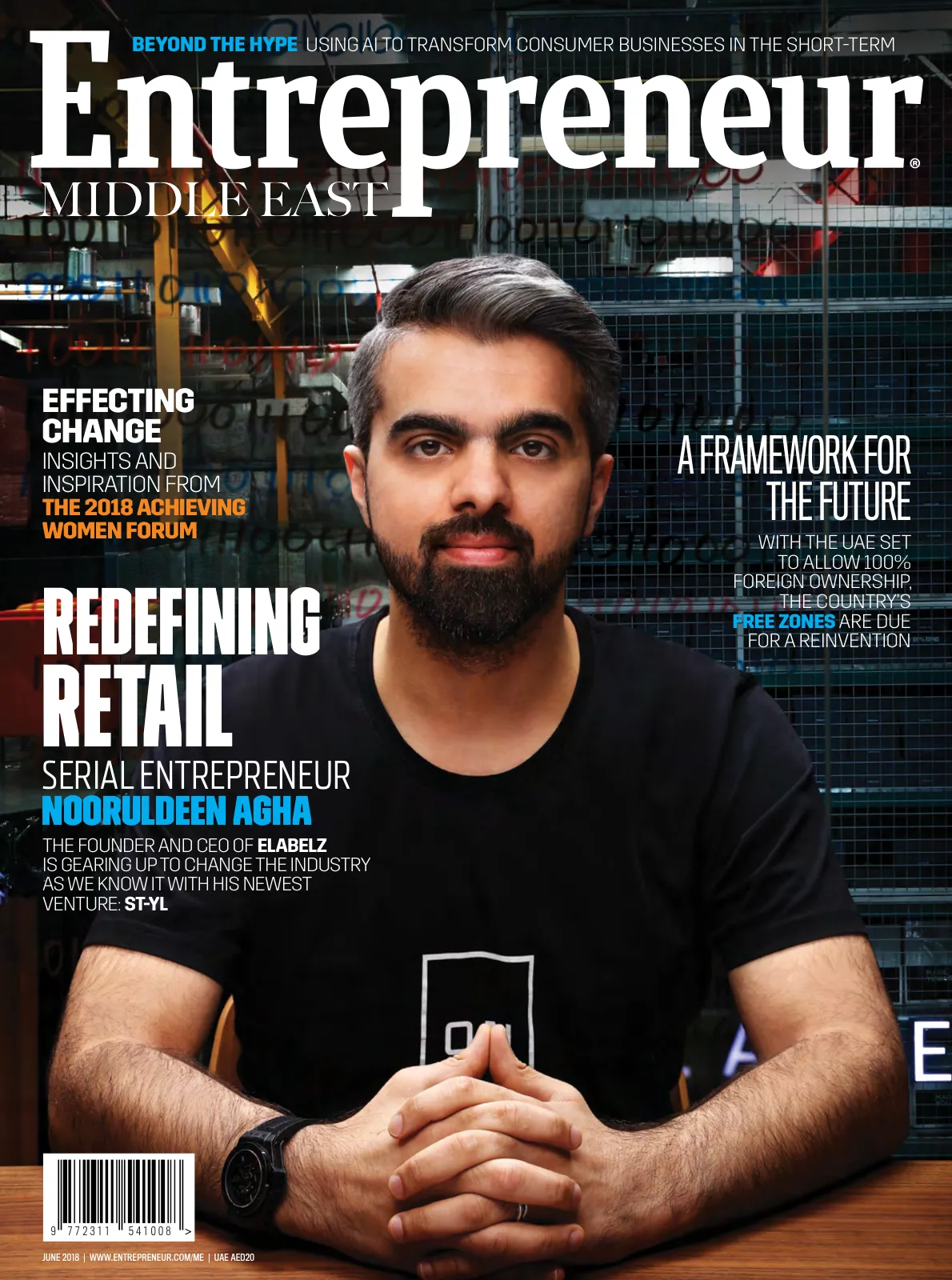
Entrepreneur Middle East, June 2018
Page 1
JUNE 2018 | WWW.ENTREPRENEUR.COM/ME | UAE AED20
9
7 7 2 3 1 1
5 4 1 0 0 8
>
A FRAMEWORK FOR
THE FUTURE
RETAIL
REDEFINING
EFFECTING
CHANGE
INSIGHTS AND
INSPIRATION FROM
THE 2018 ACHIEVING
WOMEN FORUM
WITH THE UAE SET
TO ALLOW 100%
FOREIGN OWNERSHIP,
THE COUNTRY’S
FREE ZONES ARE DUE
FOR A REINVENTION
BEYOND THE HYPE USING AI TO TRANSFORM CONSUMER BUSINESSES IN THE SHORT-TERM
NOORULDEEN AGHA
SERIAL ENTREPRENEUR
THE FOUNDER AND CEO OF ELABELZ
IS GEARING UP TO CHANGE THE INDUSTRY
AS WE KNOW IT WITH HIS NEWEST
VENTURE: ST-YL
Page 2
Page 3
3
June 2018 / ENTREPRENEUR.COM /
64 Using AI to transform consumer businesses in the short-term
22
Nooruldeen Agha,
founder, ST-YL
JUNE 2018 CONTENTS
22
INNOVATOR:
REDEFINING RETAIL
Serial entrepreneur
Nooruldeen Agha
The founder and CEO of
Elabelz is gearing up to
change the industry as we
know it with his newest
venture: ST-YL.
28
ACHIEVING WOMEN
FORUM 2018
A recap of the fourth edition
of Entrepreneur Middle East’s
Achieving Women Forum,
with Soukaina Rachidi
offering 12 takeaways that can
serve as a practical guide for
nurturing gritty women in the
MENA region.
50
INNOVATOR:
SUBSTANCE, OVER STYLE
“I cannot draw a straight
line, and I cannot cook an
egg, but I make beautiful
restaurants,” says Riccardo
Giraudi, CEO, Giraudi
Group, the company behind
Dubai’s sophisticated new
restaurant, Beefbar.
58
‘TREPONOMICS:
PRO
Freedom to work
Bayt.com’s VP of Employer
Solutions Suhail Al-Masri
on why flexibility in the
workplace can have a
huge impact on how your
company attracts, hires, and
retains talent.
66
START IT UP:
ECOSYSTEM
A framework for the future
With the UAE set to allow
100% foreign ownership,
the country’s free zones are
due for a reinvention, say
Radicle co-founders Aman
Merchant and Indy Johar.
64
TECH:
THE FIX
Beyond the hype
Sunil Suresh, CMO and
Global VP – Strategy,
Capillary Technologies,
offers five ways your
consumer business can
utilize AI to transform in the
short-term.
Page 4
Page 5
Page 6
Page 7
Page 8
Page 9
Page 10
Page 11
Page 12
12 / ENTREPRENEUR.COM / June 2018
72 Ambareen Musa, founder and CEO, Souqalmal
JUNE 2018
CONTENTS
28
54
CULTURE:
LIFE
Sink or swim
Nadine Chammas, founder
of Dubai-based The Life
Director, about the setbacks
on her entrepreneurial
journey- how she moved
past them (and learned from
them).
72
‘TREPONOMICS:
SKILLSET
Six years, six lessons
As UAE’s Souqalmal.com
celebrates its sixth
birthday, founder
Ambareen Musa takes a
look back at her journey of
founding and growing the
enterprise.
Achieving Women
Forum 2018
18
EDITOR’S NOTE
By Aby Sam Thomas
40
TECH:
SHINY
#TamTalksTech
Gadgets and doodads
that you might’ve missed
out on, sourced by a tech
aficionado. Yes, it’s okay to
want them all… and no, it’s
not our fault.
78
START IT UP:
Q&A
Flipping the script
BulkWhiz co-founder
and CEO Amira Rashad is
fiercely focused on changing
the status quo of grocery
shopping in the MENA
region.
41
Nokia 7 Plus
Page 13
Page 14
14 / ENTREPRENEUR.COM / June 2018
76 Alexandre Allegue, Chairman, Pawame, and Maurice Parets, CEO, Pawame
50
JUNE 2018
CONTENTS
42
CULTURE:
TRAPPINGS
‘Trep gear
The executive selection
for the entrepreneur
on your list that has
everything. Okay, maybe
for a little self-reward as
well.
44
CULTURE:
TRAPPINGS
The outlier
The Maserati Levante S is a
refreshing splash of color in
theg grey world of premium
SUVs, writes Tom Paye,
automotive journalist, and
editor at Yallacompare.
70
START IT UP:
ECOSYSTEM
Bottom-up policymaking
Khaled Kteily, Senior
Manager and Lead for
Entrepreneurship, World
Economic Forum, and Ali
Mnif, Country manager,
Silatech, take a look at how
the landmark Tunisian
Startup Act came to be.
62
TECH:
MOBILE TECH
Get engaged
Live broadcasting app Swoo
aims to make a dent in
UAE’s social scene.
46
IN PICTURES
Redefining luxury
Take a peek at the world’s
largest Rolex boutique that
opened at The Dubai Mall
in Dubai.
82
‘TREPONOMICS:
SKILLSET
Stronger together
Jennifer Warawa, Executive
VP of Partners, Accountants
and Alliances, SAGE, on why
you should make the most of
partnerships for long-term
growth.
74
START IT UP:
STARTUP FINANCE
We got funded!
We talk to the entrepreneurs
behind startups Telfaz11,
Pawame, and Syarah, on
how they clinched their
fundraising wins.
48
CULTURE:
TRAPPINGS
Up your style quotient
Mr. Draper lists the four
must-have blazers for any
occasion.
Riccardo Giraudi,
CEO, Giraudi Group
Page 15
REDEFINING
YOUR FREEZONE
EXPERIENCE
• Easy access via key highways with no access gates
• Easy & efficient business set up
• Smart office solutions from shared facilities to permanent offices
• Variety of business licenses
• Turnkey business solutions and services
• On site licensing & visa authority
800-SOUTH (76884)
businesscenter@dubaisouth.ae
DUBAISOUTH.AE
Page 16
16 / ENTREPRENEUR.COM / June 2018
SUBSCRIBE
Contact subscriptions@bncpublishing.net to receive
Entrepreneur Middle East every issue
EDITOR IN CHIEF Aby Sam Thomas editor@bncpublishing.net
CEO Wissam Younane wissam@bncpublishing.net
DIRECTOR Rabih Najm rabih@bncpublishing.net
CREATIVE LEAD Odette Kahwagi
MANAGING EDITOR Tamara Pupic
STARTUPS SECTION EDITOR Pamella de Leon
FEATURES EDITOR Sindhu Hariharan
COLUMNIST Tamara Clarke
EVENTS LIAISON Mark Anthony Monzon
PO Box 502511 Dubai, United Arab Emirates
P +971 4 4200 506 | F +971 4 4200 196
For all commercial enquiries related to Entrepreneur Middle East
contact sales@bncpublishing.net
All rights reserved 2018.
Opinions expressed are solely those of the contributors.
Entrepreneur Middle East and all subsidiary publications in the
MENA region are officially licensed exclusively to BNC Publishing
in the MENA region by Entrepreneur Media Inc.
No part of this magazine may be reproduced or transmitted in any
form or by any means without written permission of the publisher.
Printed by United Printing and Publishing
www.upp.ae
Images used in Entrepreneur Middle East are credited when necessary. Attributed use of
copyrighted images with permission. All images not credited otherwise Shutterstock.
Suhail Al Masri
Fida Chaaban
Mr. Draper
Indy Johar
Khaled Kteily
Aman Merchant
Ali Mnif
Ambareen Musa
Tom Paye
Soukaina Rachidi
Sunil Suresh
Jennifer Warawa
CONTRIBUTING WRITERS
www.entrepreneur.com/me
ACCESS FRESH CONTENT DAILY ON OUR WEBSITE!
MIDDLE EAST
EntMagazineME
@EntMagazineME
Entrepreneur-me
EntrepreneurMiddleEast
EntMagazineME
EntMagazineME
EntMagazineME
MIDDLE EAST
In addition to our print edition, we’re bringing
you all sorts of industry news on our web
mediums. Joining us online means getting
relevant business and startup content in
real-time, so you’re hearing about the latest
developments as soon as we do. We’re looking
forward to interacting with our readers on all of
our social media and web platforms- like any
thriving business, we’re looking to give and take.
#TrepTalkME is already happening on all of our
digi platforms, and all good conversations go
both ways. See you on the web!
Page 17
Page 18
18 / ENTREPRENEUR.COM / June 2018
I
n my editor’s note last month,
I wrote an impassioned plea on
behalf of MENA media outlets like
mine. It asked people and entities
who had the requisite resources to
spare to support the publications
they like (and more often than
not, want to be featured in), with the aid
of win-win partnerships that allow for
both parties to develop and grow. The
article generated a fair bit of discussion
in the social media space. I had written
the piece from my perspective of working
at a startup, and people at other small
businesses chimed in to back up what I
was saying: it’s not fair for large entities
(with the assets they have) to expect
fledgling organizations to do work for
them for free. After all, there’s only so
much good that goodwill can do- your
entrepreneurial support initiatives need
to translate into real business value for
startups if they are to actually have an
impact on the MENA ecosystem.
Now, for all of the feedback I received
for my write-up last month, I’ve to
admit my favorite response came from a
startup that we at Entrepreneur Middle
East have been following since its launch
a couple of years ago. We first interacted
with the enterprise when we wrote about
it in its early days, and we had since kept
in touch with it, supporting it whenever
we could, promoting it and its achieve-
ments on all of our different channels
over the years. For the record, we did this
(and will continue to do this), because,
well, this is what we are here for- Entre-
preneur Middle East’s mission is to en-
able and support the success of deserving
upstarts in the MENA region. There had
never been any sort of a business rela-
tionship between us, and so, I was taken
aback to see the same enterprise reach
out to us, after they read my note last
month, looking into ways we can work
together, from a marketing standpoint.
“We don’t have the deepest pockets,” the
company said, but it also felt that it had
“a duty to support the entrepreneurship
ecosystem which brought us here in
the first place.” To say that this gesture
touched all of us at Entrepreneur would
be an understatement- I had addressed
my note to large organizations with
budgets to spare, but in the end, it was a
startup with limited resources that came
forward to support us. And for that, we
are grateful- thank you.
As a journalist, it’s always tricky for
me to talk about topics like these- I got a
few people telling me that by linking my
publication’s editorial with its revenue-
generating side I was compromising on
its integrity as well. Let me clarify: in no
way am I saying that we will publish only
what is paid for. That is most definitely
not how we work, and it’s simply not
possible for our brand to have worked
and survived for so long if that was
the modus operandi we worked under.
But for all of the bouquets our content
gets, let’s not forget that if our business
wasn’t generating revenue, none of this
would have been possible in the first
place. At this point, you can wag a finger
at me and say that there’s something
wrong with our operation’s business
model- and yes, the sad truth is that
most media organizations today work on
a flawed structure. Debates and discus-
sions abound on how this model could
(and should) be fixed, but a solution that
works for all parties involved –readers,
publishers, advertisers, etc.- is yet to
be decided upon. So, for the moment,
while we look into other sustainable
models for a media business, we also
need to make do with what we have- and
that’s why we remain reliant on support
from entities with budgets to spare. As
a result, I’m sticking to what I said the
last time: if you have got the resources,
make sure you support the media outlets
you turn to on a regular basis- and this is
how you should work with the startups
around you as well. If you like what these
new enterprises offer, make it a point to
do business with them- else, rest assured
that they will shut down. And that’s a
scenario that none of us want to look
forward to.
Aby Sam Thomas
Editor in Chief
@thisisaby
aby@bncpublishing.net
Acts of heroism in the entrepreneurial ecosystem
For whom the bell tolls
EDITOR’S NOTE
Page 19
Page 20
20 / ENTREPRENEUR.COM / June 2018
A
rriving in Dubai in
one’s mid-twenties
with just US$3,000
in the pocket, and
less than two dec-
ades later, signing a landmark
deal to sell a majority stake in
a company which employs 300
staff across 15 global offices,
sounds as a familiar plot for us
in the MENA region, because a
similar story has been playing
out in this market over the last
few decades. This is the story
of Donna Benton, founder of
The Entertainer, an incentives
provider and lifestyle app. In
May, the 43-year-old Australian
sold a 85% stake in her Dubai-
headquartered The Entertainer
to GFH Financial Group, a
Bahrain-based financial group.
The value of the deal has not
been disclosed.
“Over the years, we’ve had
a number of parties express
their interest in the company,
and GFH was one of them who
came to us,” Benton says. “It’s
always about finding the right
fit for the business– you need
to share a common vision,
culture and chemistry. It took
six months to finalize every-
thing and it’s definitely been
a huge learning curve for me
personally. It’s also been a huge
personal achievement and one
that I am immensely proud
of. What I have learnt is that
it can be a rollercoaster– you
need determination, resilience,
patience and you have to be
willing to compromise a little.
You also have a lot of people
counting on you, so you have
to be confident and give them
reassurance, as nobody likes the
thought of change. So, for me,
the most important thing is to
stick to your values and what
you believe in.”
Originally from Melbourne,
Australia, Benton was 26 when
she launched The Entertainer
as a “buy one get one free”
voucher books provider in
Dubai in 2001. In 2012, Riyada
Enterprise Development, an
investment platform of Dubai-
based investment firm Abraaj
Capital, acquired a 50% stake
in the company, which marked
the start of its “going interna-
tional and going digital” agenda.
Since launching its smartphone
app in 2013, The Entertainer
has shifted fully from a print
publication to a data-driven
technology company with 38
destination-specific products,
including tailored B2B solutions
for corporate clients, and offers
from over 10,000 merchant
partners. The app operates
across 20 destinations in 15
countries, and in a variety of
languages based on location
including English (global),
Arabic (GCC), Greek (Athens
and Cyprus) and Cantonese
(Hong Kong). Last year’s annual
turnover exceeded AED130
million.
The GFH transaction saw
Abraaj Capital’s Riyada Enter-
prise Development fully exit,
while Benton continues as one
of the key shareholders and
executive management. “As part
of the deal I am also releas-
ing some of my own shares
but remain a key shareholder,”
says Benton. “As such, I will
continue in my current role as
chairman, contributing to the
vision, growth and manage-
ment of the company alongside
GFH. The Entertainer began as
a simple book of buy-one-get-
one-free offers, and over the
past five years we’ve launched
an app, expanded to new global
markets and this year shifted
completely to become a 100%
digital data-driven company.
The next stage, alongside GFH,
will be about expanding our
reach and developing The
Entertainer into a global digital
ecosystem where all parties can
communicate, discover, curate
and enjoy even more about
their experiences.” In a press
release, Hisham Alrayes, CEO
of GFH, pointed out that it was
the company’s high growth rate
coupled with achieving high
profitability and turnover that
attracted them to approach
Benton. “We aim to take the
platform to the next level and
create phenomenal returns for
our investors given the recent
technology multiples in the re-
gion and worldwide,” he added.
“We shall achieve this by work-
ing together with Donna and
the senior management team to
enter new markets, support for
further growth, diversification
of the business and customer
base.”
Following the deal, Benton has
preserved her ability to contrib-
ute to the company’s growth
trajectory, which was one of her
criteria when choosing the right
investor. “Always lead by exam-
ple and maintain your values
at all times,” Benton says when
asked about the most important
lessons she learnt throughout
this process. “There will be
times when you’re in discus-
sions and it doesn’t work out,
perhaps the partner is not right
for you or right for your busi-
ness. Don’t dwell on it and be
too disappointed– it wasn’t the
right investor or the right time.
There will be other opportuni-
ties, so you have to ensure that
your business is always growing
and achieving. The negotiation
process can be distracting and
drawn out - you mustn’t take
your eye off the actual running
of your business. You also need
to focus on your end goal and
not be tempted to sell for less
than you know it’s worth.”
In 2018, The Entertainer
expects over 12 million of its
offers to be redeemed by cus-
tomers globally, and Benton’s
plans are even bigger. “As
always, we’re aiming high,”
Benton says. “We will be taking
The Entertainer offering and
technology to the next level. We
will be entering new markets,
as well as going deeper in the
markets we’re already in. We
will be widening our customer
base by adding new categories
and targeting new audiences.
We will also be looking at ways
to diversify the business and
potential revenue streams.
We’ve seen a 28% increase in
our global headcount in the
past year and there’s no doubt
that there will be strong growth
in terms of the team in the next
few years.”
IMAGE CREDIT THE ENTERTAINER
IN THE LOOP
The Entertainer’s Donna Benton on selling 85% of the business
to Bahrain’s GFH Financial Group by TAMARA PUPIC
Onward and upward
The Entertainer app
Donna Benton, founder, The Entertainer
Page 21
#BeatTheHeat
THIS SUMMER.
CAMBODIA CHINA INDONESIA MALDIVES MOZAMBIQUE PORTUGAL OMAN QATAR
SRI LANKA THAILAND UNITED ARAB EMIRATES VIETNAM ZAMBIA
LIFE IS A JOURNEY. Visit anantara.com
Al Jabal Al Akhdar 27°C
Muscat / Dubai 43°C
Cool off at the highest five star resort in the Middle East.
Only a short 4 ½ hours drive from Dubai or Abu Dhabi and 2 hours from
the new Muscat International Airport, enjoy a journey past date plantations
and dramatic Omani mountain ranges to reach our majestic hideaway.
Choose your ideal haven – a spacious room with a captivating canyon view,
a private pool villa with garden or cliff views. An abundance of
Spa and Recreation activities from hiking to sunrise yoga.
GCC RESIDENTS PACKAGE*
Up to 15% off Best Flexible Rate for a room or villa
Daily buffet breakfast for two persons
Daily dinner for two persons
10% off Anantara Spa
10% off food & beverage in all outlets
Book at anantara.com and get resort credit of up to OMR 20.
*terms and conditions apply.
Page 22
22 / ENTREPRENEUR.COM / June 2018
22 / ENTREPRENEUR.COM / June 2018
INNOVATOR
IMAGE CREDIT ST-YL
Page 23
23
June 2018 / ENTREPRENEUR.COM /
THE FOUNDER AND CEO OF ELABELZ IS GEARING UP TO
CHANGE THE INDUSTRY AS WE KNOW IT WITH HIS NEWEST
VENTURE: ST-YL by ABY SAM THOMAS
23
June 2018 / ENTREPRENEUR.COM /
RETAIL
REDEFINING
NOORULDEEN AGHA
SERIAL ENTREPRENEUR
W
hen I met Nooruldeen Agha at his offices in Dubai on an evening in May, the 30-year-old
serial entrepreneur -perhaps best known for being the founder and CEO of Elabelz, an
e-commerce venture that has, since its launch in 2016, become of the largest online
fashion destinations in the MENA region- seemed to be trapped in an almost constant
state of restlessness. Agha sat down and stayed still for only a little while during the two-hour-
long interview; the rest of the time, he kept pacing back and forth in front of me, which resulted in
me repeatedly darting my head alternately to the left and the right -much like watching a game
of tennis- as I struggled to maintain eye contact with the man. Now, I assumed the reason behind
Agha’s agitation to be because he had, only a few days before this interview took place, launched
his latest enterprise, an online retail venture called ST-YL, and I thought Agha’s restiveness must
be nothing more than the expected post-establishment jitters. But, as our conversation went on,
it soon became apparent that Agha’s state of mind wasn’t being driven just by worry about his
new endeavor- on the contrary, I could see that this entrepreneur was consumed by excitement
for the impact that he believes ST-YL will have on the world at large. Agha believes that ST-YL is
going to change retail as we know it, and its impact is not going to be restricted to just the UAE,
or only the MENA region- it’s going to be global, he says. “I believe this is the future of retail,” Agha
declares. “I believe that I will have a chance at building a global, multibillion dollar company… I think
I’m going to have an important mark on the technology world, globally, because of this project.” >>>
Page 24
24 / ENTREPRENEUR.COM / June 2018
With a statement like that
from Agha, I guess we need
to be clear about two things
at this point. First of all, I
must say that I didn’t feel
Agha was being pompous or
bombastic when he made
this declaration- on the con-
trary, as I replay the scene
in my head, I remember
him to be focusing inward,
making the statement in a
quite simple matter of fact
way, before I essentially
made him repeat it for me.
But this doesn’t mean that
I can vouch for the veracity
of what Agha believes to be
the potential for ST-YL- it’s
way too early to predict
anything at this stage, in my
personal opinion. However,
cast my doubts aside for a
moment, and try to see ST-
YL through Agha’s eyes- that,
I believe, would make for
a better exercise for you to
make your own decision on
whether it is, well, the future
of retail. After all, Agha’s
track record with Elabelz
–an e-commerce enterprise
that managed, in just a year
and a half, to secure over
500 international and local
brands, and 45,000 products
for men, women and kids
on its platform- makes one
curious about what is he
going to do with ST-YL. To
learn that, you need to first
head to ST-YLicom, where
you’ll see that it is, to put it
extremely simply, a personal
styling service for men and
women. Customers will
receive a curated collection
of clothes directly at their
doors, following which they
can choose what they like,
and pay only for that, while
returning the rest- shipping
is free both ways. So far,
ST-YL may sound like, well,
every other personal styling
offering out there- but Agha
explains that it is in how
ST-YL gets a curated collec-
tion together for a customer
that makes it stand out as an
enterprise.
The process begins with
the user filling up a rather
comprehensive question-
naire on the ST-YL website,
with questions including
everything from the color
of your hair, to the kind of
patterns you like to see on
your clothes. Once this is
done, the tech part of the
solution comes into the
picture- artificial intelligence
(AI) is what’s at play here,
and, according to Agha, this
is what makes ST-YL a game
changer. All of the data that
a customer inputs is fed into
an AI machine to determine a
style profile, following which
a stylist -a real, live, human
one- is assigned to the case.
This stylist, armed with the
wealth of user data as well
as AI-powered insights, has
a personal chat with the
customer, following which a
personalized box of clothes
is then sent for him or her to
try out. “So, what will hap-
pen is you would receive a
box; you will open it, and try
out the clothes we sent you,”
Agha explains. “Whatever
you don’t like, you can throw
it back in the box, and put
the box outside the door.
Someone will come pick it
up, and you’d pay only once
we receive the box back- we
see what you kept, what you
did not keep, and you would
pay for that only.” Thus, us-
ers are receiving clothes that
have been specifically chosen
for them, and in case they
don’t like what they were
delivered, they get to send it
back at no cost. ST-YL makes
it a point to get feedback, i.e.
find out what wasn’t right
about the clothes a customer
rejected, and yes, that data
is stored and fed into the AI
machine again- that’s going
to be a determining factor
in the contents of the next
box ST-YL sends out to the
same client. “The coolest
part is that every box you
get is going to be better than
the box before it,” Agha says.
“Because we will know you
better.”
Personalization at scale:
that is what Agha believes
ST-YL will be delivering as
a retail concept, and that is
pretty much why he believes
his enterprise is going to re-
define the industry at large.
“If you asked anyone 20
years ago what’s the future of
retail, they’ll tell you it’s e-
commerce,” Agha says. “But
e-commerce is not the future
anymore, it’s the present. We
are right now in the pres-
ent- so, what is the future?
The future is all related to
personalization.” And ST-YL,
Agha believes, is one of the
first (and few) players in
this arena- and that is why
he is so vehement about the
potential scale and success
INNOVATOR
“THE FUTURE IS ALL RELATED
TO PERSONALIZATION.”
AGHA’S ELABELZ
IS TODAY ONE
OF THE LARGEST
FASHION
RETAILERS IN
THE MENA REGION,
AND THE FIRST
TO DELIVER TO
THE IRAQ MARKET.
WWW.SY-YL.COM
Page 25
25
June 2018 / ENTREPRENEUR.COM /
this enterprise can have.
“Look at Amazon when it
started,” he says. “It was
really marginal, no one paid
attention to it. It was on the
sidelines, it was something
of a joke in the beginning.
Even when it got some trac-
tion, no one actually paid at-
tention to it. But, today, they
control the retail industry as
we know it. Because, when
they started, at the time,
they were the future… This
is where I believe we are now
with ST-YL.”
Agha’s argument is bol-
stered by the fact that there
isn’t really much competi-
tion out there in terms of
ST-YL’s offering: regionally,
there doesn’t seem to be
any other player that is
bringing together fashion
and tech like it is, whereas,
if you look globally, the
closest contender in this
space would probably be San
Francisco-based personal
styling service, Stitch Fix. Its
achievements, made possible
with the use of cutting edge
technology, can be seen as a
forerunner for the heights of
success Agha believes ST-YL
can ultimately reach, thanks
to its own proprietary tech.
The American company,
which was founded in 2011,
went public in 2017, and was
valued in February this year
to be worth US$2 billion.
So, remember Agha’s
declaration from earlier,
about how he could build a
multibillion dollar enterprise
with ST-YL? Doesn’t seem
like a fanciful dream now,
does it? In any case, Agha
has, with the aid of a seed
investment in the venture,
kicked off his global dreams
for ST-YL by launching it in
the UAE and Saudi Arabia,
with the aim being for the
enterprise to master these
two markets in the coming
six months. Following that,
the plan is to have ST-YL
launch in a new market every
quarter. “We think we will
provide a service across Asia
and Africa,” Agha says. “I
don’t see why we would not
go for global one day, but for
now, we are going to focus on
these regions to make sure
that our service and technol-
ogy is worthy of growing
organically. But my vision is
to take this on a global level,
once we have the technology
that is powerful enough to
compete at that scale. I think
this is what we are building
here, and this is where we
are going.”
However, the ST-YL of-
fering isn’t powered purely
by tech -every customer
is promised an actual hu-
man stylist to work with
them- so, I wonder, would
such a game plan work with
the staggering number of
customers Agha thinks he
will get? The entrepreneur
tells me yes, pointing toward
the underlying tech as an
answer. According to Agha,
the AI machine processes
the data it receives, and
then generates styling sug-
gestions based off that- so,
the stylist is not going to
be starting from scratch.
Instead, their role will be
to compare the suggestions
the machine provides, and
make sure it matches well
with the customer they have
personally interacted with.
Sure, there may be wrinkles
to be ironed out in the first
iteration of this process, but
Agha believes the feedback
mechanism will allow for
the AI to perform better in
the styling suggestions that
it will make later. Agha also
highlights how, with time,
ST-YL will have a digital
closet of all your clothes- so,
the next time you need help
to decide what to wear for,
say, a special occasion, ST-YL
can go through your digitized
wardrobe and offer you sug-
gestions on how to put an
ensemble together with what
you already have, plus offer
new options for what you
may need to complete that
look. “We are digitizing your
closet, completely,” Agha
says. “This is a feature that
we have added that nobody
else has, even globally.”
With that being said, it’s
pretty clear as to who will
be the people that will be
central to the ST-YL opera-
tion- the workforce will have
to be a harmony of creativity
and science. “If our team was
comprised of 1,000 people,
we would be 600 stylists,
100-200 data scientists, and
the rest in operations,” Agha
approximates. “So, the core
of this business is stylists,
but what they will do here
will be completely different
than any styling job they’ve
ever done in their life. You’ll
really need to understand
data science, and combine it
with style, in order to be able
to deliver something that
will actually be a hit with the
customer, and be able to have
value for them.” Now, while
I’m sure that ST-YL will need
to have a terrific team to
push it ahead, I’m also pretty
certain its progress is going
to be driven by one man
alone- and that is Agha him-
self. ST-YL is his brainchild,
his baby; all that he is doing
for it seems to be fueled by a
single-minded determination
and dedication to his vision
for the enterprise. All of his
projections for ST-YL are
grand (“I genuinely believe
that we will be able to
control a really mass volume
and value, when it comes to
the fashion retail industry at
the global level”), and while
“THE COOLEST PART
IS THAT EVERY BOX
YOU GET IS GOING
TO BE BETTER THAN
THE BOX BEFORE IT.
BECAUSE WE WILL
KNOW YOU BETTER.”
>>>
Page 26
26 / ENTREPRENEUR.COM / June 2018
some of you may call such
predictions to be far too
much like castles in the air,
well, Agha doesn’t really care
about what you think- as far
as he is concerned, ST-YL
is to him, as, say, Apple is
to Steve Jobs. “I truly want
to effect change,” Agha
says. “Honestly, my hope is
to build a very large-scale
company that will employ
more than 10,000-20,000
employees across the planet,
and be a company that will
actually effect change- what
we do changes things at the
global level.”
But can such an enterprise
come out of the MENA
region? Agha says yes. “The
ability to build a platform
or a company that actu-
ally has 100 or 200 million
customers is the dream,
and it begins with knowing
who you are serving, and
how quick is the mass of
what you are serving,” he
explains. “And that can start,
I believe, from this region,
and then go global. And the
only way to actually effect
that is to create something,
a platform or a service, that
will be able to deliver at
a global scale, rather than
only within the limitations
of the region.” ST-YL is that
kind of an enterprise, Agha
says- and it’s hard not to
be taken in by the zealous
belief he has in it. And for
all of the apprehensions you
and I may be having about
ST-YL’s viability as a busi-
ness, Agha says he is well
aware of them- it’s just that
he uses them, in a way, to
his advantage. “Honestly, I
cannot survive if there is no
fear,” Agha replies. “Like, if I
am not extremely, extremely
worried, I would not be able
to work and get out in the
morning. The amount of
fear, the amount of worries-
you cannot get motivated
without it. It’s a big fight,
it’s a big hustle, and it’s
a very, very crazy hustle,
especially if you’re doing it
from the ground up, without
having the heritage and the
background or a backer of a
family or a big name or any-
thing related to that, so it’s
ten times harder. The bigger
you dream is, the bigger the
worries, and the harder the
hustle, and the harder is
the fight.” At this stage, I’m
willing to bet that if Agha’s
fervor alone were enough
to fuel a company, ST-YL
would already have been a
market leader. “The dream of
actually creating something
global means providing a
product with a customer
service that is phenomenally
amazing; there’s no way
around it,” Agha says. With
ST-YL, Agha believes he has
built just that- now, it’s for
the world to judge.
INNOVATOR
“MY VISION IS
TO TAKE THIS ON
A GLOBAL LEVEL,
ONCE WE HAVE
THE TECHNOLOGY
THAT IS POWERFUL
ENOUGH TO
COMPETE AT THAT
SCALE.”
Nooruldeen Agha, founder, ST-YL
Nooruldeen Agha presenting ST-YL at the Achieving Women Forum
Page 27
A hiring platform
that’s more than
just ad space.
We thought we would let you
know through ad space.
Hire talented students and graduates to help
grow your business at oliv.com/employers
Page 28
28 / ENTREPRENEUR.COM / June 2018
W
ith a line-up of female
leaders from the MENA
business arena to share
their expertise, the 2018
edition of Entrepreneur Middle East’s
Achieving Women Forum, presented by
du, brought together over 300 attendees
at The Westin Dubai at Al Habtoor City
on May 10, 2018, to discuss and debate
some of the key challenges and oppor-
tunities the region presents for female
professional and entrepreneurs.
The 2018 Achieving Women Forum,
presented by du, was staged by Entre-
preneur Middle East as a production by
BNC Publishing, and was held with the
support of Dubai Chamber of Commerce
and Industry and Dubai Startup Hub,
Luxury Automotive Partner Maserati,
Platinum Allies AJSM Investments and
Azizi Developments, Gold Allies Lacasa
Holding and Elabelz.com, and Knowl-
edge Partner Skyline University College.
Staged under the Entrepreneur Indus-
try Intel banner, the 2018 Achieving
Women Forum was moderated by
Fida Chaaban, Chief Communications
Officer, KBW Investments, and Entre-
preneur Middle East Editor in Chief,
Aby Sam Thomas. Kicking off the event
with his introductory remarks on the
conference’s objective of providing a
platform for MENA’s businesswomen to
learn, network, and build relationships,
Thomas brought to attention a change
in format for this year’s event- while re-
maining true to its ethos to create a dia-
logue around development of MENA’s
business women, the event also saw
men participating in the conference this
year along with women entrepreneurs.
ACHIEVING
WOMEN
FORUM 2018
THE METHODOLOGY
OF BUSINESS
SUPPORTED BY
An
Industry Intel event
28 / ENTREPRENEUR.COM / June 2018
Page 29
29
June 2018 / ENTREPRENEUR.COM /
A PRODUCTION BY
KNOWLEDGE PARTNER
GOLD ALLY
GOLD ALLY
Getting the conference started with her
welcome note, Dr. Alia Al Serkal, Senior
Director, Human Capital Development,
Emirates Integrated Telecommunica-
tions Company (du), noted that it was
a wonderful time to be a woman in the
UAE- a nation on the right path towards
achieving gender inclusion. She added
that at du, they take their commitment
towards women’s development serious-
ly, with “three in ten” of their employees
female, and 31% of these women also
Emirati. “We are so lucky to be living
in a country that champions women’s
rights,” she said. “I urge women to take
the opportunities they are offered with
both hands and work hard to achieve
their dreams- because it is possible.”
As for the other insights shared at the
event, the first of the Talking Series, un-
der the title Drivers Of Change: Trans-
forming Businesses (And Mindsets) In
The MENA, revolved around discovering
how the region’s SMEs and corporates
are rebuilding themselves as workplaces
suited for both men and women, in the
wake of the #MeToo movement glob-
ally. The panelists included Dr. Alia Al
Serkal, Senior Director, Human Capital
Development, Emirates Integrated
Telecommunications Company (du),
Ayla Bajwa, founder, Ampuz, and Senior
Advisor to the United Nations Global
Compact UAE Local Network, Laudy
Lahdo, General Manager, Servcorp, and
Founding Partner, REACH Mentoring,
and Ruth Fletcher, VP of People, Ca-
reem, who discussed the ways women in
leadership roles can help facilitate the
creation of more such wholesome work-
ing environments- and what men can do
to help.
This was followed by the Voice of
Entrepreneurship segment by Aparna
Verma, founder and CEO, Scholars
International Group, who, in an address,
shared her own personal challenges, and
instances of leaps of faith she’d taken, to
emphasize on the significance of grit and
perseverance required to navigate one’s
entrepreneurship journey.
The second panel discussion delved
on why women are often more reluctant
than men when it comes to advocating
for themselves, and how MENA’s women
can get past this hurdle. Titled Hold
Your Ground: Making A Deal Worth
Your (And Your Enterprise’s) While, the
discourse was driven by panelists Dawn
Metcalfe, founder, PDSi and author, The
HardTalk Handbook, Dunia Othman,
co-founder and Chief Marketing Officer,
mrUsta, and Product Manager, Dubai,
Amira Rashad, co-founder and CEO,
BulkWhiz, and Hiba Jaber, Lead Struc-
tural Engineer, Lacasa, who discussed
ways to become better at negotiating
for both your career and growth of your
enterprise.
And finally, the third panel titled
Pitching Pitfalls: A (Better) Game Plan
To Fund Your Venture, discussed the
common issues/challenges women-led
enterprises face while fundraising, and
also deliberated if having more women
participation in the investors side can
help turn things around for women
entrepreneurs, especially in the MENA
region. The panelists were Dana Horska,
Chief Investment and Innovation Officer,
AWOK.com, Sonia Gokhale, Partner,
VentureSouq, Sophie Smith, co-founder
and CEO, NabtaHealth, and Nadine
Mezher, co-founder and CMO, Sarwa.
LUXURY AUTOMOTIVE PARTNER
PLATINUM ALLY
PLATINUM ALLY
29
June 2018 / ENTREPRENEUR.COM /
>>>
Page 30
30 / ENTREPRENEUR.COM / June 2018
D
uring her
welcome
address at the
2018 edition of
the Achieving
Women Forum
presented
by du, Dr. Alia Al Serkal,
Senior Director, Human
Capital Development, Emirates
Integrated Telecommunications
Company (du), highlighted what
an amazing time it is to be a
woman today- especially in the
UAE. At the moment, women
constitute 70% of university
graduates in the country, and
they occupy 66% of jobs in
the public sector, she noted.
However, the truly exciting
part of this statistic is the fact
that 30% of these women are
in senior leadership positions.
It’s also important to note that
there are an estimated 21,000
female employers in the private
sector. The workforce in the
UAE is likely to change even
more in the near future thanks
to the recent introduction of
the equal pay act (also known
as Article 32 of the UAE
constitution) which states
that “a woman shall be paid
the same wage as a man if she
performs the same work.”
After reading all of that, it’s
hard not to get excited about
the future of women in the UAE
and beyond. However, I feel that
these statistics also raise anoth-
er important question about the
current position of women in
global societies: how did we get
to where we are today? Every
woman, regardless of whether
she’s sitting in a classroom,
leading a meeting, or casting a
vote in an election is there be-
cause brave pioneers through-
out history imagined a different
world for them, and then fought
to make it a reality. Now, it’s
time for us, a new generation of
men and women, to leverage our
newfound agency to, yet again,
fight for a better world for our
youth to live and work in. This
may seem like a daunting task,
and I’m sure you’re probably
asking yourself: how can we
maintain this positive upward
momentum? For me, there’s
only one answer to this ques-
tion: transforming our global
concept of grit.
According to the Merriam-
Webster dictionary, grit is
defined as “firmness of mind
or spirit: unyielding courage in
the face of hardship or danger.”
Now, I know it sounds like I’m
about to launch into a high
school graduation speech, but
I feel the need to highlight how
our global societies define grit,
so that I can proceed to dissect
it. Truth be told, in my experi-
ence, grit isn’t always about
feeling exceptional courage in
the face of fear, or tenaciously
fighting to achieve one’s goals. It
isn’t even about being positive
all the time. It’s about commit-
ting to a goal (no matter how
you feel about it from one day
to another), and then tackling
it every day, in some shape or
form.
However, in the mystical land
of entrepreneurial philosophy,
it often feels like this interpre-
tation of grit is unwelcomed,
because it’s not attributing it to
an entrepreneurial je ne se quoi.
In fact, it makes the idea of grit
seem so mundane that it makes
it feel like anyone of us could
hone this practice- which might
be part of the problem. What do
I mean? Well, if you’ve read as
much entrepreneurial literature
as I have, you’ll quickly start to
discover that so much of what’s
being said about grit is disin-
genuous. Why? Maybe because
by making this idea accessible
to the masses, it might start to
lose its mysterious appeal.
But at this stage in our human
development, can we really
afford to jealously hold on to
philosophical platitudes that
don’t move us forward? The an-
swer is no. With that in mind,
how can we turn this tired old
buzzword into an actionable
to-do list that can strengthen
the stakeholders in our regional
and global economies? I’m glad
you asked: here are 12 ways that
I believe we can mainstream
the idea of grittiness into our
day-to-day lives, so we can
start effectively building the
human capital of women in
the MENA region, and creating
more functional and equitable
talent pipelines in the future.
ACHIEVING WOMEN
FORUM 2018
THE METHODOLOGY OF BUSINESS
Effecting change
A practical guide for nurturing gritty women
in the MENA region
INSIGHTS AND INSPIRATION FROM THE 2018 ACHIEVING WOMEN FORUM
by SOUKAINA RACHIDI
An
Industry Intel event
Dr. Alia Al Serkal, Senior Director, Human Capital Development Emirates Integrated
Telecommunications Company (du)
Page 31
31
June 2018 / ENTREPRENEUR.COM /
1. UNDERSTAND WHO YOU ARE
(AND WHO YOU AREN’T)
Entrepreneurs know that
you can’t make authentic
decisions for your business
until you understand what
your core values are. In
life, when challenges (and
shortcuts) present themselves,
it’s tempting to take the easy
way out. However, these are
the decisions that most of us
come to regret, because, in
hindsight, we realize that while
they were easy to make, they go
against everything we believe.
Consequently, not only do they
end up costing us in a literal
sense, sometimes they also
negatively impact our standing
in our communities. That being
said, I don’t think we should
only be vigilant about making
life choices that are in line
with our values because of the
effect that they might have on
our personal or professional
brand- we should also be
concerned with it since internal
alignment is an essential part
of cultivating grit. In essence,
the level of conviction that’s
required to achieve any kind
of pioneering objective can be
exhausting to maintain. So, if
the decisions you’re making on
a daily basis aren’t compatible
with your values, then it will be
very hard to maintain that level
of conviction.
However, if you believe in
what you’re doing, and you’re
confident in the difficult deci-
sions that you’re making (no
matter how detrimental they
might seem in the short-term),
then you’re less likely to lose
the conviction you need to
achieve your goal. This idea
was beautifully exemplified by
Aparna Verma, founder and
CEO of Scholars International
Group, during the Voice of En-
trepreneurship segment of the
forum, when she recounted the
story of how someone made an
inappropriate offer to help her
achieve her dream of building
a school, and she refused it on
moral grounds. Her reasoning:
“I’m not going to give up who I
am.” And guess what? She still
managed to achieve her goals,
the right way, with her core
values and moral compass in-
tact. But how many of us would
have the strength to make those
same decisions? It’s true; these
decisions aren’t easy, but if you
know who you are (and you’re
willing to fight to preserve who
you are), then grit is a natural
outcome, because you won’t be
willing to compromise who you
are for a short-term gain.
2. CREATE A SPACE WHERE
MALE AND FEMALE GRIT ARE
RESPECTED
Whether you’re talking to
women in senior leadership
positions or in male-dominated
professions, you’ll often hear
them lamenting the fact that
their leadership style causes
them to be labeled as “aggres-
sive” or “bitchy.” Whereas, men
with the same leadership styles
would be revered as exemplary
leaders. Now, before anyone
takes an exasperated breath, I
would like to make one thing
clear: female leaders can have
aggressive personalities by
nature, and men can have good
leadership skills. The problem
isn’t entirely linked to gender,
but rather, perception. That’s
why it’s important for work-
places in the MENA region
to tackle the issue of gender
inclusion using various chan-
nels, so we can start creating
professional spaces where gritty
men and women (regardless of
their position) feel welcome and
respected. While this might be
more challenging in multina-
tional companies that have
to navigate the complicated
IF YOU BELIEVE IN WHAT
YOU’RE DOING, AND
YOU’RE CONFIDENT IN
THE DIFFICULT DECISIONS
THAT YOU’RE MAKING,
THEN YOU’RE LESS LIKELY
TO LOSE THE CONVICTION
YOU NEED TO ACHIEVE
YOUR GOAL.
Aparna Verma, founder and CEO,
Scholars International Group
Talking Series One, left to right: Aby Sam Thomas, Ruth Fletcher, Laudy Lahdo, Dr. Alia Al Serkal, Ayla Bajwa and Fida Chaaban
>>>
Page 32
32 / ENTREPRENEUR.COM / June 2018
ACHIEVING WOMEN
FORUM 2018
THE METHODOLOGY OF BUSINESS
An
Industry Intel event
32 / ENTREPRENEUR.COM / June 2018
Talking Series Two
Talking Series Three
Dr. Alia Al Serkal
giving her
welcome note
Page 33
intersectionality of established
corporate culture and local gen-
der norms, the MENA region’s
startup ecosystem has a unique
opportunity to build standard
operating systems that cham-
pion gritty men and women.
However, having company-
wide policies that only pay lip
service to this kind of idea isn’t
enough. Employees in MENA
workplaces also have to be edu-
cated to understand the value
of gender inclusion, and how
different kind of micro-aggres-
sions erode this culture in the
workplace. That’s why it’s im-
portant that leading enterprises
like Careem in the region are
setting an example by making
unconscious bias training a part
of the onboarding process for
new recruits. During the forum,
Ruth Fletcher, VP of People at
Careem, emphasized how the
startup-turned-unicorn is try-
ing to build “a cultural environ-
ment where the team can speak
up,” because “having a voice is
not easy, but it’s important.”
However, creating this kind of
culture can be hard, as such
policies may be misconstrued as
being some form of retroactive
revenge on men. But, of course,
that’s not the case at all: these
measures are being implement-
ed because this generation of
women (i.e. the first generation
of women to join the workforce
in full force) have developed
a unique sense of grit, which
could be an amazing resource
for our economies. Now, I ask
you, imagine if more workplaces
in the MENA region empowered
these women to share this grit
with us? Our economies would
be unstoppable.
3. CHANGING THE LANGUAGE OF
GENDER POLITICS IN ORGANIZA-
TIONS
If I had to use an analogy to
explain the gender inclu-
sion struggle, I would use the
example of an update on a
popular app. Whenever there’s
a dramatic change in the user
interface or experience of an
app, there always seems to be
a lot of resistance to it. Some
people will grumble to their
friends about how inconvenient
it is, and others will take to
social media to express their
displeasure of the said update
in the most irritating way pos-
sible. Then, eventually, people
will get used to the update.
Some people might even end up
liking it. Eventually, most won’t
remember the app as ever being
without this feature. And as far
as I’m concerned, the issue of
gender inclusion is no different.
It’s just another “update” that
we have to implement in our
workplaces in the MENA region.
Initially many people may dis-
like it, many may resist it, but
it will then grow on them, and
they soon won’t remember a
time when the workforce wasn’t
gender balanced. But how can
we get more workplaces in the
MENA region to implement
gender balance initiatives in the
first place?
During the forum, Ayla
Bajwa, founder, Ampuz and
Senior Advisor to the United
Nations Global Impact UAE
Local Network, highlighted
the UN’s unique approach to
tackling the challenge of gender
inclusion by looking at it as a
health and safety issue. This is
an interesting approach,
because it reassigns
a development term,
which comes with a lot
of emotional baggage, to
a logical category in the
language of business.
As a writer, I appreciate
this approach, because
I’m tired of seeing the
word gender being used
as a synonym for “lady
problems.” Gender
is a social construct,
and there are plenty of male
stereotypes that limit them
from living fulfilling lives.
Therefore, it’s time we stop
conflating the idea of gender
with women and men with
patriarchy, so we can actually
tackle the human problems
that are preventing us from
nurturing a generation of gritty
men and women. Whether
you’re flushing because the AC
stopped working, or because
you were on the receiving end
of an inappropriate advance,
linguistically, we have to start
treating these workplace
situations as exactly what
they are: unacceptable safety
issues that make employees feel
uncomfortable.
4. RENEGOTIATING THE IMAGE OF
WOMEN IN THE WORKPLACE
As a woman in the workplace,
one of the hardest urges to fight
is the need to constantly be
perceived as being nice. While
I wish that I could say that I’ve
never felt pressured to pander
to society’s incessant need for
me to be the blandest adjective
in the dictionary, I’m afraid
that I can’t. Like many women
from the X and Y generation,
I was subliminally (or not so
subliminally) taught that I
needed to be as non-threatening
as possible as a woman just so
that I wouldn’t scare off any
potential suitors. But here’s the
problem: for many women, that
need to be liked has become
so deeply embedded in our
psyches that we hate the idea
of being disliked by anyone- no
matter who they are. However,
as Dawn Metcalfe, founder of
PDSi and author of The Hard-
Talk Handbook, said during
the forum: “Being nice doesn’t
mean that you shouldn’t speak
up.” If women in our global
Ruth Fletcher, VP of People at Careem
Ayla Bajwa, founder, Ampuz and Senior Advisor to the
United Nations Global Compact UAE Local Network
IT’S TIME WE STOP
CONFLATING THE IDEA
OF GENDER WITH
WOMEN AND MEN WITH
PATRIARCHY, SO WE
CAN ACTUALLY TACKLE
THE HUMAN PROBLEMS
THAT ARE PREVENTING
US FROM NURTURING A
GENERATION OF GRITTY
MEN AND WOMEN.
Dawn Metcalfe, Managing Director
of Performance Development Services (PDSi)
and author of The HardTalk Handbook
“BEING NICE DOESN’T
MEAN THAT YOU
SHOULDN’T SPEAK UP.”
ACHIEVING WOMEN
FORUM 2018
THE METHODOLOGY OF BUSINESS
An
Industry Intel event
>>>
Page 34
34 / ENTREPRENEUR.COM / June 2018
workforce don’t get comfortable
with having difficult conversa-
tions, then they can only look
forward to being liked, instead
of developing the grit that they
need to be heard.
Now, some women might
read this, and say “But I’m not
very good at negotiating,” or “I
work in a workplace that’s very
resistant to change.” While this
may be true, there’s something
that you need to keep in mind,
as you fight for your right to
grit. Just like you, many leaders
(male or female) make decisions
based on their emotions- not
logic. Consequently, as Metcalfe
said during the forum, you need
to understand where your de-
cision-makers’ emotions come
from, and “listen hard for facts,
opinions, and opportunities to
ask questions,” so you can im-
prove your ability to understand
them. Ultimately, if we want
to nurture more gritty women
in MENA workplaces, not only
do we have to encourage them
to create their boundaries, we
also have to teach them how to
enforce them- no matter what
anyone thinks. At this point, I
think it’s time that women stop
fighting for gender inclusion as
a moral obligation, and start
negotiating it instead, because
when we do the latter, we show
our counterparts that we know
what we’re worth, and that
we’re not willing to back down.
5. EMPHASIZING THE NEED FOR
A TOP-DOWN APPROACH TO
GENDER INCLUSION
All of my life, I’ve been ex-
tremely lucky to have amazing
mentors. While many of them
didn’t have titles or positions
of leadership, they were leaders
nonetheless. They taught me
what my school and university
curricula often overlooked: the
art of living, giving, and receiv-
ing. In essence, they taught me
how to take all of the knowledge
and experience that I accumu-
lated at each stage of my life,
and transfer them into action-
able life goals. They also taught
me the definition of giving and
receiving, and how I could use it
to empower myself, while also
empowering others. For me,
gender inclusion isn’t only an
objective that can be achieved
by enshrining its ideals in the
letter of law, we have to teach
our children (both male and
female) how to make this ideal
a part of every aspect of their
lives. In her book What Works,
Iris Bohnet wrote that “a great
leader is a behavioral designer,”
and I couldn’t agree more- be-
cause it highlights an important
quality of a true leader: proac-
tiveness.
A leader doesn’t passively
wait for the behavior of people
to change, they incentivize
change by understanding their
behavior, and reorienting them
to achieve their goals. But how
can we teach people how to do
that? This is where mentorship
can play a critical role in our so-
cieties and business ecosystem.
As Laudy Lahdo, General Man-
ager of Servcorp, and Founding
Partner of REACH Mentoring,
said during the forum: “Men-
toring is a powerful develop-
ment tool.” As I mentioned
before, mentors don’t always
have to an official leadership
title to be a mentor. However,
I think that leaders who do
should always try to leverage
their positions to mentor grit
in their subordinates, because
as KBW Investments Chief
Communications Officer Fida
Chaaban shared with the audi-
ence at the forum, mentorship
is all about “learning through
osmosis.” So, how do we take
the idea of gender inclusion
from an ideal that we talk about
at conferences, to an ideal that
we integrate into every element
of our workplaces? First, as
women, we have to understand,
as Lahdo emphasized, that
“inclusion isn’t empowerment.
We are [already] empowered.”
Now, all that’s left for our social
and business leaders to do is to
show their respective followers
that not only is female grit wel-
comed, it’s also encouraged.
6. DON’T CONFINE YOURSELF TO
THE “FEMALE BUBBLE”
When you hear all the statistics
about women in the workforce
and global startup ecosystems,
it’s very easy to get discour-
aged, or even worse, just give
up. While the idea of giving
up might seem quite straight-
forward to some of you who
are reading this, I’d have to
disagree, because there are also
many ways of giving up even
before you make it official. Dur-
ing the forum, Sophie Smith,
co-founder and CEO of Nabta
Health, shared a few examples
of how female entrepreneurs
can go the wrong route with
their respective careers. One is
when they constantly pep-
per their startup pitches with
popular (yet inane) buzzwords,
which often demonstrate a lack
of confidence in the strength
and integrity of their core
values and business model.
They also consciously (or
unconsciously) undervalue
their startup and themselves,
in some kind of strange attempt
to precipitate the failure that
they think is “inevitable.” Oth-
ers limit their business and
personal potential by confin-
ing themselves to the parallel
worlds that are being created
to promote female-friendly
environments for women and
female-led initiatives.
This list of mistakes could go
on and on, but the point is that
there are many ways that wom-
en give up on themselves before
they officially give up, because,
on some level, we’re taught to
be afraid of living in a man’s
world. But how can we possibly
promote gender inclusion if
we’re too afraid to confront -or
even question- the structural
injustices that supposedly make
this world a man’s world?
Now, don’t get me wrong, I’m
not saying that female-focused
initiatives should cease to exist
ACHIEVING WOMEN
FORUM 2018
THE METHODOLOGY OF BUSINESS
An
Industry Intel event
Fida Chaaban, Chief Communications
Officer, KBW investments
Laudy Lahdo, General Manager, Servcorp,
and Founding Partner, REACH Mentoring
“MENTORSHIP IS
A POWERFUL
DEVELOPMENT TOOL.”
Dunia Othman, co-founder and
Chief Marketing Officer, mrUsta
Page 35
35
June 2018 / ENTREPRENEUR.COM /
or be sidelined. However, there
needs to come a point where
we leverage these platforms to
prepare women to develop the
skills, knowledge, and grit that
they need to go out into the real
world, and start purposefully
and systematically fighting this
structural injustice with their
innovations. After all, there’s
no point in encouraging women
to go out there and pursue their
goals, if we’re only going to tell
them to limit themselves to the
supposed safety of the “female
bubble.” Ultimately, we can no
longer afford to live in a man’s
world, and we can’t also try
building a parallel female world,
because we all live in one world
together, and we have to figure
out how to make it work for all
of us.
7. PUT YOURSELF OUT THERE FOR
YOUR COMPANY (EVEN WHEN
IT’S HARD)
Here’s a question for you: do
you like feeling uncomfort-
able? Whether you’re a man
or a woman, the answer to this
question is usually a resounding
no. However, there are count-
less studies out there that prove
that men will persevere in the
face of discomfort to achieve
their goals, while women will
not. Does that mean that men
are more driven than women?
No. This phenomena goes back
to the point that I mentioned
earlier about how women are
traditionally raised to be (or
at least seem) more “amiable.”
While men are subliminally
taught that persistence is the
key to success and masculinity,
women are instead taught that
submissiveness is the key to
success and femininity. Again,
I know that this might not be
the case for all people or all
cultures, but in my experience,
it’s overwhelmingly so. As Dana
Horska, Chief Investment and
Innovation Officer at AWOK.
com, noted during the forum,
“there are so many great oppor-
tunities out there, and women
have great ideas,” however, they
“don’t come out and seek the
funding” to fuel their dreams.
Yet, on the other hand, men
tend to be “more out there, and
more bullish, and they ask for
something, even if they don’t
have the right to get [it].”
So, the question remains: how
do we counteract this negative
and insidious gender stereotype
in MENA workplaces? The
answer is simple: make use of
logic. It’s simple, because being
successful in the traditional
workforce or the startup world
isn’t about being fearless in the
face of the unknown, it’s about
being prepared for it. Planning
is to fear as what an evacuation
strategy is to a fire. If you can
override your insecurities by
being prepared, and anticipat-
ing possible gaps in your pitch
or résumé, your fear will
become irrelevant- even if it’s
there. With that in mind, more
women need to accept that fear
is inevitable, but paralysis and
defeat are optional. Therefore,
you need to become more gritty
by preparing for your fear by
doing your homework. Whether
you’re pitching to a potential
co-founder or investor, make
sure you know everything that
you need to know to accomplish
your objectives.
8. BE MINDFUL OF HOW YOU MAY
BE ENABLING GENDER BIAS IN
YOUR ENVIRONMENT
To this day, the phrase that I
detest the most is “boys will
be boys,” because I’ve had this
idea communicated to me in
different languages to justify a
myriad of unacceptable male
behavior. It’s an idea that not
only enables harmful patriar-
chal beliefs to persist, it also
limits our social, economic,
cultural, and political growth by
limiting both male and female
potential. Gender bias isn’t just
responsible for keeping women
out of education or workplaces;
it’s also keeping diversity out
of the realm of innovation.
After all, how can companies
build products and services
for women, mothers, people of
color, Muslims, so on, and so
forth, if these demographics
aren’t represented in the teams
that build these products and
services? They cannot- at least
not effectively. If we want to
unlock the full potential of the
MENA region’s economies, then
diversity -especially gender
diversity- needs to become a
policy priority, because without
it, we’re ignoring a substantial
part of our educated workforce
and consumers. As far as I’m
concerned, gender inclusion
can no longer be perceived as
a moral obligation- it must be
seen as an economic imperative,
so things can change at a more
accelerated pace.
But again, how can we achieve
this? The idea of gender inclu-
sion has to originate in our
homes, as it was in the case
of Dunia Othman, co-founder
and Chief Marketing Officer
at mrUsta. “I wasn’t raised to
think I couldn’t do something
just because I’m a woman,”
Othman noted during the
forum. “And that’s why I’m
an engineer.” That being said,
unfortunately, many women
are taught that they can’t do
things because they are women.
Keeping that in mind, for those
of you who are parents (or even
in leadership positions in our
community), I ask that you start
to pay attention to the things
that you’re saying to the im-
pressionable youth around you.
“FAKE BARRIERS
BETWEEN OUR
FAMILY AND
PROFESSIONAL LIFE”
ACTUALLY INHIBIT US
FROM LIVING TO OUR
FULLEST POTENTIAL.
FEMALE ENTREPRENEURS
CAN GO THE WRONG
ROUTE WHEN THEY
CONSTANTLY PEPPER
THEIR STARTUP
PITCHES WITH POPULAR
BUZZWORDS, WHICH
OFTEN DEMONSTRATE
A LACK OF CONFIDENCE
IN THE STRENGTH AND
INTEGRITY OF THEIR
CORE VALUES AND
BUSINESS MODEL.
Sophie Smith, co-founder and CEO,
Nabta Health
Amira Rashad, co-founder and CEO,
BulkWhiz
Dana Horska, Chief Investment and
Innovation Officer, AWOK.com
>>>
Page 36
36 / ENTREPRENEUR.COM / June 2018
Although you might have good
intentions, the things you’re
saying might be undermin-
ing the gritty women in our
communities. If you start to
pay attention to what you’re
saying, and realize that you’ve
unconsciously been promoting
gender exclusive ideals, you
shouldn’t feel especially guilty,
as almost all of us are at fault in
this particular matter. However,
that shouldn’t stop you from
actively resisting your “social
formatting,” by proactively
campaigning for gender inclu-
sive ideals in your homes and
your social, economic, cultural
and political institutions.
9. NEVER UNDERESTIMATE
YOUR SKILLS (OR WHERE YOU
GET THEM FROM)
For years, many professionals
have been taught to believe that
it was necessary for them to
create a rigid divide between
their personal and profes-
sional lives. However, as Amira
Rashad, co-founder and CEO of
BulkWhiz, highlighted during
the forum, these “fake barriers
between our family and profes-
sional life” actually inhibit
us from living to our fullest
potential. As Rashad pointed
out, “Anyone who’s ever dealt
with a kid or a toddler would
know the incredible negotia-
tion skills that you learn in the
process.” But this isn’t only
true for negotiating. There are
so many skills that we practice
in our personal lives that can
be brought into our workplaces
and vice-versa. Who said that
there couldn’t be any overlap?
Let’s be honest: how many
people live their lives in silos
anymore? Even if you want to,
it’s getting harder and harder to
do so, now that technology has
enabled us to work remotely
and on the go. But again, is
there any need for us to live
like this? Personally, I feel that
many employees are adversely
affected by this rigid mentality-
especially female employees.
Unfortunately, in many
workplaces, female employees
are still seen as a potential loss,
because eventually they might
get married, have kids, or quit
to focus on their family lives.
While I’m not denying that this
is true, has anyone really ever
stopped and wondered why
this is the case? It’s because
we often present women with
only two options: sacrifice
either your personal life, or
your professional life. We also
continue to undervalue the
skills they acquire in their
home lives by making ridiculous
statements like, “She’s just a
mom.” I don’t know about you,
but parents amaze me because
they have to juggle building
a healthy relationship with
their partner, while raising
well-rounded human beings,
managing their finances, and
much, much more; all while
having a full-time job in many
cases. However, even if they
were just saying at home,
does that make the grit that
mothers (and yes, fathers too)
gain in their daily pursuits any
less valuable? No, it doesn’t.
That’s why workplaces in the
MENA region need to start
acknowledging and celebrating
this special form of grit, so that
we can start harnessing it more
effectively.
10. ALWAYS GIVE CREDIT WHERE
CREDIT IS DUE
Over the past two years, Aby
Sam Thomas, Editor in Chief
of Entrepreneur Middle East,
has kicked off the Achieving
Women Forum by highlighting
how proud he is to be leading
a team of talented women, and
acknowledging the amazing
work they do to serve entre-
preneurs in the MENA region
and the startup ecosystem as a
whole. Now, this might strike
some of you as an unnecessary
thing to point out, because it’s
common courtesy for a leader to
thank his team. But I think it’s
safe to say that many employ-
ees out there have never had
their hard work acknowledged.
Personally, I think this is sad
and inefficient, because positive
reinforcement is quite pos-
sibly the most cost-effective
method of motivating your
workforce as a leader. It doesn’t
cost anything to act and speak
with respect, but for whatever
reason, many leaders in MENA
workplaces insist on using the
stick for motivation. That being
said, the only thing that’s worse
than not being acknowledged
for your hard work is to have
it be attributed to others. Or
worse yet, to be undermined
and ignored by everyone around
you! Unfortunately, this often
tends to be the case for female
leaders and employees in male-
dominated fields.
During the forum, Hiba Jaber,
Lead Structural Engineer at
Lacasa, shared stories of inci-
dents where clients contacted
her male peers to find “some-
one in charge”- even though
she was the person in charge.
Unfortunately, this happens
more than we’d like to think, so
what can we do to change this?
As far as Jaber is concerned,
you have to “be a leader- don’t
be apologetic for doing your
job.” In her case, being a leader
means responding to these
kinds of dismissive inquiries by
reminding the customer who’s
the boss: her. This is easier said
than done, but I believe that
there are strategies that can
be implemented to empower
women to be gritty and share
their ideas in their workplaces.
For example, during the Obama
administration in the United
States, his female staff ensured
that they were heard by con-
stantly repeating other women’s
ideas, and making sure to
always credit the originators of
the same. Ultimately, I think it’s
important for more leaders to
start acknowledging the efforts
of their employees (regardless
of their gender), because it
encourages them to take more
risks, work harder, and be more
innovative, thus creating a more
gritty, dynamic work environ-
ment.
ACHIEVING WOMEN
FORUM 2018
THE METHODOLOGY OF BUSINESS
An
Industry Intel event
Hiba Jaber, Lead Structural Engineer,
Lacasa
Aby Sam Thomas, Editor in Chief, Entrepreneur Middle East
>>>
Page 37
37
June 2018 / ENTREPRENEUR.COM /
ACHIEVING WOMEN
FORUM 2018
THE METHODOLOGY OF BUSINESS
An
Industry Intel event
37
June 2018 / ENTREPRENEUR.COM /
Talking Series Three
Talking Series One
Page 38
38 / ENTREPRENEUR.COM / June 2018
Soukaina “Soukie” Rachidi is the founder and author of the Soukie Speaks blog. Before becoming a full-time writer, Soukaina was the Media
Relations Coordinator at Melltoo Marketplace, a dynamic Dubai startup, where she was responsible for forging new partnerships with like-minded
entrepreneurs in the Middle East startup scene and promoting Melltoo’s core values of trust, sustainability and privacy. With a B.A. in International
Relations from the University of Delaware, Soukaina is passionate about writing, global issues, entrepreneurship and sustainability.
11. KNOW YOUR WORTH-
AND FIGHT FOR IT
After stumbling a lot in my
personal and professional lives,
I’ve learned many important
life lessons. However, I think
that the most important lesson
of all is that you have to know
your worth, because if you seek
to have your worth assigned to
you by others, you’ll never be
confident in who you are. The
grit that I’ve been lucky enough
to nurture over the past couple
of years have come from accept-
ing three simple ideas: I am
valuable, I create value, and I
can add value to others.
When I began to believe
these ideas, my life com-
pletely changed. Why, you ask?
Because not only did I start
to truly respect myself (and
what I have to offer the world),
I also became less inclined to
compromise my beliefs to forge
relationships with people whose
values didn’t align with mine,
no matter what the cost. Con-
sequently, I’ve become a much
stronger person and negotia-
tor, because I know my worth,
and I make sure that others do
too. Making this transition to
being grittier can be difficult,
because you will lose “friends”
and business in the process.
However, it’s necessary, because
a good partner will never let you
accept less than what you’re
worth.
This is especially important
when you’re looking for some-
one to invest in your startup.
That’s why, as Nadine Mezher,
CMO and co-founder of Sarwa.
co, emphasized during the
forum, you have to “know your
investor, and understand that
you’re establishing a long-term
relationship with them.” When
you consider how difficult it is
to onboard VCs in the MENA
region if you’re at the seed level
or a non-revenue generating
business, then knowing your
worth and how to market it to
investors becomes crucial, be-
cause this confident self-aware-
ness could be the difference
between you closing a round of
funding, or, well, just closing.
If you pitch your business and
you feel it’s being undervalued,
then stick to your guns, and
keep pitching until you find the
right investment partner. At the
end of the of the day, as Mezher
noted, you can only start getting
what you want for your busi-
ness (and yourself) by confi-
dently “asking and speaking
your mind.” The grit you need
to fight for your business can
only come from a place of truth:
your truth.
12. AVOID RELEGATING PROB-
LEMS AS FEMALE PROBLEMS
According to US-based venture
capital, private equity, and
M&A database PitchBook, out
of a total investment of US$89
billion, only $1.5 billion was
invested by VCs in female-led
startups in the US in 2017. That
means that less than 2% of
that VC funding was invested
in female-led startups, and
that’s just pathetic. But can we
definitively say that these VCs
didn’t invest in more female-
led ventures because they were
led by females? No, we can’t.
While it can’t be denied that
there’s a lot of unconscious
bias and structural inequal-
ity when it comes to women
in the startup world, I think
it’s fair to say that women also
have a lot of unconscious bias
about their potential, and the
potential of their businesses. As
I’ve discussed throughout this
article, women associate a lot of
their struggles in the workplace
and the startup world with the
fact that they’re women. But
as the speakers highlighted
throughout the forum, women
often hesitate to put themselves
out there because they assume
that the system will ultimately
fail them, thus, resulting in an
unfortunate chicken-or-egg
scenario, where they don’t try
because they’re afraid of failing.
So, less women try, because
they assume that others have
tried before and failed, and so
the cycle continues. Women
thus remain under-represented.
However, as Sonia Gokhale,
founding partner of Venture-
Souq, noted during the forum:
“The struggle with finding
funding isn’t a ‘female prob-
lem;’ it’s an entrepreneurial
problem.” Financial literacy
is a often a department where
most entrepreneurs fall short,
because it’s not easy to manage
your finances and value your
startup- especially in the early
stages. Having said that, there’s
one vital thing that entrepre-
neurs need to know: in these
early stages, investors aren’t
investing in an entrepreneur’s
company, as much as they are
investing in their team. With
that in mind, female entrepre-
neurs need to stop selling them-
selves short, and start respect-
ing their innate grit, because
for investors, the bottom line is
literally the bottom line. If you
thoroughly understand your
value proposition, and your
startup is projected to have a
good return on investment, do
you really think that any smart
investor would miss out on the
opportunity to cash in, just be-
cause the person who’s pitching
is a woman? I would certainly
hope not. And even they did, be
confident that smarter inves-
tors will come along- because,
like Gokhale said, “Good ideas
and good founders will find
funding.”
When all is said and done, I
think it’s important for the
people in our global communi-
ties to understand one crucial
point: it only takes one to
effect change. It only takes one
person or organization to set a
new precedent. Keeping that in
mind, I think that we, as a com-
munity, need to keep fighting
to establish more precedents in
terms of gender parity, so that
we can herald in a new era of
inclusivity that celebrates gritty
men and women.
ACHIEVING WOMEN
FORUM 2018
THE METHODOLOGY OF BUSINESS
An
Industry Intel event
“KNOW YOUR INVESTOR,
AND UNDERSTAND THAT
YOU’RE ESTABLISHING
A LONG-TERM
RELATIONSHIP WITH
THEM.”
Sonia Gokhale, founding partner,
VentureSouq
Nadine Mezher, CMO and co-founder, Sarwa
Page 39
In Collaboration with
Page 40
40 / ENTREPRENEUR.COM / June 2018
Building on the success of the
Elite Sport earbuds, Jabra has
unveiled two new products for
your next upgrade. Jabra Elite
65t and Elite Active 65t offer
comfort, impeccable design,
and truly wireless connectivity.
Engineered for superior sound,
the Elite 65t boasts unrivaled
quality for voice and music.
It is built to ensure a stable
wireless connection and deliver
the best possible call and voice
command performance. The
four-microphone solution,
combined with an optimized
acoustic chamber, renders
advanced noise suppression
and voice enhancement for
every type of environment.
The earbuds also allow music
to be personalized, using a
music equalizer accessed from
the Jabra Sound+ companion
application. Jabra Elite 65t is
lightweight, and gives you up
to 15 hours of battery life with
the cradle, and five hours of
listening time in one charge,
making them perfect for daily
use. On the other hand, the
Elite Active 65t combines the
features of the Elite 65t with a
few extras for the more active
user. The earbuds are fully
enhanced to be used during
sports with a more secure fit,
an integrated accelerometer for
tracking features in the Jabra
app, and a special coating that
is IP56 sweat, water and dust
resistant. The Elite Active 65t
has five hours of listening time
on one charge, and a two-year
warranty just in case you
sweat it out. Both devices have
integration for Alexa on-the-
go, as well as one touch access
to Siri and Google Now.
GADGETS AND DOODADS THAT YOU MIGHT’VE MISSED OUT ON, SOURCED BY A TECH AFICIONADO.
YES, IT’S OKAY TO WANT THEM ALL… AND NO, IT’S NOT OUR FAULT.
SOUND OFF
JABRA ELITE AND ELITE ACTIVE 65T
TECH SHINY | WEBSITE TO WATCH | GEEK | MOBILE TECH | ONLINE ‘TREP | THE FIX
IMAGE CREDIT JABRA, LG, NOKIA
Jabra Elite Active 65t
earbuds
Page 41
41
June 2018 / ENTREPRENEUR.COM /
The Nokia 7 Plus comes with
Android Oreo, a ZEISS optics
dual camera, and a power-
ful 3,800 mAh battery that
lasts up to two days with
one charge. With enhanced
Dual-Sight, dual rear sensors,
a 12MP wide-angle primary
camera, and a secondary
13MP camera with 2x optical
zoom, you can capture brilliant
photos, whether your subject
is near, or far. The Nokia 7 Plus
is powered by the Qualcomm
Snapdragon 660 mobile
platform. The device is also
optimized for maximum perfor-
mance to support one-of-a-
kind features like #Bothie live
stream videos on Facebook or
YouTube. Nokia 7 Plus powers
your world, and looks good
doing it. Its gently curved back
and slim edges give you a big
screen experience in a comfort
able, more petite package.
The vivid six-inch 18:9 Full HD+
display makes the Nokia 7 Plus
perfect for browsing, manag-
ing social media, gaming, and
entertainment.
TECH
SHINY | WEBSITE TO WATCH | GEEK | MOBILE TECH | ONLINE ‘TREP | THE FIX
#TAMTALKSTECH Tamara Clarke, a former software development professional, is the tech and lifestyle enthusiast behind The Global Gazette, one
of the most active blogs in the Middle East. The Global Gazette has been welcomed and lauded by some of the most influential tech brands in the
region. Clarke’s goal is to inform about technology and how it supports our lifestyles. See her work both in print regional publications and online on
her blog where she discusses everything from how a new gadget improves day-to-day life to how to coordinate your smartphone accessories.
Visit www.theglobalgazette.com and talk to her on Twitter @TamaraClarke.
PICTURE PERFECT
NOKIA 7 PLUS
LG has partnered with
Meridian Audio to tune the
new LG SK10Y Sound Bar. The
LG SK10Y Sound Bar includes
hi-fi digital sound processing
(DSP) modes including bass,
space and height elevation,
which raises the sound to the
level of the associated screen.
Wait- let’s run that back.
Basically, the sound bar can
be adjusted to throw sound
from the direction of your
TV. The Sound Bar features
Dolby Atmos for a complete
cinematic audio experience, a
wireless subwoofer delivering
550W of power, and it also
supports a multitude of high
fidelity audio formats for
smooth, lifelike playback
of your favorite music. The
LG SK10Y Sound Bar’s
Adaptive Sound Control (ASC)
analyzes audio in real time,
and automatically adjusts
the sound from the speakers
and subwoofer to highlight
dialogue or deep sounds. In
addition, the LG SK10Y Sound
Bar is Wi-Fi and Bluetooth-
compatible, so you can stream
your favorite audio. With built-
in Chromecast audio software,
you can also cast millions of
songs, podcasts, and stations
from a smartphone directly
to the LG SK10Y Sound Bar.
Your smartphone can be used
as a remote to search, play,
pause, and adjust the volume
of music.
POWERED UP
LG SK10Y
LG SK10Y
Sound Bar
Nokia 7 Plus
Nokia 7 Plus
Page 42
42 / ENTREPRENEUR.COM / June 2018
THE EXECUTIVE
SELECTION
From better goods to better wardrobe bests, every issue we choose
a few items that make the approved executive selection list. In this
edition, we present a distinct new fragrance for you to check out,
a noteworthy addition to your travel gear, a new skincare regimen
worth treating yourself to, and more.
IMAGES COURTESY HUBLOT, ISEEY MIYAKE
‘TREP TRIMMINGS
CULTURE
BUSINESS UNUSUAL | LIFE | TRAVEL | DESIGN | TRAPPINGS
ONE TO WATCH
HUBLOT
First debuted as a 45 mm timepiece
in 2010, Hublot’s Big Bang Unico has
risen as one of the brand’s signature
timepieces, powered by the brand’s very
own calibre HUB1242 movement. The
luxury watchmaker has now revamped the
structure to present a better and all new
Unico movement: the new Big Bang comes
in a 42 mm case and runs on the new (and
especially crafted for this edition) calibre
HUB1280. But it still takes on the styling
and robustness that made its predecessor
a big hit: the column wheel is still visible
from the dial, and the movement has a
double clutch mechanism- both features
characteristic of the Big Bang Unico. Using
a flatter self-winding system, it comes
with a compact movement, along with
several improvements, such as a wider
view of the new HUB1280 operation
through the dial. Plus, its new dimensions
mean the watch is now unisex, along with
different versions available in titanium,
ceramic, and king gold finish, enclosed
in satin-finished cases. As a versatile
timepiece in your collection, the new Big
Bang Unico is guaranteed to be a treat to
own. www.hublot.com
FRESH SCENT
ISSEY MIYAKE
The first thing that strikes
you about Issey Miyake’s
L’eau Majeure d’Issey is its
design aesthetic: enclosed in
a sea glass-shaped bottle with
blue-grey hues, the House
pays homage to the key role
of typography in the brand’s
visual identity. As for the
scent, perfumers Aurelien
Guichard and Fabrice Pellegrin
take inspiration from oceanic
themes. It starts off with notes
of bergamot enhanced with
grapefruit, featuring sea notes
at its heart, and finished off
with a woody accord, softened
with cashmeran.
www.isseymiyake.com
L’eau Majeure d’Issey
Hublot Big Bang Unico
42mm
L’eau Majeure d’Issey
Page 43
43
June 2018 / ENTREPRENEUR.COM /
IMAGES COURTESY ASTON MARTIN, PALAZZO VERSACE DUBAI
CULTURE
BUSINESS UNUSUAL | LIFE | TRAVEL | DESIGN | TRAPPINGS
Billionaire
SS18
Summer in the UAE is a time when our
skin is most in need of attention and
protection- the hot and humid weather
dehydrates it through perspiration, while
the prolonged exposure to air conditioning
causes our skin to look tired and stressed.
Regardless of what your issue may be
-dryness, enlarged pores, oiliness, or
simply ageing- you need a good facial. And
so did I: a treatment by Linda Meredith
–known as the Queen of Facials in the
beauty industry- at The SPA at Palazzo
Versace Dubai seemed to be a good solu-
tion- but that would be an understatement.
I choose Meredith’s signature Haute
Couture Facial, a 60-minute-long treat-
ment that’s individually designed for each
client. Following a very thorough consulta-
tion to assess my skin problems, a very
knowledgeable and kind therapist started
the process by applying one of the brand’s
products to plump my skin, followed
by a few minutes of steam to open the
pores. She then usually carries out gentle
extraction if necessary -and in my case, it
was- followed by a natural micro peel to
remove dead cells and clean deep beneath
the surface. What followed was Meredith’s
exclusive Oxygen serum treatment during
which oxygen -possibly one of nature’s
most powerful healing elements– was
infused into my skin to increase healthy cell
regeneration, and reduce fines lines and
wrinkles. The treatment ended with the
application of a mask to push a vitamin-
enriched cream deep into the layers of
my skin, while performing a gentle facial
massage.
The Linda Meredith facial was a unique
experience not just because it hydrates
the skin through the combination of es-
sential active ingredients, micro-nutrients,
and encapsulated vitamins of several
key products within the range- but also
because the team at Palazzo Versace’s The
SPA executed it flawlessly. Other Linda
Meredith treatments at The SPA include
the Linda Meredith Oxygen Facial and the
Linda Meredith V-Tox Oxygen Facial- make
sure to try out one for yourself!
By Tamara Pupic
www.palazzoversace.ae
www.lindameredith.com
TREAT YOURSELF LINDA MEREDITH AT THE THE SPA AT PALAZZO VERSACE DUBAI
EDITOR’S PICK
CARRY ON
ASTON MARTIN
Aston Martin’s travel gear
shows you don’t have to
compromise style in transit.
This fashionable navy bag is
made out of water resistant
Italian nylon, and while
lightweight, it has plenty of
space for all of your gear: it
features expandable pleats
and padded compartments
for all that you need to carry
on the go.
www.shop.astonmartin.com
The SPA Plunge Pool
at Palazzo Versace Dubai
Aston Martin
travel geat
Aston Martin
Page 44
44 / ENTREPRENEUR.COM / June 2018
Tom Paye is the editor at yallacompare and a Dubai-based automotive journalist.
He can be reached on Twitter at @MrTomPaye.
I
f you’re after a mid-
size luxury SUV,
you’re completely
spoilt for choice
these days. From the
BMW X5 and Audi
Q7, to the Range
Rover Sport and
Porsche Cayenne, the
market is chock-full of great
options that combine high-
riding luxury with better-
than-you-could-imagine
sports manners.
The main problem with all
of these cars is that they’re
a bit, well, common. Head to
Downtown Dubai, and you
can’t move for the best-
known premium SUVs chok-
ing up the streets. These cars
are all very good, but for that
same reason, they’re bought
by their thousands, meaning
you’ll never stand out when
you’re behind the wheel of
one.
Happily, there is another
option. At first glance, the
Maserati Levante ticks all of
the right boxes. It’s high-rid-
ing, spacious, luxurious, fast,
powerful and good looking.
And on top of all that, it’s a
bit of an outlier. Despite it be-
ing priced pretty aggressively
against the likes of the Ranger
Rover Sport, it isn’t nearly
as common a sight– even on
the roads of the UAE, where
Maserati’s brand holds seri-
ous clout.
And having spent a weekend
with the Maserati Levante S
(the fast one), I can’t fathom
why it’s not more popular. At
the same time, I’m glad it’s
retained an air of exclusivity,
because that makes up a large
part of its charm.
When Maserati first un-
veiled the Levante in 2016,
I’ll admit to rolling my eyes.
It seemed absolutely anti-
thetical to what the Maserati
brand was all about. In my
eyes, a Maserati conveys style
and panache, honed through
the decades out of a rich rac-
ing heritage dating back to the
classic events at Monte Carlo
and the Mille Miglia. By con-
trast, SUVs are big, heavy, and
cumbersome. Sporting and
glamorous, they are not.
But then you see the Levante
in the metal, and you think
there might be something to
it. The headlamps are angry
little slits, outlining an enor-
mous grille with the Maserati
trident emblazoned upon
it. Air vents along the sides
indicate a genealogy with
the Quattroporte and Ghibli
saloons, and smooth lines
down the sides and towards
the back create a curvaceous-
ness not usually associated
with the SUV format. The pic-
tures don’t do it justice– the
Levante looks fabulous, as a
Maserati should.
The same is true on the
inside, which is a relief.
Maserati is part of the Fiat-
Chrysler group, and a couple
of the switches are carried
over from Jeep and Chrysler
The Maserati Levante S is a refreshing splash of color in the grey world
of premium SUVs by TOM PAYE
IMAGES COURTESY MASERATI
The outlier
Maserati Levante S
Page 45
45
June 2018 / ENTREPRENEUR.COM /
cars. It goes without saying
that these switches aren’t
up to the standards of the
Levante’s rivals. Happily, with
the exception of the finicky
gear-selector, they’re well
enough integrated into the
overall design that you hardly
notice them.
The overall feel of the interi-
or is one of absolute style and
luxury. For the Levante, Ma-
serati partnered with men’s
fashion designer Ermenegildo
Zegna, which provides mul-
berry silk inserts on the seats,
door panels, roof-lining, and
sunshades. The leather qual-
ity is beyond reproach; the
stitching a work of art. The
interior lighting is expertly
placed, and the driving posi-
tion perfection. Behind the
leather-lined steering wheel
are two Ferrari-style alu-
minum paddle gear shifters,
which are wonderfully tactile
and beautiful to behold.
For the infotainment,
Maserati has thankfully not
attempted to build its own
system from scratch, borrow-
ing heavily from the Uconnect
touchscreen system found in
the latest Jeeps and Dodges.
A little Maserati panache
has been added to the design
of the 8.4-inch screen– the
animations are smoother,
and the resolution crisper.
But the basic utility of the
system remains the same as
in the Levante’s less glamor-
ous relatives, which is no bad
thing. The Uconnect system is
among the best offered by any
car manufacturer– luxury or
not. The audio in my test car
came courtesy of an optional
Bowers & Wilkins surround
sound system with a 1,280-
watt amplifier. It’s an option
worth having if you like your
music.
As you’d expect from an
SUV, there’s plenty of space in
the Levante, which is actually
much larger than the pictures
suggest. There’s ample leg and
head room for back-seat pas-
sengers, and a seriously large
boot with automatic opening
and closing. As a result, the
Maserati Levante success-
fully combines style and
practicality into an attractive
SUV package. But how does it
drive?
On paper, things look good.
The Levante S packs a
Ferrari-developed, twin-tur-
bo, 3-litre V6, which devel-
ops 430 bhp and 580 Nm of
torque. Power is fed through
an eight-speed ZF automatic
gearbox to all four wheels,
with traction managed by Ma-
serati’s Q4 four-wheel-drive
system. The 0-100 km/hour
time is 5.2 seconds, and top
speed stands at 264 km/hour.
And things sound good
when you push the start/stop
button on the center console.
The engine emits a raspy,
high-pitched bark, before set-
tling into a smooth tick-over.
That noise remains gentle
and in the background when
you set off. To really goad the
Levante into making a lot of
noise, you have to push it.
Hard. That may sound like an
oversight, but if you consider
the way that most SUV own-
ers will drive their cars, it’s
actually pretty sensible. The
power and excitement is there
when you want it, but for the
rest of the time, the Levante
is a big, four-wheel-drive
softy.
My word, it’s good when
you do push it, though. The
Levante S’s throttle response
isn’t quite as razor-sharp as
an equivalent Porsche Cay-
enne’s, but once the turbos
spool up, the force with which
you build speed is incred-
ible. It’s like a drop-kick to
the pit of your stomach. Push
past this and watch the rev
counter top 5,000 rpm, and
you’re rewarded with an in-
credible engine note. Baritone
becomes tenor in a matter of
milliseconds. A crescendo of
power and noise at the top of
every gear shift.
Things aren’t too bad
around the corners, either.
Sensibly, Maserati fits the
Levante S with plush air
suspension, meaning it isn’t
quite as sporting as some of
its rivals. But the steering
is meaty and direct, allow-
ing you to manhandle the
car through the bends. You’ll
notice a fair bit of body roll,
but what astounds is the grip
afforded by that four-wheel-
drive system. Throw the car
into a sharp bend at an insane
speed, and it’ll stick to its
line like it’s glued to the road.
The Levante S doesn’t feel
particularly light on its feet–
its approach is more one of a
bulldozer simply demolishing
everything in its path.
The Levante S isn’t the per-
fect driver’s car (no SUV is).
But it does at least look and
feel like a proper Maserati.
But given its exclusivity (and
that glorious engine note),
if I was in the market for a
luxury, medium-sized SUV,
it’d be a serious contender for
my cash. It’s a practical, com-
fortable and good looking car
with a Maserati badge. That it
drives like a Maserati should
be reason enough to consider
it over any of the more com-
mon SUVs on the road.
CULTURE
BUSINESS UNUSUAL | LIFE | TRAVEL | DESIGN | TRAPPINGS
THE STEERING IS MEATY AND DIRECT,
ALLOWING YOU TO MANHANDLE THE CAR
THROUGH THE BENDS. THROW THE CAR
INTO A SHARP BEND AT AN INSANE SPEED,
AND IT’LL STICK TO ITS LINE LIKE IT’S
GLUED TO THE ROAD.
Maserati Levante S
Maserati Levante S
interior
Page 46
46 / ENTREPRENEUR.COM / June 2018
T
he world’s largest
Rolex Boutique has
been launched in
Dubai by Rolex and
Ahmed Seddiqi &
Sons. Located in
the Fashion Av-
enue at The Dubai Mall, the
new Rolex Boutique is spread
across 850 sq. m., with the
three-level structure boasting
of a custom design by the
Rolex Interior Design depart-
ment in Geneva, Switzerland,
that reflects the famed luxury
brand’s hallmark colors, ma-
terials and architectural
features.
While the ground floor of
the new space is a typical
Rolex boutique showcasing
its various watch collections,
the top floor houses The Rolex
Experience, which has been
billed as “a total immersion
into the world of Rolex,”
including a screening room
showing a film delving into
the history and growth of the
brand, as well as an exhibi-
tion area allowing patrons
to delve deeper and discover
more about Rolex’s heritage of
innovations.
Having been the official Ro-
lex retailer in Dubai for about
60 years, the new boutique
represents a new milestone
for Ahmed Seddiqi & Sons,
the Middle East’s leading
retailer of luxury watches
and jewellery. In a state-
ment, Abdul Hamied Ahmed
Seddiqi, Vice Chairman of
Seddiqi Holding, said, “We
are honored to partner with
Rolex on this major endeavor
that represents a landmark
for our retail operation which,
over half a century, has grown
from a single shop in Souk
Bur Dubai to more than 65
watch boutiques across the
UAE, including five Rolex
Boutiques and 12 points of
sale in Dubai. The latest Rolex
Boutique will showcase Rolex
watches in spectacular sur-
roundings. This collaboration
marks an enduring relation-
ship and our continued pas-
sion for the Rolex brand.”
Founded by Hans Wilsdorf
in 1905, Rolex pioneered the
development of the wrist-
watch, and is at the origin of
numerous major watchmak-
ing innovations, such as the
Oyster, the first waterproof
wristwatch, launched in 1926,
and the Perpetual rotor self-
winding mechanism invented
in 1931. Rolex has registered
over 400 patents in the
course of its history.
www.seddiqi.com
Luxury,
redefined
The world’s largest Rolex boutique
opens in Dubai
IN PICTURES
IMAGE COURTESY ROLEX
The world’s largest Rolex
Boutique, located in the Fashion
Avenue at The Dubai Mall
Jean-Frédéric Dufour, Chief Executive Officer of Rolex SA, Abdul Hamied Ahmed Seddiqi,
Vice Chairman of Seddiqi Holding, tennis star Roger Federer, and other representatives
at the launch.
The world’s largest Rolex Boutique launches in Dubai
Page 47
www.aljada.com
800-ARADA (27232)
15
min
from Dubai
International Airport
& Sharjah Corniche
5
min
from
Sharjah
International Airport
3
min
from
University
City
Apartments
available to
all nationalities
1 bedroom apartments
starting from AED 533,000*
Special prices and payment plans!
Invest in the lifestyle
destination of tomorrow!
*T&C apply
Located just minutes from Dubai, Aljada is Sharjah’s
largest and most exciting new residential address.
Developed by ARADA, under the chairmanship
of HE Sheikh Sultan bin Ahmed Al Qasimi.
Adjacent to landscaped parks & the largest
entertainment centre in the Northern Emirates.
Direct access to Al Dhaid Road, easy access
to Sheikh Mohammed bin Zayed Road.
Page 48
48 / ENTREPRENEUR.COM / June 2018
T
he blazer is often
the unsung hero
of a man’s ward-
robe. With an
infinite ability to
dress up or dress
down an outfit,
this clothing es-
sential is often overlooked
and dismissed as more of a
functional piece, rather than
having a personality all of its
own. If the suit gets all the
attention, then perhaps it’s
time to give blazers a chance
to be in the limelight.
At Mr. Draper, we love blaz-
ers. The variety and differ-
ence that this humble item
can make to the overall look
of any collection should not
be underestimated. A blazer
not only looks great, but
can also adapt to practi-
cally any body type, shape,
or height. It’s an incredibly
comfortable item to wear
too– either directly, or slung
over your shoulder on a hot
day. Lighter in weight than
a suit jacket, a blazer can
work either open or closed,
giving immense versatility
and dapper vibes, no matter
what situation, workplace, or
climate.
But where to start? When
it comes to choosing a blazer
for the occasion, what are
the top four must-have
blazer options if you want
to maintain effortless style,
wherever you are? We’ve dug
deep into our blazer pockets
to showcase some of the
most modern and adaptable
blazer choices for you.
1. THE STANDALONE NAVY
BLAZER
Perhaps there should be
an unwritten rule in the
world of men’s fashion,
which says that every man
should, at some point in
his life, own a navy blazer.
With a worthy reputation
for style, similar to the little
black dress in a woman’s
wardrobe, the navy blazer
is an essential item that no
man can afford to overlook.
A closet item like this at
your disposal goes with
absolutely everything, and
can make dressing smartly
a breeze. One problem here
though can be that some
men just don’t know how to
style a navy blazer to its full
potential. Distinguished as
they are now, British royals
Princes William and Harry
both appeared as young men
in public wearing matching
navy blazers. You too may
have memories of weddings
and family occasions where
a navy blazer was your first
experience of dressing more
formally. But don’t be lim-
ited by any lingering child-
hood memories. These days,
there is far less of the navy,
and way more of the now!
You’ll always be on-trend
with a navy blazer, teamed
with a white button-down
shirt and some khaki chinos.
Find a blazer that fits well,
and the opportunities are
endless. Pair it with jeans, if
you feel the need to com-
municate your creative side.
Or break out the knitted tie
if you’re channeling more of
a continental je ne sais quoi!
You can even go completely
retro, pairing a navy blazer
with grey flannel trousers.
2. B IS FOR BEIGE
A beige blazer will never go
out of style, representing a
cool, casual, chic appeal that
never dates. Combine the
beige with matching chinos
for a lightweight summer
look. Or mix and match with
jeans or darker trousers
during the autumn/winter
FOUR MUST-HAVE BLAZERS FOR ANY OCCASION
IMAGES COURTESY MR. DRAPER
Mr. Draper: some say he wasn’t born, but tailored. A treasure trove of information, and author of the gentleman’s
rulebook. Effortless style, and permanently fashionable. Elusive, but always appears when you need him. Let us know
if you spot him! Follow Mr. Draper on Instagram at @mrdraperae. mrdraper.com
UP YOUR STYLE
QUOTIENT
by MR. DRAPER
From left to right,
Hackett textured wool
Journey blazer and single-
breasted linen blazer
CULTURE
BUSINESS UNUSUAL | LIFE | TRAVEL | DESIGN | TRAPPINGS
Van Gils beige plain elray
three-button blazer
Page 49
49
June 2018 / ENTREPRENEUR.COM /
months. If you’re lucky
enough to live in a warmer
climate, then you’ll prob-
ably rarely let this blazer
out of your sight. Blurring
the line between suave and
casual, we’re convinced that
the classic combination of a
beige blazer with navy chinos
is likely to become one of
your favorites. For the finish-
ing footwear touch, continue
down the casual route, and
round off your look with
some cream suede shoes. If
you’re looking for an added
combination to go with your
beige blazer, then set the
trend with a contrasting or
patterned pocket square and
blue jeans. Top off your look
with dark brown leather
desert boots, or a classic pair
of brown brogues, and you’re
all set to impress. From
business lunch to date night,
this classic combination will
never let you down.
3. LOUNGE ROOM LINEN
When it comes to staying
cool in a hot climate then, by
rights, the linen blazer holds
all the cards. Never far from
the fashion consciousness,
linen is cooler than cool in
every sense. If Daniel Craig
as James Bond can carry off
the linen blazer, then so can
you! Linen can be a tricky
customer, prone to creases
and an uneven shape. So, aim
for a high linen thread count
with a mix of cotton or silk.
This will help the material to
hang well and fit to your spe-
cific body shape. A linen mix
makes for a less ventilated
fabric, but it will look better
on you, and it doesn’t need
to be a summer-only outfit.
A single vented back works
far better than a double. Pair
with a pale striped shirt, in
a lived-in fabric rather than
the more traditional go-to
white, and your linen jacket
will really start to look the
business. Oh, and try to
avoid white linen– unless
you’re going for the mogul
look. Cream or navy will
do just fine. Of course, if
you’re looking to maintain an
on-trend but business-ap-
propriate look, then a neatly
cut linen blazer will more
than satisfy your needs. And,
the great thing about a linen
blazer, as opposed to the full
works of a suit, is that you
can mix and match it with a
light-weight but non-linen
trouser. Dark cotton bottoms
teamed with a light linen
blazer will always be a win-
ning combination. For added
variety, pair with chinos or
jeans for that solid go-to
weekend look.
4. JERSEY BOYS
A jersey material may not
be the first choice of blazer
you’d necessarily make, but
in recent seasons, we’ve seen
a growing trend towards the
knitted or jersey blazer. This
style of jacket will finish off
any outfit with the flourish
and feel of a well-tailored
item. Jersey blazers also suit
any age, so you’ll never feel
like you’re dressing above
or beyond your age group.
An item like this will always
maintain its versatility
and usefulness– no matter
what the climate or season.
Combining a jersey blazer
with the right pieces means
you can style yourself in any
direction. At work, the jersey
blazer can work as a relaxed
cardigan. Or take it with you
to an evening event, particu-
larly if you know it may get
cooler as darkness falls. The
beauty of the jersey blazer is
that you can dress it up with
a smart shirt and brogues or
dress it down with a smart
T-shirt and sneaker-style
shoes. Plus, there are lighter
and heavier jersey fabrics
and jersey/cotton mix fabrics
available, so you can adapt
your look to the climate
you’re in.
Now, whichever way you
choose to rock your blazer,
Mr. Draper has all combina-
tions covered. At Mr. Draper,
we are always on-trend: we
can give you access to all the
looks, styles, and combina-
tions you could ever wish for.
Mr. Draper is here to advise
and select the clothing that
will best showcase you and
your lifestyle. So why not sit
back, relax and let us do all
the hard work? Reboot your
wardrobe today with Mr.
Draper!
Jersey patch-poker
blazers from Hackett
Single-breasted linen
blazers from Hackett
Page 50
50 / ENTREPRENEUR.COM / June 2018
O
nce upon a time
in Nice, France,
an enterprise
run by an eleven-
year-old pupil
-allegedly- put
a French candy
shop out of business. The
latter wasn’t satisfying the
sweet teeth of his Ameri-
can friends at school, so
he found an importer of
American candies in Paris,
had them couriered to his
newly-opened shop around
the corner, and the French
had a hard time compet-
ing. Three decades later, it
is a childhood anecdote of
Riccardo Giraudi, now the
CEO of Giraudi Group, that
he laughs at, sitting across
from me at one of the group’s
restaurants, Beefbar, located
at Al Fattan Currency House
in Dubai International
Financial Centre. However,
jokes aside, this episode
marks the first time Giraudi
got a chance to flaunt his
talent for customer-centric
concepts.
At a time when restaurants
serve as a marker of social
class and aspirations, Beef-
bar in Dubai also presents
a sophisticated ambience,
with leather furnishings, soft
lighting, and black marble
-after all, the former boss of
the Benetton and Renault F1
racing teams and the owner
of the Billionaire Mansion
Flavio Briatore is one of the
co-founders. But, as soon
as you enter the venue, a
full-length wall display of
different cuts and types of
beef serves as a bold visual
statement that its brand
promise is distinctly dif-
ferent from others. “It is
substance and quality in a
sexy environment,” Giraudi
says, accentuating the word
“substance” as he speaks the
sentence. “It’s about glamor-
izing beef to the maximum
that I can. I want to give a
simple, best quality product.
When I started in 2000, I
found a gap in the meat mar-
ket, because all you had were
tacky, fat, American cow-
boys, or nothing. I wanted
to do a beef menu, just like
a wine menu, and I didn’t
want it to look and sound
like a cowboy out of Nevada-
so I started building it. The
big shift came from the menu
engineering. It used to be
about steaks, steaks, and
steaks, but everyone has
them, and it’s very hard to
differentiate yourself. I hate
to be called a steakhouse.
We are a Beefbar, and that is
different.”
Giraudi Group was founded
by Giraudi’s father, Erminio
Giraudi, in the 1970s in
Monaco, focusing mainly
on the import of Dutch and
French veal to Italy. Over the
years, it has grown into one
of the European leaders in
trading any kind of chilled
and frozen meats from
all around the world. The
Giraudi junior’s interests,
however, were more on the
consumption part of the
spectrum, having studied
marketing at the European
Business School, London.
While still there, he worked
Substance,
over style
Riccardo Giraudi, CEO, Giraudi Group
by TAMARA PUPIC
“I CANNOT DRAW A STRAIGHT LINE, AND I CANNOT COOK AN EGG, BUT I MAKE BEAUTIFUL RESTAURANTS.”
INNOVATOR
Beefbar interior
IMAGE COURTESY GIRAUDI GROUP
Page 51
51
June 2018 / ENTREPRENEUR.COM /
for the world-renowned
brand development and
creative communications
agency, Bacchus PR, which
was where he harnessed
knowledge about the food
and beverages sector. But
it was only after spending
nearly a few frustrating years
in the family business that
he managed to expand upon
his father’s business vision,
which seemed extraordi-
narily narrow and insular to
him at the time, and started
building something more ful-
filling. “It was a completely
different company than what
it is today. My father used
to be a trader and a broker
of high volume commodity
beef, veal, and other meats.
So, I started in 2000 trading
fresh meats, to big industry
players. It was completely
opposite of what I liked to
do. I hated the job. I did it
for three to four years, it
was the worst moment of my
life,” Giraudi says, with a real
feeling. Thus, an additional
vertical for Giraudi Group
was born. “I’m the son of my
father, but the opposite of
him, mentally,” he continues.
“My approach to business
is completely different. My
father is a businessman,
and I’m a creator. It was
very difficult for me to find
a position in his business. I
had a choice to either quit,
or fight or try to find my own
way, which is what I did. I
decided to stay in the busi-
ness, to give it a shot, and he
let me do what I wanted. My
first major decision which
changed everything was
that I decided not to be an
agent of an importer, but to
become an importer myself.
Then, he said we would lose
the biggest importers in Eu-
rope, in that case. So, I found
a deal to focus on bringing in
only luxury meats, because
in Europe, there were no lux-
ury meats. Subconsciously,
it was a way for me to
create value by importing
high quality meats, and to
start working on what I had
studied. We are now the first
importing company of high
quality beef in Europe, as we
have managed to take on all
of the best producers all over
the world.”
“THEY HAVE TO COME
HERE FOR THE PRODUCT
FIRST AND THEN IF
THEY HAVE FUN, GREAT.
THIS IS THE DNA OF THE
COMPANY, THE WHY OF
THE COMPANY. [...] I’M A
SUBSTANCE, PRODUCE
PERSON AND THIS IS
WHERE EVERYTHING HAS
TO STAY.”
Riccardo Giraudi, CEO, Giraudi Group
>>>
Page 52
52 / ENTREPRENEUR.COM / June 2018
INNOVATOR
Giraudi Group is today
considered one of the largest
importers of hormone-free
US, Australian and Canadian
Black Angus beef, and the
first importer of certified
Japanese Kobe beef into
Europe. Recently, the family
opened The Beefbar Butcher
Shop in Monaco, allowing
clients to buy exclusive
cuts of the highest quality
premium meats. Since 2009,
under the group’s umbrella
is also Monaco Restaurant
Group, a parent company for
Giraudi’s eight restaurant
concepts. “In parallel, and
because I didn’t like my job
so much, I wanted to express
myself, and I decided to go
all the way from importation
to consumption,” Giraudi
adds. “I had worked in PR
in London on all the big
restaurants, and at a time
when restaurants became
lifestyle brands, and when
lifestyle brands were com-
peting with fashion brands.
So, I had already had the
meat importation, and put-
ting two and two together, I
decided to make a restaurant
based on meats, but make
it glamorous and sexy. And
I was in Monaco, which is
where most people travel
to once in their lifetime at
least. Monaco makes you
dream. So, I put forward
a product, a substance, a
quality, and added a little
bit of experience, unique-
ness, and glamour. It was
never thought through, but
it did become a natural path
for me. It was, of course,
embraced by my father and
my family. I still do the big
volume business today, the
luxury meats offering was
just an addition, and then
the restaurants were added
as a second addition.”
For Giraudi, finding his
place in a family business
was the result more of a
series of unlikely events,
a few attempts that led to
success, than of high ambi-
tion, but now he is clear
about the way forward, and
is not content with what
he has today. “My father
had to accept it, as there is
nothing worse than getting
up in the morning to do the
job that you hate,” he says.
“My advice for others in a
similar situation would be
to just follow what you like
to do. I’ve found my path in
a family business, and I’m
still not happy with it. We’ve
made a lot of money, lost a
lot of money due to political
reasons, but I know now,
at 42, what I like, what I
enjoy, and what I want to do.
So, the restaurants became
something natural for me,
because I love consumption,
I love retail.”
The Beefbar concept has
been exported to Mexico,
Cannes, Mykonos, Dubai,
Budapest and Hong Kong,
where it was awarded a
Michelin star. In Dublin and
Luxembourg, it exists in a
Bistro format. All locations
are meant to be unpreten-
tious, despite being full most
of the days. Giraudi explains
that the key to building a
restaurant brand is in being
adaptive to one’s times. “If
a brand doesn’t develop,
doesn’t evolve, it’s dead,
especially in this business,”
he says. “It must continue
to move and evolve. I’m
thinking of adding Japanese
and Chinese walks, and also
Korean barbeques at the res-
taurants. So, here you have
the best ways to eat meats.
So, first of all, it’s always
about keeping up the brand,
evolving it and keeping it
sexy. Secondly, it is about
keeping your consistency.
Thirdly, it’s substance. This
Beefbar in Dubai is the one
with the best meat selection
in the world. It doesn’t get
better than that. So, sub-
stance is very important. The
point is that I do want this to
be a festive restaurant, but it
has to be a restaurant [first]
and in the mind of my cus-
tomers it has to be clear that
you are coming here to eat.
We do push it to the limit of
the festive because I want it
to be sexy and cool, but the
“I DO NOT GIVE
FRANCHISES TO PRIVATE
INDIVIDUALS ANYMORE-
YOU CAN BE AS RICH AS
YOU WANT, BUT UNLESS
I AM A CO-OWNER AND
I MANAGE IT, I WILL NEVER
GIVE A FRANCHISE TO
SOMEBODY.”
Beefbar interior
Beefbar interior
Page 53
53
June 2018 / ENTREPRENEUR.COM /
moment this becomes firstly a festive
restaurant and only then a place where
you eat good meat, I’ve failed. They
have to come here for the product first
and then if they have fun, great. This is
the DNA of the company, the why of the
company. I’m not a night club person.
I’m a substance, produce person and
this is where everything has to stay.”
When it comes to international
expansion, Giraudi didn’t feel the pres-
sure to succeed abroad. “Everything
that has been happening with the
business [expanding abroad], they
[interested parties] come to see me.
I’ve never sold a Beefbar proactively.
You can’t offer to sell a luxury brand
yourself. If people want a luxurious
bar, they come to you. That’s the best
form of business development because
it’s natural.” Two Beefbar restaurants
in Moscow shut down due to Russia’s
meat ban imposed in the country’s
attempt to encourage its own farm
industry. Another ill-fated location, a
Beefbar in Berlin, led Giraudi to figure
out one of his most important busi-
ness lessons. “Failures are often due
to many reasons, including the lack of
management, a poor location, a bad
partner,” he says. “In the beginning, my
business model used to be franchising,
and now, I’m reconsidering it in favor of
co-ownerships and full on management
by myself. The reason is that there
are two types of franchises- one who
understands that he is paying you a fee
because you are giving him value and
knowledge, and then you have the bad
ones who say that because they pay you
they can do whatever they want. Those
are the ones you have to rid of. Unfor-
tunately, I had one or two of them. They
destroyed a brand a little bit, and I im-
mediately sent them a letter to take the
brand from them immediately. But it’s
very rare. And I do not give franchises
to private individuals anymore- you can
be as rich as you want, but unless I am
a co-owner and I manage it, I will never
give a franchise to somebody.”
Following the latest location in Dubai,
four new openings -Paris, Rome, Bei-
jing, and Riyadh- are planned till the
end of next year. “The Middle Eastern
crowd is by far the biggest fan of my
brand in Monaco, Cannes, and Myko-
nos,” Giraudi says. “They kept telling
me to come here, and I had been want-
ing to come for the past eight years.
I was here, I think 15 times, refusing
the locations, the partners, and so on.
I used to receive so many phone calls
until Flavio, who is a friend, said that
his Billionaire Mansion was doing well,
and suggested a location. So, I said let’s
take the risk. With any new opening,
you need to wait six months, because
impressions are one thing, whereas re-
ality is another. For any restaurant that
I do, I’m very nervous for the first six
months. Actually, the third month is a
big milestone, because after that, it ei-
ther goes down or up. It is because ev-
erybody comes for a first time, but not
because they love you or think that you
are good, but to judge you. A restaurant
that is full on the first day doesn’t
mean that you are good, but that they
come to see what you did.” As expected,
he doesn’t boast about the future, but
takes a cautious approach, waiting for
each of the locations to prove them-
selves. And that is an unknown that we
end our conversation with. “The more
you grow, the more you understand
why, but you never know really why it
works,” Giraudi concludes. “You always
know why it doesn’t work afterwards.
Once you fail, you instantly try to find
yourself a solution, because otherwise
you can’t imagine yourself not knowing
why. You have to justify it to yourself.
But, when it works, you never know
why it works.”
“IF A BRAND DOESN’T
DEVELOP, DOESN’T EVOLVE,
IT’S DEAD, ESPECIALLY IN
THIS BUSINESS.”
Riccardo Giraudi,
CEO, Giraudi Group
Page 54
54 / ENTREPRENEUR.COM / June 2018
E
ven people
sympathetic to
today’s countless
attempts to spur
entrepreneur-
ship -both here
in the MENA
region, and
globally- often
admit underestimating the
frustrating experiences it
might entail. Nadine Cham-
mas, founder of The Life
Director, a Dubai-based life
coaching consultancy, which
is the third business she has
started up in Dubai, is not
remorseful when looking
back at her entrepreneurial
journey. However, even if she
were, she’d be forgiven- her
learning curve to achiev-
ing success has been quite
steep, with plenty of twists
and turns often out of her
control. Today, nearly 20
years after coming to the
UAE, Chammas believes that
the country now offers fewer
opportunities than before,
but also fewer thinly-veiled
threats to one’s livelihood- a
lesson she has had to repeat-
edly learn. “The environment
today is different than
what it was back in 1999
and 2000, which is natural
as the growth rates expe-
rienced at that time were
unprecedented, whereas
today, growth rates are still
existing, but within normal
ranges, and not considered
a ‘boom’ as compared to the
past,” she says. “Today, en-
trepreneurs have to be very
unique, extremely focused
on their ideas, and able to
create something meaningful
that is also competitive in
order to succeed. This is why
coaching and mentoring is
even more important today
to steer those in the right
direction based on what we
learned in the past.”
Teaming up with her two
sisters, Chammas set up
Scenez Group, a theatre pro-
duction company, in Lebanon
in 1998 with a vision to cre-
ate an edutainment system
aimed at ensuring cultural
openness and diversity for
children in the region. A year
later, Chammas was a young
Lebanese theatre producer
and entrepreneur who was
ambitious enough to submit
a script into a competition
for the opening ceremony
of the Dubai Electricity and
Water Authority (DEWA),
as part of the Dubai Sum-
mer Surprises festival then.
Much to her surprise, DEWA
selected her script, and of-
fered her an all-paid expense
trip to Dubai to produce the
project. “This was my first
entry into the UAE,” she
remembers. Soon after, the
growth of the entertainment
market in Dubai encouraged
the sisters to open a branch
in Dubai. “I recall that we
hired a sales agent who
represented Dubai Media
City, and within a few weeks,
we were set up with a trade
license, bank account, and
an office in the heart of what
was the ‘coolest’ venue for
media and entertainment,”
Chammas says. “It was
amazing how many new
companies were setting up in
Sink or
swim
The Life Director founder Nadine
Chammas on setbacks over her
entrepreneurial journey- how she moved
past them (and learned from them)
by TAMARA PUPIC
IMAGE COURTESY NADINE CHAMMAS
CULTURE
BUSINESS UNUSUAL | LIFE | TRAVEL | DESIGN | TRAPPINGS
“BEING A MEDIUM-SIZED
COMPANY WITH MORE
THAN 200 EMPLOYEES
AND A HEAVY COST BASE,
INCLUDING THE OFFICE,
LICENSE, WAREHOUSES,
PROPS, SURVIVING ON
TWO TO THREE PROJECTS
PER YEAR, AS COMPARED
TO 20 TO 30 PROJECTS IN
PRIOR YEARS, BECAME
IMPOSSIBLE TO SUSTAIN.”
Nadine Chammas,
founder, The Life Director
Page 55
55
June 2018 / ENTREPRENEUR.COM /
DMC daily. Therefore, Dubai
made it extremely welcom-
ing and easy at the time, by
creating this free zone type
entity which allowed expats
to open their businesses
without the need for a local
partner. At the time, we were
the only company that pro-
vided theatre services from
acting, to script writing, to
directing, and so on. We were
even one of the consultants
on the Dubai Community
Theatre and Arts Centre
(DUCTAC) at the Mall of the
Emirates. During my time
with Scenez Group, I person-
ally created the first theatre
academy at the DUCTAC,
where I graduated more than
200 students, and received
an award for bridging cul-
tures through theatre.”
The Chammas sisters
focused on filling a gap in
kids’ Arabic entertainment
by creating local Arabic the-
atre plays with high global
standards of production.
Between 2000 and 2008,
when the Dubai Summer
Surprises and Dubai Shop-
ping Festival were picking
up in prominence, the
Scenez Group Dubai team
produced over 250 bilingual
musical theatre plays that
were both educational and
entertaining. The stellar list
of clients included Dubai
Immigration, DEWA, Dubai
Tourism, to name but a few,
in addition to organizing
similar festivals across the
region. However, the 2008
financial crisis brought a
time full of cutbacks and
uncertainty. Having enjoyed
a tremendous double-digit
growth trajectory for over
eight years, it was hardly
imaginable for the Chammas
sisters not to expect the
good times to continue. But,
Chammas explains, with oil
prices plummeting further,
the crisis became a reality
soon enough- government
entities cut off their budgets
significantly, while corporate
sponsors withdrew all their
funds to focus on their staff,
as well as rethink their
priorities for survival. “Being
a medium-sized company
with more than 200 employ-
ees and a heavy cost base,
including the office, license,
warehouses, props, surviving
on two to three projects per
year, as compared to 20 to
30 projects in prior years,
became impossible to sus-
tain,” Chammas says. “We
decided to shut down the
branch a year after the crisis
began, and focus on operat-
ing from Lebanon, where
costs were much lower than
in Dubai.”
Chammas, who decided
to stay in Dubai while her
sisters moved back to
Lebanon, still remembers
this period as being a quite
a challenging one to endure.
“I found myself at home with
two young kids, working on
nothing, and not being able
to create,” she says. “As an
entrepreneur who never
stopped working since col-
lege, this emptiness created
a lot of anxiety, sadness, and
a dilemma of either following
my career and going back to
Lebanon to join my sisters
at Scenez Group, or stay-
ing here with my husband
and figuring out how I can
rebuild another business
and come up with a new
idea.” That’s what led to the
creation of the Super Dooper
Kids Edutainment Center, an
edutainment center for par-
ents and children in Dubai,
which was in operation from
2010 to 2013. Although it’s
been five years now since the
center shut down, its story
can still serve as a timeless
reminder of the weak posi-
tion small business owners
often have when negotiating
rental costs and buy-outs
with much more powerful
actors. But let’s go back to
the business’ beginnings, as
Chammas remembers it. “As
a mother regularly taking
her kids out into kids play
areas, I realized a lot of gaps
in education, hygiene, and
positive approach with kids.
I also observed mothers that
lacked positive parenting.
> Always diversify your client
base and sources of income as
you are growing your business.
> Create a solid service that
helps the local community, and
remains sustainable, and in
need, regardless of the macro
environment. In our case,
we should have focused on
working more with schools.
> Focus on small and medium
budget projects to offer a
consistent revenue stream in
addition to the large budget
projects that boosts your
company for growth. At the
time, we focused all our energy
on large government funded
projects, whereas we should
have in parallel worked on
penetrating schools, smaller
private clients and events to
cover our base costs.
> Never give up on your
dreams. Always believe in your
opportunity to grow. In our
case, despite the short term
financial hit due to the crisis
and relocation, we were able
to go back and create several
successful projects in Lebanon
and the region. The company
is still up and running today in
2018.
> On a personal level, learn
to accept failure as feedback
without taking things
personally.
LEARNING FROM FAILURES
Nadine Chammas on what she learnt from running Scenez Group
“I FOUND MYSELF AT HOME
WITH TWO YOUNG KIDS,
WORKING ON NOTHING, AND
NOT BEING ABLE TO CREATE.”
Nadine Chammas
at a workshop
>>>
Page 56
56 / ENTREPRENEUR.COM / June 2018
For me, birthday parties
became overwhelming, and
caused a lot of panic. I used
to stick to my young kids
throughout the parties, due
to a fear and lack of trust
in the venues and their
service. I therefore decided
to create a happy, positive,
safe, innovative concept,
where both kids and parents
can have a blast together
and create memorable and
fun moments.” Established
in Dubai Marina, Super
Dooper Kids Edutainment
Center offered educational
and entertaining activities
for children to unleash
their artistic and creative
talent through performing
arts, such as arts activities,
new sewing ideas, cinema
workshops, DJ and karaoke
birthday parties, and much
more. Soon enough, Cham-
mas was winning projects
to spread cultural education
and entertainment with the
likes of Dubai Police, Dubai
Healthcare Authority and
schools. In parallel, she was
also winning industry ac-
colades for her enterprise in
multiple categories.
However, the 2012-2013
period can, at best, be
described as unsettling for
Chammas and her team, for
which her description of
the misfortunate series of
events needs to be read in
its entirety. “Unfortunately,
despite great success and
growth of over three years,
we had to shut down due to
an investor approach that
did not work out,” she re-
calls. “One of the local malls
was after me to relocate to
their premise. I initially re-
jected the offer, and wanted
to carry on with my location
at Dubai Marina. At the
same time, the landlord
whom I was renting from had
several legal and financial is-
sues that were pushing me to
relocate anyways. I therefore
accepted the offer from the
mall to relocate with a large
down payment for the idea,
and a larger venue with 50%
of the rent amount, which
was the main cost burden for
such a business. We signed
contracts, invested in design
and engineering for the
new venue, sent all the staff
for summer holidays, and
cancelled their residencies
at extra cost, and rented a
warehouse to store equip-
ment until the new opening,
which was supposed to
be in September 2013. As
part of the contract, I was
expecting the large down
payment within a month
from signature. During my
summer holiday with my
husband, I got a call from the
lawyers of this mall stating
that they wanted to proceed,
but wanted to “amend” the
contract to remove the down
payment. The down payment
was the main reason for me
to relocate in order to cover
the overall expenses, and
some of the initial invest-
ment that I had incurred.
I explored several options
to resolve the problem,
including a potential legal
route, which my husband
and I decided to let go due to
several reasons that I prefer
not to disclose. Now, I found
myself again in 2013 in the
same situation I had been in
back in 2008.”
Throughout the inter-
view, Chammas repeated
on several occasions that
her main lesson had been
learning how to accept the
situations which were out of
her control. This mindset, I
believe, was her main shield
from what was about to
happen next. As it turned
out, Chammas had followed
a well-trodden path of
entrepreneurs who sacrifice
their personal health to
concentrate on their busi-
nesses. Just after closing
down the Super Dooper Kids
Edutainment Center, she was
diagnosed with breast can-
cer. However, looking back at
what can be one of the most
challenging life situations for
anyone, she enthuses that
it was a turning point em-
> Business plans should be built
on the worst case scenario for
survival. Entrepreneurs tend to
inflate business plans due to
their strong passion and belief
in their ideas which can cloud
reality.
> Decisions should not be made
based on emotions, or based
on fear of failure.
> Make use of mentoring
and coaching to evolve your
business, and scale it up is a
must.
> Your legacy will be built on
your reputation. If there is one
consolation for me relating
to my experience with Super
Dooper, it would be my strong
reputation, customer service,
and life-changing experiences
that my clients still talk about
today.
> Put your business on hold if
it starts causing mental and
emotional drain. It means you
are not ready physically or
mentally and therefore you
should stop, reflect, and then
come back stronger to pick it
up or decide it was a short-
term venture that will lead you
to a bigger event as part of
your entrepreneurial journey.
> Never fear to deviate or
change your career path. As
an entrepreneur, you have the
luxury to do so and adapt to
changes around you without
having to change your core
values.
CULTURE
BUSINESS UNUSUAL | LIFE | TRAVEL | DESIGN | TRAPPINGS
LEARNING FROM FAILURES
Nadine Chammas on what she learnt from running
Super Dooper Kids Edutainment Center
“YOU NEED TO COMBINE
YOUR CREATIVITY WITH
A BUSINESS MINDSET,
DETACH EMOTIONALLY
FROM THE CONCEPT, AND
OBSERVE YOUR PROJECT
FROM AN EAGLE’S EYE.
A COACH/MENTOR IS
ESSENTIAL FOR BEING
ABLE TO ACHIEVE ALL OF
THE ABOVE.”
Nadine Chammas
at a workshop
Page 57
57
June 2018 / ENTREPRENEUR.COM /
powering her to change her
life once again- that’s how
she launched The Life Direc-
tor. “After my experience
with Super Dooper I found
myself totally depressed,
unhappy, and defeated,” she
says. “It felt like someone
forced me to let go of my
‘baby,’ in which I put all my
past experiences, learnings,
and hopes for the future. I
decided to enroll myself in
an NLP course for self-help
and healing. I immediately
got attracted to this module
and started diving deeper
into the power of the mind,
positive thinking, manifesta-
tion, hypnotherapy, and so
on. I worked very hard on
myself and got certified in
all these modules within two
years, with the main goal to
learn how to detach myself
from the situation, and re-
build my self-confidence and
self-esteem. I came up with
a new concept in coaching,
which includes combining
my theatre background in
directing plays and my life
coaching certifications. It
resulted in what I called ‘Life
Directing,’ and thus my cur-
rent title ‘The Life Director.’
In December 2014, I started
directing each situation in
my life, which helped me
forgive, let go, and accept
the passing of my parents
in 2000 and 2001, as well
as my other challenges with
Scenez Group and Super
Dooper.”
The Life Director offers dif-
ferent forms of individual
and group coaching sessions,
enabling clients to connect
with the roles they play
in their lives and improve
personal and professional
performance. According to
Chammas, everybody needs
to be directed and coached
to achieve success, especially
entrepreneurs. “Passion and
creativity give you amaz-
ing ideas, however, would
not on their own help you
build a sustainable busi-
ness,” she adds. “You need
to combine your creativity
with a business mindset,
detach emotionally from the
concept, and observe your
project from an eagle’s eye.
A coach/mentor is essential
for being able to achieve all
of the above. They work on
helping you create a healthy
relationship with yourself,
which focuses on balancing
your mental, emotional, and
physical energies in order
to perform with discipline
that will consistently bring
success and positive results.
This is what I’m offering to
entrepreneurs and compa-
nies through workshops,
team building activities and
events. The Life Director
modality gives you the op-
portunity to write the script
of your future, call for cast-
ing, and choose the actors
of your story, and sit in the
director’s chair, owning your
own script- your own life!”
“I DECIDED TO ENROLL MYSELF IN
AN NLP COURSE FOR SELF-HELP
AND HEALING. I IMMEDIATELY GOT
ATTRACTED TO THIS MODULE AND
STARTED DIVING DEEPER INTO
THE POWER OF THE MIND.”
Nadine Chammas,
founder, The Life Director
WWW.NADINECHAMMAS.COM
Page 58
58 / ENTREPRENEUR.COM / June 2018
I
n the work environment, flexibility means affording
employees the opportunity to make their own choices
as to when, where, and how they engage in work related
projects and tasks. The term flexibility in the workplace
is often thrown in along with independence, work-life
balance, friendly culture, and casual environment.
Yet, flexibility is often on the debate table for employers.
Many companies question their ability to implement a flexible
work style and simultaneously maintain high productivity
and performance levels. Flexibility and high productivity
seem to be contradictory terms at face value, which is why
many employers are hesitant to change the work style or
environment in any way, mind you to become less strict or
rigid with procedures and protocol.
FLEXIBILITY IN THE WORKPLACE CAN HAVE A HUGE
IMPACT ON HOW YOUR COMPANY ATTRACTS, HIRES,
AND RETAINS TALENT by SUHAIL AL-MASRI
h
‘TREPONOMICS ETHICS | ESQUIRE GUY | SKILLSET | MARKETING | PRO
FREEDOM
TO WORK
GRAPHS © BAYT.COM
So, can flexibility and productivity be
balanced out? And if so, does flexibility
then impact innovation and efficiency?
Debating flexibility in the workplace raises
many concerns, but it is a very important
discussion to have today as it has a huge
impact on how companies attract, hire,
and retain their talent.
In fact, surveys conducted by Bayt.com, the
Middle East’s largest job site, repeatedly
found that workplace elements relating to
flexibility, work-life balance, and friendly
culture are on the radar for the majority of
job seekers today.
An all cubicle world and strict work envi-
ronments usually create weakness in a com-
pany’s culture, and, not to mention, these
elements can actually lower productivity and
creativity levels in employees, due to exces-
sive protocols and bureaucratic structures,
as well as the monotonous and uninspiring
work environment. Some companies may
endure that kind of culture, but they won’t
stand out, as top talent would most likely not
have any interest in such an environment.
Leading companies acknowledge that talent
plays an integral role for a company’s suc-
cess. In order to hire and maintain the right
talent, you will have to create and customize
a comfortable work environment. Tailoring
work environments and cultures to talent’s
needs will make employees feel more valued
and appreciated, which encourages them to
perform to their maximum.
Everything in life works to benefit all par-
ties involved, if done right and effectively.
Just like how communication is a two-way
street, flexibility follows suit. Employees
who are entrusted and given more freedom
at work are highly appreciative of their flex-
ible managers/employers. Thus, in return,
employees will build on this approach and
give in their maximum effort to meet their
manager’s expectations while also being
flexible themselves with what is asked of
them. In this case, employees will be working
with their managers, hand-in-hand, towards
organizational goals, rather than to simply
please each other or avoid reprimand.
The reality that’s a bit hard to swallow for
some managers is that it doesn’t really mat-
ter when, where, and how the work is done.
Of course, this is only true as long as the
employee is giving their best in performing
the duties and tasks and does not fail to meet
deadlines and objectives.
Creating flexibility at an organization
comes in different ways. It is not necessarily
true that they all apply for your organization
but some of them might help you greatly in
your efforts to enhance your work environ-
ment and talent attraction:
1. PART-TIME EMPLOYMENT
Working somewhere between 10-30 hours a
week creates flexibility. An organization that
is having trouble finding an employee to fill
Hiring a freelancer saves
your company the cost
of having a permanent
employee, and ensures
your organization is
getting the job done
by experts in the field
during the allocated time
and deadlines.
Page 59
59
June 2018 / ENTREPRENEUR.COM /
in a vacancy might consider hiring two
part-time employees that split and share
duties of one full time position. At the
same time, many employees may highly
benefit from part-time employment,
especially those who are still in university,
working mothers, or those pursuing their
passion and practicing their hobbies on
the side. Giving the option of a part-time
job benefits your organization in having
the potential of these employees who are
highly talented but are also specifically
searching for that work schedule.
2. TELECOMMUTING
Telecommuting allows the employee to
have more choices of where to perform
their duties, which could range from being
at a café to sitting in their home office.
This could be a full-time or a part-time
job. Telecommuting does not only save
time and cost for the employee, but also,
for startups, telecommuting could save
your company the budgets for setting
up office spaces, providing equipment,
electricity bills and other related costs.
This type of flexibility reduces turnover
rates as some employees tend to be more
satisfied and productive in setting up their
own work space and schedule according to
their needs, but with respect to the given
guidelines and timelines.
3. FREELANCING
Freelancers are hired for specific project
assignments; they could be brought in on
a seasonal, full-time or part-time basis.
Hiring a freelancer saves your company
the cost of having a permanent employee,
and ensures your organization is getting
the job done by experts in the field during
the allocated time and deadlines. Like-
wise, certain employees highly appreciate
the flexibility that comes along with free-
lancing and find themselves more produc-
tive in that type of work arrangement.
4. FLEXIBLE WORK HOURS
Having a flexible schedule is not only
for telecommuters and freelancers. In
fact, flexible work hours create a bal-
ance between work life and personal life,
which all employees can appreciate. It
also means that employees can start and
stop their work day to their convenience
to fulfill other duties they have out of the
office. Allowing flexible scheduling will
facilitate your employee’s duties outside
of work, which helps them reduce stress
and become more focused and productive
while they are on the job. While flexible
hours aren’t possible for every job role,
companies that work with their employ-
ees to meet their needs and aid them with
their schedule often find many positive
results in terms of productivity and em-
ployee satisfaction.
According to the Bayt.com’s poll, Pre-
ferred Work Arrangements in the Middle
East and North Africa, 85.9% of MENA
professionals prefer to work for an em-
ployer who offers “flexible hours.” Every
employer recognizes that employee morale
and engagement levels are essential to
the organization, and flexible hours can
truly help with these elements. In addi-
tion, 79% of respondents to the same poll
mentioned that they prefer to work for an
employer who offers remote-work options
as it creates balance between their career
and personal life.
Potential advantages for employees
arising from flexible work environments
are partially known, including greater
autonomy, motivation and an improved
work life balance. However, some employ-
ers do not recognize the benefits of flex-
ible work environments to their business.
Here are a few:
‘TREPONOMICS
ETHICS | ESQUIRE GUY | SKILLSET | MARKETING | PRO
Promotes flexibility by giving employees the option to work remotely
• More than half (58%) of respondents feel there is a lack of flexibility.
•
40
25
48
30
38
29
34
42
41
44
52
52
18
18
16
21
15
24
18
21
19
16
17
18
19
25
18
24
18
24
24
18
18
16
14
9
13
15
10
18
12
21
17
9
12
14
8
11
10
16
7
7
18
3
7
10
10
10
8
9
Total
UAE
Saudi
Arabia
Kuwait
Bahrain
Oman
Lebanon
Jordan
Egypt
Morocco
Algeria
Tunisia
Not at all
2
3
4
To a large extent
In the Gulf, companies in UAE (31%) are seen as offering most flexibility while KSA is seen as the least flexible (17%).
WORKPLACE ATTRIBUTES
EMPLOYEES WHO ARE ENTRUSTED
AND GIVEN MORE FREEDOM AT
WORK ARE HIGHLY APPRECIATIVE
OF THEIR FLEXIBLE MANAGERS/
EMPLOYERS. THUS, IN RETURN,
EMPLOYEES WILL BUILD ON THIS
APPROACH AND GIVE IN THEIR
MAXIMUM EFFORT TO MEET THEIR
MANAGER’S EXPECTATIONS.
>>>
Page 60
60 / ENTREPRENEUR.COM / June 2018
‘TREPONOMICS ETHICS | ESQUIRE GUY | SKILLSET | MARKETING | PRO
Suhail Al-Masri is the VP of Employer Solutions at Bayt.com, the #1 job site in the Middle East with more than 40,000 employers and over 30,600,000
registered job seekers from across the Middle East, North Africa and the globe, representing all industries, nationalities and career levels. Masri has more
than 20 years of experience in sales leadership, consultative sales, account management, marketing management, and operations management. His
mission at Bayt.com goes in line with the company’s mission to empower people with the tools and knowledge to build their lifestyles of choice.
Having flexible working
hours means that there is
someone who is working
beyond the traditional
9-5 shift of the day.
Customers are not always
available to get in contact
with you during those
hours and thus they might
lose connection with your
company.
FLEXIBLE
WORK HOURS
FOSTER BETTER
CUSTOMER
SERVICE AND
CUSTOMER
LOYALTY.
CUSTOMERS
PERCEIVE YOUR
COMPANY AS
BEING HIGHLY
AVAILABLE FOR
THEM.
4. REDUCED OCCUPATIONAL STRESS
Hours of traffic jam and public transporta-
tion times could lead to commuting stress,
which could be a major aspect of stress
for workers. Employees find that being in
control of their time reduces the stress and
help them in delivering their job duties
efficiently.
All organizations nowadays should take
into consideration flexibility when cul-
tivating their culture and work environ-
ment. Teamwork, efficiency, innovation,
and organizational productivity can all
increase when flexibility is introduced in
the workplace in a balanced and well-
managed way. Nonetheless, employers are
expected to have formalized procedures
with their employees to ensure both ends
are delivering the required duties and tasks
effectively and are willing to adapt to this
kind of change.
As changes in job landscape, lifestyles
and priorities are frequently taking place,
preferences in the MENA region for work
arrangements have been on continuous
change as well. We can conclude from the
research reports conducted by Bayt.com
that professionals in the MENA region care
about elements such as autonomy, flexibil-
ity, friendly culture, and work life balance.
Given the insights, employers in the region
can actually drive employee morale and
engagement and maintain high productiv-
ity levels by adapting to the desires of their
workforce.
1. IMPROVED CREATIVITY
Employees often become more enthusi-
astic about their jobs, feeling happy and
motivated when their company is meeting
their needs of flexibility. This means they
also tend to connect more with their
employer and give in a more valuable
contribution. When employees are satis-
fied and less stressed about the strict work
environment, they feel more encouraged
to think creatively and outside the box.
Besides that, some employees feel more
creative in different spaces, which is why
telecommuting can help as well.
2. INCREASED CUSTOMER SERVICE
AND LOYALTY
Having flexible working hours means that
there is someone who is working beyond
the traditional 9-5 shift of the day. Cus-
tomers are not always available to get in
contact with you during those hours and
thus they might lose connection with your
company. Flexible work hours foster better
customer service and customer loyalty.
Customers perceive your company as be-
ing highly available for them to answer any
concerns and questions. Of course, with a
customer-facing role, your company will
need to ensure the official business hours
are covered, but that can be easily done
with the help of your team.
3. MORE ATTRACTIVE EMPLOYER BRAND
Being flexible in working hours and
environment can attract a wider pool of
candidates towards you and can also help
you retain your talented employees. Some
job seekers are very attentive to the work
environment, culture, and flexibility, and
these may be the sole reasons they join
your company or go elsewhere. Likewise,
your existing employees want to feel
trusted and appreciated, and your work
environment should always send them the
right signals.
IMPORTANT FACTORS IN WORKPLACE INNOVATION AND CREATIVITY
4
3
4
9
4
3
3
5
4
8
6
5
5
6
7
9
6
3
4
5
4
5
4
10
11
10
6
7
16
9
8
12
5
7
8
20
26
21
27
22
22
29
20
18
20
16
25
61
55
60
50
58
56
54
65
60
67
64
58
Total
UAE
Saudi
Arabia
Kuwait
Bahrain
Oman
Lebanon
Jordan
Egypt
Morocco
Algeria
Tunisia
Extremely unimportant
Somewhat unimportant
Neither important nor unimportant
Somewhat important
Extremely important
Page 61
Save up to
on your company set-up this Ramadan!
In the spirit of giving, we are offering savings of up to AED 7,500 on your company
set-up and an additional bonus of AED 1,000 on our value-added start-up packages,
designed to get your business off to a flying start.
For more information visit: go.vz.ae/ramadan2018
VIRTULINK
COMMUNICATION SERVICE
VIRTUMAIL
MAIL MANAGEMENT
VIRTUTECH
IT MADE SIMPLE
VIRTUPRO
AT YOUR SERVICE
VIRTUDESIGN
BRANDING FOR STARTUPS
VIRTUACCOUNTS
ACCOUNTING, VAT, PAYROLL & ADVISORY
VZAE
8923
Page 62
62 / ENTREPRENEUR.COM / June 2018
D
eveloped and
backed by Al-
gorythma, the
technology arm
of Abu Dhabi
Financial Group (ADFG),
Swoo is an iOS and Android
live video broadcasting app
launched in the summer
of 2017 as a platform for
curated emerging and estab-
lished artists and talent to
engage and communicate to
a wider audience. The app
claims to “bridge the gap
between passionate broad-
casters and their followers
by engaging them live,” and
in the process, has created
social communities within
the platform.
Ahmed Alhosani, Head of
Operations at Swoo, empha-
sizes on this aspect of the
app, “At Swoo, celebrities,
influencers [and] perform-
ing artists can all interact
with their audience in real
time, reaching a unique live
engagement- which sets us
aside from other apps.”
Prior to his current role at
Swoo, Alhosani started out
at ADFG as an investment
analyst in 2016, and imbued
by his passion for tech,
delved into Algorythma.
Alhosani says that Swoo
came to be after they looked
into trends in the industry
in 2017: “Around the world,
and particularly in the
MENA and Indian subconti-
nent regions, talent craves a
stage. Both media and tech
spaces are heading towards
live, and social media be-
havior shifted from pictures
and recorded videos to live
streaming and interaction.”
With a team of twelve engi-
neers, Swoo was launched as
a minimum viable product.
But the need for Swoo to
have a content and market-
ing strategy rose, which
strengthened Alhosani’s role
in the enterprise’s opera-
tions and strategy, wherein
he currently handles defining
and building features with a
user-centric approach, ap-
proaching users for feedback,
conducting market research,
and aligning its communica-
tion strategy and business
collaborations with the aim
of “using different strengths
to make it easier to reach
goals, and excel in our col-
lective performance.” Today,
the Swoo app has had more
than four million installa-
tions, with one million users
interacting with it, and 200
videos created per day, with
content in various categories
including entertainment,
business, tech, education
and travel. The app’s broad-
casters cover live events,
conduct interviews, and cre-
ate shows and mini-series,
plus they’ve also partnered
with media and content
agencies, universities, talent
hunts, and other content
creators.
With there being several
players currently in the re-
gion’s tech and media space,
Alhosani notes Swoo’s local
appeal as being a defining
characteristic. “Being a
homegrown app, we un-
derstand and capture the
local and regional content
providers’ expectations.”
Swoo’s team aims to satisfy
the market’s needs by pro-
viding features including
identifying and promoting
high-quality informative
content, and helping viewers
to easily access and explore
personalized content based
on people’s preferences.
They also aim to reward
talent and help create more
opportunities for talents
through monetization, in
addition to building busi-
ness opportunities through
targeted niches by demo-
graphics and interests. Swoo
users are also provided with
interactive features to engage
in real-time, such as claps,
live chats, and co-hosting for
up to four broadcasters to
go live simultaneously, with
audiences getting to engage
with all of them live. The app
also acts as a marketplace
for content creators and
consumers. “Through gami-
fication and providing modes
of monetization, content
creators can monetize their
content leveraging Swoo
over other apps,” Alhosani
explains. “The need for
people to showcase their
talent to the world is rising.
TV has done so far, a good
job through talent shows.
We see an opportunity here
in adopting this concept and
transforming it to a live mo-
GET ENGAGED
Live broadcasting app Swoo aims to make
a dent in UAE’s social scene
by PAMELLA DE LEON
Elevision screen
TECH SHINY | WEBSITE TO WATCH | GEEK | MOBILE TECH | ONLINE ‘TREP | THE FIX
“AT SWOO, CELEBRITIES,
INFLUENCERS [AND]
PERFORMING ARTISTS
CAN ALL INTERACT WITH
THEIR AUDIENCE IN REAL
TIME, REACHING A UNIQUE
LIVE ENGAGEMENT-
WHICH SETS US ASIDE
FROM OTHER APPS.”
D
Swoo app
Ahmed
Alhosani,
Head of
Operations
at Swoo
Swoo live broadcast at an event
Page 63
63
June 2018 / ENTREPRENEUR.COM /
bile app, easing live interaction between
talents and audiences through live game
shows and many other sectors, where
social media can bring people together
and assure ease of communication.”
As the UAE’s tech ecosystem continues
to thrive, Alhosani values the country’s
market which works to Swoo’s benefit:
“The UAE is a hub for talents who crave
a stage in the UAE, and beyond in the
Middle East and GCC area. Additionally,
the GCC has one of the biggest data
consumption rates. Investors in the UAE
have a big appetite for rising technol-
ogy companies, especially the tech
companies.” But what else is needed to
perhaps give UAE and the region the
push it needs? Alhosani notes: “Due to
our location and the time at which these
technology companies are rising, I can
positively say that we have our own DNA
in this sector. The UAE is geographically
located to be a bridge linking talents in
within South Asia, Indian subcontinent,
the Middle East and the GCC areas.
Those talents are craving for a stage, in
parallel with the obvious great appetite
for rising disruptive technology compa-
nies, specifically technology media ones.
I think that we are rightly positioned to
add value in terms of content and tech-
nology to the rich tech landscape in the
UAE.” As for what’s in the works? The
team plans to launch new features in-
cluding maps exploration, drone and ex-
ternal camera compability, gamification
and monetization features. They aim to
“become the leading global livestream-
ing platform through making roads into
all aspects of people’s lives, including
entertainment, education, e-commerce,
health and business, through strategic
partnerships with major government
and private players locally and beyond.”
Make sure to check out the app for your-
self- start “Swoo-ing” today!
www.swoo.tv
>>>
IMAGE COURTESY SWOO | ADGM
Now in its second edition, Abu Dhabi
Global Market (ADGM) and KPMG
Lower Gulf Limited (KPMG LG) is
launching the FinTech Abu Dhabi In-
novation Challenge to further stimu-
late new solutions and ideas to the
fintech industry. Noting the garnered
interest from its inaugural event
wherein it attracted more than 166
fintech startups from 39 countries,
this year’s challenge will focus on
“generating real case studies” in the
use of fintech solutions across UAE
institutions, including government
entities and regulators.
The structure of the challenge is
fairly straightforward: UAE-based
institutions, dubbed as corporate
champions for the initiative, will
partner up with ADGM to distinguish
specific business problems that can
be solved by fintech. ADGM and
KPMG LG will roll out its invitation to
local and global fintech entrepreneurs
to apply for the
opportunity to work
with the companies,
after which a selec-
tion of applicants
will be paired with
companies to
develop ready-for-
adoption solutions.
The final demo day
will be held during
the annual FinTech
Abu Dhabi Summit (FinTech AD) on
September 17, 2018, at Abu Dhabi,
wherein the final product will be
presented to an audience of fintech
institutions and startups, among
others.
Applications will gain the opportuni-
ty to set up their base and operations
from ADGM’s Innovation Centre’s
co-working space, as well as access
to UAE’s fintech market by exhibiting
their solutions during the FinTech
AD 2018. KPMG LG will also expand
its operations of its Digital Village
to the Middle East and will operate
from ADGM’s Innovation Centre.
The platform, initially established
in Singapore, supports startups in
transitioning to the next stage and
equips corporate clients with its latest
solutions. For more information on
the challenge, head to the website:
www.fintechabudhabi.com/about/innovation-
challenge/info
ADGM invites startups for its annual FinTech Abu Dhabi
Innovation Challenge
SMART SOLUTIONS
Swoo live
broadcast
Eleven global firms selected as finalists for FinTech Abu Dhabi Innovation Challenge
Page 64
64 / ENTREPRENEUR.COM / June 2018
U
nless you’ve been
living under a
rock, you are sure
to have heard of
artificial intelli-
gence (AI) and ma-
chine learning (ML): it is the
current buzzword, and every
technology company worth
its salt talks about how AI is
going to transform everything.
The strange thing is that most
business leaders, especially in
consumer businesses, claim to
be excited about AI, but they
will be hard-pressed to give a
tangible example of how AI has
been used in their business,
or what difference it has made
to business performance. So,
is this all just hype, or is there
some real impact that AI is go-
ing to have on businesses?
If you think about your every-
day life, it is almost certain
that AI-based technologies
are an integral part of your
everyday experience. See
content and posts that you
like on social media? Powered
by AI algorithms. Talk to your
smartphone assistant to search
for answers, or set a reminder?
AI again. Order food on a food
aggregator app, and chat with
customer support? You’re
likely talking to a machine
for the first few minutes. If
you watched the latest Google
I/O, you’d have seen the new
Duplex AI, where it can have
whole conversations with real
humans, and do things like
book appointments for you.
AI is slowly but surely trans-
forming the way consumers
experience the world by allow-
ing for personalized and easy
experiences. The algorithms
are able to gobble up the vast
amounts of data created every
second, and use it to predict
and take decisions on what
is most likely to be relevant
and appeal to different people.
This is leading to consum-
ers increasingly living in an
“easyverse,” an easy universe
of connected and seamless
experiences. What’s more, AI
and ML gets better at its job as
it learns from data and interac-
tions.
For any business to sur-
vive, being able to be part of
this easyverse, and provide
consumers with the experience
they have come to expect is
critical. To be able to compete,
deploying AI is going to be
mission critical. So, what are
the areas where AI is likely to
have maximal impact in the
short-term? While there are
several long-term bets being
made, from self-driving cars to
cyborg technology or robots as
friends, here are a few of the
tangible competitive advantag-
es consumer businesses should
be looking for immediately.
1. Quicker, better insights
Say a business wants to know
why sales are down the previ-
ous week. The traditional way
would have taken a team of
analysts a few days to come up
with answers, and the accuracy
of these answers would be
limited by what questions have
been asked. With AI, tens of
thousands of questions can be
processed, and the impact of
these factors on the business
can be assessed in mere sec-
onds. It can throw up surpris-
ing insights on what action is
likely to have most impact on
the business. This can be an
incredible advantage in a fast
moving and evolving environ-
ment.
2. Personalized and connected
experiences
AI can learn from your con-
sumer’s behavior, and make
predictions of what they may
like. This allows for the most
relevant products and recom-
mendations to be served up.
In various studies, it has been
proven that personalization
improves conversion by as
much as 30%-50%. Think
big marketplaces like Amazon,
where each customer sees a
different set of products and
recommendations based on
what is most relevant. This is
now easily possible on your
brand website!
3. Better, 24x7 customer
service
Deploying AI as chatbots
and using natural language
processing algorithms as call
agents means that they can do
a credible job of handling and
resolving the vast majority of
routine queries that typically
Using AI to transform consumer businesses in the short-term
by SUNIL SURESH
Beyond the hype
TECH SHINY | WEBSITE TO WATCH | GEEK | MOBILE TECH | ONLINE ‘TREP | THE FIX
Sunil Suresh is CMO and Global VP – Strategy at Capillary Technologies
AI IS SLOWLY BUT SURELY
TRANSFORMING THE WAY
CONSUMERS EXPERIENCE
THE WORLD BY ALLOWING
FOR PERSONALIZED AND
EASY EXPERIENCES.
Page 65
65
June 2018 / ENTREPRENEUR.COM /
hit customer service centers. This allows for
quicker resolution, 24x7 service, lower cost
and, of course, happier customers!
4. Automation, personalization of campaigns,
and marketing ROI
Marketing is typically an area with a lot of
spend and where it is difficult to keep track
of return on investment (ROI). As American
marketer John Wanamaker famously said:
“Half the money I spend on advertising is
wasted; the trouble is I don’t know which
half.” With AI tools, it is now possible to
manage campaigns on an individual level, with
each consumer being put on their personal-
ized lifecycle, with messaging that is almost
unique, tailored to their unique behavior and
needs. It is also possible to track thousands
of signals across the marketing lifecycle, both
in traditional and digital media to continually
optimize the marketing mix and improve sales
performance and marketing ROI. Indeed, the
holy grail for any marketer!
5. New powerful streams of data from offline
stores
The past decade has been a story of online
marketplaces and e-commerce stealing con-
sumers away from offline retail. While conven-
ience and easy experiences are an important
factor, with the advent of omni-channel retail,
offline retailers are able to hold their own and,
in fact, have an edge in providing consumers
with a great experience. A big gap however,
continues to be the amount of data available,
and how it can be used to create personalized
experiences, and to optimize the business. In
the online world, you know who is visiting
the mobile site or app, what they are looking
at, how much time they are spending, and so
on and so forth. This was typically informa-
tion that was just not available offline. Now
with AI tools including computer vision and
natural language processing, it is possible to
anonymize and track visitors to store, generate
style profiles, track trends, identify hot zones
and in effect create an offline clickstream. This
data can have profound impact on the con-
sumer experience and business results- with
sales impact of upwards of 10%!
These are just a few of the key areas where
every consumer business should be looking to
deploy AI-powered solutions so as to be able
to win with their consumers. There are several
reasons as to why, a lot of businesses are not
able to make meaningful progress in driving
digital transformation that delivers results, let
alone deploying AI within the business; but
that is a conversation for another time!
TECH
SHINY | WEBSITE TO WATCH | GEEK | MOBILE TECH | ONLINE ‘TREP | THE FIX
Bahrain Development Bank launches US$100 million VC fund
BUILDING UP THE MENA ECOSYSTEM
In a move to further spur the region’s
startup ecosystem, Bahrain Develop-
ment Bank (BDB) has launched a
US$100 million venture capital “fund
of funds” to support startups in
Bahrain and across the Middle East.
Announced at the Gateway Gulf
Forum, the Al Waha fund of funds
will invest in venture capital organiza-
tions that have a presence in Bahrain,
offering access to additional capital
to support startups in Bahrain and
the Middle East, while also helping
attract other VCs to the Kingdom.
With funding being a continuing
constraint for startups, H.E. Khalid
Al Rumaihi, Chairman of BDB, said
the fund would support businesses in
Bahrain and Middle East, strengthen-
ing the Kingdom’s objective as a
regional financial center. “Venture
capital investment in the MENA
region is a fraction of the level in
markets like the USA and China– this
means there are entrepreneurs with
great ideas that are not realizing their
potential because they cannot access
the funding required,” Al Rumaihi
said, in a statement.
Arejie Al Shakar, Senior VP - Head
of Development Services Division of
BDB, also noted the initiative’s im-
pact for the ecosystem. “With public
funds being deployed into VCs who
are the experts in funding startups,
[it] will only lead to reap positive
benefits for the overall ecosystem
and help startups expand regionally
and internationally. It will also build
up the VC capabilities in Bahrain, also
bridging between markets and hav-
ing portfolio companies expand into
new markets and
vice versa.”
Hasan Haider, Part-
ner at 500 Startups,
is keen on what the
initiative signifies for
the startup space.
“One of the key
weaknesses in the
MENA ecosystem is
the lack of LPs (Lim-
ited Partners) for VC
funds focused on the
MENA region,” he explains. “Not a
lot of investors have paid attention
to the asset class, let alone invest in
funds. The fund will attract several
VCs to set up operations in Bahrain
and pay attention to the local ecosys-
tem but could [also] play a bigger role
in building the critical mass needed
for any geography to really have a full
funding ecosystem. The structure of
the fund is also quite great for the
region- unlike other projects it’s not
focused just on local founders, local
startups or local funds, it’s really
working to play a role in supporting
for [the] whole region’s development.
As they say, a rising tide lifts all
boats. I hope to see more initiatives
emerge like this, aiming for a benefit
for the region rather than single silos
and geographies.”
Al Shakar also pointed out the new
fund is an excellent opportunity wait-
ing to be leveraged by entrepreneurs.
“Entrepreneurs will be able to have
access to funding and VCs that will
set up presence in Bahrain to help
them with their fundraising, be able
to access expertise through mentor-
ship, and also be able to better equip
themselves to become regionally
and globally competitive.” Haider
asserts the advantage for investors
too: “Regional and global investors
should pay attention and perhaps
aim to support directly or participate
in funds that the fund of funds will
be investing in. For VCs in the region
and globally, this is a great oppor-
tunity to have an institutional LP on
board that believes in the asset class
and the regional ecosystem.”
H.E. Khalid Al Rumaihi, Chairman of Bahrain Development Bank
IMAGE © BAHRAIN DEVELOPMENT BANK
Page 66
66 / ENTREPRENEUR.COM / June 2018
In most jurisdictions, free
zones offer themselves as
trusted partners to allow
multinational corporations
(MNCs) access to the region-
al markets without the risks
of partnering with onshore
companies. Through their as-
sociation to government, free
zones offer environments of
assured benefits that are be-
yond the capacity of the pri-
vate sector. Additionally, free
zones set themselves up as
regulatory havens -enclaves
with optimized sets of rules-
that are friendly to foreign
businesses looking to operate
in the region. In this existing
form, the core contribution
of free zones to their custom-
ers is in business efficiencies,
as evidenced by the fact
that they mostly host sales
and logistics staff. When
“pushed,” some free zones
have traditionally pursued
innovation through expand-
ing their product offerings,
A FRAMEWORK
FOR THE FUTURE
START IT UP ECOSYSTEM | WHO’S GOT VC | Q&A | STARTUP FINANCE
The UAE Cabinet, under the leadership
of H.H. Sheikh Mohammed bin Rashid
Al Maktoum, Vice President and Prime
Minister of the UAE and Ruler of Dubai,
announced its decision to allow 100%
foreign ownership of companies in UAE,
in May. This comes as part of the coun-
try’s decision to adopt a new visa system
for international “investors and talents,”
introducing a long-term 10-year visa for
certain categories of professionals. Sheikh
Mohammed also directed the Ministry of
Economy to coordinate with concerned
parties to implement the resolution, and
follow up on its developments, and said
that the decision will be enforced by the
third quarter of this year.
The plan is expected to result in a clear
boost for UAE’s emerging small busi-
nesses, as the country now has plans
to allow for 100% business ownership
of all enterprises in the country- an
incentive previously only applicable for
companies operating in the free zones
(whereas other companies were required
to have a local partner with minimum
51% ownership). “The new visa system
will increase the chances of attracting
investors and competencies to the UAE,
and thus increase the country’s economic
competitiveness globally,” said the official
statement. “The global investors’ owner-
ship is expected to reach 100% by the end
of the year.”
The new system intends to grant resi-
dency visas of up to 10 years for “special-
ists in medical, scientific, research and
technical fields, as well as for scientists
and innovators,” signifying that entrepre-
neurs and startups working on disruptive
solutions in such fields are likely to be
direct beneficiaries of this change. Also
on the cards are five-year residency visas
for students studying in the UAE, and
10-year visas for “exceptional students.”
“The UAE will remain a global incubator
for exceptional talents and a permanent
destination for international investors,”
Sheikh Mohammed said. “Our open en-
vironment, tolerant values, infrastructure
and flexible legislation are the best plan
to attract global investment and excep-
tional talents in the UAE.”
The UAE will allow 100% foreign ownership of companies in the country by Q3 2018
BOOSTING BUSINESS
T
hrough fiscal incentives and an expeditious regulatory environment,
free zones in the UAE have attracted foreign direct investment and
helped establish the country as the trade and service economy
hub of the region, especially in Dubai. With the recent UAE Cabinet
announcement around 100% foreign ownership for UAE companies
though, an existential risk is posed for this key contributor of the
national economy: can they continue with business as usual via a
real estate-driven and regulatory facilitation model, or will they need to reinvent to
one of sandbox innovation that, in fact, promotes the country’s vision to become
the innovation hub of the new global economy? We propose a globally researched
five-step framework that could be pursued by any free zone to safeguard their
future, not just in the UAE, but across the region. Let’s dive in.
With the UAE set to allow 100% foreign ownership, the country’s
free zones are due for a reinvention by AMAN MERCHANT & INDY JOHAR
| IN THE LOOP |
IMAGE © TWITTER @HHSHKMOHD
Page 67
67
June 2018 / ENTREPRENEUR.COM /
or through incremental
improvements to products
and services, driving ease of
business. These traditional
routes are generally inward
looking, and are mostly
focused on increasing the
attractiveness of the free
zone. As has become evident
through research done by
us, these two routes have
come up against the law of
diminishing returns- by this
stage, a large amount of re-
source spend results in only
marginal gains.
Positioned at the point
of convergence between
international logistical
and knowledge flows and
accelerated public service
development, free zones
have the potential to play a
critical role towards driv-
ing economic growth in the
region. In a changing world
of declining global trade and
economic stagnation, we are
increasingly called upon to
invent and implement new
models of growth, as well as
new kinds of interventions.
Being the point of access for
foreign capital, the interface
between local and global
business know-how, as well
as at the cutting edge of
public service and regulatory
policy development, free
zones can and need to play a
critical role in innovating for
growth.
As we look forward
towards a VUCA (where
VUCA stands for volatility,
uncertainty, complexity, and
ambiguity) future, we must
fundamentally reexamine
our operating assumptions
and strategies for free zones,
repurposing them conceptu-
ally and practically for the
21st century. To deliver
the needed scale of growth
calls for a third route: the
reinvention of free zones as
portals to the future and to
other economies, casting
free zones as innovation
sandboxes for the future. The
proposed theory of change
would involve the develop-
ment of new lead markets,
thereby encouraging MNCs
to view free zones as places
to customize, prototype,
and iterate products and
services for the future re-
gional market. This can help
create a deliberate fusion
engine between MNCs and
the local economy through
the involvement of local
startups and high value sup-
ply chains. Fundamentally,
this future vision recasts
free zones as launch pads for
the diffusion of innovation
across Dubai, the region, and
the world at large.
Underlying and enabling
this process of collaborative
system innovation through
free zones is a set of second
order innovations- emerg-
ing tools and methodologies
that will need to be further
developed. New technologies
and increased understand-
ing of complex systems can
accelerate this transforma-
tion, enabling free zones to
become the birthplace of
new lead markets, and the
origin for rapid international
dissemination.
With the recognition of the
scale and type of growth that
free zones are called to de-
liver, it becomes evident that
new kinds of relationships
are required between free
zones, their governmental
partners, and their custom-
ers, under a shared mission
of sustainable growth for
Dubai and the UAE. Building
this new culture and fulfill-
ing these shared objectives
is not a challenge that can be
addressed by an organization
acting alone- it requires in-
stituting strong partnerships
to drive lateral innovation
across a network of multiple
interconnected entities, in-
cluding government agencies
and the private sector.
As high-value nodes that
bring together multinational
corporations, governmental
agencies, and local sup-
ply chains, free zones can
become accelerators for
the collaborative research,
development, and piloting
of new products, services,
and processes: territories
of controlled conditions
where high-risk and high-
reward experimentation can
be undertaken rapidly. In
that manner, free zones can
provide the fertile ground
for the creation of new lead
markets.
In a massively connected
21st century world, that kind
of transformative change
is not within the realm of
any single organization, but
by definition, requires the
engagement of multiple ac-
tors. System level innovation
must be driven by collab-
orative processes, operating
across many disparate agents
and contexts, and inspired
by a shared mission.
With the aid of new tools
and technologies, a multi-
agent participatory approach
does not only become pos-
sible, but can lead to the
development of new meth-
odologies than can operate
across organizations to com-
mon benefit. This system-
wide approach to innovation
FREE ZONES CAN BECOME
ACCELERATORS FOR
THE COLLABORATIVE
RESEARCH,
DEVELOPMENT, AND
PILOTING OF NEW
PRODUCTS, SERVICES,
AND PROCESSES:
TERRITORIES OF
CONTROLLED CONDITIONS
WHERE HIGH-RISK
AND HIGH-REWARD
EXPERIMENTATION CAN
BE UNDERTAKEN RAPIDLY.
Dubai Internet City
>>>
Page 68
68 / ENTREPRENEUR.COM / June 2018
can enable transformational
change at a system level, of
the kind that is normally un-
available to even the largest
organizations acting alone.
While the implementation
of some of the most radical
innovative ideas may initially
seem unattainable, a strong
shared vision can inspire and
motivate, giving momentum
to improvement efforts of
all scales. It can encour-
age experimentation with
new types of partnerships,
structure the collaborative
exploration of unproven
routes within a risk-managed
prototyping environment,
and enable collaborative
learning. This allows the sys-
tem to evolve and progress as
a whole, and brings about a
necessary change towards a
mindset of plausibility.
Currently, that capacity
for collaborative change is
underused, constrained by
tools and methodologies
that are not systems-aware.
Underlining this, our
research has revealed that
a customer-led approach
to innovation is limited by
the capacity of the “current
actors,” as they show a bias
towards incremental evolu-
tion of existing services,
but provide few insights
towards higher-value growth
innovation. That scale of
change demands system
transformation- it requires
new lead markets to drive
innovation in premium
products and services, and
calls for a system view of the
infrastructure that supports
them. The following are five
proposed key ingredients
to realize this vision of free
zones as growth engines:
1. INNOVATING IN KEY AREAS
Kickstarting the transforma-
tion process can begin with
increasing system efficiency
across key flows of value
through free zones. Four
areas have been identified to
focus innovation efforts:
Human capital flows
Optimizing and facilitating
the movement of foreign
workers through Dubai and
its free zones.
Financial capital flows
Promoting and optimizing
the influx of foreign invest-
ment into Dubai and the
UAE through free zones and
mainland entities.
Trade and goods flows
Optimizing the logistics and
customs infrastructure to
unfetter the movement of
goods through the region.
Intellectual property and
know-how flows
Optimizing the capture and
bi-directional movement of
business processes, skills,
and knowledge through free
zones.
2. DEVELOPING NEW LEAD
MARKETS AND REGULATORY
INNOVATION
Through the adoption of
a systems approach and a
collaborative innovation
mindset, and on the basis
of customer demand and
feedback, free zones can
host the development of new
processes, new regulatory
frameworks, new services,
new products, and new lead
markets. This requires literal
and metaphorical space for
innovation within free
zones- a space of neutral
affiliation that frees partici-
pants from all stakeholder
organizations to congregate
and engage in creative think-
ing, supported by institu-
tions that engender a culture
of sustainable innovation.
3. SANDBOXING THE FUTURE
Free zone customers can be
invited to take advantage of
the benefits of the innova-
tions through pilot programs
within the controlled en-
vironment of the free zone.
Customers, governmental
agencies, supply chain
partners, and free zone
innovation champions can
participate in an iterative
process of refinement, shar-
ing feedback and engaging in
directed design workshops.
4. SCALING THE BENEFITS
THROUGH DEPLOYMENT AND
SPILLOVER
New solutions with proven
benefits can be deployed
nationally, initially through
local supply chains already
present in the free zones,
as well as through public
service providers. In ad-
dition, co-hosted startups
participating in the innova-
tion processes can lead the
local adoption of innovative
approaches, while enjoying
the spillover of international
business know-how from the
free zone’s foreign custom-
ers.
5. DRIVING SUSTAINABLE
GROWTH
Best practices developed
within the free zone
sandboxes can be adopted
internationally, through
MNCs promoting them in
other locations in which they
operate. Startups can use the
free zones as interfaces to in-
ternational markets, spread-
ing Dubai innovations to the
rest of the world. Key to this
process is using free zones
to enable bi-directional
spillover of knowledge, skills,
technology, and regulatory
frameworks between Dubai,
the wider region, and the
rest of the world.
In summary, the UAE’s
free zones can avoid the ir-
relevance (or, worse, extinc-
tion) scenario posed by the
disruptive potential of the
upcoming 100% foreign in-
vestment laws by reinventing
their business models. Easier
said than done, but the po-
tential for free zones harbor-
ing next-gen algorithmic
organizations, unfettered by
the real estate of any specific
free zone, is huge, and can
ensure the UAE free zones
continue to thrive and stay
relevant to their clients, as
well as the country’s success.
Aman Merchant is the co-founder and Chief Provocateur
of Radicle. A mission-driven serial parallel entrepreneur
passionate about transforming industries, cities and lives
through ideating and launching ambitious new platforms,
Aman is widely hailed as the pioneer of business school
executive education in the Middle East in the late 90s, through his
partnerships with Stanford, Michigan and Columbia Business Schools.
When he isn’t cooking new ideas in his “disruption kitchen,” his “day job”
includes being the co-founder and CEO of Impact Hub Dubai, a global
network of over 16,500 impact-driven entrepreneurs and innovators in over
100 locations. Talk to him on Twitter @AmanMerchant.
Indy Johar is the co-founder and Chief Strategic Designer of
Radicle. Indy is a trained and registered architect, and over the
course of the last 15 years, he has co-founded and established
multiple ventures from an award winning architectural practice
(Architecture 00) to accelerators, multiple impact hubs in
the UK, along with supporting the development of multiple open source
manufacturing ventures in London, from Open Desk to Wikihouse, and most
recently Dark Matter Laboratories. Indy has co-authored multiple publications,
including the highly-acclaimed Compendium of the Civic Economy, and is
currently working on a new book focused on case-studying new business
models for public good. Talk to him on Twitter @indy_johar.
SYSTEM LEVEL
INNOVATION MUST
BE DRIVEN BY
COLLABORATIVE
PROCESSES, OPERATING
ACROSS MANY
DISPARATE AGENTS
AND CONTEXTS, AND
INSPIRED BY A SHARED
MISSION.
START IT UP ECOSYSTEM | WHO’S GOT VC | Q&A | STARTUP FINANCE
Page 69
Page 70
70 / ENTREPRENEUR.COM / June 2018
T
unisia is perhaps
best known for its
successful transi-
tion to democracy in
the wake of the 2011
Arab Spring, but despite
the political transition and
compromises that landed the
Tunisian National Dialogue
Quartet the Nobel Peace
Prize in 2015, the economy
has faced significant chal-
lenges over the past years.
Prime Minister Youssef
Chahed, in power since
2016, has forged ahead with
significant reforms intended
to strengthen the Tunisian
economy and secure hun-
dreds of millions of dollars
in IMF loans. As part of
these changes, local entre-
preneurs had lobbied for
changes in the laws that had
stifled their competitiveness,
including currency controls,
customs fees, an unclear
legal framework, and lack of
financial support from gov-
ernmental institutions. The
team also proposed initia-
tives to promote risk-taking
and innovation among young
Tunisians.
In April 2018, Tunisia
made history in the Arab
world when the Tunisian
parliament voted to adopt
the Tunisia Startup Act after
a lot of hard work by the
country’s leading entrepre-
neurs. It took the team of
entrepreneurs more than
two years to put together the
detailed proposed changes,
after painstakingly reviewing
each law that was harming
startups’ ability to succeed,
resulting in the 20-measure
law approved by the govern-
ment this April. Ultimately,
the legal framework created
by the Startup Act will sup-
port the creation, develop-
ment, and internationaliza-
tion of Tunisian startups.
Critical to their success was
the support of key min-
isters. In February 2016,
the then Minister of ICT,
Noomane Fehri, decided to
gather more than a hundred
ecosystem players- entrepre-
neurs, investors, academics,
public servants- to discuss
legal change to incentiv-
ize growth. At these meet-
ings, participants suggested
all the possible reforms
and measures that would
transform the ecosystem,
and remove the majority of
the red tape that prohibited
further and faster develop-
ment. Out of the different
meetings, more than 100
various measures were put
on the table at some point. A
task force, comprised of 70+
leading actors in the sector,
emerged, and they began
putting together a feasible
plan.
This process was not with-
out its challenges, however.
In summer 2016, a govern-
ment reshuffle impeded the
necessary legislative process,
pausing advancement of the
movement. Bilel Bouraoui,
a well-known serial entre-
preneur in Tunis, prepared
and circulated a petition in
order to ensure continuity:
the community refused to
lose the progress that they
had made through these
conversations and proposed
resolutions. Critically, the
freshly appointed minister of
ICT, Anouar Maarouf, heard
the call, and the Startup Act
task force was back on track
A look into how the landmark Tunisian Startup Act came to be
by KHALED KTEILY AND ALI MNIF
START IT UP ECOSYSTEM | WHO’S GOT VC | Q&A | STARTUP FINANCE
Bottom-up policymaking
Khaled Kteily is Senior Manager and Lead for
Entrepreneurship at the World Economic Forum. In his role,
he runs projects supporting Arab entrepreneurship and
innovation. Most recently, he managed a project to identify
the “100 Arab Startups Shaping the Fourth Industrial
Revolution,” which brought together top entrepreneurs from 18 countries in
the Arab world. In January 2018, his work exploring the Future of Innovation
and Entrepreneurship in the Arab World was launched at Davos through the
Digital Arab World whitepaper. Khaled was formerly a healthcare consultant
at Oliver Wyman, and has a Master’s in Public Policy from the Harvard
Kennedy School of Government.
Ali Mnif is the country manager of Silatech in Tunisia,
an initiative engaging the public, private, and civil
society sectors to promote large-scale job creation,
entrepreneurship and access to capital and markets,
and the participation and engagement of young people
in economic and social development. He is the founder of MAZAM,
an agency specialized in event creation and project management.
The company manages entrepreneurship-related projects for foreign
institutions and NGOs. Ali is also the co-director at the Founder
Institute’s chapter in Tunis, and was part of the task force that worked
on the Startup Act.
IN APRIL 2018, TUNISIA
MADE HISTORY IN THE
ARAB WORLD WHEN THE
TUNISIAN PARLIAMENT
VOTED TO ADOPT THE
TUNISIA STARTUP ACT
AFTER A LOT OF HARD WORK
BY THE COUNTRY’S LEADING
ENTREPRENEURS.
Sousse, Tunisia
Page 71
71
June 2018 / ENTREPRENEUR.COM /
with a strong political support. The eco-
system consistently showed support and
pressured as needed all the way through
December 2017, when a ministerial council
approved the Startup Act and deferred to
the assembly for a vote. The rest, as we
now know, is history.
This is part of a broader movement
across the region as the Fourth Industrial
Revolution (4IR) changes the way we re-
late to each other, the work we do, the way
our economies work, and what it means
to be human. In the Arab world, there is
increasing urgency towards capitalizing on
these changes by embracing the innovation
of startups and entrepreneurs. Last year,
the World Economic Forum convened 100
of the Arab world’s top startups shaping
the Fourth Industrial Revolution. At Davos
this year, the Chairwoman of the Mid-
dle East North Africa Regional Business
Council, H.E. Sheikha Bodour Al Qasimi,
launched a whitepaper exploring how 4IR
is shaping the future of the region.
Most recently, the WEF has embarked on a
new project, Digital Arab World, that aims
to convene a Digital Innovation Dialogue
Series with the goal of ultimately creat-
ing a playbook for governments interested
in promoting digital innovation through
supporting and collaborating with digital
entrepreneurs, startups, and SMEs, with
the input of all relevant stakeholders. With
this being the case, Tunisia’s Startup Act
is notable not just for the important steps
forward the country is taking to build a
thriving entrepreneurship ecosystem, but
also because this is the first time in the
Arab region that startups have successfully
lobbied policymakers to change the laws
that affect them. Hopefully, we will see
similar success in other countries across
the region.
Youssef Chahed,
Prime Minister
of Tunisia
IMAGE © TWITTER @ YOCH_OFFICIAL | HOPSCOTCH
Women-focused jobs and networking platform
Hopscotch raises seed funding
Dubai-based women-focused recruit-
ment firm Hopscotch has raised
an undisclosed sum of seed funds
from Tim Baker, co-founder of Hug
Digital, using it to rebrand itself as a
new tech recruitment platform called
Hopscotch.work. Launched in 2016,
Hopscotch is on a mission to “make
the world of work a more accessible,
better place for professional women
across the Middle East and Asia,” and
aims to create a community of skilled
women and help them achieve work-
life balance. According to a statement,
the investment has brought to the
enterprise a new look and added
capabilities that will help move more
of Hopscotch’s offerings to a digital
platform.
“Part of the capital has been in-
vested in digitizing the platform itself
and the activity around promoting
that,” says Helen McGuire, co-founder
and Managing Director, Hopscotch.
“However, this is just phase one of our
digitization, so further funds will be
utilized to expand the online offering
and make it open to businesses both
here and in Asia. We will also use
funds to staff our office in Asia from
Q3 this year as part of our expansion.”
Essentially, Hopscotch’s network of
“over 50,000 women” will now be
able to create their own profiles, and
connect directly with businesses as
well as with each other, cutting out
any middleman in the process.
Commenting on the funding, investor
Tim Baker said, in a statement,
“Having been involved in launching
and growing a digital agency for
the last eight years, I’ve personally
always wanted to get deeper into
creating a disruptive digital product.
I’ve loved watching Helen and Justin
[co-founder Justin McGuire] tackle
a serious but obvious need, in
supporting women in their job hunt,
training and personal development.
It seemed like a natural fit to support
their ambition, and help deliver this
with a strong digital, global offering
in order to reach and connect more
women.”
Elaborating on what the digital
transformation means for the startup,
McGuire says that being a primarily
offline service offered them limited
reach and opportunity, and now with
technology backing features like job
board, business and personal profiles,
online video software for training,
and events schedule will all now be
digitized. “With SMEs making up
94% of businesses in the UAE, giving
women the means to build their own
career identity and network online,
whilst in phases allowing businesses
to connect directly through the new
platform, is vital,” says McGuire. “As
it grows, Hopscotch.work will ensure
our mission to achieve gender balance
will become a global reality.”
By Sindhu Hariharan
“WE GOT FUNDED!”
Tim Baker, founder,
Hug Digital, Justin
McGuire, co-founder,
Hopscotch, and Helen
McGuire, co-founder,
Hopscotch
Page 72
72 / ENTREPRENEUR.COM / June 2018
M
ost startups struggle to survive
in their initial few years with
the majority failing within the
first five years. In fact, statistics
show that five out of ten businesses
don’t make it past the five-year mark.
Since starting Souqalmal.com from the
ground up in 2012, and then growing it
to become the UAE’s biggest personal
finance and insurance aggregator, my
entrepreneurial journey has seen its fair
share of ups and downs.
With a successful foray into the UAE
insurance market, expansion of services
to Saudi Arabia, and recently raising
US$10 million in our second round of
funding, all signs do point towards a
promising future for Souqalmal.com.
And now, as we enter our sixth year,
I can look back at the challenges in the
rearview mirror, and talk about six key
lessons I learnt over the course of run-
ning my business.
YEAR 1
YOU DON’T HAVE TO DO IT ALONE
Launching a business all by myself,
without a mentor or co-founder was
quite a challenge. Entrepreneurship
is a lonely journey if you decide to go
it alone. In hindsight, I feel it would
have been a lot easier to have someone
to split the workload with but more
importantly to discuss business
strategy and where we want to bring the
business.
A co-founder can be a great help and
an invaluable resource in more ways
than one– taking things off your plate,
offering a new perspective to deal with
problems, bringing twice the skills and
networking capabilities, and providing
emotional support in tough times.
A mentor too, can offer guidance,
support and encouragement, especially
when everything about starting and
running a business is new to you.
YEAR 2
WEARING TOO MANY HATS CAN BE COUN-
TERPRODUCTIVE
Most startup entrepreneurs often take
on too many roles all at once– finan-
cial, legal, sales, marketing, HR and so
on. You constantly obsess over every
little detail, and have to see everything
through from strategy to execution.
This might seem necessary, but keep
doing this for too long, and you’ll end up
spreading yourself too thin.
You don’t have to do everything
yourself. Delegating some of your re-
sponsibilities can allow you to focus on
what you need to take your business to
the next level. Focus on finding the right
people, and building a great team around
you. Hire people who understand your
vision, and are passionate about growing
the business.
YEAR 3
OPERATE YOUR BUSINESS AS LEAN
AS POSSIBLE
Most startups that have just raised funds
tend to go overboard, and burn through
the cash too quickly. Lavish marketing
budgets, overzealous hiring, giving big
salary raises, and excessive spending are
often the culprits behind startups going
broke.
You spend months, even years trying
to raise money, and it is undoubtedly an
overwhelming task. But once you have
the influx of capital, it is important to
not lose direction.
This is where being cautious and
foresighted can prove instrumental. As a
startup entrepreneur, you have to make
every dirham count. One has to manage
the cash flow carefully. Invest in a good
CFO, and focus on preserving the cash to
grow and sustain your business.
YEAR 4
HIRE SLOW, FIRE FAST
If you want to expand your business, you
have to invest in high-caliber human
capital. But first, you must invest time in
finding the right people.
A hiring spree can leave you stuck with
employees that don’t fit in your company
culture at all. This is especially true of
startups that have just gained access to
‘TREPONOMICS ETHICS | ESQUIRE GUY | SKILLSET | MARKETING | PRO
As Souqalmal celebrates its sixth birthday, a look back
at its journey funding and growth by AMBAREEN MUSA
Six years, six lessons
Ambareen Musa is the founder and CEO of Souqalmal.com. Originally from Mauritius, Musa holds an undergraduate business degree from RMIT university in
Melbourne, Australia, as well an MBA from INSEAD. She started her first online business, an online property portal for international students in Australia, at the
age of 21. Moving to London in 2004 to work for GE’s financial arm, GE Money, Musa held various roles in marketing, financial literacy, customer advocacy and
e-commerce, and led the first online financial literacy initiative in the UK, Moneybasics.co.uk. Moving on to the UAE in 2008, Musa worked as a consultant for
Bain & Company Middle East. She went on to set up the consulting arm of MasterCard Middle East and Africa, where she stayed for two years before founding
Souqalmal.com in 2012, the #1 financial comparison and insurance platform in the UAE and Saudi Arabia.
IMAGE COURTESY SOUQALMAL
Ambareen Musa,
founder and CEO,
Souqalmal
Page 73
73
June 2018 / ENTREPRENEUR.COM /
With an eye toward startups
and developers in the tech
space, IBM has launched the
Call for Code global initiative,
focusing on solving the crucial
issue of preventing, responding
to, and recovering from natural
disasters. Launched at the
VivaTech Conference in Paris,
IBM Chairman, President, and
CEO Ginni Rometty invited the
tech industry to take part in the
program, committing IBM tech-
nology and US$30 million over
five years in the annual global
initiative. Along with partners
David Clark Cause, United
Nations Human Rights Office,
American Red Cross, The Linux
Foundation and AngelHack, the
initiative aims to unite develop-
ers globally and utilize data and
AI, blockchain, cloud, and IoT
tech to help communities and
tackle such social issues.
The investment will fund
access to developer tools and
coding training with experts.
The winner will receive a finan-
cial prize and also have access
to long-term support to de-
velop their idea from prototype
to a functioning application, in-
cluding ongoing developer sup-
port through IBM’s partnership
with the Linux Foundation. The
team can also join one of IBM’s
Corporate Service Corps teams
–which spends
four to six weeks in
underserved com-
munities globally- to
utilize their concept
to local challenges.
IBM is coordinating
educational events,
hackathons and
community support
from developers
across the world in more than
50 cities, including Dubai,
Amsterdam, Berlin, London,
New York, Sao Paulo and Tel
Aviv. Having the UAE as part of
the Call for Code initiative was
pivotal, says Maged Wassim,
VP of IBM Cloud Middle East
and Africa. “IBM recognizes
the talent in the UAE among
developers, and the support
from the government to foster
creativity and innovation, hence
the UAE has been identified as
a key country for IBM’s Call for
Code initiative,” Wassim said.
Besides being a partner of Area
2071, IBM is already engaged
with other UAE local ecosystem
players including AstroLabs,
in5, DTEC, Sheraa and StartAD,
plus a dedicated team of Devel-
oper Advocates, and have been
involved with the Blockchain
Virtual GovHack launched by
the Prime Minister’s Office and
Ajman government- making it a
prime choice for the challenge.
Wassim’s advice to prospective
participants is to consider the
implication of their proposed
solutions: “The impact of the
solution on the world’s greatest
problems is the most important
aspect of the winning solu-
tion, and captures the spirit of
the challenge. Usage of one
or more IBM Cloud services,
including open-source services
that are provided and run on
IBM cloud, represents a portion
of the overall score and is a
prerequisite to eligibility.”
To join the challenge, develop-
ers can register at Callforcode.
org, wherein individuals or
teams of up to five people
can submit projects between
June 18 to August 31, 2018. A
selection of 30 semi-finalists in
September would be chosen by
a prominent jury, followed by
the announcement of the win-
ning team in October. For more
details of schedule, training and
more, check out:
www.developer.ibm.com/callforcode
‘TREPONOMICS
ETHICS | ESQUIRE GUY | SKILLSET | MARKETING | PRO
fresh cash after a successful round of
funding. Too often, they hire too many
too quickly without figuring out the
KPIs, and how these employees will fit
into the long-term growth strategy.
“Fire fast” may sound brutal, but
trust me, a toxic work environment can
seriously dampen the team spirit. In a
startup, all team members should be
involved in the overall growth of the
business, and even one employee who
isn’t a team player can adversely affect
the productivity of the whole team.
YEAR 5
SAY YES TO NEW OPPORTUNITIES
If an opportunity presents itself, don’t
ignore it. Fear of the unknown can be
detrimental to your growth, and if you
get too comfortable, you’ll stop growing.
Taking calculated risks has helped
unlock massive growth opportunities for
our business. Pivoting our business to
launch an insurance aggregator when the
concept was fairly new in the UAE, and
traveling to Saudi Arabia to work on a
new partnership with the Saudi Arabian
Monetary Authority are two good ex-
amples of how grabbing an opportunity
at the right time can set your business
up for success.
YEAR 6
BE PATIENT WHEN TRYING TO RAISE
FUNDS
Funding your business takes time, hard
work, and single-minded focus. Patience
is the name of the game. Many times,
entrepreneurs underestimate how long
the funding process would take, and end
up being underprepared for it. You must
also be patient when negotiating the
terms with potential investors– don’t
jump the gun in eagerness to close the
investment round. Each fundraising
round determines subsequent rounds
of funding when you may be required to
accept more unfavorable terms.
Since I launched my company, I’ve had
good days and bad days, setbacks and
celebrations. But I wouldn’t trade it for
anything else in the world. Entrepre-
neurship is part of my DNA now, and I’m
excited to see what the next six years
will bring.
IBM’s Call for Code challenge invites UAE developers
to take part in the global contest
IMPACT THE WORLD
MAGED WASSIM IMAGE COURTESY IBM CLOUD MIDDLE EAST AND AFRICA
Maged Wassim, VP of IBM Cloud Middle
East and Africa
“FIRE FAST” MAY SOUND
BRUTAL, BUT A TOXIC
WORK ENVIRONMENT
CAN SERIOUSLY DAMPEN
THE TEAM SPIRIT.
Page 74
74 / ENTREPRENEUR.COM / June 2018
TELFAZ11
www.telfaz11.com
Telfaz11, a Saudi Arabia-based
digital media company with
over 20 million subscribers
on their network, and report-
ing more than 2 billion views
on YouTube, has raised US$9
million in a Series A round
of funding. The investment
came from KSA-based Saudi
Technology Ventures (STV),
a $500 million VC fund
anchored by Saudi Telecom,
as lead investors, with the
participation of UAE-based
early-stage funding platform,
VentureSouq. The startup
plans to utilize the funding
proceeds for capacity build-
ing, for its plans to increase
the rate of monetized content,
and for its strategic expansion
plans in “key neighboring
markets.” The startup also
aims to direct some of the
funding towards gaining
deeper insights into existing
and new audience segments.
Led by a team of young
storytellers and tech savvy
entrepreneurs, this is Tel-
faz11’s first external funding,
with the company growing
from strength to strength
since its launch in 2011, while
being bootstrapped. Telfaz11
derives its name from the
Arabic word telfaz, which
means television, while “11”
is the team’s way of paying
homage to 2011, a year they
believe “heralded a new age
of creative expression in the
Arab world.” Fast gaining rec-
ognition as one of the influen-
tial digital media companies
based out of Saudi Arabia,
Telfaz11 is known in the
Arab world for its narratives
inspired from local culture
combined with elements of
humor. It strives to popular-
ize local entertainment with
their original online content
that includes YouTube vid-
eos, shows, branded show
packages, and much more.
Telfaz11 has a number of viral
videos and YouTube shows
to its credit including No
Woman, No Drive, Temsa7LY,
Khambalah, Alkhallat, and
Telfaz11 Top 5. Major clients
of the team include national
and multinational companies,
such as STC, Mars, P&G,
Uber, and Ikea, to name a few.
Founded in Riyadh by Alaa
Yousef Fadan, Ali Al Kalthami,
and Ibrahim Al Khairallah,
Telfaz11, as per the entrepre-
neurs, was born to satiate
Saudi Arabia’s (and the
Middle East’s) strong appetite
for creative expression. “In
fact, [even] before we started,
we came across amazingly
talented and creative people
locally, but unfortunately, we,
as Saudis, were not known for
our creativity or our content,
mainly due to cultural percep-
“WE GOT FUNDED!”
From digital media startups in the Kingdom of Saudi Arabia, to solar energy
startups working to create social impact in Sub-Sahara African region, this
summer has already seen a slew of investment deals for Middle Eastern
startups. We talk to the entrepreneurs behind startups Telfaz11, Pawame,
and Syarah, on how they clinched their fundraising wins.
by SINDHU HARIHARAN
START IT UP ECOSYSTEM | WHO’S GOT VC | Q&A | STARTUP FINANCE
“IN OUR PURSUIT TO
BECOME THE DEFINITIVE
MEDIA TECHNOLOGY
COMPANY FOR THE
SOCIAL AGE, INCREASED
INVESTOR CONFIDENCE
WILL HELP ACCELERATE
OUR LONG-TERM
GROWTH PLANS, EXPAND
OUR TEAM, AND EXPLORE
NEW PLATFORMS AND
VERTICALS.”
IMAGE CREDIT TELFAZ11
Alaa Yousef Fadan,
co-founder and CEO,
Telfaz11
Page 75
75
June 2018 / ENTREPRENEUR.COM /
tions on the creative indus-
try,” says Fadan. “Moreover,
we believe that there wasn’t
any content, on TV or other-
wise, that truly appealed to or
represented the Saudi youth,”
he adds. This was the trigger
for the three storytellers to
turn to “creative culture cata-
lysts,” and establish a creative
economy in the region by
launching Telfaz11.
The Kingdom’s recent
plans to invest $64 billion
in a complete overhaul of its
entertainment sector over
the coming decade, as well as
its plans to focus on building
venues and inviting Western
artists, can also be seen as a
factor that aided the growth
and acceptance of local enter-
tainment players like Telfaz11.
“Saudi Arabia’s ongoing wave
of economic diversification
has unlocked a new era of
entertainment in the country,
opening doors to a whole
new world of opportunities
for local players like Telfaz11,
and attracting tremendous
investor interest in the Saudi
market,” says Fadan. “In
our pursuit to become the
definitive media technology
company for the social age,
increased investor confidence
will help accelerate our long-
term growth plans, expand
our team, and explore new
platforms and verticals,” he
adds.
Now, Fadan may well be
right in his assessment of
investor confidence in a
business like Telfaz11. On
announcing STV Capital’s in-
vestment in Telfaz11 (its first
in the region’s digital space),
Partner Waleed Alballaa said,
in a statement, “We believe
the digital and entertainment
ecosystems in Saudi Arabia
are ripe for disruption, and
can unlock value on a regional
level. Investing in Telfaz11
will further strengthen our
commitment to investing
in digital media trailblazers
that are shaping the future
of the Kingdom’s digital
landscape through innovation
and ambition.” Maan Eshgi,
Partner, VentureSouq, added,
“VentureSouq believes that
homegrown companies with
Saudi DNA will drive the
Kingdom’s transformation
from an industrial-based to a
knowledge- and technology-
based economy. As the coun-
try moves full steam ahead to
realize its digital potential,
we believe that investing in
companies like Telfaz11 that
are capable of realizing and
scaling their growth ambi-
tions is once-in-a-generation
opportunity.”
Having said that, the
process of raising the funds,
according to Fadan, took “a
few years” for Telfaz11, as
they wanted to wait to find
the right partners than just
getting a monetary boost.
“We met with many potential
investors, including STV’s
founding team, but their fund
wasn’t officially approved
yet when we had first met,”
he recalls. “Last February,
VentureSouq invited us to
an investor round-up that
they periodically organize, to
present Telfaz11 to a group of
institutional and angel inves-
tors. We knew right then that
VentureSouq was the ideal
partner we were seeking, and
we commenced discussions
about a potential investment
from then on. Soon after, STV
officially launched, and their
fund was approved as well,”
he says. He also draws atten-
tion to the hands-on nature of
their backers- those “willing
to roll up their sleeves to
make it work,” as he puts it.
“For example, VentureSouq
was that kind of investor
with us, and have been of
tremendous help both early
on and throughout our Series
A fundraising journey. And of
course, STV’s stellar team and
their independence in mak-
ing decisions have enabled
them to make quick crucial
decisions when it came to the
investment in Telfaz11.”
Indeed, with the media
and entertainment sector in
Saudi Arabia, the industry, as
a whole, is expected to grow
exponentially, and KSA-based
local startups such as Telfaz11
are well placed to capitalize
on the Kingdom’s transforma-
tion currently underway. “We
believe that any region that
would like to enjoy premium
authentic storytelling, as
well as export their authentic
stories to the world, would
benefit from Telfaz11’s offer-
ings,” says Fadan, forseeing
exciting times ahead for the
young company.
Ahmed Wadi,
founder and CEO,
Moneyfellows
What are your top tips for
the region’s startups to pitch
and clinch funding for their
ventures?
“[Firstly], focus on your product
and postpone fundraising as
much as you can. It’s easier for
investors to make a decision
on your company when you’ve
already proven that people love
your product and that you are
the best in what you do. [Sec-
ond], finding the right partner is
more important than the capital
injection. [Finally], start fund-
raising when you don’t need
the cash, and keep in mind that
it will probably take you more
time than you think to close the
investment.”
‘TREP TALK
Alaa Yousef Fadan, CEO, Telfaz11
“INVESTING IN
TELFAZ11 WILL FURTHER
STRENGTHEN OUR
COMMITMENT TO
INVESTING IN DIGITAL
MEDIA TRAILBLAZERS
THAT ARE SHAPING
THE FUTURE OF THE
KINGDOM’S DIGITAL
LANDSCAPE THROUGH
INNOVATION AND
AMBITION.”
Left to right: Ibraheem Alkhairallah, Creative Director, Alaa Yousef Fadan, CEO
and Ali Alkalthami, Executive Creative Director, Telfaz11
>>>
Page 76
76 / ENTREPRENEUR.COM / June 2018
PAWAME
www.pawame.com
UAE-headquartered solar
energy startup Pawame has
closed a US$543,000 debt
crowdfunding round through
Trine, a Sweden-based solar
energy crowd investment
entity. The investment will
be used to finance equip-
ment and inventory, which
is expected to accelerate
expansion. Pawame has its
operations in Kenya, and is an
off-grid home solar company
that aims “to electrify the 150
million households (70% of
the population) in sub-Sa-
haran Africa that don’t have
access to grid power.” With its
business model of providing
pay-as-you-go solar-powered
home systems to remote areas
on a micro-finance basis,
Pawame says the funding
will boost their commitment
to create impact in the sub-
Saharan African region. Com-
menting on the recent crowd-
funding, Alexandre Allegue,
co-founder and Chairman,
Pawame, said in a statement,
“Debt-based crowdfunding
has proven to be a great alter-
native for us as it offers more
flexibility, lower interest rates
and more options to secure
resources when compared to
a traditional bank loan. It is a
great way to access financial
support and resources outside
traditional lending form with
like-minded investors aligned
to our vision.”
As for the company’s decision
to opt for crowdfunding as a
mode of raising debt, Pawame
CEO Maurice Parets notes
that early-stage startups
don’t really have a lot of
avenues when it comes to
debt financing, especially in
the sector in which they oper-
ate. “Trine was a perfect fit
not just because they would
work with us, but because
they specialize in inventory
financing for energy access
companies, and because they
were flexible and willing
to structure their product
around our specific needs,” he
says. This is also not the first
time that the energy company
has sought the support of the
crowdfunding route. “While
in our first campaign last
year we raised our target
of EUR150,000 in about a
month, in our most recent
campaign we just raised our
target of EUR215,000 in less
than that, from 529 inves-
tors,” says Parets.
The company seems to be on
a fundraising roll as its cur-
rent debt finance follows a $2
million investment that the
company raised through a tra-
ditional funding round, from
friends, family, angels and
undisclosed high net worth
individuals with the largest
external shareholder being
“a close group of prominent
Saudi and UAE businessmen
and energy executives with
deep roots in the Gulf region.”
Speaking about their previ-
ous equity investment round
in March, Parets had hinted
that over the past six months,
Pawame had been working on
securing significant amounts
of innovative debt to finance
their working capital- mainly
for inventory and consumer
financing. “As a working
capital-intensive business,
such non-dilutive capital is
critical,” he said. “We’re in
late-stage negotiations for
about $1.3 million in new
debt commitments, which
will more than meet our
needs for the next year.”
While the co-founders
(Chairman Alexandre Allegue,
CTO Majd Chaaya, and COO
Nick Sparks) came together in
Kenya around March 2016 to
kickstart operations, by the
end of 2017, Pawame had sold
4,000 solar home systems in
western and north-western
Kenya, and Parets joined the
enterprise in March 2017.
Currently operating only in
IMAGE CREDIT PAWAME
START IT UP ECOSYSTEM | WHO’S GOT VC | Q&A | STARTUP FINANCE
What are your top three tips
to entrepreneurs in the solar
energy space?
“The first tip, which is the core
spirit behind entrepreneurship,
is to identify the problem.
Therefore, it is a must to under-
stand the market, along with its
energy regulation frameworks,
electricity tariffs and consump-
tions, stakeholders, utility &
off grid market size, etc. to
be able to identify the gaps.
Based on that market and the
identified opportunity gaps, one
has to carefully select the right
solution.
In the solar energy sector,
we can identify five important
business models: technology
provider, manufacturing, EPC
(Engineering, Procurement &
Construction), development,
operation & maintenance. Each
one has its own share of risks,
barriers to entry, and returns.
Last but not least, choosing
the right solar technology (and
the right suppliers) is important
depending on the value chain
positioning. Some technologies
are better for some markets
than others. For example, in
the utility sector, the technolo-
gies used need to have a solid
track record to be ‘bankable,’
which allows the project to be
financed. Therefore, even if
you have a great technology,
at a cheaper price and more
efficient, you will still struggle
to deploy it in this segment if
you do not have the number of
required years of operation.”
‘TREP TALK Maurice Parets, CEO, Pawame
Alexandre Allegue, Chairman, Pawame,
and Maurice Parets, CEO, Pawame
“DEBT-BASED
CROWDFUNDING HAS
PROVEN TO BE A GREAT
ALTERNATIVE FOR US AS IT
OFFERS MORE FLEXIBILITY,
LOWER INTEREST RATES
AND MORE OPTIONS TO
SECURE RESOURCES
WHEN COMPARED TO A
TRADITIONAL BANK LOAN.”
Page 77
77
June 2018 / ENTREPRENEUR.COM /
SYARAH
www.syarah.com
Riyadh-based startup Syarah,
an online marketplace for
buying and selling cars in
Saudi Arabia, has closed a
Series A round of US$2
million in investment led by
Middle East VC firms BECO
Capital, Raed Ventures, and
Vision Ventures. This is the
second investment round for
Syarah, founded in 2015 by
Saudi Arabian entrepreneurs
Salah Sharef and Fayez
Alanazi, with the com-
pany closing a seed round
of $600,000 from BECO
Capital and Raed Ventures
in 2016.
Aiming to utilize the new
funding to accelerate the
platform’s expansion and
growth, Syarah co-founder
and CEO Salah Sharef
says that the startup was
launched with the intention
of “empowering consumers
with online tools to help
them to search and find the
car that they seek, empower-
ing them to make informed
decisions in the car buying
process, and making the car
buying process as smooth
and transparent as pos-
sible.” In addition to merely
listing cars, Syarah offers
value-added services to help
ease the process of buying
cars- including providing
Mojaz (car history reports),
and also facilitating vehicle
financing for interested
buyers.
Commenting on why the
entrepreneurs decided to
launch Syarah in an offline
and fragmented Saudi
Arabian automotive market,
Sharef says the Kingdom
perhaps has the biggest car
market in the Middle East in
terms of volume of cars sold
every year. “So, for an online
car marketplace, it made
sense to go after the biggest
market in the region, espe-
cially considering that there
was no dominant online
cars vertical in the country
yet,” says the entrepreneur.
“I already had more than
seven years of experience
doing [working on] an online
classifieds marketplace in
MENA, mainly through my
first startup, OpenSooq,” he
says, talking about his per-
sonal journey with Syarah.
“So, it made sense to build
upon previous experience
in online marketplaces, and
move on towards doing a
cars vertical marketplace,
where there is still a big
need in the region, given
that this area still has not
been tackled yet.”
And looking at Syarah’s
traction currently, one
might say that the startup’s
strategy seems to be working
well, and is gaining accep-
tance among the country’s
consumers. The platform
claims more than 1.7 million
visits per month currently,
and says it generates more
than 200,000 leads per
month for car sellers. “Also,
more than 10,000 applica-
tions for car financing are
submitted through our
platform every month, and
our revenues have doubled
since last year,” says CEO
Sharef. This, according to
Sharef, also played a role
in deciding the valuation of
the startup in its current
round of funding. “Valua-
tion for the current round
was relative to the last
valuation from the previous
round, and the percentage of
growth that we were able to
achieve in our KPIs since the
previous round,” he explains.
“From seed to the current
round we were able to triple
our numbers across most
of our KPIs. Therefore, our
validation would increase in
proportion,” he adds.
With fundraising figur-
ing as one of the biggest
challenges to starting and
scaling a venture in this part
of the world, Sharef also
offers some tips to aspiring
hustlers in Saudi Arabia and
the wider region, drawing
from Syarah team’s own
experience. “Focus on having
a proper product-market fit
and having a solid business
model for your startup as
investors want to invest in
successful startups,” he says.
“So, the more successful you
are in building your product
and startup, the more ap-
pealing it is to investors.” He
also asks founders to focus
on achieving continuous
month-on-month growth
in their startup’s main
KPIs- an activity that will
ensure funding flows to their
venture. “Give enough time
for the fundraising process
and start early. Fundraising
takes time, and you should
plan for it,” he cautions.
“Prepare your pitch deck and
data room ahead of time, and
start approaching investors
at least six months or more
before the time when you
will need the funds,” advises
the entrepreneur. Well said!
IMAGE CREDIT SYARAH
Kenya and maintaining their
focus there, Pawame sees
all of sub-Saharan Africa as
their addressable market, and
plans to expand into to “1-2
new markets” in 2019. “To
date we have reached over
4,000 households in Kenya,
profoundly changing the lives
of over 20,000 people,” says
Parets. “Demand is not a
problem; until recently our
main growth bottleneck had
been securing the capital to
invest in new inventory,” he
adds- which is clearly not an
issue for the enterprise any-
more considering their recent
successive financial boosts.
One look at the composition
of users Pawame serves may
give you an idea about the
social impact of the entity.
According to the company’s
note on the Trine campaign,
a typical Pawame customer
“spends more than $10 each
month on kerosene, phone
charging, and other energy
related expenses- they can’t
afford to get connected to the
grid but are able to meet the
monthly payments for a solar
home system.” The com-
pany adds that supporting
Pawame’s operations will also
help bring “clean energy to
6,000 people and avoid over
1,700 tons of carbon dioxide
emissions.”
“PREPARE YOUR PITCH
DECK AND DATA ROOM
AHEAD OF TIME, AND
START APPROACHING
INVESTORS AT LEAST SIX
MONTHS OR MORE BEFORE
THE TIME WHEN YOU WILL
NEED THE FUNDS.”
Fayez Alanazi,
co-founder, Syarah
Salah Sharef,
co-founder, Syarah
Page 78
78 / ENTREPRENEUR.COM / June 2018
I
f we had to pick house-
hold chores that we
dread a lot -ones that
are often accompanied
with anguish, and
tasks that desperately
need a hack- grocery
shopping is likely to be one
of them. This is especially a
pain point for women who
are (unfortunately) often
tasked with this activity in
homes across the MENA
region. While many of us
may choose to grit our teeth,
and take it in our stride,
Amira Rashad decided to go
at it differently- she started
BulkWhiz, a venture that
promises to turn the task of
grocery shopping entirely on
its head. “As a working mom,
I simply did not have enough
hours in the day- the last
thing I wanted to do in my
free time was to go grocery
shopping,” says Rashad.
“It was a mundane, repeti-
tive, and highly unpleasant
activity that swallowed up
valuable time that I could
have otherwise spent with
family and friends. I refused
to accept that in this age
of ubiquitous connectivity,
we were still going about
grocery shopping the
same way our parents and
grandparents did,” she adds.
Having moved to Dubai from
the US in 2010, Rashad says
she also missed shopping
at stores such as Costco in
the US, where one could
buy groceries in bulk, and
realize everyday savings
while reducing arduous
visits. Rashad’s tendency
to be highly mindful of her
surroundings coupled with
an intrinsic spirit of enquiry
then led to her wondering
why the MENA hadn’t em-
braced e-commerce as much
as it should have, given its
“high smartphone penetra-
tion, predominantly young
population of digital natives,
and some of the highest
social media engagement
rates.” The common thread
in all her observations on
the sector, she says, lay on
the supply side. “With the
majority of grocery outlets
being small baqalas, bulk
could not be offered there.
Even when it came to large
modern retailers, bulk was
not a common offering, as it
took too much shelf space,
that was quite expensive
given their predominantly
premium locations,” she
notes. All these experiences
served as a motivation for
Rashad to conclude that
there had to be a better way,
and she was convinced that a
scalable tech solution could
do the trick.
At a time when the retail
sector is under huge pres-
sure to make use of artificial
intelligence (AI) in its
offerings, Rashad launched
BulkWhiz- a bulk grocery
e-commerce platform in the
Middle East, powered by
homegrown AI. “The solu-
tion to my problems was an
AI-driven bulk e-commerce
offering that mirrored the
offline shopping list ritual,
but was smart enough to
learn from consumer be-
havior and personalize the
experience to their needs,”
she explains. “It also had to
be smart enough to optimize
decision making on the as-
sortment, operations and
marketing fronts, and this
is how BulkWhiz was born.”
Launching BulkWhiz in
late May 2017, she says the
venture was in “invite-only
beta mode” throughout the
summer, thus taking the
time to build out an opera-
tional structure, and test out
the enterprise’s minimum
viable product (MVP). Post
that phase, BulkWhiz later
launched across Dubai in
late August, and in Abu
Dhabi shortly thereafter. In
case you are wondering how
well the region’s population
has accepted this novel of-
fering, Rashad adds that they
are witnessing double-digit
growth month-on-month in
both sign ups and revenue.
“We have been revenue
generating from the get go,”
says Rashad. “Moreover,
we have average order sizes
exceeding those of similar
companies in the US, and
orders of magnitude higher
than in the local market.”
The entrepreneur attributes
these milestones to their
focused investment of mon-
etary and other resources
into developing their own
proprietary AI technology,
and also rolling it out in
betas “addressing both
front-end and back-end op-
erational efficiency,” as well
as in its personalization for
consumers.
With much being said
about AI and the advantages
of incorporating it across
sectors, I ask Rashad about
what AI really means and
does for BulkWhiz, and how
it helps personalize and
predict consumer purchases.
In response, Rashad says
they are currently in beta
with their first AI product:
Quantifier. “Most people
in the region are not used
to buying in bulk,” she
explains. “As such, they are
not sure how much to buy
of any given item, and how
often to buy it. That is why
we developed the Quantifier,
which asks you 1-2 simple
questions related to the
category of the item needed,
IMAGES COURTESY BULKWHIZ
START IT UP ECOSYSTEM | WHO’S GOT VC | Q&A | STARTUP FINANCE
Flipping the script
BulkWhiz co-founder and CEO Amira Rashad
is fiercely focused on changing the status quo
of grocery shopping in the MENA region
by SINDHU HARIHARAN
Amira Rashad,
co-founder and CEO,
BulkWhiz
Page 79
79
June 2018 / ENTREPRENEUR.COM /
and then advises you on the
product configuration and
frequency that best suits
your needs.” While this kind
of an automation of a tedious
task is certainly a welcome
disruption, BulkWhiz also
promises benefits in terms of
ability to achieve savings on
grocery purchases without
constantly keeping an eye
out for sales and promos.
And not to mention, the time
it allows users to spend with
family and friends, now that
the chores are taken care of.
As for the startup’s prom-
ise to ease lives, it looks like
the region also seems to be
trusting the proposition, as
Rashad shares that BulkWhiz
has signed up “over 12,000
homes” in its ten months of
operation, and are growing
at a rate of 30% month on
month- this, with a team of
25 people, the majority of
whom are engineers and data
scientists. “Finding the right
talent has been a challenge,”
she says. “However, we are
proud to say that our team
is highly diverse with a 50%
male-50% female split, and
ten countries represented.”
The team’s composition also
reflects on the enterprise’s
strong focus on being pre-
dominantly data- driven.
“We experiment early and
often, and value failure and
the learning- it provides
just as much as we value
success,” says Rashad. “We
have a flat, team-based and
results-oriented culture with
little tolerance for divas,” she
admits, adding that diversity
is one of their key strengths
that, in fact, provide tangible
business results as well.
Not just that, the enterprise
has also been chosen to be
the subject of a Harvard
Business School case study,
to be taught at the school
this fall, and, potentially at
many other leading business
schools globally.
If Rashad comes across as
a pragmatic person to you,
then you should also know
that this female entrepre-
neur adopts the same ap-
proach to her management
style as well. Being a firm
believer of “maintaining
a synergistic work-life
relationship” with her team,
she’s made sure to put in
place values and culture at
BulkWhiz that make this
possible. “When my team is
focused on collaborating to
achieve results, I do not need
to waste valuable time mi-
cromanaging folks, instead
I can focus on charting the
path for growth, clearing
obstacles and availing the
resources they require,”
she notes. “Achieving this
synergy sometimes means
bringing work home and
home to work. I believe this
is both healthy and natural,”
she adds. A large part of the
credit for Rashad’s manage-
ment style also perhaps
flows from being in both
corporate management roles,
and executing projects in
strategy consulting settings.
“I am quite comfortable jug-
gling strategy and execution-
all in a day’s work. Team
and culture building is also
a key skill set that I learned
in the corporate world, that
is very beneficial to me at
BulkWhiz,” she agrees.
As a 2017 report by MAG-
NiTT titled MENA Founders
shows, startup founders
here in the region have an
average nine years worth of
experience after graduating,
and before launching their
companies- a good three
years more than those head-
ing unicorns in the US. This
is true of Rashad as well,
who was most recently the
regional Head of Brand for
Facebook MENA & Pakistan,
and worked closely with
large enterprises as well
as the startup ecosystem.
Not just that, she has also
advised Fortune 500 compa-
nies as a senior consultant
with Booz Allen Hamilton,
and led teams at Pepsi Co.,
Yahoo, Dun & Bradstreet, and
Leo Burnett Advertising, as
part of her vast professional
experience in the US, Eu-
rope, Middle East and Africa.
As for her business founda-
tion, Amira is an MBA from
Harvard Business School,
and also a UK Foreign Office
Chevening scholar. While
MAGNiTT’s findings reflect
the kind of efforts that go
into making it as a successful
entrepreneur here in MENA,
Rashad believes that there’s
no one answer to the experi-
ence vs. age debate in the
entrepreneurship. “I think
that corporate experience
can grant professionals the
skills and experience needed
to create and manage a busi-
ness. On the other hand, an
entrepreneur who launches
his or her endeavor straight
BulkWhiz app
Members of the BulkWhiz team
>>>
“WE EXPERIMENT EARLY
AND OFTEN, AND VALUE
FAILURE AND THE
LEARNING- IT PROVIDES
JUST AS MUCH AS WE
VALUE SUCCESS. WE
HAVE A FLAT, TEAM-BASED
AND RESULTS-ORIENTED
CULTURE WITH LITTLE
TOLERANCE FOR DIVAS.”
Page 80
80 / ENTREPRENEUR.COM / June 2018
out of college is potentially
more malleable and willing
to shift gears, and said flex-
ibility is key to a successful
venture. There is no single
formula for success.” How-
ever, if there’s something
that Rashad does believe
with utmost conviction, it’s
the power of entrepreneur-
ship. “I have long been a
strong believer in entre-
preneurship as a key driver
of opportunity in a young
region like the Middle East,
especially in the tech space,”
she says. “That is [also] why
I chose to support two of the
leading organizations looking
to promote this cause,” she
adds, talking about her ob-
jective of mentoring the next
generation of the region’s
entrepreneurs in her role as
board member of organiza-
tions such as Tech Wadi and
The MIT Enterprise Forum
Pan Arab.
As for her plans for Bulk-
Whiz’s future, while the
entrepreneur proudly states
that BulkWhiz is perhaps
“the only player” in the re-
gion working on proprietary
AI tech to take advantage of
the transforming global e-
commerce landscape, Rashad
is by no means resting on the
first mover advantage. “Gro-
cery is certainly a growth
area within e-commerce in
the region,” she acknowl-
edges. “Several offline
players, leading online pure
plays, and new startups have
entered the market lately.
Given the nascent stage we
are in, there is plenty of
room for all to experiment,”
she adds, naming technolo-
gies such as connected home
appliances, visual search,
automated product tagging,
effective lead prioritization
etc. as a few features they
would like to refine. The
startup (currently funded
by seed investors, and in the
process of raising more mon-
ey) is also looking to scale its
offering across the UAE, and
once they prove the model
on a large scale, will also be
expanding to other markets
soon. “Grocery accounts for
approx US$175 billion across
MENA. This represents just
under 40% of the $450 bil-
lion MENA retail market that
is poised for transformation,
with e-commerce grow-
ing but still behind global
average (2% MENA vs. 7%
global),” Rashad notes.
Reflecting on her own
entrepreneurial journey and
what she feels about the
business ecosystem around
her, Rashad admits that
she never really set out to
become an entrepreneur.
“However, like most
passionate entrepreneurs, I
touched a pain point; a need
that I personally identified
with, and discovered through
research that I was not
alone,” she says. “To make
things more interesting,
in my case it was a double
whammy- I was moved by
two pain points, a personal
and a professional one,
at the same time.” As a
woman hustling away in the
business arena, she believes
that globally, businesses
have a long way to go when
it comes to diversity and
inclusion, but is “highly
encouraged” by the changes
she observes. “Education and
awareness of the barriers to
diversity is key in addressing
the issue head on. Also,
having women role models
and mentors is critical to
encouraging and supporting
women professionals in
all fields,” she says. “New
age businesses in MENA
have certainly made
strides in this regard. I am
pleased to hear about new
female-founded ventures
and female investment
groups [are] making huge
inroads by investing in
(financial and intellectual
capital) in female -founded
companies.” While it may
sound a cliché, Rashad is
also a strong advocate of the
popular belief that being
passionate in your cause
and the potential solution
can go a long away to make
things work. “As a founder,
you are by definition an
evangelist for your venture;
your passion needs to be
contagious, in order to win
over investors, employees,
customers and suppliers,”
Rashad concludes.
What’s your view on
MENA’s technology
business ecosystem?
“The environment in
MENA is changing by the
minute. There are more
tech startups, accelerators,
funders etc. than ever
before. That said, we are
quite late to the game and
have a long way to go.
However, MENA does have
outstanding resources and
talent waiting to be tapped.
Removing the barriers and
empowering innovative
enterprises to create and
scale is one of the most
strategic priorities for
leaders in this region. Exits
are ultimately business
decisions. The more value
a MENA startup is able to
create, the more likely it will
see exit opportunities for all
over the world, including its
home turf.”
What are the advantages
and limiting factors
you have faced in your
entrepreneurial journey?
“Running a business is
challenging, whether you
wear a skirt, or a pair of
slacks. I focus less on
the potential limitations
associated with my gender,
and more on the potential
limitations associated with
operational challenges,
customer penetration or
people management. The
fabric of Dubai is global,
populated by successful
male and female business
leaders, so I find that gender
is less important than
competence. A caveat to
this observation is that the
technology arena has fewer
women and as such, fewer
counterparts with whom to
collaborate but this is not
endemic to MENA.”
‘TREP TALK
AMIRA RASHAD,
CEO, BULKWHIZ
START IT UP ECOSYSTEM | WHO’S GOT VC | Q&A | STARTUP FINANCE
“GROCERY ACCOUNTS FOR
APPROX US$175 BILLION
ACROSS MENA. THIS
REPRESENTS JUST UNDER
40% OF THE $450 BILLION
MENA RETAIL MARKET
THAT IS POISED FOR
TRANSFORMATION.”
Amira Rashad,
co-founder and CEO,
BulkWhiz
Page 81
+971 6 7431333, +971 6 7030691 - 96 admissions@gmu.ac.ae www.gmu.ac.ae
UNDERGRADUATE PROGRAMS
GRADUATE PROGRAMS
• Bachelor of Medicine and Bachelor of Surgery
• Bachelor of Biomedical Sciences
• Associate Degree in Pre-Clinical Sciences
• Doctor of Dental Medicine
• Doctor of Pharmacy
• Bachelor of Physiotherapy
• Bachelor of Science – Medical Laboratory Sciences
• Bachelor of Science – Medical Imaging Sciences
• Bachelor of Health Science in Anesthesia and Surgical Technology
• Bachelor of Science in Nursing
• Master of Public Health
• Master of Physical Therapy
Why Study at GMU?
• Internationally Recognized Curriculum
• Innovative teaching learning methods
• Joint program with International
Universities
• Clinical Training at Thumbay Academic
Health Care Centers
• International Elective Training programs
• Prospects for employment within the group
• International Alumni Network
• Diverse culture of students and faculty
Page 82
82 / ENTREPRENEUR.COM / June 2018
B
ack in the day, one
could say that busi-
ness success could
be achieved solely
through entrepre-
neurship, acquisition, and the
harnessing of capital to fuel
growth. While these strategies
can still help keep a company
in the black, my personal
experiences have taught me
that today’s enterprises are
more likely to find success in
the long-term by establishing
partnerships and alliances
with complementary innova-
tors and suppliers, rather
than attempting to forge
ahead alone.
As global economies shift,
and we face world chang-
ing events like Brexit, war
on trade, and conflicts that
impact resources, companies
are expected to do more with
less. Rather than reinvent the
wheel each time a new tech-
nology or service is needed,
more companies are looking
to partner with like-minded
businesses to help improve
and drive efficiency in their
own business processes and
operations. Such an approach
is easily said, yet not so easily
done, as it requires creating
partnerships that go beyond
paper contracts and fixed
deals. This is about building
relationships that form the
foundations of smart busi-
ness.
For example, the partner-
ship between Middle East’s
leading e-commerce retailer
Souq.com and innovative
solutions conglomerate 3M,
which will avail a large variety
of 3M products to customers
on the e-commerce platform.
This increases the ease of
accessibility for 3M products
and widens its reach, without
having to build their own
e-commerce operations from
scratch. But if one is to follow
these enterprises’ lead and
get the most out of partner-
ships, there are several areas
to consider- from finding your
partner, to signing on the dot-
ted line, and beyond.
Choosing the right partner for
business The success (or fail-
ure) of any business relation-
ship depends heavily on how
well the partnership works.
Particular effort should be
directed towards ensuring
the right relationships are
formed. Businesses need to
establish precisely what they
are seeking to achieve from
these relationships, whether
it be, expanding into new
territories, providing new
services, or discover a new
route to market. Amazon Web
Services is a good example
where businesses don’t have
to build their own hosting
infrastructure. Instead of
buying, owning and maintain-
ing their own data centers
and servers, organizations
can now have access to these
resources and other services
on an as-needed basis. As a
result, businesses are freed to
focus their time on other ac-
tivities that can drive growth
and influence customer
satisfaction.
Building on the foundations
Once you have a partnership
in place with defined and
shared goals, it is important
to foster growth and set up
a rhythm of checking-in on
the status of the partnership
at regular intervals. While a
contract might be signed and
sealed, a partnership has a lot
more scope to grow if all par-
ties involved provide feedback
and share what aspects of the
partnership are doing well,
and where there are areas for
improvement.
Emphasis on flexibility With
this in mind, it is also worth
considering partnerships built
around flexible contracts.
This gives both sides the
opportunity for adjustment
of parameters set, enabling
innovation, and a cross-
pollination of ideas, which
ultimately delivers more
value out of a partnership in
the long term. The benefits
of such a partnership usually
outweigh any disadvantages.
For example, sharing of con-
tacts, supply chains, or the
experience of how to break
into new markets or arenas,
you may not have considered
before. This, could then be
further expanded to develop
small one-to-one partner-
ships, into group ventures, or
even establish a community
of companies, suppliers and
customers working together.
Such a community could
flourish into an ecosystem,
leading to the sharing of
products, services, and infra-
structure, thereby creating
a situation where everyone
involved can benefit and sup-
port each other.
Gaining buy-in at the highest
level Whatever the size of
business, and however lofty
the ambition, partnerships
can be strengthened and
boosted by gaining execu-
tive sponsorship, as having
the right support can bring
experience, knowledge and
authority to the forging of
long-lasting partnerships.
Equally, having a clear line of
leadership and ownership on
both sides of a partnership
can help spearhead its early
success, with people taking
responsibility to ensure a
partnership expands beyond
a contract and into a strong
working relationship that
promises to bloom over time.
Scratch beneath the surface
of any of today’s prominent
companies and you are likely
to find a handful of partner-
ships helping fuel that suc-
cess. Companies can no longer
afford to work in silos– taking
influence, technology, and re-
sources and applying them to
a successful business model
not only makes good com-
mercial sense, it’s a great way
to meet customers changing
needs. And in the ever more
competitive business world,
successful long-term part-
nerships are likely to be the
difference between a company
blazing a trail, or fading into
obscurity.
Jennifer Warawa serves as the Executive Vice President of Partners, Accountants and Alliances at Sage, a global technology company operating
in 23 countries around the world, with a customer base of over 3 million and a partner, accountant and bookkeeper ecosystem of over 120,000. In
her role, Jennifer is responsible for the strategy and execution of Sage’s partner program worldwide to drive success and generate revenue for the
partner network. By working in close collaboration with regional partner leaders, Jennifer creates and develops strategic alliances and relationships,
fostering new business development opportunities, recruiting new partners, and acting as an advocate of Sage within the partner community, and
an advocate of the partner community within Sage. www.sage.com
‘TREPONOMICS ETHICS | ESQUIRE GUY | SKILLSET | MARKETING | PRO
Making the most of partnerships for long-term
growth by JENNIFER WARAWA
Stronger together
Page 83
Page 84