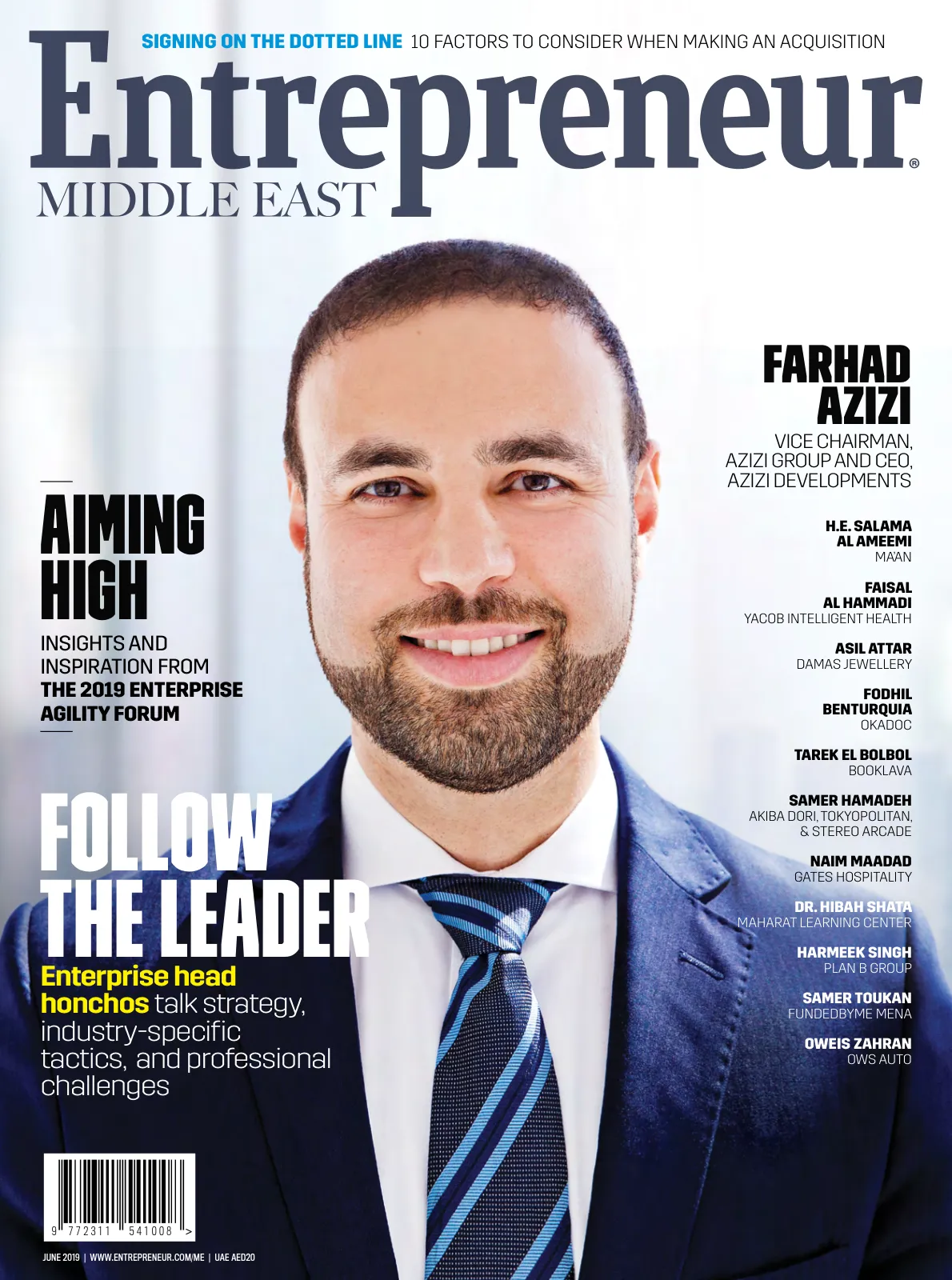
Entrepreneur Middle East, June 2019
Page 1
JUNE 2019 | WWW.ENTREPRENEUR.COM/ME | UAE AED20
9
7 7 2 3 1 1
5 4 1 0 0 8
>
SIGNING ON THE DOTTED LINE 10 FACTORS TO CONSIDER WHEN MAKING AN ACQUISITION
AIMING
HIGH
INSIGHTS AND
INSPIRATION FROM
THE 2019 ENTERPRISE
AGILITY FORUM
FOLLOW
THE LEADER
Enterprise head
honchos talk strategy,
industry-specific
tactics, and professional
challenges
H.E. SALAMA
AL AMEEMI
MA’AN
FAISAL
AL HAMMADI
YACOB INTELLIGENT HEALTH
ASIL ATTAR
DAMAS JEWELLERY
FODHIL
BENTURQUIA
OKADOC
TAREK EL BOLBOL
BOOKLAVA
SAMER HAMADEH
AKIBA DORI, TOKYOPOLITAN,
& STEREO ARCADE
NAIM MAADAD
GATES HOSPITALITY
DR. HIBAH SHATA
MAHARAT LEARNING CENTER
HARMEEK SINGH
PLAN B GROUP
SAMER TOUKAN
FUNDEDBYME MENA
OWEIS ZAHRAN
OWS AUTO
FARHAD
AZIZI
VICE CHAIRMAN,
AZIZI GROUP AND CEO,
AZIZI DEVELOPMENTS
Page 2
A brand new way to
invest in real estate!
Guaranteed 10% returns
every year for 5 years
*
Launching Nest by Arada
The Middle East’s premier
student housing complex
Walking distance from University City, Sharjah
Open to all nationalities
arada.com
800-ARADA (27232)
*T&C Apply
Page 3
3
June 2019 / ENTREPRENEUR.COM /
38
INNOVATOR
FOLLOW
THE LEADER
Enterprise head honchos
across the MENA region
talk strategy, industry-
specific tactics, and
professional challenges.
24
THE RECAP
ENTERPRISE AGILITY
FORUM 2019
A round-up of the talks,
discussions, and insights
shared at the 2019
Enterprise Agility Forum,
presented by du.
76
INNOVATOR
BEYOND BORDERS
Beyond borders
Mohannad Abudayyah
analyzes how entrepreneurs
in Saudi Arabia are
growing their enterprises
internationally.
90
START IT UP
ECOSYSTEM
A decade of impact
With the 10th edition of
Arabnet Beirut on its way,
founder and CEO Omar
Christidis reflects on the
influence Arabnet has had
(and continues to have) on the
MENA business landscape.
84
‘TREPONOMICS
PRO
Set the standard
Christophe Schnyder,
General Manager, Sofitel
the Palm Dubai, lists
10 guidelines from the
hospitality sector to take you
strides ahead of your rivals.
94
START IT UP
Q&A
Bringing it home
Fintech startup Denarii
Cash is on a mission to
help overseas workers send
remittances with no extra
fees- and it’s getting noticed.
JUNE 2019 CONTENTS
39 Asil Attar, CEO, Damas Jewellery
Farhad Azizi, Vice Chairman,
Azizi Group and CEO,
Azizi Developments
40
Page 4
Grow with our
Business Complete plans.
• Unlimited high-speed internet
• Free business devices
• Fixed Voice line with unlimited national calls
For more information, call 800 188
or visit du.ae/businesscomplete
Page 5
Page 6
Page 7
Call: 800 UPSALE | up.ae
*Terms and conditions apply
MOTOR CITY
Own Your Dream Home In Dubai
& Move In Today
Aed 80,000*
30 months
Post-Handover Payment Plan
50% DLD
Fee Waiver
1,2,3,4
Bedroom Apartment
Page 8
Page 9
19
Page 10
Page 11
Page 12
COVER THE CITY
Unlocking the Power
of Digital Signage Advertising
Page 13
WITH YOUR ADS
Visit www.lifeonscreen.com
Page 14
Company
Formation
Specialists
in the UAE.
The #1
Page 15
happy clients
since 2009.
15,000
Page 16
16 / ENTREPRENEUR.COM / June 2019
96
START IT UP:
STARTUP FINANCE
Game on
Looking back on his
business’ trajectory, The
Luxury Closet founder and
CEO Kunal Kapoor discusses
growth hacking tips from
a Dubai-born brand that’s
going global.
72
CULTURE:
LIFE
A formula for success
Mind Cloud Academy’s Genny
Ghanimeh explains how to
understand the difference
between an entrepreneur and
a businessperson (and why
it’s key to your enterprise’s
longevity).
68
CULTURE:
LIFE
The resilience roadmap
When Women Win creator
Rana Nawas dissects how you
can align your purpose with
actions.
70
CULTURE:
LIFE
Language matters
Rachel Ellyard, MENA
Talent Leader at EY MENA,
explores how small changes
can have a big impact on
women’s advancement in the
workplace.
80
‘TREPONOMICS:
MARKETING
Elevate your brand
Unni Kurup of Plan.net
Middle East lists seven
strategies to improve your
enterprise’s digital presence.
JUNE 2019
CONTENTS
JustClean CEO
Mohammad Jaffar
with co-founders
Athbi Al-Enezi and
Nouri Al-Enezi
22
62
CULTURE:
TRAPPINGS
‘Trep gear
The executive selection for
the entrepreneur on your
list that has everything.
Okay, maybe for a little self-
reward as well.
H.E. Salama Al Ameemi,
Director General,
Ma'an Authority for Social Contribution
50
36 Denarii Cash wins Dubai Smartpreneur Competition 4.0
63
IWC Schaffhausen's
Le Petit Prince
Page 17
—
R ADISSON BLU
WELCOME TO
RIYADH
—
r a d i s s o n h o t e l s . c o m
Call us at : 00966 11 479 1234
Email us at : reservations.riyadh@radissonblu.com
BOOK NOW AND SAVE UP TO 20%.
Offer valid from May till August 2019
Page 18
18 / ENTREPRENEUR.COM / June 2019
JUNE 2019
CONTENTS
22
EDITOR’S NOTE
By Aby Sam Thomas
81
‘TREPONOMICS
MARKETING
Beyond buzzwords
Paolo Gagliardi, CEO of
Trriple, talks about making
innovation work for your
customers.
73
CULTURE
LIFE
Seeing the world
differently
Helen Al Uzaizi, CEO of
BizWorld UAE, delves on
the approaches you need
to remember when raising
entrepreneurially-minded
kids.
64
CULTURE
TRAVEL
Crafting (new) realities
From a blog to a business:
Travel Junkie Diary
founder Michelle Karam is
going places (both literally
and figuratively).
60
TECH
SHINY
#TamTalksTech
Gadgets and doodads
that you might’ve missed
out on, sourced by a tech
aficionado. Yes, it’s okay to
want them all… and no, it’s
not our fault.
86
‘TREPONOMICS
PRO
Signing on the dotted line
Property Finder’s Simon
Comina rounds up 10
factors to consider before
going through with an
acquisition.
88
‘TREPONOMICS
PRO
Knowledge is power
Bayt.com’s Omar Tahboub
explains why innovative
businesses are (and should
be) obsessed with learning.
Aiming High:
Opportunity knocks
for the MENA
entrepreneurial
ecosystem
28
18 / ENTREPRENEUR.COM / June 2019
Page 19
A MEMBERS OF EMIRATES TRANSPORT BUSINESS CENTERS:
Page 20
20 / ENTREPRENEUR.COM / June 2019
SUBSCRIBE
Contact subscriptions@bncpublishing.net to receive
Entrepreneur Middle East every issue
EDITOR IN CHIEF Aby Sam Thomas editor@bncpublishing.net
CEO Wissam Younane wissam@bncpublishing.net
DIRECTOR Rabih Najm rabih@bncpublishing.net
CREATIVE LEAD Odette Kahwagi
MANAGING EDITOR Tamara Pupic
STARTUPS SECTION EDITOR Pamella de Leon
GROUP SALES DIRECTOR – B2B GROUP Joaquim D’Costa
COLUMNIST Tamara Clarke
PO Box 502511 Dubai, United Arab Emirates
P +971 4 4200 506 | F +971 4 4200 196
For all commercial enquiries related to Entrepreneur Middle East
contact sales@bncpublishing.net
All rights reserved 2019.
Opinions expressed are solely those of the contributors.
Entrepreneur Middle East and all subsidiary publications in the
MENA region are officially licensed exclusively to BNC Publishing
in the MENA region by Entrepreneur Media Inc.
No part of this magazine may be reproduced or transmitted in any
form or by any means without written permission of the publisher.
Printed by United Printing and Publishing
upp.ae
Images used in Entrepreneur Middle East are credited when necessary. Attributed use of
copyrighted images with permission. All images not credited otherwise Shutterstock.
Mohannad Abudayyah
Helen Al Uzaizi
Fida Chaaban
Omar Christidis
Simon Comina
Rachel Ellyard
Paolo Gagliardi
Genny Ghanimeh
Kunal Kapoor
Unni Kurup
Megha Merani
Rana Nawas
Christophe Schnyder
Omar Tahboub
CONTRIBUTING WRITERS
entrepreneur.com/me
ACCESS FRESH CONTENT DAILY ON OUR WEBSITE!
MIDDLE EAST
EntMagazineME
@EntMagazineME
Entrepreneur-me
EntrepreneurMiddleEast
EntMagazineME
EntMagazineME
EntMagazineME
MIDDLE EAST
In addition to our print edition, we’re bringing
you all sorts of industry news on our web
mediums. Joining us online means getting
relevant business and startup content in
real-time, so you’re hearing about the latest
developments as soon as we do. We’re looking
forward to interacting with our readers on all of
our social media and web platforms- like any
thriving business, we’re looking to give and take.
#TrepTalkME is already happening on all of our
digi platforms, and all good conversations go
both ways. See you on the web!
Page 21
800 9090 rta.ae
Dedicated bus lane
locations around
Dubai:
Naif
Al Mamzar
Al Ghubaiba
Jumeirah Lakes Towers
Stay in your lane
so everyone
reaches faster.
Stay clear of bus lanes. These are dedicated
lanes for buses, taxis, police vehicles, civil
defence, ambulances on emergency calls
and accessing them will get you a fine of
AED 600. Simply keep to your own lanes
and reach your destination on time.
Page 22
22 / ENTREPRENEUR.COM / June 2019
I
was searching for something in
my inbox today when I stumbled
upon an essay I had written as
part of my application for an elec-
tive class I wanted to be a part of
while I was a student at Columbia
Journalism School in New York.
This was back in 2011, when I had quit
my almost five-year-long career as a
software programmer to embark on
a new trajectory as a journalist, and
in hindsight, I can see how much of a
misfit I looked like in my media-centric
setting then.
Having said that, I did choose to
persevere, and one of the steps to
reaching this dream that I had made
for myself was to get into this rather
sought-after class at school that
focused on covering religion as a
journalist. For this particular class, the
selected students would essentially be
parachuted into Italy, and we’d then
use our time there to learn, study, and
report on stories that’d have religion
as a central underlying theme. Looking
at my application for this class now,
I’m struck by how remarkably plucky
I seem in it, although, at the time, I
remember being completely out of my
depths in what I had set out to do, and
yet, continuing to, well, swim against
the tide to get to where I wanted to be.
I’m sharing the essay I wrote then
here now in the hopes that it will
provide some sort of respite or
inspiration for all you entrepreneurs
out there (and everyone else too,
really), who have probably been told
they are doing something crazy when
running after goals they’ve made for
themselves, and that they are better off
doing something else. Now, the people
who are telling you all of this, they may
well be right- but they may well be
wrong as well. And that’s what I tried
to signify in my essay- a slightly edited
version of which is pasted below:
At first glance, I could probably be seen as
a totally inappropriate entry for the ‘Cover-
ing Religion’ class.
Before coming to this school, I had no
journalism experience. I used to be a
software programmer at Accenture. I was
responsible for maintaining and enhancing
an application for often angry, irritated,
and demanding investment bankers at J.P.
Morgan Chase centers around the world.
Since I loved to write, I wrote creative
fiction whenever I could. My short stories
ranged from the fantastic to the sublime.
Journalism, however, doesn’t believe in fic-
tion, and relies on fact. That doesn’t help my
case either.
I’ve been called a vagabond. I was an In-
dian expat who grew up in the United Arab
Emirates, and then studied in Kerala, India.
Afterwards, working in three different cities
of the world -Mumbai, London, and New
York- cemented my reputation of being a
wanderer.
I’m 27. I’m brown. I have a moustache. I’m
sure I could make a few bucks if I got a
dollar for every time I’ve been ‘randomly
checked.’
But, despite these apparent disadvan-
tages, I’m still here.
Perhaps then, what is required is to sim-
ply look at all of the above from a different
perspective.
After all, one of my professors in my first
semester did say that I was ‘the biggest
surprise in the class.’
My work experience has been instru-
mental in my work at school. While dead-
lines don’t seem to faze me, interacting
and working with people of varied nation-
alities and personalities comes naturally
to me. Working on the class website is
easy thanks to my work history.
I use my imagination when seeking
my stories. Be it a neighborhood worry-
ing about trashcans missing from their
streets, or Coptic Christians in Brooklyn
protesting violence in Egypt- the variety
in my stories show my open, inquisitive
mind.
Living in so many different places has
given me a unique view of the world- I can
no longer be just a native, an expatriate
or an immigrant, I’m a citizen of the world.
There are stories to be told, people to be
understood, places to be seen- and I write
to get these messages out.
I have to admit my moustache has
opened more doors than it has closed.
People are curious about me. I tell them my
stories, they tell me theirs. Stereotypes can
be broken, impressions can be changed- I
believe that’s what journalists are sup-
posed to do.
As for my age- well, older is wiser, isn’t it?
I hope I get to be a part of your class, and
get to learn from you. Thank you for your
consideration.
P.S. I did get selected to be a part
of the class.
EDITOR’S NOTE
A reflection on swimming against the tide
Here’s to the crazy ones
Aby Sam Thomas
Editor in Chief
@thisisaby
aby@bncpublishing.net
Page 23
Page 24
24 / ENTREPRENEUR.COM / June 2019
BANKING PARTNER
GOLD ALLY
ECOSYSTEM PARTNERS
TECH PARTNERS
ENTERPRISE
AGILITY
FORUM 2019
THE RECAP
THE ENTREPRENEURIAL
CONTINUUM IN PERSPECTIVE
Industry Intel event
An
PRESENTED BY
A PRODUCTION BY
DUBAI
SMARTPRENEUR COMPETITION
SUPPORTED BY
Page 25
25
June 2019 / ENTREPRENEUR.COM /
More than 250 people came
together for Entrepreneur
Middle East’s 2019 Enter
prise Agility Forum, pre
sented by du, which was held
at The Sofitel Palm Dubai,
UAE on April 30, 2019.
In its fifth edition, the
event, staged under En
trepreneur Middle East's
Industry Intel banner, had
speakers from across the
Middle East region share
insights and expertise on
the MENA's entrepreneurial
ecosystem.
Presented by du, Entre
preneur Middle East’s 2019
Enterprise Agility Forum was
staged with the support of
Dubai Chamber of Commerce
and Industry and Dubai
Startup Hub; Gold Ally,
Okadoc; Banking Partner,
Dubai Islamic Bank; Eco
system Partners, Dtec and
FundedByMe MENA; Tech
Allies, Sage Middle East, and
Life On Screen.
Kicking off the event with
his opening remarks, Editor
in Chief Aby Sam Thomas
addressed the current shift
in the MENA entrepreneurial
ecosystem, noting that
Entrepreneur Middle East
remains true to its goal of
supporting entrepreneurs
and startups in the region:
“We remain committed to
telling your stories, and we
hope to do it even more in
the years to come.”
With Thomas and KBW
Investments Chief Communi
cations Officer Fida Chaaban
co-moderating the event,
the 2019 Enterprise Agility
Forum began with a welcome
note by Hany Fahmy Aly,
Executive Vice President –
Enterprise Business, du, who
reiterated his enterprise’s
support to the startup
ecosystem, and encouraged
entrepreneurs to move ahead
with their dreams. “Make
innovation your priority,”
Aly said. “Don’t be afraid to
explore and fail.”
The keynote address for
the event was delivered by
Careem co-founder and
CXO Magnus Olsson. Fresh
from being acquired by Uber
in March 2019 for US$3.1
billion, Olsson shared the
significance of starting a
venture rooted on social
impact. Talking about the
enterprise’s early beginnings,
Olsson advised the audience,
“Aim high! There is no limit
to the potential of talent in
the region. Don’t be afraid
to start small. Learn, and be
scrappy. The region is the
most exciting place to do it.”
The first Talking Series
session of the conference was
a panel discussion on the
topic, The Next Frontier: The
Changing Face of Entrepre
neurship in the Arab World,
which was headlined by Elie
Habib, co-founder and CTO
of Anghami; Mohammed
Jaffar, Deputy Chairman
and CEO of Faith Capital
and CEO of JustClean; and
Magnus Olsson, co-founder
and CXO Magnus Olsson of
Careem. It featured a discus
sion on what can be done to
enable more success stories
to come out of the MENA
region, with insights on
what can entrepreneurs and
stakeholders can do to better
support the ecosystem’s in
novators.
The second of the Talking
Series sessions, titled Turn
ing The Tide: Growth Hacks
For When Business Is Bad,
looked into the techniques
and tactics that entrepre
neurs can do when the busi
ness market is stifling their
startups’ growth. Featuring
ENTERPRISE AGILITY
FORUM 2019
THE ENTREPRENEURIAL CONTINUUM IN PERSPECTIVE
Aby Sam Thomas, Editor In Chief,
Entrepreneur Middle East
Fida Chaaban, Chief Communications
Officer, KBW Investments
Welcome note by Hany Fahmy Aly, Executive Vice President – Enterprise Business, du
Talking Series Three
Show Me The Money: The Right Way To Invest In The MENA Region’s Entrepreneurs
>>>
Page 26
26 / ENTREPRENEUR.COM / June 2019
Jamal Wick, co-founder of
Flip International, Fodhil
Benturquia, founder and
CEO of Okadoc, Pallavi Dean,
founder and Creative Direc
tor of Roar, and Mansoor
Sarwar, Director - Technical
Services & Pre-Sales, Sage
Middle East, the panelists
discussed strategies for
first-time entrepreneurs,
operating costs, product di
versification and cost-cutting
techniques, among others.
The third and final Talking
Series for the conference,
titled Show Me The Money:
The Right Way To Invest In
The MENA Region’s Entre
preneurs, brought together
Amer Alaily, Senior Principal
at Mubadala Capital - Ven
tures, Hamdi Osman, Chair
man, FundedByMe MENA,
Leen Nabulsi, COO, Dubai
Smart City Accelerator, and
Khaled Talhouni, Managing
Director, Wamda Capital, to
discuss the region’s entre
preneurs access to capital,
and how they could fare
better with their fundraising
initiatives.
This year, the Enterprise
Agility Forum also played
host to the final round of
the Dubai Smartpreneur
Competition 4.0, staged
by Dubai Startup Hub, the
entrepreneurship support
arm of Dubai Chamber of
Commerce and Industry. 10
finalists were chosen from
over 250 business ideas
that were submitted in this
instalment of the contest,
with the shortlisted entre
preneurs presenting
their enterprises to
a panel of judges at
the Enterprise Agility
Forum.
Following the
pitches, the judges,
which included se
rial entrepreneur
Mohammad Chbib,
Hub71 Head Mahmoud Adi,
and du’s Executive Vice
President – Enterprise
Business, Hany Fahmy Aly,
selected three winners to
walk away with a total of
AED160,000 in prizes. Dena
rii Cash, a mobile application
helping overseas workers to
send money claimed the first
place; Arabee, a high specifi
cation platform providing an
online multi-format Arabic
language program came in
second; while Xpence, a
digital-only intelligent busi
ness bank account designed
by entrepreneurs for entre
preneurs placed third.
ENTERPRISE AGILITY
FORUM 2019
THE ENTREPRENEURIAL CONTINUUM IN PERSPECTIVE
Essa Al Zaabi, Senior
Vice-President,
Institutional Support
Sector of Dubai
Chamber
Denarii Cash
Page 27
ENTERPRISE AGILITY
FORUM 2019
THE ENTREPRENEURIAL CONTINUUM IN PERSPECTIVE
Dubai Smartpreneur Competition 4.0
Talking Series One
The Next Frontier: The Changing Face Of Entrepreneurship
Talking Series Two
Turning The Tide: Growth Hacks For When Business Is Bad
Mansoor Sarwar,
Director - Technical Services
& Pre-Sales, Sage Middle East
27
June 2019 / ENTREPRENEUR.COM /
Page 28
28 / ENTREPRENEUR.COM / June 2019
I
f they ever tell my story, let
them say I walked with gi
ants.” It was, strangely, these
words from the Greek epic, The
Odyssey, that echoed in the
back of my mind as I looked
around at the audience of more
than 250 startup founders and
aspiring entrepreneurs at Entrepreneur
Middle East’s 2019 Enterprise Agility
Forum as they welcomed Careem co-
founder and CXO Magnus Olsson on
stage with a standing ovation to deliver
the opening keynote. Homer’s eighth
century mythological narrative of a
warrior’s decade-long struggle to return
home famously defined the model for
the heroic quest. And while (thankfully)
not as dangerous as the warrior's tale,
but possibly just as dramatic in it's own
way, it has now become impossible to
talk about the entrepreneurial ecosystem
in the UAE or the wider Middle East
region without mentioning the journey
of homegrown Careem. Or as a version
of Homer for startup founders might say
someday: “Let them say I lived in the
time of Careem.”
The homegrown ride-hailing app that
was acquired by global giant Uber for
US$3.1 billion -the biggest ever tech deal
for the region- now defines a new hunger
for adventure and thirst to create in our
ecosystem, with every founder likely
dreaming of becoming a success story
just like theirs. Of course, a couple of
billion dollars wouldn't hurt either. But
that's most definitely not how, or why, it
all started. In one of his first appearances
on stage since the landmark acquisition,
Olsson told the audience at the forum:
“The fact is, we didn't start Careem with
the purpose of making money, we did it
to do something purposeful.”
Fueling the room with a new surge of
confidence and inspiration, the former
McKinsey consultant says it was a brain
aneurysm that almost killed him that
had led him to rethink his life's purpose
and drove him to entrepreneurship as a
more meaningful way to live. “In our in
dustry, when it comes to transportation,
we don't have a very well-developed
public transport infrastructure in the
region,” he said. “Google Maps didn't
have great coverage in the region when
we started. Financial inclusion is not
fantastic. 90% of women in Pakistan
don't have a bank account. So, for an
entrepreneur, this is an opportunity.
And it's extra awesome, because if you
are on this path of a purpose, doing your
purpose in the region allows you to help
the region. There is so much here to do-
and you can really make a big business
out of it.”
AIMING HIGH
ENTERPRISE AGILITY
FORUM 2019
THE ENTREPRENEURIAL CONTINUUM IN PERSPECTIVE
Opportunity knocks for the MENA entrepreneurial ecosystem
by MEGHA MERANI
“THE FACT IS, WE DIDN'T START
CAREEM WITH THE PURPOSE OF
MAKING MONEY, WE DID IT TO
DO SOMETHING PURPOSEFUL.”
Magnus Olsson. co-founder and CXO, Careem
Page 29
29
June 2019 / ENTREPRENEUR.COM /
In the next 10 years, as more
industries move online,
there's going to be “a half-a-
trillion dollar annual revenue
opportunity in the region,” he
noted. Olsson insisted that
the region's startup founders
are capable of competing
on a global scale. “There is
absolutely no reason why the
region cannot do as amazing,
fantastic things, as we can
do in Silicon Valley,” he told
the forum’s audience. “We
can build unicorns from the
region. We might call them
uni-camels, but we can make
them happen. When I look
at what our teams are doing,
for example, our data and AI
team -how they're using ma
chine learning and artificial
intelligence to solve some re
ally, really challenging prob
lems- we are on par with the
best leading-edge technology
and talent, comparable to
anywhere else in the world.”
Reiterating his advice for
entrepreneurs to “aim high,”
the Careem co-founder also
shared anecdotes from the
enterprise's early days.
“When we started, people
were like, 'Are you complete
ly insane?'” he remembered,
adding that Careem officially
began operations on the first
day of Ramadan in 2012. Six
weeks later, the company
won its first ride through its
then website where custom
ers could make pre-sched
uled bookings. The customer
experience on the six-week
MVP [minimum viable
product] was “great”, Olsson
said. “On the backend, we
got an email, and that email
was sent to a phone, and
the phone had a very loud
ring signal, so that we would
wake up when that booking
came in the middle of the
night.” The team took turns
sleeping with the phone, he
recalled. “We had a list of
20 captains that we had met
outside Dubai Airport going
up and down the taxi line
and we started calling them.
'Khurshid bhai [brother] are
you free?' No. 'Hafiz bhai are
you free?' No. 'Mahmoud are
you free?' Yes! 'Ok we have
a booking in two hours.'” As
luck would have it, Careem's
first booking came from Ju
meirah Village Triangle, one
of Dubai's newer community
developments at the time
that wasn't familiar territory
for drivers. “Also known as
the Bermuda Triangle - you
go in, and you never come
out,” Olsson joked. Without
any technology in the car, the
team guided their chauffeur
to the customer's location
over the phone. Back then,
Olsson says, every single
booking had about 10-to-15
touch points, and it took
about 30 minutes to handle
per booking.
From then to now, the
change has been drastic:
“Today, we're doing like a
million rides a day,” Olsson
said. With his enterprise’s
story as an example, Olsson
advised entrepreneurs to
simply start small, learn, it
erate fast, be scrappy, dream
big and aim high. “And then
when you find a product-
market fit, scale.” But Olsson
also noted that those that
follow their dreams will hear
a lot of people telling them
they're crazy, much like he
and his team at Careem did
in its early days. But when
such situations arise, Olsson
urged founders to remember:
“If you're motivated by a
purpose, then that's the only
thing that matters. Entre
preneurship [is] the path to
doing something meaningful
with your life, [and] the
region is the most exciting
place to do it in.”
ENTERPRISE AGILITY
FORUM 2019
THE ENTREPRENEURIAL CONTINUUM IN PERSPECTIVE
Magnus Olsson.
co-founder and CXO, Careem
Fida Chaaban welcoming Magnus Olsson on stage
“AIM HIGH! THERE IS NO
LIMIT TO THE POTENTIAL
OF TALENT IN THE REGION.
DON’T BE AFRAID TO
START SMALL. LEARN, AND
BE SCRAPPY. THE REGION
IS THE MOST EXCITING
PLACE TO DO IT.”
Page 30
30 / ENTREPRENEUR.COM / June 2019
F
rom being told
they're crazy to
cold-emailing
VCs to strug
gling to attract
talent, the fifth
edition of the
Enterprise Agility Forum
featured the real-life chal
lenges successful entrepre
neurs in the Arab world have
grappled with along the way
to make it to where they are
today.
In the first panel discus
sion of the event, Elie Habib,
co-founder and CTO of
Anghami, Mohammed Jaffar,
Deputy Chairman and CEO
of Faith Capital and CEO
of JustClean, and Magnus
Olsson, co-founder and CXO
of Careem, spoke of what's
needed to enable more start
up success stories to come
out of the MENA region. Of
course, the progression of
exits –most significantly,
Souq being sold to Amazon,
and Careem being acquired
by Uber– have made a
substantial statement about
the maturity of the regional
ecosystem. It has now been
proven that the region can
have unicorns, and that it
can compete on an inter
national level, and attract
global investors as well.
But what does this really
mean for us going forward?
Here are four changes these
landmark exits could bring
about in the region's eco
system:
1. TALENT WILL BE INSPIRED
TO WORK AT STARTUPS
Historic exits can “hope
fully inspire talent,” Olsson
said. While joining a startup
might be scrappy, especially
in the early days, these suc
cess stories show that not
getting a salary or a big
enough paycheck to live the
flashy life could still pay off.
“I used to go to every startup
event I could because there
was free lunch,” Olsson
recalled. “We were taking
the bus between Abu Dhabi
and Dubai, because that was
the cheapest way to go in
between [the Emirates].”
He noted however that
going from bus to billionaire
was never the motive for him
and his team. “The fact is,
we didn't start Careem with
the purpose of making mon
ey,” he said. “We did it to do
something purposeful. But
I think that some of these
exits can show that you can
actually create substantial
value by doing a startup as
well and that should inspire
talent too.”
However, JustClean's Jaffar
highlights that the wider
Gulf region still needs to do
more work on making the
region attractive enough for
talent to relocate, especially
to his home base Kuwait. “A
big issue is that you need
certain people with certain
skills that simply do not
want to move to this part of
the world,” he says. “So, we
have to also spend, and make
people's lives more equal
in this part of the world.
People have to feel the same
whether you're a local or
non-local. And that's how
we end up attracting the
best talent. Our countries
need to improve on that.”
2. THE REGION WILL ATTRACT
MORE FUNDING “Obviously
we have a funding problem
that is big,” said Anghami's
Habib. “It's easy to get seed
[money] but it's not easy to
scale as much as we want.”
But successes like Careem
will make investors want to
put more into the region and
want to hold on for longer
cycles, he pointed out. In
vestors are also more likely
to now look at homegrown
startups as potential rivals
to global players, rather than
shoot them down instantly,
as Habib was when he first
launched his music stream
ing platform and digital
distribution company. “Even
when we were launching
in 2011, and I didn't know
how to actually get funding,
and there were very few
VCs,” he recalls. “I actually
cold-emailed tons of VCs
and people that I saw that
seemed, on LinkedIn, to have
money. I still have those
emails, and most of them
told me: 'Why are you doing
something to compete with
Apple? That's useless, go do
something else.'”
And with the region's
startups now in the global
limelight, the ecosystem will
likely lure more capital from
across the world. “Because
ultimately, as much as many
investors are investing
in the region and caring
about development, which
is wonderful, at the end of
the day they're investing
to make money,” Olsson
explained. “And particularly
if you're a fund, there needs
to be an exit at some point,
whether it's a public list
ing or some other exit. So,
hopefully some of these exits
ENTERPRISE AGILITY
FORUM 2019
THE ENTREPRENEURIAL CONTINUUM IN PERSPECTIVE
THE CHANGING FACE OF ENTREPRENEURSHIP IN THE ARAB WORLD
by MEGHA MERANI
THE NEXT FRONTIER
“OUR GOAL IS NOT
JUST TO GROW FOR
GROWTH'S SAKE. WE ARE
HAPPILY CONTRIBUTING
TO SOMETHING THAT
MATTERS IN THE REGION."
Magnus
Olsson,
co-founder
and CXO,
Careem
Elie Habib, co-founder and CTO, Anghami
Page 31
31
June 2019 / ENTREPRENEUR.COM /
can show –to regional and
international investors- that
you can have exits [here in
the region].
3. FOUNDERS WILL BE MORE
CONFIDENT (AND LESS
INTIMIDATED BY GLOBAL
PLAYERS) The recent exits
also prove that the region's
startups can leverage their
home court experience and
expertise, giving local found
ers both an edge and the
confidence to ignore naysay
ers. “We've always been told
that [we're crazy],” Habib
said, like many other entre
preneurs in the region. “As a
result, most of us today, still
have low self-esteem. We
still believe that because it's
an international company,
they're going to do better
than us, grow better than us,
and maybe acquire us, that
is actually the ultimate goal.”
But now, Habib believes,
the region's exits validate
that the region's startups
can stay in the game, and
not be intimidated by
international setups. “Our
goal is not just to grow
for growth's sake. We are
happily contributing to
something that matters in
the region. I'm happy that
after Apple Music, Deezer,
and Spotify, we're still the
biggest by far and growing.
For others it's like: 'Who are
you? You're a small service
in the Middle East. There are
bigger players that will eat
you.' [But] we are actually
locals that understand the
local business differently,
and can actually compete
and not let the global ones
be big enough in the region.”
JustClean's Jaffar added that
success stories, including
his own from back in 2015,
when Talabat.com, which
had him at its CEO then,
was acquired for US$170
million by Germany's Rocket
Internet, show that “we here
as Arabs can also do great
things.”
4. SCALING ACROSS THE
REGION COULD GET EASIER
WITH UNIFIED LEGAL STRUC
TURES Significant exits
could serve as the catalyst
for a unified legal company
structure in the Gulf to allow
homegrown enterprises to
scale more easily across the
region. “One of the problems
we have here [in the GCC]
is that we need to be with
less visible borders,” Jaffar
said. “If I'm an entrepreneur
right now, and I want to
have a company here [in
Dubai], it needs to be easier
for me to scale to the Emir
ates, to scale to Saudi...
At the moment, I have to
setup a legal structure [in
each location]... there's a
lot of costs. If we unify this
part of the world, and we
unify the Levant countries
as well, and we unify North
Africa... that's the dream.
The Europeans have done
it, it worked for them, the
Americans have done it...
and I think it will happen
here [too].”
ENTERPRISE AGILITY
FORUM 2019
THE ENTREPRENEURIAL CONTINUUM IN PERSPECTIVE
"MOST OF US TODAY STILL
HAVE LOW SELF-ESTEEM. WE
STILL BELIEVE THAT BECAUSE
IT'S AN INTERNATIONAL
COMPANY THAT THEY'RE
GOING TO DO BETTER THAN
US, GROW BETTER THAN
US, AND MAYBE ACQUIRE
US, THAT IS ACTUALLY THE
ULTIMATE GOAL.”
Talking Series One
The Next Frontier: The Changing Face of Entrepreneurship in the Arab World
Mohammed Jaffar, Deputy Chairman and
CEO of Faith Capital and CEO of JustClean
>>>
Page 32
32 / ENTREPRENEUR.COM / June 2019
F
rom dealing with
economic down
turns, to coping
with anxiety when
you're going at
it alone, the fifth
edition of the Enterprise
Agility Forum featured
brutally honest discussions
around the darker side of
entrepreneurship.
In a panel discussion,
Jamal Wick, co-founder of
Flip International, Fodhil
Benturquia, founder and
CEO of Okadoc, Pallavi Dean,
founder and Creative Direc
tor of Roar, and Mansoor
Sarwar, Director – Technical
Services and Pre-Sales, Sage
Middle East, shared real life
examples and tips for first-
time entrepreneurs on how to
deal with operating expenses,
cost-cutting, and most im
portantly, their mental health
to stay well, focused, and
productive even when times
get tough.
Here are five things every
entrepreneur needs to keep in
mind when business is bad:
1. STAY FOCUSED ON
THE PROBLEM
It may be a time of sluggish
economic growth, or a suc
cession of countless rejec
tions, but be patient, and
stay focused on the problem
your startup set out to
solve, Okadoc's Benturquia
advised. Citing his own
challenges, the e-commerce
entrepreneur shared: “At
Okadoc, for example, we
are trying to fix a problem
that's very important to us,
which is just being able to
find a doctor and book an
instant appointment. Making
an appointment takes 5-15
minutes today if a clinic is
open. Putting that down to
40 seconds- we felt that it
TURNING THE TIDE
ENTERPRISE AGILITY
FORUM 2019
THE ENTREPRENEURIAL CONTINUUM IN PERSPECTIVE
GROWTH HACKS FOR WHEN BUSINESS IS BAD
by MEGHA MERANI
It's hard enough attracting talent, so how is a founder to
know when they've found the perfect team member for
their startup? Elie Habib, co-founder and CTO of Anghami,
Mohammed Jaffar, Deputy Chairman and CEO of Faith
Capital and CEO of JustClean, and Magnus Olsson, co-
founder and CXO of Careem, shared their top hiring tips for
startups.
1. Find people who believe in your purpose Sharing
Careem's hiring philosophy, Olsson said, “We go look for
talent that believe in our purpose, and that don't see this
only as a job or a career, but as, ultimately, this is a calling
they want to join, and we are on a purpose together.”
He also noted that short-term bonuses are not part of
his company's culture. “It feels petty,” he explained. “We
believe that performance opens opportunities. When we
opened our call center, we did not hire people who knew
how to work at a call center. We interviewed people to see
if they were a good fit with our values, and if they were
smart. Because if they started on the ground, answering
the phone, five years later, they are senior leaders in our
organization. And that's the type of people you want in a
fast-growing place, because whatever your job is today,
three months later, it's obsolete.”
2. Hire people you like hanging out with Anghami's Habib
said that he started his enterprise with people who have
never done something similar before. This, he says, was
the key to creating something that's “very different from
other businesses.” “We wanted to get people who do not
have to unlearn things,” he explained. “Unlearning is hard.
I think it's the biggest problem of the 21st century. What
we did is actually get people who are smart, fresh, and do
not have much unlearning to do, and we taught them.” So,
what do you look for if you're not looking for skills? “Hire
people who are leaders,” Habib said. “And hire the person
that if you go out to dinner, you will enjoy their company.
That's very essential to culture.”
3. Make people part of your company “Hiring talent or
hiring a good person is like getting married,” JustClean's
Jaffar insisted. “You see them, they look good, but once
you're in, it could be something different.” To attract com
mitted hires, he recommended making them part of the
company. “We've done it,” he said. “We've also given the
option for people to invest their own money if they would
like to, and that makes people automatically feel that
they're not employees anymore. They become colleagues
and partners, and that makes them go the extra mile. It's
about getting people that want to go the extra mile.” Of
course, he added, this only works if you lead by example.
“You have to treat people like your family. You have to treat
them well. If you don't do this, it doesn't work.”
‘TREP TALK
Top hiring tips for startups from the region's
famous founders
Talking Series Two
"WE ALL HAVE OUR
DIFFERENT KINDS OF
ISSUES TO DEAL WITH AND
WE HAVE TO RECOGNIZE
THEM AND GET HELP. I'M
JUST MORE EFFICIENT
AND PRODUCTIVE IN THE
WORKPLACE WHEN I'M NOT
THINKING ABOUT ANYTHING
ELSE GETTING IN THE WAY.”
Page 33
33
June 2019 / ENTREPRENEUR.COM /
should be a right. [If] you
can book your Careem in 40
seconds or less, healthcare
is the most important thing,
right? So, that felt like a
really great problem to solve.
But the market is a different
reality. You meet clinics and
hospitals every day that say,
‘I don't want people to call,
I just want a lead, and I will
call them back a few hours
later.’ You keep facing a no
every single day. You keep
facing investors that will say
'Oh, this will never work,' or
'the region is different.'”
But all of this naysaying kind
of rings a bell for Benturqui.
He's seen it happen before
through his career with
stints at MarkaVIP, Souq,
and Noon.com, which is why
he believes it's important
to simply stay focused on
solving problems. After all,
the former MarkaVIP co-
founder pointed out, nobody
believed in e-commerce in
2010 either. “Retailers and
distributors were saying,
'Why should I block my
products for you to be sold
online? I can sell them at my
shop.’ So, the real challenge
is, how determined are you?
And how much you believe in
it [your idea] and how much
you're willing to learn, and
make bets, and fail- and just
move on with these failures,
and be able to really change
an entire market.”
2. CUT COSTS FROM
THE START
Keeping operating costs low
early on serves founders well
during tough market condi
tions. And for those who
haven't been as cautious, a
harsher economic climate
provides the ideal scenario
to rethink spending and get
your books in order. “As
a consultancy, it's either
famine or feast,” said Pallavi
Dean, founder and Creative
Director of Roar. “So, for us,
what we've done is we've
kept the fixed costs really
low. Yes, we pay a premium
for our variable costs. So,
if we get a visualizer, or a
contractor, or a procurement
agent, it's at a higher price.
But that means that my bot
tom line at the end of every
month is manageable.”
Meanwhile, Flip Inter
national's Wick cautions
founders not to over-hire. “If
you don't hit your revenues,
then work on your expenses,
and that means look at your
operating costs [like] your
rent [and] your staff,” he
advises. “Before you hire
a person, think 10 times
whether you need to hire
that person.” In cases
where founders branch out
with multiple companies,
Wick recommended looking
for ways to consolidate re
sources. “Today, I own and
operate three companies,
but they're all sitting in the
same office space, and that
allows me to dilute the cost
of my rent.”
3. INNOVATE AND DIVERSIFY
Rather than remain fixated
on a single sector, Roar's
Dean advises remaining open
to opportunities and diversi
fying. It's why she calls her
company a multidisciplinary
practice. “So, say, if the F&B
sector is suffering, I know
a lot of multinationals are
moving in, so that gives us
a lot of [other] opportuni
ties,” she says. Sage's Sarwar
added that the global online
accounting and business
services company's recipe for
challenging macroeconomic
conditions has always been
to invest in technology. “Ev
ery time there's an economic
downturn, it's probably the
best time to see what mod
ern technology is around,” he
noted, adding that automat
ing processes frees compa
nies from expensive human
interactions. “A robot's cost
is going to be much less than
a human's cost.”
4. GET CLOSER TO YOUR
CUSTOMERS
Your customers may be
struggling to fend for
themselves just as you are,
which makes a tough climate
the best time to bond with
clients to better understand
their challenges and needs.
“We've found that the
easiest economic downturn
measure is working with
your customers closely,
and getting more cross-sell
up-sell revenue from them,”
Sage's Sarwar explains.
“Ask them what is bother
ing them, and as Steve Jobs
said, get really close to your
customer, and tell them what
they need, before they realize
it themselves.”
Sarwar added that Sage
has always strived to be the
voice of entrepreneurs and
startups across the world,
freeing them from the burden
of admin, so they can spend
more time doing what they
love and growing their busi
nesses. For instance, Sage
ENTERPRISE AGILITY
FORUM 2019
THE ENTREPRENEURIAL CONTINUUM IN PERSPECTIVE
“I CONSTANTLY READ A
LOT OF SELF-HELP BOOKS.
I SEE A PSYCHOLOGIST,
AND I HAVE A BUSINESS
COACH– AND I'M NOT
AFRAID TO ADMIT THAT
OPENLY.”
“WE'VE FOUND THAT
THE EASIEST ECONOMIC
DOWNTURN MEASURE
IS WORKING WITH YOUR
CUSTOMERS CLOSELY, AND
GETTING MORE CROSS-
SELL UP-SELL REVENUE
FROM THEM."
Pallavi Dean,
founder and
Creative Director,
Roar
Mansoor Sarwar, Director – Technical
Services and Pre-Sales, Sage Middle East
Jamal Wick, co-founder, Flip International
Fodhil Benturquia,
founder and
CEO, Okadoc
>>>
Page 34
34 / ENTREPRENEUR.COM / June 2019
Amer Alaily, Senior Principal
at Mubadala Capital – Ven
tures, Hamdi Osman, Chair
man, FundedByMe MENA,
Leen Nabulsi, COO, Dubai
Smart City Accelerator, and
Khaled Talhouni, Managing
Director, Wamda Capital,
discussed the gaps in entre
preneurs' access to capital in
the region.
“We're still missing big
chunks of the funding eco
system,” Wamda's Talhouni
told the forum. “I think
clearly if you just look at the
amount of capital available
to deploy this year versus
last year and the year before,
there's an exponential shift
and that's increasing very
rapidly. [But] I think a gap
still persists. You're seeing
a lot of capital rush into
Series A and Series B, but
Series C is still a bit empty,
and then later stages are
totally empty.” Talhouni
added that while capital is
flowing through the market,
a lot of it is “government or
quasi-government funding”
that typically comes with a
national mandate to deploy
the capital in country. “The
issue with that is most of
the time companies that are
H
uge gaps still exist in the Middle East and
North Africa's startup funding ecosystem,
but substantial recent exits and an improve
ment in the quality of pitches could be on the
way to changing the status quo, some of the
region's top funders said at the fifth edition
of the Enterprise Agility Forum. In a panel,
SHOW ME THE MONEY
ENTERPRISE AGILITY
FORUM 2019
THE ENTREPRENEURIAL CONTINUUM IN PERSPECTIVE
THE RIGHT WAY TO INVEST IN THE MENA
REGION’S ENTREPRENEURS by MEGHA MERANI
Business Cloud Accounting
provides entrepreneurs with
powerful tools to stay on
top of VAT and compliance
regulations, manage all
their business interests in
one place even while out of
the office. “How we helped
[startups] in recent years,
specifically in the Middle
East region, is that we found
out that many of our custom
ers who are entrepreneurs
are struggling with their cash
flow... [and] we were one of
the first players who came up
with the concept of subscrip
tion pricing in the region.”
5. ANXIETY IS A GIFT
While there's no shortage
of upbeat messaging on fol
lowing your passion, Roar's
Dean told entrepreneurs at
the Enterprise Agility Forum
that anxiety is a normal part
of the journey. “I think one
of the big things is we have
to stop glorification of entre
preneurship,” she stressed.
“There's real challenges, real
heartache... blood, sweat,
tears... but nobody talks
about that. It's all about
'find your purpose,' 'go for
it,' 'let go of fear'... but it's
bloody scary, [so] let's be
honest about it.” Candid
about her own anxiety and
panic attacks, Dean whole
heartedly endorses getting
help to cope. “I constantly
read a lot of self-help books.
I see a psychologist, and I
have a business coach– and
I'm not afraid to admit that
openly,” she said. How
ever, she admits it is a huge
cost. “But when you run a
consultancy, or you are an
entrepreneur, you are your
business for the first three-
to-five years. So, if I don't
invest back in myself, then
[I'm] not going to progress.
We all have our different
kinds of issues to deal with
and we have to recognize
them and get help. I'm just
more efficient and productive
in the workplace when I'm
not thinking about anything
else getting in the way.”
Insisting that it's normal to
experience anxiousness and
stress, the interior designer
added, “Anxiety is an amaz
ing gift, because anxious
people are a prolific bunch.
Talk to any entrepreneur,
and they are anxious, or any
high-achiever and they will
also say they have anxiety.”
HUGE GAPS STILL EXIST
IN THE MIDDLE EAST AND
NORTH AFRICA'S STARTUP
FUNDING ECOSYSTEM, BUT
SUBSTANTIAL RECENT EXITS
AND AN IMPROVEMENT IN
THE QUALITY OF PITCHES
COULD BE ON THE WAY TO
CHANGING THE STATUS QUO.
Talking Series Three
Page 35
35
June 2019 / ENTREPRENEUR.COM /
able to scale in the region
are not local. They are by
definition regional and they
have to operate in multiple
geographies.” However, with
news of big acquisitions in
the region by global tech
giant, FundedByMe MENA's
Osman says he believes
Dubai will soon attract not
just more investment but
also entrepreneurs seeking
funding. “Lucky for us now
with the Uber and Amazon
deals, it will help more start
ups from outside the region
to come in and Dubai can be
come the hub for investment
for our region,” he says.
Meanwhile, the panelists
added that they have also
witnessed a “significant”
shift in the quality of pitches
they receive as the ecosys
tem matures.“When we
started this fund five years
ago we'd get pitches for all
kinds of things- most en
tertaining was probably for
a cement factory in South
Sudan,” Talhouni recalled.
“But [we've gone] from that
extreme, all the way to great
companies like Careem, for
example, [and] how often
those left-field pitches are
coming in is decreasing.”
Mubadala Capital's Alaily
added that the quality of
pitches he sees is “extremely
good” and “impressive when
you're comparing what we
see here to what we see
outside the region.” “They're
on par to some extent. [But]
obviously we have some
areas we need to work on.”
At the 2019 Enterprise Agil
ity Forum, Amer Alaily, Se
nior Principal at Mubadala
Capital – Ventures, Hamdi
Osman, Chairman, Funded
ByMe MENA, Leen Nabulsi,
COO, Dubai Smart City
Accelerator, and Khaled
Talhouni, Managing Director,
Wamda Capital, shared
their pet peeves and main
preferences on what they'd
like to see in a pitch deck.
1. Keep it short “The last
thing we want to see is a
very long deck that goes
into too many details,”
Dubai Smart City's Nabulsi
said at the forum. “What
you want to do is get the
investors excited: so most
importantly, include the
idea, the problem and
the solution that you're
providing.” She also advised
founders to share the story
behind why they started,
along with potential trac
tion, the revenue model,
and competitors or com
parisons in the market to
understand what the model
is about. Wamda's Talhouni
added: “I'd say it's what
your eye darts to imme
diately when you see the
pitches– so, a clear articu
lation of the problems. We
don't want to see 10 slides
till you get to understand
ing what it is the issue or
pain point you're willing to
tackle.”
2. Show the IIR “I call it the
IIR, which is issue, impact
and recommendation,”
noted FundedByMe's Os
man. “I want to know what
the issues are, I want to
know what's the impact
in case nothing gets done
about that issue, and I want
to know what the recom
mendation is. So that way,
your investor immediately
has everything right there
and then.”
3. Draw the link between
the issue and the founder
“Personally, what I look for
is definitely the issue, but
also the link between the
issue and the founder,”
Mubadala's Alaily pointed
out. “We like to invest in
founders that are really
obsessed with what they're
doing, and they go six or
seven levels deep. They
have a mastery of the in
dustry, the players, and how
they differentiate their solu
tion, and how their solution
is actually 10 times more
efficient and effective than
the current solution. So,
really put high value on the
issue, but also the founder's
experience, and why he
or she are actually able to
solve this versus the rest.
At the seed stage, 95% of
our decision is based on
the person across the table
from us: who is that person,
and are we trusting them
with our money.”
4. Identify where you are
in the lifecycle Current
traction is really important,
Talhouni said. “So, identify
where you are in the com
pany's lifecycle because
that helps the investor un
derstand how to segment
it. Also [provide] a sense of
how big the market is– so,
the investible market, and
an understanding of the
impact of how big that
change is.”
ENTERPRISE AGILITY
FORUM 2019
THE ENTREPRENEURIAL CONTINUUM IN PERSPECTIVE
‘TREP TALK
Top investors from the MENA region share tips
on what to include in your pitch deck
"I THINK A GAP STILL
PERSISTS. YOU'RE SEEING A
LOT OF CAPITAL RUSH INTO
SERIES A AND SERIES B,
BUT SERIES C IS STILL A BIT
EMPTY, AND THEN LATER
STAGES ARE TOTALLY EMPTY.”
Khaled Talhouni, Managing Director,
Wamda Capital
Amer Alaily, Senior Principal,
Mubadala Capital – Ventures
Hamdi Osman, Chairman,
FundedByMe MENA
Leen Nabulsi, COO,
Dubai Smart City Accelerator
Page 36
36 / ENTREPRENEUR.COM / June 2019
IN PICTURES
T
he winners of the Dubai
Smartpreneur Competi
tion 4.0, presented by
Dubai Startup Hub, the
entrepreneurship support
arm of Dubai Chamber of
Commerce and Industry, and Smart
Dubai, were announced during the clos
ing ceremony of Entrepreneur Middle
East's Enterprise Agility Forum 2019 in
Dubai in April, which gathered business
leaders and representatives of Dubai’s
entrepreneurial community.
Out of more than 250 smart business
ideas submitted to Dubai Startup Hub
this year, Denarii Cash, a mobile ap
plication helping overseas workers to
send remittances, won the competition,
while Arabee, an online multi-format
Arabic language program, and Xpence,
a digital-only intelligent business bank
account for startups, came in second
and third respectively.
According H.E. Majid Saif Al Ghurair,
Chairman of Dubai Chamber of Com
merce and Industry, the fourth cycle of
the Dubai Smartpreneur competition
saw a 217% surge in the number of
international submissions compared to
the previous cycle. Apart from the UAE,
the competition attracted smart busi
ness concepts related to blockchain,
artificial intelligence, and digital trans
formation from 19 countries in 2019, up
from six countries in 2018, reflecting
Dubai’s increasing attractiveness as an
innovation hub and preferred market
for international startups.
“Over 1,600 smart business ideas
have been submitted to Dubai Smart
preneur competition since its launch,
and we continue to see positive changes
as the quality and calibre of applica
tions and participants increases with
every new cycle,” said H.E. Al Ghurair.
“The benefits of participating in this
unique program go far beyond the
recognition of winning, and extend to
the training, development, mentorship,
practical tips and rewarding experience
that comes along with the pitching
process.”
RISING TO THE OCCASION
Denarii Cash wins Dubai Smartpreneur Competition 4.0
Denarii Cash
Winners of the Dubai Smartpreneur Competition 4.0
Page 37
37
June 2019 / ENTREPRENEUR.COM /
1. Denarii Cash A mobile application helping overseas workers to send money.
2. Arabee A high specification platform providing an online multi-format Arabic language program.
3. xpence A digital-only intelligent business bank account designed by entrepreneurs for entrepreneurs.
4. Peliere A service designed to improve communication and trade between airline and logistics companies through blockchain and smart contracts.
5. Simplifai Labs A new concept of instant commerce leveraging on visual discovery and AI technology.
6. Pic W Post An ecosystem designed to help micro to small enterprises manage daily accounting needs.
7. Monocle an augmented reality app for tourists and residents.
8. Giftrapp A gift registry platform that allows adding items from various online and offline stores.
9. Booklava A spoken, non-music, audio platform.
10. Design Hubz A software as a service platform for sharing property renderings.
1
3
6
9
10
8
7
4
5
2
Page 38
THE LEADER
FOLLOW
ASIL ATTAR
CEO, DAMAS JEWELLERY
FAISAL AL HAMMADI
CO-FOUNDER AND CEO,
YACOB INTELLIGENT HEALTH
H.E. SALAMA AL AMEEMI
DIRECTOR GENERAL, MA'AN AUTHORITY
FOR SOCIAL CONTRIBUTION
TAREK EL BOLBOL
CO-FOUNDER AND CEO, BOOKLAVA
FARHAD AZIZI
VICE CHAIRMAN, AZIZI GROUP
CEO, AZIZI DEVELOPMENTS
SAMER TOUKAN
CEO, FUNDEDBYME MENA
DR. HIBAH SHATA
FOUNDER AND MANAGING DIRECTOR,
MAHARAT LEARNING CENTER
HARMEEK SINGH
FOUNDER AND CEO, PLAN B GROUP
SAMER HAMADEH
FOUNDER, AKIBA DORI |
TOKYOPOLITAN | STEREO ARCADE
NAIM MAADAD
FOUNDER AND CEO,
GATES HOSPITALITY
FODHIL BENTURQUIA
FOUNDER AND CEO, OKADOC
OWEIS ZAHRAN
CEO, OWS AUTO
TALKING BUSINESS WITH 12 EXECUTIVES
FROM ACROSS DIFFERENT INDUSTRY SECTORS WHO
ARE IMPACTING THE MENA MARKET LANDSCAPE
38 / ENTREPRENEUR.COM / June 2019
Page 39
39
June 2019 / ENTREPRENEUR.COM /
F
or a brand that has
over 100 years of
history behind it, the
Dubai-headquartered
Damas Jewellery had a
very noteworthy addition to
its saga in February this year,
when it appointed Asil Attar
as the CEO of the enterprise,
making her the first ever
woman in that position for
the company. With Damas
being one of the region’s
most prominent names in
jewellery and watch retail,
Attar looks like a natural lead
for the organization, given
her 25 years of experience in
the industry, working with
brands like Majid Al Futtaim,
Al Yasra Fashion, Coach, and
The Giorgio Armani Group.
And the significance of her ap
pointment at Damas isn’t lost
on Attar- after all, she’s been
someone who has been cham
pioning the cause of women
in leadership roles all through
her career. “I am honored to
hold the seat at the forefront
of this organization as its
first female CEO,” Attar says.
“My career has been achieved
through merit, hard work,
and ambition. I am passionate
about women empowerment
and will champion this inter
nally and externally. Women
have an amazing ability to
multitask and have empathy,
whilst delivering the role in an
emotionally engaged manner.
I always say that as an ambas
sador for empowerment, I act
with my mind, and think with
my heart.”
In her role at Damas, Attar
is spearheading an enterprise
that was founded in 1907, with
its first store setting up shop
in Dubai’s Gold Souq in 1959.
Since then, the company has
grown massively, with Damas
now seeing 230 of its stores
spread across the Arab world.
“My vision for Damas is to
maintain and claim our status
as the number one destination
for jewellery in the Middle
East,” Attar says. “Damas has
a strong heritage of over 100
years, and this foundation
has secured us this position.
This means we have to work
hard, and focus all our efforts
in ensuring that we grow
from strength to strength.”
Attar is also keeping an eye
on how the retail landscape is
changing, and as such, she is
keen to have Damas operate
better attuned to these trends
as well. “We are also focused
strategically on enhancing our
customer experience, deliver
ing a lifestyle, allowing our
customer to make decisions
with ease, and according to
their time,” she says. “We all
know that time is increas
ingly more precious and is a
commodity, as rare as gold
and diamonds, making it
equally precious. In the world
of luxury and jewellery, there
is nothing that will replace a
physical brand experience; it is
an emotional purchase. How
ever, we will definitely become
an omnichannel player, using
technology as an enabler.”
Attar has also wasted no
time in placing her personal
stamp on a number of Damas’
initiatives. “Part of our vi
sion is to speak to our female
consumer in a language that is
relatable, which they under
stand,” Attar notes. “Women
are at the focus of our strategy.
The ‘Feel Precious’ campaign
that we launched in March
with our Dubai Mall flagship
launch did not use any of our
products, like all the other
typical global campaigns. In
stead, we placed 24-carat
gold leaf on our muse. This
was a powerful message, a
statement that says it is our
customer who is our focus,
and they are the precious
ones.” At the same time, At
tar is keen on making it clear
to her team at Damas that
they rank high on her list of
priorities as well- in her first
three months at Damas, she
has managed to travel to nine
cities in six countries where
her enterprise has a presence,
interacting with over 1,800
people who work with the
company across the region. “I
am a transformational leader,
whose leadership style centers
around emotionally engaging
every single individual in my
business, from the bottom
up,” Attar says. “I am passion
ate about driving my teams
through empowerment and
ownership with an entrepre
neurial mindset and with a
single focus, which is making a
difference to everyone.”
damasjewellery.com
ASIL ATTAR
CEO, DAMAS JEWELLERY
ENTERPRISE HEAD HONCHOS TALK
STRATEGY, INDUSTRY-SPECIFIC TACTICS,
AND PROFESSIONAL CHALLENGES
FOLLOW
THE LEADER
by ABY SAM THOMAS
1. PASSION IS IMPORTANT
“You must take on a role that
you truly love and believe in.”
2. SURROUND YOURSELF WITH
THE BEST IN THE CLASS
“I surround myself with skilled
professionals who excel in their
role. I then orchestrate their tal-
ent and potential, and channel
their energy to deliver a global
successful outcome.”
3. STAY TRUE TO WHAT YOU
STAND FOR
"Lead with your values and eth-
ics- these are uncompromising,
and what all my decisions are
based on.
4. FIND AVENUES OF SUPPORT
FOR YOURSELF
“Get yourself a life coach or
mentor; someone trusted so
that you are able to download
and recharge.”
5. STAY GROUNDED, ALWAYS
“Be honest and open in your
leadership style, and arm your-
self with tremendous humility.”
INDUSTRY INTEL
DAMAS JEWELLERY CEO
ASIL ATTAR’S TIPS FOR
ENTREPRENEURS
"I am passionate about women empowerment
and will champion this internally and externally."
IMAGE CREDIT DAMAS JEWELLERY
Page 40
40 / ENTREPRENEUR.COM / June 2019
IMAGE CREDIT AZIZI
"WE ARE LOOKING TO
ESTABLISH OURSELVES
FURTHER IN HIGH-GROWTH
INTERNATIONAL MARKETS,
TO SHOW THE WORLD THAT
A DUBAI-BASED DEVELOPER
CAN BUILD ICONIC
PROPERTIES OVERSEAS.”
Farhad Azizi, Vice Chairman, Azizi Group
and CEO, Azizi Developments
Page 41
41
June 2019 / ENTREPRENEUR.COM /
A
s the CEO of
Azizi Develop
ments, Farhad
Azizi, who
is also the
Vice Chair
man of Azizi
Group, oversees the UAE-
headquartered real estate
enterprise’s operations,
while also leading its strategy
and guiding the direction of
its managerial team. Hav
ing kicked off operations
in 2007, Azizi says that his
company, which is the real
estate investment arm of the
parent Azizi Group, has, so
far, completed 13 projects
in Dubai, as well as 41
buildings and six shopping
malls internationally. “We
have delivered over 8,200
homes globally, with another
4,000 units to be delivered
this year,” Azizi says. “We
currently have over 200
projects at different stages
of development, nine of
which are due for handover
by year’s end, including five
buildings in Al Furjan, Phase
One of our flagship develop
ment Azizi Riviera in Meydan
One, Mina by Azizi in Palm
Jumeirah, Aliyah Residences
in Dubai Healthcare City,
and Azizi Aura in Downtown
Jebel Ali. We are also looking
to establish ourselves further
in high-growth international
markets, to show the world
that a Dubai-based developer
can build iconic properties
overseas.”
Now, that may sound like
a lofty dream- but Azizi
has his company’s standing
in the market backing his
ambition up. “We have re
corded robust sales this year,
underlining not only the
pick-up in growth of Dubai’s
real estate sector, but also
the confidence customers
have placed in our ability to
deliver immaculately-de
signed residential projects in
the most strategic locations
across the Emirate,” Azizi
notes. “2019 has started
far better than 2018, with
sales in the first quarter
of 2019 being significantly
higher than in the first three
months of 2018.” It’s not just
about sales though- Azizi
Developments has managed
to snap up a slew of industry
awards over the years, which
testify to its history of suc
cessful business practices in
the region. As for the secret
sauce that has enabled all
of this to happen, it is the
enterprise’s unflinching focus
on the customer that Azizi
credits for all the success it
has seen so far. “As a leading
developer, we envision –and
strive to offer– elegantly-
designed world-class homes
that are affordable, and
yield high rental returns,”
he says. “At the core of our
operations are several key
pillars, the most important of
which is customer-centricity.
Moreover, the importance
of transparency, honesty, a
construction- and research-
driven approach, and proac
tive technology adoption are
all guiding notions that we
believe determine the success
of our business.”
Azizi referred to these factors
again when asked to detail
his approach to positioning
Azizi Developments in the
market. “First and foremost,
we strive to be the most
customer-centric developer
by keeping our customers
at the very forefront of
all of our decisions,” he
explains. “They are the core
of our business, and the
reason Azizi Developments
is what it is today. There are
several ways in which we
continuously improve their
experience with us, such as
by researching and tailoring
our products and services
to their specific needs, re
inforcing our customer care
team, and enhancing our
communications with them.
What makes customers the
happiest, though, is a solid
ROI. We therefore make sure
that every unit yields them
a substantial return on their
investment, which ensures
their satisfaction, and
converts them into repeat
customers. Moreover, we are
committed to the highest
levels of transparency in
ENTERPRISE HEAD HONCHOS TALK
STRATEGY, INDUSTRY-SPECIFIC TACTICS,
AND PROFESSIONAL CHALLENGES
FOLLOW
THE LEADER
FARHAD AZIZI
VICE CHAIRMAN, AZIZI GROUP AND CEO, AZIZI DEVELOPMENTS
"Without trust in off-plan development, there would be no sales in
the sector– it is that simple. It is absolutely fundamental to the industry
that we operate in, and it is what drives our growth trajectory.”
by ABY SAM THOMAS
Farhad Azizi with Azizi Group Chairman Mirwais Azizi at Aliyah, Dubai Healthcare City
>>>
Page 42
42 / ENTREPRENEUR.COM / June 2019
everything we do- from
marketing and sales, to
operations and delivery.
We place a strong emphasis
on earning our customers’
trust through honesty and
transparent communica
tions, in the form of regular
updates and by increasing
the quality and number of
communication channels.
Investors and stakeholders
have to be kept up-to-date
on completion progress,
company announcements,
and any other information
that is relevant and useful
to them. We have therefore
recently implemented more
comprehensive monthly
email newsletters, and have
increased the frequency and
quality of communication
channels.”
“Thirdly, what sets us apart
is our research-driven ap
proach,” he continues. “We
have a dedicated research
and development depart
ment that conducts in-depth
research to uncover market
trends and customer needs,
using advanced research
methodologies and tech
nologies, such as machine
learning algorithms. Only
research-driven companies
that implement the latest
technologies, which now
extend far beyond mere
desk research to big data
and machine-learning algo
rithms, will have insights
that allow them to innovate
and prosper. The fact that
all of our developments are
strategically located in terms
of their vicinity and/or ac
cess to business, retail and
leisure hubs, and their con
nectivity to major highways
and public transportation is
another major competitive
advantage that we have.
Our research uncovered the
most promising areas with
the most growth-inclined
ROIs, which we leverage to
the benefit of our customers.
Lastly, our developments go
beyond mere buildings– they
embody and allow residents
to be immersed in enhanced
lifestyles. By incorporating
outstanding sports, enter
tainment, shopping and
other lifestyle amenities, as
well as by integrating social
livable spaces in our master-
planned communities, we do
our very best to enrich the
lives of our residents.”
Now, it's one thing to create
such investment opportuni
ties for potential customers-
it’s another thing altogether
to get them to actually sign
on the dotted line. In Azizi
Developments’ case, while it
does have strong customer
bases in India, Pakistan,
China, Russia, the UK, and
the UAE, in order to cater to
the millennial market, the
company has customized of
ferings specifically for these
young professionals, and
thus encouraging them to
move away from home rent
ing to home ownership. “One
of the many ways in which
we cater to this segment,
which our research finds is
often anxious due to a fear of
commitment, is by offering
revolutionary payment plan
options, such as through
our partnership with Dubai
Islamic Bank, which grants
them monthly payment plans
ENTERPRISE HEAD HONCHOS TALK
STRATEGY, INDUSTRY-SPECIFIC TACTICS,
AND PROFESSIONAL CHALLENGES
FOLLOW
THE LEADER
Samia Azizi
in Al Furjan
IMAGE CREDIT AZIZI
Farhad Azizi, Vice Chairman, Azizi Group
and CEO, Azizi Developments
Page 43
43
June 2019 / ENTREPRENEUR.COM /
with 0% down payment,”
Azizi explains. “Moreover,
we are seeing less of a need
for comprehensive kitchen
utilities and parking spaces,
due to the rise in food deliv
ery and ride-sharing apps,
and more of a demand for
social livable spaces in and
around our buildings. These
are the types of insights that
we consider and act on to
ensure that our product suits
this growing demographic’s
needs.” According to Azizi,
such activities are necessary
in order to build strong rela
tionships with both existing
and new clients, with such
ties being absolutely critical
in an industry like theirs.
“Essentially, as an off-plan
developer, at the time of pur
chase, we sell a promise to
our customers, rather than a
tangible product,” he points
out. “For them to buy this
promise, it requires trust,
which can only be achieved
and maintained through high
levels of transparency and
honesty. Without trust in
off-plan development, there
would be no sales in the
sector– it is that simple. It
is absolutely fundamental to
the industry that we operate
in, and it is what drives our
growth trajectory.”
It should have become clear
by now, based off his re
sponses so far, that Azizi is a
leader who actively chooses
to lead from the front, and
he believes his enterprise
has been all the better for it.
“CEOs need to be hands-on,”
he declares. “They need to
be directly involved and
engaged in all levels, rather
than just steering the com
pany’s direction. I personally
visit all of our construction
sites every Tuesday, which
to me is not just a matter of
quality control and ensuring
timely delivery, but is also
tremendously fulfilling. Wit
nessing the tangible progress
first-hand is the most
rewarding part of my week.
I also make sure that all
top management, including
myself, maintains an open-
door policy. This is crucial
in ensuring an uninhibited,
friendly and progressive
work environment in which
suggestions are heard and
actioned. To open the organi
zation up to advancements,
unrestrained and direct lines
of internal communications
need to be nurtured. This
is how we uncover issues
that can then be solved im
mediately, which would be
difficult and time-consuming
in more bureaucratic and
formal enterprises. I am a
strong advocate of the no
tion of intrapreneurship– I
do my very best to instill an
entrepreneurial spirit in all
staff as I believe that this
fosters agility and progress. I
have also made my personal
phone number public, and
have invited staff, custom
ers, and other stakeholders
to reach out to me directly
with any questions, feedback
or suggestions. This, too, is
important to me as it boosts
transparency and facilitates
progress. I believe that a
developer’s CEO needs to
be the most visible, ap
proachable, and reachable
ambassador of the brand.”
azizidevelopments.com
"WHAT SETS US APART
IS OUR RESEARCH-DRIVEN
APPROACH. WE HAVE
A DEDICATED RESEARCH
AND DEVELOPMENT
DEPARTMENT THAT
CONDUCTS IN-DEPTH
RESEARCH TO UNCOVER
MARKET TRENDS AND
CUSTOMER NEEDS."
ENTERPRISE HEAD HONCHOS TALK
STRATEGY, INDUSTRY-SPECIFIC TACTICS,
AND PROFESSIONAL CHALLENGES
FOLLOW
THE LEADER
1. ALWAYS KEEP THE
CUSTOMER FIRST
“Instill a customer-first mindset
across all operations, and most
importantly, in all employees.
Keeping the customer at the
forefront of all decisions ensures
that business functions operate
optimally, in line with market
trends and demand, driving
profitability and success.”
2. RUN A TRANSPARENT BUSI-
NESS
"Maintain and enhance levels of
transparency, honesty, and trust.
Customer trust is fundamental
to any business, and it ensures
continued growth through repeat
customers and word-of-mouth.”
3. KNOW YOUR MARKET
INSIDE OUT
“Start with in-depth research,
and substantiate all business
activities with it. Conducting
comprehensive research,
especially using advanced
technologies such as machine
learning algorithms, keeps the
business relevant, and allows it
to tailor products to customer
needs.”
4. STAY ATTUNED TO
THE BUSINESS LANDSCAPE
AROUND YOU
“Continuously adapt to changing
market conditions. Agility and
responsiveness to customer
needs and market trends is of
the utmost importance. It is no
longer survival of the fittest, but
survival of those who know how
to adapt.”
5. FUEL YOURSELF WITH
PASSION
“Do what you love. You cannot
succeed without genuine
passion for your industry and
customer interests.”
INDUSTRY INTEL
AZIZI DEVELOPMENTS CEO
FARHAD AZIZI SHARES HIS
TIPS FOR ENTREPRENEURS
Azizi Riviera in Meydan One
Page 44
44 / ENTREPRENEUR.COM / June 2019
N
ow is the best time
to start a business,”
declares Samer
Hamadeh, the
founder of three
homegrown concepts in the
UAE (Stereo Arcade, Akiba
Dori, Tokypolitan), when
asked about his thoughts on
the current business climate
in the country and the wider
MENA region. However,
Hamadeh then pulls a fast
one, and adds this caveat to
his response: “And by now,
I mean literally any time you
read this, whether it’s today
or in a year: entrepreneurs
create industries and
opportunities for others, and
this is something critical
to the region- so the MENA
needs you!”
Hamadeh’s response makes
sense when you take a look
at his entrepreneurial jour
ney so far- he has had a par
ticular knack for identifying
untapped niches within the
hospitality space, and then
finding ways to capitalize on
them wholeheartedly. Con
sider Stereo Arcade, located
at the DoubleTree by Hilton
Hotel in Dubai’s Jumeirah
Beach Residence neighbor
hood, which one can safely
say is one of Dubai’s most
popular nightlife venues
today. Launched in 2015,
this independent concept
managed to stand out in
what is a rather crowded
arena by championing not
just its unique positioning
(it’s "an arcade, bar, and
club rolled into one," notes
WorldsBestBars.com), but
also its “affordable luxury”
offering, which appealed to a
much broader audience than
other similar destinations in
the Emirate. This particular
ethos is also evident in
Hamadeh’s stewardship of
the Dubai Design District-
located Akiba Dori, the anime
culture-inspired Japanese
fusion restaurant that also
houses Tokyopolitan, the first
F&B establishment in the
city to offer Tokyo-style Neo
politan pizzas. Having kicked
off operations in 2018, both
brands have been welcome
entries in Dubai’s casual
dining space, with patrons
finding themselves drawn to
the eclectic offerings and dis
tinctive feel of these venues.
For other entrepreneurs
wanting to take a page out
of Hamadeh’s book in terms
of finding opportunities to
exploit, he offers this pithy
bit of advice: “Read the local
news. There’s always some
thing happening, and this
SAMER HAMADEH
FOUNDER, AKIBA DORI | TOKYOPOLITAN |
STEREO ARCADE
by ABY SAM THOMAS
1. YOU CAN’T OWN AN IDEA
“Don’t be the person that com-
plains that someone is stealing
their ideas. If you’re not trying
to be great at what you do,
someone is going to come
along and do it better.”
2. CUT THE NEGATIVITY
“Human nature is a disaster- if
you surround yourself with
negative people, don’t expect
anything positive to come of it.”
3. YOU CAN’T SAVE PEOPLE
FROM THEMSELVES
“If someone in your business
life takes up your time and
energy, and doesn’t show any
sign of improvement, they’re
not yours to fix.”
4. TIME > MONEY
“If you’re going to invest your
most valuable commodity
in something, make sure it’s
something you can look back
on, and be glad that you did.”
5. READ EVERYTHING
“Inspiration comes from every-
where- you never know what
you’ll find 20 pages deep into
Wikipedia.”
INDUSTRY INTEL
BRIGHTWATER INDUSTRIES
FOUNDER SAMER
HAMADEH’S TIPS FOR
ENTREPRENEURS
“I run my business in a way that lets us quickly
adapt- which is very much the general direction
entrepreneurs are headed in globally, in the age
of split-second information.”
ENTERPRISE HEAD HONCHOS TALK
STRATEGY, INDUSTRY-SPECIFIC TACTICS,
AND PROFESSIONAL CHALLENGES
FOLLOW
THE LEADER
IMAGE CREDIT BRIGHTWATER INDUSTRIES
Akiba Dori
Page 45
45
June 2019 / ENTREPRENEUR.COM /
ENTERPRISE HEAD HONCHOS TALK
STRATEGY, INDUSTRY-SPECIFIC TACTICS,
AND PROFESSIONAL CHALLENGES
FOLLOW
THE LEADER
something could provide
an opportunity for growth.”
This is a reflection of Hama
deh’s model of working, by
the way- he is someone who
believes in the importance
of keeping oneself attuned
to the business landscape
around him. “I run my busi
ness in a way that lets us
quickly adapt- which is very
much the general direction
entrepreneurs are headed
in globally, in the age of
split-second information,”
he notes. In terms of what’s
next for his brands, Hama
deh has already consoli
dated them under a holding
company he founded called
Brightwater Industries, and
is now looking to grow them
across the region. While he
acknowledges the difficulties
inherent in expanding across
the Arab world, he also feels
the rewards are worth it.
“A region as diverse as the
MENA comes with its fair
share of challenges, but also
comes with opportunities,”
he says. “It’s far from being
a mature market, but it’s on
the way there, and if other
major cities here would
follow the Dubai example, I
think doing business would
be much easier.”
It’s one thing to have the
ambition to grow, but it’s
an entirely another matter
to actually make it happen,
and Hamadeh is of the
opinion that there aren’t any
shortcuts to achieving these
kind of dreams and goals.
“Growth and sustainability
both require a tremendous
amount of perseverance,”
he says. “I’d add to that
organizational integrity,
and building a team that
can run the business with
or without me.” The lat
ter is something Hamadeh
believes every entrepreneur
should keep in mind when
going about starting a busi
ness- even if you are kicking
things off on a rather frugal
basis. “Retaining a team
on a limited budget means
making other sacrifices, and
letting your team know that
you’d make sacrifices just to
keep them,” Hamadeh says.
“This sense of comradery is
critical in tough times, and I
think it helps keep everyone
on the same page. There’s
nothing worse than a busi
ness leader profiting off the
labor of their team while
underpaying them; people
won’t follow someone like
that for long, unless they’re
in survival mode.” Keep
Hamadeh’s notes in mind
when leading your teams,
fellow ‘treps- truer words
have (probably) never been
spoken. akibadori.com
E
very company founder
ponders about scaling
their small business,
and then usually turn
to analyzing customer
preferences or onboarding
skilled employees to help
them devise and implement
a growth strategy. How
ever, Faisal Al Hammadi,
co-founder of YACOB Intel
ligent Health, a food-tracking
system encouraging healthy
eating in schools, got to
understand the intricacies
of local market demand
for his business (and drive
its product development),
thanks to the latest initia
tives of the UAE government.
The UAE’s National Program
for Happiness and Wellbeing
recently launched the Com
munity Design for Wellbe
ing initiative to promote
wellbeing, including healthy
eating habits, while one of
the important pillars of the
country’s Ministry of Food
Security’s National Strategy
concerns nutrition as well.
These initiatives have been
“It really comes down to how much time leaders
spend with the people in their organization,
and, based on this, how much they achieve the
objectives of the company through harnessing
the best skills of the people, which they can never
find out if they don’t spend time with them.”
CO-FOUNDER AND CEO,
YACOB INTELLIGENT HEALTH
by TAMARA PUPIC
FAISAL AL HAMMADI
Akiba Dori
>>>
Page 46
46 / ENTREPRENEUR.COM / June 2019
a much-needed boost for YA
COB as a startup that aims to
disrupt a traditional model
of school canteens, target
ing the US$2 billion worth
market across the GCC, by
improving the way parents,
schools, and food vendors
handle the nutrition of
schoolchildren. “The UAE is
such a great testing ground,
because of the willingness of
both B2B and B2C customers
to try new technologies,”
Al Hammadi says. “For
example, since YACOB has
already been operating in
more than 50 schools across
the UAE, we have gained the
knowledge, confidence, and
scalability capacity to soon
expand into Saudi Arabia,
a market that is ripe for
positive transformation,
especially in the education
and health industries.”
Since launching in 2018,
YACOB has grown from a
point-of-sale platform to
an AI-enabled nutrition
recommendation engine for
the school food ecosystem-
all under the leadership of
Al Hammadi and his two
co-founders, Tarig El-Sheikh
and Wael Orabi. YACOB’s
software, used by school
canteens, has a built-in “par
ent dashboard,” which allows
parents to monitor what
their child has consumed as
well as its nutritional value.
The software was built on
the YACOB team’s extensive
research into why children
make unhealthy eating
choices, which included con
sulting pediatric nutrition
specialists and behavioral
scientists. YACOB, which
awards children for making
good choices with respect to
their food, is not Al Ham
madi’s first entrepreneurial
attempt. “Being a Vice Presi
dent at Mubadala Health
care, the largest healthcare
investment firm in UAE, and
enabling hospitals and clin
ics to be built, has defined
my career and personal
direction towards health and
education, and enhanced my
passion for deploying tech
nology in education to drive
further efficiencies, accruing
benefits to students and
families,” he says. His stint
at Mubadala led to launch
ing his first startup in 2012:
Slices, an Abu Dhabi-based
food startup that provided
healthy meals at more than
50 schools across the UAE,
which became a building
block to today’s YACOB.
As a platform, YACOB has
now reached more than
18,000 users, with a con
stant growth of more than
400% year-on-year for the
last three. Today, it processes
more than $30,000 per
day for more than 100,000
pupils. Al Hammadi expects
that the startup will reach a
market share of 7% across
the entire UAE school
market, including both
private and public schools,
by September this year. This
success is due to his team,
Al Hammadi points out. “It
really comes down to how
much time leaders spend
with the people in their orga
nization, and, based on this,
how much they achieve the
objectives of the company
through harnessing the best
skills of the people, which
they can never find out if
they don’t spend time with
them,” he explains. “And
doubling down on the impor
tance of spending time with
your team, I can say that an
important experience that I
went through with my teams
at both Slices and YACOB is
the management of internal
communication. While in
the early days of a startup,
the founders and the first
employees are all working
from the same co-working
space, coffee shop, or of
fice, and they all talk in one
WhatsApp group, and tasks
are on one Trello board,
and everything is clear
and smooth, as the startup
scales, one of the biggest
challenges is what channels
and technologies you need
to select to keep the com
munication as smooth and
efficient as in the glorious
days of two founders and one
employee all sitting at the
same coffee shop table, and
executing everything really
fast. This is why, as the team
becomes more specialized
and smaller project teams
and departments get formed,
I decided to use communica
tion and project management
tools such as Slack or AHA
for a more focused com
munication, while still being
able to spend time with my
team members, so that their
feedback and ideas don’t get
lost in the entrepreneurial
brainstorm.”
Earlier this year, YACOB
was one of 10 startups that
graduated from the Techstars
Dubai accelerator program,
held in partnership with
GINCO Investments and
hosted at Dubai Future
Foundation’s Area 2071, and
to date, YACOB has raised
$500,000 in funding and
grants. When it comes to
advice for his peers in the
startup ecosystem, Al Ham
madi says that entrepreneurs
should always ensure they
have good mentors on their
side. “Focus on finding
mentors who have been
and who are entrepreneurs
themselves, and learn from
their stories and day-to-day
execution, as those experi
ences can prove to be much
more relevant and applicable
to their startup’s current sta
tion, rather than any generic
best practices.” yacob.com
ENTERPRISE HEAD HONCHOS TALK
STRATEGY, INDUSTRY-SPECIFIC TACTICS,
AND PROFESSIONAL CHALLENGES
FOLLOW
THE LEADER
“FOCUS ON FINDING
MENTORS WHO HAVE
BEEN AND WHO ARE
ENTREPRENEURS
THEMSELVES, AND
LEARN FROM THEIR
STORIES AND DAY-TO-
DAY EXECUTION."
IMAGE CREDIT YACOB INTELLIGENT HEALTH
Page 47
47
June 2019 / ENTREPRENEUR.COM /
H
aving lived in the
GCC for nearly two
decades, Samer
Toukan, CEO of
FundedByMe MENA,
is well-attuned to the needs
of the regional markets- that
seems to have served him well
in his decision to lead the
MENA operations of one of
Europe’s largest operational
crowdfunding networks.
Toukan joined forces with
FundedByMe, a Sweden-
headquartered equity crowd
funding platform, in January
last year to become “the
MENA region’s go-to portal
for vigilance, reliability, quali
ty, and professional integrity.”
One way of reaching this goal
is by ensuring transparency
and compliance which, Tou
kan explains, are important
for the nascent crowdfunding
sector from reputational and
operational standpoints. “In
my opinion, this ultimately
translates to business success
and profitability,” he says.
“We have, therefore, invested
a considerable amount of
time, effort and resources
to automate our entire pro
cesses and put in place robust
checkpoints to protect client
and stakeholder interests, to
the best of our abilities.”
FundedByMe MENA is the
first equity crowdfunding
platform fully regulated
and licensed by the Dubai
Financial Standards Author
ity (DFSA). “During our
soft launch phase, we have
completed a ‘test fundrais
ing campaign,’ which was a
necessary step to ensure full
system integration with our
Swedish partners, who are
system providers; our UK
partners, who are payment
processing and clearing pro
viders; and our local partners,
who ensure compliance and
operations,” Toukan says. His
ultimate goal for Funded
ByMe MENA is it to become
the region’s market leader in
equity-based crowdfunding
activity by 2020. “This is a
very interesting market for us
because the players are few,
and the potential is huge,”
Toukan says. And here is
some proof- global crowd
funding is expected to raise
over US$300 billion by 2025,
which will be a dramatic
increase from a $34 billion
volume in 2017, with Toukan
noting that within this frame
work, the MENA region still
remains a relatively untapped
market, mainly due to a lack
of awareness being a key bar
rier for retail investors.
ENTERPRISE HEAD HONCHOS TALK
STRATEGY, INDUSTRY-SPECIFIC TACTICS,
AND PROFESSIONAL CHALLENGES
FOLLOW
THE LEADER
SAMER TOUKAN
CEO, FUNDEDBYME MENA
by TAMARA PUPIC
1. BE REALISTIC
“Nobody knows the real value
you bring, or the real value of
your business, better than you.
Make sure you do not take your
audience for granted. They are
intelligent folk!”
2. BE CRISP
“Make sure your message
reaches your audience in
simple, straightforward, and
clear terms. Too much ado
leads to lost interest and lost
opportunities.”
3. BE PRACTICAL
“Under promise, and over
deliver.”
4. BE SMART
“Be on top of your game. Be cu-
rious to seek, listen, and learn.”
5. BE MODEST
“No concept, no business, and
no person is invincible. We
need each other to grow, con-
solidate, and sustain success.”
INDUSTRY INTEL
FUNDEDBYME MENA CEO
SAMER TOUKAN’S TIPS FOR
ENTREPRENEURS
“Financing startups and SMEs is about bringing
to life revolutionary and life-changing concepts.
‘Investing in something you believe in,’ and
‘funding the future’ are key drivers of these type
of investments."
IMAGE CREDIT FUNDEDBYME MENA
>>>
Page 48
48 / ENTREPRENEUR.COM / June 2019
“Many potential investors
still see venture capital as
reserved to angel investors
and venture partners, but
we aim to build awareness
and democratize funding
by providing access to asset
classes formerly unavail
able to individual and retail
investors,” Toukan says.
“Financing startups and
SMEs is about bringing to
life revolutionary and life-
changing concepts. ‘Investing
in something you believe in,’
and ‘funding the future’ are
key drivers of these type of
investments. Participating in
what may have the potential
to disrupt an industry, and
to deliver a massive return
to early investors, is a strong
emotional driver to invest on
our platform. However, in
vesting in startups and SMEs
is risky. To venture means to
anticipate risk and danger.
The higher the expected
return, the higher the risk.
To address the higher risks, it
is crucial to diversify invest
ment, and this means further
portioning the amount avail
able for investment. Fund
edByMe MENA offers just
that. Also, our thorough on-
boarding and due-diligence
procedure aims to mitigate
this danger (risk and scam)
by validating, as much as
possible, the information and
documentation provided for
our campaigns and hope to
help investors balance risks
with profit probability.”
FundedByMe MENA is about
to launch its first campaign
in Dubai, focusing on early-
growth stage companies with
robust business and revenue
models seeking capital to
accelerate viable growth and
expansion plans. When it
comes to its own business
model, FundedByMe MENA’s
revenues are generated
mainly from commissions
earned on funds raised for
successfully closed cam
paigns, Toukan says. Talking
about challenges his young
business has been faced with
so far, he points out to the
lack of equity crowdfunding-
knowledgeable talent, at both
executive and operational
levels, in the MENA region.
“Attracting and developing
such talent is key for the evo
lution of crowdfunding in the
region,” he says. “Retention
is therefore a catalyst for suc
cess. I believe that conven
tional remuneration packages
are not sustainable in gen
eral, and in our industry in
specific. We need to be more
creative in our pay, reward,
and recognition structures
to be able to prevail. Profit
sharing is something we are
looking into at this stage.”
In the end, we talk about the
region’s entrepreneurial eco
system, and Toukan opines
that it holds a huge oppor
tunity to evolve and prosper.
“There are many great
initiatives, honest intentions,
and substantial resources
invested in the development
of such an ecosystem in both
government and private
sectors, however, what I
see missing is connecting
the many brilliant dots that
scatter the entrepreneurial
scene,” Toukan says. “I also
see that while banks and
venture capital are more or
less organized and have de
veloped a robust framework
to channel funding to ‘few’
high-potential ventures,
angel and retail investors
still remain fragmented, and
may be missing out on ‘many’
opportunities. Therefore, I
see FundedByMe MENA as
a potential platform to help
consolidate their capital and
provide them with reliable
deal-flows of a new asset
class they may not have ac
cess to otherwise.”
fundedbyme.com
ENTERPRISE HEAD HONCHOS TALK
STRATEGY, INDUSTRY-SPECIFIC TACTICS,
AND PROFESSIONAL CHALLENGES
FOLLOW
THE LEADER
I
’m of the strong belief
that as long as one is
focused on a brand’s
viability and relevance
in the market (while
identifying a vacuum and
filling that gap), profits will
come automatically.” That’s
Gates Hospitality founder
and CEO Naim Maadad
explaining how his company
has built a veritable portfolio
containing some of the UAE’s
most popular F&B concepts,
which include Reform Social
& Grill, Ultra Brasserie, Bistro
Des Arts, and folly by Nick &
Scott. Maadad, a veteran of
the industry with more than
38 years of experience behind
him, has led his enterprise
by focusing on customer
loyalty for all of his brands, a
policy that he claims to have
transcended the test of time,
driving a business model
that has succeeded even in
adverse market conditions.
NAIM MAADAD
FOUNDER AND CEO, GATES HOSPITALITY
by ABY SAM THOMAS
IMAGE CREDIT GATES HOSPITALITY
"There is no point in copying the success of
others. Originality always has a market. Identity
always has its own unique pedestal."
Page 49
49
June 2019 / ENTREPRENEUR.COM /
“I strongly believe in having
a strong foundation, and
then building on it,” Maadad
says. “More than ever before,
you need a solid platform
that does not shake when
challenged. Finding solutions
that fill a vacuum is what any
business model is all about.
There is no point in copying
the success of others. Origi
nality always has a market.
Identity always has its own
unique pedestal.”
For those of you who have
been to one of the many
establishments that Gates
Hospitality operates, Maa
dad’s stress on authenticity
when it comes to building
brands shouldn’t come as
too much of a surprise. From
the Parisian charm that is
resplendent in Bistro des
Arts, to the warm, rustic
Alpine theme that headlines
Publique, each of the F&B
concepts under the Gates
Hospitality umbrella pro
fesses a unique style and
sensibility that is arguably
hard to find anywhere else
in Dubai’s crowded dining
scene. But all of this isn’t
something that happened by
chance though- it’s actually
a testament to Maadad’s
vision for his enterprise.
“Intrinsic to my mantra is
the belief that quality does
not happen by accident,”
Maadad says. “It must be
planned. You need to have a
commitment to execute plans
that incrementally achieve
goals. This requires an active
mindset. Instead of waiting
for circumstances to change,
or reacting to market chal
lenges, leading a company
requires proactive thinking.
However, it is often the case
that motion is confused with
results. Action for the sake of
action does not lead to suc
cess, which is why planning
and preparation are crucial.”
According to Maadad, the
MENA region remains ripe
with opportunities; however,
it does have its particular set
of challenges that businesses
need to be prepared to tackle.
“The MENA is a region which
has business conditions that
sync with political triggers
and changing demographics,”
he notes. “Of course, there is
tremendous competition here
as well as– any concept that
has had success elsewhere in
the globe cannot simply be
replicated here, and expected
to succeed on its own merits.
It needs a clear adaptation
to fit the market’s unique
culture and heritage– entre
preneurs need to identify a
vacuum, and find solutions
that fit that particular cog
well enough to compete in a
bigger picture.” When asked
how should they go about ac
tually doing this, Maadad re
plies, “The business investor
must focus on their brand’s
unique mission and pillars,
and this can only happen if
they are well-defined, rather
than cookie-cutter imita
tions. They need to make
sure they have leaders that
are totally aligned with the
ethos of the brand– leaders
that strongly believe in the
brand, and live its values on a
daily basis.”
And this, in essence, re
flects the principles which
Maadad uses to lead his
enterprise from one success
to another. “Given the market
realities and business envi
ronment in the region, we’re
laser focused on building a
sense of belonging through
experiences that enrich the
lives of our customers,”
Maadad declares. “Our brand
pillars and ethos are more
than words. They’re being
driven with passion and zeal,
day-in day-out… People have
money to invest, but passion
to sustain and unwavering
commitment is what eventu
ally ensures success. There is
always the right time to in
vest, the right atmosphere to
flourish, and the right play
ing field for an opportunity.
The culinary industry is not
a fashion statement– it is a
passion for life-long commit
ment for the brand pillars.”
gateshospitality.com
1. KNOW YOUR ENTERPRISE
INSIDE OUT
“Engage deeply in the daily
business operations. Under-
stand the business vacuum
to fill in the marketplace.”
2. YOUR TEAM IS YOUR
STRENGTH
“Be connected with the
people that run your busi-
ness.”
3. KNOW WHAT YOU
STAND FOR
“Keep the brand ethos
simple, and never sacrifice
its consistency.”
4. LIVE YOUR VALUES
“Passionately embrace your
brand pillars, and live them
every single day.”
5. LEAD BY EXAMPLE
“There is no room for the
driver to take a back seat.
The culinary business is no
exception. Focus– and focus
hard!”
INDUSTRY INTEL
GATES HOSPITALITY
FOUNDER AND CEO NAIM
MAADAD SHARES HIS TIPS
FOR ENTREPRENEURS
ENTERPRISE HEAD HONCHOS TALK
STRATEGY, INDUSTRY-SPECIFIC TACTICS,
AND PROFESSIONAL CHALLENGES
FOLLOW
THE LEADER
Page 50
50 / ENTREPRENEUR.COM / June 2019
L
ast summer, H.E.
Sheikh Mohamed
bin Zayed, Crown
Prince of Abu Dhabi
and Deputy Supreme
Commander of the Armed
Forces, announced Ghadan 21
-Ghadan means “tomorrow”
in Arabic– an AED50 billion-
worth series of 50 initiatives
to deliver improvements in
four areas of focus for the
capital of the UAE- society,
knowledge and innovation,
business and investment,
and lifestyle. And, as is
often the case, progressing
towards a new goal in Abu
Dhabi happens in almost no
time- in February 2019, the
Department of Community
Development in Abu Dhabi
had already established the
Ma'an Authority for Social
Contribution (Ma’an) whose
main task was to unite the
government, the private
sector, and civil society in
growing a culture of social
contribution and par
ticipation. “As a responsible
government, Abu Dhabi has
recognized that the city is
expanding rapidly in terms
of population, and that
there is a growing appetite
among citizens to make a
meaningful contribution to
society,” notes H.E. Salama
Al Ameemi, Director General,
Ma’an. “Our mission is to
create collaborative com
munities that contribute
towards the common good,
and although social impact
does take many forms, the
aims that will guide Ma’an
include seeing more social
programs established, an
increase in volunteers, more
funding raised through stra
tegic partnerships to support
people in our society, and
more job opportunities in the
social sector.”
In delivering solutions for
social challenges, Ma’an
itself has four main pillars
of work: a social investment
fund (to channel monetary
contributions of public and
private partners towards
community initiatives), a
social incubator program
(to create and nurture more
not-for-profit organizations
and social enterprises), a
social volunteering program
(to create more opportunities
for people to offer support
to voluntary organizations),
and a social impact bonds
initiative (to introduce a new
type of public contracting).
“Through our four pillars of
work, Ma’an will lead change
in Abu Dhabi’s community
sector,” Al Ameemi says. “We
will provide the resources
to help seed and grow com
munity-based organizations,
lead the introduction of out
comes-contracting as a tool
to address social challenges,
instigate a cultural shift in
Abu Dhabi by promoting
community engagement and
a culture of volunteering, and
establish channels to raise
and allocate funds towards
community-based organiza
tions and social initiatives.”
Over the course of a year,
Ma’an will run two six-
month cycles, incubating 10
social startups per cycle. A
different social challenge will
be identified as the theme for
each cycle, starting with the
inaugural edition announced
in April, which looks for
applications from entrepre
neurs whose businesses ad
dress the challenges faced by
people of determination, be it
mobility, access, or employ
ment opportunities. “We are
not just looking for people
who have qualifications or
extensive experience in this
field, but, most importantly,
we want applications from
individuals who are talented,
enthusiastic, creative, and
determined to make a social
impact,” Al Ameemi explains.
“When we start our selection
process, we will not only just
identify the most original and
sustainable ideas that will
improve the everyday lives of
people of determination, but
also look at the applicant’s
background and personality.
The most important qualities
for any social entrepreneur
are passion, the commitment
to be active, and a belief
in their higher purpose for
social good. Demonstrating
those qualities is crucial,
because this program is a
unique platform that will
see individuals from all
walks of life and different
nationalities put their com
munication, networking, and
team-building skills into
daily practice.”
Ameemi explains that
Ma’an will invest more than
AED4.4 million per cycle- of
that, there will be a total of
AED2 million of support in
each incubator cycle, and
AED 2.4 million in milestone
stipend, the latter meaning
that each team will be eligible
to receive a milestone fund
ing of up to AED100,000,
H.E. SALAMA AL AMEEMI
DIRECTOR GENERAL,
MA'AN AUTHORITY FOR SOCIAL CONTRIBUTION
by TAMARA PUPIC
"The aims that will guide Ma’an include seeing
more social programs established, an increase in
volunteers, more funding raised through strategic
partnerships to support people in our society,
and more job opportunities in the social sector.”
ENTERPRISE HEAD HONCHOS TALK
STRATEGY, INDUSTRY-SPECIFIC TACTICS,
AND PROFESSIONAL CHALLENGES
FOLLOW
THE LEADER
IMAGE CREDIT MA'AN AUTHORITY FOR SOCIAL CONTRIBUTION
Page 51
51
June 2019 / ENTREPRENEUR.COM /
released at every successful
milestone the participant
reaches, as well as support
for living expenses and hous
ing costs for participants not
based in Abu Dhabi. This is
in addition to Ma’an provid
ing mentorship, office space,
business expertise, and
access to investors. Lastly,
Ma’an will organize “pitch
days” for the 10 teams to be
able to leverage funding from
investors- Ameemi adds that
Ma’an will partner with the
government and private com
panies to steer funds into key
social initiatives, designing
fundraising plans, allocation
strategies, and enabling pro
cesses. “We are lucky to have
a very generous and willing
society in Abu Dhabi, with
a number of charities doing
excellent work each year, and
numerous companies spend
ing millions of dirhams each
year to improve the lives of
residents through their CSR
budgets,” she says. “Ma’an’s
role will be to bring together
these efforts and help guide
funding towards impactful,
sustainable solutions for
social challenges. Our long-
term model is based on the
approach of philanthropy, so
as solutions are developed
and social challenges ad
dressed, the reliance on
charity will decrease, freeing
up resources to focus on the
next priority.”
What Ameemi and her team
at Ma’an will expect from
incubated social impact en
trepreneurs is them making
a real and tangible difference
to the day-to-day lives of
people in the capital. “Our
work will be guided by the
Better Life Index, which is
the first ever comprehensive
social survey of residents in
Abu Dhabi carried out by the
Department of Community
Development to the highest
international standards,”
she says. “Year-on-year our
aim is to see an impact on
the priorities identified in
this survey, whether that
is happier residents, or an
improvement in the employ
ment prospects for people of
determination, or a reduction
in rates of depression among
the elderly.” This pioneering
effort –promoting a sense of
civic duty and championing
a philanthropic spirit in the
Emirate – will surely face
some challenges along the
way, Ameemi notes. “We
know that with any new
business venture, there can
be a high risk of failure in
the early months, and social
enterprises are no different,”
she says. “They operate
under the same market
conditions with the same
challenges of trying to attract
capital and turn a profit. As
with any business, the best
advice is to start small, fail
early, and equip yourself
with the knowledge, tools,
and resources to learn from
those mistakes. For example,
we know that people are be
coming increasingly socially
conscious, and care more
and more about the ethics of
the businesses with which
they spend their money. For
many, they will choose to
pay more for products and
services they know are lo
cally sourced, and contribute
towards the common good.
Good marketing and promo
tion of the social aspect to
social enterprises is vital.”
maan.gov.ae
ENTERPRISE HEAD HONCHOS TALK
STRATEGY, INDUSTRY-SPECIFIC TACTICS,
AND PROFESSIONAL CHALLENGES
FOLLOW
THE LEADER
1. FOCUS ON DEVELOPING A
NEW PRODUCT OR SERVICE
“The most successful busi-
ness ventures are those that
introduce innovation into the
market and create a product
or service that change
people’s lives for the better.”
2. MEASURE IMPACT
“To know whether you are
making a difference –and
to demonstrate this to oth-
ers- you need to know your
starting point, and be able to
show how your social enter-
prise made a change on this
baseline.”
3. USE INTELLIGENT
BUSINESS TOOLS
“They can help businesses
gain valuable insights to
affect growth, resolve urgent
concerns, collate marketing
data more quickly, provide a
real-time view of the organi-
zation, and allow for the an-
ticipation of future outcome
using predictive analytics and
forecasting.”
4. KNOW YOUR AUDIENCE
“Before you begin any
venture, conduct a thorough
feasibility study to under-
stand if the market is there
for your product or service,
and how you can reach that
audience to continue to grow
year-on-year.”
5. GET A MENTOR
“Having the experience and
guidance of someone who
has started a business before
or knows the market you are
looking to operate in is vital.
It will help ensure you avoid
common mistakes.”
INDUSTRY INTEL
MA’AN DIRECTOR
GENERAL H.E. SALAMA
AL AMEEMI SHARES
HER TIPS FOR SOCIAL
ENTREPRENEURS
H.E. Salama Al Ameemi,
Director General,
Ma'an Authority for Social Contribution
H.E. Salama Al Ameemi, Director General,
Ma'an Authority for Social Contribution
“WE ARE NOT JUST LOOKING
FOR PEOPLE WHO HAVE
QUALIFICATIONS OR EXTENSIVE
EXPERIENCE IN THIS FIELD,
BUT, MOST IMPORTANTLY,
WE WANT APPLICATIONS
FROM INDIVIDUALS WHO ARE
TALENTED, ENTHUSIASTIC,
CREATIVE, AND DETERMINED TO
MAKE A SOCIAL IMPACT.”
Page 52
52 / ENTREPRENEUR.COM / June 2019
I
believe that when you
have a mission that
involves children and
creates a new future
for them, good things
happen all the time,” says
Dr. Hibah Shata, founder
and Managing Director of
Maharat Learning Center, a
learning center for children
and young adults with
special needs. “I felt I was a
piece of a larger puzzle, and
everyone who came onboard
played a role in bringing all
the pieces together. I was
lucky, because I had people
who believed in me and my
vision at every stage of my
organization’s development,
my husband and immediate
family who stood by me, and
my employees, who were
amazingly supportive of my
daughter. The key to success
is to be humble, to listen and
learn from others, and to be
generous, and not withhold
the information from shar
ing, allowing people to give
you feedback, and seeing that
as an opportunity to improve
and be positive all the time.”
In 2005, Dr. Shata was
a successful dentist, with
a degree from King Saud
University in Saudi Arabia, a
master’s from the University
of London, and a fellowship
from the Royal College of
Surgeons in Ireland. She
owned and managed a fully
operational dental clinic,
Dr Hibah Shata Specialized
Dental Clinic, in Dubai.
However, she was soon faced
with a difficult choice–
either to move abroad in
search of a special nursery
for her autistic child, or to
start up the first medical
center providing services to
children and young adults
with special needs in Dubai.
At that time, there was a lot
of stigma and fear associated
with having a child with
autism, and Dr. Shata set out
to change that by founding
the Child Early Intervention
Medical Centre in Dubai in
2008. “As a startup, it was
difficult to know how to hire
the right people, especially
that we were the first center
to provide Applied Behav
ioral Analysis (ABA) therapy
in the UAE, and there were
no university graduates in
this field yet, so we knew
from the beginning that we
needed to develop people
skills in this new field,”
she remembers. “So, we
developed a very structured
onboarding and training pro
gram that included monthly
mentorship meetings to
support the development
of people skills, and built a
communication platform for
employees, a performance
management system, an
online kaizen platform, and
a reward system to recognize
their achievements, and keep
them inspired and motivated.
Today, I would advise entre
preneurs to hire the person
with the right fit for the
organization, and not just fill
a skills gap. If you hire the
right people, you can train
them to fit into any role that
you need, and it is important
to empower them to make
decisions and take risks,
coach them and let them
learn from their mistakes,
keep them motivated, and
grow them with you, so that
they can support you all the
way to the top.”
What followed was an
expansion of her enterprise:
in 2010, Dr. Shata founded
the Child Learning and En
richment Medical Centre to
offer a learning day program
for children who were not
yet in mainstream schools,
and in 2017, her third center,
Maharat Learning Centre,
was established as a behav
ioral intervention and school
inclusion support service
provider to help children
succeed in mainstream
education. “The challenges I
have faced are also faced by
many other women entrepre
neurs, from the lack of fund
ing, difficulties in networking
with men, the inability to
market your business with a
limited budget, but the most
important challenge for us
was to change the policies
and regulations in order to
support children and adults
with special needs to claim
their rights for education,
health, and share of the job
DR. HIBAH SHATA
FOUNDER AND MANAGING DIRECTOR,
MAHARAT LEARNING CENTER
by TAMARA PUPIC
"The key to success is to be humble, to listen
and learn from others, and to be generous,
and not withhold the information from sharing,
allowing people to give you feedback, and
seeing that as an opportunity to improve and
be positive all the time.”
ENTERPRISE HEAD HONCHOS TALK
STRATEGY, INDUSTRY-SPECIFIC TACTICS,
AND PROFESSIONAL CHALLENGES
FOLLOW
THE LEADER
IMAGE CREDIT OKADOC
Page 53
53
June 2019 / ENTREPRENEUR.COM /
market, and thus, to create a
real impact,” Dr. Shata says.
“It took eight years, but we
were successful in achieving
our goals, and engaging the
community of educators,
healthcare professionals,
social care providers and the
government officials through
workshops, symposiums,
conferences, participation in
events, advocacy and aware
ness campaigns.”
Having said that, Dr. Shata
considers herself fortunate
for having started up and
grown her business in the
UAE. “I was lucky to start my
business in Dubai at a time
when the entire country is
supporting women to become
entrepreneurs, and to reach
their best potential,” she
says. “In the UAE, it is easy
to be part of many networks
and business development
and social impact hubs,
and this has helped me in
developing my managerial
and leadership skills, finding
like-minded entrepreneurs,
and connecting with the
right people. I see that hap
pening again today in Saudi
Arabia, and many other GCC
countries, where women
are supported to be part of
business boards, or reach
high government positions.”
Today, Dr. Shata herself is a
recipient of several awards,
including Dubai Healthcare
City Authority’s Award for
the Best Pediatric Rehabilita
tion Centre in 2017, Dubai
Health Authority’s Excellence
Award in 2018 and its Female
Leader of the Year title in
2018, and, more recently, the
global Cartier Women Initia
tive Award in 2019. “I have
learnt a lot from watching
our [autistic] children grow
before my eyes that they are
strong and capable, that their
abilities are hidden under
layers of the lack of self-
confidence, lack of support,
poor programs, and their
difficulties in socializing and
communicating,” Dr. Shata
says. “I myself have changed
and no longer underestimate
their brains, but see their
potential and strengths. I try
to help parents to see that,
instead of focusing on their
children’s difficulties. Today,
I am dedicating all my work
to see how we can innovate
to have an impact on millions
of children suffering around
the world, so my work is
focused on creating a model
that combines quality, in
novation, and scalability, to
reach as many children as we
can.” maharatlearning.com
ENTERPRISE HEAD HONCHOS TALK
STRATEGY, INDUSTRY-SPECIFIC TACTICS,
AND PROFESSIONAL CHALLENGES
FOLLOW
THE LEADER
1. HAVE A USP
“Have a unique model or idea
or service that solves a big
problem.”
2. LEAD WITH PASSION
“Be passionate about what you
do, and encourage others to
follow your vision.”
3. GET THE BEST PEOPLE
ONBOARD
“Hire the best you can afford,
and motivate them to be your
future leaders.”
4. STAY AGILE AND INNOVATE
“Avail the resources to support
business development, innova-
tion, and creativity.”
5. APPRECIATE YOUR TEAM
(AND YOURSELF TOO)
“Reward and recognize your
team, and don’t forget yourself,
as you need to reward yourself
for your achievements too.”
INDUSTRY INTEL
MAHARAT LEARNING CENTER
FOUNDER DR HIBAH SHATA
SHARES HER TIPS FOR
ENTREPRENEURS
“I WAS LUCKY TO START
MY BUSINESS IN
DUBAI AT A TIME WHEN
THE ENTIRE COUNTRY
IS SUPPORTING
WOMEN TO BECOME
ENTREPRENEURS, AND
TO REACH THEIR BEST
POTENTIAL.”
Dr. Hibah Shata, founder and Managing Director, Maharat Learning Center
Maharat Learning Center
Page 54
54 / ENTREPRENEUR.COM / June 2019
W
ith Fodhil Ben
turquia boasting
of a career
trajectory that
has included
stints at some of the best
regarded startup ventures in
the MENA region (MarkaVIP,
Souq, and Noon), it’s per
haps only natural for one’s
curiosity to be piqued about
the enterprise he is a part
of today. Benturquia is cur
rently the founder and CEO
of a healthtech startup called
Okadoc, which he describes
as an online platform that
helps patients find the right
doctor based on specialty,
experience and qualifications,
language spoken, insurance
policy, cost of consultation,
and location. Since its launch
in 2018, Okadoc has found
favor with users in the UAE
who are promised that they
can make an appointment
with their choice of doctor
on the platform in less than
40 seconds- small wonder
than the website has recently
reached the 400,000 mark
for visitors per month,
growing at around 30% on a
monthly basis. “The portal is
free to consumers, but client
hospitals and doctors pay a
monthly subscription package
to facilitate online bookings
and list their services,” Ben
turquia says, while explaining
Okadoc’s business model.
“The cost varies typically
averaging AED500 per month
per doctor. Already, 140 clin
ics and hospitals subscribe to
our platform with some 1,000
bookable doctors. We aim to
have 30% of all doctors in the
UAE registered in our plat
form by 2021, making it the
country with the highest per
centage of doctors accessible
through a state-of-the-art
appointment booking system.”
As for Okadoc’s prospects
in the long term, Benturquia
points out that Okadoc is
based on an internationally
proven and profitable busi
ness model: “A good example
is Zocdoc in the US, a US$1.8
billion company according to
its 2015 valuation, or Doctolib
in Europe, with a March 2019
valuation of EUR1 billion.”
With those two enterprises
indicating the heights to
which Okadoc could poten
tially soar, it’s easy enough to
understand why Benturquia
is bullish about his new
undertaking in the region.
But building a business that
is poised for such success
requires the right people to
drive it ahead, and Benturquia
acknowledges that this is
something that’s easier said
than done. “I always try to
work with likeminded people
who share the same passion
for innovation, invention, and
the mission to improve the
FODHIL BENTURQUIA
FOUNDER AND CEO, OKADOC
by ABY SAM THOMAS
1. KEEP YOUR EYES ON THE
PRIZE
“You first need to focus. Have
a clear mission. At Okadoc,
we focus solely on solving
the booking issue first, and
we want to be the best in the
world at booking.”
2. GIVE YOUR CUSTOMERS
WHAT THEY NEED
“To achieve the above, we
must listen to our customers
and partners. So, be really
close to your customers, and
listen carefully to what they
say, and then make sure you
give them what they really
need, and not what they think
they want.”
3. YOU’RE THE SUM OF THE
PEOPLE AROUND YOU
“Surround yourself with
people who are better than
you. Build a team with the
right attitude and mentality,
recruit people who share your
passion.”
4. ACCEPT THAT YOU’LL HAVE
STUMBLES ALONG THE WAY
“Don’t be afraid to go for it-
with every failure, you learn.”
5. DON’T LOSE YOUR PASSION
AND DRIVE “
Make sure you do something
that you love, and that is
meaningful to people, and to
you personally.
INDUSTRY INTEL
OKADOC FOUNDER AND
CEO FODHIL BENTURQUIA
SHARES HIS TIPS FOR
ENTREPRENEURS
"Retention is an extremely important topic in
the tech field, unlike traditional businesses.
There is no physical asset in tech companies;
your people are your assets."
ENTERPRISE HEAD HONCHOS TALK
STRATEGY, INDUSTRY-SPECIFIC TACTICS,
AND PROFESSIONAL CHALLENGES
FOLLOW
THE LEADER
IMAGE CREDIT OKADOC
Page 55
55
June 2019 / ENTREPRENEUR.COM /
ENTERPRISE HEAD HONCHOS TALK
STRATEGY, INDUSTRY-SPECIFIC TACTICS,
AND PROFESSIONAL CHALLENGES
FOLLOW
THE LEADER
healthcare experience for all,
and most importantly, caring
for others,” he says. “We
always look for people who
are determined, have a sense
of ownership, continuous
learners, and not afraid to
fail. Finding good execu
tives can take a lot of time,
especially for certain critical
positions. In fact, at Okadoc,
we still haven’t filled all
executive positions. Because
for us, having the experience
or the capabilities is not good
enough, if you can’t fit in the
culture, and you’re not able
to integrate with the team.
Retention is an extremely
important topic in the tech
field, unlike traditional busi
nesses. There is no physical
asset in tech companies; your
people are your assets. Our
core team and critical talent
receive share option plans.
In this way, our people take
real ownership, because they
work for themselves, and for
the team’s success.”
Of course, getting the team
to follow in your footsteps
means that you, as the
entrepreneur heading the
enterprise, need to lead
by example, and that’s the
mindset Benturquia tries to
live by in his workplace. “As
an entrepreneur, it is impor
tant to have a clear vision,”
he says. “Having an idea
that solves a real problem
is the first step. But having
the vision of where you want
to take the company, and a
clear mission that improves
people’s lives is as important.
And don’t be afraid to dream
big. It’s also about creating
a culture that values and
motivates every member of
the team. Making sure your
people truly believe in your
vision and mission is fun
damental. And giving them
the tools and infrastructure
to help them be successful
in what they do is crucial.
At Okadoc, no idea is a bad
idea. Everyone is asked to
innovate and simplify. Every
idea is then tried and tested,
and following deep data
analysis, we decide what can
potentially work. We work as
a research lab that starts by
identifying problems facing
doctors, patients, and health
care providers, and work to
wards fixing those problems.”
From a personal perspective,
Benturquia believes in emo
tional intelligence, resilience,
and determination as being
the three key ingredients
that make a good leader.
“Never be afraid to try, as
long as you are prepared to
learn from your mistakes,”
he adds. “Someone once
said: ‘A wise man learns from
his mistakes. A wiser man
learns from the mistakes of
others. But the wisest person
of all learns from others’
successes.’” That’s exactly
what Benturquia is striving
to do- and it’s fair to say that
everyone else should follow
his lead. okadoc.com
A
udiobooks, a niche
but growing aspect
of book publishing is
significantly rising.
According to the
2018 revenue report of Asso
ciation of American Publishers
on consumer book publishers,
there’s been an increase in
audiobook sales, jumping by
37.1%, an additional US$127.1
million since 2017. And filling
in the appetite of audiobooks
in the MENA world is Book
lava, an online Arabic audio
book publishing platform for
spoken-audio, which ranges
from audiobooks, audio dra
ma, podcasts, audio magazines
and more in longform and
short titles format. Founded
in 2016 by co-founder and
CEO Tarek El Bolbol (and an
undisclosed co-founder) at
the Dubai-based in5 incubator
hub, Booklava launched as a
subscription-based platform
with the mission to “offer top
quality content in audio for
people to consume on-the-go
with the ultimate objective of
helping solve the problem of
reading, or lack thereof, in the
Arab world.” Currently, the
startup has over 50,000 users
in its platform, and is focus
ing on building traction. The
platform has also generated
revenue through subscriptions
and white labeling solutions,
and gained a few recognitions
too: in 2017, the startup was
chosen one of the top 10 most
promising startups founded
by Arab entrepreneurs from
Harvard University, and it also
recently won the Audiobook
Publisher of the Year title at
the London Book Fair Inter
national Excellence Awards
2019. The startup is also
venturing to new segments- El
Bolbol says that they’re build
ing a distinct “spoken-audio
TAREK EL BOLBOL
CO-FOUNDER AND CEO, BOOKLAVA
by PAMELLA DE LEON
“In a fast-moving business environment, it’s key you
have a top team focused on building consumer-
centric products that solve real problems, and are
able to iterate fast and pivot quickly if needed.”
>>>
Page 56
56 / ENTREPRENEUR.COM / June 2019
product” for the English-
speaking market to bring
new headlines, news articles,
premium magazines, book
summaries and podcasts, all
in bite-sized short form audio
under one platform. The new
product, which will be called
Booklava Executive, is set to
be launched at the end of the
year, with an aim to garner
100,000 paid subscribers by
the end of year 2021.
Before taking a leap towards
entrepreneurship, El Bolbol
worked with a multinational
FMCG with deployments in
Switzerland, Egypt, Lebanon,
Jordan, and Kuwait, through
which he had the opportunity
to cover 50 global markets in
several functions. As someone
who’s had his fair share of
both the corporate world and
being an entrepreneur, when
asked on essential aspects
to leading an enterprise, El
Bolbol emphasizes on two
factors: the significance of
hiring top talent, and the
importance of remaining laser
focused on what you’re build
ing, and who’re building it
for. He also asserts that cus
tomer centricity can never be
overstated. “In a fast-moving
business environment, it’s key
you have a top team focused
on building consumer-centric
products that solve real
problems, and are able to
iterate fast and pivot quickly
if needed.” Of course, as most
SMEs in the region can attest
to, hiring talent is a common
challenge, and El Bolbol
remarks that as a startup, it’s
your ability to offer competi
tive packages as you compete
against multinationals. And
especially as enterprises build
teams on a tight budget, El
Bolbol says this raises the
gravity of first creating and
fostering a collaborative and
purpose-driven work envi
ronment, and making your
executive team part of your
company by leveraging an em
ployee stock ownership plan
(ESOP). He also advises ‘treps
to invest in the best team they
can find from the early days
of their startup: “Don’t wait
to close a Series B funding
round before you can afford
high salaries, otherwise you’ll
never get to Series A! If you
can’t afford them from day
one, are not willing to give a
generous ESOP, and cannot
sell anyone on your vision,
you might be setting yourself
up for failure.” As El Bolbol
emphasized the impact of op
timizing a culture of well-be
ing for your team, especially
your startup’s founding team,
it’s interesting to look at the
CEO’s personal leadership ap
proach too. For El Bolbol, it’s
all about embodying kindness,
empathy, collaboration, and
purpose. “People want to feel
part of something impactful
and bigger than themselves,
and want to be respected
in the process,” he says. To
illustrate his point, he uses a
famous interaction between
former US President John
F. Kennedy and a janitor at
NASA who, when asked what
he did, replied: “Mr. Presi
dent, I’m helping put a man
on the moon.” This, El Bolbol,
says shows that regardless of
someone’s role in a company,
they can all have a role to play
in the bigger picture.
As a startup catering to the
audio content business, a
challenge was getting short-
form content narrated, edited,
mastered and published live
quickly, involving various
people and teams, with the
slightest disruption of flow
leading to the delay of content
going live. The team realized
that if the narrator or voice
actor/actress had the skills
to edit and master their own
piece of work to get it ready
to go live, the process would
be more streamlined, so they
trained their voice actors to
do the extra process- a great
advantage as it enhance ef
ficacity and turnaround time,
while also enhance their
skills. This is when El Bolbol
advises that when it comes
to entrepreneurship, it’s es
sential to be really scrappy,
start small and iterate fast, he
looks back at their previous
main mistake of launching
Booklava was “building too
much too early on and with
not much validation. Al
though it’s important to trust
your gut feeling, you also need
to carefully balance assump
tions versus realities.” As for
the MENA ecosystem, El Bol
bol notes that though it may
seem like a mammoth region,
in reality, it’s fragmented, yet
more interesting, with each
country having its own busi
ness dynamics, regulations,
tech infrastructures, digital
economies, and more. “Many
entrepreneurs get stuck trying
to access specific markets
in our region, while forgoing
the opportunity of exploring
other international markets,
which could prove easier and
more lucrative to expand to.”
That’s not to say there’s been
definite advancement in the
ease of doing business in the
region, El Bolbol notes, as the
UAE offers business-friendly
environments for those trying
to set up businesses, while
Saudi Arabia is opening up
fast too. Having said that, he
advises MENA entrepreneurs
to be wary of applying prac
tices from books and stories
from Silicon Valley-based
enterprises. “Each region
is different and has its own
challenges, limitations, and
opportunities. For us, I’d say
it is mainly access to markets,
quality of talent, and ‘patient’
capital. Furthermore, lead
times in this region can be
longer (whether it is seeking
regulatory approval or con
vincing a partner to work with
you), so make sure to budget
for that financially, while
setting realistic expectations
with your stakeholders– be
careful not to over promise!”
At the same time, El Bolbol
believes in dreaming big,
and there are examples from
around the world that testify
to the heights this forward-
thinking approach can take an
enterprise. “Amazon was once
a startup with only two em
ployees, and today has around
700,000 employees- so, just
imagine its economic con
tribution today to its home
country, the US,” he notes.
“So, some obscure unknown
startup in MENA today can
one day become an Amazon or
Google for the world.”
booklava.com
ENTERPRISE HEAD HONCHOS TALK
STRATEGY, INDUSTRY-SPECIFIC TACTICS,
AND PROFESSIONAL CHALLENGES
FOLLOW
THE LEADER
IMAGE CREDIT BOOKLAVA
Tarek El Bolbol, co-founder and CEO, Booklava
Page 57
57
June 2019 / ENTREPRENEUR.COM /
H
armeek Singh, when
he first arrived in
Dubai 15 years ago,
could probably have
not imagined that
he’d become the founder and
CEO of a homegrown busi
ness known for redefining the
UAE’s events industry- but
you could perhaps tell he was
on his way there if you were
to hear his recipe for startup
success.. “Stick to the basics,
remain focused, know your
market and its gaps, and be
consistent with the offerings,”
Singh says. “The keyword is
collaboration, because it is
how teams are formed with
a long-term view, and an aim
to build a bigger think tank.”
Singh’s formula might be
easier said than done; how
ever, it does truly summarize
the focus and self-confidence
he has relied upon while pav
ing his way to success. Today,
the Plan b Group consists of
eight companies which em
ploy more than 300 staff and
are spread across the UAE,
India, Russia, and the UK. The
portfolio of its services in
cludes everything from digital
printing, fabricating never-
before-seen events, executing
impactful marketing and PR
campaigns, as well as offer
ing the latest technological
solutions and various creative
services.
Singh adds that the group’s
current market share is be
tween 5% and 18%, although
it varies when broken down
in smaller segments for the
group’s different companies.
On average, he explains, the
group’s current growth rate
is positioned at 12% to 15%
annually, while in 2018 alone,
the Plan b team achieved a
22.5% growth of the overall
business. “As a group, our
turnkey approach has got us
regular and frequent business,
because we tend to refine
our tactics to suit the market
conditions at any given time,”
Singh says. “Technology
additions and experiential
offerings are the new x factor;
however, they have already
become a standard feature in
our industry. Yet, with our
R&D department working in
this sector for the past five
years, we have been able to be
in the front row.”
However, Singh believes
that the word innovation is
currently overused, advising
entrepreneurs that any kind
of forced innovation, just for
the sake of being different,
might lead them to actually
miss their goals. “Being inno
vative in your strategy or your
offerings gets you the needed
differentiation from what you
were doing earlier, or from
what your contemporaries
have been doing,” he explains.
“Recent trends do influence
the strategy of any business,
but they must be used more
as a source of new informa
tion rather than something
to be completely followed.
Trends might be an indica
tion, but not be a complete
path.” Singh takes a hands-on
approach when it comes to
the group’s R&D research,
working with the team on
exploring market trends and
global breakthroughs. “Any
thing that is a global phe
nomenon and can be adapted
to the region enhances the
uniqueness of our offerings,”
he says. "Creativity adds the
flavor into our storytelling.
We ride high on technology
and adding newness to our
creative thought process in
HARMEEK SINGH
FOUNDER AND CEO, PLAN B GROUP
ENTERPRISE HEAD HONCHOS TALK
STRATEGY, INDUSTRY-SPECIFIC TACTICS,
AND PROFESSIONAL CHALLENGES
FOLLOW
THE LEADER
by TAMARA PUPIC
1. MAKE SURE TO CONNECT
“Always have a connection
with your team and your
clients. Also, be familiar with
regional and international
trends and market shifts.”
2. BE PROACTIVE WITH YOUR
DECISION-MAKING
“Decisions being delayed can
backfire, therefore, be con-
scious of the many market
challenges and opportunities.”
3. HAVE A COLLABORATIVE
ATTITUDE
“Competition is a thing of the
past, whereas collaboration is
the new path to sustainability
and mutually beneficial co-
existence.”
4. FOCUS ON RESEARCH
“Understand and know the
gaps in the market, and aim to
fill them in order to accelerate
your road to success.”
5. TAKE SOME TIME OUT
“Having a breather for your-
self and the team is not only
refreshing, but it helps you
evaluate things in a positive
frame of mind.”
INDUSTRY INTEL
PLAN B GROUP FOUNDER
AND CEO HARMEEK SIGH’S
TIPS FOR ENTREPRENEURS
"The keyword is collaboration, because it is
how teams are formed with a long-term view,
and an aim to build a bigger think tank.”
IMAGE CREDIT PLAN B GROUP
>>>
Page 58
58 / ENTREPRENEUR.COM / June 2019
order to stay away from
being repetitive. That is our
mantra for achieving sus
tainability and growth.”
Singh credits much of the
group’s success to what he
describes as “the strongest
team I could dream of.” He
says, “Having a good team
is the base of any organiza
tion, but retaining them is
a bigger challenge,” he says.
"Retaining star performers
requires regular incentives,
not just monetary, but also
when it comes to their own
growth and responsibility.
In my opinion, multitasking
team members help in cov
ering more work areas with
a smaller number of employ
ees. Therefore, the combina
tion of star performers and
multitaskers is exactly what
a CEO looks for.” Singh adds
that he prefers to be “more
of a leader than a boss.” He
adds, “I believe in staying
connected with my team,
infusing confidence and
passion in them, and having
everyone working towards
a common goal. The trick is
that the captain is as good
as the team, and thus it is
important to empower and
appreciate your team regu
larly. It helps with creating
a sense of belonging and
helps them strive towards
achieving the vision of the
leadership.”
However, Singh does not shy
away from admitting that
different growth stages of his
business, like with any other,
have brought with it some
difficulties for the enterprise.
“Any business growth brings
challenges with the team
alignment, role definition,
and managerial shift,” he
says. “With a very wide base
of employees at the bottom
of the work pyramid, our
greatest challenge used to
be the reporting structure.
Having considered several
options, we made the right
decision to choose someone
from within the organization.
That man, after 10 years of
being with the company, has
been a part of our growth
process, and has been re
spected by all. This decision
has also served us well in
communicating (and show
ing) to the team that the
ongoing hard work pays off.”
After so many years in the
UAE’s business arena, Singh
remains positive about this
market’s further growth po
tential. “With the reopening
of other markets like Saudi
Arabia, the UAE aggressively
marching towards Expo
2020, and other initiatives,
there are a lot of opportuni
ties, and we need to remain
positive, as there is enough
room for everyone to work
and excel.” planbadv.com
ENTERPRISE HEAD HONCHOS TALK
STRATEGY, INDUSTRY-SPECIFIC TACTICS,
AND PROFESSIONAL CHALLENGES
FOLLOW
THE LEADER
L
aunched in 2010, OWS
Auto is an extension
of MZ Holdings, an in
ternational investment
group founded in Dela
ware, USA, with the mission
of disrupting the consumer
auto parts sector in the MENA
market. Leading the company’s
growth in the region is CEO
Oweis Zahran. Born and raised
in Brooklyn, New York, Zahran
also currently holds other
roles as Deputy Chairman at
MZ Holding, Chairman at AJ
Industries, Regional Director
Middle East at Tatra Middle
East, and co-founder and
Managing Partner at Rafid
Automotive. Right off the bat,
it’s worth noting Zahran’s
candid take on his enterprise’s
market right now: the CEO
acknowledges the “severely
distressed” past few months in
the automotive segment. Yet,
according to Zahran, this is
why his company is fortunate
to be operating on the after
sales side. As a provider for
OWEIS ZAHRAN
CEO, OWS AUTO
by PAMELLA DE LEON
“The most important thing, in my opinion and
other experts’, is to set your target or KPIs, then
monitor, and track them to sustain and grow.”
IMAGE CREDIT OWS AUTO
Ramadan campaign by Plan b at Abu Dhabi Mall
Page 59
59
June 2019 / ENTREPRENEUR.COM /
spare parts for cars, “when
times are tough, people natu
rally hold on to their cars lon
ger- which means, greater op
portunity for us to sell more
parts,” Zahran notes. “Our
spare parts arm has grown
to about 58% of my groups
overall revenue over the last
24 months. So, [to] meet the
demand, we had to open three
additional parts distribution
centers to cater to the needs
of the customers.”
So, when the going gets
tough, what’s the key to run
ning a well-oiled enterprise?
For this CEO, detail ranks
highly in his approach to
work. As someone who man
ages over 700 employees
in total, being the leader
means ensuring that the
organization runs smoothly
as possible, which he does
by implementing aggressive
KPIs, and then monitoring
them via dashboards. “The
most important thing, in my
opinion and other experts’,
is to set your target or KPIs,
then monitor, and track them
to sustain and grow.” Zahran
asserts that empowering em
ployees is vital, saying, “I’m a
strong believer that everyone
is talented in a unique way.
Hence, once you allow them
to show their talent, they
work wonders.” The CEO is
not a fan of micro-managing,
calling it “one of the most
detrimental positions” to put
your company in, and believes
it’s all about identifying
“sharp shooters” in the busi
ness, then invigorating them
to take decisions. On dealing
with everyday internal issues,
Zahran remarks that in busi
ness, you can control only two
things: people and process.
“I found that by setting
strong governance processes,
it allows everyone to ‘fly in
the clear.’ For example, my
finance manager and procure
ment manager used to both
report to the group CFO.
This can cause distrust and
potential doubt and conflict
of interest. Once I changed
the reporting line of the
procurement manager to the
Chief Support Service Officer
(CSSO), the operation was
able to flow more smoothly.”
He reiterates that people and
processes can make or break
your business. “Sometimes
you have to put your team
before you, when it comes to
compensation- especially if
you are on a limited budget.
There is nothing wrong with
your top tier receiving a
higher incentive or compen
sation package than you, in
order to hold on to them.
They should realize that you
understand their value. They
should celebrate the com
pany’s success when you do,
and be rewarded when you
are. That’s how you build a
team that sticks together like
a family.”
For entrepreneurs consider
ing starting up in the MENA
region’s business arena,
Zahran is of the opinion to
not delay taking the leap.
“You know, the hardest thing
is to get started.” The region,
he believes, is ripe with
opportunities. “I honestly
look at the Middle East as a
market that will be ripe for
the next quarter of a century,
at least! I mean, think about
it, most Middle Eastern
countries are under 50 years
old, which means they have
lots of catching up to do when
compared to the west. Now,
that is a huge opportunity
for any businessman!” When
it comes to industries in the
region that he’s keeping an
eye on, Zahran highlights IT,
fashion, and F&B as sectors
he’d invest in. “There is still a
huge gap between the MENA
and the West,” he notes.
“Simply importing franchises
for what you want to do is a
great way to start.”
owsauto.com
1. LEAD BY EXAMPLE
“Show your team (small or
big) that you put them first.
They should understand how
much your business means to
you. Then empower them to
take decisions.”
2. THINK LONG-TERM
“Think long-term with
your investments. No one
wants to be associated
with a short-term idea. Not
your employees, nor your
customers.”
3. FAST-TRACK GROWTH
“Never stop evolving, growth
is the key to sustainability.
With things like annual
inflation and competition, you
need to grow!”
4. NEVER STOP LEARNING
“Whatever industry you
choose to invest in, I can as-
sure you that it’s evolving at
a rapid pace. If you and your
team aren’t constantly learn-
ing how to stay ahead of the
curve, you will be left behind.”
INDUSTRY INTEL
OWS AUTO CEO OWEIS
ZAHRAIN’S TIPS FOR
ENTREPRENEURS
ENTERPRISE HEAD HONCHOS TALK
STRATEGY, INDUSTRY-SPECIFIC TACTICS,
AND PROFESSIONAL CHALLENGES
FOLLOW
THE LEADER
Oweis Zahran, CEO, OWS Auto
Page 60
60 / ENTREPRENEUR.COM / June 2019
Sony has introduced the
RX0 II, the world's small-
est and lightest premium
compact camera. Like its
predecessor, the camera
is waterproof, shockproof,
crushproof, and ultra-
compact, but the new model
has even more features
with internal 4K recording,
a tiltable LCD screen that
even works underwater, and
image stabilization for video
recording. At the heart of
the RX0 II sits a 1.0-type
stacked 15.3-megapixel
Exmor RS CMOS image
sensor, and an advanced
BIONZ X image processing
engine that offers enhanced
color reproduction including
beautiful skin tones. This
power packed camera is
optimized for quick shooting
and features a ZEISS Tessar
T 24mm3 F4.0 fixed wide-
angle lens, with a shortened
minimum focusing distance
of 20cm, making it perfect
for selfies. Even better,
RX0 II has multi-camera
solutions that unlock a vast
array of shooting options
and viewpoints, as up to
fiveRX0 II cameras can be
controlled wirelessly using
the Sony Imaging Edge
Mobile application, and be-
tween six to 50 cameras can
be controlled via an access
point. Measuring 59mm
x 40.5mm x 35mm, and
weighing just 132g, the RX0
II fits easily into your pocket,
and is ready to go wherever
life takes you.
GADGETS AND DOODADS THAT YOU MIGHT’VE MISSED OUT ON, SOURCED BY A TECH AFICIONADO.
YES, IT’S OKAY TO WANT THEM ALL… AND NO, IT’S NOT OUR FAULT.
PICTURE THIS
SONY RX0 II
TECH SHINY | WEBSITE TO WATCH | GEEK | MOBILE TECH | ONLINE ‘TREP | THE FIX
IMAGE CREDIT SONY, LG, OPPO
Sony RXO II
Page 61
61
June 2019 / ENTREPRENEUR.COM /
TECH
SHINY | WEBSITE TO WATCH | GEEK | MOBILE TECH | ONLINE ‘TREP | THE FIX
#TAMTALKSTECH Tamara Clarke, a former software development professional, is the tech and lifestyle enthusiast behind The Global Gazette, one
of the most active blogs in the Middle East. The Global Gazette has been welcomed and lauded by some of the most influential tech brands in the
region. Clarke’s goal is to inform about technology and how it supports our lifestyles. See her work both in print regional publications and online on
her blog where she discusses everything from how a new gadget improves day-to-day life to how to coordinate your smartphone accessories.
Visit theglobalgazette.com and talk to her on Twitter @TamaraClarke.
Make a big statement for your
small business with world’s
narrowest even bezel video
wall. Connect LG’s razor-thin
screens to create an impressive
video wall with virtually no
space between them. Bezel to
bezel, the gap between each
connected screen is merely
0.88mm– almost as thin as a
typical credit card. The LG video
wall has a higher viewing angle
than conventional displays and
IPS panel technology, which
ensures that content remains
visible from a wide range of
viewing angles. With LG’s
proprietary webOS 3.0 operat-
ing system, you can also create
content in a snap. This display
solution is optimized for control
rooms as well as venues that
require multiscreen setups such
as office buildings, shopping
malls, and lecture halls- so, give
your message a boost, and ac-
cent your wall.
MAKE A BIG IMPRESSION
LG VIDEO WALL
The OPPO Reno 10x Zoom
takes audio to a new level. It
comes with integrated Audio
3D, which allows for a fully
immersive experience as well
as Audio Zoom, which allows
you to dynamically pinpoint
and amplify sound to cor-
respond with zoomed video.
The device has hardware
to support these features
too, with three microphones
enabling full spatial audio
capture. With a 48MP main
camera, 13MP telephoto lens,
and 8MP wide-angle lens, the
OPPO Reno 10x Zoom sports
a tri-lens setup with dual OIS
for better stability. Running
on Android, this device is
powered by an octa-core
processor paired with 6GB of
RAM, and features a six-inch
display with a screen resolu-
tion of 1080 x 2340 pixels.
HANDS ON
OPPO RENO 10X ZOOM
OPPO Reno 10x Zoom
LG video wall
Page 62
62 / ENTREPRENEUR.COM / June 2019
THE EXECUTIVE SELECTION
From better goods to better wardrobe bests,
every issue we choose a few items that make
the approved executive selection list. In this
issue, we present our picks from the Hermès
Spring/Summer 2019 line, a timepiece that pays
homage to Le Petit Prince, and more.
‘TREP TRIMMINGS
CULTURE BUSINESS UNUSUAL | LIFE | TRAVEL | DESIGN | TRAPPINGS
COLOR CONSTRUCT
HERMÈS SS19
For the menswear’s Spring/Summer 2019 range, artistic
director Véronique Nichanian stays true to Hermès’
signature: a focus on craftsmanship, and the mastery of
leather. It’s all about the quality, cut, and make of product
at the French fashion house, with this line showcasing
wardrobe for men who are in it to win it (and have no
time for faff). The collection boasts soft-to-the-touch and
textured fabrics, plus zippered detail at the cuffed hem,
with lightweight cotton and linen jackets for functionality.
The clothing’s prints and folds make an impact, and there’s
also a diverse set of color palettes in washed-out tones to
choose for from your boardroom look, or your weekend
wear too. hermes.com
IMAGE CREDIT HERMÈS | IWC SCHAFFHAUSEN | ELIE SAAB | GUELAIN SPA
Hermès SS19
Hermès SS19
Hermès SS19
Page 63
63
June 2019 / ENTREPRENEUR.COM /
ONE FOR THE BOOKS
IWC SCHAFFHAUSEN
Debuting at the Salon International de la Haute
Horologerie 2019, IWC Schaffhausen’s Le Petit
Prince is one that will delight the horology
enthusiast in you. A special edition in the brand’s
pilot’s watches collection, the timepiece is the first
watch from IWC that comes with a constant-force
tourbillon. The Swiss watchmaker has used hard
gold for the watch case, making it a tougher and
more wear-resistant version of red gold, with its
material suited to the large case and the crown of
a big pilot’s watch. This is also the first watch in
which the brand has combined a perpetual calendar
with a chronograph function, showed off by its
distinctive midnight blue dials. And fun fact for the
art buffs: the timepiece is dedicated to the literary
work of French writer and pilot Antoine de Saint-
Exupéry’s Le Petit Prince. Available with either a
hard gold or platinum case, this timepiece will give
your look a dandy touch. iwc.com
CULTURE
BUSINESS UNUSUAL | LIFE | TRAVEL | DESIGN | TRAPPINGS
BETTER THAN BEFORE
ELIE SAAB
Elie Saab’s signature accord of orange blossom
and patchouli has been redesigned by perfumer
Maïa Lernout for an ambery, floral chypre scent.
Le Parfum Royal reveals rose and neroli notes at
its heart, leaving a trail of sandalwood, amber,
and vanilla. Dubbed as a fragrance “for all women
to reveal their strength, power, and aura,” this
scent is definitely worth the try. eliesaab.com
Guerlain, the Parisian beauty house
founded in 1828, could not have
chosen a better location for its only
spa in the UAE than the exclusive
One & Only resort tucked away on
The Palm Jumeirah. As a brand
known for drawing its inspiration
from nature to create its fragrance,
makeup, and skincare products,
Guerlain has definitely found its
home among the resort’s Moorish-
inspired courtyard and serene
water-edged walkways. The Guerlain
spa itself features individual suites,
a couples’ suite, a private Hammam
suite, as well as a relaxation room,
private swimming pool and inviting
lounge. The newly expanded Guerlain
treatment range in Dubai includes
facial treatments based on the black
orchid originating from Peru, as
well as on the Abeille Royale range,
which is derived from pure black bee
honey and precious royal jelly- all
of these are aimed at restoring the
skin’s firmness, density, elasticity,
and tightness. For those looking for
an immediate face-glowing effect, I
would recommend a 45-minute Eye
Focus treatment dedicated to the
delicate eye contour area, or the Skin
Light treatment which utilizes the
Orchidée Impériale range to reveal
the skin’s natural light. I was very
satisfied with a Black Orchid facial,
because it combines the powerful
Guerlain product ingredients with a
manual facial cleansing and massage
treatment. It restores radiance and
lift to the face in almost an instant.
There are other treatments too, such
as massages (Body Lift, Feminine
Beauty Ritual, and Body Suppleness
Harmony Ritual), with the Guerlain
Spa at One & Only The Palm also
having a special offer for ladies on
Sunday to Wednesday mornings.
oneandonlyresorts.com/one-and-only-the-
palm-dubai
EDITOR’S PICK
GLOW ON
Guerlain Spa at One&Only The Palm Dubai by TAMARA PUPIC
IWC Schaffhausen's
Le Petit Prince
Le Parfum
Royal by
Elie Saab
Guerlain Spa Main Lobby, One&Only The Palm
One&Only The Palm Dubai
Page 64
64 / ENTREPRENEUR.COM / June 2019
I
t may have started out
as a blog, but Michelle
Karam always believed
that Travel Junkie Diary
(TJD) would grow into
something bigger- and
today, seven years after its
launch, the digital platform
has evolved into becoming
a travel-centered enterprise
with a number of different
business streams. But this
didn’t happen by chance
though-according to Karam,
who had 25 years of experi
ence in the hospitality indus
try before setting up TJD, this
was her plan right from the
start. “I had boxes to check,
and every year, I would reach
a milestone in my career,”
Karam reveals. “It began as a
blog, where I shared inspir
ing stories from my travels,
advice, and most of all, my
passion for photography.
Soon, other travelers started
sharing their diaries on my
platform as well. It became a
hub for travelers in the region
to exchange stories and trade
advice on everything travel-
related. I calculated that my
first year of launching TJD the
blog would not generate any
income, so I had put some
of my savings into learning
how to use Wordpress, basic
coding, social media, and
investing in a good quality
camera.” By the second year,
as TJD found itself being
recognized as a platform of
repute in the market at large,
Karam went on to register it
as a licensed company, and
she soon found herself work
ing with hotel brands on their
digital marketing campaigns,
as well as on their events for
new openings.
In 2015, when TJD was in its
fourth year, Karam unveiled
Travel with TJD, which she
started out as curated press
trips for brands, and this saw
her working with the likes
of Emirates Airline, Virgin
Atlantic, Four Seasons Hotels
and Resorts, Ritz-Carlton Ho
tel Company, Kenya Tourism
Board, Seychelles Tourism
Board, and many others. The
positive feedback Karam got
for Travel with TJD led her
to want to open it up to more
people, and that essentially
resulted in the creation of
the TJD Series of trips, which
promise people who join
them one-of-a-kind experi
ences in locations that are
usually off the beaten path
when it comes to the travel
landscape. Karam, along with
her business partner Den
nis Stever (a photography
enthusiast with over 10 years
of experience in coaching,
leadership training, and
facilitation of team events),
have currently conceptualized
TJD Series as group trips to
remote destinations in the
earth’s polar regions- these
excursions have, so far, taken
people to countries like Fin
land, Norway, and Iceland,
and yes, more such locations
are being explored for newer
instalments of these events.
“TJD Series is an experiential
adventure movement,” Karam
says. “It brings to life the
passion for destinations filled
with nature, history, and
places where only few people
venture to go. TJD Series was
born from the desire to foster
people’s respect and together
ness on our earth, and take
them to places they never
knew existed.”
It may sound like a dreamy
premise, but the Arctic
destinations that Karam and
Stever chose to launch TJD
Series were selected with
an eye toward the appeal
of (and demand for) such
locales for travelers in the
Middle East. “We believe
we have become experts on
travelling the Arctic, and the
GCC has seen a significant
rise in solo travelers craving
new adventures who are
looking for likeminded people
to share these experiences
Travel Junkie Diary founder Michelle Karam is going places
(both literally and figuratively) by ABY SAM THOMAS
CRAFTING
(NEW) REALITIES
FROM A BLOG TO A BUSINESS
Michelle Karam,
founder,
Travel Junkie Diary
IMAGES COURTESY TJD
CULTURE BUSINESS UNUSUAL | LIFE | TRAVEL | DESIGN | TRAPPINGS
>>>
Page 65
65
June 2019 / ENTREPRENEUR.COM /
Michelle Karam,
founder, Travel Junkie Diary
Page 66
66 / ENTREPRENEUR.COM / June 2019
with,” Karam says. “Thanks
to the success of the blog and
my social media presence,
based on consistency and
trust, people started to turn
to us to take them on those
polar journeys. The number
of guests joining grew each
trip; more people would share
their incredible experiences
in a positive way, and by the
end of every year, we would
have tripled the total number
of guests. That attracted tour
ism boards, travel brands,
travel agencies, and others to
grab the opportunity to work
with TJD, and see immedi
ate return on investment.
TJD has built a community
of travelers through social
media and word of mouth.”
Stever adds, “The GCC is a
fascinating market in regard
to travel and tourism, as
there is a large appetite for
the Arctic weather destina
tions. If you look at other
markets in Europe and North
America, we see more of an
interest in tropical or warm
vacation destinations. With
the GCC countries, our guests
are interested in escaping
the heat, and experiencing
these unique Arctic climates.
Travel with TJD offers the
opportunity to partners and
investors to expand into the
GCC market, through our
marketing and social media
presence, and seeing instant
ROI through bookings. Every
year, we see a growth in the
number of guests joining our
TJD Series by 55%! Every
year, we continue to build on
our business by adding new
experiences and polar desti
nations.”
It’s not just the polar trips
though- TJD’s other revenue-
generating stream is TJD
Consultancy, which offer con
sulting to travel brands and
help create their marketing
campaigns, which includes
events and openings for cli
ents. “TJD’s financial success
is based on three segments,
and we are a customer-fund
ed business,” Karam notes.
“The three elements I credit
to our financial security are
the brand’s trust and loyalty
to the readers and followers,
TJD Consultancy’s ecosystem,
and TJD Series. All three play
a major role in managing our
finances and growing our
brand. We are currently not
fundraising, but we aren’t
ruling out any expansion
plans for the future, including
seed investments and more.”
And Karam and Stever have
got bigger plans for the en
terprise in the future. “With
the success and growth of our
TJD Series, we are continu
ously looking for new desti
nations,” Stever says. “The
Scandinavian countries have
become frequent stops, with
two to four trips planned in
Norway, Sweden, and Finland
annually, with a total of 16/18
trips a year. At our current
pace, we plan to offer two
new destinations each year.
With the end of 2019 fast
approaching, we’ve launched
our first trip to Iceland in
October, followed by Svalbard
and Greenland opening in
2020.” Karam adds, “We plan
to keep growing the number
of trips, and undertaking
more inspection trips. The
more inspection trips and
exploring we do on our own,
the more opportunities we
have to create new TJD Series
for guests to join. We also
just launched our new visual
brand identity. It is created by
Joe Fish, and it is inspired by
the Viking symbol to ‘create
your own reality.’ We plan to
launch our own merchandise
for TJD, our book, and soon,
down the line, invest in our
own property in the Arctic to
bring guests to.”
Now, it is obviously the peo
ple who sign up to be a part of
these TJD Series trips that get
to take in the sheer splendor
contained in the itineraries
“THE THREE ELEMENTS I CREDIT
TO OUR FINANCIAL SECURITY
ARE THE BRAND’S TRUST AND
LOYALTY TO THE READERS AND
FOLLOWERS, TJD CONSULTANCY’S
ECOSYSTEM, AND TJD SERIES."
“I DO BELIEVE OUR
PHOTOGRAPHY AND
STORIES ON SOCIAL MEDIA
INSPIRE A LOT OF PEOPLE
TO WANT TO JOIN OUR TJD
TRIPS, AND RE-SHARING
THEM CONSTANTLY AND
SEEING THE SMILES
ON PEOPLE’S FACES
INFLUENCES A LOT OF NEW
POTENTIAL GUESTS.”
TJD Series
IMAGES COURTESY TJD
CULTURE BUSINESS UNUSUAL | LIFE | TRAVEL | DESIGN | TRAPPINGS
Page 67
67
June 2019 / ENTREPRENEUR.COM /
that Karam and Stever put
together, but the rest of us
can also treat ourselves to
glimpses of these experiences
through TJD’s social media
channels. I follow Karam on
Instagram, where, besides
sharing stunning photographs
of various travel destinations
on a rather regular basis, she
maintains a rather personal,
intimate feel for not just her
posts, but also on all of her
interactions with fans and
followers. While she has con
sistently been lauded for her
influential social media pres
ence, Karam has continued to
preach (and practice) authen
ticity on all of her platforms,
and that has, in turn, given
her a loyal audience that
remain attuned to all of what
she gets up to. Having said
that, Karam has always shied
away from overtly utilizing
the influencer tag for herself,
and that seems to have
been the right decision in
hindsight, given the ongoing
debate about the efficacy
of influencers in the social
realm. “I think that people
over use the word influence
a lot, and we all know that. I
do believe our photography
and stories on social media
inspire a lot of people to want
to join our TJD trips, and re-
sharing them constantly and
seeing the smiles on people’s
faces influences a lot of new
potential guests. A lot of solo
travelers were left inspired by
our trips, and allowed them
to take that leap of faith,
and travel with complete
strangers. I think today, the
debate of influencers has not
directly affected my business
anymore, because I have posi
tioned myself personally and
TJD from the very start as an
entrepreneur.”
Karam knows what she is
talking about- it’s one thing
to post beautiful pictures on
an Instagram account; it’s
another thing altogether to
keep a business running on
the back of it all. When it
comes to TJD, both Stever
and Karam are emphatic
about the work that goes on
in the background that allow
for those picture-perfect mo
ments to happen. “Michelle
and I are both passionate
about traveling, and both
of us come from an events
background in hospitality and
marketing, and so, we under
stand the pressure and time
it takes to make this work,”
Stever says. “In an effort to
expand routes and open more
spots on our TJD trips, we’re
aiming to run 16-18 group
trips annually. If you factor in
travel time, inspection trips,
and additional marketing
opportunities, we can be on
the road for three months of
the year, not factoring in our
other commitments. One of
the biggest challenges faced
when running our TJD trips is
probably the lack of sleep, in
my opinion. During the day,
we provide a full itinerary for
our guests, including dogsled
ding, snowmobiling, and ice
fishing; however, it doesn’t
stop there. We make an effort
to stay up for the better part
of the night, with our eyes
glued to the skies, hoping
to see the Northern Lights.
When you put all of this to
gether, we often only have 3-4
hours for sleep.”
But Karam and Stever note
that difficulties like these are
par for the course- this is,
after all, the business they set
out to build. “I trained myself
to do the job that would make
me happy, and I worked out
what I needed to do,” Karam
points out. “It’s always hard
work; some people don’t
want to put the hard work,
because they lack the passion
perhaps, but passion is an
abused word. Without it, you
cannot be an entrepreneur,
because when you give in to
that entrepreneurial lifestyle,
you lose your social life, your
sleep, your weekends, and
you, and those around you
must be ready for it. There
is no such thing as work-life
balance. Everything worth
fighting for will unbalance
you. But when you have
passion for what you do, the
reward is a thousand times
better!”
TJD Series
Dennis Stever,
TJD partner and photographer
CULTURE
BUSINESS UNUSUAL | LIFE | TRAVEL | DESIGN | TRAPPINGS
Page 68
68 / ENTREPRENEUR.COM / June 2019
THE BEST BUSINESS ADVICE I ever got
was from a poem written in 1895, by
Rudyard Kipling:
If you can keep your head when all about you
Are losing theirs and blaming it on you,
If you can trust yourself when all men doubt you,
But make allowance for their doubting too.
If you can fill the unforgiving minute
With sixty seconds’ worth of distance run,
Yours is the Earth and everything that’s in it,
And -which is more- you’ll be a Man, my son!
Today we call this “resilience” (short-
term tenacity), and it is a stepping-
stone to “grit,” which is long-term
tenacity. These traits are the secret
to succeeding in a world of increasing
complexity and uncertainty. The big
question then is how do we become
resilient? In order to answer that, we
have to answer a few other questions
first.
Have you set hard goals that you are
passionate about?
Over the past two years, I’ve had the
opportunity to sit down with 60+
power women, changemakers and
leaders in their fields. One of these
women, Caroline Miller, teaches grit at
the Wharton School of the University
of Pennsylvania, and has authored the
best-selling book Getting Grit. I learned
that the happiest people on earth are
those that wake up to hard goals they
are passionate about, not easy goals
that keep us comfortable. And that
happiness precedes success– not the
other way around!
Take a minute to think about that
one: working on hard goals you care
about makes you happy, and it is your
happiness that leads to success. So,
how do we stay motivated to work on
hard goals? Resilience.
Are your purpose and actions aligned?
I feel that resilience arises from a com
bination of purpose and self-belief.
Self-belief is nurtured at home and
then grows over time, as we rebound
from one life experience after another.
I have been bullied at school, experi
enced heart-breaking racism, and sex
ual harassment, and been in situations
where so-called friends wanted me to
fail. What got me through this initially
was my parents’ unfailing support.
They believed in me, as did friends
and colleagues– and so my self-belief
developed as I navigated life. People do
not always have family at their back; in
such cases, the experts advise to create
a “family of choice” around oneself, to
lean on during hard times. (I’ll come
back to this.)
It’s not easy to find one’s purpose.
I stumbled across mine in 2011, after
The resilience roadmap
Aligning purpose with actions by RANA NAWAS
CULTURE BUSINESS UNUSUAL | LIFE | TRAVEL | DESIGN | TRAPPINGS
Rana Nawas is a 17-year corporate veteran turned speaker and podcaster, on a mission to help women win. She does this through inspiring keynotes, strategic
advisory, and her podcast, When Women Win- a show where female role models from diverse backgrounds share inspirational stories and practical tools for
success. Rana is President of the local chapter of Ellevate. Rana left the corporate world after 17 years, a career spanning McKinsey & Company’s London Office,
the Dubai Government, and GE Capital in a variety of strategy and sales roles. While at GE, she headed the Women’s Network for the Middle East, Africa, and
Turkey and led the charge in rewriting policies, championing pay parity, and helping women rise in their professional and personal lives. She has spoken at
numerous corporations and conferences on topics ranging from gender parity to owning your narrative.
Page 69
69
June 2019 / ENTREPRENEUR.COM /
I took on a voluntary role
to co-lead the GE Women’s
Network. Once I became a
lightning rod for 700 women
across the MENA region, I
grew immensely as a person
and a professional, and
realized that my calling is to
help women win.
When I left my corporate
job in 2017, I was deter
mined to live with purpose,
and I set out to solve a
problem for middle manage
ment female executives–
access to role models. So, I
created a highly accessible
platform that gives women
everywhere access to boss
ladies, their inspirational
stories and tools of suc
cess. Six short weeks after
launching When Women
Win, I was hit with the news
that I had cancer. What??!?
I was stunned– I’d never
been to hospital except to
have my children, and here I
was requiring six months of
chemotherapy. I had difficult
choices to make, and I chose
to keep the podcast going. I
had chemotherapy every two
weeks: the first week I was
destroyed, but the second
week I had a bundle of
energy, and chose to divert
a significant chunk of it
towards doing two podcast
interviews. I had purpose
and self-belief, and, there
fore, resilience: supporting
the advancement of women
has been a professional
priority of mine for years;
I knew that When Women
Win was a podcast that the
world needed– and that I
could do it justice; and I just
don’t expect the good things
in life to come easily.
Do you have a resilience-
ready tribe?
Despite the myth of the
“self-made man,” I firmly
believe that no one gets
anywhere on their own. All
the grit and self-belief in the
world would have got me
nowhere if not for my amaz
ing tribe. From my mother,
to my husband, to my col
leagues and allies: so many
people have played a part in
this story.
Everyone knows it’s impor
tant to “network” and “build
your tribe” to thrive profes
sionally– but what does that
actually mean? It means
building relationships with
people who are able to sup
port you through the tough
times, and who are able to
help you win. And this goes
both ways, of course.
The next step is leveraging
those relationships– this is
an important career skill,
and there is no shame in
doing it. Sally Helgesen and
Marshall Goldsmith’s best-
selling book How Women
Rise shares research that
women are generally bet
ter than men at building
intimate relationships, but
generally worse at leverag
ing those relationships.
Why? Because many women
feel that “horse-trading”
implies they are users just
out for themselves. That is
an either/or mindset that
does not serve you: either
you’re pure and wonder
ful, or you’re a snake who
asks people for favors! It’s
just not true. New research
shows that women must
network with other suc
cessful women in particular.
The way I started getting
incredible guests on When
Women Win was by asking
my network for introduc
tions– nobody said no, or
took offence.
The other thing to re
member about leveraging
relationships is that it is
reciprocal. This does not
need to be stated explicitly–
there is an understanding
in business that men seem
to accept more readily than
women. So, think of it like
this: when you ask someone
for a favor, you are implying
that you would return it
down the road, which means
that you have faith in your
future, power, and potential.
Back to self-belief.
Resilience is key to success
at life, and we build this
resilience by working on
hard goals that reflect our
purpose, and by collecting
experiences that build our
system of self.
There is no substitute for
long hours and hard work:
that has to happen, and it
is not always fun. But once
you’ve found your purpose,
cultivated the resilience to
get through the crap days,
and surrounded yourself
with a tribe that cheers you
on in actions, and not just
in words– well, then, “yours
is the Earth and everything
that’s in it.”
CULTURE
BUSINESS UNUSUAL | LIFE | TRAVEL | DESIGN | TRAPPINGS
I LEARNED THAT THE
HAPPIEST PEOPLE ON
EARTH ARE THOSE THAT
WAKE UP TO HARD GOALS
THEY ARE PASSIONATE
ABOUT, NOT EASY
GOALS THAT KEEP US
COMFORTABLE. AND THAT
HAPPINESS PRECEDES
SUCCESS– NOT THE OTHER
WAY AROUND!
Rana Nawas
Page 70
70 / ENTREPRENEUR.COM / June 2019
W
ords. We know what we utter can
have a serious implications on
people around us. However, some
times it is more subtle than we expect. At
a recent EY #SheBelongs event, which was
part of our International Women’s Day cel
ebration in Dubai, attendees at a breakaway
session considered a jumble of words laid
out on a table. Words like “assimilated,”
“empowered,” “bold,” “respected,” and
“motivated”. The moderator then went on
to ask, which words would women around
the table like to hear about themselves
from their peers and their organization?
What was most alarming about this
exercise was that the focus on words and
bias started many years ago, and we are
still having this conversation– so are things
really changing?
The exercise drew attention to the way
subtle differences in language can either
support or hinder women’s advancement
in the workplace, whether during hiring,
in performance reviews, or when promo
tion decisions are made. Take words like
“strident,” “abrasive,” or “aggressive,” for
example. The ability to express oneself
strongly is not restricted to one gender, but
women are more likely to be criticized for
it– and the criticism is potentially couched
in more negative terms.
Even positive descriptions can show a
subtle bias. Think for example about a
word like “compassionate,” which one large
study found to be the positive word
most commonly used in women’s per
formance appraisals. It’s hard to imagine
anybody denying that this is an excellent
trait to possess– but in many corporate
cultures, it is also not a trait commonly
associated with leadership. In praising a
woman for her compassion rather than,
say, her analytical clarity or her ability to
deliver business results, well-meaning
superiors may actually be undermining
her prospects for promotion. What
might be interesting, is with the ad
vancements in thinking of “what makes
a great leader” the words empathy and
compassionate are at the forefront, so
will this start to change the game?
Keeping the focus of performance
appraisals on business outcomes, and
giving specific developmental feedback,
is particularly important for women.
There is a large body of evidence that
suggest that women are much more
likely than men to get vague feedback:
“You did a great job on project X,” for
example, is pleasant but unhelpful; “You
need to develop your skills in area Y,”
on the other hand, suggests a specific
course of future action that will help
both the individual and the organization.
And if a women’s feedback is not linked
to specific accomplishments over time,
it is much harder to build a case for
promotion.
Interestingly, the pattern of giving
vague feedback to women holds for
both positive and critical comments, and
regardless of whether the person giving
it is a man or a woman. It’s tempting to
speculate about reasons– could there be
an enduring sub-conscious belief that
women are somehow more fragile?
For example, if it were a performance
appraisal, could we, irrespective of
the gender of the appraisee, include
questions such as: are these criteria I’m
using clear, specific, and common to all
employees at this level? Is this feedback
directly linked to business outcomes?
Have I offered specific suggestions for
ways to improve performance?
One of the underlying drivers of the
different feedback given to men and
women may be found in different com
munication styles. In the US in particular,
and in similar cultures, many girls tend to
play in ways that emphasize similarity and
downplay difference– “you think you’re
better than me” is a criticism many girls
learn to avoid early on. Boys, on the other
hand, tend to play in ways that emphasize
differences in status– proving that you’re
better than someone else is often precisely
the point.
These styles carry over into adulthood
and into the workplace, where men are
often more likely to compete for domi
nance and women more likely to try and
build rapport. Neither of these styles is
inherently better or worse than the other,
and both can be valuable. However, if the
organizational culture equates leadership
with dominance, and rapport-building
with lack of confidence, then women will
be disadvantaged. Recognizing these dif
ferent styles can help to unlock the value
of culturally diverse workforces as well.
Teaching indirect communicators how to be
more forthright and assertive is only half
the solution– the other half is teaching the
straightforward to be better at recognizing
subtle cues and hints.
With that in mind, leaders need to
be more mindful about differing com
munication styles to avoid drawing false
conclusions. Furthermore, all employees
should work to become more sensitive to
subtle gender biases in language. To take
the example of Facebook executive Deb
Liu. When she started documenting all the
times she heard gender-specific language
at work, she heard it everywhere, from
“manpower” and “man up,” to “prima
donna” and “Debbie Downer.” None of
which did anything to bridge the seemingly
invisible divide.
Let’s be honest, gendered language is
everywhere, and it can perpetuate stereo
types that harm women in the workplace.
It is through these words that people tend
to make inaccurate judgements about
competence, confidence and leadership
ability based on the different ways men and
women communicate. If leaders are aware
of these dynamics, they will be empowered
to make better decisions.
Words. They are indeed more powerful
than most of us believe.
Rachel Ellyard is the MENA Talent Leader at EY. During her eight years with EY MENA, she has led Reward, HR Operations, the HR Shared
Service center, Diversity and Inclusiveness, as well as a number of policy roles. Before joining EY, she worked for one of the world’s leading
property and legal firms across Europe and Asia. Rachel has worked in China, Japan, Portugal, Spain, India, the UAE, and the UK, and has
provided extensive virtual HR support to France, Italy, Greece, the Middle East and North Africa and the Central and Eastern Europe regions.
She has a BSc in Psychology and a Master’s in Occupational Psychology from the University of Guildhall, London. ey.com
How small changes can have
a big impact on women’s
advancement by RACHEL ELLYARD
LANGUAGE
MATTERS
CULTURE BUSINESS UNUSUAL | LIFE | TRAVEL | DESIGN | TRAPPINGS
Page 71
M E M B E R S G E T T H E B E S T R AT E S
W H E N YO U B O O K D I R E C T
radissoncollection.com
A collection of our finest hotels,
where memorable moments are made.
From Muscat to Kuwait to Riyadh.
Page 72
72 / ENTREPRENEUR.COM / June 2019
I
met an entrepreneur
a couple of weeks ago
who was so inspira
tional with his passion
and vision, that it was
contagious to me. His
eyes were sparkling while he
was telling me about what
he was doing. He already
had a team of 10, and he was
so busy with projects that
he was considering to start
growing his team further.
Despite all that momentum,
he found himself feeling
down because since launch
ing his startup, he barely
had any time to be creative
and visionary, instead find
ing himself swamped in the
administrative and business
development tasks. He was
actually so down that he
started doubting himself as
an entrepreneur.
Was he right? Does he
have what it takes to be an
entrepreneur? In fact, what
is entrepreneurship? What
does it mean to be an en
trepreneur? Was he instead
falling short at managing his
startup as a businessperson,
rather than at being its
founder, and if so, what is
the difference between an
entrepreneur and a business
person? These are questions
that eat at me, because I
have met many super-driven
entrepreneurs and seen them
doubt, fade, and fail at the
different stages of setting up
or running their startups.
WHAT IS ENTREPRENEURSHIP?
Entrepreneurship isn’t an
easy thing to learn. The typi
cal ways to learn about it are
not very helpful. One of the
typical ways is to listen to
the experience of a successful
entrepreneur, but is it really
relevant what he did in 2002
in Silicon Valley, when we are
in 2019 in another part of the
globe? Another way is to lis
ten to people coming up with
formulas about entrepreneur
ship, like “10 steps to follow
to build a successful com
pany.” While I wish it were
that easy, it actually can’t
be further from the truth.
Entrepreneurship is not a
science. At its core, entrepre
neurship is about attempting
to do something new, be it
an innovative idea that has
never been done before, or
an innovative way to copy
something done before, but in
a new competitive landscape.
Only by being dropped in the
deep waters do you really
learn entrepreneurship.
So, then, is entrepreneur
ship about coming up with a
breakthrough and introduc
ing something never done
before, much like the iPhone,
cryptocurrency, or the Google
search engine? Or, is it about
looking at some of the press
ing problems we have, such
as, say, 60% mortality by
heart attack, pollution, over-
population, and trying to
find solutions? Or, is it about
copying a proven model, and
implementing it in a new
geography with some form
of localization, and some
incremental enhancements?
Or, is it about job creation
within disadvantaged popula
tions, and an alternative to
unemployment?
Maybe entrepreneurship is
all of that together: innova
tion, problem solving, oppor
tunism... The real question to
ask ourselves is what kind of
entrepreneurs we are.
Instead of going through
a narrow definition of an
entrepreneur, I would rather
go through the traits of an
entrepreneur. I came across
an article with 20 company
founders telling Business
News Daily what they think
the traits of a true entrepre
neur are. Here is a summary
of all their common descrip
A formula for success
Understanding the difference between an entrepreneur
and a businessperson (and why it’s key to your enterprise’s longevity)
by GENNY GHANIMEH
CULTURE BUSINESS UNUSUAL | LIFE | TRAVEL | DESIGN | TRAPPINGS
AT ITS CORE, ENTREPRENEURSHIP
IS ABOUT ATTEMPTING TO DO
SOMETHING NEW, BE IT AN
INNOVATIVE IDEA THAT HAS
NEVER BEEN DONE BEFORE, OR
AN INNOVATIVE WAY TO COPY
SOMETHING DONE BEFORE, BUT IN
A NEW COMPETITIVE LANDSCAPE.
ONLY BY BEING DROPPED IN THE
DEEP WATERS DO YOU REALLY
LEARN ENTREPRENEURSHIP.
Page 73
73
June 2019 / ENTREPRENEUR.COM /
CULTURE
BUSINESS UNUSUAL | LIFE | TRAVEL | DESIGN | TRAPPINGS
tions: entrepreneurs are
driven, creative, opportunistic,
self-confident, courageous,
individualistic, and stubborn
people!
> They are driven by the need
to create something and see it
grow.
> They are creative, and can
envision new things and make
them happen.
> They are opportunistic in the
sense of seeing a need in the
market, and turning it into a
business opportunity.
> They are self-confident and
believe they can navigate any
challenges and bumps.
> They are courageous in
taking risks, and mobilizing
people around them.
> They are individualistic in
the sense that they need to
be the masters of their own
destiny (or at least try to!).
> They are also stubborn about
their vision, and on making
things work no matter how
many tries it takes.
By all the above descriptions,
that person I met a few
weeks ago was indeed a great
entrepreneur. So, where
was he really falling short?
To answer that, it is worth
looking into the difference
between an entrepreneur and
a businessperson. According
to keydifferences.com, here is
a comparison between these
two:
A businessperson enters a busi
ness world by contributing to
an existing business or product
idea, usually in the form of fran
chising or replication. The typi
cal goals of a businessperson
relate to increasing financial
profits and the development
of his/her own career. A busi
nessperson is an individual who
calculates risk and conducts
cost-benefit analysis. He makes
a decision on the basis of an
available and reliable informa
tion. A businessperson hires
What you need to remember when raising
entrepreneurially-minded kids by HELEN AL-UZAIZI
Seeing the world differently
A
s you begin to your career journey,
the necessity for having an
entrepreneurial spirit becomes
apparent. In any position, you
must constantly find ways to do
things better, to innovate, and to expand your
knowledge base. Thinking outside of the
box, being confident in yourself, and being
able to take criticism are just a few of the
vital skills needed to be successful. Many
of these same skills that define successful
entrepreneurs also apply to professionals
in all careers. While you have heard of the
“intrapreneur” term, we want to expand
this understanding to encompass all work
ing professions, even doctors, lawyers, or
veterinarians. Preparing kids for success in
their future professions, no matter which
path they choose, and in their personal
lives means focusing on teaching valuable
entrepreneurial skills. These are some of the
approaches we need to apply (and why they
are important):
THROUGH THE EYE OF ENTREPRENEURSHIP
Teaching entrepreneurial skills isn’t just
about good business practices. Think
of entrepreneurship as a lens. Being an
entrepreneur means seeing things for what
they could be, not what they are. This way of
viewing the world around you is incredibly
important. It allows you to think differently,
and challenge the status quo- a staple for
success. When this lens is applied at a young
age, it ultimately shapes the world around
you, and encourages grit and determination.
HOW TO INGRAIN ENTREPRENEURSHIP
IN THE MIND
To teach entrepreneurial thinking, it’s impor
tant to encourage tactical steps and ensure
a firm foundation through example. There are
three key components to focus on: imagina
tion, prioritization, and resilience.
Imagination is where all creativity begins.
It’s the ability to take what is at hand and
believe that, through out-of-the-box thinking,
it can be something better. By encouraging
imaginative thinking, kids learn to find unique
solutions and explore fields that require
more creative outlooks. Some tactical steps
to teaching this include artistic activities,
problem solving games, and decision-making
scenarios.
Prioritization is the first step in time man
agement and productivity. By teaching kids
to prioritize, they learn valuation, project
management, efficiency, and decision-
making. These are all excellent skills that
will prove invaluable in their future personal
and professional lives. To teach prioritization,
work together to create schedules, give more
decision-making opportunities, and encour
age delayed gratification.
Resilience is perhaps one of the most impor
tant skills to teach early in life, as it is what
can make or break success. Being resilient
means getting up after you’ve been knocked
down, not taking “no” for an answer, and, ulti
mately, believing in yourself even when you
fail. Resilience allows us to work for a better
future, even if that means staying in the
hard place, and staying where there is ten
sion. Teaching this foundational skill means
showing kids how to believe in themselves.
Some tactical ways you can teach resilience
is by encouraging positivity, and reinforcing
self-esteem.
As kids grow and join the labor market, or
even if they choose to become entrepre
neurs, preparing them for a life of success
means teaching vital entrepreneurial skills.
From fostering imaginative thinking, to en
couraging prioritization, to giving kids reason
to believe in themselves, it’s never too early
to teach entrepreneurship. Learning entre
preneurial thinking and how to see things
through this lens gives license to creativity,
an innovative mindset, and ultimately, future
success in career and life.
Helen Al Uzaizi is the CEO of BizWorld UAE and founder of the entrepreneurship education platform
for the MENA region, Future Entrepreneurs. With a 15+ year career in the corporate and startup
worlds, Helen directed her passion to the entrepreneurship education field, working to instill the
entrepreneurial mindset in the next generation of leaders. bizworlduae.org
>>>
Page 74
74 / ENTREPRENEUR.COM / June 2019
and manages people in order
to realize the company’s objec
tives. A businessperson makes
all efforts to beat competitors
and increase market share.
He does not waste time on
unnecessary activities which
are not related to business
objectives.
An entrepreneur enters
a business world by trans
forming the original idea or
innovative product into a
startup company. The goals
of entrepreneurs relate more
to realization of original ideas
and changing the world, rather
than pure financial profits.
Entrepreneurs are focused
mainly on their contribution
to the improvement of social
wellbeing. Entrepreneurs make
a decision on the basis of their
intuition, rather than calculated
and reliable information. In
order to realize their dream and
passion, they take excessive
risk. Entrepreneurs lead people
by inspiring them to contribute
and realize their innovative
ideas. The entrepreneur is
less focused on beating com
petitors, and more focused on
improving the drawbacks of his
idea. He is not time-oriented
and willing to spend all time on
activities which he believes
are crucial to his idea- not for
generating profits.
I had to reflect on the
aforementioned distinction.
Maybe it is only a contextual
distinction? Both a business
person and an entrepreneur
are individuals who run their
companies. However, both
of them have different goals,
different contexts, and more
importantly, different skill
sets and mindsets.
It is true that a business
person is focused on earning
profit, but I would argue that
entrepreneurs, in the absence
of a steady source of income,
are forced to work relentlessly
until profit is realized. That
means that they have to be
resourceful enough, and come
up with whatever is needed
to make things happen. That
also means that they have to
have the resolve to deal with
uncertainty, and eliminate all
the unknown variables that
they face on a daily basis.
It is also true that an
entrepreneur’s forte is to
find problems that need solu
tions in the market. He loves
building a case to address the
market opportunity, and then
attract resources to launch
a startup. This is great, but
not enough! I would add here
that for this entrepreneur to
be successful, they need to
become a great businessper
son, and build the right team
around them, put the right
processes in place, and man
age the growth of the startup.
That requires learning some
basic business skills like
management, sales, market
ing, finance, and accounting.
They are the skills needed to
grow a sustainable and suc
cessful business.
Maybe our friend from ear
lier was lacking a few of the
businessperson’s skillsets.
Could we also be missing
something else?
THE TAO OF
ENTREPRENEURSHIP
Each entrepreneur must
determine what type of
entrepreneur they are, under
stand their strengths and
weaknesses, and then learn
what it takes to be a great
businessperson. Creativity,
intelligence, and passion are
great and essential traits for
entrepreneurs, but running a
startup requires certain busi
ness skillsets. Entrepreneurs
can easily acquire and learn
these skills as they go. But is
it enough?
Making decisions based
on intuition (and without
calculating risks) is also a
great and essential trait for
entrepreneurs. It makes them
navigate inevitable uncer
tainties better, and play the
odds sometimes. It is a great
trait especially if it stems
from the humility of admit
ting that life is unpredictable,
and any foresight of risks is
just a guess at best. Yet again,
while managing a startup
requires making decisions
based on intuition, one must
also take into account the
consequences of those deci
sions on oneself and other
members of the team. That
level of self-responsibility
and responsibility is what
makes a great leader.
Problem solving is also
essential for entrepreneurs.
It’s what drives most in
novations. Taking a startup
through the long road of
sustainable growth requires
the problem solving to be
connected to a greater cause.
It is what will inspire moti
vation to wake up every day,
and face all of the challenges
and uncertainties. That kind
of motivation is also one of
the main traits of a great
leader.
The entrepreneur’s mindset
combined with the business
person’s skillsets are a great
recipe for success– but I be
lieve there is one more miss
ing ingredient: leadership
centered around empathy
and purpose. When that kind
of leadership is confronted
with different challenges, it
leads to deep transforma
tions on all levels, the self,
the team, and the wider com
munity. That is exactly what
is needed today. I wish you a
tao journeying through your
entrepreneurship path!
CULTURE BUSINESS UNUSUAL | LIFE | TRAVEL | DESIGN | TRAPPINGS
Genny Ghanimeh is the founder of Mind Cloud Academy, a
unique business and entrepreneurship academy founded in 2016
in the UAE. From the outset, Mind Cloud Academy gathered
around it a group of successful and inspirational entrepreneurs
committing to share their knowledge and experience with the
wider crowd eager to join this ecosystem. Prior to Mind Cloud, Genny founded
Pi Slice, a crowd-lending platform for micro-finance in the MENA region. She
was spearheading financial inclusion, impact investing and fundraising for
regional micro-entrepreneurs to help them realize their dreams and support
their families. Through the course of five years, 300+ unbanked micro-
entrepreneurs were able to grow their small businesses with Pi Slice’s support.
mindcloudacademy.com
Page 75
A rare jewel in the rocky contours of the vast Saiq Plateau on Oman’s fabled Green Mountain,
Anantara Al Jabal Al Akhdar Resort is the highest five star luxury resort in the Middle East.
ln this extraordinary destination, the true source of adventure is revealed through Anantara’s
distinctive natural luxury and innovative Omani hospitality.
Telephone: +968 2521 8000
Email: reservations.aaja@anantara.com
Book at anantara.com
Your #MountainEscape Awaits.
VISIT ANANTARA.COM
ASIA MIDDLE EAST AFRICA EUROPE
LIFE IS A JOURNEY
Page 76
76 / ENTREPRENEUR.COM / June 2019
ACT LOCAL, THINK GLOBAL
BEYOND BORDERS
How entrepreneurs in Saudi Arabia are growing
their enterprises internationally by MOHANNAD ABUDAYYAH
W
hy not?” That was my
response to the ongoing
debate inside my brain
one morning when my
Saudi Arabia-based
training center received
a call from an international number
requesting for our services. “We’ve heard
about the unique programs you offer in
the media,” the caller said, at that point in
time when, honestly, nothing was on my
team’s radar other than a couple of cities
in the Kingdom. A few years later, my center
was conducting several training programs
and shipping thousands of materials to
five new countries. This simple change in
approach turned our small center from one
that struggles in a saturated local market
into a global one that signs contracts
with a federation comprising of around 40
chambers of commerce across countries in
the Arabian Gulf.
INNOVATION
FOR IMPACT
BROUGHT TO YOU BY
Page 77
77
June 2019 / ENTREPRENEUR.COM /
Our forefathers used to say,
“One bird in hand is better
than ten birds on the tree.”
Nevertheless, Saudi Arabia
Crown Prince HRH Prince
Mohammed bin Salman has
smashed this rule to realize
his vision for the new Saudi
Arabia. Today, the largest
oil exporter on the earth
is putting in extra effort
to increase its percentage
of non-oil exports. And,
this unfamiliar shift in the
economy would be impos
sible without involving all
stakeholders, including pas
sionate entrepreneurs like
you and me.
To walk the walk, the Saudi
government has assigned
several authorities to prepare
a long-winding list of initia
tives and special services for
Saudi entrepreneurs who
think out of the local box.
Their list starts with provid
ing accurate data and studies
regarding targeted countries
upon request, and it doesn’t
end with promoting Saudi
products in foreign markets
and international exhibitions
either. In addition to helping
such entrepreneurs get the
required approvals from
Saudi bodies, to export their
products quickly and easily,
entrepreneurs can get valu
able consultancy concerning
ways to procure approvals
from those targeted coun
tries. Moreover, the Saudi
government has motivated
some private and non-profit
accelerators to offer services
that could, either directly
or indirectly, support Saudi
entrepreneurs in expanding
internationally. Currently,
they provide bundles of
services that enable Saudi
businesses to partner with
foreign investors, and sell
franchises abroad.
Nowadays, a number of my
Saudi entrepreneurial friends
are searching the entire planet
for any potential growth
opportunities. Take Manar
Alomayri for example. She has
realized that many of the half
billion Arabic speakers around
the globe were starving for
Arabic audiobooks. Thus, she
launched a dedicated online
platform called Dhad for
audio publishing. Currently,
countless members of Dhad’s
intercontinental community
visit the platform to buy its
latest audiobooks via their
smartphones.
Meanwhile, Ahmad Alzaini
is in consultation with his
partner Mosab Alothmani to
determine the city wherein
they should establish their
European branch, after open
ing branches successfully in
Asia as well as Africa. They
created an electronic system
named Foodics, from scratch,
to manage restaurants, cafes,
and food trucks through
iPads and cloud technologies.
Through their international
team of 150 employees, they
have implemented this man
agement solution in around
25,000 points of sale across 17
countries, and they still have
more crazy numbers to reach
in their passionate minds.
Heading east, we will see
Abdullah Abu Dabeel cel
ebrating the opening of the
first branch in Indonesia for
his East Asia franchisee. Few
years ago, he created a new
ice cream concept, giving it
the brand name, Superano.
After putting smiles on thou
sands of faces and running
tens of profitable branches,
he felt the urge to up the
ante. Now, he is spinning the
wheel and selling Superano
franchises everywhere around
the globe.
Moving west, we have
Abdullah Bahabri negotiating
with a Brazilian perfume com
pany that owns thousands of
branches in Latin America to
be a distributor of his unique
product. He invented a smart
platform and personal ma
chine for mixing and produc
ing perfumes electronically,
calling this system Nota Nota.
1 Plan ahead
Take some time to plan
ahead for expanding
internationally.
SCALING UP FROM SAUDI ARABIA: THE HOW-TO
2 Choose your destinations wisely
Compile a comprehensive list of the countries whose
markets you think would be interested in your products
and services, and arrange that list in order of preference.
3 Take a good hard look
in the mirror
You can’t battle with foreign
competitors on their own
ground with products that
are under development.
4 Watch your steps
Remember to avoid cutting
corners with respect to
laws and regulations.
5 Utilize all the help
you can get
You should learn the way
to seek valuable advice
and help.
>>>
Page 78
78 / ENTREPRENEUR.COM / June 2019
After discovering the niche
segment of Nota Nota custom
ers, and creating a regional
community of perfume mak
ers, he started manufacturing
his devices and exporting
them to official distributors
worldwide.
Considering flying with your
idea beyond the borders of
Saudi Arabia? Then, lend
me your ears, and note the
following five secrets that my
growth-minded friends want
to tell you which will ensure
that you have a soft landing
out there:
1/ Plan ahead Take some time
to plan ahead for expanding
internationally. If there is a
small chance that your prod
ucts and services might ap
peal to customers in another
country, you and your team
must keep this point in mind
as early as possible. It won’t
be a waste of your time if you
draft initial exporting, fran
chising, and global expanding
plans in advance. On the con
trary, this will help you build
a flexible organizational struc
ture, design adaptable brands,
products, and services, as well
as acquire appropriate official
documents and intellectual
property rights at an early
stage. And, when the right
time comes, you’ll be ready to
conquer!
2/ Choose your destinations
wisely Having a wide custom
er base, efficient supply chain,
and effective regulations for
your business in Saudi Arabia
doesn’t necessarily mean that
you’ll find the same in the tar
geted countries. First, compile
a comprehensive list of the
countries whose markets you
think would be interested in
your products and services,
and gather information about
them from reliable sources.
Afterward, arrange that list in
order of preference, placing
the most promising markets
at the top. Certain Saudi
entrepreneurs favor countries
that invited their investment
or those they have already
accumulated customers in. On
the other hand, some prefer
to start their global expansion
journey with an easy catch, by
targeting a neighboring coun
try that has adequate profit
ability, reserving overseas
market with greater promises
for later expansions. If you feel
that you can’t fully understand
the targeted countries without
visiting them and meeting
potential partners, suppliers,
customers, and competitors
face-to-face, then feel free to
do so.
3/ Take a good hard look in the
mirror Keep your daydreams
aside, and answer these ques
tions honestly before entering
the international arena:
> What is the current status of
your products and services?
Are they complete, competi
tive, and compatible with the
compliance standards of the
country you’re targeting?
> Are you sure that your
enterprise has management
and financial systems that
are clear, autonomous, and
flexible enough to guarantee
efficient and effective cross-
border operations?
> Do you have enough ad
ditional cash to overcome any
unplanned bumps in the road
abroad? Is it enough to sur
vive out there for a few years
without profits?
Obviously, a “no” for any of
these questions means that
you have to think again before
going ahead with your plan.
You can’t battle with foreign
competitors on their own
ground with products that are
under development. More
over, if your business takes a
vacation every time you do,
then postpone this expansion
to the coming year. And, for
entrepreneurs who are unable
to secure a sufficient amount
of capital for this risky step,
my entrepreneurial friends
recommend that they should
invest whatever they cur
rently have in their domestic
market. At the end, it’s better
to serve one country effective
ly, instead of serving multiple
countries poorly.
4/ Watch your steps Though
you have done your homework
investigating and researching
the new territory, enter with
your products and services
using the least risky steps.
For instance, start by serving
your foreign customers via the
internet, and ship products to
their houses through express
mail. Afterward, sell your
products to interested dis
tributors and your services to
promising franchisees. Finally,
open a branch or partner with
trustworthy companies there.
This gradual invasion will
protect you from unpredicted
shocks or counterattacks from
local competitors. Remember
to avoid cutting corners with
respect to laws and regula
tions, considering that it’s
better to spend some money
on a local lawyer, than to
spend much more in rescuing
your business from serious
legal troubles.
5/ Utilize all the help you can
get I know you have prob
ably undertaken most of the
tasks in your entrepreneurial
business on your own till
now. However, for a huge step
such as global expansion,
you should learn the way
to seek valuable advice and
help. It’s so sad to see Saudi
entrepreneurs struggle and
suffer, while national entities
offer numerous unimaginable
services upon request, as
mentioned previously. Thus,
do it the smart way and make
use of any available support.
Further, be even smarter
by utilizing any incentives
offered by many foreign
governments for international
businesses such as yours.
Finally, there is no doubt that
one bird in hand is better
than ten birds on the tree.
However, if you have enough
evidence that you’re able to
hold firmly that one bird in
hand, and chase one or more
of the ten birds on the tree,
then: why not?
Mohannad Abudayyah is a Saudi author, trainer, and consultant in business innovation and social entrepreneurship.
He is the former CEO of Isterlab Center for Training Innovators.
THE SAUDI GOVERNMENT HAS
MOTIVATED SOME PRIVATE AND
NON-PROFIT ACCELERATORS TO
OFFER SERVICES THAT COULD
SUPPORT SAUDI ENTREPRENEURS
IN EXPANDING INTERNATIONALLY.
Page 79
Page 80
80 / ENTREPRENEUR.COM / June 2019
1. BE UNREASONABLY ASPIRATIONAL
Leadership teams must be prepared to think
quite differently about how a digital busi
ness operates. Digital leaders set aspirations
that, on the surface, seem unreasonable.
Being “unreasonable” is a way to jar an orga
nization into seeing digital as a business that
creates value, not as a channel that drives
activities. Some companies frame their
targets by measures such as growth or mar
ket share through digital channels. Others
set targets for cost reduction based on the
cost structures of new digital competitors.
Either way, if your targets aren’t making the
majority of your company feel nervous, you
probably aren’t aiming high enough.
2. ACQUIRE CAPABILITIES
The skills required for digital
transformation probably
can’t be groomed entirely
from within. Leadership
teams must be realistic
about the collective ability
of their existing workforce.
Leading companies frequent
ly look to other industries
to attract digital talent,
because they understand
that emphasizing skills over
experience when hiring new
talent is vital to success, at
least in the early stages of
transformation. The best
people in digital product
management or user-expe
rience design may not work
in your industry. Hire them
anyway.
3. “RING FENCE” AND
CULTIVATE TALENT
A bank or retailer that
acquires a five-person
mobile-development firm
and places it in the middle of
its existing web operations is
more likely to lose the team
than to assimilate it. Digital
talent must be nurtured dif
ferently, with its own work
ing patterns, sandbox, and
tools. After a few false starts,
Walmart stores learned that
“ring fencing” its digital
talent was the only way to
ensure rapid improvements.
A couple of years ago, the
retail giant’s online business
was lagging. It was late to
the e-commerce market as
Unni Kurup is General Manager at Plan.net Middle East, an agency of the Haus der Kommunikation Dubai, the Dubai-based MENA hub of the
Serviceplan Group, Europe´s largest and most diversified owner-managed and partner-managed independent agency group. Situated in Dubai
Design District, our “Haus der Kommunikation” combines all manner of communication disciplines under one roof, and unites the agency brands
Serviceplan, Plan.Net, Mediaplus Espresso, and Serviceplan Experience. serviceplan.ae
‘TREPONOMICS ETHICS | SKILLSET | MARKETING | PRO
Elevate your brand
Seven strategies to improve your enterprise’s digital presence
by UNNI KURUP
T
he age of experimentation with digital is over. In an often-bleak
landscape of slow economic recovery, digital continues to show
healthy growth. To stay competitive, companies must stop
experimenting with digital and commit to transforming themselves
into full digital businesses. Here are seven traits that successful
digital enterprises share.
THE LEADERS OF
INCUMBENT COMPANIES
MUST AGGRESSIVELY
CHALLENGE THE STATUS
QUO, RATHER THAN
ACCEPTING HISTORICAL
NORMS.
Page 81
81
June 2019 / ENTREPRENEUR.COM /
executives protected their
booming physical-retail
business. When it did step
into the digital space, talent
was disbursed throughout
the business. Its US$5 bil
lion in online sales in 2011
paled next to Amazon’s $48
billion.
4. CHALLENGE EVERYTHING
The leaders of incumbent
companies must aggressively
challenge the status quo,
rather than accepting his
torical norms. Look at how
everything is done, including
the products and services
you offer and the market seg
ments you address, and ask:
“Why?” Assume there is an
unknown startup asking the
exact same question, as it
plots to disrupt your busi
ness. It is no coincidence
that many textbook cases
of companies redefining
themselves come from Sili
con Valley, the epicenter of
digital disruption. Think of
Apple’s transformation from
struggling computer maker
into (among other things)
the world’s largest music
retailer, or eBay’s transition
from online bazaar to global
e-commerce platform.
5. BE QUICK AND DATA-DRIVEN
Rapid decision making is
critical in a dynamic digital
environment. Twelve-month
product-release cycles
are a relic. Organizations
need to move to a cycle of
continuous delivery and
improvement, adopting
methods such as agile
development and “live
beta,” supported by big data
analytics, to increase the
pace of innovation. Continu
ous improvement requires
continuous experimentation,
along with a process for
quickly responding to bits of
information. Integrating data
sources into a single system
that is accessible to everyone
in the organization will im
prove the “clock speed” for
innovation.
6. FOLLOW THE MONEY
Many organizations focus
their digital investments on
customer-facing solutions.
But they can extract just as
much value, if not more, from
investing in back-office func
tions that drive operational
efficiencies. A digital trans
formation is more than just
finding new revenue streams;
it’s also about creating value
by reducing the costs of do
ing business. A variety of
frequent testing is critical,
but teams must quickly zero
in on the digital investments
that create the most value-
and then double down.
7. BE OBSESSED WITH THE
CUSTOMER
Rising customer expecta
tions continue to push
businesses to improve the
customer experience across
all channels. Excellence in
one channel is no longer suf
ficient; customers expect the
same frictionless experience
in a retail store as they do
when shopping online, and
vice-versa. Moreover, they
are less accepting of bad
experiences.
A healthy obsession with
improving the customer
experience is the foundation
of any digital transforma
tion. Processes that enable
companies to capture and
learn from every customer
interaction -positive or neg
ative- help them to regularly
test assumptions about how
customers are using digital
and constantly fine-tune the
experience.
‘TREPONOMICS
ETHICS | SKILLSET | MARKETING | PRO
S
teve Jobs was fond of
reminding people that
Henry Ford’s reputed
response to what
customers were look
ing for was simple:
“faster horses.” Jobs
was making the point
that the focus group-led approach
to designing products isn’t always
the best way to achieve true in
novation; sometimes people just
don’t know what they want until
they see it.
It’s hard to argue with Jobs’ track
record on delivering products that
customers ended up wanting –very
much– but his views on customer
feedback have arguably been a little
over-egged. While few products
have the cultural impact of the
iPhone, the fact is we don’t lack in
novation in the world today– but we
do lack understanding of custom
ers’ needs.
We have entered a period of
unprecedented industry disruption
as digital transformation sweeps
across just about every sector,
changing the rules on how busi
nesses engage with their custom
ers and on what services they de
liver. Nowhere is that more true than
in financial services, where a range
of companies are seeking to disrupt
the market through the application
of new technologies– fintech.
Companies in the fintech space
are looking to take market share
away from established financial
services players by offering servic
es and solutions that enhance the
customer experience. Whether this
means making services faster, more
Beyond
buzzwords
Making innovation work for customers
by PAOLO GAGLIARDI
ORGANIZATIONS NEED
TO MOVE TO A CYCLE OF
CONTINUOUS DELIVERY
AND IMPROVEMENT,
ADOPTING METHODS SUCH
AS AGILE DEVELOPMENT
AND “LIVE BETA,”
SUPPORTED BY BIG DATA
ANALYTICS, TO INCREASE
THE PACE OF INNOVATION.
>>>
Page 82
82 / ENTREPRENEUR.COM / June 2019
convenient, more economical,
available outside traditional
banking channels, or personal-
ized in some way, the key
criteria that should define a
successful fintech offering is
its impact on the customer– if
it doesn’t benefit customers
in some way, why would they
use it?
Unfortunately, too many
companies in the fintech
space are too busy jump-
ing on the latest industry
bandwagon to pay atten-
tion to that last part. Many
fintech companies are keen
to talk about how they are
leveraging technologies such
as blockchain, artificial intel-
ligence, machine learning –or
whatever the latest buzzword
is– without presenting a
compelling case for why
customers should care.
While older financial services
companies are perceived as
being unable to adapt new
technologies quickly enough,
or of being resistant to
change, in fact the sector has
a proven history of technology
adoption. From ATM machines
and PIN numbers, through to
online bill payment and mobile
banking, the banking sector
has deployed technology to
enhance the consumer experi-
ence, streamline operations,
and reduce costs.
Of course, many customers
–be they consumers, commer-
cial customers, or financial-
services companies looking
for new solutions themselves–
will struggle to understand
what benefits they can derive
from AI, or blockchain, or the
internet of things.
But then, did many of Ford’s
customers know a lot about
how internal combustion
engines worked? Equally, it’s
unlikely that many people in
the 1960s said they wanted
to be able to go to a machine
on a wall and take money out
via a secure card, but plenty
would have wanted to be able
to access their savings out-
side banking hours and near
where they happened to be.
With Gartner estimating
that 89% of all companies
expect to compete primarily
on customer experience, then
fintechs can’t simply rely on
superior technology– they
have to make their advan-
tages count. Fintechs are also
competing with traditional
financial institutions that
have built up positions of
trust through decades in the
market; providing superior
customer experience is a way
of differentiating a company in
the market and making it more
attractive to new customers.
For Trriple, we have focused
on listening to customer
needs, keeping abreast of key
trends in the market, and iden-
tifying areas where we can
make a positive impact and
differentiate ourselves. In the
UAE market, we saw that while
around three-quarter of the
population were active mobile
internet users, less than a third
used mobile banking services,
meaning there was room for
more services.
Further, we saw that vast
segments of the population
are still reliant on cash as a
primary payment method,
with hundreds of thousands
of blue-collar workers here
unable to access traditional
banking solutions, or needing
to spend significant periods of
time to complete transactions.
Seeing this need in the market,
we decided to deliver an
application that can answer
the needs of unbanked or
underbanked customers, and
we launched our innovative
mWallet.
Today, we are adding differ-
ent services and options to
the mWallet, as we listen to
continuous user feedback,
and look at how we can ad-
dress it. We are working to add
partners, and provide offer-
ings such as bill payment for
utilities and other services. Our
goal is to be the most holistic
solution possible, and to meet
every single user need.
We may not be able to pro-
vide our customers with faster
horses– but if somebody else
ever comes up with them, we
aim to help our customers buy
them with the mWallet.
Paolo Gagliardi is the CEO of Trriple. trriple.com
‘TREPONOMICS
ETHICS | SKILLSET | MARKETING | PRO
MANY CUSTOMERS –BE THEY
CONSUMERS, COMMERCIAL
CUSTOMERS, OR FINANCIAL-
SERVICES COMPANIES
LOOKING FOR NEW SOLUTIONS
THEMSELVES– WILL STRUGGLE
TO UNDERSTAND WHAT
BENEFITS THEY CAN DERIVE
FROM AI, OR BLOCKCHAIN, OR
THE INTERNET OF THINGS.
mWallet app
IMAGE COURTESY MWALLET
Page 83
Obtain your DED licence on a dedicated desk in a sophisticated
shared space with great views, natural light and like-minded people.
Benefits:
- Ejari without the 200 sqft requirement
- The best business addresses in Dubai, without the high costs
- Secure, high speed WiFi, 24/7 IT and admin support
- Connect and collaborate with our community of 40,000 professionals
- Landline number and a dedicated receptionist to answer your calls
- Complimentary coffee and tea for you and your guests
- Access to fully equipped boardrooms and meeting rooms
Register Your Business In Dubai
On Servcorp’s Coworking Space
AED 3000/Month - DED Compliant
Emirates Towers
+971 4 319 7660
Habtoor Tower
+971 4 453 2670
Boulevard Plaza
+971 4 409 6880
160+ locations across the globe
Page 84
84 / ENTREPRENEUR.COM / June 2019
T
oday, we ad-
dress you; every
one of you who
may benefit a
great deal from
the expertise
and successes
of those who
walked down the
hospitality path before you.
You most definitely heard of
that “extra mile” we all rave
about. Well, in the world of
client service and customer
care, there is no way around
that principle– none that
we know of, at least. You
have to walk the extra mile.
In an industry where fierce
competition is the norm and
customer comfort, pleasure,
and contentment are key, it is
imperative to invest in cus-
tomer services at the highest
of levels, presuming that suc-
cess is your ultimate goal.
Delivering great and –mind
that– consistent service, every
hour of every day, is the means
not only to stand out, but also
to achieve sustainable success.
It is around this policy that
the five-start resort and spa,
Sofitel The Palm Dubai, has
built its years of accomplish-
ment and brilliance in the field
of hospitality and leisure, and
in an industry where success is
attainable, but sustainability
often seems far-fetched.
Approaching the subject
of “perfection” in terms of
customer service may seem
somewhat dread-worthy; a
way-too-complicated path to
follow. However, with a clear
and precise goal, an “eyes
on the prize” attitude, and
unyielding dedication and pas-
sion, every endeavor will start
to seem uncomplicated, if not
enjoyable. Nonetheless, there
are a set of binding guidelines
you should follow to a tee and
never deviate from, no matter
the circumstances, in a bid to
build a resilient brand, and knit
a customer service system that
can easily become an investable
competitive advantage.
1. STRIVE FOR LOYALTY
Learn to be flexible and adapt-
able to the customer’s every
need, no matter how irrelevant
those may seem. Give your
guest all the right reasons why
he/she should come back. By
doing so, you will be creating
trust between the customer
and your product, and building
a network of loyal clientele,
essential amid the prevailing
fierce competitiveness, the
numerous well-established
brands, the varied concepts
overflowing the market, and
the guests’ more-than-high ex-
pectations. Customers who are
satisfied with the hotel’s over-
all experience will certainly
be visiting again, regardless of
the price, package, or deal they
are getting, as comfort and
trust are everything, and price
is nothing but a factor in the
selection process.
2. CONSISTENCY, CONSISTENCY,
AND MORE CONSISTENCY
As stated earlier, consist-
ency in the hotel and service
industry is as essential as the
air we breathe. Without it, the
business and the brand you are
building will eventually lose its
pillars and crumble. Consist-
ency covers every single aspect
of the business; it is the most
guaranteed form of maintain-
ing high standards and quality
in all things, all of the time.
Providing excellent service all
year long can suddenly prove
insignificant if wrecked by
a single misstep or a minor
blunder. The customer may
actually swear off the brand
because of that one mistake–
and that is a big no-no!
3. SET CLEAR EXPECTATIONS
(AND GO ALL-OUT TO EXCEED
THEM)
Having recognized the im-
portance of loyalty and trust
between the customer and
the business, it goes with-
out saying that the service
‘TREPONOMICS ETHICS | SKILLSET | MARKETING | PRO
Set the standard
10 guidelines from the hospitality sector to take you
strides ahead of your rivals by CHRISTOPHE SCHNYDER
“In a world where things increasingly become commodities (especially
services), the real differentiator becomes the personal experience you are
able to create in the lives of your customers.” – John Bessant.
Sofitel The Palm Dubai
Moana terrace
IMAGES COURTESY SOFITEL THE PALM DUBAI
Page 85
85
June 2019 / ENTREPRENEUR.COM /
provided to the client –in our
case, the hotel guests– should
be equivalent (if not higher)
in quality, superiority, and
standards to the expectations
set by the hotel on the offered
and promoted products. The
slightest disparities between
“what is expected” and “what
is actually offered” can have
a detrimental effect on the
client’s trust in the services
provided by the hotel chain as
a whole.
4. BUILD A TEAM ENVIRONMENT
Sofitel The Palm Dubai owes
its success to its staff, from the
bottom to the top of the career
ladder; men and women from
all across the world, working
hand-in-hand to uphold the
brand’s reputation and name,
and provide the guests with an
unmatched luxury experience.
We believe in teamwork, and
so should you. Our mantra is:
all team members should be
working as a collective unit to
achieve the brand’s goals, and
overcome the day-to-day chal-
lenges and odds.
5. LEAD BY EXAMPLE
Positive team leaders instill in
their subordinates a sense of
target, a resolve for success,
and a strong belief in their
ability to achieve the set goals.
Leaders must lead by example,
set the tone for the staff, and
teach them the best methods
to interact with the guests,
and the safest, most efficient
ways to tackle arising issues,
and handle potential problems
beforehand.
6. CARVE A NICHE
Amidst an already crowded
service industry, Sofitel The
Palm Dubai, as a five-star
resort and spa, succeeded in
positioning itself as a tropical
retreat and a top hotel destina-
tion for guests seeking subtle
French elegance, relaxation,
leisure, and rejuvenation.
It carved up its own niche,
winning against competition,
and attracting clients with its
high-standard services and its
one-of-a-kind luxurious hotel
experience.
7. WORK ON AN EFFECTIVE PR
STRATEGY
Public relations (PR) profes-
sionals are essential to every
business venture, as they rely
on word-of-mouth communi-
cation to help build a positive
reputation to any given brand,
and sell its product to a target
audience, under different
arrangements. Adopting an
effective PR strategy will not
only help you organize your
PR activities, but also make
strategic decisions around the
best ways to market, and sell
your products smoothly and
effortlessly.
8. REWARD LOYALTY
When Ten Best Hotel Loyalty
Programs to join in 2019 is the
first link to appear as you type
the words “reward” and “pro-
gram” in your search engine,
then you know exactly where
you should be; up on that list,
boasting an unrivaled rewards
and loyalty scheme to your
guests. Such programs are
generally utilized by hotels to
attract and retain customers,
and entice business travelers
or other frequent hotel guests
to favor that particular brand
or group of hotels over others,
when running through the
ample number of choices. It
is no secret that customers,
especially the frequent ones,
would rather book hotels that
offer such reward and loyalty
programs.
9. MASTER THE SOCIAL MEDIA
GAME
Social media has taken the
world by storm. Nowadays,
not a single business, indus-
try, or idea can carve its way
through to the public, unless
it is social media-smart. We at
Sofitel The Palm Dubai believe
in the power of beautifully-
crafted messages and aptly-de-
livered ideas, not only through
content marketing, but also
by means of social media, so
as to reach the widest range
of customers. You can be a
click away from feeling that
virtual sentiment of relaxation
and zen offered to you by our
hotel’s spa facility, or a scroll
away from indulging in an
unmatched luxury experience
–again, virtual– only acces-
sible if you choose to book a
stay at our hotel. Platforms
like Instagram, Facebook, and
Twitter proved to be of great
value in terms of fueling the
audience’s –followers, in social
media language– sense of crav-
ing for our hotel’s product and
services.
10. SKILL IS KEY
Invest in a team of seasoned
professionals whose skills
can be mirrored in the hotel’s
growth, advancement and suc-
cess. Having the right talent
in the right place is essential
to organizing the business and
developing the team’s abilities,
each in their field of expertise.
Leadership, creativity, time
management, organizational
skills, strong work ethics,
positive attitude, and ability
to accept criticism and learn
from it are all qualities and
skills you should be looking
for in potential staff members.
Last but not least, permeate
your team members with a
customer-centric approach
to all they do, and invest in
building up their knowledge on
hospitality, leisure, health, and
wellness.
‘TREPONOMICS
ETHICS | SKILLSET | MARKETING | PRO
Christophe Schnyder is the General Manager of Sofitel the Palm Dubai. sofitel-dubai-thepalm.com
CONSISTENCY COVERS
EVERY SINGLE ASPECT OF
THE BUSINESS; IT IS THE
MOST GUARANTEED FORM
OF MAINTAINING HIGH
STANDARDS AND QUALITY IN
ALL THINGS, ALL OF THE TIME.
Sofitel The Palm Dubai
Sofitel The Palm Dubai
Christophe Schnyder
Page 86
86 / ENTREPRENEUR.COM / June 2019
A
cquisitions always
make for great
headlines, and they
help solidify your
company’s competitive
position. It is a huge
investment, not just in
monetary terms, but
also in terms of the
time involved in the transactions.
Property Finder is the leading digital
real estate platform in the Middle East
and North Africa region that facilitates
the house hunting journey for both
buyers and renters. Founded in 2007, the
website has evolved over the years as the
go-to platform for developers, real estate
brokerages and house hunters to make
informed decisions on all things real
estate.
A UAE-born startup, Property Finder
has branched out of the country’s shores
and operates in a total of seven markets,
including Qatar, Bahrain, Saudi Arabia,
Lebanon, Egypt, and Morocco, and has
a significant stake in the second largest
property portal in Turkey, which has over
6 million monthly visitors and more than
18,000 real estate agents. The property
portal employs over 450 employees
globally, of which 204 people work out
of its Dubai office, and generates over six
million monthly visits as a Group.
US private equity firm General Atlantic
led Property Finder’s latest round of
investment of a total of US$120 million
in 2018. This is being used to hire further
exceptional talent and investing in its
technology and product capabilities. In
April 2019, Property Finder announced
the acquisition of JRD Group, owner
of JustProperty.com and broker CRM
solution PropSpace, following an
increased investment to 40% in Turkish
portal Zingat in April 2019. Late in 2018,
Property Finder’s Bahraini portal acquired
Bahrain Property World to add to their
portfolio.
Previous to the recent investments and
acquisitions, in 2014, Property Finder
acquired eSimsar.com, the top property
portal in Saudi Arabia, while in 2013, the
Group bought out realestate.com.lb, the
number 1 property portal in Lebanon, and
lastly, the acquisition of Selektimmo, a
Moroccan portal, to pad out sarouty.ma,
Property Finder’s Moroccan offering, in
2016.
Close on the heels of their recent buy-
outs and investments, they have rounded
up 10 factors to consider when making an
acquisition- there is so much to consider
before signing on the final dotted line!
1. Look at the rationale behind the
acquisition
You might be attracted by the brand or
the people, but how does acquiring this
company fit into your strategy? How
will you justify it to your investors, and,
more importantly, does it support your
overall vision and mission? Do you want
to acquire a new product that opens a new
business line? Do you want to conduct an
acquihire, meaning you acquire a business
mainly for the team that drives it? Often,
companies acquire others because they
can, or because it’s cheap and are excited
about the PR and buzz it’ll generate, but
don’t spend enough time discussing the
strategic reasons.
2. Study what you’re acquiring
What is it that you’re actually acquir-
ing. Are you acquiring a brand, a team, a
group of customers, a product, or all of
the above? You’re also acquiring their li-
abilities, including those they haven’t told
you about, and ones you’ll find out when
it’s too late.
3. Have a third party as a mediator
When negotiating the terms of an acquisi-
tion with the target, it is always valu-
able to use a third party to mediate this
USE THE DUE DILIGENCE PROCESS
NOT TO SIMPLY TICK BOXES ON
A LIST, BUT TO GET TO KNOW
BETTER THE MANAGEMENT OF THE
TARGET WHO WILL EVENTUALLY
BE PART OF THE ACQUISITION,
AND DELIVER ON THE PROMISES
PRESENTED.
‘TREPONOMICS ETHICS | SKILLSET | MARKETING | PRO
Signing on the dotted line
10 FACTORS TO CONSIDER
WHEN MAKING AN ACQUISITION
by SIMON COMINA
Page 87
87
June 2019 / ENTREPRENEUR.COM /
When negotiating the terms of an
acquisition with the target, it is
always valuable to use a third party
to mediate this negotiation.
‘TREPONOMICS
ETHICS | SKILLSET | MARKETING | PRO
Simon Comina is Chief Strategy Officer at Property Finder. propertyfinder.ae
OFTEN, COMPANIES
ACQUIRE OTHERS BECAUSE
THEY CAN, OR BECAUSE
IT’S CHEAP AND ARE
EXCITED ABOUT THE PR
AND BUZZ IT’LL GENERATE,
BUT DON’T SPEND ENOUGH
TIME DISCUSSING THE
STRATEGIC REASONS.
Property Finder
office in Dubai
IMAGE COURTESY PROPERTY FINDER
negotiation. In general, the
negotiation is a sensitive time
where emotions are involved.
If you have founders involved,
there is a good chance that
both parties (buyer and seller)
will eventually keep working
together after the transaction,
and you want to avoid as much
as possible to hurt this rela-
tionship at the beginning.
4. Manage expectations well
An acquisition transaction
always takes much longer than
expected. The earlier all par-
ties with less experience are
aware, the better it is for the
process and end result.
5. Get to know the team
management
Use the due diligence process
not to simply tick boxes on a
list, but to get to know better
the management of the target
who will eventually be part of
the acquisition, and deliver on
the promises presented. You
also need to assess the team
that you will work with before
acquiring a business. Manag-
ing the people in the targeted
company should be high on
your to-do list. Recognize the
talents you need to retain who
are crucial to the business,
and who you’ll be bringing
in to run and lead the newly
acquired business. Under-
standing soft skills is crucial to
a successful M&A.
6. Have a proper integration
plan
You have to work on an inte-
gration plan before the acqui-
sition. Ensure that you either
have a dedicated team for the
integration after acquisition,
or that your management is
aware that a reasonable part of
its time might be allocated to
integration. A proper integra-
tion plan also defines clearly
some short- and mid-term
objectives to deliver. Seek
external help as certain third-
party providers are experts in
this field. The vast majority of
acquisitions fail because of a
lack of focus on integration.
7. Focus on human capital
Human capital is the most
precious asset in most transac-
tions. Never underestimate
the impact on the employees
of both entities, especially the
target. During your pre-acqui-
sition work, you need to focus
on the immediate and follow-
up messaging to employees,
convey a message as clear as
possible, and ensure they are
the first ones to know about
the acquisition, before clients
and the press.
8. Impact on financials
Study how this acquisition
will impact your financials.
Will it increase your revenues?
Will it improve or reduce your
profit margins? Also, look at
the growth trajectory of the
target company: Is it growing
faster or not as fast as you? If
you buy a company that’s going
to slow your growth, that will
affect your overall valuation
multiple.
9. Consider the pros and cons
of a new market
Is the acquisition in a new
territory? New markets come
with complexity, communica-
tion issues, different curren-
cies, regulations, employee
rights, IP, geopolitical risk,
and the list goes on. Analyze
whether it is really worth
going to a new market: is that
market big enough to justify all
the mentioned headaches?
10. Analyze line of business
Are you buying a company that
is in the same line of business,
or one you believe is in the
same industry but on digging
deeper, you realize their model
and unit economics are quite
different. If you’re buying a
complementary business, how
will the two business’ inter-
act? What happens to custom-
ers who use the service of only
one company, as opposed to
those that use both? What is
the new commercial strategy
and messaging to customers?
In conclusion, acquisitions
are harder than they appear to
be. PricewaterhouseCoopers
claims that 68% of acquisition
fail, or don’t deliver the ex-
pected returns. That’s usually
because they have forgotten to
cover one of the above points,
and they haven’t put in enough
time and effort to build a post-
acquisition strategy. But when
they work, they are transfor-
mational, and yield amazing
returns.
As a famous line in the M&A
jargon puts it: 1 + 1 = 3!
Page 88
88 / ENTREPRENEUR.COM / June 2019
1. START WITH YOUR OWN LEARNING PROCESS
One way employers these days are keeping
pace with the changing nature of jobs is by
facilitating a learning culture throughout their
organizations, and deeply integrating it in all
levels of their talent management processes.
Not only can having a learning culture propel
your employees into becoming more competent
at their jobs, but it also helps elevate their
overall morale and feeling of growth, fulfilment,
and self-actualization. Constant learning can
empower employees both professionally and
personally, as it can help them get a hold of op
portunities that would have been out of their
reach otherwise.
Actively tending to employees’ desire to learn
and grow can help companies grow themselves,
as it can give them one of the most sought-after
competitive advantages: a knowledge advan
tage. If organizations want to facilitate and
maintain a true learning culture, they must be
able to nurture and support their employees’
self-determination. They need to make sure
that their employees have an independent pur
suit for knowledge, and an eagerness to grow
and develop alongside their colleagues, and the
organization as a whole.
An easy way to do it is by asking your managers
to lead by example. It is no secret that em
ployees are highly influenced by their leaders.
What leaders do and how they do it can highly
impact the behavior and performance of their
employees. In a learning culture, leaders are
expected to be reading and taking courses, and
communicating how well they have benefitted
them to as many employees as possible. They
can do this by sharing articles and books that
they have read with their employees, as well
as jumping in the deep end on a new project
that requires them to learn new skill, and take
on tasks that they have no past experience in
KNOWLEDGE
IS POWER
W
ith the ever-expanding dominance of
technology over all industries, the kind of
skills that employers are starting to look for
are changing constantly, and employers
are expecting their employees to adapt
accordingly. The Creativity and Innovation in the MENA
poll, conducted by Bayt.com, one of the Middle East’s
number one job site, shows that as many as nine in 10
jobs nowadays require creativity and innovation. The
world of business has never been as fast-paced as it is
now, where organizations are required to deliver results
at a rate like never before, in order to stay ahead of
competition and keep their stakeholders satisfied. Indeed,
today, innovation is an essential growth factor.
WHY INNOVATIVE BUSINESSES ARE OBSESSED
WITH LEARNING BY OMAR TAHBOUB
‘TREPONOMICS ETHICS | SKILLSET | MARKETING | PRO
Not only do
employees need to be
encouraged to learn
something new, but
they also need to be
encouraged to run-
through with it.
BOTH THE BEHAVIORS
THAT YOU WANT,
AND THOSE YOU
DON’T, SHOULD BE
CLEARLY DISTINCT
AND COMMUNICATED
TO YOUR EMPLOYEES,
AS TO GENERATE THE
RESULTS THAT YOU SEEK
AND BUILD INNOVATION
INTO YOUR STRATEGY.
Omar Tahboub is General Manager at Bayt.com, the #1 job site in the Middle East with more than 40,000 employers and over 35,600,000
registered job seekers from across the Middle East, North Africa and the globe, representing all industries, nationalities and career levels. bayt.com
The good news for companies is that they can
leap forward in fostering a learning environment
that promotes creativity and innovation. In fact,
developing a learning environment also benefits
motivation and loyalty: one in three respondents
to the Bayt.com Ideal Workplace in the Middle
East and North Africa survey (2018) state that
training and development opportunities are the
key drivers of loyalty after salary. Another 32%
of respondents state that opportunities for long-
term career advancement are a major motive for
staying loyal to their current employer.
How can you as an employer form an effective
learning culture within your organization? Here
are four actions your company can take to build
a strong learning culture:
Page 89
89
June 2019 / ENTREPRENEUR.COM /
doing. By doing this, they can inspire their
employees to follow suit and do the same,
which can ultimately play a role in fueling
innovation.
2. FOCUS ON BEHAVIOR AS WELL
Employers need to understand the differ
ence between skills and behaviors, as they
are both equally important. Now, when
it comes to skills, they are quite direct to
learn, develop, and measure, for the most
part. An employee can be taught a certain
skill such as data analysis through an on
line course, and then be tested on it to see
if they have truly grasped the idea.
However, teaching employees to hold
certain behavioral traits can prove to be a
bit tougher. For example, just instructing
your employees not to click on suspicious
links while on the web is improbable to be
effective if you haven’t informed them on
how to identify and select what might be
suspicious or not. The manager will not
only need to inform their employees on the
correct and suitable method of identify
ing suspicious links, but they must impart
the significance of such precautionary
measures. Likewise, time-management
might be a skill to build on, but it can also
be impacted by a set of unwanted behav
iors, such as irregular sleep schedules or
frequent use of social media, that will need
to be treated in the most effective way.
Managers can reshape the learning
process by focusing on altering their
employees’ behaviors. Both the behaviors
that you want, and those you don’t, should
be clearly distinct and communicated to
your employees, which should also fit your
overall learning culture, as to generate the
results that you seek and build innovation
into your strategy.
3. FOLLOW UP WITH EMPLOYEES
Employees taking an online course or
reading an article is one thing, but actually
applying what they have learned is another.
What good is investing so much time and
money into facilitating a learning culture if
your employees don’t even have the chance
to practice and apply what they learn?
Not only do employees need to be encour
aged to learn something new, but they also
need to be encouraged to run-through with
it. Old methods might seem to be more
reliable to them, which can make them
quite reluctant to start practicing some
thing new. This is where the leaders need
to jump in. It is their job to ensure that the
transition takes place, and that the team
feels comfortable to experiment or try new
processes.
A great way to ensure that employees
start to incorporate what they have learned
in their work functions, is to make sure
they comprehend the links between their
learning, performance, and output, and
follow up with them regularly based on
that. There needs to be a clear link between
their job responsibilities, learning objec
tives, and career path.
During their regular follow-ups, which
can be in the form of appraisals, perfor
mance reviews, or daily standing meetings,
managers can ask about what their employ
ees have learned, and how they are apply
ing it. What are they doing differently? Has
it added value? How was it measured? And
what will they try to learn next? This can
also give you the opportunity to emphasize
the importance of learning and innovation,
as well as give meaningful and construc
tive feedback. At Bayt.com, we take this a
step further by connecting learning with
rewards. The more you learn, the more
entitled you are to earn rewards.
4. HIRE THE RIGHT PEOPLE
Taking a proactive approach when facilitat
ing a learning culture can go a long way. In
stead of solely relying on training, develop
ing, and monitoring employees, employers
should give equal focus to the recruitment
stages. Employers who care about having a
learning culture should search for naturally
curious and passionate people, and opti
mize their selection process to find the best
fit for their organization and culture.
Finding a good fit for the job require
ments can help cut training and develop
ment needs. At the same time, this applies
to finding the right fit for an organiza
tion’s learning culture, as people who
are naturally curious and passionate are
usually self-motivated to learn and develop
for their own sake, and for the sake of the
company, which can make the employer’s
job that much easier.
With this in mind, employers require a
large choice of candidates with the cor
rect technologies to help them source
and screen talent appropriately. Equally
important is talent assessment. Evalufy, an
online video assessment tool, offers a great
way for employers to truly understand the
full potential of candidates. Employers can
put their candidates through various video
assessments, as well as get to know who
they really are and what really drives them.
Based on that, employers can make more
informed decisions while hiring, which can
help them in aligning candidate’s passion
and interest with the job description and
the overall culture of the organization.
MANAGERS CAN RESHAPE THE
LEARNING PROCESS BY FOCUSING
ON ALTERING THEIR EMPLOYEES’
BEHAVIORS. BOTH, THE BEHAVIORS
THAT YOU WANT, AND THOSE YOU DON’T,
SHOULD BE CLEARLY DISTINCT AND
COMMUNICATED TO YOUR EMPLOYEES.
‘TREPONOMICS
ETHICS | SKILLSET | MARKETING | PRO
Page 90
90 / ENTREPRENEUR.COM / June 2019
At the first Arabnet Beirut conference,
there were 500 attendees, and it has
been growing ever since. Today, Arabnet
Beirut is the most influential digital
conference in the Levant, and we are
expecting to host over 3,000 attendees
in its 10th edition in June, which will
include high-profile government
officials, enterprise decision makers,
investors, and entrepreneurs, from
Lebanon and the MENA region, not
to mention over 250 regional and
international experts and speakers,
which truly does emphasize how
the ecosystem has matured. It also
exemplifies how we have helped grow
this market and bring people together,
bringing first-time speakers to the
region, and helping global companies
enter the market.
With the success of the first Arabnet
in Beirut, we realized the potential of
our platform, and the need that existed
everywhere in the MENA- and so we
decided to expand regionally. We entered
Riyadh in 2012, Dubai in 2013, and Ku
wait in 2016- establishing regular events
that crossed borders. The ecosystems in
these markets have grown exponentially
throughout the years, and our events
have grown with them. For instance,
our first Saudi event had 500 attendees
and 1000 meters of exhibition space; in
2018, we had 4000 attendees in a 4000
sq. m. space, in addition to more than
200 startups showcasing!
Throughout our journey, we added
new offerings and services as per the
needs of the markets. Our Startup Demo
competition, the first tech startup pitch
competition in MENA, started as an an
nual activity at Arabnet Beirut. With our
regional expansion we transformed the
local competition to a regional Startup
Championship, with qualifying Startup
Battles taking place in six countries
across the region, and the top three
finalists from each fly out to compete for
the Championship title. We also intro
START IT UP ECOSYSTEM | WHO’S GOT VC | Q&A | STARTUP FINANCE
A decade of impact
With the tenth edition of Arabnet Beirut on its way, a reflection
on the influence Arabnet has had (and continues to have)
on the MENA business landscape by OMAR CHRISTIDIS
W
hen Arabnet launched, the ecosystem was at a nascent
stage, so we had a different role to play: we were helping
to build an industry from the ground up. Our focus was in
developing a platform for startups and investors to connect,
engaging new corporates into the digitization sector, and
connecting stakeholders across different markets to
share insights and do business together. That’s really why the Arabnet Beirut
Conference was created, with the first edition launched in 2010.
IMAGES COURTESY ARABNET
An Arabnet event
Page 91
91
June 2019 / ENTREPRENEUR.COM /
START IT UP
ECOSYSTEM | WHO’S GOT VC | Q&A | STARTUP FINANCE
duced new competitions, like
the Creative Combat, which
highlights young talents in
the regional marketing indus
try, and Innovation Avenue,
a showcase of hardware cre
ations and inventions.
We have also introduced
several new initiatives within
our conferences such as
the Academy, dedicated to
entrepreneurs and innova
tors who are looking to hone
their skills and develop their
products through a series of
hands-on workshops. Another
popular one is Founder’s
Journey, where prominent
startups from the region
share their inspirational sto
ries as well as deliver tips on
how to overcome challenges.
STARTING UP (AND STAYING
THE COURSE)
It is amazing for me to reflect
on that history -all that we
experimented with, we ac
complished, and we failed
at- and the role we have had
in helping grow the sector. It
can feel a bit surreal- think
ing about the sheer extent of
how fast things have changed
in the past decade.
When we launched Arabnet
in Lebanon 10 years ago,
the technology and startup
world in the region was rather
scarce, and the vast major
ity of current tech hubs and
ecosystems did not exist. To
put things into perspective
a bit, most people were not
familiar with the concept of
startup pitches, accelerators,
venture capital, etc. So, one of
our main challenges from the
get-go was raising the level of
market awareness in regards
to the sector. We had to edu
cate potential stakeholders,
and highlight the importance
of investing in technology,
collaborating with startups,
and why it was important for
them to engage in events such
as Arabnet conferences.
Once we established
ourselves in Lebanon, we ex
panded our offerings to other
markets in the region such
as the UAE, Saudi Arabia,
and Kuwait. Similar to most
startups who scale to other
markets, we understood that
we could not simply replicate
our offerings to the other
markets. The cultural under
standing and connection is a
vital component in scaling.
We developed a deep level of
knowledge of each market,
and built local relationships,
while continuously enhanc
ing our brand and quality of
service.
As with most startups, when
we launched 10 years ago,
we recruited a strong starter
team, and as we expanded
into multiple markets and
started offering a more exten
sive list of services, the size of
our team grew to fortify our
offerings. We have had to piv
ot and restructure a number
of times due to opportunities
and expansion. Building a
solid and complete operation
has had its challenges, whilst
sustaining the level of service
provided and creating a posi
tive work culture. Today, our
team has grown to over 30
members, and we thrive to
constantly inspire, develop,
and retain stellar talent,
encouraging everyone on our
team to become future lead
ers and entrepreneurs.
Besides technology hitting
the region like a tidal wave,
we also have to acknowledge
another challenge, which is
that we had to navigate dur
ing some of the major social,
economic, and political events
that the region has ever
witnessed, such as the Arab
Spring and all its rippled
effects. Moreover, the region
has witnessed an increasing
number of tech events, and
although most of them are not
of the same scale, the increase
in market activity meant we
really needed to develop and
communicate our differen
tiation, clearly highlighting
our depth of knowledge and
clarity of focus on the tech in
dustry, our regional reach and
access, our understanding of
the different markets, as well
as our close relationships
and engagement with senior
government leaders and
major corporations across the
board. >>>
WITH OUR REGIONAL
EXPANSION WE TRANSFORMED
THE LOCAL COMPETITION
TO A REGIONAL STARTUP
CHAMPIONSHIP, WITH
QUALIFYING STARTUP
BATTLES TAKING PLACE IN
SIX COUNTRIES ACROSS THE
REGION, AND THE TOP THREE
FINALISTS FROM EACH FLY
OUT TO COMPETE FOR THE
CHAMPIONSHIP TITLE.
A panel discussion at Arabnet
Omar Christidis,
founder and CEO,
Arabnet
Page 92
92 / ENTREPRENEUR.COM / June 2019
LEAVING A LEGACY
All of us at Arabnet feel
inspired when we hear people
talk about how Arabnet
has impacted them. On the
occasion of the 10 year an
niversary, we’ve reached out
to all our alumni who pitched
at Arabnet and created an im
pact report- and we’re proud
that our alumni have gone on
to employ over 650 people.
We have so many inspira
tional stories to tell. Careem
co-founder Dr. Abdulla Elyas
met his co-founders Mudas
sir Sheikha and Magnus
Olsson at Arabnet Dubai in
2013. Feel22 was a finalist in
Startup Battle’s 2018 edition,
and although it did not win
the competition, the startup
left the conference with
an investment offer from a
member of the jury present
that day, who believed in
its business model. Hunger
Station pitched at the first
Arabnet event in Riyadh as a
small startup, and it has since
grown to become the market
leader in food delivery in
Saudi Arabia. Souqalmal, one
of the most funded fintechs
in the region having raised
over US$10 million, pitched
at Arabnet Beirut in its very
early days.
But our impact is not just
limited to startups. In 2015,
Zeina Saab was at Arabnet
Beirut where she met a friend
and started talking about the
need for coding classes for
youth in Lebanon struggling
to find employment. He intro
duced her to Fadi Bizri, who
had a similar idea. Together,
they launched SE Factory,
and one year later, the eco
system support organization
has graduated over 120
youth, 90% of which have
found jobs. Meanwhile, when
Criteo launched their office in
Dubai, they thanked Arabnet
as a key partner that helped
them break into the MENA.
We’ve also supported our
government partners and
helped deepen their rela
tionships with the startup
ecosystem. We’re proud to
be collaborating with the
Office of the Prime Minister
of Lebanon to host a “Special
Session: Building an In
novation Nation” at Arabnet
Beirut this year. We’re also
thrilled that, through our
collaboration with the Saudi
Arabian General Investment
Authority (SAGIA) at Arabnet
Riyadh, we were able to at
tract a large number of VCs
and startups, and provide
them with the opportunity
to obtain business licenses-
helping contribute to the
development of the startup
ecosystem in the Kingdom.
THE ROAD AHEAD
As technology proliferated
over the past 10 years, the
sector transformed, and
technology went from the
IT department to the board
room, where innovation and
digitization strategies became
a priority. To answer their
needs, we launched our In
sight division and Innovation
Programs division at Arabnet,
and we’re focused on growing
these two divisions during
our upcoming phase.
Arabnet Insights is col
laborating with clients to
position them as thought
leaders through publications
and research. Our specialized
content dives into disruptive
technologies and startup
trends, and provide guidance
for decision-makers, with
tools such as op-eds, white
papers, reports, case studies,
and more.
In Arabnet Innovation Pro
grams, we collaborate with
our partners to conceptualize
and deliver tailor-made
innovation activities, from
hackathons and startup
competitions, to full-year
incubation programs. With
the rise of corporate interest
in innovation and startups,
we’re excited to help build
new bridges and create new
synergies- as we did when we
started our business.
Finally, I see Arabnet
becoming more engaged with
policy makers in the region.
We’ve developed strong re
lationships with government
decision-makers who are
focused on innovation and
digitization, and we’ve been
supporting with data and
analysis, as well as advising
and proposing solutions.
We’ve also helping convene
government leaders from
across the region in our Digi
tal Policy Forum, where they
can share experiences and
best practices for building a
flourishing digital economy.
Lastly, my aspirations,
which I believe is similar to
many founders, is to build
a strong, independent, and
sustainable institution, that
continues to thrive after my
departure, whether that’s
in the next five years, or the
next 20. I believe Arabnet
has been a positive influence
in the region’s tech world
over the past decade, and I
hope that it will continue to
spread knowledge, open up
opportunities, and build rela
tionships that lead to lasting
impact.
Omar Christidis is the founder and CEO of Arabnet, which produces leading events, insights, and innovation programs focused on tech business
and innovation in the MENA region. Before founding ArabNet, Omar worked in private wealth management at a family office in New York on
a small team managing US $1 billion in diverse assets. Prior to that, he was a Consultant at Booz & Co. in the MENA, and worked on varied
projects across industries, including energy, technology/media, and public sector. He holds a BA and MBA from Yale University, and is the co-
founder of the Yale Arab Alumni Association. arabnet.me
START IT UP ECOSYSTEM | WHO’S GOT VC | Q&A | STARTUP FINANCE
IMAGES COURTESY ARABNET
H.E. Prime Minister of Lebanon Saad Hariri at Arabnet
An Arabnet event
Page 93
THE VOICE OF ENTREPRENEURSHIP AROUND THE WORLD
Page 94
94 / ENTREPRENEUR.COM / June 2019
W
hat? I have to pay that
much to send money
back home?” In a boom
ing voice, this was
Denarii Cash founder
and CEO Jon Santillan’s
opening line in his pitch for the final
round of Dubai Startup Hub’s Smartpre
neur Competition 4.0, held during Entre
preneur Middle East’s Enterprise Agility
Forum 2019 in Dubai. Behind him, in an
eye-catching yellow graphic visual, was
one of the fintech startup’s core offering:
send more money home with zero fees.
Denarii Cash is a mobile application that
allows overseas workers to send money
to their home countries using a freemium
model. Currently focusing on expats in
the UAE and Saudi Arabia originally
from the Philippines (more commonly
known as Overseas Filipino Workers,
or OFWs), the startup is now working
on personalizing the product for expats
from India, Pakistan, and other neigh
boring countries as well. For Filipino
expats based in KSA or UAE, customers
can send a zero-fees transaction below
US$300, and a subsequent transaction
for a flat fee of $2.5 to the Philippines,
with Denarii Cash also providing services
like bill payments which allow migrant
workers to pay for their kids’ education,
government fees, property taxes, and
more from the mobile app itself.
Santillan is originally from the Philip
pines, where remittances accounted for
10% of the country’s GDP in 2017, with
UAE OFWs remitting more than $1.5
billion from January to September in
2018, and KSA OFWs remitting a total
of $1.6 billion in the same timeframe,
according to estimates by Bangko Sentral
ng Pilipinas, the central bank of the
Philippines. With that in mind, it’s easy
to see there’s a definite market for the
startup. However, it didn’t start out that
way: in 2017, after quitting working in
the UAE’s corporate arena, armed with
a thirst to start their own venture in
the Philippines, Santillan and his co-
founder Denver Chua initially started
with an idea for an app to help travelers
convert their credit into cash. The idea
didn’t pan out because of the complexity
involved in customer acquisition for
the same, and as such, the co-founders
thought of pivoting to an enterprise
making use of crypto and blockchain-
but again, they felt they were too late to
ride the wave in this particular sector.
Around the same time, as Santillan trav
eled around South East Asia, he noticed
the popularity of mobile wallets, and
wondered if a similar product can work
for the Middle East market. Coming back
to Dubai, most friends advised Santillan
the possible difficulties that may come
ahead, with a close friend suggesting to
focus on providing value to smaller is
sues. It was then that Santillan realized
that just like other migrant workers, his
drive to work in the UAE was to provide
financial support for his family, and this,
Santillan says, was the “aha moment”
that pinpointed Denarii Cash’s direction
as a business venture.
As someone who’s been living and
working in UAE for the last 14 years,
Santillan, who claims to have a penchant
for solving problems using technology,
has had digital marketing management
stints in companies like Etihad Airways,
Abu Dhabi Media Group, Almosafer,
tajawal and Altayyar, while also dip
ping his toes in entrepreneurship as a
Venture Partner at Mountain Partners,
and founding digital marketing support
company Searchfuse Marketing Manage
ment and edtech platform Afterschool.
ae, among other projects. For Denarii
Cash, which was founded in early 2017
and launched in April 2018, the co-
founders bootstrapped $100,000 from
friends and family to develop the project.
Initially licensed in the Philippines, its
license was amended as a Payment Ser
vice Provider in Dubai under Searchfuse
Marketing Management to first test the
product in the market, followed by the
development of its referral program sys
tem, which also involved partnering with
OKLink.com and Paylance.com to power
the initial last mile processes. This year,
the startup partnered with Rebit, a
Philippines-based blockchain-powered
remittance platform, to power its last
mile processes, and also applied for the
Abu Dhabi Global Market tech startup
license to separate Denarii Cash as a lim
ited company, while also submitting an
application for Saudi Arabian Monetary
Authority’s sandbox program for fintech
startups. For its business model, besides
the freemium model of up to $300 per
month with $2.5 per subsequent trans
action, there’s also a 1% exchange rate,
START IT UP ECOSYSTEM | WHO’S GOT VC | Q&A | STARTUP FINANCE
Bringing it home
Denarii Cash is on a mission to help overseas workers send
remittances with no extra fees- and it’s getting noticed
by PAMELLA DE LEON
Jon Santillan, co-founder and CEO, Denarii Cash
"
Page 95
95
June 2019 / ENTREPRENEUR.COM /
and a 3% commission from
the merchants that provides
services in the platform. With
a number of fintech players in
the market, Santillan regards
Denarii Cash as a distinct
player: “We believe our USP
is a combination of technol
ogy, experience, and our
story to tell to our audience.
We didn’t create this from a
technology perspective, but
we believe that there is a
problem [that can be solved]
using blockchain protocol to
minimize the cost and provide
zero fees.”
As with any startup, acquir
ing their first customers was a
pivotal moment for Santillan
and his team. For Denarii
Cash, the startup believed in
putting their money where
their mouth is, and as migrant
workers themselves, Santillan
and his team were the first
customers. Santillan also
made use of all the oppor
tunities he could tap into in
the MENA’s entrepreneurial
ecosystem, of which this
year’s particular highlight was
Denarii Cash winning the first
place in Dubai Startup Hub’s
Smartpreneur Competition
4.0, with the AED75,000
cash prize to serve well as
operational capital to grow
the company. The startup also
recently graduated from the
inaugural Misk 500 MENA
Accelerator Program, an ear
ly-stage accelerator program
of Misk Innovation and 500
Startups, wherein it received
an undisclosed investment
from 500 Startups and angel
investor Sheel Mohnot, Part
ner at 500 Startups. This is a
welcome change from Santil
lan’s experiences not too long
ago, when VCs were turning
the early-stage startup’s
pitches for capital: “Last year,
I was already on the edge of
giving up and thinking [of
going] back to the workforce,”
Santillan admits. But he
persisted, and that persever
ance ultimately bore fruit.
“It’s always about the first
person/company who believed
and trusted your vision, [for
us,] that is where the Misk
500 Startups program came
in,” he notes. He commends
the advantages of joining an
accelerator program, and
advises other early entrepre
neurs to do same as well. “It
really feels great to find some
one that understands you as a
founder,” Santillan says.
The startup also had its fair
share of mishaps that have
shaped the entrepreneur and
Denarii Cash to be a better
business. Santillan points it
towards the first two pivots
of the startup as a mark that
led to better development:
“The lesson here is [to] talk
to your potential customer
first, and see if you [can] add
value.” He gives an example
of how during the Misk 500
MENA accelerator program
in KSA, they literally went
into the streets of Al Batha
to survey the Filipino com
munity, and get their opinion
on the startup’s offerings, “It
turns out that there is a huge
problem, and we are trans
forming the experience on
how they [can] send money
back home.” From having
less than 100 transactions
per month, Denarii Cash
have gone to achieve more
than 500 transactions per
month now: “We grew our
transaction by 400% month-
on-month growth, and trans
mitted $730,000 since last
April 2018.” Santillan credits
the enterprise’s accelerated
growth to the people he has
got around him. “It is really
important to be surrounded
with people that have a
similar mindset that push you
to keep executing things to
achieve your goals.” And De
narii Cash has an ambitious
agenda ahead: in the next
few months, besides aiming
to expand to other segments
catering to Indians, Pakistanis
and other nationalities, the
startups want to open its
platform for other companies
to utilize Denarii Cash’s core
platform. Santillan’s ultimate
goal? “To provide social
impact where Denarii Cash
can become the mobile wallet
for the region, and a mobile
wallet for overseas workers
globally.”
START IT UP
ECOSYSTEM | WHO’S GOT VC | Q&A | STARTUP FINANCE
Denarii Cash winning
at Dubai Startup Hub’s
Smartpreneur competition
“WE BELIEVE OUR USP IS A
COMBINATION OF TECHNOLOGY,
EXPERIENCE, AND OUR STORY
TO TELL TO OUR AUDIENCE. WE
DIDN’T CREATE THIS FROM A
TECHNOLOGY PERSPECTIVE, BUT
WE BELIEVE THAT THERE IS A
PROBLEM [THAT CAN BE SOLVED]
USING BLOCKCHAIN PROTOCOL
TO MINIMIZE THE COST AND
PROVIDE ZERO FEES.”
Jon Santillan pitching
at Misk 500 Startups
MENA accelerator
Page 96
96 / ENTREPRENEUR.COM / June 2019
B
ack in the earlier
days of my enter
prise, The Luxury
Closet, I remember
one of my very first
pitches was to an
investor, and I expressed the
high claim of the company
becoming “the world’s larg
est” pre-owned luxury mar
ketplace. He didn’t laugh, but
he did begin to explain that
this was probably not going to
happen, and that we wouldn't
go beyond our borders.
But we did! The Luxury
Closet has just completed a
growth funding round totaling
US$11 million (led by Knuru
Capital, which will become a
shareholder in the platform,
alongside Middle East Venture
Partners and Wamda Capital),
and we’re also embarking on
our expansion into Hong Kong
through our partnership with
Guiltless.com, which will see
us taking over operations of
the site. Looking back on our
business’ trajectory today,
here’s how we went about
achieving all of this:
STAGE 1 FIGURING OUT THE
NATURE OF THE GAME
Soon after conception, we
realized that we were blessed
with an inherently global
model. A Chanel bag is a Cha
nel bag wherever you go. More
importantly, since we were
reselling older items, it meant
our width of assortment
consisted of unique styles
produced from Chanel from
over the past 10 years. Putting
the two together, it meant that
we could have a globally iden
tifiable product, plus a unique
item differentiated by year,
condition and price. Also, at
US$1,000 (that’s our average
basket for international sales),
global buyers had to pay
very little in shipping costs,
compared to the value of the
product.
STAGE 2 GETTING REALLY
GOOD AT THE GAME
In 2012, we ran a real scrappy
business. It was still the early
stages, and our technology
was very basic. In fact, we ran
the whole platform on Word
Press, a content management
system that is designed to
build blogs, not e-commerce
marketplaces. It was only
in 2014 that we started to
build our own platform from
scratch, and that meant we
had to design every single
workflow from scratch. As we
gained in size, the problems
became more challenging.
We soon realized that we
had a fairly complicated and
unique supply chain. We had
to identify items across 500
brands and 10 years of back
catalogue, then estimate a re
sale price, pick up items from
individual sellers across the
MENA region, authenticate
each item, and get them ready
to catalogue one by one, as
each is a unique sku (stock
keeping unit). Once we nailed
a process, we had to scale it,
and this was even harder. It
was a hard engineering feat
to build a supply chain that
brings in millions of dollars
of items from thousands of
people, and then resell it to
another few thousand people.
However, once we built this,
we realized that it was excel
lence not just at a regional
scale, but at a global scale!
Could we dare to go interna
tional?
STAGE 3 PLAYING THE GAME IN
SOMEONE ELSE’S TERRITORY
This is the tricky part. Coun
try set-ups can be expensive
and risky, and our first one
failed miserably. It was expen
sive and slow! Within a few
months of starting it, we had
to let the whole team go. What
should we do differently the
next time around? The magic
sauce involved the following
three factors:
1. Localization
We tested a fair bit with site
localization. Currencies was
the most important, shipping
costs and times next.
2. Partnerships
We realized that we didn’t
have to win countries; we just
had to win the right partner
ships. Could we sell on eBay
or similar sites? It turned
out to be a great growth hack.
We could shortcut our way to
making a decision on which
market to be in, which prod
ucts to sell, and build a base
of customers.
3. Lean entrepreneurial teams
Once we were confident
on the market, we needed
a lean team that was entrepre
neurial, and in all our cases,
headed by ex-founders of
smaller competitors. In Hong
Kong, we took over operations
of a comparable business, and
in Kuwait, we aqcui-hired a
fellow founder. The country
teams are very focused on
managing top customers, and
finding the right supply, and
our headquarters makes life
simpler for them by managing
other functions.
It’s still early days, and the
goal of each country team is to
scale the business like I scaled
it in UAE. The initial 30-day
traction the teams produce is
astonishing, and with it, The
Luxury Closet is moving to
the next stage of growth. Over
40% of our sales come from
outside the home region, and
we ship to over 40 countries
a year, and this portion of the
sales is growing 100% year
on year. The next stage will
bring different and wonderful
problems to solve, and I really
look forward to that.
Growth hacking tips from a Dubai-born brand
that’s going global by KUNAL KAPOOR
Founder of The Luxury Closet, Kunal Kapoor is a serial entrepreneur with a background in luxury and fashion. He built a successful sportswear brand in India, and
then received an MBA from INSEAD in France. Kunal subsequently landed in Dubai, working for the French fashion empire Louis Vuitton. In 2011, Kunal founded
The Luxury Closet, the largest marketplace for luxury items in the Middle East. This successful and unique venture sees luxury products from Louis Vuitton,
Chanel, Rolex, Cartier, Louboutin and 100 other top brands sold for up to 70% off the original price. Kunal strongly believes that the ability to buy luxury items
should be available to everybody. His love of entrepreneurship and fashion has been the heart behind The Luxury Closet. theluxurycloset.com
Game on
Kunal Kapoor, founder,
The Luxury Closet
START IT UP ECOSYSTEM | WHO’S GOT VC | Q&A | STARTUP FINANCE
Page 97
Get on the right track with our
Business Complete plans.
• Unlimited high-speed internet
• Free business devices
• Fixed Voice line with unlimited national calls
For more information, call 800 188
or visit du.ae/businesscomplete
Page 98