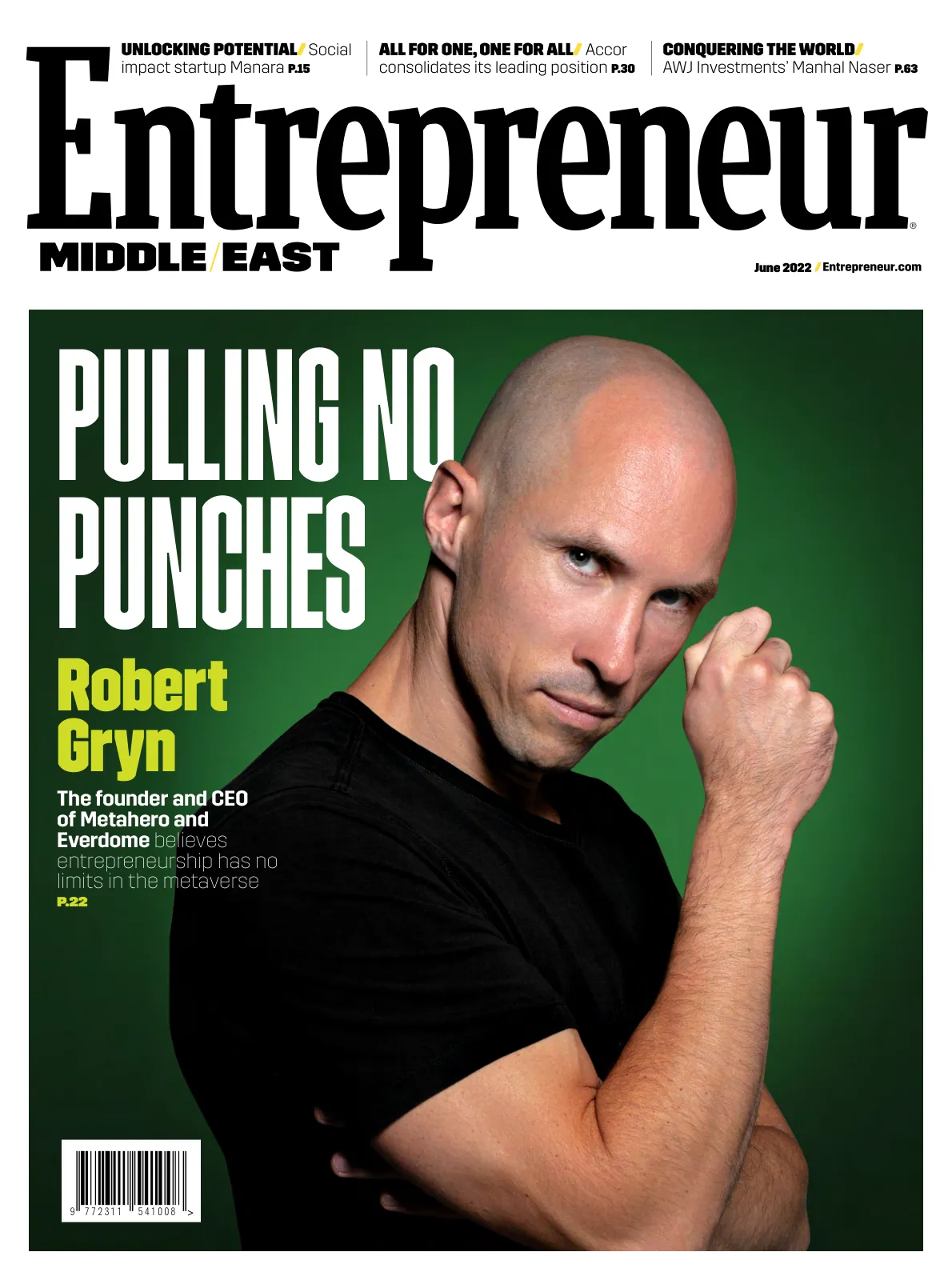
Entrepreneur Middle East, June 2022
Page 1
9
7 7 2 3 1 1
5 4 1 0 0 8
>
PULLING NO
PUNCHES
Robert
Gryn
June 2022
CONQUERING THE WORLD/
AWJ Investments’ Manhal Naser P.63
UNLOCKING POTENTIAL/ Social
impact startup Manara P.15
ALL FOR ONE, ONE FOR ALL/ Accor
consolidates its leading position P.30
The founder and CEO
of Metahero and
Everdome believes
entrepreneurship has no
limits in the metaverse
P.22
Page 2
Page 3
Page 4
Page 5
Page 6
6 / ENTREPRENEUR.COM / June 2022
Contents/June 2022
P.22
Pulling No
Punches
Robert Gryn, founder and CEO
of Metahero and Everdome,
on why entrepreneurship has
no limits in the metaverse.
by TAMARA PUPIC
P.30
All For One,
One For All
Patrick Mendes, Global Chief
Commercial Officer, Yigit
Sezgin, Chief Commercial
Officer, and Markus Keller,
Chief Sales and Distribution
Officer, explain how Accor
has consolidated its leading
position in the hospitality
industry.
by TAMARA PUPIC
P.15
Unlocking
Potential
Social impact startup Manara
bridges the gap between top
tech talent from the MENA
region and their dream jobs.
by PAMELLA DE LEON
FEATURES
IMAGE COURTESY METAHERO
← ROBERT GRYN is the founder of
blockchain-based metaverse projects
Metahero and Everdome.
Page 7
Homes from
AED587,000
*
*T&C apply
Boulevard living in harmony with nature
Invest in upscale 1, 2 and 3 bedroom apartments featuring direct access to green parks
with sports facilities and a busy boulevard with retail and dining experiences. Enjoy exclusive
access to a residents’ only gym and swimming pool, and benefit from smart home features
and premium white goods included as standard with every home.
Page 8
8 / ENTREPRENEUR.COM / June 2022
EDITOR IN CHIEF Aby Sam Thomas
aby@bncpublishing.net
CEO Wissam Younane
wissam@bncpublishing.net
DIRECTOR Rabih Najm
rabih@bncpublishing.net
CREATIVE LEAD Odette Kahwagi
design@bncpublishing.net
MANAGING EDITOR Tamara Pupic
tamara@bncpublishing.net
STARTUPS SECTION EDITOR Pamella de Leon
pamella@bncpublishing.net
FEATURES WRITER Aalia Mehreen Ahmed
aalia@bncpublishing.net
DIGITAL SOLUTIONS DIRECTOR
Mahdi Hashemi mahdi@bncpublishing.net
HEAD OF INNOVATION
Sarah Saddouk sarah@bncpublishing.net
GROUP SALES DIRECTOR – B2B GROUP
Joaquim D’Costa jo@bncpublishing.net
COLUMNIST Tamara Clarke
CONTRIBUTING WRITERS
Abbas Berdi, Fida Chaaban,
Khashayar Mahdavi
Deepa Mann-Kler, Yasmine Abdel Karim
H.E. Omar Sultan Al Olama,
Deva Senevirathne
SUBSCRIBE
Contact subscriptions@bncpublishing.net to receive
Entrepreneur Middle East every issue
COMMERCIAL ENQUIRIES
sales@bncpublishing.net
ENTREPRENEUR.COM
Access fresh content daily on our website
All Rights Reserved 2022. Opinions expressed are solely those of the contributors.
Entrepreneur Middle East and all subsidiary publications in the MENA region are
officially licensed exclusively to BNC Publishing in the MENA region by Entrepreneur
Media Inc. No part of this magazine may be reproduced or transmitted in any
form or by any means without written permission of the publisher. Images used in
Entrepreneur Middle East are credited when necessary. Attributed use of copyrighted
images with permission. All images not credited otherwise Shutterstock. Printed by
United Printing and Publishing.
PO BOX 502511 DUBAI, UAE
P +971 4 4200 506
Contents
June 2022
51 In It to Win It
ABBAS BERDI looks at the four areas
entrepreneurs need to address
to ensure the success of their
startups.
54 Growth Hacks
Deel’s CASEY BAILEY shares the
lessons her company have learnt
scaling a distributed workforce
globally and remotely.
28 Delivering On a Promise
Investment Holding Group CEO
HENRIK CHRISTIANSEN on how his
enterprise is supporting Qatar
realize its global ambitions.
55 When Women Win
The Middle East is becoming a
frontrunner in terms of showcasing
female success across
entrepreneurship and tech.
‘TREPONOMICS
78 A Launchpad for Success
H.E. OMAR SULTAN AL OLAMA reflects on
how the UAE is putting in the work
to become one of the best hubs for
fintech startups in the world.
63 Born in the UAE,
Conquering the World
With the launch of his flagship
restaurant Operation:Falafel’s first
international branch in New York,
AWJ Investments’ Manhal Nasser
gets candid on what business
growth, leadership, and Middle
Eastern cuisine mean to him.
BY AALIA MEHREEN AHMED
66 Smart Tech
Saleh Safran is using the internet
of things to power his Qatar-based
startup, Subol. BY PAMELLA DE LEON
80 Road to Growth
Yalla Fel Sekka co-founders Yasmine
Abdel Karim and Khashayar Mahdavi
explainexplains how a MENA last-
mile delivery company drove success
in a country with no postal codes.
STARTUP
SPOTLIGHT
EntMagazineME
Entrepreneur-me
↑ SOCIAL IMPACT STARTUP
MANARA bridges the gap between
top tech talent from the MENA
region and their dream jobs P.15
Page 9
Page 10
Applications are now open for the Be Bold 2022 program, a unique collaborative initiative
that aims to empower a network of health innovators from both the public and private sectors
to design new health programs focused on the well-being of the UAE’s citizens and residents.
Get Involved in the UAE’s First
Public-Private Health Initiative
Page 11
APPLY NOW
*Limited Availability
REIMAGINE HEALTHCARE
SYSTEMS AS PER THE UAE’S
FORWARD-THINKING STRATEGIES
BECOME AN ACTIVE AGENT
OF CHANGE IN THE GLOBAL
HEALTHCARE SECTOR
BE PART OF AN EXCLUSIVE
NETWORK OF INNOVATORS IN
THE HEALTHCARE SPACE
IMPACT
In collaboration with
Page 12
12 / ENTREPRENEUR.COM / June 2022
Editor’s Note/
Editor’s Note/
T
he other day, a friend of mine who recently quit his
job (with plans to take time off from work) was
telling me about the onslaught of negative feedback
he got from most of his peers when they heard of
his decision. “They said my career would be
irrevocably hurt if I were to ‘do nothing’ for a few
months,” he told me. He explained that he had
quite enough financially out aside, but still “they couldn’t
foresee anything but doomsday scenarios in my future.”
Hearing the reaction my friend got for the break he
wanted to take from his career stirred up a memory in
me- I had experienced something similar about 10 years
ago when I decided to exit my then career in software
development and embark on one in journalism instead.
At the time, pretty much everyone around me told me
that I was making an extremely wrong decision for my life
and my future. I was told that not only would the move
into a new field not work out, it would also lay to waste all
of the work I had done to climb up the career ladder to
reach my then role as an analyst programmer.
I’m pretty sure that many of you entrepreneurs will have
similar tales to share from when you told people around
you about your decision to start a business of your own-
there’s often a bevy of apparently well-meaning
individuals around wannabe startup founders telling
them to disregard their ambitions and focus on “normal”
jobs instead. In fact, I’d venture to say that entrepreneurs
in the MENA region are especially susceptible to such
remarks, given all of the norms that are characteristic of
cultures and societies here. One wonders how many
among us have had to see their dreams get dashed before
they even make an attempt to realize them.
So, why is it that most of us are so inclined to disparage
the decisions made by our compatriots, whether it be to
follow through on pursuits that they are passionate about,
or even just to take a break from work? Sure, the
argument could be made that such comments are made
with the aim to prevent people from making choices that
have the possibility of jeopardizing their lives and careers,
but what about the alternative- i.e. what if your
(unsolicited) opinions are what’s blocking them from
going down routes that could see them become the most
successful, most purposeful, or simply the happiest and
healthiest versions of themselves?
The fact remains that none of us can predict the future,
and that alone should make us think twice before putting
a roadblock on someone else’s pursuits. I can personally
testify to the fact that while journalism ended up being an
incredibly grueling industry to work in, 10+ years later, I
remain steadfast in my belief that it was the absolute best
decision I made for myself. That’s why I cheered my
friend along as he took what I consider to be a well-
deserved break from his job- I like to think that
supporting him in his decisions on how he wants to go
about life and work is a much more fruitful activity than
simply dissing him and his choices.
And I’d imagine that’s what anyone setting out on an
entrepreneurial endeavor would appreciate as well.
Changes in life and career trajectories can sometimes
sound alarming, but you don’t need to be the one to ring
the bell.
Aby Sam Thomas
Editor in Chief
@thisisaby
aby@bncpublishing.net
CHEERLEADERS > DOOMSAYERS
It doesn’t sound realistic to you, but that doesn’t mean it’s wrong
Page 13
Page 14
Page 15
15
June 2022 / ENTREPRENEUR.COM /
Unlocking Potential
Social impact startup Manara bridges the gap between top tech talent from
the MENA region and their dream jobs by PAMELLA DE LEON
← MANARA CO-FOUNDERS
Iliana Montauk and Laila Abudahi
IMAGES COURTESY MANARA
Page 16
16 / ENTREPRENEUR.COM / June 2022
With a mission to unlock human potential, particularly for
female talent in the MENA, the startup’s vision is to
diversify the global tech sector while also elevating the
economies of the region. Headquartered in Silicon Valley,
California, the remote-first global startup is founded by
Iliana Montauk and Laila Abudahi, who met at Gaza Sky
Geeks (GSG), the first and only tech hub and startup
accelerator in Gaza, Palestine that is run by Mercy Corps
and funded by Google. Montauk had co-founded and
directed GSG, wherein she led a crowdfunding campaign
on Indiegogo to raise US$250,000 as well as help increase
the participation of women in talent pipeline activities
from 25% to 49%. On the other hand, Abudahi, born and
raised in Gaza, hacked her way from Palestine into
becoming a software engineer at top tech companies
including computer hardware manufacturer Nvidia in
Silicon Valley. Montauk and Abudahi ended up becoming
friends in the US, and the duo’s insightful brainstorming
sessions ultimately led to the creation of Manara.
Having witnessed firsthand the strong pool of tech talent
in Palestine as well as across the MENA region, the
co-founders were keen to realize meaningful social impact
by giving them the opportunity to build and develop their
careers, with a specific focus on women in the field. “The
Middle East has the world’s youngest population, and it
has made large investments in education since the Arab
Spring,” Montauk explains. “The number of college grads
is doubling every five years. There’s a real interest in
science, technology, engineering, and mathematics
(STEM).. In Palestine, for example, the number of high
school students applying to the Code for Palestine
program increased 22x between 2015 and 2022… This
region also has a strong pool of female computer scien
tists. An estimated 52% of computer science graduates in
Palestine are women, 62% in Tunisia. [Meanwhile], 83%
women computer science graduates in Palestine are
unemployed, and numbers are similar in other countries.”
B/The Big Idea
THIS REGION HAS A
STRONG POOL OF FEMALE
COMPUTER SCIENTISTS.”
A
ccording to a 2020 report from McKinsey & Company, businesses in
the top quartile for gender diversity are 15% more likely to
outperform their peers, and businesses in the top quartile for ethnic
diversity are 35% more likely to outperform their peers. While such
reports indicate the benefits of an inclusive workforce, today’s
global businesses still struggle with the common conundrum of
finding and hiring diverse talent. This is where Manara comes in- a
social impact edtech startup that runs cohort-based training
programs for computer science students and software engineers,
and connects them to full-time remote and onsite jobs with top
global tech companies such as Meta, Google, Amazon, Repl.it,
Zalando, and many others. Bringing together a community of
worldwide tech professionals and alumni, the platform provides career guidance,
training, interview preparation, referrals, and job placement support.
↑ A Manara event in Palestine
Page 17
17
June 2022 / ENTREPRENEUR.COM /
But while this may be the
scene in the MENA region,
Montauk points out that
Europe’s growing tech sector
is, at the same time, seeking
out new ways to access
talent- remote or onsite.
According to Montauk and
Abudahi, Manara thus
presents a distinct offering
to bridge the gap between all
these companies and talent
available in the MENA. “It’s
difficult for companies to
find talent in a region they
are unfamiliar with,”
explains Montauk. “Even if
they make the effort, most of
the talent pool simply aren’t
ready to work at these
companies. We’re therefore
making a sustained, long,
and deep investment in
building a tech training
platform and community
that has a flywheel effect. We
have expertise on various
dynamics in the region
(especially those that impact
women, and that may be
hard to understand for
people who aren’t from
here), and we leverage that
expertise to achieve the
success we’ve demonstrated.”
With its first beta pilot
cohort taking place in
September 2018, and then a
second cohort in February
2020, the startup officially
launched in November
2020. Today, Manara’s
participants get access to
guidance on technical skills,
mentorship, career guidance,
mock interviews, career
planning guidance, salary
negotiation, soft skills, and
support finding jobs. As a
social impact business,
Manara monetizes from both
of its channels- when the
talent finds a job, they pay
back a percentage from their
salary for their tuition,
whereas companies pay a
recruiting fee when they hire
from the startup. Its real
effectiveness is in its
successful statistics- in just
the past two months, Meta,
Google, and Amazon have
made offers to 20 Manara
alumni, and in total, the
Manara team have secured
80 roles for computer
scientists and software
engineers in tech companies
in Europe, North America,
and the UAE. }}
→ ILIANA MONTAUK is the co-founder and
CEO of Manara, and the former Director of
Gaza Sky Geeks (GSG), the first startup
accelerator in Gaza, run by Mercy Corps
and launched in collaboration with Google.
Before arriving to Gaza, Iliana helped launch
Wamda’s Research Lab.
USUALLY PEOPLE EARN AROUND $10-20,000 PER YEAR WHEN
THEY JOIN MANARA. ON AVERAGE, THEY ARE INCREASING THEIR
SALARIES 300% IN AROUND EIGHT MONTHS; SOME HAVE EVEN
GOTTEN SALARIES ABOVE $100,000.
Page 18
18 / ENTREPRENEUR.COM / June 2022
B/The Big Idea
For instance, e-commerce
platform Noon.com recently
hired six engineers from
Palestine through Manara,
allowing them to work in a
hybrid model by alternating
some months in Dubai and
others in Palestine. Besides
Noon, Careem and other
UAE-based startups have
also made use of Manara’s
talent pool. Having had just
17 participants in 2020,
Manara’s cohort grew to 200
participants in 2021 (the
same year when the company
was accepted into the highly
sought-after accelerator
program run by Silicon
Valley-based Y Combinator),
and it had the same number
of participants in 2022. Its
latest cohort has also
expanded to include people
from Iraq, Morocco, Tunisia,
Lebanon, Algeria, Jordan,
Iraq, and Egypt. When asked
about the impact the
program has on these
professionals, Montauk
points out the changes in
their salaries: “Usually people
earn around $10-20,000 per
year when they join Manara.
On average, they are
increasing their salaries
300% in around eight
months; some have even
gotten salaries above
$100,000.”
The company has managed
to secure an impressive list of
backers too- in May this year,
Manara secured $3 million
in a pre-seed funding round
led by global payments
platform Stripe, with
participation from LinkedIn
founder Reid Hoffman, Y
Combinator founder Paul
Graham, Lean Startup
founder Eric Ries, as well as
Careem co-founder and CEO
Mudassir Sheikha. Prior to
this investment round, the
Manara team had been
bootstrapping, having only
received funds from Y
Combinator in January 2021.
However, today, Manara’s
other investors include
→ LAILA ABUDAHI is the co-founder and CTO of
Manara. The social impact startup’s mission is
to unlock human potential and diversify the
global tech sector, while uplifting the
economies of the MENA region, with a focus on
women in Palestine.
MANARA IDENTIFIES THE TOP COMPUTER
SCIENTISTS IN THE REGION, teaches them how
to pass interviews, vet them, and help them
succeed by finding remote or onsite jobs.
WITH A MISSION TO UNLOCK HUMAN POTENTIAL,
PARTICULARLY FOR FEMALE TALENT IN THE MENA, THE
STARTUP’S VISION IS TO DIVERSIFY THE GLOBAL TECH SECTOR
WHILE ALSO ELEVATING THE ECONOMIES OF THE REGION.
Page 19
19
June 2022 / ENTREPRENEUR.COM /
THE CANDIDATES WERE TALENTED AND HIGHLY QUALIFIED,
BUT DID NOT BELIEVE IN THEMSELVES, ESPECIALLY WOMEN
WHO WERE NOT CONFIDENT ENOUGH TO EVEN APPLY.
European venture capital
fund Seedcamp, US-based
early-stage venture firm
Precursor Ventures, Y
Combinator Founding
Partner Jessica Livingston,
and Andela co-founder and
President Christine Sass.
Having said that, the
Manara team have had their
fair share of hurdles in
getting the company off the
ground- Montauk points
out that one of the biggest
challenges they faced early
on was changing the
mindset of talented young
people from the region,
especially from Gaza. “The
candidates were talented
and highly qualified, but did
not believe in themselves,
especially women who were
not confident enough to
even apply,” she recalls.
What turned this situation
around was letting such
talent see for themselves the
success stories of people
from their communities, as
well as getting them to meet
with people working at top
tech companies. “As soon as
they started meeting people
from companies like Google
through mentorship and
mock interviews we
arranged, they told us, ‘I
thought I’d have to be an
extraordinary genius to
work at Google, but that
mentor was just a smart
and normal person like
me!’” Montauk says. “That’s
when we realized the power
of engaging employees from
the global tech sector. We’ve
built a global community of
engineers who jump in at
just the right moments in a
participant’s journey to
offer an hour of mentorship.
Nailing this approach
makes it possible to
overcome the imposter
syndrome.”
Talking about the future,
the duo states, “We found
something that works- now,
we are trying to reach more
people.” Besides having an
eye on expanding the team,
the co-founders are keen to
grow Manara’s cohort sizes
and deliver quality solutions
at scale, i.e. “to go from 60
engineers per year, to 6,000
engineers per year.” In
addition, they also plan to
launch a self-service
product for interview
practice, networking, and
mentorship that will,
hopefully, reach more
software engineers. “There’s
a high demand in the strong
growing tech sector
providing world-class jobs
that engineers aren’t able to
get on their own, and that
simultaneously, these
companies aren’t able to
fulfil with the right
engineers,” Montauk
concludes. “This is where
Manara comes in.”
TREP
TALK
Tips for entrepreneurs
from Manara
co-founder and CEO
Iliana Montauk
} CELEBRATE EVERY
MILESTONE “Many times we
set goals, and by the time we
actually achieve them, they
don’t feel big enough
anymore, and we miss out on
all the celebrations. Always
celebrate every milestone,
both alone and as a team.”
} ENTREPRENEURSHIP IS
TOUGH “It will always be
harder than you think it is
going to be. We tend to focus
our energy on the challenges,
but instead, we should make
time to dream about what is
possible.”
} BUILD A DIVERSE TEAM
“Build a team with people
from the region who
understand the region, and
also, build a team with people
who have been outside the
region and have come back to
bring new ideas to the table.”
↓ A MANARA EVENT IN PALESTINE.
The startup investors include Stripe,
Y Combinator, Seedcamp, Reid
Hoffman, Paul Graham, and Jessica
Livingston.
Page 20
come as
you are.
Page 21
@ / # 25hourshotels
#hellodubai
we are now open!
25% off,
book via
enjoy
25hours-hotels.com
Overlooking the museum of the future, near dubai international
financial centre, 25hours hotel one central boasts 434 rooms
and suites in addition to flexible events and co-working spaces.
A total of four characterful restaurants and bars take guests on
a culinary trip around the world from northern india to the beer
gardens of bavaria: this is where urban nomads meet desert
flowers, where local heroes meet the well-traveled. Alongside
rental of mini cars and schindelhauer bikes the hotel will also
feature the extra hour spa, rooftop pool and dubai's first
mixed-gender rooftop sauna.
434 rooms | co-working spaces | monkey bar | tandoor tina
ernst | nomad dar bar | rooftop pool & sauna | spa | gym
Page 22
→ ROBERT GRYN is the youngest self-made
entrepreneur to make the Forbes 100 Richest list in
Poland. He is the former CEO of Codewise, the second
fastest growing company in Europe. In 2021, Gryn
founded blockchain-based metaverse project
Metahero, and in 2022, he launched Everdome, the
digital frontier's first hyper-realistic metaverse.
22 / ENTREPRENEUR.COM / June 2022NO PUNCHES
PULLING
IMAGES COURTESY METAHERO | EVERDOME
Page 23
Robert
Gryn,
founder and CEO of
Metahero and Everdome,
believes entrepreneurship
has no limits in the
metaverse by TAMARA PUPIC
23
June 2022 / ENTREPRENEUR.COM /
Page 24
24 / ENTREPRENEUR.COM / June 2022
IMAGES COURTESY METAHERO | EVERDOME
Page 25
25
June 2022 / ENTREPRENEUR.COM /
← After selling Codewise, Robert Gryn shifted
his focus on to the CRYPTOCURRENCY
ECOSYSTEM, aiming to help accelerate the
mass adoption of digital currencies. Like many,
Gryn believes that blockchain will make the
world a better and more equitable place.R
obert Gryn, founder and CEO of the
blockchain-based metaverse projects
Metahero and Everdome, gives quite a
narrow definition of his current field of
work, describing it as “the bleeding edge
of tech.” He adds, “We’re innovating
solutions to problems that probably
didn’t exist one year, one month, maybe
even one hour ago.”
As a key component of Web3 (the latest
iteration of the world wide web), the
metaverse can be described as a network
of a virtual reality spaces in which people
can interact with computer-generated
personas, objects, and
environments, and it is
expected to change how
people, businesses, and
society as a whole not only
communicate and cooper
ate, but also co-exist.
Studies predict the
exponential future growth
of the global metaverse
industry -from US$47.69
billion in 2020 to $829 billion in 2028,
according to Emergen Research. And
Gryn’s Metahero is well placed to grab a
big share of that growth, since its ultra-HD
photogrammetric scanning technology
allows people to replicate real-world
objects in photo-realistic 3D, ultimately
creating a hyper-realistic metaverse 3.0
experience. Indeed, Metahero has part
nered with the Polish ultra-realistic 3D
technology provider Wolf Digital World
(WDW) to capture every detail of the physical world and
port it into the digital world. “Our 3D avatars and
virtual objects, such as NFTs, can be used across a vast
range of platforms from medical and art to social media,
fashion, and, of course, gaming,” Gryn explains.
The Metahero offering thus serves as a gateway to the
metaverse for industries looking to generate high-quali
ty 3D avatars; however, Gryn has taken it a step further
by creating his own metaverse. His second project,
Everdome, is a hyper-realistic metaverse composed of
12,000 plots of metaverse land that is created solely by
Metahero’s tech. “Everdome is a free-to-play game that
will take users on an immersive journey from Hatta,
here in the UAE, to reach Mars,” Gryn explains. “We’re
launching it in three phases, the first of which will be the
pre-launch at the launch site in Hatta, while phases 2
and 3 will give people the chance to experience life and
the mission aboard the Everdome vessel, eventually
landing and settling on Mars.” Throughout June and
July 2022, interested investors will be able to purchase
a plot of land in Everdome that is expected to give them
an opportunity to generate revenue, or even resell in the
future. Both projects have their own tokens. Metahero’s
HERO is built on the Binance Smart Chain and can be
used for transactions within the Metahero ecosystem or
to pay for 3D scans, while Everdome’s native utility
token is DOME, which can be used for buying land in
its metaverse.
According to Gryn, both Metahero and Everdome are
enterprises that were launched to fill specific gaps in the
market. “Metahero was to provide the
quality and kind of graphics needed for the
growing metaverse,” Gryn explains. “And
Everdome was to provide the style of
gameplay that will create an amazing
environment for users to explore, but also
a lucrative ecosystem for businesses to
invest and thrive in.” As someone who has
been following the crypto sector for more
than a decade, Gryn says he was keeping
an eye out to make an educated invest
ment in the domain when the right time
came, and for him, that was when he
launched Metahero and Everdome. “These
two companies run seamlessly hand-in-
hand, representing the future of society as
we know it by blending non-fungible token
(NFT) creation, 3D scanning, crypto, and
the metaverse together,” Gryn says. At the
moment, he is focused on Everdome as its
Phase 1 will be launched in 2022, while
Phases 2 and 3 will follow shortly. “We’re
expanding our network of partners to enrich the
Everdome experience,” Gryn says, adding that the
current list of collaborators include Alfa Romeo F1
Team Orlen, FAME, Pierre Gasly, BitBoy, Reach Global
Media, Nick de Vries, OKX, MoVlogs, and Tenset- all of
whom have invested in plots of land in Everdome.
“Another thing planned for the coming year is to
continue land sales,” Gryn says. “We’ve had a phenom
enal response to the plots of land released so far, as each
hexagonal plot of land can be developed however the
owner wishes. It’s very much like investing in land in
the real world, only without any of the limitations you
could potentially face. In the metaverse, the only
limitations are the ones we impose, so things like access
to materials, or even gravity itself, don’t have to be taken
into consideration.” }}
“I WANTED TO
REFOCUS ON
AN AREA THAT
SPARKED MY
PASSION, AND
THAT MEANT
LEAVING BEHIND
CODEWISE.”
Page 26
26 / ENTREPRENEUR.COM / June 2022
B
oth Metahero and Everdome are Dubai-regis
tered companies, and Gryn explains that the
Emirate’s reputation as a forward-thinking and
technology-loving city influenced his decision to start
his new, innovation-hungry pursuit here. However, I’ll
make a quick pause here to explain that prior to
entering crypto, moving to Dubai, and launching
Metahero and Everdome, Gryn had already made
inroads into entrepreneurship. In fact, Gryn is an
embodiment of the fortunes that were available to the
quick movers in the affiliate marketing sector, which, in
his case, propelled him onto the covers of magazines
and lists of the wealthiest people in Poland. All of this
was thanks to Gryn owning and running Codewise, a
provider of artificial intelligence-powered online ad
measurement and management solutions for digital
marketers, which also functioned as an umbrella
company that included Zeropark, a advertising platform
for online media-buyers, and Voluuma, a full-stack
tracking software-as-a-solution (SaaS) for performance
marketers as well as other solutions. “Driving Codewise
over the years was tough- we were immensely success
ful, but I didn’t feel able to cope with the scale and the
stress that came with it,” Gryn recalls. “When mental
and physical health are affected because of work, you’ve
got to learn to draw the line- something that every
entrepreneur needs to recognize. When work begins to
take a toll on your personal life, when you don’t have
either love or passion for what you’re doing, or when
your priorities begin to shift, then it’s time to reevalu
ate.”
G
ryn’s burnout moment coincided with his
growing interest in the metaverse, which, for
him, was an indication that his priorities had
changed, and that it was time for a new chapter in his
entrepreneurial career. “I wanted to refocus on an area
that sparked my passion, and that meant leaving behind
Codewise,” Gryn says. “It wasn’t an easy decision by any
means, but it was the right one. I’d achieved what I set
out to do, and now could turn my attention to a new
sector- which led me to launch Metahero and Ever
dome.” This is also what brought him to Dubai, and at
the most opportune time for launching a Web3
company in the country. The metaverse activity in the
UAE has been growing rapidly- from the announcement
of the UAE’s first Dubai Virtual Asset Regulation Law in
March, to Dubai’s Virtual Assets Regulatory Authority
establishing its metaverse headquarters in May on the
Ethereum blockchain-based Sandbox platform, as well
as Dubai Crown Prince HRH Sheikh Hamdan bin
Mohammed bin Rashid Al Maktoum initiating the
Dubai Metaverse Strategy that will seek to make Dubai
a “key city in the metaverse,” and to “increase the
contribution of the metaverse sector to its economy to
$4 billion by 2030, and increase its contribution to
Dubai’s gross domestic product (GDP) to 1%.”
In addition to all of this, Gryn adds that another key
advantage of running a Web3 company in Dubai is its
potential to attract talent interested in new technologies
to the Emirate . “There is a global shortage of talent,
predominantly because Web3 technologies are still
relatively new, and the educational platforms required
to raise qualified talents haven’t quite caught up yet,” }}
↑ METAHERO AIMS TO CHANGE THE WORLD through
financial, technical, and perceptive endeavors, ultimately
populating the next frontier. Metahero and its HERO token
aim to drive the mass adoption of crypto by leveraging
WDW's state-of-the-art 3D capabilities.
→ Through the use of ultra-HD
photogrammetric scanning technology,
METAHERO PARTNERED WITH WOLF
DIGITAL WORLD (WDW) to onboard the
next 10 million new users of
cryptocurrency.
IMAGES COURTESY METAHERO | EVERDOME
WE’RE INNOVATING
SOLUTIONS TO
PROBLEMS
THAT PROBABLY
DIDN’T EXIST ONE
YEAR, ONE MONTH,
MAYBE EVEN
ONE HOUR AGO.”
Page 27
27
June 2022 / ENTREPRENEUR.COM /
Page 28
28 / ENTREPRENEUR.COM / June 2022
Gryn says. “Because the sector’s growing massively, there
are lots of jobs available -which also feeds into the
shortage- but it’s an exciting field with plenty of
opportunity for growth, development, and to play a part
in the future of online communities, and so, I have no
doubt that we’ll see a strong influx of qualified men and
women in the next couple of years.” Now, we’re having
this chat at a time when the crypto market is in its
bearish mode, to say the least, but Gryn has a compel
ling argument about why he believes that it will bounce
back stronger than ever before. “What we’re seeing as a
result of the crash is that global regulators are starting
to implement new guidelines, which means the sector is
maturing and growing in all of the right ways,” he
explains. The UAE especially has already proven its
keenness to innovate and lead the way in new technolo
gies, and Gryn believes that the country is now well-
positioned to benefit from the upward curve crypto will
be seeing in the future.
M
eanwhile, with Metahero and Everdome,
Gryn plans to create a premium metaverse
experience that “will become a virtual home
away from home.” Part of building this ecosystem is to
drive mass adoption which is, in fact, uniquely feasible
in the UAE, he adds. “Audiences in the GCC in particu
lar are keen to adopt latest technologies, and the fact
that many parts of the region have access to fast
broadband is going to really help with metaverse
adoption,” Gryn concludes. “As a society, we’re already
used to turning to online solutions for everything from
ordering our groceries to even buying a car, and the
metaverse is only the next step in that.”
PHOTOGRAPHY FAROOQ SALIK
}DO YOUR RESEARCH
“Understand whichever aspect of Web3
you intend to focus on before taking the
plunge. The same goes for any
entrepreneurial venture- you’re going to be
more successful if you go in well prepared,
instead of jumping in blindly. You don’t
have to be an expert, but it helps to have
one that you can rely on to guide you.”
}WEB3 ISN’T JUST A
TECHNOLOGY TRANSITION,
BUT A CULTURAL ONE TOO
“There’s a major shift in the way that
society interacts with technology, which is
moving people more towards the Web3
world. That said though, the concept of
Web3 is still confusing to many people,
just as the arrival of the internet was about
two decades ago. Chances are you’ll need
to educate while you innovate.”
}BE RESOURCEFUL
“Entrepreneurship, in any field, requires
this one critical talent: the ability to
innovate. Web3 in particular is still
evolving. It’s a work in progress. There will
be times when you find that you don’t
have all of the elements you need to do
whatever you’re planning to do, which
may mean you need to create them
yourself, or wait until someone else
creates them for you- which means you’ve
also got to be patient.”
}CONSIDER THE CHANGING REGULATORY
ENVIRONMENT
“Because Web3 is so new, there aren’t
many regulations in place yet- which
means that regulations are likely to be
implemented and/or change as the need
arises. Take a look at what’s happening in
the crypto sector right now, for example;
in light of the recent crash, several
governments have started to introduce
regulatory measures that didn’t exist
before.”
}BE AGILE
“You’re working in a fast-paced, rapidly
evolving world, and if you can’t keep up,
you’ll be left behind. As an entrepreneur,
you have the advantage of being able to
build a company that is flexible and
nimble, which can change with the times.
This is an incredible advantage that you
should hold onto, no matter how large
your business grows.”
Robert Gryn’s tips for entrepreneurs
wanting to tap into the potential
presented by Web3
↑ Through its
revolutionary
technology, EVERDOME
AIMS TO CREATE A
HIGHLY REALISTIC
METAVERSE that brings
brands and people
together with the intent
of building the highest
quality Web3
experience.
TREP TALK
TREP TALK
‘
Page 29
29
June 2022 / ENTREPRENEUR.COM /
IMAGES COURTESY METAHERO | EVERDOME
“WHEN WORK
BEGINS TO TAKE A TOLL
ON YOUR PERSONAL
LIFE [... AND] YOUR
PRIORITIES BEGIN TO
SHIFT, THEN IT’S TIME
TO REEVALUATE.”
Page 30
30 / ENTREPRENEUR.COM / June 2022
↓ THE ACCOR GROUP TEAM
(Right to left)
Patrick Mendes, Global Chief
Commercial Officer, Yigit Sezgin,
Chief Commercial Officer, and
Markus Keller, Chief Sales and
Distribution Officer
30 / ENTREPRENEUR.COM / June 2022
Page 31
31
June 2022 / ENTREPRENEUR.COM /
ALL FOR
ONE,
ONE
FOR ALL
Patrick Mendes,
Global Chief Commercial
Officer, Yigit Sezgin,
Chief Commercial Officer,
and Markus Keller,
Chief Sales and Distribution
Officer, explain how Accor
has consolidated its leading
position in the hospitality
industry by TAMARA PUPIC
IMAGES COURTESY ACCOR GROUP
31
June 2022 / ENTREPRENEUR.COM /
Page 32
32 / ENTREPRENEUR.COM / June 2022
P
atrick Mendes,
Global Chief
Commercial Officer
at Accor, Europe’s largest
hospitality company and the
sixth largest worldwide,
assures me that even at the
peak of the COVID-19
pandemic, when hotel
occupancy rates had
plummeted and diners had
stopped visiting restaurants,
he and his team were certain
that their industry would
bounce back. “Our Chairman
and CEO, Sébastien Bazin
often says, ‘Hospitality is a
blessed industry,’” Mendes
explains. “And today, our
strong recovery is fueled by
the widespread desire from
people to find new experi
ences and take advantage of
freedoms after more than
two years living with restrict
ed travel opportunities.”
In 2021, the revenue of the
Accor Group was already up
34% when compared to
2020, and today, the
hospitality giant expects
2022 to be “Accor’s year”
across its 40+ brands
presented through 5,300
hotels in 110 countries, and
run by their 230,000-strong
hospitality team. However, I
suspect that there is more to
Accor’s success post-COV
ID-19 than just people’s
renewed desire to travel, and
Mendes reveals that his
enterprise’s appeal lies in its
continuous commitment to
innovation and anticipating
new trends. “The hospitality
industry is undergoing a
period of significant change
in which many new trends
are emerging globally, and in
particular, digitalization is
profoundly altering how
← IN OCTOBER 2020, PATRICK
MENDES TOOK OVER A GLOBAL
RESPONSIBILITY AT ACCOR
as Group Chief Commercial Officer
in charge of Sales, marketing,
distribution, digital, and loyalty.
Page 33
33
June 2022 / ENTREPRENEUR.COM /
people work, play, shop, and
communicate,” Mendes says.
“As a part of this, our guests
are progressively adopting
digital habits and technolo
gies.” And that is why, in
order to provide a frictionless
and personalized digital
experience to its guests, that
Accor launched The Digital
Factory in May 2021, which
has been mandated to create
a powerful digital ecosystem
to support the group’s wider
business and tech develop
ment goals. “We want to
attract new customers,
surprise them, and foster
engagement and loyalty by
offering a more seamless and
convenient experience and
design, access to additional
services and experiences,
personalization, and
opportunities for engage
ment,” Mendes says. “With
the Digital Factory, there are
more than 600 talents who
create the best digital
experience through our
products and services for
guests who stay in our hotels,
our owners, and the staff.”
}Another post-COVID-19
trend that Accor has
embraced is a shift to remote
working practices, which has
gone beyond just existing due
to the circumstances as well
as the digital marketing tools
that enabled it, and further
accelerated longer-term
transformations in the way
people work. “Workers want
to experience the office in a
different way, with wellness
at the center of their
workday, and by valuing the
factors of quality F&B,
reliable Wi-Fi, access to
fitness center, and ease of
commute,” Mendes explains.
“The concept of ‘Workspital
ity’ (work and hospitality)
enables us to adapt to the
transformation of the way we
work.” This would thus
explain Accor’s co-working
concept, WOJO, which offers
flexible workspaces in its
hotels- it currently counts
more than 300 WOJO spots
in 70 French cities, more
than 50 hotels in Brazil and
Northern Europe, as well as
new projects in South
America. Enabling experi
ences is the third trend that
Mendes wants his team to
remain focused on, especially
with ALL, i.e. Accor Live
Limitless, a daily lifestyle
companion that fully
integrates and delivers a wide
variety of rewards, services,
and experiences to Accor’s
clients. “We have a holistic
ecosystem of hospitality
services beyond the stay,
transforming our hotels into
real places to live and
connect to local culture,
proposing more local,
authentic and rooted
experiences,” Mendes
explains. “We welcome
customers, travelers, and
locals, to ‘live, play, work,’
and provide elevated
experiences to our guests,
enriching our promise and
generating engagement. }}
“WE HAVE A HOLISTIC ECOSYSTEM
OF HOSPITALITY SERVICES
BEYOND THE STAY, TRANSFORMING
OUR HOTELS INTO REAL PLACES
TO LIVE AND CONNECT TO LOCAL
CULTURE.”
← RAFFLES SEYCHELLES is a
five-star hotel in the heart of
Praslin, Seychelles, offering
accommodation in the form of villas
with private pools.
THROUGH ALL, OUR POWERFUL DIGITAL DISTRIBUTION
AND TRANSACTION PLATFORM, WE BRING SIMPLICITY
AND ENHANCE PERSONALIZATION.
Page 34
34 / ENTREPRENEUR.COM / June 2022
Through ALL, our powerful
digital distribution and
transaction platform, we bring
simplicity and enhance
personalization.” Sustainabil
ity also factors highly as a
focus for Accor’s current
activities around the world.
“Sustainability is a major focus
for all players in the tourism
industry, and that is why
Accor has initiated a process
of major transformation,
including partnering with
entities like UNESCO and
Expedia, to promote local
communities and economy,
while taking tangible action to
protect the environment,”
Mendes says. “Accor was also
the first global hotel group to
join global corporate lodging
platform HRS’ Green Stay
initiative, and it engaged also
with Leading bedbank,
Hotelbeds, on the Green
Hotels Program certification
to accelerate the industry
transition towards sustainable
actions by facilitating access to
sustainable hotel champions.”
H
aving heard all of this,
I find it easy to
understand why Accor
is today described as an
augmented hospitality group
that goes beyond accommoda
tion to enable new ways to
live, work, and play. And it
also shouldn’t come as a
surprise that one of the
regions where the group is
enjoying a fast recovery post
COVID-19 is the MENA.
Accor’s Chief Commercial
Officer for the region, Yigit
Sezgin, says that his company
has been witnessing only a
steadily increasing positive
demand curve in the recent
past. “If the past 6-12 months
have shown us anything, it is
that the future of the industry
in the region will continue to
be bright, and further evolve
as travel flight paths continue
to grow and travel regulations
are removed,” Sezgin says.
Across India, the Middle East,
Africa, and Turkey, Accor
currently has 420 operating
hotels, and 27 new properties
are set to open this year, which
include Banyan Tree in Saudi
Arabia’s AlUla, Raffles Doha
and Fairmont Doha in Qatar,
Fairmont Tanger Tazi Palace
and Fairmont Rabat in
Morocco. “Intra-regional
business travel, especially with
the resumption of events
around the region, and
staycations still remain
high-demand drivers for our
hotels, which we continue to
focus on,” Sezgin adds.
“Moreover, we have created a
long stay package for guests in
response to the increased
demand we were seeing for
longer visits to our hotels,
which may include both work
and pleasure. And also, our
commercial offerings are
revolving around our lifestyle
loyalty program, ALL.”
}In addition to its commer
cial offering, the lifestyle
segment of Accor’s business is
seeing a growing interest too.
“Lifestyle is a huge opportu
nity for the region overall,
especially in the UAE and
KSA, where the markets are
growing at a very fast pace,”
Sezgin confirms. “We have
seen an incredible reception
of our brands, such as SLS,
Hyde, and 25Hours in Dubai
already, which is very
exciting, because our
upcoming projects in the
region will introduce even
more lifestyle brands into the
market.” Accor’s new F&B
concepts also pose a great
opportunity for the company.
“When you look at the
incredible reception that
some of our dining concepts
(contemporary steakhouse
concept Carna, Italian
restaurant Fi’lia, Indian-
British restaurant Tandoor
Tina) have already received in
the market, it is clear to see
that customers are looking for
exceptional and new experi
ences that they can enjoy with
friends and family alike.”
In the next two years, Sezgin
will seek to fully replicate
Accor’s success in the region
in other markets like the UK,
France, Italy, Germany, and
Israel; however, he highlights
the importance of finding the
right balance between global
“HAVING ALL THE DIFFERENT ARMS
OF THE COMMERCIAL TEAM
WORKING ON THE SAME GOAL AND
STRATEGY IS PIVOTAL TO MAKE
SURE WE ACHIEVE (AND
OVER-ACHIEVE!) OUR TARGETS
FOR THIS YEAR.”
↓ BANYAN TREE DOHA
is situated in Msheireb, the
center of the old Qatar city,
offering access to key commercial
and residential areas.
Page 35
35
June 2022 / ENTREPRENEUR.COM /
and local approaches to do
just that. “Aligning with the
global strategy and goals is
extremely important;
however, we cannot forget
about regional requirements
and priorities to ensure all of
our activities are regionalized
and relevant to the market,”
Sezgin explains. “Having a
team on the ground here that
helps our team in Paris with
these points is pivotal to
ensure we keep driving
market demand, and
continue to push business
from both our existing and
new key feeder markets.” In
achieving this, Sezgin insists
on regular meetings and
strategy reviews with his
team. “We look at key
learnings from previous
activations and combine
them with upcoming
requirements and activities
we are planning to do, in
order to ensure we get the
best results possible,” he says.
“I am a strong believer that
having all the different arms
of the commercial team work
ing on the same goal and
strategy is pivotal to make
sure we achieve (and
over-achieve!) our targets for
this year.”
A
s someone who is in
charge of Accor’s
distribution opera
tions, customer care, and
contact centers globally,
Markus Keller, Chief Sales
and Distribution Officer,
believes that understanding
local specificities, while
keeping a global consistent
feel, is key for the successful
operations of a hospitality
company like Accor. }}
WE LOOK AT KEY LEARNINGS FROM PREVIOUS ACTIVATIONS
AND COMBINE THEM WITH UPCOMING REQUIREMENTS AND
ACTIVITIES WE ARE PLANNING TO DO, IN ORDER TO ENSURE
WE GET THE BEST RESULTS POSSIBLE.
→ AS THE CHIEF COMMERCIAL OFFICER
AT ACCOR HOSPITALITY, YIGIT SEZGIN
OVERSEES A PORTFOLIO OF 42 BRANDS
IN 41 COUNTRIES where he is in charge
of all commercial functions, mergers
and acquisitions, lifestyle, and all
inclusive platform integrations.
Page 36
36 / ENTREPRENEUR.COM / June 2022
“Welcoming thousands of
guests everyday around the
world means adapting to
expectations in terms of
reservation preferences,
payment methods, communi
cation methods, and regula
tion,” Keller explains. “Em
bracing differentiation is
particularly important in
certain parts of the world like
the Middle East, South
America, or China, and our
role is to fulfill the expecta
tions of our worldwide
clientele. We also have to tailor
our service proposition to
luxury and lifestyle brands to
accompany the evolution of
the Group. The challenge is
making systems flexible
enough to cope with regional
requirements without
multiplying complexity, and
future-proofing through
technology within what
remains essentially a people
business. Close communica
tion and coordinated
implementation are key.”
}Keller also points out here
that Accor has always
prepared itself to rebound
from any crisis that may hit it,
and this is thanks to its teams
around the world who have
embraced flexibility and
creativity to capture business
opportunities and meet client
expectations. “We adapt,
adjust, test, and learn, and
use this as an opportunity to
transform our organization
and technology to be more
agile,” he explains. “We
reinforce the collaboration
and coordination between the
headquarters and regions, but
also among the regions and
provide more leeway to react
to local markets. Delivering
those requires the input of
varied experts, the courage to
change your own mind, and
ultimately the conviction to
lead.” In conclusion, Keller
shares a message for anyone
wishing to make a successful
career in hospitality. “Leaders
lead, so believe in yourself,
and don’t be afraid,” Keller
concludes. “Embrace
opportunities to move to a
new country, discover new
parts of the business, to learn
a new language. These are
great ways to keep learning,
and whatever your industry, it
is crucial that you contribute
to its sustainable future.”
WE ADAPT, ADJUST, TEST, AND LEARN, AND USE
THIS AS AN OPPORTUNITY TO TRANSFORM OUR
ORGANIZATION AND TECHNOLOGY TO BE MORE AGILE.
← MARKUS KELLER IS THE CHIEF
SALES AND DISTRIBUTION
OFFICER AT ACCOR, and a board
member at HSMAI Europe,
Groups360, and Gekko Group
“CLOSE
COMMUNICATION
AND COORDINATED
IMPLEMENTATION
ARE KEY.”
Page 37
FACEBOOK.COM/HCNME
@HCNME
HOTELS & CATERING NEWS MIDDLE EAST
NEWS Middle East
HotelNewsME.com
#HCNMEAWARDS
JUNE 9, 2022 | SOFITEL DUBAI THE OBELISK
Page 38
A
s a celebration of the digital
excellence showcased by
enterprises and entrepreneurs
across the MENA region, the
E-Business Awards 2022 was
staged by Entrepreneur Middle East on
Wednesday, May 25, 2022 at the Raffles Dubai.
Organized in association with LifeOnScreen
and in5, the event celebrated the individuals
and enterprises that are making their mark in
the MENA region’s online sphere. The invitation-
only event was hosted to acknowledge key
players in the MENA region’s digital business
landscape.
38 / ENTREPRENEUR.COM / November 2021
Page 39
E-Marketing Solution Of The Year / Expin
Digital Healthcare Provider Of The Year / Medy
Insurtech Solution Of The Year / Hala Insurance
Online Trading Platform Of The Year / CFI Financial
Sustainable E-Business Of The Year / The Giving Movement
F&B Solution Of The Year / Foodics
Corporate Service Provider Of The Year / Creative Zone
Best Customer Experience Of The Year / BloomingBox
B2B Solution Of The Year / ICT Circle
Booking Platform Of The Year / Fluidmeet
Fastest Growth / Service My Car
E-Payment Solution Of The Year / Tap Payments
Most Innovative E-Solution Of The Year / Klaim
Most Innovative Digital Healthcare Solution Of The Year / Selfologi
Blockchain Consulting Firm Of The Year / Dverse
E-Investment Solution Of The Year / Decentralised Investment Group (DIG)
CEO Of The Year / Ozair Puda, CEO, Service My Car
Entrepreneur Of The Year / Abdallah Abu-Sheikh, co-founder and CEO, Barq
E-Business Of The Year / UmrahME
BNC PUBLISHING CEO Wissam Younane
WINNERS of the E-Business Awards 2022
39
June 2022 / ENTREPRENEUR.COM /
Page 40
40 / ENTREPRENEUR.COM / June 2022
SUSTAINABLE E-BUSINESS
OF THE YEAR
The Giving Movement
DIGITAL HEALTHCARE
PROVIDER OF THE YEAR
Medy
ENTREPRENEUR
OF THE YEAR
Abdallah Abu-Sheikh,
co-founder and CEO,
Barq
THE BNC PUBLISHING TEAM
TOM URQUHART, EMCEE
Page 41
41
June 2022 / ENTREPRENEUR.COM /
MOST INNOVATIVE DIGITAL
HEALTHCARE SOLUTION OF THE YEAR
Selfologi
E-PAYMENT SOLUTION OF THE YEAR Tap Payments
CEO OF THE YEAR
Ozair Puda, CEO, Service My Car
Page 42
42 / ENTREPRENEUR.COM / June 2022
BLOCKCHAIN CONSULTING FIRM OF THE YEAR Dverse
04 ONLINE TRADING PLATFORM OF THE YEAR
CFI Financial
B2B SOLUTION OF THE YEAR ICT Circle
Page 43
43
June 2022 / ENTREPRENEUR.COM /
E-BUSINESS OF THE YEAR UmrahME
E-INVESTMENT SOLUTION OF THE YEAR
Decentralised Investment Group (DIG)
E-MARKETING SOLUTION OF THE YEAR Expin
BOOKING PLATFORM
OF THE YEAR Fluidmeet
Page 44
44 / ENTREPRENEUR.COM / June 2022
F&B SOLUTION OF THE YEAR Foodics
CORPORATE SERVICE PROVIDER OF THE YEAR Creative Zone
Page 45
45
June 2022 / ENTREPRENEUR.COM /
INSURTECH SOLUTION OF THE YEAR Hala Insurance
FASTEST GROWTH SERVICE My Car
BEST CUSTOMER EXPERIENCE OF THE YEAR BloomingBox
Page 46
FUN COMES
GUARANTEED
YOU DECIDE WHEN THE PARTY
STOPS WITH 24HR FOOD & DRINK.
NOW OPEN AT DUBAI DIGITAL PARK.
RADISSONHOTELS.COM/RED
Page 47
47
June 2022 / ENTREPRENEUR.COM /
Show Off →
/Samsung Freestyle
B/Gear
#TamTalksTech
Gadgets and doodads that you might’ve missed out on,
sourced by a tech aficionado. by TAMARA CLARKE
Never Miss a Moment ←
/Canon IVY REC Clippable Outdoor Camera
The Canon IVY REC Clippable Outdoor
Camera is made to go anywhere while
capturing larger-than-life moments. Great for
the outdoors, this new camera features a
wearable design that lets you clip it onto a
belt, bag, or garment. From jumping on a
trampoline, to biking, or riding a roller coaster,
the IVY REC gives you the freedom to record
your activities without the fear of cracking the
screen. The go-anywhere camera is also
waterproof, shockproof, and lightweight.
Simple to use with one-click capture for both
photos and videos, the device pairs with the
optional Canon Mini Cam app, which keeps
you informed about things such as battery life,
while also acting as a viewfinder and remote
shutter with a timer. A microSD card can be
used with IVY REC to ensure you have enough
space to capture all of your memories. Last
but not the least, you can also transfer photos
and videos from IVY REC to your mobile
device via Wi-Fi.
TAMARA CLARKE, a former software development professional, is the tech and lifestyle enthusiast behind The Global Gazette, one
of the most active blogs in the Middle East. The Global Gazette has been welcomed and lauded by some of the most influential tech
brands in the region. Clarke’s goal is to inform about technology and how it supports our lifestyles.
Talk to her on Twitter @TAMARACLARKE. theglobalgazette.com
IMAGES © SAMSUNG | CANON | APPLE
The Samsung Freestyle is a projector,
smart speaker, and ambient lighting
device all rolled into one. When it
comes to portability, the Freestyle
weighs only 830 grams, allowing you
to take it with you wherever you go,
and change any space into a screen
with ease. The Freestyle’s cradle
allows rotation of up to 180 degrees,
enabling you to show video anywhere –on tables,
floors, walls, or even ceilings– without the need
for a separate screen. It features full auto
keystone and auto levelling, which allows the
device to automatically adjust its screen to any
surface at any angle. Additionally, the auto focus
feature allows the Freestyle to display a crystal-
clear image on any surface up to 100 inches in
size. For powering it up, you can use batteries
that support USB-PD and 50W/20V output or
above. If streaming content isn’t your thing, the
Freestyle also has a mood lighting effect in its
ambient mode thanks to its translucent lens cap.
Lost And Found ↓
/Apple AirTag
Apple expands its “Find My” ecosystem with
the AirTag, an iPhone accessory that
provides a private and secure way to easily
locate items. Each round AirTag is small and
lightweight, featuring precision-etched
polished stainless steel, plus, it’s IP67 water
and dust resistant. It has a built-in speaker
that plays sounds to help locate the AirTag,
while a removable cover makes it easy for
you to replace its battery. The AirTag features
the same magical setup experience as the
AirPods- just bring it close to your iPhone,
and it will automatically connect. You can
also assign the device to an item, naming it
with a default like “Keys” or “Jacket.” Once
AirTag is set up, it appears in the “Find My”
app, where you can view the item’s current
or last known location on a map. Indeed, the
Apple AirTag is the key to never losing your
keys -or anything else- ever again.
↑ The Freestyle is an easy-to-use smart
projector you can use with a phone or on its own.
Enjoy a big-screen theater experience from
anywhere at any time.
Page 48
48 / ENTREPRENEUR.COM / June 2022
B/Gear
Launched in 2020, The Giving Movement is a sustainable
activewear and streetwear brand that uses distinct recycled
materials to create refined, luxe pieces, while also donating
US$4 to partner charities for every item it sells. Having already
proven that that athleisure can be both stylish and sustainable,
the brand’s new Spring/Summer 2022 collection includes an
all-new range of formalwear in the form of blazers, trousers,
dresses, and even shorts. Besides being made out of 100%
recycled polyester made from waste water bottles, its fabrics
use low-impact dye as well, and all of its cotton is organic and
ethically sourced from India. We’re especially keen on the
brand’s iconic lapel blazer, featuring one button closure and two
faux pockets, which will make sure you look the part whether
you’re headed to a meeting, or even to a brunch.
thegivingmovement.com
From better goods to better wardrobe bests, every issue,
we choose a few items that make the approved executive
selection list. In this issue, our picks include a homegrown
brand’s spring/summer collection, a fascinating new
scent for women, and lots more.
The Executive
Selection
FASHION FORWARD →
The Giving Movement
Page 49
49
June 2022 / ENTREPRENEUR.COM /
RADIANT FEMINITY →/
Narcisco Rodriguez
Founded by UAE-based entrepreneur
Yasmeena Khalil, Yaskin Natural is a botanical
skincare brand featuring a core line of skincare
essentials that includes a cleanser, toner,
serum, oil, as well as a moisturizer for day and
night. Inspired from her own struggles with
adult acne and other skincare issues, Khalil
was driven to create a brand with naturally
sourced products that can even be used on
sensitive skin. The brand’s star ingredient,
kigelia africana, contains antioxidant, anti-
inflammatory, and antibacterial properties that
can help ease skin conditions such as eczema
and psoriasis. Whether you’re looking for a
gentle cleanser to rejuvenate and refresh your
skin, or an intensive night cream to
supercharge your skin as you sleep, Yaskin
Natural has something for every step of your
skincare regime. yaskinnatural.com
↑ TOP GUN | IWC
Concocted by perfumer Natalie Gracia-
Cetto, Narcisco Rodriguez’s Eau de
Parfum Cristal is the brand’s newest floral,
woody, musk scent for women. Aimed as
a tribute to a woman’s inner beauty, the
fragrance starts off with the scent of soft
petals and white floral accords, gradually
unfurling to reveal rose and jasmine notes,
as well as musk, an unmistakable
Narcisco signature note, and finally
enhanced with woody and amber facets.
narciscorodriguez.com
Revealed at the luxury watchmaking
summit Watches and Wonders 2022 in
Geneva, IWC has released two new Top
Gun chronographs in colored ceramic in
the pilot watches family. The Pilot’s Watch
Chronograph Top Gun Edition Lake Tahoe
features a white ceramic case and a black
dial, while the Pilot’s Watch Chronograph
Top Gun Edition Woodland fuses a dark
green ceramic case and dial with pushers,
crown, and a caseback in matte black.
America’s Lake Tahoe has influenced the
design of these watches, be it with the
wintry landscape that surrounds it, or the
white uniforms of the US Navy pilots that
fly over it regularly. Both watches are
powered by the in-house self-winding IWC
caliber 69380, while the use of colored
ceramics adds an extra layer of
complexity to its design and
manufacturing process. Impressive?
We think so too. iwc.com
EDITOR’S PICK
YASKIN NATURAL ↓
IMAGES COURTESY THE GIVING MOVEMENT | IWC | NARCISCO RODRIGUEZ | YASKIN NATURAL
Page 50
lyveglobal.com
E-COMMERCE
MADE EASY
Supercharge your ecommerce and online operations
with Lyve. Get fast, flexible, and full-featured delivery and
technology solutions that meet your customers’ needs
and allow you to focus on what you do best.
Go Lyve Today �
lyveglobal.com/ecommerce
#golyve
Page 51
51
June 2022 / ENTREPRENEUR.COM /
SECURING VENTURE CAPITAL is an essential catalyst in an
entrepreneur’s journey. It has a key role to play in the
development of successful, sustainable startups that are
looking to transform innovative ideas into real-world
solutions. But it isn’t easy.
In the Middle East, the attitudes of investors are changing
when it comes to the startups they wish to support. Venture
capitalists (VCs) are no longer playing it safe with later-stage
companies where the concept is proven, and momentum
already gained. Instead, the appetite is increasing for riskier
inception and early-stage investment, as they view this as key
to ensuring the most innovative, transformative ideas can
develop into flourishing enterprises.
At the same time, regional investors are becoming more
sophisticated. They have a keen eye for what pre-requisites
de-risk early-stage business, and what is likely to drive value in
the long term. Regional corporates and large private companies
are increasingly taking risks, with Al Tayyar Travel Group,
Wamda Capital, and Majid Al Futtaim Group among those who
have supported startups championing the most innovative ideas
in recent years.
These factors afford exciting opportunities for new businesses.
But while the appetite for investing in startups has never been
higher in the Middle East, competition for access to that capital
has also skyrocketed. Venture capital firms are inundated with
requests for funding. Indeed, they can receive as many as 5,000
startup pitch decks a year, but less than 1% will secure finance.
And while it’s easy to focus on the financial aspects of a
business plan to secure investment, there are other key areas
that are often overlooked. }}
In It to Win It
FOUR AREAS entrepreneurs need to address to ensure the success of their startups
by ABBAS BERDI
Page 52
52 / ENTREPRENEUR.COM / June 2022
}Entrepreneurs often underestimate
or miss altogether the critical elements
their investors want to see in a business
plan. With the typical startup pitch
lasting less than 20 minutes, the
window to make an impression is
narrow. Short, succinct descriptors
may seem obvious, but all too often,
decks are too long, too wordy, and
investors switch off. If you can’t keep
an investor interested for three
minutes, how will you keep customers
engaged? And every statement you
make should be backed up by numbers.
As many as 54% of pitch decks have no
financial projections– yet anyone who
has built a successful business will
almost certainly be a data-driven
individual.
There is much that aspiring innova
tors in the region can learn from the
criteria against which programs like
the Harvard Business School New
Venture Competition assess participat
ing startups. Here, I list four areas that
are too often overlooked by entrepre
neurs, but have proven as critical
success factors for some of the most
innovative and successful startups the
region has produced:
1/ Team Early-stage investors bet on
teams, not businesses. In fact, 96% of
VCs state that the team was the primary
driver of success. They want to know
that your people can offer a diverse, yet
complementary skillset with a range of
experiences- so, make this clear in your
deck. A good team often comprises a
technical and a commercial co-founder
where the skillsets balance each other
out. They will want to know that
between you, you have significant
experience with the problem you are
looking to solve, and can show unique
insight into addressing the pain point.
And if you don’t, can you demonstrate
an understanding of the value in
selecting strong advisors, as and when
you need them? Advisory boards and
mentors are regarded as both a
proof-of-concept as well as a sign of
humility that the founder might not
have all the answers, but is willing to
ask for help. Demonstrating that you
have also considered what the team
build-out plan will look like shows
investors that you understand what
skills will be required as the business
scales, and how you will keep the engine
running.
2/ Customer Discovery
Investors need to know that startups
are addressing a meaningful pain point
within a large and growing market.
Many entrepreneurs often have a
personal “eureka” moment, and can
deliver a passionate, compelling pitch
addressing a personal problem. But
demonstrating that this obstacle is felt
by a large customer population is
essential. Rigorous and data-driven
customer discovery will give you a firm
grasp on whether the market has
validated your assumptions. Research
on the market size and growth are a
must. Bring to life your case by
creating customer personas to show
the specific pain points in real world
situations. If you can demonstrate a
large-scale unmet need, with value in
addressing your identified barrier– you
may be on to a winner.
3/ Solution For the product or
your solution to really work, it must be
unique, differentiated and defensible,
offering significant quality as well as
time and cost savings to stand out from
the competition. Let’s take Careem as an
example, a company that continues to
thrive thanks to its suite of innovations
tailored to the Middle East market. By
enabling app users to pay in cash, they
reached customers who weren’t able or
didn’t want to pay by credit card. By
creating their own geolocation maps,
they added more and more landmarks
and locations to their platform to
accurately transport passengers from A
to B. They leveraged their customer
base to add more products and
solutions to create a super app offering
delivery, couriers, shopping, and
services. Fundamentally, they were able
to show not just a solution to a current
problem, but how the solution could be
‘T/Skillset
EARLY-STAGE INVESTORS BET ON TEAMS, NOT
BUSINESSES. IN FACT, 96% OF VCS STATE THAT THE
TEAM WAS THE PRIMARY DRIVER OF SUCCESS.
Page 53
53
June 2022 / ENTREPRENEUR.COM /
scalable to leverage their
platform to enter new
markets. The Dubai-based
venture has now evolved into
a US$1 billion “unicamel”–
one of the region’s first
startup unicorns.
4/ Business Model
Predictably, your business
model has to stand up. This
doesn’t just mean that the
financial projections have to
be sound. Investors will want
to understand your path to
commercialization and what
will drive pricing power, but
they will also interrogate the
source of projected value.
How do you intend to ensure
customer acquisition costs
will remain low? What is the
lifetime value of a customer?
For a B2C business, what is
your projected average order
value? For B2B, what is the
likely customer churn? For
businesses that create value
for the ecosystem, how much
cost saving is being created
for your customers and users
versus options currently in
the market? You might take
the route of focusing on
attracting a small amount of
die-hard loyal customers as
that shows a product-market
fit that can then be scaled
with growth investments and
optimization of the commer
cials.
}HELP IS AT HAND
Adhering to these criteria
need not be overwhelming,
and thankfully there are a
number of resources and
initiatives on hand to help.
Incubators are a great
resource, providing fledgling
startups with a competitive
set of acceleration support
tools to jump start their
business. The UAE, for
example, is now home to an
ever-growing roster of
startup incubators, which are
helping to drive the pace of
economic growth across
numerous sectors.
Flat6Labs, startAD, in5,
and DIFC Fintech Hive,
among many others, all help
businesses during the early
development stages,
providing business model
advice, resources, contacts
and necessary capital. They
will allow you to test your
business plan and provide
access to experienced
executives from whom you
can gain industry credibility.
Often providing access to
industry mentors, incubators
will offer guidance on
everything from the basics
through to fine tuning a
model that is ready for
investors. Some even hold
open pitching events,
allowing you to hone your
delivery and network with
potential funders and
partners.
Meanwhile, VC activity in
the Middle East is booming.
Startups and fund managers
are attracted to the region,
increasing both inbound
investment and activity from
local sovereign wealth funds.
Indeed, it’s been reported
that in January 2022,
startups in the MENA raised
a total of $247 million, a
20% increase month-on-
month and a staggering
474% year-on-year increase,
with KSA, Egypt, and the
UAE leading the way in
terms of deal count. These
are big numbers, and the
opportunity is there for the
taking. By heeding this
checklist, you give yourself
the greatest chance of access
to a slice of this billion-dol
lar pie.
Abbas Berdi is a
venture and
growth stage
investor, a
startup mentor with the
Harvard Business School New
Venture Competition, and an
advisor on capital raising and
business plan development to
growth stage businesses in
emerging markets.
FOR THE PRODUCT OR YOUR SOLUTION TO REALLY WORK,
IT MUST BE UNIQUE, DIFFERENTIATED AND DEFENSIBLE,
OFFERING SIGNIFICANT QUALITY AS WELL AS TIME AND COST
SAVINGS TO STAND OUT FROM THE COMPETITION.
Page 54
54 / ENTREPRENEUR.COM / June 2022
Once thought of as the “future
of work,” remote work has
now become prolific enough
that it goes beyond the
concept of working from
home. Businesses have shifted
to distributed models and
grown from the ground up by
embracing the flexibility of
hiring employees remotely
without geographical
constraints. For some, growth
includes never having had an
office at all, and for others, it
could be expanding from a
small local team to a large
team located across the globe.
But regardless of employee
distribution and company
growth, hyper growth always
comes with challenges, and
so, it’s essential to have a clear
strategy and vision in place to
mitigate any issues. At Deel,
we went from a team of 50 to
550 in 54 countries in a year.
We actively built the team to
meet the needs of our 6,000
customers wherever they were
across the globe. From this
trajectory, we’ve learned a
number of key lessons on how
to successfully and
sustainably build a fully
distributed workforce from
the ground up- here’s a
primer:
1/ STAY AHEAD OF THE CURVE
Scaling a company amid rapid
growth can feel like building a
plane while flying it. That is
why it is so important to build
a solid foundation early,
ideally when there are fewer
than 100 team members. It is
less complicated to plan for
and invest in an HR technol
ogy stack and applicant
tracking system when you
don’t have to play catch up.
Every organization with a
distributed workforce needs
infrastructure in place for
connecting team members.
Team members need
streamlined access to the
tools and technologies
required to do their jobs. They
need transparency around
their contracts or offer letters,
around invoicing and
payments, and around the
administration of benefits
and perks. On the backend,
from an administrative
perspective, employers need
the capacity to see their
global workforce in one
place. My biggest lesson here
is making sure you build the
technology stack to meet
your global needs as you
grow.
2/ HIRING AT SCALE It’s not
rocket science: in order to
grow, companies need to
hire, and in order to grow
fast, they need to hire fast.
At the same time, it’s
essential that new hires meet
the needs of the company.
Companies need to design a
talent acquisition strategy
with the goal of hitting their
revenue targets for the year.
Without a cohesive strategy,
companies can quickly find
themselves mired in an
unwieldy knot of hiring
managers, competing
strategies, and external
agencies. Another key lesson
is the importance of taking
control of the candidate
experience. Companies
should be as intentional and
thoughtful with potential
hires as they are with
customers. Candidates
should feel respected and
valued, and that is just as
true for full-time team
members as it is for
contractors. Contractors can
sometimes be treated like
second-class citizens, but
that mindset is outdated.
Treating everyone like a
global team member
emphasizes solidarity and
commitment to shared goals.
3/ THINK ABOUT WHERE
TEAM MEMBERS ARE
LOCATED One of the primary
benefits of a fully distributed
workforce is access to the
global talent marketplace.
‘T/Skillset
Lessons learnt scaling a distributed workforce globally and remotely
by CASEY BAILEY
Growth Hacks
Page 55
55
June 2022 / ENTREPRENEUR.COM /
Team members will come
from different backgrounds
and live in different places
around the world. As such,
companies should be
mindful of and honor local
differences and meet people
where they are. They need
policies that support diverse
customs and cultures, like
holidays that vary from
country to country and
all-company meeting times
that alternate between time
zones. Respecting hyper-
localized considerations will
make team members feel
seen and included in a global
community.
4/ ADHERE TO A SET OF CORE
PRINCIPLES What works
culture-wise at a small
company might not translate
to every stage of growth.
Questions like how much
autonomy people have, the
compensation philosophy,
and how to drive a perfor
mance-based culture will
evolve with the headcount.
At the same time, organiza
tions need a set of core
principles to serve as an
anchor and a foundation. At
Deel, transparency, speed,
and direct communications
are among our core
principles. There’s never any
question too hard to answer,
and there’s always a way to
answer any question that
gets asked. Those values are
built into the cultural
foundation of our company,
and reinforced in various
ways every day. Values
exercises that start with the
executive team and flow
down are another way to
reinforce them. Values
shouldn’t be static. Some
times, companies think that
they can put values up on a
poster on the wall and call it
a day, when really they
should be integrated into
decisions and processes at all
levels- throughout interviews
and hiring, performance
reviews, promotion, and
recognition.
Ultimately, the main piece of
advice underlying all these
lessons is to start thinking
about these issues and
questions early. It’s never too
early to start planning ahead.
Casey Bailey is
the Head of
People at Deel,
where she
oversees the
human resources (HR) and
culture functions for a
distributed team of about
1,000 employees across 70
countries. Founded in 2019,
Deel’s technology offers payroll,
HR, compliance, and benefits
needed to hire and manage a
global team for more than
7000 customers, including
Shopify, Coinbase, and
Cloudflare. Casey is a
distributed work enthusiast
and has served in HR and
people leadership roles at
various tech companies. Before
joining Deel, Casey served as
Senior Vice President - People
and Places at Divvy, and Head
of Global HR Business
Partnerships at Uber Eats.
letsdeel.com
170 years from Ada’s untimely death, and there is still a
distance to go to enable true parity for women in tech
and entrepreneurship. Research has indicated that
only had 5.96% of over 64,440 developers identified as
women. Research from the indicates that over 97% of
roles in DevOps were held by men.
170 years from Ada’s untimely death, and there is still
a distance to go to enable true parity for women in tech
and entrepreneurship. Research has indicated that
only had 5.96% of over 64,440 developers identified as
women. Research from the Harvard Business Review
indicates that over 97% of roles in DevOps were held
by men.
The causes behind this gap are complex. One thing is
clear: companies who fail to bolster diversity are
hurting themselves financially. Top performers in
gender diversity are 25% more likely to financially
outperform low performers, according to McKinsey
research. Diversity in senior leadership can correspond
to a near 20% rise in innovation revenue reported by
companies.
The Middle East has rightly recognized the challenge,
and the opportunity held within these findings. 57% of
STEM graduates in the Arab world are women– and
that number goes up to 61% in the UAE. The
entrepreneurship sector is no different– 34% of the
region’s tech startups have female founders.
While speaking in this year’s World Government
Summit, H.E. Ohood bint Khalfan Al Roumi, UAE
Minister of State for Government Development and
The Future, rightly stated, “We simply cannot have a
conversation about shaping a better future for the
world without placing women at its center. We are not
here to advocate for women because they are women,
but because of their effective contribution to a better
IT IS SO IMPORTANT TO BUILD A SOLID
FOUNDATION EARLY, IDEALLY WHEN
THERE ARE FEWER THAN 100 TEAM
MEMBERS.
When
Women Win
The Middle East is becoming a frontrunner
in terms of showcasing female success
across entrepreneurship and tech
by DEEPA MANN-KLER and DEVA SENEVIRATHNE
T
he greatest biopic never made may be
of Ada Lovelace. In spite of passing
away at just 36, she is known to history
as the first computer programmer,
having published the first algorithm for
Charles Babbage’s mechanical
computer, the Analytical Engine. But in
spite of its matriarchal lineage, the
technology sector of 2022 is still seen
as a man’s world.
Page 56
56 / ENTREPRENEUR.COM / June 2022
and balanced future. It is not a
gender discourse; it is a public
value imperative.”
So, how can the region
bolster its response to the
challenge of gender equity in
the technology and
entrepreneurship space? One
of the primary challenges for
the sector is ensuring
retention of female talent.
Research indicates that
women leave the tech industry
at a rate 45% higher than
men. The COVID-19
pandemic exacerbated
systemic issues women face
when working in the tech
sector.
During the pandemic,
research was done on how
women in the technology,
media, and telecom sector
described aspects of their
work. Women describing their
job satisfaction as “good” or
“extremely good” fell by 39%.
Descriptions of work-life
balance fell by 54%. Mental
wellbeing similarly fell by
54%. These statistics are a
tragedy for women who have
spent years building their
careers. But it also hurts busi
nesses, who lose the
investment they placed
within employees. It can cost
a business 33% of a worker’s
salary to replace them.
For female founded
startups, another central
challenge can be biases
against their businesses. In
2019, only 11% of seed
funding in emerging markets
went to companies with a
female founder. The
pandemic eradicated this
diminutive progress. Women
founders secured only 2.2%
of global venture capital
funding. That was in the
context of a booming year,
which saw startups raising
13% more funding from
venture capitalists in 2020
compared to 2019.
Facing up to these
challenges is not a simple
task for any woman working
in entrepreneurship or in the
tech sector. In our respective
careers, one core response has
been through building our
network. The more people you
are connected with, the easier
it becomes- easier to get your
message across, easier to learn
from others, and easier to
reach out for help.
Similarly, surrounding
yourself with positive mentors
and role models helps to
envision yourself as a female
leader in the industry. While
the level of biases which exist
around women in the
technology and entrepreneur
ship is immense, you cannot
let those prejudices define
how others may choose to see
you. Being guided by women
who have built their own
business or who have assumed
leadership roles in tech can
influence how you perceive
your own career trajectory.
Having that lodestar can make
criticism and setbacks easier
to handle.
Entities across the Middle
East understand the power of
networks for women in
business. Both Abu Dhabi and
Dubai have dedicated councils
to support female business
development. Similarly, Saudi
Arabia has its own council
designed to support the
growth of women in business.
Those concerted efforts are
having significant impacts. In
the UAE, 23,000 Emirati
businesswomen are running
projects worth over AED50
billion, and in Saudi Arabia,
the participation of women in
the IT industry has jumped
from 11% to 24% in 2021.
These figures are immensely
promising for the growth of
women in tech and
entrepreneurship in the GCC
region. Through continuing to
champion and advocate for
female participation in both
sectors, women can continue
to transform technology and
entrepreneurship, creating
more equitable, more resilient,
and more successful industries
for the future.
Deepa
Mann-Kler is
Chief Executive
Officer of Neon,
a creative company that uses
immersive tech to create
experiences in virtual,
augmented, and mixed
realities.
discoverneon.com
Deva
Senevirathne is
the founder of
Sonrai
Analytics, a healthtech startup
that automates data processes
using artificial intelligence,
speeding up drug and
healthcare development.
sonraianalytics.com
‘T/Pro
BEING GUIDED BY WOMEN WHO HAVE BUILT THEIR OWN
BUSINESS OR WHO HAVE ASSUMED LEADERSHIP ROLES
IN TECH CAN INFLUENCE HOW YOU PERCEIVE YOUR OWN
CAREER TRAJECTORY.
Page 57
JUNE 17
SOFITEL DUBAI THE PALM
For more information, contact:
JOAQUIM D’COSTA
+971 50 440 2706 | jo@bncpublishing.net
2022
SUSTAINABILITY
Innovation Awards
Page 58
58 / ENTREPRENEUR.COM / June 2022
“It was an honor to be part of
this landmark transaction, a
first in Qatari business
history,” says Christiansen.
“The deal forms one of the
largest and most diverse
business groups in Qatar,
which is now primed and
well-equipped to support the
state of Qatar in delivering its
2030 National Vision.” The
new entity employs more than
30,000 qualified employees,
across 37 market-leading
companies, operating in seven
main sectors (services,
industries, healthcare,
contracting, hospitality and
entertainment, education, and
venture investments), and
Christiansen believes that the
synergies between all IHG
businesses will now allow the
group to add significant value
to its clients. “One of our focus
areas for the next period is to
ensure the full integration of
strategy, systems, processes,
and culture of IHG and
Elegancia Group, because our
strategy across all our
businesses is customer-cen
tric,” he explains. “Our
customers are at the center of
everything we do, and we aim
to add value to their projects
and businesses through the
knowledge and skills of our
employees.”
With IHG being an integrated
part of the corporate
environment of Qatar,
Christiansen sees a bunch of
new opportunities in the
market, while ensuring to
deliver on their already
existing projects. “Our
facilities management sector
will also support the delivery
of the World Cup over the
course of the 28-day tourna
ment, but I would say that
healthcare remains a key
sector for us,” Christiansen
says. “We are currently gearing
up to open The View Hospital,
a new general 244-bed
hospital in the Al Qutaifiya
area that will provide
comprehensive inpatient and
outpatient services.” Other
current and upcoming
projects include developing Al
Maha Island, an entertain
ment destination in Qatar
with Doha Winter Wonder
land, 10 national and
international restaurants, a
beach club and a concert area
for live music and entertain
ment. There is also Katara
Hills, a VVIP hospitality area
with 20 exclusive units, as well
as The Palace Hotel and Spa
LXR.
According to Christiansen,
Qatar’s economy is being
powered by a rigorous
diversification agenda, a
vibrant environment for
innovation, and a business-
friendly ecosystem. “That is
the magic recipe for growth,”
he says. “It has worked for
Qatar even as many econo
mies around the world have
been declining.” As such,
Christiansen says that
opportunities for investors
and entrepreneurs in Qatar
are plentiful, and especially so
for one particular group of
them. “Qatar’s economic
diversification and climate
mitigation strategies offer
HENRIK CHRISTIANSEN
S/Q&A
T
he world’s eyes will be on Qatar this November, as the
country is expecting to welcome over 1.5 million visitors for
the 2022 FIFA World Cup, and for a small country such as
ours, that requires an immense amount of planning and
execution,” says Henrik Christiansen, CEO of Investment
Holding Group (IHG) which has been leading a number of
major, flagship tourism and infrastructure projects Qatar.
Since launching in 2008, IHG has grown into a conglomerate
providing services and engineering solutions to clients in construction,
building materials supplies, food, chemicals, real estate, and other
sectors. In April 2022, IHG completed the first reverse acquisition in
Qatar when it acquired healthcare company Elegancia Group, which is
a deal that also marks the creation of one of the country’s largest
conglomerates on the Qatar Stock Exchange.
The CEO of Investment Holding Group on how his enterprise is supporting
Qatar realize its global ambitions by TAMARA PUPIC
Delivering
On a Promise
QATAR’S ECONOMIC DIVERSIFICATION AND CLIMATE
MITIGATION STRATEGIES OFFER AMPLE OPPORTUNITIES
FOR SUSTAINABILITY-CONSCIOUS INVESTORS WHO WANT
TO BALANCE PROFIT AND ENVIRONMENTAL PRUDENCE,
Page 59
59
June 2022 / ENTREPRENEUR.COM /
ample opportunities for
sustainability-conscious
investors who want to balance
profit and environmental
prudence,” he points out. As
for IHG itself, Christiansen
notes that his company’s
mission is to contribute to the
development of Qatar and its
local economy, while
delivering steady and
sustainable returns for its
shareholders, and Christian
sen explains that the key to
achieving this is the group’s
values: trust, integrity,
responsibility, and excellence.
“As with any organization,
everything boils down to the
people,” Christiansen says. “It
might sound cliché, but it’s
true– the knowledge and
experience of our people is
our core competence. Our
employees are the engine that
is driving the company
forward, and my role is to
guide, support, and empower
them. This philosophy allows
us to provide the best possible
customer service.” Keeping
that idea in mind, Christian
sen urges other entrepreneurs
and executives in Qatar to
follow his lead in striving to
build the right company
culture at their respective
organizations. “Focus on
doing the right things, not
doing things right. Too many
leaders micromanage,”
Christiansen concludes. “Live
your values, don’t make them
up for picture frames in the
meeting rooms.”
“FOCUS ON
DOING THE RIGHT
THINGS, NOT
DOING THINGS
RIGHT.”
→ INVESTMENT HOLDING GROUP
(IHG) was founded in 2008 as a
Limited Liability Company and has
converted its legal status to a
Qatari Public Shareholding
Company with its shares publicly
traded on the Qatari Stock
Exchange since 2017.
Page 60
CO-WORKING
SPACES
Get our mobile
app for an
all-around
smooth
experience
www.fluidmeet.com
OFFICE
SPACES
BOOK
YOUR
Get our mobile
app for an
all-around
smooth
experience
Page 61
Book Online & SAVE!*
Use this coupon "FMSBO2022" to get 10% off
all bookings
*Terms & Conditions apply
BANQUET &
EVENT HALLS
SPACE
WORK
MEETING
EVENT
MEETING
ROOMS
Book Online & SAVE!*
Use this coupon "FMSBO2022" to get 10% off
all bookings
*Terms & Conditions apply
Page 62
Page 63
63
June 2022 / ENTREPRENEUR.COM /
Born in the UAE;
Conquering the World
With the launch of his flagship restaurant Operation:Falafel’s first international branch in New York,
AWJ INVESTMENTS co-founder and Group CEO Manhal Naser’ Manhal Naser gets candid on what business
growth, leadership, and Middle Eastern cuisine mean to him by AALIA MEHREEN AHMED
→ AWJ INVESTMENTS
co-founder and CEO Manhal Naser
IMAGES COURTESY AWJ INVESTMENTS
Page 64
64 / ENTREPRENEUR.COM / June 2022
I
n June 2021, in the
midst of the bustling,
multicultural city of
New York, Manhal
Naser, co-founder and
Group CEO of UAE-born
F&B holding group AWJ
Investments, opened the first
international branch of his
flagship restaurant,
Operation:Falafel. With the
menu offering everything
from shawarma bowls to
falafel-based delicacies,
Naser oversaw the entire
process with only one goal in
mind: to take Middle
Eastern cuisine from the
UAE to the world. “With the
UAE celebrating 50 years of
prosperity, development, and
inclusivity last year, we at
AWJ Investments wanted to
pay homage to our home,
and continue to break molds
as a UAE homegrown brand
moving into the Western
market,” says Naser.
“Fortunately, the outlet saw
huge success with sales
exceeding our targets. We
are thrilled to still be in a
position to share real Middle
Eastern street food with the
world, taking a monumental
step into Western markets.”
It is precisely this senti
ment that kickstarted
Naser’s journey with AWJ
Investments in 2014 through
the launch of five distinct
F&B concepts. “For us,
hummus, falafel, and
shawarma were meals that
we grew up on,” Naser
recalls. “We valued the
authenticity of the Levant
cuisine, and we noticed that
there was no established
brand in the market that
offered fresh, authentic,
Middle Eastern street food.
This is how the very first
concept, Operation: Falafel
was born. The ‘Operation’
was all about bringing back
authenticity to the tradi
tional foods that we grew up
on.” But since that first
plunge into the F&B market,
AWJ Investments has gone
on to become an umbrella
firm to 13 concepts across
the UAE and Saudi Arabia,
with it employing a
1,600-strong workforce.
Among the multitude of
restaurants under the
holding company include
Awani, Catch22, Smoky
Beach, Murjan Cafe,
SushiDo and SurfBite.
But with every new launch,
Naser believes that what has
remained consistent across
all brands is the implemen
tation of the core values that
are characteristic of his
company. “All the brands
under the AWJ Investments
umbrella are solely concep
tualized and launched within
the AWJ family,” he explains.
“The core attributes that
continue to remain consis
tent through all AWJ brands
has to be high quality in food
and service, and a unique
ness in offering. We want
our customers to know that
whichever part of the world
they might be in, if they walk
into an outlet operated by
AWJ, they will 100%
experience the same service,
taste, ambiance, and feel of
the brand.”
However, to ensure this
congruence in core values,
Naser and his team have also
had to keep a keen eye out
for changing trends within
the F&B sector. “In terms of
vision, we’ve certainly had to
adapt to what the city of
Dubai wants and needs,” says
Naser. “Trends are more
focused on delivery and
convenience now, and there
are lots of virtual brands and
cloud kitchens rapidly trying
to establish themselves. In
addition, from a slightly B2B
perspective, we are continu
ously seeing major techno
logical advancements in the
industry, as well as enhanced
supply chain management
and inventory control.” But
when it comes to trends, if
there was one concept that
took the global F&B industry
by storm over the last two
years, it was that of the cloud
or dark kitchens. In fact, by
2030, it is expected that
cloud kitchens will hold a
50% share of the drive-
through and takeaway
foodservice markets
worldwide. It is thus in a bid
to take advantage of this new
opportunity that AWJ
Investments launched
DKitchen, a dark kitchen
located at the Dubai Silicon
Oasis, in mid-2021. Set to
house up to 12 F&B
concepts, DKitchen’s
state-of-the-art solution is
built to automatically
capture orders and distrib
ute them to their dedicated
screen stations within the
kitchen. “We’re putting all of
our efforts towards expand
ing the DKitchen, which is
the first-to-market contact
less dispatch smart technol
ogy,” adds Naser.
It is this ability to gauge
beneficial industry trends
from the ones that could
eventually peter out that has
been pivotal in the firm’s
progress, as per the co-
founder. “I firmly believe
that AWJ’s success lies in
solid knowledge about
market dynamics, concept
development and manage
ment within the restaurant
industry,” says Naser. “Our
current successes can be
attributed to a strong focus
on operations, a timely
execution, and continual
monitoring and reengineer
ing. The tremendous desire
to deliver the best for our
company and our clients
fuels the great passion that
drives us all.” And Naser has
been able to see all of his and
his team’s efforts bear fruit
as well. “I have been
tremendously grateful and
humbled by AWJ Invest
ments’ quick development
and expansion throughout
the years,” Naser says. “It has
not only maintained its
performance, but has also
expanded into new business
areas and markets.”
S/Q&A
↓ OPERATION:FALAFEL IN RIYADH
The flagship restaurant's first
international branch was opened
in New York in 2021
Page 65
65
June 2022 / ENTREPRENEUR.COM /
At this point, it is important to acknowledge the
refreshing lack of “me, myself, and I” in Naser’s replies
when talking about the reasons behind the success AWJ
Investments has seen so far. Upon deeper insight, it
becomes clear that this team-oriented approach is deep
rooted in his ability to lead several brands towards
uniform values and common ambitions. “I strive to make
my team feel like an extension of my family, and as time
permits, I connect with staff at all levels,” says Naser. “I
also enjoy days when I can roll up my sleeves and get into
the nitty-gritty details of day-to-day operations. Even with
taste tests, I ensure I give my personal approval. Only by
working together as a team will we be able to achieve a
common goal!”
}Now, looking to the future, Naser shows no signs of
simply resting on past laurels. “We have an expansion
strategy in place that will eventually see us reach 72
markets,” he says. “At the moment, our main focus is to
continue expanding within the Saudi Arabia and UAE
markets, grow our delivery throughout our strongly
performing delivery brands such as Operation: Falafel,
Awani Express, Habibi, and SushiDo.” And given that
AWJ Investments’ regional and international growth
having been achieved largely through franchising, Naser
remains laser focused on meeting the inquiries coming in
from the region and beyond. “We’ve seen an increase in
interest in franchise opportunities, proving the success of
the dine-in and delivery concept in the market,” he says,
adding that there are already plans to open another
branch of Operation:Falafel in the New York borough of
Manhattan. “We are still in the early stages of franchising,
but we have witnessed tremendous demand throughout
the Middle East, followed by Europe and the US market.
We haven’t even met 10% of the projected demand, so we
have a long and exciting journey ahead of us!”
I STRIVE TO MAKE MY TEAM FEEL LIKE AN EXTENSION OF MY FAMILY,
AND AS TIME PERMITS, I CONNECT WITH STAFF AT ALL LEVELS.
65
June 2022 / ENTREPRENEUR.COM /
IMAGES COURTESY AWJ
} MANAGE EXPECTATIONS, AND BUILD
DECISIONS BASED ON SOLID RESEARCH
“Don’t imitate what already exists, but
constantly innovate. The greater the population,
the more room for growth, and a higher
distribution.”
} CREATE A BRAND WITH A SPECIFIC DNA THAT
ADDRESSES A MARKET GAP OR TREND “It is key
to ensure that your brand has a particular USP
that distinguishes the concept, and stands out
amongst the tough competition.”
} WITH THE MIDDLE EAST’S F&B MARKET STILL
GROWING, IT IS ABOUT THE SURVIVAL OF THE
FITTEST “For individuals who are unfamiliar with
the food sector, I would advise taking cautious
steps and seeking regular guidance from those
more experienced in the industry.”
} BE COMPLETELY AWARE THAT THIS IS A
CUTTHROAT FIELD “Underestimating the
challenges involved can lead to significant
losses.”
65
June 2022 / ENTREPRENEUR.COM /
TREP TALK
Manhal Nasser’s tips for budding
F&B entrepreneurs
‘
Page 66
66 / ENTREPRENEUR.COM / June 2022
S/Q&A
}An alum of Qatar University’s
mechanical engineering
program, Safran had always
been motivated to pursue
entrepreneurship, particularly
to “solve issues that people face.”
Whilst working as a Project
Engineer at the Qatar General
Electricity and Water Corpora
tion, Safran got together with
other early team members of
Subol and applied to the Qatar
Business Incubation Center for
its Lean Startup Program. One
of the ideas he stumbled on then
with co-founder and Product
Manager Omer Taban was
coming up with a solution to gas
leakage issues by offering a gas
leakage detector and shut-off
unit. “We started talking to
people about it, and we realized
some people fear [the occur
rence of] gas leakage, and above
20% [of residents] had
experienced gas leakage,” says
Safran. To validate the concept,
the team first conducted surveys
and collected feedback. “We’ve
noticed that the biggest fear
people have in their home is
fire,” Safran explains. “When we
asked people where a fire can
most likely catch up, two big
reasons caught our attention:
gas leakage-sourced fire and
unattended cooking. We saw
potential there, and we decided
to start getting funding to
develop a solution and start
building the team. We gathered
family investment, and we
applied for grants fund from the
Qatar Science & Technology
Park (QSTP) in 2015.”
}The funds helped the team
to develop the alpha and beta
version of the product, and in
mid-2018, the startup also
received pre-seed investment
from the Qatar Development
Bank that helped it manufac
ture and ship its first 100 units
to its first customers. This was
quite beneficial for the team,
A
s more and more use cases of devices based on the
internet of things make its way across various sectors like
healthcare, education, agriculture, and more, Qatar-based
entrepreneur Saleh Safran has been utilizing this cutting-
edge technology to keep homes safe. Safran and his team
are behind homegrown startup Subol, an IoT venture that
develops and manufactures smart solutions for home
safety. Its first device, the Subol Detector, is an internet-
connected gas detector, which can detect gas leakage, high
temperature, and low or high humidity conditions. Using the Subol
Home app, the detector can connect to the Wi-Fi, thereby enabling
users to easily monitor the working status of the device, as well as
current temperature, humidity, and gas safety status, and even trigger
sound and visual alarms to notify nearby people in case of any danger.
Saleh Safran is using the internet of things to power his Qatar-based
startup, Subol by PAMELLA DE LEON
SMART TECH
→ THE SUBOL TEAM
Right to left: Saleh Safran, founder and CEO,
and Omer Taban, co-founder and Product Manager
Page 67
67
June 2022 / ENTREPRENEUR.COM /
Safran notes, as it allowed them to gain customer feedback to
better their offering. “We had valuable data from users, and
we decided to remove the shut-off part from the product, and
to make it as simple as a detector, with great value added in
the mobile app, so that we can have a higher chance to scale
the product,” he explains. The startup then went on to
distribute its devices throughout 2019 and 2020, but in late
2020, the team decided to make some changes due to the
issues with certification processes and overseas shipping. They
thus focused on improving their device’s electronics capability
as well as the user interface and user experience on the mobile
app, and eventually, the team launched its second version in
February 2022.
}Available for purchase from the Subol website, the Subol
Detector protects a home against flammable gas leaks, fire,
and mold. Unlike standalone detectors, its USP is that the
user can easily access the device’s operating status and sensor
values, and track updates on usual issues to know when it’s
time for periodic maintenance. It also gives off a notification
in case of danger even if the user isn’t home, and it offers
instructions when safety risk pop-ups appear. Its robust
sensory technology is a crucial feature too- Safran points out
the company’s first sensor was delivered in August 2019, and
all its products are still active today. “Our users don’t have to
think about maintenance and calibration challenges every six
months,” says Safran. “Our detectors can operate for more
than five years without maintenance.”
}Having secured financial support from family, as well as
Qatar Development Bank as a venture capital investor, and
QSTP as an institutional investor, Subol has raised around
US$630,000 in funds so far. Talking about his entrepreneur
ial journey, Safran is candid on the challenges he has faced.
“In Qatar, we have challenges in the maturity level of the
startup ecosystem, [as well as its] lack of venture capital and
angel [investors], and it’s a small market for businesses,” he
says. Despite such issues, the Subol team is now gearing up to
scale its customer base across Qatar, GCC, and internationally.
And in terms of the company’s future plans, Safran says that
sales and marketing will now be his team’s major focus, as
they finalized beta testing and product development in the
last couple of years. “We want to see [more than] 2,000 units
sold of our product,” says Safran. “The end goal is to expand in
the smart and safety technology [sector by] bringing new
innovation each year, and to grow the company, and have an
exit as one of biggest technology players in the region, or go
for [an] IPO in 10 years.”
IMAGES COURTESY SUBOL
WE HAD VALUABLE DATA FROM USERS, AND WE DECIDED TO REMOVE THE SHUT-OFF PART
FROM THE PRODUCT, AND TO MAKE IT AS SIMPLE AS A DETECTOR, WITH GREAT VALUE ADDED
IN THE MOBILE APP, SO THAT WE CAN HAVE A HIGHER CHANCE TO SCALE THE PRODUCT.
→ Subol detector
and app
Page 68
68 / ENTREPRENEUR.COM / June 2022
S/Q&A
F
rom starting his career at a
Virgin Megastore, to
founding a B2B music
streaming technology that
services big brands, to
spending a decade
consulting for the likes of
BeIn Media Group, Samsung,
and GT Bank, Mehdi Cherif,
co-founder and CEO of social
music platform Pulse, has brought
a wealth of experience into his
new venture. Although Pulse, as a
social music platform that
facilitates meaningful brand
engagement by integrating
brands into listeners’ music
discovery experience, seems to
be a natural consequence of
Cherif’s knowledge and
experience in the industry, he
nevertheless invested three long
years in researching and fine-
tuning the concept before
eventually launching it. “We
teamed up with a couple of
top-tier universities and a team of
high-level computer scientists,
scholars and researchers from
different parts of the world and
covering different expertises to
make sure we tackle all the
challenges that Pulse needed to
address,” Cherif explains. After the
research phase, Cherif conducted
a peer-to-peer review in order to
validate the idea and develop a
business plan. “The biggest
lessons we learned in the process
is that you need to be patient,
extremely focused, and to take it
one day at a time,” he says. “For
me personally, the process of
getting the team in place and
working alongside them was the
most fun part.”
Pulse co-founder and CEO Mehdi Cherif is betting on blockchain
transforming how brand engagement works in the music industry
by TAMARA PUPIC
Tapping into
the Future
→ MEHDI CHERIF is the CEO and co-founder of
Pulse, a social platform that uses music as a main
medium of engagement .
Page 69
69
June 2022 / ENTREPRENEUR.COM /
Today, Pulse offers a platform for
brands to interact and engage with (as
well as advertise to) their target
audiences on a subscription model. It
capitalizes on a shift in the structure
of the recorded music industry from
personal consumption revenue to
commercial revenue, which has risen
from 2.5% in 2001 to 29% in 2021, as
well as from a change in social media
users’ journey from a search-based
experience to a discovery experience.
The Pulse team backs this explanation
with some recent survey results- 62%
of people on Tik-Tok find music
central to what they enjoy in terms of
content, while 45% of people aged 16
to 24 years in the UK consumed
music on Facebook or Instagram.
Pulse thus combines this demand
with a backend management system
leveraging digital identities and smart
contracts to solve a set of issues the
music industry has faced for decades,
such as transparency over intellectual
property rights and the division of
value amongst intermediaries.
}In a nutshell, Pulse utilizes the power
of blockchain to provide a suite of
benefits to all actors within its ecosys
tem. For brands, it provides a transpar
ent system for rights management,
allowing them to invest in music as part
of their branding and marketing
strategies. For content creators, it
enables a better, faster, and more
transparent payment structure, and for
consumers, it allows for automatic
payments for the creation and curation
of popular playlists, as well as payments
for engagement with sponsored brand
actions. Among all of these improve
ments, Cherif points out implementing
decentralized identities as being his
favorite feature of Pulse. “I am excited
about it the most, as I believe that
allowing everyone on the platform to be
in full control of their data is really
empowering, and it will eventually be a
game changer, and lead to setting up a
new shared economy model,” he
explains. “Micro-payment and the
high-level of transparency are also an
integral part of Pulse, and of course, not
to forget that the user journey, discovery
experience, and the engagement and
validation mechanism on the platform
are also fundamental to user retention,
growth, and the success of Pulse.”
}Cherif admits that building the Pulse
solution from scratch was difficult as it
is based on blockchain technology,
which was an uncharted territory for
him. “It was new and immature, with a
lot of limitations when it comes to
scalability, and on top of that, it was
hard to find or evaluate qualified people,
as everyone was still learning about this
space,” he explains. Nevertheless, he
persevered, one step at a time, which is
also his advice for other entrepreneurs
building businesses of their own in this
domain. “Don’t wait for the perfect
opportunity, but start taking action
based on what you have readily
available,” Cherif says. “Also, evaluate
opportunities based on whether the
downside is acceptable, rather than on
the attractiveness of the predicted
upside. And lastly, embrace surprises
that arise from uncertain situations,
remaining flexible rather than tethered
to existing goals.” One other thing that
Cherif and the Pulse team are also
capitalizing on is the UAE’s position as a
new major hub for decentralized
technologies and blockchain. “There
must be a reason why we are seeing so
many of the big players and startups
looking at establishing or operating
their companies from here in the UAE,”
Cherif says. “From what I can see, the
UAE is one of the best jurisdictions for
all Web3 businesses, from established
platforms to startups.”
}While Pulse is aiming to be a global
brand, Cherif’s future plans are
predominantly focused on connecting
to users on a local level. “We are focused
on emerging markets where penetration
rate for digital service providers is low
due to the limitations in accessing
payments and connectivity, and where
communities cannot afford subscrip
tions. We are seeing a major global shift
in young people’s behavior towards
interacting with all the different
services, and we aim to capitalize on
that,” he concludes.
IMAGES COURTESY PUSLE
THE BIGGEST LESSONS WE LEARNED IN THE PROCESS
IS THAT YOU NEED TO BE PATIENT, EXTREMELY
FOCUSED, AND TO TAKE IT ONE DAY AT A TIME.
← The Pulse app
Page 70
70 / ENTREPRENEUR.COM / June 2022
}As per a June 2020 report
by cybersecurity consultancy
Naval Dome, cyberattacks on the
maritime industry’s operational
technology systems have
increased by 900% between 2018
and 2020. And the industry faced
a further blow amid the onset of
the coronavirus pandemic- Ac
cording to the same study by
Naval Dome, maritime cyberat
tacks increased by 400% in 2020
alone. With an array of seaports
across the country that sees ships
and other vessels being used for
both commercial as well as
leisurely activities, the UAE’s
maritime industry is not immune
to such risks. And it is to solve
such issues that AS2 Systems,
which is headquartered at the
Abu Dhabi Global Market
(ADGM), was created. Launched
in September 2020, AS2 Systems
is a tech startup that uses its
proprietary technologies to
develop a secure “command and
control” system that offers
autonomous control of any vessel,
irrespective of its size or com
plexity. AS2 Systems’ unmanned
autonomous platform can be
used for multiple purposes across
the maritime industry, ranging
from defense and security to
commercial as well as civil
activities.
Drinkwater had first crossed
paths with his co-founders
-Lindsay G., Robert Rattray, and
Robert Rattray Jr.- while working
on autonomous vessels that were
specifically designed for an Abu
Dhabi-based client who was
AS2 Systems
/as2systems.com /
S/Q&A
A roundup of the up-and-coming startups in the Dubai-based Mohammed Bin Rashid
Innovation Fund accelerator program that you should be keeping an eye on
by AALIA MEHREEN AHMED
IN FOCUS
A
sk yourself this: if your system is hacked or a
malicious code is added, what happens to the
rest of your fleet?” That is the question Lee
Drinkwater, co-founder and CEO of UAE-based
technology startup AS2 Systems, poses to
business leaders and managers working in the
maritime industry- a sector that has faced
growing cybersecurity issues over the past few years.
IMAGES COURTESY AS2 SYSTEMS
“
↓ AS2 SYSTEM CO-FOUNDERS
Robert Rattray Jr., Lee Drinkwater,
and Robert Rattray
Page 71
71
June 2022 / ENTREPRENEUR.COM /
involved in the UAE’s defense
industry. That experience
allowed the four co-founders
to look deeply into the issues
that rendered existing
autonomous systems
ineffective against current
cyber threats. “One of the
fundamental issues was the
heavy use of third-party
‘off-the-shelf’ hardware, and
widely available- and often
times open-source-software,
which requires hosting on a
base operating system (OS)
that will inevitably employ
intermediate third-party
interpreter packages,”
explains Drinkwater. “These
OS and their various subcom
ponents can be exploited, and
that raises enormous concern
for system security and
mission readiness- not only
from malicious agents-of-
chaos and zero-day hacking
[a cyber-attack that exploits a
software security weakness
that is unknown to the
vendor/developer using it],
but also faulty processes and
inter-system compatibility
issues that are outside either
the user’s or suppliers’ direct
control. This presents a
major problem that the entire
industry must deal with.”
Drinkwater explains that it is
the mere presence of an OS
that enables malicious
software to disrupt a given
vessel’s computer systems,
and since AS2 Systems does
not use a base OS, its clients
(are thus guaranteed
complete protection from
hacking attempts and
computer viruses. “Fully
in-house developed hardware
and software is also tailored
specifically for the customers’
unique requirements and
achieved using bare-machine
[logical hardware that
executes programs without
an OS], a security operations
center, and reduced instruc
tion set computing,” Drink
water adds. “One of our other
unique selling points is that
we also don’t require any
intellectual property sharing
to integrate third party
sensors or systems, which
affords enormous savings- in
both time and legal costs.”
}With a solution that is
already at Technology
Readiness Level 9 (a
measurement system used to
assess the maturity level of a
given technology with Level 9
being the most mature), AS2
Systems works with vessel
builders and operators that
currently don’t have an
autonomous offering. But
Drinkwater says his startup’s
definition of autonomy goes
beyond the topical definition
of the term. “It’s not simply
just about self-driving boats
and ships,” he says. “Current
legislation requires a ‘human
in the loop.’ Increasing levels
of autonomy can be added to
conventional vessels to
enable a reduced crew and
thereby minimize human
endangerment in high risk or
dangerous activities, or even
just for time-consuming,
mundane work that can be
augmented with semi-auton
omous vessel behavior.”
Drinkwater adds that AS2
Systems is also working
towards achieving another
related goal: sustainability.
“When you reduce the size of
the vessel, reduced carbon
emissions naturally follow,”
he says. “Combine autonomy
with electrification and that
footprint reduces to extreme
ly low levels- which can only
be good for our environ
ment.”
With an approach that
seeks to address issues
beyond just cybersecurity
threats, AS2 Systems has
gained the trust of its clients.
“So far, there’s a great amount
of interest from related
defense entities, but the tech
is relevant across the
maritime sector with respect
to survey vessels, tugs, search
and rescue, to name a few,”
adds Drinkwater. “As
legislation progresses, we
hope to be able to play our
part in securing autonomous
functions and ensuring ships’
navigational controls aren’t
hacked- an unwelcome but
increasingly common trend.”
WE HOPE TO BE ABLE TO PLAY OUR PART IN SECURING
AUTONOMOUS FUNCTIONS AND ENSURING SHIPS’
NAVIGATIONAL CONTROLS AREN’T HACKED- AN
UNWELCOME BUT INCREASINGLY COMMON TREND.
↑ AS2 SYSTEMS'S UNMANNED
AUTONOMOUS PLATFORM
can be used for defense and
security, commercial as well as
civil purposes
Page 72
72 / ENTREPRENEUR.COM / June 2022
S/Q&A
And AS2 Systems’ participation in the MBRIF
program is certainly helping the enterprise move
ahead on its goals. “We chose the MBRIF
program because it’s one of- if not the most
prestigious- in the region, and is backed by the
UAE Ministry of Finance,” Drinkwater says. “It’s
a little early on in the program to see any
monetary returns, but the guidance and
expertise we continue to receive as we progress
through our journey is invaluable. As founders,
it can be a lonely journey and you doubt yourself
often. But having skilled, experienced ears to
rely on as a sounding board is incredibly
comforting.”
}Drinkwater also is grateful for the MBRIF’s aid
in getting his enterprise connected with the right
local entities. “Most of our business is interna
tional at the moment, so we’d like to engage
more with the UAE government, shipbuilders
and organizations such as Abu Dhabi Ports, DP
world, RTA, and ADNOC, but it still remains
difficult to do so,” he adds. “The MBRIF has
been enormously helpful with introductions and
opening doors for us, and so, we’re encouraged
that we’re making headway at home!” In terms
of funds, AS2 Systems has been a bootstrapped
venture thus far, but it is now seeking to raise a
seed round. But it is precisely in the matter of
funding that the startup has faced one of its
greatest hurdles. “Grants and government
funding for next-gen maritime tech are non-
existent in the region,” laments Drinkwater.
“There’s ground-breaking innovation happening
right here; however, there’s a reliance on foreign
‘sure-things.’ If innovation isn’t nurtured here, it
will sadly leave for somewhere that does.”
But there is some respite for AS2 Systems on
this end, with the company having created
enough buzz to capture the interest of H.H.
Sheikh Mansour Bin Khalifa Al-Thani,
Chairman of Doha-based MBK Holdings and a
member of Qatar’s ruling family. “The Sheikh is
actually a software coder and a tech enthusiast,
so he immediately understood the value of what
we’re bringing to market, as well as its impor
tance,” says Drinkwater. “His Highness’
investment into AS2 is enormously important
to us, as it affords us the runway and capex to
realize our pipeline, and bring on new staff to
execute it. The Sheikh’s team is also working
with us as partners, mentors, and active
members of the team. Over the next 24 months,
we plan to open offices in Europe, Australia,
and the US, in the major maritime hubs. It’s
truly exciting times for us!”
IMAGES COURTESY FLEETROOT
W
hen the move towards digitization began
to first alter the MENA region’s business
landscape a few years ago, Moidu
Chandanam, the founder and CEO of
Dubai-based logistics platform
Fleetroot, observed that small and
medium enterprises (SMEs) -or “the little
guys,” as he calls them- were the last to
reap the benefits of technological advancements.
“Luckily, I was not alone with this concern,” recalls
Chandanam. “It was around 2015 when I met Motilal
Keshavdas- Fleetroot’s co-founder and CTO today-
who shared my vision to bring the future of on-
demand logistics and mobility solutions to local
markets. We believe that every business, whether it
is an enterprise or a corner shop, has to be able to
deliver goods and services to its customers.”
← FLEETROOT FOUNDER AND CEO
Moidu Chandanam
Fleetroot
/fleetroot.com /
Page 73
73
June 2022 / ENTREPRENEUR.COM /
Fleetroot was launched in
2018 as a software-as-a-
service (SaaS) platform that
helps businesses in optimiz
ing the last-mile delivery of
goods and services. In
addition, the logistics
platform also helps improve
the safety and efficiency of
connected operations by
offering fleet management
tools such as sensor monitor
ing, fuel management, as well
as real-time location services.
“With Fleetroot, we are
helping businesses simplify
their on-demand and
scheduled delivery opera
tions on a SaaS platform,”
adds Chandanam. “Our core
team comes with nearly 50
years of combined expertise
in the last mile, internet of
things (IoT), and mobility
software industries. And
while it’s been a rocky road,
just like with anything great,
I am grateful to have become
a part of technology transfor
mation with over 100 clients
across the region today.”
}The clients that
Chandanam alludes to are
currently spread over the
UAE, Saudi Arabia and other
countries in the MENA, and
they also include those
gained through the startup’s
recent foray into the Latin
American market. The
founder pegs his startup as
the “region’s first IoT startup
with proprietary technology.”
But when asked what sets his
firm apart in a market that is
seeing increasing number of
e-commerce and on-demand
delivery services, Chanda
nam replies, “Our solution
enables businesses to deliver
goods and services with
lightning-fast speed, and, at
the same time, keep the cost
in control, whereas our
competition currently
addresses stand-alone
problems in last-mile and
fleet management separately.
We synergized both concepts
together in a unified solution
to address the software gap
for quick and milk run
deliveries.”
}While recognizing the
existing market opportunity
came through some initial
hiccups in Fleetroot’s journey,
Chandanam believes it helped
in identifying the right
business route for his startup.
“Our first potential client was
never converted, but it played
a huge role to help us identify
the direction, the obvious
problems, and not so obvious
market gaps,” says Chanda
nam. “Knowing the market
gap and the problem, we
landed our first clients with
businesses like NESTLE
waters, Dubai South, and
DAMAC as our early
adopters.” In the years that
followed, Fleetroot continued
to operate as a bootstrapped
venture up until late 2021,
which is when the startup
received its first institutional
investment from Egypt-based
Flat6Labs. “As of today, we
have deployed a total external
capital of US$520,000 from
Flat6Labs and angel inves
tors, making the total invested
amount to the venture
$820,000,” Chandanam says.
“We are also raising money to
double our engineering, sales
and support teams, and are
planning an increase in
marketing spend for quicker
customer acquisition and
minor touchups in our
products.”
OUR SOLUTION ENABLES BUSINESSES TO DELIVER GOODS AND SERVICES WITH
LIGHTNING-FAST SPEED, AND, AT THE SAME TIME, KEEP THE COST IN CONTROL,
WHEREAS OUR COMPETITION CURRENTLY ADDRESSES STAND-ALONE PROBLEMS
IN LAST-MILE AND FLEET MANAGEMENT SEPARATELY.
↓ FLEETROOT'S PLATFORM helps
improve the safety and efficiency of
connected operations by offering fleet
management tools.
← FLEETROOT amplifies transport and
mobility operations to the next level
with advanced fleet optimization,
route planning, integrated logistics,
billing and invoicing, smart insights,
and extended visibility.
Page 74
74 / ENTREPRENEUR.COM / June 2022
S/Q&A
“The vision is to power human ambition
by providing electric power using local
resources on earth first, and in space in
the future,” says Joost van Oorschot,
founder and CEO of Maana Electric.
Launched in 2018, Maana Electric’s
main offering (which is “on earth,” as
very carefully specified by the company’s
official website) is the TerraBox- a
mobile factory that can produce solar
panels using only sand and electricity.
This is achieved using in situ resource
utilization (ISRU)-based technology,
and it can produce up to 10 megawatts
of solar panels. “For developers of
large-scale solar parks and industrial
operators at remote locations, who are
dissatisfied with current solar panels’
issues such as no flexibility on prices,
expensive logistics, and non-environ
mental friendly production, Maana
Electric transforms sand that comes
Chandanam attributes Fleetroot’s
progress so far to having received the
right ecosystem to flourish within Dubai.
“We have had our challenges in the
initial phase with setting up our path in
general, but I could see the UAE’s
constant growth towards a ‘technology
business haven’ environment, and how it
is helping founders to think bigger and
bigger each day,” he says. “The most
significant benefits of starting from
Dubai are the ease of doing business and
an ecosystem enabling founders to
dream bigger.” And part of the aid
Fleetroot received through the UAE’s
resources came through its acceptance
into the MBRIF program. “We heard
about MBRIF from startup founders
from the earlier cohort, and the
enablement its team has made for them
and their companies got us excited to
apply to the program,” explains Chanda
nam. “We also feel the MBRIF ecosystem
will allow us to showcase to a larger pool
of investors and customers within the
region and outside.”
However, that isn’t all there is to the
startup’s future goals, emphasizes
Chandanam. “We are already raising
seed capital of $1.5 million for growth,
with which we will be focusing on
penetrating adjacent markets like KSA
and Egypt to reach our target accounting
rate of return (ARR) of $2.5 million
within the next 18 months,” he declares.
“Fleetroot’s 60-month-plan is to reach
north of $70 million ARR by becoming a
global business brand that optimizes
on-demand and scheduled delivery
operations for businesses of all sizes and
types.”
↑ JOOST VAN OORSCHOT,
founder and CEO, Maana Electric.
The startup aims to advance humanity
beyond the fossil fuel era and into the
renewable and space industrialisation era.
IMAGES COURTESY FLEETROOT | MAANA ELECTRIC
R
each for the stars!” is an oft-used phrase that many
entrepreneurs have been told over the years. But for
Maana Electric, a Luxembourg-based startup that
aims to become “the utility company of the solar
system,” the adage is one that hasn’t been taken
simply as a metaphor.
Maana Electric
/maanaelectric.com /
↑ THE FLEETROOT TEAM comes with nearly 50 years of combined
expertise in the last mile, IoT and mobility software industries
Page 75
75
June 2022 / ENTREPRENEUR.COM /
from deserts or recycled
materials into fully opera
tional solar panels in an
on-site mini-factory,” van
Oorschot explains. “Our
unique technology allows
them to buy panels at a price
per watt much cheaper than
the market. Maana Electric
thus provides highly afford
able, clean, and local solar
production unlike any other
solution in the market today.”
}The TerraBox factory’s size
(said to take up the space of
six 20-foot shipping contain
ers) allows it to be easily
transported globally- mobility
and ease of scalability have
thus been known to be two
unique selling points for the
startup. But along with ease
in logistics, the startup also
provides a sustainable
alternative to solar panel
production. Conventional
solar panels are made using
silicon wafers (i.e. sand),
aluminum, steel, and glass,
among other raw materials.
Maana Electric’s service,
however, offers the opportu
nity to forego many of these
inputs. “Our solution allows
us to produce local solar
modules that are manufac
tured in an environmentally-
friendly way,” van Oorschot
says. “Indeed, we reduce the
carbon emissions by an order
of magnitude, and we also
don’t use any chemicals or
water during the process.
Moreover, since our panels
are produced locally, it allows
sponsor countries to be energy
independent.”
Maana Electric has already
signed three contracts in
Europe, Chile, and South
Africa. The startup is
currently in the midst of
closing an undisclosed seed/
pre-Series A round, and it also
has plans to raise a Series A
round “by fall this year.” And
with the company’s move to
Dubai in late 2021, van
Oorschot and his team are
looking to create an impact in
the Middle East as well. But
global expansion is just one
half of the startup’s ambitions.
“For the space market, Maana
Electric develops new
technologies related to the
production and distribution
of energy and electrical power,
and using local resources,” van
Oorschot says. And with the
goal of dominating the space
solutions market, Maana
Electric has also started
working on how to use its
ISRU-based technology to
recreate what it does on our
planet also on the moon and
Mars. Called the LunaBox,
this factory is expected to
produce one megawatt of
solar panels per year on the
moon, while also generating
breathable oxygen.
}Maana Electric’s commit
ment to space solutions was
strengthened when the
startup signed a multi-mil
lion-euro contract with the
European Space Agency, a
Paris-headquartered
intergovernmental organiza
tion dedicated to space
exploration, in 2021. A few
months following this
significant deal -and after its
move to the UAE- the startup
also enrolled in the MBRIF
accelerator program. “We
believe that the MBRIF
program can help us better
match our offer to the
specifics of the region,” van
Oorschot says. “Also, it should
allow us to find local
customers, industrial and
financial partners, as well as
aid us in the establishment of
a long-term business in the
UAE.” Here, van Oorschot
admits that Maana Electric’s
decision to shift base to the
UAE was a strategic one,
given that the country has the
right ecosystem for the
startup to focus on both its
terrestrial and space
solutions. “We want to
establish a solid business in
the UAE and Middle East
region,” he says. “Indeed, it’s a
perfect fit for us because of
the willingness in the region
to move to more sources of
green energy, and solar
particularly. Moreover, the
UAE is active in deep space
exploration, for which Maana
Electric is expanding its
portfolio of very innovative
technologies.”
WE REDUCE THE CARBON EMISSIONS BY AN ORDER OF
MAGNITUDE, AND WE ALSO DON’T USE ANY CHEMICALS OR WATER
DURING THE PROCESS. SINCE OUR PANELS ARE PRODUCED LOCALLY,
IT ALLOWS SPONSOR COUNTRIES TO BE ENERGY INDEPENDENT.”
↓ THE TERRABOX FACTORY’S SIZE -said to take
up the space of six 20 foot shipping containers-
allows it to be easily transported globally.
Page 76
76 / ENTREPRENEUR.COM / June 2022
W
hile there are
plenty of
factors that
lead a student
towards
choosing a
particular
university,
there are two
that are perhaps more
important than the rest:
figuring out the “right”
program, as well as how to
pay for it. And it is precisely
with a mission to aid such
decisions that Dubai-based
startup MyUniPath was set
up by Khaled Arwani in
2021. “The main problem
we are solving is helping
students find the best
universities, and offering
payment plans that make
tuition more affordable,”
says Arwani, who is also the
CEO of the startup.
“MyUniPath streamlines
applications for students
applying to universities
worldwide. We’re also
starting to offer interest-free
payment plans for university
fees, making it much more
affordable to pay for tuition.”
}If you’ve experienced
having to apply to different
universities all at once,
chances are you’re well
aware of the mundanity of
filling out an application
form for every single one of
them. With MyUniPath’s
goal to provide a “central
ized cross-regional admis
sions online platform,” this
bottleneck effectively gets
negated. “Our free skill
assessment, which is our
program matching tool, also
offers students the opportu
nity to learn more about
themselves,” adds Arwani.
“This helps the student find
the right program to study
at the right university.” The
steps involved in this
process include registering
on the MyUniPath platform
and submitting all applica
tion-related details,
following which a student
can browse through various
universities and their
programs. Upon finding a
suitable option, the student
can then apply to a given
university with a single
click. “We receive a place
ment fee for each enrolled
student that applies through
our platform,” explains
Arwani, when asked how
the startup itself earns
revenue through this model.
}But for the students who
may find it daunting to skim
through so many options on
their own, MyUniPath also
offers advisory services.
With a team of multilingual
education experts on board,
the platform offers free
application to any five
universities of a student’s
choice upon the booking of
a single advisory session. “In
regards to traction, so far,
we have more than 2,000
students, and over 350
university partners from
around the world,” adds the
founder. “Our initial
customers came through
referrals, but social media
marketing has attracted way
more students to our
platform today.” Arwani
credits such results partly to
the UAE’s startup-friendly
environment, which his
enterprise has been able to
especially take advantage of
with its participation in the
MBRIF accelerator
program. “It’s great to be
part of such a thriving
ecosystem with great peers,
and to see many successful
stories around this definitely
motivates us to work hard to
achieve our goals,” says
Arwani. “MBRIF is a
prominent program that has
a track record of backing
startups and helping them
scale. We feel splendid to be
a part of this program and
are looking forward to the
support they offer.”
Moving forward, Arwani
hopes to stay atop the many
trends that continue to
shape the education sector.
“Innovation is key to success
in a world where there is so
much transformation
happening particularly in
education,” he says. “We now
aim to assist over one
million students in finding
the best path to higher
education in the next five
years.”
S/Q&A
IMAGE COURTESY MYUNIPATH
MyUniPath /myunipath.com/
↓ MYUNIPATH STREAMLINES
APPLICATIONS for students applying
to universities worldwide, and also
offers interest-free payment plans
→ KHALED ARWANI, founder and CEO, MyUniPath
Page 77
Page 78
78 / ENTREPRENEUR.COM / June 2022
The creation of hubs has
played a key role in the fintech
success story elsewhere across
the world. Cities like San
Francisco, London, and
Shenzhen have served as
hotbeds for ambitious
businesses that have revolu
tionized the financial system
and established themselves as
household names. One of the
principal attractions of hubs is
the network effects they
provide, with incumbent and
new organizations alike
benefitting from a comprehen
sive ecosystem of talent, ideas,
and investment.
There are three principal
reasons why the Emirates is
becoming an ever more
attractive destination for the
global fintech industry. Firstly,
the country is a strong entry
point to the substantial
commercial opportunity that
exists in the Middle East and
Africa. Secondly, the Emirates
already has a burgeoning
fintech sector that new
entrants can tap into.
Additionally, the country has a
strong entrepreneurial culture
and established track record as
a home to high growth
scaleups.
An emerging ecosystem
Unlike more established
markets such as the USA and
Western Europe, a substantial
proportion of the MENA
region’s population are either
underbanked or unbanked,
including 136 million people
in the Middle East alone. This
means that scaling fintech
startups have substantial
commercial opportunities on
their doorstep, which
simultaneously support
financial inclusion for those
who need it most.
The populous of the MENA
region is relatively young, and
this demography means that
there is a lot of scope for
growth. The median age in
S/Ecosystem
T
he United Arab Emirates is on a mission to establish itself
as a global hub for the fintech industry. Realizing this ambition
will empower high-growth, innovative startups with a supportive
trading environment and innovation ecosystem that will support
them in creating platforms on which they can achieve global
scale, while making finance simpler and more accessible for
hundreds of millions of people globally.
A Launchpad for Success
by H.E. OMAR SULTAN AL OLAMA
The UAE is putting in the work to become one of the best hubs for fintech startups in the world
← The UAE is home to 50%
of the fintech startups in the
Middle East. Estimates show
the country's market is set
to grow 20% each year for
the next four years.
Page 79
79
June 2022 / ENTREPRENEUR.COM /
Egypt –with a population of
102 million– is just 24. Even
in Kuwait, which is among the
region’s more developed
countries, 60% of people are
below the age of 30. Young
people across the MENA are
typically digital natives, and
want products that can offer
them speed, reliability, and
convenience– these are
perfect conditions for fintech
companies to thrive in.
Beyond the region, the
Emirates offers global access
to markets, including highly
attractive trading links
through the comprehensive
economic partnership
arrangements (CEPAs) it is
building with a number of
global centers. These offer
preferential access to key
markets, and they are a
growing element of the
Emirates’ global business and
trade expansion. The UAE
provides the ideal stepping-
off point from which fintech
entrepreneurs can capitalize
on this opportunity through
its existing fintech ecosystem.
As mentioned previously,
fintech businesses benefit
strongly from network
effects, and the country is
home to 50% of the fintech
startups in the Middle East.
Indeed, estimates say the
market here is set to grow
20% each year for the next
four years.
This is the result of a
concerted effort on the part
of our government. To help
local businesses grow, while
simultaneously attracting
international entrepreneurs,
we’ve established several
special economic zones with
business-friendly civil and
commercial laws. Free zones
have been at the heart of this,
with initiatives like the Dubai
International Financial
Centre (DIFC) –now
recognized as one of the top
10 global financial hubs- pro
viding benefits such as zero
tax on business income and
profits, 100% foreign
ownership, and no restrictions
on foreign exchange or capital
repatriation. These contribute
towards a safe and easy to
navigate environment for
those who are new to the
region and the market. It’s
also something that our
neighbors in other MENA
countries can look to, as the
broader region aims to build
on the startup momentum
that has grown in recent
years.
A positive investment and
regulatory environment
As any entrepreneur knows,
funding is one of the most
important ingredients in the
success of any venture.
According to Forbes, 22 of the
50 most funded startups in
the MENA region in 2021
were based in the UAE. Of
these, 13 were fintech
businesses. Last year was also
a record year for the region
with US$1 billion in startup
investments, which signals a
continuing and seemingly
insatiable investor appetite in
the tech sector.
We are also aware that a key
challenge for businesses
establishing themselves in
new markets is overcoming
market processes, whether
that’s getting familiar with
local legislation or getting the
correct licenses to operate. As
a 50-year-old nation state, the
dated institutions and
regulations that exist
elsewhere and hold back
businesses don’t pose the
same challenge here– we can
be agile, and respond to what
entrepreneurs need to make
their business thrive. This has
recently resulted in our
appointment as Chair of the
Agile Nations Network by the
World Economic Forum.
We’re able to move quickly,
and a core tenet of this is agile
regulation that fosters
innovation and entrepreneur
ship, rather than slowing it
down. An income-tax free
environment with flexible
residency and wholly 100%
foreign ownership, together
with stable governance and an
unparalleled environment of
security, safety, tolerance,
excellence in education and
healthcare, as well as a
stunning lifestyle environ
ment have already provided a
compelling location choice for
many leaders.
This enables us to be
genuinely and enthusiastically
supportive of entrepreneur
ship. Every day, we are seeing
the ways in which our
mindset breeds success– as
more and more valuable
fintech businesses are built
out of the country, it drives
more success for the wider
region. It’s what keeps us
innovating and working hard,
not only for the startups who
have established their roots
here, but also for those
looking to use the Emirates as
a base to expand globally.
WE’RE ABLE TO MOVE QUICKLY, AND A CORE TENET OF THIS
IS AGILE REGULATION THAT FOSTERS INNOVATION AND
ENTREPRENEURSHIP, RATHER THAN SLOWING IT DOWN.
H.E. Omar bin Sultan Al Olama
was appointed as the UAE’s
Minister of State for Artificial
Intelligence, Digital Economy, and
Remote Work Applications in July
2020. His responsibilities include
enhancing the government
performance by investing in the
latest technologies and tools of
artificial intelligence and applying
them in various sectors.
H.E. Omar Sultan Al Olama is
also currently the Managing
Director of the World Government
Summit, as well as a member of the
Board of Trustees of Dubai Future
Foundation and Deputy
Managing Director of the
Foundation. In November 2017,
HE. Omar Al Olama joined the
Future of Digital Economy and
Society Council at the World
Economic Forum. In the same year,
he was elected Minister of State for
Artificial Intelligence, where he was
responsible for enhancing the
government performance by
investing the latest technologies
and tools of artificial intelligence
and applying them in various
sectors.
Al Olama contributed to the
preparation of the UAE Centennial
2071 strategy and the UAE’s
Fourth Industrial Revolution
Strategy that aims to promote the
UAE’s status as a global hub for the
Fourth Industrial Revolution.
Prior to his appointment, His
Excellency worked on developing
the UAE’s Artificial Intelligence
Strategy, making it the first such
strategy of its kind globally.
H.E. Omar bin Sultan Al Olama
holds a Diploma in Project
Management and Excellence from
the American University of
Sharjah and a Bachelor of Business
Administration from the American
University of Dubai. ai.gov.ae
Page 80
80 / ENTREPRENEUR.COM / June 2022
S/Growth
Being an entrepreneur in any
location has its unique hurdles, but
we as emerging market
entrepreneurs pride ourselves on our
innovative responses, that not only
serve us, but also lay down a more
solid foundation for other startups
looking to enter the ecosystem.
Here’s a primer on four of the
challenges we hit in Egypt- and,
perhaps more importantly, how we
got past them:
1/ COMPETING WITH OTHER
ECOSYSTEMS FOR TALENT Getting a
company up and running in Egypt is
relatively straightforward. The
country ranked number one for
foreign direct investment in the
Africa region in 2021, and nearly
20% of all active tech startups on the
continent are based here. Swvl
emerged in Egypt and is now listed
in Nasdaq, Fawry is the country’s
first unicorn, and Egyptian startups
like Brimore and Homzmart have
garnered significant buzz.
There are also a number of local
venture capitalists and accelerators
here that have been actively building
a landscape to support small
businesses. Most of the funding is
private, and it includes local
corporate investors who participate
in seed rounds. Just earlier this year,
three of Egypt’s biggest banks
launched a US$85 million fund for
fintech startups. On top of that,
Egypt has a multilingual talent pool
that is highly educated and highly
skilled in tech work.
The problem, however, is that the
caliber of workers means many
people want to start their own
business or earn higher salaries by
moving to Silicon Valley or Dubai. At
YFS, we handled that possibility with
a small and agile business strategy.
Before we fundraised, we took care
to keep our team small. Rather than
spending huge amounts to bring
people on board at the beginning, we
centered on proving our concept.
Once we did that and began raising
Road
to Growth
D
emand for last-mile delivery is
predicted to grow 78%
globally by 2030, and
emerging markets are at the
front of the line to offer the
service. But they also face
some of the biggest obstacles.
In our home country of
Egypt, we launched our startup, Yalla Fel
Sekka (YFS), in 2020, seeking to transform
last-mile delivery for businesses there.
Along the way, we’ve had to deal with
economic instability, local competition for
talent, and the fact that Egypt doesn’t have
postal codes.
But emerging market entrepreneurs are
known for their perseverance, and we
overcame those issues. We now deliver
10,000 orders per day, and we became
gross margin positive just 18 months after
setting up. We did so by responding to
difficulties with creative solutions that have
helped our company be more resilient and
plant roots in a booming industry.
How a MENA last-mile delivery company drove success
in a country with no postal codes
by YASMINE ABDEL KARIM and KHASHAYAR MAHDAVI
Page 81
81
June 2022 / ENTREPRENEUR.COM /
capital, we were able to attract
more talent.
As you grow, your valuation
increases- and as that figure
goes up, you can raise even
bigger amounts, and attract
top candidates who expect
higher salaries. Naturally, this
will change over time as the
ecosystem consolidates, and
talent will want to stay for
reasons other than wages. But
for now, Egypt’s startup space
is in its infancy, and
entrepreneurs have to
navigate the pull of competing
markets.
2/ OPERATING IN A COUNTRY
WITH NO POSTAL CODES Egypt
doesn’t use postal codes in its
addresses, and yet, our startup
is still able to successfully send
10,000 orders throughout the
country on a daily basis. We’re
able to do so because there’s a
high level of internet
penetration and smartphone
use here, so we can accurately
find addresses via geolocation.
Moreover, we communicate
with end users to confirm
exactly where they are. If we
have a new client, our drivers
always call before they depart
to pinpoint the destination.
That said, we don’t bombard
clients with calls and messages.
We have a very detailed and
well-maintained database that
we refer to for information.
Whenever a customer’s first
delivery is completed, we add
the geolocation to the database,
so drivers automatically have it
to hand for future journeys.
Our drivers are also each
assigned a specific
neighborhood to operate in.
Cairo is a big city, with 20
million inhabitants, so rather
than overwhelm drivers with
the different pockets, each has
their own district that they
become extremely familiar
with- meaning more efficient,
customer-friendly delivery.
3/ “OUTTECHING” THE
COMPETITION Technology is a
powerful tool to carve out your
space in a market. Just look at
the taxi sector. Native taxi
services had no tech, no
algorithms, then in comes
Uber, and it leaps over competi
tors. The convenience of Uber’s
technology -including Uber’s
translation offering to help
passengers communicate with
drivers, and a ratings system
that keeps drivers and
passengers in check- all made
ridesharing easy and appealing.
That one disruptor pushed the
whole sector to innovate.
In Egypt, e-commerce is the
most populated startup sector,
and as the startup scene evolves
here, we knew that we needed
to get ahead of our competition
from day one. In this crowded
space, we focused on deep tech
as our defining edge. We had a
machine learning model that
was more advanced than others
in our vertical, and that helped
us optimize productivity- a key
success metric in last-mile
delivery.
4/ DEALING WITH ECONOMIC
INSTABILITY AND A CASH-
BASED ECONOMY The Egyptian
pound was recently devalued by
14%, sparking price and wage
instability. As a growing
company in the country, how
do you absorb these shocks?
You start by making sure that
inflation risks are accounted for
in your contract with your
clients. Your contract should
state that if inflation rises by
X%, you may adjust your
service fee by Y%. Give yourself
legroom for inflation, and if
prices have to change, make it a
smooth, automatic process for
customers.
Having said that, you don’t
want to pass the full pain
point onto customers. Make
an effort to improve
productivity by changing the
way you offer your service- for
example, by improving your
tech and automation to
compensate for the price hike.
Egypt is also a heavily
cash-based economy. Our
drivers get paid in cash, and
transport cash to drop-off at
points all over the country.
But we’re working towards
digitalization to make the
whole process safer and more
streamlined for everyone
involved. We set up digital
wallets for our drivers, who
are often unbanked. We hope
to eventually help them set up
bank accounts, which should
in turn help the people within
our circles of influence
become better integrated with
the financial system.
Until then, it’s important
that companies in similar
conditions have a top-notch
reconciliation process. We
have our own personal system
for tracking payments, cash
deposits, and automating and
monitoring the reconciliation
process, so there’s no missing
cash at the end of the day. It’s
time-consuming, but is
essential for operations.
Our takeaways from Egypt
can aid startups in other places
as they prepare to expand
internationally. All the factors
-competition, Legislation and
economic uncertainties- force
entrepreneurs to constantly
adjust and be on their toes, and
more so than within countries
where there is less competition,
instability, and clearer
legislation. And having
prepared for harsher
conditions, you’ll be ready for
any weather.
Yasmine Abdel Karim and
Khashayar Mahdavi are the
co-founders of Yalla Fel Sekka
(YFS), Egypt’s leading instant
delivery company that provides
efficient, reliable, and
affordable services within
urban communities.
yallafelsekka.com
MAKE AN EFFORT TO IMPROVE PRODUCTIVITY BY CHANGING THE
WAY YOU OFFER YOUR SERVICE- FOR EXAMPLE, BY IMPROVING YOUR
TECH AND AUTOMATION TO COMPENSATE FOR THE PRICE HIKE.
↓ YALLA FEL SEKKA (YFS) CO-FOUNDERS
Yasmine Abdel Karim and Khashayar Mahdavi
Page 82
82 / ENTREPRENEUR.COM / June 2022
W
ith the aim to
propel the
startup
business
environment in
Qatar, Qatar
Financial
Centre (QFC), a leading
onshore financial and
business center in the region,
has signed a memorandum
of understanding (MoU)
with Founder Institute,
Incorporated (FI), an
American business incuba
tor, entrepreneur training,
and startup launch program.
Signed by Yousuf Mohamed
Al-Jaida, Chief Executive
Officer, QFC, and Andrew
Crawford, Head of Finance,
FI, the MoU serves the
overarching goal of achieving
a diversified and competitive
economy in line with the
Qatar National Vision 2030.
Established in 2009, FI is a
pre-seed accelerator
comprising of a global
network of entrepreneurs,
mentors, investors, and
ecosystem leaders, with local
chapters in over 200 cities
and more than 90 countries.
}Based in Qatar, QFC is an
onshore jurisdiction that
allows registered companies
to enjoy competitive benefits,
such as up to 100% foreign
ownership, 100% repatria
tion of profits, 10% corporate
tax on locally sourced profits,
and an extensive double
taxation treaty network with
over 80 countries, a legal
environment based on
English common law, and
the right to trade in any
currency.
The MoU records the
intention of both parties to
pursue areas of mutual
collaboration, keeping in
mind QFC’s target sectors,
which include digital,
technology, financial
services, and professional
business services. FI startups
that are licensed by the QFC
can benefit from 100%
ownership, a robust legal
infrastructure, and a
dedicated client affairs team
to support their business
needs.
“We are pleased to partner
with Founder Institute
Incorporated and collabora
tively promote business
growth in the Qatari market,”
Yousuf Mohamed Al-Jaida,
Chief Executive Officer, QFC
said, in a statement. “The
country actively encourages
and supports entrepreneur
ship and the acceptance of
smaller enterprises in
keeping with its sustainable
development goals. This
agreement further strength
ens QFC’s commitment to
support the national
economy, and to leverage
potential opportunities for
growth. Through the
exchange of information and
business best practices, this
MoU will provide structural
support to not only promote
and nurture startups, but
also to help businesses thrive
in a dynamic environment.”
}Andrew Crawford, Head of
Finance, FI, said, “We are
very excited to partner with
the QFC, and work together
to support Qatari entrepre
neurs, and further grow the
local ecosystem. The FI helps
early-stage entrepreneurs to
get traction and funding
through a structured process.
Together, with this agree
ment, we will be better
positioned to support
entrepreneurs in Qatar, so
that they are able to thrive in
today’s economy.” qfc.qa
In The Loop/
IMAGE COURTESY QFC
Stronger Together
Qatar Financial Centre and Founder Institute sign a memorandum of understanding
to strengthen Qatar’s business ecosystem
← QFC aims to promote
Qatar as a major business
and commercial hub at
the crossroads between
the East and the West.
Page 83
Page 84