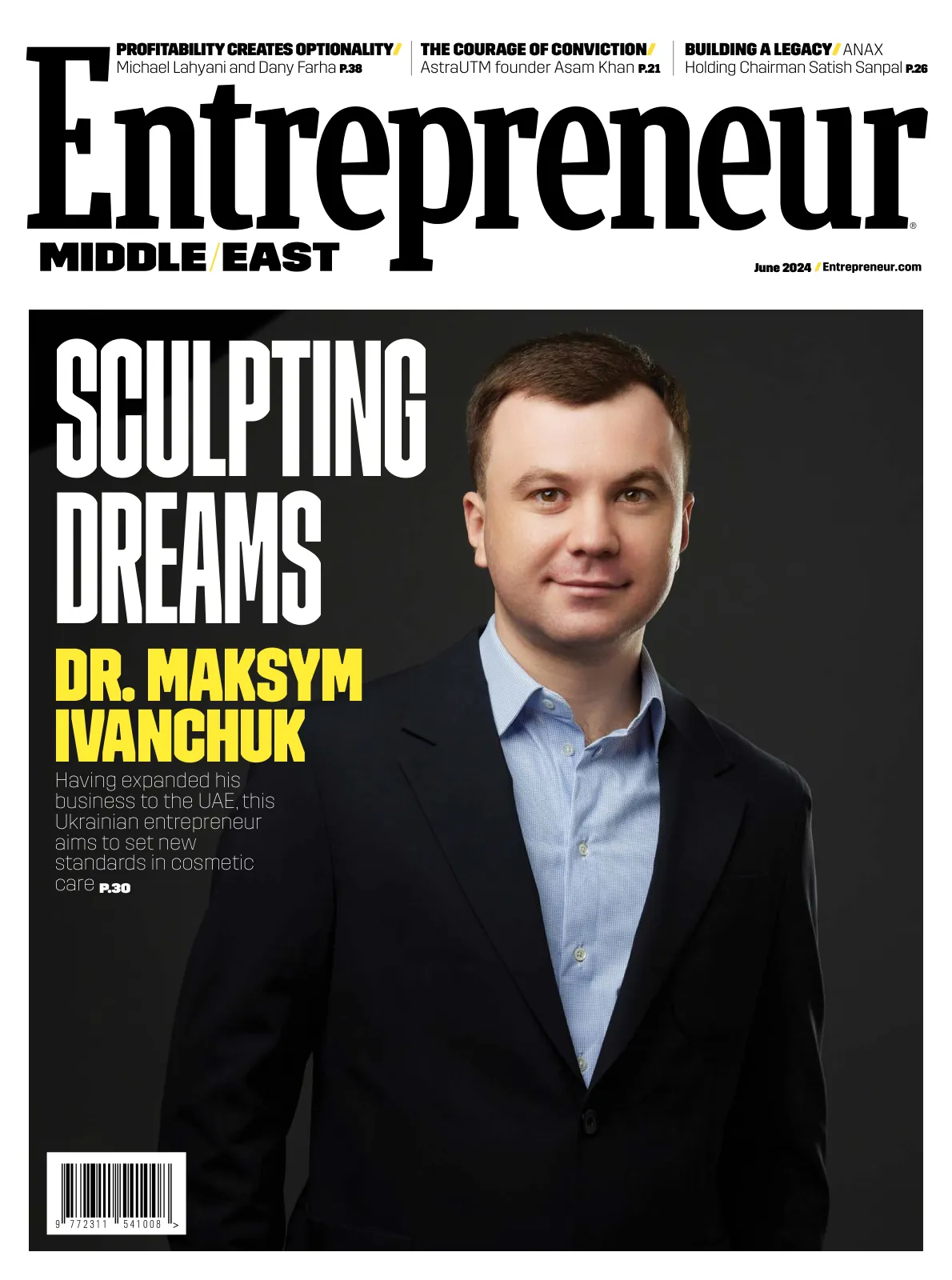
Entrepreneur Middle East, June 2024
Page 1
SCULPTING
DREAMS
DR. MAKSYM
IVANCHUK
June 2024
BUILDING A LEGACY/ ANAX
Holding Chairman Satish Sanpal P.26
PROFITABILITY CREATES OPTIONALITY/
Michael Lahyani and Dany Farha P.38
THE COURAGE OF CONVICTION/
AstraUTM founder Asam Khan P.21
Having expanded his
business to the UAE, this
Ukrainian entrepreneur
aims to set new
standards in cosmetic
care P.30
Page 2
27232
Homes from
AED 1,696,000
*
*T&C apply
Launching Sequoia,
your woodland paradise
A peaceful enclave hidden within the woodland.
Choose from a range of well-appointed homes, from
two-bedroom townhouses to six-bedroom signature villas.
Every residence at Sequoia blends nature-inspired design and
features with the latest smart home technology, bringing you
environmentally friendly convenience and comfort.
Page 3
Contents/June 2024
P.30
Sculpting
Dreams
Having expanded his business
to the UAE, Ukrainian
entrepreneur Dr. Maksym
Ivanchuk aims to set new
standards in cosmetic care.
by AALIA MEHREEN AHMED
P.38
Profitability
Creates
Optionality
With the journey their
enterprises were on together
coming to an end, Property
Finder founder and CEO
Michael Lahyani and BECO
Capital founder and CEO
Dany Farha reflect on their
successful founder-investor
relationship.
by TAMARA PUPIC
P.16
Innovation
Starts At
Home
Prince Khaled bin Alwaleed
urges entrepreneurs to leverage
regional strengths over
replicating foreign models.
by AALIA MEHREEN AHMED
FEATURES
↑ DR. MAKSYM IVANCHUK is
the founder of and lead
plastic surgeon of Maksym
Ivanchuk Plastic Surgery
Clinic.
3
June 2024 / ENTREPRENEUR.COM /
Page 4
Nestled by the coast of Lusail sits the splendor of
Raffles and Fairmont Doha, where luxury is rooted
in even the smallest details. Open the doors to
mesmerizing hospitality and make memories in a
world of sophistication.
Page 5
Page 6
Page 7
SUITE TREAT
Step into a world of opulence when you book a Suite at Raffles Doha.
Experience the added luxury of QAR 750 credit to spend
on dining in the hotel, and QAR 500 towards any Spa treatment.
Children aged 12 and below are welcome to indulge in the
enchantment of complimentary dining.
Rates starting from QAR 3,500 per night
For reservations, please call +974 4030 7100
or email reservations.doha@raffles.com
Raffles Doha, Iconic Towers, Marina District, PO BOX 4747, Lusail, Qatar
Page 8
Page 9
Welcome to the
E X C E P T I O N A L
An iconic hotel featuring
luxury rooms and apartments
with trendy dining options
in the heart of Riyadh
BOOK NOW
Mansard Riyadh, A Radisson Collection Hotel
4248 Prince Mohammed Ibn Salman Ibn Abdulaziz Road, Riyadh 6721-13315, Saudi Arabia
00966118290900 info.mansard@radissoncollection.com
radissonhotels.com/collection
Page 10
10 / ENTREPRENEUR.COM / June 2024
Contents
June 2024
47 Setting the Standard
According to Poddster co-
founder and CEO VUK ZLATAROV,
entrepreneurs shouldn’t leave
customer satisfaction to chance-
they should design it.
49 Calling the Shots
GRG CEO MOHAMMAD OSAMA
explains how (and why) you
should help Gen Z and millennial
workers be their own bosses.
51 Your Personal Brand Can
Futureproof Your Business
MANAM IQBAL suggests that an
over-reliance on your company
brand may be stunting your
growth.
56 Unveiling the Secrets of
Silicon Valley
R136 Ventures founder and
Managing Partner VICTOR ORLOVSKI
offers a playbook for cultivating
vibrant venture ecosystems
worldwide.
‘TREPONOMICS
65 Nurturing Connections
JONATHAN L. HASSON and LARA
VARJABEDIAN, co-founders of UAE-
born social networking app UBQT,
are on a mission to help people
reconnect in-person with those who
(really) matter.
70 A Seal of Security
UAE-based cybersecurity software
company DATAPATROL is offering a
unique way to secure organizational
information and data.
80 Shaping the Future of
Finance
The second edition of DUBAI FINTECH
SUMMIT reaffirmed the Emirate’s
aspirations to become a global
fintech hub.
74 Unlocking Potential
HEIDRICK & STRUGGLES’ TOM CLARKE
explains how the right CFO can
help scale Middle East startups for
success.
STARTUP
SPOTLIGHT
↑ JONATHAN L. HASSON and LARA VARJABEDIAN co-founded social
networking app UBQT in Dubai in December 2023. P.65
EDITOR IN CHIEF Aby Sam Thomas
aby@bncpublishing.net
CEO Wissam Younane
wissam@bncpublishing.net
DIRECTOR Rabih Najm
rabih@bncpublishing.net
ART DIRECTOR Simona El Khoury
MANAGING EDITOR Tamara Pupic
tamara@bncpublishing.net
FEATURES EDITOR Aalia Mehreen Ahmed
aalia@bncpublishing.net
REGIONAL DIRECTOR
Mahdi Hashemi mahdi@bncpublishing.net
HEAD OF INNOVATION
Sarah Saddouk sarah@bncpublishing.net
GROUP SALES DIRECTOR – B2B GROUP
Joaquim D’Costa jo@bncpublishing.net
COLUMNIST Tamara Clarke
CONTRIBUTING WRITERS
Fida Chaaban, Tom Clarke, Manam Iqbal,
Victor Orlovski, Mohammed Osama, Mina Vucic,
Vuk Zlatarov
SUBSCRIBE
Contact subscriptions@bncpublishing.net to receive
Entrepreneur Middle East every issue
COMMERCIAL ENQUIRIES
sales@bncpublishing.net
ENTREPRENEUR.COM
Access fresh content daily on our website
All Rights Reserved 2024. Opinions expressed are solely those of the contributors.
Entrepreneur Middle East and all subsidiary publications in the MENA region are
officially licensed exclusively to BNC Publishing in the MENA region by Entrepreneur
Media Inc. No part of this magazine may be reproduced or transmitted in any
form or by any means without written permission of the publisher. Images used in
Entrepreneur Middle East are credited when necessary. Attributed use of copyrighted
images with permission. All images not credited otherwise Shutterstock. Printed by
United Printing and Publishing.
PO BOX 502511 DUBAI, UAE
P +971 4 4200 506
EntMagazineME
Entrepreneur-me
Page 11
Booking Period: Till 10 June 2024 | Stay Period: Till 10 July 2024
Scan the code
to book directly
Immerse yourself in unparalleled luxury at
Dusit Thani Abu Dhabi. Enjoy up to 10% off
on room rates and indulge in the ultimate
pampering with a 20% hotel credit for dining
and spa experiences during your stay.
For reservations and inquiries,
contact +971 2 698 8888 or email
reservations.abudhabi@dusit.com
Dusit Thani Abu Dhabi
Delight in your Getaway
The Art of Travel
Exclusive Savings + 20% Hotel Credit
Page 12
12 / ENTREPRENEUR.COM / June 2024
Editor’s Note/
Editor’s Note/
WORK VS. WANDERLUST
The two don’t always need to be at odds with each other
A
s a journalist, I consider one of the best parts
of my job to get the opportunity every now and
then to travel to different locations around the
world for a business trip, or, as we call it in the
media world, a press trip. Be it to discover an
unfamiliar business ecosystem, or to attend an
event and relay its happenings to my readers,
these trips often keep me rather busy given their
packed schedules, and yet, I find myself looking
forward to them all the same- simply because I know
that once I’m done with the business part of my
travels, I get time to use at my leisure.
I’ve since gone on to learn that what I have been
doing on these business trips falls under the banner
of travel for “bleisure,” a portmanteau of the words
“business” and “leisure.” The term was coined in
2009; however, it has risen in popularity over the last
couple of years, which can be linked to the growth in
conversations around topics like remote working as
well as work-life balance. In fact, 93% of respondents
in a July 2023 survey of 398 business travelers in the
US by online marketplace vendor Capterra said that
they have engaged in bleisure travel.
Personally, as someone who has historically been
very bad at taking time-off, I find bleisure trips a
great way to take some time out for myself and feed
my love for travel, while still making sure that my
work continues on unabated. Sure, this results in my
work-life boundaries getting rather blurry, but I also
know that I won’t be complaining about that when I
get to follow up a seminar in the morning with a
soirée in the evening. All the guilt I usually feel about
neglecting my professional responsibilities during
holidays is kept at bay when I’m in bleisure travel
mode.
Mixing business with pleasure has typically been
frowned upon in entrepreneurial circles, but given my
own experiences with bleisure travel, I believe there’s
a case to be made especially for startup founders to
get onboard this trend. After all, as a class of people
that have been traditionally known to forego any
time-off for themselves, entrepreneurs would be wise
to make use of at least a little of the time they spend
on trips for business meetings and the like to do
things for solely themselves.
Breaks lead to breakthroughs, after all, and if
bleisure travel is what gets you to do that, then it’s
certainly something worth prioritizing.
Aby Sam Thomas
Editor in Chief
@thisisaby
aby@bncpublishing.net
Page 13
Page 14
14 / ENTREPRENEUR.COM / June 2024O
n May 1, 2024, the Mohammed Bin Rashid Innova-
tion Fund (MBRIF) Accelerator Program staged the
Demo Day for its seventh cohort at the 25Hours hotel
in Dubai, with the event being staged in collaboration
with Bolt, Brinc, Emirates Development Bank (EDB),
and Entrepreneur Middle East.
The event was kickstarted by a welcome address
from Shaker Zainal, Head of the MBRIF and Chief
Business Officer at EDB. This was followed by a
fireside chat between HRH Prince Khaled bin
Alwaleed bin Talal Al Saud, founder and CEO of
KBW Ventures, and Aby Sam Thomas, Editor in
Chief of Entrepreneur Middle East, which explored
the current investment landscape from both a global and regional
perspective.
18 startups from the MBRIF Accelerator Program’s seventh cohort
then presented their business ideas to a panel of judges comprising
In The Loop/
Catalysts of
Change
Highlights from the Demo Day for the
seventh cohort of the Mohammed
Bin Rashid Innovation Fund (MBRIF)
Accelerator Program
of KBW Ventures’ Prince Khaled, H.E. Dr. Tariq Bin Hendi,
Senior Partner, Global Ventures, Hala Ebrahim, Investment
Director, Antler Middle East, and Tala Al Jabri, angel
investor and board member, Middle East Venture Capital
Association.
The startups that took part in the pitch competition
included Knowledge Nexus AI, Appro, Arlan Biotech,
BelowFarm, Detectiome, Egrobots, Faceki, Finanshels,
HealthStay, Hekayati, Hulexo, InvoiceMate, MayaMD,
MDBX Health, Oscar, Pulse Technologies, TranspRight, and
Uktob. At the end of the judges’ deliberations, three prizes
were awarded- MDBX Health won Best Pitch, HealthStay
won Best UAE Homegrown Business, and Detectiome won
Most Impactful Business.
Launched in 2018, the MBRIF Accelerator aims to support
innovators and entrepreneurs by offering key resources,
connections, and services specifically designed to accelerate
business growth to ensure their success. mbrif.ae
Sarah Miller, co-founder of MDBX
Health, was presented the Best Pitch
award by H.E. Dr. Tariq Bin Hendi,
Senior Partner at Global Ventures.
Shaker Zainal, Head
of the Mohammed
Bin Rashid Innova-
tion Fund, and Chief
Business Officer at
Emirates Develop-
ment Bank.
Sean Conaty and
Ruairi Tubrid,
co-founders of
HealthStay, were
presented the
Best UAE
Homegrown
Business award
by HRH Prince
Khaled bin
Alwaleed bin Talal
Al Saud, founder
and CEO of KBW
Ventures.
Arman Vali, co-founder, Detectiome,
was presented the Most Impactful
Business award by Tala Al Jabri, angel
investor and Board Member, Middle
East Venture Capital Association.
Page 15
New IVECO T-WAY: high productivity and safety on off-road terrains
With a complete line-up of AWD and PWD versions and the the 16-speed HI-TRONIX automated
gearbox, the IVECO T-WAY features a host of functionalities such as Rocking Mode, Off-road Mode,
Creeping Mode and 4 reverse gears to tackle with ease the toughest off-road conditions. The new
architecture of the EBS system, combined with disc brakes on all wheels, greatly improves the vehicle’s
performance and the driver’s safety in the most demanding applications.
New IVECO S-WAY: high technology and efficiency for on-road missions
The new IVECO S-WAY, with a completely redesigned and reinforced cab, offers a wide choice of
Euro III/V diesel engines, a delivering class-leading power from 360 HP to 560 HP Euro III / 570 HP
Euro V and superior fuel-saving devices, such as anti-idling feature, Ecoswitch, Ecoroll and Smart
Alternator, 12-speed HI-TRONIX automated transmission with the most advanced technology
in its category, electronic clutch and best-in-class torque-to-weight ratio.
Drive the new way.
Page 16
16 / ENTREPRENEUR.COM / June 2024
Innovation Starts at Home
Prince Khaled bin Alwaleed urges entrepreneurs to leverage regional strengths
over replicating foreign models by AALIA MEHREEN AHMED
But ahead of the pitch competi-
tion that would see 18 MBRIF-
graduated startups present their
business ideas to a panel of
regional investors, the audience
was treated to a fireside chat
between HRH Prince Khaled
bin Alwaleed bin Talal Al Saud,
founder and CEO of KBW
Ventures, and Aby Sam Thomas,
Editor in Chief of Entrepreneur
Middle East.
Over the course of a half-hour
conversation, Prince Khaled
shared his candid thoughts on
the current investment land-
scape from both a global and
regional perspective, and, in the
process, revealed that KBW
Ventures is set to launch a new
fund. “At KBW Ventures, we see
that the Middle East holds great
potential for startups, but I
would love to see more home-
grown companies,” Prince
Khaled said. “We’re actually in
the process of starting our own
fund -it would be our second
fund- which will be somewhere
between a US$50 million and
$100 million fund. We will be
investing in local companies as
well as international companies,
with the mandate of exposing
local companies to the interna-
tional markets.”
With the new fund, Prince
Khaled is hoping to cater to a
gap that he’s spotted in the
regional investment landscape.
O
n the morning of May 1,
2024, the 25Hours hotel
in Dubai was abuzz with
a convergence of
entrepreneurs, investors,
and other stakeholders
from the UAE
entrepreneurial
ecosystem, all of whom
were set to partake in
the Demo Day of the
seventh cohort of the
Mohammed Bin Rashid Innovation Fund
(MBRIF) Accelerator program.
→ Prince Khaled
engaged in a fireside
chat with Entrepreneur
Middle East Editor in
Chief Aby Sam Thomas
at the Demo Day of the
seventh cohort of the
Mohammed Bin Rashid
Innovation Fund
(MBRIF) Accelerator
program in Dubai, UAE.
In The Loop/
Page 17
17
June 2024 / ENTREPRENEUR.COM /
“I think there is a void that
we don’t really talk about
here in the region, which is
the growth stage,” he noted.
“At the end of the day, as
soon as you start an actual
business, you have to learn
how to scale. There is a huge
void really beyond Series C;
so, that is what we’re trying
to address.” Having founded
KBW Ventures a decade ago,
the new fund also comes
after Prince Khaled has
borne witness to the
evolution of the regional
entrepreneurial landscape.
That’d also explain why,
while he exhibited much
optimism about the future,
the investor also did not shy
away from presenting a very
realistic appraisal of the
Middle East’s startups. “We
[at KBW Ventures] have
invested in only about a
handful of companies here
in the Middle East,” he said.
“While we’ve got around 90
active investments [in our
overall portfolio], maybe
less than 10 are based here
in the Middle East. But
there’s a reason for that.”
“The scarcity of quality
companies back then was,
well, you could tell,” he
continued. “But more
importantly, the valuations
were blown out of propor-
tion- especially with
Amazon’s acquisition [of
e-commerce platform Souq
in 2017], and Uber’s
acquisition [of on-demand
ride-hailing platform
Careem in 2019] here. It
really gave a false narrative
that the Middle East is the
next Silicon Valley. But the
next Silicon Valley is Silicon
Valley. And I am not
downplaying the Middle
East; I am not downplaying
Europe or Asia, for that
matter. But at the end of the
day, we’re always going to be
second-tier, and that’s the
reality. We should just
embrace it and learn from it,
and only good companies
will come out of this region
as soon as we understand
this.”
Prince Khaled’s state-
ments, however, raised an
inevitable question: what
should startups in the
Middle East be doing
differently to achieve
success? And according to
the Saudi royal, the answer
lies in avoiding the replica-
tion of strategies and ideas
that have worked well in the
West. “Look, you don’t have
to be the hero for everyone,”
Prince Khaled explained.
“You can just focus on what
propels the Middle East
forward from other
markets- in America, it is
the entrepreneurial spirit;
you can literally start from
zero and become Jeff Bezos.
But here in the Middle East,
there are a few strengths
that we have. For example,
renewable energy- arguably,
the sun shines 11 months out
of the year here, so we can
take advantage of that. We
have endless resources for
oil, so we can use that for
funding other purposes of
innovation. That doesn’t
mean it is an evil commod-
ity; it’s just a way for us to
move forward. If we start
I REALLY DO BELIEVE THAT WE HAVE TO FOCUS ON THE
STRENGTHS THAT WE HAVE, AND FORGET ABOUT THE
OTHER INNOVATIONS THAT AREN’T REALLY GOING TO DO
MUCH FOR US HERE.”
→ HRH Prince Khaled bin
Alwaleed bin Talal Al
Saud is the founder and
CEO of KBW Ventures, an
enterprise that invests in
“companies that drive
the future.”
Page 18
18 / ENTREPRENEUR.COM / June 2024
vilifying other types of energy, then
we’re not going to get anywhere, so
we just need to embrace the strengths
that we have. There’s also food
security- we have a huge focus on
that here… So, I really do believe that
we have to focus on the strengths that
we have, and forget about the other
innovations that aren’t really going to
do much for us here.”
In terms of industries Prince
Khaled has personally been inter-
ested in, he is already known to be
one of the region’s foremost investors
in foodtech; indeed, he’s been
especially in the news for his support
of vegan companies across the globe.
However, he noted that he is no
longer investing in only vegan
companies, which signals a trajectory
shift on his part. “My approach has
changed,” he said. “My outlook on
how to work with the wider food
system has expanded to include
roadmaps for the way forward with
cellular agriculture. Plus, we can
steer non-vegan companies towards
more sustainable practices. If we only
look at vegan companies, we are
handcuffing ourselves to a subseg-
ment of a subsegment of an entire
ecosystem. That’s not what we are
about; we are sector-agnostic
investors at heart.”
When it comes to pitching an idea
to investors, Prince Khaled reminded
entrepreneurs that it is always
important to get the fundamentals of
startup building right. “I want to see
passion, and a dedication to their
companies,” he noted. “I also want to
see a really good percentage of
ownership in the company. It depends
on how early these companies are, but
if they’re growing in revenue year over
year, where are their margins (if they
have any) at? I really focus on these
things. I like to be active- active, in
terms of really helping companies
drive growth, and even open up
markets in the Middle East.” Perhaps
unsurprisingly, Prince Khaled’s advice
for startup success is deeply inter-
twined with investor sentiments as
well. “As soon as someone says they’re
the next Uber or the next Tesla, I am
done listening to them,” he admitted.
“I don’t want the next Tesla or the next
Uber- I want to know what makes you
stand out without comparing yourself
to a trillion-dollar company… I’m
focused on companies that really drive
an industry forward, and I want to
back great entrepreneurs.”
In the midst of imparting advice for
entrepreneurs in the region, Prince
Khaled reiterated, multiple times
during the chat, his eagerness to “to
walk entrepreneurs through how to
grow their startups from where they
are, to the next stage of their life-
cycles.” And as it turns out, such a
sentiment has a lot to do with the
immense potential that the region
offers startup founders. “There has
never been a better time to be an
entrepreneur in the region,” Prince
Khaled declared. “We’ve been seeing
Saudi Arabia change its laws dramati-
cally in the last six-seven years, and
we’ve seen a huge push from Dubai
and Abu Dhabi to set the stage for
entrepreneurship and the ecosystem.
There is also a lot of money that wants
to be deployed into the region- there’s
been a lot of dry powder parked to the
side because of the COVID-19
pandemic. So, right now, there is a lot
of money to be pumped into these
companies. I think it has never been a
better time here in the region
specifically, because this is where my
heart resides, this is where I live, and
this is where I will always back. If you
have a dream, and a passion that will
help you grow, and make money, and
[if it can] be sustainable- then go for
it.”
THERE HAS NEVER BEEN A BETTER
TIME TO BE AN ENTREPRENEUR IN
THE REGION.”
↑ Besides his leadership of KBW Ventures, Prince Khaled serves as Vice Chairman and
co-founder of Arada, a UAE-based development company.
Page 19
THE ART OF ELEVATION
OMNIYAT.COM
Page 20
FACEBOOK.COM/CBNME
@CBNME
CONSTRUCTION BUSINESS NEWS ME
WWW.CBNME.COM
| AUGUST 30TH
| DUBAI
FOR EDITORIALS
VIBHA MEHTA +971 58 6314145
vibha@bncpublishing.net
FOR SPONSORSHIP OPPORTUNITIES
JOAQUIM D’COSTA +971 50 440 2706
jo@bncpublishing.net
ALEX BROWN +971 56 308 2946
alex@bncpublishing.net
SARAH SADDOUK +971 55 536 7011
sarah@bncpublishing.net
2024
SUSTAINABILITY
Innovation Awards
Gold Sponsors
Silver Sponsors
Page 21
21
June 2024 / ENTREPRENEUR.COM /
The Courage of Conviction
Asam Khan, founder and CEO of UAE-based drone traffic management platform
AstraUTM, tells the story of how he built a venture that was acquired by Paris-based
multinational Thales in May this year by TAMARA PUPIC
← Asam Khan is the
founder and CEO of the
UAE-based drone
traffic management
platform AstraUTM.
IMAGES COURTESY ASTRAUTM
Page 22
22 / ENTREPRENEUR.COM / June 2024
As it often happens when working at the bleeding edge of
technology, Exponent soon found itself hitting a wall thanks
to government regulations in its realm of operation. “Aviation
is highly risk-adverse, and the regulators have shared decades
of experience in making it the safest form of transportation
available today,” Khan notes. “Now, along come all these
disruptive drones demanding to share the airspace, as if it is
some fundamental human right- it is definitely not. So,
naturally, the authorities want to ensure that the airspace is at
least as safe, if not safer, after the introduction of drones.” But
instead of shutting down the company, Khan saw a silver
lining in developing a means to track and monitor drones in
near real-time by utilizing existing cellular infrastructure.
“This led to us fielding the world’s first metropolitan wide
unmanned traffic management (UTM) system with the Dubai
Civil Aviation Authority in 2017, UTMosphere [a modular
cloud-based, scalable software-as-a-solution service],” he
B/The Big Idea
K
han’s journey with AstraUTM began in 2020 when he founded it as a spinoff
of his previous startup, Exponent Technology Services (Exponent).
Established in 2012, Exponent aimed to help enterprises integrate unmanned
aerial vehicles (UAVs) and unmanned aircraft systems (UASs) -more
commonly referred to as drones- as a useful data acquisition model within
their existing information architecture. “I quickly discerned a gaping need in
the local drone market in 2013– there were a lot of drone platform providers,
but no drone solution providers,” Khan recalls. “By drone solution, I looked at
the drone as only a single part of a chain that is another data acquisition
channel for an enterprise. Acquiring data, transforming it into actionable
information, informing better decisions that results in better outcomes– that
should be the ultimate objective. Without this holistic information supply
chain, the drone is simply a toy made into an interesting curiosity– good for a fleeting public
relations boost, but nothing else.”
↓ AstraUTM is the result of Khan’s realization that
developing a means to track and monitor drones in
near real time by utilizing existing cellular
infrastructure was a maWndatory precursor to the
growth of the drone industry as a whole.
“OUR ‘WIN’ HAS BEEN TO
FORESEE THIS A GOOD
HALF DECADE IN
ADVANCE, AND TO
INVEST IN THIS
POTENTIAL FUTURE.”
Page 23
23
June 2024 / ENTREPRENEUR.COM /
says. “We quickly realized
that a fully functional UTM
providing a minimum level
of services was a mandatory
precursor to the growth of
the drone industry as a
whole. We then made a
strategic decision to spin-off
our UTM-based intellectual
property into AstraUTM
that was fatefully founded
in January 2020.”
This decision might have
appeared as a disastrous
one given that, at the time,
the whole world was set to
find itself enveloped by the
COVID-19 lockdown. And
although his nascent
business faced a period of
no new customers nor
funding, Khan once again
remained loyal to his vision,
and decided to look inward.
“Without any distractions,
working remotely from
home, over the course of
nine months in 2020, we
re-emerged with a wholly
new product that was far
ahead of our competitors,
and far ahead of its time,” he
says. “We pivoted to a
micro-services, cloud-based
architecture that allowed for
a highly coherent and
loosely coupled solution,
enabling us to rapidly
extend capabilities, without
having laborious rounds of
unit and integration testing.
We were literally able to
move at the speed of
thought, from rapid
prototyping and lightning
development cycles, to fast
testing and optimized
deployments. We could
deploy an as-is solution
within seven days, which
was unheard of in-aviation
software at the time.”
With these cards up his
sleeve, Khan was ready to
harness the growing
potential of the global drone
traffic management market,
which, according to market
intelligence platform
Markets and Markets, is
expected to reach US$1,098
million in 2030, growing at
a compound annual growth
rate (CAGR) of 33.9% from
2022 to 2030. It should
therefore not come as a
surprise that AstraUTM
soon attracted the attention
of larger global players-
Khan recalls that he
expected it to be either a
major air traffic manage-
ment (ATM) solution
provider, or an air naviga-
tion service provider
(ANSP). “The ANSPs were
somewhat hesitant, as they
operated under a mandate
from their local civil
aviation authorities (CAAs),
and would need a clear
direction before investing in
UTM, whereas the ATM
providers see UTM as a
natural extension to their
portfolio- and somewhat of
a threat,” he explains.
Having thus been engaged
in discussions with multiple
potential enquirers, Khan
eventually realized that
AstraUTM and the
Paris-headquartered Thales
made for natural partners in
the field, especially given the
latter’s global expertise and
experience in UTM
solutions”When they
proposed an acquisition
transaction, it was accepted
by all of AstraUTM’s
internal stakeholders,” he
reveals. “They went a step
further, and opted for a full
100% acquisition, as
opposed to an initial
minority stake– which was
an outcome we greatly
welcomed.”
When asked about the
lessons he captured from
the process of selling his
company, Khan starts by
highlighting the importance
of diversifying and expand-
ing his options in order to
find the right fit for the
company. “Understanding
buyer motivations was also
key, as each potential
acquirer had different
motivations and strategic
objectives driving their
interest to acquire As-
traUTM,” he continues.
“These objectives must
align with your own
strategic goals to ensure a }}
→ AstraUTM was founded in 2020 as a
spinoff of Khan’s previous startup,
Exponent Technology Services, which
aimed to help enterprises integrate drones
as a useful data acquisition model within
their existing information architectures.
ONE LIVES BY THE STRENGTH OF ONE’S CONVICTIONS, AND IF
YOU CANNOT CONVINCE YOURSELF OF THE VIABILITY OF YOUR
DREAMS, YOU WILL NEVER CONVINCE ANYONE ELSE.”
Page 24
24 / ENTREPRENEUR.COM / June 2024
B/The Big Idea
successful acquisition.”
Thirdly, Khan considers
seeking advice as being
key to successfully
navigating complex
negotiations, structuring
the deal, and ensuring
that the company’s
interests are best
protected. He adds, “The
last and the most obvious
learning, is to maintain
confidentiality through-
out the sale process in
order to protect sensitive
information– this
becomes even more
important when forming
acquisitions within
industries like UTM.”
Looking ahead, Khan
believes that the UTM
industry is at a crucial
inflection point, ready to
take off. “If you consider
that there are only tens of
thousands of commercial
aircraft worldwide (not
including general aviation
and military aircraft), and
that globally it is estimat-
ed there are anywhere
between two to five
million drones currently
operating, one can begin
to understand the scale of
the industry once it is
fully regulated,” he
explains. “It will be two
orders of magnitude -100
times- the current
aviation footprint. This
will call for bold new
solutions and techniques
as we scale up to meet the
challenge.”
Khan also mentions the
current push for advanced
air mobility (AAM), or
commonly known as
autonomous air taxis, to
become an integrated
mode of inner-city
transportation to further
describe how AstraUTM
solutions fit perfectly to
respond to new demands
in the sector. “Different
elements for AAM are
going to be fully depen-
dent upon an underlying
infrastructure that can
support their operations,
and the underlying
foundation to this is
UTM,” he says. “The
ability for airspace to be
allocated to these
vehicles, flights to be
planned and approved in
their respective corridors
(strategic deconfliction),
tracking in near real-time
during flight, potential
conflicts resolution
(tactical deconfliction),
are some of the core
services that a UTM must
provide, and AstraUTM
has been providing it
since 2021. Our ‘win’ has
been to foresee this a
good half decade in
advance and to invest in
this potential future.”
→ KHAN notes that the current
push for advanced air mobility
(AAM), or commonly known as
autonomous air taxis, to become an
integrated mode of inner-city trans-
portation is a prime example of how
AstraUTM solutions respond to new
demands in the sector.
TREP
TALK
AstraUTM founder and CEO
Asam Khan shares his tips
for entrepreneurs in the
UAE
} DON’T LIMIT YOUR DREAMS “My
general experience in the UAE is that
entrepreneurs are too timid, and
they are wary of government
authorities. The UAE leadership, and
especially the Dubai government,
are here to help innovators, as long
as they are transparent, and operate
within the confines of the law. So,
think big and bold. I think this is
quite self-explanatory. Reality will
always bring you down to earth–
gravity is always there. But if you
shoot for the stars, you may reach
the moon.»
} BE CREATIVE «Entrepreneurs are
constantly hitting roadblocks that
need to be surmounted. You need to
be flexible and constantly thinking. A
defeatist attitude is an innovation-
killer. Don’t succumb to it. There is
always a solution. If you don’t have
one yet, you haven’t thought hard
enough.»
} BE RESPONSIBLE «Others are
depending on you; temper your
wildest instincts when needed. This
may seem counter to my first
point– but it doesn’t have to be. We
work within a structured reality. It’s
okay to push on those boundaries,
but remember it’s still a thin
membrane you don’t want to
burst– you just want it to expand
enough to accommodate your
vision.»
Page 25
A W A R D S 2 0 2 4
Celebrating women business leaders across Eastern Europe,
Middle East and Africa
Event Date
6 June 2024 | 10:00 AM - 12:30 PM GST
Bluewaters Forum by Banyan Tree Dubai
Bluewaters Island
WomenSMELeaders.com #WomenSMELeaders
Page 26
26 / ENTREPRENEUR.COM / June 2024
S
atish Sanpal is no stranger to the ebbs and flows that
come with the entrepreneurial realm. Indeed, it was
the years of experience he gained working across a
range of industries like events and commodities
trading, which culminated in the formation of ANAX
Holding, a UAE-based investment firm, in 2018. Built
with, as Sanpal puts it, “towering ambition, innova-
tion, and excellence,” ANAX Holding is today marked
by the establishment of three distinct subsidiaries:
ANAX Developments, ANAX Hospitality, and ANAX
Media.
“My journey as a serial entrepreneur has greatly influenced
the vision I hold for ANAX Holding in terms of the many
lessons -both good and bad- that one encounters through
learning the thick and thin of business,” Sanpal says. “It has
nevertheless been an exciting journey that shapes my decisions,
and forms the very fabric of how we operate today. The
experience of launching and growing multiple businesses has
granted me a unique perspective, and an innovative approach
to business– what it has also taught me is that persistence and
integrity pay off. And whilst it’s been a rollercoaster ride of
learning curves, failures, and successes, each venture has
contributed to shaping my understanding of what it takes to
build a successful enterprise.”
Lessons learnt through his past entrepreneurial endeavors
are thus governing his leadership of each of the ventures under
ANAX Holding today. One of these is ANAX Developments,
launched in January 2024, which seeks to create vibrant
communities and sustainable spaces across residential,
commercial, and mixed-use developments. According to
Sanpal, choosing Dubai as the launchpad for ANAX Develop-
ments was a very easy decision. “Dubai has long been a magnet
for international investors and expatriates due to its strategic
location, world-class infrastructure, and favorable business
environment,” he explains. “Recently, geopolitical and econom-
THE EXPERIENCE OF LAUNCHING
AND GROWING MULTIPLE
BUSINESSES HAS GRANTED ME A
UNIQUE PERSPECTIVE, AND AN
INNOVATIVE APPROACH TO
BUSINESS– WHAT IT HAS ALSO
TAUGHT ME IS THAT PERSISTENCE
AND INTEGRITY PAY OFF.”
“
B/Strategies
↑ Satish Sanpal is the Chairman of
ANAX Holding, a UAE-based
investment firm that has three main
subsidiaries: ANAX Developments,
ANAX Hospitality, and ANAX Media.
Building a Legacy
ANAX Holding Chairman Satish Sanpal is eager to carve out an indelible mark on the
UAE’s business landscape by AALIA MEHREEN AHMED
Page 27
27
June 2024 / ENTREPRENEUR.COM /
ic shifts have accelerated the
inflow of Russian and
Chinese nationals. This has
been a key driver in the
recent real estate boom. This
trend has not only reshaped
the Dubai real estate market,
but also led to the imple-
mentation of the latest
technologies like artificial
intelligence, virtual reality,
augmented reality, etc.
transforming the industry in
remarkable ways.”
ANAX Developments’ debut
project is the Vento Tower,
which is aimed to be
complete by the final quarter
of 2025, and is set to boast of
225 furnished luxury studios
and one-bedroom apart-
ments, all of which will be
equipped with the latest
amenities and top-quality
fitted appliances. “Featuring
a Smart Home System by
Bosch, residents of Vento
Tower will experience
modern living at its finest,”
Sanpal declares. “Addition-
ally, a five-star hotel-style
lobby with 24-hour security
and a fully-fledged concierge
service ensure residents feel
welcomed and secure. We
have spared no effort in
ensuring exceptional quality
and construction to create a
true sense of home. Our
ultimate goal is to foster a
shift where our residents
truly see Dubai as their new
home. Our vision for Vento
Tower is thus to set new
benchmarks for accessible
luxury real estate. Further-
more, we are excited to
announce two additional
projects in our immediate
pipeline for Meydan and Al
Furjan (both residential and
commercial spaces in
Dubai), which are set to be
launched soon. These
projects will continue our
commitment to excellence
and innovation, further
enriching the real estate
landscape in Dubai.”
But creating a tangible
impact within the UAE’s real
estate ecosystem is only one
part of the plan Sanpal has
mapped out for ANAX
Holding- a second goal is to
revolutionize the hospitality
industry with its other
subsidiary, ANAX Hospital-
ity. “When it comes to ANAX
Hospitality, our approach
revolves around striking a
delicate balance between
innovation, sustainability,
and an elevated guest
experience,” Sanpal says.
“We’ve carefully considered
what truly sets us apart in a
highly competitive market,
and we’ve identified these
three pillars as essential for
creating memorable and
meaningful experiences for
our guests. Moreover, we
believe that prioritizing our
core values ensures the
long-term viability and
success of our hospitality
ventures. One project that
we are truly excited about is
our upcoming F&B concept.
As we conceptualize this new
concept, a restaurant lounge,
we are drawing inspiration
from the Far East, particu-
larly places like Korea and
Japan, for new concepts and
experiences that can be
replicated to delight our
DUBAI HAS LONG BEEN A MAGNET FOR INTERNATIONAL INVESTORS
AND EXPATRIATES DUE TO ITS STRATEGIC LOCATION, WORLD-CLASS
INFRASTRUCTURE, AND FAVORABLE BUSINESS ENVIRONMENT.”
→ With a commitment to
growth and innovation,
ANAX Holding has
worked towards
establishing itself as a
trusted partner for
investors seeking
high-quality
opportunities in the
current business
landscape.
Page 28
28 / ENTREPRENEUR.COM / June 2024
discerning guests’ tastes.
Asia leads the way in
innovation, and we believe
there’s no better source to
learn from than the best!”
Here, it’s worth taking a
moment to appreciate
Sanpal’s approach towards
innovation- a value that the
entrepreneur says is central
to his success strategy. “In
terms of innovation, we
constantly strive to stay
ahead of the curve by
embracing new technologies,
trends, and ideas that
enhance the guest experi-
ence- whether it’s imple-
menting cutting-edge
solutions and processes that
elevate the overall guest
experience, or introducing
innovative dining concepts
that cater to evolving tastes
and preferences,” he says. “At
the same time, continuous
learning and adoption of
international best practices
is an idea we put a lot of
emphasis on. I feel that if
someone’s done it better, let’s
learn from them, and adopt
new practices to ensure
better standards across the
board; let’s always learn,
evolve, and keep an open
mind.”
It is this notion of drawing
inspiration from other
successful ideas that Sanpal
has also applied to his
sustainability strategies
within hospitality. “From
implementing energy-effi-
cient systems and reducing
waste, to sourcing locally
and supporting community
initiatives, sustainability is
deeply ingrained in every-
thing we do,” he says. “But
taking this commitment a
step further, we draw
inspiration from Nordic
countries, particularly
regarding food recycling and
waste. Sustainability is a
massive priority in these
countries, and their
innovative approach to
combining F&B with
reducing the carbon
footprint is both inspiring
and creative. If it’s a priority
for them, it should be for all
of us, and so, we want to
ensure this is reflected
throughout our operations,
and that our people
understand the importance
of this across all their
actions.”
As such, ANAX Hospitality’s
upcoming F&B venture,
which is yet to be named, is
set to be a melting point of
all of the aforementioned
values that embody the
subsidiary’s existing
operations. “This restaurant
lounge will seamlessly blend
innovation, sustainability,
and guest experience to
create an unparalleled
dining and entertainment
experience for discerning
guests,” Sanpal says. “From
its extraordinary design and
sustainable practices, to
stellar service and exquisite
cuisine, we hope to stand out
with what we will introduce
to our guests, whilst also
prioritizing environmental
stewardship and guest
satisfaction. We are
incredibly excited about this
project, and confident that it
will exemplify the ANAX
Hospitality ethos in every
aspect.”
In the midst of preparing
for the full-blown operations
of ANAX Developments and
B/Strategies
OUR ULTIMATE GOAL IS TO
FOSTER A SHIFT WHERE
OUR RESIDENTS TRULY SEE
DUBAI AS THEIR NEW
HOME.”
“
↑ In a quest to foster a
positive shift in the business
ecosystem, Sanpal has
launched the Sanpal
Foundation, a non-profit
organization that aims to
address pressing socio-
economic issues across the
region and beyond.
Page 29
29
June 2024 / ENTREPRENEUR.COM /
ANAX Hospitality, there is also the inevitable launch of
ANAX Media, the third subsidiary of ANAX Holding,
looming on the horizon. And while that is certainly
something Sanpal has an eye on, it is the first two subsidiar-
ies that make up his immediate area of focus. “Over the past
six years, we have largely achieved our initial vision by diver-
sifying investments, and embracing new opportunities in a
dynamic local and global economy,” he adds. “This progress
is evident in our anticipation of a 15% growth in our
investment portfolio by the end of 2024. ANAX Holding
thus remains steadfast in its dedication to fostering growth
and development, while actively contributing to prosperity.
Our ongoing journey is driven by managing our professional
and financial assets strategically– venturing into real estate,
followed by hospitality, made natural sense for us given the
region’s prosperous landscape, especially within those
spheres. Beyond profitability, our goal has been to achieve
meaningful milestones by fostering growth, encouraging
innovation, and actively contributing to the region’s
prosperity with a commitment to leaving a positive mark on
the world around us.”
It is thus to initiate a positive shift in the business that
Sanpal has also launched the Sanpal Foundation, a
non-profit organization that aims to address pressing
socio-economic issues across the region and beyond. As
such, the foundation’s first area of focus has been the East
African nation of Uganda. “Philanthropy being a foundation
of a healthy society, our philanthropic efforts are integral to
our vision, reflecting our commitment to giving back to the
communities we serve,” Sanpal says. “The Sanpal Founda-
tion’s efforts in Uganda are a testament to this commitment,
as we strive to address pressing social and economic
challenges, such as access to education, healthcare, and
economic empowerment, and foremostly, addressing
Uganda’s clean water crisis, where a staggering 81% of the
population lack access to clean water. As we expand our
philanthropic endeavors, we are keen to bring the spirit of
the Sanpal Foundation to Dubai, and are at the moment
identifying new causes and initiatives that align with our
values and priorities.”
Sanpal’s revelation of how he has curated and built each
of his business endeavors, however, raises an inevitable
question: how does he manage to oversee the operations of
all three ANAX Holding subsidiaries, as well as his
philanthropic foundation? “Primarily, I foster a culture of
transparency, innovation, excellence, and trust within the
organization- these values serve as our compass, guiding
our mission to create value for stakeholders and seize new
opportunities,” Sanpal explains. “Secondly, I prioritize the
development of operational aspects within ANAX Holding’s
subsidiaries to meet evolving market requirements. By
closely monitoring market shifts and emerging technolo-
gies, we remain agile and ready to adapt our strategies
accordingly. Thirdly, I encourage collaboration and the
exchange of ideas among teams in all subsidiaries. By foster-
ing an environment where knowledge-sharing and creative
problem-solving thrive, we aim to drive growth in every
aspect of our business. Moreover, trusting our people is
paramount. Empowering our teams with autonomy and
responsibility fosters a sense of ownership and accountabil-
ity, ultimately driving greater innovation and performance.
Lastly, staying abreast of industry trends is non-negotiable.
I dedicate time to continuous learning and networking
within and beyond our industries to ensure we remain
competitive and ensure continuity.”
Here, citing the likes of Tesla founder Elon Musk, re-
nowned investor Warren Buffet, and H.H. Sheikh Moham-
med bin Rashid Al Maktoum, Vice President and Prime
Minister of the UAE and Ruler of Dubai, as his role models,
Sanpal says integrity and authenticity will always remain
pivotal to not only achieving success, but also in his mission
to make a meaningful difference in the world. And even as
ANAX Holding looks to expand into other markets (the
most immediate of those being the United Kingdom),
Sanpal says he first hopes to leave a lasting impact on the
UAE market. “We aspire to become a value-driven organiza-
tion with a clear roadmap for expansion, and to put strong
governance in place for the further development of ANAX
Holding, but our aspiration for ANAX Holding’s legacy
within the UAE market in particular is one of profound
impact and sustainable growth,” Sanpal declares. “We
envision ANAX Holding as a place of innovation, excellence,
and ethical leadership, setting new standards of success,
and contributing meaningfully to the socio-economic
development of the region. With a go-getter mindset and an
inspiring roadmap, we have many plans in our pipeline that
we are pressing ahead to achieve. In short, our vision for
ANAX Holding’s legacy in the UAE market is one of
excellence, innovation, and social responsibility. Through
our diverse business ventures and philanthropic efforts, we
seek to leave a lasting impact that extends far beyond
financial success, enabling individuals and communities to
thrive and prosper.”
WE ENVISION ANAX HOLDING AS A PLACE OF INNOVATION, EXCELLENCE, AND
ETHICAL LEADERSHIP, SETTING NEW STANDARDS OF SUCCESS, AND
CONTRIBUTING MEANINGFULLY TO THE SOCIO-ECONOMIC DEVELOPMENT OF THE
REGION.
Page 30
30 / ENTREPRENEUR.COM / June 2024
↓ DR. MAKSYM
IVANCHUK is the
founder of and lead
plastic surgeon at
Maksym Ivanchuk
Plastic Surgery Clinic.
30 / ENTREPRENEUR.COM / June 2022
Page 31
31
June 2024 / ENTREPRENEUR.COM /
SCULPTING
DREAMS
DR. MAKSYM
IVANCHUK
Having expanded his
business to the UAE, this
Ukrainian entrepreneur
aims to set new standards
in cosmetic care.
by AALIA MEHREEN AHMED
31
June 2022 / ENTREPRENEUR.COM /
Page 32
32 / ENTREPRENEUR.COM / June 2024
I
n 2022, the global plastic
surgery market was
valued at US$69.7 billion,
a number that is set to grow
to a mammoth $158.7 billion
by 2031, according to a
report by US-based market
research and consulting
firm, DataM Intelligence.
This is one among many
statistics that depict how
plastic surgeries have
become more commonplace
than one may have thought.
In fact, according to the
American Society of Plastic
Surgeons (ASPS), there has
been a 19% increase in total
procedures performed since
2019 alone. Now, given the
nature of such procedures, it
may be easy to conflate the
concept of plastic surgery
with superficial outcomes
that adhere to societal or
one’s own standards of
beauty. However, Dr.
Maksym Ivanchuk, who
launched his eponymous
plastic surgery clinic in
Ukraine and has now
expanded to the UAE, offers
a story that underscores the
life-changing impact of
aesthetic surgeries. “A pivotal
moment in my career
occurred early on when I
encountered a patient with a
severely disfigured face due
to a traumatic injury,” he
recalls. “Through a series of
reconstructive surgeries, we
were able to restore not only
their physical appearance
but also their sense of
identity and self-worth. This
experience solidified my
dedication to the field of
plastic surgery and rein-
forced the profound impact
it can have on individuals’
lives.”
← With years of experience under
his belt and more than a thousand
surgical procedures performed, Dr.
Ivanchuk is ranked among the
leading plastic surgeons in Ukraine.
Page 33
33
June 2024 / ENTREPRENEUR.COM /
I
n Ukraine, the Maksym
Ivanchuk Plastic Surgery
Clinic has seen Dr.
Ivanchuk perform over a
thousand surgeries. And
while his acumen within the
plastic surgery space is
wide-ranging, the procedure
Dr. Ivanchuk is widely known
for is his signature “proce-
dure of chin” surgery that
results in the youthful
corners of one’s face being
accentuated. Over the years,
however, Dr. Ivanchuk’s work
has also found favor beyond
Ukraine, with his tally
currently standing at over
3,000 surgeries performed in
more than 25 countries. In
December 2023, the UAE
market became Dr. Ivan-
chuk’s latest target of
expansion. And according to
him, this move into the
Emirates is set to continue
the legacy he has built thus
far into his career. “The
name—Maksym Ivanchuk
Plastic Surgery Clinic—rep-
resents not only my commit-
ment to delivering excep-
tional results but also the
personal connection I strive
to establish with each
patient,” he says. “I believe
what sets my business apart
is our unwavering commit-
ment to patient satisfaction,
safety, and results. We
prioritize individualized
treatment plans, advanced
techniques, and a patient-
centric approach, ensuring
that each patient receives the
highest level of care and
attention.”
B
ut to understand Dr.
Ivanchuk’s pursuits
within plastic surgery
today, it is perhaps important
to get an idea of what drew
him to this field in the first
place. “My journey into
plastic surgery was actually
sparked by a profound desire
to merge artistry with
science, to sculpt and reshape
not just physical features but
lives,” Dr. Ivanchuk recalls.
“Witnessing the transforma-
tive power of plastic surgery
on individuals, both in terms
of their external appearance
and internal confidence,
fueled my passion to embark
on this journey. It’s a
profession where every
procedure is an opportunity
to make a meaningful
impact, whether it’s restoring
function after trauma or
enhancing natural beauty.
The inspiration to start my
own clinic thus stemmed
from a deep-seated desire to
create a space where I could
provide personalized care
and innovative treatments to
my patients, while also
fostering a culture of
excellence and compassion.”
W
ith Dr. Ivanchuk’s
repeated empha-
sis on patient
satisfaction, it should
perhaps not come as much of
a surprise that his definition
of success isn’t solely
monetary-driven. “In our
industry, success transcends
mere surgical skill or
financial gain,” he declares.
“It’s about the profound
impact we have on the lives
of our patients. Success is
measured by the confidence
they regain, the smiles we
bring back to their faces, and
the enhanced quality of life
they experience post-surgery.
It’s about forging trust-based
relationships, maintaining
the highest ethical standards,
and constantly striving for
excellence in every aspect of
patient care.”
B
ut in order to keep
achieving such
success, Dr. Ivanchuk
says that he’s committed to
constantly learning and
honing his craft. “My
approach to achieving
success in plastic surgery }}
I BELIEVE WHAT SETS MY
BUSINESS APART IS OUR
UNWAVERING COMMITMENT
TO PATIENT SATISFACTION,
SAFETY, AND RESULTS.”
MY APPROACH TO ACHIEVING SUCCESS IN PLASTIC SURGERY REVOLVES
AROUND A RELENTLESS PURSUIT OF KNOWLEDGE, INNOVATION, AND
PATIENT-CENTERED CARE.”
“
Page 34
34 / ENTREPRENEUR.COM / June 2024
revolves around a relentless
pursuit of knowledge,
innovation, and patient-cen-
tered care,” he says. “I
therefore invest heavily in
continuing education, staying
abreast of the latest advance-
ments in surgical techniques,
technology, and patient safety
protocols. I prioritize ongoing
learning through conferences,
workshops, and peer-re-
viewed journals. I also foster a
culture of open communica-
tion and collaboration within
my practice, where every
member of the team is
committed to delivering
unparalleled service and
results. As a result, an
important moment in my
journey was the decision to
invest in state-of-the-art
technology and innovative
procedures that allowed us to
expand our offerings and
elevate the quality of care we
provide. This decision
significantly impacted our
success and positioned us as
leaders in the field.”
B
ut while Dr. Ivanchuk
has certainly reached
a stage in his career
where his reputation precedes
him, getting to such a
position did not come without
plenty of pit stops. “The path
to success in plastic surgery is
not without its challenges,”
Dr. Ivanchuk says. “From
navigating the complexities of
patient expectations to
managing the pressures of
running a practice, each
obstacle presents an opportu-
nity for growth and refine-
ment. Today, I’ve learned to
embrace challenges as
catalysts for innovation,
continually seeking out new
solutions and approaches to
overcome them. But in the
early stages of my journey as a
plastic surgeon, I faced
challenges such as building a
patient base, establishing
credibility, and managing the
complexities of running a
business in a competitive
industry. I overcame these
challenges through persever-
ance, dedication, and a relent-
less focus on providing
outstanding patient care. By
investing in marketing,
networking, and continuous
learning, I gradually built a
reputation for excellence and
earned the trust of my
patients and peers. Failures
and setbacks have thus been
valuable learning experiences
that have helped me grow and
evolve as both a surgeon and
an entrepreneur.”
A
s Dr. Ivanchuk
continues explaining
how he has been able
to build a successful name for
himself, he doesn’t shy away
from mentioning the role
social media has played in
curating his professional
image. In fact, he discusses
the power of personal
branding with such clarity
that his words could certainly
serve as a noteworthy
template for many entrepre-
neurs out there. “Building a
strong online presence as a
celebrity plastic surgeon
requires a strategic approach
that balances educational
content, patient testimonials,
and engaging visuals,” he says.
“It’s about leveraging social
media platforms to showcase
expertise, connect with
prospective patients, and
foster a sense of community
around the practice. However,
authenticity is key, as patients
are drawn to surgeons who
are transparent and genuine
in their interactions. Personal
branding for a celebrity
plastic surgeon, therefore, is
about more than just
cultivating a polished image—
it’s about embodying
authenticity, expertise, and
trustworthiness. It’s about
establishing a reputation as a
thought leader in the field,
someone who is not only
skilled in their craft but also
deeply compassionate and
committed to their patients’
well-being.”
B
ut beyond the realms
of personal branding,
Dr. Ivanchuk
highlights that social
networking sites also offer an
opportunity to spread more
awareness about the work he
does and his field of expertise.
“Social media has become an
indispensable tool for plastic
surgeons, providing a
platform to connect with
“FROM NAVIGATING THE
COMPLEXITIES OF PATIENT
EXPECTATIONS, TO MANAGING THE
PRESSURES OF RUNNING A PRACTICE,
EACH OBSTACLE PRESENTS AN
OPPORTUNITY FOR GROWTH AND
REFINEMENT.”
↓ In December 2023, a new branch of the wIvanchuk Plastic Surgery
Clinic -which has received multiple industry accolades for being a top
aesthetic clinic- was opened in the UAE.
Page 35
35
June 2024 / ENTREPRENEUR.COM /
patients, share educational
content, and showcase our work,”
he adds. “By leveraging social
media effectively, we can reach a
broader audience, build trust and
credibility, and stay relevant in an
increasingly digital world.”
B
ut despite such a keen
focus on his online
persona, Dr. Ivanchuk
hasn’t necessarily been swept
away by the virtual noise that the
internet can often present.
“Balancing authenticity with
curation is an ongoing process
that requires careful consider-
ation of how I present myself and
my work to the public,” he says.
“While it’s important to maintain
a professional image, I also strive
to remain true to my values and
beliefs, allowing my authenticity
to shine through in everything I
do. Integrity, compassion, and
excellence are the guiding
principles that inform every
decision I make as a plastic
surgeon. By staying true to these
values, I ensure that every
interaction, every procedure, and
every decision is aligned with my
commitment to delivering the
highest standard of care to my
patients. And that is why my
greatest achievement as an
entrepreneur has been building a
successful clinic that has
positively impacted the lives of
countless patients, providing
them with renewed confidence,
self-esteem, and quality of life.”
I
ndeed, Dr. Ivanchuk’s commit-
ment to improving the lives of
his patients gets the spotlight
once again when he’s asked about
what surgery he’s been most-
proud of. “One memorable
success story that stands out to
me is a patient who came to me
seeking breast reconstruction
following a mastectomy [a
surgery that is often done for
breast cancer treatment or
prevention],” he recalls. “Through
a series of surgeries, we were able
to not only restore her physical
appearance but also her sense of
femininity and self-confidence.}}
WHILE IT’S IMPORTANT TO MAINTAIN A PROFESSIONAL
IMAGE, I ALSO STRIVE TO REMAIN TRUE TO MY VALUES AND
BELIEFS, ALLOWING MY AUTHENTICITY TO SHINE THROUGH IN
EVERYTHING I DO.”
→ In addition to personal
branding, Dr. Ivanchuk
highlights that social
networking sites have
offered an opportunity to
spread more awareness
about the work he does
and his field of expertise.
Page 36
36 / ENTREPRENEUR.COM / June 2024
Seeing her transformation
and witnessing the profound
impact it had on her life was
incredibly rewarding and
reaffirmed the importance of
what I do.”
W
ith a hope to keep
creating a
meaningful
difference in the lives of his
patients, Dr. Ivanchuk adds
that keeping tabs on all the
latest technological advance-
ments within his field will be
paramount to success. “The
intersection of creativity and
business in plastic surgery is
where innovation thrives,” he
declares. “It’s about approach-
ing each patient as a unique
canvas, tailoring treatment
plans to their individual
needs and desires. At the
same time, it’s about embrac-
ing innovative technologies
and techniques that push the
boundaries of what’s possible
in aesthetic and reconstruc-
tive surgery. The future of
plastic surgery will likely be
shaped by advancements in
technology, personalized
medicine, and a growing
emphasis on natural-looking
results. Minimally invasive
techniques, regenerative
medicine, and virtual
consultations are just a few
examples of how our industry
is evolving to meet the
changing needs and prefer-
ences of patients.”
A
rmed with foresight
as well as the business
values discussed
prior, Dr. Ivanchuk now
hopes to replicate his global
success in the UAE as well.
“I’m excited about several
upcoming projects and
collaborations that will
further elevate our practice
and expand our reach,” he
says. “From educational
initiatives to community
outreach programs, these
endeavors reflect our ongoing
commitment to innovation,
excellence, and patient care.”
But with all that he has
achieved so far, would Dr.
Ivanchuk have done anything
differently if given the chance
for a do-over? “Looking back,
I wouldn’t change a thing in
my entrepreneurial journey,”
he concludes firmly. “Every
challenge, setback, and
success has contributed to my
growth, resilience, and
success, shaping me into the
surgeon and leader I am
today.”
SUCCESS IS MEASURED BY THE CONFIDENCE THEY REGAIN,
THE SMILES WE BRING BACK TO THEIR FACES, AND THE
ENHANCED QUALITY OF LIFE THEY EXPERIENCE POST-SURGERY.
Page 37
Page 38
38
PROFITABILITY
CREATES
OPTIONALITY
→ Michael Lahyani
is the founder and
CEO of the
UAE-headquartered
proptech company,
Property Finder.
With the journey their enterprises were on
together coming to an end, Property Finder
founder and CEO Michael Lahyani and
BECO Capital founder and CEO Dany Farha
reflect on their successful founder-investor
relationship by TAMARA PUPIC
/ ENTREPRENEUR.COM / June 2024
Page 39
39
June 2024 / ENTREPRENEUR.COM /
→ Michael Lahyani
and Dany Farha at a
World Economic
Forum event in
Davos, Switzerland.
↓ Dany Farha is the founder and CEO of BECO Capital, a Dubai-based early stage venture
capital firm.
I
t’s been almost eight years
since Property Finder
founder and CEO Michael
Lahyani advised entrepre-
neurs during a 2016
Entrepreneur Middle East
interview to “not to build a
business to sell it,” and although a lot
has changed for the UAE-headquar-
tered proptech business and the
MENA startup ecosystem at large
since then, this statement still seems
to epitomize his belief in his own
company. Proof of this can be seen in
Lahyani raising US$90 million in
debt financing in May 2024, with an
aim to buy back Property Finder
shares from BECO Capital, who was
the first institutional investor in the
company. “Our commitment to the
real estate market stands firm, as we
aim to continue to drive strong
returns for our ecosystem,” Lahyani
said, in a statement. “It is my hope
that this event sets the precedent for
other founders in the region to take
their innovative companies to new
heights, attracting global talent, and,
in turn, creating the returns that
fuel the entrepreneurial ecosystem
across the MENA.”
P
roperty Finder began quietly in
2005 as a UAE-based property
print magazine called Al Bab
World, but by 2007, 51% of its
online portal -AlBabWorld.com-
was bought by the Rupert Murdoch-
backed online real estate advertising
network REA Group, and it was
rebranded as Property Finder. Three
years later, despite the far-reaching
consequences of the 2008-2009
financial recession at the time,
Lahyani and his co-founder Renan
Bourdeau bought back REA Group’s
stake in the company. Since then,
the growth trajectory of Property
Finder has been on an upward
curve, with Property Finder today
serving more than 5.5 million active
users each month across the UAE,
Qatar, Bahrain, Egypt, Saudi
Arabia, and Turkey. Meanwhile, it
“ My advice would
be not to promise
a plan you can’t
deliver. You can
lose an investor’s
trust at deck level
by projecting
unrealistic
assumptions and
revenue growth.
You want to come
across as sound,
thoughtful, and
credible.”
Page 40
40 / ENTREPRENEUR.COM / June 2024
has also been consistently supported by venture capitalists
(VC) through several funding rounds- this includes $2
million from BECO Capital in 2012, $20 million from
Stockholm Exchange-listed investment firm Vostok New
Ventures in 2016, and $120 million from US private equity
firm General Atlantic in 2018. As the first institutional
investor in Property Finder, BECO Capital played an
instrumental role in its development and success, but
backing it in its early stage also brought the venture capital
firm a strong return on its investment. Indeed, BECO
Capital has been able to achieve a 2.41x distribution to
paid-in capital ratio from its Fund I, off the back of its
more than $1 billion valuation exit from Property Finder.
L
ahyani has thus been in a productive relationship with
BECO Capital and its founder and CEO Dany Farha for
more than 12 years now, and the synergy they have
developed with each other can offer other entrepreneurs
many lessons on what makes for a functional founder-
investor relationship. Talking about the trust he enjoyed
with Lahyani, Farha says, “Michael, of course, is competi-
tive, and rightly so, but ethical; he always wants a great
deal, but not to the detriment of the other party. In the
very early days, we were buying a company in the region,
and Michael had tremendous leverage. Despite this
leverage, he still exercised fairness and balance and took a
win-win approach, leaving money on the table, and
creating an outcome that was fair. I’ve seen Michael do the
right thing, and not just the most profitable thing many
times in our journey, which is very important to us at
BECO. Integrity is a core value at our firm, and specifically,
doing the right thing, and not just the most profitable
thing.”
L
ahyani exhibited the same principles until the very end
of their enterprises’ journey together, Farha adds. “We
found ourselves -for the first time in our relationship-
on opposite sides of the table, but we both continued to
live by our values and find a win-win outcome,” Farha
reveals. “The other thing I would say about Michael is that,
like all exceptional leaders, he has incredible clarity of
vision, and a robust and dynamic decision-making
framework, so much so that I would say that we were each
other’s mentors on many occasions. I find that the best
relationships, not just professional ones, are the ones
where both people in question grow, and keep getting
better as a result of the relationship. Michael was always a
support and a loyal friend, and my best founder relation-
ships are the ones that are reciprocal in nature.”
F
rom Lahyani’s perspective, the two most important
foundations of a successful relationship between an
investor and an entrepreneur are trust and alignment
of values- but these, he notes, are not built in one meeting
in a boardroom. “There is simply no substitute to spending
quality working time together,” he says.” However, time is
scarce, particularly for an early-stage investor who -by
nature- will have multiple companies, and an early-stage
founder whose to-do list is somewhat endless. So, the way
Dany and I spent quality time together was through travel.
We attended conferences together, set up board meetings
abroad, and visited companies running similar businesses
in different markets. We had a particularly memorable trip
to Japan to visit Summo, the leading property portal there.
We made sure to always take the same flight, sit next to
each other, and book the same hotel. These are small
details, which, over a period of 11 years, made a big
Page 41
41
June 2024 / ENTREPRENEUR.COM /
difference. Through those trips, we built
a one-of-a-kind relationship that ended
up being strong enough to withstand
any challenges the business could throw
at us. Of course, we didn’t realize this
until much later- we did it naturally,
because we liked each other. So, as my
takeaway, I’d say to early-stage found-
ers: don’t take money from an investor
with whom you don’t get on. It’s not
going to lead to anything good, because
you’ll run into challenges, and if a solid,
positive relationship isn’t there, it’ll get
ugly, and fast. Once you reach scale, it’s
a different dynamic, and relationships
with your investors can be more formal
-not that mine are- but in the early
days, those tight bonds are crucial to
success.”
T
o complete Property Finder’s
buyback, Lahyani got debt financing
from Francisco Partners, a global
investment firm with a presence in San
Francisco, New York, and London; plus,
the strategic decision to execute the
debt financing and complete the
buyback was supported by Property
Finder’s remaining institutional
investor General Atlantic. The whole
process, Lahyani says, taught him that
there are various ways to create liquidity
for an early investor -other than raising
a new round of investment. “To have
options, you require two elements,” he
explains. “Firstly, you need to run a
profitable business, because allocating
funds for a share buyback, while your
business still requires investments to
grow, isn’t a wise business decision.
Secondly, having a strong relationship
with the investor is crucial when you’re
sitting at opposite ends of the table to
agree on a price.”
A
nother new insight for Lahyani was
that raising debt can be “trickier”
than raising equity. “The term sheet
is the tip of the iceberg, and the real
negotiations truly happen when
drafting the contracts; conversely, in
equity rounds, once you’ve aligned on
the terms, the rest is pretty standard,”
he explains. “It’s also become apparent
that traditional lenders are not
comfortable providing funding for
buyback transactions; they look for
hard assets as a collateral. But private
credit funds get it, and understand that
a buyback transaction is accretive, and
an opportunity for the existing share-
holders to own more of their company,
and for the lender to make healthy
returns. A key lesson has been that
running a tight ship, and bringing your
business to profitability, creates
optionality- it’s because we consistently
generate free cash flows that we are able
to raise debt. And having the right
advisors throughout the process is
imperative. I wouldn’t recommend
doing it solo.”
G
lobally, institutional investors have
increasingly started turning their
focus to yield as opposed to growth,
which is in response to the changing
geo-political and macroeconomic
environment, as per a new research
from Managing Partners Group (MPG).
However, when it comes to the MENA
region, Farha’s outlook on the future of
the local markets is distinctively
positive- he is now one of only a handful
of investors who have achieved their
second $1 billion valuation exit- BECO
Capital Fund I’s history of exits also
includes the high-profile acquisition of
Careem by Uber for $3.1 billion in
January 2020. “In just over 10 years, we
have advanced phenomenally,” Farha
says. “We had $50 million invested
annually, very few investors, equally few
founders, no government prioritization
of the digital and innovation sector, and
almost no digital infrastructure, and no
exits to reference. Today, we have $3
billion being invested annually,
hundreds of regional and global VCs
and professional investors now actively
investing in the region, including many
homegrown VCs that are running
world-class firms, and leading the
charge in developing the ecosystem,
many major government initiatives and
investments into the ecosystem, and so
on. Plot the graph to see where this is
going. With our young, affluent
populations and forward-thinking
leadership, the genie is out of the bottle,
and there is no putting it back in.”
L
ahyani adds that, although the global
startup funding landscape is
currently challenging (Crunchbase
reports that the overall startup funding
in 2023 was down by less than 20%
when compared to the years before the
onset of the COVID-19 pandemic, i.e.
2018 to 2020), the UAE/MENA region
remains one of the rare markets where
capital is still being deployed in
early-stage companies. “So, in relative
terms, it’s better than most other
emerging markets,” Lahyani says.
“Many investors have been burnt
post-pandemic, as they backed
companies with grand ambitions, but
very little profitability in sight. So, my
advice would be not to promise a plan
you can’t deliver. You can lose an
investor’s trust at deck level by
projecting unrealistic assumptions
and revenue growth. You want to
come across as sound, thoughtful,
and credible. Also, stick to proven
business models with strong unit
economics, healthy margins, and
predictable outcomes.” Plus, Lahyani
also advises not raising funds unless
it is necessary as “this is a time to
focus on your operations, improve
your margins, and fine-tune your
products and/or service.” But for
those who have to raise funds at the
moment, Lahyani urges seeking out
founder-friendly investors. “They
have to be those who can stay
invested for a long period of time
-like BECO Capital- because success
usually takes longer than the original
plan,” he says.
In just over 10
years, we have
advanced
phenomenally...
With our young,
affluent
populations and
forward-thinking
leadership, the
genie is out of the
bottle, and there
is no putting it
back in.”
“
Page 42
FUN COMES
GUARANTEED
YOU DECIDE WHEN THE PARTY
STOPS WITH 24HR FOOD & DRINK.
NOW OPEN AT DUBAI DIGITAL PARK.
RADISSONHOTELS.COM/RED
Page 43
43
June 2024 / ENTREPRENEUR.COM /
Major Sound →
/Marshall Minor IV
B/Gear
#TamTalksTech
Gadgets and doodads that you might’ve missed out on, sourced
by a tech aficionado. by TAMARA CLARKE
Save It ←
/Western Digital My Passport
Western Digital My Passport hard drive line
gives you up to 6TB of space to effortlessly
backup digital memories with total peace of
mind. The My Passport Ultra drive is a
trusted, portable storage solution that is
equipped with USB-C technology and a
modern metal design. It is ready right out of
the box, and it features a convenient, slim
form factor that is easily transportable. Its
password protection with 256-bit AES
hardware encryption helps keep precious
content safe and secure. Make the most of
the included Acronis True Image for Western
Digital software to help securely back up your
data, fortified with robust protection against
ransomware threats. The enclosure of this
drive is composed of more than 50% post-
consumer recycled plastic. Packaging is
made of over 50% post-consumer recycled
pulp, and it is also fully recyclable. My
Passport hard drives are available in a variety
of different colors to suit any style.
TAMARA CLARKE, a former software development professional, is the tech and lifestyle enthusiast behind The Global Gazette, one
of the most active blogs in the Middle East. The Global Gazette has been welcomed and lauded by some of the most influential tech
brands in the region. Clarke’s goal is to inform about technology and how it supports our lifestyles.
Talk to her on Twitter @TAMARACLARKE. theglobalgazette.com
IMAGES © MARSHALL | FUJIFILM | WESTERN DIGITAL
Marshall Minor IV headphones pack over
30 hours of wireless playtime. The
earbuds hold up to seven hours on their
own, and the portable charging case can
power you up to 30 hours and beyond.
Simply slip the earbuds into the case
when you want an extra boost. You only
need 15 minutes of quick charge to get
over three hours of playtime, and you
can charge the case wirelessly or with a
USB-C cable. Minor IV also comes with
mirrored touch-sensitive earbuds; so,
you can use either one to control your
music and phone calls. Removing and
inserting an earbud also initiates the
auto-pause and play feature. Its new
shape allows for a more natural fit, while
the water-resistant earbud design and
leather-textured case mean you’ll hear
and feel the difference. They're also
water-resistant- so, the music doesn’t
have to stop when it rains!
Picture This ↓
/Fujifilm Instax Mini 99
The Fujifilm Instax Mini 99 features new
functions that use analog technology to further
broaden the range of print expressions, such
as “Color Effect Control,” which apply lights of
different colors directly to a film to produce six
different color expressions, or “Vignette
Mode,” which reduces exposure around the
edges to bring the focus to the center of each
picture. Print expressions can vary based on
shooting conditions, allowing you to create
unique Instax prints with every click. The
camera body boasts a leather-like matte
texture that is comfortable to hold, and it
presents a classic design with a premium look
and texture. You can capture photos using
Landscape, Macro, and Indoor modes with
enhanced image quality, as well as Sports
mode, which is ideal for shooting a fast-
moving subject, as well as Self Timer for group
shots. Shooting modes for manipulating light
are also available, including Bulb and Double
Exposure modes. Instax Mini 99 thus lets you
create new memories with old-school flair.
Page 44
44 / ENTREPRENEUR.COM / June 2024
STREET QUIET →
Born Outside Italy
B/Gear
Once you learn that Alfredo
Bandini and Daniele Pe are two
Italians who have been living in
the UAE for a long while and now
consider themselves the
country’s natives, you’ll
understand why the duo have
chosen to call their Dubai-born
luxury-meets-streetwear fashion
label as Born Outside Italy.
Designed for all walks of life,
each Born Outside Italy garment
has been made to be worn daily
as a badge of self-expression,
with the brand’s style embodying
a fusion of refined elegance,
quality Italian sartorial craft, and
the comfortability of bold street
culture. Born Outside Italy’s
debut sneaker series is now out,
and SNEAKER 001 is a
reimagined classic that taps into
90s street culture with
contrasting colors and shapes.
Available in four different
colorways, each pair has been
crafted from premium materials
including calf leather and suede,
with the sole also featuring hex
nut shapes that create a lighter
feel when worn. With the co-
founders calling their brand “an
invitation to break free from the
conventional,” Born Outside Italy
is essentially for those of you
who wish to live life on your own
terms. bornoutsideitaly.com
From better goods to better wardrobe
bests, every issue, we choose a few
items that make the approved executive
selection list. In this edition, our picks
include Guerlain, Born Outside Italy,
Clean Rebel, and Vision Industry.
The Executive Selection
Page 45
45
June 2024 / ENTREPRENEUR.COM /
Summer’s here, and it’s time to pull out a pair
of sunglasses! And while there may be a host
of eyewear brands out there to choose a pair
of sunglasses from, sometimes, there can be
times when you have a signature style in mind
that you simply can’t find in the market at
large- but that was before Vision Industry
came to town. Billed as “the world’s first
experiential optical store,” Vision Industry
-which comes with a rich heritage in Italian
optical craftsmanship- has now opened in
Dubai’s Mall of the Emirates, and its Design
Lab offers you the chance to craft your own
eyewear piece from scratch. In consultation
with the artisans available in store, you can
choose the material, shape, design, and lens
to design the optical frames or sunglasses that
you’ve always wanted- and Vision Industry
simply makes it for you. Bespoke designs
tailormade for you- what’s not to like? Head
on over to Vision Industry for your own style
statement. visionind.com
↑ RETHINKING BEAUTY | Clean Rebel
Founded by Biljana Markova, Clean Rebel is
a new Dubai-based eco-luxury skincare
brand offering clean, high-performance
products that have been meticulously
crafted to nourish both the skin and the
soul. While making sure every ingredient is
safe and effective, each product is made
with the finest food-grade organic and
vegan oils, floral waters, and essences, and
is free from hormone disruptors, known
carcinogens, and skin irritants. In addition,
Clean Rebel makes use of ingredients that
are sourced ethically and sustainably,
thanks to partnerships with suppliers who
share the same values. Its debut collection,
The Essence Collection, offers a luxurious
array of facial skincare products
meticulously crafted to cleanse, nourish,
and rejuvenate your skin. This collection
includes a cleanser, toner, active serum,
facial oil, and an exfoliating paste. Each
product is formulated with natural active
ingredients like rosa damascena (rose)
flower water from Bulgaria, organic
pistachio seed oil from Sicily, and organic
jojoba oil from Palestine, creating a sensory
experience that indulges and revitalizes.
cleanrebel.com
EDITOR’S PICK
VISION INDUSTRY ↓
IMAGES COURTESY GUERLAIN | CLEAN REBEL | VISION INDUSTRY | BORN OUTSIDE ITALY
TRANSCENDING TRENDS ↓
Guerlain Les Masculins Parfums
French Maison Guerlain is adding a new olfactory dimension
to its iconic men’s collection- for the first time in its history, it
is extending its Vétiver, Habit Rouge, and L'Homme Idéal
creations into parfums, which represent the most
concentrated and precious expressions of fragrance in
perfume. Taking inspiration from the world of spirits,
Guerlain Maison Perfumer Delphine Jelk has given these
iconic olfactory signatures a new sense of intensity and
power. For instance, Vétiver Le Parfum has been crafted like
an infused gin- it opens with explosively aromatic notes of
delicately bitter juniper berry. As for L'Homme Idéal Le
Parfum, it plays up the subtle, yet rich and sensual character
of the original fragrance, which is known for having been a
bold take on contemporary masculinity. Finally, inspired by
the intense yet warm character of a bourbon, Habit Rouge
Le Parfum evokes all the tonalities of rum, with its accord
being the perfect showcase for Guerlain’s exclusive vanilla
tincture. So, which of these three new irresistible one-of-a-
kind fragrances will you be pick? Our suggestion: get them
all. guerlain.com
Page 46
Page 47
47
June 2024 / ENTREPRENEUR.COM /
IF YOU RUN A SERVICE-BASED BUSINESS, you know the
difficulties of balancing customer satisfaction with efficiency
and profitability. When the results are reliant on people
delivering them, it’s impossible to keep all of your customers
happy all of the time.
Projects are based on an agreed scope of work and executed
within a certain timeframe. In this scenario, a lot gets left to
chance. No matter how “good” staff are, many things can
affect their output on any given day. Even when you include
deliverables in the agreement, goalposts can easily change,
and misunderstandings arise. Plus, every account win brings
more unpredictability and different stakeholders to manage.
The results will always be subjective, leaving you arguing with
clients about the value of what has or hasn’t been achieved.
It’s likely that some projects elicit all right feedback, while
just as many end in frustration on both sides. Now, if you’re
being totally honest, how many of your clients are extremely
happy? I bet it’s rare. And that’s not a criticism; it’s simply the
nature of running a service business. Maybe you even accept a
degree of dissatisfaction as the norm.
Unfortunately, while you might get away with it for a bit,
your business will eventually suffer if standards are inconsis-
tent. It’s also incredibly stressful as an owner. I’ve been there
myself, running agencies, where we were constantly over-
stretching to meet expectations, often at the business’s
expense, only to be told we hadn’t quite hit the mark.
Setting the Standard
Don’t leave customer satisfaction to chance- design it by VUK ZLATAROV
Page 48
48 / ENTREPRENEUR.COM / June 2024
The bigger you get, the harder it
becomes to keep a handle on things.
Scaling a service business is notoriously
tricky, which is why most of the world’s
largest companies sell products. Of
course, there are exceptions, like the
major consulting firms. Bringing these
big names on board might be a badge
of honor; yet, I wonder what percent-
age of their customers believe they
received outstanding service.
Let’s take a completely different kind
of company: McDonald’s. Its business
is simple. It sells burgers. Every
McDonald’s employee knows what’s
required of them, and all of their
customers know exactly what they’re
paying for, every time. In another
arena, the Emirates Airlines service
promise is built on a checklist-based
system of delivery. The beauty lies in
standardized service delivery, and
building that type of business is most
entrepreneurs’ dream. Psychologists
call expectations a happiness killer,
because when the reality falls short of
what we expect, it causes disappoint-
ment. On the flip side, having an
outcome that customers can count on
is essential for continued satisfaction.
When I launched my podcast
production business Poddster, I didn’t
want to face the same variables as
before. My goal was to minimize the
chance of disappointment as much as
possible, and deliver satisfaction just as
McDonald’s delivers happiness– not by
chance, but by design, every time. That
meant standardizing our service to the
point of almost becoming a product.
I’ve learnt that there are several things
you can do to take control of customer
satisfaction, and guarantee good
results- even at scale.
DESIGNING SUCCESS: THE HOW-TO
Firstly, you need to define every step of
the service delivery process, then
develop a set of standard operating
procedures (SOPs) for the entire team
to follow. If you design a robust system
with little room for interpretation, the
results will remain the same no matter
who is delivering it.
Make sure you create SOPs for every
aspect of your operations, e.g. market-
ing, sales, ordering, and customer
interaction. The more granular you go,
the stronger your business will be, and
the better control over it you will have.
It also means you don’t need to hire the
most senior, experienced staff,
especially in the early days as the
information will guide them through
what needs to be done.
That said, training your employees
and onboarding them to the system is
vital to its success. You’re not trying to
create a team of automatons; you’re
trying to build an organization where
people grow, and feel proud of the
service excellence being achieved. Make
sure you understand your employees’
key drivers, and incorporate gamifica-
tion in everyday work that will be
rewarded with the right incentives- this
helps with motivation and boosts
morale.
Of course, issues are always inevi-
table. Just ensure you also have an SOP
for handling problems. Don’t risk the
issue escalating; give staff clear
instructions on addressing concerns,
and resolving any complaints effec-
tively. When you map out all the steps
in your business, it’s like creating a
control board giving you insights into
any weak spots. If there’s a break in the
circuit, you can trace it back, and see
what went wrong, and how to rectify it.
You can also respond to neutral or
negative feedback immediately, and
prevent unhappy customers from
turning into vocal detractors.
With the right set of SOPs, your
business can run on autopilot,
consistently delivering great service,
while you focus on growth opportuni-
ties and strategic improvements.
Whether you plan to scale your
business or not, if you build it with that
idea in mind, success becomes
‘T/Pro
YOUR SERVICE BUSINESS DOESN’T HAVE TO OPERATE AT
THE MERCY OF PERCEPTIONS IF YOU DESIGN AND
FOLLOW A CLEAR MODEL WITH CUSTOMER SATISFACTION
AT ITS CORE.
Page 49
49
June 2024 / ENTREPRENEUR.COM /
inevitable. Your service
business doesn’t have to
operate at the mercy of
perceptions if you design and
follow a clear model with
customer satisfaction at its
core.
Vuk Zlatarov is the
co-founder and
CEO of Poddster, a
pioneering network
of video podcast
production studios and Dubai’s
first podcasting community. He
is also the Managing Partner of
Creitive Ventures, a venture
builder focused on product
acceleration and go-to-market
routes for early-stage ideas with
hubs in APAC, MENA, and
Europe. Vuk launched his
podcast, The Change Officer, in
2020, because he wanted a
smarter way to build
meaningful relationships with
people who could positively
influence his life and business.
The impact was significant in
both respects. After two years,
200 episodes, and a
transformational personal
journey, Vuk decided to create
Poddster to make professional
podcast production available to
everyone. Now, with more than
500 podcasts and 1000 active
creators, Poddster continues to
set standards, and drive the
podcast industry forward,
cementing its position as the
preferred choice for anyone
looking to start or grow their
show. It has three studios in
Dubai, and recently opened its
first international location in
Singapore in early 2024. Born
and educated in Serbia, Vuk
studied as an information
systems and technologies
engineer before moving to Dubai
in 2014. In addition to his
business activities, Vuk mentors
startup founders for regional
and global entrepreneurship
organizations. poddster.com
}The “tiki-taka” approach in soccer
made famous by Lionel Messi’s Barcelona
was widely lauded as a gamechanging
philosophy, but critics pointed out that you
also have to have the players to execute it.
Similarly, navigating the future of the
workforce is crucial, and changes have to
be made to accommodate, but none of it is
possible without the right people and the
right leadership. The art of attracting them
-and developing the capability to attract
them- is key, but then, we need to give
them space to soar and empower them to
lead and build projects in their areas of
expertise.
}The facts are clear- Gen Zs are
expressing their freedom to choose by
leaving jobs after a much shorter tenure.
As the CEO of organizational capability
consultancy GRG, I’ve seen this consis-
tently from Gen Zs- indeed, their most
commonplace grievances are that they are
not able to have an impact, or that they are
not given a platform to express their ideas.
The bottom line: people want to be their
own bosses, and call the shots.
The challenges for both generations are
different. Those that quit corporate jobs to
take a stab at a startup are taking a hefty
gamble, as 80-90% of startups fail– in-
Calling the Shots
Here’s how (and why) you should help Gen Z and millennial workers be
their own bosses by MOHAMMAD OSAMA
W
orn out cliches aside, time has seen the millennial generation and
Gen Zs grow up steeped in a culture that heavily promotes their own
wants over the needs of society or authorities. Rather than churn
out a set of selfishly entitled workers, this movement has a positive
effect in promoting more creativity, innovation, and independent
thinking.
But the impact on the workforce is clearer to see now. Millennials
have left behind what they perceive to be the stifling nature of a typi-
cal corporate environment in order to venture into the world of
entrepreneurial startups, bringing with them Gen Z colleagues, and before we know
it, the “alphas” are behind them as well.
Page 50
50 / ENTREPRENEUR.COM / June 2024
deed, in our role as
headhunters, we regularly
encounter millennials looking
to get back into the job
market after an unsuccessful
venture.
Meanwhile, the regular
job-hoppers actually hinder
their chances at real job
satisfaction, as it often takes a
while to truly understand the
inner workings of a business,
and therefore, be able to
contribute anything of real
value.
}So, what’s the solution?
I believe that we need to
rethink how companies define
roles themselves for a new
generation and the future of
work. Job roles should be
defined with a greater
emphasis on the final
outcome, rather than on the
day-to-day tasks. And those
outcomes should be more
long-term and directional in
nature, rather than arbitrary
numbers.
But we wouldn’t propagate
this belief without testing it
out for ourselves, and at GRG,
we did.
}Five years ago, we
completely abolished the
traditional recruitment key
performance indicators
(KPIs), which are currently
the cornerstone of all major
recruitment companies. These
weekly indicators were
replaced with long-term
directional progress-based
goals, coupled with guidelines
based on personal learnings
and experiences, rather than
textbook recruitment and
search rules. Often, these were
even tailored to suit the
individual employee’s
personality and natural
strengths.
Essentially, we created an
entrepreneurial environment
in the workplace.
In a nutshell, we gave them
the trust and space to conduct
their business as independent
entrepreneurs. They are fully
empowered to manage their
own agenda, define their own
ambitions, build their own
teams, and execute their own
ideas– all geared towards the
company’s vision. We find
that autonomy motivates
people to work harder and
more creatively.
}However, we also
provided all the things that
tend to be lacking in failed
startups, such as resources,
ideas based on real lessons
from past experiences,
opportunities to discuss
ideas with other intelligent
minds in the business, and,
of course, the mainstream
support functions of
finances, human resources,
leadership training, logistics,
information technology,
legal, regulatory, and admin
teams.
What did we see on the
business end? Innovative
ways of serving our
customers better,
unprecedented business
contracts and solutions, and
constantly evolving business
methodologies tailored to
evolving individual client
needs.
}As for what did we see in
terms of results, we
enjoyed revenue growth of
500% (a three-year comping
annual growth rate of 74%)
after going through a decade
of virtually no growth
(2011-2020) in a highly com-
petitive industry. We also
quadrupled our headcount;
95% of whom are Gen Zs
and millennials. Effectively,
we became the largest
independently owned
executive search and
recruitment business in the
Middle East- and all of this
with no external funding in
the form of debt or equity.
}To sum up, the dynamic
shifts in the workforce
‘T/Pro
I BELIEVE THAT WE NEED TO RETHINK HOW COMPANIES DEFINE
ROLES THEMSELVES FOR A NEW GENERATION AND THE FUTURE
OF WORK.
Page 51
51
June 2024 / ENTREPRENEUR.COM /
propelled by the millennial
generation and Gen Zs are
undeniable. With a desire for
autonomy and impact, these
workers gravitate towards
entrepreneurial ventures,
and traditional corporate
structures face the challenge
of adaptation. The solution
lies in redefining roles with a
focus on long-term outcomes
and providing the freedom
and resources for individuals
to thrive.
}At GRG, we’ve embraced
this philosophy wholeheart-
edly, abandoning conven-
tional KPIs in favor of
empowering our team
members as entrepreneurs
within our organization. The
results speak volumes:
exponential growth as well as
original solutions. This
journey underscores the
importance of trust,
autonomy, and a commit-
ment to fostering innovation-
as we no doubt face further
shifts and changes faster
than ever, agility is crucial.
Businesses must remember
that the true essence of
leadership lies in empower-
ing others to unleash their
full potential, driving not
only organizational success,
but also personal fulfillment-
an imperative for the modern
workforce.
Mohammad
Osama is the
CEO of GRG, an
organizational
capability
consultancy built on
delivering impact. Over the
past decade, the GRG team
has grown from its roots in
the GCC to become the region’s
largest independently owned
recruitment and executive
search firm. grgmea.com
F
rom this perspective, it’s easy to see why
personal brands have become all the
rage in this day and age. People like to
work with people they like and trust. Don’t
take it from me. Check out this example from
Hanna Larsson, who’s built a six-figure
business on the back of her personal brand
alone.
Your Personal Brand
Can Futureproof
Your Business
(Also, know that an over-reliance on your company brand may be
stunting your growth) by BY MANAM IQBAL
I
t is so easy to fall prey to the allure
of a company brand, to create
elaborate brand guides and
tone-of-voice documents, to follow
them through to the letter, only to
see the messages falling flat. Don’t
get me wrong. There’s no denying
its importance as a virtual touch-
point for a business. But since we
live our lives online, we have taken our
natural tendencies and psychology to
online interaction.
And she is not alone. She is one of the
many who’ve built highly profitable
personal brands alongside their full-time
corporate careers, or as an extension of
their businesses.
So, if you are running a business and
aren’t building a personal brand, how
much are you leaving on the table in
money and opportunity?
Probably a lot.
WHAT HAPPENS WHEN YOU HAVE AN
AUDIENCE?
The world of work is changing rapidly.
Every week, we hear stories about
massive layoffs in tech, burned-out
employees, and micromanagement, and
in this day and age of internet
accessibility and possibilities, it’s hard not
to think of it as unnecessary.
There’s only one problem. Not enough
professionals realize the importance of
investing in their personal brands early in
Page 52
52 / ENTREPRENEUR.COM / June 2024
their careers. They only see its
true significance when they are
stuck in a rut, suddenly find
themselves without a job, or
want to change companies or
careers.
You inevitably need
connections to do any of these
things, and it becomes
infinitely easier if you have a
personal brand and
professional connections.
Unlike a company brand, a
personal brand isn’t a static
thing for which you must
adhere to set brand guidelines.
It’s ever-evolving (like you),
and if done right, it can help
you develop a cult following of
people who see you fail,
succeed, win, and lose, and
who help out when you’re
setting up a new venture,
expanding an existing one, or
exiting a business or company,
and looking for new
opportunities.
Justin Welsh has done an
incredible job with his
personal brand. Before he
started building it, he was a
superstar employee who
helped take two companies
past a $1 billion valuation,
raising over $300 million in
venture capital. However,
within a few years, he was
severely burned out, and
unable to continue his
intensely stressful work
routine. He did something
desperate next. He quit
without a plan B. He then
started writing on LinkedIn
on a whim. That little habit
led to a one-person business
that now pulls $1.3 million
per year.
Not so shabby, right?
His writing was what
personally intrigued me to
start showing up more often.
And it has made all the
difference. But here’s the
thing; you don’t need to aim
nearly as high as Justin. But
this sure gives you an idea of
the potential of building a
personal brand.
WHAT DOES IT MEAN FOR
COMPANIES?
Personal branding was once
the forte of senior leaders in a
company. The general idea was
that if we are building a
company brand, we don’t need
5,000 people sharing the same
thing. Today, corporates are
realizing the true power of
employee branding to augment
the company’s reputation.
Studies confirm that
employees’ personal brands
directly correlate with how
stakeholders view and engage
with organizations. Only 33%
of buyers trust company
brands, but trust levels
increase to a staggering 90%
for product recommendations
from people they know.
The sooner companies
understand that their
employees can have a far
greater impact on the business
than their official titles, the
better they’ll do. As per official
data from LinkedIn, content
posted by employees is seen as
3x more trustworthy and
authentic with a click-through
rate 2x those of brand
accounts.
WHERE DO WE GO FROM
HERE?
The baby boomers grew up in
a world without the internet.
The path to success was
straightforward- study hard,
get a good job, work a solid
9-5, and “the man” will take
care of the rest. And it worked
for the most part- until it
didn’t. By the time millennials
entered the working world, the
dynamics were changing
rapidly.
In terms of new business, the
barriers to entry for new
players have never been lower.
There is an increase in shared
spaces (the meltdown of the
corporate), the rise of the
highly profitable solopreneur,
growing competition from
countries with qualified but
cost-effective workforces, and
remote work- all of which are
helping smaller players gain
access to markets that were
considered unattainable
before. The power dynamics
have changed, and now many,
not a select few, hold power at
their fingertips as we look
online for everything.
People are documenting
everything on socials. What
they eat, where they go, who
they hang out with. All of these
cultural, social, and economic
shifts affect you, and this
brings us to the question of
having choices. We all have a
personal brand whether we
like it or not. The question is,
will we hold the reigns and
direct it- or will we let others
control the narrative and
direction of our lives?
Manam Iqbal is a
LinkedIn thought
leadership expert
on a mission to
help 100,000
leaders find their voice online.
She writes regularly at @
manamiqbal, and demystifies
personal branding for the
uninitiated. manamiqbal.com
‘T/Marketing
ONLY 33% OF BUYERS TRUST COMPANY BRANDS, BUT TRUST
LEVELS INCREASE TO A STAGGERING 90% FOR PRODUCT
RECOMMENDATIONS FROM PEOPLE THEY KNOW.
Page 53
RAKCERAMICS.COM
Imagine a space where your inspiration
can run free. A world that tells
your own story, every single day.
At RAK Ceramics we help
create the perfect living space,
for you and your loved ones.
Imagine your space.
IMAGINE
YOUR
SPACE
Page 54
54 / ENTREPRENEUR.COM / June 2024
W
e play many different roles in our lives, and when we
transition into being a business owner, we assume a new
identity as an entrepreneur. It’s easy to focus on what it
takes to run a business, rather than pay attention to how
this identity shift affects our mindset.
Change can knock our confidence, and make us feel
exposed. This is especially true if you have previous
unresolved insecurities or doubts about your core identity.
But don’t panic, know that these feelings are normal, and take time to
figure things out, so that you can play to your strengths as you
navigate your new position.
Striking Out Alone
Developing your identity as an entrepreneur
[THE HOW-TO] by CARINA HARVEY
Becoming a business owner means
having the courage and confidence
to strike out completely alone.
Whether this comes naturally to
you or not, being the person who
makes every single decision can
test your self-esteem in ways you
didn’t even know possible. As you
grow and develop into your new
persona, drawing on all of the
values and experiences you’ve
gathered so far is important.
When I wanted to leave the
corporate world and set up my
own business, I knew two things:
1. I needed to find something I
felt truly passionate about, and
was prepared to live and breathe
by.
2. I wanted to be the best
possible version of myself, and
present that when setting up my
business.
That meant implementing a solid
structure to understand my core
identity, and how it would play out
as an entrepreneur. Working on
this is possible at any stage. Even if
you have an established business,
things can suddenly feel unman-
ageable, and the same approach
will help you see which direction
you want to move forward in.
Here are my five recommendations
to gain more understanding:
1/ IDENTIFY YOUR TRUE PURPOSE
Finding passion and motivation in
business can be a challenge. Many
individuals might see a potential
gap in the market. However, being
a business owner means more than
being a subject expert. It also
requires handling multiple
strategic and operational elements.
Unless you are enthusiastic and
emotionally invested, it can leave
you dissatisfied or unable execute
certain tasks.
Even if you’ve already chosen
your chosen path, I would suggest
thinking about how it aligns with:
- Your deep-rooted passions.
- Your natural abilities and
talents.
- Your developed skills.
- Your values and how they align
‘T/Pro
Page 55
55
June 2024 / ENTREPRENEUR.COM /
with your offering.
- Your experiences and
coincidences i.e. what has
led you here.
Once you’re clear about
the above, even the more
demanding requirements
of the business can be seen
as an opportunity, as
opposed to a chore.
2/ESTABLISH AN AUTHEN-
TIC VOICE
Who you are, and the value
you and your business
provide, are the essence of
your brand. Rather than
assuming what people
want from you, or how
they expect you to behave,
this will attract the right
people to your organiza-
tion. Be it client, supplier,
or investor, your goal
should be to collaborate
with those who can benefit
from working with you,
and who are aligned with
your principles and
objectives. Being clear
about your purpose will
also provide with you with
your personal story and
your “why.” Openly sharing
these with prospective
customers and partners
will help them understand
what you do. It will capture
their attention, enabling
them to engage and
remember you.
3/ PLAY TO YOUR
STRENGTHS (AND PLUG
YOUR GAPS)
I wanted to build a
coaching business, because
I knew I had years of
practical experience; it was
a skill I had developed,
and, therefore, a strength.
Nonetheless, I went
further by exploring
broader educational
opportunities to develop
myself personally, whilst
growing the concept for
the business. Consider
what you already know,
and look at ways to
enhance this further.
Now onto the gaps. It is
not a weakness to lack
certain skills; no one is
good at everything. But
you will encounter
problems if you fail to
acknowledge it. Are there
hard skills you need to
acquire to benefit your
business? Or personality
traits you would like to
develop? Maybe your
mindset needs attention to
address any limiting beliefs
that are holding you back,
or keeping you stuck in
behavior patterns. Be
honest in your self-assess-
ment, and where you need
help and support. It’s an
extremely powerful step.
4/ THERE ARE NO MIS-
TAKES, ONLY LESSONS
Many entrepreneurs are
natural-born perfection-
ists, making this tough to
understand! But once you
do, it’s wildly liberating.
I have covered developing
your purpose, story, voice
and skills, all forming your
entrepreneurial identity.
Also, understanding how
you work, and how others
i.e. customers, stakehold-
ers, and staff perceive you,
is essential to your persona
as a business leader.
In order to explore these
areas, you may attend
workshops, run events or
hold discussions where you
might receive feedback you
weren’t expecting, which
might feel uncomfortable.
However, the quicker you
discover what isn’t
working, the faster you’ll
discover what does. It is
about trying new opportu-
nities, and testing out how
and where you want to
position yourself in your
market. You will also find
that this approach leads to
the expansion and
evolution of your messag-
ing delivery, content, and
purpose.
5/BUILD YOUR OWN TRIBE
OF PEERS
Being an entrepreneur can
be a lonely place. The
proverbial buck starts and
stops with you. This
intense accountability and
often, inability to consult
with others such as
colleagues or partners, can
lead to procrastination and
inhibit decision-making.
Finding your tribe is
crucial to having like-
minded individuals to
bounce ideas off and gain
encouragement. The most
successful business owners
are those who are authenti-
cally themselves in
everything they do. Yet put-
ting yourself out there as
an entrepreneur, especially
in the early stages, requires
spirit and bravery. This is
where your peer group who
champion you, can really
come into play as you
support and collaborate
with one another.
And finally, the great
thing about identifying and
choosing your tribe is the
element of choice. Working
for an employer does not
behold such benefits, so
have fun with it, and
choose the people you
really love to work with!
Personal
identity coach
Carina Harvey
built a
successful
career in human resources
(HR) over two decades
working for blue-chip
organizations in London
and Dubai. After
experiencing several
significant life changes,
including redundancy,
divorce, and miscarriage,
Carina struggled with a loss
of identity and purpose. Dur-
ing her years in the corporate
world, Carina always had a
love of fashion, and she was
inspired to pursue a new
career direction. Carina
obtained several fashion and
styling certifications, and
attended Harvard Business
School learning to adopt
sustainable strategies. Later,
while working as a stylist,
Carina saw that many of her
clients had also been through
life changes, leading to a
similar loss of identity.
Carina realized she could
offer a two-fold approach
working with individuals to
uncover limiting beliefs, and
rebuild their confidence,
internally and externally. In
addition to individual
coaching, Carina assists HR
teams with developing their
wellbeing agendas.
carinaharvey.com
FINDING YOUR TRIBE IS CRUCIAL TO HAVING LIKE-MINDED
INDIVIDUALS TO BOUNCE IDEAS OFF AND GAIN ENCOURAGEMENT. THE
MOST SUCCESSFUL BUSINESS OWNERS ARE THOSE WHO ARE
AUTHENTICALLY THEMSELVES IN EVERYTHING THEY DO.
Page 56
56 / ENTREPRENEUR.COM / June 2024
/Econ
by VICTOR ORLOVSKI
A PLAYBOOK FOR CULTIVATING VIBRANT
VENTURE ECOSYSTEMS WORLDWIDE
SILICON
VALLEY
UNVEILING THE
SECRETS OF
‘T
Page 57
57
June 2024 / ENTREPRENEUR.COM /
Behind Silicon Valley’s
remarkable success lies a
series of closely guarded
secrets– the hidden
ingredients that fuel its
vibrant venture ecosystem.
In this three-part series, I
unveil these secrets, delving
into the historical elements
that have propelled Silicon
Valley to the forefront of
global innovation, and
uncovering invaluable
insights for cultivating
thriving venture ecosystems
worldwide.
EXPLORING WHAT
WORKS
Initially catalyzed
during the mid-1960s
when several compa-
nies managed to
achieve a breakthrough
in production and commer-
cial use of silicon-based
microprocessors, Silicon Val-
ley became the epicenter of a
new industrial revolution-
the silicon-information revo-
lution.
This transformative
journey witnessed several
waves of innovation from
the introduction of silicon
processors and mainframes
in the 1960s, to the present
focus on generative artificial
intelligence (AI). Each wave,
building upon the last,
propelled new technological
paradigms- from personal
computers and the internet,
to mobile technology and
cloud computing, culminat-
ing in today’s era of AI.
Despite numerous setbacks,
Silicon Valley has consis-
tently reinvented itself,
driving global innovation.
Each innovation wave not
only defined an era, but also
laid the groundwork for the
next, demonstrating the
interconnected nature of
technological progress.
The secrets underpinning
the Valley’s success can be
transplanted elsewhere, akin
to valuable grape varieties
cultivated for fine wine.
Here are the top ten drivers
of Silicon Valley success:
}Global Talent Magnet
Silicon Valley stands as a
global hub that attracts
ambitious individuals from
every corner of the world,
establishing a diverse
community rich in tech
enthusiasts and innovators.
This infusion of global
perspectives fuels its
unmatched ecosystem,
where integration is swift
and cultural inclusivity is the
norm. The dynamic
environment of Silicon
Valley demonstrates the
power of diversity in driving
technological progress,
offering a compelling model
for Middle Eastern regions
aiming to enhance their own
tech landscapes by embrac-
ing a similarly diverse and
inclusive approach.
}Unique Freedom The
ethos of Silicon Valley
embodies a distinctive
concept of freedom,
essential for nurturing
creativity without boundar-
ies. Unlike other regions, the
Valley’s permissive and toler-
ant spirit mirrors that of
cosmopolitan port cities; yet,
it stands out by encouraging
unconventional ideas and
disruptive thinking, creating
an ideal environment for
revolutionary innovations.
Adopting Silicon Valley’s
open environment can
empower Middle Eastern
entrepreneurs to think more
broadly and innovate more
boldly.
}Ambitious Culture In
Silicon Valley, audacious
goals are not just dreams,
but expectations. It’s a place
that cherishes the explorer’s
spirit, encouraging individu-
als to aim high, and innovate
fearlessly. This ambitious
culture resonates with the
bold spirit prevalent among
entrepreneurs in the Middle
East, inspiring them to seek
greatness without hesitation.
}Rapid Communication
The organizational structure
in the Valley is notably flat,
promoting open communi-
cation, and swift informa-
tion flow. This environment
enhances collaboration and
speeds up innovation
processes, making it a vital
lesson for Middle Eastern
enterprises aiming to foster
similar levels of agility and
cooperation.
}Risk Acceptance And
Tolerance For Failure
Silicon Valley’s ecosystem is
uniquely supportive of
risk-taking, viewing failure
as a stepping stone, rather
than a setback. This culture
of resilience is critical for
fostering innovation and it is
a mindset that can greatly
benefit entrepreneurs in the
Middle East, encouraging
them to embrace challenges,
and learn from missteps.
}Experiential Learning The
abundance of seasoned
entrepreneurs in Silicon
Valley offers unparalleled
mentorship and practical
learning opportunities. This
experiential education is
crucial for the rapid
development of startups,
and is something Middle
Eastern ecosystems can
replicate to accelerate their
growth.
ABLE TO MOVE QUICKLY, AND A CORE TENET OF THIS IS
AGILE REGULATION THAT FOSTERS INNOVATION AND
ENTREPRENEURSHIP, RATHER THAN SLOWING IT DOWN.
S
ilicon Valley stands as a testament to human ingenuity and
innovation, tracing its roots back to the revolutionary
breakthroughs in silicon-based technology during the mid-
1960s. Since its inception, this epicenter of technological
advancement has evolved through multiple waves of
innovation with no real technological competition. As regions
like the Middle East aspire to mirror its success, understanding
Silicon Valley’s formula becomes crucial.
Page 58
58 / ENTREPRENEUR.COM / June 2024
}Top-Tier Universities And Entrepreneurial Culture
Institutions like Stanford University and the University
of California, Berkeley are not just educational
establishments, but incubators of innovation. They
encourage their communities to engage in entrepre-
neurship, creating a prolific environment for commer-
cialization of new ideas. This model provides a
blueprint for Middle Eastern universities to foster a
similar entrepreneurial spirit among their students and
faculty.
}Employee Mobility Silicon Valley’s approach to talent
mobility encourages a dynamic job market and
stimulates innovation. The concept of moving from
company to company is a lesson for companies in the
Middle East, promoting a culture where talent can
move freely, enhancing creativity and growth across the
sector.
}Favorable Climate The mild and pleasant climate of
Silicon Valley not only enhances the quality of life, but
also attracts and retains global talent. While the Middle
East has a different climatic profile, focusing on
creating similarly attractive living conditions can be
crucial for drawing and keeping skilled professionals.
}Smart Capital The venture capital environment in
Silicon Valley is aggressive yet instrumental in driving
the fast-paced growth of technology firms. While the
capital is costly, it is strategically smart, focusing on
scaling businesses quickly and effectively. This approach
can provide valuable insights for Middle Eastern
investors and startups about the strategic deployment
of capital to fuel innovation.
20 years ago, the Valley was practically the only
innovation hub touting all of these advantages. Now,
the competition for talent is significantly higher, and
smaller hubs have appeared in many cities in the US, as
well as in London, Paris, Berlin, Dubai, Abu Dhabi,
Bangalore, Singapore, Hong Kong, and many other
places. While Silicon Valley remains the leader in
innovation, I believe that someday, someone will take its
place. If entrepreneurs in the Middle East embrace the
principles of diversity, freedom, and risk tolerance that
characterize Silicon Valley, they could soon position
themselves as the leading hub of innovation globally.
Delving into the genesis and evolution of Silicon
Valley reveals a rich tapestry of innovation, fueled by
breakthroughs in technology and a unique set of
cultural values. The secrets central to its success
underpin its vibrant ecosystem, and these secrets offer
valuable insights for cultivating thriving venture
ecosystems worldwide. In parts two and three of this
article, I will delve into what Silicon Valley is missing,
how to provide that, and what it will take to build a hub
that truly competes with Silicon Valley.
A COMPLEX UNDERBELLY
Silicon Valley, the epitome of innovation and progress, has long been
hailed as the beacon of technological advancement and entrepre-
neurial success. In the first part of this article, I delved into Silicon
Valley’s legacy of innovation spanning since the mid-1960s, and the
top economic and cultural factors driving the Valley’s success. Yet,
beneath its glossy façade lies a tapestry of drawbacks and challenges
that often go unnoticed. As we delve into the underbelly of this tech
mecca, we uncover a series of significant downsides that paint a
contrasting picture to its gleaming reputation.
Understanding these challenges is crucial for anyone looking to
cultivate a thriving venture ecosystem. They provide valuable lessons
on what to avoid and highlight strategic considerations that could be
instrumental in developing new global innovation hubs. By learning
from Silicon Valley’s experiences, emerging markets, particularly
those in the Middle East, can aim to build more balanced and
sustainable tech economies.
}Infrastructure Challenges As Opportunities For Innovation
Silicon Valley, despite its stature as a tech haven, is hampered by
surprisingly outdated infrastructure, from roads to utilities. In
contrast, Middle Eastern tech hubs can preemptively address these
issues by integrating cutting-edge infrastructure solutions from the
start. Investments in smart city technologies and sustainable
infrastructure can not only support current needs, but also adapt to
future demands, positioning these hubs as global leaders in innova-
tive urban planning.
/Econ
‘T
Page 59
59
June 2024 / ENTREPRENEUR.COM /
}Strategic Housing
Development The housing
affordability crisis in Silicon
Valley underscores the critical
need for integrated urban and
economic planning. Middle
Eastern tech ecosystems can
draw on this lesson by
developing housing policies
that ensure affordability and
accessibility, fostering
communities where diverse
talents converge and thrive.
This balanced approach not
only supports demographic
diversity, but also stabilizes
the social fabric necessary for
sustained technological
innovation.
}Cultivating A Rich Cultural
Landscape Unlike Silicon
Valley, which has often been
critiqued for its sparse
cultural offerings, Middle
Eastern tech hubs have the
opportunity to embed rich
cultural infrastructures right
from their inception. By
prioritizing arts, culture, and
public spaces, these regions
can create more vibrant,
attractive environments that
draw creative minds, and
enhance the quality of life,
thereby augmenting their
global appeal and competitive
edge.
}Embracing Diversity For
Enhanced Innovation While
Silicon Valley benefits from a
diverse population, it often
struggles with a homogeneity
of thought that can limit
innovative potential. Middle
Eastern tech hubs can
capitalize on this insight by
actively promoting a culture
of inclusivity and collabora-
tion across different back-
grounds and disciplines. This
diversity not only enriches the
community but also leads to a
broader range of ideas and
solutions, driving forward
technological and social
innovation.
}Pioneering Sustainable
And Ethical Tech Develop-
ment Environmental and
ethical challenges have
marred Silicon Valley’s
reputation, highlighting the
importance of sustainability
and responsibility in tech
development. Middle Eastern
tech hubs have a fresh slate to
incorporate green technolo-
gies, ethical AI frameworks,
and strong governance
models from the ground up.
Such commitments can define
these hubs as pioneers in
sustainable and ethical tech,
attracting partnerships and
investments aligned with
global sustainability goals.
}The Paradox Of Political
Leanings Silicon Valley
presents a fascinating case of
ideological diversity, where a
capitalist drive coexists with
a strong inclination towards
social equity. This blend of
ambitions and ideals, while
seemingly contradictory,
reflects a complex societal
structure that champions
both innovation and social
responsibility. This scenario
highlights the opportunity to
integrate diverse political and
social ideologies into Middle
East growth strategies. By
embracing a balance between
entrepreneurial drive and
commitment to social justice,
these regions can foster a
more inclusive and equitable
tech ecosystem. This
approach not only enhances
the moral foundation of these
hubs, but also contributes to
a more harmonious societal
impact, where technology
advances hand in hand with
social progress.
Silicon Valley undeniably
remains a global beacon of
innovation and technological
advancement. Yet, like any
leading tech hub, it faces its
own set of challenges, from
aging infrastructure and high
living costs to a less vibrant
cultural scene. These issues,
while significant, also provide
crucial lessons in balancing
rapid growth with sustain-
able development.
The experiences of Silicon
Valley serve as a guide for
what to embrace, and what to
avoid, as the Middle East
aims to cultivate its own
competitive tech hubs. The
final part of this article will
delve into how the region can
use these lessons to forge a
path forward, not just
mimicking Silicon Valley, but
innovating beyond it to create
tech ecosystems that are both
dynamic and sustainable,
tailored to the unique
cultural and economic
landscapes of the Middle
East.
MAKE AN EFFORT TO IMPROVE PRODUCTIVITY BY CHANGING THE
WAY YOU OFFER YOUR SERVICE- FOR EXAMPLE, BY IMPROVING YOUR
TECH AND AUTOMATION TO COMPENSATE FOR THE PRICE HIKE.
Page 60
60 / ENTREPRENEUR.COM / June 2024
BUILDING
TOMORROW’S
INNOVATION HUB
In the relentless pursuit of
technological advancement
and economic prosperity,
cities and countries around
the globe aspire to replicate
the success of Silicon Valley.
The Silicon Valley phenom-
enon is not just about
geography; it’s about
fostering an environment
where innovation thrives,
talents converge, and capital
flows freely. However, with
the right strategy and vision,
it’s entirely feasible to build a
formidable innovation hub
elsewhere in the world.
In the first two parts of this
article, I covered what works
in Silicon Valley and some of
its pitfalls. Now, here’s a
comprehensive blueprint on
how to build a competing
innovation hub somewhere
else in the world.
}Strategic Focus Silicon
Valley started with silicon. It’s
not feasible or cost-effective
to excel in everything. Focus
and specialize in one or two
innovation areas like
neuroscience, genetics,
language models, or
renewable energy, where a
single breakthrough can have
significant impacts.
}Win The Talent Battle
Against Silicon Valley Elite
talents like Elon Musk and
Sam Altman are exceedingly
rare and vital for success. To
draw them, it’s essential to
establish a hub of success
right where you are. Begin by
enticing leading tech
companies to set up shop in
your area, creating opportu-
nities that attract these
high-caliber individuals.
Invest in top-tier universities
and actively recruit talent
that might otherwise head to
the Valley. Focus on quality
over quantity, providing
generous incentives such as
scholarships, premier job
placements, and competitive
benefits. This includes
offering affordable housing,
long-term residency, and
expedited citizenship
processes to make your
country more appealing.
Additionally, target
countries with burgeoning
young populations, as it’s
easier to attract talent from
developing nations than
from wealthier ones. For
instance, many of Silicon
Valley’s top engineers, and
about 40% of startup
co-founders, are from India.
Start nurturing potential
early -from schools rather
than just colleges- to
cultivate a global pool of
talent. The goal is not just to
attract, but to retain these
bright minds to transform
your region into an innova-
tion hub comparable to
Silicon Valley. This requires
not just facilities and
incentives, but also a
university environment
conducive to startup culture
and innovation, where the
quality of education and
access to resources matches
or exceeds prestigious
institutions like Stanford or
Berkeley. While it’s challeng-
ing to attract all top talents,
securing even a small
percentage, such as 5%,
could significantly impact
your region’s development. A
high level of acceptance is
key to retaining and
unleashing top talents.
Arriving individuals should
feel comfortable and at home
from day one, regardless of
their religion and skin color.
}Attract Not Only Capital
But Venture Capitalists
Venture capital (VC) operates
uniquely, and requires
tailored conditions to thrive.
To foster this, create
tax-exempt statuses for VC
investments and the
companies they fund.
Support startups in expand-
ing globally and capturing
international markets. For
every entrepreneur who
moves abroad, typically five
jobs are created back home,
as these startups establish
teams in their countries of
origin, thereby enhancing the
local ecosystem. It’s crucial
not to impose extra demands
on venture capitalists or the
talents they support. Instead,
provide them with the utmost
entrepreneurial ease and
freedom. Remember, startups
can begin anywhere, even in a
garage.
}Encourage Local Compa-
nies And Corporations To
Innovate And Work With
Startups In Silicon Valley,
many startups kick off their
operations by selling
products and services to
other startups, providing a
solid foundation for growth.
However, this advantageous
starting point doesn’t exist in
all countries, necessitating
the creation of special
conditions to foster similar
innovative activities.
Encourage companies to
pursue innovation over mere
expansion by offering flexible
tax regimes, and establishing
a favorable legislative
environment. Aim to adopt
the latest technologies,
business models, and
practices more rapidly than
anywhere else in the world to
support this type of develop-
ment.
}Modernize Legislation For
The Successful Develop-
ment Of Startups And The
Protection Of Investors And
Entrepreneurs’ Interests
Work with local and
surrounding governments to
overhaul the legal framework
to better support startup
development and protect the
interests of investors and
entrepreneurs. Adopt
legislation similar to
Delaware’s corporate law,
which is well-recognized and
trusted by startups and
investors, and ensure strict
compliance without innova-
tion in this area. Develop a
judicial system that is
straightforward, affordable,
and comprehensible.
Embrace cutting-edge
technologies in your
legislation, including
autonomous vehicles,
/Econ
‘T
Page 61
61
June 2024 / ENTREPRENEUR.COM /
Victor Orlovski is the founder and Managing
Partner of R136 Ventures, a unique
investment company dedicated to mid- and
late-stage startups that have created
promising concepts. Victor has managed a
portfolio of US$420 million, deployed across more than
30 companies. He is also an angel investor with a
portfolio of over 40 companies and an advisor. With a
track record of successful exits, including two initial
public offerings (IPOs) and multiple acquisitions by
Fortune 500 companies, Victor has established a solid
reputation as an innovator in the startup ecosystem.
Prior to founding R136, Victor was the founder and
Managing Partner of Fort Ross Ventures. Victor places
particular emphasis on fintech, machine learning, artificial
intelligence, marketplaces, the internet of things, and
high-performance information technology platforms.
Leveraging technology to optimize infrastructure remains a
core focus, driving innovation and efficiency across various
sectors.
Prior to his entrepreneurial pursuits, Victor enjoyed a
successful career as a Chief Technology Officer, and built
one of the largest digital banks in Europe. In this role, he
managed a significant digital transformation that pushed
the industry into the digital age.
Victor is also the author of the book, From Rhino to Unicorn:
How Fortune 500 Companies Can Evolve for the Digital Era. r136.vc
delivery drones, generative AI, genome editing, new medical
treatments, and cryptocurrencies. Legislatively discourage the
hoarding of talent within a single enterprise, and orient laws to
favor entrepreneurs and investors over employees. Simplify
hiring and firing processes to facilitate business operations for
entrepreneurs.
}And, Finally: Be Patient Creating your own innovation hub
could take decades, but the rewards for such persistence are
substantial. As the world increasingly relies on groundbreak-
ing innovations, startups -not large corporations- will be at the
forefront of these developments for profound reasons. Many of
these startups will either merge with larger companies, or
grow into significant independent entities. These enterprises
will contribute to the development of humanity, and bring job
opportunities, capital, and renown to your city, country, or
region, attracting future generations of entrepreneurs.
The journey of establishing an innovation center is long but
worthwhile. Two decades ago, Silicon Valley was virtually the
sole innovation hub, enjoying all the previously mentioned
benefits. Today, the landscape has changed; talent competition
has intensified with the emergence of new hubs in various
cities around the world including London, Paris, Berlin, Dubai,
Abu Dhabi, Bangalore, Singapore, and Hong Kong. Yet, Silicon
Valley continues to lead in innovation. In time, another hub
will inevitably rise to prominence, potentially taking its place.
So, everyone still has a chance!
IMAGES COURTESY AWJ
Page 62
Page 63
Page 64
Page 65
65
June 2024 / ENTREPRENEUR.COM /
Nurturing Connections
Jonathan L. Hasson and Lara Varjabedian, co-founders of UAE-born social networking app UBQT, are on a mission
to help people reconnect in-person with those who (really) matter by TAMARA PUPIC
→ JONATHAN L. HASSON and
LARA VARJABEDIAN
co-founded social
networking app UBQT in
Dubai in December 2023.
IMAGES COURTESY UBQT
Page 66
66 / ENTREPRENEUR.COM / June 2024
F
inding the
right time
to start up
a business
is some-
thing most
aspiring
entrepre-
neurs struggle with. But for
those who find themselves in
such a situation, Lara
Varjabedian, the Dubai-
based co-founder of social
networking app UBQT, has
come up with a fairly
straightforward formula to
help them make a decision.
“You can be between option
A and B in a 50/50 zone for
some time, with A being
where you are, and B being
where you want to be,” she
explains. “But, when one day
you wake up, and you are at
51%, i.e. 1% closer to B, and
it is then that you make that
change happen.” Now, this
strategy comes from
Varjabedian’s own experience
in December 2023 when she
called Jonathan L. Hasson
-an old friend- to say that she
was ready to join him as a
co-founder on UBQT.
“Jonathan had asked me
multiple times to come
onboard as a co-founder
during the journey of
building the first minimum
viable product for UBQT, but
in my thought process, I had
still been in the 50/50 zone,”
she shares. “Then, one
morning, I was at 51%, and
we met for coffee, did what
represented a ‘historic’
handshake to me (probably
knowing him, he would add,
‘to us’), and the same day, we
changed the shareholder
agreement of UBQT, and
here I am, the happy
co-founder of UBQT.”
}Despite her initial reluc-
tance, UBQT follows a clear
sense of progression in
Varjabedian’s trajectory in
the entrepreneurial world-
after all, she had left a
corporate career in the
insurance industry in 2018
to join the leadership team
of Prenetics, a Hong
Kong-based healthtech
startup offering genetic
testing and digital health
solutions. “I was based in
London at that time, and I
was itching for an environ-
ment where we build things
fast, we take decisions fast,
while making an impact on
people’s lives,” Varjabedian
says. “Then, I got let go in
2020, at the start of the
COVID-19 pandemic,
because they smartly pivoted
to COVID-19 testing, and I
was an expensive asset, as
genetics became the lowest
priority for insurers.
Although it could have been
the opportunity to go back to
the insurance world, which
would have been a safe
option during COVID-19
times, I took it as an
opportunity to start my own
thing.”
}This is when Varjabedian’s
launched Kojo Innovation, a
London-based consulting
business aimed at bridging
the gap between established
(re)insurers and innovative
insurtech and healthtech
startup solutions. “I knew the
language of both worlds
which was quite rare at that
time,” Varjabedian says. “I
was supporting both sides
mainly in innovation,
strategic partnerships, and
go-to-market strategies.”
Then, she visited Dubai for
what was supposed to be
“only two weeks of remote
working,” but she quickly got
exposed to the regional
startup ecosystem and
decided to stay. “I am from
the Armenian diaspora of
Lebanon, and I grew up in
Algeria, so the MENA region
is where my roots are,” she
says. “It was time for me to go
back to them. Dubai quickly
grew in me, and I co-founded
consultancy business
Thought On Paper here to
support founders at idea
stage. I built an ecosystem by
‘Uber-izing’ the services that
an idea stage founder would
need. I was also an advisor to
multiple startups, helping
them to fundraise or enter
new markets.”
S/Q&A
UBQT’S UNIQUE SELLING PROPOSITION IS TO EFFORTLESSLY
RECONNECT PEOPLE WITH EACH OTHER IN REAL LIFE, WITHOUT
THE NOISE FROM SOCIAL MEDIA, NOR THE EFFORT AND TIME OF
REACHING OUT VIA MESSAGING APPS.
↓ Jonathan L. Hasson
is the co-founder of
UAE homegrown
social networking
app UBQT.
Page 67
67
June 2024 / ENTREPRENEUR.COM /
}Thought On Paper thus
got Varjabedian involved
in startups building
many different solutions,
all of which served as an
exponential learning
curve for her. That said,
she also found herself
craving to build her own
startup from scratch. “By
being close to founders,
you see and feel how
hard is the journey
behind the scenes- all
those years going
through their frustra-
tions, which, inevitably,
are, to some extent, yours
too, teach you to be
patient, but also make
you feel you are missing
out on the whole package
of being a founder,”
Varjabedian says. “I
realized that, if I wanted
to have ‘my own baby,’ I
would not want it to be
an insurtech, because
that would not be a
challenge big and
meaningful enough to
me. So, I co-built UBQT
with Jonathan, because it
is my story, our story, and
I felt that if I had to
pursue something, it
would be something that
is me.”
}With its name derived
from the word “ubiquity,”
UBQT aims to enable
people to connect
digitally globally, and
then, catch up in person
locally- a premise that
got crystallized through
Varjabedian and
Hasson’s own interac-
tions with each other.
“Jonathan and I realized
that we were in the same
city for almost a year
without knowing it,”
Varjabedian says. “That’s
the story behind UBQT-
but not the only one. My
co-founder and I grew up
in Africa, we then both
studied in Brussels,
where we met, and we
both lived in Asia.
Between my father’s job,
my studies, and my
career, I had the
opportunity to live from
a short period of few
months, to a longer
period of few years in
total in seven different
cities. Where is my tribe
today? How can I make
sure not to miss the
chance to meet my
meaningful connections
again?”
}In line with this
objective, Varjabedian
says that UBQT’s target
audience are over-35-
year-old global citizens
“who have a personal and
professional network
scattered around the
country, the region, the
world.” She adds, “While
Generation Zs -those
born between 1997 and
2011- are spoiled with
social media and have
multiple options, older
generations have much
less. We are mainly on
LinkedIn, which is great,
but do I have meaningful
connections with my
5,000 followers?
Certainly not. Do I have
all my meaningful
connections on Linke-
dIn? Not the case either.
UBQT’s unique selling
proposition is to effort-
lessly reconnect people
with each other in real
life- without the noise
from social media, nor
the effort and time of
reaching out via messag-
ing apps. We had, so far,
many apps to grow your
network, but none to
nurture your network.”
}Available for both iOS
and Android devices, the
UBQT app has 1,300
unique downloads to
date. And it is with a bid
to increase sign-ups that
the co-founders launched
the Dunbar’s Number
Challenge on the app,
which is a nod to
Dunbar’s number, which
signifies the number of
stable relationships
people are cognitively
able to maintain at
once- this limit, as it
turns out, is typically 150.
“As such, the top three
people reaching 150
connections on UBQT
↓ LARA VARJABEDIAN
is the co-founder of
UAE homegrown
social networking
app UBQT.
Page 68
68 / ENTREPRENEUR.COM / June 2024
can win up to AED15,000 flight
vouchers,” Varjabedian says. “We also
decided that each download would
donate AED1 to Al Jalila Foundation
Child Fund via digital fundraising
platform Yallagive. The idea was to
make donations over paid ads as our
dear tech giants make enough
money, so we are hoping instead that
the feeling of doing something good
while downloading the app would
boost the word of mouth.”
}In terms of revenue, the co-found-
ers are making use of a freemium
business model for its product’s
current version (i.e. offering its basic
services at no cost), while charging a
monthly subscription for its
premium, artificial intelligence-
powered version. “I think people
have been consumed enough by the
current social media model that
monetizes through paid ads, so one
thing we are clear about is that we
do not want to have anything to do
with media, but rather bring back
the social with meaningful connec-
tions,” Varjabedian adds. “Having no
media will push us to be creative,
and also to bring true value to the
consumer.”
}When it comes to funding their
business, Varjabedian and Hasson
chose to bootstrap it at the begin-
ning, and, later on, got a few angel
investors on board their enterprise;
plus, they have also opened a
pre-seed fundraising round which,
Varjabedian hopes, will close by June
2024. The co-founders’ future plans
also include launching a community
feature on the app that will be called
the Emotion Network. “We are
launching it for the Tech.Emotion
2024 Summit in Milan; we are their
‘human connection’ partner,”
Varjabedian says. “Using the
Emotion Network feature, anyone,
any corporate, MBA alumni, or
association can start their own
community on UBQT with the
unique purpose of not missing a
chance to catchup in real life
whenever people from the same
community are in the same city/
place, at the same time, now or in
the future.”
}As for Varjabedian herself, the
UBQT app will show Dubai as the
place one can connect with her- and
she aims to keep it that way. “I chose
Dubai even before thinking of
starting up a business here,” she says.
“It so happened that we lived in the
region, so it was natural for us to start
the business here. I heard many people
telling me that being in this specific
industry, we will have at some point to
move to the US, because all the big
venture capitalists are there, or because
in the region people won’t invest in a
startup that has a global reach, but I
am hoping that we can prove them
wrong. I hope that by staying here, we
can still have the support to grow and
conquer the world.”
} DON’T LET PEOPLE STOP YOU FROM DOING
WHAT YOU WANT TO DO «There is this fine line
where we all know it is important to be a good
listener, but the reality is, above all, listen to
yourself. If you have an idea that you think is
great, that you are passionate about, and that
you would give all your brain and heart to
execute, just go ahead and do it. Your passion
will come out, and that passion will make
people want to embark the journey with you.
Also, whenever you are in doubt, remember
that the creator of Spider-Man was told that it
was the worst hero idea ever.»
} EMBRACE FAILURE SO THAT YOU CAN FOCUS
ON BOUNCING BACK «Things are going to go
wrong, or at least not as you wish every single
day. When we just started, every single thing
that was going wrong was driving us crazy.
Then, I said to my co-founder that we would
end up with a heart attack if we continued like
this! So, instead, the best tip I can give you is
to do this early, for your own health: embrace
failure, and just focus on the action/reaction
post-failure. The more you embrace failure,
the better you will manage it, and the faster
you will turn things around.»
} CHOOSE YOUR CO-FOUNDER CAREFULLY «It is
not about being similar- my co-founder and I
are, in many ways, complete opposites, and
that’s actually very good! You need to trust
each other, you need to complement each-
other, you need to have each other’s back.
Jonathan and I worked together for a year
before starting this journey, and we both knew
exactly what we were getting into. At the end
of the day, it is a business marriage for the
professional adventure of our lives!»
TREP TALK
UBQT co-founder Lara
Varjabedian shares her tips for
entrepreneurs
‘
I STRIVE TO MAKE MY TEAM FEEL LIKE AN
EXTENSION OF MY FAMILY, AND AS TIME PERMITS,
I CONNECT WITH STAFF AT ALL LEVELS.
Page 69
Bringing design intelligence
to material and craft
Barcelona® Chair
Ludwig Mies van der Rohe, 1929
Explore knoll-int.com
Photography by Alessandro Paderni / Eye
Page 70
70 / ENTREPRENEUR.COM / June 2024
S/Q&A
}“Technically, we didn’t choose
Screen Watermark to be our main
product; our clients did!” reveals Loay
Hussain, Managing Director at
DataPatrol. “They really like the
concept and the value it offers them.
You see, if you look at other information
and data security solutions, right from
data leakage prevention and data
classification options, to data masking
or digital rights management, they all
tend to be very complicated, require
extensive expertise in cybersecurity, are
resources-intensive projects, and
long-term commitment; yet, they fail to
protect the digital screens! Digital
screens, however, are used by every
employee, whether on a laptop or
desktop, from the office or from home,
etc. Digital screens also show/present
all types of data and information, and
so, it is very critical to protect them.
Therefore, we believe the only practical
way to address this issue is by adding a
layer of security on the screens by
utilizing DataPatrol’s dynamic Screen
Watermark- a solution that works on
the operating system (OS) level, and
secures vulnerable screens all over a
given organization, and thereby
enhances the awareness internally
about data exfiltration and protection.”
M
ost of us may have
come across physical
or online documents
that have a massive
seal overlay that
reads “confidential.”
Often, such an
occurrence evokes
an almost immediate response
to handle such a document
with extra care. And it is
precisely this idea that UAE-
based cybersecurity software
company DataPatrol has
incorporated into its main (and
most popular) data and
information security solution:
its Screen Watermark tool.
UAE-based cybersecurity software company DataPatrol is offering
a unique way to secure organizational information and data
by AALIA MEHREEN AHMED
A Seal of Security
→ LOAY HUSSAIN is the
Managing Director at
DATAPATROL, a UAE-based
cybersecurity software
company that offers
screen watermark
solutions.
Page 71
71
June 2024 / ENTREPRENEUR.COM /
}Launched in 2021 in the UAE,
DataPatrol also has branches in the
US and Germany. Its comprehensive
suite of services that provide security
and privacy for business data assets
include -besides its Screen Water-
mark tool - its Printing Watermark
solution, Anticopy Solution, Print
Screen (PRTSC) Prevention
Solution, and ScreenDefender
Solution. “At DataPatrol, we ensure
the protection levels taken match
the advancement happening with
the digital era we are living in,”
Hussain adds. “For example, our
feature for the print-outs is one
where organizations can log in, and
secure all printing jobs with no
limitations on the source (type of file
being printed), or destination (print-
er type). Additionally, we have the
PRTSC prevention and logging,
ScreenDefender, and AntiCopy
features, where they all complete the
aforementioned journey, and
support organizations in fixing their
data cybersecurity controls.”
}Now, while cybersecurity issues in
the current business landscape are
many and wide-ranging, Hussain notes
that there is one specific threat that
poses a bigger risk than any other. “I
would say one of the biggest challenges
in data security and privacy is the
insider risk,” he states. “This isn’t just
my opinion (although I fully agree with
it), but according to recent studies, it
confirms that one of the greatest
concerns for security leaders is the
increased risk of insider threats. I add
to that also the challenge of keeping up
with latest technologies and trends- not
all data and information security
professionals are capable of staying up
to date with new solutions that have
been developed to address new issues
coming with the advancement in
working from home, digital transfor-
mation, and paperless environments.
Not because the security professionals
don’t read or attend the right events,
but because they are already over-
whelmed with work, new vendors try to
complicate the story to increase the
price, and they lack the professional
qualified resources to help them
address this.”
Here, Loay adds that his enterprise’s
solutions have thus incorporated a
certain ease of implementation to them
in order to reduce the burden on
cybersecurity teams in the UAE and
beyond. “At DataPatrol, we try to
spread awareness before trying to sell,
always emphasizing the importance
and value of data,” he explains. “We
believe in simplifying the difficult
topics, and putting them into easy
stories that the busy teams can
understand and relate to. Thus, we
strive to keep them all informed about
recent incidents and technologies,
expected risk coming out of these
bottlenecks, and what would be the
best most effective way to address it
utilizing the latest technologies. More
importantly, we can really help secure
the screens and data in a very easy way,
since our solution implementation
doesn’t take more than two hours, once
the prerequisites are ready. We have a
wide range of certified partners and
distributors all over the region to
support our clients in this as well. Our
system integrates directly with
operating systems such as Windows,
Linux, or MacOS, so it doesn’t require
specific configuration or integration
with the applications. We also don’t
have any dependencies from any other
vendor, such as data loss prevention or
data classification, so you can consider
our DataPatrol solution as a one-time
configuration solution! Which means,
once configured, there’s rarely a need
for the administrators to change the
configuration- and if they do need to,
then it’s very easy.”
}Indeed, it is this simplified approach
that has led to the company’s Screen
Watermark tool to have found much
favor within the UAE business
ecosystem. “Many other technologies
are invented to protect the screens, but
they are not practical nor efficient- you
can’t apply them organization-wide,”
Hussain notes. “Plus, some [already
existing] inventions are offered by
DataPatrol too- like the ScreenDefend-
er feature, for example, which is a
IMAGES COURTESY DATAPATROL
AT DATAPATROL, WE ENSURE THE PROTECTION
LEVELS TAKEN MATCH THE ADVANCEMENT
HAPPENING WITH THE DIGITAL ERA WE ARE LIVING IN.”
← DataPatrol provides
innovative and user-friendly
solutions to secure sensitive
and confidential internal data
from unauthorized disclosure.
Page 72
72 / ENTREPRENEUR.COM / June 2024
real-time image processing
feature that detects whenever
a camera is in front of the
screen. But clients choose
Screen Watermark as their
favorite solution as it’s
practical, easy to implement,
and a very effective solution
adding this layer of security
on the screens.”
}As for how DataPatrol has
come up with all these
solutions, Hussain is quick
to credit his team’s efforts in
this regard, saying, “Our
product management
invested a lot of time and
effort on the user interface
and user experience to make
the overall experience the
easiest.” It therefore isn’t
very surprising when
Hussain mentions that the
DataPatrol team itself must
be regarded as one of the
company’s biggest contribu
tors to its success. “Since last
year, we have doubled the
size of our team,” Hussain
adds. “All of the team believe
in the vision and mission of
the company, and they are
very excited about the
growth journey and
challenges we are facing.
The team of DataPatrol has
been selected carefully as the
journey isn’t easy- we are,
after all, providing a new
technology! But they are all
up for it, and I consider
building this team is one of
our greatest achievements.”
}Indeed, it is this company
culture that enticed Hussain
himself to become a part of
DataPatrol three years ago.
“Having the passion for
protecting people, data, and
brands from today’s
advanced threats, I found at
DataPatrol a solution for a
pain most organizations are
having, as well as a challenge
in proposing a new technol
ogy to the overwhelmed
cybersecurity teams,” he says.
“The combination of the
pain and the challenge
makes the story of DataPa
trol a highly likable idea for
all professionals in the field
of information and data
security.” Hussain also adds
that he and his team have
found a deep sense of
purpose through an
increased interest in
DataPatrol’s services from
across the UAE business
landscape. “It feels great
nowadays whenever we talk
to a professional about
vulnerable screens and data,
and they immediately
respond and ask for a demo
for the DataPatrol solution,”
he says. “And that is because
they understand the pain
now, and they are looking for
the next-generation informa
tion and data security
solution to secure it. This
wasn’t the case when we
started- there were no sales
meetings then; there were
only awareness meetings
that I believe has largely led
to our growth and success
these days.”
}So, what’s next for
DataPatrol? “We believe in
logic and focus, and as such,
we shall continue our
journey in information and
data security by enhancing
our products offerings, while
focusing on this area by
finding the gaps, research
ing, and developing to
provide the optimum
solution to secure these gaps
and offer a safer digital space
for our clients,” Hussain
declares. “We shall keep
simplifying things, and
providing the most secure
simple solutions to everyone,
enhance our reach to secure
more organizations, and
spread the message about
the importance and value of
information and data protec
tion. Finally, we aim to grow
our team and our channel
partners to support the
expected growth in demand.
We believe that in the next
five years, every organization
must have the Screen
Watermark solution to
protect their screens! Unless
other, better technology is
invented within those five
years- which we are sure, if it
happens, it is going to
happen in the DataPatrol
research and development
department.”
[AT DATAPATROL] WE CAN REALLY HELP SECURE THE
SCREENS AND DATA IN A VERY EASY WAY, SINCE OUR
SOLUTION IMPLEMENTATION DOESN’T TAKE MORE THAN TWO
HOURS, ONCE THE PREREQUISITES ARE READY.”
→ The DataPatrol team at this year’s
Tech Innovation Awards.
Page 73
Page 74
74 / ENTREPRENEUR.COM / June 2024
Not having the right CFO in
place could leave founders
struggling to navigate this
period of hypergrowth, and
ultimately lose their
momentum. That said, every
startup is built differently,
which then demands a
distinct type of leader with
specific portfolios of
technical capabilities,
leadership qualities, and
experience. Nonetheless, two
broad types of CFO needs
are apparent based on our
discussions with startup
founders and investors in the
Middle East.
OPTION #1:
A CFO WHO LOOKS FORWARD
The strategic and growth-
minded CFO best fits
startups with a relatively
mature finance function, or
one that sits on the opposite
end of the spectrum- a
simpler set-up that already
meets the organization’s
needs. Such CFO hires
primarily focus on projects
that drive the business to
become future-ready. These
could include fund or debt
raises, initial public offering
readiness programs, merger
and acquisition activities,
S/Startup Finance
I
n 2023, Saudi Arabia became the top
market for venture capital funding in the
Middle East and North Africa (MENA) for
the first time, attracting more than US$1.38
billion of investment. Claiming second place
was the United Arab Emirates (UAE) as a
strong contender, topping the MENA region
in the number of deals closed. As it stands, the
startup ecosystem in the Middle East has grown
from strength to strength- and it looks set for a
continued growth trajectory.
Going into 2024, startups based out of the
Middle East seem primed for success. Founders,
however, must keep top of mind their choice of
a chief financial officer (CFO)- or risk
squandering their competitive edge at this
critical juncture of growth. While scaling could
look different for every startup, a CFO is
fundamental from the get-go of this process, as
companies seek to manage growth, capital
allocation, and risk management, effectively, in
unison.
How the right CFO can help scale Middle East startups for success by TOM CLARKE
Unlocking Potential
Page 75
75
June 2024 / ENTREPRENEUR.COM /
talent development, and so
on.
Leaders that fall under
this category tend to
already have significant
financial services experi-
ence, either serving as
CFOs in previous roles, or
coming with expertise from
areas such as investment
banking, financial consult-
ing, or private equity. This
is especially key today with
the CFO role elevated
beyond a functional lead to
a true business partner to
the CEO, according to
recent research by Heidrick
& Struggles.
Such CFOs come
equipped with experience
in helping others navigate
through periods of rapid
growth and challenging
macroeconomic condi-
tions, a critical attribute
required to confidently
-and precisely- influence
the overall business
direction.
OPTION #2:
A CFO THAT LOOKS
INWARDS
The operationally strong
CFO, on the other hand,
looks mostly inward. They
bring the greatest value to
startups who require
support building up
finance functions, either
from scratch, or simply
fine-tuning existing
systems to become more
autonomous and data-
driven.
Such leaders come with a
strong technical back-
ground, usually stemming
from experience dealing
with multiple enterprise
resource planning systems
and modules. They are
what we call financial
surgeons, with the
operational expertise
needed to tackle the
granular tasks, ranging
from accounting and
financial planning to
full-on system rollouts.
Interestingly, such CFOs
are likely to be in stronger
demand in markets like the
UAE in the Middle East.
Research from startup
directory MAGNiTT
revealed that the UAE’s
funding momentum was
underpinned by the rise of
serial entrepreneurs and
early-stage companies
using the Emirates as a
regional launch pad.
Startups of this nature
need CFOs who are not
afraid to get their hands
dirty, helping to build
finance processes from the
ground up.
THE STARTUP CFO
While CFO hires with
scaleup and growth
experience are the obvious
choice for many founders,
the truth is that very few
startup CFOs have only
ever worked at startups.
Keeping an open mind will
allow founders to tap into
the pool of leaders with
multinational corporation
(MNC) credentials who
come with different, yet
equally relevant skills.
For example, they would
have existing acumen in
compliance and risk
management. These areas
of experience are especially
valuable as the startup
matures, and it begins
developing its risk
tolerance framework,
particularly for early-stage
companies.
Ultimately, what
separates successful
startup CFOs from their
MNC peers is the ability to
“build the plane as they fly
it.” In other words, the
right CFO to help scale
startups quickly and
sustainably is someone
who embodies a manage-
ment style that prioritizes
agility and flexibility over
traditional planning and
execution.
The Middle East startup
ecosystem this year will be
one to watch- from Saudi
Arabia continuing to lead
the charge, to up-and-com-
ing Qatar with the roll-out
of innovation-friendly
policies. Now, more so than
ever, the CFO role will be
critical to empower Middle
East startups with full
functional leadership that
not only ensures an
effective finance function,
but scales the business in a
region that is ready to
reward success.
Tom Clarke is a
Partner in
Heidrick &
Struggles’ Dubai
office as well as
a member of the global
Technology & Services,
Technology Officers, and
Digital Officers practices.
Heidrick & Struggles is the
premier provider of executive
search, corporate culture,
and leadership consulting
services. It works for more
than 70% of Fortune 1000
companies in virtually every
sector and industry around
the world. heidrick.com
“FOCUS ON DOING THE
RIGHT THINGS, NOT DOING
THINGS RIGHT.”
Page 76
76 / ENTREPRENEUR.COM / June 2024
Entrepreneurial insights from Leo Capital founder and Managing Partner Rajul Garg, who has brought his
India-born venture capital fund to the UAE by TAMARA PUPIC
Propelled by Growth
W
e feel the Middle East has the
potential to grow and export
great businesses to the rest of
the world, and that is why we
decided to spend more time on
the ground,” says Rajul Garg,
founder and Managing Partner of
Leo Capital, an India-born global early-stage
software-as-a-service-focused venture capital
fund from that has just opened its offices in the
UAE in Dubai. “Both the UAE and Saudi Arabia have
come a very long way in the last couple of years,
leapfrogging the startup ecosystem that was
largely driven by governmental support towards
the venture capital industry,” he adds. “You can be
proud of this improvement.”
While Garg is currently a
part of the investment
arena, he also has an
enviable entrepreneurial
background- he was, after
all, behind successful
startup endeavors like Pine
Labs, an India-born
merchant commerce
omni-channel platform with
a valuation of over US$5
billion, GlobalLogic, a
US-based digital engineer-
ing services company that
got acquired by Japanese
Hitachi group for $9.6
billion, and Sunstone
Eduversity, an India-based
edtech company offering
industry-ready higher
education programs.
Having been such a
well-accomplished entre-
preneur, Garg now has a
trained eye for promising
startups, and that is why his
angel investments include
Meesho, a Bangalore-head-
quartered online shopping
platform that recently
secured a $275 million
funding round, Reify
Health, a Boston-based
clinical trial tech company
whose current valuation
stands at about to $4.8
billion, and 1mg, a Guru-
gram-based online phar-
macy whose majority stake
of 55% was recently
→ Rajul Garg is the
founder and Managing
Partner of Leo Capital, a
global early-stage
software-as-a-service-
focused venture capital
fund from India that has
just opened its offices in
Dubai.
S/VC Viewpoint
Page 77
77
June 2024 / ENTREPRENEUR.COM /
acquired by Tata Digital, a subsidiary
of the Indian business conglomerate,
Tata Group.
Today, India is among the top five
startup ecosystems globally, and Garg
is easily one of the people who have not
only witnessed its growth, but also
contributed to it over the years. “India
is large, but unique in many ways, and
it has two larger sub-markets in the
startup world,” Garg notes. “The first is
the domestic market, driven by
digitization of core sectors, such as
finance, commerce, logistics, educa-
tion, insurance, healthcare, and so on.
These markets tend to be extremely
voluminous but have low order values.
For example, Zomato, India’s largest
food delivery company, has an order
value of $3, but serves tens of millions
of customers. The ability to serve a very
large audience at low order values
defines the Indian consumer startup
ecosystem. The regulatory framework
in India is also protective towards
customers compared to other markets,
and startups have to cater to that.” The
second sub-market for startups in
India, Garg continues, is software
because the country houses the second
largest software engineering workforce
in the world. “All the global majors, like
Microsoft, Google, Adobe, or IBM,
have hundreds of thousands of
engineers employed in India,” he says.
“Hence, India has plentiful availability
of highly skilled engineers- who are
doing cutting edge startups in
software, artificial intelligence (AI),
blockchain, etc. This is also very
unique to the Indian market.”
It is thus armed with this knowledge
(and experience) that Garg launched
Leo Capital in 2018 as an early-stage
and technology-centric venture capital
fund that “looks to invest in large
spaces where technology creates
leverage.” “I spent the first 18 years of
my professional experience as an entre-
preneur, and I started investing my
own capital in 2012, so I gained
experience with investing too,” Garg
recalls. “When I was investing, I saw
that there was a lack of operator seed
funds in India. Most fund managers
had not built businesses in India. I saw
well-funded entrepreneurs come to me
for advice while building business. I
saw this as a gap. In addition, I had
been witnessing the macro growth, and
I was benefiting as an individual
investor. To be able to contribute a
little more meaningfully to the
ecosystem, I decided to start Leo
Capital.”
Leo Capital has a unique focus- it
aims to help companies access
affordable and specialized talent in
India, and also to enter the US market.
This two-fold approach reflects the
experience that Garg and his fellow
fund partners have had in building
global businesses. “India has a unique
talent structure, because, on one hand,
we have 1.5 million fresh engineering
graduates coming out of college every
year, providing a high volume at a low
cost ($4,000/year),” he explains. “On
the other hand, the very skilled
engineers have salaries at par with
their global peers. So, it’s a wide range.
Companies that want to leverage the
cost and availability of talent in India
need to structure their talent right, and
provide the right management
support. It’s not easy to get this right
without experience, and we help in
this.” And when it comes to entering
the US market, Garg has captured the
lessons learned by a few Indian
businesses that have done already it
successfully. “Companies like two
Chennai-born startups, software
company Zoho and cloud-based
AS AN ENTREPRENEUR, IF
YOU ARE NOT BUILDING AN
ARTIFICIAL INTELLIGENCE
COMPANY TODAY, ONE HAS
TO REALLY QUESTION WHY.”
“
↑ Leo Capital has a unique focus- it aims to
help companies access affordable and
specialized talent in India, and also to enter
the US market.
THE REGULATORY FRAMEWORK IN INDIA IS ALSO
PROTECTIVE TOWARDS CUSTOMERS COMPARED TO
OTHER MARKETS, AND STARTUPS HAVE TO CATER TO
THAT.”
Page 78
78 / ENTREPRENEUR.COM / June 2024
S/VC Viewpoint
software-as-a-service Freshworks, as
well as several others, have successfully
employed a combination of inside sales
teams, digital sales teams and content
marketing to penetrate global markets
at a fraction of the traditional cost,”
Garg notes. “These learnings can be
transformational to startups, and we
are helping institutionalize them and
pass them on to startups.”
So, in what sectors and technologies
should startups operate in order to
attract the attention of Leo Capital? “As
an entrepreneur, if you are not building
an AI company today, one has to really
question why,” Garg replies. “The
technology disruption cycles have
continued to accelerate. We have a
whole new paradigm in technology in
terms of AI available to us at this point.
This is resulting in the beginning of a
major overhaul of technology stacks for
the foreseeable future. We are just at
the tip of the iceberg in AI evolution
today. Sectorally, we are seeing
opportunities to start with in financial
services, healthcare, and legal, in terms
of disruption, but we expect this to be
much wider over the next few years.”
Now, some of these companies could
well be in the UAE and the wider
Middle East- and that explains Garg’s
decision to keep an eye on this part of
the world too.
“There are several strengths that we
have witnessed in the UAE that are
slowly turning it into a startup hub,
such as the ease of doing business and
the regulatory framework,” he says.
“The UAE has become a crypto and
Web3 hub globally. We are seeing more
international highly qualified talent
moving into the region, and settling in
the UAE. And the position of the UAE,
as a hub between Asia, Europe, and
Africa, making it a destination of choice
with access to several markets and
regions within hours of reach, is
attractive when expanding your
business.” That said, Garg notes that
since the UAE is a relatively small and
fragmented market, entrepreneurs here
should aim to build global businesses
from day one. To achieve this, he
considers understanding the market
and the potential a business can achieve
a key task for any entrepreneur. “Not
just locally in the MENA region, but
also globally,” he adds. “As venture
investors, we invest in businesses that
have the ability to scale and become
sizable businesses. A deep understand-
ing of the market is the best way to
build credibility.”
He follows up with his advice for
founders by highlighting the impor-
tance of having a growth mindset.
“Given the nature of venture capital, an
entrepreneur needs to keep an eye on
both near-term growth and longer-
term growth,” he says. “This leads to
decisions around product expansion,
geographical expansion, and so on.
This is extremely critical from a larger
business building perspective.” Lastly,
he notes that any entrepreneurial
advice he shares would be incomplete
without stressing on the importance of
resilience. “Building a business is hard,”
he concludes. “It requires dogged
persistence over a long period of time
to find the right product-market fit,
and later on, to benefit from com-
pounding.”
BOTH THE UAE AND SAUDI ARABIA HAVE COME A VERY LONG WAY IN THE LAST COUPLE
OF YEARS, LEAPFROGGING THE STARTUP ECOSYSTEM THAT WAS LARGELY DRIVEN BY
GOVERNMENTAL SUPPORT TOWARDS THE VENTURE CAPITAL INDUSTRY. YOU CAN BE
PROUD OF THIS IMPROVEMENT.”
→ The Leo Capital
team in Dubai will be
looking to invest in
startups operating “in
large spaces where
technology creates
leverage.”
Page 79
Page 80
80 / ENTREPRENEUR.COM / June 2024
}The Summit’s success came from its
ability to create valuable connections and
spark actionable insights. From day one,
participants were encouraged to have
open discussions, question traditional
ideas, and work together to solve the
biggest challenges in the financial
industry.
Indeed, the Summit also served as a
major testament to the aspirations
outlined in the Dubai Economic Agenda
D33, which outlines the Emirate’s
mission to become a global fintech hub by
2033. That was the sentiment highlighted
by Arif Amiri, CEO of DIFC Authority,
during his opening remarks at the event
where he noted that fintech is set to
secure an additional 5% of global
financial service revenues this year alone.
He also shared that by 2030, fintech
could drive well over 25% of banking
S/Ecosystem
The second edition of Dubai Fintech Summit reaffirms the Emirate’s aspirations to become a global
fintech hub by MINA VUCIC
SHAPING THE FUTURE OF FINANCE
T
he Dubai Fintech Summit 2024, held from May 6-7,
2024 at Madinat Jumeirah- unfolded as a pivotal
gathering of global financial pioneers, innovators,
and visionaries. The second edition of the event,
organized by the Dubai International Financial
Centre (DIFC), was staged under the patronage of
H.H. Sheikh Maktoum bin Mohammed bin Rashid Al
Maktoum, Deputy Ruler of Dubai, Deputy Prime
Minister, and Minister of Finance, UAE. Attracting more than
8,000 participants from 118 countries, the Summit served as
a melting pot of ideas, perspectives, and collaborations
among various stakeholders in the global fintech industry.
The two-day event also saw over 125 discussions take place,
which delved into multiple areas of fintech innovation, from
regulatory frameworks and investment trends to sustainable
finance and the future of banking.
← A scene from the Dubai
Fintech Summit 2024,
which attracted more than
8,000 participants from 118
countries.
Page 81
81
June 2024 / ENTREPRENEUR.COM /
valuations. “Fintech isn’t just
reshaping individual financial
habits; it is revolutionizing
traditional financial institutions,”
Amiri added. “Remarkably,
global fintech revenues have
surged six-fold in recent years.
Cryptocurrencies, once niche,
have gained mainstream
acceptance, propelling their
market capitalization past an
astonishing US$3 trillion.”
}The Summit’s true value was
thus in its impact, with it acting
as a launchpad for important
announcements and collabora-
tions set to reshape the financial
industry. “The Dubai Fintech
Summit is not just a gathering, it
is a platform for transformative
discussions and collective
action,” noted H.E. Essa Kazim,
Governor of DIFC. The event
also saw several strategic
partnerships and expansion
plans taking shape. Indeed, over
50 memorandums of under-
standing (MoUs) were signed
during the event, underscoring a
collective commitment to driving
innovation and collaboration
across borders. Noteworthy
announcements included the
expansion plans of Revolut, a
global neobank and financial
technology company based in
London, as well as the reopening
of State Street Global Advisors’
Dubai offices, the investment
management division of State
Street Corporation and the
world’s fourth largest asset
manager, with nearly $4.14
trillion in assets under manage-
ment as of 31 December 2021.
}But beyond the numbers and
announcements, the Dubai
Fintech Summit served as a
confluence point for introspec-
tion and inspiration. Fireside
chats with industry experts such
as H.E. Helal Saeed Al Marri,
Director General of Dubai’s
Department of Economy and
Tourism, and Yie-Hsin Hung,
President and CEO at State
Street Global Advisors, delved
into the core principles of
leadership, resilience, and
risk-taking, offering invaluable
lessons for entrepreneurs and
leaders navigating the turbulent
waters of fintech innovation.
Leadership, resilience, and
risk-taking thus emerged as
recurring themes throughout the
Summit, with seasoned veterans
THE DUBAI FINTECH SUMMIT IS NOT JUST A GATHERING, IT
IS A PLATFORM FOR TRANSFORMATIVE DISCUSSIONS AND
COLLECTIVE ACTION.”
↓ Mina Vucic with
Standard Chartered
Ventures’ Alex Manson.
→ H.E. Essa Kazim,
Governor of Dubai
International Financial
Centre, at Dubai Fintech
Summit 2024.
Page 82
82 / ENTREPRENEUR.COM / June 2024
S/Ecosystem
sharing their insights and
experiences with aspiring
entrepreneurs and emerging
leaders.
}To gauge a better under-
standing of what it takes to
be an efficient leader in the
fintech space, Entrepreneur
Middle East also held
in-depth conversations with
multiple speakers at the
event. One such industry
leader we caught up with was
Alex Manson, CEO of
Standard Chartered Ventures,
which is the British multina-
tional bank’s platform for
promoting innovation,
investing in disruptive
financial technology, and
exploring alternative business
models. When asked for his
advice for entrepreneurial
leaders in the fintech space,
Manson replied, “You must
address problems that are
worth solving- financial
success is an outcome of that.
Stay close to your customers,
and stick to your method.
Entrepreneurship is a difficult
environment, and resiliency is
critical.”
}Meanwhile, Neeraj Makin,
Head of Strategy, Analytics
and Venture Capital at
Emirates NBD, Dubai’s
government-owned bank and
one of the largest banking
groups in the Middle East in
terms of assets, underscored
the significance of exceptional
listening skills and risk-tak-
ing for leadership. “I think
one of the most important
aspects to be a good leader is
to have exceptional listening
skills, as well as the ability to
lead and take risks,” he noted.
“A leader must listen to new
ideas, take up new challenges,
and move the team and
business forward.” Similarly,
Amnah Ajmal, Executive Vice
President, Market Develop-
ment, Eastern Europe,
Middle East and Africa,
Mastercard, stressed upon the
importance of courage,
optimism, and empathy in
leadership. “I think a leader
without courage is like a car
without keys- where will it
take you?” Ajmal said. “As a
leader, you also must be
optimistic in difficult times,
and empathetic. These, to me,
are the foundations of
leadership.”
}These are just a sampling
of the insights shared at the
2024 edition of the Dubai
Fintech Summit, and all signs
point to them dictating the
tone of the next edition of the
Dubai Fintech Summit,
which is set to run from May
7-8, 2025. In the meantime,
for more of the interviews
that Entrepreneur Middle
East conducted at Dubai
Fintech Summit 2024, head
to our YouTube page by
scanning the QR code here.
Mina Vucic is
the Director of
Production and
Multimedia at
BNC Publishing,
the media house behind
Entrepreneur Middle East.
← Mina Vucic with
Emirates NBD’s
Neeraj Makin.
Page 83
Invests
In
Entrepreneurs
What Are
You Building?
Learn more at entrepreneur.vc
Page 84
84 / ENTREPRENEUR.COM / June 2024
S/Ecosystem
In its applications phase, the Mega
Green Accelerator received a total
of 363 submissions from sustain-
able startups in the region during
the applications phase. Now, eight
companies have been shortlisted
to proceed in the program- these
include:
}1. Mrüna (UAE) A consulting and
distribution company dedicated to
developing innovative urban
solutions.
}2. The Surpluss (UAE) A climate
technology startup that helps
SMEs reduce their greenhouse gas
P
epsiCo, SABIC, AstroLabs, and partners have announced
the eight MENA-based startups that have been selected to
participate in their new Mega Green Accelerator program.
Each of the companies selected to be join the Mega
Green Accelerator submitted an innovative solution
focused on either advancing the circular economy,
transitioning to clean energy, or mitigating climate change
through technologies to improve water use and
agricultural processes.
For the next six months, the eight startups will receive funding,
mentorship with industry experts, and market access to scale their
innovative solutions. At the end of the program later this year, one
winning company will be awarded US$30,000 in funds to continue its
expansion.
PepsiCo, SABIC, AstroLabs, and partners come together to launch the Mega Green Accelerator with
eight startups from the MENA region
Advancing Sustainability
↓ Personnel from PepsiCo, SABIC, AstroLabs, and
partners alongside the entrepreneurs behind the eight
MENA-based startups that have been selected to
participate in the Mega Green Accelerator program.
Page 85
85
June 2024 / ENTREPRENEUR.COM /
emissions profitably through resource sharing via a
digital sustainability exchange.
}3. Mirai Solar (Saudi Arabia) A solar technology
startup that specializes in expanding solar energy use
beyond conventional applications, improving the
energy use efficiency of food production and smart
buildings for a sustainable future.
}4. Ahya Technologies (Saudi Arabia) A climate
software and artificial intelligence (AI) startup building
a unified platform for scaling climate action across the
Middle East, North Africa, and Pakistan.
}5. YY ReGen (Lebanon) This startup provides
innovative solutions through the promotion of
renewable energy, sustainable water management, and
regenerative farming.
}6. Viridia Tech (Egypt) This company offers a
platform for crop analytics at scale for industrial
agricultural companies, leading to significant improve-
ments in yield, unit economics, and sustainability
metrics.
}7. P-VITA (Egypt) A biotechnology hub that specializes
in producing natural raw materials for cosmetics and
food and beverage industries using AI and internet of
things (IoT) technologies to reduce carbon footprint
through automated processes.
}8. Kumulus (Tunisia) A water tech startup that turns
air into fresh drinking water through innovative
atmospheric drinking water (AWG) machines, and
thereby aiming to make drinking water more acces-
sible, sustainable, and economical for hotels and
businesses across the MENA and Southern European
regions.
In a statement about the program, Eugene Willem-
sen, CEO, Africa, Middle East, and South Asia, PepsiCo,
and CEO of International Beverages, said, “With
solutions spanning agriculture, water, and the energy
sectors, this is an opportunity for us to accelerate the
development of practical climate technologies crucial to
address the MENA region’s challenges, and strengthen
our position as a testbed for climate innovation
globally.”
“Startups can act as epicenters of innovation, and
reshape, disrupt, and define our future,” Williamsen
continued. “The Mega Green Accelerator provides the
incentive to bolster this through cross-sector collabora-
tion, and to nurture the region’s next generation of
entrepreneurs by providing the needed mentorship,
funding, and market access.”
Roland Daher, CEO of AstroLabs, added, “Over 300
fast-growing sustainability companies from all over the
MENA region have applied to the program, showcasing
a healthy influx of sustainable solutions and rapid
growth in the sector. The selection of these eight
companies underscores their readiness for scale,
marking a pivotal time in the sector’s development.”
“The Mega Green Accelerator is setting the stage for a
robust sustainability infrastructure, bridging the gap
between these companies and the resources necessary
for them to thrive, scale, and translate their innovative
solutions into regional impact,” Daher added. “We’re
excited to witness the growth of these companies
through the collaborative efforts between AstroLabs,
PepsiCo, SABIC, and the various strategic partners of
the program.”
Investment vehicles like Dubai Future District Fund,
VentureSouq, and Shurooq Partners have come aboard
the Mega Green Accelerator as strategic investment
partners that will provide platforms for investment
opportunities, mentorship in raising capital, and
networking opportunities throughout the program’s
term; they have already contributed to establishing the
selection criteria, and participated in the shortlist
process.
French multinational Schneider Electric will also
support the Mega Green Accelerator as a prize partner,
while also participating in the final selection of the
winner.
Founded in 1965, PepsiCo sees it products enjoyed by
consumers more than one billion times a day in more
than 200 countries and territories around the world.
SABIC, a global diversified chemicals company
headquartered in Riyadh, Saudi Arabia, operates in
around 50 countries worldwide, with its products
including chemicals, commodity and high-performance
plastics, agri-nutrients and metals.
AstroLabs is the leading business expansion platform
in the Gulf, propelling high-growth companies across
strategic industries. It is the partner of choice for over
1,500 companies that have expanded across the
region. astrolabs.com/themegagreenaccelerator
THE MEGA GREEN ACCELERATOR IS SETTING THE STAGE FOR A ROBUST
SUSTAINABILITY INFRASTRUCTURE, BRIDGING THE GAP BETWEEN THESE COMPANIES
AND THE RESOURCES NECESSARY FOR THEM TO THRIVE, SCALE, AND TRANSLATE THEIR
INNOVATIVE SOLUTIONS INTO REGIONAL IMPACT.”
Page 86
86 / ENTREPRENEUR.COM / June 2024
F
our homegrown
startups from the
UAE and Saudi
Arabia will potentially
compete at the grand
finale of the L’Oréal
Big Bang Beauty Tech
Innovation Program, the
French multinational’s
inaugural open innovation
competition for the beauty
sector in the South Asia
Pacific, Middle East, and
North Africa region set to
take place in Singapore in
October 2024.
}These four companies
-Exponential Solutions
(10xDS), Ahad, Yango
Robotics, and Aim Technolo-
gies- have come in the
running for the competition
after being declared the
winners of L’Oréal Tech-
Quest, a challenge staged in
partnership with AstroLabs
for homegrown startups in
the UAE and Saudi Arabia to
develop meaningful and
positive beauty technology
for L’Oréal Middle East.
L’Oréal TechQuest, which
functioned as the regional
semi-finals of the wider
L’Oréal Big Bang Beauty
Tech Innovation Program,
identified 535 startup
companies, shortlisted 14,
and finally chose four
startups from the UAE and
Saudi Arabia to progress to
the next phase of the
competition. Exponential
Solutions (10xDS) was
recognized for its achieve-
ments in artificial intelli-
gence (AI) in regulatory
affairs, Ahad for its contribu-
tions to data fragmentation,
Yango Robotics for its
advancements in warehouse
optimization, and Aim
Technologies for its innova-
tive work in AI for social
listening.
If chosen to take part in the
L’Oréal Big Bang Beauty
Tech Innovation Program
Grand Finale, these four
startups will get the
opportunity to develop their
beauty tech innovation pilots
in one of five themes:
consumer experience,
content, media, new
commerce and tech for good.
Those who prove successful
pilots in the region could
also have the opportunity to
work with L’Oréal globally.
}In a statement about the
program, Olfa Messaoudi,
Chief Digital and Marketing
Officer at L’Oréal Middle
East, said, “L’Oréal’s
overarching purpose is to
create beauty that moves the
world, and embrace
technology as a catalyst for
transformation. The Group
has a legacy of pushing the
boundaries of beauty innova-
tion, and continues to do so
with avenues and initiatives
that hone entrepreneurial
and pioneering talent. With
L’Oréal TechQuest, we want
to explore their agility,
creativity, and competitive-
ness to find beauty solutions
that make a positive
difference. Startups in the
UAE and KSA have an
opportunity to shape the
future of beauty technology
in a supportive and dynamic
environment.”
Roland Daher, CEO at
AstroLabs, added, “We’ve
always been about merging
startups’ agility with the
infrastructure and depth of
established corporations to
unlock transformation in key
industries on the rise. The
L’Oreal TechQuest exempli-
fies this commitment,
offering regional startups
fast-track access, and the
opportunity to validate and
accelerate entry into the
wider L’Oréal ecosystem.
Bridging this gap ensures a
seamless flow of market
innovations into real-world
applications for industry
giants like L’Oréal Middle
East.”
bigbang.lorealsapmena.com
In The Loop/
IMAGE COURTESY L΄OREAL
Celebrating Homegrown
innovators
L’Oréal TechQuest winners from the UAE and KSA now eye Singapore finale of the L’Oréal
Big Bang Beauty Tech Innovation Program
← Four homegrown startups from
the UAE and Saudi Arabia stand a
chance to participate in the grand
finale of the L'Oréal Big Bang Beauty
Tech Innovation Program happening
in Singapore in October 2024.
Page 87
Page 88