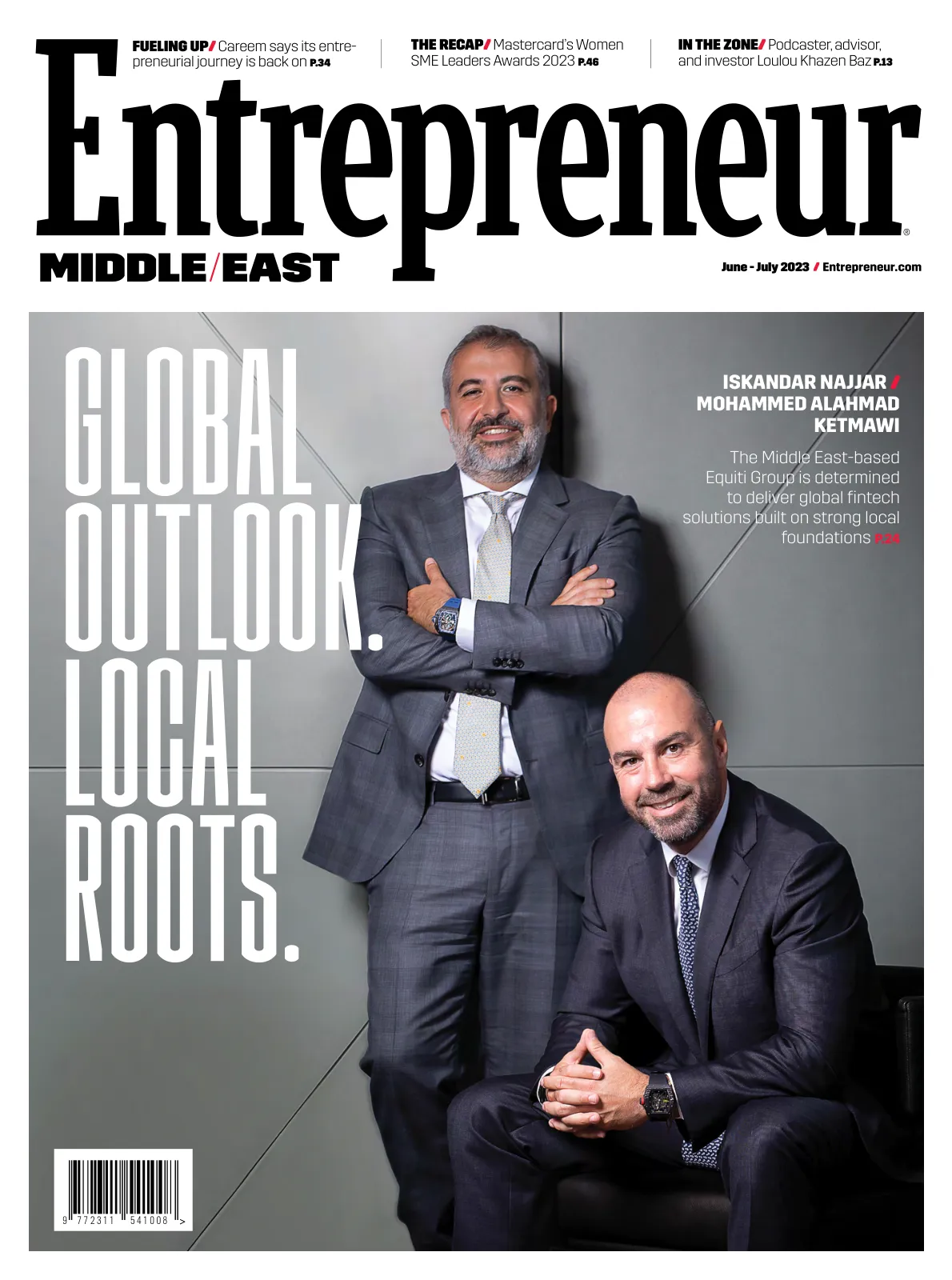
Entrepreneur Middle East, June - July 2023
Page 1
GLOBAL
OUTLOOK.
LOCAL
ROOTS.
ISKANDAR NAJJAR
MOHAMMED ALAHMAD
KETMAWI
The Middle East-based
Equiti Group is determined
to deliver global fintech
solutions built on strong local
foundations P.24
9
7 7 2 3 1 1
5 4 1 0 0 8
>
THE RECAP/ Mastercard’s Women
SME Leaders Awards 2023 P.46
IN THE ZONE/ Podcaster, advisor,
and investor Loulou Khazen Baz P.13
FUELING UP/ Careem says its entre-
preneurial journey is back on P.34
June - July 2023
Page 2
SIGN UP & SAVE 25% ON STAYS
WITH BREAKFAST INCLUDED
Page 3
Book, stay, enjoy.
THAT’S
Page 4
4 / ENTREPRENEUR.COM / June - July 2023
P.13
In The Zone
As a podcaster, advisor, and investor,
Loulou Khazen Baz -the founder of the
Arab world’s first online employment
marketplace, Nabbesh- continues to
enrich the MENA startup ecosystem.
by TAMARA PUPIC
P.18
Forces For Good
Having announced its 2023 fellows,
the Cartier Women’s Initiative is now
welcoming applications from women
impact entrepreneurs for its 2024 edition.
by ABY SAM THOMAS
P.24
Global Outlook.
Local Roots.
Iskandar Najjar and Mohamed Alahmad
Ketmawi, the co-founders of Equiti Group
are keen on having the MENA region make
its presence felt in the international fintech
arena.
P.34
Fueling Up
Careem says its entrepreneurial journey
is back on, with co-founder and CEO
Mudassir Sheikha saying the company’s
original values will continue to guide its next
big chapter.
by ABY SAM THOMAS
P.46
THE RECAP: Women
SME Leaders Awards
2023
Meet the winners of the second edition
of the Women SME Leaders Awards,
staged by Mastercard in collaboration with
Entrepreneur Middle East.
FEATURES
Contents/June 2023
BUSINESS
UNUSUAL
Page 5
27232
Homes from
AED 1,696,000
*
*T&C apply
Launching Sequoia,
your woodland paradise
A peaceful enclave hidden within the woodland.
Choose from a range of well-appointed homes, from
two-bedroom townhouses to six-bedroom signature villas.
Every residence at Sequoia blends nature-inspired design and
features with the latest smart home technology, bringing you
environmentally friendly convenience and comfort.
Page 6
Page 7
Welcome to the
E X C E P T I O N A L
An iconic hotel featuring
luxury rooms and apartments
with trendy dining options
in the heart of Riyadh
BOOK NOW
Mansard Riyadh, A Radisson Collection Hotel
4248 Prince Mohammed Ibn Salman Ibn Abdulaziz Road, Riyadh 6721-13315, Saudi Arabia
00966118290900 info.mansard@radissoncollection.com
radissonhotels.com/collection
Page 8
8 / ENTREPRENEUR.COM / June - July 2023
59 The Myth Of
The Business Plan
YOUNESS YAGHCHA, founder of
the Lab for Innovative Minds
and Entrepreneurship, explains
why we need to embrace
experiments for entrepreneurial
success.
62 Trust Is Built,
Not Bought
CHARLI WRIGHT, Managing
Director for the Middle East
at JWI, explains why acting
ethically is key to building a
business where teams thrive.
66 Answering Difficult
Questions (The How-To)
WILL HARDIE, co-founder
of the International School
of Communication, shares
universal strategies from the
new science of media training.
70 Rethinking The Ad
Delivery Experience
Want a 100% guaranteed
view-through rate? Idealz
One’z ZEINA ESTWANY explains
how you can make it happen.
‘TREPONOMICS
EDITOR IN CHIEF Aby Sam Thomas
aby@bncpublishing.net
CEO Wissam Younane
wissam@bncpublishing.net
DIRECTOR Rabih Najm
rabih@bncpublishing.net
CREATIVE LEAD Odette Kahwagi
design@bncpublishing.net
MANAGING EDITOR Tamara Pupic
tamara@bncpublishing.net
STARTUPS SECTION EDITOR Pamella de Leon
pamella@bncpublishing.net
FEATURES WRITER Aalia Mehreen Ahmed
aalia@bncpublishing.net
DIGITAL SOLUTIONS DIRECTOR
Mahdi Hashemi mahdi@bncpublishing.net
HEAD OF INNOVATION
Sarah Saddouk sarah@bncpublishing.net
GROUP SALES DIRECTOR – B2B GROUP
Joaquim D’Costa jo@bncpublishing.net
COLUMNIST Tamara Clarke
CONTRIBUTORS
Fida Chaaban, Zeina Estwany, Will Hardie, Atul Hegde,
Charli Wright, and Youness Yaghcha
SUBSCRIBE
Contact subscriptions@bncpublishing.net to receive
Entrepreneur Middle East every issue
COMMERCIAL ENQUIRIES
sales@bncpublishing.net
ENTREPRENEUR.COM
Access fresh content daily on our website
All Rights Reserved 2023. Opinions expressed are solely those of the contributors. Entrepreneur
Middle East and all subsidiary publications in the MENA region are officially licensed exclusively to
BNC Publishing in the MENA region by Entrepreneur Media Inc. No part of this magazine may be
reproduced or transmitted in any form or by any means without written permission of the publisher. Images
used in Entrepreneur Middle East are credited when necessary. Attributed use of copyrighted images
with permission. All images not credited otherwise Shutterstock. Printed by United Printing and Publishing.
PO BOX 502511 DUBAI, UAE
P +971 4 4200 506
Contents/June 2023
73 Unlocking Growth
Behind the scenes of Belgium-
headquartered Deliverect’s
acquisition of UAE-based
ChatFood.
by TAMARA PUPIC
80 Allyship and awareness
Paths To Progress, a forum
staged by Heriot-Watt University
Dubai, Female Fusion, And
Entrepreneur Middle East, spurs
conversations on gender equity.
by AALIA MEHREEN AHMED
84 Primed for growth
Following Qatar’s successful
staging of The FIFA World Cup
2022, Qatar Tourism COO
Berthold Trenkel believes the
nation’s appeal as a tourist
destination is only set to grow.
by TAMARA PUPIC &
ABY SAM THOMAS
STARTUP
SPOTLIGHT
↑ MEET THE NEWEST (AND
PROBABLY THE SMARTEST)
MEMBER OF YOUR STARTUP:
ARTIFICIAL INTELLIGENCE
According to YAAP founder Atul
Hegde, the future looks set to
be humans with -not versus-
machines.
P.35
EntMagazineME
Entrepreneur-me
Page 9
New IVECO T-WAY: high productivity and safety on off-road terrains
With a complete line-up of AWD and PWD versions and the the 16-speed HI-TRONIX automated
gearbox, the IVECO T-WAY features a host of functionalities such as Rocking Mode, Off-road Mode,
Creeping Mode and 4 reverse gears to tackle with ease the toughest off-road conditions. The new
architecture of the EBS system, combined with disc brakes on all wheels, greatly improves the vehicle’s
performance and the driver’s safety in the most demanding applications.
New IVECO S-WAY: high technology and efficiency for on-road missions
The new IVECO S-WAY, with a completely redesigned and reinforced cab, offers a wide choice of
Euro III/V diesel engines, a delivering class-leading power from 360 HP to 560 HP Euro III / 570 HP
Euro V and superior fuel-saving devices, such as anti-idling feature, Ecoswitch, Ecoroll and Smart
Alternator, 12-speed HI-TRONIX automated transmission with the most advanced technology
in its category, electronic clutch and best-in-class torque-to-weight ratio.
Drive the new way.
Page 10
10 / ENTREPRENEUR.COM / June - July 2023
Editor’s Note/
HAVE YOU EVER HAD THAT MOMENT WHEN YOU TAKE
A LOOK AT YOUR SEEMINGLY NEVER-ENDING TO-DO
LIST, AND YOU FEEL YOURSELF SHUTTING DOWN
ALMOST INSTANTANEOUSLY?
Or maybe this feeling gets triggered when an email
pops into your inbox featuring a proposal for a new
big project, or even just a crisis with an existing
one- how do you add that to your already-packed
agenda for the day, or, heck, even for the month?
When you work at a startup or a small business, it’s
safe to say that you will almost certainly have such
instances where you find yourselves exceedingly
overwhelmed with everything that’s on your plate.
Personally, I can admit to experiencing everything
from dizzying panic attacks to paralyzing
procrastination in response to such situations- and
let’s just say that these are definitely not states I like
to see myself in.
But all of us can find ourselves in such mindspaces
from time to time, and there’s definitely a lot of
information out there about how we can get ourselves
out of them. Some point to the importance of having
a purpose that keeps us going even when the going
gets tough; others highlight the need for a support
system of colleagues, friends, or family to pull us up
when we are feeling down. All of these solutions have
their own merit, of course, and it’s often a mix of
them that get us through these moments of strain.
When all is said and done though, I believe it comes
down to a personal sense of understanding that
regardless of the circumstances we may be feeling
overwhelmed by, this too shall pass. After all, much
like the highest of highs, the lowest of lows don’t
persist either- and this transiency is what I like to
remind myself of when I am in a funk.
But this is not to say that this thought gets me up
and running immediately after a stumble- on the
contrary, I like to think a little wallowing in self-pity
is allowed (and perhaps even necessary) to take stock
of my emotions. It also just gives me time to rest,
recuperate, and recalibrate. Being kind to myself is
integral here, and that will essentially be what gets
me to pick myself up, try to shake off all the
negativity that’s bogging me down, and just get one
foot ahead of the other, in an attempt to move past
whatever difficulty I find myself roiled by.
At the end of the day, I believe that getting past
feelings of being overwhelmed often boils down to
finding a balance between resilience and self-
compassion. And while weirdly hard for some of us,
we also need to remember that we are not alone in
this journey- asking for help is never a bad thing, and
that is often crucial in us regaining control of the
situation, and, perhaps, emerging stronger than ever.
Aby Sam Thomas
Editor in Chief
@thisisaby
aby@bncpublishing.net
Rolling with the punches
Getting beyond what may feel like a breaking point
Page 11
Page 12
Page 13
13
June - July 2023 / ENTREPRENEUR.COM /
In the zone
As a podcaster, advisor, and investor, LOULOU KHAZEN BAZ -the founder of the Arab
world’s first online employment marketplace, Nabbesh- continues to enrich the MENA
startup ecosystem by TAMARA PUPIC
Page 14
14 / ENTREPRENEUR.COM / June - July 2023
I
must say I work a lot,” says Loulou Khazen Baz,
in 2023, more than a decade since she was
one of the busiest entrepreneurs on the block
after launching Nabbesh, the Arab world’s first
online employment marketplace, and thereby
proving that, well, some things don’t change
with time. Indeed, since selling Nabbesh to
UAE-based digital editorial marketplace Ureed in
2020, Khazen Baz today has built a portfolio of
overlapping ongoing ventures that serve a singular
goal- to enable entrepreneurs from the MENA
region, and especially those in the early stages of
their ventures. “I help by sharing my own
experiences through my startup advisory,” Khazen
Baz explains. “I help by bringing in knowledge from
great guests and experts on the Conversations with
Loulou podcast, and I also enable them by investing
via the angel syndicate called Spade Ventures.”
B/The Big Idea
→ AS KHAZEN BAZ CONTINUES
WORKING ON “CREATING MORE
IMPACT, MORE CONTENT, MORE
MENTORSHIP, AND MORE
INVESTMENT,” she is one of
the few in such a position who
admit the inconveniences and
limitations of being driven and
inspired to make change: i.e.
the scarcity of time.
Page 15
15
June - July 2023 / ENTREPRENEUR.COM /
Before we delve into more
details about each of these
three projects, I ask: if the
Baz who founded Nabbesh in
2012 were her mentee today,
what advice would she give
her younger self? Khazen Baz
replies that her younger self
faced the same three
challenges that most
founders usually struggle
with in the early days- access
to talent, access to funding,
and market readiness. “My
advice would have been to be
ruthless about hiring and
retaining the best people,”
Khazen Baz explains. “To
trust my gut, be weary of red
flags, and act on them
immediately. A small
unresolved situation, a
difficult discussion that needs
to happen, a hard decision
that needs to be taken can
become existential if left
unresolved. Sometimes, time
has a way to solve problems,
but more often, problems
need to be dealt with on the
spot. When the right team is
in place, everything else
becomes easy to deal with.”
Talking about Nabbesh
provides a neat transition
into exchanging opinions
about Dubai as a startup hub,
and Khazen Baz considers
entrepreneurs today to be “so
lucky vis-à-vis when I was
building [in 2012].” She says,
“The ecosystem today is more
mature, you have better
access to talent, and you have
more funding pouring into
the ecosystem. The invest-
ment community has
certainly grown considerably.
We went from investors
dictating terms, to entrepre-
neurs dictating terms, and it’s
an interesting cycle. The
great entrepreneurs, I
believe, still have leverage.”
This statement also offers an
inkling to the insights that
Khazen Baz shares through
her advisory services for
startups in the MENA—after
all, who better to tell you
what’s a good route to take in
the entrepreneurial space
than someone who’s gone
through the whole roller-
coaster ride by themselves!
Khazen Baz describes
exiting Nabbesh as “the end
of a sprint,” and since she
considers life to be a series of
sprints, she always suggests
“focusing on the next one,”
and that’s what she did too.
One of her current ventures
is the angel syndicate Spade
Ventures, a network of
likeminded people “who are
smart, accomplished,
curious, and are looking to
create value” by seeding the
next generation of startups,
with its website stating that
the minimum ticket size per
person is US$20,000. “As an
entrepreneur, I was always
excited about meeting other
entrepreneurs who were
building exciting things,”
Khazen Baz explains. “Our
ecosystem is so nascent, and
there is so much to learn. So,
I started investing in 2019 in
founders that I liked, who
were building something
interesting, and who I felt
had the resilience to see
things through.”
The website of Spade
Ventures currently lists its
portfolio of 10 early stage
technology startups that
operate in the Middle East,
North Africa, and Pakistan,
and Khazen Baz explains that
she finds meeting “brilliant
people who are brimming
with energy and optimism” as
one of most enjoyable parts
of investing in early-stage
startups. “It is a great
opportunity to build
friendships, to exchange
notes, and to spend quality
time with people,” she says. }
“SOMETIMES, TIME HAS A WAY TO SOLVE PROBLEMS, BUT MORE
OFTEN, PROBLEMS NEED TO BE DEALT WITH ON THE SPOT. WHEN
THE RIGHT TEAM IS IN PLACE, EVERYTHING ELSE BECOMES EASY
TO DEAL WITH.”
Within her bi-weekly podcast, Conversations with Loulou, Khazen Baz has presented the
stories and insights of 53 entrepreneurs and business leaders over the last two years.
Page 16
16 / ENTREPRENEUR.COM / June - July 2023
Plus, she adds, angel investing is also an
opportunity to learn and gain market
insights while “witnessing a truly
amazing founder journey firsthand.” She
adds, “When you invest, you can truly
help the founders with everything from
user testing to strategy, to hiring, to
fundraising. Sometimes, the founders
just need to vent, and I am there to listen
and offer a shoulder. The founders at
that stage are humble, open to feedback,
and are experiencing those highs and
lows of a typical founder journey.”
But perhaps Khazen Baz’s most
popular project right now is her
bi-weekly podcast, Conversations with
Loulou, which has presented the stories
and insights of 53 entrepreneurs and
business leaders since
launching two years ago.
“It is another way to stay
entrenched in the local
startup ecosystem, and
to continue to add value
to the ecosystem by
sharing stories, insights,
tips from people who
made it, and sometimes
people who are early in
their journey, but who
are building businesses
that are solving big
problems,” she explains.
The podcast has since
gone on to be featured
on Apple Podcasts for
the Middle East region
under the banner of
“Shows That Made Us
Think” for 2022, and it
continues to be listed
among the top 20
podcasts in Apple’s
Business and Entrepre-
neurship categories
across the MENA
region.
Khazen Baz says here
that starting a podcast is
an endeavor that
requires dedication,
commitment, and
consistency. “You also
need to be very careful
about guest selection,
curating topics for the
discussion, leading the
discussion, and managing the flow, as
well as editing the conversation to get a
good story,” she says. “The last thing I
want is to put a piece of fluff out there,
and I try very hard to bring guests that
can truly add value to the listeners.” The
level of interest in entrepreneurship-
related topics (which is evident through
each of her episodes having “3,000
downloads across audio platforms and
about 5,000 views on YouTube”) makes
her confident in the potential of her
podcast to scale significantly. “I am
looking for sponsors to help me invest in
distribution and building reach, so that
our show can touch the lives of more
people, and, hopefully, inspire them to
build something.”
As Khazen Baz continues working on
“creating more impact, more content,
more mentorship, and more investment,”
she is one of the few in such a position
who admit the inconveniences and
limitations of being driven and inspired
to make change: i.e. the scarcity of time.
“I am currently in the process of
automating a lot of what I do, and I try
to avoid face-to-face meetings unless I
absolutely must, and, in general, I must
be very strict with my time to the dismay
of others,” Khazen Baz says. “I wish I
could grab a coffee, have a call, brain-
storm, check someone’s deck and give
advice, invest in every founder who
reaches out, but I can’t. And I am not
saying that because I am special. I think
everyone needs to be super strict about
their time; it is, after all, the most finite
resource.”
} Go all in
“Building a startup is hard- you’ve
got to be all in. If you chose to be an
entrepreneur, you’ve got to accept
that there will be a lot of sacrifice.
You cannot have it all, sorry.”
} Forge strong ties
from the get-go
“Build relationships with key
stakeholders and investors from day
one. Relationships take years to
build, and people tend to support/
invest in people they know and
trust.”
} Make decisions
quickly
“Have these difficult conversations,
fire someone who is
underperforming, do not succumb
to blackmail, do not have a single
point of failure. Trust your team, but
stay vigilant- everyone has got to
earn your trust, as much as you’ve
got to earn theirs.”
Loulou Khazen Baz
shares her tips for
entrepreneurs
'TREP
TALK
B/The Big Idea
Page 17
RAKCERAMICS.COM
Imagine a space where your inspiration
can run free. A world that tells
your own story, every single day.
At RAK Ceramics we help
create the perfect living space,
for you and your loved ones.
Imagine your space.
IMAGINE
YOUR
SPACE
Page 18
18 / ENTREPRENEUR.COM / June - July 2023
INNOVATOR
“Cartier is
proud to
continue
building on its
commitment
for women’s
empowerment,
thus leveraging
business as a
force for good.”
CYRILLE VIGNERON,
CEO and President of
Cartier International
CYRILLE VIGNERON,
President and CEO,
Cartier International
Page 19
19
June - July 2023 / ENTREPRENEUR.COM /
W
hether you believe in human rights,
or just prosperity, it is a good idea to
try to unshackle half the population
of the world.” Amal Clooney made
this statement during her speech
at the 2023 Cartier Women’s Initiative awards
ceremony held in Paris in May, and these words
by the acclaimed Lebanese-British barrister are a
reflection of the principles that drive this annual
international entrepreneurship program founded
by the French Maison, Cartier, in 2006.
The Cartier Women’s Initiative envisions “a world
in which every woman impact entrepreneur driving
social and environmental change can achieve her
full potential,” and it seeks to support women-run
and women-owned businesses from around the
world that aim to have a strong and sustainable
positive impact on society as defined by the United
Nations (UN) Sustainable Development Goals
(SDGs). Female impact entrepreneurs working in
any country and in any sector are welcomed to
apply for the program every year, and the selected
applicants are then provided with the necessary
financial, social, and human capital support to
grow their respective enterprises, as well as build
their leadership skills. Since its launch, the Cartier
Women’s Initiative has supported a total of 297
impact entrepreneurs hailing from 63 countries
around the world, who have collectively been
awarded US$7,440,000 in grant funding. }
FORCES
FORGOOD
Having announced its 2023 fellows, the Cartier Women’s Initiative
is now welcoming applications from women impact entrepreneurs
for its 2024 edition
by ABY SAM THOMAS
FORCES FOR GOOD | CARTIER WOMEN’S INITIATIVE
Page 20
20 / ENTREPRENEUR.COM / June - July 2023
Having been able to attend this year’s
Cartier Women’s Initiative awards
ceremony in Paris, I got to speak with
Sophie Doireau-Tiberghien, who is the
CEO for the Middle East, Africa, and
India at Cartier, to better understand the
objectives and aspirations with which the
Maison runs this program. According to
Doireau-Tiberghien, who is known to be
one of key driving forces behind Cartier’s
participation in the Women’s Pavilion at
Expo 2020 Dubai, the Cartier Women’s
Initiative is yet another indication of the
Maison’s innate belief in the benefits the
world stands to gain if it enables its
women. “The fact is that when women
thrive, humanity thrives,” Doireau-Ti-
berghien says. “We have the strong belief
that empowering women will empower
the world, and that it will benefit
everyone, both women and men.”
Doireau-Tiberghien, a Legion d’Honneur
winner who has been working at Cartier
for 15 years now, goes on to tell me that
the program is something that she has
been especially fond of all through her
tenure at the company, and she’s
particularly proud about the fact that its
cohort for this year, which awarded a
total of 32 fellows, had 11 hailing from
the regions under her purview.
But while the 2023 edition of the
Cartier Women’s Initiative has just come
to an end, work has already begun on its
next instalment. Applications are now
open for the 2024 edition of this
program, with Wingee Sampaio, Global
Program Director at Cartier Women’s
Initiative, saying that this signals the
start of a process that will keep running
until the announcements of the winners
next year. “By the end of June, we’ll end
up with hopefully lots of applications,
but, typically, across the 11 program
categories that we have every year, we
receive around roughly 1,100 applica-
tions,” she says. “But we don’t really look
at the success of our program by the
number of applications, because that is
just how you roll your eligibility criteria-
if you want a lot of applications, you’d
just have less criteria. And so, for us, it’s
actually really trying to figure out, given
the resources that we have, given what
INNOVATOR
THE WINNERS
Here’s the full list of awardees for the 2023 edition
of the Cartier Women’s Initiative
THE 11 FIRST-PLACE AWARDEES
> Latin America and the Caribbean:
Emily Ewell, Brazil, Pantys
> North America: Wendy Owens, United
States, Hexas Biomass Inc.
> Europe: Iva Gumnishka, Bulgaria,
Humans in the Loop
> Francophone Sub-Saharan Africa:
Yvette Ishimwe, Rwanda, IRIBA Water
Group
> Anglophone and Lusophone Africa:
Dupe Killa-Kafidipe, Nigeria, Platinum
Fisheries
> Middle East and North Africa: Khadija
Elbedweihy, Egypt, PraxiLabs
> East Asia: Woori Moon, South Korea,
40FY
> South Asia and Central Asia: Denica
Riadini-Flesch, Indonesia, SukkhaCitta
> Oceania: Ingrid Sealey, Australia, Teach
Well
> Science and Technology Pioneer
Award: Poulami Chaudhuri, India, Helex
> Diversity, Equity and Inclusion Award:
Blake Van Putten, United States, CISE
THE 11 SECOND-PLACE AWARDEES
> Latin America and the Caribbean:
Atilana Piñón, Colombia, Retorna
> North America: Ania Wysocka,
Canada, Simply Rooted Media Inc.
> Europe: Mariam Torosyan, Armenia,
Safe YOU
> Francophone Sub-Saharan Africa:
Siny Samba, Senegal, Le Lionceau
> Anglophone and Lusophone Africa:
Angella Kyomugisha, Uganda, Kaaro
Health
> Middle East and North Africa:
Renad Aljefri, Saudi Arabia, Ad Astra
Therapy
> East Asia: Megan Lam, Hong Kong
SAR (China), Neurum Health
> South Asia and Central Asia: Dimple
Parmar, India, ZenHeal Wellness
Private Limited
> Oceania: Lina Xu, Australia, Telecare
> Science and Technology Pioneer
Award: Liv Andersson, UK, BioZeroc
> Diversity, Equity and Inclusion
Award: Ishani Roy, India, Serein Inc.
THE 10 THIRD-PLACE AWARDEES
> Latin America and the Caribbean:
Lidia Díaz, Dominican Republic, Plant
Powered
> North America: Kayla Castañeda,
United States, Agua Bonita
> Europe: Nathalie Lesselin,
Switzerland, KOKORO Lingua
> Anglophone and Lusophone Africa:
Charlot Magayi, Kenya, Mukuru Clean
Stoves
> Middle East and North Africa: Farah
Emara, Egypt, FreshSource
> East Asia: Olivia Cotes-James, Hong
Kong SAR (China), LUÜNA
> South Asia and Central Asia: Mint
Lim, Singapore, School of Concepts
> Oceania: Lily Dempster, Australia,
One Small Step
> Science and Technology Pioneer
Award: Adi Yehezkeli, Israel, Fabumin
> Diversity, Equity and Inclusion
Award: Chengchuan Shi, China,
Voibook Technology
Page 21
21
June - July 2023 / ENTREPRENEUR.COM /
the program can do for a woman impact
entrepreneur, about which group will benefit
the most from this, which group is the most in
need- that’s why we created those resources to
begin with. So, those two goes hand-in-hand,
what we’re good at, as well as what is needed,
and, like all entrepreneurs, we’re also trying to
solve for a product-market fit.”
When asked if there are any particular
characteristics that are common among all of
the fellows of the Cartier Women’s Initiative so
far, Doireau-Tiberghien replies by first
pointing towards their genuine want to make
something better in the world around them.
“Regardless of the field, be it information
technology, environment, healthcare, or
others, they all realize that there is a lack in
something around them,” she continues. “And
then, when it comes to figuring out who could
fill that gap, they think, ‘Why not me?’”
Confidence and courage thus become key
traits of the entrepreneurs that are a part of
this program, despite the non-ideal circum-
stances they may often find themselves in, or
the challenges they might find stacked up
against them. But, as Doireau-Tiberghien puts
it, they still have an unrelenting thirst to make
change happen, and for that, they are ready to
move mountains as well.
A cursory look at the Cartier Women’s
Initiative fellows this year will be enough to
understand what Doireau-Tiberghien is
talking about. Consider, for instance, Khadija
Elbedweihy, founder of Egypt-based startup,
PraxiLabs, one of the winners in the MENA
category this year. As a university student,
Elbedweihy had struggled with the lack of
access to traditional labs in Egypt to aid her
education, and she soon found out that this is
a problem faced in many parts of the world. }
SOPHIE DOIREAU-TIBERGHIEN - CEO
for the Middle East, India, Africa and
Turkey, Cartier
“WE HAVE THE
STRONG BELIEF
THAT EMPOWERING
WOMEN WILL
EMPOWER THE
WORLD, AND THAT
IT WILL BENEFIT
EVERYONE, BOTH
WOMEN AND MEN.”
FORCES FOR GOOD | CARTIER WOMEN’S INITIATIVE
Left: Wingee Sampaio,
Global Program Director,
Cartier Women’s Initiative.
Right: Sophie Doireau-
Tiberghien, CEO - Middle
East, India and Africa,
Cartier.
Page 22
22 / ENTREPRENEUR.COM / June - July 2023
That’s what led her in 2016 to launch
PraxiLabs, which builds immersive
virtual lab experiences that are acces-
sible, usable, and affordable for educa-
tional institutions and schools. Another
example, also from the MENA region,
would be Saudi Arabia’s Renad Aljefri,
who, after finding it difficult to access to
home-based therapeutic services for her
child with special needs in the Kingdom,
launched an online platform called Ad
Astra Therapy that allows families to
search for such offerings. Since its launch
in 2020, Ad Astra Therapy today
operates in more than 59 Saudi cities
and towns, with its offering now using by
more than 1,600 families across the
country, and Aljefri is currently hoping
to scale her enterprise to other Gulf
nations, and then beyond the MENA
region as well.
Sampaio adds here that the Cartier
Women’s Initiative would be especially
beneficial for women impact entrepre-
neurs who’d like to see their enterprises
grow beyond the borders in which they
currently operate. “I think that just given
where Cartier is, given our reach, and
what the resources of the program are, it
makes sense for an impact entrepreneur
who eventually has ambition for global
change, or maybe learning global best
practices of their work, etc.,” Sampaio
explains. “And so, maybe in the immedi-
ate timeframe, their business may
expand, let’s say, from Dubai to the
Middle East, and then from Middle East
eventually to some selective market- if
that’s their eventual growth path, then
our program’s probably the right thing
for them… All of the visibility, the grant
funding, the education, the network, that
we provide, it’s all global. So, if you are
Since its launch, the
Cartier Women’s
Initiative has
supported a total
of 297 impact
entrepreneurs hailing
from 63 countries
around the world
NADINE LABAKI,
actress, director
and activist.
INNOVATOR
Page 23
23
June - July 2023 / ENTREPRENEUR.COM /
C
artier Women’s Initiative,
the annual international
entrepreneurship program
that aims to drive change
by empowering women impact
entrepreneurs, is now calling inviting
applications for the 2024 edition of the
initiative founded by the French Maison,
Cartier, in 2006.
The program, which is open to women-
run and women-owned businesses from
any country and sector that aim to have
a strong and sustainable positive impact
on society as defined by the United
Nations Sustainable Development Goals,
had announced its 2023 fellows in May,
and it is now calling for entries for its
next edition.
This year’s installment of the Cartier
Women’s Initiative saw a total of 11
awards being presented. This included
nine regional awards for the regions of
Europe, North America, Latin America
and the Caribbean, Francophone
sub-Saharan Africa, Anglophone and
Lusophone Africa, Middle East and
North Africa, West Asia, South Asia and
Central Asia, and Oceania, as well as two
thematic awards, namely, the Science
and Technology Pioneer Award, and the
Diversity, Equity and Inclusion Award.
A total of 32 fellows, representing the
top three businesses for each of the
nine regional awards, and for the two
thematic awards, were announced at a
glittering ceremony conducted in Paris,
which featured several high-profile
speakers and guests like Amal Clooney,
Nadine Labaki, Melanie Laurent, Yara
Shahidi, Sandi Toskvig, and several
others.
“We are thrilled to host the 16th
annual awards ceremony of the Cartier
Women’s Initiative in Paris, celebrating
our ever-growing community of impact-
driven entrepreneurs,” said Cyrille
Vigneron, CEO and President of Cartier
International, in a statement. “Cartier
is proud to continue building on its
commitment for women’s empowerment,
thus leveraging business as a force for
good.”
The first-place awardees will take
home US$100,000 in grant funding, while
the second and third-place awardees
will receive US$60,000 and US$30,000
respectively. To facilitate this, the total
grant funding per edition has increased
to US$2 million, its largest amount yet.
In addition to the grant funding, all 33
fellows will also benefit from tailored
mentoring and coaching, media visibility,
networking opportunities and education
courses from the leading business
school INSEAD.
The 2024 edition of the Cartier
Women’s Initiative is now open for
applications, with entries being accepted
from Wednesday, May 10, 2023 to
Friday, June 30, 2023, with the cut-off
time on Friday, June 30 being 6pm
Central European Summer Time
(CEST). Only one application per
business will be accepted; businesses
that submit applications to multiple
award categories will be disqualified.
Initial selection decisions will be
sent out on August 1, 2023, and all
applicants will be notified by December
1, 2023. If your business is shortlisted,
you will be asked to provide additional
supporting documentation. That said,
due to high volume of applications,
the program will be unable to provide
individual feedback to non-finalists.
To submit your application for the
Regional Awards of the Cartier
Women’s Initiative, please head
to this website: https://www.
cartierwomensinitiative.com/regional-
awards
All information regarding the Cartier
Women’s Initiative application/
registration can be found on this link:
https://www.cartierwomensinitiative.
com/awards
A CALL FOR INNOVATORS
Applications for the 2024 edition
of the Cartier Women’s Initiative
are now open until June 30, 2023
an entrepreneur who’s trying to get
access to that, then it’s the right program
for you.”
Now, it’s one thing for the Cartier
Women’s Initiative to offer support to
female changemakers- but it’s another
thing altogether for such women to
actually make use of the opportunity
that’s being presented to them. It is,
unfortunately, not uncommon for several
greatly deserving and highly capable
women to doubt themselves. Research
has noted how women often lag behind
men in confidence, and so, to those
doubting themselves, and wondering if
this program is for them, Doireau-Ti-
berghien insists that it is, and that they
should dare to apply for it. “Yes, it’s for
you,” she declares. “As long as you have a
business that is doing something to make
the world better, to have a positive impact
on it, then, yes, this program is for you.
You have to dare to be a part of it,
because most of the time, it’s the
self-confidence that we often don’t have
as women that keeps us away from
capitalizing on opportunities like these.”
Again, Sampaio agrees with Doireau-
Tiberghien, and her advice for women
who might be doubtful about participat-
ing in the Cartier Women’s Initiative is
quite simple. “Oh, just do it,” Sampaio
says. “Just do it. What’s stopping you?”
FORCES FOR GOOD | CARTIER WOMEN’S INITIATIVE
Page 24
24 / ENTREPRENEUR.COM / June - July 2023
LOCAL
GLOBAL OUTLOOK.
ISKANDAR NAJJAR
MOHAMMED ALAHMAD
KETMAWI
THE MIDDLE EAST-BASED
EQUITI GROUP IS DETERMINED
TO DELIVER GLOBAL FINTECH
SOLUTIONS BUILT ON STRONG
LOCAL FOUNDATIONS
24
ROOTS.
/ ENTREPRENEUR.COM / June - July 2023
Page 25
25
June - July 2023 / ENTREPRENEUR.COM / 25
June - July 2023 / ENTREPRENEUR.COM /
Page 26
26 / ENTREPRENEUR.COM / June - July 2023
T
he rapid growth of Equiti
Group, a market-leading
Middle East-based fintech
provider, has been making
significant waves in the
world’s financial arena.
Indeed, its co-founders,
Iskandar Najjar and
Mohammed Alahmad
Ketmawi, are passionate
about establishing the
MENA’s presence on a
global scale by crafting
international solutions
rooted in local regulations.
Driving through Dubai lately,
it’s almost impossible to
ignore the presence of
Equiti. Over the past year, the Group
has been intensifying its marketing
efforts as part of its expansion plans,
and it aims to bring the benefits of
its online trading, payment services
and digital asset solutions to as
many people as possible. Iskandar
Najjar, co-founder and Group CEO
of Equiti Group, says, “Since 2017,
Mohammed Alahmad Ketmawi, my
co-founder and Chief Managing
Director, and I have set out to build
something that could serve everyone
globally. While many international
companies have established their
presence here, we uniquely possess
the experience, know-how, and
talent pool to really build something
from the region that can serve on
on a global level.” A thriving fintech
sector will undoubtedly enhance the
competitiveness of the Middle East
in the global economy, and Equiti is
thus on a mission to ensure that such
growth stems from strong ethical
roots.
Since its inception, the Equiti Group has rapidly expanded its
operations, opening offices in the UAE, UK, Jordan, Seychelles,
Armenia, and Cyprus. Some of their notable achievements
include being the first specialized global brokerage to receive a
license from the Jordan Securities Commission in over a decade,
as well as being the first non-dealing online foreign exchange
(FX) broker licensed by Kenya’s Capital Markets Authority. With
an emphasis on innovative and regulatory quality, the Group is
setting new standards in under-serviced markets worldwide.
“Innovation is very much at the heart of what we do, but we have
a regulation-first mindset, which really cements the foundations
of our every step,” Najjar says. “We’ve built technologies that are
very much focused on developing markets, but with our service
offerings, we’re very close to the frontier and emerging markets
as well. So, we are devoted to bringing global standards to
markets that are significantly under-serviced in this space.”
MOHAMMED ALAHMAD
KETMAWI, co-founder and
Managing Director at Equiti
Group
Page 27
27
June - July 2023 / ENTREPRENEUR.COM /
Equiti’s unique strength stems from this
approach of building global solutions on a
deep understanding of emerging markets.
“When we’re in Kenya, we want to be
Kenyan. When we’re in Jordan, we want to
be Jordanian. When we’re in the UAE, we
want to be from the UAE,” Najjar explains.
“And we’re servicing our clients accordingly,
from onboarding to payment services to
trading instruments, and all of this really
allows us to be both globally scalable and
locally available. That is what has really
been a key pillar of our growth, and one of
our key differentiators against competitors.”
Speaking of business growth, Equiti has
experienced aggressive increases in trading
volumes and active accounts on its
platform, quickly becoming one of the top
15 brokers globally in terms of monthly
volume. This year also saw the launch of
their proprietary mobile trading app, Equiti
Trader, which has achieved remarkable
success with a month-on-month growth
rate of 50%. Najjar attributes this achieve-
ment to the synergy between technology,
regulation, and sales strategies.
Building stable and resilient systems within the
business is paramount for supporting such growth.
“Firstly, it is essential to have the right data architec-
ture in place in order to be able to understand what
you want to automate and the necessity behind it,”
Najjar says.“Secondly, building the right process
management systems is essential to understanding
how to make automated things better and how to
support it for scale.” This is the methodology that has
been realized by Equiti’s 500-strong team, of whom
130 are part of the Group’s tech hubs in Jordan,
Armenia, Cyprus, and London. Najjar adds, “The
world has changed, remote access to talent has
become more accessible than ever before, but what
has not changed is that having the right team is
essential.”
Equiti’s payment services have also witnessed
impressive growth figures, and on top of this, the
company also recently acquired a digital payment
technology provider named Cloud Invest. Comment-
ing on this deal, Mohammed Alahmad Ketmawi,
co-founder and Chief Managing Director, says, “The
acquisition of Cloud Invest bolsters our operational
efficiency, and it enables us to achieve vertical
integration while expanding our revenue lines.” }
ISKANDAR NAJJAR
co-founder and Group
CEO of Equiti Group
“WHILE MANY INTERNATIONAL COMPANIES HAVE ESTABLISHED THEIR
PRESENCE HERE, WE UNIQUELY POSSESS THE EXPERIENCE, KNOW-HOW,
AND TALENT POOL TO REALLY BUILD SOMETHING FROM THE REGION
THAT CAN SERVE ON A GLOBAL LEVEL.”
Page 28
28 / ENTREPRENEUR.COM / June - July 2023
Looking ahead, the future plans for the payment side of
Equiti’s business include enhancing the Group’s offerings,
and improving its operational efficiencies. “I expect this to
happen quite soon, as soon as the second quarter of this
year, and then, since we’re already servicing large retailers
and large banks across Africa and the Middle East, we’re
looking at presenting and offering our new payments
solutions as well,” Alahmad Ketmawi explains. “For
example, one of our quite innovative offerings is our
tap-to-phone solution that is evolving the payments space
by allowing clients to no longer use point-of-sale (POS)
devices, but to be able to use their phones for executing
transactions. So, that’s a very, very exciting piece that we’ll
be pushing to market soon.”
Expanding Equiti’s reach even further, Alahmad
Ketmawi adds that “we are investing heavily in developing
our fintech and many new solutions are coming to life as
we speak,” such as tokenising real-world assets (gold, real
estate, and other commodities) and developing more
proprietary tech. Equiti is also a founding member of the
Dubai Digital Asset Association (D2A2), a not-for-profit
industry association registered under Dubai’s Digital
Chamber of Commerce to promote sectoral growth, and
to provide a standard-setting platform for the digital asset
industry in the region. Equiti’s Managing Director of
Strategy, Gaurang Desai, is the Chairman of the D2A2,
while Najjar serves as the Director of the Board. }
“WE’RE SERVICING OUR
CLIENTS ACCORDINGLY, FROM
ONBOARDING TO PAYMENT
SERVICES TO TRADING
INSTRUMENTS, AND ALL OF
THIS REALLY ALLOWS US TO
BE BOTH GLOBALLY SCALABLE
AND LOCALLY AVAILABLE.”
Page 29
29
June - July 2023 / ENTREPRENEUR.COM /
Page 30
“The UAE has made major advancements in the still nascent
digital asset space, positioning itself as one of the global
leaders in this field.” Najjar says. “The regulators are fantastic
in terms of providing a framework for bringing cutting edge
technologies to life. Regulation is key, but it’s important to
have it at the right balance, where it doesn’t strangle innova-
tion. I believe the UAE has found the right balance, where it
provides safety and governance, but at the same time, it
provides a landscape for growth and development.”
Going forward, Alahmad Ketmawi notes that Equiti has no
plans of slowing down any time soon. To start with, the
Group’s online trading service is planning to expand into
Latin America and Asia this year. “We also want to continue
our competitive edge in the Middle East and East Africa, and
also to expand across South Africa and West Africa as well,”
he adds. “Our strongest retail presence right now is in East
Africa. From a B2B perspective, we’re quite equally distrib-
uted across Europe, Middle East, and Asia. So, we expect to
continue that growth. Our growth forecasts on the retail side
are about 100% for this year, and for our B2B business, it is
around 30% for the same period.” As we come
to the end of the interview, Najjar highlights
that only regulation can properly fuel the
evolution of the digital asset space. “I think
that the bankrupt cryptocurrency exchange,
FTX, was a real learning curve for everyone to
make them understand the importance of
regulation, oversight and governance,” Najjar
notes. “We are big believers in the technology
behind digital assets, and we are believers in
artificial intelligence, but only if aligned with
all the important structures and related
nuances.”
Equiti believes that the growth of the fintech
sector will support an innovative ecosystem
that extends beyond finance, and this will
encourage collaboration between established
institutions and tech startups, fosters e-com-
merce and regulation, and nurtures foreign
investment and cross-border collaboration. At
the end of the day, establishing the MENA as a
respected and transparent hub for interna-
tional fintech innovation can only strengthen
its global standing, and the Equiti Group is
dedicated to supporting that vision through its
increasingly convenient and exciting financial
services.
“THE GROWTH OF THE FINTECH
SECTOR WILL SUPPORT AN
INNOVATIVE ECOSYSTEM THAT
EXTENDS BEYOND FINANCE.”
The Equiti Trader app, charts for visual purposes only. Image courtesy Equiti Group.
Page 31
Page 32
Page 33
Page 34
CAREEM SAYS ITS ENTREPRENEURIAL JOURNEY IS BACK ON
34
FUELING UP
Co-founder and CEO Mudassir Sheikha says the company’s original values
will continue to guide its new Super App ambitions by ABY SAM THOMAS
I
truly feel that we have a once-in-a-lifetime chance to use this
opportunity, use the starting point we now have at Careem, to leave the
region with a Google or Amazon type of institution that’s going to outlast
us, and many people after us.” As Careem co-founder and CEO Mudassir
Sheikha said this line to me, it was impossible to miss the sheer delight
radiating from the face of the man who, while already being able to lay
claim to one of the MENA region’s greatest entrepreneurial triumphs, was
now setting out to lead his company on its next phase of growth.
/ ENTREPRENEUR.COM / June - July 2023
Page 35
“From an
ecosystem
standpoint,
the Super App
and its growth
should be
an inflection
point.”
→ MUDASSIR SHEIKHA is the
co-founder and CEO of Careem.
He grew up in Karachi, Pakistan,
before graduating from the
University of Southern
California with a degree in
economics and computer
science and then completing a
masters degree in computer
science at Stanford.
PHOTOGRAPHY ALEXANDER BUNGAS
35
June - July 2023 / ENTREPRENEUR.COM /
Page 36
36 / ENTREPRENEUR.COM / June - July 2023
“I truly feel that we have a once-in-a-lifetime chance to use this opportunity.”
→ CAREEM IS THE EVERYDAY
SUPER APP FOR THE GREATER
MIDDLE EAST REGION. A
pioneer of the region’s
ride-hailing economy, Careem
provides a host of daily services
that people need to move
around, order things, and
transfer money in one unified
smartphone app.
IMAGES COURTESY CAREEM
M
y conversation with
Sheikha happened in
April, a few weeks
after his enterprise
had announced a
US$400 million
investment from
fellow UAE-based
tech and investment
conglomerate, e&. After Careem’s
ride-hailing business was bought out
by San Francisco-based Uber for
US$3.1 billion in 2019, the backing it
has now received from e& for its Super
App has been described by Sheikha as
a “restart” of the company’s entrepre-
neurial journey. (For those who may
not remember, it originally kicked off
in 2012.) And while one might have
expected Sheikha to be particularly
jubilant about the funds that Careem
now has at its disposal, I felt that he
was -more than anything else- espe-
cially exhilarated about being able to
lean into his entrepreneurial builder
persona again, driving the creation of
what he hopes will be “the preeminent
technology platform of our region.”
I got to see this firsthand when,
toward the end of our conversation,
Sheikha started to show me the
One-Click Checkout offering that
Careem’s payments arm had, at the
time, just debuted on online retailer
6thStreet.com. In that moment, his
eyes were sparkling, his grins
stretched from ear to ear, and his
enthusiasm was truly palpable. “I’m
excited about this,” he says, as he tells
me of all the benefits that this new
product will bring to consumers in the
region- but he might as well have been
talking about the future of Careem.
Indeed, the new investment from e&
will lead to Careem operating as two
organizational units- the first will be
its ride-hailing business, Careem
Rides, which will continue to be
wholly owned by Uber, and the second
will be Careem Technologies, which
will operate the Super App as well as
other verticals and enablers. The latter
will be owned jointly by e&, Uber, the
three co-founders of Careem (Sheikha,
Magnus Olsson, and Abdullah Elyas),
as well as a select group of their
colleagues in the business.
Under this new structure, Careem’s
ride-hailing business essentially
becomes a tenant on its Super App,
and when asked about the reasons
behind this demarcation of the
enterprise, Sheikha pointed out that
not only was it required from a legal
standpoint, it also aided the company’s
growth ambitions for the future. “The
ride-hailing business, as you know, is
profitable,” Sheikha explains. “It
doesn’t require investment to scale,
and it is Uber’s core business. But
where the money and partnership was
required was in scaling the Super App,
which is why the investment was
raised. It [the division of the busi-
nesses] is also more aligned with our
new partner’s strategic objective to
build a Super App, rather than build a
specific vertical in the Super App. It
thus turned out to be the right answer
for all the parties involved, and for the
capital that was required to grow the
Super App part of the business.”
The Careem Super App came into
being in Dubai in June 2020, and
while it has undergone a number of
iterations since, Sheikha describes it
today as being “a one-stop-shop for all
your daily needs,” where one can
arrange everything from dry-cleaning
for your clothes, to ordering your
weekly groceries. “This is the place
that you can get all of the things that
you need to live your daily life done,”
Sheikha says. “The reason why this
one-stop-shop is valuable to customers
is because you have the convenience of
everything on a single app- you now
don’t need to have multiple apps,
multiple logins, multiple addresses, or
Page 37
37
June - July 2023 / ENTREPRENEUR.COM /
multiple payment methods. Now, you
could argue that some people already
have these things configured with other
apps, but that’s for existing use
cases- we are going through a digital
revolution where more and more
things are getting digitized, and there
are so many apps that you don’t have
today that you will have in the future.
But if you just have a Super App, then
you can save yourself the inconve-
nience of having to download 20 more
apps to use the 20 more services that
will become available over the next
couple of years. That’s the convenience
value proposition of having a one-stop-
shop.”
The Careem Super App’s second value
proposition, Sheikha continues, lies in
the economic advantage it presents to
both the consumer and the operator.
From the latter’s viewpoint, for
instance, the Super App just makes for
a more efficient platform- one needs to
acquire the customer only once on it,
and then, one is able to monetize them
over multiple services provided on it.
In fact, Sheikha reveals that customers
that use more than one service on the
Super App are 1.5x more likely to stay
on the platform -and transact 3x
more- than customers that only use
one service. In addition, there’s so
much potential for the kind (and
number) of services that can actually
be provided on the Super App- this
would also explain why Careem is
already dubbing itself to be “the
everything app” for the region. Now, it
can be argued that customers wouldn’t
really care about the efficiency that
Careem sees as a result of its Super
App - but Sheikha points out that it
will start to matter when they see
value being passed back to them as a
result of it. Users of the Careem Super
App get to see this by becoming mem-
bers of its subscription and loyalty
program, Careem Plus, which, at a
cost of AED19 per month, allows
them to gain savings of up to
AED200 in the same period. It’s a
good deal, all right- and the Careem
Plus user base, which has grown by
nearly 4x since January 2022, would
agree.
Of course, a big part of the Super
App’s success lies in both the quantity
and quality of services it is able to
provide on its platform, and while
Careem may be able to provide a few
of them, Sheikha is clear that his
company won’t be able to cater to all
of them. “One of the challenges of
becoming a Super App can be
addressed in this question from a
consumer standpoint: ‘How can you
assure me that you’re the best in each
of the things that are on your Super
App?’” he explains. “And frankly, the
answer is, you cannot. You are going
to be good in some things that are or
close to your core competencies, but
everything else, you will struggle in…
We come from a logistics (and a little
bit of payments) background, having
built a ride-hailing service across the
region. Those are the core competen-
cies of Careem, and there are also
things close to them in which we
believe that we’ve the ability to
become the best-in-class in those
services, because they’re closer to
what we’ve done for a living. Every-
thing else is something that we
believe others can do better than us,
or will be able to do better than us
over the mid to long-term. So, the
idea we’re going with is that let’s
partner with the best-in-class players
for those other categories, and bring
them on the Super App, so that
customers still get the convenience
and the value proposition to use
things in a single place, and we also
address one of the biggest challenges
of being a Super App.” }
“The Super App is really a city-by-city game,
and now that that we’ve seen the validation
of the Super App in Dubai, we’ve made a list of
the next five cities we want to enter.”
Page 38
38 / ENTREPRENEUR.COM / June - July 2023
IMAGES COURTESY CAREEM
It’s with this mindset that the Dubai
version of the Careem Super App,
besides hosting the services provided
by Careem itself (think ride-hailing,
bills payment, or its new DineOut
feature), also hosts offerings “pow-
ered” by other players with the local
startup ecosystem- for instance,
laundry is taken care of by Washmen,
and an assortment of home services
are covered by Justlife. Careem is on
the lookout for more such external
tenants to be added to its Super App,
and that, according to Sheikha, will
be something that plays out well for
the MENAP region’s entrepreneurial
players. “If you look at the cost of
developing such services today, it is
quite prohibitive,” Sheikha explains.
“You have to do a lot of work to just
build these services, and then, you
have to spend a lot of effort to expand
these services across the region, and,
further, market these services. This is
“The idea we’re going
with is that let’s
partner with the best
in-class players for
those other categories,
and bring them on the
Super App, so that
customers still get the
convenience and the
value proposition to
use things in a single
place.”
→ CAREEM’S MISSION is to
simplify and improve the lives of
people and build an awesome
organization that inspires.
Established in July 2012,
Careem operates in over 80
cities across ten countries and
has created more than two and
a half million income-generating
opportunities in the region.
Page 39
39
June - July 2023 / ENTREPRENEUR.COM /
all very, very expensive. In a world
where money was flowing cheaply, or
the purchasing powers are quite high
(which they are in some parts of the
world), this is doable- you can build
pure-play things for everything… But
when the access to capital is a bit
limited (which it is at the moment),
and when you have markets like
Egypt and Pakistan, where the
purchasing powers are not necessar-
ily very high, you have to build things
more efficiently, and the Super App
really becomes an enabler to get to
the market the services that people
need, because the price point of
launching on the Careem platform is
way lower than what it is to build a
pure-play thing from the ground up.”
Add to all of that the fact that
Careem operates across 14 countries
in the MENAP region, which means
that a tenant on the Super App in,
say, Dubai, will not only have the
chance to offer its services in, say,
Cairo, but it would also be able to
make use of the underlying infra-
structure to ease its expansion into
such new markets. Meanwhile,
looking at it from the viewpoint of
the customers across the region, they
now get access to a myriad of services
that they didn’t have before, and
that, according to Sheikha, feeds into
Careem’s mission to simplify people’s
lives with its various offerings. Now,
all of this should be an exciting
proposition for those of you building
businesses in the region’s entrepre-
neurial ecosystem, and, well, for his
part, Sheikha’s eyes light up as he
speaks of the impact the Careem
Super App could potentially have on
all of your dreams and ambitions.
“From an ecosystem standpoint, the
Super App and its growth should be
an inflection point,” he says. “That’s
what we are hoping to achieve over
the next couple of years to bring the
region together, to make it a lot
cheaper to build these services, and
to digitize and leapfrog more and
more things in this region.”
Of course, it’s still early days for the
Careem Super App, and while the
larger goal would be to have it
function much like Apple’s App Store
or Google’s Play Store whereby
prospective tenants would need to
apply and then be approved to be a
part of the platform, Sheikha admits
that he and his team are still at work
to figure out how they can ensure the
right quality of experience
for its many customers.
Plus, Sheikha adds, the
Super App is something
that needs to be built on a
city-by-city basis. “There
can be no such thing as a
Super App for the region,”
Sheikha declares. “In fact,
there can be no such thing
as even a Super App for a
country. For instance, in the
UAE, we are currently a
Super App in Dubai, but
we are not a Super App in Abu
Dhabi… The Super App is really a
city-by-city game, and now that that
we’ve seen the validation of the Super
App in Dubai, we’ve made a list of the
next five cities we want to enter. As
you’d expect, the next five cities are in
the UAE, Saudi Arabia, Jordan, and
some of our other key markets… We
are going to do this city by city, and
we’ll make sure that the right services
get launched that makes sense for each
of them.”
And this is where e&’s entry into
Careem’s stable starts to make a lot of
sense. For one, Sheikha points out that
there’s a lot of alignment between the
visions of Careem Technologies and
e&, which, by the way, is currently in
the transforming itself from being
known primarily as a telco to becom-
ing a cutting-edge “techco.” There’s
also a geographical overlap between
the two entities- Sheikha highlights
the fact that the countries in which e&
has a commanding presence today -i.e.
the UAE, Saudi Arabia, Egypt, and
Pakistan- happen to be Careem’s key
markets as well. “In these markets, e&
has got both a large consumer base
and a large business customer base,
and, for us, it is an incredible opportu-
nity to start up-selling and cross-sell-
ing more services to these customers,”
Sheikha notes. “We actually believe
that the investment that has been
made is a fraction of the value this
partnership will unlock through the
realization of synergies with that large
customer base that e& has.” }
Page 40
MUDASSIR’S CAREER IN TECH
istarted with Silicon Valley startup
Brience. Mudassir then moved
back to Pakistan and co-founded
DeviceAnywhere, a company that
was acquired by Keynote in 2008,
and he went on to join
management consulting firm
McKinsey & Company in Dubai. In
2012, he left to form Careem with
ex-McKinsey colleague, Magnus
Olsson.
40 / ENTREPRENEUR.COM / June - July 2023
Page 41
41
June - July 2023 / ENTREPRENEUR.COM /
But as Careem sets out on this new
journey with e& behind it, what’s
setting it up for success for the road
ahead is the experience it has had over
the past four years with its earlier
backer: Uber. “In the region, we don’t
know how to build and run a global
technology platform, because we’ve
never done it,” Sheikha notes. “But
being a part of Uber gave us a pretty
unique vantage point on how to do it
successfully. There are a couple of very
important lessons that we learned
from Uber... For instance, one of the
things we’ve seen Uber do is that they
solve problems through technology
and product, way more than they do
operationally. This is one big realiza-
tion and learning that we’ve had from
Uber, which is that if you want to scale
globally, scale in a large manner, then
a lot more has to be technology-driven.
A second thing that we’ve learned
from Uber is that you have to find the
right balance between growth and prof-
itability. You cannot have this or
that- you have to find the right
balance. Another thing that I’ve
personally learned from Uber CEO
Dara Khosrowshahi is on how to really
empower your leaders- for instance, in
my case, [following Careem’s acquisi-
tion by Uber], I could have felt like an
employee of Uber, but I didn’t. I still
felt like a founder of Careem, and that
was, in a large part, due to Dara’s
leadership, frankly speaking.”
While such insights and experiences
are certain to aid Sheikha’s leadership
of Careem into its future, it’s interest-
ing to note that he -and, by extension,
his enterprise- continue to be gov-
erned by a well-thought-out set of
principles that has been a part of their
journey since the very beginning. I got
to see this for myself when, at one
point during our conversation,
Sheikha started to recite what is now
called Careem’s Values, without at all
hesitating or needing any kind of
reference to boost his memory of
them, which is currently in its fourth
version since it came into being.
“There’s owners not employees, which
is value number one,” he lists. “Then
there is to the moon and beyond, i.e.
super ambitious, value number two.
Third is every experience matters,
which is customer centricity. The
fourth is committed to developing
each other, which is our responsibility
from a development standpoint. The
fifth is that we need to be responsible
for our communities. Now, all of these
five things were there in some shape or
form from version one- of course,
they’ve evolved, and they’ve been
reinforced here and there, but they
were there since version one. The last
value that we now have though is new,
which we added for our tenth
anniversary- and that is to build a
lasting institution.”
That last point may have been
formally added to Careem’s Values
only recently, but it’s something that
has been a part of Careem’s DNA from
the start, with Sheikha and his fellow
co-founders known to have always
reiterated that their purpose is to build
an awesome organization that inspires.
But while its acquisition by Uber may
have cast some doubts about the
continued validity of that mission,
Careem’s ambitions with the Super
App now have recharged that original
drive and dedication with which the
company was conceptualized in the
first place. “Our culture is going to
become a lot more entrepreneurial
[again], and that is what is needed to
build the preeminent technology
platform of the region,” Sheikha says.
“We are a company that’s going to
simplify the lives of the 500 million
people that live in the region over the
next decade, and that is going to
become, inshallah, one of the largest
companies in the region, and not just
one of the largest digital platforms in
the region. It’s going to require a lot of
hard work, a lot of sacrifice, and a lot
of entrepreneurial energy to make this
thing happen- and that’s what we are
getting unlocked through this
process.”
It’s with this spirited attitude that
Sheikha is charting the course for his
enterprise’s future, and when I asked
him if the road ahead fills him with
trepidation or hope, the entrepreneur
points toward the chance he sees
-with Careem- to improve the lives of
people, at scale, in a single lifetime.
“That’s what keeps me going, frankly,”
he says. “Is it easy to build and keep
going at this stage in the journey? It’s
not, but who said it was going to be
easy? To build something amazing
requires multiple decades of devotion
and commitment. And with the kind
of opportunity that we have ahead of
us, from our purpose, from an impact
standpoint, I’m personally quite
excited and pumped. I can definitely
use a small break, of course, it can be
exhausting after a while- but then
again, I would not do anything else but
what I’m doing at the moment.”
“We are
a company
that’s going
to simplify
the lives of
the 500 million
people that
live in the
region over the
next decade .”
CAREEM became a wholly-owned
subsidiary of Uber Technologies, Inc.
in January 2020.
Page 42
FUN COMES
GUARANTEED
YOU DECIDE WHEN THE PARTY
STOPS WITH 24HR FOOD & DRINK.
NOW OPEN AT DUBAI DIGITAL PARK.
RADISSONHOTELS.COM/RED
Page 43
43
June - July 2023 / ENTREPRENEUR.COM /
Bang & Olufsen’s Beosound A5
combines portability and style, thereby
making it an ideal home audio solution.
Its solid oak handle allows the speaker to
be carried from room to room with ease,
whether placed on the floor, shelf, or
table. Thanks to an IP65 water and
dustproof rating, Beosound A5 can also
be taken outside on any adventure. Plus,
you can control your audio experience
with Beosound A5 using its sleek user
interface, or directly from the Bang &
Olufsen App. With more than 12 hours of
playtime and a wireless phone charger
integrated into the top panel of the
speaker, Beosound A5 is Bang &
Olufsen's most versatile speaker to date,
and the perfect portable audio
companion.
B/Gear
#TamTalksTech
Gadgets and doodads that you might’ve missed out on,
sourced by a tech aficionado. by TAMARA CLARKE
HONOR’s foldable flagship, HONOR Magic Vs
combines innovative design and top notch
performance for an unmatched user experience.
Measuring just 12.9mm when folded and
weighing only 267g, HONOR Magic Vs is the
perfect companion for jetsetting entrepreneurs
who enjoy mobile entertainment. It’s super-light
gearless hinge is crafted using a special
aerospace-grade polymeric material that is 62%
lighter than commonly used metals. At the same
time, the lightweight yet robust material enables
the hinge to withstand over 400,000 folds,
equivalent to more than ten years of use, with 100
folds per day. The HONOR Magic Vs is equipped
with a 5000mAh battery and powered by the
Qualcomm Snapdragon 8+ Gen 1 Mobile
Platform, which provides improved GPU and CPU
performance and greater power efficiency,
resulting in a faster and smoother user
experience. The device rounds out with a triple
camera system comprising of a 54MP IMX800
main camera, a 50MP ultra-wide and macro main
camera, and an 8MP 3X optical zoom camera.
Flip out / Honor Magic Vs
Sound off
Bang & Olufsen Beosound A5 /
Acer ebii is an artificial intelligence (AI)-
driven single-motor e-bike that utilizes an
intelligent vehicle control box housing
everything you need for an enjoyable and
effortless ride. Its modular architecture fits
the battery pack and control box into a
single compact intelligent vehicle control
box, making it easy to charge and transport
the battery. The bike’s AI-powered ebiiAssist
function adapts to pedaling power, riding
conditions, and your preferred level of
assistance, while adapting over time for a
more personalized experience. During rides,
the controller leverages its AI technology to
automatically adjust motor output for a
smooth, effortless and ride. The ebii’s AI
also collects user insights through the
ebiiGO companion app. You can connect
your phone to the e-bike via Bluetooth, then
use ebiiGO to check recommended routes,
battery life, riding speed, auto-unlock
settings, and more for greater control over
their urban adventures. You can also access
ebiiRide, an adaptive mission control app
that works with ebiiAssist to ensure you
never run out of power on the road.
Ride on / Acer ebii
TAMARA CLARKE, a former software development professional, is the tech and lifestyle enthusiast behind The Global Gazette, one
of the most active blogs in the Middle East. The Global Gazette has been welcomed and lauded by some of the most influential tech
brands in the region. Clarke’s goal is to inform about technology and how it supports our lifestyles.
Talk to her on Twitter @TAMARACLARKE. theglobalgazette.com
IMAGES COURTESY ACER | HONOR | BANG & OLUFSEN
Page 44
44 / ENTREPRENEUR.COM / June - July 2023
B/Gear
The Executive
Selection
From better goods to better wardrobe bests,
every issue, we choose a few items that make
the approved executive selection list. In this
edition, we showcase the new drop from Karen
Wazen Eyewear, Givenchy’s new fragrance for
men, and more.
EYE SPY /
KAREN WAZEN EYEWEAR
Identity, transformation, and self-expression are the concepts that come
to the fore of Karen Wazen Eyewear’s new collection marking its ninth
season, with it introducing four new cutting-edge designs in stylish
colorways, tailored for vibrant and fast-forward women. This, of course,
is a nod to the personality of the Dubai-based entrepreneur whose name
leads this label, Karen Wazen, whose many claims to fame include being
a globally recognized digital influencer with more than 15 million followers
on her social media platforms. As someone who, as a young girl, used
eyewear to boost her self-confidence, Wazen is now hopeful that her new
line will inspire other individuals to experiment with new styles, and
embrace their versatile natures. Each of the four new designs in this
collection -SIR, SWIM, LASER, and SKI- are thus unique and bold in their
own right, with the bold frames purposely designed to flatter all face
shapes, and to make a fashion statement with any outfit.
karenwazen.com
Page 45
45
June - July 2023 / ENTREPRENEUR.COM /
SARTORIAL SUPPLENESS /
BRIONI FALL | WINTER
2023
Originating from Rome but traversing the
globe, Brioni is seamlessly merging the
profound essence of history with the fleeting
moods of the present with its Fall/Winter
2023 collection. Indeed, this line has been
described as “a path through the now,” with
it depicting the idea of the theater of life in
the form of a square, which is the
quintessential stage of Italian social life, an
intersection of experiences and styles.
Embracing this notion of travel, the Fall/
Winter 2023 collection showcases garments
that effortlessly flow and move- jackets, for
instance, are longer, trousers are fuller, and
shoulders are defined yet light. The Maison’s
penchant for soft tailoring is evident too, and
this translates into a selection of pieces that
merge sophistication and ease effortlessly,
and thereby making them well suited for use
in a variety of occasions. brioni.com
EDITOR’S PICK
POISON DROP /
Billed as “the ultimate destination for
trend-setting jewelry that caters to
any style, mood, or occasion,”
Poison Drop is where you need to go
the next time you want to add some
bling to your ensemble. Maybe it’s a
statement necklace you’re looking
for, or perhaps a punchy ring for
some pizazz- either way, rest assured
that you will find all of the latest style
trends catered to in Poison Drop’s
online jewelry department store. Our
eyes are on the motivational
bracelets from the brand known as
BNGL- because, well, we
entrepreneurs need those
affirmations more than most.
poisondrop.com
It was in 1975 that Hubert de Givenchy
created the legendary Givenchy Gentleman
fragrance, and now, almost 50 years later,
the Parisian brand is reimagining this iconic
eau de parfum in a new avatar: the
Givenchy Gentleman Society. Composed by
Maïa Lernout and Karine Dubreuil,
Gentleman Society unveils a captivating
scent, at the heart of which a wild narcissus
flower is crossed by a deep woody accord.
Housed in a sophisticated, sculptural,
bottle, this unusual fragrance also features
juniper berries from Croatia, combined with
cardamom from Guatemala, as well as a
quartet of vetivers hailing from Haiti,
Madagascar, and Uruguay.
givenchy.com
CONTEMPORARY COMMUNITY /
GIVENCHY GENTLEMAN SOCIETY
IMAGES COURTESY KAREN WAZEN | BRIONI | GIVENCHY | POISON DROP
Page 46
46
A W A R D S 2 0 2 3
The Recap
T
he second edition of the Women SME
Leaders Awards staged by Mastercard in
collaboration with Entrepreneur Middle
East celebrated female business leaders
from the regions of Eastern Europe, Middle
East, and Africa.
As a virtual event hosted by Jessy El Murr on May 2,
2023, the awards ceremony honored the achievements
of women in 22 different categories, with the
winners selected by a jury consisting of Amnah
Ajmal, Executive Vice President, Market Development,
EEMEA, Mastercard, Nezha Alaoui, founder and CEO,
Women Choice, and Tamara Pupic, Managing Editor of
Entrepreneur Middle East.
Commenting on the ceremony, Ajmal said, “The second
edition of the awards has once again exceeded our
expectations, from receiving entries from diverse
businesses, to seeing the women of tomorrow raising
the bar, as we embrace a future that includes more
women across industries. I’d like to congratulate all the
winners for their contributions and commitment to their
SME success stories, and for being a part of the Women
SME Leaders Awards 2023.”
The Women SME Leaders Awards 2023 received a
total of 4,547 submissions from women-owned and
run SMEs, with the criteria for the businesses being
that they should have a turnover of less than US$13.6
million, and should employ between six to 50 people.
Launched in 2022 to empower entrepreneurial
women, the Women SME Leaders Awards aims to shine
a spotlight on women who are shaping the future of
emerging markets around the globe.
Staged in collaboration with Entrepreneur Middle
East, the project is aligned with Mastercard’s
global commitment to connect 25 million women
entrepreneurs to the digital economy by 2025, as part
of its goal to build a more sustainable and inclusive
world. womensmeleaders.com
/ ENTREPRENEUR.COM / June - July 2023
Page 47
47
THE DESIGNER
Rim Guirari, founder of
Mustard & Linen Interior
Design (UAE)
For Rim Guirari, founder of
interior design studio Mustard
& Linen Interior Design,
leadership is about adopting an
empowerment-focused
approach. “My aim is to listen
and empower each employee
for them to be confident, and to
take the lead on their projects,”
she says. “I believe that each
person in the office has been
handpicked for their singular-
ity, and by creating a multicul-
tural team from a diversified
background, we can all grow,
join forces, and complement
each other; therefore, learning
from one another is essential
and beneficial for all.” And to
women looking to grow either
their own businesses or the
companies they work for,
Guirari’s advice is to trust their
inner voice. “It’s your guide,”
she says. “Have faith in your
intuition, be consistent, and be
open-minded to tweak things
where things need to be
tweaked.”
The other shortlisted nominees
for this award were:
Holly Hart, founder of Neon Star
(UAE)
Meher Iqbal, founder of Meher
Jewellery (UAE)
Brandie Janow, founder of
Kingdom Creatives (Saudi
Arabia)
Sandra Woodall, Design
Director at Tangram Architects
and Designers (UAE)
THE LOGISTICIAN
Meher Mirchandani, Managing Director
of Palmon Group (UAE)
As an author, entrepreneur, and coach, Meher
Mirchandani, Managing Director of Palmon
Group, a UAE-based family business with
interests in real estate and warehousing,
considers it her mission to grow the awareness
of individuals and businesses about the impact
of self-love. “I lead my organization with love,
compassion, and empathy,” she says. “My
leadership style is a combination of servant
leadership and transformational leadership,
where I inspire and motivate my team to
achieve a common vision, and encourage
innovation, creativity, and personal develop-
ment.” Mirchandani is fond to share her story of
transformation from a depressed, purposeless
soul to a managing director who turned a
multi-million dollar into an aligned, profitable
venture. “It was done just by practicing and
encouraging others to practice self-love,” she
says and adds to advise other women, “Before
you can create influence, take the time to fall in
love with yourself. Coming from this strong
internal foundation, leadership, influence and
impact will become effortless.”
The other shortlisted nominee for this award was:
Siddhi Joshi, CEO of Emovers LLC (UAE)
June - July 2023 / ENTREPRENEUR.COM /
Page 48
48 / ENTREPRENEUR.COM / June - July 2023
THE F&B LEADER
Kim Thompson, founder and Managing Director of Raw
Coffee Company (UAE)
When asked about her leadership style, Kim Thompson,
founder and Managing Director of Raw Coffee Company,
says it’s all about building strong relationships- but when it
comes to self-leadership, she
prioritizes continuous learning.
“My journey has been a steep
learning curve; I have many
traits I continually have to work
on- public speaking and conflict
resolution immediately spring to
mind,” Thompson says. “What I
love most about being an
entrepreneur is the continual
growth and learning; nothing
remains constant.” In terms of
advice for other female entrepre-
neurs, she tells them to be
focused and enthusiastic about
their ideas, but also warns them
to learn the pitfalls, and be
acutely aware of the challenges.
“Starting a company with limited
financial resources is fraught
with danger, and it will not only
slow down your growth, but It
will also be incredibly stressful,”
she says. “Budget for three times
your original projections, as
everything costs more and takes
longer. If all the information you
gather still indicates potential
and no red flags, then take a
deep breath, be brave, and do it.”
The other shortlisted nominees
for this award were:
Sara Daher, founder of Le
Guepard (UAE)
Justine Corrado, founder of
Basiligo (UAE)
Aline Kamakian, founder and CEO
of FIG Holding (Lebanon)
Laura Kaziukoniene, co-founder
and CEO of Super Garden
(Lithuania)
Jawaher Aldhafyan, Global - Head
Of People Success at Foodics
(Saudi Arabia)
Nooran Albannay, CEO of Coffee
Architecture (UAE)
THE RETAILER
Marcela Sancho Montoya, founder of House of
Pops (UAE)
On her path to entrepreneurial success, Marcela
Sancho Montoya, founder of dessert company House
of Pops, has learnt to prioritize building strong
relationships with her team members in order to
work together towards a common goal. “I value open
communication and transparency, and I strive to
create a positive and supportive work environment
where everyone feels comfortable sharing their
ideas, feedback, and concerns,” she says. In line with
this, her advice for other women striving to grow in
their businesses or careers is to surround themselves
with like-minded individuals who can help them
build confidence and resilience. “Through my
network, I have been able to stay motivated and
focused on my goals, even during the most challeng-
ing times,” she says. But she also adds, “Believe in
yourself, and act on it. Trust your instincts and
abilities, and put yourself out there; be stubborn
enough to fight for it every day. Stay focused,
persistent, and success will follow.”
The other shortlisted nominees for this award were:
Shibi Kabeer, founder and Chief Mum of Baby Store
(UAE)
Kate Kikano, founder of TKD Lingerie (UAE)
Elaf Patel, founder of Sugargram (UAE)
Anisha Oberoi, founder and CEO of Secret Skin (UAE)
/Women SME Leaders Awards
Page 49
49
June - July 2023 / ENTREPRENEUR.COM /
THE EDUCATOR
Masindi Netshakhuma, founder and
CEO of Renof Productions (South Africa)
As the founder and CEO of Renof
Productions, a project that helps women
in South Africa speak up about gender-
based violence, Masindi Netshakhuma
insists on a dignity-enhancing leader-
ship approach. “I believe in having
dignity, and maintaining it well, and that
is why I create my own space to reflect
and prepare, before I go out to lead
other women,” she says. “As an entrepre-
neur, there are lot of potholes we come
across in our journey, but the main
solution is to keep going. I am not saying
that mine is the right way, but I believe a
better way to build your confidence in
your career is to know what you really
want, and follow your heart than other
people.” In the same vein, her advice for
other female entrepreneurs is to simply
work hard, and stay focused. “You don’t
have to do what everyone else is doing to
make it in life,” Netshakhuma says. “Even
if what you are doing doesn’t seem to
make sense, it’s okay. It will make sense
one day.”
The other shortlisted nominees for this
award were:
Marilyn Pinto, founder of KFI GLOBAL (UAE)
Jennifer Obiorah, founder of TeamUpcy-
clers (Nigeria)
Salma Elloumi, co-founder of Creative Ad
School (Tunisia)
Clara Amonia Odu, CEO of Top Learn
Horizon (Nigeria)
Farisayi Chitsidzo Muruki, of Heritage
Conservation Co-op Zimbabwe Trust
(Zimbabwe)
Deena Habib and Ban Jishi, co-founders
of Yspot (UAE)
Loide Dawid, founder of K-12 EdTech
(Namibia)
THE REAL ESTATE LEADER
Latifa Bin Haider, founder of Baytuki (UAE)
In leading Baytuki, a platform helping women make micro invest-
ments in real estate, Latifa Bin Haider relies on a participative
leadership style. “That involves actively engaging with my team
members who are experienced, talented, and competent, to glean
insights and advice from them,” Bin Haider explains. “I then
integrate their feedback and recommendations with my vision for
the company, culminating in a final decision that I then see through
to fruition.” To women aspiring to start their own businesses, Haider
advises to start by discarding any self-imposed limitations, as these
can hinder their true potential. “By removing these barriers, you can
unlock your full potential, and achieve great success,” she says. “Do
not be afraid to make mistakes or experience setbacks, as every
experience, whether good or bad, is an opportunity to learn and
grow. Be emboldened by each experience, and use it to inform your
decisions moving forward.” Another piece of Bin Haider’s advice
includes surrounding oneself with a supportive network. “If such a
network does not currently exist, do not despair, as you will attract
the right people into your life through your actions and beliefs,” she
adds. “In the interim, manage and balance your relationships with
those who may not share your vision or are unsupportive. Lastly, do
not hesitate to seek help or support from mentors and advisors who
can provide guidance and insights to support your journey. You will
be pleasantly surprised by the number of individuals who are willing
to support and guide you.”
The other shortlisted nominee for this award was:
Skye Nguyen, Head of Global Expansion at Stella Stays (UAE)
Anne Mwai, owner and CEO of Bama Diaspora Ltd (Kenya)
Page 50
50 / ENTREPRENEUR.COM / June - July 2023
/Women SME Leaders Awards
THE HEALTH CUSTODIAN
Noora AlAskar, founder of My
Nutribox (Kuwait)
“I believe balance is key,” says Noora
AlAskar, founder of My Nutribox, a
health and wellness platform that
acts as your “virtual pocket
nutritionist” personalized to your
specific nutritional needs, when
asked about how she leads her
team. “Anyone who has worked
with me will tell you that I have a
nurturing, but quite firm and
assertive, solution-oriented,
no-nonsense leadership style,” she
continues. “As leaders, we lead by
example, and in a small startup, we
also set the tone for everything,
including the culture that we want
to build. It’s important to me to
build an ‘I can’ culture of possibility,
because that’s what I believe in.
That’s positive, dynamic, energetic,
but also structured, organized, and
thriving.” Her advice for other
female entrepreneurs is not to
over-think, but to act. “Just go
ahead, and do it,” AlAskar declares.
“You don’t have to necessarily take a
giant leap at first. You can dip your
toe into entrepreneurship with a
side hustle, while you are still
working a full time job, and see how
you like it… There isn’t a rule book
of how things should be done, see
what works best for you. You just
need to have faith, grit, a sense of
purpose, and a whole bunch of
optimism to carry you through.”
The other shortlisted nominee for
this award was:
Justine Corrado, founder of Basiligo
(UAE)
MOMPRENEUR OF THE YEAR
Shilpa Mahtani, founder and COO of BNB Holiday
Homes (UAE)
Shilpa Mahtani, founder and COO of vacation rental
agency BNB Holiday Homes, says that she leads both
herself and her team with a basis on faith. “The COVID-
19 pandemic was a time that put us all to the test,” she
recalls. “Losing loved ones, dealing with kids’ emotional
states, and keeping a business afloat made me realize
that having faith is the single most important thing. It is
that faith that has given me the strength along my
entrepreneurial journey.” When asked for her advice for
other female entrepreneurs, Mahtani states a popular
aphorism: “Don’t love your job, job what you love.” She
explains, “This is the basis on which I have built the
business, and helped it grow year on year. When one is
passionate about what they do, it no longer qualifies as
work. So, my one piece of advice to all women out there
would be to chase their passion, and careers will follow.
We are today in a society that molds us into making
decisions based on certain career aspirations, but if we
changed our mindset in a way that decisions are made
based on what we love doing, that would lead to
inevitable success.”
The other shortlisted nominees for this award were:
Amandeep Kaur, Managing Director of V Fix Maintenance
& Technical Services (UAE)
Christine Khasinah, founder and Head of Brand, Supama-
mas (Kenya)
Basma Chaieri, founder of Etika Jewels (UAE)
Page 51
51
June - July 2023 / ENTREPRENEUR.COM /
THE HOTELIER
Marloes Knippenberg,
CEO of Kerten
Hospitality (UAE)
THE TECHIE
Marang Mbaakanyi, founder
and CEO of Drones for Africa
(Botswana)
In her roles as the founder and
CEO of Drones for Africa as well
as the Chairperson of Botswana
Drones Association, Marang
Mbaakanyi wants to demystify
technology and make it discover-
able and accessible by everyone,
and especially by marginalized
groups. Her leadership style also
follows this theme, as she
describes it as very inclusive. “I
am open to different opinions,
and this has led to better
decision-making and a more
engaged environment.”
Mbaakanyi explains. “Being both
democratic and transformational
has proven to be beneficial, as it
ensures that everyone is involved
in the decision-making process;
they get to express themselves
fully without any fear, making it
very easy for them to relate with
me.” In the meantime, when
asked for her advice for her
fellow female entrepreneurs,
Mbaakanyi puts the focus on
authenticity. “It is a crucial
component of success,” she says.
“Women should stay true to their
values and vision, and they
should not be afraid to show
their personality and personal
style. People are drawn to
authenticity, and it can help
differentiate one from competi-
tors or colleagues.”
The other shortlisted nominees
for this award were:
Latifa Bin Haider, founder of
Baytuki Academy (UAE)
Simona Agolini, founder and CEO
of QiDZ (UAE)
Carolina Fong Guzzy, co-founder
and Digital Engineering Manager
at Accienta (UAE)
Linet Wanjiku Kinyua, co-founder
of Pensoft Systems Limited
(Kenya)
Arthi Srinivasan, Director of
Business Development at
Powertech Mobility (UAE)
Farah Zafar, co-founder and CEO
of Lyvely (UAE)
Iryna Lorens, co-founder of Weld
Money (Ukraine)
Page 52
52 / ENTREPRENEUR.COM / June - July 2023
/Women SME Leaders Awards
THE PROFESSIONAL SERVICES LEADER
Susy Massetti, founder and CEO, Maria Massetti Consultancy
WLL (Bahrain)
Susy Massetti, founder and CEO, Maria Massetti Consultancy
WLL, is someone who believes in leading by example. “Walk the
talk; show them the way!” she exclaims, when asked about how
she leads her team. “Respect is earned, and respect creates
followers or loyalty. I make sure that I add ‘value’ to anyone that
I work with. I don’t just pay a salary. I want to make sure that
everyone has the opportunity to grow, to learn, to be their best
selves, and to have more opportunities, even if that turns out to
be somewhere else. I apply the same rule to myself; this not
only builds my confidence, but it also gives me the necessary
strength to push through and further, and again, it sets the tone
for the team.” To other women entrepreneurs, she advises being
more vocal. “And I mean it in the sense of making yourself more
present, noted, and heard,” Massetti explains. “I do believe that
the female approach in many cases is too timid, almost silent,
and humble, which by all means is a great attitude while
learning, but not in delivering! Be assertive, be confident, and
be the strong human being that you are!”
The other shortlisted nominees for this award were:
Rosheen Ngorima, founder and CEO, Neeps Consulting Services
(UAE)
Haifa Addas, founder and CEO, Instaglam (UAE)
Natalia Suditu, Director at Foundation for Innovation and
Sustainable Development (Moldova)
Huda AlKhodari, General Manager of Fuel Collection (Saudi
Arabia)
Farida Yacine SAWADOGO, Chairwoman of Microfinance Fadima
(Burkina Faso)
Amandeep Kaur, Managing Director at V Fix Maintenance &
Technical Services (UAE)
THE INVESTOR
Roaya Saleh, founder, Villa Mamas Restaurant (Bahrain)
Bahraini restaurateur Roaya Saleh says that her biggest investment
-Villa Mamas, a restaurant that serves local cuisine with Mediterranean
influences in Bahrain- is a family business, and therefore, she considers
leading her business to be no different than leading her family. “My four
sons are actively involved with the operations of branches in Bahrain,
London, Abu Dhabi, and Riyadh, and all of this means that our work
culture is family-like,” she says. “I have an open-door policy with all my
employees, and I encourage them to take ownership of their responsi-
bilities, whilst providing guidance and support. During the COVID-19
pandemic, I am proud that we were one of the first restaurants to shut
down for the safety of all our global employees, and no one was made
redundant. This is because my employees are like my family!” When
asked for her advice for other female entrepreneurs, she replies by
saying that they should work on growing their confidence. “Be ambi-
tious and take risks, believe in yourself and your capabilities, don’t be
afraid to make mistakes, and ask for help,” Saleh says. “Always think
outside the box, and surround yourself with positive and supportive
people who will encourage and motivate you to achieve your goals.
Lastly, it’s extremely important to prioritize self-care to avoid burnout,
and thereby ensure longevity in your career.”
The other shortlisted nominee for this award was:
Dr. Maryam Fouladirad, founder, Fundii (UAE)
Page 53
53
June - July 2023 / ENTREPRENEUR.COM /
THE FASHION & BEAUTY
LEADER
Youmna Khoury, founder of Youmi
Beauty (UAE)
Youmna Khoury, founder and CEO of
Youmi Beauty, a professional beauty and
haircare brand, says that her business is
much more than just that. “It empowers
women, while also making a positive
impact through charitable efforts,”
Khoury explains. “My own experiences,
spending 12 years in an orphanage after
my father’s passing, fueled my passion
for giving back to the less fortunate.
That’s why I established the Youmi
Beauty Charity Foundation in 2017,
which directs 25% of all proceeds
towards children’s orphanages, charities
aiding the disabled, and countries in
need.” This drive to care for others
extends to her leadership style as well,
with Khoury explaining that she prefers
fostering strong relationships with her
team, and creating a positive and
productive work environment. Her team,
Khoury adds, is one of the main pillars of
her success, but it is also her innate
resilience. “Throughout my career and
entrepreneurial journey, I have faced
numerous failures, and many people
advised me to quit,” she says. “However, I
refused to give up on my dreams, and
something deep inside me kept me
going. I worked hard to prove that I was
more than just a beauty influencer, as
many people believed I could not
succeed in the competitive world of
business. This experience has taught me
to never lose passion for what I love and
to trust myself.” As such, her advice for
other women in business is to find their
true passion. “To achieve success and
fulfillment, it is also crucial to do what
you love, but it should also challenge
you,” she says. “My advice to women
looking to grow their businesses and
careers is to not be scared of failure, as
failure is inevitable, and it provides
valuable learning opportunities.”
The other shortlisted nominees for this
award were:
Cathie Halim, founder of SPActacular
(Egypt)
Haifa Addas, founder and CEO, Instaglam
(UAE)
Atinuke Smith, CEO of Datina Designs
(Nigeria)
Holly Hart, founder and CEO, founder of
Neon Star (UAE)
THE MEDIA LEADER
Sarah Curtis and Zainab Imichi
Alhassan Alli, founders of POP
Communications (UAE)
The founders of POP Communi-
cations, Sarah Curtis and Zainab
Imichi Alhassan Alli, say that the
strength of their leadership comes
from their partnership. “The
power of an aligned duo is
unstoppable,” says Curtis. “There
have been many times throughout
our business journey when one of
us has felt conflicted or defeated,
and the other has stepped in and
taken over as needed. When there
is someone to tell you, ‘I’ve got
this’ or ‘Go home, get some rest,’ it
makes a difference.” When asked
for their advice for other women
in business, Alli replies, “Whether
it’s capital gains and incentives,
professional freedom, or stepping
up the corporate ladder, make
sure you enter this growth
journey as your most authentic
self. Then, some people will tell
you networking is key for growth
and it is important, but we’ve
found forging a limited number
of strong professional relation-
ships triumphs.”
The other shortlisted nominees
for this award were:
Mina Litvinova, founder and
Managing Director, AR MORE
(UAE)
Ruwaida Abela Northen, founder
of JRN Consultancy (UAE)
Hebah Fisher, co-founder and
CEO, Kerning Cultures (UAE)
Sandrine ROLAND, Associate CEO
at AOS Africa (Côte d’Ivoire)
Stephanie Farah, founder and
Managing Director, Empyre
Communications (UAE)
Nancy Paton, founder, Desert
Rose Films (UAE)
Mary Njoki, founder and CEO,
Glass House PR (Kenya)
Page 54
54 / ENTREPRENEUR.COM / June - July 2023
/Women SME Leaders Awards
THE LEADER IN AGRICULTURE
Mona Alami, co-founder of Ecofertil (Morocco)
Mona Alami, co-founder of Ecofertil, a Morocco-based
company that redirects agricultural and urban organic waste
into a nutrient essential for soil preservation and plants
production through composting, used to believe that her
leadership style was not “strong” or “authoritarian” enough,
leading her to think that prioritizing the needs of others, and
involving them in the decision process was a weakness.
“However, through experience and self-reflection as well as
my commitment to personal growth, I became more
self-confident, and strongly connected to my values as a
person,” Alami continues. “Today, I consider that empower-
ing others is key to achieving their full potential.” To other
women entrepreneurs, Alami advises them to build their
confidence, but to also cultivate a sense of humility. “That is
important to be able to embrace a growth mindset, and to
continuously learn and improve by taking challenging
projects, seeking feedback, learning from failures, looking
for opportunities, and surrounding yourself with a strong
network of like-minded people of peers and mentors that
can provide guidance and support,” she says. “Stay resilient,
stay focused, and keep pursuing your goals with passion and
determination.”
The other shortlisted nominees for this award were:
Lamiaa Salah el Dan el Saied, Chairwoman of the Fifth
Generation Foundation (Egypt)
Arafa Hamad Bakari, founder of Kilimo Hai Input Company
(Tanzania)
THE EXECUTIVE
Jana Krimpe, founder and CEO of
Best Solutions (Azerbaijan)
As the founder and CEO of Best
Solutions, a digitalization advisor
for state entities in emerging
countries around the world, Jana
Krimpe believes in a leadership
style that is a combination of being
assertive, adaptable, and compas-
sionate. “I believe in setting clear
expectations, and empowering my
team to take ownership of their
work,” Krimpe says. “Throughout
my career, I have built confidence
and resilience by embracing
challenges, learning from my
mistakes, and continuously
seeking self-improvement. I
surround myself with supportive
and like-minded individuals who
encourage me to grow, and push
beyond my comfort zone. This has
allowed me to bounce back from
setbacks, and become a stronger
leader.” Her wish for other women
entrepreneurs is thus to believe in
their own abilities to be persistent
in their effort. Krimpe adds,
“Continuously invest in yourself by
seeking new knowledge, develop-
ing skills, and expanding your
network. Don’t be afraid to take
risks, and learn from your
mistakes. Build a strong personal
brand, and always prioritize your
customers’ needs. Remember to
remain authentic, ethical, and true
to your values. Finally, embrace
competition as a source of growth
and inspiration, and never stop
believing in your potential to
succeed.”
The other shortlisted nominees for
this award were:
Ruwaida Abela Northen, co-found-
er of JRN Consultancy (UAE)
Simona Agolini, founder and CEO of
QiDZ (UAE)
Konul Guliyeva, co-founder and
CEO, Safavy (Azerbaijan)
Marina Melad Abdelsayed Ibrahim,
General Manager, 3M Metal
Industries (Egypt)
Page 55
55
June - July 2023 / ENTREPRENEUR.COM /
THE ARTIST
Anastasia Kopijevski, founder and
CEO of Skaya Art Agency (UAE)
To lead her Dubai-based boutique art
consultant Skaya Art Agency, Anastasia
Kopijevski makes use of participative
methods with those around her. “I love
to listen to ideas from artists and team
members, and to involve them in the
decision-making process, since they can
then build confidence in their own
ideas,” she says. According to Kopijevski,
being in constant contact with others is
what has helped her to connect and deal
with people from different walks of life.
“This is an important element in the art
field, since I am always dealing with art
collectors, curators, artists, exhibitors
and more,” she explains. “Most of the
artists I have dealt with are also very
emotional, so we have to understand
their feelings, and guide them accord-
ingly. Sometimes, we feel like psycholo-
gists helping them cope with stressful
situations, and other times, we feel like
warriors taking risks or even leaders who
inspire them.” When asked for her advice
for other women in the business arena,
Kopijevski points toward embracing
both positive and negative moments.
“Embrace failure, learn constantly, stay
focused, and take calculated risks,” she
says. “Recognize that you can grow with
every opportunity, and be ready to adapt
to changing times. But also, celebrate
your successes, as they are a testament to
your vision, and they can help boost your
confidence, and motivate your entire
team.”
The other shortlisted nominees for this
award were:
Priya Telavane, founder and Managing
Director, 361 Degrees Design Solutions
(UAE)
Tshepo Phokoje, Director of Vixen
Excursions (Botswana)
Yasmine Dabbous, founder of Espace
Fann (Lebanon)
Abigail Abban, founder of the Big Girls
Rise Foundation (Ghana)
THE LEADER OF TOMORROW
Dina Mattar, founder and CEO of
Dverse (UAE)
Dina Mattar, founder and CEO of
Dubai-based Web3 consultancy
DVerse, explains that when it comes
to leading her team, she tries to
connect one’s work tasks with their
career passions. “I like to give credit
where it’s due, and I also make sure
that each person in our company has
the flexibility to work in an area that
they like,” she says. “My goal is to
have everyone love their job, so we
like to keep things friendly between
us. I am very close to each member
of my team, and I love to have a very
family-cultured work environment,
where everyone feels safe and
comfortable to share their concerns,
if they have them, and to know that
we will always work together on
their professional and personal
goals.” Now, speaking to her fellow
female entrepreneurs, Mattar urges
them to trust their gut, take
initiative, take risks, and step out of
their comfort zones. “I have heard a
lot about people believing that
women are emotional thinkers and
act on their emotions; I myself have
also been called out on this,” Mattar
adds. “Now, I know that this doesn’t
apply to every woman, but I also
believe that it’s not always a bad
thing. I sometimes notice that I make
decisions based on emotions, but I
like to call it a gut feeling, and then
later establish that these decisions
resulted in success.”
The other shortlisted nominees for this
award were:
Carolina Fong Guzzy, co-founder and
Digital Engineering Manager of
Accienta (UAE)
Kagiso Madibana, founder of Nayang
Association (Botswana)
Nouran Farouk, founder and CEO of
Dosy (Egypt)
Cristina Frolov, President of Constan-
tin Mimi Foundation (Moldova)
Page 56
56 / ENTREPRENEUR.COM / June - July 2023
/Women SME Leaders Awards
THE HUMANITARIAN
Jennifer Obiorah, founder of
TeamUpcyclers (Nigeria)
As the entrepreneur behind a social
enterprise that addresses critical
environmental and social issues in
Nigeria, TeamUpcyclers founder
Jennifer Obiorah says that she is always
open to new and innovative opinions on
how to reduce waste and improve the
health and well-being of the local
population. “That is why my leadership
style is very inclusive,” she says. “I believe
that everyone has a unique perspective
and experience that can contribute to
the success of a project, and I strive to
create a safe and inclusive space for
everyone to share their ideas and
opinions. I also prioritize building
relationships and trust with community
members and stakeholders, which is
essential for achieving sustainable
development goals.” To women looking
to grow their own business or within the
company they work for, Obiorah tells
them to be persistent, take risks, and
seek out mentorship and support. “It is
essential to be confident in your abilities,
and to have a clear vision of what you
want to achieve,” she adds. “Seek out
mentors and support networks to guide
you through the challenges and
celebrate your successes. It is also
crucial to take risks and embrace
failure as an opportunity to learn
and grow. Finally, be persistent,
and don’t give up on your goals,
even in the face of obstacles and
setbacks. Success requires resil-
ience, hard work, and dedication,
but with the right mindset and
support, anything is possible.”
The other shortlisted nominees for
this award were:
Assia Riccio, founder of Evolvin’
Women (UAE)
Nawal Benzaouia, founder and
Executive director of Massiraa
(UAE)
Opara Grace, Executive Director of
Handmaid Skills Acquisition Initiative
(Nigeria)
Theresa Tsui, co-founder of Skills3
Creative Enterprise For Social
Impact (UAE)
THE VISIONARY
Karima Anbar, CEO of Intisar
Foundation (Kuwait)
When asked about her leader-
ship style, Karima Anbar, CEO of
Intisar Foundation, replies by
saying that she and her team are
simply following in the footsteps
of the entity’s founder and
Chairwoman, H.H. Sheikha
Intisar AlSabah. “It is an
absolute honour to receive the
Visionary Award at the 2023
Women SME Leaders Awards, as
the work of H.H. Sheikha Intisar
AlSabah is truly visionary,” Anbar
says. “Not only have we coura-
geously been tackling topics that
are still not widely accepted in
our Arab regions -mental health,
war and violence trauma, and
women’s empowerment- but we
have turned these challenges into
milestones.” She also believes
that growth starts at the end of
one’s comfort zone. “In my
career, I have always accepted
new challenges, believing that
everything happens for a reason,
even if we don’t always under-
stand what is happening to us in
that particular moment.” And to
other women in executive roles,
Anbar says, “To reach new
heights of success, you must
surround yourself with people
who not only inspire you, but
challenge you.”
The other shortlisted nominees
for this award were:
Jen Blandos, founder of Female
Fusion Network (UAE)
Jana Krimpe, founder and CEO of
Best Solutions (Azerbaijan)
Sagarika Sahoo, founder and
Managing Director of Commerce
Connect (UAE)
Khaoula Behi, founder of Future
Islands (Tunisia)
Nina Mazourik, co-founder of
Sankom (UAE)
Tadala Peggy Chinkwezule,
Legal Services Manager at Tipeze
Flea Market by Estac Events
(Malawi)
Page 57
57
June - July 2023 / ENTREPRENEUR.COM /
THE CHANGEMAKER
Beatrice Kiniti, founder of Jobenvic
Enterprises Limited (Kenya)
Beatrice Kiniti, founder of Jobenvic
Enterprises Limited, describes herself as
a lady carpenter who leads her team as
their coworker. “I am not a boss, I am a
leader,” she says. “I believe that there is
no company that belongs to one person.
We need other people in order to achieve
our dreams, I have built a relationship
above work, though with boundaries. I
am approachable yet firm in my
decisions.” Meanwhile, do what you love
is what Kiniti would advise other
entrepreneurial women. “Look for
something that you love, and do it right
from the beginning,” Kiniti says. “Seek
for advice, do proper research and
market surveys. Start with what you
have. Let people know what you do.
Have a business name that is easily
identifiable- I learnt this late. Some
businesses will pick up fast, but others
might take months or even years to break
even. But don’t give up, and always have
a backup plan.” Kiniti also has an
interesting piece of advice for women
climbing corporate ladders. “Work like
that company belongs to you,” she says.
“Ask questions and clarification when in
doubt, because it’s important to know
that your employer banks on you to
represent the company. Do not act
otherwise. It’s important to know that
there are other traits that can make or
break a business or company like
attitude, dressing, body language etc.
Also, I would tell ladies who are
employed, if it comes to leaving, or
resigning, don’t break bridges. Your past
employers can act as a reference.”
The other shortlisted nominees for this
award were:
Jen Blandos, founder of Female Fusion
Network (UAE)
Assia Riccio, founder of Evolvin’ Women
(UAE)
Jennifer Obiorah, founder of TeamUpcy-
clers (Nigeria)
Emma Barber, Director of Dgrade (UAE)
Nazila Hashimzade, Advisor to the
Chairman at DOST Agency (Azerbaijan)
Olga Timontieieva, founder of Salutis
Publishing House (Ukraine)
THE HOME-BASED BUSINESS OF THE YEAR
Wada Kealotswe, founder and Director of Aiko Creations t/a Eco
Zera (Botswana)
When it comes to building self-confidence, Wada Kealotswe, founder
and Director of Aiko Creations t/a Eco Zera, an eco-friendly pencil
manufacturer from Botswana, prefers to learn from others who have
done the same thing before her. “I enjoy learning and receiving
guidance from my business mentor, learning from programs that give
me practical experience in running a business, and from being open to
risks and not fearing failure,” she says. Similarly, it is by giving guidance
she chooses to lead her team as well. “As a leader in my community and
business, I believe in nurturing people I lead,” she says. “I make sure all
ideas and thoughts are taken into consideration. In most cases, I allow
the people I lead to work independently to grow and learn with less
supervision.” To other female entrepreneurs, Kealotswe has one piece of
advice: do not procrastinate. She adds, “Plan through, and take
calculated risks- be bold as a lion, and fear nothing. It is better to try
and fail than not to take action at all. After all, there will be a great
lesson from the experience for better results. The founder of KFC
Colonel Harland Sanders tried 1,009 times and failed, but at 80 years
old, he became a millionaire.”
The other shortlisted nominees for this award were:
Nazila Heydarova, founder of Reluxe Collection (Azerbaijan)
Yetunde Taiwo Adekunle, CEO of Ytfoods (Nigeria)
Page 58
Page 59
59
June - July 2023 / ENTREPRENEUR.COM /
The myth of the business plan
(Or why we need to embrace experiments for entrepreneurial success) by YOUNESS YAGHCHA
O
nce hailed as a key component of
entrepreneurial success, traditional
business plans are now being
challenged by visionaries like
Steve Blank, Reid Hoffman,
Alexander Osterwalder, and Brad
Feld. These thought leaders argue
that business plans can stifle innovation, and
hinder an entrepreneur’s ability to adapt in a
rapidly changing landscape. They can see
that adaptability and an iterative approach
are more likely to lead to sustainable growth
and long-term success. In the ever-changing
landscape of entrepreneurship, it’s time to
debunk the myth of the business plan, and
embrace experiments as the driving force
behind success. As Blank wisely stated: “No
plan survives first contact with customers.” }
Page 60
60 / ENTREPRENEUR.COM / June - July 2023
‘T/Pro
Traditional business plans fail to account for the uncertainties
and complexities of the entrepreneurial journey. Imagine a
young entrepreneur named Sarah who had meticulously
planned every aspect of her venture based on a traditional
business plan. She believed that she had a foolproof strategy
that would lead to success. However, as she launched her
product into the market, she realized that things rarely go as
planned. Customers had different needs and preferences than
what she had anticipated. The market landscape shifted rapidly,
and Sarah found herself struggling to adapt.
Feeling frustrated and stuck, Sarah came across an article by
the aforementioned Blank. In it, he challenged the notion of
rigid business plans, and advocated for embracing experimenta-
tion instead. Inspired by his insights, Sarah decided to take a
different approach. She started running experiments to test her
assumptions and gather real-world feedback. Through experi-
mentation, Sarah quickly learned that her initial value proposi-
tion was not resonating with customers. Armed with this
valuable insight, she iterated and refined her product, incorpo-
rating the feedback she received. This iterative process allowed
her to create a solution that truly addressed customer needs and
preferences.
As Sarah delved deeper into the world of entrepreneurship,
she also discovered the Lean Startup methodology. Blank’s
approach emphasized rapid iteration, validated learning, and
customer-centricity. She realized that rather than relying on
speculative forecasts outlined in a traditional business plan, she
could build a minimum viable product (MVP), and gather
feedback to inform her decisions. Sarah also learned about
Osterwalder’s Business Model Canvas, a visual framework that
helped her map out key elements of her business model. By
integrating experiments within the canvas, Sarah could validate
critical assumptions, identify potential risks, and refine her
model based on real-world feedback. The canvas became her
dynamic compass, guiding her through the entrepreneurial
journey.
With each experiment and iteration, Sarah navigated the
uncertainties of entrepreneurship with resilience and adaptabil-
ity. She embraced uncertainty as an opportunity for growth and
learning. Instead of being paralyzed by the fear of the unknown,
she approached it as a chance to uncover new insights, and
make data-driven decisions. And as Sarah continued to refine
her business and build traction, she faced the challenge of
pitching to investors. Knowing that some investors might raise
concerns about the absence of a traditional business plan, she
crafted a compelling narrative. She articulated the value of
experimentation and customer validation, showcasing success-
ful examples of startups that thrived through this approach. She
highlighted how the iterative feedback loop allowed these
startups to pivot, refine their strategies, and align their offerings
with customer needs.
In her investor pitch, Sarah invoked the words of Feld, who
famously said, “Financial projections for startups are largely
fiction. We know that 100% of financial projections from
startups are wrong.” She emphasized that the true value of the
business plan lies not in the document itself, but in the process
Page 61
61
June - July 2023 / ENTREPRENEUR.COM /
of researching and thinking about the
business in a systematic way. By
embracing experiments, Sarah was
better equipped to build a scalable
business model, and make informed
decisions based on real-world data. As
Sarah’s entrepreneurial journey pro-
gressed, she realized that embracing
experiments was the key to her success.
She had learned from the wisdom of
thought leaders like Blank, Hoffman,
Osterwalder, and Feld. Their insights
shattered the myth of the business plan,
and empowered her to take a more agile
and adaptive approach.
Much like Sarah, it’s time for entrepre-
neurs to challenge the status quo, and
embrace experiments as the driving force
behind their enterprises. Sarah’s story is
just one example of how embracing
experiments can transform the entrepre-
neurial journey. By adopting an experi-
mental mindset, entrepreneurs can
break free from the constraints of
traditional business plans, and open
themselves up to a world of possibilities.
Entrepreneurship is a dynamic and
ever-evolving process. The world is
changing at an unprecedented pace, and
successful entrepreneurs are those who
can adapt quickly and effectively. As
Hoffman once said: “Starting a company
is like throwing yourself off the cliff, and
assembling an airplane on the way
down.” The ability to navigate uncer-
tainty and pivot based on real-world
feedback is what sets apart thriving
startups from those that falter.
The myth of the business plan is deeply
ingrained in our perception of entrepre-
neurship. We have been conditioned to
believe that a detailed plan is necessary
for success. However, as Feld pointed
out, financial projections from startups
are often wrong. The unpredictable
nature of the business landscape makes
it nearly impossible to accurately predict
the future. Instead of relying on
speculative forecasts, entrepreneurs
should focus on building a scalable
business model that can adapt and thrive
in any situation. Experimentation allows
entrepreneurs to test their assumptions,
validate their ideas, and gather valuable
insights from real customers. It enables
them to iterate quickly, incorporating
feedback and improving their products
or services. As Blank emphasized,
startups now search for business models,
rather than executing predetermined
plans. The process of experimentation
becomes a critical part of the journey,
enabling entrepreneurs to find the right
path forward.
The Lean Startup methodology thus
provides a roadmap for embracing
experimentation. By building a mini-
mum viable product and gathering
feedback, entrepreneurs can make
informed decisions, and steer their
ventures in the right direction. This
iterative process of build-measure-learn
allows entrepreneurs to continuously
improve and adapt, ultimately increasing
their chances of success. Meanwhile,
Osterwalder’s Business Model Canvas
complements the Lean Startup method-
ology by providing a visual representa-
tion of the business model. Integrating
experiments within the canvas allows
entrepreneurs to validate assumptions,
and refine their models based on
real-world feedback. This dynamic
approach ensures that entrepreneurs
stay in tune with market needs and make
strategic adjustments as necessary.
Embracing experiments not only
benefits entrepreneurs, but also instills
confidence in investors. As Sarah
discovered in her own journey, a
well-crafted narrative can effectively
address concerns about the absence of a
traditional business plan. By showcasing
successful examples of startups that
thrived through experimentation,
entrepreneurs can demonstrate their
ability to adapt and make data-driven
decisions. Investors recognize the value
of an agile and customer-focused
approach, understanding that it is the
key to long-term success in today’s
rapidly changing business landscape. In
conclusion, the myth of the business plan
has been debunked by visionary
entrepreneurs and thought leaders who
champion experimentation as the
driving force behind entrepreneurial
success.
Embracing experiments allows
entrepreneurs to navigate uncertainty,
validate their ideas, and adapt their
strategies based on real-world feedback.
It aligns with the principles of the Lean
Startup methodology and the Business
Model Canvas, providing a framework
for iterative improvement and customer-
centricity. Aspiring entrepreneurs should
take inspiration from the experiences
and insights of industry pioneers like
Blank, Hoffman, Osterwalder, and Feld.
By embracing experiments, entrepre-
neurs can unlock their full potential,
innovate with confidence, and build
businesses that thrive in the dynamic
entrepreneurial landscape of today.
The journey may be challenging, but
with the power of experimentation, the
possibilities are limitless. So, dare to
challenge the myth of the business plan,
and embark on a path of exploration,
adaptation, and entrepreneurial
triumph.
Having founded the Lab for Innovative
Minds and Entrepreneurship (LIME),
Youness Yaghcha has been instrumental in
fostering a thriving ecosystem for startups.
LIME serves as a platform that bridges the
gap between aspiring entrepreneurs and
the support they need to succeed. Through
Youness’s guidance and expertise, local
startups have gained access to invaluable
resources, mentorship, and funding oppor-
tunities. As a seasoned entrepreneur and
startup advisor, Youness brings a wealth
of experience to the table. With a deep
understanding of the challenges faced by
early-stage ventures, Youness has played a
pivotal role in incubating and nurturing
promising startups, transforming their
innovative ideas into successful busi-
nesses. The combination of Youness’s
firsthand entrepreneurial experience and
strategic advisory skills has made them a
trusted partner for
businesses and authorities
seeking to foster a vibrant
startup ecosystem.
ourlime.rocks
THE MYTH OF THE BUSINESS
PLAN IS DEEPLY INGRAINED
IN OUR PERCEPTION OF
ENTREPRENEURSHIP. WE
HAVE BEEN CONDITIONED TO
BELIEVE THAT A DETAILED
PLAN IS NECESSARY FOR
SUCCESS.
Page 62
62 / ENTREPRENEUR.COM / June - July 2023
‘T/Pro
On the surface, ethics are the moral
principles and values that guide an
organization. Deeper than that, they are
the constant consideration of how
decisions and actions affect others. The
ethics of your company lie at the core of
its culture. When the two don’t align, you
have a problem.
In my opinion, businesses have a habit of
throwing money at the issue -such as
throwing an outlandish Christmas
party- rather than investing in culture
and employee wellbeing day to day. It’s
one thing to establish ethics and values
on paper (yes, they also look wonderful
plastered on a boardroom wall!), but it’s
another to put them into action, and
make employees feel secure, valued, and
truly motivated throughout the year.
As the Managing Director of UAE-
based creative marketing agency JWI,
what I’ve learned in my time leading it is
that running a business is not about the
destination, it’s about the journey. To get
Trust is built, not bought
Why acting ethically is key to building a business
where teams thrive by CHARLI WRIGHT
I
f we all lived by the old adage “treat others how you’d like to be treated,” ethics in
business would be a given. However, having worked with a variety of companies,
from SMEs to global multinationals, I can tell you it certainly is not.
Ethics is a term often thrown around by businesses to protect their rep, or simply to
tick a box to prove that their employees are being treated fairly. This isn’t to say there
aren’t businesses that operate ethically in the region, but rather an observation that
there is a gap between preaching and practicing it.
Page 63
63
June - July 2023 / ENTREPRENEUR.COM /
the best out of your team, they should feel
truly seen and heard, not only when
there’s a problem, but each and every day.
Having built a creative agency from the
ground up, I’ve picked up a few things
about turning ethics into actions to create
a thriving company culture- and I’ve
listed them below:
1 The ethics of your business should not
be limited to the law. In this region, ethical
business behavior is generally deter-
mined by the parameters of its respective
nation’s labor laws. Whilst undoubtedly
important, it’s important to remember
that providing employees with visas,
health insurance, or an annual flight
home is a mandatory legal requirement-
not the foundations of your company
values or culture.
At JWI, we go beyond transactional HR
requirements, and invest time and effort
in creating two-way relationships with
each employee that foster mutual trust
and respect. On top of quarterly perfor-
mance development reviews, our
dedicated employee experience manager
carries out regular one-to-ones with each
team member to provide a safe, confiden-
tial space for sharing. This year, I also
implemented personal reflection sessions
to deep dive into the personal motivators
and mindset of every employee. The
learnings have been invaluable, and
reintegrating them back into the working
environment has helped create a company
culture shaped from within.
2 A transformational leadership style
should prioritize passion. “Transforma-
tional” leaders are known for being
empathetic and attuned to the needs of
their employees. But there should also be
an element of reciprocity, in which
employees inspire leaders to lead.
Without your people, there is no business,
so giving them the opportunity to play a
leading role in their own development is
necessary to nurturing passionate
employees that really care about their
work and your business.
That’s why training and development is
a huge focus for the leadership team at
JWI. Team members are encouraged to
pursue their passions -even beyond their
job role- and play a part in carving their
own path. Take our Global Exchange
Program, for example- members from our
Dubai and London teams are awarded
with the opportunity of a two-week, all
expenses paid trip to their sister office.
The program gives employees the chance
to explore new markets, learn new areas
of the agency and teach new team
members their expertise and passion.
3 Empathy should be deeply rooted.
Empathetic workplaces are proven to
benefit from stronger collaboration and
greater morale. Since teams are a
collective of diverse personalities, tension
and miscommunication are inevitable.
However, when team members act with
compassion and understanding, miscom-
munication is minimized, leading to
greater synergy. Still, despite their efforts,
many leaders struggle to actually embrace
empathy as part of their company culture.
JWI is a place where everyone feels seen
and understood. The JWI leadership
team has grown with the business. Since
they’ve experienced the breadth of agency
challenges and roles, they have a deep
understanding of what their team faces
every day. On the flip side, employees
know their managers have been in their
shoes, creating a dynamic of mutual
respect.
Ultimately, acting “ethically” is subjec-
tive, particularly in a region with a huge
diversity of mindsets. But at its core,
ethical behavior involves taking a
human-centric approach that places
people before profits, and integrates
actionable ways for this to be felt in the
workplace every day. With the UAE
termed as a job-hopper’s market, creating
a company that your employees don’t
want to leave has major commercial
benefits. When you place people first,
employee retention remains high, leading
to greater business success.
Charli Wright is the Managing
Director for the Middle East at
JWI, a creative marketing
agency with offices in London
and Dubai. jwi-global.com
IN MY OPINION, BUSINESSES
HAVE A HABIT OF THROWING
MONEY AT THE ISSUE -SUCH
AS THROWING AN
OUTLANDISH CHRISTMAS
PARTY- RATHER THAN
INVESTING IN CULTURE AND
EMPLOYEE WELLBEING DAY
TO DAY.
Page 64
64 / ENTREPRENEUR.COM / June - July 2023
‘T/Marketing
T
he widespread proliferation
of artificial intelligence (AI)
has elicited a confused
mixture of anxiety and
ambition. But sandwiched
between the two is the
actuality, which is the revolutionary
applications of AI and its bankabil-
ity for entrepreneurs.
The unfounded wariness towards
machine-generated output and the
overly ambitious claims about it
have equally obscured that
actuality. As such, there is a
pressing need to shed light on it
and induce much-needed clarity.
The crux of the matter is that AI is
here, and it is here to stay. However,
it didn’t happen with the advent of
ChatGPT. Digital-first companies
such as Spotify have embraced and
incorporated it from the get-go,
commissioning algorithms to
analyze consumer behavioural data
and tailor recommendations to
individual preferences. Such
AI-generated results were con-
sumed unconsciously by the
majority. As such, recent break-
throughs such as ChatGPT have
only opened avenues for conscious
consumption.
So, what is the difference now
then? Well, that would have to be
termed as colossal, because when
such technologies are accessible to
end users and startups, the scope
for value creation grows several
folds. In fact, the proof is in the
pudding: ChatGPT’s user base grew
to 100 million in just two months
after the launch- the highest-ever
growth rate for any platform.
Evidently, despite lingering
hesitancies toward adoption, AI has
everyone’s attention. For SMEs and
entrepreneurs, now is an opportune
moment to explore in-house use
The future looks set to be humans with -not versus- machines by ATUL HEGDE
MEET THE NEWEST (AND PROBABLY THE SMARTEST)
MEMBER OF YOUR STARTUP: Artificial Intelligence
Page 65
65
June - July 2023 / ENTREPRENEUR.COM /
An award-winning thought leader,
digital marketing and branding
veteran, investor, and entrepreneur
with over 25 years of experience
working with global brands and
agencies, Atul Hegde is a name that
connotes excellence. He is the founder of
YAAP, a leading new age tech and
data-led content company with offices
across Singapore, UAE, and India.
YAAP has worked with leading brands
here in Dubai like Bayut, Fitbit,
Dubai’s Department of Economy and
Tourism, Disney Games, among many
others. He has been instrumental in the
development of YAAP’s 3D philosophy
and full-spectrum data-led communi-
cation, from design to discovery to
distribution. Atul’s vision is embodied
by Rainmaker Ventures, a $50 million
venture capital firm that he co-founded,
which seeks to wholly mentor budding
startups. Despite his busy schedule, he
has championed the cause of non-fungi-
ble tokens, crypto, and metaverse-relat-
ed ventures and innovations, enabling
brands’ digital transformation. When
he is not a full-time branding guru, he
is a sneakerhead with an impressive
collection to boast. yaap.in
cases, complete trial-and-error applica-
tions, and be AI-ready, before it becomes
a business differentiator.
The need for AI readiness transcends
sector and industry lines, making a case
for adoption in creative domains such as
content marketing. Though seemingly
counterintuitive or a cardinal sin even,
machine-generated content is gradually
making inroads into marketing because
of its demonstrable value. As it turns out,
AI is not stifling creativity, but enhanc-
ing it, by eliminating common errors and
things that do not bring value. So,
content marketers, particularly ones
operating in startups and SMEs, have
business-centric reasons to separate
anxiety from the actuality of AI adop-
tion.
Content creation can be time-consum-
ing and repetitive. Even after persistent
efforts, content marketing can elude
engagement and positive business
results. Such conditions are ripe for the
adoption of AI tools, which can auto-
mate tedious functions like keyword
research, search engine optimization
(SEO), and audience segmentation.
Entrepreneurs hoping to maximize the
efficiency of content marketing can
leverage such tools, executing campaigns
at scale, bridging quality gaps, and
automating error-prone repetitive tasks.
It is an unmistakable human-in-the-loop
scenario aimed at fine-tuning the
algorithms to organizational require-
ments with each passing campaign. At
the same time, it does not need too many
humans- the lean workforce befitting a
startup.
In application, AI tools process vast
amounts of behavioural customer data at
a speed and scale that supersede human
abilities. Content marketers can receive
ready, actionable insights pertaining to
keywords, messaging, and other
resources- all contextualized to specific
audience segments, and with nothing
slipping through the cracks. That, in
turn, can be used to formulate failproof
marketing campaigns characterized by
agility, personalized recommendations,
and meaningful and measurable
engagement. Together, such characteris-
tics represent a step change in delivering
content-driven experiences.
As the chill of a “funding winter” grips
entrepreneurs, resource optimization has
emerged as a priority. To that end,
automating laborious tasks and shifting
the focus toward critical areas such as
value creation is a no-brainer. Unsurpris-
ing, therefore, that about 77% of
companies are exploring AI to some
extent, with 35% actively harnessing it,
whereas the remaining 42% are
checking viability. By automating, say,
proofreading and SEO, startups can
avoid hiring many content and copywrit-
ers while saving time and money without
undermining output. Needless to say, AI
can become a veritable member of a
startup.
The findings of early movers attest to
AI’s impact on bottom lines: a McKinsey
survey revealed that about 79% of
marketers posted at least 5% year-on-
year revenue growth due to AI adoption.
Meanwhile, PwC estimates a US$320
billion potential impact of AI for the
Middle East, with the UAE capable of
adding 14% to its gross domestic product
in 2030 as a result of it. Such prospects
boil down to the UAE’s exemplary AI
readiness, which budding entrepreneurs,
too, can build by being receptive to
advancements such as ChatGPT. Indeed,
this openness will initially pave the way
for standalone AI applications in
grammar-checking or text-to-image
synthesis, before unlocking interdisci-
plinary possibilities. All the while, you
are course-correcting a deep-learning
model that can eventually give a run for
your money- except, in reality, you are
not giving, but only gaining.
THOUGH SEEMINGLY COUNTERINTUITIVE OR A CARDINAL
SIN EVEN, MACHINE-GENERATED CONTENT IS GRADUALLY
MAKING INROADS INTO MARKETING BECAUSE OF ITS
DEMONSTRABLE VALUE.
Page 66
66 / ENTREPRENEUR.COM / June - July 2023
‘T/Pro
Sadly, it only works on Buddhist
monks, and not on children asking
if Santa Claus is real. Happily
though, there exists a large toolbox
of practical techniques for answer-
ing difficult questions when they
come your way. We teach them in in
media training at the International
School of Communication (ISOC),
and also in public speaking
training, for Q&A sessions. These
strategies are versatile enough for
you to use with bosses, clients,
investors, customers– or anyone
else in that category of people
whose questions you might prefer
not to answer directly.
The best practices in this regard
have changed fundamentally from
the bad old days of spin doctoring.
Not long ago, it was common for
politicians, spokespeople and
executives to use clumsy “blocking
and bridging” techniques when hit
with an unwanted question (or
indeed any question). They would
dodge the question with a generic
blocking phrase: “That’s an
interesting point…”, and then
change the subject with a bridging
phrase: “… but to put it in perspec-
tive…”
Does this language sound
familiar? It lingers like a bad smell
in set-piece scenarios like presiden-
tial debates and formal interviews
with legacy media. We advise
against this approach: it’s counter-
productive to duck a question in a
way that makes you look slippery.
How can we remain authentic and
truthful while handling a question
that simply can’t be answered
straight? Trust and authenticity are
the real currencies of the new
media landscape, because these are
also the basic dynamics of human
communication. That is why there
is no tolerance for being evasive.
Practice the following approaches,
and you will be well equipped to
handle almost any difficult question
that comes your way in an inter-
view, at work, or in life.
1. Don’t answer, and say why We are
conditioned from childhood, at an
instinctive level, that when
Answering Difficult
Questions (THE HOW-TO)
Universal strategies from the new science of media training
by WILL HARDIE
I
n Zen Buddhism, there’s a useful word meaning “neither
yes nor no.” When an acolyte asked a foolish question,
the Master could reply “mu,” meaning “I say ‘yes,’ but I
mean ‘no,’ and the actual answer is: unask the question.”
If only we could say “mu” in modern life!
Page 67
67
June - July 2023 / ENTREPRENEUR.COM /
someone asks us a question,
we are expected to answer it.
A child doesn’t have the option
to decline to answer. That
conditioning tends to surface
in adulthood, particularly
when the person asking the
question is an authority figure.
We are also conditioned as
children to be cooperative and
helpful.
All of this adds up to a
feeling that when we’re asked
a question, we really should
answer it. That leads people to
tie themselves in all kinds of
knots, trying to dodge a
question that they could most
reasonably decline to answer.
Just because somebody asked
you a question does not mean
that they are entitled to an
answer, or that you are obliged
to answer it.
Very often, there is a good
legitimate reason not to
answer. When faced with a
hard question, the first thing
to do is to ask yourself: do I
need to answer this at all? If
not, you could say: “I’m sorry,
we haven’t made that informa-
tion public yet,” or “I’m sure
you understand, I can’t talk
about individual cases,” or “I’d
love to tell you the details, but
our competitors would love
that even more.”
2. Challenge loaded questions
Many hard questions are hard,
because they are loaded with a
negative or controversial
assumption– particularly the
“gotcha” style of confronta-
tional interview.
Questions are designed as
traps, along the lines of the
classic false dichotomy: “Have
you stopped beating your
wife?” To answer “yes” is to
admit that you once did beat
her; to answer “no” is to admit
that you still do. It’s usually
wise to answer by pointing out
the false assumption, because
to let it stand could be seen as
confirming it.
3. Connect verbally with the
question Old-school “block-
ing” tactics are obvious and
infuriating, because they make
no attempt to address the
question- it feels disrespectful.
Even if you can’t answer the
question directly, find a way to
engage genuinely with it. If
you connect with a question in
some way, even superficially,
you are cooperating. You are
playing the game. It’s as
simple as making a verbal,
conversational connection.
Riff on the topic, neutrally,
even just to play for time:
“That’s a question I’m often
asked, and it matters deeply to
us because…” This is some-
times called an “acknowledg-
ing” tactic.
4. Dismantle the question, and
use the ingredients What is a
question, anyway? Here’s
another piece of conditioning
that we need to overcome. As
children, we are taught that
the right thing to do when
asked a question is to analyze
it, and figure out as precisely
as possible what information
the person wants from us, and
then give them that informa-
tion. That’s how we pass tests
and exams. But for difficult
questions, we need to get more
creative, and think entirely
differently about what a
question is for. Think of a
question not as a request for
information, but as a starting
point for your answer.
Practice active listening.
Find something positive. Find
something you can agree with.
Seize on anything that you can
use– even if it’s not directly the
thrust of what the questioner
was looking for. In other
words, treat the question like a
buffet. Is there a part of it that
you can answer, if not the
whole thing? Is there a word
in the question that you can
use? Is there an idea in the
question that you can run
with? For instance: if asked
something along the lines of
whether “your failure to
deliver on your forecasts show
that you were ridiculously
over-ambitious,” you might
answer by talking positively
about ambition.
5. Riff on positive words Even
horrible questions often
include useful ideas or words.
If so, repeat them at the start
of your answer. Connect your
answer to positive ideas in the
question. This signals that you
are answering, cooperating,
engaging. Even if your answer
as a whole doesn’t directly
address what the questioner
was looking for, this is much
less obvious and jarring when
your answer shares vocabulary
with the question.
Here’s how that could work
for the aforementioned
example: “It was indeed an
ambitious target, and, of
course, we’re disappointed
that we missed it, but that
doesn’t change the spirit of
ambition that drives every-
thing we do.”
6. Don’t pick up negative
words Never repeat the
negative language of a
question. American President
Richard Nixon famously told a
group of newspaper editors: “I
am not a crook.” It was a crisp
and clear denial of wrongdo-
ing, but also the most
damaging kind of soundbite,
because the word that stuck
was “crook.”
Sometimes when you’re asked
a question that contains nega-
tive words (“failure,” “crisis,”
“disappointing,” “incompe-
tent”), those words sneak
their way into the answer.
This puts you on the back
foot: you start your answer in
defensive territory, and you
have to work just to get back
to the neutral zone.
Instead, start your answer in
the positive. Don’t inherit
negative ideas– don’t have
words put in your mouth. If
you have to push back against
a false idea, do so without
restating it: “On the con-
trary…” or “That’s not true…”
If anyone ever asks you if
you’re a crook, deny it by
coming out fighting with a
positive statement in the
opposite direction: “I am a
person of principle.”
7. Disagree by agreeing
Science fiction author
Theodore Sturgeon was once
challenged that “90% of
science fiction is crap.” He
famously replied: “Yes,
indeed- 90% of everything is
crap.” That statement rang so
true that a lifetime later
philosophers still cite
Sturgeon’s Law as an adage:
whatever you look at, from
music to film to education to
government to literature to
architecture, 90% of it is,
indeed, crap.
What interests me is the
genius of that phrase as an
answer to a hostile question.
The critic’s agenda was to
dismiss the whole genre of
science fiction, and Sturgeon
not only disarmed him of this
false assumption, but did so
by agreeing with him in a
clever and selective way. }
NOT LONG AGO, IT WAS COMMON FOR POLITICIANS, SPOKESPEOPLE AND
EXECUTIVES TO USE CLUMSY “BLOCKING AND BRIDGING” TECHNIQUES
WHEN HIT WITH AN UNWANTED QUESTION (OR INDEED ANY QUESTION).
Page 68
68 / ENTREPRENEUR.COM / June - July 2023
‘T/Pro
8. Pick what you like from the buffet
Often in a Q&A session or news
conference, somebody stands up and
rambles on for a minute or more with a
multi-part question. Complex questions
can be intimidating, if you’re trying to
remember every detail and answer
precisely and comprehensively.
Instead, think of questions like a
buffet- you don’t need to take a bite of
everything. Choose what you like best.
Pick one or two ideas or topics from the
question, and run with that. This also
works with unclear or incoherent
questions– if you’re not sure what they
are asking you, don’t bother asking for
clarification. Instead, answer a version of
the question you’d like to have been
asked. It’s rare to be challenged.
9. Build a connection You may have
heard of the idea of “six degrees of
separation.” This is the idea that any two
human beings in the world are connect-
ed by a chain six or fewer “a friend of a
friend” links.
It is also true of questions and answers.
Your challenge is to find the connection
between the question and something
positive that you can say.
We play a game in media training, in
which I ask each person a random
question (“What would you like for your
birthday?” or “Where did you get that
shirt?”), and the task is to answer
conversationally in a way that mentions
their brand or product. It’s intentionally
clunky, which makes it a hilarious
game– I would never want a spokesper-
son to answer in this way. The real goal is
to change the mindset from “what does
the questioner want” to “what is there in
this question that I can use.”
10. Reframe the topic Instead of avoiding
a question, consider if there is a way that
you could answer it more easily from a
different perspective. “Reframing to
action” is a common approach: asked
about a problem, talk about the solution.
Asked about the past, talk about the
future. Asked about a mistake, talk about
what was learned.
With reframing techniques, you are not
being evasive– you are just answering on
your own terms. Other reframing tactics
include humanizing (reframing from
events or things to people affected),
reframing outside-in (stop talking about
“we,” and answer in terms of “you”), and
emotionalization (answering in terms of
how you and/or your people genuinely
feel about the situation).
11. Sacrifice a pawn If you can’t answer
the question, at least give the questioner
some satisfaction. This is useful particu-
larly in combative interviews when the
journalist is taking the role of a cham-
pion holding the mighty to account (i.e.,
you). If you let the journalist feel like
they have scored a point, or somehow
drawn blood in the encounter, this
reduces your chance of being hit again
repeatedly with the same line of
questioning. Taking a hit can be as
simple as a “you are right ¬that” or “I
acknowledge that” statement.
Will Hardie is a communication strategist,
advisor and coach with more than 20 years’
experience working in more than 50
countries. He studied experimental
psychology for a master’s at Oxford, and
later journalism and politics in the US. Will
joined the Reuters news agency in London
and took foreign correspondent postings in
Brussels, Stockholm, and Belgrade. He
specialized in financial and economic news,
and reported on a many high-profile
breaking stories. He covered major
international summits, interviewed
ministers, heads of state, CEOs and other
senior executives, and managed regional
teams of journalists.
Back in London, Will co-founded Pinnacle
PR, a global communications consultancy,
and the International School of Communi-
cation (ISOC), a specialist professional
training company. Will is one of the world’s
leading communications advisors. He has
executed large projects to create communica-
tion strategies and systems for national
governments and major corporations. For
six years, Will was the chief advisor to the
head of communications in the office of H.H.
Sheikh Mohammed bin Rashid al Mak-
toum, UAE Vice President and Prime Minis-
ter and Ruler of Dubai. During that time, he
advised and helped prepare for many
interviews. Will has personally media
trained more than 15 high-ranking cabinet
ministers as well as five Sheikhs. He has also
been involved behind the scenes in stage
managing large-scale announcements and
news events (e.g. Emirates Mars Mission),
and managing the media dynamics around
reputational challenges and crises.
Elsewhere, Will has counselled hundreds of
cabinet ministers, senior politicians, CEOs,
and other senior executives across Europe,
North America, the Middle East, Africa and
Asia. He specializes in executive coaching,
media training, crisis communication,
strategic messaging and communication
strategy development. He has led long-term
projects to develop top-level communication
strategies for federal and national
governments, and written crisis plans and
positioning for global top-500 companies.
Will lives in Dubai where he divides his
time between managing
ISOC and delivering
consulting and training
projects worldwide.
isoc.com
Page 69
Page 70
F
irst things first: aren’t we all annoyed with ads? It may
sound like an overgeneralization, but let’s face it, most of
us are guilty of skipping ads as soon as we see them.
However, this annoyance doesn’t stem from a hatred of
advertising itself. Instead, the overwhelming clutter of
irrelevant ads floods our screens. Even the creativity of
advertisers doesn’t help as the entire ad-watching
experience is intrusive when people just want to enjoy
their journey on YouTube, Facebook, or any other online platform.
Let’s be honest: the advertising formula is broken, and the
impact of intrusive ads on both consumers and brands has been
nothing but negative. Digital ads can be helpful when used
properly, but skipping has become an undeniable habit, with
many brands vying for attention.
According to recent studies, a staggering 90% of consumers skip
pre-roll video ads, with 70% doing so out of habit. These numbers
are alarming, and they only prove that big budgets spent on
creativity are soon wasted with a simple skip button.
Our company, Idealz One, was born out of the desire to improve
the ad delivery
experience, and we
have done so by
simply putting
ourselves in the shoes
of our customers as
they surf the online
world. Our mission
was to create a mobile
application that offers
a unique ad-watching
experience, allowing
users to enter this fun
space on their own
time, and get
rewarded for their time. Indeed,
the platform’s innovative “press
and hold” feature allows viewers
to watch any ad from start to
end, and ensures their undivided
attention.
Idealz One also offers
hyper-targeting capabilities,
where brands can guarantee that
consumers watch ads that are
relevant to them. With a
database of over one million
registered users, marketers can
target a relevant audience, and address them with any message
they want. The exciting part of all this is the reward, the winning
element for users, where they enter a draw to win a prize by
simply watching an ad in full. This approach repositions the
entire ad-watching experience to being inviting and rewarding,
and it’s important to highlight here that our draws are conduct-
ed live and are regulated by the Dubai Department of Economy
and Tourism.
In addition, the Idealz One platform guarantees a 100%
view-through rate for video ad campaigns, a metric that is
unrivaled by any other digital channel. We also offer the flexibility
to customize the ad space, and plug multiple call-to action
buttons to ensure that brands can engage with their desired target
audience. Generally, we recommend short-form video ads knowing
that they deliver the best results- in fact, videos up to 30 seconds
have a 70% click-through rate, making them the most popular
form of video content on social media.
In conclusion, ad-skipping and banner blindness have created a
missed opportunity for brands to connect meaningfully with their
target audience. It’s time to embrace new solutions that address
the challenges of the digital age, and deliver a better ad-watching
experience for all.
‘T/Marketing
by ZEINA ESTWANY
Having built a career working with the likes of Saatchi & Saatchi,
M&C Saatchi, Joe Fish, and Product of the Year MENA, Zeina
Estwany joined Idealz Holding in 2022, where she co-founded
Idealz One, a groundbreaking mobile app revolutionizing the ad
delivery experience. idealz-one.com
Rethinking the Ad
Delivery Experience
Want a 100% guaranteed view-through rate?
Here’s how you can make it happen
70 / ENTREPRENEUR.COM / June - July 2023
Page 71
The old playbook doesn’t work.
THE
ADVERTISING
FORMULA
IS BROKEN
Capturing the aaennon of customers
is no longer easy.
Where ads are actually watched.
WE CAN HELP
Page 72
Page 73
73
June - July 2023 / ENTREPRENEUR.COM /
Unlocking growth
Belgium-headquartered Deliverect acquires UAE-based ChatFood by TAMARA PUPIC
NAJI HADDAD, MENA
General Manager
at Deliverect
BEN MOUFLARD,
CEO and co-founder
of ChatFood
D
eliverect, a Belgium-headquartered
global software-as-a-service (SaaS)
company that integrates online
orders from food delivery channels,
has acquired ChatFood, a UAE-based omni-
channel ordering and data-driven marketing
platform provider for hospitality brands, in a bid
to create a unified solution that could enable
profitable growth in the restaurant industry.
Together, Deliverect and ChatFood serve over
43,000 restaurants and food service
businesses around the world, and power over
300 million orders in 42 markets. With the
addition of ChatFood, Deliverect will offer
customers a one-stop digital platform that
eliminates complexity and drives value for both
in-restaurant dining and online delivery
experiences. }
Page 74
74 / ENTREPRENEUR.COM / June - July 2023
S/Q&A
In a statement, Zhong Xu, co-founder
and CEO of Deliverect, said, “We are
thrilled to welcome ChatFood to the
Deliverect team. With ChatFood, we now
provide a 360-degree solution inspired
by the challenges our customers face,
supporting them both with in-restaurant
dining and online food delivery. This
milestone is significant for our company,
because each day we strive to simplify
the lives of restaurant owners, and help
them thrive in the digital age.”
Meanwhile, Ben Mouflard, co-founder
and CEO of ChatFood, said, “We’ve had
an opportunity to observe Deliverect’s
values and dedication to their customers
through our existing integration and
long-standing partnership. We recog-
nized that their approach aligned with
our own. We are so excited by this next
chapter in our journey, and bringing our
solutions to restaurants around the
world.”
Naji Haddad, General
Manager of MENA for
Deliverect, added, “The
acquisition of ChatFood
is an important step for
Deliverect in MENA in
particular, given the
company’s notable
presence and success in
the region. We are
delighted to invest
further in the Middle
East, demonstrating our
ongoing commitment to
our customers here, as
well as to the wider
community.”
Commenting on the
ecosystem at large,
Haddad noted that
there has been a
growing trend of global
solutions being localized
for the UAE’s restaurant
industry, which allows
for the incorporation of
cultural and regional
elements, customization
of menus to cater to
local tastes, and
implementation of local
marketing
strategies.”However, it’s
important to strike a
balance between localization and
preserving the essence of the global
concept,” Haddad added. “While
adapting a solution to suit the local
market is crucial, it’s essential to ensure
that the unique qualities and strengths of
the original concept are not compro-
mised. Successful localization involves
understanding the local culture,
consumer preferences, and market
dynamics, while staying true to the core
values and principles that made the
global solution successful in the first
place.”
With more than 3,000 food service
locations in the GCC relying on its
technology, ChatFood solutions have
resulted in 35% higher average spend
from customers, three times more tips,
and 25% more labor efficiency. Follow-
ing its acquisition of ChatFood, Deliv-
erect will now offer new solutions like
social media ordering, which allows
restaurants’ customers to order from
their social media accounts, as well as
order and pay, which creates custom QR
codes for menus, ordering, bill manage-
ment, and payment.
deliverect.com
Naji Haddad, General
Manager - MENA at
Deliverect, offers four ideas
for restaurant owners to
stand out from the crowd
1. Have a unique concept “Differentiate
your restaurant by offering a unique
concept or theme that sets you apart
from competitors. Whether it’s a specific
cuisine, a fusion of flavors, or a novel
dining experience, having a distinct
identity can attract customers looking
for something new and exciting.”
2. Focus on quality and consistency
“Maintain high standards of food quality,
service, and overall dining experience.
Consistency is key to building a loyal
customer base and generating positive
word-of-mouth recommendations. Focus
on delivering exceptional food, using
fresh ingredients, and providing excellent
customer service.”
3. Invest in menu innovation “Regularly
update and innovate your menu to keep
customers engaged and intrigued.
Introduce seasonal dishes, specials, and
chef’s recommendations to provide
variety and freshness. Consider
incorporating local ingredients or
adapting global trends to cater to local
tastes.”
4. Say yes to tech “Embrace technology
to enhance customer experience and
streamline operations. Offer online
ordering, delivery services, and
reservation systems to meet the evolving
needs and preferences of customers.
Utilize social media platforms and online
marketing strategies to reach a wider
audience and engage with customers.”
The executive
summary
ZHONG XU,
CEO and
co-founder of
Deliverect
“WITH CHATFOOD, WE NOW PROVIDE A 360-DEGREE
SOLUTION INSPIRED BY THE CHALLENGES OUR
CUSTOMERS FACE, SUPPORTING THEM BOTH WITH
IN-RESTAURANT DINING AND ONLINE FOOD DELIVERY.”
Page 75
Making the best better for Earth
The Aeron Chair, now featuring components made from ocean-bound plastic.
Same design. Same comfort. Now more sustainable.
For more information visit hermanmiller.com or email shazia_sheikh@hermanmiller.com
Page 76
76 / ENTREPRENEUR.COM / June - July 2023
Plug and Play, a Silicon Valley-based
startup innovation platform that
connects startups, corporations, venture
capital (VC) firms, and government
entities, has announced an investment in
Clara, a UAE-born legaltech startup that
is now headquartered in the UK, while
also entering into a long-term partner-
ship with the enterprise.
With over 40,000 startups on its
platform already, Clara’s legaltech
services primarily focus on digitizing and
automating legal tasks for business
founders. On the other hand, Plug and
Play offers over 60 accelerator programs
and other corporate innovation programs
that has so far supported more than
15,000 startups.
Through this investment and partner-
ship, both entities now hope to work
towards easing the legal bottlenecks that
continue to hinder startup founders.
“Through our partnership with Clara, we
aim to revolutionize the way legal
services are accessed and utilized by
startups,” said Carolin Wais, Partner at
Plug and Play. “Clara provides self-suffi-
ciency to founders, empowering them to
take greater control of legal aspects, and
make informed decisions. By streamlin-
ing legal processes and reducing costs,
startups can focus on driving their
businesses forward.”
Weis also noted that Plug and Play’s
investment in Clara is reflective of its
genuine interest in the Middle East’s
overall business landscape. “For Plug and
Play, the Middle East is certainly one of
the most exciting regions to be, there is
tremendous potential for further creating
a stronger startup ecosystem,” Weis
added. “We see ourselves at the core of
this economic progression, working with
organizations such as Saudi Arabia’s
Ministry of Communications and
Information Technology, Abu Dhabi
Investment Office, MISK Foundation,
Neom, Department of Health Abu Dhabi
and many more to drive innovation in
construction tech, healthcare, travel,
sustainability, and much more.”
Commenting on the partnership,
Patrick Rogers, co-founder and CEO of
Clara, said that startups within the Plug
and Play network will now be getting to
directly avail his enterprise’s services as a
result of the tie-up between the two
entities. “We will be using some of the
Plug and Play investment to build
workflows specific to Plug and Play’s
accelerator cohorts, allowing their
portfolio companies to take care of all the
legal tasks that make them investment-
ready from the get-go,” Rogers explained.
However, the synergetic results of this
partnership will not remain exclusive to
Plug and Play. Indeed, according to
Henrik Bærentsen, Director of Plug and
Play Saudi Arabia, one of the foremost
goals of this collaboration will be to
create a more seamlessly connected
business ecosystem in the Middle East as
a whole- a result that will be reflective of
the work Plug and Play has achieved in
other global regions.
“WE GOT FUNDED!”
The story behind the recent fundraising successes seen by MENA-
born startups Clara and Tarabut Gateway by AALIA MEHREEN AHMED
Startup finance
S/
CLARA
/clara.co/
Patrick Rogers, co-founder and CEO, Clara, and a representative from Plug and Play.
Carolin Wais,
Partner, Plug
and Play
Page 77
77
June - July 2023 / ENTREPRENEUR.COM /
“This partnership extends beyond
startups,” Bærentsen said. “By working
together, Plug and Play, corporates, and
government entities can foster collabo-
rations that further support startups.
Corporates can leverage Plug and Play
to enhance their interactions with
startups, streamlining legal processes
and facilitating partnerships. Similarly,
government entities can use the partner-
ship to provide startups with the
necessary guidance and resources to
navigate legal challenges, ensuring a
conducive environment for growth and
innovation. This collaborative approach
unlocks the potential for strategic
partnerships, industry-specific innova-
tion, and the development of new
technologies that address regional
challenges.”
Of course, to achieve such end results,
startups will first have to bypass
time-consuming and complicated legal
framework issues- and that is where
Clara claims to be the ideal solution for
founders. “It’s never too early to turn to
Clara!” Rogers said. “We give a huge
amount of best practice guidance and
knowledge away for free through our
website chatbot. For example, if a
founder is trying to understand a legal
concept like “vesting,” they can simply
ask our bot and be provided with
relevant (and accurate) answers,
without even having to create a Clara
account.”
As someone who’s been at the helm of
Clara since its launch, Rogers also
offered commentary on what are some of
the most pressing legal issues startups
face in the Middle East’s ecosystem, and
how his enterprise can help tackle them.
“Structuring would be one- founders
face a lot of friction in getting a corpo-
rate structure set up that venture capital
firms will invest in,” he explained.
“Another area founders struggle with is
the management of their cap tables (a
document outlining a company’s
ownership structure, specifically the
percentage of ownership held by each
shareholder and type of securities they
hold, often requested by VCs). Clara
gives founders the ability and confidence
to manage these types of tasks quickly
and efficiently while saving a tonne of
money on lawyers.”
Sharing Rogers’ sentiments on the
matter, Plug and Play Saudi Arabia’s
Bærentsen added further insights on
how startup founders can set themselves
up for success through Clara. “By
leveraging Clara’s platform, founders
gain the ability and confidence to
manage tasks such as setting up a
corporate structure and handling cap
tables quickly and efficiently,” Bærentsen
added. “This streamlined process not
only saves time and money but also
enhances the overall professionalism
and preparedness of startups, making
them more attractive to investors. Once
legal issues are effectively addressed by
solutions like Clara, tech startups in the
region can unlock several doors of
opportunity. And so, overall, our
partnership serves as a catalyst for
fostering a robust ecosystem where
startups, corporates, and government
entities can work together to drive
innovation and fuel economic progress
in the region.”
Tarabut Gateway, a Bahrain-
founded open banking platform, has
raised US$32 million in a series A round
led by Pinnacle Capital, a Saudi
Arabia-based alternative investment
firm.
Tarabut Gateway’s Series A round also
saw the participation of Aljazira Capital,
a Saudi Arabia-based Shari’ah compliant
financial services firm; Tiger Global, a
US-based investment firm focused on
global Internet, software, consumer, and
fintech sectors; and Visa, a US-head-
quartered global digital payments tech
platform.
Following this funding round, Visa and
Tarabut Gateway also entered into a
strategic partnership that will allow both
entities to collaboratively work towards
developing new products and solutions
that use open banking capabilities.
Launched in 2019, Tarabut Gateway
offers open banking application
program interfaces (APIs) that promise
secure and instant flow of money, as well
as financial information across a
network of banks and fintech companies
in the region.
With offices currently located in the UAE
and Bahrain, the company now aims to
make a mark in the growing Saudi
finance market using this new infusion of
capital.
“Our primary focus following the Series
A fundraise is deploying capital to grow
Tarabut Gateway’s presence in the
Kingdom of Saudi Arabia,” Abdulla
Almoayed, founder and CEO of Tarabut
Gateway, said. “The KSA’s fintech market
is one of the fastest growing in MENA,
presenting an extraordinary opportunity.
TARABUT GATEWAY
/tarabutgateway.com/
Henrik Bærentsen, Director,
Plug and Play Saudi Arabia
Abdulla Almoayed, founder and CEO, Tarabut Gateway
Page 78
78 / ENTREPRENEUR.COM / June - July 2023
Our plan is to hire top talent in the coun-
try, further develop our local presence,
and strengthen our partnerships with
fintechs and banks. Additionally, we aim
to reinforce our position in Bahrain and
the UAE by increasing bank coverage
and enabling more fintechs to build their
solutions through our open banking API.
We are closely monitoring open banking
regulations across all MENA jurisdic-
tions, and we are ready to enter new
markets swiftly if the regulatory
environment becomes favorable.”
But while geographical expansion has
been clearly mapped out for Tarabut
Gateway’s journey forward, Almoayed
adds that a major part of the funds will
also be allocated towards ensuring
greater innovation in his enterprise’s
services. “On the technology and product
front, the fundraise will be used to
advance our existing products: Tarabut
Gateway (TG) Connect, unifying
customers’ financial data with region
wide bank connectivity; TG Categoriza-
tion, enriching data to allow auto-cate-
gorization of transactions; TG Pay,
enabling direct, fast, and cost-efficient
payments; and TG Income Verification,
helping lenders streamline loan
application processes, to just name a
few,” he explains. “We are particularly
focused on lending solutions that
empower lenders to optimize revenue
and reduce costs. Our solutions help
lenders streamline their application and
underwriting processes and improve
their credit decisions. Our open banking
solutions also power other use cases,
such as personal finance management,
bill payments, and account top-ups for
digital wallets.”
Take a quick look at the trends and
consumer behaviors that currently rule
the regional finance market, and it’ll be
easy to see how Almoayed’s vision for
Tarabut Gateway’s future is deeply linked
to the ongoing shifts in the ecosystem.
The UAE in particular has been at the
forefront of MENA’s fintech boom,
having recorded a market value of
US$2.5 billion in 2022 (as per the UAE
Ministry of Economy). A report by
Magnitt also highlights that the MENA
fintech market recorded $925 million in
funding across 131 deals in 2022 alone- a
statistic that is reflective of the confi-
dence shown in the sectors by investors.
But when it comes to the growing
interest in, and demand for, open
banking services in particular, Almoayed
notes that it has been the result of the
contribution of a number of factors.
“Firstly, regulators in the GCC, such as
Saudi Central Bank (SAMA), the Central
Banks of Bahrain and the UAE, the
Dubai International Financial Centre
and Abu Dhabi Global Markets have
played an instrumental role by creating
and implementing forward-looking
policies and regulations,” he notes. “This
has facilitated the introduction of open
banking concepts and allowed fintechs
to capitalize on emerging market
opportunities. Secondly, banks and other
financial institutions have proactively
embraced open banking, recognizing its
potential benefits rather than perceiving
it as a threat to their business. There was
and still is a lot of appetite from banks
to integrate with fintechs and other
third-party service providers, resulting
in enhanced service offerings which help
banks retain existing and attract new
customers.”
However, apart from regulatory
assistance and collaborative efforts
within the ecosystem, there is also one
key factor that will perhaps continue to
be the most important deciding element
in how open banking fares: consumer
behavior. “Tech-savvy consumers
increasingly demand personalized
products, fast and secure transactions
across various merchants, and greater
control over their personal finances,”
Almoayed says. “This has spurred
fintech innovation, as evidenced by
Mastercard’s report that 89% of people
in the KSA used a fintech-enabled
payment method in 2022. This shift in
consumer behavior appears almost
natural in retrospect. As soon as
regulatory changes allowed for innova-
tion, consumers gravitated towards
user-friendly financial products that
leveraged new technologies to simplify
their lives. Prior to this regulatory shift,
the MENA financial sector lagged behind
North America and Europe, with unmet
consumer needs.”
The acute awareness displayed by
Almoayed and his team has certainly
stood them in good stead, and even
earned them the support of regional and
global investors. “Tarabut Gateway’s
innovative approach to open banking and
their strong focus on Saudi Arabia make
them a perfect partner for us, and we’re
excited to see them grow to new heights
and contribute to the growth of the Saudi
Arabian fintech space as part of the
Vision 2030 strategy,” Abdulwahab Al
Betairi, Founding Partner of Pinnacle
Capital, says. Andrew Torre, Regional
President of Visa CEMEA, expresses
similar sentiments when he adds,
“Next-generation digital experiences and
innovation are driving the future of
financial services, and open banking is a
growing movement that can help
consumers better access and manage
finances. We look forward to partnering
with Tarabut Gateway, combining our
global payments network and proven
local solutions with their open banking
platform to allow innovative financial
services across the region.”
Startup finance
S/
Abdulla Almoayed,
founder and CEO,
Tarabut Gateway
Page 79
MEDIA
MEDIA
MEDIA
marketing@y5media.net
+971 56 1371027
WiFi Advertisement
Grow Your Business with
MEDIA
MEDIA
MEDIA
Our Proud Customers
MEDIA
www.y5media.net
Page 80
80 / ENTREPRENEUR.COM / June - July 2023
Ecosystem
S/
I
n 2022, the World Economic Forum’s Global
Gender Gap Report showed that the UAE ranked
first across all Arab countries and 68th globally,
which was four spots higher than its position in
the previous year. Indeed, it is a milestone that
speaks volumes of how the nation’s gender equity
measures have reaped success over the years. But
while there is plenty to celebrate about, there also
seems to be a quiet collective agreement across the
UAE business ecosystem that there is still room for
improvement when it comes to achieving gender
equity.
That sentiment was on full display on May 10, 2023,
when the Dubai campus of Heriot-Watt University, a
pioneer of higher education in the UAE, played host to
Paths To Progress, an event jointly staged by the
university along with Female Fusion, a global digital
membership for female entrepreneurs that helps them
start, build, grow and scale their businesses, and
Entrepreneur Middle East, one of the most authorita-
tive business magazines in the region. Held under the
theme of this year’s International Women’s Day,
#EmbraceEquity, the forum brought together
individuals from the education, healthtech, retail, and
Paths To Progress, a forum staged by Heriot-Watt University Dubai, Female Fusion, And
Entrepreneur Middle East, spurs conversations on gender equity by AALIA MEHREEN AHMED
Allyship and awareness
Professor Dame Heather
McGregor, Provost and
Vice Principal, Heriot-Watt
University Dubai
Page 81
81
June - July 2023 / ENTREPRENEUR.COM /
commerce sectors to discuss
and debate ways on how
they can truly embrace
equity within their work-
places.
The event was kicked off
by Claire Roper-Browning,
Regional Director at
Heriot-Watt University
Dubai, following which
Professor Dame Heather
McGregor, Provost and Vice
Principal of Heriot-Watt
University Dubai, gave the
keynote address. Titled
“Mentorship Matters:
Paving The Way For The
Female Leaders Of The
Future,” the presentation
offered a realistic view on how, and why, male professionals
have a role in ensuring their female counterparts get a seat at
the tables the latter are often blocked from. Dame McGregor
did this by offering an honest
appraisal of her own corporate
journey, which has seen her grow
from being an investment banker,
to becoming one of the founding
members of The 30% Club, a UK-
based association that aims to
boost female representation at
board and c-suite levels across the
globe, to, now being at the helm
of an educational institution.
“Women hold up half the sky, as
the saying goes,” Dame McGregor said. “It is women and my
female colleagues who have helped me for half my life. But at
every key stage in my career, things wouldn’t have worked out
had I not reached out to a man for assistance. Life is
co-educational- we must always remember that.”
Next on the event’s agenda was a masterclass by
Jennifer Blandos, CEO of
Female Fusion, targeting the
entrepreneurially minded in
the audience. Titled “Avoiding
Entrepreneurial Pitfalls:
Lessons Learned And
Strategies for Success,”
Blandos’ presentation offered
the audience a very hands-on
ten-step approach to how
entrepreneurial success can
be forged. “What I see very
often when I meet entrepreneurs is that there are certain
things that work and don’t work,” Blandos said. “And so
for me, today, even if all my employees end up being sick
for a day, I can take care of my
business- from accounts to
sending out emails to handling
social media. So, you must know
the basics!” Blandos then
cautioned entrepreneurs who
remain averse to using technol-
ogy by adding, “I’m 49 years old,
and I have learnt how to use
technology, so nobody else has an
excuse. Technology opens up the
world for your business!”
Blandos then steered her
conversation towards a territory
that many entrepreneurs
sometimes tend to overlook as
part of their success strategy:
wellbeing. “I’ve had cancer
twice,” Blandos revealed.
Jennifer Blandos,
CEO, Female Fusion
Claire Roper-Browning, Regional
Director, Heriot-Watt University
Dubai
AT EVERY KEY STAGE IN MY CAREER, THINGS
WOULDN’T HAVE WORKED OUT HAD I NOT
REACHED OUT TO A MAN FOR ASSISTANCE.
LIFE IS CO-EDUCATIONAL- WE MUST ALWAYS
REMEMBER THAT.”
“
Page 82
82 / ENTREPRENEUR.COM / June - July 2023
Ecosystem
S/
“And that is a result of me not taking
care of myself- putting everybody but
me first. I interviewed my 14-year-old
daughter for a podcast, and I asked her
what piece of advice she would give to
herself when she’s my age. She said to
me, ‘You need to take care of yourself
first! You are number one before
anyone else.’” Blandos’ advice, of
course, is extremely timely, given that
mental health issues among entrepre-
neurs continues to deplete. In fact, a
2023 report by Startup Snapshot
shows that the mental health of 72% of
the surveyed startup founders was
adversely affected, whilst 37% suffer
from anxiety.
Following Blandos’ session, the final
event of the day was a panel discussion. Moderated by Tom
Urquhart, a presenter at Dubai One TV and Dubai Eye 103.8
FM, the session was titled “Gender Equality: Not Just A
Women’s Issue.” The panelists included Claire Roper-Browning,
Regional Director, Heriot-Watt University Dubai, Ritesh
Somani, Director, Amazon Logistics MENA, Gunjan Shroff,
Partner, KPMG Lower Gulf, and Perihan Abouzeid, founder
and CEO, PeriCare. The discussion that ensued focused
primarily on exploring the role men can -and should- play in
advancing gender equity within their workplaces. For instance,
when sharing his views on how Amazon Logistics MENA has
introduced initiatives to incorporate greater female inclusion,
Somani spoke of the Female Delivery Associate Program
launched in Saudi Arabia. “It was the first of its kind in Saudi,”
Somani said. “But it took a lot of time
and investment for us to make a mindset
change in people that this is a genuine
advantage for us, and not just about
driving compliance or chasing metrics.
And I’m proud to say that while the
numbers are still growing, right now,
around 5% of our delivery associates in
the Kingdom are females.”
PeriCare’s Abouzeid, however, was
quick to point out that while initiatives
to include more women are important,
there is also an equal need to reconsider
existing workplace policies for female
employees, and how they’re structured.
GUNJAN SHROFF, Partner,
KPMG Lower Gulf, “While we’re
talking about promoting
women’s inclusivity and
getting our numbers, we may
sometimes be making the men
feel a sense of perceived
inequality,”
PERIHAN ABOUZEID, founder and CEO,
PeriCare, “Instead of just increasing maternity
leave and making it longer, we recommend
calling it a parental leave instead.”
Page 83
83
June - July 2023 / ENTREPRENEUR.COM /
“For example, instead of just increasing maternity leave and
making it longer -because a lot of companies take pride in
offering a longer maternity leave than the legal one- we
recommend calling it a parental leave instead,” Abouzeid said.
“The reason being that when you offer a longer maternity leave,
any hiring manager can subconsciously be biased against
hiring a woman, knowing that she might leave work for three
months or more.” Abouzeid’s narrative proved to be the
perfect segue for an interesting point put forward by KPMG
Lower Gulf’s Shroff, who highlighted the dangers of leaving
men out of the gender
equity conversation.
“While we’re talking about
promoting women’s
inclusivity and getting our
numbers, we may
sometimes be making the
men feel a sense of
perceived inequality,”
Shroff said. “So, we’re
driving more inequality in
the system, when we start
talking about this purely
in terms of numbers
alone. The other thing
would be the emphasis we
place on the importance
of role models and
mentors for women. But
when we say that, it’s
almost as if that is the best
way to go. But I think
what’s important for the
mentors themselves is to
understand that not everyone is walking on the same path
that guarantees them success. At the end of the day, I may
have a supportive ecosystem of family and friends, but that
may not be the exact same case for somebody else.”
Shroff’s comments were validated by Heriot-Watt Univer-
sity Dubai’s Roper-Browning, who touched upon how she
had no female role model to look up to during her previous
career as a sports marketer. “My boss at the time, a male, was
the one who gave me very frank advice when I received an
offer from another sports marketing institution,” Roper-
Browning recalled. “In fact, he told me something that I
didn’t really want to hear, and that was that I won’t just have
to break glass ceilings, I would have to literally go through
them to make it to the top, because there were no female role
models. It wasn’t the advice I was looking for at the time, but
I took it on board, and that’s when I made the switch to
education.” On that note, Somani noted how education still
remains the number one starting point if men are to be
incorporated into achieving gender equity. “I think one of the
greatest dilemmas for male employees that still exists is
understanding if the term ‘allyship’ is a verb or a noun,”
Somani said. “And so, when we speak of better policies and
more engaging conversations to shift the needle on gender
equity, men need to be educated on the topic better. From
there, we can ensure the mindset shifts that are needed to
drive change.”
Ritesh Somani, Director,
Amazon Logistics MENA
Tom Urquhart,
presenter,
Dubai One
Page 84
84 / ENTREPRENEUR.COM / June - July 2023
Ecosystem
S/
I
t may seem like the nations that make up the GCC are
competing amongst each other when trying to lure tourists to
the region, but according to Qatar Tourism COO Berthold
Trenkel, each of the countries in this bloc have unique
offerings that are specific to themselves, and that’s the reason
for his continued confidence in the positioning of the nation
that he represents.
“I think that we are all chasing different things, and if I could
summarize where Qatar stands out, it is [in] the topic of family,”
Trenkel says, in an interview with Entrepreneur Middle East on
the sidelines of this year’s edition of Arabian Travel Market in
May. “H.H. Sheikh Tamim Bin Hamad Al Thani, Emir of the
State of Qatar, always points out that Qatar is a family destina-
tion, and this means that we don’t have to compete in every
space, but that we have our own strength. We will, therefore,
keep reinforcing our offering that is more family-oriented, more
family-friendly, in addition to premium to luxury segments.”
Although the Travel and Tourism Development Index 2021
Report by the World Economic Forum, which evaluated 117
destinations on factors such as development, sustainability, and
resiliency of tourism, placed Qatar on the high third place in the
MENA region (and 44th globally), the country and its tourism
sector have experienced a massive transformation since then.
Indeed, the successful delivery of the 2022 FIFA World Cup in
Qatar was a culmination of decade’s worth of preparation that
resulted in many first-time visitors to the nation, as well as a
huge rebound in arrivals from key regional markets.
“The FIFA World Cup 2022
in Qatar really helped to shift
brand metrics, and we now
really have new brand
measurements in 15 areas,”
says Trenkel. “In our Q1
results for this year, I can see
jumps in the measurements
such as brand awareness, but
the most interesting one is
that the biggest change in our
brand recognition happened
in India. Even though India
didn’t participate in the
World Cup, it happening in
close proximity [to the
nation], resulting in its people
engaging much more than
they might have in some other
World Cup happening in
some other part of the world.
The second big jump was
China, and although none of
us thinks of China as a
football nation, but because it
is a big country, even if 10% of
a country that big watched
the World Cup 2022, it
brought us more spectators
than from many other parts of
the world.” Trenkel is also
appreciative of the global event helping break several erroneous
notions about Qatar around the world, with one example being
people’s concerns around safety in the country. “Only when
people come do they realize how safe this country is,” he says.
“With many media spending time here, we had this misconcep-
tion changed significantly.”
Today, Trenkel and his team are focused on achieving new
goals, including to welcome 6-7 million visitors annually,
increase employment in the tourism sector, and have tourism
account for 12% of the country’s gross domestic product (GDP).
“You have the Qatar National Vision 2030, and under it, the
Qatar National Government Strategy, which then has Plan 1 and
Plan 2. Both of those finished in 2022, and they were about
getting us to the 2022 World Cup,” Trenkel explains. “Now, we
are focused on Plan 3 which looks at how we can grow new
sectors, including tourism, financial services, and a bunch of
other things.”
This next stage, Trenkel adds, will be built on the solid
foundations that come from the fact that the major infrastruc-
tural projects in the country have been completed- the Doha
Metro in 2019, as well as the Hamad International Airport’s
expansion in 2022, to name but a few. “One thing that we are
doing now in collaboration with [the nation’s official airline]
Qatar Airways is to target markets and audiences together,
because, at the end of the day, most travelers will end up flying
with Qatar Airways, and then we want to prolong that good
experience they have on the flight [Qatar Airways was declared
Following Qatar’s successful staging of The FIFA World Cup 2022, Qatar
Tourism COO Berthold Trenkel believes the nation’s appeal as a tourist
destination is only set to grow by TAMARA PUPIC AND ABY SAM THOMAS
Primed for Growth
Page 85
85
June - July 2023 / ENTREPRENEUR.COM /
Skytrax’s Airline of the Year
2022, the only airline
awarded for a record seventh
time] with what they
experience once they land in
the country,” Trenkel contin-
ues. “That’s a new way to
commercially cooperate, and
we can do this because we
have a strong home carrier,
which is also a global airline,
a global player. This puts us in
a position that not everyone
has.”
Trenkel continues that the
third stage, Plan 3, will
therefore build upon the FIFA
World Cup 2022 helping
highlight Qatar’s growing
reputation as a world-class
destination for travellers
seeking unique experiences.
“So, we now work on opening
people’s eyes to what they can
do in this destination,”
Trenkel explains. “If I ask
what you can do in Tokyo, or
in Paris, you would have a
stereotypical list, whereas for
the Middle East, it would not
be clear. We now have some
work to do on educating the
audience about what activities
they can enjoy when in Qatar.”
Focusing on “different
unforgettable experiences”
will also help Qatar to unlock
the potential of the tourism
sector to contribute to
employment. “Pre COVID-19,
the tourism sector was at
about 6% of GDP, and our
goal is for it to be 12% of GDP
by the end of the decade.”
Trenkel believes that the
success of this approach will
lie in how it’s executed, and as
an example, he points out
Qatar Tourism’s ongoing
efforts to grow the country’s
cruise line industry. “The
cruise ships business has been
growing since 1960/70s, but
at the time, Qatar didn’t have
a cruise terminal, so the first
ships would dock in the
morning, people would spend
a day in the country, and
come back to the ship in the
evening. That did not
contribute to the economy
that much,” Trenkel recalls.
“We have now started what
we call a turnaround board-
ing, which means that people
fly in with Qatar Airways,
then they board a cruise ship,
and we have gone from 0%, to
20% of the market share. This
was only about connecting the
airline and the cruise ship
that were already there, and
making it into one, friction-
less experience.”
Another sector that is also
expected to contribute to
furthering Qatar’s tourism
agenda is the F&B sector. “We
have a very interesting plan to
launch a rating program for
restaurants in order to help
restaurants to become better
in their overall experience,”
Trenkel says. “Our work is
now about how to put a
pressure on these people to do
better, but also how to
recognize those who are
already doing it well. Thus,
we’ll also launch an awards
program to reward the good
ones.” And while such
initiatives get spearheaded,
Trenkel believes that they will
also bring many opportunities
for entrepreneurs in the
tourism sector. “If you look at
the value chain of big hotels,
there is the asset owner, the
operator, and then there are
certain pockets where one can
find and seize opportunities,”
Trenkel explains. “Over the
last three years, we’ve looked
at different experiences and
activities and we found that
there is room for vendors to
enhance their offerings. We
are interested in this because
the experiences that these
vendors provide (or not) add
to the overall evaluation of the
destination, and the quality of
life here.”
At the end of it all, Trenkel
points out, all of the projects
that Qatar Tourism is
embarking on is aimed at
realizing a singular goal-
which is to ensure tourists
visiting Qatar have a pleasur-
able experience that begins
with their entry into the coun-
try, and continues throughout
their stay. “We want visitor
satisfaction at all points to be
really good,” Trenkel con-
cludes.
Berthold Trenkel,
COO, Qatar Tourism
Page 86
86 / ENTREPRENEUR.COM / June - July 2023
IN THE LOOP/
T
he sixth cohort of the Innovation
Accelerator program by Moham-
med Bin Rashid Innovation Fund
(MBRIF) -an initiative launched
in 2016 by the UAE Ministry of
Finance to foster innovation in
the UAE- officially graduated on May 15,
2023 at an event hosted in Dubai.
The occasion also saw MBRIF open
applications for the seventh cycle of its
Innovation Accelerator Program, which
will be accepting entries until July 13,
2023.
The Demo Day for the sixth cohort,
which included entrepreneurs from the
UAE, UK, Canada, Tunisia, KSA,
Lebanon and the USA,whose ventures are
at various levels of business maturity
(from prototype to growth stages), was
kickstarted by a welcome speech from
Shaker Zainal, Head of MBRIF and Chief
Business Officer at Emirates Develop-
ment Bank. Following this, H.E. Dr. Tariq
Bin Hendi, Senior Partner at UAE-based
international venture capital firm Global
Ventures, gave a keynote address.
The highlight of the graduation
ceremony, however, was all 14 graduating
startups pitching their business ideas to a
panel of investors and venture capitalists.
The three-minute-long presentations by
the startup founders showcased innova-
tive and disruptive solutions across a
number of sectors, including health,
transport, education, technology, clean
energy, water and space technology.
Three awards were handed out over the
course of the Demo Day. Sinterex, a
UAE-based 3D printing startup that
solves supply chain mismanagement
issues for UAE companies, won the Best
Pitch award. Lisan, a UAE-based artificial
intelligence-powered proofreading
platform that guarantees error-free
Arabic writing, won the Best UAE
Homegrown Business award. Finally,
Mruna, a Lebanon-based urban resilience
solutions firm, won the Most Impactful
Business award.
“MBRIF is proud to have facilitated the
growth and development of some of the
most innovative and promising startups
in the world through tailored solutions,
expert mentorship, meaningful connec-
tions and access to investors,” said Fatima
Al Naqbi, Chief Innovation Officer at the
UAE Ministry of Finance and MBRIF, in
a statement. “The Demo Day showcased
the talent, depth and ingenuity of the
graduating cohort, and MBRIF is excited
to see where their businesses will go next.
We would like to congratulate all the
members and award winners, and wish
them the best of luck for the future. We
will continue our unwavering support to
our members and alumni as an integral
part of the innovation ecosystem in the
UAE, and in support of the UAE’s
National Innovation Strategy.”
MBRIF’s Innovation Accelerator
program is a six-month-long course
designed to offer innovative startups with
access to industry insights, the market
and other key resources that can help
them scale regionally and beyond.
Applications for the seventh cohort of
the MBRIF Innovation Accelerator
Program are now open until July 13,
2023. Commenting on the new cycle, Al
Naqbi said, “MBRIF aims to empower
innovative businesses by providing access
to the tailored resources, expert mentor-
ship, meaningful connections and
affordable funding they need at every
stage of their growth, from startup to
scaleup, in order to achieve sustainable
growth and impact. Our Innovation
Accelerator program has supported some
of the most innovative companies globally
in accelerating their growth trajectories.
With the opening of applications for our
new cohort, we look forward to welcom-
ing the next generation of entrepreneurs
to our network.” mbrif.ae/accelerator-2
Onward and upward
Having graduated its sixth cohort, the MBRIF Innovation
Accelerator program is inviting applications for its new
seventh cycle
Noor Alasadi and Nour Alemerey, co-founders of Lisan, with the Best UAE Homegrown Business award.
Page 87
Page 88
THE ART OF ELEVATION
OMNIYAT.COM