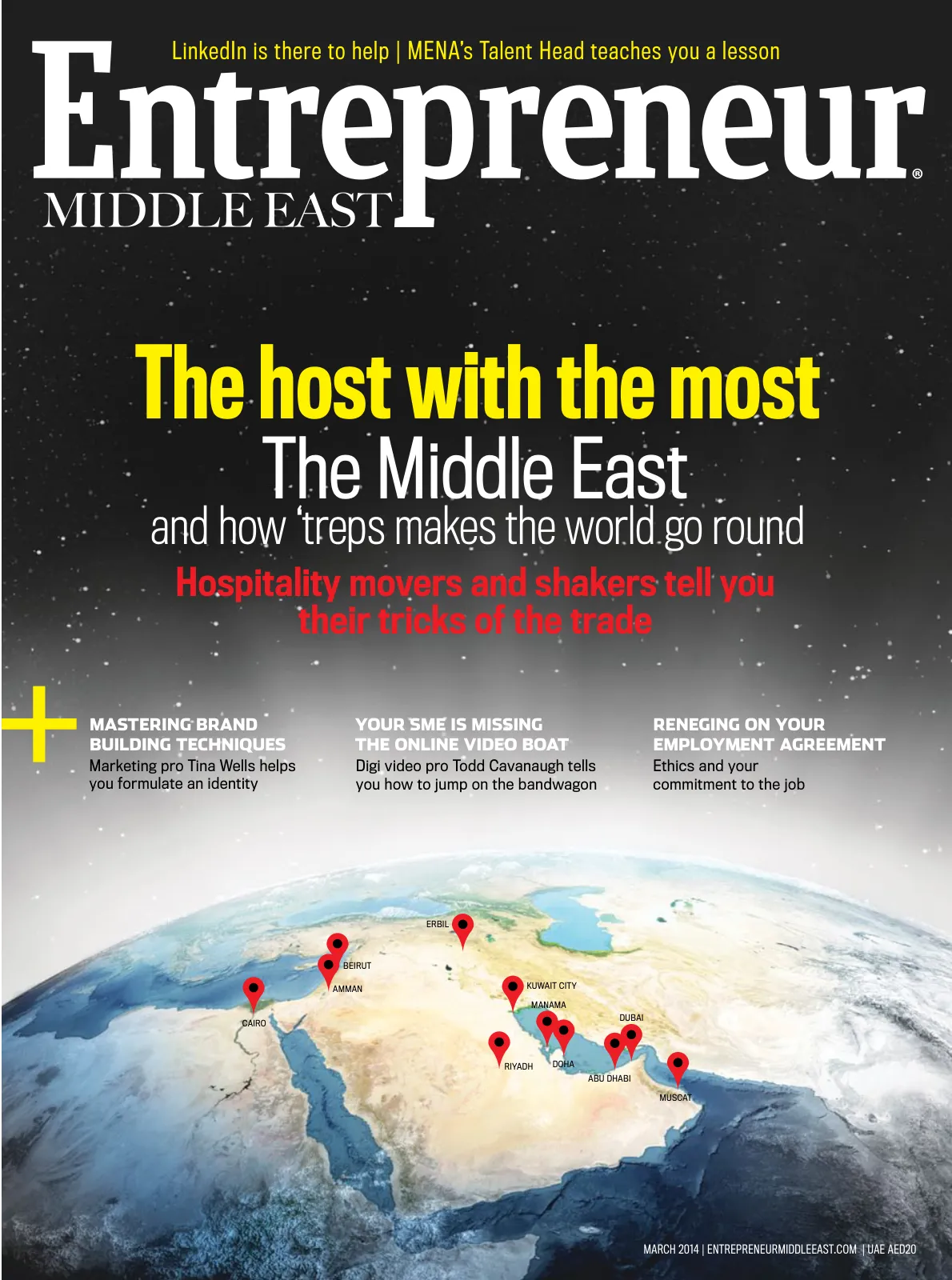
Entrepreneur Middle East, March 2014
Page 1
LinkedIn is there to help | MENA’s Talent Head teaches you a lesson
MARCH 2014 | ENTREPRENEURMIDDLEEAST.COM | UAE AED20
MASTERING BRAND
BUILDING TECHNIQUES
RENEGING ON YOUR
EMPLOYMENT AGREEMENT
YOUR SME IS MISSING
THE ONLINE VIDEO BOAT
The host with the most
and how ‘treps makes the world go round
The Middle East
Hospitality movers and shakers tell you
their tricks of the trade
Ethics and your
commitment to the job
Marketing pro Tina Wells helps
you formulate an identity
Digi video pro Todd Cavanaugh tells
you how to jump on the bandwagon
ABU DHABI
MUSCAT
AMMAN
CAIRO
RIYADH
BEIRUT
DUBAI
DOHA
MANAMA
KUWAIT CITY
ERBIL
Page 2
Entrepreneur MARCH 2014
2
Page 3
MARCH 2014 Entrepreneur
3
Page 4
Entrepreneur MARCH 2014
4
14
INNOVATORS:
HOSPITALITY LEADERS
The host with the most
From apps and online booking to
tourism, nightlife, and franchises,
we pick a few of the industry’s finest.
16
If you build it
Ibrahim Ibrahimov is the game
changer in the CIS. He’s decided
to build an island that’s more
extravagant than anything you’ve
ever seen.
24
I’m all yours
Alpine Oetker is target-marketing
you, and you, and yes, even you.
Their newest properties are
significant in more ways than one.
26
The mother of invention is…
competition?
Evgeny Kuzin, one of the Bulldozer
Group’s triumvirate talks about their
Dubai strategies for Toko, Sass Café,
and he even reveals a secret or two-
like when they’re launching their
next outlet.
32
Cultural emissary: Mandilicious
F&B franchiser Fayez Al Nusari tells
you how he made his entrepreneurial
plans a reality, and what’s in store
for the GCC-based brand.
13
TECH:
SHINY
Float like a butterfly
Lenovo’s got some brand spanking
new stuff on the market in the
UAE.
52
ONLINE ‘TREP
The game changer:
Online video FTW
Is your SME missing the biggest
opportunity yet? Todd Cavanaugh
thinks so, and we tend to agree.
56
MOBILE TECH
Becoming a “Glasshole”
We were given Google Glass for a
24-hour test spin, and it was sort
of like being in a DeLorean. In 3D.
Except not in 3D.
60
WEBSITE TO WATCH
My portal made it possible
Expatwoman.com is expanding and
this is why they’re doing so well.
Here are some of the methods that
worked, and how you can learn
from these online ‘treps.
66
GEEK
The three types of tweeps that
crawl out of the woodwork when
you get verified on Twitter
Our editor tells you what went
down when that all-important blue
badge showed up.
10
EDITOR’S NOTE
By Fida Z. Chaaban
38
‘TREPONOMICS:
MARKETING
Linkedin tips for your SME
Ali Matar, Head of Talent Solutions
for LinkedIn MENA, talks about the
ways you can improve your SMEs
web presence using the networking
platform. Make the most of your
digi-presence with some lesser-
known tools.
48
ASK A PRO
Camera ready: Five pointers for
your televised appearances
Octavia Nasr on mastering a TV
interview, and maximizing your
airtime.
CONTENTS
MARCH 2014
Features
Lenovo ThinkPad 8
Azeri billionaire
developer Ibrahim
Ibrahimov visiting
Avesta Concern’s
Khazar Islands
project site.
16
13
Page 5
MARCH 2014 Entrepreneur
5
Page 6
Entrepreneur MARCH 2014
6
50
‘TREPONOMICS:
MARKETING
Switched on: Keys to brand
building
Tina Wells discusses the
appropriate avenues for building
your brand identity, and what will
make it sustainable.
40
ETHICS
A reformed slacker shares tips on
productivity
Are you keeping up your end of
the bargain? May Rostom, Senior
Lifestyle Editor at MSN Arabia,
talks about not reneging on your
contract to produce, and how she
kicked her bad habits.
68
ESQUIRE GUY
Momentum and the art of the
investor pitch
Ross McCammon tells you how to
navigate that boardroom… without
breaking a sweat.
44
CULTURE:
TRAVEL
The frequent flier’s guide to
healthy skin
A skincare expert tells you how to
keep your skin looking rested and
alive, despite the weekly work trips.
64
LIFE
Cooking the books
So you wanna start a resto? Take a
gander at a few of the Master Chefs
who did and the books they’ve
released.
76
BUSINESS UNUSUAL
Diamonds really are forever
Rinaldo Willy, CEO and Founder of
Swiss-based Algordanza, is marking
10 years of success in the diamond
industry. But they aren’t the
diamonds you’re familiar with.
90
DESIGN
Attracting clients is easier than
eins, zwei, drei
A former British American
Tobacco executive thinks about
crossing-borders for his latest ‘trep
undertaking.
70
START IT UP:
WACKY IDEA
Journeyman: Apps of Hajjnet
Hajjnet CEO and Founder Ali
Dabaja discusses being a ‘trep, his
success in the region, and how it all
happened.
72
STARTUP FINANCE
Seed capital: The breakdown
Simon Hudson discusses the process
of generating your much-needed
money, and how he went about it.
86
STARTUP FINANCE
Vimeo On Demand changes your
position
Startup filmmakers can crowdfund
their way to film, and then release it
themselves. Vimeo’s Greg Clayman
tells the details of their 10K program
for winning candidates.
82
MONEY:
VC VIEWPOINT
Attack of the Clones
Wassim Mourtada gets all analytical
on you, and your VC tactics.
84
ASK THE MONEY GUY
Let’s be pals
PayPal’s Laurent Wakim talks moolah
in the MENA region, and how they’re
cashing in on e-commerce in the GCC.
74
YOUR MONEY
Dividing equity between
co-founders
Ryan Himmel, founder and CEO of
online marketplace BIDaWIZ.com
answers the question.
CONTENTS
MARCH 2014
PayPal’s Laurent
Wakim, Regional
Manager MENA
Swiss Algordanza lab
84
76
Page 7
MARCH 2014 Entrepreneur
7
Page 8
Entrepreneur MARCH 2014
8
EDITOR IN CHIEF Fida Z. Chaaban editor@bncpublishing.net
MANAGING DIRECTOR Walid Zok walid@bncpublishing.net +971556500688
PUBLISHER Nehme Abouzeid nehme@bncpublishing.net
CREATIVE DIRECTION Concept and execution Entrepreneur Middle East
ONLINE LIAISON Kareem Chehayeb socialmedia@bncpublishing.net
WEB DIRECTOR Haydar Mtayrek
Arie Amaya-Akkermans
Todd Cavanaugh
Amal Chaaban
Youmna Chagoury
Kareem Chehayeb
Jane Drury
Ali Harb
Ryan Himmel
Simon Hudson
Mohammad Hijazi
Leslie Iddison
Pamella de Leon
Ali Matar
Ross McCammon
Wassim Mourtada
Shoug Al-Nafisi
Octavia Nasr
Rani Nasr
May Rostom
Tina Wells
Images used in Entrepreneur Middle East are credited when necessary. Attributed use of
copyrighted images with permission. All images not credited otherwise Shutterstock.
SUBSCRIBE
Contact subscriptions@bncpublishing.net to receive
Entrepreneur Middle East every issue
CONTRIBUTING WRITERS
PO Box 75562 Dubai, United Arab Emirates
+97144270507
For all commercial enquiries related to Entrepreneur Middle East contact
sales@bncpublishing.net
All rights reserved © 2014. Opinions expressed are solely those of
the contributors.
Entrepreneur Middle East and all subsidiary publications in the MENA region
are officially licensed exclusively to BNC Publishing in the MENA region by
Entrepreneur.
No part of this magazine may be reproduced or transmitted in any form or by any
means without written permission of the publisher.
MIDDLE EAST
www.entrepreneurmiddleeast.com
WE’RE HEAVILY INVESTED IN OUR WEB PRESENCE
In addition to our print edition, we’re bringing you all sorts of
industry news on our web mediums. Joining us online means
getting relevant business and startup content in real-time, so
you’re hearing about the latest developments as soon as we
do. We’re looking forward to interacting with our readers on
all of our social media and web platforms- like any thriving
business, we’re looking to give and take. #TrepTalkME is
already happening on all of our digi platforms, and all good
conversations go both ways. See you on the web!
IS DIGITAL
MIDDLE EAST
EntMagazineME
@EntMagazgineME | @FidaChaaban
Entrepreneur-me
EntrepreneurMiddleEast
EntMagazineME
EntMagazineME
EntMagazineME
Printed by Raidy Emirates Printing Group LLC
www.raidy.com
OFFICIAL LAUNCH PARTNER
Page 9
MARCH 2014 Entrepreneur
9
Page 10
Entrepreneur MARCH 2014
10
EDITOR’S NOTE
Where “the pleasure” comes in? I’m really for-
tunate to have gotten such a warm welcome in the
print/digi media scene considering the fact there
are so many exceptional business publications
already in circulation in the UAE specifically, and
in the GCC as a whole. And “the greed”? Keep your
comments coming! The more feedback we get on
our social media platforms, the more we want! I
appreciate you reaching out to the magazine on
Twitter and on Facebook, and I love that a few of
our readers reached out to me specifically. A lot of
media outlets claim to be creating a dialogue on
social media, and I am heading up one of them- I’m
keeping my promise by talking back to you and ad-
dressing your comments. Thank you for your tweets
(some of them can be found on our “Feedback”
page), I’m glad you found us relevant enough to take
the time to comment online.
This issue, our cover story is devoted to a few
angles of the hospitality industry. In our “Innova-
tors” section you’ll find hospitality professionals
discussing entertainment, food & beverage, and
franchising. The hotel side is such a huge part of the
money-makes-the-world-go-round ethos of the UAE
so we’ve place a few throughout the issue. The food
& beverage sphere is another big moneymaker when
done correctly, and finally the franchise side is what
I consider one of the most challenging arenas to
navigate as an entrepreneur. The people we’ve cho-
sen have singled themselves out as ‘treps who have
important knowledge to impart. I personally have
learned a lot from them by reading the interviews,
and I’m optimistic our readers will too.
Another interesting
facet of the Entrepreneur
brand is our “Business
Unusual” section. It’s ex-
actly what it sounds like:
Highlighting business that
have created an unusual
niche for themselves with
demonstrated successes
to share. In this issue, we
talk to Algordanza CEO
Rinaldo Willy about his
entrepreneurial venture,
and yes, it is quite unusual. Another feature that I
think you should make a priority this issue? My pic-
ture is a bit of a tipoff: I took Google Glass for a spin
and the results were… hilarious?
Join us on all of our digi platforms and make liberal
use of our hashtag #TrepTalkME. Certainly tweet at
me directly with your comments as I’m looking for-
ward to hearing from you.
The pleasure and the greed
Fida Z. Chaaban
Editor in Chief
Follow me @fidachaaban
Email me editor@bncpublishing.net
T
hat’s actually the title of a song by a band called Big Wreck and it’s over a
decade old. I sat down to write my letter for this issue, and I could think of
nothing else since it really summed up how I feel about the reception that we
at Entrepreneur Middle East have received since the release of our inaugural issue.
Page 11
MARCH 2014 Entrepreneur
11
Page 12
Entrepreneur MARCH 2014
12
FEEDBACK
WHAT READERS ARE SAYING
| from the web |
Following the tradition of our parent magazine, we’re sharing some of the comments that came our way this month on Twitter.
You can give us your feedback on any of our platforms and via email editor@bncpublishing.net
In light of the big US$12 billion
acquisition of you-know-who,
something very interesting (and highly
controversial) got a lot less mainstream
media attention. On February 13th, the
Facebook Diversity page stated that
they “want you to feel comfortable
being your true, authentic self. An
important part of this is the expression
of gender, especially when it extends
beyond the definitions of just “male” or
female.” So today, we’re proud to offer
a new custom gender option to help
you better express your own identity
on Facebook.” Facebook-users can now
choose from just under 60 “gender
designations”, but which specific users
are able to access it is a bit unclear:
The official Facebook announcement
said that those using the social media
monster-site in “U.S. English” could opt
for the new feature, but media outlets
nearly all reported it as Facebook users
actually living in the States. We tried
it, and we were able to view the choices
despite using a Dubai-based Facebook
profile. A post by Peter Weber on Slate
pointed out the grammatically-awkward
new pronoun -it can now refer to
you as “their” or “them” instead of
just him or her- and he also gave an
extremely comprehensive dictionary of
sorts for the multitude of new gender
identities. People who want to use
these alternative gender descriptors
can choose up to 10 for their profile or
choose to keep it private completely,
and they can also tailor their privacy to
allow (or deny) access of this particular
information to their Facebook friends.
Some of the lengthy explanation by
Weber that stood out? “Cis-gender”
and “Non-binary”. Just when we
thought Facebook had narrowed
complicated human information-
gathering down to an art, they manage
to push the bar even further.
“It’s complicated”
Liberals and conservatives polarize as Facebook wades into the gender identity sphere
Page 13
MARCH 2014 Entrepreneur
13
TECH
SHINY | WEBSITE TO WATCH | GEEK | MOBILE TECH | ONLINE ‘TREP | THE FIX
FLOAT LIKE A BUTTERFLY...
Lenovo wants to go everywhere with you
For those of us living airport to airport,
Lenovo’s new ThinkPad X1 Carbon Touch
might be heaven-sent. Touted as “the
world’s lightest 14-inch Ultrabook™”, the
ThinkPad X1 Carbon Touch is the third
in the line of lightweight slim models
by Lenovo. Launched in the UAE last
month by Dilip Bhatia, Vice President
of ThinkPad Product Marketing, and by
Oliver Ebel, Vice President & General
Manager Lenovo Middle East & Africa, the
new ThinkPad X1 Carbon Touch weighs
in at just 2.8 pounds. Layover between
flights? The new PC boasts a “Rapid
Charge” technology, meaning that you can
expect an 80% charged battery in less
than an hour. A fully charged battery gives
business travelers up to nine hours of
battery life, and there is also the option of
built-in 4G capability.
Lenovo has steadily gained market
share, with “number one sales in 11 EMEA
countries, and an additional 39 countries
with double-digit market share,” according
to Ebel. On a global scale, Lenovo’s
market share ranked “number two in PC
and tablet computing devices in 2013 and
fourth place in smartphones,” he added.
Discussing the design of the newest in
the ThinkPad range, Bhatia explained that
the company has “tried to maintain our
own identity; the previous model won 82
awards, and the design was inspired by the
bento box.” What does Bhatia fly with?
“I go everywhere with the ThinkPad 8.
It really does everything a PC does.”
ARABNET DEVELOPER TOURNAMENT
KUMAIL HUNAID OF DUBIZZLE WINS
Kumail Hunaid, a 23 year-old software
engineer for Dubizzle, took home
the grand prize -a cool US$2500- at
ArabNet’s Developer tourney. “I joined
the competition to have some fun
and get challenged, which I did. I was
working as fast as I could and I hardly
made the clock. It really was quite hard
but I managed to make it in time,” says
Hunaid. “The tournament consisted of
three elimination rounds, each of which
required the participant to build a web
application. The applications I built had
well designed interfaces, I gave that part
a lot of thought. I also finished on time
which was important,” explains Hunaid.
What does this developer intend to spend
his winnings on? “I might just fund my
next trip!”
What apps from the MENA region do
you find impressive?
“I’ve been following the work that Syed
Ahmed and Iba Masood are doing with
Gradberry and I love the direction they’ve
taken. Gradberry helps university students
spruce up their CV by taking online courses
and apply for jobs through their job board.
They might just figure out a way to bring
Khan Academy-like education to the region
and successfully run a business around it.
I also like what Omar Kassim is doing with
JadoPado. I haven’t seen anyone in the
UAE sell products online as well as them.
They also figured out how to integrate
fulfilment right into their business model,
which is key in providing customers with
a seamless experience and insanely quick
delivery times.”
What MENA region website or portal
do you find are examples of great
development?
“I work at Dubizzle and [I] am constantly
amazed at the massive amounts of traffic
we manage to serve. Serving well over
280 million page views makes everything
harder. Second, Wamli is also doing some
excellent stuff with their online store.
Their work seems topnotch!”
Page 14
Entrepreneur MARCH 2014
14
THE HOST
WITH
THE MOST
HOSPITALITY
MOVERS & SHAKERS
Ibrahim Ibrahimov
IT’S A CINCH
TRIUMVIRATE
Bulldozer Group
He’s in the process of shelling
out US$100 billion dollars on
his Khazar Islands project. He’s
pretty sure that if you build it,
they will come… all the way to
Azerbaijan.
Toko, the group’s latest
high-end venture, has quickly
become Dubai’s nightlife
darling. On the agenda is
another of their outlets
launching this month, and in
tandem, they’re letting you in
on a big secret.
Which came first, the brand
or the franchise? This ‘trep
explains how from the very
beginning, his brand was
structured to encourage GCC-
wide penetration… and he’s
planning on going global.
GO BIG OR GO HOME
Fayez Al Nusari
HEIGHT IS MIGHT
Crystal Group
With numbers like One Sheikh
Zayed Road and a perch on
the fortieth floor, the Crystal
Group is at it again, and they’re
playing to win. The hospitality
‘treps show us around their
newest digs.
INNOVATORS
Entrepreneur MARCH 2014
14
Page 15
MARCH 2014 Entrepreneur
15
ABU DHABI
AMMAN
CAIRO
RIYADH
BEIRUT
DUBAI
MANAMA
KUWAIT CITY
ERBIL
DOHA
AVESTA
CONCERN
MARCH 2014 Entrepreneur
15
Page 16
Entrepreneur MARCH 2014
16
IF YOU BUILD IT,
INNOVATORS
Entrepreneur MARCH 2014
16
Page 17
MARCH 2014 Entrepreneur
17
THEY WILL COME
IBRAHIM IBRAHIMOV’S FIELD OF DREAMS IS
COSTING HIM A FORTUNE… AND HE WANTS YOU TO
COME & SEE IT FOR YOURSELF
T
here are developers and there are emerging markets, and then there are
the developers in these emerging markets. There are developers who
hope to foster new communities, and yes, even live in those communities.
Ibrahim Ibrahimov is all of the above, and if a man’s home is his castle
by default making him a king, then a man’s island is his… domain? The Khazar
Islands will be Ibrahimov’s domain, but rather than considering himself a monarch,
he says he is both a subject and a patriot of his country- and with good reason,
since they’ve given him the A-ok to execute one of the most ambitious development
projects in recent history. He’s in the process of shelling out US$100 billion dollars
to make his vision a tangible reality, and he’s pretty sure that if you build it, they
will come… all the way to Azerbaijan.
MARCH 2014 Entrepreneur
17
>>>
By Fida Chaaban
Page 18
Entrepreneur MARCH 2014
18
“The Khazar Islands will be ready
to fully open in 2020. In 2016 I will
have a soft-opening, and you will come
to see it again and see how fast it has
changed.” Ibrahim Ibrahimov isn’t
asking me a question, he’s basically
just informing me that I will be back
and that by then, the splendor of his
bright, new world will be over half-way
to completion. His right-hand man
Shahin Talibov nods, “Mr. Ibrahim
will bring you back to see it again. It
will be very important.” Talibov (who
acted as my liaison for this interview),
has travelled extensively with Ibra-
himov and has been working with
the building magnate for some time
now, is referred to as the billionaire’s
“Deputy”. Dur-
ing my 48 hour
visit to Baku, I
spend the bulk
of it with both
Talibov and
Ibrahimov, later
meeting his wife
of 20 years at
their sprawl-
ing waterfront
property where I
hear more about
his sons and
learn about his
upbringing in a
small Azeri village. Ibrahimov, as part
of his philanthropic measures, has
been a patron saint of sorts to that
very same village and to other villages
as well: “I have brought water to 10
villages. I invested US$5.5 million in
that project.” He has a personal inter-
est in engineering and construction;
a “hobby” that he has channeled into
his charitable endeavors, and recently
into his for-profit ones including
Khazar Islands. While Ibrahimov is
the face and the mastermind of the
project, it’s actually an Avesta Concern
undertaking. Avesta Concern acts as
an umbrella company for Ibrahimov’s
various businesses- many of which are
sourcing the ever-expanding Khazar
Islands with things like labor, stone,
and much more.
Likened to an “oligarch” in an in-
depth feature about him in The New
York Times, Ibrahimov refutes the
comment when I ask him about it over
tea, and laughs it off as he does much
of the criticism that comes his way.
He’s emblematic of the potential of the
new guard of cash-healthy entrepre-
neurs out of the Commonwealth of
Independent States (CIS). Formed
during the disbanding of the former
Soviet Union, the CIS is comprised of
several newly independent countries-
many of which are now the booming
emerging markets that people are ea-
ger to break into, like Astana, Kazakh-
stan, and yes, like Baku. According
to the World Bank, in 2012 the Gross
domestic product (GDP) of Azerbaijan
was $66.60 billion. The Central Intel-
ligence Agency (CIA) World Factbook
lists Azerbaijan’s estimated 2013 GDP
at $100.4 billion -roughly the project-
ed cost of the Khazar Islands- and the
numbers boast significant economic
growth across the board. The Asian
Development Bank reports that in the
first half of 2013, Azerbaijan’s GDP
grew 5% “outperforming the Asian
Development Outlook (ADO) 2013
forecast in April and well above the
1.5% recorded during the first half of
2012,” with petroleum accounting for
less than half of the GDP. The ADO re-
port also notes that construction grew
INNOVATORS
“THERE IS A DIFFERENCE IN VISION
BETWEEN DUBAI AND BAKU. WHAT
I’M DOING IS BUILDING A CITY TO
LIVE. DUBAI IS A CITY TO WORK, IT’S
A TRANSIT CITY”
Ibrahim Ibrahimov and
his deputy Shahin Talibov
at the Qatar Embassy
reception staged at the
Four Seasons Hotel Baku
Khazar Islands project site
Page 19
MARCH 2014 Entrepreneur
19
by a whopping 35.5% in tandem with
soaring investments. Boomtown really is
booming- the increasing (already-large)
gas and oil exports are significant, and
crucial sectors like real estate, banking,
and of course construction are seeing
major growth spurts as well.
All of this is good news for Ibrahimov,
and only stands to get better despite
some analysts predicting a tapering of
growth by 2016. On a socio-cultural level,
Baku hosted Eurovision 2012, considered
by some to be one of the biggest pan-
Euro draws, subsequently bringing the
much-needed television cameras their
way. In June 2015, Baku is set to host the
European Games, another pan-Euro event
that stands to bring them a slew of inter-
national footfalls, and the much-needed
exposure that comes with large-scale
sporting events. Azerbaijan also won
the bid for the fourth Islamic Solidar-
ity Games (ISG), scheduled to take place
in 2017. It’s worth mentioning here that
the first ISG was staged in Saudi Arabia,
and the edition scheduled for Iran was
cancelled reportedly due to disputes over
terminology and labelling: Persian Gulf
versus Arabian Gulf. Why is this relevant
to my discussion with Ibrahimov? Be-
cause Azerbaijan’s popula-
tion is primarily Muslim
and predominately Shiite.
When asked if he expects
more cash influx from Iran
or the GCC, Ibrahimov says
all are welcome- and this
is in line with the general
jargon of Azerbaijan- hence
why staging the next ISG in
Baku makes sense. “Money
is money. Everyone’s
money can buy property,
and everyone’s money is
good for investments, the
country it comes from
doesn’t matter,” shrugs
Ibrahimov. The jovial and
friendly Ibrahimov is Mus-
lim, but he’s very much the
type of practicing Muslim
seen across the CIS- devout
and fairly familiar with
religion, but not concerned
with the sectarian divisions
that are rocking the Arab
world. I see ornate Koranic
texts, Islamic artwork in
gold calligraphy mostly,
adorn his personal space at
the Avesta Concern head
offices, his boardroom on
the Khazar Islands project,
and in the sitting room
of his home. He doesn’t
out and out refuse to
discuss the MENA region’s
sectarian conflict, rather
he dismisses it, admitting
that he finds Arabs overly
emotional.
THE CROWNING GLORY OF THIS
DEVELOPMENT WILL BE THE
AZERBAIJAN TOWER, AND “IT
WILL BE TALLER THAN ANY OTHER
BUILDING IN THE WORLD.”
Khazar Islands project site
Khazar Islands rendering
>>>
Page 20
Entrepreneur MARCH 2014
20
When I tell Ibrahimov how difficult
it was to get into Azerbaijan, even as a
Western passport-holder, he tells me
this a minor errand for his staff, and in
future “not to worry.” While that may
be true for Ibrahimov and his Avesta
Concern staff, it certainly is a problem
for the rest of the people trying to visit
the CIS member-state. “It’s getting
easier to come to Baku. Things are
changing, many people are visiting to
see the Islands and what we are doing
here.” I work up the courage to do the
inevitable comparison between his
lobster-shaped islands -that he’s al-
ready knee-deep into construction on-
and Dubai. “There is a difference in
vision between Dubai and Baku. What
I’m doing is building a city to live.
Dubai is a city to work, it’s a transit
city- people come, they make money
and then they leave. Khazar Islands is
to live, not to stay for a short time and
then go. I’ll be the first one to live on
Khazar Islands,” he says indicating the
residential areas on the 11-foot map of
the development that takes up a full
conference table in Ibrahimov’s main
offices. The 56 year-old is adamant
that his “city of the future will be
where everyone wants to live.” Why?
Because the man has culled the best
of the best from his globetrotting,
and decided that it can be improved
upon- such is the scope and scale of
his plans. The amenities of Khazar
Islands include a high-penetration,
state-of-the-art public transportation
system, and highways “unlike Dubai
that have exits so you don’t get stuck
when you miss the turns.” The crown-
ing glory of this development will be
the Azerbaijan Tower, and “it will be
taller than any other building in the
world.” The plans are both expansive
and expensive, and in addition to a pro
golf course and the de rigeur Formula 1
racetrack, he wants a slew of F&B out-
lets (over 80), and a labyrinth of ho-
INNOVATORS
“THE PROJECT MANAGERS HAVE MY
MOBILE NUMBER, THE WORKERS
HAVE MY MOBILE NUMBER. MAYBE
THE MAN UNDER THE MANAGER HAS
A PROBLEM THAT THE MANAGER
DOESN’T WANT ME TO KNOW
ABOUT, IN THIS WAY I WILL ALWAYS
KNOW EVERYTHING. EVERYONE CAN
CALL ME, ALWAYS.”
“MONEY IS MONEY [...]
EVERYONE’S MONEY IS
GOOD FOR INVESTMENTS,
THE COUNTRY IT COMES
FROM DOESN’T MATTER”
Azeri billionaire developer Ibrahim Ibrahimov visiting Avesta Concern’s Khazar Islands project site.
Page 21
MARCH 2014 Entrepreneur
21
tels (18). Baku is already home to some
of the best hotel brands in the world-
there is a Four Seasons, a Fairmont, a
Hyatt Regency, and the list goes on, yet
Ibrahimov is undeterred that the fine
hallmarks of hospitality will come, and
soon, to the Khazar Islands. Despite his
insistence that it isn’t similar to Dubai,
there are undeniable parallels, most
noticeably the futuristic architecture
favored by the GCC.
In the GCC and most other nations
that he visits, Ibrahimov is greeted by
heads of state- he jokes that this is a
sign that he has become a “grown up.”
Indeed, during his last trip to Qatar,
he met with the Prime Minister and
the Minister of Finance, both in the
context of the Khazar Islands develop-
ment. While Ibrahimov doesn’t confirm
whether the Qataris will be wading
into the Azeri pool, he speaks highly of
his trip. In general, the businessman is
optimistic, confident, and quite a man
of the people so to speak. “Before we
had 500 people working for Avesta,
now we have 2500, specifically for the
Khazar Islands. We have about 500
employees that we outsource. I have
a problem, we cannot find enough
skilled labor, so we must bring them.”
Ibrahimov visits the project site daily,
and over lunch admits that while
he does leave the country periodi-
cally for work, he manages everything
via phone constantly. “The project
managers have my mobile number,
the workers have my mobile number.
Maybe the man under the manager has
a problem that the manager doesn’t
Cost US$100 billion
Soft opening 2016
Grand opening 2020
Islands 78
Bridges 150
Residential Flats 250,000
Permanent Residents 800,000
Tourist Accommodations 200,000
Hotels 18
Green space 75%
KHAZAR ISLANDS: THE PROJECTIONS
want me to know about,
in this way I will always
know everything. Ev-
eryone can call me, al-
ways.” When I visit the
Islands with Talibov, I
am shown around the
never-ending stretches
of manicured greens
and stately bridges by a
cousin of Ibrahimov’s.
In total I spend ap-
proximately two hours
on the new Islands,
escorted from one to
another sometimes by
jeep and sometimes by
foot. The bridges are be-
ing laid with fine-quality
stonework, sourced
from Ibrahimov’s mines,
and the roads too. The
project is well lit, and
decorated in festive,
colored lights- red,
green, and blue to reflect
the national colors of
Azerbaijan. He remem-
bers the beginning of
the project fondly, and
reminds me that despite
the naysayers, it will be
done.
Apparently Khazar Islands is such a tangible
reality to Ibrahimov that he doesn’t even talk
about it much to those in his personal life
anymore. If that’s the case, what’s on his mind
these days? “Now? I’m thinking of the second
city.” If he builds his second mega-city, then
yes, we will come.
“BEFORE WE HAD 500 PEOPLE WORKING FOR
AVESTA, NOW WE HAVE 2500, SPECIFICALLY
FOR THE KHAZAR ISLANDS. WE HAVE ABOUT 500
EMPLOYEES THAT WE OUTSOURCE.”
Khazar Islands project site
Khazar Islands architectural mockup
Page 22
Entrepreneur MARCH 2014
22
KING
KONG
DUBAI NIGHTLIFE ‘TREPS LAUNCH
NEWEST ROOFTOP VENTURE
ADDRESSES
DO MATTER
“The sound system is definitely one of our standout fea-
tures. We’re using Architettura Sonora,” explains the Crystal
Group’s Managing Partner Jad Matta gesturing skyward at the
futuristic-looking sound installation. Architettura Sonora is
known for both quality of sound-experience both in and out of
doors, and also for their singularly interesting design schemas
and material-usage. In addition to music executed by a selection
of international DJs, Crystal Group guests have a lot more to
look forward to adds Matta: “The 40Kong client appreciates a
really striking skyline- we’re the first building on Sheikh Zayed.”
Indeed, when it comes to addresses, 40Kong’s impressive One
Sheik Zayed Road locale certainly garners them a bragging
right or two- and so does their extremely elevated digs on the
fortieth floor. Situated on the rooftop of the H Hotel, 40Kong
officially opened its doors late January of this year. The hos-
pitality group also operates already-successful UAE concepts
like People by Crystal –a large format club- and Sake No Hana
Dubai by Crystal at Souk Al Bahar. Their newest venue seats
“130 guests and can hold up to 250 guests at full capacity,”
opening each evening at 6p.m. for the après-work crowd look-
ing to enjoy a scenic Dubai sunset over cocktails, and remains
open until 3a.m. each evening. 40Kong’s menu, based on the
sharing concept favored by higher-end hospitality destina-
tions, offers a selection of crafted options including desserts.
The Crystal Group is headed by Managing Director Samir Ker-
chiched, and their newest food & beverage outlet employs 40
people from management to service and support staff, under
General Manager Philippe d’Amat. Height is might indeed.
Page 23
MARCH 2014 Entrepreneur
23
INNOVATORS
MARCH 2014 Entrepreneur
23
Aerial view of 40Kong by
the Crystal Group. The new
venue is situated on the
rooftop of the H Hotel.
Page 24
Entrepreneur MARCH 2014
24
INNOVATORS
Oetker Collection hotels had just added a new
property to their already impressive list- and
now they’re targeting the Middle East client
hoping that the winter-fresh climate will lure
you their way. L’Apogée Courchevel includes a
wellness center and spa, and is situated in Le
Jardin Alpin a short drive away from a private
airstrip. Overlooking Courchevel village, the
property is owned by Xavier Niel (Free ISP
owner), with interiors by Iranian architect and
interior award-winning designer India Mahdavi
and colleague Joseph Dirand (of Monsieur Bleu,
Palais de Tokyo fame). L’Apogée Courchevel
is comprised of 33 suites, 20 double rooms,
and one penthouse that offers guests a private
terrace to enjoy the mountain-view. For the
palate, Oetker’s brought forward Domaine de
Terre Blanche veteran Chef Franck Ferigutti to
head the property’s signature resto, Le Comptoir
de L’Apogée. Another true gem in the Oetker
Collection portfolio? Fregate Island Private in the
Seychelles. Take me Oetker, I’m yours.
COLLECTABLES | PRESTIGE PROPERTIES
ALPINE OETKER IS OUT TO GET YOU
Entrepreneur MARCH 2014
24
Oetker Collection
Fregate Island Private, Seychelles
Oetker Collection
Palais Namaskar, Marrakech
Page 25
MARCH 2014 Entrepreneur
25
CULTURE
business unusual | LIFE | TRAVEL | DESIGN
Riyadh’s Mena Hotel is reviewed as a “typical
business hotel”. While your junior execs won’t be
in the lap of luxury, it does offer a free, high-speed
WIFI, conference facilities, and airport pickup services.
Located in the center of the Saudi capital, Mena Hotel
has two conference rooms (each able to accommodate
up to 70 people), with built-in data projectors, screens,
boards, flip charts- meeting kits and tech support are
also available.
Ramses Hilton l Cairo
Ramses Hilton overlooks the Nile is located just
north of Tahrir Square, puts guests within a short
distance from Cairo’s most popular historic and cultural
destinations. The property has seven F&B outlets, a
fitness center and a heated, outdoor swimming pool
from which you can see the river. Ramses Hilton offers
an onsite business center, health clinic, and banking
facilities. The concierge is accessible 24/7 to arrange
sightseeing tours around Cairo. Valet parking is available.
Mena Hotel | Riyadh
For the husband and wife team
behind ChoCo’a, recruiting Belgian
Chef Levi Angelo was the key to
bringing their business to fruition.
Angleo’s lengthy resume in the finer
art of chocolate making includes
world-class institutions, most notably
Valrhona, Belcolade, and Callebaut.
Assem and Dina Hamzeh now export
their fine wares throughout the
GCC, and as far away as Australia
and Japan with expansion plans on
the horizon. A key factor in their
success? Showcasing in international
exhibitions like World Food Moscow
and Birmingham’s annual Food &
Drink Expo. Now isn’t that sweet?
www.chocoa.ae
FOR BUSINESS OR PLEASURE
Crowne Plaza | Muscat
TRAVELLING ‘TREPS KNOW YOUR ACCOMMODATIONS
JUNIOR EXEC STAY FOR BUSINESS
By Ali Harb
A slew of business travelers have opted for the
Crowne Plaza in Qurum Heights, perched on a hilltop
overlooking city of Muscat and the Gulf of Oman.
During your downtime visit the outdoor swimming
pool, private beach, various F&B outlets, fitness
center, and spa. Other than the beach and their 10
acres of landscaped gardens, it’s situated 20 minutes
away from the airport and a 10-minute drive from
Muscat’s business district.
EATING WITH COLLEAGUES
Koryokwan | Korean Restaurant
Koryokwan, a Korean restaurant that’s
been around since the early 80’s, is still
considered to be one of the best, even
providing catering for Korean embassy
events. Located on the ground floor of
Carlton Hotel in Kuwait City, it’s a three-star
hotel that was refurbished awhile back, but
the exterior of the building still looks aged.
The interior of Koryokwan on the other hand
is beautiful, one of those places where once
you enter, you feel like you’re no longer in
Kuwait. I had the same feeling when I first
visited the now-Singarea Korean restaurant
in Dajeej. The place is definitely worth
trying out, but mostly for the experience of
something new.
EATING ALONE
Saravanaa Bhavan | Indian Vegetarian
Restaurant
Saravanaa Bhavan serves authentic
Southern Indian dishes and I think it was my
first time having it since there were a lot of
things I hadn’t tried before. The restaurant
is located in Humur Towers, Fahaheel and
overlooks the Kout Mall marina. I ended up
having Plain Dosa, Poratta Curry, Idli Sambhr
Chutni, Curd Vada, Cheese Dosa Poori Bhaji,
and Payasam. It’s a great place and very
affordable. Saravanaa Bhavan is located in
Humoud Towers, Fahaheel.
To read these posts in
their entirety, and more
on both hospitality and
Kuwait’s happenings,
visit 248.com. Mark
Makhoul’s professional
background includes
Art Direction for some
of the most relevant multinational agencies
operating in Kuwait. His blog-turned-portal is one
of the most highly visited sites in the GCC country,
and acts as a reference for both those living in
Kuwait and those outside of Kuwait looking to
stay in the loop.
The Kuwaiti connection | Business dining
THE FAMILY BIZ ChoCo’a
By Mark Makhoul | Founder 248am.com
Page 26
Entrepreneur MARCH 2014
26
INNOVATORS
Entrepreneur MARCH 2014
26
Toko Dubai at the Vida Downtown
Dubai Hotel. This is the second
Toko globally, the first is in Sydney,
Australia. Toko Dubai is franchised in
the UAE by Bulldozer Group.
Page 27
MARCH 2014 Entrepreneur
27
THE MOTHER OF INVENTION IS...
COMPETITION?
The Bulldozer Group’s Evgeny Kuzin is a ‘trep with an agenda
I have a song stuck in my head as I sit down to interview Evgeny Kuzin. I’m smiling at
him somewhat foolishly as he talks about the Bulldozer Group’s newest outlet, and it
is extremely difficult to keep the joke to myself. Why? Because “I’m crazy but you like
it, Toko Toko Toko,” is what I’m thinking. I doubt Evgeny will find this as amusing as I
do, so I will myself to stop adlibbing Shakira, and instead, I focus on the collected and
calm determination that the Russian entrepreneur exudes. Why that song? Maybe
because hearing Kuzin detail the fearless six-month execution timeline of Toko makes
me think that together with his partners, Maxim Vlasov and renowned restaurateur
Alexander Orlov, these businessmen are a bit loco… in a good way.
By Fida Chaaban
MARCH 2014 Entrepreneur
27
>>>
SPONSORED BY CADILLAC IN THE SPIRIT OF
CELEBRATING ENTREPRENEURIAL INNOVATORS
LANDMARK
ACHIEVERS
Page 28
Entrepreneur MARCH 2014
28
S
ince the moment we shook
hands with the brand owner
in Sydney, it was six months
to open the restaurant. No-
body will believe it,” he says
smiling. If you haven’t been
to their newest outlet situ-
ated in the Vida Downtown
Dubai Hotel, then you cannot appreciate
the challenge of launching something
of this caliber and this scale in only six
months. The waterwalls in the garden
alone are a feat of master design and
engineering -especially when taken in
the context of Dubai, and the suspended
aerial Asian parasols further attest to
the planning behind the architecture and
the interiors. The “garden” -properly
named the terrace- is both expansive and
sophisticated. I half expect a Japanese
Koi-pond to materialize next to Kuzin at
some point- such is the energy of Toko.
“You have to give the people something
nice. It wasn’t a question of saving any
money on this project. We just wanted
to deliver something that people would
walk into, and have a wow-effect. No one
can imagine that such a terrace can exist
downtown in the center of the city.” The
partners are hands-on, they personally
adjusted the architectural direction to
ensure flow and circulation, as well as
comfort for their guests. The first plans
for Toko’s architecture were “completely
changed.” The whole layout was reworked
says Kuzin, explaining that whatever
attractive first draft is put forward by an
architectural firm, you’ll inevitably have
to change it otherwise it won’t work.
“They try to make it nice, but from an
operational perspective, it doesn’t work,”
adding that approximately 25 revisions
of Toko’s layout were made before he and
his partners were satisfied. “Unless we
created the right seating and the right
layout, where people could still see each
other and have privacy, it would be no
good. In terms of the big groups -it’s very
different from Europe and anywhere in
the world people like to come in table of
15, a table of 20- it doesn’t happen many
places in the world.”
I decided to request an interview with
the Bulldozer Group after I’d dined at
Toko on a Monday evening. The combina-
tion of elegant service (my table was at-
tended to by a woman named Francesca),
the terrace’s subdued-opulence, and fi-
nally the artful cuisine convinced me that
I should know more about the people
behind the concept. I can comfortably say
that I’ve eaten at some of the world’s best
restos, and yet, Toko managed to make an
excellent impression. The next morning I
fired off two emails- the first to the reser-
vation addy to thank them for a splendid
evening, and the second
was to Copia Group, the
public relations outfit
that manages Toko’s
press coverage. After a
series of exchanges, the
interview is confirmed
so I begin to research
the three men who’ve
gone to such lengths to
create this… this what?
This resto-lounge?
The descriptor hardly
seems fitting for such
an interesting experi-
ence. I find out that
both Kuzin and Vlasov
are originally from the
South of Russia, near
Sochi. “It’s become a
very famous city now
due to the Olympics.
I’m very proud. Maxim
is from the same region,
Novosibirsk.” Kuzin and
I discuss the emerg-
ing Commonwealth of
Independent States
(CIS) markets initially,
“
Evgeny Kuzin and Maxim Vlasov
INNOVATORS
SPONSORED BY CADILLAC IN THE SPIRIT OF
CELEBRATING ENTREPRENEURIAL INNOVATORS
LANDMARK
ACHIEVERS
>>>
Page 29
MARCH 2014 Entrepreneur
29
INVESTMENT “Toko was over US$10
million. Sass was over $7 million.”
ROI “Two years. We are pushing it, but
this is according to our experience. If the
places work well and it works right, it
should happen like that.”
SETBACKS “There’s always challenges in
any project but every challenge you have
to know how to solve it. There are so
many examples- daily things are happen-
ing that you need to sort out.”
WORK/LIFE BALANCE “It’s hard. It’s
quite difficult. Honestly speaking, it’s
getting tougher and tougher. When
you’re busy, you’re busy, but of course
you have to always find time. It’s the
most important thing we have in our
lives, our kids and our families.”
#MYDUBAI “I think it’s one of the best
city for high-end hospitality business. It’s
such a nice city, you have so many differ-
ent nationalities, a beautiful crowd. Very
good clients who like to go out to good
places to get good service, good food,
get a good product. That’s exactly what
we’re bringing to them.”
VANTAGE POINT “The beauty of Toko
is that you don’t have any dead areas.
When you’re sitting inside the restaurant,
you’re watching the open kitchen and at
the same time you’re watching outdoors.
Even from outdoors you can see how
they’re cooking.”
DISH “Scampi fois gras- this was the
first dish I tried in Toko Sydney when I
went there to see the brand and study it
and I was absolutely shocked.”
Toko Dubai interior
CUT TO THE CHASE
MARCH 2014 Entrepreneur
29
Page 30
Entrepreneur MARCH 2014
30
and I try to figure out why Kuzin and
Vlasov, already extremely successful in
Russia, aren’t taking advantage of the
booms in CIS cities like Baku, Azerbaijan
and in Astana, Kazakhstan. Isn’t that
where everyone wants to be- specifi-
cally those who already have a strong
handle on CIS industry tastes and market
trends? “We find Dubai is very attractive.
I came here six years ago and I used to
stay in Abu Dhabi. We came here for the
investments and properties, and then
we turned to the F&B business. Movida
was a challenge, our first.” He’s referring
to his initial foray into hospitality, and
at that time it was only him and Vlasov,
who is also Kuzin’s first cousin. The
partnership between the two is under the
Billionaire Group, and once Orlov joined
in, they developed their now-company
Bulldozer Group. “Billionaire Group is
me and Maxim -two of our clubs Movida
and VIP Room- and then we created
Bulldozer Group which is the restaurant
division with Alexander. He has over
60 restaurants in Russia.” Vlasov and
Kuzin were active in real estate prior
to venturing into F&B, and Kuzin says
the shift was primarily born of personal
interest: “I like this industry. I like to go
nice places, travel around the world. We
chose Movida because it was one of my
favorite clubs in London, and
we decided to bring it to Dubai.”
For their upcoming launch of
Sass Café, Bulldozer Group is on
a similar ambitious timeline-
set to open this month. “I love
Sass Café, it’s one of my favorite
places in Monaco. Samy Sass is
a very good friend of mine. It’s a
great brand, it’s a great concept.
It’s been 20 years in Monaco and
in September they’re celebrating
their anniversary. For me, it’s a
first stop; when you arrive in the
South of France at the Nice airport, you
go to Sass Café first thing.” Sass Café is
located in DIFC and Kuzin says that “the
more places there are, the more people
will come. Five years ago you didn’t see
so many international people coming to
spend time and enjoy Dubai. Now it’s
becoming up to the level of Monte Carlo,
people are coming here because there’s
so many choices.” Is there too much of
a good thing relative to Dubai’s dining
scene? “We’ll try and we’ll see. The mar-
ket is big- everybody is busy, all the res-
taurants are doing well, all the nightclubs
are doing well. I believe that much more
competition is always better. It makes
you more focused on your business and
makes you produce better products.”
Kuzin admits that it is important for
them to be onsite, and more so even dur-
ing the development phase. “We spent
quite a lot of energy on this project and
quite a lot of time during the construc-
tion to be here to watch what was going
on, what’s happening with the quality of
the finishes and everything. We use a lot
of natural materials here.” How involved
are the partners when it comes to staffing
their outlets? “I’ve met about 90 percent
of the staff personally. You have to know
the people who are going to serve your
clients. You have to see them, how they
look, how they talk, what personality they
have.” When discussing positive rein-
forcement and staff strengths, Kuzin says
that “there is a staff incentive program in
Toko Dubai interior
“IT WASN’T A QUESTION OF
SAVING ANY MONEY ON THIS
PROJECT. WE JUST WANTED
TO DELIVER SOMETHING THAT
PEOPLE WOULD WALK INTO,
AND HAVE A WOW-EFFECT.”
Page 31
MARCH 2014 Entrepreneur
31
place.” What’s a bit more relevant here is
that the partners foster a healthy amount
of competition and between their staffs at
the separate venues. It seems that com-
petition itself, be it internal or external,
is a pervasive motivator for the ‘treps in
every aspect of how they deal with their
businesses, F&B or otherwise. From a
cuisine perspective, Kuzin is a man who
enjoys finer foods and he’s quick to point
out that higher-end hospitality dictates
a certain need for ingredients not readily
available in the market. “We’re importing
top quality beef from Australia. The great
thing about Dubai is that the logistics are
so good here, you can get anything from
anywhere in the world, whenever you
want- it’s just a question of the money.
When you are in the right volume, you
pay very similar to what it costs in the
home country. We were quite surprised,
especially when we entered the F&B
industry here, and we needed to import
all the high-end products from overseas.
When our chefs came we went to the
suppliers and we found out that it’s just
absolutely great, you can have anything
you want at a competitive price,” agreeing
that they don’t take a hit as much as they
would in other cities relative to Dubai
being a global transportation hub.
In a challenging arena like hospitality,
there are many factors that influence
success, “but the most important thing is
synergy,” according to Kuzin. “You have
to be the right person to open
the right venue. We knew
the market, from visiting and
from living here in Dubai. You
have to exactly know what
you want to deliver about the
project. When you know what
you want to give to the people
and what you like yourself,
and you’re proud and passion-
ate about it, it’s simple.” I list
business stereotypes: Ameri-
cans are efficient, Japanese
are formal, and English are
prompt, and I encourage Kuzin
to do the same for Russians.
“You describe it,” he suggests,
and this is an answer in itself since the
only word I can think of is shrewd. On
another global note, what establishments
does he frequent? “I really enjoyed Tao
restaurant recently in New York; it was
a great venue. And I love Novikov res-
taurant so much, in terms of service and
atmosphere. I love everything about it,”
he says smiling. Kuzin beams at me just
a touch more and tells me a little (big)
secret: “And by the way, we’re opening it
here in September.” I’d been hearing the
industry whispers, and one of the media
outlets had suggested that this was the
case, but now I have a confirmation.
Zdrástvujte Novikov. I’ll see you and
this triumvirate of nightlife in the fall.
“YOU HAVE TO BE THE RIGHT
PERSON TO OPEN THE RIGHT
VENUE. WE KNEW THE
MARKET, FROM VISITING AND
FROM LIVING HERE IN DUBAI.”
“THE GREAT THING ABOUT DUBAI IS
THAT THE LOGISTICS ARE SO GOOD
HERE, YOU CAN GET ANYTHING
FROM ANYWHERE IN THE WORLD,
WHENEVER YOU WANT- IT’S JUST A
QUESTION OF THE MONEY.”
INNOVATORS
SPONSORED BY CADILLAC IN THE SPIRIT OF
CELEBRATING ENTREPRENEURIAL INNOVATORS
LANDMARK
ACHIEVERS
Page 32
Entrepreneur MARCH 2014
32
W
hen Fayez Al Nusari
decided to leave his
position at Majid Al
Futtaim Leisure &
Entertainment as Head of Sales and
Marketing to become an entrepre-
neur, he says that his initial decision
was a now-or-never scenario. “I
realized that I had to go for it and
that time was
going by and the
only thing lacking
was the cour-
age to take that
first step.” It’s
something a lot
of the corporate
workforce thinks
about- whether
or not they can
handle the rela-
tive risk of being their own boss,
and the financial implications of
finally taking the plunge into a ‘trep
endeavor. “It was really about aban-
doning the steady income and stable
lifestyle and getting mentally pre-
pared for a whole new lifestyle. I felt
I was finally ready. Now, I wish I had
done this a few years earlier,” says the
Mandilicious Managing Director. Al
Nusari’s stint with a large-scale UAE
company gave him a good basis in
management and corporate structure.
“At Majid Al Futtaim, I had my first
encounter with a large conglomerate.
Heading a team of professionals and
the job responsibilities was a great
aspect of the whole thing. However, I
had to keep up with the demands of
a large corporation of that size, some
of which I had not been used to. That
was the hard part!”
Prior to Majid Al Futtaim, Al
Nusari was a tour guide, quite the
leap despite the tertiary industry
connection. What did that part of his
career bring to the table in terms of
his franchise? “When I started as a
tour guide, the main aim of this won-
derful job was to explain to people
all I can about our rich culture, our
heritage, and history. I did this with
a lot of passion. I remember initiat-
ing plays in the evenings for some of
the tour groups where we recreated
F & B franchiser Fayez Al Nusari talks shop…
How he made it happen & GCC feasibility
CULTURAL
EMISSARY
MANDILICIOUS
INNOVATORS
MANDILICOUS FACEBOOK ACCOUNT PAGE © FACEBOOK.COM
Page 33
MARCH 2014 Entrepreneur
33
-together- how the traditional weddings
were celebrated. It was interesting, fun,
informative and people remembered it
fondly. Today, with Mandilicious, we
don’t just serve food, we want people to
understand and appreciate our food as
an integral part of our culture. We will
take Mandilicious everywhere and when
we do so, we will not just be carrying the
food into those countries, but the tales,
the history, and the flair with it.” This is
perhaps why Al Nusari’s clever marketing
strategy is such a hallmark of the brand.
How much is influenced by Al Nusari?
“I think quite a bit of my personality
appears in the brand! It needs to reduce,
but in a startup like this, I believe it is
inevitable that this happens,” adding that
he’s been having internal discussions
trying to reduce his influence on the
branding of Mandilicious and “aiming to
get it under control.” For many ‘treps the
lineage of brand to founder is inevitable;
Al Nusari admits that initially “Mandili-
cious was connected to my name in
people’s minds and even on some people’s
phonebooks. When Mandilicious con-
tinued growing to multiple outlets, other
people appeared in the picture, I started
appearing less and less in every single
frame of work, so that disconnect started
to be achieved, which was very important
to me.”
ANGEL INVESTORS “Indeed.”
ROI “The business module of
Mandilicious is a little different [than]
the classical F&B chains, so each of the
units/outlets is an independent profit
center. In that aspect, our ROI for the
different outlets ranges between 14 and
20 months per outlet.”
STARTUP FUNDING “We wanted
to start right, start strong and start
big, so we initiated the project with
US$10 million. The initial investment
to kick start was done by me, but
the main investment was through a
senior investor, who is now our senior
partner.”
HQ “There is nothing easy in
business, however the UAE is the best
country in the region to operate in and
specially to start a new concept from.
It has a good mix of the international
standards and quality control as
well as a certain amount of ease in
procedures. Its inhabitants are a great
testing-audience as they are spoiled for
choice, used to the best, multinational
in nature, and on average quite
knowledgeable.”
STATUS QUO “Our most successful
location –many will find this strange,
but it’s true- is the outlet in JAFZA
[Jebel Ali Free Zone]. It requires
minimum manpower, opens only five
days a week and only for lunch, but
generates excellent returns in those
few hours and with that minimal
investment.”
MOVING FORWARD “Plans for
Mandilicious is to take it international.
We are now finalizing talks to open
throughout the GCC and will thereafter
start looking at the global growth plans.
We are part of Dubai and so we are
part of the Expo 2020, however, it has
limited impact on our current situation,
however it will affect our choice of new
outlets. Expo 2020 will only have pros
to the F&B sector.”
THE LOGISTICS
“Being in the F&B business,
[...] I was totally against the
mascot being an animal, so we
had to go for a human”
WWW.MANDILICIOUS.NET
Page 34
Entrepreneur MARCH 2014
34
“I have empowered quite a few
of the team members to a great
extent and even in some small
catering jobs. I create a project
out of it and let them manage it as
complete project managers.”
INNOVATORS
How has he integrated this into
his corporate structure? “I have
empowered quite a few of the team
members to a great extent and
even in some small catering jobs.
I create a project out of it and let
them manage it as complete project
managers. That gives them the sense
of ownership and responsibility and
ultimately makes them the face of
the company with these clients.”
The 41-year-old Yemeni national is
the child of a diplomatic family, and
on both personal and professional
fronts has put his globe-trotting
history to good use. “Through living
within different and diverse cultures
for periods up to four years each
time, there was a certain amount of
adaptability required, an open-mind
to other points of view of almost
every aspect in life as well as the im-
portance of one being a true ambas-
sador of their culture wherever they
are. These are practices and values
that I have carried with me through-
out my career and have proven to be
of great use being an entrepreneur.”
When asked about the role his
cultural background plays in his
approach to business, Al Nusari is
frank discussing stereotypes: “Being
Yemeni -unfortunately- equals being
misunderstood! And this is only
recent! So -and I think this is in the
back of the head of almost every Ye-
meni that lives abroad- it becomes a
continuous motivation to show the
real Yemeni culture in our behavior.”
In regards to Yemen’s current busi-
ness climate, Al Nusari describes
it as “quite critical and bad at the
moment, but I believe they will get
better in the near future.”
In terms of McDonaldization and
franchises, Al Nusari says that the
brand’s mascot “Nawaf” was a way
to facilitate his global plans for
Mandilicious. “When it [Mandili-
cious] one day arrives in USA, UK,
India etc., how will we market it?
The marketing in those countries
will have to have an educational -or
let’s call it an awareness-building
element- so we needed to invent a
way to educate people on the food
and its background. Being in the
F&B business, and also personally
being an enemy of dancing chickens
on poultry product advertising, I
BAS outlet Abu Dhabi
Page 35
MARCH 2014 Entrepreneur
35
was totally against the mascot being
an animal, so we had to go for a hu-
man,” adding that Nawaf, with the
characteristics of a cute, animated
child would be the emissary to po-
tential and existing customers. “We
did McDonaldize some other aspects
of the business, but those were in
the processing areas and not in the
marketing.” When asked about other
franchises in the GCC that originated
locally, Al Nusari is optimistic: “I
personally like the MORE franchise
as well as hoping to see Tribes go
into franchising. The main things to
keep in mind is the social-cultural ac-
ceptance, finding the right franchisee,
continuous and dependable source of
raw materials, and finally, the right
locations.”
Finally, in terms of downtime, this
‘trep says he switches off by “watching
football, and funnily-enough, cooking
at home.” That sounds about right!
STAFFING “The labor law and its situation
in the UAE is very tough when it comes to the
F&B sector. For example quota, getting visas,
allocated jobs etc.”
IN HINDSIGHT “That would be in some of
the things in the CPU which I would do differ-
ently today and would [have] impact in better
use of space and lower investment. Those
have been done now, but as amendments they
end up costing more. But in general, there isn’t
too much that I would change!”
WORK/LIFE BALANCE “Even if I wanted to, it is hard to
maintain that work/life balance especially in the F&B busi-
ness and even more for a new startup. However, I believe
that a professional is only complete if they can achieve that
balance and only one themselves will know how to get there
as the code is different from one to the other. Work hard
and play hard is true, but if it turns into work hard and work
harder, then it isn’t a complete businessman personality.
Unless one knows how to delegate correctly, one isn’t an
achieved CEO! I am slowly but surely going to get there. At
the moment, it is 80% work and the [remaining] balance
20% distributes differently, but without a specific plan.”
THE CHALLENGES
“The main things to keep
in mind is the social-
cultural acceptance,
finding the right
franchisee, continuous
and dependable source of
raw materials, and finally,
the right locations.”
WWW.MANDILICIOUS.NET
Page 36
Entrepreneur MARCH 2014
36
TECH
SHINY | WEBSITE TO WATCH | GEEK | MOBILE TECH | ONLINE ‘TREP | THE FIX
ARABROOMS
FOUNDED BY HATTAN AHMED | KSA
www.arabrooms.com
If you’re travelling with a big family,
Arabrooms is perfect for you. Although it
can be compared to being the Middle East
version of Airbnb, Arabrooms caters to a
more niche market of “economy lodging”.
It lets users book serviced apartments,
where it has a hotel-like set up with
more space to accommodate Middle East
families and travelers. Having a network
of 45,000 hotels around the world,
Hattan Ahmed, CEO and Founder of
ArabRooms, aims to “build a global brand
with a local identity.” Ahmed, besides
founding three other startups, was also a
finalist at the Startup Demo Competition
during the ArabNet Digital Summit 2012.
WEB READY! PLAN, BOOK, GO... ONLINE
By Pamella de Leon
CAREEM
FOUNDED BY MUDASSIR SHEIKHA &
MAGNUS OLSSON | UAE
www.careem.com
At the push of a button (or more like,
a tap on your smartphone), you can get
around the city in style. Using the iPhone
or Android app or your browser, you
can summon a Careem car to come and
collect you from your location. Gone are
the days with horrible taxi experiences;
Careem drivers are punctual and know
their way around. Popular features
include being able to pay with a credit
card, tracking progress in real-time, and
receiving receipts online. Careem (the
word for generous in Arabic) was initially
popular with women and customers who
wanted a safe ride in remote areas.
TRAVELERVIP
FOUNDED BY BLAGOJA HAMAMDZIEV,
JOHN FOHR & MARC MEUNIER | UAE
www.travelervip.com
Turn your ordinary online reservations
to memorable VIP travel experiences,
all the while rest in the knowledge that
you’ll get the lowest price and free perks
or complementary upgrades. As hotel
booking sites go, TravelerVIP raises
the bar by being the Middle East’s first
online travel club, and has extensive
curated travel reviews in English and
Arabic customized for the Middle
East traveler. TravelerVIP is also one
of the first members of the Majid Bin
Mohammed Innovation Center in5, an
incubator for promising companies in
the UAE.
WHET YOUR APP-ETITE
EVERNOTE FOOD APP
Android & iOS
This one’s a favorite amongst
foodies all over the planet with
over one million downloads on
Android alone. Evernote Food
does everything a foodie wants
it to do- not only can you search
for recipes on the internet (and
somehow, it more often than not
presents you with the best blogs
and the most beautiful culinary
photography), you can also clip
them in your own Evernote
cookbook, log your meals to keep
track of your day regimen and
search for restaurants according
to your location.
URBANSPOON
BlackBerry 10,
Android & iOS
Looking for a resto to try
when visiting a new city? Shake
your phone and take your pick.
That’s how the app works on
iOS anyway (there’s also manual
random search for those of us
who are not iFans). You can
choose total randomness or log
in a neighborhood, cuisine, and
price range to find more specific
dining spots. If you try and
access this one in the UAE using
BlackBerry World, it will tell you
it’s not available- get it on your
next trip.
ALLRECIPES.COM DINNER
SPINNER
Android & iOS
This app does the same thing
as Urbanspoon’s, except it’s for
recipes. The “Dinner Spinner”
option lets you choose a recipe
randomly, or you can log in a few
filters like the cooking time or the
main ingredient- shake and choose.
If you’re not a fan of surprises,
you can search for specific recipes
yourself; the app offers other filters
like “vegan”, “low sodium”, or “no
wheat” categories. With one of the
largest recipe database on the web,
there’s pretty much everything you
can think of available.
By Youmna Chagoury
| ONLINE ‘TREP |
| MOBILE TECH |
Page 37
MARCH 2014 Entrepreneur
37
Page 38
Entrepreneur MARCH 2014
38
A
s a small business owner, growing your
business contacts and networking is
central to your business success. With over
10 million MENA professionals on LinkedIn and
more than 259 members worldwide, LinkedIn is a
convenient and cost-effective networking platform
for SMEs. LinkedIn’s network is a great place to
build your professional identity, increase online
visibility, grow your network, engage with like-
minded individuals, and recruit new employees
from a pool of highly skilled candidates. Here are
some tips on how LinkedIn can work for you.
1. RAISE YOUR PROFILE
Having a profile on LinkedIn puts you
amongst potential clients, employees,
and industry partners and gives them a
way to contact you. The more details you
have on your profile, the easier it will
be for people to find you through search
engines. Make sure your summary is
complete and include a photo of yourself
to increase your credibility. Customize
your public profile URL and claim your
piece of digital real estate.
Sharing content via status updates on
LinkedIn is a quick way to showcase your
knowledge and start conversations with
your network.
2. CREATE A COMPANY PAGE
Company pages give members an op-
portunity to view information about
each company and builds your busi-
ness’ identity. Include details such as its
description, number of employees, and
the industry it operates in. The Products
and Services tab on the Company Page is
a powerful way to showcase what your
business has to offer. As an SME owner,
recommendations from customers can
serve as testimonials for your business.
Using the Featured Update functionality,
you can highlight important content by
promoting it to the top of your Company
Updates stream.
3. GET RECOMMENDATIONS
Recommendations are one the best
ways to secure new clients because this
is the feature looked for most when
viewing a new profile. They enhance
your professional credibility and create a
great impression on people reading your
profile. Ensure you request LinkedIn
recommendations from happy customers
willing to provide testimonials. Satisfied
customers are the best source of new
customers.
Add Skills to your profile to highlight
your expertise and be found by others
seeking those abilities. Build your skills
reputation by getting Endorsements
from your connections.
4. ENGAGE WITH YOUR CONNECTIONS
AND POSITION YOURSELF AN EXPERT
IN YOUR INDUSTRY
Join groups for small businesses or en-
trepreneurs to engage with like-minded
people who can provide you support and
answer your business-specific ques-
tions. Joining groups which are related
to your industry or other small business
matters is also a great way to make new
connections. Potential clients can find
you through groups, as the group mem-
bers have the ability to directly message
each other, even if they aren’t directly
connected.
Tips for small business owners
to leverage
By Ali Matar Head of LinkedIn Talent Solutions, LinkedIn MENA
TREPONOMICS
ETHICS | ESQUIRE GUY | MARKETING | PRO
Page 39
MARCH 2014 Entrepreneur
39
5. IMPROVE PRODUCTIVITY
THROUGH LINKEDIN MOBILE
Accessing LinkedIn on the move
through iPhone, Android, Win-
dows or BlackBerry apps enables
you to update your profile and
connect with business acquaint-
ances at events and conferences.
You can use the LinkedIn mobile
application to pull up background
details of the person you are
meeting on-the-go, putting you in
good stead for a great introduction
and conversation points.
6. LEARN FROM INFLUENCERS AND STAY UP-
DATED WITH LINKEDIN PULSE
Many professionals visit multiple news
sources each morning to stay ahead of news that
will impact their day. LinkedIn Pulse saves you
valuable time by efficiently aggregating the top
articles being shared by your trusted connec-
tions and by professionals within the industries
you care about, all in one place and across mul-
tiple sources. You can choose to “follow” specific
industries, news sources, or even individuals
like Barack Obama and Richard Branson to get
credible insights and information from the origi-
nal content shared by them on LinkedIn.
Ali Matar joined LinkedIn Middle East
and North Africa in 2012 as Head of
Talent Solutions. Based in Dubai, Ali is re-
sponsible for growing the in-house sales
team and taking LinkedIn’s suite of Hiring
Solutions to clients across the Middle
East and North Africa. An experienced
sales professional with close to a decade
of experience, Ali has held senior regional
roles at SAP where he last served as a
Sales Director. Ali has proven expertise
in identifying business leads, growing
C-suite client relationships and talent ac-
quisitions and development. Ali began his
career in the construction industry before
moving to Oracle as a regional sales con-
sulting manager for the GCC countries.
A native Arabic speaker and citizen of
Lebanon, Ali is a qualified Civil Engineer,
a certified supply chain consultant, and
holds an MBA in Strategic Management
from the Lebanese American University
in Beirut.
The Saudi Public Transport Company (Saptco) and
RATP Dev, a subsidiary of French group, Régie Auto-
nome des Transports Parisiens (RATP), are pitching to
operate a bus network in Riyadh. The two companies
are expected sign contract soon since the Saudi Arabia
High Commission of Public Transportation has given
pre-approval, pending the final decision- which rests
with H.R.H. King Abdullah bin Abdulaziz Al Saud.
RATP Dev is hoping to be involved in the GCC for the
first time, and currently operates metros, busses,
trams, and railways internationally in several countries:
Morocco, Algeria, South Korea, Italy, India, Brazil,
and their native France. In October 2013, RATP Dev
renewed its contract in Seoul to operate Line 9 of the
Seoul subway system for another 10 years.
THE FRENCH ARE COMING
RATP Dev pitches for KSA bus system
Page 40
Entrepreneur MARCH 2014
40
Having said that, I’ve come to the conclu-
sion that if I want to keep my job and move
ahead in my company, and if I want to be
good at what I do, I have to offer more. I
recently noticed that I haven’t been giving
my 100% and so decided to cross off five bad
work habits that facilitated my career bore-
dom and hindered my productivity levels.
1. The “F” word
Before you think I curse off my boss or col-
leagues, the “F” word here is Facebook. If
I spend half the time I spend on Facebook
doing an ever-required report or compiling a
good article, I could make something out of
myself. Let’s admit it folks, checking Face-
book “one last time” does not exist. That also
applies to Twitter, Instagram, and Pinterest
(Oh God Pinterest!).
2. The three-hour coffee break
I’m not really a coffee person; I’ve only devel-
oped a recent love for coffee because it gives
me an excuse to stall during work hours. I
know you do it too! I realized that I don’t
need to spend three hours hanging out at the
water cooler or sipping on cold coffee only
pretending to work, but rather get my work
done quickly so I can leave early… It’s like
taking your coffee break at the end of the day.
FIVE BAD WORKING HABITS I KICKED FOR A BETTER WORK ETHIC
I’M A REFORMED
SLACKER
and I hope my boss
doesn’t read this
By May Rostom | Senior Lifestyle Editor MSN Arabia
TREPONOMICS
ETHICS | ESQUIRE GUY | MARKETING | PRO
B
eing a 20-something and in the “professional
world” for a few years now I’ve come to learn that
in business, there’s no room for slacking off! There’s
always someone who’s going to do it better, more
efficiently, and perfect the technique 10 times more than you
even thought possible. These are the pros that are in it to
win it; people who love what they do and who aren’t just in
it for the money. It’s not just an issue of self-improvement,
it’s an ethical issue as well. When you are using your work
hours to do things other than work, you are not fulfilling
your end of the bargain- you are reneging on your contract to
produce and to do so in a timely and effective manner.
If I spend half the time I spend on
Facebook doing an ever-required report
or compiling a good article, I could
make something out of myself. Let’s
admit it folks, checking Facebook “one
last time” does not exist.
Page 41
MARCH 2014 Entrepreneur
41
Stafford is celebrating 20 years of
providing online and distance learning
in the Middle East. Established in
1993, the Dubai-based organization
has become the Middle East Resource
Centre for five universities out of the
United Kingdom, including Univer-
sity of Nottingham and University
of Leicester. Headquartered out of
Dubai Knowledge Village, Stafford
has grown extensively since their
inception, offering a variety of courses
including bachelor, master’s, and doc-
torate programs. In addition to their
UAE-base, a partner agent in Saudi
Arabia and a branch office operating
in Lebanon, 5,000 students across
the Middle East have graduated from
Stafford’s programs over the past 20
years. Refaat Kazoun, Stafford Co-
Owner and CEO, says that this is just
the beginning: “Our plans in the near
future involve an expansion into East-
ern Europe and possibly a dedicated
blended learning center for working
professionals.”
TWO DECADES OF ONLINE ED IN THE MENA REGION
3. Putting the Pro in Procrastination
When it comes to procrastinating, I’m
your go-to girl. Nobody does it like May
Rostom, let me tell you! I could win an
award for that, I’m writing this article
right now when I should be at a friend’s
birthday party. It’s a disease that I can’t
get rid of. Whenever there’s something
that has to be done or that has a dead-
line, I end up doing everything but that.
As much as I wish I kicked that habit
completely, it’s still a work in progress.
I’ve learned to slightly manage my
procrastination problem by doing other
things that were also being put off. Hav-
ing a to-do list is extremely important in
helping you focus on tasks that should
be done. It also gives you options to pick
from, rather than being forced to finish
only one task.
4. Get Some Shut-Eye
We all do it. As much as we hate to admit
it, we do it! We yawn at our computer
screens, doze off during meetings (with
eyes open like the zombies that are so
pervasive in pop culture lately), and >>>
Whenever there’s something that
has to be done or has a deadline,
I end up doing everything but that.
MARCH 2014 Entrepreneur
41
Page 42
Entrepreneur MARCH 2014
42
we arrive at the office 8a.m. sharp in
sleep walking mode. My love for sleep
has never changed and never will, but
then again, if I love sleep so much, why
don’t I go to bed early? That sentence
right there was the reason behind my
improved sleep pattern. Instead of
watching three episodes of Breaking
Bad before heading to bed, why don’t
I postpone that to when I’m having
lunch after work the next day? There
are 24 hours in a day, there’s plenty of
time to do what you want to do, just
space it out right.
5. Hate mail
Hate mail doesn’t really get you any-
where. It doesn’t get your things done;
it doesn’t improve your relationship
with your colleagues, and it most cer-
tainly does not please your boss. Being
aggressive in emails is something
that is completely controllable and
unnecessary. By learning to manage
your anger, assess the situation before
pressing “send” and lashing out at
your colleague on the receiving end,
you’ll definitely foster a more peaceful
working environment for both you and
for your team members. By ignoring the
little things that piss you off at work,
you will be happier and more produc-
tive. It worked for me.
It’s never too late to quit a bad habit;
all it takes is 30 days of persistence
to kick it, and a set mind dedicated to
improving your work ethic. The equa-
tion is a simple one: Being a dedicated
employee is being an ethical employee.
Not only will it be appreciated by your
boss, but also it will also push you
forward in your career. Okay, so if my
boss does end up reading this, at least
my commitment to improve is in print!
Consider this my binding contract.
ETHICS | ESQUIRE GUY | MARKETING | PRO
TREPONOMICS
The trio of Mukhi Sisters, namesakes for
their high-end jewelry brand for the hip,
decided that this year their marketing
investment for Valentine’s Day this year was
going to be strictly digital. In collaboration
with their agency, Republique, the Mukhi
Sisters gave their clients the gift of a
download link… to a Love Translator.
Available on iTunes, the Application that
translates from “Female to English” cost
$3000 to create and launch, and is a follow
up of their 2013 Love Translator print
campaign.
“We went for something new. Going for a
digital campaign is a new adventure for us.
We wanted to test it and check the outcome.
Last year, Love Translator was our print
campaign and was really successful,” says
Maya, the eldest of the three. Why an app?
“We wanted to differentiate ourselves from
the rest of the jewelry campaigns that are in
Lebanon and Republique understood that.
Ever since, they’ve proposed new ideas and
we’ve been trying them together. It’s fun,
it’s promoting the brand mainly, and letting
Mukhi Sisters spread around more and more
through virality on social media.” In addition
to the App, a clever minute and a half
YouTube video demonstrates what exactly
the Love Translator is supposed to do for
you and your significant other.
How did they decide on an agency?
“Republique is the agency we’ve been
dealing with since the beginning. A few
years ago, we created iPhone cases with
our own jewelry on them as gifts for our
clients.” Meena and Zeenat, the middle and
youngest of the Mukhi Sisters respectively,
say that their clients are finding the App
amusing and “just loving it! Women are
happy, they’re having fun with the App.
We’ve gotten comments like, ‘Finally an App
that helps men understand women.’ Now of
course, that’s not the entire purpose of the
App. The purpose is that at the end of the
day- say it with jewelry.”
Now that really is adorable.
APP-SOLUTELY ADORABLE? “YOU’VE BEEN FRIEND-ZONED!”
Mukhi Sisters launch digital love translator campaign
Entrepreneur MARCH 2014
42
Page 43
MARCH 2014 Entrepreneur
43
T R A I N I N G C E N T E R
Page 44
Entrepreneur MARCH 2014
44
CULTURE
business unusual | LIFE | TRAVEL | DESIGN
1. DOUSE DEHYDRATION
The dehydrating effects of cabin pres-
sure are well known to frequent fliers.
The feeling of tightness is irritating and
uncomfortable and leaves your skin
parched on the inside. Slather on a mois-
turizer that replenishes your skins water
reserves. Products with Hyaluronic
Acid draw moisture to the skin’s surface
and will restore comfort and plump
dehydration lines. For ladies, Clarins
Hydra Quench Cream-Gel, a patented
complex of Katafray Extract and Double
Hyaluronic Acid that combat water loss,
while pomegranate extract mattifies and
refines pores. For men, Clarins Super
Moisture Gel with a powerful dose of
Calcium Hyaluronate that strengthens
the skin’s protective barrier while pack-
ing water in. A bonus is the soothing
effect on shaving irritation.
2. FIGHT FATIGUE
We all know the signs of a midflight
snooze; a little puffiness and those
dreaded sleep lines (AKA pillow
creases). Wake your skin up in a hurry
by applying an energizing facial balm
right before you land. These products
will restore radiance in a flash. Great
when you need to head straight from
your flight to the office. For ladies,
Clarins Beauty Flash Balm that bright-
ens and tightens to leave your skin
looking smooth, toned and radiant.
Dab a little on and follow with your
favourite tinted moisturizer. For men,
Clarins Fatigue Fighter to energize,
soothe, and tone the skin. Sunflower
auxins firm and tighten, giving an
immediate smoothing effect. Apply
a thin, even layer and look polished
post-flight.
Frequent air travel wreaks havoc on your skin; try some of these tips to
ensure that you arrive at your destination looking fresh-faced. Get ready
to run from the baggage claim straight to the boardroom.
Travelling ‘Treps
LAYOVERS, RED-EYES, DOUBLE DAILIES?
YOU LOOK EXHAUSTED!
By Leslie Iddison
Avoid wearing makeup when flying,
however if it’s an absolute must make sure
you have some wipes handy for quick-fixes
and a fast, easy cleanup without carrying
liquid cleansers. Try M.A.C. Wipes infused
with Vitamin E. These handy oversized
wipes work fast to remove all traces of
even waterproof makeup. Resealable
packaging makes them perfect for your
carry-on. If you tend to have an oilier skin-
type, blotting papers are a must-have for
travel. Keep these close by to absorb shiny
patches without disturbing your makeup.
Another benefit of using a blotting paper
versus a mattifying powder is that it
respects skin moisture levels and won’t
leave you looking dry or cakey. Pick up
M.A.C. Blot Film- this patented material
quickly absorbs shine while makeup
stays put. Press the film onto oily areas
instead of rubbing it across the surface
of the skin. Men, these work for you as
well to control oil and give you a more
polished look.
THE QUICK FIX
Leslie Iddison is a
Regional Training
Manager for Clarins
and a frequent
business traveller.
Page 45
MARCH 2014 Entrepreneur
45
CULTURE
business unusual | LIFE | TRAVEL | DESIGN
RED ALERT
Long periods of time without food
cause the body to think it’s in a state
of emergency, and so most pro-
cesses are slowed down to conserve
energy. This causes a much slower
rate of energy release, causing you
to be restless. Hypoglycemia (or a
below-normal blood sugar level),
results in irritation, difficulty in fo-
cusing, and other energy demanding
tasks. Food is a basic need, and with
that not being met, your productivity
level is most likely way below par.
DRY DOWN
Ingesting fluids with meals is
definitely not a good idea- they fill
you up faster and they also take the
place of much needed nutrients from
food. Your stomach is an elastic tis-
sue, so having a drink with your meal
only serves to stretch it out, creating
more room to fill the next time
around. Finally, instead of easing
food transit, the movement of large
amounts of food can cause irritation
as digestion takes place.
THE LONG HAUL
Paperwork, jumping in and out of
meetings, and managing your life
on a few hours of sleep each night is
soon forced to stop. Stress from daily
hassles, inadequate food choices, and
sleepless nights result in lowered im-
munity, increasing the likelihood of
recurring illness. For career endurance
and resilience, choose foods rich in
magnesium, such as nuts and fish (rich
Omega-3 fatty acids), and my personal
favorite, milk for its mood-boosting
property, as well as its protein, calcium,
magnesium, and potassium content.
Three unhealthy eating habits
that damper your processing power
By Shoug Al-Nafisi
GETTING
SMARTER BY
THE DAY?
LG FOCUSES ON INTEGRATING
TECH INTO ALL SPHERES OF
YOUR LIFE
LG Electronics have made their way
into the fitness tech market, after
unveiling the LG Lifeband Touch and LG
Heart Rate Earphones at the 2014 In-
ternational Consumer Electronics Show
(CES) that took place in Las Vegas. The
LG Lifeband Touch is a wristband and
smart activity tracker, compatible for
connecting with heart rate monitors and
even your smartphone (iOS or Android)
via Bluetooth. It measures various per-
formance indicators, such as distance,
calories, speed, steps, and more. The
LG Heart Rate Earphones use sensory
technology by PerformTek®, allowing
it to measure blood flow signals from
the inner ear to measure heart rate and
oxygen consumption. It looks like LG
is trying to make your life good at the
gym… and at home? LG has already
released smart home appliances, like
washing machines that let you know when
your washing cycle is done or fridges that
can display your smartphone’s reminders
with catchy responses. Our favorite? “I’m
flattered by your interest!” With the way
things are going, we’ll be waiting for LG’s
next brainwave- maybe a treadmill that
cajoles you into running faster?
Tee time
Execs visiting Riyadh can challenge
the Browns between meetings
The Four Seasons Hotel Riyadh at King-
dom Centre has teamed up with Riyadh
Golf Courses for complimentary access to
both their Greens Course and their Browns
Course. The hotel will arrange for trans-
portation both to and from the course for
maximum ease for their guests. Golf-lovers
will be pleased to know that their Greens
Course qualifies as an official Championship
course and is a mammoth 7,503 yards- one
of the longest in the Middle East. Bonus?
The Country Club onsite has swimming
pools and a tennis court. Get your game on!
LG Lifeband Touch
Page 46
Entrepreneur MARCH 2014
46
CULTURE
business unusual | travel | design | life
Entrepreneur
46
Page 47
MARCH 2014 Entrepreneur
47
IN PICTURES
02.22.2014
CARTIER INTERNATIONAL DUBAI POLO CHALLENGE
Under the patronage of H.R.H. Princess Haya
Bint Al Hussein, Wife of H.H. Sheikh Mohammed
Bin Rashid Al Maktoum, Vice-President and
Prime Minister of the UAE and Ruler of Dubai,
the highly anticipated Cartier International Dubai
Polo Challenge took place at the Desert Palm
Hotel on February 22, 2014. One of three polo
events hosted by Cartier annually, the Cartier
team took home the win against CNN with a
final result of 11.5 – 7. MVP Raul Laplacette was
awarded the La Martina Most Valuable Player
Award by H.H. Sheikh Mansoor bin Mohammed
Bin Rashid Al Maktoum, who also presented the
team prizes accompanied by Mr. Laurent Gaborit,
Regional Managing Director of Cartier Middle
East, India and Africa and Mr. Ali Albwardy, the
owner of Desert Palm. In addition to the match,
the House’s latest collection, Amulette de Cartier
was presented at the Villa Cartier exclusively for
guests of the event.
Highlights: H.H. Sheikh Mansoor Bin
Mohammed Bin Rashed Al Maktoum,
Ali Albawadi & Regional Managing
Director of Cartier Middle East, India
& Africa Laurent Gaborit in the Cartier
Villa on the final day.
MARCH 2014 Entrepreneur
47
IMAGE SOURCE CARTIER INTERNATIONAL DUBAI POLO CHALLENGE IMAGES BY CHRIS JACKSON/GETTY IMAGES FOR CARTIER | 2014 GETTY IMAGES
Page 48
Entrepreneur MARCH 2014
48
FIVE POINTERS FOR YOUR TELEVISED
APPEARANCES
CAMERA READY
Mastering the tv interview means keeping it simple
By Octavia Nasr
TREPONOMICS
ETHICS | ESQUIRE GUY | MARKETING | PRO
CONTENT
Verbalize your message and break
it down to a simple outline.
Having a plan helps you stay
focused and on-message. It takes
the guessing game out of your an-
swers and keeps you on track with
the most important information
shared first. This is your safety
net. You can answer the questions
anyway you like; but having writ-
ten an outline down beforehand
will organize your thoughts to be
better prepared for anything that
will come your way.
G
ranting TV interviews is not a matter of choice anymore.
In the age of 24-hour specialized media outlets and
sleepless, borderless, limitless, consumer-filled social
networks, brands and their leaders are in a constant race
to remain relevant and engaging every second of the day. Thus,
it is becoming essential for executives and professionals, in their
quest to promote and market their businesses, to be pro-active
and not only accept TV interview requests but also seek them.
Whether you feel excited, shy or fearful about being interviewed
on camera, it is important to be comfortable. To achieve that, my
advice is always to keep it simple! With a little effort and home-
work, you can deliver a stellar performance. Here are some tips to
prepare for your interview, ace it, and have fun in the process.
1
Page 49
MARCH 2014 Entrepreneur
49
Octavia Nasr
is the founder
of the United
States-based
Bridges Media
Consulting
(BMC).
Specializing
in integrating
traditional and
digital media,
media and
newsroom management consulting. BMC
also executes staff training, talent coaching,
in addition to reputation building and
management. BMC serves an elite clientele
of brands, businesses, and individuals in the
Middle East, North Africa, Europe, the U.S.
and Asia. Nasr moved to the entrepreneurial
world in 2010 after a long career in
journalism, 20 years of which were in
various senior positions including Executive
Producer, Anchor and Senior Editor of
Mideast Affairs at CNN. Nasr’s first job
was with LBC in Lebanon; she served
as Assistant News Director, Executive
Producer and later War Correspondent. To
read Octavia Nasr’s opinion editorials, visit
her blog octavianasr.com and follow her
updates on Twitter @octavianasr.
COMPOSURE
Be calm and be yourself.
Calm yourself down by taking several
deep breaths before the interview to
avoid being fidgety and nervous-looking.
Method
• Tell yourself that you will have a good
time chatting with the interviewer.
• Tell yourself that you are here because
you have something interesting to share.
• Remind yourself that you know your
topic well and you will ace this interview
by just enjoying it and being yourself.
BODY LANGUAGE &
THE IMAGE YOU PROJECT
This determines how the audience
receives you and whether or not more
interview requests will follow.
Method
• Gesture as you would in your normal
life but if you are behind a desk, keep
your hands on the desk most of the
time. Don’t let them cover your face
and overshadow your facial expression.
Keep your hands off your face and hair.
Do not start gesturing just to be more
interesting.
• Get ready for all situations: Sitting,
standing, outdoor, indoor, live or remote
interviewer.
• Sit up in a nice comfortable position.
No slouching, no swaying or rocking.
Stay still, projecting an image of confi-
dence and calm.
• You might be asked something that
makes you uncomfortable. Prepare
yourself ahead of time. If you do expect
“tough” or “trick” questions, put on a
poker face ahead of every question with
a neutral gaze into the interviewer’s
eyes. Allow your face to regain life as
soon as that split second of uncertainty
is over and you know the question is
safe.
• Keep your eyes on the interviewer.
Don’t move them around; don’t look
away, down or up. Don’t look at the
camera unless you’re asked to. In this
case, keep your eyes on the camera lens
as if it is the interviewer.
• Putting on a kind a smile makes you
look down to earth and friendly. Smile
kindly, as long as it is not inappropriate.
GENERAL GUIDELINES
• Use the bathroom before the interview
• Keep a glass of water handy; but drink
only in an emergency.
• Always keep your mouth one second
behind your thoughts. A good rule of
thumb? Think first; speak last.
• Even if something is bothering you, pre-
tend life is great for the duration of the
interview. During the interview, worry
only about the interview.
• Have fun and show it.
For non-professional broadcasters, ap-
pearing on camera can be a dream come
true or a nightmare. While some of the
above tips might be unattainable at first
try, they are definitely achievable with
training and experience. First impres-
sions are of prime importance in an age
where the attention span is measured in
seconds- take your televised opportuni-
ties in hand and really benefit from the
exposure.
Keep your hands off your face
and hair. Do not start gesturing
just to be more interesting.
Gesture as you would in your normal life but if you are
behind a desk, keep your hands on the desk most of the
time. Don’t let them cover your face and overshadow
your facial expression.
Method
• State your main point in one complete
sentence.
• Summarize who you are and how you
plan to achieve your goal.
• List five talking points about your ef-
forts in order of importance. Go through
them in the order you have set out.
Depending on time, the least important of
them will get eliminated naturally.
• Have a clear conclusion highlighting
what you would like to achieve and pro-
jecting to the future.
APPEARANCE
Dress the part but don’t forget to be
yourself.
I always advise clients to prepare ahead
of time what look they would like to have.
If a hat is part of your personae, keep it
during the interview. Same goes for any
special style of clothing such as jeans,
glasses, vests, rolled up sleeves… Style
your hair away from your face to avoid
shadows.
Method
• Don’t wear a suit to an interview if
you are not used to it. In the same token,
don’t wear jeans and a turtleneck just be-
cause you think it’ll project a cool image.
Stay true to yourself.
• Don’t wear loose and dangly jewelry.
They will distract away from you and
your valuable information and they can
cause a noise nightmare to the crew and
ruin your interview.
• Keep the wardrobe simple by sticking
to solid colors. Stay away from large pat-
terns or stripes. Avoid busy accessories.
My personal favorite TV color is red and
the darker shades of grey. Except when
Chroma Key is used, blue works very
well on camera as well as green. White is
the camera’s enemy. Avoid it altogether
if you can.
• Most broadcasters will have makeup
artists on location, but don’t take a
chance. Make sure you (women) have
your regular makeup on and make sure
your skin (men and women) is not oily or
shiny during the interview. Don’t rely on
others to tell you how you look, check a
mirror or your camera phone to see what
the professional camera is seeing. Make
adjustments as necessary.
2
3
4
5
Page 50
Entrepreneur MARCH 2014
50
KEYS TO
BRAND
BUILDING
ETHICS | ESQUIRE GUY | MARKETING | PRO
TREPONOMICS
SWITCHED
ON
INNOVATION, INTEGRATION & IDENTITY
By Tina Wells
W
ith the ever-growing popularity of entrepreneurship, it seems
that more and more small- and medium-sized enterprises
(SMEs) are popping up around us. In the process of SMEs’ devel-
opment, failure, and perseverance, it is an undeniable fact that branding
has become a large component in their success.
Of course, tangible and financial investments are crucial to the achieve-
ment of company goals– but one must not disregard the power of reputa-
tion. As an entrepreneur and founder of Buzz Marketing Group, I’ll be the
first to admit that it can be easy to forget how important branding can be.
To establish the reputation that you want and need as a company, the
following are a few steps that you can take as a business owner, an entre-
preneur, or even as an aspiring leader whose sights are set on starting your
own company one day.
Page 51
MARCH 2014 Entrepreneur
51
CREATE A REAL MISSION STATEMENT.
Figure out what you stand for.
It’s not enough to mention that
a shoe company makes shoes or
that a cleaning company provides
cleaning services. You need a
one-sentence summary to guide how
you do business instead of simply what
you create or supply. Although it is good
to be specific, don’t afraid to get a little
abstract in your mission! For example,
consider Google’s mission, “to organ-
ize the world’s information and make
it universally accessible and useful,” or
Amazon’s statement, “to be the earth’s
most customer centric company.” A good
statement is one that encompasses the
character and overarching goal of your
business.
DEVELOP YOUR BRAND AND REPUTA-
TION AROUND THAT MISSION.
Once you have created a mission
statement, use every possible tool
to establish a brand through the
lens of that mission. Make sure
that the style of your product, the labels
and packaging, and the consumer experi-
ence jive with the envisioned brand. This
brand does not need to be complex, but
it should be consistent. If your mission
is, for instance, to make consumers feel
like celebrities, make sure that you follow
through with that mission in the way you
write emails, the way you talk to clients,
the way that you design your product
or service, and the content you post on
Twitter, Tumblr, and Facebook, etc. This
brand should be more than just a superfi-
cial statement or a visual façade. Let the
mission statement permeate all facets of
your business, and it will truly nourish
your brand to grow and expand.
KNOW WHAT OTHERS SEE.
Once you start developing your
brand, it is important to deter-
mine how others perceive it. When
you’re working on something that
can be so intangible, it can be
easy to start drinking your own Kool-Aid
and never stop. Don’t just keep push-
ing a concept based on your own ideas
and assumptions (or the assumptions
and ideas of your partners and employ-
ees). You might think that the yellow
and orange design on your logo is bright
and beautiful, but others may just be
reminded of Big Bird and associate your
brand with childishness. That is why it’s
important to keep an eye out on what
others are saying about your company
and your brand. It can be as simple as
doing a Google search of your business or
as extensive as conducting surveys and
collecting information from focus groups.
MAINTAIN A STRONG RELATIONSHIP
WITH YOUR CLIENTS AND
CUSTOMERS.
Gathering information on your
brand does not always require
strangers’ opinions. Sometimes
the best feedback comes from those you
work for– the customers and the clients.
Although this may seem a bit obvious,
it bears restating– do everything in your
power to maintain the loyalty of your
current customers, and that will help you
get the attention of prospective custom-
ers. Create an environment in which
there can be constructive discussions
about your company with clients, and
don’t be afraid to receive criticism; from
the bad will come good if you are open
minded and if you use that feedback to
better your image.
EMBODY YOUR BRAND, BUT DON’T BE
AFRAID TO ADAPT
Consistency is important in de-
veloping your brand and maintain-
ing a reputation, but keep up with
the trends! Add the appropriate
brand extensions. Update and upgrade
yourself and your image to maintain
general interest in your company. There
are ways to keep your company up to date
while maintaining the essence of your
mission and vision. The most powerful
brands are those that are not afraid of
makeovers but maintain staying power
–you and your company should strive to
achieve this approach.
Tina Wells, CEO and founder of Buzz
Marketing Group, earned her B.A. in
Communication Arts graduating with honors
from Hood College in 2002. Currently a
Wharton School of Business student for
marketing management, Tina continues
to create innovative marketing strategies
for numerous clients within the beauty,
entertainment, fashion, financial, and
lifestyle sectors. Tina has worked with clients
including: Dell, Girl Scouts of the USA,
Maidenform, SonyBMG, PBS, P+G, Sesame
Workshop, and American Eagle Outfitters.
Tina’s long list of honors include Essence’s
40 Under 40, Billboard’s 30 Under 30, and
Inc’s 30 Under 30, just to name a few. She
is the author of the tween series Mackenzie
Blue, published by HarperCollins Children’s
Books, and the youth marketing handbook
Chasing Youth Culture And Getting It Right.
Tina is also a celebrated blogger on The
Huffington Post and Blackenterprise.com.
She serves on the board of directors of
The Philadelphia Orchestra Association,
The Franklin Institute, and The Young
Entrepreneur Council. Tina is also a member
of the United Nations Foundation’s Global
Entrepreneurs Council.
1
2
3
4
5
Gathering information on
your brand does not always
require strangers’ opinions.
Sometimes the best feedback
comes from those you work for–
the customers and the clients.
GOOGLE COMPANY PAGE © GOOGLE
A good statement is
one that encompasses the
character and overarching
goal of your business.
Page 52
Entrepreneur MARCH 2014
52
THE GAME
CHANGER
ONLINE
VIDEO FTW
IS YOUR SME
MISSING THE BIGGEST
OPPORTUNITY YET?
By Todd Cavanaugh
1 http://www.cisco.com/en/US/solutions/collateral/ns341/ns525/ns537/ns705/ns827/white_paper_c11-481360_ns827_Networking_Solutions_White_Paper.html
2 http://go.experian.com/forms/experian-digital-marketer-2012?expid=yb
3 http://online.wsj.com/news/articles/SB10001424052748703899704576204413874760334
S
treaming video is one of the fast-
est growing sectors of the web.
According to a study by Cisco®,
consumer Internet video traffic
will account for 69% of all consumer
Internet traffic by the year 2017. And this
trend is most notable in the Middle East
and Africa, where video traffic is growing
faster than anywhere else in the world1.
Jumping into online video is a bit
intimidating for small and medium sized
businesses, especially when you consider
the mammoth advertising budgets spent
by enterprises on commercials. But there
hasn’t been a better time for SMEs to
start using video as technology advance-
ments and plummeting equipment costs
have made professional quality films
attainable by anyone.
I realized online video was a game-
changer in 2010 when I wrote and pro-
duced a viral video for less than $400.
That small investment drove millions
of impressions and led to national radio
and television appearances, including
Fox News TV. I was managing a $10,000/
month Google Adwords campaign, but my
$400 video was getting more results!
Adding video to your marketing arsenal
provides numerous benefits. Consider:
• Email Companies sending emails
including video content had 21% higher
conversion rate and a 24% higher aver-
age order value than emails that featured
static images, according to one study2.
• E-commerce Product videos overcome
doubts and encourage consumers to buy.
At Zappos.com, purchases increased by
10% when a product video was present3.
• SEO Video is considered a high-qual-
ity type of content, so Google and other
search engines favor sites that offer it. It
also tends to bring other fringe ben-
efits that boost search engine rankings,
like longer visits to your site and more
engagement.
But perhaps the most amazing quality
of video is its capacity to spread. A funny,
whimsical, poignant, or emotional video
can blast your company into the spotlight
and grab the kind of media attention you
can’t buy.
Take product subscription service Hello
Flo and its viral YouTube hit The Camp
Gyno. In the ad, a pre-teen girl is the first
at summer camp to get her period- or the
“red badge of courage” as she humorously
calls it. All the other girls look up to her
as their source of information and tam-
pons until they discover a better solution:
Hello Flo’s monthly packages containing
tampons, liners, and candy.
VIDEO STILLS © YOUTUBE.COM
Video is considered a high-quality type
of content, so Google and other search
engines favor sites that offer it.
TECH
SHINY | WEBSITE TO WATCH | GEEK | MOBILE TECH | ONLINE ‘TREP | THE FIX
Page 53
MARCH 2014 Entrepreneur
53
Hello Flo’s video obviously struck a
chord. In one day, the video received over
80,000 views. It currently has nearly 7
million. The video’s irreverent humor
and youthful personality completely
disrupted everything we thought about
feminine product ads, which are typi-
cally sterile and tend to tiptoe around the
subject matter.
The ad -made without an agency-
transformed Hello Flo’s business over-
night. “What took me a month, I now
do in an hour,” said Hello Flo founder
Naama Bloom4. She said the overwhelm-
ing success of The Camp Gyno and the
corresponding surge in sales has given
her hope. And it all stemmed from a
video conceived from a few people com-
ing up with marketing ideas over a bunch
of Thai food.
Probably the best example of the power
of video for SMEs is the launch video for
Dollar Shave Club, a membership (sub-
scription) service delivering razor blades
monthly for as low as $1 plus shipping.
The company had been operating for
almost a year, but it wasn’t until the
release of their debut video Our Blades
Are [...] Great when Dollar Shave Club
rose from obscurity to Internet stardom.
The cheeky ad cost only $4,500, but men
were obviously drawn towards the simple
message, over-the-top swagger, and
ridiculous gags.
In less than 48 hours, 12,000 custom-
ers signed up and catapulted Dollar
Shave Club into the upper echelons
of subscription commerce startups.
Less than 9 months
after their first video
launched, they went on
to raise $9.8 million
in Series A funding
and have since grown
to over 300,000 ac-
tive members.5 Dollar
Shave Club founder
and CEO Michael Dubin commented,
“[The videos] help drive organic acquisi-
tion above average and they also help
keep our paid efforts below [average
costs].”6
Like Dollar Shave Club showed the
world, you don’t need a lot of money to
make videos that get results. Last month,
I decided to start looking for a new job. I
wasn’t happy with the results I was get-
ting just emailing resumes, so I produced
a creative video resume for $150 and put
it on my website at toddcavanaugh.com.
In just a few days, it had over 4,500
views and I had several interviews.
What do these case studies teach us?
Perhaps the most important lesson is
that your great idea is now as good as
anyone else’s great idea. The Internet and
affordable technology have leveled the
playing field, so now you don’t have to
compete for paid advertising with com-
panies boasting million dollar ad budgets.
You can earn attention by tapping traits
entrepreneurs are known for -creativity
and risk-taking- in your marketing. So
what are you waiting for?
After graduating with an MBA, Todd Cavanaugh excelled as the chief
marketer for a rapidly growing nonprofit for five years. He and his work
have been featured on The Huffington Post; Fox News TV; the front
pages of AOL, YouTube, and Reddit; and other media hubs. Todd currently
consults small and medium sized businesses to help them conceptualize
and produce captivating content through films, presentations, online
content, and live events in order to spread meaningful stories to millions of
people. He currently resides in Rochester, NY.
4 http://www.forbes.com/sites/clareoconnor/2013/08/02/like-santa-for-your-vagina-tampon-startup-hello-flo-takes-on-that-time-of-the-month/
5 http://www.adexchanger.com/ecommerce-2/dollarshaveclub-com-ceo-sees-a-fifty-fifty-future-in-paid-media-viral-video/
6 http://video.foxbusiness.com/v/2683546288001/the-secret-to-dollar-shave-clubs-success/#sp=show-clips
A funny, whimsical, poignant,
or emotional video can
blast your company into the
spotlight and grab the kind of
media attention you can’t buy.
Todd Cavanaugh
Page 54
Entrepreneur MARCH 2014
54
New Minister of Telecommunications appears to tweet
the path to his (or someone else’s) hard drive?
NEURAL PATHWAYS LEBANON FTW
Online hilarity ensured shortly after
Mr. Boutros Harb, Lebanese Minister
of Telecommunications, tweeted what
appeared to be the path of a hard drive.
The newly appointed Minister has big
shoes to fill as the outgoing previous
head of the Ministry of Telecom, Mr.
Nicolas Sehnaoui, was a huge online
advocate and extremely well-integrated
into Lebanon’s online community with
an active and influential social media
presence. According to Liliane Assaf, a
Client Solutions Manager at Facebook
based in Dubai, Mr. Harb’s tweets are
links to news coverage from local Leba-
nese media. Assaf, who has a degree in
Applied Mathematics with an option
in Computer Science and a master’s
of Science in Computer Science, said
it appears that Mr. Harb’s “Facebook
account is linked to his Twitter ac-
count. Basically he’s not tweeting. He’s
updating his status on Facebook, which
is linked to his Twitter. So that’s why
in the tweet you see a shortened link
with fb.com which is supposed to link
back to the Facebook status.” Why does
it appear to be a hard drive pathway?
“A possible scenario is that whatever
app they have properly publishes the
link on Facebook, but messes it up on
Twitter by downloading it locally then
re-sharing thus showing a local hard
drive address.” The name embedded
in the character stream tweeted by
Boutros? “Youssef Howayek.”
TECH
SHINY | WEBSITE TO WATCH | GEEK | MOBILE TECH | ONLINE ‘TREP | THE FIX
DON’T YOU DARE!
The hawthorne effect dictates that we keep our opinion to
ourselves about Kuwait’s online crowd
The GCC is pretty switched-on,
so when a tweep (@WHMul-
lally) pointed out some hilarious
shenanigans on social media by
a few Kuwait-based fast food
chains, we became avid followers
of the accounts. He was careful to
caution us not to let them know
what social media faux pas they
were making… because of the
Hawthorne Effect. For those of you
unfamiliar with the famous theory
coined by Henry A. Landsberger,
in short it means that workers
will alter their behavior when they
notice a change in their environ-
ment. Also called the Observer Effect, Landsberger’s work was tested in factory
conditions by changing lighting and workstation cleanliness. How does this all tie
in to Kuwaiti fast food outlets? If we tweet at the accounts to let them know what
the (hilarious) problem is, they’ll stop doing it- and we miss out on all the fun
checking for any developments. All that said, if the John Henry Effect comes into
play –knowing that they’re the control group in this social media experiment- then
the improvement will be short-lived anyhow. Randomness personified!
Page 55
MARCH 2014 Entrepreneur
55
Page 56
56
Entrepreneur MARCH 2014
Y
ou look like you’re from the
future, ma’am!”
I actually do look like I’m
from the future- the future
of wearable tech. “What’s this thing,
ma’am?” The Chanel specialist at Harvey
Nichols in Mall of the Emirates keeps
sneaking shy glances at the Borg-like
apparatus on my face. Finally, I ask her if
she likes my accessory, pointing at Glass
(mine is in the aptly-named shade of
“Sky”). I had to get rid of the elephant in
the room.
“What do you think it does?”
“I don’t know, ma’am.”
No one seemed to know. No one I asked
anyway. After The Online Project’s Amad
Mian contacted me on Twitter offering
me a day in the life of a Glass Explorer, I
began to plot what sort of article would
come out of this test-run. It wouldn’t be
a tech review –it’s been done to death by
people far more qualified than myself-
and it wouldn’t be an essay. Or would it?
That’s when it hit me. I should
test the way people react to Glass by
wearing it in public and interacting
with a business-as-usual attitude. In
this case, business as unusual since the
apparatus is still relatively rare. Some
background: I’d been stalking Google
Glass for a long time. I didn’t try and
Becoming a
“GLASSHOLE”
A full day of being a Google Glass explorer… and the unbecoming results
I’m a bit intimidated by the look of
it; it’s sort of a monocle-type prism
suspended from a silver frame.
GOOGLE GLASS IMAGES © GOOGLEGLASS.COM
TECH
SHINY | WEBSITE TO WATCH | GEEK | MOBILE TECH | ONLINE ‘TREP | THE FIX
By Fida Chaaban
Page 57
MARCH 2014 Entrepreneur
57
submit for the Explorer program via
tweets back when they first announced
it, primarily because I didn’t think that
I really deserved the thrill of being one
of the first to take the interesting (and
somewhat unsettling) tech development
for a spin (and also because I never
thought they’d choose me). I think
–hang in there- that I manifested this
whole experience with The Online
Project because earlier that day I’d been
researching NameTag (check out the last
page of this article), and then all of a
sudden I was being given Google Glass to
try in real life.
The first five minutes of being with
Glass are strange. I’m a bit intimidated by
the look of it; it’s sort of a monocle-type
prism suspended from a silver frame.
Glass looks heavy and it seems awkward
as I gingerly lift it from the minimalist
box. I’m wrong- they’ve engineered it so
that the weight balances nicely despite
the fact that it’s actually heavier on one
side. It perches evenly on the bridge of
my nose, and after an hour or so, I even
kind of forget that it’s there… except
that I don’t because everyone stares at
me for varying lengths of time. Some do
double-takes, some out and out gape,
others forget social niceties and blurt out
whatever they’re thinking.
“It’s a machine to make it 3D?” Make
what 3D?
“It’s like a 3D machine!” Okay.
“It’s a camera?” At its most basic, yes,
that’s one of the features.
“IT’S LIKE ZERO ZERO SEVEN IN
MOVIES!” Forgive the caps lock, but he
actually shouted that in my face, and yes,
he meant double-o-seven.
“It’s a machine to make it 3D?”
Make what 3D?
“It’s like a 3D machine!” Okay.
Our Editor trades in her
Ray-Bans for Google Glass
Amad Mian of
The Online Project
wearing Google Glass
>>>
Page 58
Entrepreneur MARCH 2014
58
“It’s an iPhone?” No, and I doubt
Google would appreciate that, although
you can make calls from it and you
can sync it to your iPhone (or Android
device obviously).
“It’s specs! The Google-Thingey! It’s
the Google Eye!” It’s sort of all of those
things, and none of those things.
“I don’t know…” Me either.
“You look sophisticated.” Thank you,
I think?
“It’s the Google Glasses!” Ding, ding,
ding. We have a winner, folks. After
interacting with random strangers for
three hours -who hail from at least
30 different countries with varying
levels of education and cultural capital
awareness- finally someone nails it.
Sort of.
Glass really is a lot like the videos
online, except about a million times
more awesome when you’re actually
using it, and at least a thousand times
creepier when you start to realize
how much you can actually do with
it. While the reaction of the general
public was hilarious, it was also strange
since so few people that I spoke to
had ever even heard of Glass. Where
is the flow of information? A product
like Glass, developed and marketed by
one of the most powerful forces of this
millennium, should be a household
name by now, or at the very least a
pervasive urban rumor. Glass is poised
to change the way people interact with
their technologies, and it did affect my
behavior- I tweeted a selfie, for the first
time ever. It listens, it responds, and it
becomes very normal after a while. The
new normal. Google’s normal. The most
important thing I learned from Glass?
That it takes you to the mothership and
indoctrinates you.
“What do you think Google Glass does?”
“It takes you to Google.”
Indeed.
Special thanks to Amad Mian and The Online Project.
TECH
SHINY | WEBSITE TO WATCH | GEEK | MOBILE TECH | ONLINE ‘TREP | THE FIX
“It’s the Google Glasses!”
Ding, ding, ding. We have
a winner, folks.
Page 59
MARCH 2014 Entrepreneur
59
Preying on people’s fears is never a
nice way to launch your business, but
it has proven to be a lucrative one for
a lot of companies out there. Taking all
this into consideration, the developers
behind NameTag, a new real-time facial
recognition app for Google Glass, have
put together a snazzy little vid about
sexual predators and the girl next
door. How does this marvel of modern
privacy invasion work? It scans the face
of your new friend and compares it to
online data like social media networks,
online dating sites, and yes, the national
U.S. sex offender registry. The startup
FacialNetwork.com instills the fear of…
cyberspace in you, and also in U.S. Sena-
tor Al Franken apparently. After hearing
of NameTag, Senator Franken penned a
letter to Kevin Tussey -the wunderkind
behind NameTag- asking whether or
not it would be an opt-in program (the
answer is most likely no), and whether
Tussey had considered the implications
of the app in the context of stalking (the
answer is most likely yes, but Tussey
doesn’t care). Check it out for your-
self, and next time you hear someone
say, “Ok Glass, NameTag!” try not
to imagine the wealth of online info
about you that the Glass-wearer is
able to access. Oh, and the news gets
even better: NameTag is coming soon
to iTunes and Google Play.
www.nametag.ws
WE’RE
GONNA
STALK
YOU
NEW FACIAL RECOGNITION
APP FOR GOOGLE GLASS
STIRS UP SOME DRAMA
NAMETAG IMAGE SOURCE NAMETAG.COM | U.S. SENATOR AL FRANKEN’S LETTER RELEASED IN PDF NAMETAG.COM
Page 60
Entrepreneur MARCH 2014
60
TECH
SHINY | WEBSITE TO WATCH | GEEK | MOBILE TECH | ONLINE ‘TREP | THE FIX
E
xpatwoman.com started as
a guide to life in Dubai and
quickly showed there was
a voracious appetite for
information on living in the UAE,
from which schools were the best
through to where you could buy
certain foods. The combination of fo-
rums, which have hosted widespread
conversations, debates, and answered
thousands of cries for help, compre-
hensive original editorial feature and
guides and supporting community
have created a powerful community
resource.
Most expat websites around the
world seem ‘blue’ to us –formal in
their tone, given over to banking,
insurance and financial services.
By contrast, ExpatWoman.com has
always been written by women for
women, serving expat community
meeting a broad spectrum of informa-
tion needs. Now that community is
expanding beyond the Middle East,
where ExpatWoman hosts seven sites
including Abu Dhabi, Dubai, KSA and
Qatar, with the launch of new sites
in Azerbaijan, Singapore and, immi-
nently, Hong Kong.
It’s a perfect example of timeliness–
the very need for this globalized infor-
mation resource is being driven by the
technology that makes it possible: The
Internet. A new generation of younger,
more independent professional people
are joining an increasing number of
families on the move as globalization
kicks in and people with skills and
talents to share find matches for those
qualities away from home. We see
clear patterns in Expatwoman.com
traffic as people research new loca-
tions, gaining insight and knowledge
–and guidance about their lifestyle
decisions– from the communities the
Successful web platforms are built for & by their users
Inside Info
MY PORTAL MADE IT
ALL POSSIBLE
| WEBSITE TO WATCH |
Page 61
MARCH 2014 Entrepreneur
61
site represents. Where to live? Which
school? Which bank? What phone, what
car, what clinic, what salon? The list of
family needs is endless and recommenda-
tion and guidance, along with the tacit
ExpatWoman endorsement of advertorial
feature, are powerful pointers to what
are, in fact, consumers making consumer
choices.
MARKETWATCH
One reason behind the launch of Expat-
Woman.com MarketWatch, was to help
marketers better understand the minds
of women consumers, from single women
following an international career through
to wives supporting the family as it
moves with a husband’s job.
ExpatWoman.com MarketWatch is
focused on providing insight and infor-
mation to help marketers make more
effective and focused decisions based
on the needs, desires, and aspirations of
internationally based females. Based on
market research and analysis of the large
and growing community, MarketWatch
builds connections between brands and
their customers that foster smarter, more
aware and credible marketing initiatives.
It’s part of a broader initiative to help
marketers come to terms with the chal-
lenges, opportunities and tools presented
by web-based marketing, from content
marketing through to driving audience
participation and engagement. Never
have the opportunities been so great –
and yet marketers still struggle to switch
budgets from outdated advertising media
and fully embrace the Web.
FACING THE
MARKETING CHALLENGE
Brands have typically been used to
selecting the right media –appropriate
editorial environments with a believable
circulation– for their message then using
tools such as advertising to reach their
audiences. The Web challenges that
model, tending to turn it on its head as
consumers increasingly decide which
content they are exposed to, when and
–in our mobile world– where. And while
it can be stunningly granular, or atom-
ized if you prefer, the Web also punishes
disruption and ‘old fashioned’ marketing
approaches. The relationships are more
intimate and yet are supported by re-
markable volumes of data. It’s combining
those two that’s the real skill –using the
rich data Web-based relationships gener-
ated to build engagement and foster use-
ful, timely relationships between brands
and consumers.
Increasingly, brands are discovering the
key to this is content-based; that ques-
tioning consumers respond well to being
presented with answers in a contextually
relevant way. This is where content
marketing plays such an important role
in building successful online campaigns,
linking brands with consumers at a
number of levels to help build awareness,
understanding, acceptance and prefer-
ence for a brand. In short, every brand
manager’s dream.
CONTENT & CONTEXT
With MarketWatch, ExpatWoman.com
is aiming to help brands better un-
derstand the important and powerful
market the website and its community
represents. ExpatWoman.com delivers
the attention of some of the most valu-
able consumers in the region’s market
and it’s up to brands to communicate to
that audience, a combination of the right
messages at the right time to engage con-
sumers and promote their relationship
with the brand.
Increasingly, we find we’re being asked
to work with brands to help refine that
process, to build campaigns that make
the most of the impressive reach, breadth
and engagement of our targeted online
audience. With the launch of the new
sites, we will be looking to take our ex-
perience and roll out those opportunities
on a global stage. As the ExpatWoman
development team have found, each new
country presents an individual set of
needs for both readers and clients but the
core information, set up and site integrity
remain consistently, reassuringly true to
the brand.
Formerly a management accountant and auditor at Unilever
based in London and then Milan, Jane Drury founded
ExpatWoman.com in 2001 and has established the site as a
major international hub and community resource for expatriates,
primarily in the Middle East and now extending to Eastern Europe
and Asia. ExpatWoman.com had over 37 million page views and 4
million unique monthly visitors in 2013 alone and has a readership
spanning over 225 countries. ExpatWomanFood.com, features
thousands of restaurant listings and recipes. With interests in
digital advertising and marketing, online start-ups, e-commerce
and commercial partnerships online and offline, Jane runs Expat
Web Services, a holding company focused on developing online
media properties in the Middle East and other global markets.
Page 62
Entrepreneur MARCH 2014
62
Samia Halaby’s lifetime achievement in Dubai at Ayyam Gallery
COLOR MY WORLD
A PENCHANT FOR PORSCHE
AT THE QATAR MOTOR SHOW 2014
Having taught at the Yale School of Art as
the first fulltime female associate profes-
sor for over 10 years, and celebrating a
momentous five decades as a prolific artist,
Samia Halaby’s work will be on exhibit at
Ayyam Gallery until the end of April. The
Arab American artist attended the opening
of her exhibition on February 19 at the
prominent Al Quoz gallery, Samia Halaby:
Five Decades of Painting and Innovation,
which includes paintings, drawings, prints,
computer-generated kinetic works, and
hanging sculptures. The exhibit is curated
by Maymanah Farhat, New York-based art
historian and art editor/contributor to sev-
eral prominent print and web publications.
The comprehensive showing includes over
50 Samia Halaby works, representative of
the artist’s evolution and experimentation.
Halaby’s work appears in prestigious and
influential collections globally, some of
the most notable: Solomon R. Guggenheim
Museum of Art both in New York and in
Abu Dhabi, Washington’s National Gallery
of Art, and the Art Institute of Chicago.
Samia Halaby: Five Decades of Painting and Innovation
Until April 30, 2014
Ayyam Gallery | AlQuoz, Alserkal Avenue, Al Quoz 1
Dubai, UAE www.ayyamgallery.com +971 4 3236242
Porsche revealed two new eye-catchers at the 2014
Qatar Motor Show in Doha late February that they hope
will be groundbreaking in the sports car market. The 918
Spyder is a hybrid supercar with features that Porsche
claims will showcase the brand’s efforts in transferring
tech from the racetracks to the streets. They’re touting
both direct fuel injection for fuel efficiency and its Dop-
pelkupplung (PDK) double-clutch transmission. The 918
Spyder uses E-Mobility fuel-cell technology, and taking
into consideration the fact that it’s a hybrid vehicle, it’s
pretty speedy as cars go. The 918 Spyder accelerates
from 0 to 100 km/h in a mere 2.6 seconds with a top
speed of 345 km/h and if you’re opting for green in au-
tos, it can reach up to 105 km/h when using only its elec-
trical power reserve. Their other big unveiling? The new
911 Targa 4S -keeping many characteristics that made
the original model a hit- but also brings forward new fea-
tures that Porsche is optimistic about. The Targa 4S has
a top speed of 296 km/h, and can accelerate from 0 to
100 km/h in 4.4 seconds with the optional Sports Chrono
Package that basically kicks your engine up a notch.
While the Targa 4S has a moveable roof section like the
classic model, it’s been enhanced to open and close in 19
seconds. Speed is of the essence, even when it comes to
the details. www.qatarmotorshow.gov.qa
CULTURE
business unusual | LIFE | TRAVEL | DESIGN
Page 63
MARCH 2014 Entrepreneur
63
Noma’s cult craze
Dine or die trying
basically just as likely as you winning the lottery. Voted
“Best Restaurant” by San Pellegrino’s The World 50 Best
Restaurants Awards for three consecutive years (from
2010 to 2012), Noma dropped one spot this year, giving
way to Spain’s El Celler de Can Roca (have you heard of
it? Neither have I). The fact that Noma lost one rank-
ing place hasn’t hindered the restaurant’s reservation
craze- people are still trying… and failing. I say you try
too, and if you don’t get through, do what I did: Get the
Noma book. Chef René Redzepi’s Noma: Time and Place
in Nordic Cuisine gives you an insight of what Noma is
all about- the philosophy, the creativity, and even some
recipes. It’s just like dining there, minus 20 courses and
their paired vinos.
www.noma.dk/reservations | +45 3296 3297
By Youmna Chagoury
P
lease note this is a request for a place on the
waiting list and not a actual booking.
You will only be contacted by the restaurant if a
table becomes available.”
This is the message you get when you try to book a
table at Noma, the famous Nordic cuisine restaurant
in Copenhagen, Denmark. Last year, I personally tried
to dine in the then-number-one-resto in the world,
but it was just not meant to be. Whether through their
online booking system or by phone, I just couldn’t get
through. I even tried to reserve a table through my hotel
but the receptionist laughed out loud at my request.
The Web is abuzz with stories of people who tried, and
failed, and tried again. Some have been trying for over
a year, others just got lucky and got a reservation on
their first time trying. You see, you can’t just call and
book a table; Noma only opens up reservations the first
Monday of each month at 10a.m. (CET) for the following
four months and the restaurant is usually fully booked
by 10:30a.m. The chances of getting a Noma table are
“
CULTURE
business unusual | LIFE | TRAVEL | DESIGN
Noma interiors | Space Copenhagen
Noma foodlab
Noma: Time and Place in Nordic Cuisine
Page 64
Entrepreneur MARCH 2014
64
Multi-award winning chef, author
and restaurateur Jamie Oliver
could be forgiven for resting on
his laurels given the amount of
success he has seen in a career
that began in the kitchen of his
family’s pub. Instead, each year he
brings forward new and exciting
projects, not the least of which is
Jamie’s Food Revolution in which
he endeavours to teach everyone
about healthy eating at a low
cost. Mr. Oliver also has a series
of restaurants which include a
restaurant/training school as a
way to give back to the hospitality
industry which helped him along
(the latest is called “Fifteen”).
CULTURE
business unusual | LIFE | TRAVEL | DESIGN
So you wanna be a restaurateur? Master Chefs do it better
COOKING THE BOOKS
By Amal Chaaban
You’re a foodie and a businessperson. You’re a
game changer and an entrepreneur. You want to
do it all and make a living off of it? Pick up any
of our choices for the published works of Master
Chefs who did just that. The biggest names in the
entrepreneurial F&B biz all started our some-
where- some of them in a single-burner kitchen.
Anthony Bourdain, Culinary Insti-
tute of America grad and veteran of
several of the world’s best kitch-
ens, is no stranger to controversy.
The Kitchen Confidential author
is known for his scathing critiques
of the Food Network even going so
far as to include them in his 2009
op-ed for The New York Times.
Bourdain is potentially the most
uniquely positioned to criticize his
own industry as he is not only a chef
and an author, he also hosts televi-
sion shows related directly to food
and travel, most recently Anthony
Bourdain: Parts Unknown on CNN.
In the midst of all of the media
execution, Bourdain retains his ties
with Brasserie Les Halles in New
York (where he was Executive Chef
for many years). They still refer to
him as their “Chef-at-Large”.
MASTER CHEF Anthony Bourdain | FOODIE BOOK Kitchen Confidential
THE LOOSE CANNON
MASTER CHEF Jamie Oliver | FOODIE BOOK Jamie’s Food Revolution
THE ALL AROUND GOOD GUY
Page 65
MARCH 2014 Entrepreneur
65
HONORABLE MENTION THE CHILD STAR | GIORGIO RAPICAVOLI
At 27, Giorgio Rapicavoli became
Miami’s first ever winner of Chopped
(the Food Network’s highly-acclaimed
TV show). This cuisine prodigy took
his $10,000 in winnings and opened
Eating House, a pop-up resto that
soon became one of the must-eat
places in Miami (and all of Florida
State). Not content with immedi-
ate success of the Eating House, he
followed up with the launch of a
pop-up bar he dubbed the Drinking
Room. While he has yet to put out a
book, Rapicavoli (a Business Insider’s
Sexiest Chefs Alive lister also named
on Urban Spoon’s inaugural list of
America’s Sexiest Single Chefs) will
likely have one on the horizon soon.
Described as “hugely talented” by
Anthony Bourdain, Michelin-starred
Chef Gordon Ramsay has cut a swathe
through multiple areas in the media
world with multiple successful books
and television shows. His show Kitchen
Nightmares was wildly successful in
North America and further fuelled the
sales of his published works. Ramsay is
also noteable for his less-than-pleasant
temper when he’s displeased by the
performance of any of his staff (or even
contestants) on his highly-viewed shows.
A winner of several awards, Restaurant
Gordon Ramsay in London holds the
record for holding three Michelin stars
since 2001, and several of his other F&B
outlets are also Michelin-starred.
Three-starred Michelin Chef Pierre Gagnaire
doesn’t like to be referred to as an artist, but
a quick visit to pierre-gagnaire.com and a
look at his body of work (shared by year),
and you might have no other appropri-
ate descriptor. Gagnaire wasn’t successful
by conventional standards his first time
around owning restaurants, but when he
decided to reopen his Paris outlet, he man-
aged to create a winning formula. He went
on to open several other restaurants
including his highly-regarded name-
sake, fine dining outlet in UAE: Reflets
Par Pierre Gagnaire, situated in Dubai
Festival City. His cookbook Reinventing
French Cuisine shows his love of the art-
istry found in good food. Special mention
for another of his printed works goes to
Pierre Gagnaire: Reflections on Culinary
Artistry.
MASTER CHEF Gordon Ramsay | FOODIE BOOK Healthy Appetite
MASTER CHEF Pierre Gagnaire | FOODIE BOOK Reinventing French Cuisine
THE MEDIA MAGNATE
THE ARTISTE
Chef, author and sometime judge on the
hit show Top Chef, Eric Ripert is a tre-
mendously talented individual no matter
how you slice it. Considered to be a master
with seafood, Ripert’s New York City res-
taurant (he is part-owner) Le Bernardin
is Michelin three-starred. Le Bernardin is
also one of the only restaurants to receive
a four-star rating every time it has been
reviewed by The New York Times, and it
is also listed as 19 on the World’s 50 Best
Restaurants list (sponsored by highbrow
H2O’s Acqua Panna and S. Pellegrino).
Ripert also shares a place with our hon-
ourable mention Giorgio Rapicavoli on
Business Insider’s Sexiest Chef Alive list.
His show, Avec Eric, is currently aired
by PBS and he also has posted a series
of videos on quick and easy meals on his
website aveceric.com.
MASTER CHEF Eric Ripert | FOODIE BOOK Avec Eric
THE PERFECTIONIST
Page 66
Entrepreneur MARCH 2014
66
T
he other day I woke up to some
real magic. Like Hogwarts kinda
magic. Like I couldn’t believe
my eyes kinda magic. The
magazine’s Twitter account got verified!
Just as the initial shock and elation at
the magazine’s verified badge started to
abate, my heart was thrown for another
loop: I got verified. Yes, me personally! I
spent the next 30 minutes refreshing my
Twitter account bio to see if the beautiful
blue badge would disappear. Was it a
mistake? Was I imagining things?
My first tweet after getting verified
was directed at the Editor in Chief of
Cloud 961 magazine (and contributor to
Entrepreneur Middle East), Mohammed
Hijazi. He was the quickest to tweet
publically about my new blue-eyed baby.
I, a writer, was at a loss for words. If
you ask anyone who has met me, I am
never at a loss for words. (It’s perhaps
inelegant even to always have that much
to say.) But you people, you @Verified
people, you rendered me incapable of
tweets, and yes, incapable of speech.
Each time I opened my mouth to talk
about my verification, I felt a roil of
nausea. It was like my first date… and
my best date, and even my worst date
all rolled into one. @Verified, that’s one
heck of a gift! So, as a thank you gift to
you Twitter and to you #MyPrecious,
here are the three types of tweeps I
encountered post-verification in order of
relevance (not volume).
1. #INTERNETKARMA
These are the tweeps who publically
celebrated my verification and sent great
energy my way. I got hearty well-wishes
and tons of favorites. They are good-
intentioned tweeps who have, in my
previous experience with them, always
cheered both my little and big successes-
and this for me, is probably one of the
biggest in my career since Twitter is my
all-time favorite social media platform.
2. OPPORTUNITY KNOCKS
I’m going to say it publically once and
for all: I have no pull at Twitter. I can’t
help you get your cousin Bill the YouTube
Juggler verified. I can’t help you get your
publication or blog or even your TV
station verified. I can’t email Twitter and
ask them to verify you because you have
TECH
SHINY | WEBSITE TO WATCH | GEEK | MOBILE TECH | ONLINE ‘TREP | THE FIX
that crawl out of the woodwork when
you get verified on Twitter
THE THREE
TYPES OF
TWEEPS
By @FidaChaaban
You people, you @Verified
people, you rendered me
incapable of tweets, and
yes, incapable of speech.
| GEEK |
Page 67
MARCH 2014 Entrepreneur
67
73,000 followers, because I wouldn’t
even know who to ask (and more
importantly I don’t think that it’s my
place to do so). Just like everyone else,
I rushed to read the FAQ about verified
accounts right after I got verified. You
know as much as I do about the criteria
for verification, and all I can say about
this is that I think good #InternetKarma
works like yogic karma: You get what
you give in this world. Be kind and the
universe will sort it out. On our website,
I placed this article in our How-To
section, despite the fact that my advice
is just to be active on the timeline and
engage with your fellow tweeps- that’s all
I have done and it worked for me.
3. HATERS GONNA HATE
These are the people that ignore your
verification completely… as though the
beautiful blue checkmark didn’t pierce
them right in the eyeball. Their entire
timeline is filled with you responding to
the flood of congratulation tweets and
celebratory remarks. Blue checkmarks
make you green with envy? It’s not a
good look for you, I promise. Yes, I felt
your negative energy all the way across
the border. It’s inelegant and uncalled
for, and yes, your negative stalking of
my life and my social media platforms
got back to me. I don’t think this kind of
attention is flattering. You get what you
give. It’s that simple. This is not directed
at one person, it’s directed at several, and
I’m sure you know who you are.
Tweeps, I appreciate your constant
support and never-ending good energy.
Find both myself and the magazine
(@EntMagazineME) on Twitter, and
tweet us your feedback. We want to hear
from you in real-time.
For those of you not on Twitter, you cannot
possibly realize the enormity of getting verified.
I personally have read tons of articles about
being Twitter-verified (and the lack thereof),
and I was certain that I would never meet their
extremely elusive criteria list. It is a great boost
to both your digital standing and credibility,
and finally to your professional morale and
professional digital identity.
Learn more about Twitter’s verification policy
by visiting their Help Center. They have a
(somewhat) clear message in their Frequently
Asked Questions (FAQ) about being verified.
Twitter says it loud and clear
DON’T COME TO US,
WE’LL COME TO YOU
Blue checkmarks make you
green with envy? It’s not a
good look for you, I promise.
TWITTER STILL IMAGES © TWITTER.COM
Page 68
Entrepreneur MARCH 2014
68
ETHICS | ESQUIRE GUY | MARKETING | PRO
TREPONOMICS
AND THE ART OF
THE INVESTOR PITCH
MOMENTUM
T
his isn’t about figuring out who
to pitch to or what to wear to
the pitch meeting or how to fol-
low up on the pitch. This isn’t
about any other part of the “sales tunnel”
(mainly because I have no idea how you
get to the sales tunnel or how long it
takes to get through it or whether or not
you can get reception in there). This is
about the message you get across in 15 or
30 seconds that is the pitch.
Which is a very simple thing, really. Be-
cause there are only two kinds of pitches:
those you believe in and those you don’t
believe in.
Here’s how to pitch an idea you don’t
believe in:
1. Stifle the urge to weep at what you’ve
become: a person who is pitching some
idea he or she doesn’t believe in.
2. Try not to say um too many times.
Here’s how to pitch an idea you believe in:
1. Talk. I’m a magazine editor, and much of
my job involves pitching- either receiving
pitches from writers or pitching ideas to
my boss. The problem with most pitches
I receive from writers I don’t know well is
that they’re introduced by a list of creden-
tials. Placing credentials at the beginning
of a pitch is an attempt at hypnosis, really.
It’s a tactic. You want to set this kind of
tactic aside. Tactics are for people who
are going up against an enemy--generals,
cops, parents of toddlers, people who
work at an all-you-can-eat buffet.
What you want to be is: cool. “The ones
who plainly state, ‘Here’s the problem,
here’s the solution, here’s why mine is
better and here’s why I have been work-
ing my whole life to do this’-those are
the ones we want to identify,” says David
Lee, founder and managing partner at SV
Angel, a Silicon Valley investment firm/
angel fund with a focus on early-stage
consumer media companies. “If they
focus too much on the competition, and
there’s a little too much bravado, then I
usually back off.”
The pitch should be thought of as the
first of many conversations with a part-
ner, not a battle to be won. “You need to
be authoritative but not come across as
salesy. Don’t be a crocodile salesman: big
mouth, small ears. You need to balance
listening with talking,” says Mark Suster,
general partner at GRP Partners, a Los
Angeles-based VC firm, and founder of
startup accelerator Launchpad LA. “The
best pitch meetings are debates, discus-
sions- not presentations.”
HOW A PITCH SHOULD GO
The best way to hone your pitch, if
you think it must be honed, is to pitch
to yourself. And there’s really only one
question to ask, which is: Are you bored?
If you’re bored, then the people you’re
pitching to will be really bored. And
if you’re bored, you’re probably bored
because you’ve buried the point. The
By Ross McCammon
Here’s how to pitch an idea
you don’t believe in:
1. Stifle the urge to weep at
what you’ve become: a person
who is pitching some idea he
or she doesn’t believe in.
2. Try not to say um too many
times.
Page 69
MARCH 2014 Entrepreneur
69
core pitch should be about 15 seconds
long. One cliché states that you should be
able to pitch any idea over the course of
a single elevator ride. This is true. Even if
you’re going only one floor up.
Anyway, there are two parts to the pitch:
1. Here is what I know how to do.
2. Here is how what I know how to do can
work for you.
“The idea is to show what you’re about
very succinctly. And then if you get the
first meeting, to be able to show the value
and momentum of your company,” says
Sizhao “Zao” Yang, an angel investor and
co-founder and COO of BetterWorks, a
Los Angeles-based employee perks and
benefits firm. “It’s all about momentum.”
It really is all about momentum. The
pitch itself is defined by momentum.
Because the pitch is just a bridge. You’re
already in good shape- after all, you got
the meeting. The pitch is simply the first
checkpoint. Momentum.
A FEW WORDS ON REACTIONS
The best thing about a pitch is: Every-
one in the room wants you to succeed.
Which means you immediately know if
it’s not working. You either get nothing
or you get something. (And all you need,
really, is something.)
If your pitch results in an awkward
stasis that makes everyone in the room
feel uncomfortable, then that’s it.
Because the bar is so low and because
everyone wants you to deliver a good
pitch, if you get nothing and you have
nothing else to give, then it’s over.
If it’s being received well, of course,
you’ll get some sort of positive reaction,
even if it’s only a raised eyebrow. The
Hush of Doom or The Eyebrows of Hope.
It’s pass/fail. (Note: If you get both the
Hush of Doom and The Eyebrows of
Hope, gather your things and walk away,
because something isn’t right.)
A successful pitch requires belief,
confidence, deference and brevity. In
that order. If you believe in what you’re
saying, then the rest is easy. Because if
you believe, then all you have to do is
talk. The pitch is just the beginning of a
conversation- hopefully one that goes on
for a long time. Years even.
See this article in its entirety at Entrepreneur.com
KEY TECHNICAL
MATTERS
• The fact that you are “amped” is not
something that needs to be pointed out
to the pitchee. (Related: Never use the
word “pitchee.”)
• In business, a pitch should not involve
a pitching motion.
• It also should not involve a batting
motion.
• At no point should you say, “Now bear
with me here.”
• Or “Pleeeeeease?!”
• At no point should you ask if anyone
is “picking up” what you’re “putting
down,” unless someone in the room is
literally picking up objects that you are
placing on a surface.
• If your pitch is veering into “spiel”
territory, remind yourself that you are
not a carnival barker.
• If your pitch is veering into “claptrap”
territory, remind yourself that you are
not in a screwball comedy from the
1930s.
• If your pitch is veering into “jibber
jabber” territory, wrap up the pitch while
backing out of the room quietly, because
this particular partnership will probably
not be flowering.
But leave your card anyway.
WORDS WORTH CONSIDERING FOR YOUR PITCH
Safe and reliable
Key
Leading
Best
Pioneering
Primary
Finest
Dominant
Passionate
Easier
Powerful
Adventuresome
Serious
Triumphant
Game-changing
Best-ever
Buzz
Buzzy
Fantastic
Brilliant
Stellar
Jaw-droppingest
A liiiittle risky
Conquer
Explosive
Severely
Stimulate
Urge
Fever
Agitate
Killer
Capture
Dangerous
BOUTIQUE BOUNTY VILLA CLARA
When we contacted Villa Clara to discuss
the charming boutique hotel’s survival in
the midst of Beirut’s current challenging
situation, we were pleasantly surprised
to hear from Marie-Helene Moawad that
things are still going quite well. Moawad
says that their initial investment was
“US$1.4 million” with an optimistic ROI:
“In our initial business plan we forecasted
three years to make a return on invest-
ment, and we on are on track to achieve
that.” According to Moawad, despite the
constant civil strife the hotel’s winning
formula is unaffected; their success stem-
ming from several factors including that
one of their main segments of target-
marketed clients are people who enjoy eat-
ing fresh, healthy food- hence the reason
that Villa Clara’s restaurant menu changes
daily. “Our strength is our flexibility due
to our size and our concept is unique.
We have only 30 seats so we can custom
make our product and personalize it. Hav-
ing a French chef [Olivier Gougeon] and a
homemade charcuterie definitely added to
our value.” Several of Lebanon’s relevant
art galleries work with Villa Clara, and
a quick visit to tripadvisor.com assures
you of only good things. In addition to a
bevy of international broadcast journalism
media who stay at the hotel during their
assignments in Lebanon, Moawad adds
that Villa Clara’s positive rating on
booking.com has sent them a slew of
guests “looking to discover the authentic
Beirut in an enchanting environment.”
Bonus for business travelers: Free WIFI
and free guest parking.
Page 70
Entrepreneur MARCH 2014
70
start it up
Wacky idea | who’s got VC | Q&A | STARTUP FINANCE
CEO & founder Ali Dabaja maps his journey
into entrepreneurship
TRIP
ADVISOR
HAJJNET’S
APP ANGLE
W
hile Hajjnet is techni-
cally either past the
startup label or still
“sitting on the cusp,”
as CEO and Founder Ali Dabaja de-
scribes it, he says that he still sees his
company that way- primarily because
it’s a valuable motivator. “By keeping
our startup spirit we continue to in-
novate and remain agile. I don’t want
to lose that.”
Dabaja, a
veteran of in-
vestments (and
yes, venture
capital), says
that his first
foray into the
entrepreneurial
arena came
because he
was “made
redundant.” Prior to Hajjnet, he
oversaw a team at the Private Bank-
ing Unit at Standard Chartered Bank
and while things were at crossroads,
it seemed like it was time to push
his plans to fruition. “I got this idea
simultaneously, so it wasn’t so much
that I deviated but rather life devi-
ated,” he says commenting on the
drastic career change. Having served
previously as Director of Investment
Advisory, Foreign Exchange Trader,
Portfolio Manager, and Advisor on
Investment and Economic Develop-
ment, Dabaja also had prior experi-
ence with launching and running
startups. Dabaja says his employ-
ment history has facilitated Hajjnet:
“My experience in investment,
startups, and venture capital put us
in a very strong position to manage
our own business planning, legal-
structuring and fundraising. It’s not
that I am an expert in any of those
fields, but we simply felt we couldn’t
find anyone that could do a better
job than if we handled it ourselves.”
On the delicate topic of monetizing
off of an app that’s functionality is
religiously-oriented, Dabaja says that
it couldn’t have gone any other way,
explaining that “it is essential to be
sustainable and to create value for
stakeholders. We would have a very
hard time doing that as a nonprofit.
Part of our own excitement is the fact
that we can have jobs and a company
and work wholly towards having a
positive impact on our community
and society.”
Regarding Hajjnet’s all-important
startup pitch, there was a lot of
“emphasis on both refining our
concept and creating a pitch that
properly illustrated our business and
opportunity to investors. We went to
“We simply felt we
couldn’t find anyone
that could do a
better job than if we
handled it ourselves.”
Page 71
MARCH 2014 Entrepreneur
71
great lengths in that exercise challenging
ourselves and our assumptions along the
way. We learned a lot and by the time
we were finished our concept, market
and potential were very clear to inves-
tors.” Insofar as startup costs go, Dabaja
doesn’t give numbers but he does point
out that they engaged a PR firm before
they even had a product in the market.
“We felt that a lot of people would be in-
terested in us and our products and that
our approach is unique and we wanted
to communicate the right message.” He
chose the agency based on both experi-
ence and on personal approach: “When
I met Joe Akkawi, who handles our PR,
he just got it right away and comes from
a strong technology background. They’ve
added value far and beyond just PR, so I
guess we didn’t make the choice to hire a
PR firm as such, we decided to hire Joe.”
Headquartered in Dubai, Dabaja
relocated to the UAE in 2005. He echoes
what many regional ‘treps say about
choosing to be based in UAE over other
GCC cities, insisting that the business
climate is perfect for innovation. “What
we have witnessed here in terms of
development, and improvement in terms
of quality of life and availability of op-
portunity, is incredible. A company like
Hajjnet happens best in the UAE, we
look around at the skyline, metro, and
infrastructure and we know that we can
dream and achieve.” As for the initial
investment, how did he fund Hajjnet?
“We first put together a great team of
active advisors then went to friends and
family for investment. We went to people
we know and most importantly we only
took investment from those that were
willing to roll up their sleeves and help
us and were capable of creating value.”
Ultimately, when it comes to apps, isn’t
it about added-value anyway? We think
so, and apparently so do the users down-
loading Hajjnet’s customers, both those
in the Middle East and abroad.
STATUS QUO “In 2014 UmrahSalam
app has ranked as high as number one in
seven countries, top five in 30 countries
and top 10 in 38 countries in the Apple
App Store and our Android version is
scheduled for release next month.”
USERS “In absolute numbers it is the
United States store and then Saudi Arabia
store, but that can be misleading because
many people outside of the United States
are in the U.S. App Store.”
ROI “We measure our ROI based on
numbers of users, their experience and
feedback and we already see a return when
measured in those terms.”
EVOLUTION “When we started, iOS
users were clearly the first adopters and
deepest users of apps. We didn’t spend
too much time thinking about operating
systems other than iOS until we had proof
of concept there. Our strategy was to
achieve proof of concept on one operating
system and in one language before
proliferating out. The fact that our apps
were only in English and on iOS for some
time really upset a lot of users and some
investors, but I’m convinced we made the
right decision.”
STANDOUT FEATURE “I […] really
love our maps. The icons and content is
really interesting and engaging. To be able
to contextualize our history and religion
is very powerful, by seeing where things
actually happened in relation to where you
actually are is very moving for me.”
“Part of our own excitement is the fact that we can have
jobs and a company and work wholly towards having a
positive impact on our community and society.”
IN SHORT
Page 72
Entrepreneur MARCH 2014
72
start it up
Wacky idea | who’s got VC | Q&A | STARTUP FINANCE
A
ny entrepreneur who
believes they are ready to
raise seed capital is won-
dering two things primar-
ily: First, how much should I ask for?
Second, what percentage should I give
away? Having recently been through
this process myself I wanted to share
both my experience and advice.
Before we jump into the numbers
it is important to dig deeper into the
term “seed capital”. This metaphor
is money that you believe is needed
to help you water and feed the idea
during the startup stage. Just like an
acorn needs the right weather condi-
tions, an entrepreneur needs the right
funding, support, and (in my view)
network to help it grow.
BRAINSTORM: THE IDEA
Since raising my seed round in-
vestment I am now asked to review
people’s ideas and business plans
and help work out how much they
need to raise. Even before looking
through these I always ask to see the
prototype or any existing work that
has already gone into the idea. From
a test mobile app to 3D renderings
and mood boards of a restaurant,
this supporting information speaks
volumes when trying to raise funds.
The wonderful asset all ‘treps have is
that they believe in their idea. When I
am asked for advice, it’s obvious that
these people have lived and breathed
concept idea, day and night, 24/7 and
have now presented a polished busi-
ness plan and an attractive five-year
forecast.
This was the case for me when I
started to raise my investment, which
actually started many years ago. I
was your typical entrepreneur who
had just discovered Apple’s Keynote
software and how to use Photoshop
in a very basic way. The end result
was a 25-page singing, animated
presentation with fancy graphics and
buzz words. My financial forecast was
basically the first-year estimates with
a formula adding on 25% growth
each year for the next five, making
me a gazillionaire at the end of it.
Armed with passion and confidence,
I searched Google for investors and
pinged out a few emails. My return
SEED CAPITAL
How much should I raise and what is my idea worth?
By Simon Hudson
| STARTUP FINANCE |
Page 73
MARCH 2014 Entrepreneur
73
rate was zero and my confidence
slowly dropped. It was during a
phone call with an old friend turned
investor who said it sounded great
and to send over my prototype. After
realizing my mistake, I set about
making a prototype, investing my
own money and time. It was during
this build I realized just how differ-
ent my idea on paper actually was
to the real life product. I scrapped
the tree-guzzling business plan and
instead focused my efforts on getting
test users and a product out there.
The product was BBM Baby and the
idea revolved around daily deals in
Dubai via BBM. As you can see, an
idea on paper is only that- execution
is the key. BBM Baby didn’t fly, but
did form the basis of brndstr.com,
what is now my company. Without
this prototype years ago I would not
have raised the seed capital I did. It’s
also important to point out that most
founders of hugely successful com-
panies such as LinkedIn and Airbnb
raised millions with a pitch deck of
seven pages or less.
ADDED-VALUE:
YOU’RE SO WORTH IT
So now down to the numbers: How
much should I ask for and what per-
centage will I give away? First off, I try
determine how many partners are part
of your startup. The reason partners
are so important is not only spread-
ing out the risk, but also because it’s
valuable to your idea to have access
to sounding board and brainstorming
sessions. Whether or not you’re the
brains behind the idea, came up with
the name, or own the domain, you are
ultimately partners and a fair split
from day one is the correct choice in
my opinion. If you truly believe you
should own more, set caveats in place
for once the business is running and
set revenue milestones are met. Just
remember that it’s better to own a
small percentage of something than a
large percentage of nothing.
Now that internal ownership is
agreed upon, let’s talk money. A lot of
people, including myself, started to
calculate the amount needed based
on salaries, company setup fees and
expenses. I agree that this is impor-
tant, but if on a finance sheet 60% of
investment is to pay for salaries then
investors will shy away. My advice, half
your existing salary and put this on
your forecast. It shows commitment
and sacrifice. Regarding the actual
amount of money to raise- this comes
down to the business and sector you
are entering. I can only speak for tech
startups with either web or app based
products, however I would say that
if you have a prototype and believe
you have a minimum viable product
(MVP) you should be asking for in the
region of US$200k with a pre-money
value of $300k. This would give your
investor a 40% share and a half a
million dollars post money valuation.
Given you have everything in place to
start watering the seed you should be
in a fantastic position. For a product
or service valued at less than this,
my advice is to join an incubator
program; lean on the experience
and advice of mentors to guide you
through the startup stage.
Basically, all of my advice originates
from having experienced it firsthand.
If you’re confident and you have what
it takes don’t give up. I was once told
failure is only feedback and a bad
meeting is only experience. Good luck
in your venture and stay creative.
Simon Hudson is the CEO and Founder
of Brndstr.com. Having recently closed
a large funding round, Hudson is well
versed with the challenges ahead of any
startup. Prior to becoming an entrepreneur,
Hudson worked as Marketing Director
for Trump Towers in Miami and more
recently as a senior figure at Groupon
Middle East. Over the past two years he
has been busy helping to grow, build and
develop the Dubai startup circuit. As the
Founder of ThinkTank.ae, ex-Chapter
Director for Startupgrind.com, moderator
of the previous Young Arab Leader event,
and a coach at this year’s Dubai Startup
Weekend, in addition to contributing
the monthly entrepreneur column for
newspaper 7days UAE, Hudson is well
positioned to offer help and advice to any
budding entrepreneur.
“MOST FOUNDERS OF HUGELY
SUCCESSFUL COMPANIES SUCH
AS LINKEDIN AND AIRBNB RAISED
MILLIONS WITH A PITCH DECK OF
SEVEN PAGES OR LESS.”
“WHETHER OR NOT YOU’RE
THE BRAINS BEHIND THE IDEA,
CAME UP WITH THE NAME OR
OWN THE DOMAIN, YOU ARE
ULTIMATELY PARTNERS AND A
FAIR SPLIT FROM DAY ONE IS
THE CORRECT CHOICE”
MARCH 2014 Entrepreneur
73
Page 74
Entrepreneur MARCH 2014
74
There are many different ways to
approach equity compensation for the
founding team. There is not necessarily a
one-size fits all answer to this question.
However, I have some specific recom-
mendations based on my experiences
starting a company as well as advising
many startups.
First, discuss compensation upfront
with your co-founder(s) before you
get to work and put it in writing. One
of the biggest mistakes you can make
when starting a company is casually
discussing equity ownership with your
co-founder(s) and deferring the formal
agreement until after you get the busi-
ness started. You should be very clear as
to the equity ownership percentages from
the very beginning.
Try not to be emotional and selfish
when discussing equity ownership with
your co-founder(s). Ideally, you should
share a common vision with your co-
founder(s) and acknowledge that the suc-
cess of the company is more important
than your personal interests. Specifically,
the amount of equity you and your co-
founder(s) receive in the company should
be dictated by a methodology that awards
the highest-valued contribution and
those bearing the largest risks. Factors
that you may consider in reaching an
appropriate equity percentage for each
founder are: idea generation, capital con-
tribution, ability to raise capital, busi-
ness planning, domain expertise, opera-
tional management, total responsibilities
and legal responsibilities. My point here
is that you shouldn’t just split the com-
pany 50/50 if there are two founders.
Rather, you should construct a list of the
most important elements of the business
and how much each founder is able to
contribute to that part of the business. In
addition, you aren’t supposed to neces-
sarily reach a final equity percentage with
your co-founder(s) quickly. It’s supposed
to be a discussion and a negotiation.
If you’d like to control the decision-
making part of the business, you should
be the majority owner of the company
and have the majority of the board votes
or greater than 50%. Typically, the chief
executive and chairman of the board will
be the majority owner of an early-stage
company, but it can vary by business.
This article appears on entrepreneur.com
How should we divide equity
among co-founders?
Q: I understand that one’s share of equity should be contribution-based. However,
when you are making arrangements with co-founders, is there a generic rule of thumb
that you must follow? If you want to control future decisions of the startup as origina-
tor of the concept, how do you make sure to retain the full control?
QUESTION ANSWERED BY RYAN HIMMEL
Ryan Himmel, CPA
and registered
securities analyst,
is the founder and
CEO of BIDaWIZ.
com, an online
marketplace where
small businesses
and entrepreneurs can obtain trusted
answers to finance and tax questions
from licensed professionals. Ryan
has been quoted in The Wall Street
Journal, Forbes, and Crain’s New
York, among other publications.
Contact Ryan at ryan@bidawiz.com,
on Twitter at @BIDaWIZ and on
Google+.
YOUNG OMANI ‘TREPS GET MOVING
Oman’s up-and-coming entrepre-
neurs and future industry leaders have
the opportunity to display their poten-
tial at Entrepreneur’s Conclave 2014
that will take place on March 29, 2014
at Oman Sail, Wave Muscat. The event
is organized by Experiment Events,
with Omran -set up by the Omani gov-
ernment to manage and invest in proj-
ects that help Oman’s tourism sector-
and Sharakah -a collaborative initiative
by the Omani government and private
sector to promote entrepreneurship in
the Gulf state- as strategic partners.
The organizers are hoping for the event
to be a valuable networking experience
for those involved in SMEs, having
some of Oman’s industry leaders and
senior entrepreneurs as brand ambas-
sadors for the event, including founder
of Qais United Enterprise Trading and
Genesis International, Qais Al Khonji.
Participants can register online and, if
approved, can take part in the network-
ing experience. Entrepreneur’s Conclave
2014 will also have a series of events,
including a regatta competition, and an
opportunity to present businesses plans
to potential investors at a gala dinner.
Gear up, this is your chance Muscat!
money
ask the money guy | vc viewpoint | startup financE | your money
Page 75
MARCH 2014 Entrepreneur
75
Real Estate Returns.
Visit Cityscape Abu Dhabi.
22 ~ 24 April 2014
Abu Dhabi National Exhibition Centre, UAE
From 10am-7pm daily
Cityscape Abu Dhabi is widely regarded as the key barometer for the region’s property sector and
acts as a platform for developers, investors and other real estate professionals to meet and do
business. With hundreds of developments from Abu Dhabi and overseas being showcased, Cityscape
Abu Dhabi 2014 is the prime location to discover the latest investment opportunities within the
residential, retail, hospitality and commercial sectors.
Register now
for FREE entry!
www.cityscapeabudhabi.com
+971 4 336 5161
cityscapeabudhabi@informa.com
Follow Us:
/Cityscapeabudhabi
@cityscapeMENA
Cityscape Networking Forum
LATEST PROJECT
LATEST PROJECT
15,000+ M2
EXHIBITION
25%
10,000’S
10,000’S
PROPERTIES SHOWCASED
PROPERTIES SHOWCASED
LAUNCHES
LAUNCHES
P
R
I
M
E
LO
C
A
T
I
O
N
S
P
R
I
M
E
LO
C
A
T
I
O
N
S
MARKET GROWTH
Regional
Broadcasting Partner
Organised By
Official Broker
Headline Sponsor
Co-located Event
Platinum Sponsor
Supporter Of
Official Arabic
Newspaper
Official English
Newspaper
Official Business
Publication
Supporter
Official Online
Partner
Official Mortgage
Provider
Page 76
Entrepreneur MARCH 2014
76
FOR
Entrepreneur MARCH 2014
76
Algordanza brilliant cut diamond
Page 77
MARCH 2014 Entrepreneur
77
culture
business unusual | travel | design | life
R
inaldo Willy has made more
than his share of headlines.
He’s the CEO of Algordanza,
headquartered in Switzerland,
and he creates diamonds. Yes, creates
diamonds, not deals in diamonds, and
they’re memorial gems- developed for his
clients using the ashes of cremated loved
ones. This year, Algordanza is marking
their 10th year in the diamond industry,
with their largest amount of clients from
Germany. Along with business-savvy,
Willy is striking mostly for his respect
and delicacy in regards to the bereaved
who make up his global clientele base.
Algordanza takes a few weeks to cre-
ate a memorial gem, beginning with the
separation of carbon molecules from
inorganic substances, echoing the natural
diamond process. After the extracted car-
bon is converted into graphite, a starter
crystal is inserted into the graphite to
facilitate the crystallization process, and
it’s subjected to heat and pressure. The
result is an Algordanza gem made from
the cremated ashes of your loved one.
Willy cleared the scientific hurdles early
on, and he says that initially his big-
gest challenge wasn’t related to funding
or execution, it was “credibility and
adequate communication… and the need
[to] spread the news.” Another challenge
that this entrepreneur faced unique to
his industry? “Trying to avoid being a
headline in a tabloid newspaper and put
a clear focus on natural, serious PR.” In-
deed, the idea of a remembrance diamond
may strike some as macabre, but for
others it’s a way to keep loved ones close
and they report feeling that it’s much
more of a suitable homage than an urn or
a grave. A quick YouTube search turns up
a multitude of videos of Algordanza cli-
ents being interviewed by various global
media and they’re all quick to point out
EVER
A DIAMOND REALLY IS
CEO OF SWISS-BASED ALGORDANZA DISCUSSES HIS GLOBAL MARKET NICHE
& THE IMPORTANCE OF BEING EARNEST
MARCH 2014 Entrepreneur
77
>>>
Page 78
Entrepreneur MARCH 2014
78
that their diamond has provided them
both solace and a feeling of connectiv-
ity to their dearly departed. Has Willy
himself ever created a diamond from the
ashes of a loved one? “I used a part of my
grandfather’s ashes and turned them into
a diamond, which I have set in his pocket
watch that he has passed to me. It’s a
family heirloom which I may give one
day to my grandson.” When asked if he’s
ever experienced uncomfortable lines of
questioning about his company, Willy
says that surprisingly it’s rare.
Initially, to gage the likelihood of
success with such an unusual concept,
Willy spoke at length to priests and other
religious figures to determine cultural
sensitivities, and eschewed a run of the
mill feasibility study. Instead, “I just
made a survey by interviewing pedes-
trian in the city of Bern and Zürich. It
was for me just to get a feeling [of] how
open people are about the idea.” Willy
started Algordanza at 23 years-old while
he was still a student at the University
of Applied Sciences in Chur, Switzer-
land. His professional background prior
to becoming an entrepreneur? Four
years in the Swiss banking industry as
a Project Manager. “My basic education
is trustee and accountant. I grow up in
the mountains close by St. Moritz. Now
I am living with my wife by the Lake of
Zürich.” As the CEO and Founder, Willy
says that the idea of work/life balance is
more of a “buzz word” than it is a reality,
and he admits that during the first six
years of Algordanza “there was no work/
life balance. You work because it was my
life, you do something because you have
the feeling it needs to be done. It’s your
personal mission and it does not feel like
work. Of course you need to watch to sur-
vive, but you just do it and you disregard
your physical condition and you neglect
your friends.”
As for P & L, how much money is
Algordanza actually making? Willy says
that their profit statements aren’t made
public because “Algordanza is not quoted
at the stock market, therefore we are not
obligated to publish our balance.” Willy
also declines to comment on diamond
profit margins and on operational costs,
perhaps as a measure of respect to
Algordanza clientele, since dealing in the
business of memorial diamonds dictates
that Willy forgo the subject of monetizing
on grief and loss. He jestingly points out
that he has a cultural reason for doing so:
“We Swiss are discrete and don’t like to
talk about money in public.”
CULTURE
business unusual | travel | design | life
AFTER THE EXTRACTED
CARBON IS CONVERTED INTO
GRAPHITE, A STARTER CRYSTAL
IS INSERTED INTO THE
GRAPHITE TO FACILITATE THE
CRYSTALLIZATION PROCESS,
AND IT’S SUBJECTED TO HEAT
AND PRESSURE.
Algordanza rough diamond encased in necklace
Page 79
MARCH 2014 Entrepreneur
79
LOGISTICS
WHAT WERE SOME UNEXPECTED STARTUP
COSTS THAT YOU ENCOUNTERED?
“Travel costs. According to our strategy,
we planned to focus at the beginning on
the Swiss market but we had a lot of leads
from other countries. We realized that we
need to expand in these markets faster
than we expected.”
WHERE DID THE FUNDING COME FROM FOR
ALGORDANZA?
“[Our] own funds- all savings that we
had. At the start, we used to rent the lab
and the machine only when we had an
order meaning low fixed cost and very
high variable costs. In this way we were
not forced to invest in our own laboratory,
which at the start we were not able to
pay, not to mention the cost of a HTHP-
Diamond Press.”
WHY THE NAME ALGORDANZA IN TERMS
OF MARKETING?
“Well, our venture was always to offer
our service globally. In this case, you
need to use a name which is not yet used
in the different markets to avoid any
conflict with trade market registrations
or occupied URLs. Algordanza is
Romantsch -my mother language- an
old Latin language which is used only
by roughly 80,000 people worldwide,
so I could be quite sure that nobody
else was using it. The name has a direct
[link] to our service- remembrance of the
deceased. With the A in it, it also looked
Rough uncut vs. round brilliant 98% cut 2% rough
Size of gems most often sold 0.4ct
Size of gems least often sold 0.25ct
Biggest diamond created by Algordanza
1.68ct Brilliant cut | 4.28ct rough
Clients on average that opt for laser inscription
Japan and Canada standard (every customer) other
markets less than 1%
Most expensive Algordanza diamond order
Approximately €100,000 | Nine Diamonds for a family
Algordanza staff 66 people worldwide
Percentage of Algordanza clients that opt for
jewelry About 95%. We only offer jewelry for Hong
Kong and Japan.
Ratio of male to female clients In Switzerland 74%
women and only 26% men
graphically pretty enough to create use
as logo. We have unfortunately some
misunderstandings in the Spanish
language and also by the Americans- who
have difficulty pronouncing it, so we also
use the extension Memorial Diamonds or
Remembrance Diamonds.”
WHAT ARE ALGORDANZA’S PRIMARY
MARKETS?
“At the beginning until 2006, Japan
was the largest market with a stake hold
of almost 60%. Since 2008 is Germany
the largest market. Nowadays Japan has
just around 20%. Since 2005 we were
able to open more local companies such as
Hong Kong, Singapore and so on, and also
our existing markets are growing rapidly.
That’s the main reason why Japan has
decreased as of 2005.”
WHAT IS ALGORDANZA’S CORPORATE
STRUCTURE FOR MULTINATIONAL
OPERATIONS?
“We are working with agents and
representatives in about 23 countries. It’s
a mix of franchise and joint venture. We
participate in the local companies, but the
investment into the local market is always
the responsibility of the local partner.”
WHAT DOES ALGORDANZA’S ISO-
CERTIFIED STATUS MEAN FOR YOUR
BUSINESS?
“A specialist company has done an
audit. We are the first offering this kind of
service and we are aware that we are the
pioneers, so it is also our responsibility to
define high professional standards in this
service. On one hand we claim the ethical
code from the Swiss Funeral Association
and on the other hand we were the first
introducing ISO certification in the funeral
industry in Switzerland. We also have
audited our whole production process by
an official Swiss notary. We do our utmost
to [respect] the trust a family is giving us.
Our doors are open, so any customer is
able to come and visit us and to see our
production plant.”
DO ALGORDANZA CLIENTS REQUEST
GEMOLOGICAL INSTITUTE VERIFICATION?
“Yes, we have sometimes customers
asking for it- for Swiss, German, and
Austrian families we used to have this as
standard, for other countries it’s only by
request. We work with many gemological
institutes, some are famous such as GIA
[Gemological Institute of America] others
are very small ones from Canada or Hong
Kong.”
MEMORIAL DIAMONDS BY THE NUMBERS
Algordanza princess cut diamond
Algordanza brilliant cut diamond
Page 80
Entrepreneur MARCH 2014
80
The tiny island state in the Arabian Gulf barely made
it past the UAE to be ranked first when it comes to
the ease of dealing with construction permits. While it
doesn’t rank first in all the different indicators, it was the
most consistent among those ranked at the top. It takes
Bahrain 60 days to complete a construction permit, a
few days less than booming Qatar, but 16 days more
than the UAE. Bahrain is also ranked second in cost, with
only 9.3% of income/capita, with Qatar only requiring
1.1%. An interesting fact is that while Bahrain and the
UAE require 12 procedures, Iraq only requires 10.
GET YOUR HARDHAT ON AND YOUR
BOOTS LACED UP IN BAHRAIN,
BECAUSE IT RANKS FIRST WHEN
YOU’RE TRYING TO GET THE SIGN-OFF
ON CONSTRUCTION PERMITS.
LEGO MANIA
T
reps, the annual Doing
Business reports are co-
published by The World Bank
and the International Finance
Corporation, basically aiming to give you
a look at the ease (and the difficulty)
of establishing and running SMEs in
different countries. We’ve given you
the executive summary of some of the
most relevant facts for doing biz ‘round
these parts culled from their report.
Entrepreneurs can (and should) use
these reports to help evaluate whether
their ideal locations to set up shop really
are ideal. Making a decision for your
SME isn’t solely based on regulations
respective to specific nations, but it
certainly is a factor when it comes
to registering property, paying and
filing taxes, importing and exporting,
construction permits, and more.
www.doingbusiness.org
IN THE LOOP
EXECUTIVE
SUMMARY
DOING BUSINESS IN THE ARAB WORLD 2014
>>>
IT TAKES THE LEAST TIME TO GET SET, GET
READY, AND GO! BUSINESSPEOPLE SETTING
UP IN THE GCC GET IT DONE QUICKER IN
THE UAE OVER THE REST.
GOLD MEDAL
It takes the least amount of time to start a
business in UAE, Egypt, and Oman. It’s no
surprise to see the UAE up there, given its
openness to business expansion, especially
after winning the Expo 2020 bid. Given
Egypt’s political situation, it might be
surprising for some to see it there.
In all three countries, it only takes eight
days to start a business, the least amount
of time in the entire MENA region. Oman
requires only five procedures, one less than
the UAE. While the UAE and Egypt require
0% paid-in minimum capital, Oman sur-
prisingly requires 209.8%, more than Iraq,
Algeria, and Yemen.
Trading across borders is easiest in
the UAE, ranking fourth globally- an
impressive measure. The UAE only
requires three documents to export,
with regional competitors Saudi Ara-
bia and Qatar requiring five. Lebanon
and Tunisia require less than the
former two, with only four documents.
It also takes the least amount of
time to export in the UAE, requiring
only seven days, as opposed to 11 in
Bahrain, 10 in Oman, and 17 in Qatar.
That said, cost is a factor since it isn’t
the cheapest to export from the UAE,
costing US$655 dollars/container. It’s
actually less expensive in Egypt and
Morocco, costing $625 and $595 dol-
lars respectively.
GET YOUR PASSPORTS AT THE READY RESIDENTS OF THE UAE- YOU’RE
RANKED FIRST FOR CROSS-BORDER TRADING.
BORDER CONTROL
Entrepreneur MARCH 2014
80
Page 81
MARCH 2014 Entrepreneur
81
The UAE topped the vast majority of the indicators that
determine ease of getting electricity, so it’s no surprise
that it’s a regional powerhouse. It only takes three pro-
cedures in the United Arab Emirates to get an electricity
connection. Its regional competitors Qatar and Saudi
Arabia both require four, and fellow GCC state Kuwait
requires seven. While it takes 61 days for Saudi Arabia,
and 90 days for Qatar, it takes the UAE just 35 days to
get electricity. The UAE recently omitted mandatory site
inspections- playing a huge role in easing access to power.
UAE MAKES IT THE EASIEST TO GET THE JUICE
FLOWING FOR YOUR BUSINESS, AND ELECTRICITY IS
ONE OF THE STAPLES FROM THE GET-GO.
POWER HOUR
The Kingdom of Saudi Arabia ranks first
on the strength of investor protection
index at 6.7, compared to UAE that scored
5.0, and Qatar that scored 4.3. In 2009,
Saudi Arabia bolstered investor protection
with new regulations. Earlier this year,
the UAE passed reforms that strengthen
investors by providing additional disclosure
requirements for related-party transac-
tions, and allowing them to sue directors if
these transactions are unsafe on the stock
exchange.
IF YOU’RE LOOKING FOR INVESTOR PROTECTION IN THE REGION, YOUR BIG BRO IS KSA.
THEY’RE IN YOUR CORNER FOR THIS ONE, AND IT’S CERTAINLY SOMETHING YOU NEED TO
PAY ATTENTION TO.
FLEX YOUR MUSCLES
The UAE ranked first when it
comes to ease of registering
property, requiring only two
procedures, alongside Oman
and Bahrain. Kuwait and Leba-
non require eight, and Qatar re-
quiring seven. It also only takes
six days for the UAE to register
property, two more than Saudi
Arabia. Sudan is ranked third
in that indicator, requiring only
nine days. While it only costs
0.4% of property value in the
UAE, and 0.3% in Qatar, Saudi
Arabia is ranked top at 0, which
perhaps indicates Saudi Arabia’s
interest in significantly increas-
ing its economic growth.
REGISTERING YOUR NEWEST
PROPERTY ACQUISITION IS THE
LEAST ARDUOUS IN UAE- IT’S
A RELATIVELY EASY PROCESS
COMPARED TO OTHER NATIONS
IN THE AREA.
YOUR NEW DIGS
The island GCC state’s insolvency process
is relatively efficient, taking 2.5 years as
opposed to the UAE’s 3.5 years, Saudi
Arabia’s 2.8 years, and Kuwait’s 4.2 years.
With the UAE and Saudi Arabia requiring
20% and 22% of the estate in costs, Bah-
rain requires only 10%. Oman tops this in-
dicator, only requiring 4%. Bahrain showed
the fastest recovery rate, with 67.4 cents on
the dollar. Qatar is second at 55.6, but the
UAE and Arabia showed much slower rates
at 29.4 and 28.3 cents respectively.
IF YOU’RE BASED IN BAHRAIN, THEN
YOU’RE LUCKILY RANKED FIRST WHEN
IT COMES TO EASE OF DEALING WITH
INSOLVENCY.
FIST BUMP: YOU’RE SOLID
6.7
KSA investor
protection index
2.5
Bahrain’s insolvency process
This ranking might be unexpected for
some given the UAE’s ease on taxes for
businesses, which is evident as it only
takes 12 hours to pay taxes as opposed
to 41 in Qatar. Like the UAE, Qatar only
imposes four tax payments, but Saudi
Arabia only imposes three. A key indicator
that shows Qatar’s ease in paying taxes is
its total corporate tax rate: Qatar imposes
only an 11.3% tax rate, as opposed to the
UAE’s 14.9%, and Saudi 14.5%. The UAE
is pushing for greater ease, having setting
up an online filing and payment system
for social security contributions in 2013.
What about rates? Egypt increased the
corporate tax rate to 42.6%.
IN THE REGION, WHEN YOU’VE GOT TO
SHELL OUT YOUR DUES, QATAR MAKES
IT THE EASIEST TO GET YOU IN THE CLEAR.
THAT’S TAXING!
Qatar’s tax rate
11.3%
MARCH 2014 Entrepreneur
81
Page 82
Entrepreneur MARCH 2014
82
I
magine the setting if you will: a cor-
porate board room in the prestigious
offices of the National Oil Reserves
Investment Authority (“NORIA”),
overlooking the azure waters of the Gulf.
In this very room replays a time-honored
operetta. Money managers of all stripes
and from all four corners of our earth
come to sell their wares: “The fundrais-
ing pitch”. They manage private equity
funds, hedge funds, venture capital
funds, commodity funds, stock and bond
funds and options trading.
At the other side of the table, the stew-
ards of the capital, NORIA’s managers,
cast their mindful and jaundiced looks on
the well-appointed, tailor-suited money
managers and process all that is said
through their skeptical minds, in their
quest to deploy this capital in a shrewd
way, or at the very least, in a way that
preserves their careers…
Sweet nothings are always mentioned
by the money managers: “Our expected
IRR’s are north of 25% annually”, “We
look at our investors as partners and not
just a source of money”, “We manage the
downside risk in a very methodical and
proprietary way”, and “We look at 100
investments or trades before we do one”.
The managers of NORIA respond in
kind, “We are currently expanding our
allocations into your asset class”, “Our
investment committee review is swift
and transparent, and you can expect clear
communications as we go through our
decision process”.
the venture capital fund manager invest-
ing in the Middle East.
Which line manager of NORIA, in their
right minds, will want to justify to his
superiors such a risky and unlikely in-
vestment as this? Technology investment
in the Middle East? Who do we think we
are? The country whose name we cannot
mention? There is no innovation in the
Middle East. We have to worry about the
Arab Spring. We have to worry about
employment for the many. Too risky. Just
too… “too”.
Despite that, a few managers have cob-
bled together investment funds for ex-
actly that, technology investment in the
Middle East. For completing the first leg
of this triathlon these managers deserve
profound respect- the medals are given
out at the end of the remaining two legs,
investment and exits. Every entrepreneur
who stands in front of them giving his
pitch should realize that the VCs have it
just as bad, if not worse, and they will
exact their price, on the entrepreneur
should he or she deviate.
One occasion, capital changes hands,
and these fund managers set off to ply
their trade and make investments that
range from studied prudence to (Russian)
roulette. In most cases, the fund manag-
ers get put through the grind, sending
further documents, case studies, refer-
ences, more presentations and meetings,
teleconferences, visits at their offices
and the illusory “investment committee
meeting” only to have NORIA demure,
sometimes politely, mostly cryptically.
“We like the team and the space and
would very much like to make the al-
location to your fund. We do, however,
believe continued attrition amongst man-
agers in this sub-sector of the asset class
creates a maturation risk that is outside
our strict investment parameters. We
would like to certainly remain in touch
and perhaps such consolidation would be
complete in time of your next fund, when
we would be in a position to reconsider.”
So… no money for you.
Contrary to popular belief, many fund
managers do have it tough when they
raise money, and usually it is a process
that takes several years of active and ded-
icated work before even successful and
established managers are able to close on
another fund.
The process that new fund managers
face, as well as fund managers investing
in a new space is an order of magnitude
more difficult. There is likely no one par-
ticular breed of fund manager that has
had a tougher winnowing process than
By Wassim Mourtada
money ask the money guy | vc viewpoint | startup financE | your money
THE “PROVEN” BUSINESS MODELS
ARE THE COPYCATS AND THE
CLONES. FOR EVERY AMAZON, WE
HAVE A NAMSHI. FOR EVERY GILT
GROUP, WE HAVE A MARKAVIP.
FOR EVERY GROUPON, WE HAVE A
COBONE. AND SO ON.
ATTACK OF
THE CLONES
Page 83
MARCH 2014 Entrepreneur
83
How did they succeed? Along the way,
the fund managers made some promises
to NORIA. They needed to sound pru-
dent. Wise. Practiced. Sober. They said,
“We will only invest in proven business
models.” Of course they would say that.
Who does not like the sound of that?
“Proven.” The heads assembled around
the conference table all nod in acknowl-
edgement of the collective wisdom. “We
will invest in company managers with
proven track records.” Yes. Bravo. We like
the sound of that.
With those sweet words, the NORIA
managers signed off on the investment
telling themselves “Nobody ever got
fired for buying IBM.” “Proven” “Track
Records” these are our IBM.
As needed as this may have been, this
has a pernicious effect on what hap-
pens on the ground next. The “proven”
business models are the copycats and
the clones. For every Amazon, we have a
Namshi. For every Gilt Group, we have a
MarkaVIP. For every Groupon, we have
a Cobone. And so on. To be fair and to be
clear, the Namshis and MarkaVIPs of this
world are successful in their own right.
They provide a valuable service to the
market and to the consumers, which is
the only reason they encounter financial
success. The entrepreneurs, teams and
investors labored hard, executed well and
delivered. This is neither a critique of
those efforts nor of the results.
Cloning is a successful industry in and
of itself. One of the main cloners, Rocket
Internet has generated billions of dollars
in sales, investments and investor value,
and are heavily active in the MENA. So
successful are they, that the cloners
themselves have been cloned in the form
of iMena and, soon to be, others. Again,
this is only a good thing. Perhaps we
don’t like to think of it as pure cloning.
“Localization” is the buzzword. There are
sufficient obstacles, in the form of things
as benign as the absence of proper street
addresses for simple delivery, to the
obvious such as language to the compli-
cated such as lack of cheap and viable
online payment systems that deter many
international players from fully engaging
in the MENA market. So it is left to the
cloners. Sorry, the “localizers”.
And who are the creative geniuses
behind many of these localized startups?
The credentialed set: Consultants, bank-
ers, MBAs. Don’t get me wrong… Some
of my best friends are consultants and
bankers with MBAs. They are perhaps
most suited for the problem solving
requirements of “localization” as it does
not require much in the way of real tech-
nology know-how, just rigorous process
oriented problem solving. In this milieu
there is something that works, so this is
not an attempt to fix it.
Ask yourself though, which were some
of the biggest recent technology success-
es that you recognize? Google. Facebook.
WhatsApp. What are the elements they
have in common besides the very hefty
price tags? They all had no viable, let
alone “proven” business model when the
real venture capital started coming in.
Their founders did not have “successful
track records” in their respective spaces.
These were simply long bets that VCs,
unconstrained by unnecessary prom-
ises, believing in their own judgment and
believing in the creative energies of the
people they were backing. They took a risk.
Real value creation and real innovation
comes from corners you least expect.
We do have some genuinely innovative
technology companies. Take for exam-
ple Friendshippr. It is an app for “social
shipping”. It provides a systematic
answer for the ever-present requests:
“Does anyone know someone travelling
from Amman to Doha this week that can
pick something up for me?” It works. It
is scalable. It does not have a “proven
business model”. This has the potential,
executed-well, to create and capture its
target space. How about QMega? They
have developed novel technology to con-
solidate several relatively expensive com-
ponents in solar panels into a low cost
simple microcontrolled unit. This also
represents a bonafide technical evolution,
even a breakthrough that is relevant on a
global scale.
These are a rarity. They are not clones.
They are exceptions. They exist in an
environment where their founders can-
not point to something they are copying
that is proven. They are perceived as
risky. Perhaps foolish. Perhaps too ambi-
tious. We do not yet have a culture and
mind set to support and develop such
innovation. This is a bona fide critique
of the environment and mindset. For the
most part, we know it. Many of us do not
believe that we have the collective capa-
bility to actually get into real technology
innovation.
I do not have a ready wholesale solu-
tion. In the hope of provoking a debate
and conversation, I am articulating pub-
licly an element of the problem.
We all wish to clone Silicon Valley and
its success in technology startups. At
the core of Silicon Valley is a research
university and a culture that respects de-
veloping the new, and the risks, successes
and failures that comes with it.
That would be a good thing to clone.
Perhaps we should start there.
Wassim Mourtada is the founder and
Managing Director of CrystalPoint
Partners, an investment firm
specializing in esoteric, special situation
and alternative investments. In this
role he is Chairman of Envision ALR,
specializing in the commercialization
of technologies in Regenerative
Medicine, Synthetic Biology and
Nanotechnology and is Chairman of the
Pakistan Energy & Resources Company.
His first passion was, and remains,
venture capital. He has been involved
in direct VC investments in biotech,
alternative energy, semiconductors
and the internet. He has successfully
assisted major Silicon Valley funds
raise capital from sovereign wealth
funds and has advised governments
on three continents on VC and cluster
development activity. He has chaired
and spoken at a number of international
conferences such as the Inaugural
Research Commercialization Conference
and BIO. He has published policy
papers for the US Federal Reserve Bank
and the Government of France and by
Euromoney in the seminal “Financing
Spinouts”, among others. Previously, he
was Associate Director of the University
of Michigan’s Center for Venture Capital
and Private Equity Finance.
There is likely no one particular
breed of fund manager that
has had a tougher winnowing
process than the venture
capital fund manager investing
in the Middle East.
Page 84
Entrepreneur MARCH 2014
84
E
-commerce is a late bloomer in the Middle East
and North Africa (MENA) region, and PayPal
is making its way to the forefront. PayPal’s
new MENA Regional Manager, Laurent Wakim,
is upbeat about e-commerce’s continuous growth in
the Middle East, based on the results yielded in their
regional 2013 PayPal Insights Report. “The growth is
very promis-
ing,” says
Wakim. “We
predict that
by 2015, the
e-commerce
market will
be valued at
US$15 billion,
growing from
$11 billion in
2013.” Wakim
adds that the
United Arab
Emirates is
notable for
the greatest
and most
rapid growth, with both Qatar and Saudi Arabia expe-
riencing stable growth. Wakim, who earned a Master’s
degree in mechanical engineering from France’s École
des Ponts ParisTech, is PayPal’s proponent in the region.
He joined PayPal in 2010 as Manager in the EMEA (Eu-
rope, Middle East, and Africa) finance department then
became Regional Manager for the MENA region as of
October 2013. In our interview with Wakim, we discuss
the changing trends of a small but growing e-commerce
industry in the Middle East, the rise of mobile com-
merce, and the role that PayPal hopes to play during this
decisive period.
There are various reasons that have sustained
growth in the Middle East’s e-commerce industry
according to Wakim, including the convenience of
shopping online, and the options consumers have
from regional and international “e-merchants”. What
seems to really be making the most impact is what he
describes as the “increased awareness of best online
practice for safety.” The safety concerns associated
with e-commerce, specifically giving away credit card
info, is apparently one of the key reasons people shy
away from online shopping. In PayPal’s 2013 Insights
Report, lack of trust was a key cause of consumers
resorting to a Cash on Delivery (CoD) payment
method, rather than opting to use electronic payment
methods using websites like PayPal. That said, Laurent
Wakim finds CoD to be an unsustainable method that
is inconvenient and challenging to e-merchants and
what he refers to as the “e-commerce eco-system.”
He points out CoD’s disadvantages that harm both
consumers and businesses: “The buyer needs to always
have the right amount of cash in hand, be at the right
place on the day of the delivery and in many cases, pay
more for cash on delivery as many merchants charge
for logistics and the extra hassle that comes with CoD.”
When it comes to a business-only point of view, CoD
slows down cash-flow potentially taking up to “several
weeks to receive their payments.” But what about the
regional debate about another alternative payment
strategy: Cryptocurrencies in general and Bitcoin in
LAURENT WAKIM TALKS ONLINE
RELATIONSHIPS
PayPal Cashes in on E-Commerce in the GCC
LET’S BE
PALS
money
ask the money guy | vc viewpoint | startup financE | your money
“We predict that by 2015, the
e-commerce market will be
valued at $15 billion, growing from
$11 billion in 2013.”
By Kareem Chehayeb
Page 85
MARCH 2014 Entrepreneur
85
specific? Wakim isn’t phased, mostly due
to the lack of regulation and government-
body endorsement for the online
payment method: “We’ve been saying
that cryptocurrencies like Bitcoin have
the potential to be disruptive, but they
do not yet have the regulatory clarity
to be accepted as a mainstream form of
global payment. PayPal invented online
payments so we are very aware of the
challenges of bringing such disruptive
models into regulatory compliance and
if Bitcoin starts to achieve that kind of
acceptance we will be very interested to
take a look.”
In addition to security risks that come
along with giving away your credit card
information, Wakim points out that some
websites “do not accept credit cards
issued from different regions,” furthering
limiting the consumer. Businesses also
deal with some disadvantages (like cost-
efficacy), using this method of electronic
payment, noting that “the biggest
challenge will be setting up the facilities
for accepting online payments which can
bear extremely high costs.” PayPal has
stepped up to the plate- “We have been
working hard on building meaningful
relations with banks and retails across
the region to gain consumer confidence
in shopping online and confidence in
the ease, convenience and security using
PayPal to process payments, and the
results so far are very encouraging.”
PayPal has now officially launched
their services in Egypt, and established
partnerships with what he describes
as “influential entities” in the region,
including Qatar National Bank, Shop and
Ship, Aramex’s online shopping service,
and the Middle East’s largest e-retailers,
including JadoPado and Souq.com.
As PayPal is region agnostic, its
services and benefits are catered for
retailers of all scales. When it comes to
small and medium enterprises (SMEs),
Wakim believes that PayPayl is the
ideal solution. “While maintaining top
security, we allow small merchants to
accept payments on their website literally
in a few minutes.” In regards to larger
merchants and franchises, due to PayPal’s
popularity as an electronic payment
method, and the general benefits that
come along with flexibility when it comes
to payment options, it also seems like
a viable route. The consumers haven’t
been set aside either; Wakim confidently
alleviates all fears of a relatively paranoid
consumer-base, describing PayPal’s
features that guarantee their protection,
“When you use PayPal to process
payments, your financial details are never
shared with any merchant,” says Wakim,
“All you need to do is use your PayPal
credentials, and even then, you do so
on the PayPal website.” In addition to
that, the Buyer Protection Program is
“a measure put in place to ensure that
consumers’ rights are protected. For
example, if you buy a product and never
receive it or if you receive the wrong
product, upon exhausting all efforts to
fulfill the purchase, PayPal will refund
your money.”
PayPal is also taking into consideration
the increased smartphone usage
among consumers since more and
more e-retailers are developing mobile
applications and mobile-friendly
websites. Wakim and PayPal believe that
m-commerce will play a larger role in
e-commerce over the years, predicting
that by 2015, “m-commerce will
represent 20% of regional e-commerce
purchases.”
SMEs, it looks like the time is right to
pal around.
Qatar National Bank
“QNB customers can now link their
QNB debit/credit cards directly to
PayPal and recharge their accounts,
in addition to other features that will
enable them to pay online safely and
securely”
Aramex Shop and Ship, JadoPado, Souq.com
“PayPal is now accepted on the region’s biggest
e-retailers. Tackling the logistics of international
e-commerce, we’ve teamed up with Shop and
Ship to facilitate shopping from retailers around
the world who may not accept regionally issued
credit cards.”
Pals with PayPal
$2.9 billion UAE’s current
e-commerce market value
$5.1 billion UAE’s projected
e-commerce market value for 2015
$1.5 billion UAE’s expected growth
of its m-commerce industry
MONEY TALKS
UAE & E-COMMERCE
“We have been working hard on
building meaningful relations with
banks and retails across the region
to gain consumer confidence in
shopping online”
Page 86
Entrepreneur MARCH 2014
86
VIMEO ON DEMAND GIVES
POWER TO
THE PEOPLE
IN HD
Greg Clayman talks
crowdfunding, film, & finally
cutting out the middleman
By Rani Nasr
money
ask the money guy | vc viewpoint | startup financE | your money
Entrepreneur MARCH 2014
86
Page 87
MARCH 2014 Entrepreneur
87
To creators of distribution-ready
films, Vimeo will grant free one-year
PRO accounts and access to a $500,000
Audience Development Fund to help
select filmmakers market their projects.
Vimeo’s curation team will review quali-
fying films on leading crowdfunding plat-
forms, including Indiegogo, Kickstarter
and Seed&Spark, and select projects to
receive PRO accounts and an advance
for marketing support. The platform
will partner with these filmmakers to
create campaigns on and off the website
to broaden film exposure and grow audi-
ences in exchange for an exclusive digital
premiere window for distribution on
Vimeo On Demand. “Vimeo is commit-
ted to empowering filmmakers with the
world’s best platform for direct distribu-
tion,” said Vimeo General Manager of Au-
dience Networks, Greg Clayman. “While
crowdfunding has changed the game in
getting films made, Vimeo is taking the
next step supporting filmmakers to get
their work seen and purchased on Vimeo
and across the web.”
Prior to joining Vimeo, Clayman was
Executive Vice President of Digital
Strategy and Business Development for
News Corporation, leading global digital
partnerships for the company. Before his
stint with News Corp, Greg started MTV
Networks’ mobile media group where
he and his team developed hundreds
of apps and ran mobile sites for MTV,
Comedy Central, Nickelodeon, and other
household Viacom brands. Under Greg’s
leadership, MTV Networks launched
some of the first mobile video products
in the U.S. and the first mobile sites
for Viacom. In this interview, Clayman
tells us more about Vimeo’s plans of
dismantling the barriers between the
user and the filmmaker through direct
movie distribution… and how startup
filmmakers are benefitting directly.
Vimeo On Demand puts the power back
in the hands of the filmmakers rather than
the massive production companies. What
is its differentiating edge for the viewers?
Vimeo is the platform of choice for cre-
ators who care about quality for our best-
in-class HD video player and completely
uncluttered adverting experience. The
Vimeo On Demand’s open self-distribution
platform allows creators to sell their works
directly to their audiences and retain a
90% share of the revenue after transac-
tion costs. Using Vimeo on Demand,
creators are able to choose their price,
viewing format (stream or download), and
geographical availability while retaining
full ownership of their work. In January,
Vimeo added in-player transaction support,
allowing creators to sell their work on their
own sites or embedded across the web.
T
he Internet has been placing power back into the
hands of the people ever since the day the first
IP address was born. Once you free information,
you free minds and people. Industries have
changed, and businesses have collapsed while others
were created with the new age of free-flowing data. This
time, it’s the movie industry’s turn to witness another
shift in plate tectonics. After crowdsourcing funds shook
the realm of filmmaking, direct distribution introduced
by Vimeo is now taking the power from the hands of
the big players and placing it back with the artist. In an
activation campaign to announce the new era, Vimeo
will be giving creators who have successfully raised
US$10,000 or more through crowdfunding platforms
access to tools and funds to bring their projects to
market on Vimeo.
>>>
“Vimeo is the platform of choice for
creators who care about quality for
our best-in-class HD video player
and completely uncluttered adverting
experience”
“Sites like Vimeo that average over
140 million monthly viewers present
a massive opportunity to connect
with audiences worldwide.”
Greg Clayman
Page 88
Entrepreneur MARCH 2014
88
By establishing this program, Vimeo is
not only opening new horizons for all film-
makers to reach their audience directly, but
also a new channel for them to actually sell
their work while keeping ownership rights.
Does this raise the stakes of competition
between Vimeo and traditional distribution
channels?
Vimeo disrupted traditional film distri-
bution models when it launched its On
Demand platform by providing filmmakers
direct access to audiences. The fact that
Vimeo will be the exclusive digital premiere
platform for nearly 10% of the movies
that made their worldwide premiere at the
Toronto [International] Film Festival (TIFF),
shows us that the industry is embracing
digital platforms and we expect to continue
on this path.
Is this initiative an experiment to take
Vimeo in the long run in a new direction
of movie distribution rather than the tra-
ditional Upload, View, Share platform? Is
this initiative a long term directive?
Vimeo is committed to empowering
creators of all levels– both through our
Vimeo On Demand platform but also for
any subscriber using Vimeo to upload,
view and share content by providing them
with a best-in-class toolset and highest
quality video player. Vimeo On Demand
is a long-term directive and something
you’ll be hearing more about in the coming
months as we get ready to celebrate our
one-year anniversary with some exciting
new product updates. In regards to our
recent crowdfunding announcement, this is
one way we are working to empower film-
makers. We feel crowdfunding changed the
game in getting films made, but we want
to take the next step supporting filmmak-
ers get their work seen and purchased on
Vimeo and across the web.
How do you see the future for filmmak-
ers in specific and artists in general in the
light of the new module the internet is
becoming? Is the clutter and overflow a
bad thing?
Direct digital distribution has changed
the game for filmmakers and sites like
Vimeo that average over 140 million
monthly viewers present a massive
opportunity to connect with audiences
worldwide. Filmmakers need to stay digi-
tally savvy and use the social platforms at
their disposal, like Twitter and Facebook, to
build fanbases who will have a demand for
their content and allow them to break apart
from the clutter.
money
ask the money guy | vc viewpoint | startup financE | your money
SUBMIT YOUR FLICK FOR
CONSIDERATION
Qualifying filmmakers interested in
having their work considered for the
Audience Development Fund can email
crowdfunding@vimeo.com
Dutch manufacturer Hunter Douglas (HD) has launched
a new range of eco-friendly ceiling panels made from
90% recycled aluminum. With the UAE passing new
regulations calling for greener buildings, HD is hoping
to gain some ground in the new sustainable-structure
market. The United Nations Environment Program’s
Sustainable Buildings and Climate Initiative stated that
buildings are responsible for one-third of greenhouse gas
emissions. In response to those findings, the UAE has put
effort into reducing greenhouse gas emissions through
establishing the Emirates Green Building Council in 2006.
With the Dubai Municipality’s Green building codes having
gone into effect on January 1, 2014, the demand for
eco-friendly raw material is expected to rise dramatically.
Looks like HD is right on time.
NICHE MARKETING
HUNTER DOUGLAS’ GREEN MACHINE
“While crowdfunding has changed the
game in getting films made, Vimeo is
taking the next step supporting filmmakers
to get their work seen and purchased on
Vimeo and across the web.”
Page 89
MARCH 2014 Entrepreneur
89
www.entrepreneurmiddleeast.com
WE’RE HEAVILY INVESTED IN OUR WEB PRESENCE
> STARTUPS
> GROWTH
> MARKETING
> TECHNOLOGY
> MONEY
> FRANCHISES
> INDUSTRY NEWS
> EVENTS
The art of
doing business
effectively
Our iOs and Android apps are coming soon along with our tablet versions.
Look for the links on our website!
MIDDLE EAST
OFFICIAL LAUNCH PARTNER
Page 90
Entrepreneur MARCH 2014
90
Attracting clients is easier
than eins, zwei, drei
W
hen entrepreneur Rony Abou
Saab decided to leave his
position after nearly a decade
at British American Tobacco to launch
Concepts in Motion (CIM), a hospitality
consultancy and management group, he
knew that the conceptual development
needed to incorporate a heavy design fo-
cus. The highly saturated F&B market in
Beirut meant that gaining market share
(and loyal clientele) needed some serious
innovation. “It’s not enough to just open
a bar. Due to the density of good nightlife
and restaurants here, outlets must take
factors like design as a large indicator of
their overall success. Having a cohesive
identity, with the architecture setting the
tone and mood, is one of the elements
that makes our projects worth talking
about,” says Abou Saab. “When CIM
launched our first conceptual project,
it was an entire culture. It wasn’t just
about creating spaces with cool décor. It
was about drawing the customers into
our stories, and having them tell those
stories to their friends, and to their
friends of friends.” Stories indeed, CIM’s
first and second nightlife projects became
hallmarks of the then-young company.
With larger than life murals, re-
purposed furniture and fixtures, CIM’s
outlets soon became must-sees, drawing
everyone from tourists to neighborhood
hipsters for a drink and a photo op.
THE OUTLET
“The idea here was to capture the com-
plete dichotomy of East Berlin’s austerity
and West Berlin’s opulence before the
Wall came down. I’d been completely
immersed in the history and I’d visited
Berlin, so I wanted to bring that to our
newest outlet.” Abou Saab, working in
collaboration with Creative Lab archi-
tects, developed the concept of dividing
the bar space into Berlin’s East and West
halves with the center a reproduction of
the historic “Checkpoint C” nicknamed
Charlie- hence the name of the outlet.
THE RELATIONSHIP
“CIM and Creative Lab have collabo-
rated on four outlets to date, all with very
different concepts and cultures,” explains
Abou Saab. “We aren’t just recycling
a working formula, we’re developing
a totally fresh model every time while
keeping crowd circulation, efficiency, and
of course aesthetics at the top of the list,”
he adds. Creative Lab’s design schema
for February 30, another of CIM’s highly
successful resto-lounges, was featured in
a number of architectural publications.
THE REWARD
“Creative Lab won an international
award for Best Restaurant Design
category for Checkpoint Charlie!”
The International Interior Design
Association (IIDA), in partnership
with BMW Group Designworks USA,
awarded CIM at its 4th Annual Global
Excellence Awards late January in
Paris, France. The IIDA ceremony
encompasses 10 categories across the
Interior Design/Architecture realm,
including one for hotels and one for
corporate spaces.
THE FUTURE
“We’re working on a new project
with Creative Lab now. It’s another
F&B outlet, and more adventurous
even than Checkpoint Charlie. Again
with this project, the design is integral
to attracting and keeping customers.
We’re upping the ante; we’re stretch-
ing the boundaries. Our target launch
date is at the end of March- expect
to see materials that have never been
used before. We’re breaking the rules
of the bar market, and it works for us.”
CULTURE
business unusual | travel | design | life
Page 91
MARCH 2014 Entrepreneur
91
Page 92