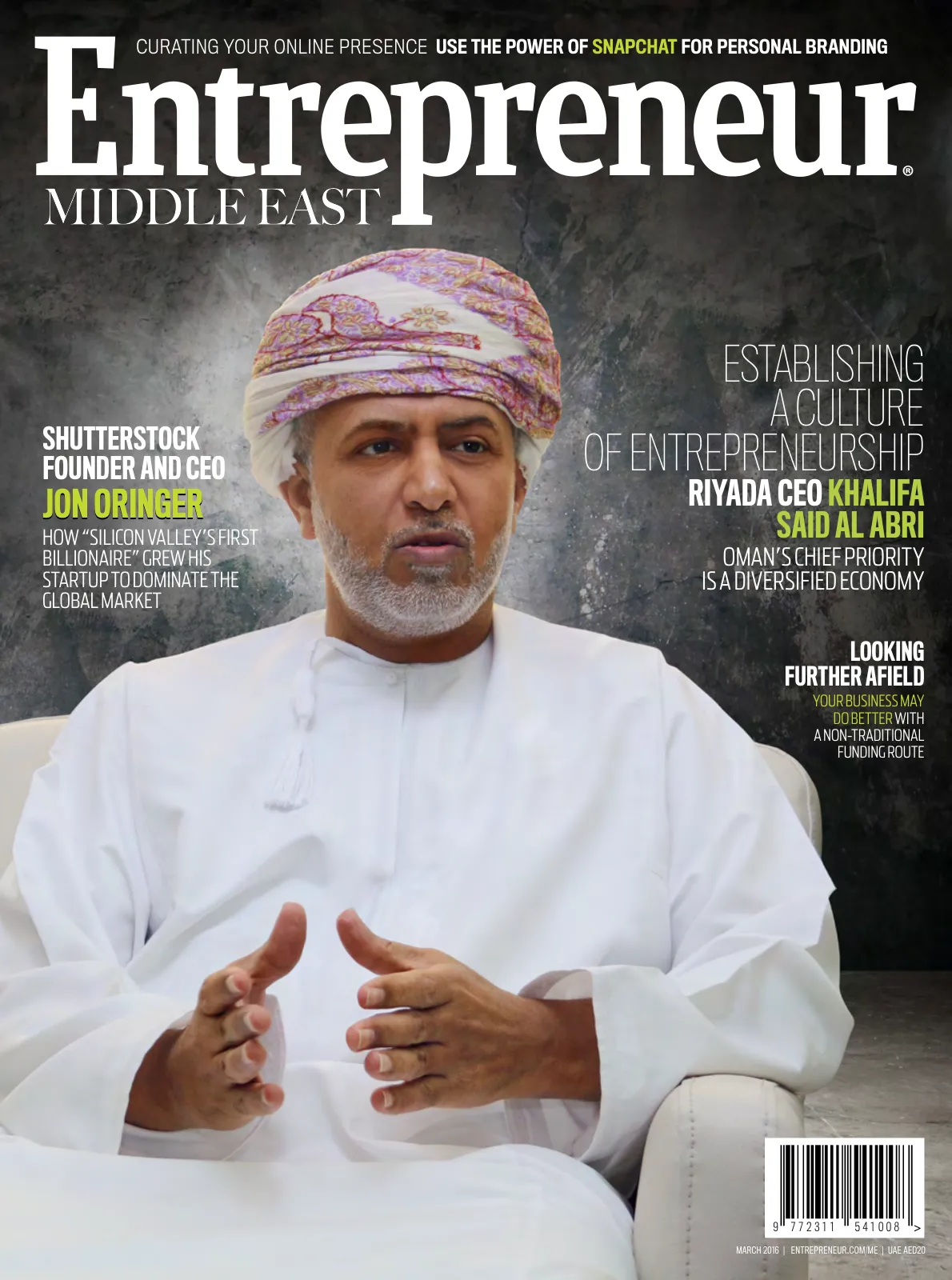
Entrepreneur Middle East, March 2016
Page 1
MARCH 2016 | entrepreneur.com/me | UAE AED20
9
7 7 2 3 1 1
5 4 1 0 0 8
>
Curating your online presence Use the power of Snapchat for personal branding
Establishing
a culture
of entrepreneurship
Riyada CEO Khalifa
Said Al Abri
Oman’s chief priority
is a diversified economy
Your business may
do better with
a non-traditional
funding route
Looking
further afield
How “Silicon Valley’s first
billionaire” grew his
startup to dominate the
global market
Shutterstock
founder and CEO
Jon Oringer
Jon Oringer
Page 2
landrover-me.com
THE 2016 LAND ROVER RANGE
LIVE A LIFE EXTRAORDINARY
Experience the unexpected, push the impossible and venture into the
unknown. For those who strive for a life extraordinary, Land Rover will take
you beyond boundaries, beyond convention and beyond expectations.
Wherever you drive, Land Rover will always take you above and beyond.
Page 3
Page 4
Introducing the entirely new 2016 Lincoln MKX. With an athletic stance and a sleek,
aerodynamic shape that was inspired by aircraft design, it can spark the imagination
at a glance. Its muscular silhouette promises an engaging performance – and this
vehicle delivers on that promise with an available twin-turbocharged 2.7L EcoBoost® V6
engine that generates 346 PS and 542 Nm. of torque. Available Lincoln Drive Control
with continuously controlled damping provides Normal, Sport and Comfort modes for
a personal, customized driving dynamic. Enjoy the more human side of engineering.
Discover the personal driving experience that is the new Lincoln MKX.
Learn more at me.lincoln.com.
Designed to inspire.
Engineered to delight.
2016 LINCOLN MKX
As per GCC Standardization Organization (GSO) certification the 2016 Lincoln MKX 2.7L EcoBoost® engine generates 250 Kw at 5,250 rpm and 542 Nm of torque at 3,000 rpm
Page 5
march 2016 Entrepreneur
3
CONTENTS
20
INNOVATOR:
Establishing
a culture of
entrepreneurship
Riyada CEO Khalifa
Said Al Abri
Oman’s chief priority is
a diversified economy.
26
Quality control
Restaurateur Hani
Nakkach on bringing
London-based
Aubaine to Dubai
(and why he’s doing it
himself).
30
Picture perfect
Shutterstock founder
and CEO Jon Oringer
How “Silicon Valley’s
first billionaire”
grew his startup to
dominate the global
market.
CONTENTS
30
Jon Oringer,
founder and CEO,
Shutterstock
march 2016
march 2016 Entrepreneur
3
Page 6
Entrepreneur march 2016
4
CONTENTS
march 2016
52 Mohammed Abdul Rahim Al Fahim,
Group CEO, Paris Gallery Group of
Companies
46
‘TREPONOMICS:
MARKETING
Show what you know
Cheryl Tan outlines five
essentials to consider for
your content marketing
plan in 2016.
42
ASK A PRO
Early sales success is key
to survival
Karl Hougaard outlines
five common mistakes
to avoid, and why your
business will be better off.
12
EDITOR’S NOTE
By Fida Z. Chaaban
60
ESQUIRE GUY
The secret to better
brainstorming
Ross McCammon says
leading a brainstorming
sessions starts with
forgetting about the
box that, according
to generally accepted
brainstorming practices,
you’re supposed to be
thinking outside of.
36
ETHICS
How to be an ethical
leader
Bayt.com’s Lama Ataya
explains that the key to
having an ethically-run
company is employing
morally upstanding
leaders.
72
MONEY:
YOUR MONEY
Looking further afield
According to Genpharm
co-founder Karim Smaira,
your business may
do better with a non-
traditional funding route.
20
The winners of
this year’s Oman
Entrepreneurship
Awards
Page 7
Page 8
Entrepreneur march 2016
6
CONTENTS
march 2016
images courtesy samsung
56
TECH:
SHINY
#TamTalksTech
Gadgets and doodads that
you might’ve missed out on,
sourced by a tech aficionado.
Yes, it’s okay to want them
all… and no, it’s not our
fault.
58
ONLINE ‘TREP
Curating your online
presence
Entrepreneur Tom Otton
discusses how to use the
power of Snapchat for
personal branding.
59
MOBILE TECH
On the road
Read about an app
developed by NYUAD
students that was
awarded top honors at
the World Government
Summit.
54
CULTURE:
TRAPPINGS
‘Trep gear
The executive selection for
the entrepreneur on your
list that has everything.
Okay, maybe for a little
self-reward as well.
79
STARTUP FINANCE
The Luxury Closet gets
funded!
Founder and CEO Kunal
Kapoor, a former head of
sales at Louis Vuitton,
emphasizes on his startup’s
disciplined compliance
to budget timelines and
financial strategy.
51
BUSINESS UNUSUAL
Start ‘em young
Jordan-based teen ‘treps,
Zaid Amer Rahhal and
Mazen Rid Hashem,
launched an accessories line
with financial independence
as one of their main drivers.
74
START IT UP:
Q + A
“Do you want some
space?”
Startup Boxit, founded
by Premlal Pullisserry,
offers up solutions for your
storage needs.
49
LIFE
Three tips for an energy-
efficient lifestyle
Part of not losing control
is to account for the
energy that you allocate
to the different things you
do, and roles you play.
62
LIFE
Ten common beliefs we
get wrong and why
Overrated ideas vs.
underrated ideas put
forward by Olympian and
entrepreneur James Clear.
80
ECOSYSTEM
Working at a startup
made me a better version
of myself
Adib Samara left a
glitzy multinational
with all of the perks to
join the entrepreneurial
ecosystem, and this
is how it changed his
perspective.
56
C.R Lee, President,
Samsung MENA,
2016 MENA Forum
57 Samsung Gear 360
Page 9
Page 10
Entrepreneur march 2016
8
SUBSCRIBE
Contact subscriptions@bncpublishing.net to receive
Entrepreneur Middle East every issue
EDITOR IN CHIEF Fida Z. Chaaban editor@bncpublishing.net
MANAGING DIRECTOR Walid Zok walid@bncpublishing.net
DIRECTOR Rabih Najm rabih@bncpublishing.net
DIRECTOR Wissam Younane wissam@bncpublishing.net
PUBLISHER Nehme Abouzeid
CREATIVE LEAD Odette Kahwagi
MANAGING EDITOR Aby Sam Thomas
STARTUPS SECTION EDITOR Pamella de Leon
ONLINE LIAISON Kareem Chehayeb
COLUMNIST Sindhu Hariharan
COLUMNIST Tamara Clarke
COLUMNIST Shoug Al Nafisi
COLUMNIST Erika Widen
PO Box 502511 Dubai, United Arab Emirates
P +971 4 4200 506 | F +971 4 4200 196
For all commercial enquiries related to
Entrepreneur Middle East contact
sales@bncpublishing.net
All rights reserved © 2016.
Opinions expressed are solely those of the contributors.
Entrepreneur Middle East and all subsidiary publications in
the MENA region are officially licensed exclusively to BNC
Publishing in the MENA region by Entrepreneur Media Inc.
No part of this magazine may be reproduced or transmitted
in any form or by any means without written permission of
the publisher.
www.entrepreneur.com/me
Access fresh content daily on our website!
MIDDLE EAST
Printed by Raidy Emirates Printing Group LLC
www.raidy.com
EntMagazineME
@EntMagazineME @Fida
Entrepreneur-me
EntrepreneurMiddleEast
EntMagazineME
EntMagazineME
EntMagazineME
MIDDLE EAST
Images used in Entrepreneur Middle East are credited when necessary. Attributed use of
copyrighted images with permission. All images not credited otherwise Shutterstock.
Lama Ataya
Abdulla Barakji
Amal Chaaban
James Clear
Karl Hougaard
Suhail Al-Masri
Ross McCammon
Rani Nasr
Neil Petch
Soukaina Rachidi
May Rostom
Mark Sephton
Adib Samara
Tareq Samara
Karim Smaira
Erika Widen
CONTRIBUTING WRITERS
In addition to our print edition, we’re bringing
you all sorts of industry news on our web
mediums. Joining us online means getting
relevant business and startup content in
real-time, so you’re hearing about the latest
developments as soon as we do. We’re looking
forward to interacting with our readers on all of
our social media and web platforms- like any
thriving business, we’re looking to give and take.
#TrepTalkME is already happening on all of our
digi platforms, and all good conversations go
both ways. See you on the web!
Page 11
DTEC Offers:
•
Space for over 1,000 innovative minds
•
4,000 sqm of business center facilities
•
Visas as per facility
•
Subsidized business licenses
•
Easy business set up
•
Plug & Play offices
•
24/7 access to center
•
High Speed WiFi internet
•
Conference Facilities & Meeting Rooms
•
Restaurants, Cafés and Games Rooms
To apply, call us on +971 4 501 5656
www.dtec.ae dtec@dsoa.ae
Join the greatest startup ecosystem in MENA
Space to work Space to grow
DUBAI TECHNOLOGY ENTREPRENEUR CENTER
for booking
Call : 04 501 56 56
www.dtec.ae
DTEC is a business center for accommodating and supporting young technology companies
and Entrepreneurs. With over 4,000 sq m of space, it is the largest entrepreneur center in the
Middle East, housing space for over 1,000 innovative and technology minds.
Page 12
Page 13
Page 14
Entrepreneur march 2016
12
Fida Z. Chaaban
Editor in Chief
@fida | @fidazchaaban
editor@bncpublishing.net
EDITOR’S NOTE
Encouraging entrepreneurship is everyone’s
responsibility
Doing your part for
the ecosystem
@kindaibrahim moderating the @TwitterMENA
#PositionOfStrength panel at Global Women’s
Forum Dubai. Panelists right to left: @Fida,
@ImanBenChaibah, @HebaAlSamt.
To see the online action from the forum, visit the
hashtag #GWFDubai.
I
had the pleasure of speaking
on Twitter MENA’s panel at
the Global Women’s Forum in
Dubai in February. Moderated
by Kinda Ibrahim, my co-
panelists (Iman Ben Chaibah and
Heba AlSamt) and I were asked to
discuss how the medium puts Arab
women in a #PositionOfStrength.
During the course of the one-hour
discussion, I was also asked to talk
about business leaders and the re-
sponsibility they have to encourage
entrepreneurship in the region.
My response was that we are all,
without exception, responsible for
entrepreneurship in the MENA
region. It is not only leaders of en-
terprise who should be tasked with
the growth and support of what
is arguably the most important
mandate in this history of the Arab
world- economic diversification and
stability via the proliferation of the
small to medium enterprise space.
You and I are just as pivotal as the
Chairman of any influential board
in terms of making this economic
vision a reality in the near future.
How can you help? Well, no
matter your position or sector of
employment, be you a founder of
a fledgling startup or the CFO of a
regional conglomerate, there are
ways you can pitch in. Mentoring,
speaking, or allowing for a job shad-
ow, are just some ways that more
senior members of our business
community can help out. Juniors or
those who are just starting out can
volunteer to lend a hand at startup
events- and in the process you gain
valuable connections and insight
into the ecosystem’s workings. This
helps you as much as it helps the
ecosystem.
Another easy -and perhaps the
most significant- way of supporting
the entrepreneurial ecosystem is by
acting in a customer capacity. Think
about how much you are helping
our homegrown small enterprises
by spending your money there.
Want to eat out? Choose a brand
founded here, as there are lots of
those in the F&B sector. Looking
for a gift? Shop online with any
one of the hundreds of e-commerce
startups, or gift a subscription
to the many useful box startup
companies. We share some of
these ventures under the hashtag
#EntMERecommends on both Twit-
ter and Instagram. Are you looking
for a staffing or freelancer solution?
Be certain to visit the websites of
regional companies first, because
chances are they have what you’re
looking for and they’re willing to
bend over backwards to onboard
regional clients.
I always try, as much as possible,
to shop with local businesses. Over
the holidays, I managed to get every
single item on my gift list from a lo-
cal entrepreneurial endeavor- many
are listed under the hashtag I just
mentioned. If all that still doesn’t
sound like you, just choose Careem
to taxi around town or Carpool Ara-
bia for ridesharing options.
There is always a way to do your
part for the ecosystem, and suggest-
ing that it is not your responsibility
is flat out wrong. After all, next year
it could be your startup struggling
to demonstrate customer traction,
and you could be the one asking
yourself why people don’t think
local first.
Page 15
Page 16
Page 17
Page 18
Entrepreneur march 2016
16
IN THE LOOP
Beirut to Host MENA
Games Conference
2016 in April
Game On
mena games conference image © menagames.com
AIM 2016 hopes to keep Dubai as an
international investment hub
Retail Leaders Circle 2016
to gather GCC’s retail
industry leaders
for a stronger market
AIM 2015
MENA Games
Conference 2015
M
ENA Games Confer-
ence 2016 (MEGA
2016) is back in
Beirut this year from
April 7-8, 2016 for its second
edition, with an expected turn
out of 800 participants across
areas of game developing, pub-
lishing, infrastructure providers
and online advertising. The event
aims to promote and grow the
regional gaming industry by of-
fering a platform for regional and
international gaming companies
and upstarts to accelerate busi-
ness growth. On the agenda
of MEGA 2016 is a series of
game development workshops,
keynote addresses on MENA’s
gaming ecosystem by industry
leaders, Q&A sessions and pre-
arranged B2B meetings for busi-
ness development. Speakers at
MEGA 2016 include Jason Della
Rocca, co-founder, Execution
Labs, Amir-Esmaeil Bozorgza-
deh, co-founder, Gameguise,
and Brie Code of Ubisoft among
others. Running parallel to
these events will be the second
edition of Arabic Game Jam,
an event attempting to encour-
age the proliferation of regional
games, where game designers,
programmers or even those just
passionate about gaming team
up to create an Arabic game in
48 hours. MEGA 2016, organized
by the IFP Group, counts Gaming
Istanbul, Noridic Game and Game
Connection among its conference
partners. www.menagames.com
U
nder the patronage of H.H.
Sheikh Mohammed Bin Rashid
Al Maktoum, UAE Vice Presi-
dent, Prime Minister and Ruler
of Dubai, the 2016 edition of the Annual
Investment Meeting (AIM) will take
place at the Dubai World Trade Centre
from April 11-13, 2016. Organized by
the United Arab Emirates Ministry of
Economy, AIM 2016 will be a step up
from previous editions. In addition to
a panel of speakers who are experts in
investment, specifically Foreign Direct
Investment (FDI), the organizers have
added some more events and facilities to
the three-day conference. With several
exhibitions and organized networking
events between investors and industry
leaders, the organizers will also pro-
vide a platform to help SMEs go global.
The speakers come from a wide variety
of backgrounds, from FDI experts to
industry leaders, including Andrea E.
Goldstein, Head of Global Relations,
Organization for Economic Co-operation
and Development (OECD), Arif Amiri,
CEO, Dubai International Financial
Centre (DIFC) Authority, and Mira A.
Jabr, Global Director – FDI, Conway, Inc.
The event boasts of supporting partners
that include the Australia Arab Chamber
of Commerce & Industry, Arab Business
Leaders, and the Indian Business & Pro-
fessional Council. www.aimcongress.com
T
he New York Institute of Manage-
ment (NYIM) will be hosting the
2016 Retail Leaders Circle (RLC)
in Dubai. The two-day event will take
place from next spring from March
22-23, 2016 at the St. Regis Dubai
Hotel. Expect a variety of speakers
from regional and global retail groups,
including Nisreen Shocair, President
of Virgin Megastores MENA, Norma
Taki, Partner, Retail & Consumer of
PwC, and Mert Askin, President, of
the Azadea Group’s Food & Beverage
Division.
RLC has put together a significant
advisory board, with big hitters like
Saks Fifth Avenue, Landmark Group,
and IKEA executives confirmed, mean-
ing that attendees will be hearing
about the most pressing retail sector
issues. The subject matter goes well
beyond sales -what one might expect
from a retail-focused conference- with
topics including corporate culture and
branding, in addition to discussions
on human capital (like strategizing
staff engagement and retention). At-
tendees will also have an opportunity
to network throughout the two-day
conference.
www.retailleaderscircle.com/uae
Page 19
COPENHAGEN
Saxo Bank A/S Headquaters
Philip heymans Allé 15
2900 Hellerup
Denmark
Phone: +45 39 77 63 80
Fax: +45 39 77 42 00
E-mail: me-private@saxobank.com
ABU DHABI
Etihad Towers, Tower no. 3, Unit 1401
P.O. Box: 43082
Abu Dhabi
United Arab Emirates
Company phone: +971 2 408 8000
Fax number: +971 2 658 3400
E-mail: abudhabi@saxobank.com
DUBAI
Currency House, 1st Floor, DIFC
P.O. Box:506830
Dubai
United Arab Emirates
Phone: +971 4 381 6000
Fax: +971 4 325 9209
E-mail: dubai@saxobank.com
Page 20
Page 21
Page 22
Entrepreneur march 2016
20
Establishing
a culture
of entrepreneurship
Riyada CEO Khalifa Said Al Abri
Oman’s chief priority is a diversified economy
By Aby Sam Thomas
innovator
“We want more entities to be a
part of the entrepreneurial eco-
system, and start establishing
and organizing their own pro-
grams to help the SME sector.”
L
ike every
other nation
in the Gulf
Coopera-
tion Council
(GCC), the
Sultanate of
Oman too has been adversely
affected by the decline in oil
prices over the past year- the
country saw its revenues go
down by more than 50%
in 2015, and its budget for
this year has projected a
deficit of OMR3.3 billion
(US$8.6 billion). But as dire
as this situation may seem,
it was hard for me to find
any repercussions of this on
the spirits of the Sultanate’s
citizens I met during my visit
to the country in January this
year- the people I got to see
were incredibly optimistic,
and their enthusiasm to work
hard to achieve their personal
goals and thus contribute to
their nation’s growth was,
quite simply, impressive.
But then again, I shouldn’t
have been too surprised: the
one thing I found as a link
connecting all of them was
that they were all, in some
way or the other, related to
the startup ecosystem of the
Sultanate, and much like the
characteristics embodied by
entrepreneurially-minded
folk around the world, these
Omanis were committed to
making a difference in their
country as they know it- and
it’s safe to say that they are
relentless in their determi-
nation to change it for the
better.
There has been a renewed
focus on Oman’s ecosystem
for entrepreneurs ever
since the SME Development
Symposium was held in the
country at Saih Al Shamekhat
in 2013, which was organized
as per the directives of the
Sultanate’s ruler, His Majesty
Sultan Qaboos bin Said al
Said. One of the outcomes of
that event –which discussed
ways to accelerate entrepre-
neurship in Oman- was the
establishment of Riyada, an
organization whose mandate
is to, quite simply, nurture
and aid the development of
the country’s SME sector.
While it’s only been a few
years since Riyada’s incep-
tion, CEO Khalifa Said Al
Abri feels that the organiza-
tion has indeed made some
headway on its goals- having
said that, Al Abri acknowl-
edges that he and his team at
Riyada have a lot more to do
and accomplish in developing
an ecosystem that is 100%
friendly to SMEs in Oman.
“Establishing a culture of
entrepreneurship is not
something that can be done
within one or two years,” he
explains. “It is a long process,
and you have to work for a
long time to achieve that. But
there is already a change we
can see in the ecosystem now-
a lot of young Omanis today
want to establish their own
businesses. This was not the
case two to four years ago.”
And Al Abri has the numbers
to prove his point: “In 2013,
there were only 323 Omanis
who had registered their own
businesses with the system.
In 2015, that number went up
to 4,300.” Al Abri notes that
this increased interest in the
SME sector is advantageous
for Oman not just because of
the contribution it can make
to the country’s economy,
but also for the important
role it can play in bringing
about job opportunities for
Omani nationals. At a time
when the International Labor
Organization has pegged
the unemployment rate in
Oman at 7.17%, promoting
entrepreneurship as a career
option –as opposed to looking
for a job with large companies
or the government- makes
sense for a nation that is
eager to move away from
its dependency on oil, and
instead focus on other poten-
tial big business sectors like
tourism, logistics, etc. H.M.
Sultan Qaboos has also put
his voice behind the SME sec-
tor- during a speech at Saih
Al Shamekhat in 2013, he
said, “The national economy
of a country is, in fact, based
on small and medium indus-
tries… These are the funda-
mentals, the foundations of
all national economies.” To
give credit where it’s due,
it does look like the Omani
government has been making
a concerted effort to improve
Oman’s business landscape
as a whole. And this applies
to (and bodes well for) both
existing SMEs in the market,
as well as new ones- while
there is obviously a lot more
that needs to be done, Ri-
yada’s existence is in itself an
indication of the work being
done in this direction. >>>
Page 23
march 2016 Entrepreneur
21
“There is a huge
potential for
entrepreneurs
to find
opportunities
within the
ecosystem. It is
not easy work-
but the benefits
will be huge.”
Khalifa Said Al Abri, Riyada CEO
Page 24
Entrepreneur march 2016
22
innovator
Taskeen Properties’
Khalid Al Habsi
winning at the Oman
Entrepreneurship
Awards
Dar alHerfya CEO
Zuwaina Sultan Al-Rashdi
“Establishing a
culture of en-
trepreneurship
is not something
that can be done
within one or
two years.”
Besides Riyada, the Saih Al
Shamekhat symposium also
led to the creation of another
organization catered specifi-
cally to Oman’s SME sector:
the Al Raffd Fund. While
Riyada is aimed at helping
SMEs with training and ad-
visory services on everything
from starting up on an idea to
finally marketing their respec-
tive endeavors, Al Raffd Fund
has been set up to provide the
requisite financial support
for Omani nationals to start
their businesses. The two
bodies’ work can thus be said
to be complementary to each
other- entrepreneurs often
go to Riyada first to build
and develop their enterprise
ideas, following which they
submit a proposal to Al Raffd
Fund to get financed. Between
the two organizations, they
are trying to get rid of -or at
least relax- the obstacles in
front of Omani entrepreneurs
today- these range from find-
ing ways to speed through
procedural roadblocks, to
dispelling societal norms that
discourage entrepreneurship.
From his perspective, Al Abri
agrees that there are several
hurdles to overcome if one
chooses to go down the path
of entrepreneurship in Oman-
but then again, he notes, the
rewards are worth the ride.
“The opportunities are there,”
he says. “There is a huge
potential for entrepreneurs
to find opportunities within
the ecosystem. It is not easy
work- but the benefits will be
huge.”
From advising
Omani entrepre-
neurs on how to
deal with govern-
ment authorities,
to making sure the
directives made
at the 2013 Saih
Al Shamekhat
Symposium are
being followed
through, it’s clear
that Riyada has
a lot on its plate,
with respect to its
task of developing
the SME sector
in Oman. But Al
Abri notes that the
organization has also been
tasked with promoting the
culture of entrepreneurship
in Oman- and this is basically
how Riyada’s Entrepreneur-
ship Awards came to be.
“There are three reasons for
these awards to exist,” Al
Abri explains. “First is to
create the culture of business
in Oman- just to increase
the awareness of Omanis
that there are opportunities,
there are ways to establish
their own businesses within
the ecosystem. The second
reason is to highlight the
success stories in the eco-
system- so that they can be
like role models, heroes, for
other young Omanis… The
third reason is to encourage
government authorities and
other institutions in the eco-
system to establish programs
or initiatives to help SMEs…
So there are awards for gov-
ernment authorities, financial
institutions,
corporate gi-
ants, etc. that
support and
help SMEs- and
we want to
encourage more
of these activi-
ties. We want
more entities to
be a part of the
entrepreneurial
ecosystem, and
start establishing and orga-
nizing their own programs to
help the SME sector.”
The first edition of the
Entrepreneurship Awards
was held in 2015, which saw
13 winners (out of a total
of 581 applications) being
awarded for their achieve-
ments in Oman’s SME sector.
The second edition (for which
Entrepreneur Middle East
was a media partner) saw 481
applications, of which 21 saw
their achievements awarded
at a gala ceremony held at
the Sultan Qaboos University
in late January. While the
awards are, by themselves, a
rather worthwhile initiative
to support Omani entrepre-
neurs, Riyada doesn’t stop
just there. “Our idea is not to
just give them some money,
or give them some trophies,
and that’s the end of the sto-
ry,” Al Abri says. “Our aim is
also to start the journey with
them- as in, move from what
they are now, and how we can
help them to grow and pro-
mote their businesses in the
future. So there is a support
program after the winners
are announced, and our plan
is to continue working with
them from now, until the end
of the year. We think this is
important, because winning
a trophy or an award is not
the end of the story- we think
this is the starting point for
them.” And the post-awards
program is a pretty intensive
one- Riyada’s personnel
get to work with the win-
ners on their businesses,
identify gaps in their models
and help solve those issues,
and further assist them in
their growth by showcasing
them at events to potential
partners.
Nadia Maqbool was one
of the winners in last year’s
installment of the Entre-
preneurship Awards. Her
company, 23 Degrees North,
an architectural consultancy
founded in 2011, won the title
of the “Best Small Enterprise
in the Service Sector,” and
for Maqbool, the award was
just the impetus she needed
to turn her attention to all
of what she needed to do to
make her business a sus-
tainable one. “Winning the
award last year was a huge
boost of confidence for us,”
she says. “As entrepreneurs
in a technical field -we are
architects- we were focused
Page 25
march 2016 Entrepreneur
23
on broadening our reputation
in the market, as good design-
ers, as innovative designers.
Alhamdulillah, we have now
achieved that reputation.
But there is so much
more to being an en-
trepreneur than that,
and for me, the big-
gest win out of the
award was shedding
light on the other
aspects [of running
a SME]: you know,
the marketing, the
HR, the legalities,
the planning, the vi-
sion, etc. We weren’t
really focusing on
these things, not because we
didn’t prioritize them, but
because we were focusing
on the things that we knew,
the things that we were able
to invest our time in. Since
winning last year, it’s taken
us quite some time to just
strategize how we’re going to
really deal with developing
those sides, and now, we’ve
come up with a couple of so-
lutions, that we’re hopefully
going to be implementing
soon.” And these changes
probably couldn’t have come
at a more opportune time for
this SME- in January, Maq-
bool’s company celebrated
the successful completion
and delivery of its milestone
project, the Lycée Française
de Mascate (The French
School of Muscat), and one
hopes that this achievement
will stand 23 Degrees North
in good stead for the future.
Maqbool’s journey with her
enterprise is almost certainly
going to be an inspiration for
the SME founders that won
at this year’s edition of the
Entrepreneurship Awards.
While these entrepreneurs
may hail from different
sectors and backgrounds,
they are all linked by their
steadfast dedication to their
enterprises, despite the
challenges inherent in the
Omani ecosystem. Khalid Al
Habsi’s Taskeen Properties,
for instance, won in the
“Best Small Enterprise in
the Service Sector” category
this year, but he notes one of
the biggest hurdles he sees
in Oman is the societal indif-
ference to entrepreneurship.
“We don’t have a culture of
entrepreneurship,” Al Habsi
says, a notion that Mona
Al Shukairi agrees with. Al
Shukairi, whose company
Al Joory Boukor won second
place in the “Best Micro Busi-
ness” category, faced a lot of
opposition from her family
and friends when she decided
to quit her lucrative medical
career to start up her local
incense and perfume enter-
prise- Al Shukairi told me she
kept her business a secret for
as long as she could so as to
avoid any potential confron-
tations with people she knew.
But Al Habsi and Al Shukairi
didn’t let the hurdles in front
What’s your personal take
on the entrepreneurial
ecosystem of Oman?
“The entrepreneurial eco-
system in Oman is building
capacity and many resources
exist to help Omani SMEs.
The challenge lies in making
resources accessible, easy to
understand and responsive
to the needs of SMEs. We
feel the opportunity lies
in creating a community
of entrepreneurs that are
capable of economic impact.
Entrepreneurs and startups
are the engine of economic
impact and diversification.
The government and private
sector organizations here in
Oman are providing much
support, in fact, one could
argue too much. It is not the
government’s responsibility
to create entrepreneurs.
It is the responsibility of
government to fulfill the
needs of entrepreneurs for
knowledge, market data,
favorable policies, minimal
bureaucracy, access to capi-
tal, etc.”
What are your tips for
aspiring entrepreneurs in
Oman?
“I can’t say enough about
the need for SMEs to under-
stand their business, target
market and financial model. I
see too many startups tackle
businesses that have been
done 500 times. And they
do it without understanding
the pitfalls of entering a
saturated market. This is a
time of great innovation and
disruptive
ideas. But
ideas are a
commod-
ity. Only
those that
know how to
implement will be successful.
The best approach to
starting a business is
simple. Read, ask, compare.
Voraciously read about the
market you want to enter,
read about startup business
models, read about competi-
tors, research market data,
go-to-market strategies, etc.
Google is your friend. Tap
into the world’s collective
knowledge via Google. Ask
anyone who will talk to you
about your idea. Use their
feedback to dig deeper and
convince yourself that you’ve
got a winning idea.
Don’t get ‘married’ to your
idea too soon. Give yourself
time to research every aspect
of it. Reach out to industry
associations, search for
industry experts on LinkedIn,
connect with people or lead-
ers who may have expertise.
Allow yourself to formulate
multiple ideas. Then, com-
pare: who is already doing
it or something similar to it.
Look at potential competi-
tors, collaborators, and stra-
tegic partners. And most im-
portantly- surround yourself
with people who understand
what you are going through
and can support you. That’s
what Startup Oman aspires
to be- the place entrepre-
neurs call home.”
Perspectives on the Omani SME sector
Sherry Colbourne | Managing Partner, Startup Oman
www.startupoman.om
Building an ecosystem
A selection of the Oman Entrepreneurship Awards winners with Entrepreneur Middle East
Managing Editor Aby Sam Thomas
Mona Al Shukairi,
founder, Al Joory
Boukor
>>>
Page 26
Entrepreneur march 2016
24
Chris Broad | Specialist Mentor, Riyada, and Lecturer,
Central Bank of Oman’s College of Banking & Financial Studies
Perspectives on the Omani SME sector
Building an ecosystem
innovator
Nadia Maqbool, founder, 23 Degrees
Chris Broad,
Specialist Mentor,
Riyada
of them stop them either-
they were relentless in their
vision for their businesses,
spurred on by a need to do
something different, not just
for themselves, but for their
nation as well. Consider
Dar alHerfya CEO Zuwaina
Sultan Al-Rashdi, whose
Omani handicraft business
led her to be declared as the
“Best Female Entrepreneur”
at this year’s awards: her
enthusiasm for her enterprise
is almost infectious, and she
has big plans for its future.
“My vision for Dar alHerfya
is global,” Al-Rashdi says. “I
want to feature our Omani
products around the world.”
Their big dreams not-
withstanding, these Omani
entrepreneurs are eager to
see more backing for what
they do from their ecosystem.
While they are glad and
proud about the recognition
they have received from
Riyada, they all agree that
there needs to be more active
support for entrepreneurs
in Oman, especially in their
early stages- that’s when they
really need the push to keep
at it with their enterprises.
From Riyada’s standpoint,
Al Abri acknowledges this
demand, and reiterates his
organization’s commitment
to its mission of working for
the SME sector in Oman.
However, Al Abri also cau-
tions against entrepreneurs
stepping into this field with-
out the requisite preparation
needed for such endeavors.
“One of the mistakes [Omani
entrepreneurs] make is that
they think they can establish
a business today, and the next
day, all the doors will open to
them to start doing business,”
he says. “But that’s not how it
happens in the real world.” Al
Abri adds that entrepreneurs
also need to do their home-
work before starting up- a
thorough understanding of
the business and its markets
is absolutely necessary, along
with proper management
of their accounts, human
resources and other such vital
cogs of running an enterprise.
Of course, Riyada is there to
help, Al Abri says, with every-
thing from helping with the
procedures and processes, to
pushing government authori-
ties to help SMEs start up
and develop their businesses.
And so while Oman may not
have an ideal entrepreneurial
ecosystem yet, Al Abri notes
that work has begun in this
regard, and the country as a
whole –which includes every-
one from the population to
the government- is adamant
on giving this sector the boost
that it needs and deserves.
Here’s hoping.
What’s your personal take
on the entrepreneurial eco-
system of Oman?
“I think the ecosystem is in
some instances very devel-
oped; however, there is still a
silo mentality and an appar-
ent difficulty in getting all the
various components and ini-
tiatives work-
ing together
cohesively. The
opportunity
is there for an
umbrella orga-
nization, such
as Startup
Oman, to
provide a hub
environment
through which
entrepreneurs can access
experience, finance and skills
to be able to go-to-market
more effectively. Oman needs
a consolidation of the various
SME initiatives as well as the
development of incubation
environments out of govern-
ment and/or large corporate’s
CSR program oversight –we
have a private organization
in Muscat, called The Lounge
that does just that– and they
have first mover advantage in
this space. You can’t mandate
creativity and entrepreneurial
thinking by way of govern-
ment fiat. Big business
and entrepreneurship are a
natural fit and we must move
away from programs that
leave entrepreneurs feeling
like they’ve become some-
one’s PR exercise.
The problem is the rentier
economy, which has led to
a dependency and handout
culture amongst many. An
unforeseen consequence of
stability has been the stunt-
ing of initiative to the degree
that one is asking permission
to think out of the box. It’s
a challenging starting point.
Whilst it is true that the
diversification policy has
had many notable successes
it’s inherent command and
control nature has disad-
vantaged the economy as it
goes into this new reality.
The role startups have to play
front and center is critical–
however, inertia and dirigiste
central planning is a hurdle
to be addressed. Oman has a
pool of young gifted youth to
draw from, and I think if they
are given access to alterna-
tive sources of funding and
regulators get out of their
way, the result can only be
new business, job creation
and economic growth.”
What are your tips for
aspiring entrepreneurs in
Oman?
“Stop asking for permission,
if you don’t have it– go get
it, and stop waiting for the
government, or some ‘expert’
to tell you when and how
and if you can go about it.
They have to be hungry for
it. Some just think it’s a cool
moniker to bandy about
before they get a job as a
bank clerk. For me, entrepre-
neurship is ‘the pursuit of
opportunity beyond resource
control’ these guys have done
this on their own volition.”
Page 27
Page 28
Entrepreneur march 2016
26
“
INNOVATOR
By Aby Sam Thomas
Quality control
“We managed to
build a great team
in Dubai, mixed with
some veterans
from Aubaine
London to take care
of Aubaine Dubai.”
Restaurateur Hani Nakkach on bringing London-based Aubaine
to Dubai (and why he’s doing it himself)
Aubaine at Dubai Mall
Aubaine at Dubai Mall
W
e don’t
franchise-
never
have, and
never will.”
That’s the
response
I get when I ask Beirut-
born restaurateur Hani
Nakkach about the strat-
egy he used when going
about the January launch
of the first international
location of his London-
based French bistro,
Aubaine, in Dubai. “We
decided to open in Dubai
when we found the right
partner who shares the
same DNA and vision as
us,” he explains. “We run
every site ourselves, as
we want to be sure the
quality and brand ethos
is always upheld. We
managed to build a great
team in Dubai, mixed
with some veterans from
Aubaine London to take
care of Aubaine Dubai.”
And Nakkach himself
is on the ground for his
enterprise in Dubai- it’s
easy to see that he’s a
hands-on entrepreneur
who is a stickler for
detail. “I split my time
now between London
and Dubai, but have
put my focus more on
Dubai, especially during
the opening months,”
he says. “We have The
Dubai Mall location up
and running now, with
the second location
set to open its doors in
spring 2016 in City Walk
2.” While Dubai may be a
Page 29
march 2016 Entrepreneur
27
Aubaine at
Dubai Mall
“Firstly, have passion. The restaurant business is one
of the toughest businesses out there, and it needs hard
work and dedication. Second, understand your market.
Third, ensure you have consumer touch points within
your concept that will resonate with them. Fourth,
take your time to perfect the concept prior to finding a
site. Fifth, choose your location carefully since the best
concept in the wrong place often fails. Sixth, employ
experienced people and look after them. Finally, don’t
cut corners. Or else, in the long run, you will lose.”
Tips for ‘treps
Aubaine founder Hani Nakkach
“We run every site
ourselves, as we want to
be sure the quality and
brand ethos is always
upheld. We managed to
build a great team in Dubai,
mixed with some veterans
from Aubaine London to
take care of Aubaine Dubai.”
“With the Aubaine
expansion, I have
always been careful to
ensure we can maintain
our high quality
offering, as our
clients visit several
sites, not just one.”
Hani Nakkach,
founder,
Aubaine
new location for Aubaine,
it must be noted here that
Nakkach’s concept that
has worked quite well
in London- launched in
2005, the enterprise to-
day has ten of its restau-
rants spread across the
city’s various neighbor-
hoods. “Our USP is fresh,
honest, French food,” he
says. “Everything you eat
in Aubaine is made by
hand, daily- the bread,
the patisseries, the juices,
all the dishes offered on
the menu.” Adding to the
restaurant’s appeal is its
exposition of the rather
French emotion of joie de
vivre: “Aubaine has al-
ways had a neighborhood
feeling to it, never that
of a chain or franchise,
and it is that inviting
ambience, coupled with
the high quality of our
food and ingredients,
that we have been able to
reproduce throughout our
other locations,” Nakkach
explains. “Aubaine is as
relevant for a dinner with
colleagues or friends, as
for a quick coffee and
breakfast, or to pop in
and choose some bread
and patisserie to take
away.” As for Aubaine
Dubai, Nakkach is keen
for it to reflect the char-
acteristics of its London
counterpart- this, he
explains, is the overarch-
ing theme governing
the restaurant’s growth
strategy. “With the Au-
baine expansion, I have
always been careful to
ensure we can maintain
our high quality offering,
as our clients visit several
sites, not just one,” he
explains. “The future is to
build a highly respected
global restaurant group
with the aim being to
always maintain our high
standards of production,
service, and ambience.
There is a bright future
for Aubaine, and I can see
us expanding more, espe-
cially within the Middle
East in the near future.”
But why start with
Dubai? “Many leading
brands in the world have
set up in Dubai. Dubai
is becoming the culinary
center of the region. Plus
there is a special connec-
tion between Dubai and
London lots of our loyal
customers live or visit
Dubai regularly… Start-
ing up in Dubai was also
very exciting for me, as
we got to see Aubaine in a
different setting, since it
is our first international
location. I felt very happy
with the opening, as it
was great to see so many
familiar faces and see
the amount of costumers
we had in our first week.
This showed us that the
Aubaine brand is a global
brand that is known and
loved from London.”
But while Aubaine may
have the makings of a
global brand, Nakkach
is in no hurry to expand
either- he claims his
immediate focus is on
the Dubai location. “I
would certainly consider
opening more sites glob-
ally, and of course across
the GCC, if we feel the
right opportunity arises.
However, my immediate
concern is to ensure we
continue the initial suc-
cess of Dubai. We were
delighted to have done
800 covers a day in our
first week, and I never
want to compromise our
quality, and the Aubaine
experience and ambience
for our customers.”
Page 30
Page 31
Page 32
Entrepreneur march 2016
30
innovator
By Aby Sam Thomas
Picture
perfect
How “Silicon Valley’s first billionaire” grew his
startup to dominate the global market
Shutterstock founder and CEO Jon Oringer
Page 33
march 2016 Entrepreneur
31
“I always say I want to
hire entrepreneurs.
These are problem-
solvers by nature and
self-starters by habit.
You can never have
enough people like
that in your company,
whom you trust with
the work that needs
to get done.”
Shutterstock’s Empire State Building Office
shutterstock office iamge © Bilyana Dimitrova / shutterstock.com
H
e’s been called “Silicon
Valley’s first billionaire,”
and he’s also been called
“the coolest person in New
York tech,” but ask Shut-
terstock founder and CEO Jon Oringer
what he thinks about all of these titles
that have been bestowed upon him by
the press over the years, he seems eager
to dismiss them, and direct our atten-
tion to his company instead. “Although
I love to see Shutterstock in the news,
I don’t pay much attention to what
people say about me,” Oringer says. “I
am focused on growing the business,
and making sure that we are delivering
the best possible product we can to our
customers and our contributors.” At
first glance, Oringer’s response might
seem a tad too humble coming from
an entrepreneur as successful as he is,
and hence, a little hard to believe (yes,
we journalists are a cynical bunch),
but consider his statement with Shut-
terstock’s current standing in the
market as the backdrop. For a company
founded only in 2003, Shutterstock’s
growth has been truly exemplary- it
was once just another New York City-
based startup, but today, it is a global
media marketplace (valued at US$2.5
billion in April 2015) featuring more
than 70 million pieces of content, an
admirable collection that includes
images, videos and music, with the
website having enlisted more than 500
million paid downloads to date. With
numbers like that to boast of, Shutter-
stock is easily one of the better startup
success stories out there- and it’s safe
to say that this wouldn’t have been
possible without Oringer’s singular
vision for his enterprise. By keeping his
focus consistently on the company, its
products and its clients, Oringer has
seen Shutterstock through more than a
decade of success, and once you reflect
on that for a bit, it’s hard not to nod
along to his above proclamation.
Shutterstock’s origin story has
become somewhat of a legend now,
but it bears repeating again because
it remains an excellent example of
how entrepreneurs need to be solving
a specific need when it
comes to setting up an
enterprise, and also of
the importance of being
persistent in one’s road
to achieving success-
Oringer is a serial en-
trepreneur who founded
ten companies before
Shutterstock turned
out to be the hit he was
looking for. “I always
knew I wanted to run my
own company,” Oringer
remembers. “It was just
a matter of figuring out what that com-
pany was. I toyed with different ideas,
and some seemed to really take, until
they didn’t- an online pop-up blocker
company I ran was toppled overnight
when Microsoft Explorer introduced
a built-in solution into their browser.
But the one commonality to all of the
companies I founded was that op-
tions for affordable stock imagery for
marketing or websites were incredibly
limited. So I set out to take my own
pictures and to license them to others
at a nominal cost. I shot 30,000 images
in the first year alone. I coded the site
myself, and we were off and running,
back in a time when there were not a
lot of tools out there to help you start
your own business. As an entrepreneur
and a business owner, I knew who my
customers were, and the challenges
they faced trying to find the right im-
age to market their business.” And we
all know what happened afterward.
“I am proud to say that Shutterstock
revolutionized the stock image industry
by throwing out all the complex rights
and offering a simple subscription
model,” Oringer declares. “It wasn’t
just that I understood the pain points
in the process- I learned from my own
frustration trying to use a traditional
stock-imagery company, and I looked
for ways to make it better.”
And Oringer did make it better- that
is essentially why Shutterstock today
has over one million active customers
in 150 countries around the world. But
it’s important to note here that Shut-
terstock isn’t resting on its laurels- on
the contrary, the company is keeping
a close tab on whatever is being said
about it or the industry around the
world, and is on a seemingly relentless
pursuit to better its offerings for its
customers. I realized this first-hand
when an obscure tweet I made about
the difficulty of finding the right stock
image led a member of the Shutterstock
team to get in touch with me, and
further, give me a potential solution to
the problem I was facing as well. This
whole episode took me by surprise- a
pleasant one, of course, but it bears
testimony to the importance of compa-
nies, be it startups or conglomerates,
keeping an ear to the ground in terms of
customer feedback. “We have a healthy
feedback loop with customers,” Oringer
says. “They tell us through research we
lead and customer-service inquiries
they initiate what they want more of. >>>
Page 34
Entrepreneur march 2016
32
Entrepreneur february 2016
32
image © infinity pixels / shuttersock.com
Page 35
march 2016 Entrepreneur
33
innovator
1. Start building
“Whether you’re an engineer build-
ing websites, or a photographer
building your portfolio, there’s
no excuse for not getting started
right away. You’ll learn more at the
beginning of the process than at any
other time.”
2. Love the unknown
“The best business ideas come out
of seeing what’s not there, what’s
not available. Think about why it’s
missing. Is it actually impossible, or
has nobody gotten there yet? That’s
the key question to success.”
3. Believe in yourself
“Each time one of my businesses
failed, I dusted myself off and
looked for the next big opportunity.
Blame timing, the idea, other fac-
tors, really anything else, but don’t
blame yourself. I actually launched
four businesses at once, figuring
that might increase my odds at find-
ing the big idea that would carry me.
Dare to be daring.”
4. Trust market research
“Ask your friends what they think
about the problem you’ve identified
and listen to their feedback. If you
can find people who are directly
impacted by the problem, that’s
even better. I wasn’t a born photog-
rapher, but I grew into it because
I was witnessing the passion and
enthusiasm photographers carry
with them every day. I wanted to be
a part of that.”
5. Take big risks
“Don’t be disheartened by failure,
embrace it. Have the courage to ex-
periment and the willingness to stick
around when the odds are stacked
against you.”
Shutterstock founder
and CEO Jon Oringer’s tips
for entrepreneurs
Start up like a pro
Shutterstock’s Empire State Building Office
Shutterstock’s office
Opposite page:
Jon Oringer, Shutterstock
founder and CEO in front
the of the New York Stock
Exchange after ringing the
bell to start trading under
the ticker SSTK
top to bottom: iamges © Bilyana Dimitrova / shutterstock.com | pio3 / shutterstock.com
Our tech and UX teams are responsive
to what we’re heading, working in tan-
dem with the support teams to ensure
that customers are a major component
of what drives our decisions and in-
novation. Then we hear again from the
same customers about how satisfying it
is that their suggestions and messages
were heard and acted upon. As the CEO,
that commitment to customer service
starts with me. I learn something new
on Twitter every day, paying close
attention to what people are saying
about us and our products. If you run a
company from inside a closed-off world
where the only people you interact
with are your own executives, you’re
not doing your job right. Everyone here
is responsible for customer service to
some degree.”
Shutterstock’s dedication to its cus-
tomers is also reflected in the acquisi-
tions it has made in the past few years.
In January 2015, Shutterstock acquired
Europe’s largest independent photo
press agency Rex Features for $33 mil-
lion, and stock music and sound effects
service PremiumBeat for $32 million.
“Our first major acquisition was Web-
DAM, which gave our customers a bet-
ter tool to keep track of and collaborate
with all the imagery and assets they
purchase from us,” Oringer remembers.
“As I looked to scale our business over
recent years, we
identified the
areas we wished
to pursue, and
when we assessed
the landscape,
these were the
companies that
shined. We bought
Rex Features and
PremiumBeat
because they’re
the best at what
they do- edito-
rial imagery and
music. REX (now
REX Shutter-
stock), and our
partnership with
PMC have quickly
allowed us to ramp up the editorial
content we are able to offer our cus-
tomers.” In the meantime, Shutterstock
continues to innovate from within as
well. “Moving forward, we are growing
Shutterstock to include workflow tools
for busy marketing and creative profes-
sionals,” Oringer explains. “In Decem-
ber, we released Shutterstock Editor, a
fast and simple way to edit photos. The
response to it has been fantastic. And
we’re just scratching the surface with
tools that can help our customers have
a better experience.”
Oringer’s drive to continuously in-
novate at Shutterstock –and succeed
at that too, by the way- is particularly
interesting when you consider that
the company is, well, no longer a
startup. So, one has to wonder: how has
Oringer managed to maintain that en-
trepreneurial mindset with which his >>>
Page 36
Entrepreneur march 2016
34
innovator
Jon Oringer on his company’s presence
around the globe
Shutterstock and the Middle East
“In December, we
released Shutterstock
Editor, a fast and simple
way to edit photos.
The response to it has
been fantastic. And
we’re just scratching
the surface with tools
that can help our
customers have a better
experience.”
shutterstock.com/editor | www.offset.com/artist/Daniel+Cheong | offset image © infinity pixels / shutterstock.com
Shutterstock Offset
Dubai-based
photographer
Daniel
Cheong
company was founded in the
first place? The answer: it’s
all thanks to the people at
Shutterstock. “I always say I
want to hire entrepreneurs,”
Oringer says. “These are
problem-solvers by nature
and self-starters by habit.
You can never have enough
people like that in your
company, whom you trust
with the work that needs to
get done, but also with the
vision to foresee where we
should go next.” Oringer also
points toward diversifying
a business as a way to stay
true to its startup origins.
“You can also maintain
the small-business feel by
launching other arms of
your business,” he explains.
“Our enterprise sales team
kept on hearing from clients
that they wanted higher-end
photography to license, so
we decided in 2013 to create
Offset. This team of 10 sits
among us, shares resources
and support from Shutter-
stock, and helps remind us of
how much you can get done
on a given day if you work to-
gether. Offset, in some ways,
resembles the early, scrap-
pier years of Shutterstock.
In addition, every summer
we host an annual hackathon
for our employees, where
they have 24 hours to form
teams, develop an idea,
and collaborate on a tool or
feature that they can show
off to a judging panel of ex-
ecutives. I served as a judge
for our inaugural hackathon;
however, I really wanted to
be out there hacking with
the rest of the people. These
events are a great opportu-
nity to get back to basics.
This year we launched a
product, Shutterstock Tab,
that was a direct result of
one of our hackathons.”
What about Shutterstock’s
competition in this space?
Oringer doesn’t seem too
worried, and brings it back
to Shutterstock’s culture. “If
we’re committing to the right
strategy and innovation, we
don’t need to pay any atten-
tion to what the competition
is doing,” he says. “We focus
on executing our plan, and
moving forward.”
“International growth has
been key to Shutterstock’s
growth strategy. We want to
be everywhere for everyone.
That takes time. But we’re on
the right track: 70% of our
business comes from outside
the United States.
Authenticity is the name
of the game these days
when it comes to marketing
materials and showcasing
your brand. Our data shows
that the demand for images
of Middle Eastern people is
the fastest-growing change
among searches year over
year. The Shutterstock col-
lection is constantly adapting
to reflect diversity and the
world we live in today.
We need to offer local
content to our customers, no
matter where they are. We’re
always actively recruiting
new contributors to help us,
asking them to shoot their
friends and family and their
regular lives. We’re making
strides to get to know the
local traditions and creative
preferences. These artists
know their craft and their
region best of anyone, and
we leave the camera in their
hands. It’s our job to find
them, bring them aboard,
and to showcase their
beautiful imagery. We work
closely with Dubai-based
photographer Daniel Cheong,
as an example, whose archi-
tectural images from Dubai
and surrounding cities can be
found on Offset.”
Page 37
march 2016 Entrepreneur
35
“International growth
has been key to Shutter-
stock’s growth strategy.
We want to be everywhere
for everyone. That takes
time. But we’re on the
right track: 70% of our
business comes from out-
side the United States.”
Jon Oringer, Shutterstock founder and CEO
Page 38
Entrepreneur march 2016
36
infograph © bayt.com
W
e can’t really discuss ethical leadership without
looking first at ethical behavior. Ethical behavior, in its
simplest form, is knowing and doing what is right. The
key to having an ethically-run company is employing
morally upstanding leaders. In her book, Seven Lenses:
Learning the Principles and Practices of Ethical Leadership (2013),
author Linda Thornton says that getting employees to act ethically in the
workplace starts at the top. In fact, managers should realize that their
actions have a trickle-down effect within the company; employees will
likely follow the lead and model their actions.
how to be an ethical leader
Action this big idea for 2016 By Suhail Al-Masri
ETHICS | ESQUIRE GUY | SKILLSET | MARKETING | PRO
TREPONOMICS
>>>
With the awareness about
the importance of business
ethics, Bayt.com embarked
on a research journey into
Ethical Leadership in the
Middle East, which we
did in collaboration with
Canadian University Dubai
(CUD). The poll showed
that the building blocks for
a more sustainable form
of leadership in the region
indeed exists.
Many define business
ethics as being socially
responsible
We often hear about
the negative impact of
making ethical mistakes in
business. We hear about
fines, boycotts, and very
embarrassing scandals that
make us doubt the very
integrity of organizations
we admire.
What we don’t hear
often about are the
benefits of ethics, and
how ethical leadership can
have a positive ripple on
business- especially when
it’s programmed into an
organization’s corporate
culture. These days, it’s
more important than ever
before to program ethical
leadership by having set
ethical guidelines and
procedures. Leaders
who understand this are
more likely to attract top
employees and clients.
When they set the
right example for other
employees, they help
create an environment
that encourages good
corporate citizenship, and
that motivates employees
to perform better and more
innovatively.
The majority agree that
everyone is responsible for
being ethical
37% of respondents in
the Bayt.com poll on
Ethical Leadership in the
Middle East view business
ethics not just as being
legally compliant, but
also engaging in socially-
responsible activities.
65% see ethics as the
responsibility of everyone
in the organization.
In your effort to promote
ethical behavior throughout
the organization, try to
develop a transparent
work culture to both
your employees and
stakeholders. Make sure
that company information
Page 39
Your Gateway
to the World of
Entrepreneurship
Take your business ideas to promising new heights and develop
your skills to become a successful entrepreneur in Dubai.
Tejar Dubai is an initiative by Dubai Chamber which aims at
qualifying and enabling creative Emirati youth to enter the world of
entrepreneurship through three key pillars: assess, assist and
attain. This program aims to raise competitiveness of national small
and medium enterprises (SME) in Dubai.
tejardubai.ae
π«é°ùàdGh äÉeƒ∏©ŸG ø`e ójõŸ
:≈`∏Y Éfƒ``©HÉ`J
@TejarDubai
Initiative by
Page 40
Entrepreneur march 2016
38
is always available to
those who need it, and
demonstrate transparency
in your decision making
process. Employees are
much more likely to
reciprocate when managers
exhibit trustworthy
behavior.
Leaders are setting
positive examples
Ethical leaders are those
who display a good image
of the business, and in
turn, attract and retain the
best talents. Good news
is, 75% of professionals in
the Middle East affirm that
their managers often set an
example of how to do things
ethically, as revealed in the
Ethical Leadership in the
Middle East poll of January
2016.
Leaders are listening to
their employees
Develop an honest work
environment where
employees can report
unethical behavior without
fear of punishment. No one
wants to be considered a
snitch, so gain confidence
and trust by providing a
private space to discuss
any concerns anonymously.
Investigate the claims
fully, before jumping
to conclusions, while
maintaining the anonymity
of your employee. Then
discipline or reprimand,
if necessary, in order to
establish that some actions
are not accepted, and will
not be tolerated. 72% of
professional respondents
in the same poll (Ethical
Leadership in the Middle
East) say that their
managers discipline or
reprimand employees who
violate ethical standards.
Leaders are talking about
ethics
According to our poll on
Diversity of Thought in
the Middle East, released
in October 2015, 88% of
professionals in the region
are comfortable sharing
their views at work, even
if it goes against the
majority. Today we see
more and more leaders
who are encouraging their
employees to communicate
freely and openly and not
restricting their thought
process and ideas. By
doing so, a leader would
not only be promoting an
environment of honest and
open communication, but
also showing staff trust and
respect. At Bayt.com, for
example, we offer an online
platform, Sawtna, where
employees can voice their
concerns. We also conduct
town hall meetings across
our offices so employees can
interact with management
and give their feedback on
issues that affect them.
Recommendations: How
managers can program
ethics into their leadership
style
We can’t talk about
ethical leadership without
providing a guideline to
managers who want to
program ethics into their
corporate culture and
leadership style. Here are
seven ways managers in the
Middle East can promote
ethical behavior:
1. Don’t think about ethics
as just following laws
and regulations. Leaders
need to take action and
show consumers and other
stakeholders that they
are actively engaged with
ethical issues that matter.
Recognize how ethics
influences consumers’
ETHICS | ESQUIRE GUY | SKILLSET | MARKETING | PRO
TREPONOMICS
Have a clear code of conduct. Codes
of conduct are required to help
employees discern the different
shades of grey in the ethical
continuum. It is essential that training
and explicit discussions about ethical
issues are conducted regularly.
Page 41
march 2016 Entrepreneur
39
Lama Ataya heads the Marketing department at Bayt.com and within that role is also responsible for communications, content,
community experience, and corporate social responsibility.
reasons to buy from
you, and demonstrate a
commitment to go beyond
mere compliance with
laws and regulations.
They must prove that they
are committed to ethical
issues, including human
rights, social justice and
sustainability.
2. Care about people
before profits. Realize that
the triple bottom line of
people, planet and profits is
not only about prioritizing
people over profits, but
also thinking about how
your company affects
the planet and adopting
environmentally-friendly
ways of doing business.
3. Ethical behavior is
reciprocal. Employees are
more likely to reciprocate
when their managers
exhibit trustworthy
behavior, so it is important
to demonstrate fairness and
transparency in all your
decisions.
4. Democratize decision
making. Asking for
feedback and suggestions
from your staff will show
trust and respect for their
opinions.
5. Share and delegate.
Sharing information with
and delegating tasks to your
team will empower and
motivate them, yielding
tremendous dividends in
their creativity.
6. Communicate. Being an
ethical manager is about
clearly communicating
what is acceptable behavior,
and what is not, and
ensuring your employees
understand that you have
an open door policy to
discuss any situation
where an ethical decision is
needed. Prevention is better
than cure.
7. Have a clear code of
conduct. Codes of conduct
are required to help
employees discern the
different shades of grey in
the ethical continuum. It is
essential that training and
explicit discussions about
ethical issues are conducted
regularly. Include ethical
behavior in performance
metrics and employee
reviews, and set the right
cultural tone right from the
start.
Page 42
Entrepreneur march 2016
40
Seven body language cues
entrepreneurs need to be aware of
for effective communication
By Neil Petch
Sending the right
message
TREPONOMICS
ETHICS | ESQUIRE GUY | SKILLSET | MARKETING | PRO
Studies show that ges-
turing with your hands
naturally while you speak
will help improve your
credibility, and there is
also evidence that it actu-
ally improves your own
thought process.
W
hether
we realize
it or not,
we are
con-
stantly
giving off body signals that
affect how others perceive
us. Body language is in fact
so important that it is actu-
ally thought to account for
almost 60% of our effective-
ness in communication. This
means that the success in
which we convey our mes-
sage is in fact more depend-
ent on our body language
than it is on our words. In
a business context, body
language can be considered
a skillset that you would be
wise to develop and refine.
To some it comes naturally,
but I’ll bet the great commu-
nicators have spent their fair
share of time in front of the
mirror practicing hypotheti-
cal deliveries. With that in
mind, this article takes a
look at some of the obvious
and not-so-obvious body
language cues and move-
ments and actions that the
entrepreneur can practice up
on. Pick one or two to work
on this coming week in your
meetings with clients and
colleagues, and as you do, see
if you can gauge the effect
they are having on the other
person. Perhaps you will get
a sense of a higher level of
trust or comfort coming back
to you, which is often exactly
what the master communica-
tor is after.
1. Smile
Let’s start with an easy one:
remember to smile, and
make it genuine. Smiles are
contagious, and studies show
that going into a business
discussion wearing one can
help reduce the often high
stress levels or tension that
are part and parcel of the
corporate world. Studies
also show that a simple
smile encourages those you
are talking with to open up
more quickly. And here are
a few fun facts: according
to research by the science
journal PLOS ONE, smiling in
the workplace can increase
your chance of securing a
promotion, and smiling in
general makes you appear
more intelligent to others.
2. Master the handshake
While you’ve probably
heard about the power of a
handshake countless times
by now, it still has to be
added to this list. A strong
handshake goes a long way
in how you are perceived–
particularly by those who
you are meeting for the first
time. Many psychologists
state that on average, we
judge a person within
seven seconds of meeting
them, and according to the
University of Iowa, a solid
handshake is more important
than our dress sense or
personal appearance when it
comes to how positively or
negatively we are perceived.
So how to do it right? As
you would expect, avoid
extremes. This means no
vice-like grip, and no damp
squib. Go for the firm,
natural grasp, and ensure
you make eye contact, as that
is a display of respect and
openness.
3. Posture and positioning
The obvious ones here
include sitting up straight,
shoulders high, and head
held high, all of which helps
convey professionalism.
You’ll also want to lean in
slightly, which demonstrates
that you are focused.
Keeping arms and legs
uncrossed lets others know
that you are ready to listen.
Finally, studies show that
planting your feet firmly
on the ground can help you
feel more confident in your
position in the conversation.
4. Mirroring
This is a favorite body
language technique of great
communicators. Mirroring
is simply the act of playing a
person’s own body language
back to them. For example,
watch for how they position
themselves: if they lean in,
do so too. If they gesticulate
in a certain way, work in a
similar gesture from time to
time. It goes without saying
that you don’t want to make
this look obvious. It’s not
something the other person
should be aware that you are
doing. Rather, it is some-
Page 43
march 2016 Entrepreneur
41
Neil Petch is the Chairman of Virtugroup. Petch founded Virtuzone in 2009 before launching Virtugroup, a holding company that has a wider mandate
of supporting startups from establishment; to successful market entry; and all the way through to exit. Petch is also the Chairman of DIFC-regulated
GMG, established in 2010 with offices in Dubai, UAE and London, U.K., providing brokerage services for commercial and investment banks globally.
His most recent venture, PrimalMD, was launched in the health sector and focuses on helping doctors addressing the root cause of illness rather than
simply treating the symptoms.
Touch is the most
primitive non-verbal
method of communication
that we possess, and
using it at the right time
and in the right way can
help us get our message
across far better than
anything we say.
Keeping arms and legs
uncrossed lets others
know that you are ready to
listen. Studies show that
planting your feet firmly
on the ground can help you
feel more confident in your
position in the conversation.
thing their subconscious
will pick up on. And so what
does mirroring achieve?
Studies show it can lead to
the other party being more
open, which can lead to them
revealing more information,
making it useful in a negotia-
tion setting.Studies have also
shown that mirroring tends
to foster a climate of collabo-
ration and cooperation.
5. Keep your hands in check
Some of us are big on the
hand movement without
even realizing it. Others
keep the hands firmly in
check with little movement
throughout discussions.
Whatever your style, hand
movement plays a big role
in how you are perceived
by others. Gesticulate too
wildly and you will come
across as being overbearing;
keep your hands clasped
and rigid and you give an
impression of being nervous.
Studies show that gesturing
with your hands naturally
while you speak will help
improve your credibility, and
there is also evidence that it
actually improves your own
thought process. Just keep
in mind that when you are
listening, it is best to keep
your arms more still, by your
sides rather than drawing
them into or crossing them
over the body. This gives off
an air of openness and can
even help you better absorb
what’s being said. So do a
little mirror practice on this
one and work it into your
next conversation.
6. Perfect your gaze
So many people struggle
here, but it’s perhaps the
single-most important thing
a communicator can do.
This is however not to sug-
gest you should be holding
perfect eye contact the entire
time. In fact, you should be
aiming to make eye contact
for around two-thirds of the
time that you are in conver-
sation– more when listening,
and less when speaking. The
science behind it all reveals
that any more than that
and you actually come off as
rude or that you are overtly
attempting to display control
or dominance; while any less
makes you appear uneasy
or even nervous. Another
benefit of making the right
amount of eye contact is that
it helps us read the emotions
of others and react to them
accordingly.
7. Get the golden touch
Touch is the most primitive
non-verbal method of
communication that we
possess, and using it at the
right time and in the right
way can help us get our
message across far better
than anything we say. Let’s
go back to the handshake. A
recent study by America’s
Income Center showed
that people are two times
more likely to remember
someone that they have
shaken hands with versus
someone they simply said
hello to. Handshakes aside,
you can also use touch to
your advantage throughout
your conversation (where
appropriate, of course, and
always taking into account
cultural considerations).
One such tactic that many
in the business world use is
to lightly touch the arm of
the person they are speaking
to while saying their name.
This very direct method of
addressing the other person
can evoke positive feelings
and a sense of personal
value. Now these touches
should, of course, be natural
and subtle, and they should
be incredibly brief– in fact, it
is thought that it only takes
one-fortieth of a second to
make a connection in this
manner.
The vast majority of body
language cues are involun-
tary and subconscious. So
while it is certainly worth-
while to try a few of these in
your next business meeting,
in general, the goal is to start
becoming more aware of the
types of messages your body
can send without you real-
izing it, and also what the
other person might be saying
with their own subconscious
movements and actions.
As we have seen above, the
body has the ability to reveal
whether someone is listen-
ing, interested, to be trusted,
and so on. In other words,
for the astute body language
expert, body language could
end up playing a consider-
able role in influencing busi-
ness outcomes.
Page 44
Entrepreneur march 2016
42
TREPONOMICS
ETHICS | ESQUIRE GUY | SKILLSET | MARKETING | PRO
By Karl Hougaard
Five common mistakes to avoid and why
your business will be better off
Entrepreneur february 2016
42
Page 45
march 2016 Entrepreneur
43
Sales is, after all, very
much about building
relationships– and as the
saying goes, only fools rush
in. Take the time to understand
your prospects’ challenges,
educate yourself on their
business, and demonstrate
your value to them.
too many salespeople are
afraid to initiate conversa-
tions regarding price, when
really it is nothing to shy
away from. Having discus-
sions around price early on
signals your intent from the
outset, as well as giving the
potential buyer complete
transparency. You may have
to get the requirements. But
it is pretty much always pos-
sible to give a range.
>>>
F
or the vast majority of
new businesses, sales
is at the top of their
minds, day in and day
out. While it is hard to
rank tasks according to
importance (it literally
seems as though everything
matters at a startup, doesn’t
it?), we have to look at early
sales success as key not just
to growth, but to survival as
well. And so unless you’ve got
the luxury of investor money
that allows you to hire a sales
team, it’s an activity that will
be taking a lot of your time as
the startup founder.
Here are a couple of interest-
ing facts for you– the second
of which really gets me think-
ing:
1. Full-time sales positions
currently account for over a
tenth of all jobs in the United
States.
2. Of that mammoth sales
force, 20% deliver over 80%
of the revenue.
Why is that second figure
of particular importance to
founders? Because, and to
paraphrase business guru
Peter Drucker, it reminds us
that it is not simply a matter
of doing the right thing, but
doing the thing right. Get good
at sales and the payout is a
financial one. Stay mediocre,
and the outcome could be far
worse than simply remaining
mediocre– on the young busi-
ness front, it could result in
complete failure.
Personally, I feel that the ma-
jority of people who fail to sell
do so not because they can’t
or because they don’t try hard
enough, but because many of
them make one or more of the
all-too-common sales mistakes
I’m about to outline for you–
and simply get stuck in these
bad habits. Now, of course, we
all make mistakes from time
to time, but again we have to
stress that errors in the foun-
dation of your sales process
are hard for the startup to
survive with for too long.
1. Neglecting to prospect
Let’s start with the basics: one
of the main reasons why busi-
nesses fail to sell is because
they neglect the need to get
out there and find enough
prospects in the first place.
Prospecting for sales is the
first and arguably most vital
stage in the sales process, and
yet still many entrepreneurs
put it off– either because
they don’t like “going in cold”
or because they feel they
have enough customers and
therefore don’t need to find
anymore.
But it’s nothing short of
fear and apprehension that
is holding you back, and it’s
the single-biggest mistake you
can make. Before we get to the
ABC (Always Be Closing) stage
that Alec Baldwin made so
famous in the absolute classic
sales film Glengarry Glen Ross,
remember that something
comes before it: ABP. Always
Be Prospecting. If you fail to
do this, get ready for frustra-
tions and a massive level of
stress. Procrastination is one
of the biggest causes of stress,
and procrastinating on the
sales prospecting front will
weigh hard on you. Of course
it’s important to look after the
customers you already have,
but the fact is not all custom-
ers are going to be around
forever. According to Business
Brief, most businesses lose
14% of their customers every
year. This means that steady
prospecting must be a core
part of your business plan.
2. Sticking too tightly to
the pitch
Of course a high-impact,
engaging presentation has its
part to play when it comes
to sealing the deal, but it
needs to be remembered that
it is not the be all and end
all. I have seen far too many
entrepreneurs and salespeople
alike slave over presentations
for days on end, only to get in
front of a potential buyer and
deliver the pitch in minute
detail, paying little or no at-
tention to the reaction of the
client– and therefore failing to
act on vital buying signals.
Yes, if you give a presentation
(and you don’t always have to,
mind you!) it needs to be slick,
but don’t let it dictate the
flow if things end up going in
another direction. Ask yourself
why you are there. It is about
helping you and the prospect
identify if there is a need for
what you offer, then present-
ing your case in the right way
–with the right words and the
right timing– to make yourself
and your products or services
look favorable. Sticking to
the script too tightly can end
up having quite the opposite
effect. Get your presentation
tight and then deliver it natu-
rally, but be ready to change
tact if needed, rather than re-
lying too heavily on your slide
show and missing out on any
potential jumping off points
for conversation.
3. Not being a good listener
Asking the right questions
is of course vital to any sales
conversation, but then make
sure you are listening to the
answers. Whether it is a sales
Page 46
Entrepreneur march 2016
44
TREPONOMICS
ETHICS | ESQUIRE GUY | SKILLSET | MARKETING | PRO
TREPONOMICS
ETHICS | ESQUIRE GUY | SKILLSET | MARKETING | PRO
As Head of Sales & Marketing at Virtuzone, Karl Hougaard ensures the company maintains its position as one of the fastest growing business
setup operators in the Middle East region. Houggard was, in fact, a customer before joining, having owned and operated three different compa-
nies set up by Virtuzone. Karl started his career as a senior manager with Primovie, the Cinema Operations arm of Primedia Ltd in South Africa,
which saw him relocate to Dubai in 2001 as part of the group’s global expansion plans.
Prospecting for sales is
the first and arguably
most vital stage in the
sales process, and yet still
many entrepreneurs put it
off– either because they
don’t like “going in cold”
or because they feel they
have enough customers and
therefore don’t need to
find anymore.
Get your presentation tight
and then deliver it naturally,
but be ready to change tact if
needed, rather than relying
too heavily on your slide
show and missing out on any
potential jumping off points
for conversation.
discussion, a discussion with
your partner, or a casual con-
versation with someone you
met at a business or personal
function, everyone loves a
good listener. Just think how
good you feel when you are in
the company of a good listener.
They make you feel comfort-
able, and you just want more
of them. For the salesperson, I
can’t think of a more endear-
ing and indeed necessary trait.
A good listener looks you
in the eyes, gives no indica-
tion whatsoever that they
are about to interrupt, says
yes and nods at just the right
times without overdoing it (so
as not to distract or disrupt
the speaker), and is, ultimate-
ly, truly listening. He or she
takes in the words, and when
that is being done honestly,
the speaker senses it.
In any sales conversation it
is the prospect that should
be doing the vast majority of
the talking– as much as 70%
in my opinion. So rather than
diving head first into a sales
pitch only to come up for air
at the end to ask about next
steps, let the prospect lead.
Start with questions and get
the person talking, and you
will see that after five or ten
minutes you are in a rather
comfortable place. Then you
can decide together whether
your prepared presentation is
needed, or if you just continue
the conversation (I prefer
the latter 100% of the time).
Really, this all boils down to
recognizing that sales is first
and foremost about solving a
customer’s problem.
If you understand exactly
what a prospect is saying
you’ll be better placed to offer
them a solution and therefore
secure a sale (if there is a fit).
So listening is nothing short
of an essential survival skill
for the salesperson. It gets you
to the answer you need faster
than any of your own smooth
talking will.
4. Being coy about price
There are many salespeople
out there who will tell you
that one of the tricks of selling
is to build value first and then
talk about price. Personally,
while I can see the logic, I’m
not so sure about this ap-
proach. Coming at a sale in
this fashion tends to result
in a potential buyer that can
never really get too carried
away with their interest in
your offering because at the
back of their mind they’re
wondering whether it is even
affordable or not.
The mistake here is that too
many salespeople are afraid
to initiate conversations
regarding price, when really it
is nothing to shy away from.
Having discussions around
price early on signals your
intent from the outset, as well
as giving the potential buyer
complete transparency. So
rather than hooking them in
and convincing them to buy,
let them know exactly what
their commitment will be
early and then use the rest of
your time to demonstrate just
why your offering is worth it.
Of course, you may not know
the exact price upfront. You
may have to get the require-
ments. But it is pretty much
always possible to give a range,
so if that is the only way, then
do it. And yes, that range can
be broad if necessary. You
don’t want to lock yourself
into something unrealistic and
have to backtrack later.
5. Not knowing how to close
This one is in large part about
timing and communication.
Try to close too soon and you
could be waving goodbye to
a fantastic opportunity. Wait
too long and someone else
will most likely snatch that
opportunity right out of your
hands. The case for not jump-
ing straight to the sale is clear.
Sales is, after all, very much
about building relationships–
and as the saying goes, only
fools rush in. Take the time to
understand your prospects’
challenges, educate yourself
on their business, and dem-
onstrate your value to them.
If they are in fact a genuine
prospect, then by doing these
things you are giving yourself
the best possible chance of
securing that sale.
However, that’s not to say
sales success is done by stay-
ing casual about the contact or
giving that prospect his or her
distance. Far from it. When
to make contact, how to make
contact (what to say), and how
often to make contact is very
much a gut feeling-led exer-
cise, and you have to develop
killer instincts in this respect.
The key is to look at the close
as part of an ongoing consulta-
tive relationship rather than
something that is going to be
a quick one-off transaction
(that is, getting a yes or no at
some point based on very little
discussion almost never hap-
pens in B2B). This means that
events dictate the timeline
and not vice versa. The sale
can come at anytime through-
out this process, and so that
finesse you develop based on
your finely tuned instincts is
what dictates the actions you
will take to give yourself the
best chance of securing that
sale.
Page 47
An innovative twist to your meetings
Following our extensive remodeling and refurbishment, discover the leading
destination for meetings and events in Dubai. Experience 17 state-of-the-art
meeting rooms with natural daylight and two dedicated VIP boardrooms,
or add an innovative twist to your next meeting with unique facilities
adjacent to the hotel.
+971 4 341 0000 | meetings.malloftheemirates@kempinski.com | kempinski.com/dubai
Page 48
Entrepreneur march 2016
46
TREPONOMICS
ETHICS | ESQUIRE GUY | SKILLSET | MARKETING | PRO
Show what you know
Five essentials to consider
for your content marketing plan
By Cheryl Tan
To figure out what kind of
content to create, picture your
ideal client. Then, jot down 10
ideas. Those ideas will take your
buyer on a journey. Imagine
that buyer coming into your
business knowing nothing. What
does that buyer need to know
to become knowledgeable about
your field? What trends are
happening in your industry?
What are the rules of doing
business in your office? Write
down article subjects related
to what they need to know
about your product or service.
Nothing will replace a face-to-
face connection. But, more often
than not these days, a potential
buyer will search you out in
Google before stepping foot in
your store. That’s why, in 2016, it
will be more important than ever
to create easily accessible in-
formation so potential custom-
ers can learn everything they
need to know about you, your
products, services, and business
philosophy before they pick up
the phone or walk in the door.
A
re you using your
marketing strength
to ensure the suc-
cess of your busi-
ness? And before
you say yes, ask yourself if
all of the pieces of the puzzle
are actually synergistic, and
operating as parts of a whole
as opposed to standalone
campaigns. While developing
a content marketing plan, you
may be creating a strategy that
encompasses ad buys, media
mentions, and customer ap-
preciation events. A key aspect
to center on is thinking about
a content marketing plan that
will serve to highlight your
company’s expertise.
Why is this important?
Nothing will replace a face-
to-face connection. But, more
often than not these days, a
potential buyer will search you
out in Google before step-
ping foot in your store. That’s
why, in 2016, it will be more
important than ever to create
easily accessible information
so potential customers can
learn everything they need to
know about you, your prod-
ucts, services, and business
philosophy before they pick up
the phone or walk in the door.
What kind of content should
you create? Start with asking
and answering the following
essential questions prior to
fleshing out your strategy:
1. What are your content
goals?
Yes, creating content for your
business is critically impor-
tant. But before you head down
this path, determine what you
want to achieve from a good
content plan. It’s a lot of work,
so figure out what results you
want from the content before
you create it. Do you want
more local customers? Do you
want to be seen an as expert
in your industry? Do you want
more signups to your newslet-
ter? And this is crucial: how
will this new exposure turn
into paying customers?
2. Who is your customer?
As much as we want everyone
to love us (and everything
we sell), you have an ideal
customer. Take a good hard
look and figure out who this
perfect person is. Are you
trying to reach young couples,
single moms, or retirees? Are
you trying to reach a certain
culture? A certain spend? De-
termine who your ideal client
is and know everything you
can about that person’s desires
and what exactly they are will-
ing to pay for.
3. Where do they go to get
information?
Where does your potential
client show up to get infor-
mation? Are they active on
social media? Do they read the
newspaper? Watch TV? What
can you do to show up in the
same places they are? Once
you create your content, place
your content in the locations
where your buyers hang out. If
you’re creating great content
relevant to your business, and
no one actually sees it, then
it’s pretty much wasted time,
money, and effort.
4. Have you chosen a format
that makes sense for your
staff and for your audi-
ence?
Podcasts are exploding in
popularity, but is that where
you will find your target
market? How about video
tutorials? Does your audience
engage with them? Maybe the
written word is still the best
bet for your enterprise. Deter-
mine this: will you create your
own audio in a podcast, put
together a series of videos on
your product, or create a blog
with consistent, informative
articles? Maybe you decide on
all of the above. Plan for that,
too. And put it on the calendar
so you are sure to finish the
project.
5. Are you creating content
that speaks to your clients
and customers?
There’s a lot of information on
the Internet these days. You
may wonder why it’s impor-
Page 49
march 2016 Entrepreneur
47
Cheryl Tan is the founder of Tan Media
LLC, a media strategy consulting com-
pany based in Virginia Beach, Virginia.
Get more media & marketing tips at
CherylTanMedia.com.
Executive coaching can support you
as you face real enterprise challenges
F
ast-growth businesses, led
by energetic, high-paced,
inspirational visionar-
ies, who have the ability to
generate innovative ideas and
translate (some of) these into
practical commercial applica-
tions, often face challenges
that result from a business’
own success.
How can this be? Surely fast-
growth businesses, character-
ized by the practical realization
of an entrepreneur’s own vision
and drive, evidenced by meas-
ures such as improved market
penetration, profit growth and
hiring more people, means that
everything is “heading in the
right direction,” right? Well, it’s
not always so.
Growing pains can lead to the
entrepreneur feeling distanced
from the front-end of the
business. This can occur as
the founder feels or sees the
customer-facing part of the
business failing to meet the
standards of service-delivery
that he/she identified as the
vital defining qualities to differ-
entiate it from the competition.
The fundamental principles
and values that had been the
key ingredients of the founder’s
original vision become diluted.
This can be caused by em-
ployees not having the same
levels of engagement, drive
or commitment to the cause
upon which the business’ very
foundations have been built.
This is not an uncommon
challenge. As businesses grow,
expand and develop, retaining
the founding principles can be
tough. How to meet and defeat
such challenges is the key
question. Going into denial isn’t
an option in these situations.
An appreciation of the reality
that as a business grows, not
everybody who comes on
board shares the same level of
enthusiasm or commitment
to the organization’s vision, is
needed. Employee engagement
is commonly accepted as a real
challenge in large operations–
indeed there are an array of
management consultancies
that offer such services, to
support their clients in the
areas of employee recruit-
ment, on-boarding, continuing
engagement, development, and
retention.
However, such issues can also
apply to businesses of much
smaller scale. Even as a startup
(and sometimes especially as
a startup), solving these will
require investment in employee
engagement and relationship
management from the leader
to secure the continuous deliv-
ery of their vision. No matter
how passionate you are about
your USPs, there will come a
point where you have to rely on
others to continue to embrace
and deliver the standards that
you originally set. Yes, it’s that
much-feared word: delegation-
letting go, when you previously
had a strong and singular grip
on the business’s differentia-
tors. Now, you’re faced with the
challenge of inspiring and lead-
ing others, so they can deliver
the standards that are embed-
ded in your founding DNA.
Creating an environment
where your colleagues “get”
you and can (if not emulate
you) represent your ideals and
principles, is possible. This
is where having a sounding
board, such as an executive
coach, can support you in han-
dling the transition from being
hands-on to being hands-off,
but staying in control of the
strategic direction of the busi-
ness.
Such a transition is never
easy and there will undoubtedly
be challenges along the way.
However, there is nothing more
certain than change, and it’s all
about how you manage change
and provide the leadership
that is expected of you. Good
leadership is evidenced by what
happens when you are away,
not what happens when you’re
there. By Martin Braddock
Retaining founding principles
can be tough
creating content for your
business is critically impor-
tant. But before you head down
this path, determine what you
want to achieve from a good
content plan. It’s a lot of work,
so figure out what results you
want from the content before
you create it. Do you want more
local customers? Do you want
to be seen an as expert in your
industry?
| ask a PRO |
tant to add your views to the
mix. With so much noise out
there, it’s critical your voice
is there to represent your com-
pany’s values and beliefs.
To figure out what kind of
content to create, picture your
ideal client (revisit point 2 for
this). Then, jot down 10 ideas.
Those ideas will take your
buyer on a journey. Imagine
that buyer coming into your
business knowing nothing.
What does that buyer need to
know to become knowledge-
able about your field? What
trends are happening in your
industry? What are the rules
of doing business in your
office? Write down article
subjects related to what they
need to know about your prod-
uct or service. You can also
create content responding to
the questions you get over and
over from current customers.
Once you have potential arti-
cle topics, plot those topics on
a calendar. Then sit down and
write your article, record the
podcast, create the video. De-
liver that content consistently
and by the end of the year, you
will have a bank of articles,
videos, or podcasts that will be
a valuable resource for current
customers and ones that come
around in the future.
The best way to get in front
of new clients is to show what
you know through the content
you create.
Page 50
Entrepreneur march 2016
48
THE ALL NEW SPORT360.COM
COMPLETE
YOUR SPORTS KIT
NEWS
FIXTURES
VIDEOS
PODCASTS
FAN RATINGS
EVENTS CALENDAR
Page 51
march 2016 Entrepreneur
49
Three tips for an energy-efficient lifestyle
Get in control
CULTURE
business unusual | LIFE | TRAVEL | DESIGN | TRAPPINGS
THE BUSINESS
W Gents Salon
THE ‘TREP Co-founder
Omar Al Busaidy
Q What are your top three
tips for MENA entrepreneurs
looking to start a business?
A “Build relationships; it will
take you a long way. Ignoring
this will not even get you off
the ground because we live
in a high-context cultural
environment, and building
trust and credibility is on
the top of the pyramid when
wanting to do business in
the MENA region. Second,
research is absolutely crucial.
Many people that I talk to
take this for granted and
feel that they know just
enough to get started. You
can never be too sure, in
some industries there is a
lack of transparency and
sometimes the rules and
regulations aren’t that clear
which could take you back
ten steps when wanting to
start your business. Third
is differentiation; many
startups imitate and don’t
innovate, we see that with
many businesses especially
in food and fashion. If
you want to have a loyal
customer base, you need to
be innovative and creative
so as to stand out from the
crowd.”
www.wgentssalon.com
TREP TALK ME
By Shoug Al Nafisi
I
t’s ironic how the more we move towards faster
workflow and “productivity” (as a measure of
just getting more done), the more of a need we
have for wellness programs, both corporate and
commercial, and the more we find ourselves fighting
chronic stress-related “malfunctions” or setbacks. So,
in other words, the more we attempt to accomplish,
the greater the risk we are at for burnout, and the
greater the risk we have of being hit with any one of
the numerous health issues that impede our very basic
ability and pleasure of Living (yes, with a capital L). If
that says anything, then it is that it’s time we realize
the tremendous misfortune in that formula, and
reroute before we’re at the edge of the cliff.
2. Schedule in social
events and days off
Isolation is a stressor, and
so making time to meet
people is one thing you can
control and work to your
advantage. You’d also be
doing yourself a tremendous
favor by planning your
days off ahead of time–
preferably pacing yourself to
avoid burnout.
3. Keep the bigger picture
in mind
The main reason we’re all
running to get things done
is to be able to live the life
we want. If the journey is
a complete mess, you can’t
exactly say that you’re on
your way. Work towards
goals, plan your journey, but
remember that life happens
while you’re busy making
plans.
Chronic stress has been
linked to all sorts of illness-
es, and will probably con-
tinue to be associated with
a myriad of health obstacles.
Unfortunately, when we do
realize that we’re feeling
the pressure and things are
out of control, we’re already
teetering on the edge. Un-
fortunately, that is when we
tend to either a) plan time
off or b) break down. Either
way, it’s too little too late.
Part of not losing control
is to account for the en-
ergy that you allocate to
the different things you do,
and roles you play. Tony
Hchaime, a high perfor-
mance coach, believes time-
management is a total waste,
and I believe that too. Being
energy-efficient is key to not
only being productive, but
also to being satisfied in all
the roles that you play. And
so, it’s essential to your very
basic ability to Live that you
plan in a way that you can
give the greatest energy and
attention to all that you do.
The moment you start feel-
ing that you really aren’t in
control- that’s the edge. It’s
not the time to plan, it’s the
time to act. Here are three
things to keep in mind when
doing just that:
1. Know your highs and
lows
Realizing the best hours of
creative vs. analytical think-
ing, keeping meetings short,
and limiting distractions all
serve to maximize on the
energy put into performing
during those hours. Energy-
efficient planning on a day-
to-day basis will take you a
long way.
Page 52
UK 2016
Organised and Designed by
In Partnership With
w w w . c s r a l a h l i g r o u p . c o m
Start Date: 23rd of May 2016 to 1st of June 2016
Registration will close on
1st of May 2016
For more information, contact
info@csralahligroup.com or visit
www.csralahligroup.com
Become Part of the
CHANGE
you want to see in the
WORLD
.1
.2
.3
Learn from the best CSR experts
and academicians
Learn best Practice in CSR from the
UK‘s top industry leaders
Receive Practical Advice to design
your own CSR Project
Page 53
march 2016 Entrepreneur
51
business unusual | LIFE | TRAVEL | DESIGN | TRAPPINGS CULTURE
Jordan-based teen ‘treps launch accessories line
Start ‘em young
By Pamella de Leon
1. “Have passion in what you
do. It will never work out if you
don’t enjoy what you’re doing.
Sometimes it gets difficult, but
you should always aim high
and love what you do.”
2. “Be persistent and don’t give
up. This is a very important
tip that helped me in building
my business. Sometimes the
market starts dying slowly,
but you should always stay
persistent in keeping it alive.”
3. “Social media is your best
friend- this is where the
marketing and advertising all
starts. At a young age, most
people are always interested in
going through different social
media networks. This can be
helpful in many ways, such
as advertising your product
or website, and building
a customer base for your
business.”
ZAID RAHHAL’S TIPS FOR ASPIRING JUNIOR ENTREPRENEURS
Jade Buddha and Hamsa bracelets
Unluxury Juste en Clou
bracelet
Lion
Head bracelet
WristGame Jo founders Zaid Amer Rahhal
and Mazen Rid Hashem
W
hile they may be
only 16 years of age,
IB students Zaid
Amer Rahhal and
Mazen Rid Hashem
are no strangers to the entre-
preneurial itch. Motivated by
Rahhal’s affinity to sell items
to friends and family, the
teenage duo decided to launch
WristGame Jo in July last year,
an accessories line designed
for anyone to wear, made of
beads, leather, silicon and
electroplated metals at afford-
able prices. It’s interesting to
note that driven by Rahhal’s
concern for his homeland and
its youth’s future, the startup
donates a portion of its sales
to Al Monasara Islamic Zakat
Committee for Palestinian
People, an initiative based in
Jordan to provide assistance
to Palestinians in Gaza and
Jerusalem.
Don’t underestimate the
young pair though, as even
prior to launching WristGame
Jo’s website, with a mere
US$200 funding from their
parents during the soft open-
ing, they already had nearly 70
customers and sold nearly 120
bracelets. Following the web-
site’s launch, Rahhal estimates
that they had around 160 cus-
tomers and sold around 400
bracelets, with nearly nine out
10 customers providing posi-
tive feedback. To assess their
market opportunity, the duo
utilized Instagram to figure
out whether the products
were worth selling. Wrist-
Game Jo’s bracelet collections
are themed: the Lion Head
bracelet represents power and
strength, the Hamsa bracelet
signifies peace, and the Hook
and Anchor bracelet denotes
persistency.
Rahhal admits that as an en-
trepreneur, losing motivation
is not uncommon, and that he
gets back on track by setting
his priorities straight: “It’s
-without a doubt- not an easy
task to take on, but every time
I remember the smiles and
excitement people have when
receiving a bracelet, it drives
me to keep developing my col-
lection.” Watch out, world, for
while the duo may still be in
Jordan, they do have the rest
of the MENA (and eventually
the world) on their agenda.
And just for the record, one of
Rahhal’s reasons for launch-
ing his enterprise is “financial
independence”- an admirable
entrepreneurial goal at any
age, if I do say so myself.
www.wristgamejo.com
Page 54
Entrepreneur march 2016
52
franchise
Iraq on the agenda
Group CEO Mohammed Abdul Rahim Al Fahim on
what it takes to make the cut for the luxury group’s
franchise roster
Paris Gallery opens its first Iraqi outlet in Baghdad
Mohammed Abdul Rahim Al Fahim, Group CEO, Paris Gallery Group of Companies
Mohammed Noori Ayyed Al Handal, CEO, AHIG
“the franchisee should have good
understanding that businesses
are about people- retaining and
satisfying customers and other
stakeholders are what makes a
business successful.”
P
aris Gallery Group
of Companies’ latest
regional expan-
sion, that of the
first Paris Gallery
outlet in Baghdad,
Iraq, is a franchise
agreement with the Iraq-based Al
Handal International Group (AHIG).
Currently headed by founder and
Chairman Wadea Al Handal, Vice
Chairman Hardan Noori Ayyed Al
Handal, and CEO Mohammed Noori
Ayyed Al Handal, AHIG has an es-
tablished multisector portfolio that
spans logistics to media to oil and
gas amongst others. The launch of
the Baghdad outlet was the second
franchise announcement of 2015
for the Group; the first being earlier
last year at Baku, Azerbaijan.
“A promising franchisee should
have a good business reputation,
strong management and team-
building skills, a good understand-
ing of what is required to make
the franchise relationship work,
knowledge about what they have
to do to drive
the business to
success, and the
preparedness to
work hard and
maintain high
standards of
service delivery,”
says Mohammed
Abdul Rahim Al
Fahim, Group
CEO, Paris Gal-
lery Group of
Companies, in
response to the
question of what
makes for a good contender for a
partnership with the luxury retailer
in a franchisee capacity. And true
to form, Al Fahim stresses that
the Paris Gallery consumer-first
strategy is a top requirement when
the group opts for a partnership.
Any prospective “franchisee should
have good understanding that busi-
nesses are about people- retaining
and satisfying customers and other
stakeholders are what makes a busi-
ness successful.”
Originally signed in 2012 during
a join press conference in the UAE,
the partnership agreement with
AHIG isn’t necessarily as stringent
as what you’d expect in terms
of such contracts, as the retailer
is treating each franchise on a
case-by-case scenario. “We will
remain open to suggestions, and
it will not be a follow-it-to-the-
letter model,” explains Al Fahim,
adding that working closely with
AHIG (and any other franchisor)
is in the plan, together with an
open platform for suggestions.
Typically, in the world of franchisor
agreements, the more stringent
the relationship, the harder it is
to navigate, and the less likely it
is for franchisees to succeed as
many face unique country-specific
challenges. According to Al Fahim,
Al Handal International Group is a
multinational group that has a very
strong business reputation in the
region. “We share mutual goals over
the long term,” he says. “They have
the commitment that is required to
run a retail business such as ours,
and they were not only comfortable
Page 55
march 2016 Entrepreneur
53
85 The current number of Paris
Gallery stores
600+ The number of international
brands stocked by the retailer, some
exclusively
85,000 The size in sq. ft. of the
largest Paris Gallery outlet in the
Middle East, situated at The Dubai
Mall
1996 Paris Gallery is founded
2006 The year Mohammed Abdul
Rahim Al Fahim was appointed as
Group CEO of Paris Gallery Group of
Companies
2012 In a joint press conference
in the UAE, Mohammed Abdul
Rahim Al Fahim and Mohammed Al
Handal, CEO, Al Handal International
Group, announce the Iraqi franchise
agreement
2014 Paris Gallery launches client
loyalty program, the Luxury Club, in
three tiers: Silver, Gold and Platinum
2015 Paris Gallery opens in Baku,
Azerbaijan, making it the first
outlet for the luxury retailer in the
Commonwealth of Independent States
2015 Paris Gallery opens in Baghdad,
Iraq franchised to Iraqi multinational Al
Handal International Group as agreed
in 2012
BY THE NUMBERS
PARIS GALLERY
Paris Gallery
Baghdad
Paris Gallery
Baghdad
Paris Gallery
Baghdad
“A promising franchisee should have
a good business reputation, strong
management and team-building skills, a
good understanding of what is required
to make the franchise relationship work,
knowledge about what they have to do
to drive the business to success, and the
preparedness to work hard and maintain
high standards of service delivery.”
with the franchise model but also
with our culture, values, and goals.
We needed a partner who shared
the same ethics and values, who
believed in our vision, and who
had a development strategy for
Paris Gallery in Iraq in line with
our strategy. We believe that the
Al Handal Group has everything
it takes to successfully carry our
vision forward in Iraq.”
But is Baghdad’s market ready
for such a large and varied luxury
offering? Al Fahim says it is: “Retail
has made a comeback in Iraq. The
security and political situation has
improved, new shopping malls have
opened up, the economy has im-
proved, and disposable income has
increased. We are confident that the
market is ready.”
THE EXECUTIVE SUMMARY
Q&A Mohammed Abdul
Rahim Al Fahim
What does Paris Gallery offer its
partners in terms of being the
franchiser?
Paris Gallery’s franchise model is a robust
business model that provides a detailed,
step-by-step, business blueprint for a
successful business. We will support our
affiliate partners with a host of opera-
tional, marketing, recruiting, educational
and business development resources.
They will receive ongoing support from
a professional team. Regular training will
be provided to the staff, and steps to
improve the quality of goods or services
will be taken. The franchisee will [also]
receive marketing support from the
corporate marketing department of Paris
Gallery.
Is there anything in the franchise
model that has been tailored spe-
cifically to the Iraqi market?
We have taken time to understand the
purchasing habits, the lifestyle, and the
customs of the people of Iraq, and we
have hired competitive Iraqis to serve
them. We find our offerings apt for
the Iraqi market that is now showing
strong interest for international brands.
Furthermore, we are also showcasing
some of the regional favorites. There
are a number of customer segments in
the Iraqi market, and we will be catering
to some of them with a wide array of
brands and products. We are employing
a considered approach to achieve the
desired penetration into the market, and
to establish the same kind of trust we
have with our customers in the UAE and
in other GCC countries. The Iraqi people
will have the opportunity to express
themselves and satisfy their taste for the
finer things in life.
Page 56
Entrepreneur march 2016
54
images © tom ford | h. moser & cie. | chanel
business unusual | LIFE | TRAVEL | DESIGN | TRAPPINGS
CULTURE
F
rom better goods to boardroom wardrobe bests, each
issue we choose a few items that make the approved
executive selection list. In this issue, we present the
SS16 collection by Tom Ford, a fine timepiece meant
for men on the go, and our suggestions for better skincare to
establish a lean, mean grooming routine.
‘Trep trimmings
The executive selection
Four benefits of dressing for success
Accessorizing the executive wardrobe
By Tareq Samara
Corthay
Arvca Vernis
Framboise
THE
BOARDROOM
LOOK
THE DOWNTIME
LOOK
THE EVENING
LOOK
TOM FORD SS16: WEAR IT YOUR WAY www.tomford.com
A luxury vehicle, a state of the art apartment
at a well-heeled address, and a high pay-
ing position might be your power drive, but
what fuels it is what you wear. Most people
perceive the secret to being confident as be-
ing successful and gaining enormous wealth,
but Professor Karen Pine from the University
of Hertfordshire thinks differently. According
to Pine, clothing influences a person’s self-
perception and confidence. Along with cloth-
ing, the accessories you choose can enhance
your competitive edge. If seeing Don Draper
in Mad Men gives you the urge to hit up the
mall, then you’re aware what handsome at-
tire and good accessories can do for you. My
startup, BoxKnocks, focuses on accessories
for men, and having founded a business based
on this ethos is proof that I believe in it. Here
are four reasons why you need to up your
style game- and increase your self-esteem
and confidence in the process.
1. You will radiate self-respect and
self-worth A guy who knows how to pair
a fine watch with a good suit is respected
and viewed with appreciation. Not only does
dressing sharp show your maturity, but it
also indicates that you take time, effort and
pride in the way you look. Bags and briefcases
are not just items to haul your stuff from
place to place, instead use your choice of at-
taché case to dictate your grip and your hold
on the things you carry.
2. Accessorizing conveys your abil-
ity to balance trends (seriously) In
my opinion, a man who knows how to rock a
v-neck shirt paired with a chain also knows
how to cope well with changing trends in
business. Not only is this a win-win situation
for your fashion statement, it also allows a
man to get across his sense of personal style.
3. Foster a more
positive men-
tal outlook A
freshly-shaved face
on a sunny day is
awesome, but pump
it up with a great
new Tom Ford tie
to complete your
well-groomed look.
Wearing a debonair
accessory finishes
up an outfit nicely,
and it increases your
self-esteem because
it’s true that when
you look good, you
feel good. Dressing
wisely and giving it
a proper mark with
accessories gives you
more self-confidence
because you’ve
injected some oomph
to your day, and
helps you develop
a positive mental
attitude.
4. Gain a com-
petitive edge
When it comes to the
opinion of the average
guy, I think it’s fair to say that accessories
don’t mean much to them. Many men think
that wearing interesting add-ons to the next
executive interview might be too much. Then
these same men complain and wonder why
they were overlooked during the selection
process, or why they don’t get the applause
from the crowd that they seek. One reason
behind their lack of opportunities is the lack
of personality they show when it comes to
their wardrobe. Better dressing indicates
confidence and upgrades a man’s self-esteem,
and dapper accessories paired well with a fine
suit boosts confidence to an exceptionally
high level. If a man can’t confidently project
his personality through his wardrobe, then
how can he have the confidence to snag that
coveted position? www.boxknocks.com
Page 57
march 2016 Entrepreneur
55
Quality not quantity is what counts with
shave product
Smooth moves
Endeavour Perpetual
Calendar Concept
Editor’s pick
H. Moser & Cie. Endeavour
Perpetual Calendar
With a seven-day power reserve, the
Endeavour Perpetual Calendar means to
go with you… everywhere. Developed in
2005, the timepiece was distinguished
one year later in the “complicated
watchmaking” category at the Geneva
Watchmaking Grand Prix.
H. Moser & Cie’s flagship model is now
celebrating a decade, and with this, the
brand has sought to make the hallmark
watch even more innovative: the HMC
341 calibre movement allows for forward
or backward date adjustment at any time
of day. It not only keeps time, it keeps
time on your schedule. www.h-moser.com
THE Q How can I get the best
possible shave?
THE A To encourage smooth
facial hair regrowth, and prevent
sensitivity and irritation from
your shaving routine, you’re
going to want to get your
product choices right. Begin
by choosing a shaving foam,
shaving cream or shaving gel
from a quality skincare or better
fragrance house. Why? Because
spending more on a trusted
brand (often, but not always)
means your product goes a lot
further and serves multiple
purposes like preventing
ingrown hairs. Choosing a better
quality product also means that
you’ll be protecting your skin
from the shaving rough and
tumble that often results (like
razor nicks and cuts). Coarse
facial hair, especially in the shaving
area, is approximately the same
thickness as a copper wire, so once
you’ve shelled out for a good razor
you’re going to want to take the
same care in choosing ancillary
products. To prevent painful razor
burn and irritations, apply the
shaving product and allow it to set
for one full minute prior to shaving-
this reduces friction and preps the
area for the razor.
PRO TIP Denser shaving
product (in gel, cream or foam
formats) allow for a closer and
cleaner shave by helping to raise the
hair.
WE LIKE The limited edition BLEU
DE CHANEL Shaving Cream and the
limited edition BLEU DE CHANEL
Hydrating After Shave, part of
the House’s new Shave in Style
collection.
www.chanel.com
Page 58
Entrepreneur march 2016
56
TECH SHINY | WEBSITE TO WATCH | GEEK | MOBILE TECH | ONLINE ‘TREP | THE FIX
Get mobile… with a few
picks from MWC 2016,
and some upgraded
tech for the executive on
the go (and you won’t
have to sacrifice on
security, either).
The new galaxy Samsung introduces Galaxy S7
and S7 edge
Samsung Galaxy S7
Enterprise mobility HP Elite x2 1012
HP Elite x2 1012
Samsung released its newest
Galaxy smartphones at Mobile
World Congress 2016. Galaxy
S7 and S7 edge are impec-
cably designed with new and
improved features like a more
advanced camera, streamlined
software functionality and
unparalleled compatibility to a
range of other Galaxy products.
The devices include a Dual
Pixel camera- a first for smart-
phone camera technology. It
delivers faster shutter speed,
more accurate autofocus, and
a brighter lens with wider
aperture, even in low-light
conditions. Samsung also in-
corporated Motion Panorama,
a new camera mode, that
brings movement to traditional
panoramic photos. The 5.1-
inch Galaxy S7 and 5.5-inch
Galaxy S7 edge are constructed
with 3D glass and metal– all
in a sleek and durable body.
The device’s new Always-On
Display, gives you access to
notifications without having to
touch your phone. Galaxy S7
and Galaxy S7 edge also deliver
fast wired and wireless charg-
ing technology. Additionally,
the SIM card tray allows you to
insert a microSD card for up to
200GB of additional storage,
and both phones are rated
IP68 for water and dust re-
sistance. With an entirely new
suite of products, Samsung
has broadened its reach to a
new galaxy and beyond.
Executives desire the ability to
work any time, from any place
and HP is making that possible
with the Elite x2 1012, a hybrid
machine that makes creating and
consuming secure content pos-
sible. An IDC survey on enterprise
mobility revealed that 51%
of decision mak-
ers cite
security
concerns
as the greatest
risk to the mobile execu-
tive. Consequently, the Elite x2
features Sure Star technology
which wipes BIOS and resets the
device back to factory settings
within 30 seconds in the event
that it is lost or stolen. 55.5% of
respondents also noted that com-
patibility with existing software
is a must. HP accommodated
this business need by making
it possible for Elite x2 to run
software on the mobile platform
-not apps- but the full PC version.
Elite x2 is a lightweight, rugged
two-in-one with a sleek aluminum
body, dual stereo speakers and
audio by Bang & Olufsen, and a
durable stainless steel kickstand
that rotates 150 degrees and take
10 pounds of pressure. Just in
case it’s pushed beyond its limits,
the device is fully serviceable
and is covered by a three year
international warranty. Primed
for multitasking, Elite x2 runs on
Windows 10 and is equipped with
a USB-C port with Thunderbolt
technology. With a full range of
accessories to include a travel
keyboard, wireless docking sta-
tion and travel bag with a pocket
that blocks RFID scanner, Elite
x2 is the ideal companion for any
mobile professional.
Page 59
march 2016 Entrepreneur
57
images courtesy: samsung, alcatel
Well rounded Samsung unveils Gear 360
Samsung Gear 360
The Hot Spot
Alcatel introduces
personal Wi-Fi hub
#TAMTALKSTECH
Tamara Clarke, a former software
development professional, is the
tech and lifestyle enthusiast behind
The Global Gazette, one of the most
active blogs in the Middle East. The
Global Gazette has
been welcomed and
lauded by some of
the most influential
tech brands in the
region. Clarke’s
goal is to inform
about technology
and how it supports
our lifestyles. See her work both in
print regional publications and online
on her blog where she discusses
everything from how a new gadget
improves day-to-day life to how
to coordinate your smartphone
accessories.
Visit www.theglobalgazette.com
and talk to her on Twitter @
@GlobalGazette.
Samsung came full circle at Mo-
bile World Congress 2016 with
the announcement of Gear 360,
a 360-degree camera that’s
compatible with both Samsung
Galaxy smartphones and the
Gear VR headset, thereby lead-
ing to a rvvange of products
that allows the world to create,
share and experience reality-
virtually. It’s circular, lightweight
and designed for portability to
record your experiences and the
world around you. It features
dual fisheye lenses, which have
15 megapixel image sensors
to capture high-resolution
(3840x1920) 360-degree video
and 30 megapixel still images.
When Gear 360 is synched with
a Samsung smartphone, users
can view footage in real time or
automatically bring up filmed
content to view and post on
social media including Google
Street View. It comes with a
tripod, but can also be used
with a wide selection of other
accessories and mounts. Gear
360 is compatible with select
Samsung smartphones includ-
ing the newly released Galaxy
S7 and Galaxy S7 edge, as well
as older devices like the Galaxy
S6 edge+, Galaxy Note 5, Galaxy
S6 edge, and Galaxy S6.
When public Wi-Fi just won’t cut
it, rely on your own devices (liter-
ally). Alcatel has made it easier
-and safer- to stay connected
with the ONETOUCH LINK per-
sonal Wi-Fi hub. It comes in two
types, either 3G or 4G LTE, and
supports up to 10 devices includ-
ing smartphones, tablets, and
computers. The device features
PIN and magnetic connectors
making it easy to pair with acces-
sories like the adaptor for a car
charger. Easily manage your per-
sonal network with the LINK app
which allows you to power your
Wi-Fi connection off and on, read
SMS and check data consump-
tion. With ONETOUCH LINK, you
can enjoy a Wi-Fi connection at
home, in the car, at work… and
pretty much anywhere else that
might strike your fancy.
Page 60
Entrepreneur march 2016
58
As the Managing Director and founder of digital communications agency Create Media Group, Tom Otton has been at the forefront of the growth
in the digital space in the UAE in recent years. He has taken the company from a startup to employing a team of 17 with an average growth in
turnover of 50% year on year for the past three years. The company works with brands such as Red Bull, Jaguar Land Rover, Standard Chartered
Bank, Flash Entertainment, and both Abu Dhabi and Dubai governments.
Curating your
online presence
TECH SHINY | WEBSITE TO WATCH | GEEK | MOBILE TECH | ONLINE ‘TREP | THE FIX
“Your brand is what people say about you
when you’re not in the room.” Jeff Bezos
How to use the power of Snapchat
for personal branding
By Tom Otton
Y
ou’ve certainly heard of
it. You may even use it
already. But like most
people, you’re probably still
working out how best to
utilize the social media chan-
nel that’s taking the world by
storm. Snapchat is the latest
tool to bring communities
closer to individuals and is
proving to be incredibly pow-
erful when used correctly.
Unlike Facebook, Instagram
and most other social chan-
nels, Snapchat is virtually
raw. There are only a few
filters and you can’t edit
your photos or videos before
you post them (apart from
adding text and emoji). It
forces you to be real- not
just a photoshopped version
of yourself. And this is what
people are craving. The real-
ity is what makes it such a
popular platform, giving you
a unique opportunity to get
your individual message out
there. But this comes with
a warning label: if you are
pretending to be somebody
that you’re not, you will not
last on Snapchat. It’s the
unedited you, so keep it real.
The key Snapchat tool is
called Stories, where you can
post images and 10-second
videos to a feed that remains
visible for 24 hours. You can
keep adding to your Story
throughout the day to build
an ongoing dialogue. Some
types of information shared
include telling your audience
where you are, what you’re
doing, and it also allows
users know your views and
gets your personality across
in ways that other channels
won’t and can’t: an open and
honest reflection of brand
You.
Before posting to Snapchat
(or any other social chan-
nels), it’s important to set
out some fundamental guide-
lines to give yourself the
best chance of building trust
with your audience. I call
them the three key pillars of
personal branding.
1. Self-awareness
Define who you want to be
and ensure this aligns with
who you really are; authen-
ticity is essential. Those
who position themselves ef-
fectively are very self-aware,
hence knowing personal
strengths and weaknesses
and posting accordingly is
integral. Play the game that
you know you can win.
2. Consistency
You must stay on-brand at
all times if you want others
to believe in your message,
what you stand for, and
what you’re ‘selling’ which
in some case, is an idea or
type of persona. So the way
you behave across your
social channels shouldn’t be
any different than how you
behave in person.
3. Engagement
Engage with those you wish
to influence, whether it’s
through social or personal
Page 61
march 2016 Entrepreneur
59
App by NYUAD students wins top honors at
World Government Summit
On the road
NYUAD winning best m-government service award
The key Snapchat tool is
called Stories, where you can
post images and 10-second
videos to a feed that remains
visible for 24 hours. You can
keep adding to your Story
throughout the day to build
an ongoing dialogue.
| MOBILE TECH |
A
group of students
from New York
University Abu
Dhabi (NYUAD) were
declared the winners
of the UAE Best m-govern-
ment Service Award for their
RoadWatch application at the
fourth edition of the World
Government Summit held in
Dubai in February. The annual
award, which presented the
RoadWatch team with a prize
of AED1 million, is part of the
Smart Government vision of
HH Sheikh Mohammed bin
Rashid Al Maktoum, Vice
President, Prime Minister and
Ruler of Dubai, that rewards
innovative tech solutions
that aid public service. The
team of students, comprising
of Maitha Salem Al Memari,
Quan Ho Vuong, Kai-Erik
Marechal Jensen, Kenny Song
and Lingliang Zhang, won
in the university category,
which saw 94 entries from 21
universities.
RoadWatch is a personal
driving assistant app that
provides real-time informa-
tion and data on the condition
of roads for drivers, built with
aim to steer driver behavior
to one that is more safety-
oriented. The mobile, web and
wearable app monitors driver
behavior, warns them when
they exceed speed limits, in-
forms them when emergency
services vehicles approach
and also gives them a heads-
up on critical conditions on
their route like road accidents
or adverse environmental
conditions. The smartwatch
feature of the app also
monitors driver heart rate and
hand movements, and raises
an alarm if it senses driver
distractions or fatigue. What
sets RoadWatch apart from
similar smartphone apps in
this space though is its ability
to help authorities in plan-
ning and development of road
infrastructure. The app will
anonymously feed the UAE
Ministry of Interior data and
patterns on driver behavior to
help identify problematic lo-
cations and road safety trends
in the region’s roads.
interactions. Utilizing mul-
tiple tools can place you in
front of a potential audi-
ence of millions, so ensure
you’ve nailed the first and
second points that I put
forward earlier, as mistakes
can ruin a personal brand
very quickly. (We’ve all
heard stories of videos
ruining a reputation after
they go viral– Yes Paris, we
all saw it.)
Remember that Snapchat
-like any other social
platform- is just another
tool in your kit. It’s not
the only answer, rather it’s
simply another method to
build on a personal brand
that you’ve already been
working on through other
mediums. That said, it’s
incredibly powerful as
currently there are over
250 million Snapchat users
(100 million active daily). If
you’re successful in build-
ing your personal brand on
there, the potential rewards
are enormous. This really
is the next big thing, and
the faster you master it,
the faster you will be able
to leverage its growth to
support you personally. Be
authentic, have a clear goal,
a consistent message and
get creative.
Most of all have some
fun with it- you can find
me on Snapchat with my
username: TomOtton.
Consider these
questions when using
Snapchat to create a
personal brand
A. What message do I want
to deliver? What do you want
to be known for? How best can
you leverage your strengths?
B. How am I going to struc-
ture my Story throughout
the day? Will you go ad hoc or
will you create an ongoing and
engaging narrative?
C. What value am I providing
the viewer? Are you provid-
ing entertainment or are you
educating?
D. What will I not put on
Snapchat? What limits are
you setting in terms of shared
public content?
E. How can I be more creative
to attract more viewers to my
content? Snapchat currently
has no ‘discover’ feature, so
you need to drive people to
your Snapchat content using
your other channels. Here’s
how you do it:
• Post your account details
(Snapcode) on your other
channels and tell people why
they should follow you
• Provide exclusive content on
Snapchat and then talk about
it on other channels
• Put your Snapcode on your
email signature and in all of
your online bios
• Work with other influencers
to get visibility for your
account on their channels
Page 62
Entrepreneur march 2016
60
TREPONOMICS
ETHICS | ESQUIRE GUY | SKILLSET | MARKETING | PRO
The Esquire Guy on the secret
to better brainstorming
By Ross McCammon
H
ow do you lead a brain-
storming meeting? First,
forget about the box that,
according to generally
accepted brainstorming practices,
you’re supposed to be thinking
outside of. The problem with the
box is that no one knows how big it
is. One person’s box could be tiny,
another person’s box could be big.
(“Let’s go to another room. The box
is too big.”) Someone else’s box
could be so big that inside of the
box is everything- including reason,
judgment and sanity. (“Dear God,
what a box.”)
Anyway, the box is stifling. It
turns a discussion into an exer-
cise. (“Is this ‘outside the box’
enough?”) And the box denies
crucial truths about brainstorm-
ing: that there is a goal, and that
because of time and money there
are always limitations on discus-
sion, even from the very beginning.
The box is silly.
The only box to be concerned with
is the room you’ll use for the ses-
sion. Which is what this is about.
There are ways to brainstorm while
not “co-locating,” as the sociolo-
gists call it, but this is not about
that. This is about being in a room
with other people.
THE INVITATION
An invitation to a brainstorm will
state the goal, obviously. Although
the invitation should be spare, it
should include about 20% more
information than anyone actually
needs to feel comfortable partici-
pating. If people think they need
more information from the invita-
tion, then you’re already behind.
(Sample invitation: Let’s talk about
________. We’re looking for ways to
________ the ________. 4 p.m., Team
Area Northeast. It’ll be great. I had
grits for breakfast this morning.)
And consider including one more
person than you think you need. A
wild card. Someone who will never
ultimately be responsible for what
comes out of the session. Maybe a
lower-level employee or someone
in another department. A favorite
uncle, perhaps. Anyway, wild cards
are refreshing. As long as they don’t
talk too much. (More about that in
a bit.)
HOW TO BEGIN
You could stand up and yell, “Get
your umbrellas out because that’s
when I brainstorm,” attribut-
ing your message to Jay Z, or not.
Your call. You could put a bottle of
spirits in the middle of the table.
You could note that you wore a fun
belt today. The point is, the meeting
should feel eventful. A cynic might
call it a craven appeal- especially if
it involves bribery. But people who
are working enjoy minor delights.
“I’ll bring in snacks, play mu-
sic- upbeat music. We have a roof
deck we can go out to, we drink
beer, we make it super comfortable,
because we’re running so fast, and
we need you to be 100% present,”
says Melody McCloskey, founder of
online startup StyleSeat, which is
basically like OpenTable for stylists,
salons and spas. “I want to let peo-
ple know that there’s a reason I’m
pulling you away from what you’re
already doing.”
The worst part of the brainstorm
session is often the first minute or
so, when the leader has to state the
goal and then offer up a few ideas to
get things moving. Those first few
thoughts are tricky, because you
don’t want them to be so specific
and, you know, good that people
latch on to them like a lifeboat.
And you don’t want them to be so
vague and weak that they depress
everyone and kill creativity from
the outset. So, there’s this way of
starting a meeting. It’s a kind of
inspirational mediocrity. It gives
everyone an example that they can
easily beat. It lets people know
that although you’re not an idiot,
you’re not really sure what to do. It
spurs ideas but doesn’t intimidate
thought. It gets things moving. In-
spirational mediocrity. Brilliant.
BAD IDEAS
Once things are moving, it’s a mat-
ter of gently guiding the discus-
sion. Management books have
been written about this. But it’s
never struck us as all that hard.
You’re surrounded by smart people.
And the reason you’re leading the
meeting is because you’ve become
successful enough that you can tell
a good idea from a bad one. As the
leader, you allow people to go down
certain roads and abandon others.
But gently.
Page 63
march 2016 Entrepreneur
61
The brainstorming process
“If you’ve been 10 minutes down
some path and you think it’s a rab-
bit hole you don’t need to be going
down, you just need to ask the
question again,” says Sam Millen,
CEO and co-founder of consumer
electronics company Cue Acous-
tics. “It’s a gentle way of reminding
everyone why we’re here, why we’re
having this conversation.”
Sometimes there’s an idea so
bad that it destroys all momentum
and makes it almost impossible to
reverse course. This is the meeting
grenade- an idea so misguided that
it seizes up the engine of creativity
and embarrasses everyone in the
room. The meeting grenade usu-
ally happens because a person feels
they need to speak. Which brings
up a crucial paradox about partici-
pating in a brainstorm: speaking
is overrated. The key to being in a
brainstorm as a participant, leader
or not, is to not talk so much. When
you do speak, you’ll probably have
an interesting thing to say, and peo-
ple will probably listen to you.
A FEW WORDS ABOUT SILENCE
To a boss or the person leading the
meeting, silence suggests time is
being wasted by people who don’t
know what they’re doing. The
tendency is to fill a silence with
a prompt. But maybe let a silence
hang around for a few seconds.
People who are thinking about
something appreciate the occasion-
al silence. Meetings in our office
sometimes involve six men staring
at one another and a seventh look-
ing out the window at the ballet of
taxis on Eighth Avenue. Which is
fine. Because ideas require thinking.
There’s a technique that journal-
ists use: when an interviewee stops
talking, just look into their eyes.
Most of the time the subject will
start speaking again- either to fin-
ish the thought or to make things
less awkward. And their second
thought will usually be better than
their first. Nice.
GETTING OUT
Easy. You get out. You say it’s over.
“Brainstorming has to be a process
that isn’t seen as a waste of time
over the long-term,” says Benjamin
Palmer, co-founder and CEO of digi-
tal marketing and creative agency
The Barbarian Group in New York.
“You get a bad reputation and then
nobody wants to go to your meet-
ings anymore.”
Of course, you’re not really getting
out. You’re just finishing up the be-
ginning. “In the last 15 minutes, set
up a project that will be open for
the next two weeks,” says Charles
Seybold, co-founder and CEO
of project management software
developer LiquidPlanner. “Collect
these ideas, prioritize them and see
how they need to be fleshed out.
That’s a different proposition to the
individual.”
And it is a proposition, the brain-
storming meeting. What seems like
a fun thing, an almost frivolous
thing, is actually something pretty
serious: the start. And more than
any other meeting, it allows people
to exhibit raw talent. There’s a lot
at stake there- for the leader and
the participants.
Thankfully, the mechanics of it are
simple. All you have to do is talk.
Just not too much.
See this article in its entirety at Entrepreneur.com
Page 64
Entrepreneur march 2016
62
Overrated ideas vs. underrated ideas
By James Clear
Ten common beliefs we get
wrong and why
CULTURE
business unusual | LIFE | TRAVEL | DESIGN | TRAPPINGS
By default, any good book that is more
than 10 years old is filled with life-
changing ideas. Why? Because bad books
are forgotten after a decade or two.
Any lasting book must be filled with
ideas that stand the test of time.
A
s a society, we often over-
value unimportant things
and undervalue the ideas and
strategies that make a real
difference. Here’s my take on
a few common beliefs that I
think we often get wrong.
A. FOCUS IS ESSENTIAL
Overrated Being busy
Underrated Doing one thing at a time
Being in motion is not the same thing
as taking action. As a society, we’ve
fallen into a trap of busyness and over-
work. More critically, we have mistaken
all this activity as an indicator of liv-
ing an important life. The underlying
thought seems to be, “Look how busy I
am? If I’m doing all this work, I must
be doing something important.” And,
by extension, “I must be important
because I’m so busy.”
B. PUTTING YOURSELF OUT THERE TO
IMPROVE
Overrated Avoiding criticism
Underrated Sharing unique ideas
You can either be judged because you
created something or ignored because
you left your greatness inside of you.
Too often, we let our fears and emo-
tions prevent us from sharing our work
with others.
C. STRUCTURING YOUR TIME
Overrated Unrestricted freedom
Underrated Carefully designed constraints
Constraints actually increase our skill
development rather than restrict it.
We need lines to show us where to add
color, not a blank canvas to draw on. As
an entrepreneur, I struggled to manage
myself until I realized that I needed to
add some structure to my day. I began
to only schedule calls in the afternoon.
I blocked my email inbox until noon. I
required myself to publish a new article
every Monday and Thursday. By adding
a few carefully designed constraints
to my life I reduced my freedom, but
actually improved my productivity and
happiness. Instead of feeling restricted
by constraints, I felt empowered.
D. ENFORCING CONSTANT SELF-
LEARNING
Overrated Degrees, certifications,
and credentials
Underrated Courage and creativity
Degrees can be important- I don’t want
to be operated on by a neurosurgeon
who didn’t attend medical school. But
as my friend Charlie Gilkey told me,
“Most people need degrees because
they don’t have the courage to ask for
what they want.” In many cases, the
courage to ask for what you want and
a willingness to solve other people’s
problems is all you really need. The de-
grees, the awards, going to the “right”
school or being born into the “right”
family- none of these things are a pre-
requisite for success.
E. BUILD THE RIGHT FRAMEWORK
FOR PROGRESS
Overrated Getting motivated
Underrated Changing your environment
We incorrectly believe that motivation
is the missing link that will enable us to
stick to a new diet plan or write that >>>
Page 65
Page 66
Entrepreneur march 2016
64
CULTURE
business unusual | LIFE | TRAVEL | DESIGN | TRAPPINGS
James Clear writes at JamesClear.com, where he uses behavior science to share ideas for mastering your habits, improving your
health, and increasing your creativity. To get useful ideas on improving your mental and physical performance, join his free newsletter
JamesClear.com/newsletter. To have James speak at your entrepreneurial event contact him jamesclear.com/contact.
TREP TALK ME
We incorrectly believe that
motivation is the missing link that
will enable us to stick to a new
diet plan or write that book or
learn a new language. Motivation
is fickle and it doesn’t last. One
study found that motivation had no
impact on whether or not people
exercised over a two week period.
book or learn a new language. Motiva-
tion is fickle and it doesn’t last. One
study found that motivation had no im-
pact on whether or not people exercised
over a two week period. The effects of
motivation essentially vanished after
a day. Meanwhile, most of your daily
choices are simply a response to the en-
vironment around you. We rarely think
about the spaces we live and work in,
but they drive our behavior whether we
feel motivated or not.
F. EVALUATE YOUR INFORMATION
SOURCES
Overrated Watching the news
Underrated Reading old books
By default, any good book that is more
than 10 years old is filled with life-
changing ideas. Why? Because bad
books are forgotten after a decade or
two. Any lasting book must be filled
with ideas that stand the test of time.
Meanwhile, the news is filled with
fleeting information. We justify pay-
ing attention to the media because we
think it makes us informed, but being
informed is useless when most of the
information will be unimportant by
tomorrow. The news is just a televi-
sion show and, like most TV shows, the
goal is not to deliver the most accurate
version of reality, but the version that
keeps you watching. You wouldn’t want
to stuff your body with low quality
food. Why cram your mind with low
quality thoughts?
G. GET BACK TO BASICS
Overrated Discovering the “new” thing
Underrated Mastering the fundamentals
I’ve been guilty of jumping at the latest
tactic or strategy, just like everyone
else. We fool ourselves into thinking
that a new tactic will change the fact
that we need to do the work. There
really isn’t much of a secret to most
things. Want to be a better writer?
Write more. Want to be stronger? Lift
more. Want to learn a new language?
Speak the language more. The greatest
skill in any endeavor is doing the work.
You don’t need more time, more money,
or better strategies. You just need to do
the work.
H. BE A BETTER TEAM PLAYER
Overrated Being the leader
Underrated Being a better teammate
We love status. We want pins and me-
dallions on our jackets. We want power
and prestige in our titles. We want
to be acknowledged, recognized, and
praised. It’s too bad all of those make
for hollow leaders. Great teams require
great teammates. Nowhere is that more
true than at the top. No leader ever
became worse by thinking about their
teammates more.
I. SHORT TERMS WINS MAY BE
CLOUDING YOUR JUDGEMENT
Overrated Winning
Underrated Improving
Too often, we value immediate
results over long-term improvement.
CFOs play accounting games to meet
quarterly earnings projections. Police
chiefs fudge the numbers to make crime
rates appear lower. Students cheat on
exams because getting an A is more
important than learning the material.
Learning, growth, and improvement
are undervalued in the name of getting
faster results. The shame of it all is that
if we could find the time to focus on
the process, the outcomes would follow
shortly after.
J. PACE YOURSELF FOR LONG-TERM
WINS
Overrated Training to failure
Underrated Not missing workouts
Feeling exhausted at the end of your
workout is massively overrated. Work-
ing until you have nothing left is a
recipe for burnout, injury, illness, and
inconsistency. It is better to make small
progress every day than to do as much
as humanly possible in one day. Effort
means nothing if it only last for a week
or two. Do things you can sustain.
THE BUSINESS iSolarWorkx
THE ‘TREP Founder and CEO
Ali Abdel Hafiz
Q Why do you feel there is a need
for iSolarWorkx?
A “To increase the awareness of
the importance and potential of
renewable energy (RE) resources,
we want to encourage the young
generations to think about RE
applications and how to solve
real life problems in their local
environment. [We also want to]
increase the interest in science
education. Our work comes at a
very relevant time in line with calls
to support science education in
the UAE and the entire region-
iSolarWorkx helps to instill the love
of science from a young age, and
therefore encourages students to
pursue a higher education and a
career in science. A more long-term
impact is to help build a market
of green job opportunities. When
we get our young generations
interested in RE today, we are
directing them to a prosperous and
greener career in the future.”
www.isolarworkx.com
Page 67
Page 68
Entrepreneur march 2016
66
IN THE LOOP
www.makerfairecairo.com
Maker Faire Cairo is back for DIY
enthusiasts in MENA
If you build it
Get it together
STEP Conference 2016 to take place in Dubai
Maker Faire
2015
STEP
Conference
2015 pitch
competition
Doha to host the 2016
Entrepreneurship in
Economic Development
Forum
Building
foundations
F
or those who love
tinkering their way to
solutions, or value the
sense of accomplish-
ment associated with DIY
projects, Maker Faire Cairo,
a gathering for “makers” to
exhibit their inventions, crea-
tivity and resourcefulness,
will be back for its second
edition on March 26, 2016 at
the Greek Campus in Cairo,
Egypt. The 2016 edition fol-
lows the Cairo Mini Maker
Faire 2015, which holds the
distinction of being the first
Maker Faire (a concept with
its origins in California, USA)
event in the MENA region.
Organized by Fab Lab Egypt in
collaboration with Informa-
tion Resource Center, U.S.
Embassy and other partners,
the event will see tech lovers,
artists, craft persons, entre-
preneurs and others display
their pet projects/creations,
and share their learnings.
The Faire aims to create and
grow a community of makers
through hands-on workshops,
talks, exhibitions, projects,
competitions and more. The
previous edition featured
workshops on themes such
as 3D printing, origami and
robotics. Organizers expect
8,000+ participants compris-
ing of makers, their families,
and experts, and over 160
makers to be a part of the
event that will include 50+
workshops and 35 talks on
various themes of interest to
DIY enthusiasts.
www.makerfairecairo.com
S
TEP Conference is
returning for its fourth
edition on April 4-5,
2016 at the Dubai
International Marine
Club. This year’s STEP will be
held over two days featuring
three different tracks (Tech,
Digital and Entertainment) and
expects 6,000+ attendees com-
prising investors, entrepreneurs
and industry experts.
Besides the conference,
STEP 2016 will also bring back
Startup Basecamp, a platform for
startups, across MENA, North
America, Europe, and South-
east Asia and other regions, to
showcase their ventures. The
2016 edition of the Basecamp is
expected to bring together 400+
startups who will showcase their
ideas to investors and mentors.
Workshops, pitch competitions
for selected
startups and
one-on-one
sessions with
mentors also
form part of the
agenda.
With respect
to topics, the
Tech track will
see investors,
entrepreneurs
and tech corporations discuss
latest trends in the tech world
including wearables, health tech
and e-commerce among others.
The Digital track brings together
marketing experts who will share
their insights on impact of digital
revolution on the media industry.
The Entertainment track will see
artists and gamers deliberate on
changing audience preferences in
the entertainment world.
More than 80+ industry leaders
will provide their insights on the
aforementioned topics, with the
list of speakers including Sultan
Sooud Al Qassemi, Barjeel Art
Foundation, Elissa Freiha, Co-
founder, WOMENA, Issa Aghabi,
Head of Investment, twofour54,
and Fadi Ghandour, Chairman
and Managing Partner, Wamda
Capital.
www.stepconference.com
T
he third edition of
Entrepreneurship in
Economic Development
(EED) forum, a platform
that assesses the role of entre-
preneurship in Qatar’s economic
development and defines the is-
sues to be addressed to promote
entrepreneurship in the Gulf, will
be held in Doha on March 7-8,
2016. Held under the patron-
age of H.E. Sheikh Abdullah
bin Nasser bin Khalifa Al-Thani,
Prime Minister of Qatar, and
organized by Qatar University
and Qatar Development Bank
in partnership with Interactive
Business Network, EED aims to
deliberate on an action plan to
help educational institutions of
the region foster entrepreneur-
ship.
The forum expects participa-
tion from policymakers, public/
private educational institutions,
business leaders, investors, and
other members of the academic
community in the region and
globally, thus presenting ample
networking opportunities for
small businesses. On the agenda
of the two-day conference are
talks and panel discussions on
government support for entre-
preneurship, role of educational
institutions in creating incuba-
tors, social communication tools
for effective marketing, and
sources of finance for entre-
preneurs among other topics.
Speakers at the 2016 forum
include Abdulaziz Bin Nasser
Al-Khalifa, Chief Executive Of-
ficer, Qatar Development Bank,
Ahmed El Alfi, Founder, Sawari
Ventures, Bilal Randeree, Manag-
ing Director, Qatar Living, Emad
Al Khaja, Executive Director,
INJAZ Qatar and others.
The event is sponsored by
Manateq, Qatar Shell, Commer-
cial Bank of Qatar, Qatar Science
& Technology Park, and Ahli
Bank, with other partners includ-
ing Bedaya Center, INJAZ Qatar
and Qatar Living.
www.interactiveb.com
Page 69
Page 70
Entrepreneur march 2016
68
money ask the money guy | vc viewpoint | your money | ECON
Looking
further afield
Your business may do better
with a non-traditional funding route
A
fter initially self-investing, it became clear that we needed outside funding to drive the future
growth of Genpharm. With a strong strategic plan and a wide network, my co-founder, Kamel
Ghammachi, and I evaluated alternative capital sources. It is vital for entrepreneurs to have a well
thought-out business plan, a communication strategy, and a pre-definition of the investment
conditions. We wanted investors with expertise that we can benefit from, not only funds. We needed an
executive board to advise and challenge our strategic decisions. However, it was also clear that we were
only willing to relinquish a minority stake and keep management control.
By Karim Smaira
Entrepreneur february 2016
68
Page 71
march 2016 Entrepreneur
69
money
ask the money guy | vc viewpoint | your money | ECON
>>>
1. Start preparing to
raise early on
Entrepreneurs need to give
themselves enough lead
time. Raising capital is a very
challenging and long process,
and it certainly distracts
founders from operations.
Having to move hastily due
to lack of funding can force
entrepreneurs to make
unwarranted concessions. It
is vital to start the process
early, long before funds
dry up. We explained our
strategy and pitched to VCs,
PEs, banks, family offices and
angel investors. The process
took nine months and served
as a key learning for future
investment rounds.
2. Ask yourself if
the numbers support
your case
Before embarking on a new
venture, ask yourself if the
numbers support your busi-
ness idea. In our case, we
saw that the healthcare sec-
tor in MENA has witnessed
tremendous growth. The
population here has risen to
around 350 million, and inci-
dence of chronic and lifestyle
diseases such as diabetes and
cardiovascular ailments have
reached epidemic propor-
tions, forcing governments
to implement national health
programs. Increased life
expectancy, awareness and
public demands for better
services led to radical health
reforms. Specialty hospitals
have multiplied and access to
treatments expanded through
insurance schemes.
This growth brought
major investments into
the public and private
health sectors. Some funds
specialized in healthcare,
and entrepreneurs who had
shied away, started funding
clinics, homecare services,
pharmaceutical products
distribution, nursing and
health education. Al Masah
Capital has counted 91
healthcare private equity
deals worth US$1.7 billion
mostly in UAE, KSA, and
Egypt. The same report
estimates that healthcare
spend in MENA will hit $144
billion by 2020 up from $96
billion in 2013. Although
investments in the sector
have tripled since 2003, the
potential remains significant
since 4% of MENA GDP is
allocated to healthcare, a
10% world average.
The UAE has been a core
platform for these invest-
ments- the competitive and
open business environment
(including free zones focused
on healthcare and financial
services) have allowed en-
trepreneurs to launch ideas
and attract capital. Most
pharmaceutical MNCs have
set up regional headquarters
in the UAE.
3. Know that every
sector has its share of
challenges
Nevertheless, despite a
multitude of investment
opportunities, hurdles
persist and some regulations
remain unclear. Lawyer
Essam Al Tamimi of Al
Tamimi & Company recently
called for an overhaul of
the aging investment law
to increase transparency
and facilitate access to
capital while protecting
entrepreneurs from personal
liabilities. This creates a
risk-averse culture where
failure is unacceptable.
According to H.E. Abdul Aziz
Al Ghurair, the Chairman of
the UAE Banks Federation,
some SMEs decided to
leave the country in 2015,
accumulating bad debt of
$1.4 billion. Moreover, the
cost of doing business is
on the rise (licenses and
administrative fees), similar
to the cost of personnel.
4. Understanding the
investment ecosystem
worked in our favor
Having a good working
knowledge of the investment
ecosystem, the regulatory
process, and benchmarking
the alternatives is a must for
entrepreneurs. The current
entrepreneurial climate in
MENA suggests that sourcing
capital remains the biggest
challenge for young and un-
proven entrepreneurs.
• Startups usually need
funding either early on or in
later years to scale, hence
timing is a critical factor.
Based on some of the public
data, 74% of funding in
MENA targets companies
that are three years old or
less.
• Institutional investors
such as VC and PE impose
conditions that severely limit
the long-term prospects of
the business. VCs and PEs
usually tie their funding to
aggressive returns with an
average five-year exit strat-
egy, and this timeframe can
be quite short for healthcare
investments. PEs and VCs
have specific investment size
criteria so young SMEs can
fall outside of their scope.
More importantly, VCs and
PEs tend to aim for a major-
ity share and seize manage-
ment or board control, and
this doesn’t always come
with added expertise. A
recent study by Wamda
confirmed that only 30% of
entrepreneurs believed their
funders are offering more
than financial value. This is
disconcerting for founders
who see themselves reporting
to investors without previous
healthcare experience.
• Other alternatives are
banks, family offices and
angel investors, but these
too present entrepreneurs
with other sets of challenges.
Banks are another source of
funding but usually comes in
the form of debt rather than
equity. High interest rates,
collaterals, risk-averse regu-
lations and personal liabili-
ties are discouraging factors.
A World Bank survey states
Page 72
Dubai International Government Achievements Exhibition
“Local Governments - Global Achievements”
April
11 - 13
2016
Dubai, United Arab Emirates
+971 4 39 23232
digae@strategic.ae
www.dgae.gov.ae
تنظمي
Contact:
Exhibition
Conference
Workshop
30+ Government departments from
Dubai and UAE federal Governments
showcasing achievements and projects
of it s development initiatives.
‘
Benchmarking home experiences
against other top innovative
countries Globally.
Participatory worksops designed to
bring together innotovators opinions
and extract knowledge in a
collaborative environment.
Media Partner
Page 73
march 2016 Entrepreneur
71
money
ask the money guy | vc viewpoint | your money | ECON
Karim Smaira is the founder and CEO of Genpharm, a pharmaceutical company providing market access to MENA. Founded in 2012, Genpharm
focuses on rare and genetic disease, orphan drugs and specialty diagnostics. Karim has a strong executive record in the pharmaceutical industry.
He joined Serono in 1999, and in 2003 he became GM for South-East Europe and head of Levant in 2005. Following the acquisition of Serono by
Merck in 2007, he was appointed MD to oversee the integration process. In 2010, he was appointed Intercontinental VP. He is an industry speaker on
emerging markets and orphan drugs. Coming from a multicultural background, Karim received his education at McGill, Geneva University and WBS.
that only one in five SMEs in
MENA have access to bank
credit lines or loans.
This has created a niche for
crowdfunding and crowdin-
vesting and platforms like
Beehive, offering more
advantageous conditions.
They don’t require founders
to dilute ownership early on,
but instead allow for pre-
cious time to launch an idea,
create value for the founders
and ultimately for investors.
Moreover, several public
initiatives have recently been
launched to fund SME ideas
and promote innovation.
5. Evaluate alternative
capital injection routes
MENA entrepreneurs need
to consider family offices and
angel investors. There is an
impressive amount of wealth
concentrated in the hands
of family-based funds and
wealthy individuals. These
can come as both debt and/
or equity. Attending spe-
cific networking events and
managing these relationships
will open the door to a larger
network of angel investors.
6. Study market size
before embarking on a
new venture
The MENA pharmaceuti-
cal market was estimated at
$20 billion with projections
to double over five years to
$45 billion. Patented drugs
account for 60-80% of sales
in MENA despite pricing and
generic pressures. Having
a pharmaceutical executive
background, we identified
an unmet market need, and
it was against this backdrop
that we co-founded Gen-
pharm four years ago. Global-
ly, there are seven thousand
diseases classified as “rare.”
Most are of genetic origin
and are prevalent in MENA
due to several factors. Never-
theless, there is a significant
lack of awareness amongst
the general public in terms
of prevention, diagnosis and
access to treatment. Our
mission focuses on serving
a bigger purpose: educating
the community and improv-
ing the quality of life of these
often debilitated patients by
providing access to the most
innovative, effective and safe
medicine.
7. Strategize your
funding
We have successfully con-
cluded our first capital rais-
ing thanks to angel investors.
The alignment between our
strategic thinking and their
investment criteria allowed
this to materialize, particu-
larly because the funding
needed was relatively mod-
est.
It was clear early in the
process that VCs and PEs
were not our preferred route,
since we aimed to keep man-
agement control. Protecting
shareholding dismissed the
concept of a short-term exit,
as we wanted to first maxi-
mize the potential and create
significant value. Nor were
banks an option. The unwill-
ingness to take burdensome
debt with stringent terms
made bank financing a last
resort. Our strategic thinking
was aligned more with the
investment criteria and the
mindset of family and angel
investors. These major differ-
ences with VC, PE and banks
have great implications on
the structure of the pitch and
the communication strategy.
Institutional investors are
mostly looking for control
and lucrative exits. Having
to deliver strong financial
return to their clients, their
investment decisions are
purely based on financial
considerations. Although
financial returns are im-
portant to angel investors,
their considerations are
usually broader. They are
usually directly or indirectly
acquainted with the entre-
preneur and hence emotional
factors might come into play.
They are familiar or know of
the previous track record of
the founder. In my opinion,
angel investors are usu-
ally more patient since they
partly see their contribution
as support to the founder
and his or her business idea.
They are frequently willing
to take a longer-term view on
their investment and their
returns. As we grow in value
and consider the injection
of substantial future funds,
we expect a better alignment
between the founders’ vision
and the investment con-
siderations of institutional
investors.
Page 74
Entrepreneur march 2016
72
money ask the money guy | vc viewpoint | your money | ECON
Q&A
ALEX THURSBY, GROUP CEO,
NBAD
A report for the National
Bank of Abu Dhabi
by the University
of Cambridge and PwC
March 2015
Produced for
Financing the
Future of Energy
The opportunity for
the Gulf’s financial
services sector
NBAD earmarks funds for sustainable
businesses
Thinking ahead
Alex Thursby, Group CEO, NBAD
IMAGES COURTESY NBAD
A
iming to
curb the
funding
gap for
sustain-
able
business-
es, the
National Bank of Abu Dhabi
(NBAD) announced in Janu-
ary a commitment of US$10
billion over the next dec-
ade dedicated to projects
focused on “environmen-
tally sustainable activities.”
Citing the 2015 Financing
the Future of Energy report,
commissioned by NBAD from
the University of Cambridge
and PwC and in collabora-
tion with Masdar, over the
next 20 years, an estimated
$48 trillion will be needed to
meet global energy demand,
“with renewables playing
a critical role in the en-
ergy mix of the future.” Alex
Thursby, NBAD Group CEO,
explained that the institu-
tion’s move is a first in
finance in the GCC, and the
wider region. “We want to
be the leading regional bank
in sustainable business and
join the same platform as
the handful of international
banks that have made similar
commitments. No other bank
in the region has set a such a
target.”
Q&A ALEX THURSBY,
GROUPCEO, NBAD
What type of “transformative
projects” might qualify for
NBAD’s support?
“NBAD’s newly launched
sustainable business practice
is open to the areas set out
in the Green Bond Principles
issued by the International
Capital Market Associa-
tion (ICMA). They include
energy efficiency programs
such as retrofitting energy
management systems to
make buildings operate more
sustainably, green real estate
development with reduced
power and water consump-
tion, clean transportation
that promotes modal shift
from road to rail, sustainable
water management, sustain-
able waste management,
decarbonizing technologies,
climate change adaptation,
as well as renewable energy
projects.”
NBAD has
dedicated
$10 billion to
sustainable
business
development over
the next decade.
Approximately
how much of
that funding will
be allocated for
SMEs?
“At this stage of
the industry’s
evolution, we
see the major-
ity of sustainable
business activity
being driven by
larger corporates
and government-
sponsored schemes. There
may be some flow down to
the SME sector, but from a
financing perspective our
banking response tends to be
focused on tailored financial
products for our clients, so
as of today the scale is more
suitable to larger projects.
However, we think that
private enterprise and the
SME sector will ultimately
become a driving force in the
implementation of sustain-
able business across the
Middle East, as it has been
elsewhere. Once that has
materialized, we will be bet-
ter able to offer widespread
support also to the SMEs
involved in sustainable busi-
ness.”
Currently, the shift
towards supporting
innovative businesses and
entrepreneurs that contribute
to sustainability is a very
pervasive topic in the GCC.
Why has NBAD committed to
this route?
“We are committing to sup-
porting sustainable business
because we think that en-
vironmental considerations
and sustainability will be one
of the enduring forces shap-
ing the business world of
Page 75
march 2016 Entrepreneur
73
| ECON |
Oil price fall a major
complication in global economy,
according to NBAD report
NBAD headquarters
Nathan Weatherstone, Head of
Sustainable Business Banking, NBAD
The volatilities in the global fi-
nancial markets and economy
seen in 2015 are expected
to continue to cause a fair
share of worry for countries in
2016, according to the Global
Investment Outlook 2016
report released in February by
National Bank of Abu Dhabi
(NBAD). Entitled Investment
Strategies in Today’s Volatile
Markets, the report analyzes
the global investment climate
and provides pointers for
investors to deal with the
economic environment for the
rest of 2016. The report men-
tions oil price fall to be a ma-
jor complication in the health
of the world economy, with
oil prices expected to trade in
a range of $25-45 during the
remainder of the year.
The report notes that while
2015’s economy can be cat-
egorized “fragile,” structural
problems remain in 2016, and
it is worrisome that many
policy responses of recent
years which helped support
global demand were more of
“quick fixes” by nature. The
study believes that despite
economic strains persisting
in 2016, there is
scope for attrac-
tive investment
opportunities in
selected emerg-
ing and frontier
markets, especially
within the com-
modities sector.
“The UAE seems
to be weather-
ing the storm
better than other
oil exporting na-
tions,” says the
report. “The UAE
has over the years
taken steps to
diversify its econ-
omy away from its
previous reliance
on hydrocar-
bons.” In the case of MENA,
the report says, “For the
past year and a half, MENA
equity markets have corrected
sharply and valuations are
now beginning to look attrac-
tive, with some stocks trading
on valuations that are looking
rather bombed out.” It names
UAE as the first GCC nation
to respond to the decline in oil
prices and devise alternative
methods to fund spending
such as Value Added Taxes
(VAT) and privatizations.
Commenting about the need
to ride out this slump, Claude-
Henri Chavanon, Head, Global
Asset Management, NBAD,
says, “Given the investment
outlook as described in our
report, investors will need to
exercise patience and then
have the requisite courage to
decisively deploy funds when
opportunities present them-
selves.” NBAD’s study also
counts the economic impact
of Europe’s migration crisis
and the uncertainty around
impending US Presidential
elections as two key risk fac-
tors of 2016 that global inves-
tors need to keep an eye on.
the future and we can see
significant opportunities
for the bank. In fact, over
20% of our large corporate
clients are already active
in sustainable business
so to this extent, we are
responding to their needs
but in a more focused and
specific way going forward.
The data from the Financ-
ing the Future of Energy
report 2015, that we have
commissioned from the
University of Cambridge
and PricewaterhouseCoop-
ers, as well as our own
analysis, tell us that there
is a large pool of profitable
businesses to target. The
demand for energy is huge
in the region and we know
already that renewables
will form a material part of
that: the UAE government
alone has committed to
AED72 billion to renewable
energy by 2021. So we see
economically viable pro-
jects supported by strong
government policy commit-
ments and our core clients
transacting more sustain-
able businesses on a com-
mercial basis across the
West to East Corridor.”
EXECUTIVE
APPOINTMENT
Nathan Weatherstone,
Head of Sustainable
Business Banking, NBAD
The August 2015 creation
of NBAD’s Sustainable
Business team, spearheaded
by Nathan Weatherstone,
was established to evaluate
existing NBAD banking
products, and potentially
develop new NBAD banking
products in line with the
commitment to invest in
sustainable businesses.
Why was Nathan Weather-
stone chosen to lead this
initiative?
“Nathan Weatherstone has
a deep expertise in project
finance and public private
partnership (PPP), with
extensive background in
power, transportation, social
infrastructure and sustain-
ability related industries. He
was also closely involved in
the publication of NBAD’s
Financing the Future of
Energy report. Mr. Weath-
erstone joined NBAD from
PricewaterhouseCoopers
(PwC), where he served as
a director leading PwC’s
project financing. We are
very proud to have him on
board, to build and lead the
new business practice.
From a corporate sustain-
ability perspective, NBAD
has maintained a top three
position in the Hawkamah
sustainability index for the
last four years and is the
first UAE bank to commit
to the Equator Principles,
the global benchmark that
obliges us to follow interna-
tional best practices when
it comes to environmental
and social analysis and risk
evaluation. What we want
to do, now, is to expand this
into a way that we interact
with our clients from a busi-
ness perspective.”
Page 76
Entrepreneur march 2016
74
start it up
“Do you want some
space?”
Startup Boxit offers up solutions for your storage needs
By Pamella de Leon
ecosystem | who’s got VC | Q&A | STARTUP FINANCE
“people sometimes refrain
from buying things they
really need because of
the lack of space, and
because they don’t know
where to store the things
they rarely use.”
oxit can’t
provide the
emotional space
the title might
suggest, but
the company
can, however,
connect people seeking extra
storage space with credible
logistic companies with just
the click of a button. Simply
put, Boxit lets users order a
number of boxes as needed,
pick it up, and provide you
with a visual online catalog
of your stored items with an
iOS mobile app to manage
your storage (and yes, an
Android version is in the
works). Though there are
self-storage companies in the
region, Boxit asserts that its
USP is enabling customers
manage their things digitally
and only pay for space they
use, while utilizing the exist-
ing infrastructure of reputa-
ble warehouses and delivery
partners. Looking to address
the needs of longtime GCC
residents, founder and CEO
Premlal Pullisserry says that
“people sometimes refrain
from buying things they
really need because of the
lack of space, and because
they don’t know where to
store the things they rarely
use. We hope to help users
in owning anything, with-
out worrying where to store
them!”
This feeling seems to have
resonated well, given that
the startup has caught the
attention of angel inves-
tor Sabah Al Bader from
whom they received “almost
US$100,000” in angel fund-
ing, as well as InfoFort CEO
Abed Shaheed and Aramex
M&A Director Nader Mu-
seitif joining Boxit’s board as
strategic advisors. The start-
up also has a few notable
recognitions from the eco-
system: it was winner of the
Kuwait edition of Startup
MENA’s GCC Pitch Challenge
2015, winner of the Kuwait
edition of the South Sum-
mit 2015, grand champion
for Dubai Smart City App
Hack 2015 and first runner-
up at Seedstars World’s
Dubai 2015 round. Boxit was
started by three founders:
CEO Premlal Pullisserry,
VP of Operations Abraham
Thomas and VP of Sales Joby
Matthew- between the three,
their backgrounds include
logistics, corporate busi-
ness development, telecom,
technology, and operations.
The Kuwait-based startup
was launched in February of
last year with pre-bookings,
partnering with Sirdab, an
accelerator that Pullisserry
regards has helped them
connect to the tech commu-
nity and early adopters, with
investor Al Bader assisting
them in settling legalities.
In the startup’s early days,
Pullisserry says the team
adopted the lean startup
approach, starting with one-
on-one surveys with people
in communities (even shop-
ping malls) to determine
whether a market for the
service exists. With enough
data, a landing page was set
up explaining the idea and a
form to request pre-booking.
“The response was really
encouraging, and then we
started developing an MVP
of our mobile app and shared
it with the registered users
to try using it.” Pullisserry
adds that after collecting
feedback, the team began
developing a full-fledged ap-
plication, and then launch-
ing its iOS and web version.
It’s interesting to note that
Boxit didn’t start out as
it is and actually pivoted
from its operational end,
with the original idea being
about building or renting
large spaces to convert to
warehouses to store custom-
ers’ items. That approach,
according to Pullisserry,
would have been extremely
capital-intensive, and that
would have “only incre-
mentally innovated the
traditional industry, rather
than disrupt it,” adding that
in the team’s search for a
facility, they found logistics
and warehouses companies
such as Aramex had surplus
Page 77
march 2016 Entrepreneur
75
THE EXECUTIVE SUMMARY
BOXIT TALKS BACK
CHOOSING AN INVESTOR
“I think the most important
factor is to understand the value
the investor is going to bring
to your startup. Money comes
second, really! Determine the
value the investors bring to your
startup, including the depth of
knowledge this person has of
your industry. Determine how
well connected they are within
the industry, and how much
potential to support you there
is in raising the next round of
funding, and finally, funds.”
LESSONS IN STARTING A
COMPANY
“I would say that finding the
right mentors were our biggest
struggle. We learned that the
earlier you have great mentors,
the easier your life will be. Our
region can be a difficult and
challenging market in terms of
legalities and funding options,
but, if you manage to find the
right mentors, you will see how
things will fall in place quite
efficiently.”
MENTORS
“Abed [Shaheed, CEO of
InfoFort] and Nader [Museitif,
M&A Director of Aramex] are
our main mentors, apart from a
few more individuals. They have
helped us in many key areas.
Right from strengthening our
belief in the platform model,
refining our operations, and
helping us connect with the
right partners to restructuring
Boxit’s legal entity to be more
fundable now! They have also
helped us connect with some of
our key vendors such as online
payment providers, top lawyers,
and online marketers and also
helped us create a marketing
and growth plan.”
PARTNERSHIPS
“We have signed a warehousing
agreement with Aramex
Kuwait. This will enable us
to store all our customers’
boxes at Aramex’s world class
warehouses, which has the
best in class security and safety
measures. Now, we do not have
to worry about high quality
storage space, as Aramex can
offer as much space as we
need.”
CHOOSING A STARTUP
ACCELERATOR
“It really all depends on the
value the accelerator would
bring in. I don’t think there
is a right answer for this and
it greatly varies from one
market to another. I think,
a founder [should] look at
the mentoring community
available with the accelerator,
the range and depth of their
network, and the recognition
a startup gets by choosing
a particular accelerator. In
our market, we should also
consider the infrastructure they
have built- how much do you
save by choosing a particular
accelerator? What sorts of legal
support does the accelerator
provide, and again at what
cost?”
www.boxit.co
Boxit co-founders VP of Sales Joby Matthew, CEO Premlal Pullisserry, and
VP of Operations Abraham Thomas
spaces. It was then when
the team came up with a
new idea of focusing Boxit
to be a platform in connect-
ing users to storage facili-
ties. “Customers get world
class storage facilities to
store their personal items
at an affordable cost -which
was not available to them
earlier- and the warehouse
companies get extra revenue
for their otherwise unused
space.”
Boxit sees itself as “the fu-
ture of on-demand personal
storage,” with a subscrip-
tion-based model. Charging
a monthly rental fee per
box as its business model, it
aims to simplify the process
while making storage cost-
efficient, by forgoing the
traditional route of renting
storage rooms on a monthly
basis, and having to pay for
it, regardless of whether it
were full or not. The plat-
form positions itself between
consumers and facilities,
instead of providing the self-
storage spaces themselves,
allowing the startup to scale
quickly, focus on user expe-
rience, maintain a lean team,
develop the user-friendly
platform, and improve its
services. Marketing-wise,
word of mouth has thus
far been its go-to modus
operandi, while with online
efforts, they’ve started with
marketing and social media
campaigns. Offline, Boxit
is targeting companies in
Kuwait such as professional
associations, and attending
local community startup
events to share its services.
What’s next? The Boxit
team is seeking funding
for its expansion to UAE,
KSA and eventually other
MENA markets- Pullisserry
proposes the team has more
features and ideas up its
sleeve for Boxit’s progress,
and encourages the rest of us
to keep an eye out for devel-
opments.
Page 78
Entrepreneur march 2016
76
White Lab brings healthcare analytics to
the forefront with Sensio Air
By Kareem Chehayeb
A breath of
fresh air
ecosystem | who’s got VC | Q&A | STARTUP FINANCE
start it up
Eve Tamraz and Cyrille Najjar,
co-founders, Sensio Air
O
ne of the tech start-
ups to come out of
Lebanon that looks
set to soar is White
Lab, a company that
“specializes in healthcare
analytics,” headed by Leba-
nese entrepreneur, architect,
and professor at the Leba-
nese American University
(LAU), Cyrille Najjar. The
White Lab CEO partnered up
with Eve Tamraz, who holds
a PhD in neuroscience and
focuses much of her work on
the health and environment,
to set up the enterprise. “We
thought that there is a huge
problem in healthcare in
which many of the treat-
ments were not based on
tangible data,” says Najjar,
who hopes that White Lab
will provide products that
can increase data transpar-
ency to both doctors and
patients.
The company’s first prod-
uct focuses on air quality
and allergens: Sensio Air, a
device that detects different
particles in the air that you
can connect to your smart-
phone. “We both have aller-
gies,” says Najjar. “We need
to know what’s in the air.” Of
course, for both Tamraz and
Najjar, it wasn’t just per-
sonal; there is a huge gap in
the local, regional, and global
market for something like
this. That said, it couldn’t be
more relevant to the MENA
region, where many coun-
tries deal with sandstorms,
“heat peaks,” and, in their
native Lebanon, pollution,
which could “increase the
impact of allergens on your
body.”
Developing
this super cool
gadget wasn’t a
simple task for
both co-found-
ers, but two
factors cer-
tainly made the
process easier:
the diversity
of skillsets and
keeping it
straightforward.
Tamraz says
that they started experi-
menting with the “electronic
side” of the product, using
a Styrofoam board. “All this
was done in the living room
as well,” adds the co-found-
er. While the folks at White
Lab are looking for angel
investors to help them scale
up the product, they boot-
strapped to kick things off.
“In the beginning we focused
on patenting the technology,
traveling expenses, [attend-
Page 79
march 2016 Entrepreneur
77
The co-founders admit to
have been emphasizing heavily
on putting out a top-notch
product at the moment.
Developing this super cool
gadget wasn’t a simple task
for both co-founders, but
two factors certainly made
the process easier: the
diversity of skillsets and
keeping it straightforward.
www.whitesurwhite.com/#!breathe-better/c213p
ing] fairs, and prototyping,”
explains Najjar. In addition
to both Najjar and Tamraz,
the team includes a consult-
ing CFO, a developer, a junior
architect, and a business
developer. Coding tasks are
outsourced, although the
co-founders claim to have
taken a stab at it themselves
as well.
With the co-founders’ dif-
ferent backgrounds and
skillsets, it is expected they
both faced different chal-
lenges during Sensio Air’s
development process. For the
neuroscientist Tamraz, the
toughest bit was “definitely
working on the detection
part of the product.” What
about the industrial archi-
tect and entrepreneur, Naj-
jar? “The main challenge for
me was understanding the
market, developing the right
proposition for that market,
and making sure the product
is positioned in a way that
makes it desirable.” The duo
believes that their next set
of challenges will include
“making sure we get as many
units out as possible.”
More on how Sensio Air
works: the co-founders add
that it’s “both a device and
an app.” The device tracks
everything in the air and
“feeds the info back to the
cloud, and then to your
phone,” says Najjar. Tamraz
elaborates: “It will give you
information on everything
from light intensity, al-
lergens, gases, and other
irritants.” But not only does
it give an analysis of the air,
according to Tamraz, Sensio
Air will also share the poten-
tial health problems based
on its analysis. The app was
launched in January for both
iOS and Android devices,
and is free. On its own, the
app will provide data of al-
lergens and other irritants in
the air, depending on which
city or country they’re in.
This info will eventually
come from other users of
Sensio Air; at this point, it
will come from “third-party
research” and from some of
the Sensio Air devices that
they’ve set up in different
cities.
At the moment, Sensio Air
is at its beta testing stage.
“We have people signing up
everyday on our list,” says
Najjar, “They seem to be
really interested.” As of last
December, they had 200
testers. For those interested,
they are still accepting beta
testers from anywhere in the
world; just sign up online.
The Sensio Air device will
eventually come in two ver-
sions: a “personal edition,”
and a higher-end “enter-
prise edition.” What about
the company’s marketing
efforts? The co-founders
admit to have been empha-
sizing heavily on putting out
a top-notch product at the
moment. While you can find
White Lab and their parent
company, White sur White,
of which Cyrille Najjar is its
CEO, online, most of their
interaction has been focused
on other businesses, particu-
larly energy companies, and
companies that monitor air
quality.
White Lab was one of
15 Lebanese startups that
packed their bags and head-
ed to Silicon Roundabout
in London for six months to
take their enterprises to the
next level as part of the UK
Lebanon Tech Hub initiative
by the British embassy and
Banque du Liban. Tamraz
and Najjar both previously
won startup competitions
in Paris and at Harvard
University, but they say that
the UK Lebanon Tech Hub
is “the best we’ve seen.”
Najjar believes that the
provision of networking and
mentorship opportunities,
as well as the top-notch tech
infrastructure that the hub
offers will only shake things
up for Lebanon’s tech scene.
“Next year, we’re going to
see a huge batch of stellar
startups in Lebanon,” Najjar
predicts. Both co-founders
are confident that the UK
Lebanon Tech Hub and other
similar initiatives are going
to dismantle Lebanon’s main
obstacle to its entrepreneur-
ial ecosystem: the country’s
weak tech infrastructure.
So can we anticipate a slow
down in Lebanon’s infamous
“brain drain”? Here’s hoping
for the best.
Page 80
Page 81
march 2016 Entrepreneur
79
start it up
ecosystem | who’s got VC | Q&A | STARTUP FINANCE
Dressed for success
The Luxury Closet By Pamella de Leon
1. Think like an investor.
“Know what investors look
for in a startup: a scalable
business that addresses a
large market, and a core
team that will make it hap-
pen- especially at the early
stages, the team matters
the most. This is essential
not only to to attract
investors, but to building a
strong, viable company.”
2. Develop a viable strat-
egy. “Have a big, bold, and
ambitious vision for what
the future looks like for your
startup, and be prepared to
back this vision with a mile-
stone by milestone execution
plan, that shows exactly
how you grow and scale.”
3. Maintain good rela-
tionships. “Be constantly
prepared to build new rela-
tionships, so you don’t miss
any opportunity to introduce
and promote your business.”
Tips for MENA
startups when pitching
to investors
THE LUXURY CLOSET FOUND-
ER AND CEO KUNAL KAPOOR
Kunal Kapoor, founder,
The Luxury Closet
The Luxury Closet products
A
2013 study by McKinsey
and the Altagamma
Foundation studying
consumer patterns
indicates what we’ve
mostly had a hunch
about: luxury customers are
digital-savvy. This applies to
the Middle East too- a 2014
Ipsos and Google survey in
Saudi Arabia indicates that
48% of luxury retail pur-
chases are conducted online.
Mobility and convenience
is a strong factor in the
luxury online market, and The
Luxury Closet, an e-commerce
marketplace for authentic
high-end pre-owned items at
discounted prices, is banking
on this trend. Launched in
2011 with a capital of under
AED150,000, The Luxury
Closet has steadily gained
financial support over the
years. In April last year, it
raised US$2.2million from
Middle East Venture Partners
(MEVP) as the seed stage in-
vestor along with Dubai Sili-
con Oasis Authority (DSOA),
twofour54 and MENA Venture
Investments (MVI), followed
by a raise of $1 million from
Wamda Capital in December.
Founder and CEO Kunal
Kapoor, a former head of sales
at Louis Vuitton, emphasizes
on the company’s discipline
to complying to budget time-
lines and financial strategy
for its growth plans. This
drove the fundraising round,
essentially looking into lo-
cal VCs to benefit from the
proximity and local expertise.
He indicates that during the
search for capital, looking into
their investing portfolio was
essential in assessing which
partnerships would be most
beneficial. “We also looked for
VCs who would help us with
strategic advice in all critical
areas, such as product devel-
opment and growth strategy,
the kind of parties who could
bring credibility to our busi-
ness by backing us, and who
could also introduce us to a
network of players,” Kapoor
says. About their partnership
with Wamda Capital, Kapoor
notes, “We are thinking big,
and are determined to get
every luxury consumer in
the Middle East to visit The
Luxury Closet and use our
service.”
THE PROCESS
“The pitch process was thor-
ough and lengthy; each round
took four to nine months to be
finalized,” says Kapoor. “But
that worked to our advantage:
with each new negotiation,
we gained more experience,
insight into what investors
looked for and the key metrics
to set to measure our business
growth and success.”
WHAT HAPPENS NEXT
According to Kapoor, the com-
pany is allotting its funds to
execute a plan for the follow-
ing priorities: enhance user
experience and drive engage-
ment, and increase market
reach. “Our seed round helped
us prove our model, and our
Series A funding helped us
build our processes and intro-
duce the technology that can
scale it all up,” says Kapoor,
adding that the startup is now
fundraising for its next round
with a target to raise over $10
million to help it scale across
Middle East and India, a
market that Kapoor indicates
is a current focus for luxury
brands.
Page 82
Entrepreneur march 2016
80
start it up
ecosystem | who’s got VC | Q&A | STARTUP FINANCE
Working at a startup
made me a better version
of myself By Adib Samara
www.laundrybox.com
L
ike many before
me (and I presume
many after), I made
the decision to
leave the corporate
world to try my
hand within a more
entrepreneurial
setting. Why did I do this?
The short answer is that
somewhere along the way to
corporate success, I no longer
felt a sense of accomplish-
ment, or that I was contribut-
ing anything of value. I
needed something more. I
needed something better.
The day I decided to leave my
position at a multinational
turned out to be the day I
was bombarded with the
questions that other startup-
curious people are bound to
hear: “Why would you do
such a thing?” I was asked
that more than a few times,
mostly by friends and family,
shocked at my decision to
leave what they considered a
stable, lucrative, and promis-
ing corporate career. “But it’s
such a big company!” It is in-
deed a big company, and that
fact in itself speaks volumes
of what it has to offer to so
many others. As for me, my
job was more of an obligation
than a passion. I found myself
stuck within what others
had pre-defined as my career
path, with very little space
to maneuver and having no
say in the way the business
operated.
I’ll be the first to admit that
leaving my corporate career
to join the entrepreneurial
ecosystem was not an easy
decision. I had spent the
majority of my professional
life at a larger-than-life
multinational, and I really
didn’t know anything else. I
can clearly recall the many
sleepless nights debating if I
should make a move on the
opportunity. I now work for
Laundrybox, a UAE-based
startup that, as a whole
company, is smaller than the
unit within the division that
I was working at during my
multinational days.
Expect to be
patronized if you join
a startup
“So, you are doing people’s
laundry now?” This rhe-
torical epithet is courtesy of a
clever acquaintance. I replied,
“Well, I was just selling coffee
before…” For context, the
brand I worked for -a power-
house, a globally recognized
household name- often made
my position seem like less
work than it actually was.
This got me to think over
the dichotomy that exists
between the corporate and
startup worlds, and why peo-
ple were generally downplay-
ing the latter. In my reality,
the latter was (and still does)
offer me so much more than
my multinational positon.
I’m much more satisfied and
challenged working within
a small, growing enterprise
than I ever felt working for
the biggest business of them
all. But why is that?
Is it the respect and recog-
nition I receive that fosters
my sense of ownership and
greater level of commitment
from me personally and pro-
fessionally? Is it the support-
ive environment that allows
me to increase my contribu-
tion levels? Or is it the work
structure that provides me
with a greater development
opportunity by exposing me
to the various components of
the value chain? It is all three
of these things.
What about the
money?
We all have financial aspira-
tions, and admittedly, work-
ing at a large corporation
guarantees stability and a
relatively great salary. As
you gain seniority within
the company, you also build
a larger bank account, a
pension plan, and if you’re
senior enough, you may even
be granted stock options.
In such an environment,
financial recompense is often
perceived as a measure of
worth, and for some, a level
of respect.
At a startup, things are
different. You don’t have the
same salaries (at least not at
the early stages), and you will
never have the stability of a
company that is a century
in the making. You do, on
the other hand, have the
ability to gain equity in the
business. That is not only a
gesture of respect and recog-
nition, but it is an incentive
that gives you ownership
(literally). With a heightened
sense of ownership and the
actual equity itself, you are
consciously willing to commit
most of your energy and pas-
sion to ensure the success of
the business. Some might ar-
gue that equity may be worth
nothing, but with a vesting
period, who really knows?
This gamble is not for the
faint-hearted, but it is for
those who truly believe in the
potential of their business.
Ultimately, it is a long-term
play, and nothing happens
overnight at a startup.
We look out for one
another
The once less traveled and in-
trepid road of entrepreneur-
ship has become more ac-
ceptable across MENA in the
past few years. The “startup”
culture is now becoming
increasingly pervasive, and
within our ecosystem exists a
plethora of support networks
and entrepreneurs hoping
to make it big. I have now
found myself at the heart
of the ecosystem- it’s more
populated than I had imag-
ined, and there seems to be a
sense of community you don’t
find in a corporate environ-
ment. Everyone is willing to
share their experiences, their
expertise, and their strategic
know-how to help out your
business. I have had entre-
preneurs go out of their way
to make sure I didn’t repeat
Page 83
march 2016 Entrepreneur
81
Adib Samara has a BA in Political Science and a Masters in International Law and brings a unique combination of multinational and
entrepreneurial experience, having worked across a variety of industries in various capacities. Adib is currently heading Business Development
and Franchising at Laundrybox, a UAE-based startup. He was also on the Advisory Board of The Box Self Storage, Sales Advisor for
SugarMoo Desserts, and Business Development Director at Salmontini Trading, where he established, structured and implemented the sales
and distribution strategies for the brand. Prior to that, he spent his career with Nestlé where he gained solid exposure to various regional
assignments in different senior capacities, including human resources and sales development management.
their mistakes, and I’ve man-
aged to optimize my role and
boost my contribution levels
based on the supportive work
environment.
The general mindset is that
we look out for one another,
and what was once survival
of the fittest is now more
cohesive and organized. The
road less traveled might still
be less traveled, but the eco-
system now has branches of
support thus making choos-
ing the startup path an easier
way to go, and that has made
a huge difference in success
rates and cross-industry col-
laboration.
Learning on the fly
In a large corporation, you
tend to work within a given
function, between a set of
guidelines to follow, with
several objectives to achieve,
and KPIs to guide and mea-
sure your success. Anything
outside that job description
“isn’t your responsibility.”
Everyone is too focused on
making sure they earn their
yearly salary increase or
promotion (and a pat on the
back from the boss). No one
is really concerned with what
everyone else is doing. Every-
one is in silo mode.
In a startup, things work
a little differently. The “not
my job” mantra is usually re-
placed by a positive and
proactive statement: “Yeah
sure, I’ll learn how to do
that.” The work structure is
built around a few people
trying to do pretty much
everything. Budgets can be
very tight, and that may re-
quire you to go in-house for
things that could normally
be outsourced- all of a sud-
den, you are exposed to the
various components of the
value chain. You are doing
sales, marketing, operations,
human resources, legal, and
whatever you need to do
to help the business move
forward. One example? I
learned how to code HTML,
so that I could send out
emails that packed a greater
punch.
Outside of your area of
expertise, learning by trial
and error is the name of the
game. The curve is steep,
and personal development
opportunities are endless.
What you have the ability
to learn within a year at a
startup, may take you an en-
tire career at an established
corporation. You’re always
on your toes, and while you
are learning the hard way, it
does offer invaluable experi-
ences and makes you a more
resilient person. Everything
I have had to learn to excel
within a new role has been
so much more engrossing
because of the challenges.
Today, I’m much more of a
generalist at Laundrybox,
because that’s what our
startup needs to keep moving
forward.
Becoming a better you
When it comes down to it,
we all want the same thing:
a feeling of personal fulfill-
ment in the work we do, and
the ability to channel our
energy to be as productive
in that work as possible. The
environments we work often
determine the key motiva-
tional drivers that we need
to make us more effective,
complete individuals. That
doesn’t mean I am telling you
to quit your corporate job
right away to join a startup,
but I am hoping you’ll ask
yourself the question: what
kind of work environment do
you need to become a better
you?
As for me, I think I made
it quite clear. The startup
environment is exactly what
I needed to become a better
version of myself.
Page 84
Entrepreneur march 2016
82
start it up
ecosystem | who’s got VC | Q&A | STARTUP FINANCE
By Reggie Bradford
Your time
is now
The Middle East
is ripe for
technology
entrepreneurship
Reggie Bradford is Senior Vice President of Product Development at Oracle. Bradford brings more than 20 years of experience to his role as senior
vice president of product development at Oracle. In his current role, he leads a team responsible for developing Oracle’s integrated suite of social
cloud applications, social marketing, content creation, analytics, listening, and community management. Prior to joining Oracle, Bradford was the
founder and CEO of Vitrue, the global leader in cloud-based social marketing platforms. Vitrue was acquired by Oracle in May 2012.
1 http://www.digitalinformationworld.com/2015/02/fascinating-social-networking-stats-2015.html | 2 http://www.ft.com/cms/s/2/3173f19e-5fbc-11e4-8c27-00144feabdc0.html
3 https://en.wikipedia.org/wiki/List_of_the_world%27s_busiest_airports_by_passenger_traffic#2015_statistics
T
echnology is at the
forefront of the Mid-
dle East’s phenom-
enal present-day
momentum. And
where technology is
driving profound change, the
opportunities for successful
entrepreneurship are expan-
sive and compelling.
I’m a long-time believer in
(and practitioner of) technol-
ogy-oriented entrepreneur-
ship. My most recent startup,
Vitrue, which provides social
media publishing software,
was acquired by Oracle in
2012. Before Vitrue I was
CEO of N2 Broadband, one
of the first video-on-demand
technology companies, which
was acquired by Tandberg
Television in 2004. And
before that I helped shape the
world’s first online healthcare
information site, WebMD,
acquired by Healtheon in
1999. Today I’m senior VP of
product development in social
relationship management at
Oracle. I’m also on the boards
of three technology startups,
two in marketing and one
in digital health. I’m also an
advisor to a new, US$120
million venture capital firm
investing in “digital lifestyle”
startups in Europe.
So, while technology is
not a new area, I believe the
opportunities are only just
beginning. First, technology
is a multi-leveled avenue for
innovation, both a platform
and a commodity -sometimes
both at once (think smart-
phone). Second, it offers a
range of options, from the
wide consumer market to the
deep corporate enterprise
arena.
The most compelling
technology trends of the last
several years -social, mobile,
cloud, and data analytics-
have leveled the playing field
for ambitious entrepreneurs,
and not just metaphori-
cally. Would it surprise you to
know that 85% of the traffic
on Facebook comes from
outside the United States and
Canada?1 To borrow a well-
worn phrase, the world is
flat: it’s a global marketplace,
and technology is the support
structure. Which means, for
one thing, that you don’t have
to be in Silicon Valley to cre-
ate the next Uber or Airbnb.
All three of my startups were
founded and based in Atlanta,
Georgia, which wasn’t known
as a hub of technology devel-
opment (at least, not back
then).
A successful startup is really
about five imperatives:
• Discovering a big, disruptive
market opportunity
• Building the right team
• Solving the product/market
fit equation
• Finding the right source of
capital
• Identifying the right
customers
Technology startups have
certain characteristics when
it comes to product innova-
tion and development. In the
B2B realm, you can count
on your customers to help
you shape your product (for
better or worse). In the B2C
market, it’s about following
consumer behavior- or, better
yet, anticipating it. Overall,
one of the secrets to entre-
preneurial success is finding
regional economic drivers
and then innovating around
those. In technology, though,
don’t be too parochial in your
thinking.
If you’re located in At-
lanta, or Dubai, you have
one big advantage over more
tech-entrenched areas when
it comes to launching a
well-researched, creatively
imagined, intelligently funded
technology startup- you stand
out. So think big! No less
an ambitious entrepreneur
than Larry Page, co-founder
of Google, criticized today’s
technology startups for lack-
ing ambition. “We’re probably
underinvested as a world in
that,” he said.2
In terms of hiring, I will take
enthusiasm over experience
any day. Battle scars and gray
hair may connote hard-won
wisdom, but new ideas are
the key to entrepreneurial
success. That’s especially true
in the digital environment.
Look for people who under-
stand millennials, both their
consumer traits and their
work habits.
The Middle East stands at
the crossroads of the old and
new economies- literally.
Dubai International Airport
is among the top three in the
world in total passengers.3
It’s proximity to developing
economies like Africa and
India gives it a significant
strategic advantage over
those in Western countries,
and creates tremendous op-
portunities for the region.
Cloud, social, mobile, and
the sharing economy- these
technology trends are hap-
pening globally, and are being
driven as much east-to-west
as they are west-to-east. It’s a
good time to be an ambitious
technology entrepreneur in
the Middle East. So think big!
Page 85
Page 86
hublot.com
Classic Fusion Aeromoon King Gold.
Case made of unique King Gold red
gold alloy. Dial in sapphire revealing
the movement, displaying moon
phases, calendar, day and month.