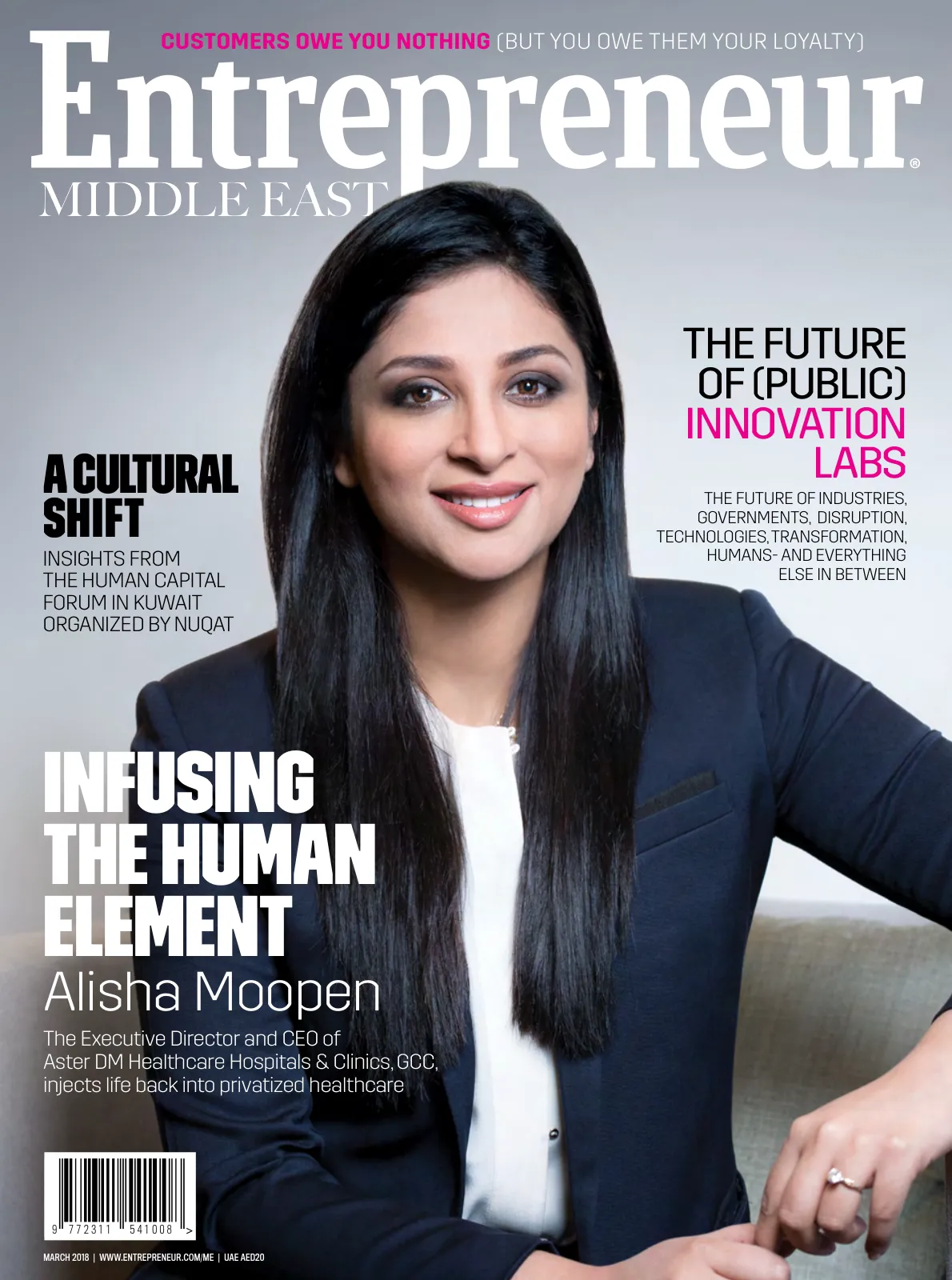
Entrepreneur Middle East, March 2018
Page 1
march 2018 | www.entrepreneur.com/me | UAE AED20
9
7 7 2 3 1 1
5 4 1 0 0 8
>
Infusing
the human
element
The Executive Director and CEO of
Aster DM Healthcare Hospitals & Clinics, GCC,
injects life back into privatized healthcare
Alisha Moopen
The future
of (public)
innovation
labs
The future of industries,
governments, disruption,
technologies, transformation,
humans- and everything
else in between
A cultural
shift
INSIGHTS FROM
THE HUMAN CAPITAL
FORUM IN KUWAIT
ORGANIZED BY NUQAT
Customers owe you nothing (but you owe them your loyalty)
Page 2
www.aljada.com
800-ARADA (27232)
15
min
from Dubai
International Airport
& Sharjah Corniche
5
min
from
Sharjah
International Airport
3
min
from
University
City
Apartments
available to
all nationalities
1 bedroom apartments
starting from AED 533,000*
Special prices and payment plans!
Invest in the lifestyle
destination of tomorrow!
*T&C apply
Located just minutes from Dubai, Aljada is Sharjah’s
largest and most exciting new residential address.
Developed by ARADA, under the chairmanship
of HE Sheikh Sultan bin Ahmed Al Qasimi.
Adjacent to landscaped parks & the largest
entertainment centre in the Northern Emirates.
Direct access to Al Dhaid Road, easy access
to Sheikh Mohammed bin Zayed Road.
Page 3
3
March 2018 / ENTREPRENEUR.COM /
29 Gary Sheynkman, Managing Partner, Leyden Ventures
22
Alisha Moopen,
Executive Director
and CEO, Aster DM
Healthcare Hospitals
& Clinics, GCC
march 2018 contents
gary sheynkman image © stuart tract
22
INNOVATOR:
infusing the human
element
Alisha Moopen
The Executive Director and
CEO of Aster DM Health-
care Hospitals & Clinics,
GCC, injects life back into
privatized healthcare.
36
‘TREPONOMICS:
PRO
Boosting diversity at your
workplace
Bayt.com’s Suhail Al-Masri
explains why it is in your best
interest to have your organi-
zation’s workforce reflect the
community it serves.
66
START IT UP:
ECOSYSTEM
A cultural shift
A look at how Kuwait’s
discourse on entrepreneur-
ship is changing as the
country attempts to move
its economy away from a
dependence on oil and invest
in homegrown businesses.
50
CULTURE:
LIFE
Serve your purpose
To get better at difficult
conversations, observe your
own behavior and the impact
it has on those around you,
says PDSi founder and exec-
utive coach Dawn Metcalfe.
56
TECH:
THE FIX
Debunking design thinking
RBBi co-founder Amol Kadam
stresses why design is not a
process, but a mindset.
28
MONEY:
ECON
Navigating the brave new
world of ICOs
Initial coin offerings (ICOs)
are exploding in popularity-
but both offerers and
investors need to understand
the regulatory landscape to
avoid getting burned, write
Latham & Watkins’ Brian
Meenagh, Lee Irvine, and
Eyad Latif.
Page 4
Page 5
Page 6
Page 7
Page 8
Page 9
800 999 999 I sobha.com
@sobhadubai
LIVE IN THE LARGEST
TOWNHOUSES IN DUBAI
800 999 999 I sobha.com
@sobhadubai
LIVE IN THE LARGEST
TOWNHOUSES IN DUBAI
Page 10
Page 11
Page 12
12 / ENTREPRENEUR.COM / March 2018
72 Jordan-based Tamatem Games gets a US$2.5 million Series A
funding boost
march 2018
contents
80
Elevision screens
Sony Xperia XZ2
40
TECH:
SHINY
#TamTalksTech
Gadgets and doodads
that you might’ve missed
out on, sourced by a tech
aficionado. Yes, it’s okay
to want them all… and no,
it’s not our fault.
80
START IT UP:
Q&A
Riding the digital wave
Want a captive audience for
your brand’s messaging?
Elevision Media founder
and CEO Niall Sallam says
his enterprise can offer you
that- literally.
60
‘TREPONOMICS:
PRO
The future of (public)
innovation labs
Radicle co-founders
Aman Merchant and
Indy Johar share their
musings on The future of
industries, governments,
disruption, technologies,
transformation, humans-
and everything else in
between.
18
EDITOR’S NOTE
By Aby Sam Thomas
84
‘TREPONOMICS:
MARKETING
Customers owe you nothing
Fahad Quentin-Bahar,
Managing Director of
Rhinos Middle East, on
how brands can show their
loyalty to their customers.
46
‘TREPONOMICS:
MARKETING
Riding the wave (of success)
The story behind the
creation, development, and
growth of the Philip Stein
brand- as told by
co-founder and President
Will Stein.
Page 13
Page 14
14 / ENTREPRENEUR.COM / March 2018
78 Mohamed Zakariae El Khdime and Mohamed Amine Belarbi at a reception
at the palace of H.E. Sheikh Nahyan bin Mubarak Al Nahyan, Minister of State
of Tolerance in the UAE, 2017
46 Philip Stein
Horizon Sport Bracelet
66
march 2018
contents
Bader Al Kharafi,
Vice-Chairman and
CEO, Zain Group
62
‘TREPONOMICS:
PRO
Growth hacking
Gene Jiao, President, Huawei
Consumer Business Group
- Middle East & Africa,
explains five things to keep
in mind when expanding
your enterprise into new
markets.
72
START IT UP:
STARTUP FINANCE
“We got funded!”
Jordan-based Tamatem
Games gets a US$2.5
million Series A funding
boost, while MENA
e-commerce major
Mumzworld.com closes its
fifth funding round.
44
CULTURE:
TRAPPINGS
Dress the part
Mr. Draper offers a complete
guide to getting the business
casual look right.
54
‘TREPONOMICS:
PRO
A pound of cure
mrUsta founder and CEO
Ibrahim Colak explains how
you can avoid potentially
brand-threatening situations
(and be ready for them too).
76
START IT UP:
Q&A
Hacking for good
UAE-based startup VUL9
wants you (and your
enterprise) to be cyber
resilient.
64
MONEY:
ASK THE MONEY GUY
The human factor
Angel investor Ahmad
Shehada explains what
he looks for in a startup
that he’d invest in (and all
you entrepreneurs should
take note).
Page 15
DISCOVER HOW TO ACCELERATE YOUR BUSINESS
Powered by Thomson Reuters, Accelerate SME is the gateway to the
SME ecosystem in MENA; providing access to the resources and solutions
needed to support you at any business stage.
We have joined forces with some of the region’s most powerful financial
and workflow solution providers to service and support your specific needs.
As a member of Accelerate SME you can access a wide range of business
resources including, funding, online community, industry insights, tools
and easy-to-use templates.
ACCELERATE SME
CONTRIBUTE. ENGAGE. GROW.
FIND OUT MORE AT ACCELERATESME.COM
Page 16
16 / ENTREPRENEUR.COM / March 2018
SUBSCRIBE
Contact subscriptions@bncpublishing.net to receive
Entrepreneur Middle East every issue
EDITOR IN CHIEF Aby Sam Thomas editor@bncpublishing.net
CEO Wissam Younane wissam@bncpublishing.net
DIRECTOR Rabih Najm rabih@bncpublishing.net
CREATIVE LEAD Odette Kahwagi
MANAGING EDITOR Tamara Pupic
STARTUPS SECTION EDITOR Pamella de Leon
FEATURES EDITOR Sindhu Hariharan
COLUMNIST Tamara Clarke
EVENTS LIAISON Mark Anthony Monzon
PO Box 502511 Dubai, United Arab Emirates
P +971 4 4200 506 | F +971 4 4200 196
For all commercial enquiries related to
Entrepreneur Middle East contact
sales@bncpublishing.net
All rights reserved 2018.
Opinions expressed are solely those of the contributors.
Entrepreneur Middle East and all subsidiary publications in the
MENA region are officially licensed exclusively to BNC Publishing
in the MENA region by Entrepreneur Media Inc.
No part of this magazine may be reproduced or transmitted in any
form or by any means without written permission of the publisher.
Printed by United Printing and Publishing
www.upp.ae
Images used in Entrepreneur Middle East are credited when necessary. Attributed use of
copyrighted images with permission. All images not credited otherwise Shutterstock.
Suhail Al-Masri
Fida Chaaban
Ibrahim Colak
Mr. Draper
Lee Irvine
Gene Jiao
Indy Johar
Amol Kadam
Eyad Latif
Brian Meenagh
Aman Merchant
Dawn Metcalfe
Fahad Quentin-Bahar
Anna Roberts
CONTRIBUTING WRITERS
www.entrepreneur.com/me
Access fresh content daily on our website!
MIDDLE EAST
EntMagazineME
@EntMagazineME
Entrepreneur-me
EntrepreneurMiddleEast
EntMagazineME
EntMagazineME
EntMagazineME
MIDDLE EAST
In addition to our print edition, we’re bringing
you all sorts of industry news on our web
mediums. Joining us online means getting
relevant business and startup content in
real-time, so you’re hearing about the latest
developments as soon as we do. We’re looking
forward to interacting with our readers on all of
our social media and web platforms- like any
thriving business, we’re looking to give and take.
#TrepTalkME is already happening on all of our
digi platforms, and all good conversations go
both ways. See you on the web!
Page 17
EMBARK ON A ROSE FILLED
JOURNEY FOR ALL THE SENSES.
CAMBODIA CHINA INDONESIA MALDIVES MOZAMBIQUE OMAN QATAR SRI LANKA THAILAND
UNITED ARAB EMIRATES VIETNAM ZAMBIA
LIFE IS A JOURNEY. Visit anantara.com
Every spring, Anantara Al Jabal Al Akhdar Resort welcomes the spectacular rose
season that transforms the surrounding slopes of the Al Hajar mountain range with
an abundance of pink Damask roses.
The Rose Season Package, which includes a visit to a local rose garden and distillery,
a rose infused spa ritual, and extra special touches that will fully immerse guests into
a rose filled adventure for all of the senses.
Starts from OMR 375*
Anantara Spa
Ultimate Jabal Activity Wall
Book at anantara.com and get resort credit of up to OMR 20.
*Prices are in Omani Rials and subjects to 12% local taxes and service charge.
Ultimate Jabal Activity Wall
Anantara Spa
Page 18
18 / ENTREPRENEUR.COM / March 2018
Aby Sam Thomas
Editor in Chief
@thisisaby
aby@bncpublishing.net
Two essential elements you might be throwing away on social media
Time and talent
editor’s note
“You’ve become a lurker on social
media,” said my friend to me the
other day. She noted that though I
had seemingly taken a backseat on
making posts of my own on plat-
forms like Twitter and Instagram, I
had remained somehow abreast of
all the local chatter that was occur-
ring on these channels. She had got
it right: while I still consider myself
to be active on Twitter and other
platforms, I find that unless I think
I can contribute something that’s
positive or of value to an ongoing
conversation around a particular
topic, then I simply don’t post.
This is a paradigm that I really, re-
ally, really, wish more of my peers
on Twitter (and other public chan-
nels) would take to heart as well-
it’s been a pain to be subject to
posts that are essentially irrelevant
or incorrect “takes” on a particular
matter, or be privy to users who
seem to incessantly complain, and
are eager to have their brand of
negativity imprinted on everything
and anything. While every social
media guidebook out there urges
us to think carefully before we post
anything (in fact, UAE telco du ini-
tiated a #PostWisely campaign just
to promote this rationale), this par-
ticular mindset seems to have been
overlooked by many of my fellow
users of social media- they seem
to have gotten rather comfortable
with shooting off their mouths on
such platforms, much like certain
heads of state. Be it with nonsensi-
cal assertions or statements (which
either have zero basis in fact or re-
ality, or are just a one-dimensional,
self-promotional view on things),
or random whataboutism argu-
ments (one response to the launch
of a social enterprise incubator in
Dubai was essentially “What about
Yemen?”), this inclination toward
showcasing the basest of behaviors
by some people on social media is
proving to be rather disquieting and
disconcerting for me- and many
others as well.
So, why does all this matter? The
obvious point to remember here is
that people are watching what you
say on these platforms- and while
one can make the argument that so-
cial media personas cannot be seen
as complete reflections of one’s
real personalities, it’s also hard to
dissociate the two. (I, for one, can
confirm that I have, in my mind
at least, already blacklisted a few
entrepreneurs -and the enterprises
that they lead- owing to the many
outlandish or outrageous state-
ments they have made on social
media.)
Of course, the sad thing about all
this bad behavior on social media
is that most of it –if not all of it-
could have easily been avoided.
Was that diss against someone (or
something) really necessary on
a public platform- couldn’t you
have made your displeasure known
through an email or a call instead?
Or maybe you’re launching a new
venture in a particular sector, and
you want the eyes of the world on
it- but do you have to do that by
disregarding (read as “disrespect-
ing”) the work of others already in
that realm? And yes, there may be
things out there that aren’t in line
with your vision of (and for) the
world: instead of proclaiming your
lack of interest in it, well, here’s an
idea, how about maybe not tweeting
about it at all? Basically, use the
time you spend negating everyone
else’s projects and initiatives work-
ing on your personal enterprises
and endeavors. I am confident that
this would be a much better use of
your time and talent- and hey, it’d
make the social media realm a much
better one for the rest of us as well.
Page 19
Page 20
20 / ENTREPRENEUR.COM / March 2018
image credit careem, dany farha
in the loop
MENA investors sound off on Careem’s acquisition of RoundMenu
(and what it means for the region’s startup ecosystem)
The road ahead
by Sindhu Hariharan
The Careem app
Khaled
Talhouni,
Managing
Partner,
Wamda
Capital
I
n yet another sign of the
growing maturity of the
region’s entrepreneurial
ecosystem, the MENA
ride-hailing enterprise
Careem (which now
refers to itself as a “tech-
nology company”) announced
in February the acquisition
of the Dubai-headquartered
RoundMenu, a restaurant
discovery startup launched in
2012 and now has a presence
in eight cities across nine Arab
countries.
As a company that has set
its sights on emerging as the
MENA leader in transporta-
tion tech, and with a network
spanning across over 90
cities, Careem confirmed in a
statement that the acquisition
(the financial details of which
remain undisclosed) marks the
company’s entry into food de-
livery, and is “part of a wider
investment into the food de-
livery category.” Careem added
that it intends to begin testing
food delivery capabilities for
RoundMenu customers on a
small scale later this month.
While Careem declined to
comment further on the deal,
Entrepreneur Middle East
asked a few regional investors
about the significance of the
acquisition for the company as
well as the region. For Omar J.
Sati, co-founder and Manag-
ing Director of Dash Ventures,
the Careem-RoundMenu deal
is particularly exciting, with
the hope that more regional
startups will focus on such
acquisitions as they continue
to raise large rounds. “It is the
beginning of what I hope will
be many more intra-regional
acquisitions,” he said. “When
we no longer have to depend
on the Yahoo’s and Amazon’s
of the world for exits, we can
confidently say we have built
a strong, sustainable startup
ecosystem.”
Abdulaziz B. Al Loughani,
Managing Partner, Faith
Capital Holding, considers the
deal to be “an important mile-
stone” to the MENA economy.
“[Firstly], it expands the role
of corporate development from
traditional activities to more
inorganic growth ones (M&A),
and [second], provides a more
tangible liquidation/exit route
to regional investors versus in-
ternational strategies cherry-
picking the best internet/soft-
ware properties and acquiring
them,” he noted.
Wamda Capital Managing Part-
ner Khaled Talhouni too counts
this as a huge positive for the
regional ecosystem. “We are
beginning to see more liquidity
events happening at different
stages, which further acceler-
ate the growth of the ecosys-
tem as a whole,” he said. “It’s
also great validation to show
how Careem -once a startup
itself- is now large enough to
participate in the M&A market
to fuel its own growth.” On
Twitter, BECO Capital’s co-
founder and CEO Dany Farha
voiced a similar sentiment,
saying: “A great e.g. of a win-
win-win, investors get an exit,
RoundMenu team get to build
out their vision, Careem enters
a core vertical with strength.”
And it’s this aforementioned
potential to enter a new
vertical that makes Careem’s
acquisition of RoundMenu
an appealing one for Sati,
who believes that the deal
will allow Careem to diversify
its business into a new and
complementary segment of
food delivery by leveraging its
existing infrastructure, and
hence “go head-to-head” with
Uber Eats. “We will likely
see more acquisitions from
Careem in the future as well
as other startups with similar
war chests adopting similar
acquisition strategies such as
Souq, Noon, Starz Play, Fetchr,
etc.” he notes.
RoundMenu is one of the
many key players in the food
tech space alongside Zomato,
Talabat, HungerStation, to
name a few. RoundMenu helps
users find restaurants, and
guide them to places that are
“trending,” as recommended
by social media using data
from Instagram, Foursquare,
Facebook and TripAdvisor. The
company has raised over $3.1
million in investment to date
from HoneyBee Tech Ventures,
BECO Capital, Horeca Trade,
and Middle East Venture
Partners.
Al Loughani is quite certain
that the acquisition is indica-
tive of Careem’s growth plans
into other verticals within
the logistics industry, and to
capitalize on the momentum,
he believes Careem “needs to
grow faster and acquire/retain
talent, which might result in
a bigger funding round or an
exit/IPO. Growth at scale is not
easy to manage, and the hockey
stick cannot plateau any time
before a trade sale or IPO hap-
pens,” he said, stressing that
the MENA-born tech enter-
prise’s journey is worthy of
being taught at “every business
school in the Arab world.”
Observing Careem’s decision
to enter the booming verti-
cal of food tech, Sara Chem-
maa, Strategy and Business
Development Manager, MBC
Ventures, too finds Careem’s
move to be “in line” with
international players such as
Uber. “Locally, Deliveroo is
doing great in this space, and
we believe the potential in food
delivery is huge, and it could
add value to Careem,” she said.
While acknowledging that
acquisitions (and the resulting
synergies) are always tricky,
Chemmaa looks forward to
Page 21
21
March 2018 / ENTREPRENEUR.COM /
“When we no longer
have to depend on the
Yahoos and Amazons
of the world
for exits, we can
confidently say we
have built a strong,
sustainable startup
ecosystem.”
image credit omar j. sati, seaside startup summit uae
Fostering innovation
Ras Al Khaimah plays host to Seaside Startup
Summit UAE 2018
Running from February
8-12 2018, the first Seaside
Startup Summit UAE was
held at Al Marjan Island, Ras
Al Khaimah, which was an
initiative as part of a Memo-
randum of Understanding
(MoU) between the Startup
Armenia Foundation, and
Techtown - Ras Al Khaimah
Incubation and Accelera-
tor, headed by Dr. Hisham
Safadi, and co-organized by
Young Arab Leaders (YAL),
managed by Jennifer Mapa.
The event gathered 500
participants, which included
300 startup owners and 50
investors.
The summit kicked off
with an opening address by
H.H. Sheikh Saud bin Saqr
Al Qasimi, Supreme Council
Member and Ruler of Ras
Al Khaimah, followed by
panel discussions centering
around smart cities, Internet
of Things, social impact and
more. The five-day event
featured CampFire Talks,
a business forum set by
the sea, encouraging par-
ticipants to delight in nature
and entrepreneurship, as
well as workshops, fireside
pitches, and investor net-
working and mentoring ses-
sions. Aligning with the UAE
Innovation Month in Febru-
ary 2018, the summit was
aimed to exhibit the UAE
and the Emirate of Ras Al
Khaimah as a hub for SMEs,
startups, investments, trade,
angel investors, venture
capitalists and other parties
all over the world.
With the judging panel
including Nabra Al Busaidi,
Executive Director, Young
Arab Leaders, the startup
pitching competition wel-
comed over 50 startups
from 12 countries, with a
prize fund of more than
US$40,000. In the Big
Battle category, AgroWave
took first place with $7,000,
while Autochain took second
place with $5,000, and
VR-zone took third place
with $3,000. In the Seed
Battle category, Faylasof
won first place with $5,000,
Infinity Leather took second
place with $3,000 and
DAFA gained third place
with $2,000. In the Brand
Battles category, in the
AR/VR group, truMaps
won $4,000, while in the
social impact group, Ligaro
won $4,000, followed by
AgroWave which took
$4,000 in the eco-millennia
group, and Autochain won
$4,000 in the IoT and smart
city set.
Nabra Al Busaidi, Executive Director, Young Arab Leaders at Seaside Startup
Summit UAE 2018
Omar J. Sati,
Managing
Director,
DASH Ventures
see how the deal pans out.
“RoundMenu wasn’t a big
player in the market (com-
pared to Talabat/Deliveroo/
Zomato), but with Careem on
board I am sure it will have
potential to grow further.”
While the development
may well shake things up for
players in the food delivery
space, Dubai Future Foun-
dation’s Mohamed Hamdy
directs attention to the fact
that Careem’s business is es-
sentially a marketplace, and
with an established network,
it has the potential to enter
different service streams.
“It’s very tempting, since the
assumption is that if they can
reach their customers to get
them to hail a ride, they can
reach them and push any other
consumer-based service,” he
said. “I would prioritize on get-
ting the most market share of
ride hailing in the region. They
should aim to own 60% or
more of the market, otherwise
they won’t be in a position to
aim for profitability. At some
point, the growth story of new
markets will be diluted.”
A look at Careem’s own cor-
porate actions in the recent
past would indicate that the
company is already on the
path of entering new verticals,
powered by existing technol-
ogy and fleet infrastructure.
Besides launching its delivery
service “Box” last May in
Dubai to serve the needs of
users who want to send small-
sized items across the city, its
acquisition of Morocco-based
taxi company Taxii in May
2015, Saudi Arabia’s a cloud-
based addressing service En-
wani in June 2015, and other
such deals, point toward a
step in this direction. Not just
that, Careem also appointed
Zach Finkelstein, the co-
founder of Silicon Valley-based
Lumia Capital (an investor in
Careem) as Vice President of
Corporate Development in Au-
gust 2017 to help the company
accelerate growth through
strategic partnerships.
And for Careem to achieve
this very objective, Hamdy
suggests that the team must
continue to focus on building
fleet network around different
business models. “For exam-
ple, they can consider building
out an electric car sharing
network,” he said. “They
should also have a ‘data’ play,
with all the data they are able
to retain, generated by their
drivers and the vehicles. In
summary, they should focus on
gaining as much market share
as possible.”
Sati agreed with this hypoth-
esis. “With the acquisition of
RoundMenu, Careem wants to
deliver food to your doorstep.
Tomorrow, it could be pack-
ages, laundry, out-call doctors/
nurses, and more. Careem can
one day be a central transport
solution provider,” he predicts.
“Uber is going the autonomous
driving route. Will Careem
follow that path, or will we one
day fly with Careem Airlines?
Exciting times ahead; that’s for
sure!”
Page 22
Alisha Moopen, Executive Director
and CEO, Aster DM Healthcare
Hospitals & Clinics, GCC
“Our job is to remain
human. Developing our
empathy, our ethical and
moral compass is key, as
these will be the vital
differences between
human resources and
machines when we move
towards the next phase of
industrial revolution.”
22 / ENTREPRENEUR.COM / March 2018
innovator
Page 23
23
March 2018 / ENTREPRENEUR.COM /
A
lisha
Moopen’s
personal
office at
Aster DM
Health-
care’s
corporate
headquar-
ters in
Dubai’s
Business Bay neighborhood
may seem like a relatively
small space, but there’s quite
a lot in there for observers to
take in while within its con-
fines. For instance, besides
the expected assortment of
files, papers, and notebooks
on Moopen’s tidy desk,
there’s a brightly colored
novelty quill pen that in-
stantly grabs your attention,
following which you’ll also
see an array of photographs
–which includes snapshots
of Moopen and her children,
her father, Aster DM Health-
care Founder Chairman and
Managing Director, Dr. Azad
Moopen, and others- tacked
onto the wall by the table.
The shelf behind her seat,
while large and imposing,
doesn’t seem to have any
more space on it- it’s filled
with a number of trophies
and certificates in honor of
Moopen and her role as the
Executive Director and CEO
- Hospitals & Clinics, GCC,
for Aster DM Healthcare,
alongside a number of knick-
knacks and mementoes, plus
a couple more images of
Moopen and her family. As
for the wall right in front of
Moopen’s desk, there’s af-
fixed a glass painting, which
showcases a group of six
women wearing headscarves
and abayas, but all of them
are faceless- there’s no defin-
ing characteristic pertaining
to their features, or back-
grounds.
For Moopen, the artwork is
a powerful one, containing
a message that she believes
is pertinent for not just her,
but every woman (and every
man, to be fair) out there. In
a world that’s increasingly
fixated on externalities (be it
on one’s looks, one’s origins,
or even one’s circumstances),
Moopen says that the paint-
ing is a reminder to keep
yourself focused on what’s
really important- your inner
self, your substance. “At the
end, all that matters is what
you have inside [of yourself],
and what you give [to the
world around you],” she
explains. “It doesn’t really
matter where you come from,
the color of your face, the
color of your eyes… You’re
born into whatever world
you are born into, and you
make the best of that.” But,
even as Moopen says this,
the skeptic in me wonders:
surely, the daughter of the
entrepreneurial legend that
is Dr. Moopen has had it
better than others? Moopen
doesn’t flinch when I dare to
ask her this, and I’ll confess
that I was glad to see her re-
spond by acknowledging her
privilege- but that doesn’t
mean she’s happy to be
satisfied with just that either.
“I’m lucky,” Moopen says.
“Because I come from a back-
ground that was extremely
privileged, having all these
opportunities, and a plat-
form… All of this just makes
you even more responsible to
give back more- the more you
have been given, the more
you have to give back.”
And in case you’re wonder-
ing where Moopen’s ethos
comes from, she points it
back to the values she was
raised with. “We are all
products of our environment
and upbringing,” she ex-
plains. “The same applies to
me. I have been blessed to be
raised in a good family, with
kind parents and immense
opportunities to make our
world a better place. I was
always taught that our mis-
sion in life is to help others-
it was the age-old rule that
you rise by lifting others. At
the core of my being is the
desire and will to influence a
healthier, and hence happier,
community.”
Infusing
the human
element
The Executive Director and CEO of Aster DM
Healthcare, Hospitals & Clinics, GCC,
injects life back into privatized healthcare
by aby sam thomas
Alisha Moopen
innovator
An artwork in Alisha Moopen’s personal office at Aster DM Heathcard’s coporate
headquarters in Dubai’s Business Bay
>>>
Page 24
24 / ENTREPRENEUR.COM / March 2018
With this statement in mind,
it’s easy to see why Moopen
says that she’s passionate
about working in the health-
care sector- but this wasn’t
the industry she started her
career in. Prior to her entry
in the Aster DM Healthcare
business, Moopen was a
chartered accountant who
worked in consulting- but
she readily admits that she
didn’t find the profession
fulfilling enough for her. As
someone whose formative
years were centered around
her father’s desire and efforts
to take care of people suf-
fering from illnesses, Moopen
found herself wanting to
work in the same field, and
she realized that she could
build on the tremendous
work that Dr. Moopen had
initiated. “After seven years
of corporate life, I found my
way back to my real calling,”
she remembers. “To fulfill
my dream of creating a world
class institution that people
can rely on when they are
burdened with health prob-
lems. To follow in my father’s
footsteps, looking after peo-
ple’s health and fulfilling my
role in strengthening com-
munities and contributing to
humanity, was absolutely a
natural choice.”
It needs to be noted here
that Aster DM Healthcare
today is a 30 year-old in-
tegrated healthcare service
organization with over 300
units under the company and
over 18,000 employees- or as
Moopen proudly calls them,
“Asterians.” As an institution
that is focused on deliver-
ing quality care to all the
communities it services,
through the best clinical
care, service standards, and
highest ethical practices,
Moopen explains that Aster
DM Healthcare is leaving no
stone unturned in its simple
–yet strong- promise to its
clientele: We’ll treat you
well. “Aster DM Healthcare
is the only regional health-
care organization that has a
presence across GCC coun-
tries,” Moopen notes. “We
probably have the widest
reach in terms of network,
as we have the community
clinic concept that promotes
access to healthcare in an
easy and convenient way. We
have 200 pharmacies, 100
clinics and 19 hospitals. Our
biggest difference -and the
one that allows us to deliver
the most benefits- is that
we have three brands that
cater to all the segments of
the population. My father’s
dream was to deliver care
to everyone regardless of eco-
nomic or social positioning.
He conceptualized our three
brands- Medcare for the high
strata, Aster for the main
middle-income segment, and
Access for the low income
strata of the population. This
approach again reiterates our
commitment to the societies
in which we operate. Health,
as we all know, is one of the
main drivers for productiv-
ity and happiness within a
nation. It is critical for the
success of a society.”
When Moopen joined Aster
DM Healthcare in 2012, the
enterprise had already been
set upon a strong foundation
by her father, and it was
scaling up its operations
rapidly. “I joined the com-
pany at a time of massive
expansion that introduced
huge challenges in replicat-
ing the model of service and
ethics that we endorse,” she
remembers. “Building brick
and mortar units is always
the easy part. Infusing the
human element, and finding
the right people who hold
the same values and similar
goals toward creating a
better world has been the
harder part. My focus was on
building the network as envi-
sioned by my father, and in-
stitutionalizing his principles
through the teams I shaped,
to ensure sustainability
for generations to come.”
As for how she exactly did
this- once again, it was based
upon something Dr. Moopen
had taught her. “We need
healthcare to be effective,
efficient and sustainable,”
Moopen says. “This is a key
challenge faced by nations
across the globe, in both
developing and developed
countries. Creating this bal-
ance is key, and the driver for
this balance are committed
people operating in good sys-
tems… The key learning from
my father has been to take
care of the people around me.
They will extend this care
to others who they interact
with. It is this domino effect
powered by humanity that is
the biggest lesson taught to
me by my father.”
At this point, the skeptic in
me rises again, and wonders
if the constant comparison
–or even correlation with-
her father’s success and
legacy has been a boon or a
bane for Moopen. Again, she
brushes away my notions
with a flourish- she calmly
points out that she has now
been working at Aster DM
Healthcare for more than
six years, after all. “I will
always encounter a natural
curiosity and comparison
to my father,” she explains.
“Our DNA is the same, and
we share the same values; I
come from the same school of
thought and he is undoubt-
edly my role model. What we
differ in is our style of work.
I believe how we view the
world influences both our
mental frame of mind, and a
lot of our actions. My style
may be partially influenced
image courtesy dr. azad moopen
“Be collaborative, not
individualistic. Be disruptive
in technology, not destructive.
Be kind, be caring and be
focused on the three P’s:
People, Planet, Profits. These
are all the key ingredients
for the world to move in a
positive direction.
If we enable change in this
sequence of priority, we can
achieve sustainable growth
and success. Success comes
when we direct and align our
personal skillset, capability,
and goals to fulfill the needs
of the people and planet in
which we live.
That’s the best marriage of
ideals in my opinion.”
The executive summary
Alisha Moopen’s suggestions
for entrepreneurs
innovator
“Together [with my
father], we have
the opportunity to
create a culture
that drives positive
change, always
willing to adapt at
the accelerated pace
the world is moving.”
Dr. Azad Moopen,
Founder Chairman
and Managing
Director,
Aster DM
Healthcare
Page 25
25
March 2018 / ENTREPRENEUR.COM /
by the new world I grew up
in as a millennial, where we
need things to happen better
and faster. I perhaps am less
patient with shortcomings,
less tolerant with failures,
and more demanding than
my father, but at the end
we are working toward the
same goals. It is easy to get
put down being compared to
a legend like my father, but
I use the comparison as a
motivation to continuously
improve. He started this
business when he was 35
years old- I am that age now,
and have already the luxury
and herculean task to manage
a large part of the business,
and build strong teams that
deliver great work. This com-
bination of strength and sta-
bility that my father brings,
and the agility and dynamism
that I seek to bring is a great
boon. Together, we have
the opportunity to create a
culture that drives positive
change, always willing to
adapt at the accelerated pace
the world is moving. They
say, you snooze, you lose. It
is true that we need to be
nimble and open to move
positively with the change of
the world around us. There-
fore, my entry into the busi-
ness came at the right time,
allowing both our styles to
merge, ultimately helping the
company to actively build the
needed tools and embrace
change.”
So, how entrepreneurial
does Moopen consider
herself to be- is she also a
chip off the old block, so to
speak? “My personal take on
entrepreneurship is that we
all create the life we want,”
she replies. “The same can
be extended to the busi-
nesses we build. We create
the business we build and
for the most part, it is our
perseverance and passion
that will make it successful.
Luck plays a part, no doubt.
But more often than not, it
is the perfect combination
of what one is good at, what
one loves to do, and what the
universe needs that helps
us create and build great
businesses. There is always
an entrepreneur hiding in
every role for every person,
regardless of the job they
do. If each person believed
it was their own company,
and it is their responsibility
to make this a success, the
typical success rate plus the
fulfillment from a job will be
much higher. I believe that
I am an entrepreneur, and
there are times where I have
failed, because my heart was
not in it, and there are times
when I have failed because of
external circumstances. With
my role at Aster, I believe I
have found that sweet spot
between doing what I love,
doing something I am good
at, and doing something the
universe needs. That is the
key to personal, professional,
and societal success, if you
ask me.”
And Moopen is definitely
ticking all the right boxes
when it comes to being a
role model that other women
(and, once again, men too,
to be fair) can follow to
realize their own dreams
and ambitions. She is one
of the few female figures
of note in the largely male-
dominated healthcare sector
of the region (and beyond),
and she makes sure that
her voice stands out and is
heard in the business realm.
“I am a professional with an
enormous dream for happi-
ness and prosperity for all
communities, and I have a
clear understanding of where
my span of influence lies;
being woman comes next.
Despite the massive female
workforce in healthcare, the
numbers dwindle down as
you get to the senior manage-
ment levels. Women and men
image courtesy aster dm healthcare
innovator
“Women form half
the population, half
your consumers, and
half your workforce.
Growing their
influence brings
inclusion, and this
inclusion brings
and builds skills,
thoughts, and tools
to manage and win in
this changing world
in which we live.”
Alisha Moopen, Executive Director
and CEO, Aster DM Healthcare
Hospitals & Clinics, GCC
Aster Hospital,
Mankhool, Dubai
>>>
Page 26
26 / ENTREPRENEUR.COM / March 2018
bring different strengths to
the table, and the strongest
companies are those that
are able to utilize, leverage,
and embrace these differ-
ences. The more diversity
of thought and action there
is, the stronger a unit or
company. It helps people
to look at things with dif-
ferent perspectives, and to
bring alternative views to
the table. In today’s global
economy and shrinking
world, the companies and
nations that embrace these
differences will experience
much better outcomes than
those who stay rigid with
the ways of the past. Change
is inevitable. Women form
half the population, half your
consumers, and half your
workforce. Growing their
influence brings inclusion,
and this inclusion brings and
builds skills, thoughts, and
tools to manage and win in
this changing world in which
we live.”
I ask Moopen for her advice
directed at women in the
workplace, and she responds
by urging them to remain
true to who they are- don’t
be someone you are not.
“Women and men have dif-
ferent wirings and styles.
We are moving to a world
where machines can manage
the repetitive mundane and
monotonous jobs, where ro-
bots will replace human jobs.
Our job is to remain human.
Developing our empathy, our
ethical and moral compass is
key, as these will be the vital
differences between human
resources and machines
when we move towards the
next phase of industrial revo-
lution. As women, and child-
bearers, we are more in sync
with this idea of nurturing. I
always urge women to main-
tain and cultivate their femi-
nine side, and listen to their
emotional intelligence, as
this is a unique strength we
possess. Together with nur-
turing, this combination is
what societies and companies
need to build for the future.
Informing our business deci-
sions with these embedded in
our approach will serve the
best yield for any society.”
Are there any actionable
guidelines that Moopen can
offer women then? “My tips,
as I mentioned earlier, would
be to stop pretending to be
a man thinking in a man’s
world,” she instructs. “There
are enough men out there
to do that! What we women
need to do is channel our
inner core and engineering
to bring the best of both
world together. So, I say to
all women, please act like a
woman, because that’s who
you are!”
“There are three secrets to
success.
Hard work is a given.
Without the discipline that is
required to turn your wishes,
dreams and intention to
action; all the strategy devel-
oped to change the world is
pointless. You have to be the
change you want to see in
the world and it is absolutely
necessary to translate that
thought into action through
putting everything you have
got to make your dreams
come true. Only through
toil, hard work and burning
the midnight oil do people be-
come successful. A wise man
very aptly stated: the harder I
work, the luckier I get.
Failures are pivots. It is hard
to not get bogged down
by mistakes, by outcomes
not being achieved accord-
ing to plan, by abandoned
projects that didn’t yield the
results you hoped. Failure is
essential for learning, grow-
ing and evolving. Learning
from mistakes and applying
those learnings and moving
forward is critical to suc-
cess. This makes you wiser,
gives you grit, renders you
more resilient and cultivates
humility in the process too.
Always count failures as your
blessings because when you
reflect back after 10 years,
you will realize the impact
of those circumstances and
how they contributed to you
pulling yourself back up to
be become even more ignited
and determined for success.
Finally, only do what makes
you absolutely thrilled to
wake up in the morning and
go to work. Do justice to your
job and make sure you are
immensely passionate and in
love with your career and your
work. If your heart and soul is
not on it; whatever you do will
only be mediocre. Success
comes from a place of pas-
sion which requires relentless
effort and determination for
excellence. Always yearn to
be the best regardless of the
yardsticks you are using to
measure your contribution.”
innovator
“My tips [for women]
would be to stop
pretending to be
a man thinking in a
man’s world. There
are enough men out
there to do that!”
Strategies for success
Alisha Moopen, Executive Director and CEO, aster dm healthcare Hospitals & Clinics, GCC
Alisha Moopen,
Executive Director
and CEO, Aster
DM Healthcare
Hospitals & Clinics,
GCC
Page 27
Page 28
money ask the money guy | vc viewpoint | your money | ECON
28 / ENTREPRENEUR.COM / March 2018
the
brave
new
world
of
ICOs
by Brian Meenagh, Lee Irvine, and Eyad Latif
Initial Coin Offerings (ICOs)
are exploding in popularity, but
both offerers and investors need
to understand the regulatory
landscape to avoid getting burned
Page 29
29
March 2018 / ENTREPRENEUR.COM /
I
nitial Coin Offerings
(ICOs) involve issuers
offering virtual coins
or tokens that are
typically created and
disseminated using
distributed ledger or
blockchain technol-
ogy. Holders of virtual
coins or tokens may have
additional rights over and
above those of merely the
medium of exchange, such as
rights to access the platform,
utilize certain services, use
the software, or otherwise
participate in the project. In
some cases, holders may also
have rights to a return on
their investment, or rights
to participate in a share of
the returns provided by the
project or by the company
backing the project.
Post-issuance, holders may
resell certain virtual coins or
tokens in a secondary market
on virtual currency exchang-
es or other platforms. ICOs
are typically announced on
cryptocurrency forums and
websites through a white
paper describing the project
and key terms of the ICO,
subscription details, time-
line, etc. To date, hundreds
of ICOs have raised more
than US$6 billion, with a
plethora of prospective ICOs
frequently reported in indus-
try publications. In late 2017,
ICO funding surpassed that
of angel and early-stage VC
funding combined.
As companies, includ-
ing both tech startups and
century-old multinationals
alike, increasingly turn to
ICOs as a funding mecha-
nism and tool to revolution-
ize innovation and break-
down historic barriers to
entry, regulatory scrutiny
is intensifying. Financial
services and securities
regulators around the world,
including the UK’s Financial
Conduct Authority (FCA),
the European Securities and
Markets Authority (ESMA),
the German Financial
Supervisory Authority, and
the US Securities and Ex-
change Commission (SEC),
have made public state-
ments reminding issuers
and investors that coins or
tokens issued via an ICO will
fall within the full scope of
securities law in those ju-
risdictions, if they meet the
relevant characteristics for
Enabling innovation
Mohammed Alsehli, founder
and CEO, ArabianChain, on how
potential ICOs can be realized
in the Middle East
“ICOs enable you to raise funds
without needing a middleman,
and that raises an issue for
investors, because if you don’t
know the person raising funds,
they could be anyone, including
terrorist organizations and so
on. The other issue relates to
entrepreneurs because they
also don’t have control over
who the participants will be.
Anyone can participate and, for
example, if somebody wants to
launder their money through
these ICOs, they can do that.
At the same time, it is a fantas-
tic tool to enable innovation.
So, how can you get that value
without bearing that much risk?
This is where governments
should work with ICOs to
enable them rather than ban
them. For now, most of the
regional regulators don’t yet
recognize ICOs as an official
way of raising funds, but at the
same time they don’t prohibit it,
so it’s in a grey area right now.
I think that they are waiting to
see how it’s going to evolve
because the market is still
very young in terms of ICOs,
but we’ve witnessed more and
more adoption.
In Switzerland, for example,
they have already established
something that serves as a
regulatory sandbox. It’s called
Crypto Valley and it is the place
where they work on these ICOs,
but they have put some rules
and regulations on top of it. So,
since they already have these
regulations put in place, they
will get to benefit from these
people because all the money
raised in Switzerland is staying
in Switzerland. That is the ben-
efit of for the whole economy
of Switzerland. I really urge all
countries to establish these
sandboxes for ICOs.”
image credit ArabianChain, Spice Venture Capital, Venture Souq, Abu Dhabi Global Market | gary sheynkman © stuart tract
The investor’s
viewpoint
Gary Sheynkman
Managing Partner,
Leyden Ventures
www.leyden.ventures
What are the factors one
should take into considera-
tion when launching an ICO?
“It is important to realize that
there are different types of
tokens. There are core protocol
tokens, such as Bitcoin and
Ether (Ether are the tokens on
the Ethereum Blockchain), and
then you have tokens based on
Ethereum which are basically
a method to create something
like loyalty points, or some sort
of a mercantile mechanism
inside of the application that
you are building, or to fundraise
for your business through
untraditional means.
An ICO pre-sale is a promise to
get a discount on an economic
unit within a new system, once
it’s built or if it’s operating
already. This is where it gets
interesting from a securities
law perspective, because if
it’s a ‘once it’s built’ situation,
then, at least the US govern-
ment, considers it as a security.
But, if it has a use case already
on day one, then it is a utility
and you are selling something
else, a commodity. There are
large companies, US$300
million+ organizations, that are
now issuing tokens for some
useful things and those are
honest utility tokens because
they are launching a token that
can participate in a company
that is worth millions/billions
of dollars. That is a worthwhile
investment.
I would be extremely wary of
anyone launching their utility
token sale before they have a
product. There are two defini-
tions with the same name. >>>
money
ask the money guy | vc viewpoint | your money | ECON
>>>
Page 30
30 / ENTREPRENEUR.COM / March 2018
“In late 2017,
ICO funding
surpassed that of
angel and early-
stage VC funding
combined.”
THE INVESTOR’S VIEWPOINT Continued from page 29
money ask the money guy | vc viewpoint | your money | ECON
a security, whether or not
such coins or tokens are
labelled as a “utility” coin or
token. In addition, certain
jurisdictions (most nota-
bly China) have moved to
prohibit fundraising through
ICOs and require funds
raised through ICOs to be
returned to investors.
In the US, the SEC has
recently issued a cease and
desist order with respect to
the Munchee Inc. (Munchee)
ICO that emphasizes the
fact that regulators will look
to substance over form in
determining whether an ICO
token is a security. Munchee,
a California-based company,
was in the process of offer-
ing digital tokens (desig-
nated as “MUN” tokens) to
investors through an ICO.
The SEC determined that
the ICO was an offering of
securities without registra-
tion or an available exemp-
tion, notwithstanding that
the digital tokens offered
and sold in the ICO were
intended to have a util-
ity function. The Munchee
order demonstrates that the
relevant facts and circum-
stances reviewed by regula-
tors in assessing whether a
token is a security will not
be limited to the rights and
interests the tokens are pur-
ported to provide the holders
themselves, which may be
of a utility or consumptive
nature, but will also include
the manner of the offering,
including how the tokens
were marketed and whether
the promoter touted a poten-
tial increase in token value
as well as any promise of
secondary market trading.
In the United Arab Emir-
ates, the Central Bank, the
Securities and Commodities
Authority (SCA), the DIFC
Financial Services Author-
ity (DFSA), and the ADGM
Financial Services Regula-
There are what I would con-
sider security tokens, which
is an organization that issues
you a token in accordance with
securities laws, you sign a
subscription agreement, and
have a contractual relationship
that is represented by a token.
So, you get a contract and you
have a tradeable token at the
end of that exchange. Then,
there are companies that
are issuing tokens which the
governments would say are
security tokens, but they are
not following the regulations in
terms of contract work.
I think that a large portion
of ICOs that are marketed to
people on Facebook, Twitter,
or Instagram are fraudulent
either purposely or by accident,
meaning that they are just not
sophisticated enough to under-
stand that they are committing
securities fraud. It’s probably
mostly the latter, but when I
see a pre-sale for things that
are clearly not built yet and are
marketed on Facebook to you,
that is by definition securities
fraud. They are marketing
something that does not exist
yet and they are just fundrais-
ing for their company this way.
They can call it whatever they
want but that is not what it is
in the eyes of the regulators.
So, when it comes to security
and utility tokens, my tip is:
know the difference. But I’d
rather not give investment
advice because some people
have a high tolerance for risk
and then some traders take
those weird tokens, just to get
in and get out, make a couple
of percentages, and do well.
Just in the way that you play
over-the-counter bulletin board
type stocks that are not listed
on any proper exchange, you
do the same with tokens. That
is a very different conversation
than a large hedge fund com-
ing in with millions of dollars
into a token they plan to hold
for several years.”
The investor’s
viewpoint
Carlos Domingo
co-founder and
Managing Partner,
SPiCE Venture Capital
www.spicevc.com
What is driving the rapid
growth of the ICO market
at the moment?
“It is driven by the appetite
of founders on one side to
bypass the traditional fund-
raising process with VCs and
also avoid dilution, and on the
other hand, by a lot of new
investors looking to invest in
new startups via a mechanism
(issuing tokens) that has
liquidity and using crypto. It
is true that there is a lot of
hype and noise, but there are
also many legitimate projects
that might become the new
Amazon or Google. In terms
of capital deployed into ICOs,
US$5 billion, it is still tiny.
Yearly, there are more than
$600 billion of VC money be-
ing deployed, so ICOs hasn’t
even reached 1% yet.
Also, I think that the hype and
growth of the ICO market, like
any other market like this, has
attracted a lot of bad actors
trying to take advantage of the
opportunity. However, regula-
tors have started to step in to
avoid the retail investor being
harmed by some of these bad
practices and I do not think
that this will affect the disrup-
tive potential that blockchain
technology holds.
I think that outright banning
ICOs or shutting down mining
operations or exchanges is not
the solution. Those companies
just might move somewhere
else. I think that regulators
need to find the right balance
between protection and free-
dom to introduce technological
innovation. There has been a
lot of abuse on the utility token
side of things, particularly
where companies are artificially
creating utility tokens that
make no sense for their busi-
ness model but just to justify
bypassing the existing regula-
tions and selling them to retail
customers. But the US Securi-
ties and Exchange Commission
has already taken the lead
saying that many utility tokens
have features of securities.
Going forward, what I believe
that we will see is an increased
adoption of security tokens
as an improvement over the
current crowdfunding model
where you get much broader
inclusivity, scalability to handle
more investors and distribute
money back to them via smart
contracts as well as liquidity in
the secondary market.”
Page 31
The investor’s
viewpoint
Suneel Gokhale
Partner, VentureSouq
www.venturesouq.com
How are traditional VCs,
both globally and regionally,
reacting to ICOs disrupting
the world of investments?
“Crypto and ICOs are poten-
tially highly disruptive to the
VC industry and different
VCs have taken different ap-
proaches. Some have stayed
away, almost digging their
heels in and continuing to
take the position that ‘this is
a bubble’. Others have gone
all in and in some cases com-
pletely shifted away from tra-
ditional venture funding and
moved almost 100% in cryp-
to. For VentureSouq, we are
somewhere in the middle– we
have not gone headfirst into
ICOs but rather have looked
at investing in companies that
are built around blockchain
with clear use cases that
address some of the existing
friction points with respect
to crypto. I think that we,
along with all other investors
in the VC space, are likely to
have the same thoughts– how
we raise money and invest
in early-stage technology
companies is likely going to
look different in the next 2-5
years. That could mean only
raising money through ICOs in
the future, which would be the
most aggressive form of dis-
ruption, or something milder
like using smart contracts to
close investments and agree
terms with our investors and
then using blockchain to keep
registers or KYC information.
For now, there has been
significant demand from our
investors to see investment
opportunities in crypto and
blockchain, so much so that
we have even had dedicated
events and programming with
respect to cryptocurrencies.
At least a couple of times a
week, we get a call from an
investor asking us about the
latest ICO or development
in crypto. It’s been great
as we love the high level of
engagement from our inves-
tor base, and we don’t see
this as a threat but rather an
opportunity for our investors.
The thing we often hear
about early-stage and venture
opportunities is the lack of
liquidity and the longer hold
periods. At the end of the day,
if crypto and ICOs allow for
enhanced liquidity earlier in
the lifecycle of a technology
company, that makes the
venture capital space all the
more appealing.”
money
ask the money guy | vc viewpoint | your money | ECON
“Crypto and ICOs
are potentially
highly disruptive
to the VC
industry and
different VCs
have taken
different
approaches.”
>>>
tory Authority (FSRA) all
potentially have jurisdiction
over ICOs depending on the
type of ICO and location
where the ICO is issued or
marketed. As of date of writ-
ing this article, the Central
Bank and SCA have yet to
issue any regulations or
formal guidance on ICOs, but
this should not be taken as
guidance.
The DFSA issued a state-
ment in September 2017
that “the DFSA would like
to make it clear that it does
not currently regulate these
types of product offerings or
license firms in the Dubai
International Financial
Centre (DIFC) to undertake
such activities. Accordingly,
before engaging with any
persons promoting such of-
ferings in the DIFC, or mak-
ing any financial contribu-
tion toward such offerings,
the DFSA urges potential
investors to exercise caution
and undertake due diligence
to understand the risks
involved.” The FRSA issued
guidance at the same time
that “issuances of Securi-
ties (as defined in Section
258 of FSMR), whether
through a DLT (Distributed
Ledger Technology) platform
or other means, will see no
difference in their treatment
under our regulatory frame-
work. Those issuers/market
actors who seek to raise
funds in a regulated, robust
and transparent manner us-
ing new business models or
technologies such as DLT are
encouraged to engage with
us as early as possible in the
fundraising process.”
It is clear that as interest in
issuing, marketing and par-
ticipating in ICOs in the UAE
develops, the guidance that
will be issued by the relevant
regulators will also develop
so as to protect investors in
ICOs and maintain confi-
dence in the UAE financial
services and securities mar-
ket as a whole.
In jurisdictions where ICOs
are not prohibited, but are
subject to local securities
regulations, issuers should
understand the questions
that regulators are asking
when determining whether
a coin offering is considered
to constitute a traditional
security as opposed to a util-
ity coin or token.
As a general rule of thumb,
a token is likely to fall within
the definition of a financial
instrument if it does any of
the following:
• Gives the holder a right
to share in the capital or
participate in the profits of
projects derived from the
efforts of others.
• Creates a transferable debt
instrument.
• Creates an instrument in
favor of the holder, the value
of which is based on an un-
derlying index, commodity,
currency, or other asset.
Page 32
32 / ENTREPRENEUR.COM / March 2018
Additionally, we have clas-
sified cryptocurrencies as
commodities; therefore, spot
transactions in these are not
regulated (although derivatives
on cryptocurrencies are regu-
lated products.) Besides exer-
cising our supervisory powers
(as the FSRA) in the regulated
space, we also included a
consumer warning in our Guid-
ance regarding the volatility of
cryptocurrencies and ICOs and
the risk of fraud. The recent
announcement from the UAE’s
Securities and Commodities
Authority has voiced similar
concerns that we have. ICOs
and cryptocurrencies are an
extremely high-risk market, so
we, as a financial service regu-
lator, have urged the market
to exercise due caution when
engaging in it.
On February 10, 2018, ADGM
announced that we were
reviewing and considering
the developing of a regula-
tory framework to regulate
and supervise activities of
virtual currency exchanges
and intermediaries. We are
currently using our ADGM
RegLab and broader industry
engagement to enhance our
knowledge of the token market
and reviewing what additional
amendments are needed in
our regulatory framework to
accommodate new risks and
business models enabled by
blockchain technology and
cryptocurrencies. It is not our
practice to predict what global
regulators more broadly will do
with cryptocurrencies– there
have been divergent approach-
es. However, we participate in
international regulator forums,
such as the International
Organization of Securities
Commissions (IOSCO) and
Basel, to actively engage in
the regulatory dialogue, and
ensure that the interests of the
UAE are represented.”
the investor’s
viepoint
Christopher Kew-Smith
Head of Fintech
Strategy, Financial
Services Regulatory
Authority (FSRA),
Abu Dhabi Global Market
(ADGM)
www.adgm.com
How are regulatory bodies
reacting to the financial
disruption posed by ICOs?
“The market for ICOs is
incredibly broad. We, at the
FSRA of ADGM, are acutely
aware that ICOs do not always
fit neatly into existing regula-
tory classifications. Therefore,
a one-size-fits-all approach is
not appropriate. This was laid
out in a Guidance which we
released in October 2017.
In our ADGM RegLab, we have
one fintech firm that wants
to use the ICO technology to
facilitate offerings of securi-
ties and run a blockchain-
powered stock exchange. We,
at the FSRA, view this as
a legitimate use of innova-
tive technology and since it
concerns a regulated product,
the firm requires authorization
from us. There are, of course,
other ICOs that are offerings
of products which are not
regulated, such as utility
tokens.
money ask the money guy | vc viewpoint | your money | ECON
Brian Meenagh is Partner, UAE, Lee Irvine is Counsel, UAE, and Eyad Latif is Associate, UAE, at Latham & Watkins. www.lw.com
“ICOs are a great
way to raise money,
to avoid dilution,
at least partially,
and to reach an
entirely new class
of investors.”
Crucially, any prospective
ICO issuer must consider in
advance the legal implica-
tions and structuring op-
tions of the ICO. Key struc-
turing questions include:
1/ What is the issuer’s target
market/jurisdictions? How
can the issuer ensure that its
offering will only be made to
that target market, to avoid
triggering the securities laws
of unintended jurisdictions?
Determining in which juris-
dictions an issuer is to make
an offer may be difficult if
an issuer publishes a public
whitepaper over the inter-
net, so password protection
and IP address verification
may become the norm.
2/ Does the issuer want the
coin or token to fall outside
the definition of a security,
recognizing that this may
limit the purpose of the coin
or token?
3/ Alternatively, if the issuer
wants the coin or token to
have an investment purpose:
a. Can the issuer rely on an
exemption or combination
of exemptions in the target
jurisdictions to limit the im-
pact of the securities laws/
requirements (e.g. through
structuring the ICO as a
private placement)?
b. Does the issuer want
to make a public offer and
comply with the full scope
of securities laws/require-
ments?
4/ Are there other innova-
tive structures that might
achieve the issuer’s aims?
While ICOs may be blazing a
new path through traditional
fundraising mechanisms
such as venture capital and
capital markets, some issu-
ers and investors may get
burned in testing out the
new limits of the path. Care-
fully thinking through ques-
tions on the nature of the
offering before the issuance
can help protect both issuers
and potential investors.
Page 33
33
March 2018 / ENTREPRENEUR.COM /
Tips on approaching ICOs- for investors and entrepreneurs
The road ahead
money
ask the money guy | vc viewpoint | your money | ECON
“If you have a need to
create an economy
within your product and
have those transactions
be secured and have your
company be a trusted
party, then [blockchain]
is a great way of doing it.”
>>>
Suneel Gokhale
Partner, VentureSouq
“Regulators, be practical and
commercial and don’t resist
cryptocurrencies just because
of perceived deficiencies.
Disruptive technologies or
concepts are not perfect so
address the deficiencies in a
way that still allows for the ini-
tial use cases to play out. There
is clearly interest and demand
for crypto which should not be
ignored. Accordingly, regulators
should create practical safe-
guards and build regulation in
a commercial way. Investors,
proceed with caution. Like
any new market there is a lot
of garbage out there and the
“push and pull” around ICOs
will continue as new entrants
on the financial institution side
and regulators and govern-
ments become more active.
We are still in the infancy stage
of crypto and blockchain, so
investors need to be careful.
Entrepreneurs, if you’re
thinking about using an
ICO to raise money, do your
homework. Make sure you’ve
addressed regulatory issues
and that commercially you can
handle all the ins and outs with
regards to issuing coins as
the market is dynamic and will
continue to change.”
Gary Sheynkman
Managing Partner,
Leyden Ventures
“In general, I would recom-
mend to investors interested
in the ICO space to look at how
a token is governed, how it is
issued, whether it is mined,
pre-mined, and so on. If anyone
is looking at purchasing tokens,
you have to review the team
and you have to understand
the company they are working
on. A scenario where they
explain how the process of
changing the protocol will be
governed versus a situation
in which a company’s private
interests can change the
governance of the tokens that
you purchased. You have to be
careful and you have to look
at vested interests. Teams are
important, but also advisors
and board members of the
company. There is extreme
volatility in these alternative
coins and you have to watch
what you are doing. In general,
an investment into a token
should be viewed as an invest-
ment into a company, so you
have to look at the team, the
legal structure of the organiza-
tion and how they can make
changes to the protocol. If the
team is not willing to disclose
that, you should avoid that
token. Mostly, you are entering
into a smart contract to distrib-
ute the token once the sale is
done, and then there is not a
whole lot that prevents them
from being bad actors. In more
established companies, there
is a subscription agreement
which gives you some sort of
economic rights, and this is
where security tokens become
interesting because that token
represents a legal agreement
between you and the company,
a security in the jurisdiction
you are buying it from. In the
near future, whether we are
talking about security or utility
token issuances, you will have
specially trained judges or
arbitration that will be able to
mitigate this stuff. Right now,
it’s the Wild West.
For entrepreneurs, I’d say
that blockchain is not magic,
it won’t make every business
better, but if you have a need
Page 34
34 / ENTREPRENEUR.COM / March 2018
money ask the money guy | vc viewpoint | your money | ECON
“taking money
from the wrong
investor might
mean irreparable
reputational
damage or
breach of laws.”
to create an economy within
your product and have those
transactions be secured and
have your company be a
trusted party, then it is a great
way of doing it. As an example,
I think you will eventually have
a broader freelance market
that exists in the Middle East.
Blockchain is a great applica-
tion of that because you can
empower people to work for a
number of parties without hav-
ing to worry about getting paid.
If somebody wants to create a
freelance platform on block-
chain where you are remitted
in bitcoin or other tokens for
your payments, that, I believe,
would do well in this part of the
world. So, it is always use case-
oriented and you have to be
intellectually honest about it.”
Carlos Domingo
co-founder and Managing
Partner, SPiCE Venture
Capital
“For investors, my advice would
be to look carefully at the pro-
jects you are investing in, and if
you do not think that you have
the skills or the bandwidth
to do a proper due diligence,
then just choose a regulated
investment vehicle for ICOs. I
think that the only thread ICOs
have are for the rich people
and institutions, the 1% of the
1% who before were the only
ones that could actually invest
in some opportunities. Digital
fractional ownership through
tokens and smart contracts
allows for inclusivity and reach,
and therefore, unlocks liquidity.
The consequences of this new
way of ownership are still yet
to be seen although I am sure it
will be all positive for the major-
ity of the population.
For entrepreneurs, I think that
ICOs are a great way to raise
money, to avoid dilution, at
least partially, and to reach an
entirely new class of investors
and pools of money that might
be completely impossible to
reach the traditional way. So, if
you can do one, you should do
it, but think very well about how
to structure it, the reason for
the token to exist, the regula-
tory framework, and finally,
assume that it is still hard work
to successfully raise a good
ICO. Finally, regulators need to
find the right balance between
protection and letting innova-
tion flourish, as just prohibiting
things is not the right answer.”
Mohammed Alsehli
Founder and CEO,
Arabianchain
“When it comes to investors,
the first thing on the list is to
verify the people who are work-
ing on it, the team, the advisors,
and so on. The second thing is
to have Know Your Customer
(KYC) and anti-money launder-
ing (AML) processes in place,
and the third thing is that there
has to be a registered company
behind that ICO, somewhere in
the world. So, it’s identification,
registration, and KYC and AML
processes. ICOs have already
impacted their industry, and I
think that VCs will move to a
thing on the blockchain called
DAO (Democratic Autonomous
Organization), where this
organization holds all the funds
on the chain and then funds
various ICOs. So, the VCs of
today will evolve into DAO.”
Christopher Kew-Smith
Head of FinTech Strategy
Financial Services
Regulatory Authority,
ADGM
“ICOs are still, for the most part,
unregulated, so this has re-
mained a very high-risk market
for investors. The information
provided for each token offer-
ing is extremely variable, and
due to the lack of any controls
on the quality of ICOs, and their
international nature, investors
who are defrauded have little
recourse. From an entrepre-
neur’s perspective, the ICO
investor market does offer a
new source of capital. However,
they should remember to be
careful who they are taking
money from– taking money
from the wrong investor might
mean irreparable reputational
damage or breach of laws.”
Page 35
1ST ANNUAL INTERNATIONAL
CONFERENCE ON ROLE OF
ARTIFICIAL INTELLIGENCE
IN HEALTHCARE AND
MEDICAL EDUCATION
Wednesday,11th April 2018
Palazzo Versace Dubai
United Arab Emirates
Head Office:
415555, DIFC, Dubai, United Arab Emirates
+971 4 2985555 +971 4 2989555
info@thumbay.com www.thumbay.com
ORGANIZED BY
IN ASSOCIATION WITH
MEDIA PARTNER
The most acclaimed HEALTH & LIFESTYLE magazine in the region
For Speakership, Sponsorship, Exhibition,
Partnership Opportunities contact
Ravi Tipparaju 00971507576346
ravi@gmu.ac.ae
Page 36
36 / ENTREPRENEUR.COM / March 2018
It’s in your best interest to have your organization’s workforce
reflect the community it serves by Suhail Al-Masri
Identifying a set
of key values in
candidates will
highlight a more
diverse range
of qualified
candidates who
will strengthen
your company
culture.
Our personal
subjectivity might
get in the way and
cause us to overlook
a talented, diverse
candidate who can
add unique value to
your company.
‘TREPONOMICS ETHICS | ESQUIRE GUY | SKILLSET | MARKETING | PRO
I
n the last few years, diversity has become somewhat of
a buzzword, and having a diverse group of people work-
ing together is seen as a boon. Diversity can easily benefit
companies of all sizes in many ways. To state the obvious,
with a diverse group of employees, you are guaranteed to
have a wide spectrum of ideas, backgrounds and skills that
can help your organization develop more and quicker. But
aside from incubating more ideas and skills, are there any known
benefits for companies to actively employ members of diverse
groups? How does workplace diversity improve your bottom line?
Boosting diversity
at your workplace
graphs © bayt.com
Why diversity matters
There is something strikingly honest about
an organization’s workforce reflecting the
community it serves. For example, if you
were to open a school catering to students
in a provincial area in the Middle East, but
then fail to hire any local talent either as
educators or administration, your school
would fail to represent the community
it serves. Similarly, if you were to start
a marketing agency, but none of your
marketers are representative of the demo-
graphics around you, your business might
seem somewhat foreign or disconnected
from your clients.
Besides the disconnect from your audi-
ence and potential clients, the lack of
diversity might cause your organization to
suffer from tunnel vision. You might find
yourself chained by tradition and struggle
to find new and innovative ways to provide
your services.
Not only that, but diversity nowadays is seen
as an attractive workplace attribute by many
professionals and job seekers. In a recent
Bayt.com survey, entitled the Bayt.com
Ideal Workplace in the Middle East and
North Africa Survey, it was revealed that
seven in 10 respondents in the Middle East
believe diversity is important. Of those,
nearly four in 10 respondents claim it is an
“extremely” important workplace attribute.
Despite this, when asked whether or not they
feel their workplace encourages diversity,
just 27% of respondents believe their cur-
rent workplace does so.
If your organization was seen as one that
actively seeks and encourages diversity in the
workplace, it would automatically increase
your attractiveness to talent in the region.
How to boost your workplace diversity
Here are some steps you can take in order
to promote and increase diversity in your
workplace:
1. The value test
When looking to hire, one thing you should
look out for is whether or not you share
values with the candidate. First, you should
identify the values you consider most impor-
tant when it comes to your workforce. For
instance, these values could include honesty
and open communication, passion, empathy
or team spirit. Whatever these values may
be, they should form your primary criteria
in assessing whether or not a candidate is a
good fit for your organization.
Page 37
37
March 2018 / ENTREPRENEUR.COM /
you might need to
incorporate a diverse
mix of benefits and
perks into your
overall offerings.
Your benefits package
can play a crucial
role in hiring with
diversity in mind.
‘TREPONOMICS
ETHICS | ESQUIRE GUY | SKILLSET | MARKETING | PRO
Important factors in workplace - Diversity
Overall 70% of respondents feel having diversity is an important factor in the workplace.
This perception is lower in Bahrain (56%) compared to other countries.
6
5
6
11
9
8
4
5
5
5
8
5
6
6
6
7
7
7
5
6
7
6
6
18
19
18
18
29
24
15
16
20
17
14
18
31
36
31
35
13
29
41
37
28
30
28
41
39
34
39
28
42
40
33
37
41
42
44
31
Total
UAE
Saudi
Arabia
Kuwait
Bahrain
Oman
Lebanon
Jordan
Egypt
Morocco
Algeria
Tunisia
Extremely unimportant
Somewhat unimportant
Neither important nor unimportant
Once you have identified your values,
make sure you highlight them in your
job posting, or any other mechanism
you choose to hire through, and then
you will be able to scrutinize candi-
dates based on these alone. Candidates
should be able to demonstrate their
honesty, drive and empathy by citing
past experience, whether it is profes-
sional or academic. For example, if you
are interviewing a fresh graduate for
an entry-level position, you could ask
about any projects, assignments or ex-
tracurricular activities they undertook
which can display how they have ap-
plied the soft skills they claim to have.
Looking for values is different than
answering the question of: “Would I
want to have coffee with this person?”
The tendency with this socially-based
test is to look for candidates who are
either similar to yourself or relatable.
Identifying a set of key values in can-
didates, however, will highlight a more
diverse range of qualified candidates
who will strengthen your company
culture. Of course, ideally, we would
all like to have a personable relation-
ship with the people we hire, however
our personal subjectivity might get in
the way and cause us to overlook a tal-
ented, diverse candidate who can add
unique value to your company.
2. Screening talent objectively
One big setback in attempting to
hire with diversity in mind is that
manual screening tends to leave too
much room for bias. This is not only
normal, it’s human, with studies
indicating that all people have implicit
biases that shape their opinions of
people immediately upon meeting
them. This can be a diversity-killer
and cause whoever is screening the CV
to unconsciously overlook a candi-
date from a different background or
demographic solely because of an
unchecked bias.
By using Bayt.com to hire, you can
screen CVs purely based on your
required skills and qualifications,
removing any possible human error
from the mix. You can do this through
questionnaires and filters on your
inbox or by using keywords on CV
search to shortlist your candidates
without facing the possibility of
unwittingly setting aside a perfectly
capable candidate for one you are
more comfortable with.
3. Benefits packages
In order to cater to a diverse work-
force, you might also need to incor-
porate a diverse mix of benefits and
perks into your overall offerings. Your
benefits package can play a crucial
role in hiring with diversity in mind
and should not be neglected.
Put your benefits package under the
microscope and ask the following:
> Do these benefits cater to a wide
variety of needs?
> Do my family leave policies appeal to
diverse candidates?
> Do I have dependent care programs?
> Have I worked relocation packages
and flexible work schedules into my
packages?
> Do I have special benefits for women,
disabled individuals, or other groups
that could potentially join my com-
pany?
> How do my benefits appeal to na-
tional / local talent?
Answering similar questions will
allow you to identify what areas you
need to tweak or change in order to
attract a diverse and large group of
talent and maximize your workplace
diversity. >>>
Page 38
38 / ENTREPRENEUR.COM / March 2018
Mentorship gives
every emerging leader
the opportunity to
learn the soft skills
necessary to progress
to the next step. It
also gives every senior
leader an opportunity
to offer personalized
guidance and sharpen
their management and
leadership skills
mentorship
programs can
offer everyone
the opportunity
to be heard
and supported
on an equal
platform. every
emerging leader
at your company
deserves the
support needed
to grow.
‘TREPONOMICS ETHICS | ESQUIRE GUY | SKILLSET | MARKETING | PRO
Other
Iraq
Libya
Pakistan
UAE
Tunisia
Saudi
Arabia
Oman
Morocco
Lebanon
Kuwait
Jordan
Egypt
Bahrain
Algeria
Total
Don’t know/ Can’t say
Males have a lower chance of being promoted than their female counterparts
Chances of receiving a promotion depend entirely on performace on the job and gender plays no role
Females have a lower chance of being promoted than their male counterparts
29
17
35
31
30
29
21
20
21
42
21
33
29
38
35
26
57
66
45
55
57
61
64
54
62
42
69
55
57
57
58
60
2
3
2
2
2
3
5
7
1
1
14
4
1
12
14
20
12
11
8
13
21
10
15
9
11
5
2
12
Comparison of promotions and career growth
29% of respondents believe women have fewer opportunities for career growth when compared to their male counterparts
Women in Tunisia, Algeria, Lebanon and Morocco were more likely to feel that gender plays no role in promotion decision.
graphs © bayt.com
when compared to their male counterparts.
For companies that have promoting diver-
sity in mind, it is important to remove any
unconscious subjectivity from performance
reviews in order to ensure that all high-
performing employees receive the opportu-
nities they deserve.
6. Building a diversity-friendly culture
Lastly, you should encourage your em-
ployees to learn across functions. Getting
to know fellow employees of all types and
backgrounds will widen their viewpoints
and foster learning. You should sell them
the importance of diversity and encourage
them to pursue diversity in their profes-
sional lives as well as their personal lives.
You can do this by setting up team lunches
or gatherings. You can even expand these
gatherings to allow for mixing between two
or more teams.
Another thing you could do is encourage
cross-functional one-on-ones. Cross-
functional one-on-ones are similar to blind
dates. Upon receiving expressed interest
from several employees, you should set up
blind meetings for these employees (ideally
across all levels and teams) to get to know
each other and collaborate on potential
projects.
At the end of the day, diversity in the
workplace means focusing on skills and
qualifications when hiring, training, pro-
moting, etc. and this could come naturally
from an internal effort and a dedication to
ensure equal opportunity in the workplace.
4. Mentorship
Post hiring, you should also be looking at
the possibilities of making the workplace
accommodating for all of your employees.
One way to do this is through mentor-
ship. The mentor/mentee relationship in a
workplace is a valuable asset and can help
newer employees of diverse backgrounds
assimilate with the company quickly.
Through building a mentorship program,
you can foster relationships within your
organization. Mentorship gives every
emerging leader the opportunity to learn
the soft skills necessary to progress to the
next step. It also gives every senior leader
an opportunity to offer personalized guid-
ance and sharpen their management and
leadership skills.
Furthermore, mentorship programs
can offer everyone the opportunity to be
heard and supported on an equal platform.
Remember that every emerging leader
at your company deserves the support
needed to grow. Beyond that, building a
network of mentor-mentee relationships
within your company will only increase
your employees’ loyalty to one another
and, by extension, the workplace.
5. Levelling systems
Creating a levelling framework for your
company can remove any subjectivity, ir-
respective of how subconscious it may be,
from an employee’s career growth. This is
something that will have a huge impact on
your employees’ careers and your reten-
tion rate.
This levelling system should outline each
job level at your company, noting all the
required skills and granted responsibili-
ties. The system should also detail the
salary ranges of each level and the require-
ments necessary to move forward from
one career level to the next. By doing this,
you will keep pathing focused and your
employees will know which skills they
need to strengthen in order to advance in
their careers.
This is a very important step as certain
groups often feel disadvantaged in the
workplace. For example, more than four
in 10 women, according to the Bayt.com
Working Women in the Middle East and
North Africa Survey, believe they have
fewer opportunities for career growth
Suhail Al-Masri is the VP of Employer Solutions at Bayt.com, the #1 job site in the Middle East with more than 40,000 employers and over 30,600,000
registered job seekers from across the Middle East, North Africa and the globe, representing all industries, nationalities and career levels. Masri has more
than 20 years of experience in sales leadership, consultative sales, account management, marketing management, and operations management. His
mission at Bayt.com goes in line with the company’s mission to empower people with the tools and knowledge to build their lifestyles of choice.
Page 39
Page 40
40 / ENTREPRENEUR.COM / March 2018
Gadgets and doodads that you might’ve missed out on, sourced by a tech aficionado.
Yes, it’s okay to want them all… and no, it’s not our fault.
Ahead of the curve
Nokia 8 Sirocco
tech SHINY | WEBSITE TO WATCH | GEEK | MOBILE TECH | ONLINE ‘TREP | THE FIX
image credit nokia, sony, lg, du
Nokia 8 Sirocco
Nokia 8 Sirocco
HMD Global released five
new smartphones at the
2018 Mobile World Congress,
including the Nokia 8 Sirocco,
the newest version of its
flagship device. Carved from
a single piece of stainless
steel, its frame is 2.5 times
stronger, thinner, and
tougher to withstand real-life
knocks and drops. It has a
curved edge-to-edge OLED
2K 5.5-inch display made
from 3D Corning Gorilla Glass
for a polished, luxurious
aesthetic. The device features
dual rear sensors with ZEISS
optics, which includes a
12MP wide-angle camera
and a 13MP camera with
2X optical zoom and 5MP
front facing camera that
support the bothie feature
introduced by its predecessor.
With Android 8.0, an octa-
core Snapdragon 835 chip,
6GB of RAM and 128GB of
storage, the Nokia 8 Sirocco
is an ideal companion for the
power user.
Page 41
41
March 2018 / ENTREPRENEUR.COM /
Fast forward
LG K10
Mind your netiquette
du unveils latest installment of its #PostWisely campaign
Capture this
Sony Xperia XZ2
tech
SHINY | WEBSITE TO WATCH | GEEK | MOBILE TECH | ONLINE ‘TREP | THE FIX
Sony Xperia XZ2
LG K10
du PostWisely
campaign
Sony Xperia XZ2
Sony has rebooted the
Xperia XZ2 with a curved
frame composed of metal
and 3D Corning Gorilla Glass
5. It comes in four different
pastel colors, with a finish
that shines and reflects light
from every angle. The device
is rated IP65 and IP68 to
withstand splashes and spills.
The latest edition of Xperia
XZ2 offers innovative new
camera features like Motion
Eye camera, the world’s first
4K HDR movie recorder on
a smartphone. Motion Eye
camera also enables Predictive
Capture with motion and smile
detection, Autofocus Burst
and Predictive Autofocus. With
these new functions and the
standard Quick Launch and
Capture, you’ll never miss a
moment. If still photos aren’t
enough, you can also create
3D scans of objects and faces
with the new 3D Creator
application. Powered by the
Qualcomm Snapdragon 845
mobile platform, a large 3180
mAh battery and an extended
5.7-inch full HD display, Xperia
XZ2 provides the ultimate user
experiences with lightning-fast
connection speeds.
The LG K10 sports a metal
U-frame and is equipped with a
13MP rear camera and a high-
resolution 8MP front camera
that supports bokeh when
shooting selfies. New features
like Flash Jump Shot, which
snaps a photo every three
seconds (up to 20 photos) and
stitches the images together
into a GIF, are sure to delight
shutterbugs. The K10’s camera
technology gets another boost
with Phase Detection Auto
Focus, which is 23% faster
than traditional auto focus, and
the new Smart Rear Key not
only unlocks the phone with a
fingerprint, but it also triggers
Quick Shutter for faster photos
and Quick Capture for easy
screen shots. LG K10 packs
a 1.5 GHz Octa-Core chipset,
3,000 mAh battery, up to 3GB
RAM and a micro SD card slot
into the same glossy, pebbled
frame that the K series is
known for.
In an era that is being increas-
ingly governed by social media,
du, one of the UAE’s foremost
telecommunications providers,
has taken on the important task
of reminding people to #Post-
Wisely when it comes to our
usage of these platforms. The
second installment of its hard-
hitting public service announce-
ment promotes ethical behavior
online and urges people to think
before they share. #PostWisely
tackles the issue of posting
other people’s misfortunes
online, using four videos inspired
by real-life tragedies that have
gone viral. Abdulwahed Juma
Fraish, Executive Vice President
for Brand and Corporate Com-
munications at du, announced
that according to an Ipsos
survey conducted as part of the
campaign, 55% of respondents
reported feeling regret after
posting something online. Post-
Wisely strives to make people
more mindful of how sharing
online effects those around them
and encourages more thought-
ful, positive exchanges by asking
one simple question: “If it were
your pain, would you share it?”
www.du.ae/postwisely
#TAMTALKSTECH Tamara Clarke, a former software
development professional, is the tech and lifestyle enthusiast
behind The Global Gazette, one of the most active blogs
in the Middle East. The Global Gazette has been welcomed
and lauded by some of the most influential tech brands in the
region. Clarke’s goal is to inform about technology and how it supports our
lifestyles. See her work both in print regional publications and online on her
blog where she discusses everything from how a new gadget improves day-
to-day life to how to coordinate your smartphone accessories.
Visit www.theglobalgazette.com and talk to her on Twitter @TamaraClarke.
Page 42
42 / ENTREPRENEUR.COM / March 2018
image credit Hermès, john lobb, calvin klein, hydropeptide
‘Trep trimmings
The executive
selection
From better goods to better wardrobe bests,
every issue we choose a few items that make the
approved executive selection list. In this issue,
we present our selections from the Hermès
latest range, a notable timepiece for your lineup,
a worthy addition for your leather collection, and
a skincare treatment worth checking out.
culture
business unusual | LIFE | TRAVEL | DESIGN | TRAPPINGS
John Lobb AW18
John Lobb AW18
Hermès AW18
Hermès AW18
Hermès AW18
PUT YOUR BEST FOOT
FORWARD
JOHN LOBB
Founded in 1866 in London,
John Lobb has certainly
made its distinctive aesthet-
ics known in the handcrafted
footwear scene. The Autumn/
Winter 2018 line is inspired
from lightweight walking soles,
featuring a double stitch welt
and its signature yellow sole
stitch. With a variety of shades
in navy, black, and tan, there’s
plenty of versatile pieces to
match with all of your execu-
tive ensembles. www.johnlobb.com
Led by the creative artistry of the
Artistic Director of Hermès Men’s
Universe, Veronique Nicha-
nian, the House has brought its
Autumn/Winter 2018 range an
understated style with an affluent
touch, evident in its materials
and tailoring, which includes
quilted patterns, supple cashmere
flannel and silkscreen lining, to
name a few. We’re particularly
keen on the line’s straight and
double-breasted suits, as well as
its three-button jackets in tones
of grey, navy, chrome green and
black, perfect for the boardroom
look. Plus, its selections of shirts
and pullovers with round collars
and colored mountain landscapes
(that comes with bright overtones
of neon yellow, royal blue, and
mahogany) make sure you are
suited right even during down-
time. www.hermes.com
IT’S ALL IN THE DETAILS
Hermès
Page 43
43
March 2018 / ENTREPRENEUR.COM /
Every professional knows that
no matter how much effort
one invests in maintaining
the natural glow of their skin,
long hours spent indoors,
wearing makeup every day
(for women), or stress-caused
unhealthy eating habits are
some of the major culprits
when it comes to dry skin and
the magnification of wrinkles.
Therefore, it was high time for
me to visit a branch of Sisters
Beauty Lounge, a UAE-based
chain of beauty salons, for a
deep cleansing facial using Hy-
droPeptide skin care products.
The US-based company has
become known for its reliance
on the power of peptides
(fragments of proteins which
are considered the fundamen-
tal building blocks of skin) to
unclog pores, improve skin
smoothness, and revitalize it
from daily damage. A Hydro-
Peptide-based thorough facial
cleanse is for those fighting
acne, unbalanced complexion,
photo-damage, dull complex-
ion, or simply anyone who
wishes to purge their skin
from impurities. The warm
and welcoming folks at Sisters
Beauty Lounge JBR had me
settled in the treatment room
for what turned out to be an
enjoyable, relaxing process. We
started with a short consulta-
tion, after which I had the
steamer working on opening
my pores to enable the thera-
pist to follow a usual proce-
dure- cleanse, tone, extraction,
mask, tone, and sunblock. An
hour later, my skin was seri-
ously bright and smooth, with
there being no redness on my
face thereafter- which is often
a byproduct of other sessions
of this type, but not so with
HydroPeptide. Check out
HydroPeptide’s products for
yourself at hydropeptide.com,
else book a session at
www.sistersbeautylounge.com
- by Tamara Pupic
culture
business unusual | LIFE | TRAVEL | DESIGN | TRAPPINGS
BACK TO BASICS
CALVIN KLEIN
Fresh start
Care for your skin by HydroPeptide
Calvin Klein
Steadfast Chronograph
As a brand that has made its
mark in bringing distinctive
timepieces to the market,
Calvin Klein’s Steadfast
is yet another addition
to its refined offerings.
Swiss-made and powered
by precision quartz, this
high-quality timepiece has a
case made of stainless steel,
and architecture aficionados
would be pleased by the
detail on its dial, reminis-
cent of the directional lines
of the Brooklyn Bridge in
New York. One can opt for
either a silver or a black dial
with a black leather strap,
and there’s also a chrono-
graph version which has an
hour, minute, second, and
date sub-dial display. For
a timepiece that can be a
component to your ensemble
both on and off the clock,
the Calvin Klein Steadfast is
one we recommend you keep
an eye on. www.calvinklein.com
Page 44
44 / ENTREPRENEUR.COM / March 2018
A complete guide to getting the business casual look right
by Mr. Draper
images courtesy mr. draper
Mr. Draper: some say he wasn’t born, but tailored. A treasure trove of
information, and author of the gentleman’s rulebook. Effortless style, and
permanently fashionable. Elusive, but always appears when you need him.
(This bio was sent via pigeon.) Let us know if you spot him! MrDraper.com
Dress the part
Mr. Draper men’s shoes
culture
business unusual | LIFE | TRAVEL | DESIGN | TRAPPINGS
D
ress codes: are
they in or out of
fashion? Dress
codes may seem
like a formal
and outdated
concept, but
they can be useful to follow
and needn’t be limiting.
After all, a dress code sends
out a clear signal that you
not only value your job, but
also yourself. It’s a way to
present yourself to the world
as a professional who means
business. Fashion comes and
goes, but style lasts forever,
and there’s a reason that cer-
tain menswear dress codes
don’t change that much over
time. It’s because they work!
No wardrobe is complete
without a crisp white shirt,
coupled with a tailored suit,
and a newly polished pair
of tan leather brogues. But
there is space for a bit of
flexibility and adventure.
Once you’re equipped with
a wider variety of clothing
to choose from, then dress
codes become less of a chore
and more of an expression
of your sense of style. Follow
these tried and tested busi-
ness casual suggestions to
give your work wardrobe a
promotion.
So, what exactly is the busi-
ness casual dress code?
While formal wear still
reigns supreme in the bank-
ing and legal professions, for
the vast majority of office-
bound workers, business
casual is now the default.
But what exactly does busi-
ness casual mean? Well,
there are some must-have
staples that every self-
respecting office employee
should have in their ward-
robe.
1. Blazers
A navy blazer is a no-brainer
in anyone’s wardrobe, but it
is particularly popular with
white-collar office workers.
For true business casual
styling, you could opt for a
lightweight blazer, rather
than a suit jacket. Why not
experiment with colors and
textures, and go for a slightly
shorter cut in length for a
more contemporary feel?
Pure cotton and linen blends
are perfect material choices
for when the temperature
rises. And, if you’re choosing
to wear a darker blazer, then
try pairing it with a lighter,
contrasting pair of trousers.
A navy jacket and beige chi-
nos go really well together.
2. Button down shirts
and polos
A button down shirt is a
business casual must. What
we call an Oxford cloth
button down (or OBCD for
short) has a slightly heavier
weight than formal dress
shirts. The style began in
England with polo players
using buttons to keep the
collars of their shirts from
flapping in the wind dur-
ing games. A classic white
button down is hard to beat,
as are other classic tones in
pale pink and light blue. But
don’t be afraid to experiment
with brighter colors and pat-
terns, including stripes and
checks. Long sleeve polos
also offer a flexible alterna-
tive. If you need to up the
formal look for a meeting
with the boss, then a cotton
dress shirt with an open col-
lar or knitted tie can add a
playful twist.
3. Jeans and chinos
You can’t go wrong with a
good pair of chinos. This
style of trouser gives you op-
tions to dress up or down, as
well as a range of colors and
textures. But remember to
Page 45
45
March 2018 / ENTREPRENEUR.COM /
For an isolated chain of pacific
islands, Hawaii has graced the
world with more than its fair
share of cultural treasures- surf-
ing, luaus, and Barack Obama
to name just a few. But did you
know that we also have this
tiny island state to thank for
introducing “Aloha Friday.” This
ingenious idea gave the em-
ployees of a clothing company
permission to wear Hawaiian
shirts to the office on Fridays.
The dress down concept of
loosening the collar and ditching
the tie had arrived, and the first
wave of business casual attire
was born. So, we have Hawaii to
thank for “dress-down Friday.”
The backlash against 1980s
power suits saw the Silicon
Valley entrepreneurs of the
‘90s leaving the suits of Wall
Street behind for a more relaxed
look. Big ties and braces were
exchanged for casual trousers
and button down shirts. Leading
this movement was Levi Strauss.
With denim sales in decline, the
Strauss company launched a
clever campaign to promote
their new Dockers khaki chinos.
An eight-page brochure, called A
Guide to Casual Business Wear,
was distributed to 25,000 HR
managers across the US– open-
ing the boardroom door to “busi-
ness casual” becoming popular.
Dressing down
The origins of “business casual”
Mr. Draper button down
shirts and polos
Mr. Draper blazers
focus on a tailored fit. Baggy
pants may be back in fashion,
but it’s not time to go back
to 2003 just yet! Unless you
happen to be a skateboarder,
leave the baggy trousers out
of the office for now. As for
jeans, strictly speaking, they
aren’t normally considered
appropriate business casual
attire, but this entirely de-
pends on where you work. If
you’re employed in the crea-
tive industries, then a smart
pair of denims teamed with
an understated tee or flannel
shirt will definitely pass the
more casual dress code test.
4. Trainers and shoes
Sneakers or trainers are very
much a part of our lifestyle
now. Smart, white trainers
can look especially sharp
with chinos and a blazer. For
them to work in a business
casual setting, they need to
be in pristine condition, or
fresh out of the box, FOB, as
it’s commonly known. You
know your workplace better
than anyone. If your bosses
are relaxed about sneakers,
then jump right in. But, if
they’re firm believers that
sneakers belong in the gym,
then stick to the tried and
tested favorites– a loafer,
derby, brogue, or Oxford
leather shoe is ideal. Gener-
ally speaking, a tan, brown,
or oxblood pair of leather
shoes will blend easily with
your business casual ward-
robe.
5. Accessories
Pocket squares, watches,
belts, and socks are some
of several accessories that
can add a bit of “oomph”
to your outfit, and from our
experience, many guys love
the idea of adding them, but
simply need some direction.
For the sake of simplicity,
let’s focus on pocket squares
for now. They may look fid-
dly to fold, but once you’ve
had a bit of practice with
pocket squares, we’re con-
vinced you won’t look back.
Squares can add a flash of
color and style to any outfit,
so make sure try something a
bit different that shows your
sense of fun and adventure,
without ruining your busi-
ness image. One golden rule
to follow is to complement
-and not duplicate- the color
or fabrics of the rest of your
outfit. Experiment with a
sharp contrasting pocket
square to blazer combina-
tions to take your business
casual attire to new heights.
It’s usually better to be over-
dressed than underdressed.
So, if you’re in any doubt
whatsoever, slip into your
sharpest blazer, matching
square and chinos, pair them
with a crisp white shirt and
brown leather shoes, and
you’ll be on point for any oc-
casion demanding a business
casual dress code.
If you’re now feeling inspired
to stock up on your busi-
ness casual attire, then Mr.
Draper’s curated shopping
service can give you the look
you want. No clothes rails,
no fitting rooms, no hassle-
you’re a man of distinction
who’s too busy and, frankly,
too sophisticated to waste
your free time shopping the
conventional way. This is
#manshopping at its best!
Page 46
46 / ENTREPRENEUR.COM / March 2018
The story behind the creation, development,
and growth of the Philip Stein brand-
as told by co-founder and President Will Stein
by Tamara Pupic
Riding the wave
(of success)
‘TREPONOMICS ETHICS | ESQUIRE GUY | SKILLSET | MARKETING | PRO
C
elebrity endorsements make a
powerful impact on the audience of
a particular brand. As a general rule,
a business enlists product endorse-
ments from individuals with enough
personal brand value, once it is ca-
pable of making such an investment
and also shouldering the resulting rise of sales
and stock returns in a very short span of time.
This is almost the story of Will Stein, co-founder
and President of Philip Stein, a US-based wellness
lifestyle brand- but not quite.
“What we have
created is basically
an antenna, a metal
disc placed inside
of our watches and
bracelets, which
captures and
harnesses natural
frequencies, and
channels them to
our body.”
IMAGE credit philip stein | oprah winfrey © shutterstock
Will Stein,
co-founder and
President, Philip Stein
Stein, a former marketing
executive at Lufthansa,
founded Timezone, a
promotional and private
label watch company, in
1998, with his wife, Rina.
Not long after, the 2000
dot com collapse cut the
budget for promotional gifts
of many companies, lead-
ing the husband-and-wife
entrepreneurial duo to a
choice of either shutting
down or upgrading their
business, which would re-
quire creating a watch more
resistant to market volatility.
In 2002, the Philip Stein
watch brand was born, and
it has since grown into a full
range of watch and acces-
sory products featuring the
brand’s proprietary Natural
Frequency Technology. “Our
Earth has a frequency, and
we as human beings are in
sync with them, but the
problem is that we are also
bombarded by man-made
frequencies from today’s
technology, and that has
been increasing more and
more,” explains Stein. “That
creates imbalance and
disruption in our natural
balance with Earth. What we
have created is basically an
antenna, a metal disc placed
inside of our watches and
bracelets, which captures
and harnesses natural fre-
quencies, and channels them
to our body. We are fre-
quency beings, and can have
the benefit of increasing the
reception of those that are
natural. We have three cat-
egories, and the first consists
of watches and day bracelets
that help you keep more
in harmony with yourself.
Some people call it yoga on
the wrist. Then we have a
category of sleep bracelets
that help you improve the
quality of sleep. And then we
have Horizon Sport brace-
lets, which are for alertness,
focus, and more energy.”
Back in 2003, it was these
unique features that grabbed
the attention of no less
than media mogul Oprah
Winfrey. The background
story is that Stein reached
out to one of the personal
assistants of Madonna, who
was supposed to appear
on Winfrey’s eponymous
television show at the time,
and then managed to get
the famous pop star to give
a Philip Stein watch as a
gift to Winfrey. The story
would have ended there,
had it not been for Winfrey
being so impressed by the
gift that, by the end of that
year, Winfrey presented the
watch to her large audience,
not once, but twice, in the
‘Favorite Things’ segment on
her show. Riding the wave of
Page 47
47
March 2018 / ENTREPRENEUR.COM /
‘TREPONOMICS
ETHICS | ESQUIRE GUY | SKILLSET | MARKETING | PRO
“After Oprah, all
big department
stores wanted
our watches,
so it was just
about shipping
them out.
We didn’t even
need to sell.”
The Horizon
Collection Day
Bracelet (in red)
aims to improve
quality of life
on a day-to-day
basis.
Oprah Winfrey
>>>
this unexpected success was
overwhelming for Stein- but
it was manageable as well.
“When we started, we were
only a watch company with
a well-being benefit, but we
hardly had any money,” he
remembers. “We used the
little bit we had, and then
I had to go to my suppliers,
and tell them that I had
a verbal agreement with
Oprah Winfrey that we were
going to be on her show,
although I couldn’t show
him a contract, so I needed
them to manufacture at least
10,000 pieces. If I hadn’t
had enough supplies, I would
have drowned. He had to
trust me a lot, which, fortu-
nately, he did.” Eventually,
the brand began to see rapid
growth for itself, as its cus-
tomers reported more restful
night time sleep, increased
concentration, less tension,
and improved overall well-
being. As for Stein, this pe-
riod was a pretty memorable
part of his entrepreneurial
journey. “At the beginning, it
was just two of us, and two
more staff, and it was about
putting out fires every now
and then,” Stein remembers.
“There was no time for busi-
ness plans and corporate
strategies. It just came over
us like a wave, but the most
important thing was that we
would surf on the wave and
not be drowned by it. After
Oprah, all big department
stores wanted our watches,
so it was just about shipping
them out. We didn’t even
need to sell.”
Today, Philip Stein offers
a variety of products in the
three categories of Sleep, Fo-
cus & Performance and Less
Stress. These are distributed
in over 30 countries around
the world, including in the
UAE, where Al-Futtaim
Watches & Jewellery, a part
of the Al-Futtaim Group of
companies, is an exclusive
distributor of Philip Stein
products. Stein says that he
and his wife have preferred
the company to grow organi-
cally from the very begin-
ning. “It’s all a self-funded
business,” he says. “We nev-
er had any investors, just my
wife and I. And we’ve never
had a line of credit from the
bank. Recently, we’ve had
a few conversations with
outside investors, because
if you want to grow into a
big company, you probably
need to have outside capital.
So, we are still in talks with
investors from Singapore,
but for the previous 15 years,
we have never had an out-
side investor. And the truth
is that when I ask myself
whether I want to have an
outside investor, the answer
is: ‘Not really.’ My wife and I
always jokingly say that our
board meetings happen at
the dinner table. It’s nice to
have that.”
The Zurich and Miami-
based company have 40
staff on their books, who are
subjected to Stein’s free and
open management style. “I
don’t believe in hierarchy,”
he says. When asked for
advice on how to decide
whether a new product has
an industrial application,
Stein replies, “I believe that,
as an entrepreneur, you have
to follow your intuition, you
have to feel that this is the
right product for yourself
first, and that it has a
market for other people out
there as well. If you don’t
see the necessity of this
product for yourself, and you
are just in for the money, it
is not going to work. There
are many technologies out
there which, in my opinion,
are not useful. You have to
ask yourself whether you
would use your product and
on a consistent basis, or not.
In small or family-run busi-
nesses, things happen very
quickly both to the positive
and to the negative, so you
always need to be able to
have a fast reaction. Some-
times you don’t have time
to plan out things well, so
you do need to rely on your
intuition.”
In the current business
scenario, Stein again follows
his intuition, telling him
that there is no need to fear
the rapid market acceptance
of smartwatches due to
today’s customers shifting
from material luxury to more
experiential luxury. “The
reason why I’m not afraid of
the smartwatch business is
because smartwatches are
monitoring devices, whereas
our products help you to im-
prove your patterns of sleep,
energy levels, and so on,” he
says. “So, it is a very differ-
ent product. We started out
as a watch company with a
well-being benefit, and our
goal now is to find a footing
in the well-being field. It is
because with watches, you
are very limited.”
Page 48
48 / ENTREPRENEUR.COM / March 2018
Bold, inventive, and inspiring- these are the hallmarks that
have governed the Porsche Cayenne model line so far, and
the latest series of the SUV model line is staying true to this
particular ethos- while also bringing in its own unique style to
the mix. Its launch in the UAE was celebrated with a special
event held at the Dubai showroom of Porsche Centre Dubai
and Northern Emirates, Al Nabooda Automobiles, where the
new Cayenne and Cayenne S effortlessly became the stars of
the night. With its sharp new design, powerful turbocharged
engines, enhanced chassis systems, and a range of off-road
modes, the new models underpin the Cayenne’s credentials
as a true sports car in its segment. “Since its initial launch,
the Cayenne has been one of the most popular models in the
UAE, and I have no doubt that the third generation, which
offers even more sports car performance and practicality,
will continue this success story,” said K. Rajaram, Chief
Executive Officer of Al Nabooda Automobiles. “For me, the
new Cayenne’s versatility is truly unique. It is at home on any
road, but it is equally ready to explore new terrain. It enjoys a
short sprint as much as a long road trip, and the commute to
work as much as a lap on the track. It is capable of producing
a superb drive experience virtually anywhere, and that is really
what sets the Cayenne apart from any other SUV.”
www.nabooda-auto.com
Setting the standard
A new generation of Porsche Cayenne models
has arrived in the UAE
“Today, we are looking
much more into
social media and its
influencers, but it is
still very important
for us to have
ambassadors who
are not only on social
media but who have
accomplished things.”
‘TREPONOMICS ETHICS | ESQUIRE GUY | SKILLSET | MARKETING | PRO
R-l: Vijay Rao, General Manager of Al Nabooda Automobiles LLC; K. Rajaram,
Chief Executive Officer of Al Nabooda Automobiles LLC; Deesch Papke,
Chief Executive Officer of Porsche Middle East and Africa FZE; Markus Peter,
Marketing Director of Porsche Middle East and Africa FZE, at the launch of the
new Porsche Cayenne at Porsche Centre Dubai
K. Rajaram,
Chief Executive
Officer, Al Nabooda
Automobiles
The Philip Stein
Horizon Sport
Bracelet is designed
to support a busy
and athletic
lifestyle.
IMAGE credit phillip stein, porsche
Going back to the start of
this story, it is worth ask-
ing Stein for an opinion
on today’s social media
influencers, and using them
as a marketing tool. “It is
very different today,” Stein
says. “15 years ago, there
were still celebrities, such
as actors or singers, and we
still have that as well, but
today, one can become a
so-called celebrity overnight
by posting a crazy YouTube
video. The approach today
is completely different.
When we were endorsed and
presented to the public by
Oprah, we didn’t pay her a
penny, because nobody can
pay Oprah to introduce a
product. She simply chooses
what she likes. Today, we
are looking much more
into social media and its
influencers, but it is still
very important for us to
have ambassadors who are
not only on social media
but who have accomplished
things. For example, one
of our ambassadors is
Christian Taylor, who is a
two-time golden medalist at
the Olympics. Also, it is all
about social media, whether
they post it or we do it, but
it is important that it is not
somebody who promotes 20
brands, but somebody who
is authentic about what they
do. The crucial thing about
us working with influencers
or ambassadors is that we
send them a product, and
request them to try it, test
it, and if they feel the dif-
ference in, for example their
sleep patterns, then we can
talk. So, authenticity is very
important.”
In conclusion, the veteran
entrepreneur opines on the
current entrepreneurial
landscape around the world.
“Today, you have companies
which are valued at millions
of dollars, and they haven’t
made a penny of profit, not
even a penny of revenue,”
Stein notes. “In the internet
business, it is all about
eyeballs popping out that
you can attract. It obviously
does work, but do we create
value with it? Is it a long-
term thing? I’m not so sure.
Entrepreneurs should try
everything, but their product
needs to be useful, and has
to make sense.” Stein speaks
from experience, of course-
and it’s definitely a paradigm
that others can learn from.
Page 49
Page 50
50 / ENTREPRENEUR.COM / March 2018
To get better at difficult conversations, align your behavior with
what you want by Dawn Metcalfe
Serve your purpose
They can’t see
inside your mind, so
they will assume
your behavior is a
choice that reflects
your personality
and your purpose.
Whether they’re
right or wrong
doesn’t matter.
What they perceive
is important.
culture
business unusual | LIFE | TRAVEL | DESIGN | TRAPPINGS
I
magine this: you
get up in the
morning, and you
have a perfectly
lovely breakfast
with your favorite
people/book/de-
vice, and on your
way into work,
you remember
you have a team
meeting. The first item on
the agenda is how one of
the projects you work on is
behind a few weeks. You’ve
worked well with everyone
on the team before- what
kind of purpose do you
have?
I’ve asked this question to
thousands of people at this
stage, and the vast majority
will come up with something
positive and healthy. They
might say to “understand,”
or “advise,” or “interpret,” or
even “to console.”
I then pose this scenario:
let’s imagine a guy has just
found out, on the first day
of the working week, from
his assistant just 10 minutes
before a progress update
meeting is due to start, that
his team has fallen behind
on a project that’s close to
his heart. He’s new at the
company and is keen to
make his mark. What kind of
purpose might he have?
Pretty much universally,
the answers to this question
are less positive, and include
purposes such as “punish,”
or “blame,” or “guilt,” or
“save face,” or “to avoid
recrimination.”
Returning to the first
scenario, what if it hadn’t
been such a great start
to your day? Instead of a
lovely breakfast with your
favorite whatever, you woke
up late, because you missed
the alarm? What if one or
more of the others on the
team were irritating, or had
thrown you under a bus
last week? What if one of
them insulted you before the
meeting began? In front of
your boss?
What might your purpose
have been in the team meet-
ing? Would that really match
the results you want?
If you’re honest (and nor-
mal!), you’ll probably admit
that your purpose in that
scenario might not be one
that you’d be quite as happy
sharing with others. The
chances are that in the meet-
ing, in the moment, your
purpose will have changed.
It’s no longer the long-term,
healthy purpose that gets
us the long-term results we
want, for ourselves, for oth-
ers, for relationships. Instead
it becomes a short-term
purpose that, if we achieve
it, will make us feel good
for a few minutes- but does
nothing to get us what we
really care about.
The problem is that, in a
HardTalk scenario, we often
behave in a way almost
guaranteed to achieve any
purpose, other than the one
we want. And worse, we feel
great about it (for a while at
least), because of the “fun-
damental attribution bias.”
We tell ourselves other
people’s bad behavior is
based on their personality
and motives, whereas our
behavior is a result of ex-
Page 51
51
March 2018 / ENTREPRENEUR.COM /
tell the other
person what your
intention is. Don’t
leave any room for
doubt. They might
not believe you, but
they also just might.
Especially if you’re
telling the truth.
culture
business unusual | LIFE | TRAVEL | DESIGN | TRAPPINGS
Mastering [the art of]
difficult conversations
What is The HardTalk
Handbook?
The HardTalk Handbook
is an interactive guide to
mastering the science and
art of difficult conversa-
tions we keep avoiding. Us-
ing extensive research and
neuroscience techniques,
it explores the reasons
behind communication
behaviour and how to
combat those that hold
us back. It demonstrates
how to resolve conflict and
effect change, even in the
most diverse organisations,
no matter your culture,
background or experience.
Discover why we’d rather
“put up” instead of “turn
up,” and how our natural
instinct to “speak louder”
is far less important than
“listening hard.” Whether
you need to tell a colleague
they smell, that your boss’s
approach is ineffective or
any other type of HardTalk
you have experienced, this
Handbook will show you
the skills you need to suc-
ceed at the conversations
that make all the difference.
www.hardtalk.info
image credit The Hard Talk Handbook
>>>
ternal circumstances. Other
people are late because
they’re disorganized or dis-
respectful. I’m late because
of the traffic. It’s called the
fundamental attribution
bias, and it lets us get away
with bad behavior, because
it gives us an excuse. The
excuse is “well, the other
person is ‘bad,’ and so I don’t
have to behave well -I can go
speechless or squash them-
it’s the reasonable thing to
do.”
My response to this is
simple: stop thinking about
what the other person
“deserves,” and think about
what you deserve. What
results do you want? That’s
what should dictate your
behavior.
So, how can you tell some-
one’s purpose? The simple
answer is you can’t.
We can’t see inside people’s
heads, so we extrapolate
their purpose from what we
see them do and hear them
say. In essence, it’s down to
behavior -what they say, and
what they do- and, of course,
how we interpret this behav-
ior due to our own filters.
The problem is other
people do that to us too, and
because of the fundamental
attribution bias, they assume
our behavior is a result of
our personality and motive
or purpose, and not just
because of, for example, a
bad night’s sleep, a cold cup
of coffee, or irritating news
about a family member.
We might have a good
purpose in mind if asked in
advance, but in the moment?
Under stress? What would
people think our purpose is
in HardTalk, if all they have
to go by is our behavior?
Your behavior is all other
people do have to go on.
They can’t see inside your
mind, so they will assume
your behavior is a choice
that reflects your personality
and your purpose. Whether
they’re right or wrong
doesn’t matter. What they
perceive is important.
We can have one of two
kinds of purposes –short and
long-term– depending on
whether Homer (The Simp-
sons) or Dr. Spock (Star
Trek) is in charge.
You want people, usually, to
know your good, long-term
purpose (although there
may be some scenarios in
which you want there to be
ambiguity).
In other words, you want
your behavior to reflect
Dr. Spock’s considered ap-
proach, and not Homer’s
“If it feels good right now,
let’s do it.” One way of doing
that is by focusing on, as the
Spice Girls famously sang,
“what you really, really
want.”
If you can focus on that,
it’s likely your behavior will
reflect it. Yes, it’s all about
self-awareness, and it is as
simple and as difficult as
that. You have to be observ-
ing your behavior, and the
impact it has on others.
For example, perhaps you
want to be perceived as
accessible- that’s your pur-
pose, and the potential you
want them to have. But then
you realize the team you are
working with interpret your
behavior as “too friendly for
a boss.” You can then change
the choice you’re making
about how you turn up, so
you are perceived as you
want to be perceived.
A senior partner in a law
firm turns to a new associ-
ate as they leave the first
client meeting they’ve had
together, sighs, and says
“So I guess it’s obvious
Brian is your mentor.” The
new associate immediately
reacted- his face tensed, and
he withdrew from further
conversation. Earlier, he had
been engaged and had made
some interesting points. The
senior partner had recently
taken a HardTalk program
and was listening hard- this
meant she was able to notice
and consider the change in
behavior, and recognize it
as abnormal. She eventually
learned that the associate
was upset because he had
heard rumors that his men-
tor wasn’t universally valued
amongst the senior staff.
Page 52
52 / ENTREPRENEUR.COM / March 2018
culture
business unusual | LIFE | TRAVEL | DESIGN | TRAPPINGS
Dawn Metcalfe is an executive coach, facilitator, trainer, speaker and leadership coach. She is the founder of Dubai-based PDSi, which helps
individuals and teams get even better at what they do. Dawn’s first book was Managing the Matrix; The HardTalk Handbook is her second book.
Dawn speaks regularly at events and in the media on any topic where people and business intersect. You can read more about HardTalk at
www.hardtalk.info and about PDSi at www.pds-i.com. Talk to Dawn on Twitter @PDSiDXB.
This is an edited excerpt from The HardTalk
Handbook: The Definitive Guide To Having
The Difficult Conversations That Make A
Difference, by Dawn Metcalfe. HardTalk is
available to purchase on www.hardtalk.info.
If you want to be
believed when it
counts, you need
to be consistent
all the time in your
behavior, or have a
clear explanation
of why you are
being inconsistent.
He interpreted the partner’s
purpose as being to let
him know that he’d under-
performed, and was being
considered in the same light
as the mentor.
In fact, the partner had
known the new associate’s
mentor for many years, and
knew they are particularly
bad at building associates’
self-confidence. She had
noticed the associate
seemed nervous, and his
voice was trembling, and
was considering the options
available to help him. Her
purpose was not to censure,
but rather to develop the
more junior people, and
build the strength of her
team. When she realized the
confusion, she was able to
make sure she was properly
understood. When the senior
partner understood what the
associate was upset about,
she was able to reassure him
as to her real purpose. And
he believed her.
When I tell this story in
front of groups, this is where
I lose them. There is often a
sense of “Yeah, sure, right,
but back in the real world!”
when they hear that the
associate and the partner
calmly worked out that there
had been a misunderstand-
ing, and moved on with a
better relationship than
before. Have a look at these
HardTalk scenarios. How do
you think they went?
1/ A client sends a supplier
an SMS saying “We need to
talk. Call me now.”
2/ A group of people are
meeting to discuss talent
succession. One member
says: “I don’t understand
why Mariya is still on this
list of high potentials.”
Another member, Mariya’s
mentor, interrupts to say,
“She has as much right as
anyone else to be there- her
numbers were extraordinary
last year.”
Neither of these conversa-
tions went well. In each
case there was confusion
around purpose with people
assuming a less than positive
purpose (remember: we’re
doom-mongers, and so usu-
ally assume the worst), and
becoming upset, nervous or
annoyed.
So, what actually happened
in the aforementioned sce-
narios?
In the case of the former,
the supplier was nervous,
because she assumed the
client was unhappy. She
interpreted the client’s pur-
pose as being to complain,
and so was defensive. In
fact, the client did have a
problem, and was getting a
lot of hassle from his boss,
so he was calling to find out
what was going on. His pur-
pose was to investigate and
understand, not to complain
and blame.
With respect to the latter
case, the mentor assumed
the other team member was
questioning Mariya’s right
to be there, and pushed
back strongly. But, in fact,
the member was suggesting
that Mariya already quali-
fied to be on a different list
with extra funding and more
opportunities for access to
senior people and stretch
assignments.
The people starting these
HardTalks would say their
motive was, for example,
to develop their team/
to understand a problem/
to make sure the rules are
followed, and yet they were
misunderstood, and so their
HardTalk became just that
little bit harder.
Make it less likely you fall
into the same trap by follow-
ing these rules:
1/ Share your purpose
explicitly Sometimes it
seems we’re so sure we’ll be
disbelieved that we don’t
even tell the other person
what our purpose is.
Tell the other person what
your intention is. Don’t leave
any room for doubt. They
might not believe you, but
they also just might. Espe-
cially if you’re telling the
truth. It’s worth a go, surely?
Sharing our purpose at the
beginning of the HardTalk
can also help us to remember
the ultimate purpose: i.e. to
hear and be heard.
2/ If you can’t find a positive
purpose, then why are you
are having a HardTalk at
all? Your ultimate purpose
is to hear and be heard.
It’s to share what you’ve
noticed, and put forward a
potential, and maybe some
consequences. It’s to listen,
so you can understand why
something is the way it is,
and work with the other
person to make it better.
These are all reasonable
things to want. So why not
tell people? Why not say: “I
want to understand/decide/
confirm/explain...?”
Are you afraid you might
be held accountable? That
you might actually have to
behave as though that’s what
you want?
3/ Be consistent Inconsis-
tency drives people crazy!
Inconsistency between how
you behave in one situation
versus another will always
raise alarm bells.
If you want to be believed
when it counts, you need to
be consistent all the time
in your behavior, or have
a clear explanation of why
you are being inconsistent.
That may seem unreason-
able when you look around
and see others behaving
inconsistently, but it’s not
about them right now. It’s
about you, and the results
you want.
Maybe we’re so aware of
our own inner inconsisten-
cies that we struggle to
understand that others are
just judging us on our behav-
ior. We fail to understand
how important it is that our
behavior is consistent with
what we say our purpose is.
Your purpose is what you
really want in the long-term.
Your perceived purpose is
what your behavior suggests
you want. Discover how to
align the two in order to
achieve successful HardTalk.
Page 53
Page 54
54 / ENTREPRENEUR.COM / March 2018
‘TREPONOMICS ETHICS | ESQUIRE GUY | SKILLSET | MARKETING | PRO
Here’s how you can avoid potentially brand-threatening situations
(and be ready for them too, just in case)
by Ibrahim Colak
A pound of cure
images © electronic arts, samsung
I
t could take a simple
tweet. A Facebook post.
A reply to an issue that
goes viral for all the wrong
reasons. Or an explod-
ing phone. Yes. Really. An
exploding phone.
It doesn’t take much to
hurt a business like yours. A
simple-to-resolve issue can
quickly spiral into a full-
blown crisis. We aren’t short
of examples in recent history
from a US airline forcibly
assaulting a passenger to re-
moving him out of a plane to
these more memorable ones.
A few months ago, Electronic
Arts, one of the largest video
game publishers in the world,
overnight wiped out an as-
tonishing three billion dollars
of their stock value because
of the reasoning they gave
for pushing dreaded micro
transactions for their much-
anticipated game, Star Wars
Battlefront II. Gamers didn’t
buy it, and EA got slaughtered
on social media and online
bulletin boards, causing their
stock to tumble.
More recently, Apple admit-
ted what many customers
already suspected: that older
models of iPhones were being
deliberately slowed down. The
company is now facing multi-
ple lawsuits from very angry
and unhappy customers.
Of course, there’s Samsung’s
exploding phones. Not only
was this a hit for the corpora-
tion’s bottom line (as it was
their flagship phone), but
they’ve had to work on regain-
ing the trust of customers
and the world after their
reputation –quite literally–
went up in smoke.
For better or for worse,
each of these company’s
crisis management teams
went right to work after their
issues snowballed into some-
thing a lot more serious. But
there is something that these
large multinationals have that
you don’t: the resources to
pay for experts to help them
model, and then execute their
crisis management plans and,
of course, millions and mil-
lions of dollars in reserves in
case they must “buy” them-
selves out their problems.
But what can you do, as a
small business or startup
owner, when you simply don’t
have the resources to get
yourself out of a quagmire?
As American founding father
Ben Franklin famously said,
“an ounce of prevention is
worth a pound of cure,” and
there are steps you can take
right now, no matter the
size of your organization,
to plan for the unexpected,
protect your brand, and just
as importantly, preserve your
own reputation as a business
owner.
Before we get into the
“what-to-dos,” let’s establish
the difference between an is-
sue and a crisis. An issue is a
problem or a concern that can
impede the progress of your
business. Done right, you
would have anticipated the
issue beforehand and already
have developed a strategy to
deal with it. A crisis normally
does not give you that leeway,
and you are normally left with
quickly-narrowing choices
based on very limited infor-
mation. Sadly, it doesn’t take
a crisis of great magnitude to
bring down a business of your
size.
Without further ado, here’s
some guidelines on how to
avoid potentially brand-
threatening situations and
be ready for them before the
proverbial manure really hits
the fan:
1/ Resort to your crystal
ball? No.
Don’t seek out a clairvoyant
or the village soothsayer.
This is about predicting what
issues and potential crises
can arise in your business.
Involve everyone in your team
in this exercise as no one
knows your business best like
you and your staff. List down
potential issues and their
ramifications; it’s best to list
the ramifications based on
what aspect of your business
it affects, like financial,
reputation, and so forth, and
who (customers, investors,
employees, etc.). Then, list
down the course of action
Page 55
55
March 2018 / ENTREPRENEUR.COM /
v Colak is the founder and CEO of mrUsta, an online
marketplace that connects customers to trusted Ustas
(services providers) efficiently, in a transparent and convenient
way. mrUsta.com
A
re you a MENA-based
avid Netflix user who
craves for more local
content to binge on? Well, the
streaming platform seems
to have heard your concerns.
Netflix has sealed a partnership
(its first in the region) with
MENA’s own entertainment
network OSN as a “first step
for industry collaboration and
integration.” Under the partner-
ship, OSN customers will gain
access to the Netflix platform
through a new set-top box that
is slated to launch towards
the end of the second quarter
of the year, and will also be
presented an option to pay for
Netflix subscriptions through
the existing OSN bill payment
network.
Commenting on the deal,
OSN CEO Martin Stewart said,
“The future of the entertain-
ment industry in the MENA
region will be shaped by provid-
ers who offer value and choice
at every turn, and through this
groundbreaking partnership
with Netflix, we are demon-
strating our customer-centric
focus on delivering convenience
and flexibility for all.” In a
statement, OSN noted that
its strategy to seal long-term
partnerships with major global
studios such as Disney, HBO,
NBC Universal, Fox, Sony and
now Netflix, helps them ensure
that the region’s users have
“more choice and easy access”
to their favorite content on a
single interface. “We are both
going to look to deepen our
relationship over time,” Stewart
says. “This is the first step- the
partnership brings Netflix’s
entertainment catalogue to
OSN screens across the region,
cementing Netflix and OSN’s
drive to offer something for ev-
eryone, on demand, anywhere
and anytime. In short, our pre-
mium customers can now enjoy
all their entertainment needs
via one interface- a bold move
where two entertainment lead-
ers are coming together with a
customer-first experience.”
For consumers, the most
anticipated result of this deal
may likely be the emergence
of more localized content on
Netflix’s platform, especially
as the global streaming player
faces stiff competition in the
MENA from rivals such as
Starz Play Arabia, OSN’s own
WAVO, and MBC’s Shahid
Plus, among others. A report
by global consulting firm IHS
Markit in 2017 notes that a
“lack of localization by the
global leaders has resulted in a
relatively weak entrance, leav-
ing Netflix and Amazon with
just a fifth of the market in
2017 [in MENA].” Interestingly,
Netflix’s first Arabic original, a
stand-up comedy show titled
Adel Karam: Live from Beirut, is
set to launch in March.
OSN strikes a deal with Netflix in the MENA region
Come together
Martin Stewart, CEO, OSN
to be taken when the issue
arises. Remember, managing
your issues is a preventative
course of action as not to turn
your issues into crises so take
your time and dig deep.
2/ Map out your
stakeholders
As part of developing your
plan, you also need to figure
out who you need to talk
to, i.e., your stakeholders.
Hopefully, this was done
during your marcomms
planning, but in this case, you
also need to determine what
and how you communicate
with them should the need
arise. Your stakeholders
may include your investors,
the media, the public,
customers, and even your
own employees. Consider
this more of a messaging
workshop; again, get everyone
on board with this.
3/ Form your crisis
management team
The above steps should result
into a working document.
With your plan set, it’s time
to determine the roles of your
staff. Ideally, in an organiza-
tion the size of a startup,
the entire team is the crisis
management team– that’s
how we’ve set it up in mrUsta.
Roles should be clearly de-
fined and actions to be taken
should be straightforward
and unambiguous. With some
issues, you don’t need to
commission everyone to act
(in some cases, it’s something
that you alone can resolve).
4/ Own your story
A simple rule to follow– if
you don’t tell your story,
someone else will. You do not
want your control over the
narrative to be hijacked. That
means you must act quickly
and effectively to get your
story out to those that need
to hear it.
5/ Set up your DEFCON
system
Your business may not set
off the next nuclear conflict
(or so we hope…!), so you
can use an old PR tool that is
still very effective for small
companies: a “traffic light”
system. Use the traditional
colors of a traffic light–
green, yellow (or amber as
our British friends like to
call it), and red to specify
what actions, if any, should
be taken. Green means
that everything is running
normally and work should
proceed as normal. Yellow (or
amber) means there are issues
that run the risk of hurting
your business and actions
should be taken immediately
to prevent escalation. Red
means you’re in crisis mode–
everyone must drop what
they are doing, and go full
on according to plan. You
can literally have a physical
representation of this system
in your office like we do in
mrUsta, so that everyone
internally knows what “state
of readiness” you’re in.
It is inherent in business
that you will face issues and
bumps along the road. As
a small business or startup
owner, these bumps may turn
into mountains on a whim
with untold consequences
on your organization. We’ve
shown that you don’t need
a big budget and bottomless
pockets like big corporates
seem to have to set up your
own issues and crisis manage-
ment plans– all you need is
the foresight, the structure,
and the sheer understand-
ing on how crucial it is for
you to have a plan in place.
We all dream to be the next
Electronic Arts, Samsung,
or Apple. But they have the
means to continue function-
ing normally even after they
get hit hard with PR disasters
and blunders. You can’t afford
that. Continue, as you do, to
dream to be the next great
innovator; just make sure to
also keep your head below the
clouds and hold your pound
of cure close- always.
image COURTESY OSN
Page 56
Debunking
design
thinking
It’s not a process; it’s a mindset
by Amol Kadam
I
n recent times, we have
seen this term –design
thinking- being heav-
ily talked about. Many
advertising agencies,
consulting firms, UX stu-
dios and even freelance
consultants have suddenly
found new revenue streams
through design thinking
workshops. Indeed, there are
so many articles out there on
how design thinking can be
understood and mastered.
But do note that I’m not
trying to add to those here,
nor I am trying to fix them, I
am just trying to add some
perspective of my own with
this piece.
tech SHINY | WEBSITE TO WATCH | GEEK | MOBILE TECH | ONLINE ‘TREP | THE FIX
Create and
harbor empathy
Be curious
and observe
Don’t just
optimize-
challenge to
innovate
Consider
the big picture
56 / ENTREPRENEUR.COM / March 2018
Page 57
57
March 2018 / ENTREPRENEUR.COM /
tech
SHINY | WEBSITE TO WATCH | GEEK | MOBILE TECH | ONLINE ‘TREP | THE FIX
If you look
deep into
design
thinking, you
will see that
it is actually
all about
being curious.
It’s about
being a keen
observer
of things
around you.
>>>
The most interesting part
of design thinking is that
it’s such a great label. It
probably is the most at-
tractive way to describe
a model for innovation
based on human-centered
observation and proto-
typing. But, the concept
is not new at all, and I
am ready to put my neck
on the line for saying it.
As a design student and
designer for the last 20
years, I have seen it being
here all this while. But
when compared with the
not so amusing labels
given to other method-
ologies, design thinking
sounds really exciting.
What did we have before?
User-centered design
-or UCD- sounds like a
disease. Agile UX, lean UX
and lean startup-these to
me sound like diet plans.
Service design simply
sounds boring. And
Industrial Empathy- well,
that just doesn’t make
sense.
But design thinking is
now being hyped up as
the magic formula for in-
novation. Often, it is also
described as a process in
4-5 steps, mostly with an
emphasis on brainstorm-
ing, ideation, and tons of
multi-color Post-it notes.
And this is where the
problem starts.
The most important as-
pect is to understand that
the design thinking frame-
work is not a process
that is linear, and it is
certainly not some magic
formula you can just
learn, apply, and then get
results from. Any process
followed blindly starts to
be a problem. In fact, no
design process is meant to
be linear. It’s meant to be
iterative. So, it’s not just
about following steps 1, 2,
3, 4, 5, and you’re done.
It will be actually more
like 1, 3, 4, 2, 5, 1, 4, 5, 5,
4, 2, 1, 5. And again, and
again, over and over, until
you get an innovative new
product that matches the
needs and expectations
of real-world users, and
more often than not, goes
beyond that.
The way I see design
thinking is simple. I like
to think of it as a mind-
set that focuses on how
to look at challenges
around us. A mindset
that can help us adapt to
the process of being more
mindful, and open to the
right direction towards
innovation. But while
we do that, we must also
know that it is no magic
bullet. Methodologies and
processes are important,
but these are mere tools.
What one needs to do is
to get the right mindset to
make that difference, and
to really find the right di-
rection towards the right
solution.
So here’s what I believe
are the qualities you need
to get that design thinking
mindset:
1
Be curious and
observe
If you look deep
into design think-
ing, you will see
that it is actu-
ally all about being
curious. It’s about being
a keen observer of things
around you. You need
to be curious about why
things are the way they
are, why things don’t
work, or why people
behave the way they do.
Once you nurture the
mindset of being curious,
you let go of judgment,
and seek to better under-
stand everything around
you. Being observant is
about paying attention
to the finer details. It is
not just looking at things-
looking underneath the
top layer is what you need
to learn. Observation
and curiosity go hand in
hand- ask questions when
you start assuming, and
seek to understand what
you don’t know. Curiosity
will ultimately lead you
to gain empathy for both
the people and systems
in place, help you con-
nect with individuals and
deepen relationships, and
see problems from new
perspectives.
2
Create and harbor
empathy
The next impor-
tant thing that
follows curiosity
is empathy. When
you are design-
ing products/solutions for
someone else, the biggest
challenge is to under-
stand the people you are
designing for. We often
take users for granted, or
worse, we tend to assume
how they experience the
world. We think that they
experience it as we do-
and that is where we go
wrong. The key is to get
an understanding of user’s
mental models, and how
the world looks from their
perspective. This is where
empathy comes in handy-
to understand how they
think, feel, and behave
every day, especially in
environments and situa-
tions that relate to your
product or service. How,
and most importantly,
why do they feel and
behave the way they do?
Empathy allows you to
understand this. So, how
do you gain empathy and
get those insights? The
best way to gain empathy
is by engaging directly
with the people. Methods
Page 58
58 / ENTREPRENEUR.COM / March 2018
When we dive in
too quickly to
fix a symptom,
the effect will
eventually
come back or
happen again.
Instead, we need
to address the
cause to create
more permanent
change.
Innovation
happens when
the inspiration
comes from
the underlying
cause.
tech
Amol Kadam is the co-founder of RBBi, the region’s first, specialized
user experience (UX), user interface (UI) and digital performance
marketing agency, operating in Dubai since 2011. Coming from a strong
creative & usability background spanning more than 16 years, Amol
has conceptualized, designed and managed the production of several
digital projects for a global range of clients from banking, hospitality,
travel, real-estate and more. Amol’s areas of expertise include user
experience, usability, online branding and strategy, information
architecture, interaction design, online and offline interactive media,
digital media. Among other strategic tasks within the agency, his role
involves creating usability and UX roadmap strategies for interaction
media. Amol is the holder of a master’s qualification in HCI. He is also
a certified usability professional and a registered member of Usability
Professionals Association Worldwide. www.rbbideas.com
SHINY | WEBSITE TO WATCH | GEEK | MOBILE TECH | ONLINE ‘TREP | THE FIX
such as co-design ses-
sions, ethnography/user
research, and interviews
can help you uncover how
and why they see any
value in your product.
All this information put
in an experience map is
the way where you can
analyze digital behav-
ior, and it can help you
understand how people
behave, as well as what
they might expect from
your product or service.
3
Don’t just
optimize-
challenge to
innovate
There is always
a first time for
everything. It is
applicable to all of us.
Henry Ford once said,
“If I asked what people
wanted, they would say
faster horses.” Or like
Steve Jobs said: “Often
people don’t know what
they want until you show
it to them.” Before the iP-
hone, we simply did not
know how to use a phone
without a dial pad. Every
day, we make assump-
tions based on previous
experiences, and a lot
of those are based on a
ton of experiences, are
more or less accurate,
and also help lower our
cognitive load. However,
when solving problems
in new and innovative
ways, a designer must
challenge assumptions
and constraints that are
often unconscious. The
assumptions of what you
can and cannot do, how
it’s done today, unwrit-
ten rules you set up
for yourself, and so on.
Challenging your assump-
tions helps you challenge
the status quo, and ask:
“How can this be done
better?” What we call a
“problem” is often more
a symptom of an underly-
ing cause. When we dive
in too quickly to fix a
symptom, the effect will
eventually come back or
happen again. Instead, we
need to address the cause
to create more permanent
change. Innovation hap-
pens when the inspiration
comes from the underly-
ing cause.
4
Consider the big
picture
Design is about
understanding
the little details
about the users
we are designing
for; however, the big pic-
ture is just as important.
It is very easy to get too
close, and get caught in
the specifics of what we
are designing, and much
easier to forget why we
are designing it the first
place. Your users are part
of many technological
and social systems that
already have a significant
impact on their belief
systems and mental
models. So, looking at
the bigger picture means
you consider how these
systems in play will influ-
ence the innovation, and
how the innovation will
influence these systems.
We need to keep in mind
that customers don’t use
your product merely for
the sake of using it, but
for the value it provides.
When you focus on the
bigger picture, you focus
on the value, you focus
on the why - and that will
allow you to make better
and more relevant deci-
sions around the things
you design. Focusing on
the value enables you to
create something that
customers want to pay
for, share, and come back
for. By keeping the big
picture in mind, we can
better set the right con-
straints, tap into the right
values with solutions that
fit in seamlessly and make
an effort not to create new
problems, when solving
the current.
I believe designing
anything new starts
with a mindset. One
we shouldn’t confine to
business context, but in
everything we do –fam-
ily, relationships, culture,
politics, society - we need
to have a positive impact
to create change. If more
of us got a little better
being empathetic and
curious, we could also get
better at providing value
in other people’s lives.
Page 59
United Trademark & Patent Services
www.unitedip.com - www.utmps.com
Page 60
60 / ENTREPRENEUR.COM / March 2018
Musings on The future of industries, governments, disruption, technologies,
transformation, humans- and everything else in between
by Aman Merchant & Indy Johar
The future of (public)
innovation labs
‘TREPONOMICS ETHICS | ESQUIRE GUY | SKILLSET | MARKETING | PRO
The context for public inno-
vation is changing rapidly–
whereas the mainstream
discourse over the last five
years was focused on service
and experience redesign in
a digital age, we are now
increasingly recognizing the
need for a more foundational
shift in the creation and
nature of public good itself,
and thereby a necessary
shift also in the nature of
the public institutional in-
frastructure itself. This shift
covers the following factors:
1/ Increasing recognition
that transforming public
outcomes –say educational
attainment– is not a product
of any single magic bullet,
but the collective impact of a
complex group of institutions,
products, services, and
conditions
In this future, the state is
increasingly a strategic and
legitimate convener as op-
posed to the sole driver of
change. In this future, what
is the nature of the lab? Is
it about creating the condi-
tions -political, financial,
and civic– for massive col-
laborative innovation? What
tools, practices and instru-
ments are critical to facili-
tating this collaborative sys-
tem wide innovation? That’s
why the vision and boldness
of a city state like Dubai is
an inspiration and model for
the “developed nations” to
follow. Initiatives such as
the new Service 1 center that
consolidate 14 government
services to customers with
the help of a single employee
using artificial intelligence
technology developed by
IBM Watson and Cognit
Mubadala, are an attempt to
bridge system divides and
be a single point convener
of multiple actors, who typi-
cally wouldn’t have come
together due to individual
priorities and interests.
C
an Dubai, the city that keeps
redefining the limits of
citizenship and smart cities,
lead the global movement
for the reinvention of the
public innovation lab (and
innovation labs in general)?
Move the world from a (global) situ of
agency-held (read “guarded”) innovation
to systems-driven change? Where one
entity or two (attempt to) monopolize the
intellectual white space for new models
of civic development and smart govern-
ance to a place where one is no longer
influenced (or incentivized) by the need
for recognition, winning awards and
brownie points for lip-service innovation?
Where what really matters is real sys-
temic change and positive sustainable
impact, driven by human engagement,
technological enablement, and regula-
tory change. With the entrepreneurship
and innovation movements inextricably
intertwined in Dubai, the stakes couldn’t
be any higher. And the lessons are
equally applicable for public or corporate
innovation- though we will focus on the
public one in this piece.
Page 61
61
March 2018 / ENTREPRENEUR.COM /
Aman Merchant is the co-founder and Chief Provocateur
of Radicle. A mission-driven serial parallel entrepreneur
passionate about transforming industries, cities and lives
through ideating and launching ambitious new platforms,
Aman is widely hailed as the pioneer of business school
executive education in the Middle East in the late 90s, through his
partnerships with Stanford, Michigan and Columbia Business Schools.
When he isn’t cooking new ideas in his “disruption kitchen,” his “day job”
includes being the co-founder and CEO of Impact Hub Dubai, a global
network of over 16,500 impact-driven entrepreneurs and innovators in over
100 locations. Talk to him on Twitter @AmanMerchant.
Indy Johar is the co-founder and Chief Strategic Designer of
Radicle. Indy is a trained and registered architect, and over the
course of the last 15 years, he has co-founded and established
multiple ventures from an award winning architectural practice
(Architecture 00) to accelerators, multiple impact hubs in
the UK, along with supporting the development of multiple open source
manufacturing ventures in London, from Open Desk to Wikihouse, and most
recently Dark Matter Laboratories. Indy has co-authored multiple publications,
including the highly-acclaimed Compendium of the Civic Economy, and is
currently working on a new book focused on case-studying new business
models for public good. Talk to him on Twitter @indy_johar.
for any innovation lab
to be meaningful in
terms of its impact, it
has to be envisioned
as an organization’s
developmental
infrastructure –
building the capacity
for the whole of
the organization to
innovate and become
responsive to a
changing world.
2/ Increasingly recognizing
the power of the oblique
Be it a barber in North
London helping young men
with their mental health
challenges, or the bakaala,
the corner grocery store in
Dubai’s old town Bur Dubai
district, helping families be-
come more mindful of their
food consumption and waste
production: in this world,
where oblique activity can
significantly impact public
service outcomes, how do
you seed, build, induce, or
enhance a service ecosystem
for mental health or food
waste?
3/ System futures are
demanding the redesign
of core functions of public
institutions
What does policy mak-
ing look like in a complex
world? How do we build
strategy in a movement of
actors - how do we do com-
missioning for outcomes
to support the evolution of
actors, and interventions,
whilst building supply
capacity? How do we create
financing systems? How do
we reimagine accountability
from being centralized to
peer-to-peer and mutual?
How do we build not just
data-driven organizations
but data-driven ecosystems
of institutions working to-
gether? How do we reimag-
ine incentive structures to
support cross departmental
innovation along with cross
institutional innovation?
We could go on but we are
increasingly recognizing the
need to drive core structural
innovation to address this
new reality.
4/ Increasing recognition
of the disparity between
the scale of need and the
resource allocated for
“innovation labs”
For any innovation lab to
be meaningful in terms
of its impact, it has to be
envisioned as an organi-
zation’s developmental
infrastructure – building
the capacity for the whole of
the organization to innovate
and become responsive to
a changing world. This in-
cludes building not just the
skills and capability, but also
the modeling and seeding of
behaviors of change, along
with embedding new tools,
practices, and instruments
to facilitate their continuous
innovation. This requires
labs to be positioned less as
photo opportunity environ-
ments for one-off projects,
but in a structural system
change capacity, providing
a combination of a public
passion for change, political
capital, financial and hu-
man capital, and iterative
processes and networks for
accelerating the change. (No
equation can do this justice
– but these are at least the
main ingredients).
5/ Politics of change
The system and multi-stake-
holder reality of outcomes
is increasingly demanding
public innovation labs to
be patronized not just by a
single proxy organization
or leader, but the “system”
and many of its leaders (and
directly linked to the core
functionality/KPIs of the
CEO’s offices). They need
a politics of change to be
hardwired into their design
near to their beginning – it’s
rare to be able to retrofit
this capacity. Innovation is
both risky, and it disturbs
the status quo– without
political patronage, it is near
to impossible. And equally
the need thus to look at op-
erating not just beyond the
3–8 year horizon, but across
inter-generational liabilities,
risks and mitigation models
of a 25–50 year horizon.
This is indeed a framework
that’s well served by long-
term plays such as Area 2071
in the UAE and NEOM in
Saudi Arabia.
Together, these factors are
requiring us to reimagine
the nature and design of
public innovation labs as
key instruments in the
transformation of the
organization and the wider
system as whole, as op-
posed to mere services and
products. This has implica-
tions for many aspects of
the design and development
of labs- from its physical
design, location, openness,
storytelling capacities, tools
and techniques, leaderships
styles, scale, KPIs, capital
backing, political patronage,
inquiry models, etc. In fact,
it could be argued these are
less labs- in the ivory tower
sense of inquiry- but more
field laboratories, innovat-
ing in and with context as it
changes.
The big question then is
which nation state will take
the mantle and model the
above shifts to get things
rolling first. Does anyone
have the clear space, op-
portunity, and perhaps even
a responsibility to grow
a global network of such
“labs” where big change –
large scale societal transfor-
mation- is the critical and
required outcome, where
disruptive bureaucratic in-
novation is central to trans-
formation, where innovation
has to bridge borders to ad-
dress systemic challenges?
That’s one for the nations in
the region to ponder upon.
Page 62
62 / ENTREPRENEUR.COM / March 2018
Gene Jiao is President, Huawei Consumer Business Group,
Middle East & Africa.
by Gene Jiao
Five pointers to keep in mind when expanding
your enterprise into new markets
Growth hacking
‘TREPONOMICS ETHICS | ESQUIRE GUY | SKILLSET | MARKETING | PRO
O
nce you have
secured genuine
profits and con-
sistent growth,
expanding to new
markets comes as the next
obvious route to keep your
business growing. While it is
an exciting quest, there are
challenges aplenty as well,
from language and cultural
barriers, to local competi-
tion, and finding reliable
teams and partners. How
can one overcome these
challenges, and embrace
opportunities in efforts to
succeed in international
markets? Here are five
pointers based on our expe-
rience at Huawei:
1/ There is no substitute
for research
When strategizing an
enterprise’s growth, one
needs to take several factors
into account- there is a lot
to consider, research, and
learn to combat expansion
hurdles. A thorough study
of your market, business
regulations, competitive
landscape, and target audi-
ence helps you set a solid
foundation, even before you
start operations. When Hua-
wei was launched in 1987,
it was considered a startup
bound to face stumbling
blocks. Huawei has since
beaten all odds, and sur-
passed many hurdles to grow
into a giant tech empire. As
Huawei established itself
as the leading smartphone
brands in China, it also set
sights on international mar-
ket. During 2002 and 2003,
the company increasingly
focused on R&D, and estab-
lished a talent pool to tap
into the challenging overseas
markets. Indeed, R&D has
been one of the biggest con-
tributors to Huawei’s un-
wavering success. So never
underestimate the power of
research- it will push you to
understand your market and
consumers thoroughly, and
push boundaries for product
and service innovations.
2/ Develop a local mindset
How one defines the strategy
for local competition goes
a long way in charting out
a successful roadmap. Be
ready to adapt by localizing,
and at the same time, dif-
ferentiating your product or
service from the one existing
in the market. Let your
experience guide you to your
goals, as despite geographi-
cal differences that impact
customer preferences, their
needs are fundamentally
similar all over the world.
3/ Harness trusted
partnerships
Building long-term associa-
tions and partnerships with
local organizations is vital
to success in international
markets. Since Huawei set
its foot in the Middle East
and Africa, we have been
relentlessly investing in
partnerships with key gov-
ernment entities across the
region to support the same
vision they have: creating
the future with innovative
technology as a main cata-
lyst. In the UAE, Huawei has
an established partnership
with The Executive Council
of Dubai to reflect the city’s
culture of innovation by fea-
turing Dubai Font on Huawei
smartphones. We have also
worked with Dubai Smart
Government to implement
the happiness meter in its
service centers in Dubai and
Abu Dhabi. Most recently,
we have collaborated with
Dubai’s Department of Tour-
ism and Commerce Market-
ing (DTCM) to unite their
efforts to create awareness
of Dubai’s local culture and
heritage and position Dubai
as the destination of choice
for tourists from the Middle
East, Africa, and China.
4/ Build a winning team
Finding the right team is
crucial in your pursuit to
success, more so for startups
and smaller businesses.
Teams that advocate open-
ness, collaboration, shared
success, and commitment
to the core values of staying
customer-centric, inspiring
dedication, perseverance,
and growing by self-reflec-
tion are key assets in your
winning formula.
5/ Listen to your customers
In 2011, Huawei began
operations in the Middle
East and Africa. Driven by
innovation and persever-
ance, Huawei grew rapidly
and reinforced its presence
to become one of the fast-
est growing smartphone
brand in the region. Huawei
continues to grow because
it never stops listening to
its customers. Huawei’s
vision is to become a global
iconic tech brand. With
customer centricity being
one of Huawei’s founding
principles, the company
is dedicated to innovation
and providing customers
with the latest technological
solutions that enrich and
make their lives comfort-
able. Today’s discerning
consumers are looking for
groundbreaking products
and services that offer them
compelling experiences. New
market challenges can be
turned into new opportuni-
ties, when we start thinking
from the perspective of our
customers.
Page 63
Page 64
64 / ENTREPRENEUR.COM / March 2018
the human
factor
Angel investor Ahmad Shehada explains what
he looks for in a startup that he’d invest in
(and all you entrepreneurs should take note)
by Sindhu Hariharan
image credit ahmad shehada. elevision | Khalil Shadid Image credit Sandrella Obeid
Angel investor
Ahmad Shehada
money ask the money guy | vc viewpoint | your money | ECON
“The primary driver
behind my decision
to invest is the
human factor
-the founders-
complemented by
the unique service
proposition and
the originality of
the idea.”
W
ith an
inclination
towards
angel invest-
ing dating
back to his time at London
Business School, Ahmad
Shehada’s fascination for
startups-turned-billion-dol-
lar-companies got height-
ened thanks to a course he
took entitled “Private Equity
and Venture Capital.” “My
motivation to be involved in
this space is deeply rooted
in the nature and dynam-
ics of startups, whereby
every decision can alter the
fate of the company, and
have immediate impact on
how the company succeeds
or fails- especially in the
early stages,” says the angel
investor, who is an active
supporter of several regional
and global startups today,
juggling it alongside a hectic
(and exciting) career as a
consultant for digital busi-
nesses. As an investor, She-
hada has gone about building
a varied, balanced, and, some
might say, enviable portfolio
of ventures. Shehada’s UAE
portfolio includes Elevi-
sion Media, an out-of-home
digital advertising company,
and ReserveOut, a MENA-
wide booking platform for
restaurants in the process of
scaling outward. In the UK,
he’s invested in crowd man-
agement analytics software
Crowdvision, and infosec
startup Pryvate Now. In the
US market, his investments
include those in Thrive Mar-
ket, an online organic food
market, and in Monolith, a
retail in-store video analyt-
ics company. Asking She-
hada about a common thread
that connects these invest-
ments offers a peek into his
investing psyche and gets
him explaining his strategy-
one that can well benefit
those of you who are keen
to make bets in the region’s
upstarts. “My approach to
seed or angel investing is the
80-20 rule,” he says. “80%
weight of my decision to
invest is squarely placed on
the founders, and 20% on
the idea of the startup.”
With regard to the portfolio
he’s built to date, Shehada
says he generally sources his
investments relying “on a
peer network of like-minded
angel investors,” who share
his passion, and apply the
same approach as him for
scouting and identifying po-
tential winners. As someone
who rarely invests in start-
ups that “have been shopped
around,” Shehada prefers
playing the waiting game
on his potential investees,
but once having invested, he
plays an active role in the
startup’s growth- be it as a
board member, or as a men-
tor. The investor makes bets
in startups that are “tech-
nology-centric and com-
mercially driven,” with the
ticket size of his investments
ranging from US$20,000-
50,000 in seed to pre-series
A rounds. You can also sense
the investor’s attachment
with and pride in his portfo-
lio ventures, as he lists each
of the startups he’s invested
in. “Elevision Media’s found-
ers had a ruthless execution
spirit; ReserveOut’s constant
incremental innovation was
extremely appealing,” he
explains. “Crowdvision de-
ployed smart technologies on
an already existing network
Page 65
65
March 2018 / ENTREPRENEUR.COM /
money
ask the money guy | vc viewpoint | your money | ECON
“Elevision Media’s founders had
a ruthless execution spirit;
ReserveOut’s constant incremental
innovation was extremely appealing.”
An Elevision
screen
Khalil Shadid,
founder and CEO,
Reserveout
of CCTV to analyze crowd
patterns, predict stampedes,
and provide insightful data
to retail footfall. Pryvate Now
predicted the importance of
P2P communication security
requirements way before
WhatsApp and Telegram
came around to the same
realization.”
Irrespective of the market,
angel investors usually have
multiple objectives in doing
what they do- it could be to
make a difference by sup-
porting a social venture or
to share their knowledge
with their business commu-
nity or even purely seeking a
good return on investment.
However, for Shehada, the
motivation lies in supporting
the growth of upstarts that
leverage technology to unlock
value and disrupt status quo.
“The primary driver behind
my decision to invest is the
human factor -the founders-
complemented by the unique
service proposition and the
originality of the idea,” he
says. “The ability to scale is a
strong common denominator,
that is a prerequisite for any
venture that I invest in. Scal-
ability, in my view, is never
measured by how many peo-
ple you can recruit, or how
many assets you can acquire,
its only measure is how easy
it is to deploy your platform
across different markets with
marginal investments.”
And to help his portfolio
companies and their teams
get closer to deploying their
solutions, Shehada says he
typically has “a hands-on
approach” to working with
them. “The journey of found-
ers is not only marked with
challenges to overcome (such
as financial and operational
barriers to entry), but also
faced with opportunities at
the periphery of the core
business model, and this is
where entrepreneurs need
external guidance,” he says.
While this does indicate
the empathy he has for the
entrepreneurial commu-
nity, it also perhaps makes
him best suited to evaluate
opportunities and assess
risks as an investor, who is
also an advisor and mentor
to his portfolio entrepre-
neurs. This also allows him
to provide the much-needed
objective view that every
hustler needs at various
points in their journey. “In
one instance, I discouraged
a startup from pursuing an
opportunity to diversify into
a new product line/revenue
stream, which could have
potentially doubled the com-
pany’s turnover, yet would
have commoditized their
offering, squeezed margins,
and diverted management
team focus and bandwidth
to short-term gains,” he
remembers.
In fact, one might say that
Shehada’s responsibilities
as an angel investor are
quite similar to, and draws
learning from his profes-
sional role as a strategy
consultant, advising public
and private sector entities
on digital transformation.
Shehada too believes that
this background enables him
to share experiences and
lessons on business manage-
ment across industries with
founders. “I have experi-
ence in assessing technol-
ogy options and the best
implementation approaches,
which has proven valuable
to early-stage startups,” he
explains, drawing parallels
between the many hats he
dons. As for the traits that
he looks for in entrepre-
neurs, Shehada says that to
be successful, entrepreneurs
should be open to “evolving
their business models, pivot-
ing when and if needed, and
challenging their own ideas-
that is, not being married to
a one-dimensional view of
their business. Those who
are unwilling to challenge
their thinking are doomed to
delay their success or limit it
from the outset.” And, if you
think that the investor only
has words of wisdom to offer
for the entrepreneurs, you’ll
be mistaken. To other angel
investors like him, he under-
scores that the value they
can provide goes beyond just
finances. “A hands-on ap-
proach will have a multiplier
effect, especially early on in
startup journey,” he notes.
“They [investors] should
also resist the temptation to
take too much equity of the
company early on, not leav-
ing enough room for future
investors without diluting
the founders too much and
too soon.”
With respect to the road
ahead, believing that the
status of early-stage invest-
ments has come a long way
in the region, Shehada is
confident that recent trends
indicate an environment
of “growing investor con-
fidence and risk appetite,”
when it comes to support-
ing upstarts in their seed
and early stages. “Let’s not
forget Berkshire Hathaway
started as a textile company,
Facebook was a ‘Hot Or Not’
rating website, and Tiffany’s
sold paper before diamonds,”
Shehada notes- all you need,
it seems, is to keep your eyes
on the prize.
Page 66
66 / ENTREPRENEUR.COM / March 2018
As Kuwait attempts to move its economy away from a dependence
on oil and invest in homegrown businesses, the country’s discourse
on entrepreneurship is also changing by Tamara Pupic
start it up ecosystem | who’s got VC | Q&A | STARTUP FINANCE
IMAGEs courtesy nuqat
A cultural shift
The Human Capital Forum,
organized by Nuqat
With GCC countries
preparing for an oil-bereft
future, one can draw
similarities among their
attempts to develop knowl-
edge and innovation-based
economies. In Kuwait, for in-
stance, the Kuwait National
Development Plan (KNDP),
launched in 2017 under the
“New Kuwait” slogan (but
mainly known as the Kuwait
Vision 2035 program),
resembles similar initiatives
of its neighbors- it seeks to
transform the country into
a financial, cultural and
trade leader. One of its main
targets is increasing the GDP
share of the private sector
that now represents approxi-
mately 30% of the Kuwaiti
GDP. As seen in other re-
gional countries as well, the
private sector has not taken
a back seat, but has instead
joined public institutions in
a concerted effort to enable
and support a broad-based
embrace of entrepreneurship
by the local youth. How-
ever, one peculiarity makes
Kuwait stand out in this
innovation-chasing crowd.
In 2015, Germany’s
e-commerce group Rocket
Internet acquired Talabat, a
Kuwait-based food delivery
platform, for US$170 mil-
lion, which is considered as
the second largest exit in
this region. When talking to
Entrepreneur Middle East,
Talabat’s former CEO Mo-
hammed Jaffar comes across
as having a collaborative
(rather than competitive)
attitude, a stark differ-
ence from many of today’s
“champion” startups around
the globe. It seems to be
a trait of Kuwaiti entre-
preneurs I couldn’t avoid
noticing while attending
the Human Capital Forum,
a two-day event organized
by Nuqat, a Kuwait-based
organization for cultural
development, in February.
Jaffar, a former corporate
banker, acquired Talabat
from its original founder
for $2.4 million in 2010,
and soon after entered into
a fierce battle with Rocket
Internet for a share of the
country’s nascent e-com-
merce market- or at least
that’s what you may have
assumed. “We had a good
relationship with Rocket In-
ternet for a few years before
the acquisition, although we
were competing in the same
space,” Jaffar said along the
sidelines of the forum. “I
believe in good and clean
competition, so there was
Page 67
67
March 2018 / ENTREPRENEUR.COM /
“The capital is here
but where to deploy
it is a challenge at
the moment. We are
therefore always
looking for good ideas,
anticipating them to
be domestic.”
ColorBug app
“We need to get
pass the idea of
perfection and
hiding behind
the mask. We
need to be
authentic and
ourselves.”
Bader Al Kharafi,
Vice-Chairman and
CEO, Zain Group
Hussa
Al Humaidhi,
co-founder,
Nuqat
>>>
a lot of respect between us.
That is very important. For
that reason, when it came
to our negotiations, it came
about easily. We exited the
business, because of their
strategy of wanting to ac-
quire all the players in that
space at the same time. So,
we thought that for the sake
of the brand, it was better to
be under one group, instead
of having to compete with
everybody else. The thing
here is about keeping good
relations with people- even
though you are in competi-
tion with them.”
Similarly, the four co-
founders of Nuqat –Wakim
Zeidan, Hussa Al Humaidhi,
Sara Al Nafisi, and Dana Al
Hilal– teamed up in 2008 to
focus on solving problems
they had all been experi-
encing in their individual
entrepreneurial paths.
Before starting his first busi-
ness in Kuwait –a creative
consultancy called Wakpot–
Lebanese design and com-
munications professional
Zeidan attended the Cannes
Lions International Festival
of Creativity in 2007. “One
of my dreams, as an adver-
tiser, had always been to go
to that festival, so when I
went in 2007, I realized that
the business environment
in Kuwait was not encour-
aging at a creative level,
when compared to what I
saw there,” he remembers.
“Since it is so expensive
to go there, I was sure that
lots of people couldn’t go
because of the costs, so I
thought of doing something
similar here. I started a two-
day symposium to gather
likeminded people and test
the waters. That was when
Hussa Al Humaidhi and Sara
Al Nafisi were starting their
own company, Raw Design,
a branding agency, and
they had the same frustra-
tions relating to creative
development as I did. They
joined the symposium as
participants, and somehow,
we clicked. They said they
wanted to do something
similar, but instead of
competing, they proposed a
collaboration. We joined ef-
forts and organized the first
Nuqat conference in 2010,
with 200 people attend-
ing. It has snowballed from
there.”
According to the co-found-
ers, Nuqat came out of their
collective frustration from
the lack of educational op-
portunities for empowering
creative thinking across
the Arab world. The same
sentiment was echoed by
one of the forum’s keynote
speakers, Bader Al Kharafi,
Vice-Chairman and CEO,
Zain Group, a Kuwaiti mo-
bile telecom provider. “The
biggest strength we have is
our talent, a good commu-
nity of entrepreneurs, and
established communication
channels between them,
however, the issues are that
our culture does not really
support creativity due to its
demanding nature from the
society as opposed to con-
tributing to it,” Al-Kharafi
says. “Our companies and
their people should realize
that it is time for us to give
Page 68
68 / ENTREPRENEUR.COM / March 2018
start it up ecosystem | who’s got VC | Q&A | STARTUP FINANCE
“after the emergence of oil, we went
into a sleep mode, as people got
complacent. Then, over the last few
years, we’ve witnessed a huge rise,
as it has become trendy to be an
entrepreneur. People have started
taking that risk and moving forward.”
“there was no culture
of angel investors and
venture capitalists,
so we used to take
bank loans to run the
business. Now, things
have changed. Licensing
takes a month or two,
which is still long
but much better than
before.”
Mohammed Jaffar,
former CEO, Talabat,
and Deputy Chairman
and CEO, Faith Capital
more than we take, as I men-
tioned yesterday in my pres-
entation. The reason is that
we all depend on the govern-
ment, and what we believe
we are entitled to. When we
rely on something, we don’t
really invest effort, whereas
when you start giving and
participating in this commu-
nity, then you start feeling
that sense of responsibility
and begin to act upon it.” Al
Kharafi himself is a living
example of this. In addition
to heading the telecom giant
which serves 46.6 million
customers across eight
MENA markets, as well as
the Kharafi Group, his family
business conglomerate, he is
most fond of talking about
his other endeavors such as
being the Vice Chairman of
INJAZ, a non-profit organi-
zation providing education
on entrepreneurship and
financial leadership to the
youth, or partnering with
Nuqat to launch IN•DIG•GO,
an alternative thematic-
based educational program
for children between the
ages of 6 and 11 years.
Al Humaidhi explains that
similar initiatives are neces-
sary for the local community
to start embracing the trial
and error phase tied to any
entrepreneurial and creative
endeavor, as opposed to be-
ing afraid of failure. “To an-
nounce a failure and admit
it to yourself and your team
is a successful point,” she
explains. “But, culturally,
there’s a lot of shame here,
generally you put on the
image- the successful, clean,
well-dressed image. This
idea of illusive perfection is
very much what is creating
the fear factor, and the fear
of judgement because, in the
end, we are afraid of failure,
because we are going to be
judged by it. That, in itself
reflects self-judgement,
which is the most destruc-
tive thought that hinders
any person. It is all in the
head, and everything that is
in you is reflected outwards.
So, I think that culturally,
we need to get pass the idea
of perfection and hiding
behind the mask. We need to
be authentic and ourselves.”
Al Kharafi adds, “My convic-
tion is that if you don’t fail,
you will never succeed,”
noting that a much-needed
cultural change should be
supported by the changes
in the education sector.
“Unfortunately, that fear of
failure was instilled in our
schools. Whenever kids go
to school, the focus is on
the notion of ‘don’t fail.’ For
instance, they hear, ‘if you
don’t focus on math and
science, you will never suc-
ceed,’ or something simi-
lar. So, it’s all fear-based
motivation and that is how
we have created that culture
of fearing failure. In the past,
whenever you saw somebody
cleaning the streets, the
elderly would tell you some-
thing like, ‘if you don’t study
hard, you will become like
him.’ Instead, they should
have said, ‘if you study and
work hard, you will be able
to help him, and create a
better life for him.’ That is
how we can take away that
fear of failure. So, we need
to change the direction of
our education and enforce
positive motivation in order
to build courage in our kids.”
In the presentation deliv-
ered at the forum, Al Kharafi
revealed a few interesting
statistics- about 67% of the
country’s university gradu-
ates are women, but not
many of them excel in the
workplace- in Zain Group,
for example, only 23% of its
workforce is female, while
the global average is around
40%. With its Women
Empowerment Initiative, the
group now aims to increase
the number of women in
leadership positions from
14% today to 25% by 2020.
Similarly, Kuwait spends
approximately $14,300
on education per student
per year, which is amongst
the highest amounts in the
world, but the quality of
actual education attained
through this expenditure is
valued at $3,300, just 23%
of the real value.
For those with innova-
tive business ideas (and not
afraid of failing), Kuwait has
proven to be a good launch
pad, especially since the
establishment of the $6.1
billion Kuwait National
Fund for Small and Medium
Enterprise Development
in 2013. The fund finances
up to 80% of the capital
Page 69
69
March 2018 / ENTREPRENEUR.COM /
“When compared
to the rest of
the Arab world,
Kuwait and Egypt
are outspoken
and this gives us
the freedom to
create. Kuwait has
been recognized
in the Gulf as the
trendsetter.”
Hussa
Al Humaidhi,
co-founder,
Nuqat
Wakim Zeidan,
co-founder, Nuqat
>>>
requirements of enter-
prise projects submitted by
Kuwaiti nationals. Recently,
the National Assembly of
Kuwait amended the fund to
encourage healthy competi-
tion among entrepreneurs by
expanding its role to spon-
soring projects rather than
focusing on financing.
“Kuwait is a forward-think-
ing country that supports
new ideas,” Al Kharafi says.
“I think that in Kuwait we
are way past the trends of
big brands but more ap-
preciative of quality and
level of service. If you look
at most of the popular F&B
outlets here, they are not
franchised, but Kuwaiti
creations. If you look at new
apps, Kuwaiti entrepreneurs
have done really well. In the
past, we were big brands
oriented. Of course, there
are a couple of brands that
still dominate the market,
but the majority of people
don’t look at them exclusive-
ly anymore. So, we do have
talented people but there
is always room for more. I
think that a lot of our inves-
tors are looking for great
ideas abroad because we
don’t have many developed
and tested ideas here yet. So,
we look for ideas outside of
Kuwait, and if they [foreign
entrepreneurs] came here
to present their ideas, they
would definitely find an
investor. The capital is here
but where to deploy it is a
challenge at the moment. We
are therefore always looking
for good ideas, anticipating
them to be domestic.”
Linking theory, previously
envisaged by regulators, to
reality on the ground often
paints a different picture,
and both Zeidan and Al
Kharafi agree that ease of
doing business in Kuwait
needs to be improved. “In
terms of getting your license
in Kuwait, it used to take
you six months,” Zeidan
says. “The other thing is
that there was no culture of
angel investors and venture
capitalists, so we used to
take bank loans to run the
business. Now, things have
changed. Licensing takes
a month or two, which is
still long but much better
than before. There are now
many entities established to
fund SMEs.” According to
Al Kharafi, “a lot has been
done, but there is still much
more to be done. Our Min-
istry of Commerce has done
a good job at expediting the
establishment of companies,
but depending on the type,
licenses can still be [burden-
some] and the monopoly
[in certain sectors] needs
to be broken up to give
chances to everyone. Visas
and immigration issues for
non-Kuwaitis are still a bit
of a complicated topic since,
for example, getting and/
or hiring technical talent is
hard to find here and it is
also very hard to bring them
in from abroad. So, there are
good things happening, but
we need to work more on
giving entrepreneurs a full
toolbox to establish their
companies.”
Jaffar agrees that the local
entrepreneurial landscape
has changed significantly
from the time when he
was starting out. In May
last year, Kuwait recorded
another startup success
story- Delivery Hero Group
acquired Carriage, a Kuwait-
based platform offering both
delivery marketplaces and
own delivery services in the
Middle East. Likewise, Jaf-
far’s Faith Capital, a venture
Page 70
70 / ENTREPRENEUR.COM / March 2018
start it up ecosystem | who’s got VC | Q&A | STARTUP FINANCE
“The biggest strength we have is our talent,
a good community of entrepreneurs,
and established communication channels
between them, however, the issues are
that our culture does not really support
creativity due to its demanding nature from
the society as opposed to contributing to it.”
Bader Al Kharafi,
Vice-Chairman and
CEO, Zain Group
A scene from the
Human Capital Forum
capital fund which focuses
on GCC-based, early-stage
e-commerce businesses, ac-
quired Masbagti, an e-mar-
ketplace that empowers local
laundries to embrace mobile
technology. “Entrepreneur-
ship has been here since the
inception of Kuwait, so it’s
not something new,” Jaffar
says. “However, after the
emergence of oil, we went
into a sleep mode, as people
got complacent. Then, over
the last few years, we’ve
witnessed a huge rise, as it
has become trendy to be an
entrepreneur. People have
started taking that risk and
moving forward, and that’s
one of our strengths. The
scene here is improving,
we see better and better
entrepreneurs, they know
what they are doing. They
are more international, and
know what’s happening out
there. What is lacking now is
the experience of entrepre-
neurs, as some of them make
a mistake of starting the
business too early, by which
I mean during studies or
straight away after studies.
If you want to be an entre-
preneur, the best thing to do
is to get some work experi-
ence first, and then go into
this. Entrepreneurship is a
long journey, and you need
that base of experience in
the beginning. Some people
don’t realize this. Similarly,
exiting a company is not
easy at all, especially from
an emotional point of view.
You love and get attached
to what you do, but then
exactly because you’ve done
it once, you have to test
yourself whether you can do
it again. If you have done it
once but you are afraid of
doing it again, then you are
not a real entrepreneur.”
Faith Capital typically
invests between $500,000
and $1,500,000 in startups
with at least six months of
product/market launch his-
tory. Furthermore, the fund
takes an active approach to
its portfolio companies. “We
are an operating VC, we have
more than 30 people, and
we invest in three to four
companies at one time and
then we deploy ourselves
into these investments,” Jaf-
far says. “We get involved on
a day to day basis. My aim
is not to invest in as many
companies as possible, but
to invest in a few and lever-
age our know-how into this
companies and push them
into the right direction.
Some entrepreneurs don’t
like this, so they don’t come
to us, whereas some do, and
we like to work with those
entrepreneurs who listen.”
Following the conclusion of
the Human Capital Forum,
Nuqat has declared its
intention to continue with
its ongoing project of touring
the Middle East to identify,
understand, and overcome
issues impeding the develop-
ment of the region’s crea-
tive economy. “We believe
that every country in the
GCC should be authentic
and recognize what they are
good at instead of compet-
ing with each other,” Al
Humaidhi concludes. “I feel
that Dubai is a great gateway
to the international world,
Abu Dhabi is positioning
itself as a cultural hub, while
I feel that Kuwait has the
entrepreneurial and crea-
tive energy. Our strength is
that we have the freedom of
speech. Historically, we have
been empowered to speak
up about what we think.
When compared to the rest
of the Arab world, Kuwait
and Egypt are outspoken and
this gives us the freedom
to create. Kuwait has been
recognized in the Gulf as the
trendsetter.”
Page 71
REGISTER ONLINE FOR FREE ENTRY
www.cityscapeabudhabi.com
Visit for
EXCLUSIVE
DISCOUNTS &
OFFERS!
THE HOME OF
REAL ESTATE INVESTMENT
The UAE capital’s largest and most influential real estate
investment and development event is back. With
hundreds of developments from Abu Dhabi and beyond
being showcased, Cityscape Abu Dhabi is the home of real
estate investment.
Abu Dhabi National Exhibition Centre, UAE
17 – 19 APRIL 2018
Under the patronage of His Highness Sheikh Mohamed bin Zayed Al Nahyan,
Crown Prince of Abu Dhabi and Deputy Supreme Commander of the UAE Armed Forces
Organised by
MIDDLE EAST
Regional Media
Partner
TV Partner
Platinum Sponsor
Page 72
72 / ENTREPRENEUR.COM / March 2018
IMAGE credit TAMATEM GAMES
“We got funded!”
Jordan-based Tamatem Games gets a US$2.5 million Series A funding boost,
while MENA e-commerce major Mumzworld.com closes its fifth funding round
by Sindhu Hariharan and Pamella de Leon
start it up ecosystem | who’s got VC | Q&A | STARTUP FINANCE
A team meeting
at Tamatem Games
TAMATEM GAMES
www.tamatem.co
“Fundraising is tough,
stressful, and time consum-
ing,” says Hussam Hammo,
founder and CEO of Arabic
games publisher Tamatem
Games. “It’s also a negotia-
tion, and requires a lot of
social skills to convince
investors that you are worth
their money and time.” This
Jordanian entrepreneur
knows what he’s talking
about- after all, he’s just
successfully closed a US$2.5
million Series A investment
led by some of the region’s
top investors, Wamda
Capital, Discovery Nusantara
Capital (DNC), Raed Ven-
tures, and Vision Venture
Capital. Existing investors
500 Startups, General
David Petraeus, and Kima
Ventures also participated in
the round. The investment
also brings founder and CEO
Hussam Hammo, COO Eyad
Al Basheer, and Wamda
Capital, into the company’s
board.
As a publisher localizing
global games in partnership
with international partners
to make them more cultur-
ally relevant for the Arabic
market, Tamatem Games
wants to utilize the funds to
capitalize on the success it
has had since its launch in
2014. “The new funding will
allow us to publish better
quality games in the region,
increase spend on market-
ing, and expand to new
geographic locations,” says
founder and CEO Hammo.
He’s also optimistic that the
association with some of the
region’s most experienced
investors can help open
doors for Tamatem in the
regional market. “[Besides]
discussing critical decisions
with them for the greater
benefit of the business, they
will also help us hire top
talent, share knowledge and
experience, and of course,
help us raise more money
in the future (if needed),”
Hammo says.
With a team that’s said
to have an “extensive ex-
perience” in localizing and
launching games catered for
the Arab gamer, Tamatem
Games reports growing
150% year-on-year since its
launch. “The company has
a [revenue] run rate of $3
million, and [is] expecting
to double this number by
the end of this year. We have
published 40 different games
on iOS and Android, and will
be launching four to five new
titles in 2018,” adds Hammo.
Though primarily engaged
in tweaking and publishing
global games to suit local
tastes, Hammo says Tama-
tem has also developed more
than 25 games internally in
the past four years, but are
now focusing entirely on
publishing, as they couldn’t
focus on both. “In the future,
we will be investing in creat-
ing our own titles, and run
studios to produce games
specifically tailored to our
requests.”
Being the company’s
first institutional round,
the founder admits that
the current close was a
long-drawn one involving
putting together the legal
documents, and all com-
pany information such as
financials and projections.
“Our previous rounds were
based on convertible notes;
they were quick and fast,
and raised when needed,” he
adds. As to how they navi-
gated through the complex
process, Hammo says they
started off trying to find an
anchor regional investor to
lead the round. “Without
a lead investor, it will be
almost impossible to raise.
I managed to establish a
relation with an Indonesian
fund (DNC) at the begin-
ning, as I met them in China,
and then the negotiation
began. After getting the soft
commitment from their side,
I started looking for the best
partner who can lead the
round, and I chose Wamda
Capital because I had previ-
ous relations with them,”
he recalls. “They [Wamda
Capital] have been observing
the business for the past
two years, and when I talked
to them again, they were
interested in exploring this
further. [Then], I happened
to meet Raed Ventures in
a conference in Dubai, we
had a good conversation,
and they showed interest,
based on getting a commit-
ment from the lead inves-
tor. When that happened,
everyone else committed,
and we started the closing
procedure,” he says.
Page 73
73
March 2018 / ENTREPRENEUR.COM /
Ahmed Wadi,
founder and CEO,
Moneyfellows
What are your three top tips
for the region’s startups to
pitch and clinch funding,
based on your current experi-
ence of raising funds in the
MENA region?
“Fundraising in the region is
becoming a bit easier, as we now
have multiple VCs for different
stages. Although this sounds
promising, here are the main tips
[for fundraising].
[First], fundraising takes a long
time- you must have patience
and ice cold temper, adding
stress to the equation will not
make things go faster, it will
only make you nervous and lose
focus on your business.
[Second], focus on making
revenues and reaching profitabil-
ity ASAP- we are not in Silicon
Valley and access to financing
is still difficult. Most of the VC
money in the region is controlled
by 10-20 VCs, which means you
will need to depend on yourself,
not the money of the investors
to grow the company, even if
this takes a longer than expected
time. Having revenues also make
it easier for you to raise funding.
[Third], depending on your
business type, the most im-
portant factor in raising funds
is growth. If your business
depends on transactions, grow
them (show a trajectory of
growth on a monthly basis for
at least 3-6 months), this also
applies to other metrics like
revenue, deals, users, unique
visitors etc.”
‘TREP TALK
Hussam Hammo, founder and
CEO, Tamatem Games
“After months of
rejection, I decided
to apply to 500
Startups in Silicon
Valley, and I got
accepted to join
the four months
program as the
first Arab to ever
join it.”
Hussam Hammo, founder and CEO,
Tamatem Games
While Tamatem may seem
to be at a cosy spot today,
its origin story has been
quite a rocky one. Starting
his entrepreneurial journey
with the launch of an Arabic
social network called faye3.
com (that was subsequently
acquired by Maktoob.com),
founder Hammo ventured
on to start an online gaming
company called Wizards
Productions. Despite experi-
encing failure with this ven-
ture (it had to wind down in
2012), Hammo did not give
up on his entrepreneurial
dreams, and with a fierce
belief in the potential of
mobile gaming, he continued
to knock on investors’ doors.
“After months of rejection,
I decided to apply to 500
Startups in Silicon Valley,
and I got accepted to join the
four months program as the
first Arab to ever join it. I
spent six months in the US,
gained so much knowledge,
built [my] first two games,
and had good success.”
Buoyed by this win, Hammo
then returned to Amman to
launch Tamatem.
Today, Tamatem has grown
to have a team of 26 em-
ployees, with the company
planning to ramp up its
strength to 40-50 by end
of the year. “The interest-
ing part is that 60% of the
employees are females, and
many of them are in top
managerial positions,” says
Hammo, commenting on
his company’s culture and
emphasis on diversity. This
statistic can be viewed as
heartening since Jordan has
seen quite a few business
migrations in the recent
past, with entrepreneurs
often speaking about hurdles
in scaling their businesses in
the country. Hammo admits
hiring technical talent in the
country is tough, and that
“Jordan has to focus more
on building capacity… most
of the employees we have
are fresh graduates, who we
train and help excel quickly.
Growing technical teams
rapidly is tough and time-
consuming in the region in
general.”
Having said that, luckily for
Tamatem Games, the startup
is part of one of the region’s
most dynamic sectors that’s
also underserved. According
to consulting firm Strategy&,
the MENA’s mobile gaming
market is expected to be
a $2.3 billion industry in
2022, triple of what it cur-
rently is, but at the same
time, as Hammo puts it, just
“1% of all content available
online” is in Arabic. “Us-
ers in the region want to
consume content in their
original language. Saudi
Arabia has the highest aver-
age revenue per paying user
(ARPU) on mobile games in
the world. If you compare
Saudi Arabia to China, you
will find that the ARPU in
China is around $32 while in
Saudi, it can reach $450,” he
explains.
However, it’s not just
Tamatem that has recog-
nized and capitalized on this
potential of MENA’s gaming
world. The company faces
competition from other up-
starts such as Falafel Games,
Game Cooks, and other
local gaming companies, but
Hammo asserts confidently
that Tamatem’s database is
their biggest strength. “With
around 50 million down-
loads, we [have] gathered
so much information about
our users that allow us to re-
target them with new games
that we launch. This allows
the new games we publish
to propel quickly to the top
of the charts with minimal
cost.” Well, here’s hoping
that the funding helps
Tamatem Games better meet
the hunger for localization
among the region’s gamers-
good luck! >>>
Page 74
74 / ENTREPRENEUR.COM / March 2018
IMAGE credit MUMZWORLD.COM
start it up ecosystem | who’s got VC | Q&A | STARTUP FINANCE
What factors do you keep
in mind as you enter new
markets?
“We are driven, first and fore-
most, by what the customer
wants. There are nuances in
every market with customer
habits and preferences that we
need to take into account. Given
that we are from the region,
we are confident that we have
our finger firmly on the pulse
of what our consumers, across
the entire MENA region, need.
Secondly, infrastructure and
political variances impact how
we enter and how we operate.
Again here, we have been in the
region for over four decades,
so we are all well-versed on the
requirements.”
As an enterprise, which has
raised its fifth round, what’s
your advice to startups pitch-
ing to investors?
“Good unit economics drive
smart investments. Build a busi-
ness that is customer centric,
that creates true consumer
value with solid unit economics,
and the money will come.”
‘TREP TALK
Mona Ataya, founder and CEO,
Mumzworld.com
“our marketplace model,
technology platform and
operations infrastructure
can be used to scale into
any market.”
Mona Ataya, founder and CEO, Mumzworld.com
MUMZWORLD.COM
www.mumzworld.com
E-commerce platform
Mumzworld.com continues
to go from strength to
strength as it announces the
closure of its fifth round of
funding to date. In its latest
Series B round, Mumzworld
has raised an undisclosed
amount led by investors
Wamda Capital and Swicorp,
which brought a group of
new investors including
KSA-based healthcare firm
Tamer Group. Moreover,
seven of Mumzworld’s exist-
ing investors have joined the
round including Precinct
Partners, WSB Holding, and
Saned, as well as new inves-
tors consisting of a KSA-
based conglomerate, and
other companies in similar
segments with manufactur-
ing and distribution capaci-
ties in the mother and child
categories. In addition to all
this, the enterprise claims
to be also in advanced talks
with two other investors
that are interested in joining
the round.
Mumzworld is a MENA
enterprise that has certainly
shown significant growth-
launched in 2011 by founders
Mona Ataya and Leena
Khalil, Mumzworld.com is
an e-commerce platform
dedicated to everything in
the mother, baby and child
segment, enabling shoppers
to source and buy products
using an interactive online
marketplace from the conve-
nience of their own homes.
As of date, according to
Ataya, the site boasts a cata-
logue of 200,000 products,
of which 20,000 are exclu-
sive to Mumzworld.com.
On its traction, Ataya says
that, as of writing, 68%
of their customers come
back again, indicating their
users’ loyalty. “Our gross
merchandise volume (GMV)
last year doubled again, and
we are set to double [it] yet
again this year.”
With GCC as its home base,
the e-commerce enterprise
ships to 20 countries and is
seeking to expand further
across MENA, and head to
the Levant and North Africa
region at the appropriate
time- and the fundraising
round is a step towards
scaling their operations.
When asked on how they’re
preparing to enter and scale
operations in new markets,
Ataya asserts their readiness:
“We have built a plug and
play model, based on seven
years of experience in what
works in building vertical e-
commerce leadership. While
every market has nuances in
its ecosystem, our market-
Page 75
75
March 2018 / ENTREPRENEUR.COM /
Ahmed Wadi,
founder and CEO,
Moneyfellows
Why did Swicorp decide to
get on board Mumzworld as
investors?
“The three pillars of our
investment thesis are, first, an
attractive market opportunity:
Mumzworld is at the intersec-
tion of, one, a high-growth and
still underpenetrated MENA
e-commerce market, and, two,
an attractive mother, baby, and
child vertical, which is substan-
tial in value and with strong
fundamentals driving growth.
Secondly, [Mumzworld has] a
proven, scalable, and economi-
cally viable business model.
The unique value proposition
for both consumers and the
brands represent a strong
competitive advantage.
Third, an attractive and still
largely untapped Saudi market:
KSA is a blue ocean opportunity
for Mumzworld. With the sup-
port of Saudi strategic partners
such as Tamer Group, Mumz-
world is in a unique position to
realize this opportunity faster
and deeper.
Based on [all mentioned fac-
tors], we invested with a clear
purpose: support the founders
in building the largest mother,
baby, and child e-commerce
company in the MENA region
and beyond.”
Financially, what excites your
firm in the deal?
“The alignment of interest
between the founders and in-
vestors (who are also strategic
partners), will help realizing the
growth opportunity, and thus
significantly increase the value
of the company for the benefit
of all stakeholders.”
Karim Souid
Executive Director, Swicorp
THE INVESTOR’S
VIEWpoint
place model and technology
platform and operations
infrastructure can be used
to scale into any market.”
As new and old players join
the e-commerce market, in
reference to Mumzworld’s
strategy for continued
growth, Ataya credits it to
its first mover advantage and
loyal cohorts, having one
of the largest regional cata-
logue of baby and child and
exclusive brands, distinct
tech catering specifically
for the mother consumer,
plus a “marketplace hybrid
model” (which Ataya says
allows them to scale quickly
and efficiently with smaller
levels of inventory), and
an extensive community of
mothers under one umbrella.
Moreover, Ataya states that
the company’s marketplace
model is very targeted to
the mother, baby, and child
needs, making it an obvious
choice for brands to bring
their products online to
leverage the company’s
logistics infrastructure
and handling of their e-
commerce needs. “We are
laser focused on our vertical,
and have built expertise and
capabilities for our parent
consumer, offering unique
deliverables for all consum-
ers,” says Ataya. She adds
that the investors they got
on board were also a huge
advantage for the enterprise,
with its female investors
representing consumer
trends, institutional inves-
tors being “deep pocketed
and strategic,” and brick and
mortar investors enabling
them to have access to retail
infrastructure and know-
how.
As for the new investors,
Ataya sees many benefits
from partnering up with
them too. According to the
founder and CEO, the new
investors are distributers
of their top-selling stock
keeping units (SKUs), giv-
ing them the advantage to
deliver products faster than
before, and with the best
prices. Ataya also notes
that the new investors have
supply chains and last-mile
capabilities in KSA, giving
them quite the advantage,
as logistics and last-mile
is a key barrier to entry for
many e-commerce play-
ers in the Kingdom. As for
the new investors, Amjad
Ahmad, founder and Man-
aging Partner of Precinct
Capital, asserts that his
enterprise’s support is due
to Mumzworld’s “leading
position in an attractive
e-commerce vertical, its
high growth rates, and the
superior execution of its
management team.” Karim
Souid, Executive Director
of Swicorp, commends that
it was the founding team,
which attracted Swicorp to
invest in the company. “They
are building a company
where mothers are truly the
main focus of every single
process, from the sourcing
of a product to the last mile
delivery experience,” says
Souid. “I think this is behind
the impressive growth and
unit economics.”
The Mumzworld team
already has its plans set for
the newly acquired funds.
Ataya emphasizes on their
plan to continue the com-
pany’s “aggressive growth”
across MENA, aiming to
double their annual GMV
and expanding their reach.
According to Ataya, as of
today, they’ve reached over
2 million mothers in the re-
gion. Last year, the company
shipped to 20 countries
across the region, and they
plan to strengthen their lead
markets -UAE and KSA- and
grow their footprints across
the GCC where they already
have presence (Kuwait,
Oman, Bahrain). They plan
to leverage the expertise
of their new investors to
continue streamlining op-
erations, making operations
smarter, and more efficient
to offer better prices and
deliver faster. Investing on
their mobile and app tech is
also a priority in their aim
to provide a sublime online
experience. “At the end of
the day, we are a technology
company that is driven by
unique and superior value to
our customer,” says Ataya.
“We will continue to deliver
this value through technol-
ogy in 2018.”
Page 76
76 / ENTREPRENEUR.COM / March 2018
UAE-based startup VUL9 wants you (and your enterprise)
to be cyber resilient by Pamella de Leon
start it up ecosystem | who’s got VC | Q&A | STARTUP FINANCE
IMAGEs courtesy vul9 | dubai chamber
Hacking for good
VUL9 co-founder
and CEO Mohamed
Amine Belarbi (right)
at Mix N’ Mentor
Event by Wamda
in 2017
F
rom Yahoo’s data
breach in 2013 and
2014 wherein over
1.5 billion users’
data was compro-
mised, to the 2016
DDoS attack which
took down popular sites like
Twitter, Netflix, Paypal and
Spotify, there’s certainly
been a wave of cybercrimes
around the world of late. The
2017 Norton Cyber Security
Insights Report found that
978 million in 20 countries
were affected by cybercrime
in 2017, with the UAE see-
ing 3.27 million consumers
affected by cybercrime and
losing US$1.1 billion. Besides
cyber attacks being identified
as a national security threat,
the cost for cybersecurity
negligence by companies is
high, and along with a lack
of cybersecurity education
and training, employees and
individuals alike are vulner-
able. This is the opportunity
that cybersecurity startup
VUL9 Security Solutions is
capitalizing on. Launched
in July 2016 by CEO Mo-
hamed Amine Belarbi and
CTO Mohamed Zakariae El
Khdime, the co-founders
saw a gap in the market and
leveraged their access to
stellar talent in security and
ethical hacking community
groups. “Ethical hackers are
a very rare resource, and they
tend to have a tendency to
dislike bureaucracy, corporate
structures, and authority,”
says Belarbi. With VUL9, the
co-founders cultivated an en-
vironment for hackers to “feel
free to pursue their passion
in a legal and ethical way, and
at the same time, not feel as if
they were forced to work for a
paycheck.” Team members are
given targets, and are tasked
to find as many security flaws
and vulnerabilities. The end
result? Clients are presented
with cyberattack scenarios
they’re unaware of, saving
cost and impact of the critical
vulnerabilities the startup
uncovers. “We are talking
unauthorized access to da-
tabases with millions of user
records, access to financial
transactions, ability to de-
stroy or leak data, capability
to install backdoors, or even
wipe out entire applications
and IT infrastructures.”
The co-founders met in
a 2015 hackathon at New
York University, Abu Dhabi.
While El Khdime’s passion
for the field started at the
age of 13, Belarbi’s interest
lay in finding opportunities
in the market and creating
an impact. Learning how to
bypass anti-virus solutions
from a young age, and having
been a member of the white
hacking and information
security community was,
El Khdime says, a “fun and
notoriety game.” They are
now driven to be responsible
with that capability, and it’s
one of the reasons why their
core mission is “challenging
existing traditional security
patterns in order to improve
the technology and safeguard
millions of users across
the region.” Their meeting
introduced Belarbi to the
world of ethical hacking and
to the community of infosec
enthusiasts and profession-
als. “We understood that the
cybersecurity market was a
multimillion-dollar one, and
that expertise locally and
regionally was limited, hence,
the clear opportunity to
enter the space and estab-
lish ourselves as a provider
of choice.” When the duo
decided to pursue their busi-
ness, they were faced with a
two-pronged challenge: show-
ing they have a marketable
and scalable business (proof
of concept), and second, find-
ing the appropriate financing
to bring the startup to life.
Their solution to the first
challenge was peculiar: ap-
proach a company with proof
of their efficiency. Focusing
on a large UAE-based tech
company, the team found a
critical weakness which can
allow access to their entire
database of users. They used
this flaw to get the attention
of the company’s top execu-
tives, which impressed them
of the startup’s capabilities,
and prompted a $26,000
contract for their services for
three weeks. “The proof of
concept was achieved because
we showcased that someone
was willing to pay significant
amounts for our work,” says
Belarbi. This was also a prec-
edent for one of the ways they
acquire potential customers.
“We would look at existing
companies with valuable
digital assets, be it mobile
applications, large user
databases, usage of online
payment facilities- literally
anything worth hacking. Then
we identify vulnerabilities in
these companies’ digital as-
sets, and use it as a means to
Page 77
77
March 2018 / ENTREPRENEUR.COM /
Emirates NBC and VUL9 signing an MoU as part of Dubai Startup Hub’s Market Access program
“[our core mission
is] challenging
existing traditional
security patterns
in order to improve
the technology and
safeguard millions
of users across
the region.”
>>>
gain their attention, and show
them that if our team was
able to easily hack them, then
someone else could as well,
and that hiring us to help
them strengthen their secu-
rity posture is a must.” So
far, they haven’t stepped on
any toes, and have received
positive feedback from Samer
Awjan, CTO of Aramex,
Magnus Olsson, co-founder of
Careem, and Fadi Ghandour,
founder of Aramex and CEO
and Chairman of Wamda
Capital. Currently, VUL9 has
four revenue streams: secu-
rity audits and penetration
tests, providing trainings,
Payment Card Industry Data
Security Standard (PCI DSS)
certifications, and software
products.
As for their financing hur-
dles, the co-founders were
keen for the right financial
backer who would not only
provide financial support, but
also provide access to a stra-
tegic network locally. Prior
to the launch, they achieved
this when Mohammed Kamali
(who also onboarded as a co-
founder) supported the start-
up with a seed investment of
$90,000, helping the startup
set up shop in the UAE and
kickstart operations. He notes
that the company has been
profitable for the past year,
financing operations with its
revenue, and the ecosystem
has noticed the startup too. A
year after the launch, two un-
disclosed Saudi angel inves-
tors contributed $225,000 to
its seed round, which brought
its valuation to $3 million.
In 2018, their goal is to
drive 50% of their revenue
from licensing their suite of
products, due to go live this
year starting with their pro-
prietary solution, Falcon. In
total, the startup has raised
$325,000. “[We] are now
gearing [up] for our Series
A in Q2 2018, when we’re
raising close to $2 million at a
$15 million valuation.” If that
sounds implausible, Belarbi
adds: “Our Series A is already
oversubscribed, given the
overwhelming interest we had
from investors who witnessed
our rapid expansion in the
market, and the solid client
portfolio we’ve built in such
a short period of time.” In
the past year alone, Belarbi
asserts that they’ve closed
over AED1 million deals in the
UAE, but have also serviced
clients in Morocco, France,
Pakistan and Egypt. As of
date, the startup’s portfolio
lists 12 marquee clients, in-
cluding Careem, Aramex, Abu
Dhabi University, among oth-
ers. In terms of partnerships,
they list Kaspersky, Microsoft
and Securitas, and have been
approached by institutions in
the region, and even competi-
tors, to utilize the skillsets of
the team. VUL9 is also one
of the startups with whom
Dubai Startup Hub, the
entrepreneurship support
arm of the Dubai Chamber of
Commerce and Industry, has
facilitated deals with through
its Market Access program.
The program involves corpo-
rations partnering with start-
ups in the region, and its first
edition saw VUL9 signing an
MoU with Emirates NBD and
flydubai to work on cyber-
security projects. Currently,
the startup operates in three
markets- the UAE, which
is its home base, Morocco,
where most of its tech assets
are based, and they’ve also
been able to open an operat-
ing office in Khartoum, Sudan
this year. Partnering with key
stakeholders in countries the
startup operates in is part of
its strategy to leverage their
networks and access to close
deals, which the co-founders
feel wouldn’t have been possi-
ble had they followed conven-
tional business development
approaches.
As a number of players
enter the nascent cyberse-
curity sector, when asked
on their strategy to beating
the competition, El Khdime
reiterates it’s the skills of the
cybersecurity community that
they’ve tapped into (and prior
to VUL9, were a part of too).
This allows them to uncover
critical vulnerabilities and
zero days that, according to El
Khdime, even the tech provid-
ers aren’t even aware of. Their
approach to work with clients
as an embedded security team
is also, El Khdime says, one of
the factors their clients have
switched from international
or local competitors to VUL9.
In addition, Belarbi states
that compared to others, they
don’t base their work on a
series of standardized/auto-
mated tests that conventional
providers rely on, but instead
use the strategies and tech-
niques that hackers use to
compromise enterprises. “We
firmly believe that the best
way to fight hackers, is by em-
ploying hackers who can think
and act like the criminals do.
We do not rely on scanners,
firewalls and security check-
lists as benchmark to secure
an entity, but rely almost
Page 78
78 / ENTREPRENEUR.COM / March 2018
start it up ecosystem | who’s got VC | Q&A | STARTUP FINANCE
What are your top three tips
to aspiring entrepreneurs
starting a business in the
UAE?
1. Don’t approach investors un-
less you have traction and have
a proof of concept to show. If
someone is paying you money
for your services or products,
then you have a business worth
investing in.
2. Associate yourself with key
figures in the market you oper-
ate in, preferably by bringing
onboard strategic investors
who have a network and access
you can tap into, and translate
into deals and contracts for
your company. The Middle East,
for better or worse, is a market
where your ‘wasta’ is the way
things get done, so instead of
shying away from it, leverage
it to gain traction and get past
doors you wouldn’t have been
able to open otherwise.
3. Be relentless. Whether it
takes two months or two years,
you have to keep on hustling
and knocking doors because
overnight successes in the
startup world are a sham. Jack
Ma spent 10 years slaving away
and building Alibaba before he
was recognized for the great
company he built, so did Jeff
Bezos and other notable entre-
preneurs. People celebrate in
public what others have spent
a lifetime building in private,
or as others like to describe it
once they reach fame: We are
an overnight success years in
the making.
‘TREP TALK
Mohamed Amine Belarbi,
co-founder and CEO, VUL9
Mohamed Zakariae El Khdime and Mohamed Amine Belarbi at a reception at
at the palace of H.E. Sheikh Nahyan bin Mubarak Al Nahyan, Minister of State of
Tolerance in the UAE, 2017
“we rely almost
entirely on manual
and individual
exploitation and
hacking techniques
that can bypass
traditional
security systems.”
entirely on manual and
individual exploitation and
hacking techniques that can
bypass traditional security
systems. Our human assets
are not employees performing
a task they were contracted
for, they are passionate
hackers who live and breathe
cybersecurity, always learn
about the latest exploitation
techniques and have previ-
ous experience finding major
security flaws in tech giants
such as Facebook, Google and
the likes.”
With cyberattacks on the
rise, to ensure clients are
prepared, the team runs a
risk assessment and focuses
on worst case scenarios with
an action plan on hand to
decrease risk drastically.
And as for startups that view
cybersecurity as a luxury or
costly expense, El Khdime
notes how they’ve witnessed
MENA startups either get
destroyed or have their IP
stolen through malicious
cyber activity. While there is
a focus on features, products
and growth, El Khdime as-
serts that startups “have to
commit to the safety of their
customer’s personal data
and transactions because
building great products on
weak security foundations
is a recipe for disaster.” He
also cautions that with the
rise of heavy DDoS attacks in
2017 exploiting IoT con-
nected devices, this year,
with the rise of cryptocur-
rencies, there’s a possibility
that silent miners would be
exploiting a “collective pro-
cessing power of comprised
instances at a global scale.”
He even notes that perhaps,
more sophisticated forms of
ransomware attacks might
rise as more entities are able
to pay in cryptocurrency. The
UAE has launched initiatives
to address such potential
issues like the Dubai Cyber
Security Strategy in 2017
by Dubai Electronic Secu-
rity Center. However, El
Khdime comments that as a
targeted region and country,
although there is an overall
awareness on cyber threats,
majority of businesses focus
on cybersecurity too late,
with some major entities not
even having a post-incident
plan. El Khdime suggests for
a need for more education
around the topic, along with
more investment on R&D
to truly “build an advanced
cybersecurity intelligence
powered by local talents, that
will work closely with other
governmental agencies and
ensure a maximum protection
for an entire nation and eco-
system.” In response to this,
with the support of the Abu
Dhabi’s Union National Bank
and Federal Demographic
Council VUL9 has finished
building an intelligent
platform to assess and train
startups, and they’re now in
the stage of crafting aware-
ness campaign’s content, plus
have finished beta tests with
some existing customers.
2018 looks like a busy year
for VUL9’s goals. VUL9 wants
to strengthen their pres-
ence in Sudan as a provider
of choice through PCI DSS
offering, as well as to focus
on bringing their products
online, to turn to a product-
oriented business model and
not solely driven by services.
They also want to emphasize
on “competing for tenders
and RFPs, especially public
ones, hence our recent move
as an onshore UAE company
eligible to compete for public
tenders.” Besides that, with
providers usually focusing
on Dubai and Abu Dhabi, the
duo wants to focus on less
serviced areas in the UAE,
such as the Northern Emir-
ates like Sharjah and Ras Al
Khaimah, especially within
the financial and public sec-
tors. Along with that, they are
also concentrating on part-
nerships with institutions
such as KPMG and Crayon
Middle East to further tap
into their client portfolio and
distribution channels. Plus,
they’re looking into family
businesses as a client base,
who, given the digital trans-
formation they’re undergoing,
their need for cybersecurity
is on the rise. As for the long
run? The startup wants to a
“hit a $2 million exit in five
years- either through an IPO,
or by being acquired by global
cybersecurity players inter-
ested in a strong foothold in
the MENA market.” Watch
this space!
Page 79
Page 80
80 / ENTREPRENEUR.COM / March 2018
images courtesy elevision media
Cuisinero Uno
start it up ecosystem | who’s got VC | Q&A | STARTUP FINANCE
Riding the digital wave
Want a captive audience for your brand’s messaging? Elevision Media
founder and CEO Niall Sallam can offer you that- literally
by Sindhu Hariharan
Elevision screen
Niall Sallam,
founder and CEO,
Elevision
“Put simply, the
Elevision network
is the closest
DOOH platform
advertisers have
to being inside of
people’s homes.”
I
f you’ve ever been
in an elevator,
you’d be familiar
with the feeling of
awkwardness that
seems to pervade
over everyone
in that enclosed
space for those
few minutes that
make a lift ride.
While we’re all accustomed
to dealing with it our own
way -from fixing our gaze at
an empty spot, to immersing
ourselves into our smart-
phones- it’s safe to say that
it would be good to have a
medium that distracts and
educates you in the elevator,
at the same time. Having ar-
rived from Canada to Dubai
to explore business oppor-
tunities, Canadian entrepre-
neur Niall Sallam noticed
that unlike most buildings in
Vancouver, which had their
elevators fitted with screens
running ads and community-
related information, he
didn’t find any buildings in
Dubai that offered anything
similar in their lifts. Hav-
ing observed this gap, like
any intuitive entrepreneur,
Sallam saw this as a ripe
business opportunity in
the commercial hub of the
Middle East, and in 2011, he
launched Elevision Media, a
digital enterprise that broad-
casts news, information,
and advertisements directly
to high-definition digital
screens installed in eleva-
tors in the UAE’s premier
commercial and residential
towers.
Hosting timely content that
ranges from business and
traffic news in the morn-
ing to food recipes in the
evening, Elevision engages
with the city’s busy tech-
savvy individuals who are
constantly hungry for infor-
mation. “We partner with
property owners to enhance
their elevator and lobby
environment, while provid-
ing a digital communication
channel for management
to broadcast building news
to tenants,” explains Sal-
lam, the founder and CEO
of Elevision Media. As a
serial entrepreneur who’s
founded and run a number
of ventures in the F&B and
real estate space, Sallam
says that with Elevision,
he found a way to provide
advertisers access to brand-
savvy, spend-ready potential
customers. Launching with
just nine towers in 2011,
Elevision’s screens are now
live in 180 towers, with Sal-
lam noting that this figure
will be increasing very soon.
“I expect we will reach 300
towers this year, [and] from
a revenue perspective, we are
profitable and still focused
on continued and rapid
growth,” says Sallam. “Our
networks are found in prop-
erties that house the regions
movers and shakers, whether
that be the financial commu-
nity in Dubai International
Financial Centre (DIFC), or
the media crowd living in
Dubai Marina or Jumeirah
Lakes Towers and working
in Media City. We offer the
means and a way to get these
people’s attention, day in
and day out, and in a way
that is subtle, non-intrusive,
yet extremely effective.”
Page 81
81
March 2018 / ENTREPRENEUR.COM /
>>>
Elevision screen
Elevision
screen
DIFC Ticker
powered by Elevision
As a form of digital out of
home media (DOOH), a
segment that Sallam notes
is fast ascending to become
“the world’s second fastest-
growing ad medium,” it’s
easy to believe him when he
stresses that Elevision Media
has pioneered the format in
the Midlde East. With the
DOOH market expected to
grow from US$12.5 billion in
2016 to $26 billion by 2023
(as per market research firm
Markets and Markets), even
as the gap between digital
and traditional media spends
shrink globally, Sallam says
that the Middle East media
ecosystem is still dominated
by traditional channels-
and it’s this misalignment
from global trends that
Elevision hopes to correct.
“Put simply, the Elevision
network is the closest DOOH
platform advertisers have
to being inside of people’s
homes,” he says. “With new
proprietary technologies in
play, we’re now positioning
ourselves in the sweet spot
between OOH and pure-play
digital.” In fact, the fairly
young enterprise has moved
beyond their model of just
elevator broadcasting. In
2015, Elevision diversified
its offerings by entering into
a content agreement with
Bloomberg, under which the
news organization provides
dynamic financial data and
market updates to populate
Elevision’s LED display at
the Gate Building in DIFC.
“There are some [more]
exciting developments in the
pipeline, which will expand
Elevision’s portfolio of digital
assets out of the elevators.
Let’s say for now that the
strength of our existing part-
nerships will result in some
high profile projects in the
region,” he hints.
Further, recognizing that
the ability to crunch data
is what often decides the
market leader, Sallam says
that Elevision plans to add
analytics capabilities to its
service. “For the past eight
months, we’ve been testing
new measurement technol-
ogy that tracks how many
people are using the eleva-
tors, how often, and for how
long. This brings a higher
level of measurability to
DOOH and is also facilitating
our entry into programmatic
[advertising].” Essentially,
with this new technology,
Elevision will able to break
through the clutter and have
hard data on “how many
people were in the lift at
exactly the time the advertis-
er’s content was displayed.”
The company is also working
to facilitate deeper engage-
ment by bringing together
the physical (screens) and
the digital world (the smart-
phones). “This concept and
technology is set to disrupt
advertising in a way that has
never been done before- so
stay tuned,” Sallam says.
Business development
is a task that makes any
enterprise sweat in today’s
economic scenario, and one
wonders how this young me-
dia enterprise has managed
to attract attention (and the
big bucks) with its nascent
and novel offering. While
Sallam’s experience and
track record in the region’s
business world has definitely
played a key role (he is also
a co-founder of F&B venture
The Salad Jar, and a board
member of grocery tech
startup el Grocer), he notes
that his strategy is to rely on
highlighting USPs based on
“logic,” which are also mea-
surable in nature. However,
he admits that the process is
not without resistance from
clients, especially their ques-
tions on the capability of the
medium to leave a lasting
impression. “The reality
is, all OOH mediums have
wastage and some ‘viewer
leakage,’ but if a marketing
manager is deciding where
to spend his or her budget,
our medium simply has less
wastage and more focused
consumer attention than
many other platforms out
there,” he insists.
It is perhaps this confi-
dence of the founder (and his
persuasion skills) that led
to Elevision raising around
US$1 million from a group of
angel investors (who remain
undisclosed) just shortly
after officially launching five
years ago- and since then
they have been essentially
self-funded through their
revenue. With a team of 17
members currently across
Page 82
82 / ENTREPRENEUR.COM / March 2018
What’s your take on
MENA’s digital transfor-
mation, and how do you
see entrepreneurship
faring in this sector?
“It’s clearly growing, with lots
of room to continue. We have
all heard the stats, facts and
figures, so I’m not going to
regurgitate numbers, but the
bottom line is from a regional
perspective, we’re still very
much a frontier market.
There will most certainly be
more entrepreneurial fails
than successes but that’s
what is needed to grow a
market. If there aren’t a lot
of people out there trying
and failing, then there simply
won’t be enough people
succeeding. Tech, innovation,
and entrepreneurship are
definitely the buzzwords du
jour, but it’s great. They need
to be! The more attention
they get, the more people
want a piece of the action.
Some want it for the wrong
reasons, and some for the
right reasons. Those that just
want to be part of the action
to be, well, part of the action,
won’t be around for long.
But the reality is the excite-
ment and opportunities that
entrepreneurship creates,
also attracts the people that
have what it takes to succeed
and this will ultimately raise
the tide.”
What would you say is the
region’s biggest challenge
for entrepreneurs?
“The government has taken,
and continues to take enor-
mous strides to enable start-
ups in the region. But the
high costs of trade licenses,
expensive offices and associ-
ated government fees can
be a giant barrier for young
entrepreneurs trying to get a
business off the ground here.
I started my first business at
a young age, and was able to
do so with almost no capital.
I learned a lot of lessons by
failing, and being able to pick
up and start again. Unfortu-
nately, failing is sometimes
not an option here, but I can
see this improving. It is a lot
harder to take big risks when
you’re afraid to fail, and I
believe the big rewards come
by taking those big risks.”
What are your top three
tips for an entrepreneur
to start a business in the
MENA region?
“Have a clear vision, unre-
lenting determination, and
access to enough capital!”
‘TREP TALK
Niall Sallam, founder and CEO, Elevision Media
start it up ecosystem | who’s got VC | Q&A | STARTUP FINANCE
An Elevision
pillar screen
departments, the com-
pany plans to onboard more
people this year, thanks to
some “exciting projects” that
have come their way, Sallam
says. And while the name of
the company may suggest
otherwise, Sallam stresses
that Elevision is now evolv-
ing into much more than
just elevator advertising.
“Elevision is a media and
technology company, first
and foremost. Our elevator
screens are most definitely
the foundation of our model,
and help support the tech
strategies we are develop-
ing. [But], soon you will see
that our elevator screens act
as the first of many touch
points that brands can use
to get more consumer mind-
share in a meaningful way,”
he says.
And helping the new media
entity in this transformation
is its committed team, which
enjoys “a culture of indepen-
dence and accountability”
fostered by the entrepreneur.
“We [the management] are
far from micro managers, but
demand genuine[ness] in
effort. When we get complete
buy in and commitment, we
know the results will follow.
Because of this we sleep well
knowing that when we face
a problem, it’s very rarely a
personnel issue... Ultimately,
I find that when your team
knows that you trust and
respect them, they’ll work
much harder for both you
and the company’s goals.”
As for the composition
of the talent (including a
creative team working on
amending content to suit
their platform) that executes
the organizational vision,
Sallam firmly believes that
it is more important “to
hire character and aptitude.
If someone is energetic,
switched on, and shows a de-
sire and ability to learn, I be-
lieve they’ll do much better
and fit in much more with
our culture than someone
who is perhaps a specialist
but lacks ambition or drive,
or perhaps doesn’t have that
entrepreneurial spirit.”
Located in Dubai, a market
that quite stands out in its
digital outdoor advertising
efforts (just take a look at
the billboards lining Sheikh
Zayed Road), Elevision Me-
dia has been quick to absorb
that audiences today seek
stimulating content, and its
platform aims to offer just
that. While “a captive and
distraction free audience”
are obvious advantages for
Elevision, Sallam believes
that his enterprise’s dif-
ferentiation lies in “knowing
who they [their audience]
are, where they live, and the
times of day they’re exposed
to our media,” thus allowing
advertisers to engage in a
more meaningful way. “Aside
from the online [medium],
we are the first and last thing
people see when leaving and
coming back to their homes
and offices,” notes Sallam-
and that’s a premise one
can’t really argue with.
Page 83
T&Cs apply
Ready to set up your company
in the UAE?
Get in touch today for a free consultation.
VZAE
8923
www.vz.ae
Virtuzone is the first, the largest and the fastest-growing company
formation specialist in the UAE.
Thanks to our extensive support network, we offer a truly customisable
experience and a one-stop shop solution for your setup needs.
Take advantage of our value-added products from branding and IT
support to mail management and receptionist services or even avail
discounts with our partner companies:
VIRTULINK
COMMUNICATION SERVICE
VIRTUMAIL
MAIL MANAGEMENT
VIRTUTECH
IT MADE SIMPLE
VIRTUDESIGN
BRANDING FOR STARTUPS
VIRTUPRO
AT YOUR SERVICE
VIRTUACCOUNTS
ACCOUNTING, VAT, PAYROLL & ADVISORY
Page 84
84 / ENTREPRENEUR.COM / March 2018
Fahad Quentin-Bahar, Managing Director of Rhinos Middle East, helps customers digitize all aspects of their business and create lasting
experiences for their own customers. Rhinos specializes in creating tailor made incentivization software, designed to maximize revenue
opportunities and enhance employee performance as well as customer loyalty. Talk to him on Twitter @FahadQuentin. www.groupe-rhinos.com/en
by Fahad Quentin-Bahar
(But you owe them your loyalty)
Customers owe
you nothing
‘TREPONOMICS ETHICS | ESQUIRE GUY | SKILLSET | MARKETING | PRO
L
oyalty programs are
nothing new. My
father –formerly
a frequent busi-
ness traveler– was
enrolled in countless
programs within
the airline, hospitality,
and car rental industries.
I vividly remember this,
because whenever we were
at a check-in counter or a
front desk, he’d produce his
massive travel wallet, hold-
ing different currencies and
loyalty cards from all over
the region, and ask the same
question: “How many points
have I got?” And this was
always followed by: “What
can I get with them?”
Thankfully, things have
moved on since then. Cus-
tomer loyalty in the current
era is a rapidly changing
space, with more and more
companies building their
own tech-driven programs,
or leaning on an existing or
open platform. But why?
The motivating factor is
undoubtedly the same for all
businesses: customer reten-
tion. The pathway there,
however, can be tricky to
navigate.
Attracting new customers
isn’t cheap– it’s widely said
that bringing new custom-
ers onboard costs five times
more than keeping an exist-
ing one. In its crudest form,
if you reward customers,
they will buy again… and
hopefully again, and again.
The majority of marketers
and e-commerce managers
value the philosophy of cus-
tomer retention, but many
of them still misunderstand
how to drive and cultivate it.
According to a research by
digital marketing firm Kite-
wheel, 73% of consumers
said that loyalty programs
are a way for brands to
show appreciation for loyal
customers. However, a stag-
gering 66% of marketers see
it as a way for consumers to
show brand loyalty. This way
of thinking shows a worrying
lack of understanding. Cus-
tomers owe you nothing, and
they have nothing to prove.
Don’t get me wrong: you
cannot overstate the value
of a happy customer singing
from the rooftops, showing
advocacy for your brand. But
this can only happen when
the brand in question has
genuinely shown those cus-
tomers how vital and essen-
tial they are to the business.
It’s a two-way street.
So how can brands show
how loyal they are to their
customers with a dedicated
program, and not the other
way around? The good news
is that it’s simple. Focus on
empathy and communica-
tion. I truly believe in life
that there is no greater act
than showing understand-
ing. In business, empathy
allows brands to create that
magic moment for a cus-
tomer. For instance, imagine
checking in for your flight,
and the airline offers you a
free upgrade. This recently
happened to my brother, and
he was genuinely delight-
ed– the airline shared and
understood a moment with
him, which has definitely
garnered loyalty on his side.
He now would much prefer
only flying with this com-
pany, even though their price
may be above the market
rate.
Going back to the two-way
street, communication is an
important factor in loyalty
programs. It should allow
customers to give feedback
and voice their opinion,
and as importantly, offer
transparency. A successful
program needs to remain
connected to the customer
service function and ideally
it should integrate across all
different channels.
Empathy and communica-
tion can only be applied with
correct data management–
this is what enables authen-
tic engagement. The more
data you have, the more
ability you have to segregate
it into really useful buckets
of information. This is what
helps you really understand
consumer behavior on an
individual basis, adding the
personal touch. Let’s face
it, none of us enjoy it when
brands try and push us
something they should know
we really don’t want or need.
It’s not enough today to
build a program, lie back and
simply expect it to guaran-
tee customer retention. But
if you have a system that
understands all of these fac-
tors, backed by aggregated
–and then segregated– data,
you can offer your customer
that magic moment. It’s
pretty simple– after all,
something that feels truly
personal and authentic is
far more likely to increase
customer spending.
Page 85
Page 86