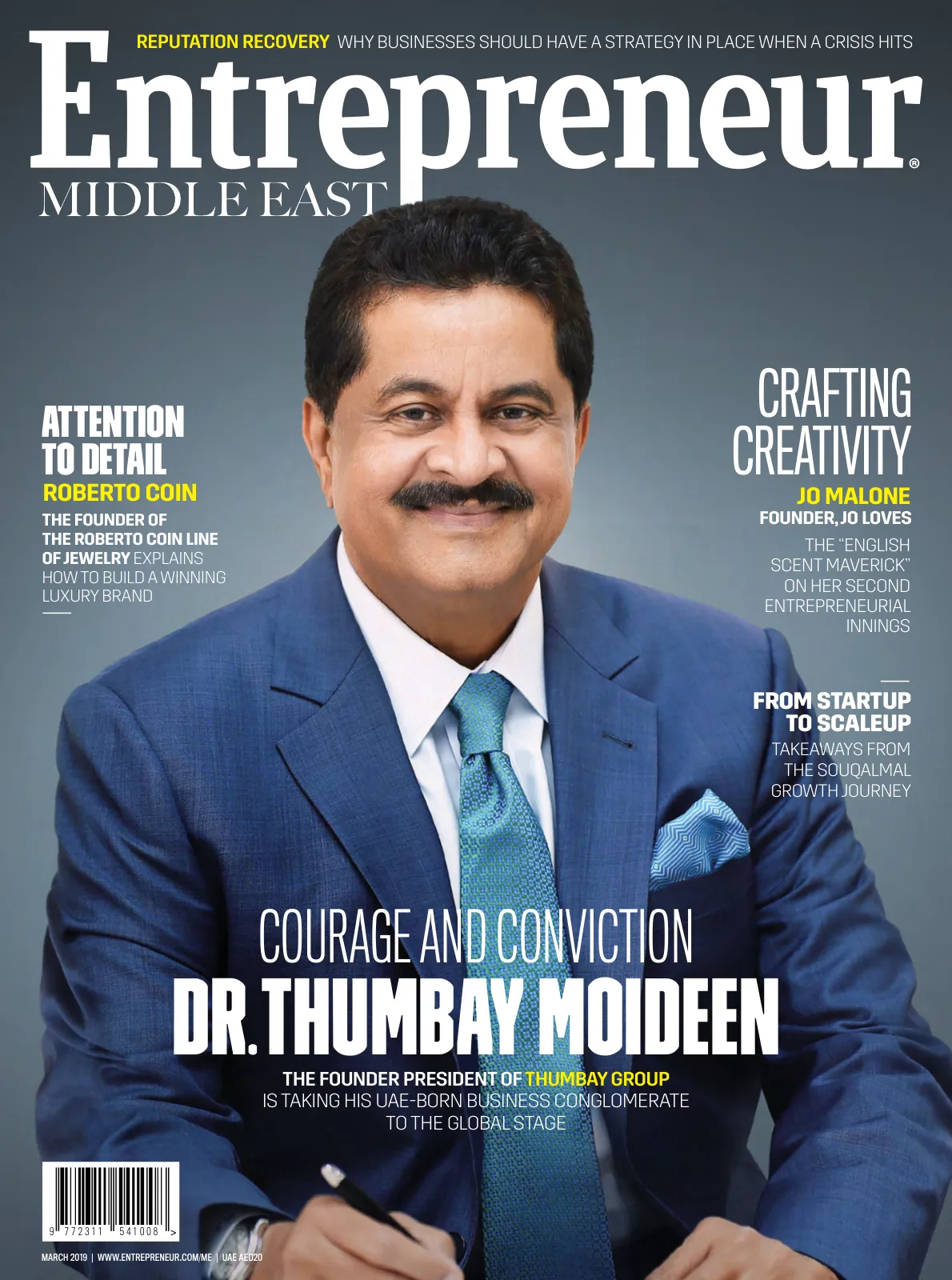
Entrepreneur Middle East, March 2019
Page 1
THE “ENGLISH
SCENT MAVERICK”
ON HER SECOND
ENTREPRENEURIAL
INNINGS
MARCH 2019 | WWW.ENTREPRENEUR.COM/ME | UAE AED20
9
7 7 2 3 1 1
5 4 1 0 0 8
>
REPUTATION RECOVERY WHY BUSINESSES SHOULD HAVE A STRATEGY IN PLACE WHEN A CRISIS HITS
DR. THUMBAY MOIDEEN
COURAGE AND CONVICTION
THE FOUNDER PRESIDENT OF THUMBAY GROUP
IS TAKING HIS UAE-BORN BUSINESS CONGLOMERATE
TO THE GLOBAL STAGE
FROM STARTUP
TO SCALEUP
TAKEAWAYS FROM
THE SOUQALMAL
GROWTH JOURNEY
CRAFTING
CREATIVITY
FOUNDER, JO LOVES
JO MALONE
ATTENTION
TO DETAIL
ROBERTO COIN
THE FOUNDER OF
THE ROBERTO COIN LINE
OF JEWELRY EXPLAINS
HOW TO BUILD A WINNING
LUXURY BRAND
Page 2
Wake up to
Following outstanding sales in phases 1, 2 & 3,
ARADA presents Nasma Residences Phase 4.
Located in the lush surroundings of
a record-breaking community.
from AED 899,000
*
BAREEM TOWNHOUSES
800-ARADA (27232)
arada.com
• No service fee for life
• Pay 60% on completion
• Up to 10% ROI
Visit our Sales Office
Badriyah Ballroom,
Radisson Blu Resort, Sharjah
10am – 7pm
*T&C apply
No residency visa required to buy property
Open to all nationalities
Page 3
3
March 2019 / ENTREPRENEUR.COM /
24
INNOVATOR
COURAGE AND CONVICTION
Dr. Thumbay Moideen
The Founder President of
Thumbay Group is taking
his UAE-born business
conglomerate to the global
stage.
30
INNOVATOR
CRAFTING CREATIVITY
Jo Malone
The founder of Jo Loves
on her second
entrepreneurial innings,
and why she believes
success is a journey.
34
INNOVATOR
LEADING THE CHANGE
Ogero Chairman Imad
Kreidieh on how revamping
Lebanon’s telecom
infrastructure is going to
fast-track the country’s
progress and growth.
54
TECH:
THE FIX
With great power comes
great responsibility
Amol R. Kadam, co-founder
of RBBi, explores the need
why today’s technology
needs to become more
human.
58
‘TREPONOMICS:
MARKETING
Reputation recovery
Brooke Boyschau and
Sophie Simpson, co-
founders of Atteline, on
why businesses should have
a strategy in place when a
crisis hits.
68
START IT UP:
Q&A
Ideas take flight
How Project You, a project
by university students in
the UAE, with support from
Expo 2020 Dubai, turned
into a fully-fledged startup.
68 Project You, a project by university students in the UAE,
with support from Expo 2020 Dubai
MARCH 2019 CONTENTS
32
Jo Malone,
founder, Jo Loves,
on her second
entrepreneurial
innings
30
Page 4
Simplify your business
with Business Mobile Plan.
• National and international minutes
• Free calls within the company
• Devices with zero upfront
Visit du.ae/bmp
Business
Page 5
Page 6
®
DUBAI ACCELERATOR
IN PARTNERSHIP WITH
THE STARTUPS
CLASS
OF
2019
START OF THE PROGRAM JAN 20
DEMO DAY APR 17
Page 7
Nestrom provides an Integrated Field Service Management & Automation
Platform enabling cost control & rapid servicing through automation of
work-orders and workflows for field teams in industries like Facilities Operations
Management, Industrial and Building Equipment and construction.
Clara is a legal technology SaaS platform that guides startup
founders through the maze of issues that they need to
address while managing their company’s legal structures to
ensure that they are ready for investment from accelerators
and venture capital firms.
Element 16 Technologies has developed a new
thermal battery, which stores high temperature heat
instead of electricity, improving the flexibility and
efficiency of chemical-processing and petroleum
industries.
Buglance is a crowd testing platform that tests
mobile apps, games and websites with real users,
real devices in real environments.
LuggAgent provides same day luggage delivery service in
over 70 cities worldwide, allowing travellers a hassle-free
travelling experience
YACOB enables various stakeholders (parents,
students, schools) to positively influence the nutrition
of students using the latest in behavioral economics,
gaming technology and artificial intelligence.
Three Wheels United is a tech-enabled lender
poised to become India’s leading financier for
sustainable, income-generating assets.
Ottogee is the IoT-enabled
solution for managing resource-
intensive environments.
Veeplay is a technology company that helps publishers deliver
and monetize content inside mobile application through an
enterprise-grade video player framework focused on mobile video
distribution and monetization.
Vivoo is a wellness app that provides personalized nutrition advice
to the users based on their urine tests.
Page 8
COVER THE CITY
Unlocking the Power
of Digital Signage Advertising
Page 9
WITH YOUR ADS
Visit www.lifeonscreen.com
Page 10
Page 11
TREPRENEURSHIP COMPE
ENTREPRENEURSHIP COMPET
SMARTPRENEUR 4.0
Submit your business
idea and win
of total in prize money
to be awarded to
top 3 finalists
Get access to Startup Support Package:
Submit your application now through our website:
Mentorship
Opportunities
Overseas
Trade Missions
Dubai Chamber
Events and Trainings
Initiative by
In Association with
Page 12
Page 13
Call: 800 UPSALE | up.ae
*Terms and conditions apply
MOTOR CITY
Own Your Dream Home In Dubai
& Move In Today
Aed 80,000*
30 months
Post-Handover Payment Plan
50% DLD
Fee Waiver
1,2,3,4
Bedroom Apartment
Page 14
14 / ENTREPRENEUR.COM / March 2019
20
EDITOR’S NOTE
By Aby Sam Thomas
46
CULTURE
LIFE
Keeping it real
Mark Sephton gives a guide
on how you can authentic
(and own your own space).
76
CULTURE
BUSINESS UNUSUAL
Inspired pursuits
Spheerz founder Ahmed
Tahnoon couldn’t
find an establishment
serving Japanese
takoyaki to his liking in
the UAE- so he created
his own.
42
CULTURE
DESIGN
Attention to detail
The founder of the Roberto
Coin line of jewelry explains
how to build a winning
luxury brand.
80
START IT UP
Q&A
Identity matters
Trust Stamp offers AI-
powered facial biometric
solutions to keep internet
fraudsters at bay.
59
‘TREPONOMICS:
MARKETING
The human element
It’s essential to integrate
technology and data into
your customer service
model, says Sarah Jones,
founder of Sprii.
38
TECH
SHINY
#TamTalksTech
Gadgets and doodads that
you might’ve missed out on,
sourced by a tech aficionado.
Yes, it’s okay to want them
all… and no, it’s not our
fault.
34 Imad Kreidieh, Chairman, Ogero
39 Logitech G935 7.1
LIGHTSYNC Wireless Gaming
Headset
MARCH 2019
CONTENTS
Nicolas Houzé, CEO,
Galeries Lafayette
64
Page 15
BOOK NOW:
T: +971 4 501 5656 E: dtec@dsoa.ae W: www.dtec.ae
Dtec is expanding into Silicon Park, Dubai’s newest smart city.
Join 1000+ entrepreneurs and start your business now.
WHERE SMART ENTREPRENEURS START
BOOK NOW: 04 501 5656
dtec@dso.ae www.dtec.ae
• 24/7 access with ample parking
• Access to fundraising, acceleration & incubation programs
• Hot desk, dedicated desk and office options available
• Conference facilities & meeting rooms
• Restaurants, cafés & social areas
• Access to events, mentorship & curated list of services
• The largest startup tech community in UAE
• 10,000 sqm business centre facilities
• A one stop shop for all your entrepreneurial business needs
• Easy freezone business setup with visa processing
• Subsidized business licenses
• Plug & play facilities and high speed WiFi
Page 16
16 / ENTREPRENEUR.COM / March 2019
50
CULTURE
LIFE
Rethink your relationship
with your phone
Rob McGovern, a digital
project manager at
Serviceplan Middle East
shares his tips on how you
can win the battle against
over-connectedness.
64
‘TREPONOMICS
PRO
Taking charge of the future
Nicolas Houzé, the
fifth-generation family
member leading Parisian
department store Galeries
Lafayette, and his partners
in the UAE and Lebanon,
ADMIC’s Michel and Pascal
Abchee, on what lies ahead
after the retailer’s tenth
anniversary in Dubai.
84
START IT UP
STARTUP FINANCE
Onward and upward
Medicus AI, a Dubai-born
healthcare tech startup
founded by Dr. Baher Al
Hakim, raises EUR2.75
million in its ongoing
Series A round.
40
CULTURE
TRAPPINGS
‘Trep gear
The executive selection for
the entrepreneur on your
list that has everything.
Okay, maybe for a little
self-reward as well.
60
‘TREPONOMICS
PRO
AI: the new engine of HR
Artificial intelligence-
powered developments
are set to change how
employers and recruiters
operate, says Bayt.com’s
VP of Employer Solutions,
Suhail Masri.
84 Medicus AI, a Dubai-born healthcare tech startup founded by Dr. Baher
Al Hakim, raises EUR2.75 million in its ongoing Series A round
41 Baume & Mercier Clifton Baumatic
MARCH 2019
CONTENTS
Roberto Coin
explains how to
build a winning
luxury brand
42
Page 17
M E M B E R S G E T T H E B E S T R AT E S
W H E N YO U B O O K D I R E C T
radissoncollection.com
A collection of our finest hotels,
where memorable moments are made.
From Muscat to Kuwait to Riyadh.
Page 18
18 / ENTREPRENEUR.COM / March 2019
SUBSCRIBE
Contact subscriptions@bncpublishing.net to receive
Entrepreneur Middle East every issue
EDITOR IN CHIEF Aby Sam Thomas editor@bncpublishing.net
CEO Wissam Younane wissam@bncpublishing.net
DIRECTOR Rabih Najm rabih@bncpublishing.net
CREATIVE LEAD Odette Kahwagi
MANAGING EDITOR Tamara Pupic
STARTUPS SECTION EDITOR Pamella de Leon
GROUP SALES DIRECTOR – B2B GROUP Joaquim D’Costa
COLUMNIST Tamara Clarke
EVENTS LIAISON Mark Anthony Monzon
PO Box 502511 Dubai, United Arab Emirates
P +971 4 4200 506 | F +971 4 4200 196
For all commercial enquiries related to Entrepreneur Middle East
contact sales@bncpublishing.net
All rights reserved 2019.
Opinions expressed are solely those of the contributors.
Entrepreneur Middle East and all subsidiary publications in the
MENA region are officially licensed exclusively to BNC Publishing
in the MENA region by Entrepreneur Media Inc.
No part of this magazine may be reproduced or transmitted in any
form or by any means without written permission of the publisher.
Printed by United Printing and Publishing
upp.ae
Images used in Entrepreneur Middle East are credited when necessary. Attributed use of
copyrighted images with permission. All images not credited otherwise Shutterstock.
Brooke Boyschau
Fida Chaaban
Sarah Jones
Amol Kadam
Suhail Masri
Rob McGovern
Ambareen Musa
Mark Sephton
Sophie Simpson
CONTRIBUTING WRITERS
entrepreneur.com/me
ACCESS FRESH CONTENT DAILY ON OUR WEBSITE!
MIDDLE EAST
EntMagazineME
@EntMagazineME
Entrepreneur-me
EntrepreneurMiddleEast
EntMagazineME
EntMagazineME
EntMagazineME
MIDDLE EAST
In addition to our print edition, we’re bringing
you all sorts of industry news on our web
mediums. Joining us online means getting
relevant business and startup content in
real-time, so you’re hearing about the latest
developments as soon as we do. We’re looking
forward to interacting with our readers on all of
our social media and web platforms- like any
thriving business, we’re looking to give and take.
#TrepTalkME is already happening on all of our
digi platforms, and all good conversations go
both ways. See you on the web!
Page 19
Page 20
20 / ENTREPRENEUR.COM / March 2019
EDITOR’S NOTE
Aby Sam Thomas
Editor in Chief
@thisisaby
aby@bncpublishing.net
Joining a startup (and staying the course)
requires imagination and flexibility
Hard hat
W
hen I compare my
life before and
after working at
a startup, I find
that one of the
things I miss
most about the
former is, curiously enough, some-
thing that often irritated me during
my time in that setting. I’m talking
about the structure that working
at a corporation imposes on you as
an employee. Corporate life means
that you’re almost always operating
within the paradigms set by the
management of the enterprise.
While I remember feeling quite
constricted by that kind of an
organizational structure, nowadays
I find myself often longing for this
kind of definition in my day-to-day
life in the entrepreneurial realm.
That being said, I believe it’s pretty
much impossible to work in a
startup with that kind of rigidity
governing you. In my opinion, being
open to change (and reacting quickly
to it) is part and parcel of the
equation when working in a startup
environment.
I bring this up because I’ve
been coming across people with
corporate backgrounds who join
startups, and then look to be lost
and underperforming in their
roles there. As I see it, this usually
happens because they are wholly
unprepared for work in their new
settings. Mostly because it requires
them to, more often than not, don
a variety of hats alongside the role
they had taken on in the first place,
and do a lot more than what a job
description lays out.
In a corporate, employees are often
obliged (and even encouraged) to
“stay in their lanes.” Doing the same
in a startup would see you getting
called out for not showing initiative!
I do feel sorry for the seasoned
executives who find themselves in
the latter scenario at startups, but,
at the same time, if they thought
this was going to be all about, say,
flexible hours and fun lifestyles,
well, they have no one else to blame
but themselves for drinking the
startup Kool-Aid.
Working at a startup is hardly, if
ever, as glamorous as it may seem on
Instagram- rest assured that startup
life is more about “#WorkHard”
than “#PartyHard.” You’ll almost
certainly be doing more at a startup
than what you used to at your
former place of work, and you’ll also
be putting a lot more of yourself in
this endeavor than probably any
other thing you’ve done in your
life thus far. This means that the
whole experience will be incredibly
fulfilling, and there will be a real
sense of pride you can bask in at the
end of it all. But simultaneously
know that this won’t happen
overnight, and that you’ll need to
be in it for the long haul. And if you
can’t handle that heat, then get out
of the kitchen.
Page 21
Page 22
22 / ENTREPRENEUR.COM / March 2019
IMAGE CREDIT STARTUP WEEKEND UMM AL QUWAIN
IN THE LOOP
Startup Weekend Umm Al Quwain 2019
brings together the UAE’s innovators to turn
their business concepts into real ventures
Making it happen
Dubai Startup Hub launches Co-Founder
Dubai program by MEGHA MERANI
MATCHMAKING FOR ENTREPRENEURS
Startup Weekend
Umm Al Quwain 2019
T
he UAE’s aspir-
ing entrepre-
neurs gathered
at Startup
Weekend Umm
Al Quwain 2019
on February 14-
16, 2019, which was held in
partnership with Techstars
and Google for Startups,
and with the support of the
Executive Council of Umm Al
Quwain Emirate and Young
Arab Leaders.
With more than 120 attend-
ees, the 54-hour event saw
13 groups developing busi-
ness ideas in various sectors,
from technology to beauty
and fashion. Starting off with
brainstorming sessions on
business plan development
and basic prototype creation,
the event concluded with the
participants' presenting their
business ideas to a panel of
judges. Teams also received
feedback and insights from
industry leaders and local
entrepreneurs.
The event welcomed the
presence of Sheikh Ahmed
Bin Saud Al Mualla, Vice
Chairman of Umm Al Quwain
Executive Council; Sheikh
Sagr Saud Al Mualla; H.E.
Aysha Rashid Laitiem, Mem-
ber of UAE Federal National
Council; H.E. Humaid Al
Shamsi, Secretary General of
Umm Al Quwain Executive
Council; Nabra Al Busaidi,
Executive Director of Young
Arab Leaders; and Dr. Galal
Hatem, President of Emirates
Canadian University College
of Umm Al Quwain.
Sheikh Al Mualla com-
mends the participants on
transforming their concepts
to startups, as well as invig-
orated the youth on available
opportunities and support
from the UAE. He also noted
that Umm Al Quwain's a
promising market to “em-
brace innovative ideas and
technological companies”
which SME owners can take
advantage of.
The winners of the chal-
lenge received an opportu-
nity to join the Young Arab
Leaders’ mentorship pro-
gram. The finalists were also
rewarded by RAK Incubator
with a 1-3 months accelera-
tor incubation support, plus
business and entrepreneur-
ship courses from the Emir-
ates Canadian University
College of UAQ. yaleaders.org
D
ubai Startup Hub, the
entrepreneurship arm
of Dubai Chamber of
Commerce and Industry, has
launched Co-Founder Dubai,
a new program that will help
match UAE entrepreneurs with
the right co-founder to sup-
port their growth plans.
This first-of-its-kind pilot
matchmaking program offers
UAE startups access to talent,
and aspiring co-founders a
unique opportunity to become
a business owner.
Open to all UAE entrepre-
neurs, the aim of the program
is to improve the success rate
of new businesses. Following
the application process, a total
of 10 UAE startups will be
selected to participate in the
matchmaking program.
Applications in the second
phase will then be open to
aspiring co-founders who will
later be shortlisted. By the
end of the pilot, the selected
startups will meet with various
potential co-founders and
choose one candidate that will
join their respective teams.
Commenting on the new
initiative, Natalia Sycheva,
Manager of Entrepreneurship
at Dubai Chamber, said in a
statement that Co-Founder
Dubai takes an innovative
approach to supporting
startups as it is designed
around their unique needs and
aspirations, adding that the
holistic program complements
other initiatives offered to
entrepreneurs in the UAE
under the Dubai Startup Hub
platform.
“Co-Founder Dubai will
provide both new startup
businesses and aspiring
co-founders with far-
reaching benefits, including
comprehensive training,
matchmaking days, a
dedicated curriculum and
high-caliber talent, ultimately
enabling startups businesses
to grow in the region,” Sycheva
noted.
Dubai Chamber launched
Dubai Startup Hub in 2016 as
an online platform to connect
startups, entrepreneurs,
developers, venture capitalists
and students, enabling
them to learn about new
opportunities and create new
partnerships that stimulate
economic growth.
Applications for Co-Founder
Dubai can be submitted
through Dubai Startup Hub’s
website. dubaichamber.com/
dubaistartuphub/cofounderdubai
Page 23
Page 24
INNOVATOR
24 / ENTREPRENEUR.COM / March 2019
Page 25
COURAGE AND
CONVICTION
THE FOUNDER PRESIDENT OF THUMBAY GROUP
IS TAKING HIS UAE-BORN BUSINESS CONGLOMERATE
TO THE GLOBAL STAGE by ABY SAM THOMAS
DR. THUMBAY MOIDEEN
W
hen I asked Dr. Thumbay Moideen to
reveal what he considers having been
a pivotal moment in his career so far,
I thought the Founder President of
Thumbay Group would have a hard time
deciding between the many successes
he has seen along his business’ trajectory
as his answer for my query. However, Dr. Moideen didn’t have
to think too long before he responded, and he surprised me by
choosing to not talk about one of the many wins he has seen
along his entrepreneurial journey, and instead pointing me to an
instant in his life in the UAE that essentially led him to all of his
accomplishments later down the road.
INNOVATOR
>>>
25
March 2019 / ENTREPRENEUR.COM /
IMAGES COURTESY THUMBAY GROUP
Page 26
26 / ENTREPRENEUR.COM / March 2019
INNOVATOR
DR. MOIDEEN REVEALS THAT HE IS INTENDING
TO TAKE THUMBAY GROUP PUBLIC BY
2023, WHICH LOOKS SET TO BE A MAJOR
LANDMARK FOR THE ENTERPRISE.
Gulf Medical University
This was in 1998, after Dr.
Moideen had been invited
to look into the feasibility of
establishing a medical col-
lege in the Emirate of Ajman
by H.H. Sheikh Humaid bin
Rashid Al Nuaimi, UAE Su-
preme Council Member and
Ruler of Ajman. At the time,
there was no other institu-
tion in the UAE like the one
Dr. Moideen was trying to set
up in Ajman, and as such, he
had roped in consultants to
do a study on whether this
was a business that could
actually, well, work. This
process was what led Dr.
Moideen to realize that he
had what was pretty much an
unsurmountable roadblock to
his business plans coming to
fruition: the UAE’s Ministry
of Higher Education did not,
at the time, allow for expats
to own licenses for running
institutions catering to high-
er education, and as such, Dr.
Moideen wouldn’t have been
able to go ahead with setting
up the medical school he
proposed. Dr. Moideen duly
informed the Ruler of Ajman
about his predicament, and
that’s when something amaz-
ing happened: H.H. Sheikh
Humaid awarded the Indian
entrepreneur with a royal
decree that’d allow him to
establish the educational
institution he proposed in
Ajman. This laid the founda-
tion for the creation of Gulf
Medical College, the UAE’s
first privately owned medical
college (which evolved into
what is today Gulf Medical
University), and by exten-
sion, of Thumbay Group
as well, which has become
an international business
conglomerate with Dr. Moi-
deen at its helm. It’s easy to
see now why Dr. Moideen
remembers this moment so
fondly, and as he speaks of
it today, there’s still an ele-
ment of surprise that can be
detected in his voice, as if he
has yet to come to terms with
how this particular episode
unfolded in his life. “No ex-
pat had done this before,” Dr.
Moideen remembers, smil-
ing. “We came into existence
with a decree… I can never
forget that.”
Dr. Moideen tells me this
story a few weeks before the
launch of his enterprise’s
latest development, the AED1
billion Thumbay Medicity in
Ajman. Spread over a total
area of 1 million square feet,
Thumbay Medicity is all set
to be a regional hub for medi-
cal education, healthcare,
and research, with the ability
to serve more than 20,000
people on a daily basis with
its advanced facilities in
a variety of fields. Besides
housing Gulf Medical Univer-
sity, a statement from Thum-
bay Medicity noted that it
will also be home to medical
institutions like Thumbay
University Hospital, Thum-
bay Dental Hospital, and
Thumbay Physical Therapy
Thumbay Medicity
Page 27
27
March 2019 / ENTREPRENEUR.COM /
and Rehabilitation Hospital,
as well as outlets of Thumbay
Pharmacy and Thumbay
Labs, in addition to leisure
and hospitality amenities like
Body & Soul Health Club and
Spa, Thumbay Food Court,
The Terrace Restaurant,
Blends & Brews Coffee Shop-
pe, and more. In addition,
there is also the Thumbay
Housing Project at the site,
which is set to accommodate
2,500 staff and students
at Thumbay Medicity. The
sheer scale of the project is
enough to make one sit up
and take notice of it, but
Dr. Moideen points out that
the offering that Thumbay
Medicity brings to the UAE
market also makes it very
unique: “It is a combination
of education, healthcare, and
research, which is very rare
in the country,” he notes.
“There is no one else.”
Thumbay Medicity is also a
testament to the enterprising
spirit of Dr. Moideen- re-
member that all of this start-
ed with him daring to dream
big 21 years ago. Sure, he did
have experience working in
his family’s timber and real
estate business in India be-
fore he came to the UAE, but
Dr. Moideen readily admits
that he had no experience in
the healthcare sector when
venturing into this arena in
1998. But what Dr. Moideen
did have was courage and
conviction, and lots of it too-
and it’s safe to say that these
qualities have driven him
to where he stands today.
Regardless of the hurdles
he found along the way, Dr.
Moideen kept finding ways
around them, and moved on
ahead with his career and
business. “I stuck around,”
he says, quite simply. “I love
to do what I do. I love my job;
that’s it… I enjoy what I am
doing, and I look forward to
each day.” And that explains
why Dr. Moideen continues
to spearhead the business as
Thumbay Group gets going
on its next stage of growth.
In terms of future plans, Dr.
Moideen says that the com-
pany is quite keen on build-
ing up its global presence-
he’s particularly hoping to
launch more universities
outside of the UAE; in fact,
Dr. Moideen reveals that his
enterprise is already looking
into setting up campuses in
Serbia, Egypt, and Ghana.
On the healthcare side of
things, there are two routes
Dr. Moideen wants to make
use of to grow Thumbay
Group’s interests in that
field. “One is building our
own hospitals and running
them as well,” he says. “The
other is by creating our
own healthcare manage-
ment company- so, we are
managing hospitals in India,
Africa, etc., and that busi-
ness is growing rapidly.” The
company has already taken
up hospital management
contracts in India, Kenya and
Tanzania; another in Oman
is also on the cards. “In addi-
tion to our new and upcom-
ing healthcare projects in
different parts of the world,
we are also keen to acquire
existing hospitals, either
on long-term leases, or on a
management basis,” he adds.
In the UAE, given the sectors
Thumbay Group currently
operates in, Dr. Moideen
is quite confident that the
business is only going to
prosper in the years to come.
INNOVATOR
“IN ADDITION TO OUR
NEW AND UPCOMING
HEALTHCARE PRO-
JECTS IN DIFFERENT
PARTS OF THE WORLD,
WE ARE ALSO KEEN
TO ACQUIRE EXISTING
HOSPITALS, EITHER ON
LONG-TERM LEASES,
OR ON A MANAGE-
MENT BASIS.”
Thumbay Physical Therapy
and Rehabilitation Hospital
>>>
Dr. Thumbay Moideen (center) with sons Akbar Moideen Thumbay (left) and Akram Moideen Thumbay (right)
Page 28
28 / ENTREPRENEUR.COM / March 2019
“Our business, whatever
we do, is related to com-
munity and the population,”
he explains. “Education,
healthcare, laboratory, retail,
etc.- everything is related
to the population. The good
news [with the UAE] is that
the population is growing.
The government says that
two more million people will
come [here] in the next two
years- which is good news for
us. They’re our customers,
we have to cater to them.”
Besides all of this, Dr. Moi-
deen also reveals that he is
intending to take Thumbay
Group public by 2023- which
will be a major landmark for
the enterprise.
As Dr. Moideen talks about
his future plans for Thumbay
Group, it becomes quite clear
that this award-winning en-
trepreneur has no intention
of resting on his laurels; his
dreams remain as big and
grand as ever, and he’s fo-
cused on seeing his business
scale greater heights. It is
this kind of attitude that has
led Dr. Moideen to achieve
all that he has accomplished
so far- persistence and per-
severance are the qualities
that matter, according to
him. “To be very frank, the
very fact that I held on, and
continued pursuing what I
wanted to do is maybe one of
the reasons for my success
so far,” Dr. Moideen says.
“But there are other reasons
too. One, I definitely feel God
has been kind to us- we were
blessed. Two, I got good sup-
port from the government-
our business had many
ministries involved in it, and
the local sheikhs, they sup-
ported us wholeheartedly.
Lastly is our team- we have
a very committed team, who
are as charged up [for the
business] as me.” Of course,
these are the characteristics
that will stand the business
in good stead as it moves
ahead with its next set of
goals, and it definitely helps
that Dr. Moideen is leading
Thumbay Group from the
front on this particular path.
“I believe that if we stagnate,
we die,” he declares. “So, we
have to keep growing- we
have to progress.”
INNOVATOR
"THE [UAE]
GOVERNMENT SAYS
THAT TWO MORE
MILLION PEOPLE WILL
COME [HERE] IN THE
NEXT TWO YEARS-
WHICH IS GOOD NEWS
FOR US. THEY’RE OUR
CUSTOMERS, WE HAVE
TO CATER TO THEM.”
THUMBAY GROUP:
AT A GLANCE
HIGHLIGHTS OF THE INTERNATIONAL
BUSINESS CONGLOMERATE’S
OFFERINGS
> Owned and operated by
Thumbay Group, Gulf Medical
University is the leading
private medical university in
the Middle East
> Largest network of private
academic hospitals in the
region
> Reputed chain of
pharmacies, diagnostic labs,
and multi-brand retail outlets
> Chain of world-class family
health clubs and spas
> Popular chains of coffee
shops and restaurants
> Publisher of the most
popular health and lifestyle
magazine in the region
> Dealing with patients from
over 175 countries
> Students from 80 countries,
faculty and staff from over 22
countries
> Growing global presence
Thumbay.com
Dr. Thumbay Moideen, Founder
President, Thumbay Group
Thumbay
Dental Hospital
Thumbay Physical Therapy and Rehabilitation Hospital
Page 29
Want to grow your
business in the UAE?
The Mohammed Bin Rashid Innovation Fund Accelerator gives regional
and global innovators access to world-class services and coaching to
accelerate businesses, elevate capabilities, unlock value and achieve scale.
Find out more at ia.mbrif.ae about our bi-annual applications.
Admission to the winter cohort is now closed.
Discover how your business can be a part of the summer cohort.
#MBRIF
@MBRIFund
The Mohammed Bin Rashid Innovation Fund (MBRIF) Innovation Accelerator is a federally-sponsored
initiative conceived by the Ministry of Finance and operated by EY.
Page 30
30 / ENTREPRENEUR.COM / March 2019
CRAFTING
CREATIVITY
JO MALONE, FOUNDER, JO LOVES
INNOVATOR
"WHEN WE WERE
RECRUITING, I WENT TO
THE THEATRE INDUSTRY,
AND I FOUND PEOPLE
WHO USED TO BE
ON STAGE. THEY CAN
PERFORM, DANCE, SING,
AND TELL GREAT STORIES.
SO, PEOPLE WORKING
IN MY SHOPS HAVE NOT
COME FROM THE RETAIL
INDUSTRY AT ALL.”
IMAGES COURTESY JO LOVES
by TAMARA PUPIC
The “English scent maverick” on her
second entrepreneurial innings, and why
she believes success is a journey
"MY VOICE IS IMPORTANT,
NOT JUST FOR MYSELF AND
MY BUSINESS, BUT BECAUSE
PEOPLE TRUST ME WHEN
I SAY SOMETHING, AND
I NEVER TAKE THAT FOR
GRANTED. I FEEL THAT IS A
RESPONSIBILITY THAT IS
BECOMING MORE AND MORE
APPARENT IN MY LIFE."
Jo Malone,
founder, Jo Loves
T
he story of Jo
Malone serves as
a testament that
entrepreneur-
ial spirit never
fades. In 1983,
the then 21-year-
old Malone started up her
fragrance and scented candle
business Jo Malone London
from her kitchen, opened
her first store in London in
1994, and five years later,
sold the company to Estée
Lauder Companies for an
undisclosed amount, remain-
ing its Creative Director until
leaving the enterprise in
2006. Then, owing to a non-
compete agreement signed
with Estée Lauder, Malone
was prevented from launch-
ing a new fragrance or skin-
care brand for five years. For
others, being internationally
praised as a self-made en-
trepreneur might have been
enough, but what happened
after those five years was one
more detail that set Malone
apart from her peers. “When
it came towards the end of
that period, I realized that
the desire to create fragrance
was just too powerful for
me,” Malone remembers.
“And so, I decided to try one
more time, and see if I could
build it again.” And that’s
how the Jo Loves brand came
to be, Malone’s new scent,
bath, body and candle col-
lection, which she launched
in 2011.
I spoke with Malone at
The Retail Summit held in
February in Dubai, and when
we meet at the lobby of The
Atlantis Dubai, I can see
that she is relaxed around
journalists, and generous
with warmth and empathy,
while also answering all my
questions with complete
honesty, which, for her, I
notice, hardly needs to be a
conscious effort. And thus,
she opens up that starting a
business for the second time
round was probably one of
the hardest things she had
ever done. “For the first two
years, I regretted that deci-
sion every single day of my
life,” she says. “It was hard,
because no one knew that I
had left [Jo Malone London],
and I had the responsibility
to the Lauder family, and to
the consumer, and also to
myself. Sometimes, regard-
less of what you most want
in life, you have to be re-
spectful of the people around
you. Relationships are a
golden ticket in life. On the
other side, if I hadn’t done it,
I would have denied myself
as a person. I would have de-
nied that one thing that had
motivated me, and had made
me happy. So, I really had to
think differently.”
Page 31
31
March 2019 / ENTREPRENEUR.COM /
INNOVATOR
Reem BinKaram,
Director, NAMA
Women Advancement
Establishment, at the
73rd United Nations
General Assembly
meetings in New York
"IT IS REALLY A PRIVILEGED
POSITION TO OWN A
BUSINESS, BECAUSE THE
CONSUMER IS CHOOSING
TO COME INTO YOUR FOUR
WALLS, REGARDLESS OF
WHETHER IT IS ONLINE
OR BRICKS-AND-MORTAR.
THAT HAS NOT CHANGED.”
The Jo Loves bespoke
store in London
Jo Malone,
founder,
Jo Loves
>>>
In 2011, when launching Jo
Loves, Malone was stepping
into a changed business
environment; however,
she also knew that certain
preconditions for a suc-
cessful brand wouldn’t have
changed. “The market was
different, especially in the
way how we communicated,
but the consumer still wants
to be inspired by brands
with which they can iden-
tify,” she notes. “That is a
constant which will continue
a hundred years from now.
The consumer is not just
buying your product, they
are buying into a story that
you have created, and they
want to connect with you. It
is really a privileged position
to own a business, because
the consumer is choosing to
come into your four walls,
regardless of whether it is
online or bricks-and-mortar.
That has not changed.”
Jo Loves’ product line-up
currently includes 13 fra-
grances, priced GBP70 for
50ml fragrances and GBP115
for 100ml. The brand also
features candles in eight
different fragrances, with
costs ranging from GBP55
to GBP350 for luxury
candles, and it offers bespoke
fragrances as part of its sig-
nature Candle Shot experi-
ence. The company is 100%
owned by Malone and her
husband Gary Willcox, who
takes care of the company’s
operations and business de-
velopment, thereby allowing
Malone to focus on creativity
and product development.
However, Malone points out
that the process of building
a team capable of following
her vision has
not been without
setbacks. “In
fact, I’ve made a
lot of mistakes
in building the
team, and the
second time, I
have made more
mistakes than the
first,” she says. “I
now employ more
women than
men, and I’m
happy with my
core team, but to
take the business
globally, you need
[more than that].
A general man-
ager who is in place at the
moment is actually following
my dream and my vision,
instead of her own. She is a
great leader. But I’ve had a
few who wanted to take the
business, and run it in the
direction that they thought
was right, and that was not
what I wanted. So, I’ve learnt
from both sides.”
In her frank style, Malone
continues to talk energeti-
cally about her quite innova-
tive approach to conveying
the brand message to the
consumer, for which she had
to build a team capable of
executing it. “Creativity is
the only currency that never
devalues,” she declares. “I
think and create all the time;
for me, that is the most
natural thing in the world,
and for me, it’s very easy, but
the difficult part is passing
it down onto the team. We
are a brand about stories.
With each fragrance and
each candle, I’m telling you
stories about my life, about
how I see a glass of rosé
wine, or about how I hear
jazz music. The difficulty
is how you can take those
authentic stories, without
them just being written
down, but instead, you bring
them alive. So, when we
were recruiting, I went to
the theatre industry, and I
found people who used to be
on stage. They can perform,
dance, sing, and tell great
stories. So, people working
in my shops have not come
from the retail industry at
all.” One example is Adam
Ellis, the Head of Education
and Customer Experience at
Jo Loves, whose background
in theatre productions has
been instrumental in the
success of Jo Loves Fragrance
Brasserie Bar, a bespoke ex-
perience that allows Jo Loves
customers to select their
desired fragrances and create
Page 32
32 / ENTREPRENEUR.COM / March 2019
INNOVATOR
“SUCCESS DOESN’T MAKE
YOU RICHER, SMARTER,
PRETTIER, OR HAPPIER, IT
JUST GIVES YOU A CHOICE.
THAT’S ALL THAT IT DOES.
SOMETIMES PEOPLE
STRIVE FOR SUCCESS, AND
THEY MISS THE JOURNEY."
The Jo Loves bespoke
store in London
a personal plate of scented
tapas. “That one little tapas
bar creates the most amazing
storytelling and emotional
connection to the brand. We
call it ‘the first kiss,’ meaning
when you kiss the consumer
for the first time with a
brand, it opens up our world
for them. It converts 98%
of the time into sales. We
don’t charge for it, it’s just
something we engage with
as a very different way of ap-
proaching retail.”
In 2008, Malone was
awarded an MBE in the
Queen’s birthday honors list
for promoting British cre-
ativity and industry on the
international stage. A decade
later, she was awarded Com-
mander of the Most Excellent
Order of the British Empire
(CBE) by the Prince of Wales
for her contributions to the
fragrance industry. Speak-
ing of receiving a CBE from
the Queen, Malone says, “I
remember walking through
the gates, thinking, ‘How
did I get here?’ I think that
it keeps your feet on the
ground, it keeps you humble.
I don’t ever want to presume
that this is my right. I’ve
worked hard in my life, and I
always try to make my world
much better and happier for
those around me. But there
are moments when I realize
that I’m sitting there, not
only because I’ve worked
hard, but also because my
voice is important. My voice
is important, not just for
myself and my business,
but because people trust me
when I say something, and I
never take that for granted.
I feel that is a responsibility
that is becoming more and
more apparent in my life,
which is to speak for those
who don’t have a voice.”
And Malone knows very
well about the struggle of
making one’s voice heard
and acknowledged. Dyslexia
hampered her success in
school which she left at the
age of 15, and started work-
ing as a florist, interestingly
at the very same place where
situated today is Jo Loves’
bespoke store in London’s
Belgravia neighborhood. A
year later, her mother suf-
fered a stroke, and the then
16-year-old Malone had to
quit her job to look after her.
It led to her working as a
facialist and making her own
bath-oils to send to her cli-
ents as gifts, out of which her
first fragrances were born.
When asked about the big-
gest hurdles she encountered
in both life and business, she
replies, “My lack of educa-
tion would be the first one.
When I left school at 15, I
was told that I would never
make anything out of my
life. That teacher apologized
many years later, after she
had read my article in The
Telegraph. I think that my
lack of education has actually
motivated me. I’m not say-
ing that it is a way forward,
certainly not something
I’d want for my son, but
don’t be frightened. Not all
entrepreneurs are academics.
They think with a different
head, and if you are entrepre-
neurial, sometimes your
lack of education pushes
you into a different mindset.
Similarly, my dyslexia is not
a disability, but an ability to
think differently, and if this
world needs anything at this
moment, it is people who
think differently. Dyslexics
find solutions quicker than
most people, and they would
go a different route.”
The period after the sale
of Jo Malone London to
Estée Lauder Companies was
characterized by the birth of
her son, but also by her fight
against breast cancer about
which she says, “Fighting
cancer at 38 was definitely
a challenge, but I reacted
to cancer in the same way I
run my business. I found the
best person who I believed
could save my life. I trusted
him. Similarly, I find the
best people that I can, and I
say to them, ‘I can’t do what
you can do, but I’m going to
support you.’ So, I allowed
the chemotherapy to do its
work, and there were many
dark days within that year,
but I came through it as a
much stronger person. Now,
I think, telling my story and
allowing people to see the
things that didn’t go right
and the times that were
tough makes us all stronger,
although we sometimes
think it makes us weaker. It
makes us stronger, because
Page 33
33
March 2019 / ENTREPRENEUR.COM /
NOT ALL
ENTREPRENEURS
ARE ACADEMICS.
THEY THINK WITH
A DIFFERENT HEAD,
AND IF YOU ARE
ENTREPRENEURIAL,
SOMETIMES YOUR
LACK OF EDUCATION
PUSHES YOU INTO A
DIFFERENT MINDSET.
INNOVATOR
WWW.JOLOVES.COM
Jo Malone,
founder, Jo Loves
if you come through that,
you have arms full of hope
in your hands, which you
can pass onto somebody for
them to think, ‘If she’s gone
through that, she did that, I
can as well.’ For me, that’s an
important thing.”
This statement corresponds
to what was happening
during our meeting at The
Atlantis Dubai- our interview
was often interrupted by
people approaching Malone
to express how touched and
inspired they were with her
story, a man sitting quietly
in a corner behind us was
nodding intently as she was
answering my questions, and
all of this was because they
found spending time with
Malone quite uplifting- just
as I did. “Success doesn’t
make you richer, smarter,
prettier, or happier, it just
gives you a choice,” she
says. “That’s all that it does.
Sometimes people strive for
success, and they miss the
journey. Success is about
today, right now, every mo-
ment; so, at the end of each
day, I think to myself about
what did I do that took me
one step ahead. On some
days, I’ll run a thousand
steps ahead, and on some
days, it’ll be just one step,
or I’ll stand still- but I never
want to go back in life. For
me, success is one step, and
even if it’s only one step to-
wards my goal and my dream
that I’ve made, it’s been a
successful day. It’s a good
mindset, because it makes
me productive, and it doesn’t
make me bitter. Sometimes,
if you can’t grasp hold of suc-
cess, you can get frustrated,
instead of creative. That’s the
flip side of me, and I have to
watch myself on that.”
Malone applies this sort
of awareness to her busi-
ness as well. “As fragrance
houses, we are looking at
predicting what the future
will bring, but there is a
lot responsibility with this,
because sustainability is
coming into that, meaning
that if we take raw ingredi-
ents from certain parts of
the world, how can we give
back to those communities
and support them?” she
says. “It is not just about
buying something, but
about what you give back,
and what is a longer-term
goal. It is important to me
what the fragrance houses
that I work with give back
to the next generation.” And
Malone’s next goal has the
potential to lift her on to a
path that will garner her new
respect, which she undoubt-
edly deserves. “One of the
biggest things that I think
about at the moment is the
responsibility for the next
generation, and I want to see
entrepreneurialism taught to
any child across our country,
and then hopefully across
the world,” Malone says.
“I want that generation to
believe that there is an army
of entrepreneurs here to help
them, that they are not on
their own.”
Page 34
34 / ENTREPRENEUR.COM / March 2019
INNOVATOR
LEADING THE CHANGE
Ogero Chairman Imad Kreidieh on how revamping
Lebanon’s telecom infrastructure is going to fast-track
the country’s progress and growth by ABY SAM THOMAS
IMAGES COURTESY OGERO
Imad Kreidieh,
Chairman, Ogero
I
n order to illustrate
the impact of
Lebanon’s notori-
ously slow internet
speeds have had on
its progress as a na-
tion, Imad Kreidieh,
Chairman of Ogero,
the state-run operator of
the country’s fixed telecom
network, recalls how a lead-
ing multinational enterprise
was once considering
opening an office in the
capital city of Beirut. The
establishment of this office
would have resulted in the
creation of 5,000 jobs, and
thus, undoubtedly boost the
local economy- however, this
plan didn’t come to fruition.
Kreidieh remembers how
the multinational ended
up deciding to set up shop
in another country in the
MENA region, because Leba-
non did not, at that point
in time, have the requisite
internet infrastructure for
that company to operate
effectively.
It’s impossible to miss the
wistful note in Kreidieh’s
voice as he relays this
anecdote today; the regret
he feels about Lebanon and
its people missing out on an
opportunity for growth and
progress is easily apparent.
But tales like these highlight
the importance of the work
that he and his team at
Ogero are currently doing to
revamp the country’s under-
lying telecom infrastructure.
Ogero -referred to as the
“engine” for the country’s
Ministry of Telecommunica-
tions- has been tasked with
upgrading the nation’s exist-
ing (and outdated) copper
wire infrastructure with
fiber optic cables, which is
expected to have a massive
(and long-awaited) positive
impact on internet connec-
tivity and speeds.
Page 35
35
March 2019 / ENTREPRENEUR.COM /
INNOVATOR
>>>
"ONE OF MY KPIS IS TO BE
IN THE TOP FIVE IN THE REGION,
PROVIDING CONNECTIVITY,
STATE-OF-THE-ART
TECHNOLOGY, AND QUALITY
OF SERVICE, WHICH THE
LEBANESE PEOPLE HAVE BEEN
LACKING FOR THE PAST
15 YEARS.”
Lebanon’s first Sustainable Digital Ecosystem Summit
Kreidieh, who was appointed
to his current role by Leba-
non Prime Minister Saad
Hariri in 2017, admits that
leading this facelift of the in-
frastructure has hardly been
an easy task. However, he
also says that he has taken
on the challenges head-on,
in order to achieve the goals
that have been set for Ogero,
and by extension, Lebanon
itself. “I took over Ogero
two years ago, with a very
clear mandate to upgrade
the infrastructure, which
will put Lebanon back on the
digital map of the Middle
East,” Kreidieh says. “So, one
of my KPIs is to be in the top
five in the region, providing
connectivity, state-of-the-art
technology, and quality of
service, which the Lebanese
people have been lacking for
the past 15 years.”
And the results of Ogero’s
efforts are already starting to
show. In 2017, Kreidieh had
declared that by the end of
2018, 85% of internet users
in Lebanon would enjoy con-
nectivity speeds of up to 50
Mbps. Now, this goal wasn’t
achieved owing to delays in
the implementation of the
infrastructure upgrade, but
one cannot deny that there’s
been signs of progress as
well. As an example, Kreidieh
points out that were areas in
the country that were having
only 4-5 Mbps of internet
speeds, but now, thanks to
the work being done by him
and his team, people in those
same localities are enjoying
speeds of 25-27 Mbps when
accessing the web.
Kreidieh promises that
several more (and better) im-
provements like these are in
the offing, but he admits that
there have been challenges,
mostly of a technical nature,
that have been slowing down
the roll-out of Ogero’s FTTX
(fiber to the x) network.
“The main challenge that we
face for the FTTX is that we
do not have accurate base
maps in order to design the
network,” Kreidieh explains.
“We have 300 exchanges to
be completely swapped to
fiber. And so, for each and
every exchange, we needed to
go and do a physical survey,
because the base maps did
not reflect the reality. So,
every time, we needed to go
to do the survey, to position
the buildings or the houses
that were not existing on the
base maps. So, this is the
most challenging process,
because designing a network
takes time.”
It’s pertinent to note here
that Kreidieh has chosen a
technical issue as his main
hurdle in what he’s set out
to accomplish, and not the
much-maligned inefficiency
of Lebanon’s bureaucracy.
While Kreidieh does admit
that he’s had to tackle with
his fair share of those kind of
problems, he also says that
it’s never been too much for
him to handle. “I did not face
any unsurmountable chal-
lenges internally,” he notes.
“Because what we're doing
has been acknowledged by
the political establishment,
it has been accepted by the
private sector, and welcomed
by the youth generation.”
Page 36
36 / ENTREPRENEUR.COM / March 2019
As such, Kreidieh says that
while there may be situa-
tions where, for instance,
certain municipalities with
small populations may ques-
tion the benefits of Ogero’s
work for their communities,
these are few and far be-
tween, and, at the same time,
fairly easy to get past as well.
Of course, Kreidieh is aided
in what he does, thanks to
his experience of working in
the private sector for more
than 25 years. Having been
in top roles at leading bank-
ing and telecom establish-
ments around the Middle
East, Ogero is Kreidieh’s
first experience working in
Lebanon’s public sector, and
while he has chosen to (and
been allowed to) run it like
a private enterprise, he has
had to face blowback on that
as well- sometimes, people
there are simply not ready
to operate like in the private
sector, he notes. “I have to be
honest with you- I thought
it would be much easier,”
he laughs, as he talks about
moving from working in
the private sector, to being
a part of the public sector.
“It's quite an interesting
shift, but it was not easy at
all. You know, some days,
when I come back home, I’d
say to myself, what the hell
am I doing here. But the day
after, you wake up with the
energy to keep going, because
you believe that you have a
serious responsibility that
will cater for the needs of
the people. I'm not working
for the politicians, or for a
political party, but I have a
firm commitment towards
my kids and probably my
grandchildren- I'm doing
something for them, not for
anybody else. So, you know,
when you wake up with such
a mindset, things become
easier.”
Kreidieh’s answer makes
it obvious that he’s being
fueled to do what he does
by a deep-set desire to give
back to his native Lebanon-
he had to once leave his
country to pursue growth
and opportunities, but now,
Kreidieh wants to help in
building and securing the
future of the nation. “Listen,
I left Lebanon back in 1974,
when Lebanon was on the
brink of a civil war. And I
came back to Lebanon in
2015. I felt somewhere that
I owe my country and my
countrymen and women, to
share some of the experi-
ence that I got. And the call,
from the Prime Minister, to
do something was the most
beautiful gift I have ever got-
ten, and what motivated me
was, again, doing something
for my people. This is what
is really motivating me,
because, financially, it's not
even close to the private sec-
tor,” he laughs. “Let me be
clear on that; this is my main
motivation.”
And Kreidieh is incredibly
optimistic about what the
future holds for Lebanon- he
has only words of praise for
the youth in the country,
and he believes they are
the ones who hold the key
to the nation’s growth. “To
be honest with you, you
know it for a fact that we
are exporting the most valu-
able asset any country can
have- its brains,” he says. “I
feel that Lebanon is a very
dynamic country, and if you
have never visited Lebanon, I
advise you to do so- you will
be flabbergasted with the
energy that is there. It is so
concentrated; it needs only
to blossom in the right way.
And the youth [we have] are
moving to the Google’s and
Facebook’s and LinkedIn’s-
we have talent spread every-
where. The future of such a
generation cannot be but a
positive one.”
"THE DAY AFTER, YOU WAKE
UP WITH THE ENERGY TO
KEEP GOING, BECAUSE YOU
BELIEVE THAT YOU HAVE A
SERIOUS RESPONSIBILITY
THAT WILL CATER FOR
THE NEEDS OF THE PEOPLE."
INNOVATOR
Imad Kreidieh at SDE Summit
Imad Kreidieh, Chairman, Ogero
Page 37
Obtain your DED licence on a dedicated desk in a sophisticated
shared space with great views, natural light and like-minded people.
Benefits:
- Ejari without the 200 sqft requirement
- The best business addresses in Dubai, without the high costs
- Secure, high speed WiFi, 24/7 IT and admin support
- Connect and collaborate with our community of 40,000 professionals
- Landline number and a dedicated receptionist to answer your calls
- Complimentary coffee and tea for you and your guests
- Access to fully equipped boardrooms and meeting rooms
Register Your Business In Dubai
On Servcorp’s Coworking Space
AED 3000/Month - DED Compliant
Emirates Towers
+971 4 319 7660
Habtoor Tower
+971 4 453 2670
Boulevard Plaza
+971 4 409 6880
160+ locations across the globe
Page 38
38 / ENTREPRENEUR.COM / March 2019
The new Canon EOS RP
is a small, lightweight, full
frame, mirrorless camera
for advanced amateurs-
casual shutterbugs looking
to up their game. The EOS
R System features the
world’s fastest autofocus,
and Canon’s smallest,
lightest full frame digital
interchangeable lens
to date. The EOS RP’s
26.2-megapixel, full frame,
dual pixel CMOS sensor
with autofocus, coupled
with Canon’s latest DIGIC
8 processor, renders
optimal balance of detail,
control over depth of field,
and incredible low light
shooting performance.
EOS RP isn’t just for still
photos though- it also
records movies in up to 4K
resolution at 25 fps, and
full HD at 60 fps. With
features including 4K time-
lapse, interval timer, Movie
Servo AF, and HDR movies,
you can capture both fast
action and slow-motion
sequences. Dual Pixel
CMOS AF enables accurate
focusing and face detection,
while Movie Digital IS
provides five-axis movie
stabilization to counteract
shakes when footage is
captured handheld. The
microphone and headphone
jacks help to capture and
monitor audio in real time,
while the Video Snapshot
function is a simple way to
create a video summary by
combining four, six, or
eight-second clips. And
you don’t have to wait to
share your snaps- thanks
to smart Bluetooth and
Wi-Fi connectivity, the EOS
RP can connect to smart
devices, which allows
the transfer of photos
and videos. You can also
control the camera from
a smart device using the
Canon Connect App, giving
full control over camera
settings, a live view, and
even the option to wake up
the camera remotely over
Bluetooth. Canon Connect
is available for both iOS
and Android devices.
GADGETS AND DOODADS THAT YOU MIGHT’VE MISSED OUT ON, SOURCED BY A TECH AFICIONADO.
YES, IT’S OKAY TO WANT THEM ALL… AND NO, IT’S NOT OUR FAULT.
CLICK IT
CANON EOS RP
TECH SHINY | WEBSITE TO WATCH | GEEK | MOBILE TECH | ONLINE ‘TREP | THE FIX
IMAGE CREDIT CANON | LG | LOGITECH
Canon EOS RP
Page 39
39
March 2019 / ENTREPRENEUR.COM /
The LG UltraGear Gaming
Monitor combines superior
picture quality and speed
to give you the best pos-
sible gaming experience.
With support for NVIDIA
G-SYNC, 2ms response
time, and a refresh rate
of 144Hz, your game
can be faster and more
fluid than ever before. The
UltraGear’s 3840 x 1600
monitor comes with 98%
coverage of the DCI-P3
color gamut for stunning
visuals. It boasts a nearly
borderless design with a
curved screen and a 21:9
aspect ratio. Providing
a greater sense
of immersion and
improved ambience,
the UltraGear also
has a special lighting
system. LG’s Sphere
Lighting technol-
ogy offers up to
six different color
settings that you can
customize for every
experience, and LG
asserts that the
design isn’t purely
aesthetic- it helps
to reduce eye
strain as well.
TECH
SHINY | WEBSITE TO WATCH | GEEK | MOBILE TECH | ONLINE ‘TREP | THE FIX
#TAMTALKSTECH Tamara Clarke, a former software development professional, is the tech and lifestyle enthusiast behind The Global Gazette, one
of the most active blogs in the Middle East. The Global Gazette has been welcomed and lauded by some of the most influential tech brands in the
region. Clarke’s goal is to inform about technology and how it supports our lifestyles. See her work both in print regional publications and online on
her blog where she discusses everything from how a new gadget improves day-to-day life to how to coordinate your smartphone accessories.
Visit theglobalgazette.com and talk to her on Twitter @TamaraClarke.
Logitech G935 7.1
LIGHTSYNC Wireless
Gaming Headset
GAME ON
LOGITECH G935 HEADSET
Logitech isn’t playing around
with its new range of headsets
for gaming. The G935 7.1
LIGHTSYNC Wireless Gaming
Headset delivers superior audio
and striking RGB lighting.
It’s the first in a family of
headsets to feature Logitech
G’s exclusive Pro-G 50mm
Audio driver, which is crafted
from hybrid mesh material
that delivers deep bass and a
round sound profile for highly
cinematic audio. In addition,
this new headset features
Logitech G’s LIGHTSYNC
technology, which allows you
to customize illumination
by syncing to any content,
including games, videos,
and music. This technology
allows you to customize
every color to match your
setup across keyboards,
mice and headsets. The new
headset also features DTS
Headphone: X 2.0 surround
sound, which simulates
the 3D environment of the
audio’s original mixing stage.
Logitech rounds things out
with 12 hours of battery life,
enhanced 6mm microphone
technology, and increased
wireless performance. With
premium leatherette earpads,
an upgraded microphone and
on-ear volume controls, G935
is the ideal choice to complete
your battle station.
LET’S PLAY
LG ULTRAGEAR GAMING MONITOR
LG UltraGear
Gaming Monitor
Page 40
40 / ENTREPRENEUR.COM / March 2019
THE EXECUTIVE
SELECTION
From better goods to better wardrobe bests,
every issue we choose a few items that make
the approved executive selection list. In this
issue, we present our picks from Givenchy’s
FW19 line, a timepiece to add to your luxury
collection, and more.
‘TREP TRIMMINGS
CULTURE
BUSINESS UNUSUAL | LIFE | TRAVEL | DESIGN | TRAPPINGS
SUITS ON MARK
GIVENCHY
Givenchy’s latest Fall/Winter
2019 collection is out, and it’s
undeniably one that deserves
a place in your wardrobe.
British designer Clare Waight
Keller’s first standalone
collection for the French label
brings in couture and Parisian
influences in the ready-to-wear
line. Taking in long and sharp
silhouettes with a definite touch
of refinement, it’s exemplified in
the single and double-breasted
suits, as well as embellished
pieces in embroidered leather in
bold hues of violet, fuchsia, and
blue, along with prime shades
of black, navy, and beige, plus
textures including crinkled
leather, bonded fabric, and
subtle hand-beading.
givenchy.com
Givenchy
FW 2019
Givenchy
FW 2019
Givenchy
FW 2019
Givenchy
FW 2019
Givenchy
FW 2019
Page 41
41
March 2019 / ENTREPRENEUR.COM /
CULTURE
BUSINESS UNUSUAL | LIFE | TRAVEL | DESIGN | TRAPPINGS
IMAGE CREDIT GIVENCHY | BAUME & MERCIER | BERLUTI | THE PALM DUBAI
Berluti,
Asymetrique Demesure
Calf Leather Loafer
Berluti,
Andy Demsure Calf
Leather Loafer
EDITOR’S PICK
GLOW ON
Willow Stream Spa at Fairmont
The Palm, Dubai by TAMARA PUPIC
Dr. Smita
Prabhakar
A quick glance at my (and your) agenda
over the past few weeks shows us that
this year’s event season is already in
full swing- although in Dubai there is
hardly ever a period with no occasion
worth noting. Since the demanding
work hours, in addition to the harmful
city dust, will soon take their toll on my
skin, I headed to Willow Stream Spa
at Fairmont The Palm in Dubai for a
Déesse Pro LED mask facial treatment.
It is an hour-long facial developed by
Dr. Rita Rakus, a London-based doctor
who lists celebrities like Madonna,
Chrissy Teigen, and Kate Hudson,
among her clients. I soon discover that
the treatment is not just about the
face, but about taking the whole of
me to the state of balance. After being
welcomed by the spa’s friendly staff,
I’m taken to a clean, dimly lit and
extremely relaxing treatment room,
where a beautician starts by removing
makeup and dust from my face, telling
me more about the patented HydraFacial
technology -dubbed a confidence
booster- whose spiral design helps
cleanse, exfoliate, and extract impurities
and dead skin cells, while infusing vital
nutrients such as antioxidants, peptides,
and hyaluronic acid into the skin. This
phase lasts for half an hour, and over
the next 20 minutes, she puts a Deesse
Pro LED mask on my face, a device that
uses low light therapy by
way of medical-grade light
emitting diodes to expose
the skin to clinically
proven wavelengths of
light, delivered in safe,
therapeutic doses- all of
this is to say that this is,
essentially, a pain-free
way to achieve naturally
vibrant and clearer skin.
fairmont.com/palm-dubai/
willow-stream/rita-rakus
STEPPING UP
BERLUTI
If you’re looking for versatile pairs of shoes for
any occasion, look no further than Berluti’s
leather loafers from the brand’s Spring/Summer
2019 capsule collection. Wear it with a relaxed
linen suit for your back-to-back meetings, or with
jeans and a button-down for a casual night out.
Form and function, check! berluti.com
POWER THROUGH
BAUME & MERCIER
Founded in 1830, Baume & Mercier has a
track record for crafting timepieces that exude
craftsmanship and luxury. And with the Swiss
watchmaker’s Clifton Baumatic, there’s a lot to
look forward to in this nifty piece. Powered by
the in-house movement with a high-performance
of a 120-hour power reserve (that’s five days
with a full wind), it features a sapphire crystal
on its front and back, a large clear date at three
o’clock, and water resistance of up to 50 meters.
Available in a black alligator strap and pin
buckle, this timepiece takes into account both
your style and your comfort. baume-et-mercier.com
Fairmont The Palm - Willow Stream Spa
Déesse Pro
LED mask
Baume & Mercier Clifton Baumatic
Baume & Mercier Clifton Baumatic
Page 42
42 / ENTREPRENEUR.COM / March 2019
ATTENTION
TO DETAIL
ROBERTO COIN
The founder of the Roberto Coin line of
jewelry explains how to build a winning
luxury brand by TAMARA PUPIC
"WE KNOW HOW TO
OBSERVE PEOPLE
AND THINGS. OUR
OBSERVANCE IS BASED
ON THE DESIRE TO SERVE
YOU BETTER. BEING A
HOTELIER WAS A GREAT
SCHOOL FOR STARTING
ANY OTHER BUSINESS
LATER ON.”
Roberto Coin
CULTURE
BUSINESS UNUSUAL | LIFE | TRAVEL | DESIGN | TRAPPINGS
R
oberto Coin’s
boutique in
the Fashion
Avenue exten-
sion of the Dubai
Mall, which
was opened in
February in partnership with
Damas Jewellery, comes
across as a visual refer-
ence of two elements that are
fundamental to the brand:
nature and ethics. A vertical
garden that covers part of
the wall is the live backdrop
that Roberto Coin chose to
display Animalier, one of his
most beloved collections,
while the shelves are lined
with his 18 karat gold jewelry
pieces, all carrying a Roberto
Coin signature ruby on the
inside of each piece. Roberto
Coin uses only synthetic
rubies to guarantee no stone
comes from a region in
turmoil, which brings us
to the founder’s innate and
unwavering commitment to
ethics in his business.
“People who know me
understand that we have
always been an extremely
ethical company- not just
now, when it is fashionable
to be ethical,” Roberto Coin
says at the launch of his new
boutique, noting that he has
been one of the founding
board members of the World
Diamond Council since its
inception. “We’ve worked
with many international or-
ganizations to make the dia-
mond industry respectable.
I am a big fighter against
synthetic diamonds, if they
cannot be identified by the
consumer, as well as by a lot
of retailers. I am not against
the selling of them; they can
sell them as long as you, as
a consumer, and the person
who sells them, can identify
them. If he or she cannot
identify them, and does not
declare that they actually are
synthetic diamonds, I don’t
like it. I believe in that kind
of world.” In Coin’s case, all
polished diamonds used in
his collections are purchased
from legitimate sources and
from conflict-free areas, for
which the brand subscribes
to the Kimberly Process
Certification Scheme (KPCS)
and the System of Warran-
ties. Coin has also been dis-
tinctively active within the
philanthropic community,
with his brand repeatedly
winning accolades for its
corporate social responsibil-
ity initiatives, about which
he says, “I believe in charity,
which taught me to steal
money from the rich, and
give it to the poor. And in
this case as well, you need
to be ethical. People give you
money, because they believe
that it will be used for what
it was given. That is the
world that I represent.”
The Roberto Coin brand
was born in 1996, and today
lists notable personalities
like Isabelle Adjani, Christy
Turlington Burns, Hilary
Clinton, Sofia Vergara, and
Oprah Winfrey among its
loyal clients. But to really
understand how Coin got to
where he is today, we have to
go back to his first entrepre-
Page 43
43
March 2019 / ENTREPRENEUR.COM /
Reem BinKaram,
Director, NAMA
Women Advancement
Establishment, at the
73rd United Nations
General Assembly
meetings in New York
"IT IS IMPORTANT TO
SAY THAT E-COMMERCE
IMPROVES THE PRODUCT
KNOWLEDGE FOR THE
CUSTOMER, IMPLYING AN
INCREASE THE PHYSICAL
SALES IN THE RETAILER
DISTRIBUTION.”
Roberto Coin
Pois Moi
collection
The Roberto Coin store in Dubai Mall
“PEOPLE WHO KNOW
ME UNDERSTAND THAT
WE HAVE ALWAYS
BEEN AN EXTREMELY
ETHICAL COMPANY-
NOT JUST NOW, WHEN
IT IS FASHIONABLE TO
BE ETHICAL.”
CULTURE
BUSINESS UNUSUAL | LIFE | TRAVEL | DESIGN | TRAPPINGS
>>>
neurial success in Guernsey
in the UK’s Channel Islands.
Having lost his parents at
a young age, Coin finished
boarding school in Switzer-
land, and, when he was 18,
he moved to the UK to learn
English. Only a year later,
however, the entrepreneurial
Coin bought a café, then a
restaurant at 22, and lastly,
two years after, took out
a bank loan to buy a hotel
that was frequently visited
by the likes of the Duke of
Richmond, HRH Prince
Charles, Tony Bennett, and
many others. “Becoming a
successful hotelier is in our
understanding of how to
look after our clients, and
how to service them well,”
he says. “We know if you
are with your husband, we
understand if you are with
your lover, we probably un-
derstand if the two of you are
just friends. So, we under-
stand the service, meaning
what kind of things you like.
If you call us to come to your
table, we know what is miss-
ing even before reaching the
table, because we know how
to observe people and things.
Our observance is based on
the desire to serve you bet-
ter. Being a hotelier was a
great school for starting any
other business later on.”
This attention to detail
proved to be a great asset
when Coin decided to enter
the jewelry sector. At 32, he
returned to Italy, and used
the proceeds from the sale
of his hotel to make a career
shift, becoming a newcomer
among more than 5,000
jewelry manufacturers in
Italy at the time. “I did not
know that I could create jew-
elry,” he recalls. “But I loved
it, and when you have that
kind of an attentive mind,
and when you are Italian,
by which I mean that every
Italian loves fashion, we are
born with it, it is part of our
world, you want to try. And
I wanted to try, but I did not
know whether I could do it.”
However, building the Robert
Coin brand to what it is to-
day took years of toil, start-
ing from when he ventured
into this sector in 1978. “I
had to learn how the jewelry
industry worked by visiting
factories, meeting people,
and learning, and that phase
lasted for six years, much
longer than anticipated,” he
says. “A lot of people start up
a business by employing peo-
ple to do for them what they
want to achieve. However, I
wanted to gain knowledge,
because only with it could I
then present my work to the
consumer, and to the public.
If I had had zero knowledge,
then I would have become a
speculator, just a financier,
and I do not represent mon-
ey. Money has never been the
most important thing in my
life. So, I wanted to establish
credibility for what I was do-
ing. But it is important to say
that I entered this sector as a
businessman who fell in love
with creativity, and not as a
creator trying to become a
businessman. That is a huge
difference. In that way, you
become more credible faster,
because you are a business-
man who is selling jewelry.”
Over the years, Coin per-
fected his craft by manufac-
turing jewelry for other local
and international brands.
“They were fascinated with
my design and quality,
because when you are not
from the industry, and then
Page 44
44 / ENTREPRENEUR.COM / March 2019
“GOOD TASTE DOES NOT
BELONG ONLY TO THE
RICH, AND IT DOES NOT
MEAN THAT IF SOMETHING
IS EXPENSIVE, IT IS ALSO
BEAUTIFUL. INEXPENSIVE
JEWELRY CAN BE MORE
ELEGANT THAN THE
EXPENSIVE ONE.
CULTURE
BUSINESS UNUSUAL | LIFE | TRAVEL | DESIGN | TRAPPINGS
“WE SELL ONLINE IN
EUROPE AND THE US, BUT
I WOULD NOT DEFINE IT AS
A SUCCESSFUL BUSINESS,
BECAUSE BUYING
JEWELRY ONLINE IS STILL
SOMETHING DIFFICULT."
Roberto Coin
you start working in it, you
appear as a breath of fresh
air, something new in the
market,” he says. “Also, I
liked making difficult things,
although you can’t make
much money out of them.
You make money on easy
things, but at that time, I
did not mind difficulty. So, I
became another very impor-
tant voice in the industry.”
However, almost two decades
later, Coin says, he reached
the point of deciding whether
to sell the business, and
focus on some new business
opportunity, or to launch a
new jewelry brand under his
name. “I spoke to my clients
who said that I was one
of the very few who could
become a brand,” he says.
“They gave me the courage
that I could do it. They knew
me well enough.” Since 1996,
the Roberto Coin brand has
released five new collections
annually, which translates
into approximately 600
new models every year. Coin
explains that the number of
pieces per collection varies,
and depends on the type of
jewelry- a Prêt-à-Porter col-
lection usually contains 30
pieces but, if it is a limited-
edition collection, one or two
chosen models are produced
in only 10 units worldwide.
“I also make inexpensive
jewelry, because I need that
kind of clientele as well,”
Coin adds. “Good taste does
not belong only to the rich,
and it does not mean that if
something is expensive, it is
also beautiful. Inexpensive
jewelry can be more elegant
than the expensive one. So,
I don’t make jewelry only
for kings and queens. I make
jewelry for everyone.”
As for the reason behind
manufacturing 600 new
models every year, it’s in the
brand’s main promise: to
dress every woman differ-
ently. “Brands tend to make
everyone the same and equal,
but for me, that was bor-
ing,” Coin declares. “I have
always said that women are
not like that anyway. They
are very different. And they
are intelligent, because the
first thing they ask when
they go shopping is, ‘What
is new?’” Coin’s creations
are available in 60 countries
and at 1,000 points of sale
which are based on different
business models, ranging
from franchises, like in Baku,
Kuala Lumpur, Panama,
Marbella, or Kuwait, or part-
nerships like the one with
Damas Jewellery in Dubai,
as well as direct mono-brand
boutiques, such as those in
Rome, Venice, Prague, and
Miami, and so on. “We sell
online in Europe and the US,
but I would not define it as a
successful business, because
buying jewelry online is still
something difficult,” Coin
adds. “Anyway, it is impor-
tant to say that e-commerce
improves the product
knowledge for the customer,
implying an increase the
physical sales in the retailer
distribution.”
In recent years, the jewelry
sector has faced a shift in
customer preferences. Mil-
lennials value experience
very highly, and do not base
their happiness on pos-
sessions or career status,
according to an Eventbrite’s
nationwide research con-
ducted by the Harris Group
in 2017. Coin confirms that
the jewelry sector senti-
ments indeed have changed.
“Younger generations are not
that interested in jewelry,
or they want to buy it more
often and for a cheaper
price,” he says. “Younger
generations don’t even
think about having a piece
of jewelry forever as we
used to. Probably, they will,
later on, but not for now.
There is overproduction of
everything, not only jewelry,
there is too much choice in
everything. So, we are going
through a continuous evolu-
tion. But, for as long as we
are concerned, we have only
one problem– we want to be
better than our competitors.”
This dedication to quality
definitely seems to be serving
the brand well- and, as such,
Coin’s entrepreneurial peers
can well follow his lead.
Page 45
A rare jewel in the rocky contours of the vast Saiq Plateau on Oman’s fabled Green Mountain,
Anantara Al Jabal Al Akhdar Resort is the highest five star luxury resort in the Middle East.
ln this extraordinary destination, the true source of adventure is revealed through Anantara’s
distinctive natural luxury and innovative Omani hospitality.
Telephone: +968 2521 8000
Email: reservations.aaja@anantara.com
Book at anantara.com
Your #MountainEscape Awaits.
VISIT ANANTARA.COM
ASIA MIDDLE EAST AFRICA EUROPE
LIFE IS A JOURNEY
Page 46
46 / ENTREPRENEUR.COM / March 2019
Keeping it real
How to be authentic (and own your own space)
by MARK SEPHTON
CULTURE
BUSINESS UNUSUAL | LIFE | TRAVEL | DESIGN | TRAPPINGS
WHEN WE CONSTANTLY
COMPARE OURSELVES WITH
OTHERS AND FOLLOW THE
HERD, WE BECOME NOT ONLY
PREDICTABLE, BUT UTTERLY
NONDESCRIPT.
L
ife is full of com-
petition, but that
doesn’t mean we’re
innately comfortable
with it as human
beings.
As a mentor to
entrepreneurs, I’ve noticed
there are now more coaches
and mentors than ever before.
In some parts of the world
(like America), there seems
to be a coach for absolutely
anything and everything. But
despite the volume of coaches
and mentors in the world, I
must confess I rarely look at
what they're doing. Perhaps,
this is one of the keys to
being authentic, and taking
a different approach to my
work. When you are express-
ing to the world your own
challenges and perspective,
it helps if you create material
which resonates with your
audience.
I love to create content, and
often do so in written form
(like this article), or through
my television show, One More
Round, or my YouTube chan-
nel. I’m always thinking with
the consumer in mind. In
other words, I am audience-
obsessed. It’s really important
we give people what they
want within the business
world, and then educate
them about what they need.
Giving people what they want
invokes likability and trust.
Once you have those things,
your ability to educate your
audience in what they need
becomes easier and, ultimate-
ly, results in more sales.
The majority of the content
I create is based on my
personal and professional
experience- thoughts and
revelations I’ve witnessed in
the world of entrepreneur-
ship. While still based on my
experience as a coach and
mentor, this article attacks
a slightly different issue for
entrepreneurs. This article is
dedicated to those who are
fed up with the same old sales
techniques, marketing ploys,
speaking styles, and social
media speak that has become
the new normal in the coach-
ing world.
Raimonda Jan is the founder
and CEO of CrowdVelocity,
and the founder of Women in
Business. Raimonda suggested
that I take on the topic of
authenticity to help liberate
other business owners and
entrepreneurs from the status
quo, and inspire them to
take a different approach. It’s
always best to be who we re-
ally are, rather than following
the herd. To that end, here
are my top tips for living an
authentic life:
Page 47
47
March 2019 / ENTREPRENEUR.COM /
IF YOU SPEND ALL
YOUR TIME STUDYING
THE COMPETITION,
I RECOMMEND YOU
TAKE A MONTH OFF TO
LOOK INSIDE YOURSELF,
AND START REALLY
THINKING ABOUT YOUR
OWN BRAND.
>>>
1. STOP LOOKING AT
EVERYONE ELSE, AND LOOK
IN THE MIRROR
As I previously mentioned,
I pay little attention to
other coaches and mentors.
Of course, I can see why
people pay attention to the
competition. However, when
you know who you are, and
what you bring to the table,
you become so focused on
delivering results, that you
don’t have time or energy to
focus on what someone else is
doing. Looking at other people
constantly is exhausting, and
it usually invites two related
problems. First, you’ll look at
someone else and be frustrat-
ed you’re not at their level.
Second, you’ll look at them
and think you’re way better
and become complacent.
In either case, comparing
ourselves with others stifles
growth, and doesn’t help us
put our best foot forward.
Additionally, when we
constantly compare ourselves
with others and follow the
herd, we become not only
predictable, but utterly non-
descript. A desire to retain
my individuality is one of the
reasons I’ve never worked
with a public speaking trainer,
though I know some very good
ones who are worth their
weight in gold. I also recognize
there are times when we
should invest in building con-
fidence or improving delivery,
but we have to choose those
priorities in our lives. I have
been speaking for about five
years on numerous stages,
from entrepreneurial summits
to hosting innovation of small
business conferences, and
improving my delivery has
not been a priority for me.
Could my ability to deliver a
talk be better? Yes, it could.
Then why wouldn’t I invest
in a trainer? Because I would
rather be me- imperfect
and unpolished, but real,
relatable, and authentic. The
reason the world may feel flat
and look so cookie-cutter is
because people are comfort-
able with being merely an
echo, and not a voice. We
repeat what everyone else is
saying, because we have no
convictions of our own, or
are afraid to be judged for
them. We would rather ride
the wave of someone else’s
experience than risk sharing
personal revelations and
insights of our own. If we re-
ally want to be authentic, we
must stop copying how others
sell themselves and find our
own voice. Nowhere is this
most easily found than in our
existing behaviors, values,
and opinions.
If you spend all your time
studying the competition, I
recommend you take a month
off to look inside yourself, and
start really thinking about
your own brand. When you
begin to think in this way,
you’ll be able to focus on
what you’ve achieved in life
and business, and then clearly
convey that message to your
customers. The best way to
do this is through personal
reflection, and owning who
we are. The best time to start
is now.
2. BACK YOUR STRENGTHS,
AND STAY IN YOUR OWN LANE
I’ve never been a fan of the
notion “fake it till you make
it,” but I know lots of people
are. If that works for you,
great. We don’t have to agree,
and having the courage to
publicly say operating from
that place is not a good life
choice for me means I’m em-
bracing my true self. I know
who I am, and I know who
I’m not. Most importantly,
I’m perfectly okay with the
outcome of reluctance to that
sentiment.
The most wonderful thing
on earth is to know who you
are, and realize what you
were put here to do. If you
don’t know the answer to
that question, I encourage
you to keep experimenting
and trying new things until
you find yourself cruising
along in your lane (I recom-
mend buying Tim Rathe’s
book, Strength Finders, to
help you on your path). Your
ability to stay in your lane
will determine the strength
of the authority you build in
your niche. Know and find out
what you are good at, what is
natural to you, what people
naturally come to you about,
and then own that space.
When you embrace who you
are, and have the consistency
to prove to those around you
that you know what you’re on
about, you build trust.
It does me no good to tell
people I know how to fly to
the moon out of enthusiasm
for the trip, when the honest
truth is that I wouldn’t even
know how to get to the space
shuttle launch site. When we
don’t come from a place of
wisdom, truth, or honesty, we
not only put undue stress on
ourselves, but we also allow
someone else to put their
faith in us, while knowing we
have no understanding of how
to deliver.
Instead of making empty
promises, take the approach
of embracing only what you’re
good at, and committing to
the “sweet spot” of activities
in which you excel. In this
way, people can begin to trust
you, and you can focus on the
things you love, instead of
saying “yes” simply because
you’re afraid of losing a piece
of business or an opportunity.
Remember, it’s bad form to
say you can do something
when you never have. Sure,
it may work out on occa-
sion, but it’s a surefire path
to eventual disaster, and it
undermines your authenticity
and ability to embrace the
gifts you’ve been given.
3. BE HONEST WITH YOURSELF
None of us need to play God
in every area of our lives.
My dear grandmother often
wished I was good with a
hammer and nail, or had
the ability to lay bricks.
I never had that do-it-
yourself (DIY) desire, and so,
never developed the talent
or ability to do those things.
Page 48
48 / ENTREPRENEUR.COM / March 2019
Mark Sephton is an international mentor to entrepreneurs, an acclaimed radio and television show host, and a top selling author. His 2014 debut
book Inside Job was met with immediate praise in business communities across the globe, resulting in the release of his second and most recent
book Plot Twist. Mark’s love for entrepreneurship is demonstrated by his television show One More Round on the Direct Sales TV Network via Apple
TV. When not on the big screen, Mark is a regular contributor to Entrepreneur Magazine, and a speaker for corporate events, entrepreneurship
summits, and major conferences worldwide.
CULTURE
BUSINESS UNUSUAL | LIFE | TRAVEL | DESIGN | TRAPPINGS
IF YOU WANT TO BE
AUTHENTIC AND SEPARATE
YOURSELF FROM THOSE
AROUND YOU, YOU’VE GOT TO
STOP DRESSING, SOUNDING,
AND ACTING JUST LIKE
EVERYONE ELSE. WHEN YOU
HAVE A CLEAR AND HONEST
VIEW OF YOURSELF, YOU’LL
BEGIN TO SEE THE NEEDS AND
DESIRES OF OTHERS MORE
EFFECTIVELY.
However, I can speak on stage
to thousands of people, and
interview thousands of entre-
preneurs on radio and televi-
sion. I am comfortable with
the fact that I suck at DIY. Get
familiar with yourself, and
then get comfortable accept-
ing the things you’re not good
at, as well as those things at
which you rock.
One of the things I created
after three years of work-
ing with entrepreneurs and
reflecting on the pain points
and opportunities we often
discussed is a GPS system,
which I explain as an internal
MRI. The system is based
on 10 fundamentals, which
ranges from the lifestyle you
live, to your ability to be
self-aware of who you are
and what is around you, and
examines your behaviors,
beliefs, and actions toward
yourself, others, and your
business. The GPS system
reveals personal and profes-
sional blind spots, efficien-
cies, and deficiencies we then
use to develop a mentoring
strategy. I get so excited about
helping people find who they
are and exploring the right
environments in which they
should be working and living.
It’s the most rewarding part
of being a mentor. Having
the ability, encouragement,
and opportunity to take a
hard look at yourself can be
uncomfortable, but it also is
very liberating, as we’re all
works in progress on journeys
of self-improvement.
If you want to be authentic
and separate yourself from
those around you, you’ve got
to stop dressing, sounding,
and acting just like everyone
else. When you have a clear
and honest view of yourself,
you’ll begin to see the needs
and desires of others more
effectively. The fact that
people like Raimonda are fed
up with everyone doing the
same thing, sounding the
same, and looking the same
is a great opportunity for
the “You Movement” to take
shape. The “You Movement”
is where you fully embrace
the skills you’ve been given,
and your ability to express
them in your very own style
without the need to copy,
conform, or pretend. If you
want to connect with the
world, you must first con-
nect with yourself, own your
space, and love who you are-
even the parts you would love
to change.
Also, learn to admit your
mistakes. Isn’t it always re-
freshing when someone puts
up their hands and admits to
getting it wrong? Very few
people in power are willing to
admit their mistakes. When
was the last time you heard
US President Donald Trump
apologize for what comes
out of his mouth? Being au-
thentic and blazing your own
trail is about being human,
being real, being humble, and
being honest. Own who you
are. Own your actions. Own
your thoughts. I can’t blame
anyone else for the choices I
make, and neither can you. I
know sometimes we do put
the blame elsewhere, but it
leaves us powerless to the
situation, and we miss the
chance to grow. It can affect
people’s trust of others, and
also saturates our influence.
I don’t know about you, but
the people I want to follow
in life are those who have
fouled up, admitted it, took
the learnings, and kept right
on going. Not one of us hasn’t
fallen short at some point or
another. This is why I happily
share my mistakes and times
I’ve gotten it wrong with my
clients. When we are honest
with others, they become
honest with us. We don’t
need to try and buy respect or
influence, because, in the long
run, it doesn’t work anyway.
Increasing your influence and
ability to guide others in a
positive direction comes by
being human, being real, and
being authentic. Find your
own voice, and stop being an
echo.
In summary, the world
needs you to find out who
you are, and what you were
put on earth to do in order to
have the greatest impact on
those whom inhabit it. There
is a need for you and me to
not follow the masses, not to
dress the same, and sound the
same. We can’t all follow the
same formula; we must create
and express our own unique
flair, because people are tired
of the predictable and famil-
iar expectation associated
with your field and niche.
After you’ve read this ar-
ticle, reflect on who you are,
in your gifts, your personality,
what you have to offer, and
be faithful in what you’ve
been given to contribute to
the lives of others around
you. In doing so, people will
start to see the real you. In
my case, the reality is, there
are thousands of mentors
and coaches in my field, but
people will choose to work
with me, because of who I am,
my experience, my failings,
and my ability to own my own
experiences and teach people
about them in a charismatic
and empathetic way. It’s the
same for you too.
Page 49
5 - 7 APRIL 2019
Jeddah Centre for Forums and Events,
KSA
Cityscape Jeddah is ideally positioned to facilitate
real estate investment opportunities, attracting
homebuyers,
developers,
investors,
real
estate
professionals, and government authorities from
the region and the globe to source investment
opportunities, generate new avenues of growth, and
drive transformative change.
CONNECTING
PEOPLE, CITIES & IDEAS
REGISTER ONLINE FOR FREE
CITYSCAPE JEDDAH 2019 RETURNS
www.cityscapejeddah.com
Principal Sponsor
Global Citizenship
Partner
Gold Workshops &
Awards Sponsor
�����������
Regional Media
Partner
Organised by
Gold Workshops
Sponsor
Gold Workshops
Sponsor
Page 50
50 / ENTREPRENEUR.COM / March 2019
APP NOTIFICATIONS ARE
THE MOST COMMON
WAY THAT WE GET
DRAGGED BACK INTO
OUR DEVICES AND
SUCKED DOWN A
RABBIT HOLE- THE MOST
EFFECTIVE OF EXTERNAL
TRIGGERS.
Here’s how you can win the battle
against over-connectedness
by ROB MCGOVERN
Rethink your
relationship with
your phone
CULTURE
BUSINESS UNUSUAL | LIFE | TRAVEL | DESIGN | TRAPPINGS
L
ook around you for
a moment: chances
are, if you are in a
public setting at
least, that most
people near you
will be staring into
a smartphone screen. Heads
bowed. Protecting their de-
vice for dear life. Hypnotized
by whatever happens to be
on the screen at the time.
It’s a defining characteristic
of modern life- a visitor
from the past would be
forgiven for thinking that the
earth had become inhabited
by a population of zombies
controlled by a 6x3-inch slab
of glass.
Most of us will admit to
being guilty of spending too
much time with our heads
buried in our smartphones.
With access to a seemingly
infinite amount of content,
and social validation on
tap, our smartphones are a
constant pull, calling out to
us, demanding our attention.
The never-ending notifica-
tions keep us coming back for
more, and social feeds that
are constantly being updated
give us a fear of missing out
on something important.
Sometimes, it can all get a bit
overwhelming.
Our phones are not just
a time-suck, but can affect
us in ways that might not
necessarily be clear to us at
the time. Our reliance on our
devices, and the feeling of
round-the-clock connected-
ness, can impair our ability to
concentrate, think creatively,
interact in a social setting,
and can even take a toll on
our mental health. But how
can we limit this gravitational
pull on our attention and
pursue a more minimalist re-
lationship with our devices?
We can start by looking at the
different ways that constant
connectedness can impact us.
GETTING HOOKED
Our smartphones have a hold
over us, even when we are
not directly giving them our
attention. A recent study by
a team at the University of
Chicago found that merely
having your smartphone on
the table in front of you can
lead to a small but statisti-
cally significant impairment
of cognitive capacity, similar
to the effects of lacking sleep.
The closer the device is, the
more noticeable the decrease
in brain power. The more
heavily the user relies on
their phone in their everyday
lives, the greater the impact
on cognitive capacity they
suffer with it nearby.
Even when our device is
out of sight, knowing that a
potential call or notification
could arrive at any time can
cause our minds to wander,
and can negatively impact our
performance on tasks that
require sustained attention.
When a device does beep or
buzz during a challenging
task, it causes our focus to
waver, and our work gets
sloppier. If we are not in a
position to respond to the
device immediately, our blood
pressure spikes, our pulse
quickens, and our problem-
solving skills decline.
Even just suppressing the
desire to check our phone can
hinder our thinking, and we
do this routinely and subcon-
sciously throughout the day.
Our brains are constantly
subconsciously listening
out for a notification, and
sometimes they even fabri-
cate them. If you’ve ever felt
a “phantom buzz,” you have
experienced this first hand.
Whether we’re by ourselves
and just plain bored, in the
middle of a challenging task
at work, or with our friends
or family, our smartphones
have a hold on us that is
increasingly unhealthy. All
this is not just by chance, but
a product of tech companies’
careful efforts to maximize
the amount of time users
spend on their platforms.
In today’s attention
economy, most digital plat-
forms prosper based on how
much time we spend using
them, which means that they
are strongly incentivized to
keep us hooked. They do this
by taking advantage of our
natural impulses and psycho-
logical dependencies to feel
connected and make sense of
our environment.
Page 51
51
March 2019 / ENTREPRENEUR.COM /
CULTURE
BUSINESS UNUSUAL | LIFE | TRAVEL | DESIGN | TRAPPINGS
"NOTHING HOLDS
OUR ATTENTION BETTER
THAN THE UNKNOWN.
THE THINGS THAT
CAPTIVATE, ENGROSS, AND
ENTERTAIN US, ALL HAVE
AN ELEMENT OF SURPRISE.
OUR BRAINS CAN’T GET
ENOUGH OF TRYING TO
PREDICT WHAT’S NEXT.”
>>>
Many digital platforms
use the same methods as
the gambling industry to
foster this dependence, and
ingrain their products in
our everyday lives. Some of
these techniques can even
cause similar reactions in
the brain as cocaine, drawing
users into repeated cycles of
uncertainty, anticipation, and
rewards. With features like
Instagram's bottomless feed,
Snapchat streaks, and You-
Tube auto-playing the next
video, users face an uphill
battle to limit the amount
of time they spend on these
platforms.
DIGITAL WELLNESS
I spoke with Nir Eyal,
author of Hooked: How
to Build Habit-Forming
Products, who breaks down
how tech companies foster
a self-perpetuating cycle
of engagement. Firstly, an
external trigger, such as a
notification, draws the user
into an interaction with the
platform, such as comment-
ing on a post or uploading a
photo. The chance of a vari-
able reward (“Will anybody
reply to my comment or
like my photo?”) motivates
the user to stay active and
engaged. The more the user
participates in this process,
the more invested they are in
that particular platform. This
process is repeated until the
user no longer requires an
external trigger such as a no-
tification to draw them back
to the platform, but begins
revisiting due to an internal
compulsion.
The variable reward is the
key to creating this cycle. It’s
the uncertainty of whether
we have received a new mes-
sage, or whether there is any
new content on a social chan-
nel that keeps us coming back
for more. It plays on our con-
stant need to feel connected
and in control. “Our brains
evolved through the millennia
into incredible prediction
machines, designed to help us
make sense of our environ-
ment,” Eyal explains. “And
nothing holds our attention
better than the unknown. The
things that captivate, engross,
and entertain us, all have
an element of surprise. Our
brains can’t get enough of
trying to predict what’s next.”
The infinite scrolling and
pull-to-refresh mechanism
on our news feeds are eerily
similar to a slot machine. You
never know what you’re go-
ing to get when you pull that
lever, if anything at all. But
that’s precisely what keeps us
enthralled. More often than
not we don’t find anything
interesting or gratifying, but
we can’t help ourselves. “It’s
like opening a can of digital
Pringles,” says Eyal. But users
are beginning to push back, in
search of a healthier relation-
ship with digital media.
Somewhat surprisingly, the
big tech companies are start-
ing to react to this trend of
digital wellness, introducing a
host of features to help users
monitor and limit the amount
of time they spend on their
platforms and devices.
Facebook has recently
launched a tool that will track
the time you spend each day
on the platform, along with
your average for the week. It
lets users set their own time
limits and reminds you when
you are reaching or surpass-
ing your threshold. You can
even snooze Facebook or
Instagram notifications for up
to eight hours if you need to
focus. Similarly, both Apple
and Google have introduced
features in the latest mobile
OS updates that let you see
how much time you’ve spent
on each app, broken down by
app category, as well as how
many notifications you've
received and how many times
you've unlocked your phone.
Even YouTube has introduced
"Take a Break" reminders,
as well as a dashboard that
provides summaries of your
behavior while on the plat-
form.
“Whenever a product causes
people harm, what they will
typically do is either use
the product less, or they
will modify it in some way,”
notes Eyal, referring to the
explosion of free apps and
browser extensions that have
come onto the market of late
to help us moderate our tech
use. At some point, users will
have had enough. “So, now,
we see tech companies like
Apple and Google incorporate
these features to help people
moderate their use, because
it makes the product better.
It’s no more than a market
imperative.”
These are welcome updates
for sure. But like all self-im-
posed restrictions, they will
be simple to ignore, and their
effectiveness will depend on
whether users have enough
self-control to stick to their
limits.
Page 52
52 / ENTREPRENEUR.COM / March 2019
Rob McGovern is a digital strategist and project manager passionate about the intersection between technology and creative marketing.
He works with Serviceplan Group Middle East, loves all things related to tech and has been living in Dubai since 2011.
CULTURE
BUSINESS UNUSUAL | LIFE | TRAVEL | DESIGN | TRAPPINGS
THE INFINITE SCROLLING
AND PULL-TO-REFRESH
MECHANISM ON OUR
NEWS FEEDS ARE EERILY
SIMILAR TO A SLOT
MACHINE. YOU NEVER
KNOW WHAT YOU’RE
GOING TO GET WHEN
YOU PULL THAT LEVER, IF
ANYTHING AT ALL.
FIVE WAYS TO CONSCIOUSLY
DISCONNECT
The aforementioned updates
might help us regulate the
amount of time we spend
on our devices, but here are
some other techniques that
you can use to maintain a
more minimalist lifestyle
when it comes to technology.
1. Monitor your usage
Raising awareness of your
own smartphone usage is the
first step towards decreasing
it. In addition to the big tech
firms introducing their own
usage-tracking options, there
are a bunch of independent
apps such as Moment, Space,
and Mute that you can use to
track the amount of time you
spend on your device each
day. Seeing this broken-down
minute-by-minute for the
first time can come as quite a
shock, and might even inspire
you into becoming more
deliberate in your behavior.
These apps also introduce a
gamification element, chal-
lenging you to minimize
your usage so you can beat
the previous day's time. It’s
surprisingly effective.
2. Reduce the amount of
notifications you receive
App notifications are the
most common way that we
get dragged back into our
devices and sucked down
a rabbit hole- the most
effective of external triggers.
“About two thirds of people
with a smartphone never
change their notification
settings,” notes Eyal. “And
guess what- there’s nothing
Mark Zuckerberg can do to
turn those notifications back
on.” You can manage your
notifications in your phone
settings, and limit these to
only the most important ones,
for example, just messages
from real people, and not
from random apps. Turning
off social media notifications
can be hugely effective in
particular. You'll see these
notifications the next time
you open the app again
anyway. On messaging apps,
try muting the notifications
from groups, and just set it so
that you're notified when an
individual messages you.
3. Delete or hide distracting
apps
Are there certain apps in par-
ticular that you find sucking
up too much of your time?
Just delete them. You can still
log into Facebook, Instagram,
Twitter etc. on your mobile's
browser, but this added fric-
tion will mean that you're
less likely to do so. If you
don't want to delete these
apps completely, then place
them in a folder instead. Out
of sight, out of mind. By sim-
ply removing these apps from
your home screen, you're less
likely to dive in when you're
aimlessly swiping through
your apps looking for some-
thing to do.
4. Reduce usage just before
and after sleep
Using your smartphone just
before bed can inhibit your
ability to get to sleep, and
generally impair the quality
of sleep you get when you do
nod off. One of the most im-
pactful measures you can take
is to not sleep with it next to
your bed. Buy a simple bed-
side clock for setting alarms
and checking the time, so you
can charge your device over-
night in another room. This
will neutralize that impulse
to have one last rotation
through your most-used apps
before going to sleep, and will
mean that you can wake up
without getting dragged back
in before even getting out of
bed. Charging your phone in
another room throughout the
day is generally a good habit
to develop too.
5. Use the grayscale setting
It might sound surprising,
but simply removing your
screen’s color by activating
the grayscale setting can
reduce your impulse to use
it. Colorful icons and graph-
ics stimulate our brains and
keep us engaged. That’s why
notifications appear in red,
because red is a trigger color
that draws our attention. A
grayscale screen looks less
appealing and we aren’t as
likely to mindlessly swipe
through our device when this
setting is activated.
Over-connectedness is not
a new problem, explains
Eyal. “Humans have been
struggling with distraction
forever,” he says. “Socrates
and Plato talked about
it 2,500 years ago. What
has changed is that these
technologies are constantly
with us, and so now we have
quickly adopted these new
habits, and sometimes these
habits don’t serve us.” But
all is not lost. We are still
masters of our own domain.
“There is so much more that
you can do as an individual
than these tech companies
can do to supposedly hook
you”. Ultimately, it’s on each
of us individually to wrestle
back control, and limit the
hold tech has over us. If we
really want to, that is.
Page 53
Page 54
54 / ENTREPRENEUR.COM / March 2019
With great power comes
great responsibility
The need to humanize technology (in its true sense)
by AMOL R. KADAM
TECH SHINY | WEBSITE TO WATCH | GEEK | MOBILE TECH | ONLINE ‘TREP | THE FIX
J
ust browse any industry magazine, and count how many times you
come across these words: blockchain, augmented reality, virtual reality,
artificial intelligence, social media, internet of things, etc. That should
make it clear that technology and humans are becoming entangled like
never before, and our reliance on it seems to be only on the rise. We use it
to work, stay in touch, get the news, shop for groceries, travel, automate,
impress our bosses, manage our finances… the list goes on. And on.
A friend recently asked me
to advise him on his career
growth. “What is the tech-
nology that I should learn
to be relevant in the next
few years?” he asked. My
answer to him was: if you
want to be relevant, forget
about technology, and learn
about humans. Learn about
human needs, emotions, and
behavior. Technology is just a
means to enable the needs of
human beings. Technologies
will come and go; the topic of
human needs will be constant.
The ironic part is that tech-
nology changes faster than
the human needs it is sup-
posed to serve. Interestingly,
it is not that we want less
from it. On the contrary, the
human appetite for better,
faster, cheaper technology
–software and hardware– is
voracious, and insatiable.
More is more.
But these mechanical,
automatic, arithmetical,
and increasingly invasive
technologies are leaving
us feeling cold, controlled,
confused, and, ironically,
what was supposed to keep
us connected is making us
more disconnected. For
decades, we have been
building technology to make
humans more effective,
eliminating the need for
our involvement in tasks
ranging from remembering
birthdays, to washing the
dishes, to assembling cars.
Sadly, we have reached a
point where efficiency and
automation are no longer
enough. It has all become
dehumanized.
By “inventing” technology,
we have come to think of
ourselves as these superhe-
Page 55
55
March 2019 / ENTREPRENEUR.COM /
TECH
SHINY | WEBSITE TO WATCH | GEEK | MOBILE TECH | ONLINE ‘TREP | THE FIX
These mechanical, automatic,
arithmetical, and increasingly
invasive technologies are leaving
us feeling cold, controlled,
confused, and, ironically, what
was supposed to keep us
connected is making us more
disconnected.
OUR RECENT
INVENTIONS HAVE
ALWAYS BEEN TOO FAST
FOR HUMAN NEEDS, IN
TERMS OF BOTH THEIR
COGNITIVE ABILITY, AND
THEIR ABILITY TO ADAPT.
Huang Yi & Kuka,
a duet of human and robot
>>>
roes who can make anything
automatic and technically
advanced by using AI, chat-
bots, machine learning,
blockchain, cloud, and ev-
erything else that come with
it. We have been immersed
so deep in technology that
we don’t even realize how
much it is affecting our
daily lives, and how much
it is changing our brains for
worse by overtaking many
of its functions. Just try
forgetting your mobile phone
somewhere for few hours,
and you will understand
what I am saying.
The availability of all this
technology makes us more
impatient, and crave conve-
nience beyond our conven-
tional needs. Whenever we
interact on digital channels,
consume information online,
browse for products online
to purchase or try new
technology, we demand it to
be more natural, or faster,
else we move on. As a result,
our attention span has gone
lower than a goldfish- our
brains are adapting and
changing in the presence of
technology.
TECHNOLOGY IS GROWING
FASTER THAN HUMAN NEEDS
AND COGNITION
With this great power of
technology that we have, we
also need to understand the
responsibility it puts on us.
There is a clear need for
making technology and digi-
tal interactions more human
to help us do things faster
and smarter. Our recent
inventions have always been
too fast for human needs, in
terms of both their cognitive
ability, and their ability to
adapt.
As human beings, we
have adapted to technology
we created to help us. For
instance, we have learned
how to type- the keyboard
and mouse are the most
visible ways of how human
beings interact with technol-
ogy. At the same time, the
interaction between humans
and machine has reached
a certain maturity, where
humans now have to learn
to communicate prompted
by nature. Natural user
interfaces are an example of
how technology supports the
human way of interaction
nowadays. Technology has
evolved enormously, but it
seems to have lost the hu-
man aspect.
A few months back, I came
across this news article
where a Taiwanese dancer
and choreographer, Huang
Yi, was shown dancing
a duet with a robot. As I
watched that video, featur-
ing the machine’s subtle,
flowing movements, and the
emotional connection Yi was
trying to portray, I wondered
if this was a depiction of an
intimate love story, or just
some freaky techno-art.
Why are we striving so hard
to enhance this symbiotic re-
lationship between humans
and technology?
There are many examples
of how badly we want
technology to behave like
humans, to comprehend like
humans, to make decisions
like humans, to sound like
humans, and if you look
around the robotics industry,
we want robots to even look
like humans. Why do you
think we still strive to have
more and more technological
innovations, but at the same
time, we strive for it to be
more human?
The answer is simple.
We, as human beings, still
strive for human experi-
ences, connections, and that
empathetic emotional touch.
We always will. And that has
made many in the industry
to increasingly use the term
“humanize” to describe
this change from designing
more personable chatbots,
to ensuring AI tech doesn’t
enslave the human race, and
to even using sustainable
means for electricity that
powers these machines.
With all the power that we
as evangelists of technology
have, it is our responsibil-
ity that we do not outcast
the human in this race to
make everything techni-
cally advanced. Our topmost
responsibility should be only
about designing technology
to be better for humans,
and better at interacting
with humans. It should be
technology that works for
humans- it shouldn't be hu-
mans to work on themselves
to use it.
Here are three primary
reasons why today’s technol-
ogy needs to become more
human:
To live up to the promise of
being “convenient”
We have forgotten the real
meaning of this word. Busi-
nesses often put the comfort
of a few as the driver for
using technology. Most of
the times, it is for the con-
venience of the operations,
systems, integration, and a
handful of the consumers
labeled as “the average user.”
They tend to overlook the
broader base of consumers
that are affected by informa-
tion and cognitive overload.
Page 56
56 / ENTREPRENEUR.COM / March 2019
Amol Kadam is a co-founder of RBBi, the region’s first user experience and usability consultancy. RBBi has been operating in Dubai since 2011.
For more than 20 years, Amol has conceptualized, designed and managed significant projects for a wide range of clients involving digital
transformation, CX, UX, emerging technologies, strategy, and usability. He is also a speaker at conferences, locally and internationally. He talks
and writes about accessibility, usability, user research, digital, CX, HX, UX and design thinking.
Amol is a design school graduate and a holder of a master’s qualification in human computer interaction. He is also a certified usability
professional and a registered member of Usability Professionals Association Worldwide. rbbideas.com
TECH SHINY | WEBSITE TO WATCH | GEEK | MOBILE TECH | ONLINE ‘TREP | THE FIX
TECHNOLOGY WAS
ALWAYS MEANT TO
BE (AND SHOULD
BE) FOCUSING ON
REDUCING THE
COMPLEXITY OF OUR
DAILY LIVES. BUT
INSTEAD WHAT WE
SEE IS TECHNOLOGY
IS CAUSING MORE
COMPLICATIONS IN
OUR LIVES.
They all want personalized,
quick, and easy results that
are relevant to them.
To be truly “simple”
Technology was always
meant to be (and should be)
focusing on reducing the
complexity of our daily lives.
But instead what we see is
technology causing more
complications in our lives.
Advancing technology needs
to become more human-ori-
ented to help us to simplify,
assess, and filter.
To advocate real
“inclusion”
The speed at which tech-
nology is changing bears
the risk of excluding less
tech-savvy human beings
from its usage. For example,
people who don’t know how
to operate search engines
effectively, people with an
inability to use so-called
virtual assistants, people
who don’t consider their
phones as smarter than
them, people with difficulty
using complicated apps, etc.
will always feel excluded.
These new ways of operating
are becoming more and more
exclusive.
Companies like Google,
Facebook, Apple are sup-
posed to be known for their
focus on useful and human-
friendly technologies. The
focus should be making it
more inclusive, rather than
making technology that is
useful only for a handful of
us. The concept of ethical
design, ethical business
practices, and ethical busi-
nesses are becoming more
and more relevant today.
Technology superheroes
amongst us must do a better
job of anticipating challenges
before making decisions,
by asking critical human-
centered questions before
introducing any product
or service to humans. For
instance, these can be:
• Will this technology result
in overall good for all hu-
mans, and not just a handful
of them?
• What could be some
unintended consequences of
this technology, positive and
negative?
• What are the social,
cultural, environmental,
and ethical impacts of the
technology?
• Will this technology
augment human intellect,
support it, disrupt it, or
substitute for it?
• Can this technology be
used negatively against us-
ers?
THE NEED FOR A CHIEF
HUMAN OFFICER
In the early 2000s, once
organizations understood
that technology had a more
significant role to play,
and that information/data
is critical to success, they
started expanding the profile
of the Chief Technology
Officer (CTO) by adding the
Chief Innovation Officer
(CIO) title.
In recent years, as both
technology and information
emerged as digital drivers,
and transformations became
the need of the hour, we
started seeing the rise of the
Chief Digital Officer (CDO)
role. In fact, the CDO became
one of the most sought-after
positions in the market.
But as we see how technol-
ogy is now becoming over-
whelming and overpowering
for humans, and as we try
to make it more and more
human, technologists alone
won’t be able to answer all
these questions by them-
selves.
So, what leadership struc-
tures do we need to have
in place to guide the future
evolution of the technol-
ogy, while controlling it for
unintended impact on the
human? Is there a need for a
new superhero in the team?
Will we see a new savior, a
new superhero profile in a
company?
Maybe it will be a Chief
Human Officer: a superhero,
whose sole role will be to
keep a check on how the
organization is advancing in
adopting technology- and if
it is human enough.
Page 57
THE VOICE OF ENTREPRENEURSHIP AROUND THE WORLD
Page 58
58 / ENTREPRENEUR.COM / March 2019
Why businesses should have a strategy in place
when a crisis hits
by BROOKE BOYSCHAU & SOPHIE SIMPSON
Brooke Boyschau and Sophie Simpson are the co-founders of the public relations agency, Atteline. atteline.com
‘TREPONOMICS ETHICS | SKILLSET | MARKETING | PRO
REPUTATION
RECOVERY
PREVENTING A CRIPPLING
BLOW TO YOUR REPUTATION
MEANS YOU NEED A
TACTICAL CRISIS PLAN,
WHICH CATERS TO THE
SPECIFIC SITUATION.
HOWEVER, ALL CRISIS
PLANS HAVE SOME
FACTORS IN COMMON: THEY
MUST BE SWIFT.
W
hile all
businesses
wish for
smooth sail-
ing, waves
of trouble
are likely
to roll through at some point
along the journey. Once upon a
time, in an “offline” era, sticky
issues could be tightly man-
aged and quietly dealt with. Yet
in the digital age, people -and
businesses- don’t often screw
up in silence. In fact, once the
pot boils over, we are no longer
just worrying about cleaning up
the mess within the immediate
area- we are looking to cyber-
space with panicked visions of
how to tackle a communications
crisis of exponential propor-
tions.
Day after day, we read internet
headlines of executives losing
their jobs due to workplace
misconduct, or product and ser-
vices failures. Be it Hollywood,
Wall Street, or Walmart, no
industry is safe from the power
of the digisphere. When word
travels, it trails the speed of
light. What’s more, social media
magnifies the mishaps or mis-
deeds of companies or individu-
als, creating a digital footprint
that can alert the masses to
incidents that may have hap-
pened even years in the past.
Companies (and people) can
spend a lifetime building their
reputations and, while we
think they’re made of brick and
mortar, reputations are more
like a house of cards- vulnerable
to a puff of wind (or the click of
a button). We’ve all heard the
expression that you’re only as
good as your last mistake, and
when it hits, what companies
can be left trying to preserve,
or rebuild, is their brand
equity- the intangibles such as
customer loyalty, prestige, and
positive brand recognition. Mis-
takes aside, businesses globally
can be defamed, or misframed
easily, finding themselves on
the defensive in often the most
improbable moments.
The fall-out from one inno-
cently misguided or ill-thought
out decision -even a mere
tweet- can leave an organization
at the mercy of the figurative, or
literal jury for the remainder of
its lifespan. On a more serious
level, companies can (rightly)
be called out for unethical or
questionable conduct that
dodged greater public knowl-
edge in the past. And some-
times, we can actually do every-
thing right- but one unfounded
accusation, or false truth, can
go on to define us thanks to the
power of the internet. For large
corporations, their brand equity
is the company’s most valuable
asset, and clawing back a dam-
aged corporate reputation can
be a long, painful and expensive
business.
Preventing a crippling blow to
your reputation means you need
a tactical crisis plan, which
caters to the specific situa-
tion. However, all crisis plans
have some factors in common:
they must be swift. They must
be aggressive. And if you are
indeed in the wrong, you must
first and foremost acknowledge
the situation with clients, fol-
lowers, and, in some cases, the
general public, and with that,
demonstrate intention and
commitment to set things right.
Companies should not sit in a
state of denial. Those who have
tried to sweep it under the car-
pet have typically paid a much
higher price in terms of loss of
consumer trust.
This means that you should
be calling your PR team, before
your lawyers. From a PR per-
spective, it is very important for
companies to have a recogniz-
able spokesperson- a reassuring
CEO, or Managing Director,
who is leading the public com-
munication and steering the
ship through the murmurs, or
mayhem.
Take the great fraud of Fyre
Festival as a poignant example.
When the disastrous “real life”
site images began to leak on so-
cial media, it presented the now
convicted fraudster Billy McFar-
land with the chance to address
the public honestly about the
festival’s strained progress, and
manage expectations for cus-
tomers and investors. Rather,
he chose to ignore the digital
firestorm, reportedly dismissed
the better judgement of his con-
sultants, and led over 10,000
unassuming international guests
into the figurative fire.
Would a swift and honest man-
agement of those initial social
media photos have prevented
the PR fall-out that was to fol-
low? Probably not. Though it
may have preserved some sker-
rick of McFarland’s integrity
in the public eye. While the
eye-watering mismanagement
of Fyre Festival and fraudulent
conduct reached an unfathom-
able scale beyond the organiza-
tion’s social media narrative,
Page 59
59
March 2019 / ENTREPRENEUR.COM /
by SARAH JONES
Integrating technology and data into your customer service model
THE HUMAN ELEMENT
Sarah Jones founded Sprii at the start of 2014. Previously, she had a successful career in finance, spending four years at Deloitte in Mergers &
Acquisitions advisory, first in London, and then in Dubai. After two years in the Gulf, Jones left the finance world, recognizing the potential of the
early-stage e-commerce market and the Sprii business model. Mini Exchange is today the online destination for everything mums and kids in the
Middle East, with over 800 brands and 40,000 products, all available at the click of a button. sprii.com
‘TREPONOMICS
ETHICS | SKILLSET | MARKETING | PRO
social media did indeed play
a pivotal role in stoking the
flames of Fyre’s public decep-
tion, and when presented the
opportunity to speak directly,
control the message, and par-
tially soften the inevitable blow
that was to come, McFarland
buried his head in the sand.
That brings us to the issue of
“remorse.” Being authentically
sorry and going on to display
conduct that is a witness to the
fundamental change in direc-
tion you or your company has
undergone is a necessary step
in encouraging people to offer
forgiveness, and do business
with you again. You have to
be truly sorry, and you have
to say so in your words and
subsequent deeds. If you go
wrong again, you may never get
another chance.
While much of reputation
protection and defense seems
reactive, it really isn’t. True,
you might not be able to antici-
pate a specific crisis when it
comes, but that doesn’t mean
you can’t plan for one. At the
bare minimum, you should have
an internal team in place whose
responsibility is to coordinate
a strategy for when a reputa-
tional crisis hits, in addition
to working with your outside
communications team to devise
an action plan. That plan must
take into account everyone
who might be affected by the
crisis: employees, customers,
partners, friends, and family.
The plan must also account for
every communications platform
available to you, with specific
plans for Instagram, Twitter,
Facebook, LinkedIn, and your
website. You also should also
consider how to leverage video
channels such as YouTube, as
well as traditional media out-
lets like broadcast television,
newspapers, and online news
outlets.
Not every reputational crisis
can be handled as easily. Yet,
any work that takes back
control of your own message is
worth the time and effort.
I
t’s no surprise that consumer shopping
habits are continually changing and
evolving, especially in the e-commerce
world. People are always on the move
and want access to quick, affordable
and easy shopping, which fits into their
daily lives. More than 80% of shoppers are
accessing my e-commerce enterprise, Sprii,
via their mobile or tablet, which is why we
have invested significantly in our app; a
smarter, more accessible way of shopping
which feeds into the full customer experi-
ence. It’s no longer enough to just have an
awesome platform, the best product selec-
tion and competitive pricing- you also need
to consider the best ways to engage the
consumer, and ultimately keep them com-
ing back for more. In my opinion, the single
most important thing, is to make it per-
sonal- through every interaction, whether it
be when they land on your website, receive
an email, or browse the app.
Now, this of course goes hand-in-hand
with having a customer service team on the
ground who will go the extra mile without
even being asked, who are genuinely com-
mitted to helping your customers have the
best experience possible. It’s an approach
that makes all of the difference when a
customer is, for example, desperately try-
ing to track down the perfect gift for their
child’s birthday, and have it delivered the
same day. They may start on the app, but
then need that real human interaction, and
that’s where our customer service team
will move mountains to make sure our
consumers are satisfied.
So, how do you integrate technology and
data into your customer service model?
Put simply, data allows you to be more
personal- it allows you to understand your
customers shopping habits, it allows you
to know what time they shop, and how
they shop, and what products they browse.
It helps to personalize your service and
offering, and make real business decisions-
changes to the app, or investment in a new
way to reach out to customers; however,
this has to be combined with real customer
feedback too.
We think of Sprii as a business “driven by
us, and powered by mums”- it is their site
as much as it is ours, and with this in mind,
feedback in whatever capacity is essential
to helping us create their ideal online world.
Bricks and mortar aside, we don’t discount
the value of meeting our customers face-
to-face and getting feedback firsthand.
Even if your company is 100% online, you
still need to have an omnichannel approach
with your customer service function to
lend credibility to what you are offering.
That’s why we’ve partnered with British
Mums Dubai for the last 12 months to
run, for instance, mummy mornings and
consumer events, which gives us direct
access to the ultimate decision makers-
so, husbands beware! One of the insights
to come out over a coffee morning with
mums was a point on price that data alone
couldn’t have revealed. While we have
always been competitive in our offers, we
expanded this by recently introducing a
price-match guarantee on all our products.
It’s a pretty strong differentiator, giving
our consumer the assurance to find every-
thing they want, for the best price possible
and checkout all in one place. Throw into
the mix our free shipping and easy returns
policy, and it makes for an unbeatable
offering, or so we have been told! These
kinds of strategic partnerships will only
become more important in the face of
increased competition, with authenticity
now leading the charge for most mums’
checklists.
My advice is to cover all corners, invest
in a strong multi-channel approach, which
is combined with an excellent customer
service team, who will be the direct land-
line to the most important person in your
business- your customer.
Page 60
60 / ENTREPRENEUR.COM / March 2019
A
n organization is only as good as its
people, and therefore, effective human
resource management is vital for the
success of a business. This is the
reason why millions upon millions of
dollars are poured into HR efforts each
and every year. Everyone wants the
best piece of the talent cake.
However, nothing comes without a struggle, and
with the changing job market, alongside a widening
skills gap, employers are starting to call for better
and more effective ways to attract, acquire, and
retain top talent. Artificial intelligence (commonly
dubbed as AI) is here to answer that calling.
ARTIFICIAL INTELLIGENCE-POWERED DEVELOPMENTS
ARE SET TO CHANGE HOW EMPLOYERS AND RECRUITERS
OPERATE BY SUHAIL MASRI
‘TREPONOMICS ETHICS | SKILLSET | MARKETING | PRO
AI: THE NEW ENGINE OF HR
Bayt.com’s video
assessment platform
Evalufy can help
employers understand
the full potential of each
candidate and thus
make more informed
decisions while hiring.
With automated
onboarding, HR gets
a high-level overview
of each employee’s
onboarding
process, monitor
performance and
progress through
detailed insights and
analytics.
AMONG THE MOST
EXCITING AI-FEATURES
ACCOMPANYING THIS
TECHNOLOGY IS
MEANING ONTOLOGY.
THIS NEW LOGIC CAN
NOW MAKE MEANING-
BASED SEARCH
SUGGESTIONS THAT ARE
FAR MORE ACCURATE
THAN TEXT-BASED
SUGGESTIONS.
Technology is developing at rapid rates, and
AI, data science, and the like are constantly
making strides in the corporate world. Un-
less you’re really good at ignoring the news,
it’s hard to avoid the headlines of how AI is
penetrating all industries, and revolution-
izing economies.
Change is the only constant, and as the
world continues to change in the wake of
digital disruption, human resource manage-
ment is beginning to follow track and keep
pace, especially in the past few years. Em-
ployers and recruiters are beginning to leave
the traditional ways of talent management,
and starting to utilize the power of AI in
their HR functions, such as using digitalized
screening methods.
It is no secret that online is the main outlet for
all talent management processed. The majority
of respondents to the Bayt.com Middle East
and North Africa Hiring Practices Survey af-
firm that and they believe that online recruit-
ment has facilitated hiring process greatly.
In fact, the reality confirms the research.
Bayt.com, one of the Middle East’s largest
job site and CV database, reported that CV
searches undertaken by employers in the
MENA region approached the three million
mark in 2018 alone. This high job activity goes
hand-in-hand with the number of CVs that
were contacted: 1.5 million job seeker contacts
revealed on the site in 2018, which is a sig-
nificant increase when compared to previous
years. At the same time, Bayt.com witnessed a
104% growth in job announcements.
The concept of AI and how it may impact
jobs can certainly be a debatable issue,
where many argue that AI might cost them
their jobs. While others state that it will be
tasks that would get automated, not jobs.
Now, regardless of what side one may be on,
there is one thing that is for sure and that
everyone agrees to, which is: AI is making
many possibilities a reality, especially in the
HR sphere.
How exactly will AI impact the world of
human resource management? Here are some
AI-powered developments that will change
how employers and recruiters operate.
1. THE PULL EFFECT
AI TO HELP ATTRACT TOP TALENT
According to the Bayt.com poll, Employer
Branding in the Middle East and North Africa,
93% of MENA jobseekers research a company
online before applying for a job. This study
can emphasize the extent to which employer
branding can make an impact on attracting the
right kind of candidates when hiring.
Page 61
61
March 2019 / ENTREPRENEUR.COM /
‘TREPONOMICS
ETHICS | SKILLSET | MARKETING | PRO
Bayt.com’s online onboarding platform AfterHire
EVALUFY.COM | AFTERHIRE.COM
>>>
It's no secret that prior to applying for
a job, job seekers research the company
in question, and make their decision on
whether to apply or not based on their
perception of the company. Employers can
now utilize automated branding platforms
to tweak their employer brand to compel
certain kinds of job seekers that they are
interested in and classify as “fit.”
Not to mention that online branding
platforms can give employers exclusive
access to real-time data and analytics,
where, with the aid of AI-powered tools,
they can instantly dive into their follower
breakdown and demographics, which can
help them in discovering, measuring, and
recording their followership as well as
brand strength. With this kind of data,
employers can launch campaigns that
promote their company profiles to their
target audience of job seekers.
2. THE PUSH EFFECT
AI TO HELP SOURCE AND FIND TOP TALENT
According to the Bayt.com Middle East and
North Africa Hiring Practices Survey, 80%
of employers claim that the hiring process
can last up to two months at their company,
which sometimes can be considered way
too long. However, by utilizing AI-powered
tools, employers are now able to take talent
acquisition to the expedited level and leave
the costly and time-consuming traditional
methods behind.
More precise candidate selection
More often times than not, the process
of searching for, finding, and selecting
candidates for a job opening can be time-
consuming and costly. Where employers
need to search high, low, and everywhere in
between to find the right candidate that’s fit
for the job. Hiring can cost a pretty penny;
hiring mistakes can cost even more, making
this a key part of the recruitment process
that employers shouldn’t rush through.
Now, one might think that the ability to
thoroughly understand a CV, not only as
words on a piece of paper, but as a potential
candidate, would be a skill that only
humans can hold. Well, not anymore, as AI-
powered tools such as Bayt.com’s CV Search
tool are able to sift through millions of CVs
and select those that are most applicable to
the employer’s preset requirements.
Among the most exciting AI features
accompanying this technology is meaning
ontology. This new logic can now make
meaning-based search suggestions that
are far more accurate than text-based
suggestions. For example, if an employer is
looking to hire an “account manager,” the
CV Search bot will suggest titles of similar
meanings like “sales manager,” or “business
relationship manager.”
Another highly useful tool that employers
will depend on is the auto-stamped feature.
When a company is looking for an employee
using a university name, company name,
job title, or such, they are likely to face
the issue of name variations: there are
usually different spellings, acronyms, and
pseudo-names that may limit their search
results. With the AI supported version of
CV Search, the system will automatically
gather all CVs that are related to the
employer’s search query, including all the
variations that should fall under that name
being searched for.
Page 62
62 / ENTREPRENEUR.COM / March 2019
‘TREPONOMICS ETHICS | SKILLSET | MARKETING | PRO
Prior to applying for
a job, job seekers
research the company
in question, and
make their decision
on whether to apply
or not based on their
perception of the
company.
Suhail Masri is the VP of Employer Solutions at Bayt.com, the #1 job site in the Middle East with more than 40,000 employers and over 31,900,000
registered job seekers from across the Middle East, North Africa and the globe, representing all industries, nationalities and career levels. Masri has
more than 20 years of experience in sales leadership, consultative sales, account management, marketing management, and operations management.
His mission at Bayt.com goes in line with the company’s mission to empower people with the tools and knowledge to build their lifestyles of choice.
EMPLOYERS CAN
NOW UTILIZE
AUTOMATED
BRANDING
PLATFORMS TO
TWEAK THEIR
EMPLOYER
BRAND TO
COMPEL CERTAIN
KINDS OF JOB
SEEKERS THAT
THEY ARE
INTERESTED IN
AND CLASSIFY
AS “FIT.”
like they have to start all over again, wasting
time and very valuable information. However,
automated applicant tracking systems, which
provide employers with insights and analytics
on their recruitment activities, is solving this
complexity. Beyond organizing and managing
the entire recruitment process, these platforms
offer auto-trackers and data-plotters to assess
the company’s own hiring efficiency, and po-
tentially identify key areas of importance such
as hiring velocity and time to hire.
3. MAINTAINING MOMENTUM
AI TO ENGAGE AND KEEP TALENT ABOARD
Paving the way for new hires to adjust to their
new jobs, and then integrating them with your
organization’s work environment can be a dif-
ficult task, especially with the high demands
of today’s workforce. However, onboarding is
considered as one of the most important steps
in improving employee performance and reten-
tion, and thus making it vital for a hire to be
considered successful. As in today's competi-
tive job market, hiring the right candidate is
truly only the beginning.
The beginning of candidate engagement and
talent management is known as onboarding.
The onboarding process requires employers to
go through a wide range of steps, ranging from
paperwork to goal setting and KPIs, which can
certainly be a huge hassle and cost them time
and money that they don’t necessarily have to
spare.
However, with the emergence of new AI-
powered tools such as Bayt.com’s online on-
boarding platform AfterHire, a tedious process
is becoming that much easier. AfterHire allows
employers to design their own onboarding
process using a Workflow Editor, as well as
keep their new hires engaged by assigning them
onboarding tasks with the ability to give them
clarifications on a task through the comments
feed. Most importantly, AfterHire helps au-
tomate paperwork, it quickly assigns tasks to
appropriate personnel to streamline mundane
activities like equipment provisioning and
financial formalities. Moreover, employees can
be assigned learning and training tasks to build
up their job knowledge.
With automated onboarding, HR gets a high-
level overview of each employee’s onboarding
process, monitor performance and progress
through detailed insights and analytics, while
also cutting down time and cost of the on-
boarding process.
One more impressive feature is the ability to
reverse search. Employers who already have
a CV of their ideal hire can simply upload
the document, and allow the CV Search
technology to find exact matches to their
sought after employee.
Smarter applicant screening and tracking
The recruitment and interviewing pro-
cess can prove to be challenging at times,
especially with limited resources and time,
which can lead employers to make subpar
decisions, and ultimately leaving them with
a bad hire.
Old conventional screening methods
tend to be based on what’s written on a
candidate’s CV, which can certainly give an
incomplete picture of their capabilities. But
thankfully, with further strives in the world
of AI and automation, comprehensive online
recruitment tools such as Bayt.com’s video
assessment platform Evalufy can help em-
ployers understand the full potential of each
candidate and thus make more informed
decisions while hiring.
Evalufy dispatches assessments to a large
number of candidates, auto-tracked, and
graded by multiple evaluators. Upon com-
pleting the assigned assessment, candidates’
report cards are automatically plotted on
a benchmark, based on the desired hiring
criteria. These score cards are then used by
employers to identify and understand the
true potential of candidates.
Similar to screening, each and every stage
of the recruitment process produces large
amounts of data that are eventually not re-
corded nor measured. So, every time an em-
ployer goes through the hiring process, it’s
Page 63
N-Genius, the payment
platform inspired by you.
We’re inspired by business owners who make it happen every
day across the UAE. That’s why we created N-Genius, our
intuitive payment technology platform that opens a world of
innovation for your business.
Now you can accept payments on-the-go, create powerful
business strategies, integrate payments in retail and hospitality
environments, take your business online, or simply make your
customers’ lives easier. N-Genius. We make it happen.
To make N-Genius happen for your business,
visit www.network.ae or call 8004448.
Page 64
64 / ENTREPRENEUR.COM / March 2019
When taking over the
business a few years ago,
INSEAD-educated Houzé was
reportedly tasked with the
group’s digital transforma-
tion, which he still describes
as his biggest challenge, yet
adds, “But we are on the
right path, even though it’s
difficult, capital-intensive,
and takes time.” The group’s
other two strategic goals at
the moment are international
expansion and modernization
of its store network. The
126-year-old Galeries Lafay-
ette currently has 55 stores
across France, of which it
directly operates 28, while
the remaining 27, all located
in small and medium-sized
French cities, were turned
into franchises last year in
a bid to cut costs. Roughly
60% of the retailer’s France-
bound business comes from
international customers, and
the rest are local, and of that
the group’s flagship store on
Boulevard Hausmann brings
“almost half of the business
that we are doing in France,”
Houzé says, adding, “Last
year was quite a challenging
year, because of the political
situation in France, but over-
all, we achieved almost the
same figures that we had in
2017. There are big cities, like
Bordo, Nice, Lion, where it is
okay, but the rest of France is
quite challenging.”
While Houzé acknowledges
that the group’s expansion
opportunities within the
country have been limited
–it already occupies some
of the best retail locations
in the country– he has high
hopes for its new shop on
the Champs-Élysées, which
opened on March 28. Dubbed
“the department store of the
21st century,” the new store
is the largest on the famous
Parisian avenue (spanning
6,500 square meters), but
much smaller than other Gal-
eries Lafayette stores. “It is
a department store, because
it is Galeries Lafayette, but it
will be significantly different
from what we are used to,”
Houzé says. “For example, in
our store on Boulevard Haus-
mann, we have a lot of what
we call ‘free wall boutiques,’
which are managed by the
brands themselves. That
won’t be the case anymore
on the Champs-Élysées. >>>
"THE REAL ASSET OF
E-COMMERCE IS THE
TECHNOLOGY THAT YOU
UTILIZE FOR YOUR SERVICES
AND THE OVERALL CUSTOMER
JOURNEY. SO, IT’S A
TECHNOLOGICAL BUSINESS,
AND NOT A BUYING AND
SELLING BUSINESS.”
TAKING CHARGE
OF THE FUTURE
Nicolas Houzé, the fifth-generation family member leading Parisian
department store Galeries Lafayette, and his partners in the UAE and
Lebanon, ADMIC’s Michel and Pascal Abchee, on what lies ahead after
the retailer’s tenth anniversary in Dubai by TAMARA PUPIC
A behind the scenes shot with Aly Mazhar
IMAGES COURTESY GALERIES LAFAYETTE
I
see myself as a connection between the fourth and the sixth generation,
making sure to leave the company to the next generation in a better
shape than [it was] when I took over,” says the 44-year-old Nicolas
Houzé, CEO of the famous Parisian department store Galeries Lafayette,
which has been under his family’s helm since 1893. In early February,
Houzé was in Dubai, alongside his father Philippe, Executive Chairman,
Galeries Lafayette Group, and the Abchee family, the Galeries Lafayette
franchise partners for the UAE and Lebanon, to celebrate the store’s 10th
anniversary and the opening of its revamped boutiques in the Dubai Mall.
“
‘TREPONOMICS ETHICS | SKILLSET | MARKETING | PRO
Page 65
65
March 2019 / ENTREPRENEUR.COM /
Nicolas Houzé,
CEO, Galeries Lafayette
Page 66
66 / ENTREPRENEUR.COM / March 2019
"WE PARTNER WITH PEOPLE WE KNOW QUITE
WELL, BECAUSE WE WANT TO HAVE OUR
RETAILERS CLOSE TO US, AND NOT BE JUST
LIKE A FINANCIAL INSTITUTION THAT IS NOT
SUPPOSED TO OPERATE.”
‘TREPONOMICS ETHICS | SKILLSET | MARKETING | PRO
Nicolas Houzé,
CEO, Galeries Lafayette
There will be only sales peo-
ple from Galeries Lafayette,
who will be able to answer
all the questions about dif-
ferent brands.”
Until troubles at home
are put behind them,
Houzé will be increasingly
looking outwards to grow
Galeries Lafayette. The Paris-
headquartered retail group
has stores in London, Berlin,
Milan, Istanbul, Dubai,
Jakarta, and Beijing, while in
the near future, this list will
also include Luxembourg,
Doha, Kuwait, and Shanghai.
“China is really important
for us,” Houzé says. “We
already have one store in
Beijing, and we will open a
new store in Shanghai by
the end of March. We are
looking at five to ten stores,
and also the digital part,
in China because we think
that Galeries Lafayette has a
great opportunity to develop
there.” Slightly less than
10% of the group’s total
revenues are generated inter-
nationally, and Houzé aims
to double this figure by 2025
by opening new stores. “We
have three models for our
international expansion,” he
says. “In Europe, we operate
the stores directly, and that’s
the case also in Berlin, and
it will be the case in Luxem-
bourg by the end of this year.
In China, it’s a joint venture
model with a local partner,
and we have a team over
there dedicated to operating
the store. And for the rest
of the world, meaning at the
moment the Middle East but
also Turkey and Indonesia,
it’s a franchise model. We
partner with people we know
quite well, because we want
to have our retailers close
to us, and not be just like a
financial institution that is
not supposed to operate.”
In mid 90’s, three members
of the Lebanese-American
Abchee family -brothers
Michel, Pascal, and Gabriel-
were part of the Lebanese
diaspora returning to the
country after decades of tur-
moil, including a 15-year civil
war, and bringing with them
cravings for their expatriate
life. In the case of the Abchee
brothers, it was a nostalgia
for Parisian lifestyle. In 1996,
the eldest brother Michel
started up ADMIC (Abchee
Development, Management,
and Investment Corpora-
tion), a multi-format retail
operator, to take on a string
of franchise partnerships–
Galeries Lafayette, Le BHV
Marais (Bazar De L’hotel
De Ville), and MONOPRIX
Supermarkets. “We were
considering going back to
Lebanon, and the three of
us talked about what we
could do to go back there,”
says Pascal Abchee, General
Manager for Galeries La-
fayette Dubai and Lebanon.
“At the time, we didn’t have
means to go into real estate
development, because capital
expenditure was very high,
so we figured if we could
not build buildings, why not
furnish them.”
Before long, the plans for a
Galeries Lafayette branch in
Beirut were put on hold due
to the economic slowdown
brought on by the ongoing
conflict in neighboring Syria.
However, in the early 2000s,
the Abchee brothers started
eyeing Dubai. “Dubai gave
us evidence that we should
be here,” says Pascal Abchee.
“Since the beginning, the
Dubai Mall has been great,
and another struck of luck, if
I may say, was that in 2009,
when we opened, there
were tough economic times
across the world as well as
in Dubai, but Dubai did a
tremendous job to get itself
out of the crisis quickly, and
so we achieved not only to
move out of the crisis but
to develop the brand quite
well.” Covering a total area
of 215,000 square feet in
the Dubai Mall, Galeries
Lafayette offers a 180-degree
shopping experience which
includes women swear,
abayas, eveningwear, mens-
wear, jewelry, kids wear,
lingerie, luxury accessories
and footwear, beauty, home
ware, and Le Gourmet, an
international food hall and
dining.
“How well you can adapt
a product from France here
was my biggest challenge,”
says Michel Abchee, founder,
Chairman and CEO of Beirut-
based ADMIC, and Chairman
and CEO of Dubai-based
French Department Stores
(FDS) and Middle East
Department Stores (MEDS),
as he talks about setting up
Galeries Lafayette in Dubai.
Page 67
67
March 2019 / ENTREPRENEUR.COM /
"DUBAI DID A
TREMENDOUS JOB TO
GET ITSELF OUT OF THE
CRISIS QUICKLY, AND SO
WE ACHIEVED NOT ONLY
TO MOVE OUT OF THE
CRISIS BUT TO DEVELOP
THE BRAND QUITE WELL."
“Firstly, you need to be
customer-centric, and in Dubai,
there are many changing winds,
meaning changing customer
profiles. You need to identify
them quickly, even anticipate
them if you can, and you have
to change your content and
your service to adapt to that.
That’s the major challenge.
The second one would be not
to postpone the investments
you need to do, because you
end up doing them under rush.
Instead, do them when you
first think of them, and don’t
postpone. That’s an important
lesson that we’ve learnt.
The third is not to get
overenthusiastic in good times.
People tend to think that sky
has no limits, and that you
can keep on going forever.
Sometimes, it’s good to focus
only on what you have, and not
to look at every opportunity
as a must follow opportunity.
You need to be very calm about
opportunities that come your
way, and never overestimate
the potential of the market.”
galerieslafayettedubai.com
‘TREP TALK
PASCAL ABCHEE, GM FOR
GALERIES LAFAYETTE DUBAI
AND LEBANON, OFFERS TIPS
FOR MAKING IT BIG IN THE
RETAIL SECTOR
Left to right: Pascal Abchee, General Manager, Galeries Lafayette- Dubai and Lebanon,
Michel Abchee, founder, Chairman and CEO of Beirut-based ADMIC, and Chairman and
CEO of Dubai-based French Department Stores (FDS) and Middle East Department
Stores (MEDS), and Nicolas Houzé, CEO, Galeries Lafayette.
“It was not only about me
understanding it properly,
but also about getting the
Galeries Lafayette team to
accept that the concept had
to be adapted, and then
about whether the local
market would accept the
way I adapted it. So, for me,
the challenge will always
be how well I continue to
adapt. Take for example, if
we look into perfumes, when
we came to this market,
there was no local scent. It
was just the beginning of the
Arabic scent, but then, all of
a sudden, there were many
Arabic scents that we helped
launched, which were very
well received by the market.”
Lastly, the group’s third
goal –digital transformation
and boosting its online busi-
ness– is aimed at helping
it compete with the likes of
Amazon and other online
retail giants. At present, the
retailer achieves roughly
between 4% and 5% of its
total global turnover online.
“It’s a long journey, and quite
a challenge, because I would
say that it’s a different busi-
ness,” Houzé says. “In fact,
talking about e-commerce,
the term commerce is not
the same as the one we have
in stores. As merchants and
retailers, we come from a
business in which two main
pillars are buying and selling.
You need to have the right
product at the right location,
and to have the right people
to welcome the customer and
present the product. That’s
what we’ve been doing for
125 years. In e-commerce,
of course, the product is
important, but you can find
it everywhere, and you don’t
have to search for it or go
somewhere to find it, so the
real difference is, of course,
the price, but in my opinion,
the real asset of e-commerce
is the technology that you
utilize for your services and
the overall customer journey.
So, it’s a technological busi-
ness, and not a buying and
selling business.”
One of Houzé’s first tasks
was to revamp the Galeries
Lafayette website, which is
expected to become a multi-
lingual e-commerce venture
by 2020. However, Houzé
opines that e-commerce is
just the top of the pyramid,
while the group’s digital
transformation is a much
wider process that includes
all the customer journey
touchpoints in Galeries La-
fayette stores. The group has
made three investments in
startups: acquiring Instant-
Luxe, an apparel reseller,
and BazarChic, a private sale
website, as well as buying a
majority stake of La Redoute,
an online and catalogue
retailer. In 2016, the group
launched the Lafayette Plug
And Play startup accelerator
to attract the best fashion
and retail-oriented startups
from around the world.
“Digital and brick-and-
mortar are always looked
at being opposites, and we
don’t believe in that,” adds
Pascal Abchee. “We are both
convinced that they are very
much complimentary, and it
is a challenge today how to
recreate the experience that
you have in stores digitally.
It is very important that we
focus on that quickly, but we
have to find our tone of voice
within that story. Here, in
Dubai, we haven’t launched
online sale yet, since we’re
currently building the
infrastructure for it. We are
a small family group, and
we believe that if you rush
into something when you’re
not ready, it might end up
costing you a lot. And, if you
walk into our store, you’d be
surprised how many clients
are walking around looking at
their phones. What are they
doing? They’re already doing
their research. So, we also
need to respond to them digi-
tally. That’s also why digital
transformation is a very wide
scene, there’s much more to
it, but the market is ripe for
it.” And if its first decade in
the UAE is any indication,
then the 126-year-old Galer-
ies Lafayette is here to stay.
Page 68
68 / ENTREPRENEUR.COM / March 2019
START IT UP ECOSYSTEM | WHO’S GOT VC | Q&A | STARTUP FINANCE
IMAGE COURTESY EXPO LIVE
Ideas take flight
How Project You, a project by university students in the UAE,
with support from Expo 2020 Dubai, turned into a fully-fledged startup
by ABY SAM THOMAS
Project You
Fatma Ibrahim,
Assistant
Manager,
Expo Live
“INNOVATION CAN COME
from anywhere, to everyone.”
That’s the slogan emblazoned
on the official website for
Expo Live, the innovation and
partnership program run by
Expo 2020 Dubai, with an
allocation of US$100 million
to back social innovators
from around the world, and
that sentence alone is enough
to understand the rationale
for the creation of the Expo
Live University Innovation
Program (UIP). According
to Fatma Ibrahim, Assis-
tant Manager – Expo Live,
Expo 2020 Dubai, UIP was
launched in 2017 in response
to the market demand for the
same, which she got to wit-
ness first-hand with her team.
“In 2016, Expo Live had just
one initiative under its um-
brella, the Innovation Impact
Grant Program (IIGP), which
targets small and medium-
sized enterprises, innovators,
government entities, and so
on– people whose projects are
at a relatively advanced level
of maturity,” Ibrahim recalls.
“They may already be part of
the entrepreneurial ecosys-
tem, or have a prototype, for
example. [However,] the per-
centage of IIGP applications
that we received from univer-
sity students was significant;
certainly high enough for us
to take notice. Rather than
rejecting these applications
because the innovations were
not sufficiently advanced,
we decided to go out into the
market to determine whether
or not a gap existed. We talk-
ed to a number of universities
in the UAE. We did not limit
our discussions to public
rather than private universi-
ties, or local rather than
international institutions. We
spoke with educators from
across the spectrum to better
understand the programs that
were already in the market, as
well as what was missing. We
built the UIP based on this
exercise, so we don’t see it as
our product. Instead, we view
this program as the result of
a team effort that was con-
ducted in response to market
demand.”
Since its launch in Sep-
tember 2017, Expo Live UIP
has supported 47 teams
of students with their in-
novative undertakings, with
them receiving AED50,000
each in funds to grow their
enterprises, one of which was
Project You, led by Emirates
Aviation University students
Hend Mahmoud Al Rais and
Abdulmatheen Yousuf. Proj-
ect You has been described
as “a platform that uses
mentorship and guidance
to help develop emotional
intelligence and soft skills
among high school students
in the UAE,” and what’s
particularly noteworthy about
this endeavor is that while it
may have started out as an
idea of Al Rais and Yousuf, its
passage through the Expo Live
UIP has enabled it to become
a fully-fledged business
now- Project You recently
received its trade license, and
it is an officially registered
company in Dubai today. As
for what makes Project You
so appealing as an enterprise,
it can be drawn down to the
founders’ thought process
when building it up in the
first place. “Abdulmatheen
and I are young people who
were educated here in the
UAE,” Al Rais says. “We both
realized that there were cer-
tain gaps that could be filled
in terms of improving young
people’s self-awareness and
developing their soft skills.
So, we asked ourselves how
we could build a holistic and
agile solution for this. Instead
of just coming up with ques-
tions, why not try to solve
the challenge? Why not share
our collective experience with
school students? That’s what
Project You is all about.”
Yousuf explains that Project
You is conducted for students
over the course of four weeks,
Page 69
69
March 2019 / ENTREPRENEUR.COM /
Ahmed Wadi,
founder and CEO,
Moneyfellows
"WE HAVE JOINED FORCES
WITH THE SHARJAH
ENTREPRENEURSHIP CENTER
(SHERAA) TO PROVIDE
A BESPOKE PROGRAM
THAT EMPOWERS YOUNG
INNOVATORS WITH THE
TOOLS NECESSARY FOR
THE NEXT STAGES OF
THEIR ENTREPRENEURIAL
JOURNEYS."
A presentation during Expo Live UIP
Hend Mahmoud Al Rais
>>>
with a different theme for
each of them. “The focus of
the first week is ‘You vs. You,’
encouraging self-awareness.
The second week focuses on
‘You vs. Others,’ exploring
communication, team build-
ing, empathy and tolerance.
In the third week, we discuss
‘You vs. the Future,’ inviting
participants to think about
building agile, broad-minded
career paths. Week four’s
theme is ‘You vs. the Uni-
verse,’ which encourages stu-
dents to consider gratitude,
perception and acceptance.”
These sessions have a few dif-
ferent components for them:
besides the lecture part of it
(Yousuf points out that this
takes less than 10 minutes),
there are also group activi-
ties that have been designed
with the assistance of psy-
chologists, neuroscientists,
and educators, as well as
individual learning activities.
“We conclude by asking the
students to reflect on and link
back to everything they have
learnt,” he explains. “We call
this a ‘superpower,’ because
it’s based on a paradigm shift.
By the end of each session,
the students are able to do
something that they weren’t
able to do at the beginning.”
To understand what makes
Project You’s offering stand
out, one needs to understand
how its entire curriculum
came into be in the first place.
“During our market research
phase, we came across ap-
proximately 65 different
companies that are offering
weekend courses, team-build-
ing services, and after-school
programs,” Yousuf notes.
“However, these mainly com-
prise extracurricular activi-
ties outside of school time.”
Al Rais adds, “Also, these pro-
grams mainly target students
working in the upper or lower
10% of their classes. They are
not typically designed to serve
students in the middle 80%.
Project You is positioned in
such a way that our sessions
happen within schools, which
means we can cater to the
full spectrum of students.”
Thanks to the funding and
support afforded by their par-
ticipation in Expo Live UIP,
the Project You team were
also able to validate their
idea with a four-week pilot
project at a UAE school, at
the end of which almost 98%
of the 350 students surveyed
as part of this exercise noting
an increase in their levels of
self-confidence, and 90%
feeling more comfortable to
talk openly with their men-
tors. This feedback enabled
Project You to develop its cur-
rent program, which has been
designed such that it can be
run alongside a normal school
curriculum.
“Project You’s holistic
nature is one critical aspect
[of what makes its offering
unique], but it’s also about
the content we deliver,” Yusuf
explains. “More than 70% of
the students we’ve worked
with said that the content
they experienced while work-
ing with Project You was
unique– this is the first time
they have encountered these
types of sessions. I think
that makes Project You even
more engaging. Also, we’re all
young– under the age of 25.
The fact that the average age
gap between our facilitators
and the school students we
work with is approximately
five years- allowing for better
interaction and engagement.
I think this has helped to in-
crease retention, and improve
our success rate.” The found-
ers’ personal experiences have
also informed how Project
You works as a program.
“When I was at school, you
could say I was one of the ‘av-
erage’ students– the middle
80%,” Al Rais says. “It was
therefore difficult to find help
and guidance that related
to self-awareness and soft
skills. Because of this, I went
through some tough times.
This wasn’t necessarily a bad
thing, but it made me think:
why not find out whether to-
day’s school students are fac-
ing similar challenges, and try
to help? That’s what gave me
the drive and motivation to
get involved in Project You.”
Page 70
70 / ENTREPRENEUR.COM / March 2019
START IT UP ECOSYSTEM | WHO’S GOT VC | Q&A | STARTUP FINANCE
"IF THE STUDENTS ARE
PASSIONATE ABOUT
ADVANCING THEIR
INNOVATIONS AND
PURSUING THEIR GOALS,
NOTHING CAN STOP
THEM– ESPECIALLY IF
THEY HAVE THE RIGHT
TOOLS AND SUPPORT."
Abdulmatheen Yousuf
As striking as Project You’s
growth has been to date, one
cannot overstate the influ-
ence the Expo Live UIP has
had on its development to
what it is today- and no, it
wasn’t just about the funds,
notes Expo 2020 Dubai’s
Ibrahim. “If there’s one thing
we’ve realized since launch-
ing the UIP, it’s that while
the financial support offered
by Expo Live is undoubtedly
important, the guidance and
mentorship we provide is
equally if not more valuable
to student innovators,” she
explains. “In many cases,
these young people have not
yet had an opportunity to
gain real-life business experi-
ence, so having access to
support and expertise along
their journey is vital. For this
reason, we have joined forces
with the Sharjah Entrepre-
neurship Center (Sheraa) to
provide a bespoke program
that empowers young innova-
tors with the tools necessary
for the next stages of their
entrepreneurial journeys.
Specifically designed to
support UIP grantees, this
program will see innova-
tors mentored by Sheraa’s
in-house team of experts,
helping them to develop
skills and strategies that can
be applied across all stages
of their future growth. Our
collaboration with Sheraa
is a beautiful example of
the fundamental values that
underline Expo Live and Expo
2020 Dubai. We aim to offer
support that will help to cre-
ate a meaningful long-term
impact.”
As for Project You’s future,
both Al Rais and Yousuf are
keen on seeing it evolve and
become a sustainable busi-
ness venture. “We are cur-
rently considering a number
of business models as part
of our long-term strategy,”
Yousuf says. “In addition to
human capital and youth de-
velopment services, we have
come to realize that Project
You is uniquely positioned
to offer insights that can be
used by educational institu-
tions. Wherever we have
worked, the insights we’ve
received from students have
been eye-opening– not only
for us, but also for school
management teams, program
development professionals,
and curriculum creators.
Our monetization phase will
therefore probably be aligned
with the insights we receive
from students, and how they
can be used to help schools
optimize their resources,
learning plans, structures
and strategies. Right now, we
believe Project You is the only
organization in the market
that can offer these types of
insights to schools.” Al Rais
adds, “You could also say
that we’ve built a model that
is both agile and flexible in
terms of the content it deliv-
ers. This means that future
skills –those that will be
needed in 2025 or 2030, for
example– can easily be added
to our model. At the same
time, Project You’s adaptable
structure means that it is
possible to eliminate skills
that are no longer relevant.
We are building an enterprise
that can incorporate any
future changes.”
As for Expo Live, Ibrahim
hopes that Project You will
inspire other young innova-
tors to follow the young
innovators’ lead in turning
their projects into function-
ing businesses. “We will be
extremely happy if other UIP
grantees follow this path, but
the rate of progress depends
on a variety of factors,” Ibra-
him says. “How old are the
students? What is the level of
maturity of their innovation?
Are they still at prototype
stage? Do they require
further expertise from a tech-
nological perspective? All of
these factors need to be con-
sidered. However, in the long
term, if the students are pas-
sionate about advancing their
innovations and pursuing
their goals, nothing can stop
them– especially if they have
the right tools and support.
So, hopefully, we’ll see more
grantees follow in Project
You’s footsteps in the future.”
When asked if she had any
advice for young innovators
in the UAE, who may have
ideas that perhaps could turn
into viable businesses, but
are unsure of what to do next,
Ibrahim pointed again to Al
Rais and Yousuf. “To answer
this question, I’d like to use
Project You as an example,”
she says. “When the team
applied to Expo Live, all they
had was an idea on a piece of
paper. They’ve since told us
that they weren’t confident
their project would move to
the next stage of the evalua-
tion program, because Expo
2020 Dubai is such a big
name. As we know, Project
You secured Expo Live’s
support and they are now
a registered startup in the
UAE. The moral of Project
You’s story is that if you’re
dedicated and passionate,
you maximize your chances
of finding the right people to
back you. It just goes to show
that there’s no such thing as
a small idea.”
Page 71
www.healthmagazine.ae/awards
415555, DIFC, Dubai, UAE,
+971 4 298 5555
+971 4 298 9555
info@healthmagazine.ae
www.healthmagazine.ae
healthmagae
THE MOST ACCLAIMED
HEALTH & LIFESTYLE
MAGAZINE IN THE REGION
For sponsorships please contact
Kirun Sudhakaran
Mob: 055 302 5857
For more details please contact
Vignesh - Secretary awards
Mob: 055 881 0655
Dubai - 18th March 2019
At Grand Hyatt
SONU SOOD
BOLLYWOOD ACTOR
Page 72
72 / ENTREPRENEUR.COM / March 2019
Building bridges
Dubai Chamber’s Chamberthon in Rwanda pairs startups
from the UAE and Africa to design a cross-border
mentorship program by ABY SAM THOMAS
START IT UP ECOSYSTEM | WHO’S GOT VC | Q&A | STARTUP FINANCE
Yvette Mbabazi,
founder, Icyeza
T
here was obviously a lot happening at this year’s Africa Tech
Summit in Kigali, Rwanda, which ran from February 14-15,
2019 at the Kigali Convention Centre, but one of its most
interesting sessions (in my opinion at least, and yes, I may
be biased) happened a day before the event officially kicked
off. This was the Chamberthon, put together by the Dubai
Chamber of Commerce and Industry, with its name being a
nod to the organizer, as well as its deadline-driven day-long timespan,
much like a hackathon. Now, while there was no coding involved in the
Chamberthon, the 20 entrepreneurs selected for this exercise had to
work together in teams to come up with proposals for a three-month-
long cross-border mentorship program for startups that Dubai Chamber
wants to initiate between the UAE and the African continent.
The entrepreneurs participating in the Chamberthon with the Dubai Chamber team
IMAGE COURTESY DUBAI CHAMBER
In order to understand the
reasoning for this new initia-
tive by Dubai Chamber, one
needs to start by looking at
the two departments within
the non-profit entity that de-
vised this concept in the first
place. One of these was Dubai
Chamber’s entrepreneurship
support arm, Dubai Startup
Hub, which has been offer-
ing “clarity and direction”
for the startup community
in Dubai, and the other was
its International Relations
team, perhaps known best for
the Global Business Forum
(GBF) series of events that
they organize, which aim at
positioning Dubai as “the
gateway to the world,” and
look into developing trade
and exploring investment
opportunities in emerging
markets around the globe.
Launched in 2013, the GBF
series started off with a flag-
Page 73
73
March 2019 / ENTREPRENEUR.COM /
ship event focused on the
African continent and the
opportunities it presents,
and Dubai Chamber has since
spun off GBF to look into
other regions like the Com-
monwealth of Independent
States and Latin America.
The mentorship program
that the Chamberthon
participants were present-
ing their ideas for is meant
to be an extension of Dubai
Chamber’s GBF series- in
fact, it’s been named the GBF
Mentorship Program, and it
seeks to pair startups with
mentors who could provide
them with support, guidance,
and expertise in growing
their businesses in an over-
seas location. For instance,
entrepreneurs in Dubai could
take part in the GBF Mentor-
ship Program to find people
who’d be able to advise
them on how they could do
business in, say, Kigali, and
this would work vice-versa
as well- Dubai Chamber is
thus putting together a
platform that’d help startups
in either location to expand
their respective enterprises.
Dubai Chamber plans to run
the first iteration of the GBF
Mentorship Program as a
three-month-long exercise
for entrepreneurs located
in Africa and the UAE in
August, with the aim being to
showcase the initiative’s re-
sults at this year’s instalment
of GBF Africa in November.
According to Layla Derraz,
Senior Manager, Interna-
tional Relations, Dubai
Chamber, the objective of the
GBF Mentorship Program is
to showcase tangible out-
comes resulting from the GBF
platform’s efforts to build
bilateral trade relationships
between Dubai and the rest
of the world. “I think the
GBF Mentorship program is
unique, because I don’t think
we have found a mentorship
program globally, which is
cross-border,” Derraz notes.
“We hope that with its suc-
cess, we’ll be able to roll out
across our other offices and
our overall global expansion
plans.” Africa was chosen as
the trial ground for this inno-
vative program, given Dubai
Chamber’s work so far in en-
abling mutually beneficial re-
lationships between the UAE
and the continent. “There’s
always that perception that
when people think of doing
business with Africa, it is
[often] in a hand-out, or in
an aid perspective- and that
isn’t what we’re about,” Der-
raz says. “That is not what
we want. We truly believe
that in order to really grow
trade, to really solidify that
relationship, it must be done
on an equal playing field.”
The initiative’s focus on
entrepreneurs and startups
was quite deliberate as well-
Dubai Startup Hub’s Natalia
Sycheva, Manager – Entre-
preneurship, Dubai Chamber,
points out that with the
global business arena today
being driven by innovative
startups and entrepreneurs,
it was only natural for the
GBF Mentorship Program be
catered toward this segment
of the economy. But what
should such a program look
like? That’s where Dubai
Chamber decided to think
out of the box. “The natural
way would be, probably,
to develop a mentorship
program using our own
knowledge- but there is al-
ways a smarter way,” Sycheva
says. “And the smarter way
in this case is to actually ask
startups themselves how
would the ideal mentorship
program look like, that would
enable them to scale across
markets.”
And that explains why the
Chamberthon played out
as it did: 20 entrepreneurs,
hailing from 13 different
countries, each with startups
based either in the UAE or
in the African continent,
collaborating to formulate a
mentorship program that’d
allow for businesses like
theirs to grow beyond their
respective borders. The en-
trepreneurs came from differ-
ent sectors -the startups they
represented included social
enterprises, online market-
places, insurtech ventures,
and more- and they worked
together in teams to come
up with holistic frameworks
for the GBF Mentorship
Program. At the end of the
Chamberthon, five teams
presented their proposals
for the program, with Dubai
Chamber’s personnel noting
that ten of the entrepreneurs
at the event would eventually
be selected as the first ben-
eficiaries for the inaugural
GBF Mentorship Program.
“I THINK THE GBF MENTORSHIP
PROGRAM IS UNIQUE, BECAUSE
I DON’T THINK WE HAVE FOUND
A MENTORSHIP PROGRAM
GLOBALLY, WHICH IS CROSS-
BORDER. WE HOPE THAT WITH
ITS SUCCESS, WE’LL BE ABLE TO
ROLL OUT ACROSS OUR OTHER
OFFICES AND OUR OVERALL
GLOBAL EXPANSION PLANS.”
Assia Riccio, founder, Evolvin’ Women
Natalia Sycheva,
Manager - Entrepreneurship,
Dubai Chamber
Layla Derraz, Senior Manager, International
Relations, Dubai Chamber
>>>
Page 74
74 / ENTREPRENEUR.COM / March 2019
START IT UP ECOSYSTEM | WHO’S GOT VC | Q&A | STARTUP FINANCE
"THE SMARTER WAY
IN THIS CASE IS TO
ACTUALLY ASK STARTUPS
THEMSELVES HOW WOULD
THE IDEAL MENTORSHIP
PROGRAM LOOK LIKE, THAT
WOULD ENABLE THEM TO
SCALE ACROSS MARKETS.”
Yvette Mbabazi, founder, Icyeza
FreshBox Rwanda founder Abhinav Gautam presenting at the Chamberthon
A scene from the Chamberthon
Assia Riccio, founder of
the Dubai-based social
enterprise Evolvin’ Women,
was one of the UAE-based
entrepreneurs that partici-
pated in the Chamberthon,
who noted the experience
of working with her peers
in Africa as being especially
informative and insightful.
“It was really helpful to
listen to entrepreneurs from
outside of Dubai,” she says.
“Because they face different
challenges from what we
do, and so it was nice to
listen to them, and design
a mentorship program that
would benefit them, as well
as us.” Riccio’s feeling was
echoed by Yvette Mbabazi,
founder of a head wrap brand
in Rwanda called Icyeza, who
said that the very fact that
she got selected to be a part
of the Chamberthon exercise
was gratifying by itself, as it
allowed her to learn from her
peers in the entrepreneurial
realm. With Icyeza being her
first foray into the startup
world, “I was really needing
knowledge that would help
me grow my business,” Mba-
bazi says. “And so, when you
meet someone from the same
industry, I think it helps you
to learn and give yourself
that impetus to keep going
with your own venture.”
The African contingent of
entrepreneurs also included
Abhinav Gautam, co-founder
of FreshBox Rwanda, who
applied to be a part of the
Chamberthon in a bid to
learn more about doing busi-
ness in Dubai and the wider
Middle East. “From what I’ve
seen and read and even hav-
ing been there, Dubai is, in
our lifetime, is a very critical
place as a central hub to do a
lot of operations for the Mid-
dle East and Africa, and even
Asia as well,” Gautam says.
“Physically, its geographic
location serves as a perfect
place to run things out of,”
which is especially pertinent
for his enterprise, given that
it focuses on building cold
chain logistics solutions, a
sector that’s an integral part
of Dubai’s economy. Much
like Gautam, Ketaki Sharma,
founder of the UAE-based
consulting firm Algorithm
Research, noted that with
Africa already on her
startup’s radar as a potential
market to expand into, the
Chamberthon was a good
opportunity to learn from
those who are already work-
ing in the continent, thereby
reinforcing the value that an
initiative like the GBF Men-
torship Program could poten-
tially bring to entrepreneurs
like her. “Entrepreneurship
can be a very lonely journey,”
she says. “And so many
times, [when encountering
issues], we often have this
impression that ‘this is hap-
pening only to us,’ whereas
it is often an experience this
is universal. A lot of startups
have encountered the same
problems, and it is so much
easier to just go and seek
out solutions, rather than
reinventing the wheel.”
It’s safe here to say that
these are the kinds of ideas
that Dubai Chamber wants
to spark in the minds of
entrepreneurs with its GBF
Mentorship Program, and
as such, the Chamberthon
proved to be a great testing
ground for the premise that
when it comes to entre-
preneurship, there are no
boundaries. The ideas and
concepts presented at the
Chamberthon will now be
used by Dubai Chamber to
build and structure the GBF
Mentorship Program, whose
beneficiaries will definitely
take comfort in the fact
that they are partaking in a
program that was designed
by entrepreneurs, for entre-
preneurs. As for the benefits
the GBF Mentorship Program
will bring to the UAE busi-
ness ecosystem, we’ll prob-
ably have to wait a little bit
to see them happen- but if
the Chamberthon was any
indication, then the future
does look promising.
Page 75
Celebrating the finest achievements in the
Kingdom’s construction and real estate industry
10 APRIL, 2019
RIYADH, SAUDI ARABIA
#CBNMEAWARDS
JO D’COSTA
JO@BNCPUBLISHING.NET
+971 50 440 2706
RABIH NADERI
RABIH.NADERI@BNCPUBLISHING.NET
+966 53 088 9199
KASUN ILLANKOON
KASUN@BNCPUBLISHING.NET
+971 4 4200 506
FOR SPONSORSHIP
FOR NOMINATIONS
VISHVANATH SHETTY
VISH@BNCPUBLISHING.NET
+971 52 674 5378
Page 76
76 / ENTREPRENEUR.COM / March 2019
"THE MOST UNIQUE
SELLING PROPOSITION OF
SPHEERZ IS THE FACT THAT
IT’S IN THE PERFECT SPOT
BETWEEN ADAPTABILITY
AND TRADITION. IT KEEPS
THE AUTHENTICITY OF THE
JAPANESE DISHES,
BUT ALSO CATERS FOR
THE GENERAL TASTE IN
THE REGION.
Inspired pursuits
Spheerz founder Ahmed Tahnoon couldn’t find an establishment
serving Japanese takoyaki to his liking in the UAE- so he created his own
by ABY SAM THOMAS
Ahmed Tahnoon,
founder, Spheerz
A behind the scenes shot with Aly Mazhar
IMAGES COURTESY SPHEERZ
CULTURE
BUSINESS UNUSUAL | LIFE | TRAVEL | DESIGN | TRAPPINGS
A
hmed Tahnoon
exudes excite-
ment as he
remembers the
first time he got
to taste takoya-
ki, a popular
Japanese snack made out of a
batter from a special kind of
wheat flour, which is cooked
as balls with fillings contain-
ing octopus, green onion, and
pickled red ginger, and then
finally topped off with may-
onnaise, takoyaki sauce, and
bonito flakes. It was March
2014, and Tahnoon was in
Japan’s culinary capital of
Osaka when he was treated
to a serving of takoyaki,
blissfully unaware that this
was the moment that would
transform his life as he
knew it to be then. Tahnoon
remembers: “After taking the
first bite of the takoyaki, I
had only one thought on my
mind: ‘How come I’ve never
tried this before?’”
This was the question
that Tahnoon, an Emirati
electronics engineer working
with the government, tried to
answer on his return to the
UAE, as he attempted to find
places in the country that
served this dish that he was
so taken up by. But his quest
for takoyaki didn’t yield any
satisfactory results, and this
story would have ended here,
had it not been for Tahnoon
donning his entrepreneurial
cap. Tahnoon decided that
if there was no place in the
UAE serving takoyaki to his
liking, then he’d create one of
his own- and this endeavor
began with him importing
a takoyaki stove, along with
some of the ingredients, from
Japan. Experimentation with
takoyaki recipes soon fol-
lowed, with his friends and
family becoming the test au-
dience for the same, who re-
acted in the same manner as
he did: “How come we never
tried this before?” And it was
this reception that cemented
Tahnoon’s belief that starting
up an F&B enterprise serving
takoyaki would do well in
the UAE. “I had confidence
in the product, and I was
absolutely sure that I had no
competition yet,” Tahnoon
says. “And then, I started the
first takoyaki kiosk in UAE at
the Global Village, Dubai, in
2016.”
Tahnoon decided to name
his enterprise Spheerz, a nod
to the round shape that is
characteristic of the takoyaki,
and it was only a matter
of time before his kiosk at
the Global Village began to
garner a fan following. In
fact, the overwhelmingly
positive feedback was what
led Tahnoon to grow Spheerz
further- September 2018
marked the launch of the
Spheerz restaurant, armed
with a full-fledged Japanese
street food menu (which in-
cludes, besides its signature
takoyaki, okonomiyaki and
taiyaki as well), at Marina
Cubes, a new leisure develop-
ment located in the Port
Rashid neighborhood of
Dubai. In addition, Spheerz
now also has a takoyaki cart
that makes its presence felt
at various pop-up events
in the country, as well as a
sub-brand called Yaki Box
by Spheerz, which Tahnoon
declares to be “the first
Japanese BBQ box available
through delivery” in the UAE.
Page 77
77
March 2019 / ENTREPRENEUR.COM /
“AFTER TAKING THE FIRST
BITE OF THE TAKOYAKI, I
HAD ONLY ONE THOUGHT
ON MY MIND: ‘HOW COME
I’VE NEVER TRIED THIS
BEFORE?’”
1. Passion matters
“When you decide to start
your own business, make sure
that you are passionate about
it. Don’t do it, because it’s a
trend these days. Starting a
business can be challenging
and stressful, and unless you
have the passion for it, you will
struggle to push through those
challenges.”
2. Stand out (to get noticed)
“When you start a business,
look for a unique selling
proposition. Do something
different. Stand out from your
competitors, and last but not
the least, think outside the box.”
3. Determine your brand
values “When creating your
business brand, make sure
you have an identity. Not only
that, but also be specific about
the identity of your brand, and
make sure that you stay true to
it throughout your venture.”
4. Preparation is key
“Don’t try to skip anything
in the process. Start with the
planning, make a business
plan, do the market research,
understand your competition,
create your business model, and
build your feasibility study. Only
then, start with the execution.”
5. Feedback is important
“Always, always, and always,
listen to your customers. Take
their feedback and criticism,
and use it to improve yourself
and your business.”
6. Keep up with the times
“Keep your business dynamic.
The business world is a very
competitive world. Unless you
renew and adjust and enhance
your services and products,
you will be overthrown by your
competitors.” spheerz.online
‘TREP TALK
SPHEERZ FOUNDER
AHMED TAHNOON’S TIPS
FOR ENTREPRENEURS
Takoyaki at Spheerz
Spheerz restaurant interior
>>>
It isn’t hard to see that
Tahnoon is elated with (and
proud of) what he and his
team have built so far with
the Spheerz brand, but he is
quick to credit the feedback
they have received from their
patrons as being a key driver
in making the business what
it is today. “I would love to
say that Spheerz is a tradi-
tional Japanese restaurant,
but, in fact, intentionally,
Spheerz is not,” Tahnoon
says. “To be honest, the most
unique selling proposition of
Spheerz is the fact that it’s
in the perfect spot between
adaptability and tradition.
It keeps the authenticity of
the Japanese dishes, but also
caters for the general taste in
the region. An example is the
takoyaki that we serve. While
our octopus takoyaki is as
traditional and authentic
as takoyaki can get, we also
cater to the general taste in
UAE, by providing original
flavors like shrimp, chicken,
and mushroom. This also
leads me to my personal
mantra about running the
business, which is always lis-
ten to people’s opinions and
feedback, and be able to take
responsive actions, while
staying true to the business
model that Spheerz was built
around.”
From a financial perspec-
tive, Tahnoon admits that the
Spheerz restaurant wouldn’t
have come into being had it
not been for the support he
received to set up and run his
business. The first person he
mentions in this regard is his
friend Adnan Al-Raeesi, who
came on board Spheerz as
an investor in the restaurant
after being impressed by its
success at Global Village for
two years, and by Tahnoon’s
business plan and feasibility
study for the venture. The
business also found support
from UAE entrepreneurial
support initiatives like the
Khalifa Fund for Enterprise
Development, with the entity
providing Spheerz with a 0%
interest fund, as well as from
Dubai SME, which provided
Tahnoon with exclusive of-
fers and fee exceptions that
helped boost his business’
development and growth.
The set-up phase wasn’t
all hunky-dory though-
though Tahnoon thought
he was ready for the task
at hand by reading books
and online publications on
entrepreneurship, he soon
found that not of all what
he read applied to doing
business in the UAE. “For a
person who is entering this
field for the first time, you
get overwhelmed with trying
to understand which entity
is responsible for what,”
Tahnoon says. “What is the
difference between Trakhees
and the Department of
Economic Development
(DED), for example? Another
confusion is about the roles
of the Ministry of Human
Resources and Emiratiza-
tion (from a business owner
point of view), compared
to the Ministry of Foreign
Affairs and International
Cooperation (which is more
confusingly referred to in the
field as simply ‘labor’ and
‘immigration’). One more
confusion came from the
services provided by Tasheel,
compared to Amer, etc.”
In order to get these ques-
tions answered and perform
the requisite processes
for his business, Tahnoon
was advised to get a public
relations officer (PRO) for
Spheerz, and he did make
use of one’s services for a
short while. But Tahnoon
soon realized that if he
wanted to learn about the
business set-up process, then
he’d have to go and get his
Page 78
78 / ENTREPRENEUR.COM / March 2019
CULTURE
BUSINESS UNUSUAL | LIFE | TRAVEL | DESIGN | TRAPPINGS
"THE JUGGLING
BETWEEN MY DAY JOB
AND THE BUSINESS
HAVE NOT BEEN EASY,
AND HAVE PROVED TO
BE CHALLENGING AT
TIMES, BUT MY PASSION
FOR THE F&B BUSINESS
HAVE OVERCOME THOSE
CHALLENGES."
Spheerz restaurant interior
Salmon teriyaki sushi
at Spheerz
hands dirty- as he put it, “I
needed to get out there, and
do things myself. Which,
in the end, helped me get
rid of the confusion that I
had.” But despite hurdles
like these along the way of
his entrepreneurial journey,
Tahnoon acknowledges that
he’s had it better than most
when it comes to setting up a
business in the UAE. “Being
an Emirati going through
this journey, I absolutely and
thankfully think that I am
privileged. When setting up
a business, I came to realize
that I get to equally choose to
set up in the Dubai mainland
or a free zone, and still have
sole ownership of my compa-
ny (which, for a non-Emirati,
is limited to a free zone or
having a local partner). The
other privilege is having ac-
cess to the support entities
and funds like Dubai SME
and Khalifa Fund,” he notes.
From a personal perspec-
tive, Tahnoon believes his
lack of know-how when it
comes to managing finances
for a business was a definite
weak point- he didn’t have
any clear financial state-
ments in the first year of
Spheerz, he claims. “But,
realizing this problem and
learning from my mistakes,
I managed to improve my
financial skills in my second
year, and more so in the third
year,” Tahnoon adds. “Up to
now, I still do my best to im-
prove myself in that depart-
ment. I do believe that while
it would have been ideal if I
didn’t have this problem, but
in realizing the problem, I
managed to get over it, and it
did make me a better entre-
preneur.” This has, in turn,
allowed Tahnoon to have a
grand vision for the future
of Spheerz as a business. In
the short-term, Tahnoon
wants to better shape and
strengthen the Spheerz
brand and its foundational
pillars, and thus allow it to
grow, with its branches all
over the UAE. “In the not-
so-far future, after building
those bases and pillars, I
want to create a franchise
for Spheerz, and be able to
cover the GCC,” Tahnoon
adds. “Making Spheerz an
international company is also
one of my future goals and
objectives.”
When Tahnoon speaks
about his entrepreneurial
endeavor, one may be
inclined to think that this
is a full-time exercise for
him- and so, it may come as
a surprise that besides run-
ning Spheerz, he continues
to have a day job. “Spheerz
is indeed my first entrepre-
neurial outing, but, for sure,
it is not the last,” Tahnoon
says. “I am an electronics
engineer, and I have a day job
as such in Abu Dhabi. I really
love electronics and I plan to
continue to pursue my pas-
sion for it, but since starting
Spheerz, I have become fond
of the F&B sector, and about
being an entrepreneur. The
juggling between my day job
and the business have not
been easy, and have proved
to be challenging at times,
but my passion for the F&B
business have overcome
those challenges. It made me
be able to give almost all of
my free time beyond my day
job to the business. I really
love and enjoy it. Ultimately,
in the future, I want to be
a full-time entrepreneur,
working in both the F&B and
electronics sectors.”
Page 79
Under the patronage of His Highness Sheikh Mohamed bin Zayed Al Nahyan,
Crown Prince of Abu Dhabi and Deputy Supreme Commander of the UAE Armed Forces
www.cityscapeabudhabi.com
AT THE HEART OF THE CAPITAL’S REAL ESTATE INDUSTRY
16 - 18 APRIL 2019
Abu Dhabi National Exhibition Centre
United Arab Emirates
The UAE capital’s largest and most influential real estate
event is back! Showcasing hundreds of developments
from the region, Cityscape Abu Dhabi attracts a
wide range of high profile investors, homebuyers,
government authorities and real estate professionals
looking to discover the latest investment opportunities.
CONNECTING PEOPLE,
CITIES & IDEAS
REGISTER ONLINE FOR FREE ENTRY
Organised by
�����������
Regional Media
Partner
Business
Publication
Page 80
80 / ENTREPRENEUR.COM / March 2019
START IT UP ECOSYSTEM | WHO’S GOT VC | Q&A | STARTUP FINANCE
IMAGE COURTESY TRUST STAMP
Identity matters
Trust Stamp offers AI-powered facial
biometric solutions to keep internet fraudsters
at bay by PAMELLA DE LEON
Andrew Gowasack,
co-founder and CEO,
Trust Stamp
Gareth Genner,
co-founder and General
Counsel, Trust Stamp
‘TREP TALK
ANDREW GOWASACK,
FOUNDER AND CEO, TRUST
STAMP OFFERS HIS THREE
TOP TIPS FOR HIS FELLOW
ENTREPRENEURS
1. Get to know your
customer “Start your custom-
er discovery early, and ensure
that you do not have avoidable
inbuilt biases. Before starting
Trust Stamp, we ran multiple
iterations of multiple surveys
and collected thousands of
responses. These proved
invaluable when approaching
incubators and investors.”
2. Get support (and use
them wisely) “Find the right
incubator/accelerators for your
company, and put in 110%
effort. Most of our milestones
were achieved thanks to sup-
port from incubators/accelera-
tors.”
3. Be nice “Actively look for
ways to show everyone that
you interact with more kindness
than they generally expect. This
applies to everyone from your
most prominent clients and top
performing team members,
to the crew who cleans your
co-working space. Any one of
them may provide you with a
helping hand when you need it
most, and even if that does not
arise, you have made your and
their lives a little better along
the way.”
>>>
"WE CAN EASILY AND
COST-EFFECTIVELY OFFER
VARIATIONS BY LEVERAGING
OUR MICRO SERVICE
ARCHITECTURE, WHICH
BREAKS SOFTWARE INTO
INDEPENDENT MODULES EACH
RESPONSIBLE FOR DISCRETE
TASKS AND COMMUNICATING
VIA UNIVERSAL APIS.”
T
hough there
have been ef-
forts to prevent
identity fraud,
data hacks,
email phishing,
account take-
overs, and more,
fraudulent identity crimes
continue to rise, with Javelin
Strategy & Research’s 2018
Identity Fraud Study show-
ing how fraudsters have suc-
cessfully adapted to net 1.3
million victims in 2017, with
the amount stolen rising to
US$16.8 billion. Two tech
entrepreneurs are now seek-
ing to counteract this prob-
lem- Trust Stamp founder
and CEO Andrew Gowasack,
whose background is in
financial services, sales, and
marketing, and who had his
share of stints in a number
of US-based accelerator
programs, and co-founder
Gareth Genner, whose back-
ground is in corporate law,
and who has successfully
launched and exited multiple
businesses. The entrepre-
neurial duo came up with
the idea for Trust Stamp, an
AI-powered facial biometric
identity authentication solu-
tion, with the startup aiming
to ensure identity and trust
as part of its services by
answering two questions:
“Who are you?” and “Do I
trust you?”
Trust Stamp has developed
proprietary AI solutions
and biometric “hashing”
technology, which makes
use of multiple “proof of
life” evaluations to create a
tokenized identity, trans-
forming biometric data into
a 512-byte hash using a deep
neural network. Gowasack
explains that this hash is
then added to an “Identity
Lake,” which can be hosted
on a server or a blockchain,
and then compared to exist-
ing hashes using proprietary
AI to predict the probability
that the two hashes came
from the same face. With
experienced fraudsters hav-
ing multiple fake or stolen
identities, Gowasack asserts
that what makes Trust
Stamp solve issues better
compared to other players
in the space is their use of
the combination of proof of
life and the Identity Lake,
making it quicker to identify
synthetic and stolen identi-
ties. Plus, to ensure clients’
privacy, the company them-
selves don’t receive any data
as it is processed on their
client’s servers. “Where we
do receive data,” Gowasack
explains, “it is kept to a
minimum, and encrypted at
rest and in transit.”
Page 81
81
March 2019 / ENTREPRENEUR.COM /
START IT UP
ECOSYSTEM | WHO’S GOT VC | Q&A | STARTUP FINANCE
TRUST STAMP’S OFFERING
WILL ALSO SOON BE
PILOTED BY THE ATTORNEYS
GENERAL OF NEW MEXICO
AND GUANAJUATO, MEXICO,
WITH THE GOAL OF HELPING
HUMAN TRAFFICKING
VICTIMS AND RESOLVING
HUMAN TRAFFICKING CASES
FASTER.
>>>
The motivation for the
startup ignited after the
duo noticed security trends
in internet transactions.
Initially, Genner introduced
Gowasack to the intellectual
property he was developing
at the time to verify the
identity and evaluate the
trustworthiness of an online
counterparty. Their goal then
was to use data to predict
the probability that an
individual is who they claim
to be, as well as to analyze
evidence of trustworthiness-
thus, making peer-to-peer
transactions the ideal mar-
ket opportunity to test their
proposed solution. They
started testing it on Craig-
slist, a classifieds website
popular in the United States,
wherein online-to-offline
exchanges also encounter
countless crimes. The two
soon realized there was an
opportunity to give both
buyers and sellers guarantee
by authenticating both
parties before transactions
occur. To validate this idea,
they started collecting thou-
sands of survey responses
from Craigslist users, and
found that over 45% of
respondents would be will-
ing to pay to identify a user
before meeting or transact-
ing business.
They took a similar ap-
proach with online dating
and ridesharing platforms
in US, and found out that
almost 50% of users would
pay for the services they
were offering. The co-found-
ers figured that tackling
identity through a B2C route
would be costly without a
huge budget to drive mass
adoption of their solution, so
they started by focusing on a
B2B model to validate their
technology, while funding
the operations. Officially
launching in January 2016 in
Atlanta, Georgia in the US,
they decided that starting off
with the financial services
sector was ideal, after dis-
cussions with a local VC. In
March 2016, they joined QC
FinTech Incubator program,
wherein Gowasack divulges
that within 24 hours of
the incubator kicking off,
the startup already had a
number of banks expressing
interest in their offering.
In the span of a few years,
the startup has had its work
cut out for them. In 2016,
Trust Stamp raised for their
angel and seed funding
rounds, delivered a Proof of
concept (POC), and gained
a S&P 500 bank as a client.
The following year also
proved to be bustling with
a list of wins such as a POC
for another client bank, an
authentication launch for a
bank, and the acquisition of
Warsaw-based Sunflower AI
Technologies to improve the
company’s offerings. As an
alumnus of the National As-
sociation of Realtors (NAR)
REach Accelerator, NAR was
also signed on as a strategic
partner to reduce assaults
on real estate agents. The
startup developed a custom-
ized product for real estate
agents to validate potential
prospects before a realtor
shows a property. The re-
sult? A freemium safety tool
that is now being used by 1.3
million of its members.
In 2018, besides graduating
from the MasterCard Start
Path Program, winning dur-
ing demo days at both Plug
and Play Fintech Expo in
Atlanta and the accelerator
program at Plug and Play
Abu Dhabi General Market
(ADGM), Trust Stamp also
signed on two strategic part-
ners. First, with the National
Association of Estate Agents
Propertymark, for which
Trust Stamp provides an
automated KYC/AML (Know
Your Customer and Anti-
Money Laundering) solution
to meet new EU and UK laws
and regulations for property
transactions, by offering an
automated process to speed
Page 82
82 / ENTREPRENEUR.COM / March 2019
START IT UP
TRUST STAMP HAS
DEVELOPED PROPRIETARY
AI SOLUTIONS AND
BIOMETRIC “HASHING”
TECHNOLOGY, WHICH
MAKES USE OF MULTIPLE
“PROOF OF LIFE”
EVALUATIONS TO CREATE
A TOKENIZED IDENTITY"
ECOSYSTEM | WHO’S GOT VC | Q&A | STARTUP FINANCE
Ahmed Alireza, Head of Ventures,
Plug and Play Middle East
the process for both institu-
tions and customers- which,
according to Gowasack,
now has over 600 enrolled
organizations. Trust Stamp’s
offering will also soon be
piloted by the Attorneys
General of New Mexico and
Guanajuato, Mexico, with
the goal of helping human
trafficking victims and
resolving human trafficking
cases faster- a problem that
Gowasack admits they didn’t
imagine their solution would
be selected for, calling it a
privilege to be asked by the
Attorneys General for assis-
tance in this regard.
The company has had its
fair share of hurdles too.
First, sales, especially as
selling to financial institu-
tions tend to be long and
complex- but the team has
found an effective solution
for it: join highly regarded
accelerator programs to di-
rectly connect with decision
makers and determine sales
opportunities. Next was
building their tech team- to
get past this hurdle, being an
AI company outside Silicon
Valley, instead of competing
from the same talent pool
as other tech companies,
the founders looked abroad.
And of course, there was also
fundraising, which was a
time-consuming and difficult
process. The founders credit
their accelerator partners
as extremely helpful in
making introductions to
VCs and strategic investors
in their networks. Today,
Trust Stamp has offices in
and team members in US,
Warsaw, London, and now
Abu Dhabi. Since its launch,
according to Gowasack,
the startup has raised
$7,222,300 from investors
that include FSH Capital
LLC, Second Century Ven-
tures, 630 Cyber Security
Accelerator, Ferceptive LLC,
Reach Ventures LLC and
Emergent Technology Hold-
ings. As for its business
model, Gowasack says that
Trust Stamp’s tech can
be implemented either on
premises, via API or as a
managed solution. “Most
partners elect to be charged
on a per-verification basis
(with costs dropping with
volume) and minimum
monthly usage. Others elect
a flat fee based on incre-
ments of time (e.g., monthly,
quarterly, annual).” Their
tech can also be leveraged
to various industries such
as banking, fintech, bio-
metrically secured email,
KYC/AML compliance, law
enforcement, P2P transac-
tions, and real estate, with
Gowasack noting the tech’s
adaptability: “While our core
offering remains consistent,
we can easily and cost-
effectively offer variations by
leveraging our micro service
architecture, which breaks
software into independent
modules each responsible for
discrete tasks and communi-
cating via universal APIs.”
As a company that origi-
nated in the US, Gowasack
believes that one of the
greatest advantages of be-
ing a part of Plug and Play
ADGM’s program is the
ability to work on the ground
in a new market. Given how
European and US companies
often try to do business
remotely, and end up having
no interest or experience
in the local community, he
was keen on doing it dif-
ferently: “If you want to
succeed in the region, you
should commit to investing
and operating locally.” As a
result, Trust Stamp is doing
just that- with the startup
already securing a POC, and
two others in the negotia-
tion stage, the enterprise’s
footing in the region has
strengthened. In his pitch
at Plug and Play ADGM's
demo day, Gowasack says
that the startup is look-
ing towards setting up its
regional headquarters at
ADGM, and then continue
to expand its presence in the
UAE. Ahmed Alireza, Head
of Ventures, Plug and Play
Middle East, noted: “While
all the technology companies
in the program displayed tre-
mendous success in building
commercial opportunities
with our corporate network,
a focus on security has been
a strong area of interest in
the GCC. It has become more
of a business risk rather
than just an IT problem.
Trust Stamp’s compre-
hensive AI-powered facial
biometric solution proved
to be the most in-demand
for the market currently.
We’re incredibly excited and
proud to continue support-
ing Trust Stamp with their
growth in the MENA region,
as our policy in PNP for our
alumni network globally is,
‘once you’re a Plug and Play
startup, you’re always a Plug
and Play startup.’” And for
Trust Stamp, such support
is important as the startup
works toward its long-term
objective: “Our goal is that
the hash becomes a preemi-
nent part of the biometric
authentication ecosystem,”
Gowasack declares.
Page 83
MARCH 20, 2019
FAIRMONT THE PALM, DUBAI
The Design Forum 2019 is an exciting platform to trigger design
conversations, interact with industry leaders and network amongst peers.
The forum will feature interactive panel discussions and presentations.
Tapping into the region’s current trends, the forum will include industry
experts with their opinions on the topics which matter today:
• How millennials’ approach to design is different from the
previous generation?
• Are we aiming for human-centric designs?
• How healthcare design is more than just aesthetics?
• Striking a perfect balance between lighting and architecture
To be part of this exciting event, contact us on the details listed below:
JOAQUIM D’COSTA
GROUP Publishing DIRECTOR
MOBILE: +971 50 440 2706
DIRECT: +971 4 420 0506
JO@BNCPUBLISHING.NET
Delphene Fletcher
Commercial Director
MOBILE: +971 55 991 0706
DIRECT: +971 4 420 0506
DELPHENE@BNCPUBLISHING.NET
Sponsorship
GOLD SPONSORS
PLATINUM SPONSOR
SOCIAL MEDIA AND LANYARD SPONSOR
Page 84
84 / ENTREPRENEUR.COM / March 2019
START IT UP ECOSYSTEM | WHO’S GOT VC | Q&A | STARTUP FINANCE
IMAGE COURTESY MEDICUS AI
“WE EMPOWER LABS
TO DELIVER DEFENSIBLE
VALUE-ADD SERVICES
THAT AUGMENT THEIR
EXISTING SERVICES.
THROUGH INNOVATION,
WE HELP LABS BUILD AN
ATTRACTIVE AND INTEGRAL
SERVICE OFFERING.”
Onward and upward
Medicus AI, a Dubai-born healthcare tech
startup founded by Dr. Baher Al Hakim, raises
EUR2.75 million in its ongoing Series A round
by TAMARA PUPIC
Dr. Baher Al Hakin, founder, Medicus
M
edicus AI
GmbH, a
Dubai-born
healthcare
technology
innovator,
announced in
February the completion of
the first tranche of its Series
A funding round at EUR2.75
million, with it expecting to
close the second tranche of
over EUR2.25 million over the
coming months.
Founded in Dubai in 2015,
Medicus is an AI-based
platform used by diagnostic
labs and health insurance
companies to provide patient-
friendly health reports and
foster continuous and person-
alized wellbeing coaching. To-
day, the company is based in
Vienna, with offices in Berlin,
Paris and Beirut, and is
already revenue-generating,
with EUR900,000 booked
in its first year of commer-
cialization, and with another
EUR2.3 million worth of deals
in the closing stage. Amongst
its regional clients is Al Borg
Medical Laboratories in Saudi
Arabia.
The ongoing Series A round
is led by Germany-based
DieBrückenköpfe, with con-
tributions from Atieh Capital,
Biopart and others, and once
completed, will be used to
further fuel the company’s
global expansion, as well
as the development of the
Medicus diagnostic lab and
insurance products, across
core markets and in new
languages. To date, Medicus
supports Arabic, German,
French and English, with Ital-
ian, Chinese, Portuguese and
Spanish in the pipeline for
2019. In addition to product
development, Medicus will
be focused on its distribution
strategy in core markets. In
late 2018, the company signed
a market access cooperation
with Roche Diagnostics,
which is expected to amplify
its global reach with a few
potential projects that are
currently being explored in
Asia and Mexico.
Dr. Baher Al Hakim, founder
and CEO, Medicus, explains
that the diagnostic lab space,
which makes up Medicus’
current core client base,
generates approximately 20
billion reports worldwide
annually, but that the labs
operate in highly consoli-
dated markets and struggle
to differentiate themselves,
cut costs, and introduce
future-proof business models.
“We empower labs to deliver
defensible value-add services
that augment their existing
services,” Dr. Al Hakim adds.
“We believe that lab direc-
tors only have a few years to
decide how to react to the
impending waves of innova-
tion incrementally disrupting
their industry, as the industry
is under severe pressure
because of rising healthcare
costs, and diagnostic spend is
one of the easiest to squeeze.
The market is really strug-
gling under this pressure,
and regulations are becoming
tighter and tighter. This is
where Medicus comes in:
through innovation, we help
labs build an attractive and
integral service offering.”
When it comes to insurance
providers, Medicus’ solution
is aimed at cutting costs by
targeting high-risk customers,
then using the company’s
proprietary method to give
a detailed and granular view
of a customer’s individual
health situation, and finally
working with them to trans-
form their health awareness,
and coach them step by step
towards better health, while
also providing the insurance
provider with anonymous
and aggregate reporting of
the customer’s health status
improvements.
Dr. Al Hakim bootstrapped
Medicus from its inception
until August 2016 when he
closed the company’s first
pre-seed round from Dubai-
based Audalion Ventures and
Speedinvest, Atieh Capital,
and Vlady Varnier, all three
of which are from Europe. In
September 2016, Medicus
was officially incorporated in
Vienna, offering the team a
Page 85
85
March 2019 / ENTREPRENEUR.COM /
Ahmed Wadi,
founder and CEO,
Moneyfellows
START IT UP
ECOSYSTEM | WHO’S GOT VC | Q&A | STARTUP FINANCE
“THE MOST ADVANTAGEOUS
MARKED DISTINCTION
WE’VE OBSERVED
IN EUROPE IS HOW
SCIENTIFICALLY IMPRESSIVE
AND IP-HEAVY THE STARTUP
ECOSYSTEM IS.
1. Be on the move (and
look beyond your borders)
“Just because you’re in Dubai
doesn’t mean your business
or investors have to come only
from Dubai. Be continuously
on the move, travel a lot, go
to events and conferences-
connect with others. You can’t
build a global business by
staying in one place.”
2. Look for the spark in
people’s eyes “Whether it’s
your investors or team, some
people look great on paper,
but don’t really have a passion
for what you do. The investors
that we noticed immediately
being impressed with the
business we’re building
ended up being the ones that
were most supportive. The
investors looking at this as
a commercial opportunity
only ended up being the
disappointing ones."
3. Invest in IP “Investing in
our intellectual property is
something that really helped
us in establishing the right
partnerships, such as that
with Roche Diagnostics, and
helped us really stand out in
our industry. Filing patents,
developing defensible tech,
and building something truly
unique from a technology
perspective is key.”
4. Run experiments and
assess them “Look at all of
the company’s activities and
investments like scientific
experiments. Look at how
much you’re investing,
consider the returns, assess
the evidence and then decide
what to do next based on
that- whether to invest
further, iterate or kill the idea.”
‘TREP TALK
DR. BAHER AL HAKIM,
CEO, MEDICUS, OFFERS
HIS TIPS FOR MENA
ENTREPRENEURS
strategic location to expand it
geographically across Europe.
“I knew then that to make it
successful, Medicus would
have to be in those markets,
and learn from the market
itself,” Dr. Al Hakim says. “I
spent much of 2016 traveling,
with a trip to Europe every
month that allowed me the
opportunity to learn what
other markets were lacking
and what opportunities we
could harness as we looked
to market Medicus to more
people in more languages.”
However, Medicus is not the
first company he started up
in the UAE. Having moved to
Dubai in 2005, Dr. Al Hakim
founded CloudAppers in
2008, he says, adding that a
few more followed, including
an attempt to build a global
company out of Dubai, the
personal finance app Wally.
“Being in Dubai and work-
ing here has contributed a
great deal in my ability to
think more globally," he says.
"You interact and work with
entrepreneurs and ambitious
builders from all over the
world and everyone brings
different perspectives, experi-
ences and stories, so even
without necessarily leaving
the city, you absorb a wealth
of global learnings just from
being here.”
When asked to compare the
startup scenes in the UAE and
Austria, he explains that the
UAE’s advantage is in being a
hub that allows businesses to
achieve scalable operations.
“Austria, on the other hand,
is not a hub, so geographic
scalability is limited, and
requires local presence in
nearby countries to have a
real impact,” he adds. “The
most advantageous marked
distinction we’ve observed in
Europe is how scientifically
impressive and IP-heavy the
startup ecosystem is. Patents
are common, and every
startup we’ve come across
in Vienna, across different
verticals, has a few patents
under their belts. There’s
widespread public support
for deep tech and scientific
depth- we managed to lever-
age this to win three grants,
and are applying for a couple
more. There is a focus on
generating IP, and startups
are really focused on building
defensibility in this way.”
Dr. Al Hakim opines that the
MENA region will remain an
exciting startup ecosystem,
especially if more early-stage
-pre-seed- capital becomes
available to regional entre-
preneurs. “While the investor
ecosystem is becoming more
sophisticated, the capital
available to startups in their
very early stages is still lim-
ited compared to the entre-
preneurial activity,” he notes.
“In Europe, what you see
are entrepreneurs with great
ideas, great IP, and a great
team, but no funding, yet they
are able to tap into public
money to fund and launch
their startups in its very early
stages. It’s not uncommon to
hear of up to EUR1 million
being available to a three- or
four-person team to launch
their product, and I’ve seen
startups go from these very
early seed stages, to fast-
growing companies valued at
EUR20 million today. This
kind of access to public funds
at early stages, whether from
grants or universities, can
make a huge difference to the
MENA startup ecosystem. In
addition to that, there’s room
for the encouragement of
more deep-tech startups and
IP creation to create intel-
lectual wealth, which is where
real lasting value is created
for an ecosystem.”
Page 86
86 / ENTREPRENEUR.COM / March 2019
Ambareen Musa is the founder and CEO of Souqalmal.com. Before founding Souqalmal.com in 2012, Musa set up the consulting arm of
MasterCard Middle East and Africa. Previously, Musa held had various roles including marketing, financial literacy, customer advocacy, and
e-commerce for GE’s financial arm, GE Money. She led the first online financial literacy initiative in the U.K., Moneybasics.co.uk., later relocating
to the Middle East in 2008 where she consulted for Bain & Company Middle East, focusing on financial services projects such as growth
strategies for banks in the region. souqalmal.com
From startup to scaleup
‘TREPONOMICS ETHICS | SKILLSET | MARKETING | PRO
Takeaways from the Souqalmal growth journey
by AMBAREEN MUSA
S
caleup is a
fairly new concept
that’s been doing
the rounds in tech
business circles,
and for good
reason. Given the
high failure rate of startups
the world over, coining the
term “scaleup” has helped
differentiate scalable and
sustainable businesses from
the rest of the pack. To sim-
plify further, you could think
of scaleups as “established”
startups.
So, when does a startup
become a scaleup? The
transition doesn’t happen
overnight. A company quali-
fies as a scaleup after it moves
past early-stage barriers,
demonstrates a track record
of high growth, and shows po-
tential for long-term success.
The scaleup stage is where it’s
trying to unlock new growth
opportunities, access new
markets, expand its team, and
build upon its core strengths.
Unlike most new startups,
scaleups do things a bit differ-
ently. Case in point: Souqal-
mal.com. We’ve successfully
completed seven years of run-
ning the UAE’s most trusted
personal finance and insur-
ance aggregator. Taking a page
from our own book, we define
how a business can prepare
to scale up, and execute its
vision successfully.
IS YOUR BUSINESS VIABLE
FOR SCALING?
Here’s the harsh truth: for ev-
ery remarkable success story,
there are countless others
that crash and burn. Unfortu-
nately, many startups simply
fizzle out before they’ve had a
chance to make a ripple in the
market. Reasons range from
running out of cash, product-
market misalignment, an inef-
ficient team, and many more.
Before you think about scaling
your business, you have to
make sure your business is
sitting on a solid foundation
and is ready to be scaled up.
Ask yourself the following
questions: what is your ulti-
mate goal for the business?
Do you understand your core
product/service strengths?
Which marketing channels
get you the highest ROI? Do
you have a great team to help
execute your ideas? How are
you going to access the cash
you need to scale up? As an
entrepreneur, you have to
fully understand the econom-
ics of your business, before
you decide to scale up. Your
focus has to shift from simply
selling, to optimizing as well.
And just as important it is
to understand whether your
business can be scaled, it is
equally important to get the
timing right. Premature scal-
ing can kill your startup. You
have to ensure that your scal-
ing efforts are in sync with the
rest of the operation. Consider
all aspects –the product, the
customer, the team, and the
funding– to establish that
you’re not diving in too early.
Since launching Souqalmal.
com as a personal finance ag-
gregator in 2012, we’ve always
been on the lookout to expand
our services and tap into new
markets. We took a big leap
when we launched our insur-
ance aggregator business in
June 2016. And in hindsight,
this was the best decision for
our business. We've grown
our insurance business by
800% in the last one year
alone. And our focus remains
on building efficiencies as
we grow. By optimizing our
service delivery and market-
ing efforts, we’ve managed to
slash our customer acquisi-
tion cost by 80%.
SECURING THE FUNDING TO
ACTUALLY SCALE UP
Startup funding looks quite
different from scaleup fund-
ing. Early-stage funding
constitutes of the seed and
Series A rounds. At the seed
funding stage, investors are
essentially backing an idea,
a proof of concept, and the
founders. Next comes the
Series A round where you’ll
have to prove that you have a
working business model that
can be scaled.
After that comes the Series
B round, which is all about
scaling. With an established
customer base, revenue
stream, and management
team, you’re now looking to
scale up– expand to a new
market, launch new verticals,
and grow your team.
Souqalmal.com closed its
Series B round just over a year
back, and raised US$10 mil-
lion from a great team of not
just investors, but strategic
investment partners. With
Saudi Arabia-based Riyad
TAQNIA Fund (RTF) being our
lead investor, we’re all set to
expand our online presence
in the Kingdom. Our inter-
national strategic partner,
GoCompare, allows us to tap
into the tech know-how and
best practices in the financial
aggregator business.
All in all, we’ve been busy
expanding the scope of our
business, launching new
business lines, improving our
user experience, and making
inroads into new markets.
We've launched three new
insurance verticals over the
last year- travel, yacht and
bike insurance, and are al-
ready working on adding more
comparison services to this
growing list.
We’re on track to building a
successful business, one that’s
built to last. Whether it’s a
new service, a new geographic
expansion, or a new project
that’s set to shake things up in
the industry– there’s always
something exciting brewing at
Souqalmal.
Page 87
Business
Simplify your business
with Business Mobile Plan.
• National and international minutes
• Free calls within the company
• Devices with zero upfront
Visit du.ae/bmp
Page 88