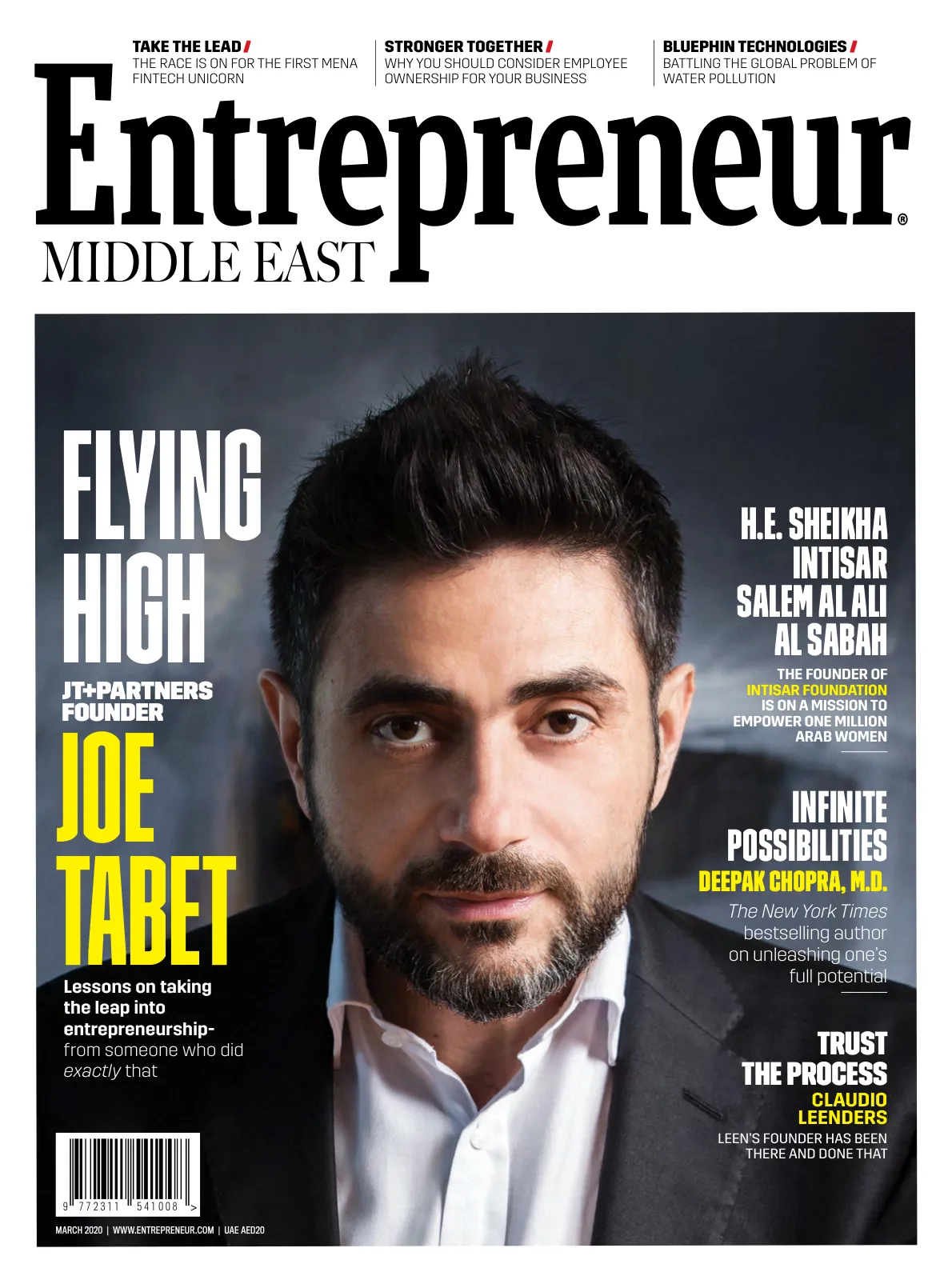
Entrepreneur Middle East, March 2020
Page 1
MARCH 2020 | WWW.ENTREPRENEUR.COM | UAE AED20
9
7 7 2 3 1 1
5 4 1 0 0 8
>
TAKE THE LEAD
THE RACE IS ON FOR THE FIRST MENA
FINTECH UNICORN
BLUEPHIN TECHNOLOGIES
BATTLING THE GLOBAL PROBLEM OF
WATER POLLUTION
STRONGER TOGETHER
WHY YOU SHOULD CONSIDER EMPLOYEE
OWNERSHIP FOR YOUR BUSINESS
FLYING
HIGH
JT+PARTNERS
FOUNDER JOE TABET
Lessons on taking
the leap into
entrepreneurship-
from someone who did
exactly that
INFINITE
POSSIBILITIES
DEEPAK CHOPRA, M.D.
The New York Times
bestselling author
on unleashing one’s
full potential
H.E. SHEIKHA
INTISAR
SALEM AL ALI
AL SABAH
THE FOUNDER OF
INTISAR FOUNDATION
IS ON A MISSION TO
EMPOWER ONE MILLION
ARAB WOMEN
LEEN’S FOUNDER HAS BEEN
THERE AND DONE THAT
CLAUDIO
LEENDERS
TRUST
THE PROCESS
Page 2
experience
downtown
living
The UAE’s most exciting new destination.
A journey of discovery for the whole family.
Where nature, fun and entertainment
come together.
800-Arada (27232)
arada.com
Page 3
3
March 2020 / ENTREPRENEUR.COM /
20
CONTENTS MARCH 2020
20
INNOVATOR
FLYING HIGH
JT+Partners founder
Joe Tabet
Lessons on taking the leap
into entrepreneurship-
from someone who did
exactly that.
26
INNOVATOR
MAKING CHANGE HAPPEN
H.E. Shikha Intisar Salem Al
Ali Al Sabah
The founder of the Intisar
Foundation -who is also
a princess of the Kuwaiti
royal family and a serial
entrepreneur- is on a
mission to empower one
million Arab women.
56
START IT UP
ECOSYSTEM
Driven by demand
Antonio Gonzalez of the
Sunset Hospitality Group
looks at how Saudi Arabi’s
F&B sector is all set to lead
in the Middle East market
segment.
60
START IT UP
ECOSYSTEM
The unwritten rules of the
MENA’s education sector
BBD’s Shaun Robison
highlights that to succeed in
this industry in the region,
you need to focus on creating
professional here, rather
than just importing it.
44
CULTURE
TRAVEL
Experience matters
Need a location to stage
your next corporate do?
Monte-Carlo Société des
Bains de Mer invites you to
check out Monaco.
30
CULTURE
LIFE
Infinite possibilities
New York Times
bestselling author
Deepak Chopra, M.D.,
on unleashing one’s full
potential.
76 BluePhin Technologies
Joe Tabet,
founder, JT+Partners
Page 4
du.ae/business-pos
Your window to expand.
Introducing Business POS for
cashless payments with better
transaction rates.
Page 5
Page 6
Page 7
Page 8
Page 9
Page 10
Page 11
Page 12
12 / ENTREPRENEUR.COM / March 2020
26
CONTENTS MARCH 2020
H.E. Sheikha Intisar
Salem Al Ali Al Sabah
50 Claudio Leenders, founder of the UAE-based F&B concept, Leen’s
76
START IT UP
Q&A
Taking out the trash
Cleantech startup BluePhin
Technologies has trained
its sights on battling the
global problem of water
pollution.
70
START IT UP
ECOSYSTEM
Getting around
Qafila co-founder Atif
Rafiq gives a how-to on
setting up logistics for a
startup in the UAE.
62
‘TREPONOMICS
PRO
Building the entrepreneurs
of tomorrow
A look at the role schools
can (and need to) play in
putting children on the
path to building success.
40
TECH
SHINY
#TamTalksTech
Gadgets and doodads
that you might’ve missed
out on, sourced by a tech
aficionado.
68
‘TREPONOMICS
PRO
Stronger together
Steve Kemp of Emperor on
why you should consider
employee ownership for
your business.
74
CULTURE
DESIGN
In tune with the times
Mirdoec General Manager
Michael Khoury on leading
a family business that’s
currently in its third
generation.
54
FRANCHISE
Beyond borders
Manhal Naser, co-
founder and CEO of AWJ
Investments, gives a how-to
on taking a homegrown
Middle Eastern brand into
Western markets.
80
CULTURE
LIFE
Experience is the best
teacher
Ayman Alashkar reflects on
how to make successes out
of your failures.
42
CULTURE
TRAPPINGS
‘Trep gear
The executive selection
for the entrepreneur
on your list that has
everything. Okay, maybe
for a little self-reward as
well.
64
START IT UP
ECOSYSTEM
The race is on for the first
fintech unicorn to emerge
out of the Middle East and
Africa region, says NOW
Money’s Ian Dillon.
Page 13
Page 14
14 / ENTREPRENEUR.COM / March 2020
SUBSCRIBE
Contact subscriptions@bncpublishing.net to receive
Entrepreneur Middle East every issue
EDITOR IN CHIEF Aby Sam Thomas editor@bncpublishing.net
CEO Wissam Younane wissam@bncpublishing.net
DIRECTOR Rabih Najm rabih@bncpublishing.net
CREATIVE LEAD Odette Kahwagi
MANAGING EDITOR Tamara Pupic
STARTUPS SECTION EDITOR Pamella de Leon
GROUP SALES DIRECTOR – B2B GROUP Joaquim D’Costa
COLUMNIST Tamara Clarke
PO Box 502511 Dubai, United Arab Emirates
P +971 4 4200 506 | F +971 4 4200 196
For all commercial enquiries related to Entrepreneur Middle East
contact sales@bncpublishing.net
All rights reserved 2020.
Opinions expressed are solely those of the contributors.
Entrepreneur Middle East and all subsidiary publications in the
MENA region are officially licensed exclusively to BNC Publishing
in the MENA region by Entrepreneur Media Inc.
No part of this magazine may be reproduced or transmitted in any
form or by any means without written permission of the publisher.
Printed by United Printing and Publishing
upp.ae
Images used in Entrepreneur Middle East are credited when necessary. Attributed use of
copyrighted images with permission. All images not credited otherwise Shutterstock.
CONTRIBUTORS
entrepreneur.com/me
ACCESS FRESH CONTENT DAILY ON OUR WEBSITE!
MIDDLE EAST
EntMagazineME
@EntMagazineME
Entrepreneur-me
EntrepreneurMiddleEast
EntMagazineME
EntMagazineME
EntMagazineME
MIDDLE EAST
In addition to our print edition, we’re bringing
you all sorts of industry news on our web
mediums. Joining us online means getting
relevant business and startup content in
real-time, so you’re hearing about the latest
developments as soon as we do. We’re looking
forward to interacting with our readers on all of
our social media and web platforms- like any
thriving business, we’re looking to give and take.
#TrepTalkME is already happening on all of our
digi platforms, and all good conversations go
both ways. See you on the web!
Peter Abualzolof
Laith Al-Qasem
Danielle Blizzard
Fida Chaaban
Ian Dillon
Stephen George
Alex Gheordanescu
Youssef Haidar
Sabine Holl
Sarah Jones
Dipika Mallya
Priyanka Mittal
Roxana Mohammadian-Molina
Mihaela Nina
Bianca Riley
Gary Sweeney
Hanna VanKuiken
Youness Yaghcha
Page 15
Page 16
16 / ENTREPRENEUR.COM / March 2020
N
o good deed goes
unpunished.” It was
this aphorism that
came to my mind
when I found myself
receiving what I
perceived to be a
pointed (and bor-
derline rude) email
from someone who was following up
on a favor I had promised them. To
be fair to them, I had got delayed on
the timeline I had in mind to do what
I was supposed to do- this was, how-
ever, not because I had forgotten or
disregarded their needs, it was simply
because an unexpected truckload of
work came my way that required my
urgent attention, and so, I had to push
the not-so-critical tasks on my plate
to the wayside, at least for a bit. How-
ever, the person who was following
up with me didn’t know that this was
what was happening on my side of the
equation, but their blithe ignorance
didn’t stop them from taking on what I
perceived to be an entitled, demanding
tone in their message asking me for a
status update of sorts.
Let it be noted here that this person
was essentially a stranger to me- I had
come across them quite by chance at
an event, and having been impressed
by their energy and enthusiasm, I
thought it wouldn’t hurt me to do
something that’d potentially give them
and their business a boost. So, you can
perhaps understand my chagrin when,
at the end of a particularly long and
busy day in the office, I come home to
open this email from someone I barely
knew not just being rather critical
about my work ethic, but also making
assumptions about (and blatantly dis-
counting) what I’ve do in my job on a
day-to-day basis. I started to type out
a reply on my phone with a fury that
matched the feelings I had in mind for
this particular person, while also ruing
the moment I made the decision to try
to support them in the first place.
Now, I might have gone ahead and
actually sent that rage-fueled reply,
had it not been for a lesson I learned
quite early on in my career, which was
to never send an email when you’re
angry. So, I did a quick re-read of what
I had written while my finger hovered
over the “send” button, and those
few seconds helped better sense to
prevail over me, in that I decided to
wait until the next morning to send a
reply. Doing this helped me come to
a realization: while I may have had a
valid reason to be angry, that didn’t
excuse me responding badly to them
either- if I did, I’d have been behaving
in the same annoying manner as my
counterpart. After all, they had made
suppositions about my circumstances
and intentions- it’d be silly for me to
do the same with them.
The next morning, after having suit-
ably calmed down, the email I ended
up sending to them had none of the
ire contained in the draft I had crafted
the night before, and while I made it
clear that I didn’t appreciate the tone
they had used, my reply to them was
still polite and professional. I got a
response to this message a few days
later- they confessed that they had had
a frustrating day of their own when
they sent that problematic email, and
given what I had gone through myself,
it was easy enough for me to under-
stand why they had followed up with
me in this annoying manner. The only
difference was that I hit pause before
acting on my anger, and rethought
what I going to do.
The point of sharing this whole
exploit is to reinforce a point that I
had laid out at the start of this year,
which is, to be put it quite simply, get
some perspective. Be it a rude email
to someone you know, or a snide com-
ment about a person you just met,
or even just a nasty tweet about an
individual you know really nothing
about, it’s somehow become easier
for all of us to behave badly, when it’s
clear that the better thing to do (and
maybe that’s why it is so tough) is to
showcase some empathy, and simply
think before you spew out negativity
(and accusations). After all, one never
knows what someone else is going
through in a personal capacity, and as
such, it’s well within our interest to
make sure all of our interactions are
kind. At the end of the day, it’s simply
the nicer thing to do.
EDITOR'S NOTE
Aby Sam Thomas
Editor in Chief
@thisisaby
aby@bncpublishing.net
THINK BEFORE YOU HIT THE SEND BUTTON
Perspective is everything
Page 17
BOREDOM IS
PROHIBITED
ROOFTOP SWIMMING AND
TABLE TENNIS WINNING.
NOW OPEN AT DUBAI DIGITAL PARK.
RADISSONHOTELS.COM/RED
FUN COMES
GUARANTEED
YOU DECIDE WHEN THE PARTY
STOPS WITH 24HR FOOD & DRINK.
NOW OPEN AT DUBAI DIGITAL PARK.
RADISSONHOTELS.COM/RED
Page 18
18 / ENTREPRENEUR.COM / March 2020
HE Majid Saif Al Ghurair during the launch of Emirati Development Programme
Dubai Startup Hub launches new Emirati
Development Program for UAE nationals to take
advantage of the private sector
CAPITALIZING ON OPPORTUNITIES
UAE Ministry Of Health And
Prevention launches BE BOLD
Youth Leadership Program
Shape the future
of healthcare
IMAGE COURTESY DSH
IN THE LOOP
T
he UAE Ministry of Health and Preven-
tion (MoHAP) has launched BE BOLD,
a new youth leadership program that
seeks to engage young healthcare profes-
sionals in the country in contributing to the
evolution of the industry.
Built in partnership with Entrepreneur
Middle East, the 15-week BE BOLD program
was unveiled in February as one of the
initiatives MoHAP is spearheading to mark
this year’s UAE Innovation Month, while also
paying tribute to the UAE leadership declaring
2020 as “the year of getting ready for the
UAE’s 50th anniversary.”
Open to UAE nationals and residents under
the age of 35 that work in the healthcare
sector, BE BOLD will, besides aiming to
develop their innovative ideas and concepts
for this industry, also seek to bolster their
individual personalities and skillsets with a
variety of indoor and outdoor activities.
With the initiative inviting applications that
showcase bring about innovations in four
areas of note within the healthcare industry
(cardiovascular diseases, mental health,
childhood obesity, and geriatric care), BE
BOLD promises the individuals who complete
the program the chance for their projects
and solutions to be incubated by MOHAP on a
long-term level.
With the program including everything from
expert sessions that will teach you a variety
of business concepts, to one-of-a-kind
experiences that are designed to get you to
push your personal limits, BE BOLD is aimed
at those who want to get out of their comfort
zones—head to the website and apply if
you’re one of them. beboldme.com
D
ubai Startup Hub, the en-
trepreneurship arm of Dubai
Chamber, has launched a new
Emirati Development Program that
aims to increase participation of
Emirati youth in the private sector,
whether that involves launching
their own business or join a private
sector startup.
Continuing with its strategy to build
the entrepreneurial landscape of the
Emirate, Dubai Chamber said in a
statement that it aims to draw on
the program to identify new talent
amongst the Emirati community,
and give them the tools and skills to
seize a commercial opportunity.
Speaking at the program’s launch,
H.E. Majid Saif Al Ghurair, Chair-
man of Dubai Chamber, said: “The
Emirati Development Program will
play a key role in diversifying the
scope of support, as it is designed
to identify, develop and mentor
promising UAE national talent, to
equip them with practical business
knowledge and entrepreneurship
experience needed to stimulate their
interest in the private sector.”
H.E. Al Ghurair added that the
Dubai Startup Hub has been in-
strumental in providing guidance
and clarity to entrepreneurs in
their journey, and plays a vital role
in encouraging entrepreneurs and
supporting the ecosystem. Since its
inception, more than 3,000 startups
have joined the Hub, while more
than 7,000 startups have benefited
from its various programs such as
Market Access, Co-Founder Dubai,
and the Dubai Smartprenuer Com-
petition.
The launch event for the Emirati
Development Program also wit-
nessed the announcement of the
first initiative, the Training and
Mentorship Academy, in col-
laboration with Dubai Technology
Entrepreneur Campus, a wholly-
owned entity by Dubai Silicon Oasis
Authority. The Academy will offer a
one-of-its-kind four-week training
program with top industry trainers,
covering topics such as business
canvassing, product validation,
go-to-market, sales, and pitching.
Applications are now invited for the
Program, following which The Acad-
emy will select 30 participants, who
will receive guidance and mentoring
in honing their skills. dubaicham-
ber.com/dubaistartuphub/emirati-
development-programme
Page 19
110 rooms and suites with 100 stories. Visit us and create your own.
NE W
E XPERIENCES
—
NE W BLU
—
r a d i s s o n h o t e l s . c o m / b l u
BOOK NOW
+966 11 297 9400
Page 20
20 / ENTREPRENEUR.COM / March 2020
TAPPING INTO TRENDS | DECODING THE NEW WORKPLACE DRESS CODE
FLYING
HIGH
JT+PARTNERS FOUNDER
JOE TABET
Lessons on taking the leap into
entrepreneurship- from someone who
did exactly that by TAMARA PUPIC
IMAGES COURTESY JT+PARTNERS
INNOVATOR
20 / ENTREPRENEUR.COM / March 2020
Page 21
21
March 2020 / ENTREPRENEUR.COM /
J
oe Tabet fidgets in his
armchair as he recalls
a vivid moment in his
past when he was sealing
envelopes –75 of them, to
be precise– in front of an
Emirates Post branch in
Dubai. The year is 2002,
and the 20-something
Tabet was sending his
professional bio to 75
addresses of architecture
and design firms across
the UAE. Having just
arrived from Lebanon, he
remembers having only US$500 to his name.
“A local man who worked there told me, ‘Son,
I see that you are searching for a job, and that
you are eager to find a job, and you will, for
sure, get a job with what you have in your
hands,’” Tabet says. “Then, I started receiving
phone calls, but I said that I didn’t leave
my family and my country to get just any
experience, but that I needed to get the right
experience. I chose an international company
with the lowest salary I had ever had, because
I was able to see what I needed to start with,
in order to fly later on.” And Tabet’s career
has certainly taken wing since then- today,
Tabet is the founder of JT+Partners, a
multidisciplinary consultancy in architecture,
master planning and integrated design
practices with three offices –Dubai, Abu
Dhabi, and Beirut– and projects around the
world, from Morocco to Seychelles, from
India and Sri Lanka to Portugal, from Greece
to the whole of Middle East and many African
countries. Tabet looks to be in good spirits
when mentioning his 70-person team, who he
credits as have the driving force in increasing
JT & Partners’s revenue more than six times
since launching the company in 2015. “All
this has been created in just five years,” Tabet
says, his humility allowing him to showcase
only a tiny bit of the pride that he must
actually feel.
As I sit with Tabet in a conference room at
JT+Partners’ office in Dubai, I can only imag-
ine the range of thoughts and emotions that
might be coursing through him as he takes
me through his career trajectory. His story
starts with him spending 12 years at Atkins,
a UK-headquartered architectural design,
engineering and project management con-
sultancy- that’s the amount of time it took
for that young man with 75 envelopes climb
to the position of Regional Director for the
Middle East at that company. “It was a boom
in Dubai [in 2002], and we were very lucky
at that time because, as architects, we got to
experience building a city from scratch,” Ta-
bet remembers. “It was a blank urban fabric,
an open desert, and we, architects, came with
our creativity (and our ego, which you need
to be careful with in case it starts affecting
FLYING HIGH | JT+PARTNERS FOUNDER JOE TABET
Tawila main buiding,
by JT+Partners
“Nothing will happen
unless you do it
yourself. You need to be
ready, and you need to
be convinced. All these
things need to come in
place for you to move
on and come out of your
comfort zone.”
Page 22
22 / ENTREPRENEUR.COM / March 2020
IMAGES COURTESY INTISAR FOUNDATION
INNOVATOR
“We are creative people, and
we get damaged by negative
energy. The environment is very
important. That’s why our staff
turnover is very low.”
“MY MAIN CONCERN, EVERY DAY
AND EVERY NIGHT, IS THAT ON
THE 28TH OF EVERY MONTH,
I WILL PAY THE SALARIES. IN
SEPTEMBER LAST YEAR, WE
FELT THAT OUR BUSINESS WAS
SHAKING A LITTLE BIT, AND
NOBODY GOT A SALARY CUT
EXCEPT ME. THIS MEANS THAT
JT PARTNERS DOES NOT EXIST
WITHOUT THESE GUYS. IF MY
PEOPLE GROW, MY BUSINESS
WILL GROW TOO.”
The JT+Partners team
you and others), and got an
opportunity to work on many
big projects. Then the 2008
financial crisis happened, and
that was another type of ex
perience. We lived through a
boom, and now we had to live
through a recession. The crisis
pushed us to go internation
ally, so we looked at Pakistan,
India, Sri Lanka, Azerbaijan,
which gave us an understand
ing of how different cultures
look at architecture and de
sign. I am thankful for experi
encing these different things,
going up, then down, and then
up again, which means that I
have learnt some valuable les
sons. I believe that the reces
sion, merged together with my
personality and creativity, al
lowed me to reach a new level.”
During more than a decade at
Atkins, Tabet demonstrated
qualities that would serve him
well in entrepreneurship, chief
among them being his attitude
to always seek new opportu
nities. In line with that, he
today advises his employees
that “if I tell them that their
task is one, two, three, then
they should make four, five,
six by themselves.” Tabet also
radiates an air of honesty in
that he is not afraid to share
insights other people self
ishly keep quiet about. “One
of the things that pushed me
up quickly at Atkins was get
ting rid of my position, which
simply means delegating your
responsibilities to the people
below you,” he says. “They
will go up, and you will go up.
However, in corporations, you
will find the opposite. Ask
senior people to give their
responsibilities to the people
below them, and they won’t,
because they feel insecure.”
It is this self-conviction and
accurate perception that
made him sense when a time
to move on from Atkins had
come. Being 41 at the time,
he says, allowed him to make
a deal with himself- he could
try building a business for,
say, four years, and if it did
not work out, he would be 45,
and thus still able to go back
to the career he had already
had. Talking about the day he
decided to take the leap into
entrepreneurship, Tabet says,
“I woke up in the morning
and felt that something was
wrong. On the way to the of
fice, I called my mum, and she
told me on her own, ‘My son,
anything that bothers you in
life, just shut it out.” That was
in November 2014. I went to
the office, I was working, and
at about noon, I left every
thing, walked out of my office
straight to the CEO’s office,
and told him, ‘I believe that
today I’m going to resign.’ We
had 10 seconds of silence. He
asked me about other job of
fers, but I had none.”
Interestingly, Tabet does not
shy away from advising his
team to follow in his footsteps
when it comes to following
their personal goals and as
pirations. “I always tell them
that if you wake up in the
morning and you’re not happy
with where you’re going, just
resign,” he says. “Even if you
work for me, and I cannot
change something for you,
just leave. Go fly. We need to
challenge ourselves, and this
is the main problem that I see
around the region. People live
in their comfort zone finan
cially, and only few are chal
lenging themselves to move
up, become entrepreneurs,
or do something differently.
Nothing will happen unless
you do it yourself. You need
to be ready, and you need to
be convinced. All these things
need to come in place for you
to move on and come out of
your comfort zone.” Of course,
the world of a high-profile cor
porate executive in the UAE,
however, is rather different
from that of a startup founder,
and Tabet shares a joke –
which is funny despite it being
the actual truth– that after
having an assistant, a driver,
and 300 people on his team,
Page 23
23
March 2020 / ENTREPRENEUR.COM /
“FROM DAY ONE, WE TOOK THE UAE
AS A BASE, BECAUSE HAVING THE UAE
EXPERIENCE HAS MADE US AND OUR
CLIENTS CONFIDENT, BUT WE HAVE
SERVED THE WORLD FROM HERE. SO,
OUR FOCUS HAS BEEN ON THE OUTSIDE,
AND WHATEVER CAME FROM WITHIN
THE COUNTRY HAS BEEN A PLUS.”
Abu Dhabi Island Resort,
by JT+Partners
Hampton by Hilton Resort,
by JT+Partners
FLYING HIGH | JT+PARTNERS FOUNDER JOE TABET
the first thing he struggled to do when he
ventured forth into the unknown was to
pay his electricity bill. “That’s when you
know that you have been in your comfort
zone for too long,” he says, laughing.
“I remember that for my first project I
had to write a proposal, and I sat until
four o’clock in the morning googling and
researching because I had not done it be
fore, but my team. At that moment you
understand that you are useless, you are
nothing, without having a strong team.”
Emerging from the very first phase
of starting up a business unscathed is
hardly possible for anyone, and Tabet is
no exception. “We started working from
the lobbies of a couple of hotels, then we
got our office, and throughout all that
time, I was a tea boy, a PRO, an archi
tect, a lawyer, an accountant, and so on,”
he says. “That lasted for six months. I
gained a lot of weight and I looked like
I hadn’t slept for ages. I was looking at
the unforeseen, but there was something
from the background driving all this pas
sion and emotions. I was at the age when
you can take the risk blindly.” However,
it was a few crucial decisions he made
that would determine his strategy and
consequent business success. “When it
comes to hiring, I took a decision that
I wanted people who had never been in
the GCC before- I brought in new blood,”
Tabet says. “Then, one of the main chal
lenges was that clients used to tell me,
‘We know you as Joe Tabet at your pre
vious employer, but not as Joe Tabet at
JT+Partners.’ So, from day one, I decided
that my portfolio would not include my
previous work, so, we even did some free
projects, because we had to build our
portfolio step by step.”
But the most important decision Tabet
made was for JT+Partners to focus on
international projects from the start.
“I believe that’s what makes us strong
until this day,” he says. “From day one,
we took the UAE as a base, because hav
ing the UAE experience has made us and
our clients confident, but we have served
the world from here. So, our focus has
been on the outside, and whatever came
from within the country has been a plus.”
Today, his company’s roster of clientele
includes Abu Dhabi Crown Prince Court,
NCT&H, Al Ghurair, Al Marjan Island LLC,
Al Hamra Real Estate, Anwa Group, Giga
Group, Shalimar Group, Jumeirah Group,
Marriott Group, Hilton Group, EMAAR,
Aldar, Pennyroyal, and several others. >>>
Page 24
24 / ENTREPRENEUR.COM / March 2020
INNOVATOR
“ARCHITECTS NEED TO
CHANGE THEIR MINDSET.
WE HAVE TO WORK
TOGETHER AND SHARE
KNOWLEDGE INSTEAD OF
COMPETING, BECAUSE
VERY SOON TECHNOLOGY
WILL TAKE OVER US.”
“I believe that the recession,
merged together with my
personality and creativity,
allowed me to reach a new level.”
Joe Tabet,
founder, JT+Partners
Many of his clients, Tabet
says, cannot believe how much
JT+Partners has achieved in
just a few years. “It’s all about
the team, and it’s not about
the number of people that you
have, but their mentality, be
cause we eliminated negative
energy,” he explains. “I used
to be in a corporate business,
and I used to spend 60% of
my time managing politics, so
here, over the last four and a
half years, I’ve let go of peo
ple who didn’t fit into this.
We are creative people, and
we get damaged by negative
energy. The environment is
very important. That’s why
our staff turnover is very low.”
Tabet whisks me through the
JT+Partners office, showing
me the miniature models of
their latest projects, while the
staff type on their computers,
most of them with earphones
plugged in. “My main con
cern, every day and every
night, is that on the 28th of
every month, I will pay the
salaries,” Tabet whispers. “In
September last year, we felt
that our business was shak
ing a little bit, and nobody got
a salary cut except me. This
means that JT Partners does
not exist without these guys. If
my people grow, my business
will grow too.”
The last five years have been
challenging but constructive,
and now, he says, it’s all about
navigating the growth phase
of his business carefully. “We
have created a company that
has gone international, and
now competes with interna
tional names, and now, the
whole challenge is to keep it
up,” he says. “The way to do
it is to continue the strategy
that I have started which is,
‘don’t put all your eggs in
one basket.’ Unfortunately,
we all know that, and people
learnt it especially during the
recession, that not putting
all your eggs in one basket is
the solution, but then, when
the market picked up a little
bit in 2012, everybody went
to the same one basket again.
Then, in 2016, people started
panicking that ‘it was hap
pening again,’ and wanted
to go abroad again; however,
client relationships don’t get
built like that. It’s either you
stick to them both in the good
and the bad days, or you are
out. This is why I say that ar
chitects need to change their
mindset. We have to work
together and share knowl
edge instead of competing,
because very soon technol
ogy will take over us.” Giving
back to the community, Tabet
tells me firmly, is a must. A
moment later, he adds, “It’s
not allowed to any successful
entrepreneur not to give back
to the community in one way
or another. You’ve been given,
then you have to give back.
Then, you get more, and then
you need to give even more.”
Nothing more to add, nor to
ask- I couldn’t have asked Ta
bet for a better conclusion to
our interview than this.
Page 25
Page 26
26 / ENTREPRENEUR.COM / March 2020
INNOVATOR
H.E. Sheikha Intisar Salem
Al Ali Al Sabah
Page 27
27
March 2020 / ENTREPRENEUR.COM /
MAKING CHANGE HAPPEN
H.E. SHEIKHA INTISAR SALEM AL ALI AL SABAH
The founder of the Intisar Foundation -who is also a princess of the Kuwaiti royal
family and a serial entrepreneur- is on a mission to empower one million Arab women
MAKING CHANGE HAPPEN | H.E. SHEIKHA INTISAR SALEM AL ALI AL SABAH
H.E. Sheikha Intisar Salem Al Ali Al Sabah
by TAMARA PUPIC
>>>
G
lobally, one
common ste
reotype about
Arab women
is still preva
lent, which
is that they
are less likely
to be active
members of
society. How
ever, my hope
is that those of you who read Entrepre
neur Middle East know that this could not
be further from the truth. In Kuwait, for
instance, female citizens outnumber male
citizens in the workforce. Last year, the
country appointed three women among
the eight new ministers in Kuwait’s lat
est cabinet, one of them being the first
woman to hold the post of finance min
ister in a Gulf state. Indeed, when I talk
with H.E. Sheikha Intisar Salem Al Ali
Al Sabah, a princess of Kuwait’s ruling
royal family, the House of Al Sabah, she
assures me that Kuwaiti women have had
greater economic independence and a
voice in domestic and international affairs
ever since the 1950s. Al Sabah herself
is sufficient proof of that. After being a
full-time mother to her four daughters,
Al Sabah was 35 when she decided to test
the waters in the business environment by
taking up a board position at Refrigeration
Industries and Storage Company SAK,
her family business, and one of the first
air-conditioning companies in the Gulf. “I
realized that I didn’t like being idle,” she
says. “I used to read a lot, and attend a lot
of training courses, so I was not the usual
kind of a non-working mother sitting in
coffee shops. For that kind of person, it
was easy to transition to business. How
ever, I didn’t have experience, and there
was nothing I could compare it to, so the
hardest part was knowing how well I was
actually doing, know
ing my value.”
Over the next eight
years, she climbed
the corporate lad
der to become the
Chairwoman and
Managing Director of
the company, having
fully restructured
the business that
had been through the
torture of overdraft,
loans, and “lots of
open projects with
lots of problems.”
Al Sabah adds, “I did a lot, but I had
always thought that it was not enough,
and that I should do more. My biggest
challenge was how to motivate the team,
especially men, how to push and challenge
them when I was inexperienced- or so I
thought. Then, I would see male manag
ers who did one thing a day, and that was
enough for them. I used to get very angry.
Why were they doing so little? That was
when I realized that my criteria of what
work was and theirs was completely differ
ent. My criteria have always been that, if
you will do only one thing, then you have
to do it really well to be happy with it.”
Page 28
28 / ENTREPRENEUR.COM / March 2020
INNOVATOR
“We did change the face of the magazines in the Arab
world, and how they addressed women, and how female
celebrities were portrayed in Arabic magazines.”
The Intisar Foundation team
IMAGES COURTESY INTISAR FOUNDATION
Drama Therapy session
In 2011, Al Sabah says, it started to dawn
on her that, although she was doing the
work, she was not making a real differ
ence in the world at large. “After cleaning
up the mess, I realized that that this
business was not what I wanted to do
until the rest of my life,” she says. “It did
not bring me pleasure. I liked the chal
lenge, because, to me, life is like a puzzle,
and you have to know where to put each
piece, and check whether and how it
fits. So, in that case, I liked the energy
of getting things done, but my passion
was dying.” That was when she launched
Lulua Publishing, a Kuwait-based media
house whose publications were aimed at
enhancing people’s mental and physi
cal well-being. With the motto “You,
but simply better,” Lulua Publishing’s
portfolio included Good Health Arabia,
a monthly magazine promoting optimal
health and wellbeing for women and
families, and Vacations & Travel Arabia,
a quarterly magazine dedicated to pas
sionate travelers. “We did change the
face of the magazines in the Arab world,
and how they addressed women, and how
female celebrities were portrayed in Ar
abic magazines,” Al Sabah says, noting
how Lulua Publishing stood out in the
market. “It used to be mostly about fash
ion, beauty, and gossip. We would not
have sexualized women on the cover. We
would have a celebrity looking sensual
but not sexy. To me, all of that was very
disempowering to women. Women in the
Gulf are extremely educated, and to dim
them down with those topics, was simply
unacceptable for me.”
In 2012, Lulua Publishing released
The Alchemy of Wisdom, a book that
celebrated the
achievements
of 48 inspira
tional Kuwaitis,
and, recently, Al
Sabah published
Circle of Love,
which had 87
prominent,
powerful, and
resilient women
from all over the
world share their
personal stories
and insights
for other women to learn from. All the
proceeds from the book go to Al Sabah’s
Intisar Foundation for women affected
by war. Before we delve into more details
about her work with the foundation, it
is worth also noting other businesses Al
Sabah has initiated, including Prismolo
gie, a mood-enhancing beauty brand she
launched in 2015 with her daughter H.E.
Sheikha Fatima Al Sabah, to help people
manage daily stresses with color therapy.
In 2017, she launched Intisars, a luxury
jewelry brand whose pieces she describes
as “meaningful reminders of love”. Al
Sabah explains, “50% of proceeds from
Intisars go to the Intisar Foundation. I
realized that women like giving, but after
a while you get tired of giving. Charity
can be depleting for many reasons, so I
thought of making consumerism, which
is considered toxic, good. It’s not charity.
It makes both the buyer and the recipi
ent happy. In addition to the donations
that we receive, we are also trying to
sustain the Intisar Foundation by having
products to sell.”
Al Sabah has also been an active
member of the Kuwait Association of the
Care of Children in Hospitals; however,
her main contribution to women and the
Kuwaiti society comes from Alnowair,
the first GCC non-profit committed
to spreading a positive attitude that
she launched in 2013, and the Intisar
Foundation. Since 2017, the founda
tion has been cooperating with NGOs
in Jordan and Lebanon to offer drama
therapy to women affected by war and
female victims of violence. “It wasn’t
only drama therapy in the beginning,
but performing psychological interven
tions through programs in both art and
drama therapy, then we dropped the
Page 29
29
March 2020 / ENTREPRENEUR.COM /
H.E. Sheikha Intisar Salem Al Ali Al Sabah
“What we have realized
is that women support
women economically,
emotionally, and
regarding their families.
Therefore, one of our main
success is in creating
those support groups.”
MAKING CHANGE HAPPEN | H.E. SHEIKHA INTISAR SALEM AL ALI AL SABAH
art, and continued with drama therapy,”
Al Sabah says. “We sustain the amaz
ing effect on the women we are training
because, firstly, we give them the right
number of hours per week, which is three
hours over 16 weeks. This is intense
training. After that, it’s once a month for
three hours over a year, and, at the same
time, we keep them in a group of other
supporting women who have done the
program. What we have realized is that
women support women economically,
emotionally, and regarding their families.
Therefore, one of our main success is in
creating those support groups.”
It is obvious that Al Sabah is focused on
results, which can be seen in her choice
of this particular kind of therapy. “It is a
very transformational therapy, because
it encompasses public speaking, acting,
psychology, play, art, all in one,” she says.
“It’s not linear while other therapies are,
and it empowers people of both genders.”
This also ties into the 20-year goal she
has laid for her foundation, which is “to
reach one million Arab women.” To do
that, the Intisar Foundation team has
devised the right strategy- establishing a
master's curriculum in drama therapy in
regional universities, in order to increase
the number of drama therapists in the
Arab world. In 20 years, Al Sabah hopes
that this will lead to the presence of
more than 600 active drama therapists
and facilitators in the Arab world, who
will, in turn pass on the lessons to other
women across the region.
My conversation with Al Sabah ends
with her sharing a piece of advice for
women in the region and beyond, espe
cially those that run businesses. “We
tend to take life seriously when we are
not happy, but do put some music on
and dance,” she says. “It is scientifically
proven that music and dancing relieve
stress, anxiety, and sadness, because
those [feelings] build up in the body and
mind, and make us rigid. Have you ever
been able to let go when you were not
having fun? Never. If you are sad and
stay at home and cry, you can cry for the
next ten years, it will not make you feel
any better. See a friend, laugh, watch a
comedy, dance, play with children- do
something to take the seriousness out of
your mind.”
Page 30
30 / ENTREPRENEUR.COM / March 2020
CULTURE LIFE
Page 31
31
March 2020 / ENTREPRENEUR.COM /
INFINITE
POSSIBILITIES
DEEPAK CHOPRA, M.D.
The New York Times bestselling author on unleashing one’s full potential
by TAMARA PUPIC
INFINITE POSSIBILITIES | DEEPAK CHOPRA, M.D.
>>>
Chopra certainly knows a thing
or two about creativity- he is
known as a world-renowned pio
neer in integrative medicine and
personal transformation, but he
is also a successful entrepreneur
in his own right, having founded
The Chopra Foundation, a non-
profit entity for research on well-
being and humanitarianism, and
Chopra Global, a modern-day
health company at the intersec
tion of science and spirituality.
Since entrepreneurship involves
risk, he says it is crucial for
entrepreneurs to understand
“what the cultural mind is look
ing for at the moment.” By way
of example, Chopra mentions the
evolution he has witnessed in
his own field. He says, “I’ve seen
the shift from the industrial age
to the information age, and now
to the whole tech revolution,
and what I’ve found, at least in
my field right now, is that the
focus has moved from treating,
to preventing the disease, and
to also understanding that a lot
that happens in our life is totally
influenced by our daily choices.”
In line with this sentiment,
his interactions with students
as a clinical professor of family
medicine and public health at
the University of California, San
Diego, as well as his work as
a senior scientist with Gallup
Organization, lead him to advise
entrepreneurs to keep an eye on
today’s technological revolutions
in different fields, such as artifi
cial intelligence, virtual reality,
brain and cardiac bio feedback,
genetics, and so on. “These are
very important fields which have
huge implications for society,
and unless you look at what
society needs at this moment,
you are a blind entrepreneur,”
he declares. “You now have kids
who are what we call digital na
tives, so when I’m looking at the
future, I assume that the cultural
mind is looking for things like
peace, conflict resolution, help,
well-being, sustainability, social,
and economic justice. So, you
can have a great idea, but it can
fizzle out if you haven’t asked
yourself about its relevance in to
day’s ecosystem of relationships.”
Another piece of advice Chopra
shares is not to start a busi
ness with an exit plan in mind.
“That’s what entrepreneurs are
W
hat I like about the UAE is the diversity of cultures, talent,
technology, and opinions,” Deepak Chopra, M.D., tells me, as
I speak with the renowned doctor, thought leader, and New
York Times bestselling author on the sidelines of the Milken
Institute’s Middle East and Africa Summit in Abu Dhabi in
February. “Those are the ingredients of creativity. If you want creativity, you
have to have the maximum diversity in every area, science, technology, art,
sport, and so on, and you have to be able to see what is the need of society of
today, and then to come up with something that will be a catalyst for that.”
Page 32
32 / ENTREPRENEUR.COM / March 2020
CULTURE LIFE
“The quality of life,
according to everything
that we know from social
sciences, is that financial
success maybe adds 10%
to 12% to your experience
of happiness in life.”
DEEPAK CHOPRA PHOTO BY MICHAEL ALLEN | IMAGES COURTESY DEEPAK CHOPRA
[often] doing all the time,” Chopra adds.
“You should start a business because you
want to build something long-term, not
only for your generation, but for the next
one, and the one after that. If you are of
that mindset, you are not in a hurry to
scale, but to refine, improve, improvize,
until you think that it is perfect. As the
saying goes, ‘you build it, and people will
come,’ so you should not worry about
people while you are building it.”
However, today, we do live in a high-
performance culture, and Chopra agrees
that “performance anxiety is the biggest
source of stress in the world, particularly
in the business world.” While people are
more prone to opening up on their mental
health struggles these days, the major-
ity of symptoms are still hard to identify
and mitigate; yet, many are clear that
the pressures of business and workplace
performance are one of the main stressors.
In its recent study, the Anxiety and De-
pression Association of America pointed
out to deadlines (55%), interpersonal
relationships (53%), and staff manage-
ment (50%) as the biggest culprits. One
solution, Chopra says, is in re-evaluating
the whole premise that success leads to
happiness and fulfillment. “If your moti-
vation is to make money, in order to make
more money, in order to make even more
money, then you are like a bank teller, and
you don’t enjoy that money,” he says. “You
have to ask yourself what quality of life
you want. The quality of life, according
to everything that we know from social
sciences, is that financial success maybe
adds 10% to 12% to your experience of
happiness in life.”
The rest, Chopra explains, is deter-
mined by big values that drive humans
in the long-term, such as one’s attitude,
relationships, meaning, purpose, and so
on. “Short-term thinking ultimately leads
to catastrophe, even if you are success-
ful, because you have to ask yourself, ‘If
I’m extremely successful in making a lot
of money, does that guarantee that I will
be happy?’” he says. “The answer is that
it does not. You’ll be ecstatic for the first
six months, and after that you’ll return to
your baseline, and in five years, you’ll be
even more miserable, worrying about the
taxes and stock market. That’s collective
insanity.”
I zoom in now on one of Chopra’s criteria
for happiness, i.e. the quality of today’s
human connections, and I ask him why
people struggle with establishing and
maintaining harmonious relationships.
“The quality of your relationship is a
reflection of your intimacy and under-
standing of yourself,” he says. “Every
relationship, be it good or bad, reflects an
aspect of yourself. It’s very difficult for
people to come to terms with the fact that
both the people you fall in love with and
the people you despise are the mirrors of
yourself. You fall in love with people who
have qualities which you want, and you
despise people who have qualities which
you deny in yourself. If you could honestly
look at the mirror, there would never be a
problem with any relationship.”
This focus on the relationship aspect
of life achievements is important for
entrepreneurs, especially when you
consider the famous research of Harvard
Business School professor Noam Wasser-
man, who found that 65% of startups fail
as a result of co-founder conflict. “They
(co-founders) found each other to learn
something from each other,” Chopra says.
“Before you even start a relationship, you
need to ask yourself whether that person
is a reflection of you, so you need to work
on yourself first. It’s interesting that
the more you look at yourself, the more
you will find contradiction, ambiguity,
paradox, and confusion. That’s okay if you
are honest with yourself, because that’s
the basis of creativity. Everyone who is
100% convinced in what they know has
no creativity. The first thing to understand
is that the nature of human consciousness
is contradiction, paradox, and ambiguity,
and that’s the seed for any creativity and
honesty in your relationships.”
Chopra’s latest book, Metahuman:
Unleashing Your Infinite Potential offers
a 31-day guide for moving beyond one’s
present mental and physical limitations.
“Every mind is conditioned by history,
economics, culture, nationality, and every-
thing that has happened,” he explains.
“In a way, it’s good because it gives you
an identity, but it’s a provisional identity,
and there’s nothing permanent about it.
What’s behind the conditioned mind is
the creative mind, so Metahuman is about
how to tap into the insight, creativity,
vision, higher calling, transcendence, and
Page 33
33
March 2020 / ENTREPRENEUR.COM /
INFINITE POSSIBILITIES | DEEPAK CHOPRA, M.D.
"YOU CAN HAVE A GREAT
IDEA, BUT IT CAN FIZZLE
OUT IF YOU HAVEN’T
ASKED YOURSELF
ABOUT ITS RELEVANCE
IN TODAY’S ECOSYSTEM
OF RELATIONSHIPS.”
Deepak Chopra
going beyond the fear of death.
The reason is that everything
that we call normal today
is actually the hypnosis of
cultural conditioning. If you go
beyond that, you have infinite
possibilities.”
A part of that vision to
transform human conciseness
is also in his other project,
Digital Deepak, an artificial
intelligence product that’s
built based off his writings
and teachings. “Digital Deepak
is, basically, a personal coach
which, theoretically, can speak
to seven billion people one-to-
one,” Chopra says. “You can
ask Digital Deepak different
questions, because he has read
all my 90 books and articles.
He also has access to a digital
library I’ve built, a digital
equivalent of the library in
Alexandria, which has been
evolving over the last five
years. It’s not my work, but of
our collective intelligence, and
I will make it available through
Digital Deepak. And with every
interaction, he grows, like a
child. It really is the culmina-
tion of all my work, but it is
not a passive entity, it learns
from every interaction and
grows like any other human
being. One day, it will be able
to speak to the grandchildren
of my grandchildren, they can
learn from him, but he can
also learn from them, and who
knows where this will go.”
And if Chopra’s career so far
is a measure of one’s poten-
tial, there really is no limit to
where things can go.
Page 34
34 / ENTREPRENEUR.COM / March 2020
PROJECT MAJI FOUNDER SUNIL LALVANI
IS TACKLING WATER SCARCITY ACROSS RURAL
SUB-SAHARAN AFRICA WITH A STRATEGIC
(AND EFFECTIVE) BUSINESS APPROACH
INNOVATOR
CHANGING
THE PARADIGM
by TAMARA PUPIC
W
e are all creatures of habit, especially when it comes to
dealing with problems. Some people repeat conscious or
unconscious patterns of creating problems, others are
good at avoiding or grappling with issues that appear in
their lives and businesses, and there are also a few that
have unique innate instincts for solving whatever might come their
way. The latter springs to my mind as I listen to Sunil Lalvani, founder
of Project Maji, a Dubai-based social enterprise that deploys solar-
pumping technology across sub-Saharan Africa to provide sustainable
clean water access to rural communities.
IMAGES COURTESY PROJECT MAJI
Sunil Lalvani, founder, Project Maji
Lalvani tells me that it was in 2014, when
he witnessed Ghanaian children collecting
dirty water from roadside puddles, that he
took take a career-changing (and indeed,
life-changing) decision for himself. That
was when, after two decades at his family’s
electronics business, Binatone, Lalvani de-
cided to look into why 785 million people
-as per the Joint Monitoring Program for
Water Supply and Sanitation by WHO and
UNICEF- lack access to a basic drinking
water source. This part of the story saw
us talking about the United Nations’ 2030
Agenda for Sustainable Development,
and particularly about Goal 6 (ending the
global water crisis and reaching everyone
with clean water, sanitation and hygiene)
of its 17 Sustainable Development Goals
(SDGs). I have learnt that the World Bank
estimates that achieving the Goal 6 targets
is expected to cost approximately US$114
billion a year until 2030, while the Official
Development Assistance, which is defined
by the Organization for Economic Co-op-
eration and Development as a government
aid that promotes and specifically targets
the economic development and welfare of
developing countries, allocates just a small
part of it- around $13 billion a year. In any
case, Lalvani assures me that “everybody
in this space knows that we’re not going
to get anywhere close to complete water
coverage by 2030,” and I get my first hint
Page 35
35
March 2020 / ENTREPRENEUR.COM /
CHANGING THE PARADIGM | PROJECT MAJI FOUNDER SUNIL LALVANI
of his problem-solving skills, with him not
mincing words when describing the issue,
and explaining what needs to be done to
overcome it.
“The problem, which I get very frustrat-
ed about, is that even the numbers that
get thrown around are wrong,” Lalvani
explains. “The UN says that we need tril-
lions of dollars every year for the next 10
years to solve the SDGs, and while I don’t
know about other SDGs, I know that the
water problem is solvable in our lifetime.
For that, we need the right business mod-
els and the right funding. There is huge
corruption in this space. I was in govern-
ment tenders in some countries, and
since our solution costs $15,000 and not
three times that, a government employee I
spoke to wasn’t even interested to ask the
next question, probably worried that we
would be taking a part of his income away.
So, the problem is not insurmountable,
it is solvable. Also, it’s not a technical
problem, but purely financial, and it has
to be approached in the right way.” So,
how has Lalvani arrived at a potential
solution? Firstly, he developed the Project
Maji solar-powered water kiosk, which
can be installed wherever underground
water is available. It is a cost-effective,
scalable, and measurable solution that
pumps 5,000 liters of water per day with
no electricity grid. In a nutshell, >>>
Page 36
36 / ENTREPRENEUR.COM / March 2020
INNOVATOR
“I was stuck between
friends and family who
wanted to donate but not to
invest, and investors who
wanted higher returns.”
Project Maji Kiosk
Lalvani’s approach was to (i) invest his
time, money, and expertise, (ii) reiterate
the solution as many times as needed, and
(iii) be unapologetic about the solution’s
high-quality standards, especially due to
the mission it is supposed to serve.
“I’m a huge believer in the minimum
viable product (MVP),” Lalvani explains.
“In December 2014, I got the first team
together to work on it in Dubai, and we
came up with an engineering masterpiece.
We built it, and it worked, but then we
realized that we had completely over-
engineered it, because we were sitting
in Dubai in a conference room. After our
team had gone to Africa, sat there, and ob-
served how people used it, we completely
re-engineered it, because we had to make
sure that it was affordable, but more than
anything, that it was completely reliable.
There’s no shortcut in terms of watch-
ing the customers, so we would sit in the
village, and watch people come up to our
kiosk, what time they were collecting
water, how much of it, and so on. That is
not a mindset that a non-governmental
organization (NGO) would have. My
father’s vision of quality first has been
drilled into me from day one, and although
in consumer electronics there have always
had to be some tradeoffs that are being
fixed by our service centers, with Project
Maji, when I’m providing water to a village
which is their life source, not one thing
can go wrong.”
In a little more than five years, Project
Maji has provided over 50,000 Ghanaians
and Kenyans with sustainable access to
safe drinking water, pumping over 90 mil-
lion liters per year in over 50 sites. For his
work, Lalvani has recently been awarded
the Mohammed Bin Rashid Al Maktoum
Global Water Award, and was also been
selected as one of the 14 honorees from
around the world for the 2020 Young
Presidents’ Organization’s Global Impact
Award. The Project Maji team targets
rural communities that have a maximum
of 1,000 people, because those are often
overlooked by governments and other
NGOs. However, Project Maji’s plans are
big, including scaling the program to ad-
ditional countries (starting with India this
year), and Lalvani’s vision is to reach one
million people by 2025. “In this space, I
saw two things that were wrong,” Lalvani
says. “One, people were still building
handpumps, which is an ancient technol-
ogy. We have no right to give villages a
handpump. Not only because it requires
a physical pumping, but because it is
Page 37
37
March 2020 / ENTREPRENEUR.COM /
CHANGING THE PARADIGM | PROJECT MAJI FOUNDER SUNIL LALVANI
PROJECTMAJI.ORG
>>>
hugely unreliable as any other mechanical
product. Even the best hand pump is going
to break. Then, if it breaks, they assume
that the village will fix it, but nobody goes
back and checks. People build schools or
hospitals and walk away. They don’t do it
with a bad heart, but also with no long-
term understanding of the problem. The
principle of building something and giving
it to the people in the area is good, but
these people need more help, guidance,
and support.”
The reason behind so many broken and
abandoned hand pumps across the African
continent lies in the fact that a tradi-
tional charity model is not well suited for
tackling this issue long-term. This brings
us to the second innovation Lalvani has
been trying to introduce in the non-profit
model. When it comes to the maintenance
costs for its kiosks, Project Maji operates
with an ongoing revenue stream, since
its business model encompasses working
with village communities to determine an
agreeable, nominal fee for the water via
mobile money. This provides each com-
munity with a secure maintenance fund,
while a built-in, remote monitoring sys-
tem ensures all Project Maji sites are truly
sustainable, with tangible and measurable
impact. “My original model was to raise
capital, build the sites, charge for the wa-
ter, and then, the money from the water
revenue would pay for the maintenance
costs, and repay the hardware cost over a
period of eight to 12 years,” Lalvani says.
“But I approached friends and family first,
and what was interesting was that a lot of
them came back saying that they did not
understand that ‘investment thing.’ They
would say, ‘What you’re doing should be
charity, no? I’ll give you money, but I’m
not sure about investing.’ Then, I went to
impact investors, and they all loved what
we were doing, but said that our financial
returns were not fantastic. However, we
sell water to villages, and we have to cap
our revenue, so there is a maximum that
we can sell, US$2 cents per liter, and
our revenue is capped. The fact that we
can make a return is actually really good,
but investors had to come with the right
mindset. So, I was stuck between friends
and family who wanted to donate but
not to invest, and investors who wanted
higher returns.”
Lalvani explains that his two main tar-
gets for seeking finance are family offices
and the private sector. Although there
is a growing number of family founda-
tions already engaged in impact investing
in some form (more than a quarter of
family foundations are now, according
to a 2019 Global Family Office report
from UBS and Campden Research), some
of those Lalvani has encountered could
be more flexible and innovative when
making investing decisions, he feels.
“I sat with some senior bankers in this
space to understand what this is about,
and a lot of it is about asset allocation,”
Lalvani says. “Let’s take a typical family
office where you will have an amount
that you will split into different invest-
ments, and then you will have your 10%
leftover for philanthropic initiatives. The
problem today is that impact investing
space is competing for money with private
equity and venture capital, where they are
looking for multiple times returns. If you
go to a family office and say, ‘I’ve got the
next Uber,’ or ‘I’ve got this water project
coming out of Africa.’ Then, they say, ‘You
will get 10x your money if the Silicon
Valley thing rockets, or you might get your
money and a 20% on it from Africa.’ So,
it’s a no-brainer, right? But what if you
convert that impact investing formula to
take money for social enterprises from
philanthropic funds, saying that you can
give away one million to philanthropy
and get nothing, or that you can give it
to these guys [sustainable social entre-
preneurs] who will make this measurable
impact, and you’ll get the money again,
and you can give it again? That’s how I
want to change the paradigm.”
When it comes to working with com-
mercial entities, Lalvani explains that
his team targets the companies’ CSR and
marketing budgets. One successful coop-
eration he mentions is with retailer Aldo
in Dubai, which donates one dirham
Page 38
38 / ENTREPRENEUR.COM / March 2020
INNOVATOR
"BY GIVING THESE VILLAGES WATER, CHILDREN CAN GO TO SCHOOL,
WOMEN CAN WORK, LESS MONEY IS SPENT ON MEDICINE AND HOSPITALS,
AND THE WHOLE AREA PROSPERS. ALL OF THAT IS AN ROI."
Project Maji team
for each of its shoe accessory sales to
this cause. However, the main challenge,
Lalvani says, comes from how impact
investing is defined. “There are so-called
three brackets of impact investments,”
he says. “One of them, to me, is really
cheating, because it’s when you invest in
any huge company, and say that, since
the company employs 15,000 people, you
are making an impact. I think that’s a bit
of a stretch, but some people are doing
that. The next big bracket is what they
call ESG (environment, social, govern-
ance) investing. That’s a real thing, but
for me, that should also be considered
normal investing, and not this special ESG
bracket, because I classify that as a ‘do
no evil’ approach. If you are not burn-
ing the environment, you’re just doing
normal business. If you put women on
your board, you’re doing what you should
be doing. The third one is to do good,
actively. So, let’s find a social challenge
that has not been addressed and because
of which people are suffering, but my
point is that this is where you do have to
measure returns. In doing that, however,
we have the normal return of investment
(ROI), which, for any social enterprise, is
5% or 10 or 20% return over a period of
time, but we are trying to push for SROI
(social ROI) where you look at the whole
impact cost of what’s been done. By giving
these villages water, children can go to
school, women can work, less money is
spent on medicine and hospitals, and the
whole area prospers. All of that is an ROI.
The point is that the village is going to get
the return, not you, so that can be seen as
a philanthropic donation.” To prove his
point, Lalvani cites research, such as by
Hutton in 2015, that for every $1 invested
in basic drinking water, an average of
nearly $7 is returned in saved medical
costs and increased productivity.
At the end of the day, Lalwani’s vision
is for Project Maji to be seen as a core
player in solving the water crisis which,
he says, will require them to scale up
rapidly but also to partner with many
others. Currently, Lalvani is working with
the London Business School experts on
developing a franchise model that is sup-
posed to start in Rwanda later this year.
As many times before, Lalvani takes time
to research, analyze, and tweak in order
to avoid ever compromising on his high
standards. “Firstly, we have to make sure
that we understand the whole system
perfectly, before we give them a manual,”
Lalvani concludes. “Secondly, it is about
making sure that our franchise partner
himself has the right mindset. We don’t
want someone going in and skipping any
of these steps. I got into this by seeing a
broken hand pump, so my worst night-
mare now is ever seeing any of the Project
Maji sites not working.”
Page 39
BEBOLDME.COM
APPLY NOW
RETHINK
REINVENT
REIMAGINE
IN ASSOCIATION WITH
SHAPE THE FUTURE OF HEALTHCARE
JOIN THE BE BOLD YOUTH LEADERSHIP PROGRAM,
A PARTNERSHIP BETWEEN THE UAE MINISTRY OF HEALTH AND PREVENTION AND ENTREPRENEUR MIDDLE EAST,
TO CONTRIBUTE TO THE EVOLUTION OF THE HEALTHCARE INDUSTRY.
MARCH 2020 - JUNE 2020
Page 40
40 / ENTREPRENEUR.COM / March 2020
GADGETS AND DOODADS THAT YOU MIGHT’VE MISSED OUT ON, SOURCED BY A TECH AFICIONADO.
YES, IT’S OKAY TO WANT THEM ALL… AND NO, IT’S NOT OUR FAULT.
TAKE A SPIN
ACER SPIN 5
IMAGES COURTESY ACER | LENOVO | HUAWEI
TECH SHINY
Acer Spin 5 is back and better than ever,
with both brand new features as well
as old ones that you’ve grown to love.
Keeping with its ultra portable, user-
friendly design, Spin 5 has a durable
360-degree hinge allowing smooth
transitions between tablet, notebook,
display, and tent modes. The convert-
ible notebook allows you to effortlessly
sketch, take notes, and give presenta-
tions, and with the latest 10th Gen Intel
Core processor delivering up to 15 hours
of solid performance, you can do all of
those things in a single day. The new
model also supports fast-charging, pro-
viding up to four hours of use, on just a
30-minute charge. Measuring only 0.59
inches (14.9 mm) thin, the Spin 5 fea-
tures an eye-catching 13.5-inch 2K touch
display surrounded by slim bezels that
are only 7.78mm wide, giving it an 80%
screen-to-body ratio. Plus, the Spin 5's
magnesium aluminum chassis and palm
rest make it durable and lightweight- it
weighs only 2.65 lbs (1.2 kg). If all that
isn’t enough, the device comes standard
with a fast-charging Acer Active Stylus
using Wacom AES (active electrostatic)
1.0 technology, which gives you a fast
and accurate writing experience. This
device is a new kid on the block, but with
all of the old tricks, so snap one up and
take it for a spin.
Acer Spin 5 with a
360-degree hinge allowing
smooth transitions between
tablet, notebook, display,
and tent modes
Page 41
41
March 2020 / ENTREPRENEUR.COM /
IN THE FOLD
HUAWEI MATE XS
Foldable smartphones are
on the rise (again), and
Huawei is keeping pace with
that trend with the Mate
Xs, which is made with
a zirconium-based liquid
metal hinge that facilitates
a full 180-degree fold.
When folded, the Huawei
Mate Xs is a powerful dual-
screen smartphone, featur-
ing a 6.6-inch main screen
and a 6.38-inch second-
ary screen. Unfolded, the
smartphone becomes an
8-inch tablet that delivers
a FullView viewing experi-
ence. Give multi-tasking a
boost with the Multi-
Window feature, which
allows for two apps to be
displayed side by side and
interact with each other.
Text, images, and docu-
ments can be transferred
as easily as dragging and
dropping the content from
one app to the other. Even
better, it has a multi-device
feature, which allows you to
easily transfer files between
the Huawei Mate Xs and
the Huawei MateBook, as
well as to control two sys-
tems from a single display.
Powered by the Kirin 990
5G, the Huawei Mate Xs is
ideal for work and play.
#TAMTALKSTECH Tamara Clarke, a former software development professional, is the tech and lifestyle enthusiast behind The Global Gazette, one
of the most active blogs in the Middle East. The Global Gazette has been welcomed and lauded by some of the most influential tech brands in the
region. Clarke’s goal is to inform about technology and how it supports our lifestyles. See her work both in print regional publications and online on
her blog where she discusses everything from how a new gadget improves day-to-day life to how to coordinate your smartphone accessories.
Visit theglobalgazette.com and talk to her on Twitter @TamaraClarke.
#TAMTALKSTECH | GADGETS AND DOODADS THAT YOU MIGHT’VE MISSED OUT ON
LESS IS MORE
LENOVO THINKCENTRE M90N-1 NANO
Lenovo has introduced the
ThinkCentre M90n-1 Nano,
the world’s smallest desk-
top, but don’t be fooled by
its size. This small machine
packs the same power of a
full-size desktop with the
space-saving convenience
of a laptop. With fully func-
tional USB Type-C Gen2 and
USB 3.1 Gen2 ports located
on the front and back of the
device, multiple displays,
docks and other hardware
options can be connected
with ease. And, the ability
to be powered using just
one cable makes it ideal for
a clutter-free workspace.
With regard to safety, the
desktop's HW TPM 2.0
chip encrypts data to keep
sensitive data secure, while
the Kensington lock slot
enables you to physically
secure the device to an im-
movable object, protect-
ing it from risk of theft.
With its Modern Standby
feature, users can receive
emails, VoIP calls, and
instant messages, all while
remaining in standby mode.
Powered by the 8th genera-
tion Intel® processors and
backed by SSD storage, the
ThinkCentre M90n-1 Nano
makes everyday computing
effortless, whether you’re in
the office, or on the go.
LenovoThinkCentre
M90n-1 Nano
Huawei Mate Xs with
a zirconium-based liquid
metal hinge that facilitates
a full 180-degree fold.
Page 42
42 / ENTREPRENEUR.COM / March 2020
QUINTESSENTIALLY LUXE
BRIONI SPRING/SUMMER 2020
Having trained under some of fashion’s greats like Berluti’s
Haider Ackermann, Lanvin’s Lucas Ossendrijver, and Louis
Vuitton’s Kim Jones, Austrian designer Norbert Stumpfl is
showing off his expertise by creating a refined wardrobe for the
Brioni Spring/Summer 2020 collection. Exuding confidence and
luxury, the line shows off the signature DNA of the Italian house,
which came into being way back in 1945. Be it formalwear or
eveningwear, leisure or travel, there’s plenty to like amongst the
finely tailored and detailed pieces, which can also be combined
and layered. For days when you feel the warm months ahead but
still feel the occasional cold breeze, we’re eyeing the unlined
blazers made in the lightest wools, though the printed navy silk
blazer has a particular appeal as well. With the color palette
including the warm hues of browns, beiges, and neutrals, as well
as shades of lilac, dark green, midnight blue, and black, there’s
something here for everyone. brioni.com
Brioni SS19
Brioni SS19
CULTURE TRAPPINGS
IMAGE CREDIT BRIONI | BELL & ROSS | BERDOUES | FARMHOUSE FRESH
‘TREP TRIMMINGS
THE EXECUTIVE SELECTION
F
rom better goods to better wardrobe bests,
every issue we choose a few items that make
the approved executive selection list. In this
issue, we present our picks from the Brioni Spring/
Summer 2020 range, along with a fresh new
fragrance that’s caught our attention, and more.
Kiton Fall 2019/2020
Kiton Fall 2019/2020
Brioni
Spring/Summer
2020
Brioni Spring/Summer 2020
Brioni Spring/Summer 2020
Page 43
43
March 2020 / ENTREPRENEUR.COM /
'TREP TRIMMINGS | THE EXECUTIVE SELECTION
Bell & Ross
BRO3-92 Grey Lum
INDUSTRIAL CHIC
BELL & ROSS
This one’s for the entrepreneur
on the go- whether your
schedule has got back-to-back
meetings on it, or just a feisty
night out, Bell & Ross’ BRO3-92
Grey Lum is a timepiece that
makes the cut for any kind of
occasion, with its minimalist
design and contemporary
style set to make it a staple in
your wardrobe. Running on
Swiss mechanical movement
with automatic winding, the
timepiece, fitted with a grey-
green velvet calfskin strap,
makes use of Super-LumiNova
C3 watch lume on the numerals,
indices, and hands on its
dial, which provides optimal
legibility both day and night.
bellross.com
FARMHOUSE FRESH
Looking for a 100% natural-based
skincare brand? Here’s FarmHouse
Fresh, a US-born skincare brand with
products that literally uses farm fresh
ingredients. With warmer days fast
approaching, we recommend making
use of the brand’s nourishing masks,
particularly the FarmHouse Fresh
Star Soothing Avocado Mask. Keep
your skin cool and hydrated with this
revitalizing mask consisting of fresh
avocado butter, extract, and oil. For
best results, put it in the fridge, and
use it chilled for a refreshing treat
after a long day. Your skin will thank
you. farmhousefreshgoods.com
EDITOR’S PICK
SUMMER STYLE
BERDOUES
Founded in 1902 by Guillaume Berdoues in Toulouse,
France, the house of Berdoues specializes in fine fragrances
and cosmetics that are known for its intricate and fragrant
compositions. And this is evident in its latest offerings- the
Collection Grand Crus uses a variety of ingredients to develop
a distinct interpretation of the essence of a country, with the
scent aimed at stirring a person’s memory and imagination
of a particular place. With fragrances paying homage to Cuba,
the Mediterranean Sea, South America, and more, our pick
is the Somei Yoshino, which encapsulates the blossoming of
Japanese cherry blossoms, made with a noble blend of shiso
from Japan, jasmine sambac from India, and patchouli from
Indonesia for a harmonious, floral scent. For gentlemen, we
suggest the Oud Al Sahraa, which combines mandarin from
Italy, myrrh from Namibia, and oud wood from Malaysia for a
powerfully fresh and woody bouquet. berdoues.com
Bell & Ross
BRO3-92 Grey Lum
Page 44
44 / ENTREPRENEUR.COM / March 2020
CULTURE TRAVEL
IMAGES COURTESY MONTE-CARLO SOCIÉTÉ DES BAINS DE MER
44 / ENTREPRENEUR.COM / March 2020
Page 45
EXPERIENCE
MATTERS
Need a location to stage your next corporate do?
Monte-Carlo Société des Bains de Mer invites you to check out Monaco
M
onaco may not be the first place that comes to mind when
someone in the MENA region is considering a foreign destination
to stage a corporate event or exhibition, but having spent a few
days experiencing both the charm of this independent state on
the French Riviera, as well as the MICE (meetings, incentives,
conferences, and exhibitions) segment-targeted offerings from my hosts
in the country, Monte-Carlo Société des Bains de Mer (Monte-Carlo SBM),
I must admit that there’s a definite case to be made for this European
microstate to be seen as a business tourism center as well. >>>
by ABY SAM THOMAS
EXPERIENCE MATTERS | MONTE-CARLO SOCIÉTÉ DES BAINS DE MER
Page 46
46 / ENTREPRENEUR.COM / March 2020
IMAGES COURTESY MONTE-CARLO SOCIÉTÉ DES BAINS DE MER
CULTURE TRAVEL
LET THE NUMBERS DO THE TALKING
MONTE-CARLO SOCIÉTÉ DES BAINS
DE MER IN FIGURES
> A company that has been in operation
for over 150 years
> An in-house sales team of 26 people,
of which 14 exclusively dedicated to
business tourism.
> Over 3,000 requests for professional
projects processed yearly.
> Business tourism activity which
represents 70,000 room nights per
year, i.e. 35 to 40% of room nights in the
four hotels of Monte-Carlo Société des
Bains de Mer and 20 to 25% of its global
turnover for accommodation.
> 300 events organized each year for
groups from 20 to 1,700 participants.
montecarlosbm.com
Hôtel de Paris Monte-Carlo
Hôtel Hermitage Monte-Carlo
Let’s start with the inherent appeal of
Monaco as a place to visit- be it with
its storied history, the blissfully sunny
weather it enjoys for most of the year,
or even just its standing on the global
landscape as a haven for luxury and
opulence, this country -the second
smallest in the world- has much to offer
the tourists who make their way there.
Monte-Carlo is easily the most popular
of districts within this constitutional
monarchy, with visitors often making
their first stop at the iconic Casino de
Monte-Carlo that stands at the center
of the city. This casino, along with the
luxe hotels that neighbor it, Hôtel de
Paris Monte-Carlo and Hôtel Hermitage
Monte-Carlo, are among the properties
that are owned and run by Monte-Carlo
SBM, a publicly traded company that
was founded more than 150 years ago.
While its history is testament to its
prowess on the hospitality front, Monte-
Carlo SBM boasts of also being “an
international reference in congresses,
incentives, and meetings,” and it is
this legacy that it can fall back on as
it goes about showcasing its newest
MICE offering, the One Monte-Carlo
conference center, which it officially
opened in June 2019. With 1,445 sq. m.
of space that can be used for all kinds of
events (think everything from product
launches to gala dinners), nine rooms
ranging in size from 48 to 301 sq. m.,
and an 80-seat auditorium as well, One
Monte-Carlo is being positioned by
Monte-Carlo SBM as a new business
tourism hub that has the advantage of
being situated in the heart of Monaco.
One Monte-Carlo’s location certainly
works to its advantage- it’s only a
30-minute car ride away from the Nice
Côte d'Azur Airport (there’s also the
alternative option of a seven-minute
helicopter flight for the high-fliers among
you), while the Monaco Monte-Carlo
railway station is just a few minutes
away. As for housing all of the guests
that organizers will have for events they
stage at One Monte-Carlo, the Group
offers a total of 486 bedrooms (278 at
Hôtel Hermitage Monte-Carlo and 208
at Hôtel de Paris Monte-Carlo), 33 rooms
and lounges (10 at One Monte-Carlo, 14
at Hôtel Hermitage Monte-Carlo, eight
at Hôtel de Paris Monte-Carlo, and one
at the Café de Paris, also operating under
the banner of Monte-Carlo SBM)- all in
close proximity to the conference center.
Also in the vicinity of One Monte-Carlo
are a host of F&B establishments that are
run by Monte-Carlo SBM. Besides the
Monaco hotspot that is the Café de Paris,
Page 47
47
March 2020 / ENTREPRENEUR.COM /
EXPERIENCE MATTERS | MONTE-CARLO SOCIÉTÉ DES BAINS DE MER
One Monte-Carlo Conference Center
One Monte-Carlo Conference Center
the other restaurants that the Group has
in its repertoire include Le Vistamar,
L’Hirondelle, and Louis XV - Alain
Ducasse, among others, while nightlife
enthusiasts will enjoy letting their hair
down at places like Bar Américain, La
Rascasse, Jimmy’z, and Buddha. Given
that all of these places are located so
close by that all of them are accessible by
either foot or by quick transfers, visitors
will find organizing both business and
leisure activities here to be quite a breeze,
without any of the complications that are
often characteristic of events in unfamiliar
locations.
One Monte-Carlo has been built on the
location where the Palais des Beaux-Arts
(1892-1928) and Sporting d’Hiver (1930-
2014) used to once stand, and as such,
the new space makes it a point to pay
homage to this history, which is particu-
larly evident in the 301 sq. m. conference
room called the Salle des Arts, designed
as a perfect replica of the art deco room
of the same name that was originally on
this site. Of course, this is just one of
the rooms available at One Monte-Carlo
(others include the Salle Jean Cocteau,
Maria Callas, Rossini, and Arman), with
the conference center also boasting of a
large lobby that covers more than 500 sq.
m., which allows for it to be utilized for a
number of different purposes.
As an enterprise that has publicly
stated its commitment to safeguarding
the environment, Monte-Carlo SBM has
made sure its new conference center has
been built (and is operated) under glob-
ally recognized sustainability guidelines.
Besides being certified BREEAM (Building
Research Establishment Environmental
Assessment Method), which is the world's
longest established method of assessing,
rating, and certifying the sustainability of
buildings, One Monte-Carlo also makes
it a priority to implement a variety of
environmentally friendly practices that
would help control the ecological impact
of events held at the center.
But while all of the above aspects can
make One Monte-Carlo in Monaco seem
like a great location for one to stage an
event, it’s safe to say that the clinch-
ing factor to seal the deal would lie in
understanding the work that the team at
Monte-Carlo SBM will do to ensure every-
thing runs smoothly and seamlessly.
Be it through their years of experience
in the MICE segment, or simply their
remarkable attention to detail, the
Group’s employees come across as a
hardworking group of people that will
leave no stone unturned in making
sure you get the return on investment
that you’d want from your events here.
After all, at the end of the day, that is
all that really matters- and Monte-
Carlo SBM is an enterprise that
definitely gets that.
Page 48
48 / ENTREPRENEUR.COM / March 2020
Three new UAE restaurants you need
to check out by MAY ROSTOM
Time for a culinary
adventure
Presented by
May Rostom is the curator of Entrepreneur Café, a new daily digest of stories from Entrepreneur Middle East to fuel your day at work.
entrepreneur.com/topic/entrepreneur-cafe
IMAGES COURTESY FIKA | FOUQET'S | EETEN
Fika
Eeten
Tartare de boeuf at Fouquet's
Y
es, entrepreneurs
eat out too, and with
nearly 100 new res-
taurants and cafes
opening in Dubai
every month, the
UAE has become a food lover’s
paradise, with thousands of
options to pick from. Not an
ideal situation if you’re an
indecisive person, huh? That’s
why restaurant reviews and
culinary guides are essential
in vast cities like Dubai and
Abu Dhabi. Being foodies
ourselves, we picked three
new restaurants for you to try
in the UAE that surely will not
disappoint and take your taste
buds on a much-needed food-
venture.
1. FIKA
Inspired by the Swedish
philosophy of taking time
out of the day to enjoy food,
drink, and good company
(literally translating into
"a coffee and cake break"),
FIKA pays homage to the
delicate art of wellness, of
being in the moment, and
living each day with balance
and harmony. It’s a shrine
to simplicity, where diverse
guests and ingredients alike
converge. The latest concept
by boundary-breaking Chef
Izu Ani, who was opening head
chef of French fine-dining
restaurant, La Petite Maison,
painstakingly focuses on fresh,
seasonal, and responsibly
sourced ingredients that
provide both boundless
nutritional bounties and pure
pleasure. Being an avid cycler
and health guru, the culinary
maestro is passionate about
healthy living and finding joy
in every moment. Just think
of it as clean indulgence–
delicious dishes that nourish
the body, mind, and soul.
jumeirah.com/en/dine/dubai/
beach-hotel-fika
2. FOUQUET’S
Fouquet’s, one of Paris’ most
iconic restaurants, makes
its Middle Eastern debut at
Louvre Abu Dhabi. A symbol
of French hospitality, the
classic Parisian brasserie has
found the perfect home at the
art museum on Abu Dhabi’s
Saadiyat Island. Today,
with eight locations across
the world, including Paris,
Cannes, Toulouse, Marrakech,
La Baule, Enghien-les-Bains,
Courchevel, and Montreux,
Fouquet’s Abu Dhabi marks
a welcome ninth addition to
the family. The main courses
are studded with French
gastronomic delights like
sole meunière, cooked in
lightly browned butter and
zesty lemon with a hint of
parsley. The lamb shoulder,
served with green lentil
hummus and grilled kale, is
the pièce de résistance. The
melt-in-the-mouth Wagyu
beef, which is exquisitely
plated, also steals the show.
With desserts to rival the
savory dishes, Fouquet's
traditional millefeuille is
its coup-de-grâce, though
the glorious twinning of
raspberry shortbread with
basil and sorbet is also simply
remarkable.
louvreabudhabi.ae/en/visit/
fouquets-abu-dhabi
3. EETEN
A modern restaurant-café
hybrid, EETEN serves up
neighborly hospitality,
home-brewed coffee, and
an irresistible menu, of
healthy choices, and naughty
comforts. Effortlessly fusing
New York casual with London
luxe, EETEN’s décor dishes
out a slice of urban, laid-back
charm. Mixing stripped-back
counters and monochrome
tiled walls with contemporary
leather chairs and super-sleek
lights, it embodies Dubai’s
own brand of cool. Trailing
plants brighten the grab-and-
go coffee bar, while booths
offer cozy nooks to relax.
dubaimarinamall.com/dine/eaten
Page 49
Page 50
50 / ENTREPRENEUR.COM / March 2020
CULTURE BUSINESS UNUSUAL
Leen’s founder has been there and done that
CLAUDIO LEENDERS
TRUST THE PROCESS
by ABY SAM THOMAS
IMAGES COURTESY LEEN'S
Claudio Leenders, founder, Leen's
I
t’s when I checked the
recording of my con-
versation with Claudio
Leenders that I realized
that I had spent more
than two hours chatting
with the v : Casual to
Gourmet, and the dura-
tion of our chat together can
be seen as a reflection of the
captivating life and career that
this entrepreneur has had so
far. After all, Leenders is some-
one who has seen his life play
out in Central America, South
America, Europe, Australia, and
now the Middle East, and as
such, he has a plethora of sto-
ries, insights, and experiences
to share with me, all of which
seem to be somehow entwined
with each other as he tells
them to me over the course of
a morning at the Leen’s outlet
located in Bluewaters, Dubai.
This is the third of Leen’s
branches in the UAE- its first
location launched in 2015 on
the Jumeirah Beach Road in
Dubai, and this was followed by
its opening at The World Trade
Center Mall in Abu Dhabi in
2018. Leen’s opened at Blue-
waters in late 2019, and it has
another location in the works
currently- that one is going to
be at the Emirates Towers in
Dubai. Now, there can be quite
a few factors one can list when
considering what’s driving this
restaurant’s growth over the
last couple of years, but it’s safe
to say that chief among them is
the vision with which Leenders
conceptualized Leen’s in the
first place- he wanted to build a
place that would offer gourmet
food in a casual environment,
and that’s essentially the sig-
nature experience that Leen’s
professes to offer today.
In order to understand how
Leen’s came to be, one must
start at the very beginning
of Leenders’ life- and that
means we need to talk about
his enterprising mother, Sinia
Pasos-Thieme. The influence
she has had on Leenders was
easily evident in the time that
he spent talking with me- be
it about the entrepreneurial
mindset she showcased when
she was raising him as a child,
or the often pointed yet always
relevant feedback she gave (and
continues to give!) on his career
and business, his mother was
a recurring topic in our chat
together. “My mom never went
to university, but she’s always
been street smart,” Leenders
says. “Like, she’d make ten
dirhams out of one dirham- and
this is what she taught me.”
Indeed, his mother’s mentality
can be inferred from the various
business exploits she got up to
when Leenders was growing up.
For instance, when they lived
in a small city in Paraguay, she
started importing clothing, and
then selling it out of the house
they stayed in- this endeavor
saw her becoming one of that
locality’s most successful retail-
ers. Another story sees her
converting a farmhouse they
lived in Germany into a thriving
bed-and-breakfast joint, which,
besides becoming a rather
popular hospitality enterprise,
also gave Leenders one of his
first peeks into what it meant
Page 51
51
March 2020 / ENTREPRENEUR.COM /
TRUST THE PROCESS | CLAUDIO LEENDERS
One Monte-Carlo Conference Center
"WHAT SETS ONE DISH
APART FROM THE OTHERS
IS IN HOW YOU TREAT
THE PROCESS- AND THAT
INCLUDES EVERYTHING
FROM THE COOKING METHOD,
THE TEMPERATURE, THE
INGREDIENTS USED."
Claudio Leenders and his mother
Some of the early drawings Claudio Leenders made when conceptualizing Leen’s
Leen's interior
>>>
to work in his current line of
business. “Where there’s a will,
there’s a way,” Leenders says,
reflecting on his mother. “That’s
what I learned from her.”
It is this tenacious spirit
that seems to have powered
Leenders on as he went about
realizing his entrepreneurial
dreams in the UAE. He arrived
in the country in 2010 to work
at the Burj Al Arab hotel in
Dubai, where he was respon-
sible for managing various
F&B establishments within
the iconic property. Leenders
remembers his work at the Burj
Al Arab quite fondly- while he
already had a couple of years of
experience working with hotels
and restaurants in Germany
(and a bachelor’s degree in
hotel management, as well as
an MBA) before he arrived in
Dubai, the time he spent at
the award-winning hotel left
him with quite a few valuable
lessons on what it means to
develop (and sustain) a high-
end, luxury offering. Leenders
explains them to me using the
example of food. “You want to
have pasta in the Burj Al Arab,
or Leen’s, or the shop at the
corner, you need water [to make
it],” he says. “We all cook with
water. So, what sets one dish
apart from the others is in how
you treat the process- and that
includes everything from the
cooking method, the tempera-
ture, the ingredients used, etc.”
The idea of luxury, according
to Leenders, is thus centered
on one having a keen eye on
detail when going about build-
ing a product- and then being
consistent with this practice for
as long as you’re making (and
delivering) it.
These lessons on luxury were
further bolstered when, in
2013, Leenders, after spend-
ing three years working at
the Burj Al Arab, moved on to
work with the Danish high-end
consumer electronics brand,
Bang & Olufsen, in Dubai for a
year. He was once again treated
to a crash course of sorts on
positioning and branding in the
luxury world, and it was also
during this phase of his career
that Leenders was told of a
shopfront that was available
for rent in the beachy environs
of Dubai’s Jumeirah neighbor-
hood. Now, at the time, Leend-
ers had already been thinking
about opening a restaurant of
his own, and while he had sent
out feelers among his contacts
about this dream of his, he
hadn’t really thought the UAE
would be where he would real-
ize this ambition of his. But, at
the same time, Dubai was the
right place for the restaurant
Leenders had in mind, whose
ethos was based off a question
found himself asking when he
visited places to eat in the UAE:
“Why can’t you have gourmet
food in a casual environment?”
While the norm in Dubai at the
time was that one would have
to make an effort and dress up if
one wanted to visit a restaurant
that offered five-star-quality
food and service, Leenders
envisioned a place where you’d
get all that, but in a setting that
didn’t have any of the usual
trappings one would associate
with such an establishment.
And that’s exactly the mindset
with which Leenders went
about launching Leen’s, which,
at the time, was called The Surf
Café. Now, you’ll see that here,
it took me just one line to state
the opening of a F&B concept
in Dubai- but do not, for a mo-
ment, that it was that easy for
Leenders to bring The Surf Café
Page 52
52 / ENTREPRENEUR.COM / March 2020
“WE DIDN’T REALLY MARKET
OURSELVES SO MUCH,
A LOT OF IT WAS WORD-
OF-MOUTH.THAT’S HOW
WE ACTUALLY GREW,
ORGANICALLY, AND I STILL
BELIEVE THAT THAT IS
THE BEST WAY TO GROW
IN DUBAI- THROUGH
LOYALTY AND COMMUNITY
ENGAGEMENT.”
CULTURE BUSINESS UNUSUAL
Leen’s Casual to Gourmet staff
Leen's interior
to life. “There was a lot of
struggle there,” he says, as he
remembers that first outlet he
brought to life. Be it with secur-
ing funds as a sole owner (his
mother and stepfather, while
reluctant at first, pitched in to
help him out on this front), or
even getting the restaurant fit-
ted out and ready for business
(he had a hand in everything
from sourcing ingredients, to
getting the air-conditioning
working), Leenders has no
shortage of struggles to share
when talking about how he got
his first entrepreneurial venture
to open and run. It was defi-
nitely not a walk in the park,
but the process taught Leenders
to be resourceful and make the
best of the cards he was dealt
with. For instance, Leenders
remembers how he struggled
with getting fresh produce from
suppliers, because they weren’t
keen on working with him at
that early stage of the business.
So, he decided to source them
by himself- and that meant
waking up at dawn to get to
the fruit and vegetable market
in Dubai, so as to not just get
the freshest of produce, but to
also score good prices on them.
Leenders counts the experi-
ence as being instrumental
in his understanding of how
supply chains work in the UAE,
with him being on the ground
then allowing him to have
made strong relationships and
partnerships that continue to
support him to this day.
Once The Surf Café opened, it
didn’t take long for it to become
a hit on Dubai’s F&B scene- as
Leenders had predicted, people
in the Emirate loved being able
to go to a no-frills restaurant
that served them top-notch
food, which run the gamut from
sandwiches and smoothies, to
sushi and steak. “We didn’t
really market ourselves so
much, a lot of it was word-of-
mouth,” Leenders remembers.
“That’s how we actually grew,
organically, and I still believe
that that is the best way to
grow in Dubai- through loyalty
and community engagement.”
With its open, welcoming at-
mosphere, The Surf Café found
itself becoming one of the most
popular spots in Dubai, and so,
it wasn’t too much of a surprise
when Abu Dhabi decided it
wanted to get in on the action-
Leenders had his enterprise’s
second branch open in the UAE
capital in 2018. It was around
this time that Leenders began
thinking about rebranding
The Surf Café- he had noticed
a recurring theme of people
entering the restaurant think-
ing it was a place to get quick
bites, but then being pleas-
antly surprised at the range of
gourmet treats on offer there.
As such, Leenders thus decided
to rename The Surf Café to
Leen’s (the new name is a play
on his own last name), with the
rebranding aimed at suggest-
ing a more refined version of
the original concept. “Leen’s is
the mature adult version of The
Surf Café,” Leenders smiles.
With three branches of Leen’s
now open in the UAE, and a
fourth one on its way soon, it’s
safe to say that Leenders has
his hands full right now, at least
with respect to his business.
But Leenders hasn’t stopped
dreaming big when it comes
to developing and growing the
Leen’s concept- he says that
further expansion is definitely
on the cards, with his sights
set on not just the UAE and the
Middle East, but Europe and
the US as well. But that’s not
all he has in mind for Leen’s.
“When it comes to expan-
sion, I think we’ve established
ourselves as a great owner
and operator,” Leenders says.
“The next step that I would
love to do is to expand the
Leen’s portfolio. For instance, a
Leen’s Lounge, it could be more
relaxed, like, tapas, a DJ, you
know… Maybe a Leen’s Leisure
too, like boutique hotels… So,
I have ideas. I strongly believe
the name, the brand, has a lot
of potential, and bringing it
together from different angles
would be promising.” And if
Leenders’ accomplishments
with Leen’s are seen as a taste
of things to come, then this
future he sees for his concept
cannot come soon enough. We’ll
be waiting!
Page 53
MIDDLE EAST
FOR THE MOST
DARING LEADERS
FOR THE MOST
DARING LEADERS
BNCPUBLISHING.NET
Page 54
54 / ENTREPRENEUR.COM / March 2020
Taking a homegrown Middle Eastern brand
into Western markets by MANHAL NASER
TAKE THE PLUNGE
[THE HOW-TO]
Manhal Naser is the co-founder and CEO of AWJ Investments. AWJ Investments is a fast-growing food and beverage holding group that owns and grows
homegrown Middle Eastern, Mediterranean, and international dining concepts. Exploring global opportunities, AWJ recognizes the potential of a rapidly evolving
food and beverage market, with the aim of acquiring and growing brands that are internationally recognized and loved. awj.ae
FRANCHISE
IMAGES COURTESY AWJ INVESTMENTS
Manhal Naser, co-founder and CEO, AWJ Investments
N
umerous
ambitious
entrepreneurs
in the Middle
East will be
faced with a
key question as
they grow their businesses,
which is to leave their com
fort zone and expand their
franchise into unchartered
territories. To do so involves
wrestling with new rules
and regulations, adapting to
different market conditions,
and giving up full control of
a brand they have nurtured
from scratch.
This is the challenge that
faced us at AWJ Invest
ments as we first laid the
groundwork for one of the
most ambitious F&B global
expansion plans ever for a
homegrown UAE brand. But
it was a challenge we were
happy to accept head on.
We are now approaching
our first opening outside the
Middle East with the launch
of our Middle Eastern street
food brand Operation: Falafel
in New York next quarter.
Following in-depth studies
and establishing a gap in
the market for a brand like
ours, we then aim to take the
brand into other food capi
tals of the world -London
and Paris- with a target of
signing 400 outlets globally
by 2022.
This represents a meteoric
rise not just for AWJ Invest
ments, but for any F&B
brand in the UAE. Expanding
a homegrown product into
Western markets is virtually
unheard of. So, what are the
key elements for a successful
expansion, and when do you
know that the time is right
to take the plunge?
Growing beyond our re
gional borders was a massive
decision for us, but we knew
it was the right time to take
the next step in the develop
ment of our flagship brand.
In our case, we had an edge
over other F&B brands in the
region seeking an interna
tional presence. Operation:
Falafel was initially devel
oped for Western markets,
but it was launched first in
Dubai, as we believed it to
be the best cosmopolitan
environment.
We witnessed a consistent
ly high volume of demand
from Western customers
for our products. Items
like hummus, shawarma,
and falafel are becoming
very common and are the
trendy choice in any West
ern market. We have even
been approached by many
companies requesting our
franchise for their markets.
Today, our food segment is
in huge demand in most of
the Western markets, as it
has been underdeveloped in
the past.
Once you’ve decided that
the timing is right, there are
several key considerations
when establishing a global
presence. From our experi
ence, a crucial aspect of an
international expansion is to
fully study and understand
the market before taking
any concrete steps. Don’t
get rushed into any interna
tional agreement, regardless
of excitement in your brand,
or eye-catching financial
projections.
Immerse yourself in the
country you are targeting.
Identify your target market,
and understand the nuances
of their habits and tastes.
Analyze the competition,
the quality of their product,
their prices, the feedback
from their customers. At
the end of this phase, listen
to your instincts. You know
your brand better than
anyone- can it thrive in the
market you are targeting?
Offer what the market really
wants, and not what you
think it wants.
Secondly, it’s absolutely
essential to understand the
laws and requirements for
operating in your chosen
market. Don’t leave anything
to chance in this area. The
rules and regulations differ
widely across international
markets, especially in the
Page 55
55
March 2020 / ENTREPRENEUR.COM /
TAKE THE PLUNGE | TAKING A HOMEGROWN MIDDLE EASTERN BRAND INTO WESTERN MARKETS
IT’S ABSOLUTELY ESSENTIAL
TO UNDERSTAND THE LAWS
AND REQUIREMENTS FOR
OPERATING IN YOUR CHOSEN
MARKET. DON’T LEAVE
ANYTHING TO CHANCE IN
THIS AREA. THE RULES AND
REGULATIONS DIFFER WIDELY
ACROSS INTERNATIONAL
MARKETS.
Operation: Falafel
Operation: Falafel
F&B sector. There is always
the possibility of being
tripped up by a seemingly
innocuous regulation after
you’ve already invested con
siderable time and money
into the project.
The third piece of advice
is without doubt the most
important. With a scalable
product that can be fran
chised, it is essential to me
ticulously select your busi
ness partners. This is the
area that can make or break
your best laid plans. Go be
hind the scenes to examine
the quality of service and
products provided by any
prospective partner. Do they
match your brand ethos? Do
they share the passion you
have for the brand? Do they
have a sound financial model
for how to take the business
to the next level? And can
they ensure consistency of
product and service in dif
ferent locations?
We had developed sound
operational manuals and
supply chains, so we knew
Operation: Falafel was
ready to be taken into new
markets. But the challenge
was to find the right inves
tors and operators to work
with in multiple countries-
people who share our vision
for the brand. After a long
and thorough search, we are
delighted with our partners,
and we can’t wait to put our
combined hard work into
effect.
The final area may seem
obvious, but it’s easy to ne
glect. Any business seeking
expansion must be confident
that their financial plans are
accurate, and that funds are
available. Without sound
financial planning, the entire
project becomes high risk,
resulting in missed oppor
tunities- or something far
more serious. Resist tempta
tion and never over-stretch
your resources. A sound
financial plan will enable
you to visualize the areas in
which resources are required
to grow, such as marketing
and product development.
There can be no doubt
that the move from the UAE
market into international
markets is hugely significant,
and not without risk. We are
proud to be trailblazers in
this respect, and I know that
the eyes of other homegrown
UAE F&B brands will be
on us. It would be a huge
honor to be responsible for
kickstarting a trend of UAE
consumer brands taking
more established markets by
storm. So many brands have
the potential to succeed
globally- they just have to
build on solid foundations,
and put in a lot of hard
work.
Page 56
56 / ENTREPRENEUR.COM / March 2020
START IT UP ECOSYSTEM
Saudi Arabia’s F&B sector is all set to lead in the Middle East
market segment by ANTONIO GONZALEZ
DRIVEN BY DEMAND
S
audi Arabia’s Vi-
sion 2030 aims to
create a vibrant
society in which
all Saudi nation-
als can fulfill their
dreams, hopes,
and ambitions to succeed
in a thriving economy. The
14-year plan aims to diversify
the Kingdom’s economy by
building up the public sector
and increase trade, thereby
reducing the country’s reli-
ance on oil. The reform has
brought historic changes,
including the lifting of the 35-
year ban on cinemas, women
have gained the right to drive,
and mixed-gender concerts
and sporting events have also
entered the country.
Eating habits have also
changed, family sections
previously enforced in
restaurants and outlets have
been removed resulting in
more people going out, so it
changes the social and din-
ing dynamics in the country.
Indeed, the eating-out trend
in KSA is growing rapidly, and
it has become a major attrac-
tion in the GCC region, which
is strongly impacting the food
service market, forecasted
to reach US$31.5 billion by
2024. With this being the
case, the food and beverage
industry in the Kingdom of
Saudi Arabia is well-posi-
tioned to grow at a consider-
able rate. The Kingdom is
evolving very quickly, a result
of the government’s commit-
ment to enhancing the quality
of life of its citizens, which in
turn brings great potential to
the country’s food and bever-
age industry.
The growth in Saudi
Arabia’s food and beverage
industry is being driven by
consumer demands. In 2018,
the food industry accounted
for 10% of the Kingdom’s
gross domestic product. The
average household report-
edly spends 18% of its total
expenditure on food and
beverage, which means Saudi
Arabia’s domestic demand
amounts to 60% of the total
consumption in the GCC.
Around $70 billion was
reportedly spent on food con-
sumption in 2018. Religious
tourism also remains a key
driver of consumer demand.
Plans are in place to increase
the number of annual foreign
Umrah pilgrims from the
current eight million to 15
million by the end of 2020,
and to 30 million by 2030.
This would create new growth
opportunities for companies
operating in the food and
beverage sector.
Saudi Arabia also continues
to be a social media power-
house from which restaurant
operators in the country
could largely benefit. Accord-
ing to reports from Hootsuite
Page 57
57
March 2020 / ENTREPRENEUR.COM /
DRIVEN BY DEMAND | SAUDI ARABIA’S F&B SECTOR IS ALL SET TO LEAD IN THE MIDDLE EAST MARKET SEGMENT
SAUDI CONSUMERS ARE
BECOMING MORE HEALTH
CONSCIOUS, AND THE
APPETITE FOR ORGANIC
FOOD, GLUTEN-FREE, VEGAN
AND OTHER HEALTHY
OPTIONS IS INCREASING
IN POPULARITY. THE
SAUDI GOVERNMENT HAS
ALSO STARTED TAKING
INITIATIVES TO PROMOTE
HEALTHIER FOOD HABITS.
Antonio Gonzalez is the Chief Executive Officer of Sunset Hospitality Group. Sunset Hospitality Group was founded in 2011, and has rapidly
become a leading hospitality investment and management company, developing new pioneering concepts, and partnering with acclaimed
multinational brands, to create unique experiences around the world. sunsethospitality.com
and We Are Social, Saudis are
the largest group of active us-
ers on Instagram, Twitter, and
Snapchat in the region. The
average time spent on social
media via any device is two
hours and 50 minutes daily.
The high number of active
social media users is due to
the high rate of smartphone
ownership. With more than
84% of the country living in
urbanized areas with super-
fast internet connections,
the active social media users
in the country stand at 23
million, which is 68% of the
population. The global rise in
social media amounts to 13%
annually, but Saudi Arabia
leads the race among other
nations with an exponential
annual growth rate of 32%.
This is an important metric
for restaurateurs, as food ser-
vice operations that leverage
smartphone apps for delivery
are poised to perform well.
According to the Saudi
Arabia General Investment
Authority, the Kingdom is
expected to see around $59
billion worth of investment
in its food industry by 2021.
It’s a promising outlook
for the market players in
general, but to benefit from
the growth, key stakeholders
must also address the changes
in consumer behavior that are
shaping the food and beverage
sector. For instance, Saudi
consumers are becoming
more health conscious, and
the appetite for organic food,
gluten-free, vegan and other
healthy options is increas-
ing in popularity. The Saudi
government has also started
taking initiatives to promote
healthier food habits, with
it imposing a 50% tax on
carbonated soft drinks and a
100% tax on energy drinks
to make healthy eating more
attractive to consumers. Res-
taurants were also directed to
provide nutritional informa-
tion on their menus. Another
segment worth noting is halal
food- reports show that this
market is currently worth $6
billion in the Kingdom, but
it has the potential to take
a bigger share of the $1.3
trillion global halal market.
Increasing demand for pack-
aged halal foods among non-
Muslims, strong import and
export regulation and policies
regarding halal food and
beverages, coupled with the
increasing Muslim population
in the country, would further
spur the growth of the halal
food and beverage market in
the country.
This is an exciting time
for the food and beverage
industry. Saudi Arabia’s is
the largest and one of the
most attractive markets in the
Middle East, valued at $45
billion. Driven by several fac-
tors, it is predicted to grow at
a rate of 6% over the next five
years. With a total population
of 33.85 million and an an-
nual population growth rate
of 3.3%, Saudi Arabia has the
largest population in the GCC.
The Kingdom boasts one of
the world’s youngest popula-
tions, with the youth making
up well above 50% of the
total population, who are the
most receptive to the new-
est technology and lifestyle
trends. Saudi youth are often
viewed as the most flexible
when it comes to change, and
this is particularly true of the
evolving food and beverage
sector.
Being the largest economy
in the GCC, Saudi Arabia is
experiencing rapid growth
in food consumption, and
it offers abundant growth
opportunities to food service
companies, across all its
sub-sectors and categories,
which are primarily driven by
modernized lifestyle, increase
in disposable income, and fa-
vorable demographics. For us
at Sunset Hospitality Group,
we are capitalizing on this op-
portunity as part of our vision
to increase our presence in
the international scene. The
Kingdom of Saudi Arabia is
one of our key priorities when
it comes to the Middle East,
and we are projecting Saudi
Arabia to account for a large
percentage of contribution
to our business within the
region.
We have recently opened
Black Tap in Jeddah, with
plans underway to expand
to Riyadh, and increase the
number of restaurants in
the Kingdom. Riyadh is a
favorable destination because
the city is home to many
restaurants, and historically
had a higher level of spending
than the rest of the country.
On the other hand, both fine
and casual dining restaurants
are great in numbers in the
city of Jeddah, due to its
multicultural vibe and it be-
ing the gateway to Mecca and
Medina. We are also looking
at opening beach clubs in the
Red Sea next to Jeddah, and
we will likely combine the
beach experience within a
boutique resort. We also plan
on introducing Mood, our
rooftop lounge that combines
lifestyle and dining, as well
as Luigia, the award-winning
Italian restaurant that has
been a great success in Dubai
and Switzerland, combining
a casual family friendly at-
mosphere and incredibly good
Italian authentic pizza and
pastas. Sunset Hospitality
Group will thus continue ex-
panding its existing portfolio
within Saudi Arabia, and with
the government facilitating
foreign countries to enter, to
invest and to do business in
the country, this is an area
that we will aggressively
pursue to further manifest
our growth, and create unique
experiences for the region,
and beyond.
Page 58
58 / ENTREPRENEUR.COM / March 2020
IMAGE COURTESY HP
TECH THE FIX
Mathew Thomas, Managing Director and Vice President
at HP Middle East, Turkey and East Africa, on how
the American multinational is supporting the UAE’s
entrepreneurs BY TAMARA PUPIC
ADAPT AND EVOLVE
Mathew Thomas, Managing Director and
Vice President at HP Middle East, Turkey
and East Africa
1. Have a well thought out business
plan in place “A solid plan will help
you address key opportunities and
challenges, and enable you to achieve
both your short-term and long-term
objectives for your business.”
2. Cash is king, but more so for
startups and SMEs “It is easy to fall in
the trap of just focusing on running a
profit. Therefore, keeping a tab on your
finances and make smart decisions
when making investments into your
business.”
3. Talent really does matter
“Entrepreneurs need to understand the
importance of getting the best available
person for each job– don’t compromise!
This normally is a difficult task, but
getting it right will have a big impact on
your business.”
4. Be knowledgeable about your
industry “Do not avoid going out there
and meeting people. Be part of the local
startup and SME ecosystem, and play
an active role in it. This can take up a
significant amount of your time, but will
always pay off in the long-term.”
5. Get your IT infrastructure right
“Equip your staff with the right devices
to run your business as efficiently as
possible, and shop around and get
advice before making a decision.”
THE EXECUTIVE SUMMARY
FIVE TIPS FOR DOING BUSINESS FROM
MATTHEW THOMAS, MANAGING DIRECTOR
AND VICE PRESIDENT AT HP MIDDLE EAST,
TURKEY, AND EAST AFRICA
L
ast year, we at Entrepreneur
Middle East staged HP presents
Never Stop Business, an event
that saw more than 200 entre-
preneurs and business owners
come together for a forum that
discussed challenges relating
to running an enterprise in
the UAE. The gathering was in line with
the American multinational’s steadfast
commitment to the MENA region, with
Matthew Thomas, Managing Director and
Vice President at HP Middle East, Turkey,
and East Africa, noting that the com-
pany’s main focus in the region has been
on delivering technology that ultimately
simplifies business processes for startups
and SMEs. “HP continuously monitors the
region’s trends and developments, which
enables us to address the challenges by
introducing the right products to the right
markets,” Thomas says. “For this region,
SMEs and startup culture is quite promi-
nent, so it is essential to provide these or-
ganizations with products that are highly
efficient and at affordable cost. With
entrepreneurs in mind we’ve designed
and introduced an innovation for SMEs
in emerging markets, HP Neverstop, the
world’s first cartridge-free laser printer
that makes high quality print affordable
for any business.”
Thomas adds that the Middle East
region, and in particular the UAE, has
become a hub for innovative startups and
SMEs, a segment of the economy that
makes the single largest contribution to
the local GDP, which is why it has become
a strategic priority to many regional
governments. Furthermore, Thomas cites
different reports predicting that, in 2020
alone, Middle Eastern startups are expect-
ed to attract more than US$1 billion in
funding. “All this makes the region a huge-
ly attractive market for HP, because we
want to be top-of-mind for those business
owners and entrepreneurs when thinking
about setting up their IT infrastructure,”
Thomas says. “Furthermore, HP is invest-
ing in training and upskilling users in the
region to enhance their competency in
areas like business and IT. As such, HP
LIFE comes as a global online program
that provides entrepreneurs a chance to
acquire more knowledge through self-
paced courses and online community that
is easily accessible and free of charge.”
This idea of always striving to improve
oneself is a sentiment that is reflected
in Thomas’ advice for entrepreneurs as
well. “The world is constantly changing,
and various global trends are shaping
the mentality of the future customer,
especially with technology,” Thomas says.
“Therefore, one key consideration for
entrepreneurs is to have a deep under-
standing of their product or service, as
well as be able to anticipate the changes
that lie ahead, and be efficient in adapting
to these changes.”
Page 59
‘Unifying Purpose for Global Impact’
Ai Everything
ADVERTORIAL
W
ith industry
superstars including
Grammy Award-
winning artist
and entrepreneur
will.i.am, NBA All-
Star Baron Davis, and unicorn startup
founders Jean-Francois Gagne of
Element AI and Carol Reiley of Drive AI,
Ai Everything has earned its reputation
as the world’s most comprehensive
platform for AI knowledge sharing
and the place where more globally
renowned AI experts take to the stage
than anywhere else on the map.
Held under the theme ‘Unifying
Purpose for Global Impact’, Ai
Everything 2020 is set to be the
year’s most empowering AI platform
for governments, businesses, social
enterprises and the creative economy.
This year, it will once again attract AI
unicorns, global 2000s, SMEs and the
world’s major AI visionaries.
Thanks to its diverse attendee-
base, the appeal for thousands of
ambitious GCC startups to represent
the global AI ecosystem here in Dubai
is strong. Business innovators from
across the region are already planning
their introductions to government
representatives and senior business
decision-makers who are recognised
among the world’s most serious
and active adopters of the latest AI
technologies.
For the most ambitious among them,
the AI Everything Supernova Awards
offers a game-changing $100,000 prize
fund to AI-focused startups who are
willing to pitch their initiatives in front of
a top level onsite jury.
Last year, Ai Everything’s first ever
edition was met with record breaking
international support and a previously
unseen municipal turnout that united
10,650 visitors from 102 countries with
200 senior government representatives
and ministers from 4 continents under
one roof.
True to its namesake, AI Everything
is open to businesses and individuals
from all industries and verticals,
running dedicated content tracks
across Healthcare, Transportation,
Finance, Government, Retail, Education,
Marketing, Energy and Telecoms. A
separate track for ‘Everything Else’
is where leisure, lifestyle and other
momentous AI developments are
brought to the fore during 2 days of
networking and product unveiling.
Held under the patronage of His
Highness Sheikh Mohammed Bin Rashid
Al Maktoum, Vice President and Prime
Minister of the UAE and Ruler of Dubai,
and hosted by the UAE Minister of State
for AI, the 2nd edition of Ai Everything
will take place on 10th-11th March 2020
at the Dubai World Trade Centre.
The event is proud to welcome its
latest confirmed participants including
Walmart, Goldman Sachs, Mastercard,
HSBC, Pfizer, American Express,
UPS, Saudi Aramco, AIG, Standard
Chartered, Halliburton, McDonald’s and
thyssenkrupp among others.
Page 60
60 / ENTREPRENEUR.COM / March 2020
To succeed in this industry in this region, you need
to focus on creating professional knowledge here,
rather than just importing it by SHAUN ROBISON
THE UNWRITTEN
RULES OF THE MENA’S
EDUCATION SECTOR
START IT UP ECOSYSTEM
W
e have all read the clichés
about the habits that
entrepreneurs should
adopt. We have all seen
the videos predicting jobs
and careers of the future,
and the statistics about career changes
and the perceived millennial habits.
Whilst there might be some truth to
some of it, the reality of running an
education consultancy with projects in
multiple countries is very different to the
glossy videos and perceived reality.
Educators, by nature, have often chosen
the education sector to make a differ-
ence in people’s lives, so therefore, their
values are often not driven by financial
motivations.
When business leaders work within the
education sector, they struggle to under-
stand the nuances, the codes of profes-
sional practice, the terminology, and the
psychological motivations of teachers,
and this often leads to a clash of values as
well as challenging work environments.
This challenge is likely to increase in
future years, because the GCC is the
crucible of education contexts, consider-
ing the high percentage of private schools
as well as the private sector investment
in this sector.
To be a successful education consul-
tancy in the region, you have to know
both the unwritten rules and codes of the
business world, and the education sector
that you are servicing.
As such, finding people to work for my
enterprise, BBD (an education consultan-
cy and management company that works
across the GCC) within both environ-
ments has been challenging. We complete
a detailed personality mapping exercise
for all potential employees, and we map
this against our existing team.
Why? Because “precious” people gener-
ally aren’t a good fit for us.
We work with individual investors,
private equity groups, real estate devel-
opers, school owners and families, school
leaders, teachers, and operations staff.
Education is full of fads and trends, and
quite often educators and non-educators
import ideas uncritically to the UAE,
without considering the context or the
societal structures in place here.
In the 12 years I have worked here, I’ve
seen people come and go. There is one
common factor that I have observed with
the ones that stay and are successful.
They buy into the context, and they focus
on producing and creating professional
knowledge here, rather than just import-
ing it.
At BBD, we cross professional bounda-
ries, and to do this, you need to under-
stand the psychological motivations of all
of the stakeholders you serve, and under-
stand the individual, emotional needs of
Page 61
61
March 2020 / ENTREPRENEUR.COM /
THE UNWRITTEN RULES OF THE MENA’S EDUCATION SECTOR | TO SUCCEED IN THIS INDUSTRY IN THIS REGION
ARE WE FOSTERING POSITIVE
RELATIONSHIPS WITH OUR
STAKEHOLDERS? WITHIN THE
MIDDLE EAST, RELATIONSHIPS
ARE KEY. LEVERAGING SOCIAL
CAPITAL SHOULD NEVER BE
UNDERESTIMATED, AND WE
LOOK FOR ALL OF OUR TEAM TO
KILL PEOPLE WITH KINDNESS
FROM TIME TO TIME.
Shaun Robison is an entrepreneurial, senior education leader who has worked extensively across the international education sector. Shaun
has worked with investors, operating companies, consultants, teachers and government regulators to across all aspects of the education
sector. He currently heads BBD, an education consultancy and management company that works across the GCC. In the past five years, BBD
has opened over 10 schools in the region, and managed all aspects of the openings from raising the investment, designing the school, gaining
the academic approvals, recruiting the teachers, and marketing the school to enroll students. BBD is currently working with six school chains
and providing services to more than 80 individual schools. bbdeducation.com
each, and their place within the wider
education ecosystem.
Within business, you need to be agile,
and responsive to market needs, and
demonstrate the capacity to pivot at
any given time. We’re no different, but
in order to do this, our employees need
to have specific “habits of mind” that
enable them to get a sense of differ-
ent and complex situations across our
professional boundaries.
We know that in order to do this, there
are three inter-related dimensions: the
cognitive, the affective, and the behav-
ioral. For some people, they’re able to
sense a problem but they’re not able to
work it out, and therefore, act to solve
it. For others, they can sense it, work
it out but they do not have the skill
set to solve it. For some, they have all
three, and they work at speed to resolve
complex issues.
At BBD, we try to embody these habits
of mind across our team at all times:
Awareness of the bigger picture and
the smaller picture. Knowledge of our
wider context is crucial, and knowledge
of each individual context is equally as
important. Leverage contextual knowl-
edge greatly enhances our business.
Sensitivity to our client’s needs and
the team’s needs, and being alert to
opportunities. Developing this sensory
awareness comes with experience, and
there has to be a motivation to learn the
nuances of our different stakeholders.
Doing refers to the ability to follow
through, and acting on your awareness
and sensitivity. This is critical for us, as
we’re a results-based business. We can
get our hands dirty, and we make mis-
takes, but this wouldn’t be possible if we
weren’t engaged.
Critical engagement Are we posing fo-
cused questions to ourselves, and to our
partners? Sometimes to our detriment,
we are brutally honest with people. Chal-
lenging assumptions is critical for any
business, and the ability to stop and do a
360 often leads to a better outcome.
Urgency Are we working at speed with
accuracy? We’re all battling time pres-
sures, and unlike schools, we’re not
taking time off in the summer, or through
school holidays. Within a consultancy,
the ability to manage multiple projects at
speed is a necessity, so everyone within
our team needs to share this ethos.
Detail-oriented Are we getting into the
granular detail of our work? The answer
to a problem is quite often in front of
us. Grinding out a solution by analyzing
and looking at something from a range of
perspectives creates a discipline within
our team.
Relationships Are we fostering positive
relationships with our stakeholders?
Within the Middle East, relationships
are key. Leveraging social capital should
never be underestimated, and we look for
all of our team to kill people with kind-
ness from time to time.
What sits beneath these habits of mind
are a set of necessary behaviors that en-
able people to act on them. Other similar
behaviors have been turned into “I can”
statements, as part of a research study
by Karel Kreijns et al (2019) that we have
adapted. As a set of inquiry habits, they
are broad, but useful to reflect on, and
use as a tool within our team meetings
to discuss our behaviors. The scale items
are as follows:
Value deep understanding
1. I am critical on whether I did the right
thing
2. I wonder if I can improve my work
3. I watch how colleagues do things in
order to learn from them
4. I ask others what they think of my work
5. I try to collect information so that I can
evaluate my work
Reserve judgment and tolerate ambiguity
1. I refuse to accept unwarranted asser-
tions and explanations irrespective of
how plausible they might be
2. I have a certain tolerance for uncer-
tainties and ambiguities in offered solu-
tions and explanations
3. I am willing to accept some uncertainty
provided that finally there is insight into
proven solutions and reasonable explana-
tions
4. I can deal with situations wherein
solutions and explanations are not yet
available
Take a range of perspectives, and sys-
tematically pose increasingly focused
questions
1. I try, when it comes to sort out things,
to pose increasingly better and more
targeted questions
2. I try to view things from other perspec-
tives
3. I try to avoid prejudices with regard to
solutions and explanations
4. I try, by means of a systematic ap-
proach to investigations, to find evidence
for solutions and explanations
Quite often, the traffic between industry
and business is one way, and education
is the punching bag, as some would argue
that very little has changed within this
sector over the last 30 years. I would,
however, argue that our approach has cre-
ated a knowledge within this context that
may be useful for other contexts as well
as other sectors. We call our habits and
behaviors “the BBD edge,” and the team
is thus encouraged to be bold with our
stakeholders, and to act on their sensory
awareness to get results.
Page 62
62 / ENTREPRENEUR.COM / March 2020
BUILDING
THE ENTREPRENEURS
OF TOMORROW
1. Problem-solving abilities
2. Creativity and ingenuity
3. Risk-taking abilities
4. Team player
5. Drive towards individual
excellence
6. Critical thinking skills
7. Presentation skills
8. Confident communication
skills
9. Moral character
10. Strong work ethic
PRINCIPAL’S PICKS
10 QUALITIES ALL SUCCESSFUL
ENTREPRENEURS HAVE IN
COMMON
The role schools can (and need to)
play in putting children on the path to
business success by BILL DELBRUGGE
‘TREPONOMICS PRO
Bill Delbrugge, Founding Director of Dunecrest American School in Dubai
F
rom the humble Post-
it Note to the iPhone,
the most successful
products solve prob-
lems. Whether it’s an
original solution, or
one that identifies shortcom-
ings within existing products
and services, business success
hinges on one simple premise:
problem-solving. Consumers
are always looking for smarter
and faster ways of going about
their daily lives. If a product
or service provides a bet-
ter solution, that business
comes out on top, and so does
society.
Entrepreneurs drive economic
growth, contributing
to national and global
development, creating jobs,
adding to national income
and creating social change. By
fueling innovative solutions
to everyday problems,
great entrepreneurs can
dramatically change lives and
improve standards of living.
Locally, we can see that the
UAE government prioritizes
a culture of entrepreneurship
and innovation, achieving a
number one ranking for the
“ease of starting a business”
in the MENA region.
Before an MBA, before busi-
ness school, and even before
high school or middle school,
fostering an entrepreneurial
mindset starts much earlier
than most people imagine.
While schools must help
students build a solid founda-
tion in core subjects such as
English, Math, Science, Social
Studies, Technology and the
Arts, they must also give stu-
dents ample opportunities to
develop their problem-solving
and risk-taking skills, apply-
ing creativity and ingenuity to
real world situations.
At Dunecrest American
School, where I am the Direc-
tor, we are fortunate to have
an education program that
is geared towards develop-
ing innovation and fostering
entrepreneurship. American
innovation is lauded world-
wide, being among the highest
number of patents filed per
capita. We can attribute
this to a holistic education
program that drives a spirit of
adventure, celebrating student
achievement, integrating con-
tent and people skills, setting
high expectations of honesty,
teamwork and individual
learning.
Beyond test taking, schools
must emphasize real-world
learning, which teaches stu-
dents how to think critically.
Teachers mentor and guide,
while asking questions at a
high analytical level, helping
students persevere through
hard problems and figure
things out by themselves,
moving beyond rote learning.
While we need our children
to learn multiplication, at
the end of the day, in the age
of technology, it’s not about
drilling tables, but the “why”
that really gets them to think
and innovate.
Based on historic college
admissions data, and our 2019
PSAT (Pre-Scholastic Apti-
tude Test) career inventories,
we find that about 50% of
our students express a strong
interest in studying business
and management. Knowing
this, our curriculum incorpo-
rates opportunities to develop
problem-solving and a range
of soft skills for future success
as entrepreneurs and business
leaders.
STEAM learning is one such
approach that unleashes the
Page 63
63
March 2020 / ENTREPRENEUR.COM /
Q: Can you predict from an
early age whether a child will
be successful in business?
A: “You can pick out certain
skills, especially at a school
like Dunecrest, as there are a
lot of smart kids here: some
of them are naturally smart,
some of them have to work
hard. What we ultimately
learn about when we watch
kids learn and interact with
each other, is their work ethic.
This is the number one key
factor in whichever career
you go into– your work ethic
sets you apart. You can teach
yourself a lot of skills, but will
you take the extra mile to call
a customer back, develop a
product, produce something
that makes the community a
better place– all of this ties
back into work ethic. About
50% of small businesses
fail in the first five years.
Survival largely depends
on perseverance, belief in
your brand, and ultimately,
work ethic. Elon Musk, for
example, while he has a
brilliant mind, he also has a
strong work ethic. So apart
from surrounding himself with
outstanding scientists and
mathematicians, he works
hard towards a larger than life
goal– which will outlive him,
and give back to humanity.”
EXTRA-CURRICULAR ACTIVITIES TOO PLAY AN IMPORTANT
ROLE IN FOSTERING THE TENACITY, INDIVIDUAL EXCELLENCE,
AND TEAMWORK REQUIRED TO SUCCEED IN BUSINESS.
Bill Delbrugge is the Founding Director of Dunecrest American School in Dubai, UAE. dunecrest.ae
BUILDING THE ENTREPRENEURS OF TOMORROW | PUTTING CHILDREN ON THE PATH TO BUSINESS SUCCESS
THE EXECUTIVE SUMMARY
Q&A WITH DUNECREST
AMERICAN SCHOOL DIRECTOR
BILL DELBRUGGE
creative juices of a students’
mind. With a STEAM ap-
proach, project-based learning
and cross curricular links- stu-
dents learn to pull information
and data together across differ-
ent streams to find solutions to
problems they have identified.
Students are given a challenge,
and they have to come up with
an ingenious solution. Not only
are they solving the problem,
they are pulling from differ-
ent subject areas (Science,
Technology, Engineering, Arts
and Mathematics), bringing to-
gether a range of topics to find
relevant solutions to real world
problems.
For instance, our Grade 4
class is learning about the
concept of “a circular econ-
omy.” Under their teachers’
guidance, students took a trip
around the school to note
what technology tools they
feel should be included at
school for students. Students
research procurement and
fundraising ideas, which they
pitch to the school’s business
office. Linking to their Science
project, students are already
planning a farmer’s market,
selling crops grown in their
hydroponic towers, which are
more efficient than traditional
farming methods.
Apart from problem-solving,
we are continuously developing
the soft skills that our students
will need going forward in
business careers. Presentation
skills feature strongly within
all our classes. Throughout
the year, students are encour-
aged to present their projects
to various audiences, whether
it’s older students, teachers, or
parents. We teach them to be
dynamic presenters, not just to
read slides, but to make mean-
ingful connections with their
audience. When you come to
Dunecrest, you will see teach-
ers intentionally shaking hands
with our students as we go
through the building. We want
them to know how to carry
themselves with confidence,
shake hands, make eye contact,
and communicate their ideas
as they meet people.
Extra-curricular activi-
ties too play an important
role in fostering the tenacity,
individual excellence, and
teamwork required to succeed
in business. You learn that you
can’t be a weak link, you have
to find the intrinsic motivation
to develop your own skills, so
that you can contribute to the
entire team. You learn also to
break a complex task down
into small drills.
In basketball, for example,
many a game is won on a free-
throw. If every player practices
and perfects their free throws,
being able to shoot on their
own and not lose their nerve in
the limelight, the team is that
much stronger. In a band, if
every team member performs
at only 95%, the audience
misses 5% of the notes from
each musician, letting the
entire ensemble down. In both
cases, each team member has
to pursue individual excel-
lence, so that the entire team
can be raised up and deliver a
good performance. Similarly, in
business, much of your success
comes down to preparation
and practice.
At Dunecrest, we also build
soft skills using our Positive
Behavior Interventions and
Supports (PBIS) and Character
Education program. Every day,
students have the opportunity
to earn CREST points for their
respective houses. CREST
stands for Creativity, Respect,
Excellence, Service and Team-
work- these are the concepts
and subjects that we talk about
at school every single day,
stressing the importance of be-
ing a productive, positive, and
engaged person, who contrib-
utes to their school, families,
and communities.
When I look to the future,
I see future entrepreneurs as
a group of articulate, sharp,
and successful young people,
with a strong work ethic, as
determined to give back to
their community, as they are to
creating wealth with success-
ful businesses. As our students
graduate from college and im-
plement various entrepreneur-
ship projects in their lifetimes,
my aspiration is that they
understand that their goals
can be achieved by making eve-
ryone successful and raising
everyone up, so that society, as
a whole, benefits and grows.
Page 64
64 / ENTREPRENEUR.COM / March 2020
THE RACE IS ON FOR THE FIRST FINTECH UNICORN TO EMERGE
OUT OF THE MIDDLE EAST AND AFRICA REGION by IAN DILLON
‘TREPONOMICS PRO
TAKE
THE
LEAD
64 / ENTREPRENEUR.COM / March 2020
to 30 of these. The UK, which has a much smaller startup
ecosystem, but is striving to be the fintech capital of the
world, punches well above its weight with 10 of the 16 in
Europe overall. Asia has 12, and South America has two.
The glaring omission: the Middle East and Africa has yet to
see a fintech unicorn.
The fintech startup scene globally has exploded
in the last 10 years. Today, there are 60 fintech
unicorns (private companies worth US$1 billion or
more) globally, including now widely recognized
names such as Ripple, TransferWise, and Stripe.
The US, the startup capital of the world, plays host
Page 65
65
March 2020 / ENTREPRENEUR.COM /
TAKE THE LEAD | THE RACE IS ON FOR THE FIRST FINTECH UNICORN
OUR CHALLENGES HERE
RELATE LARGELY TO THE
BARRIERS CREATED
BY EXISTING BANKING
SYSTEMS, WHICH WILL TAKE
TIME TO OVERCOME, AND
REGULATORY CHALLENGES
THAT REGULATORS ACROSS
THE REGION ARE ALREADY
WORKING HARD TO RECTIFY.
Ian Dillon is the co-founder of NOW Money. Ian was educated at Cambridge and Exeter Universities. Whilst at Cambridge, he started a
successful e-commerce business, which has recently been sold. Ian’s former banking career was spent at HSBC, working in retail and
corporate banking and FX, before taking a management role within investment banking capital markets. In 2015, he co-founded NOW Money,
an accounts and remittance service for the unbanked population of the Middle East. He was recently honored with the “UAE Fintech Founder”
award at the Fintech Abu Dhabi 2019 Awards. nowmoney.me
The race is on to be the
company that becomes the
first Middle East and African
unicorn. As the co-founder of
NOW Money, I have a unique
perspective of what it will
take. While I’m not saying
companies in the US and
Europe have had an easy ride,
fintech startups in this region
will certainly have additional
obstacles to overcome to
reach those $1 billion valu
ations.
Africa has led the way
in widespread adoption of
fintech innovations. African
countries have seen a unique
dynamic where fintech solu
tions have often been the first
formal engagement consum
ers have had with financial
services, unlike in the West,
where fintech companies
have been providing solutions
that replace products and
services historically provided
by banks.
This is to say that these
African solutions have
leapfrogged banks entirely.
The greatest example of this
is Kenya’s M-Pesa, which
now processes over 50% of
Kenya’s GDP and billions of
transactions annually, and
has become the country’s
de-facto financial system for
individuals and retail stores.
Most M-Pesa customers do
not have a bank account; they
have no need, as they can
do all that they require with
M-Pesa.
However, smaller econo
mies, transaction values, and
therefore, revenues have held
back African fintech compa
nies from reaching unicorn
status. Differing regulations,
political regimes, and cus
tomer behaviors across Afri
can countries make geograph
ic expansion difficult, versus
expanding across states in
the US, or across countries in
Europe, which allows “pass
porting” of licenses within
the EU, thereby giving access
to a population of more than
500 million.
In the Middle East, we have
larger economies -especially
on a per capita basis- and
relatively large transaction
values, unlike our African
neighbors. Our challenges
here relate largely to the
barriers created by existing
banking systems, which will
take time to overcome, and
regulatory challenges that
regulators across the region
are already working hard to
rectify. Geographic expansion
across countries in the region
is difficult and slow, but it’s
indeed possible with a lot of
perseverance.
These are well known
challenges, but is there one
overriding reason there are
no fintech unicorns in the
Middle East? I have written
in Entrepreneur Middle East
before about how getting
partnership(s) with bank(s)
is the single most important
thing for a fintech startup,
but it remains the hardest
thing to do in this region,
primarily due to cultural
constraints within banks.
This ethos is changing, of
course, but it will take time.
The advantage this brings is
that for homegrown startups,
if they do have banking
partnerships, this builds a
defense that is difficult for
competitors -local or interna
tional companies looking
to expand to the region- to
overcome. This is something
we’ve seen at NOW Money,
and we only got into this po
sition through having a laser
focus on risk and compliance,
which in turn makes banks
and regulators comfortable.
So, although it’s hard to
navigate this dynamic (inci
dentally, it’s our biggest chal
lenge at NOW Money right
now), fostering the growth of
homegrown fintech startups
could allow a GCC company
to become the Middle East
and Africa’s first fintech
unicorn. The race is competi
tive though. In Africa, there
are great startups coming
out of Egypt at the moment,
and South Africa has some
great innovative companies
as well. Kenya is using M-
Pesa’s success to encourage
more homegrown startups to
flourish. Mauritius is capital
izing on its status as a global
financial hub between Asia
and Africa to build its grow
ing ecosystem, which already
houses a number of exciting
fintech startups. Meanwhile,
Nigerian fintech companies
are using the advantages of
the size of its population and
economy to build substantial
businesses.
Looking towards the GCC,
Saudi Arabia is the largest
economy and the most popu
lous country in the region,
and with it liberalizing its
economy at a frenetic pace, it
looks set to host some excit
ing and fast-growing fintech
companies in the coming
years. We’re currently ex
panding NOW Money in the
Kingdom, and we are seeing
a lot of progress in the way
banks, regulators, and others
are approaching fintech start
ups like us. In the meantime,
the UAE remains the home
to fintech in the region,
and despite some issues it
has to overcome, it still has
the most likely of existing
companies to make it big.
On the other hand, Bahrain,
with its open economy and
recent initiatives like open
banking, has made a big push
to become the fintech hub for
the region.
The race is on. Despite my
obvious bias towards striving
to make NOW Money the
first fintech unicorn from
the Middle East and Africa,
I’m excited to be a part of
the journey as the region
matures. The effects are
only positive for individuals
-regardless of relative wealth-
and the countries themselves,
so we’re in for an exciting few
years ahead.
Page 66
66 / ENTREPRENEUR.COM / March 2020
‘TREPONOMICS PRO
Five tips for expanding your
business overseas by BANI HADDAD
by BANI HADDAD
BEYOND BORDERS
T
he advent of modern travel, technology,
and communications mean that expanding
your business internationally is a realistic
prospect for many entrepreneurs. However, while
logistically it may be easier than ever to operate
in multiple markets, there are still many serious
considerations to be made before embarking on
such expansion. Market research can only tell you
a very limited amount of information relevant to
your specific business, and several other steps
should be taken alongside this. Here are five
tips for entrepreneurs ready to expand into new
markets in 2020 and beyond.
1. Market knowledge
Developing a clear understanding and respect of
the local culture of the market in which you want
to expand is critical. This means becoming familiar
with local customs, governance, and legislation,
working practices, and the way in which busi
ness is conducted. The best way to do this is to
physically spend time in the market or markets
you have identified for growth. In the Middle East,
one convention unfamiliar to those outside of this
region is how working practices change during
Ramadan. Business continues throughout the
holy month, but it can be conducted at different
times to the norm. It is not uncommon to attend
meetings at 11pm at night during Ramadan, and
if you are new to the market, you have to be
ready to adapt your schedule to those of fasting
customers and business partners, showing your
respect for the local culture.
2. Understanding the opportunity
Having acquired knowledge of a new market, you
should be in a position to understand and identify
the real opportunity for your company, based
on the cultural and business mindset. This is the
time to evaluate your product: is it truly fit for this
market? If not, what changes can you make to
ensure it is? Products and services have to be
tailored to the consumer in the new market, no
matter how successful the original model has
been elsewhere. In the hotel industry, adhering to
brand standards is absolutely critical for hotel op
erators, but this doesn’t mean brands aren’t able
to adapt. In most budget to midscale hotel brands,
for example, you will find much larger guest rooms
in the Middle East than in their equivalents in the
US and Europe, because of different guest demo
graphics and demand in this region.
AGILITY MATTERS
FIVE MINDSET SHIFTS ENTREPRENEURS MUST MAKE
TO SUCCEED AT THE START OF A NEW DECADE
>>>
E
very new year gives us op-
portunity to reflect on our
successes, learn from past
mistakes, and prepare afresh
for the 12 months ahead.
It’s a time to revisit busi-
ness plans, track our growth, and
set goals for the coming year. With
2020 also signifying the start of a
new decade, one in which digitiza-
tion is set to transform the business
world, there’s even more reason to
address the strategies designed to
drive us forward. Are we sure of our
convictions, or is there room for a
change in attitude? How will our
entrepreneurial passions and profes-
sional outlook blend to ensure future
success? Here are five mindset shifts
we believe could have significant
bearing on the growth of your busi-
ness in 2020.
1/ THE ABILITY TO ADAPT
Adapting to geopolitical changes,
which can impact safety and
security, oil prices, investor confi-
dence, and travel, will be critical for
business owners in 2020. Changes
can be positive or negative, and
smart entrepreneurs need to be agile
enough to respond quickly and ap-
propriately. This could involve
anything from revisiting entire
business development strategies and
redeploying team members, to refo-
cusing on new trade opportunities
and implementing savvy marketing
that capitalizes on situations as they
arise. For example, since the launch
of online tourist visas to Saudi
Arabia in September 2019, interest
in travel to the country has soared,
meaning that for hotel operators like
ourselves at Aleph Hospitality, it’s
now a key target market for future
development.
2/ THE HUMAN FACTOR
We foresee significant changes when
it comes to the demographics of our
human capital, which means another
mindset shift for entrepreneurs.
Millennials, also known as
Generation Y and born from the
early 80s to mid-90s, have already
impacted the way businesses operate,
from the use of technology to
updated HR policies, such as flexible
working. Now, Generation Z, or the
post-millennials (those born between
the mid-90s and mid-2000s) are
coming of age, and the profile of the
workforce is changing once more.
Page 67
67
March 2020 / ENTREPRENEUR.COM /
FIVE MINDSET SHIFTS ENTREPRENEURS MUST MAKE TO SUCCEED AT THE START OF A NEW DECADE
3. Develop a network of influential
decision-makers
Securing the right partner or partners in your new
market is important– chances are you can’t expand
alone, and working with someone that has “been
there, done that” could fast track your growth. You’ll
also be wise to rely on local talent with knowledge
and experience of your market. They can read
between the lines of that culture, helping you once
again with knowledge and understanding. Visibility
is also important, via your involvement with local
media, events, and business communities. You’ll
need to establish your profile and reputation, based
on very little physical evidence, and reaching out to
local consultants and peers within your sector is
a valuable exercise. Meet as many key players and
local dignitaries as you can, embedding yourself
within a new network. Throughout all of this, show
humility. You may be excited about what your prod
uct can bring to the market, but acknowledge that
you are the new entrant, and that you genuinely
need the insights of these new contacts to grow
your business and open doors for you.
4. Patience, patience, and more patience
As all entrepreneurs know, growing your business
is inextricably linked to having a clear vision, and
committing to plans that directly support and
achieve your goals. If expanding into new markets
is an integral part of how you will deliver your vision,
you will need to be steadfast, patient, and resilient.
Your first attempt may not be successful, nor may
your second or third, but evolve and learn from each
process, and you will achieve what you set out to.
Agility and flexibility are also key, as you will have to
be willing to adapt to moving timelines, and manage
your existing business around new opportunities.
5. Show your long-term commitment
to the market
All of the above approaches combined will help to
demonstrate an unwavering, long-term commit
ment to your target market. Successful expansion
relies on the adequate allocation of time and budget
to travel to the market, enabling you to get involved
with the local business community. This brings con
fidence to local investors and consumers, helping
you to gain their trust as they become familiar with
your business and professionalism. Invest the time
and resource now to fully understand everything
from the geography to the geopolitical climate, and
you will be in a strong, secure position for future
growth.
Bani Haddad is the founder and Managing Director of Aleph Hospitality,
a Dubai-based independent hotel management company, committed to
maximizing asset value for hotel owners in the Middle East and Africa.
Aleph Hospitality has 10 hotels in its portfolio, and has earmarked a pipeline
of 35 hotels in the region by 2025. alephhospitality.com
YOU SHOULD BE IN A POSITION TO UNDERSTAND
AND IDENTIFY THE REAL OPPORTUNITY FOR
YOUR COMPANY, BASED ON THE CULTURAL AND
BUSINESS MINDSET.
ADAPTING TO GEOPOLITICAL
CHANGES, WHICH CAN IMPACT
SAFETY AND SECURITY, INVESTOR
CONFIDENCE, AND TRAVEL, WILL
BE CRITICAL FOR BUSINESS
OWNERS IN 2020. CHANGES CAN
BE POSITIVE OR NEGATIVE, AND
SMART ENTREPRENEURS NEED
TO BE AGILE ENOUGH TO RESPOND
QUICKLY AND APPROPRIATELY.
>>> We can’t assume young profes-
sionals at the start of their careers
have the same desires and outlook
we had some 10, 20, or 30 years
ago. In many ways, they will push
the boundaries of what we expect
an employer to provide, from the oft
talked about work-life balance, to
the sense of doing something with a
social conscience that is more than
“just work.”
3/ PUTTING FAMILIES FIRST
Following on from the above, we be-
lieve there will be a transformation
when it comes to family-friendly
working policies, and the number
of women in the workplace. Steps
have been made by major corporates
globally to improve career oppor-
tunities for women, and entrepre-
neurs need to follow suit. How do
we adapt our team structures and
business planning to accommodate
maternity leave? How can we offer
more flexibility than local regula-
tions may demand? We should be
going above and beyond to ensure
maternity and paternity leave works
for the mothers and fathers that
contribute so much to our busi-
nesses, ensuring they have the time
needed to invest in their families,
and ultimately, return to a job they
love, ready to work.
4/ PROTECTING DATA
Entrepreneurs across all sectors rely
on the collection of customer in-
formation to serve their customers,
as well as to grow their businesses.
As such, we have a responsibility to
protect people’s personal informa-
tion and to be vigilant, implant-
ing data security policies in line
with legislation. If such legislation
becomes stricter, and consumers be-
come more cautious regarding what
they are willing to share, the data
we are able to collect may become
limited. What will the impact of this
be on your marketing, your sales,
and your overall business? How can
we find new ways of reaching the
people we need to partner with?
This is something that you need to
think about for your business.
5/ CONSUMER EXPECTATIONS
Just as our daily lives are impacted
by technology and digitization, so
too is the way we interact with
companies. As business owners, we
need to be aware that the consum-
er’s expectation for their journey
with us is influenced significantly
by ever-evolving technology. In the
hospitality and tourism industry in
which we operate, there are numer-
ous factors at play, some of which
are seemingly at odds with one
another. Ensuring personal security,
for example, is paramount for the
success of the travel industry, yet
at the same time, customers are
demanding mobile check-in and
contactless payments. How do we
balance implementing face recogni-
tion software that will make the
traveler’s journey seamless with
ensuring that individuals feel safe
and secure? Opening our minds to
the potential offered by technology,
while remaining true to the core
ethos of our businesses will be criti-
cal in the years ahead.
Page 68
Why you should consider employee ownership
for your business by STEVE KEMP
Stronger together
Steve Kemp is the co-founder and CEO of Emperor, one of the UK’s leading independently-owned creative consultancies. emperor.works
‘TREPONOMICS PRO
T
here is nothing more satisfy
ing in life than creating some
thing, and watching it grow.
In business, we are immersed
in this process every day. We
all see the cycle of ideas that
lead to actions, and actions that lead
to growth. Growth means more than
adding numbers to a bottom line. It
means growing your people, and de
veloping a culture that separates you
from the competition.
American author Ralph Nader once
noted that “the function of leadership
is to produce more leaders, not more
followers.’’ When I co-founded Em
peror 25 years ago, I had no idea how
far it would go. We’re now the UK’s
largest corporate reporting agency,
with over 200 people working across
six offices, and have built the business
through strong organic growth and
acquisitions. More importantly, we
have a strong culture of collaboration,
care, and support.
I’m immensely proud of what we
have achieved. So, when questioning
our plans for the future of the busi
ness, we wanted to find an answer that
ensured we could put it in the hands
of the people who know us best: our
people.
We decided to adopt the employee
ownership trust (EOT) form of em
ployee ownership, giving our staff
ownership of the business, and a right
to have a say about the running of the
company, its future plans, and oppor
tunities- as well as allowing all staff to
potentially benefit financially from the
future success of the company.
Employee ownership has acceler
ated in the UK following the Finance
Act 2014, which enabled current and
future employees to participate. We
are now one of around 350 companies
that have taken advantage of this
legislation as a route to employee
ownership- and there are many more
considering it.
So, what are the benefits of adopting
employee ownership as a business
model? Here’s an explainer.
1/ Independence to maintain agility
and entrepreneurialism
A huge reason behind the success of
our business is in our ability to think
and act quickly, balanced with working
towards our long-term goals.
If the business was sold, it would
probably be to a competitor, a large
media group, a private equity house, or
we could even float on the stock mar
ket. Many of our existing colleagues
have witnessed what happens when
a business changes ownership- there
would be a risk of losing long-term
focus for short-term gain.
Pursuing short-term goals is not
an issue in itself. For many agencies,
acquisition may be the right move for
their business strategy, but for Emper
or, the ability to react quickly to the
right opportunities, rather than react
ing quickly for the sake of a quarterly
report, was important. This applies
to many business models beyond our
own- and it means that the business
can fully consider the broader social-
impact of any action, helping prioritize
sustainable success.
The arguments for EOTs are un
derlined by the fact that, in a rare
display of solidarity, all the major po
litical parties in the UK fully endorse
employee-owned business models.
Analysis of the top 50 employee-
owned companies in the UK showed
an overall increase of 4.4% in YoY
sales, and an increase in YoY operating
profit of 25.5%, alongside increases
in employees and productivity. The
research suggests that employee
ownership drives better business
performance, employee commitment
and engagement, as well as innovation
and efficiency.
2/ Attracting talent is important for
client services and creativity
Maintaining the innate creativity of
an organization, and the ability to
foster long-term client relationships
both require the same thing: talent.
People who know how to think, and
understand what to say. Attracting
and keeping this talent is an ongoing
challenge for businesses around the
world- but employee ownership can
help tackle this in a number of ways.
By 2027, most marketplaces will
for the first time see five generations
working flexibly together. This means
businesses need to provide a frame
work that satisfies the diverse needs
across demographics.
Having a clear culture and business
ethos appeals to both existing and
emerging talent. People want to work
for businesses that share their beliefs
Page 69
69
March 2020 / ENTREPRENEUR.COM /
Wayne Baker is the Robert P. Thome Professor of Management and Organizations and
the faculty director of the Center for Positive Organizations at the University of Michigan
Ross School of Business. He is also a professor of sociology and a faculty associate at
U-M’s Institute for Social Research. He co-founded Give and Take Inc., which develop
technologies based on his new book, All You Have to Do Is Ask. allyouhavetodoisask.com
That’s the most important thing you can do to succeed today
by WAYNE BAKER
All you have to do is ask
L
earning how to ask for help is the single
most important skill you need for suc
cess.
This is not always easy to do- a num
ber of factors can discourage you from seeking
help. However, it’s possible to overcome those
obstacles and unlock hidden potential, both for
yourself and your team.
I discussed this in depth in my book, All You
Have to Do Is Ask. The book takes a practical,
hands-on approach, explaining tools any
reader can apply. Most chapters include a list
of specific actions and reflections to transfer
the theories into business and everyday life.
The book is enlivened with anecdotes and
real-world examples that illustrate the power
of these lessons, such as Ji Hye Kim’s journey
from being a University of Michigan student, to
a Partner at the gourmet food business group
Zingerman’s, and then the founder of the Miss
Kim restaurant in Ann Arbor in Michigan.
The research is clear. When you ask for help,
you get the resources you need to be success
ful: information, advice, ideas, opportunities,
referrals, and emotional support. This results
in higher job performance, satisfaction, and
creativity. It means less stress and aggravation.
The same is true for teams. When team
members use proven tools and strategies for
asking, they tap their collective knowledge, wis
dom, and networks. This leads to higher team
performance and profitability.
No one has everything they need to be
successful. We all need input from others
-information, advice, ideas, support- to solve
problems and accomplish our work. People are
willing to help, if they are asked. If you don’t ask,
they can’t read your mind to figure out what
you need.
You have a network of people- people you are
directly or even indirectly connected to. That
network has the answers and the resources.
For example, a problem you are trying to solve
might have been solved elsewhere already.
Instead of struggling to reinvent the wheel,
asking your network will get you the solution
far faster.
Yes, it can be difficult to ask for help- blame
our educational system. We’re not taught to
ask for help; we’re taught to go it alone. Suc
cess is all about individual performance and
rewards. The same is true in the workplace. We
think we have to be self-reliant, and we worry
that asking for help will make us look weak or
incompetent. This needs to change.
Attitudes towards this change through
education and action. There’s a lot of evidence
about the benefits of asking and about com
mon barriers; that information can correct
misguided beliefs. There are many techniques
you can put into action, and dozens of tools
that can be used to achieve virtually any goal.
As a leader, you have to be a role model of
the behavior you want. You can’t expect oth
ers to ask if you don’t ask for what you need.
In performance reviews, we often consider
helpfulness as an explicit performance compe
tency. That’s important, but it’s only half of the
giving-receiving equation. What about asking?
Make asking an explicit competency that you
evaluate and reward, and you will motivate
more asking and more giving.
Here’s the big one: your compensation
system. Does it reward only individual achieve
ments? If you want more asking and giving,
you need to revamp it to measure and reward
group achievements as well.
STRONGER TOGETHER | WHY YOU SHOULD CONSIDER EMPLOYEE OWNERSHIP FOR YOUR BUSINESS
and values. At Emperor, we have
introduced a charter, which helps
foster this sense of unity, acting
as a template which guides our
everyday behaviors, activities, and
decisions.
People appreciate the value of
a culture that puts their needs
first. Employee-owned businesses
appeal to talent searching for
a long-term fit. By having their
purpose baked-in to their business
strategy, employee-owned busi
nesses are well placed to attract
and retain the right people.
3/ Employee-ownership secures a
positive internal culture
Employee ownership is also the
best way to ensure our people re
main engaged, but more than this,
it allows us to protect what we
have made. It protects our ethos
and culture, and ensures that we
can keep developing and doing
good along the way.
Employee-owned models allow
employees to connect with a busi
ness on a fundamental level. There
is a sense of shared purpose that
gives employees something greater
to work towards.
Because they’re co-owners, staff
in employee-owned businesses
tend to be more committed to the
company and its success.
Similarly, because they have high
employment standards, involve
staff, and give everyone a stake,
employee-owned businesses are
better at recruiting and retaining
people that are the best fit.
Finally, because they’re run
an open way, employee-owned
businesses tend to have a strong
commitment to corporate social
responsibility and involvement
with the communities they operate
in.
When I look back on my career,
I think I find most pride in the
future we have helped secure
as much as the history we have
created. Employee ownership has
given me the greatest opportunity
available as a business owner: to
work in a team full of leaders.
Page 70
70 / ENTREPRENEUR.COM / March 2020
Setting up logistics for a startup in the UAE
[THE HOW-TO] by ATIF RAFIQ
GETTING AROUND
START IT UP ECOSYSTEM
Atif Rafiq co-founded Qafila with Jithin Manoharan to revolutionize the logistics and shipping industry and booking process. Qafila is a digital
age logistics company designed keeping in mind enhanced customer experience, offering operational efficiencies and round the clock
customer support. qafila.com
T
he UAE kept
its lead in the
Middle East and
Arab region in
the World Bank’s
Doing Business
2020 with its
16th position
in the global
ranking of 190 countries. At
the same time, according to a
special report issued by Visa
in early 2019, the e-commerce
and trading sector is forecast
to grow 23% annually till
2022.
For startups dealing in
physical products, a smooth
logistics process is essential
before rolling out products to
the market. Good logistics is
more than just a process of
transferring products, materi-
als, components to different
places. It is the key component
of a supply chain that makes
it easier to get these products
and other goods transferred
to another destination with
proper management.
With that in mind, it is
crucial that businesses have a
proper setup in place that can
help them get their products
transferred from suppliers
through the airport, seaport,
customs, and finally (if it is
being sourced elsewhere)
to their customers without
hindrance. As a startup, you
might not think about the lo-
gistics process on a daily basis,
but rest assured that you are
influenced by it each and every
day.
Over 90% of the goods
around you (especially in the
Middle East) are imported
from outside the country
through a complicated web of
multiple entities from origin to
destination. Online stores offer
a wide range of products on a
regular basis, but the entire
process of it is completely de-
pendent on logistics. If you are
part of this e-commerce chain,
then your process needs to be
able to support demand.
The first thing that comes
to the mind of your customer
while purchasing any product
is how quickly you can have it,
whether it is in stock or not.
And yes, the shipping price
to get the product to their
doorstep. These are the priori-
ties when it comes to logistics
with the needs of the custom-
ers in mind. Right from the
speed of getting it delivered.
to keeping the rates minimum,
logistics always works upon
these priorities. In reality, the
faster you need to expedite the
delivery process, the higher
the charges are.
When it comes to startups,
some do not have the inven-
tory stocked in UAE. As such,
the drop shipment business is
on the rise. This helps busi-
ness/web store fronts to make
a sale, without physically hav-
ing the goods in UAE. Usually
in such cases, the products
would be stored in hubs that
could be based in the county of
manufacture, and as and when
a sale happens, the item gets
shipped from this hub directly
to the customer in UAE.
This needs to be done at the
lowest expense. However, a
small inventory in the initial
stages may not be sustainable
in the long-term growth of the
company. To make sure that a
company is fully sustainable
and operational, businesses
need to have better stocks, and
use better visibility to opti-
mize and help customers get
orders covered more quickly.
As a startup, if you are deal-
ing in small numbers, it’s fine
to deal with each shipment
on an ad hoc basis like we
mentioned above. But as busi-
ness grows, the need to have
more stocks and a better range
of flexibility in your offer also
increases. Like, say, the need
to change the packaging for
Valentine’s Day, or a special
promotion during Ramadan for
your stocks.
At these times, you might
need to shift the mode of the
shipment from sea to air to
keep up with customer expec-
tations. Then, you definitely
need to be working with a reli-
able freight forwarder to make
sure your imports are managed
and delivered to your ware-
house based on agreed terms.
Page 71
71
March 2020 / ENTREPRENEUR.COM /
GETTING AROUND | SETTING UP LOGISTICS FOR A STARTUP IN THE UAE
Why choosing happiness is the key to success
by MAY ROSTOM
W
hen we were younger, it was so
easy to be happy. In fact, some of
us were probably asked: “How come
you’re so happy all the time?” or “What
drug are you on?” Indeed, some of us
were “too” happy, and we had to either
tone it down, or simply laugh quieter,
just because it was “unacceptable."
The fact is, according to studies
done by the University of Minnesota,
every individual has a baseline level of
happiness and contentment that they
return to, and this benchmark is largely
(but not wholly) affected by genetics.
In other words, some people are born
happier than others. So, the next time
you spot one of those “happy souls”
who light up every room they walk in,
and you wonder how it is that they
can easily take so much delight in life,
remember that they might just have
been born with it.
But what if you’re not born with it?
While genetics play a significant part in
our baseline happiness, the report also
indicates that a person’s short-term
happiness is heavily dependent upon
how they actively choose to be happy.
Choosing happiness can be done when
you know that happiness is not condi
tional. When you separate being happy
from external events, or accomplish
ments, or a business win, being happy
becomes a lot easier.
Some companies are actually mak
ing happiness their business model.
Zappos has done it. Southwest Airlines
have done it. And now more and more
startups are following suit. Study after
study proves that happy teams are
more creative, productive and effective.
Tony Hsieh, founder and CEO of Zappos.
com, Inc. applies this philosophy of hap
piness in his organization as his daily
protocol. He believes that the idea of
delivering happiness is based on three
factors:
1. You must carefully choose your
battles, and balance your life.
2. Make your life path.
3. Be patient, understand your nature,
contribute to society.
When all three factors are met, long
term business (and personal) success
can easily be achieved. So, how can you
take action, now? Here’s a primer:
1. DEFINE SUCCESS What’s your idea of
success? Forget everything everyone
has ever told you about being success
ful or rich or happy. What would make
you happy? What would make you feel
successful? When you pinpoint and de
fine your idea of success, you can then
set a road map to achieve it. Sit down
and think about what your end goal
is. Focus on the life you want and the
impact you want to make on people’s
lives, not the money you want to see in
the bank.
2. DEFINE YOUR CORPORATE CULTURE
What kind of boss do you want to be?
What kind of business model do you
want to lead? Do you want to see em
ployees showing up to work happy, or
do you want them to walk in like zom
bies every morning? By defining your
values, passion, and purpose, you would
be giving all your employees a reason
to come into work every morning, build
more brand resilience, and give your
company a reason for being.
3. MAKE YOUR OWN LUCK Surround
yourself with the right people and the
right situations, and don’t be afraid to
be bold. Take advantage of the right op
portunities as they present themselves,
and don’t be afraid to fail. By exploring
different business models, taking risky
business decisions, and putting your
self out there, we firmly believe you’ll
make your own luck, and be on the path
to aligning your work to your values.
Mind over matter
AS A STARTUP, IF YOU ARE
DEALING IN SMALL NUMBERS,
IT’S FINE TO DEAL WITH EACH
SHIPMENT ON AN AD HOC BASIS.
BUT AS BUSINESS GROWS,
THE NEED TO HAVE MORE
STOCKS AND A BETTER RANGE
OF FLEXIBILITY IN YOUR OFFER
ALSO INCREASES.
Whether you are an e-commerce enter-
prise or a startup building up its brand,
you need to have full visibility and trans-
parency on your shipments to manage
expectations with your end consumers.
You also need a reliable freight forwarder
to make sure all the customs and clear-
ance are taken care of.
Quite often, there are third party
logistics companies (commonly referred
to as 3PL) that could help you with this
complete package including storage and
value-added services. This could help
reduce overheads or even the necessity to
have your own warehouse.
With more and more e-commerce and
startups setting up shop in UAE, another
important segment of business that’s on
the rise is the last mile delivery compa-
nies. Startup can partner with last mile
delivery companies to make sure the
customer orders are picked up from the
warehouse/storage facility, and then de-
livered to the end consumer at a competi-
tive price.
It is vital that you have your logistics
planning done with which you can get
the products delivered to their places on
time, as promised, without any hassles.
There are a lot of compliances for com-
plex products that need prior approval
before arriving into UAE like municipal-
ity registration, approvals, packaging
details with Arabic translation, labeling,
and many more. These vary according
to industries. As you progress in your
venture, you will encounter this require-
ment sooner or later. So, it is best to be
prepared for this.
At the end of the day, it is important
you match customer's expectations with
24/7 visibility on your shipping. It is
important that you plan according to the
needs of the customers, and make sure
that they get their product delivered
without any kind of hassle at all.
Page 72
72 / ENTREPRENEUR.COM / March 2020
“WE GOT FUNDED!”
Dubai-based startup Okadoc makes history by closing the largest ever
Series A round for a healthtech startup in the MENA region by ABY SAM THOMAS
START IT UP STARTUP FINANCE
IMAGES COURTESY OKADOC
Okadoc founder and CEO Fodhil Benturquia
D
ubai-based
startup Okadoc
announced in
February the clo
sure of its US$10
million Series
A round, which saw the
participation of a diversified
mix of institutional and pri
vate investors that included
Abu Dhabi investment
Office and Ithmar Capital
Partners. This investment
in the UAE-born “instant
doctor appointment booking
platform” has been declared
as the largest healthtech
Series A in the MENA re
gion, with the funds set to
be used to launch Okadoc’s
new telemedicine offering,
which will allow doctors to
offer virtual consultations to
patients on the app or web
site. While Okadoc founder
and CEO Fodhil Benturquia
acknowledges the momen
tous aspect of his startup’s
Series A announcement,
he’s clear that he’s keener
on keeping his eyes trained
on the company’s long-term
goals. “For us, it’s not only
about the amount, but what
we will do with this money,”
Benturquia says. “We don’t
want to be a company that
raises a lot of money across
5-6 rounds. We are looking
to be profitable, and have
a business model that is
highly sustainable.”
Okadoc’s latest investment
follows its $2.3 million seed
round when it launched
in the UAE in 2018 as an
online platform that allowed
patients to find doctors and
instantly book appoint
ments with them. Besides
being able to search for
doctors based on a variety of
parameters (which includes
everything from the language
they speak, to the insurance
networks they are covered
under), users also get access
to doctor schedules in real-
time, which allows them to
book and manage appoint
ments in an efficient and
effective manner. As per its
website, Okadoc currently
features more than 16,000
profiles across 140 special
Page 73
73
March 2020 / ENTREPRENEUR.COM /
Ahmed Wadi,
founder and CEO,
Moneyfellows
WE GOT FUNDED | OKADOC CLOSES THE LARGEST SERIES A ROUND FOR A HEALTHTECH STARTUP IN THE MENA REGION
“WE DON’T WANT TO BE A
COMPANY THAT RAISES
A LOT OF MONEY ACROSS
5-6 ROUNDS. WE ARE
LOOKING TO BE PROFITABLE,
AND HAVE A BUSINESS
MODEL THAT IS HIGHLY
SUSTAINABLE.”
Okadoc won in the Innovation in Healthcare category
at the Enterprise Agility Awards 2019
“We predict the region will witness great demand for
telemedicine, as providers look to make the patient
journey and experience as convenient as possible.”
Okadoc founder and CEO Fodhil Benturquia at Step Conference
ties in over 600 clinics and
hospitals all over the UAE,
and all of these figures are
set to increase when the
platform rolls out in Saudi
Arabia this year. But that’s
not all- with telemedicine
now on the cards, Okadoc
looks set to be growing not
just its reach, but its ap
peal as a new way to access
healthcare.
“We predict the region will
witness great demand for
telemedicine, as providers
look to make the patient
journey and experience as
convenient as possible,”
Benturquia says. “Speaking
of doing this well, it’s impor
tant to highlight that there
are two very different types
of telemedicine offerings.
One type of telemedicine
involves doctors sitting in
a call center, waiting for
patients to dial in as they
need. The other –which is
what Okadoc will provide–
involves patients being able
to book a virtual appoint
ment with their own doctor,
as if they were going to visit
him or her in the office. So,
you are able to talk to your
own doctor, as opposed to
an available doctor who is
sitting in a call center. There
is a certain level of comfort
when it comes to being able
to see your own doctor,
which also aids in enhancing
the patient experience. To
add to that, with further
regulation, medical tourism
and telemedicine have the
opportunity to go hand in
hand– especially in this part
of the world where we have
very quality doctors and an
inclusive tourism process.
Instead of going through the
troubles of getting visas to
travel to Europe or the US,
patients can come to the
UAE, and then have their
follow-up appointments
from the comfort of their
own home countries.”
This is, in effect, the future
landscape that the Okadoc
team is working to realize for
themselves, and Benturquia
says that the people he got
on board his startup are
the ones who deserve all
the credit for it securing its
latest round of funds. “For
me personally, this shows
that Okadoc has the right
team of both investors and
team members to make this
a success, and solve a real-
world problem,” Benturquia
says. “This is not something
I could have done all on my
own, but a true testament to
all the brilliant and passion
ate people involved. From a
startup and long-term pros
pect standpoint, with the Se
ries A announcement coming
in, our partners and clients
are now more confident. We
are not going to disappear
overnight. Our customers
rely on the efficiency of our
technology and delivering
great patient experience.
By raising such a huge
amount of investment, we
have proved that we can be
trusted, and are on the right
path of growth. At this level
of investment for a Series
A, I think what this shows
is that the region is picking
up in both the number and
the scale of investments. Of
course, it’s is much more
difficult to raise money in
this region, as compared to
the US because the maturity
levels are different. Further,
this is a big sign for the
healthtech industry, and the
tech industry as a whole.
I truly believe that this is
going to be the decade of the
healthtech industry.”
Page 74
74 / ENTREPRENEUR.COM / March 2020
CULTURE Q&A
Mirodec General Manager Michael Khoury on leading
a family business that’s currently in its third generation
by ABY SAM THOMAS
IN TUNE WITH THE TIMES
IMAGES COURTESY MIRODEC
Michael Khoury, General Manager, Mirodec
A
s a company
that declares
itself to be one
that specializes
in “the design
and execution
of custom-made
decorative glass
and mirrors,” Mirodec is defi-
nitely an enterprise that oper-
ates in a niche market, but
that hasn’t stopped it from
thinking beyond the status
quo when it comes to doing
business. Having launched in
1982 in Beirut, Lebanon, this
family business expanded to
the UAE in 2012, and it has
steadily built itself up to be
known as one of the market
leaders in this particular
space- Mirodec General Man-
ager Michael Khoury notes
that the company now averag-
es 21% year-on-year growth,
with shareholders enjoying
in excess of 18% return on
assets per year. “In terms of
market share, and due to the
unfortunate lack of solid data
in the MENA region, it would
be difficult to provide an exact
figure,” Khoury adds. “Fur-
thermore, the answer would
completely differ depending
on whether one considers the
glazing industry as a whole, or
considers the interior or deco-
rative industry on its own.
For the former, wherein one
would account for the exterior
façade glazing firms who work
in bulk quantities, our figures
wouldn’t be as high. However,
for the latter, which only
includes companies competing
in our niche, we can proudly
claim to be market leaders
with estimated market share
north of 40%.”
While it was Khoury’s father
who officially set up Mirodec
as an enterprise, its journey
actually began in the 1950s
with his grandfather, who was
at the helm of a workshop that
catered to a clientele with
basic glass and mirror require-
ments. As such, Mirodec is
a family business that’s cur-
rently in its third generation,
with it adapting and evolv-
ing over the years to serve a
variety of different industries
in the Arab world. “The
MENA region is definitely a
challenging place to conduct
business, yet it offers lots of
great opportunities unavail-
able elsewhere in the world,”
Khoury says. “For our busi-
ness model, which thrives on
luxurious projects and flexible
labor laws, I couldn’t think of
anywhere better to conduct
operations. However, there
are several considerations
that entrepreneurs should
be aware of when venturing
into business here, and these
include frequent changes
in legislation, volatility and
cyclicality of the economy, as
well as a high client default
rate. Our greatest success in
the business has been adapt-
ing to the changing industry,
while maintaining constant
Page 75
75
March 2020 / ENTREPRENEUR.COM /
year-on-year growth.” As for
the sectors Mirodec typi-
cally caters to, Khoury says
that the company has seen
a shift in that landscape as
well. “Historically, hospital-
ity was considered the major
sector where profit margins
were made,” he says. “This is
due to the fact that luxuri-
ous hotels, which are quite
numerous in the MENA
region, spent big on high-end
finishes. However, lately,
we have witnessed a sharp
increase in the high-end resi-
dential sector.”
Given his leadership role at
Mirodec, Khoury has found
himself involved in all of its
different departments, and
that means that he’s been
instrumental in deciding how
the company innovates and
moves itself forward as an
enterprise. “When it comes
to talking about my mantra
for leading the company, it
can be summarized in one
word: fairness!” Khoury says.
“Fairness towards our sup-
pliers by guaranteeing they
get paid on time, fairness
towards our clients by ensur-
ing they get what they paid
for, and fairness towards our
employees by making sure
they get compensated for go-
ing the extra mile.” That last
point is an indication of how
Khoury views the people who
work for his enterprise- it’s
clear that he is someone who
believes that a company’s
most important asset are its
employees. “Hiring and re-
taining a good executive team
is arguably one of the most
difficult tasks for a business
owner, especially if you oper-
ate in an industry which only
allows for a limited budget,”
Khoury says. “However,
quality is still the forefront of
Mirodec’s core values. It only
hires those with strong skill-
sets, and therefore ensures
that its salaries are extremely
competitive with the market
to reward this fact.” As for
why doing this is important,
Khoury draws it down to be-
ing an essential tenet of good
leadership. “A leader’s first
priority should be to build a
reliable team on which he can
depend on to fuel the compa-
ny’s growth. The logic should
be to try and hire people who
can advise you, according to
their expertise, what best to
do, rather than hiring people
to instruct them what to do.”
In an age where innovation
is being heralded as the need
of the hour for businesses
both large and small, Khoury
makes it clear that this is a
principle that’s already in
place at Mirodec. “Innovation
is a must in any organization,
and it has definitely impacted
the way we run business at
Mirodec,” Khoury says. “If
you compare our operations
five years ago to the ones we
conduct today, you would defi-
nitely spot major differences.”
However, when speaking about
innovation, Khoury acknowl-
edges that the word has
been misused quite a lot by
businesses at large, and thus
advises his peers to be wary
of jumping on trends that
don’t really serve a purpose.
“Innovation doesn’t always
have to be a digital app!”
Khoury remarks. “As long as
you are providing your client
with a better service, or with
the same product at a better
price, then you are on the
right path of innovation.”
IN TUNE WITH THE TIMES | MIRODEC GENERAL MANAGER MICHAEL KHOURY
One Monte-Carlo Conference Center
1. Be proactive “This is one
of the most important traits
for a business leader, since a
reactive approach will almost
always result in failure.”
2. Take care of your employees
“When you do so, they will
make sure to take care of your
customers.”
3. Network “In the MENA,
personal connections can go
a long way.”
4. Put in the long hours
“Entrepreneurship has no
schedule, and it offers no
substitute for the long hours.
It is definitely not for people
who prefer the 9-5 lifestyle.”
5. Diversify “Do not depend on
one market or product. Always
hedge your risk.”
‘TREP TALK
MIRODEC GENERAL MANAGER
MICHAEL KHOURY’S TIPS FOR
ENTREPRENEURS
"THERE ARE SEVERAL
CONSIDERATIONS THAT
ENTREPRENEURS SHOULD
BE AWARE OF WHEN
VENTURING INTO BUSINESS
HERE, AND THESE INCLUDE
FREQUENT CHANGES IN
LEGISLATION, VOLATILITY
AND CYCLICALITY OF THE
ECONOMY, AS WELL AS A
HIGH CLIENT DEFAULT RATE."
Mirodec's work at Qasr Al Watan in Abu Dhabi, UAE
Page 76
76 / ENTREPRENEUR.COM / March 2020
Cleantech startup BluePhin Technologies
has trained its sights on battling the global
problem of water pollution by PAMELLA DE LEON
TAKING OUT
THE TRASH
IMAGES COURTESY BLUEPHIN TECHNOLOGIES | BLUEPHIN.IO
BluePhin founder and CEO Simran Chowdhry
START IT UP Q&A
I
f we’re not creat
ing social impact,
then what’s the
point, you know?”
That’s how Sim
ran Chowdhry
explains the
work she does
at BluePhin
Technologies,
the cleantech
startup that she
founded and is now the CEO
of. Her company’s product,
also called BluePhin, is an
autonomous robot that col
lects surface waste on water.
As something that can be
operated both manually and
autonomously, the water
robot sucks in and scoops up
floating trash on water, much
like a vacuum. Now, when
you consider that about eight
million tons of plastic waste
escapes into the oceans
every year (as per a 2019
National Geographic report),
BluePhin’s capabilities offer
a lot of promise in battling
the scourge of pollution- and
that’s what fuels Chowdhry’s
mission for her enterprise.
Using robotics and artificial
intelligence, BluePhin has
been developed to have
human-like senses such as
vision and decision-making
to allow it to locate and col
lect different types of waste,
which includes plastic, algae,
and other debris in water
bodies like lakes, ponds,
canals, marinas, ports, etc.
Currently, BluePhin can run
for 6-8 hours, and it’s able to
“eat” around 300 half a liter
of plastic bottles in one full
run, without emitting any
carbon emissions. Using its
sensors, BluePhin can also
share valuable data on water
or air quality to researchers
and provide insights (i.e. on
pH levels) to stakeholders.
The startup is already at
work on developing its ro
bot’s capabilities to include
Page 77
77
March 2020 / ENTREPRENEUR.COM /
TAKING OUT THE TRASH | CLEANTECH STARTUP BLUEPHIN TECHNOLOGIES
"WE ARE MERELY DEBATING
THE REALITY OF CLIMATE
CHANGE, AND STILL PUSHING
FOR GREAT AWARENESS. NOT
DOING SOMETHING ABOUT
IT WAS JUST NO LONGER AN
OPTION. FOR REAL IMPACT,
YOU NEED ECONOMIC
DRIVERS THAT CAN’T BE
POLITICIZED OR INFLUENCED.”
Operation: Falafel
liquid waste collection,
with the goal being for it to
be one of the world’s most
technologically advanced
waste management solu
tions.
It’s worth pointing out
that throughout BluePhin’s
ideation, inception, R&D,
and current state, Chowdhry
was (and still is) a student-
in fact, as of writing, she’s
in her last semester for her
finance degree at the Ameri
can University of Sharjah
(AUS). The founder (along
with co-founders Anand
Parambil and Irfan Vakkayil,
who have since exited the
venture) had the idea for
BluePhin as a college fresh
man student. “There was
no dorm room epiphany
moment,” Chowdhry recalls.
“Just endless nights with
karak and a problem in
front of us.” And it was the
scale of this problem that
spurred Chowdhry to action.
“The Great Pacific Garbage
Patch (a collection of marine
debris in the Pacific Ocean)
is 20 times the size of the
UAE now, and it’s growing-
if we don’t act, we will have
more plastic in our oceans
than fish by 2025,” Chow
dhry explains. “We have
less than 11 years to save the
planet, coral reefs are dying,
several species are going in
stinct, and no one is taking
action. We are merely debat
ing the reality of climate
change, and still pushing for
great awareness. Not doing
something about it was just
no longer an option. For real
impact, you need economic
drivers that can’t be politi
cized or influenced.”
Chowdhry says she was
always felt compelled to use
entrepreneurial pursuits to
solve issues- besides help
ing with building a variety
of apps and platforms, the
founder and CEO has also
participated in several
Startup Weekend events,
and she was also part of
startup competitions like
the Hult Prize Competi
tion that was held at AUS.
During her freshman year
of university, the Sharjah
Entrepreneurship Center
(Sheraa) launched at the
campus, wherein she joined
Sheraa’s ideathon program,
followed by its pre-seed and
build program. Chowdhry
credits Sheraa to having
played a large role in bring
ing the startup to where
it is today, noting that the
program “played a vital
role in shaping how you
validated a problem and ef
fectively tackle it.” BluePhin
Technologies thus came into
being in early 2018, and by
May of that year, the startup
had a basic prototype for
its product. This led to a
strategic memorandum of
understanding with Bee’ah,
a UAE-based recycling and
waste management com
pany, which allowed them
to take their research and
development phase to the
next level, including an op
portunity to conduct several
site visits with the waste
collection team in Sharjah’s
Al Qasba Canal. By the end
of that summer, Chowdhry
and her team had their gen
esis model of BluePhin ready
for operational testing,
and with it, they went to
compete (and win) the 2018
Sharjah Entrepreneurship
Festival Pitch Competition,
as well as the Unilever
Young Entrepreneurs
Awards in the same year. >>>
Page 78
78 / ENTREPRENEUR.COM / March 2020
"OUR ULTIMATE GOAL IS TO
EVENTUALLY CEASE TO EXIST,
AND EFFECTIVELY DRIVE
OUR GLOBAL ECONOMY TO A
MORE CIRCULAR ECONOMY,
WHERE THERE IS NO MORE
WASTE FOR PRODUCTS LIKE
BLUEPHIN TO CLEAN UP.”
“We are up to 35% more economical,
and 100% more environmentally friendly.”
START IT UP Q&A
As a startup that is keen
on working with partners
to improve its product,
the BluePhin team also
underwent four weeks of
testing in Dubai Canal with
Dubai Municipality, which
included seven internal
trials, and, not to mention,
long hours under the sun.
After several such iterations,
BluePhin pivoted from being
a water quality monitoring
unmanned surface vessel,
to its final pilot stage as a
waste collection system.
“We are setting up strategic
partnerships globally to help
us validate its scalability,”
Chowdhry says. “This is
because the factors impact
ing BluePhin’s operations
like, [for example] tides, are
specific to the region and its
geographic location.” To en
sure high impact, Chowdhry
says she and her team are
making it a priority to listen
to their pilot partners, and
working closely with them
to maximize their efforts.
And so far, they’ve hit their
first customer milestone,
and have also secured three
global pilots. “We’ve offset
more than 10,000 tons of
carbon emissions during our
trials, and are in the midst
of our most recent software
update,” she says. Currently,
BluePhin’s base model is
priced at US$6,000, and
it can be customized to a
particular location’s require
ment. Affordability was a key
factor the team kept in mind
to ensure it would generate
high impact, especially in
places where waste manage
ment solutions don’t exist,
or traditional high carbon
footprint alternatives were
already in use. “We are up to
35% more economical, and
100% more environmentally
friendly,” Chowdhry says.
When it comes to funds, she
says that winning competi
tions have given them a head
start in that department,
though they’re looking to
open their first formal round
of funding this year.
As a startup with a smart
robot offering, Chowdhry
says that it was essential for
her and her team to get as
much feedback as possible
throughout its development.
“During this process, as a
founder, you need to learn
how to filter constructive
criticism from the rest.” This
was important for Chowdhry
to learn, since early on,
though most people com
mended their work, a few
said that BluePhin wasn’t
innovative enough, to which
Chowdhry responds with: “It
didn’t matter, because our
purpose was not to be ‘in
novative,’ but rather to clean
our water bodies, and pre
vent more waste, and that’s
it.” As for the road ahead,
Chowdhry states that being
truly autonomous is one of
BluePhin’s main goals, with
the enterprise planning to
launch the smart robot in the
US in March, with India also
on the horizon. “We’re [look
ing to] expand our impact…
Our ultimate goal is to
eventually cease to exist, and
effectively drive our global
economy to a more circular
economy, where there is no
more waste for products like
BluePhin to clean up.”
Page 79
10 - 11 MARCH 2020
Healthcare | Telecom | Finance | Marketing | Transportation | Government | Retail | Education | Energy | Everything Else
AI EVERYTHING COVERS EVERY CORE INDUSTRY - DEEPER THAN BEFORE;
#AiEverything
Ai-Everything.com
#AiEverything2020
Unifying Purpose for Global Impact
FIND OUT MORE AT AI-EVERYTHING.COM
Become the next
tech giant at
Ai Everything
Featuring many of the world’s fastest-growing Startups
who are defined by Artificial Intelligence, Ai Everything is
designed to maximize your exposure, help raise capital
and facilitate interactions with other disruptors, buyers,
investors and mentors.
Enter the Supernova Challenge and vie for a $100,000 investment
that will instantly raise your profile within one of the world’s most
prestigious, targeted communities
Connect with fellow Startups who can be seen upending
the industry with unique pools of data and talent
Page 80
80 / ENTREPRENEUR.COM / March 2020
How to make successes out of your failures
EXPERIENCE IS THE BEST TEACHER
BY AYMAN ALASHKAR
Ayman Alashkar, an artificial intelligence (AI) expert and serial entrepreneur, is the founder and CEO of Overwrite.ai, a property tech platform, and
OBOTEO Venture Hub. Over his 20-year career, he has specialized in custom-made AI solutions for SMEs across industries. Ayman is a believer in the
“fail fast” philosophy and is refreshingly honest about his failures as well as his successes. overwrite.ai
“What good is an idea if it remains an idea? Try. Experiment.
Iterate. Fail. Try again. Change the world.” - Simon Sinek
CULTURE LIFE
T
hinking about becoming an entre-
preneur? Worried about becoming
successful? Terrified of failure?
Don’t be. Success is amazing–
and so is failure.
Failing is nothing to be ashamed
of. The more you fail, the better you’ll get.
The faster you stumble, the sooner you’ll
learn to get up. The harder you fall, the
stronger you’ll be when you stand up again.
It’s unfortunate that in the Middle East
and other parts of the world, setbacks in
entrepreneurship are considered embar-
rassing. I fail to understand why, because
every time I’ve failed at something –and I
have, many times– I've been able to learn
something new. Each time something went
wrong, I was able to identify a flaw in my
thinking process, a potential improvement
in my product, a particular obstacle I hadn’t
foreseen, or even a weakness in myself. I
could discover something I didn’t know
before, and that can only be a good thing.
Based on my experience, here are some
ground rules on making successes out of
your failures:
1/ Do not fear it
It’s terrifying– the prospect of failing at
something you put your heart and soul
into. The fact is, it’s waiting for you at some
point, and dreading it will not deflect it.
Instead, gather up every drop of your cour-
age and think, ‘If I fail, I fail, but I won’t fail
without giving it my best shot.’ Fear is only
going to hold you back from being the best
at what you do. When you embrace fear,
you are actually embracing all the oppor-
tunities that come with it. Freeing yourself
of the dread is only going to make you feel
better about the decision you’ve made to be
an entrepreneur. Think of failure not as an
option, but as the necessary step towards
success. That way, it becomes less intimi-
dating.
2/ Learn from it
Don’t fall into the trap of wallowing in your
misery when you face a setback, or when
things don’t turn out as you expected them
to. Instead, look at why it happened. How
can you improve your approach so that you
can avoid making the same mistakes again?
Has anyone else been through this, and
what did they do about it? Is this actually
an insight or opportunity cloaked as a fail-
ure? Experience is your best teacher– make
the most of it.
3/ Own your mistakes
Sir James Dyson, the brain behind the
world’s first bag-less vacuum cleaner, had
to improvise on 5,126 prototypes of his idea
before he finally hit gold. It took him 15
years of identifying mistakes, and working
on them to get there. Now, the thing is, I get
how embarrassing it is to fail. I really get it.
But you know how you can regain control
of the situation? Own your mistakes. Own
your failure. Take the upper hand. That
way, you are taking responsibility for its
consequences, and equipping yourself to
learn from it. When you find the courage to
do this, you can objectively analyze what
went wrong, where, and how. That can only
be a good thing. Face up to your failure– it
is an incredible learning opportunity.
4/ Don’t get personal
This is life. This is business. Everyone’s
hustling, everyone’s falling, and everyone’s
winning. You are a part of the rat race, and
you will have to go through its cycle of ups
and downs. But this is only work– this is
not you. You are that person who is big-
ger than this failure, and better than this
mistake. Live up to who you are and your
full potential. You know when things should
get personal? Never. Don’t get emotionally
attached– this will pull you down, and de-
stroy your spirit. Take everything in stride,
and move on.
Failure is inevitable. The cultural stigma
associated with it is unfortunate and short-
sighted. You have to risk, learn, and risk
again, in order to gain something. In today’s
can-do business culture, we need to decon-
struct the notion that failure is something
you must avoid at all costs. It is not an ul-
timatum– it's a step forward. Hundreds of
thousands of people around us have shown
us that we can learn from our mistakes. So,
accept that failure is waiting for you. Are
you going to stop dead in your tracks be-
cause you’re afraid to face it? Then you’re
not going to grow. Success and failure are a
package deal– take both, or take none.
Page 81
Your business connected
anytime, anywhere.
Introducing Business WiFi.
du.ae/business-wifi
Page 82