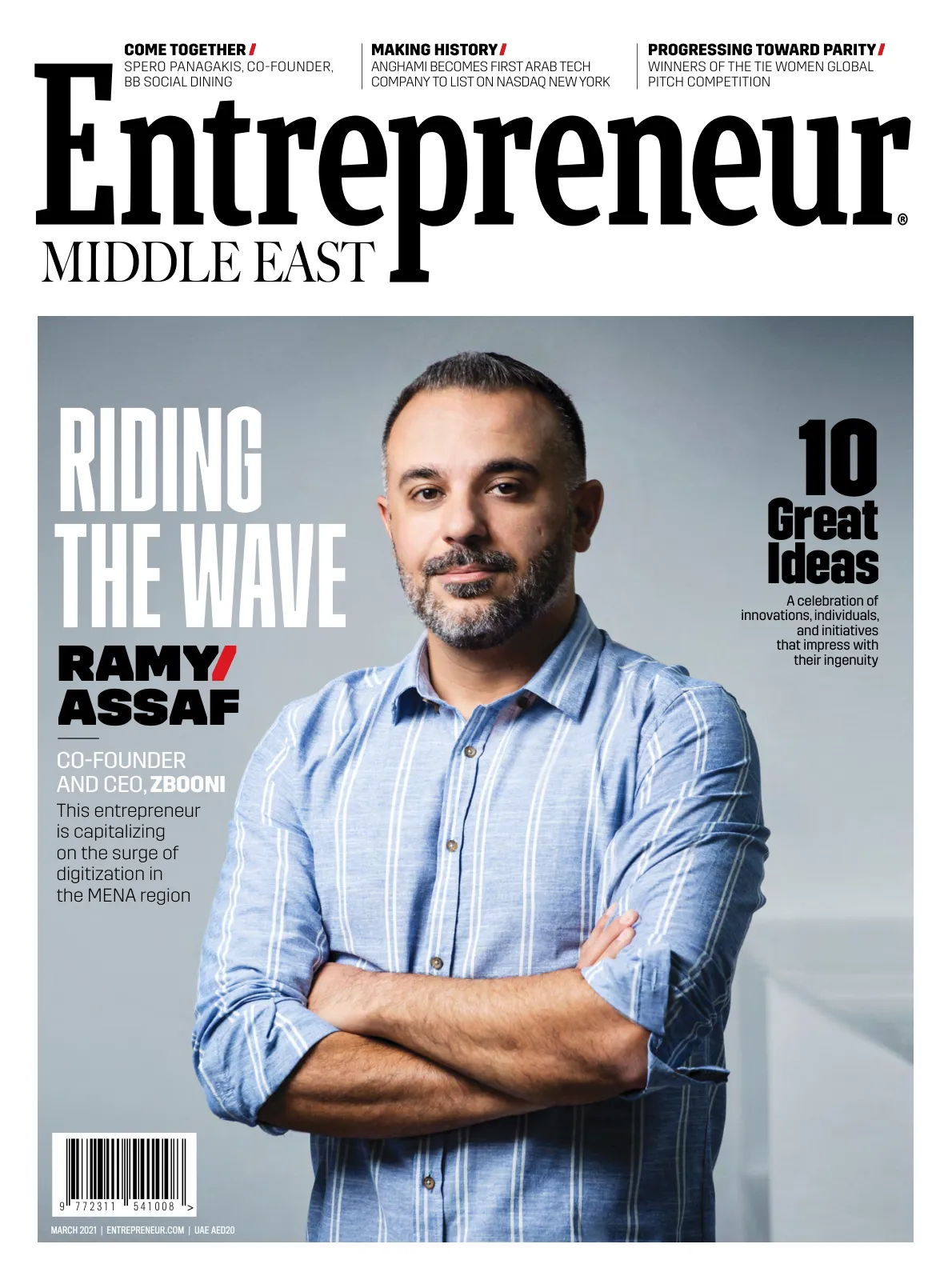
Entrepreneur Middle East, March 2021
Page 1
COME TOGETHER
SPERO PANAGAKIS, CO-FOUNDER,
BB SOCIAL DINING
9
7 7 2 3 1 1
5 4 1 0 0 8
>
RIDING
THE WAVE
RAMY/
ASSAF
CO-FOUNDER
AND CEO, ZBOONI
This entrepreneur
is capitalizing
on the surge of
digitization in
the MENA region
MARCH 2021 | ENTREPRENEUR.COM | UAE AED20
9
7 7 2 3 1 1
5 4 1 0 0 8
>
MAKING HISTORY
ANGHAMI BECOMES FIRST ARAB TECH
COMPANY TO LIST ON NASDAQ NEW YORK
PROGRESSING TOWARD PARITY
WINNERS OF THE TIE WOMEN GLOBAL
PITCH COMPETITION
10
Great
Ideas
A celebration of
innovations, individuals,
and initiatives
that impress with
their ingenuity
Page 2
Page 3
Page 4
4 / ENTREPRENEUR.COM / March 2021
CONTENTS MARCH 2021
18
INNOVATOR
RIDING THE WAVE
Ramy Assaf
The co-founder and CEO of
Dubai-headquartered social
commerce platform Zbooni
is capitalizing on the surge
of digitization in the MENA
region.
32
10 GREAT IDEAS
A celebration of
innovations, individuals,
and initiatives that impress
with their ingenuity.
24
INNOVATOR
COME TOGETHER
BB Social Dining co-founder
Spero Panagakis on how his
restaurant is bringing a sense
of community to Dubai’s F&B
scene.
54
START IT UP
ECOSYSTEM
Progressing toward parity
The winners of the TiE
Women Global Pitch
Competition share their
thoughts on building a more
equitable startup ecosystem.
16
IN THE LOOP
Making history
Abu Dhabi-headquartered
Anghabi becomes the first
Arab tech company to list on
NASDAQ New York.
62
START IT UP
Q&A
Ahead of the curve
Digital solutions company
WaysMaze is taking advantage
of the digital transformation
wave that’s sweeping over the
MENA region (and beyond).
58
START IT UP
START UP FINANCE
“We got funded!”
A look at the stories behind
the recent fundraising
announcements made by
MENA-based ventures,
StarzPlay and Foodics.
28
TECH
SHINY
#TamTalksTech
Gadgets and doodads that
you might’ve missed out on,
sourced by a tech aficionado.
Yes, it’s okay to want them
all… and no, it’s not our
fault.
14
EDITOR’S NOTE
By Aby Sam Thomas
30
CULTURE
TRAPPINGS
‘Trep gear
The executive selection for
the entrepreneur on your list
that has everything. Okay,
maybe for a little self-reward
as well.
IMAGE COURTESY 1309
Page 5
Page 6
6 / ENTREPRENEUR.COM / March 2021
SUBSCRIBE
Contact subscriptions@bncpublishing.net to receive
Entrepreneur Middle East every issue
EDITOR IN CHIEF Aby Sam Thomas aby@bncpublishing.net
CEO Wissam Younane wissam@bncpublishing.net
DIRECTOR Rabih Najm rabih@bncpublishing.net
CREATIVE LEAD Odette Kahwagi
MANAGING EDITOR Tamara Pupic
STARTUPS SECTION EDITOR Pamella de Leon
EDITORIAL DESIGN Christian Harb
DIGITAL SOLUTIONS DIRECTOR Mahdi Hashemi mahdi@bncpublishing.net
GROUP SALES DIRECTOR – B2B GROUP Joaquim D’Costa
COLUMNIST Tamara Clarke
INTERN Aalia Mehreen Ahmed
PO Box 502511 Dubai, United Arab Emirates
P +971 4 4200 506 | F +971 4 4200 196
For all commercial enquiries related to Entrepreneur Middle East
contact sales@bncpublishing.net
All rights reserved 2021
Opinions expressed are solely those of the contributors.
Entrepreneur Middle East and all subsidiary publications in the
MENA region are officially licensed exclusively to BNC Publishing
in the MENA region by Entrepreneur Media Inc.
No part of this magazine may be reproduced or transmitted in any
form or by any means without written permission of the publisher.
Printed by United Printing and Publishing
upp.ae
Images used in Entrepreneur Middle East are credited when necessary. Attributed use of
copyrighted images with permission. All images not credited otherwise Shutterstock.
CONTRIBUTORS
entrepreneur.com/me
ACCESS FRESH CONTENT DAILY ON OUR WEBSITE!
MIDDLE EAST
EntMagazineME
@EntMagazineME
Entrepreneur-me
EntrepreneurMiddleEast
EntMagazineME
EntMagazineME
EntMagazineME
MIDDLE EAST
In addition to our print edition, we’re bringing
you all sorts of industry news on our web
mediums. Joining us online means getting
relevant business and startup content in
real-time, so you’re hearing about the latest
developments as soon as we do. We’re looking
forward to interacting with our readers on all of
our social media and web platforms- like any
thriving business, we’re looking to give and take.
#TrepTalkME is already happening on all of our
digi platforms, and all good conversations go
both ways. See you on the web!
Raffaella Campagnoli
Fida Chaaban
Tamara Clarke
Page 7
lyveglobal.com
E-COMMERCE
MADE EASY
Supercharge your ecommerce and online operations
with Lyve. Get fast, flexible, and full-featured delivery and
technology solutions that meet your customers’ needs
and allow you to focus on what you do best.
Go Lyve Today �
lyveglobal.com/ecommerce
#golyve
Page 8
Page 9
Page 10
Page 11
Page 12
Timeless Elegance
Where modern French art de vivre meets ancient Egyptian charm.
Book your stay at sofitel-dubai-theobelisk.com
PARIS - LONDON - ROME - DUBAI - SYDNEY - MEXICO CITY
Page 13
Page 14
14 / ENTREPRENEUR.COM / March 2021
EDITOR'S NOTE
F
or us at Anghami, we just want to inspire
people. That has been our personal journey;
we want to be an inspiration to others
[in the MENA region] that you can build
something big from scratch, from nothing, by
simply innovating, believing in your people,
and working hard.”
This was one of the things that Anghami co-founder
and CTO Elie Habib told me after I learned that his Abu
Dhabi-headquartered enterprise was going to become
the first Arab tech company to list on the NASDAQ New
York Stock Exchange.
Now, while there’s no denying the fact that this was a
historic moment for the MENA entrepreneurial land-
scape, I still couldn’t help but be struck by how Habib
chose to paint this occasion as a rousing win for the
region, and not just as a personal victory.
But Habib’s behavior won’t come as a surprise to
those of us who have interacted with him ever since he
launched Anghami with co-founder Eddy Maroun in
2012- that was also the year in which he publicly de-
clared that “ego has no place in a startup,” and it seems
pretty obvious that Habib has continued to believe in
that ethos to this day.
I can personally state that Habib’s behavior has been a
welcome departure from the inflated egos that seem to
be more the norm than the exception in our business
ecosystem, and it’s been especially encouraging to see
how he has stayed true to his principles through all of
the twists and turns of his entrepreneurial journey.
Indeed, Habib has consistently kept his ego out of
the way when running his business, and it’s a strategy
that has clearly worked out well for him. And Habib’s
tactic is one I hope that all of us -entrepreneurs and
otherwise- will employ as we make our way through the
current circumstances of our world.
While our aim should always be to bring our best
selves forward in whatever we set out to do, we should
remain mindful of not letting our egos rule the show.
Whether we are entering a negotiation for a potential
deal, or simply running a staff meeting with our teams,
checking our egos at the door before joining such inter-
actions will allow for honest and authentic discussions
to happen, which can help the realization of successful
outcomes for everyone involved.
Perhaps more importantly, this will enable the cre-
ation of environments where the focus is on the greater
good, and not just on individual gains- and that’s some-
thing worth putting in the effort for.
EYES ON THE PRIZE
KEEP YOUR HEAD DOWN, YOUR EGO IN CHECK, AND GET ON WITH IT
Aby Sam Thomas
Editor in Chief
@thisisaby
aby@bncpublishing.net
Page 15
Page 16
16 / ENTREPRENEUR.COM / March 2021
I
n a milestone moment for
the MENA entrepreneurial
ecosystem, Anghami, one
of the region’s leading
music streaming platforms
and services, has entered
into a merger agreement
with Vistas Media
Acquisition Company
Inc., a publicly traded
special purpose acquisition
company in the United
States, that will result in it becoming
the first Arab technology company to
be listed on the NASDAQ New York
stock exchange.
With the transaction expected to
close in the second quarter of 2021, it
pegs Anghami at an initial pro-forma
enterprise valuation of approximately
US$220 million. A statement from
the company noted that this value
has been reached by calculating 2.5x
2022 estimated revenues; one of An
ghami’s competitors in this space, the
Stockholm-headquartered Spotify,
has a current revenue multiple of 6.5x
revenue.
Founded in 2012 by CEO Eddy Ma
roun and CTO Elie Habib, Anghami
was the first music-streaming plat
form in the MENA region, with it now
being one of the leaders in the market,
offering more than 57 million songs,
to more than 70 million registered us
ers, with around one billion streams
per month. It is currently backed by
leading MENA venture capital firms
and strategic shareholders, including
media groups and telecommunica
tions companies, that collectively own
approximately 68% of Anghami, with
the balance owned by the founders.
One of its most recent investors,
the Dubai-headquartered asset
management and investment banking
platform, SHUAA Capital, and Vistas
Media Capital Singapore, the par
ent of the sponsor for Vistas Media
Acquisition Company Inc., have
gathered commitments of a combined
$40 million -$30 million from the
former, and $10 million from the
latter- in PIPE (private investment in
public equity) financing for this deal.
The listing on NASDAQ is expected to
allow Anghami to scale the company’s
user base, as well as invest in tech
nology to build on its data play.
Talking to Entrepreneur Middle
East, both Maroun and Habib were
ecstatic not just about what the
announcement meant for their com
pany, but also what it signified for
entrepreneurs in the MENA region.
“For us at Anghami, we just want to
inspire people.” Habib said. “That has
been our personal journey; we want
to be an inspiration to others that you
can build something big from scratch,
from nothing, by simply innovating,
believing in your people, and working
hard.”
“This is a very important and strong
message we are sending here to the
region,” Maroun said. “We’re used
to importing things, and we always
look up to the Western world [in
this respect], but this time, I think
we’re validating the fact that we
in the Middle East can also build
world-class products, we can have
world-class companies, and we can
reach the US or any other market. So
this is very important for us, this is a
very big statement for every dreamer,
every believer, in the region that, yes,
we can make it happen, and that, re
ally, impossible is possible.”
For entrepreneurs in the MENA
region wanting to follow their lead in
terms of building a successful, sus
tainable business, the co-founders of
Anghami doubled down on the impor
tance of having (and remaining true
to) a vision aimed at realizing just
that. “You have to be obsessed with
what you’re doing- it’s more than just
believing,” Maroun said. “Be ready to
sacrifice a lot, but if your hard work
is consistent, I think you can make it
happen.”
Habib agreed with Maroun, adding
that Anghami’s listing on NASDAQ
also heralds the company’s “Chapter
2,” wherein it aims to become the
foremost media and music com
pany across the region and emerging
markets. “We are the first Arab tech
company to list on NASDAQ, but we
hope we are not going to be the last,”
Habib noted. “We hope we’re going to
be one in a long list of companies that
will end up showing new generations
here that, yes, you can build and grow
successful businesses in this region.”
MAKING HISTORY
Abu Dhabi-headquartered Anghami becomes the first
Arab tech company to list on NASDAQ New York
IN THE LOOP
Page 17
17
March 2021 / ENTREPRENEUR.COM /
Philips, a global leader in health technology and VPS Healthcare,
an integrated healthcare service provider, have partnered to
prepare for the post-COVID era of healthcare.
A strategic white paper entitled “Above and Beyond: Reshaping
Healthcare after COVID-19”, developed jointly by Philips and
VPS Healthcare, advocates the Healthcare-as-a-Service (HAAS)
model that will ensure asset-light, opex-driven systems allowing
patients to receive the care they need when they need it without
exhausting resources.
The challenges of quickly mobilizing resources to cope with
the surge in COVID-19 patients alongside regular patient traffic,
forced healthcare organizations to adopt new care delivery
methods which are fast becoming the standard norms. However,
in order to facilitate and sustain the changes, healthcare
organizations need to implement alternative care models. The
whitepaper explores the importance of collaboration between
various players in the healthcare sector in order to enable a
robust HAAS model.
With the COVID-19 pandemic impacting healthcare systems,
pushing them to their limits to cope with the overwhelming
demand for critical care services around the world, regular
patient care had to be postponed. Telehealth solutions such as
tele-radiology, remote patient monitoring and forming more
efficient care ecosystems are among the many lessons the
current crisis has bought to light. The partnership between
VPS Healthcare and Philips unveil’ s innovative solutions for
affordable, high-quality care for patients and communities,
tailored to local needs.
During the pandemic, VPS Healthcare has been at the forefront
and joined hands with the UAE government and health
regulatory bodies to combat the spread of pandemic in the nation.
The healthcare group setup an RT-PCR Laboratory at their flagship
facility Burjeel Medical City and played a pivotal role in the National
screening program. The group provided necessary care and solace
to COVID-19 patients at its facilities across the UAE.
The whitepaper explores potential business partnerships and
solutions that will result in dedicated companies offering à la carte
clinical, technological, administrative or financial services, to public
and private healthcare organizations via subscription-based or
pay-per-use HAAS frameworks. Such multi-provider models will
avoid duplication of resources and ensure flexibility and scalability
of localized care delivery during crises and disasters.
Together with VPS Healthcare and in line with Philip’s purpose to
improve the health and well-being of 2 billion people per year by
2025, healthcare-as-a-Service is the way forward. Different players
in the healthcare ecosystem can work together to pool resources
and effectively deliver healthcare on-demand. The healthcare
expert is also looking at expanding its commercial presence in the
Middle East and beyond in partnership with VPS.
With its unique position between Africa, India and Asia, the UAE
is perfectly positioned to be a strategic hub for HAAS solutions.
The country also has access to international talent that is the
foundation of such resource-optimization models.
Philips and VPS Outline Vision for ‘Healthcare of the Future’
in a Post COVID-19 Era
‘Above and Beyond: Reshaping Healthcare after COVID-19’
whitepaper is based on insights gained from a range of
leading industry experts from Philips and VPS Healthcare,
and supported by published material.
Download the full whitepaper:
https://www.philips.ae/healthcare/resources/landing/philipsvpswhitepaper
Page 18
18 / ENTREPRENEUR.COM / March 2021
INNOVATOR
A
ll too often,
entrepreneurial ideas
spark from a personal
experience or observation
about a particular gap
in a given industry. Such
was the case with Ramy
Assaf, co-founder and
CEO of Dubai-based
social commerce platform,
Zbooni. “Around 2016, my
wife had started her own small business
selling hats via an Instagram page,” he
recalls. “And if customers wanted to order
from her, they would send a message either
by direct message or through WhatsApp.”
For Assaf, who, at the time was working with
venture capital firm Middle East Venture
Partners (MEVP), it was his wife’s online
millinery that showed him an untapped
opportunity in the business realm. “A few
things stood out to me about the state of
commerce, and how it was evolving rapidly
into new social channels,” Assaf remembers.
“Digital platforms were able to reduce the
barriers to entry for small businesses. If
you could set up an Instagram page and
use WhatsApp, you could be in business.
However, the notion of accepting payments,
tracking orders, and managing customers,
all remained pain points. Zbooni was born
out of observing these experiences, and
finding solutions that would help people
start, run, and grow a business.” The initial
concept for Zbooni, therefore, was quite
straightforward: a digital marketplace for
microbusinesses. And, thanks to Assaf
and his team, Zbooni (which means “my
customer” in Arabic) quickly progressed
from being just an idea, to a startup that
very recently raised US$5 million in a Series
A funding round by an undisclosed London-
based investment fund.
The co-founder and CEO of Dubai-headquartered
social commerce platform Zbooni is capitalizing
on the surge of digitization in the MENA region
RAMY/ASSAF
RIDING
THE
WAVE
by AALIA MEHREEN AHMED
>>>
Page 19
19
March 2021 / ENTREPRENEUR.COM /
RIDING THE WAVE | RAMY ASSAF, CO-FOUNDER AND CEO, ZBOONI
“[The pandemic]
created a giant
tailwind to our
business through
the acceleration
of demand, as
businesses realized
that they needed to
be better equipped
online.”
Page 20
20 / ENTREPRENEUR.COM / March 2021
Officially launched in 2017 by Assaf and Ashraf Atia, Zbooni
aims to help small and medium enterprises to solve two major
issues related to setting up an online presence: the need for a
direct connection with a bank, and the requirement for specific
software to enable digital payments. Resolving each of the two
issues was a process Assaf likens to having been as tedious and
turbulent as “building a Frankenstein’s monster.” He explains,
“Firstly, when a business wants to go online, that means that
they need to have a direct relationship with a bank or a pay-
ment gateway, which can be a painful process. It takes way too
long, and the requirements to set up are structured in a way
that is just very complex to deal with for an average SME. If
the business gets past that part, they then have to obtain and
use software that their customers can pay through. They need
an interface, like a website or an e-commerce page, or a point-
of-sale solution. It’s far too complicated! Our business model
is to provide a bridge for SMEs, enabling them to get online
painlessly.” With this idea in mind, Assaf and his team have de-
signed Zbooni as an app-based platform that needs to be down-
loaded only by merchants, not end customers.
However, it is key to mention here that Zbooni is not a pay-
ment gateway in itself, but that it enables access to one by
partnering with leading payment gateways. “We built an app for
the merchants to use,” Assaf elaborates. “This gives them the
ability to control and manage their store, create orders, man-
age their product catalogs, create invoices, etc. For merchants’
end-customers, it is easier to check out from mobile websites,
because it’s frictionless, and provides a more seamless cus-
tomer experience.” As of January 2021, Zbooni has enabled its
merchants to serve more than 150,000 end-customers. The
start-to-finish process for a given transaction is quite simple to
understand: the merchant’s digital store, or “eStore”, is avail-
able for the end-customers to view from any browser. When
a purchase is made via Zbooni, the merchant sends a link to
his/her customers, and they will then be brought to a payment
checkout page that is also workable on any browser. Finally,
in order to complete a payment, the customer can pay using a
Visa, Mastercard, Apple Pay, or Mada card without having to
download any app. However, the firm does not offer delivery
services; the onus for that lies only on the merchant. “We use
a marketplace model, which means that they (the merchants)
are selling through Zbooni,” Assaf says. “They don’t have to
go through all the hoops. We provide a store within our mar-
ketplace, and payments are managed by us as the operator. We
take a very small commission per transaction, and relieve a lot
of the pains involved for our merchants.”
INNOVATOR
“OUR BUSINESS MODEL
IS TO PROVIDE A BRIDGE FOR
SMES, ENABLING THEM
TO GET ONLINE PAINLESSLY.”
ZBOONI.COM
Page 21
21
March 2021 / ENTREPRENEUR.COM /
Having been incubated at Facebook,
the startup is today backed by regional
and international organizations, includ-
ing Chalhoub Group, MEVP, and B&Y
Venture Capital. As a company that is
entirely dependent on merchants shift-
ing to online selling and/or mobile-first
commerce, the global coronavirus pan-
demic that kicked off in 2020, despite
being a dark and ominous cloud for
several businesses, provided Zbooni
with multiple silver linings. “What we
had been preaching for the previous two
years, about going cashless and digital,
suddenly became front-and-center for
most businesses,” Assaf notes. “Prior
to the pandemic, the region was behind
the rest of the world when it came to
using cash. Now, the Middle East’s con-
sumers have caught up and graduated
to contactless forms of payment– that
is a trend that is irreversible.” The has-
tened shift to cashless payments and
online selling, amid increased social
distancing measures nationwide, meant
that there were an umpteen number of
microbusiness merchants that could’ve
potentially been rendered jobless if they
didn’t quickly adapt to the new techno-
logical changes. But that’s where Zbooni
came in and changed the story- from
brick-and-mortar merchants who had
never sold online before, to startups and
well-established businesses that needed
better digital tools to adapt to the ever-
changing business landscape, the start-
up’s offerings proved to be a lifeline for
all of them. At the same time, Zbooni
also upscaled its team by bringing in
newer members, and its technology was
upgraded to better serve its merchants
and their end-customers, without hav-
ing to make major changes to its overall
model. “We had ambitious plans going
into 2020, but of course, we didn’t
anticipate a pandemic,” Assaf says. “It
created a giant tailwind to our business
through the acceleration of demand, as
businesses realized that they needed to
be better equipped online.”
The subsequent measures taken
to ensure increased ease and better
performances were aplenty. “When
the pandemic began to take hold, we
provided our merchants with certain
relief, such as waiving fees for their
first AED5,000 in sales,” shares Assaf.
“Most importantly, Zbooni enabled local
businesses to interact and transact with
their customers digitally, without having
to invest heavily into tech infrastructure,
web design, or costly payment systems.
We’re really proud that as a team we
could positively support local businesses,
and help them through their time of
need.” The results of such minimal
but quick pivots reflected in Zbooni’s
2020 performance. From increased
customer growth, to more demand from
merchants, to a considerable expansion
of services, the startup was able to thrive
in a pandemic-stricken year.
“AN INTERESTING PATTERN WE
HAVE SEEN AMONGST SMES IS
THE INCREASE IN BUSINESSES
PROVIDING SERVICES AND
PRODUCTS AIMED AT HEALTH
AND WELLBEING. THREE OF THE
TOP FIVE BIGGEST SELLERS ON
ZBOONI IN 2020 WERE DIET
PRODUCTS, SELF-IMPROVEMENT
WORKSHOPS, AND FASHION
STYLING.”
Be clear and concise
“Focus on being very articulate about
your value proposition and business
model. Give them the information they
need in a concise and clear way. If
they pass, just move on quickly. The
right investor will emerge.”
A “no” isn’t the end of the road
“Don’t get too downbeat if investors
don’t get onboard. They don’t
necessarily know more than you. If
you really believe in your idea, then
keep going. Always remember that
what your customers think is more
important than what investors think.”
‘TREP TALK
Zbooni co-founder and CEO
Ramy Assaf shares his tips for
entrepreneurs looking to pitch their
ideas to investors
Zbooni co-founders
Ramy Assaf and Ashraf Atia
>>>
RIDING THE WAVE | RAMY ASSAF, CO-FOUNDER AND CEO, ZBOONI
Page 22
22 / ENTREPRENEUR.COM / March 2021
“We accelerated rapidly over the course of the year and expe-
rienced customer growth of over 600%,” explains Assaf. “An
interesting pattern we have seen amongst SMEs is the increase
in businesses providing services and products aimed at health
and wellbeing. Three of the top five biggest sellers on Zbooni
in 2020 were diet products, self-improvement workshops, and
fashion styling. We also took the opportunity to expand the ser-
vices we offered and truly become a hub for SMEs to start, run,
and grow their businesses. Zbooni has flourished as a result of
the entrepreneurial spirit of the merchants who we are part-
nered with.”
But while Assaf may point toward Zbooni’s partners to explain
his startup’s growth in an otherwise tumultuous year, one can-
not discount the role the CEO himself played in attaining the
same, especially when it comes to spearheading the company’s
culture during this period. “When it came to managing as a
leader during a time of crisis, I clearly wanted to ensure that
employee health and safety was a priority,” he explains. “We
have always been flexible in terms of allowing a work-from-
home culture, and so we were well adjusted to operating that
way going into the lockdown. We don’t force people to be in the
office at all, but we did expand our physical office space in 2020.
This included doubling the office size, so when people do choose
to come to the office, then they feel more comfortable.” In a year
that saw hundreds of thousands of people lose their jobs, and
the very fabric of team cultures being scrutinized more deeply,
it is heartening to see that the team at Zbooni weathered the
storm successfully- and together. “The challenges presented in
2020 ultimately brought us a lot closer as a team. We let people
spend time with their loved ones and have some space, and we
trusted them to continue to deliver– which they did.”
The leadership skills of a CEO are undoubtedly what furnish
the various facets of a given company’s culture, and Assaf’s ex-
pertise in this domain can perhaps be attributed to the lessons
he learnt working in the venture capital industry. “Working at
MEVP, or any VC firm, is a very interesting dynamic,” he ex-
plains. “You have the privilege of seeing hundreds or thousands
of businesses and entrepreneurs pitching their plans. You get
exposed to ideas, problems, and solutions you wouldn’t have
ever considered before. It’s like a crash course that sharpens
INNOVATOR
“WE ACCELERATED RAPIDLY OVER
THE COURSE OF THE YEAR AND
EXPERIENCED CUSTOMER GROWTH
OF OVER 600%.”
The Zbooni team
Page 23
23
March 2021 / ENTREPRENEUR.COM /
your business senses.” But not every-
thing about the VC culture could entice
Assaf to carry on with a career in it.
In a strange and almost ironic turn of
events, it was precisely Assaf’s role as
a VC that led him to becoming an en-
trepreneur. “You’re expected to provide
some ‘filter,’ and give a recommenda-
tion on why a business idea is a good
opportunity, or not a good opportunity
to the firm- I hated that part,” he says.
“Mainly because it assumes the VC
somehow knows more than the rest of
the market. At the end of the day, it’s
just opinions about the future, which
nobody knows. I feel more comfortable
as an entrepreneur, because it’s more
fulfilling to operate a business, and get
your hands dirty solving real problems,
rather than just talking about them.”
Unleashing his entrepreneurial spirit
is thus what has helped Assaf shape
Zbooni into the startup that it is today.
Having been in the startup ecosystem
for a good few years now, Assaf has had
a first-hand view on how the landscape
has changed over time. “In terms of
the MENA’s overall investment/startup
landscape, it’s a complete 180-degree-
turn from where it was a decade
ago- running a startup now or starting
your own business is the norm!” he
observes. “People are fully awakened
to the fact that a corporate gig isn’t as
stable as it once seemed. Losing your
job, or having your company fall from
grace, can happen very rapidly. The
only security you have is to control
what you can, and that’s to be in the
driver’s seat of your own career. I ex-
pect we’ll see this manifest into a lot
more talent having the courage to start
their own businesses, which in turn
will result in much more investment
into the region.”
Given this viewpoint on the future of
the MENA entrepreneurial landscape,
it is perhaps unsurprising to learn
that Assaf and the Zbooni team have
very clear goals for their own future
as well. “As with all online businesses,
there is a continuous need for im-
provement– every opportunity must
be used to enhance the experience for
our customers,” Assaf says. With the
aforementioned $5 million invest-
ment now at their disposal, the team
is looking to further develop its team
and services, while also working on
expanding into the region. “We have
a series of plans for Zbooni,” Assaf
says. “It mostly involves making more
significant investment into the product
itself. We believe that as our custom-
ers evolve, and as their needs mature,
the product should as well, so we con-
tinue serving them as their business
grows. We’re upholding our promises
to merchants to continue to innovate,
and provide the solutions they need,
which truly drive positive impact to
their business. We are also looking at
geographically expanding our pres-
ence in Saudi Arabia, and see that as
an opportunity to drive a lot of change
and transformation.” With the sud-
den surge in the digitization of SMEs
over the course of the COVID-19 crisis
last year, and the SME industry itself
gaining high prominence in the MENA
region, it will be fascinating to see how
Zbooni further evolves in its efforts
to make e-commerce more accessible
for microbusinesses. “Over the past 12
months, we’ve gone from primarily be-
ing a payment solution for businesses,
to now offering a broad suite of tools
that enable merchants to better under-
stand, engage and transact with their
customers,” Assaf says. “This is the
focus for us over the coming months–
to continue to develop best-in-class
products that help SMEs start, run,
and grow their businesses.”
RIDING THE WAVE | RAMY ASSAF, CO-FOUNDER AND CEO, ZBOONI
1/ The customer comes first
“Focus on delighting your customers-
even if that means doing it the
old-fashioned way, like writing ‘thank
you’ cards.”
2/ Never lose sight of the customer’s
needs
“Focus on what your customers are
really looking for, even if others are
advising you to do differently!”
3/ Test, test, and test again
“Be willing to test your ideas (and
embarrass yourself in the process)!”
‘TREP TALK
Zbooni co-founder and CEO
Ramy Assaf shares his tips for
small businesses wanting to
make it big in the market
Zbooni app
Zbooni app
Page 24
24 / ENTREPRENEUR.COM / March 2021
The co-founder of BB Social Dining on how his restaurant is bringing
a sense of community to Dubai’s F&B scene by PAMELLA DE LEON
Come/together
SPERO PANAGAKIS
START IT UP Q&A
Page 25
25
March 2021 / ENTREPRENEUR.COM /
T
ucked amidst lush foli-
age and rather discreet
signage, BB Social
Dining is a three-story
restaurant located in
Gate Village at Dubai
International Financial
Center (DIFC). The
homegrown concept
is set in a space that
was once previously
an art gallery, which has resulted in
an intimate, quirky atmosphere, with
its spiraling staircase, black and white
floor tiles, mustard upholstery, cozy
booths and tables, and an al fresco
dining terrace. Much like the Arabic
word its name is derived from (“ha-
bibi”), the restaurant wants to embody
harmony and love in its community,
which is why BB brands its style of
food as “social dining.” Fusing culinary
inspirations from the East, West, and
Middle East, BB encourages its diners
to design and share their dishes that
consist of baos, bowls, bites, BBQ spe-
cialties, and, yes, distinctive desserts
too. And in order to cater to a variety of
preferences, the restaurant promises an
inclusive approach for all kinds of din-
ers, with its offering including vegan,
vegetarian, and meat-based dishes.
BB is the brainchild of a founding team
bringing six decades of hospitality: chef
Alex Stumpf at the kitchen’s helm (who
was the previous head chef of Peyote),
while Shabnum Stumpf and Spero
Panagakis (both formerly of Zuma)
manage everything else relating to the
business. As co-founders with diverse
fields of expertise, the trio note that
they prioritized setting distinct roles
for themselves within the F&B brand
very early on so as to avoid any con-
flict in responsibilities. “We are strong
believers that as owner-operators, we
have to appreciate all developments
when creating homegrown brands in
order to stand behind it 100%,” says
Panagakis, who has been positioned as
the front-of-the-business man. “Each
one of us has their talent, and we thrive
on driving the different teams, so they
appreciate that. Each department has a
certain skillset that impacts the busi-
ness just as much as the next depart-
ment.” The co-founders are also keen
to develop their team’s skillsets, saying,
“It is important that you cross train
your employees in every department.
This way, you create cultural teamwork
and understanding, so the brand is al-
ways at the forefront, and not just a per
team department only.”
This is clearly an aspect that the
co-owners regard highly, with Panaga-
kis pointing out that BB is a result of
teamwork, dedication, and inclusivity.
“We’re not a single-bodied operation,
we all work together, and we have cre-
ated something unique that our patrons
love.” The business also prides itself
on avoiding a silo mentality, with each
member of the team knowing the busi-
ness inside out to ensure operations
run efficiently. “It also means that
whenever there is an area for growth,
it’s immediately recognized and acted
upon.” This strategy also explains the
management’s modus operandi. “A good
leader always recognizes that they’re
only as good as their team!” Panagakis
declares. “Our leadership strategy is re-
flective of our brand strategy: we want
to create a community for our team,
where they have the ability to be crea-
tive and playful, whilst working too.”
COME TOGETHER | BB SOCIAL DINING CO-FOUNDER SPERO PANAGAKIS
>>>
Page 26
26 / ENTREPRENEUR.COM / March 2021
Having an innate sense for com-
munity is also what the co-founders
state makes BB stand out amongst the
crowded F&B space in the UAE. “We are
always of the belief that within every
community, there is a place for every-
one. By design and concept, BB fits in
at a price point that was new to the
market, and supported a wider reach
on a demographic that had not yet been
tapped into.” As a social eatery and
bar located within the bustling DIFC
community (which houses a variety of
high-end licensed restaurants, mid-
markets and casual dining options), the
BB team sought to build its reputation
based on its noteworthy menu and
charming ambience: “Our principal was
to offer an all-inclusive, not exclusive
menu that supported the polished mid-
market category, and one that supports
all occasions- from a formal dining
experience, through to your everyday
business lunch or afternoon break… It
was a matter of creating something that
was ‘needed’ in the market, and that we
knew customers would appreciate.”
Of course, as with any business, the
journey wasn’t without hindrances.
One of the team’s biggest hurdles came
during the restaurant’s construction
stage. “We are built over three floors,
and there is extension civil work that
needed to be done in a specific way to
comply with regulations,” Panagakis
explains. Eventually, it delayed the
project by six months. “This hurdle and
delay had a knock-on effect, as rents
are still payable even though we were
not trading.” The silver lining? The
co-founders took it as an opportunity
to learn the importance of performing
proper due diligence, no matter what
they’ve seen, heard, or are recom-
mended with. And that’s the advice Pa-
nagakis wants to share with his fellow
upstarts in the market: “Always make
sure you do your homework thoroughly
on all suppliers, landlords, and research
every dotted line on every offer to en-
sure you are protected in the process to
avoid penalties or fees that fall out of
your control.”
This outlook to continuously learn
whilst facing difficulties has proved
useful as the brand faced the impact
of the COVID-19 crisis of 2020. Ac-
cording to research data by Eat App, in
March 2020 alone, restaurants across
the region saw an overall 60% decrease
in customers. “With constant fluctua-
tions in numbers, restrictions, and this
pandemic being wholly unprecedented,
we’ve had to learn as we go along. It’s
been a learning curve for us all.” It’s
worth noting that it was amidst the
UAE lockdown mandate that the brand
diversified its revenue by launching a
delivery and takeaway service utilizing
a cloud kitchen space. With food de-
livery as an option, the brand managed
to reach out to a wider audience and
introduce the restaurant to prospec-
tive customers that would usually only
be achieved through word-of-mouth.
“Through our partners at Deliveroo, we
managed not only to open two other
satellite brands -Soule Soups and The
Little Katsu Shop- as well as expand
these three brands to our new satellite
kitchen on Hessa Street.”
The brand’s new kitchen-to-
delivery approach has thus not only
strengthened BB’s presence, but also
ensured sufficient cash flow to survive
under the strict restrictions that comes
with having dine-in guests. Panagakis
adds that being in the UAE has proved
to advantageous, with the country’s
government being quick to handle the
situation from the onset. This meant
that BB was able to open its doors again
sooner than most- which has had its
advantages and disadvantages. “As a
business, whilst we want to come out
of this situation as quickly as possible,
as a community-driven restaurant, we
also have a social responsibility to our
customers to do the best we can. We
want BB to be a safe space for those
who come to us.”
Given the current environment, it
can be easy for entrepreneurs to feel
overwhelmed by the challenges one can
face in this domain, but Panagakis still
commends the MENA region’s market
for its F&B scene. “It’s constantly
growing, there’s so much diversity,
and a sense of community you don’t
find in other places around the world.”
Though, of course, as with anywhere
in the world, the region comes with its
own set of issues. To this, Panagakis
advises, “You have to really learn about
all the regulations and rules beforehand
to avoid any delays or penalties that
can arise from mistakes, or a seemingly
minor detail being overlooked. Other
than that, people here are helpful
and there’s always someone willing
to lend a helping hand.” With that
in mind, is now still a good time to
start a business in the MENA region?
Panagakis responds with an affirmative.
“I think now is as good a time as ever to
start a business here. Obviously, with
precaution though. It’s important for
new, homegrown businesses to identify
where there is a gap in the market, and
to capitalize on that.”
1/ Find a niche, and stick to it
“This should be true to you, and
something you know the customer
will enjoy.”
2/ Divide and rule
“When co-founding a business, cre-
ate clear boundaries and separate
roles. This will lead to smoother
operations and no crossovers.”
3/ Listen to your customer
“What does your clientele want?
How can you give them what they
want? Answering these kinds
of questions leads to customer
loyalty.”
4/ Your team is your backbone
“It’s impossible for a business to
function well without a good team
in place. Choose people who are
reflective of your values, and who
really understand the message you
are trying to send.”
5/ Push boundaries
“Whether it’s building a three-story
restaurant in DIFC, or starting a
business at home, being creative
and taking a calculated risk can
lead to a great outcome.”
‘TREP TALK ME
TIPS FOR ENTREPRENEURS FROM
SPERO PANAGAKIS, CO-OWNER
AND CO-FOUNDER, BB SOCIAL
DINING
START IT UP Q&A
Page 27
27
March 2021 / ENTREPRENEUR.COM /
COME TOGETHER | BB SOCIAL DINING CO-FOUNDER SPERO PANAGAKIS
“WE ARE ALWAYS OF THE
BELIEF THAT WITHIN EVERY
COMMUNITY, THERE IS A
PLACE FOR EVERYONE. BY
DESIGN AND CONCEPT, BB
FITS IN AT A PRICE POINT
THAT WAS NEW TO THE
MARKET, AND SUPPORTED
A WIDER REACH ON A
DEMOGRAPHIC THAT HAD
NOT YET BEEN TAPPED INTO.”
27
March 2021 / ENTREPRENEUR.COM /
Page 28
28 / ENTREPRENEUR.COM / March 2021
GADGETS AND DOODADS THAT YOU MIGHT’VE MISSED OUT ON, SOURCED BY A TECH AFICIONADO.
YES, IT’S OKAY TO WANT THEM ALL… AND NO, IT’S NOT OUR FAULT.
TIME TO TRAIN
HONOR WATCH ES
IMAGES COURTESY HP | HONOR | HUAWEI
TECH SHINY
The new and improved Honor Watch
ES boasts a large 1.64-inch AMOLED
display with a diverse library of watch
faces. The watch offers an impres-
sive screen-to-body ratio of 70%, a
highly responsive touchscreen, and
a side button, which makes it easy
to navigate. Clocking in at 326 PPI
pixel density with 16.7 million colors,
the HD display is easy to read and
automatically adjusts its brightness
depending on ambient light levels.
The wearable is sized for daily wear
measuring 10.77mm thick, 30mm
wide, and weighing in at just 21g. Its
slim and lightweight design, along
with the silicon strap and the curved
edges, comes in three vibrant color
options: Meteorite Black, Coral Pink,
and Icelandic White. With 12 animated
workout courses as well as 95 workout
modes, wearing Honor Watch ES is
like having a personal trainer on your
wrist.
Honor Watch ES
Honor Watch ES
Page 29
29
March 2021 / ENTREPRENEUR.COM /
#TAMTALKSTECH Tamara Clarke, a former software development professional, is the tech and lifestyle enthusiast behind The Global Gazette, one
of the most active blogs in the Middle East. The Global Gazette has been welcomed and lauded by some of the most influential tech brands in the
region. Clarke’s goal is to inform about technology and how it supports our lifestyles. See her work both in print regional publications and online on
her blog where she discusses everything from how a new gadget improves day-to-day life to how to coordinate your smartphone accessories.
Visit theglobalgazette.com and talk to her on Twitter @TamaraClarke.
#TAMTALKSTECH | GADGETS AND DOODADS THAT YOU MIGHT’VE MISSED OUT ON
GET IN THE GROOVE
HUAWEI FREELACE PRO
Huawei FreeLace Pro features
extra-long battery life, noise-
cancelling technology, and fast
charging. Its built-in 150mAh
3C lithium-ion polymer battery
lasts up to 24 hours on a single
full charge, and you can use
your PC, tablet, or smartphone
to charge it via a USB-C port.
Two built-in high-sensitivity
microphones enable Active
Noise Cancelling, whereby one
microphone picks up the noise
outside of the ear, and the feed-
back microphone picks up the
residual noise in the ear canal.
In addition to dual-mic active
noise cancellation, the Huawei
FreeLace Pro has a three-mi-
crophone adaptive system that
enables noise cancellation for
phone calls as well. The device
also features a large 14mm
dynamic driver unit and an
independent bass tube for more
detailed three-band sound to
help you enjoy your music and
get you in the groove.
The HP Pavilion x360 14 has been
designed with a focus on sustainabil-
ity- besides making use of an ocean-
bound plastic bottle in its construc-
tion, the device is also EPEAT Gold
Registered and Energy Star Certified.
In addition to being more environ-
mentally sound, the HP Pavilion
x360 14 is packed with features to
help you work, learn, and play bet-
ter. The device features a simplified
version of OMEN Gaming, which
allows you to check system vitals,
download wallpapers, earn rewards,
and so much more. With the addition
of Amazon Alexa Skills, you can also
drop in on other supported devices,
stay in touch with friends and family
using hands-free calling, and control
smart home devices as well. The HP
Pavilion x360 14 gives you a bigger
screen too thanks to its four-sided
micro-edge bezel, which enables up
to an 88.92% screen-to-body ratio.
Suffice to say the HP Pavilion x360
14 will meet (or perhaps even exceed)
your professional and entertainment
needs.
FORM AND FUNCTION
HP PAVILION X360 14
HP Pavilion
x360 14
Huawei FreeLace Pro
Page 30
30 / ENTREPRENEUR.COM / March 2021
CULTURE TRAPPINGS
IMAGE CREDIT ZADIG & VOLTAIRE | NITE WATCHES | NARCISO RODRIGUEZ | BÔ BARBERSHOP
‘TREP TRIMMINGS
THE EXECUTIVE SELECTION
F
rom better goods to better wardrobe bests, every issue we choose a few
items that make the approved executive selection list. In this issue, we
present our picks from Zadig & Voltaire’s womenswear range, a new scent for
your collection, and a cool new timepiece for your next hiking trip.
MAKING A DIFFERENCE
ZADIG & VOLTAIRE SPRING/
SUMMER 2021
Aptly named “The Real Wardrobe,”
the house of Zadig & Voltaire has
curated an entirely sustainable
capsule range for its SS21
collection. Under the leadership of
Zadig & Voltaire Creative Director
Cecilia Bönström, the brand’s goal
was to use natural and ecologically
certified materials for the entire
line. And that, they did- it has
sourced sustainable materials
such as silk, organic and recycled
cashmere, organic cotton, and
environment-friendly yarn to create
this urban, chic line. The looks are
modern and androgynous, which
include a lightweight trench with
a prominent collar, faded high-
waisted jeans, and boots in bright
colors. Whether you’re in the board
room, or getting ready for your next
Zoom, don’t be afraid to show off
the real you with this label’s pieces.
zadig-et-voltaire.com
Zadig & Voltaire Spring/Summer 2021
Page 31
31
March 2021 / ENTREPRENEUR.COM /
'TREP TRIMMINGS | THE EXECUTIVE SELECTION
EDITOR’S PICK
BÔ BARBERSHOP
Named after its co-founders Bilal Kabbani and Oliver Zaitoun, Bô
Barbershop is one of the newest additions to the men’s grooming
niche in Dubai. Tucked away in The Bay Gate building in the city’s
Business Bay neighborhood, Bô Barbershop greets you with plenty
of character and charisma as soon as you enter its Fadi Sarieddine-
designed interiors. Maybe it’s because of the potted plants that
can be seen all around the place, or perhaps it’s due to the blatantly
obvious homages to the great outdoors that are littered within the
space, but Bô Barbershop is almost instantly welcoming, emanating
a sense of warmth that puts you in a relaxed state of mind the
minute you walk in- and yes, the specialty coffee that they offer you
(that’s from Dubai-based roastery, Nightjar, by the way) certainly
adds to that feeling. So, when you finally find yourself seated in
one of the barbershop’s three Belmont chairs, you just know you’re
going to be treated to a fine grooming experience- after all, all of
the barbers here -led by Zaitoun himself- are extremely well-versed
in the art of style and sophistication. Their process is precise, the
products they use are immaculate, and they are tuned in to their
respective customers- that’s the reason for the healthy banter that
you’re bound to hear when you come to Bô Barbershop. At the end
of it all, you’re looking good, and you’re feeling good, and Kabbani and
Zaitoun hope that you’d also be looking forward to your next visit to
Bô Barbershop by then- I can confirm that their wish came true in
my case! bobarbershop.com
FOR THE TOUGH ONES
NITE WATCHES
UK-based watch brand Nite Watches has made its debut
in the UAE market. The brand, specializing in tritium
tube and military watches, solidified its reputation with
its NATO codification reference issued in 2015, which
was followed up by it earning a contract to supply the
British Special Forces. Focusing on functionality and
precision engineering, Nite Watches create timepieces
for people with a thirst for adventure- it’s worth noting
here the brand was once sported by Abu Dhabi Crown
Prince H.H. Sheikh Mohamed bin Zayed Al Nahyan. Its
collection is made up of four watch series, incorporating
green, blue, and orange tritium, and each one is tailored
to suit the needs of its enthusiasts. We’re a fan of the
MX10 series, an ideal choice if you’re keen on hikes and
trails during the day or throughout the night. Powered
by its Swiss-made movement, the model features 100m
water resistance, and a sleek, stainless steel case.
Nitewatches.com
Nite Watches
by ABY SAM THOMAS
Page 32
10
Great
Ideas
A CELEBRATION OF
INNOVATIONS, INDIVIDUALS,
AND INITIATIVES THAT IMPRESS
WITH THEIR INGENUITY
by ABY SAM THOMAS
32 / ENTREPRENEUR.COM / March 2021
Page 33
33
March 2021 / ENTREPRENEUR.COM /
E
ver stumbled upon something and
think, “Wow, that’s a great idea!”
That’s the feeling we sought to
achieve for ourselves as we went about
building this collection of 10 great
ideas. From entrepreneurs who are
bringing something fantastically new
to the market, to enterprises that are
venturing into spaces that were hitherto
unexplored, the people and ventures
showcased here are following through
on some pretty inventive concepts, and
while this is by no means an exhaustive
list of all the great ideas out there, we
are still pretty excited to see how our
selection pan out in the long run.
33
March 2021 / ENTREPRENEUR.COM /
Page 34
34 / ENTREPRENEUR.COM / March 2021
10
Great
Ideas
34 / ENTREPRENEUR.COM / March 2021
IMAGES COURTESY 1309
Page 35
35
March 2021 / ENTREPRENEUR.COM /
1309
WITH ITS CURRENT line
of contemporary abayas, the
Qatar-born ready-to-wear
label 1309 may seem, at
first glance, like just another
fashion brand launched out
of the Middle East. But dig
a little deeper, and one will
soon find that founder and
Creative Director Ghada Al
Subaey is on a mission to
build something more sub
stantial with 1309, which is
a reference to her mother’s
birthdate. “1309 is more
than just a fashion brand,”
Al Subaey declares. “It is a
concept, a community we are
trying to build, values that
we are trying to promote...
At 1309, we believe that
the world doesn’t need ‘just
another fashion brand’ that
adds to the toxic waste
generated by the fashion
industry. Rather, fashion
brands now need to adopt
ethical work practices, and
have solid social and envi
ronmental responsibility.”
And Al Subaey is putting
her money where her mouth
is- sustainable approaches
govern 1309’s work and
business practices, which
can be seen in its sourc
ing of sustainable material
and fabric for its designs,
as well as in its efforts to
be inclusive of women of all
body sizes. “I landed on this
idea [for 1309], as I don’t
find the things that I want to
wear out there in the mar
ket,” Al Subaey says. “This is
because I am not a stick-thin
woman, so most of what
brands have to offer do not
fit me as well as I would like
it to. There is a lot of variety
out there that is based on
trends, but does not suit the
type of body that I have. A
lot of women’s clothes out
there are trendy, but not re
ally comfortable to wear.
Page 36
36 / ENTREPRENEUR.COM / March 2021
When we design clothes at 1309, we
want our designs to fit women of all
body types, and we want women to feel
comfortable wearing them, and to feel
good about themselves- as opposed to
just wearing them to adhere to trends,
or get attention.” And the market is be
ing very receptive to what 1309 offers,
Al Subaey says- especially since it has
managed to stand out from its peers in
this space. “In the Gulf, there are usually
a lot of ready-to-wear designers and
abaya designers,” Al Subaey explains.
“Usually, the abaya designers are very
traditional, while the ready-to-wear
designers are very Western. Whereas
1309 is trying to understand and design
clothes for the modern Arab women of
today, rather than copying other West
ern brands. We really try to understand
and cater to our customer’s needs, for
example being mindful of their needs,
the trends, the weather in the Gulf re
gion, etc.” And given how customers are
already responding to 1309, it shouldn’t
come as a surprise Al Subaey is dream
ing big in terms of her enterprise’s fu
ture. “We are surely developing, and the
goal is to become a 100% sustainable
brand,” she reveals. “We want to grow
the brand into homeware and beauty, as
well as grow our 1309 community, and
create an entire ideology and a universe
of products around it.” 1309studios.com
PUT YOUR THINKING CAP ON
1309 FOUNDER GHADA AL
SUBAEY ON HOW TO SPARK A
GREAT IDEA
1. Look out for the needs of the
market “To create a successful
business, it is crucial to spot and
cater to the gaps in the market,
and be as innovative as you can,
because in reality, there are a
lot of things/concepts/ideas
missing from the market. There
are a number of products that
people wish would be available
in our market. There will always
be a demand for things in the
market that makes people’s
lives easier. So. you should
always think about that and ask
people around you: what are
they looking for, what will make
their life easier, what is it that
they feel is missing from the
market? This applies to every
industry, whether it is fashion or
technology.”
2. Be invested in your idea “The
most important thing is that
whatever you do, you should be
passionate about it. Because
being an entrepreneur is not
easy, it is a huge responsibility,
and the passion for your work
and business is what is going to
get you through the hard times,
and it is the same passion that
will take your business to where
you want it to be.”
3. Make it a point to stand out
“It is important to be unique. In a
very visually condensed society,
where we see a lot of ads and
social media visuals popping
up in our face multiple times
every day, create something
that stands out. Do not copy
someone- be innovative, create
something new, and stand out.
It is important to have a unique
and genuine brand story, and
a distinctive set of values that
humanizes your products and
your brand for people. This is
what will get them to believe in
your brand, and back the idea
behind it.”
10
Great
Ideas
“At 1309, we
believe that the
world doesn’t
need ‘just
another fashion
brand’ that adds
to the toxic
waste generated
by the fashion
industry.”
Ghada Al Subaey,
Creative Director, 1309
Page 37
37
March 2021 / ENTREPRENEUR.COM /
AAA | RISE IS SHAKING UP THE FINANCIAL SERVICES SECTOR
“WE WANT OUR
DESIGNS TO FIT
WOMEN OF ALL BODY
TYPES, AND WE
WANT WOMEN TO
FEEL COMFORTABLE
WEARING THEM, AND
TO FEEL GOOD ABOUT
THEMSELVES- AS
OPPOSED TO JUST
WEARING THEM TO
ADHERE TO TRENDS,
OR GET ATTENTION.”
Page 38
38 / ENTREPRENEUR.COM / March 2021
AS A CUSTOMER relationship management (CRM)
software platform, Saphyte’s inclusion in a list of great
ideas may seem quizzical to some- after all, it’s fair to say
that there are plenty of such solutions to be found in the
market at large. But Saphyte founder Ali Homadi says his
enterprise stands out by being the first, if not the only,
homegrown company in the MENA region that provides
a digital ecosystem -which includes CRM tools- to its
clients. “I think our ‘great idea’ is really about creat
ing a product and a service that would provide genuine
growth to local businesses in the MENA region,” Homadi
explains. “I think everything that we’re doing now is
anchored on that business ethos. The product being the
software, and the service being the support we give to
our clients, the training we provide to their workforce,
the first few phases of implementation of the software,
and the regular updates we provide to that software to
ensure that it matches the demands of the market, and
it allows for a smooth usage for our clients. I think the
innovation also lies there- we always look for gaps in the
market, so we can create new features or fix existing ones
to make our clients’ experience better than before, and at
the same time, provide them a competitive advantage in
their respective industries.”
Homadi points out that while most other CRM
providers in the region are only focused on selling
their offerings, Saphyte is upping the ante by creat
ing software that really helps businesses grow- and
one can see the company is walking the talk, be it
with its provision of free implementation services, or
the one-on-one training it offers its clients. “There’s
been massive support so far from local businesses,”
Homadi says. “Most of them are really thankful
for the technology we’ve provided as it has helped
them cut costs, make their processes smoother and
faster, and in general, improve the well-being of their
teams, as the technology has significantly simplified
their tasks.” And with Homadi and his team going
the extra mile to help clients simplify their CRM
strategy and maximize the technology they have, it
becomes a lot easier to understand why the regional
market is responding to Saphyte quite positively.
“We are not just another implementation partner,
unlike other CRM companies in the region,” Homadi
declares. “We really own the tech, and this is a whole
new level of service for the region’s businesses.”
saphyte.com
SAPHYTE
IMAGES COURTESY SAPHYTE
Page 39
PUT YOUR THINKING CAP ON
SAPHYTE FOUNDER ALI HOMADI ON
HOW TO SPARK A GREAT IDEA
1. Fight for it “The marketplace is a
harsh environment for new ideas,
and they will be constantly tested.
Ideas will never reach their peak
and their highest potential unless
you fight for them.”
2. Always look at what you can
do to provide genuine impact to
others “Most companies just come
up with an idea, and try hard to sell
that idea. They’re sales-focused,
not impact-focused. If you can
start with an idea that will really,
genuinely provide impact, that’s a
good start.”
3. Continue to innovate “Ideas can
become better when you learn to
collaborate with others. Listen to
them, but always remain judicious.
Never forget to weigh the pros and
cons of people’s suggestions.”
4. Collaborate “Most companies
are afraid to collaborate with
others, thinking it can lead to
complications in the future. While
this may be true, always go back
to the first two suggestions: will
the collaboration provide more
impact to other people? Will it lead
to improving the ‘great idea’ for the
better?”
10
Great
Ideas
Page 40
40 / ENTREPRENEUR.COM / March 2021
PUT YOUR THINKING CAP ON
KINOYA CO-FOUNDER NEHA
MISHRA ON HOW TO SPARK A
GREAT IDEA
1. Be your own champion
“Be passionate about what
you do, what you want to do.”
2. Don’t expect a joy ride
“Get ready to put in the work.
You will have to make a lot of
sacrifices, and you’ll have to
be really tunnel-visioned.”
3. Be clear about your goals
“Stop thinking about how
much money you will make.
Of course, that would be nice,
but if that’s your first thought,
you’re setting yourself up for
disappointment.”
AS A RESTAURANT that’s aiming to “change
the Japanese cuisine narrative in Dubai,”
Kinoya has been garnering a lot of attention
ahead of its launch in April this year, and that’s
being almost singularly driven by the fact that
long-time UAE resident Neha Mishra -whose
Instagram account, @astoryoffood, boasts of
more than 14,000 followers- is spearhead
ing the venture. A home cook who became
renowned for the ramen she made, Mishra used
to host supper clubs that had patrons raving
about the food they got to enjoy in them, and
it’s this cultish following she’s built in the UAE
(and beyond) that is now waiting with bated
breath for her to open Kinoya. “Personally for
me, good or even great food happens when the
person making it believes that there’s potential
for people to enjoy eating it,” Mishra says. “The
idea to make ramen everyday wasn’t a byprod
uct of another thought- this was always the
only objective, and there was a demand, so, I
guess it felt like a great idea to open a restau
rant, and do it every day.”
Mishra says she is launching Kinoya along
with a silent partner, who’s someone she got
to meet thanks to her aforementioned sup
per clubs. “The prospect of opening a restau
rant landed on me, rather than the other way
round,” Mishra reveals. “I was making ramen
for private guests six days a week over the
course of three years, and I eventually met
someone who wanted the same thing that I did
in terms of a restaurant. It was organic and
gradual, I felt ready, and meeting a like-minded
person just confirmed that Kinoya should be
the evolution of what I had started.” And the
response to Kinoya’s upcoming launch seems
to be confirming Mishra’s notion- it might well
be one of the most anticipated openings of the
year. “The reception so far has been beyond my
dreams,” Mishra says. “People are excited, they
are supportive. I am a homegrown brand, and
a lot of people are rooting for Kinoya’s success.
Will it actually be successful? All I can say is
that if it’s not, then it won’t be for the lack of
trying.” kinoya.ae
KINOYA
IMAGE COURTESY KINOYA
10
Great
Ideas
Page 41
41
March 2021 / ENTREPRENEUR.COM /
AS A COMPANY that specializes in
digital communications for hotels and
resorts, the Dubai-headquartered Staytus
probably didn’t shock anyone when
it launched Hotel Chat, a web-based
service it billed as “the world’s first chat
platform built exclusively for hospital
ity.” But what made this announcement
particularly noteworthy was the fact that
Staytus was allowing hotels around the
world to use Hotel Chat for free- perma
nently.
To understand why Staytus did this,
founder and CEO Troy Simoni points
toward what drove his company to build
Hotel Chat in the first place. “We have
watched the steady growth of chatting
in our clients’ properties over the last
several years, but when the COVID-19
pandemic hit, we watched the chat
numbers go through the roof, even while
hotels were less occupied,” Simoni notes.
“We knew this was a fast-growing trend,
and one that was going to be here to
stay. So, we looked at our existing chat
platform, and realized it was not good
enough. We tore it apart and rebuilt it
from scratch, with the goal of making it
the best in the world for hotels, resorts,
and guests.”
According to Simoni, what guests want/
need is entirely different than what ho
tels and resorts want/need- so, he and his
team decided to build two separate chat
systems, and then connect them to each
other as Hotel Chat. Guests, for instance,
are concerned with speed, ease, and
simplicity- as such, there are no frills in
volved with them using Hotel Chat; they
simply scan a QR code or hit a link, and
that will see them immediately connected
to their hotels. “On the hotel side, the
needs are completely different,” Simoni
says. “Hotels and resorts need team col
laboration tools, tools to enable fast and
accurate responses to guests, monitoring
systems, management oversight, record
keeping, alerts and escalation paths- they
also need high security and General Data
Protection Regulation (GDPR) compli
ance. Hotel Chat provides all of these,
along with apps and web interfaces for
the hotel to allow team-wide oversight of
guest requests and feedback, and enable
high-quality engagement with guests.”
Given all of these features, Hotel Chat
does sound like something that could
radically transform communications be
tween hotels and guests- but the platform
would need to be actually used by the in
dustry at large if Staytus is to prove that
supposition. And that was when Simoni
and his team made the decision to offer
Hotel Chat free of charge. “We wanted to
remove every possible hurdle to ensure
the broadest possible worldwide adop
tion,” he explains. “It was a big gamble to
give up that revenue, but we believe by
offering the world’s best chat platform
for hospitality, we’ll build awareness and
goodwill in the market- which we hope
will lead to increased sales of our other
guest communications products.” Only
time will tell if Staytus’ bet pays off- but
one cannot deny the inventive nature of
the idea regardless. staytus.com
PUT YOUR THINKING CAP ON
STAYTUS FOUNDER TROY
SIMONI ON HOW TO SPARK A
GREAT IDEA
1. Find a pain point that
annoys you a lot “If you
are aware of something
that creates friction in your
personal or professional life,
you are much more likely to
be able to design a workable
solution for it that others will
also find useful. Also, your
passion and experience will
serve as fuel to drive you
farther and faster.”
2. Break down the problem
“Don’t think about products;
think instead about
experiences. Put yourself in
the shoes of individual people
on all sides of the issue, then
consider what would be
ideal for each person in each
situation. Once you have those
pieces of the puzzle, look for
ways to bring them together.”
3. Don’t do it alone “Find a
partner in crime, someone
who maybe has different
experience, different skills, or
even a different way of thinking
than you do. A partnership with
creative tension can multiply
your ideas, and a partnership
with complimentary skills
can extend your executional
capabilities and your network
of resources.”
4. Get ready to be rejected “No
great idea didn’t get laughed
out of the room more than
once. Humans are attached
to the status quo and find
new ideas preposterous,
unachievable, or even
threatening. The automobile,
the airplane, and the internet
were all belittled at the
outset. Keep that in mind, and
persevere! At first, only you
will understand the power of
your idea, but when it finally
gets momentum, everyone will
say, ‘How could we have done
without it?’”
STAYTUS
IMAGE COURTESY STAYTUS
Page 42
42 / ENTREPRENEUR.COM / March 2021
AS A PROGRAM that helps female entrepreneurs turn their
early-stage ideas into revenue-generating businesses in 60 days,
60 Day Startups sounds like a great idea, sure- but the fact that
this premise has been actually put into practice is what makes
this a really great idea. Founded by Nida Sumar and Mashal
Waqar, both of whom have run businesses of their own in the
MENA region, 60 Day Startups came into being over the course
of the COVID-19 crisis in 2020. Sumar originally conceived the
idea, then reached out to Waqar in September, one thing led to
another, and the two ended up putting together the whole pro
gram, overview, and planning for 60 Day Startups in one sitting-
albeit a full day of it.
At this point, it’s safe to wonder why they did all of this, and the
two women are very clear about the reasons behind their venture.
“We felt a huge gap when it came to non-tech heavy startups
(and that’s not to say that they’re not tech-enabled) and access
that female founders have in terms of resources and mentors,”
Sumar and Waqar explain. “We built 60 Day Startups to change
that- we want to see a future where women entrepreneurs are
running sustainable, revenue-generating businesses. Our pro
gram equips founders with practical advice, toolkits, resources,
and mentors, and every aspect focuses on revenue growth in the
program. There’s also a huge community aspect to the program,
because we understand how lonely the entrepreneurship path
can be. This program is what we wish we’d had when we were
starting off. We’re antithetical to the typical mindset of raising
investment too early on, and we want to ensure female founders
can grow their businesses, regardless of funding.”
Note here that Sumar and Waqar don’t have a particular
vendetta against fundraising- on the contrary, it’s the systemic
bias against female founders in the investment landscape that
is making them want to equip their program participants better.
“Because funding is not available on an equal basis, opportunity
and support must be offered within the ecosystem on an unequal
basis (i.e. more of it) until there is a shift,” they explain. “Who
knows how long that will take- so, in the meantime, we have re
moved focus from fundraising completely, and moved it to creat
ing the best kind of capital for any business: revenue. Conscious
decisions need to be made by those who care to change the num
bers. We do, and that is why this program exists.” The program’s
focus on businesses that are not necessarily centered on tech
is also purposely done, note Sumar and Waqar. “There’s a huge
chunk of women entrepreneurs who are in their early stages, and
may be on the track to building solid businesses, yet don’t get the
kind of exciting response that tech startups do. We felt this gap,
and so we decided to tackle it by building a program.”
Of course, the proof of the pudding is in the eating, and so,
perhaps the greatest validation of 60 Day Startups’ offering is in
what it has been able to do with its first cohort of entrepreneurs,
as an entirely virtual program. “The response from the com
munity and the ecosystem has been absolutely amazing,” Sumar
and Waqar say. “Word of mouth quickly spread, and we got close
to 100 applications, despite being a completely new program. As
we went full swing, so many folks in the ecosystem stepped up to
partner and support us and our startups, because they believe in
the mission, and in giving back. That’s been the most incredible
part of it.” Six female founders were selected to be a part of this
first cohort- Sumar and Waqar intentionally
kept the number of participants low for the
program this time around, but they confirm
that its future editions, done twice a year, will
be larger. And what happened at the end of it
all? “Our founders spent 60 days working day
60 DAY STARTUPS
IMAGES COURTESY 60 DAY STARTUPS
Nida Sumar, co-founder,
60 Day Startups
Page 43
43
March 2021 / ENTREPRENEUR.COM /
in and day out to build their revenue and reach solid numbers,”
Sumar and Waqar reveal. “Five of them reached their revenue
goals by the end of the program- the last one wasn’t able to do so
owing to the scale of the business she’s trying to build, but she
too is well on her way to realizing her own revenue goals as well.”
But perhaps the beauty of 60 Day Startups is that its success
cannot be defined in just a monetary aspect- and that ties in to
what Sumar and Waqar has as a long-term vision for 60 Day
Startups. “Ultimately, the goal is to have a thriving, active, and
supportive community of women entrepreneurs running sustain
able businesses- a strong ecosystem of female founded business
es that are not only active contributors to the economics of the
region, but also built on the values of giving back to the commu
nity in general and supporting each other.” sixtydaystartup.com
PUT YOUR THINKING CAP ON
60 DAY STARTUPS CO-FOUNDERS NIDA SUMAR AND
MASHAL WAQAR ON HOW TO SPARK A GREAT IDEA
1. Find a problem “Maybe it’s one you’ve
experienced, maybe others have, maybe it’s one that
folks have yet to realize they will experience. Is this
something others have tried to tackle, or are already
tackling? This is an interesting phase, because the
canvas is blank, and you can brainstorm different
approaches, and tweak as you go along. When
ideating, it can sometimes be helpful to start with
areas and spaces you’re familiar with, versus
completely new spaces and industries.
2. Figure out your why “Building a business is hard
work, and often, the nights are long, and money is
tight. It is easier to find a job that pays well at the
end of each month. That is why figuring out your
why, which is often bigger than money or fame, is
important. It allows one to persevere in the face
of the challenges on this journey- not giving up is
easier when you know what is driving you.”
3. Get to work “Too often entrepreneurs get stuck
in the promise of perfection, putting things off at
every point of decision-making, refining and re-
refining until their idea of perfect is met. Inaction
and procrastination is the enemy of success- set
yourself tight deadlines, and get disciplined about
meeting them, and staying accountable. Get to work
as soon as possible, talk to a lot of people to get
feedback on the problem you want to solve, ask
questions, seek mentors, figure out your finances,
start that social media page, get that logo sorted,
set up a call with a lawyer to discuss licensing
options, get samples ready, and start selling very
quickly. The sooner you start, the sooner you will
know how you need to tweak your product or
service. While you focus on starting quickly, you also
need to get creative, and learn to do things very,
very inexpensively.”
4. Back yourself up “Surround yourself with people
who want to support you, and have a positive and
encouraging approach. As an entrepreneur, your
greatest resources are your time and energy, care
for those two things really well, and having people
that don’t add positive value to your life is a really
bad investment of time and energy.”
10
Great
Ideas
we have removed focus
from fundraising
completely, and moved
it to creating the best
kind of capital for
any business: revenue.
Conscious decisions
need to be made by those
who care to change the
numbers. We do, and that
is why this program
exists.”
Mashal Waqar,
co-founder,
60 Day Startups
Page 44
44 / ENTREPRENEUR.COM / March 2021
WALID HAJJ is perhaps best known for being the founder of
Cravia, one of the Middle East’s leading food and hospitality
groups that brought franchises like Zaatar W Zeit, Five Guys,
Cinnabon, and Seattle’s Best Coffee to the region. So, when this
entrepreneur, who’s been in the restaurant business for more
than two decades, decided to join hands with Veda Holding
founder Fahad Alhokair to launch Kitch, billed as “the region’s
first hybrid, delivery-focused, cloud kitchen, and premium
storefront operator,” with a cool US$15 million in privately
raised capital, well, it’s easy enough to understand why most of
us had to sit up and take notice of this new venture. But even
if one were to look at Kitch on the strength of its idea alone,
this company would probably still impress- after all, this is a
business on a mission to, as its slogan goes, “reimagine restau
rants.”
According to Hajj, who runs Kitch as its CEO, with technology
driving the future of the F&B industry, his enterprise is offering
restaurants the ability to start, grow, and build their busi
nesses faster, cheaper, and with much less risk. But while Kitch
claims to cater to restaurants run as either brick-and-mortar
storefronts or as cloud kitchens, it does seem like the latter is
going to play a more significant role going forward. “The busi
ness model of Kitch is going to be the future of both the global
and regional cloud kitchen industry,” Hajj says. “Kitch aims to
deliver ‘the best in the world’ everywhere it goes, and be the
best, hybrid delivery-focused cloud-kitchen and franchise op
erator. Our carefully curated portfolio will feature an exclusive
mix of popular regional brands and international franchises, in
addition to new, innovative brands that have been developed to
meet the changing trends and demographics that affect the F&B
industry. We believe we will be contributing to Restaurants 2.0,
the new era of the restaurant industry that has been shaped by
technology, data insights, and consumer experience.”
Having officially launched only in February of this year, Kitch
is now all set to kick off its operations in the UAE and Saudi
Arabia. Five cloud kitchens have been already planned for the
latter, and work is afoot for the brand’s further expansion in
the region and beyond. “We are building Kitch to be not just a
regional player, but a global player,” Hajj says. “The potential
to grow Kitch, once we establish a strong base and have solid
brands in our portfolio, is massive. The world is becoming
smaller due to the advances in technology, and everything we
need is within a touch of a button. With the assistance of social
media platforms, we are able to understand and respond to the
consumers’ changing preferences, as well as impact consumer
behavior. Our goal is to make Kitch a $1 billion business in
next five to six years. It is ambitious, it is challenging, but it is
achievable.” kitch.cloud
PUT YOUR THINKING CAP ON
KITCH CO-FOUNDER WALID HAJJ ON HOW TO
SPARK A GREAT IDEA
1. Get your head in the game “My advice is to
get out there, and take risks. Get exposed to
the world, and what it offers.”
2. Persist and persevere “Find a passion,
and focus on it. Eat it, drink it, and sleep with
it. The simplest things in life can turn into big
ideas if you dig deep enough.”
3. Just do it “Finally, don’t be afraid to try. As
Franklin D. Roosevelt said: ‘The only thing we
have to fear is fear itself.’”
KITCH
10
Great
Ideas
IMAGE COURTESY KITCH
Page 45
45
March 2021 / ENTREPRENEUR.COM /
GIVEN THE COVID-19 crisis in the
world today, there has been a strong
focus on the need for innovation within
the healthcare sector, and while this
premise may be currently largely focused
on battling the ongoing coronavirus
pandemic, it’s safe to say that this level
of invention and ingenuity is required
across all branches of medicine as well.
This is the kind of philosophy that is
governing the operations at healthtech
startup B3 Digital Solutions, where
founder and President Md. Azhar Sid
diqui, along with his team located in
the UAE, India, Ireland, and the UK,
is aiming to contribute to improve the
quality of life for people around the
world by solving healthcare problems in
collaboration with the global community
in this industry. B3 Digital Solutions’
key offering today is its iFARM plat
form, which is a precision medicine and
healthcare analytics platform catered
toward the treatment of cancer. Siddiqui
describes iFARM as a custom-built clini
cal big data platform offering a number
of user-friendly innovative solutions
that use artificial intelligence models to
manage different chronic health condi
tions, while also delivering value-based,
long-term supportive and personalized
healthcare. “Healthcare is no different
from other industry reeling with com
plex challenges to maintain a balance
between the quality of service delivered
to every individual at an optimal cost,
and the wellness of the population in an
ecosystem of different entities, all coor
dinating and collaborating to deliver the
best outcomes,” Siddiqui says. “We have
tried to address aforesaid industry needs
through a clinical, data-driven, decision
support platform, with the federation of
services and tools to digitize and build
novel smart applications, following
interoperability standards to integrate,
code, and exchange clinical information
laden with evidences at different points
of care, seamlessly and accurately.”
And it does seem like Siddiqui and his
team at B3 Digital Solutions are on the
right track- besides being an enterprise
whose solutions have been accepted by
marquee healthcare providers in the
region and overseas, global tech giants,
major electronic medical record (EMR)
vendors, and big pharmas, B3 Digital
Solutions’ offerings have also been vali
dated through it being a part of catalyst
and acceleration programs around the
world like Startupbootcamp in the
UAE, Technology Hub (T-HUB) in India,
Health Innovation Hub (HIH) in Ireland,
TheHill in the UK, and others. The road
ahead is thus already looking bright, and
Siddiqui, for his part, is looking forward
to the journey of scaling up his business
in the region, and beyond. b3-ds.com
B3 DIGITAL SOLUTIONS
PUT YOUR THINKING CAP ON
B3 DIGITAL SOLUTIONS FOUNDER MD.
AZHAR SIDDIQUI ON HOW TO SPARK A
GREAT IDEA
1. Test and validate “If you think
you have a great idea, put it to
test- validate it before starting any
development. Go ahead with the idea
only if your target users say it would
be a ‘must-have.’”
2. Build from the ground up “If you’re
building a tech solution, avoid the
temptation to outsource initially,
and instead, hire a co-founder or a
team with the requisite skills. Always
think from a design perspective to
avoid rework, and come up with a
quality minimum viable product at
the earliest.”
3. Money matters “As a business,
plan your expenses diligently and
wisely to keep the show running.”
4. Failure is not the end “Remember
that even if you fail, you can learn
from the hard lessons to spring back
in to the game again.”
IMAGE COURTESY B3 DIGITAL SOLUTIONS
Page 46
46 / ENTREPRENEUR.COM / March 2021
HAVE YOU EVER looked at a blank wall in your home or
office, and wished you had some photography or art hang
ing on it? However, turning that thought into reality in the
UAE is often difficult, be it because of the high costs being
charged by suppliers and retailers for such décor, or even
just the hassle involved in actually installing it. This is the
problem being tackled by Dubai-based startup Inkopia,
which aims to provide an end-to-end service for people
wanting to jazz up their walls. All they need to do is head on
to the Inkopia website, where they can purchase from a wide
selection of photography, or upload their own imagery or
artwork, and then create a bespoke product with that par
ticular print. Customers get to choose the size and format
they want, and they also have the option to select a frame
for their piece- and they can do all of this from the comfort
of their homes. Inkopia would then deliver the product, and
if required, install it as well- this is why co-founder and
Director Jenny Moore calls her online platform’s offering a
“web-to-wall” service. “We have had a great response from
individual customers across residential communities, online
interior groups, and commercial entities,” Moore says. “The
feedback has been positive in celebrating that finally, there
is a service offering everything in one place. Now, custom
ers do not need to find a printer, source a framer, and hire
a handyman to hang their wall art. We help cut down on
sourcing, travel time, and back and forth [communication]
with three or four other vendors. Instead, we do the hard
work by offering these options all in one place on Inkopia.”
With the business now off to a good start, Moore says plans
are underway for its further growth and development- be
sides building on the photography library the Inkopia site
currently offers, she and her team are looking to expand the
company not just in the UAE, but in neighboring nations as
well. Onward and upward!
INKOPIA
IMAGES COURTESY INKOPIA
10
Great
Ideas
Page 47
47
March 2021 / ENTREPRENEUR.COM /
PUT YOUR THINKING CAP ON
INKOPIA CO-FOUNDER
JENNY MOORE ON HOW TO
SPARK A GREAT IDEA
1. Dig deep “Great ideas
for new businesses tend
to be borne out of a deep
understanding of a subject or
industry, or frustration with not
finding a product or service
that caters to a specific need.
Then you’re able to see a gap
in the market, a solution to a
particular problem, and plant
the seed for a potential new
business idea.”
2. Look inward “I think many
companies should maximize
the opportunities they have
internally. Employees are
usually an untapped source of
innovation and invention. They
know how the business works,
understand the processes and
mechanisms, and undoubtedly
have ideas for how to improve,
automate, and be creative
in a way that’s relevant to
the business, its customers,
and the industry as a whole.
When management is open
to suggestions from internal
individuals and can be open to
change based on the output
of brainstorming sessions,
this can spark endless ‘great
ideas.’”
“We help cut down
on sourcing,
travel time, and
back and forth
[communication]
with three or four
other vendors.”
Page 48
48 / ENTREPRENEUR.COM / March 2021
FOUNDED BY Sara Saleh, Kimri is an
F&B brand that takes dates (arguably the
Middle East’s favorite fruit) and rein
vents them as delectable gourmet treats
with the addition of chocolate, nuts, and
other ingredients. According to Saleh,
Kimri is a representation of how cultures
can be bridged through food, which is
something she has personally experi
enced being the daughter of an Arab
father and a European mother. As such,
enticing flavor combinations are what
make Kimri particularly appealing as a
brand- for instance, one of its bestsell
ers pairs dates with raspberry and white
chocolate.
“Kimri is the name given to dates
when they are in the 17th week of their
lifecycle,” Saleh says. “They are green in
appearance, which is what inspires the
brand’s signature color. As a foundation
for the brand, the name Kimri reflects
our young attitudes and our ever-
evolving approach to creating new and
innovative products. Based on these pil
lars, Kimri will be continually reinvent
ing flavors and bridging cultures, whilst
developing into a brand that is readily
available for all consumers across the
globe.”
As a venture that was a part of an
incubator program run by Spinneys (one
of the Middle East’s leading supermarket
chains) for micro-F&B businesses in the
UAE, Kimri can today be found stocked
on supermarket shelves around the
country. The brand has thus come a long
way from when Saleh thought it up about
two years ago, but the entrepreneur is
clear that she has only just started her
journey with Kimri. And as for why she’s
expecting big things ahead for her brand,
Saleh’s reasoning is simple, but straight
forward: “There is nothing like Kimri out
there!” instagram.com/shopkimri
KIMRI
10
Great
Ideas
PUT YOUR THINKING CAP ON
KIMRI FOUNDER SARA SALEH
ON HOW TO SPARK A GREAT
IDEA
1. Figure out your why
“It’s important to look
inwards, and ask yourself
what brings you happiness
in life. This will help you
establish how you would
like to live your life, what
values are important for you,
and in what direction you’d
like to dedicate your efforts
towards.”
2. Find an untapped
opportunity “Another key
aspect to sparking ‘a great
idea’ involves mapping out
the market, and then finding
a gap in it. This is of great
importance, as you will
then be creating a product/
service that will fulfil a
particular consumer need.”
3. Try, try, and try again
“It takes a lot of dedication
and persistence to be able
to spark and build on a good
idea. But always remember if
one idea does not work out,
there are infinite ones to be
thought of still.”
IMAGES COURTESY KIMRI
Page 49
10
Great
Ideas
Page 50
50 / ENTREPRENEUR.COM / March 2021
WHEN THE UAE Ministry of Health
and Prevention (MOHAP) declared
that it wanted to embed innovation
in the culture of the UAE’s healthcare
sector in 2019, it’s safe to say that the
announcement was received with a fair
amount of trepidation- after all, it’s
one thing to say you want to do things
differently, it’s another thing altogether
to actually put that into action. Building
a culture of innovation is bound to
be hard for any kind of venture, and
one can expect it to be doubly difficult
for entities as large and complex as
MOHAP- but it is certainly doable,
as is evidenced by the achievements
the Ministry can now profess to, after
following through on its Innovation
Health Strategy over the last few years.
Under the leadership of Chief Innovation
Officer Saqr Al Hemeiri, this initiative
has seen MOHAP launch over 100
projects that are aligned with its various
themes. The implementation of the
strategy also saw MOHAP double down
on its research and development efforts,
which resulted in more than 900 papers
being published both nationally and
internationally. At the same time, more
than 9,700 of MOHAP’s employees were
trained on topics relating to innovation,
which resulted in the submission of
over 10,000 innovative ideas with
the potential to improve the entity’s
various offerings. MOHAP has also
been active in reaching out to regional
and international innovators, through
activities that include everything
from hackathons and exhibitions, to
workshops and masterclasses. “Unifying
the vision and aim for these initiatives,
and aligning them with a strategic
direction, has enhanced the efficiency
and effectiveness of our individual
efforts and innovative contributions,”
Al Hemeiri says, as he looks back on all
what MOHAP has accomplished as a
result of its Innovation Health Strategy.
“This has surely given our innovators
a sense of unity and purpose in their
work towards realizing our vision of
an innovative healthcare system in the
UAE. This unified vision will now form
the foundation and platform for our
new strategy to be launched for 2071
in alignment with UAE’s Centennial
Vision.” mohap.ae
THE UAE
MINISTRY OF
HEALTH
AND
PREVENTION
Under the
leadership of
Chief Innovation
Officer Saqr
Al Hemeiri, this
initiative has
seen MOHAP
launch over 100
projects that are
aligned with its
various themes.
IMAGES COURTESY MOHAP
10
Great
Ideas
Page 51
PUT YOUR THINKING CAP ON
MOHAP CHIEF INNOVATION
OFFICER SAQR AL HEMEIRI
ON HOW TO SPARK A GREAT
IDEA
1. Never work in silos
“It is always important to
collaborate and work with
others- learning from their
experiences and forming
partnerships will be key
to your innovative idea’s
success in the long run.”
2. The customer comes first
“Design your ideas to be
customer centric. In the case
of healthcare specifically,
involving patients from the
initial design for the idea, and
onward to its implementation
will increase the chances
of success for your idea, as
well as its ability to tackle
applicability challenges early
on.”
3. Feasibility matters
“We are all aiming for
moonshots, but we need
to know how to get there.
Feasibility is key to ideas and
concepts to become reality.”
4. Value is key
“Whether it’s cost savings,
enhancements in efficiency,
or improvements in quality
of life, an innovative idea
is defined by its ability to
deliver value. Not only will
this increase its appeal,
stakeholders will more likely
to back the idea then.”
51
March 2021 / ENTREPRENEUR.COM /
Page 52
52 / ENTREPRENEUR.COM / March 2021
Could you please tell me about your role,
business, and its objectives within the
Saudi market?
Chalhoub Group is one of the leading part-
ners for luxury across the Middle East. As an
expert in retail, distribution, and marketing
services based in Dubai, the Group has be-
come a major player in the beauty, fashion,
and gift sectors regionally. We count over
65 years of history in the industry, manag-
ing more than 300 brands, 750 stores, 20
e-commerce sites, together with 12,000
employees. Our expertise is based on differ-
ent pillars: the distribution business for the
beauty segment, which is seeing us as lead-
ers in the GCC, especially in Saudi Arabia,
and the retail one, where we have developed
value owned brands like Level (shoes), Faces
(beauty) and Tanagra (accessories) together
with a number of franchising stores and joint
ventures, which is positioning us as the larg-
est luxury player in the region.
My role as Group CFO is not only support-
ing the shape of the overall group strategy,
but also driving the business acceleration
towards the new trends and opportunities
the market is offering. In this perspective, we
launched in 2017 a significant transforma-
tion project called SHIFT, with a vision of
transforming the Group from being a tradi-
tional local luxury brick-and-mortar retailer
into a hybrid retailer bringing luxury expe-
riences at the fingertips of our customers
everywhere. The main objective was to ac-
celerate the Group responsiveness and agility
towards the market evolution: digitalization,
localization, development of enhanced cus-
tomer experiences, composed by digital and
in-store experiences.
START IT UP ECOSYSTEM
STRATEGY/BITES
INSIGHTS AND INSPIRATION FROM SOME OF SAUDI ARABIA’S
MOST NOTABLE BUSINESS EXECS by RAFFAELLA CAMPAGNOLI
Strategy Bites is a series of interviews that LIRA Strategy Partners founder and Managing Director Raffaella
Campagnoli is conducting with some of Saudi Arabia’s most notable business executives for Entrepreneur.com.
In this edition, Paolo Lomonaco, Chief Financial Officer, Chalhoub Group gives his take on what it means to be
doing business in the Kingdom.
PAOLO/LOMONACO
Chief Financial Officer, Chalhoub Group
Page 53
53
March 2021 / ENTREPRENEUR.COM /
The Kingdom represents for us a key
strategic priority, leveraging on our posi-
tion of the leading luxury player in the
country, our ambition in the long term is
to shape the beauty and fashion indus-
tries in Saudi Arabia, and we are target-
ing to double the size of our local Saudi
business in the next five years.
As a Dubai-headquartered enterprise
aiming to become a leader in the KSA
market, how is your entity embracing
the country’s Vision 2030?
Well, Vision 2030 is the key reference
point for our development in the King-
dom, because it embraces perfectly with
our customer strategy based on focusing
on people, making an impact, partnering,
and respecting the planet. In this per-
spective, the COVID-19 pandemic really
accelerated a transformation that we had
already planned to implement consider-
ing the significant challenges on travel.
We have seen a 20%+ sales increase in
Saudi since 2019- this phenomenon has
been driven by the so called ‘repatria-
tion’ effect, which moved our national
customers to buy in their own country:
it’s not Dubai, London, or Paris anymore
as main shopping hubs for Saudi nation-
als, but their own country. This mean-
ingful shift offered us the opportunity to
capitalize on a deeper understanding of
the market, and to accelerate the market
entry strategy we had already shaped.
We have a locally dedicated team, and
we are still hiring local talents- the un-
derstanding of consumers’ behaviors,
their preferences, their main shopping
spaces are going to be driven by our
Saudi team. This is the only way to win
the market considering the impressive
transformation happening both in the
national culture and at infrastructural
level. We are also searching for new na-
tional brands, not only to support the
development of local talents in the re-
gion, but also internationally. We believe
that the creation of strong local fashion
and beauty ecosystem is one of the most
important contribution we can offer ac-
cording to Vision 2030 objectives.
We are also willing to double our e-
commerce presence in the country in
the next few years: this means not only
reinforcing the existing partnership with
players like Farfetch, but also investing
in warehousing, logistic infrastructure,
fulfillment, and e-commerce last mile
service that will drive Chalhoub to en-
hance the local business experience on
these capabilities. We are planning to
open concepts, especially Level, in the
Kingdom. This is going to be linked to
the enhanced presence the Group is
planning to have within the new projects
the Public Investment Fund (PIF) is de-
veloping together with the local private
entities.
We have recently launched our new
loyalty experiential program, MUSE,
for Saudi, together with a dedicated
customer resource management (CRM)
project. We believe the Kingdom will be-
come one of the main hubs for the future
of beauty and fashion shopping in the
GCC. We want to get closer to our cus-
tomers, have a direct relationship with
them in an exceptionally unique manner.
Last but not least, we might consider
opening in the future a new, bigger office
also in Riyadh, as the business focus is
moving more and more to the capital;
hence, we might need and additional
space to the main office recently bought
in Jeddah.
What are the key challenges you are
seeing when it comes to the business
landscape in the Kingdom?
We completely embrace the Vision 2030
plan, and for this reason, we are confi-
dent that our challenges are soon going
to be solved or transformed into oppor-
tunities. The main challenges we are fac-
ing can be summarized in two points:
1/ Hiring talents Saudi Arabia is still
developing specific industry-related ca-
pabilities such as e-commerce, last mile
delivery, fulfillment, merchandising,
digital enhancement. So, now, we are re-
cruiting international talents aimed not
only to develop the current operations,
but also to train and upskill the local
workforce on those industry-focused
competencies.
2/ Identifying local digital transfor-
mation partners which could help us
on local execution In order to remain
relevant, we are really designing new ex-
perience models based on a retail hybrid
value proposition where the digital in-
teraction constitutes a relevant element
within the customer journey. Driving
innovation and change means also iden-
tifying meaningful experienced partners
on key drivers like training and develop-
ment, technology delivery, analytics, and
data scientists.
What impresses you most about Saudi
Arabia’s plans for the future?
The Kingdom of Saudi Arabia is fac-
ing an impressive and unprecedented
transformation, which is a human and
cultural shift towards new opportuni-
ties for the country and its population.
Chalhoub is willing to be part of this
flourishment, driving the innovation and
change within the beauty and fashion
industries. I am sure that the enhance-
ment of technology, the main facilitator
of this evolution, will enable us to drive
a faster, more agile, and relevant change
to delight our customers through a great
local Saudi team.
Raffaella Campagnoli is the founder and Managing Director of LIRA Strategy Partners. With over 20 years of experience in strategy consulting in
international firms, she was formerly the Managing Director at Accenture Strategy Middle East and Turkey for nine years. Raffaella left Accenture
after 13 years at the company, during which she led transformation programs in multiple regions (Europe, US, Turkey, Singapore, Middle East),
specialized in strategic planning, operating model transformation, zero based budgeting, digital transformation and innovation, ecosystem strategy.
Raffaella has been leading impactful transformations in industries like travel and hospitality, fashion, consumer products goods, and retail, thereby
developing a trusted network of partners and experienced professionals. lira.partners
“My role as Group
CFO is not only
supporting the shape
of the overall group
strategy, but also
driving the business
acceleration towards
the new trends and
opportunities the
market is offering.”
STRATEGY BITES | PAOLO LOMONACO, CHIEF FINANCIAL OFFICER, CHALHOUB GROUP
Page 54
54 / ENTREPRENEUR.COM / March 2021
D
oes anyone else
feel like the
world seems to
be following the
“enough is plen-
ty” formula with
regards to initia-
tives that promote and ad-
vance women’s entrepreneur-
ship? The increasing number
of support programs for
female entrepreneurs is espe-
cially evident within the glob-
al startup economy, which,
as Ashish Panjabi, President
of the Dubai Chapter of The
Indus Entrepreneurs (TiE),
explains, creates nearly US$3
trillion in value, a figure that
is on par with the GDP of a G7
economy. The next statistic
he shares -that the ratio of
male entrepreneurs to female
entrepreneurs has increased
in 2019 to 10:7- signals that
the encouragement of wom-
en’s economic empowerment
does lead to some progress
in attaining gender parity in
the business world. However,
Panjabi echoes a sentiment
that perception and reality
are often quite different, and
adds that the TiE Dubai team
do not find the 10:7 ratio
satisfying, especially in the
MENA region where, he adds,
the real picture is even fur-
ther from ideal.
Panjabi points toward a 2019
report by Arabnet and Dubai
SME which found that out of
1,423 regional investments in
startups across the MENA re-
gion, only 14% of deals were
with startups founded by
women. “Typically, the barri-
ers that prevent women from
running their own business
range from the lack of access
to funding, limited access to
information or support, and
the lack of confidence in be-
ing able to balance work and
home responsibilities,” he
notes. “In the MENA region,
women play a huge role in
maintaining the household.
Additionally, the lack of avail-
able mentors or advisors, or
not knowing where to find
the right support, hampers
the growth of businesses led
by women. Women-led busi-
nesses are among the leading
ventures that lack financial
support. It is also common for
women to be denied loans be-
cause of gender and cultural
bias.” Such insights, coupled
with global findings like
Visa’s second annual State
of Female Entrepreneurship
report stating that 66% of
women entrepreneurs find
difficulty in obtaining fund-
ing, is what Panjabi says led
TiE to launch the TiE Women
Global Pitch Competition to
support female founders.
Founded in 1992 in Silicon
Valley, TiE currently has
15,000 members, including
over 2,500 charter members
in 61 chapters across 14 coun-
tries, who support its mission
to foster entrepreneurship
globally through mentoring,
networking, education, in-
cubating, and funding. Since
2003, the TiE Dubai chapter
has been providing assistance
and guidance to a community
of more than 3,000 entrepre-
neurs through TiE Women,
The Young Entrepreneur, Tie
Hustle, and TiE Mentorship.
PROGRESSING
TOWARD PARITY
The winners of the TiE Women Global Pitch Competition
share their thoughts on building a more equitable
startup ecosystem BY TAMARA PUPIC
START IT UP ECOSYSTEM
Shivani Gupta (center), co-founder of Inochi Care
Page 55
55
March 2021 / ENTREPRENEUR.COM /
“TiE Dubai has also gone the extra mile
to be a more inclusive member of the
community,” Panjabi says. “Whilst most
members and businesses were typically
tech-driven, we are today running events
or mentoring a wide range of businesses
that represent the landscape of the en-
trepreneurial ecosystem in the UAE.”
The TiE Women competition was run
through the course of 2020, with its
global finale staged by TiE Dubai in Janu-
ary this year. The contest received over
2,000 pitch applications, and 26 chapter
finalists were selected from around the
world. The jury comprising of Ingie Chal-
houb, President and Managing Director,
Etoile Group, Majed Al Suwaidi, Manag-
ing Director, Dubai Media City, Dubai
Studio City, and Dubai Production City,
Zanubia Shams, Co-Chairperson, Zule-
kha Healthcare Group, and Bollywood ac-
tor Vivek Oberoi, awarded the first prize
of $100,000 to Inochi Care, a medtech
startup from TiE Kolkata that developed
a device for multi-therapeutic wound
healing. Its co-founder Shivani Gupta
noted how being a female entrepreneur is
also quite different from how the public
often perceives it. “The public gets to
see the outside picture and social media
posts, which are all good and fair, but
they don’t see what it takes to have that
one victory. It’s not one day or one week’s
work, it’s the work over months on end,
dealing with challenges, troubleshooting
the issues on a daily basis.”
Gupta also adds that although that the
increasing support to female entrepre-
neurs is evident through, for instance,
some of today’s funds investing primar-
ily in companies with a female-majority
team, there is still “a long way to go to
get rid of the mindset barriers regard-
ing female entrepreneurs being able to
balance professional and personal com-
mitments and trusting in their long-term
professional commitment.” How does
she deal with it? Gupta replies that it’s
a matter of just following the lessons
entrepreneurship teaches anyone, ir-
respective of gender- i.e. there is no
substitute for consistent hard work, that
entrepreneurs should not hesitate to ask
for help when needed, and that a strong
and reliable team is the pillar to any or-
ganization.
When it comes to pieces of advice, Dr.
Parul Ganju, the winner of the TiE Wom-
en Global Competition’s second prize,
including a cash infusion of $25,000, also
shared a few. As the co-founder of Aham-
mune Biosciences Private Limited, Dr.
Ganju’s main insights into how to win the
entrepreneurial game could be summed
up to purpose, passion, and perseverance.
A member of TiE Pune, Dr Ganju and her
team are aiming to redefine the derma-
tological therapeutics market by carrying
out discovery-oriented innovative re-
search in order to provide new therapies
for skin diseases. Her entrepreneurial
journey has been a rollercoaster ride that,
she observes, is unlike how it might come
across on social media. “People assume
that entrepreneurship guarantees a lot of
freedom,” Dr. Ganju says.
PROGRESSING TOWARD PARITY | WINNERS OF THE TIE WOMEN GLOBAL PITCH COMPETITION
“A LOT OF MY TIME IS SPENT IN CALLS WITH CUSTOMERS,
SUPPLIERS, AND PARTNERS, WHICH IS HARD TO BALANCE WITH
OVERSEEING THE DEVELOPMENT OF THE GREAT TECHNOLOGY
WE ARE WORKING TO BRING TO THE MARKET, SO I HAVE BEEN
WORKING ON WAYS TO IMPROVE THE BALANCE.”
Natalia Mykhaylova, founder, WeavAir
>>>
Page 56
56 / ENTREPRENEUR.COM / March 2021
“While it’s true that it’s not a 9-to-5
job, and there indeed is a sense of inde-
pendence in entrepreneurship, it actu-
ally requires a lot of discipline. It really
is a lifestyle that one has to imbibe
24x7. It comes with both responsibility
and a lot of pressure. One has to stay
self-motivated.”
Regarding the question of what else
needs to be done to equalize the ratio of
male entrepreneurs to female entrepre-
neurs, Dr. Ganju reverts to the problem
of limited access to funding for wom-
en-led startups. “The data currently
available speaks for itself, because it
does take more effort for a woman to
convince an investor to put the money
into her business, and to assure them
of her dedication to the business,” she
says. “This mainly has got to do with
the associated social expectations from
a woman, as the primary contributor
to household responsibilities and car-
egiver for the family. This makes some
investors skeptical as they feel that de-
mands from personal and professional
commitments can pressurize a woman
to abandon her business. However,
with big conglomerates now appointing
women in leading management roles,
I think things are moving in a positive
direction. More and more people are
now ready to look up to women in di-
verse roles.”
The third winner of the TiE Women
Global Competition, was Natalia
Mykhaylova, founder and CEO of New
York-based WeavAir. Having spent
a decade in the healthcare sector,
Mykhaylova discovered strong links
between air pollution and health out-
comes of patients with lung transplant,
asthma, and allergies. Today, this
insight is embodied into WeavAir’s
proactive end-to-end software and
hardware solutions for air distribution
systems that prevent the spread of air
contamination and infection, while sav-
ing energy and reducing operational and
maintenance costs. Mykhaylova advises
female entrepreneurs not to be afraid
to think big with their ventures and to
take risks, because “building a billion-
dollar annual revenue company is just
as hard a building million dollar one.”
She adds, “Secondly, don’t be afraid to
contact people and ask for help, even if
you think that there is a low probability
of a response, because you might be
surprised. Thirdly, be flexible and resil-
ient, because there will be many chal-
lenges and barriers, but it’s important
not to take them personally.”
Building a business has showed
Mykhaylova that entrepreneurship is
indeed “a lot less glamorous than it is
portrayed in the media.” She adds, “I
like to split my week 80:20, between
doing day-to-day business activities
and strategic long-term goals. A lot of
my time is spent in calls with custom-
ers, suppliers, and partners, which is
hard to balance with overseeing the
development of the great technology we
are working to bring to the market, so I
have been working on ways to improve
the balance. Problem-solving (both in
business and technology) is a big part
of every day and can be sometimes frus-
trating, but it is something I actually
enjoy doing because nothing is more
rewarding than finding a solution to
a difficult problem. As a company, we
are very collaborative, which we found
really accelerates our business as we
can get a lot more done with limited
resources.” She also agrees that not
enough funding is available for busi-
nesses led by women, especially for big-
ger rounds; however, times are chang-
ing, she notes. “I think the way women
present their business is often different
from how men do it, and that some-
times causes some bias for the inves-
tors,” Mykhaylova says. “Once we have
a more equal split of the businesses run
by men and women, I think many of
these bias will be eliminated, especially
given that women are known to have
many advantages in running companies,
like greater empathy and more efficien-
cy in using time and multitasking.”
It seems perfect to end this feature
with a note that times indeed are
changing for women entreprenerus
across the MENA region; however, we
will not put a dot here but a comma
in order to continue keeping an eye on
the progress of initiatives such is TiE
Women.
START IT UP ECOSYSTEM
“WE HAVE A LOCALLY
DEDICATED TEAM, AND WE ARE
STILL HIRING LOCAL TALENTS-
THE UNDERSTANDING OF
CONSUMERS’ BEHAVIORS,
THEIR PREFERENCES, THEIR
MAIN SHOPPING SPACES ARE
GOING TO BE DRIVEN BY OUR
SAUDI TEAM.”
Parul Ganju, co-founder and Director at Ahammune Biosciences Pvt Ltd.
Page 57
Enter the cutting-edge, virtual venue of the Asian Business Leadership Forum - the ABLF
City - to engage with Asia’s top leaders, economists, strategists, thinkers and influencers
as they identify solutions to urgent socio-economic challenges.
Participate in monthly Virtual Conclaves, world-class forums, roundtables, masterclasses,
workshops and ABLF Partner Showcase Expo, for interactive dialogues with Asia’s
brightest minds.
UPCOMING CONCLAVE: APRIL 6, 2021; VIRTUAL VENUE: ABLF CITY.
REGISTER FOR FREE AT WWW.ABLF.COM
IN ASSOCIATION WITH
UNDER THE PATRONAGE OF
H.H. SHEIKH NAHAYAN
M ABAR AK AL NAHAYAN
CABINET MEMBER AND MINISTER OF TOLERANCE
AND COEXISTENCE, UAE
THE VIRTUAL CONCLAVE
ARE YOU PART OF ASIA’S MOST POWERFUL CONVERSATIONS OF 2021?
THE VIRTUAL CONCLAVE
APRIL 2021 DECEMBER 2021
Page 58
58 / ENTREPRENEUR.COM / March 2021
STARZPLAY
starzplay.com
StarzPlay, a MENA-based
streaming video on demand
(SVOD) service provider,
has secured US$25 million
in its first independent debt
financing from Abu Dhabi-
based alternate investment
firm, Ruya Partners.
With StarzPlay already
enjoying over 1.8 million
paying subscribers in the
region, the company said in
a statement that it is aiming
to use the investment to
strengthen its geographic
and customer reach and to
acquire and produce original
content, while maximizing
its long-term value for its
stakeholders. The latest
round of funds secured by
StarzPlay adds to the $125
million it has raised since
it was founded, with the
company hoping to follow
through on its ambitions to
lead into a potential IPO in
the future.
StarzPlay currently enjoys
a market share of more
than 33%, and the ongoing
global coronavirus pandemic
hasn’t hurt its growth- in
fact, the platform has seen
its number of unique users
growing by 141% over the
course of 2020. And while
there is stiff competition
in the region’s SVOD space
from the likes of Netflix,
Amazon Prime, and more,
StarzPlay co-founder and
CEO Maaz Sheikh told
Entrepreneur Midde East
that his enterprise has a
significant advantage over
the others.
“Being homegrown is our
differentiating strength,”
Sheikh says. “We are based
in the region, understand
the region, and deliver
content that is relevant to
our audiences here. We were
the first entity in the UAE
to secure an SVOD license
when we launched in 2015.
Since then, we have gained
a 33% market share, and
have year-on-year built our
customer base. We have
over 1.8 million subscribers,
and aim to grow 30% this
year, and reach four million
subscribers by 2024.”
As for what makes
StarzPlay stand out in the
regional landscape, Sheikh
points toward the content it
hosts on its platform. “Our
subscribers appreciate the
premium content we deliver
through our partnerships
with leading global studios,
and how we leverage ad
vanced technology to deliver
a seamless customer experi
ence,” he says. “We are also
aggressively focused on
strengthening our original
content– which the US$25
million debt financing by
Ruya will help us fast-
forward.” Sheikh points out
here that StarzPlay already
has 2,500 hours of Arabic
content, which was built
in the last 18 months, and
that he and his team plan
to double this volume in
2021-22.
“In fact, we have already
teamed up Image Nation
for the first original Arabic
production,” Sheikh adds.
“There was a slowdown
in production due to the
pandemic, but we are
progressing to deliver the
project in 2021. We also
launched our first original
production, Baghdad Cen
tral, in partnership with
Fremantle, which received
an overwhelming response,
“WE GOT FUNDED!”
A look at the stories behind the recent fundraising announcements made by
MENA-based ventures, StarzPlay and Foodics by ABY SAM THOMAS & AALIA MEHREEN AHMED
START IT UP STARTUP FINANCE
Mirza Beg, co-founder and Managing Partner, Ruya Partners; Maaz Sheikh, co-founder and CEO, StarzPlay; Karin Baggström,
co-founder and CFO, StarzPlay; Rashid Siddiqi, co-founder and Managing Partner, Ruya Partners
Page 59
showing that stories from the region
resonate with MENA viewers. In
addition, the pandemic has created
organic demand for our service -in the
last 12 months alone, we saw a 40%
increase in subscriber numbers- and I
am very excited about what the future
holds for us.”
With StarzPlay being able to boast
figures and prospects like these, it
thus becomes easy to understand the
reasons that governed Ruya Partners’
decision to fund the company. “To
give you a broader perspective on our
investment views, we believe that
the private sector is going to drive
much needed economic growth and
diversification in the region, and as
such, we look to back enterprises that
are leading that charge in their space,”
explains Rashid Siddiqi, co-founder
and Managing Partner, Ruya Partners.
“In StarzPlay, we like the underlying
sector trends where over-the-top
(OTT) video streaming has become
the choice in home entertainment.”
According to Siddiqi, StarzPlay’s
achievements are especially worthy
when considering the fact that it is
an enterprise that only launched in
the region in 2015. “Within the high
growth OTT sector, the management
at StarzPlay has done an exceptional
job of executing to plan, and position
ing itself as the market leader in an
otherwise competitive space,” Sid
diqi says. “This is no small feat for a
young company, and demonstrates
the strength of the management team,
and the moat they have been able to
build around their business. We did a
rigorous review of StarzPlay, and were
impressed with its financial strength,
business fundamentals, robust
outlook for growth, and tremendous
potential to expand its reach across
the wider region.”
A similar thought process seems
to have orchestrated Sheikh’s deci
sion to move StarzPlay ahead on its
growth trajectory with Ruya Partners’
investment. “Ruya Partners shares
our vision for the tech entrepreneurial
ecosystem of the region,” Sheikh says.
“They understand our business mod
el, appreciate our results, and believe
in our future plans. Going for debt fi
nancing from within the country, with
a partner that values our operations
and trusts our outlook, was an easy
decision for us. The financing provides
us the platform to go public in the
next two to three years, and to double
our business, expand our footprint,
and create original content.”
The investment in StarzPlay also
bodes well for the MENA startup
ecosystem, with Ruya Partners saying
it’s keeping an eye out for more inno
vative companies from the region that
it can potentially fund. “We will con
tinue to evaluate new opportunities in
the region, and we see strong potential
for tech related investments,” says
Mirza Beg, co-founder and Managing
Partner, Ruya Partners. “Our focus
is on investing in private sector
enterprises that are well positioned
within high growth sectors, and where
we can back a strong management
team to take the business to its next
level. As it relates to startups, given
that we are a private debt investor,
we look for companies that have been
through successful equity funding
rounds (past Series A and B, if not C),
and where we can see a visible path
to profitability. For potential partner
ships, we like to see consistency in the
track record of the management team,
strength of the shareholder base,
and a proper governance structure in
place.”
At this point, when asked for his ad
vice for entrepreneurs seeking funds
for their enterprises in our current
circumstances, Sheikh underlined the
importance of building a sustainable
business, which will be what attract
investors today. “As an entrepreneur,
it is critical that you have a strong
business model that is relevant not
just for now, but for the long term,”
Sheikh says. “When pitching, show
that you understand the market, the
challenges and opportunities ahead,
and have a clear strategy for address
ing unprecedented risks/challenges.
Investors evaluate the understanding
and ambition of the leadership, so
strong management of your team
of experts is important. You must
demonstrate innovation, and have a
strong tech-driven strategy, even more
so as industries pivot to digitization.
Show your agility, flexibility, and
relevance to the market- now, and in
the future.”
WE GOT FUNDED | STARZPLAY AND FOODICS
“IN STARZPLAY, WE
LIKE THE UNDERLYING
SECTOR TRENDS WHERE
OVER-THE-TOP (OTT)
VIDEO STREAMING HAS
BECOME THE CHOICE IN
HOME ENTERTAINMENT.”
Page 60
60 / ENTREPRENEUR.COM / March 2021
FOODICS
foodics.com
Foodics, an F&B tech startup that
provides a cloud-based point-of-sale
and retail management platform for
outlets across the MENA region, has
raised US$20 million in a Series B
funding round led by Sanabil Invest
ments, a firm wholly owned by Saudi
Arabia’s Public Investments Fund
(PIF). The round, which was co-led
by Riyadh-based venture capital fund
STV, also included investments from
Endeavor Catalyst, Elm, and Derayah.
Launched in 2014, the Saudi-head
quartered startup provides a 360-de
gree software as a service (SaaS)
ecosystem in its mission to ease and
enrich operations for restaurant and
retail owners using cloud technology.
It provides services such as managing
stocks, organizing staff schedules,
increasing table turnaround time,
and generating intelligence reports,
among others. In a statement about
the funding round, Ahmad AlNaimi,
Partner at STV, said, “The company
is strategically positioned to become
critical infrastructure for SMEs, and
a de facto platform to connect digital
players with offline retailers.”
This latest round of funding has en
tailed a total of $28 million raised by
Foodics in recent months- a move that
is expected to help the firm inch clos
er towards its goal of becoming the
next Saudi unicorn, says co-founder
and CEO, Ahmad Al Zaini. “Till
date, we have successfully processed
over five billion orders through the
platform, and over 50,000 terminals
while catering to over 10,000 F&B
brands,” he explains. “Our software
is available in English, Arabic, and
French which makes it one of the
most promising SaaS companies in
the MENA region.”
With five main offices across Saudi
Arabia, Jordan, Egypt and the UAE,
Foodics caters to different segments
within the F&B sector, including tra
ditional dine-in restaurants, fast food
outlets, bakeries, food trucks, and
cloud kitchens, in addition to the re
tail sector. But Al Zaini remains wary
that to move towards unicorn status
requires the firm to expand its fintech
offerings as well. “In order to offer a
true one stop platform for owners to
manage their business, a finance of
fering was always part of our vision,”
explains the co-founder. Interestingly,
the startup was very recently rec
ognized as a fintech company by the
Saudi Central Bank (SAMA), which
is the central bank of the Kingdom of
Saudi Arabia.
With the fresh round of funding
and the acknowledgment by SAMA,
the startup aims to fast-track its
fintech product development for the
F&B retail sector. Unsurprisingly,
however, Foodics also had to bear the
brunt of the negative ripple effect
felt by the F&B industry during the
peak of the global coronavirus crisis
last year. But by smartly pivoting
START IT UP STARTUP FINANCE
Page 61
61
March 2021 / ENTREPRENEUR.COM /
some of its offerings, in the form of
Foodics Pay (a contactless payment
platform), Foodics Now (an online
ordering platform for restaurateurs),
and Foodics Capital (an SME lending
facility), the team was able to adapt to
the new situation.
“With cash flow being at a critical
pain point for small business own
ers during the pandemic, we wanted
to be able to offer them a one stop
shop that also covers their finance
needs and enables them to accelerate
their growth rate,” explains Al Zaini.
“We speeded up the introduction of
Foodics Pay, which allows contactless
payments. We were able to reach five
million transactions through Foodics
Pay over the past five months.” With
businesses across the globe shifting
to cashless payments, this move
stood Foodics in good stead through
the crisis, especially as it looked to
expand its fintech offerings too. “In
2020, fintech startups were able to fill
the gap with solutions that required
minimal human contact, thus comply
ing with social distancing regulations
while maintaining or even increasing
the convenience level for their cus
tomers,” Al Zaini observes.
But this speedy move towards digi
tization wasn’t only in the financial
sector though. In the wake of the
COVID-19 crisis, the F&B sector also
experienced huge changes in the
way it traditionally functioned, with
many restaurants moving towards the
cloud kitchen model and having to
adapt to digitally innovative ways to
survive. In the midst of this shift, the
Foodics team fast-tracked the product
development of Foodics Now. “It is a
new platform that allows restaurant
owners to have their own online
ordering platform, accept online
payments, manage delivery as well as
curbside pick-up orders,” explains Al
Zaini of the new offering, which was
created with the aim to better support
the ecosystem for traditional/dine-in
restaurants.
The startup’s other new offering,
Foodics Capital, was targeted towards
helping small and medium enterprises
(SMEs) in Saudi Arabia and beyond.
“We wanted to revolutionize SME
lending, by enabling faster and more
flexible lending than most of the
lending facilities in the region,” Al
Zaini elaborates. “To that effect, we
set up Foodics Capital, in partnership
with the KSA-based Maalem Finance,
leading provider in Shariah-compliant
consumer and SME financing.” An
other interesting avenue of revenue
generation for the startup came in the
form of hosting educational webinars
given by industry experts, where
insights on driving meaningful trans
formation were shared with business
owners.
With such precise, situation-based
modifications it isn’t particularly
shocking to know that the team aims
to expand Foodics’ services beyond
the MENA region to go international.
“By 2022, our goal is to have 500
employees, and we are actively
seeking extraordinary talents to join
our team and grow together,” explains
Al Zaini. “Our vision has always been
beyond Foodics, with the aim to grow
the ecosystem as a whole, under our
mantra “growing together”. Our long-
term goal is to allow restaurateurs
to focus on their product, while we
develop tools, data, and insights to
help them make the right decisions.”
1. Do your homework
“Always carefully consider the market
size, the potential growth, as well as
the product fit before entering the
market.”
2. Validate your concept
“Run your idea and concept past
trusted people from your personal
network, before setting off on the new
venture.”
3. Decide carefully where to
operate from
“A good thing is that nowadays there is
financial support available to help set
up a business and create a website,
as well as plenty of office sharing
platforms to get started.”
4. People come first
“Focus on attracting and retaining
talented employees. Human capital
is always a strategic competitive
advantage any business depends on.”
‘TREP TALK
Foodics co-founder and CEO
Ahmad Al Zaini’s tips for
entrepreneurs
WE GOT FUNDED | STARZPLAY AND FOODICS
“WITH CASH FLOW BEING
AT A CRITICAL PAIN POINT
FOR SMALL BUSINESS
OWNERS DURING THE
PANDEMIC, WE WANTED TO
BE ABLE TO OFFER THEM A
ONE STOP SHOP THAT ALSO
COVERS THEIR FINANCE
NEEDS AND ENABLES THEM
TO ACCELERATE THEIR
GROWTH RATE.”
Page 62
62 / ENTREPRENEUR.COM / March 2021
W
ith the advancement of
digital transformation in
full effect in today’s indus-
tries, there’s a plethora of
solutions now available
that allow businesses to
take off and achieve new
levels of efficiency. And as companies
rush to digitize their operations, a hur-
dle in the market becomes evident with
companies having to look for different
suppliers for each of their digital needs.
This was the scope of work that drove
co-founders Peter Koueik and Karl An-
gelopoulos to launch WaysMaze Tech-
nologies, a one-stop shop company that
provides digital solutions and services
ranging from software development,
to immersive reality such as virtual
and augmented reality (VR/AR), and
more. As Angelopoulos puts it: “Why go
through the trouble of looking for dif-
ferent vendors if the work can be done
with a single trusted company?”
With WaysMaze onboarding experts
from various industries to cater to the
different needs of businesses it serves,
the startup has been able to work in sec-
tors as varied as telecom, construction,
banking, healthcare, insurance, payment
solutions, advertising, and logistics. The
company’s offerings have been put to
use everywhere from smart home solu-
tions in Japan, Singapore, and China, as
well as at industry conferences such as
GITEX and The Big 5 Dubai in the UAE.
Leading the company is CEO Koueik,
who has more than 12 years of work
experience as a full stack software de-
veloper, while COO Angelopoulos brings
in 10 years of experience as a sales and
marketing professional in the FMCG
sector. As for what’s driving the com-
pany’s growth, the co-founders point
toward the technological advancements
that govern the world today. “A digital
transformation is in full effect, and we
believe that almost all industries will
have to shift to the new norm,” Koueik
says. “With the advent of the internet of
things (IoT) and blockchain, businesses
as we know it are poised to change in
the near future.”
Before launching WaysMaze, the co-
founders decided to focus on establish-
ing a strong client database, as they
knew it was a common challenge for
startups. “We agreed from the very start
to invest heavily in our network,” says
Koueik, making it a point to attend sev-
eral conferences and events to commu-
nicate the brand’s vision to the right au-
dience. Setting up, according to the duo,
was straightforward. “We wanted a free
zone that is relevant to our business ac-
Digital solutions company WaysMaze
is taking advantage of the digital transformation wave
that’s sweeping over the MENA region (and beyond)
by PAMELLA DE LEON
Ahead of the curve
START IT UP Q&A
“WITH THE ADVENT
OF THE INTERNET
OF THINGS (IOT)
AND BLOCKCHAIN,
BUSINESSES AS WE
KNOW IT ARE POISED
TO CHANGE IN THE
NEAR FUTURE.”
Peter Koueik,
co-founder and CEO,
WaysMaze
Page 63
63
March 2021 / ENTREPRENEUR.COM /
tivity. With flexible packages and great
customer support, Dubai International
Financial Center (DIFC) was the clear
choice. Our business case was solid and
relevant to DIFC.” For entrepreneurs
setting up businesses in the UAE, the
CEO advises them to choose to their
location carefully -i.e. free zone versus
onshore- and to ensure its relevance to
your business. “As the saying goes, ‘The
trend is your friend,’ so fintech, health-
tech, blockchain, artificial intelligence,
and general technology are encouraged.”
As for making WayzMaze stand out from
its peers in the market, the co-founders
say their USP was clear from day one.
“The one-stop shop approach has ena-
bled us to position ourselves ahead of
competition. Also, our board comprises
of experts in their respective industries-
this helped us to stand out.”
WayzMaze launched in January
2020, which, as we now all know,
also marked the onset of the global
COVID-19 pandemic. It could have hurt
the startup, but thankfully, prior to
kickoff, WaysMaze had already secured
some potential clients they had worked
with in the past, and that helped to
keep the momentum going. “We were
strangely fortunate with the advent of
the pandemic, as the digital transforma-
tion agenda was strongly accelerated,”
Koueik says. “We launched WaysMaze
at the very start of the COVID-19 cri-
sis, so we ensured to adhere to social
distancing right from the start, without
having to undergo operational changes.”
Operating with a B2B and B2B2C busi-
ness model, the company launched with
an ample list of services, ranging from
incorporating IoT, blockchain services
and smart home software development,
to executing data science and big data
management solutions.
WaysMaze’s offerings also feature AI
applications, including machine learn-
ing, robotic process automation (RPA),
natural language processing (NLP) so-
lutions, and AI-powered chatbots and
search engines to improve customer
service. It also offers full stack develop-
ment across multiple platforms, digital
marketing services, and immersive
reality and motion graphics services.
As for clients, Koueik notes they deal
with companies from various sectors,
including global supply chain, automo-
tive, airlines, F&B, and real estate. “We
have delivered several big data manage-
ment and RPA projects, which led to
significant ROI, in terms of productivity
increase, downtown reduction and cost
savings,” he notes. “We are currently in
growth stage, doing our best to keep the
momentum high,” adds Angelopoulos.
The duo share that the unforeseen
circumstances brought on by 2020 also
led them to a new understanding of the
ecosystem. “Business norms are chang-
ing quickly. What is adopted today can
be obsolete tomorrow. We should always
be open to change. One of the greatest
effects of the COVID-19 pandemic is
that the room is no longer reserved for
the big players. Startups and SMEs now
have, more than ever, the opportunity to
take part [in] the digital transformation
market.” As such, Koueik encourages
fellow entrepreneurs to adapt to the
new digital transformation ecosystem.
In 2021, the duo believes that there’s
a lot of opportunity to be gleaned in
business analytics (mainly in big data
management services), and AI (“espe-
cially with machine learning and robotic
process automation models that boost
productivity”). They also point out how
this year could see more demand for im-
mersive reality, especially for solutions
that enhance customer engagement.
Going forward, the company is
planning to utilize digital marketing
tactics to raise its business’ offering
to a larger audience. The team is
also planning to introduce a smart
home solution, with the aim being to
eventually provide home automation
for the masses. “This is a separate
business that is currently undergoing a
fundraising process,” Koueik reveals. As
for WaysMaze itself, the co-founders are
hopeful about their future aspirations.
“The digital transformation is going
to shape the future in many ways. We
want to partake in that future. Our
vision is to transform WaysMaze into a
powerhouse for innovation.”
AHEAD OF THE CURVE | WAYSMAZE IS TAKING ADVANTAGE OF THE DIGITAL TRANSFORMATION WAVE
“BUSINESS NORMS ARE
CHANGING QUICKLY. WHAT
IS ADOPTED TODAY CAN
BE OBSOLETE TOMORROW.
WE SHOULD ALWAYS BE
OPEN TO CHANGE.”
Karl Angelopoulos,
co-founder and COO,
WaysMaze
Page 64
64 / ENTREPRENEUR.COM / March 2021
W
ith the global
coronavirus pan-
demic compelling
people to stay in
their homes, this
has led to an am-
plification of the melancholia
around restaurant-made dish-
es, especially on social media
platforms like Instagram. This,
in turn, has resulted in social
media playing a significant
role in guiding consumer
purchases- according to In-
stagram’s research in 2019,
130 million accounts tap on
shopping posts to learn more
about products every month.
As such, it’s only apt that
brands jump to social media
to become an inherent part
of consumers’ daily screen
time, while also making the
purchase journey as seamless
and efficient as possible. And
this is where RadYes comes
in- launched in January 2020,
this Middle East social com-
merce platform wants to equip
restaurants with tools to sell
their dishes through their
website and social media, in-
cluding WhatsApp. Designed
as a simple solution for res-
taurants to grow in the com-
petitive market space without
onerous commissions, RadYes
is a fully integrated tool with
multiple third-party partner-
ships for delivery, SMS, and
payment gateways.
Leading the enterprise is
CEO Mani Prakash, who start-
ed his career as a software
engineer, which he deems as
being quite useful now con-
sidering his realm of work. “It
taught me a lot about think-
ing on a granular level about
products, the way they are
built and how an end user
experiences them,” he notes.
He transitioned to investment
banking in the UK, followed by
stints in Zomato and America-
na, where he led key launches
like online ordering and digital
transformation. Prakash has
seen the impact of the food-
tech industry and how it’s
transforming consumption,
and it’s quite easy to see how
this mindset aligns perfectly
with RadYes’ vision. “RadYes,
as a concept, was built from
having intimate knowledge
of how the foodtech industry
has changed and helped res-
taurants, but also seeing just
how much of a gap existed
in the way restaurants were
marketing themselves and
selling their products,” says
Prakash. “There is a real need
for brands to start adapting to
the way customers are engag-
ing and transacting with the
brands they use.” RadYes was
the result of a market gap and
market maturity level, Prakash
notes.
Having seen the sides of
both brands and aggregators,
the RadYes team can attest on
how convenience was a much-
needed factor in the consum-
er’s purchase journey. “Brands
were pushing for more initia-
tives to stay connected with
their customer base. However,
they need the best-in-class
tools, ‘aggregator-style’ think-
ing, agile platforms, and
techniques to do so. Market
maturity is a natural evolu-
tion of online commerce.
Social and more importantly,
conversational commerce is
the next thing (in fact, it is
the mainstream in the Eastern
half of the world already). And
brands need sophisticated
and relevant tools for this
type of commerce.” Accord-
ing to Prakash, empowering
merchants to take ownership
of their brands is the main
driver behind all new initia-
tives at RadYes. Choosing UAE
as a starting entry point was
a natural decision- besides
being a center of innovation
in the MENA region, Prakash
says that the country offered
a matured market fit as well.
“Business potential or prod-
uct market fit was seen very
early,” he says. “And with in-
creasing market maturity, we
are seeing exponential growth
in signups and adoption.”
Indeed, with the onset of the
COVID-19 crisis, restaurants
faced government mandates to
close or lessen dine-in options
(with some even temporarily
closing or shutting down as a
result), and as such, RadYes
presented F&B brands with an
alternative revenue stream.
UAE-based RadYes can help
transform your social media
content into a sales transaction
by PAMELLA DE LEON
UNLOCKING
SOCIAL COMMERCE
START IT UP Q&A
Mani Prakash,
CEO, RadYes
Page 65
65
March 2021 / ENTREPRENEUR.COM /
The startup is, according to
Prakash, currently in its hyper
growth stage, given its timing
in the market and the signifi-
cant traction it has attained
for itself. “COVID-19 actually
helped us test the traction of
our brand and product very
quickly. Due to the shift in
the operating model from
dine-in to delivery, we had to
scale and learn at the speed
of light.” In under a year, the
team built a “360-degree eco-
system,” consisting of a seam-
less platform, backed by over
100 partners across payment
gateways, SMS gateways,
logistics and last-mile provid-
ers, point-of-sale systems,
and several others.
The COVID-19 pandemic
also defined a large part of the
company’s strategic approach.
“It helped mature the market
to a point where we’re not ed-
ucating customers on the im-
portance of social commerce
anymore; we’re educating
them on how to do it well,
and at a profit,” says Prakash.
“It’s often said that problems
are opportunities, and that’s
the mindset here at RadYes.
We had to learn to scale up
very rapidly, which was a
huge learning.” Currently, the
brand is serving over 3,000
businesses across the F&B,
retail, e-commerce, beauty,
and pharmaceuticals sectors.
As the markets open up, the
startup is also building solu-
tions for the new normal, like
contactless dine-in products,
and expanding in-house
marketing services to keep
up with the demand. “As
the world learns to live with
COVID-19, we need to make
social and conversational
commerce as easy to use as
possible, and so we have built
one of the most actionable
analytics dashboards and
marketing toolkit for our cus-
tomers,” he explains. “What
stops brands from diving in
headfirst into new marketing
strategies is usually visibility
into performance and ROI-
we’re taking that blind spot
away.”
As social commerce and
conversational commerce
continue to rise, RadYes
wants to make it lucrative
for brands to leverage these
trends. “RadYes is a brand’s
own social and conversational
commerce layer. It helps
brands to add a new and
trackable dimension to their
marketing activities: revenue.”
Using RadYes’ services,
brands can set up their own
online stores across any
digital platform (Facebook,
Instagram, Snapchat, Tiktok,
WhatsApp, Messenger, etc.),
and run a host of advertising
solutions directed towards
revenue generation. “What’s
more, they are able to
deliver the orders, run post-
order analytics, work with
marketing experts, and build
an agile marketing funnel,
as they need. We are able to
deliver this experience to our
clients without having them
to build expensive software,
run multiple integrations
with third-parties, or even
having to pay commissions.”
UNLOCKING SOCIAL COMMERCE | TRANSFORM YOUR SOCIAL MEDIA CONTENT INTO A SALES TRANSACTION
“MARKET MATURITY IS A NATURAL
EVOLUTION OF THE ONLINE COMMERCE.
SOCIAL AND MORE IMPORTANTLY,
CONVERSATIONAL COMMERCE IS THE NEXT
THING (IN FACT, IT IS THE MAINSTREAM
IN THE EASTERN HALF OF THE WORLD
ALREADY).”
>>>
Page 66
66 / ENTREPRENEUR.COM / March 2021
Its business model is pretty straight-
forward: RadYes has a subscription fee
of US$27 per outlet. Merchants then
have the option to upgrade and avail
of custom marketing support tools and
services. “The thought is to ensure we
remain a light investment for the mer-
chants, so that they can continue to
build their sales through the platform.”
At the same time, the team at RadYes
are committed to their clients’ brand
empowerment and success. “Our trans-
parent pricing, product roadmap, zeal
to resolve any issues are all focused on
this every day, and from every angle.
We are here to solve a problem- and
we are doing everything and more
to that end.” It’s also easy to see the
company’s commerciality, as Prakash
notes, “The market has been waiting for
ways to help them capitalize on their
own brand value, rather than remain
in the clutches of the aggregators. We
have seen a lot of adoption coming from
unlikely places- pure dine-in brands
have adopted the delivery model with
RadYes comfortably.” The company has
also received interest from entities in
retail, e-commerce, and pharma as well.
“Clearly, there is a need gap that we are
able to fulfill.”
And so far, the startup has been accu-
mulating positive feedback. Merchants
find the platform’s distinctive offerings
beneficial. Alaa Sayed, Deputy General
Manager of Jollibee UAE, says, “We
chose RadYes primarily because it is
a user-friendly, unified, and has data-
driven in-house touchpoints. They also
served as our delivery consultant to
reach our target market, and we’re glad
to have them onboard.” Others utilized
the platform’s end-to-end capabili-
ties to the restaurant’s advantage, with
Punam Jajodia, owner of NKD Pizza
UAE noting, “Our brand’s social pres-
ence has grown multifold with RadYes,
along with our reliance on the channel
to engage hungry customers directly.
We received end-to-end support from
marketing our product, to fulfilling the
orders, which was a pleasant surprise.
The RadYes UI is intuitive, and the fee
is consistent, leaving room for us to
grow without any hidden costs or com-
missions.” Other customers include
Krispy Kreme, Dunkin Donuts, TGI Fri-
days, and Mama’esh, among others.
As brands grapple with the new reality
of the post COVID-19 world, I asked the
CEO’s thoughts on what trends he feels
would accelerate in 2021. Besides social
and conversational shopping, he lists
a focus on the return to performance
marketing, as well as a rise in direct
customer engagement with brands, and
an increased focus on branding as busi-
nesses learn to rely on themselves for
sales. Looking back on 2020, he reflects
on RadYes’ milestones: “If I were to give
you a snapshot, I would say that in un-
der a year, we built one of the best so-
cial and conversational commerce plat-
forms, built a complete ecosystem with
more than 100 integrated, and gained
the confidence of around 3,000 outlets
across F&B, retail, beauty and pharma
sector.” With such a steady headway on
its first year (which was a feat, consid-
ering it was fraught with the repercus-
sions of the pandemic), it’s exciting to
see the brand’s thirst for more growth.
“2021 is a big year for us in terms of ex-
pansion,” Prakash reveals. “Apart from
the usual goals of hitting new markets
and segments, our overarching goal this
year is to become a social Shopify.”
1/ Take a leap of faith “Believing
that what you’re building has value
is paramount. If you don’t believe in
yourself, no one else will.”
2/ Don’t go at it alone “Find the best
guys for the job- especially at the
foundational level. Entrepreneurship is
not a battle to be fought alone.”
3/ Adapt to the world around you “The
world will keep changing, as 2020 has
taught us. Don’t get married to one way
of doing things- as the world changes,
so must you.”
4/ Be obsessed with your customer
“If the customer wants to use your
product, the brands will too. Whoever is
your end customer, get obsessed with
finding out what they want and then
finding a way to provide that. The rest
will follow.”
5/ Don’t be afraid to go big “We live in a
super competitive world, now more than
ever. This is not the time to play it safe.
Take calculated and educated bets, go
big. Now is the time.”
THE EXECUTIVE SUMMARY
RadYes CEO Mani Prakash’s tips for
entrepreneurs entering the market
post-COVID-19
START IT UP Q&A
Page 67
Page 68
68 / ENTREPRENEUR.COM / March 2021
T
hree months into 2021, and
the word “recovery” is a
tentative whisper for some
in our region, and an enthu-
siastic shout for others. The
enterprise I lead, Careem, is
somewhere in between the
two- after a tough last year,
we’re thankful to be firmly on the path to
growth and full recovery.
Our relatively new food delivery busi-
ness played a big part in Careem’s re-
covery. As our customers stayed at home
during lockdowns, Careem delivered food
straight to their doors. This was made
possible by our partnership with tens of
thousands of resilient, adaptive, hard-
working people in the restaurant industry.
But even with a sharp increase in de-
mand for food delivery, restaurants in
our region are struggling- they lost the
majority of their in-dining customers due
to lockdowns, and in some cases, were
forced to shut down for good. Food de-
livery became a lifeline for both Careem
and our restaurant partners. But at some
point, the food delivery business model no
longer worked for restaurants.
We, like other aggregators in the Middle
East, were charging restaurants a commis-
sion fee to be hosted on our Super App,
providing them with delivery, payment
processing, and customer care. Restau-
rants that previously could only reach a
hyper-local market, could use our Super
App to access more customers, result-
ing in higher revenues. They focused on
making delicious food, and we focused
on simplifying the customer’s experience
with fast, reliable delivery, easy payment
options, and attentive customer care.
Our commission fees, therefore, seemed
like a fair deal on the surface. But here is
where restaurants felt the pinch: the larg-
er the order they received, the more they
paid in commission fees, even though the
services we provided remained largely the
same. This meant that restaurants in our
region were caught in a catch-22- heavily
reliant on aggregators to stay afloat, but
unable to retain value due to high com-
mission fees.
At Careem, we have always been driven
by a purpose to uplift our region. We
are passionate about contributing to
a healthier industry and ecosystem,
and are big believers that fair play
and transparency are key to unlocking
the economic potential in our region.
We want to see our partners grow,
innovate, and support more families and
communities. Our restaurant partners rely
on us to connect them to our customers,
but not at the expense of their own
success.
So, we did what we do best- simplified
working with an aggregator by designing a
new approach that is sustainable for both
restaurants in our region and Careem.
We’ve introduced a 0% commission
model. In place of the commission, our
partners subscribe to a bundle package
based on their needs. We charge for
payment costs on cashless transactions to
cover what credit card companies charge
us, and a flat delivery charge to cover the
cost of the delivery.
Our offering remains the same in this
new model: discoverability to our millions
of customers, reliable deliveries, seamless
payments, and world class customer care.
This means our restaurant partners can
earn more, grow faster, and focus on the
food while we simplify the rest.
This isn’t a one-off action though- this
is the model we will be using now on.
At Careem, our mission is to simplify
and improve lives. The previous model
we used with our restaurant partners
did not live up to our mission; so, we
pivoted. Our vision is to become the most
trusted Super App in the region, and we
know that restaurants, big and small, will
grow to trust us as partners because our
interests are now aligned with theirs. And
when we’re aligned with our partners, our
customers get access to wide selection,
fast deliveries, and most importantly,
high-quality food prepared with passion
and love.
Careem is here for the long run; we
believe in creating real value for all our
stakeholders, and our 0% commission
model is our way of doing just that.
‘TREPONOMICS PRO
Pivoting for progress
Why Careem turned to a 0% commission model
for its food delivery business BY MUDASSIR SHEIKHA
Mudassir Sheikha is the co-founder and CEO of Careem. He grew up in Karachi, Pakistan, before graduating from the University of Southern California with a degree
in economics and computer science, and then completing a master’s degree in computer science at Stanford.
Mudassir’s career in tech started with Silicon Valley startup, Brience. Mudassir then moved back to Pakistan and co-founded DeviceAnywhere, a company that was
acquired by Keynote in 2008, before joining management consulting firm McKinsey & Company in Dubai.
In 2012, he left to form a new company with ex-McKinsey colleague, Magnus Olsson. The idea was not just to build a big business, but start one that would have a big
impact, be meaningful, and with a mission to simplify and improve lives and create an awesome organization that inspires. From that came Careem.
Today, Careem is the leading technology platform across the greater Middle East and was recently acquired by Uber in the largest industry transaction seen in the
region. Careem operates in more than 100 cities across 14 countries with more than 1,300 colleagues and well over one million captains on its platform. careem.com
Page 69
arada.com
At Arada, we build high quality communities.
Diverse neighbourhoods that come to life when
people share, exchange and celebrate.
arada.com
At Arada, we build high quality communities.
Diverse neighbourhoods that come to life when
people share, exchange and celebrate.
discover
Page 70
50 Years of Growing Together
From the very humble beginnings of this land, to the vibrant hub that it is today. Today’s Abu Dhabi is a
reflection of the pride of the past. The possibilities of today... a reward for the efforts of those before.
For fifty years our nation’s journey has been our own. A shared dream of making the UAE the leader that
it is today A beacon of light and opportunity for those who dare to dream
Al Masaood Group exemplifies everything that Abu Dhabi stands for. Indeed, the late Ahmed Al Masaood,
our first chairman, was the first president of the Abu Dhabi Chamber of Commerce, and Al Masaood was
registered as company number 1 by the Chamber.
For half a century Al Masaood has contributed to the emirate’s aspiration of being a modern, innovative,
and sustainable economy. Our quest is to bring home the world’s best brands that constitute essential
and commercial building blocks in the making of a nation.
Together with our nation, its leaders, and its communities, we continue to grow together, deliver value
and embrace heritage.
Through it all, Al Masaood has been there. Strong and robust. Bringing home the world’s most renowned
brands. From Automotive to Industrial.. and from Marine to Retail.
All under one home… Al Masaood.
AL MASAOOD LLC
PO Box 322, Abu Dhabi | Tel. +971 2 201 7000 | Email info@masaood.com | www.masaood.com