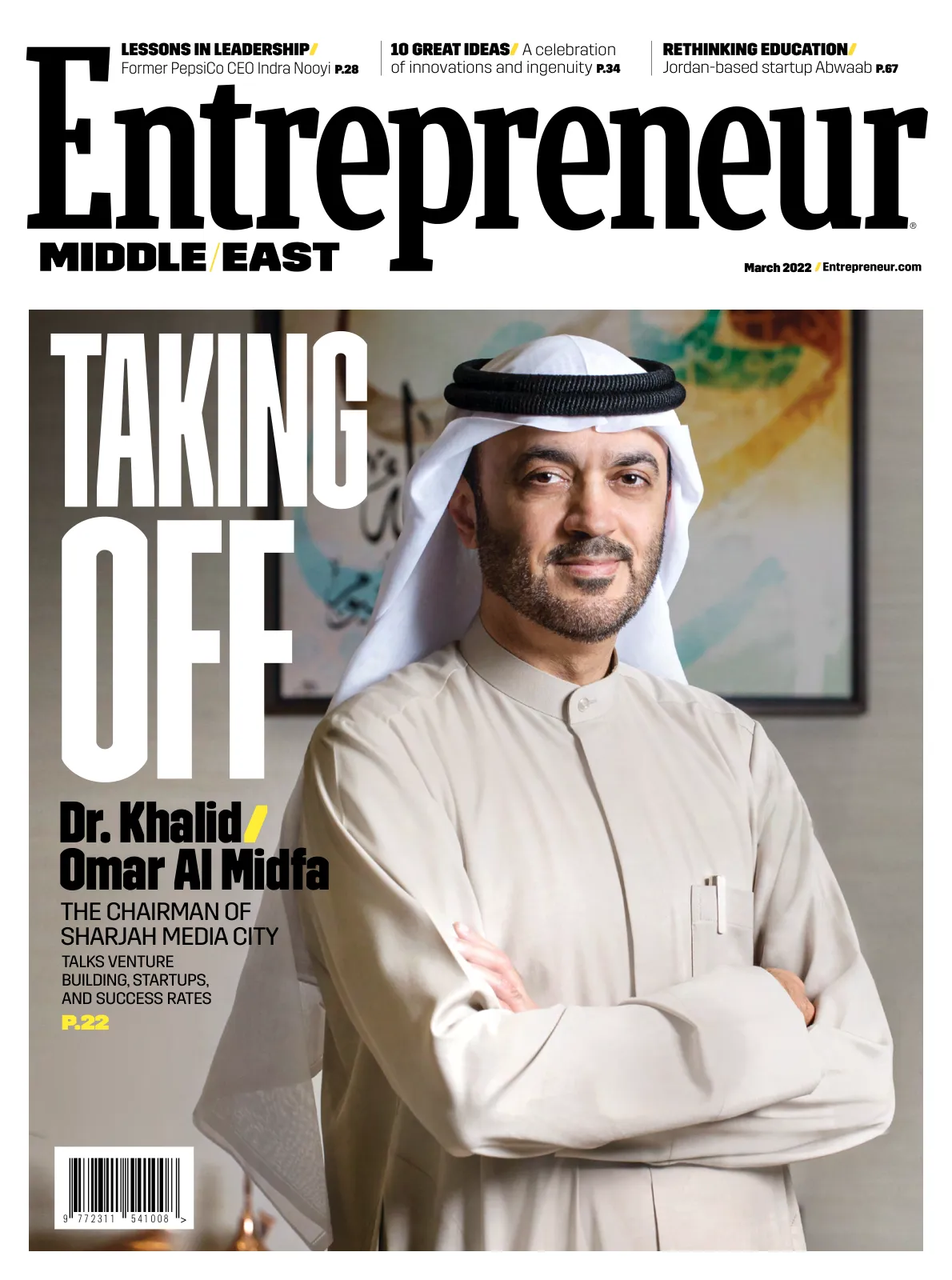
Entrepreneur Middle East, March 2022
Page 1
March 2022
9
7 7 2 3 1 1
5 4 1 0 0 8
>
RETHINKING EDUCATION/
Jordan-based startup Abwaab P.67
LESSONS IN LEADERSHIP/
Former PepsiCo CEO Indra Nooyi P.28
10 GREAT IDEAS/ A celebration
of innovations and ingenuity P.34
OFF
TAKING
Dr. Khalid/
Omar Al Midfa
TALKS VENTURE
BUILDING, STARTUPS,
AND SUCCESS RATES
THE CHAIRMAN OF
SHARJAH MEDIA CITY
P.22
Page 2
Page 3
Page 4
Page 5
Page 6
MARCH 29, 2022
VIRTUAL EVENT
As a celebration of women business leaders across the Middle East
and Africa, Mastercard has partnered with Entrepreneur Middle East
to present the first ever Women SME Leaders Awards 2022.
We are inviting every women SME leader across all walks of life-
individuals and organizations- to take part.
There are no costs for attending or nominating at this event.
Good luck to all and let’s celebrate women SMEs together!
RECOGNIZING THE ACHIEVING WOMEN
OF MIDDLE EAST AND AFRICA
Page 7
WOMENSMELEADERS.COM #WOMENSMELEADERS
NOMINATE NOW
Page 8
8 / ENTREPRENEUR.COM / March 2022
Contents/March 2022
P.22
Taking
Off
Dr. Khalid Omar Al Midfa,
Chairman of Sharjah
Media City talks venture
building, startups, and
success rates.
by ABY SAM THOMAS
P.28
Off the
Beaten
Track
Lessons in leadership
from Indra Nooyi, the
first woman of color
and American immigrant
to run a Fortune 50
company.
by TAMARA PUPIC
P.34
10 Great Ideas
A celebration of
individuals and
initiatives that impress
with their ingenuity.
by ABY SAM THOMAS
P.64
A Purpose-Led
Vision
Ramy Koussa,
Associate Vice President
for the MENAT at
Organon, on how his
global healthcare
company is aiming to
create a better (and
healthier) every day
for every woman in the
world.
by TAMARA PUPIC
FEATURES
→ PEPSICO FORMER
CHAIRPERSON AND CEO
INDRA NOOYI has
consistently ranked
among the world's 100
most powerful women
IMAGE © INDRA NOOYI | PHOTO BY ANNIE LEIBOVITZ (CONVERTED TO GRAYSCALE)
Page 9
Page 10
10 / ENTREPRENEUR.COM / March 2022
60 On the Fast Track
Having co-founded B2B solutions FOO
in the region, GHADY RAYESS explains how
your startup can succeed in the Middle
East’s thriving fintech landscape.
57 A Whole New World
As someone who recently spent
US$60,000 on buying real estate in
Decentraland, PALLAVI DEAN reflects on
five things that she learned about this
virtual universe.
62 Strategy Bites
As part of a series of insights and
inspiration from some of Saudi
Arabia’s most notable business execs,
LIRA Strategy Partners founder and
Managing Director RAFFAELLA CAMPAGNOLI
talks to MARWAN MOUKARZEL, CEO, Fawaz
Alhokair Group Fashion Retail.
‘TREPONOMICS
EDITOR IN CHIEF Aby Sam Thomas
aby@bncpublishing.net
CEO Wissam Younane
wissam@bncpublishing.net
DIRECTOR Rabih Najm
rabih@bncpublishing.net
CREATIVE LEAD Odette Kahwagi
design@bncpublishing.net
MANAGING EDITOR Tamara Pupic
tamara@bncpublishing.net
STARTUPS SECTION EDITOR Pamella de Leon
pamella@bncpublishing.net
FEATURES WRITER Aalia Mehreen Ahmed
aalia@bncpublishing.net
DESIGN Simona El Khoury
DIGITAL SOLUTIONS DIRECTOR
Mahdi Hashemi mahdi@bncpublishing.net
HEAD OF INNOVATION
Sarah Saddouk sarah@bncpublishing.net
GROUP SALES DIRECTOR – B2B GROUP
Joaquim D’Costa jo@bncpublishing.net
COLUMNIST Tamara Clarke
CONTRIBUTING WRITERS
Raffaella Campagnoli, Fida Chaaban,
Pallavi Dean, Ghady Rayess
SUBSCRIBE
Contact subscriptions@bncpublishing.net to receive
Entrepreneur Middle East every issue
COMMERCIAL ENQUIRIES
sales@bncpublishing.net
ENTREPRENEUR.COM
Access fresh content daily on our website
All Rights Reserved 2022. Opinions expressed are solely those of the contributors.
Entrepreneur Middle East and all subsidiary publications in the MENA region are
officially licensed exclusively to BNC Publishing in the MENA region by Entrepreneur
Media Inc. No part of this magazine may be reproduced or transmitted in any
form or by any means without written permission of the publisher. Images used in
Entrepreneur Middle East are credited when necessary. Attributed use of copyrighted
images with permission. All images not credited otherwise Shutterstock. Printed by
United Printing and Publishing.
PO BOX 502511 DUBAI, UAE
P +971 4 4200 506
Contents/March 2022
67 Rethinking Education
Jordan-based startup Abwaab is
on a mission to change the way
MENA students learn outside the
classroom.
by PAMELLA DE LEON
71 Breaking New Grounds
Axis founder Mishaal Al Gergawi
on becoming a part of
the internationally acclaimed
Y Combinator accelerator program.
by TAMARA PUPIC
76 Driven By Impact
Raed Masri, Muna Abusulayman
and Rama Chakaki -the co-founders
of Transform VC- are on a mission
to help create 1,000 Middle Eastern
billionaires in America by 2040.
by TAMARA PUPIC
STARTUP
SPOTLIGHT
EntMagazineME
Entrepreneur-me
← HAMDI TABBAA is
the co-founder and
CEO of Jordan-based
edtech and online
learning platform
Abwaab
Page 11
Page 12
12 / ENTREPRENEUR.COM / March 2022
Editor’s Note/
Editor’s Note/
I
was recently invited to moderate
a panel discussion being staged as
part of one of the MENA region’s
most prominent events, and while
the speakers for the session hadn’t
been decided then, I agreed to be
a part of it given that its topic was
very much in my wheelhouse. But
when I found out a few days
before the event that the panel
was featuring only male speakers
in it, I told the organizers that I
wasn’t keen on chairing a “manel,”
and that I’d need female speakers to be a
part of this session if I were to be a
moderator for it.
I’ll admit here that making this demand
of the organizers was not something I
found easy to do- on the contrary, I
hemmed and hawed for a long time
wondering if I was being too difficult,
rude, or pretentious in asking for a more
gender-inclusive panel at a conference. As
someone who has organized and staged
plenty of such discussions and events in
the past, I am well aware of how hard it
can be to put them together, and having to
change things at the proverbial last
moment is never -ever- a welcome
thought.
But my work in this particular domain
also makes me aware of there being plenty
of women in the MENA who could
eloquently opine on the topic of the panel
I was being invited to be a part of, and so,
the fact that it had still ended up becom
ing a manel only pointed to the fact that
the event organizers were simply not
putting in the work needed to allow for a
diverse discussion to take place. Indeed, I
can tell you from first-hand experience
that it’s quite easy to put a manel
together- what’s difficult is to recognize
why that’s wrong, and then actually
changing it.
I also wondered if any of the other
speakers on this panel had noticed that it
was a discussion that was set to feature
only men. All of them were influential
voices in the region’s business ecosystem-
did none of them care to have any of their
female peers join them on stage? I’m
willing to bet that they and their respective
organizations will be finding ways to be a
part of the conversations surrounding
International Women’s Day in March- but
now, I wonder: how much of what they do
in this regard is just performative
activism?
At this point, an argument can be made
that the fault here lies solely with the event
organizers, and that the speakers
themselves can be absolved of any
responsibility in allowing a manel to take
place- they were, after all, only invited to
share their insights in a session, they
shouldn’t be concerning themselves with
the mechanics of how it has been put
together. In response to that, I’d like to
point toward an especially pertinent line
in a Medium post written by Gulf Creative
Collective co-founder Bhoomika Ghagha
da on structural issues in the UAE’s art
scene.
“No matter where on the ladder you may
be, you are a gatekeeper, consciously or
unconsciously,” Ghaghada wrote. “You
always have power- and every time you
choose to not act or shut up, the institu
tional needle clicks back to the default
setting.” Now, Ghaghada may have been
focusing on the arts domain when she
wrote these words, but I think that the
point she makes applies to the world of
business as well- especially one that is still
struggling with issues relating to diversity
and inclusivity.
And so, I decided to make use of my
power- I suggested alternative female
speakers that the organizers could add to
the panel, and I also offered to pull myself
out from the session so that I may be
replaced by a female moderator. In the
end, the latter is what ended up happen
ing, as the organizers weren’t able to
confirm new speakers given the short
notice- and while it may have been a
stopgap solution, I like to think it was at
least better than a manel. At the end of the
day, remember that it’s easy to profess our
support for a more equitable world- but
what we actually need is less talk, and
more action.
Aby Sam Thomas
Editor in Chief
@thisisaby
aby@bncpublishing.net
MIC DROP
Giving everyone their fair share of airtime is no longer an option
Page 13
Page 14
Page 15
15
March 2022 / ENTREPRENEUR.COM /
Getting Ahead (Together)
Lily Hoa Nguyen, owner and Executive Chef of Vietnamese Foodies, explains how
her business has been growing from strength to strength by AALIA MEHREEN AHMED
← As someone who started
cooking at the age of five in
her native city of Ho Chi Minh
in Vietnam, NGUYEN is clearly
at home in her role today as
the Executive Chef of
Vietnamese Foodies, the
award-winning homegrown
restaurant franchise that she
founded in 2018 in the UAE.
IMAGES COURTESY VIETNAMESE FOODIES
Page 16
16 / ENTREPRENEUR.COM / March 2022
B/The Big Story
T
here is a popular proverb that goes, “If
you want to go fast, go alone. If you
want to go far, go together.” And when
preparing for my interview with
Vietnamese Foodies owner Lily Hoa
Nguyen, I came across multiple
instances of her journey so far that
almost instantly reminded me of these
lines. As such, I was pleasantly
surprised when Nguyen used the same
saying in her responses to one of my
questions. “If you wish to get ahead in
your business, then you need to make sure that
people work well together,” Nguyen says, and then
goes on to quote the aforementioned aphorism,
while adding, “Growing up in a big family of six taught
me that there is a place for everyone in a team, and
everyone has their own strengths and weaknesses.”
AS SOMEONE WHO
STARTED cooking at the age
of five in her native city of Ho
Chi Minh in Vietnam, Nguyen
is clearly at home in her role
today as the Executive Chef of
Vietnamese Foodies, the
award-winning homegrown
restaurant franchise that she
founded in 2018 in the UAE.
Since then, the restaurant has
become extremely well known
for its take on fresh and
authentic Vietnamese cuisine,
with everything from its
flavorful pho to its hearty
banh mi sandwiches finding
favor with the people of
Dubai. With four branches
spread across the Emirate,
Vietnamese Foodies has been
the recipient of several
industry awards and acco
lades, and as the brand has
grown over the years, so have
Nguyen’s leadership skills.
“When we used to be in one
small location in Dubai’s
Jumeirah Lake Towers (JLT)
neighborhood, leading the
team was about being a role
model, and showing the team
the standards to follow,” she
says. “Today, with four
locations leading our
Vietnamese Foodies team, it’s
about finding the right people
for the right job, and giving
them the tools to thrive and
develop beyond their limits.
Leadership now also means
developing the right strategy
to recruit talent from within
and outside the UAE, and
crafting the most effective
retention policies.”
FOR NGUYEN, LAUNCH
ING THE FOURTH
BRANCH of Vietnamese
Foodies in December 2021 at
Dubai’s Nakheel Mall in The
Palm has been the biggest
achievement of her entrepre
neurial trajectory so far. “The
newly opened location is
Page 17
17
March 2022 / ENTREPRENEUR.COM /
located right alongside interna
tional chain restaurants such as
Din Tai Fung, Le Pain Quotidien,
and Starbucks, and we are also
receiving our fair share of business
from shoppers,” says Nguyen.
“This showed us that we are being
considered and chosen at the same
level of quality and value for
money with international brands
that are a lot more established.
This, in particular, has made me
so proud!” But ask the founder
what, or who, she attributes this
quick growth to, and she only has
one answer: her employees. “It has
been said that a restaurant is only
as good as its people,” says
Nguyen. “To me, the people of
Vietnamese Foodies are the most
valuable assets that we have. They
give us the competitive advantage
against many other businesses in
the same market segment.” Here,
I ask Nguyen if her upbringing
had any influence on the leader
she is today- cooking with a big
family is, after all, a task that
requires strong interpersonal
skills. “When I was still cooking
from our family kitchen, I was
sometimes assigned to cook for
family meals for 20 to 30 people,
and I had to employ help from
anyone I could get a hold of,”
Nguyen recalls. “I think that
experience taught me that
harmony is very important in
running a kitchen and running a
business. It is very difficult, if not
impossible, to make someone do
something using authority alone.
You need to somehow inspire
them towards achieving the same
shared goals. Only when you are
able to do that will you be able to
lead big groups of people.”
Nguyen’s words are perhaps best
reflected in how Vietnamese
Foodies’ annual celebration of the
Chinese Lunar New Year’s “red
envelope” tradition, which is
catered specifically towards
acknowledging her employees’s
efforts. In East and Southeast
Asian cultures, a red envelope is
typically used to gift money during
holidays or for special occasions,
and for Vietnamese Foodies, the
occasion of the Chinese Lunar
Year sees all profits generated on
the day are handed out in crimson
covers to the staff as tokens of
gratitude for their hard work at
the enterprise. This year’s event,
held on January 31, saw all four of
the restaurant’s branches
partaking in the event, which
ended with all 71 employees being
treated to a cruise boat party as
well. “The most rewarding
moment of the day for me was }
TO ME, THE PEOPLE OF VIETNAMESE
FOODIES ARE THE MOST VALUABLE
ASSETS THAT WE HAVE
Page 18
18 / ENTREPRENEUR.COM / March 2022
B/The Big Story
when I distributed the red
envelopes to our people,
knowing that some of that
money is going to their
country to support their
families,” Nguyen recalls. “I
am blessed to think that
Vietnamese Foodies is a
stable corner of their lives,
and that we are able to
touch many people’s lives
through it.”
While this style of
leadership is one that
Nguyen takes pride in, it
isn’t one that is necessarily
adopted across the UAE’s
hospitality industry, she
admits. “Personally, I think
more can be done to take
care of people in hospitality,
because the F&B sector and
wider service industry is a
very labor-intensive sector,
and to elevate the service
level overall, we need happy
people in the workplace,”
says Nguyen. “Having said
that, Dubai is also a
high-cost market, and the
number of people that
businesses can afford to
employ is much lower than
many other markets. This
poses a dilemma for
restaurant operators,
especially small operators
like us.” Nguyen thus
believes the industry needs
to put in more work to
ensure better retention
policies. “What we need to
do is to think of a long-term
solution to retain people in
order to reduce recruitment
and visa fees, and instead
use that to invest in a
retention program,” she
adds.
IT IS THIS KIND OF
ATTENTION TO THE
FINER DETAILS THAT
HAS GOVERNED
Nguyen’s strategy for
business growth too. The
founder says she and her
team meticulously worked
towards ensuring they
followed through on their
expansion plans. “Being
focused and consistent in
our product offering, but at
the same time, ambitious in
expanding our footprint,
has contributed to our quick
growth in Dubai,” says
Nguyen. “Instead of
introducing different
concepts, we try to fine-tune
Vietnamese Foodies menu
to the best offer possible,
and replicate that offer in
different locations within
the city. That way people
can expect to receive the
same service and culinary
experience in any of our
four Vietnamese Foodies
locations.” In fact, this
approach encapsulates the
vision Nguyen has had from
day one of her entrepre
neurial journey. “When
Vietnamese Foodies JLT
just opened, in the very first
few months itself, I had a
dream that I would like to,
one day, see pho restaurants
and banh mi stands in every
corner of Dubai, and that
dream is slowly becoming a
reality!” Indeed, further
growth is on the cards for
Vietnamese Foodies,
Nguyen says. “Part of our
mission is to make
Vietnamese Foodies
available for people in every
corner of Dubai, and the
entire UAE in the near
future, so our goal for 2022
is to open one other
location,” she says. “We are
also working to refine our
menu to make sure that we
keep offering the same
delicious healthy food that
we have become known for
and excite our customers
with new offers at the same
time.”
As Nguyen looks back on
her journey so far, she
admits there have been a
few hiccups along the way.
The founder is, after all, a
female, Vietnamese chef
leading a franchise in a
primarily male-dominated
industry that doesn’t often
see Asian talent at the helm.
“Both gender and race
biases are existing chal
lenges for many in the
Middle East, including
myself,” Nguyen admits.
“But I just don’t let it bother
me too much, and with my
tenacity, I have created my
own table, where I’m sitting
at the head.”
THE MOST REWARDING MOMENT OF THE DAY FOR ME WAS
WHEN I DISTRIBUTED THE RED ENVELOPES TO OUR PEOPLE,
KNOWING THAT SOME OF THAT MONEY IS GOING TO THEIR
COUNTRY TO SUPPORT THEIR FAMILIES.
Page 19
lyveglobal.com
E-COMMERCE
MADE EASY
Supercharge your ecommerce and online operations
with Lyve. Get fast, flexible, and full-featured delivery and
technology solutions that meet your customers’ needs
and allow you to focus on what you do best.
Go Lyve Today �
lyveglobal.com/ecommerce
#golyve
Page 20
come as
you are.
Page 21
@ / # 25hourshotels
#hellodubai
we are now open!
25% off,
book via
enjoy
25hours-hotels.com
Overlooking the museum of the future, near dubai international
financial centre, 25hours hotel one central boasts 434 rooms
and suites in addition to flexible events and co-working spaces.
A total of four characterful restaurants and bars take guests on
a culinary trip around the world from northern india to the beer
gardens of bavaria: this is where urban nomads meet desert
flowers, where local heroes meet the well-traveled. Alongside
rental of mini cars and schindelhauer bikes the hotel will also
feature the extra hour spa, rooftop pool and dubai's first
mixed-gender rooftop sauna.
434 rooms | co-working spaces | monkey bar | tandoor tina
ernst | nomad dar bar | rooftop pool & sauna | spa | gym
Page 22
22 / ENTREPRENEUR.COM / March 2022
I
t’s always great to find someone who shares the
same principles as you do, and that should explain
why I had a renewed sense of appreciation for
Sharjah Media City (Shams) Chairman Dr. Khalid Omar
Al Midfa when he shared with me his personal
philosophy for governing people at his enterprise. “My
mantra is: ‘Don’t expect others to do a task that you
would not be prepared to do yourself,’” Dr. Al Midfa
says. “I think this is something that makes a leader
stand out.”
This is perhaps a tiny detail, but I like to think that
this statement from Dr. Al Midfa offers a glimpse into
the strategies and systems he has used to make Shams a
pioneering entity that’s now known for being “a catalyst for
creative businesses to grow and thrive” in the UAE. Launched
in 2017 following an Emiri decree from H.H. Sheikh Dr. Sultan
bin Muhammad Al Qasimi, UAE Supreme Council Member and
Ruler of Sharjah, Shams is today described by Dr. Al Midfa as
a unique free zone with its own integrated infrastructure
that aims to become a first-choice investment environment
for everyone from large companies to small- and medium-
sized enterprises in Sharjah and the UAE, with a particular
focus on the media and creative industries. “Since its
inception, Shams has been working on two main tracks,” Dr.
Al Midfa explains. “The first is establishing an integrated
business community, and incubating small-, medium-sized,
and emerging businesses to help them to grow and prosper;
the second is training media professionals to advance in the
creative industries sector, and providing talents capable of
growing Sharjah’s and the UAE’s media scenes. Along with
my dedicated colleagues and partners, I am committed to
elevating Shams into becoming a global media hub– one that
offers the most innovative and up-to-date media services,
and the center of a thriving regional media industry.” }
OFF TAKING
→ LAUNCHED IN 2017,
SHARJAH MEDIA CITY
FREE ZONE (SHAMS) IS
A WORLD-CLASS FREE
ZONE HUB FOR MEDIA,
INNOVATION, AND
CREATIVITY. SHAMS
sets the benchmark
for service and support
for those aiming to set
up and launch their
business with
specialized facilities
for the creative and
media industries.
Dr. Khalid/
Omar Al Midfa
TALKS VENTURE BUILDING,
STARTUPS, AND SUCCESS RATES
THE CHAIRMAN OF
SHARJAH MEDIA CITY
by ABY SAM THOMAS | PHOTOGRAPHY FAROOQ SALIK
Page 23
23
March 2022 / ENTREPRENEUR.COM /
“I am committed to
elevating Shams
into becoming
a global media hub.”
Page 24
24 / ENTREPRENEUR.COM / March 2022
E
xtending over an area of two
million square meters, Shams
currently boasts of a vibrant
community of businesses from
a variety of sectors, with media,
e-commerce, and real estate
being key among them. The
free zone had 5,689 companies
registered with it in 2021, and it’s worth
noting that a total of 4,293 businesses
renewed their licenses with the entity in
the same year. This can be seen as a
testament to the benefits Shams
provides to its tenants, which include
100% ownership for foreign investors, a
suite of integrated business develop
ment solutions, as well as a wide range
of commercial activities that can be
used as desired. “We believe in creative
ideas, and we have the capacity and
enthusiasm to turn these into viable
projects,” Dr. Al Midfa says. “Shams
creates talent and entrepreneurs by
providing opportunities for their ideas
to take flight. Every pioneering project
starts with an idea, and we take these
concepts and shape them into tangible
initiatives that can set new standards in
the media sector. Our future is bright,
and I see Shams becoming established
as a leader in the local and regional
media sector within the next few years.
With the first of our three main
buildings complete, we look forward to
our business growing as our physical
environment progressively expands.”
98% of construction work has already
been completed on Shams’ three
buildings, with the first opening its
doors to the public in March this year.
But even while its built environment
was being realized, Shams made sure it
continued to engage and interact with
its target communities- Dr. Al Midfa
points out here that his entity organized
43 workshops in 2021, which had 1,173
experts and members of the public
participating in them. “A standout
achievement was our successful launch
of 218: Behind the Wall of Silence, the
first crowdsourced film in the Arab
world,” he adds. “To cap it all, we have
achieved a customer satisfaction rate of
almost 90% according to our latest
survey, something that we are very
proud of in view of the challenges of the
global coronavirus pandemic.” Indeed,
while the onset of the COVID-19 crisis
did present Shams with plenty of
challenges to deal with, Dr. Al Midfa
and his team were able to keep business
going relatively unscathed. “During this
trying and testing period, Shams
remained proactive by utilizing the
latest virtual and digital technology to
manage its business, communicate with
customers, and provide access to its
services,” he says. “This was aided by
99% of its offerings being available on
digital platforms. Pre-pandemic, we had
utilized electronic platforms for virtual
communication between employees and
departments, and for managing
meetings- this put us at a high degree of
readiness to run our operations
smoothly during lockdowns. The figures
show that Shams achieved a consider
able growth in its number of registered
companies in 2020– something that
proves that our preparedness was
instrumental in enabling us to expand
our business.”
T
he manner in which Shams was
able to circumvent the challenges
resulting from the global coronavi
rus pandemic does offer an alternative
take to the doom and gloom that’s often
associated with the COVID-19 crisis,
and it’s a perspective that Dr. Al Midfa
wishes for entrepreneurs operating in
the MENA business arena to embrace
as well. “The global pandemic –a
situation unprecedented in modern
times- has created a unique set of
challenges for entrepreneurs, with the
startup ecosystem suffering high burn
rates and companies requiring stimulus
support packages from governments to
survive,” he says. “However, the crisis
has also created an array of opportuni
ties, with the rapid expansion of
digitalization and the need to conduct
transactions remotely enabling
companies to fill gaps in the market
that have dramatically widened.
Companies in the MENA region that
have done well in this new landscape
and have made an impression on me
include established online food delivery
services such as Talabat, Zomato, and
Deliveroo, and e-commerce platforms,
such as the automotive marketplace
SellAnyCar.com, online optical store
platform Eyewa, and mobile-only
e-commerce network Zon.”
→ H.H. Sheikh Sultan bin Ahmed bin Sultan Al
Qasimi, Deputy Ruler of Sharjah and
Chairman of Sharjah Media Council,
inaugurating the Shams Business Centre of
Sharjah Media City (Shams).
THE SHAMS BUSINESS CENTRE is one of
Shams’ significant achievements, in which it
embodies its bright future and enhances its
role as a media and creativity global centre.
Shams Business Centre
Page 25
25
March 2022 / ENTREPRENEUR.COM /
According to Dr. Al Midfa, the trajectories of these different
ventures show that, even through the course of the COVID-19
crisis, the principles that govern success in the entrepreneurial
domain remain the same as ever. “The pandemic hasn’t
changed one aspect– if you have a good idea, conduct proper
due diligence, and commit yourself to never giving up, your
startup has a high chance of success,” Dr. Al Midfa declares.
“With these qualities in mind, it is never a bad time to bring
your startup to the market.”
A
nd the Arab world is a great place to do just that, he adds.
“The MENA region is a popular investment destination
for both regional and global investors, and it is set to be
the only region in the world to record a rise in economic
growth this year, driven by higher oil prices and an accelera
tion in business-friendly reforms,” Dr. Al Midfa says. “With a
country-specific focus, we can see that the UAE market has
strengthened its presence in 2022 with more opportunities– a
sign of the UAE economy’s flexibility and resilience. These
attributes facilitate entrepreneurial activity, whether it be with
new startups, or the expansion of existing businesses.” Dr. Al
Midfa believes that Shams is particularly well-placed to
support enterprises in this regard, especially when it comes to
those that operate in the media and creative industries.
“Shams was established to support Sharjah’s vision of develop
ing human capacity, and to value the notion of knowledge as
being the most important asset of all,” he notes. “Its field of
focus is on building the skills and expertise of those either
already working in the media and creative industries, or who
wish to find a fertile environment in which to launch a new
venture in this area… It also encourages those with an interest
in the industry to consider a media career and to actively
pursue opportunities, whether as presenters, camera opera
tors, technical specialists, entrepreneurs, or indeed any role
that is found in a diverse media ecosystem. Ultimately, Shams
aims to be a resource for all who wish to become more
involved in the exciting and rapidly evolving media scene, and
thus become an environment where future media leaders can
hone their skills.”
L
ooking at Dr. Al Midfa’s own skills as a leader, it’s clear that
he has built them through his years of experience in the
UAE’s business scene, which he entered with a bachelor’s
degree from the UAE’s Etisalat University College (which is
today called Khalifa University), as well as a master’s and PhD
degree in telecommunications engineering from the UK’s
University of Bristol. He kicked off his career trajectory as an
Assistant Professor at Khalifa University from 2004 to 2007,
which was followed by a year-long stint in 2009 as the CEO of
the UAE’s Advanced National Research and Education
Network, Ankabut. In 2011, Dr. Al Midfa became the General
Manager of Sharjah Media Corporation, the governmental }
OUR FUTURE IS BRIGHT, AND I SEE SHAMS BECOMING ESTABLISHED AS A LEADER
IN THE LOCAL AND REGIONAL MEDIA SECTOR WITHIN THE NEXT FEW YEARS. WITH
THE FIRST OF OUR THREE MAIN BUILDINGS COMPLETE, WE LOOK FORWARD TO OUR
BUSINESS GROWING AS OUR PHYSICAL ENVIRONMENT PROGRESSIVELY EXPANDS.
IMAGES COURTESY SHAMS
Page 26
“WE BELIEVE IN
CREATIVE IDEAS, AND
WE HAVE THE CAPACITY
AND ENTHUSIASM
TO TURN THESE INTO
VIABLE PROJECTS.”
1/ Be a role model “As the head of
your organization, you need to serve
by example. Good leaders should
exemplify the behaviors and attitudes
that they want to encourage in their
team. By doing so, employees will
respect and admire you, and they will
strive to emulate your actions and
deeds.”
2/ Encourage feedback “Have an
open door to your office, and allow
your team to come to you with their
thoughts and ideas. Work on being a
participative leader by encouraging
your employees to give their feedback
to you, and involving them in
organizational plans and strategies.
Having team members be active
contributors will improve morale and
workplace productivity.”
3/ Be passionate “Showing zeal and
enthusiasm for what you do is a
powerful motivator. Great leaders look
beyond the bottom line of achieving
targets and generating profits; they
show that the journey to reach the
goals is one that should be fun and
all-consuming. By showing passion for
projects, you will inspire your team to
display the same.”
Leadership lessons from
Sharjah Media City Chairman
Dr. Khalid Omar Al Midfa
THE EXECUTIVE
SUMMARY
26 / ENTREPRENEUR.COM / March 2022
Page 27
27
March 2022 / ENTREPRENEUR.COM /
IMAGE COURTESY SHAMS
organization in which his responsibilities included “leading
operations, providing strategic vision and long-range
planning, maximizing business operational efficiency, and
creating year-on-year business growth.” This led to his
appointment as the Chairman of Shams in the same year it
was launched, and in this role, he oversees the entity’s
leadership team in delivering a variety of key performance
indicators, which run the gamut from “aligning organization
al objectives” to “creating consensus for solutions and future
direction.” “I believe that one of the most important things I
do is to promote an environment of openness and transpar
ency within my team, and to encourage employees to speak
out without fear of censure,” Dr. Al Midfa says. “You get the
best out of people when they are comfortable in expressing
themselves fully, and this generates a positive atmosphere in
the workplace. Allowing people to talk freely enables the
prompt identification of any issues, which may otherwise go
undetected, and it also aids in discovering new and effective
ways of working. It all adds up to being a recipe for good
enterprise operations and organizational growth, with high
morale and low staff turnover aiding productivity and
efficiency.”
T
his tactic may sound like an easy thing to accomplish, but
Dr. Al Midfa admits that putting it into practice does
take a bit of work and patience. “The main challenge I
have faced with this approach is conveying to new team mem
bers that there is no catch,” he reveals. “At first, naturally, they
can be reticent about speaking their mind. However, after just
a few months, I am proud to see their confidence grow, and
for them to feel that they are established members of the
team, with their own unique voices.” This brings us back to
Dr. Al Midfa’s ethos as a leader that was mentioned at the
beginning of this article- he’s clearly someone who has no
qualms about getting his hands dirty while on a job, and he
pushes those around him to follow a similar mentality as well.
“Of course, effective delegation is an essential aspect of any
organization– people have different skillsets and professional
training, and they need to be assigned to roles where they can
effectively utilize their assets most effectively,” Dr. Al Midfa
says. “However, I also believe that a degree of ‘cross-pollina
tion’ is good business practice, as it enables employees to
undertake different roles if needed. I actively encourage my
team to learn what their colleagues from their own and other
departments are doing. Not only does this help ensure
functions can still be successfully completed if we happen to
be a team member down, with a colleague able to step in and
temporarily take over, it also engenders a more holistic
understanding of the organization, with employees able to
understand how different roles contribute to the whole.”
I
t should be pretty apparent by now that Dr. Al Midfa is
someone who believes in the adage of the whole being
greater than the sum of its parts, and he confesses that it’s
a lesson that he learnt when he was younger. “I was very
headstrong in my youth, and whilst this gave me the drive to
succeed, it also blinded me to opportunities to learn from my
colleagues,” Dr. Al Midfa recalls. “I was locked into thinking I
had to be very competitive in everything that I did, and too
often, I would see my colleagues as rivals in the workplace,
not co-workers aiming for the same organizational goals. This
changed for me one day when someone who I hadn’t
previously regarded very highly saved me from a mistake that
I had made– one that had the potential to cause me a
problem. His act of generosity changed my attitude, and it
made me realize that the key to enjoying my work was to
make the most of the people around me, and to draw on my
workmates’ strengths to enhance my own.” The significance of
this particular moment in Dr. Al Midfa’s life cannot be
understated- in fact, if he were ever given a chance to go back
in time to change something he did, this is the lesson he’d be
keen on learning much sooner in his life. “If I could change
anything, it would be to have adopted this mindset earlier on
in my career,” he says. “However, I learned a valuable lesson
on that day, and it is one that I carry with me to this day. I
believe it has shown me how to be a better employee and –
now– a better leader.”
↓ SHARJAH MEDIA CITY FREE ZONE (SHAMS)
promotes a vibrant and connected network for innovators
to live, learn, and co-create on a global level easily.
THE UAE MARKET HAS STRENGTHENED ITS PRESENCE IN 2022 WITH MORE
OPPORTUNITIES– A SIGN OF THE UAE ECONOMY’S FLEXIBILITY AND RESILIENCE.
THESE ATTRIBUTES FACILITATE ENTREPRENEURIAL ACTIVITY, WHETHER IT BE
WITH NEW STARTUPS, OR THE EXPANSION OF EXISTING BUSINESSES.
Page 28
28 / ENTREPRENEUR.COM / March 2022
OFF
THE
BEATEN
TRACK
→ INDRA NOOYI IS AN INDIAN-AMERICAN
BUSINESS EXECUTIVE AND FORMER
CHAIRPERSON AND CEO OF PEPSICO.
She joined Amazon's board of directors in
2019, and has consistently ranked among the
world's 100 most powerful women.
LESSONS IN LEADERSHIP
FROM THE FIRST WOMAN OF COLOR
AND AMERICAN IMMIGRANT
TO RUN A FORTUNE 50 COMPANY
by TAMARA PUPIC
INDRA NOOYI
IMAGE COURTESY BRULÉE BEAUTY
Page 29
29
March 2022 / ENTREPRENEUR.COM /
F
or the first time ever, other countries in the Middle
East are saying we want to be a center too, so
Dubai is now on the edge of whether it will preserve
its dominance.” That’s what Indra Nooyi, the former
Chairperson and CEO of PepsiCo and now a sought-
after corporate strategist and advisor to
entrepreneurs, executives, and governments, said to
a packed audience at the 14th Emirates Airline
Festival of Literature held in February this year in Dubai.
Nooyi was invited to the Festival to promote her memoir,
My Life in Full: Work, Family, and Our Future, which presents
the arch of her life from being a middle-class girl from
Chennai in southern India who went on to become one of
only five women studying management at the prestigious
Indian Institute of Management in Calcutta, and then she
got a scholarship for the Yale School of Management. Most
importantly, she went on to build an iconic career in
corporate America, and thus becoming known as the first
woman of color and American immigrant to run a Fortune
50 company. }
“
IMAGES COURTESY INDRA NOOYI
Page 30
30 / ENTREPRENEUR.COM / March 2022
Shortly before Nooyi ad
dressed the audience at the
Emirates Airline Festival of
Literature, I also got a chance
to speak to her for a few
minutes, during which she
revealed that she had been
coming to Dubai for more
than a quarter of a century,
every time witnessing “more
construction, new iconic
buildings coming up, more
excitement, and more
billboards.” Nooyi said,
“Obviously, Dubai is open for
business. I think that this
whole region is very active
now, and there’s a big
competition among the
regional countries going on
here, so the real challenge for
Dubai will be whether it will
maintain its preeminence in
the region.” In true Nooyi
fashion of over-delivering on a
particular premise, she did
also share a valuable insight
which, if converted into a
well-executed policy, might
help Dubai preserve its
supremacy as the region’s
main business and financial
hub. However, before sharing
that with all of you, I’d like to
first touch upon some of the
most interesting parts of my
conversation with Nooyi,
which sought to unravel the
threads of wisdom that she
made use of throughout her
career path.
There are a few work-specif
ic situations that Nooyi
mentions in her memoir to
which, I believe, required a
very high level of emotional
intelligence to properly
respond to, and when I asked
her how she kept her cool in
those instances, she replied,
“It’s a small price to pay.” One
of those situations happened
during a summer when, as an
Indian intern wearing a sari at
a Booz Allen office in Chicago,
Nooyi was not being taken to
client meetings. Or, much
later in her career, when she
was already the Chairperson
of PepsiCo, she had to have
regular one-on-one meetings
with a board member, almost
always having to travel to his
home city to see him, during
which he would oppose her
opinions, only to later “repeat,
verbatim, what I’d just said.”
“All of these were very small
prices to pay. Big deal, never
mind,” Nooyi reiterated. In her
memoir, Nooyi further recalls
male executives being “rude
and patronizing,” and when I
asked about the soft skills that
were required to overcome all
of this, she put it down to
self-awareness. “In that Booz
Allen example, here I was in a
sari, in the summer of 1979,”
she said. “This was long time
ago, because first of all, there
were hardly any women,
hardly four or five women in
the whole Chicago office. And
there were not many immi
grants either, it was a whole
different time. So, I think,
when you are faced with that
situation, you have to be
practical and understanding
to say, ‘If I’m not being taken
to the client, that’s okay,
because I’ve learnt enough in
the office.’ They’ve all gone out
of their way to teach me. They
all were really wonderful
people at Booz Allen. They
never once commented about
my sari. They treated me like
one of their own. So, going to
the client, or not, who cares! I
think that you have to process
everything that is happening
around you in a way that is
relevant to the circumstances
of that time. For example,
when I was at PepsiCo and
men used to have golf
weekends, I was happy that
they didn’t invite me, because
I had family at home. If they
invited me, I’d have to say no
every time, and then they’d
think I was anti-social. In
reality, I’m glad they didn’t
invite me.”
But this is not to say that
Nooyi did not stand up for
herself either. In My Life in
Full: Work, Family, and Our
Future, Nooyi does list a few
anecdotes in which she stood
her ground and refused to go
with the status quo. For
instance, she remembers
when, in management
meetings at PepsiCo, her
comments where labelled as
“too theoretical,” but once the
exact same proposal was made
by a man, they were viewed as
“terrific, insightful ideas.”
Once, towards the end of one
of those meetings, Nooyi
leaned over to a senior
operating executive, loudly
asking him to “bring up a
thought of mine,” lest it would
again be viewed as “too
theoretical.” Such stories offer
a perspective into how Nooyi
was breaking the mold when
she became the CEO of
PepsiCo in 2006- at the time,
she was one of only 11 women
running a Fortune 500
company; in 2021, there were
41 women on Fortune’s Global
500. During her time at the
helm of PepsiCo, Nooyi says
that she didn’t think she could
IF DUBAI CAN MAKE ITSELF AS A WOMEN-FRIENDLY AND A FAMILY-
FRIENDLY PLACE, AND THEREFORE, A PLACE THAT OFFERS AN INCREDIBLE
TALENT POOL, YOU WILL KEEP AND ATTRACT EVEN MORE BUSINESSES.”
Entrepreneur Middle East
Managing Editor Tamara Pupic
interviewing Indra Nooyi
at the 14th Emirates Airlines
Festival of Literature
Page 31
31
March 2022 / ENTREPRENEUR.COM /
do anything about how people treated her
personally, but she always made it a point
to try to support women in the organiza
tion. One example of this was when she
noticed “the and-but phenomenon”
during performance reviews at PepsiCo-
when managers reviewed the results of
their male peers, they’d commend them
on their “terrific potential,” whereas when
they would assess the performance of
women, it would always include an
explanation of an issue that “might derail
her future success.” Nooyi decided to turn
things around in this department by not
letting the managers get away with such
consequence-free indictments of the
women under them, and instead telling
them to “to make it work with that female
executive.”
This brought us to an important point
that Nooyi raises in her book- the need
for topics like gender equality and
women’s progress to be discussed by all,
and especially by men in positions of
power, because “otherwise, it’s women
talking to women.” Nooyi explained, “In
some global meetings, when we start talk
ing about these issues, there are only
women in the room, and a few already
‘converted’ men. The other people sitting
there are doing their emails, because they
didn’t find any other place to sit down.”
To further highlight the importance of
bringing men in power to the table, Nooyi
shared an interesting story. “Even about
this book, I have to tell you, one thing
that was a disappointment to me is that
men bought the book to give it to their
wives and daughters,” she said. “So, I look
at them, and say, ‘Why don’t you read it
yourself?’ Why do you think that you
shouldn’t read a memoir written by a
woman?’ I’ve been forcing men to read
the book now. Then, they read it and they
go, ‘Oh, I didn’t realize it was so pro
found.’ I think it’s high time that we
brought men to the table, and said:
‘Which one of you is going to be progres
sive enough to be able to talk about these
issues?’”
For these reasons, Nooyi insists that
the most profound change that needs
to happen in society will come through
educating men- particularly men in
leadership roles- to support women in
the workforce. “There are more and
more women coming into senior levels,
so we should call into question why
those issues still exist,” she said. “It is
because the men in power need to
pause and say, ‘Wait a minute, we just
took on that guy who hasn’t fulfilled his
objectives, but we say he’s got great
potential, whereas this woman has
played down her potential- shall we
talk about why that’s the case?’ Let’s
have men talk about why they think
that women have no potential, while
men have infinite potential. I think that
we have to find a few male leaders who
can model this behavior.” While she
commended more and more men
publicly taking on this issue, she
admitted that “until there is a critical
mass of people asking for change, one
person cannot do it all.” Nooyi added,
“But if that person is a CEO, then he
can change the people, meaning if they
won’t change their behavior, change the
people.” }
Without
failures,
I wouldn’t be
where I am
today.”
“
↑ Indra Nooyi recently published her memoir, My Life in Full: Work, Family, and Our Future
Page 32
32 / ENTREPRENEUR.COM / March 2022
Such changes were hard to
even imagine during her own
career, which included very
demanding roles at Boston
Consulting Group, Motorola,
ABB, and of course, PepsiCo.
Nooyi once described herself
as “an ideal worker,” which
translates into a ferocious
work ethic that, for instance,
made her not walk a trail in
front of the PepsiCo office
called the Golden Path for the
first 20 years she spent at the
company, because “she just
didn’t have time.” Her
professionalism is further
illustrated through the story
of when she flew to the
Russian capital of Moscow
over a weekend to help a
junior PepsiCo team prepare a
report that would be present
ed to her the following week.
Another anecdote from her
memoir that left me in awe of
her commitment to her work
describes her, after a very long
day at her job, calling her
husband Raj Nooyi from a
Fond du Lac police precinct,
because she could not pay a
speeding fine with her
American Express card. Then,
she “spotted a neat bed in a
jail cell and -I actually can’t
believe it now- asked if I could
sleep on that bed for the night,
until my husband could come
the next morning with the
cash.”
At the time, all of this
seemed “a small price to pay”
for the fundamental changes
that she introduced with
PepsiCo’s Performance with
Purpose initiative, which
resulted in its healthier and
more nutritious products,
limited environmental
footprint, and empowered
staff. Plus, PepsiCo’s revenue
grew by 80% under Nooyi’s
12-year leadership. However,
she assures me that it was not
achieved without occasional
failures and regular resistance
at every turn. “I use failures as
learning, teachable moments
about what went wrong, and
what I could have done better,
then I learn from that and
improve next time,” Nooyi
said. “Without failures, I
wouldn’t be where I am today.”
This is also the ethos with
which Nooyi characterizes her
departure from PepsiCo,
which reports have suggested
happened when the company’s
“North American beverage
unit was stagnating amid a
general decline in soda
consumption” (TIME), and
there was growing pressure
“to revamp the company’s U.S.
beverage business by spinning
off its bottling operations, or
even splitting up the com
pany.” (The Wall Street
Journal). “When I had to walk
out of PepsiCo, when I said,
‘I’m leaving,’ that was a failure
of the system and of me too,
because I felt like, ‘What could
I have done differently to
avoid that situation from
happening?’” she
continued.“So, I think that
sometimes the system fails
you, sometimes you don’t
anticipate what needs to be
done and you feel like a
failure, but every one of these
moments, you should make a
teachable moment and
consider what you could have
done differently.”
We touch upon the COVID-
19 pandemic next, and
according to Nooyi, the world
is currently in a trial period of
assessing what it means to
have a work-life balance, and
she hopes that this will lead to
the embracing of a set-up that
takes into consideration
different needs. In fact, that is
her book’s “moonshot” pitch:
requesting a better balance
between work and family that
would “enable women to rise
to the top of companies, but
also enable families to be
built.” That would explain her
urgent call for business
leaders to enable efforts like
paid leave, work flexibility and
predictability, and support
systems that would allow
employees to care for their
young families or elderly
parents. That’s the way to
unleash the full potential of
our economies, Nooyi states,
and that is also her invaluable
and timely advice for Dubai as
it carves out its place in the
future. “If Dubai can make
itself as a women-friendly and
a family-friendly place, and
therefore, a place that offers
an incredible talent pool, you
will keep and attract even
more businesses,” Nooyi
predicts.
IT’S HIGH TIME THAT WE BROUGHT MEN TO THE TABLE, AND SAID:
‘WHICH ONE OF YOU IS GOING TO BE PROGRESSIVE ENOUGH
TO BE ABLE TO TALK ABOUT THESE ISSUES?’
Page 33
A WALKATHON FOR A GOOD CAUSE
WE CARE FOR
WHAT’S RARE
wewalk.ae
Get your tickets now!
All proceeds will go to the
UAE Rare Disease Society
SAT 19 MAR
7AM - 12PM
DUBAI SCIENCE PARK
AL BARSHA SOUTH 2
Join us at this fun event
Presents
3rd year edition
In association with
Partners
Page 34
10
GREAT
IDEAS
E
ver stumbled upon something and think, “Wow, that’s
a great idea!” That’s the feeling we sought to achieve
for ourselves as we went about building this collection
of 10 great ideas- and while this is by no means an
exhaustive list of all the inventive concepts out there, we
are still pretty excited to see how our selection will pan out
in the long run. by Aby Sam Thomas
34 / ENTREPRENEUR.COM / March 2022
Page 35
AT A TIME when the top food
aggregators in the UAE’s F&B space are
notorious for their single-minded pursuits of
profit (often at the expense of the
entrepreneurs actually fueling this
ecosystem), Ian Ohan is hoping to subvert
the ways thing currently operate by
launching Locale, which he has branded as
the country’s first food aggregator “with a
heart.” Ohan, who is the founder and CEO
of KRUSH Brands, a homegrown full-
service, multi-kitchen, brand development,
operating, and franchising company that’s
behind popular F&B concepts like Freedom
Pizza, Salad Jar, and several others, says
that Locale has been designed to be an
economically sustainable ecosystem for the
UAE’s innovative entrepreneurs in the F&B
space -aka foodpreneurs- to thrive and
reconnect with the communities in which
they operate.
“LOCALE IS THE ONLY TRUE ALTERNATIVE
to the harmful third-party delivery
ecosystem, which charges unsustainably
high fees to the most innovative and
passionate people in our industry, globally,”
Ohan says. “Locale is not about making
money on delivery, technology, advertising,
nor fees- our objective is to minimize these
costs for all. Instead, Locale is about
making money on great food.” Looking at
Locale from an entrepreneur’s point of view,
its appeal is easy to see- it’s been built by
foodpreneurs for foodpreneurs, and that’d
explain how, besides the seven brands in
the KRUSH Brands portfolio, the aggregator
has already got fellow homegrown players
like artisanal bakery Viking Bageri and meal
plan concept JetLagged Chef to list on it.
“Customers are enjoying the clean and
customer-focused interface of Locale- no
advertisements, no questionable customer
reviews, and it rejects the paradox of too
many, poor quality choices,” Ohan says.
“When customers come to Locale, they
know that each brand is high quality, and
service is backed up by Locale’s fully
integrated technology, operating and
delivery capabilities, and powered by the
love of great foodpreneurs.”
AS SOMEONE who has been following Ohan
and his pursuits in the UAE’s F&B
ecosystem for a long time now, it’s pretty
apparent to me that that Ohan is someone
who believes in the power of food to bring
people together, and that is what he wishes
to safeguard with Locale. “For Locale, great
food is not a commodity,” Ohan declares.
“Silicon Valley money exploited the
weakness of our industry, which is also our
greatest strength- our singular focus on and
passion for food, people, and experience.
We are taking it back. Locale fills the gap
-great food technology, convenience,
multi-kitchen operating efficiencies, last
mile logistics- but this is not our product.
Our product is great food.” And in case
you’re wondering why that matters, Ohan
has his answer ready. “Food is culture,” he
declares. “We celebrate with food,
commiserate with food, and commune with
food. It enriches the fabric of our lives.
There is no greater gift than when someone
gives something of themselves to create
something to be enjoyed by others. Our
goal is to preserve and protect this culture-
the creators, the people, and most
importantly, the food they create.”
LOCALE
locale.ae
EUREKA!
Ian Ohan explains how to make
an idea a great one
}Solve a real problem “Create
solutions that solve real problems. Whether that is
doing something better or creating a solution to an
outstanding issue, great ideas solve real
problems.”
}Care about the why (and the
how) “Great ideas should add value to people.
The why and how you do something are often the
cornerstones of great ideas that manifest cultural
importance.”
}Execute well “In order for a great idea to
reach fruition, it must be executed well. Great
ideas without great execution typically are not
realized. Focus on execution.”
35
March 2022 / ENTREPRENEUR.COM /
IMAGE COURTESY LOCALE
Page 36
36 / ENTREPRENEUR.COM / March 2022
BRULEE BEAUTY
bruleebeauty.com
ANY WOMAN with a golden-hued
complexion will tell you that finding a
concealer to perfectly match their skin tone is
rare– if not, impossible. In the vast spectrum
of skin tones represented by makeup brands
around the world, warm skin tones have long
been miscategorized and left underserved. In
fact, complexions with prominent golden-
yellow undertones are prone to under-eye
circles and skin discoloration, and the
industry's stereotypical “warm” or “cool”
labels have traditionally exiled these tones to
a generic medium-tan label. And if you don't
have the right concealer, the rest of your
makeup simply doesn't work.
THAT'S THE PROBLEM Dubai-based makeup
artist Fizah Pasha -the founder and CEO of
Brulée Beauty- set out to solve. “I've been a
makeup artist for about 10 years, and I
struggled to find the right formulas for my
clients with yellow undertones,” she says. “I
would constantly need to mix two or three
different foundations and concealers to get
the right color and texture. Our dark circles
are a bit different, and we don’t really fit the
cookie-cutter formula. Your complexion can
appear ashy and grey if you’re using a
concealer that doesn't match your skin and
undertone.”
TRAINED AT THE WORLD-RENOWNED Delamar
Academy in the UK, and working across
London, Dubai, New York and Karachi, Pasha
heard women from diverse ethnic
backgrounds all sharing the same skin
concerns as they collectively struggled to find
flattering, color-enhancing under-eye shades
for their specific skin tones. And that’s how
she ended up employing advanced color
theory, dermatology, and cosmetology
principles to develop the Brulée collection of
high-coverage concealers that celebrates
multifaceted skin tones that exist in a
spectrum of shades ranging from macadamia
to deep caramel.
10
GREAT
IDEAS
IMAGE COURTESY BRULÉE BEAUTY
Page 37
37
March 2022 / ENTREPRENEUR.COM /
HAVING LAUNCHED IN 2020, Pasha says it
was doubly hard to get Brulée noticed in an
ultra-competitive and oversaturated
industry. “It was tough launching in a
pandemic year, as there weren't many
opportunities to meet people or go to
events to introduce myself or the brand,”
Pasha recalls. But the old adage rang true
for the founder: build it, and they will come.
“The feedback I got was most fulfilling,
from people switching from some pretty
holy grail brands to Brulée,” she says. And
the icing on the (Brulée) cake, Pasha
added, came when Bollywood actress
Sonam Kapoor –who frequently posts her
glam routine tips and tricks on Instagram–
shared how much she loves the Brulée
concealer.
Looking ahead, the founder plans to
expand her product range beyond
concealers that will further serve women
with sun-kissed undertones. “Inclusivity in
makeup matters,” she says. “Every skin
tone should be seen and considered when
creating products.” - by MEGHA MERANI
EUREKA!
Fizah Pasha explains how to make an
idea a great one
}Trust the process- it can take
time “After having worked on the formula for
two years to get it just right, the product works
as a corrector and concealer, and it takes
literally a minute to blend.”
}Always fill a need in the market
“There isn’t a brand in the market that thinks of
all the issues that women of golden and yellow
undertones face. That’s why Brulée works.”
}Purpose should come before
profit “I came up with the idea of my own
beauty line, catering to a niche that was
forgotten, shortly after my divorce. I was
fortunate to have the means and education to
pursue my idea. Brulée helped me empower
myself. And so, I thought to myself: how can I
empower women to stand on their own feet and
not feel compelled to stick around in unhappy
situations? I wanted to empower women of
yellow and golden skin undertones through
representation, but also use my brand to help
give women a voice by supporting education
for girls. To start, we'll be donating 5% of our
profits to trusted charities that support young
girls and women in developing countries in
three key areas: formal education, skills and
training, and mentorship. I discovered my
purpose through working on this brand. When
someone buys Brulée, I want them to know
they're not just buying a product. They're
buying a piece of me and my vision.”
FOUNDED IN 2012, Midwam
is a Jeddah-based immersive
experience design company that
specializes in designing and curating
unique immersive experiences for
organizations and institutions. Led by
co-founder and CEO Khalid Al-
Muawad, Midwam is currently the only
company of its kind in Saudi Arabia,
and its standing in the market can be
seen in the number of leading events
that it has already worked on in the
Kingdom and abroad. “Midwam
counts tier-one government entities as
its clients, including the Ministry of
Culture, the Saudi Art Council, and
MISK Innovation, as well as large
enterprises, such as Saudi Airlines,”
Al-Muawad reveals. “Midwam has also
worked with leading lifestyle and
entertainment brands, including the
first MDLBeast SoundStorm, Saudi
Arabia’s biggest transformational event
that took place in Riyadh in December
2019, drawing the participation of
400,000 attendees. Outside of the
Kingdom, the company has worked on
multiple events in Moscow, London,
New York, Paris, and Cannes.”
MIDWAM’S OPERATIONS in Saudi
Arabia come at a time when the
country is currently seeing
revolutionary growth in sectors like
entertainment, real estate, tourism,
arts, culture, and more. The company
is thus extremely well-placed to take
advantage of these changes
happening in the Kingdom as it
pursues its Vision 2030 mandate, and
that’s thanks to Al-Muawad spotting
these opportunities and then tapping
into it. “I come from a banking and
financial background, and I saw a
huge unmet demand for creative
cultural and entertainment spaces in
which people can connect,” he recalls.
“Through relationships with companies
in Saudi Arabia, the United States,
Europe, and the Far East, we were
able to fill this gap, and offer
experiences that focused on various
parts of culture, heritage, tourism,
sports, and entertainment. }
MIDWAM midwam.com
↑ KHALID AL MUAWAD is the
co-founder and CEO of Midwam,
the first Saudi experience
design company that specializes
in immersive experiences.
Page 38
38 / ENTREPRENEUR.COM / March 2022
WITH SAUDI ARABIA'S CULTURAL and
technological change, the company is in a
unique position to capitalize on
opportunities in the development of the
aforementioned emerging core industries.
Tourism, for example, is one of the
Kingdom's most crucial pillars of growth,
and Midwam will play a key part in
providing immersive experiences that will
attract visitors. Similarly, the cultural sector
is predicted to grow at an exponential rate
by 2030, and the extended reality industry
will gain traction.”
According to Al-Muawad, the demand for
immersive experiences is going to increase
as the world moves past the effects of the
COVID-19 crisis. “Individual behaviors have
changed dramatically since the pandemic,
as digital experiences have become the
norm, and thus, any physical encounter
must be absolutely exceptional,” Al-
Muawad says. “Following the relaxation of
restrictions, Midwam is well positioned to
benefit from this new reality. As the tourism
and events business returns to pre-
pandemic levels, we will continue to
collaborate with leading institutions.”
However, Al-Muawad is clear that he
wishes for Midwam to stand out not just on
the local level, but also on the global
playing field. “On a worldwide scale, we
want to maintain our position as a pioneer
in immersive experience design,” Al-
Muawad declares. “We aim to accelerate
the development of creative, cutting-edge
products to deliver the most captivating
experiences across many industries
through our pioneering methodology, which
leverages the best of local know-how and
human capital.”
10
GREAT
IDEAS
EUREKA!
Khalid Al-Muawad explains
how to make an idea a great one
}Deliver a big impact
“If I don’t see impact in a project, we
don’t take it.”
}Make sure you stand out
“An idea can only be considered as great
if it is able to fill an empty gap in the
market, or have a competitive edge.”
}Execution is everything
“You should be able to develop a unique
product, and inspire belief in your
business.”
}Focus on your end user
“Understand your audience, and deliver
content that is innovative and engaging
for the user.”
}Don’t go at it alone
“Last but not least, the most important
thing to note is to select and put together
a dedicated team of talents who will
support your idea and drive growth.”
“WE WANT
TO MAINTAIN OUR
POSITION AS A PIONEER
IN IMMERSIVE
EXPERIENCE DESIGN.”
IMAGES COURTESY MIDWAM
Page 39
39
March 2022 / ENTREPRENEUR.COM /
A CHARTERED ACCOUNTANT
who has experience working in the
finance and banking realms across Asia,
Africa, Europe, and the Middle East may
not be the typical profile one would
expect from the founder of a fashion
label- but then again, that’s exactly who
Winifred Mills-Amui is. Having launched
her eponymous brand in the UAE in
September last year, Mills-Amui likens
launching a business in this domain as
going through a crash course in an
entirely new industry. But she has
managed to power through it all, and
she continues to do so even today- all
of which points to the strength of the
factors that drove her to launch Winifred
Mills in the first place. “I have, for many
years, felt that the clothing available to
women like myself -with fuller figures,
with professional needs- never fully
represented the many facets of our
being,” Mills-Amui says. “As such, I
wanted to launch a label that reflected
my tastes and my identity– a desire that,
at times, seemed unique, but is actually
something shared by so many globally.”
In fact, Mills-Amui recalls tweaking,
adjusting, and altering existing brands
in an attempt to create looks that were a
better expression of her style- but those
efforts never panned out in the way she
hoped. “What was missing was
authenticity,” she recalls. “My friends
shared my feelings, so I knew the need
was there– I just needed to figure out a
way to make it a reality.”
THIS IDEA TURNED INTO A BUSINESS
after Mills-Amui heard an ad that was
prompting new business registrations in
early 2020- the opportunity, quite
literally, fell into her lap, and she
grasped it with both hands, even while
the coronavirus pandemic had begun to
inflict its terrible toll on the world. “The
biggest challenge was deciding to set
up a brand, and to do it properly,”
Mills-Amui remembers. “I wanted to
understand all the stages involved in
establishing a brand, from the branding
of the business, right through to
pattern-making, designing, sketching
the pieces, and getting the outfits
made.” Note here that Mills-Amui had
entered a domain that was quite foreign
to her- but she made use of the
resources available to her to master the
craft she had chosen. “I enrolled in two
courses by [online education platform]
MasterClass with Dionne Von
Furstenberg and Marc Jacobs, amongst
others, which gave me a very good
insight of what was required,” she
explains. “Following that, I consulted
with professionals in the fashion
industry, and it became apparent this
was by no means an easy feat. And
then, there was social media to contend
with- the media landscape I knew had
completely changed.” Nevertheless,
Mills-Amui persisted. “What kept me
going was my passion, and my mother,
who has always been my rock,” she
says. “She is an example of a woman
who accomplished all she set out to
do– a wife, mother of four, a
professional working woman in the
medical industry, and an entrepreneur. I
felt if she could do it, so could I.
Launching the brand in September last
year was a huge triumph– an
accomplishment that took 18 months to
achieve, a true labor of love.” }
WINIFRED MILLS
winifredmills.com
Page 40
40 / ENTREPRENEUR.COM / March 2022
The Winifred Mills label draws on
Mills-Amui’s Ghanaian heritage, with
her making use of the rich West
African textile traditions of kente,
ankara, and aso oke to make clothes
that would not only fit, but also flatter
and accentuate strong silhouettes.
“Designed to empower and celebrate
the wearer, each piece expertly
balances classic shapes and feminine
details with bold uses of print and
color,” Mills-Amui says. “With
versatility at the heart of each design,
the wearer is given the tools to
experiment and explore their
individuality. With a global and cross-
cultural mindset, this label is for
women who want to confidently
showcase their heritage, celebrate
their femininity, and harness their
power.” And while Mills-Amui may
have started on her entrepreneurial
journey to fulfil her particular needs in
fashion, she has seen her brand be
welcomed by other women as well.
“We are consistently told, ‘This was
just made for me,’ ‘This is extremely
comfortable,’ ‘This brand had me in
mind,’ ‘Every outfit fits perfectly,’ etc.
As an inclusive brand catering to
strong silhouettes, and with a growing
list of repeat customers, it is evident
we are servicing a gap in the market,
and we are well positioned on the
runway for a steep take-off.” Add to
all of this the fact that Winifred Mills is
a Black-owned enterprise in the
fashion landscape, and that, by itself,
makes Mills-Amui a trailblazer in her
own right. “With there being very few
renowned African female fashion
designers to look up to, I hope my
journey will inspire others,” she says.
“As a wife, and a mother to an
amazing 12-year-old young man,
while working full-time for an
international bank, my experience as
an entrepreneur in the UAE has been
a very interesting one. The pre-launch
journey has had its peaks and
troughs, ups and downs, wins and
losses, but it has been rewarding to
build my vision from scratch,
prioritizing my needs, and the needs
recognized in the market.”
EUREKA!
Winifred Mills-Amui explains how
to make an idea a great one
}Seek the right kind of
support “As the saying goes: ‘Stop
asking people who have never been
where you’re going for direction.’ We
often rely on friends and family for
advice, but setting up a business
requires knowledge from that industry.
Seek advice and guidance from
industry experts.”
}Stand out from the crowd
“Have a product that differentiates you
from the market, and know your why.
It is imperative that your product is
offering something unique to the
market.”
}Be your own cheerleader
“You should be passionate about the
product you’re selling. That is
absolutely key!”
IMAGES COURTESY WINIFRED MILLS
40 / ENTREPRENEUR.COM / March 2022
10
GREAT
IDEAS
Page 41
Page 42
42 / ENTREPRENEUR.COM / March 2022
AS A CELEBRATED CHEF in the Philippines,
JP Anglo doesn’t need much of an introduction to the Filipino
population in the UAE, and that may well explain why there
has been a lot of love and support pouring in for the launch
of his first F&B venture in the UAE, Kooya Filipino Eatery.
With its name being a derivation of the Tagalog word kuya
(meaning “brother”), the restaurant aims to be a celebration
of Filipino cuisine. And Anglo, who is perhaps best known for
being the man behind the hugely popular Sarsa Kitchen
concept in Manila and bringing an irresistible twist to the
Philippines’ cuisine, hopes that the fare at Kooya will wow
not just his fellow kabayan, but also those who may not be
as familiar with it. “Our main idea is really to bring good
Filipino food to countries outside of the Philippines,” Anglo
says. “Not ‘elevated’ Filipino food per se, because Filipino
food is already great. It just needs to be presented differently
for those who have yet to experience it. Why can't we have
good quality Filipino food that people would have access to,
much like Vietnamese food or Thai food?”
LOCATED IN DUBAI MARINA, Kooya is currently in its soft
opening phase as a business, but the food Anglo has been
serving at the restaurant has already been getting a lot of
rave reviews. Kooya’s beef kalderata and chicken inasal
appear to be its biggest hits, but praises have been
aplenty for its inihaw na adobong tokwa and pancit
palabok as well. Commenting on the reception he has
seen to Kooya so far, Anglo says, “So far, it's been good.
We've also been seeing a lot of different nationalities eating
at Kooya, and it's great that they like it. Most people have
no idea what Filipino food is, even though they have so
many Filipino friends. It's time to start bringing Filipino
food to the world. The campaign I am really pushing is to
push #FilipinoFoodForward, because it's time that people
realize how good our food, culture, and heritage is.” And
that ties into Anglo’s advice for anyone wanting to follow
his lead in becoming an entrepreneur. “Don't be afraid to
break barriers and stereotypes,” Anglo says. “Go for it, and
go for it through and through. There is nothing worse than
half-baked anything- make sure your ‘why,’ or the reason
for wanting to do something, is on point.”
KOOYA
instagram.com/kooyafilipinoeatery
DON'T BE AFRAID
TO BREAK BARRIERS
AND STEREOTYPES.”
“
→ With Kooya, Anglo is aiming to
bring good Filipino food to
countries outside of the Philippines.
10
GREAT
IDEAS
Page 43
43
March 2022 / ENTREPRENEUR.COM /
EUREKA!
JP Anglo explains
how to make an idea
a great one
}You need to be
inspired
“Find your inspiration, and
follow your gut feel. Of
course, do your research
too.”
}Choose the right
partners
“Choose allies based on
their values, visions, and
abilities. They should
complement yours, and
make up for the things you
lack.”
}Hire a good team
“The one thing you should
invest in are your people.
Invest in your key people,
and your life will be so
much easier.”
IMAGES COURTESY CCA MANILA | KOOYA
Page 44
44 / ENTREPRENEUR.COM / March 2022
10
GREAT
IDEAS
↓ KYMA CO-FOUNDERS
Left to right:
Farida El Agamy,
Dima Samaan,
and Samar Sayegh
44 / ENTREPRENEUR.COM / March 2022
Page 45
45
March 2022 / ENTREPRENEUR.COM /
EVERYONE WISHES to keep
a tidy household- and that’d explain why
all of us have a number of plastic bottles
containing cleaning products in our
homes at any given time. And when the
last drop has been squeezed out of any
of these bottles, it’s safe to say that we’d
just throw away the empty container, and
then replace it by buying a new plastic
bottle filled with the requisite cleaning
product. It’s this scenario that Kyma
co-founders Farida El Agamy, Dima
Samaan, and Samar Sayegh want to
reimagine- what if, instead of buying a
new bottle, we could reuse the empty one
by refilling it with the product we need?
And that’s exactly what their UAE-born
startup is proposing. “Kyma has
reengineered and reinvented cleaning by
creating surface cleaners in tablet form,”
the co-founders explain. “By adding
water to a reusable bottle and dropping in
this tablet of concentrated cleaning
product, we are able to reduce our use of
single-use plastics in our home.”
CEO El Agamy, CMO Samaan, and
COO Sayegh say that Kyma is the result
of the three women coming together as
friends wanting to battle the global
problem of plastic pollution, and find
ways to safeguard the future of the planet
we all live in. “Much of single-use plastic
enters our oceans, and it has harmful
effects on everyone,” they point out. “Up
to 90% of the water we drink and the
food we eat contain microplastics, and by
2050, scientists predict that the ocean
will contain more plastic by weight than
fish. We were shocked to learn all of this,
and this is where Kyma was born.”
Kyma’s refill and reuse model is thus an
attempt by these women to disrupt the
manufacturing processes of an industry
that they believe has been quite limited
on innovation. “We need bold innovations
that challenge existing designs, materials,
and business models,” they say. “Our
priority is to rethink traditional
approaches, and pave the way for new
solutions such as reusable and refillable
models.”
KYMA PROUDLY DECLARES its cleaning
products to be non-toxic and
biodegradable, and the co-founders say
that the “refillution” the company is
spearheading is finding favor among the
UAE’s population. “Kyma was created
with the mission of empowering
customers by offering them the option to
be sustainable, and the opportunity to
contribute to enhancing the future of our
planet,” they note. “We believe the
consumer of the future wants it all, the
opportunity to have a high-quality
effective product, while also reducing
their impact on the planet. Our goal is to
make sustainability convenient,
affordable, and attractive.” And while they
may have started with making sustainable
cleaning products under the Kyma brand,
El Agamy, Samaan, and Sayegh are clear
that that they want the company’s
portfolio to grow further. “Our plan is to
continue developing products that will
impact everyone's life, and reduce our
consumption of single-use plastics,” they
explain. “We aim to build a lifestyle brand
that uses chemical and technological
innovation to reengineer fast-moving
consumer goods to make them more
ecological and consumer-friendly.”
KYMA
mykyma.com
EUREKA!
Farida El Agamy, Dima Samaan, and
Samar Sayegh on how to make an idea
a great one
}Find a problem- and then solve it
“Identify a problem that you are facing personally as a
consumer that has no evident solution, and come up
with an idea that would solve it for you! Chances are,
that if you’re continuously facing an unsolved
problem, there is an unaddressed gap in the market.”
}Dare to try, fail, and try again “It is
very likely that the idea you will eventually end up
working on is not among the first ideas you came up
with. It’s important to be okay with trying things, them
not working out, and moving on.”
}Speak to entrepreneurs that
have done it “The best advice in
entrepreneurship comes from the people who have
done it and managed to build a successful company.
Their advice and insight will make it easier for you to
take a decision regarding your next steps.”
IMAGES COURTESY KYMA
Page 46
46 / ENTREPRENEUR.COM / March 2022
WHEN AMIR FARHA announced in November last
year that he had launched a new venture capital (VC) firm
catered towards early-stage startups in the Middle East, it
might be fair to say that his new enterprise piqued the
curiosity of everyone who’s anyone in the region’s
entrepreneurial ecosystem. After all, Farha can be likened to
being a veteran of the Middle East’s investment arena, having
spent close to 15 years investing in the region, perhaps most
prominently in his time as the co-founder and Managing
Partner of the Dubai-headquartered BECO Capital, with the
list of startups he funded including now-famous names like
Careem, Swvl, PropertyFinder, Kitopi, and others. So, given
that he already had a successful career and an impressive
track record behind him, one can be forgiven for wondering
why Farha would now be attempting to start an altogether
new enterprise with the stated aim to “transform the culture of
early-stage investing in the Middle East.”
THE ANSWER TO THIS QUESTION is indicated in the name Farha
chose to call his new firm: COTU Ventures, where COTU
stands for “Champions Of The Underdog.” Farha says that he
was driven to launch his new VC firm after coming to the
realization that the majority of relationships that currently exist
between founders and investors in the region is one of fear,
manipulation, and power dynamics. “Very few investors know
how to truly foster deep connections with founders that is
focused on trust and openness, and, as such, create a safe
place to share and be vulnerable,” Farha explains. “This is
especially prevalent at the earliest stages, where there is little
traction, and the founder is at their loneliest, i.e. when they are
a true underdog. Most investors wait for traction, and they are
often uncomfortable with the uncertainty of a startup’s life
before it reaches product-market fit. We at COTU Ventures are
here to fill that gap. We help people become extraordinary by
showing them how to believe in themselves when they are at
the loneliest, earliest, and most challenging parts of their
journeys.”
WITH AN EXPLICIT FOCUS towards supporting founders
who are in the seed stage of their businesses, COTU
Ventures aims at offering such entrepreneurs “a diverse
and unique value-add” to their respective journeys. “We
believe that the first investor (believer) in a founder’s
journey can be the most impactful, if they are able to build
a strong foundation of trust and connection with each
other,” Farha says. “They can help in the early team hires,
key product roadmap decisions, culture and values
setting, and in fundraising and cap table construction. All
of these are essential areas to solve for early on and
compound in value over time. Hence, being the ‘first
check’ can really alter the company’s chance of success.
Very few investors have that stage and value-add focus,
and that’s why there are not many impactful partners to
founders early enough in their journey. And while we’ve
been in the market for only a short period of time, we were
able to attract some high potential founders to our roster,
and we have forged strong relationships with all of them.”
COTU VENTURES
cotu.vc
“WE ARE BUILDING
A NETWORK OF VENTURE
PARTNERS WHO BELIEVE
IN OUR MISSION AND
STAND BY SIMILAR VALUES.”
IMAGE COURTESY COTU VENTURES
10
GREAT
IDEAS
Page 47
47
March 2022 / ENTREPRENEUR.COM /
COTU VENTURES HAS BEEN REPORTED to have
been an investor for three MENA-based
businesses in the recent past: MoneyHash, a
fintech enterprise operating out of Egypt, Supy,
a UAE-based digital enterprise that streamlines
restaurant-supplier relationships, and Englease,
an edtech startup also based out of the UAE.
And as per Farha, COTU Ventures is standing
out from its peers in the investment domain by
managing to build fruitful relationships with the
entrepreneurs behind these companies. “Our
founders love us, and this is shown by how they
involve us in critical decisions, and give us more
ownership in their companies over time,” he
says. “We do not take this for granted, and we
are always open to feedback to continue to
improve our proposition and interactions as we
grow. Everything we do is through our values
and principles.” And Farha is insistent that these
tenets will remain the underlying characteristics
that govern the VC firm as it develops and
grows in the months and years ahead. “We are
building a network of venture partners who
believe in our mission and stand by similar
values,” Farha reveals. “This is a relationship
business that is long-term, so investing in
people, growing our team, and expanding our
value-add are all areas that we will continue to
focus on in the future.”
THE WOVEN HOUSE
thewovenhouse.ae
BIANCA OBRIQUE is the
co-founder of The Woven House, an
online home décor store based out of
the UAE that sells a variety of
exquisitely handcrafted products that
have been sustainably made by
weavers in the entrepreneurs’ native
country of the Philippines. Weaving in
the Philippines is a distinct expression
of art, culture, and tradition, and from
hanging planters to rattan shelfs, each
item in The Woven House portfolio is
a testament to the talent of the
artisans that the company has
empowered, whom Obrique proudly
declares to be “the life force, sheer
power, and vitality” of the company.
“Every woven piece is fabricated
exclusively by one weaver, and
marked with the maker’s identity,”
Obrique explains. “By empowering
the members of our local handicraft
industry, we feel humbled and
connected to our Filipino roots. It also
shows our appreciation and
recollection of our homeland’s
achievements and heritage… They
are not only a product of hard work,
but they are also developed with a
lofty goal in mind, and that is to help
mitigate the harmful effects people
inflict on Mother Nature by making
possible the production of similar
commodities in the most
environment-friendly manner.”
Obrique was driven to launch The
Woven House after she herself found
it hard to source such handcrafted
home décor products -which are quite
characteristic of the Philippines- from
her home in Dubai during the onset of
the global COVID-19 crisis in 2020. }
EUREKA!
Amir Farha explains how to make an idea
a great one
} Find a (small) community
of like-minded people “Be surrounded
by other people that are also looking to start
something, or work for a startup. Work out of
co-working spaces. Meet new people. Attend
events. This can be physical or virtual. These days,
I’d recommend virtual, for example, OnDeck.
Learn.”
}Write down ideas to build
depth and conviction “Write down
ideas as they come to you. Take each idea, and
research it online in order to learn about the
market and the dynamics, and if there are
alternative solutions that exist. Then, explore the
idea further through asking questions to the right
people, and testing the idea with others. You’ll
either get more excited by the problem or
opportunity, or less excited. That’s your measure
of conviction.
}Start building “Nothing is every clear at
the start, but if you have enough conviction, then
you will be able to fight through the struggles that
will inevitably hit you early on. Whether you start
with a basic minimum viable product, or even
something that’s done totally offline but can test
the viability of the solution, it doesn’t matter. Most
people don’t have the courage to actually start.”
Page 48
48 / ENTREPRENEUR.COM / March 2022
“It was at the height of the pandemic, and
most countries were on lockdown,” she
recalls. “Since I was mostly at home then,
I remembered that I’ve always wanted to
redecorate my place, make it cozier, more
relaxing, and somehow bring the freshness of
the outdoors, indoors. Also, since we all
couldn’t go home to our country, we wanted to
bring some pieces of home here. That’s when
I realized the rarity and absence of these
products here in the UAE.” It is thus with a
dream to introduce these Filipino works of art
to a global audience that Obrique partnered
with co-founder Roseller Enriquez to build The
Woven House, and the first market they
decided to target was the Middle East.
“The Woven House is an affirmation of our
belief in the Philippines’s potential to
differentiate itself from other similar industry-
related products,” Obrique says. “We believe
it is high time for Filipino crafts to be known
on a global level. In the coming years, we aim
to see it thrive. Furthermore, we seek to
change the way the public sees, buys, and
thinks about local craftsmanship, while
contributing to the uplifting of our local
artisan’s standard of living.” From a personal
standpoint, Obrique is also hoping that her
and Enriquez’s efforts with The Woven House
will also help reframe mindsets about what
the Philippines has to offer the world at large.
“My desire to keep changing the narrative for
us Filipinos grows more and more each
passing day,” Obrique declares. “I believe that
Filipino craftsmanship can surpass the
stereotypical norm to remain local. I also do
want everyone to realize that we, for that
matter, can be as knowledgeable, skilled, and
competent as our counterparts from other
countries. That is why I commit to every step
towards being a platform that will fulfill this
kind of potential.”
10
GREAT
IDEAS
EUREKA!
Bianca Obrique explains how to
make an idea a great one
}A journey of a thousand
miles begins with a single
step “To be honest, for me, trying new
things was scary; it's hard. For a lot of
reasons, I was gripped with potential fear
of failure, paralyzed by the notion of
inconsistency, and questions like, ‘What
if I don't meet up to the level of those I
admire?’ In short, I was overwhelmed by
the workload required to start. But in the
end, I realized that trying is the only way
we grow and learn. I had to gather the
courage, put my nose to the grindstone,
and crank it up to get started. I realized
that the things required to define my new
path were just a few more achievements
off.”
}Stop undermining yourself,
and start believing “Sometimes,
it can be tricky to catch yourselves
undermining yourself, but whenever you
do, try to refocus your attention on
something that inspires you, and go back
to your why: why do I want this business
to happen? Believe that you are capable
of achieving greater things!
}All the excuses need to go
“Excuses are a sign you are starting to
fall into the same trap of losing yourself
again. It is okay to put off something
when you are tired (your mental health
matters), but you have to not let it
become a constant habit. Know that you
are worthy of anything. If you set your
mind to it, you can achieve it.”
}Take action “It’s really just about
taking one baby step at a time- I really
believe that every effort, big or small,
goes a long way. It doesn’t matter how
simple it is, you have to start from
somewhere. This will set the momentum
of your overall entrepreneurial journey.”
}Surround yourself with a
good support system “Having
family and friends who support your
dreams is great, since they will
encourage and boost your confidence to
continue what you’ve already started.
Your loved ones might also give you
some ideas or other inspirations that you
can incorporate into your business. And
of course, I just want to add that you are
your biggest supporter. You have to
motivate yourself, and do not let the
challenges along the way impede your
growth. Doing something new can be
nerve-wracking, but if you don't try, you
will always feel entrapped by the ‘what
could have been’ feeling. Do not wait for
that ‘aha’ moment- create it!”
IMAGES COURTESY THE WOVEN HOUSE
Page 49
49
March 2022 / ENTREPRENEUR.COM /
AS A CHILD, Jessica Kahawaty
remembers people complimenting her
mother, Rita, for the food she made, saying
things like, “Your food is so great; you
should open a restaurant!” But at the time,
Rita was too busy being a devoted mother,
and she never found time to pursue that line
of thought. Fast forward many years later to
2020, and Jessica -who had, by then,
become an internationally acclaimed model
and humanitarian living in Dubai- decided to
tap into the potential of this idea of her
mother spearheading a food business when
Rita, who had traveled to Dubai from her
home in Australia, found herself staying on
with her daughter for longer than she
planned thanks to the onset of the global
coronavirus pandemic. This is, in effect,
what led to the mother and daughter
becoming the co-founders of Mama Rita, an
online food delivery concept specializing in
the provision of homecooked meals that are
both healthy and delicious.
THE MAMA RITA MENU is an eclectic one-
there are hearty offerings like the oriental
rice with lamb and the beef stroganoff,
interspersed with lighter fare like the
fattoush salad and the newly introduced
Mediterranean prawn wrap. “Our idea for
Mama Rita is premium quality food with
democratic pricing, and a menu carefully
curated by the family,” says Jessica, who
essays the role of CEO at the enterprise,
while Rita is its Head of Culinary. “We are a
light-asset digitally native vertical brand that
uses cloud kitchens to operate and expand.
Being at the forefront of the virtual brand,
we can speak to our consumers directly
through a combined reach on social media
of 1.2 million followers. Innovation is at the
heart of what we do. Our menu items are
unique, many of which were my
grandmother’s recipes. The best part is that
they are bestsellers and much loved by our
Mama Rita customers, which allows us to
stand out from the vast pool of players in
the market.”
AND JESSICA HAS THE NUMBERS to prove
her statement. “The reception towards
Mama Rita has been incredible so far, with
over 150,000 meals served since launch,
and an incredible retention rate of 80%,”
she points out. “Looking ahead, the vision
for Mama Rita is to expand geographically
to reach more people who are already fans
of the brand.” At the same time, Mama Rita
has also been inking strategic partnerships
with influential brands in the market- Jessica
proudly notes that in the fifth month of its
operation, Starbucks approached the
company to have one of its desserts called
the “Fresh Fruit Paradise” in hundreds of the
former’s outlets across the UAE. Such
achievements bode well for the future of the
business, and Jessica, for her part, seems
to be all fired up for the road ahead.
“Looking back on my journey, there is
nothing I would’ve done differently,” Jessica
notes. “We jumped into this so fast without
knowing what to expect, and the greatest
businesses come from a moment of magic
and serendipity.”
MAMA RITA
mamarita.com
EUREKA!
Jessica Kahawaty explains how to
make an idea a great one
}Keep it simple “The brightest ideas
spark from the simplest of things– find what
you are passionate about, and nurture it.”
}Solicit feedback “Speak to friends
and people you trust in business for honest
feedback on your big idea– be willing to
receive negative and positive feedback.
Challenge yourself fully.”
}Focus on providing value
“Identify ways your great idea could improve
a customer’s life. Everything almost exists
already, so be different, and offer something
new.”
}Start today “Things don’t have to be
perfect for you to begin. The most important
thing is not to be stagnant and wait. Today is
the perfect day.”
IMAGE COURTESY MAMA RITA
Page 50
50 / ENTREPRENEUR.COM / March 2022
3FILS
3fils.com
DUBAI-BASED 3FILS was declared to
be the best restaurant in the MENA at the
region’s inaugural edition of the renowned
World’s 50 Best Restaurants held in Abu Dhabi
in February this year, and when I ask Ahmed
Saleh, co-founder and CEO of The Lab Holding
(the UAE-based operator of the concept) if he
ever expected his homegrown enterprise to
reach the levels of success it has scaled to
today, he replies in the negative. “I don’t think it
was ever on our minds,” Saleh admits. “We
wanted to create a small, humble, and casual
restaurant, where we all can enjoy high quality
food and have fun. Whatever success we have
is all thanks to an incredible team, and the
amazing guests that continue to join us at 3Fils.”
Tucked away in Dubai’s Jumeirah Fishing
Harbor, 3Fils, which opened in 2013, may not fit
one’s stereotypical assumptions of an
establishment that’d win top honors on a 50
Best list- for starters, there are no fine dining
elements offered at this restaurant. The vibe at
3Fils is casual and laidback, and all tables are
served on a walk-in basis- the unlicensed
restaurant has a no-reservations policy. But all
of these points don’t take away from the fact
that the food being offered at 3Fils is exemplary-
it is premium Asian fare, heavily influenced by
Japanese cuisine, made using high quality
ingredients, designed to be served in an
approachable manner. “The great idea we have
at 3Fils is about ‘making complex simple,’”
Saleh says. “It’s not just a slogan, it's a way of
life. We implement and live this daily, and
simplicity always wins.”
Of course, there’s a lot of work that happens
behind the scenes to enable such simple,
seamless dining experiences for the patrons of
3Fils, and that shows the importance of the
collaborative manner in which this business is
run. “We’ve all played our part in giving our three
fils in everything about the restaurant,” Saleh
says. “From the logo, to the dragon maki roll, all
our research, experience, and knowledge -from
myself, the chefs, even the waiters- all of our
opinions and ideas have made their way into
3Fils.” Such efforts have clearly worked out well
for 3Fils, and given the success it has seen so
far, Saleh admits that growing the brand is
something he and his team are certainly
considering. “We are thinking of expansion,
most definitely, taking into account that the
experience has to be the same for all our 3Fils
guests, no matter where we open,” Saleh
concludes.
→ WITH HARBOUR-SIDE
COMMUNITY STYLE
DINING, 3Fils serves up
premium Asian dishes
with a Japanese twist as
its focus.
10
GREAT
IDEAS
IMAGES COURTESY 3FILS
Page 51
51
March 2022 / ENTREPRENEUR.COM /
EUREKA!
Ahmed Saleh explains how to make
an idea a great one
}Be curious, be observant
“Look at everything, everywhere. Find a gap
that you’ve personally experienced and build
on it. Find alternative solutions to eliminate or
fill in the gaps.”
}Keep in mind that you’re
on a two-way street “We're in the
business of exchanging value, all part of a
giving and receiving cycle.”
THE GREAT IDEA
WE HAVE AT 3FILS
IS ABOUT
MAKING COMPLEX
SIMPLE.”
“
Page 52
52 / ENTREPRENEUR.COM / March 2022
A cut above →
/Samsung Galaxy S22 Ultra
B/Gear
#TamTalksTech
Gadgets and doodads that you might’ve missed out on,
sourced by a tech aficionado. by TAMARA CLARKE
← I’ve got the power
/Zendure SuperMini X3
Zendure’s new SuperMini X3 weighs in at just 200 grams, so it
doesn’t weigh you down when charging on-the-go. The 10000mAh
power bank is portable, and packs a punch with 45W power
delivery output. It’s ideal for charging a variety of devices including
tablets, phones, laptops, and Nintendo Switch- it reportedly only
takes 30 minutes to charge a MacBook Air up to 40%. Meanwhile,
the SuperMini X3 takes about an hour to fully recharge itself, and it
features three charging ports (one bidirectional 45W PD USB-C
charging port, and two USB-A charging ports), thereby allowing
you to charge up to three devices at the same time. The SuperMini
X3 comes with an LED screen along the side as well, so you can
easily keep an eye on the battery.
TAMARA CLARKE, a former software development professional, is the tech and lifestyle enthusiast behind The Global Gazette, one
of the most active blogs in the Middle East. The Global Gazette has been welcomed and lauded by some of the most influential tech
brands in the region. Clarke’s goal is to inform about technology and how it supports our lifestyles.
Talk to her on Twitter @TAMARACLARKE. theglobalgazette.com
IMAGES COURTESY SAMSUNG | SONY | ZENDURE
The Samsung Galaxy S22 Ultra combines
the power of the Note series and the iconic
S-Pen with a pro-grade camera. The
improved S Pen experience means that you
write and draw directly on the screen. The S
Pen also gives you instant access to
signature S Pen tools such as Samsung
Notes and Live Message, and the
handwriting-to-text function has been
upgraded to support 87 languages. And
that’s not all- the S Pen can also act as a
remote control to run presentations. Capture
stunning photos and videos all day and night
using the camera which features a 2.4um
pixel sensor (Samsung’s largest pixel sensor
ever), and photos can be further refined
using the free Expert RAW app. At the same
time, multitasking is easier than ever on the
Galaxy S22 Ultra due to its 4nm Processor. With
all the powerful features built into the Galaxy
S22 Ultra, rest assured that the device is
well-equipped for long hours of use with a large
5000mAh battery, which lets you record more
than 50 minutes of video (after only a 10-minute
charge), so you can keep calm and carry on with
minimal disruption to your work or play time.
Sounds good ↑
/Sony LinkBuds
The Sony LinkBuds are here to give you a
premium listening experience, whether you’re
working from home, gaming, or simply
streaming music. Approximately four grams in
weight, these earbuds are easy to carry
wherever life takes you. Make calls without
noise, for crystal clear conversations, thanks
to LinkBuds’ precise voice pickup technology,
which is supported by Sony’s noise reduction
algorithm. LinkBuds also allow you to enjoy
high quality sound, no matter how busy life
gets, thanks to its Digital Sound Enhancement
Engine. Sony’s Integrated Processor V1
reproduces all the detail in your music with
minimal distortion for a stunningly authentic
listening experience, so your favorite artists
always sound great. To sweeten the deal,
Adaptive Volume Control automatically
optimizes volume based on where you are,
letting your music seamlessly blend into your
environment. Meanwhile, gesture controls
keep you on top of things with its Wide Area
Tap feature. By double or triple tapping in front
of either of your ears, you can adjust the
playback to your liking– there’s no need to
touch the LinkBuds themselves.
Page 53
FUN COMES
GUARANTEED
YOU DECIDE WHEN THE PARTY
STOPS WITH 24HR FOOD & DRINK.
NOW OPEN AT DUBAI DIGITAL PARK.
RADISSONHOTELS.COM/RED
Page 54
54 / ENTREPRENEUR.COM / March 2022
B/Gear
From better goods to better wardrobe bests,
every issue, we choose a few items that
make the approved executive selection list.
In this issue, our picks include the Santoni’s
Fall/Winter 2022 line, a new timepiece from
Audemars Piguet, and more.
The Executive
Selection
IMAGES COURTESY VERSACE
EYE ON YOU →
Versace
Versace has teamed up with actor
and photographer Cole Sprouse to
present its latest eyewear capsule
line. The six-piece collective of
frames includes Medusa Focus, a
pair of aviator sunglasses, as well
as Medusa Mesmerize, a pair of
sunglasses with a futuristic vibe,
both produced with black temple
details and dark grey lenses. Get
them while they’re hot! Versace.com
Cole Sprouse
sunglasses collection
FW 22 by Versace
Page 55
55
March 2022 / ENTREPRENEUR.COM /
IMAGES COURTESY ALOUSHI’S | SANTONI | AUDEMARS PIGUET
REFINING ELEGANCE → /
Audemars Piguet
To mark the 50th anniversary of the Royal
Oak, luxury Swiss watchmaker Audemars
Piguet is debuting its first Royal Oak
Selfwinding Flying Tourbillon in an
openworked dial configuration. Encased in a
41mm diameter, we see the timepiece in all
its glory, offering a look on its all-new Calibre
2972 movement, while also exposing all of its
intricate inner workings and a skeletonized
dial display. From the flying tourbillon at 6
o’clock and the tiny revolving cage around
the balance wall, it’s an impressive piece of
art. Add to that the wider polished chamfers
on the bezel and caseback, plus the new
thinner bracelet that makes the time a lot
more comfortable to wear. If you’re looking
for a timepiece that screams luxury, this
staple is hitting stores this March- don’t miss
out. audemarspiguet.com
WALK IN STYLE ↑
Santoni
Effortlessly fusing formal and sporty in a
novel way, Santoni’s Fall/Winter 2022
men’s collection narrate craftsmanship
as well as unexpected color
combinations. It has a palette of warm
shades of brown and yellow, as well as
cooler shades of blue and bright green.
And of course, its details can’t be
missed: materials made out of calfskin,
soft suede, nylon, and wool are crafted
with the signature Santoni style; they are
also rubberized and shaded for its color
to evoke a tactile consistency. Almost
every pair of shoes can be accessorized
with a suit and leather bag- they work
for the boardroom, or even for a casual
night out. santonishoes.com
Aloushi’s ↑
Founded by UAE-based entrepreneurs Alia Jashanmal and Alkesh Thayrani,
e-commerce platform Aloushi’s aims to bring sustainable brands from around the
world under one platform. We’re quite delighted to see Kal Hans, a vegan, all-natural
skincare brand, as part of its offering. As a brand that encourages embracing one’s
flaws, Kal Hans is for the real beauty minimalists who want a no-fuss, on-the-go
skincare routine. From its aloe cucumber mist, to its skin brightening under-eye
cream, the Kal Hans formula packs in plant-based active ingredients to create
multifunctional products that are vegan, cruelty-free, and eco-friendly. aloushis.com
EDITOR’S PICK
Royal Oak Selfwinding
Flying Tourbillon in an
openworked dial
configuration by
Audemars Piguet
FW22 Men's
Collection by
Santoni
Aloe cucumber mist and
skin brightening under
eye cream, Kal Hans by
Aloushi's
Page 56
#LNMEforum
LOGISTICSNEWSME
@LOGISTICSNEWSME
LOGISTICS NEWS ME
CBNME.COM
LOGISTICS
FORUM
2022
INNOVATION
IN TECHNOLOGY
How blockchain, artificial
intelligence and IoT
is revolutionising the
logistics and supply chain
industries
1
WAREHOUSING
How automation
is reinventing the
warehousing business and
disruptive technologies
are allowing warehouses
to accommodate the F&B,
retail and pharma sectors’
growing requirements.
2
SUPPLY CHAIN WOES
The shipping network
upended by the pandemic
shows no respite – supply
chains continue to find itself
in a logistics knot, ports
face a never-seen-before
congestion and shipping rates
are yet to fall. What is the
solution?
4
SUSTAINABLE
MOBILITY
Green fuels, sustainable
infrastructure and
sustainable modes
of transport
3
Topics
FOR SPEAKING OPPORTUNITIES
KASUN ILLANKOON
+971 56 135 4769
kasun@bncpublishing.net
JOCHEBED MENON
+971 55 969 8037
jochebed@bncpublishing.net
FOR SPONSORSHIP OPPORTUNITIES
CLAYTON RODRIGUES
+971 50 929 3982
clayton@bncpublishing.net
JOAQUIM D’COSTA
+971 50 440 2706
jo@bncpublishing.net
March 29 | Dubai
Page 57
57
March 2022 / ENTREPRENEUR.COM /
A Whole New World
Five things a metaverse sceptic learned by buying real estate in a virtual universe by PALLAVI DEAN
As the head of Dubai-based interior design and
architecture studio Roar, I recently spent US$60,000
on buying real estate in Decentraland, which has billed
itself as “the first fully decentralized world.” Here’s my
explanation of how and why I did this- and what I
learned in the process:
1/ I WAS SO WRONG TO TURN MY NOSE UP AT THE
METAVERSE FULL DISCLOSURE: my name is Pallavi, and I
am a recovering metaverse sceptic. For a long while, I have
been reading about bitcoin going through the roof, non-fungi
ble tokens (NFTs) selling for millions, and people trading plots
in Decentraland- and I’d think, “These guys are nuts, frittering
their hard-earned cash on useless digital nonsense.” }
← Dubai-based
architecture and interior
design studio ROAR has
ventured into the
metaverse by purchasing
two plots of land
in 3D virtual space
DECENTRALAND.
RENDERINGS COURTESY ROAR
Page 58
58 / ENTREPRENEUR.COM / March 2022
It’s a well-trodden argument- but then, I had a realization, and I
finally got it. The turning point was my credit card bill. To be
precise, the credit card bill for my kids’ video games such as
Minecraft, Fortnite, and Roblox. As it turns out, I’ve been
spending a fortune in the metaverse for years now, buying
characters, weapons, skins, even a few virtual countries– and I
have the receipts to prove it.
As it turns out, I’m not alone. Bloomberg crunched the
numbers on the metaverse economy, calling it “a nearly $800
billion market opportunity.” Earlier this year, Microsoft paid
$67 billion for video game company Activision in what has been
described as the biggest tech takeover in history. (“The deal will
provide building blocks for the metaverse,” said Microsoft CEO
Satya Nadella.) And then there was Facebook changing its name
to Meta. I could go on- the examples are plentiful.
2/ BUYING IS HARD: WE NEEDED THOUSANDS IN CASH AND
A GUY IN A LAND CRUISER
It’s one thing deciding to buy property in the metaverse; it’s
another thing to actually do it. I’m doing my MBA, and my
professors at INSEAD constantly remind me: “Execution is
everything!” And in this instance, the execution was
excruciating!
Here is the problem: I wanted to invest about $60,000 in
Decentraland (more on this later) with my colleagues at Roar,
Kathryn and Leigh. But I live in the UAE, and lots of the top
cryptowallets are designed for residents of the US. Even when
we set up a local wallet, frustratingly, it had a 60-day cooling off
period before we could spend our ethereum to buy mana, the
crypto for Decentraland.
Eventually, it was old school cash that won the day: we
withdrew thousands and thousands of dirhams in notes from an
ATM and contacted Intex Pearl, an ethereum trading company,
who collected the money and completed the trade on our
behalf. I’m sure there’s a better way to do this, but this is how we
got it across the line.
It’s certainly a good thing that crypto brokers take compliance,
anti-money-laundering, and know your customer (KYC)
protocols seriously. But it can make the process of buying
metaverse real estate akin to walking through treacle.
3/ WE BOUGHT FROM DECENTRALAND- THE NUMBER OF
PLOTS IS CAPPED
Once you have made the initial general decision to invest in the
metaverse, you have a specific decision to make: which ‘verse
are you going to pick? We chose Decentraland, which was
created in 2017 by a couple of Argentinians, and formally
launched in 2020.
Here’s why: first, Decentraland capped the number of plots at
90,601. Scarcity is key in the crypto world, which is why bitcoin
IT’S CERTAINLY A GOOD THING THAT CRYPTO BROKERS TAKE COMPLIANCE, ANTI-MONEY-
LAUNDERING, AND KNOW YOUR CUSTOMER (KYC) PROTOCOLS SERIOUSLY. BUT IT CAN MAKE
THE PROCESS OF BUYING METAVERSE REAL ESTATE AKIN TO WALKING THROUGH TREACLE.
‘T/Pro
ROAR META SPACE
Page 59
59
March 2022 / ENTREPRENEUR.COM /
does so well- thankfully Decentraland plots have a lower carbon
footprint. Back in 2017, a plot cost around $20; today, they sell
for tens of thousands. The Canadian cryptocurrency company
Tokens.com bought a patch of land last year for $2.4 million,
Sotheby’s has re-recreated its London auction house in
Decentraland, and so, yes, it seems to be gathering steam.
One final stat: back in 2017, you could buy one mana for
$0.02– today it’s above $3. Now, of course, other metaverses are
available and we have no particular affiliation to Decentraland,
but we had to take a punt, and this is the one we picked.
4/ THE METAVERSE BUSINESS MODEL FOR AN ARCHITEC
TURE FIRM
Here’s how we did it: we bought four plots of land on the main
access road in Decentraland, close to Genesis Plaza, for about
$60,000. If you have four plots, it’s classed as an estate, rather
than an individual parcel, and that gives you extra height
restrictions. We’re calling it @RoarMetaSpace. (The exact
coordinates areRoarMETAspace -135, -75 next to Genesis
Plaza.)
Our space will have an art gallery and bar on the ground floor,
a co-working space on the first floor, and an experimental hotel
room on the second floor. As a business, we hope to make
money in three ways:
Sell UAE-centric art as NFTs In February, we launched our first
collection on the New York City-headquartered NFT
marketplace OpenSea, and they’re already for sale at $1,000
each. We’re also working on furniture designs. Too many
contractors just copy designer furniture, giving the photo to a
manufacturer to rip off. That’s a flagrant infringement of
intellectual property. Instead, we want to give them the chance
to buy original designs that they can own legitimately.
Be contracted for design projects in the metaverse Charge a fee
to design real estate in the metaverse, in much the same way as
we have done for nearly 10 years with physical buildings.
Make use of the developer model Much like how Dubai-based
real estate players Emaar and Damac do in the physical world,
we are also thinking of buying plots, building them, and then
sell them as individual apartments, offices, shops, etc.
We are all new to this, and so, there’s a lot to learn, and it will
be a lot of trial and error, not just in buying the space, but in
designing it. But that’s how design thinking works– it’s an
iterative process. There’s clearly potential: an anonymous buyer
this year paid $450,000 to be Snoop Dogg’s neighbour in
Decentraland, so let’s see where it all goes.
5/ IT MIGHT ALL END IN TEARS- BUT DOING NOTHING IS
ALSO A RISK
The bottom line is that we don’t want to be Dick Rowe– that’s
the 1960s music producer who didn’t sign The Beatles!
Also, luckily, we haven’t bet the farm. While $60,000 isn’t
nothing, it’s not going to break the bank- Roar has had a good
run through its core business of selling design services for
physical buildings like offices, hotels, homes, etc., so we can
afford to dip our toe in the water. With traditional real estate
out-pricing buyers, buying digi-assets to diversify our
investment portfolio is a good idea. It’s time to go “phygital”–
this digital-real world hybrid is here to stay!
Pallavi Dean is the founder and Creative Director of
Roar. Pallavi plays at the intersection of design and
entrepreneurship, having founded her design firm Roar
in 2013. A trained architect and sustainability
specialist, she has won multiple awards for work across a range of
sectors including commercial, hospitality and residential. Recent
work includes The Accor House of Original in Dubai, Sensasia spa at
Kempinski Dubai and Mckinsey HQ in Doha. She was born in
India, raised in Dubai, and spent years working in London; her
designs reflect these eclectic influences.
A former professor of design, she strives to implement the latest
theoretical and practical research into the firm’s designs. As a product
designer, Pallavi collaborated with Artemide to launch Interweave,
an interactive lighting system for Euro Luce in Milan 2019. Her
work has been profiled in some of the world’s leading international
media including the Financial Times, BBC, Monocle, Wallpaper, and
Architectural Digest. designbyroar.com
Roar Meta Space
Page 60
60 / ENTREPRENEUR.COM / March 2022
F
intech is not exactly a new
industry- after all, technology, to
some extent, has always been
intrinsically connected to finance.
From the introduction of credit
cards to the onset of high-
frequency trading platforms,
technology has swiftly evolved
over the years to serve the financial
demands of both consumers and
businesses in many ways.
Many factors have driven the growth of
the fintech industry today, which include
traditional payment providers adopting
new technologies to improve end user
experiences, the birth and speedy
uptake of cryptocurrencies and
blockchain, and the growth of machine
learning and artificial intelligence to
spot trends and risk. These factors,
amongst others, have accelerated the
advancement of the fintech industry,
and it has been further amplified by the
effects of the global coronavirus
pandemic.
In a post-pandemic world, a digital
experience is not only desired, but it is
demanded. As consumers become more
digitally minded, so do businesses,
provoking companies to innovate and
deliver fintech solutions across
industries such as banking,
telecommunications, retail, and
insurance. In the Middle East, the
burgeoning fintech market offers
entrepreneurs profound potential for
growth, growing rapidly at a compound
annual growth rate of 30%. By the end
of this year, it’s predicted that over 800
fintech companies from sub-segments
that include payments, open banking,
smart lending, blockchain, and regtech,
will raise over US$2 billion in venture
capital funding in the region.
As fintech flourishes in the Middle
East, we see the emergence of diverse
entrepreneurs and SMEs in the field.
Having co-founded a successful fintech
company named FOO in this region,
here are a few of my tips on how you can
crack the fintech market in the UAE and
beyond:
1/ IT’S ALL ABOUT EXPERIENCE When
creating your fintech solution, creating
an effective user experience (UX)
should lie at the heart of everything you
do. You can innovate to deliver the most
advanced technology; however, it will
fall flat if not supported by a remarkable
user experience. A strong connection
between the back-end technology and
front-end user experience is necessary.
It’s striking this balance, the combina
tion between innovative technology and
an effective user interface and experi
ence that enables the delivery of a
successful solution. At FOO, we build all
solutions in-house, using a diverse pool
of talent, to ensure delivery on both
fronts. Since our solutions are built on a
modular platform, using microservices,
we are able to achieve high quality with
both technology and user experience.
2/ STAND OUT FROM THE CROWD True
innovation is born as a solution to a
problem, from solving a common
challenge that people face. Identity your
‘T/ Pro
Here’s how your startup can succeed in the Middle East’s thriving
fintech landscape by GHADY RAYESS
On the Fast Track
Page 61
61
March 2022 / ENTREPRENEUR.COM /
challenge, find your niche, and focus on
creating an attractive value proposition
that makes you unique. Entering the
market with a strong differentiating
factor is what will give you an edge in an
increasingly saturated market. We
started FOO with this in mind. Before
the startup ecosystem really existed, my
partner and I started coding from my
grandmother’s house, creating an app
that provided digital solutions on the
Nokia platform. This was before app
downloads were monetized, pre-existing
the creation of Apple or Android app
stores. Eventually, we pivoted to focus
more heavily on fintech-related projects.
This is when we were able to focus on
building our differentiating factor. As we
entered deeper into the digital space, we
noticed that many fintech companies
focus on functionality, rather than
holistic, end-to-end experiences. We
would use this insight to establish our
edge- we became dedicated to ensuring
that we could deliver the utmost quality
on both functionality and design. This
meant that clients no longer needed to
seek out multiple providers to build a
single solution; we could do it all
in-house.
3/ TIMING IS EVERYTHING As with
most things in life, timing is key when
breaking into the fintech market.
Patience has a big role to play in
entrepreneurship. There will be highs
and lows, but what entrepreneurs must
understand is that it’s all part of the
journey. For example, in the early stages
of your business, growth and revenue
may be hindered to ensure the best
customer satisfaction. This sacrifice is
vital to building brand reputation. As the
business gains momentum, it’s important
to be aware of when it’s the right time to
raise funds and go for it. Fintech
entrepreneurs operating in Dubai are
fortunate to have the corporate structure
and flexibility offered by the city’s
business landscape. If leveraged at the
right time, your fintech business has the
potential for great growth. This has been
the case with FOO- after moving our
headquarters to the UAE and focusing on
growth in the past few years, we are now
planning to raise a Series B round of
funding.
4/ INVEST IN RELATIONSHIPS
The successful adoption of this advice can
only be delivered and maintained by
investing deeply in your team. Your
employees are your biggest asset. Go that
extra mile to ensure your team possesses
robust industry know-how and a diverse
skillset to deliver the best possible
solution for your clients. Just as impor
tant as your team are the partnerships
you forge. Particularly for SMEs,
partnering with regional and interna
tional players provides the opportunity to
accelerate growth. Since the early days of
FOO, we were able to form meaningful
and mutually beneficial partnerships with
leading companies like Nokia, Microsoft,
Zain, Mastercard, and Visa. These
partnerships played a key role in shaping
our own company culture as we grew.
Collaborating with successful partners
will also give entrepreneurs and SMEs
the chance to experience how larger
companies operate and learn from their
strategy, operations, and business models,
and then use these lessons to focus on
scalability both regionally and globally.
Fintech entrepreneurs in the Middle
East are fortunate to be operating in such
a dynamic market. Operating from the
UAE, the heart of economic activity in
the GCC, we at FOO have been able to
benefit from the industry’s natural
growth, giving us access to a large talent
pool as well as immense market
potential. Going forward, we hope to
delve further into the fintech industry in
the Middle East, and keep supporting the
ecosystem to thrive and grow.
Ghady Rayess is the co-
founder and Managing
Director of FOO, an award-
winning B2B fintech company
focused on empowering
businesses with in-house built innovative
products. foo.mobi
WHEN CREATING YOUR FINTECH SOLUTION,
CREATING AN EFFECTIVE USER EXPERIENCE (UX)
SHOULD LIE AT THE HEART OF EVERYTHING YOU DO.
Page 62
62 / ENTREPRENEUR.COM / March 2022
‘T/Pro
Marwan
Moukarzel
CEO / Fawaz Alhokair
Group Fashion Retail
Strategy Bites is a series of
interviews that LIRA Strategy
Partners founder and Managing
Director Raffaella Campagnoli is
conducting with some of Saudi
Arabia’s most notable business
executives for Entrepreneur.com.
In this edition, Marwan Moukarzel,
CEO, Fawaz Alhokair Group
Fashion Retail, gives his take
on what it means to be doing
business in the Kingdom.
Insights and inspiration from some of Saudi Arabia’s
most notable business execs by RAFFAELLA CAMPAGNOLI
STRATEGY BITES
Can you start by giving us an
introduction to your enterprise and
its operations in Saudi Arabia?
Since the opening of its first store in
1991, Alhokair has grown considerably
and now trades in circa 1,684 stores
across 100 shopping malls in 11 coun-
tries, with a retail platform operating on
a total gross leasable area of more than
470,000 sq.m. All of this is managed by a
workforce numbering more than 10,500
dedicated employees. Today, we continue
to build our position as the leading
franchise retailer in the markets we
operate in, and to position ourselves as
the first choice for regional and interna-
tional brand partners seeking exposure
to strategic markets.
This is demonstrated by the exciting
new franchise agreements we finalized
during the past couple of years alone,
which included Subway (the world’s
largest restaurant brand), Decathlon,
Fnac Darty, Alo Yoga, and Flying Tiger,
but also by our transformation into an
integrated omnichannel model. Our
digital initiatives are supported by the
acquisition of Vogacloset, and the
establishment of FAS Lab to drive our
digital initiatives. This approach will
ensure that we provide our customers
with tailored experiences that run
seamlessly between the physical and
virtual worlds.
Internationally, our operations span
across 10 countries, and we have seen
an impressive rebound in performance,
while we continue to migrate some of
our existing brands to these markets.
Similar to Saudi Arabia, the top-down
dynamics in the countries in which we
operate, notably countries belonging to
the Commonwealth of Independent
States, Egypt, and Jordan, are
conducive for growth and value
creation, with rising income levels, and
young population bases.
Alhokair is the only listed business of
its type in the Middle East, and we
currently represent around 85 brands,
spanning from womenswear, mens
wear, kids and babies, department
stores, shoes, and accessories, and a
series of restaurants and quick service
restaurants. From our current base,
IMAGE COURTESY ALHOKAIR FASHION RETAIL
Page 63
63
March 2022 / ENTREPRENEUR.COM /
we will drive the growth of our F&B
network alongside beauty, electronics,
and sports to deliver long-term growth
and realize our vision to build a true
lifestyle brand.
As an enterprise with a heavy focus on
Saudi Arabia, how are you and your
entity embracing the Kingdom’s Vision
2030?
Alhokair is contributing to the agile and
sustainable Saudi business landscape by
aligning the Company’s mission with
that of the nation’s 2030 agenda. Our
approach is threefold:
}WE ARE DRIVING OUR DIGITAL
STRATEGY, and deploying our om-
nichannel model. We see synergy
between traditional retail and online,
and we know this is what works for our
markets. To this end, we are:
}Integrating Alhokair brands on
Vogacloset, supported by optimized
marketing efforts and a “buy pay later’
functionality
}Accelerating the virtual roll-out of all
our partnerships with 19 KSA mono-
brand platforms, and seven interna-
tional sites set to be live by the end of
March 2022, having launched the
Decathlon online platform in late 2021
}WE ARE COMMITTED TO CONTINUOUS
TALENT ONBOARDING, professional
development, and career opportunities.
Our support towards Saudization goals
also continues, and we have now
reached a 72% rate, which is equivalent
to the Platinum status on Nitaqat.
Today, 70% of our colleagues are
women, with two senior members
reporting directly to me.
}WE PARTNER WITH GOVERNMENTAL
AND SEMI-GOVERNMENTAL ENTITIES
to support the SME sector in Saudi
Arabia, especially in the F&B sector.
What are the key changes you are
seeing when it comes to the business
landscape in Saudi Arabia?
Saudi Arabia’s retail and F&B sectors
enjoy strong fundamentals that are
underpinned by favorable demograph-
ics, evolving lifestyles, low e-commerce
penetration, and the government’s
ambitious transformation plans. 62% of
Saudis are between 15-49 years old, with
internet penetration standing at just
about 65%. F&B spend of about
SAR220 billion in 2021 is expected to
grow by 6% per annum over the next
five years, supported by a growing
tourism sector and a rise in the share of
household spend on entertainment.
Saudi Arabia’s business landscape is
evolving and thus introducing a myriad
of opportunities, as the Kingdom drives
its Vision 2030 agenda to diversify the
economy. We are witnessing a new era
of growth and transformation, and I
encourage businesses across all sectors
to participate in the country’s economic
development. The recent reforms that
have been introduced by the country for
different sectors like education, digital
transformation, and sustainability
enables businesses to engage with these
promising sectors. The country is
developing fast as a residential,
touristic, and entertainment hub with
an agile workforce.
What impresses you most about Saudi
Arabia's plans for the future, and how
are you and your business taking
advantage of them?
I love the dynamic nature of our sector
and the continuously evolving trends
driving it. The ability to bring fresh and
new concepts to the Kingdom is really
exciting, and you can feel the consumer
response that encourages us to con-
stantly look for the next opportunity.
Successful businesses also require
entrepreneurial leadership. I enjoy
developing strong and multiskilled
teams from the executive level, right
across to our customer-facing col-
leagues. Great products and services
alone can’t make you thrive, you need
great people too, and I am particularly
grateful for our colleagues’ continued
dedication, especially considering the
enormous economical and human
pressure that we have all experienced
during the COVID-19 pandemic.
We have been agile and innovative
during the past two years of major
disruption, launching multiple complex
and multifaceted projects to execute on
our turnaround strategy. We have made
great progress in a difficult environ-
ment, as demonstrated by our financial
and operational performance. I believe
that the decisions we took to ensure the
company’s survival have set us well to
drive growth and profitability into the
future, and we are on track to deliver
revenues of SAR6 billion for our
financial year ending 31 March 2022. Of
course, external factors beyond one’s
immediate control add to the challenge
of leading a complex international
business such as Alhokair. Socio-eco-
nomic stability as well as reliable supply
chains are important factors for a
consumer business such as ours, and I
look forward to seeing a normalization
in the global trade and shipping during
2022.
Raffaella Campagnoli is the
founder and Managing
Director of LIRA Strategy
Partners. With over 20 years of
experience in strategy
consulting in international firms, she was
formerly the Managing Director at
Accenture Strategy Middle East and Turkey
for nine years. Raffaella left Accenture after
13 years at the company, during which she
led transformation programs in multiple
regions (Europe, US, Turkey, Singapore,
Middle East), specialized in strategic
planning, operating model transformation,
zero based budgeting, digital
transformation and innovation, ecosystem
strategy. Raffaella has been leading
impactful transformations in industries
like travel and hospitality, fashion,
consumer products goods, and retail,
thereby developing a trusted network of
partners and experienced professionals.
lira.partners
WE ARE WITNESSING A
NEW ERA OF GROWTH AND
TRANSFORMATION, AND I
ENCOURAGE BUSINESSES
ACROSS ALL SECTORS TO
PARTICIPATE IN THE COUNTRY’S
ECONOMIC DEVELOPMENT.
Page 64
64 / ENTREPRENEUR.COM / March 2022
‘T/Pro
long-term vision is to have all
stakeholders involved and
committed to this cause. “It’s
everyone’s duty and responsibil
ity, both men and women, to
advance this,” he notes.
Zooming into this goal,
it becomes clear that Organon’s
promise to deliver significant
interventions in women’s
healthcare requires them to
prioritize the areas where
critical therapeutic gaps exist.
And uncovering these gaps
indeed requires a deeper insight
into women’s needs, and for
that very reason, the Organon
team boasts of a high participa
tion of women in the company,
In line with this objective,
Organon’s launch event for its
MENAT operations at Expo
2020 Dubai last year, which
was held in partnership with
United States Chamber of
Commerce, the USA Pavilion,
Jhpiego, and Friends of Cancer
Patients, highlighted Orga
non’s mission to listen to
women’s health needs, first
and foremost. “I would say
that we are the first big
pharmaceutical company to
have its vision fully dedicated
to women,” says Ramy Koussa,
Associate Vice President for
the MENAT at Organon.
However, Koussa points out
here that Organon’s work on
accelerating advancements in
women’s health in the region
only starts by listening to
women, while the company’s
A Purpose-Led Vision
Ramy Koussa, Associate Vice President for the MENAT at Organon, on how his global healthcare
company is aiming to create a better (and healthier) every day for every woman in the world
by TAMARA PUPIC
O
rganon, a global healthcare company with a portfolio of more
than 60 medicines and other products across a range of areas,
added the MENAT region to its list of more than 140 global
markets in October 2021. Globally, Organon’s goal is to deliver
innovation, improve access, and expand choice in order to
address the therapeutic gaps in women’s health around the
world, and now, its presence in the region will enable the
Organon team to take a step closer to achieving this goal by
offering tailor-made solutions for women in the MENAT.
IMAGE COURTESY ORGANON
Page 65
65
March 2022 / ENTREPRENEUR.COM /
with 70% of its global board
members being women, and
the female representation in
the MENAT currently
standing at a very high 40%.
“Having this high percentage
of women in our company is
in line with our decision to
start by listening to women,
and we want women to listen
to women to whom they can
relate,” Koussa explains. “We
want to understand what
needs to be done, and,
accordingly, to do that, but at
the end of the day, it will not
take only one single group of
people or one single organiza
tion or any sub-segment to get
us where we want. So, we
need to activate everyone.”
Organon has a long history
of innovation in women’s
health. Organon is an ancient
Greek word meaning “an
instrument for acquiring
knowledge,” and it became the
name of a Netherlands-based
company established in 1923
that became known as an
innovator in the area of
women’s health. When
Organon was acquired in
2007 by American pharma
ceutical company Schering-
Plough, and then became part
of the New Jersey-headquar
tered multinational pharma
ceutical company Merck
(known as MSD outside of the
US and Canada) in a 2009
merger, its name was
rejuvenated for the new
company with an aim to
preserve the important links
to the past both in terms of its
products and its passion for
women’s health. Today,
Organon is a global healthcare
company formed through a
spinoff from Merck in mid
2021, and its business is based
composed on three pillars:
women’s health, biosimilars,
and established brands.
Within just a few months of
its launch, Organon has
managed to initiate three
transactions across some of
the most urgent areas of need,
aiming especially to advance
innovation in large, under
served markets, which has
been lacking in this domain
for decades.
“Organon Global has made
quite a statement with these
three major business deals,
because they are in areas that
are beyond the typical
definition of reproductive
health,” Koussa explains. “One
is pre-term labor and
postpartum hemorrhage
(PPH), which is devastating
when it happens, and we want
to work on saving the mother’s
and the newborn’s life. The
other one is endometriosis,
which is really very unspoken
of, although it’s an issue that
affects a big percentage of
women across the world. And
the third one is polycystic
ovarian syndrome. So, we’ll
continue to keep listening
first, then we’ll continue
enabling solutions and
innovations in areas that are
related to women’s health.”
Speaking specifically with
respect to its operations in the
MENAT region, Koussa says
that Organon will be focused
on building partnerships and
collaborations that contribute
to its overall goal- one
example of this can be seen in
its launch of the Femtech
Accelerator Program in
partnership with Egypt-based
Flat6Labs to support
female-founded, women’s
healthtech startups across the
MENA region.
“If we think of our end
objective to create a better and
a healthier life for every
woman, we need to partner
with everyone -governments,
medical and paramedical
societies, patient groups, some
segments of the business
sector, academia- who have
the vision and mission to
advance women’s healthcare
to the next level,” Koussa says.
“That being said, our
partnership with Flat6Labs is
to really empower young
women to move forward with
their healthcare and femtech
projects. But we are also
working very closely with
medical societies on educating
women, regardless of their
age, because there are
different needs in every part
of a woman’s lifecycle. So, we
want to create a whole
ecosystem that can support
her. That is why we partner
with different stakeholders,
such as with different groups
and societies to raise aware
ness, with governments to
enable access, with universi
ties to create the right
scientific platform, and to
encourage academia to start
researching the science of
women’s healthcare.”
Koussa notes here that
Organon has “the best of both
worlds,” in that it has the
strength of a Fortune 500
company and the agility of an
innovator. “This helps us enter
the MENAT region, which is
very interesting, because it has
more than 48 markets and
five key languages. Overall, in
the MENAT region, we have
about around 400 founders,
not employees- we consider
our team as not employees but
founders, because, although
we are a Fortune 500
company, we want to keep this
entrepreneurial mindset as we
go.” Indeed, the 400 Organon
founders in the MENAT
region will be joining the com
pany’s global movement for
International Women’s Day
2022, with the call to action
being to highlight inequities
in women’s health. For its
part, Organon has declared
paid time-off for all its
employees globally, including
across MENAT, which will
allow women to focus on their
health, and for men to
prioritize the health and
wellbeing of women in their
lives, whether by attending
routine health check-ups with
them, or by instilling healthier
habits across the family.
In this region, Organon has
also launched a campaign
under the tagline, “We believe
in her,” which aims to support
women’s healthcare choices,
as well as a platform called
“Her Health,” available in both
English and Arabic, which is
mainly designed to focus on
women’s needs in healthcare.
“Across all our projects in the
MENAT region, we see that
everyone is willing to join us,”
Koussa concludes. “It’s a time
of great empowerment of
women here, and especially
because the COVID-19
pandemic showed us how
little women prioritize their
own healthcare needs, because
of their many roles. What we
are trying to say is that this
should not happen before she
puts on her own oxygen mask
first, and only then can she
take care of everyone else.”
IT’S A TIME OF GREAT EMPOWERMENT OF WOMEN HERE,
AND ESPECIALLY BECAUSE THE COVID-19 PANDEMIC SHOWED
US HOW LITTLE WOMEN PRIORITIZE THEIR OWN HEALTHCARE
NEEDS, BECAUSE OF THEIR MANY ROLES.
Page 66
Page 67
67
March 2022 / ENTREPRENEUR.COM /
Rethinking Education
Jordan-based startup Abwaab is on a mission to change the way MENA students
learn outside the classroom by PAMELLA DE LEON
← HAMDI TABBAA, co-founder
and CEO, Abwaab
Page 68
68 / ENTREPRENEUR.COM / March 2022
S/Q&A
W
ith schools across the world diving into online learning as a result of the COVID-19
pandemic, edtech ventures have been quick to capitalize on this shift and finding
ways to thrive in this new landscape. Jordan-based startup Abwaab is filling a
distinct gap in this space with a platform catered to secondary school students
that offers a self-paced learning experience adhering to the country’s national
curriculum, access to bite-sized engaging videos, assessment and performance
analytics to track progress, as well as chat and video tutoring options.
Founded in 2019, the edtech platform is the brainchild of
Hamdi Tabbaa, Hussein Alsarabi, and Sabri Hakim. The trio
has had their fair share of working in the MENA region’s tech
ecosystem, with previous stints at ride-sharing companies
Uber and Careem, as well as Arabic content platform
Mawdoo3 and retail venture Dukkan. Tabbaa, who leads
Abwaab as its CEO, was driven to venture into the edtech
sector following his personal experience with online learning
when completing an online executive course from Harvard
University in 2017. “I was left so impressed by the idea that I
was able to receive [an] Ivy League education in the most
seamless of ways, despite being thousands of miles away in
my hometown [in] Jordan,” he says. “In parallel, I could not
stop thinking about the hundreds of millions of young
students in our region who are in dire need of access to
education, and who would benefit from an online ecosystem.”
T
his experience, coupled with the impact Tabbaa saw
firsthand during his time working at Uber, made it a
no-brainer for him to disrupt education as the next
step on his career trajectory. Partnering up with Alsarab and
Hakim, the co-founders are united in their zeal to tackle a
common problem that students face in the region. “In the
MENAP, there are approximately 160 million students, most
of whom lack access to high-quality education, and in turn,
end up heavily depending on after-school tutoring, whether
in the form of tutoring centers or private one-on-one
lessons,” Tabbaa explains. “This is where Abwaab comes in.
Abwaab substitutes after-school tutoring by providing an
online ecosystem that allows students to learn, solve, play,
interact, and ask questions, anytime and anywhere.”
Invigorated by their mission to fill the gap in educational
resources available online, as well as to tackle the region’s
↑ Left to right
HUSSEIN AL-SARABI, CTO,
HAMDI TABBAA, CEO and SABRI HAKIM, COO
IMAGES COURTESY ABWAAB
Page 69
69
March 2022 / ENTREPRENEUR.COM /
dependence on offline
tutoring, the co-founders hit
the ground running for their
startup by diving into
developing their minimum
viable product (MVP) as
soon as they started.
“Abwaab has experimenta
tion deeply rooted in our core
values,” Tabbaa states. “As
Reid Hoffman, founder of
LinkedIn, says, ‘If you are not
embarrassed by the first
version of your product,
you’ve launched too late.’” In
Abwaab’s case, the team
launched their first beta
product in February 2020,
with it having only a basic
functionality of simply
viewing lessons in just three
subjects of Jordan’s 12th
Grade curriculum. But once
they went live, the team
started going to schools to
onboard students, while also
trying out online marketing
to gauge student appetite for
their offering. “We designed
and launched our first MVP
while speaking and sitting
with students continuously,
so, technically, our first users
were part of the process,”
Tabbaa says.
G
oing to schools
directly has consider
ably helped the
entrepreneurs in attaining
the first users of their
startup. “The beginning was
humble, but promising, with
thousands of students
signing up,” Tabbaa recalls. “I
believe any startup needs to
explore two routes of user
acquisition, both the
traditional methods of
performance marketing
through Google and other
social media channels, as
well as doing guerrilla
marketing, with boots on the
ground, to be as close to the
users as possible. The
ultimate goal should be
strong organic growth.”
Being user-focused is an
aspect that the startup takes
on seriously, as it currently
makes use of a direct-to-
consumer (D2C) business
model. The startup has also
collaborated with schools in
Jordan, as well as King
Abdullah University of
Science in Technology in
Saudi Arabia, where it
enabled students to practice
standardized test (known as
the Qiyas exam), ahead of
applying to universities.
Currently, the platform,
available on web and mobile
devices, runs on a freemium
model in Egypt, Pakistan,
Saudi Arabia, and Iraq, and
it also offers a discounted
price of US$50 as an annual
subscription fee for full
access in Jordan. Catering to
students from Grade 7 until
Grade 12, it offers over
50,000 lessons on core
subjects such as math,
biology, chemistry, physics,
Arabic, and English. Abwaab
also develops and offers high-
quality in-house content;
moreover, it offers various
forms of assessments such as
quizzes, practice questions,
and tests to give students the
opportunity to answer
questions and get instant
feedback on their responses.
“If a student is stuck on a
certain topic and has a
specific question, he/she can
snap a picture of their
question, and connect with a
tutor instantly in 10 seconds,”
Tabbaa points out.
T
he startup also tries to
incorporate a fun
aspect to the platform
by introducing a gamified
experience called the Abwaab
League, where students can
go head-to-head against each
other, while collecting
trophies and coins to
promote healthy competi
tion. On another note, there’s
a social aspect as well- the
platform offers discussion
boards to give students a
space to interact with each
other, ask questions, and also
get support from verified
teacher assistants who jump
into conversations when
needed. “This is one seamless
app,” Tabbaa declares. That’d
explain how Abwaab saw its
membership skyrocket
during the early days of the
COVID-19 pandemic. “I
believe our level of speed in
execution propelled our
growth as the COVID-19
pandemic hit, we quickly
reached a million students
within the first three months
of launch,” Tabbaa says.
As a product that launched
right before the onset of the
global coronavirus pandemic,
the team saw a chance for
Abwaab to amplify its impact
in the new circumstances the
world at large found itself in.
In mid-March 2020, when }
IN PARALLEL, I COULD NOT STOP THINKING ABOUT THE HUNDREDS
OF MILLIONS OF YOUNG STUDENTS IN OUR REGION WHO ARE IN DIRE
NEED OF ACCESS TO EDUCATION, AND WHO WOULD BENEFIT FROM
AN ONLINE ECOSYSTEM.
Page 70
70 / ENTREPRENEUR.COM / March 2022
the product has only been
operating six weeks, the
team saw a chance to help
the education system in
Jordan. “Seeing what the
Ministry of Education
(MoE) in Jordan was
planning to launch at the
time, we just felt the
obligation to show up and
propose a better solution,
where, otherwise, two
million students would’ve
been left without formal
education for months, if not
years,” Tabbaa recalls. “We
presented to the Minister of
Education who fell in love
with Abwaab, and asked us
to take the project on, giving
us only 48 hours before the
schools were ordered to shut
down.”
The team created a
consortium consisting of
Mawdoo3, Edraak, a massive
open online course platform
by the Queen Rania
Foundation, and another
local Jordanian startup. The
result was a white-labeled
solution for the MoE named
Darsak, an online platform
that sought to teach over one
million students at a time
when schools across Jordan
closed down to prevent the
spread of COVID-19. While
the Mawdoo3 team launched
the product, Abwaab became
the main provider of the
educational content on
Darsak, which quickly
became popular among
students in Jordan. Three
months into its launch, the
team handed over the
project to the MoE, and
Abwaab went back to focus
on its core offerings.
I
n June last year, Abwaab
launched its subscription
in Egypt for the upcom
ing 2021-2022 academic
year. It even partnered with
Egyptian science influencer
Abdullah Anna, who is
behind the popular YouTube
channel Shar3 el 3loom
(Arabic for “Science Street”)
in a bid to create engaging
and fun science lessons for
Arabic-speaking students.
Following the success of the
kick-off in Egypt, in July
2021, the startup acquired
Pakistan-based social
e-learning platform
Edmatrix in a bid to make its
first move into wider Asia,
and Abwaab has now started
to operate in the country as
well. And investors are
taking notice of the company
too- having raised funds
across three rounds,
Abwaab’s total investment
now sits at $27.5 million.
Abwaab started off by
raising $2.5 million in a
pre-seed round, followed by
$5 million in a seed round,
and then, $20 million in its
latest Series A round. The
enterprise has been backed
by renowned global and
regional VCs, with UAE-
based BECO Capital leading
its last round. It is also
backed by Silicon Valley-
based GSV Ventures, New
York-based 4DX Ventures,
and Abu Dhabi-based
Chimera Capital. “Over a
dozen of our ex-Uber and
Careem alumni have also
invested with us, after
having worked very closely
with them for five years
each,” Tabbaa adds.
As for what’s on the
horizon for the startup,
Tabbaa reveals that he and
his team are now focused on
offering the best value to stu
dents in current markets.
Next, they plan to serve the
region, from Morocco to
Pakistan, and potentially,
further East as well. “This
will be through continuous
development in our product,
as we build a strong learning
community, a solid platform
that enables students to
learn at their own pace, and
at some point, leverage the
power of AI and machine
learning for adaptive
learning,” Tabbaa elaborates.
“Our vision is to unleash the
human potential of our
region. We are building an
ecosystem for students to
excel and get ahead in life.”
In conclusion, when asked
for advice for those consider
ing careers in entrepreneur
ship, Tabbaa shares a few
candid, yet important, notes.
“Building a startup from the
ground up requires a certain
degree of naïve optimism,
with the strong belief that
you will be able to create the
value you are aspiring to do,”
he says. And despite the
challenges presented by the
global pandemic, Tabbaa is
optimistic about the future
of the startup space. “[There
are] unique opportunities
for value-creation. Multiple
industries have risen in the
tech space during the
pandemic, which, in the long
term, will make life better
for us.” Keeping that in
mind, Tabbaa believes that
entrepreneurs operating in
our current landscape need
to “be optimistic, be
proactive, and be bold”-
that’s what matters at the
end of the day.
IN JUNE LAST YEAR, ABWAAB
LAUNCHED ITS SUBSCRIPTION
IN EGYPT FOR THE UPCOMING 2021-
2022 ACADEMIC YEAR.
S/Q&A
Page 71
71
March 2022 / ENTREPRENEUR.COM /
S/Q&A
E
xcitement aside, pursuing a
business opportunity in a new city
with almost no network and limited
knowledge of its inner workings
can be quite overwhelming.
However, Mishaal Al Gergawi,
founder of Axis, a New York-based
enterprise platform for accurate and
instant information on countries and
industries, wanted his entrepreneurial
journey to unroll in that specific manner.
“Personally, I moved to New York, because I
wanted to build Axis without any particular
advantages that I may have had as a UAE
national in Dubai,” Al Gergawi says. “It was
a very personal choice to experience
building this business in the biggest city in
the world, with little connections and zero
differentiators.”
Breaking New Grounds
Axis founder Mishaal Al Gergawi on becoming a part of the internationally acclaimed
Y Combinator accelerator program by TAMARA PUPIC
}And now that Axis has been accepted into the
Winter 2022 startup batch of the internationally
acclaimed accelerator program, Y Combinator (YC),
with Al Gergawi currently gearing up to present his
startup at its Demo Day on March 29th to an
invite-only audience of 1,500 investors and media,
it’s safe to say that moving to New York was the right
choice. “Y Combinator is a very special place, because
it’s an extremely supportive and open-minded
community,” he says. “The only advice I can really
give to other entrepreneurs is that YC is looking for
people with strong conviction and defensible
insights. At Axis, we’ll be looking forward to raising
our seed round and spending the next two years
iterating on the product, building some key features,
and expanding coverage to many markets and
countries.”
Dubai-born Al Gergawi started out his career in
2005 as an analyst at HSBC and Deutsche Bank,
having earned a bachelor’s degree from the American
University in Dubai and an MSc in International
Finance from CERAM Sophia Antipolis in France. }
IMAGES COURTESY AXIS
↑ Axis founder
Mishaal Al Gergawi
Page 72
72 / ENTREPRENEUR.COM / March 2022
S/Q&A
Some years later, he joined his family’s
building materials business and eventu
ally became its CEO. “I started off as an
investment banker, but my career was cut
short when I was pulled into a family
business, during which I found time to
write columns in the local papers,” he
says. “I enjoyed writing and quickly
established myself as a voice on Dubai-
related economic and social topics. I
expanded my interest to the UAE, the
GCC, and eventually the Middle East. By
2010, it was clear to me that I wanted to
do this in a more organized fashion, so I
set up The Delma Institute, a political
risk consultancy in Abu Dhabi, which I
ran till 2017.
Al Gergawi considers researching and
writing an obligatory precondition for any
entrepreneurial venture, and this habit has
definitely contributed to him launching not
only The Delma Institute, but also his
current startup, Axis. “It’s very hard to
build a startup if you’re not curious,” he
says. “Founders are not musicians, they’re
DJs who take seemingly unrelated
insights, dynamics, and data and turn
them into new concepts. In my process, I
like to dig into a space in order to fully
understand it, so I usually have one or
two things I’m really getting into for 12 to
18 months. After that, staying up to date
requires 2-3% of that effort.”
Al Gergawi credits The New York Times
bestseller, Atomic Habits, by James Clear
for fueling his stamina to complete
several of his deep dives on various topics
over the years, including on Middle
Eastern contemporary art and indepen
dent film (2008-2010), geopolitics of the
Middle East and political Islam (2011-
2013), Russian literature (2013-2014),
modern history (2015-2016), energy
(2017), enterprise software as a service
(SaaS) and sci-fi (2018-2020). The
summaries of these learnings can be
found on his Medium profile, where he’s
currently looking into topics relating to
Web3, ranging from non-fungible tokens
(NFTs) to decentralized finance (DeFi)
and machine learning.
}Becoming a successful entrepreneur
usually requires a setback, if not a few,
that one would have to overcome and
start anew, and Al Gergawi went through
a distressing experience of his own in
2012 before launching The Delma
Institute in Abu Dhabi. “Through a failed
business venture that I was involved in, I
personally went into significant debt in
2008,” Al Gergawi says. “For several
months, it felt like I would never get out
of that situation. It changed me in various
ways, including building my inner
strength and patience, reorienting my
perspective of time, and my relationship
to money. It really sucked, but I don’t
think I’d be here if it didn’t.”
}In his time leading The Delma
Institute, Al Gergawi was at the helm of a
company providing insights on West Asia
and North Africa to governments and
corporates. “I learned a lot about
communication, recruiting and managing
people, and fiscal discipline,” Al Gergawi
recalls. “One of the most counterintuitive
things is that more people equals more
productivity. At Delma, we were consis
tently investing our resources into
expanding the team, which meant we
were always onboarding new people,
which, in retrospect, was very time-con
suming, and reduced productivity and
momentum.” He took this lesson with
him when building his next business, and
as a result, Axis today maintains a small
team and low burn rate, as the team
continues to iterate the product in line
with user feedback.
Al Gergawi adds that The Delta
Institute was a true precursor of Axis in a
more literal sense as well. “In my banking
days, I saw how the Bloomberg terminal
was the go to place to get varied data on
financial markets, e.g. bonds, derivatives,
stocks, commodities, and so on, which are
mostly quantitative data,” he explains. “At
Delma, we advised governments and
corporates on developments in the region,
and this was a very qualitative type of
work, i.e. reports and presentations. So, I
had an epiphany that perhaps there was a
technology-enabled version of what we
did. Perhaps, we could build a Bloomberg
terminal not for hedge funds but for
companies. A terminal that would
capture not just financials and news, but
also other information, like bilateral
relationships, government bodies,
regulatory ecosystems, competitive
landscape, and industry trends– all, in a
single place, through a visual interface
that mirrors how our mind thinks about
these issues, and with tools, like search,
filter, bookmark, export, chat, and many
others, that we plan to launch this year.”
To further explain the premise of Axis,
he adds that executives in companies
today check their email inboxes to find
out what happened inside their compa
nies, but when it comes to anything
outside of them, they don’t have an
obvious and comprehensive place to look
toward. “We want Axis to be that to
them,” Al Gergawi says. “We want to be
their operating system that allows them
to consume the world according to
them–with trust, delight, and agency.”
Insisting on a lean approach to building a
business, Al Gergawi points out that the
Axis team became 14-people-strong only
very recently. “For most of the company’s
life we’ve been a handful of people
tinkering away,” he adds. This approach
was especially propitious when Al
Gergawi had to navigate his startup
through the fallout from the COVID-19
pandemic. “The COVID-19 period was
both good and bad for Axis,” he says. “On
the positive side, due to people working
from home, we were able to talk to a lot of
users who’d probably be a lot less
available pre COVID-19. On the other
hand, COVID-19 really froze budgets and
decision-making capacity, so that slowed
down growth.”
THE ONLY ADVICE I CAN REALLY GIVE TO OTHER
ENTREPRENEURS IS THAT YC IS LOOKING FOR
PEOPLE WITH STRONG CONVICTION AND
DEFENSIBLE INSIGHTS.
Page 73
73
March 2022 / ENTREPRENEUR.COM /
Having experienced building a business
in the UAE and now in New York, he
finds the two ecosystems very different.
“Two specific juxtapositions are that New
York City is chaotic, while Abu Dhabi
and Dubai are orderly, and that New
York City’s public sector plays a much
smaller role in shaping the city than Abu
Dhabi and Dubai’s public sectors do,” he
says. At the end of the day though, Al
Gergawi says that the UAE will forever
remain “his home,” and therefore, he
highlights his bias when sharing his
thoughts on on the UAE as a place to do
business. “Everything that I am, and
what I have brought to New York, was
forged there,” he says. “My hustle,
curiosity, ideas, and perspective comes
from being a citizen of a young country
that achieved so much in so little time
with no preexisting credentials beyond
hard work and clarity of vision. I carry
that with me every day; I want to be like
my country!” In the UAE, entrepreneur
ial opportunities are infinite, he notes.
“At the very base of it is building
incredible experiences for consumers in
the region who grew up with the internet
and understand what their peers in other
markets are getting,” Al Gergawi says.
“The MENASA region is so young and is
so excited about the future. Specifically,
markets like Egypt, Saudi Arabia, and
Pakistan are very exciting due to their
size and urbanism.”
In conclusion, when asked to share his
advice for entrepreneurs keen on seizing
those aforementioned opportunities, Al
Gergawi replies that one thing that will
work out in their favor is for them to
always think of the user of their products
or services, and define them in the
narrowest way possible. “It will help you
to understand how to really rock their
world,” Al Gergawi explains. “You don’t
want your product to be liked or
considered interesting; you want it to be
loved and needed.”
}Figure out your users
"Develop a very deep understanding
of who your user is and, very
specifically, how their life can
improve if they used your product.”
}Get the right people around you
"Start a company with people you
really intellectually like and ethically
respect.”
}Raise revenue instead of funds
"Raising venture capital and
spending it is not impressive; making
revenue with a small team is.”
}Focus on the right kind of
feedback "Ignore the no’s, because
people dislike things for many
reasons, and lean into the yes’s,
because most people like things for
a few specific reasons, and then
improve your product.
}Maintain your mindset
"Statistically, your startup will fail-
but there is a tiny chance that with
enough (nobody knows how much!)
hard work and some luck, you could
make a dent in some specific
universe. The world isn’t rooting for
your success or failure; actually,
most of the world isn’t aware of you.
So, be strong, push hard, and don’t
take setbacks personally."
Axis founder
Mishaal Al Gergawi
'TREP TALK
↑ Axis founder Mishaal Al Gergawi in his New York office
Page 74
CO-WORKING
SPACES
Get our mobile
app for an
all-around
smooth
experience
www.fluidmeet.com
OFFICE
SPACES
BOOK
YOUR
Get our mobile
app for an
all-around
smooth
experience
Page 75
Book Online & SAVE!*
Use this coupon "FMSBO2022" to get 10% off
all bookings
*Terms & Conditions apply
BANQUET &
EVENT HALLS
SPACE
WORK
MEETING
EVENT
MEETING
ROOMS
Book Online & SAVE!*
Use this coupon "FMSBO2022" to get 10% off
all bookings
*Terms & Conditions apply
Page 76
76 / ENTREPRENEUR.COM / March 2022
S
Money
Together with his two co-founders, Muna AbuSulayman
and Rama Chakaki, Masri hopes that the work Transform
VC that does will become a pillar of support for enterpris
ing individuals with Middle Eastern roots looking to build
businesses in the US. “We have always said that the
maximum one can achieve is their ambition, so we had to
put an ambition that is crazy enough that we might get
laughed at, but then back it with a plan that we can actually
execute on,” Masri says. “One thing that is true about
Silicon Valley is that it’s a high velocity environment, so
minorities by age, gender, race, pedigree, or anything else
usually get filtered out very quickly. So, we have a special
affinity towards those people who are generally overlooked
and dismissed by others, especially the Middle Easterns in
America.”
Besides Middle Eastern founders who are starting up in
the US for the first time ever, the Transform VC team also
aims to support entrepreneurs who have already passed
W
hen creating Transform VC, a
Silicon Valley-based venture
capital (VC) investment and
advisory firm, its co-founder Raed
Masri utilized a goal-setting
system developed by investor John
Doerr called OKR, which stands for
an objective, and a key result that
is measurable and time-bound. “Our O is to be
impactful and influential where it matters the
most, in Silicon Valley,” Masri says, during our
meeting at the Grand Plaza Mövenpick Media
City in Dubai. “Our KR is to help create 1,000
Middle Eastern billionaires in America by 2040.”
IMAGES COURTESY TRANSFORM VC
Driven by Impact
RAED MASRI, MUNA ABUSULAYMAN, RAMA CHAKAKI
The co-founders of Transform VC are on a mission to help create 1,000 Middle Eastern
billionaires in America by 2040 by TAMARA PUPIC
/
↓ RAED MASRI,
co-founder,
Transform VC
↓ MUNA
ABUSULAYMAN,
co-founder,
Transform VC
Page 77
77
March 2022 / ENTREPRENEUR.COM /
what Masri describes as “the Silicon
Valley test.” “We call it the Silicon
Valley test, because it means that they
already have an Ivy League PhD or a
multi-million dollar exit [in the US],
and they gravitate towards us for
different reasons, that whole sense of
camaraderie, because most MENA
entrepreneurs in America want to give
back, and we are providing that
platform,” Masri explains.
}With this, Masri also aims to change
a cultural narrative around entrepre
neurship in Middle Eastern commu
nities. “In our society, it’s very well
accepted to go to the US or Canada,
spend 5-15 years studying engineering
or medicine, and come back, but it’s
not accepted if you go there to build a
business for the same amount of
time,” he says. “That’s considered
brain drain. I want to push back on
that, and say that our entrepreneurs
will go there and spend time with the
best, which is better than going to
school. The second thing is that our
people can become really impactful,
not only in the US, but also here.
We all come back, because we all
have that sense of camaraderie and
we all want to help.”
But this is not to say that Trans
form VC doesn’t have commercial
objectives to fulfill as well. “All
things being equal, we need to add
value as much, if not more, as any
other VC, but we don’t just invest in
others, we also create ventures of
our own, meaning that we found
and co-found companies with smart
people,” he explains. As such,
entrepreneurs who are able to
combine talk with action -with
action being the most important
element- are the kind of founders
that Transform VC looks for,
AbuSulayman says. “We look for
opportunities that exhibit deep
technology, network effects, and a 10x
advantage over the next best product,
and entrepreneurs who are willing
and able to move to the USA without
any guarantees of success or receiving
funding,” she says. Masri adds, “We
believe that if you have a theme, you
are already too late. You should not
have preconceived notion, because if
you have it, guess what, others do too.
We want to be vowed and mesmer
ized, and the three things that hold
true are network effects, 10x advan
tage, and technology. We need to see
at least two of the three.”
In an effort to support female
entrepreneurs, Chakaki notes that
Transform VC is, by its very design,
structured to engage, evaluate, and
invest in women-led ventures that are
challenging biases in the tech sector.
“There’s a lot to unpack, as women
face challenges at large in the
workplace, add to that the tech
sector’s VC landscape that has been
biased to male-led ventures and
leadership styles,” Chakaki says. “We
have senior female partners who lead
the evaluation and selection of
startups, and they are attuned to the
unique insights in the problem-solv
ing and value that female-led tech
ventures may bring. Once selected, we
are able to support them through
training, networking, and mentorship
with women in leadership positions
they can learn from.”
}Masri’s entrepreneurial journey is
an interesting story in its own right-
he is a Canadian of Palestinian and
Jordanian descent, and he’s an
electrical engineer and entrepreneur
who’s founded five startups so far. ”My
first startup was basically a spin-out
of my fourth year engineering project
called The Nortel Case Competition,
and I created a booking website for
appointments for different service
providers, from doctors to dentists to
lawyers, but because I was self-fund
ed, I decided to focus on what
appeared to be the simplest industry-
the hair salon industry,” Masri recalls.
“But I learned very quickly that, in
2000, hair salons were very tech-
phobic. That is a very important
business lesson- no matter how good
your product is, if you can’t distribute
it, it’ll be hard. Despite all of this, we
managed to sell a few hundred of
these softwares, and I learned the
second important business lesson,
which is the importance of the
recurring revenue. We had none of
that. I would sell a software, and that
was it.”
But it was through this experience
that Masri honed his sales skills,
which served him well some years
later when he approached a senior
executive at Bell Canada, the country’s
largest telecommunications operator,
to offer a new service that eventually
led him to conclude a multi-million
dollar contract with the company. “For
the first time in my life, my bank }
FOR THE FIRST TIME IN MY LIFE, MY BANK
ACCOUNT STARTED GOING UP, AND I REALIZED
THAT TELECOMS WERE THE WAY TO GO.
↓ RAMA CHAKAKI,
co-founder,
Transform VC
Page 78
78 / ENTREPRENEUR.COM / March 2022
account started going up,
and I realized that telecoms
were the way to go,” Masri
says. “I also learned that it’s
actually easier to sell a
multi-million dollar contract,
which took me a few hours,
than to sell US$5,000
software, which took me days
and months. That was a
lesson- an owner of a hair
salon is giving you money out
of his own pocket, whereas
an executive is giving you a
number out of a spreadsheet
somewhere. He doesn’t really
feel it.”
In 2005, Masri went to
Florida in the United States,
and, within the first three
days, he discovered sim card
options with no long-term
contract obligations, and
decided to bring that concept
back to Canada. “Soon
enough, I started lobbying
with the Government of
Canada, and in 2007, they
issued a new public policy to
put 90MHz of spectrum on
auction for new internet
providers. For that, my goal
was to raise $800 million,
and that is when I learned
the lesson that if you have a
good idea, everybody is
reachable. There’s a billion
aire out there who wants to
hear it. Also, when you’re
trying to raise $800 million,
millionaires can’t help you,
you need to talk to billion
aires. I learned a lesson that
it’s equally easy and equally
hard to raise $1 million, as
much as it is to raise $800
million. You just have to
convince someone.” However,
Masri’s bid at the action
ended up not being high
enough, which he today
describes as “his most
spectacular failure,” but that
changed the following year. “I
bid for inflight internet
successfully, and that’s how I
became an exclusive provider
of inflight internet in
Canada, so any airline flying
over Canada had to get its
connectivity from me- by
law,” Masri says.
}After successfully exiting
the company that offered
inflight internet across
Canada, Masri then became a
part of the founding team of
Mubadala Capital Ventures
in Silicon Valley. ”The intent
initially was to launch
Transform VC, with Mubada
la being our anchor investor,
but that turned into some
thing else, and became
Mubadala Capital Ventures. I
learned though that experi
ence, and a few years later, I
left to start Transform VC.”
Masri notes here that the
entrepreneurial ventures that
Transform VC is looking to
support should be the tech
equivalent of well-accom
plished Middle Eastern
individuals, such as Oscar-
winning Egyptian American
actor Rami Malek, Egyptian
professional footballer
Mohamed Salah, or the first
Arab American woman to
win Miss USA, Rima Fakih
Slaiby. Keeping this in mind,
Masri says that Transform VC
is building a system that is
expected to create entrepre
neurial success stories in a
more predictable fashion.
Masri proudly lists the
Middle Eastern entrepre
neurs who are already part of
his portfolio, such as Noor
Agha, founder of social
commerce startup Flip, Aly
Orady, founder of the
artificial intelligence
(AI)-powered smart home
gym Tonal, and Hassan
Sawaf, founder of Aixplain, a
company that delivers AI
solutions to businesses 2x
faster and cheaper. To date,
Transform VC has deployed
$104 million through 44
investments, including in six
unicorn companies. ”We have
done quite well,” Masri says,
explaining that the fund’s big
2040 vision is chunked into
shorter-term plans. “If we
can help create 10 billion
aires in seven years, and
instill in them our values to
pay it forward, help others,
and strive for excellence, and
then those 10 create new 10
in another seven years, and
so on, that will be our
thousand.”
}Investors in the Transform
VC fund, Masri explains,
want exposure to cutting-
edge technology, but they are
patient enough to allow
enough time for ventures to
be built. “These things are
not overnight,” he says. “If
you are looking for a quick
exit, this is not for you, but if
you want to be a part of shap
ing the future and making a
lot of money, patiently, then
this is for you.” AbuSulayman
adds that Transform VC
investors look for extraordi
nary financial returns, but
they also wish to economi
cally empower Middle
Eastern founders in Silicon
Valley, “or those we can help
bring to Silicon Valley, so
they can crack the code in
weeks instead of years on
their own.” As such, the three
co-founders of Transform VC
say they will work to build up
the confidence of the
founders of its portfolio
companies. “Be ready to risk
it all- you need to push
forward without guarantees
of success or funding, so be
creative to convince people
(customers first) you are the
next underdog that will
create wonders,” says
AbuSulayman. Chakaki adds
that searching for the right
product-market fit is crucial.
“Obsess over finding the
customer need, and focus on
perfecting your communica
tion skills by listening first,
then speaking with the right
messages to the right
audience,” she notes.
In conclusion, Masri adds
that hearing no’s is an
inevitable part of any
entrepreneurial journey. As
such, the two main facets
entrepreneurs must have to
ensure the success of their
startups are determination
and ambition. “I want people
to know that anything is
possible if you apply
yourself,” he says. “If you are
sufficiently determined, and
you have a big enough
ambition, you can accom
plish anything you want.
There’s no reason why we
[MENA entrepreneurs] can’t
have a global impact.”
And Masri is betting on this
to be a reality- as he put it:
“I truly believe that the next
Elon Musk will be one of us
[MENA entrepreneurs],
and our goal is to create one
thousand of those by
2040.”
I BID FOR INFLIGHT INTERNET SUCCESSFULLY, AND THAT’S
HOW I BECAME AN EXCLUSIVE PROVIDER OF INFLIGHT
INTERNET IN CANADA, SO ANY AIRLINE FLYING OVER CANADA
HAD TO GET ITS CONNECTIVITY FROM ME- BY LAW.
S
Money
/
Page 79
79
March 2022 / ENTREPRENEUR.COM /
IMAGES COURTESY PLAYBOOK
S/Startup Finance
Bahrain-headquartered edtech
platform Playbook has closed a
pre-seed funding round of US$700,000
led by US-based venture capital firm
500 Global, Saudi Arabia-based
sovereign wealth fund Sanabil
Investments, Kuwait-based venture
capital firm Faith Capital, Saudi-based
angel investor network Women Spark,
and other investors.
Conceptualized by three women- Wafa
AlObaidat, Ismahan Al Saad, and
Shreya Rammohan- Playbook is an
annual subscription-based edutainment
platform that offers educational
masterclasses for women. “These
masterclasses were curated with the
intention to redefine career progression
for women,” explains co-founder and
CEO AlObaidat. “Users can set up
custom profiles, identify their skills and
career goals, engage with a multitude of
classes on diverse categories of interest-
especially emerging professions,
network with a community to
crowdsource solutions, and immerse
themselves in a gamified experience
with learning goals and progress
trackers.”
The platform, which offers courses in
both English and Arabic, generates
revenue by engaging with individuals
for annual memberships as well as
partnerships with enterprises that
include memberships for their female
executives. “As part of a phased
approach, we are focused on the MENA
region primarily,” AlObaidat adds. The
yet-to-launch platform also hopes to
create a diverse online community of
women called The Campus, whose
members will be able to virtually
“WE GOT FUNDED!”
The stories behind the recent fundraising successes of MENA startups Playbook, Pluto, and ASKWHO
PLAYBOOK
get-playbook.com
network via artificial intelligence (AI)
powered tools, and gain access to
on-demand mentorship, live events, and
job boards. “Our audiwence ranges from
students exploring the career paths
available to them, career transitioners
identifying the right networks that helps
them align with their goals, female
entrepreneurs seeking a community of
other founders that are navigating or
have navigated similar challenges, as
well as career professionals seeking to
level up the corporate ladder into
leadership roles meritoriously,”
AlObaidat explains.
As of 2021, the global edtech industry
has been valued at US$106.04 billion,
and it is expected to grow at a stellar
compound annual growth rate (CAGR)
of 19.9% till 2028. But this promising
statistic isn’t all that prompted AlObaidat
→ SHREYA RAMMOHAN,
WAFA ALOBAIDAT, and
ISMAHAN AL SAAD,
co-founders, PLAYBOOK
Page 80
80 / ENTREPRENEUR.COM / March 2022
and her co-founders to create Playbook.
“This is an exciting time for the region
with millions of women entering the
workforce in the MENA region,” says
AlObaidat. “The region is seeing several
job opportunities and leadership
verticals opening up. Our experience
indicated to us that there was a need for
an authentic and value-driven content
platform, like Playbook, for women to
grow professionally and personally.” At
the same time, with the discourse
surrounding gender equality and women
empowerment gaining more promi
nence among MENA businesses,
AlObaidat says now is the perfect time
to launch Playbook. “Governments in
the MENA region have also been taking
a proactive policy driven stance to
strengthen economic growth and quality
of life through gender balance man
dates,” she adds. “All this indicates that
the region is now ready to fast-track
development in this direction through
more well-defined policy-setting, career
opportunities and training needs
analysis.”
AlObaidat also believes that a women-
oriented edtech platform like Playbook
can lead to some much-needed shifts in
societal perceptions as well. “It’s
important that we all subscribe to the
fact that women can get along, support
each other, want the best for each other
and can be champions and allies to work
with.,” she says. “It’s important to shift
the narrative that is usually pushed
about us not being allies. We must
believe and welcome women leaders in
positions of power and get behind
them.” Finding investors who also
believed in this vision was the most
significant aspect of the fundraising
process, adds the CEO. Commenting on
her firm’s decision to fund Playbook,
500 Global MENA Partner Amal
Dokhan says, “Playbook enters the
market at the right time to present a
solution to the public and private sector,
as policymakers appear to increasingly
institute SDG goals and more job
opportunities open up for women.”
Meanwhile, Deemah AlYahya, founder
of Women Spark, spoke of how
Playbook’s vision for the MENA region
aligned with those of her firm. “Playbook
helps us further our mission to invest in
accelerating the career growth cycle of
the female talent pool, and build more
prosperous economies,” AlYahya adds.
Given the fresh infusion of capital in
Playbook, AlObaidat says there is much
to look forward to in 2022. “We aim to
close our seed round, record more than
20 masterclasses this year, launch our
community platform and our AI-
integrated networking tools in the
community,” she says. “The future with
Playbook is looking great, and it’s filled
with opportunities for everyone to come
together and create measurable and
significant changes in the dynamics of
the corporate world and
entrepreneurship.”
- by AALIA MEHREEN AHMED
→ PLAYBOOK accelerates
career growth for women
through expert-led
Masterclasses and an
engaged community that
enables women to keep
learning and leading.
GOVERNMENTS IN THE MENA REGION HAVE ALSO BEEN
TAKING A PROACTIVE POLICY DRIVEN STANCE TO
STRENGTHEN ECONOMIC GROWTH AND QUALITY OF LIFE
THROUGH GENDER BALANCE MANDATES,
S/Startup Finance
Page 81
81
March 2022 / ENTREPRENEUR.COM /
PLUTO
plutocard.io
Dubai-based corporate spend management startup Pluto has
raised a seed funding round of US$6 million million led by the
US-based Global Founders Capital (GFC), with participation
from fellow American investors Adapt VC, Soma Capital,
Graph Ventures, and OldSlip Group. The round also saw
participation from entrepreneurs-turned-angel investors, such
as Plaid co-founder William Hockey, Ramp co-founders
Karim Atiyeh and Eric Glyman. Airbase co-founder Thejo
Kote, Tamara co-founders Abdulmajeed Alsukhan and Turki
bin Zarah, as well as Tabby co-founder Hosam Arab.
Founded by Nayeem Zen, Mo Aziz, and Mohammed
Ridwan, Pluto provides expense management solutions for
businesses by offering unlimited smart corporate cards with
spend controls that can be used as an alternative to personal
cards. Available for employees as both physical and virtual
options, these smart cards can be connected to existing
business bank accounts. In fact, Pluto’s virtual cards can be
created almost instantly and can also be loaded onto digital
wallets such as Apple Pay. The Pluto platform also directly
syncs the cards’ transactional data to major accounting
platforms. Elaborating on this particular point, Aziz, who is
also the startup’s CEO, says, “Most businesses use multiple
tools today to incur business payments, and to get paid. These
include spreadsheets, invoicing tools, accounting tools,
expense tracking software.” He then explains that addressing
this issue forms the crux of Pluto’s services. “Our vision is to
become the only platform that businesses will need to make
payments and to get paid,” adds Aziz.
But before delving any further into how Pluto’s solutions work
it is perhaps necessary to gauge an understanding of the issues
it’s aiming to solve. “Currently most businesses in the MENA
region only have access to a single debit or credit card with no
spend controls, which is extremely risky to share across the
entire company,” explains Aziz. “As a result, businesses have to
distribute cash to employees for business expenses as well as
burden employees with an overwhelming amount of out-of-
pocket spend.” The financial system Aziz alludes to here is one
that has multi-fold disadvantages. For one, distribution of cash
creates opportunity for malpractices within a given company,
due to lack of immediate accountability. On the other hand,
employees may lose spending power when they incur personal
costs at the company’s expense, since any reimbursement is
typically done along with their monthly remuneration at the
end of the month. Here, Aziz raises another related pain point
for a company’s spend control management. “Businesses also
get no visibility on the expenses that are incurred, until the
receipts are actually submitted by their employees, which
could happen days or even weeks after the expense is in
curred,” he says.
It is to solve these inefficiencies that the co-founding trio at
Pluto has come up with a solution that aims to help businesses
in the MENA region digitize cash spend. “With Pluto, busi
nesses can be proactive instead of being reactive, and save
money even before spending, by connecting their existing bank
accounts and issuing unlimited virtual and physical cards with
spend controls that eliminate the need to distribute cash or }
→ NAYEEM ZEN, MO AZIZ,
and MOHAMMED RIDWAN,
co-founders, PLUTO
Page 82
82 / ENTREPRENEUR.COM / March 2022
rely on personal cards,” explains Aziz.
“Businesses also get real-time visibility
on expenses that are incurred using
Pluto cards, reducing fraudulent
transactions dramatically. It also reduces
the burden on employees, since they no
longer have to incur business expenses
and rely on monthly reimbursements.”
Through this operational set-up, there
are two key sources of revenue for Pluto:
a subscription fee charged to businesses,
as well as an interchange fee charged to
vendors. “While we have a freemium
model, allowing any business to use the
base version of Pluto’s platform for free,
we charge a subscription fee for our
premium tier that unlocks unlimited cor
porate cards as well as detailed insights
on business spend data,” explains Aziz.
The interchange fee, on the other hand,
is borne by any vendor who accepts the
Pluto smart card. “The vendor is charged
a certain amount for accepting the card,
which is distributed amongst various
participants, with most of the fee going
to the issuer of the card, usually a bank,”
says Aziz. “Pluto cards will be powered
by our partner bank, with whom we
share a portion of this fee, known as
interchange. Essentially, our customers
do not pay any fees in this case.”
This second source of revenue is one that
comes at a time when the digitization of
payments has very quickly become main
stream for businesses across sectors.
Within the MENA region itself, Aziz says
there is now a 90% card-acceptance rate
in the UAE and Saudi Arabia, with the
latter having seen 94% of all in-store
transactions being contactless. And it is
a trend that provides opportunities for
Pluto’s further expansion, believes Aziz.
“With the emergence of more B2B
e-commerce marketplaces taking offline
payments online, the bottleneck today is
that businesses aren’t geared with the
right tools, and purchases still go
through long procurement cycles,” he
adds. “With Pluto however, online
purchases will become a breeze. We’re
cutting down the time it takes from
approving an online expense to paying
vendors dramatically. We’re also seeing a
strong push towards online and digital
payments at various government
departments which further expands
Pluto’s use cases beyond just facilitating
an employee’s daily expenses.”
With its latest infusion of capital, Aziz
and his team are now looking to launch
Pluto in the UAE very soon. And as the
team looks to the journey ahead, they
remain grateful for the help they’ve
received in the UAE so far. “In 2022, we
feel extremely fortunate to have the
support of the Dubai International
Financial Center and Fintech Hive, who
subsidize licensing costs, office space,
and give you a platform to connect with
customers and partners enabling you to
hit the ground faster than ever.” With
plans to launch the product in Saudi
Arabia in the latter part of the year as
well, it will be interesting to keep an eye
on how businesses in the region respond
to Pluto’s offerings
- by AALIA MEHREEN AHMED
IMAGES COURTESY PLUTO
PLUTO CARDS WILL BE POWERED BY OUR PARTNER BANK,
WITH WHOM WE SHARE A PORTION OF THIS FEE, KNOWN AS
INTERCHANGE. ESSENTIALLY, OUR CUSTOMERS DO NOT PAY
ANY FEES IN THIS CASE.
→ Say goodbye to
hours spent collecting
and matching receipts
PLUTO reminds
employees to send
receipts, then collects
and matches them so
that you can free up
your valuable time.
S/Startup Finance
Page 83
83
March 2022 / ENTREPRENEUR.COM /
Dubai-based social media networking
app ASKWHO has successfully raised
US$1 million in a seed funding round,
from a number of undisclosed angel
investors.
Founded in 2019 by Michael Askew
and Matthew Gaziano, ASKWHO aims
to help users form connections and make
friends with like-minded individuals, as
well as foster a sense of community.
Designed to improve people’s mental
health and promote belonging within a
local community, users can join localized
group discussion pages catering to
particular interests such as fitness,
outdoors, art, lifestyle, travel, and
wellness within a certain city.
Launching a new venture in the social
media networking sector may be a
challenge, but Askew, CEO of ASKWHO,
is confident in his enterprise’s distinct
offering: “Our USP is meeting new
people in the city we live. There’s no
other dedicated platform focused on
connecting like-minded people using
localized groups and interests.” On
regional and global competitors, Askew
explains, “ASKWHO is a mixture of
Meetup, Facebook Groups and a
‘people’s’ Instagram. We believe we are
better than Meetup due to our unique
algorithms, matching like-minded
people within the app. This makes it
easier to get along and [makes] meet ups
more enjoyable. Facebook has millions of
groups, so it’s not difficult to see how
people get lost.”
He elaborates, “During our research,
we found that people become
overwhelmed when searching [for
groups] so they give up. We’ve simplified
the process and made the groups
ourselves, so the user doesn’t have to
waste time searching.” He also points out
how the platform compares to
Instagram: “For most people, Instagram
represents an unobtainable lifestyle, we
wanted to build a platform where
everyone’s voice is welcomed and heard
by our supportive community. There are
no popularity algorithms if you post it
will be seen. We feel this is so important
due to the increasing pressures to be
“Instagram perfect.” We just want you to
be you!”
The app is available to download for
free on Apple’s App Store, and it will
soon be featured on Google Play.
Premium account users can also unlock
additional features for AED24.99 per
month. According to Askew, the app’s
traction has exceeded their expectations,
with user base “tripling month on
month” since launch. “We are also
noticing a large growing number of
organic installs through word-of-mouth,
and we are excited to see how we can
now focus and build on top of this
success,” he adds.
As for the future, the team plans to use
its latest capital to scale up the user base
and continue to work with customers to
improve their product. Askew reveals,
“Looking ahead to the end of the year, we
would like to close our Series A funding
round, and launch in other markets at
the beginning of 2023.”
- by PAMELLA DE LEON
ASKWHO
askwho.com
↓ ASKWHO co-founders
MICHAEL ASKEW and
MATTHEW GAZIANO
IMAGES COURTESY ASKWHO
OUR USP IS MEETING NEW PEOPLE IN THE CITY WE LIVE.
THERE’S NO OTHER DEDICATED PLATFORM FOCUSED ON
CONNECTING LIKE-MINDED PEOPLE USING LOCALIZED GROUPS
AND INTERESTS.
Page 84
84 / ENTREPRENEUR.COM / March 2022
Interested candidates can apply on
the Be Bold website from February 28 to
April 15, 2022, with the program
scheduled to be run from May to August,
2022.
Staged in partnership with
Entrepreneur Middle East’s Impact arm
that creates programs to encourage
innovation within private and public
organizations, the three-month-long
Be Bold course will include in-person
masterclasses with leading experts in the
field of design thinking, future foresight,
policy design, and entrepreneurship, as
well as a series of mentorship sessions.
Additionally, at the end of the program,
the 25 participants will have the
opportunity to pitch their national health
programs and policy initiatives to win
funds to implement their proposals.
Commenting on the launch of the
2022 edition of Be Bold, Saqr Al Hemeiri,
Director of Strategy and the Future,
MOHAP, said in a statement, “The Be
Bold program will further elevate the
UAE’s policy-making process in the
healthcare sector by adopting an
entrepreneurial approach that unleashes
limitless possibilities to build innovative
systems, programs, and plans that will
shape the future of healthcare. As the first
federal entity in the UAE to offer an
innovative program that involves both
UAE nationals and residents from the
public and private healthcare sector, we
are committed to helping realize our lead
ership’s vision of a world class healthcare
system.”
The first-of-its kind federal initiative
Be Bold is in alignment with the UAE
Strategy for Talent Attraction and
Retention to strengthen the nation’s
leading position as a preferred destina
tion for living, working, and investing.
The program also responds to the
directives of H.H. Sheikh Mohammed bin
Rashid Al Maktoum, UAE Vice President
and Prime Minister and Ruler of Dubai,
to adopt a culture of design thinking in all
fields of government work and to work in
partnership with the community to
design innovative solutions for future
challenges, in line with the principles of
the Fifty-Year Charter and the UAE
Centennial Plan 2071.
To apply, visit beboldme.com
For additional queries, contact Sarah Saddouk,
Head, Entrepreneur Middle East Impact
sarah@bncpublishing.net
In The Loop/
Be Bold, an innovative policy design and changemaker
program launched by the UAE Ministry of Health and
Prevention (MoHAP) to help design the country’s national
health programs for the future, is now welcoming
applications from 25 enterprising stakeholders from
the healthcare industry.
SHAPE THE FUTURE
THE UAE MINISTRY OF HEALTH AND PREVENTION INVITES HEALTHCARE INNOVATORS
TO APPLY FOR THE BE BOLD 2022 PROGRAM
#TogetherForHealthUAE
Page 85
Homes from
AED587,000
*
*T&C apply
Boulevard living in harmony with nature
Invest in upscale 1, 2 and 3 bedroom apartments featuring direct access to green parks
with sports facilities and a busy boulevard with retail and dining experiences. Enjoy exclusive
access to a residents’ only gym and swimming pool, and benefit from smart home features
and premium white goods included as standard with every home.
Page 86