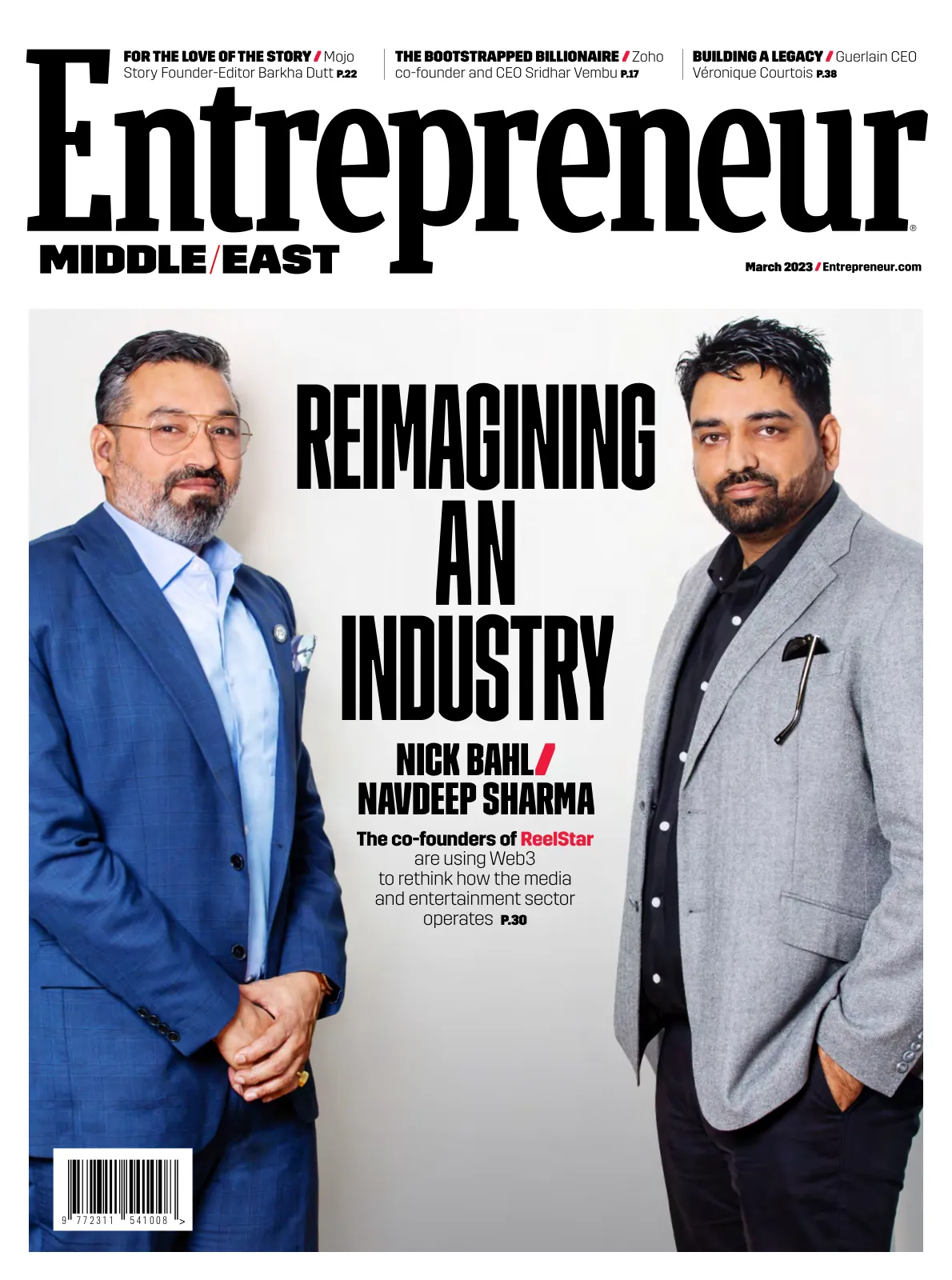
Entrepreneur Middle East, March 2023
Page 1
9
7 7 2 3 1 1
5 4 1 0 0 8
>
March 2023
The co-founders of ReelStar
are using Web3
to rethink how the media
and entertainment sector
operates P.30
REIMAGINING
AN
INDUSTRY
NICK BAHL/
NAVDEEP SHARMA
THE BOOTSTRAPPED BILLIONAIRE / Zoho
co-founder and CEO Sridhar Vembu P.17
BUILDING A LEGACY / Guerlain CEO
Véronique Courtois P.38
FOR THE LOVE OF THE STORY / Mojo
Story Founder-Editor Barkha Dutt P.22
Page 2
Page 3
Page 4
Page 5
Page 6
Page 7
7
March 2023 / ENTREPRENEUR.COM /
Contents/March 2023
P.17
The
Bootstrapped
Billionaire
Sridhar Vembu, the co-founder
and CEO of the billion-dollar Zoho
Corporation explains how the soul
of his company remains grounded
despite its growth.
by MEGHA MERANI
P.30
Reimagining
an Industry
NICK BAHL / NAVDEEP SHARMA
The co-founders of ReelStar
are using the philosophy
and technology of Web3 to
rethink how the media and
entertainment sector operates.
by TAMARA PUPIC
P.38
Building
a Legacy
VÉRONIQUE COURTOIS
The CEO of French beauty
brand Guerlain feels a sense
of responsibility for her future
female successors.
by TAMARA PUPIC
FEATURES
IMAGE COURTESY SMIZE & DREAM
← According to Forbes,
ZOHO FOUNDER
SRIDHAR VEMBU is
the 55th richest
person in India with a
net worth of US$3.75
billion, as of 2021.
Page 8
Page 9
Welcome to the
E X C E P T I O N A L
An iconic hotel featuring
luxury rooms and apartments
with trendy dining options
in the heart of Riyadh
BOOK NOW
Mansard Riyadh, A Radisson Collection Hotel
4248 Prince Mohammed Ibn Salman Ibn Abdulaziz Road, Riyadh 6721-13315, Saudi Arabia
00966118290900 info.mansard@radissoncollection.com
radissonhotels.com/collection
Page 10
10 / ENTREPRENEUR.COM / March 2023
EDITOR IN CHIEF Aby Sam Thomas
aby@bncpublishing.net
CEO Wissam Younane
wissam@bncpublishing.net
DIRECTOR Rabih Najm
rabih@bncpublishing.net
CREATIVE LEAD Odette Kahwagi
design@bncpublishing.net
MANAGING EDITOR Tamara Pupic
tamara@bncpublishing.net
STARTUPS SECTION EDITOR Pamella de Leon
pamella@bncpublishing.net
FEATURES WRITER Aalia Mehreen Ahmed
aalia@bncpublishing.net
REGIONAL DIRECTOR
Mahdi Hashemi mahdi@bncpublishing.net
HEAD OF INNOVATION
Sarah Saddouk sarah@bncpublishing.net
GROUP SALES DIRECTOR – B2B GROUP
Joaquim D’Costa jo@bncpublishing.net
COLUMNIST Tamara Clarke
CONTRIBUTING WRITERS
Perihan Abouzeid, Fida Chaaban,
Fazeela Gopalani, Mustafa Koita,
Megha Merani, Sophie Simpson,
Suraya Turk
SUBSCRIBE
Contact subscriptions@bncpublishing.net to receive
Entrepreneur Middle East every issue
COMMERCIAL ENQUIRIES
sales@bncpublishing.net
ENTREPRENEUR.COM
Access fresh content daily on our website
All Rights Reserved 2023. Opinions expressed are solely those of the contributors.
Entrepreneur Middle East and all subsidiary publications in the MENA region are
officially licensed exclusively to BNC Publishing in the MENA region by Entrepreneur
Media Inc. No part of this magazine may be reproduced or transmitted in any
form or by any means without written permission of the publisher. Images used in
Entrepreneur Middle East are credited when necessary. Attributed use of copyrighted
images with permission. All images not credited otherwise Shutterstock. Printed by
United Printing and Publishing.
PO BOX 502511 DUBAI, UAE
P +971 4 4200 506
March 2023
EntMagazineME
Entrepreneur-me
Contents
Contents
69 Styling Made Simple
With her Dubai-based personal styling
enterprise Wear That, Heidi Shara
is offering women across the UAE a
hyper-personalized way to choose
outfits that define (and fit) them best.
72 Stronger Together
The story behind Saudi fintech startup
Hala’s acquisition of UAE-based
online payment platform Paymennt.
STARTUP
SPOTLIGHT
BUSINESS
UNUSUAL
22 For the love of the story
Acclaimed Indian journalist Barkha
Dutt discusses taking on an
entrepreneurial persona as the
Founder-Editor of Mojo Story.
26 Towards New Shores
Samer Hamadeh’s UAE-born F&B
concept Akiba Dori expands into India
with a 30-location franchise deal.
‘TREPONOMICS
53 The Path to (Peak)
Productivity
An analysis of what it takes to
become more effective (and
efficient) at work.
58 Doing our Best (Instead of
Doing it All)
Terming women as “superwomen”
might be doing more harm than
good, suggests Atteline founder and
Managing Director Sophie Simpson.
60 Untapped Potential
Perihan Abouzeid, founder and CEO
of PeriCare, makes the case for
why companies must act quickly
to welcome (and retain) working
mothers.
63 Laying the Groundwork
Legal Circle Managing Partner
Suraya Turk lists what startup
founders raising capital need to
know about term sheets.
66 Milking a Market
Founder Mustafa Koita takes us
behind the scenes of how UAE-
based Koita is aiming to satisfy
South Korea’s organic dairy market.
← HEIDI SHARA
founded WEAR THAT
in the spare bedroom
of her house in 2018.
Page 11
Homes from
AED587,000
*
*T&C apply
Boulevard living in harmony with nature
Invest in upscale 1, 2 and 3 bedroom apartments featuring direct access to green parks
with sports facilities and a busy boulevard with retail and dining experiences. Enjoy exclusive
access to a residents’ only gym and swimming pool, and benefit from smart home features
and premium white goods included as standard with every home.
Page 12
Page 13
Page 14
14 / ENTREPRENEUR.COM / March 2023
Editor’s Note/
Editor’s Note/
T
he flip side of being your own boss is
that you have to think of so many
things you wouldn’t have to think of
otherwise.”
When the firebrand Indian journalist
Barkha Dutt told me this during my
interview with her in February (which
has resulted in the article that’s
published in this issue of Entrepreneur
Middle East), I felt like I was having a
deja vu moment. It’s a statement that
I’ve heard from so many other founders
who had decided to make inroads into
entrepreneurship after having spent years becoming
literal masters of their domains.
Dutt had left the news brand that she had been a
part of for 20-odd years to start up her own digital
media platform, Mojo Story, in 2021. While she has
already been able to lead her startup to become an
award-winning journalistic enterprise, she readily
admitted that being at the helm has been a
rollercoaster ride- and this was in spite of her
exceptional domain expertise. Dutt had nailed the
reason for this: becoming an entrepreneur requires
you to tap into a whole new set of skills that you
might have previously thought you never needed.
Most entrepreneurs, much like Dutt, have no
qualms about getting their hands dirty to learn the
tools of their (new) trade, and that’s certainly worth
applauding. That said, founders would be wise to
remember that they do not have to do everything
themselves, and that letting others deal with aspects
they are not experts in lets them to focus on their
particular craft as well. Indeed, while it might seem
like a founder needs to be the CEO of the venture
they create, that is absolutely not the case. In fact.
more good might be attained by relinquishing that
role to another.
This is the realization that Dutt seems to have come
to when she tells me, “I keep looking for somebody to
run the business. And I haven’t found that person,
but I’d really like to set free to just be a journalist.”
This statement from Dutt is something I’m
personally quite impressed by, as I believe it to be an
indication of not just her love for the art of reporting,
but also her dedication to ensuring the success and
longevity of the business she has created. And if that
means handing over the reins to someone else, then
she’s ready to do that.
That’s a move the rest of us should keep in mind for
our leadership arsenals.
Aby Sam Thomas
Editor in Chief
@thisisaby
aby@bncpublishing.net
PASSING THE TORCH
(It’s not the entrepreneurial failure you might think it to be)
Aby Sam Thomas with
Indian journalist Barkha Dutt
Page 15
Page 16
Page 17
17
March 2023 / ENTREPRENEUR.COM /
The Bootstrapped Billionaire
Sridhar Vembu, co-founder and CEO of the billion-dollar Zoho Corporation, explains
how the soul of his company remains grounded despite its growth by MEGHA MERANI
→ SRIDHAR VEMBU’S
INDIA-BORN SOFTWARE-
AS-A-SERVICE (SAAS)
COMPANY, ZOHO, quietly
surpassed US$1 billion in
annual revenue in 2022,
defying the global economic
downturn- and proving that
it is possible to grow in the
absence of capital.
IMAGES COURTESY ZOHO CORPORATION
Page 18
18 / ENTREPRENEUR.COM / March 2023
B/The Big Idea
“Our world of technology today is highly impatient,” Vembu
tells Entrepreneur Middle East. “But patience is required.
Whether it’s databases, compilers, or cloud software, it takes
a certain amount of time to become an expert on anything.
You cannot produce a global expert in three months, to
build that technology, make it all work together, and make
sure the customer is able to adopt it.”
Vembu founded Zoho in the mid-1990s, after ditching his
career with Silicon Valley chipmaker Qualcomm to return
to India, and become an entrepreneur.
“So much of top-level talent at Qualcomm was from India,”
he recalls. “Yet, India could not produce a global technology
company. So, I felt why don’t we go build one? I knew this
would be a 25- to 30-year project, because I had studied
Japan- companies like Honda, Sony, Canon, and Toyota
didn’t become overnight multinationals. Nobody thinks in
those terms anymore, but that doesn’t change the funda-
mental rules.”
H
ow many entrepreneurs do you
know of that have built a unicorn
without a cent of external funding?
Well, here’s one: Sridhar Vembu,
co-founder and CEO of Zoho
Corporation.
His India-born software-as-a-
service (SaaS) company quietly
surpassed US$1 billion in annual
revenue in 2022, defying the global
economic downturn- and proving
that it is possible to grow in the absence of
capital. Today, the bootstrapped company boasts
80 million users around the world across
hundreds of thousands of companies.
→ SRIDHAR VEMBU CO-FOUNDED ZOHO
IN THE 1990S, in a small apartment located in
the suburbs of Chennai in southern India, with
a simple, yet revolutionary idea: “Build smart
technology to help businesses work better.”
Page 19
19
March 2023 / ENTREPRENEUR.COM /
Here in the UAE, Zoho has grown 10x over the last five years.
The Chennai-based global tech firm’s UAE revenues were up
45% in 2022, which made it the second-highest growing
market for the company globally for the year. Zoho’s growth in
the UAE has also been accelerated by its partnership with the
Dubai Department of Economy and Tourism to make
enterprise technology available to businesses of all sizes. Since
2020, Zoho has steered more than 3,500 small businesses in
the UAE into its cloud, investing some AED20 million in
wallet credits.
Now, as tech headlines shift from tales of record-setting
raises to plummeting valuations, piling losses, and round after
round of layoffs, there is plenty of blame to go all around.
Vembu, however, attributes the brunt of the problem to easy
money policies.
“It’s not the startups or the venture capitalists (VCs)– it’s the
central banks,” he says. “It’s the Federal Reserve, it’s the
European Central Bank, it’s the Bank of Japan… They kept
money too easy for too long, which fueled all these bubbles,
that were inevitably followed by a bust.”
The bootstrapped billionaire added that the era of
startups spurred by hundreds of millions of cheap dollars
from VCs has “culturally destroyed” nascent ventures by
driving them to hire too many people at once and overgrow.
“There’s only a certain rate at which you can grow,” he
explains. “Raising money is not the issue. It’s inflated
valuations and raising much more than you can handle. If
somebody gives a company $100 million for a 10% stake,
it’s not easy to spend that money wisely. You end up
spending it wastefully, and those habits get ingrained in the
culture. So, when money becomes tougher -and eventually
it does- you don’t have the cultural habits of how to be
frugal.”
Vembu also notes that while it was, of course, easy to get
lost in the euphoria of fast-moving deals as investors poured
in the millions, leaders have no excuse for remaining oblivious
to the inevitable market cycles. “Startup founders should
understand the history of technology and economic cycles,” he
points out. “The Japanese bubble of 1989. The telecom bubble
in Silicon Valley in 1999. History is our only guide. That’s how
we can develop perspective.”
According to a Crunchbase tally, more than 140,000 jobs
were slashed from just American public and private tech
companies last year -and another 100,000 or so this year- as
they were forced to confront slowing revenue growth, higher
interest rates to battle inflation, stock price plunges, and the
chilly funding landscape. The likes of Google, Microsoft, and
Salesforce -which Zoho competes with- have each laid off
nearly or more than tens of thousands of employees, citing
overhiring during the boom period.
“A certain type of corporate management has come to believe
that people are an expendable resource,” Vembu says. “We
don’t agree with it at all. That approach is not good for
technology. It’s too easy to think, ‘I’ll hire a bunch of people
when I need them, and let them go when I don’t,’ but research
and development (R&D) requires very long investment
timeframes. This is a high-context industry. We work on a lot
of our products for five or 10 years before we achieve a state of
perfection, where the customer likes the product. For this,
employees have to be vested and committed, and that means
the company has to be committed to them. I cannot ask
employees to focus on long-term technology while they have a
sword hanging over their heads. Insecurity is not good for
innovation.” }}
THERE’S ONLY A CERTAIN RATE AT WHICH
YOU CAN GROW. RAISING MONEY IS NOT
THE ISSUE. IT’S INFLATED VALUATIONS AND
RAISING MUCH MORE THAN YOU CAN HANDLE.
Page 20
20 / ENTREPRENEUR.COM / March 2023
B/The Big Idea
Vembu adds here that Zoho has not
axed jobs, despite a “substantial”
slowdown in the company’s growth. “We
have never resorted to layoffs due to
market conditions, and we won’t
[because] it would destroy morale,” he
says. “In the boom followed by the
COVID-19 crisis, we were growing
35-40%. Now, it’s at 20%, or below.”
According to American venture capital
fund Bessemer Venture Partners, SaaS
revenues in India are growing at a 20%
annual rate. The SaaS business in India
is expected to be worth $50 billion by
2030, the fund said.
And Vembu’s approach has certainly
helped Zoho created a strong founda-
tion for long-term advancement. Zoho
has its own tech stack built in-house
from the ground up, spanning apps,
platform and network, to even running
its own data centers.
“We use our own frameworks,” Vembu
explains. “We believe deep integration is
important to offer an incredible user
experience. In particular, we are not
using public clouds like Google Cloud or
Microsoft Azure. I work on our back-
ground technologies myself. We are also
one of the very few companies that
know how to run structured query
language databases on graphics
processing units (GPUs), and that’s a
very hard technical problem. The
benefits of this highly specialized
technology are immense. Queries run
faster, and data center expenses are
much lower.”
The company continues to work on
core technologies like compilers,
databases and operating systems,
Vembu adds. It is also investing
significantly in artificial intelligence
(AI), and, perhaps more importantly,
making it affordable.
This March saw OpenAI announce
that it is launching developer applica-
tion program interfaces for its viral AI
chatbot, ChatGPT, to be integrated into
numerous apps and services. Comment-
ing on this development, Vembu draws
attention to an in-house tool that’s
already in use at Zoho.
“We already have our Zoho Intelligent
Agent (ZIA) search,” Vembu says.
“Fundamentally, natural language
models are very similar, but it’s about
the scale in terms of the number of
parameters. ChatGPT is the largest of
those very large number of parameters
that are trained, but that also makes it
very expensive to run. The question
now is can we make the technology
more affordable to run with fewer
parameters, but some other smart
[features], which is where a lot of our
R&D is going.”
As ChatGPT -and Google’s rival to it,
Bard- stun users and evolve at
breakneck speed, fears have mounted
over whether the bots could take over
jobs, particularly in fields like content
creation or customer service. But
Vembu disagrees with this notion.
“AI is going to accelerate the technol-
ogy creation process,” he says. “The first
thing that people see is that ChatGPT
can summarize and write text well, and
then people think, ‘Oh my god, all the
writing jobs will go away.’ But I believe
these tools will have much more impact
on programming than writing. It’s going
to make developers much more
productive. You can maybe get 10 times
more productivity from programmers.”
However, he dismisses the idea that
creating software faster will slash coder
roles. “Cultural adoption of technology
requires human support,” he says. “The
job shift will occur where maybe fewer
people are programming directly but a
lot more in helping people adopt the
technology.”
When asked what he thought about
the botched Bard demo last month that
saw parent company Alphabet’s shares
dropping by more than 9%, Vembu
likens the scenario to being “not much
different than a star cricket player
scoring a duck.”
“All the time in technology, we joke
about the demo gods punishing you,” he
says. “You can never take any demo for
granted. It could happen to anyone. It
→ IN THE UAE, ZOHO HAS GROWN 10X OVER THE
LAST FIVE YEARS. The Chennai-based global
tech firm’s UAE revenues were up 45% in 2022,
which made it the second-highest growing
market for the company globally for the year.
Page 21
21
March 2023 / ENTREPRENEUR.COM /
has happened to me too. It’s just that we are not so high
profile, so we can recover. I know the stock market melted
down, but a launch-day glitch is not evidence that the
technology is bad. We have to look long-term.”
It’s also another reason for him to keep his business
bootstrapped, Vembu jokes. “It’s freedom really,” he says. “The
operational and philosophical freedom for our rural expan-
sion, for example.”
Zoho’s “technology-enabled” rural revival includes empower-
ing villages to be self-reliant with deep tech know-how
through its schools, and setting up multi-point distributed
workplaces in remote areas across the country.
Vembu says the definition of running a profitable business
means different things to different people. But Zoho’s goals
and philosophy go beyond short-term, flashy gains.
“I’m talking about 10- or 20-year life cycles, so it’s a different
mindset,” he adds. “But stock markets reward quarter-to-
quarter performance, and I really don’t care for those
day-to-day swings in stock prices. I don’t want to be distracted
by it. Like Steve Jobs said, to truly think different, you have to
be brave. Even Jobs essentially ignored the stock market. But
most CEOs cannot ignore that pressure. I want to retain my
job. If I go public, I won’t retain my job.”
Future talent is a major challenge the tech world should be
thinking about today, Vembu stresses– which is also why he’s
so passionate about the cause.
Vembu, who graduated from the Indian Institute of
Technology in Chennai before he went on to do his Ph.D. at
Princeton in the United States, is fervent about recognizing
the “deep despair” in India’s rural areas arising from struc-
tural economic changes caused by agricultural hardship, as
well as the decline of rural craftsmen and artisans. “With 1.4
billion people, with 60% in rural areas, I am not sure there is
any way forward for an India that simply accepts rural
decline,” he said on Twitter earlier this year.
About 15% of Zoho’s workforce don’t have a college degree-
but they are graduates of Zoho Schools, which provide free,
contextual, and experiential education, training its students to
successfully perform in the various domains of the company.
The schools also provide software training to students looking
for a full-time alternative to conventional college education in
technology, design, and business, with one year of classroom
training, followed by a year-long internship at Zoho.
Zoho refuses to refer to its schools as a corporate social
responsibility (CSR) initiative, because it claims it benefits by
gaining a talented and loyal workforce. “Increasingly, we are
in a world of demographic implosion everywhere, US, Europe,
Japan, and even China, and so, the future of our industry, like
every industry, is going to [struggle] to find talent,” he says.
“There are talented local people in rural areas around the
world. We just have to train [them]. Today, it’s possible for the
daughter of a rural, landless worker to learn how electrical
motors or JavaScript frameworks work. Zoho Schools is the
future of not just our company, but technology itself.”
The founder, who is among the few business leaders in India
to receive a Padma Shri (the country’s fourth-highest civilian
award), is also focused on fixing the dichotomy between the
rural and the urban. “I’m here in Dubai, which is one of the
most happening cities in the world today,” he says. “It’s a
beautiful city, but I also see the mirror image of the rural areas
of places I live in. These two are not separate. We cannot just
draw everyone from rural areas into giant cities. It won’t work
for either side. Just the cost of real estate in Dubai is sky-high,
which means that we have to find a balance where cities thrive
and rural areas thrive. That integration is very important.
These are the things that startups and the tech world aren’t
thinking about.”
To bridge the gap, Vembu is simultaneously expanding across
both rural India and in cities like Dubai. Zoho has committed
AED100 million in investment for expansion in the UAE,
which will go toward local hiring, growing its partner
network, adding Arabic support to its products, and integrat-
ing with local payment gateways to adapt solutions for the
local market.
Meanwhile, Vembu, the 55th richest person in India
according to Forbes in 2021 with a net worth of $3.75 billion,
has shifted his home to the village of Mathalamparai in the
Indian state of Tamil Nadu– not only because he prefers the
simple life, but also to encourage more businesses to look at
villages as talent pools.
Perhaps it’s his preference for the humble life that keeps the
soul of his company grounded despite its growth.
“Nothing at all changed,” he replies, when quizzed about how
fame and fortune has affected him. “Fundamentally, how I live
hasn’t changed from when I was an employee earning a salary.
If anything, my lifestyle has simplified. I probably spend less
money than I was 10 or 15 years ago. I still work with
engineers. I still code. I don’t enjoy the jet-set life, truly. I am
just doing what I enjoy.”
Megha Merani is an independent journalist with
more than 10 years of newspaper, magazine, and
web reporting experience in the United Arab
Emirates, writing hard news, investigative reports,
features, and opinion pieces. Her passion for
storytelling coupled with a proven instinct for identifying
talk-generating issues has resulted in breaking stories and
insightful features that have made local, regional, and interna-
tional headlines. Her work has been published across Thomson
Reuters, Zawya, Bloomberg Middle East, Gulf News, former local
daily 7DAYS, and government publications.
WE BELIEVE DEEP INTEGRATION IS
IMPORTANT TO OFFER AN INCREDIBLE
USER EXPERIENCE. I WORK ON OUR
BACKGROUND TECHNOLOGIES MYSELF.
Page 22
22 / ENTREPRENEUR.COM / March 2023
The acclaimed Indian journalist discusses taking on an entrepreneurial persona as the Founder-Editor
of Mojo Story by ABY SAM THOMAS
For the Love of the Story
BARKHA DUTT
A
s a journalist who hails from India, I couldn’t
help but feel starstruck when I found
myself face-to-face with Barkha Dutt, one
of my native nation’s foremost broadcast
media personalities, on the sidelines of her
participation in this year’s Emirates Airline Festival of
Literature in February in the UAE.
I was a teenager when I first witnessed Dutt’s
prowess as she reported for Indian news media
company NDTV from the frontlines of the Kargil War
between India and Pakistan in 1999. And my respect
and admiration for her has only grown in the years
since, be it with her reportage on everything from the
26/11 terrorist attacks in Mumbai in 2008, to more
recently the COVID-19 crisis that hit India in 2020.
Today, Dutt is able to boast of a journalism career that
has spanned more than 20 years, and has seen her
win more than 50 national and international awards,
including India’s fourth highest civilian honor, the
Padma Shri. All of this should be enough to understand
my awe when meeting this legendary journalist in
Dubai, but I had to also keep reminding myself to put
my fan moment aside, because I was there, on behalf
of Entrepreneur Middle East, to interview Dutt in her
role as the Founder-Editor of Mojo Story, an
independent digital media platform that she had
launched in India in 2019. To her credit, Dutt didn’t miss
a beat- as soon as we sat down to chat with each
other, she leaned forward to tell me the three words a
journalist would love to hear from whoever they are
interviewing. “Ask me anything,” she tells me- and that’s
exactly what I do in the 20 or so minutes I had with her.
B/The Big Idea
IMAGES COURTESY MOJO STORY
Page 23
23
March 2023 / ENTREPRENEUR.COM /
My first question was focused on Dutt’s
reasons for launching Mojo Story- after
all, she had spent more than two
decades at NDTV when she left the
enterprise in 2017, and one couldn’t
help but wonder why she’d leave all of
the luxury and comfort she had there,
to take on all of the entrepreneurial
pains of starting something new from
the ground up. “Mojo means magic,
and I felt that I wanted to reclaim the
magic of storytelling that I felt was
diminishing in television as it was
evolving in India,” Dutt replies.
“Television had become very loud, very
talk-oriented. When it was
talk-oriented, the conversations weren’t
meaningful. The emphasis was on the
sound bite; the emphasis was on
getting people to face off with each
other. There was very little reporting,
even in big newsrooms- money was not
being used in sending people out. And
then, frankly and finally, I felt that it
was a ‘now or never’ moment for me in
making the difference between being
an employee and an entrepreneur, and
I wanted to own my own corner of the
sky. I felt that technology was moving,
people were moving towards
consumption on their phones, and I
didn’t want to be behind the curve. So,
it was either me making up my mind
and saying, okay, TV, with all its flaws,
is what I’m going to do for pretty much
the rest of my life, or jump, take a leap
into the deep unknown- [I told myself]
you’ve often done that in your
reporting; now, do it at the other end of
it. And so was born Mojo Story.”
Dutt didn’t know it then, but she had
launched Mojo Story just three months
before the coronavirus pandemic hit
the world at large in 2020, and the
ensuing COVID-19 crisis’ effects in
India would form the crux of the
venture’s reportage for the next two or
so years. It all started, however, with
Prime Minister Narendra Modi
initiating in India what has since
become known as the world’s largest
lockdown in response to the first wave
of the coronavirus pandemic. That’s
when Dutt got into her car with three
other Mojo Story personnel to report
on how all of what was happening in
India was affecting people on the
ground in the country. And there were
stories aplenty to be told- for instance,
there were those of the migrant
workers, who, after losing their
livelihoods in the cities they worked in
as a result of the lockdown, had to travel
hundreds of kilometers (many by foot)
back to their homes in their villages.
There were also tales to be told of the
beleaguered healthcare workers across
the nation (many of whom lost their
lives in the line of duty), or those of the
gravediggers who, in their attempts to
give victims of the COVID-19 virus
dignity in death, had to prepare and dig
graves with their own hands. All of these
stories and more found an outlet in
Mojo Story through its YouTube channel
(@mojostory) and associated social
media channels, and Dutt led the charge
as she traversed across the length and
breadth of the country to build these
reports- note here that this was a
journey of more than 30,000 kilome-
ters, spread over the course of over 120
days, all of which was done amid the
first wave of the pandemic in India.
The devastation that the COVID-19
crisis wrecked on India is now fairly
well-documented, but in those early
days, Dutt remembers that Mojo
Story was among the few media
entities on the ground reporting on
the tragedy that was unfolding. Dutt
herself went on to cover the
coronavirus pandemic in India for the
next two years (and counting), with
her stories highlighting everything
from the shortage of beds in the
intensive care units (ICU) of hospitals,
to the difficulties in finding funeral
sites for victims of the COVID-19
disease. In this period, she also found
herself being personally affected by the
issues she was throwing the spotlight
on when her father fell victim to -and
later died from- COVID-19. She
recounts this heart-wrenching
experience in her book, To Hell and
Back: Humans of COVID, which was
published by Juggernaut Books in
2022- here’s an excerpt: “As I travelled
from the villages of Uttar Pradesh to
the paddy fields of Kerala, from the
mountains of Ladakh to the bastis of
Mumbai, from the graves of the Ganga
in Varanasi in which corpses floated, to
documenting the pile-up of abandoned
COVID bodies buried in the sandbanks
of Prayagraj, one day, in April 2021, I
became the news I was reporting. My
father died from COVID, and in the
fight to get him an ICU bed, an
ambulance, an oxygen cylinder -and
later, space at a crematorium- I literally
became the same story I had
chronicled.” }}
→ BARKHA DUTT is one of India’s
foremost broadcast journalists.
After two decades with NDTV, she is
now the Founder-Editor of Mojo Story,
an independent digital media platform.
A columnist for The Washington Post,
she has received more than fifty
national and international awards,
including the Padma Shri.
I WOULD SAY THE BOOK IS ABOUT INDIA, THE BOOK IS PARTLY
ABOUT ME, THE BOOK IS PARTLY ABOUT MEDIA, [AND] IT’S
[ALSO] ABOUT THE PEOPLE I MET. IT’S ABOUT LOOKING FOR
HOPE IN THE MIDST OF SOME OF OUR BLEAKEST TIMES.
Page 24
24 / ENTREPRENEUR.COM / March 2023
The day Dutt cremated her father was
also when she found out that she had
-for the first time-contracted the
COVID-19 virus. Dutt remembers
staying in her basement, not knowing
what to do with her grief, and so, she
recalls, “I worked right through it.”
There’s visceral proof of this in an
op-ed she published for The Washing-
ton Post only a few days after her
father’s death- “I am haunted by
unrelenting sorrow and doubts about
what I could have done differently,”
she wrote in it. Dutt goes on to tell me
that To Hell and Back -her second
book after This Unquiet Land: Stories
from India’s Fault Lines- was also a
way for her to process and deal with
this loss that she had personally
incurred, as well as everything else she
had borne witness to. “The book was
part of acknowledging everything I
had seen and felt, but postponed
feeling,” she says. “The book was part
of acknowledging my father and his
role in bringing me and my sister up
as a single father. (My mother died
when I was 13; she was also a
journalist.) And so, the book is not
[just] about COVID. I would say the
book is about India, the book is partly
about me, the book is partly about
media, [and] it’s [also] about the
people I met. It’s about looking for
hope in the midst of some of our
bleakest times.”
In her book, Dutt declares the
COVID-19 crisis in India to have
been “the biggest news story” in her
lifetime, and as if tackling that as a
journalist weren’t enough, it’s worth
noting that she was also then
simultaneously embarking on her
entrepreneurial career. Dutt readily
admits that being the Founder-
Editor of Mojo Story hasn’t been a
cakewalk. “I’m not going to lie and
tell you that it’s all been rosy,” Dutt
says. “That would just be an
absolute lie. It’s been very difficult
at times; it’s been very lonely and
isolating at times. There are times
when you ask yourself, ‘Why did
you do this?’”
THE BEST KIND OF LEADERSHIP IS SHOW, DON’T TELL. AND I ALWAYS THINK
THAT IF YOU CAN SHOW THAT YOU CAN DO IT, YOU’D BE A MUCH BETTER
LEADER, AND A MUCH BETTER ENTREPRENEUR.
B/The Big Idea
↑ BARKHA DUTT in conversation with Mustafa Alrawi,
Assistant Editor in Chief at The National, at the 2023
Emirates Airline Festival of Literature.
Page 25
25
March 2023 / ENTREPRENEUR.COM /
While Dutt agrees that every entrepreneur out there must
have had moments like these, the fact that she’s running a
business in the media industry means that she has to tackle
challenges unique to it as well. For one, the manner in which
people consume (and react to) media has changed by leaps
and bounds, and Dutt had to make sure these variations were
taken into account when building Mojo Story’s offering. And
while there was definitely a lot of learning through the
process, Dutt acknowledges that there was also a fair bit of
unlearning for her to do owing to her background in
television journalism. “For example, I do a primetime show
every evening called Bottomline with Barkha,” she explains.
“For that show, on television, I would’ve needed at least a 15-
or 16-person crew, and, today, I do it with two people.”
When Mojo Story started out in late 2019, Dutt remembers
its YouTube channel having only around 30,000 subscribers;
today, that number stands at 906,000. Dutt tells me that the
company has a team of 21 people now, and when it comes to
the matter of funds, she explains that Mojo Story currently
has a few different sources of revenue. The first is from
YouTube itself- besides being a monetized channel on the
platform, Dutt points out that Mojo Story is now an official
YouTube Partner channel, and that allows it to competitively
bid for money from the enterprise as well. “We also have
foundation grants that fund public interest journalism,
[plus,] we have some high-net-worth individuals who’ve
decided to put money to back this kind of content,” Dutt
continues. “We are also starting paid subscriptions, and while
we will not paywall anything, we will have extra perks or
extra features for those who do become our paid subscribers.”
Mojo Story is also in the business of events- one of its
offerings in this space is the very popular We The Women,
which is described as “a community and space for women
and their unfettered freedom,” and is in its fifth year now.
“We also do production- for example, we’ve designed public
service video campaigns on public health messaging, and so,
we have clients in that space,” Dutt adds. “And we are hoping
very much to get into the long-form production- movies,
documentaries, etc. So, I think the way I’m seeing Mojo Story
is not like a news channel; I’m seeing it as a content storytell-
ing platform that will interface with different kinds of
mediums and storytelling formats.”
With such aspirations in the picture, Dutt is clearly thinking
big when it comes to the future of Mojo Story, and so, I ask
her, if, despite the challenging road she has had, the entre-
preneurial journey she has embarked on has been worth it. “I
guess the honest answer would be that there have been really
bad days, and then there have been really brilliant days, and
it’s been a rollercoaster ride, but it’s one that I’ve never regret-
ted,” Dutt replies. “I’m very proud of what we’ve created. A lot
of people told me, why don’t you just do a ‘Barkha.com,’
you’re the personality that’s driving this, and I was like, I
might be the personality that’s driving this, but I have to
build something that builds a team. I have to build a product
that’s beyond me. Many people have gone the way of
individual-centric YouTube channels, and I’m not doing that.
We are creating new personalities, we’re creating new proper-
ties, we have a team of more than 20 people now, we are
hiring a few more, and so, I think, all in all, I would say I’m
proud of what we’ve done, but it hasn’t been without its
terrible days.”
And powering Dutt through all of what the entrepreneurial
journey throws at her is a drive to prove that she can build a
venture that stands the test of time. “I think that every
entrepreneur -or every employed person who wants to
become an entrepreneur- would’ve been told, at some point,
that they’re taking a risk,” Dutt notes. “They’d have been
asked, ‘Why would you leave your safety net?’ And I think
what keeps me going right now is the challenge of proving
that we can make something special out of Mojo Story, and
that it can prove that you can build something beyond an
individual.” At this point, I ask Dutt for tips she’d give her
fellow entrepreneurs, and she replies, “My advice for
entrepreneurs is [to know that] nothing is too small for you
to do and learn as the owner of your company. I may have 23
years of journalism experience, and I may be an award-win-
ning journalist, but if I have to pick up my lights and set
them up myself, I will. If I have to learn how to design the
graphic myself, I will, and I do. If I have to learn to edit by
myself, I will. Nothing is beneath you. In fact, I think the best
kind of leadership is show, don’t tell. And I always think that
if you can show that you can do it, you’d be a much better
leader, and a much better entrepreneur.”
But given all of the success that Dutt has experienced in her
journalism career so far, one might wonder what is it that
gets her to do what she does today, and to that, she replies
that her motivation remains the same as it was when she
started working in this field. “It’s honestly the same impulse
that sent me to Kargil in 1999, to report from the frontlines
[of the war] between India and Pakistan,” Dutt declares. “It’s
the same impulse that took me out on the streets during the
COVID-19 crisis. I love reporting, and I love telling a story
powerfully as much as I did 23 years ago. That passion has
not dimmed one tiny bit, and if I were to bookend my life
thus far, which doesn’t mean that I’m in putting my boots up,
but so far, if I were to bookend my life from Kargil to COVID,
it is the same person. It’s the person who can’t, in a way,
remain inside a studio if there’s something enormous
happening out there- I’m not saying I don’t do any studio
work; of course, no one can be out there permanently. But
every time there’s something cataclysmic or enormous in the
life of a nation, or even in the life of the world, I feel like I
can’t be sitting behind a table telling this story. I genuinely
love nothing more than to be out there reporting.”
THE WAY I’M SEEING MOJO STORY IS NOT LIKE
A NEWS CHANNEL; I’M SEEING IT AS A
CONTENT STORYTELLING PLATFORM THAT
WILL INTERFACE WITH DIFFERENT KINDS OF
MEDIUMS AND STORYTELLING FORMATS.
Page 26
26 / ENTREPRENEUR.COM / March 2023
B/Q&A
I
t’s a restaurateur’s dream to take
their restaurant abroad,” says
Samer S. Hamadeh, founder of
Akiba Dori, a Dubai-born Japanese
concept restaurant that recently
celebrated its fifth anniversary
with a major announcement: it
has signed a 30-location franchise
development deal for India.
“I wouldn’t go as far as saying that
franchising Akiba Dori was the idea all
along, because the truth is it’s
impossible to know if a brand works or
not until you actually launch it, and
give it a real shot,” Hamadeh adds.
“That being said, it took us over a year
to finally lock in this deal, and trust our
master franchisee/developer in India
with helping us grow the brand at
such a fast pace in a market the size
of India.”
TOWARDS
NEW
SHORES
Samer Hamadeh’s UAE-born
F&B concept Akiba Dori expands
into India with a 30-location
franchise deal by TAMARA PUPIC
→ One of the veterans of the UAE’s F&B space
(the UAE population would know him for the many
concepts he has built including One on One,
Republique, and Stereo Arcade), SAMER HAMADEH
launched Akiba Dori in Dubai Design District in 2018.
IMAGES COURTESY AKIBA DORI
Page 27
27
March 2023 / ENTREPRENEUR.COM /
One of the veterans of the UAE’s F&B
space (the UAE population would know
Hamadeh for the many concepts he has
built including One on One, Repub-
lique, andStereo Arcade), Hamadeh
launched Akiba Dori in Dubai Design
District in 2018. His mission was to
marry affordable and high-quality in
one Japanese restaurant and bar- an
idea that had been unseen until then.
Five years on, Akiba Dori now has five
locations in the UAE and KSA, and it
also became a part of the “Made in
Dubai” initiative developed by Dubai
Department of Economy and Tourism
to support and promote homegrown
F&B brands in the city and beyond.
Achieving all this was no easy feat, but
Hamadeh also states that he’s apprecia-
tive of the competitive nature of the
UAE F&B scene.
“With one of the most popular
destinations in the world, you’re going
to get a lot of competition, but that’s
not always a bad thing, as competi-
tion (usually) leads to innovation, and
most of the innovation in the region
comes from the UAE,” he says. “The
public relations (PR) power of Dubai
helps local brands get international
exposure just by being in the city, so
that is a major benefit brands get
here, and I see more and more
homegrown concepts taking advan-
tage of this PR power to look across
borders to new destinations.” }}
→ DUBAI-BORN FAMED MODERN
JAPANESE CONCEPT AKIBA DORI is
celebrating its fifth anniversary
with the announcement of a
30-location franchise development
deal for India.
IT TOOK US OVER A YEAR TO FINALLY LOCK IN THIS DEAL, AND TRUST
OUR MASTER FRANCHISEE/DEVELOPER IN INDIA WITH HELPING US GROW
THE BRAND AT SUCH A FAST PACE IN A MARKET THE SIZE OF INDIA.
Page 28
28 / ENTREPRENEUR.COM / March 2023
Right at the end of 2021, Akiba Dori
opened in Jeddah in Saudi Arabia,
which became the restaurant’s first
international outpost. “The KSA
market is becoming increasingly more
competitive, as thousands of new
brands make their way to one of the
fastest growing countries in the region,
so it will be interesting to see how the
next few years play out,” Hamadeh
notes. “My overall take about the KSA
market is how great it is to see how
many Saudi entrepreneurs have
emerged strong in a market full of
major international brands.”
Having interviewed dozens and
dozens of successful entrepreneurs
over a decade, I can clearly see
patterns and invisible dots that
connect them all- one is always to get
straight to the point and as soon as
possible. In Hamadeh’s case, it sounds
like this- when asked about the target
audience for his restaurant, he says,
“Our target audience has always been
the same, and it won’t matter where
we go- people who want modern
Japanese street food. It really is that
simple, and it works for us.”
And when asked about what it takes
to run a successful F&B business
anywhere, Hamadeh is firm that the
answer is a good operations team- al-
though it can sometimes be easier said
than done. “Some countries, like the
UAE, make it easier to hire the right
people and build your dream team,”
Hamadeh explains. “Hiring staff is
more complex in Saudi Arabia for now,
and I’m not sure what the plans are for
the future, but seeing how much effort
is being put into making the market
more business-friendly, I’m sure we
will see some new adjustments to the
labor law happening as we go along.”
The international expansion of Akiba
Dori, Hamadeh continues, was on the
table for a long while, but “it was
either not the right time, or not the
right fit”- and then, he got his eyes set
on the market potential presented by
India. “The Indian market is going to
double in size from US$40 billion a
year, to $80 billion a year in the next
five years- it’s a no-brainer for any
brand to want to be there,” Hamadeh
says. “I can say this deal was over a
year in the making, but the team we’re
dealing with in India is led by one of
the most respected entrepreneurs in
the franchising space, and not just in
India, but globally, so it was much
easier than I would have imagined it
to be.”
Hamadeh’s partner in India is one of
the country’s legends when it comes to
the franchising space- Gaurav Marya,
Chairman of Franchise India and
FranGlobal. In a statement, Marya
said, “We are excited to work in
tandem with Akiba Dori in their India
expansion journey! Certainly, such a
novel and inimitable concept is sure to
B/Q&A
THE SINGLE MOST IMPORTANT STEP IN GETTING
READY TO FRANCHISE IS TO PROTECT YOUR
INTELLECTUAL PROPERTY, SO FIND A TRADEMARK
LAWYER, AND START THERE.
Page 29
29
March 2023 / ENTREPRENEUR.COM /
find success among the Indian consumers, who are always on
the lookout for not just food, but great experiences as well.”
Hamadeh reveals that formulating the franchising concept
has required some adjustments, as well as creating smaller
versions of the restaurant to work in food halls and other
smaller spaces in order to be able to accommodate different
operators in different cities. That said, Hamadeh was adamant
that “it should not be anything that takes away from the
incredible experience of dining at Akiba Dori.”
“Keep in mind that all the pressure is usually on the
franchisee, who have strict timelines to deliver, and while you
can never truly guarantee how things go, you can always
protect your brand by starting off on the right foot,” Hamadeh
explains. “And that brings me to say that the single most
important step in getting ready to franchise is to protect your
intellectual property, so find a trademark lawyer, and start
there.” The second most important step, Hamadeh says, is to
develop a franchise manual. “We created ours before we
franchised to KSA, and we update it regularly,” he says.
“Having a world-class manual and your intellectual property
(IP) registered form the base of getting ready to franchise.”
And just as I think that Hamadeh will be focused only on
one thing at least for some time, he surprises me by saying
that he’s started a new venture, and I am (once again)
reminded to never underestimate the relentless energy of an
entrepreneurial mind. “Going through this process has made
me an accidental expert on it,” Hamadeh reveals. “So, we’re
actually offering advisory services through Big Mouth
Concepts, my concept development consultancy, and we
already have a few clients on board.”
}THINK GLOBAL FROM
THE START
"If you're planning on franchising,
don't localize your content. Make
it appealing to a wider audience,
no matter how difficult that seems
at first."
}GET A GOOD LAWYER
"Navigating agreements is like
being in a maze built by Dali–
even when you think you
understand what's going on, you
really have no clue, and
interpretation is comically
underestimated."
}YOUR CORE VALUES
MATTER
"Going through the process for
the second time around opened
my eyes to a few things I didn't
consider when we first franchised
to Jeddah, and one of them was
in terms of where I want to hold
the training sessions. With
Jeddah, I sent my team there;
with India, we will train the head
chef and General Manager in
Dubai. The reason for that is I
want the franchisee to really be
immersed in the culture, and see
how we do things here."
Akiba Dori founder
Samer Hamadeh shares
his tips for entrepreneurs
chasing expansion for
their concepts
‘TREP TALK
↑ AKIBA DORI is a part of the “Made in Dubai” initiative developed by
Dubai’s Department of Economy and Tourism that was created to support
and promote homegrown F&B brands in the city and beyond.
Page 30
30 / ENTREPRENEUR.COM / March 2023
NICK BAHL AND NAVDEEP
SHARMA AND have
envisioned ReelStar as a
sustainable, decentralized,
extensible blockchain,
Web3-ready platform and
ecosystem, designed from a
smartphone-first perspective
to enable and democratize
participation and contribution
to the media and
entertainment industry,
globally.
Page 31
31
March 2023 / ENTREPRENEUR.COM /
The co-founders of ReelStar are using the philosophy and technology of Web3 to rethink
how the media and entertainment sector operates by TAMARA PUPIC | PHOTOGRAPHY FAROOQ SALIK
REIMAGINING
AN INDUSTRY
NICK BAHL / NAVDEEP SHARMA
hen building their
Web3-integrated social
media platform ReelStar,
co-founders Navdeep
Sharma and Nick Bahl
had one goal in mind- to
create a blockchain-
based platform for the
media and entertain-
ment industry that
would empower creators operating in
this particular sector. And that’s what
the two entrepreneurs believe they have
since created, with ReelStar being a
decentralized platform that integrates
multiple social media, Web3, and pay-
ment functionalities to help users to
distribute and monetize their content.
“The platform uses smart contracts to
ensure that content creators are paid
fairly and on time, and that revenue is
distributed transparently,” Bahl explains.
“Users can also earn rewards for watch-
ing and sharing content, which incentiv-
izes engagement, and helps content go
viral.” Here, Sharma adds that the
ReelStar solution will serve not “just the
stars for their revenue-producing
capacity,” but also everyone within this
ecosystem. “Web3 philosophy and
technology will drive a new artist and
fan-centric revenue model that is
democratized, and offers greater en-
gagement and artistic development
potential, as well as reduced costs for all
participants,” Sharma declares. }}
Page 32
32 / ENTREPRENEUR.COM / March 2023
D
escribed by its creators as the world’s first “every-
thing” app, ReelStar offers its users a number of
functionalities, which include live streaming, video
sharing, peer-to-peer chat, audio/video calling, and
more. One of its key features is ReelPay, a mobile-
first, global payment solution with seamless integra-
tion of fiat and cryptocurrencies, which has been designed to
put creators more in control of their work. ReelPay was
launched in Dubai in the last quarter of 2022, but Bahl recalls
that the development process wasn’t an easy ride. In fact, it
took them two years to get to the point where they are
confident that their product has all the desired functional-
ities. That said, there were a couple of important lessons
learnt during this development process for ReelStar, and Bahl
points toward the importance of flexibility as being one of the
key ones.
“While having a plan is important, unforeseen challenges
and changes can occur during the development process,” Bahl
notes. “Therefore, it’s essential to be able to pivot and adapt to
these changes. Communication is another key learning during
the process. It is important to establish clear and open
communication channels to ensure that everyone is on the
same page, and that any issues or concerns are addressed
promptly. To put across the vision and goals effectively to the
development team to ensure that the final product meets
their expectations has been a key aspect.” For his part, Sharma
draws attention to the need for garnering as many viewpoints
as possible from one’s end consumers. “By gathering feedback
from users through the beta version of ReelStar, we have
gained valuable insights into the user experience,” Sharma
notes. “This feedback has resulted in making changes to the
app.”
As serial entrepreneurs, both Sharma and Bahl have had
hands-on experience of developing several internet-based
ventures, and as such, they are especially attuned to the
importance of being an early adopter when it comes to the
evolution of technology. Their experiences have made them
hyper aware about how the Internet has changed how people
consume media, but also that the industry at large is still
plagued by issues like piracy, a broken revenue-sharing
model, and lack of transparency. “The media and entertain-
ment industry is a multi-billion dollar industry that has
traditionally been dominated by a few big players,” Sharma
says. “We both felt that the Web3 space had achieved
sufficient technical maturity to support not only its applica-
tion to the ReelStar venture, but that it was ripe for the kind
of innovation that we envisioned bringing to the space.”
The ReelStar solution has, so far, been funded by seed capital
from the co-founders, together with limited funding rounds
and private and preliminary token offerings- the company
raised over US$5 million from the initial token offering of its
utility token, ReelToken (REELT), which is based on a multi-
blockchain platform, with its architecture making use of
networks by Polygon and Binance Smart Chain. Looking back
on how the venture has raised funds so far, Bahl says, “If we had
the opportunity to do things again, we probably would have
condensed the offerings into fewer funding rounds. The use
case of the utility token, and the opportunity within the Web3
space, is what piques the interest of investors and potential
users of the application. Everyone is keen to see how we can
change the way we do things, and stand apart from the plethora
of other offerings in the market. We aim to do it differently and
better than other app providers, and distinguish ourselves as a
market leader.”
Given how sectors centered on the blockchain have been
experiencing tremendous growth and development over the
past few years, the ReelStar co-founders believe that the
industry has now gained mainstream attention from investors,
institutions, and governments. “Many new use cases have
emerged, ranging from decentralized finance to non-fungible
tokens, and the industry has attracted significant investment
and attention from both retail and institutional investors,”
Sharma says. “However, the $2 trillion industry is also facing
challenges, such as regulatory uncertainty, scalability issues,
“We aim to do it differently and better
than other app providers, and distinguish
ourselves as a market leader.”
↑ AS ONE OF THE CO-FOUNDERS OF REELSTAR, NAVDEEP SHARMA
brings years of experience across multiple areas of information
technology (IT) to the group. An information technology hardware
professional who became an entrepreneur, he has created and grown
businesses in both the IT and media and entertainment sectors.
Page 33
33
March 2023 / ENTREPRENEUR.COM /
and environmental concerns.” In the
UAE, he says, there has also been a
growing interest in this sector, with the
government launching various initiatives
that helped the UAE become a hub for
crypto and blockchain startups. “How-
ever, the regulatory framework for the
industry in the UAE is still evolving, and
there is a need for clarity and guidance
from the authorities,” Sharma adds.
Bahl shares the opinion that the
blockchain sector will continue to grow
and mature with new use cases emerg-
ing; however, he expects this to be
coupled with the increased regulatory
scrutiny and oversight. “Governments
and regulators will seek to balance
innovation with investor protection and
market stability,” he says. “The environ-
mental impact of cryptocurrencies will
also be a key focus, and we may see more
sustainable approaches to mining and
energy consumption also emerge.
Overall, I believe that the crypto/Web3
sector has the potential to revolutionize
many industries, and that it will
continue to be an exciting and dynamic
space to watch, and since the UAE leads
the world in average mobile download
data usage, that is a key indicator that
there is already significant adoption and
potential within and for the UAE.”
According to Sharma, crypto and Web3
entrepreneurs like himself choose the
UAE as a base for their businesses
because of its proactive and innovation-
focused government, supportive
regulatory environment, and strategic
location. That said, he advises his peers
entering this market to be mindful of
local regulations as well as cultural
differences. “One of the main consider-
ations for crypto and Web3 entrepre-
neurs expanding their businesses in the
UAE is to ensure compliance with local
regulations and laws,” he says.
“While the UAE is a welcoming destina-
tion for businesses, it also has strict
regulations that must be adhered to.
Entrepreneurs need to understand the
local regulations, and seek guidance
from legal experts to ensure compliance.
Another consideration is the cultural
differences and business practices. The
UAE has a unique culture and way of
doing business, and entrepreneurs need
to understand and respect these
differences to build successful relation-
ships with local partners and customers.”
Since one of the key goals for ReelStar
in 2023 is to expand its presence
especially in the MENA, the co-founders
say that they are going to be training
their focus on building strategic partner-
ships with key players in the media and
entertainment industry in the region.
“We plan to further develop our platform
and ecosystem, with a focus on increasing
user adoption and engagement, as well as
to expand our range of services and
offerings to cater to the diverse needs of
our users and clients,” Sharma adds. }}
→ THE REELSTAR APP IS A PORTAL to a
new world of endless possibility, made
possible by Web3 technologies,
decentralization, and the ubiquity,
affordability, and power of smartphones.
↑ NICK BAHL brings the acumen of a business
baron with multiple companies ranging from
media and entertainment to property
development. He founded Sizzlen Productions 13
years ago, and grew it into an award-winning
media and entertainment company specializing
in arranging live concerts, film productions, and
film distribution in Australia.
Page 34
34 / ENTREPRENEUR.COM / March 2023
“Furthermore, we will continue to
focus on delivering a seamless and
user-friendly experience for our
customers, with an emphasis on
security and privacy. We also plan to
contribute to the growth and develop-
ment of the Web3 ecosystem by
collaborating with other projects and
sharing our knowledge and expertise.”
Our conversation now turns to a
talent gap in the blockchain sector, and
Sharma and Bahl use it as another
opportunity to make a call for more
education about -and in- the industry.
“There is a need for skilled profession-
als who can design, develop, and
implement decentralized applications
and systems,” Bahl explains. “My
advice for Web3 founders looking to
address this talent gap would be to
invest in education and training
programs to develop the skills of
current employees, and attract new
talent. This could include partnering
with universities and online learning
platforms to offer courses and
certification programs in blockchain
and decentralized technology.
Founders can also consider establish-
ing mentorship programs or intern-
ships to provide practical experience to
aspiring professionals.”
Sharma adds that another route to
achieving the same goal could be
leveraging decentralized hiring
platforms, and collaborating with
other Web3 companies to share talent
resources, and pool their expertise. “It’s
important to create a culture that
fosters innovation and continuous
learning to attract and retain the best
talent in the industry,” he concludes.
“Overall, the talent gap in the Web3
sector is an opportunity for innovative
and forward-thinking founders to
invest in human capital and develop a
competitive advantage. By nurturing a
skilled and diverse workforce, Web3
companies can unlock the full
potential of decentralized technology
and drive the growth of the industry.”
}STAY LASER-FOCUSED ON
YOUR MISSION “With so many
exciting developments happening in
the crypto/Web3 space, it can be easy
to get distracted by new opportunities
and ideas. However, it's crucial to stay
focused on your company's mission
and long-term goals. This will help you
avoid shiny object syndrome, and
ensure that you're building a
sustainable business that delivers real
value to your users.”
}BUILD A STRONG
COMMUNITY “Crypto/Web3 is all
about community, and building a
strong community around your project
can be a key driver of success. Focus
on creating a product that people love,
and then work to foster a sense of
belonging and ownership among your
users. This will help you build a loyal
following, and create a virtuous cycle
of growth.”
}EMBRACE
EXPERIMENTATION “The
crypto/Web3 space is still in its early
days, and there's a lot of
experimentation happening. Don't be
afraid to try new things, and take risks.
Be willing to iterate quickly, and adapt
to changing market conditions. The
ability to experiment and pivot is a key
advantage of being a startup, and that
can help you stay ahead of the
competition.”
ReelStar co-founders Navdeep
Sharma and Nick Bahl share
their tips for entrepreneurs in the
Web3 space
‘TREP TALK
“The talent gap in the Web3 sector is an opportunity for
innovative and forward-thinking founders to invest in human
capital and develop a competitive advantage.”
Page 35
Page 36
V got it all
• V Hotel Dubai’s party suite promises to be the ultimate des-res
• The grand Amazing Room as the perfect event venue with illumining walls
• A hotel that blurs the lines between work and play
• Retro-futuristic, picture-perfect guest rooms for friends to party under one roof
• Located in the heart of Dubai and by the banks of Dubai Water Canal
Page 37
V Hotel Dubai, Curio Collection by Hilton
Al Habtoor City, Sheikh Zayed Road, Dubai, UAE
T: +971 4 436 6666
thevhoteldubai.com
V Hotel Dubai, Curio Collection by Hilton
is fully eligible for Hilton Honors rewards programme
Page 38
BUILDING
A LEGACY
Véronique Courtois, the CEO of
French beauty brand Guerlain, feels
a sense of responsibility for her future
female successors by TAMARA PUPIC
IMAGES COURTESY GUERLAIN
38 / ENTREPRENEUR.COM / March 2023
Page 39
39
March 2023 / ENTREPRENEUR.COM /
IMAGE COURTESY VURSE
And as if shouldering that
responsibility was not enough,
Courtois’ tenure as the CEO of
Guerlain is also focused on
one more legacy-building
task, which is to support the
brand’s sustainability
initiatives. Speaking about her
priorities at the helm of
Guerlain, Courtois says, “The
focus is on sustainability,
without question. Second to
that, it is on technology, and I
would add that a third and
fundamental one is taking
care of people. It is absolutely
key. It is actually the bond
between all other areas of
focus. It is of strategic
necessity. Without your teams,
we will not succeed. And
Guerlain is a family, I keep
that in mind, always.”
Since 1828, Guerlain has
become a synonym for French
excellence in fragrance,
skincare, and makeup, and 14
years ago, it announced its
four new goals- to preserve
biodiversity by sustainably
sourcing its ingredients, to
innovate sustainably by creat-
ing more natural formulas in
more sustainable packaging,
to act for the climate by
becoming carbon neutral by
2030, and to create a positive
social impact through its
“Women for Bees” entrepre-
neurial beekeeping program
built in partnership with the
United Nations Educational,
Scientific, and Cultural
Organization (UNESCO).
“Within Guerlain, we are on a
never-ending mission to
continuously evolve and
innovate in the pursuit of
beauty in the name of
biodiversity, climate, eco-
innovation, and social
impact,” Courtois says.
“Nature is both the inspira-
tion behind Guerlain’s
creations and its tool, offering
its most marvelous materials
for the house to elevate as
beauty. As a company, we
understand that we borrow
from nature, that no resource
is without end, and that we
must be conscious of how our
products interact with and
rely on the fruits of our
environment.”
Her results, Courtuois
believes, will be the outcome
of a marriage of the old and
the new. “Guerlain has three
credos -craftsmanship/
expertise, elevation as art, and
sustainability- but Guerlain
has also always made it its
mission to remain contempo-
rary, if not ahead of its times,
at any given period! Guerlain
is not only a heritage brand,
but it has a legacy of firsts. My
mission is to honor this, and
convey it to the world. So, I
would say that my personal
goal is heritage, yes, abso-
lutely, but always reinvented
in the light of the present
times, always looking towards
the future to innovate, and
create desire!”
Leading a brand that has
been around for two centuries
is certainly not without
challenges, and Courtuois
believes that her strength for
overcoming difficult period
comes from the ethos of
resilience and ambition for
excellence that are part of
Guerlain’s DNA. “Overcoming
the COVID-19 pandemic
while still carrying out
transformation at Guerlain
was incredibly challenging,”
she recalls. “We first had to
think about the urgency of
W
hen Véronique Courtois, CEO of
French beauty brand Guerlain,
says that her career has been
an incredible journey, she
certainly means it.
Her career in the beauty
industry started at Beauté
Prestige International,
Shiseido’s fragrance arm, and
in 2000, she joined LVMH for
her first stint at Guerlain, which
lasted for a decade and ended with her
becoming its Marketing Director. She then spent
a decade at Christian Dior, namely Christian Dior
Couture and Parfums Christian Dior, only to
return to Guerlain in 2019 as its CEO. “You have
to find your place, create it even,” she says, in
response to a question about advice on rising
through the corporate ranks. “As a woman in a
man’s world, it is important to remember to make
a point of being a woman. That is how you find
your path and make the difference. That is how
you change the deal, and I feel that I have a
strong responsibility and challenge to pave the
way for future female leaders. I cannot fail, and
this is probably my biggest personal challenge.”
Page 40
40 / ENTREPRENEUR.COM / March 2023
the present moment, and the
Guerlain people. It was about
keeping cohesiveness among
teams, giving them the
courage to overcome
difficulties together, and keep
fighting, despite a very dull
and anxious context. And
also, it was key to contribute
to the global effort, just like
we did by producing
hydro-alcoholic gel for
hospitals. Yet, this had to be
addressed in parallel of
laying the grounds for the
future.” At the same time,
together with her team,
Courtuois also made use of
the period to write a new and
contemporary brand identity
for the brand. “From a brand
and business side, it was all
about writing a new strong
and contemporary brand
identity: reinventing it,
rethinking it, by diving into
the archives and the past,
and bringing it to the light of
day,” Courtuois explains. “The
relaunch of our High
Perfumery L’Art & La
Matière collection is perfectly
emblematic of this approach
that I cherish. All in all, and
like for most of us, this
period taught me the
importance of being resilient,
the value of courage, and the
necessity to look at life with
optimism.”
Courtois has also been
learning from her superiors
through the course of her
career. For instance, from
Bernard Arnault, Chairman
and CEO of LVMH, she
learnt to value excellence and
to build unique and ultimate-
ly desirable brands. But most
of all, Courtuois says, she was
influenced by Chantal Roos,
former president at Beauté
Prestige International, with
whom she worked at the
beginning her career. “As a
figure in the fragrance
industry, with the incredible
track record that she can
boast, she taught me early on
that being a female leader
was possible,” Courtuois says.
“Looking back, I am not
certain I would have believed
in myself as much as I did, if
I had not had an inspiring
female mentor like her.”
Going forward, Courtuois
aims to follow Roos’ lead in
being that kind of positive
influence on her younger
colleagues. “I have always
believed in the power of the
collective, and that can only
exist and thrive with
diversity,” she says. “This is
my motto, and I do every-
thing I can to abide by it. I
also make it a personal and
constant endeavor to
motivate my teams in every
way. To inspire them to raise
the bar always higher,
reaching for the stars to
achieve nothing less than
absolute excellence. This is
my nature. So, I would say
that it is all about giving
energy and passion to people.
It is both the most difficult,
as it requires constant
involvement, but it is by far
also the most exciting. To
give them that spark that will
ignite teams, the courage to
dare and conquer, and
achieve collective success.”
THE EXECUTIVE
SUMMARY
Tips for business
leaders from Guerlain
CEO Véronique Courtois
}TAKE YOURSELF
OUT OF YOUR
COMFORT ZONE
“It pushes you to learn more
and advance further, dare to be
bold, and take chances, and
always be curious. This is the
only way to be innovative.”
}EXCELLENCE IS
A NEVER-ENDING
QUEST
“It comes with a blend of
passion and hard work. But
this is how you create beauty.”
}BEING HUMAN IS
WHAT MAKES YOU
A LEADER
“It will create the engagement
within your teams to move
mountains, because you can
never succeed alone.”
“THIS PERIOD TAUGHT ME THE
IMPORTANCE OF BEING RESILIENT, THE
VALUE OF COURAGE, AND THE NECESSITY
TO LOOK AT LIFE WITH OPTIMISM.”
Page 41
Page 42
Page 43
Page 44
44 / ENTREPRENEUR.COM / March 2023
Insights and inspiration from the founder and Chairperson of Infosys Foundation by ABY SAM THOMAS
A Life Well Lived
SUDHA MURTY
W
hen one meets Sudha Murty (née
Kulkarni), one may be inclined to look
at her as a kindly Indian grandmother,
and while she is indeed that, one
would be very mistaken to construe
the 72-year-old as being only that- she is also a
path-breaking engineer, an acclaimed educator, a
celebrated author, a renowned philanthropist, and,
yes, an entrepreneur too. She also happens to be the
wife of Narayana Murthy (the difference in their
surnames is because Murty believes her spelling of
the name is right), who is the co-founder of the Indian
information technology multinational, Infosys, which,
in its 41st year of operations, is a US$17.94 billion
enterprise, with a market capitalization of about
$75.39 billion. Besides being the founder and
Chairperson of its philanthropic arm, Infosys
Foundation, Murty was also one of Infosys’ early
employees- and she was one of its earliest investors
as well. In fact, the company owes a lot to her for
getting itself off the ground- but I think I am getting
ahead of myself here. As an homage to Murty’s
storytelling prowess (indeed, I got to meet her
because she was a guest of the 2023 Emirates
Airline Festival of Literature that happened in the UAE
in February), I believe that I need to start telling her
tale from the beginning- and that starts in her
hometown of Hubli in the Indian state of Karnataka.
← SUDHA MURTY is an Indian
educator, author and philanthropist,
and the co-founder of the Infosys
Foundation. She was awarded the
Padma Shri, the fourth highest civilian
award in India, for social work by the
Government of India in 2006.
IMAGE COURTESY INFOSYS FOUNDATION
Page 45
45
March 2023 / ENTREPRENEUR.COM /
Born in 1950 to a middle-class family,
Murty remembers that once she
finished her schooling, she was
expected to follow the path of most
other Indian women in that era, which
was to get a basic higher education
degree, and then, well, get married.
Most of her peers were seeking liberal
arts degrees, and there was a fair bit of
interest in the field of medicine as well,
but the sector Murty wanted to pursue
an education in was one that had scant
interest from women at the time:
engineering. And when Murty
announced her intentions to the world,
she recollects the general reaction to
have been as through she had dropped
a bomb- that’s how unusual it was for a
girl in her family (and the wider
community) to pursue an engineering
degree. “My father was a doctor, and he
asked me why I wanted to study
engineering,” Murty recalls. “I told him
that I always believed that humankind
progresses with the applied science.
Applied science can change our life-
look at computers now, or automobiles
then. [I told him] these innovations
are nothing but an application of
science, and that’s what I want to do-
and to do that, I need to study
engineering.”
Her family acquiesced to Murty’s
ambitions in the end- but she had more
hurdles to get past to realize them. The
educational institution that Murty was
aiming to attend -the B.V.B. College of
Engineering in Hubli- had no female
students on its roster then, and it too
tried to dissuade her from joining its
classes, with worries galore about, say,
how the male students would respond
or react to her being their classmate, or,
well, a more practical issue in that
there was not a single toilet for women
in its premises. “But even with all of
this opposition, I still wanted to study
engineering there,” Murty says. “And so,
they put three conditions on me if I
were to join the college: I should wear a
sari, I should not go to the canteen
where a lot of boys come, and I should
not talk to boys. I agreed to all three.”
And thus began Murty’s four-year
stint studying engineering, and she
readily admits that she found college
life very hard at the beginning-
although that had nothing to do with
the curriculum. “The boys would not
talk [to me], nobody would share
their notes [with me],” Murty recalls.
“And there was no toilet… But I
trained myself in such a way that I’d
not have to use the toilet during
college hours.”
Murty has a matter-of-fact tone
while telling me all of this, and she
adds that today, she looks back on all
of it as having been a pivotal learning
moment for her. “All those experiences
really ended up helping me in the
long run,” Murty says. “When you look
at difficulties, yes, they are hard, but
they also teach many things. For
instance, in my case, I realized the
importance of toilets- and in my later
life, I built more than 14,000 ladies’
toilets in rural areas in India through
my work at Infosys Foundation.” Plus,
Murty points out, she was very good
in her studies- and she found herself
getting the first rank continually in
the exams at her college. “That’s when
I realized it was so easy,” she recalls.
“Who says engineering is a man’s
domain? Knowledge is no gender’s
domain; it’s a seeker’s domain… Also,
I became so independent, and
dependent on no one else except me.
So, I became autonomous in myself,
in the sense if I have any difficulties, I
know that I have to sort it. I learnt
that if I face an issue, there’s not
somebody else who will come and
help; it has to be all me. That gave me
a lot of confidence in life, and that has
remained with me since.”
Murty ended up getting her engineering
degree with flying colors (she was
actually awarded a gold medal for her
academic performance), and she then
secured a scholarship for a master’s
degree at Bangalore’s Indian Institute of
Science, colloquially known as the Tata
Institute, given that it was set up with
the active support of Jamsetji Tata, the
founder of what is today one of India’s
biggest conglomerates, the Tata Group.
When she was about to complete her
education there in 1974, Murty was
eyeing a Ph. D. degree from outside of
India to add to her educational
laurels- but that was when a
recruitment advertisement on the
Institute’s notice board caught her
attention. Murty remembers it as
seeking engineers to join one of the Tata
Group’s companies called Telco (now
called Tata Motors); however, a line
towards the end of the ad stood out to
her. “It said that lady students need not
apply,” Murty says. “As I’ve said, I’ve
always believed that knowledge is no
particular gender’s domain, and I felt
the same way about jobs… So, I was
like, how can you say that women
cannot apply? That’s unfair, I thought.
You interview her, and if she is not
capable, then you can always say no.
But you can’t make use of a difference
in gender to deny someone a chance at
a job or opportunity.”
The discrimination was too much for
Murty to take this time around, and it
irked her more given that it was being
done on the banner of the Tata Group,
which was (and remains) one of India’s
most respected business enterprises.
Murty decided that a complaint needed
to be made to the upper echelons of the
Tata Group- however, she didn’t know
who exactly in the company should she
address it to. But in what was perhaps
an indication of the daring of youth,
Murty chose to direct her grievances to
the man at the helm of the Tata Group
then, Jehangir Ratanji Dadabhoy Tata
(more popularly known as JRD), a bona
fide legend in India’s business land-
scape. And Murty did so by penning a
strongly worded note on a postcard,
and sending it to what she thought was
JRD’s address in Mumbai, and then
forgetting about it. As it turns out, }}
FAILURE IS OKAY- I TRIED, I FAILED, WHAT WOULD I LOSE?
THERE WAS NOTHING REALLY FOR US TO LOSE- FOR TWO,
OR THREE YEARS, WE COULD TRY, AND IF IT DIDN’T WORK,
WE’D COME BACK TO WHAT WE WERE.
Page 46
46 / ENTREPRENEUR.COM / March 2023
Murty had got JRD’s address wrong- but the man was so
well-known that the Indian postal system got her postcard to
him anyway. And when it did, Murty’s words were enough for
JRD to demand the concerned teams at Telco to remove such
gender-centric barriers to its job offerings- and this plucky
young woman from Hubli found herself getting called for an
interview in less than 10 days after she sent that postcard.
Murty aced that interview (of course), and she ended up
becoming the first female engineer to be hired at Telco, with
her going to have a fruitful career at the Tata Group for many
years.
When I ask Murty if she ever got to meet JRD and discuss the
aforementioned episode with him, she confirms that she got to
meet the titan of Indian industry quite a few times during her
years at the company; however, their conversations never
touched upon the matter of her postcard until, funnily enough,
she was getting ready to exit her employment at the Tata
Group in 1982. By then, Murty had gotten married, and she
had had her first child, Akshata Murty, too (yes, she made sure
her children got the right spelling of their surname!), and she
was working out of Telco’s Mumbai offices at the time. Her
resignation was prompted by the fact that her husband was, at
the time, setting up an entrepreneurial venture called Infosys
in a neighboring city called Pune, and she was going to join
him there. And on the day Murty wrapped up her final
settlement at the Telco office in Mumbai, she ended up
running into JRD while there. “He was coming down the
stairs, I was going up,” Murty says. “He used to call me by my
maiden name, and he said, ‘Kulkarni, what are you up to?’ I
replied, ‘Sir, my husband is starting an adventure called
Infosys, I don’t know whether it will be successful or not, so I
have to leave my job, and I have to go to Pune, because
they’re starting in Pune.’ And he said, ‘You fought your way
in, and now you’re leaving?’ That was the first time he
indicated to me that he actually knew how I had made it
into his company.”
Murty has a beautiful, broad smile as she shares this
memory with me, and she goes on to tell me that this chance
encounter with JRD had a lasting impact on her life. “In
reply to his question, I said, ‘Sir, I have to help him out.
Otherwise, I would not have left,’” Murty recalls. “He said,
‘Okay. But, Kulkarni, why start with diffidence? Start with
confidence.’ He was then going to leave, but then he turned
back, and said, ‘Kulkarni, what will you do when you are
successful, when you make a lot of money?’ I replied, ‘Sir, I
don’t know if we will make money.’ And he said, ‘When you
make money, please remember that our society is giving you
so much, and so, you have a duty to our society. You don’t
↑ SUDHA MURTY addressing children at the Emirates
Airline Festival of Literature in Dubai
I BECAME AUTONOMOUS IN MYSELF, IN THE SENSE IF I HAVE ANY DIFFICULTIES,
I KNOW THAT I HAVE TO SORT IT. I LEARNT THAT IF I FACE AN ISSUE, THERE’S NOT
SOMEBODY ELSE WHO WILL COME AND HELP; IT HAS TO BE ALL ME.
Page 47
47
March 2023 / ENTREPRENEUR.COM /
own that money; you are just a trustee
of that money, and you are to give it
back to people.’” Murty remembers this
as being the last time she saw JRD
alive, and his words to her then have
never left her. Indeed, JRD’s advice to
her formed the basis of what she ended
up launching and building several
years later with the Infosys Foundation,
and those principles continue to drive
her philanthropic work to this very day.
Now, the Infosys story is the stuff of
legend- its journey from being a
fledgling software startup to becoming
a global leader in next-generation
digital services and consulting is
something any tech entrepreneur out
there would want to follow for their
own enterprise. As the co-founder and
first CEO of Infosys, Murthy’s role in its
roaring success is widely celebrated,
and rightfully so- but one should also
highlight his wife’s contribution to it.
And no, I’m not talking about her role
just as Murthy’s spouse- as it so
happens, Murty was also Infosys’ first
investor. That’s right- the INR10,000
(equivalent to $250 at the time), which
is famously known to be the capital
with which Infosys was set up with in
1981, came from Murty. You see, Murty
was in the habit of saving money for
“emergencies” back then, and that’s the
“fund” her husband requested her to
make use of to invest in the company
he was launching. “I remember
thinking, what if I don’t give the money
to him?” Murty tells me. “Then, he may
not start it, and he may go on to regret
it. I thought regret is worse than
failure. Failure is okay- I tried, I failed,
what would I lose? There was nothing
really for us to lose- for two, or three
years, we could try, and if it didn’t
work, we’d come back to what we were.
But I never wanted my husband to
regret… I had ₹10,250 in my savings
then. I kept ₹250, and I gave him
₹10,000.”
And the rest, as they say, is history-
Infosys went on to become the success
it continues to be today. Murty herself
was one of Infosys’s early employees,
although she decided to exit the
enterprise following a decision made
jointly by her and her husband that
she’d focus on taking care of their two
children (her son, Rohan, was born in
1983), while he would train his sights
on building the company, which had
shifted its base from Pune to Bangalore
by then. Murty then took on a role as a
professor at educational institutions in
the city, and then, in the 90s, when
Infosys came into its own, so to speak,
Murty started a new chapter of her
career as the founder and Chairperson
of the Infosys Foundation. As an
enterprise centered on “supporting the
underprivileged, creating opportuni-
ties, and striving towards a more
equitable society,” Infosys Foundation
has supported a multitude of social
projects across India, which range from
the construction of libraries (and
toilets!) in the country’s villages, to the
donation of funds for, say, scientific
research, cancer treatment, or even
mid-day meals at schools.
Murty, who was 45 years old when
she founded the Foundation, says that
she was driven to launch it following an
argument she had with her then
16-year-old daughter over the matter of
social work. This episode is recorded in
Murty’s book of short stories, Here,
There and Everywhere- in it, Akshata is
quoted as saying the following words to
her mother: “Amma, when an educated
person like you, well-travelled,
well-read, and without love for money,
does not help poor people, then don’t
expect anyone else to do. Is it not your
duty to give back to those unfortunate
people? What are you looking for in
life? Are you looking for glamor or
fame? You are the daughter of a doctor,
granddaughter of a schoolteacher, and
come from a distinguished teaching
family. If you cannot help poor people,
then don’t expect anyone else to do it.”
Akshata’s words resonated with Murty,
and she tells me they also reminded her
of JRD’s words to her all those years
ago in Mumbai. “I was sleeping, and
my daughter woke me up,” Murty says,
and the Infosys Foundation came into
being shortly after.
The work Murty has led at the
Foundation has earned her plenty of
accolades from around the world;
earlier this year, she was also presented
with the Padma Bhushan, which is
India’s third highest civilian award.
Murty is today one of India’s most also
prolific authors as well, especially with
her non-fiction, which is built off the
experiences she has had through her
lifetime. At this point though, given all
of the achievements Murty has had
through the course of her life, one
would certainly not mind if she were to,
well, just withdraw from everything
that she does, and, well, just sit back
and relax. But Murty doesn’t seem to
even have entertained such a thought in
her mind- after all, she has a purpose
learnt over the course of a lifetime
driving her. “When I look at poor
people, I feel like I have a duty towards
them,” she explains. “That keeps me
working hard, that keeps me traveling
and touring, that keeps me writing my
experiences, that keeps me wanting to
share my experiences with the next
generation… Because I have a duty.”
WHO SAYS ENGINEERING IS A MAN’S DOMAIN?
KNOWLEDGE IS NO GENDER’S DOMAIN;
IT’S A SEEKER’S DOMAIN…
↑ SUDHA MURTY with Entrepreneur
Middle East Editor in Chief Aby Sam Thomas
Page 48
FUN COMES
GUARANTEED
YOU DECIDE WHEN THE PARTY
STOPS WITH 24HR FOOD & DRINK.
NOW OPEN AT DUBAI DIGITAL PARK.
RADISSONHOTELS.COM/RED
Page 49
49
March 2023 / ENTREPRENEUR.COM /
Oh snap! →
/Samsung Galaxy S23 Ultra
B/Gear
#TamTalksTech
Gadgets and doodads that you might’ve missed out on,
sourced by a tech aficionado. by TAMARA CLARKE
Listen up ←
/OPPO Enco Air3
OPPO Enco Air3 are the first earbuds in their
price range to include a HiFi5 digital signal
processing (DSP) module. The wireless
earbuds give you 25 hours of battery life,
noise cancellation for phone calls, and better
sound quality than its predecessors. It also
handles OPPO Alive Audio processing in the
earbuds themselves, for a more immersive,
three-dimensional listening experience.
Beyond audio, OPPO Enco Air3 adopts the
newest generation Bluetooth 5.3 low-latency
transmission, and supports functionalities
like double-tap to control camera, as well as
dual device seamless switching, where you
can connect the earbuds to two devices at
the same time, and easily switch between
them, without manually changing device
settings.
TAMARA CLARKE, a former software development professional, is the tech and lifestyle enthusiast behind The Global Gazette, one
of the most active blogs in the Middle East. The Global Gazette has been welcomed and lauded by some of the most influential tech
brands in the region. Clarke’s goal is to inform about technology and how it supports our lifestyles.
Talk to her on Twitter @TAMARACLARKE. theglobalgazette.com
IMAGES © SAMSUNG | OPPO | AOC
Take crisp photos and videos from
dusk till dawn with the Samsung
Galaxy S23 Ultra’s most advanced
camera system. Galaxy S23 Ultra is
equipped with five cameras: a 12MP
selfie camera, a 12MP ultra-wide
camera, 200MP wide-angle camera, a
10MP 10x-optical-zoom telephoto
camera, as well as a 10MP 3x-optical-
zoom telephoto camera. Low light
selfies are enhanced by artificial
intelligence (AI) for crisp details and
accurate color. The device is also
optimized for gaming with it featuring
the brand-new Snapdragon 8 Gen 2
Mobile Platform for Galaxy, the most
powerful and efficient platform ever in
a Samsung Galaxy smartphone, as well as
the fastest Snapdragon available today. It
also features a 5000mAh battery, Corning
Gorilla Glass Victus 2, and a newly
designed central processing unit (CPU)
micro architecture, which boosts the
processing abilities of the Galaxy S23
series by about 30%. Finally, Galaxy S23
Ultra has a striking symmetrical design
composed of recycled and eco-conscious
materials, and its polished metal frame is
available in phantom black, cream, green,
and lavender.
Screen time ↓
/AOC V5 Series Monitor
The AOC V5 series is an ideal complement
to any office setup that requires a webcam,
while keeping desk space neat and free of
unsightly wires. The CU34V5CW/BK is
equipped with Windows Hello Webcam
alongside advanced sensors for facial
recognition, allowing you to easily and
securely log in to your computer. Additionally,
the monitor supports embedded webcam
and picture-by-picture multi-view, which
works well for online presentations, live
streaming, working remotely, or engaging in
video conferencing. The ultra-wide monitor
offers curved vertical alignment (VA) panels
with wide quad high definition resolution;
plus, it’s equipped with a 100Hz refresh rate
that outshines the 60Hz of regular office
models. The V5 series also features a
four-port USB 3.2 hub and a USB-C
connector with 65W power delivery. The
monitor is striking, yet unpretentious. It
comes in black featuring a three-side
borderless design with a very narrow chin at
the bottom bezel, and a super-thin base
(3.5mm), that allows for swivel, tilt, and
130mm height-adjustable modes for an
ergonomic use in either work or
entertainment settings.
Page 50
B/Gear
Designed by Fendi’s Artistic Director
of Accessories and Menswear, Silvia
Venturini Fendi, the brand’s Fall/
Winter 2023 collection brings
together sophistication, comfort,
and luxury. Inspired by classicism,
we see capes turned into sweaters,
as well as soft furs, one-shoulder
tops, with accents of Swarovski and
sparkling sequins. There are also
leisure suits in cashmere and fleece,
along with unstructured shirts,
blanket coats, and ponchos.
Besides playing with asymmetrical
silhouettes and volumes, the line
also offers a palette that includes
shades of dove grey, oatmeal
shade, burnt umber, mocha, mauve,
lavender, deep navy, and black.
fendi.com
From better goods to better wardrobe bests,
every issue, we choose a few items that make
the approved executive selection list. In this
edition, our picks include Fendi, Perpétuel,
Paco Rabanne, and more.
The Executive
Selection
MORE THAN WHAT MEETS THE EYE → Fendi
50 / ENTREPRENEUR.COM / February 2023
Page 51
51
March 2023 / ENTREPRENEUR.COM /
No matter the season, a statement pair of
sunglasses is a great addition to any ensemble.
For a classic black pair of sunnies, we’re a fan of
Saint Laurent’s M119 Blaze sunglasses. Made in
Italy, it features quintessential cat-eye frames
with nylon lenses, as well as the unmissable
oversize Cassandre logo, a sculpted jewel YSL
signature adorning the temples, for a swanky
bold look. Offered in black and Havana brown,
grab a pair of these vintage inspired sunglasses,
and add a subtle layer of oomph to your look.
ysl.com
EDITOR’S PICK
SAINT LAURENT
IMAGES COURTESY FENDI | PERPETUEL | PACO RABANNE | SAINT LAURENT
PUSHING THE LIMITS ↓ Paco Rabanne
FOR THE HISTORY BUFFS ↓ Perpétuel
As a purveyor of distinctive timepieces,
in January of this year, Dubai-based
gallery Perpétuel has released the first
limited edition of a collaboration
between renowned watchmakers, the
late Derek Pratt and Luca Soprano. With
the timepiece aimed at being an
embodiment of Pratt’s love for
mechanical movements, craftsmanship,
and art, it has several distinct features,
which includes a remontoire in a
tourbillion, as well as a salmon colored
dial with Eastern Arabic numerals in
stainless steel. Designed and assembled
in the Ateliers 7h38 workshop, this
timepiece is powered by Caliber DP07,
with a 36-hour power reserve. If you’re
fascinated with tradition and antiquarian
horology, this timepiece deserves a spot
in your collection. perpetual.com
2023 sees Paco Rabanne offering a new
scent with Invictus Victory Elixir, a rich
blend of spice, wood, and freshness.
Designed as “the ultimate expression of
victory,” the eau de parfum offers a
woody amber scent, with fresh
aromatic lavandin, green cardamom,
and black pepper upon first
impression. As for its heart, it’s made
up of blends of woody Indonesian
patchouli, followed by notes of vanilla
bean as well as tonka bean on its
base. Its bottle also features an
engraved golden V for victory in the
glass, which stands out against the
gradient of black to dark blue.
pacorabanne.com
Page 52
lyveglobal.com
E-COMMERCE
MADE EASY
Supercharge your ecommerce and online operations
with Lyve. Get fast, flexible, and full-featured delivery and
technology solutions that meet your customers’ needs
and allow you to focus on what you do best.
Go Lyve Today �
lyveglobal.com/ecommerce
#golyve
Page 53
53
March 2023 / ENTREPRENEUR.COM /
The Path to (Peak) Productivity
Analyzing what it takes to become more effective (and efficient) at work
by AALIA MEHREEN AHMED
IMAGE COURTESY SHAMIM KASSIBAWI
Page 54
54 / ENTREPRENEUR.COM / March 2023
}First, however, in order to
bring in a voice of expertise
and knowledge on this
subject, I spoke to Niamh
Jordan, Regional Partner for
the Middle East at global
leadership development firm
TPC Leadership. “First and
foremost, investing in one’s
self-awareness is critical to
achieving one’s peak produc-
tivity,” Jordan told me.
“Entrepreneurs, in general,
can be categorized into more
than one category. The first
category is the entrepreneur
who appears overly confident,
and believes they can do
everything, which can lead to
burnout. The second is the
entrepreneur who lacks
confidence, lacks belief, and
fears failure, and is afraid to
take risks. And the third
category is the entrepreneur
who makes a mistake, and
instead of getting back up,
they constantly think, ‘What
if?’”
Now, for those of you
reading this who are entre-
preneurs, I will leave it to you
to decide which of the
categories you belong to. But
let me to introduce you to one
entrepreneur who doesn’t
allow negative self-talk to
hinder her own productivity:
Shamim Kassibawi, founder
and CEO of Play:Date, an
interactive platform for
parents to help build their
children’s social circle. “When
I wake up, I always try to
keep my positive thoughts
alive,” Kassibawi says. “I think
of all the amazing things I
want to achieve that day. It
could be work-related or
more personal, such as
cooking an amazing meal for
my family. I also remind
myself that I am going to kill
it, and that today will be a
hit!’ I am going through a
seed funding round as we
speak- you go through so
many rejections, investor
paperwork, emails, and
research. So, it is crucial to
keep my motivation and faith
intact, despite me feeling that
progress might be a bit slow.”
}Now, of course, an optimis-
tic attitude such as Kassi-
bawi’s is something all
entrepreneurs want to
channel- but then again, like
all good things, avoiding
moderation in this regard can
prove to be detrimental. As
an article published on
Verywell Mind, an online
platform that offers profes-
sional mental health informa-
tion and resources, puts it,
toxic positivity is about taking
“positive thinking to an
overgeneralized extreme.”
Also known as forced or
unrealistic optimism, it is a
state of mind wherein an
individual incessantly forces a
positive outlook on life,
without taking into account
the reality of a given situa-
tion. Cautioning entrepre-
neurs against such an
approach is Daniel Solomon,
founder of HeroGo, a
Dubai-based startup that
seeks to combat food waste
‘T/Pro
↑ NIAMH JORDAN, Regional Partner
- Middle East, TPC Leadership
H
ow do you introduce a topic
that has been at the forefront
of possibly every
entrepreneur’s mind? Now, I
have to admit that when I first
set out to write this piece, the
intentions behind it stemmed
slightly from my own selfish
wants. Despite detailed to-do
lists and hour-based allocations for specific
tasks, I sometimes found myself struggling to
have a fruitful day at work. And so, I figured,
who better to turn to for advice than
individuals who juggle an umpteen number of
responsibilities as they run their own
business ventures? That’s essentially how I
came to pick the minds of four UAE-based
entrepreneurs on what they believe is the
secret to achieving peak productivity.
↑ OLIVER KENT, Managing Director, ZK Sports and Entertainment
Page 55
55
March 2023 / ENTREPRENEUR.COM /
issues by supplying excess
fresh grocery items directly
to consumers. “Optimism is
key for entrepreneurs- that
positive outlook is what
keeps us going no matter
what comes along,” Solomon
says. “But forced optimism is
also a major factor in
entrepreneurs getting carried
away. It is important to strike
a healthy balance. As
entrepreneurs, we should
have a realistic understand-
ing of our abilities, set
achievable goals, and
prioritize self-care, which is
something we often forget.
However, we can’t do this
alone, which is why entrepre-
neurs must also find a
support system to provide
accountability and encour-
agement, both within and
outside of the founder
community.”
}Mirroring this need to
create a competent group of
people one can rely on is
Tahany Taher, co-founder of
Hayawiia, a Dubai-based
platform that offers healthy
gourmet food. “Knowing that
everything in your life has
value is a brilliant starting
point,” Taher says. “We
entrepreneurs put so much
energy and focus into our
business that we forget about
the huge revolving world
around us. In order to
balance this out, it is
important to create a
structure that allows the
business to flourish, whether
you are present or not. We
sometimes over-inflate the
dependency that our
company has on us. You are
not needed for every
meeting, or for every
decision. Choosing a team
that will support and run the
business is the benchmark of
any and all successful
businesses.”
}Now, all of this isn’t to say
that managing an entrepre-
neur’s responsibilities is a
piece of cake, of course. If
anything, Taher describes it
best when she says that being
an entrepreneur is “like
being the entire football
team and the manager!” She
adds, “As an entrepreneur,
you will always find it
difficult to strike a balance,
but what I have found that
seems to work for me is
realizing that any decision
made from fear or anxiety
will always lead to failure.
Prioritizing is the most
important thing that an
entrepreneur can learn-
knowing that the world will
not end if certain decisions
are acted upon the next day
is important.”
Here, Taher drops a word
that often lays the founda-
tion for productivity:
prioritizing. And often
synonymous with the act of
prioritization are to-do lists.
But while listing down one’s
tasks is only part of the
solution, identifying which
ones need to be ticked off
first may present quite the
dilemma, says HeroGo’s
Solomon. “It may depend on
the stage of the company or
the task the entrepreneur is
working on, but sometimes,
it feels impossible not to feel
overwhelmed- prioritizing
tasks as an entrepreneur can
be challenging, as all tasks
often seem important, and
the list never ends,” Solomon
confesses. “I think the best
way one can prioritize tasks
is based on impact, urgency,
and effort. For impact, I refer
to the potential results of a
task- how it will impact the
business, and what its
outcomes are. For urgency,
one can look at tasks with
deadlines, i.e. the conse-
quences of not completing
the task on time. Meanwhile,
effort refers to the amount of
time and energy required to
complete the task.”
For all the upstarts out
there, Solomon’s three-step
process to prioritize better
can certainly come in handy
as you run your respective
ventures.
WE SOMETIMES OVER-INFLATE THE DEPENDENCY THAT
OUR COMPANY HAS ON US. YOU ARE NOT NEEDED FOR
EVERY MEETING, OR FOR EVERY DECISION.
→ SHAMIM
KASSIBAWI,
founder and CEO,
PlayDate
Page 56
56 / ENTREPRENEUR.COM / March 2023
But it is also important to
remember that there never
has been -and perhaps
never will be- a one-size-
fits-all approach to ranking
the urgency of tasks. This is
something that Oliver Kent,
Managing Director of
UAE-based sports agency
ZK Sports & Entertain-
ment, can personally attest
to. Take, for example, how
he’s learnt to be more
mindful about deciding
which tasks are more
important than others. “I
am famous for writing to-do
lists, and never actually
finishing every task on
there, which can be quite
demotivating,” Kent says.
“Often, as soon as you focus
on one of the key things on
the to-do list, a phone call
comes with a new issue, and
then half the day is gone. As
a result, I have certainly
started limiting my to-do
list, and only putting the
core tasks for the day or the
week. Otherwise, I end up
with extremely long lists
that never actually get done
completely, turning them
into more of a burden. This
is obviously the price you
pay for having your own
business and being an
entrepreneur!”
}What Kent alludes to is a
significant point to ponder
upon: being super-orga-
nized may not necessarily be
the answer to achieving
productivity. After all, we
live in a time when even
world-renowned organizing
consultant Marie Kondo
recently confessed to not
being as systematic as she
used to be, having embraced
the challenges of being a
working mother while
raising three kids. As
Play:Date’s Kassibawi likes
to say, it is important to
“leave some room for chaos
to enter.” She explains, “I
like to think of myself as
organized chaos. Multitask-
ing is definitely a skill of
mine, and I can work on a
million things at once. I
truly believe that entrepre-
neurs are born with this
ability; there is a particular
DNA in us that enjoys the
volatility, the chaos, and
how things can change
completely throughout the
course of a day. A successful
entrepreneur, in my
opinion, must be able to
work through chaos. I think
there is truth in both: being
organized is productive, but
there is no denying that
disorganized individuals are
able to achieve a lot as well.”
Taher offers a very similar
approach to dismissing the
negative connotations that
come with unfinished tasks
and overflowing to-do lists.
“Of course, an ideally
productive day consists of
me working towards
achieving my goals for my
business, creating an
environment that gives
satisfaction to my staff, and
creating new avenues for
growth,” Taher says. “But as
an entrepreneur, my mind is
always full of clutter. And
realizing that everything
-even my business- is made
up of clutter actually shows
me its importance. The one
thing I do tell myself is that
today’s clutter is tomorrow’s
world changing business
idea.”
}Now, embracing the
disorderliness of entrepre-
neurial life is one thing. But
when it comes to navigating
one’s way through it, there
exists a question that is a
hot topic of contention: is
multitasking good or bad?
A 2021 study by Stanford
University’s Neuroscience
Institute found that
multitasking often poses
more harm than good.
Multiple other studies have
also shown that multitask-
ing can negatively affect
one’s brain efficiency, and
thereby productivity. These
are findings that Solomon
would agree with. “Entre-
preneurs must multitask,
especially at the early stage
of a company’s journey;
however, multitasking can
result in decreased produc-
tivity, particularly since, as
humans, our brains are not
built to perform multiple
OF COURSE, AN IDEALLY PRODUCTIVE DAY CONSISTS OF ME
WORKING TOWARDS ACHIEVING MY GOALS FOR MY BUSINESS,
CREATING AN ENVIRONMENT THAT GIVES SATISFACTION TO MY
STAFF, AND CREATING NEW AVENUES FOR GROWTH.
↑ TAHANY TAHER, co-founder, Hayawiia
‘T/Pro
Page 57
57
March 2023 / ENTREPRENEUR.COM /
complex tasks simultaneously,” Solomon says. “Personally, I
find switching back and forth between tasks can usually lead
to mental fatigue and decreased accuracy when performing
tasks. Although, there are certain simple tasks -such as
listening to music while researching creative product design,
for example- that can have a positive impact on our overall
productivity. I find this helpful; however, this may not be
helpful to someone else, since the ability to multitask
effectively varies from person to person. It is essential to find
a balance between the demands of multitasking and one’s
own limitations.”
}The quality of discernment, you will find, is the hidden
element in unlocking your own productivity potential. But
how does one discern in a way that suits one’s best interests?
“Simply put, asking others for feedback, and being in tune
with the three intelligences -mind (what is my brain saying?),
heart (what am I feeling?), and intuition (what is my gut
telling me?)- will help distinguish between the actual reality
versus the perceived reality,” TPC Leadership’s Jordan
explains. “It is important to understand that it is not always
smooth sailing, and if things are difficult, to have empathy
and self-compassion. It takes a high level of emotional
intelligence to understand our capacity, and acknowledge our
limitations in the moment, and realize when it is necessary to
say ‘no.’ Our greatest investment is ourselves- mind, body,
heart, and spirit.”
Taking care of oneself -especially one’s mental health-
seems to be yet another way to stay productive. For example,
entrepreneurs with families and kids might find Kent’s
approach of gauging his level of energy across different times
of the day as a useful tool to adopt mindfulness. “First thing
in the morning, I normally go to the gym, take the kids to
school, and spend an hour or so catching up on non-essential
tasks,” Kent explains. “Around 10am, I really get stuck into
the to-do list, and everything we’ve got going on with clients.
Around 4pm, I know that my energy levels really drop, so I
take myself away from work, and go back home, see my kids
for an hour or so. I always make sure to practice the sports
that I love, and also make sure that I see the kids throughout
the week, because those one or two hours always takes you
away from the workplace, and allows you to clear your head,
and focus on other things. And so, 90% of the time, I find it
easy to step in and out, and not get dragged into working 24
hours.”
Now, for individuals with more “workaholic” inclinations,
Taher’s self-care journey may provide inspiration. “Earlier in
my life, I used to be a nose-to-the-grindstone type of person,
whose entirety was based on achieving one goal only:
overachieving numbers that I had either put in front of
myself, or that others had put in front of me,” Taher recalls.
“However, as time progressed, I started realizing that my fire
hadn’t diminished, but my capacity to handle the fire had.
That is when an evolution started taking place within me-
meditation and mindfulness changed my whole perspective
on how I viewed goals. They are still very important, but
now, they have become a want, rather than a need. When
something makes the transition from want to need, so does
your drive. Now, I feel more energetic than ever before, and I
find myself in a space that values the parts as much as the
whole.”
}Kassibawi too offers a similar take on how taking better
care of her mental health has led to better results at work.
“The term meditation is different for everyone, and that is
the beauty of it; we all meditate through our own methods,”
she says. “It could be praying, yoga, exercise, walking,
running, or simply sitting alone in silence. I sometimes
struggle to stay focused for too long, I have to get up and
walk around, stare out the window for a bit, and I find that
this increases my productivity. I like to meditate as frequent-
ly as I can, usually three times per week. I am a firm believer
in the law of attraction. Although we all have bad days, we
can choose to turn them around by not letting that energy
ruin our day.” That’s a point I’m going to keep in mind the
next I feel less productive than usual- and I hope that you,
dear reader, do the same. All the best!
↓ DANIEL SOLOMON, founder, Herogo
Page 58
58 / ENTREPRENEUR.COM / March 2023
}My own mother was a “superwoman,”
or, at least, I perceived her to be so. An
astute, motivated, caring mother who
smashed the glass ceiling, and propelled
herself through the next two decades as
the President of multiple companies. At
the same time, she juggled the demanding
needs of twins, an international career,
home life, and the countless other
demands that a busy life delivers in its
wake. Often I would ask her, “Just how
did you do it all?”
And her advice to me, time and time
again, be it when I began climbing the
career ladder, or when I co-founded my
own company with a female business
partner, or, perhaps most pertinently,
when I threw having babies into the
equation, was this. “Don’t be silly, Sophie;
women can have it all, but they can’t do it
all,” she told me. “At the end of the day, we
have the biological privilege to bear
children. So, relish in that privilege, be
kind to yourself, and simply do your very
best with the support of those around you.
No man is an island.”
Reflecting on her pragmatic stance on
the subject, my “superwoman” mother has
always had a way of putting things in
black and white. Yet in all of her
matter-of-fact wisdom, I’ll admit her
retorts never quite explained how she’d
managed to pull off the remarkable. And
so I have taken her achievements as a
benchmark, and her advice as my
consolation.
I have countless female friends who are
also working mothers, and I have heard
many, on multiple occasions, express
self-doubt in their abilities to “do it all.”
Disenfranchised in part by the endless
stream of “success stories” broadcast
across social media by their virtual peers,
they are often left questioning whether
they measure up, and why they don’t
always feel like they can bear the load- at
least not as effortlessly, glamorously, or
graciously “as she does.”
}Therefore, I pose the hypothesis that in
all its over-used glory, the use of the term
“superwoman” has begun an insidious
transformation into a new, not-so-
empowering paradigm, a competitive
discourse challenging its subjects as to
who can be the most exhausted, the most
‘T/Pro
Terming women as “superwomen” might be doing more harm
than good by SOPHIE SIMPSON
Doing Our Best
(instead of doing it all)
S
uperwoman.” Is it a dirty word? While its popular culture
definition may be one that conjures images of an endlessly
multitasking woman who can feed multiple kids with one
hand, field work calls with the other, and steer the car with
her feet to a charity luncheon, the reckless use of the word
holds undesirable implications for womankind. Ironic? Maybe.
So, what is inherently wrong with the term “superwoman”? Well, Gloria
Steinem said it best: “You can’t do it all. No one can have two full-time
jobs, have perfect children, and cook three meals, and be multi-
orgasmic ‘til dawn... Superwoman is the adversary of the women’s
movement.”
Page 59
59
March 2023 / ENTREPRENEUR.COM /
overworked, leaving everyone vying for the top spot of the
“busiest” woman. As opposed to a superpower, it sounds more
like a syndrome.
In fact, Marjorie Hansen Shaevitz first coined the term
“superwoman syndrome” in 1984 in her book by the same
name, suggesting it comes to pass when a woman neglects
herself as she strives to achieve perfection in every role she is
fulfilling, measuring success or failure against tangible
outputs.
When taking on the world, and possibly at times more than
our fair share, we need partners, friends, and family who
know when to encourage and congratulate our vivacious and
“admirable” energy, and when to cough up the home truths-
i.e. “You’re doing too much,” or, “Take a moment, you seem
overwhelmed.”
In all the ground we have covered over the course of the
decades-long women’s movement, there has percolated an
unspoken sentiment that the extra load should be quietly
considered an honor to carry, rather than a burden. That
heaven forbid we may be perceived as ungracious or
self-absorbed should we whine about our lot.
Many of us may be feeling ashamed to second-guess
ourselves, because isn’t this the privilege our predecessors
went into combat for? Didn’t we ask for this? Not only that,
but we may feel desperate not to show signs of failing to cope
with our individual consignment, for if someone picks up on
it, it could deem it evidentiary to our own suspicions that we
don’t have the smarts, the strength, the competence to “do it
all”- to be that “superwoman.”
But as the research shows, any woman thinking like this is
not alone in feeling overwhelmed, overworked, exhausted,
and/or unmotivated. Deloitte’s 2022 Women at Work research
surveyed 5,000 women in the workplace across a dozen
countries, and found that the disruptive impact of the
COVID-19 crisis, including its pivotal role in redefining the
“new normal” of work, has been overwhelming women.
Burnout, specifically, has reached perilous new heights. The
research indicates burnout has led many women to make
life-changing personal and career decisions in order to protect
their own emotional wellbeing, and mitigate its precarious
ripple effects. We have seen examples of this the world over,
with many seeking more flexible work arrangements, and
others opting out of the workforce altogether.
}Deloitte’s study shone the light on startling reality, with
over half of respondents rating their stress levels as well in
excess of what they were a year ago. It aligns with the
additional finding that almost 50% felt burnt out, indicating
their mental health was either “poor or very poor.” Over 30%
of the sample group indicated they had taken leave due to
mental health, yet the research also revealed that well under
half felt they could address these issues comfortably with their
employers.
Additional supporting insights drawn from research by
Great Place to Work and Maven revealed that mothers in paid
employment “were 23% more likely to experience burnout
DELOITTE’S STUDY SHONE THE LIGHT ON
STARTLING REALITY, WITH OVER HALF OF
RESPONDENTS RATING THEIR STRESS LEVELS AS
WELL IN EXCESS OF WHAT THEY WERE A YEAR AGO.
than fathers in paid employment”. The analysis also estimated
that 2.35 million working mothers in the USA had suffered
from burnout since the beginning of the COVID-19
pandemic, citing the primary cause as “unequal demands of
home and work.”
Various other studies point the finger at these double-edge
home and work pressures. Labor department research from
the USA has repeatedly suggested that even when both
partners are in paid employment, women’s domestic load in
the home outweighs that of men. This finding may well be
symptomatic of a deeply entrenched social imbalance that the
COVID-19 crisis’ impact has shone a spotlight on, but also
intensified. There are various reasons why women,
particularly those caring for children, continue to be more
likely than their male counterparts to juggle a more varied set
of day-to-day responsibilities, which could be generalized as a
rather capricious combination of household and
family-related tasks and chores, alongside their paid
professional work.
In an ostensibly cruel twist, recent studies such as Female
Leadership Advantage and Disadvantage published in the
Psychology of Women Quarterly have suggested that society
tends to hold women to a higher standard than men, and
rewards them for not making mistakes. But internalizing the
expectations of others -or what we think they expect- is as
sure to burn us out as the sun will set. To continue ascending
in our careers, we must tune in to our own standards for
what’s a good -or good enough- job.
So, when it comes to our protagonist -the “superwoman”- let
us always remain conscious of context, and of unique plights
of each of our fellow females, when we gush in unbridled
wonderment and conviction over her seemingly
“superhuman” ability to “do it all.” Let us make a pact not to
airbrush reality for, as ever, real conversations will better
serve us to empower each other, and womankind.
And as women, let us remember that trying to do it all and
have it all -and all at once at that- is a spicy recipe for
burnout, and quite possibly setting us back in strides in our
pursuit of fulfilment and happiness. At the end of the day, you
over there are doing your best, and for that, I applaud you.
Sophie Simpson is the founder and Managing
Director of Atteline, an award-winning public
relations agency headquartered in Dubai, UAE.
Leveraging global experience, regional insight, and
local expertise, Atteline packages, protects, and propels
the brands it believes in across the consumer and corporate
landscape. atteline.com
Page 60
60 / ENTREPRENEUR.COM / March 2023
‘T/Pro
T
heoretically, there’s no
doubt that the working
world is gearing towards
helping women in the
workplace. Statistics
around the importance of
women in leadership roles, and
the benefit that female CEOs
and senior management bring
to the bottom line are there for
everyone to see. And while
female founders receive
significantly less funding
opportunities than their male
counterparts, the growth of
women owned enterprises is on
the rise.
The facts are bare though- it’s
less about breaking glass
ceilings and venture capital
fundraising, and more about
the basic, grassroots support
required globally in getting
women into work or back to
work, with opportunities
decimated after the COVID-19
pandemic, and then actually
keeping them there. It’s thus
more important than ever to
recognize the barriers to not
only career progression, but to
entry itself, on the woman who
wants to work, return to work,
or feel that she can do so
successfully whilst raising a
family.
Major world events in the
recent past may have
obliterated the progress made
in workplace gender equality
over the past 50 years, but we
cannot ignore the fact that
retaining women in the
workplace hasn’t been a
problem even before them,
particularly in certain
industries. For instance, in
science and technology, the
GCC region is crying out for
participation from skilled work-
ers, and, as such, it’s a career
path I often recommend to
young women looking for focus,
especially with the expectancy
of a local boom in
opportunities. Upskilling and
training is vital at the outset,
but when it comes to talk of
flexibility, the future seems less
rosy.
Globally, the percentage of
women in the workplace is
lower than ever. Typically,
flexible or motherhood-friendly
options were affected hugely by
the COVID-19 pandemic and
its economic ramifications. The
benefits of a diverse and
inclusive workforce for a
company lean towards a
positive bottom line; we know
this- yet, why is it so hard to
attract and retain female
talent? The talent is there, the
willingness is there- but there
are needs that the corporate
and startup worlds must
address head-on, if we are to
encourage and retain the talent
of working mothers within a
successful ecosystem.
Speaking in New York, United
Nations (UN) Secretary
General António Guterres’
remarked to the Group of
Friends on Gender Parity to
mark the fifth anniversary of
the Gender Parity Strategy:
“Gender inequality is essentially
a question of power. Our
male-dominated world and
male-dominated culture
damage both men and women.
And to transform power
relations, we need equality
between men and women in
leadership, decision-making,
and participation at all levels.
Achieving gender parity is not
only a personal priority, it is a
strategic goal for the
organization. And it’s vital for
the United Nations to represent
the values it stands for -the
values enshrined in the
charter– and to lead by
example.”
The UN itself is not immune,
with self-confessed “slow
progress” on gender parity
within professional staff. It’s
important to remember here
that balancing work and family
life is not just a female issue; it’s
a society issue. Supporting staff
with the flexibility and balance
required to bring their best
selves to work needs to happen
quickly, regardless of ongoing
and chaotic world order. This is
about humans. Women need
their physical and mental
health supported to be able to
raise their families, and to
become useful and successful
employees.
Maternity policies and equal
opportunities surrounding
career trajectory, irrespective of
family status, must all be in
place and transparent to help
women make secure decisions
Why companies must act quickly to welcome (and retain) working mothers
by PERIHAN ABOUZEID
Untapped Potential
Page 61
61
March 2023 / ENTREPRENEUR.COM /
on where they work and for whom. That’s not all, even within the
startup culture that is so positive across the Middle East, we see
an expectation of long hours and “hustle” as standard. The latest
labor law decree in the UAE (2021) means that employers are
allowed to grant longer leave periods for new mothers at their
discretion, but the rules specify the minimum number of days
that working women are entitled to take for maternity leave.
Too many organizations are looking to take advantage of an
endemic “presenteeism” culture, and too many women simply do
not know their rights, or have the confidence to ask. Policies
should be explained and easily accessible. Nobody should be
afraid to ask questions around their contractual circumstances.
Women’s physical health, at various life stages, is not something
we can keep ignoring or dismissing. From the right and need to
breastfeed her children, through to the challenges brought by
pregnancy and menopause and other caregiving roles, support
for all of this should be a given, again, on a human level, and it is
most definitely the basis for a happy and engaged workforce.
47% of working mothers consider switching careers due to the
lack of breastfeeding support they have experienced at work.
As a reminder, in the UAE, it is now -finally- illegal to
terminate the service of a working woman, or give her a warning
because of pregnancy, of obtaining maternity leave, or of her
absence from work in accordance with the provisions of the
latest articles. Helping women access solid maternity leave and
processes, and supporting them upon return includes offering
seemingly “micro” details that are an oversight to many. Mothers
returning to work may need time and access to comfortable and
sanitary spaces for expressing breastmilk, for example, or flexible
working options around childcare issues or potential sickness
within the family. When women feel supported by their
management and peers, the loyalty to the company and the
rewards are manifold, and we all know that it is cheaper to retain
a good employee than to hire a new one. For every $1 spent by
companies on supportive maternity programs, they stand to earn
$3 back- not forgetting that talent retention rises to 67% also.
Progressive organizations are now offering solid programs for
“returners”- the untapped talent market within women who have
been out of the workplace whilst raising children is exponential.
Ageism has no place in a modern business; it’s short-sighted to
assume that once a woman takes time out to have or raise
children, her career pathway has ended. Employers must also no
longer see the rights and needs of working women as a stick to
bar their career path, or even as a “nice to do”- it’s imperative,
and both your company balance sheet and your employees will
thank you for it.
Perihan Abouzeid is the founder and CEO of
PeriCare, the MENA’s first femtech startup focused
on building products for working mothers and
mothers on the go. Abouzeid is on a purpose-led
mission to improve opportunities for women in the
workplace, and to work with organizations to ensure that parents
are able to take their rightful place in the workplace in a way that
supports not only themselves, but their children, and the wider
economy as a whole. peri.care
}As a leader who happens to be a woman and a mother, I’ve
seen many positive strides towards closing the gender gap
when it comes to men and women in the workplace. We see
more women in management roles, and the global gender
pay gap is slowly getting smaller. However, it isn’t something
I take for granted. As someone who has experienced the very
real challenge of giving birth and returning to full-time work
very quickly after, I know from first-hand experience that we
need to do much more to support women at this most pivotal
and significant life milestone.
Path to Progress
Increasing paid maternity leave to 60 days is a
step in the right direction for the UAE—but more
needs to be done by FAZEELA GOPALANI
A
s the Head of the Association of Certified
Chartered Accountants (ACCA) in the Middle
East, I’ve been overseeing the expansion of our
Women in Finance initiative into Saudi Arabia
and Oman, and with it, I am seeing that the
conversation about the experiences of women
in the Middle East’s workforce is flourishing. I
passionately believe that it is everyone’s
responsibility –and not just the work of cam-
paigning women– to close gender gaps when it
comes to education, salary, and career prospects. That’s
how meaningful progress can be achieved- our society can
only reap great benefits by supporting women at every
stage of their career.
Page 62
62 / ENTREPRENEUR.COM / March 2023
mother and having a career. We should
have an environment where it is encour-
aged to do both.
For women who run their own busi-
nesses, of course, the challenges are
greater, because the reality for many
entrepreneurs is that they simply don’t
get days off! My own experience of
maternity leave in the UK was similar to
that in the UAE. I was running my
accountancy practice, and I took just 40
days maternity leave. I felt I had no
option but to return to work with an air
of capability and calm, when I felt
anything but. I was under huge pressure
to attend to my clients, even with a
newborn in my arms.
}That said, although the UAE’s mater-
nity leave lags behind other countries,
breastfeeding is encouraged and
protected by law, something I think is
worth celebrating. A female worker is
entitled, according to UAE law “to one or
two additional breaks each day for
nursing her child. The duration of the
two breaks must not exceed one hour.
The woman is entitled to such breaks for
six months following the date of delivery.
Such breaks are fully paid for.” Such
efforts show that our government has
supported progress in the right direction,
and private companies also need to help
remove the stigma around taking time off
to raise a family. It doesn’t mean a
woman values her job less, or performs
less. I also think we need to encourage
and recognize the important role of
fathers in all of this. New dads in the
UAE receive just three paid days of
paternity leave- one of the lowest
anywhere in the world.
We have come to adopt many interna-
tional best practices when it comes to
doing business. As such, I believe that it’s
worth looking closely at countries with
longer maternity leave, and asking
ourselves the question: “Are these
societies at a disadvantage, because of
longer maternity and paternity leave?”
I think the opposite is true.
Fazeela Gopalani is the Head
of Association of Certified
Chartered Accountants
(ACCA) in the Middle East.
accame.me
In February last year, the UAE labor
law increased paid maternity leave to
60 days, with 45 days on full-pay, and
an additional 15 days at half-pay. It’s
absolutely a step in the right direction.
I think all of us instinctively under-
stand that increasing support for
women who have babies can only serve
to ensure that the rich talent pool
represented by the female population
doesn’t dwindle during its childbearing
years. I think we all instinctively also
understand that 60 days of leave isn’t
sufficient time for a woman to get back
to full time work after birth.
}Now, when it comes to “mat leave” in
the UAE, we sadly lag behind much of
the world in this regard- Iceland offers
both mothers and fathers four months
of parental leave, Romania allows its
working mothers to take 100 weeks off
with an average of 85% salary covered.
Estonia, Albania, Croatia, the UK and
Montenegro are amongst the countries
that offer over 50 weeks of maternity
leave. Conversely, the USA offers
absolutely none by law– a surprising
statistic from a global superpower. That
said, the truth is that there are many
challenges for women when it comes to
navigating maternity leave in the UAE.
Many women are torn between
fulfilling their role as a mother and
returning to the workplace earlier than
they would like. There is a misconcep-
tion that if a woman does not want to
return to work after just 45 days, she
doesn’t want to return at all, or she
don’t value her job. This resonates with
my own experience, and it is an issue
that I feel very passionately about. It
plays a huge factor for many women
who feel they have no option but to quit
careers to raise families. Many women,
quite understandably, do not feel ready
to return to work after such a short
amount of time. It leaves little time to
bond, heal from childbirth, and develop
healthy patterns for both the mother
and the child. Women should not have
to make the choice between being a
ESTONIA, ALBANIA, CROATIA, THE UK AND MONTENEGRO
ARE AMONGST THE COUNTRIES THAT OFFER OVER 50
WEEKS OF MATERNITY LEAVE.
‘T/Pro
Page 63
63
March 2023 / ENTREPRENEUR.COM /
PART ONE
WHO CREATES THE TERM
SHEET?
Typically, investors will
provide a term sheet when
they have reached the
decision to invest in your
startup. If you are at an
early-stage family and friends
or seed round, then you can
certainly provide a term sheet
to an investor, who may be
impressed that you have all
your ducks in a row.
As a startup founder, your
focus is on retaining as much
equity and control over the
company as possible, so take
some time to consider what
you are willing to exchange
for investment before you
create or negotiate a term
sheet. Consider:
• What is the valuation before
the investor invests
(pre-money valuation)?
• What amount do you need
to raise to reach your next big
milestone?
• Are you likely to raise more
capital in the future (leading
to further dilution of your
shareholding)?
• What does the investor
bring to the table, other than
the investment itself (i.e.
relevant experience,
networks, and/or commercial
acumen)?
PART TWO
WHAT IS INCLUDED ON A
TERM SHEET?
When your startup requires
funds to get off the ground,
or, at a later date, when your
company needs capital to
sustain operations or expand,
a term sheet is required. Here
is what most term sheets
should include:
/ Founder/Investor
Information Details about the
business owner and investor
to show which parties are
involved in the term sheet.
/ Valuation Declares how
much the company is worth.
This can also include
information on any shares
issued, and the price per
share. Obviously, the
valuation is of primary
interest to investors.
/ Investment Amount Ensure
that this is clear in terms of
the amount you are expecting
as an investment.
What startup founders raising capital need to know about term sheets by SURAYA TURK
Laying the Groundwork
A
s a startup founder raising capital,
negotiations with investors are bound to
extend to more than just the actual
investment amount. Before you reach this
point, it’s good to have a clear
understanding of the term sheet- a key
document that lays out the agreed terms
of the potential deal.
Term sheets are non-binding legal agreements.
Once the term sheet details are agreed, parties
incorporate the terms into a subscription
agreement at a future date, which then becomes
a binding legal agreement between founder and
investor. Clearly, a term sheet is central to
negotiations, and it keeps both parties on track to
progress the deal to a successful conclusion.
In this article, we will explore the fundamentals
of term sheets, decode some term sheet jargon,
and highlight some red flags to watch out for, so
you can be ahead of the game, and be term
sheet-ready.
‘T/Money
Page 64
64 / ENTREPRENEUR.COM / March 2023
/Percentage Stake Outlines the percentage
of ownership the investor will hold if the
deal goes through.
/Timeframe Standard practice to specify a
certain period of time the investor has to
examine the term sheet, and then make a
formal decision.
/ Voting Rights Venture capitalists may want
to secure voting rights in the company to
maximize their return of investment (RoI)
potential. If you are a startup founder
drafting a term sheet, it can be difficult to
predict which way this will go in terms of
the agreement. However, you can outline the
level of voting rights the investor will hold.
/ Additional Provisions These typically
include an investor’s right to company
information and future investments,
nondisclosure details, founder’s obligations,
and identification of who is responsible for
paying any legal fees.
Another important point is that the term
sheet should clearly state that it is a
nonbinding agreement. This allows both the
entrepreneur and the investor the
opportunity to walk away from the deal
prior to any legal paperwork being
completed.
PART THREE
WHAT SHOULD YOU LOOK OUT FOR ON A
TERM SHEET?
Term sheets can include a fair amount of
jargon, that may make you feel
overwhelmed. Here are the more common
terms you can expect to see on a term sheet,
with clear explanations:
/Valuation The valuation of how much your
company is worth is broken down into two
terms: pre-money valuation and post-money
valuation. Pre-money valuation is the value
of the company before you received the new
investment, and post-money valuation is the
value of the company after receiving the new
investment. Ensure that you and the
investor are clear as to whether you are
talking about pre-money or post-money
valuation, as any confusion will impact the
size of equity stake your investors receive,
due to the fact that this affects price per
share.
/ Drag And Tag-Along Rights When a
company sale is on the horizon, these rights
can be exercised, which ensures balance in
terms of the competing interests of minority
and majority shareholders. For startups, the
majority of equity is owned by founders, and
minority shareholders are investors. The
drag-along clause states that across major
business decisions or in the event of the sale
of the company, minority shareholders are
required to follow the lead of major
shareholders. Usually, this would equate to
three-quarters of shareholders being
required to invoke this right. Most buyers
are looking to purchase the entire company,
so this right eliminates the risk of a select
few shareholders blocking the business sale.
Conversely, tag-along rights protect the
rights of minority shareholders in the event
of being sold. If the majority shareholder
organizes an exit share sale, tag-along rights
allow minority shareholders to sell their
shares at the same price as the majority
shareholder.
/ Dividends Based on company profits,
shareholders are paid dividends, usually on
a quarterly basis.
/ Pro-Rata Rights These are the rights an
investor has to take part in funding rounds
in the future. This can also include
provisions that specify investors have to take
part in investment rounds or pay a penalty
(pay-to-play).
/ No-Shop Agreement This term limits your
ability to form relationships with other
investors after the term sheet is signed. You
would normally wait a period of time before
completing another fundraising round, and
you’d include an expiration date after which
you can seek additional investments.
In an ideal world, any investments in your
company will be smooth, uncomplicated,
and benefit both parties. However, some
investors may try to institute various
provisions that are detrimental to you as the
company founder. Here are some red flags
you should be aware of:
/Significant Controlling Stake Beware of
investors requesting a large stake that will
give them the biggest share and basically
control of your company.
/ Unfair Financing If the investor specifies
that the investment is a loan for your
business expenditure, check the loan terms
are fair, so that you don’t become bankrupt
by trying to repay the debt.
/ Limiting Terms An investor may try to put
a limit on the amount of fundraising you
can secure in the future, potentially not a
beneficial option for your business down the
line.
PART FOUR
THE LAST WORD
Well-drafted term sheets are a critical step
toward securing investment; therefore, it’s
important to understand how they work as
well as the benefits they offer your business.
Watch out for red flags, such as an investor
requesting a large stake in your business,
offering unfair financing terms, and/or
limiting your fundraising activities in the
future. While not a binding contract, a term
sheet will help you be on the same page as
your potential investors, and save you a lot
of time, money, and stress.
Suraya Turk is the Managing
Partner of Legal Circle, a
UAE-based law firm uniquely
positioning itself as a
frontrunner in the area of
technology in the vital sectors. Legal Circle
provides startups, SMEs, multinational
companies, and government entities with
practical and innovative legal and
commercial solutions to navigate and
develop the regulatory landscape.
As a former Managing Director of
international and local law firms in the
UAE, and prior to that as an Australian
qualified lawyer, Suraya has led law firms
and legal specialist teams. She is currently
leading and cementing Legal Circle’s strong
reputation for being an agile, nimble,
adaptive, and innovative law firm which
provides practical legal and innovative
commercial solutions for clients.
legalcircle.co
‘T/Money
IN AN IDEAL WORLD, ANY INVESTMENTS IN YOUR COMPANY WILL BE
SMOOTH, UNCOMPLICATED, AND BENEFIT BOTH PARTIES. HOWEVER,
SOME INVESTORS MAY TRY TO INSTITUTE VARIOUS PROVISIONS THAT
ARE DETRIMENTAL TO YOU AS THE COMPANY FOUNDER.
Page 65
Page 66
66 / ENTREPRENEUR.COM / March 2023
}THE APPEAL OF SOUTH KOREA
The South Korean market has always
been on our radar for its sheer size
and potential. One of the biggest
markets in the Asia-Pacific region, it
boasts a population of 52 million as
well as a high gross domestic product
per capita. It is also one of the most
mature markets in the region,
alongside Japan.
Organic foods, such as fruits,
vegetables, juices, dairy, and snacks,
are increasingly sought after in South
Korea. In the country, organic foods
are often associated with their health
benefits, and despite their higher
prices, citizens are willing to fork out
more for such products. According to
The Korea Herald, the organic dairy
industry has grown 30% from 2016
to 2020.
This demand is likely driven by
parents who are willing to spend
money on high-quality food and
beverages that taste good, while also
being healthy for their children.
That’s exactly what led me to start
Koita in the first place- when I
couldn’t find the organic foods I
wanted to feed my own family where
we live in Dubai.
Currently, the organic dairy
industry in South Korea is domi-
nated by a few local players, such as
Maeil (a Sangha brand) and
Namyang Dairy Products Co. At
Koita, we believe there is a growing
demand for quality European
premium organic milk in the market.
And guess what? Koita’s milk is
produced in Italy! We are committed
to making the best tasting milk, and
we found it on Italian organic,
grass-fed cow farms.
}A LONG JOURNEY
Based on the huge potential of this
market, we planned on expanding
into South Korea as early as 2018,
which was when we met a prospec-
tive South Korean distributor at a
regional trade show. We eventually
signed a contract with them in 2020,
with the first order placed in
mid-2020. Unfortunately, the first
shipment was unable to clear
customs, although this did not deter
A
t my company, Koita Foods, we’re on a mission to
satisfy South Korea’s growing demand for organic
dairy with the recent launch of our (kids size) 200ml
organic dairy milk.
Known for our range of ultra-high temperature (UHT)
organic dairy milk, lactose-free dairy milk, as well as
plant-based milk, our Koita family spreads the love (and
milk) from our headquarters in the UAE to the rest of
the Middle East (KSA, Kuwait, Jordan, Qatar), Africa (Mauritius), USA,
and Asia (Singapore, Vietnam, and now South Korea).
The launch into our latest market, South Korea, comes on the back
of a complex approval process, which even involved a failed
shipment of product- as we say at Koita, failures = learnings.
Behind the scenes of how UAE-based Koita is aiming to satisfy
South Korea’s organic dairy market by MUSTAFA KOITA
Milking a Market
→ As a homegrown company,
UAE-based Koita’s mission is to
provide its customers with the
cleanest tasting organic and
hormone-free milk. Koita’s Organic
Milk is 100% pure cow’s milk
enriched with Vitamin’s A & D3, EU
Organic Certified.
‘T/Pro
Page 67
67
March 2023 / ENTREPRENEUR.COM /
us, as the market opportunity
was clearly evident.
Entering each market has its
own obstacles, and the biggest
challenge for us in South
Korea was meeting regulatory
compliance. The process
involved changes to formula-
tion and packaging, and it
eventually led us to create a
bespoke Koita product for the
Korean market.
After that first hiccup, we
knew we had to leave no stone
unturned in order to gain
approvals from the authorities,
and to make the product fully
compliant with local import
laws. It took a couple of years,
but we know it was worth the
time and effort.
Needless to say, we knew
that finding the right partner
in South Korea was extremely
important. It was essential
that our partner believed in
the brand and our values. It
was also important that our
partner was willing to work
with us on the compliance
journey, and ultimately strive
towards success in the
market, together.
}LAUNCHING THE PRODUCT
With the establishment of the
bespoke product for South
Korea, we eventually intro-
duced our 200ml organic
dairy milk. We’re targeting
parents with children ages two
to 15, and this format is ideal
for this consumer.
For one thing, it’s an
appropriate serving size for
kids. Also, our milk comes in a
Tetra Pak paper carton with a
resealable twist cap, which
makes it convenient to store.
As we work to grow our
presence in South Korea, this
format is also great for
promotional activities, like
trade shows, where attendees
can sample our milk.
We are also working on
launching some of our
plant-based products,
including the 200ml- and
1l-sized almond milk and oat
milk, in South Korea to target
consumers interested in such
offerings. After all, plant-
based diets are being rapidly
embraced in this market.
According to Euromonitor
Korea, South Korea’s vegan
food market is expected to
grow from US$11.3 billion in
2022 to $14.6 billion by 2025.
Depending on demand, we
have plans to introduce the
larger 1l organic dairy milk
format in Q2 2023.
}AN ONLINE-FIRST STRATEGY
Currently, Koita is selling the
200ml organic dairy milk
product on Naver, South
Korea’s first ever e-commerce
platform. We’ve embraced an
online-only strategy, with a
focus on gathering consumer
feedback.
I am personally thrilled that
the initial feedback has been
very encouraging. We have
received over 400 reviews in
the first six months, with an
average score of 4.9 out of five.
We have also quickly acquired a
loyal customer base with
numerous repeat purchases.
Mothers have told us that their
kids love the taste of Koita’s
milk, or that their kids were not
drinking milk before but are
now drinking Koita. We also
had reviews on our packaging,
and people are saying that the
resealable cap makes it easy to
save for later. Adults seem to
love it too- they have
commented that our milk
goes well with coffee and
lattes.
As the e-commerce channel
in South Korea continues to
grow substantially every year,
we are targeting parents who
are primarily online shoppers.
The online marketplace is
where most savvy young
moms, who are better
educated and more aware of
organic products, are
shopping. By selling online,
we can reach our target
consumer directly.
Our online strategy allows
us to build a successful proof
of concept in a new market,
which is more cost-effective,
time-effective, measurable,
and of relatively lower risk,
compared to launching a
product in physical retail. In
addition, the regulatory
process takes longer, and it
often requires more resources
than expected , so our team
wants to get it right before-
taking on more risk in the
market. Our strategy at Koita
is to continue growing the
online presence in South
Korea through e-commerce
and online retailers like
Coupang, and then eventually
enter physical retail.
At the end of the day, while
I will admit that entering the
South Korean dairy market
has not been exactly smooth
sailing, I remain optimistic
about our future here. If you
believe in your vision, it
serves as a guiding light, and
every setback, failure, and
challenge that you face along
the way just becomes part of
the process as you see it
through.
Mustafa Koita is
the founder and
CEO of Koita.
koita.com
→ OVER THE LAST FIVE YEARS, EXPERTS FROM
THALES'S CYBER THREAT INTELLIGENCE UNIT HAVE
ANALYZED MORE THAN 20,000 ATTACKS IN NINE
GEOGRAPHIC AREAS AND 16 SECTORS OF ACTIVITY.
Details about the extent of these attacks and the ways
in which hacker groups are organized can be found in
the 2022 edition of the Thales Cyberthreat Handbook,
which is available on cyberthreat.thalesgroup.com
IMAGES COURTESY KOITA
→ Currently, Koita is selling the
200ml organic dairy milk product on
Naver, South Korea’s first ever
e-commerce platform.
Page 68
Page 69
69
March 2023 / ENTREPRENEUR.COM /
Styling Made Simple
With her Dubai-based personal styling enterprise Wear That, Heidi Shara is offering women across the UAE a
hyper-personalized way to choose outfits that define (and fit) them best by AALIA MEHREEN AHMED
IMAGE CREDIT WEAR THAT
→ HEIDI SHARA founded WEAR
THAT in the spare bedroom of her
house in 2018. From then until now,
seeing her clients feel confident,
stylish, and comfortable has been
her main goal, she says.
I
have no idea what to wear!” That’s a line that has been
uttered by many women across time. But the solution to
this common predicament is seldom identical. After all, it is
true that different women have different ideas of what
fashion and style mean to them. To some, outfit montage
scenes of female protagonists in movies, à la Jennifer Garner in
13 Going On 30 or Anne Hathway in The Devil Wears Prada,
might serve as the basis for their wardrobes. To other women,
comfort and/or affordability may be the only factors
determining their purchasing decisions. It would appear,
therefore, that to cater to the female style quotient is to cater
to a myriad of likes and dislikes- and paying attention to such
individualistic preferences is Dubai-based tech-driven personal
styling company Wear That.
Page 70
70 / ENTREPRENEUR.COM / March 2023
}“Personal styling was a service that was originally only targeted
towards celebrities and very important persons (VIPs), but Wear
That has opened up that space for the everyday woman,” says Heidi
Shara, founder, Wear That. “These are the women who work
everyday jobs and lead everyday lives, and so, they are the ones who,
in fact, probably need styling help the most as busy women! Wear
That offers a personal styling market for all women- from those who
may have very little knowledge on how to style themselves, to the
most fashionable women who don’t have the time or desire to shop,
or simply require more variety in their wardrobe. We love that we
have such a diverse database of women with different needs and
solutions to be solved.” No wonder then that #RealGirls is the main
tag line for this startup that was launched in 2018.
For Shara, the inspiration to create her own venture was drawn
from a decade’s worth of experience as a womenswear buying
manager in countries such as the United Kingdom, France, China,
India, Italy, as well as her native nation of Australia. “Having styled
thousands of women all over the world, and having spent over 10
years in fashion buying in both luxury and mass markets, I wit-
nessed the lack of styling services available to everyday women,” says
Shara. “I set out on a mission to create, change, and offer real
women access to something that has traditionally only been
available to celebrities or VIPs. That is how Wear That was born.
Our mission at Wear That is to be the styling solution for every “real
girl.” We want every woman to be able to experience having a
personalized stylist! We built Wear That to save women time, make
them feel awesome, and give them an opportunity to be styled.”
}For the women keen on using Wear That’s styling services, the
process is simple. For starters, simply log onto the Wear That
website and take its style quiz, wherein one’s clothing size, budget,
and style preferences need to be filled out. Following this, users need
to make a one-time payment of AED105 that offers access to
unlimited Wear That boxes with no subscription fees. Wear That’s
proprietary technology then allows users to chat directly with a
personal stylist -who is chosen specifically based on the information
entered prior- via WhatsApp. Once a given user’s likes, dislikes and
other fashion needs are discussed, a Wear That box -with custom-
ized clothing and accessories- is directly delivered at no shipping
cost. “After that, you get to keep what you love, and we’ll collect
what you don’t- only pay for the items you want to keep!” Shara
adds. “We leverage data science as well as our customers’ lifestyles to
identify where to deliver personalization at scale, thus transcending
traditional brick-and-mortar and e-commerce retail experiences.”
Shara, however, remains adamant that the impact she wishes to
create through Wear That isn’t limited to just fashion and styling-
the human touch within the startup’s offering is what truly creates a
difference, she says. “We never wanted to just be a box service- we
wanted to create an experience for our customers and solve the
problem whether it is time, money or stress,” Shara explains. “While
competitors are working to broaden their product offerings for their
customers, we take a different approach, providing targeted
personalized looks to make the act of shopping that much more
enjoyable. You see, the problem of not knowing what to wear is not
going anywhere; that problem will not change. But we use our tech
system to make the solution easier for our consumers, while also
having found the right balance where our stylists can still connect
S/What’s New?
Page 71
71
March 2023 / ENTREPRENEUR.COM /
with clients on a much deeper, human
level. This has led to a 65% repeat
customer base month-on-month for us
today.”
But despite half a decade of being in
business, Wear That sometimes feels
the sting of an unchanged mindset
when it comes to personal styling.
Owing to the perceived doubts about
the cost of hiring a stylist, as well as the
lack of body diversity within the fashion
industry, Shara says her enterprise’s
core offering is still labeled as an
inaccessible luxury service by many. But
she also believes Wear That is slowly
pushing the envelope with its presence
in the market. “We chose very early on
to focus on the contemporary market
when it comes to our product mix as we
wanted our clients to be able to afford
the outfits they loved,” Shara shares.
“The days of only wanting to wear high
fashion are gone; our clients want a
mix. We also are one of the only styling
solutions to be fully size-inclusive as
well as style-inclusive, and we have
hired stylists in all these [areas of]
expertise, as we don’t believe in
excluding anyone. Quite the opposite,
in fact! Overall, the fashion industry in
the UAE and the wider Middle East has
the potential to be more personalized
and accessible, and Wear That makes
that a reality.”
}In working towards ensuring that
Wear That’s services feel accessible to
the everywoman, a purely customer-
centric approach has been necessary,
says Shara. “Fashion buying was a great
training ground for what I wanted to
achieve at Wear That, as you buy
collections for women based on
feedback,” Shara says. “You remove
yourself completely from what you like,
and transform your energy into what
the consumer will like. Our model at
Wear That is therefore entirely based
on feedback- we know what you like
and what you don’t, and we use this
information to provide you with a
better experience each time you receive
our outfits. Understanding women,
their preferences, and identifying the
common pain points has never
changed, whether I’m in fashion buying
or Wear That. The difference is using
that knowledge to provide a better
solution for women, and having enough
resilience as an entrepreneur and trust
in yourself to do something differently
and provide a better solution.”
}It is a sentiment, Shara admits, that
hasn’t changed ever since her startup’s
humble beginnings. “I started Wear
That in the spare bedroom of my home,
and [the joy of] seeing our clients look
and feel amazing has never changed,”
she says. “They should feel confident,
stylish, and comfortable in their new
looks. When a woman ‘wears that,’ she
should transform into the most
captivating version of herself. Our
mission is to ensure our #RealGirls
always have the best personalized looks
styled head-to-toe for their unique size
and shape.” Over the years, this ideology
-of using styling as a means to help
women build confidence- has certainly
ensured the startup’s financial success
as well. “When I started Wear That, the
business was totally bootstrapped, and
we focused on one thing only: what our
customers wanted, and how we were
going to get it for them,” Shara recalls.
“This has never left the culture of Wear
That, as one of our values is to ‘do more
with less.’ When we started Wear That,
we had a waitlist before we had a
website, so we knew the problem we
were solving was far greater than
heavily investing in things we didn’t
need at that stage. We also took a
slower approach to building our tech at
the beginning, and we spent the first 18
months or so really understanding what
our customers wanted, what were their
bottlenecks, what issues did our stylists
face, and we started implementing
solutions piece by piece to solve and
optimize these bottlenecks, which, I
believe, has led to our hyper growth
rates of over 200% year-on-year.”
Looking to the future, Shara remains
confident that her enterprise will only
go from strength to strength. “Our
mission is to be every real girl’s styling
solution, which means we are taking
Wear That to become a global brand,”
she reveals. “Scaling our stylists, our
tech solution, and geographical
expansion is next. Also, expect to see
from us new ways to shop to make
your life easier, better ways to get
styling advice, and how women all over
the world can embrace their unique
size and shape by simply clicking on
Wear That. I’ll keep the rest as a
surprise!”
WE CHOSE VERY EARLY ON TO FOCUS ON THE
CONTEMPORARY MARKET WHEN IT COMES TO
OUR PRODUCT MIX AS WE WANTED OUR CLIENTS TO
BE ABLE TO AFFORD THE OUTFITS THEY LOVED
↑ After making a a one-time payment of AED105,
Wear That users can gain access to unlimited
Wear That boxes with no subscription fees.
Page 72
72 / ENTREPRENEUR.COM / March 2023
S/Ecosystem
}Paymennt, on the other
hand, was launched in 2017
as an online payment
platform that enables SME
merchants to process online
payments through payment
links, e-commerce
payments, and QR code
payments. Additionally, it
also offers application
program interface
integration that allow SMEs
to launch a web-based
store, via an application
process that can be
completed within five
minutes. Since its inception,
Paymennt -which was
formerly known as
PointCheckout- has built its
reputation by helping over
3,000 micro and small
businesses widen their
reach across the
e-commerce realm.
“Our merchants are
already able to process
online transactions without
having an online presence
through payment links, for
example, and social media
sales, and the same account
enables them to publish
their items or services
online on their website with
a click of a button,” Ghobar
explained, during an
interview with
Entrepreneur Middle East.
“These tools allow
merchants to slowly move
online at their own pace
while keeping their current
process so as not to shift the
business entirely from day
one or pay hefty fees
upfront. With Hala’s
tremendous experience in
acquiring over 50,000
merchants within two years,
we look to exponentially
grow across the region and
bring such tools to more
merchants, and couple one
account with online and
offline payments.”
STRONGER
TOGETHER
S
audi Arabia-based fintech
startup Hala has acquired
UAE-based online payment
platform Paymennt.com
(Paymennt).
Founded in 2018, Hala is a
fintech platform that offers
financial services and digital
tools to empower small and medium
enterprises (SMEs) in their growth and
expansion journeys. Regulated by the Saudi
Central Bank, Hala’s point-of-sale solution is
a device that can be activated in as little as
15 minutes before it is delivered to any given
location. Merchants using the Hala platform
can also process card payments without
the need of a bank account, as long as they
own a legally registered trade license.
The story behind Saudi fintech startup
Hala’s acquisition of UAE-based online
payment platform Paymennt
by AALIA MEHREEN AHMED
↑ BASHAR SALEH AND TAREK GHOBAR, co-founders, Paymennt.com
IMAGES COURTESY PAYMENNT
Page 73
73
March 2023 / ENTREPRENEUR.COM /
}Having thus observed and
understood the needs of SME mer-
chants in the UAE over the years,
Paymennt co-founder Tarek
Ghobar believes his entreprise is
well-positioned to contribute
towards Hala’s overall vision. “I
believe it was our team and our
growth story, and also the fact that
the two company products
complement each other [that
made the Hala team go ahead with
this acquisition],” Ghobar says. “An
important next frontier in Hala’s
product roadmap is online
payment processing, and, similarly,
our expansion plan included a
regional rollout and launching
additional value added services for
our SME merchant base. Together,
we will be able to provide
merchants with a comprehensive
solution to processing payments,
starting from the business
inception and in-person payments,
and all the way to their venture
into online sales and payment
processing.”
}It’s clear, then, that this
acquisition is one that has
positively catered towards the
business missions of both
companies. Indeed, this would
mark the second successful
acqusition for Hala- the first being
that of Saudi startup Fresh in
2021, which led to the addition of a
new feature on its platform called
Hala Cashier that allows the
integration of non-financial
value-added services to SME
customers. That said, Ghobar
admits that acquisitions are not
always the easiest of exit strategies
for startup owners. “However,
more often than not, it is also a
logical choice,” he adds. “The
conversation with Hala started
while we were fundraising for our
company, and it quickly developed
into that of an acquisition. We
could not ignore Hala’s key
performance indicator growth, and
the potential for our company
being part of their organization.
But most importantly, we found
mutual understanding in Hala’s
leadership when it comes to
business ethics, value creation, and
entrepreneurial spirit. Credit goes
to Hala’s founders for addressing
our concerns, and working towards
a deal with the flexibility required
in such a complex conversation.”
Looking to the future, Ghobar
remains confident about what
Paymennt and Hala can achieve
together. “The shared vision is to
truly become a one-stop-shop for
all payment processing needs and
across all of the merchants’
customer interactions for small
businesses, and then export this
process to the rest of the world
where similar challenges exist in
their SME payment infrastruc-
ture,” he concludes.
IT’S CLEAR, THEN, THAT THIS ACQUISITION IS ONE THAT
HAS POSITIVELY CATERED TOWARDS THE BUSINESS
MISSIONS OF BOTH COMPANIES.
↑ The founding teams of Hala and Paymennt.com
}The wellbeing of the team is first and
foremost “Make sure their career comes
with stability and growth opportunities.”
} Investors’ returns should be just as
important “Engage the investors early on in
the conversation so they can also help with
leverage and/experience.”
}Make sure the acquiring company
has a fitting culture “Often, corporates
acquiring startups bring in a big mismatch for
team members and founders, which isn’t
always apparent from the initial talks and can
cause the team to leave and results be
affected.”
}Do the needed due diligence “Ask
about the financial health of the company,
and consult their investors if possible. In case
the acquiring company had any other
acquisitions in the past, certainly get in touch
with other entrepreneurs, and get their
feedback on their progress and any unmet
promises.”
}The founder compensation (shares,
salaries, cash, etc.) need to reflect
their hard work “This is much more critical
when the choice is between the founders’
financial outcome, and that of investors.”
Paymennt co-founder Tarek Ghobar
on what entrepreneurs should
consider before accepting an
acquisition proposal
TREP TALK
Page 74
74 / ENTREPRENEUR.COM / March 2023
Clutch Space, therefore, has
two offerings- services
catered towards satellite
communications, and
software systems targeted
towards the ground segment
of space. “We have three
sources of revenue: services
on a subscription basis,
services on a project basis,
and systems sales,” Philp
adds. The focus of this story,
however, is on the startup’s
software systems. But to
understand them, one would
first need a breakdown of the
landscape Clutch Space
operates in. For starters, it is
important to know that most
artificial satellites -used for
telecommunication, meteo-
rology, and astronomy,
among other things- are
launched into low earth orbit
(LEO), which is at an altitude
of 2,000km or less. Within
the space industry, LEO
happens to be the lowest
altitude a spacecraft must
reach in order to orbit the
earth.
}But when it comes to the
operations behind artificial
satellite systems, there are
three clearly demarcated
areas: ground segment, space
segment, and user segment.
Ground stations, you will
find, are the main base for
parabolic antennas -also
Clutch Space Systems
/clutchspace.com /
S/Q&A
A roundup of the up-and-coming startups in the Dubai-based Mohammed Bin Rashid
Innovation Fund (MBRIF) accelerator program that you should be keeping an eye on
by AALIA MEHREEN AHMED
IN FOCUS
B
uilt upon the belief that software-
designed systems can bring economic
and technical advantages to space
operations, Clutch Space Systems
(Clutch Space) was created in 2018 in
the English county of Surrey. “Our
systems are a revolution in satellite
communications, with massive capacity compared
to traditional reflector dishes,” says Martin Philp,
co-founder and CEO of Clutch Space. “They are
also designed to complement and enhance
current ground-station-as-a-service (GSaaS)
providers network with additional capacity at
existing sites, and enhance coverage by filling in
gaps between their established ground stations.
Our services also include ground station services
and developing systems- including those meant
for commercial satellite operations.”
IMAGES COURTESY CLUTCH SPACE SYSTEMS
↑ MARTIN PHILP, AIGUL ANARBAYEVA, VLADIMIR TEN, founding team, Clutch Space Systems
Page 75
75
March 2023 / ENTREPRENEUR.COM /
known as reflector dishes-
that exchange electromag-
netic waves with LEO
satellites. It is in this ground
segment -an increasingly
growing market expected to
be valued at US$78 billion
by 2031, as per global
consulting firm Euroconsult-
that Clutch Space primarily
operates in. “We are
concerned with the rush to
commercialize the space
industry, particularly
because organizations with
limited experience of
operating in the space
environment have a
mentality of ‘fail fast and
move on,’” Philp explains.
“The consequences of such
an approach are greater than
merely financial ones.
Essentially, the operational
model for satellites in LEO is
unfit for current and future
purposes due to limitations
in capacity, availability, and
cost. For new space compa-
nies, contact time between
operator and spacecraft is as
low as 10% of the mission
lifetime.”
}What Philp and his team
deem “unfit” in contempo-
rary LEO satellites has a lot
to do with the dependence
on hardware solutions. And
although the cost of building
and deploying LEO satellites
has decreased over the years,
it still requires sufficient
capital expenditure to
maintain and scale ground
stations. In its quest to
address these issues, Clutch
Space has therefore come up
with a software-designed
GSaaS solution that is
functionally compatible with
most known legacy hard-
ware units, so that it can be
seamlessly integrated into an
existing ground station
setup. This not only ensures
high performance communi-
cation, but also allows for an
optimal reuse of equipment
that is already installed,
thereby reducing costs and
increasing capacity. Plus, it is
an offering that Philp and
his team believe will greatly
benefit the space industry.
“Since we design from first
principles, we take a very
different view to most in the
industry,” Philp explains.
“We have found this delivers
the foundational changes
necessary to support the vast
quantities and diverse
demands that we are only
just beginning to see in the
space industry. For example,
we have re-approached the
reflector dish for LEO
operations- a design which
has single satellite capacity,
and had been used since
[the time of] Russian
cosmonaut Yuri Gargarin,
who was the first person to
go to outer space, and
American astronaut Alan
Shepherd. It is usually
expensive to build and
locate; however, with our
own digital phased array
system, we have been able to
significantly reduce the form
factor and cost, all while
massively increasing the
capacity from one to 20
satellites simultaneously.”
}Clutch Space, however, is
only on the cusp of launch-
ing its software systems into
the global market. Having
used revenues generated
through its services to fund
its research and develop-
ment, the team has spent
the last few years fine-tun-
ing its solutions. And now,
Philps says, they are ready
to dream big. “We are
coming to the market for
two reasons: first is to
obviously gain traction for
the systems and services we
provide, but to also raise
funds for developing for the
scale we are seeing in the
demands for our systems
and services,” he adds. “Our
scaling from here knows no
limits! We have applications
at the core of the new space
and deep space industries,
as they grow into the
trillion-dollar industries
many are anticipating.”
}To its credit, the startup
has already been making
itself known within the
space industry. In Novem-
ber 2020, Clutch Space
entered into a collaboration
with the European Space
Agency to install one of its
systems for the latter’s
research related to space-
craft operations and related
activities. It will come as no
surprise then that Philp
hopes to create a buzz in
the UAE next- a country
that has taken rapid steps
towards its space-related
missions. For example,
through its participation in
the MBRIF accelerator
program, the Clutch Space
team hope to get acquaint-
ed with the Mohammed
Bin Rashid Space Centre
(MBRSC), a Dubai
government organization
working on multiple UAE
space programs including
the Emirates Mars Mission
and the Emirates Lunar
Mission.
“We see our location in
the UAE as critical to our
future success,” Philp says.
“The location is essential
for logistics, production,
global operations, as well
as our international
recruitment. Our aim
matches the ambition of
the MBRSC, as well as the
government of the UAE
when it comes to their plans
for operating and success-
fully exploiting opportuni-
ties in space.”
WE HAVE FOUND THIS DELIVERS THE FOUNDATIONAL
CHANGES NECESSARY TO SUPPORT THE VAST QUANTITIES
AND DIVERSE DEMANDS THAT WE ARE ONLY JUST BEGINNING
TO SEE IN THE SPACE INDUSTRY.
Page 76
76 / ENTREPRENEUR.COM / March 2023
S/Q&A
IMAGES COURTESY DIGITAL ENERGY
L
aunched in 2016, Dubai-based tech startup Digital
Energy uses artificial intelligence (AI) to help energy
intensive companies track, trace and then
sustainably optimize the resources they use. To
describe the ecosystem in which his startup
operates, founder Morgan Eldred has coined the
term “environmics”- a combination of sustainability
practices and economic strategies.
↑ MORGAN ELDRED, founder, Digital Energy
Digital Energy
/digitalenergy.ai /
“Digital Energy aims to address the high levels of emissions from industrial
waste of energy and water, which then leads to inefficient costs,” Eldred
explains. “Being in the UAE -which places a high importance on environ-
mental protection, and is the host of the 28th session of the Conference of
the Parties (COP28)- inspires the company to improve supply chain
operations and field work with advanced digital solutions. The goal is thus
to create a sustainable future for the coming generations. Dubai is a hub
for investors with similar views, making it the ideal place to initiate
solutions!”
}When Eldred first decided to take on the challenge of solving such
energy-based inefficiencies in multiple sectors, he did so with the assur-
ance that he possessed the right knowledge for it. You see, prior to
launching Digital Energy, Eldred had been an energy research director at
Stamford-based technological research and consulting firm Gartner,
worked in strategy development for UAE-based marine fuel commercial
buyer Maersk Oil, and also done transformational
program delivery at Denmark-based oil and gas
company Shell. Deriving from these experiences,
he came up with AI-driven solutions to help
companies reduce emissions, resources, waste, as
well as costs across supply chains and operations.
As a result, Digital Energy’s operations are split
into three: a unique three-step process to track
and trace every element in a given supply chain, an
environmics-driven service that allows companies
to prioritize critical resources, and a collaborative
platform to connect fieldwork, supply chain and
planning into one solution. “The business model
includes subscriptions and licenses, and some
instances may explore profit sharing or service-
based models,” Eldred adds. “Our differentiating
factors are our team of diverse digital and energy
experts, the use of AI trained on large cross-indus-
try data sets, and proven impact with clients across
the supply chain.”
}Since its launch, the startup has seen consid-
erable growth. However, it was in the aftermath
of the COVID-19 crisis that Digital Energy
witnessed 100% year-on-year growth. “We expect
to continue this growth in 2023,” Eldred says. “To
date, the company has been customer- and
partner-funded. The team has over 25 employees,
with a large research and technology partner
network. The company is now exploring invest-
ment rounds, with a focus on the large, untapped
market of AI solutions for Scope 3 [a level to
indicate indirect emissions that occur in a
company’s value chain] greenhouse gas emissions
tracking.”
In achieving these goals, Eldred believes being
based in the Emirate of Dubai -which has also
allowed for his startup’s enrolment into the
MBRIF program- will certainly be a positive
factor. “Dubai’s successful economic initiatives
have been a motivator for the startup- the city’s
infrastructure is a major benefit, attracting
investors to contribute to positive causes,” he
adds. “The MBRIF too supports sustainable
innovation that aligns with the company’s goals
and values. A challenge, however, has been
educating the market on the need for a different
perspective, and breaking away from relying on
industry giants for technology.”
Having thus realized that much work still needs
to be done in terms of shifting mindsets, Eldred
says he never overlooks the need for human touch
in the midst of technological advancements.
“Innovation is crucial, but human intelligence is
also essential to embed within AI,” he declares.
“Our company leverages technology for its ability
to process information and provide focused
insights, but human creativity is still necessary to
think about future solutions!”
Page 77
77
March 2023 / ENTREPRENEUR.COM /
}“StonAI was created with an aim to
digitize and automate tedious
management tasks in the construction
industry, thereby making access to
contractual references and documents
faster and easier,” says Yaseen Alkaisi,
founder and CEO of StonAI. “Coming
from the construction industry myself
and having managed big projects, I
also had a passion for new technologies
such as artificial intelligence (AI) and
D
oing away with
mundane administrative
tasks to increase overall
efficiency is something
many industries hope to
achieve, and the
construction sector is
no different. Offering a digital
assistant platform that can
automate document-related
tasks for construction
companies is Dubai-based tech
startup stonAI.
StonAI /stonai.com/
machine learning (ML)- these were
the main drivers that led me to
innovate and solve the issues in
construction projects.”
Claiming to offer the first ever
intelligent assistant software for
construction projects, the StonAI
platform uses AI-driven models that
can prioritize essential time-consum-
ing tasks within a given project. The
platform also offers a proprietary
optical character recognition solution
that extracts data automatically from
any uploaded document, which can
then be used to automatically fill in
information on other forms. Using
ML models that are powered by
natural language processing, StonAI
also offers the ability to access and
utilize thousands of project-related
data and information within a few
seconds. Using these tools, different
↑ YASEEN ALKAISI, founder and CEO, StonAI
IMAGES COURTESY STONAI
facets of a project can then be
seamlessly connected to ensure
efficient use of resources.
}All this, of course, ultimately
contributes towards saving the
time and money that is spent on
documentation and other tasks
management. “Our value-adds
include saving time, recovering
costs, and increased efficiency of up
to 30%,” Alkaisi adds. “We have
patented some models in relation to
document extraction and archiving.
In terms of revenue generation, we
offer different tiers of licenses based
on size of the project, number of
employees, and project duration.
Our license subscriptions are per
month per project.”
StonAI’s beta version was
launched in May 2022, with the
platform having officially launched
in November that same year.
Bootstrapped so far, the startup
expects to have paying customers by
the end of 2023’s first financial
quarter. “StonAI is currently
exploring UAE and Saudi markets,
and shall expand to other GCC
countries by the second quarter of
2024 and globally by the third
quarter of 2025,” Alkaisi adds. “The
support and initiatives by the Dubai
government to support startups and
innovation in the city have always
been a core benefit to us, along with
access to high level mentors and
advisor networks.” Here, Alkaisi also
highlights the benefits of his startup
being a part of the MBRIF accelera-
tor program. “The MBRIF program
has been an elite program for
innovators like us,” he says. “We’ve
been greatly helped through its
systemized program, access to high
mentor profiles and networks, and
the support offered by the program
managers and organizers.”
OUR VALUE-ADDS INCLUDE SAVING TIME,
RECOVERING COSTS, AND INCREASED EFFICIENCY
OF UP TO 30%
Page 78
78 / ENTREPRENEUR.COM / March 2023
↓ GREG URBAN, co-founder and CEO, AI Supply Chain Sensing
AI Supply Chain Sensing
/scsensing.ae /
S/Q&A
IMAGES COURTESY AI SUPPLY CHAIN SENSING
O
ut of stock”: this is a phrase many of us may
have become familiar with thanks to our
purchasing experiences. But behind this
three-word epithet is an issue that comes
with a heavy price: supply chain disruption.
A report by American cloud-based
warehouse management system solution
company 3PL Central shows that in 2021 -in
the midst of the e-commerce boom- global
businesses lost US$184 million due to supply chain
disruptions alone. Having realized that the Middle
East isn’t insulated from the same problem, Greg
Urban and Piotr Sulima founded Dubai-based AI
Supply Chain Sensing (AISCS) in 2022.
↑ AISCS' artificial intelligence algorithms draw conclusions from
different internet sources and learn from previous disruptions
“Supply chain disruptions are one of the current
economy’s biggest challenges, leading to sales and
production blockages,” says Urban. “Classic supply
chain management does not solve the problem, and
even modern solutions are limited to providing
information, not predictions. However, the internet is
full of data that can be used as warning signals. Our
solution allows customers to predict supply shortages,
before vendors inform them about orders cancelation
or delays. Customers can take proper action to
prepare for this situation.”
}Indeed, prevention is better than cure. In the case
of supply chain disruptions, the solution often follows
after they occur. But Urban argues that AISCS’
solution bypasses the need for such a reactive
response by adopting a more proactive approach.
Page 79
79
March 2023 / ENTREPRENEUR.COM /
“To do that, we combine
know-how from the supply
chain and internet
monitoring using artificial
intelligence to understand
natural language, and to
learn customers’ supply
chains,” he says, while
adding that AISCS delivers
on this promise in three
ways. First, its technology
maps a given supply chain
to detect and monitor trans-
portation and logistics
bottlenecks. Next, it offers
early alerts and what-if
analyses regarding changes
in transportation flows-
this, for example, could
mean information on the
selected means of transport
before an order leaves a
factory. And finally, using
artificial intelligence, AISCS
sends clients warning
signals on rapid changes in
orders, stock management,
as well as for placing new
orders with other vendors.
}The reasoning behind
the AISCS operational
model is backed by hard
facts, of course. A 2022
study published in The
Network Effect, a platform
that discusses the latest
logistics tech innovations,
notes that legacy systems
and traditional software
solutions mainly contribute
to supply chain inefficien-
cies. The same study notes
that companies require
“modern, technology-based
solutions that provide them
with greater visibility and
actionable insights to
handle potential supply
chain disruptions.” And it is
a solution built on precisely
such ideals that AISCS
offers. “We predict supply
chain disruptions, while
other solutions only provide
information about them
when they happen,” Urban
explains. “Technology
innovation thus has a
crucial role in our future
success. We develop
artificial intelligence
algorithms to draw the
proper conclusion from
different internet sources,
and learn from previous
disruptions. Our software
learns the supply chains of
our clients to predict
problems better.”
}Currently in the initial
stages of its launch,
AISCS has gathered select
clients to gain inputs for any
further required develop-
ment of its solutions. “The
service is based on
business-to-business
subscriptions which depend
on the level of integration
with customers’ enterprise
resource planning and
transportation management
systems, as well as the
number of vendors tracked,”
Urban explains. “At the
moment, there are three
people on our team and a
bunch of external subcon-
tractors.” In setting up his
business in Dubai, Urban
admits that while there are
plenty of benefits, there
have been some significant
downsides to it too.
}“Dubai offers a friendly
environment for entrepre-
neurs with a lot of
institutional support to set
up business,” Urban says.
“However, there is a lack of
early-stage investment
funds ready for higher risk
[projects], and no financial
support similar to
European Union funds.
The biggest challenge up
till now was to set up a
bank account- something
which takes 10 minutes
online in other countries,
took five months with tons
of paperwork in Dubai.”
Fortunately, however, the
startup has found some
guidance on how to
navigate any other potential
issues by enrolling in the
MBRIF accelerator
program. “The MBRIF
program has allowed us to
access the local market, and
to have a critical look at our
business,” Urban declares.
SUPPLY CHAIN DISRUPTIONS ARE ONE OF THE
CURRENT ECONOMY’S BIGGEST CHALLENGES,
LEADING TO SALES AND PRODUCTION BLOCKAGES
↓ AISCS' early alerts about
transportation issues allow
conducting what-if analysis on
any changes that occur within
transportation flows.
Page 80
80 / ENTREPRENEUR.COM / March 2023
S/Q&A
IMAGES COURTESY LISAN
A
rabic is an incredibly complex
language with a rich vocabulary and
intricate grammar, and it is spoken
by 467 million people, but most
people are not able to use it without
errors.” That is how Noor Alasadi
summarizes the need for his startup
Lisan, an Arabic proofreading
platform and integrated writing
assistant. “There has not been any successful
implementation of artificial intelligence (AI)
infrastructure for Arabic, which has rendered
machines incapable of comprehending it,”
Alasadi adds. “Hate speech, gender-biased
language, and extremist content are very
common on the web. But there was no
awareness, as such, regarding that- whether
it was in media, in books or in social media. We
felt like we bear part of the responsibility to
change that.”
Lisan
/lisan.ai/
}Born out of such keen observations, Lisan -which quite
literally translates to “tongue” in Arabic- was launched in
Dubai in 2021. “Lisan is an AI writing platform offering
state-of-the-art proofreading and grammar checking to help
individuals who write in Arabic to maximize their productivity,
create exceptional content using cutting-edge generative AI
models, and automate tasks with AI accelerators,” Alasadi says.
“It has 12 products, including a state-of-the-art spelling and
grammar checker, generative AI models, text mining engines,
social networking analysis, and optical character recognition
systems for the Arabic language. Lisan is not a product; it is a
path that seeks to dominate AI, content technology, and even
the cybersecurity sectors in the MENA region.”
The 12 products Alasadi alludes to aim to correct 12 specific
types of errors, which include spelling, grammatical, morpho-
logical, semantic, and stylistic errors, as well as mistakes
related to checking quotations and proper names. As per the
Lisan team, these are some of the most commonly repeated
types of mistakes, and the platform can detect them with a
98.6% accuracy rate. It is also important to highlight that
Lisan’s AI-driven model can also search and cite verses from
religious texts such as the Holy Qur’an, as well as scientific and
legal documents. “We are targeting the Arabic market and
offering a unique product to help improve writing skills, but
our platform also provides outstanding learning experiences
and analytical tools,” Alasadi adds.
}Lisan’s services, therefore, have received interest not just
from individuals looking to write better, but also from govern-
mental entities and e-learning platforms. “For business-to-
consumer users, we offer a freemium model,” Alasadi explains.
“However, for business-to-business and business-to-govern-
ment customers, we have a shared-revenue business model
with our partners, allowing us to profit as they benefit from
and sell our products. We believe Lisan is currently the most
comprehensive provider of artificial intelligence and natural
language processing solutions in the MENA region!”
LISAN IS NOT A PRODUCT; IT IS A PATH
THAT SEEKS TO DOMINATE AI, CONTENT
TECHNOLOGY, AND EVEN THE
CYBERSECURITY SECTORS IN THE MENA
REGION.
→ NOOR ALASADI,
co-founder and
CEO, Lisan
Page 81
81
March 2023 / ENTREPRENEUR.COM /
}But it wasn’t easy getting Lisan off the
ground, at least in its early days. “Things
were really hard at the beginning; Dubai,
in general, is an expensive city,” Alasadi
recalls. “The biggest challenges of
operating in the UAE have been the high
costs in renting business premises, and
the difficulty of finding and retaining
qualified staff, as the employment market
is quite competitive.” But despite such
challenges, Alasadi and his team managed
to navigate their way towards success. For
one, their enrollment in the MBRIF
accelerator program brought forth such
much needed respite. “I chose the MBRIF,
due to its comprehensive accelerator
program, which provides an abundance of
resources, connections, and mentorship,”
Alasadi says. “Furthermore, its amazing
and supportive team has always been with
us, no matter what hardships arise.”
}Things have now started looking up for
Lisan- and it is this sense of optimism
Alasadi will hope for his team to carry into
the rest of 2023. “Everything really got
exciting once we had a solid foundation,
and customers started to respond to our
products,” he says. “It was also exciting to
see others in the UAE showing support for
our business, which made it easier to scale
up and reach more customers. The biggest
benefits of operating in the UAE are the
numerous incentives and resources that
have been put in place to help young
entrepreneurs and startups get started,
such as funding and tax exemptions.”
AFTER PARTICIPATING in Rebellyous
Foods’ US$6 million Series A round in
April 2020, KBW Ventures, the invest-
ment firm founded by Saudi Arabia’s
Prince Khaled bin Alwaleed bin Talal Al
Saud, has backed the Seattle-based
food manufacturing technology
company again by investing in its new
$9.5 million equity round.
Founded in 2017, Rebellyous Foods,
whose current offerings include
plant-based faux chicken nuggets,
patties, and tenders, has developed
patented technology that unlocks
production at cost-parity to animal-
based chicken. The company, which is
led by founder and CEO Christine
Lagally, aims to use its latest invest-
ment to deploy its breakthrough
equipment, while continuing on its
mission to grow accessibility and
availability of plant-based meat through
tech-backed solutions.
Speaking to Entrepreneur Middle East,
Prince Khaled pointed towards
Rebellyous Foods’ revolutionary tech as
being the main driver for his company’s
investment in the company. “Over the
past three years, Rebellyous has
focused a lot of its resources on honing
its proprietary technology and
approaches to food production; it’s one
of the main reasons KBW Ventures has
so much confidence in the company,”
Alwaleed said. “In addition to the
technology, a real sector gamechanger,
we have confidence in Rebellyous’
leadership, products, and business
development, this all leads to renewed
interest in supporting their growth with
funding. We also found the expansion
roadmap very promising with the
increased number of vendors and
retailers opting for Rebellyous prod-
ucts.”
In a statement, Lagally, who was once
an aerospace engineer, contended
Rebellyous Foods’ latest fundraise to be
a reinforcement of the objectives with
which the company was launched.
“During a tough economic slump, we are
thrilled by this testament to investor
belief in Rebellyous, and in price parity
as a solution to sustained growth of
plant-based meat in the marketplace,”
she said. “The world is in desperate
need of viable solutions to animal
agriculture, and we are delighted we are
one step closer to delicious, affordable
plant-based meat for all.”
Besides KBW Ventures, Rebellyous
Foods has secured the support of
investors like Clear Current Capital, Fifty
Years, Liquid 2 Ventures, CPT Capital,
and Agronomics. After being founded to
provide the plant-based meat industry
the tools needed to radically increase
production capacity while dramatically
lowering costs for high-quality
plant-based meat, Rebellyous Foods
now finds its products in more than
1000 retail locations and more than 100
school districts across the United
States. kbw-ventures.com
The Future of Food
KHALED BIN ALWALEED'S KBW VENTURES INVESTS IN SEATTLE-
BASED REBELLYOUS FOODS’ EQUITY ROUND
→ PRINCE KHALED
BIN ALWALEED
BIN TALAL AL
SAUD, founder
and CEO of KBW
Ventures
Page 82
82 / ENTREPRENEUR.COM / March 2023
PEPSICO HAS LAUNCHED the second edition of its Greenhouse
Accelerator Program: MENA Sustainability Edition.
Run in partnership with the UAE Ministry of Climate Change
and Environment (MOCCAE) and Food Tech Valley, the program
will be accepting applications from startups with innovations
capable of advancing sustainable practices in agriculture across
the MENA region until April 10, 2023.
The theme for the new edition -sustainable agricultural
practices- is closely aligned with PepsiCo’s end-to-end transforma-
tion strategy, PepsiCo Positive (pep+) and its underlying ambitions
for positive agriculture, as well as aiding in the region’s relief from
food insecurity.
Following the success of its inaugural MENA edition, this second
edition of the Greenhouse program will seek applications from
established and revenue-generating startups that are developing
business models related to processes, products, and/or technolo-
gies supporting the management of direct farming operations that
will help both reduce the carbon footprint in the agricultural space
and enhance food security in the region.
Aamer Sheikh, CEO - Middle East, PepsiCo, noted that
innovation, a passion for sustainability, drive, and a solutions-
oriented mindset are the values that the company would like to see
applicants demonstrate throughout the program. “What will set
them apart is a solid understanding of the geographical and food
security challenges in the region, a unique perspective on the
solution, the ability and technology to innovate, the desire to learn
through mentorship, the flexibility to pivot, and ultimately, the
ambition to scale,” Sheikh said. “We believe this combination can
create the kind of positive change that will benefit generations to
come. Innovation is critical to us addressing some of the most
pressing climate challenges we’re facing. We want to encourage all
startups or entrepreneurs who feel as passionately as we do for a
sustainable future to apply to the Greenhouse Accelerator
Program, and join us in shaping a better tomorrow.”
The participants that are chosen for the six-month program will
be challenged to demonstrate collaboration and measurable
progress based on a mutually developed action plan. They will
receive support in the form of a US$20,000 cash grant, one-on-
one mentorship via access to experts from PepsiCo and partners,
market activation, and access to networks and business opportu-
nities. When the program ends, one winning company will be
awarded an additional $100,000 in funding to continue its
expansion, as well as a potential opportunity to extend its
partnership with PepsiCo to further expedite its growth.
PepsiCo’s Greenhouse Accelerator Program is a global mentor-
led initiative to help entrepreneurs in the sustainability space grow
through collaboration and knowledge sharing. The program was
launched in Europe in 2017, and then in North America in 2019.
The first regional edition of the Greenhouse Accelerator Program:
MENA Sustainability Edition was launched in 2021 with the
theme of sustainable packaging and recycling, with the winner
being UAE-based Nadeera, a social enterprise that leverages
technology to promote waste sorting at source.
Looking back on his participation in the program last year, Rabih
El Chaar, co-founder and CEO, Nadeera, said that the experience
was very different from any other initiative he and his team had
partaken in. “An overwhelming corporate ownership was evident
from the launch event until closing,” he noted. “PepsiCo was
mobilized in its entirety to ensure startups are well supported and
pushed beyond their limits... Also, the exposure that Nadeera
received as a result of this program is overwhelming. As such, this
program catapulted Nadeera to be literally at the forefront of the
waste diversion industry in the GCC and we are still experiencing
the effects of this momentum until now.”
El Chaar’s advice for this year’s applicants to the program is to
focus on the results, and communicate them clearly and effec-
tively. “PepsiCo is a results-driven organization,” El Chaar pointed
out. “They want to see tangible return on investment of the
program to your startup. So, take the program seriously, and
ensure you are able to specifically demonstrate the impact you
were able to realize throughout the program.”
greenhouseaccelerator.com/MENA
In The Loop/
IMAGES COURTESY PEPSICO
Shaping a Better
Tomorrow
PepsiCo’s Greenhouse Accelerator Program:
MENA Sustainability Edition returns
↑ AAMER SHEIKH, CEO - Middle East, PepsiCo
↑ The candidates of the first installment of PepsiCo’s Greenhouse
Accelerator Program - MENA Sustainability Edition
Page 83
Page 84