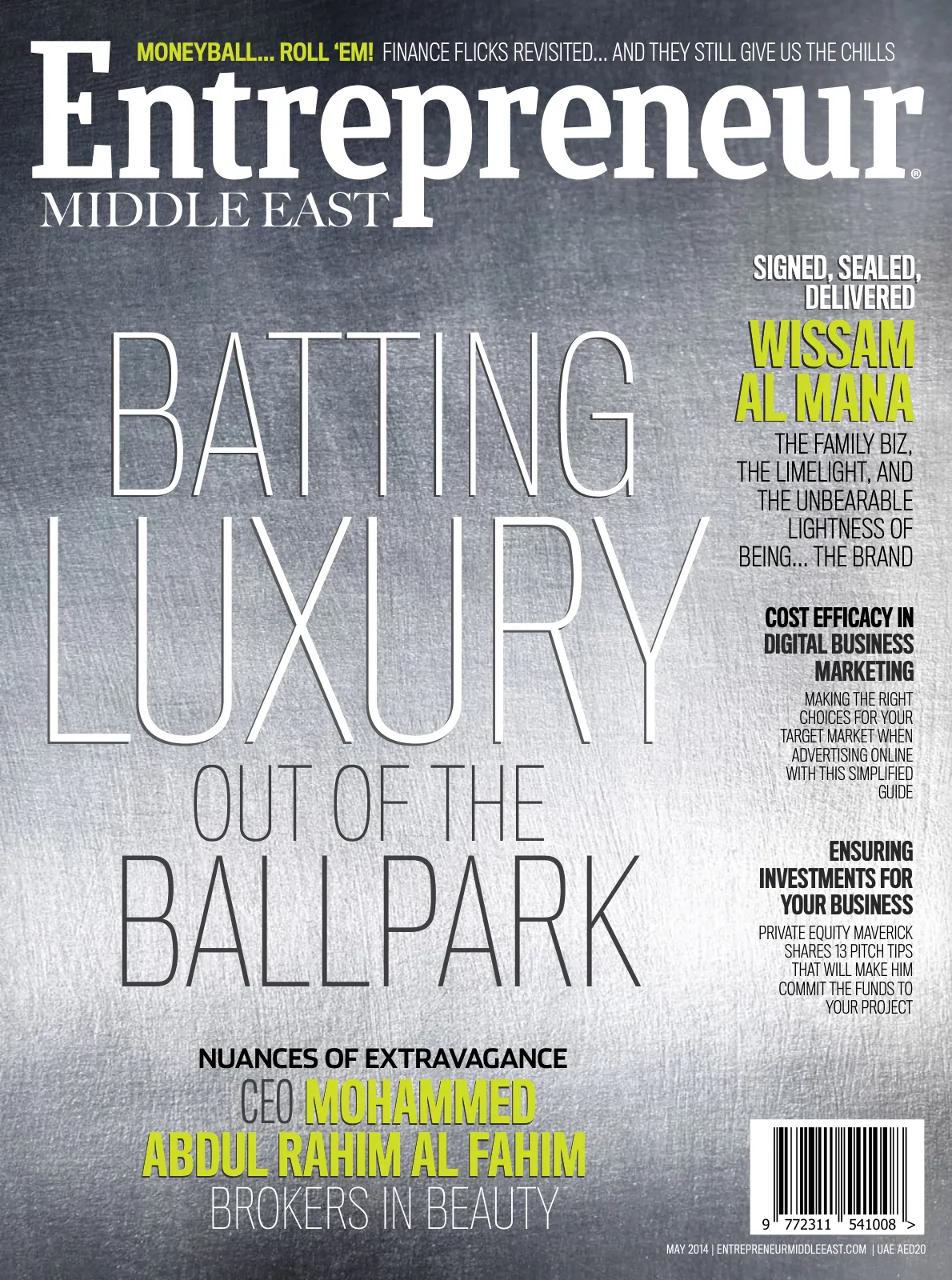
Entrepreneur Middle East, May 2014
Page 1
MOHAMMED
ABDUL RAHIM AL FAHIM
BROKERS IN BEAUTY
MONEYBALL… ROLL ‘EM! FINANCE FLICKS REVISITED… AND THEY STILL GIVE US THE CHILLS
MAY 2014 | ENTREPRENEURMIDDLEEAST.COM | UAE AED20
9
772311
541008 >
LUXURY
BATTING
BATTING
BALLPARK
OUT OF THE
MOHAMMED
ABDUL RAHIM AL FAHIM
NUANCES OF EXTRAVAGANCE
CEO
ENSURING
INVESTMENTS FOR
YOUR BUSINESS
PRIVATE EQUITY MAVERICK
SHARES 13 PITCH TIPS
THAT WILL MAKE HIM
COMMIT THE FUNDS TO
YOUR PROJECT
MAKING THE RIGHT
CHOICES FOR YOUR
TARGET MARKET WHEN
ADVERTISING ONLINE
WITH THIS SIMPLIFIED
GUIDE
COST EFFICACY IN
DIGITAL BUSINESS
MARKETING
LUXURY
THE FAMILY BIZ,
THE LIMELIGHT, AND
THE UNBEARABLE
LIGHTNESS OF
BEING… THE BRAND
AL MANA
WISSAM
AL MANA
WISSAM
SIGNED, SEALED,
DELIVERED
SIGNED, SEALED,
DELIVERED
Page 2
Entrepreneur MAY 2014
2
Page 3
MAY 2014 Entrepreneur
3
CONTENTS
MAY 2014
58
START IT UP:
WACKY IDEA
Pageboy Ibrahim Nehme
Crowdfunding in the Middle
East turns a page with this
successful campaign.
68
STARTUP FINANCE
It’s time to make money!
Simon Hudson has walked
you through startup steps
from the get-go, and now
it’s time to analyze the
importance of sales to your
newly-minted business.
72
YOUR MONEY
You wanna go offshore?
CEO Reza Afshar explains
offshore registration for GCC-
based companies, and why it
might work for your business.
80
WACKY IDEA
Two regional startups make us
wanna invest!
Google MENA hosts Jordanian
Oasis500 startups in Dubai…
and we’ve chosen two of
five great ‘treps for you to
support.
82
Q + A
The Arabic Factory
Ahmed Naguib’s El Masna3
has its eye on your Arabic
marketing direction. Find out
what they’re doing differently.
84
ASK THE MONEY GUY
The maverick speaks
Ziad Abdelnour gives you 13
big hints on how to make that
pitch turn into cold, hard
cash.
88
VC VIEWPOINT
Fund investment cycles
Why do VCs often turn away
promising investments?
Here’s a clue or two.
ERRATUM
The April 2014 article, Raytheon’s Got Game in the GCC, suggests that both Oman and Kuwait
recently purchased the Patriot Air and Missile Defense System. In actuality, Kuwait purchased
new Patriot fire units and Oman purchased a ground-based air defense system (GBADS).
84 Investor
Ziad Abdelnour
88 Fund investment
cycles
68 It’s time
to analyze the
importance of sales
to your newly-minted
business.
Page 4
Entrepreneur MAY 2014
4
CONTENTS
MAY 2014
16
INNOVATORS:
BEING THE BRAND
Wissam Al Mana
The youngest of the Al Mana
brothers explains the family biz,
and how he plans to make good
on his promises to do whatever he
can, no matter what it takes.
26
THE NUANCES OF
EXTRAVAGANCE
Mohammed Abdul Rahim Al Fahim
We set out to learn about Paris
Gallery’s marketing strategy from
their persuasive and commited
CEO. What we got was something
very, very different.
43
TECH:
MOBILE TECH
Apps and more
Flickr gets awesome and Sony
goes wireless-sharing. Like!
48
ONLINE ‘TREP
Going digital
Rani Nasr talks about the
transition from offline to online,
and what your company needs to
do to get there.
52
ASK A GEEK
Going once, going twice
Bidding on Facebook or LinkedIn
advertising? Mohammad Hijazi
gives you a crash course on how
to get your money’s worth.
66
SHINY
The third dimension
We took the 3Doodler for a spin.
26 Paris Gallery CEO
Mohammed Abdul Rahim
Al Fahim
16 Wissam Al Mana,
Managing Director, Hermès
Middle East & Luc Perramond,
CEO, La Montre Hermès
Page 5
MAY 2014 Entrepreneur
5
Page 6
Entrepreneur MAY 2014
6
CONTENTS
MAY 2014
54
CULTURE:
LIFE
Moneyball
Amal Chaaban revisits some
of the cinematic moments
dedicated to finance. It might
be over, but the watch is as
good as ever.
32
TRAVEL
Grooming and baggage
essentials
We’ve got your staple travel
bags narrowed down for you,
as well as airline-friendly
grooming essentials. Get
packing!
60
BUSINESS UNUSUAL
Wrap it up!
Emirati entrepreneur tells us
how she’s managed to get her
brand GCC-wide. Find out
what’s behind the decorative
niche market that she’s
cultivated for herself.
10
EDITOR’S NOTE
By Fida Z. Chaaban
34
‘TREPONOMICS:
ESQUIRE GUY
Handling a PR crisis with style
Ross McCammon has a few
suggestions on that ever-
so-delicate public relations
catastrophe.
36
SKILLSET
With great power…
Elias Jahshan goes over some of
the lessons he’s learned in the
newsroom. Learn how a highly
pressurized and time-sensitive
environment has improved his
managerial skills.
38
ASK A PRO
Crisis control
Octavia Nasr analyzes some
recent household name PR
blunders. What went wrong?
44
ASK A PRO
Treat failure like a scientist
James Clear advises you on how
to roll with the punches, and
while you’re at it, learn a thing
or two.
46
MARKETING
For those who do... it better
David Roman says that just
because they’re on top doesn’t
mean it wasn’t hard to get there.
46 David Roman speaking
at Lenovo’s 2014 Global
Kickoff in Marrakech,
Morocco
34 Handling a PR
crisis with style
Page 7
MAY 2014 Entrepreneur
7
Business Finance
Easy finance
for businesses
Dubai Islamic Bank's Al Islami Business Finance extends up to AED 1.5 million for businesses who think
big. With a hassle-free approval process and business-friendly payment options, Al Islami Business
Finance is the better way for all your business needs.
• Finance up to AED 1.5 million
• Competitive Profit Rates**
• Financing based on Salam Finance
• Flexible tenure from 6 months to 48 months
To know more:
Call: +971 4 609 2525
Email: sme@dib.ae
*Sale price of the goods under the Salam contract **Embedded in the price of the goods to be delivered.
Terms and conditions apply
www.dib.ae
facebook.com/dib.uae
twitter.com/dibtoday
youtube.com/user/DubaiIslamicBank
linkedin.com/company/dubai-islamic-bank
UPFRONT
CASH PRICE*
Page 8
Entrepreneur MAY 2014
8
EDITOR IN CHIEF Fida Z. Chaaban editor@bncpublishing.net
MANAGING DIRECTOR Walid Zok walid@bncpublishing.net
DIRECTOR Rabih Ibrahim rabih@bncpublishing.net +971508450747
PUBLISHER Nehme Abouzeid nehme@bncpublishing.net
CREATIVE DIRECTION Concept and execution Entrepreneur Middle East
ONLINE LIAISON Kareem Chehayeb
WEB DIRECTOR Haydar Mtayrek
Ziad Abdelnour
Amal Chaaban
Iman Ben Chaibah
Youmna Chagoury
Kareem Chehayeb
Tamara Clarke
James Clear
Walid Hassanein
Mohammad Hijazi
Sam Hogg
Simon Hudson
Leslie Iddison
Elias Jahshan
Dana Khairallah
Pamella de Leon
Ross McCammon
Wassim Mourtada
Shoug Al-Nafisi
Octavia Nasr
Rani Nasr
May Rostom
SUBSCRIBE
Contact subscriptions@bncpublishing.net to receive
Entrepreneur Middle East every issue
CONTRIBUTING WRITERS
PO Box 502511 Dubai, United Arab Emirates
P +971 4 4200 506 | F +971 4 4200 196
For all commercial enquiries related to Entrepreneur Middle East contact
sales@bncpublishing.net
All rights reserved © 2014. Opinions expressed are solely those of
the contributors.
Entrepreneur Middle East and all subsidiary publications in the MENA region
are officially licensed exclusively to BNC Publishing in the MENA region by
Entrepreneur.
No part of this magazine may be reproduced or transmitted in any form or by any
means without written permission of the publisher.
www.entrepreneurmiddleeast.com
WE’RE HEAVILY INVESTED IN OUR WEB PRESENCE
In addition to our print edition, we’re bringing you all sorts of
industry news on our web mediums. Joining us online means
getting relevant business and startup content in real-time, so
you’re hearing about the latest developments as soon as we
do. We’re looking forward to interacting with our readers on
all of our social media and web platforms- like any thriving
business, we’re looking to give and take. #TrepTalkME is
already happening on all of our digi platforms, and all good
conversations go both ways. See you on the web!
IS DIGITAL
MIDDLE EAST
Printed by Raidy Emirates Printing Group LLC
www.raidy.com
EntMagazineME
@EntMagazineME | @FidaChaaban
Entrepreneur-me
EntrepreneurMiddleEast
EntMagazineME
EntMagazineME
EntMagazineME
MIDDLE EAST
Page 9
MAY 2014 Entrepreneur
9
A New Generation of Steel
www.egyptian-steel.com
Page 10
Entrepreneur MAY 2014
10
EDITOR’S NOTE
I
am, on a daily basis,
flooded with requests for
coverage. Don’t get me
wrong, I like hearing what
you’ve done, and I do really
think it’s important to share
entrepreneurial news with
media outlets… But.
But. But. But.
KNOW YOUR ROLE. Having
a strong PR agency and the
budget to have them at your
beck and call does not mean
you should be the decision-
maker in this regard. You’re a
businessperson, so focus on
doing business. You are not
the agency. The agency is the
agency.
STEM THE FLOOD. Just
because you can afford a big
email blast by one of the most
influential agencies in the
Middle East doesn’t mean
you should encourage them to
flood people with irrelevant
updates. Some examples of
what constitutes an irrelevant
update:
1. That you now have X
amount of likes on your Face-
book page.
2. Your product is going on
sale and/or promotion.
3. You’ve made a public ap-
pearance at an event that no
one cares about.
4. Any other superfluous in-
formation that has no added
value for the reader.
CONSIDER YOUR LEVEL OF
EXPOSURE. Your PR agency
knows what to do and when.
It’s their area of expertise. If
you continue to badger them
to get you interviews and they
are reluctant, chances are
they know that you are over-
exposing yourself. This is a
strategic error, and your PR
people know best. Take their
word for it when they say
you need to take an interview
hiatus.
PICK AND CHOOSE YOUR
MEDIUMS. Your agency knows
who is suitable for your im-
age. If they are sending your
material to everyone –both
relevant and irrelevant media
outlets- it’s probably because
you are demanding tons of
press mentions. Trust me
on this one, less is more. It’s
better to have two or three
strong and suitable features
than having 12 randomized
mini-features that don’t proj-
ect your image and message
properly.
MINIMIZE YOUR SELF-
PROMOTION. Your agency
is very aware of the media’s
feelings about relentless
publicity-seekers. Let them
do their jobs. You are paying
them a hefty sum on retainer
so that they can advise you on
an appropriate brand image
for you and your business.
You are the brand, and they
are the ones who are “in the
know”. Let them determine
what level of self-promotion
is suitable.
TIMING IS EVERYTHING. Your
agency knows when it is most
advantageous for you to do
your round of press, and they
know when it’s timely to send
releases. Don’t force them to
engage the media with things
that will get dismissed. Why?
Because when you do have
something big going on, the
media will not pay proper
attention to you since they
get fluffy emails about you
regularly. I personally have
unsubscribed from three lists
this month because of spam-
ming.
Why am I telling you all of
this? Because of the hashtag
#UAEPR on Twitter. A lot of
the media in the UAE have
taken to that particular social
media platform to stick it to
agencies and PR people across
the country, myself included.
This got me thinking about
how PR people are in a bit
of bind- the client demands
coverage and the client will
often not listen to reason.
Entrepreneurs, if you think
that you know better than the
agency that you’ve contracted,
then why have them on board
at all? They do know better
than you do how to deal with
the fickle and judgmental
media.
I am telling you the truth,
and I hope you take it into
consideration. Whether or
not you agree, you can let me
know on Twitter or by writing
in via email. I look forward
to hearing from you… even if
you just feel like giving me a
piece of your mind.
ACTIONS
SPEAK
LOUDER
THAN PRESS
RELEASES
#UAEPR
Fida Z. Chaaban
Editor in Chief
@fidachaaban
editor@bncpublishing.net
Page 11
MAY 2014 Entrepreneur
11
BBA
WITH MAJORS IN
MARKETING
FINANCE
INFORMATION SYSTEMS
INTERNATIONAL BUSINESS
TRAVEL & TOURISM
MANAGEMENT
Accredited by:
ADMISSIONS OPEN FOR
MAY & SEPTEMBER 2014
WEEKEND CLASSES ALSO AVAILABLE ON
FRIDAYS & SATURDAYS FOR BBA AND MBA
SCHOLARSHIPS
AVAILABLE
admissions@skylineuniversity.ac.ae
+971 6 5441155
MBA
WITH EMPHASIS ON
MARKETING
FINANCE
HUMAN RESOURCE
MANAGEMENT
STRATEGIC MANAGEMENT
& LEADERSHIP
Page 12
Entrepreneur MAY 2014
12
database, consisting of a ‘heat list’- a list
of recommended names involved with
or connected to people who have been
convicted of crimes (both major or minor
offences). The lists include anyone who
may have a likelihood of being involved,
and locations called ‘hotspots’, where
past crimes have taken place. The creepy
program draws inspiration from Yale
sociologist Andrew Papachristos’ social
networking theory, wherein a person’s
network and their neighborhood can
statistically determine their potential
involvement in future illegal activity.
Just under 60 out of 400 people on the
hotlist have been personally visited and
told by CPD officers that “they’re being
watched”, causing concerns over invasion
of privacy and profiling. Are people being
branded for living in neighborhoods with
high crime rates and being acquainted
with a few bad apples? Most importantly,
the question that begs an answer: Will
it perpetuate a slew of self-fulfilling
prophecies?
S
yria’s polio outbreak has been mak-
ing headlines for a while, emphasiz-
ing the plethora of public health
issues that emerge during armed conflict.
The first outbreak took place in October
2013 in Deir ez-Zor in Eastern Syria. The
World Health Organization (WHO) claimed
that the outbreak there was due to the
destruction of its electrical and water infra-
structure, in addition to the lack of immu-
nizations since the start of the unrest. By
November 17, reports of children paralyzed
by polio in three Governates of Syria began
surfacing. According to UNICEF, Syria was
polio-free for 15 years before the recent
outbreaks. Today, there are only three
endemic countries: Pakistan, Afghanistan,
and Nigeria.
In a conference in November 2013,
WHO’s Eastern Mediterranean Region
countries declared the polio outbreak
in Syria as a regional issue rather than
a national one. A mass vaccination
campaign was designed to immunize 22
million children under the age of five in a
six to eight-month period. The campaign
involves WHO, UNICEF and other UN
agencies, the Syrian Red Crescent, as well
as local and international NGOs.
While the campaign is underway, it has
been difficult to immunize children in
Syria, due to restrictions as a result of the
existing political upheaval. This slow pe-
riod means that as summer approaches,
there are fresh concerns that the virus
will cross borders to areas with refugee
camps, notably Lebanon, Jordan, and
Turkey. Monitoring travel is difficult as is,
and given that most refugee camps are
not well organized, let’s hope that these
new challenges will not lead to new polio
patients.
CAUTION: QUARANTINE
SYRIA’S IN FOR A WHOLE MESS O’ TROUBLE
Sci-fi flick The Minority Report is turning
into law enforcement reality. The Chicago
Police Department (CPD) is introducing a
computer system that predicts potential
criminals. The system was developed by
Miles Wernick, Motorola professor and
director at Illinois Institute of Technology
in Chicago. Wernick won’t elaborate on
the details, but says that the algorithm
selects names from the CPD’s crime
THE ALGORITHM
Led by Miles Wernick and Commander
Lewin, CPD’s information technology
lead, the National Institute of Justice
granted over US$2 million to the depart-
ment to proceed with two phases from
their predictive experimental program.
Wernick likened the structure to scrutiniz-
ing for an area’s anomalies by seeing the
big picture through a person’s network,
even predicting the possibility of the sub-
ject being involved in an act of violence.
The full report about the program will be
published in 2016.
Chicago’s police computer labels birds of a feather…
Minority Report IRL
By Pamella de Leon
By Kareem Chehayeb
Electron micrograph of the polio virus
POLIO VIRUS MICROSCOPIC IMAGE CREATIVE COMMONS
Page 13
MAY 2014 Entrepreneur
13
ASDA’A Burson-Marsteller’s 2014
Arab Youth Survey
THE ESTABLISHMENT
STILL MATTERS
Believe it or not, the data in
the survey finds that Arab
youth have confidence in their
governments when it comes to
sorting out several issues, and
their confidence in the Arab
Spring is dropping, which is
most likely due to the lack
of tangible results that have
occurred thus far. Over half
of the youth interviewed still
find the Arab world better off
as a result of the Arab Spring,
and they also agree that their
lives will be better off because
of it five years from now. One
caveat? Numbers significantly
dropped from 2012 when 72
of the 100 Arab youth polled
said that they believe their
lives are better off because
of the Arab Spring. As of
now, only 54 still feel that
way. While they expressed
the most confidence in their
government when it comes
to economic stability, living
standards, unemployment,
and security issues, they were
the least confident in issues
such as wealth creation, scar-
city of resources and climate
change.
“GET OFF THE COUCH,
AND GET A JOB!”
The biggest fears that the sur-
veyed Arab youth expressed
were unemployment and the
rising cost of living. Both are
issues that have taken a much
larger precedent over the past
few years. Unemployment
concerns were expressed by
49% of Arab youth, whereas
63% mentioned the rising
costs of living. When it comes
to the latter, it’s an issue
that seems to be of equal
concern regardless of region;
whether you’re in the GCC,
Levant or Northern Africa,
approximately 60% of Arab
youth surveyed noted it.
When it comes to unemploy-
ment, there is little concern
in places like Oman, UAE, and
Kuwait, averaging at around
36%. That said, 62% of youth
in Egypt are greatly concerned
about unemployment, while
countries like Jordan, Leba-
non, Tunisia, and Iraq are all
hovering around 55%.
WHY CAN’T WE ALL JUST
GET ALONG?
It almost makes sense for
Arab youth to be more con-
cerned about their safety,
rather than how effective or
swift the democratization
process has been in their
respective countries. This is
probably given the increased
violent situations that have
occurred in Arab states that
have had popular uprisings.
Between 2013 and 2014, the
number of Arab youth in the
survey who believed that civil
unrest is the main obstacle
in the region has increased
from 44 to 55, whereas lack of
democracy decreased from 43
to 38. Interestingly enough,
this is something that youth
across the region seem to find,
more than lack of democracy,
lack of strong leadership,
and even terrorism. Perhaps
the fact that increase of civil
unrest usually stalls democra-
tization changed their minds,
especially with reports of
spillovers from the Syrian
conflict, and the ongoing se-
ries of uprisings in Egypt.
‘TREPS IN THE MAKING
ARE MULTIPLYING
Entrepreneurial spirit is quite
high among Arab youth- most
believe that more businesses
will start up in this genera-
tion, both in and out of the
GCC. While percentages aver-
age at around 67%, entrepre-
neurial spirit is exceptionally
high in Jordan and Egypt at
71%, both startup hubs in the
region. That said, it’s surpris-
ing to see Palestine and Libya
up there at 71% and 72%
respectively. There is also
an increased preference in
working in the private sector;
the GCC youth’s interest has
been steadily increasing since
2012, but those outside the
GCC had a much higher inter-
est in 2012, despite this year’s
increase. One thing is for
sure though, while more Arab
youth still prefer working in
the public sector, those num-
bers are steadily in decline.
This could possibly correlate
with political instability or
the potential instability, de-
pending on external factors.
COME ON,
GIVE US A BREAK!
An overwhelming percent-
age of young Arabs find that
energy, electricity, and vehicle
fuel (gasoline) should be
subsidized by their respec-
tive governments, averaging
at 74%. When it comes to the
biggest challenge facing the
region today, climate change
and the environment is at the
bottom, and the rising cost of
living at the top. What’s inter-
esting is that because energy
costs are subsidized across
the region, you can safely
assume that this is related to
the lack of concern for climate
change and the environment.
Stick with me here- while ris-
ing cost of living is the biggest
concern, government subsi-
dies on energy and electricity
will not do much to help. In
fact, paying for energy, elec-
tricity, and fuel at the market
rate would help alleviate that
issue; Jordan recently put this
into action in 2012.
By Kareem Chehayeb
EXECUTIVE SUMMARY
IN THE LOOP
Page 14
Entrepreneur MAY 2014
14
Page 15
MAY 2014 Entrepreneur
15
Page 16
Entrepreneur MAY 2014
16
INNOVATORS
Entrepreneur MAY 2014
16
Page 17
MAY 2014 Entrepreneur
17
SIGNED, SEALED, DELIVERED
THE FAMILY BIZ, THE LIMELIGHT, AND
THE UNBEARABLE LIGHTNESS OF
BEING… THE BRAND
WISSAM
AL MANA
I accosted Wissam Al Mana. It’s true.
I’d been following the youngest Al Mana brother’s movements for years, so
when I finally had the chance to approach him for an interview, I wasn’t
going to let it slip through my fingers. I wanted to know more about this
hybrid Qatari who gives off dueling energies of a hands-on businessman
attending his own events –less in a ribbon-cutting capacity and more in a
hands-on ownership type of scenario- and a harangued privacy-seeking in-
ternational figure of interest. While I understand that his public appearanc-
es could fall under the do-what-you-gotta-do scenario, I wanted to hear Al
Mana tell me for himself- about his work, his life, and yes, about the sensa-
tions of both privacy and unorthodoxy in whatever (serious) press coverage
there is about him. Why am I referring to him as a hybrid? Because later I
find out that he’s got a slight pan-Euro accent with a touch of British inflec-
tion, and an East meets West mentality that permeates everything from his
business decisions to his conversational demeanor. >>>
MAY 2014 Entrepreneur
17
By Fida Chaaban
Page 18
Entrepreneur MAY 2014
18
I wait for an opportune time at
the private kickoff of the La Mon-
tre Hermès “Of Mastery and Time”
instillation at the Dubai Mall, and I
make my not-so-subtle move: “Mr. Al
Mana, I want you to be on my cover.”
Notoriously private, I expect him to
flat out refuse. “Your cover? Really?”
The charismatic Qatari business-
man, smiling down at me from his
six ft. plus height, for some reason
decides that I’m not overly crass for
cornering him at an event (a bit of a
media no-no), and takes me seriously
enough that he agrees to a private sit
down on-record later in the week.
“You can ask me anything you want;
I’m very opinionated… except about
my private life. I don’t want to talk
about that.”
But talk about that he does, that
and so much more… Like how it feels
to be in a PR catastrophe: “People
want to take advantage of you, be-
cause all of a sudden you’re famous,
and you’re in the headlines and it’s
easy to get that attention.” And why
he challenges himself perpetually:
“It’s about being able to manage and
to be skilled at operating different
types of businesses. I have to, I get
bored if I don’t.” I’ve fast forwarded
to a few days later, and at this point
I’m seated with Al Mana in a well-lit
room at the Ritz-Carlton Dubai, and
he’s much more frank than I expect.
Reclining comfortably in national
dress, Al Mana is pleasant, well-
spoken and polished, and initially
I have a difficult time gearing up to
grill him as it seems like a violation
of the quiet waves of sincerity that he
emits. “I don’t have Facebook, I don’t
have Twitter. I don’t have anything,
because believe it or not I’m a very,
very private person! I don’t even
have WhatsApp! I don’t like to pry
into people’s business.” Wissam Al
Mana had more than his fair share
of press… and not all of it is flatter-
ing nor is it cohesive. To begin with,
his official work position with the Al
Mana family group of companies is
confusingly reported in many differ-
ent ways – when I meet him, it’s in
his capacity as the Managing Director
of Hermès Middle East, one of the
brands encompassed in the mam-
moth and diverse family portfolio that
includes everything from automotives
to F&B. “My late father was the agent
for Nissan, he was one of the first
to bring vehicles to the region. Our
relationship with Nissan and Renault
is one of [our] major revenue-streams
until today.” Still in the context of
revenue streams, Al Mana says that
their biggest boons are “probably bro-
ken up between distribution, real es-
tate, retail, and within the retail divi-
sion it’s very diversified. I want to sell
everything, I’d even open up a candy
store,” he says smiling. It’s apparent
that family matters to Wissam- he
mentions his late father, Saleh Al
Hamad Al Mana, several times during
the course of the interview, and talks
often about his older brothers Hisham
and Kamal. “Between my brothers
and I there is a structure. We basi-
cally handle different responsibilities
and different companies within the
group. We all enjoy doing different
things, we all like to put our hands
in certain industries and activities.
There’s no rule that I can’t do this
because my brother is. I do most of
the business development. We’re
becoming very selective in our ap-
proach; we try to work with the best
“WE’RE BECOMING
VERY SELECTIVE IN
OUR APPROACH; WE
TRY TO WORK WITH
THE BEST BRANDS
IN EACH SEGMENT,
AS OPPOSED TO THE
MOST BRANDS.”
“ONE OF THE CULTURAL
RESTRAINTS I’M FINDING
IS THAT WE DON’T WANT
TO WORK OR DEAL WITH
ALCOHOL FOR CULTURAL
AND RELIGIOUS REASONS.”
INNOVATORS
Page 19
MAY 2014 Entrepreneur
19
brands in each segment, as opposed
to the most brands. We’ve tried the
‘most brands’ way, and it doesn’t
work because you end up in these
situation where 20% of your brands
make up 80% of your profits, the
80-20 rule.” Within this framework,
being a family-oriented conglomer-
ate seems to be a strength of theirs,
with a division of labor that Al Mana
says works very well
for them. “The way we
operate as a group, the
management is very
horizontal, it’s very
flat. We don’t have this
typical hierarchical
pyramid where you’ve
got all these CEOs and
vice presidents and
everyone’s reporting.
It doesn’t really work.
We try to take com-
panies and work with
them individually be-
cause we feel that every company has
specific needs and we are fortunate
to be young enough to take a much
more active role in our operations,
and in our company structure.” One
of the topics that elicits the most
effusive response from Al Mana is
how and why he joined the family
biz. “I always wanted to. My father
passed away when I was quite young,
and I felt that it was my duty to kind
of pick up the flag and to continue
the business, and try to continue the
legacy and the family name. It’s in our
blood, we’re merchants. When I was a
child, I looked at my father’s passport
and his occupation said ‘Merchant’.
I asked my mom, and she explained
that we are merchants. We take pride
in that, it’s our heritage.” >>>
“BETWEEN MY
BROTHERS AND I THERE
IS A STRUCTURE. WE
BASICALLY HANDLE DIFFERENT
RESPONSIBILITIES AND
DIFFERENT COMPANIES WITHIN
THE GROUP [...] THERE’S
NO RULE”
Wissam Al Mana, Managing
Director, Hermès Middle East & Luc
Perramond, CEO, La Montre Hermès
Hermès exhibition
“Of Mastery and Time”
Page 20
Entrepreneur MAY 2014
20
These merchants seem to believe
in plotting their way forward, and
they’re now setting their sights on
a slice of the highly sought-after
KSA-pie in two of the family’s cur-
rent expertise arenas: Luxury retail
and niche sporting goods. “I’m
travelling to Saudi Arabia for a few
days. We’re planning on entering
the Saudi market in 2015, so we’re
laying the foundations for that. It’s
a huge market and we understand
that there’s great potential there.
We’ve been very cautious about how
to enter the market because we know
of other groups who’ve entered and
failed. There’s a certain culture in
Saudi Arabia that is somewhat dif-
ferent from the rest of the GCC, and
that has to be respected.” Respect
is something that Al Mana has for a
few different ideas that we touch on,
namely his cultural heritage and reli-
gion. This comes into play at different
business-context junctures, primarily
in the F&B sphere and the decision
to only team up with brands who are
willing to adopt Muslim religious
mores- and that means eschewing
products involving alcohol and pork.
While F&B is not a large part of the
Al Mana portfolio, their business is
growing in that direction. The family
launched the Golden Arches of Mc-
Donalds in Qatar in the late 90’s, and
now have newer upscale hospitality
pursuits like La Maison du Chocolat
in Dubai Mall that opened November
of last year, and he adds that they’re
currently in the process of launch-
ing their new premium food division.
“One of the cultural restraints I’m
finding is that we don’t want to work
or deal with alcohol for cultural and
religious reasons. So it’s trying to find
the concepts that will work with-
out actually serving it.” Who opted
to draw this line for the Al Mana
umbrella holding? “It was my deci-
sion to be honest, I’m the one who is
developing this division of the group.
It was my choice not to venture into
alcohol and pork because it’s against
my religion. It’s really that simple- I
thought it was the right decision to
take. I think it’s the easy way out to
secure brands which serve alcohol,
because alcohol makes up 30% to
40% of the profit.”
The group recently secured noted
Italian gelato-purveyor Grom and
eventually “decided to purchase
shares in the mother company itself,
because we feel that they have a lot
of potential internationally and in
wholesale and in other areas.” And
as for the brands who don’t want
to localize? “I’ve backed away from
big deals because of this, and the
culture that certain companies have.
They don’t want to embrace your
culture, and I think they’re setting
themselves up for failure.” Wissam
is adamant that a “When in Rome”
policy is needed for brands wanting
to open up shop in the Middle East,
and he brooks no excuses, faulting
the companies for a lack of consumer
insight and cultural awareness, giving
examples of flawed visual presenta-
tions that flout MENA region cultural
norms. “We work with a lot of fashion
brands and every season they send
us their advertising visuals, and the
number of visuals that are rejected in
the UAE is very similar to that of Qa-
tar and Saudi. It’s actually the brands’
“WE’RE PLANNING ON
ENTERING THE SAUDI
MARKET IN 2015,
SO WE’RE LAYING THE
FOUNDATIONS FOR THAT.”
INNOVATORS
Right:
Wissam Al Mana & Geoffroy
d’Anglejan, Managing Director
La Maison du Chocolat
Page 21
MAY 2014 Entrepreneur
21
fault, and we tell them time and time
again that we need visuals that con-
form to this part of the world and the
culture here. I don’t think they take it
into consideration enough.”
His involved attitude doesn’t end
there, Al Mana wants to be part
of every level of the business, and
he’s got a soft spot for a few of their
endeavors in particular. “Yes money
is important, the performance of the
brand is important, but there are also
brands that have meaning. If some-
thing is the best in its field, its nice to
have.” Hallmark brands are of interest
to Al Mana, but so are businesses in
need of an overhaul. “I recently pur-
chased a very small company here in
Dubai. They approached me and asked
for help, offered a majority stake to
manage and turn the business around.
I’m in the process of restructuring.
It’s a nice challenge to take on these
kinds of deals. It’s a bit like playing
a game where you’ve been playing it
for many years, and you need to raise
the level,” he adds, likening it to a
digital chess game, upping the ante
and the level of difficulty. As for tech,
Al Mana exudes enthusiasm here,
detailing a rather complex plan that
he hatched revolving around Apple.
“I’ve always wanted our Group to get
into technology as a personal passion,
and it’s a sign of the times. It’s an area
that we need to develop and be a part
of. I approached Apple in the Middle
East and I told them that I wanted to
work with them. I wanted to throw
my experience in retail behind it, and
use my experience in APR -Apple
Premium Reseller- stores. My goal
eventually is to be the biggest APR
retailer in the world. When I met with
Apple, I told them and I put it in the
presentation. They looked at me and
they all smiled, and I‘m like, ‘But you
know we just started…’” Al Mana
laughs with me here as I goad him
about such an ambitious statement,
but then again why not? For the Al
Mana family and their multitude of
companies, such a grand declaration
does seem feasible when taken in con-
text, especially hearing Wissam detail
the scope and breadth of the extended
scheme. “After service support, work
in B2B and B2C segments, we’ll look
at other parts of the sector. We’re
talking to various service providers
who have business solutions as well.”
In this and other parts of their busi-
nesses, Qatar figures prominently, but
Al Mana says that the family direction
hasn’t been affected by the 2022 FIFA
World Cup win, despite its implica-
tions for business. “2022 allowed us
to consider other opportunities in
Qatar, and of course we’re very happy
about the World Cup, but I’m not sure
it’s really changed our strategy.” His
opinion of the melee surrounding the
controversial sporting event? “Some
countries are just bad losers, they’re
bad sports,” he laughs. “I think cer-
tain countries were expecting to win,
and we ended up winning. It’s a great
thing to allow small nations, who
are developing at the rate that we’re
developing, this kind of opportunity.
It should happen to other nations too,
not just to us. Why should it be that
only developed countries are the only
ones who win these types of events?”
he says rhetorically. I suggest that
this is a textbook self-and-other
case, in light of both the World Cup
being granted to Qatar, and the UAE’s
recent Expo 2020 victory. Perhaps >>>
“I FELT THAT IT WAS
MY DUTY TO KIND OF
PICK UP THE FLAG
AND TO CONTINUE THE
BUSINESS, AND TRY TO
CONTINUE THE LEGACY
AND THE FAMILY NAME.
IT’S IN OUR BLOOD,
WE’RE MERCHANTS”
Page 22
Entrepreneur MAY 2014
22
Page 23
MAY 2014 Entrepreneur
23
the rest of the world just doesn’t want
to see Arab countries land these types
of global happenings? “I think there a
lot of misconceptions about this part
of the world, stemming from hatred
toward Arabs and Muslims. I think
that a lot of Westerners who come
to this part of the world are pleas-
antly surprised. We’re seeing more
and more candidates from the West
wanting to join our organization,
wanting to work in Dubai, Abu Dhabi,
Qatar. There are a lot of opportuni-
ties especially for entrepreneurs; they
can benefit from the favorable factors
like no taxes and so on.” Al Mana
and his brothers have all spent time
in various Western countries, giving
them an advantageous edge: They can
see what others may miss in terms of
globalization and East-West integra-
tions.
I find his carriage Western, but his
orientation towards discretion decid-
edly more Eastern. He surprises me
by bringing up his personal life, and
the lack thereof when discussing
paparazzi coverage and the internet.
“That’s primarily because I’m mar-
ried to a very famous woman. What’s
happened since then? There’s been an
interest from the media to understand
more about me and the fact that I’m
from the Middle East. It’s positive, it’s
negative, why? Because people want
to be negative about you, it’s like,
‘Okay, let’s pick on him today,’”he
says gesturing, and I tend to agree
after researching the existing articles
written about him, even by regional
media. I don’t share my sentiments
on this with Al Mana, doubtless he’s
aware of the somewhat cheap shots
that the media has taken, but even
business-staple Forbes debates his
“billionaire status” and seems a tad
gossipy when they mention him.
Al Mana does talk about reputation
management and sounds cynical
regarding the wildfire media cover-
age by “some Jumeriah Jane” and
her slanted take on the controversial
sacking of two of his former staff:
“It’s irresponsible… Why didn’t
she pick up the phone and ask for
my side of the story? The reality is
that’s very poor journalism.” That,
and his marriage to performing art-
ist Janet Jackson is the subject of
tabloids globally, mostly eclipsing
any real articles about the youngest
Al Mana’s fervor for his life’s work.
“I spend time with my wife. It’s a
luxury. We love travelling… we love
going to nice, exotic places far away
from the world and from prying eyes.
Over time, like anything in life, you
find ways to master it and you learn
how to do that.” He has learned how
to master many things if my hour-
and-a-half long conversation is any
indicator, including time manage-
ment. “Time is like a very good
friend who you don’t see very often,”
he observes almost to himself.
“There is this relationship: Time is
the good friend that you’re always
chasing; time is luxury. Spending
that couple of hours to do your own
thing; I love looking at antiques,
reading...”
Heavy is the head that wears the
crown, and despite the lack of tact
in using that particular example in a
region filled with royalty, it’s the best
thing I can think of for this son of
merchants who has managed to both
transcend and transform the image
of the modern Arab businessman,
while still paying solemn homage to
his family legacy. How does he feel
about his family name actually being
a brand? “I’m very proud. There’s so
many factors involved in being a good
businessman- ethics, honesty. It’s a
huge responsibility. I spend a lot of
time in the West, and my brothers
have too. I think that’s actually a key
to our success. The fact that we have
this cross-cultured approach, we’ve
managed to understand cultures
across West-East. It’s an advantage
to us.”
There is something that resonates
with me long after the interview is
over. Al Mana’s even, forceful gaze as
he sums up his goals for the future:
“I will do anything that I feel will be
beneficial to our Group, and at the
same time help others.” It comes
across almost like a vow, and as
he locks his eyes with me, I get the
distinct impression that he isn’t the
type of man to make guarantees that
he cannot keep, no matter the circum-
stances.
“I SPEND A LOT OF TIME
IN THE WEST, AND MY
BROTHERS HAVE TOO. I
THINK THAT’S ACTUALLY
A KEY TO OUR SUCCESS
[...] WE’VE MANAGED TO
UNDERSTAND CULTURES
ACROSS WEST-EAST”
INNOVATORS
Wissam Al Mana and Janet Jackson
with Giorgio Armani
WISSAM AL MANA AND JANET JACKSON IMAGE COURTESY OF AL MANA GROUP
Page 24
Entrepreneur MAY 2014
24
Page 25
MAY 2014 Entrepreneur
25
Page 26
Entrepreneur MAY 2014
26
CEO MOHAMMED ABDUL RAHIM
AL FAHIM BROKERS IN BEAUTY
THE NUANCES OF
EXTRAVAGANCE
INNOVATORS
E
verything about Mohammed Abdul Rahim Al Fahim during our interview centers around
the cadence of his speech. His power of delivery, his gestures, and yes, even his crisply
pressed attire- they all seem to ebb and flow with his particular rhythms and intonations.
When I enter the Diyafa Room at DIFC’s Capital Club, I’m greeted formally by Al Fahim and
Mohamad Jaber, Paris Gallery Group Marketing Manager. I’m not entirely sure what to expect
from the media-savvy CEO, but I do expect him to know his luxury products, so that’s where I
start. The purpose of this sit-down is to determine what it is that Paris Gallery wants to convey
and how they’ve done it thus far. Some things that I learn during the course of this interview
are to be expected -like the meticulous attention to detail worthy of a purveyor of better goods-
and some things are not. >>>
By Fida Chaaban
Page 27
MAY 2014 Entrepreneur
27
MAY 2014 Entrepreneur
27
Page 28
Entrepreneur MAY 2014
28
“This is not fair.” Al Fahim laughs
lightly as he declines to reveal his
own personal fragrance preferences. I
suggest a few hallmark houses to him
and he smiles good-naturedly. “Creed
is our partner, Cartier is our partner,
and so on. Once I spoke about fashion
houses [in an interview] and missed
one of the brands -also our partner-
and the very next day they sent me
an email asking why I didn’t endorse
them as well… which is true.” It
probably won’t surprise you that Al
Fahim is elegant- he is, after all, sur-
rounded by the best of the very best
as a matter of course. He gestures
often and easily, and he’s got the
aforementioned personal cadence of
speech that’s a bit hypnotic, truth be
told. What part of Al Fahim’s person-
ality do I see in Paris Gallery? After
spending time with him, I am sure
that so much of the prestige retailer’s
direction and identity are imbued
with his touch. So much so that at
about halfway through our conversa-
tion I notice that I’m having difficulty
separating Al Fahim the person from
Paris Gallery the brand, and vice
versa. For those of you who want to
know about the “dollah, dollah bill”,
Paris Gallery’s financials, you need to
understand that discussing money is
usually somewhat untoward, even for
a magazine about entrepreneurship.
All of the aspects of filthy lucre are
exactly what a brand like Paris Gallery
needs to not discuss- to keep broker-
ing (successfully) in the illusion of
providing you with privilege and
prestige by sheer dint of being a client
at one of their 52 locations across
the GCC. It is essential that a luxury
consumer forgets the heavy associa-
tion with money to continue to part
with their resources in exchange for
products that a large of the popula-
tion deem unessential. Al Fahim’s
strategies and theorizing are the very
picture of precision, and it serves to
drive his points (and products) home.
According to Al Fahim, the break-
down of business across their many
categories is fairly stable. “We’re very
balanced when it comes to percent-
age of sales. It’s not like one category
is much bigger than other categories.
We have eyewear, accessories, watch-
es, fashion watches and watchmakers.
Similarly we have prestige perfume
and niche luxurious perfumes and
cosmetics and skincare- you name
it. Each category is where it should
be- it’s not like one is big and one is
small. We like to keep it balanced by
continuously enlisting new brands
and products in each category.” I turn
the conversation to the economic
downturns of the last decade, and
mention proven statistics that suggest
when the North American economy
is faring poorly, prestige beauty
product sales are historically proven
to increase. Al Fahim, aware of the
inverse relationship, makes a valid
point: What makes for huge losses
in the West doesn’t generalize over
to the Middle East and in specific,
the GCC. “Back in 2009, toward the
second quarter, when there was a lot
of negative talk globally in the media
about the market and market down-
sizing and the crisis, what they said
really applied to their own countries,
but since the media is very global,
news flies in no time so it became a
global conversation. What happened
in the U.S. affected their market, no
question. Similar things in Europe,
some parts, when they regulated the
balances. When it comes to the UAE,
it affected certain parts of the market.
Aviation, telecommunication, some
parts of real estate, were not affected.
The negative psychological affect was
more applicable in this region than
the actual facts of the market, so the
luxury business including our brands
–not our shops, but the fashion
houses that we work with- went down
about 35 to 40%. It wasn’t a lot.” It
certainly sounds like a lot to me, but
Al Fahim is quick to note that relative
to the considerably higher numbers
that the GCC is driving, 30 to 40% is
actually negligible. I didn’t take the
scale of business into consideration,
and the Middle East is a formidable
luxury consumer hub. Al Fahim says
“THE NEGATIVE PSYCHO-
LOGICAL AFFECT WAS
MORE APPLICABLE IN THIS
REGION THAN THE ACTUAL
FACTS OF THE MARKET”
INNOVATORS
CEO Mohammed
Abdul Rahim Al Fahim
and Mohamad Jaber,
Paris Gallery Group
Marketing Manager
Page 29
MAY 2014 Entrepreneur
29
that the “Lipstick Trend” manifested
thus in the UAE: “Some clients shift-
ed downward to brands like L’Oreal,
but the big percentage didn’t- they
stayed with the brands they trusted.
My business wasn’t affected. Contrary
to the global market trend in niche
perfumery, the demand increased
here and continues to increase until
today. France, Italy, has tapered, ac-
cording to our partners. Germany is a
bit better off, and London is fine due
to the tourists from the Middle East.
All of their department stores attend
to the Middle East client, it’s a big
part of their total business annually.
During the past few years, Chinese
tourists are increasingly visiting here,
and the Russians returned. Every-
thing that was foretold in 2009 and
proven not to apply gave the people
confidence again.”
Giving me perspective about more
than one aspect of the luxury retail
sector, Al Fahim discusses his vision
for the UAE: He wants Dubai, in line
with H.H. Sheikh Mohammed bin
Rashid Al Maktoum’s wishes, to be
the biggest and the best in cater-
ing to the fine goods clientele which
includes tourists and residents alike.
“Our leadership wants this country
to become the center of luxury retail
worldwide- the center of luxury
retail, which will happen very soon.
We have positioning in Saudi, Kuwait,
Qatar, Oman… they used to experi-
ence Paris Gallery in the UAE. Today,
many Iraqis who visit Dubai, they ask
why Paris Gallery hasn’t yet opened
there. These country aims are ben-
eficial to us. We, and our colleagues
in the industry, are participating, >>>
“CONTRARY TO THE GLOBAL
MARKET TREND IN NICHE
PERFUMERY, THE DEMAND
INCREASED HERE AND
CONTINUES TO INCREASE
UNTIL TODAY”
Page 30
Entrepreneur MAY 2014
30
together with the shopping malls, we
are working to improve retail through
selection, service level…” Both seg-
ments of customers are important to
Paris Gallery, and when the discus-
sion moves to global hubs including
Hong Kong, Al Fahim’s claims ring
true. “Singapore used to very much to
be talk of the world. What they have
done is amazing, but today Singa-
pore is very much following Dubai.”
In his opinion, the best service level
is Japan, and he says matching this
is both a challenge and a window of
opportunity for the retailer. “In our
company, we employ more than 70
nationalities. They all come from
different cultures and corporations.
They learn positive and negative
things, and take that with them. Since
2006, we have tried to change the
Paris Gallery corporate culture. One
part of our culture is that you own
the business, you are accountable.
You treat your areas of responsibility
as your own, and whatever you feel
is appropriate to do must be done. A
big proportion of our junior manag-
ers and managers take decisions that
aren’t in line with the brand. Prior
to you joining us, Mohamad was just
discussing that with me detailing the
number of transactions that occurred
from a customer service perspective
that aren’t in-line with our official
policy,” says Al Fahim, locking eyes
with Jaber and smiling. “I tell him
it’s okay, and he doesn’t think so.”
Here Jaber interjects that as some-
one employed by the company, he
personally vouches for and takes
advantage of Al Fahim’s direction to
“own” the business. “My ownership
is to the level that I have the freedom
to express my opinions even if it is
inconsistent with those of the CEO.
Of course I have to follow his strategy,
but if I’m not convinced, then I’m not
convinced.” I tell them both that I
disagree that this can be generalized
across the staffing board, because of
two simple facts: Jaber is senior man-
agement and his relationship with Al
Fahim is clearly quite close. It is an
altogether different dynamic. Jaber is
able to own the business, because he
is an integral part of the overall Paris
Gallery schema, and highly positioned
in the ranks, not to mention having
the confidence of the CEO personally.
The hugely diverse Paris Gallery staff
cannot and will not ever be in Jaber’s
position, no matter how much they
would like to. This discussion leads to
an additional another angle of diver-
sity- the customers.
Thinking about the GCC’s insanely
mixed-bag of potential clientele
makes for a marketing migraine. How
do you create a marketing campaign
and targeted sales direction for such a
heterogeneous client-base? Al Fahim
goes into consumer dynamics and
INNOVATORS
“SINGAPORE USED TO VERY
MUCH TO BE TALK OF THE
WORLD. WHAT THEY HAVE
DONE IS AMAZING, BUT
TODAY SINGAPORE IS
VERY MUCH FOLLOWING
DUBAI.”
Page 31
MAY 2014 Entrepreneur
31
the fine lines of propriety that must
be observed, relative to a consumer’s
origins. How does one educate their
staff on who to approach and when?
Personally, like many Western
shoppers, I prefer to be left alone to
browse and when I’m good and ready,
I’ll ask for the assistance of the many
onsite staff. I feel pressured and
uncomfortable being trailed around
from counter to counter. Al Fahim
throws me for a loop when he predicts
this, and then proceeds to educate me
on the assistance-preferences of Gulf
nationals versus Asians, and so on.
“It’s very diverse. Every segment of
our customers has different cultures
and tastes. The Westerners want to
be left alone for a while. The locals
want to be greeted from the door,
and shown products, and perhaps
even walked to their cars with their
purchases. We educate our staff on
that. They encounter a local with a
Western friend…. They encounter a
local with a friend from the subcon-
tinents… The challenge is big, but we
are addressing it.” One liability that
Al Fahim points out is turnover and
staff retention- the CEO considers it
flattering when their heavily-trained
staff is recruited by other companies,
whether inside or outside of the
luxury industry. “Because the indus-
try is so dynamic and ever-changing,
the human resources stability is not
there yet.” Stability in staffing is spe-
cifically an issue in KSA, apparently.
Saudization encourages workforce
integration, and more female-friendly
spaces- meaning more female staff.
The very counters themselves are also
different in Saudi Arabia, men’s and
women’s ranges of the same brands
are positioned separately. Al Fahim in
no stranger to all of this, have spent
in excess of a decade in the Kingdom.
He negates my idea that the mar-
ket there, despite massive GDP and
purchasing power, is bigger. “In most
cases it’s the same size of the market,
and sometimes even smaller.”
Perspective in all things is impor-
tant, but in business it could be a
game-changer. Al Fahim has taught
me a lesson: You cannot hope to
control every alternative of every sce-
nario no matter how precise you are,
but you can take an overview using
that same idiosyncratic policy that
encourages best practices, and hope
that they catch on. It’s a subtle art,
and you’ve got to be both calculating
and elegantly laissez-faire to do so.
“BECAUSE THE INDUS-
TRY IS SO DYNAMIC
AND EVER-CHANGING,
THE HUMAN RE-
SOURCES STABILITY IS
NOT THERE YET.”
Page 32
Entrepreneur MAY 2014
32
CULTURE
business unusual | LIFE | TRAVEL | DESIGN
FLIGHT-FRIENDLY
GROOMING ESSENTIALS
Instead of packing your full-size
grooming products for travel (or
your gym bag), opt for these
handy minis that are small enough
to pass even the most stringent
airport security.
THE STAPLES
For men, we like the Kiehl’s Facial
Fuel Energizing Face Wash. A
fresh-textured gel cleanser that
rids the skin of impurities (with
a wake-up effect of citrus and
menthol), making it a nice post-
flight perk. Apply a small amount
on a wet face, lather and rinse well
both morning and night. Be sure
to avoid the eye area, and follow
with a lightweight moisturizer. For
a great shave? Try Kiehl’s Ultimate
Brushless Shaving Cream with
menthol and camphor. In addition
to the refreshing cooling effect
post-shave, the rich texture
protects and hydrates. Use a thin,
even layer for a close shave, and
to prevent clogging your razor.
For both men and women, we
like Kiehl’s Ultra Facial Oil-Free
Cleanser and Kiehl’s Ultra Facial
Oil-Free Lotion. These great
travel sizes of staple products
are both useful and effective, and
a little goes a long way. Both of
these products boast Imperata
Cylindrica Root extract (a natural
antibacterial agent), and are
formulated free of parabens,
silicone, fragrance, and oil.
SPECIAL MENTION
Sephora Weekend Kit
With five handy refillables in
a clear plastic baggy, you’re
good to go on even the strictest
airlines. The 40ml fluid bottles
are clearly marked as per
international aviation standards,
and enable you to pack your
favorite products that aren’t
available in travel sizes. Travel
tip: use the little containers for
your meds or vitamins. Clearly
ergonomic!
Land Rover is trippy
Over hill, over dale
The annual “Land Rover Ride & Drive Desert Event”,
staged by Land Rover’s exclusive Qatar importer
Alfardan Premier Motors Co., took a special invitee
guest list out for a day of land challenges. The popular
motor-enthusiast event featured treks through Qatari
sand dunes, with family-friendly activities at Khor Al
Udaid. A training session, encouraging safe driving and
navigation, proceeded the sand dune experience with
off-road motor experts educating the Land Rover fans on
how to safely master the dessert terrain in sport. Driving
Miss Daisy? Not with this kind of excitement and power
behind the wheel!
Saudi Arabia’s Al Tayyar Travel Group
in acquisition mode
LEAVING ON A JET PLANE
S
audi Arabia’s
Al Tayyar Travel
Group has
expanded regionally
after acquiring 70%
of Egypt’s Al Hanour
Tourism and Services
Company. The deal,
worth SR 40.95 mil-
lion (approximately
US$10.92 million),
involved Al Tayyar’s
subsidiary group,
Al Tayyar Holidays.
Twenty-six year-old Al Hanouf Tourism and Services remains a
popular choice among tourists originating in the GCC. According to
Al Tayyar, it has provided services to over 4,500 Hajj and Omrah
travelers annually, in addition to being a top option for tourists visit-
ing from the GCC for vacation and business travel purposes. Saudi
Arabia is investing heavily in its tourism sector, and all points indicate
that Al Tayyar’s move was a wise choice given that they’ve opted for
a tourism company in Egypt that has lengthy history of activity with
the GCC market, and specifically that of KSA.
H.R.H Prince Sultan bin Salman bin Abdul Aziz, President of
SCTA, visiting the STTIM event 2014 with Abdullah Aljabr,
Assistant Marketing Manager, Al Tayyar Travel Group
Page 33
MAY 2014 Entrepreneur
33
CULTURE
business unusual | LIFE | TRAVEL | DESIGN
You’ve got baggage!
TRAVEL SOLUTIONS FOR ‘TREPS
DOUBLE DAILY
For the double-daily, we like
the Diesel Swingy with padded,
adjustable shoulder-strap and
carry handle. The Swingy has
both laptop and smartphone
compartments, and there’s
enough space for more travel
essentials- like chargers! The
added benefit is that this slick
bag is suitable to take right into
the boardroom, so no worries
about having to store your bag
before meetings.
OVERNIGHTER
For the overnight work trip, we like
the blue denim Diesel Vanguarding
duffle bag. It’s roomy with sides
that give, so you can stuff as
much as you need to. With black
leather trim and hardware, this
upscale duffel is acceptable to pair
with work clothing so you won’t
look out of sorts. One of the better
points of this one? A removable
adjustable shoulder strap and
rubber bumpers to prevent wear
and tear.
LONG HAUL
Opt for the Diesel Unchained
Longway backpack for work
trips that include flight
transfers- there’s enough
room for your laptop and other
devices including hard copies of
whatever you need to cart along.
Slinging it over the shoulder
when you make terminal
transfers is easier than handling
a briefcase bag, and it’s sturdy
as heck.
FROM THE URBAN STAPLE BACKPACK TO THE
HANDHELD CARRY-ALL, DIESEL’S GOT A FEW GOOD
OPTIONS THIS SEASON FOR ‘TREPS ON THE GO.
Sunglass are always a travel staple.
Diesel’s SS14 collection has several
ranges, but we’re fans of two styles
in specific: The Denimize line (trendy
wayfarer shape), and The Sister line
(pilot-influenced shape).
SHADY BUSINESS
Page 34
Entrepreneur MAY 2014
34
ETHICS | ESQUIRE GUY | SKILLSET | MARKETING | PRO
KEY TECHNICAL MATTERS
When typing your witty rejoinder over
Twitter, first go to the drop-down
menu on the upper right and select
“Sign out.”
To be clear: Whatever your initial
response to an attack on or
complaint about your company is,
disregard it. Never utter it, type it,
handwrite it or send it in a letter.
(Though if you are in the habit of
sending letters, God bless you, for it
is a dying art.)
The tenor of your eventual response
should be: steady, even-keeled,
well-balanced and all sorts of other
synonyms for “not freaked out.”
Never talk down to the complainer.
Never minimize the complaint.
Never maximize the complaint, either.
(For the life of us, we don’t know why
you would maximize a complaint, but
still, don’t do it.)
Keep the focus on the facts.
Express no opinions. Other than: This
complaint is valid.
Unless it is remarkably invalid. In
which case, express no opinions.
When your company is attacked over
Twitter, keep in mind that the phrase
“attacked over Twitter” involves the
word “attack” as well as the word for
“a series of light chirps,” and note the
inherent absurdity of the situation
you find yourself in.
Do not point out this absurdity to the
Twitter attacker.
TREPONOMICS
handling a PR crisis
with style
The Esquire Guy on
By Ross McCammon
I
f this column were having a PR
crisis, I would not put myself in
charge of managing it. I wouldn’t
determine when and how frequently
to respond, and I wouldn’t determine
what kind of information to deliver. I
would hire someone to do that for me.
But I would put myself in charge of
one crucial layer of the response: its
tone. Not the content of the message,
but its character.
This is about the style with which
you respond to complaints lodged
about your company over social media
... or in the press ... or at a party.
(Though if you are actually at a party,
best to just find someone else to talk
to.) If your message has style, then
your message cannot contain indif-
ference, annoyance, defensiveness or
panic. You may be feeling one or all of
those things, but style will displace
them. At least publicly.
There are two things you cannot
get away with: You cannot get away
with condescending to or mocking the
complainer. In general, and especially
over social media, if the complaint is
worthy of mockery or condescension,
there are people unaffiliated with your
company who will do that for you. So
let them.
“When the complaint is obviously
not firmly anchored on hard ground,
I’ll sit back and let other people
reply before I’ll jump in--especially
on Facebook or Twitter.” says Henry
Posner, director of corporate com-
munications and online reputation
manager for New York City-based
electronics store B&H Photo-Video.
I’d rather get a pat on the back than
dislocate my shoulder patting myself
on the back.”
This brings up an important point:
Policing social media is the slip-
periest of slopes. It’s so slippery that
when you slip, you can fly off the
slope altogether, and onto a brand-
new slope- a slope of your own
creation, lubricated by the grease of
your own certitude. Then you fly off
that slope, too. So, first, look down at
that slope and ask yourself: a) How
far down does it go? And b) What is
that--a petroleum product? Some
sort of machine grease?
But if you do respond, the tenor of
your message should be guided by
this understanding: When some-
one goes after your company, their
attitude or anger is braver and less
concerned with tact than it would
be in daily life. You are dealing with
their representative--an invisible
agent they’re employing to handle
things for them (an angry comic-book
villain, basically). The agent is being
sent in to both inflict and take hits.
The mistake we can make is to send
our own representative in to do battle
with the other person’s. Says Posner:
“Customers who say the most insult-
“LOOK DOWN AT
THAT SLOPE AND
ASK YOURSELF: A)
HOW FAR DOWN
DOES IT GO? AND
B) WHAT IS THAT-
-A PETROLEUM
PRODUCT? SOME
SORT OF MACHINE
GREASE?”
Page 35
MAY 2014 Entrepreneur
35
A competitor is retweeting
any and all complaints
about your company’s
latest product.
A Twitter user with fewer
than 100 followers mocks
your business.
A celebrity with fewer
than 100,000 followers
criticizes your business.
A celebrity with more
than 100,000 followers
criticizes your business.
One of your customers
crowdsources the identity
of a weird buzzing sound
coming from outside.
Crickets.
You respond robotically,
saying that you’d love to solve
the problem if they’ll let you.
You earnestly retweet,
adding: “We loved you
on... that show!”
You earnestly retweet,
adding: “Thor hates us.
:( ”*
Crickets.
“While we appreciate the handy
RTing of complaints about us,
please know that we reach out
to customers directly when we
make them cranky.”
Crickets.
You state how you wish the
celebrity were as big a fan of
your business as you are of his
guest spot on CSI.
You state how you wish the
celebrity were as big a fan of your
business as you are of his oeuvre.
“Crickets?”
You retweet complaints
about your competitor.
You mock the complainer’s
low follower count ... to
your tens of thousands of
followers.
Crickets.
Crickets.
“Who knows! But have
you heard the buzz about
our company?”
BACK @ ‘EM
OFF BASE
JUST RIGHT
DUMB
ing things about B&H aren’t talking
about me. So I try to maintain an even
keel, be very factual and very care-
ful about distinguishing facts from
opinions from beliefs.” Distinguishing
those things helps keep you objec-
tive, he adds. “Not dispassionate. Not
uninterested. But objective.”
You want the customer to under-
stand that you’re concerned about
righting a wrong. When dealing with
attacks on your company, you should
not wear the mantle of Defender of
Your Company. In fact, you should
not wear any kind of mantle. If you
are currently surrounded by a mantle,
throw it off. (Note: If the mantle is
part of a fireplace, you have found
yourself in an entirely different meta-
phor.)
Daniel Diermeier, professor at the
Kellogg School of Management and an
expert on crisis leadership and repu-
tation management, says that solving
the customer’s problem is almost
beside the point. There’s something
larger going on. “It’s an opportunity
for you to show customers you really
care,” he says. “The mindset that’s
important here is that these attacks
or crises can also present an opportu-
nity for businesses or leaders to show
what they’re made of.”
So, triangulate. Take on the role of
arbitrator between two parties: the
customer and your business. The cus-
tomer should be helped to understand
the facts, just as the company should
be helped to understand the facts. The
facts are your cover, your rock. If you
establish the facts, then you subdue the
attitude, vitriol and snark. Facts allow
you to be principled in responding, and
they allow you to seem vigilant but not
defensive, mindful but not obsequious.
They allow you to seem professional-
and human.
Of course, you might not win over
the complainer. “At some point, you’re
not dealing with the customer, you’re
dealing with all the other people in the
audience who are watching you go three
rounds with the customer,” Posner says.
“Even if you’re not going to win, you can
demonstrate patience and a willingness
to help, despite the customer’s apparent
intransigence and unwillingness to be
helped.”
The victory is that you’ve shown that
your company will remain firm and not
debase itself to try and score an easy
point. And that it’s always guided by
principles--even on Facebook and Twit-
ter. Especially on Facebook and Twitter.
See this article in its entirety at Entrepreneur.com
Page 36
Entrepreneur MAY 2014
36
T
his time last year, I had
no ambition whatsoever
to become a newspaper
editor. I was so focused on
becoming a senior journalist; I
just wanted to keep writing and
report on issues and events that
mattered. The desire to lead
and manage a team of journal-
ists was never on my radar.
The one motivator that shone
through more than anything?
The somewhat egotistic ambi-
tion to be noticed and I wanted
to break away from the limited
chains that came from being an
average journo. I wanted people
to recognize my name.
When the opportunity to
become an editor for the Star
Observer arose, I knew I had to
take it. It meant re-evaluating
my career goals, but pros
of taking this job far out-
weighed the pros of remaining
a journalist with my former
employer. It was the perfect op-
portunity to raise my profile in
Australia’s highly-competitive
media environment. Becoming
Star Observer’s editor meant
breaking away from News
Corp Australia, part of Rupert
Murdoch’s international media
empire– but I knew it was the
right move for me. I was ready
to dabble in independent media
and gain a heap of new skills
on the job a lot faster than I
would have had while trying
to work my way up the ranks
in a major media organization
such as News Corp. More than
anything though, the idea that
I would lead one of Australian
media’s most respected news
sources and set the agenda on
the sort of stories it reports
was incredibly exciting.
Being an “instant editor” is
something that I don’t take for
granted, but there are some
caveats. Firstly, I bypassed
the highly-regarded in-house
leadership training courses
that News Corp Australia of-
fers to its staff looking to take
on editor roles in one of its
many newspapers. Secondly,
since being in the job since
mid-November, it’s been quite
the baptism of fire (excuse the
cliché). Before I took on this
role, the only real editor skills I
had were when I took university
interns under my wing, giving
them feedback and guidance on
their work, and the basic proof-
reading during deadline.
Despite this, I have been in-
credibly surprised at myself at
how fast I adapted to the role.
The learning curve has certainly
been steep -I am still in the
middle of it- but it’s been very
rewarding. I have been privi-
leged to be at the forefront of
ongoing change and reform, and
to meet a variety of new people
and highly-regarded community
figures. I underestimated how
much I would enjoy leading a
By Elias Jahshan
TREPONOMICS
ETHICS | ESQUIRE GUY | SKILLSET | MARKETING | PRO
BEING THRUST INTO A LEADERSHIP ROLE
MEANS MASTERING THE LEARNING CURVE
I WANTED TO BREAK AWAY FROM THE LIMITED
CHAINS THAT CAME FROM BEING AN AVERAGE
JOURNO. I WANTED PEOPLE TO RECOGNIZE MY NAME.
WITH GREAT
POWER,
COMES GREAT
RESPONSIBILITY
Time
Steep learning curve
Fluency
Page 37
MAY 2014 Entrepreneur
37
team of journalists- it’s always
exciting hearing what sorts of
story ideas they want to write,
and to give them guidance and
feedback on how to go about
tackling them for publication. I
also underestimated how much
I would enjoy editing- and sub-
sequently becoming more of a
grammar snob while doing so.
I’ve noticed that leadership
in this industry is like leader-
ship in any other- there are a
two key elements that I put into
play and that can generalize
over to any industry.
1. TUNE IN
One major skill I have realized
that is essential to being an
editor is the ability to listen
to your team members. This is
crucial. The newspaper is just
as much their “baby” as it is
mine. While I have the final say
on everything that is published,
their feedback and suggestions
are things I always value. The
ability to listen is also crucial
when it comes to resolving
conflict in your team, and to
resolving any sort of publication
hiccups that may arise on dead-
line day– and after the paper has
gone to print.
2. SET THE MOOD
Another aspect that I find has
been helpful as a senior staff
member is the need to maintain
a setting of positivity and calm.
The job is generally a demand-
ing, stressful role and often
means long hours. I spend a huge
chunk of my week in the office,
so the need to remain positive
is crucial. Even on deadline
day– it’s okay to be stressed, but
I don’t see the value in channel-
ling that stress (ie. lashing out).
Don’t get me wrong, there have
been times when I have been aw-
fully blunt, but I am naturally an
optimistic person. I always look
on the bright side of everything–
it’s what keeps me sane and it’s
how I cope with stress. I feel
that it’s a good way to maintain
a good morale in a high-speed
work zone.
I have learned so much in such
a short frame of time, and I feel
like there is still more to come.
In my former journalist role, I
felt like my career had plateaued
and I was thirsty for a new chal-
lenge. Being a team leader has
given me new sense of purpose,
and brought to light skills that
I didn’t fully know that I pos-
sessed. The career change has
been both exciting and reward-
ing, and I cannot wait to see
what the future holds.
Elias Jahshan is a former jour-
nalist of News Corp Australia,
writing for several newspapers
based in Sydney. Since Novem-
ber 2013, he has been the Editor
in Chief of the Star Observer,
Australia and he is also a current
board member of the Arab
Council Australia. Jahshan holds
a double degree in Communica-
tions with a major in Journalism
and International Studies from
the University of Technology,
Sydney. Follow him on Twitter
via @Elias_Jahshan
Toyota, Peugeot and Lexus are
in the game of developing hybrid
vehicles. But what if you want to
do your part to save the planet,
while indulging your fetish for fine
automotives? Fear not, Bentley is
not far behind- the Bentley Hybrid
Concept made its debut at the
Beijing International Automotive
Exhibition last month. Promising to
deliver efficiency and performance
without compromising on luxury,
it’s Bentley’s first plug-in hybrid
model. This means it will include a
battery pack and as Bentley claims,
at least 50km on electric power
alone. According to Bentley’s specs,
the hybrid system will offer 25%
power increase and 70% reduction
in C02 emissions. CNET theorized
that it seems like Bentley has
incorporated the electric system
without downsizing the engine,
which suggests more power and
better fuel economy. As part of the
Volkswagen Group, Bentley also
has the advantage of being able to
utilize previous research success
from hybrid car technologies such
as the Volkswagen Jetta Hybrid and
Volkswagen Golf GTE. When can we
expect to see this baby on the road?
Bentley’s projected release date is
slotted for 2017.
SAVING THE PLANET IN THE LAP OF LUXURY?
BENTLEY
HYBRID CONCEPT
MAY 2014 Entrepreneur
37
Page 38
Entrepreneur MAY 2014
38
The bigger they are, the harder they fall
By Octavia Nasr
T
here were certainly many
instances of brand blunders
on social media before the
recent US Airways Twitter mega-
fiasco, but it is highly doubtful
that any involved pornography and
were as offensive as that particular
online incident. If you missed it, in
a response to a client’s complaint,
US Airways included a photo of a
nude woman and… a toy airplane!
Ouch! How could this happen?
But then again, in this day and age,
does anything really surprise you
anymore?
US Airways realized its mistake
and removed the tweet an entire
60 minutes later. It also issued a
stern statement in which it said,
“We are investigating!” Scandals
are not new, nor are they exclusive
to the internet or social networks.
They’ve erupted before the emer-
gence of social media. Therefore,
this error and others like it are not
a function of social media, they
just happen to have erupted on
that type of medium. This fact begs
the question: Can you implement
your pre-SM PR strategy in this
day and age and expect the same
results? The answer is a resound-
ing no!
NSFW
How the lewd photo made it to
the Twitter timeline of the US
Airways account is more a function
of the imagination with a variety
of scenarios leading to the NSFW
photo and tweet. While the reasons
might vary, all of them will likely
fall under the following three
themes:
1. Carelessness
2. Ignorance of social media
3. Archaic PR
While you might think that
the carelessness started with the
person who actually posted the
offensive tweet without checking
the imbedded link, the truth is that
was only the last leg of careless-
ness. Your social media accounts
are your identity cards. What
people see there, from the biog-
raphy, to the timeline and public
interaction, represent your identity
and should be managed as such
whether it is a personal or corpo-
rate account. That’s why who runs
your accounts is as important as
the postings themselves, as well as
the sharing tactics and engagement
strategies. The US Airways fiasco
is a perfect example of failed social
media community management.
Crisis control
THE US AIRWAYS PR RESPONSE,
“WE ARE INVESTIGATING,” IS
UNACCEPTABLE. BECAUSE
THERE IS NO NEED FOR AN
“INVESTIGATION.” WE ALL KNOW
WHAT HAPPENED.
US AIRWAYS TWITTER ACCOUNT IMAGE © TWITTER.COM
TREPONOMICS
ETHICS | ESQUIRE GUY | SKILLSET | MARKETING | PRO
Page 39
MAY 2014 Entrepreneur
39
Octavia Nasr is the founder of the United States-based Bridges
Media Consulting (BMC). Specializing in integrating traditional and
digital media, media and newsroom management consulting. BMC
also executes staff training, talent coaching, in addition to reputation
building and management. BMC serves an elite clientele of brands,
businesses, and individuals in the Middle East, North Africa, Europe,
the U.S. and Asia. Nasr moved to the entrepreneurial world in 2010
after a long career in journalism, 20 years of which were in various
senior positions including Executive Producer, Anchor and Senior
Editor of Mideast Affairs at CNN. Nasr’s first job was with LBC in
Lebanon; she served as Assistant News Director, Executive Producer
and later War Correspondent. To read Octavia Nasr’s opinion
editorials, visit her blog octavianasr.com and follow her updates on
Twitter @octavianasr.
Here is what we can deduct
from the known sequence
of events. The person who
sent out the lewd tweet most
likely:
• Did not properly train to
live-tweet on behalf of the
airline.
• Was not taught about the
importance of never sharing
links without first ascer-
taining and examining the
content.
• Was not made aware of
the importance of remaining
alert and checking reaction to
tweets and devising appropri-
ate real-time remedy options.
It took a whole hour before
the error was discovered and
the tweet removed.
THE FALLOUT
This responsibility falls on
the shoulders of the social
media manager of the account
whether it is a person or an
agency, and whether it is a US
Airways employee or an out-
side contractor. It is for this
reason that the US Airways
PR response, “we are investi-
gating,” is unacceptable. Be-
cause there is no need for an
“investigation.” We all know
what happened. That’s actu-
ally the only known fact- what
actually happened. Admitting
the mistake and apologiz-
ing will garner your brand
forgiveness because everyone
knows that people there is
always the potential of human
error. Employing the old PR
tactic of non-transparency
and using language that leads
nowhere will only alienate you
from the base you are trying
so hard to be in touch with,
thus the Twitter account. Had
US Airways treated people
like the smart, intelligent con-
sumers they are, the airline
could have (and in all likeli-
hood would have) benefited
from this embarrassing situ-
ation. The brand could have
even turned its misfortune
around and used it to their
advantage.
Another recent high profile
failed effort was the feel-
good hashtag campaign the
New York Police Depart-
ment (NYPD) launched.
The hashtag #MyNYPD
encouraged tweeps to solicit
photos and memories that
New Yorkers have involving
members of the NYPD. In-
stead of the positive responses
the campaign was geared to
attract, the account was bom-
barded by negative shares and
bad experiences broadcasted
on social media for the world
to see. Realizing very well that
these reactions are real, the
NYPD embraced them and
pressed on with the campaign
reversing the trend in the pro-
cess. The NYPD also expressed
its insistence even to expand
the department’s social media
efforts- way to get things back
on the right track!
If you are visible and suc-
cessful, there will always be
negative campaigns against
your efforts. Some will be
highly organized while others
might erupt spontaneously.
This is a fact of life and you
must be ready for it and not
surprised or shocked when and
if it happens. Potentially, every
effort can backfire just as every
video can become viral. There
is no clear science to this and
there is never a guarantee of
success or failure.
Five sure bet points?
1. Preparation
2. Consistent follow up
3. Action plan in the case of
success
4. Action plan if challenges or
controversies arise
5. Modern PR strategy to fit
the modern times
Once you’ve covered your
bases, shoot for the stars!
Organized by Al-Iktissad Wal-Aamal Group and Al Hasnaa
magazine in cooperation with the French Institute in Lebanon,
the seventh annual New Arab Woman Forum (NAWF) will be
held on June 4th, 2014. Under the theme of “Empowerment
through Entrepreneurship & Innovation”, this year’s NAWF will
focus on challenges women face in the entrepreneurial sphere,
and how women in the MENA region can help to burgeon eco-
nomic growth both in their respective nations and the Middle
East as whole. In addition to workshops and panel discussions,
NAWF will award Arab female figures who have demonstrated
exceptional successes during their WOW ceremony.
www.nawforum.com
New Arab Woman Forum 2014
WOW-zers
HAD US AIRWAYS TREATED
PEOPLE LIKE THE SMART,
INTELLIGENT CONSUMERS
THEY ARE, THE AIRLINE
COULD HAVE (AND IN ALL
LIKELIHOOD WOULD HAVE)
BENEFITED FROM THIS
EMBARRASSING SITUATION.
MAY 2014 Entrepreneur
39
Page 40
Entrepreneur MAY 2014
40
CULTURE
business unusual | LIFE | TRAVEL | DESIGN
Watch this space
Hot on the trail of collector timepieces using
internet crowdsourcing
Historic watchmaker A. Lange &
Söhne (Lange) produces just a
few thousand watches per year in
Glashütte, Germany. What better
way to show off their timeless
existence than a book, of course.
Japanese watch forum Webchronos
has started seeking unique and rare
timepieces, initiated and authored
by an influential Japanese blogger.
The enthusiast is one of the most
engaged specialists and collectors
of the brand, and he says his aim is
to exhibit exclusively selected Lange
masterpieces. Initial stage of the
book’s research includes locating
rare brand specimens- prompt-
ing owners to register their Lange
watches online at Webchronos.net
for possible inclusion. Once the
timepieces are submitted, Lange ex-
perts initiate a verification process to
ensure authenticity. What makes the
timepiece noteworthy? If only one of
its kind exists, as well as if it features
custom engravings, special dials, or is
customized with materials that differ
from the original series. Set to print
in 2015, the book is meant to honor
the 200th birthday of Ferdinand
A. Lange, the founder of the Saxon
watchmaking industry.
I
n an era where people can’t help
but be at the beck and call of their
smartphone’s incessant notifica-
tions, a person’s work-life balance is
on the line (no pun intended), causing
strain during “off hours”. Germany’s
Labor Ministry thinks so too, headed
by Minister Ursula von der Leyen.
She’s implementing the rule for
managers to stop calling or emailing
staff outside of work hours (except in
emergencies), and she also means to
ensure that there will be no repercus-
sions for staff making themselves
unavailable after work. In an effort to
encourage German bosses to follow
suit, von der Leyen has
started the limitations
in her own department
to assuage the stress of
being constantly on-
call… hoping to prevent
employees experiencing
mental burnout. Statis-
tics prove to be on their
side as well: A study
surveying 5,600 mobile
enterprise employees
at 1,100 companies
worldwide, executed
by Wi-Fi network provider iPass
and Sheffield University’s Institute
of Work Psychology indicates that
other than disrupting work-life bal-
ance, “connected” staff experience
reduced productivity, sleep disorders,
and predictably demonstrate higher
stress levels. German companies who
have jumped on board? Volkswagen,
E.On, Puma, BMW, and Deutsche
Telekom. Another country serious
about getting their workers to cul-
tivate a sense of work-life balance?
According to French press, there’s
a new labor agreement to protect
200,000-250,000 French technology
and consultancy sectors’ workers by
letting them “disconnect” from their
business emails and phone calls after-
hours. More time to enjoy la belle vie!
Perhaps it’s time for a new standard
for the modern workplace after all.
“YOUR CALL CANNOT BE COMPLETED”
Germany bans calls après-work… and
France isn’t far behind
Chancellor Angela Merkel
and Ursula von der Leyen
CHANCELLOR ANGELA MERKEL AND URSULA VON DER LEYEN IMAGE © 360B | SHUTTERSTOCK
Page 41
MAY 2014 Entrepreneur
41
U
P24 is the newest hardware option for
the UP system which includes a wrist-
band, app and data service designed to
help you make better lifestyle choices. UP24
connects wirelessly to your iOS or Android
device to provide continuous data on how you
sleep, eat, and move. Want to track your caf-
feine intake and understand how it changes
your sleep patterns? There’s an app for
that too. The smooth, sophisticated,
medical-grade rubber wristband is a
stylish accessory and makes healthier
living as simple as a flip of the wrist.
Jawbone has also reinvented their
signature headset; the ERA is 42%
smaller and comes with a convenient
charging case that delivers 10 total hours of
talk time. The revamped device, available
in four shades to coordinate well with your
smartphone, allows for calling functions and
music streaming leaving you free to engage
in another task. That’s handy!
FUNCTIONAL FASHION
Jawbone wearables
By Tamara Clarke
W
hen looking for the absolute best
to refuel, you’ll want something
with minimal prep time that fills
you up, without compromising taste or tex-
ture. Try and prep your list of snacks for the
week ahead of time, and get all the neces-
sary goods. If you’re looking to maintain your
energy levels, try mixing and matching high
fiber and protein-rich foods.
SMALLER BITES
YOGURT WITH BITS Low-fat Greek yogurt
is an excellent choice of protein that is very
easy to handle. Enjoy a good crunch with raw
vegetables or add cereal and some honey if
you feel like something sweet. This lean treat
needs nothing but a refrigerator.
OATMEAL WITH BITS Oatmeal is easy to
prepare and versatile. Try different recipes
each week to keep things interesting. Add-
ing a homemade trail mix is one healthy
option, especially when going for the
unsalted varieties and less fatty nuts,
like pistachio.
POWER SMOOTHIE WITH BITS A
milk-based drink would be nice and
thick, and caters to almost all of
your needs. Blend in almonds and
berries, or granola, banana, and cin-
namon for a nice change of pace.
BIGGER BITES
PROTEIN-RICH SALAD Order-
ing in? This is one option easily
found on most restaurant menus.
A salad with a protein source is a
well-rounded energy boost. Don’t
be afraid to experiment by adding
fresh fruit, especially seasonal pro-
duce. Easy on the mayo! To get the
best flavor in a meal, you’ll want to
go easy on the dressing.
THE GOOD OLD SANDWICH A regular sand-
wich can be a decent pick-me-up if made right.
Noting that this doesn’t replace a proper meal,
opt for a slice of wholegrain toast with turkey
and low-fat cheese with your pick of veggies.
Easy on the spreads!
SNACKS TO FIGHT THE MID-DAY OFFICE SLUMP
Office munchies
By Shoug Al Nafisi
CULTURE
business unusual | LIFE | TRAVEL | DESIGN
Page 42
Entrepreneur MAY 2014
42
You’ve gone and broken
my heart this time
Internet pandemonium? Heartbleed hits you where it hurts
A
flurry of media activity
ensued when tech experts hit
the airwaves talking about a
large-scale security vulnerability us-
ing descriptors like “catastrophic”,
“chaotic”, and “detrimental”, calling
it the “worst” thing to happen to the
internet… possibly ever.
If you aren’t familiar with tech
speak, words like that are almost
never used in relation to digital is-
sues, prompting near internet hyste-
ria. What is Heartbleed exactly? It’s
a problem with open-source Open
SSL websites -some of the biggest
names in digi are currently licking
their wounds including Facebook-
and the estimates of the amount of
sites that use it run as high as half a
million. According to Heartbleed.com
by Codenomicon (the techy peeps
behind the name and the logo of
Heartbleed), “This weakness allows
stealing the information protected,
under normal conditions, by the
SSL/TLS encryption used to secure
the Internet. SSL/TLS provides
communication security and privacy
over the Internet for applications
such as web, email, instant messag-
ing (IM) and some virtual private
networks (VPNs).” In short (and in
English), Open SSL is used for secure
connections by an estimated “66%
of websites”, including things like
online credit card transactions.
What happened? A flaw in the
code was found and a patch was
released, but in many cases security
certificates still need to be updated.
Links went live informing the public
of which websites had already made
the first step toward correcting the
problem (by applying the patch), and
advising people to wait to change
their passwords until the websites
went “green”, meaning the breach
was addressed. The current prob-
lem? Heartbleed was in existence
for two years before someone finally
caught on, meaning that during that
period of time, the information was
available to anyone who knew how
to look for it. The good news is that
many banks do not use Open SSL, so
depending on which institution you
bank with, your financials might be
safe.
One notable repercussion of Heart-
bleed was the bug allowing someone
to access over 900 Social Insurance
Numbers (SINs) on the government
of Canada’s tax arm site, prompting
an immediate shutdown. On April
14, 2014, Andrew Treusch, Com-
missioner of the Canada Revenue
Agency (CRA), released a statement
reassuring Canadians that “CRA
online services are safe and secure.
The CRA responded aggressively to
successfully protect our systems. We
have augmented our monitoring and
surveillance measures, so that the
security of the CRA site continues to
meet the highest standards.” Treusch
added that the individuals who
were victims of the breach would
be provided with additional credit
protection and would be notified in
writing. The internet is still buzzing
about Heartbleed, and probably will
continue to do so for the foreseeable
future. What a bloody mess!
TECH
SHINY | WEBSITE TO WATCH | GEEK | MOBILE TECH | ONLINE ‘TREP | THE FIX
“THIS WEAKNESS AL-
LOWS STEALING THE IN-
FORMATION PROTECTED,
UNDER NORMAL CONDI-
TIONS, BY THE SSL/TLS
ENCRYPTION USED TO
SECURE THE INTERNET.”
A viral tshirt inspired
by the Heartbleed bug.
Conceptual develop-
ment and execution
Martin Mulazzani and
Adrian Dabrowski
Page 43
MAY 2014 Entrepreneur
43
SONY GOES
WIRELESS SHARING
“But first... let me take a selfie”
S
ony has introduced its new DSLR-style Cyber-
shot camera, the DSC-HX400V, which packs
an extraordinary punch with 50x Optical
Zoom. Even better, it features on-board GPS and
Wi-Fi which allows you to pin photos and videos to
a map and send them straight to your compatible
smartphone or tablet. No more wired connections or
waiting to share, now you can post high quality photos
to your social media sites in a matter of minutes. You
can even use your phone as a handy remote control-
ler for group photos or (yes, you guessed it) a #selfie.
The DSC-HX400V’s ZEISS Vario-Sonnar T lens and
high-resolution Exmor R CMOS sensor with 20.4
megapixels produces clear, vivid images. With Opti-
cal SteadyShot and Intelligent Active Mode, DSC-
HX400V produces sharp, blur free, full HD videos
too. But, if video recording is more your thing, you can
opt for the new Sony Handycam. The HDR-PJ820E
also features a CMOS censor and takes Wi-Fi a step
farther by allowing wireless transfers of movies and
stills for playback on your TV. Just download the free
PlayMemories Mobile app for your iOS or Android
device and get your wireless on!
By Pamella de Leon
MAKING FLICKR AWESOME
Taking hints from Instagram for Flickr’s new app
S
tarted by entrepreneur
Sean Bonner through
the viral campaign
that rocketed off from
a Twitter hashtag #dearmaris-
samayer, loyal Flickr fans
asked the then-newly desig-
nated CEO of Yahoo!, Marissa
Meyer to bring the site back
to its former glory. It’s evident
that Yahoo! listened and con-
tinues to do so as it rolls out
with a sleek, new mobile app
update– with Instagram-like
elements. The app adopted
Instagram’s popular features
with 14 filters, 30-second HD
videos (considerably more
compared to Instagram’s
15-second limit), lots of shar-
ing options, and hashtags
to explore. A smart move
since most people use their
mobile phone as their camera.
Thankfully, there’s no selfies
and amateur food pictures.
The Flickr app focuses on core
experience and what it’s really
about– photography. With se-
rious photographers as their
target audience, the app stays
true to its distinctive features
of publishing high-res photos,
extensive privacy options,
intricate search options
stretching to groups commu-
nities and Exif data, meaning
you can see what camera was
used, the aperture or shut-
ter speed details. Plus, new
features of seamless infinite
scrolling of pure photos and
videos, and the sweet bonus
of a 1Tb monthly upload, in-
stead of the previous 300mb
limit. A few hitches are being
unable to add photos to the
groups, irking devoted users,
and the issue of signing up
with just a Yahoo! account – a
a risk considering the rumors
of poor security. Let’s see,
maybe Yahoo! isn’t done
“making Flickr awesome
again.” At least for now, we
have an alternative app if the
selfies are too overwhelming
on Instagram, and we can go
back to focusing on the art of
photography.
By Tamara Clarke
TECH
SHINY | WEBSITE TO WATCH | GEEK | MOBILE TECH | ONLINE ‘TREP | THE FIX
Page 44
Entrepreneur MAY 2014
44
Treat
failure
like a
scientist
By James Clear
“YOUR FAILURES ARE
SIMPLY DATA POINTS THAT
CAN HELP LEAD YOU TO
THE RIGHT ANSWER”
TREAT FAILURE LIKE
A SCIENTIST
When a scientist runs an exper-
iment, there are all sorts of re-
sults that could happen. Some
results are positive and some
are negative, but all of them
are data points. Each result is a
piece of data that can ultimate-
ly lead to an answer. And that’s
exactly how a scientist treats
failure: as another data point.
This is much different than
how society often talks about
failure. For most of us, failure
feels like an indication of who
we are as a person. Failing a test
means you’re not smart enough.
Failing to get fit means you’re
undesirable. Failing in business
means you don’t have what
it takes. Failing at art means
you’re not creative. And so on.
But for the scientist, a negative
result is not an indication that
they are a bad scientist. In fact,
it’s quite the opposite. Proving
a hypothesis wrong is often
just as useful as proving it right
because you learned something
along the way. Your failures are
simply data points that can help
lead you to the right answer.
FAILURE IS THE COST YOU
PAY TO BE RIGHT
None of this is to say that you
should seek to make mistakes
or that failing is fun. Obviously,
you’ll try to do things the right
way. And failing on something
that is important to you is
never fun. But failure will al-
ways be part of your growth for
one simple reason… If you’re
focused on building a new habit
or learning a new skill or mas-
tering a craft of any type, then
you’re basically experimenting
in one way or another. And if
you run enough experiments,
then sometimes you’re going to
get a negative result. It happens
to every scientist and it will
happen to you and me as well.
To paraphrase Seth Godin: Fail-
ure is simply a cost you have to
pay on the way to being right.
Treat failure like a scientist.
Your failures are not you. Your
successes are not you. They are
simply data points that help
guide the next experiment.
A version of this article was first published on
JamesClear.com
James Clear
writes at
JamesClear.com,
where he uses
behavior science
to share ideas for
mastering your
habits, improving your health, and
increasing your creativity. To get
useful ideas on improving your
mental and physical performance,
join his free newsletter
JamesClear.com/newsletter,
to have James speak at your
entrepreneurial event contact him
jamesclear.com/contact
I
recently had a wonder-
ful conversation with my
friend, multidisciplinar-
ian Beck Tench. During our
chat, Beck told me about an
interesting shift in think-
ing that occurred while
she worked at a science
museum. During her time
there, Beck said that she
learned how to treat failure
like a scientist. How does a
scientist treat failure? And
what can we learn from
their approach? Here’s what
Beck taught me…
TREPONOMICS
ETHICS | ESQUIRE GUY | SKILLSET | MARKETING | PRO
Page 45
MAY 2014 Entrepreneur
45
project, brainchild of col-
laborators Julinka Ebhardt
and Will Yates-Johnson
of Design Products, and
IED tutor John Fass, was
born from a desire to
examine how “sonic objects
mediate” between people,
technology and places, and
explore transitional public
spaces. The black hovering
ball (weighing only 120g),
is actually filled with half
oxygen and half helium,
allowing the latex balloon
to float after reaching a
“neutral buoyancy”, guided
only by natural air current. It
responds sonically to people
and its surroundings from
a battery-powered Arduino,
an Adafruit Wave Shield
tinkered to record every 20
minutes, then replays the
sound. In essence, it’s an
audio recorder that acts like
a creepy, floating audio-
visual installation. Just
don’t go near it with a pin.
S
tairs, tunnels and eleva-
tors –the in-between
places when people are
neither here nor there yet- are
often just passed through.
What if something is lingering
behind you, replaying echoes
of people’s conversations or
footsteps while you travel
through these spaces? Not
to sound freaky, but there is
such a thing. Designers from
London’s Royal College of Art
created the Space Replay- a
dark, floating orb that stalks
people, records and plays
back footsteps, snippets of
conversation, and ambience of
environments, creating what
they describe as a “delayed
echo of human activity.” The
Are you being followed?
No, it’s just an eerie floating orb By Pamella de Leon
| GEEK |
Keyboard case for your iPhone?
Nope, not now anyway
BLACKBERRY PROTECTS ITS KEY ASSET IN COURT
I
t’s a common sight here in the Middle
East; you have a BlackBerry for email
and messaging purposes, and an
iPhone for everyday use. For iPhone
users growing tired of touchscreen and
missing the BlackBerry QWERTY key-
board, you’ll be sad to learn that Typo,
the keyboard case for iPhone that made
big headlines, has lost the preliminary
injunction to BlackBerry’s claim of
keyboard patent infringement. For those
of you who haven’t yet heard, Typo is
basically a case for iPhone that allows
for a keyboard, pretty much turning an
iPhone into a BlackBerry. Much to the
relief of BlackBerry, Typo Products LLC,
co-funded by American Idol host and
TV personality Ryan Seacrest, has been
prohibited from selling the $99 iPhone
case- disastrous for the tech company
since pre-orders of January and Febru-
ary of this year were already sold out.
Although BlackBerry is “flattered” by
Typo’s design bearing a likeness to the
mainstay keyboard, they won’t allow the
copycat behavior, marking the similarity
between Typo’s iPhone keyboard case
and the BlackBerry Q10. After losing its
appeal in the consumer market, Black-
Berry is concentrating on government
and enterprise customers, which seems
to be the market that Typo is aiming at
since there are tons of businesspeople
who prefer using iPhone, but still want
the convenience of a keyboard. Typo has
indicated their disappointment in a re-
cent statement confirming that they will
appeal the court ruling. In the meantime,
it looks like you’ll still be stuck carrying
two phones.
| THE FIX |
TECH
IMAGE STILL OF THE SPACE REPLAY VIDEO © VIMEO
Image still of the Space Replay video
Page 46
Entrepreneur MAY 2014
46
A
t the moment, I can
tell you that it isn’t
saying enough from
the consumer side,”
says David Roman confidently.
“It” is Lenovo’s logo. “We don’t
really stand for something
specific. That’s why we’re sort
of going through this whole
transformation.” As Lenovo’s
Chief Marketing Officer and
Senior Vice President, Roman
is pretty well situated to trans-
“
mit and unencrypt the mes-
sages that logos and corporate
slogans aim to send out into
the world, and not just about
the brand he’s working with
either. A graduate of Archi-
tecture and Industrial Design
from Queensland University of
Technology, the master com-
municator also holds an execu-
tive MBA from INSEAD Paris.
Formerly VP of worldwide
marketing communications for
HP’s Personal Systems Group
(PSG), Roman’s “The Computer
is Personal Again” HP campaign
was an award-winner, a fact
that I glean from his bio. What
else do I learn? Pre-tenure with
HP, Roman was VP of Corporate
and International Marketing at
NVIDIA, and he also spent some
time at Apple in a few different
roles in Europe, Asia Pacific
and the U.S., finally leaving
when he was the cult brand’s
VP of worldwide advertising
and brand marketing. Roman
caught my attention by bringing
all of Lenovo’s senior manage-
ment to the stage at the Global
Kickoff (including the CEO) to
recreate the now-historic Ellen
DeGeneres Oscars star-studded
selfie. He good-naturedly ad-
mits that yes, it was a gimmick,
and sure, it served its purpose.
“Gimmicks work, they bring
attention; they bring focus
to something.” Focusing on
Engagement Marketing, Roman
has an agenda and he’s gotten
everyone at Lenovo on board.
So yes, I think it’s safe to
safe that we should trust his
judgment, and if he says that
the catchy “For those who do”
slogan could or should be doing
more, then so be it. The tagline,
the movement… surely it’s
contributed to their consumer
segment allegiance? Ashton
Kutcher, a Project Engineer at
Lenovo, manages to make fun of
the tagline often and well, de-
spite (and possibly because of)
the seriousness of his commit-
ment to the brand. “For those
who do, as a tagline, was not
random. We thought a lot about
it internally. We said what
Lenovo is good at doing is mak-
ing things. We’re an engineer-
ing company. We do things…
this positive, entrepreneurial,
optimistic sort of culture.
Making this relevant, exciting,
getting the tone of the personal-
ity right. As we work through
this, the marketing will revolve
around that.” Roman, during
his address at the 2014 Lenovo
Global Kickoff last month in
Marrakech, Morocco, went over
a few of the brand’s key identity
points and the consumers that
that identity is attracting. Their
loyal customers include “Design
Trendsetters” who Roman says
are approximately 70% millen-
nials; this particular demo-
graphic is open to new brands
as long as the design resonates
with them. They’re closely
emulated by “Design Follow-
ers”, impressionable consumers
who pay close attention to the
aforementioned opinion lead-
ers. Another part of Lenovo’s
impressive market share rests
with the “Balanced Buyers”-
they’re one of the more difficult
segments to impress, having an
appreciation for value and qual-
ity. The lattermost, youthful
shoppers that weigh tech and
functionality carefully, also do
their research. Their research
might tell them that Lenovo
took home 61 awards at the
CES 2014 for everything from
the ThinkPad 8 to the Vibe Z.
Their research might also tell
them that Lenovo is the PC
breakthrough kid: Under the
ETHICS | ESQUIRE GUY | SKILLSET | MARKETING | PRO
TREPONOMICS
Pay attention!
David Roman
speaking at Lenovo’s
2014 Global Kickoff in
Marrakech, Morocco
For those who don’t, Lenovo’s David Roman is here to tell
you about those who do, and how they did it
By Fida Chaaban
Page 47
MAY 2014 Entrepreneur
47
leadership of Chairman and CEO Yang
Yuanqing, they’ve managed to edge out
a lot of the big league, household-name
competition. While Roman can effort-
lessly point out some of the brand’s
strengths, it’s also a matter of masterful
storytelling. He frames the facts, states
supporting arguments, and then sets
the stage with an emotion-imbued nar-
rative. A conversation with him could
perhaps be considered a microcosm of
his Engaged Marketing strategy, and it
will be worth the watch to see where
he takes the brand’s communication
methods after the relatively quick climb
to the top.
PCs, tablets, and smartphones- all
these are doing well, and things have
never looked better for the brand
globally, and on a smaller scale, in the
UAE. “These new categories in PCs are
pretty cool. Horizon, the idea of a tab-
letop PC with a different user-interface
got a lot of interest. There will be more
form factors coming out. There’s a lot
of interests in all-in-ones, we’re seeing
it in surprising places. A few years ago,
people asked if young people would buy
a desktop. As it turns out, all-in-ones
are the hottest selling things on univer-
sity campuses, because it’s the perfect
product to have.” Q4 2013 preliminary
figures released by the International
Data Corporation (IDC) indicate that
Lenovo’s sitting at a 22.4% market
share making them the number one PC
brand in the Gulf nation, and they’re
also ranked number one in Jordan,
Lebanon, and Qatar. Lenovo UAE out-
performed the market significantly with
YTY growth of 56.4%, healthy growth
only outmatched by the numbers
they’re pulling in Qatar: 93.3% YTY
growth and 27% total PC market share.
Where is Lenovo planning on throwing
its marketing weight? “PCs is not such
a monolithic space, so within multi-
mode PCs, Yoga was a great product so
people looked at that. I think we’ll be
more focused on specific products that
represent a category. Mutlimode turned
out to be a very interesting thing, so
it was a good way to communicate
with people. We certainly overweight
tablets and smartphones. Tablets first,
because tablets are very close to PCs in
terms of infrastructure, and to go into
smartphones, we really have to have
the support, the relationships with the
carriers and so on. Smartphones, other
than tablets, is where we do tend to
invest more.”
In addition to traditional advertising,
the company seems to harbor serious
intent to nail the social media sphere.
Roman leads by example, tweeting the
aforementioned Ellen-style selfie in
real-time from the stage at the Kickoff.
The response? A non-celeb getting 56
retweets, 28 favorites, and 14 comments
is pretty decent… and engaging.
“WE CERTAINLY OVERWEIGHT TABLETS AND
SMARTPHONES. TABLETS FIRST, BECAUSE
TABLETS ARE VERY CLOSE TO PCS IN TERMS OF
INFRASTRUCTURE, AND TO GO INTO SMARTPHONES,
WE REALLY HAVE TO HAVE THE SUPPORT, THE
RELATIONSHIPS WITH THE CARRIERS AND SO ON.”
DAVID ROMAN TWITTER ACCOUNT IMAGE © TWITTER.COM
Page 48
Entrepreneur MAY 2014
48
TECH
SHINY | WEBSITE TO WATCH | GEEK | MOBILE TECH | ONLINE ‘TREP | THE FIX
By Rani Nasr
N
ot only is the digital frontier the
new battlefield on which brands
are all gearing up to fight for their
market share, it’s also an algorithmic
alternative of an outdated corporate
system that needs replenishing. Rapid
growth and unpredictable shifts makes
its nature similar to that of a tidal wave;
what stands between catastrophe and
riding the tide is adequate equipment and
sufficient experience.
You can’t survive with a knife in a gun
fight, the same way you can’t survive in
the modern market without establishing
your online presence. Not only will digital
activity save you from the moving sands
of being directionless, disintegrated, and
completely ignorant about your online
market share, but it will also save you
time and money on avoiding duplicating
yourself via mass marketing by narrowing
down your target audience and getting
to know your costumers first-hand. Until
sufficient resources have been invested
in both planning and executing digital
marketing, businesses will not be agile
enough to face the economic transforma-
tion from its present linear form into the
kaleidoscopic ecosystem of the near
future.
Having the privilege to work as a
Digital Planner for Born Interactive on
establishing a Responsive Marketing
program with a talented team of indus-
try experts gave me the opportunity
to witness great talent at work and to
learn from the best by working side by
side with them. I’m here to share some
of the golden rules we incorporate in
our work to help hundreds of clients
take a new efficient and optimized
approach on conducting business by
going digital.
> LISTEN
1. TURN DATA INTO INFORMATION
INTO KNOWLEDGE
Prior to entering into any business
venture, the first thing you need to do
is gather intel: Know your resources,
know your audience, and know your
competitors. As simple as that might
sound, this is the part where most
errors are made. Research is not just
about gathering numbers, it’s about
finding meaning in those numbers.
Data is useless, unless it’s translated
into information, which is turned into
knowledge using analytical experience
and appropriate resources. One im-
portant and oft-overlooked point that
should be taken into consideration is
the pace of growth of digital platforms.
Not only are digital platforms advanc-
ing in quality and quantity, but the pace
of the growth is also growing expo-
nentially. Meaning? The emergence
of new technologies allows more new
technologies to exist, which makes the
growth graph exponential. Getting ac-
customed with the factor of change will
level-up your knowledge into market
intelligence. Once market research is
BRINGING YOUR BUSINESS TO THE FOREFRONT
OF THE ONLINE MARKETPLACE
SPONSORED BY CADILLAC IN THE SPIRIT OF
LINKING SUCCESS WITH POTENTIAL
INDUSTRY
KNOW-HOW
Page 49
MAY 2014 Entrepreneur
49
done properly, knowing exactly
how to one-up the competi-
tion becomes a game of Lego
assembly.
2. ALL FRONTIERS ARE DIG-
ITAL… EVEN PRINT
When setting up a marketing
plan, resources are divided
among different categories
ranging from media, PR,
events, ATL/BTL, social, digital
and so on… Nowadays, the
boundaries between all these
different branches of a market-
ing scheme are blurring rapidly
and becoming integrated into a
digital melting pot. Connecting
these dots and making them all
work together as one homoge-
neous entity is becoming tricky
business. That’s why we came
up with a responsive market-
ing package that works on all
frontiers to maximize their col-
lective potential while optimiz-
ing the distribution of content
for maximum efficiency. The
secret ingredient to this mix is
digitalizing the entire proc-
ess, and whatever can’t be
digitalized can be exploited as
a gateway of interaction to get
offline consumers to interact
with this newly created digital
ecosystem.
3. GENERATING PRODUCT
DEMAND Although spreading
awareness is part of generating
product demand, with digital
optimization the route to get
the consumer to finalize the
transaction can be reduced to
a convenient minimum. With
responsive design and a well-
built e-commerce platform,
your entire inventory can be at
the fingertips of a happy con-
sumer. We say happy, because
keeping the consumer happy is
why we developed this form of
Responsive Marketing. It’s not
just about being available on all
frontiers as much as it is about
providing a complete solution
that includes interacting with
your customers, serving their
needs, and most importantly,
being there for them when
other establishments won’t-
after point of sale. If you want
your customers to be loyal to
you, be loyal to them.
4. BRAND VALUES ARE
ESTABLISHED BY EMOTIONS,
NOT JUST PROMOTIONS This
is a very simple concept, but
it’s tricky to implement. Having
heart in everything the brand
enhances user engagement
levels. People don’t care about
brands as much as they do
about causes. Brands should
always show that they care,
whether it be about a cause,
their consumers, or just about
being good without crossing
the hypocrisy line. Honesty is
the best policy after all. So if
the brand doesn’t care, don’t
try to sugarcoat it, make the
brand understand the value of
caring, then broadcast it.
> COMMUNICATE
5. DON’T JUST SEND A MES-
SAGE CREATE AN EXPERIENCE
With the advertising clutter
that’s going on, getting the
consumer’s attention has
become highly competitive.
Dispersing branded mes-
sages telling your audience how
“cool” your brand is or why
they should use your products
is not enough. The average
person sees somewhere be-
tween 1000 and 3000 ads per
day, and it has become human
instinct to filter out this spam.
So how do we navigate around
that? By immersing the users
in a memorable experience that
will stay with them even after
the campaign has ended. Make
them part of a bigger commu-
nity serving a higher cause. The
digital realm provides a great
landscape for user engagement
by creating a virtual reality or
simple story telling, but the in-
ternet is a competitive place. Al-
though this requires creativity,
experience, and high industry
intelligence, once accomplished
it’ll leave an impressive impact
on the customer, brand image,
and ultimately the ROI.
6. MARKETING IS NOT LINEAR
ALGEBRA, IT’S AN ITERAT-
ING FUNCTION There’s no one
way to do things, and certainly
not a right way to do things
save for the obvious things
your brand should be avoiding
online. Sometimes great ideas
don’t catch on, and sometimes
dumb ideas go viral. Remember
that you’re dealing with human
nature, and every person has
their own opinion and view on
things. Don’t freak out if things
don’t go as planned, as every
interaction is an opportunity
to learn something new. Even
great companies such as Nike
have experimented with their
advertising modules, releas-
ing 10 different approaches >>>
Page 50
Entrepreneur MAY 2014
50
Strat
K
People
Skills
Creativity
Modern Management
Synergies
+2,000 references
Multi-national clients
Multi-industry portfolio
18 Years in Digital Media
Talent
Digital Agility
Experience
Vision
Custom Development
Branding
Integration of Solutions
Multim
Fine-tuning Strategy
Insights
Analytics
Reporting
Behaviours
Conversion
Elaborate Strategies
Knowledge
Intelligence
Creativity
Values
Data
Knowledge
Patterns
Relations
Values
Understanding principles
Wisdom
Product
Vision
Audience
Partner
Market
Competition
Owned
Paid
Earned
Real-time
Real People
Gather Insights and Data
Pick-up Pulses
Use Data
Understand
Listen
Blogs
Display
PR
Tradi
Syndicated
Forums
Communicate
Measure
Responsive
Marketing
TECH
SHINY | WEBSITE TO WATCH | GEEK | MOBILE TECH | ONLINE ‘TREP | THE FIX
Page 51
MAY 2014 Entrepreneur
51
ategic Stability
Knowledge of Emerging Trends
Mastery of Technological Development
Intelligence
Resources
Data Analysis
Understanding Patterns
y
Web
Mobile: Apps, mobile web
Optimize Owned,
Earned and Paid
media
Social Platforms, Apps
Email
Search: SEO, SEM
ditional
ed
Social Media Influence: SMO, SMM
Email
Integrate/Optimize
facebook.com/borninteractive
@borninteractive
www.borninteractive.com
simultaneously and later on dropping
what didn’t catch on and following
up with what did. See how your ide-
as play out, and optimize your plans
accordingly. Experimentation is key
to success, but one caveat: It’s not to
be mistaken with recklessness.
> DISTRIBUTE
7. DON’T RELY ON REACHING OUT,
BE SUMMONED With the clutter
mentioned earlier, a brand can’t only
rely on reaching out to its crowd with
its branded messages anymore. On
the contrary, brands should give the
users a reason for them to reach
out to the brand instead. Easier
said than done, but the first step
is to be conveniently available for
interaction on every frontier that the
target audience is active on. If you’re
ambitious, maybe go one step ahead
and create an owned platform of in-
teraction. After that is set into place,
it becomes a game of chess to come
up with strategic approaches that
use the brand image to establish the
brand as an authority in its specific
industry.
8. ENJOY THE LITTLE THINGS
Nothing lasts forever, so enjoy the
little things in life. In digital, this has
a completely different meaning than
its inspirational face value. Platforms
don’t last forever, no matter how
powerful or big they are now. It’s a
medium with a turbulence of change
on a daily basis. MySpace was the
biggest thing to happen to the inter-
net few years ago, today Facebook
is what MySpace used to repre-
sent, how long will that last? With
hundreds of new platforms emerg-
ing on a daily basis, some of them
catch on fast and some of them die
immediately. Enjoy the little things,
for when they become big, you grow
with them. New technologies are not
always what they seem, sometimes
they’re just a stepping stone for a
more elaborate technology to take
place. Be a sport and play.
> MEASURE
9. MAKE SURE EVERY FRONTIER IS
UTILIZED TO ITS FULL POTENTIAL
When establishing brand presence on
any platform, be there fully. It’s the
most common mistake for a brand
to focus on one end of the rope and
leave the other loose. For example,
investments of time and money go
into the corporate website however
social media and the mobile appli-
cation are poor. This will backfire,
because every platform is a new
frontier of interaction with a different
user, and most users will see only one
side to your story. Like chess, if one
frontier is weak, it might cause your
entire army to fall. It’s not an excuse
that the brand can’t afford to grow
in all directions at the same time,
take solid strategic steps and you’ll
eventually get there. Keep the big
picture in mind.
10. ‘JUST ENOUGH’ IS MORE If
there’s such a thing as a rule of
thumb, this should be the one. Just
like in social gatherings you shouldn’t
talk about things you don’t know
about or don’t need to bring up, this
applies to digital communication as
well. Say what needs to be said, not
more. Don’t say in two pages what
can be said in one sentence and don’t
pretend to know what you don’t.
Don’t overcomplicate a design that
will hinder user experience. Don’t add
useless functionalities to your apps
or website, and don’t be over the
top on your social media platforms.
Simplify, optimize, be honest and
lighthearted.
Rani Nasr is a Digital Planner with Born
Interactive, an independent new media
agency dedicated to offering creative,
innovative, state-of-the-art digital and
interactive communication solutions and
experiences. Active on the digital marketing
frontier for 18 years, Born Interactive works
with multi-industry and multi-national cli-
ents of all sizes, to meet the evolving needs
of local, regional, and global institutional
and corporate clients.
SPONSORED BY CADILLAC IN THE SPIRIT OF
LINKING SUCCESS WITH POTENTIAL
INDUSTRY
KNOW-HOW
Page 52
Entrepreneur MAY 2014
52
W
ithout a doubt, online advertising has become a neces-
sity for businesses, brands, and organizations online. It
allows your content to be exposed to a wider audience,
but it requires a lot of attention and knowledge of the market.
Knowing how to use the advertising tools available on platforms is
just as important as having the budget to do so- study your target
audience, then choose your medium.
TECH
SHINY | WEBSITE TO WATCH | GEEK | MOBILE TECH | ONLINE ‘TREP | THE FIX
Facebook vs. LinkedIn advertising:
which one is suitable for your business?
By Mohammad Hijazi
COST EFFICACY IN
DIGITAL BUSINESS
MARKETING
Before you start an
online advertising
campaign, you should
consider all of the fol-
lowing factors.
YOUR OBJECTIVES FOR
THE CAMPAIGN
What are you hoping
to achieve from the
campaign? Is it brand
awareness, acquisition,
increasing likes, call
to action, competition
participation, etc…?
YOUR TARGET
AUDIENCE
Who are your customers
or users? Who do you
think will be interested
in participating in your
competition or reading
your content?
YOUR TARGET
PLATFORM
Where is your target
audience present online?
Are they on Facebook,
Twitter, LinkedIn,
forums, news websites,
e-commerce platforms?
YOUR RESOURCES
How much money are
you willing to spend on
an online advertising
campaign per month?
Who will be managing
the online campaign?
YOUR CONTENT
STRATEGY
Do you have a content
calendar? Will your
content change
throughout the
campaign and do you
want to invest differently
in different phases of the
campaign?
THE ADVERTISING
MARKET
Do you know what the
average price per click or
impression or action is?
Is this season a high or
low advertising season?
Are the prices higher or
lower now?
Page 53
MAY 2014 Entrepreneur
53
Once you have those topics ad-
dressed to your satisfaction, you
can consider the investment. You
need to understand the different
methods of online advertising
compensation.
1. Cost Per Mille (CPM) The
advertiser pays for every
thousand impressions for his/
her content. An impression is
each time the ad is displayed to
the users.
2. Cost Per Click (CPC)
The advertiser pays every time a
user clicks on the ad/content.
3. Cost Per Action (CPA)
The advertiser pays every time
a user fulfils an action, such as
filling in a form, participating in
a competition, applying for a job,
downloading an application, and
the like.
4. Fixed cost
The advertiser pays a fixed
amount for the ad to be
displayed for a certain amount
of time irrespective of amount
of exposure, such as website
banners and background ads.
MEDIUM & METHOD
On Facebook and LinkedIn,
advertising generally can be
compensated by CPC or CPM.
The trick is to anticipate how
the user will interact with your
content. If you think that the
user will click on your update
(content such as photos, videos,
links), it is wiser to choose the
CPM compensation method. If
you think that your content is not
clickable (such status updates
or photos that do not need to
be enlarged), then perhaps you
should consider using a CPC
compensation strategy. CPA can
be used for specific objectives,
such as app downloads on
Facebook or having people apply
for jobs on LinkedIn. Twitter also
has similar bidding methods, but
in the region, it seems that SMEs
aren’t utilizing the promoted
tweet method much, perhaps
due to high cost or lack of plat-
form knowledge.
Facebook and LinkedIn advertis-
ing rely on a bidding process,
where prices change on a con-
tinuous basis (sometimes every
minute). Prices are different
according to different countries
or cities (where supported). They
also vary according to time of
day (after midnight, they are
cheaper), time of year (more
expensive during holidays), and
demand (when a lot of other ad-
vertisers are running campaigns,
prices go up).
Facebook gives you the option
to have your bids automatically
regulated according to a “recom-
mended” bid, but I’ve found that
this is generally more expensive
than if you manually regulate
your ads. The trade-off is that
you actually have to regularly
monitor the bid price and adjust
accordingly. Facebook provides
you with the average CPC or
CPM of campaigns similar to
yours. What I find works is bid-
ding 20%-50% less than the
average, and I’ve gotten impres-
sive results.
LinkedIn advertising is very ex-
pensive compared to Facebook,
and should be used sparingly.
When to use LinkedIn advertis-
ing as opposed to Facebook
advertising can be determined
by seeing where your needs fit
most.
Mohammad Hijazi runs the
Online Collaborative, an NGO
that aims to promote aware-
ness about technology and
social media, and is the organ-
izing entity of the Beirut Social
Media Awards set to launch in
several GCC countries this year.
In addition, he is the Editor in
Chief of Cloud961, a print and
online magazine dedicated to
the online community that ad-
dresses digital and social media
topics from the MENA region.
Hijazi also executes market-
ing consultancy and digital
media strategy with some of
the Middle East’s top agencies
and institutions. A graduate of
American University of Beirut
(AUB) with degrees in biology
and marketing communica-
tions, Hijazi is a blogger at
Mind Soup, and an instructor
on computer literacy, social
media techniques, and social
networking for senior citizens
as well as corporate digital
marketing courses. Connect
with him on LinkedIn and talk
to him on Twitter @mhijazi
NEED & NICHE
FACEBOOK ADVERTISING
Your product is B2C
Your product is catered to
the general public
You are recruiting unspecialized
employees for general labor
You want to target using age,
location, language and interests.
You want to promote general
content.
To collect general feedback
LINKEDIN ADVERTISING
Your product is B2B or B2G
Your product is catered to skilled
individuals
You are recruiting specialized
employees
You want to target using job posi-
tions, education, skills and experience.
You want to promote professional
content.
To collect professional feedback
Page 54
Entrepreneur MAY 2014
54
IN 2008, ECONOMIES AROUND THE WORLD FELT THE
REVERBERATIONS OF THE WALL STREET PARTY COMING
TO AN END. MILLIONS IN THE U.S. LOST THEIR HOMES,
AND MILLIONS MORE AROUND
THE WORLD THEIR LIVELIHOODS
AS CREDIT DRIED UP, THE
HOUSING MARKET CRASHED,
AND COMPANIES BEGAN
ENACTING HIRING FREEZES
LIKE DOMINOS. THIS WEEKEND,
WATCH ONE OF OUR PICKS FOR
THE FILMS THAT ATTEMPTED TO
CAPTURE THE GLOBAL CRISIS
EITHER BY DRAMATIZATION OR
DOCUMENTARY.
Roger Ebert calls this movie “angry
and well-documented” and the
opening line of The New York
Times review uses adjectives like
“meticulous and infuriating”. Nar-
rated by Matt Damon, Inside Job
features interviews with several
people with intimate knowledge of
the 2008 crash (including those
who warned of the coming crash
and were ignored). The film breaks
down a complex series of financial
events enough for the layperson
to understand one essential fact-
the economy crashed because a
bunch of people in finance wanted
to bet against their own game. By
turns angering and terrifying, it
is suggested that the U.S. banking
sector is still running amok with no
regulation and with little political
will to force reform. Inside Job took
home the Oscar for Best Documen-
tary Feature in 2011.
CULTURE
business unusual | LIFE | TRAVEL | DESIGN
MONEYBALL
FINANCE
FLICKS
THAT
GIVE US
THE
CHILLS
By Amal Chaaban
Inside Job (2010)
Directed by Charles H. Ferguson | Starring Matt Damon as Narrator
Former New York Governor Eliot Spitzer
a.k.a. the “Sheriff of Wall Street”, made a
great many enemies during his tenure over-
seeing investigations (some might say cru-
sades) against the high rollers of finance. The
speculation that they may have had a hand in
his downfall is alluded in this documentary,
but Spitzer is very careful to point out that
responsibility for his actions is his and his
alone. Director Alex Gibney brings to life the
circumstances surrounding Spitzer as “Client
9” and attempts to fill in the gaps on how he
was first drawn to the Emperor’s Club VIP ul-
timately leading to his downfall. Interestingly,
some of Spitzer’s most bitter enemies appear
in this documentary and none of them even
attempt to hide their extreme dislike of Spitzer
with one of them openly stating, “I hope
his private hell is hotter than others.” What
was somewhat disappointing was to see how
reviews of the film focused more on the esca-
pades of Mr. Spitzer than on the film itself.
Client 9: The Rise and Fall of Eliot Spitzer (2010)
Directed by Alex Gibney | Starring Eliot Spitzer
Page 55
MAY 2014 Entrepreneur
55
Directed by Curtis Hanson
Starring William Hurt, James Woods, John Heard
Based on the book of the same name, this is the dramatiza-
tion of the week that Lehmann Brothers bankrupted and
AIG began to implode. For those familiar with the details
surrounding the financial crisis, this dramatization will hit
very close to home and may cause a slight feeling of terror
when you realize just how close the entire world came to
a full blown depression. The acting is impeccable and the
tension just increases as the movie moves behind the scenes
of the public face of the crisis. This made-for-HBO movie
earned 22 well-deserved nominations and three awards
despite mainstream media not giving it much steam.
TOO BIG TO FAIL (2011)
If Bernie Madoff hadn’t stolen the spotlight with his multi-
billion dollar Ponzi scheme then Marc Dreier would’ve been
a household name. Dreier, a former lawyer in New York
City, was responsible for defrauding 26 people out of over
US$700 million dollars. This documentary focuses on his
time waiting for sentencing (in his 20 million dollar New
York apartment), and mostly features free-flow interviews
with him. While Dreier doesn’t
attempt to justify his actions
and freely admits what he did
was immoral and unethical, it’s
quite disturbing to hear him
downplay the situation: “It was
only 26 people.” The New York
Times describes Unraveled as “a
mesmerizing one-man dive into
narcissism, entitlement, and
unchecked greed.” Simon’s efforts
garnered him the 2011 Nantucket
Film Festival award for Best Story
Telling in a Documentary.
Director Michael Moore is not known for his
subtlety. In this documentary, he remains
true both to his bull-in-the-china-shop
demeanor and to his liberal viewpoints.
Moore uses Capitalism to show the human
tragedies behind the crash of the economy
and Wall Street’s reckless gambling with
everyone else’s money. As he moves through
the film, trademark Moore weaknesses like
grandstanding do appear, but the bulk of the
film is dedicated to the stories of those who
are trying to survive in a post-crash world.
Peter Travers of Rolling Stone dubbed
the film “a genuine and welcome rabble-
rouser”- also using the same descriptor for
Moore himself. While the documentaries
that explain the economic implications of
the collapse are extremely relevant, one
should not forget that for every million
dollars lost, there are likely two (or more)
families who’ve lost their homes. That’s
what Moore is out to get us to remember.
Capitalism: A Love Story (2009)
Directed by Michael Moore | Starring Michael Moore
Unraveled (2011)
Directed by Marc H. Simon | Starring Marc Dreier and co.
Page 56
Entrepreneur MAY 2014
56
W
hether you work in an
office or from home,
it’s easy to lose focus
and feel out of sorts. Your space
does affect your mental well-
being and work output. Con-
sider these tips in cultivating a
happy, healthy and productive
workspace.
1. SOUND Instead of listening
to high volume music, why not
try ambient noise? A study
by the University of Chicago
concluded that ambient noise
was ideal for creativity as it
help you analyzing difficult
data, compared to high noise
levels that stifle information
processing. A few places to
sample for café ambience are
Coffitivity, Soundrown,
Focus@Will. If you prefer the
calming ambience of nature, try
Jazz and Rain or Thunderspace.
2. CLEAN VS. CLUTTERED
Contrary to popular belief,
there’s actually benefits to
having both a clean and a
cluttered desk. A study from
Psychological Science found that
it’s useful to have a messy desk
at the beginning of a project and
a clean one at the end. It was
observed that in a disorganized
environment, creativity is
stimulated since people are free
to come up with more ideas,
while tidiness encouraged people
to do what was expected of
them– being charitable, eating
healthier and making better
choices. When you switch from
your normal work environment
–i.e. your organized space- to a
creative messy space, it sends a
signal to your brain and if you
do this enough, it will learn to
recognize that it’s time for a
creative work marathon. Austin
Kleon, best-selling author of
Steal Like an Artist, thrives in
having a creative messy desk
and a minimalistic work desk.
So if you can’t afford to have a
messy desk, at least have an area
of your desk dedicated to your
“messy” side.
SIX TACTICS TO INCREASE
PRODUCTIVITY
ORGANIZE YOUR WORKSPACE
By Pamella de Leon
CULTURE
business unusual | LIFE | TRAVEL | DESIGN
Page 57
MAY 2014 Entrepreneur
57
3. ERGONOMICS It’s beneficial
to indulge in basic ergonomics.
Adjust and make sure that
everything you need is within
reach to reduce muscle strain
later on, and so you cut down
on the time-wasting activities
of trying to find that misplaced
document.
4. OPEN VS. ISOLATED
Open spaces are increasingly
popular in office design. Feng
shui principle suggests that
rounded furniture tends to
generate more creativity, and a
study published in the Journal
of Consumer Research found
that sitting in circles or curved
environments sparked more
brain activity linked with
reward, “aesthetic appreciation”,
and a collective mindset. But
an open floor plan can be
disadvantageous too, stating
lack of privacy as the reason
from a study by the University
of Sydney. At TED 2012, Susan
Cain, author of Quiet: The
Power of Introverts, expressed
the need for offices to support
reflection and individual
work. There really are just
particular tasks that require
individual contemplation,
undisrupted by others. The
solution to this conflicting need
for collaboration and privacy
can be to learn to differentiate
which tasks can be done in the
presence of a team and which
require solitude, and work
around those parameters.
5. CREATIVE TRIGGERS
Triggers are actions that set
off an automatic urge, which
forms a habit. By identifying
the actions that start the
procrastination process or those
that facilitate working intensely,
we can see which trigger to alter
to a new habit. To form a new
habit, it has to be intentional
at first but with time and
consistency, the habit becomes
automatic. Zen Habits suggests,
“When you do the trigger,
do the habit without fail.” In
terms of workspace creative
triggers -they can also be a
self-development credo- being
surrounded by inspiring reads
or a vision board helps. It can be
location based too, as one set of
activity can be on collaborative
open spaces, and core tasks at
your desk. Behavioral patterns
paired with scene changes
will motivate you to complete
specific tasks. My personal
triggers are my to-do list, water
or tea, and the kitchen table or
an office for admin tasks and my
desk or isolated outdoor spots
with limited Wi-Fi (it frees me
from browsing the internet) for
creative work, prompting me to
get in the zone. With minimal
efforts, your brain can recognize
that you are engaging in work
mode.
6. NATURE Increase natural
light rather than fluorescents.
Researchers in 2012 established
that working with artificial
light causes sleepiness at
the end of the day. If your
workplace has artificial light
all day, take outdoor breaks as
a natural refresher. And if you
can’t, a study executed in 2013
suggested that adding a potted
plant to your desk increases
productivity and cognitive
attention. Why? Whenever you
gaze at the plant it helps you
reconnect with nature thereby
increasing refreshment. A
health benefit is that your plant
filters the air to expel bacteria.
These are just few tips of
enhancing your workspace- on
your own, experiment through
trial and error, and certainly
do your research about space-
productivity theories backed
by actual science and statis-
tics. One final tip? Note what
productive colleagues are doing,
and emulate the tactics they use
in their workspace surround-
ings that foster great work.
Tehran-based Ramin Shirdel will be on
exhibit at Ayyam Gallery Dubai’s DIFC
space beginning May 5th. The solo
exhibition, Whispers of Love, will run
until June 5th, showcasing several of the
award-winning architect’s newer large-
scale works. Previously, Shirdel’s art has
done extremely well on auction- May
2012 saw his work acquired for nearly
quadruple the outset estimate.
Ramin Shirdel Whispers of Love from
May 5 - June 5 at Ayyam Gallery DIFC,
Dubai, UAE
www.ayyamgallery.com
MY BELOVED
INCREASE NATURAL
LIGHT RATHER THAN
FLUORESCENTS. IF YOUR
WORKPLACE HAS ARTIFICIAL
LIGHT ALL DAY, TAKE
OUTDOOR BREAKS AS A
NATURAL REFRESHER.
Page 58
Entrepreneur MAY 2014
58
start it up
Wacky idea | who’s got VC | Q&A | STARTUP FINANCE
Crowdfunding’s
IBRAHIM
NEHME
HASN’T
THOUGHT
ABOUT ROI…
YET
I
was really fed up from the
work environment in Beirut
and wanted to leave the
region,” said Ibrahim Nehme,
Editor-in-Chief of The Outpost
magazine. The 28 year-old
‘trep from Lebanon stopped
packing his bags once he
realized that the Arab Spring
created an opportunity in
the market for what he calls
“quality print products.” It
seems that the emergence of a
more active generation of Arab
youth inspired Nehme. “I felt
there’s an opportunity to stay
and make something different,
making something that would
be part of the revolution,”
Neheme explains, “that would
help us imagine a new Arab
place, a media voice that can
capture our imagination,
provide us with a space to
dream, speak up, think freely,
be who we are as Arab youth.”
Born in Lebanon, Nehme
studied business at the
American University of Beirut
“
despite developing his love for
journalism after writing for
ArabAd during his junior year,
eventually joining them as a
writer. While he later became
involved in other types of work,
he realized that his “heart
remained in print” and the pub-
lication he eventually founded,
The Outpost, aims to “ignite a
renaissance” across the Mid-
dle East. “Indie media plays a
huge role because it tells the
real stories,” explains Nehme,
“it goes beyond the headlines,
it’s not owned by corporate or
political powers, it’s grassroots
by nature, and it champions the
voice of the people.”
When it comes to conceptual
development, Ibrahim Nehme
told us that it was no easy task,
taking almost two years. “It
took us a lot of time to con-
ceptually develop the big idea,
not just art direction,” he said.
Nehme also elaborated on how
it took a while to sort out the
magazine’s image, from its ideo-
logical identity to its goal as an
independent publication. “After
all that was clear, after almost
a year of incubation and think-
ing, we started developing the
brand identity with a Spanish
designer.” The Outpost was not
set up on a particular budget,
having no angel investors and
relying on multiple sources for
startup capital. “We relied a lot
on free support from friends
and acquaintances, which
you can’t put a price tag on,”
said Nehme, “I used up all my
savings and took a loan,” ROI?
“Umm. We haven’t done that.”
While the magazine’s writers
and designers wrote for free, al-
lowing the magazine to sustain
itself for a year, Nehme then
took an unorthodox approach to
keep the magazine in print.
“Our initial business plan
was solely reliant on advertising
to generate revenue.” Nehme
struggled to attract advertisers,
and after a year of no bite, he
decided to give crowdfunding a
go. It “was an attempt to enlist
the help of the people who most
value what we’re doing– our
readers basically.” The Out-
post’s crowdfunding campaign
expanded their readership
internationally, also garner-
ing the support of funding
By Kareem Chehayeb
P
Page 59
MAY 2014 Entrepreneur
59
organizations in Europe. “We’ve
signed with one already, and
we’re talking to a few others,”
Nehme told us, “On top of that,
we are looking to expand The
Outpost universe in such a way
that would allow us to generate
revenue from other activi-
ties to fund the print edition.”
Nehme estimates that it costs
between US$8,000 to 10,000
per issue, all factors included.
“Between online and offline we
raised US$37,000 out of the
initial $53,000 we asked for,”
said Nehme, “We didn’t have
have a lot of time – we did it
in 28 days.” Among the top
donors were Dutch organization
Hivos (Humanist Institute for
Cooperation), the Ain Agadem
Foundation, and Palestinian
artist, Omar Joseph Khoury.
Why aren’t more people using
crowdfunding in the Middle
East? Nehme thinks it’s as sim-
ple as online payment issues:
“I think the major problem
hindering crowdfunding here
is the fact that people are still
afraid of using their credit cards
online. During our campaign
so many people –both friends
and strangers– were calling us
asking how can they donate
offline because they don’t
use their cards online.” He
believes that local crowdfund-
ing companies like Zoomaal will
increase confidence in engaging
in e-commerce in the region by
starting projects at a local level.
Despite the struggle Nehme
faced to fund the publication,
The Outpost was well-received,
not only among the audience he
targeted but in demographics as
well. “When we first started we
thought that we had a narrow
target. The young Arab adults
who are well-educated and
exposed and who consume their
media in English.” It turns out
that he was in for a surprise,
not only finding issues picked
up by a more mature reader-
ship in the region, but also by
readers in Europe and North
America. “We get requests from
Peru!” In the Middle East, their
readership is concentrated in
“Beirut, Dubai, and Egypt. I
think it’s because they’re the
most accessible to some extent
liberal markets.”
What’s next for Ibrahim
Nehme and The Outpost? “As
far as the English print edition
is concerned, we need to con-
tinue pushing our own limits
in terms of concepts, quality of
stories, and design, as well as
expanding our global distribu-
tion network.” He also stressed
the importance of making this
publication a more sustainable
venture. While he has plans
for both an Arabic edition and
a digital platform, you can tell
that he feels slightly hesitant
about the latter. “I mean what’s
for sure is that we won’t take
our PDFs and dump them
online and charge people for
it. Once we having the funding
for it, we will surely venture
digitally, but we have a different
plan for how we’re going to
tell our stories there– be it on
a website, a smartphone, or a
tablet.” It seems that we will be
hearing some interesting things
from the folks from The Outpost
in the near future, having
cleared at least one more year of
financial hurdles.
Page 60
Entrepreneur MAY 2014
60
Wrapping
things up right
Emirati entrepreneur Aysha Buti Al Meheeri on Wrapt UAE’s
brand proliferation & brand extension
I
came and positioned Wrapt
as a creative, artistic work, a
lot of handmade work. I made
it an international business
with franchises across the Gulf
region,” explains Aysha Buti
Al Meheeri. The MBA gradu-
ate of University of Strathclyde
formerly worked as the UAE
Ministry of Economy’s Public
Relations and Media Office
Director. “I have been lucky
to work on different positions
with the UAE government- this
enhanced my skills with people
and communication. However,
anyone who has known me for a
“
long time, even before I started
my own business, was aware of
my energy and speed. I am very
dynamic when it comes to work,
which was an expected transi-
tion to move into business. On a
personal level, I have enhanced
my management skills through
education and practice which is
the most important in the busi-
ness. I’ve been self-employed
since 2007; life has changed a
lot since then, I have learned
and grown in [the] past few
years because being in the pri-
vate sector is totally different
than being [a] government em-
ployee. All my experience since
my graduation made me [a]
better person, more productive
and focused.” The entrepreneur
started Wrapt in 2009, and has
since collaborated with some of
the UAE’s mainstay companies,
like for their Toyota Ramadan
giftwrap, BlackBerry’s employee
gifting campaign, and Dubai
World Cup giveaways.
The most significant col-
laborations between Wrapt
and various UAE government
entities? Abu Dhabi Investment
Authority (ADIA) premium
gifts, UAE National Day Minis-
try of Labor giveaways, Roads
and Transport Authority (RTA)
giveaways to promote public
transport awareness, and New
Year’s gift hampers for the
Ministry of Foreign Trade filled
with products of 100% Emirati
production, to convey national
pride. For Qatar National Day,
Wrapt was commissioned to
create a slew of items for the
Qatar Foundation. Al Maheeri
is enthusiastic about female
representation in business:
“UAE has seen [a] huge rise in
female entrepreneurs in last
decade. An enormous number
CULTURE
business unusual | LIFE | TRAVEL | DESIGN
Page 61
MAY 2014 Entrepreneur
61
of women entering the SME
market. Actually UAE -among
other GCC countries- and in the
Middle East in general are the
most supportive and encourag-
ing governments for women
in workforce and women in
business. We are so lucky our
rulers encourage women entre-
preneurs.” In light of the recent
shift toward gift cards, how
does she plan to sustain her
business? “This category you
are mentioning is minor in the
Arab world, and funny enough
they still come to Wrapt and
pick out beautiful envelopes
or money-wrapping holders or
tiny boxes to place the gift card
in. In our culture presentation
is everything. I am glad, that
regardless of adopting USA
gift card style, the culture of
presentation did not fade out.
Also, I would say that within
Arab culture they find it a bit
weird to know the price of your
gift! And gift cards expose that,
that’s why it’s still not picking
up as much it did in USA,” adds
Al Meheeri.
In addition to a website,
Wrapt is also very active on In-
stagram, and they do maintain a
Facebook and Twitter presence
as well. “Social media plays an
important role in how consum-
ers discover, research, and
share information about brands
and products. In fact, 60% of
‘consumers researching prod-
ucts through multiple online
sources learned about a specific
brand or retailer through social
networking sites,’” says Al
Meheeri, quoting a widely
referenced Nielsen statistic.
“Active social media users are
more likely to read product
reviews online. On the flip side,
another interesting trend is the
interest of ‘consumers to act as
ambassadors and advocates for
brands through social media.’
It’s scary how business market-
ing approaches are continu-
ously evolving, and we have to
cope with what comes.” Despite
the elaborate and extravagant
packaging and decorative wares
that Wrapt provides, Al Me-
heeri says her personal tastes
lean toward “practical brands.
In general I love homegrown
businesses and exotic stores
more than big brands. They
have unique offerings.” The
entrepreneur describes herself
as a “hands-on person. Add >>>
“UAE HAS SEEN [A]
HUGE RISE IN FEMALE
ENTREPRENEURS IN
LAST DECADE. AN
ENORMOUS NUMBER
OF WOMEN ENTERING
THE SME MARKET”
Page 62
Entrepreneur MAY 2014
62
Emiratization underway
DALYA AL MUTHANNA HEADS UP GENERAL ELECTRIC GULF
G
eneral Electric (GE) Gulf has
appointed a new President and
CEO: Dalya Al Muthanna. As
the first Emirati to have a senior
leadership role in GE Gulf, she is hoping
to play a vital role in strengthening GE’s
already-strong presence in the GCC. In ad-
dition to appointing a woman to a senior
leadership role -still relatively uncommon
in the Gulf corporate world- GE appoint-
ing Al Muthanna shows their intent in
promoting and supporting localization,
something that has been high on the
agenda of GCC states of late.
Emiratization is up there on the UAE’s
priority list, with the Interim Committee
for Nationalization (ICN) recently report-
ing that there are about 45,000 Emiratis
looking for work in the UAE. In fact, the
UAE is hoping for a tenfold increase of
Emirati employees in the private sector
in the next seven years; part of a plan
called UAE Vision 2021. To help fulfill UAE
Vision 2021, the 14th edition of Careers
UAE 2014 was staged from April 22-24 in
Dubai under the patronage of H.H. Sheikh
Mohammad Bin Rashid Al Maktoum UAE
Vice President and Prime Minister and
Ruler of Dubai. The event had representa-
tives from 160 private and public sector
companies, providing ample opportunities
for nationals.
Dalya Al Muthanna is also a board mem-
ber of the Emirates Solar Industry Associa-
tion’s Women in Solar program, is also
a member of the Steering Committee of
the MENA Clean Energy Business Council.
That said, it should be interesting to see
GE Gulf’s CSR activities with Al Muthanna
at the helm.
to that frank and direct, I can
never fit in any act or diplomat
situation!” It’s perhaps this
strength of will that allowed Al
Meheeri to gain market share,
growing to operate across the
GCC with large-scale corporate
and government relationships
that are very lucrative. She’s
now looking West for potential
opportunities, and since she’s
adamant that “a lifestyle does
not have to be expensive, [just]
truly beautiful and classy,” we
expect that she’ll fit in just
fine into the less ostentatious
European and North American
markets.
“We started from nowhere, to
somewhere close to everyone’s
hearts. Who doesn’t love to get
gifts or buy gifts and wrap it?”
OVERVIEW “I think I have
proven here to the world [that]
art and creativity is profitable
with nonstop growth in past five
years. We have grown 200% in
past two years although we have
maintained our prices as is since
2009!
NICHE “When I started back in
2009, Wrapt created its own
niche market [with] its own
customers who appreciate qual-
ity and art at affordable prices.
Many come to us to be inspired
with colors and ideas. Slowly
Wrapt become a necessity of
every occasion and completed
an unseen gap. The response
was encouraging and that is the
drive behind our growth. Arab
culture are gift-lovers, it’s part of
our hospitality and nature to ex-
change gifts all year round- now
you do that with Wrapt style.”
CSR “We mean everything
that we have on our website in
regards to CSR- 90% of our
products are made of recycled
materials. We work only with
factories who care for the
environment and are against
child workforces. We participate
in a lot of local events support-
ing small business, in fact Wrapt
stores are a hub for new, creative
works from different artists; we
give many free workshops and
much more. The only drawback
is that we do not highlight our
CSR in the media which we
should do in future.”
EXPANSION Wrapt has four out-
lets in UAE, two in Qatar, one in
Oman, one in Saudia Arabia, and
we are opening soon in Kuwait
and Bahrain. We’ve covered all
GCC countries. It’s time to go to
the UK and New York I guess!
We do have growth plans and ex-
pansion in production to cater to
European buying needs. We are
not only retail, we have corporate
and distribution wings as well.”
E-COMMERCE “Wrapt online
shopping option is not activated
yet. We still [are] working on
this, but mark my words, the day
we launch Wrapt online, it will be
different than any online shopping
experience. We could have done
it two years back easily; however
we’re a creative and different
brand. We need to show that fun
experience online, rather than just
be another shopping portal. My
team did some experiment of mo-
bile apps, but couldn’t sell the idea
to me! There’s a significant differ-
ence between mobile commerce
and e-commerce. [Customers]
do not like to search for things
or scroll through a lot of content
[and] if there’s just too much con-
tent -which is not appealing to the
customer- he or she will just close
the application.”
GET TO THE POINT
CULTURE
business unusual | LIFE | TRAVEL | DESIGN
Page 63
MAY 2014 Entrepreneur
63
Page 64
Entrepreneur MAY 2014
64
THE IMPORT
EUROPEAN FRANCHISE OPENS
ANOTHER DXB DOOR
Baguette Express, known for its popular-
ity in Scotland and the UK, is opening
its third outlet in Dubai. The franchise’s
unique selling point, unlimited fillings in
your sandwich, has been the main reason
for its rapid growth and expansion. The
Scottish brand was unveiled in the UAE
by Galaxy Food Concepts, a business
venture by Eros Group, known for its
consumer electronics distribution rather
than fast food franchises. Dubai’s
third Baguette Express store is located
at Emaar Business Park, with the
other two located in Deira at Al Ghurair
Centre and in Oud Metha. Looks like
unlimited filling sells, and people are
buying.
THE EXPORT
UAE-BASED FRENCH BAKING BRAND
AIMS FOR FRANCHISE SUCCESS IN
MENA
The folks at Pascal Tepper French Bak-
ery are paving the way to international
expansion. The Dubai-based French
bakery (yes, it took me a while to grasp
that), founded by French Master Baker,
Pascal Tepper, has enjoyed a success in
the UAE since its launch at Dubai Media
City three years ago. Their expansion
scheme can easily be described as
ambitious, planning to launch 20 Pas-
cal Tepper branches over a 36-month
period in countries across the Middle
East including Saudi Arabia, Qatar, Bah-
rain, and Kuwait. It doesn’t stop there
though; Pascal Tepper is also venturing
into the South East Asian market, eye-
ing Japan, South Korea, and Thailand.
Tepper’s brand is a partnership between
UAE’s Atlas Hospitality and himself-
also acting the as the face of the brand.
Let’s break bread together.
INS & OUTS FRANCHISE FOCUS
By Kareem Chehayeb
Bringing the brands to Bahrain
Two news hotels are expected
to open up in Bahrain in July
2014. American hospitality and
tourism giants, Starwood Hotels
& Resorts Worldwide have signed
an agreement with Dubai’s Majid
Al Futtaim Properties to open The
Westin Bahrain City Centre and
Le Méridien Bahrain City Centre.
Both hotels are connected to the
Bahrain City Centre, also owned by
Majid Al Futtaim Properties, located
in Bahrain’s capital, Manama.
Being near some of Bahrain’s
most popular shopping areas
and tourist attractions, these two
internationally acclaimed hotels
seem set to contribute to some of
Bahrain’s future growth.
| TRAVEL |
Pascal Tepper
Baguette Express
Page 65
MAY 2014 Entrepreneur
65
www.entrepreneurmiddleeast.com
WE’RE HEAVILY INVESTED IN OUR WEB PRESENCE
> STARTUPS
> GROWTH
> MARKETING
> TECHNOLOGY
> MONEY
> FRANCHISES
> INDUSTRY NEWS
> EVENTS
The art of
doing business
effectively
Our iOs and Android apps are coming soon along with our tablet versions.
Look for the links on our website!
MIDDLE EAST
OFFICIAL LAUNCH PARTNER
Page 66
Entrepreneur MAY 2014
66
THE THIRD
DIMENSION IN UAE
Review: 3Doodler
A
n outsider at Safa Park’s
The Archive probably
thought the group of
press trying to work the new 3D
doodling pen (3Doodler) were
playing with glue guns. The
colorful plastic creations include
someone ‘doodling’ the finishing
touches on a miniature replica of
Burj Khalifa, and a small detailed
umbrella. After a few minutes
of prodding and concentration,
I manage to do a 3D doodle of
our title: Entrepreneur ME.
The workshop, staged by CTT
Consulting, took place before
the product’s demonstration
at Comic Con 2014. The
Kickstarter-born 3Doodler is
basically a 3D printing pen that
began as a Kickstarter fairytale,
developed by Peter Dilworth and
Maxwell Bogue of Wobbelworks
Inc. The duo initially aimed
for US$30,000 and ended up
raising a staggering $2.3 million
-becoming the third highest
funded technology project
of all time on the platform-
subsequently catching the
attention of Lothar Hohmann,
President of Precise, a 3D
printing services company and
the now-retailer of the product.
After launching in the U.S. and
Europe, UAE is the fifth country
to introduce the pen to the
retail market with Japan and
Singapore hot on our heels. It’s
worth mentioning here that
3D printing is causing a stir as
prices dropped as low as $500
at New York’s recent Inside 3D
Printing tradeshow.
FUNCTION
A simple and brilliant device,
like a glue gun morphed to the
shape of a stubby pencil, the
lightweight oblong pen is coated
in black plastic casing, eas-
ily held between your thumb,
index and middle finger. On the
bottom, two buttons control
the speed of the plastic that
TECH
SHINY | WEBSITE TO WATCH | GEEK | MOBILE TECH | ONLINE ‘TREP | THE FIX
By Pamella de Leon
THIS COOL GADGET WILL POTENTIALLY APPEAL
TO ARTISTS, ARTS AND CRAFTS ENTHUSIASTS,
DESIGNERS, ARCHITECTS, AND CAN BE USED AS
AN EDUCATIONAL TOOL FOR CHILDREN.
Page 67
MAY 2014 Entrepreneur
67
The new Jabra Rox Wireless earphones
boast great sound with no tether, eliminat-
ing the cord-clutter. The earphones pair
with devices via Bluetooth, or for those
who have NFC-enabled devices just by
holding it close by (some Android models
and BlackBerry 10). A recent Honoree at
the 2014 CES Innovations Design and En-
gineering Awards, the company is hoping
to corner the active lifestyle market with
the wireless tech, and they’ve even put in a
hidden USB charging port. Clever!
Jabra Rox Wireless earphones
DIRECT RELATIONSHIP
released from the pen, while at
the top, a small LED light turns
red or blue when it’s heating
up (approximately a minute
or two), and when it’s ready
to print ABS and PLA plastics.
The plastic is pushed through
the top, liquefied inside the
3Doodler, and comes out as
a malleable solid. The metal
tip gets hot (a definite caution
when using the 3Doodler with
kids), but cools quickly.
USAGE
It isn’t easy drawing a 3D object,
but if you’ve got the patience,
determination and a bit of an
artistic streak or at least an eye
for doing detailed work, you can
make pretty much anything. My
first attempt was to follow the
design off the tracing paper. As
a first timer, tracing was simple
enough and later on I try my
hand at freestyle doodling the
Entrepreneur logo. It’s only
when you try to draw in the air
that it becomes a bit more chal-
lenging. From what I’ve seen
watching others create architec-
tural structures, since you’re
basically fighting gravity, the
key is to doodle a support frame
and then add layers of scrib-
bles as it solidifies. This cool
gadget will potentially appeal to
artists, arts and crafts enthusi-
asts, designers, architects, and
can be used as an educational
tool for children. Unlike other
3D printing technology that
is being used for prototyping
or bioprinting (the process of
creating human tissues using
3D printers), I don’t see it being
used for business or medical
purposes- the results are un-
predictable and inconsistent. I
put it down a few times because
of annoyance that I couldn’t
create what I wanted– partly
due to my inexperience with the
tool. It may not be perfect yet,
but the possibilities for artistic
purposes are endless, as seen
from its growing community of
3Doodler users (spread around
the internet with the hashtag
#WhatWillYouCreate) who de-
sign key chains, jewelry, dream
catchers, and even Christmas
tree ornaments.
ABS and PLA are thermoplas-
tics, which means they become
soft and moldable when heated
and return to solid state when
cooled. ABS is strong plastic,
more flexible, good for interlock-
ing pieces, and easier to recycle.
This is perfect for engineers-
professional, and mechanical
purposes. PLA is derived from
plant products, is more eco-
friendly, and gives a glossier
look, in more colors, and sharper
printed corners. PLA is perfect
for home printers, hobbyists,
artists, and schools.
SPECS: ABS & PLA
THE DEVELOPERS INITIALLY AIMED FOR
US$30,000 AND ENDED UP RAISING A STAGGERING
$2.3 MILLION -BECOMING THE THIRD HIGHEST
FUNDED TECHNOLOGY PROJECT OF ALL TIME ON
THE PLATFORM
Page 68
Entrepreneur MAY 2014
68
SEED CAPITAL,
CHECK.
BRAND,
CHECK.
SALES?
start it up
Wacky idea | who’s got VC | Q&A | STARTUP FINANCE
S
o far we’ve explored
the raising of seed
capital and what
you and your co-
founders should expect
in the early days after the
initial raise. For anyone
with that killer idea and
who is looking to raise the
seed- get yourself a solid
pitch deck, a good prototype
and a truckload of contacts.
Already raised your capital?
Good job! Firstly a big con-
grats- but don’t celebrate
too quickly. The early days
after the raise will require
a new injection of focus
and patience. Remember,
as an entrepreneur there is
no rulebook, but following
a few key basic guidelines
will help you succeed. Did
somebody mention a sales
team? Now you have the
money in the bank, keys
to the office and that all
important finished product-
it’s time to make some cash.
BEGIN AS YOU MEAN TO
GO ON
The first thing we need to
be clear about is that not all
startups will be focused on
sales. If you look at some of
the big boys like Instagram,
Snapchat, or even the early
days of Facebook and Twit-
ter- there was no revenue
model or early sales. If this
is the case for you, then your
seed raise should reflect this
and you will have enough
dollars in the bank to fund
you through the early stage.
Every startup is different,
but in my opinion, whether
the focus is to start sales
from day one or to build up
the user base first, getting
out there and selling the
brand will always be an
advantage.
In my previous articles
I mentioned that there is
no rulebook for being an
entrepreneur; however,
when it comes to sales, the
basics will always apply. I
am no expert in sales, but I
do know that the more calls
you make, the more meetings
you get and in turn the more
sales you generate. I was
once told the 100, 10, 1 rule.
SOONER OR LATER YOUR
STARTUP HAS GOT TO
GENERATE SOME REVENUE
By Simon Hudson
BRINGING THE FIRST FEW
CLIENTS ONBOARD NOT ONLY
BUILDS CONFIDENCE, BUT
IT ALSO HELPS TO CREATE
THAT ALL-IMPORTANT SALES
MATERIAL.
SPONSORED BY CADILLAC IN THE SPIRIT OF EDUCATING
TOMORROW’S ENTREPRENEURIAL TALENTS
LEADERSHIP
TRAINING
Page 69
MAY 2014 Entrepreneur
69
Basically, one hundred calls will get
you 10 meetings and result in one
sale- say what! Yeah, that’s what I
thought. As you get better and more
confident, the pitch gets cleaner, the
meetings get easier and the numbers
grow.
As a startup and what I have found
from personally building Brndstr, is
that no one knows the product bet-
ter than you. This being the case, I
decided rather than bring in a sales
director at day one, I’d do it myself.
Bringing the first few clients onboard
not only builds confidence, but it also
helps to create that all-important
sales material. Since my first meet-
ing, our sales material has tweaked
and been edited many times with the
end result being a crisp, clean sales
pitch that is easy to understand. Once
you have a clear understanding on
the sales flow, you can then start to
recruit that salesperson to take over
this arm of the business.
What about the contracts? Each
startup, industry and client is dif-
ferent. If your service or product is
pretty standard there are many tem-
plates out there, but I would always
suggest that you double check with a
professional. You should also already
have a lawyer in place from the term
sheet days- for a fee your legal counsel
will always be able to draw you up a
custom contract.
Basically, if you know your product,
have a clear sales pitch and make the
calls, the sales will come.
YOU’VE CLOSED THE FINAL DEAL,
NOW WHAT?
Well first and foremost - high five!
Awesome job. Not only will you be
feeling pretty pleased with yourself,
but your team will be hyped and the
business is officially a business. The
downside is that you are going to have
to do it all over again, many times, and
for a longtime!
If you chose to do the sales yourself
and you’ve got a few deals under your
belt, you should start the recruitment
process for a sales guru. In previ-
ous companies that I’ve worked for
the sales focus is usually split. Have
your core bread and butter accounts
that will act as your underlying sales
framework in place first, then once
this network is built and ticking over
nicely look for the “wishlist” accounts
and the big ones that would be game
changers to the business.
I can only comment on my experi-
ence from starting Brndstr, but know
that by having that solid sales plan
and exerting dedicated focus, you’ll
soon get your first account. If you
followed the advice at the beginning
and you have your partners in place
remember that you’re not on your
own- call upon your extended network
as everyone will be willing you to
succeed.
Sales at the beginning are not
everyone’s key focus, but eventually
revenue is. By starting off on the right
foot and selling your product yourself,
it will only get stronger and over time
the figures will grow.
Now is your time ‘treps! Sell your
heart out and best of luck. I will see
you next month to check in on how
things are coming along.
Simon Hudson
is the CEO and
Founder of
Brndstr.com.
Having recently
closed a large
funding round,
Hudson is well
versed with
the challenges
ahead of any
startup. Prior
to becoming
an entrepreneur, Hudson worked as
Marketing Director for Trump Towers in
Miami and more recently as a senior figure
at Groupon Middle East. Over the past
two years he has been busy helping to
grow, build and develop the Dubai startup
circuit. As the Founder of ThinkTank.ae,
ex-Chapter Director for Startupgrind.com,
moderator of the previous Young Arab
Leader event, and a coach at this year’s
Dubai Startup Weekend, in addition to
contributing the monthly entrepreneur
column for newspaper 7days UAE, Hudson
is well positioned to offer help and advice
to any budding entrepreneur.
THE DOWNSIDE IS THAT YOU
ARE GOING TO HAVE TO DO
IT ALL OVER AGAIN, MANY
TIMES, AND FOR A LONGTIME!
Page 70
Entrepreneur MAY 2014
70
I
’ve founded and run
Sail eMagazine
www.sailemagazine.com
for about four years
now- it’s an online Emarati
magazine that covers topics in
community, culture, and crea-
tivity. The magazine’s content
is fully written and illustrated
by Emaratis
-which gives
it the twist
that it’s all
Emarati
content-
making it
one of the
few if not
the only
publications
that you
can read the
real (and
true) Ema-
rati opinion.
Over the
years, Sail
had its ups
and downs,
recognitions
and aban-
donments from the main-
stream media, and so on, until
finally we were recognized by
the British Council as the
“Digital Publisher Entrepre-
neur of UAE”. In those years
that I’ve been running Sail,
I’ve learned a few things
that are terrific business
lessons for any industry.
1. THE WORK PERSONA
DIFFERS
Writers are a very sensitive
bunch. Running a magazine
means the editorial process
has to be thorough, more
than any regular blog and
at sometimes more than
a daily newspaper. Every
article goes through several
levels of review until its
last form, which means,
most likely, the article will
change at least a little along
the way from the original
draft. I learned along the
way that if any of your
staff is one of the sensi-
tive ones, you should stop
trying to correct them, and
just learn how to deal with
them in a way that brings
out the best in them, and
understand that their sen-
sitivity is also behind their
creativity.
2. UNPREDICTABLE USER
BEHAVIOR
I learned that some content
that I may think would sell
because it is well structured
and well thought out doesn’t
always sell as I hoped. And
some content that I wouldn’t
have thought would be read
much is sometimes what hits
the jackpot. People’s tastes are
different; always remember
that when offering a service
or a product, your customers
won’t necessarily have the same
opinion or taste as you.
3. DEADLINE MOTIVATORS
Running people without money
is one of the hardest and easiest
things on earth. I run an empire
on contributors, so it can get
Nine valuable
lessons
that I’ve learned
launching & executing
my own business
By Iman Ben Chaibeh
ETHICS | ESQUIRE GUY | SKILLSET | MARKETING | PRO
TREPONOMICS
Iman Ben Chaibeh
Page 71
MAY 2014 Entrepreneur
71
“MAKE SURE YOU JOT
THE IDEAS DOWN AND
KEEP AN OPEN MIND.”
tough to get them to submit
the content on time when there
is nothing really at stake- in
this case, pay or tenure. But it
always comes back to the same
basic stuff to get anyone to
deliver anything, remind them
that they are doing what they
love to do, and the end goal is
to have their name out there in
the best form possible. If your
team loves what they do, they’ll
deliver in abundance and way
ahead of time.
4. UNLIKELY SOURCES OF
GREAT IDEAS
When you receive opinions or
suggestions, and you will re-
ceive plenty in any business you
run, make sure you jot the ideas
down and keep an open mind,
even if it’s not exactly some-
thing that you like. Sometimes
it’s those ideas that make the
radical breakthrough for your
business.
5. ANALYZE POTENTIAL
PARTNERSHIPS
Some people will always want
to be a part of a great busi-
ness, and they most likely will
approach you to form a bond.
If your business have been
running for a while, it gets
harder to partner up because
you’ve already come a long way
in your particular journey and
oftentimes, the other person
has a different agenda than you
do. Unless you are willing to
compromise a lot, then it’s not
right. Even if you are willing to
compromise, you need to ensure
that this person has the same
mindset, goals, and objectives
as you, or else they can take the
business direction elsewhere.
If partnering isn’t working out,
remember, you can still recruit
them as relevant executives
in their area of best delivery.
Why miss out on a dedicated
resource who can benefit the
business well?
6. PICK YOUR PATHS
People will always come for-
ward with ideas, but you can’t
execute all of them. You won’t
always have the resources or
the manpower to get it done- in
specific the people who offer up
suggestions (and volunteer to
do the work) can drag you down
a long way before you finally
realize they’ll never really do it.
So choose the ideas you want
to run wisely to avoid wasting
your time and energy on a sug-
gestion that isn’t even worth it.
Choose your battles wisely.
7. PRIORITIES ARE PRIORITIES
Content matters, but an
engaged audience is just as
important. Quality content is
important, but a content that
sells is just as important to stay
in business.
8. KEEP THE GOAL STATE
IN SIGHT
Having a vision as to where
you want to take your busi-
ness and why you’ve started it
are the most essential things.
It’s easy to get distracted and
detour into a million different
directions with the abundance
of opinions, suggestions, and
collab requests that you get
along the way.
9. KEEP YOUR HEAD UP
You need to keep believing in
what you do, no matter how
many downers you face, how
many rejections, and how
many slow periods you may go
through. Just keep going, keep
persisting, keep working hard,
and you’ll eventually reach
where you want to be. You’ll
create the success you dreamed
of that is rightfully deserved!
FASHION WEEK FROM THE FRONT ROW…
VIA MOBILE
Moda Operandi launches app
Imagine having the newest
collections of Marc Jacobs,
Alexander Wang, and Phillip
Lim at the tip of your fingers.
Moda Operandi, a fashion
startup that’s been shaking
up the online retail world by
offering the accessibility of
letting customers pre-order
pieces and accessories straight
off the runway, is enticing
even more fashion enthusiasts
by bringing the experience to
iPhone and iPad devices via
mobile app. During a time
where having anything in-
stantly is expected, the fashion
and tech venture allows shop-
pers to score their coveted
runway pieces in days, rather
than wait for it to be available
in-store. The app displays
different looks organized
neatly by designer, navigated
by swiping right if you like the
look or left if you want to see
something else. You can also
add items to your “watchlist”
and receive notifications once
pre-orders go live. Currently
available on iOs devices, we’re
sure an Android version won’t
be far behind.
www.modaoperandi.com
MAY 2014 Entrepreneur
71
Page 72
Entrepreneur MAY 2014
72
money ask the money guy | vc viewpoint | your money
SO YOU WANNA GO
OFFSHORE?
CEO Reza Afshar gives you the
deets on the what, where & why
of corporate registration abroad…
and then some
W
ith the
majority of
SFM Off-
shore clients based in
the UAE, Reza Afshar
is well-positioned
to tell you why you
should or shouldn’t
take your corporate
registration abroad.
Businesspeople in the
GCC are both global-
ly-minded and well-travelled, so
really knowing the details inside
and out is going to make or break
any entrepreneur specializing in
offshore registration. With access
to some of the biggest multi-
national law firms, entrepreneurs
in the UAE specifically (and in
the GCC as a whole), can smell an
amateur from the get-go. “From
the beginning of SFM eight years
ago, we always had a close rela-
tionship with clients in the GCC.
It is a market we love because our
clients in the GCC -more than any-
where else- are extremely business
savvy, and therefore our task be-
comes much easier when we work
with clients that have a very high
level of industry knowledge,” says
Afshar. Knowledge indeed, many
‘treps in the Gulf nations can rat-
tle off the top 10 offshore locations
from memory, making them a hard
bunch to please when handing
over their corporate registration.
“Being the CEO of SFM I would
naturally be biased in my opinion
of our service levels, however our
core principles are around service.
We aren’t the cheapest in the
market, but I am confident that we
offer the best service. We provide
our clients with a single account
manager in their spoken language-
currently speak over 10 languages
between our account managers.
Also, we have the majority of our
functions online. When using
multiple jurisdictions, we provide
a single point of contact which is
proven to save time and make the
process of forming companies a
simple, efficient process.”
In terms of business hubs,
Afshar says that other than Dubai
there are more MENA locales to
cultivate clients: “I think other cit-
ies such as Doha, Abu Dhabi, and
even Beirut are very dynamic cities
that are certainly interesting for us
in terms of business development.”
The CEO spends most of his time
in Dubai, but travels often to their
other global office locations. “My
second city is Geneva where we
still have about 20 staff.” Formerly
based in Switzerland, both Afshar
and the SFM Offshore sharehold-
ers felt that “moving the compa-
ny’s headquarters to Dubai was a
major step for us, both personally
and professionally. Switzerland
is a country where everything is
set like a cuckoo clock, which is
ingrained in the business culture.
So it was with some apprehen-
sion that I first moved to Dubai,
but once here it was very apparent
that this city is very business-ori-
ented and facilitates the imple-
mentation of foreign companies
to a level that sets a standard for
itself- and that other cities should
aspire to.” In hindsight, what does
Reza think they could’ve done
differently? “Looking at the rapid
expansion and growing number of
competitors, we should probably
have started looking at India and
China at the start of our business,
| your money |
“MOVING THE COMPANY’S
HEADQUARTERS TO DUBAI
WAS A MAJOR STEP FOR
US [...] SWITZERLAND
IS A COUNTRY WHERE
EVERYTHING IS SET LIKE A
CUCKOO CLOCK, WHICH IS
INGRAINED IN THE BUSINESS
CULTURE.
Page 73
MAY 2014 Entrepreneur
73
rather than five years
later. Emerging markets
are extremely important
for us, and we discovered
this only a few years after
having started opera-
tions.”
The reputation of
registering offshore has
been affected by pop culture; it has
swayed public opinion considerably.
The general public’s “knowledge”
of corporations operating offshore
is often gleaned from author John
Grisham’s wildly popular bestsellers…
and it hasn’t given it this common
business practice the best reputa-
tion. How does Afshar feel about the
idea that pop culture makes offshore
accounts sound shady to the general
public, encouraging the idea that they
aren’t operating in a legal and ethical
business sphere? “The public loves a
negative or criminally inclined story.
We see this on the news every night,
negativity gets publicity. Journalists
and novelists know this, and exploit
it for their gain. The reality is very
different from the perception we are
asked to digest- international tax
planning and corporate structuring is
perfectly legal and has been done for
decades in this same way. In today’s
world most of the offshore jurisdic-
tions have more stringent controls for
setting up companies than the UK, so
the perception that these companies
are used in shady ways is very mis-
leading.” In addition to books a-plenty,
there’s also the offshoot films that,
regardless of business accuracy, still
make for a great watch and usually
end up as box office smash hits. “One
of my favorite films is Lord of War
which relates the life of Russian arms
dealer Viktor Bout. A common paradox
is that offshore structures are used for
money laundering purposes, and this
film unfortunately enforced such para-
dox.” Afshar takes the conversation
seriously, saying that “there are shady
deals taking place in every country >>>
Nassau, Bahamas “Different juris-
dictions are used for many different
reasons. Most commonly the reason
[that companies choose Nassau]
is double tax treaties (DTA). The
Bahamas has a great list of DTAs
in place which for international
structuring makes it a suitable juris-
diction for many applications.”
Panama “It’s well-known that
Panama lost its footing due to
political instability in the mid 80’s.
This combined with a terrific piece
of legislation drafted in 1984 -the
BVI International Business Compa-
nies Act- leading to a mass exodus
of people from Panama to the BVI.
Panama is still a jurisdiction very
commonly used however the stigma
of years gone by still surrounds it
and its reputation.”
Cayman Islands, BWI “Our
industry is constantly evolving
and since 2008 this evolution has
increased exponentially. What used
to be a standard 15-20 years ago is
certainly not the same standard to-
day. We have experienced a change
in clients’ preference in terms of
jurisdictions, whereby Cayman, BVI
or other Caribbean countries were
clearly the priority some years ago
but today, relatively new jurisdic-
tions such as the Seychelles or Ras
Al Khaimah are emerging as new
standards. Generally speaking, the
offshore industry is an industry that
is evolving continuously and rapidly,
and thus the importance of dealing
with a provider that is always up to
date in regards to the latest legisla-
tions and global trends.”
LOCATION
OFFSHORE HUBS
THEN & NOW
“THERE ARE SHADY DEALS TAKING
PLACE IN EVERY COUNTRY AND IN
EVERY BUSINESS SECTOR- IT’S PART
OF THE WORLD WE LIVE IN”
Page 74
Entrepreneur MAY 2014
74
money ask the money guy | vc viewpoint | your money
Another virus that has been making headlines in the region is the
Middle East respiratory syndrome coronavirus (MERS), a virus that
is fatal through respiratory infections. The first case of the virus
was confirmed in September 2012 in Saudi Arabia, with numbers
increasing since then. According to the World Health Organization
(WHO), there have been 228 cases, 92 of them being fatal. While
the overall numbers over the two-year period are not significantly
high, 15 new cases were confirmed over a four-day period last
month. In addition to Yemen confirming its first case of MERS, the
UAE has also confirmed new cases of MERS, including five health
workers who are in quarantine, after another died because of the
virus. As of April 30th, KSA’s health authorities confirmed that
the total number of cases had reached 361. Jordans’s two newest
confirmed cases, as this issue went to print, are a Saudi man and
the medic who treated him. While UAE health authorities released
a statement saying that the MERS virus is not a public health issue
yet, people have been taking serious precautions.
Make way for MERS
THE GCC SEES MORE NEW CASES OF CONTAGION
Secondly, we see a lot of people set-
ting up a holding company to own
their GCC operating company. This
gives protection to the sharehold-
ers of the business, and takes the
ultimate ownership and control out of
the GCC.”
Which type of companies stand
to benefit most from registering
offshore?
“It is very hard to say what type of
company can benefit the most from
registering offshore, because offshore
companies are used for a high number
of different applications which usually
benefits from the underlying assets
or purpose from the company. The
entity itself is merely the vessel. In
broader terms, there are market seg-
ments that have successfully proven a
track record in using offshore entities.
These include property, joint ventures
using a natural jurisdiction from both
parties, consultancy business with
an international client base, and of
course clients who have succession-
planning motivations.”
LOGISTICS THE HOW-TO
What documentation does a com-
pany need to register offshore?
“All documents allowing us to
conduct our work according to
standards commonly known as KYC
(know your client) and DD (Due
diligence). This includes corporate
documentation, passport copies of
all persons involved in the structure,
bank reference, and proof of address.
Our request for due diligence is very
similar to that of banks.”
What are the benefits of a
GCC-based company registering
offshore?
“Many GCC-based companies set
up companies offshore for different
reasons: this could be international
expansion into developing markets.
In this example, rather than setting
up a company in the Central African
Republic with an unknown judicial
system (to the client or investors),
clients could prefer to use a company
where English law prevails, such
as any of the crown dependency
jurisdictions; Jersey, Cayman, BVI…
and in every business sector- it’s
part of the world we live in. The
fact that this occasionally happens
in offshore jurisdictions is inevi-
table as there are millions of these
companies in operation today. I’m
sure if the media ever gave a true
indication of how these companies
were used and were advised to be
used from all of the biggest legal
and financial institutions glo-
bally, maybe we wouldn’t have any
negative perceptions – however
this would make for a boring story
plus the politicians would lose a
scapegoat every time an election
came around.”
Fortunately, most businesses are
aware of the offshore benefits, and
haven’t missed the boat.
KNOWING THE DETAILS
INSIDE AND OUT IS GOING
TO MAKE OR BREAK
ANY ENTREPRENEUR
SPECIALIZING IN OFFSHORE
REGISTRATION.
Entrepreneur MAY 2014
74
Page 75
MAY 2014 Entrepreneur
75
SAVE WHEN YOU BUY, SELL OR RENT PROPERTY ANYWHERE
LAUNCHING NOW
Dubai | Abu Dhabi | Sharjah | Ajman
Mumbai | Delhi | Bangalore | Hyderabad | Pune
COMING SOON
New York | Boston | Doha
Kuala Lampur | London
Page 76
Entrepreneur MAY 2014
76
DUBAI IS (LITERALLY)
BUILDING ITSELF BACK UP
AGAIN AFTER BEING HIT
HARD BY THE GLOBAL
ECONOMIC CRISIS. ONE
INDUSTRY THAT IS MAKING
REMARKABLE PROGRESS
AND IS EXPECTING FURTHER
GROWTH IS REAL ESTATE.
INVESTMENT MANAGEMENT
COMPANY AND REAL ESTATE
SPECIALISTS, JONES LANG
LASALLE HAVE RELEASED A
REPORT THAT COVERS SOME
OF DUBAI’S TRENDS IN REAL
ESTATE FOR 2014.
REAL
ESTATE
TRENDS
2014
IN THE LOOP
EXECUTIVE SUMMARY
PRICE POINT While
Dubai is recovering after
bursting its bubble not long
ago, there’s always going to be
some latent fears of yet anoth-
er boom and bust cycle. This
especially comes with Dubai
winning the bid to host Expo
2020, a milestone achieve-
ment for the city. Why? The
first thing Dubai residents will
mention is the ever-increasing
rent. The Savills World Cities
Live-Work Index shows us
some alarming numbers,
resulting in Dubai being ranked
as the seventh most expensive
city to live in worldwide, with
rent increasing over the past
year by 41%. That said, condi-
tions are different this time
around and Dubai’s planned to
have this sorted out. Investors
are being much more cautious,
but that doesn’t mean Dubai is
slowing down; larger projects
are still taking place, but they
are much more in line with
demand. Another positive sign
is that there are more effective
regulations being implemented
that will keep the market
stable.
GET GOING While Dubai’s
growth is more cautious than
before, you can still expect
more mega-projects, notably
Mohammad Bin Rashid City,
Habtoor City, and Dubai
Canal. They’re just moving at
a steadier and safer pace this
year. New and improved regu-
lations means there will be
legal implementation to keep
growth steady and stable, and
in line with demand. Coopera-
tion among master developers
is another objective for 2014,
which also contributes to safe
but positive growth. Finally,
something many have been
curious about, projects that
have been put on hold due
to the economic crisis will
resume; make way for Nakheel
in Palm Deira!
Page 77
MAY 2014 Entrepreneur
77
PLAN AHEAD If things
get out of control with Expo
2020, Dubai can potentially
experience some severe prob-
lems. There are two areas
of concern that Dubai will
be scrutinizing this year,
which they describe as both
excessive price expectations
and potential new supply.
So what’s the game plan?
Limit the immediate impacts
of winning the bid to host
Expo2020 and let the impact
play itself out in the long run.
Dubai plans on reaping these
potential benefits for the
hospitality, logistics, and retail
sectors. As a side bonus, along
with the tourism sector, the
growth of these arenas also
means growth in real estate.
Then despite the focus stable
and cautious growth during a
buzzing period, many Dubai
residents are still skeptical
about potential problems
they’ll face with housing costs.
ACTION PACKED
Another factor shaping
2014 in Dubai’s real estate
industry is the series of trans-
formations occurring in the
workplace. The report claims
that there are several driving
forces causing this, though
some seem obvious. Dubai’s
economy is improving, and
growth is back on the agenda,
so overall improvement in
business performance is play-
ing a positive role. This leads
to the next point, which is
attracting and retaining staff.
With the economy improving
and new plans being unveiled,
Dubai is once again becoming
a fascinating place to work in
for people worldwide. Thirdly,
the report gives credit to the
merging of organizations,
as well as consolidations. At
first glance it might not make
sense, because it sounds like
the big fish are eating the
little ones up. That said, larger
enterprises that prioritize
constant growth and expan-
sion naturally benefit the real
estate industry on a greater
scale.
HO-TEL MO-TEL
Dubai has always been associ-
ated with having a thriving
hospitality industry, and it
certainly is playing a role in its
improving real estate. Dubai
currently has many operat-
ing hotels, and with Dubai’s
Department of Tourism and
Commerce Marketing reveal-
ing numbers indicating large
increases of hotel guests from
around the world, the hospital-
ity industry will still be key.
The report also gives credit to
the diversity of “players” in
the market, which is of course
critical to the industry’s domi-
nance, appealing to the widest
audience possible. In addition
to that, the report also gives
credit to loan maturities.
TWO-TIMER Another
trend for 2014 is the two-
speed investment market. Two
points were outlined to back
this claim: Limited interest
from Western institutions
and a strong interest in
private investors. More
Middle Eastern institutions
have been building strategic
relationships in Dubai. In
addition to that, there has
been increased interest from
deb investors. Finally, Dubai’s
government has backed
Chinese investment in real
estate developer, Dubai Pearl.
In February, Dubai Pearl sold
assets valued at US$1.9 billion
to an investor in Hong Kong,
amidst speculations of greater
Chinese interest in Dubai’s real
estate market. >>>
LARGER ENTERPRISES THAT
PRIORITIZE CONSTANT
GROWTH AND EXPANSION
NATURALLY BENEFIT THE
REAL ESTATE INDUSTRY ON
A GREATER SCALE.
Page 78
Entrepreneur MAY 2014
78
KEEP IT UP When discussing
growth in Dubai, the term “sus-
tainability” is a word that’s used
quite often. Abu Dhabi still leads
the way, but Dubai is trying to
catch up. They’re now turning talk
into action, primarily focusing on
nailing small-scale initiatives that
can be expanded in the future, and
have already introduced some new
regulations, most notably new
green building codes. The report
uses the U-Bora Tower as a case
study. According to the report,
there’s been water and waste
reduction, in addition to 15%
energy savings. Add its low capital
cost into the equation, you reduce
service charges and increase ten-
ant appeal. That’s sound planning
for the future.
ADDED VALUE Plans to im-
prove valuation and measurement
standards are thoroughly laid out,
and it seems like the primary rea-
son is to ensure the most qualified
personnel are taking control. That
said there are other benefits that
are evident in these plans. Dubai
is raising the bar by adhering to
International Valuation Standards-
expected to improve transparency
as well as local knowledge and
skills for property valuers. When it
comes to measurement standards,
Dubai currently has many different
standards being used, which can
impact transparency negatively.
That’s why they are hoping to use
global measurement standards. For
example, all projects will be mea-
sured in square meters, rather than
square feet. Unlike metric units,
imperial units have no place in a
growing economy. Good riddance.
OFFICE Things are looking good for Abu
Dhabi’s office market. While government
and hydro-carbon sectors are still highest
in demand, the growth of other sectors
has positively impacted the market. These
include finance, hospitality, aviation,
healthcare, and tourism. The growth of
these sectors means that companies have
found it necessary to expand their spaces,
so business is getting better for real
estate.
RESIDENTIAL Rents in residential spaces
have been increasing after Abu Dhabi
recently stopped implementing a 5% rent
cap. Many tenants have been feeling the
heat now that landlords are in full control
of rent, opting to move to “off-island”
locations such as Khalifa City A and
Mohammed Bin Zayed City. That said,
the Abu Dhabi government is launching a
property rental index that ideally should be
used by landlords and tenants to set fair
rates, though there are no official release
and implementation dates as yet.
REAL ESTATE ABU DHABI
THE ROAD TO RECOVERY CAN BE BUMPY
Project Qatar, the 11th International Construc-
tion Technology & Building Materials exhibition,
will be back from May 12-May 15, 2014. Consid-
ered one of the most important expositions in
Qatar’s construction sector, it’s an opportunity
to showcase the latest technology and equip-
ment available on the market to key buyers and
industry leaders. While it presents exposure for
exhibitors to leading dealers and distributors,
the event provides a platform for premier pro-
fessionals to make contacts and develop future
developments in Qatar’s construction sphere.
www.projectqatar.com
BUILD A BETTER BUILDING?
PROJECT QATAR 2014
REAL
ESTATE
TRENDS
2014
Entrepreneur MAY 2014
78
Page 79
MAY 2014 Entrepreneur
79
2 ~ 4 June 2014
Qatar National Convention Centre
Doha, Qatar
Register now for FREE entry!
www.cityscapeqatar.com/tev
+971 4 336 5161
info@cityscapeqatar.com
Foundation Sponsor
Organised By
Te latest in real estate.
See it first at Cityscape Qatar.
Cityscape Qatar 2014 is the premier event for real estate
professionals and investors in the State of Qatar.
With 50% more exhibitors this year - Cityscape Qatar
continues to influence the Qatari real estate market proving
that it has become the leading platform in attracting great
participation from local and regional real estate developers,
consultants, architects, and industry experts.
1000’S OF PROPERTIES
ON SHOW
ATTENDEES
10,000+
EXHIBITORS
100+
COUNTRIES
50+
NEW PROJECT
LAUNCHES
50%
BIGGER
Page 80
Entrepreneur MAY 2014
80
start it up
Oasis500 ‘treps pitch their hearts out at Google Mena
Meet me halfway!
M
ENA region women are
making their mark in
entrepreneurial ventures.
Last year, according to The Econo-
mist, female entrepreneurs were
said to “average 35%” in the region.
We got to see this in action at Goog-
le MENA’s Women, Entrepreneur-
ship & Innovation event, organized
in collaboration with the Global
Thinkers Forum and Oasis500, an
event geared toward encouraging
women-led businesses.
Hosting the event was Google
MENA’s Head of Communications,
Maha Abouelenein, who discussed
Google’s intention to continue to
support entrepreneurs. Abouele-
nein stressed the need and benefits
of supporting women in creat-
ing businesses online, citing how
only 7% of venture capital goes to
women, yet women-led companies
gained a whopping 35% higher
returns. Salwa Kathuda, Invest-
ment Manager at Oasis 500, the
Jordanian business incubator sup-
porting the event’s entrepreneurs,
announced that 73 investments
were made to date with a USD$18
million raised. Elizabeth Filippouli,
CEO and founder of Global Think-
ers Forum, noted the significance of
believing in talent and potential in
the region, adding, “Having inspira-
tion and vision is not enough. We
need to do things.” Doing things,
indeed. Five female entrepreneurs
were chosen to present their star-
tups to prospective local investors
with a five minute time limit.
Check out our picks of the pack:
Gallery AlSharq and Feesheh.
There’s a definite demand for both
in the market, and we think they’ve
got great potential to penetrate the
region. Good luck on your funding!
Wacky idea | who’s got VC | Q&A
Entrepreneur APRIL 2014
80
By Pamella De Leon
Feesheh founder Nur
Alfayez pitching in Dubai
at Google MENA
Below, top to bottom:
Google MENA Head of Communications
Maha Abouelenein,
Elizabeth Filippouli CEO and founder
Global Thinkers Forum
Page 81
MAY 2014 Entrepreneur
81
GALLERY ALSHARQ
www.galleryalsharq.com
CEO & Founder Riham Mahafzah
“I felt proud pitching at a women
[centric] event, where I showed Gal-
lery AlSharq addressing the difference
in perspective between the East and
West when it comes to our identity in
the MENA region.”
WHAT Based in Jordan, Gallery
AlSharq is a website dedicated to
selling stock photography, with a
selection of sound effects and videos.
Mahafzah, formerly employed in
advertising, knows the hassle of
finding images relevant to the region
and culture first-hand. She subse-
quently founded Gallery AlSharq to
target agencies, media outlets, and
production houses by producing
MENA-appropriate creative content
at reasonable prices. Revenue streams
are obtained from charging per image
or subscription models; contributing
professional photographers garner a
30% share of image sales. A win-win
situation for both sides.
WHY WE’D INVEST It’s a challenge
taking on Getty images and other
competitors, but Mahafzah is turning
barriers into opportunities as she’s
got the market edge in understand-
ing the audience and market niche.
With the Arab region’s identity often
stereotyped in stock photography
and other mediums, here’s a startup
defying misinterpretation by provid-
ing unique categories for varying
needs and occasions relevant to the
modern Middle East. Stock photogra-
phy’s licensing fees globally generate
approximately $1.8 billion dollars
annually, and the demand for Gallery
AlSharq’s localized content is strong.
UPCOMING In the coming 18 months,
Gallery AlSharq plans to cover the
marketing needs in the MENA region,
a sign that they’re ready to take on
bigger markets, starting with Turkey.
Other than that, their mobile app
that’s integrated with their online
library is in the planning and design
stage.
FEESHEH
www.feesheh.com
Founders Fahed Farraj & Nur Alfayez
“It is always refreshing to attend
such events in Dubai where there
is a great mix of backgrounds and
the chance to meet great people.
The event was good for network-
ing, and we got connected to
potential investors.”
WHAT Feesheh, “plug” in Arabic,
is an online retailer for musical
instruments aiming to bridge the
gap between music enthusiasts
and international distributors.
The founders -being musicians
themselves- knew the inconven-
ience of hunting for instruments
online and offline. Obtaining
instruments from shops in Jordan
and suppliers and manufactur-
ers in the U.S. and Germany, they
want to provide both an e-com-
merce platform, and an online
community for music teachers
and prospective students. Their
revenue comes from sales, and
they also plan to utilize their
niche market in the future in
several ways, including introduc-
ing services such as listings and
repairs.
WHY WE’D INVEST There’s
a market for Feesheh, and the
founders are cleverly riding on
being the first of its kind in the
region. Their platform will be
hassle-free of import taxes and
clearing customs at reasonable
prices without the long wait for
those of us in the MENA region.
By providing instruments, books
and training, it embodies a sort-of
traditional music shop’s business
model, and becomes an online
one-stop music shop, specifi-
cally catered to the Middle East.
Another smart move they made is
by offering the option of pay-on-
delivery service, highly popular in
Arab countries.
UPCOMING After testing the con-
cept in Jordan over the past two
years with great results, they’re
now planning to concentrate on
the UAE. Next, they intend to
go regional starting with GCC
penetration, followed by Lebanon
and Egypt.
APRIL 2014 Entrepreneur
81
Gallery Alsharq CEO & Founder
Riham Mahafzah pitching in
Dubai at Google MENA
Page 82
Entrepreneur MAY 2014
82
I
guess you could say I was always
fascinated by the visual aspect of all
things since I was a child.” 23 year-
old Egyptian entrepreneur Ahmed
Naguib wanted to work in media and
marketing ever since he could remember.
Brought up in a small town near Cairo
called El Kanater El Khayriya, his interest
in media stemmed from his love for film.
“I spent my childhood being a big movie
buff with a special focus on the cinema-
tography. That sort of got the ball rolling
in my head from that point.”
Now the CEO of his own company, El
Masna3, Arabic for “The Factory”, Naguib
recently earned his major in International
Relations and Political Economy and
minors in History and Film, from the
American University of Cairo. “I started
working at a digital agency in Heliopolis,
Cairo for a year which I grew the social
media department from one member
(me!) to eight team members, all of
whom were older than I was.” Only 19
at the time, a college freshman among
graduates, they “dealt with big names
including Mobinil, Egypt Air, Nogoum
FM, and Nile FM.” Naguib also was in-
volved in another agency in Dokki, Cairo
as a creative consultant. In addition to
running El Masna3, he is also a part-timer
at Google, “handling Google+ partner-
ships in the Middle East.”
Why did he decide to set up El Masna3?
“I wanted to have my own company so
that I can choose my own clients. Our
process and philosophy is creative and
somewhat unorthodox,” adds Naguib.
One important feature about El Masna3
is that it’s specialized in the Arabic
language. Naguib says that “part of phi-
losophy at El Masna3 is to celebrate our
heritage. The Arabic language is hugely
under-represented on the internet and we
AHMED NAGUIB
THINKS YOU’VE GOT
A LONG WAY TO GO
ARABIC MARKETING IN THE MIDDLE EAST WITH EL MASNA3
“WHAT WE TRY TO DO AT EL MASNA3
IS TO HELP THEM LEARN ABOUT
THE NEW MARKETING AND MEDIA
STRATEGIES AND ASSURE THEM THAT
THE BEST WAY TO GO IS FORWARD.”
By Kareem Chehayeb
start it up
Wacky idea | who’s got VC | Q&A | STARTUP FINANCE
Page 83
MAY 2014 Entrepreneur
83
aim to combat that by creating high qual-
ity content -be it textual or video– that
enriches and boosts the Arabic language
on the web.” Though Ahmed Naguib’s
staff totals at only seven, he doesn’t ex-
actly see El Masna3 as a startup. “Tech-
nically yes,” explains Naguib, “but we
are in the late phases of being one as we
continue to grow and expand, which is a
good thing.” When it comes to setting up
El Masna3, Naguib explains that it was
primarily self-financed. “It was mostly
my own money that I had saved up over
the years,” but they’ve recently brought
in an angel investor for the company. The
various costs on the company’s balance
sheet are “the usual suspects for the
most part- rent, internet, salaries… but
the most crucial bit is the equipment.”
For a media company, fixed costs aren’t
the most burdensome; since they’re
“always working on getting the newest
and best gear there is in the market,” the
bulk of their expenditures sit on the tech
spectrum.
The hard work seems to have paid off
according to Naguib. “The company was
very well received on account of the fact
that we’re able to produce studio-quality
work despite operating with a small team
and seemingly limited resources.” The
young CEO maintains that despite the
limited resources, El Masna3’s team had
the technical skillset to yield high-quality
results. We were pleasantly surprised to
find that many large businesses opted
for a boutique agency like El Masna3.
Naguib explains this by pointing out
that “many large brands actually prefer
to deal with us as we are more flexible
and less rigid than large studio produc-
tions.” The company has already been
involved in various projects with a wide
variety of companies, from entertain-
ment-oriented Nogoum Records to
internet-giant Google. “We worked with
Egyptian singer Mohamed Hamaki on his
latest album documentary for Nogoum
Records. We also did a recent project
with Sony music.” His favorite project
so far? “We worked with Google on the
Arabic Web Days initiative videos.” The
CEO then shared his experience working
on Google’s Arabic Web Days initiative
videos with El Masna3. “The shoots were
a lot of fun,” he told us, “we got to work
with a lot of great Arab influencers from
across the region.” One of those was
famous Egyptian comedian and satirist,
Bassem Youssef.
So if El Masna3 is the solution, then
what’s the problem with Middle Eastern
businesses and their marketing strate-
gies? “Most want to stick to the tradition-
al marketing and media strategies that
they spent years utilizing,” claims Naguib.
“What we try to do at El Masna3 is to
help them learn about the new marketing
and media strategies and assure them
that the best way to go is forward.” In his
opinion, the biggest mistake businesses
make is not taking enough risks with
marketing. “Playing it safe may work
out for the short while, but in the long
run, it’s those who are keeping up –and
leading– the curve that end up making it
all the way.”
With El Masna3 active both in the GCC
and in Naguib’s native Egypt, how does
he see the demand in the two markets
differing when it comes to marketing and
media? “Due to the current political and
economic climate, I’d say that the GCC is
actually hungrier for these types of serv-
ices.” Due to the heavy promotion of the
Arabic language, it comes as no surprise
that companies in the UAE are showing
interest in El Masna3. That said, Naguib
tells us not to ignore Egypt’s efforts to
progress and growth, “Egypt is constant-
ly making strides and we are witnessing
numerous entities and organizations try
out new things every day.”
Going forward, Naguib hopes to see
more business development for El Mas-
na3. “We’re currently working on expand-
ing within the GCC with a multitude of
different projects with multiple clients.”
Based on what El Masna3’s been doing, it
seems like they’re on the right track.
“I WANTED TO HAVE MY
OWN COMPANY SO THAT
I CAN CHOOSE MY OWN
CLIENTS. OUR PROCESS AND
PHILOSOPHY IS CREATIVE AND
SOMEWHAT UNORTHODOX,”
Hany Adel Music Clip
Page 84
Entrepreneur MAY 2014
84
WANT ME TO
INVEST?
PRIVATE
EQUITY IS
SERIOUS
BUSINESS
I
am approached by hundreds
of entrepreneurs every year
pitching me their respective
businesses… Some are really
polished and focused, and others
amazingly ineffective and convo-
luted. I thought I’d share with you
some basic tips as to how you can
make your pitch as effective as can
be, to capture my attention and that
of my team. It’s a fact that some
CEOs are masters at communicating
their ideas with their teams, others
fare less well (if not miserably).
Here are some key general personal
guidelines for your consideration.
1
DON’T OVERSELL I understand
how most successful entrepre-
neurs are passionate about their
businesses, but please don’t bulls-
hit me or sound like an infomercial.
We have accumulated tons of data
to call you on your bluff even before
we have even met you. You won’t do
yourself any favors by adopting an
overconfident, smarmy persona who
sounds at best like a lawyer, and at
worst like a used car salesman. Just
be yourself and never even think
about getting away with any made
up story about you or your track
record.
2
LAY OUT THE FRAMEWORK
At a high level you can probably
reduce your business to a
simple formula. If I’m asking about
X, just show me where X fits into
your overall schema, and we can go
from there. Don’t beat around the
bush. Be laser-like focused in your
answers. I like to set traps and see
how you react.
3
ASSUME I KNOW NOTHING
ABOUT YOUR BUSINESS
It is a fact that one of the
toughest parts of developing a pitch
is determining the balance right
between too much information and
not enough information. Use your
limited time to give us a complete
(and succinct) overview. This is so
that my team and I truly understand
what your product does, why it’s
relevant, and what gap it fills in the
market. At the same time, please try
to be as brief as possible.
4
WATCH YOUR BODY
LANGUAGE Remember that a
great deal of all communication
is non-verbal. As humans, we pick
up a lot of signals even when we
don’t realize it, and you give them
off in the same manner. We pick
up eye-rolls, sighs, arm-crossing,
boredom, etc… We know when
you’re disagreeing even if you
don’t verbalize the sentiment. If
13 Ways to pitch your idea… right
By Ziad K. Abdelnour
money ask the money guy | vc viewpoint | your money
2
3
4
1
Page 85
MAY 2014 Entrepreneur
85
you disagree or don’t like
what somebody says, pay
attention that you aren’t
inadvertently giving off
this vibe via your body
language. A better idea?
Make a note to come back
to it later. I actually think
it’s important to think
positive thoughts when you
disagree with someone’s
viewpoint. If you’re
thinking positive thoughts,
your body communicates
positivity and you’re less
likely to give off negative
body language. I do this all
the time- especially when
somebody is pissing me
off and I don’t want it to
show it.
5
TELL ME SOMETHING
I DON’T KNOW So
many entrepreneurs
come and tell us stories
about the industry, their
exponential growth poten-
tial, and how great they
are… Frankly, this is of no
real interest to us whatso-
ever as we can access such
information- better and
more effectively than any
entrepreneur ever can or
will. What we are mostly
interested in is how you are
going to execute and create
“obscene wealth” for us all.
Anything short of that is
honestly for the birds… not
for us. Very few entrepre-
neurs -only the real killers-
are able to flesh out their
“Value Proposition” in a
very clear and systematic
way. These are the type of
entrepreneurs we usually
back. Be one of them.
6
NO COMPETITION
OR INEPT COMPETI-
TION STATEMENTS
The number one way to
ensure that your proposal
is going to rain down from
my office window onto
the passersby below like
confetti on New Year’s Eve
is to make the statement
that your business idea has
no competition. While it
may be true that no other
company sells a product
substantially similar to
yours, this does not imply
a lack of competition.
Any substitute product,
process, or service that
satisfies the same need
is a competitive solution.
Stating that no competi-
tion exists reveals either a
lack of market research or
imagination on your part.
While you may intend such
a statement to imply that
your new product, process,
or service is so unique,
proprietary, or innovative
that it will corner the mar-
ket overnight, I have to err
on the side of caution and
interpret the lack of com-
petition as evidence that
there is no perceived need
for your product, process,
or service. If there is a
perceived need, then the
market is either so risky,
undesirable or miniscule
as to be unprofitable. Such
a statement is an instant
deal killer for me.
7
LABELING THE EXIST-
ING COMPETITION AS
IRRELEVANT A close
cousin to “there is no com-
petition” is the statement
that the existing competi-
tion is too lazy, stupid or
any other adjective you
might use to denigrate
your competition. This will
detract from your business
plan more than it adds to
it. The statement offers
me no insight into why
your company will succeed
against an entrenched
company. It will tell me
much about your emotional
maturity and indicate a
great deal about how you
will react under pressure
when things do not go as
planned- which, by the
way, is almost always the
case. If the competition has
failed to seize the initiative
due to its organizational
structure, speak to the lack
of incentives implied by
this type of organization
and contrast how your or-
ganizational structure >>>
5
6
7
DON’T BEAT AROUND
THE BUSH. BE LASER-
LIKE FOCUSED IN YOUR
ANSWERS. I LIKE TO SET
TRAPS AND SEE HOW
YOU REACT.
Page 86
Entrepreneur MAY 2014
86
remedies that shortcoming. Identify
weaknesses in the competition
that are difficult to change (as op-
posed to poor leadership), which
is relatively easy to change. Offer
me information that shows me you
have a thorough understanding of
the competitive landscape rather
than hurling invectives against the
existing companies. All that is going
to accomplish is having me hurl
invectives against you.
8
SWEAT EQUITY
MISCALCULATIONS The next
misstep is telling me that the
founders of your enterprise have
invested X number of hours of their
time in the company, thus having
X amount of sweat equity. I do
like to see that the founders of an
entrepreneurial company seeking
funding believe in their business
enough to make investment and
personal sacrifice to sustain its
survival, but please do not confuse
the two. While forgone salary
represents an economic cost of the
venture to an entrepreneur, it is not
an investment into the business.
Investment translates to “cash”
spent for costs related to starting
and developing the business. If you
have spent a significant amount
to do this, please make sure to
include the figure somewhere in the
financial section of your business
plan. If you haven’t put your own
money into the venture, don’t
expect me to.
9
MARKET SHARE
EXAGGERATION AND GROSS
OVERESTIMATION Don’t
use hyperbole in estimating your
market or how much market share
you project you will capture. I just
shake my head whenever I see
statements like, “We will sell into
the $X trillion global market…”
Incorrectly sizing the market tells
me one of two things: You lack
either the knowledge to assess who
would buy the product, or you lack
the integrity to delimit this statistic
accurately. If it is the former, I will
think that you are either too lazy
or too stupid to succeed. If it is the
latter, I don’t want to be
in business with you. In
either scenario, I’m not
going to back your plan.
I operate on the basic
premise that business is
war and that the only way
to win is to be armed with
better intelligence. Let me
give you a little insight-
no matter what numbers
you put in your plan, I am
going to have my analysts
and my intelligence
network confirm them. If
there is a variation of more
than a few percentage
points, I’m going to think
you are not smart enough
to know how to take my
investment and build it
into a healthy return. Pay
attention to details and be
honest. You are not going
to impress me with your
fantastical claims and
wishful notions.
10
USE OF FUNDS
Knowing why you
are raising the
capital is as important to
me as knowing for what
usage you are raising
capital. I have some
experience in determining
operating expenses, and
I like to think I have a
pretty good idea of what
is required for certain
businesses to succeed.
money ask the money guy | vc viewpoint | your money
8
9
10
Page 87
MAY 2014 Entrepreneur
87
Also, if I am going to fund
your business, we are
partners in a very real
sense. I believe that gives
me the right, and more
importantly, the obligation
as part of my duty and
service to you to know
what you are or will be
doing with the money. I am
not interested in funding
lifestyle entrepreneurs who
have somehow convinced
themselves that in order to
be taken seriously in their
business, they have to have
a penthouse overlooking
South Beach, a chauffeured
limousine, and a private
jet. I’m looking to fund a
performance entrepreneur
who leases a space in
an office park, drives an
appropriate vehicle, and,
if it is a requirement,
has a membership with a
service providing fractional
ownership of a corporate
jet. I am not opposed to
utilizing all of the tools
necessary to drive or even
force your venture into
success. Just show me that
you understand concepts
like opportunity cost, risk
and return, and deferred
reward. The trappings
of success come to those
who have earned them,
not to those who are living
on someone else’s dime.
The bottom line is that
I use the old fruit stand
analogy when evaluating
a business plan: “Lemons
ripen early, plums ripen
late.” If the deal looks like a
lemon early, it probably is
a lemon.
11
BE READY TO
FIELD QUESTIONS
THAT FEW PEOPLE
WOULD EVER ASK For
example, if two people are
co-founders and co-CEOs,
I might ask, “If you got
an offer for $100 million,
would you sell?” or “If you
ran out of cash and one of
you had to go, who would
it be?” I’m just looking
to find out how decisions
are made, how open you
are with each other and
whether there is clear
leadership. Anything that
can go wrong in a company
can and will. I prefer to
know how people respond
to adverse situations
and who is empowered…
I might just ask a very
simple question such as
“What pisses you off?”
and see how you respond.
Everything for me is about
character… and I need and
will see beyond the veneer-
you can rest assured of
that.
12
BE ON TOP OF
YOUR FACTS
AND FIGURES I
am often approached by
entrepreneurs sounding
like robots when doing
their pitch. Funny, but
true. If, for example, I’ve
asked a question that they
cannot answer on the spot,
the typical answer is “I will
get back to you on this”. To
be perfectly candid, this is
not only unacceptable to
the Blackhawk team, but a
complete turnoff as well.
If we are asking for a piece
of information which isn’t
very central to the way you
think about your company,
I’d love to learn why on the
spot. If you haven’t run the
test, don’t have the data
handy or need to crunch
the logs in order to tease
out a piece of information,
that’s totally cool… but
don’t waste 10 minutes
of my valuable time and
yours looking through your
inbox for the email with
the relevant stat… For me,
a CEO should be in total
control of all- if not, go and
find yourself a job.
13
EXPECT THE
UNEXPECTED If
your computer
presentation fails, be
prepared to wing it.
Everyone likes a story of
battling adversity and
coming out ahead; it’s no
different with us. If you
can deliver your pitch
seamlessly when the walls
are crumbling around you,
you do a great service to
your business and you are
likely to impress anyone.
If your computer crashes
during your presentation,
be prepared to pitch
without it. Don’t apologize
or lose the valuable
time trying to make the
technology work, and waste
even more of our time and
yours.
Now get your team
ready… Let’s see if you have
what it takes.
Ziad K. Abdelnour is President and
Chief Executive Officer of Blackhawk
Partners Inc., a New York-based
private equity firm, Founder & Presi-
dent of the Financial Policy Council,
and author of Economic Warfare:
Secrets of Wealth Creation in the
Age of Welfare Politics. Blackhawk
Partners focuses on originating,
structuring, advising, and acting as
equity investor in management-led
buyouts, strategic minority equity
investments, equity private place-
ments, consolidations, buildups,
and growth capital financings in
companies and projects based both
in the U.S. and emerging markets.
Blackhawk Partners is also a trader
and supplier of a wide range of com-
modities to industrial and financial
consumers globally. The firm’s cus-
tomers around the world rely upon
Blackhawk as a source of metals and
minerals, and crude oil and oil prod-
ucts. Abdelnour also serves on the
Advisory board of DPG Investments,
a recognized premier multi-strategy
global merchant banking, alterna-
tive investment, management and
advisory firm. Abdelnour is a summa
cum laude graduate in Economics
from the American University of Bei-
rut, and earned an MBA in Finance
from the Wharton School of Finance
at the University of Pennsylvania.
www.blackhawkpartners.com
11
12
13
I OPERATE ON THE
BASIC PREMISE THAT
BUSINESS IS WAR
AND THAT THE ONLY
WAY TO WIN IS TO BE
ARMED WITH BETTER
INTELLIGENCE.
Page 88
Entrepreneur MAY 2014
88
T
rue story: My VC firm had
a fantastic meeting with a
potential investment. The
company is in a sector we
target; it has strong growth potential
and a seasoned management team.
Yet the meeting ended with us turn-
ing them down.
In VC speak, the reason behind
the rejection went like this: “Our
second fund’s vintage necessitated a
later-stage investment with liquid-
ity prospects that better matched
the LP-contractual investment and
harvest period.”
Translation? We need invest-
ments that are going to pay out
sooner rather than later.
This sort of thing happens all
the time. Entrepreneurs with great
ideas seek out VC firms that appear
ideally matched to support their
business model, only to be told, “No
thanks.”
Often, they don’t understand how
the money flows. A common mis-
conception is that VCs simply tap a
massive slush fund for their invest-
ments. In fact, traditional VCs man-
age multiple funds, usually with a
10-year span between the time their
clients invest and the time they get
their money back, plus profits.
Here’s how it breaks down: The
first five years of a fund’s life is
known as the “investment period,”
the time when it’s considered active
and is invested in startups. The next
five years is known as the “growth”
or “harvest” period, and it’s when a
fund is usually considered inactive.
A quick search online for news
about recent early-stage invest-
ments is a good indicator of whether
the VC has active funds available;
this will allow you to cull the list of
firms you hit up (saving you time and
heartache).
The age of your company also has
enormous implications on whether
an active fund is able to invest. As
a fund grows older, the VC has less
time to liquidate its assets (the
equity stakes in startups) to funnel
a return to investors within the
10-year window. This is why early-
stage startup deals often happen in
the first three years of a fund’s life.
After that, the investment window
dwindles significantly- businesses
without a specific three to five year
liquidation strategy need not apply.
So if you are rejected, don’t
automatically assume it’s your busi-
ness plan that’s the issue. It could
be the firm’s approach to its fund’s
investment cycle. If you’re not sure,
just ask the people involved. They’ll
appreciate (and remember) the fact
that you want to understand what
they do.
See this article in its entirety entrepreneur.com
By Sam Hogg
money ask the money guy | vc viewpoint | your money
Early-stage startup deals
often happen in the first three
years of a fund’s life. After
that, the investment window
dwindles significantly-
businesses without a specific
three to five year liquidation
strategy need not apply.
FUND INVESTMENT CYCLES
Why VCs often turn away promising investments
Page 89
MAY 2014 Entrepreneur
89
Happiness, available at Lulu.
We at Lulu have always been trying to
widen our network, expand our range,
innovate our promotions and improve
our service so that more than 570,000
shoppers who come to our 106 stores
across the region daily, get exactly
what they want,
Happiness!
Ranked as No.1 Hypermarket Chain in the region by PlanetRetail UK.
Page 90
Entrepreneur MAY 2014
90
Walid Hassanein is a principal and a found-
ing member of Buoy, a multi-disciplinary
collective of strategic design consultants.
Prior to starting his own venture, Hassanein
brought his expertise in designing user
experiences that are both useful and engag-
ing to agencies and clients in North America,
Europe and the Middle East. He has worked
with industry leaders such as M.I.T’s Media
Lab, Norton, eBay, John Deere, Vodafone
and FedEx, providing them with innovative
design expertise. Having graduated with
a B.A. of Industrial Design from Carleton
University in Ottawa, Canada, Hassanein
specialized in design thinking early and has
carried his learnings throughout his career, and is currently working on
growing his design practice by focusing on customer insight and persona
development. Buoy’s mission is to provide C-level executives with the right
tools to help their organizations gain a better understanding of their cus-
tomers, resulting better products and services, as well as more efficient
and focused internal processes.
Career conundrums
Sometimes you’ve got to leave the nest,
even if you’re taking a hit
I
f you would have asked me two
months ago if I had any interest
of quitting my agency job to go
out and start business of my own,
I would have quite confidently told
you that I had absolutely no interest
in such fantasies. I believe that many
people had this desire but for myself,
I just didn’t see the benefit. Why
worry about having to get the next
client, make the next sale, and worry
about rent and salaries when I could
have all that taken care of for me? I
go into the agency, I do my job, and I
go home. I don’t need to worry about
a thing. Did I feel invested in the
work? Hardly ever. Did I think that
mattered? At the time, I thought no.
Over the course of the past two
months, two major shifts in my pro-
fessional life were happening. On one
side, a friend who I studied industrial
design with in university, was prepar-
ing to spin-off a sister agency off of
his existing wildly successful first
venture. He and three other design-
ers had ambitions to open the next
Mad Men downtown agency. While
the first company was profitable,
they wanted to create a space where
they could more freely pursue their
creative passions and have ownership
over it. There was only one prob-
lem: They lacked somebody on the
team with deep experience in digital
design. This is where I come into the
story. After graduating from indus-
trial design program, I quickly made
the switch to the digital side. Eight
years later, I’ve worked for agencies
on three continents designing digital
experiences for some of the world’s
biggest brands. They offered to make
me partner and head of digital experi-
ence design. I ac-
cepted, and for the
first time in my life
I started thinking
about my work in
a totally new way.
I had ownership
over this now. The
feeling is visceral-
I was finally just
beginning to experience what every
entrepreneur feels.
Meanwhile, in my own Mad Men
agency day job, an epic battle was
developing between our Roger
Sterling and our Don Draper. Only
Roger Sterling is more of a gruff
factory-boss type and Don is a timid
tom-boy who’s in way over her head.
Who am I in this story? I’m Peggy
Olsen. As the typical tension between
Accounts vs. Creative played itself
out, I stepped up to the plate on the
side of creative. Only without a real
Don Draper covering my back, I was
getting steamrolled by Accounts. Did
I think standing up for what I thought
was right was helping making my
days easier? Absolutely not. Did I
think I had any other choice? Again,
absolutely not. If I’m not out there
standing up for what I believe is right
then I’m basically a waste of valuable
oxygen. A non-person. Eventually, I
imagine accounts grew tired of my
banter. One day before my initial
probation period was to expire, I was
pushed out the door. “Thanks for
your contribution and best of luck in
your future endeavors.”
Before being let go, I was well on
the way to executing my transition
from my day job to my new venture
in the shortest time possible. With
this latest development, I find myself
all-in right now. Life has a funny way
of bumping you around a little. In a
way, maybe I owe my old employer a
thank you for making the transition
for me so efficiently. Nothing could
feel more right.
ETHICS | ESQUIRE GUY | SKILLSET | MARKETING | PRO
TREPONOMICS
By Walid Hassanein
Page 91
MAY 2014 Entrepreneur
91
Page 92
A UNIQUE COLLECTION OF EXTRAORDINARY
INDIVIDUAL HOTELS. ENRICHED WITH THE CHARACTER
OF LOCAL CULTURE. INSPIRED BY THE LIFESTYLE
OF THE MODERN LUXURY TRAVELLER.
SYMPHONY STYLE HOTEL, KUWAIT
DISCOVER MORE LUXURY INDIVIDUAL HOTELS AT
QUORVUSCOLLECTION.COM
LUXURY
LIBERATED