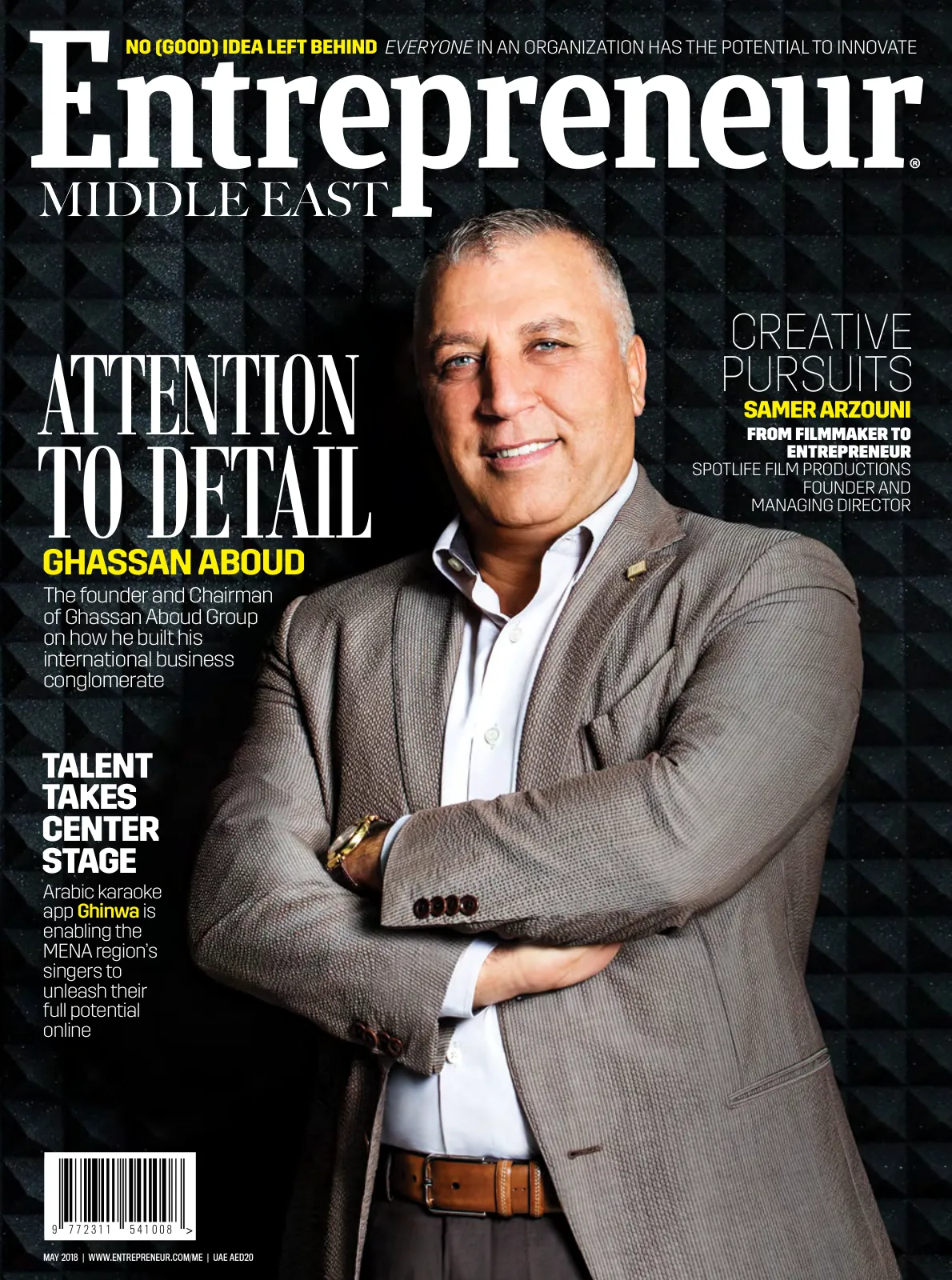
Entrepreneur Middle East, May 2018
Page 1
MAY 2018 | WWW.ENTREPRENEUR.COM/ME | UAE AED20
9
7 7 2 3 1 1
5 4 1 0 0 8
>
TALENT
TAKES
CENTER
STAGE
CREATIVE
PURSUITS
Arabic karaoke
app Ghinwa is
enabling the
MENA region’s
singers to
unleash their
full potential
online
ATTENTION
TO DETAIL
SAMER ARZOUNI
FROM FILMMAKER TO
ENTREPRENEUR
SPOTLIFE FILM PRODUCTIONS
FOUNDER AND
MANAGING DIRECTOR
GHASSAN ABOUD
The founder and Chairman
of Ghassan Aboud Group
on how he built his
international business
conglomerate
NO (GOOD) IDEA LEFT BEHIND EVERYONE IN AN ORGANIZATION HAS THE POTENTIAL TO INNOVATE
Page 2
In Collaboration with
Page 3
3
May 2018 / ENTREPRENEUR.COM /
52 Brooke Boyschau and Sophie Cooke, co-founders, Atteline
34
Ahmad Ashkar,
founder and
CEO, Hult Prize
Foundation
MAY 2018 CONTENTS
24
INNOVATOR:
ATTENTION TO DETAIL
Ghassan Aboud
The founder and Chairman
of Ghassan Aboud Group
on how he built his
international business
conglomerate.
30
INNOVATOR:
KEEPING IT REAL
H.E. Maryam Al Mheiri
The CEO of Media Zone
Authority- Abu Dhabi and
twofour54 believes persis-
tence is important in becom-
ing a leader in your field.
34
INNOVATOR:
IMPACTING THE FUTURE
Ahmad Ashkar
The Founder and CEO of
Hult Prize Foundation on
building a global startup
movement centered on
enabling social good.
38
‘TREPONOMICS:
PRO
Get the best to come to you
Bayt.com’s VP of Employer
Solutions Suhail Al Masri
offers ways to overcome
the fight for top talent with
employer branding.
46
INNOVATOR:
CREATIVE PURSUITS
From filmmaker to
entrepreneur
Spotlife Film Productions
founder and Managing
Director Samer Arzouni.
52
CULTURE:
DESIGN
Room to breathe
Brooke Boyschau and
Sophie Cooke, co-founders
of Atteline, explain what
characterizes the perfect
work environment that does
not feel like, well, work.
Page 4
Page 5
Page 6
Page 7
Page 8
Page 9
Page 10
Page 11
Page 12
Page 13
Page 14
14 / ENTREPRENEUR.COM / May 2018
42
TECH:
SHINY
#TamTalksTech
Gadgets and doodads
that you might’ve missed
out on, sourced by a tech
aficionado. Yes, it’s okay to
want them all… and no, it’s
not our fault.
20
EDITOR’S NOTE
By Aby Sam Thomas
66 Hasan Haider, Partner, 500 Startups at Unbound Bahrain
MAY 2018
CONTENTS
46
66
START IT UP:
ECOSYSTEM
Fostering growth
On the sidelines of Unbound
Bahrain, key players in
Bahrain’s entrepreneurial
ecosystem have their say on
what it’ll take to invigorate
the startup space in the
country.
58
‘TREPONOMICS:
PRO
No (good) idea left behind
Emirates Global
Aluminium’s Executive
Vice President Salman
Dawood Abdulla
believes everyone in an
organization has the
potential to innovate.
Samer Arzouni, founder
and Managing Director,
Spotlife Film Productions
60
START IT UP:
ECOSYSTEM
New kids on the block
Silicon Valley-
headquartered Plug and
Play partners with Abu
Dhabi Global Market to
make a dent in the region’s
entrepreneurial ecosystem.
70
START IT UP:
Q&A
Talent takes center stage
Arabic karaoke app Ghinwa
is enabling the MENA
region’s singers to
unleash their full
potential online.
42
HP ZBook Mobile
Workstation
Page 15
Page 16
16 / ENTREPRENEUR.COM / May 2018
54 Due for disruption: the changing face of the real estate industry
60
MAY 2018
CONTENTS
50
CULTURE:
LIFE
On top of the world
BizWorld UAE CEO Helen
Al Uzaizi says confidence
is a trait entrepreneurs
need- and it should be
instilled from a very
young age.
56
TECH:
THE FIX
Change is coming
Artificial intelligence is all
set to disrupt the UAE’s
healthcare system, writes
Dr. Thumbay Moideen,
founder and President of
Thumbay Group.
44
CULTURE:
TRAPPINGS
‘Trep gear
The executive selection for
the entrepreneur on your
list that has everything.
Okay, maybe for a little
self-reward as well.
78
START IT UP:
Q&A
Crisis control
UAE-based startup Geeks
offers tech support at your
doorstep (literally).
54
START IT UP:
ECOSYSTEM
Due for disruption
Radicle co-founders Aman
Merchant and Indy Johar
on the changing face of
the region’s real estate
industry.
76
START IT UP:
Q&A
Beauty on demand
Haifa Addas, founder
of on-demand beauty
services startup Instaglam,
is dreaming big with
respect to the reach of her
enterprise.
Plug and Play with
the Abu Dhabi
Global Market team
45 Tissot
Chemin des Tourelles
Page 17
#BeatTheHeat
THIS SUMMER.
CAMBODIA CHINA INDONESIA MALDIVES MOZAMBIQUE PORTUGAL OMAN QATAR
SRI LANKA THAILAND UNITED ARAB EMIRATES VIETNAM ZAMBIA
LIFE IS A JOURNEY. Visit anantara.com
Al Jabal Al Akhdar 24°C
Muscat / Dubai 38°C
Cool off at the highest five star resort in the Middle East.
Only a short 4 ½ hours drive from Dubai or Abu Dhabi, enjoy a journey past
date plantations and dramatic Omani mountain ranges to reach our majestic hideaway.
Choose your ideal haven – a spacious room with a captivating canyon view,
a private pool villa with garden or cliff views. An abundance of
Spa and Recreation activities from hiking to sunrise yoga.
GCC RESIDENTS PACKAGE*
Up to 15% off Best Flexible Rate for a room or villa
Daily buffet breakfast for two persons
Daily dinner for two persons
10% off Anantara Spa
10% off food & beverage in all outlets
Book at anantara.com and get resort credit of up to OMR 20.
*terms and conditions apply.
Page 18
18 / ENTREPRENEUR.COM / May 2018
SUBSCRIBE
Contact subscriptions@bncpublishing.net to receive
Entrepreneur Middle East every issue
EDITOR IN CHIEF Aby Sam Thomas editor@bncpublishing.net
CEO Wissam Younane wissam@bncpublishing.net
DIRECTOR Rabih Najm rabih@bncpublishing.net
CREATIVE LEAD Odette Kahwagi
MANAGING EDITOR Tamara Pupic
STARTUPS SECTION EDITOR Pamella de Leon
FEATURES EDITOR Sindhu Hariharan
COLUMNIST Tamara Clarke
EVENTS LIAISON Mark Anthony Monzon
PO Box 502511 Dubai, United Arab Emirates
P +971 4 4200 506 | F +971 4 4200 196
For all commercial enquiries related to Entrepreneur Middle East
contact sales@bncpublishing.net
All rights reserved 2018.
Opinions expressed are solely those of the contributors.
Entrepreneur Middle East and all subsidiary publications in the
MENA region are officially licensed exclusively to BNC Publishing
in the MENA region by Entrepreneur Media Inc.
No part of this magazine may be reproduced or transmitted in any
form or by any means without written permission of the publisher.
Printed by United Printing and Publishing
www.upp.ae
Images used in Entrepreneur Middle East are credited when necessary. Attributed use of
copyrighted images with permission. All images not credited otherwise Shutterstock.
Suhail Al Masri
Helen Al Uzaizi
Brooke Boyschau
Sophie Cooke
Fida Chaaban
Salman Dawood Abdulla
Indy Johar
Aman Merchant
Dr. Thumbay Moideen
CONTRIBUTING WRITERS
www.entrepreneur.com/me
ACCESS FRESH CONTENT DAILY ON OUR WEBSITE!
MIDDLE EAST
EntMagazineME
@EntMagazineME
Entrepreneur-me
EntrepreneurMiddleEast
EntMagazineME
EntMagazineME
EntMagazineME
MIDDLE EAST
In addition to our print edition, we’re bringing
you all sorts of industry news on our web
mediums. Joining us online means getting
relevant business and startup content in
real-time, so you’re hearing about the latest
developments as soon as we do. We’re looking
forward to interacting with our readers on all of
our social media and web platforms- like any
thriving business, we’re looking to give and take.
#TrepTalkME is already happening on all of our
digi platforms, and all good conversations go
both ways. See you on the web!
Page 19
Page 20
20 / ENTREPRENEUR.COM / May 2018
I
s it just me, or are all of you
also seeing a spike in the
number of initiatives that are
being announced to support
the MENA entrepreneurial
ecosystem? New conferences,
new innovation spaces, new
mentorship programs- there seems
to be a lot happening in the region
right now that’s apparently geared
toward advancing startups and the
people behind them.
Now, I remain steadfast in my be-
lief that the flurry of activity in this
sphere is essentially a good thing, as
they do promote entrepreneurship
in the region in some capacity, and
you never know, someone out there
might find some real benefit from
them. Having said that, I also con-
fess to having my misgivings about
some of these initiatives, because I
wonder: how are they actually sup-
porting the region’s entrepreneurs?
For all of the importance that we
in the entrepreneurial space give
networking, knowledge-sharing,
mentorship, and other such activi-
ties, it needs to be said that, at the
end of the day, startups need busi-
ness and revenue if they are to have
the success trajectories that we see
for them. So, how many of all the
startup support initiatives out there
are actually doing this?
I’ll let all of you ponder over this
question for yourselves, but here are
my two cents on this, based on my
experience working at a startup me-
dia entity in the MENA region. We,
at Entrepreneur Middle East, have
always maintained that our role is
to inform and to inspire this ecosys-
tem, and we do this by sharing intel,
putting the spotlight on deserving
entrepreneurs, and making sure
the best of the region’s startups get
the recognition they deserve on our
global platform. And we work very
hard to do this- we’re a rather small
team, and so, we definitely pile on
the pressure on ourselves to make
sure that we are doing a good job
as participants in this ecosystem.
When we say we’ll support an ef-
fort, an entity, or an entrepreneur,
we go all out in ensuring that we
promote, publicize, and participate-
that’s what we are here to do, and
that’s what we are good at doing.
However, we are a business as
well- and it’s disconcerting to see
people and entities alike sometimes
take advantage of our good faith,
and expect us to do everything
we do for free. For instance: we
often get requests for coverage of
the aforementioned “we-support-
startups” initiatives in the publica-
tion, and to that, our response
almost always is that we need to
assess the story from an editorial
standpoint, and we’ll get back to
you. And when such queries come
from large, established entities, I
connect them with our business de-
velopment team, so that they could
potentially collaborate in terms of
a marketing or advertising perspec-
tive. What I have found curious
though is that when my team do go
to them to make actual business
partnerships or deals, they are often
turned down, with the excuse being
that they don’t have a budget for
marketing.
And this is where I cry foul. If
you’ve got the resources to put on
a glitzy PR blitz, I’m pretty certain
you can manage our partnership
prices as well. And so, when you
offer to support entrepreneurs in
the form of forums/spaces/mentor-
ship –without putting any real value
into the equation- then, I’m sorry,
but I doubt the authenticity of your
efforts in supporting startups. You
want us to invest a good amount
of time, resources, and effort in
showcasing your apparent support
for the ecosystem- but at the same
time, you can’t offer us any real
business? Sorry, but no. That’s not
how it works.
Aby Sam Thomas
Editor in Chief
@thisisaby
aby@bncpublishing.net
We’re running a business, too
Reality Check
EDITOR’S NOTE
Page 21
Page 22
22 / ENTREPRENEUR.COM / May 2018
D
ubai-based startup
Wrappup has been
acquired by the
California-headquar-
tered Voicera for
an undisclosed sum, with the
former’s team joining the latter
to work on platform growth, as
well as cutting edge AI research
and development.
As a mobile app that made use
of AI to auto-summarize meet-
ings, Wrappup fits in neatly
with Voicera’s own offering,
which leverages a combination
of voice recognition, natu-
ral language processing, and
machine learning to provide at-
tendees of a meeting with a full
recording and transcription, as
well as high accuracy meeting
highlights.
“As of today, we have
rebranded the Wrappup app
under the Voicera name,” said
Rami Salman, co-founder and
CEO, Wrappup, who will now
take on the role of VP of Growth
at Voicera. “This acquisition
significantly accelerates our
journey toward delivering
amazingly productive meeting
experiences for our users.”
“Over the last few weeks,
we have been hard at work
integrating Voicera’s Enterprise
Virtual Assistant named Eva
into the mobile app experience,
allowing Wrappup customers
to use Eva in online meetings
and conference calls,” Salman
explained. “In addition, Eva
brings a whole new level of
analytics to your conversations,
using a Voicera-powered error
correction engine that delivers
more accurate summaries of
meetings. By combining Wrap-
pup’s current prediction en-
gines with Voicera’s AI, we are
providing even better predictive
highlights for your meetings,
allowing you to speak naturally
and let the AI take the notes.”
“When we first started Wrap-
pup, our vision was to put back
the focus on conversations
itself, and let AI do the hard
work,” added Ayush Chordia,
co-founder and CTO, Wrappup,
who will now be Director of En-
gineering and Applied Research
at Voicera. “Meetings today
are very ineffective, and most
times, outcomes and action
items are not tracked, leading to
inefficiencies. As we embarked
on this journey, we realized we
have a greater problem to solve,
and the acquisition by Voicera
will help us realize our full
potential and achieve the goals
that we set out to do when we
first started the company. The
value of surfacing important
moments from conversations
are not just restricted to meet-
ings; we think it is a launchpad
for lot of future possibilities.”
Along with Salman and
Chordia, Wrappup’s third co-
founder Rishav Jalan will also
join Voicera as Engineering
Manager.
Commenting on the acqui-
sition, Voicera founder and
CEO Omar Tawakol noted
the similarities between his
and Salman’s enterprise as
being a key reason behind the
acquisition. “Both companies
approached the problems with
meetings in synergistic ways,”
Tawakol said. “Wrappup’s
mobile-first, in-person meet-
ing product complements and
extends Voicera’s initial focus
on conference calls.”
As for how Wrappup made the
cut, Tawakol listed three main
factors that drove Voicera’s de-
cision to acquire the company.
“First was the team. Wrappup
has a very young, smart hard-
working team that works like
a Silicon Valley startup. They
shared our customer-focused
ethic, and our drive for fast
iteration to capture more cus-
tomer feedback. Second, their
understanding of the domain.
What we are doing is very new.
Building an interface that cus-
tomers love is difficult. We saw
their interface become simpler
over time- which is a great
sign. Finally, we were highly
complementary. We didn’t
have an app, and we needed an
in-person meeting solution, and
that is exactly what they had.”
Wrappup, which was founded
at the Angelhack Hackathon in
Dubai in 2015, had been incu-
bated at in5 in Dubai Internet
City, and had also raised a seed
round of US$800,000 from
investors like BECO Capital,
500 Startups, Arzan VC, Dubai
Silicon Oasis, Womena, Dubai
Angel Investors, Odin Financial
Advisors, and Hala Fadel.
On the other hand, Voicera,
which calls itself “a pioneer
in the artificial intelligence
and productivity space,” has
received $20 million in venture
funds from investors like Bat-
tery Ventures, Cisco Invest-
ments, e.ventures, GGV Capital,
Greycroft, GV (formerly Google
Ventures), Microsoft Ventures,
Salesforce Ventures and Work-
day Ventures.
Commenting on his entrepre-
neurial journey with Wrappup,
Salman said, “It’s been a wild
ride for sure, from a simple idea
at a hackathon, to a working
prototype in 24 hours, to the
current state of the platform
driven by predictive AI and
voice commands- it’s been
an incredible experience. We
don’t view the acquisition as an
arrival per say, but merely an-
other milestone on our journey
to revolutionize the way people
meet.”
“In our hackathon pitch, I
remember saying, ‘Speech is
one of the most underutilized
sources of information in the
business world today,’ and this
fact still remains, but techno-
logical advances are now at the
cusp of being unlocking this
true potential,” Salman added.
“With the resources and expe-
rienced team at Voicera, we feel
that the main objective we set
out is still underway.”
Salman also points to Wrap-
pup’s acquisition by Voicera
as an especially significant
moment for the MENA entre-
preneurial ecosystem. “We’ve
managed to export innovation
out of a region that is used to
importing innovation,” he said.
“This is not a copy-paste appli-
cation, but a new way of doing
things, from the ground up. I
believe we are all very proud to
be a part of that story, and the
region has truly supported us in
getting there.”
IMAGE CREDIT WRAPPUP
IN THE LOOP
Dubai-based startup Wrappup gets acquired by California-based Voicera
Exporting innovation
by ABY SAM THOMAS
Wrappup co-founders Ayush Chordia, Rami Salman, and Rishav Jalan
Page 23
REDEFINING
YOUR FREEZONE
EXPERIENCE
• Easy access via key highways with no access gates
• Easy & efficient business set up
• Smart office solutions from shared facilities to permanent offices
• Variety of business licenses
• Turnkey business solutions and services
• On site licensing & visa authority
800-SOUTH (76884)
businesscenter@dubaisouth.ae
DUBAISOUTH.AE
Page 24
24 / ENTREPRENEUR.COM / May 2018
by ABY SAM THOMAS
IMAGE COURTESY GHASSAN ABOUD
INNOVATOR
ATTENTION
TO DETAIL
GHASSAN ABOUD
The founder and Chairman of Ghassan
Aboud Group on how he built his
international business conglomerate
A
h, this is a long story!” laughs Ghassan Aboud, when I cheekily ask
him to tell me a succinct version of his 25-year-long entrepreneurial
journey so far, which, at the moment, sees him at the helm of Ghassan
Aboud Group (GAG), a Dubai-headquartered international business
conglomerate of which he is founder and Chairman. The pre-eminent
entrepreneur today leads a diversified multi-billion enterprise that has
operations in everything from real estate to media to hospitality, but Aboud’s
flagship business was in the automotive domain, which he entered in Dubai, back
in the early nineties. “In 1993, I was new to the UAE, and exploring opportunities
to set up my own business,” Aboud recalls. “The country was emerging as a
strong trading hub with its location, infrastructure, and visionary leadership.
Therefore, with a positive feeling, I started a small trading business that engaged
in the sourcing and export of vehicles. Over the years, the business gained
momentum with increased sales and margins, helped by the fact that UAE was
attracted by visiting traders from Africa and other underserviced regions. As the
volumes increased, our business invested into larger infrastructure, including
warehouses, storage yards, showrooms, offices, logistics, transportation, etc.>>>
Page 25
25
May 2018 / ENTREPRENEUR.COM /
INNOVATOR
25
May 2018 / ENTREPRENEUR.COM /
Page 26
26 / ENTREPRENEUR.COM / May 2018
The extensive infrastructure
that we developed in Dubai,
Abu Dhabi, Sharjah, and
later in Belgium and Jordan
helped us establish into one
of the world’s leading players
in the automotive supply
chain. Today, we have a mar-
ket reach of more than 100
countries worldwide, with
excellent customer loyalty for
a wide range of automotive
products. Encouraged by the
success, in due course we
also promoted several other
business verticals, including
media, art production, real
estate, catering, retail, pas-
toral, and hospitality. There-
fore, we are a well-diversified
group aiming for sustainable
growth over the years.”
A look at GAG’s current
business undertakings is
enough to understand that
Aboud has certainly got a
long-term strategy in mind
for his enterprise. In addition
to the global hub in the UAE,
the Group has offices in Jor-
dan, Belgium, Australia and
Turkey. “The Group seeks to
have a balanced portfolio of
businesses that are diversi-
fied by product or service, as
well as by geography,” Aboud
explains. One of the first new
sectors Aboud steered his
company into following the
success of his automotive
supply chain business was
in the realm of media, with
the 2008 incorporation
of Live Point and Orient,
companies that engage in TV
production, satellite channel,
media training, and a range
of audiovisual production
needs. But that’s not all-
today, GAG is making inroads
into the hospitality domain,
with its current sights set on
developments in Australia.
“As a major expansion and
diversification strategy,
the Group is investing into
five-star hospitality assets in
Australia,” Aboud explains.
“With committed projects
exceeding AU$800 million,
we have also established
our in-house management
company, Crystalbrook Col-
lection. Crystalbrook will
manage these assets, and
grow the portfolio across the
region, and internationally
in due course.” In addition to
the hotel portfolio, the group
has invested into a substan-
tial pastoral business with
land area of 35,000 hectares
with a carrying capacity of
2,500 breeders. The vision is
to achieve the highest stan-
dards in land and pasture
management, environmental
sustainability, and animal
welfare. The UAE’s real estate
arena is another sector GAG
is tapping into- Elements
Properties is its single-source
provider of construction,
development and real estate
services within the country.
“Further, taking advantage of
our internal competencies we
have promoted a specialist
logistics organization called
Gallega Global Logistics that
provides end-to-end services
to discerning customers in
the region,” Aboud adds. He
further highlights that the
Ghassan Aboud Group has
also moved into the retail
domain- to keep an eye on
its Grandiose brand, which
refers to both a chain of ex-
clusive supermarkets, as well
as bespoke catering business,
both located in the UAE.
“Our retail business offers a
premium supermarket expe-
rience to customers, deliver-
ing products of the highest
quality at affordable prices,”
Aboud says. “Furthermore,
our bespoke catering facility
offers an eclectic range of nu-
tritious mealtime solutions
to prime customers. We aim
to grow across the food value
chain in the coming years.”
The sheer variety in the
industries that GAG has
invested in makes it clear
that Aboud has a particular
eye for businesses (and loca-
tions) that are going to keep
his enterprise growing and
scaling up over the foresee-
able future. Consider his
investment into Australia,
for instance- Aboud picked
Queensland as his first des-
tination for his hospitality
developments, pastoral busi-
ness, and super yacht marina
operation with an eye toward
its potential for being a mag-
net for tourists in the years
to come.” It’s an untapped
opportunity, according to
Aboud, and his success in the
business world so far makes
one inclined to take him at
his word. After all, when
Aboud started out with his
automotive business in 1994,
he was, quite simply, a trail-
blazer in his own right- the
enterprise he launched made
use of a business model that
was in its infancy within the
region at that point in time.
“We started this as a new
model [of business],” he de-
clares. “And, when you bring
a new model of business,
normally, you’ll succeed very
well. Because you are not
making a copy [of something
already existing]- copies can
be good, but they’ll never be
leaders in the market.” This
is thus the modus operandi
that Aboud has put into
place across all of the vari-
ous sectors GAG has made
inroads into- he makes sure
that all of his enterprise’s
brands or businesses have
their own particular USPs
that will make the market at
large sit up and take notice
of them. With regard to the
locations he chooses to invest
in, Aboud explains that while
Australia now (obviously)
1. Tap into local
opportunities
“For entrepreneurs in
the region, there are
opportunities in businesses
that can contribute to the
economies through local
value addition. With plans
of diversification away from
oil, the countries are strongly
pushing the industrialization
agenda– this could be a
major opportunity going
forward. Also, the UAE has
been leading the way on new
technology, creating good
business prospects in this
segment.”
2. Keep an eye on the big
picture
“Personally, I believe
proper planning, capable
team, swift execution, and
attention to detail are the
key considerations any fresh
entrepreneur should focus
on.”
3. Remember to give back
“It is also critical that the
organization aligns itself
firmly with its stated
corporate social responsibility
policies. I am a strong
supporter of businesses
sharing prosperity with the
needy communities.”
INNOVATOR
“I ALWAYS EMPHASIZE
ON THE DEVELOPMENT
OF A SPIRIT OF
ENTREPRENEURSHIP
AMONGST THE
BUSINESS LEADERS,
FOR THEM TO THINK
DIFFERENTLY, AND ACT
AS GROWTH DRIVERS.”
“TAKING ADVANTAGE
OF OUR INTERNAL
COMPETENCIES WE HAVE
PROMOTED A SPECIALIST
LOGISTICS ORGANIZATION
THAT PROVIDES END-
TO-END SERVICES TO
DISCERNING CUSTOMERS
IN THE REGION.”
‘TREP TALK
GHASSAN ABOUD’S TIPS
FOR ENTREPRENEURS IN
THE MENA REGION
>>>
Page 27
27
May 2018 / ENTREPRENEUR.COM /
Ghassan Aboud,
founder and
Chairman,
Ghassan Aboud
Group
Page 28
28 / ENTREPRENEUR.COM / May 2018
figures prominently in his
current vision for the enter-
prise, he remains buoyant
about the UAE as a place to
(continue to) do business
in. “The UAE is certainly
unmatched in its strategic
location to foster business,”
he explains. “With proximity
to key emerging markets and
with a time zone advantage
the country had provided an
ideal platform for businesses
such as ours to prosper
over the years. Certain large
emerging markets, like Africa
for example, have been
impacted adversely by the
current economic environ-
ment. However, this may
not continue for long with
the rising population and
demand for products in the
continent. With the region’s
advantages stated earlier, one
would be in a strong position
to increase their business
prospects through Arab-
African trade flows.”
Given the years he has
spent (and continues to
spend) in the business arena,
I ask Aboud to tell me what
fuels his ambition and drive.
In response, he points toward
his personal background:
he comes from a family
boasting of generations of
entrepreneurs, and Aboud is
keen to keep the tradition of
business going, so to speak,
and push it to reach greater
levels of success. But for his
vision to be actually realized,
Aboud says he needs to make
sure that everyone at his
enterprise is tuned into the
goals and aspirations he has
set for it- and that’s where
his leadership comes into
play. “I strongly believe in
instilling the highest values
across the organization–
values based on integrity and
ethics,” Aboud says. “Other
important factors include
setting clear objectives and
active management of per-
formance. Today, the group is
entirely professionally man-
aged by a competent execu-
tive management team in a
multi-cultural environment.
I always emphasize on the
development of a spirit of en-
trepreneurship amongst the
business leaders, for them
to think differently, and act
as growth drivers.” This last
aspect, Aboud stresses, is
critical for businesses to run
and sustain themselves in
the long run- one’s employ-
ees need to feel empowered
enough to innovate and do
new things. “Long-running
business models are being
disrupted with innovation
and technology,” he notes.
“It will be a costly mistake to
make if one ignores the im-
portance of innovation. As I
stated earlier, the key to
growth and innovation will
be to let senior management
think like entrepreneurs.”
At this point, I ask Aboud
what’s his secret to suc-
cess- how has he gone about
ensuring his enterprise’s
growth until now and in the
future as well? He replies
by rubbishing my notion
of there being a particular
secret to success: “Every-
body knows everything,” he
declares. “But between me
and another, [the difference
is that] I care about the
details more. And when you
care about the details more,
you’ll succeed more. This is
the difference- nothing else,
there’s no secret! When you
care more about the details
than the other, then you’ll be
the leader.” It may seem like
a simple premise, sure, but
it’s one that has stood Aboud
in good stead all these years-
and that, by itself, makes
it a principle the rest of us
should take to heart as well.
“[THE DIFFERENCE IS
THAT] I CARE ABOUT
THE DETAILS MORE. AND
WHEN YOU CARE ABOUT
THE DETAILS MORE,
YOU’LL SUCCEED MORE.
THIS IS THE DIFFERENCE-
NOTHING ELSE.”
INNOVATOR
Ghassan Aboud,
founder and Chairman,
Ghassan Aboud Group
Page 29
IT’S
TIME
TO
START
YOUR
OWN
BUSINESS
Since 2009, we are the first, the largest and the fastest-growing Company
Formation Specialist in the UAE. With 4 offices in prime locations across the UAE
as well as over 100 dedicated staff members from over 27 nationalities, you can
trust in us for a smooth and hassle-free business setup.
For more information visit: www.vz.ae
FREE ZONE
MAINLAND
OFFSHORE
E S TA B L I S H I N G S I N C E 2 0 0 9
VZAE
8923
Because trust is priceless.
Page 30
30 / ENTREPRENEUR.COM / May 2018
W
hen I first
met H.E.
Maryam
Al Mheiri,
CEO of both
Media Zone Authority – Abu
Dhabi (MZA) and twofour54,
at an event in Abu Dhabi,
it was refreshing to see her
avoid the clichéd and oft-
repeated trope of talking
about what a privilege her
job has been, and instead be
warm and disarmingly hon-
est in telling the audience
about how she navigated her
own fears and insecurities
in the boardroom. Such
instances happened at the
very beginning of her rising
high up in her career, she
said, when she had to not
only regularly take part in
male-dominated meetings,
but also to chair them. Her
solution to these jitters
was to make sure everyone
knew why she was there in
the first place- she used to
start these gatherings by
making finance or technol-
ogy-related remarks which
was supposed to, as per her
belief at the time, showcase
confidence in her expertise,
and thus establishing her
credibility. As this story
shows, Al Mheiri has the gift
of betraying the heightened
tension of someone in a high
position, and making you
want to trust and follow her-
simply by being authentic.
And her on-stage persona is
indiscernible from the one
I meet after the panel, or
even when working on this
interview- here is someone
who stays true to who she is
at all times.
Al Mheiri oversees Abu
Dhabi’s Media Zone Author-
ity and its commercial arm,
twofour54, which were set
up in 2008 to develop Abu
Dhabi’s nascent media and
entertainment industry.
In the intervening decade,
much has changed. “Our
vision at twofour54 is to be-
come the capital for content
creators and my role is to
lead our dedicated team on
this journey, and of course,
there have been challenges
along the way,” Al Mheiri
says. “The two biggest were
developing the talent pool
and infrastructure. We rec-
ognized from the start that
these were vital to creating
a sustainable and thriving
media industry. When two-
four54 was first established
in 2008, we didn’t have the
infrastructure in place that
we do today that allows
media firms to so easily do
business, such as world-
class studios, a backlot, and
support services. We’ve had
to develop this infrastruc-
Keeping it real
H.E. Maryam Al Mheiri, CEO, Media Zone Authority – Abu Dhabi and
twofour54, believes persistence is important in becoming a leader
in your field by TAMARA PUPIC
INNOVATOR
IMAGE COURTESY H.E. MARYAM AL MHEIRI
H.E. Maryam Al Mheiri,
CEO, Media Zone
Authority - Abu Dhabi
(MZA) and twofour54
“CUSTOMER CEN-
TRICITY IS THE CORE
OF ANY BUSINESS,
AND THAT’S NOT
DIFFERENT IN THE
MEDIA INDUSTRY.
WE ARE SUCCESSFUL
IF OUR PARTNERS
ARE SUCCESSFUL,
WHICH IS WHY WE
LOOK TO DO THINGS
DIFFERENTLY.”
Page 31
31
May 2018 / ENTREPRENEUR.COM /
ture, both hard and soft,
piece by piece, with the
support of our partners and
the Abu Dhabi Government.
Today, we have world-class
facilities that not only at-
tract top media firms to
join us, but also enable the
businesses of our existing
partners to thrive. Similarly,
the UAE is a young country
with a young population, so
we have had to work hard to
develop a skillset that allows
the sector to grow through
initiatives such as creative
lab, summer camp and our
internship program. Devel-
oping local talent remains
one of our top priorities
today.”
Abu Dhabi’s current repu-
tation as a media hub rests
on factors such as offering
diverse locations, appropri-
ate facilities, talent pools,
and the much talked about
30% rebate by the Abu Dha-
bi Film Commission. It is the
Middle East’s first interna-
tional production incentive,
providing access to a 30%
cash back rebate on produc-
tions, which also includes
travel and accommodation.
The impact of the rebate
is shown by some of the
highest grossing Hollywood
films of all time –Star Wars:
The Force Awakens and Fast
and Furious 7– being filmed
in Abu Dhabi, as well as a
number of Bollywood films
and regional productions. Al
Mheiri’s success formula for
achieving this is simple, she
says: “Customer centricity
is the core of any business,
and that’s not different in
the media industry. We are
successful if our partners are
successful, which is why we
look to do things differently.
For example, ‘The Briefing
Room’ is one of the many
services that we provide for
matching and connecting
our partners with projects
from around the region.
It’s another way in which
we are able to encourage
community collaboration
on a daily basis. I’ve always
believed persistence is im-
portant in becoming a leader
in your field– the process
doesn’t happen overnight,
but persistence will always
pay off. Equally, you need to
empower those around you
to take responsibility. I like
to tell my employees to think
about the big picture, but
always remember that the
devil is in the detail. Success
is not about the individual,
it’s about the team.”
Apart from attracting the
finest talent from overseas,
Al Mheiri’s team is also
focused on developing local
potential. The 30% rebate
helps with that as well,
because one of its require-
ments is to have UAE nation-
als on set for the production.
Changing the youth’s percep-
tion of media as a viable
career is further supported
by various educational
initiatives and the types
of setup that twofour54
media zone allows, including
twofour54’s entrepreneur-
ship scheme and business
center facility license,
which is offered to content
creation entrepreneurial
startups. For Al Mheiri,
however, entrepreneurship
isn’t just a recent trend. “It
is something that has been
at the heart of our business
since the very beginning,”
she says. “One of the keys
to building a sustainable
media industry is ensuring
the value chain is strong
across all points. The media
industry is one of the world’s
fastest-changing sectors,
finding new ways for people
to consume content, giving
them the power not only to
decide what they want to
consume, but how they want
to consume it. This is why
startups are playing such an
important role. They are the
disruptors that are attuned
to the changing demands of
a relatively young audience,
and they have the flexibility
to adapt and innovate to
meet these needs. And we
have seen some incredible
success stories, such as gam-
ing firm Unnyhog, artificial
intelligence data translator
Narrativa, and online retailer
Mumzworld.”
WWW.MZAABUDHABI.AE
CSYS Light
“WE HAVE HAD TO
WORK HARD TO
DEVELOP A SKILL-
SET THAT ALLOWS
THE SECTOR TO
GROW THROUGH
INITIATIVES SUCH
AS CREATIVE LAB,
SUMMER CAMP AND
OUR INTERNSHIP
PROGRAM.”
H.E. Maryam Al Mheiri, CEO of Media Zone Authority – Abu Dhabi (MZA) and twofour54,
taking part in the Female Leaders Forum by Krypto Labs, Masdar City, Abu Dhabi
>>>
Page 32
32 / ENTREPRENEUR.COM / May 2018
In achieving their goals,
corporate leaders don’t need
to bother about looking
authoritative, observes H.E.
Al Mheiri, advising them to
pursue values of wisdom,
respect, sustainability, and
human development heralded
by the UAE’s Father of the
Nation, H.H. Sheikh Zayed
bin Sultan Al Nahyan. “A
leader should inspire and
empower those around them
with their wisdom and vi-
sion, yet always be humble
and approachable,” she says.
“They should ensure their
team is built on tolerance and
respect, not only for those
with whom they work but
everyone around them, re-
gardless of their background
or gender. And, of course,
they should always be looking
to the future, ensuring that
their organization plays a
positive role in society and
helps to protect and preserve
the world around them for
generations to come.
Being inspired by the late
Sheikh Zayed seems to be Al
Mheiri’s solution to all kinds
of complications a leader
may encounter and informs a
lot of her conversation. “My
career has been driven by
my passion to deliver for my
community and my country,”
she says. “Hard work, self-
improvement, and contribut-
ing to society are my guiding
principles, and ones that
I practice every day in my
personal and professional
life. Whenever I have a choice
to make, I ask myself one
simple question, ‘What’s best
for Abu Dhabi and the UAE?’
It’s simple: lead by example.
I would never ask someone
in my team to do something I
wasn’t prepared to do myself.
I want those around me to
be part of our journey, not
bystanders watching as we
go by. I want them to under-
stand what we are working
towards, why and how they
can contribute. This is a
journey that we need to go on
together, hand in hand.”
And when it comes to
women being leaders in
their respective industries,
Al Mheiri’s approach is as
practical and pragmatic as in
all other areas of her career.
She notes that women have
always been supported in
whatever they set out to do
in the UAE. “I don’t see hav-
ing a successful career as a
matter of gender, it is a ques-
tion of attitude and how you
approach your work,” she
says. “The UAE is a country
that has always valued wom-
en as a key part of society,
and nurtured and encour-
aged their development, both
personally and profession-
ally. But it is also a country
that has always valued its
human capital as a whole, so,
my advice applies to every-
one: male and female, young
and old. Firstly, I believe to
be successful, you need to
listen and learn from those
around you. Success is based
on collaboration, not isola-
tion. Also, think carefully
about your reputation. After
everything is said and done,
this is the one thing you
will be left with. It is vital
that people understand the
type of person you are, and
know you will deliver. And
never forget that we live in a
country that believes in you,
so it is up to us to seize the
opportunities around us, and
grow with our nation.”
INNOVATOR
Dyson
Supersonic
“OUR VISION AT
TWOFOUR54 IS TO
BECOME THE CAPITAL
FOR CONTENT
CREATORS AND MY
ROLE IS TO LEAD OUR
DEDICATED TEAM
ON THIS JOURNEY,
AND OF COURSE,
THERE HAVE BEEN
CHALLENGES ALONG
THE WAY.”
H.E. Maryam Al Mheiri
is a member of the
Abu Dhabi Executive
Council’s Economic
Development Committee,
a board member of Abu
Dhabi Media Company,
and a member of the
Abu Dhabi Investment
Committee.
IMAGE COURTESY H.E. MARYAM AL MHEIRI | WWW.TWOFOUR54.COM
Page 33
Page 34
34 / ENTREPRENEUR.COM / May 2018
O
ne of the
refreshing
aspects
of my
interview
with the
Hult Prize
Foundation founder and
CEO Ahmad Ashkar is that
he comes across as someone
who doesn’t believe in
mincing words. Be it the
conviction with which he
talks about his enterprise
and what it has achieved so
far, or his refusal to accept
the status quo just because
of a that’s-the-way-it-has-
always-been-done sort of
mentality, this American
entrepreneur seems to be
charged up with a vision
of a better future for the
world at large. The Hult
Prize Foundation started out
in 2009 with its flagship
contest that brings together
students from across the
globe to solve the world’s
most pressing issues through
pitching ideas and launch-
ing companies for a grand
prize of US$1 million. It has
since grown into becoming
“a global millennial startup
movement for social good,”
with Ashkar and his team
essentially developing entre-
preneurial pipelines around
the world “that transform
business minds into change
agents for sustainable im-
pact.” With this being the
case, one should be able to
see why former US President
Bill Clinton would point to
the Hult Prize as an example
of how the world is being
changed for the better in a
TIME magazine cover story
in 2012, and Ashkar, for his
part, is happy to explain his
2009-founded enterprise’s
impact further to me. “The
Hult Prize has grown from a
simple student competition
where young people dream
up a new kind of business,
to a full-blown movement
which is leading an entire
generation to change the
world,” he declares. “Our
foundation has deployed
over $50 million to create
the sector of for-good, for-
profit startups emerging
out of university. We run
workshops, trainings, invest,
scale; all for the purpose
of changing the trajec-
tory of students on college
campuses around the world.
Our aim is to provide a risk-
free opportunity, and then
back it up with the support
required to have change. We
started out as a handful of
kids organizing events in a
few cities around the world,
now we are a team of over
2,500 staff and volunteers,
we run over 1,000 demo day
events a year, tens of thou-
sands of training seminars
and workshops, run the
world’s largest incubator
in terms of size of cohort,
investment dollars, real es-
tate (it’s in a castle of 5,000
acres), and many other
criteria. We have a student
workforce of over 10,000 or-
ganizers, and we anticipate
having nearly 150,000 stu-
dents from over 100 coun-
tries participating this year
(100,000 already applied in
the first round). University
staff and administrations are
changing curriculum based
on the Hult Prize model. We
are distinguished in that we
IMAGE CREDIT JASON DECROW/AP IMAGES FOR HULT PRIZE FOUNDATION
THE FUTURE
IMPACTING
Ahmad Ashkar, founder and CEO, Hult Prize
Foundation on building a global startup
movement centered on enabling social good
by ABY SAM THOMAS
“OUR FOUNDATION HAS
DEPLOYED OVER $50
MILLION TO CREATE THE
SECTOR OF FOR-GOOD,
FOR-PROFIT STARTUPS
EMERGING OUT OF
UNIVERSITY. WE RUN
WORKSHOPS, TRAININGS,
INVEST, SCALE; ALL FOR
THE PURPOSE OF CHANGING
THE TRAJECTORY OF
STUDENTS ON COLLEGE
CAMPUSES AROUND THE
WORLD.”
Ahmad Ashkar, founder
and CEO, Hult Prize
Foundation, at the Hult
Prize Finals and Awards
Dinner 2016, Clinton
Global Initiative Annual
Meeting
INNOVATOR
Page 35
35
May 2018 / ENTREPRENEUR.COM /
are a pipeline creator, the
most fundamental piece of
the startup funnel. We turn
ordinary students into im-
pact entrepreneurs, because
we start with people, not
ideas. No other platform or
organization in the world
creates, from scratch, the
intent of a startup to be im-
pact centered, profit minded,
and market driven.”
As Ashkar rightly notes,
the Hult Prize has trans-
formed from what it was
in its initial days- but it’s a
change that has been for the
better. “The Hult Prize has
moved beyond the one mil-
lion dollars,” he notes. “It’s
not even technically a prize,
it’s a seed stage and stage
gated investment we make
into the winning company.
Annually, nearly $10 million
is invested into our startups
every year… The objective of
our foundation is to shortcut
the entrepreneurial journey
for young people, and get
them to realize that you can
build a billion-dollar busi-
ness by creatively thinking
about some of our world’s
toughest challenges. We pick
an exciting area of impact
that can be addressed by for-
profit, for-good businesses,
and then we write a detailed
opportunity map, outlining
where billion dollar compa-
nies could be generated. By
focusing all of our network
on one topic, it changes the
paradigm of a generation,
and exposes market inef-
ficiencies in the current
development space, which
can be solved through busi-
ness approaches. This year’s
challenge is on rethinking
how to harness the power of
energy to transform 10 mil-
lion lives. We used to focus
on the bottom of the pyra-
mid, but I have shifted our
focus on empowering more
people to reach the middle
class. Tackling poverty is not
enough; we must move the
lower third into economic
independence.”
At a time when social en-
terprises still find it hard to
be seen as sustainable busi-
nesses, Ashkar is powering
through with negating this
notion, and the Hult Prize
has been an effective vehicle
for drilling this concept in
people’s minds. “The idea
of a ‘social enterprise’ is
misunderstood in some
markets, and more developed
in others,” he says. “From my
perspective, there’s no line
drawn in the sand between
a standard enterprise and
a ‘social’ or ‘impact’ enter-
prise. The true definition of a
social enterprise is simply an
enterprise which operates to
maximize shareholder value,
and recognizes that in order
to do so, that it must gener-
ate net impact as a byproduct
of its existence. The world is
capitalistic, this will never
change. Money makes the
world go round. What has
changed today is simple- the
levers to generate money and
market cap. 80% of millen-
nials prefer brands that they
can assimilate impact to. $1
out of every $5 spent today
is on impact. If you want
to build a business that is
relevant in the next decade,
you have no other choice
other than to build the kind
of enterprise my team and I
around the world promote.
It’s why we exist. It’s why I
created the Hult Prize, and
continue to lead it.”
WWW.HULTPRIZE.ORG
1. Pick the right problem
worth solving- you get one,
maybe two, shots at this,
make it count.
2. Get your prototype ready
as fast as you can, and get
it to the market.
3. Iterate. Iterate. Iterate.
4. Once you collect enough
market data, build your
complete offering and
business plan.
5. Hire fast. It doesn’t have to
be the perfect fit, just good
enough. Keep hiring until you
find that perfect employee.
6. Celebrate often. Small
wins are as important as
the big ones, make sure you
find time to celebrate your
accomplishments and show
your team gratitude.
7. Find your tribe. Make sure
your family is on board with
your vision, and then find a
team who all believe in your
North Star.
8. Utilize the North Star
metric. Find your way, and
base all decisions off the
North Star for your company.
9. Build the product or
service that is designed for
impact.
‘TREP TALK
AHMAD ASHKAR’S TIPS
FOR ENTREPRENEURS IN
THE MENA REGION
“THE BEST
ENTREPRENEURS COME
FROM THOSE PARTS
OF THE WORLD WHERE
INNOVATION IS A MEANS
TO SURVIVAL.”
>>>
Page 36
36 / ENTREPRENEUR.COM / May 2018
What about the investors
though- have we reached a
stage where their attention
can be commanded by social
entrepreneurs? Once again,
Ashkar surprises me (in a
good way) with his prag-
matic take on the situation.
“Investors invest in anything
that produces a decent mul-
tiple return on their money.
They are greedy, selfish,
and have one goal- that will
not change. Our startups
generate investment because
they are real companies,
with real revenues solving
real problems, which will
return a multiple invest-
ment to shareholders. Often
times, there is a mix up of
what the true meaning of
a social enterprise is, but
for us it is clear- maximize
profits, and as a result, you
will maximize impact and
vice versa; so, of course,
the investors are excited.
The issue in the sector is
actually within its entirety
when focused on investment
in the early-stage category.
This is where the challenge
is, because most investment
companies focus on low-risk
placement of money, which
is really stunting growth
and innovation in the sector,
and allowing for a handful
of people and enterprises to
monopolize the industry.”
But Ashkar believes that
the world’s businesses are
indeed sitting up and taking
notice of the need to support
impact initiatives. “I just
saw an ad by Credit Suisse-
it said, ‘We will show you
how to change the world,’”
he says. “The banks have
caught on; it’s finally good
business to have a soul. The
Western markets and elite
are ahead of the emerging
markets in terms of realizing
the value, while markets
like Mexico (where I have
relocated our corporate
HQ) are ahead in the actual
product and service innova-
tion design, because they are
closer to the need.” In terms
of markets, the Middle East
also figures prominently in
terms of Ashkar’s assess-
ment of regions where social
enterprises stand to make a
real difference- Ashkar him-
self is of Palestinian origins.
“The best entrepreneurs
come from those parts of the
world where innovation is a
means to survival,” Ashkar
notes. “Palestine, where the
population lives under daily
occupation, is one of those
places. The current state of
affairs in MENA is explosive,
quite literally. With the
majority of nations either at
war or in conflict, there has
never been a better time for
programs like the Hult Prize
to operate, because we teach
the youth how to transform
INNOVATOR
IMAGE CREDIT JASON DECROW/AP IMAGES FOR HULT PRIZE FOUNDATION
Ahmad Ashkar,
founder and CEO, Hult
Prize Foundation, at
TEDxGeorgetown
“UNIVERSITY STAFF AND
ADMINISTRATIONS ARE
CHANGING CURRICULUM
BASED ON THE HULT
PRIZE MODEL. WE ARE
DISTINGUISHED IN THAT
WE ARE A PIPELINE
CREATOR, THE MOST
FUNDAMENTAL PIECE OF
THE STARTUP FUNNEL.”
Page 37
37
May 2018 / ENTREPRENEUR.COM /
themselves from job seeking
students to game changing
entrepreneurs. We guide
governments and leading
in-country institutions on
how to best engage its youth
for the mutually beneficial
outcomes each desire. Our
programs give the youth
hope either through one of
our over 1,600 on-campus
programs, or 25 national
level prize awarding pro-
grams, or our global demo
days, which take place
across 15 regions worldwide.
One of the most influential
and inspiring entrepreneurs
I have come across is from
Egypt- Mohammad Ashour,
the founding CEO of Hult
Prize-winning startup Aspire
Food Group, which now
has a market valuation of
well over nine digits, and is
revolutionizing the food and
agriculture sector by intro-
ducing a less expensive and
environmentally friendly
protein alternative.”
The success the likes of
Ashour have seen should be
heartening for other social
innovators in the Middle
East region- but Ashkar is
also emphatic about the fact
that the Arab world needs
to be more forthright in its
support for such enterprises
and the people behind them.
“The region needs more risk-
free capital and programs
like the Hult Prize which
focus on the ‘creation’ stage
of the funnel, as opposed to
the identification and later-
stage,” Ashkar says. “I have
spent a decade in the sector,
and I continue to hear the
same thing out of the Gulf
and other parts of the Arab
world: ‘start a fund,’ ‘open
an accelerator,’ ‘create a
youth program’- all noble
in theory, but worthless if
not parlayed with the most
critical piece- inspira-
tion and utilization. We
need more companies and
investors that focus on the
conversion of youth, and
shifting their mindset from
more traditional ‘do as told’
students who graduate with
engineering and humanities
degrees, to problem-solving
entrepreneurs. We also need
more ministers and govern-
ment leaders who welcome
the advice and council from
on-the-ground Arab entre-
preneurs, instead of solely
relying on Western compa-
nies who utilize their global
brands to provide on-paper
advisory.” But Ashkar is
keen to highlight one nation
in the region, which is, in
his opinion, taking the right
steps needed for transforma-
tion. “One such shining light
in the region is Lebanon.
A country demonstrating
pioneering approaches to
entrepreneurship and youth
through empowerment,
localization and a strong
focus on the ‘for-us, by-us’
model. I am personally so
bought-in to the Lebanese
government’s commitment
that I have relocated our
Middle East headquarters
from Dubai to Beirut. In an
effort to support the govern-
ment and the local Arab
backed entrepreneur eco-
system, we have launched
our pioneering methodology
nationwide. Our pioneering
model of entrepreneurship
and our approach, which
starts at inspiration and
ends with impact, has of-
ficially been made a part of
the higher education system
across Lebanon. Within the
next year, our six-step ap-
proach of Inspire, Educate,
Compete, Fund, Celebrate,
and Connect, will be fully
adopted.”
Now, despite all of what
Ashkar has said so far, if
you –and I’m looking mostly
at you, investors and big
businesses- still believe that
you shouldn’t be paying
closer attention to social
enterprises, or at least mak-
ing an effort of your own in
terms of impact initiatives,
here’s one last pointer that
you should perhaps take
into consideration when you
think about such things.
“Follow the data,” Ashkar
says. “The largest intergen-
erational wealth transfer
is happening before your
eyes. $60 trillion will move
to millennials by 2060, $5
trillion in the next five years.
This –my- generation make
decisions differently than
any other generation before
them.” Suffice to say, as
businesses, you should know
that your future customers
and clients care about social
impact- and if you don’t
wish to alienate them, so
should you. Impact is impor-
tant.
hultprize.org
Leading a generation to
change the world
The Hult Prize is the world’s foremost platform
for the creation and launch of sustainable and impact
centered startups emerging from university,
offering a grand prize of $1 million.
The Hult Prize Award,
designed in 2013 by Yves Behar
“THE REGION NEEDS
MORE RISK-FREE
CAPITAL AND PROGRAMS
LIKE THE HULT PRIZE
WHICH FOCUS ON THE
“CREATION” STAGE
OF THE FUNNEL, AS
OPPOSED TO THE
IDENTIFICATION AND
LATER-STAGE.”
IMAGE CREDIT THE HULT PRIZE FOUNDATION
Page 38
38 / ENTREPRENEUR.COM / May 2018
P
erhaps one of the biggest challenges that businesses
nowadays face is competing for top talent. Every
company wants to hire bright, highly-skilled, and
dedicated professionals. But the road to winning the
hearts of top performers is rockier than ever.
While it is true that unemployment, especially among young job
seekers, continues to be a big issue in the Middle East market,
this does not make it easier for companies to attract and hire the
right type of candidates. In fact, the bigger the pool of job seekers
means that businesses need to dig deeper and be more innovative
with their sourcing methods in order to secure their needs.
Competition for talent is a multifaceted issue. At Bayt.com, we’ve
examined several elements that are contributing to a tougher
competition for talent and a more challenging hiring process
overall. Here is the drill-down:
Overcoming the fight for top talent with
employer branding by SUHAIL AL-MASRI
‘TREPONOMICS ETHICS | ESQUIRE GUY | SKILLSET | MARKETING | PRO
GET THE BEST
TO COME TO YOU
GRAPHS © BAYT.COM
THROUGH A MARKETING-
HR CROSSOVER,
A BRANDING PLATFORM
CAN BOLSTER
A COMPANY’S BRAND
AND REPUTATION,
IT CAN GROW THE
COMPANY’S AUDIENCE,
AND IT CAN BUILD THE
COMPANY’S FUTURE
TALENT PIPELINE.
There is a demand
for companies to
brand themselves as
ideal employers and
to gather an online
following that they can
target to help them
identify top talent and
fulfill their hiring needs.
1. INCREASING DEMANDS FOR AN IDEAL
WORKPLACE
The idea that your job is a place where you
feel challenged but also comfortable, moti-
vated but also rewarded, engaged but also
entertained is growing more than ever. At
the macro level, the most attractive indus-
tries are increasingly defined by factors
that include, but extend beyond salary,
such as work-life balance, opportunities
for career growth, and job security. Today,
job seekers are looking for employment in
industries that tick every box on their job
hunt checklist.
The Bayt.com Top Industries in the Mid-
dle East and North Africa Survey, April
2018, showed that industries are becom-
ing increasingly competitive amongst
each other in terms of securing top talent
in the MENA. The difference in percentage
points between the most and least appeal-
ing industries is generally small across the
board, indicating that the regional workforce
is quite diverse and multifaceted. But what
is more important, is that the differences
cascade down to the company level, which
calls for each individual employer to become
more attentive to their branding, workplace,
and methods of securing top talent.
In an effort to find out what really makes
a company an ideal workplace, Bayt.com,
released a report in January 2018 entitled
The Ideal Workplace in the Middle East and
North Africa, in partnership with global
online market research company, YouGov.
According to this report, 83% of respond-
ents believe that advanced technology in the
workplace is of great importance, yet only
39% of workplaces reportedly use advanced
technology.
Other elements that were considered
important in the workplace include
transparent communication (82% of
employees say it is important) work-life
balance (81%), fair evaluation (81%),
innovation and creativity (81%) and
challenging work (79%).
When asked about business values that
make a company more attractive in the
MENA region, 53% cited “good ethics and
practices,” 37% said “friendly company
culture,” 24% said “corporate social
responsibility,” and 12% said “green
consciousness/efforts,” indicating that the
MENA professionals look at a variety of
elements relating to companies’ missions
and impact on societies.
Not only do values and cultural elements
matter to the region’s professionals, physi-
cal elements have a significant role as well.
In regards to office layout for example, the
opinions vary. 27% of MENA professionals
prefer “closed rooms,” 22% prefer “open
plan,” 12% prefer “workstations,” 12% prefer
“cubicles,” while 22% had no preference in
this matter. When it comes to the interior
design of an office, only 37% of respondents
said that the interior design of their offices
“reflects the company’s brand and value.”
What we can tell from these findings is
that professionals nowadays expect much
more from their employers than a pay check
and a health insurance. There are various el-
ements that professionals seek to know more
about, which challenges companies looking
to hire top talent to make that information
available and position themselves as the
ideal place to work at.
Page 39
39
May 2018 / ENTREPRENEUR.COM /
‘TREPONOMICS
ETHICS | ESQUIRE GUY | SKILLSET | MARKETING | PRO
48
47
1
5
Tunisia
>>>
2. LACK OF INFORMATION
As we discussed earlier, there are many
elements that job seekers are interested in
learning about before making the decision
to join one company over the other. For
top talent in particular, it is much likely
that they will want more details, more
engagement, and more transparency from
their potential workplace before they are
able to give their commitment and their
highly desired skills to one employer.
However, this type of information is
often not available or not accessible in
the right place and at the right time. For
instance, only four in 10 job seekers find
it easy to access information on company
culture and environment when applying
for a job.
Not knowing enough about what the
company offers, what its culture is like,
what type of workplace it boasts, and
what a day at work will look like can be
frustrating for job seekers and some-
times even a deterrent from applying
for the company’s vacancies. This kind
of information extends beyond the job
description, though it can hugely excite
more professionals to join a particular
company.
While it is true that the job interview is
often the chance to showcase the work
environment, culture, and daily life, if
this information is made available from
the beginning of the hiring process, it can
certainly enhance the quantity, quality,
and relevancy of applicants. The more
information that’s made available, the
more relevant job applicants and potential
employees become.
In addition to making more information
available, companies are expected to en-
gage more with job seekers. According to
a Bayt.com poll titled Communications at
Work in the Middle East, March 2017, Six
in 10 respondents (59.6%) believe that
companies should always communicate
with job seekers, even if they are rejected
from a particular job.
Now, although communicating with
every single applicant might sound like
a cumbersome and extremely time-
consuming task, there are many tools that
can aid with that. CV Search by Bayticom,
for instance, enables companies to sort
CVs into folders and send out specific
templates based on the applicant’s stage
in the hiring funnel.
Beyond applicant status updates, com-
municating and engaging with job seekers,
or potential talent, can be a very reward-
ing process for identifying top candidates
and maintaining an ongoing interest in
your company amidst the tough competi-
tion of today.
3. DIFFICULTIES BUILDING A TALENT
PIPELINE
In addition to the elements discussed
above, strain on resources can make the
hiring process even more difficult. Very
often, companies deal with urgent hires;
perhaps an employee had to take a long
leave, a new position was created, or the
workload of a certain department grew
unexpectedly. When faced with this
Page 40
40 / ENTREPRENEUR.COM / May 2018
‘TREPONOMICS ETHICS | ESQUIRE GUY | SKILLSET | MARKETING | PRO
Suhail Al-Masri is the VP of Employer Solutions at Bayt.com, the #1 job site in the Middle East with more than 40,000 employers and over 30,600,000
registered job seekers from across the Middle East, North Africa and the globe, representing all industries, nationalities and career levels. Masri has more
than 20 years of experience in sales leadership, consultative sales, account management, marketing management, and operations management. His
mission at Bayt.com goes in line with the company’s mission to empower people with the tools and knowledge to build their lifestyles of choice.
Not knowing enough
about what the
company offers, what
its culture is like, what
type of workplace it
boasts, and what a
day at work will look
like can be frustrating
for job seekers and
sometimes even a
deterrent from applying
for the company’s
vacancies.
THE MORE
INFORMATION
THAT’S MADE
AVAILABLE,
THE MORE
RELEVANT JOB
APPLICANTS
AND POTENTIAL
EMPLOYEES
BECOME.
with premium placement and homepage
integration, as well as the ability to create
custom mailers and set ad impressions,
among many other features for employer
branding.
As a path towards more effective talent
attraction, employer branding through
a dedicated platform can address all
the challenges discussed earlier by, one,
bringing to light all the unique elements
that make up the company’s culture and
workplace, two, providing more informa-
tion for job seekers and professionals who
are interested in the company in the right
context and the right time, and, three, se-
curing a relevant follower base and a talent
pipeline that can be accessed at any point.
In a way, employer branding through
dedicated professional platforms has
reinterpreted online hiring and how it
can be done. Through a marketing-HR
crossover, a branding platform can bolster
a company’s brand and reputation, it can
grow the company’s audience, it can secure
more exposure to the company’s news and
updates, and it can build the company’s
future talent pipeline.
situation, the lack of time and resources to
find a quick hire who is also of high caliber
can be a major challenge.
This is why companies are advised to
build a talent pipeline; a stock of great
candidates that they can reach out to
whenever they need to hire. Yet, building
a talent pipeline is easier said than done.
Companies can’t rely on their social media
audience for example, as many of them
are not necessarily relevant as employees.
Likewise, companies’ websites or other
online platforms often lack engagement
and the right context to source some
potential candidates for the company’s
vacancies.
This is why companies use job sites such
as Bayt.com to post their vacancies, or
to directly search CVs and find their next
employees. But aside from that, companies
have the potential to build a professional
audience: a group of relevant followers
who look up to the company, want to
hear from it, engage with its content and
employees, and eventually become part of
the organization.
Based on these three challenges that are
causing competition for top talent to be-
come more strenuous, employer branding
has become a hot topic and the solution
for this dilemma. Companies that want
to be perceived as an employer of choice
are in dire need for a platform to target
specific segments and attract the most
suitable candidates, to construct a fol-
lower base that is easily transformed to a
hiring pipeline, to highlight their mission
and vision and values, to showcase their
workplace and environment, to celebrate
their unique culture, and to engage and
build meaningful connections with poten-
tial employees.
There is an increasing demand from job-
seekers for more information on potential
employers and their company culture;
and in the same vein, there is a demand
for companies to brand themselves as
ideal employers and to gather an online
following that they can target to help them
identify top talent and fulfill their hiring
needs.
Earlier this month, Bayt.com announced
the roll out of its new branding platform,
which allows companies to target cus-
tom audiences through tailor-made ads
Page 41
Page 42
42 / ENTREPRENEUR.COM / May 2018
HP ZBook Mobile Workstations
are designed for creative and
technical professionals who
demand high performance
in a premium device. The
new line of laptops features
cutting-edge design alongside
collaboration and security tools
that support every workflow.
ZBook Studio x360 G5 is a
versatile laptop that combines a
convertible design with powerful
performance to run multiple
apps, without compromising
speed or responsiveness. For
example, NVIDIA graphics and
Intel Xeon processors allow you
to edit high resolution images,
while seamlessly running
word processing software
in the background. HP’s
innovative 360-degree
hinge delivers the
comfort of a laptop,
the convenience of a
tablet, and a host of
other work modes
to help showcase
your work. ZBook Studio x360
G5 also features an anti-glare
HP DreamColor display -one of
the world’s brightest, 4K laptop
display- and supports up to 6TB
of storage. Whether sketching
or marking up documents, you
can achieve remarkable inking
precision with 4,000 levels of
pressure sensitivity and tilt with
the Wacom AES pen.
This generation
of HP ZBooks are made from
precisely crafted aluminum,
which is both lightweight and
durable, and thus enhance
usability whether you’re in the
office or on the go.
GADGETS AND DOODADS THAT YOU MIGHT’VE MISSED OUT ON, SOURCED BY A TECH AFICIONADO.
YES, IT’S OKAY TO WANT THEM ALL… AND NO, IT’S NOT OUR FAULT.
FROM A TO Z
HP ZBOOK STUDIO X360 G5
HP ZBook Mobile
Workstation
TECH SHINY | WEBSITE TO WATCH | GEEK | MOBILE TECH | ONLINE ‘TREP | THE FIX
IMAGE CREDIT HP, CANON, PANASONIC
Page 43
43
May 2018 / ENTREPRENEUR.COM /
Set your photos free, and
share memories in real life with
Canon’s IVY Mini Photo Printer.
The compact device can go
everywhere your smartphone
goes, and uses ZINK Zero
Ink Technology to print 2x3
full color photos without ink
cartridges. Additionally, each
pack of paper comes with
one blue ZINK Smart Sheet,
which keeps your IVY printer
calibrated at all times. Using
the Canon Mini Printer app,
you have the option to not
only print individual smudge-
free, water-resistant prints
or stickers, but you can also
create a tile print, use creative
filters, augmented reality face
distortion, as well as drawing
tools to make your photos pop.
The IVY Mini Photo Printer
is available in rose gold, mint
green and slate gray.
Technology and fashion
intersect with Panasonic’s new
range of steam irons. The U Se-
ries steam iron models JU700,
U550, U500 and U400 feature
a large ceramic soleplate that
allows you to cover a wider
ironing area in fewer strokes,
while their ergonomically-
designed handle and low height
assure maximum comfort. In
addition to its wider width, the
soleplate is curved and has a
unique U-shape with 27 vents
for even steam distribution,
which is essential for softening
fabric and removing wrinkles.
Steam is the name of the game,
and the irons also feature the
power shot steam system,
a Panasonic innovation that
allows large quantities of con-
centrated steam to penetrate
deeply into the fabric so that it
never loses its texture. Power
shot is also ideal for removing
odor caught in hard-to-wash
garments, such as knitted
items and suits. A micro spray
blast feature also makes iron-
ing more efficient, while the
anti-drip function prevents
leakage from the steam holes.
The irons are built to last with
a three-way self-cleaning
system. Anti-calc prevents
calcium build-up -you know, the
substance that can ruin your
clothes- in the water tank, while
the self-cleaning button is for
releasing excess water. To top
it all off, the power shot aids
in removing remaining water
and calcium scale completely,
preventing steam holes from
getting clogged. The JU700,
U550, U500 and U400 steam
irons are perfect for keep-
ing your professional pieces
pressed and ready to go.
FULL STEAM AHEAD
PANASONIC U SERIES IRONS
Panasonic
U Series irons
Canon IVY
Mini Photo
Printer
TECH
SHINY | WEBSITE TO WATCH | GEEK | MOBILE TECH | ONLINE ‘TREP | THE FIX
#TAMTALKSTECH Tamara Clarke, a former software development professional, is the tech and lifestyle enthusiast behind The Global Gazette, one
of the most active blogs in the Middle East. The Global Gazette has been welcomed and lauded by some of the most influential tech brands in the
region. Clarke’s goal is to inform about technology and how it supports our lifestyles. See her work both in print regional publications and online on
her blog where she discusses everything from how a new gadget improves day-to-day life to how to coordinate your smartphone accessories.
Visit www.theglobalgazette.com and talk to her on Twitter @TamaraClarke.
PICTURE PERFECT
CANON IVY MINI PHOTO PRINTER
Page 44
44 / ENTREPRENEUR.COM / May 2018
IMAGES COURTESY SUITSUPPLY
‘TREP TRIMMINGS
From better goods to better wardrobe bests, every issue, we choose
a few items that make the approved executive selection list. In this
issue, we present selections from the Suitsupply Summer/Spring
2018 range, a worthy new addition to your timepiece collection, and
a new fragrance to go along with your everyday look.
THE EXECUTIVE
SELECTION
CULTURE
BUSINESS UNUSUAL | LIFE | TRAVEL | DESIGN | TRAPPINGS
Suitsupply
SS18
Suitsupply
SS18
THE RIGHT FIT
SUITSUPPLY SS18
If you haven’t heard of the Netherlands-based tailoring brand
Suitsupply yet, you’re missing out. Best known for its finely
tailored suits that make use of a wide variety of fabrics, Suitsup-
ply’s SS18 line embodies the casual silhouette apt for the season,
while staying true to its signature structured looks. There’s a
return on darker summer shades across the collection such as
olive green and azure blue, dialed down with neutral earth tones
and off-whites. Our favorites from this range are the highlight
pieces including the washed linen-cotton suit (available in
cream, navy, and deep red), accented by wide peak collars and
double-pleat trousers. Ignore your inclination to steer away
from wool- trust us, it’s all about choosing the right lightweight
and breathable material such as wool silk linen, which this range
boasts of, ideal for the summer, whether you’re in or out of the
boardroom. www.suitsupply.com
Page 45
45
May 2018 / ENTREPRENEUR.COM /
IMAGES COURTESY TISSOT, HERMÈS
CULTURE
BUSINESS UNUSUAL | LIFE | TRAVEL | DESIGN | TRAPPINGS
Billionaire SS18
Billionaire
SS18
Tissot
Chemin des Tourelles
Crafted by Christine Nagel, the
Eau de Citron Noir is a new scent
in Hermès’ unisex cologne col-
lection. Inspired by the appeal
around Eau d’Orange Verte, the
original Hermès Cologne, Nagel
sought a contemporary and
vibrant note to the signature
scent. The result is the use of an
interesting touch- black lemon or
loomi, as it’s known in the Middle
East as a commonly used ingredi-
ent in Arabic cuisine. Enclosed in
a crisp dark blue bottle, the scent
captures a combination of citrus
fruits with smoky and woody
black lime, an embodiment for
a deep and smooth fragrance.
www.hermes.com
HERMÈS
EDITOR’S PICK
As one of the pioneers in in-
troducing pocket and pendant
watches to the watchmaking
scene, Tissot’s been mak-
ing its mark since the 1850s
in crafting luxury watches
that boast of both style and
comfort. With the Chemin des
Tourelles collection, the Swiss
brand offers a wide range of
variants for men and women,
as well as unisex models too.
Powered by the Powermatic
80 movement, its features
include a power reserve of up
to 80 hours, water resistance
up to a pressure of 50 meters,
and a leather strap with clasp
and push buttons. Each model
comes with its own distinc-
tive features- be it the sunray
dials that play with light in
peculiar angles, or the date
displays with its subtle aes-
thetic symmetry. Rest assured
you’ll find one that’s suited to
your taste.
www.tissotwatches.com
TO EACH THEIR OWN
TISSOT
Hermès
Eau de Citron Noir
Tissot
Chemin des Tourelles
Page 46
46 / ENTREPRENEUR.COM / May 2018
Creative pursuits
From filmmaker to entrepreneur: Spotlife Film Productions founder
and Managing Director Samer Arzouni by TAMARA PUPIC
INNOVATOR
IMAGES COURTESY SPOTLIFE FILM PRODUCTIONS
Samer Arzouni
checking the
director’s monitor
with the company’s
DOP Walid Baaklini
while shooting I Am a
Nat Geo Photographer
S
amer Arzouni, founder and Managing Director, Spotlife Film Productions,
has shaped his entrepreneurial journey around the belief that poignant
storytelling has the power to change perceptions. “I chose filmmaking as
a career, because I believe in the power of film as a medium to influence
and impact social behavior,” he says. “To be able to tell powerful stories is
empowering, and with this empowerment comes a responsibility and consciousness
to tell balanced stories that are objective, and that have a purpose. Apart from
understanding the potential of strong storytelling, I have also learnt how important
dynamic characters are for telling a good story. As humans, we connect with other
humans, based on emotions and common experiences. Interesting characters who
are candid about their stories, allow us the opportunity to create compelling content
that can engage audiences, which is the ultimate goal of all filmmakers.”
“INTERESTING
CHARACTERS WHO ARE
CANDID ABOUT THEIR
STORIES, ALLOW US THE
OPPORTUNITY TO CREATE
COMPELLING CONTENT
THAT CAN ENGAGE
AUDIENCES, WHICH IS
THE ULTIMATE GOAL OF
ALL FILMMAKERS.”
Having worked with different
news and general entertain-
ment networks, producing
a variety of current affairs
pieces and social awareness
segments, Arzouni moved
from his native Lebanon to
the UAE in 2008 to take
up a post at the National
Geographic Channel. The
ensuing years have seen him
travelling between Seoul,
Washington, Hong Kong, and
London, and producing over
25 films, some of which were
aired in over 185 countries.
Eventually, he climbed up
the ladder to the position of
Head of Channel and Produc-
tions for the Middle East
at the company. However,
at that time, he was ready
to take another plunge. “At
an international network,
everything revolved around
big budgets, grand scales,
and so on, and it was very
much a network angle into
the industry,” he explains.
“I was exposed to the crème
de la crème of clients and
topics. If you have worked in
a network for long enough,
then the channel’s style
is misconstrued as your
Page 47
47
May 2018 / ENTREPRENEUR.COM /
“WE STRONGLY BELIEVE IN THE
POWER OF FACTUAL CONTENT
AND ARE CONFIDENT THAT IT IS
THE WAY FORWARD FOR BRAND
COMMUNICATION. WE ARE STARTING
TO SEE A SLOW CHANGE IN PEOPLE’S
AND ORGANIZATIONS’ MENTALITY
AROUND THIS, AND FEEL THAT WE CAN
BE A PART OF THIS INDUSTRY SHIFT.”
1. Find your niche “Only do something
you are passionate about.”
2. Be ready to roll with the punches
“Being an entrepreneur means that
you should be ready to close a deal
while riding a rollercoaster.”
3. Surround yourself with smartness
“Only hire people who are better than
you.”
4. Treat yourself too “Opportunities
will never stop coming, but if you burn
out, you are done. So, give yourself a
break. Most importantly, there is so
much more to life than work.”
‘TREP TALK
SAMER ARZOUNI’S TIPS FOR
ENTREPRENEURS
>>>
personal style. The industry assumes
that you only do a certain type of films,
and that you have a limited imagination
when exploring new areas of content.
Shaking off this label and proving your
versatility to new clients can be quite a
difficult task.”
In 2015, he co-founded ACT3 Pro-
ductions, and in 2017, he went on to
self-fund the establishment of Spotlife
Film Productions with an aim to shake
up the way people approach creating
films. “The sentiment behind start-
ing Spotlife Films was two-pronged,”
Arzouni explains. “After working in
an executive role for several years, I
started to miss the energy and thrill
of being in the midst of all the action,
and I wanted to return to that. Setting
up my own company allowed me the
freedom to choose how I wanted to be
involved in a project. Secondly, being
in an executive role enabled me to see
local content in a very holistic manner,
and I felt that content coming out of
the region was not layered, but, rather
two-dimensional. We have had some
very experienced foreign directors come
and work on projects here, but I find
that many deliver films that have high
production value, but grade low on edi-
torial. So, being from the region, I felt
that the insights I have of the Middle
Eastern culture allow me to create
content that is nuanced and culturally
sensitive. For example, as a director on
a documentary I did for the National
Geographic Channel on a unit of the
UAE army scaling the Mount Everest, I
embedded myself with the soldiers that
were featured in the film. Being from a
similar cultural background, I under-
stood the psyche and the driving forces
that pushed these men forward, and I
was able to engage and interview them
accordingly.”
Some of Arzouni’s award-winning
work includes I am a National Geo-
graphic Photographer, Nissan Camel
Power, Operation Almarai, and other
documentaries. He explains that his
particular flair, when it comes to the art
of filmmaking, is to create a space for
change in the minds of audiences, and
inspire them to take positive action.
However, this is a concept that is not
exactly understood by the industry at
the moment, Arzouni admits. When
asked what was the particular gap in
the market he was trying to fill with
his new company, Arzouni responds, “I
would say that there wasn’t a need for
just any small, independent produc-
tion company, but rather, a need for a
production company that specialized in
factual content, which is what we do. In
the region, most companies still focus
on commercials/ad films, and factual
content is often dismissed as not being
powerful enough, so the region is not
ready as yet for the kind of content we
are making. It is getting there, but the
journey is slow. We see documentaries
being developed locally, but the scope
for producing reality TV content is still
very limited. Talent show competitions
are the most popular formats, and most
companies are not willing to step out
of the comfort zone, and explore newer
avenues of factual entertainment. Fur-
thermore, we are incorporating newer
technologies in our productions, such
as 360º and VR, but find that we have
to keep educating our clients about the
relevance and benefits of these when we
are negotiating projects. Nevertheless,
we strongly believe in the power of
factual content and are confident that
it is the way forward for brand commu-
nication. We are starting to see a slow
change in people’s and organizations’
mentality around this, and feel that we
can be a part of this industry shift.”
Remaining true to the ethos of his
brand is one of Arzouni’s pathways to
success. However, the industry itself is
under a constant change, he says, with
social media influencers now playing a
bigger role in content creation. Talking
about the current misconceptions he
notices in the market, Arzouni says,
“The biggest one is that it costs less to
produce content for digital platforms.
People assume that digital content is
low in quality, and, therefore, cost-effi-
cient. This is not the case. Production
costs don’t change too much between
producing for television, or producing
for digital platforms, unless it is user-
generated content using smartphones or
gadget cameras. Another misconception
is that people confuse influencers with
thought leaders. Brands keep assuming
that they need influencers in their com-
munication in order to be successful.
Page 48
48 / ENTREPRENEUR.COM / May 2018
INNOVATOR
N
ational Geographic En-
counter: Ocean Odyssey,
an immersive entertain-
ment experience that transports
you underwater to the oceans
from the South Pacific to the
coast of California, is coming
to the Middle East. Sealing a
partnership with HRH Prince
Khaled bin Alwaleed’s KBW
Ventures and the General En-
tertainment Authority of Saudi
Arabia, Ocean Odyssey is all set
to launch up to 10 new locations
in Saudi Arabia, with the first of
such experiences to be situated
in the city of Riyadh starting in
2019.
Fresh off its most recent
successful launch in New York
City’s iconic Times Square, Na-
tional Geographic Encounter will
join hands with SPE Partners,
the creators and developers of
Encounter, and the Peterson
Companies, along with a global
team of Academy, Grammy and
Emmy award-winning artists to
create this enthralling experi-
ence for Middle East audiences.
According to a statement, the
entertainment experience uses
“groundbreaking technology
and stunning photo-realistic
animation,” to transport guests
to underwater destinations and
thus “gain access to rarely wit-
nessed moments in nature.”
“When I first visited National
Geographic Encounter and
saw that the experience brings
people around the globe into
the natural world of wildlife, I
knew that this was the future,”
HRH Prince Khaled bin Al-
waleed, founder and CEO, KBW
Ventures, said in a statement.
“We also believe in Encounter’s
‘entertainment with purpose’
ethos, especially with our cur-
rent work with Future Oceans,
an organization whose mission
is to protect all marine wildlife,”
he added. Faisal Baraft, CEO
of the General Entertainment
Authority of Saudi Arabia, also
shared the sentiment, stating,
“We are excited to bring this
iconic brand and immersive ex-
perience into Saudi Arabia and
provide premium entertainment
in our country.”
Created with the inputs of
technologists and scientists,
National Geographic Encounter
says it is working with ma-
rine biologist, professor and
National Geographic Emerging
Explorer David Gruber to bring
the underwater experience to
the Middle East. Ocean Odyssey
also helps support the National
Geographic Society’s key explo-
ration and conservative works
around the globe, including the
Pristine Seas Project. Visitors to
the show get an opportunity to
get up close with species includ-
ing sea lions, sharks, a 50-foot
Humpback whale, and others.
The experience also includes
an Exploration Hall session
featuring tales from National
Geographic photographers and
explorers including Sylvia Earle,
Bob Ballard and Enric Sala.
www.natgeoencounter.com
www.kbw-ventures.com
Under the sea
KSA’s Entertainment Authority and KBW
Ventures bring Nat Geo’s Ocean Odyssey to
the Middle East
HRH Prince Khaled bin Alwaleed bin Talal, founder and CEO, KBW Ventures
“GETTING NEW CLIENTS
TO TRUST YOU ENOUGH
TO GIVE YOU A CHANCE
IS A BIG CHALLENGE.
AGENCIES AND CLIENTS
HAVE PEOPLE THEY ARE
ALREADY WORKING
WITH, SO TO CONVINCE
THEM TO CHANGE
STATUS QUO AND TAKE
A RISK IS A TALL ORDER.”
IMAGE CREDIT KBW VENTURES
I believe that brands should
engage with thought leaders
and authentic characters and
experts, which will also help
the audience on the receiving
end make the right choices.”
At Spotlife, the team of
in-house creatives, produc-
ers and directors works on
projects from conception
to execution- the core team
defines the scope and needs
of a project, after which a
bespoke team is created for
every assignment, based
on its needs and demands.
This hands-on approach is
required in a market as fe-
rociously competitive as the
UAE is, he says. “Competi-
tion in the region, especially
in the UAE, is very fierce,
even though the number of
producers that do our type
of work is limited,” Arzouni
adds. “Ultimately, we are all
vying for airtime on the same
networks and looking at the
same organizations for fund-
ing. Getting new clients to
trust you enough to give you
a chance is a big challenge.
Agencies and clients have
people they are already work-
ing with, so to convince them
to change status quo and take
a risk is a tall order.”
In line with that, Arzouni’s
main task is to educate
clients and agencies on the
importance of factual con-
tent. However, the constant
advancement of technol-
ogy and wide spread use of
digital devices are about to
change the traditional way
of producing content to his
benefit, Arzouni concludes
and adds, “Consumers are
much more knowledgeable
and savvy now, and will not
be advertised to overtly, so
communication needs to be
both emotional and factual,
meaning we need to serve
both the right and left sides
of the brain. This is where
factual content comes into
play. Compelling factual con-
tent has the power to change
behavior. Slowly, but surely,
the industry will move to-
wards increased uptake of
such content.”
Page 49
C O M E TO T H E B L U ,
S TAY F O R T H E V I E W
TAKE IN THE SPECTACULAR VISTAS OF THE DUBAI SKYLINE, THE DUBAI CANAL AND BURJ KHALIFA
FROM THE NEW RADISSON BLU HOTEL, DUBAI WATERFRONT. THE PERFECT PLACE TO CAPTURE THAT ULTIMATE
PICTURE MOMENT, WHETHER THAT’S FROM THE HOTEL’S PRIVATE ROOM BALCONIES, MEETING ROOMS,
SPA OR RESTAURANT TERRACES. THE HOTEL IS IN THE HEART OF THE ACTION AND WALKING DISTANCE
TO THE BEST SHOPPING AND ENTERTAINMENT IN DUBAI.
NOW OPEN IN BUSINESS BAY
Radisson Blu Hotel, Dubai Waterfront, Business Bay, PO box 16021, Dubai
T: +971 4 249 7800 info.waterfront.dubai@radissonblu.com radissonblu.com/hotel-dubaiwaterfront
Page 50
50 / ENTREPRENEUR.COM / May 2018
Helen Al Uzaizi is the CEO of BizWorld UAE, Jordan, and Egypt, and founder of the entrepreneurship education platform for the MENA region,
Future Entrepreneurs. With a 15+ year career in the corporate and startup worlds, Helen directed her passion to the entrepreneurship education
field, working to instill the entrepreneurial mindset in the next generation of leaders. www.bizworlduae.org
ON TOP OF THE WORLD
Confidence is a trait entrepreneurs need-
and it should be instilled from a very young age
by HELEN AL UZAIZI
CULTURE
BUSINESS UNUSUAL | LIFE | TRAVEL | DESIGN | TRAPPINGS
A
major factor in
entrepreneurship
is confidence.
From the moment
an entrepreneur
decides to start a business,
they will need to be confident
enough in their idea to take
that first step. Confidence is
a determining factor in an
entrepreneur’s ability to suc-
cessfully close deals, properly
negotiate, and effectively lead
their team. They will also
need to be confident enough
in their ability to handle all
the overwhelming challenges
of running a business.
Entrepreneurship takes
courage, and courage requires
a solid foundation of confi-
dence. Just like any skill, con-
fidence needs to be nurtured
at an early age. It needs to be
developed over years, so it
can be tapped into, especially
in difficult times when it is
needed the most.
If you are saying to yourself,
“I wish I had the confidence
to follow through with this
business idea,” or “I wish I ar-
gued my point better, I knew
I was right,” then you know
how important it is to be
confident. Thankfully, you can
pass this trait to your child,
and, in the process, learn
from it as well. Here’s how
you can build up confidence:
1. POSITIVE FEEDBACK AND
FACING REALITY
Positive feedback and rein-
forcement can work wonders
for a child’s sense of confi-
dence. If your child excels at
a particular task, they look
to you for affirmation, and
you should validate their
achievements accordingly.
On the other hand, your child
may also fail something, even
though they tried really hard.
At this point, you should rec-
ognize their effort, but instead
of offering praise, let them
know that failure is common,
and they may not succeed at
everything. The important
thing is to build a sense of
resilience to these failures so
that they can have the con-
fidence to either try again or
choose another path without
losing morale. Every entrepre-
neur needs to understand this
concept at an early age: there
will be good times, and there
will be bad times; in either
case, you will need to find a
healthy way to cope with both
in order to succeed.
2. CURIOSITY AND
INDEPENDENCE
Encouraging curiosity and
exploration can build a child’s
confidence by putting them in
fresh situations, and receiving
new information where they
need to quickly adapt. Taking
trips to new places, museums,
or science experiments can
help nurture new interests
that your child can pursue,
giving them the motivation
to continue learning and seek
out new experiences. While
exploring and flexing their
curious muscles, children
should have the space to
experiment on their own
without fear of failure. This
will help them to develop the
independent mindset that will
further reinforce confidence.
This curious drive is the foun-
dation of innovation. Future
entrepreneurs will have to
constantly ask questions, and
figure out new ways of doing
things to succeed in their
industry.
3. EMPATHY AND HEALTHY
RELATIONSHIPS
The best leaders are not the
toughest ones, but instead the
most empathetic; they have
the emotional intelligence
to understand what each
individual in their team is
experiencing, and know how
to get the most out of them.
They practice empathy on a
regular basis to ensure things
go smoothly with their team
and with their customers.
Children need to start learn-
ing early how to maintain
strong relationships with
their friends, which will feed
into their confidence. Having
friends that they listen to,
understand, and support will
enable them to be good at
making new friends and deal-
ing with people throughout
life. When they grow up, this
will help them lead teams,
network with peers, and deal
with the many people it takes
to make a business succeed.
4. CONVICTION AND
DEBATE
You should encourage healthy
debates at home, and start
negotiating with your children
on certain points to get them
in the habit of defending
their side of an argument.
You should also give them the
room to win some debates
(within reason of course), so
they can be proud of their
negotiating skills and build
up their confidence for the
next round. If they believe
strongly and rightly enough
in their idea, they need to see
it through, as this skill will
serve them greatly throughout
their lives. Whether it is
negotiating a contract, or
convincing a client of a new
plan, it will take confidence to
get the point across.
A word of caution here: con-
fidence needs to be planted in
self-awareness and a healthy
respect for failure. Being
overly-confident and without
warrant can be detrimental
to any entrepreneur, as their
ego will get the better of
their judgement. That’s why
it is important to nurture
confidence based on experi-
ence and combined with a
respect for failure. We need
to let our children know that
when they fail, they need to
get back up and keep moving
forward. This in itself creates
the strongest confidence and
teaches valuable lessons along
the way. Coming back from a
tough experience will fortify
our children, and give them
the confidence that they can
face the next challenge- and
still come out on top.
Page 51
Page 52
52 / ENTREPRENEUR.COM / May 2018
The perfect work environment has to be one
that does not feel like, well, work
by BROOKE BOYSCHAU and SOPHIE COOKE
Room to breathe
I
f Virginia Woolf was right that having “a
room of one’s own” is vital to nurturing a
woman’s creativity, then female business
owners should certainly take note. Our own
observations have cemented the inkling that
there is a traditional mindset governing how
offices look, feel, and perform, with many
workplaces internationally designed by men, for
men. Challenging these traditional norms, Silicon
Valley has, in recent years, sold us on a futuristic
and genderless ideal of the modern office, with
open layouts, dynamic kitchens, removable walls,
mini golf courses, standing desks, and privacy
pods geared towards employee happiness and
productivity. Despite the undeniable perks of these
eccentric and forward-thinking spaces, we’re here
to argue that what most employees want and
need is a “feel good” space, conducive to focus,
self-expression, privacy, collaboration, productivity,
good health, and lifestyle convenience.
CULTURE
BUSINESS UNUSUAL | LIFE | TRAVEL | DESIGN | TRAPPINGS
IMAGES COURTESY ATTELINE
The Atteline
office space
in Dubai
As female entrepreneurs with
our own concerns for the
wellbeing and productivity
of our team, people often ask
us: “What do you consider
the perfect office for a happy
workforce?” With years of ex-
perience between us working
around the world in different
companies, we can both
attest that the perfect envi-
ronment has to be one which
does not feel like “work.” It is
a place so well designed that
it doesn’t actually look com-
plete; it gives the final user an
opportunity to add that final,
personalized touch to their
space. It is an environment
filled with opportunities to
become creative. A space
that nurtures potential, and
facilitates the expression of
unique skills and passions.
A place where both ourselves
and our team can both focus
and get distracted. A place
which sounds, smells, looks,
and feels good.
Over the past decade, the
dialogue surrounding design
and its impact on productiv-
ity and creativity in the
workplace has continued to
gain momentum across the
architecture, interior, and
psychology landscape. From
a psychological standpoint,
such a discussion makes
perfect sense; the unity
between accomplishment and
success goes hand in hand
with feeling great. Further,
from a design perspective,
we know from designers
and architects that there are
indeed many aesthetic and
practical elements that have
a direct impact on the mood,
mindset, and well-being of an
individual or team.
As both business owners
and PR professionals repre-
senting a wealth of creative
clients, we have become
fervent advocates of exploring
new ways to create healthy,
inspiring, and sustainable
workplaces in which employ-
ees can feel good about where
they are, and what they do.
We are also fiercely passion-
ate about supporting our
fellow females in achieving
the same.
People want to feel comfort-
able at work, not intimidated
by aggressive impersonal
environments. The Future
Laboratory released a report
exploring how offices will
evolve to meet the needs of
an incredibly diverse work-
force. The report presented
contemporary working life as
a monoculture created by and
targeted at men between the
ages of 25 and 40. Further,
the report predicts a posi-
tive shift towards “sensitive
workplaces,” that are more
reflective of an individual’s
needs, using smart technol-
ogy to adapt everything from
local temperature to lighting
preferences.
We believe the limitations
of the current approach to
standard office design may es-
sentially lie in its male driven
approach. Spaces designed
for men, by men. With this
Page 53
CULTURE
BUSINESS UNUSUAL | LIFE | TRAVEL | DESIGN | TRAPPINGS
Brooke Boyschau and Sophie Cooke are the co-founders of Atteline, a fashion,
beauty and luxury lifestyle PR agency leveraging global experience, regional
insight and local expertise to package, protect and propel the brands we
believe in across the pop-culture landscape. www.atteline.com
An Australian with Danish heritage, Brooke began her communications
journey at the University of Queensland, Australia, with a Bachelor of Business
Management (Marketing) and Master of Journalism. With a decade of PR
experience, Brooke’s portfolio spans international consumer PR campaigns
integrating media relations, influencer engagement, social media, guerilla
stunts and strategic partnerships. Ferrari, Quintessentially Lifestyle, Ella
Bache, Four Seasons, Hilton, QCGC, and VOSS are among the brands
Brooke has represented across Australasia and the Middle East.
Born in the UK and raised on the island of Bermuda, Sophie graduated
from Central Saint Martins with a Bachelor of Fashion. An expert in fashion
and luxury lifestyle, Sophie’s career has taken her from London to Milan to
the Middle East, spanning both in-house and agency experience. Sophie
has represented notable brands across the globe, leading regional and
international campaigns for the likes of Ralph Lauren, La Perla, Stylebop.
com, Matthew Williamson, Donna Karan, Henry Holland and Elemis to name
but a few.
“WE ARE AIMING
TO BE A SMALL
RALLYING CRY TO
AMBITIOUS WOMEN
EVERYWHERE
SEEKING TO CREATE
THE BEST POSSIBLE
ENVIRONMENT FOR
THEIR TEAM.”
Brooke
Boyschau and
Sophie Cooke,
co-founders,
Atteline
in mind, before designing our
office, we tried and tested
many different working ar-
rangements -cafes, home, co-
working spaces - to see what
we could take from and what
we could improve.
The result was an office de-
signed with our client Medy
Navani, architect, interior de-
signer, and founder of Design
Haus Medy. It is a space with
multifaceted functionality
at its heart; there are areas
for hosting client lunches,
lounges for networking, work
benches for collaboration,
and a private room for confi-
dential meetings. Proximate
wellness and beauty facilities
were also considered, includ-
ing a Pilates studio in the
building for easy access
during and around the work
day. The mix of ambience
-light and dark, open and
enclosed, formal and infor-
mal- promotes creativity in
all its forms. Additionally, we
looked out for easy access to
supermarkets, green spaces,
walking tracks and metro, to
ensure individual lifestyle
choices could be easily incor-
porated into the work day.
With newcomers always
around the corner exposing
the gap in the market for
well-designed offices spaces,
we are aiming to be a small
rallying cry to ambitious
women everywhere seeking
to create the best possible
environment for their team.
We are not exploring radical
changes here, just acknowl-
edging the basic requirements
of the modern worker, and
the modern woman. That
also includes flexibility in the
return to work for new moth-
ers, with an open-door policy
for all the little ones in our
team to visit.
We have channeled our
frustration with all the worst
aspects of office life -its
sedentary nature, culture
of presentation, and sterile
environments- into designing
a space at Atteline that works
with our natural instincts
instead of against them.
Desks are not segregated and
allow for open conversation
and easy brainstorming ses-
sions (that don’t need to be
planned!), and everything
from lighting and tem-
perature to the background
music can be controlled. We
also have scents to evoke a
particular mood (lemongrass
for concentration, lavender
for relaxation) and there is a
spectacular view with floor
to ceiling windows overlook-
ing the transient Dubai city
landscape.
Environmental psycholo-
gists have come to pour great
amounts of focus over how
design affects mood, and
as recently concluded by
Harvard Business Review,
“via a chain of psychological
reactions, mood influences
worker engagement, with
more positive moods linked to
higher levels of engagement.”
Therefore, we must focus on
designing for engagement, to
make those positive moods
more likely. Thankfully, more
and more companies are be-
ginning to take notice of the
real impact workplace design
has on a company’s bottom
line. Recent research from
Gensler, a global architect
and design firm, revealed
that poor workplace design
was estimated to cost US
businesses a whopping $330
billion in lost productivity
each year.
For those startup and SME
owners reading in dismay,
believing they must hit an
annual forecasted turnover
before they can invest in
“productive design,” allow us
to allay your disillusionment.
Rest assured that success-
ful design for increased
productivity, happiness and
creativity needn’t hinge on
huge budgets making way for
indoor putting greens, slip-
pery slides, foosball tables or
giant hammocks reminiscent
of Google’s global offices. In
fact, what we are beginning
to see more of as consultants,
are offices seeking to become
more mature and the trend
of having the “coolest” of-
fice space being trumped by
the desire to create more
sophisticated work environ-
ments reflecting the brand,
organizational ethos and
company culture, as opposed
to focusing on trendy yet
potentially superfluous “bells
and whistles” that are pos-
sibly best served as fodder for
Instagram.
Fluid hospitable spaces
suited to work, rest and play
are key. Outdated practices
such as hot desking will give
way to a more thoughtful
approach, like promoting skill
sharing by seating an older
employee next to a millen-
nial colleague- something
we strongly practice here at
Atteline. Employers need to
provide environments that
bring people together- that’s
when the best and most
inspired ideas happen. And
as a new generation of female
founders seek to replace
cloisters of male privilege
with outward-looking, for-
ward thinking businesses,
Woolf’s call –which we
referred to in the beginning
of this piece- resonated more
strongly than ever.
Page 54
54 / ENTREPRENEUR.COM / May 2018
START IT UP ECOSYSTEM | WHO’S GOT VC | Q&A | STARTUP FINANCE
M
ost countries in the MENA region are asset-based
economies, rather than outcome-based ones, with real
estate being a significant portion of their GDP. For many,
this often illiquid asset is also seen as the safest one.
However, it is also a sector that is at a global tipping point
of significant and fundamental change– driven by a confluence of
innovations and disruptions. And as regional real estate plays gather
steam, and exponential technologies become an inevitably increas-
ing part of our physical and social infrastructure, entrepreneurs and
investors would be hard pressed not to consider these as either
opportunities for (or threats to) their businesses or sectors. Here are
a few key trends to keep an eye on in the real estate space:
by AMAN MERCHANT & INDY JOHAR
DUE FOR DISRUPTION
The changing face of the real estate industry
1/ New institutional infrastructures, such
as the digitization of land registries,
smart contracts, and ICOs– open up
the effective trading of novel real estate
assets, instruments and tools, in ways
as yet unimagined, but also unleash
new decentralized, distributed, and
real-time models of value creation and
pricing. For example, what if economic
departments don’t charge license fees
based on a fixed square footage of area
(as is the case in the UAE), but rather
on the value generated by a tokenized
real estate lease?
2/ Digital regulation and compliance,
such as shifting planning policy from
regulating use classes to regulating
cross contamination of pollution and
impact using distributed sensors- real-
time planning based on impact, not
use-class proxies. This fundamentally
creates the capacity for unleashing the
medieval organic city that transcends
industrial zoning logics, and drives
planning from focusing on likely
outputs to outcomes, setting up new
compliance mechanisms at all levels of
the real estate value chain, changing the
role of regulatory entities such as RERA
from being regulators to enablers.
3/ Hybrid financial models &
instruments, such as impact derivatives
that seek to fuse place-based social
outcomes and liabilities to real estate
acting as hybrids of social impact bonds
with traditional real estate financing,
or more novel synthetic financing
instruments that seek to capture the
value of investing in common goods
through social smart convents on
adjacent private housing- all of this
will redefine incentive structures for
future builds. What if construction
finance is linked to not just the project
feasibilities, but to how well you build
from a sustainability perspective? Or
which areas in the city would you build,
so as to enable better traffic and air
quality?
4/ New typologies of space use,
such as the rise of co-working and
co-living from Impact Hubs, WeWork
to Roam, are fundamentally giving
rise to new constructs, and in many
cases, these are just the beginning,
and they are systemically shifting the
business model of real estate from
product and asset to service– driven
by data, outcomes, and continuous
optimization. This is an emerging
future of real estate not focused on
optimizing its mere utilization and
mere efficiency of space, but directly
aligned to the efficacy and outcome
contribution of the built environment
to the production of value. What if
how well you build is construed not
just for its aesthetic and architectural
brilliance, but how well you impact
specific desired outcomes in your
community and/or economy? Also, we
are seeing how technology continues to
impact real estate. While e-commerce
has slowed in-store shopping, resulting
in retail store closures, at the same
time, new technologies such as AR,
VR, and AI could transform physical
stores into experiential showrooms,
highlighting the continued need for
retail real estate. Finally, with many
societies, particularly in the West but
also in Japan and China, facing rapidly
aging populations, their real estate
preferences and needs will change.
5/ Race for talent With slowing
population growth, the baby boomer
retirement wave, and talent demands
from competing industries -particularly
Page 55
55
May 2018 / ENTREPRENEUR.COM /
ORGANIZATIONS SUCH
AS WIKIHOUSE ARE
CHALLENGING THE
MEANS OF PRODUCTION
OF REAL ESTATE, BY BOTH
DECENTRALIZING AND
DISTRIBUTING THE MEANS
OF PRODUCTION, AND ALSO
DISTRIBUTING INNOVATION,
CREATIVITY, AND CARE.
Aman Merchant is the co-founder and Chief Provocateur
of Radicle. A mission-driven serial parallel entrepreneur
passionate about transforming industries, cities and lives
through ideating and launching ambitious new platforms,
Aman is widely hailed as the pioneer of business school
executive education in the Middle East in the late 90s, through his
partnerships with Stanford, Michigan and Columbia Business Schools.
When he isn’t cooking new ideas in his “disruption kitchen,” his day job
includes being the co-founder and CEO of Impact Hub Dubai, a global
network of over 16,500 impact-driven entrepreneurs and innovators in over
100 locations. Talk to him on Twitter @AmanMerchant.
Indy Johar is the co-founder and Chief Strategic Designer of
Radicle. Indy is a trained and registered architect, and over the
course of the last 15 years, he has co-founded and established
multiple ventures from an award winning architectural practice
(Architecture 00) to accelerators, multiple impact hubs in
the UK, along with supporting the development of multiple open source
manufacturing ventures in London, from Open Desk to Wikihouse, and most
recently Dark Matter Laboratories. Indy has co-authored multiple publications,
including the highly-acclaimed Compendium of the Civic Economy, and is
currently working on a new book focused on case-studying new business
models for public good. Talk to him on Twitter @indy_johar.
Wikihouse website
HTTPS://WIKIHOUSE.CC
health care, community
services, and science,
technology, engineering,
and mathematics clusters-
are likely to result in an
even bigger race for talent
in the next decade. That
gives new meaning to
workplace preferences of
millennials and Gen X, who
tend toward freedom and
flexibility. Their work life
barriers are porous, with
many preferring to work
from home or freelance.
As such, the per employee
office space requirement
is likely to shrink from the
current 250 square feet
per person to less than 80
square feet. The upshot may
be a demand for mixed-use
spaces that include office,
residence, and recreation
options with many tenants
even demanding small offices
in their apartments- the
co-working and co-living
movement referenced above.
6/ 3D printing,
manufacturing and
automation Organizations
such as WikiHouse are
challenging the means of
production of real estate,
by both decentralizing and
distributing the means
of production, and also
distributing innovation,
creativity, and care. This is
a future that challenges not
only the current capacity
and capability of our
construction industry, but
also most fundamentally
the nature of our workplace
environments to respond
to automation by unlocking
the capacity to care, create,
collaborate, and utilize
the collective intelligence
of their workforce. With
Dubai having set the stage
through the world’s 1st 3D
printed office in 2016, and
promulgating regulation
through its 3D Printing
Strategy that would have
every new building in Dubai
25% 3D printed by 2025,
there would be no dearth of
incentives to engage in new
construction platforms–
the more important
question is how this new
“hardware” will be backed
up by new “software” in
the ways individuals and
organizations collaborate to
co-create the future of work.
7/ The rebirth of universal
policy, such as universal
basic income, which sets
up the capacity to challenge
the existing and dominant
economic geography of our
current real estate model,
or equality policy, which
recognizes the impact of
epigenetics and the effects
of the environment on the
issues of social and spatial
justice. Individually, these
trends and others such as
place-based systems change,
collective impact and data-
driven environment and
their directions of travel are
already starting to disrupt
real estate as we know it.
Together, they form the
basis of a new model of place
making.
In sum, these drivers will
challenge the orthodoxy
of our current economic
geography, spatial
typologies, business models,
design practices, models of
ownership, and governance
as we know them. And
when amplified by the labor,
value, and demand shocks
likely to be delivered by
the protectionist-centered
political changes underway
across the world, these
disruptions are likely
to fundamentally and
dramatically change the
future of real estate.
We know many major real
estate organizations across
the world are beginning
a process of strategic
review– recognizing the
need to realign to a shifting
market. These reviews
have an urgency to address
the disruptions hurtling
towards the industry. They
need to drive meaningful
transformation of their
capacities and capabilities–
reimagining what functions
can be outsourced, and
what functions need to
be in-sourced in this
future, alongside driving a
systematic transformation
of their products as services
and revising their current
and future portfolios.
With the UAE and Saudi
Arabia being the centers
of construction across the
Gulf region, it remains to be
seen how the vanguards of
real estate –across the value
chain– will respond to these
cataclysmic changes.
Page 56
56 / ENTREPRENEUR.COM / May 2018
Artificial intelligence is all set to disrupt (in a good way)
the UAE’s healthcare system by DR. THUMBAY MOIDEEN
Change is coming
T
he UAE is all about innovation. So,
it follows that the world is watch-
ing the Emirates when it comes
to the future of healthcare– after
all, it’s hard to think of a sector
that is growing more quickly with more
technological advances, or a country
that has taken more bold steps across so
many industries.
One of the key areas of advancement in
healthcare is, of course, artificial intel-
ligence (AI), which refers to intelligent
applications that assist with diagnosis
of disease, treatment recommendations,
as well as data management, improving
online consultations, speeding up drug
development, and improving doctor and
medical student training.
TECH SHINY | WEBSITE TO WATCH | GEEK | MOBILE TECH | ONLINE ‘TREP | THE FIX
The UAE is positioned to be
the region leader on this,
having already made huge
strides in accumulating the
knowledge, finances, and
tools required to incorporate
AI into daily healthcare
practices.
Let’s take one example: the
Dubai Future Foundation
has invested millions into
AI development initiatives,
such as the UAE AI and
Robotics Award for Good,
which asks applicants from
across the globe to develop
and submit advanced
uses for AI in healthcare.
Furthermore, tech startups
have soared in number in
the Middle East and North
Africa (MENA) region since
2010, and the UAE is leading
the way– securing 50%
of all MENA tech funding
between 2014 and 2017.
This makes one thing clear:
the future of AI in the UAE’s
healthcare system is bright.
So, here’s a look at what
the future may hold when it
comes to the use of AI in the
nation’s health industry.
1/UNDERSTANDING DATA
The move from paper to
digitalized medical records
over the last two decades
has undoubtedly improved
the efficiency of hospitals
and clinics across the
UAE. But in doing so, it
has generated enormous
amounts of data– data
that continues to grow at a
rapid rate each year. In fact,
reports estimate that the
amount of data created and
copied globally doubles in
size every two years and will
reach 44 trillion gigabytes
by 2020. However, this
data has limited benefit
in healthcare unless it is
thoroughly analyzed, and the
findings are used to improve
patient diagnosis, treatment
and care pathways.
This is where AI comes
into play. AI can be used to
extract information from
doctor’s notes and medical
journals, while machine
learning procedures can
be used to identify trends
in the data that reveal risk
factors for certain diseases,
treatment responses, disease
outcomes and many other
variables. A case in point
is the AI-focused project
Google Deepmind Health,
which is currently running
in the UK. In this project,
data is being mined from the
medical records of patients.
The aim? To ensure patients
are diagnosed and treated
more quickly and accurately
than ever before.
2/DIAGNOSING DISEASE
AI-based disease diagnosis is
already in progress. In 2017,
US researchers published
findings that showed
that machine learning
platforms can be taught
to diagnose skin cancer
after processing hundreds
of thousands of images
of different types of skin
cancer. When pitted against
human dermatologists, the
machines demonstrated
a comparable level of
accuracy.
Overall there is more than
60 startups exploring AI
projects only in healthcare.
In the future, patient
tissue samples can then be
Page 57
57
May 2018 / ENTREPRENEUR.COM /
Dr. Thumbay Moideen is Founder and President of Thumbay Group, which was established in 1998, and is headquartered in the Dubai
International Financial Centre (DIFC). He is a third-generation businessman who inherited his business acumen and values from his family
business –built by his father and grandfather before him– at the age of 21. Under his leadership, the Thumbay Group has diversified across 20
sectors including education, healthcare, and research. Dr. Thumbay holds an honorary doctorate and has been frequently ranked as one of the
top Indian business leaders in the Arab world. You can reach Dr. Thumbay on president@thumbay.com.
TREATING PATIENTS
REMOTELY IS ALREADY PART
OF THE UAE HEALTHCARE
LANDSCAPE, WITH ONLINE
AND APP-BASED MEDICAL
CONSULTATIONS GROWING
INCREASINGLY COMMON.
cross-matched against databases to
identify cancer at a very early stage,
which will translate the AI application
into a cancer screening tool. And in
a worldwide first, in 2017, the US
Food and Drug Administration (FDA)
approved an AI-based medical imaging
platform called Arterys for clinical use.
The platform uses AI to understand
how the heart works with each new
case it examines. The ultimate goal is
to automate heart disease diagnosis.
3/TELEMEDICINE
Treating patients remotely is already
part of the UAE healthcare landscape,
with online and app-based medical
consultations growing increasingly
common. While these consultations
still take the format of a video call with
a real-life physician, AI is now allowing
machines to take the lead via chatbots.
When the AI-based app is used, the
patient tells the app the symptoms he
or she is experiencing. These are then
cross referenced with a vast database
of disease symptoms and signs to
determine a diagnosis and whether a
hospital visit is required. Solutions
like this mean that patients can receive
accurate medical care more quickly
than in previous years, which in turn
takes the pressure off healthcare
systems.
Incorporating AI into practice
As mentioned, the UAE is developing
the talent for tech specialists to
work and establish companies in the
UAE. The next steps to successfully
incorporate AI into the UAE’s
healthcare system is the development
of clearly-defined ethical standards for
the use of AI in healthcare. As we move
into a new realm of healthcare, both
clinicians and software companies will
have to prioritize the safeguarding of
patient data to ensure it is never used
in non-health related capacities, that
confidentiality is always maintained,
and data is never passed to third
parties without patients’ consent.
A regulatory framework will need
to be developed to achieve this, and
training on best practice will have to be
provided for health professionals.
Finally, patients themselves will
also need to be educated about AI,
its advantages, limitations, and
applications, while being reassured
about the protocols that have been
put in place to keep their personal
information safe. The gradual
introduction of AI into daily living is
already occurring through smartphone
operating systems and apps. Healthcare
providers can now build upon this by
adopting user-friendly interfaces that
are similar to those that members of
the public are already used to. This
should ensure they embrace, rather
than fear, the increasing presence of AI
in healthcare.
The recent appointment of the
country’s first Minister for Artificial
Intelligence also suggests the UAE is
focused on tapping into the benefits
offered by using AI in medical research.
While AI will certainly impact research
and training standards, it could also
revolutionize drug development–
speeding up a process that currently
takes at least a decade and costs
around US$2.6 billion per successfully
developed drug.
Another key healthcare area that
stands to gain much from AI is the
training of doctors and medical
professionals. With AI, computer
algorithms could make adjustments to
the types of questions that are asked
to take into account the differences
between trainees. In fact, AI can
take its cue from a large database of
different medical scenarios, adapting
to different trainees, and learning from
previous responses. This allows it to
meet the individual needs of medical
students and could make exams reflect
more accurately the types of situation
that doctors would face in a real clinic.
The immediate future
With recent survey results suggesting
that two-thirds of the Middle East’s
public are happy to see AI systems
being used in healthcare, I am sure new
doctors with the ability to use AI tools
will replace the old doctors who don’t
use these AI techniques. It’s a change
that the UAE’s consumers seem ready
for– even though many may not realize
the full potential of AI in healthcare.
But with so many potential
applications for AI on the horizon,
what can we realistically expect to
see in UAE hospitals and clinics in
the near future? While only time can
truly tell, the work of home-grown
companies points towards AI-based
screening of diseases like cancer as a
fast-approaching change. And with the
development of chatbots that permit
quick at-home clinical assessments and
diagnoses, it’s likely that this service
may also become more widely used in
the UAE in the very near future.
Regardless of which applications are
first to market, it is undeniable that
change is coming- and that means it’s
a very exciting time for the healthcare
industry.
Page 58
58 / ENTREPRENEUR.COM / May 2018
Top 10 Innovators vs. Top 10 R&D Spenders
Revenue
Growth
5-Yr. CAGR
EBITDA
as % of
Revenue,
5-Yr. Avg.
Market Cap
Growth
5-Yr. CAGR
76
54
52
40
51
INNOVATORS
40
SPENDERS
NORMALIZED
PERFORMANCE
OF INDUSTRY
PEERS: 50
HIGHEST
POSSIBLE
SCORE: 100
LOWEST
POSSIBLE
SCORE: 0
Source: Booz & Company
Performance of Top 10 Innovators vs. Top 10 R&D Spenders
compared to their industry peers in the Global Innovation 1000
Salman Dawood Abdulla is Executive Vice President, EHSSQ and Business Transformation, at Emirates Global Aluminium. He has served in
this role since 2016, and has a wealth of experience designing, building, operating and maintaining large industrial plants. Since joining DUBAL
(which merged with EMAL to form EGA) in 1984 as an engineering apprentice, he was promoted through the ranks to a number of senior
positions, including General Manager of Power & Desalination at DUBAL, Chief Operations Officer and Vice President of Operations at EMAL
and then Senior Vice President of Al Taweelah Operations before being promoted to his current role.
Everyone in an organization has the potential
to innovate by SALMAN DAWOOD ABDULLA
‘TREPONOMICS
ETHICS | ESQUIRE GUY | SKILLSET | MARKETING | PRO
No (good) idea
left behind
A REPORT BY STRATEGY&
AND PWC IN 2011 SAID
IN NO UNCERTAIN TERMS
THAT A CULTURE THAT
SUPPORTS INNOVATION IS
MORE IMPORTANT THAN
HOW MUCH THE COMPANY
SPENDS ON R&D.
GRAPH SOURCE: BOOZ & COMPANY
A
nationwide focus
on innovation has
changed how we live
and work. Since the
National Innova-
tion Strategy was launched in
2014, innovation in the UAE
has facilitated everything from
cleaner energy to better data
management and easier, more
convenient services. The results
are palpable to everybody who
lives in the UAE, and they
earned the country a six-point
jump on the Global Innovation
Index from 2016 to 2017.
But has this innovation cul-
ture filtered into every part of
the workplace?
In a survey of the national
workforce, commissioned by
Emirates Global Aluminium
(EGA) last year, almost every-
body recognizes that the UAE is
making progress. Some 94% of
respondents said that the UAE
is more innovative than it was
five years ago. This included
73% of senior management and
65% of junior staff who said
that the UAE was “a lot more
innovative” than it was in 2012.
This should come as no sur-
prise. Since 2014 the govern-
ment has unveiled a host of ini-
tiatives in line with UAE Vision
2021, many of them focused on
transforming the way govern-
ment departments and agencies
serve the public. At the same
time, encouraged by the govern-
ment, the private sector made
its own investments, doubling
down on everything from new
technologies to fresh tech-
niques in corporate governance.
Collectively these efforts
have catapulted the volume
of research and development
financed by businesses in the
UAE to the fourth highest in
the world according to the
World Trade Organization. Ad-
ditionally, they have raised the
contributions of knowledge and
innovation to the UAE’s GDP to
3% in 2016, one of the highest
global rates, the UAE Minister
of Economy H.E. Sultan Al
Mansoori said at the launch
of the 2016 Global Innovation
Index.
The survey results bear out
this private sector commit-
ment. 67% of respondents
describe their companies as
“innovative,” which indicates
that they believe their com-
panies do not just deliver the
rhetoric of innovation; they
actually make investments in
it. Some 71% of all respondents
believe that their companies
spend adequately on innovation
and are making good on their
promises to advance toward a
knowledge-based economy.
But there is a wrinkle in this
fantastic story for the UAE, and
here it is: even quicker innova-
tive progress would be possible
if everyone in the workforce is
involved, but in too many or-
ganizations that does not seem
to be happening.
Our survey revealed that more
than half of respondents believe
that senior staff and CEOs are
more likely to produce innova-
tive outcomes than junior staff.
Only 30% of senior manage-
ment and 39% of junior staff
believe that all employees are
able to design and implement
innovative ideas.
At EGA, we strongly believe
that everyone in an organiza-
tion has the potential to inno-
vate. In fact, we think that the
people nearest a work process
are best placed to identify an
improvement, and have the
ability to devise the simplest
solution required.
For us, the leadership of an
organization has a critical role
to play, but they are not the
only innovators. Innovation is
not just great leaps in technol-
ogy; it is finding better ways to
do anything, anywhere, any day.
Unfortunately, too many
people in the UAE workforce do
not agree, and that means the
innovation potential of millions
of people is left untapped.
Page 59
59
May 2018 / ENTREPRENEUR.COM /
‘TREPONOMICS
ETHICS | ESQUIRE GUY | SKILLSET | MARKETING | PRO
UAE PASSES EQUAL PAY
LEGISLATION TO NARROW
GENDER GAP
TOWARD A (MORE)
INCLUSIVE FUTURE
WWW.EGA.AE
I
n a move that’s certainly a boost for
gender parity, the UAE Cabinet has
approved the issuance of legislation
ensuring men and women are paid equal
pay wage and given equal opportunities,
furthering the empowerment of the
nation’s women. H.H. Sheikh Mohammed
bin Rashid Al Maktoum, Vice-President
and Prime Minister of the UAE and Ruler
of Dubai said via Twitter, “The Council of
Ministers drafted the first legislation of
its kind for equality in salaries and wages
between the sexes. With the force of law,
we do not want any exception in providing
equal opportunities for both sexes.” He
added, “Our Constitution is of equal rights
and duties of the sexes and we seek to
elaborate, enforce and guarantee this
constitutional right through the new law.”
In the World Economic Forum’s 2017 Global
Gender Gap report, the UAE ranked 120 out
of 144 countries globally, but it was still
making small strides to close the gender
gap, opposing the global trend in areas
such as health, education, politics and the
workplace for women. Dr. Hanif Hassan Ali
Al Qassim, Chairman of the Geneva Centre
for Human Rights Advancement and Global
Dialogue, commented on its alignment
to UAE government’s belief in the
significant role by women in the national
development. It echoes the Strategy for the
Empowerment of Emirati Women 2015–
2021, launched by H.H. Sheikha Fatima
bint Mubarak, Chairwoman of the General
Women’s Union (GWU), President of the
Supreme Council for Motherhood and
Childhood, and Supreme Chairwoman of
the Family Development Foundation (FDF).
To note, the UAE has also previously
taken steps towards gender parity. The
country has appointed eight women to
its cabinet, eight women in the Federal
National Council and other government
entities, with women in leadership roles in
the public and private sector. In 2017, the
UAE launched the Gender Balance Guide
for the workplace to lessen the gender
gap in the country’s private and public
institutions. Developed with the OECD,
the guide touches on HR management
tools, policy guidelines and performance
structures, as well as tips for promoting
work-life balance, and equal pay and job
opportunities. In 2015, the UAE Gender
Balance Council was launched, a federal
entity working to “enhance the role of
women in all fields.”
It’s worth watching as the nation takes
steps for its aim to be one of the world’s
top 25 countries for gender equality by
2021. The bill would be presented to the
country’s advisory Federal National Council
for final approval.
We believe that all of the UAE’s
workforce should be given
the confidence and support
they need to drive the country
forward. And we think it is
right to expect that employees
should step up to this chal-
lenge.
Like many other leading
companies in the UAE, EGA
embraces the concept of con-
tinuous improvement, and we
don’t just limit it to a handful
of those at the top. It is the job
of every one of our 7,000 UAE-
based employees to consider
how we can do things better,
and it is up to our most senior
employees to ensure that every
voice is heard.
In 2017, individual EGA
employees submitted over
34,400 ideas through our
suggestion scheme, generating
some AED36 million in savings.
Our staff share in the financial
benefits of their ideas.
We also run a program for
teams called Tamayaz, focused
on achieving business results
by providing a platform for
rewarding and recognizing su-
pervisory and non-supervisory
employees after successful
completion of value-adding
projects.
We are very proud of our
continuous improvement pro-
gram, but it is not revolution-
ary thinking in global terms. A
report by Strategy& and PwC in
2011 said in no uncertain terms
that a culture that supports
innovation is more important
than how much the company
spends on R&D. In their Global
Innovation 1000 study, they
found that organizations that
behave, feel, think and believe
in innovation outperform
against their competitors with
30% higher enterprise value
and 17% higher profit growth.
From a business perspec-
tive, a great idea is valuable,
whether it comes from the
C-suite or the factory floor. We
stand to gain so much more if
we give everyone a chance to
participate. None of us have
the luxury of leaving ideas
unspoken. Let’s surpass the in-
novation threshold, and reach
even greater heights in the next
five years.
Page 60
60 / ENTREPRENEUR.COM / May 2018
IMAGE CREDIT PLUG AND PLAY
START IT UP ECOSYSTEM | WHO’S GOT VC | Q&A | STARTUP FINANCE
NEW
KIDS
ON THE
BLOCK
Silicon Valley-headquartered
Plug and Play partners with
Abu Dhabi Global Market to make
a dent in the region’s
entrepreneurial ecosystem
by ABY SAM THOMAS
“WE’RE THE MOST
ACTIVE VENTURE CAPITAL
IN THE WORLD. WE’RE
THE LARGEST STARTUP
ACCELERATOR IN THE
WORLD. AND WE’RE THE
LARGEST CORPORATE
INNOVATION PLATFORM
IN THE WORLD.”
F
or those of us who have
been watching the Middle
East entrepreneurial
ecosystem for a while now,
it wouldn’t be a stretch
to say that the region has
seen a surge in the number
of accelerators and incubators in
the recent past. These have includ-
ed homegrown concepts like Bah-
rain’s FinTech Bay, Kuwait’s Savour
Ventures, and the UAE’s Fikra Labs,
to name a few, but there’s also been
an interest showcased in the region
from international players in this
space, such as 1776, 500 Startups,
and Techstars. And now, there’s
new kids on the block to add to
this latter group of entities: Silicon
Valley-headquartered Plug and Play
has partnered with the Abu Dhabi
Global Market (ADGM) in the UAE
to set up its own signature fintech
innovation program, which is set to
go live in the third quarter of 2018.
At this moment, at least some of
you may be wondering: what is Plug
and Play anyway? Well, here’s Plug
and Play EMEA Managing Partner
Omeed Mehrinfar with the answer
to that. “Plug and Play is many
things,” he says. “We’re the most
active venture capital in the world.
We’re the largest startup accelera-
tor in the world. And we’re the larg-
est corporate innovation platform
in the world.” Sure, there are a lot
of superlatives in that response-
but Operations/Communications
Director Ashlene Ramadan has the
figures to back those statements
up. “To add on to Omeed’s points;
when some people ask us why we
are defined as the biggest in the
game, there are a few points,” she
explains. “Firstly, the order of mag-
nitude of startups we source and
accelerate globally every year. Just
last year alone, we’ve accelerated
426 startups across 14 different
industry verticals. This was a 33%
growth from our 2016 numbers, be-
cause of the new sectors, corporate
partners, and locations we’ve been
adding to our operational roster.
Secondly, as a venture capital, we’re
also the most active in the world
for the past three years in a row. In
2017, we invested in a total of 262
investments internationally across
our 28 different offices within that
single year. As for being the largest
corporate innovation platform in
the world, from having serviced
around 40-50 Fortune 500s about
four years ago, today that number is
just under 300 corporate partners,
with a goal of reaching 400 by end
of this year.”
Plug and Play’s growth into what
it is today was led by its founder
and CEO Saeed Amidi, who, inter-
estingly enough, once owned a Per-
sian rugs store in Palo Alto, Califor-
nia. His customers included some
of the most influential people in the
tech world, and that was how Amidi
got interested in the venture capital
space. He was soon funding start-
ups in Silicon Valley- one of the
companies he backed was PayPal.
“Through his newly found passion
in the tech scene, Saeed founded
Plug and Play in early 2006,”
Mehrinfar explains. “Saeed created
Plug and Play in the Silicon Valley
initially as a massive co-working
space, whereby startups would
rent offices, and our founder would
then keep close tabs on startups he
saw potential in, and leverage his
extensive network of venture capi-
talists and corporate executives to
scale their businesses even further,
while strategically deploying angel
investor capital into them. This was
the original thesis that led us to be
a first-mover in the corporate inno-
vation scene back in the day.” And
this corporate innovation platform
remains one of the key features that
sets Plug and Play apart from the
others in this field. “With regards
to our operations, Plug and Play
has two primary constituents that
we prioritize in our innovation
platform; the startups and the cor-
porates,” Mehrinfar notes. “On the
startup’s side, our primary service
is to scale their businesses leverag-
ing our massive corporate network
through our structured accelerator
programs we run internationally.
We operate across 14 different
industry verticals, a few of which
are fintech, retail, automotive and
health 2.0, and in each vertical, we
work with corporate partners who
are industry leaders in their respec-
tive field. The startups work along-
side corporations, such as Mercedes
Benz, BNP Paribas, Deutsche Bank,
and Carrefour, to land piloting or
commercial opportunities. On the
Page 61
61
May 2018 / ENTREPRENEUR.COM /
Plug and Play’s Omeed Mehrinfar and Ashlene Ramadan, with Abu Dhabi Global Market’s Christopher Kew-Smith, Waim Lum Kwok and Vishal Sacheedran
>>>
corporate side, we’re an
augmented resource to work
alongside their existing in-
novation KPIs, and to lever-
age our accelerator programs
for three primary value
offerings: one, business
development/licensing op-
portunities with our global
network of top-tier startups
and entrepreneurs; two,
investment opportunities, as
many corporates and govern-
ment agencies are beginning
to structure venture arms,
or invest more proactively
off their balance sheets into
startups and technology, and
three, acquisition opportu-
nities; although this is the
least common, we still see
this time-to-time. A recent
example includes one of our
portfolio companies, Tenor,
that just announced their
acquisition by Google 2-3
weeks ago; so, we’re con-
stantly striving for allowing
our startups reach a success-
ful end game, whether it be a
merger, acquisition, or IPO!”
Mehrinfar and Ramadan say
that the Middle East eco-
system has been in the eyes
of Plug and Play for a few
years now- the entity was
just biding its time in terms
of finding its right partner
in the region, which ended
up being ADGM. “When
assessing a new location, it’s
important to find an innova-
tive and global partner that
shares the same vision and
KPIs as we do,” Ramadan
notes. “And given ADGM’s
track record over the last
couple of years with launch-
ing the first-in-the-region
fintech regulatory regime,
its regulatory laboratory, as
well as it being recognized
as the top fintech hub for
MENA with an extensive list
of value offerings tailored for
startups, venture capitalists,
accelerators, and corporates,
it was a natural choice for
us to develop an innova-
tion platform here in Abu
Dhabi. That also being said,
the UAE is ripe for innova-
tion, especially in fintech.
Governments, regulators
and corporations know that
fintech is here to stay, and
don’t want to be left be-
hind.” But Ramadan makes it
clear that in the long-term,
Plug and Play’s outing in the
Middle East isn’t going to be
restricted to fintech. “Over
the next few years, we’re
looking to grow to other ver-
ticals that we are currently
exploring,” she says. “These
could range from health 2.0,
energy to even supply chain
and logistics, which are
already established verticals
at our Plug and Play HQ in
Silicon Valley. The opportu-
nities for growth are huge,
to enable us to empower
corporations and entrepre-
neurs.” Mehrinfar adds, “As
we look to gain more and
more corporate partners in
our fintech and additional
platforms in the years to
come, we will be drawing in
foreign talent and know-how
that will look to have a base
in the region, if they gain the
right business opportunities.
By way of expanding their
physical presence to our
region, these entrepreneurs
will hire, train, and educate
local talent by way of their
foreign knowledge and
experience. On a macro level,
even if the foreign startups
eventually get acquired or
liquidate, that leaves a pool
of trained talent that will
take their newly gained skill
sets and apply them for
future endeavors; whether
they start their own startup
after that, or go back into
the corporate world.”
Page 62
62 / ENTREPRENEUR.COM / May 2018
Mehrinfar doesn’t hold back in his
praise for ADGM and what its team
–which includes Richard Teng, Wai
Lum Kwok, Vishal Sacheendran,
among others- are doing in the
UAE. “The typical trend in the tech-
nology field is that the regulator
tends to lag behind the innovator,”
he notes. “What is unique in the
case of the GCC region, and specifi-
cally ADGM, is that the regulator
is actually the one promoting and
investing into the growth of the in-
novation sector, in our case for fin-
tech. We’ve structured our partner-
ship into phases. This initial phase
will be to set up a multi-corporate
fintech innovation platform, and
to onboard leading and forward-
thinking financial institutions that
operate in or in regional proximity
to Abu Dhabi, to act as corporate
partners. We’ll be sourcing startups
based on these corporate partners’
pain points and technology interest
areas, shared by their respective
business lines and innovation
teams. Once the startups are
sourced, go through our screening
processes, and are voted in by the
corporates, they’ll enter an exten-
sive accelerator program focused
on matchmaking the solutions with
potential opportunities to scale
their products here in the region.
We’ll be sourcing for startups lo-
cally and out of our different inter-
national hubs, that have a proven
track record of scaling with major
enterprises, to help them scale even
further, especially in the MENA
region. More so than being a free
program for our startups, where we
don’t take equity or charge them for
any of our services, they also gain
regulatory mentorship and support
by ADGM’s RegLabs. The regulatory
resources and know-how the ADGM
team have provided for fintechs
can help secure them to be region-
ally compliant to expedite their
business development cycles as
they enter the GCC, and the larger
MENA region.”
It should become clear here that
the Plug and Play team have big
dreams ahead for their time in
the Middle East- and a part of the
reason for that can be attributed
to the fact that while they are
both American, Mehrinfar and
Ramadan have strong personal
ties to the Arab world. Mehrinfar
is half-Bahraini and was born in
Manama, while Ramadan’s parents
are both originally from Lebanon.
The Middle East is thus a region the
two are, in a way, familiar with, but
it also offers a load of opportunities
for an entity like Plug and Play-
though there are plenty of inherent
challenges in the ecosystem as well.
“The Middle East, for a very long
time, was an environment where
people were worried about the
concept of failing,” Mehrinfar says.
“The typical conception was that if
you entered into a business as an
entrepreneur and failed, you were
effectively perceived as a failure.
This misconception was not just
prevalent in the Middle East, but in
countries such as Singapore and in
regions going as far as South-East
Asia. Today however, there’s been
a 180-degree flip. The new wave of
the millennials in the region are so
driven, and eager to develop and
innovate. The hunger is there, we’ve
already seen a few success stories
such as Careem and Souq.com. The
number of major league startups
can increase in the region by way of,
one- major players in the govern-
ment and private sectors to provide
resources for these entrepreneurs
to gain exposure, especially to
outside, and more developed eco-
systems, we’re already seeing this
to a certain extent developing. Two,
would be by decreasing the dispar-
ity between the number of startups
and the amount of venture capital
funding available to startups here
in the region. In the US, venture
capital funding accounts for 0.3%
of the country’s overall GDP. Here
in the GCC, that number is just
below 0.03% of the overall GDP.
By having more funding available
to local entrepreneurs, we would
be able to empower them to gain
the appropriate know-how and hire
the needed talent from abroad (if
needed), to be able to scale them to
an international playing field.”
According to Mehrinfar, the lack
of funding options may be what’s
stunting the growth of the Middle
East entrepreneurial ecosystem.
“Although attitudes have shifted
START IT UP ECOSYSTEM | WHO’S GOT VC | Q&A | STARTUP FINANCE
IMAGE CREDIT PLUG AND PLAY
“FOR OUR ACCELERATOR
PROGRAM, WE’RE LOOKING
TO ATTRACT EARLY TO
GROWTH STAGE STARTUPS,
SINCE THEIR PRODUCT
NEED TO BE ENTERPRISE
READY FOR OUR CORPORATE
PARTNERS HERE IN THE
REGION.”
Plug and Play with
the Abu Dhabi
Global Market team
Page 63
63
May 2018 / ENTREPRENEUR.COM /
Plug and Play’s
Ashlene Ramadan
and Omeed
Mehrinfar
“WE’RE CONSTANTLY
STRIVING FOR ALLOWING
OUR STARTUPS REACH
A SUCCESSFUL END-
GAME, WHETHER IT BE
A MERGER, ACQUISITION,
OR IPO.”
with the population, and
there are many prospective
entrepreneurs (emphasis
on the prospective), the
lack of capital available for
regional entrepreneurs has
made the leap of jumping
into an innovative endeavor
limited to those who come
from financially comfortable
backgrounds (not that it’s
a bad thing), because even
if they can’t secure funding
they know they have a cush-
ion to fall back on. There is
so much talent out here in
the region right now that are
going unnoticed, even from
my own network of friends
from my childhood, I’ve seen
some of the most brilliant
and ambitious people I’ve
ever met, but by way of the
fear of not having a fallback
option, because funding is so
scarce for entrepreneurs in
the region, they end up more
comfortable just staying
within their comfort zone
of a 9 to 5 job. Therefore, in
short, attitudes in the region
towards entrepreneurs has
shifted for the better. There
is a lot of hunger and talent,
what is lacking (but improv-
ing) is the know-how and
developing resources for
entrepreneurs, as well as the
funding. As the ecosystem
continues developing, these
issues will organically re-
solve themselves.” Of course,
Plug and Play’s model could
see it help resolving some of
the inherent problems in the
ecosystem, Ramadan notes.
“In addition to bringing in
foreign talent, we’re also
looking to source MENA re-
gion talent that we can train,
educate and expose them
to other markets, whereby
they’ll be exposed to fel-
low entrepreneurs that are
competing at a global scale,”
she explains. “Being able to
provide entrepreneurs the
right exposure can motivate
them and enlighten them to
be able to tailor their prod-
ucts, based on the competi-
tive landscapes abroad. This
would augment the expecta-
tions of delivery of value for
many local entrepreneurs.
They’d be able to take ad-
vantage of this exposure, and
take it back to the region to
further enhance the com-
petitive landscape.”
At this stage, with the Plug
and Play ADGM program set
to launch later this year, are
there any specific traits they
are looking for in startups
and entrepreneurs that
will be a part of this initia-
tive? “For our accelerator
program, we’re looking to
attract early to growth stage
startups, since their product
need to be enterprise ready
for our corporate partners
here in the region,” Ramadan
clarifies. “A few of the focus
areas include wealthtech,
insurtech, cybersecurity,
AI, and chatbots to name a
few. But in the end of the
day, it all comes down to the
interest areas of our clients
whom we specifically source
startups for.” And in case
you’re wondering what’s
in it for the entrepreneurs,
Mehrinfar is on hand to
answer. “Startups that we
accelerate or invest in will
immediately become part
of our international com-
munity of startups,” he says.
“The immediate value start-
ups will derive out of our
ADGM partnership include,
free office space, software
perks (Microsoft Azure,
Amazon Web Services,
Temenos, etc.), discounted
professional service vendors,
access to our investor and
mentor network, to name
a few key points. Keep in
mind our primary value of-
fering to these startups will
be to support them finding
champions within major
enterprises that will look to
partner and work with them.
Even after the accelerator
classes end, we usually fol-
low the motto that, ‘once
you’re a Plug and Play
startup, you’re always a Plug
and Play startup.’”
Page 64
64 / ENTREPRENEUR.COM / May 2018
START IT UP ECOSYSTEM | WHO’S GOT VC | Q&A | STARTUP FINANCE
QUICK TAKES
Advice for MENA startups from Plug and Play’s
Omeed Mehrinfar and Ashlene Ramadan
Omeed
Mehrinfar
Ashlene
Ramadan
What are your tips for
startups or entrepreneurs
that are considering to join
Plug and Play? What would
your advice be to them- what
are the kind of qualities that
you’d be looking for in terms
of enterprises that you’d want
at Plug and Play?
Ashlene Ramadan:
My advice to our startups to
join our program is: the more
time you invest in the Plug and
Play platform, the more you
will get out of it. For example, in
our Silicon Valley location, we
highly advise our startups that
join the three-month program
to have a full-time employee at
the Plug and Play office. There
are a number of activities
happening on a daily basis. This
ranges from corporate visits
to networking events to VC
sessions. This gives startups
a higher chance of ad hoc
introductions and leveraging
the Plug and Play ecosystem to
grow their network.
The same philosophy applies
for our co-working space
at ADGM. For 2018, it will
be a three-month program
and we recommend taking
complete advantage of the
time you have with Plug and
Play ADGM because you will
get the opportunity to meet
many more valuable contacts
then you would at a one time
visit a month. Another tip I
would advise to the startups
is to know exactly who you’re
targeting when you enter our
program and tell us why you
want to meet with them. What
are the specific problems
you’re able to solve for them
and why is your solution the
best fit? After understanding
your goals for the program,
we’ll then focus on introducing
you to the right people to
engage with.
As for enterprises that
become a corporate partner
at Plug and Play ADGM, it’s
important for them to one,
have an approval from upper
management to deploy startup
solutions and this provides
‘more skin in the game,’ two,
work with business lines
that allocated a budget for
startup PoCs/pilots, and three,
business lines that have an
understanding of what they’re
looking for by providing us
with specific use cases and
technology interests for us
to use and source startups
accordingly. And once Plug
and Play has the resources
from the corporate partner,
it’s our job to make sure the
startup implementation part
moves forward and doesn’t get
block by the functions of the
financial institution.
Omeed Mehrinfar:
For our startups, I’d advise
targeting very detailed use-
cases you’d like to work with
corporates on when pitching
to them. A typical fallacy we
see is that the entrepreneurs
go so in-depth discussing their
IP and technology, that they
leave a meeting with corporate
execs and prospective clients,
having not mentioned anything
about how the target client
can make money or save
costs. In effect, that’s all your
target client cares about.
During your pitch, focus on
describing the problem you’re
tackling, then continue on to
describe the solution you’re
creating (or have created).
What is the market potential
of your product? How can
the potential B2B clients or
investors see dollar signs out
of partnering or investing in
you?
If you’re a fintech startup
looking to work with banks,
does anyone from your
founding team have any
senior expertise in the banking
sector? If not, get an advisor
who does. There are so many
intricacies, that coming
from a background with no
knowledge of the sector can
be more hurtful to you, than
supportive. As the CEO of one
of our corporate partners
once told us, “the reason we
avoid collaborating with some
innovative solutions is because
sometimes lack of efficiency
is how we make our money.”
Don’t be greedy on giving
away equity to your founding
team and during capital raising
periods. That tends to turn off
tier 1 VCs, as greed is perceived
as one of the most distasteful
characteristic a startup
founder can have.
As for our buddies, the
corporates, I’d have to say that
everything Ashlene described
is a subset of one word we
expect out of any major
enterprise we look to work
with… accountability. Currently,
a lot of the innovation theater
we see around us today is
because incentive structures
and KPIs internally have not
been developed in a way
whereby employees are
rewarded based on the value
they derive for their enterprise
via pilots and commercial
agreements they secure with
startups and technologies. In
the end of the day, it is your
own operational leaders in
business lines and back-
office functions that will be
collaborating and exploring
the solution-sets. They need to
be incentivized accordingly, or
else all they’ll see innovation
as a waste of their time or an
opportunity for someone more
senior than them to take credit
away from them.
Therefore, creating
structures and corporate
cultures where employees
are rewarded (or taken action
against) based on the delivery
of value (or lack of) for the
enterprise will reduce the
amount of expensed business
class tickets to Silicon Valley
and innovation summit dinners,
and increase the on-premise
engagements with startups
and entrepreneurs- local and
international. This will create a
focus on the betterment of the
enterprise, versus individuals
within the enterprise looking
only towards the betterment
of their own professional
career (i.e. speaking slots, self-
promotion, and no execution).
Please keep in mind, the lack
of accountability argument
is not targeted towards all
individuals within a corporate
structure, but is a common and
recurring theme we tend to
see, especially with enterprises
with a track record of not
being able to execute past the
finish line with startups and
technology solutions.
Page 65
www.aljada.com
800-ARADA (27232)
15
min
from Dubai
International Airport
& Sharjah Corniche
5
min
from
Sharjah
International Airport
3
min
from
University
City
Apartments
available to
all nationalities
1 bedroom apartments
starting from AED 533,000*
Special prices and payment plans!
Invest in the lifestyle
destination of tomorrow!
*T&C apply
Located just minutes from Dubai, Aljada is Sharjah’s
largest and most exciting new residential address.
Developed by ARADA, under the chairmanship
of HE Sheikh Sultan bin Ahmed Al Qasimi.
Adjacent to landscaped parks & the largest
entertainment centre in the Northern Emirates.
Direct access to Al Dhaid Road, easy access
to Sheikh Mohammed bin Zayed Road.
Page 66
66 / ENTREPRENEUR.COM / May 2018
On the sidelines of Unbound Bahrain, key players in Bahrain’s
entrepreneurial ecosystem have their say on what it’ll take to invigorate
the startup space in the country by PAMELLA DE LEON
START IT UP ECOSYSTEM | WHO’S GOT VC | Q&A | STARTUP FINANCE
Keeping the momentum
“AS THE ECOSYSTEM
CHANGES, ALL THE
ELEMENTS ALSO
CHANGE, [SO WE] MAKE
SURE WE ARE ALSO IN
SYNC AND IN LINE WITH
THE STARTUPS.”
Unbound Bahrain 2018
IMAGES COURTESY UNBOUND BAHRAIN
Areije Al Shakar, Senior VP and Head of
Development Services Division at BDB
H
eld in early
March of this
year, Unbound
Bahrain, the first
of the global
conference series to be hosted
in the region, organized by
Bahrain Economic Develop-
ment Board (EDB) and sup-
ported by Startup Bahrain,
saw a barrage of more than
1,500 participants and over
50 startups in the region
heralding for discussions,
startup competitions and
hackathons to stir up Bahrain
(and the MENA’s) ecosystem.
Though it bears similarities
with its neighboring Gulf
countries, it’s unjust to gener-
alize the whole region as one
when each market and nation
differs, and, as Bahrain does,
rises on its own merit. One
such example is the coun-
try’s fintech scene- in 2017,
the Central Bank of Bahrain
(CBB) announced new regula-
tions for a regulatory sandbox
to allow fintech startups to
test and experiment their
concepts, providing opportu-
nities for fintech ideas glob-
ally to establish themselves
and grow in Bahrain and the
Gulf. According to Khalid
Saad, CEO of Bahrain FinTech
Bay (BFB), this move sends a
message that the country is
open to tech innovations. It
goes in line with the role of
BFB acting as a platform for
the fintech scene, which was
launched by a plethora of 30
founding partners, includ-
ing Arab Financial Services,
American Express, Cisco, Na-
tional Bank of Bahrain, Gulf
International Bank, and more,
in February this year, as a
dedicated fintech hub con-
sisting of a co-working space
and network. Another win is
the launch of Amazon Web
Services (AWS) in Bahrain,
an indication of the country’s
ICT market growth rate. John
Kilmartin, Executive Direc-
tor of ICT at EDB, stressed its
cost saving impact for SMEs
as cloud tech would minimize
the need for expensive data
center infrastructure. The
government has also imple-
mented a Cloud First Policy
to encourage government
entities and businesses to
utilize cloud services for tech
solutions.
A factor in the growing
startup ecosystem is the
changing mindset around
the culture of entrepreneur-
ship. Abdulaziz F. Aljouf,
founder and CEO of PayTabs,
which raised US$20 mil-
lion in funding last year, says
that nine years ago, everyone
was after a government job:
“There wasn’t even a word
for [being an entrepreneur],
we say we work for our-
selves, we’re self-employed,”
and often facing pessimistic
feedback, whereas to the
encouraging tone people now
take when someone is keen
to start a business. Areije Al
Shakar, Senior VP and Head
of Development Services
Division at BDB, whose de-
partment supports entre-
preneurs to request or raise
loans, and she also heads
the Rowad Program platform
which assists startups as
early as idea stage through
training, coaching, mentor-
ship, incubation and funding,
recalls the earlier days of try-
ing to instill awareness. Now
in her eighth year in her role,
Al Shakar praises the amount
of choices entrepreneurs have
and their progress: Rowad
has had more than 1,700
individual ideas that have
gone through the program
since it launched in 2015.
They’ve also started the Seed
Fuel program, which provides
equity financing to innovative
ideas of up to BHD250,000
(equivalent to US$67,000),
and a subsidiary called the
Bahrain Business Incubator
Center (BBIC), with various
incubators under it, includ-
ing women-focused incubator
Riyadat (in partnership with
the BDB, Supreme Council
for Women, and BBIC), plus
various entrepreneur-focused
community events. Al Sha-
kar claims that the change
in mindset has become a
natural choice as the global
Page 67
67
May 2018 / ENTREPRENEUR.COM /
economy changes- com-
mending Bahrain’s progress
as it stems from a grassroots
level of starting with rais-
ing awareness in schools. To
give an example, Al Shakar
explains how back then, if you
were in school and wanted
to start a business, it might
have been confusing, but now,
there’s a range of choices
to make- from accelerators,
to hackathons and gaming
challenges. “As the ecosystem
changes, all the elements
also change, [so we] make
sure we are also in sync and
in line with the startups,”
says Al Shakar. This has also
been a focus for UNIDO-ITPO
Bahrain, according to Afif
Barhoumi, Program Coordina-
tor, Arab International Center
for Entrepreneurship and
Investment. Their entrepre-
neurship program originally
started in Bahrain in 1999
and is now implemented in
52 countries, and Barhoumi
stresses how they worked
towards altering the attitude
towards entrepreneurship
among Arab nations and
families. Particularly, they
implemented programs in
schools (and in Bahrain since
2005) to encourage the minds
of young enterprising innova-
tors, hosting programming
competitions and events to
foster entrepreneurial aspira-
tions.
However, perhaps unsur-
prisingly, funding remains
a constant issue. Esam
Hammad, Acting Execu-
tive Director of Customer
Engagement at Tamkeen,
whose department manages
partnerships with local and
international entities in the
business community, says
that part of their business
support is easing the access
to financing for SMEs in Bah-
rain. Hammad addresses the
barriers early-stage startups
face in acquiring commercial
loans due to the risk fac-
tor of such enterprises. He
explains Tamkeen’s financing
program which has “subsi-
dized the interest on behalf
of the startup, so they end
up paying a lower interest on
the loan and guarantee part
of that loan. We give 50%
of the collateral against the
loan to the bank.” This has
proved to be a success as due
to the finance scheme, their
portfolio has been able to
reach around $1 billion in the
last 10 years. As for startups’
issues with funding, Al Sha-
kar advises that a common
mistake of young startups is
not managing cash properly
after receiving funding, which
affects a funding, affecting a
startup’s burn out rate. “You
need to know when to ask
the right amount of cash that
you actually need within your
first year before you burn
out, and before you burn out,
you need to be ready with
raising other rounds of fund-
ing.” Hasan Haider, Partner
at 500 Startups, adds that
new ‘treps should be mind-
ful of wasting money, and not
putting the right resources
in the right place. From a
startup founder’s perspec-
tive, Aljouf, who’s already had
nine companies, advises, “You
need to talk in the way that
investors would understand
you,” meaning that they need
to see your startup’s growth
and market viability.
It’s worthy to note Bahrain’s
inclusiveness, not only to
Bahrain-based startups, but
also entrepreneurs who wish
to have access to Bahrain’s
market, whether through
expanding or starting a new
enterprise in the country.
Indeed, Saad asserts that
as part of FinTech Bay’s
mandate to push the industry
ahead, besides Bahrain-based
enterprises, they’re open to
startups who want to launch
in Bahrain or expand to Bah-
rain, whether they’re from the
region or internationally. This
also echoes the inclusiveness
of Rowad Program, which
Al Shakar says, as an online
platform opens its resources
to anyone. Haider says that
besides the relatively low cost
of operating a business in the
Kingdom (compared to its
GCC counterparts), Bahrain
offers 100% foreign owner-
ship, all the while acting as
an interesting bridge to the
Saudi Arabia market- a strik-
ing attractive opportunity for
“YOU NEED TO KNOW
WHEN TO ASK THE RIGHT
AMOUNT OF CASH THAT YOU
ACTUALLY NEED WITHIN
YOUR FIRST YEAR BEFORE
YOU BURN OUT, AND
BEFORE YOU BURN OUT, YOU
NEED TO BE READY WITH
RAISING OTHER ROUNDS OF
FUNDING.”
>>>
A panel discussion at Unbound Bahrain
Hasan Haider, Partner, 500 Startups
Page 68
68 / ENTREPRENEUR.COM / May 2018
START IT UP ECOSYSTEM | WHO’S GOT VC | Q&A | STARTUP FINANCE
“WHAT WE’RE TRYING
TO DO IS TO SPARK THIS
MOVEMENT, TO GIVE ROOM,
TO MAKE SURE WE HAVE
THE RIGHT POLICIES AND
REGULATION, [AND] TO
ALLOW INNOVATORS TO
REACH THEIR POTENTIAL
FASTER AND EASIER
WITHOUT ANY BARRIERS.”
Khaled Saad, CEO, Bahrain FinTech Bay
John Kilmartin,
Executive Director of ICT
at EDB
Esam Hammad, Acting Executive
Director of the Customer Engagement,
Tamkeen
IMAGES COURTESY UNBOUND BAHRAIN
would-be entrepreneurs.
As for the various challenges
bubbling up in the scene,
there are diverse opinions.
For Saad, the biggest factor
in growing the fintech scene
is an opportunity and also a
challenge- and that is, educa-
tion and building awareness.
With fintech innovations
growing at a rate, and differ-
ent institutions being open to
supporting fintech startups
at various stages, Saad says,
the question becomes how
they can further enable
this growth, which is where
education and awareness
becomes a critical issue. He
points out the importance of
“building Bahrain’s image as
[SME] friendly and welcom-
ing with a proper ecosystem”
on a local, regional, and
international front. For Al
Shakar, as with any other eco-
system, the hurdle is “keeping
the momentum going,” and
emphasizes that the solution
is the ongoing collaboration of
all the parties, from the gov-
ernment, to the private sector
and startup community.
Hammad adds that the
relatively small market size,
while an issue, makes Bahrain
well-positioned to be a local
hub for companies that want
to attract the region at large.
He also adds that there’s still
a lack of expertise in certain
areas, particularly technical
areas, which they at Tam-
keen, are trying to address
by supporting companies,
which have established in the
country, to train Bahrainis
too. Barhoumi notes this as an
advantage, as with Bahrain’s
small market and a mixture of
various cultures, it serves as
a good testing ground, and in
fact, they test and implement
programs in the country first,
before sending it to other
offices. As for legal issues,
Haider brings up the need for
convertible notes to be better
understood by the ecosystem,
as well as the challenges of
VCs in protecting themselves
in Bahrain and wider region.
Haider points out how start-
ups can’t implement employ-
ee share options, and because
of that gap, whenever a MENA
startup exits, there’s a lack
of second or third-tier team
members becoming active
angel investors themselves,
except for the founders, as the
equity is still concentrated.
With the tech industry’s
growth, Hadyah Fathalla, Ex-
ecutive Director of Bahrain at
C5 Accelerate, says that there
remains a skills gap, with not
enough supply on the island
and the region to meet that
demand. This presents an
opportunity for universities
to re-adjust their educational
curricula, and create opportu-
nities around partnering with
accelerators and innovators,
which Fathalla says is one
of C5’s focus, along with
creating a women-focused
initiative around coding op-
portunities. And with that
increase in tech innovation,
the risk around cybersecurity
rises too, says Fathalla, which
is why her team has built a
cyber security lab, and the
Cloud10 Scalerator program
to encourage enterprises
within the space. C5 Acceler-
ate has also been active in
encouraging young women
through its Nurturing Nebula
program for women to make
use of co-working spaces, as
well as access mentorship.
But how can this nation really
go forward? With conversa-
tions around building up
the ecosystem, what are the
actionable ways that can get
it one step closer to a more
sustainable ecosystem?
Besides making regulations
easier for companies to be
set up, Saad says it’s also a
matter of “getting the right
culture,” wherein progress
needs to come from both the
top and bottom up, meeting
somewhere in the middle.
“What we need is, more firms
to start embracing this, not
as a ‘nice to have’, but this is
a ‘must have’, and we need to
go down this path to sustain
ourselves and deliver better
value.” As a semi-government
entity, Hammad says that
while many say Tamkeen’s
role is to stand back as en-
terprises grow, he reiterates
“what we’re trying to do is to
spark this movement, to give
room, to make sure we have
the right policies and regula-
tion, [and] to allow innova-
tors to reach their potential
faster and easier without any
barriers.” He also stresses on
the significance of mentorship
access for startups to help
them in guiding and adapting
their innovations to the local
market. Wafa Al Obaidat,
Creative Director of Obai &
Hill, emphasizes on the need
for a platform to connect
entrepreneurs with mentors,
as well as specific programs
for women to scale compa-
nies. Taking a look at the
academia surrounding Silicon
Valley, Fathalla says, “If these
big companies partner with
different universities to create
industry innovation, I think
you’ll see an ecosystem that’s
thriving.”
Page 69
69
May 2018 / ENTREPRENEUR.COM /
“IF THESE BIG
COMPANIES PARTNER
WITH DIFFERENT
UNIVERSITIES TO CREATE
INDUSTRY INNOVATION,
I THINK YOU’LL SEE AN
ECOSYSTEM THAT’S
THRIVING.”
‘TREP TALK
Bahrain’s entrepreneurs speak out
Abdulaziz F. Aljouf,
founder and CEO,
PayTabs
Lana Al Attar
Hadyah Fathalla,
Executive Director of
Bahrain at C5 Accelerate
Though Bahrain’s funding
scene is bolstered by the gov-
ernment and private sector,
Hammad, Kilmartin, and Al
Shakar all agree that there’s
still more room to grow for
more angel investors, VCs,
and particularly, an active
angel network in the country.
With the recently launched
$100 million fund of funds for
VC, Haider is optimistic about
Bahrain’s prospects, and says
that the country’s history of
financial industries -from pri-
vate equity to banking sector-
could have a lot of positive
impact in bringing that talent
to the VC capital space. On
the works is also a revision of
the bankruptcy law to enable
early startups with leeway for
risk. Barhoumi says they’re
working with Accounting and
Auditing Organization for
Islamic Financial Institutions
(AAOIFI) and World Angel
Business Forum to develop
a network for Islamic angel
investors, as the opportunity
for Islamic sharia financing
rises.
If there’s one remarkable
aspect to note, it’s the amount
of collaboration within vari-
ous entities and key players
who are working towards
building a sustainable and
opportunity-filled ecosystem
in Bahrain. From the govern-
ment, to the private sector
and the startup community,
on more than one instances
have the different establish-
ments mentioned one another
as partners in each other’s
initiative. Lana Al Attar,
founder and CEO of Gud Juju
and GDG Manama, comments
on the vast opportunities
available to startups, it’s just
“patching the information
together” of available support
and funding. It stretches to
the investor’s community side
too, with Al Shakar com-
menting on how its investor
community is now growing,
with an example of how BDB
worked with EDB to build
an investor platform (which
now has over 200 inves-
tors) to empower ‘treps and
encourage investors (par-
ticularly angel investors) to
understand risk asset class
investments such as startups.
She commends that, as a rela-
tively small country, Bahrain’s
startup scene is a lot nimbler,
“Everybody knows each other,
and we’re very well easily
connected.” Commenting
on the conference, Kilmar-
tin asserts that it brings to
light one of the traits of the
Kingdom’s ecosystem, “If
you look around here, you’re
not coming to meet Bahrain
startups, you can meet start-
ups across the region. You’re
not just coming to Bahrain to
meet investors, you can meet
investors across the region,
and vice versa. Bahrain can
bring people [together] across
the region. We want to build
on that.”
Abdulaziz F. Aljouf
Founder and CEO, PayTabs
“There’s still a need to
educate entrepreneurs,
especially on the right way
to pitch to investors,” says
Aljouf, giving an example
of how BDB and EDB have
launched events to connect
startups with investors from
non-tech industries such as
oil and gas. “There’s really no
manual, you need to learn
what not to do,” on the need
for patience, passion, and
willingness to admit and
learn from mistakes. “Do
mistakes, fine, but quit fast.
Ask yourself, is this business
model really going to work?
I ask myself every day, what
problem am I going to have
that might shut me down?”
Khalifa Almannai
Managing Director,
Mannai Tech
“Now, there are lots of
opportunities from grants,
exposure, to being part of
conferences. People think
they don’t have what it
takes, and this creates an
issue. If you believe strongly
in your idea, regardless of
how much you explain it,
no one can build what’s in
your head but yourself. They
will never be able to create
your model no matter how
hard you try- I think this is an
obstacle that we still need
to challenge. People need
to take advantage and put
themselves out there and
see things through even
if it doesn’t work to their
advantage.”
Lana Al Attar
Founder and CEO, Gud Juju
“With the ecosystem here,
you hit the ground running.
It’s open to anyone who has
a license in Bahrain, so even
if it’s a foreign company
that starts their business
in Bahrain, they can avail of
the same benefits. And you
know what, it really brings us
together.”
Mohammed Toraif
Founder and CEO, fish.me
“Having [conversations
and] lots of events that
[discuss] failure- how to
overcome them and learn
from mistakes will be good
for the community. There is
a night called ‘Failure Night’
that happens once or twice
a year, which is a good
idea, and something very
beneficial that happens in
the ecosystem.”
Page 70
70 / ENTREPRENEUR.COM / May 2018
Arabic karaoke app Ghinwa is enabling the MENA region’s singers
to unleash their full potential online by SINDHU HARIHARAN
START IT UP ECOSYSTEM | WHO’S GOT VC | Q&A | STARTUP FINANCE
Talent takes center stage
IMAGE CREDIT GHINWA
The Ghinwa team
T
he best ideas hit
you at the most
unlikely of places-
that’s how the
trope goes, and
that’s exactly how
Kuwaiti entrepre-
neur Mohammad Almunaikh
describes the genesis of his
startup, Ghinwa. While wait-
ing for a table at Kuwait’s
Slider Station with his
friend Bader Altahous one
day, the two noted that for a
region with such a large pop-
ulation, the Middle East had
astonishingly few platforms
for amateur music enthusi-
asts to create and share their
work. Instead of going down
the route of talent shows
as often seen on television,
the duo felt that a talent
discovery app focused solely
on the quality of vocal talent
would be an ideal way to
plug this gap. As an employ-
ee of the National Fund For
SMEs in Kuwait at that time,
Almunaikh was also well
placed to dig deeper about
the market opportunity for
such a solution in the GCC.
These factors set in motion
the duo’s entrepreneurial
journey: resigning from his
job on his 30th birthday, Al-
munaikh, along with his co-
founders Bader Altahous and
Alfonso Fernandez, started
Ghinwa, an Arabic karaoke
and self-cast app. “A singer
like Mohammad Abdu, or
Umm Kalthom, or Fairuz will
have zero chance to win a
talent show that’s influenced
by a singer’s performance
abilities and character, and
not just the voice,” Almunai-
kh says, explaining the need
for a platform to discover
hidden musical talents, and
to make music creation an
online social activity. “The
main objective of Ghinwa
is to discover new musical
talent in the Arab world- tal-
ents that are not normally
seen in the music industry;
the banker, the teacher and
the average person who is
already occupied [with his/
her] life, but the world is
missing out on their vocal
talents.”
Experimenting with the
product for the first 14
months (the app launched
in 2015 in Kuwait), the team
tried out various features to
land at what they consider as
Ghinwa’s USPs- using tech
to help users pursue their
passion for music, and creat-
ing a social platform where
amateur singers can broad-
cast their way to internet
stardom. “We started by of-
fering karaoke-only services
to [later] becoming a social
network around music, until
we reached this stage, where
we have created Ghinwa
as a self-broadcasting and
karaoke app, allowing users
to sing and promote their
talent,” says Almunaikh.
Users can sing, record, play,
access a vast karaoke library,
and also socialize on the app,
and additionally, premium
users can create a karaoke
night experience using the
app at a US$5.99 monthly
fee. A factor that’s worked
in Ghinwa’s appeal with the
masses is the app’s seamless
interface and notification
systems. “When someone
listens to your recordings, a
Page 71
71
May 2018 / ENTREPRENEUR.COM /
“THE MAIN OBJECTIVE OF
GHINWA IS TO DISCOVER
NEW MUSICAL TALENT
IN THE ARAB WORLD-
TALENTS THAT ARE NOT
NORMALLY SEEN IN THE
MUSIC INDUSTRY.”
What are your top tips for
the region’s startups to
pitch and clinch funding
for their ventures?
“[Firstly], educate yourself
about VCs. You have to go in
with the mindset that it is a
partnership, and you are not
applying for a job, nor getting
charity money. The mindset
of partnership will make you
and the VC look eye-to-eye.
[Second], be a great sales
person; if you do not have a
story to tell, then why would
anyone join your journey?
Be able to construct a good
appealing story and memorize
it like a song, which you can
sing effortlessly.
[Finally], not having cash
is a big challenge, but it also
drives innovation high. So,
work based on the cards that
you have, [and] not based on
what you wish to have.”
‘TREP TALK
Mohammad Almunaikh,
co-founder and CEO,
Ghinwa app
Ghinwa app
>>>
user will receive a notifica-
tion telling him/her about
which countries he’s being
listened [from] now,” says
Almunaikh. Traction has
been “encouraging,” notes
the founder, who sees op-
portunity in “the social
behavior” within the Middle
East societies. “Being very
conservative, and at the
same time having great taste
to music [was an aspect
that] was very interesting
to explore,” he says. How-
ever, he is quick to add that
the same opportunity also
proved to be challenge for
the team, as they set out to
look for investors, owing
to the widespread regional
belief that investing in music
isn’t Sharia compliant. This
is in stark contrast to the in-
ternational landscape, when
global social media music
platforms such as Smule and
Musical.ly are being sought
out by large investor houses
such as Chinese tech giant
Tencent Holdings, US-based
GGV Capital, and others.
While tackling such a
perception is a huge ask of
any upstart, the Ghinwa
team has managed to get past
these hurdles quite success-
fully. Earlier this year in
February, Ghinwa announced
the successful close of $3
million (AED11 million) in
funding led by Faith Capital
Managing Partner Ab-
dulaziz Alloughani, which
also saw participation by
large investor groups such
as 500 Startups, Rotana
Audio Records, and others.
In a statement, Alloughani
noted: “There is enormous
potential in Ghinwa, because
it encourages creativity and
talent in spite of cultural
barriers. I believe that Ghin-
wa will become an important
platform for talents in the
Middle East to showcase
their musical abilities.” This
is the startup’s second fund-
raising, following a $170,000
seed round earlier. Planning
to utilize the money to take
the app beyond its beta test-
ing phase, and “position [it]
as a platform for talented
individuals to sing in the
Middle East,” Almunaikh is
confident that their inves-
tors’ “proven track record
for building startups and
scaling” is certain to add
value to Ghinwa. “Our cur-
rent focus is to structure
the Ghinwa product in a
way that will bring value to
global ecosystem players not
only our consumer users,”
he adds.
Given the resistance they
had initially faced from
the investor community, I
couldn’t help but ask Al-
munaikh how they broke
through it. The entrepreneur
credits his team’s strength
and diversity, and the
startup’s victories in forums
such as the 2016 MIT Enter-
prise Forum Arab Startup
Competition (MITEF) as
having contributed to their
reputation early on. He also
believes that their asso-
ciation with some of the
early partners and investors
who had complete faith in
them helped open doors for
subsequent funding. It’s
also not hard to believe that
Ghinwa won over investors
with its traction and growth
as Almunaikh offers a peek
into their performance. “In
2017, during our beta test
we registered 30% month-
on-month growth with zero
marketing cost, purely based
on word of mouth… That
was another validation to
the users’ needs and to gauge
interest,” he says. As for the
first quarter of 2018, in the
very first month, Ghinwa
claims to have recorded
growth of “above 500%” in
registered users, and says
they have currently reached
over 80,000 in downloads.
With the region gradu-
ally acting as the breeding
ground for many local apps
on culture and social net-
working, Almunaikh believes
that Ghinwa’s differentiator
lies in the anonymity it of-
fers the reticent music lover.
“By [allowing them to] post
anonymously, and by also
integrating a map into the
music app, [we help give]
our users visual insights into
where are the talents are,
and [it’s] a way of discover-
ing new talents as well.” He
adds that the platform has
been seeing some of the most
conservative areas in the
Middle East producing the
best musical talent.
Interestingly, though born
out of Kuwait and having
started operations there,
the entrepreneurs saw UAE,
and specifically, Dubai as
a more suitable location to
set up their business, and
moved their enterprise to the
Emirate recently. Almunaikh
is quick to offer the reasons
for this business decision,
explaining that with the
region’s media industry cen-
tered in Dubai, the startup
felt it was a hub to connect
with potential partners, and
Page 72
72 / ENTREPRENEUR.COM / May 2018
START IT UP ECOSYSTEM | WHO’S GOT VC | Q&A | STARTUP FINANCE
“WE STARTED BY OFFERING
KARAOKE-ONLY SERVICES
TO [LATER] BECOMING A
SOCIAL NETWORK AROUND
MUSIC, UNTIL WE REACHED
THIS STAGE, WHERE WE
HAVE CREATED GHINWA AS
A SELF-BROADCASTING AND
KARAOKE APP.”
Ghinwa app
Members of
the Ghinwa team
credits the “great incubation
opportunity” they received
at in5 Dubai. “Talents were
available in Dubai; it gave
us this focus bubble that
we needed away from social
commitments, and Dubai
also has the right legal li-
censes for our structure,” he
adds. However, Almunaikh
also comes back to the
bumpy road that the team
has had to cross, explaining
the fundamental challenges
they faced with investors.
“Being in the music space,
which has a different struc-
ture, some of the investors
we met were not familiar
with it… [For instance,]
investors who were revenue-
focused rather than traction
or growth… And not focus-
ing on making money early
on in our growth stage and
focusing on the user experi-
ence of the product [also]
made it challenging [for us]
to convince investors how
Ghinwa could be sustainable
at the beginning. Once the
business model was cleared,
it was easier conversation.”
Further, with over eight
years of experience at Ku-
wait’s Investment Author-
ity, Almunaikh believes
the stint helped him better
understand the psyche of
an investor, and, in fact, is
quite candid in his opinions
on the community. “I have
seen investors preaching on
stages what they don’t do in
their business meetings,” he
asserts. “I consider myself
lucky to have [an] invest-
ment background to be able
to differentiate the bad and
ugly from the great ones.”
Elaborating on his views on
the region’s investor ecosys-
tem, the entrepreneur adds,
“I think the VCs are run by
corporate mindsets, not ven-
ture-friendly mindsets, and I
also think their cash is shap-
ing their behavior the way
it is right now. As some VCs
work on a deal-by-deal basis,
[it] means they have to like
the proposal, and then they
fundraise for their funds-
which is a good hack if you
are a startup, but not a VC.”
Admitting that his view isn’t
a typical or a pleasant one,
and adding that he does not
wish to generalize about the
region’s investors, Almunai-
kh says he’s seen many en-
trepreneurs’ ignorance being
taken advantage of by VCs,
and hence encourages his
counterparts to closely study
VC practices before meeting
them, as “it is very rare to
find a VC with startup/entre-
preneurial mindset.” In fact,
Almunaikh’s even managed
to start a buzzing conversa-
tion on Twitter sharing his
views on the investor-entre-
preneur relation under the
#FoundersPOV hashtag. All
said and done, Almunaikh is
clearly a regional entrepre-
neur with grand ambitions
for his enterprise, who’s
working on achieving them
without mincing words and
keeping it real. And so, I’m
sure you’d agree with me
when I say that the region’s
business world needs more
of these hustlers to keep the
tribe going strong- carpe
diem and seize the day!
Page 73
COME AND VISIT MEFTECH PAYMENTS
TO SEE THE FUTURE OF PAYMENTS IN
THE KINGDOM OF SAUDI ARABIA
THE KINGDOM OF SAUDI ARABIA’S ONLY PAYMENT
TECHNOLOGY EVENT!
MEFTECH Payments, in partnership with mada and SADAD will highlight and support the rapidly developing
payments, e-commerce and retail industry in the Kingdom. MEFTECH Payments will bring together new ideas,
and industry-changing technologies that will pave the way for the future methods used by banks, institutions
and individuals to make and receive payments in the Kingdom of Saudi Arabia.
INTERCONTINENTAL HOTEL, RIYADH
9-10 MAY 2018
Platinum Sponsor:
Official Bank Sponsor:
Gold Sponsors:
Media Partners:
Ecosystem Partner:
LISTEN TO OUR HIGH PROFILE FEATURED SPEAKERS:
Craig Ramsey
Director, Product Management,
ACI Universal Payments
John Hathaway
Commercial Director,
BeyondTrust
Omar Mohammed Hashem
Excutive President, Head of Digital
Banking Division, The National
Commercial Bank
Dr. Husam Yaghi
President, Ateon
Michael Holmes
Vice President Middle East & Africa,
First Data
Simon Kirby
Director, SI Industry Solutions
Financial Services
WWW.MEFTECHPAYMENTS.COM
Page 74
74 / ENTREPRENEUR.COM / May 2018
IMAGE CREDIT TWISTAR
Dubai-based Twistar’s IoT and AI-powered device offers
consumer insights at your fingertips by SINDHU HARIHARAN
KNOW YOUR CUSTOMER
START IT UP ECOSYSTEM | WHO’S GOT VC | Q&A | STARTUP FINANCE
R
emember the days when you were handed a piece of ques-
tionnaire at restaurants requesting you to rate your dining
experience, or offer insights that could help improve service
standards? At a time when we can’t hear enough of the
“data is the new oil” maxim, customer feedback (be it in any
industry) is undoubtedly growing in importance, but the touch
points for engaging with consumers have seen a complete
overhaul. Thanks to contemporary digital technologies, there are now vari-
ous means for businesses to really understand their customers, and tech-
savvy upstarts working in this market are heralding the change.
Twistar business
intelligence platform
The Twistar device
internal look
Nick Marshall, founder and CEO of
the Dubai-based Twistar, a startup
developing a smart customer feedback
device, believes that even with user ex-
perience being a supreme goal for most
businesses today, there’s still an “enor-
mous disconnect” in understanding the
customer. “80% of businesses believe
that they are delivering great customer
experiences, and yet only 8% of cus-
tomers feel that their experiences are
just that,” he says. The entrepreneur
also feels that “[most] businesses have
almost no understanding of who their
customers are or what they feel,” and
this is why he decided to leverage on
new age tech such as IoT and machine
learning to develop Twistar- a sleek,
futuristic device that helps enterprises
create “a deeper and more meaning-
ful connection with their customers.”
Designed to work both as a product and
a service, the connected device acts as
a digital touch point helping businesses
–be it restaurants, airport lounges,
classrooms, hotels, waiting rooms, or
public transport- ask important ques-
tions of their users to derive valuable
insights. Customers can access surveys
and campaigns via a sleek circular
high-resolution screen with protective
Gorilla glass 3, while on the client-side,
the service portion of Twistar includes
a business intelligence dashboard that
helps enterprises “build, launch and
analyze detailed surveys and user data
in real-time.”
Launched in May 2017, and having
filed patents for the technology in the
US and Europe, Twistar’s develop-
ment is characterized by what Marshall
calls “moving parts,” with its team
spread across Dubai, London, Shenz-
hen, Delhi and San Francisco, thereby
supporting their resale partners across
six continents. Despite this sweep-
ing operational structure, Twistar has
managed to meet its targets smoothly
with the founder noting that they have
moved “from idea, to concept, to MVP,
to product and now pilots,” in the last
18-24 months. “We work with inter-
national resale partners who specialize
in customer feedback and customer
experience management solutions for
clients like Marriott International,” he
says. “We are able to offer a new and
unique solution to position with their
own clients, and easily integrate our
data feeds into their existing and cli-
ent’s platforms.” Having succeeded in
wooing their initial partners, Twistar
also went on to sign more than 40
collaboration agreements over a three-
month period, adds Marshall. “Since
Page 75
75
May 2018 / ENTREPRENEUR.COM /
“WE ARE ABLE TO OFFER
A NEW AND UNIQUE
SOLUTION TO POSITION
WITH THEIR OWN CLIENTS,
AND EASILY INTEGRATE
OUR DATA FEEDS INTO
THEIR EXISTING AND
CLIENT’S PLATFORMS.”
The Twistar device
Nick
Marshall,
founder
and CEO,
Twistar
then we have worked with
these partners to understand
where, when, and how we
can make Twistar work best
for them; whether their fo-
cus is hospitality, education,
public services, transporta-
tion, healthcare, etc.” Not
just that, the founder’s own
track record of having estab-
lished and scaled startups
across Europe and Asia, and
experience as a technology
consultant over the past
decade lends Twistar a boost
in achieving its development
goals.
And as an entrepreneur
hustling away with his
hardware startup, Mar-
shall also seems to have
figured out the key ingredi-
ent needed to scale such
ventures- the importance
of testing the prototype in a
real-world setting, through
pilot projects. For Twistar,
this opportunity presented
itself in the form of Marriott
Hotels’ TestBED accelerator,
an initiative by the global
hospitality giant to find cut-
ting edge technologies that
can transform guest experi-
ences. The Middle East edi-
tion of the 10-week program
gave selected startups an
invaluable opportunity to
test their products within a
Marriott property in the re-
gion. In November 2017, out
of almost 200 submissions
received, six startups were
shortlisted, and three out
of these emerged as final-
ists, which included Twistar
from Dubai. According to the
program, Twistar’s proposi-
tion of “analyzing guest’s ac-
tions and voice for real-time
insights, and using beauti-
fully-animated and uniquely
designed customer surveys,”
played a role in making the
cut. “The Marriott TestBED
accelerator was an excel-
lent experience and came
at a great time for Twistar,”
Marshall remembers. “We
were able integrate learning
from Marriott International
to restructure our product,
service and communications
strategy.” Most importantly,
he adds that the pilot with
Dubai Marriott Harbour
Hotel & Suites, done as part
of the program, also helped
them refine their product
to suit a large-scale com-
mercial entity. “We learnt
quickly that a ‘one size fits
all’ solution was never go-
ing to work, and that the
individual hotel had imme-
diate challenges,” he says.
“We listened, and rebuilt the
device and the Twistar app,
to better align with hotel dif-
ficulties. We definitely con-
sider TestBED a success [for
us] as Marriott is continuing
to work with Twistar beyond
their program completion.”
Despite the association
with the hospitality major,
Marshall points out that
customer service is not a
virtue restricted to the sec-
tor, and Twistar is equally
suited to any business that
values user experience.
However, he explains that, as
the name suggests, customer
experience is of utmost
significance in the world
of hospitality, and as the
industry goes through
a transition, many new
challenges have emerged-
be it online bookings,
Airbnb, or millen-
nial consumer behaviors.
“New technologies, and
specifically IoT, offer an
amazing opportunity
for the hospitality and
tourism sectors to better
understand who their
customers are, and to
provide resulting prod-
ucts and services that
are capable of exceeding
expectations,” he says. And
with its advanced specs such
as an augmented AI-voice
core, and being powered
by IBM Watson, Marshall
believes “Twistar is well-
equipped to identify and
understand user sentiment
on an unparalleled level.”
Marshall’s confidence in
his product is admirable,
and is also perhaps a key
trait every entrepreneur
working on such technical
products needs. It is this
certainty that helps drive
development, and helps get
products off the drawing
board. “With Twistar, we
have been through a lot of
3D prototyping, testing and
trials to receive as much
client and partner feedback
as possible, to align our
product to their objectives,”
Marshall says. Though self-
funded for the first 12-18
months, Twistar also closed
a pre-seed funding round
(an oversubscribed round)
of US$230,000 against
a convertible note from
undisclosed American and
European angel investors in
October 2017, which helped
them fast track product
development. “Since this
time, we have won a number
awards including the 2017
Dubai Tourism Future Stars
award for best startup in
hospitality services, and
currently we are preparing
for a seed funding round in
mid-2018,” says the entre-
preneur.
Though fairly new to the
region’s business scene,
Marshall is no stranger to
the region’s ecosystem, and
that reflects in his views, as
well. “The MENA startup
investment landscape is still
very young, and while there
are some excellent VCs offer-
ing incredible support, they
are small in number, and due
to this, they hold a dispro-
portionate amount of power
and influence,” he says. “Un-
til the MENA angel investor
community becomes more
mature and comfortable
with the ‘risk-return’ associ-
ated with startups, early-
stage fundraising in the
region is going to continue to
be difficult.” When asked to
share his top tips for other
aspiring entrepreneurs in
the region, Marshall says,
“Talk less so you can listen
more, search out partner-
ships with like-minded
companies and individuals,
and the harder you work, the
luckier you get.” Marshall
practices what he preaches-
which may explain why we
think he’s on the right track
with Twistar. Here’s to the
future!
Page 76
76 / ENTREPRENEUR.COM / May 2018
Haifa Addas, founder of the on-demand beauty service
startup Instaglam, is dreaming big with respect to the
reach of her enterprise by TAMARA PUPIC
Beauty on demand
I
t’s often said that women have a better eye for beauty- Instaglam
founder and CEO Haifa Addas might attest to that. But Addas
also has an eye for gaps in the market that offer opportunities to
establish businesses that can potentially thrive- and that is in-
deed how Addas, an experienced marketing and communications
professional, discovered a convergence point between the UAE’s
thriving beauty and events sectors that proved a fertile ground for her
enterprise. Based out of Dubai Technology Entrepreneurship Centre,
Addas’ company, Instaglam, is an on-demand beauty service startup
that arranges for professional hairstylists and makeup artists to come
to you and service you at your homes, at your convenience.
START IT UP ECOSYSTEM | WHO’S GOT VC | Q&A | STARTUP FINANCE
IMAGE CREDIT HAIFA ADDAS
Haifa Addas,
founder,
Instaglam
Beauty is an area that UAE consumers
are not prepared to compromise
on- just recently, Euromonitor
International reported that UAE
consumers spent US$247 per capita
on cosmetics and personal care, which
is more than any other MENA country
and ninth worldwide- this figure is
expected to grow to $294 in 2020. At
the same time, the general attitude
among the Emirate’s residents shows a
preference for frequent socializing and
networking, for both professional and
personal reasons. Therefore, a typical
UAE-based woman, both expat or local,
has plentiful events and functions to
attend on a daily basis, and is voracious
in her consumption of the newest and
the best in order to be able to present
her personal best to the public. And
Instaglam promises to live up to these
expectations, explains Addas, adding
that beauty is traditionally at home
among Middle Eastern women. “As
a child, I was surrounded by women
who were an inspiration to me in many
ways,” she says. “My mother was a
makeup artist and hair stylist, and my
grandmother, who was crowned Miss
Lebanon in 1924, taught me that a
woman can look good at any time and
in any place. Growing up, I lived in
many different countries -Saudi Arabia,
Lebanon, Syria, France, Switzerland,
and Canada- and was exposed to a
wide range of cultures. From those
experiences, I discovered that the
demand for beauty is universal, and
that the desire to look good and feel
good about oneself is essential for every
woman.”
On the other side of the spectrum,
Instaglam is a platform for beauty
professionals who, once vetted by the
Instaglam team, receive a broader
exposure to the UAE market and
an easy-to-use tool for handling
their bookings. Addas explains, “My
career has taken me from working as
a Marketing Manager for Lancôme
and L’Oréal, to Communications
Manager for luxury brands like Ralph
Lauren, Giorgio Armani, and Helena
Rubinstein, to working with celebrities
for leading pan-Arab magazines, where
I got to take care of the celebrities’
beauty needs while they were in town.
This was how I slowly grew my network
of talented beauty professionals, each
unique in her and his own way, and
how I truly came to understand that
these professionals have visions, skills,
abilities and ambitions. Whether they
were beginners or experts, one thing
they all had in common was that they
all have talents to share and grow.”
In 2016, she came up with an idea to
combine function and beauty through
Instaglam, spent a year researching
the market, and finally launched the
website towards the end of 2017, while
the soft launch of the app is scheduled
for May 2018. However, launching in
the UAE is only just the beginning, and
Addas is very clear that she considers
her brand to be global. “As a woman
who travels frequently for business
functions, events and leisure, I know
first-hand the difficulties of finding
a suitable beauty professional in an
unfamiliar city, sometimes even in
Dubai, where I have lived for years,”
she says. “That was when I realized
that there is a need in the market, here
and abroad, for a consolidated platform
that can connect beauty providers with
customers looking for glamour services.
Based on this realization, and equipped
with an intimate understanding of the
beauty industry from both the supply
and demand sides, I decided to launch
Instaglam. Its vision is to become a
worldwide leader in the beauty and
glamour industry, both in simplifying
and revolutionizing the journey to
on-demand beauty services, and in
bridging the gap between conventional
beauty standards and shifting
perceptions of beauty across regions
and people.”
Page 77
77
May 2018 / ENTREPRENEUR.COM /
WWW.INSTAGRAM.CO /INSTAGLAM.CO
1. Plan first- but remember
to put them into action too
“Outline your ideas, then act
on them.”
2. Be agile, and be ready to
iterate
“Do your homework, but
know that perfection is an
ongoing process, and not a
condition for launch.”
3. Keep the right people
around you
“Network, network,
network! Seek guidance,
and surround yourself with
the right team.”
‘TREP TALK
INSTAGLAM FOUNDER AND
CEO HAIFA ADDAS’ TIPS FOR
ENTREPRENEURS
“ALTHOUGH THE UAE
IS A GREAT PLACE FOR
STARTUPS WITH A VIBRANT
COMMUNITY THAT IS
THIRSTY FOR KNOWLEDGE
AND SUCCESS [...], THE
BIGGEST CHALLENGE WE
FACED WAS FINDING THE
RIGHT APP DEVELOPER.”
Typically, on-demand
startups disrupt industries,
but only if they prove able
to meet very high customer
expectations. For that
reason, Addas opted to self-
fund the business in order
to preserve decision-making
power needed to achieve
service excellence she strives
for. “At this stage, our
priority has been to maintain
creative license to build a
solid foundation upon which
we can grow the business,”
she says. “We have received
interest from investors, and
will certainly consider taking
outside investment in the
near future to help scale the
business. For now, although
the UAE is a great place
for startups with a vibrant
community that is thirsty
for knowledge and success,
and also many incubators
and mentors willing to
offer guidance and help, the
biggest challenge we faced
was finding the right app
developer. Particularly for a
concept like Instaglam, our
app is the face of the brand,
and its platform through
which we will connect with
the majority of our customers
and beauty professionals.
Finding a developer
that would enhance the
customer experience was
quintessential to our goals.”
Going forward, she
sees Instaglam’s growth
potential in both expanding
geographically and adding
different service verticals.
The aim is to grow both
in parallel, while testing a
variety of services and ideas
with different customer
groups. “As with many
service-oriented platforms,
we anticipate challenges at
the customer acquisition and
retention stage,” Addas says.
“In 2018, we intend to roll
out our platform of services
based on ongoing feedback
from customers and focus
groups, with the flexibility to
respond swiftly to changing
user habits. Another
challenge is managing the
user experience for both
the professionals and
the customers using our
platform. Balancing the
needs of both in a single app
has been no easy feat, but
one we have been determined
to achieve.”
As our interview comes
to an end, I notice that
Addas’ flawless makeup says
a lot about her style and
personality, which makes
me wonder how challenging
she finds entrepreneurship
to be. “I believe the biggest
challenge of starting your
own business is creating a
divide between work and
personal life,” she says.
“The line that separates
the two is much blurrier
compared to when you work
for someone else. I focus on
the big picture and why we
started, and I find myself
enjoying every day with all
its challenges. The Instaglam
team is diverse, but what
binds us is our shared
vision for a platform that
can transform how people,
and women especially, view
themselves and beauty in
general.”
Page 78
78 / ENTREPRENEUR.COM / May 2018
UAE-based startup Geeks offers tech support
at your doorstep (literally) by PAMELLA DE LEON
START IT UP ECOSYSTEM | WHO’S GOT VC | Q&A | STARTUP FINANCE
Crisis control
“WE SEE GREAT
POTENTIAL IN THE
SOFTWARE WE BUILT
TO RUN AND AUTOMATE
OUR BUSINESS, AND
ARE CURRENTLY TESTING
THIS OPPORTUNITY.”
IMAGE CREDIT GEEKS | WWW.GEEKS.AE
Geeks tech
support team
F
or those of you
who have experi-
enced the sheer
panic that comes
after your trusted
mobile or laptop
gets damaged, this
UAE-based startup’s offering
may sound like a godsend.
Launched in December 2014,
Geeks offers on-demand tech
services and support, with
a simple but very appealing
value proposition: when you
find your favorite gadgets
unusable, highly-skilled
and trained technicians (i.e.
“geeks”) will be dispatched
to your location, be it at your
office, event, or home, at
your doorstep, and wherever
possible, they’d get the prob-
lem fixed on the spot.
The idea for the enterprise
came to co-founders Mousa
Yassin and Fathi Al Sharif
after the latter once had
to get his laptop repaired,
and found the experience to
be a costly and inefficient
affair- he either had to pay
for an expensive replace-
ment, or visit Bur Dubai
to search through more
affordable repair shops. The
co-founders considered the
long-term viability and scale
of the problem, along with
the growing trends of tech
dependence and the need
for quality tech support. The
co-founders were also mo-
tivated with their desire to
do something different after
their years in corporate roles
-Yassin, who’s now the CEO,
comes from a management,
operations and automation
services background, while
Al Sharif, the startup’s CTO,
hails from an extensive IT
background, which includes
a stint at Microsoft. “At a
certain point, [you have] an
urge to do something differ-
ent, more challenging and to
create something meaningful
to the world,” says Yassin.
“It starts off with that feel-
ing, and then you act on it
when the time [comes], and
[the] idea is just right.”
They started off Geeks with
a basic MVP to handle re-
quests, and then ran a basic
marketing campaign to as-
sess the market’s potential.
When the duo saw positive
results, Al Sharif worked on
the startup full-time, while
Yassin worked part-time to
fund the business until they
were ready to raise fund-
ing a year later. In January
2015, they served their first
customer, and during those
early days of the venture, the
co-founders picked up and
returned devices to custom-
ers themselves, gradually
building their overall opera-
tions and their systems as
they learnt from customers’
feedback. They then started
to onboard technicians to
be paid on commission to
deliver services to customers
at their locations. The com-
pany now also offers a live
online chat on its website,
which responded in less than
15 minutes when I inquired
about a service.
As for their funding, the
startup raised US$600,000
in a seed round in June 2016,
led by Wamda Capital, with
the round including invest-
ment group Equitrust and
Bayt.com CEO Rabea Ataya.
It was followed by a bridge
round in November 2017,
led by Wamda Capital again,
and including Dubai Silicon
Oasis, VentureSouq, Vision
VC, and strategic Saudi
angel investors. Next up,
the startup is planning for a
Series A round in Q4 2018,
and more rounds in the fu-
ture, as Yassin asserts their
resolve to be “in this for the
long run.” And the startup
is also honing their USP to
strengthen their endurance.
For businesses, Yassin says
that their USP is being able
to automate the IT support
process through provid-
ing business clients with
the startup’s personalized
platform for them to manage
their IT assets and proac-
tively monitor their network,
firewall, and devices. Clients
would also receive access
to a dedicated and certified
remote support team and
on-demand workforce.
For consumers, Yassin
asserts that their USP is
being able to provide instant
and reliable support at the
customer’s location, with an
average time from inquiry to
delivery in 90 minutes for an
iPhone repair. According to
the duo, compared to their
competitors, their transpar-
ent and simple approach is
their differentiating fac-
tor. They also automate
their platform and offer a
customer-centric approach
while delivering as fast as
possible with the best qual-
ity and reasonable prices. It’s
Page 79
79
May 2018 / ENTREPRENEUR.COM /
‘TREP TALK
Geeks co-founders, CEO Mousa
Yassin and CTO Fathi Al Sharif
What’s your advice to entre-
preneurs starting a business
in the UAE?
“Start with ensuring you have
the right people on the bus and
the wrong people off the bus.
This comes before even figuring
out what you’re doing. Emo-
tional and egotistic conflicts can
really take you back a few years.
The team needs to be fueled
by trust, self-ownership and
output.
Put enough thought into
assessing the opportunity’s
market potential. UAE is a
great place to start and will help
prepare your business for the
future, but the market size will
not be enough especially with
all the product development
costs you’re going to incur. So,
take a holistic view of the global
market and keep it in mind
throughout your initial journey.
Your startup is going to con-
sume thousands of hours from
you and your team, make sure
you’re inputting these hours
somewhere that will generate
enough output in the long run.
Follow a lean and data-driven
approach. Drop your ego, no
one knows anything. Keep
testing and let the data dictate
what you should do next. Stay
flexible and don’t be afraid to
pivot, this fear can either help
you focus on a single target and
succeed or could hold you back
from achieving a much larger
opportunity.”
Geeks team, from
left to right: Fathi
Alsharif, Mousa Yassin,
Aya Samaha, Omar
Dimashki, and
Ala Majaj
“PROVIDING THIS SOFTWARE
TO PHYSICAL SERVICE
PROVIDERS AROUND THE
WORLD WILL HELP US
FUEL THE ON-DEMAND
ECONOMY, AND HELP OTHER
BUSINESSES AUTOMATE
THEIR OPERATION.”
certainly a novel business
proposition to provide emer-
gency phone/IT repairs- the
duo says they incorporated
the feature knowing how the
average SME in the region
may not be knowledgeable on
cloud solutions and setting
up and maintaining their IT
environment, pointing out
UAE as an ideal market to
build a foundation. Scaling
their door-to-door service
is part of their strategy,
with their early days spent
on building the right tech
to support the on-demand
business model.
With the need to become
cyber resilient more essen-
tial than ever, identifying
cyber threats and vulner-
abilities is also part of the
startup’s services. Chief
Sales Officer Ala Majaj says,
“Hacking is all about finding
vulnerabilities within exist-
ing systems that are not up-
dated. To protect themselves,
companies need to automate
cyber protection by using
fully automated tools on
every level.” Some of Majaj’s
tips to being cyber resilient:
protecting your workspace
from antivirus/malware
with updates, email protec-
tion, internet connectivity
protection with a firewall,
having periodic on and off
premise backups, education
and training employees to
increase awareness on secu-
rity threats, implementing
solutions to cover vulnerable
channels (such as emails,
web browsing, apps, etc.),
and staying up to date on
new technology to be aware
of cyberattacks.
The co-founders are big
believers of the potential
and positive impact of the
on-demand economy in the
region. Though they note
that the region is still seg-
mented, with every country
having its own set of rules
and regulations, they assert
how it’s currently changing
as governments acknowledge
the problem on solving it and
work on bringing interna-
tional tech-driven companies
into the market. On major
hurdles they’ve faced, Yassin
says, “It’s constantly moving
throughout the lifecycle of
the business.” Currently,
they’re working on finding
and onboarding the right
talent, but earlier on, their
issues were around figuring
out their business model
to “control our unit eco-
nomics,” as well as figuring
out the best approach to
“designing and implementing
the initial product with the
right measures and controls.”
Two years in the business
and getting closer to the
bridge round, the duo says
their concern included
“building a positive culture
driven by output, figuring out
customer acquisition metrics
and our sales funnel in the
business segment and setting
up our consumer and busi-
ness products for scalability.”
Looking at their traction, the
startup seems to be faring
well despite its hurdles. The
duo says 2017 ended with
100 active business members
on their business IT support
and automation platform,
and 420 unique non-member
businesses that used Geeks
as an on-demand service,
with 10,000 unique custom-
ers supported overall. They
also have an extensive list
of partners including Cisco,
Microsoft, Lenovo, Dell, HP,
VEEAM, VMare, Acronis and
APC, with business clients
complimenting the startup’s
automation, simplicity and
visibility of its platform.
In the coming months, the
startup plans to expand their
business segment into Saudi
Arabia: “We see great poten-
tial in the software we built
to run and automate our
business, and are currently
testing this opportunity. Pro-
viding this software to physi-
cal service providers around
the world will help us fuel
the on-demand economy,
and help other businesses
automate their operation.”
Here’s wishing Geeks all the
luck!
Page 80
80 / ENTREPRENEUR.COM / May 2018
IMAGE CREDITS: DAN TAYLOR HTTPS://WWW.FLICKR.COM/PHOTOS/STEPCONFERENCE
IN PICTURES
This year’s edition of STEP Conference in Dubai closes with
6,000+ attendees visiting the two-day event in March
IT’S A WRAP!
STEP 2018
A panel discussion
at STEP 2018
A panel discussion
at STEP 2018
Ray Dargham,
founder,
STEP Group
at STEP 2018
A panel discussion
at STEP 2018
Ronaldo Mouchawar,
founder, Souq.com,
addresses the audience
at STEP 2018
Abdulaziz Al Loughani, Managing
Partner, Faith Capital with Careem’s
Zach Finkelstein
M
ore than 6,000 visitors
–which included profes-
sionals, startups, entrepre-
neurs, and students—came
together at this year’s
edition of the annual STEP Confer-
ence, which was held as a partnership
between STEP Group and Dubai In-
ternet City in Dubai on March 28-29,
2018. Speaking at the launch of STEP
2018, Ammar Al Malik, Executive Di-
rector, DIC, said, “The collaboration
between STEP and DIC is a natural fit
for us, as we share the same vision:
to bring together talent, agile entre-
preneurs, and seasoned technology
experts to facilitate innovation and
unleash the creativity of our vibrant
communities. 18 years ago, H.H.
Sheikh Mohammad bin Rashid Al
Maktoum laid the foundations for
what today is the biggest technology
community in the Middle East. We
are continuing our efforts to further
support this growth, by creating a
world-class talent hub and enabling
the next generation of entrepreneurs
to contribute to innovation globally.”
The two-day conference, which had
four different streams –STEP Start,
STEP Money, STEP Digital and STEP
X- run in parallel, brought to the
stage over 300 speakers from across
the MENA region and overseas, which
included names like Elias Bou Saab,
Executive Vice President, American
University in Dubai, Mark D’Arcy,
Vice President and Chief Creative Of-
ficer, Facebook, Ronaldo Mouchawar,
founder and CEO, Souq.com, among
many others.
Page 81
Page 82