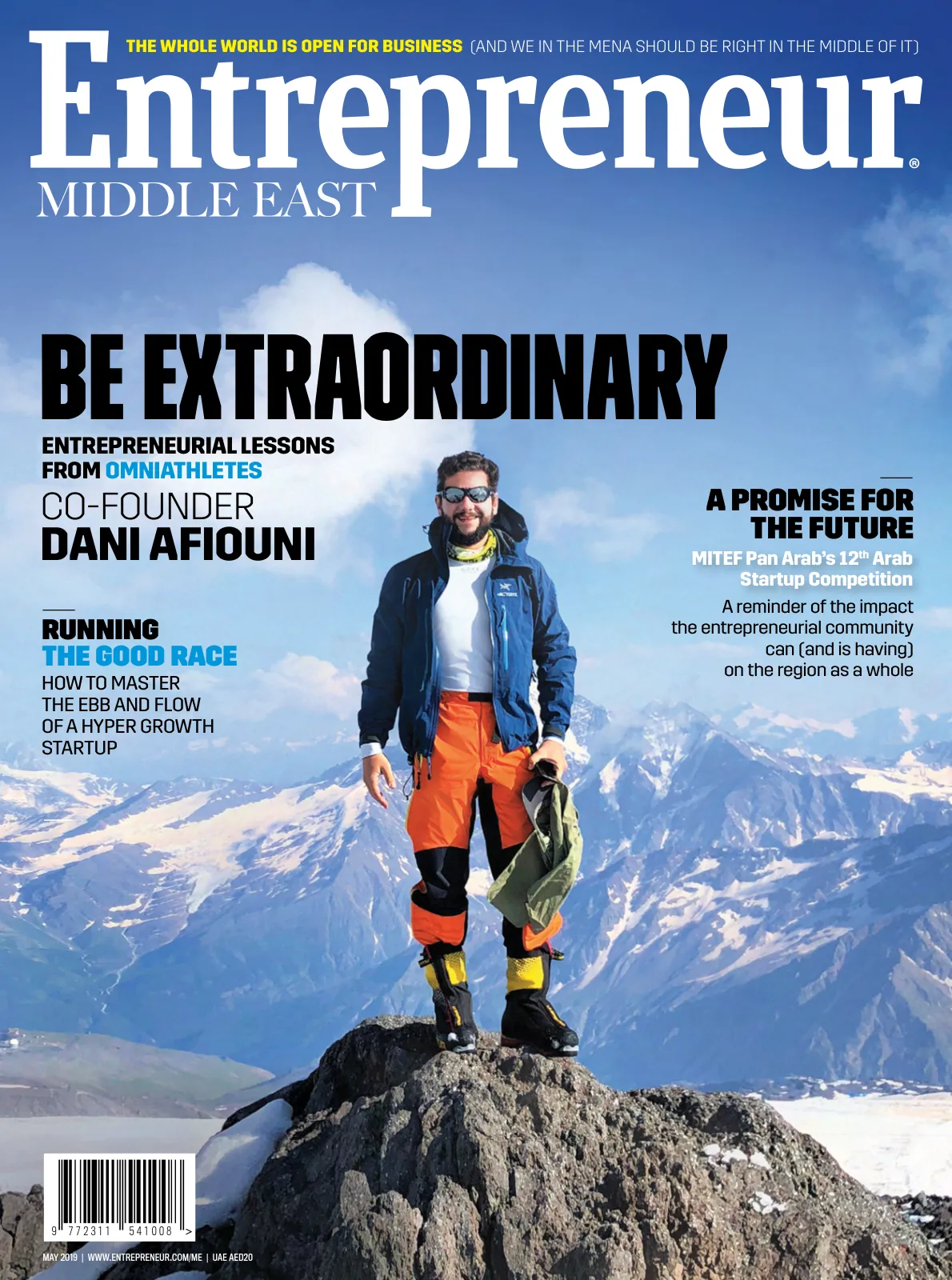
Entrepreneur Middle East, May 2019
Page 1
MAY 2019 | WWW.ENTREPRENEUR.COM/ME | UAE AED20
9
7 7 2 3 1 1
5 4 1 0 0 8
>
THE WHOLE WORLD IS OPEN FOR BUSINESS (AND WE IN THE MENA SHOULD BE RIGHT IN THE MIDDLE OF IT)
BE EXTRAORDINARY
ENTREPRENEURIAL LESSONS
FROM OMNIATHLETES
CO-FOUNDER
DANI AFIOUNI
A PROMISE FOR
THE FUTURE
A reminder of the impact
the entrepreneurial community
can (and is having)
on the region as a whole
MITEF Pan Arab’s 12th Arab
Startup Competition
RUNNING
THE GOOD RACE
HOW TO MASTER
THE EBB AND FLOW
OF A HYPER GROWTH
STARTUP
Page 2
A brand new way to
invest in real estate!
Guaranteed 10% returns
every year for 5 years
*
Launching Nest by Arada
The Middle East’s premier
student housing complex
Walking distance from University City, Sharjah
Open to all nationalities
arada.com
800-ARADA (27232)
*T&C Apply
Page 3
3
May 2019 / ENTREPRENEUR.COM /
26
INNOVATOR
BE EXTRAORDINARY
Entrepreneurial lessons
from the adventures of
OmniAthletes co-founder
Dani Afiouni, who’s also
the Director of Marketing
Transformation for the
MENA region at PepsiCo.
30
INNOVATOR
TRANSFORMATIVE CHANGE
Hadi Partovi, founder and
CEO, Code.org
Having built (and funded)
great startups, this
entrepreneur and investor
expands on his mission to
teach kids how to code.
66
START IT UP
ECOSYSTEM
A promise for the future
MITEF Pan Arab’s 12th
Arab Startup Competition
is a good reminder of the
impact the entrepreneurial
community can (and is
having) on the region as a
whole.
54
‘TREPONOMICS
SKILLSET
Running the good race
UrbanMonks founder and
CEO Nelio Leone explains
how entrepreneurs can
master the ebb and flow of a
hyper growth startup.
50
CULTURE
LIFE
Advancing humanity
Ramez Naam, Co-Chair for
Energy and Environment at
Singularity University,
on how he envisions
(and enables) the future.
72
START IT UP
ECOSYSTEM
Onward and upward
The first edition of Dtec Forum,
powered by Entrepreneur
Middle East, delivers insights
on how entrepreneurs and
startups can make use of
communications and PR to
drive business growth.
MAY 2019 CONTENTS
Dani Afiouni,
co-founder,
OmniAthletes
26
44 AURate's co-founder Bouchra Ezzahraoui on building
an ethically sourced fine jewelry brand
Page 4
Grow with our
Business Complete plans.
• Unlimited high-speed internet
• Free business devices
• Fixed Voice line with unlimited national calls
For more information, call 800 188
or visit du.ae/businesscomplete
Page 5
Page 6
Page 7
Page 8
Page 9
Call: 800 UPSALE | up.ae
*Terms and conditions apply
MOTOR CITY
Own Your Dream Home In Dubai
& Move In Today
Aed 80,000*
30 months
Post-Handover Payment Plan
50% DLD
Fee Waiver
1,2,3,4
Bedroom Apartment
Page 10
Page 11
Page 12
COVER THE CITY
Unlocking the Power
of Digital Signage Advertising
Page 13
WITH YOUR ADS
Visit www.lifeonscreen.com
Page 14
Page 15
Page 16
16 / ENTREPRENEUR.COM / May 2019
37
‘TREPONOMICS
PRO
The road ahead
Algorithm Research founder
and CEO Ketaki Sharma lists
the four macroeconomic
themes that will shape the
rest of 2019.
64
‘TREPONOMICS
PRO
Staying the course
Gulf Marketing Group
Deputy Chairman and CEO
Mohammad A. Baker on
increasing enterprise agility
in an age of uncertainty.
58
‘TREPONOMICS
PRO
Ahead of the curve
Ahmed Waarie, Managing
Consultant for the Middle East
at Willis Towers Watson,
offers his take on how
rethinking performance
management can help drive
business success.
34
START IT UP
ECOSYSTEM
The whole world is open
for business (and we in
the MENA should be right
in the middle of it)
VentureSouq Partner Maan
Eshgi shares insights from
the fifth annual edition of
the Angel Rising investor
education forum in Abu Dhabi.
MAY 2019
CONTENTS
JustClean CEO
Mohammad Jaffar
with co-founders
Athbi Al-Enezi and
Nouri Al-Enezi
22
40
TECH
SHINY
#TamTalksTech
Gadgets and doodads that
you might’ve missed out on,
sourced by a tech aficionado.
Yes, it’s okay to want them
all… and no, it’s not our
fault.
The first edition of Dtec Forum,
powered by Entrepreneur Middle East
72
50 Ramez Naam, Co-Chair for Energy and Environment
at Singularity University
41 LG XBOOM Go Bluetooth Speaker
Page 17
—
R ADISSON BLU
WELCOME TO
RIYADH
—
r a d i s s o n h o t e l s . c o m
Call us at : 00966 11 479 1234
Email us at : reservations.riyadh@radissonblu.com
BOOK NOW AND SAVE UP TO 20%.
Offer valid from May till August 2019
Page 18
18 / ENTREPRENEUR.COM / May 2019
66 Winners of the 12th MITEF Pan Arab Startup Competition
MAY 2019
CONTENTS
36
‘TREPONOMICS
PRO
Sustainable leadership
Priyanka Mittal, Director
at KRBL Limited, offers a
glimpse into the greening
of business practice in the
food and beverage industry.
22
EDITOR’S NOTE
By Aby Sam Thomas
60
‘TREPONOMICS
PRO
Peak performance
Bayt.com’s Omar Tahboub
lists four HR trends your
enterprise needs to tap
into (to get ahead).
24
IN THE LOOP
Boosting ambition
UAE-based e-commerce
enterprise Awok raises
US$30 million in a Series A
funding round.
76
START IT UP
STARTUP FINANCE
“We got funded!”
The stories behind
the recent fundraising
wins by MENA youth
jobs portal Oliv, and
construction intelligence
and procurement platform
ProTenders.
46
CULTURE
LIFE
The tao of work
Mind Cloud Academy
founder Genny Ghanimeh
delves into the problem of
entrepreneurial burnout.
42
CULTURE
TRAPPINGS
‘Trep gear
The executive selection for
the entrepreneur on your
list that has everything.
Okay, maybe for a little
self-reward as well.
Code.org founder and CEO
Hadi Partovi at the Code.org
headquarters in Seattle,
Washington
30
Page 19
Page 20
20 / ENTREPRENEUR.COM / May 2019
SUBSCRIBE
Contact subscriptions@bncpublishing.net to receive
Entrepreneur Middle East every issue
EDITOR IN CHIEF Aby Sam Thomas editor@bncpublishing.net
CEO Wissam Younane wissam@bncpublishing.net
DIRECTOR Rabih Najm rabih@bncpublishing.net
CREATIVE LEAD Odette Kahwagi
MANAGING EDITOR Tamara Pupic
STARTUPS SECTION EDITOR Pamella de Leon
GROUP SALES DIRECTOR – B2B GROUP Joaquim D’Costa
COLUMNIST Tamara Clarke
PO Box 502511 Dubai, United Arab Emirates
P +971 4 4200 506 | F +971 4 4200 196
For all commercial enquiries related to Entrepreneur Middle East
contact sales@bncpublishing.net
All rights reserved 2019.
Opinions expressed are solely those of the contributors.
Entrepreneur Middle East and all subsidiary publications in the
MENA region are officially licensed exclusively to BNC Publishing
in the MENA region by Entrepreneur Media Inc.
No part of this magazine may be reproduced or transmitted in any
form or by any means without written permission of the publisher.
Printed by United Printing and Publishing
upp.ae
Images used in Entrepreneur Middle East are credited when necessary. Attributed use of
copyrighted images with permission. All images not credited otherwise Shutterstock.
Mohammad Baker
Shahzad Bhatti
Fida Chaaban
Maan Eshgi
Genny Ghanimeh
Joe Ives
Nelio Leone
Priyanka Mittal
Sidra Raihan
Ketaki Sharma
Omar Tahboub
Ahmad Waarie
Adam White
CONTRIBUTING WRITERS
entrepreneur.com/me
ACCESS FRESH CONTENT DAILY ON OUR WEBSITE!
MIDDLE EAST
EntMagazineME
@EntMagazineME
Entrepreneur-me
EntrepreneurMiddleEast
EntMagazineME
EntMagazineME
EntMagazineME
MIDDLE EAST
In addition to our print edition, we’re bringing
you all sorts of industry news on our web
mediums. Joining us online means getting
relevant business and startup content in
real-time, so you’re hearing about the latest
developments as soon as we do. We’re looking
forward to interacting with our readers on all of
our social media and web platforms- like any
thriving business, we’re looking to give and take.
#TrepTalkME is already happening on all of our
digi platforms, and all good conversations go
both ways. See you on the web!
Page 21
Page 22
22 / ENTREPRENEUR.COM / May 2019
EDITOR’S NOTE
Aby Sam Thomas
Editor in Chief
@thisisaby
aby@bncpublishing.net
Surmounting obstacles (again and again)
It does get better
T
he other day, my team
and I were dwelling on
a particularly stressful
period at work last year,
which had pretty much
everyone involved in
various states of distress.
Back then, tempers were frayed,
frustration loomed supreme, and
it’s safe to say that all of us were
tired out of our wits. However,
these weren’t the aspects that we
were talking about as we looked
back on this phase in our work
lives: instead, we found ourselves
snorting in laughter at the now
hilarious hacks we made use of to
get past every hurdle thrown in
our way, or the funny episodes that
were entwined in this seemingly
tortuous course we were on. In ad-
dition, as we looked back on when
either of us faced setbacks that,
at the time, felt like the end of the
world, we now found ourselves
bonding over how, in such instanc-
es, we would swoop in to help the
other, band together as allies, and
keep moving ahead on the goals we
had set ourselves up with.
I’m bringing all of this up now,
because of a couple of accounts I’ve
heard recently from entrepreneurs
and enterprises in the region on
how they’re finding themselves in
tough phases with their business
today, which sound quite similar to
the crunch situations my team and
I found ourselves in not too long
ago. Now, I’m neither a soothsayer
to predict how such scenarios
will unfold, nor can I profess to
have any kind of knowledge that’d
function as a silver bullet to get
yourselves out of such challenging
circumstances. But in light of
my aforementioned reflections
on such tough times at work, I’ll
claim to have a few ideas on how
you can get yourself through these
situations, and come out of it,
scarred, maybe, but not broken.
For starters, know that, no matter
how this state you are in pans out,
rest assured that, as cliché as it
may sound, it does get better.
Now, I’ll be the first to admit
that if someone chose to come at
me with this kind of a message
when I was going through hell, I’d
probably have told them to take
a hike, along with a few choice
expletives. But today, I’m willing
to say that if one does manage to
keep this notion of an insightful
outcome in mind -regardless
of whether it’s perceived as a
positive or a negative result- it is
something that will allow you to
keep soldiering ahead, no matter
how the circumstances may turn.
There will always be something
you can learn from the experience
in hindsight, be it the ability to
identify warning signs earlier
than you used to before, or the
understanding you get of the
mistakes you committed along the
way. Perhaps best of all, if you’ve
got the right people around you,
you’ll find that at the end of it all
more than mulling over the things
that went wrong, you’ll be bonding
over how all of you came together
to rise to the occasion.
And that, I believe, is worth every
sweat and tear you may go through
today- so, just keep the faith,
people.
Page 23
A MEMBERS OF EMIRATES TRANSPORT BUSINESS CENTERS:
Page 24
24 / ENTREPRENEUR.COM / May 2019
A
wok, a UAE-based
e-commerce plat-
form, has raised its
very first external
round of financing-
a Series A round of
US$30 million.
Ulugbek Yuldashev, founder
and CEO of Awok, had suc-
cessfully bootstrapped the
business since its launch
in 2013 with just three
employees and $30,000
of initial capital. Over the
years, Yuldashev has grown
Awok to have 700 employees
who work on an e-commerce
platform featuring 200,000
products across 50 catego-
ries.
The Series A financing
round was jointly led by
Dubai-based StonePine
ACE Partners, out of its
StonePine ACE Fund, and
Al Faisaliah Ventures, a cor-
porate venture capital arm of
Saudi Arabia’s Al Faisaliah
Group, while Endeavor
Catalyst joined in as a co-
investor.
“Awok stands out from its
competitors mainly because
of the market segment it
caters to which is the lower
income segment [of people]
who don’t have the same
financial resources to buy
online [as other income
segments],” Yuldashev says.
“Our products are unique,
cheap, and cater to the daily
lives of our market segment.”
Alejandro Carbon, Chief
Portfolio Officer of Al
Faisaliah Ventures, said that
the Al Faisaliah Ventures
team scanned the market
for the best end-to-end
e-commerce capabilities –
from sourcing to last-mile
delivery– and found Awok
to be the right player to
become the next unicorn,
while supporting the region’s
small and medium retailers
who entered the online
space through the Awok
marketplace platform.
Youssef Haidar, founder
and CEO of StonePine Capi-
tal Partners and Head of the
StonePine ACE Fund, added,
“What has been achieved by
Ulugbek and his core team
at Awok with the resources
they had is nothing short
from outstanding. Not many
companies, even amongst the
well-known success stories
we celebrate in the region,
have shown such a level of
resourcefulness and out-
standing execution with no
external funding.”
The new funds will be
mainly used for expanding
Awok’s operations into Saudi
Arabia, to enhance its plat-
form with new technological
developments, such as its
AI capabilities, and increase
its offering across multiple
product categories, Awok
stated in a press release.
Yuldashev added that the
company hoped to have close
to 1,200 employees by the
end of this year.
awok.com
BOOSTING AMBITION
IN THE LOOP
UAE-based e-commerce enterprise
Awok raises US$30 million in a Series A
funding round
IMAGES COURTESY AWOK
Tips for entrepreneurs
from Ulugbek Yuldashev,
founder and CEO, Awok
1. Find a real problem
“Before you start your
business, you need to un-
derstand the problem that
you are trying to solve for
the people, and to find a
way to address it.”
2. Get a committed team
“You need to have
a trusted team of
senior management,
co-founders, and highly
skilled colleagues working
on your product.”
3. Look to the long-term
goals
“It is always important
to have a long-term goal
on why you have started
the business. You need
to be passionate about
it and build a sustainable
business for the long-
term. Never try to think
about an exit as that
could prove to be a short-
term thinking.”
‘TREP TALK
Awok team
Ulugbek Yuldashev,
founder and CEO, Awok
Page 25
M E M B E R S G E T T H E B E S T R AT E S
W H E N YO U B O O K D I R E C T
radissoncollection.com
A collection of our finest hotels,
where memorable moments are made.
From Muscat to Kuwait to Riyadh.
Page 26
26 / ENTREPRENEUR.COM / May 2019
BE EXTRAORDINARY
ENTREPRENEURIAL LESSONS FROM OMNIATHLETES CO-FOUNDER
by ABY SAM THOMAS
DANI AFIOUNI
INNOVATOR
A
t first glance, Dani Afiouni looks like one of the many corporate
executives you’d find in businesses across the UAE, but the
Head of Marketing Transformation for PepsiCo in the MENA
region serves as a good reminder of the old adage that one
mustn’t judge a book just by its cover. Sure, Afiouni is every bit the
advertising and marketing industry veteran his resume claims
him to be (he’s been working in this sector for more than 17
years now)- but that happens to be only one facet of him. My conversation
with Afiouni was in his role as one of the founding members of OmniAthletes,
which he describes as a group of “ordinary people realizing extraordinary
feats”- and no, that is not hyperbole. Be it by completing the Triple 7 Quest
(which consists of running seven marathons in seven continents in seven
days), or by pursuing the Seven Summits Challenge (this involves climbing the
highest mountain peaks in each of the world’s continents; Afiouni has scaled
five so far), this co-founder of OmniAthletes has managed to distinguish
himself far beyond the confines of the corporate domain- and he now hopes
to be able to inspire others to follow in his footsteps as well.
IMAGES COURTESY OMNIATHLETES
>>>
Afiouni’s motivations to do
what he does makes sense
when you realize he’s some
one who grew up on tales
of heroic individuals with a
host of amazing achievements
to their credit. However, he
didn’t want to only be hearing
about such wins- he wanted
to accomplish them himself
as well. “I don’t want to sit
on the sidelines, and listen to
someone else’s story,” Afiouni
explains. “I want to be able to
tell my own story.” All things
considered, it’s a pretty stellar
narrative that Afiouni wishes
to craft for himself. This
sentiment would explain the
adventure seeker side of his
personality, which has seen
him indulge in everything from
skydiving to mountaineering.
This is also what led Afiouni
to create OmniAthletes (the
name is a nod to the different
disciplines indulged in as part
of this group) with friends
(and fellow corporate execu
tives) Moustafa Mroueh and
Mazen Mroueh, with the trio
coming together to show that
everyone -yes, everyone- with
some drive, dedication, and
discipline, is capable of accom
plishing something remark
able, and thus be able to tell
fantastic stories that have
them as the central charac
ters. “We're really trying to
prove that if you're disci
plined enough, you can have
a full-time job, with a family
even, and [still] knock down
these crazy races in these crazy
fields, which people often
think are impossible to do,”
Afiouni says.
At present, Afiouni has set
himself up to complete two
globally renowned adven
turer’s challenges. One of
these is called the Marathon
Grand Slam, which has been
completed by only 142 people
around the world- this dis
tinction is reserved for those
who have run a marathon
Page 27
27
May 2019 / ENTREPRENEUR.COM /
Dani Afiouni, co-founder, OmniAthletes
"I DON'T WANT TO SIT
ON THE SIDELINES, AND
LISTEN TO SOMEONE
ELSE'S STORY. I WANT
TO BE ABLE TO TELL MY
OWN STORY."
27
May 2019 / ENTREPRENEUR.COM /
Page 28
28 / ENTREPRENEUR.COM / May 2019
INNOVATOR
IT’S WHEN AFIOUNI GETS
STARTED TALKING ABOUT
HIS EXPERIENCES ON HIS
VARIOUS ADVENTURES
THAT ONE REALIZES
THAT THERE ARE SOME
GREAT ENTREPRENEURIAL
LESSONS DRILLED INTO
THESE STORIES THAT HE
HAS STRIVED SO HARD TO
CREATE FOR HIMSELF.
Dani Afiouni,
co-founder, OmniAthletes
distance of 42.2 km (26.2
miles) or longer on each of
the seven continents and on
the Arctic Ocean at the North
Pole Marathon. While Afiouni
has completed this exercise,
the other challenge he has his
eye on is called the Explorers
Grand Slam, which people can
claim to complete if they’re
able to reach the North Pole,
the South Pole, and all of the
highest peaks in each of the
seven continents of the world-
as of today, only 66 people
from around the globe can
claim this honor for them
selves. Afiouni has already
completed a fair bit of the two
challenges- for instance, he’s
already reached the sum
mits of Mount Aconcagua in
South America, Mount Elbrus
in Europe, Mount Vinson in
Antarctica, Mount Carstensz
Pyramid in Australia, and
Mount Kilimanjaro in Africa.
(For those keeping track of
all the mountains, this means
that Afiouni has the summits
of Mount Everest in Asia and
Mount McKinley in North
America left to conquer.) In
April of next year, Afiouni
plans to reach the geographic
North Pole for the second time
(the first time was in 2016,
during a North Pole marathon
expedition trip), which leaves
the South Pole (and the two
aforementioned peaks) on his
list to complete the Explorers
Grand Slam. Afiouni is aiming
to complete the pending chal
lenges by May 2021- and if he
does go about doing this, then
there’s a fair chance that he’ll
become the first in the world
ever to have completed both
the Explorers Grand Slam and
the Marathon Grand Slam.
Afiouni does have some
precedent in making world
records: he and his fellow
counterparts at OmniAthletes
managed to secure the honor
of being the first all-Arab team
to ever complete the Triple
7 Quest. However, Afiouni
tells me that he isn’t really
concerned with this- while
snagging a record would be
“nice-to-have,” he’s keener on
ensuring he’s getting to add
more fantastic material to add
to the story he wants to tell of
his life. For all you entrepre
neurs out there, it shouldn’t
be too hard to identify with
Afiouni’s motivations behind
his pursuits- there are quite
a few similarities that can be
Page 29
29
May 2019 / ENTREPRENEUR.COM /
BE IT BY COMPLETING THE TRIPLE 7
QUEST, OR BY PURSUING THE SEVEN
SUMMITS CHALLENGE, THIS CO-FOUNDER
OF OMNIATHLETES HAS MANAGED TO
DISTINGUISH HIMSELF FAR BEYOND
THE CONFINES OF THE CORPORATE
DOMAIN- AND HE NOW HOPES TO BE ABLE
TO INSPIRE OTHERS TO FOLLOW IN HIS
FOOTSTEPS AS WELL.
INNOVATOR
Dani Afiouni at the North Pole Marathon in 2016
Dani Afiouni, co-founder, OmniAthletes
gleaned from the experiences
of someone running a startup
when all of the odds seem to
be stacked against you, and,
say, running a 42.2-kilometer-
marathon in the icy locales of
the North Pole. From learning
how to focus wholeheartedly
on a singular goal, to figuring
out (and getting past) hurdles
as they happen, Afiouni has
used (and continues to use)
the plethora of experiences
he’s had to inform what he
does on a day-to-day basis at
work and in life. Afiouni has
also used his stories -which he
proudly claims to be “written
by me, with no one’s help, but
inspired by many”- to inspire
and educate people around
him, be it the colleagues that
he works with, or students at
schools in the UAE. In addi
tion, Afiouni makes it a point
to have his adventures result
in social good as well, through
his tie-ups with a variety of
charitable initiatives in the
region and beyond.
It’s when Afiouni gets started
talking about his experiences
on his various adventures that
one realizes that there are
some great entrepreneurial
lessons drilled into these sto
ries that he has strived so hard
to create for himself. Perhaps
the most important of these
is to define one’s goals, and
always use them to guide one’s
way forward. Afiouni’s experi
ence of running the Tenzing
Hillary Everest Marathon in
Nepal is a good example to
explain this particular point-
billed as one of the highest
(and not to mention, tough
est) races in the world, this
marathon has runners start
at the base camp of Mount
Everest and move through the
cold climes of the Himalayas.
“It’s hard enough breath
ing there, let alone running,”
Afiouni remembers, and he
remembers him and his fellow
OmniAthletes coming close to
giving up several times along
the race. But the trio stuck
together, and contin
ued to push ahead- the
overall goal is what kept
them going forward,
and if any of them did
feel disheartened, the
others would make sure
to band together, and
reiterate the vision they
were trying to real
ize. Afiouni points out
that regardless whether
you’re climbing a peak,
or whether you’re
navigating your fledgling
business’ trajectory,
there’s no escaping the
headwinds that will try
to derail you from your
chosen path- it’s only by
keeping your eyes on the
prize that you can get ahead.
In Afiouni’s case, understand
ing this paradigm has been
central to all of his achieve
ments so far- and he expects
it to keep paying dividends in
his adventures to come as well.
Afiouni hopes that his and
OmniAthletes’ achievements
will inspire people to aim high,
do things they thought they
weren’t capable of doing, and
work at being the best versions
of themselves- essentially,
he’s hoping for the landscape
around him to be filled with
“ordinary people realizing ex
traordinary feats.” Afiouni just
happens to be a forerunner in
this arena- it’s now up to the
rest of us to follow.
Page 30
30 / ENTREPRENEUR.COM / May 2019
S
itting in a cor
ner of The Third
Line Gallery
in Dubai’s arts
district of Al
Serkal Avenue,
Hadi Partovi,
a tech entrepre
neur and angel investor known
for his early bets on Facebook,
Dropbox, Airbnb, and Uber,
is quietly tapping away on
his laptop prior to an invite-
only fireside chat organized by
VentureSouq, a Dubai-based
early-stage equity funding
platform. He is here, wearing
his signature baseball cap, to
present Code.org, a Seattle-
based education non-profit
dedicated to expanding access
to computer science in schools
around the world, of which he
is the founder and CEO. The
main reason for founding this
global social-impact initiative
is his belief that mastering
computer science is no less
than a life-giving skill. Yet,
before we expand on that, I de
cide to focus on his approach
to investing in early-stage
tech startups, knowing that I
will hear something different
from a phrase that gets thrown
around by every startup
investor out there: “I invest in
people, not ideas.” Partovi also
has a people-first investment
philosophy; however, not only
can he specifically point out
to what “investing in people”
actually means for him, but he
can even measure it.
The Partovi twins, Hadi and
his brother Ali, currently the
founder and CEO of Neo, a
community of young engineers
and the world’s top program
Having built (and funded) great startups, this entrepreneur
and investor opens up on his mission to teach kids how to code
by TAMARA PUPIC
HADI PARTOVI FOUNDER AND CEO, CODE.ORG
Transformative
CHANGE
IMAGES COURTESY CODE.ORG
INNOVATOR
Code.org founder and CEO
Hadi Partovi at the Code.org
headquarters in Seattle, Washington
Page 31
31
May 2019 / ENTREPRENEUR.COM /
mers, were jointly investing in
startup founders for 17 years
(since 2018, they have decided
to focus on individual invest
ments), but only in those who
passed their coding test. It
started with the founders of
Dropbox, Partovi explains.
“The best tech companies
don’t hire a single technical
person without putting them
through a lot of tests, so why
would an investor consider
giving hundreds of thousands
of dollars without even one
test to show that they can do
something?” he says. “Most
VCs don’t do this because they
themselves don’t know the
technology, so they just think
whether they like the idea or
not, and they just take it for
granted that a person can do
it. If you look at the compa
nies that have succeeded, the
idea often isn’t unique, it’s the
execution.” He points out that
Google was not the first search
engine company, Facebook was
not the first social networking
platform, and Microsoft was
not the first company building
an operating system- but what
set all three of them apart was
having the strongest engineers
on board.
The Partovi brothers know
this from their own entrepre
neurial experience. Par
tovi may come across as being
humble, quiet, and almost reti
cent, but he is a man who was
part of the team that founded
and sold Tellme Networks,
a voice recognition software
developer, to Microsoft for
US$800 million in 2007. A
decade earlier, in 1998, Ali
Partovi was a co-founder of
LinkExchange, an internet
advertising company, that also
got acquired by Microsoft for
$265 million. The brothers’
website has a page listing their
34 ongoing investments, which
include Airbnb, Classpass,
and Uber, and 23 successful
exits: Dropbox (IPO), Facebook
(IPO), and Zappos (acquired
by Amazon), to name just a
few. If you scroll down this
page, you will also find a list
of 10 of their unsuccessful in
vestments, and Partovi is open
to say that there had been a
few bruises before the broth
ers developed their investment
muscle. “I did invest in a bad
idea when I liked the person,
but if I look at all my invest
ments, the worst ones were
the cases where I liked the idea
but I didn’t like the entrepre
neur, and also there are invest
ment decisions that I chose
not to invest even though I
liked the entrepreneur,” he
says. “And, I’ve made other
mistakes too, such as when
one of my college classmates
wrote to me in 1998, saying
that he had just joined a group
of friends from his graduate
program to start a company,
and he was like, ‘They are the
smartest people I know.’ I re
member thinking that nobody
needs another search engine,
and that I wouldn’t invest in
this company, that he was just
the first employee, and that
it was going to be a complete
failure. Turned out that the
company was Google, and he
was their first employee and
the Chief Technology Officer.
He was also in the top of my
class in computer science at
Harvard. So, if I could go back
and invest in all the best com
puter scientists I had gradu
ated with, I would have made
a lot more money, although I
have done well, but I wouldn’t
have missed the opportunities
like this one.”
A key element of his stressing
the importance of the engi
neering talent is that it was a
key factor in how the Partovi
brothers came to be where
they are today. Born in Tehran,
Iran, the twins taught them
selves to code on a Commo
dore 64, which has fueled their
passion for programming ever
since. The family fled to the
INNOVATOR
"LEARNING TO CREATE
TECHNOLOGY IS IMPORTANT,
NOT ONLY BECAUSE IT
LEADS TO AN OPPORTUNITY,
AND NOT ONLY BECAUSE
OF THE FUTURE OF THE JOB
MARKET, BUT BECAUSE FOR
KIDS, IT’S FUN AND IT TEACHES
THEM CREATIVITY."
Code.org founder and CEO
Hadi Partovi speaking about
the importance of teaching
computer science in schools
Code.org founder
and CEO Hadi Partovi
visiting a classroom
“THIS IS A STORY ABOUT
OPPORTUNITY, [...] WHAT
THE JOBS OF THE FUTURE
WILL LOOK LIKE, AND
HOW WE CAN ENSURE
THAT EVERYONE GETS
AN OPPORTUNITY.”
>>>
Page 32
32 / ENTREPRENEUR.COM / May 2019
US in 1984, following the Ira
nian Revolution in 1979. Upon
earning a master’s degree in
computer science from Har
vard University, Hadi Partovi
rose up the executive ranks
at Microsoft, before he went
about launching his own start
ups. And now, he believes that
every young person around the
world deserves to be propelled
forward in life by learning this
specific skill. “This is a story
about opportunity, and how
we can expand who has access
to that opportunity, what the
jobs of the future will look
like, and how we can ensure
that everyone gets an oppor
tunity,” Partovi says, on why
he advocates computer science
training, and why Code.org
provides coding curriculum for
schools around the country.
“In the world of accelerating
technological change, the most
important thing everybody
can learn is how to adapt
to new technology. Many
schools teach technology, but
they teach kids how to use
it, whereas we want to teach
them how to create technology.
And learning to create technol
ogy is important, not only
because it leads to an oppor
tunity, and not only because of
the future of the job market,
but because for kids, it’s fun
and it teaches them creativity.
Creativity is such a natural
human desire, something that
drives adults, and especially
youth, but it doesn’t really ex
ist in the school system.”
Since launching in 2013,
Code.org has created the most
broadly used curriculum
platform for K-12 computer
science in the United States.
Its computer science classes
have reached 30% of Ameri
can students, while its Hour
of Code initiative, a global
campaign offering a one-hour
introduction to computer
science, has reached 10% of
students around the world.
Furthermore, the Code.org
team informs that the non-
profit has more than 100
international partners and
supports 63 languages in 180+
countries, with students having
created 35 million projects on
the platform. Importantly, they
also state that 48% of Code.org
students are underrepresented
minorities. In addition to all of
this, Partovi is a firm believer
that among the future coding-
skilled founders tackling the
world's biggest problems, we
will see many more women
than today. According to a
teacher survey by Code.org,
46% of users on the company’s
Code.org Studio are female.
“There is a misconception that
this is for boys not for girls,
which is totally not true,” Par
tovi says. “When girls reach 13
or 14, and if they haven’t tried
computer science yet, there are
too many other things to do
and a pressure to be cool, and
that this is not cool for them,
because of that social stereo
type that this is for boys. So,
as a girl, if at 13, you haven’t
tried it yet, you have to go
against that social stereotype.
However, for a boy, the social
stereotype is that this is for
you, that’s fine. It’s hard to go
against the social stereotype
for anybody, but it is especially
hard for a 13-year-old, when
you’ve just started learning
how to be secure yourself.” To
illustrate, Partovi mentions
that Google search results
for “software engineers” will
mainly show the images of
men, whereas the results for
“students coding” will show
men and women in almost
equal numbers.
When it comes to other
misconceptions about learn
ing computer science, Partovi
mentions the notions people
falsely have about its scope
and complexity. “I’ve probably
made this worse, because of
the name of our non-profit, but
computer science is more than
coding,” he says. “Codeiorg is
about a whole bunch of fields
that all are technical, and
they are all part of computer
science, and I believe that all
of them belong in primary and
secondary education. Just like
INNOVATOR
CODE.ORG
"WHEN YOU START
LEARNING THE
ALPHABET, YOU CAN
ALSO SIMULTANEOUSLY
START LEARNING
COMPUTER SCIENCE."
Code.org founder and CEO Hadi Partovi at the Code.org headquarters in Seattle
Page 33
33
May 2019 / ENTREPRENEUR.COM /
you think of science, science
has biology and chemistry and
physics; you don’t teach just
one of them.” Partovi adds,
“The other misconception
is that this is just for rocket
scientists. People imagine
that computer science is as
hard as calculus, but they
don’t realize that six-year-olds
can start learning it. If you
think about math, first grade
math is easy, but 12th grade
math could be more difficult,
and university math is extra
hard. Computer science is
the same, the first-grade level
of stuff is very easy.” For all
these reasons, Partovi, despite
coming across as a quiet man,
is ready to make some noise
with the recent announcement
of the single largest expan
sion of Code.org’s computer
science curriculum. Codeiorg’s
Computer Science (CS)
Fundamentals course, geared
toward primary school, will be
translated into the 10 most-
widely spoken languages in the
non-profit’s database - Chinese
(traditional and simplified),
French, Italian, Japanese,
Korean, Polish, Portuguese,
Spanish and Turkish- while
it will also offer a new offline
version of CS Fundamentals to
empower schools in low- and
no-bandwidth environments
to teach computer science
to all students. Expanding
into the MENA region is on
Partovi’s agenda too. He says,
“There are already 500,000
students and about 20,000
teachers in the Arab world
using Codeiorg, despite it, for
now, being only in English
language and only on internet-
connected computers, meaning
that we haven’t done almost
any work to overcome the
obstacles in the region, we
haven’t properly transitioned
into Arabic, we don’t yet
support use on disconnected
computers, we don’t yet work
well on smartphones and tab
lets. Most of the students are
in private schools or interna
tional schools, because they
are using it in English, but
it shows that the interest in
what we do is already high.”
Region by region, Partovi
hopes to achieve Code.org’s
mission of changing the
educational system, making
computer science a perma
nent part of school curricula.
“The education establishment
especially doesn’t recognize
that this is a field that is as
fundamental as mathematics
or science,” Partovi says. “Eve
rybody understands that tech
nology is the future, nobody
needs to be explained that, and
nobody needs to be explained
that there is money in technol
ogy, and that it is changing
everything. What people don’t
realize is that when you start
learning the alphabet, you
can also simultaneously start
learning computer science.
Nobody questions why we
are teaching math or science,
but what they do question is
whether they should teach
computer science. They are
not even asking whether they
should also teach computer
science.” However, some of Sil
icon Valley’s most prominent
leaders did not need much
persuasion- so far, Code.org
has been backed by Amazon,
Microsoft, Facebook, the Bill
and Melinda Gates Founda
tion, PricewaterhouseCoopers,
Infosys Foundation USA, and
many others. Furthermore,
Partovi recently helped Pope
Francis to write a line of code
for an app, during an event
organized by the Scholas
Occurrentes foundation in
Vatican City. “Computer sci
ence belongs in primary and
secondary schools as a funda
mental thing, not just for the
students who want to become
coders, but for those who want
to become lawyers, nurses,
farmers, because understand
ing technology is going to be
important,” Partovi concludes.
“It’s because building the
creativity that computer sci
ence teaches will be impor
tant, and learning the digital
skills that will be required in
every career will be important.
The biggest obstacle for us is
this education administrative
mindset. Individual teachers
and parents recognize this,
but nobody thinks that this
should be a part of schools.
They want their own child to
learn to code, and they don’t
think about why schools are
not teaching it.”
INNOVATOR
"IT’S HARD TO GO
AGAINST THE SOCIAL
STEREOTYPE FOR
ANYBODY, BUT IT IS
ESPECIALLY HARD FOR
A 13-YEAR-OLD, WHEN
YOU’VE JUST STARTED
LEARNING HOW TO BE
SECURE YOURSELF."
Code.org founder and CEO Hadi Partovi working with students during an Hour of Code
"PEOPLE IMAGINE THAT COMPUTER SCIENCE IS AS HARD
AS CALCULUS, BUT THEY DON’T REALIZE THAT SIX-YEAR-OLDS
CAN START LEARNING IT."
Page 34
34 / ENTREPRENEUR.COM / May 2019
START IT UP ECOSYSTEM | WHO’S GOT VC | Q&A | STARTUP FINANCE
The whole world
is open for business
(And we in the MENA should be
right in the middle of it)
Insights from the fifth annual edition of Venture Souq’s
Angel Rising investor education forum in Abu Dhabi
by MAAN ESHGI
IMAGES COURTESY VENTURESOUQ
The Angel Rising forum 2019
H
aving just
wrapped up the
Financial Sector
Conference here
in Riyadh, it
struck me that
something may
be clicking with venture cap
ital in the region. This event
came less than a month after
we at VentureSouq hosted
the fifth annual edition of
Angel Rising in Abu Dhabi.
Five years ago, what we were
doing didn’t make sense to a
lot of people. We had picked
up on something, which is
that the “investor side” of
the equation was being taken
for granted. We had pro
grams to help entrepreneurs
get their businesses off the
ground, but nothing to guide
people on how best to invest
into these entrepreneurs.
We wanted to teach inves
tors, and in so doing, turn
people into investors. I
believe that angel investing
is not just about providing
capital to startups, but rather
it’s about experienced entre
preneurs providing support
and expertise to help new
companies grow and thrive
in today’s market. Angels
critically assess and evaluate
the potential prior to invest
ing, and they rarely invest in
a venture where there is no
added value beyond money
only. They complement the
hustle, technical skills, and
market pulse that startup
founders have with robust
industry expertise and sound
judgement.
Angel Rising helps to
educate angel investors by
sharing success stories from
globally recognized VCs,
super angels, startup found
ers, and ecosystem builders
from the region and around
the world. This year (thanks
to the event’s sponsors, who
included Etihad Airways, in
addition to the UAE Ministry
of Economy), we were able
to fly in amazing speakers
from all over the world. The
content reflected the diverse
backgrounds of the speak
ers. The theme was Looking
East, with a specific focus
on China, India, and sub-
Saharan Africa. We talked
about how technology is
penetrating these markets at
a rapid pace, about the flow
of investment into and out of
these regions, as well as the
number of unicorns that have
been born there in the last
few years.
So, when you convene
some of the most influential
voices representing the most
interesting global technology
growth markets in the world,
what is the main message
that comes out? In my view,
it’s that we are all playing in
a field that faces connected
challenges, but also has
connected opportunities.
We should be viewing our
opportunity to be across
all of these markets. When
you do, it looks significantly
bigger than a GCC or MENA
opportunity alone.
For instance, we looked
from the vantage point of
China. Winston Ma, CEO
of China Silkroad Invest
ment, discussed China’s
proliferation of software
accelerators, now the larg
est number in the world.
Ken Miller, formerly a Vice
Chairman-level banker
with both Merrill Lynch
and Credit Suisse, and now
President and CEO of Ken
Miller Capital, challenged
that the China’s output is
having a global impact on the
Page 35
35
May 2019 / ENTREPRENEUR.COM /
ANGEL RISING HELPS
TO EDUCATE ANGEL
INVESTORS BY SHARING
SUCCESS STORIES FROM
GLOBALLY RECOGNIZED
VCS, SUPER ANGELS,
STARTUP FOUNDERS, AND
ECOSYSTEM BUILDERS
FROM THE REGION AND
AROUND THE WORLD.
START IT UP
ECOSYSTEM | WHO’S GOT VC | Q&A | STARTUP FINANCE
Maan Eshgi is the KSA partner for VentureSouq, the largest angel network in the MENA region. Maan has more than 14 years of banking experience.
Previously, he was a director with Coutts & Co, the wealth management division of royal bank of Scotland (RBS). Based in Geneva, he was
responsible for servicing key clients and expanding bank operations across the region. Prior to Coutts & Co, Maan spent time working for Citi Private
bank in Dubai and Geneva, managed a large family investment office in Jeddah, and traded equities and derivatives for SABB (HSBC Saudi Arabia
Ltd). Maan is an active angel investor. In addition, he has had several board positions and acted as the chairman of an investment committee for a publicly traded
company. Has a BS in business administration and an MBA at Geneva Business School. venturesouq.com
Ramesh Jagannathan, NYU Abu Dhabi
Research Professor of Engineering, Vice
Provost for Innovation and Entrepreneurship,
and startAD Managing Director,
speaking at the Angel Rising forum 2019
number of incubators and
accelerators, and that this
is creating a bubble; most of
them will disappear soon.
He made a similarly criti
cal and sarcastic comment
about global VCs: “Everyone
is involved in VC investing
these days. If you are not
managing US$400 million,
you’re a nobody.” And both
discussed a common refrain
that we hear here in MENA:
that offshore structures are
critical for startups, allowing
companies to be listed in
regional or global markets
as an exit. A clear message
throughout: what happens in
China is affecting, and often
times, inflating the rest of
the world.
We then moved to India
with Vani Kola, founder and
Managing Director of Kalaari
Capital, probably the most
prominent female investor in
India, and Anshuman Bapna,
Chief Product Officer at Goi
bibo (MakeMyTrip Group).
In India, the flow of external
VC money has increased by
10x over the last 10 years. As
a result, startups are getting
stronger every passing year,
and probably with the same
net multiplier. Again a clear
message: investing in India
is a long-term game, but the
growth prospects within In
dia alone make it worthwhile.
We also heard from Pule
Taukobong, Founding Partner
at CRE Venture Capital, the
most active seed stage inves
tor in sub-Saharan Africa,
who highlighted some amaz
ing African-founded, Afri
can-based companies. Many
of these companies are ser
vicing clients outside Africa.
They are totally homegrown
in how they have launched,
product-developed, sourced
talent, and scaled, but
they’re servicing markets far
away from Africa. He cleverly
referred to this as a “glocal”
business model, with the
message being that Africa’s
market is not limited to the
shores of the continent.
Finally, Jillian Manus,
Managing Partner of the
US-based Structure Capital
focused on the 21st century
business model of not only
returning cash, but also
focusing on contributions
to society. They look at the
“values” of companies before
the “valuations.” She was
asked to compare China to
the US, and she surprisingly
commented that China is
now moving ahead of the
curve. Silicon Valley is now
starting to follow some of
China’s innovative methods
that have been tested over a
massive market, and are now
disrupting the global tech
ecosystems. Clear message:
the Chinese are indeed a
force to be reckoned with.
How does this all relate to
the GCC, and particularly
Saudi Arabia? Events like
Angel Rising and the Finan
cial Sector Conference show
us that the market for invest
ing into technology is ripe.
But we need to recognize
that we are part of a global
entrepreneurial and invest
ing game- some would call
it a race. This opportunity
is much greater than the
MENA alone. We are, literally
speaking, in the middle of
everything: funds move from
the East to Africa, passing
through the GCC. Funding
and trade moving east from
the US will most very often
pass through our region. If
we able to capitalize on even
a small percentage of these
smart capital flows, then we
can benefit exponentially in
many ways: knowledge trans
fer, access to new markets,
sourcing of talent to work on
regional opportunities.
For us to execute, we need
to resolve some clear aspects
of our region that serve
as barriers. For example,
ensuring that the corporate
structures of our companies
are suitable and conducive
to international venture
capital, or easing the process
of doing business in Saudi
Arabia. We have to highlight
the role of SAGIA (Saudi
Arabian General Investment
Authority), and the tangible
efforts they are taking to
allow international VC funds
and companies to access the
Saudi market. This will pave
the way for co-investment
opportunities for global VC
into KSA. SAGIA facilitates
best practices for startups
to get funding at globally
acceptable terms, which is
the best way to kickstart an
ecosystem.
Our region is moving in the
right direction. There are still
big gaps, which groups like
us at VentureSouq and our
partners like BIAC are trying
to bridge. In a short span of
time, we have managed to
help companies raise funding
from local and regional global
investors. We have helped
companies enter Saudi Ara
bia, and we have taken KSA
companies to new markets.
Acquisitions like Souq (2017)
and now Careem are headline
examples of the upside of
investing into technology
companies that have aspira
tions beyond one particular
border. Forget about Silicon
Valley. The whole world is
open for business, and we
here in MENA should be
right in the middle of it.
Page 36
36 / ENTREPRENEUR.COM / May 2019
‘TREPONOMICS ETHICS | SKILLSET | MARKETING | PRO
A glimpse into the greening of business practice in the food
and beverage industry by PRIYANKA MITTAL
Sustainable leadership
Priyanka Mittal has been Director at KRBL Limited since April
2001. In her current role, she oversees KRBL’s offices in UAE
and USA and is responsible for international business, marketing
and brand development of the KRBL product portfolio. She is
also head of strategy of a new product development and product diversification
portfolio. Along with her brand management role, she oversees legal matter
pertaining to intellectual property. While at KRBL, she has spearheaded the
development of the India Gate brand, which accounts for over 80% of the
company’s total revenue. Priyanka holds a degree in business management
from the University of Southern California (USC) in Los Angeles, USA, and
has graduated from Harvard Business School’s Owner/President Management
program. She is on the board of the USC Viterbi School of Engineering. krblrice.com
A
ccording
to a study
done by The
World Bank,
one of the
most worry
ing predic
tions about
the future
is the fact that agricultural
production will reduce by
15 to 30% by 2080 due
to climate change. This is
worrying, because even the
current production rates
cannot feed the entire world.
A substantial percentage of
people still suffer from acute
famine. This is perhaps why
human beings have become
very conscious about sus
tainability efforts.
Sustainability refers to the
strategic efforts that are
made towards meeting the
needs of the present genera
tion, without compromising
the ability of the future gen
eration from meeting their
own needs. In the last two
decades, consumer demand
for sustainability in any in
dustry has increased- a 2015
world-wide study found that
55% of consumers from 60
countries said they were will
ing to pay more for products
and services from companies
committed to social and en
vironmental improvements.
At the center of these efforts
is the food and beverage in
dustry, which directly affects
the agricultural sector.
According to research, con
sumers are now more than
ever aligning their personal
values with the brands they
buy, making this one of the
reasons why sustainable
leadership is important to
stay relevant in the food
and beverage industry. This
has raised the bar higher for
companies to articulately
define their values and what
they stand for. From F&B
manufacturers who adopt
sustainable means of produc
tion, to restaurants and cafes
that minimize their impact
on the environment through
clever use of leftovers, the
F&B industry worldwide has
embraced the greening of
business practice.
But how do you achieve the
sustainability leadership
scorecard in the industry?
Sustainability is a responsi
bility that should be shared
by the industry as a whole
and alike. The F&B indus
try is extremely complex,
involving many decision-
makers, right from the food
producers to retailers to the
restaurateurs. In order to
maximize the performance
and growth of a sustainable
food model, it is important
that stakeholders involved
at different levels come to
gether to transform the food
system with one common
goal: beginning from manu
facturers producing environ
ment-friendly healthy food
products, to retailers and
other distributing junctions
supporting and backing the
efforts of the manufacturer,
and vice-versa.
One of the principles of
sustainable leadership in the
industry is customer engage
ment. Most consumers are
attracted to companies be
cause of their sustainability
efforts. Communication with
customers transparently
on the business process,
and visualizing the supply
chain via social media, not
only creates talking point on
the business processes, but
brings the consumers closer
to growers. This generates
far greater confidence in
the product/brand than any
marketing or promotion can
do. It is estimated that more
than 40% of shoppers are
interested in purchasing
environment-friendly foods
and beverages. Moreover,
consumers are now willing
to pay up to a 25% premium
for foods and beverages
Page 37
37
May 2019 / ENTREPRENEUR.COM /
AS A MACROECONOMIST who now runs a data and
research startup, I find myself constantly looking out
for signals or policy actions that may impact my busi
ness in the UAE and the wider GCC. This helps me take
a cognizant approach to profit maximization by making
informed decisions around variable expenditures and
choosing the market focus for business expansion or
otherwise.
Times have been tough for businesses in the past
few years. Consumer demand has been fragile, oil
prices have been tumbling lower since 2014, thus
affecting overall liquidity situation. This, coupled with
the US Federal Reserve tightening interest rates, has
resulted in the rising cost of capital adding to a local
entrepreneur’s woes.
Looking ahead into 2019, more specifically to the
second quarter of 2019, we believe that there have
been winds of change in the overall macroeconomic
environment that businesses in the UAE are operating
in. There are early signs of a more favorable economic
and policy environment that is probably getting less
attention due to the noise of bad news flow. The fol
lowing are the key themes that will impact businesses
in the second quarter and broader part of 2019:
1. Business sentiment to be weighed down on bad
news flow Let’s face it- sentiments are not entirely
data or fact-driven. Consumer sentiments have taken
a beating on bad news flow, particularly on develop
ments in the labor market. We expect to a see a con
tinuation of this trend in the second quarter, as well as
businesses consolidating their expenditure. Monthly
Purchasing Managers’ Index (or PMI) reports indicate
that firms have been reducing output prices, which in
dicates a loss in pricing power, a sign that demand has
been fragile, and business sentiments are weak. >>>
FOUR MACROECONOMIC THEMES THAT
WILL SHAPE THE REST OF 2019
by KETAKI SHARMA
The road ahead
IT IS IMPORTANT
THAT STAKEHOLDERS
INVOLVED AT
DIFFERENT LEVELS
COME TOGETHER TO
TRANSFORM THE FOOD
SYSTEM WITH ONE
COMMON GOAL.
>>>
‘TREPONOMICS
ETHICS | SKILLSET | MARKETING | PRO
that are certified as either or
ganic or environment-friend
ly. In the West, the retail
chain Wholefoods espouses
that the consumer demands
the best.
The products retailers stock
are also important when it
comes to principles of sus
tainability leadership. More
than half the population indi
cate that they prefer shopping
at stores that carry food
grown on sustainable farms.
Consumers these days are not
only interested in a healthy
body, but also in a healthy
environment. Since retailers
are at the end of the supply
chain and capture the bulk
of the value of the product,
they need to learn to share
value across the value chain,
in order to keep the chain
healthy. Capturing bulk of the
value, without redeployment
backwards, will either kill
the chain in the long term, or
leave it with little possibility
of rejuvenation via innova
tion, efficiency, etc. Moreover,
such chains eventually
become transactional agents,
rather than relationship-
based value agents.
Companies have been the
first to take the sustainability
agenda head on, and eventu
ally many governments joined
the initiative. Most compa
nies started out of a business
need seeing input resourcing
difficult and non-perennial.
However, these same com
panies were quick to realize
how it converted into better
products, better brands, and
eventually, better bottom line.
Soon, sustainability became
a buzzword, and lost its true
meaning. True sustainability
requires long term vision,
purpose-based existence,
rather than profit-based
existence and patient capital.
Some projects may not gener
ate the requisite ROI, but still
need to be undertaken- be
cause they make sustainable
sense. Presently, the profit-
based, EBITDA valuation may
not be the best model for our
current and future needs. A
different model that is based
on sustainable efforts, climate
impact, and sociological im
pact will create more “shared
value” companies. Consumers
have already started reward
ing such companies by propa
gating their use online.
The most important
contributor in the present
and future scenario to the
sustainability efforts will be
governments. The benefits of
globalization in the last 30
years has brought the world
closer together via open
market access to each other’s
markets, the learnings of one
have been applied in other
countries in order to be glob
ally competitive. This has led
to mass innovation on both
a micro and macro scale in
agriculture and other indus
tries. WTO pressures have
brought a lot of homogeneity
and improvement in global
lives on many economic and
sociological fronts, such as
treatment of labor, standards,
etc. However, in the name
of consumer protection, the
same standards are now being
used as protectionist barriers
to prevent free trade of goods
risking the entire sustainabil
ity movement.
Sustainable supply chains
are now struggling to find
markets for their products
due to adoption of various
forced standards. Therefore,
Page 38
38 / ENTREPRENEUR.COM / May 2019
‘TREPONOMICS ETHICS | SKILLSET | MARKETING | PRO
>>> 2. Technology is raising efficiency but also af
fecting traditional jobs growth The fourth industrial
revolution has been accompanied with technological
advancements that have increased output by automat
ing all that can be automated. Across industries, we are
experiencing more efficient ways of doing business,
from digital bank branches to using augmented reality
in retail, to the proposed hyperloop for freight or pas
senger transit. In the short run, this means fewer jobs
in some traditional sectors, which results in poor anec
dotal evidence on the overall employment situation in
an economy. We are, in fact, experiencing this phenom
enon in most parts of the world, where low consumer
sentiment has been largely driven by the above stated
factors. What is missing here is the big picture of job
creation of a new and non-traditional variety of careers
like data scientists, customer analytics specialists,
machine learning, and artificial intelligence managers,
among others. All in all, we expect job market to get bet
ter going forward, but it may not look better, due to the
bad news flow around downsizing in traditional jobs in
almost all sectors/industries.
3. Cost of capital is not going to rise significantly from
here Since the UAE Dirham is pegged to the US dollar,
the American Federal Reserve’s tightening of interest
rates implies a consequent tightening in interest rates
by the Central Bank of UAE. The consensus is that inter
est rates have probably peaked, and the Fed would likely
keep rates on hold for the rest of 2019. For the UAE, this
essentially means that the cost of borrowing for busi
nesses is unlikely to climb any further. On a positive note,
a sustained rise in oil prices will likely to help the overall
liquidity situation in the economy, which can catalyze
economic activity via the private credit channel.
4. Expansionary fiscal policy to bolster GDP expan
sion in 2019-2020 The International Monetary Fund
forecasts the UAE to witness acceleration in GDP
growth both in 2019 and 2020 based on higher fiscal
stimulus related spending on infrastructure. Additionally,
Abu Dhabi announced a US$13.6 billion stimulus pack
age to bolster job markets and SME growth last year,
which has already seen deployment with the formation
of Hub71. All these factors along with the Expo 2020
related spending is expected to buoy economic activity
in the coming quarters.
Ketaki Sharma is the founder and CEO of Algorithm
Research, a bespoke analytics and research firm
based out of the UAE, which has been a part of the
Y Combinator startup school, as well as a winner
of various regional entrepreneurship awards. Ketaki
is a senior economist who has been tracking the
MENA and India for over a decade. Prior to founding Algorithm
Research, she was involved in setting up the research desks from
scratch at two of the leading banks in the UAE, and has also worked
with Nomura Securities as India Economist in Mumbai. She has a
sovereign rating background, having worked with Standard & Poors’
as a rating analyst covering the EMEA region.
THE SUSTAINABLE
MOVEMENT NEEDS MORE
CRADLING, RATHER
THAN STRANGLING, TO
CATER TO THE FUTURE
GENERATIONS AND
GROWING POPULATIONS’
NEEDS.
governments globally will
have to lead a movement in
the support of ethical value
chains allowing sustain
able chains to flourish. The
sustainable movement needs
more cradling, rather than
strangling, to cater to the fu
ture generations and growing
populations’ needs.
To facilitate this, govern
ments need to incentivize
sustainable practices by
rewarding and promoting
sustainable vendors such
that the ecosystem flourishes,
rather than buying from the
lowest bidder. They need to
encourage companies with
an ethos, not just product
supply chains, but those who
practice sustainability in its
dealings with employees,
marketing communications,
and ultimate business pur
pose. Organizations that meet
this criterion would have
a devised logo as a reward
mechanism, which could only
be displayed by select brands
on packaging to make it easily
identifiable to consumers. On
the global stage, governments
should also be collaborating
worldwide to end the do
mestic market protectionism
that masks non-tariff barriers
hampering sustainability
efforts.
However, the promotion of
sustainability should not be
limited to organizations, in
stead the government should
educate through a separate
ministry to schools, colleges,
and universities to increase
awareness of the sustainabil
ity movement. At an industry
level, supply chains should
reward and promote sustain
able vendors such that the
ecosystem flourishes, rather
than simply buying from the
lowest bidder. This applies
to not just the supply chain
but the ethos of companies
as well– it’s about dealing
with employees, and ensuring
marketing communication is
purpose-led, thereby creating
a social multiplier. Moreover,
industry associations, and
local chambers of commerce
should also use “sustain
ability successes,” and relate
stories of previous vendors
and experiences to empower
others to convert to the same
approach through regular
meetings.
Consumers have a role to
play too. A willingness to
pay more for sustainable
brands helps directly drive
the change of organizations
who will be reinvesting their
dollars back. Investment from
consumers means changing
their own habits by dispos
ing of waste and packaging
responsibly, and recycling
according to guidelines. Con
suming products isn’t enough
however, citizens need to
invest time in the community,
country, and global develop
ment of the movement, and
live “in the moment” to make
actionable change for the
future. Finally, consumers can
facilitate governmental edu
cation initiatives by teaching
children and family members
the importance of this move
ment through gamification
and open conversations on
sustainability and individual
impact.
The key takeaway is that in
order for the sustainability
movement to be successful,
it relies on the wider, macro,
and micro environments
together- because everyone,
from the government, to the
consumer, has a role to play.
Page 39
N-Genius, the payment
platform inspired by you.
We’re inspired by business owners who make it happen every
day across the UAE. That’s why we created N-Genius, our
intuitive payment technology platform that opens a world of
innovation for your business.
Now you can accept payments on-the-go, create powerful
business strategies, integrate payments in retail and hospitality
environments, take your business online, or simply make your
customers’ lives easier. N-Genius. We make it happen.
To make N-Genius happen for your business,
visit www.network.ae or call 8004448.
Page 40
40 / ENTREPRENEUR.COM / May 2019
Canon is back with an
updated range of all-in-one
instant camera printers.
The Zoemini S comes in
three stylish finishes: rose
gold, matte black, and
pearl white. It fits easily
into the palm of your hand,
and it’s ideal for captur-
ing, printing, and sharing
photos on the go. With an
8MP camera, front-mount-
ed mirror, ring-light, and
remote shutter capability,
the Canon Zoemini S is
a complete photography
solution. Using the Canon
Mini Print app, you can
print 2x3-inch (5 x 7.6cm)
images on Zink sticky-
backed photo paper directly
from the device, which con-
nects via Bluetooth, and
is available for download
on both Android and iOS
devices. Even better, the
app features remote shut-
ter and self-timer functions
to make capturing selfies
a breeze. And if you’re
not quite committed to
printing out your snaps,
you can save them to Drop-
box for safekeeping, or
post directly to Instagram
and Facebook. Capturing
–and keeping- everyday
moments has never been
easier or more fun.
GADGETS AND DOODADS THAT YOU MIGHT’VE MISSED OUT ON, SOURCED BY A TECH AFICIONADO.
YES, IT’S OKAY TO WANT THEM ALL… AND NO, IT’S NOT OUR FAULT.
SNAP AND SHARE
CANON ZOEMINI S
TECH SHINY | WEBSITE TO WATCH | GEEK | MOBILE TECH | ONLINE ‘TREP | THE FIX
IMAGE CREDIT CANON, HUAWEI, LG
Canon Zoemini S
Canon Zoemini S
Page 41
41
May 2019 / ENTREPRENEUR.COM /
TECH
SHINY | WEBSITE TO WATCH | GEEK | MOBILE TECH | ONLINE ‘TREP | THE FIX
#TAMTALKSTECH Tamara Clarke, a former software development professional, is the tech and lifestyle enthusiast behind The Global Gazette, one
of the most active blogs in the Middle East. The Global Gazette has been welcomed and lauded by some of the most influential tech brands in the
region. Clarke’s goal is to inform about technology and how it supports our lifestyles. See her work both in print regional publications and online on
her blog where she discusses everything from how a new gadget improves day-to-day life to how to coordinate your smartphone accessories.
Visit theglobalgazette.com and talk to her on Twitter @TamaraClarke.
Huawei P30 with the new Leica Quad camera
The LG XBOOM Go Bluetooth
Speaker (PK3) is designed to
go wherever your music takes
you. With a small, lightweight
body, and enhanced Dual
Action Bass, this speaker is
designed for portability, deliv-
ering high quality audio on the
go. Multi-Bluetooth Pairing
makes PK3 speakers ideal for
social environments, enabling
you to connect two devices
simultaneously- if you don’t
mind letting someone else
be a DJ too. The speaker also
comes with apt-X support,
for a wider array of content
via streaming services, and
you don’t need to worry about
battery life, as the PK3 can be
used for up to 12 hours before
requiring a recharge. For
added convenience, the PK3
can be controlled via voice
commands by simply activat-
ing the voice assistant on
your mobile device. You can
operate the smart speaker
from a distance by telling it
the next song to play, or even
asking questions to initiate an
internet search. This speaker
is built with high quality
materials for added durability,
and it’s water-resistant, so
you can relax while enjoying
your playlist even when there
is water around. If you’re an
audiophile looking to take
your music where you go, PK3
is an ideal solution.
IN TUNE
LG XBOOM GO
The Huawei P30 takes smart-
phone photography to a whole
new level with a new Leica
Quad camera on the back of
the device, which includes four
cameras: a massive 40MP
main camera, a 20MP camera
with ultra-wide-angle lens,
an 8MP telephoto camera,
and a Huawei Time of Flight
(ToF) camera, which captures
depth-of-field information,
and that’s not all. There’s
32MP selfie camera on the
front of the device too. The
primary camera has a large
1/1.7-inch RYYB sensor, which
replaces green and yellow
pixels allowing more light into
the sensor for improved color
reproduction. The device is
packing 8GB of RAM, with
ROM options ranging from
128GB to 512GB. Its 650mAh
battery supports the 40W
Huawei SuperCharge, the
15W Huawei Wireless Quick
Charge and Wireless Reverse
Charge. Huawei P30 series is
powered by the Kirin 980, and
so, whether you’re gaming,
or multitasking for business,
Huawei P30 handles it with
ease.
POWER PLAY
HUAWEI P30
The LG XBOOM Go Bluetooth Speaker (PK3)
Page 42
42 / ENTREPRENEUR.COM / May 2019
THE EXECUTIVE
SELECTION
From better goods to better wardrobe bests,
every issue, we choose a few items that make
our approved executive selection list. In this
edition, our picks include a sleek (and slim)
new timepiece, a fresh new collection of suits
for the season, and eyewear that’s certain to
never go out of style.
‘TREP TRIMMINGS
CULTURE
BUSINESS UNUSUAL | LIFE | TRAVEL | DESIGN | TRAPPINGS
PRECISION IN HARMONY
JAEGER-LECOULTRE
As one of the latest additions to a
collection of watches that’s been
billed “the union between lightness,
finesse, and functioning,” Jaeger-
LeCoultre’s Master Ultra Thin
Tourbillon in pink gold boasts of an
extremely sophisticated crafting that
is easily apparent in both its details
and finishes. Starting from its pink
gold case, to its eggshell dial, and all
the way to its brown alligator leather
strap, this ultra-slim watch is a
celebration of horlogerie, making it a
must-have for watch connoisseurs.
jaeger-lecoultre.com
IMAGE CREDIT AEGER-LECOULTRE
Jaeger-LeCoultre
Master Ultra Thin Tourbillon
in pink gold
42 / ENTREPRENEUR.COM / May 2019
Page 43
43
May 2019 / ENTREPRENEUR.COM /
CULTURE
BUSINESS UNUSUAL | LIFE | TRAVEL | DESIGN | TRAPPINGS
TIME TRAVELER
TOM FORD
Retro reigns supreme in Tom Ford’s SS19
collection of eyewear for this season.
Step out in style: as an ode to the 50’s
(but made in the styles of the 70’s),
these frames offer distinctive and vibrant
designs that you can rest assured will
never go out of vogue. tomford.com
IMAGE CREDIT SACOOR BROTHERS | TOM FORD | WALDORF ASTORIA
In case you have successfully completed
all the tasks that the first half of this year
required, and you’re now getting ready
for fewer items on your to-do list during
the summer, a spa treatment by AMRA
at Waldorf Astoria Spa on Dubai’s Palm
Jumeirah might be a perfect choice to
melt away any remaining tension. Waldorf
Astoria Spa offers private suites, all made
of elegant white marble with splashes
of different warm colors on the walls,
in addition to its array of hydrotherapy
facilities, a Himalayan salt stone sauna, an
aromatic steam room, and a herbal sauna.
The spa is surrounded by lush landscaped
gardens, beside a private beach for those
wishing to relax with a cup of iced tea.
The hotel housing the spa is not just
a luxury beach resort, but also one of
Dubai’s well-known business meeting
places- for that reason, when visiting the
hotel for a 150-minute-long Precious Pearl
Experience by AMRA, a UK-based skincare
product house, I met not one but two of
my business acquaintances. The treatment
itself included a private bath, a delicate
pearl body exfoliation treatment, and a full
body massage, but what makes it special is
the product used. Based in Hertfordshire,
AMRA is a luxurious skincare brand
designed to combat stress and the effects
of pollution on your skin with its precious
ingredients, such as diamonds and pearls,
and rich aromas. By TAMARA PUPIC
waldorfastoria.com/dubai
EDITOR’S PICK
TIME TO DE-STRESS
Relax your senses with a spa
treatment by AMRA at Waldorf Astoria
Spa on Dubai’s Palm Jumeirah
Tom Ford eyewear
COOL CUSTOMER
SUITSUPPLY
With temperatures in the region rising
up, there’s no better time to update
your sartorial choices to reflect (and
adapt) to the new season that’s upon us.
Suitsupply’s new Spring Summer 2019
collection is a great place to start your
fashion forward journey- with clean,
classic cuts, and subtle neutral tones,
this selection of suits is sure to bolster
your cool quotient. suitsupply.com
Suitsupply
SS 2019
Suitsupply
SS 2019
Page 44
44 / ENTREPRENEUR.COM / May 2019
"STARTING MY CAREER AS
A TRADER IN A RISK-TAKING
AND MALE-DOMINATED
ENVIRONMENT DID ENABLE
BE TO BE COMFORTABLE WITH
TAKING RISK, AND IT ALSO
TAUGHT ME HOW TO NEGOTIATE
THE TOUGH WAY. "
AUrate co-founder Bouchra Ezzahraoui
on building an ethically sourced fine jewelry brand
by TAMARA PUPIC
Profits with purpose
IMAGES COURTESY AURATE
CULTURE
BUSINESS UNUSUAL | LIFE | TRAVEL | DESIGN | TRAPPINGS
“AURATE IS IN THE BUSINESS
OF DEMOCRATIZING GOLD
NOT ONLY THROUGH AN AC
CESSIBLE CUSTOMER EXPE
RIENCE, BUT ALSO THROUGH
EDUCATION.”
Bouchra Ezzahraoui,
co-founder, AUrate
I
t was over a weekend brunch that
Bouchra Ezzahraoui and Sophie
Kahn discussed why modern
fine jewelry was so inaccessible,
intimidating, and uninspiring– and
that’s what led to them to estab
lish AUrate, a New York-based
ethically sourced fine jewelry brand. Its
name is an amalgamation of “Au,” the
symbol of gold in the periodic table, and
“rate” representing the rate of return
on a purchase. “Today’s customers want
it all, a great product, a great story, and
a socially responsible brand to interact
with,” Ezzahraoui says. “They’re fed up
hearing about blood diamonds, sweat
shops, harmful environmental practices,
or just being uninformed about the supply
chain when it’s related to ‘fine jewelry.’
Being transparent, inclusive, and ethically
sourced are beyond necessary to build a
sustainable business that’s appealing to
today’s customer- a new customer who
cares not only about what you do, but why
you do it. This is core to what we care
about as a brand, a company, but also as
human beings at AUrate.”
Launched in 2016, AUrate has been
referred to as the Warby Parker of fine
jewelry, with the Moroccan-born Ezzah
raoui noting that it is the only direct-to-
consumer (DTC) fine jewelry company
with a successful omnichannel presence
in the US. The brand has three stores
in the US –in Brooklyn and Manhattan,
New York, and Washington, DC– while its
online revenue records a 400% year-on-
year growth. The co-founders started the
enterprise by bootstrapping the busi
ness, while still keeping their corporate
jobs- Ezzahraoui worked as a derivatives
trader at Goldman Sachs, while Kahn was
a Director of Strategy at Marc Jacobs.
“Being at Goldman and having a stable
income was also very helpful in the early
days, when AUrate was a ‘project,’ and it
helped finance a lot of trials in a comfort
able way,” Ezzahraoui says. “We were able
to finance our operations, make a product,
hire, and even make sales with a job on
the side. I only decided to make the jump
when AUrate showed proof of concept and
established product-market fit. Starting
my career as a trader in a risk-taking and
male-dominated environment did also en
able be to be comfortable with taking risk
(isn’t that what you do everyday building
a company?), and it also taught me how
to negotiate the tough way. I’m glad I did
it this way.”
Page 45
45
May 2019 / ENTREPRENEUR.COM /
While she did take a fair bit
of time to move into en
trepreneurship full-time,
Ezzahraoui’s career shift still
raised a lot of eyebrows. “I was
trading interest rates deriva
tives at Goldman Sachs with
mathematics and financial
engineering degrees under my
belt, so you can only imagine
everyone’s reaction when I an
nounced the move,” she says.
“However, I lived my whole
life with a ‘don’t take no for
an answer’ motto, and I always
believed in meritocracy. It
wasn’t an easy pitch neither to
my family who thought I lost
my mind, nor to my colleagues
at the time thinking I was
leaving a very high paying and
prestigious job to ‘sell jewelry.’
I just decided to put my head
down, and get the job done,
ignoring the noise. I focused
on my venture and my very
close family and social circle
that got to understand why I
was doing what I was doing
over time. Let’s say that your
hard work and subsequently
success will speak for itself. It
will take time, prioritization,
sleepless nights, the no-shows
to social events will be plenty,
and all of this for the best of
your baby, your business.”
Once AUrate demonstrated
proof of concept and vali
dated a product market fit,
the co-founders decided to
dedicate to it full-time. They
raised a seed round from
Victress Capital, Arab Angel
VC, a US family office, and a
few angel investors. The spurt
in AuRate’s growth brought
with it a new set of challenges
for Ezzahraoui and her team.
“In the early days, the biggest
challenge was onboarding
manufacturers who wouldn’t
work with us, unless we were
from a family of jewelers or
had some ties to the field,”
she remembers. “Today’s
challenge is keeping the same
close relationship we have
with our early adopters, and
taking it to the next level,
while growing 4x year-on-
year. You get past all of this
by attracting the right talent,
and learning how to retain
it through a clear company
vision and a great company
culture.” At the same time,
AUrate’s mission and vision
have also enabled the brand’s
further growth. “AUrate is in
the business of democratizing
gold not only through an ac
cessible customer experience,
but also through education,”
Ezzahraoui explains. “We are
customers ourselves, and we
were fed up with the opaque
practices in the space. This
was one of the founding pillars
of our business. We are made
in New York, under the highest
ethical standards throughout
the whole supply chain. We
can control this, and we stand
by it, because we’re involved
in the manufacturing process,
and ensure that we have every
single certification of ethical
sourcing for all our materials.”
The AUrate team has grown
from three to 35 people and
will potentially double in size
very soon in order to keep
up with the rapid growth of
the brand’s online channels,
especially in the data analyt
ics. Other future projects,
Ezzahraoui says, include the
expansion of its store footprint
in the US, forging new part
nerships, as well as starting
new projects for the Middle
Eastern market. “I think the
MENA region is very well-
versed in the jewelry space,
but we’re still missing strong
contemporary brands that
should be speaking to a wider
demographic and offering a
more accessible customer ex
perience,” she says. “I believe
AUrate would fill this void in
the region that’s specifically
a need for a brand offering a
modern luxury contempo
rary aesthetic that’s targeting
specifically self-gifters. We
want to be your go-to brand
for your everyday 360 jewelry
wardrobes.”
1. Start up with what you
have
“It’s ok to bootstrap the busi-
ness in the beginning.”
2. Keep an eye on the
money you have/need
“You need to have a clear
vision of your cashflow at all
times, especially in working
capital-heavy businesses
involving product and mar-
keting expenses.”
3. Manage the money
you got
“Spend smartly on what’s
going to make and/or push
your product; the rest will
naturally follow when you
establish product-market fit.”
4. Test before your commit
to your startup full-time
“It’s ok to start your venture
as a side hustle; there is no
shame in proving that your
idea is solving an actual
problem in the market.”
5. Just do it
“Don’t waste too much time
making business plans, just
go for it.”
CULTURE
BUSINESS UNUSUAL | LIFE | TRAVEL | DESIGN | TRAPPINGS
AUrate co-founder
Bouchra Ezzahraoui’s tips
for entrepreneurs
‘TREP TALK
"IT WILL TAKE TIME,
PRIORITIZATION,
SLEEPLESS NIGHTS, THE
NO-SHOWS TO SOCIAL
EVENTS WILL BE PLENTY,
AND ALL OF THIS FOR
THE BEST OF YOUR BABY,
YOUR BUSINESS.”
AUrate
co-founders
Sophie Kahn
(left) and Bouchra
Ezzahraoui
AUrate Infinity
Earrings
AUrate Bold Ear Cuff
With Diamonds
Page 46
46 / ENTREPRENEUR.COM / May 2019
The tao of work
Understanding entrepreneurial burnout
(and how to deal with it) by GENNY GHANIMEH
WHEN WE CONSISTENTLY
DON’T RECUPERATE
BY RESTING, WE START
BUILDING CHRONIC
STRESS, WHICH CAN LEAD
TO ANY COMBINATION OF
DISORDERS AND ILLNESSES.
CULTURE
BUSINESS UNUSUAL | LIFE | TRAVEL | DESIGN | TRAPPINGS
A
few years ago,
Business Insider
published an ar
ticle about depres
sion in the startup
community.
According to the article, 7%
of the general population re
port suffering from depres
sion, while 30% of founders
report dealing with its ef
fects, and more than 50% of
those get to burnout. While
there are no specific studies
focusing on entrepreneurs
yet, there are countless
clinical research papers and
stats on the rise of depres
sion and burnout in the gen
eral workforce population,
with the contributing factors
ranging from air pollution,
poor quality of food, screen
time, to long hours of work,
little personal interaction,
and general loss of meaning
in professional life. These
studies seem to also differ
entiate between two types of
burnout: circumstantial and
existential. Circumstantial
burnout stems from work
place challenges, neglect of
personal life, and not taking
some time off. Existential
burnout stems from loss of
meaning in one’s profession,
lack of self-validation, loss
of understanding of profes
sional identity, and loss of
connectivity with colleagues
and clients.
While all of the above
applies to the general work
force population, in addition
to this, each profession has
its own particularities and
challenges. When it comes
to entrepreneurs, the reality
is that they are often the
most passionate and driven
people, but they can also be
the most obsessive and out
of balance. The reality is
also that entrepreneurship
is an intense endeavor, and
it’s hard to separate the self
from the business. Sooner
rather than later, and be
cause of the rollercoaster
nature of entrepreneurship,
business setbacks start hap
pening (a lot!), and some
entrepreneurs can’t help but
take them as personal set
backs, especially when they
get so invested in their busi
ness. Depression follows,
and so does burnout.
But what does burnout
mean in the first place?
UNDERSTANDING BURNOUT
Normal stress can be
healthy, and it can even
contribute to one’s peak per
formance. But when we con
sistently don’t recuperate
by resting, we start building
chronic stress, which can
lead to any combination
of disorders and illnesses,
ranging from hormonal
disorders, muscle tension
and aches, high blood sugar
levels, diabetes, high stress
hormones, heart problems,
weakened immune response,
to anxiety, depression, ir
ritability, and insomnia.
Eventually, the continuous
stress on the body over a
long period of time (called
chronic stress) disturbs the
endocrine system, which is
responsible for regulating
the “fight or flight” re
Page 47
47
May 2019 / ENTREPRENEUR.COM /
Tao is a Chinese word signify-
ing “way,” “path,” “route,”
“road,” or sometimes more
loosely, “doctrine,” “principle,”
or “holistic beliefs.” In the
context of traditional Chinese
philosophy and religion, Tao
is the natural order of the
universe whose character one’s
human intuition must discern
in order to realize the potential
for individual wisdom. This
intuitive knowing of “life” can-
not be grasped as a concept; it
is known through actual living
experience of one’s everyday
being. Wikipedia.com
WHAT DOES TAO
MEAN?
When the endocrine system is
disturbed, it starts taking over
everything that the brain con-
siders non-essential, like sleep,
digestion, and the reproductive
system, while amplifying the
functions activated during high
alert moments, like muscular and
cardiovascular functions.
CULTURE
BUSINESS UNUSUAL | LIFE | TRAVEL | DESIGN | TRAPPINGS
A 12-STAGE
MODEL
OF BURNOUT
1. Compulsion
to prove
oneself
2. Working
hard
3. Neglecting
basic needs
4. Displacement
of conflicts
5. Revision
of values
6. Denial
of emerging
problems
7. Withdrawal
8. Odd
behavioral
changes
9. Depersonalization
10. Inner
emptiness
11. Depression
12. Burnout
syndrome
>>>
sponse. When the endocrine
system is disturbed, it starts
taking over everything that
the brain considers non-
essential, like sleep, diges
tion, and the reproductive
system, while amplifying the
functions activated during
high alert moments, like
muscular and cardiovascular
functions. This is when
burnout starts. At its high
est degree, burnout is a state
of complete mental, physical
and emotional exhaustion.
Psychologists Herbert
Freudenberger and Gail
North developed a 12-stage
model of burnout, to visual
ize its progression:
1. Compulsion to prove oneself
- demonstrating worth
obsessively.
2. Working hard - with an in
ability to switch off.
3. Neglecting basic needs -
lack of sleep, lack of healthy
eating, lack of social interac
tion.
4. Displacement of conflicts -
problems are dismissed.
5. Revision of values - values
are skewed, friends and
family dismissed, hobbies
irrelevant.
6. Denial of emerging problems
- intolerance, perceiving
collaborators as stupid,
cynicism, aggression, prob
lems are viewed as caused
by work.
7. Withdrawal - social life
small or nonexistent, hard
social contacts.
8. Odd behavioral changes -
changes in behavior obvious
to friends and family.
9. Depersonalization - seeing
neither self nor others as
valuable.
10. Inner emptiness - feeling
empty inside.
11. Depression - feeling lost,
exhausted and the future
feels bleak and dark.
12. Burnout syndrome -
includes mental and physical
collapse; medical attention
required.
It is smart to be aware of
any of the early signs and
do something about it,
instead of waiting longer
for the more problematic
signs to appear. The above
list is compatible with
burnout signs experienced
both by employees and
entrepreneurs. It might be
even smarter to explore the
particular underlying root
causes for entrepreneurial
burnout.
From my own experience,
I have observed that some
entrepreneurs tend to iden
tify completely with their
work, which leads to their
moods and sense of self-
worth becoming intertwined
with the ups and downs
of their business. Other
entrepreneurs get used to
the initial high adrenaline
of the setup phase, or hyper
growth phase, that they lose
any sense of meaning when
things slow down– even
though the business is still
doing great. I have also met
some entrepreneurs who
can’t handle the pressure
of having too many people
whose livelihoods are depen
dent upon them, especially
when the business is suc
cessful. A lot is at stake, and
the constant worrying and
pressure can lead to debili
tating and crippling anxiet
ies. The last observation is
about entrepreneurs who
relate their own sense of
purpose with the purpose of
their business, which can be
dangerous when the bubble
bursts, leaving the entrepre
neur completely empty.
It is worth remembering
for entrepreneurs that nine
out of every ten startups fail
within the first two years- a
common tagline even in
Silicon Valley! Knowing
that fact can be helpful in
preparing and mitigating
for failure. It is also worth
pointing out that burnout
doesn’t only occur when
things aren’t going well.
Many entrepreneurs running
very successful businesses
can be, and are, just as sus
ceptible to burnout.
DEALING WITH
ENTREPRENEURIAL BURNOUT
Today’s society makes us
believe that we can only be
successful when we work
incredibly long hours, and
“sacrifice” our health, our
personal time, and our
relationships. This can’t
be further from the truth,
for what is success when
we lose our health, our
Page 48
48 / ENTREPRENEUR.COM / May 2019
Genny Ghanimeh is the founder of Mind Cloud Academy, a
unique business and entrepreneurship academy founded in 2016
in the UAE. From the outset, Mind Cloud Academy gathered
around it a group of successful and inspirational entrepreneurs
committing to share their knowledge and experience with the
wider crowd eager to join this ecosystem. Prior to Mind Cloud, Genny founded
Pi Slice, a crowd-lending platform for micro-finance in the MENA region. She
was spearheading financial inclusion, impact investing and fundraising for
regional micro-entrepreneurs to help them realize their dreams and support
their families. Through the course of five years, 300+ unbanked micro-
entrepreneurs were able to grow their small businesses with Pi Slice’s support.
mindcloudacademy.com
Keep your external values in
check. That includes balanced
time with family, friends, and
personal nurturing hobbies
outside of work.
Keep your mental resilience in
check. That includes not letting
daily setbacks and obstacles,
negative feedback, or erratic
schedules affect you. You can grow
it every day through small goal
gains, as simple as committing not
to miss your daily workout.
BURNOUT DOESN’T ONLY
OCCUR WHEN THINGS
AREN’T GOING WELL. MANY
ENTREPRENEURS RUNNING
VERY SUCCESSFUL
BUSINESSES CAN BE, AND
ARE, JUST AS SUSCEPTIBLE
TO BURNOUT.
CULTURE
BUSINESS UNUSUAL | LIFE | TRAVEL | DESIGN | TRAPPINGS
inner connection, and our
relationships with others?
Moreover, when we spend
more time with ourselves
(not working), we are able to
have better mental clarity,
more abundant creativity,
and improved ability for
sound business decisions.
Another societal belief lies
around the fact that every
one has to have a job that
reflects their own sense of
purpose. As idealistic as this
notion may sound, it is as
equally wrong as it is harm
ful. It first presupposes that
we can only express that
purpose through a job, when
the reality is that our pur
pose is expressed through
everything we create, say, in
teract with, etc. And second,
it makes people ungrateful
to the fact of having a job in
the first place, which pays
the bills and puts food on
the table.
It may seem noble to iden
tify personal purpose with
that of the job in a society
that glorifies optimal pro
ductivity and financial suc
cess over personal wellbeing;
all so much more in the
startup world, as successful
entrepreneurs are almost
deified. It is not my aim here
to dismiss the importance of
both productivity or success,
for they both are outcomes
we thrive for through our job
occupations, and they are
both measures of our cre
ativity, excellence, and vali
dation. But again, there is a
fine line between creativity
and pretentious dishon
esty, excellence and selfish
obsession, validation and
validation-seeking. A quote-
mantra I’m personally fond
of is by Dr. Jimi Wollumbin:
“Your job is a journey,
an art, a duty, a trap,
but not the destination.”
Our purpose is initially
internal, personal and
intimate. It can be reflected
outwardly through our
actions, occupations and
relationships, but only after
we do the inner work on
ourselves.
Once burnout is reached,
it is of course a case of
supervised medical care.
Having witnessed it first
hand, I know how hard it
is, and I don’t wish it upon
anyone. Perhaps there are a
few things to keep in mind
for entrepreneurs to avoid
getting there.
First, keep your external
values in check. That in
cludes balanced time with
family, friends, and personal
nurturing hobbies outside
of work.
Second, keep your physi
cal health in check. That
includes healthy eating,
exercising, sleeping, and
outdoors activities.
Third, keep your mental
resilience in check. That
includes not letting daily
setbacks and obstacles,
negative feedback, or erratic
schedules affect you. You can
grow it every day through
small goal gains, as simple
as committing not to miss
your daily workout, setting
time to meet your friends on
weekends, or pledging to eat
natural foods for a month.
And lastly, keep your
personal sense of purpose
in check. That includes
knowing the difference
between external and inter
nal sources of validation.
It also includes doing our
best, then letting go of the
desire to control everything
outside of us, and becoming
the witness of everything
unfolding with gratefulness
and humility.
And that is the tao of work!
In the end, we each deter
mine for ourselves what
truly matters, and what is
truly worth pursuing. All
the different parts of our
existence will then become
a natural expression of
that which truly matters
to us, and naturally our
professional path will follow.
When we get into that frame
of mind, we embody a sense
of purpose that is ever trans
forming, evolving, and built
upon. We also emanate a
sense of confidence knowing
that there is a higher intel
ligence, and that things will
always happen the way they
are supposed to happen. I
wish you a tao journeying
through your work!
Page 49
Page 50
50 / ENTREPRENEUR.COM / May 2019
IMAGES COURTESY SINGULARITY UNIVERSITY | GRAPH © WORLD ECONOMIC FORUM
The Co-Chair for Energy and Environment at Singularity University
on how he envisions (and enables) the future by TAMARA PUPIC
RAMEZ NAAM
HUMANITY
ADVANCING
"IN THE REAL WORLD, NO ONE
THINKS OF THEMSELVES AS A
VILLAIN; EVERYONE IS EITHER
THE HERO OR THE VICTIM OF
THEIR STORY. SIMILARLY, WHEN
YOU ARE MAKING A PRODUCT,
YOU HAVE TO UNDERSTAND THAT
ABOUT YOUR CUSTOMERS.”
Ramez Naam
CULTURE
BUSINESS UNUSUAL | LIFE | TRAVEL | DESIGN | TRAPPINGS
A
s far as climate
activists go,
Ramez Naam is
someone who’s
taken on a
variety of roles
to amplify this
growing social
movement. Besides being the
Co-Chair for Energy and Envi
ronment at Singularity Univer
sity, Naam’s resume also pegs
him as a computer scientist, a
cleantech angel investor, and
a public speaker on energy,
innovation, and disruption. In
all of these capacities, Naam
has been educating the public
on different ways to address
climate change, advising gov
ernments on effective climate
and clean energy policies,
and supporting innovation in
clean technology by investing
in clean energy startups. That
said, it is not unusual for to
day’s entrepreneurial individ
uals to step in where govern
ments and societies have failed
to properly address pressing
global crises; however, Naam
went a step further than most
of them- he wrote books to in
spire future technological ad
vancement and ensure its wide
acceptance. He is the author
of two non-fiction books, More
Than Human: Embracing the
Promise of Biological Enhance
ment (2005), and The Infinite
Resource: The Power of Ideas
on a Finite Planet (2013), as
well as of the award-winning
Nexus novels, a trilogy that
includes Nexus (2012), Crux
(2013), and Apex (2015). “All
of my work -my non-fiction
books, my novels, my work in
energy- is driven by a fascina
tion with the future, which is
a place where we are going, no
matter what,” Naam says. “We
spend most of our time staring
at the present, or staring at
the next day, but I have always
been fascinated with what
the world would be like in 50
or 100 years. And that’s what
drives the curiosity behind all
my work.”
Naam spent 13 years at
Microsoft, climbing up the
ladder to the position of Part
ner and Director of Program
Management, and leading
teams working on the early
versions of Microsoft Outlook,
Internet Explorer, and the
Bing search engine. He has
been granted more than 20
patents, on many of which his
co-inventor is Bill Gates. As an
entrepreneur, he founded and
ran Apex Nanotechnologies, a
software company dedicated
to accelerating molecular
design. And these days, Naam
is entirely focused on how
solar, wind, energy storage,
and related technologies can
disrupt the energy industry,
and do it faster than expected.
Today’s global push for an
energy transition towards
Page 51
51
May 2019 / ENTREPRENEUR.COM /
"THIS REGION COULD
TURN SOLAR POWER INTO
HYDROGEN AND THAT
INTO GREEN NATURAL
GAS OR INTO AMMONIA TO
EXPORT TO OTHER REGIONS,
SUCH AS EUROPE, WHICH
DOESN’T HAVE ENOUGH
SUN TO HANDLE ITS WINTER
HEATING NEEDS.”
Rank
Country
Score
Rank
Score
Rank
Score
Rank
Score
Rank
Score
Rank
Score
Rank
Finland
76%
4
69%
11
82%
10
81%
7
83%
1
52%
69
Denmark
73%
7
68%
12
85%
3
78%
9
81%
2
49%
75
Austria
73%
8
67%
14
82%
12
75%
12
67%
8
60%
52
Switzerland
69%
12
75%
2
83%
9
83%
3
55%
18
58%
55
Sweden
62%
24
66%
18
84%
7
81%
6
62%
10
57%
57
Luxembourg
64%
20
67%
15
85%
5
73%
14
57%
16
56%
59
United Kingdom
82%
1
66%
16
80%
14
77%
10
46%
36
46%
83
Netherlands
63%
22
71%
5
81%
13
83%
1
51%
25
44%
85
Singapore
52%
41
71%
6
89%
1
81%
5
43%
41
55%
61
61%
26
69%
10
89%
2
71%
17
47%
31
55%
63
Energy system
structure
Transition readiness
Capital and
investment
Regulation
and political
commitment
Institutions and
governance
Infrastructure and
innovative business
environment
Human capital and
consumer
participation
Norway
1
2
3
4
5
6
7
8
9
10
Top 10 countries in transition readiness, scored and ranked for the six readiness enabling dimensions
Source: World Economic Forum
Ramez Naam,
Co-Chair for Energy
and Environment,
Singularity University
CULTURE
BUSINESS UNUSUAL | LIFE | TRAVEL | DESIGN | TRAPPINGS
>>>
renewables -embodied in the
2016 Paris Agreement- has
mainly been led by policy
makers driven by collective
awareness of environmental
and climate concerns. How
ever, Naam has been speak
ing (and writing) about why
national policies might not be
effective enough to bring down
the whole world’s greenhouse
gas emissions from fossil
fuels. One piece of evidence to
support Naam’s contention is
in World Economic Forum’s
Fostering Effective Energy
Transition report for 2019,
which stated that the pace of
change to clean energy across
the world had slowed to the
lowest rate for five years, with
investment in clean energy
down by almost 10% last year.
Furthermore, the report ranked
115 countries in terms of their
performance and readiness for
energy transition, and showed
that in 2019, the year-on-year
increase of the global average
score was the lowest of the last
five years. The UAE ranks 59th,
the highest score of all the
countries in the MENA- the
region, Naam says, should pay
close attention to the renewa
bles sector. “For this region,
it is important to understand
that the peak of oil demand
could happen this decade,” he
explains. “The world will still
be burning oil for decades, but
the demand may not be grow
ing after this decade, maybe
even after the middle of this
decade. It might start shrink
ing. The good news is that
this region has a tremendous
opportunity as well, because
you are also drenched in sun,
and there are energy demands
at places that have less good
sun and less good wind, which
you could fulfill in other ways.
For instance, this region could
turn solar power into hydrogen
and that into green natural gas
or into ammonia to export to
other regions, such as Europe,
which doesn’t have enough
sun to handle its winter heat
ing needs.”
I talked with Naam when he
spoke at the Abundance 360
Summit in Dubai. He advo
cated the active participation
of the private sector in the
ongoing decarbonization pro
cess that, he explains, benefits
from clean energy startups
developing more innovative
and less expensive technolo
gies, and then, both creat
ing and meeting the demand
for reliable, affordable, and
environmentally responsible
energy sources around the
world. “I am one of the early
people to see that things like
solar power and batteries had
an exponential price decline,”
Naam says. “I made some
forecast in 2011 on the price of
solar, and it actually dropped
in price faster, and now the
same thing is happening with
batteries and electric mobil
ity.” The market for these new
technologies is growing as
well- according to the World
Economic Forum, citing the In
ternational Renewable Energy
Agency, the share of electricity
in total final energy consump
tion will rise from 19% to
about 44% by 2050, and the
Page 52
52 / ENTREPRENEUR.COM / May 2019
THE INSPIRATION FOR THE
NEXUS TRILOGY, A POST-
CYBERPUNK THRILLER
SERIES OF NOVELS
PUBLISHED BETWEEN 2012
AND 2015, DERIVED FROM
NAAM BRIDLING OVER SOME
INITIATIVES OF THE US
GOVERNMENT, IN PARTICULAR
ITS WAR ON DRUGS AND ITS
WAR ON TERROR.
Ramez Naam at the Abundance 360 Summit in Dubai
CULTURE
BUSINESS UNUSUAL | LIFE | TRAVEL | DESIGN | TRAPPINGS
share of renewables in the
electricity generation mix will
grow to about 85% in 2050,
up from the current 25%. For
that reason, Naam is an active
investor in clean energy start
ups, with his AngelList profile
listing one exit and 24 current
investments. He also cre
ates syndicates open to other
qualified investors. “In clean
energy, the companies that
have the best likelihood of exit
and the best return on invest
ment are the companies that
have network effect,” he says.
“They are usually asset-light
companies which means that
they are software companies,
IoT companies, so compa
nies that are data oriented.
The other ones are finance
oriented, like SolarCity, which
is not really a solar company
but a financial engineering
company.” SolarCity is a San
Mateo-based solar installer
offering low-cost solar leasing
programs where homeown
ers paid nothing upfront and
spread out their payments
over 20 years. Tesla purchased
SolarCity in November 2016
for US$2.6 billion, stating its
aim to turn into a full-circle
renewable energy company,
selling three interconnected
products to the public- solar
roofs, home batteries, and
electric cars. However, in
addition to these two busi
ness models, Naam is open to
investing in hardware develop
ment as well. “Occasionally,
there is a company that does
something in hardware that is
such a big breakthrough that
I can’t resist investing in,” he
says. “They are high-risk, but
they are also financially high
return. I’ve just invested in a
company making a new kind of
solar that could nearly double
the energy produced by solar
panels, which would be the
biggest breakthrough in solar
in 30 years. For that company,
I invested in a seed round, but
I’m also about to invest in a
Series C of an energy storage
company which makes a new
kind of battery that is cheaper.
So, I do the whole spectrum.”
When it comes to Naam’s
writing, his non-fiction writing
debut in 2005, More Than Hu
man: Embracing the Promise of
Biological Enhancement, was
borne out of the need to re
frame certain perspectives on
the world, in particular of The
President’s Council on Bioeth
ics, established by George W.
Bush. He explains, “They were
saying that if we could improve
human ability to extend our
longevity, or stay young longer,
or make ourselves smarter, or
connect our brains to comput
ers, it would be very unethical
and very suspicious. I thought
that was totally insane. It’s
Page 53
53
May 2019 / ENTREPRENEUR.COM /
what we humans do, why we
have cell phones, or contact
lenses, and why women have
birth control pills- because we
want to control and improve
our biology. So, I wanted to
write a book, and explain to
the public what the options
were, and why it basically was
ethically okay.” It is no secret
that fiction, and particularly
science fiction, has inspired
scientists and entrepreneurs to
pursue technological advance
ment. From Tom Swift, a series
of American juvenile science
fiction and adventure novels,
inspiring Steve Wozniak to
become an engineer, to Neal
Stephenson’s The Diamond
Age, which had elements Jeff
Bezos made use of to develop
the Kindle, while another of
his books, Snow Crash, helped
Reid Hoffman and Peter Thiel
to brainstorm an idea that
would later become PayPal.
Naam, too, used fiction as a
medium to present an opti
mistic view of the future. “I
had quit at Microsoft for the
second time, and I wanted to
write a book that was about
saving the planet with in
novation, but my agent, quite
frankly, didn’t like the idea. My
first book got good New York
Times reviews, but nobody
really bought it. So, I said I was
going to try writing fiction, al
though I had no idea how hard
it was, but it turned out that
my novel sold a lot more than
my non-fiction. It hits people
emotionally, because when you
just give them dry facts, most
people don’t care, but when
you give them stories, they get
attached to a character. So, I
thought that fiction was a bet
ter vector to get some of these
ideas out to people.”
The inspiration for the Nexus
trilogy, a post-cyberpunk
thriller series of novels pub
lished between 2012 and 2015,
derived from Naam bridling
over some initiatives of the US
government, in particular its
War on Drugs and its War on
Terror. “I thought that they
were both over-reactions to
certain situations, where the
actions of the US were actually
very harmful,” he says. The
trilogy follows the protagonist
Kaden Lane, a scientist who
works on an experimental
nano-drug -Nexus- which con
nects human minds together.
Nexus tied for Best Novel in
the 2014 Prometheus Awards
by the Libertarian Futur
ist Society, and it was also
shortlisted for the 2014 Arthur
C. Clarke award. Apex won the
2015 Philip K. Dick Award.
About the writing experience,
Naam says, “Writing fiction
can be very fun because you
can procrastinate, but once
you get started and you get
into the flow of it, it’s like
seeing a really cool scene in a
movie. One scene which takes
five minutes in a movie takes
you the whole day to write it.
Non-fiction is more dry, but
it teaches you a lot. Usually,
when you start a non-fiction
book, you start it because you
think you’re an expert, that
you know a lot, and by the
time you finish it, you actually
now much more than when
you started it.” When explain
ing his process of putting all of
these stories together, Naam
says that both sci-fi writ
ers and entrepreneurs try to
envision the future. “You are
always trying to understand
two things. Firstly, what the
world will look like at some
time in the future, because
whatever the product you are
making, it’s not already there,
so you are looking at what’s
the world going to look like
then. And, secondly, you are
thinking about what people’s
motivations are. If you want
to make a product, you have
to actually satisfy some desire
that they have. Storytelling
is the same, you write about
these trends in the world,
but also about what different
people want. The best stories
are about people who want
different things, because they
all believe that they are the
good guy, they all have reasons
for what they want. In the real
world, no one thinks of them
selves as a villain; everyone is
either the hero or the victim
of their story. Similarly, when
you are making a product, you
have to understand that about
your customers.”
“I MADE SOME FORECAST IN 2011 ON THE
PRICE OF SOLAR, AND IT ACTUALLY DROPPED
IN PRICE FASTER, AND NOW THE SAME
THING IS HAPPENING WITH BATTERIES AND
ELECTRIC MOBILITY.”
Ramez Naam at Singularity
University's Exponential
Manufacturing Summit
CULTURE
BUSINESS UNUSUAL | LIFE | TRAVEL | DESIGN | TRAPPINGS
Page 54
54 / ENTREPRENEUR.COM / May 2019
‘TREPONOMICS ETHICS | SKILLSET | MARKETING | PRO
W
hat a couple of weeks it’s been for the ride-hailing industry.
In March, Uber announced its US$3.1 billion acquisition
of Careem, an enormous success not only for the two
companies, but the region as a whole. The deal is the biggest
the Middle East has ever seen, surpassing Amazon’s earlier
acquisition of Dubai-based Souq.com for $580 million, and
it is bound to impact Uber’s upcoming initial public offering.
Speaking of, Lyft went public as well in an IPO that valued the company at more
than $24 billion, the largest initial public offering in the last decade.
How to master the ebb and flow of a hyper growth startup
by NELIO LEONE
RUNNING THE GOOD RACE
What can be attributed to
their success? Hyper growth.
I was lucky enough to be a
part of Careem’s hyper growth
journey from 2015 to 2017,
and I witnessed firsthand
the results it can achieve. I
also realized quite early on
that hyper growth can be
dizzying, disorienting, and
takes an immense amount of
innovation and talent. Here
are the top lessons I learned as
a result:
LESSON 1
MOMENTUM IS CRUCIAL- SO IS
MOVING AT THE SPEED OF LIGHT
At Careem, our tagline, “Yalla,
let’s go,” became a way of life.
Initiatives that would take
months to implement in more
established organizations
would take merely days at
Careem. This type of speed
and momentum is crucial for
any hyper growth startup.
Take your foot off the gas, even
for a second, and it could be
the end of your journey.
Momentum, however,
doesn’t mean you should
pursue every opportunity
that presents itself. Saying
yes to everything, whether
it’s a new partnership with
a popular brand or a new
product feature, will take your
attention away from what
really matters- delighting your
customers, and in Careem’s
case, providing the region
with better quality of life. The
minute we lost focus of our
mission, the minute we lost
momentum where it mattered.
So, identify the metrics
or goals that matter most
to your mission, and focus
solely on achieving them,
and fast. At the beginning of
Page 55
55
May 2019 / ENTREPRENEUR.COM /
‘TREPONOMICS
ETHICS | SKILLSET | MARKETING | PRO
Careem co-founders Magnus Olsson, Mudassir Sheikha and Abdulla Elyas
IMAGES COURTESY CAREEM
AT CAREEM, OUR TAGLINE, “YALLA, LET’S GO,” BECAME
A WAY OF LIFE. INITIATIVES THAT WOULD TAKE MONTHS
TO IMPLEMENT IN MORE ESTABLISHED ORGANIZATIONS
WOULD TAKE MERELY DAYS AT CAREEM.
>>>
each week, have your team
revisit the goals and metrics
from the previous week, and
then determine the next set of
metrics before moving on to
execution. Execute fast. Don’t
execute dumb.
LESSON 2
IF YOU AREN’T HAVING FUN, IT
ISN’T GOING TO WORK
Moving quickly is not only
hard, but also stressful,
and there were days when I
questioned whether the long
hours and rigorous job duties
were worth it. But there were
more days when I left the
office energized. I believed in
Careem’s mission and in what
we were building, which in
turn, made it fun.
If you don’t believe in the
company’s mission or its
founders, work will wind up
feeling like any other chore,
and soon, you’ll be miserable.
So often, new hires would
start at Careem and quickly
realize that this wasn’t a
company where you could
leave at 5pm every day. Rather
than use that fact to complain,
find the positive alternative.
For me, it was always about
working toward moving the
region forward, and the energy
that came with that belief led
to more fun than pain.
LESSON 3
THE AGE-OLD ADVICE, “LEARN
FROM YOUR MISTAKES,” STILL
APPLIES
If you’re not making mistakes,
then you’re probably not work-
ing for a hyper growth startup.
We made mistakes sometimes
on an hourly basis at Careem,
but rather than simply moving
on once they happened, we
made sure to acknowledge why
it was a mistake, and how we
could prevent it from happen-
ing a second time around. We
asked questions like, “Why
didn’t that advertisement
attract more customers? Was
is the phrasing we used? Or
maybe it was the image that
didn’t resonate with the audi-
ence?”
Always take the time to as-
sess the situation, and review
what worked and what didn’t.
Yes, mistakes are okay, but if
you let them pile up without
acknowledging what caused
them, at some point, they’re
going to start costing you.
So, reach out to unhappy
customers, talk to your team-
mates. Do things that don’t
scale and figure out how to
resolve an issue. From one
f***-up, you can learn a set
of invaluable insights. Make
mistakes, learn from them, and
achieve long-term success.
LESSON 4
BE WATER, MY FRIEND
Early on, Careem grew consist-
ently at 40%+ every month.
Such accelerated growth
meant a lot of adjustments
and optimizations to my job
description, my teammates,
my boss, the office space, even
the coffee machine! And I had
to learn to be comfortable with
it all- to go with the flow.
Adaptability is key in any hy-
per growth startup, and there
may even come a point where
you’ve made so many changes
to your product or service that
you no longer recognize it,
but that’s part of the journey.
You’ll feel overwhelmed and
confused at times, but as long
as you learn to be comfortable
with the uncomfortable, clar-
ity will present itself.
There is this one example
I remember. We had worked
extremely hard on analyzing
and revamping every step of
the customer onboarding just
to realize that all our time was
wasted. We understood the
real problem came from the
acquisition of a whole lot of
wrong customers. So, we had
to shift our focus completely.
Switching gears too often is
never too pleasant for anyone.
Especially after having worked
day and night to fix what was
not to be fixed in the first
place.
Pivoting, iterating, shifting,
and reshuffling is part of the
process. Don’t fear change. You
better deal with it. Be like wa-
ter, my friend, and embrace it.
LESSON 5
YOUR MENTAL AND EMOTIONAL
RESILIENCE WILL BE TESTED
Hyper growth is an extreme
sport. It stretches your skills,
abilities, and mental resilience
beyond what you previously
thought was possible. Not
just during periods of growth,
either. In fact, it’s typically
when the company begins to
lose the momentum that chal-
lenges you the most.
For instance, in December
2016, Careem hit a major
milestone. We had just raised
$350 million, bringing our
valuation to $1 billion. We
were officially a unicorn,
present in 11 countries and
47 cities. At the same time,
our position in one of our
key markets was starting to
plateau, and we were facing
heat from regulators. Tensions
were high, and teams began
to disagree on the best path
forward.
How did we resolve the situ-
ation? We realized we were
too concerned about external
forces, and as a result, we
weren’t being true to our
brand. Just a few months prior
to the capital raise, we had
Page 56
56 / ENTREPRENEUR.COM / May 2019
‘TREPONOMICS ETHICS | SKILLSET | MARKETING | PRO
Nelio Leone is the founder and chief executive officer of Urban Monks, a growth marketing agency headquartered in Dubai dedicated to
building awesome brands. Nelio has been a growth marketer for nearly a decade, and he has a passion for building edgy brands with digital
flair. He discovered this passion during his time at Careem, where he was the Director of Brand and Organic Growth, and one of the company’s
first 30 employees. Nelio has also held roles at Washmen, L’Oreal, and Chanel. He speaks six languages, and even learned Mandarin by
hacking through it in the back seats of cabs. urbanmonks.io
HYPER GROWTH IS AN
EXTREME SPORT. IT
STRETCHES YOUR SKILLS,
ABILITIES, AND MENTAL
RESILIENCE BEYOND
WHAT YOU PREVIOUSLY
THOUGHT WAS POSSIBLE.
unveiled a new brand iden-
tity (the green wink), which
symbolized the simplicity of
technology and the positive
impact it was creating in the
region. Getting back to hyper
growth mode required a return
to our roots, and a return to
our unique values.
LESSON 6
LEAVE YOUR EGO AT THE DOOR
Nine out of ten startups will
fail, and I’d like to bet ego has
a lot to do with it. So many
founders get caught up in the
fact that it’s their company,
their idea, and suddenly, the
hard work of every other em-
ployee is forgotten.
Luckily, that was never the
case at Careem, and the co-
founders, Mudassir Sheikha,
Magnus Olsson, and Abdullah
Elyas, are some of the most
humble and down-to-earth
people I know. But I did see
plenty of ego within individual
departments at Careem.
Ego in any form in a hyper
growth environment is a
toxic, expensive burden that
damages employee morale and
hinders execution, but it can’t
always be avoided. As your
company grows, it’s going to
attract better and more expe-
rienced talent, and people who
are used to being the smartest
in the room.
If you find yourself in the
midst of someone with an
ego, play to their strengths,
but within a team-oriented
setting. Assign everyone on
the team a specific role, and
congratulate everyone once
the job is done.
Careem’s success can be at-
tributed to its strong mission
and values, but also to the fact
that it encouraged teamwork
every step of the way. No
one’s work was more impor-
tant than anyone else’s. I still
remember the proud look in
the eyes of one of our Captains
(drivers) when our founder
Mudassir was praising his
hard work in his own mother
tongue. A humble attitude can
foster growth. Ego can easily
kill it.
LESSON 7
MAKE A LIST OF YOUR PRIORI-
TIES, AND STICK TO THEM
Choosing to work for a startup
often means giving up a
healthy work-life balance, but
it doesn’t mean your priorities
have to suffer. It just means
you might have to work a little
harder to keep them as your
priorities.
At Careem, our motivation
to “make the baby fly,” as we’d
say internally, drove much of
our daily life. Health, family,
friends- these were all things
that barely existed during my
first year with the company.
It’s cliché, but we ate, drank,
and slept Careem. As I’m sure
you can imagine, this mindset
wasn’t healthy, and our sole
focus on Careem had dimin-
ishing returns.
Therefore, put a limit
on yourself. Yes, extreme
dedication is paramount to
a startup’s success, but it’s
equally important to take time
to disconnect to recharge, as
it’ll only help you put better
work back into the company.
Eating unhealthy fast food,
working non-stop for several
hours hunched on a laptop,
and lack of sleep was liter-
ally sucking the life out
of me. I started becoming
groggy, my decision making
became clouded, and even my
emotional quotient started
suffering. I would be harsh
on my teammates and fam-
ily at home. Even my fitness
condition started to decline.
That’s when I realized I had to
re-prioritize. At the end of the
day, you can only do so much,
and believe me, losing focus
on what really matters in life
comes at a very high price!
LESSON 8
RECOGNIZE WHEN IT’S TIME TO
MOVE ON
My two years at Careem were
some of the best of my life,
and for the most part, work
never felt like work. I joined
at such an early stage that I
felt a deep sense of ownership
toward the company, but even
owners have to move on at
some point.
You might notice it only
slightly at first. A gut feeling
hinting that something isn’t
right, or that things aren’t the
same anymore. For me, that
moment came the minute we
reached nearly 3,000 em-
ployees. I had joined when we
were barely 20. I remember
walking through the office
that day, and not recognizing
a single face, and I knew my
journey was coming to an end.
I still felt a connection to the
company’s mission (and still
do), but I no longer connected
with my teammates. I realized
I had a strong desire to start
something from the beginning
again.
If you think you’re start-
ing to feel the same about
the company you work for,
pay attention to your gut. If
something doesn’t feel right, it
usually isn’t. And ask yourself
whether you’re still learning
as much as you were a couple
of months ago. Has the hyper
growth stage come to an end?
Or is it just that you’re ready
for a new challenge?
Working for a hyper growth
startup taught me more about
business, marketing, and
myself than I ever could have
imagined, and it’s these les-
sons that have prepared me
well for my next step in life-
searching for hyper growth all
over again, but this time as an
entrepreneur.
Page 57
A rare jewel in the rocky contours of the vast Saiq Plateau on Oman’s fabled Green Mountain,
Anantara Al Jabal Al Akhdar Resort is the highest five star luxury resort in the Middle East.
ln this extraordinary destination, the true source of adventure is revealed through Anantara’s
distinctive natural luxury and innovative Omani hospitality.
Telephone: +968 2521 8000
Email: reservations.aaja@anantara.com
Book at anantara.com
Your #MountainEscape Awaits.
VISIT ANANTARA.COM
ASIA MIDDLE EAST AFRICA EUROPE
LIFE IS A JOURNEY
Page 58
58 / ENTREPRENEUR.COM / May 2019
1. DEFINE, REWARD, AND
ALIGN CONTRIBUTIONS
A never-ending issue with
performance management
is that tasks, such as ap
praisals, are done blind to
business needs.
It’s rare for organizations
to cascade their goals. By
which I mean business
targets are aligned to the
targets of the department,
which are aligned to the
targets of the individual.
This process enables
employees to understand
their performance rewards,
because they have a clear
knowledge of what the
organization is aiming to
achieve, and how their work
affects it. It ensures perfor
mance targets are effective
in terms of both employee
and business growth.
When goals don’t cascade,
we see a breakdown in
employee engagement. This
was highlighted in a Willis
Towers Watson report on
modernizing the employee
value proposition.
Based on two surveys that
collected opinions from
over 2,000 employers and
31,000 employees, nearly
half (45%) of employees
complained there was no
clear link between their
work performance and pay.
It’s therefore unsurpris
ing that a similar number
(50%) reported that their
organization did a poor job
of explaining the perfor
mance management process.
So how can we set these
cascading goals effectively?
It goes beyond simply
emailing the company goals
to all staff on a regular
basis.
Talent management
programs should enable
employees to view the con
nections between their own
goals, team goals, and the
corporate strategy.
Ahead of the curve
How rethinking performance management can help drive
business success by AHMAD WAARIE
E
mployee performance management is undergoing
a crisis of confidence at the moment. Some
multinational companies, frustrated by a lack of
results, have scaled back the whole process. But
rather than scrap it, I think we need to deal with
its fundamental problem: the wrong belief that
performance management is a single process able to
achieve multiple, highly distinct outcomes.
By deconstructing performance management into the three
separate micro-processes detailed here, we can ensure
resources are used efficiently, our strategies have impact, and,
ultimately, our business is a success.
‘TREPONOMICS ETHICS | SKILLSET | MARKETING | PRO
Page 59
59
May 2019 / ENTREPRENEUR.COM /
Ahmad Waarie is Managing Consultant for the Middle East at Willis Towers Watson. Ahmad is an expert in strategic human resources development
and implementation, and has 30 years’ experience in this field. Prior to joining Willis Towers Watson, Ahmad was the Director of Strategic Human
Resources at The Executive Office/Council of Dubai. He championed the strategic transformation of the Dubai Government through the introduction
of high-profile and complex projects and initiatives. Ahmad also served as the HR Advisor for the UAE Prime Minister’s Office and assisted in
the development of high-profile strategic projects. In his 30+ years of experience and prior to coming to the Gulf region, Ahmad has worked in
multinational organizations across four continents, and has a vast experience in all the areas and challenges in the HR field. He has developed and implemented
many high-level HR projects across public and private sector organizations. willis.ae
‘TREPONOMICS
ETHICS | SKILLSET | MARKETING | PRO
TALENT MANAGEMENT
PROGRAMS SHOULD ENABLE
EMPLOYEES TO VIEW THE
CONNECTIONS BETWEEN THEIR
OWN GOALS, TEAM GOALS, AND
THE CORPORATE STRATEGY.
Line managers should receive effec
tive training on how to execute their
performance management responsibili
ties, including a clear understanding of
these cascading goals, and the need to
deliver prompt, constructive feedback.
2. SUPPORT CONTINUOUS FEEDBACK
Another issue with many performance
management programs is that they re
strict feedback to specified times, such
as an end-of-year review.
Yet the world is fast-paced. Projects
frequently end in months, rather
than years, making ongoing feedback
paramount. It shouldn’t be restricted
by a performance cycle. A continuous
feedback system is far more likely to
create engaged employees, which feeds
right into business success.
At this point, I imagine alarm bells
are ringing in terms of time manage
ment. It’s the obvious reason why this
type of feedback system isn’t more
common.
One multinational professional ser
vices company estimates that just their
traditional performance management
process eats up two million hours of
manager time per year. So, what would
that figure be like if there was even
more feedback?
Yes, it sounds a lot. But is this really
the case?
In the Willis Towers Watson 2016
Global Talent Management and
Rewards and Global Workforce Studies,
53% of managers reported spending
far less time on employee performance
management than the “two million”
figure may imply– just four hours or
less per employee per year.
The fear that more feedback means
more paperwork is real though, even if
it does deliver more engaged and driven
employees.
So, how can we offer more feedback
without creating more work? This
is where new technologies come in.
Blockchain technologies, in particular,
allow companies to build a system that
allows real-time feedback, assessment
of performance, as well as compensa
tion decisions. Imagine a mobile
platform, for example, that facilitates
continuous feedback.
Coupled with cascading goals, this
type of system could rapidly build a
high performance, non-judgmental cul
ture that drives the desired behaviors.
3. ENGAGE IN FUTURE-FOCUSED
DEVELOPMENT
Technology isn’t just solving problems,
though. Its rapid rise is also creating
new challenges, particularly when it
comes to how we work.
The traditional idea of a full-time job
for life is under threat. Technological
advancement is changing how we get
work done and allowing organizations
to deconstruct and disperse work
across the world. Offices are becoming
increasingly virtual.
This means employers need to adapt
their approach to career management
to foster employee attraction, reten
tion, and engagement. In the Willis
Towers Watson studies I mentioned,
employers who provided good career
planning tools and resources had 60%
of their employees highly engaged.
Business success is therefore pinned
on offering a performance management
system with a robust career develop
ment program that supports talent
growth.
The Middle East is one region having
particular problems here. In 2016, one
fifth (21%) of workers surveyed in the
region said they received no career
development discussion with their line
manager in the past year. This com
pares with 11% globally.
So, how can we build a future-focused
development program? It’s vital that
career planning discussions take place,
so let’s start here.
Ensure all managers understand this
role, even in parts of the company
where opportunities don’t necessarily
come frequently. After all, employees
don’t have to move laterally. There are
non-traditional advancement opportu
nities, such as special assignments or
secondments.
It’s also vital to take the time to
deconstruct jobs and build them back
into tasks, which allows more control
over the changing nature of work. By
knowing what is likely to become auto
mated, for example, managers can help
employees look at roles that will offer
stability and growth in the future.
Finally, invest in technologies to
support such an approach including
employee portals. These can provide
employees with easy access to career
management tools and resources.
Three micro-processes,
one big difference
The debate about how performance
management can drive business suc
cess has been going for as long as I can
remember. But I can’t recall a time
when change was more possible than
it is right now. By deconstructing that
traditional view of how to manage em
ployee performance, I hope I’ve shown
that it’s both possible- and necessary.
Page 60
60 / ENTREPRENEUR.COM / May 2019
PEAK PERFORMANCE
B
y now, just about everyone acknowledges the
fact that our world is changing at lightning speed.
From technology to education to health and even
to the way we dress, there is hardly anything that
isn’t changing. And that includes the world of
human resource management. Some changes are liked
and embraced, while others create fear and anxiety.
How are hiring and retention practices going to change?
What will be used and prioritized tomorrow? How are
future generations going to change the workplace?
These are questions going through everyone’s minds in
all businesses and organizations. From developments
in technology, to the transformation of the modern-day
workplace, it’s enough to make an employer’s head spin.
FOUR HR TRENDS YOUR ENTERPRISE NEEDS TO TAP
INTO TO GET AHEAD BY OMAR TAHBOUB
‘TREPONOMICS ETHICS | SKILLSET | MARKETING | PRO
Many employers have
come to realize the
importance of training
and development for
enablement, and have
started implementing
various dynamic
employee enablement
strategies.
EMPLOYEES
SHOULD FEEL THAT
THEIR EMPLOYERS
TRULY DO CARE
ABOUT THEIR
PROFESSIONAL
DEVELOPMENT AND
THAT THEY HAVE
THE POTENTIAL TO
TRANSFORM THEIR
JOBS INTO FRUITFUL
CAREERS.
Omar Tahboub is General Manager at Bayt.com, the #1 job site in the Middle East with more than 40,000 employers and over 35,600,000
registered job seekers from across the Middle East, North Africa and the globe, representing all industries, nationalities and career levels. bayt.com
sional development into their own hands.
However, more often times than not, employ
ers lack the time, tools, and potentially the
knowledge, to effectively enable and empower
their employees. This can be considered a
major drawback to productivity and employee
satisfaction, as most of today’s workforce takes
their own personal development extremely
seriously. Seven in 10 respondents to the
Bayt.com On-The-Job Training in the Mid
dle East and North Africa Poll state that aside
from salary, “training and development oppor
tunities” at work is considered most important
factor when considering a job. Also, 91.4% of
respondents to the same poll state that they
deliberately look for companies with clear
training and development programs during
their job search and selection.
Many employers have come to realize the
importance of training and development for
enablement, and have started implementing
various dynamic employee enablement strate
gies. But before any employer can actually
start effectively enabling their employees, they
must acknowledge the fact that they’ll need to
utilize an employee-centric approach. Employ
ers need to put their employees first, and foster
a culture where employees feel valued and
empowered. But most importantly, employees
should feel that their employers truly do care
about their professional development and that
they have the potential to transform their jobs
into fruitful careers.
One way of enabling your employees is by sim
ply focusing on feedback. Listen to their input,
their ideas, and their contributions, which
all funnel in building a stronger and more
wholesome strategy. You can do this through
the use of structured listening processes such
as conducting monthly “town hall” meetings
focused on sharing and receiving feedback from
all employees in all offices; daily huddles to
provide a quick way to update small teams on
Hard-copy CVs and traditional tests and as
sessment centers have long ago transformed
into professional online profiles and AI powered
online video assessment platforms. Employers
need to start looking into the future, thinking
forward and thinking of new strategies that
can aid in facilitating a flexible organizational
culture that can appropriately adjust to the con
stant changes of the world of HR, and ultimately
make the most out of an organization’s most
valuable asset: its employees.
Here are the top four HR trends, which, when
tapped into, can help your business perform at
the peak of its ability:
1. EMPLOYEE ENABLEMENT
People’s approach to work is changing. Profes
sionals are now exposed to many new work
arrangements and are able to take their profes
Page 61
61
May 2019 / ENTREPRENEUR.COM /
‘TREPONOMICS
ETHICS | SKILLSET | MARKETING | PRO
EMPLOYERS NEED TO START LOOKING
INTO THE FUTURE, THINKING FORWARD
AND THINKING OF NEW STRATEGIES
THAT CAN AID IN FACILITATING A
FLEXIBLE ORGANIZATIONAL CULTURE
THAT CAN APPROPRIATELY ADJUST
TO THE CONSTANT CHANGES OF THE
WORLD OF HR.
WWW.AFTERHIRE.COM
urgent matters and resolve pending items;
and weekly meetings focused on perfor
mance of last week, plans for coming week,
and any bottlenecks or opportunities or
strategy revisions that need to be dis
cussed. Structured communication helps
ensure that everyone has a voice and is rec
ognized. This meeting rhythm is an integral
part of Bayt.com’s internal communication,
and we have found it to be very useful for
even delivering information to employees
across the board.
2. PERSONALIZATION
Employees are becoming more and more
empowered by the day. They know what
they want. They know what they need.
And they expect you, as an employer, to
meet them half way. Now, each employee
or group of employees can desire different
things. So, how are you to cater to their
different wants and needs? The answer is
simple: personalization.
It is of no surprise that HR tends to
implement standardized strategies in their
talent management practices, where they
focus solely on the wants and needs of the
organization instead of that of the existing
or prospective employee. When onboard
ing, for example, employers usually prepare
a process where the new joiner can learn
more about the company and how things
are done there, but give little to no oppor
tunity for the new joiner to engage and give
their input.
One great way that employers are start
ing to tackle this issue is through utilizing
online onboarding platforms such as
Bayt.com’s AfterHire. This tool is specifi
cally designed with the intention of revolu
tionizing the painstaking process of talent
onboarding, and ensuring that newly hired
talent are efficiently assimilated to the
company, fully productive in their new job
roles, and engaged with their new employer
and team. Employers can also configure and
personalize this process to best suite each
and every new joiner’s unique situation.
Certainly, personalization goes beyond
onboarding and extends to matters like
working hours, office space, dress code,
type of work and projects, learning and
development, etc. Adopting a personalized
approach starts with a simple one-on-one
discussion between the manager and the
direct report, based on the outcomes of
which certain adjustments can be made
where possible.
3. EMPLOYEE’S EMOTIONAL WELLBEING
Back in the day, employers and HR man
agers disregarded the emotional health
of their employees at the workplace, and
mainly just focused on keeping high morale
through monetary benefits and incentives.
However, things are changing rapidly; emo
tional health at the workplace is becoming
a hot topic that is gaining a lot of attention.
One way to promote employee emotional
well-being at work is through provid
ing your employees with the right type of
training and resources to deal with stress,
anxiety, and various emotional and mental
health issues. Even physical health discus
sions play an important role in this, as a
healthy body leads to a healthy mind.
A simple idea that we have found to be
useful at Bayt.com is brown bag sessions.
These are very popular education and mo
tivation sessions with key guest speakers
that can be conducted over lunchtime, with
the general objective of empowering the
participants to increase self-confidence,
communication skills, attitude, morale,
wellbeing and work-life success. The great
thing about them is that they are casual in
nature, and we’ve had brown bag sessions
covering everything from nutrition to
creativity.
Employers can also consider offering flex
ible working arrangement, as wellbeing is
not just tied to physical health, but their
employees’ overall quality of life. By offer
ing flexible working hours, your employees
can alter their working habits to fit their
lifestyle needs, where they can also focus on
things that add meaning to their lives such
as family, faith and hobbies.
4. INCLUSIVE HIRING
It is no secret that access to employment
opportunities varies greatly by various
factors and demographics. But organiza
tions worldwide are working relentlessly
in an attempt to try to find a solution for
unequal access to work opportunities and
the lack of diversity in certain work envi
ronments. And they might have just found
one: artificial intelligence (AI). It’s reliable,
it’s efficient, and most importantly, it isn’t
biased.
Employers are determined to have a
diverse workforce and culture and have now
resorted to AI-backed technologies for their
hiring practices such as candidate selection,
interview and assessment, and screening
tools. These solutions can help in expand
ing and diversifying the candidate pool to
include candidates solely based on their
qualification, without taking their gender,
race, age, or class into account. Likewise,
many companies have been greatly benefit
ing from the disability self-identification
option available on Bayt.com, to help them
grant career opportunities to people with
disabilities. Such tools can help companies
increase diversity, and focus on hiring top
talent who can contribute great value to
their place of work.
Page 62
62 / ENTREPRENEUR.COM / May 2019
‘TREPONOMICS ETHICS | SKILLSET | MARKETING | PRO
THE THREE PILLARS OF E-COMMERCE CONTENT PRODUCTION
(TO GET YOU AHEAD OF YOUR COMPETITORS) by ADAM WHITE
Competitive advantage
Adam White is the Managing Director of MiNT Studios, a Dubai-based content production service for e-commerce businesses in the Middle East.
Adam is a process driven production manager with a creative eye and entrepreneurial flair. With a decade of international industry experience at
leading online retailers, Adam has led many e-commerce teams to a more productive output, streamlining efficiencies and producing high quality
content that delivers on both a brand and consumer level. mintstudios.ae
Your studio could sit
empty or working through
a reduced volume of
products during a quieter
period, yet you are still
paying the same rate to
keep it operational. On the
flip side, outsourcing to
a production house can
offer a more competitive
rate that saves on both
time and resources.
AS THE E-COMMERCE sec
tor matures in the region,
production will become a
key area for businesses to get
right in order to achieve qual
ity at scale, save on cost, and
improve output.
Enter the cost-effective
consultant.
Hire in-house, save money,
ramp up productivity, and
keep continuity flowing
through each project. Once
upon a time, I could see how
this was the most effec
tive way to run a business;
growing talent internally
rather than outsourcing to
consultants or freelancers,
often considered the pricier
alternative.
However, today’s businesses
are appreciating the need for
flexibility more than ever.
They don’t want to be tasked
with high overheads and the
responsibility of running and
maintaining a team, they
want to move quickly, and
to do that, they have to have
agility in their corporate
structure.
This is particularly true
when it comes to the e-
commerce industry, and more
specifically, the production
needs that apply to this grow
ing sector. As consumers,
our expectation is to view
new products daily, and as
competition in the market
increases, studios who don’t
meet this demand could soon
find themselves falling out of
favor.
So, how can brands keep the
production line going without
the huge financial strain that
this will inevitably entail?
Enter the cost-effective
consultant. Consider it purely
from a number’s perspective;
production is often the most
expensive departments to set
up and run, and yet like any
thing else, there will be peaks
and troughs in the year that
will affect output.
Your studio could sit empty
or working through a reduced
volume of products during
a quieter period, yet you are
still paying the same rate
to keep it operational. On
the flip side, outsourcing to
a production house can of
fer a more competitive rate
that saves on both time and
resources.
It’s no secret that brands
are going through something
of a reshuffle at the moment,
as they look to adapt to
shifting market conditions.
Bringing media and creative
in-house has been one of the
biggest changes, yet the trend
is starting to reverse when
it comes to production. As
businesses look to achieve
efficiencies that answer more
to the bottom line, an alterna
tive to the staffed and salaried
studios of old will become es
sential to deliver the expected
growth.
Consultants in this space
are arguably changing up the
e-commerce game, offering
an “in” for smaller brands to
compete on a more flexible
“cost-per-product” scale,
whilst still helping the big
players slim down their mar
gins. As the e-commerce mar
ket matures in the region, the
need for quality at scale will
Page 63
63
May 2019 / ENTREPRENEUR.COM /
AS THE E-COMMERCE MARKET MATURES IN THE
REGION, THE NEED FOR QUALITY AT SCALE WILL
BECOME A CRUCIAL COMPONENT FOR GROWTH,
WITH INCREASING EMPHASIS BEING PLACED ON
THE PRODUCTION SIDE OF THE BUSINESS.
‘TREPONOMICS
ETHICS | SKILLSET | MARKETING | PRO
CONSULTANTS IN THIS SPACE
ARE ARGUABLY CHANGING
UP THE E-COMMERCE
GAME, OFFERING AN “IN”
FOR SMALLER BRANDS
TO COMPETE ON A MORE
FLEXIBLE “COST-PER-
PRODUCT” SCALE, WHILST
STILL HELPING THE BIG
PLAYERS SLIM DOWN THEIR
MARGINS.
become a crucial component
for growth, with increasing
emphasis being placed on
the production side of the
business.
With this in mind, here are
the three pillars of e-com
merce content production
to take into consideration,
along with some useful KPIs
to help monitor and improve.
1. COST | KPI =
COST-PER-PRODUCT
The average cost it takes
production to put products
online
Anyone that tells you
they don’t have an eye on
cost will most likely be
sporting a Pinocchio-like
nose as they divulge this
total untruth, because of
course, cost is important!
However, most e-commerce
businesses (particularly in
Dubai) don’t monitor their
cost per-product, which can
have a detrimental effect on
business. To put it in simple
terms: if you’re spending
more on producing content
than you will make on the
sales, you’re losing money.
However, this doesn’t mean
you should stop investing in
production altogether, you
just need to invest wisely in
the right areas of the opera
tion that will ensure quality,
efficiency, and ultimately, a
decent ROI. Whilst initial
investments may not deliver
an immediate uplift in sales
and frustrate your finance
team, stick with it. If it’s
done right, then over time
you will get out what you
put in.
2. TIME | KPI =
TURNAROUND-TIME
The time it takes to get prod
ucts online once they have
been received into stock
We’re all so time-poor today
that speed is essential to
any business, but this is
particularly true of the e-
commerce world. Failure to
launch quickly and on time
can mean a missed op
portunity to capitalize on
something, particularly in
the fast fashion game, when
Instagram and the Kar
dashians can ignite a trend
in just a few hours. The key
factor to a quick production
turnaround-time (TAT) is
the preparation or “pre-
production.” Never has the
phrase “failing to prepare
is preparing to fail” been so
true. You can have a lighting
fast studio team on the day,
but if you haven’t prepared
properly, the process slows
down considerably, and you
can waste valuable time
fixing issues that could have
been addressed earlier in the
pre-planning stage.
3. QUALITY | KPI =
SALES PERFORMANCE OR
“COVER”
The rate at which particular
products, categories, or
brands are selling
Just because it clocks in
third on the list doesn’t
mean it is any less important
than the others. In fact, it’s
probably the most important
because it spans every stage
of the e-commerce content
production process and is
vital to the customer experi
ence. Below are a couple of
tips for driving content qual
ity, and as a result, sales.
Define your tone of voice
Because this could be the
difference between making
a sale or not. Consumer
choice is at an all-time high,
and brands need to work
harder than ever to retain
loyalty, which is where the
site experience can provide
a key point of difference. A
site that’s easy to navigate is
great, but they also want a
place where they can be in
formed and inspired, which
is why content (be it imagery
or copy) is so crucial. Having
an engaging tone of voice
or style guide to reference
will set you apart from
competitors, and encourage
more long-term customer
retention.
It’s all in the details
As above, it’s the little things
that make a big difference to
the consumer, and mark you
out as a brand to remember.
Make the online shopping
experience more informative
than the in-store experience,
showing and highlighting
things like texture, weight,
size, natural fall, and styling
suggestions to bring the
product to life.
Top People = Top Production
This is a universal rule
that every business should
follow. You could have the
world’s best idea, and yet,
if you don’t have the right
people in place to implement
it, then it’s doomed to fail.
Hiring top talent doesn’t
mean opting for the most
expensive either; rather, it’s
about finding the skill gap in
your enterprise, and look
ing for someone who has a
passion to learn and hunger
to succeed. Particularly as
an e-commerce startup,
the output is fueled by how
invested the team are, so
consider that next time you
are hiring- look for mindset
over skillset.
There’s never going to be a
one-size-fits all solution for
everyone; it’s an ongoing
challenge that demands tal
ent, effort, and investment.
You won’t be able to tick all
three boxes at once, but by
monitoring your weakest pil
lar and continually investing
in the things that matter,
you’ll not only improve your
output, you’ll improve your
bottom line too.
Page 64
64 / ENTREPRENEUR.COM / May 2019
Staying the course
Increasing enterprise agility in an age of uncertainty
by MOHAMMAD A. BAKER
‘TREPONOMICS ETHICS | SKILLSET | MARKETING | PRO
THERE IS STILL GREAT
OPPORTUNITY FOR
BUSINESSES THAT CAN
STAY AGILE IN TIMES OF
UNCERTAINTY. AFTER ALL,
BUILDING A BUSINESS IS A
LABOR OF LOVE. IT TAKES
TIME AND EFFORT IN
ADDITION TO JUST MONEY.
Mohammad A. Baker is the Deputy Chairman and CEO of Gulf Marketing Group, one of the Middle East’s leading family-owned holding companies,
affiliated with the world’s most successful and respected brands. Operating across the GCC region, GMG has introduced more than 90 international
brands into the Middle East, while also creating quality homegrown brands. gmg.com
T
he Gulf region -like
much of the rest of
the world- is facing
an unusual degree of
economic uncer-
tainty this year. The
World Economic
Forum has already warned
that businesses around the
world will have to confront
an expected drop-off in trade
growth. Earlier this spring,
global leaders convened in
Dubai at the World Govern-
ment Summit to deliberate on
these global trade tensions,
financial tightening, the slow-
down of economies like China
and India- all circumstances
that would inspire caution
when it comes to GCC compa-
nies’ business outlook.
While this forecast may
sound ominous, there is still
great opportunity for busi-
nesses that can stay agile in
times of uncertainty. After all,
building a business is a labor
of love. It takes time and effort
in addition to just money.
Keeping a business afloat in
stormy seas may not always be
easy, but it is possible to ride
the wave by making the most
out of a dynamic economic
environment. We must not
let uncertainty be the killer of
growth and innovation.
“Agility” is the key. It is a
fitting time to remember that
the capacity to anticipate and
adapt to market conditions is
the basis for business success.
Likewise, one recent Forbes In-
sights survey noted that 87%
view the CEO as the biggest
proponent of organizational
agility.
In a rapidly changing region,
there’s just no room for static
companies. Those living in the
past will find themselves los-
ing out. An agile company, on
the other hand, is one that rec-
ognizes the value of continu-
ous reinvention- particularly
in terms of customer experi-
ence. If you make the customer
experience a pivotal compo-
nent of your business, you will
naturally find that you adopt
new technologies to serve
them, that you tailor offerings
to their evolving preferences,
and that new partners can help
you deliver value beyond what
you could do alone.
Agile companies are also able
to make decisions quickly.
This is often an advantage that
smaller businesses and start-
ups have over larger corpora-
tions. Being able to produce
new solutions, products, and
services that are in keep-
ing with customers’ needs,
and that have the capacity to
enhance local communities, is
what keeps a company relevant
even in times of uncertainty.
That’s not to say large com-
panies cannot be innovative.
However, it requires them
to consistently rethink their
operations and take swift ac-
tion in order to increase their
real-time responsiveness.
In this regard, responsive-
ness and corporate efficiency
are two different things. Being
efficient may mean you create
the best products in the most
effective manner, but respon-
siveness means understanding
the needs of your customers
and being able to adapt to
them. Both are essential to
increasing business agility.
Moreover, it can be prudent
in uncertain times to avoid
keeping all your eggs in one
basket. This metaphor goes
beyond just your monetary in-
vestments. Whether it is your
marketing campaign, sales
initiatives, or sheer working
hours, spread your opportuni-
ties for success across as many
avenues as possible. And rath-
er than investing in unrelated
fields, focus on the areas that
are under your control. These
can include rethinking your
brand values, the degree of
bureaucracy in organizational
decision making, and the way
that employees collaborate
within the organization.
By being willing to adapt and
evolve to the changing world
around us, businesses in the
Gulf that prioritize enterprise
agility still have enormous
potential for success- even in
today’s age of uncertainty.
Page 65
65
May 2019 / ENTREPRENEUR.COM /
‘TREPONOMICS
ETHICS | SKILLSET | MARKETING | PRO
How to make use of opportunities in an economy
not dominated by big business behemoths
by SHAHZAD BHATTI
MAKING A RECESSION
WORK FOR YOU
Shahzad Bhatti is the founder of Share This Space and the Co-Working PopUp, a community-powered organization based in Dubai and London
that offers flexible work spaces and facilities as an alternative to investing in long-term leases. coworkingpopup.co
STRENGTHEN EMPLOYEE
SKILLS, AND GIVE EVERYONE
AN UNDERSTANDING OF
THE NUTS AND BOLTS
OF THE BUSINESS RIGHT
FROM THE GET-GO. IT CAN
BE BENEFICIAL TO BOTH
EMPLOYER AND EMPLOYEES
DURING THE RECESSION.
A
re we in a reces
sion? I am not
sure. Over the
past few months,
a slew of pundits
(local, regional,
international) have cried
“downturn,” and predicted
economic implosions, adding
to the already melodramatic
24-hour news cycle, and along
with it, our collective anxiety in
the UAE.
But, if you take a breath
and step back, the bigger
picture is not as bleak as
you would be led to believe,
because, as of now, the UAE is
healthy and thriving. The key
cities of the nation continue
to be productive economic
centers– well-oiled machines
driving forward, and present
ing opportunities for growth
and advancement to its entre
preneurs.
Having said that, it won’t be
a smooth sailing all the way.
We cannot dismiss the fact
that we live in a volatile region
that is intertwined socially,
politically, and economically.
We will feel tremors when our
neighbors are shaken up by
internal and external forces, or
if global trade routes and net
works take a hit. So, instead
of sowing the seeds of panic,
and letting them develop into
an actual crisis of confidence,
we need to plan during robust
economic times, and fortify
our skills and resources.
Recessions are worrisome
for everyone, but owners of
SMEs feel especially vulner
able during a downturn, due
to reduced opportunities to
grow, and increased pressure
to succeed. SMEs do need
to plan better than most; not
because they are the weakest
segment but quite the oppo
site: startups and small busi
ness are best placed to make
the most out a recession, as
it throws open opportunities
that are not available in an
economy dominated by busi
ness behemoths. Here’s how:
1. Keep your books balanced,
and explore alternative
payment methods
At the Co-Working PopUp, we
work closely with and sup
port a lot of rapidly growing
SMEs, and what they have in
common are tightly balanced
books and responsible spend
ing and accounting practices.
Because SMEs find it more
difficult to get credit or ben
efit from economies of scale,
every cent matters. Following
best practices in accounting
and saving will naturally pay
dividends during a recession
thanks to the healthy buffer it
provides. Small business own
ers also have the need and
capacity to explore alternative
payment methods, such as
barter systems and stocks.
Instead of cutting back on
costs by making employees
redundant, SMEs should offer
HR alternatives like a four-day
working week or flexible work
ing hours.
2. Strengthen your personal
connections
Although professionalism is
key, it does not hurt to foster
friendly relationships with
your clients. Successful small
business owners tend to forge
personal and meaningful
connections with their clients
and consumers. Along with
likely enriching one’s life, this
also leads to benefits during
a downturn, as it also allows
entrepreneurs to have open
and candid conversations
with their clients, and better
understand their needs and
wants. A client or customer is
also less likely to cut ties with
a supplier, whose work and
personality they like. Instead,
they might opt to re-negotiate
terms to mutual benefit.
3. Expand your employees’
potential
Recessions can be demoti
vating to employees in big
businesses, but within small
businesses, a recession is
a good opportunity for em
ployees to get more involved.
Small businesses work with
limited manpower in general,
so most of the employees are
cross-trained by default. So,
strengthen employee skills,
and give everyone an under
standing of the nuts and bolts
of the business right from the
get-go. It can be beneficial to
both employer and employees
during the recession, and help
all parties double-down to
make the business work.
4. Activate those fun and
unique promotional ideas
Opening a business is a big
risk in itself, so SMEs should
find it easier to say yes to un
conventional marketing ideas
or quirky social media videos-
remember that Dollar Shave
Club ad? Big businesses cut
back on marketing spend
during hard times, but small
businesses are agile, and not
lumbered with approvals for
off-piste promotional ideas. So,
this is the time to unleash all
that creative power, and take
the dive.
Page 66
66 / ENTREPRENEUR.COM / May 2019
MITEF Pan Arab’s 12th Arab Startup Competition
is a good reminder of the impact the
entrepreneurial community can (and is having)
on the region as a whole by ABY SAM THOMAS
START IT UP ECOSYSTEM | WHO’S GOT VC | Q&A | STARTUP FINANCE
IMAGES COURTESY MITEF PAN ARAB
IT’S ESTIMATED THAT AT
LEAST 14,000 JOBS WERE
CREATED BY THE STARTUPS
THAT PASSED THROUGH THE
CONTEST, WITH THE VAST
MAJORITY OF THE NEWLY
CREATED EMPLOYMENT
OPPORTUNITIES REQUIRING
SKILLED RESOURCES.
Oliv team
Hala Fadel, Chairperson of MIT Enterprise Forum Pan Arab, Ferid Belhaj, VP of The World Bank MENA, Lebanon's
Minister of State for Information Technology Adel Afiouni, and Nabil Itani, Chairman and General Manager of IDAL
T
here was a moment during
the final ceremony of MIT
Enterprise Forum (MITEF)
Pan Arab’s 12th Arab Startup
Competition at the Hilton
Habtoor Grand in Beirut,
Lebanon in March this
year when Hala Fadel, Chairperson of
MITEF Pan Arab, while on the stage,
reflected on the response this particu
lar edition of the contest had received.
In her address, Fadel made it a point
to give a shout-out to all of the Arab
countries that were represented in
this year’s edition of the Arab Startup
Competition, with every nation’s name
she uttered receiving its own share of
resounding cheers and applause. For
those of us watching the proceedings in
real-time, it was hard not to be swept
up by the fervor of, say, the Palestinian
contingent in the audience exulting
when Fadel mentioned their country’s
name, or even just the host country’s
citizens joining in her exultation over
having the Arab Startup Competi
tion being staged for the first time in
its history in Lebanon. For all of the
challenges that currently rock the
Arab world, none of them seemed to
matter in this particular setting: as a
grand celebration of the promise of the
region’s entrepreneurial community,
MITEF Pan Arab’s 12th Arab Startup
Competition served as a good reminder
of the incredible potential for growth,
development, and prosperity in the
Middle East.
But don’t just take my word for it-
consider the data presented in the 12
Years of the MIT Enterprise Forum
Arab Startup Competition: Unraveling
the Entrepreneurship Maturity Index
report, which was unveiled at the final
ceremony of the Arab Startup Compe
tition in Beirut. Built in partnership
with global consultancy firm Roland
Berger, this report by MITEF Pan Arab
looks into the impact the Arab Startup
Competition has had on the region
through a survey of the startups that
made it to the semifinals of all of its 12
editions so far. Looking at the numbers
the report professes, it’s safe to say the
Arab Startup Competition has made a
significant contribution to the region’s
macroeconomy: for one, it’s estimated
that at least 14,000 jobs were created
by the startups that passed through the
contest, with the vast majority of the
newly created employment opportuni
ties requiring skilled resources. The
report also points out that the average
financials of startups indicate an esti
mated contribution of at least US$415
million to the Arab economy, with a
key driver of this being the Arab Start
up Competition’s offering of equity-free
cash rewards- this year’s edition, for
instance, was giving away a total sum
of $160,000 in prizes. But that’s not
all the winning entrepreneurs have to
look forward to- the report notes that
following their graduation from the
Arab Startup Competition, startups
have also been able to effectively at
tract further investments (an average
of $320,000) in their enterprises.
Now, while these numbers are a great
indication of how the Arab Startup
Competition has left its imprint on
the region, they are also a testament
to how this initiative by MITEF Pan
Arab has grown and developed since
its humble beginnings in 2005. The
A PROMISE
FOR THE FUTURE
Page 67
67
May 2019 / ENTREPRENEUR.COM /
"PEOPLE CAN SAY THEY’RE
IN THE COMPETITION TO
WIN THE CASH PRIZE, BUT
WE DON’T LOOK AT IT IN
JUST THIS WAY- BECAUSE
WE DON’T THINK THIS IS
ONLY WHAT STARTUPS IN
THE REGION NEED."
Ahmed Wadi,
founder and CEO,
Moneyfellows
START IT UP
ECOSYSTEM | WHO’S GOT VC | Q&A | STARTUP FINANCE
Mohamed Choucair,
Minister of Telecommunication
& Chairman of Lebanese
Economic Organizations
Maya Rahal, Managing Director,
MITEF Pan Arab
Winners of the 12th MITEF Pan Arab Startup Competition
>>>
Arab Startup Competition
has received almost 50,000
applications over the course
of its existence, with the
program having trained more
than 2,300 entrepreneurs
along the way. MITEF Pan
Arab Managing Director
Maya Rahal points out that
this is one of the longest-
running (and not to mention
leading) startup competi
tions in the Arab world, and
its appeal can be traced to
the various benefits it offers
the entrepreneurs joining
the contest- which extend
far beyond the monetary
rewards at the end of it.
“This competition is not
only about the cash,” Rahal
says. “Yes, people can say
they’re in the competition to
win the cash prize, but we
don’t look at it in just this
way- because we don’t think
this is only what startups in
the region need. Entrepre
neurs need to get exposed
to investors, to mentors, to
potential partners. So, we
have corporates meet and
interview them. We have
VCs and mentors with whom
they can build long-term
relationships with. Start
ups [in the region] don't
always know where to go for
training; they don't always
know who to learn from- we
provide that mentorship
with our pre-boot camp and
training sessions. So, this is
the main value of what we
provide; next to the cash, of
course.”
Rahal tells me that this
year’s instalment of the Arab
Startup Competition saw
around 10,000 applications
come in for its three differ
ent tracks, i.e. Ideas Track,
Startups Track, and Social
Entrepreneurship Track. 66
of these were then chosen to
move into the semi-finals-
this included 19 teams from
Lebanon, nine each from
Egypt and the UAE, six each
from Jordan and Tunisia,
four from Saudi Arabia,
three from Morocco, two
each from Syria, Yemen, and
Algeria, and one each from
Sudan, Qatar, Palestine, and
Bahrain. All of the short
Page 68
68 / ENTREPRENEUR.COM / May 2019
MASHVISOR ENDED UP
WINNING $50,000 BY
SECURING THE FIRST PLACE
IN THE STARTUPS TRACK
OF THIS YEAR’S ARAB
STARTUP COMPETITION.
Emre Gurkan, CEO, Touch Lebanon
START IT UP ECOSYSTEM | WHO’S GOT VC | Q&A | STARTUP FINANCE
START IT UP
Peter Abualzolof,
co-founder and CEO, Mashvisor
listed teams then underwent
a two-day preparatory boot
camp in February at Zain
Innovation Campus in Am
man, Jordan, which was
followed by training sessions
in March that delved into
topics like fundraising,
marketing, user acquisition,
etc. 30 startups were then
announced as the competi
tion’s finalists, who then had
to pitch and present their
enterprises to two different
judging panels. “We’ve had
a very good quality of final
ists this year- the judges
mentioned it many times,
especially the loyal judges
that join us every year,”
Rahal says. “Every year, they
say that the quality is get
ting better and better. The
entrepreneurs are more and
more aware of what they're
doing- they're more on time
with their pitches, for ex
ample, and they know better
what to put in their slides,
and how to go about answer
ing questions. A couple of
judges said that they would
invest in certain startups
during the judging process-
so that’s already a success
story for me. Whenever a
judge is interested in part
nering or investing in one of
the startups pitching, that's
a winning point for me.”
It’s aspects like these
that have enabled the Arab
Startup Competition to
attract startups to it on a
yearly basis, and in some
cases, caused them to revisit
the initiative as well. For
instance, Peter Abualzolof,
co-founder and CEO of the
Palestine-based startup
Mashvisor, got his first
taste of the Arab Startup
Competition three years ago,
and he found himself liking
the experience and the con
nections he made through
the program. Based out of
Ramallah, Mashvisor helps
real estate investors in the
United States find invest
ment properties- according
to Abualzolof, the process is
currently complicated and
time-consuming, and his
startup aims to eliminate
that and make it a much
more streamlined (and not
to mention, quicker and eas
ier) effort. With 21 employ
ees in Palestine, the startup
has been able to generate
$1.2 million in revenue, with
over 100,000 registered
users across the US. “We’re
now starting our next round
of fundraising,” Abualzolof
says. “So, we thought, what
better way to kick that off
than by being part of MITEF
Pan Arab’s Arab Startup
Competition!” And Abual
zolof seems to have played
his cards right by choosing
this edition of the event to
return to- Mashvisor ended
up winning $50,000 by se
curing the first place in the
Startups Track of this year’s
Arab Startup Competition.
Another of this year’s win
ners was the Lebanon-based
Compost Baladi, which
secured the top place in the
competition’s Social Entre
preneurship Track. Founded
by Antoine Abou-Moussa
and Marc Aoun in early
2017, Compost Baladi was
established as a response to
the waste management crisis
that was gripping Beirut and
Lebanon at the time, with
the social enterprise aiming
to help solve this problem
by providing products and
services that enable local re
cycling of food scrap, garden
waste, and wastewater. Be
it by helping municipalities
manage their facilities and
operations better, or through
the provision of container
ized waste treatment sys
tems and products, Compost
Baladi has been steadily
growing as an enterprise
over the last two years, with
Project Coordinator Lara
El-Gemayel telling me at the
Arab Startup Competition
that the business had seen a
turnover of $170,000 in the
last year. “We have, so far,
the funding to establish our
first composting facility,”
El-Gemayel notes. “But our
main target now is to tackle
restaurants and large pro
ducers of organic waste that
do not have enough land
Page 69
69
May 2019 / ENTREPRENEUR.COM /
AS A GRAND CELEBRATION
OF THE PROMISE OF THE
REGION’S ENTREPRENEURIAL
COMMUNITY, MITEF PAN
ARAB’S 12TH ARAB STARTUP
COMPETITION SERVED AS
A GOOD REMINDER OF THE
INCREDIBLE POTENTIAL FOR
GROWTH, DEVELOPMENT,
AND PROSPERITY IN THE
MIDDLE EAST.
START IT UP
ECOSYSTEM | WHO’S GOT VC | Q&A | STARTUP FINANCE
12th MITEF Pan Arab Startup Competition
Lara El-Gemayel,
Project Coordinator,
Compost Baladi
to manage this… What we
would like to do is establish
a decentralized waste man
agement solution for them.
This prize from the Arab
Startup Competition would
allow us to establish the
infrastructure to accomplish
that.”
As different as the sectors
are in which Compost Baladi
and Mashvisor operate,
both of the startups agreed
that one of the reasons they
joined the Arab Startup
Competition was for its abil
ity to shine a light on some
of the region’s most talented
innovators, and help them
connect with people and
companies who’d help them
get ahead with their respec
tive businesses. This is
perhaps one of the defining
characteristics of this plat
form put together by MITEF
Pan Arab, with its proven
ability to enhance the re
gion’s entrepreneurial land
scape making it an initiative
that stakeholders within
this ecosystem need to pay
attention to. “Look, it’s very
simple- if there is one prom
ise in this region, it’s these
people here, these young
people,” notes Ferid Belhaj,
Vice President, Middle East
and North Africa, World
Bank Group, while gesturing
to the gathering around him
at this year’s Arab Startup
Competition. “And what's
absolutely marvelous is
that whatever constraints
are coming from govern
ments and [wherever], you
know, these guys are getting
through them- going through
them through innovation,
through creativity, through
the huge energy they are
putting on the table. So,
again, when you look at
what's happening here, it
gives you strength, and actu
ally, it gives us motivation to
really move ahead, and talk
to all of the governments
with whom we are interact
ing, and tell them, you know,
you need to de-constrain
this particular private sec
tor- give people an opportu
nity to do more.”
At the end of the day, it’s
this kind of thinking that
MITEF Pan Arab wants to
inculcate in people across
the societal spectrum of
the Middle East, and if
the response to its Arab
Startup Competition is any
indication, then the region
is slowly but surely settling
into its role as a place where
entrepreneurs can thrive.
“Every year, there’s a 15-
20% increase in the number
of applications to the
competition,” Rahal reveals.
“We’re also seeing startups
working in newer industries
and verticals coming out of
the region- we see startups
working in blockchain, AI,
deep learning, machine
learning… And this is not
normal [for this region]. It
takes a lot of courage from
the entrepreneurs to do
this, because they are trying
something new, they are not
used to it, and the region
may not be that familiar
with these technologies. For
example, in Lebanon, we
don't really have superfast
internet, and it doesn't help,
the infrastructure doesn't
help. But still, you have
startups who are trying to
hack through the systems,
and make it, even with all
the challenges that you have
in the way.” Of course, this
drive and dedication shown
by entrepreneurs in the re
gion also inspires Rahal and
her team at MITEF Pan Arab
to do all that they do- and
this is feeding into how they
plan to grow their reach as
well. “We’re thinking of, and
we’re fundraising for MITEF
Pan Africa,” Rahal reveals.
“For now, we are the team
who runs Pan Arab, and
we are aggressively looking
for sponsors and potential
partners or corporates who
would like to come onboard
to launch in Africa, in
the whole continent, and
hopefully, we will manage
to launch it in 2019.” This
looks to be a natural evolu
tion of the work that Rahal
and her team have been do
ing, and if the 12 years of the
Arab Startup Competition
are a forerunner of things to
come, then it does seem that
we have a lot to look forward
to. Onward and upward.
Page 70
70 / ENTREPRENEUR.COM / May 2019
MENA startups win a total of US$160,000 at the 12th Arab Startup Competition
IN PICTURES
M
IT Enterprise Forum con-
cluded its 12th edition of its
Arab Startup Competition in
Beirut, Lebanon, on March
28-29, 2019. Gathering ven-
ture capitalists, entrepre-
neurs and industry leaders, on March 29, the
conference launched its inaugural annual
impact report titled, 12 Years Of The MIT
Enterprise Forum Arab Startup Competition:
Unravelling The Entrepreneurship Maturity
Index. On the competition’s significance, as
MIT Enterprise Forum Pan Arab continues
to strive to invigorate the entrepreneurial
ecosystem, Fadel commented, “Our 150
semifinalists from 12 different countries,
and many women among them show how
entrepreneurs in our region will lead the way
towards change. This year we published
for the first time an impact report and our
competition has contributed to the creation
of 14,000 jobs in our region, contributed 415
million dollars to the Arab world’s GDP, and
shifted the mindset of thousands of Arabs.
We are grateful to the many partners who
supported this initiative.”
Prior to the final round, 65 semifinalists
attended a two-day preparatory bootcamp
training at ZINC in Amman, Jordan on
February 26-27 for sessions on starting,
running and scaling a business in the region.
On March 28, teams had the opportunity
to leverage mentorship sessions on
fundraising, enhancing user acquisition,
legal frameworks, marketing strategy and
social impact. Following these sessions, 29
finalists were selected to undergo through
two final rounds of judging wherein they
pitched their concepts and solutions to
a panel of judges, with nine final winners
announced across its three tracks- Ideas,
Startups and Social Entrepreneurship.
Beating out applications from across the
region, on the Startups Track, Palestine-
born startup Mashvisor, an online platform
that automates and analyzes nationwide
real estate data to enable investors to
source investment properties according
to their rental performance, bagged the
first place. Winners received a total sum of
US$160,000 in an equity free fund and have
access to a range of benefits including
trainings, mentorships, coaching, media
exposure and networking opportunities.
This year's edition of the competition
was held in partnership with Community
Jameel, The World Bank, Touch, Investment
Development Authority of Lebanon,
King Abdullah University of Science and
Technology, CMA CGM, Beirut Digital District
and Roland Berger.
MEET THE WINNERS OF THE 12TH ARAB
STARTUP COMPETITION
STARTUPS TRACK
First place Mashvisor from Palestine
First runner up Repzo from Jordan
Second runner up Furnwish from Egypt
IDEAS TRACK
First place Quadra from Lebanon
First runner up ADDENDA from UAE
Second runner up DLOC Biosystems from Lebanon
SOCIAL ENTREPRENEURSHIP TRACK
First place Compost Baladi from Lebanon
First runner up Ahmini from Tunisia
Second runner up CanBank from Egypt
Soaring high
Hala Fadel, Chairperson, MIT Enterprise Forum Pan Arab
Pitches at the MIT Enterprise Forum Pan Arab
IMAGES COURTESY MITEF PAN ARAB
Page 71
Page 72
72 / ENTREPRENEUR.COM / May 2019
The first event in this series
was held under the theme From
Startups To Business Giants:
Driving Your Business Strategy
With Communications And PR,
and packed in individual talks,
interactive Q&A sessions, and
an insightful panel discussion.
The forum featured Sunil John,
President, Middle East and
founder of ASDA’A BCW, Anna
Roberts, communication strate
gist and radio and TV presenter,
and Zohare Haider, founder,
Digital Street. The event opened
with a keynote by Hans Henrik
Christensen, Vice President,
Dubai Silicon Oasis Author
ity, who announced that a new
5,600 sq. m. DTEC Innovation
Space would be completed in
the very near future.
The agenda for the first Dtec
Forum was to walk businesses
through the intricacies of media
trends in the MENA region,
because gone are the days when
the nuances of content market
ing were like a trade secret;
an art exclusively wielded and
brandished by media profes
sionals. Today’s business sce
nario has compelled everyone to
write, and it matters even more
how and what they write- be it
a vision statement on a com
pany website, a press release,
a social media post, or their
corporate e-mail communica
tions. Within all of this, it is not
just that differentiating yourself
from competitors can be a hard
task to master, but differentiat
ing content across your own
social media platforms can be
equally perplexing.
In his presentation Crafting A
Master Narrative For Your Busi
ness, Sunil John highlighted
how important it is for busi
nesses to build lasting relation
ships with the public, share
their backstory, understand the
stakes and pay-offs, and finally,
narrate their future promise.
“When I started ASDA’A BCW
twenty years ago, I was the poor
cousin of advertising. I was an
Amal Dokhan
IMAGES COURTESY DTEC
START IT UP ECOSYSTEM | WHO’S GOT VC | Q&A | STARTUP FINANCE
The first edition of Dtec Forum, powered by Entrepreneur
Middle East, delivers insights on how entrepreneurs and
startups can make use of communications and PR to drive
business growth by SIDRA RAIHAN
ONWARD
AND UPWARD
A
t Entrepreneur Middle East, we have always said that we are
here to support the startup community, but we don’t want to
be just another journalistic venture solely reporting trends
and featuring trendsetters- but to also go the extra mile. In
that spirit, we recently partnered with the Dubai Technology
and Entrepreneurship Centre (Dtec) to kickstart a series of
four events to be held this year under the banner of Dtec
Forum, powered by Entrepreneur Middle East.
Sunil John, founder and President - Middle East of ASDA’A BCW, at Dtec Forum
Page 73
73
May 2019 / ENTREPRENEUR.COM /
afterthought,” he said. “Adver
tising professionals would show
stunning their visuals, and if
you were lucky, the client would
eventually remember that there
was a PR person sitting in the
room as well, and you just had
five minutes to convince them
that you could write a press
release and maybe, make them
famous.” Reflecting on the
vision of his business to be a
“for the region, by the region”
brand, he proved it both meta
phorically and literally- in a
media market dominated by na
tive English speakers, he dared
to hire local Arab talent, trained
fresh-out-of-college graduates,
and created an in-house school
of public relations.
One of the greatest takea
ways from John’s speech was
that media and PR are not
about poaching someone else’s
clients but about creating a
new market which doesn’t ex
ist. In that way, some decades
ago, John created one for his
young company– he had to
convince the UAE’s traditional
private-owned and government
organizations that the country’s
residents needed to hear their
backstory. “As they say, if you
don’t tell your story, someone
else will and you won’t like it
the way they do it,” John said.
“You can continue saying that
you are the greatest, but that
message loses the sheen too
soon. The best entrepreneurs
are those that admit they had
three big failures, and here they
are making a modicum of suc
cess in their fourth try, but they
aren’t giving up.”
When asked whether emerging
startups should invest in PR or
advertising, John said, “How
many startups actually focus
on their own website? It’s your
internal PR. That’s within your
control, and it doesn’t cost you
anything. Also, use social media
wisely. Don’t talk to mega influ
encers only because they may
get you thousands of likes, but
how many of their followers are
actually going to buy your prod
uct? Target micro-influencers,
they may reach only 50 people,
but they have mastered the art
of converting visits to sales.’’
The second speaker, Anna
Roberts, talked about an issue
many entrepreneurs face -hav
ing a great idea but not being
able to communicate their
vision with the world- and >>>
“YOU CAN CONTINUE SAYING
THAT YOU ARE THE GREATEST, BUT
THAT MESSAGE LOSES THE SHEEN
TOO SOON. THE BEST ENTREPRENEURS
ARE THOSE THAT ADMIT THEY HAD
THREE BIG FAILURES, AND HERE THEY
ARE MAKING A MODICUM OF SUCCESS
IN THEIR FOURTH TRY, BUT THEY
AREN’T GIVING UP.”
START IT UP
ECOSYSTEM | WHO’S GOT VC | Q&A | STARTUP FINANCE
Entrepreneur Middle East's Tamara Pupic, ASDA'A BCW's Sunil John,
Digital Street's Zohare Haider, and communication strategist Anna Roberts
Page 74
74 / ENTREPRENEUR.COM / May 2019
ROBERTS COMPELLED THE AUDIENCE TO IDENTIFY THE
SUBTLE NUANCES OF HOW CAREEM COMMUNICATED THEIR
MESSAGE ABOUT THE RECENT ACQUISITION BY UBER TO
THE PUBLIC: FROM NEWSLETTERS SENT OUT AS EMAILS, TO
TWEETS AND APP NOTIFICATIONS.
START IT UP ECOSYSTEM | WHO’S GOT VC | Q&A | STARTUP FINANCE
Sidra Raihan is a student at BITS Pilani, Dubai Campus. A passionate writer who has been involved in organizing Techstars Startup
Weekend Dubai events, she enjoys reporting on entrepreneurship stories.
Anna Roberts, communication strategist and radio and TV presenter, at Dtec Forum
Wissam Younane, CEO of BNC Publishing, the media house behind Entrepreneur Middle East,
with Hans Henrik Christensen, Vice President, Dtec, Dubai Silicon Oasis Authority
advised the audience on how to
master the art of persuasion.
Using the Uber’s acquisition of
Careem as an example, Roberts
said, “Just reporting doesn’t
help a brand at all. You need
to think of how people will
respond to your news. You need
to communicate with each of
your stakeholders- customers,
investors and government offi
cials in different ways as that is
what builds loyalty.” Dissecting
the anatomy of a press release,
Roberts compelled the audience
to identify the subtle nuances
of how Careem communicated
their message about the recent
acquisition by Uber to the
public: from newsletters sent
out as emails, to tweets and app
notifications.
On the topic of owning up
mistakes, Roberts analyzed an
issue KFC faced last year in
February 2018 when they ran
out of chicken, and had to close
stores all over the UK, and later
on, sent out a cheeky advertise
ment as an apology. “These
headlines were a nightmare for
KFC, but news agencies can’t
just take down a story,” Roberts
said. “However, KFC under
stood that their target audience
were millennials, and a sorry
had to be said in that way, so
that ad was smart PR.” Anna
advised that businesses should
not just tell their backstory,
but should muster the courage
to take responsibility for their
mistakes, and explain what they
were doing about the situation,
However, she stated that this
was still too rare to see among
businesses.
Resonating strategies of smart
PR in the local news, Roberts
gave due credit to how Dubai-
born brand Freedom Pizza
boldly handled their termina
tion with a famous franchise
and rebranded themselves, tak
ing pride in calling themselves
locally-owned, despite the mad
dening competition in the F&B
industry from international
big players. When asked about
how many founders should be
presented as the face of the
company, she said, “If all of you
want to be at the media front,
it’s perfectly fine. But, if all of
you hate interviews and hard
talk, you will lose the audience.
Start with where and what you
can do best. One of you may be
the writer, the other may be
more confident with speaking,
then own that space. You all
don’t need to be on the camera
if you don’t want to or can’t be
initially.”
The ensuing panel discussion,
featuring John, Roberts, and
Haider, centered around
how one should draw a line
between over-communicating
a brand message and a low PR
and social media influence.
Haider noted, “One of the
questions that SMEs have
is how they should do PR,
because they are tight on
budget. Well, if you have
the expertise in-house, go
ahead with it. Or else, look
for an agency. But, always
look for advice. The choices
you make in developing your
narrative matter. The future
already starts today. You
can’t undo something.” He
made a striking analogy that
both external and internal
forces balanced an airplane,
comparing it to the need for
a strong internal PR as much
as having an external one.
John added, “Good PR can
do great work, it is the one
that goes beneath the skin of
the brand, but bad PR can be
disastrous. If someone doesn’t
have passion for your brand’s
message, just cut them off.”
The next instalment of the Dtec
Forum, powered by Entrepreneur
Middle East, will be held in June
2019- stay tuned to updates on
the event on Twitter!
@dtec_dso @EntMagazineME
Page 75
THE VOICE OF ENTREPRENEURSHIP AROUND THE WORLD
Page 76
76 / ENTREPRENEUR.COM / May 2019
“WE GOT FUNDED!”
The stories behind the recent fundraising wins by MENA youth jobs portal Oliv,
and construction intelligence and procurement platform ProTenders
by PAMELLA DE LEON
START IT UP ECOSYSTEM | WHO’S GOT VC | Q&A | STARTUP FINANCE
“WE’RE FORTUNATE
TO HAVE ACTIVE INVESTORS
WHO NOT ONLY FULLY
BELIEVE IN THE ECONOMIC
OPPORTUNITY OF ENABLING
YOUTH CAREERS, BUT WHO
ALSO REPRESENT THE
VERY DEFINITION OF SMART
CAPITAL."
IMAGES COURTESY OLIV
Oliv team
OLIV
Oliv.com
Oliv, a Dubai-based career
platform connecting em
ployers with youth talent,
has successfully raised US$2
million in a Series A funding
round led by the Aloshba
and Alnamlah Family Groups
in Saudi Arabia, and Mo
hammed Khoory in the UAE.
Launched in 2014 by Jean-
Michel Gauthier as Intern
sME, the startup is driven
by its mission to tackle
youth unemployment in the
region using technology to
connect youth talent with
employers. While the plat
form started out focusing on
only internships, it has since
grown its scope to include
traineeships, part-time jobs,
full-time careers for new
graduates and volunteering
opportunities. In April 2018,
the team rebranded to Oliv,
catering to all entry-level
jobseekers, with its tech
platform getting a boost
too. It also started building
internship and graduate
programs for companies,
crafting employer branding
to help companies attract
the best talent, as well as
creating bespoke technology
solutions for public sector
clients, including govern
ment agencies.
The new capital infusion
is aimed at being used for
two primary purposes. The
first is investing in intuitive
technology to “deepen and
personalize” each aspect of
an Oliv user’s experience,
so that the site embodies a
personal career coach and
youth engagement platform,
rather than just a market
place. Also on Oliv’s agenda
is growing its international
footprint and expanding its
network to new markets.
Having recently launched in
Saudi Arabia, Gauthier says
that the startup is also plan
ning new country launches
on a quarterly basis across
Europe, the wider Middle
East, and Asia.
In the online recruitment
space, Gauthier notes how
Oliv has achieved an approx
imate 70% success rate, fol
lowing its hybrid approach
of combining technology
with a personalized service.
“The opportunity we see is
in continuing to disrupt the
classical job board model, le
veraging the latest tech, tai
loring the user experience,
and remaining laser focused
on solving the problem of
youth unemployment,”
Gauthier explains. With the
release of new product up
grades, the startup will also
be rolling out its progressive
web app to enable Oliv to be
a cross-platform app with
the same sleek and seamless
experience on web, Android,
and iOs, both on desktop
and mobile.
Commenting on the fun
draising process, Gauthier
credits Oliv’s partners and
existing shareholders for
connecting the enterprise to
its new investors: “A warm
intro makes a huge differ
ence versus a cold outreach.”
The process was straight
forward, with Gauthier
noting that the three large
family offices were the right
growth partners for Oliv, as
their visions were aligned,
and they’d be able bring
add value beyond monetary
capital. “We’re fortunate to
have active investors who
not only fully believe in the
Page 77
77
May 2019 / ENTREPRENEUR.COM /
Ahmed Wadi,
founder and CEO,
Moneyfellows
1. Know your startup’s
market value
“The positioning of your
solution, and the market/
economic opportunity is
very important. For example,
saying ‘imagine LinkedIn for
the youth’ paints an easier
picture to understand than
discussing the global early
careers landscape.”
2. Customize your pitch for
every investor
“There are similarities with
pitching to a customer.
Whilst there are certain
parts of your pitch you can
keep generic, other parts
must be customized. Figure
out what’s most important
to each investor based on
their mandate and whether
there are any portfolio syn-
ergies to highlight.”
3. Emphasize relevancy
“Establishing urgency is
very important. You’ve got
to answer not just the ‘why’
question, but the ‘why now’
question.”
Oliv founder and CEO
Jean-Michel Gauthier
shares three tips for entre-
preneurs looking to raise
funds for their startups
‘TREP TALK
“SIGNIFICANT RESEARCH
INTO THE BEHAVIOR AND
PREFERENCES OF THE YOUTH
JOBSEEKER THROUGH FOCUS
GROUPS AND ITERATIVE
ANALYSIS OF USERS’
BEHAVIOR ON THE PLATFORM
HAVE LED TO OLIV’S CURRENT
STATE TODAY.”
START IT UP
ECOSYSTEM | WHO’S GOT VC | Q&A | STARTUP FINANCE
economic opportunity of
enabling youth careers, but
who also represent the very
definition of ‘smart capital,’”
Gauthier says.
As for the investors, Ghas
san Aloshban of Aloshban
Family Group points out that
it was Oliv’s rank amongst
the youth employment
category, along with its
growth on revenues earned
and registered candidates,
that made the firm want to
invest on the startup. Plus,
Oliv’s tech and service offer
ings that are scalable. “Sig
nificant research into the
behavior and preferences of
the youth jobseeker through
focus groups and iterative
analysis of users’ behavior
on the platform have led to
Oliv’s current state today,”
Aloshban notes. Besides
that, the majority of Oliv’s
users are applying for their
first jobs, while most global
and regional platforms have
an average user age of more
than 30 years- as such, Oliv
has been built for the needs
of the GCC youth in mind.
This, Aloshban says, has also
been a defining factor driv
ing his firm’s investment,
as Oliv’s mission is in line
with the investor’s goals for
social and economic im
pact. In terms of advice for
startups seeking investment,
Aloshban says entrepreneurs
need to always consider their
business’ capital pipeline,
and also be wary of under
estimating the timeline of
raising funds. “The worst
position to find yourself in
as an entrepreneur is pitch
ing your company from a
point of desperation with
your cash about to run out.
This can often lead to down
rounds and/or accepting re
ally unfavorable terms.” The
key, he says, is to always be
on the lookout to meet po
tential investors and build a
narrative, regardless whether
you’re raising capital.
From Gauthier’s perspec
tive, as his startup continues
to grow, he’s keen on having
Oliv reach higher mile
stones. “How do we achieve
100,000 career placements,
and then one day, 1,000,000
placements?” he says. On a
day-to-day level, Gauthier
says the Oliv team is looking
at adapting their product
for employers in various
industries and geographies,
where hiring practices and
regulations vary. In addi
tion, Gauthier says the team
makes it a point to speak to
users regularly, and build
practical solutions that are
iterated and improved based
on feedback. Two-way com
munication plays a central
role in Gauthier’s leadership
approach as well. “I always
make time to check in and
listen to my team no matter
how busy I get with other
things, and in a more formal
capacity, we run weekly
one-on-ones with team
members and maintain an
OKR (Objectives and Key
Results) system -based on
Andy Grove’s High Output
Management- to keep us all
focused on what we need
to achieve against which
measures.” To ensure that
the company is aligned with
its long-term goals, Gauthier
says he keeps in mind two
things: “one, building a scal
able solution that achieves
strong product-market fit
whilst, two, working to
remove as many barriers as
possible for our team.”
Page 78
78 / ENTREPRENEUR.COM / May 2019
START IT UP ECOSYSTEM | WHO’S GOT VC | Q&A | STARTUP FINANCE
ProTenders platform
1. Know your investors
“Research your potential
investors, and focus on the
ones that have an interest
in your industry / sector.”
2. Tell the heart of your
story “Make sure you tell
a compelling story, and
showcase why you and
your team are passionate
about solving that particular
problem.”
3. Get your financials right
“Define the metrics that
really explain your business,
and track them extensively.”
ProTenders CEO Karim Helal
shares his three tips for
entrepreneurs looking to
raise funds for their startups
‘TREP TALK
PROTENDERS
protenders.com
Construction intelligence
and procurement company
ProTenders has successfully
raised US$3 million for a
pre-series A funding round,
led by a group of UAE-based
investors.
Launched in 2009 by Karim
Helal, ProTenders offers a
digitized solution to finding
new deals and streamlining
the bidding and procurement
processes in the construction
industry in order to support
developers, consultants,
contractors, suppliers, and
manufacturers. After work
ing in his family business in
the architecture sector, Helal
noticed how the construction
industry was (and still is)
slow-paced in adopting tech
nology, lacking simplified
processes, which leads to de
lays in even starting a proj
ect. “Tendering, for example,
traditionally involved stacks
of proposals that involved
an innumerable quantity of
paper and multiple weeks
or months of time invest
ment to review and award
bids,” Helal remembers. This
was what led Protenders to
launch its eTendering solu
tion, which was designed to
optimize the construction
tendering process in the
UAE and GCC. Since then,
ProTenders has been run
ning on a SaaS model, with
different annual membership
options based on the core
benefits they offer to custom
ers. According to Helal,
ProTenders has over 59,000
tracked projects, 57,000
registered companies, and
$35 billion processed worth
of bids, with an average of
over 109,000 unique visitors
per month on its platform,
alongside high-profile clients
like DAMAC and ADCE, and
an international presence in
India, Canada, and Poland.
While ProTenders has been
bootstrapped since incep
tion, Helal says extra capital
was needed to support the
growing demand for the
enterprise’s offerings. Helal
commends their strategic
angel investors (one of which
is Hamda Saeed Al Otaiba of
the prominent Otaiba family
group) as sharing the same
perspective of “wanting to
enhance the construction
industry through a digitized
effort, thereby increasing ef
ficiency and reducing costs.”
Otaiba notes it was the
team’s in-depth knowledge of
the business and clear plans
for the future that were the
deciding factors in the deal,
plus the startup’s USP of
online market intelligence in
procurement and tendering.
In addition, ProTenders’
aim to expand into the oil
and gas sector was another
impressive factor for the
investor. With their new
investors, given that they are
long-serving leaders in the
construction industry, Helal
sees more opportunities for
the enterprise to reach out to
government contacts, along
with expertise and connec
tions both regionally and
globally.
As a single founder running
the business, Helal admits
it becomes inevitable to be
come a jack of all trades, but
a master of none, so with the
new capital, he also plans to
scale ProTenders’ sales and
marketing teams, while also
looking out for a Chief Rev
enue Officer and Chief Prod
uct Officer to join the enter
prise. There is also a plan to
open new offices across the
region, and onboard more
suppliers, developers, and
tender issues. Plus, they are
also looking into expanding
their partnership program to
scale globally faster. Talking
about opportunities in the
industry, Helal notes how
the construction industry is
making use of latest tech
nologies, be it blockchain or
IoT, to enhance its efficiency
and efficacy. This aligns
well with his next plan for
ProTenders: while it cur
rently helps companies find,
connect, and tender better,
the platform is now trying to
solve the problem of payment
delays within this sector.
“The industry relies heav
ily on paper to manage its
processes and deliverables,
such as blueprints, design
drawings, procurement and
supply-chain orders, equip
ment logs, daily progress
reports, and punch lists. In
formation sharing is delayed
and may not be universal,
hence making the acceptance
process very lengthy and
complex, thereby resulting
in a lack of productivity and
high costs,” Helal says. To
solve this major concern,
ProTenders aims to leverage
blockchain distributed ledger
technologies to streamline
payment processes. “From
the tendering phase where
all the project scope and
payments are agreed, to the
release of the payment when
milestones are achieved,
we hope to contribute to
fix one of the most endemic
problems the industry is
facing globally, and increase
the chances of projects to
succeed on time efficiency
and seamless payment.”
Page 79
Page 80
80 / ENTREPRENEUR.COM / May 2019
Creating value
UAE-based solar developer Yellow Door Energy
aims to power emerging economies reliably, efficiently,
and sustainably by PAMELLA DE LEON
“THE METRICS OF SUCCESS
IN SOLAR ENERGY ARE
EASILY MEASURED: THE
IMPACT ON PEOPLE
(EMPLOYEES, CUSTOMERS),
THE ENVIRONMENT, AND
THE VALUE CREATION
THROUGH EQUITY
APPRECIATION OF ASSETS.”
T
oday’s businesses face challenges such as rising costs and
uncertain utility prices, along with being tasked to do more
with less money and fewer resources. UAE-based solar
developer Yellow Door Energy aims to address these issues
by helping save money, control energy costs, reduce carbon
emissions, and enhance customers’ sustainability objectives.
“The ability for local and centralized solar generation has
been steadily decreasing, while the cost of ‘plug-power’ -the cost paid for
power someone consumes from the grid- has been increasing,” explains
co-founder and CEO Jeremy Crane. Noting that capital is often a barrier
to implementing new energy solutions, Crane, along with Adenium Energy
Capital, a leading solar investor in the Middle East, which has funded
US$500 million in solar projects globally, partnered to launch the startup
in 2015. “I believed then, and I still do today, that energy is best provided
as a service,” says Crane. “This enables consumers to focus on their core
business, while paying for the energy they need. We serve commercial and
industrial businesses that share this philosophy.”
IMAGES COURTESY YELLOW DOOR ENERGY
Jeremy Crane,
co-founder and CEO,
Yellow Door Energy
START IT UP ECOSYSTEM | WHO’S GOT VC | Q&A | STARTUP FINANCE
As the CEO leading the solar
developer company, Crane,
who has a Bachelor of Ap
plied Science in Mechanical
Engineering from the Univer
sity of Waterloo, Canada,
and an MBA from INSEAD
in France, brings with him
his past entrepreneurial
experience to the enterprise-
he has previously run four
companies, with his first
solar venture in Canada in
2009 developing and financ
ing $40 million rooftop solar
projects. “I believe that I was
drawn to engineering, be
cause I enjoy the challenge of
trying new ideas, building on
them until they became a re
ality,” he says. “The metrics
of success in solar energy are
easily measured: the impact
on people (employees,
customers), the environ
ment, and the value creation
through equity appreciation
of assets.” With this mind
set, it aligns perfectly with
the enterprise’s two core
offerings. First is its solar
lease- a performance-based
long-term contract wherein
Yellow Door Energy manages
all stages of the solar plant
from financing, to designing,
procurers, building, operat
ing, and maintaining the
solar project. The customer
pays no upfront investment,
stays connected to the grid,
and only pays a monthly
solar bill once the solar plant
starts producing electricity,
with the customer being able
to focus on their business,
manage electricity costs on
Page 81
81
May 2019 / ENTREPRENEUR.COM /
Yellow Door Energy project
in Wadi Al Aash, Jordan
Yellow Door Energy's $65 million investment ceremony
START IT UP
ECOSYSTEM | WHO’S GOT VC | Q&A | STARTUP FINANCE
>>>
a long-term basis with a
known solar lease payment,
and also own the plant at the
end of the lease. Next are its
shared energy savings con
tracts, which Crane explains
as a contractual arrangement
between the customer and
Yellow Door Energy, wherein
the company takes in all the
financing and operational
risks to support the energy
retrofit and manages the
project with a qualified en
ergy services company, and
the customer pays Yellow
Door Energy a portion of the
energy that is saved. Using
their services, Crane notes
that businesses can achieve
savings between 15-40% off
their utility bills. As for the
business’ revenue, its profit
comes from delivering reli
able power for the duration
of the contract. “By bundling
the construction and lifetime
maintenance together, and
then executing very well, we
can significantly reduce a
customer’s long-term costs,
more than if they build and
own the system themselves.
We’re also able to make a
healthy margin in the pro
cess.”
With solar energy develop
ers gaining traction in the
Middle East, how does the
startup outstand other
players in the scene? Crane
points out that they’ve seen
an influx of inexperienced
competitors entering the
market without local in
dustry knowledge, and even
offering lower-than-cost
prices to gain higher market
share, tarnishing the reputa
tion of the solar industry
when they fail to deliver
on promises. “Providing a
long-term lease is more like
running a marathon than
a short sprint- you have to
build to last.” Yellow Door
Energy addresses this issue
by focusing on quality con
struction and working with
qualified contractors and
suppliers. “We’ve structured
our contracts so that our in
terests are aligned with our
customers’. In other words,
we get paid when our solar
plants generate electricity,
and the more solar power we
generate, the more money
our customers save,” Crane
explains. As with any enter
prise, Yellow Door Energy
has its own particular set
of challenges too. For this
startup, the evolving market
regulations in the region
have been constant hurdle.
However, it’s interesting
to note that Crane says the
success of their business has
despite a tightly regulated
market. “Every change has
an effect on our business. We
try to work closely with the
regulators to support them
in structuring a sustainable
market for all participants.”
As a B2B business, Crane
states that the credit profile
of their customers is very
important, so they’ve de
veloped an in-house credit
process for the team to
ensure they’re working with
the right customers.
Since it launched its first
offices in UAE and Jordan in
2015, Yellow Door Energy
has continued to grow its
presence in both markets,
signing their first customer
in 2016. This was followed
by the startup’s first seed
equity funding round of $2
million, first debt financing
round of $4 million, and it
soon started generating reve
nue as well. In 2018, it raised
additional seed equity fund
ing, and also commissioned
the fist wheeling solar park
in Jordan, the Wadi Al Aash
Solar Park with a capacity of
4 megawatts. As of writing,
the company has more than
100 megawatts of solar proj
ects in development in the
UAE and Jordan, saving its
customers between 10-40%
of their utility bills on an
annual basis. Some of these
include a 7.6 megawatt-peak
project for Nestle Middle
East’s, Nestle Waters’ and
Kit Kat’s three sites in Dubai,
plus a couple of rooftop solar
plants at Dubai Investments
Park, which include clients
like Elcome International,
Kamal Osman Jamjoom,
Middle East Insulation, and
Gulf Cryo. Crane praises the
DEWA Shams Dubai program
Page 82
82 / ENTREPRENEUR.COM / May 2019
"BY BUNDLING THE
CONSTRUCTION AND LIFETIME
MAINTENANCE TOGETHER,
AND THEN EXECUTING VERY
WELL, WE CAN SIGNIFICANTLY
REDUCE A CUSTOMER’S LONG-
TERM COSTS, MORE THAN IF
THEY BUILD AND OWN THE
SYSTEM THEMSELVES. "
Jeremy Crane,
co-founder and CEO,
Yellow Door Energy
Yellow Door Energy team
START IT UP ECOSYSTEM | WHO’S GOT VC | Q&A | STARTUP FINANCE
for its partnership as well- it
is thanks to this program
that its net metering (a
solar incentive that allows
you to store energy in the
electric grid) scheme made
solar leasing economically
viable for the startup. The
startup continues to gain the
interest of investors too- it
recently raised $65 million
in a Series A round from
five global investors, includ
ing International Finance
Corporation, Mitsui &Co,
Equinor Energy Ventures,
Arab Petroleum Investments
Corporation, and Adenium
Energy Capital, which was
the founding investor of
Yellow Door Energy in 2015.
It’s a pivotal moment for the
young startup, as it not only
marks as one of the largest
investment rounds for a
Series A, and particularly
for distributed solar, but
also, as Crane stresses, the
type of investors behind the
fund signals the global com
mitment towards renewable
energy. “These are global
investors with very large
portfolios who have chosen
Yellow Door Energy as a
platform to scale their solar
investments,” says Crane.
As the Yellow Door Energy
continues to scale, Crane
believes that focusing on
people has a definite influ
ence to a company’s growth.
“We believe that fundamen
tally, a business is driven by
its people, and ultimately,
those people are driven by
the company’s culture.” He
reiterates that having a team
with a culture of excellence,
transparency and collabora
tion is the startup’s goal
as it continues to build its
workforce. With Jordan as a
focal market for the startup,
when asked what attributes
made it an ideal fit, Crane
points out how the cost of
power and the regulations
are the main drivers of the
commercial and industrial
sectors. “The cost of power
in Jordan is high for many
industries, so they are moti
vated to utilize solar power,”
Crane explains. Jordan was
also the first company to
put net metering regulations
in place, along with wheel
ing- which is a process to
allow solar electricity to be
generated in one location,
and purchased directly by
a company or institution in
another. In Jordan, Yellow
Door Energy also purchases
land and builds solar power
generating assets that are
directly associated with
electricity accounts in urban
environments. This allows
companies or institutions
that may not have appropri
ate land or roof space, such
as a hotel or shopping mall,
to enjoy the cost savings of
solar energy. Plus, Jordan
also has a mandate goal of
aiming for 20% of energy
generation to come from
renewables by 2020, and the
startup wants to contribute
to this target. Boosted by its
recent funding round, the
startup also has its eye on
other markets to include the
whole Middle East region,
from Egypt to Pakistan (with
an office opening already
in the latter). The funding
round is expected to cover
their growth for the next
18 months. So, how does
the team discern whether
or not to enter a market?
Crane says the main factors
they look into are global
horizontal irradiance, which
is especially important for
the solar photovoltaic (PV)
business, economic stability
of the country and ease of
doing business there, favor
able regulations for solar
(whether net metering and
wheeling are available), costs
of electric prices and current
solar PV installed, as well as
any renewable energy targets
the government has, which
shows the nation’s commit
ment and possible future
support for Yellow Door
Energy.
On the startup’s future
endeavors, Crane is keen
on scaling the business by
doubling their headcount,
and entering two new mar
kets this year. Calling the
startup’s customers as its
biggest champions, Crane
reiterates Yellow Door En
ergy’s commitment to deliver
solar projects on time and on
budget. The company has an
ambitious vision to power
emerging economies reliably,
efficiently, and sustainably,
and yes, there’s an even big
ger goal too: “Our long-term
goal is to have $1 billion
worth of solar assets in the
region, and to be the partner
of choice for solar and energy
efficiency solutions. We want
to Yellow Door Energy to
be synonymous with solar
and energy efficiency for the
commercial and industrial
sectors.”
Page 83
Obtain your DED licence on a dedicated desk in a sophisticated
shared space with great views, natural light and like-minded people.
Benefits:
- Ejari without the 200 sqft requirement
- The best business addresses in Dubai, without the high costs
- Secure, high speed WiFi, 24/7 IT and admin support
- Connect and collaborate with our community of 40,000 professionals
- Landline number and a dedicated receptionist to answer your calls
- Complimentary coffee and tea for you and your guests
- Access to fully equipped boardrooms and meeting rooms
Register Your Business In Dubai
On Servcorp’s Coworking Space
AED 3000/Month - DED Compliant
Emirates Towers
+971 4 319 7660
Habtoor Tower
+971 4 453 2670
Boulevard Plaza
+971 4 409 6880
160+ locations across the globe
Page 84
84 / ENTREPRENEUR.COM / May 2019
Once they sell their businesses, ex-company owners have a potential
new career to look forward to- as independent consultants by JOE IVES
Joe Ives is Director – Business Advisory at JacksonMSV. Joe’s expertise lies in UAE market entry, and he has played an integral part in many
new company formations and high-profile company acquisitions. Over the past years, Joe has built key relationships within Dubai Government
and with government agencies to enable him to source key information and accurately advise business owners on the most efficient business
structure for their UAE business. Prior to moving to Dubai, Joe spent seven years working as a police officer in the UK. jacksonmsv.com
There's life in the old dog yet
‘TREPONOMICS ETHICS | SKILLSET | MARKETING | PRO
I
t is easy sometimes to be sucked
into the pessimistic and some
what unfounded grumblings
regarding the economic and po
litical outlook for certain sectors
in the UAE, but when it comes to
UAE startups, and tech startups
in particular, the future is bright. Since
the region’s first major tech acquisition
of Maktoob back in 2009, we have seen
significant transactions in the last de
cade, including the Amazon acquisition
of Souq.com in 2017, and more recently,
the acquisition of Careem by Uber for
US$3.1 billion.
In the wake of the region’s largest-ever
tech acquisition, the UAE’s startup
sector is finally under the spotlight,
and it is rightfully claiming its place
as one of the top international startup
cities in the world as venture capitalists
look for the next "unicorn." There has
never been a more exciting time for the
Dubai entrepreneurial ecosystem, and
international investors are recognizing
Dubai, and the UAE as a whole, as a hub
of untapped, entrepreneurial talent.
However, what happens to the owner
of an enterprise after they have decided
to sell their business? After the sale of
a business, the ex-company owner usu
ally has two options: the first being to
stay at the company as an employee to
assist with the transition and knowledge
transfer within the company, while the
second being them contracted to the
company as an independent consultant
or an advisor for a designated period of
time.
With the first, and usually most com
mon, option, the ex-owner typically
stays with the company for a period of
two or more years, and spends their
time making the transition as seamless
as possible. With the second option, the
ex-owner now operates as an indepen
dent consultant, assisting and advising
the new owners on the operation of
the company, with the individual in
question themselves dictating the terms
of the contract. If the individual does
decide to remain at the company as an
employee for a fixed period, ultimately
their involvement with the company will
end, which therefore makes the option
of establishing themselves an indepen
dent consultant from the start extremely
attractive, if a little daunting.
Globally, the demand for independent
consultants is on the rise, as companies
look for external expert advice on how
to implement strategic growth strate
gies, increase revenue, and perfect in
ternal corporate governance, in order to
become more attractive for acquisition
themselves. As individuals with experi
ence of the company sale process, who
become known as experts in their field
and have an abundance of high-quality
contacts, ex-company owners are in a
perfect position to take the leap from
the corporate office into the world of
independent consulting- but they must
also realize that preparation for this new
venture is essential.
In the UAE, the first task for any
independent consultant should be to
ascertain how they can operate legally in
the region, and license themselves cor
rectly. For some consultants, a free zone
entity may be a good option, but for
others who are looking to contract with
government entities or onshore compa
nies, then it would be more appropriate
to operate as an onshore entity, or under
an existing onshore trade license. It is
also important to decide what business
model the consultant feels most com
fortable with. Do you want to handle all
compliance matters yourself (including
accounting, invoicing, and VAT submis
sions). or would you rather outsource
these functions so that you can fully
concentrate on the operational side of
the business? Another consideration
is the business network: do you know
enough qualified people operating in
the sectors you are interested in, do
you have access to the incoming stream
of fresh talent to the country, do you
have trusted peers and advisors, and
would you benefit from becoming
part of a larger business ecosystem to
extend your reach and work with other
independent professionals to utilize col
lective intelligence?
There are of course many more things
to take into consideration when deciding
whether to operate as an independent
consultant after the sale of your com
pany. However, one thing is for certain-
with the increase of co-working spaces,
the quality of networking groups and
business councils, the support networks
that are available to all independent
workers and the availability of private,
flexible working space, the UAE is an
ideal place to operate independently-
and to start the next chapter of a suc
cessful career.
Page 85
Get on the right track with our
Business Complete plans.
• Unlimited high-speed internet
• Free business devices
• Fixed Voice line with unlimited national calls
For more information, call 800 188
or visit du.ae/businesscomplete
Page 86