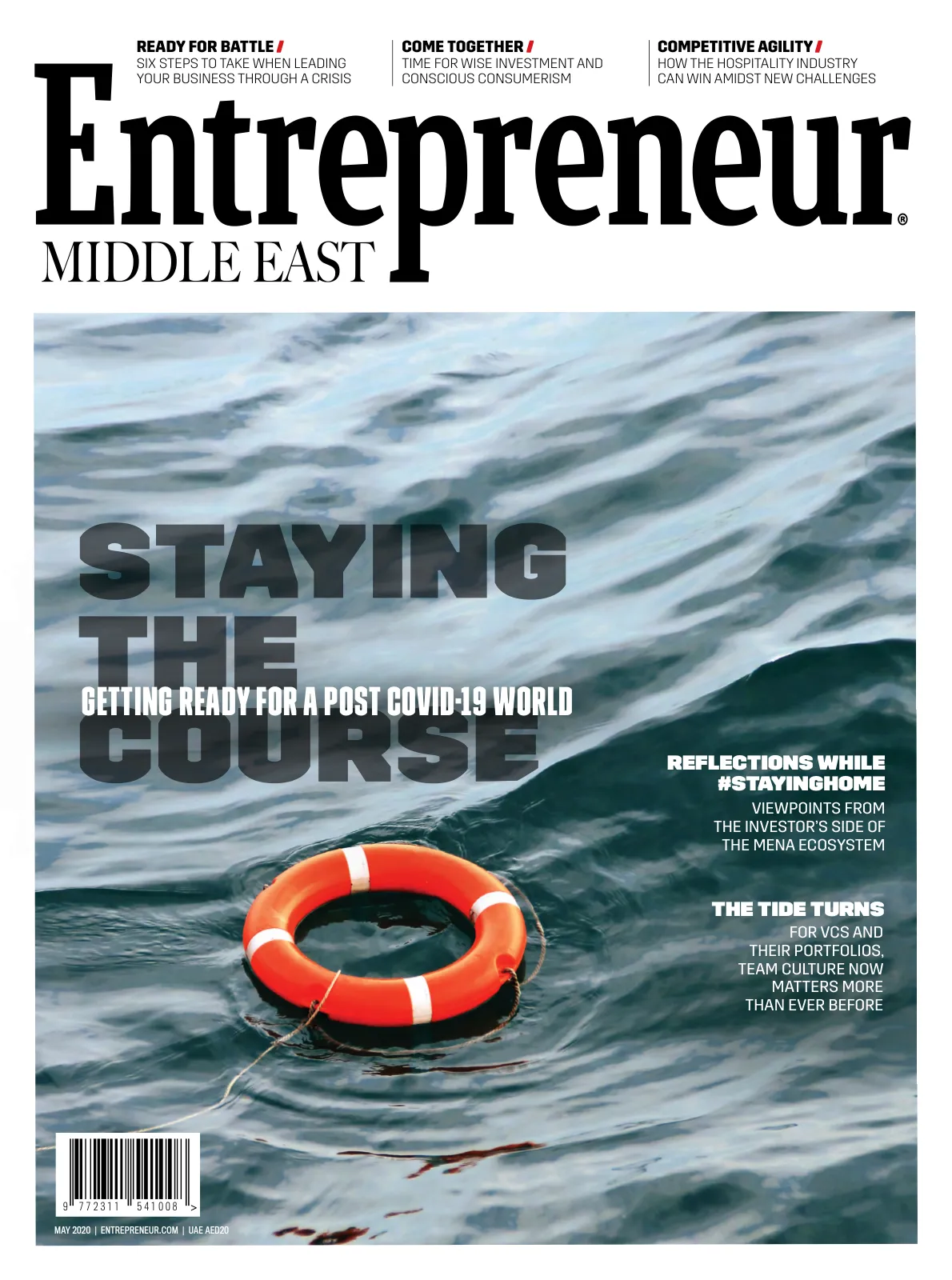
Entrepreneur Middle East, May 2020
Page 1
MAY 2020 | ENTREPRENEUR.COM | UAE AED20
9
7 7 2 3 1 1
5 4 1 0 0 8
>
COMPETITIVE AGILITY
HOW THE HOSPITALITY INDUSTRY
CAN WIN AMIDST NEW CHALLENGES
COME TOGETHER
TIME FOR WISE INVESTMENT AND
CONSCIOUS CONSUMERISM
Getting ready for a post COVID-19 world
REFLECTIONS WHILE
#STAYINGHOME
VIEWPOINTS FROM
THE INVESTOR’S SIDE OF
THE MENA ECOSYSTEM
THE TIDE TURNS
FOR VCS AND
THEIR PORTFOLIOS,
TEAM CULTURE NOW
MATTERS MORE
THAN EVER BEFORE
READY FOR BATTLE
SIX STEPS TO TAKE WHEN LEADING
YOUR BUSINESS THROUGH A CRISIS
Page 2
experience
downtown
living
The UAE’s most exciting new destination.
A journey of discovery for the whole family.
Where nature, fun and entertainment
come together.
800-Arada (27232)
arada.com
Page 3
3
May 2020 / ENTREPRENEUR.COM /
CONTENTS MAY 2020
17
40
Rami Shaar and Jad Halaoui,
co-founders, Washmen
26
‘TREPNOMICS
SKILLSET
A COVID-19 survival kit
for entrepreneurs
Think about what the world
will look after this is over,
and the role you would like
to play in it.
44
MONEY
VENTURE CAPITAL
The tide turns
For VCs and their portfolios,
team culture now matters
more than ever before.
31
‘TREPONOMICS
SKILLSET
A way to cope
As entrepreneurs, it can
certainly help to have a
framework for your business
(and yourselves) to deal with
the COVID-19 crisis, J.K.
Khalil shares a guide.
21
‘TREPONOMICS
SKILLSET
Rising to the occasion
When it comes to doing
business during a crisis,
it’s all about taking action.
22
START IT UP
ECOSYSTEM
Come together
It’s time we support our
communities through
conscious consumerism
and wise investment, says
Kawthar Bin Sulaymen.
33
‘TREPONOMICS
SKILLSET
Riding the wave
Abulla Abu Wasel,
Managing Assosicate
of Wasel & Wasel, gives
four tips to align your
businesses with a post
COVID-19 world.
38
MONEY
VC VIEWPOINT
Reflections while
#StayingHome
The VentureSouq team
shares their viewpoints on
the COVID-19 crisis from
the investor’s side of the
MENA ecosystem.
60
START IT UP
Q&A
Rekindling a love for
Arabic
Little Thinking Minds aims
to remedy a disconnect
from the Arabic language
among youth from the
MENA region.
35 Sony
WH-1000XM3
headphones
The road ahead:
what entrepreneurs need
to keep in mind as they
navigate their startups
through the COVID-19 crisis
Page 4
Page 5
Page 6
Page 7
Page 8
Page 9
Page 10
10 / ENTREPRENEUR.COM / May 2020
SUBSCRIBE
Contact subscriptions@bncpublishing.net to receive
Entrepreneur Middle East every issue
EDITOR IN CHIEF Aby Sam Thomas editor@bncpublishing.net
CEO Wissam Younane wissam@bncpublishing.net
DIRECTOR Rabih Najm rabih@bncpublishing.net
CREATIVE LEAD Odette Kahwagi
MANAGING EDITOR Tamara Pupic
STARTUPS SECTION EDITOR Pamella de Leon
GROUP SALES DIRECTOR – B2B GROUP Joaquim D’Costa
COLUMNIST Tamara Clarke
INTERN Aalia Mehreen Ahmed
PO Box 502511 Dubai, United Arab Emirates
P +971 4 4200 506 | F +971 4 4200 196
For all commercial enquiries related to Entrepreneur Middle East
contact sales@bncpublishing.net
All rights reserved 2020.
Opinions expressed are solely those of the contributors.
Entrepreneur Middle East and all subsidiary publications in the
MENA region are officially licensed exclusively to BNC Publishing
in the MENA region by Entrepreneur Media Inc.
No part of this magazine may be reproduced or transmitted in any
form or by any means without written permission of the publisher.
Printed by United Printing and Publishing
upp.ae
Images used in Entrepreneur Middle East are credited when necessary. Attributed use of
copyrighted images with permission. All images not credited otherwise Shutterstock.
CONTRIBUTORS
entrepreneur.com/me
ACCESS FRESH CONTENT DAILY ON OUR WEBSITE!
MIDDLE EAST
EntMagazineME
@EntMagazineME
Entrepreneur-me
EntrepreneurMiddleEast
EntMagazineME
EntMagazineME
EntMagazineME
MIDDLE EAST
In addition to our print edition, we’re bringing
you all sorts of industry news on our web
mediums. Joining us online means getting
relevant business and startup content in
real-time, so you’re hearing about the latest
developments as soon as we do. We’re looking
forward to interacting with our readers on all of
our social media and web platforms- like any
thriving business, we’re looking to give and take.
#TrepTalkME is already happening on all of our
digi platforms, and all good conversations go
both ways. See you on the web!
Abdulla Abu Wasel
Ahmed Al Akber
Nabra Al Busaidi
Amna Al Haddad
Abdul Wahab Al-Halabi
Areije Al Shakar
Kawthar Bin Sulayem
Raffaella Campagnoli
Fida Chaaban
Tamara Clarke
Reim El Houni
Mahmoud El Khoja
Maan Eshgi
Sonia Gokhale
Suneel Gokhale
Lachlan Jackson
Omar Jackson
J.K. Khalil
Ruchir Punjabi
Tammer Qaddumi
Sonia Weymuller
Page 11
Ready to get
rewarded?
Join Radisson Rewards
for exclusive benefits
We can’t wait to welcome you as a member across our
six hotel brands and 1,100+ locations worldwide. Thank
you for choosing Radisson Hotels.
Award Nights
Use your points for stays - it’s that simple!
Members Only Rate
Save up to 10% when you book on
radissonhotels.com/rewards
More benefits
Including savings of up to 20% on food and
beverages, room upgrades for Elite members
and more
Join today at the front desk
or on radissonhotels.com/rewards
Page 12
12 / ENTREPRENEUR.COM / May 2020
46
CONTENTS MAY 2020
How the hotel industry can
win amidst new challenges
58 Salah El-Din, co-founder and CEO, Vexls
18
‘TREPONOMICS
SKILLSET
Ready for battle
Lachlan Jackson on what
he learned through the
2008 global financial crisis,
and the six steps to shield
your business from the
COVID-19 impact.
50
CULTURE
LIFE
For the love of books
At a time when we all need
the solidity and structure
that books provide, here’s
a tribute to a group of
committed professionals
who have given us that
much-needed avenue of
escape.
24
‘TREPONOMICS
SKILLSET
Walking the talk
As someone who
made his transition to
entrepreneurship in the
middle of the COVID-19
crisis, Mahmoud El Khoja
shares the seven lessons he
has learned about running
a business through this
period.
17
‘TREPONOMICS
SKILLSET
The road ahead
Nabra Al Busaidi on what
entrepreneurs need to keep
in mind as they navigate
their startups through the
COVID-19 crisis.
30
CULTURE
LIFE
Honor your pace in life
Olympic weightlifter and
writer Amna Al Haddad
reminds us to embrace
moments of productivity and
achievements, but to also not
feel guilty if you want to take
it slow during this period.
46
‘TREPONOMICS
PRO
Competitive agility
LIRA Strategy Partners
founder Raffaella
Campagnoli lists winning
strategies for the hotel
industry.
28
‘TREPONOMICS
PRO
Rewired and ready
Ruchir Punjabi, co-founder
and Chief Digital Officer of
Distributed Energy, looks
at how your business can
survive the COVID-19 crisis
(and then thrive after it).
27
‘TREPNOMICS
SKILLSET
Getting through
the COVID-19 crisis
Omar Jackson on having the
right mindset to overcome
any obstacle.
14
EDITOR’S NOTE
By Aby Sam Thomas
58
START IT UP
Q&A
Design made easy
Egypt startup Vexls
develops a platform to
boost design businesses
for the Arabic-speaking
audience.
62
‘TREPONOMICS
MARKETING
From consumer to creator
Reim El Houni looks at
the three reasons why
now is the best time to
double down on your video
marketing plan.
Page 13
Page 14
14 / ENTREPRENEUR.COM / May 2020
EDITOR'S NOTE
Thoughts on the road ahead as a business ecosystem
TAKE THE RIGHT STEPS FORWARD
I
usually use this space for
my editor’s note, but this
time, I’ve decided to put
together my ruminations
on an ongoing issue in the
UAE business ecosystem-
after all, the current roil-
ing marketplace has got us
all thinking.
It was in late March when I
got introduced to entrepreneur
Sheikha Al Mheiri, founder of
Make A Difference (MAD) Invest-
ments- it’s a hospitality venture
based in the UAE that is behind
concepts like Society Café &
Lounge and Toplum in Dubai. At
the time, the pandemic had made
its impact severely felt in the
country, with the government-
imposed complete lockdown
adversely affecting our lives and
our businesses. And this was espe-
cially evident for those working in
the country’s F&B sector.
Restaurants weren’t allowed to
operate, so the sole source of reve-
nue stemmed from delivery orders
made by people like you and me,
who, more often than not, used
food delivery aggregator apps like
Talabat, Deliveroo, Zomato, and
others of their ilk, to choose where
we got some (or all) of our meals
from on a day-to-day basis. The
online delivery companies work
on a commission-based model,
with their fees reportedly going up
to 35% per order. This was sort
of accepted as a norm in the days
prior to the COVID-19 crisis, but
Al Mheiri believed that the current
dynamics of the world did not jus-
tify such rates anymore. After all,
even as these apps were enjoying a
surge in demand and popularity in
the UAE, the country’s restaurants
were struggling to survive on a
delivery-only business model.
That is why Al Mheiri, along with
some of her peers in the country’s
F&B sector, launched the CAP@10
campaign, which was essentially
a plea to delivery aggregators to
cap their commissions at 10% for
the duration of this crisis. “This
initiative of CAP@10 is neither
a permanent campaign, nor an
absurd attempt to break the bank
for these delivery aggregators,”
Al Mheiri wrote, in a piece for
Entrepreneur.com. “In essence,
what they give up in reduced com-
mission, they are sure to make it
up through a heightened demand
for their services. Looking at it
from a different angle, it’s a basic
call for these entities to be socially
responsible, and to take their fair
share in supporting the F&B in-
dustry period in these unpredict-
able and hard times.”
Al Mheiri’s call found itself
echoed by several other operators
in the UAE’s F&B domain, but the
response from delivery aggregators
was largely in the negative. Talabat
and Zomato (both are owned by
the same company) said that they
couldn’t cut commissions -even on
a temporary basis- as that would
compromise their own survival as
businesses. After all, they have to
take care of expenses of their own,
be in terms of employee salaries or
infrastructure costs, and, as Tala-
bat CEO Tomaso Rodriguez said in
a report on The National, “asking
businesses to voluntarily decrease
their revenues by over 60% in
support of other businesses in
that supply chain does not make
business sense; it simply shifts the
problem to a different part of the
supply chain.”
Now, as much as I sympathize
with restaurant owners like Al
Mheiri, there is definitely truth to
what Rodriguez has stated: deliv-
ery aggregators are businesses too.
And as much as it might be easy to
portray apps like them as villains
in the current business landscape,
they were never here to be the
saviors of the F&B sector, and as
such, one cannot fault them for
their efforts to make money. And,
to be fair to them, I’ve had off-the-
Page 15
Aby Sam Thomas
Editor in Chief
@thisisaby
aby@bncpublishing.net
TAKE THE RIGHT STEPS FORWARD
"WE ARE ALL BUSINESSES ACTING WITHIN A LARGER
ECOSYSTEM, AND AS SUCH, AN “EVERY MAN FOR
HIMSELF” MENTALITY IS CERTAINLY NOT GOING TO
WORK OUT FOR ANY OF US. YES, TIMES ARE TOUGH,
AND YES, EACH ONE OF US CAN POINT TO SOMEONE
ELSE WHO WE THINK SHOULD BE DOING MORE TO
BOLSTER THE BUSINESS LANDSCAPE- BUT HAVE
WE OURSELVES EXHAUSTED EVERY OPTION IN OUR
ARSENAL TO DO JUST THAT?"
record conversations about how
delivery aggregators have, in their
own way, supported F&B busi-
nesses through this crisis- indeed,
Aegis Hospitality founder Samer
Hamadeh declared on a Twitter
thread that “Deliveroo actually
saved us through the shutdown.”
So, when one takes into consider-
ation all of these different factors,
it’s hard to paint this whole situ-
ation with a broad brush, and I’ve
personally found it difficult to side
with one party over the other.
Having said that, we are all
businesses acting within a larger
ecosystem, and as such, an “every
man for himself” mentality is
certainly not going to work out for
any of us. Yes, times are tough, and
yes, each one of us can point to
someone else who we think should
be doing more to bolster the
business landscape- but have we
ourselves exhausted every option
in our arsenal to do just that? If
you can answer “yes” to that, then,
great, more power to you, let’s just
wait for time to be the judge of
your actions in the long run, and
my only request to you would be
to make sure you communicate
all of what you are doing to your
counterparts in the ecosystem.
However, if the aforementioned is
something you cannot confidently
attest to, then I’d suggest working
on making sure you have put your-
self on the right side of history
when this period is recounted in
the future.
And this is the sentiment I felt
from Al Mheiri when I touched
base with her recently to hear her
thoughts on the statements made
by delivery aggregators. “As with
all businesses, no one has had the
privilege of a warning notice of
the COVID-19 pandemic and its
resulting impact on revenues,” Al
Mheiri told me via e-mail. “During
these unprecedented times, it’s a
question of whether organizations
will be humanizing and supporting
each other, rather than seeing it as
an opportunity to capitalize on the
misfortune of others. As a delivery
aggregator, you have a choice to
decide how you want to come out
of this pandemic at the end- so-
cially responsible, or marginalized
and outdated… I understand and
appreciate that delivery aggrega-
tors have costs like any other busi-
ness, but during the current time,
they cannot have usual business
strategies and maintain the same
margins, while other industry
players (restaurants) fight for
survival.”
“There has to be a better balance
between aggregators and brick-
and-mortar operators,” Al Mheiri
continued. “In the current sce-
nario, their platform is the main
source of income to the operator,
instead of being an added source.
I believe the model between ag-
gregators and operators should be
reviewed and readjusted, where
aggregators supplement revenue
generation of outlets, rather
than compete with them on their
revenue. As the main lifeline for
many F&B businesses, they need
to level their advantage to serve
the community and ecosystem
they operate in. Be open to change
and adaptation like all other
businesses. Come down from the
position of monopoly, and share
the impact, rather than play the
upper hand. Eventually, disruption
is imminent, and F&B outlets will
definitely unite with supportive
stakeholders, who will ensure the
delivery aggregator business model
becomes quickly extinct.”
I had stated last month that
over the course of the coronavirus
pandemic, as professionals in the
business domain, all of us need
to remember that our behaviors
today will have ramifications
tomorrow, and if Al Mheiri’s words
are any indication, then I believe
that remains a critical thing to
keep in mind as we move into the
next stage of this crisis, regardless
of whether we work in the F&B
domain or not.
I also welcome the business com-
munity to get in touch with me to
discuss this. Send me an email; I
want to hear your opinions. Sure,
the road ahead remains unclear,
but I want to make sure that we
are all at least taking the right
steps forward- that, in effect, is
what is going to keep us going, no
matter what.
Page 16
‘TREPONOMICS PRO
Getting ready for a post COVID-19 world
16 / ENTREPRENEUR.COM / May 2020
Page 17
17
May 2020 / ENTREPRENEUR.COM /
‘TREPONOMICS PRO
What entrepreneurs need to keep in mind as they navigate
their startups through the COVID-19 crisis by NABRA AL BUSAIDI
The road ahead
Nabra Al Busaidi is the Executive Director of Young Arab Leaders (YAL). Her professional experience includes working in HSBC as a legal advisor
to the Board of Directors and Senior Management. Nabra received her bachelor’s degree in Commercial Law and her master’s in Mergers &
Acquisition from the University of Law London. Nabra is passionate about empowering the youth in the Arab world- she is an active mentor
to entrepreneurs in MIT, and she’s also a judge in several startup competitions across the GCC and Europe. Nabra believes that YAL is vital for
educating and empowering the next generation of leaders in the Arab world by turning innovative business ideas into a reality. yaleaders.org
1/ Forget about raising funds
Angel investors may continue to invest,
but expect this to be done at smaller
rounds, lower evaluations, and in start
ups that may not require large amounts
of capital. While venture capitalists
and angel investors might have the
cash to invest, the crisis will trigger a
triage mode where investments will be
made into selective companies. If the
COVID-19 crisis comes to an end soon,
startups will still have to add a few
months of minimal investments before
they can get back on their feet. I firmly
believe that startups must communi
cate with their investors and employees
and provide transparency about the
true impact on the business. Honesty
will get you the visibility you need to
survive.
2/ Cash-in and survive
Startups generally disappear because
they run out of financiers- not ideas.
With that said, businesses must have
an aggressive plan in place early on how
to conserve capital. Even if the crisis is
resolved, the chaos left in its wake may
continue. It is time to put aside all the
plans to scale and rethink all of that,
as none of this will matter if you don’t
survive. Have an extensive contingency
plan around your budget and projec
tions- you are now in survival mode.
3/ Yes, surviving is the most important
thing
Many startups will have to stick to the
bare minimum and essentials. Salaries
may need to be revised for the company
to survive, and also cut marketing
and sales spending in half until your
customers are back at work and able to
consume again. Any cuts you make now
will have a lasting impact on the cash
balance later.
4/ Stay open to new opportunities
If you can think of ways to shift some
aspects of your business to contribute
to combating COVID-19 or even helping
people deal with the current situation,
then prepare yourself to do so. Despite
the crisis, there are still some oppor
tunities, especially for businesses that
sell products and services directly to
consumers. If you are selling something
that will make their lives easier during
this difficult time, then these are new
opportunities for you. Equally, any
product or service that makes working
from home easier will have a ready
market.
5/ Reflect
It is hard to know how the country
and the market will look like in a few
months, but if you allow your startup to
remain resilient in such difficult times,
then there will be great opportunities. It
is time to find your silver lining- at the
end of the day, you are the most impor
tant asset you need to readjust and con
tinue building your dream business.
T
he COVID-19 pandemic is creating a global economic
effect on the financial market, meaning that the human
and societal impact of this outbreak will be extreme,
even though we may still be only at the early stage of
this crisis. For startups, this will be a particularly difficult time,
although some say that great companies are often created
during market downturns. But of course, this is easier said
than done- here are my thoughts on what entrepreneurs
need to keep in mind during this period:
Page 18
18 / ENTREPRENEUR.COM / May 2020
Six steps to take when leading your business through a crisis
by LACHLAN JACKSON
READY FOR BATTLE
‘TREPONOMICS SKILLSET
18 / ENTREPRENEUR.COM / May 2020
Page 19
19
May 2020 / ENTREPRENEUR.COM /
READY FOR BATTLE | SIX STEPS TO TAKE WHEN LEADING YOUR BUSINESS THROUGH A CRISIS
This is war.
DON’T HESITATE WITH MAKING DECISIONS
TO SAFEGUARD YOUR BUSINESS. NOW
IS THE TIME TO PUT A FREEZE ON ALL
DISCRETIONARY SPENDING. SPEAK TO
YOUR SUPPLIERS ABOUT DISCOUNTS
OR PAYMENT DEFERRALS. REVIEW
YOUR MARKETING AND RESEARCH AND
DEVELOPMENT SPEND.
>>>
Forget 2019. Forget 2018. In
fact, forget every leadership
lesson you’ve learned in the
past 10 years, because the
person leading the company
then was a different person to
the one who needs to lead the
company now.
The old you was a peacetime
leader who was encouraged
to take a big picture view, to
focus on the long-term, to de-
velop the team, and to put in
place systems and processes to
ensure the company operates
seamlessly. This is great when
things are moving along at a
consistent pace, and you have
an idea about what tomor-
row holds- but that approach
won’t work today.
The new you needs to be
a wartime leader, to have a
sense of urgency, and to be
able to make decisions quickly
and decisively. At the same
time, you need to be adaptable
to a constantly changing sce-
nario, and be willing to change
direction should new informa-
tion come in.
Today, it is all about survival,
and to survive, you need to
know your business inside and
out. If you’ve built a strong
team and culture, and built
systems and processes inside
the company during the good
times, then you’ll be happily
reaping the rewards now. If
you haven’t, then it doesn’t
matter, because it’s too late to
worry about it now.
If you were fortunate (or
unfortunate) enough to have
been leading your company
through the 2008/2009 global
financial crisis, then now is
time to dust off your play-
book, and consider what you
learned back then (and have
probably forgotten since).
For those of you who haven’t
had the pleasure of lead-
ing through a crisis, the tips
below may be of help:
1/ ACT NOW
Regardless of your view of
the situation, or how bad
the impact has been on your
business so far, unless you’re
one of the lucky few busi-
nesses that are thriving off
this situation, you can pretty
much guarantee it’s going to
be tough. In fact, it’s going to
be tougher than you can even
imagine, so don’t hesitate
with making decisions to
safeguard your business. Now
is the time to put a freeze on
all discretionary spending.
Speak to your suppliers about
discounts or payment defer-
rals. Review your marketing
and research and develop-
ment spend. I don’t agree with
cutting or reducing the latter
“strategic” spend for many
businesses as this is an invest-
ment, but it is worth seeing if
some elements can be deferred
so long as they don’t impact
your revenue-generating capa-
bilities. The actions you take
here are the easy low-hanging
fruit, so to speak, but if you
cut your unnecessary expenses
now, you won’t regret it later.
2/ MAKE FORECASTS,
NOT PREDICTIONS
No one knows how bad or how
long this will last, and you
need to be at one with this un-
certainty. That doesn’t mean
you should be indecisive. You
should plan for the worst, and
hope for the best. Plan on this
crisis to last for a minimum of
three months, but then rolling
into summer, so assume it will
be six months before business
starts to return to normal. Run
the following three forecast
scenarios on your cashflow.
Scenario 1 If all your revenue
stopped now, and no one paid
you, but you maintained your
outgoings, how long can you
survive on what’s in the bank
alone?
Scenario 2 If all your revenue
stopped now, your receivables
continued to come in, and you
maintain the same outgoings,
how long can you survive?
Scenario 3 If all your revenue
stopped now, your receivables
continued to come in, and you
reduced your outgoings, how
long can you survive?
These should lay out some
fairly bleak base level sce-
narios for you to help guide
decisions. Then, you can
move onto revenue forecasts.
Assume the revenue you’re
bringing in now is what you
can expect for the next six
months, or even that it will
decline further. How does this
change your scenarios? Then,
create a plan for each sce-
nario for how aggressively you
should respond to each, and
create set trigger levels to pull
the lever for each scenario.
These plans may involve
headcount reductions,
paid/unpaid vacations, or
implementing pay deferrals- I
am an advocate of a deferral
rather than an outright cut,
as it leaves your team with an
element of hope as well as an
opportunity to band together
to have the opportunity to
ensure it’s not lost. The point
here is to plan for the worst,
so you have a clear plan to
take immediate action on.
You’ll continually update
these models with latest
information, but you don’t
need to revisit the decisions
again and again– just the
timing and severity of them.
3/ DISTINGUISH BETWEEN
CASH VERSUS REVENUE
Make a clear distinction
between actions you need to
take to protect your cashflow,
which is the lifeblood of the
company, and actions you take
to generate revenue. Yes, your
core focus is to ensure the
company lives to fight another
day, but if the moves you make
put you out of the game from
the start, and kill your reve-
nue-generating capacity, you
may as well pack it up now.
Likewise, if you start aggres-
sively discounting and extend-
ing credit to drive revenue,
you may well accelerate your
demise. Whilst revenue is
Page 20
20 / ENTREPRENEUR.COM / May 2020
Lachlan Jackson is the co-founder and Director at Ecocoast, a company that develops solutions for sustainable coastal and marine development.
He is an active member of the UAE Chapter of Entrepreneurs Organization.
‘TREPONOMICS SKILLSET
IT’S EASY TO LEAD IN THE GOOD TIMES; IT’S
MUCH HARDER TO LEAD IN THE BAD TIMES.
BUT IT’S MOST CERTAINLY MORE REWARDING,
AND IT WILL BUILD GREATER CHARACTER AND
RESILIENCE THAN YOU EVER KNEW YOU HAD.
Lachlan Jackso,
co-founder and Director,
Ecocoast
important, cash is even more
important, so look at your
operations, in particular, your
balance sheet, and try to find
hidden sources of cash that
might be locked up in inven-
tory or assets that can be
freed up to keep the company
running. Do you have surplus
stock that you’ve sat on for
years? Now might be the time
to liquidate it, because that
cash is worth more than hav-
ing a warehouse full of unsold
goods. What other levers can
you pull to ensure you win the
biggest share of a smaller pie?
4/ WORK ON YOUR INTERNAL
COMMUNICATIONS
Communicate confidently and
frequently. Your team is wor-
ried, for their health, for their
jobs, for their families. Silence
breeds uncertainty, so don’t
let them fill the void with
guesses– keep the informa-
tion flow coming, even if it’s
just to provide assurance that
you’re not sticking your head
in the sand. They’re all look-
ing to you for guidance and
assurance, and now is when
you need to be out the front
with your team. This is hard
enough when you’re physically
there, but much harder when
you’re all working from home.
Get on Zoom calls weekly, if
not daily, with your team, and
make sure they’re okay and
focused. If you follow agile/
scrum methodologies, your
daily huddle with the team
will help maintain focus and
velocity within the team,
even if you’re not physically
together.
5/ REMEMBER YOUR
BUSINESS IS STILL ALL ABOUT
YOUR CUSTOMERS, NOT YOU
Many companies are focused
on sending or posting generic
messages that are essentially
no more than a company policy
on how they’re handling the
crisis. Or they’re beating
on the same door, with the
same products, in the same
way they have always done.
Before going down the path of
yet another generic mail that
isn’t particularly relevant to
anyone, or another sales call
to chase down revenue, put
yourself in the customer’s
shoes. Why would they care
about your call? What are they
going through? How can you
help them through this now,
or when things open back up
again? What makes your com-
munication any different from
the hundreds of others they’re
receiving? Put yourself in their
shoes, understand what they
need, and how you can support
them, regardless of whether
there is any immediate finan-
cial benefit. The customers you
help and respect during this
time will be the ones that help
you come out of this on top.
6/ LOOK TO THE FUTURE
This crisis will pass, and
the companies that survive
will come out the other side
stronger, leaner, and more
efficient than they were going
into it. In every crisis, there’s
opportunity, and if you’ve got
on top of the aforementioned
five areas, now, you can take
a moment to step back from
the battlefield, and look for
opportunities. Are there op-
portunities to gain market
share, or take out a competitor
who runs less efficiently than
you? Is there a new busi-
ness model that you can turn
towards- new product lines, or
sources of revenue to diver-
sify? If you’ve taken the steps
to protect the downside, you
may have a war chest that can
be deployed to acquire strug-
gling businesses coming out
the back of this. Remember, in
all wars, there’s profit.
Above all, through this pe-
riod, maintain your positivity,
and treat this as an opportu-
nity to prove to yourself what
you can achieve. It’s easy to
lead in the good times; it’s
much harder to lead in the bad
times. But it’s most certainly
more rewarding, and it will
build greater character and
resilience than you ever knew
you had. And when things do
turn around, and business re-
turns –whenever that is– any
future crisis will pale in com-
parison. So, when the good
times return and you have to
swap your battle helmet for
your baseball cap again, don’t
forget to file your notes from
this current period- after all,
remember that the wartime
leader can well be called on
again in the future, and when
they do, you’ll be ready.
Page 21
21
May 2020 / ENTREPRENEUR.COM /
Ahmed Al Akber is the co-founder and CEO of Hello Chef, a meal delivery service that provides recipes and ingredients and makes it easy
for people to cook their own delicious meals at home. hellochef.me
RISING TO
THE OCCASION
WHEN IT COMES TO
DOING BUSINESS
DURING A CRISIS, IT’S
ALL ABOUT TAKING
ACTION by AHMED AL AKBER
‘TREPONOMICS PRO
>>>
A
s it so happens,
I’ve been hun-
kered down in my
own extreme form
of mental self-
isolation. This
version involves
a world of uncertainty and
anxiety. What if one of my staff
catch the virus and dies? What
if I catch it? What if roads are
closed and my logistics pro-
vider can’t deliver anymore?
What if my key suppliers can’t
fulfil our orders?
Perhaps I’ve been watching
way too much news, or per-
haps I’m feeling what most
entrepreneurs have been feel-
ing lately. Luckily, some of the
time I spent in worry has paid
off in the form of execution.
When it comes to a crisis,
speed and tactics matter more
than anything. When the rug
gets pulled under your feet,
reaction times can spell the
difference between a bruised
elbow and a concussion.
Once we knew how big this
pandemic was getting, we got
our core team members to-
gether to assess the severity
of the situation, and what it
could mean to them and the
business. We had very few an-
swers, but once we got talking,
we started identifying risks
and developing ideas on how
to get things done quickly.
For example, much of our
operations staff was living in
various parts of Dubai, and we
saw the potential risk of catch-
ing the virus on a bus or the
metro on the way to work. As
such, we engaged with the op-
erations staff, and asked them
if they would be willing to re-
locate to a building next door
to our site. The landlord of the
building offered a good deal
as we were renting a bunch of
apartments from him in a sin-
gle exchange.
100% of my operations staff
accepted, and they were re-
located within a week. With
work now being a five-minute
walk from home, staff get to
Page 22
22 / ENTREPRENEUR.COM / May 2020
ONE THING WE WERE PROUD OF
WAS THE QUICK IMPLEMENTATION
OF NO-CONTACT DELIVERY, A
METHOD WHICH INVOLVES NO
DIRECT FORMS OF PHYSICAL
CONTACT BETWEEN OUR
CUSTOMERS AND THE DELIVERY
DRIVERS.
‘TREPONOMICS PRO
It’s time we support our communities
through conscious consumerism and wise
investment by KAWTHAR BIN SULAYEM
Come together
A
s we find ourselves in the
midst of the COVID-19
pandemic, many of us
are in situations -social,
mental, physical, or fi-
nancial- that we’ve never
experienced before. It can
be daunting, especially
if we find ourselves in a situation where
individuals are only committed to helping
themselves, which is only human nature,
but rather unfortunate as well.
However, even during such troublesome
times, we have the ability to work collec-
tively together to negate the possibilities
of our fellow community members becom-
ing vulnerable. We now have the time to
self-reflect and evaluate what we can do to
not only improve our personal situation,
but also how we can help strengthen our
community during these difficult times.
It’s abundantly clear that this pandemic
has severely impacted global economies,
adding financial stress to most everyone’s
lives. Fiscal policies and government aid
alone cannot give us back everything we’ve
lost, or relieve us from this stress. As an
owner of several small businesses, I have
a serious responsibility to not only do my
part to support the local economy, but
also support my team and their family
members. In times like these, we need to
pull together as a community and do the
utmost for those in need. We must not
forget those who need us the most, our
essential workers and high-risk individu-
als such as the elderly, the homeless, those
with pre-existing conditions, and low-
income households.
However, sometimes in rare cases such
as these, the only power we’re left with is
our consumer power. We can still dictate
the market and help shape the economic
landscape of our local economy. We can
pull together and assist those that may
be economically vulnerable. Small busi-
ness owners, startups, tradespeople, and
professionals in specialist sectors can lose
everything in a short period of time. Small
businesses may not be the first thing to
spring to mind when evaluating vulner-
ability, but in the current economic cli-
mate, they certainly are.
Collectively, our consumerism holds
so much power that when we cannot
spend, these businesses cannot survive.
With these economic implications, it’s
extremely important that we support lo-
cal businesses. It’s also very important in
times like these to learn how to trust our
SME sector. After all, look at the SMEs
that are currently working extra hours to
pocket their transportation allowance,
which they appreciated. I also inadvert-
ently solved a bunch of staff logistical is-
sues that used to slow us down.
Our office staff had to make changes too.
By working from home on a moment’s
notice, we had to quickly figure out the
efficacy of each communication channel
relative to the urgency of each message.
We reviewed all medical insurance poli-
cies and re-communicated what to do
should someone have symptoms.
We spoke to staff who were juggling
working from home with homeschooling
their kids to see how we could accommo-
date work hours around that. Our quar-
terly meeting, usually a day-long retreat at
a decent hotel with a group of staff, had to
be adapted to be done over video calls.
Our customers also expected us to act
fast too. They wanted to know what we
were doing to mitigate their risk, and
rightly so.
Once the plans were laid out, we started
communicating with customers about
what we were getting done, ensuring
we followed through on every step. One
thing we were proud of was the quick
implementation of no-contact delivery, a
method which involves no direct forms of
physical contact between our customers
and the delivery drivers.
With the crisis still not at its apex, it’s
safe to say that the definition of risk is
a moving target. We may have surprises
around the corner. But taking action has
helped ease much of the stress.
Processes that once worked fine have
been broken down and completely rebuilt
to thwart the invisible enemy. People have
needed to be trained and retrained. In
some ways, we’ve blown money by over-
investing in things we probably won’t need
once the worst is behind us.
To some level, doing all this has been
painful, but there is a silver lining: this
pandemic has given me a crash course on
risk mitigation. And that’s something that
will stay with me for the rest of my career.
Page 23
23
May 2020 / ENTREPRENEUR.COM /
NOW IS THE TIME TO ACT
STRATEGICALLY WITH YOUR
ECONOMIC INFLUENCE.
ENSURE YOUR ESSENTIAL
ITEMS ARE BOUGHT WITH
THOUGHT. THIS IS ALSO THE
TIME FOR LOCAL AND FEDERAL
GOVERNMENT ENTITIES TO
INCREASE THEIR SUPPORT
AND COLLABORATION WITH
THE SME SECTOR.
Kawthar Bin Sulayem is a strategical advisor, entrepreneur, and CEO of KBS Communications.
COME TOGETHER | CONSCIOUS CONSUMERISM AND WISE INVESTMENT
keep their business afloat and
alive- they cannot afford to
just stop working and wait the
situation out like larger organi-
zations can.
We need to appreciate the
integral role that SMEs play,
both socially and economically.
They are part of the fabric of
our society that contributes
towards our thriving economic
ecosystem and they help to
-especially in these times-
provide a sense of community.
Even now there are many ex-
amples of small businesses,
whether they be cafes, restau-
rants, or any other essential
business, offering special
discounts and free-items to
our medical personnel and es-
sential workers.
This is a stark reminder that
we cannot afford to not be
conscious consumers. Now is
the time to act strategically
with your economic influence.
Ensure your essential items
are bought with thought. This
is also the time for local and
federal government entities
to increase their support and
collaboration with the SME
sector.
Another element we must
consider when trying to pro-
vide support for our most vul-
nerable people is wise invest-
ment into our most important
asset, the healthcare sector.
The COVID-19 pandemic has
shown that sometimes unfore-
seen and unpredictable ele-
ments can heavily impact our
day-to-day lives. This doesn’t
only mean investing only in the
existing healthcare require-
ments, but all the new innova-
tive and technological medical
solutions that are being devel-
oped, or in the process of de-
velopment, by our local SMEs
and inventors.
I believe that a healthcare
system that has been suffi-
ciently invested into, and has
been managed in a balance
between the private and public
sector, can be one of the most
efficient ways to look after all
communities, and in fact, stops
potentially vulnerable people
from becoming vulnerable.
When a society has read-
ily available healthcare and a
system in place where it can
serve people in need, it truly
protects people more than
any service. It’s clear that the
most important thing that
shapes economics and politics,
especially in these times, is
healthcare. It doesn’t mat-
ter how enormous and strong
your economy is, or what the
politics of your nation is, in
real times of need, we will be
reliant on how much emphasis
was put into the strengthening
of our healthcare systems.
For example, in the UAE,
the utmost has been done to
ensure that the most vulner-
able people have access to
tests, supplies, and essential
medical treatment. But this
has only been possible due to
the long-term investment of
healthcare in the country. As
per the UAE National Agenda,
the country has been collabo-
ratively working with stake-
holders all over the world to
make sure that our healthcare
sector is as strong as any other
thriving sector. Collaboration
and transparency between the
government, healthcare profes-
sionals, and the community
itself is what has created the
infrastructure needed for effec-
tively battling this virus.
Furthermore, the UAE has
exampled how this global
pandemic should be combat-
ted on all fronts of the globe;
that means supporting other
nations to help eliminate the
worldwide threat. There’s no
benefit to isolated efforts and
keeping the hardship internal.
With this as their ethos, the
UAE has sent supplies to over
20 different countries so far,
with the objective of reducing
the threat of the virus globally,
and not just putting all the fo-
cus on themselves.
If a nation is in the position
to optimally manage their
resources, they can show true
leadership by sharing their
experiences, knowledge, and
resources with other nations.
This isn’t just an act of noble
humanitarian action, but a
great example of real diplo-
macy and investments between
nations.
Page 24
24 / ENTREPRENEUR.COM / May 2020
‘TREPONOMICS SKILLSET
A
few months ago, I decided to quit my cushy job in a multinational
corporation and take destiny into my own hands, leaving petty
office politics behind. I went from having someone to answer to,
to being someone to answer to. I chose to live a life of financial
uncertainties and become an entrepreneur. But on top of all the stressful
collateral in which this life-changing decision entails, the COVID-19 virus
decided to make its entry to the world stage at almost the same time.
Seven lessons learned while transitioning into entrepreneurship
in the middle of the COVID-19 crisis by MAHMOUD EL KHOJA
WALKING THE TALK
Page 25
25
May 2020 / ENTREPRENEUR.COM /
WALKING THE TALK | SEVEN LESSONS LEARNED WHILE TRANSITIONING INTO ENTREPRENEURSHIP IN THE MIDDLE OF THE COVID-19 CRISIS
Mahmoud El Khoja, an active member of Young Arab Leaders, co-founded and is currently leading several new companies such as BioBox, an
online healthy-only groceries platform; MyHealthyOffice, a pantry management and office wellness outfit both in the UAE; Frost, a quality frozen
food retail chain in Egypt, and ELK Phoenicia Group, a family partnership with diverse interests. He is also the volunteer CFO and Strategy Lead
of Cura, an international medical NGO based in Oklahoma. His previous 15 years were spent in eight countries and various regional roles with
multinationals like Schneider Electric, L’Oréal and Bain & Company. His functional experience spans marketing, strategy and digital transformation. Mahmoud
holds an MBA from INSEAD and a B.A. in Economics from the American University of Beirut. He currently resides in Dubai with his family.
LISTEN TO YOUR TEAM, BE PRESENT,
EVEN REMOTELY. EMPOWER THEM
TO SUGGEST SOLUTIONS TO CRISIS-
INDUCED PROBLEMS.
The crisis the coronavirus
pandemic created naturally
flattened all the assumptions
and inputs I had in my model.
While we are still at an early
stage in the fight against
this disease (and in my new
journey), I was still able to
unearth a few principles that
are keeping me and my sanity
going. I didn’t plan them, and
some of them came with luck,
but who knows, they might
benefit some of you in these
challenging times:
1/ Make sure your personal
life is in order
If you’re an early-stage en-
trepreneur, it’s very hard to
separate your business from
your personal life. But this
is exactly what you have to
be thinking about early on,
otherwise your mind will
always be distracted by the
well-being of your family. Cre-
ate a comfortable cushion to
fall back on. Try not to put
your own money into all your
ventures. Think: if everything
fails right now, will my family
be ok? And for how long?
2/ Diversify early on
While planning my move to
entrepreneurship, I decided
to invest in my education.
I wanted to learn as many
things about as many indus-
tries as possible. I’m also a big
proponent of the old adage,
“Don’t put all your eggs in
one basket.” This is why I got
involved, either as an investor
or in a more operational role,
in several unrelated projects
and companies from the very
beginning. This diversification
turned out to be a strong as-
set to tackle the crisis we are
in now.
3/ Have a flexible business
model, and pivot without
regret
While it largely depends on
the level of maturity of your
business, having several ver-
ticals in non-correlated mar-
kets is a great risk-reducing
strategy. I joined as Managing
Partner in one of my ventures
which happened to have a B2B
arm (myhealthyoffice.ae) and
a B2C arm (biobox.ae) in the
process of launch. While the
B2B was the cash cow of the
business, it came to a sudden
halt in the early days of the
COVID-19 crisis. Corporate
clients started to advise their
teams to work remotely. We
immediately shifted all of
our human and financial re-
sources towards accelerating
the launch of our B2C brand
to serve individuals staying at
home. In situations like these,
a strong leader knows how
to pivot the whole organiza-
tion, and take strategic deci-
sions quickly and decisively.
The faster you fail, the faster
you’ll start to succeed.
4/ Don’t be a perfectionist-
except in one thing
We all know the different
stages of bringing a new prod-
uct to market. You go from
a prototype to a minimum
viable product, and so on,
and you test like crazy. This
requires flexibility, and a
fierce lack of perfectionism.
In a time of a crisis, it has
never been more literal, as
you have to navigate stormy
seas infested with sharks with
only one objective: survival.
There’s one topic though
where perfectionism is es-
sential: customer service. It’s
your holy grail, the only thing
over which you should lose
sleep. It’s imperative to listen
to your customers. They will
always remember what you
did for them in bad times, and
they will thank you for it. Bo-
nus point: you don’t need to
be the absolute best- you just
have to be better than your
competition.
5/ Take care of your cash
While common sense dic-
tates to preserve the little
cash you have to weather the
storm, a period of crisis is, for
me, a good time to invest in
long-term opportunities. Be
it increasing your marketing
budget intelligently (as we
did), hiring your next super-
star, or optimizing your opera-
tions. Now the question is,
where do you get the cash flow
in times of decreasing sales?
There are ways to give a life-
line to your working capital.
Just last week, I was able to
obtain a grace period for my
mortgages and car loans, and
I came to an agreement with
some of my suppliers to delay
a few payments. What most
people fail to understand is
that you mostly get what you
want by just asking. I’m a big
fan of asking stupid questions
with near-zero probability of a
positive answer. You’d be sur-
prised of the outcome!
6/ Take care of your team
Your team is your most im-
portant asset, right? But are
you walking the talk? Just as
customer service is essential,
excellent employee service is
just as important. There is no
better way to improve loyalty
and motivation than to show
your worth as a leader during
times of crisis. It’s the most
intelligent investment of your
time and energy. Listen to
your team, be present, even
remotely. Be aware of their
personal problems, whether
financial or otherwise. Em-
power them to suggest solu-
tions to crisis-induced prob-
lems.
7/ Fall in love with what
you do
I’m not talking about your
business idea, because I sure
hope you’re already in love
with that, but I’m talking
about the process. The re-
ally annoying minutia and
random uninteresting steps
you have to go through to
reach execution excellence.
Fall in love with that. It will
save your life. How to do it?
Become a student of life, give
yourself challenges to learn
all the tools that you need. Be
proud of the excel model you
built, even if you didn’t use it
as much as you thought you
would.Be interested in the
details of your supply chain to
find that “eureka” moment to
optimize it. Or take on an ac-
countant hat and find a better
way to manage your invoices-
even if, and especially be-
cause, it’s not your strength.
Love the process.
Page 26
26 / ENTREPRENEUR.COM / May 2020
Think about what the world will look like after this
is over, and what role you would like to play in it
by ABDUL WAHAB AL-HALABI
A COVID-19 survival kit
for entrepreneurs
‘TREPONOMICS SKILLSET
Abdul Wahab Al-Halabi is the Partner at Decker & Halabi, and an owner and investor in several consumer-facing businesses. decker-halabi.com
M
y involvement in entre-
preneurial businesses
in the UAE has been in
the consumer-facing
sector, in industries
like leisure, F&B and
fitness. As everyone
knows, ever since the
coronavirus pandemic hit us, most of
these businesses have gone from making
money to generating almost zero revenue,
across the board, in a matter of weeks.
It is one thing to deal with challenging
business environments, but it’s a totally
different discussion to have when you are
no longer able to operate your enterprise
at all. As such, these are some of the key
thoughts and decisions that have been
on my mind with respect to my entrepre-
neurial ventures:
1/ CASH
As soon as you are in a zero-revenue
situation, then it is all about looking at
how much cash you have in the bank, and
thinking about how long you can last with
it. If you take the decision not to fold your
business, then you have to develop several
scenarios of how long the shutdown will
be for, and what the ramp up will look
like afterwards. In our case, we did just
that, and we also had a very brutal look
at our costs. We stopped all payments
while we did this, and then had very hard
conversations with all of our landlords,
suppliers, and creditors. It’s good to see
that the government has been extremely
supportive, and that has been shown in
the attitudes of lenders. However, in our
industry, leverage isn’t common, and we
do have debt. But, at the end of the day,
the primary objective of this exercise
was to figure out how we could be still
standing on our feet when the fog lifts.
2/ PEOPLE
Consumer-facing businesses like ours
employ a lot of people, mostly lower paid,
and with slim management overhead.
Retaining talent is important; however,
when you are in as hard a situation as we
are now, that has to be ranked alongside
the overall business’ survival. The key
elements we took into account here were
in the following order of priority:
> Consider humanitarian issues Many of
our employees could not go back home,
and we could not afford to keep them.
Ensuring their physical wellbeing is the
first priority, regardless of what happens
to the business.
> Look into repatriation Many employees
come from environments where the cost
of living at home is a lot cheaper than the
UAE, and therefore, a strong effort has
been taken to repatriate team members
back and attempting to allow them
to subsist, at least until the situation
improves and they can be flown back.
> Take a very cold look at corporate costs
We have had to look at our talented
management teams, and consider, on a
case by case basis, who we could retain.
Page 27
27
May 2020 / ENTREPRENEUR.COM /
A COVID-19 SURVIVAL KIT FOR ENTREPRENEURS | THINK ABOUT WHAT THE WORLD WILL LOOK LIKE AFTER THIS IS OVER
Tips from one young entrepreneur to another by OMAR JACKSON
GETTING THROUGH THE COVID-19 CRISIS
Omar Jackson is the founder of OJ Lifestyle and a Partner at Berkeley Assets.
oj-lifestyle.com | berkeley-assets.co
We did this because we were
clear that the bulk of salary
cost is often in this layer, and
that needs to be trimmed to an
absolute minimum.
3/ BUSINESS MODELS
It is sometimes hard to look
at an industry and think what
you can do with it differently
when you are not even allowed
to operate. However, we looked
harder, and we have found that,
bizarrely, a lot of creativity
comes out of need. We have
been able to keep one business
alive in the fitness industry
by completely changing what
it does and how it does it, to
actually generate income to
keep the business alive.
4/ MOTIVATION
It is easy to roll over, and
simply wait for the storm
to pass. But by nature,
entrepreneurs like us just
don’t know how to do that.
However, there are many dark
moments, and it is important
to keep focused, no matter
what the other side looks like.
After all, we exist not just for
ourselves, but a whole array
of stakeholders, including
partners, team members,
investors, and others, and we
need to keep up the good fight.
All of us have read many books
written on grit and resilience,
and now is the time to put all of
that learning into practice.
So, what’s the future going
to look like? I predict that
many business models will
change, and entire sectors in
some industries will not exist
when this is all over. Further,
the ramp up following the end
of this crisis, and people’s
behavior after this period, will
be very different. This will
create numerous opportunities
for investors, and I’m spending
most of my time now thinking
about what the world will look
like after this is over, and what
role I would like to play in it.
A
s we wake up to daily
developments, a continued
lockdown, and economic
uncertainty amid the corona
virus pandemic, many young
entrepreneurs and business leaders are
feeling a sense of unease, and a loss of
direction.
These unprecedented times are creat
ing trials for many, but however testing
they may seem, with those challenges,
come opportunities. As an entrepreneur
myself, I’ve experienced many situations
like these, and I’ve always found myself
having to dig deep and push through.
Here are some tips that can guide you
through this time we find ourselves in,
and to help put you in the right mindset
as well:
1. WORK HARD, AND PLAN TO REBOUND
Regardless of what your current days
under COVID-19 look like, you need to
keep driving forward with your entrepre
neurial spirit. Even though you may have
experienced a temporary reduction in
business, you need to continue to work
hard, and think smart. We don’t know
when we will go back to normal, or even
what the new normal will look like, but
what we do know is that this will pass-
so, are you prepared? Analyze each
scenario now, and plan your rebound
strategy to ensure you’re ready to go.
2. ENSURE EFFECTIVE COMMUNICATION
WITH STAKEHOLDERS Make sure that
you are keeping your staff, clients, and
other key stakeholders updated with
the developments of your business.
It’s important to be transparent as the
situation progresses and changes. A
positive, resilient voice needs to be heard
to inspire confidence, so make sure that
comes from you through all channels,
whether that be a phone call, e-mail, or
social media. People need to be com
forted by others, so lead from the front,
and show strength.
3. KEEP GROWING This is an ideal time to
tackle those things you’ve not had time for. It
could be revisiting systems and processes,
or learning something new. Set up online
training sessions for your team, either as a
refresher, or to learn and develop new skills.
Review how your brand is being presented in
your company collateral; perhaps revise your
website, and update it, or plan some engaging
social media content. Whatever you do, don’t
stagnate- turn some of this negative into a
positive.
4. FUEL YOUR PASSION Many entrepreneurs
have started a business based on something
they really care about, and have a passion
for. This is a core element to success. Aside
from my businesses, I have other passions.
This provides me with a real love for life, and
in times like this, it gives me something other
than work to positively focus on. One of my
main missions is to inspire people to find their
passion, so if you feel you’ve not found yours,
now is the time to think about what it is, or
invest time into it, and I promise you it will help
your mindset. Use this time to slow down, sit
back, reflect and re-focus, get our priorities
straight, and realize what is important to
you and how you really want to live your life.
Rarely do we get this kind of opportunity, and
this amount of time, which is our most pre
cious commodity.
5. DON’T QUIT Whatever you do, don’t quit.
Yes, it’s difficult, and yes, you may feel like
there’s no way through, but this will pass. You
will need to dig deep, and do things differ
ently. Make tough decisions to survive, but
ultimately believe in yourself against all odds.
Work hard, learn always, never quit!
Page 28
28 / ENTREPRENEUR.COM / May 2020
T
here is a popular
meme circulating
these days that asks:
“Who is responsible
for your company’s
digital transformation?”
A. CTO
B. CEO
C. COVID-19
As this joke shows, most
entrepreneurs and busi
nesses are struggling in the
current environment, but
every crisis offers oppor
tunities, and this one is no
different.
Before I go into consid
erations for surviving the
current situation, I want to
talk about self-care. We all
know what the issues are. To
analyze, plan, and get on top
of this, we need to ensure
that we are healthy, safe,
and in a good mind space.
Establish routines, talk to as
many people as possible, and
make the most of the current
situation. Most importantly,
focus on things you can
control.
Empathy and decisiveness
are the two key qualities that
a crisis like the COVID-19
outbreak needs. Your ability
to empathize with people in
your business and your key
relationships will ensure
support and loyalty. Deci
siveness towards survival,
and later investing, will
move the needle forward.
CASH IS EVERYTHING
For entrepreneurs, cash is
everything right now, and
there are seven places where
you can look for cash in your
business: price, volume,
cost of goods sold (COGS),
overheads, accounts receiv
able, inventory, and accounts
payable. It is crucial that you
work out -given your current
revenue and funding (equity
+ debt) availability- your
scenarios, and establish a
path forward to optimizing
cash. Without knowing your
runway, the rest of what I am
about to say falls flat.
I’m involved with a few
boards where we have taken
a position of revenue-centric
spending. Once we have
optimized the expenses and
on top of our cash position,
we have decided to limit
our spending to what will
generate revenue– now or
in the future.
In the now, revenue is
about generating leads
and retaining clients. To
do both, a company needs
a customer relationship
management (CRM) plat
form. If you don’t have one,
spend the time to set one
up cheap, and load it with all
your customer information.
If you don’t have visibility
of your pipeline of clients,
you are operating blindly.
Pipeline, ultimately, makes
every business thrive.
Once a CRM is set up, first
think about how your cus
tomers are doing. Empathy
for your customers right now
will go a long way. Help them
with a service or product
that they need, regardless
of whether you will make
money or not. Your support
in these difficult times will
go a long way in retaining
them for life. Engaging
clients through knowledge
sharing, thoughtful ideas,
and proactive support will
build a strong, long-lasting
relationship.
FOCUS ON GROWTH AND
INNOVATION
The other aspect of the
pipeline is growth. Can you
increase customer lifetime
value (LTV)- meaning, can
How your business can survive the COVID-19 crisis
(and then thrive after it) by RUCHIR PUNJABI
Rewired and ready
‘TREPONOMICS SKILLSET
PRIMARILY, THERE
ARE THREE LEVELS
OF INNOVATION:
INCREMENTAL,
SUSTAINING, AND
DISRUPTIVE.
FUNDAMENTALLY, THE
CHANGE IS ABOUT
DELIVERING VALUE.
Page 29
29
May 2020 / ENTREPRENEUR.COM /
you increase how much they spend
with you over time, and can you create
new leads for your business? There are
a range of marketing channels that cost
money, and there are many that do not.
You can use the time to optimize your
owned media, such as social media,
newsletter, blogs, or to even start new
content channels like webinars and
podcasts. You can pay for ads through
Google and social media, but focus the
spend on customer acquisition as much
as possible.
For the future, focus on business
model innovation. If your business has
taken a beating given the sector that
you are in, is it possible to innovate out
of this crisis? Primarily, there are three
levels of innovation: incremental, sus
taining, and disruptive. Before elabo
rating on the innovation, are you clear
about your business’ purpose? If you
don’t know why you do what you do,
the rest of this article may not make
sense. If you are clear about the why,
the what and how can adapt rapidly.
Incremental innovation can be
something as small as using what
you currently have as products and
services, and focusing on sectors that
are doing well during this time. A range
of essential services like healthcare, e-
commerce, gaming, telecom networks,
and so on, are thriving right now. Do
you sell something already that these
sectors need from you? A good example
is how hotels are currently offering
“quarantine zones” to a range of gov
ernments around the world. My former
digital agency is focusing on leveraging
their B2B clients’ events budgets and
helping them reach their customers
digitally.
Sustaining innovation is around add
ing a product or a service that comple
ments what you do, but is not part of
your offering right now. This is where
you pivot your business towards serv
ing a market need that you see, that
you know how to deliver, and that will
need to make business changes. For
example, my energy business matches
investors with renewable projects. We
are now going to launch a fund for re
newable energy, so people who are out
of the stock market can invest in a dif
ferent, long-term annuity style product
that offers a stable and high return. We
will launch this as soon as people have
a bit more faith back in the economy.
Disruptive innovation is what most
people refer to when they mention
innovation. Such innovation usually
turns your business upside down. Dis
intermediation has hit most industries
hard in the last decade. What can you
do today that will kill your own busi
ness model? This is a much more bitter
economic pill, but there has never
been a better time to do it. The op
portunities for disruption often don’t
just hurt your business but disrupt the
market on the whole with a completely
new product service. We have many
examples of existing businesses that
have achieved this such as with Apple
iPhone and Netflix amongst others.
Lastly, not all innovation is techno
logical– often, it is business model
innovation. Fundamentally, the change
is about delivering value. The trans
formation can also be in the order I
outlined where once you embark on
the journey, through a range of experi
ments, you reach the outcome you’re
after. A considerable part of this will
feel like hell until you try a range of
experiments and discover some work
ing. Eventually, they become habits
that work and adapt your business to
sustain through the crisis. There are
many resources available online that
help dive deeper in what I have shared.
Getting a grip on your business first is
the top priority. If you don’t have cash,
how can you get to a place of stabil
ity first. If you already have stability,
then this is an amazing opportunity to
transform what you do, and thrive for
what is certainly going to be a changed
world after this crisis.
REWIRED AND READY | HOW YOUR BUSINESS CAN SURVIVE THE COVID-19 CRISIS
Ruchir Punjabi is the co-founder and Chief Digital Officer of
Distributed Energy, a company that matches investors with
renewable energy projects across Africa, Middle East and India,
and the founder of Langoor, one of APAC’s largest independent
digital agencies that was sold to Havas Group in 2019. Punjabi
continues to be a Board Director and Evangelist for the business.
After the International student crisis in Australia in 2010, Punjabi created the
Australia India Youth Dialogue, a track II diplomatic dialogue between the young
leaders of Australia and India. He is also the founder of a School of Policy and
Governance and Samarthan India.
Punjabi is a Computer Science graduate from Sydney University and a Graduate
of the Australian Institute of Company Directors. He serves as Director on a
number of not for profit and business Boards, including investing in some of them.
de.energy
SUSTAINING INNOVATION IS AROUND
ADDING A PRODUCT OR A SERVICE
THAT COMPLEMENTS WHAT YOU DO,
BUT IS NOT PART OF YOUR OFFERING
RIGHT NOW. THIS IS WHERE YOU PIVOT
YOUR BUSINESS TOWARDS SERVING A
MARKET NEED THAT YOU SEE, THAT YOU
KNOW HOW TO DELIVER, AND THAT WILL
NEED TO MAKE BUSINESS CHANGES.
Page 30
30 / ENTREPRENEUR.COM / May 2020
Y
ou never
lacked
time, you
lacked
disci-
pline.”
These
are the
lines cur-
rently
circulat-
ing social
media concerning self-quar-
antine amidst a global health
crisis, attacking people’s
character while everyone is
experiencing a new form of an
uncharted trauma.
We live in a world that has
so many expectations of us, of
what we “should” do, and how
we “should” act as is, let
alone in a state of an emer-
gency. Amidst the COVID-19
crisis’ disruption of our nor-
mal daily lives, there’s been
a surge of motivational posts
like the above with underly-
ing derogatory language, at-
tributing someone’s lack of
achievement during a global
lockdown as a character
flaw.
This is not the time to
point fingers, to keep score,
or to push out pseudo-pos-
itivity on a world that is in
desperate need of compas-
sion, care, and understand-
ing. Yet, some are using this
time to become emotional
bullies, and they are acting
as the “how to be successful
during quarantine” police.
Collectively, everyone is ex-
periencing a certain degree of
internal and external battles,
at the same time, experiencing
different levels of loss that are
not necessarily quantifiable.
Many are in shock and are ad-
justing to a new normal with
an unclear trajectory of what’s
next.
At the same time, there is
a lot of pressure on humans
to be innovative during a
pandemic, as many great and
successful companies were
founded during The Great
Depression and the 2008 eco-
nomic crisis in the past.
Indeed, finding solutions to
a problem amidst a crisis is a
valuable skill, one that is ad-
mirable, and something to be
respected.
If someone has the ability,
resources, and tenacity to
create during such times, by
all means, do so– the world
needs you, and we are rooting
for you.
Though, let us not forget that
not everyone has the same
capacity to achieve or perform,
especially if they are in a state
of grief.
The world is in a state of
grief.
We are in a state of grief.
Grieving the sudden change
inflected by the COVID-19
pandemic to our lives. Grieving
the loss of loved ones. Grieving
the loss of job security and in-
come. Grieving the loss of sim-
ple pleasures of life taken for
granted. Grieving the privilege
of leaving one’s home to drive,
to go to work, to go to the gym,
and many other day-to-day
activities that help us thrive as
a community and contribute to
our overall wellbeing.
Everyone experiences grief
differently, and everyone has
the right to grieve their own
way. Our grief is universal,
but the way we are coping is
not. If you don’t agree with it,
there is no need to attack the
method- it is a unique way of
coping to the person grieving.
We do not need to judge how
HONOR YOUR PACE IN LIFE
(Regardless of whether there’s a pandemic or not)
by AMNA AL HADDAD
MONEY VENTURE CAPITAL
Amna Al Haddad is an internationally recognized inspirational figure, keynote speaker, sports personality, writer, and mental health advocate
from the UAE. A sports pioneer, she is known for breaking the glass ceiling as an Olympic weightlifter who contributed to UAE’s 2016 Rio
Olympics Qualification. During the same year, she was the first Emirati woman to be awarded the Rosalynn Carter Journalism Fellowship for
Mental Health. She is also a contributing author in a youth’s book called The Possibilities Project: A Young Person’s Guide To Career Success that
was launched this year.
IF YOU CAN COME
OUT OF THIS WITH
YOUR MENTAL HEALTH
AND EMOTIONAL
WELLBEING INTACT,
THAT’S A WIN TO BE
CELEBRATED.
Page 31
31
May 2020 / ENTREPRENEUR.COM /
HONOR YOUR PACE IN LIFE | WHETHER THERE’S A PANDEMIC OR NOT
How entrepreneurs can come out stronger
from the COVID-19 crisis by J.K. KHALIL
A WAY TO COPE
COLLECTIVELY, EVERYONE
IS EXPERIENCING
A CERTAIN DEGREE
OF INTERNAL AND
EXTERNAL BATTLES,
AT THE SAME TIME,
EXPERIENCING DIFFERENT
LEVELS OF LOSS THAT
ARE NOT NECESSARILY
QUANTIFIABLE.
>>>
others are grieving; at the same
time, we need to learn not to
judge ourselves and how we are
grieving, too.
Experiencing grief is not new
to me. Last year, I experienced
a form of complicated grief that
left me perplexed with myself–
having feelings of despair and
being kidnapped by a masked
depression, I found myself in
a state of isolation from the
world for a while.
A brief conversation with a
concerned friend projects a
parallel with the current situ-
ation- one of her questions to
me about my grieving period
was: “How long do you think
this will take?”
I said: “As long as I need.”
There is no timeframe to heal
from the pain caused by some
experiences in our lives. It
comes and goes in waves, and
we learn to ride those waves to
our best ability, yet sometimes
the waves take us in, and we
find ourselves surrendering in
it until we find the strength
again to swim through.
This is no different in regard
to how we choose to live our
lives, and the pace that works
for us. Many people are going
nowhere fast, and this pan-
demic is showing us what is
worth prioritizing, and what’s
purely a “want,” not necessarily
a need.
It is also showing us what is
working in the world, and what
requires a drastic change. Radi-
cal measures are being taken to
save a human’s life; at the same
time, other actions are also tak-
en by hungry capitalists to save
–or charge– an extra dollar. >>>
O
ver the past few weeks, we have
seen our world being turned
upside down by the COVID-19
pandemic. With temporary business clo
sures, social distancing practices, and a
renewed focus on health, we’ve all had
to adapt to a new reality for 2020.
Such events can be challenging to
cope with to say the least, and it’s easy
to feel isolated and overwhelmed amidst
so many unknowns. The best advice I
heard from the most seasoned business
leaders is to start by focusing on two
essentials: safety and risk management.
Safety comes first. To make a differ
ence in the future, you and your people
need to safely emerge from the situa
tion. Second, contain as many risks as
you can within your scope of control,
as fast as you can– and not just for the
moment, but also future-proof against
potential reoccurrences of the incident
in the long term.
Some key lessons that shaped how
I deal with the current situation were
learnt while growing up in a war-torn
country, where managing risks daily
was a necessity. Career-defining mo
ments, such as moves to new industries,
relocating to a new market, or leading
the structuring and then managing large
and complex partnership deals, taught
me how to better calculate risks and
manage curveballs– both by myself and
with the support of good friends and
mentors.
Today I work for Mastercard, where
decency and thoughtful risk-taking
are part of the everyday culture, as we
continuously navigate a fast-changing
world. My team and I have increased the
cadence at which we interact with each
other and our partners, to ensure we
continue to be in-tune with market de
velopments despite the lockdown that is
alienating us physically from each other.
The fundamental lessons of these
experiences are the inspiration behind
a four-step framework that I use to
deal with the current situation. I call it,
contextually, COPE:
C is for CONTROL
Right now, volatility, uncertainty,
complexity and ambiguity (VUCA) are
running high, and morale is low across
most markets and organizations.
Compass needles are spinning around,
and emotions are heightened. The best
thing to do is to slow down, regroup, and
reassert control by increasing cadence
and focus.
Identify the absolute priorities that you
can directly control and influence. Usu
ally, this means re-evaluating each fi
nancial, strategic and investment driver.
Decide where your skills and energy are
best focused to make a lasting, positive
difference, for yourself, your team, your
business, and your organization overall.
O is for OWNERSHIP
Along with the above, you also need to
focus on your partners and stakehold
ers, both internally and externally. But to
do so, you have to take care of yourself
first. Consider your safety and health,
and own your behaviors and emotions.
By all means, be concerned, but try not
to be emotionally overruled by the new
realities imposed upon us, whether
working from home or feeling isolated.
Create a circle of trust where vulner
ability is accepted and feelings, issues,
and concerns can be openly discussed.
Team spirit and strong working engage
ment are where your focus should be–
Page 32
32 / ENTREPRENEUR.COM / May 2020
MONEY VENTURE CAPITAL
J.K. Khalil, an active member of Young Arab Leaders, is Senior Vice-President and General
Manager for Saudi Arabia and Bahrain at Mastercard. He has over 17 years of banking,
strategy consulting and technology experience, having held a number of roles across
multinational banks, top tier consulting firms and tech startups. In his previous role at
Mastercard, he was the Middle East Region Lead for Mastercard Advisors, Mastercard’s
data-driven strategy consulting practice that enables and supports banking, merchant and government
partners around the world. mastercard.com
LET YOUR PARTNERS KNOW
THAT YOU CARE, AND THAT
YOU ARE STILL THERE FOR
THEM. RECOGNIZE THE KEY
PAIN POINTS FOR YOUR CLIENTS
AND SUPPLIERS, AND DECIDE
WHAT ROLE YOU CAN PLAY TO
PROACTIVELY REACH OUT AND
OFFER TO HELP THEM BE EVEN
SLIGHTLY BETTER OFF.
>>> make sure your team is working to
gether, even more closely, with increased
synergy, so that you are all rowing in
the same focused direction with a more
heightened sense of ownership.
To do so, increase team calls and virtual
all-hands meetings, reach out to clients
for more frequent albeit shorter touch
points. There is no formula here; the point
is to go with your gut to ensure you’re
“virtually more visible” in this time of need.
P is for PARTNER
The next step is to look outside your
organization, and lend a helping hand to
your partners, clients, and consumers.
Nobody is expecting any heroics in these
trying times; however, using your skills to
the best of your ability while maintaining
control and conducting a careful assess
ment of your partnerships and their situa
tion is paramount.
Let your partners know that you care,
and that you are still there for them. Rec
ognize the key pain points for your clients
and suppliers, and decide what role you
can play to proactively reach out and
offer to help them be even slightly better
off. Be prepared to answer difficult ques
tions, and identify an approach that will
offer value to your client imminently, while
assuring mutual longer-term benefit and
alignment.
In times like these, expectations are
high, and trust can be broken easily. Part
ners and clients are looking for inventive
and relevant solutions that address the
difficult times. The COVID-19 outbreak
has created unusually heightened VUCA,
probably not seen at this scale since the
flu of 1918. As such, no idea is too creative
or too “out there”– if it addresses a real
pain point, or an unidentified need, it’s
worth diving into its potential.
An idea that may not have been rel
evant six months ago during a business-
as-usual world could be propelled to
top priority if looked through the lens of
short-term impact, and the potential long-
term changes that are taking place to so
many business models.
E is for ENHANCE AND ELEVATE
As you think holistically and find
solutions to mitigate challenges such
as revenue loss, human anxiety, and
recovery forecasts, also think about
the products, services, processes, and
value chain partners that put business
models at risk when extreme events are
in play. Whether these are your own or
your clients’ business models, there is
always an opportunity to address these
weaknesses not just for today, but also
for the future.
Identifying potential hazards and
weaknesses to your business model,
whether concentration risks, lack of
diversification, missed target segments,
cracks in your value chain, business
continuity failures, or cybersecurity gaps,
becomes essential. That interestingly
also applies to our personal lives; it helps
us improve ourselves, our relationships,
and also achieve personal and communal
long-term objectives. There is no better
time to fix the future than the present.
Remaining healthy, and creating a sense
of consistency, discipline, and diligence
for yourself and those around you, are
vital. These behaviors, along with the
determination to power through will
ensure you “cope” by keeping your cool,
operating with respect, determination,
decency, and a laser focus on handling
absolute priorities. If we can all implement
the above, in sequence, or better yet,
in parallel, we will have a simple and
structured playbook, so we can all
support each other to cope, and come
out stronger on the other side.
Success comes and goes, and learn-
ing to keep on going is not short of
intentional or unintentional breaks
or sabbaticals– if anything, time
off and time to reflect are integral
parts that are needed for our heal-
ing, and to build resiliency to main-
tain the path that matters to us,
whichever path that is meaningful
to us.
To honor one’s pace in life takes
tremendous courage, especially in
relation to society’s current pres-
sure to succeed materialistically
and externally. Uprooting our men-
tal health and emotional well-being
could be revisited as a necessity and
put first in line when it comes to
achieving personal success. Every-
thing else can follow.
Defining your own meaning of suc-
cess, and not following the status
quo, means honoring your story,
your pace, and your authentic self.
At the same time, we must learn as
humanity to honor that everyone
has their own timeframe they need
to grieve, grow, or succeed.
So, embrace the moments of pro-
ductivity, joy, and achievements
as they come and go, but don't
feel guilty if you don't "pick a new
skill," or "learn something new,"
during the pandemic.
If you can come out of this with
your mental health and emotional
wellbeing intact, that’s a win to be
celebrated.
After all, that’s what really mat-
ters in the end: your health.
Page 33
33
May 2020 / ENTREPRENEUR.COM /
‘TREPONOMICS SKILLSET
Abdulla Abu Wasel is the Managing Associate of Wasel & Wasel, an active partner of Young Arab Leaders. He works closely with
entrepreneurs and small-to-medium-sized enterprises in protecting their businesses from minor to major disputes, and is closely
trusted by various high-net-worth entrepreneurs in the MENA region. waselandwasel.com
Riding the wave
Four tips to align your business
with a post COVID-19 world
by ABDULLA ABU WASEL
W
hen the entire world has been put on pause as we
await the coronavirus pandemic to pass, it may
be difficult to look towards the future, but as an
entrepreneur, you must do exactly that. You must brace for the
political and economic impact that lies in wait; however, this
does not mean that you cannot align your businesses with the
operations of a post-pandemic world. Here are a few areas of
your business I suggest you put your focus on:
1. VIRTUALIZE YOUR OUTREACH With the majority of the
world currently in lockdown, remote and online working have
become a key factor in the stabilization of many businesses.
The pandemic has shown people that remote work can be
just as beneficial as working from the office. Meetings have
taken shape in the form of Zoom and FaceTime sessions, and
more people have found themselves dealing in the digital
world. Make sure you are active in this digital world so that
you remain visible to your clients. Utilize email newsletters,
videos, social media, and even interactive webinars so that
your business remains at the forefront of your clients' minds.
Ensure that you update your marketing messages so that they
are oriented with this surge of digital work, whilst keeping the
current climate in mind- simply ending a marketing message
with a personal touch such as “stay home, and stay healthy”
can make a big difference in the impact of that message.
2. LOOK OUT FOR THE CLIENTS, BOTH OLD AND NEW We’ve
reached a point where many businesses are simply struggling
to maintain their normal operations, this could be a pivotal time
to embellish your clientele network. Put effort into generating
prospective clients and bringing in new leads- at a time when
every other business is going through a crisis, your efforts in
looking for new clients can exert the confidence that you have
in your business. By using your marketing messages, you can
make sure your current clients still know you are available and
at their service, as maintaining current clients is easier than
gaining new ones. This is the fabulous concept of loyalty. Your
clients will be ultra-loyal to you during rocky financial times,
and if you can get them through this crisis, then they shall be
loyal to you for a long time after that. It is key to adjust your
strategy and goals so that they are realistic and slightly above
attainable; at the end of the day, you still want to succeed big.
3. MAKE SURE YOU STAY RELEVANT Adjust your services
so that they are not only useful during the pandemic, but
useful after it as well. The climate will be out of place even
after the threat to public health has passed, and as such, you
must prepare solutions for a multitude of difficult scenarios.
Preparation is the blueprint of success. Look for the emerging
trends that will come out of this pandemic, and digest as much
knowledge as you possibly can so that you become a Rubik’s
cube of information. Analyze your strengths and nourish them,
diversify your playing field so that you have a finger in different
industries, and finding the “it” factor that will make potential
clients not think twice about joining you. The upcoming three
quarters of the year will be rather difficult as businesses
attempt to rally from the devasting effects of the first quarter.
As such, constructing a strong foundation for your business
and its persona will lead you to find less difficulties in these
upcoming quarters, as clients will begin to lean on you for
advice and support, both during times of hardship and times of
prosperity.
4. DON’T BE OPPORTUNISTIC, BE ALTRUISTIC As an
entrepreneur, you will instinctively reach for every opportunity
available, but keep in mind, there is a crucial difference
between acknowledging the current climate and exploiting
it. Raymond Kroc, the man behind the immense success of
McDonald’s, coined the idea of “putting the customer first.” The
pandemic has swept the globe into a state of confusion and
worry, but it has also brought about the reestablishment of the
sense of humanity that we had begun to lose in recent years
via political disparities. At the essence of your business should
be this everlasting feeling of humanity. A connection with your
clients on an emotional basis that reaffirms the bond that is
created. Utilize this time to reinforce that extrinsic emotional
connection, and evaluate where your business fits in with the
current reality of things, and how it could support your clients
on a deeper degree than just the monetary level. Be genuine in
helping your clients, and don’t expect an immediate result. With
the whole world dealing with the uncertainty of the pandemic,
be the certainty that your client needs; a healthy relationship
is a successful relationship.
Page 34
34 / ENTREPRENEUR.COM / May 2020
GADGETS AND DOODADS THAT YOU MIGHT’VE MISSED OUT ON, SOURCED BY A TECH AFICIONADO.
YES, IT’S OKAY TO WANT THEM ALL… AND NO, IT’S NOT OUR FAULT.
CREATIVE CALLS
NOKIA 8.3 5G
IMAGES COURTESY NOKIA | SONY | TP-LINK | DJI
TECH SHINY
ZONE IN
SONY WH-1000XM3
The Nokia 8.3 5G is a future-
proof smartphone with features
that help you capture stunning
photos and video with ease.
Shoot 4K video like a pro with the
PureView quad camera using the
built-in ZEISS Cinema Capture
and Editor camera mode. De-
signed to capture smooth video
when activated, the wide-angle
lens captures the entire scene at
a high frame rate at 60fps, which
makes the Nokia 8.3 5G a great
action cam too. The device is
powered by Android 10 and guar-
antees up to two years of soft-
ware upgrades and three years
of monthly security updates. Its
6.81-inch screen with PureDisplay
technology makes viewing a snap
and streaming is seamless over
a fast, reliable 5G network. Plus,
the Qualcomm Snapdragon 765G
Modular Platform is perfectly
optimized for 5G, so you’ll always
be ready to be productive.
The WH-1000XM3 gives you the
sound barrier you need to work
from home without distrac-
tion thanks to an HD Noise
Cancelling Processor QN1, which
cancels out transport noise
and daily background sounds
such as street noise and human
voices. With close fitting, well-
cushioned ear pads, it’s easier
than ever before to tune out and
zone in. The headphones feature
LDAC audio coding technol-
ogy by Sony, which transmits
approximately three times more
data than conventional Bluetooth
wireless audio, allowing you
to enjoy high-resolution audio
content in exceptional quality.
With a built-in amplifier, power-
ful 40mm drivers with Liquid
Crystal Polymer diaphragms, the
device renders heavy beats flaw-
lessly and reproduces a full range
of frequencies up to 40kHz.
Smart listening controls enable
the use of gesture controls to
communicate without removing
your headphones– for instance,
simply place your hand over the
housing ear cup to turn down
the volume.
Page 35
35
May 2020 / ENTREPRENEUR.COM /
TIME TO SOAR
HOW YOU CAN OWN AND LEGALLY FLY A DRONE IN THE UAE
The UAE launched its National Steriliza-
tion Program to help curb the spread of
the COVID-19 virus, which was under-
scored by the use of some pretty cool
technology. Photos of hovering drones
spraying disinfectant across Dubai sur-
faced on the Internet proving just how
useful drones can be in a commercial
capacity. In fact, DJI, a world leader in
drone technology, has put out fleets of
drones to carry medical supplies and
perform temperature checks in the fight
against coronavirus.
While drones are indeed an example
of high tech helping battle a global pan-
demic, the devices are also practical for
recreational use. In the UAE, the General
Civil Aviation Authority (GCAA) requires
that hobbyists register their drone and
receive certification before taking flight.
GCAA is the most prominent authority
regarding unmanned aerial vehicles in
the UAE, but each Emirate has its own
regulatory agency as well. For example,
the Dubai Civil Aviation Authority re-
quires a Remotely Piloted Aircraft Sys-
tem (RPAS) Training Certificate before
registering a drone.
This is where Sanad Academy, the
UAE’s first RPA training and certifica-
tion specialists endorsed by the Dubai
Civil Aviation Authority, comes in. Sanad
Academy offers a basic bootcamp
program designed to give first time
fliers the training they need to succeed.
The three-hour course includes guided
lessons, computer aided flight simula-
tion and practical filed training across
a sprawling land for an investment of
AED945. Those with flying experi-
ence can hop straight to the Hobbyist
Certification, which costs considerably
less at AED 368. All course materials
are provided, as well as top-of-the-line
facilities including sprawling acres for
flight tests and drones.
Trainees are welcome to learn using
their own drones, but Sanad Academy
has a host of options on-hand to try
including the Mavic Mini, an optimal
choice for beginners. It’s an ultra-light
folding drone, made for everyday use
with easy-to-use controls and a com-
pact design. Weighing just 249 grams,
DJI Mavic Mini is portable and easy to
fly, giving its pilots complete control. It
also captures high quality footage from
a bird’s eye view. With drone piloting
skills being more in demand now than
ever before, it’s a lot easier for both
hobbyists and those with commercial
interests to take to the skies- so, go
on, get out, and soar to new heights!
sanadacademy.ae | dji.com
#TAMTALKSTECH Tamara Clarke, a former software development professional, is the tech and lifestyle enthusiast behind The Global Gazette, one
of the most active blogs in the Middle East. The Global Gazette has been welcomed and lauded by some of the most influential tech brands in the
region. Clarke’s goal is to inform about technology and how it supports our lifestyles. See her work both in print regional publications and online on
her blog where she discusses everything from how a new gadget improves day-to-day life to how to coordinate your smartphone accessories.
Visit theglobalgazette.com and talk to her on Twitter @TamaraClarke.
#TAMTALKSTECH | GADGETS AND DOODADS THAT YOU MIGHT’VE MISSED OUT ON
GET CONNECTED
DECO X60
Deco X60, the new Wi-Fi 6 whole
home mesh Wi-Fi system by TP-Link,
keeps your home network efficient.
With Wi-Fi 6’s revolutionary com-
bination of OFDMA and MU-MIMO
technologies, Deco X60 builds a more
efficient network that quadruples the
average throughput on connected
devices in dense environments. This
improves network capacity, cuts down
on latency, and ensures a responsive
network. The Deco X60 connects up
to 150 devices without dragging down
performance. The latest 1024-QAM
and higher symbol rate combines to
boost speeds up to 3Gbps, ideal for
bandwidth-intensive tasks like online
gaming and 4K video. The whole
family can enjoy immersive live-
streaming with flawless video and clear
audio without buffering. Deco X60
features BSS Coloring that detects and
marks data frames from neighboring
networks, which avoids unnecessary
slowdowns and minimizes Wi-Fi inter-
ference. TP-Link HomeCare technology
comes with antivirus, Parental Con-
trols, and QoS, protecting private data
and IoT devices from digital intruders.
Thanks to advanced WP3 encryption
and TP-Link HomeCare powered by
Trend Micro, Deco X60 is one of the
most secure mesh Wi-Fi devices on the
market, ensuring a safe home network
for you and your family.
DJI Mavic Mini,
DJI's lightest and smallest foldable drone
Page 36
36 / ENTREPRENEUR.COM / May 2020
CULTURE TRAPPINGS
IMAGE CREDIT KARL LAGERFELD | BALMESSENCE | DUNHILL | ESSE
‘TREP TRIMMINGS
THE EXECUTIVE SELECTION
F
rom better goods to better wardrobe bests, every issue
we choose a few items that make the approved executive
selection list. In this issue, we present our picks from a menswear
range influenced by a modern art movement, a fragrance collection
to get you started with scent mixing, and more.
Karl Lagerfeld
Spring 2020
Karl Lagerfeld
Spring 2020
Karl Lagerfeld
Spring 2020
A RETURN TO BASICS
KARL LAGERFELD SPRING 2020
The Spring 2020 season is a look
at how the Karl Lagerfeld label
celebrates the Bauhaus design,
known to be one of the eponymous
designer’s favorite time periods
and modern art movements.
Though Bauhaus was originally an
approach to architecture, it has since
influenced various mediums and
disciplines, including fine art and
textiles. We see the brand’s focus on a
distinctive aesthetic of classic shapes,
silhouettes, and colors. Patterns,
geometric graphics, and typography
were crucial elements in Bauhaus,
and it translates to the German
brand’s new range. Its signature
looks play with mixing and matching
formal and casual pieces, like suit
bottoms with a jersey top, or casual
pants with a suit jacket. The pieces
also showcase contrasts of black and
white, which are combined with pops
of color like blue, yellow, and red.
karl.com
Page 37
37
May 2020 / ENTREPRENEUR.COM /
'TREP TRIMMINGS | THE EXECUTIVE SELECTION
EDITOR’S PICK
Dunhill cufflinks
A TOUCH OF ELEGANCE
DUNHILL
When you want to add a bit of flourish to your outfit,
take a look at what Dunhill has to offer. There is much
to be seen in its Spring/Summer 2020 range, and with
distortion as this season’s key theme, it’s interesting
to see how it plays out on its cufflinks. We are eyeing
the solid silver and rhodium plated Longtail Stripes
cufflinks, which, if you look closely enough, features
stripes engraving inspired by a pattern found on a
vintage Dunhill lighter. Also catching our eye are the
Radial Torque Silver cufflinks, which comes in a round
silhouette, a small homage to Dunhill’s automotive
heritage. These are perfect for the upcoming Eid gifting
season- after all, you can work cufflinks into just about
any outfit for that touch of sophistication. dunhill.com
LAYERS OVER LAYERS
ARTE PROFUMI
Why stick to conventional fragrances when you can create
a scent all of your own? After all, the possibilities are
endless from niche Italian fragrance house Arte Profumi,
which is available on ethical beauty and niche boutique
UAE-born platform Balmessence. Fragrance layering
involves combining several fragrant products or perfumes
at a time to create your own personal scent. The key here
is to strike the perfect balance by avoiding strong scents
together, and instead combine complementary notes.
Take a look at Arte Profumi’s Samharam, a spicy scent for
both men and women, featuring notes of smokey incense,
myrrh, and balsamic benzoin. Layer with floral or rosy
scents such as Secret or Jardin de Giverny, and it’s a scent
to remember. Balmessence.com
ESSE
Working from home all day? Give yourself a treat and nourish your
skin with a luxury facial at home. Our pick is from Esse, an organic,
vegan, and cruelty-free brand optimizing probiotic skincare
practices. Similar to using probiotic supplements to boost your gut
health, the brand incorporates probiotics into skincare products
to rejuvenate the skin, strengthen its barriers, and soothe
inflammations as well. For mature skin types and dehydrated skin,
we recommend the Esse Cream Mask, a hydrating and softening
mask that boosts the skin with a moisturizing and plumping effect,
and contains vitamins B, E and C to improve skin structure, reduce
pigmentation, and encourage cell regeneration. For oily skin types
exposed to humid weather conditions, consider the Esse Light
Moisturizer, which reduces excess shine, and is formulated to
balance the skin’s immune system, fight sun damage, as well as
early signs of aging. esseskincare.com
Page 38
38 / ENTREPRENEUR.COM / May 2020
REFLECTIONS
WHILE
#STAYINGHOME
VIEWPOINTS ON THE COVID-19 CRISIS
FROM THE INVESTOR’S SIDE OF THE MENA ECOSYSTEM
MONEY VC VIEWPOINT
38 / ENTREPRENEUR.COM / May 2020
IMAGES COURTESY VENTURESOUQ
W
hen you cut to the core of it, our job at
VentureSouq is pretty straightforward: we
predict what themes are likely to happen in
the world, determine which young companies are best
suited to benefit from those themes, and then invest and
convince others to allocate capital into those companies.
It’s thus part of our job to reflect on macro scenarios
like that which the entire world is experiencing today,
and follow closely as data is released, policies are rolled
out, and general temperament of people changes. We’re
also drawing parallels to the First Gulf War of the early
90s, to the 2000 tech crash, 9/11 in 2001 and the Great
Recession of 2008- understanding the historical fallout
from events like these can provide a blueprint for how to
predict outcomes or make decisions today.
But whether or not a trodden path exists for any
particular company, organization, government entity, or
individual even, there is one absolute certainty: that the
situation we’re in now changes everything for everyone.
We are venture capital (VC) evangelists. Ultimately, we
believe in the long-term gravitation of the world towards
a more globalized and technologically interconnected
place. There is a prevailing belief that these two factors
-globalization and technology- are the root source of the
black swan event we’re experiencing now.
But we have no doubt that it is the same two factors
that will ultimately get us out of this. This conviction
runs through the arteries of our company. But we are
also individuals, who can offer unique perspectives to
our stakeholders, or other members of the venture and
entrepreneurship ecosystem.
So we thought it would be an opportune time for each
of us partners at VentureSouq to share some insights
into, one, how we are processing this frightening, bizarre,
dynamic, fascinating experience, and two, where we
think this dislocation will give rise to opportunity,
for our stakeholders and investors, for our portfolio
companies, or for ourselves as a team. venturesouq.com
Page 39
39
May 2020 / ENTREPRENEUR.COM /
REPUTATIONS WILL BE
FORGED DURING THIS
TIME OF UNCERTAINTY,
AND LONG-TERM VC
INVESTORS WHO BELIEVE
IN TECHNOLOGY AND THE
IMPACT IT CAN HAVE ON
PEOPLE, BUSINESSES,
AND SOCIETY AS A
WHOLE WILL EMERGE
FROM THIS DARK PERIOD
STRONGER.
Great VC stories have been born
out of chaos
Suneel Gokhale is a Founding Partner of VentureSouq. Previously, he was Senior Legal Counsel to Abu Dhabi Investment Council (ADIC), a large sovereign wealth
fund based in the UAE, advising on global M&A, investment fund (VC, PE and hedge funds) and capital markets transactions. Prior to this, Suneel practiced in
the corporate group of Allen & Overy's Abu Dhabi office and at Blake, Cassels & Graydon in Toronto in the firm's Corporate Finance & Securities group. Suneel
obtained a JD (with a concentration in business law) from the University of British Columbia, an MSc from the London School of Economics and a B.A. (Honours)
from McMaster University (summa cum laude).
Suneel Gokhale, Founding Partner, VentureSouq
by SUNEEL GOKHALE
T
he rapid spread of COVID-19
and the resulting market
crash has investors and
startups within the tech-
nology ecosystem fearing
the worse. Founders are
extremely worried about raising capital
and cash flow, and investors globally have
already started to pull back on deals just
months removed from a venture capital
market flush with cash and large financing
rounds.
Against this backdrop of doom and
gloom, it is important to remember that
numerous iconic investors have made
their bones in downturns: Warren Buffett
has invested aggressively in the worst of
times, so has George Soros, and world-
renowned Silicon Valley venture capital
firm Andreessen Horowitz (a16z) set up
shop in 2009.
What sometimes is overlooked is that in
the midst of the global financial crisis of
2007-08, some of the most well-known
unicorns in the world emerged to later be-
come household names. Companies such
as Uber, Airbnb, Dropbox, and Credit Kar-
ma are examples of startups that braved
the Great Recession to become global dis-
rupters and once-in-a-lifetime investment
opportunities.
All of this is thus reason for hope–
courageous founders will continue to
build and create even during the worst of
times. The question really is, how will we,
in the investor community, behave?
Reputations will be forged during this
time of uncertainty, and long-term VC in-
vestors who believe in technology and the
impact it can have on people, businesses,
and society as a whole will emerge from
this dark period stronger.
But it’s not just a commitment to con-
tinue to invest in technology that will
have an impact; it’s what comes with
that capital. Firms like a16z, who quickly
joined the Mount Rushmore of venture
capital during the last recession, were not
established to simply invest in startups
and hope for good returns.
Part of a16z’s blueprint was Creative
Artists Agency (CAA), which was a talent
agency started by Michael Ovitz, the ac-
claimed Hollywood agent. The CAA model
was not only to represent clients in binary
transactions with studios, but to provide
strategic value to talent through lever-
age by representing actors, directors, and
producers, and then packaging this talent
together when negotiating with studios.
CAA and their clients became omnipres-
ent in Hollywood.
In a similar vein, firms like a16z have
sought to build a platform beyond simply
investing in early-stage technology compa-
nies– they hired teams of people to service
the “talent,” i.e. the entrepreneurs they
were investing in, by assisting founders
with identifying and hiring talent, provid-
ing advice on marketing, and driving rela-
tionships with potential key customers.
Venture investors can learn from this,
and not only continue to invest in great
founders with big ideas through this rough
patch, but also perhaps more than ever
before support their existing portfolio
companies, given the current climate, by
guiding them on operational planning,
finding synergies between portfolio com-
panies, and their key customers and as-
sisting with fundraising.
Many companies in all of our respec-
tive portfolios are going to feel varying
degrees of pain during the next six to 12
months and maybe longer, and we, as in-
vestors, have a moral (and not to mention
financial) obligation to go down into the
bunker with the founders we have backed
through the good times.
When the sun rises again, VCs that were
side-by-side with their portfolio compa-
nies will have built up immense reputa-
tional capital, which will be extremely
valuable when a hot tech ecosystem re-
emerges.
REFLECTIONS WHILE #STAYINGHOME
Page 40
40 / ENTREPRENEUR.COM / May 2020
Sonia Gokhale is a Founding Partner of VentureSouq. Previously, Sonia was a consultant to the Global Special Situations Group of Abu Dhabi Investment Council
(ADIC), a large sovereign wealth fund based in the UAE, focusing on venture capital and tech deals. Prior to this role, Sonia was an Actuarial Consultant at
Mercer Human Resource Consulting in its Dubai and Toronto offices.
MONEY VC VIEWPOINT
Evaluating the pandemic’s impact
on an asset class
Suneel Gokhale, Founding Partner, VentureSouq
"SOME COMPANIES WILL
SURVIVE -AND EVEN THRIVE-
BASED ON HAVING RECENTLY
RAISED FUNDING ROUNDS.
HAVING ENOUGH RUNWAY
TO RIDE OUT THE IMPEDING
ECONOMIC SHOCK IN FRONT OF
US IS RIGHT NOW PROBABLY THE
ONE THING THAT WILL SEPARATE
THE “SURVIVORS” FROM THE
REST OF THE PORTFOLIO."
by SONIA GOKHALE
T
hese are the scariest times
I have lived through in my
entire life. The COVID-19
pandemic is a worldwide
humanitarian crisis, and we
are encouraging founders to
think first about their teams, families, and
loved ones. In terms of macro, non-finan-
cial events having this type of widespread
impact on the economy and broader life,
I must admit we were not “prepared” for
this. I didn’t think I’d be working from
home for the foreseeable future, or trying
to figure out if I am six feet away from a
person as I walk by them.
As we figure out how to navigate our
lives through the COVID-19 pandemic, we
all can’t help but think about how this
will impact the economy and our respec-
tive businesses. For us, our immediate
attention goes to our existing portfolio
companies– given the size of our portfolio,
we have a pretty good sample size to as-
sess the different ways this could play out.
Different businesses across geographies at
various funding stages will all be affected
differently.
From what we have seen so far, one of
the key takeaways is this– timing is eve-
rything. Being completely agnostic with
respect to everything else, some compa-
nies will survive -and even thrive- based
on having recently raised funding rounds.
Having enough runway to ride out the
impeding economic shock in front of us is
right now probably the one thing that will
separate the “survivors” from the rest of
the portfolio.
This is the unfortunate reality of the
venture capital business at this moment–
and the randomness of it all is what is a
bit unnerving. As VCs, we do our work,
and one part of this is always communi-
cating with portfolio companies around
fundraising timelines and trajectory- how-
ever in the span of a month, the world has
changed, and with the lack of active capi-
tal out there, we are talking more about
preservation.
Some companies will even thrive in this
turbulent time based on operating in a
certain sector or geography– we are seeing
this in our portfolio already, and a lot of
this has to do with providing services or
products related to “essential businesses,”
such as food, healthcare, or logistics, or
key segments such as education or finan-
cial services.
Examples in our portfolio include
Bravecare, a technology-enabled urgent
pediatric care clinic, which has added
telemedicine through its virtual clinic and
a COVID-19 symptom checker. Another is
Cloosiv, a software platform that enables
coffee shops and cafes to provide online
mobile ordering, which has seen a spike
in sales where local businesses are able to
serve its customers in a contact-free safe
manner. Medinas founder Chloe Alpert
also started Mask Match, a not-for-profit
site where the public can donate masks to
healthcare professionals, helping to ensure
the people that are fighting this war for the
rest of us are protected.
The overarching lesson here is that even
in traditional offline verticals, digitization
will start to become the market norm, and
startups that offer technology-enabled
solutions will grow and even prosper, par-
ticularly in emerging markets.
If e-commerce, food delivery, or fintech
hadn’t yet supplanted traditional incum-
bents, they may now, and it will be inter-
esting to see which companies in which
countries will scale through this crisis. In
MENA specifically, fintech adoption may
accelerate as a result of this crisis, as
consumers and business opt for contact-
less transactions and experiences.
At the end of the day, much of this is
out of our control, and out of the control
of our portfolio companies. What we can
do is start stress testing- turn this into
a new variable. We can factor in a prob-
ability into our scorecards and evalua-
tions: in the (hopefully low) likelihood
that massive market-disrupting macro
events like the COVID-19 pandemic hap-
pen in the future, how will prospective
and current portfolio companies be able
to react? But no matter whether or not
we get that right, we don’t think any
company, like us, will ever truly be “pre-
pared” for something like this.
Page 41
41
May 2020 / ENTREPRENEUR.COM /
"NOW IS OUR CHANCE
TO REDEFINE OUR
INVESTMENT THESIS AND
APPROACH TO BE MACRO
DATA DRIVEN, AS WE HAVE
BEEN SLAPPED WITH THE
GLOBAL CYCLICALITY THAT
UNDERPINS VENTURE
(AND EVERY OTHER ASSET
CLASS)."
Tamer Qaddumi, Founding Partner, VentureSouq
Three measures of success in
the time of COVID-19 by TAMMER QADDUMI
Tammer Qaddumi is a Founding Partner of VentureSouq, an equity funding platform for early stage companies. Qaddumi is also Vice President of Private Equity
at Waha Capital, a diversified investment company based in Abu Dhabi with assets of c.$3 billion. Prior to joining Waha, he worked with UBS and HSBC in New
York and Dubai, respectively. Qaddumi previously served as a Fulbright Scholar in Damascus, Syria and worked with the Office of Presidential Personnel at the
White House in Washington, D.C. He serves on the Board of Directors of Addax Bank in Bahrain and of the Yale Arab Alumni Association.
I
can find ways to relate to this
crisis we are in right now with
the COVID-19 pandemic. I’m
from Houston, a hurricane
bullseye zone. Every few years,
shops shutter, people hunker
down- basically, the world
stops in advance of an im-
pending disaster.
My first job was on the mortgage
backed securities desk at an investment
bank. This is the product that triggered
the Great Recession of the late 2000s.
I saw the world change then, but didn’t
really get why- I was just too fresh to
have any real context, but I saw it.
And as a private equity investor, we
were long oil and gas when the supply-
side war of 2014 caused oil prices to
drop 80%. So, I’ve kind of seen each
of the three wings of this “triple black
swan”- just not at the same time.
The current situation is teaching
us that the meaning of progress and
success are very much functions of
our macro environment. For the past
five years, which is substantially the
lifespan of VentureSouq, progress and
success were measured by growth of
basically everything: capital deployed,
returns generated, revenue, team, coun-
tries. Of course, this was not easy to
achieve, but it was straightforward to
track. But this is not the case anymore.
For us, success right now is three-
tiered:
> How our portfolio companies are doing
> How our own company is performing
> How well positioned we are to take ad-
vantage of the recovery
On the first point, we are only as good
as the companies into which we’ve
invested. For some of our companies,
the current situation represents the
potential for an immediate boon to
business (think development and
workflow tools, food delivery, online
education, 3D printing). But for most,
success means survival. We are learning
to measure how well companies
communicate with customers, manage
down expectations of shareholders,
optimize resources, recalibrate
strategies and plans. “Scalability” has
always been an essential criterion for
us, but we have always evaluated that
in one direction: scaling up. Now, we
better understand the importance of
companies being able to scale down.
Now we better understand why variable
cost structures are so beneficial. Simply
put, success in this first instance means
having the vast majority of our portfolio
companies living to see the other side
of this.
On the second point, our progress
is measured in how well we use
this situation to improve long-term
productivity. Now is our chance to nail
our remote working processes, as we
have no other choice. Now is our chance
to redefine our investment thesis and
approach to be macro data driven, as
we have been slapped with the global
cyclicality that underpins venture (and
every other asset class).
On the third point, this is less about
reputation, funding, or even market
confidence, and more about preparation.
Prior to the COVID-19 pandemic,
we had developed a specific thesis
around regional fintech, based on first
principles: customer and enterprise
habits, global trends, developments in
technology, speed of regulatory changes,
etc. That thesis hasn’t changed; in fact,
it has become more pronounced.
If you look at the 2000 and 2008
market events, we draw two very clear
observations:
1. Fintech and payments companies
outperform traditional banks, insurers,
and financial institutions during and
in the immediate years that follow a
downturn
2. Fintech revenue growth is higher
during these same periods than during
“good times.”
Couple this with the valuation reset
that will certainly follow (with a
lag) the public market repricing that
we’re seeing now, and we believe we
will eventually have a once-in-a-
generational opportunity in the fintech
space. We are concertedly building
this narrative with our investors, and
spending a lot of time with the fintech
companies that we believe will be
positioned to take market share across
the region.
REFLECTIONS WHILE #STAYINGHOME
Page 42
42 / ENTREPRENEUR.COM / May 2020
CONSCIOUS INVESTING
What technology and the COVID-19
pandemic are teaching us about
Sonia Weymuller is a Founding Partner of VentureSouq. Previously, she headed Advertising Sales for Turner Broadcasting’s portfolio of children’s platforms
across MENA. Prior to Turner, Sonia worked with Viacom’s Emerging Markets’ Strategy Group and Microsoft’s Strategy and M&A team in London. She is a Charter
Member and Board Director for TiE's Dubai chapter, serves as the UAE Director for the Yale Alumni Schools Committee, and is a Board Member and Mentor for e7
Daughters of the Emirates. Sonia holds a B.A. from Yale University, a MSc from the London School of Economics, and is a Kauffman Fellow.
MONEY VC VIEWPOINT
by SONIA WEYMULLER
"JUST AS WE’RE SEEING TECHNOLOGY
ACT AS A MULTIPLIER FOR GOOD,
IT’S ALSO TIME FOR VCS TO ACT AS A
MAGNIFIER- OF GOOD. IT IS UP TO US TO
ENSURE THE INVESTMENTS WE CHOOSE
TO MAKE ARE TRUE REFLECTIONS OF OUR
COLLECTIVE CONSCIOUSNESS."
Sonia Weymuller, Founding Partner, VentureSouq
T
his time is one
of self-reflec-
tion for many
investors. The
coronavirus
pandemic and
its ramifica-
tions have highlighted (and
will likely accelerate) the
broader movement towards
more conscious thinking when
we invest.
Companies are doing ex-
traordinary things to leverage
emerging technologies for the
collective good of our species.
Examples abound: from the
use of AI to track and fore-
cast outbreaks and diagnose
viruses, to harnessing drones
for medical supply delivery,
to chatbots being used to dis-
seminate health and travel in-
formation, to robots sanitizing
and delivering goods, just to
name a few.
Recently, we were fortunate
to host Deepak Chopra and
Mona Hamdy as part of our
newly launched Conscious
Collective content series. In
this inaugural session we
addressed how these very
technologies are being used
as positive weapons towards
combating this pandemic. “We
are a species of short vision
and shorter memory– this ex-
perience is a reminder of how
interconnected we are,” Mona
said, and she was right- tech-
nology is forcing all of us to
commune in the face of a com-
mon threat.
The COVID-19 crisis has ex-
posed just how intertwined we
are, and how issues of public
health and the environment
need to underpin any invest-
ment now being made. Some
of our portfolio companies
already reflect that (Dendra,
Pachama, Medinas, Helium
Health), and others are adapt-
ing to today’s status quo and
reinventing themselves– Im-
mensa Technology Labs has
recalibrated its 3D printing
business to provide medical
face visors and address sup-
ply chain disruptions, while
Scanwell is looking to launch
an at-home 15-minute corona-
virus test.
But this virus has also bla-
tantly exposed quintessential
systemic issues- “gross in-
come disparity, a huge carbon
footprint, a pitiful level of
well-being for the world’s
underprivileged, and an in-
grained prejudice against the
poor and anyone not like us,”
Chopra highlighted. Technol-
ogy can therefore also serve to
exacerbate these imbalances
and world divides. “It is part
of our evolution- you can’t
stop technology, it reflects our
biases, and is an expression of
our collective consciousness,”
he continued.
So, what does this mean for
us as investors?
We need to rethink how we
choose to invest our money.
Investor demand for conscious
investment strategies that pri-
oritize positive impact is front
of mind today, and it will in-
evitably continue to grow.
We’ve already witnessed the
next generation of investors
leading the growth in demand
for environmental, social, and
governance -focused, mission-
driven finance. It’s clear: mil-
lennials want both return on
investment and impact– they
Page 43
43
May 2020 / ENTREPRENEUR.COM /
REFLECTIONS WHILE #STAYINGHOME
Maan Eshgi is the KSA partner for VentureSouq, the largest angel network in the MENA region. Maan has more than 14 years of banking experience. Previously,
he was a director with Coutts & Co., the wealth management division of royal bank of Scotland (RBS). Based in Geneva, he was responsible for servicing key
clients and expanding bank operations across the region. Prior to Coutts & Co, Maan spent time working for Citi Private bank in Dubai and Geneva, managed a
large family investment office in Jeddah, and traded equities and derivatives for SABB (HSBC Saudi Arabia Ltd). Maan is an active angel investor. In addition, he
has had several board positions and acted as the chairman of an investment committee for a publicly traded company. He has a BS in business administration
and an MBA at Geneva Business School.
demand that their invest-
ments have a positive global
impact, and they act as mean-
ingful influencers of change.
Similarly, we’ve seen con-
scious corporate venture
capitalists (CVCs) emerg-
ing– private and publicly
listed corporates shifting their
corporate social responsibil-
ity (CSR) budgets towards
equity-based conscious in-
vestments: Twilio, Comcast
Ventures Catalyst Fund,
Salesforce Ventures Impact
Fund, Parrot, and ENGIE are
just a few examples.
Mainstream traditional play-
ers have already followed suit
as well– from TPG’s US$2.5
billion impact fund, to KKR’s
$1.3 billion vehicle announced
just two months ago. Black-
Rock CEO Larry Fink’s annual
letter backs this up, and serves
as a clarion call to chief execu-
tives worldwide: “We believe
that sustainable investing
is the strongest foundation
for client portfolios going
forward. A company cannot
achieve long-term profits
without embracing purpose
and considering the needs of a
broad range of stakeholders.”
Therefore, just as we’re seeing
technology act as a multiplier
for good, it’s also time for
VCs to act as a magnifier- of
good. It is up to us to ensure
the investments we choose to
make are true reflections of
our collective consciousness.
We should take this time to
reflect on how to make last-
ing systemic changes, starting
with how we choose to invest
our own capital.
Chopra ended our session by
reminding us that the last ex-
tinction occurred in less than
an hour. “At this moment, it’s
not important to think about
ourselves, because we are not
important in the big scheme
of things. If insects disap-
peared from our planet today,
life would stop in five years. If
humans disappeared from this
planet, life would flourish in
the next five years.”
The need for an alternative
system of investing is on the
rise. And you, as an investor,
have the choice to ensure that
your capital acts as an acceler-
ator of change for today’s most
immediate challenges.
P
eople are calling the COVID-19
pandemic a “triple black swan”
event for MENA: public health
crisis, economic downturn, and
depressed oil price environment.
It reinforces the extent to which MENA’s
fate is linked with the rest of the world. I
share the anxiety of others right now, but
for me, it has been a proud moment to see
the firm measures undertaken by regional
governments to ensure the safety of their
citizens and residents.
Saudi Arabia, in particular, was impres-
sively quick to take action as soon as the
first case was identified: installing thermal
cameras at airports, shutting down cer-
tain flights, instituting work from home
policies, and a strict curfew. This is show-
ing us that, relative to other countries,
economic models, or systems of govern-
ment, the way that many of the countries
here in MENA function allows us to act
quickly and decisively. In situations like
this COVID-19 outbreak, this is a positive,
and it should reflect on how countries like
Saudi Arabia rank on global competitive
rankings.
From our standpoint here at Venture-
Souq, while external interactions with dif-
ferent stakeholders have definitely slowed
down, this has been an opportunity for us
to reassess our own priorities, and start
utilizing all the digital tools we follow so
closely. We’ve changed the way we work
together, and have also hosted some im-
promptu but very successful online meet-
ups. We’ve put out fires that arose be-
cause of this, and also jumped on unique
opportunities (like M&A, for example)
that otherwise wouldn’t be here. Most
importantly, we’ve reinforced our role as
a "solution provider" in the market for
companies facing fundraising and busi-
ness development challenges, for investors
who view this market as an opportunity,
and for government entities, whose job it
is to keep the economy going strong.
The positive response of GCC countries
like Saudi Arabia to the COVID-19 crisis
proves that the investments they have
made into technology have been worth-
while. The companies and infrastructure
that has been built was ready to be put to
the test when the time came.
Our investment thesis will continue to
focus on backing local champions, and
helping to expand the MENA venture
ecosystem. We believe tech-enabled busi-
nesses that survive this time will rebound
quickly, and take market share from tra-
ditional businesses due to innovation, ef-
ficiency, and speed. So, at the end of this,
we think that we will definitely be deploy-
ing more capital into the venture space.
The MENA’s response
to the COVID-19 pandemic
has measured up by MAAN ESHGI
Maan Eshgi, KSA partner, VentureSouq
Page 44
THE TIDE
TURNS
For VCs and their portfolios,
team culture now matters
more than ever before
by AREIJE AL SHAKAR
MONEY VENTURE CAPITAL
ONE OF THE MOST SIGNIFICANT
PUBLIC HEALTH EMERGENCIES OF
THE LAST CENTURY IS UPENDING
WORKING LIVES. CULTURE,
GOVERNANCE, AND TEAM DYNAMICS
ARE MORE IMPORTANT FOR VCS
THAN EVER BEFORE. AROUND THE
GLOBE, PEOPLE ARE WORKING FROM
HOME AT UNPRECEDENTED LEVELS.
44 / ENTREPRENEUR.COM / May 2020
I
n April, the world saw an-
other sad chapter roll out
in the ongoing WeWork
saga. After the failed IPO
attempt in September,
many rank-and-file em-
ployees otherwise left out
of pocket were banking
on their only backup: a
promised rescue deal from
the co-working company’s
biggest investor, Softbank.
But then Softbank an-
nounced it would no long-
er be buying up WeWork’s
shares, leaving sharehold-
ers –many of whom were
its employees– stranded at
the height of the global COVID-19 pandemic.
The timing matters. WeWork’s dependents
now find themselves without their last fi-
nancial lifeline during a global health crisis
that is decimating the industry in which they
work. Look to London, last month named the
world’s second biggest tech hub by KPMG.
Venture capital (VC) investors are rapidly
pulling out of deals at the last minute. Ac-
cording to data from Pitchbook, the first
months of 2020 have seen just 280 com-
pleted deals, about half as many as the same
period last year.
Page 45
45
May 2020 / ENTREPRENEUR.COM /
THE TIDE TURNS | FOR VCS AND THEIR PORTFOLIOS, TEAM CULTURE NOW MATTERS MORE THAN EVER BEFORE
Areije Al Shakar has more than 16 years of experience
in banking and entrepreneurship. In her current role at
Bahrain Development Bank (BDB), she is a Senior Vice
President heading the Development Services Division, and
leads the fund management team of the Al Waha Venture
Capital Fund of Funds as Director and Fund Manager.
Her role and involvement at the bank includes coaching, mentorship,
startup seed funding, and entrepreneur development. She has
been involved in the development of several support services for
entrepreneurs, namely in the establishment of BDB’s Rowad Program
and the Seed Fuel-Rowad startup funding program, a part of the Global
Accelerator Network.
She has worked in reputable organizations including Investcorp,
Citibank, BNP Paribas, and Lehman Brothers on the treasury, investment
management, and advisory side. She holds a Master’s of Science in Public
Policy and Management from the School of Oriental and African Studies
(SOAS), University of London, and a Bachelor of Commerce in Finance
from the John Molson School of Business, Concordia University. She is
also a Kauffman Fellow Class 24, and a certified business coach and
mentor from the UK’s Chartered Management Institute. alwahafund.com
ALWAHAFUND.COM
In the Middle East and North Africa
(MENA) region, we have been watching
these developments closely. Across the
region, governments have been racing to
build startup ecosystems and VC com-
munities from scratch, as they seek to di-
versify their hitherto hydrocarbon-reliant
economies. The Al Waha Fund of Funds
(Al Waha), for example, was established
in Bahrain to kickstart a VC community
across the region, by investing in and
partnering with local and international
VC firms.
And the region is not without success.
2019 was a record-breaking year for the
MENA’s startups. We saw 564 deals made,
which amounted to more than $700M of
investment. But the pandemic will cause a
sharp decline here too.
However, there is an advantage to being
a region of late adopters. We are able to
learn from the successes, and leapfrog the
mistakes of others. At Al Waha, we have
paid close attention to the reckless culture
characterized by WeWork and others that
pervaded the booming tech startup and
VC scene of the 2010’s. Towards the end
of the decade, attitudes had begun to turn
decisively against that “move-fast-break-
everything” culture. But as the sharehold-
ers of what was once the most valuable
company in the US can attest, its effects
are still being felt today.
And now, one of the most significant
public health emergencies of the last
century is upending working lives. Cul-
ture, governance, and team dynamics are
more important for VCs than ever before.
Around the globe, people are working
from home at unprecedented levels. Some
of the disruption will be eased by technol-
ogy- online video conferencing, and so
on. But teams that haven’t built a strong
culture of trust and transparency will find
it hard to make this shift seamlessly. The
ability of VC funds to ensure continuity
at this difficult time will be down to the
strength of their culture.
There is no longer room for outsized egos
and “brilliant jerk” personalities. Manag-
ers that need to control and micromanage
will be unable to do so. This applies to
both funds and the teams they invest in.
Teams will need to adjust to unfamiliar
and constrained working spaces, with the
added distractions of children and spous-
es. When and how they can be productive
will change. Ultimately there needs to be a
strong foundation of trust in place.
But this goes beyond environment. How
a team’s productivity can be measured
from an investment point of view will also
change. At Al Waha, we’ve been watch-
ing the teams we’ve invested in, how they
are addressing the situation, how they
are supporting their portfolio companies,
and how they are working as a team. Did
we choose the right funds and startups to
weather these storms? Companies that
now aren’t doing so well due to the cur-
rent circumstances- how transparent will
they be? For instance, shares in China’s
top coffee chain Luckin Coffee dropped
more than 80% in premarket trading as
news emerged that nearly half its sales
were fictional. London is not an anomaly;
valuations are going to be reset around the
globe. But this doesn’t mean investments
will stop.
Investors will, however, need to adapt
to vertiginous change– not only in the
startups in their portfolios, but in how
they will support them. During this time,
VC fund managers must be accessible.
Investors will be more hesitant with their
money. There will be a heightened focus
on the terms of an investment; the qual-
ity of investment, rather than on how
much capital is deployed. They will focus
now more on how the teams they invest
in work together, and the chemistry that
they have.
Because at the end of the day, it is the
teams that trust each other and can work
well together who can survive a crisis
together. Their investors will be the in-
vestors that survive a crisis. Money will
increasingly flow towards quality, as more
care and scrutiny is taken in investments
It is true that this will mean some op-
portunities are missed, perhaps even the
next global unicorn. But those quality VCs
carefully searching for quality investments
will still be finding the gems at this time
of necessity.
It was, after all, from the rubble of the
global financial crisis that the likes of
WhatsApp and Uber emerged. Any global
crisis will reveal which startups and VCs
have the culture in place to succeed, and
which don’t. I am confident, looking at the
caliber of VCs in MENA today, that it is
only a matter of time before we unearth
the next Careem.
Page 46
46 / ENTREPRENEUR.COM / May 2020
COMPETITIVE
AGILITY
HOW THE HOSPITALITY
INDUSTRY CAN WIN AMIDST
NEW CHALLENGES
by RAFFAELLA CAMPAGNOLI
‘TREPONOMICS PRO
CHARTS © LIRAPARTNERS.COM
T
he hospitality industry has faced
unprecedented disruption over
the last two decades, and now,
the spread of the coronavirus
pandemic around the world has
brought the worldwide tourism industry
to a sudden freeze.
For the tourism industry, the COVID-19
outbreak is turning out to be a bigger
crisis than the SARS outbreak, the 9/11
incidents, and the 2008 financial crisis.
According to STR, a US-based research
company, average daily rate (ADR) in the
US takes quite a lot of time to recover
from incidents like these- it took 36
months and close to six years to recover
from post-9/11 and post-2008, respec-
tively.
In these uncertain times, hotel operators
must master competitive agility to bring
back profitability, and produce the sig-
nificant value that has been lost over the
last months. Competitive agility means
they need to be prepared for boosting
growth, become a champion at optimiz-
ing costs, and refresh the operating model
by streamlining the way of working. Of
course, all this needs to be done while
also protecting the health and safety of
employees, consumers, and business
partners.
In this article, I want to focus on the
strategies that the hotel industry should
start designing not only to return to
profitability as quickly as possible, but
also to make it in a sustainable way for
the future. Here are the three components
one needs to do just that:
1. REDESIGN THE JOURNEY
Before the COVID-19 crisis, operators
around the world were committed to in-
novating across the value chain in order
to remain hyper-relevant to guests. The
Page 47
47
May 2020 / ENTREPRENEUR.COM /
COMPETITIVE AGILITY | HOW THE HOSPITALITY INDUSTRY CAN WIN AMIDST NEW CHALLENGES
Re-design
the journey
Hospitality
Competitive
Agility
Find fuel for
change
Enhance
the operating model
Technology
Example of application
Pre-Stay
During-Stay
Post-Stay
Industry
maturity
Self-services kiosks
(automated check-in, check out,
feedback questionnaires)
x
x
x
Smart Room
(customized settings in each room)
x
Facial recognition
x
x
x
Virtual Reality
Chatbot services
Voice technology
Robot driven services
Medium
Low
Low
Low
Medium
Low
Low
x
x
x
x
x
x
x
x
x
6
Hilton Hotels
1
Citizen M
2
Marriott in China
3
GCH Group
Hyatt International
Marriott
Alibaba Hotel
7
5
4
THE CHALLENGE IS TO SCALE UP AND GET PREPARED
TO FACE NOT ONLY THE CURRENT PANDEMIC ISSUE,
BUT ALSO THE POTENTIAL NEW ONES THAT REPRESENT
THE MAIN RISKS FOR THE TRAVEL INDUSTRY.
Figure 2 Re-designing the journey - example of technologies for a seamless and touchless guest experience
Figure 1 Competitive Agility for Hospitality - the three components
>>>
operators that were serious
about mastering competitive
agility in the “now” and in
the “new” were thinking of
providing rich and individu-
alized experiences through
game-changing innovation
such as connected rooms (for
example, the Marriott innova-
tion center, and the room of
the future), or frictionless-au-
tomated processes (from the
booking and payment process,
to the seamless check-in or
the automatic invoicing), so as
to increase the guest experi-
ence and optimize operations.
Hospitality leaders have also
understood that innovation
goes beyond the adoption of
technologies- now, the chal-
lenge is for it to scale up and
get prepared to face not only
the current pandemic issue,
but also the potential new
ones that represent the main
risks for the travel industry.
So, how does one get prepared
for all of this? Redesigning the
journey means capitalizing on
existing technologies to not
only make the hospitality and
travel experience frictionless,
but also touchless: employees,
guests, and partners need to
be enabled to work as much
as possible through the use of
technology.
For guests Today’s consumers
are increasingly self-reliant,
mobile-independent, and
tech-savvy. They want to use
apps and mobile devices to
take a much more active role
in researching and booking
all elements of their travel
experience, from lodging to
food and entertainment. They
expect efficient, secure, and
personalized experiences from
their travel tools and provid-
ers. Thinking about the guest
experience of the future, these
are simple existing technolo-
gies supporting the seamless
and touchless experience:
For employees and partners-
owners From operations to
marketing, smart hotel tech-
nology offers not only a variety
of cost savings and revenue
opportunities, but also allow
for hotel operations to be ex-
ecuted in a safe environment.
Some examples are listed here
below– it is clear that the
redesign of processes and pro-
cedures of front- (for example,
check-in), middle- (for exam-
ple, room service activities),
and back-office (for example,
payment and invoicing) activi-
ties is to be measured based
on long-term impact.
The big challenge here is
that hospitality players need
to build the capabilities to
capture the full value that
can be generated by these
technologies. For example,
85% of artificial intelligence
projects, across different
industries, are expected to
fail since many companies do
not have the foundations or
the capital to implement such
technologies. This is where
the question of finding fuel
for change and the operating
model streamlining challenges
rise.
2. FIND FUEL FOR CHANGE
While hospitality players
recognize that they need to
innovate to remain hyper-
relevant for guests, as well as
to grow, they have not neces-
sarily turned this awareness
into action. The industry has
been lagging behind innova-
tion efforts- one of the reasons
for that failure is the frag-
mentation of decision-making
processes, the lack of costs
accountability, and the disper-
sion of the budgeting process.
Page 48
48 / ENTREPRENEUR.COM / May 2020
‘TREPONOMICS PRO
Potential actions - examples
P&L Impact
How to make it happen
Saving
Potential (%)
20
Travel, accommodation and lodging
Facility maintenance
Lighting management
Credit card commission costs
Finance and accounting (people)
Waste management
Digital marketing expenditures
Sales and CRM expenditures
Events and sponsorship costs
Revise corporate travel policy
Preventive maintenance analytics
Electric sensors installation
Consolidation of suppliers and re-negotiation
Shared services and automation
Waste management system
Digital decoupling
Artificial Intellingence analytics
Contract re-negotiation and policy driven actions
Short term
Mid term
Mid term
Short term
Long term
Short term
Long term
Long term
Short term
Up to 30%
Up to 15%
Up to 15%
Up to 20%
Up to 35%
Up to 20%
Up to 30%
Up to 25%
Up to 30%
IT’S TIME FOR THE HOSPITALITY SECTOR TO EMBRACE THE
SOURCE OF THE NEW COMPETITIVE ADVANTAGE: CONSIDERING
THE DISPERSE NETWORK OF ASSETS (THE HOTELS),
ORCHESTRATING A SET OF SPECIALIZED PARTNERS IN ANY
STRATEGIC ACTIVITY, WHICH CAN BE PERFORMED BY THIRD
PARTIES MUCH BETTER THAN IF IT WAS INTERNALIZED, IS KEY.
Figure 4 Example of actions to optimize costs and organization
That said, owners and franchisors should
put in place a set of actions for finding
out fuel for change not by incrementing
innovation and technology budgets, but
by optimizing the existing costs of people
and non-people. This action is directly
connected to the hospitality operating
model revamp, and to the need of increas-
ing automation and efficiency.
Hospitality players can optimize costs
by adopting a zero-based mindset: zero
based budgeting (ZBB) means starting the
cost budgeting and planning from scratch,
while zero based organization (ZBO) is
meant to redesign organizations as from a
white piece of paper. As for why we need
that, there are different reasons:
> To understand who spends how much
on what
> To promote cost-conscious organiza-
tions
> To drive cost ownership and account-
ability
> To forget the heritage of year-on-year
budgeting methodologies
> To readapt the cost and capital expendi-
tures to what is really needed
> To revamp the organization according
to the new normal, strategic capabilities,
and sustainable cost basis
> To design a flexible and scalable operat-
ing model
> To focus on key capabilities
> To aggregate repetitive activities in
shared services
At a time of uncertainty, making use of
ZBB and ZBO would help realize the fol-
lowing two fundamental objectives. For
starters, ZBB would be attack selling,
general, and administrative expenses
(SG&A), and find the money for fund-
ing new projects, embracing the change
needed in the industry and enhance
competitive agility. Meanwhile, ZBO
would reshape the capability model, the
organization, and the operating model for
facing the future in an agile and scal-
able manner, so as to move talent and
resources away from non-differentiating
activities to focus on distinctive ones
instead. These actions can have signifi-
cant impact on the P&L of organizations
(Figure 4).
Of course, depending on the cost cat-
egory to be addressed, different time-
frames can be expected for the realiza-
tion of savings. For sure, the short-term
actions can be considered as quick wins
and bring immediate cash to be rein-
vested, while the mid- to long-term ones
can be realized according to a horizon of
one or two years. The two time difference
between the two is because of the need
of renegotiating contracts with suppliers
and providers, which might take some
time according to the type of existing
agreement.
3. ENHANCE THE OPERATING MODEL
To gain competitive agility by infusing in-
novation and optimizing costs, hospitality
players will have to set up their ecosys-
tems to capitalize on its power and po-
tential. By collaborating with specialized
players from other industries, startups,
and even with competitors, hospitality
players can design, build, and execute the
needed capabilities to lead in the “new,”
gain speed to market, and accelerate the
return on investment.
The principle driving the design of an
ecosystem is specialization and orches-
tration. The rapid growth of business
ecosystems in recent years challenges
the thinking that market positioning and
resource-based view is the real source
of competitive advantage. Most of these
ecosystem orchestrators, like Google,
Alibaba, and Uber, don’t make the things
they sell; they exist to link others togeth-
er, and this makes the old positioning-
based logic less relevant. And, of course,
they don’t have many assets either. They
create value through relationships and
networks, not through physical goods or
infrastructure, so arguments built around
asset ownership are equally challenging.
These firms are also looking to grow the
market -by increasing the flow of people
and goods- rather than to capture as
much of the existing market as possible.
Page 49
49
May 2020 / ENTREPRENEUR.COM /
Raffaella Campagnoli is the founder and Managing Director of LIRA Strategy Partners. With over 20 years of experience in strategy consulting
in international firms, she was formerly the Managing Director at Accenture Strategy Middle East and Turkey for nine years. Raffaella left
Accenture after 13 years at the company, during which she led transformation programs in multiple regions (Europe, US, Turkey, Singapore,
Middle East), specialized in strategic planning, operating model transformation, zero based budgeting, digital transformation and innovation,
ecosystem strategy. Raffaella has been leading impactful transformations in industries like travel and hospitality, fashion, consumer products goods, and retail,
thereby developing a trusted network of partners and experienced professionals. lira.partners.com
Guests
Social &
Political
Ecosystem
Infrastructural
Ecosystem
Business
Ecosystem
Owners
Partners
Government
accelerators
Local and
international
startups
Culture & Heritage
Partners
Training
Partners
Digital
Marketing
Partners
R&D Partners
Big Data and
Analytics
Guest
Experience
Partners
Guests
Management
Partners
Sustainability &
Circular Economy
Partners
Hotel design
partners
Infrastructure
Partners
Asset
Management
Partners
Chambers of
Tourism
Capabilities
Shareholders
Value Chain
pillars
Advertising
Partners
Innovation
Partners
COMPETITIVE AGILITY | HOW THE HOSPITALITY INDUSTRY CAN WIN AMIDST NEW CHALLENGES
Figure 5 Ecosystem Strategy - illustrative for hospitality
It’s time for the hospitality sector to
embrace the source of the new competi-
tive advantage: considering the disperse
network of assets (the hotels), orches-
trating a set of specialized partners
in any strategic activity, which can be
performed by third parties much better
than if it was internalized, is key. What
are the big advantages of an ecosystem?
Here’s a primer:
> The value proposition can keep evolv-
ing, thanks to the innovation capabilities
brought in the picture
> The model is scalable, both in terms
of number of partners, and in terms of
dimension of the partners
> It is based on respect, considering
respect as not only the consideration of
each partner’s specific capability, but
also as the competitive dimension– no
one is supposed stealing business to the
other ecosystem players
> It is profitable, as the marginal cost of
any activity is lower if delivered in large
volumes
Hospitality players would then gain
competitive advantage by turning into
ecosystem orchestrators, coordinators,
and pioneers. The future competitive
strategy for such a traditional industry
is revamping the operating model and
capitalizing on continuous innovation
(products, services, customers, and
partners) to define the real entry barriers
for the “new.”
Thinking about existing ecosystems in
hospitality, there is different cases where
the new strategic approach to value crea-
tion has been applied. Airbnb, TripAdvi-
sor, Open Table are clear examples of
asset-free business ecosystems that are
generating new sources of competitive
advantage, as much as Uber or Alibaba
in the service and retail industries. So,
what are the big challenges for hospital-
ity players for facing the “new”?
Different innovation maturity across
markets
Global hospitality players fail to provide
a consistent experience across countries,
because there is a gap in both resources
available across countries and innovation
maturity. Given the differences across
markets, there is no doubt that inno-
vation strategies need to be somehow
“localized.” Yet, orchestrators redefine
localization by connecting hospitality
players with local partners, sponsors,
and suppliers in the ecosystem, who are
the most suitable in driving the global
innovation strategy.
Contention between fixing legacy sys-
tems and innovating
Due to the inorganic growth opera-
tions in the hospitality industry, it often
happens that players’ IT systems are
fragmented and different. This has
pushed hospitality players to fix the
legacy systems in place. Yet, the longer
players take to innovate, the less relevant
they will be for guests. Fixing legacy
system and innovating are not mutually
exclusive– both can happen concurrently,
and orchestrators can support player to
innovate through the ecosystem.
Hospitality players can overcome these
challenges by setting up an ecosystem,
and leveraging an orchestrator who seeks
to captures value by not only facilitating
interactions among startups and other
innovation partners, but also other hotel
operators. Making it happen is not com-
plicated, but it requires a cultural change
across the entire organization.
Page 50
50 / ENTREPRENEUR.COM / May 2020
CULTURE LIFE
FOR THE LOVE OF BOOKS
At a time when we all need the solidity and structure that books
provide, here’s a tribute to a group of committed professionals who
have given us that much-needed avenue of escape by TAMARA PUPIC
D
UE TO THE COVID-19 CRISIS
CONFINING US TO OUR HOMES,
ONLINE EDUCATION FOR
CHILDREN IS IN HIGH DEMAND,
VIDEO GAMES REPORT A
HUGE LEAP IN PLAYERS, DOWNLOADABLE
AUDIOBOOKS AND E-BOOKS ARE SELLING
FASTER THAN A CLICK OF A MOUSE, AS
WELL AS HARDCOVERS AND PAPERBACKS.
SINCE WE HAVE BEEN SENT TOWARDS
BOOKS IN DROVES, IT SEEMS TIMELY TO
EXAMINE THE INNER WORKINGS OF THE
SECTOR THAT HAS ENABLED US TO ESCAPE
INTO THE PRINTED WORLD THESE DAYS.
50 / ENTREPRENEUR.COM / May 2020
Page 51
51
May 2020 / ENTREPRENEUR.COM /
FOR THE LOVE OF BOOKS | A TRIBUTE TO A GROUP OF COMMITED PROFESSIONALS
“THE SALE OF BOOKS WRITTEN IN ARABIC
IS QUITE BEHIND WHAT IT WOULD BE
FOR INTERNATIONAL TITLES [...] BECAUSE
THE MARKETING IS NOT THERE.”
Isobel Abulhoul,
CEO, OBE
IMAGE CREDIT ISOBEL ABULHOUL
The business model of publishing
follows the same formula around
the world: an author finishes a full
manuscript of a fiction novel or a
non-fiction proposal, and finds a
literary agent for it afterward. The
literary agent then finds the right
publisher, who then essentially
puts the book into people’s hands.
Sounds simple, right? Yet, any aspir-
ing author among us would hardly
agree.
To begin with, writing is a commer-
cial activity that does not provide a
reliable source of income. According
to a survey of UK Authors’ Earnings
and Contracts, which was con-
ducted in 2018 on the basis of two
similar surveys from 2014 and 2006,
primary occupation writers who are
able to live from writing alone have
declined from 40% (2006) to 28% (2018). Furthermore,
the survey stated that the top 10% of writers still earn
about 70% of total earnings in the profession while it
found a dramatic drop in average and median earnings- a
staggering 49% from 2006 to 2018.
In the UAE, similar research has not yet been undertaken
or published, but Isobel Abulhoul, OBE, CEO and Trus-
tee of the Emirates Literature Foundation, founder of the
Emirates Airline Festival of Literature, and co-founder of
one of the UAE’s oldest book chains, Magrudy’s, says that,
despite these declining figures, international authors still
have a much better standing when compared to their peers
in the UAE and the GCC, especially if those write in Arabic.
“I remember, a few years ago, sitting with two interna-
tional authors, Saud Al-Sanousi from Kuwait, who had
won the Booker prize for Arabic fiction with The Bam-
boo Stick, and next to him was Victoria Hislop, who is a
bestselling writer with a series that was set on an island
in Greece,” Abulhoul says. “A part of the conversation was
about how many books they had sold, and Hislop had six
million in total, while Al-Sanousi had 50,000. So, there is
no comparison, and I think that the sale of books written
in Arabic is quite behind what it would be for interna-
tional titles. This is for many reasons, but not because of
the content, but because maybe the distribution is not
there, or the marketing is not there. If you look at books
in English, however, they have a wider reach because of
200 nationalities living in the UAE, many of whom read
and English is their first language, so they do have a better
uptake. One example is Omar Saif Ghobash whose Letters
To A Young Muslim was published internationally, and was
a continued bestseller three more years after it was first
published.”
A regional author’s earnings would thus be tightly related
to the sale of their books, and Iman Ben Chaibah, founder
of Dubai-based Sail Publishing and the Vice President of
the Emirates Publishers Association (EPA), echoes the
same sentiment. “In the US, you can sell up to 5,000
copies, sometimes even 15,000, but here, an averagely suc-
cessful book can have 500 copies sold in a year,” she says.
"If we are talking about book fairs, 10 copies during the
entire fair is a minimum for a book, while 80 to 100 copies
is the average number of copies sold at a book fair. How-
ever, one of my titles sold 500 copies at a book fair in just
a week. By the end of that book fair, we were out of copies
and had to reprint. This has been the biggest sale for us.
So, whatever money you make out of it as a publisher is
very little. We always say that we look for that one author
whom everyone wants to read, so that it makes up for the
loss from the rest of the books.”
Assuming that an author, regardless of whether they are
located in the UAE or elsewhere, has succeeded in finishing
a manuscript despite the insecurity in their livelihoods,
the next hurdle to overcome would be finding a literary
agent. A simple Google search lists numerous articles
about agents receiving thousands of queries per month,
while choosing to represent only a few per year. Liter-
ary agents work on a commission-based model, earning
between 10% to 20% of any advance or royalties, and they
are obviously looking out for only the success stories. >>>
Page 52
52 / ENTREPRENEUR.COM / May 2020
Sheila Crowley,
Joint Managing Director,
Curtis Brown Books
Department
Sheila Crowley at Emirates Literature Festival
“BECAUSE PUBLISHERS
SPEND A LOT OF TIME
IN MEETINGS, AND THERE
ARE A LOT OF HIGHLY PAID
EXECUTIVES, [...] PEOPLE
ARE AFRAID TO STEP OUT
OF THE LINE.”
CULTURE LIFE
IMAGE CREDIT SHEILA CROWLEY | BEV JAMES
However, Sheila Crowley, a literary agent
at London-headquartered Curtis Brown
who represents a wide range of bestselling
authors, such as Clare Mackintosh, Santa
Montefiore, and Jojo Moyes, assures me
that no author should be discouraged
because of this. “I feel like sometimes an
impression is given to authors that it’s
very hard to find agents, but it’s really im-
portant for authors to know that agents,
and indeed publish-
ers, have no business
without authors,”
Crowley said on the
sidelines of this year’s
Emirates Airline Fes-
tival of Literature in
Dubai. “The key thing
about being an agent
is that you have to be
there through thick
and thin, and a lot
of people think that
agents are there only
on the good days, and
not on the bad days.
At Curtis Brown, the
author is first and foremost at the fore-
front of our business.”
Crowley’s career started in publishing,
firstly at Poolbeg Press in Dublin, before
moving to a number of leading publish-
ers in London, including HarperCollins
and Hodder. Later on, she became a
literary agent, and is now a Joint Manag-
ing Director of the Curtis Brown Books
Department, as well as a management
board member of its parent company,
Original Talent. As such, she seems an
ideal person to answer why publishing a
book seems such an unattainable goal for
many authors.
“I think that because publishers spend a
lot of time in meetings, and there are a lot
of highly paid executives, particularly in
the big publishing houses, who sit around
making decisions, people are afraid to step
out of the line,” Crowley replies. “They
don’t go with their gut instinct, [and]
say, ‘Oh, yes I agree with that!’ instead of,
‘Why don’t we try doing it in a different
way?’ As a business, it’s not that difficult,
but challenges do come. However, if you’ve
got the right book, with the right cover,
published at the right time, at the right
price, and you make people aware of that
through word-of-mouth and good market-
ing, you can really make it to the top.”
Bev James is another literary and talent
agent I spoke to at this year’s Emirates
Airline Festival of Literature, and she
agrees that thinking out of the box is key
to success in publishing. “I’m an acciden-
tal agent, because I didn’t set out to be an
agent, and I don’t have a background in
publishing, but it was actually a benefit to
me,” James said. “I didn’t know how it all
worked, so I just worked it out. Some-
times even with book deals, I was using
my business brain and thinking, ‘If we do
this, how can we change the contract?’
Sometimes the publisher would come up
to me and say, ‘This isn’t how it works!
We don’t do this!’ Well, we do now. Just
because something hasn’t been done
doesn’t mean it can’t be done.”
One of her clients, Joe Wicks, “The
Body Coach,” who has already become a
household name with his Lean In series of
15 recipe books and easy workout videos,
has seen the number of his YouTube fans
jump to nearly two million during the
Page 53
53
May 2020 / ENTREPRENEUR.COM /
Lars Johannesen,
founder, Privilee
“A BOOK IS JUST
THE BEGINNING, JUST THE
FOUNDATION, AND THEN,
IT’S ABOUT HOW YOU KEEP
THINGS RELEVANT.”
Bev James
FOR THE LOVE OF BOOKS | A TRIBUTE TO A GROUP OF COMMITED PROFESSIONALS
>>>
COVID-19 crisis. Is finding the right literary agent key
to becoming this successful? “For us, a book is just the
beginning, just the foundation, and then, it’s about how
you keep things relevant,” James answers. “We take that
person, and look at the whole thing, because my goal is to
build a ‘money while you sleep’ income.”
However, James shared a word of caution for those
wannabe authors thinking that fame and riches will come
easy. “Most of my clients don’t start out wanting to make
tons of money, or to be millionaires, but wanting to make
a difference,” she notes. “They have the right message, and
they are the right messengers. Those two things have to be
hand in hand, because you could have the right message,
but you’re not perhaps ready to be the right messenger. If
someone has really got that passion and talent, then I can
really help them to package that.”
In the UAE, however, an aspiring author would most like-
ly have to approach publishers directly, as there are hardly
any literary agents here. “Literary agents grow out of a very
established publishing industry, and it will happen natu-
rally once the publishing industry here is more developed
and sells many more copies than it is currently,” Abulhoul
explains. “It’s not that there are no people capable of being
literary agents here, there are, but, as a literary agent, you
need to have authors whose books can be sold in hundreds
of thousands for it to be worth your while.”
Chaibah confirms Abulhoul’s statement, adding that, in
the UAE, an author would need to choose between a tradi-
tional publisher, a hybrid publisher, and a vanity publisher.
“The traditional publishers do not take payment from the
author, and they are in charge of the entire process, and
the author usually has zero say in how the book will turn
out. The author will get 5% to 10% of the royalties once
the book is published. The hybrid publisher charges a basic
cost of making the book, and the author has a much larger
say in the editing, design, and title of the book, and so on.
They also get a higher percentage, which is around 20%
of the book sales. Lastly, there are the vanity publishers,
who charge a very large amount, and the author has full
say in the book, which sometimes means that they get the
full percentage of the royalties back, or the full amount of
books reside with the author.”
Once accepted by a local publisher, an author’s book will
hit the shelves in about two to six months, Chaibah says,
while Abulhoul adds that the quality and presentation
of books being published in the UAE have been increas-
ing drastically over the years. This is especially due to the
support given to the local publishing industry, such as the
Sheikh Zayed Book Award, which is considered one of the
richest literary awards in the world, or the efforts taken by
the Sharjah Book Authority and Sharjah Publishing City
Free Zone.
The success of an author’s novel here would thus lie in
the hands of the publisher; therefore, Rashid Mohamed Al
Kous, Executive Director of Emirates Publishers Associa-
tion (EPA), a non-profit organization established by H.H.
Sheikha Bodour bint Sultan Al Qasimi in 2009 to enhance
the role of the publishing industry in the UAE, gave me
more insight into the difficult task from the viewpoint of
the publisher. “A publisher has the tenacity and vision
to see and understand both the author’s and reader’s
perspectives,” Al Kous says. "That said, people know very
little about the challenges that publishers and literary
agents encounter, including how they must constantly
update their business models to cater to the ever-changing
Page 54
54 / ENTREPRENEUR.COM / May 2020
CULTURE LIFE
Iman Ben Chaibah,
founder,
Sail Publishing
“TOP SELLING GENRES ARE SELF-HELP
AND POETRY. THIS IS ACTUALLY NOT
JUST HERE, BUT WORLDWIDE.”
IMAGE CREDIT RASHID MOHAMED AL KOUS | SAIL PUBLISHING | SAILPUBLISHING.COM
demands of the market, or how several
authors are underpaid, or fail to get the
right marketing support.”
“Of course, there is no guarantee wheth-
er a book will be a hit or a miss,” Al Kous
continues. “A publisher should therefore
be absolutely on top of ongoing literary
production in local and global markets,
continue to expand and strengthen their
author and agent networks, and ultimate-
ly drive audience growth. Since publish-
ing as an industry isn’t as aggressively
profit-driven as some other businesses,
or isn’t considered so by the majority, the
magnitude of risk and investments in in-
novative solutions the industry as a whole
takes to satisfy changing customer needs,
especially in the face of unprecedented
technological disruptions, may not be that
apparent to the public eye.”
The genre of the book is highly impor-
tant too. Since its inception in 2014, Sail
Publishing has brought out 25 titles, of
which eight are in Arabic and the rest in
English. “We’re trying to see what really
works in the market, and we’ve noticed
that there are different trends of the gen-
res,” Chaibah says. “I thought that fiction
would be the highest selling genre, but
I’m noticing that the top selling genres are
self-help and poetry. This is actually not
just here, but worldwide.” The habits of
the reading population in the UAE have
changed over the years, Abulhoul adds,
noting that a decade ago, the most popu-
lar genre across Magrudy’s was thrillers
and crime, followed by travel, and mother
and baby.
“What we have seen happening over the
last decade is that non-fiction has become
very strong across all the non-fiction
genre, whether it’s history, biography,
mindfulness, mental health, or business
books,” Abulhoul says. “Cookbooks are
always popular, as are cookbooks which
have an eye on health, whether it’s how
to lower your cholesterol, or whether
it’s healthy eating, etc. Children’s fiction
or non-fiction is extremely strong at
Magrudy’s. Fiction for adults is less in
demand than it used to be, and it could
be that mass market fiction is being read
online more, but non-fiction has gained
huge momentum over the last decade.”
Assuming that an author’s book is of the
right, currently in-demand genre, and that
it has been published in the UAE, the next
question becomes what other obstacles
its publisher and author can encounter.
”A lot of times they expect that, if I’m an
Emirati publisher, and I publish a book,
whether it’s in English or Arabic, why
is the book not available in the whole
MENA region?” Chaibah says. "They
don’t understand that the MENA region
is made up of different countries with dif-
ferent logistics, different censorship rules,
everything is different. You don’t expect
an American publisher to have their books
in the UK, but that’s not understood here.
For that reason, I wish there was a way
for the books to get distributed across
the whole MENA region. We do have the
distribution rights, but finding the right
logistics and connections and networks
between distributors and retailers is
hard.”
“It’s all about personal connections,”
Chaibah continues. “You have to go and
talk with different bookshops, who will
tell you that they don’t deal with pub-
lishers, but with distributors. Then, you
go to the distributors, and they say they
don’t deal with publishers, who have less
than 50 titles under them. Or they don’t
take from any publisher, but only those
pre-approved by the retailer, who, most
of the time, prefer imported books when
Page 55
55
May 2020 / ENTREPRENEUR.COM /
‘TREP TALK
SAIL PUBLISHING FOUNDER
IMAN BEN CHAIBAH’S TIPS FOR
ENTREPRENEURS IN THE UAE’S
PUBLISHING SECTOR
Rashid Mohamed Al Kous,
Executive Director,
Emirates Publishers Association
“THERE IS NO GUARANTEE WHETHER A BOOK WILL BE
A HIT OR A MISS. A PUBLISHER SHOULD THEREFORE BE
ABSOLUTELY ON TOP OF ONGOING LITERARY PRODUCTION
IN LOCAL AND GLOBAL MARKETS.”
FOR THE LOVE OF BOOKS | A TRIBUTE TO A GROUP OF COMMITED PROFESSIONALS
it comes to English, and when it comes to
Arabic, they’re very selective. So, it’s all
very complicated. That’s really the biggest
problem that we have.”
As one of the UAE’s youngest but
obviously most passionate publishers,
Chaibah says that a lot of her work has
been “improvising along the way” in order
to get books into people’s hands. The EPA
lands a helping hand to Chaibah and its
other members, 175 in total, with initia-
tives such as Manassah, a cultural project
launched in January 2019 to extend the
international outreach of the Emirati
publishers, or Meet the Emirati Publisher,
a project that aims to expand to the global
reach of EPA members as it helps them
participate in professional programs held
at regional and international book fairs.
“In the end, remember that publishing is
a labor of love,” Al Kous says. “Not every-
one can hope to amass a fortune by selling
books, but building on a strong passion
in an innovative and creative manner will
hopefully lead you in the right direction.”
In line with this, Abulhoul concludes by
reminding me that there is a reader at
the end of the author-literary agent-
publisher line. “We just need to take care
that we create readers, because to be a
writer, you’ve got to be a reader,” she says.
"And when you write, you need to have
readers. So, this is a completely symbi-
otic relationship. Writers cannot exist
without readers. We are a young country,
and we have a very young publishing
industry, and we need to look at differ-
ent parts of it, and there needs to be an
organic growth in all of these parts. But
if we don’t have readers, we don’t have
the publishing industry- that’s the end
of it.” Therefore, being a reader is both a
privilege and a responsibility, and so, let’s
not wait for the next global epidemic to
value the people who bring books into our
homes.
1. Be passionate about content “I’d say to anyone who
wants to work in publishing here that it has to be something
that you’re really passionate about, because if you’re not,
it’s very exhausting. It’s also not a business that you can
make millions out of, at least not as quick as many other
businesses. Books are something you have to be passionate
about, because it will test every cell of your being. I would
advise when you start a business in publishing to sit down
with a lot of different publishers, and understand what they
are doing- that helped me from the very beginning. I sat with
a couple of other publishers, and they told me what they’re
doing in terms of contracts, number of print runs, how to
deal with the authors, and so on. It gave a more realistic
understanding than the online resources I read that didn’t
necessarily cater for our market.”
2. Educate local authors about the publishing cycle “There
are a few misconceptions coming from authors, and some
of those I would mention is that, firstly, we don’t work with
authors before they actually finish their books. A lot of
authors come to us, and say, ‘I’m going to write this book, will
you publish it?’ Sure, but you need to finish the book first!
We’re not going to entertain any of those conversations,
because we used to do that, and it used to take up so much
of our time it wasted on people who don’t necessarily end up
finishing the book. Also, once the book is published, authors
have a big responsibility to market their books as well. Even
J.K. Rowling has a presence on social media, and she is very
active. She might have an agent who does some of the basic
content, but you can see how involved she is- she is spot-
on on Twitter, and has a clear opinion. You cannot deprive
your readers of the privilege of communicating with you.
Passionate readers get over ecstatic once they get a chance
to communicate with the writers. You build more traction to
your book through that!” >>>
Page 56
56 / ENTREPRENEUR.COM / May 2020
Lars Johannesen,
founder, Privilee
CULTURE LIFE
“WE’RE TRYING TO BE A DIGITAL
PUBLISHING HOUSE AND HELP PEOPLE
PUBLISH THEIR BOOKS DIGITALLY.
WE WILL GIVE THEM ALL THE RIGHTS
TO THE DIGITAL, AND GET THE REPORTS,
AND SO ON, BECAUSE I REALLY BELIEVE
THAT CONTENT NEEDS TO BE HERE,
IN THE MENA REGION."
Iman Ben Chaibah,
founder,
Sail Publishing
3. Be realistic with your authors “A lot of authors say,
‘When am I going to make millions out of it?’ Exactly in
those words! Even though we give a larger portion of the
royalties in totality, at the end of the day, we have a very
small market, because our focus is the UAE. The moment
the book crosses the border of UAE, you’re talking about
a lot of costs involving shipping, dealing with retailers and
distributors, so you’re chipping away from the money again.
So, when we talk about money coming from the books,
you’re mainly talking about selling it within the same country,
and therefore, you have to be realistic about how many
readers we have here. In the US, when a book becomes a
bestseller, you’re talking about an average of 100,000 copies
for a population of 356 million. Our population is 9 million, so
what is a bestseller for us? Like, 1,000 copies? How much
are we going to make out of it? So, authors are not realistic
when it comes to numbers, because their comparison and
benchmark is always the US. Both markets read, but the
population in the US is much bigger than what we have
here.”
4. Understand the market trends “Don’t publish something
just because it’s what you’d read. I was talking to a publisher
based in Saudi Arabia, who publish really good titles,
about how they choose, and he said that you have the
responsibility to sell what would be read by the masses,
and not just the elite. If you don’t do this, you will barely sell
anything, and barely make money out of it. Even if you go
to Kinokuniya and see the top 10 bestsellers, how many
of them would you actually read as a self-proclaimed
bookworm? For you, it may not be the most readable
material, but it should give you a hint about what works for
the market, because that gives you the cashflow to publish
what you like.”
5. Take note of digital publishing “We’re trying to be a
digital publishing house and help people publish their books
digitally. We will give them all the rights to the digital, and get
the reports, and so on, because I really believe that content
needs to be here, in the MENA region. However, when we
started in 2014, we realized that, even though I would put
in a book to be globally available and sold on the e-book
market, it was still available only in the Western market, and
not the MENA market. If you logged onto Kindle and put in
your Dubai address, or your Egypt address, you wouldn’t be
able to see those books, even though, as a publisher, I had
put in the book to be available worldwide. It only changed as
a formula in early 2018, when Amazon and Kindle decided
to open it up for the MENA market. However, even now, it’s
not available for all publishers, but very select few have
been given the capability of publishing in the MENA region.
Even the books of Western publishers are not automatically
available in this region. Sail Publishing has access to the
MENA market through Amazon, and we provide that service,
but other publishers do not, either because they don’t have
the access, or in general, the market is still not there yet,
because the platforms have been blocking the doors for
so long. And my main point is that the number of publishers
who are accepting to collaborate with us are very few,
which means that there are fewer books on Kindle. I really
do hope that Sail Publishing will become a hub in the region,
or at least in the UAE, where every publisher will say, ‘Yes, we
can go to Sail to publish the digital books for us.’ The reason
is that the moment the book is in print, it should be there
also as an e-book, because that is how we can beat the
distribution problem, the piracy problem, and how we can
give people content to read at the tip of their hands.”
Page 57
Page 58
58 / ENTREPRENEUR.COM / May 2020
Egypt startup Vexls offers a platform to help you
create designs for an Arabic-speaking audience
by PAMELLA DE LEON
Design made easy
START IT UP Q&A
IMAGES COURTESY VEXLS
“IF YOU APPRECIATE THE EMPLOYEE,
THIS WILL REFLECT ON THEIR
PERFORMANCE, WHICH IN TURN, WILL
RESULT IN MORE IDEAS, AND IN MEETING
CUSTOMER NEEDS. THE CUSTOMER IS
THE BUYER, SO IF THEIR NEEDS ARE
MET, THEY WILL CONTINUE TO BUY YOUR
PRODUCT, AND GENERATE REVENUE AND
INCOME, WHICH IN TURN, TRANSLATE
INTO A HAPPY INVESTOR, WHO IS
WILLING TO INVEST IN YOUR STARTUP
AND ITS GROWTH.”
Salah El-Din, co-founder and CEO, Vexls, at Startup Without Borders
W
ith there being
an estimated 420
million people
who speak Arabic
globally, there’s
a high demand
for quality Arabic
content. As such,
Arabic content creation presents a busi-
ness opportunity, and Egypt-based start-
up Vexls is cashing in on it. Launched by
co-founders Salah El-Din and Shaimaa
Essam in 2019, Vexls is a simple platform
that enables non-professional designers
to create visual content catered for an
Arabic-speaking audience. Whether it’s
for a post on Instagram, or a banner on
Facebook, the platform provides the ba-
sic structure for designs in Arabic, with
options to create and edit designs quickly
using Vexl’s drag and drop design tools.
Users can also request printing and de-
livery options with a reasonable cost.
As a graphic designer with over 11 years
of experience, El-Din had already worked
with a host of clients from different
fields and backgrounds before starting
up Vexls. He noticed a brimming mar-
ket of small-sized businesses, startups,
and business owners who have limited
budgets and seek high-quality logos and
designs at suitable prices. Along with Es-
sam (who is also a graphic designer), they
researched the market and used former
clients’ requests and needs to come up
with a platform that could help custom-
ers create their own designs, even with-
out having in-depth knowledge of graphic
design. “There wasn’t a single online
platform that allowed you to create
Arabic or localized designs,” says El-Din
about their decision to focus on the void
of online Arabic design. Launching the
minimum viable product was their next
step, which allowed them to garner more
feedback and invite customers to use the
product. After several rounds of feedback
and development, the team was able to
create Vexls (which is a nod to fellow de-
signers, as it’s a portmanteau combining
the words vectors and pixels) into what
is it right now: a platform offering hun-
dreds of easy-to-use design templates, as
well as a database of localized images.
The platform is divided into several
categories based on different industries
present in the market. Each industry has
a number of templates and sizes, such as
if a customer wants to create a Facebook
visual post, they offer editable templates
with the correct dimensions. They also
offer one-off templates or packaged
templates, which includes a main design
with supporting designs for customers
to create a branding style for a campaign
that could require similar-looking
designs. The platform offers templates
on social media designs, business card
designs, logo options, infographics,
resume, certificate, brochures, and more,
and the co-founders continue to study
user feedback to develop more designs
and options. The Vexls team handles
the creation of the designs, while also
collaborating with several freelance
graphic designers. El-Din asserts that
offering a seamless solution to Arabic
content creation is their USP: “The
driving force behind our business is
the customer; meeting customer needs
is what keeps us committed, and what
drives us to continually offer high-
quality, trendy and aesthetic designs and
options.”
Currently, Vexls is in its third (and
final) beta version, wherein the team is
focusing on marketing efforts to reach
more customers. El-Din says that the
platform has nearly 200 registered users,
with 13,000 users having visited the site
over the past three months. While users
can sign up for free and gain access to a
Page 59
59
May 2020 / ENTREPRENEUR.COM /
DESIGN MADE EASY | VEXLS
Little Thinking Minds team
‘TREP TALK
SALAH EL-DIN, CO-FOUNDER AND CEO,
VEXLS
WHAT BUSINESS TACTICS DO YOU
IMPLEMENT DURING CHALLENGING TIMES?
limited number of designs, the startup’s
business model relies on a monthly
subscription that gives users access to
a more premium selection. In addition,
as a paid service, users can also ask for
requests like design changes or edits
based on customer needs. Up till now,
Vexls has been a self-financed startup,
though the duo is working on getting
financing to expand the designs and
business. Over the next three years, the
team plans to expand and cover more
graphic design services and offer them
on the website, with El-Din stating,
“Our mission is to become the number
one Arabic graphic design destination in
the MENA region.”
As a Cairo-based startup, though the
co-founders have their eyes set for
growth across the MENA region, El-Din
says it’s still a work in progress. “The
Egyptian market is ripe with opportunity
for startups, and there is an active
startup ecosystem. That said, there are
naturally some obstacles that we face,
but that we look to as opportunities in
their own right that help us grow.” That
approach to opportunities is evident
in the co-founders’ entrepreneurial
journey as well- they previously
launched another startup awhile
back, but realized after some market
research, that it did not have the
potential to grow. After that, they
went back to an area where they had
expertise -graphic design- and focused
on creating a product with better
growth and return potential. “Whether
a startup succeeds or not depends on
the entrepreneur's ability and flexibility
in taking challenges head-on,” says El-
Din. “So regardless of the challenges, a
startup is a learning process for every
entrepreneur and their success, and this
is the method we are using with Vexls.
Every move and every step are a learning
process.”
This mindset is also evident in how the
co-founders handled early challenges-
which was trying to offer as many
designs as possible to suit a multitude
of tastes and preferences, as well as
finding the best way to give users the
freedom to edit templates as they liked.
This led them to develop a program
that enabled them to create designs
faster and facilitate the way customers
edited the available designs, which gave
them an idea for a revenue stream. As
an entrepreneur, El-Din describes his
leadership style as one that carefully
selects teammates, find talents who
are both passionate and creative, and
continually motivate them. El-Din
believes that when it comes managing
a business, every entity is divided into
three parts: the employee, the customer,
the investor. “If you appreciate the
employee, this will reflect on their
performance, which in turn, will result
in more ideas, and in meeting customer
needs. The customer is the buyer, so if
their needs are met, they will continue
to buy your product, and generate
revenue and income, which in turn,
translate into a happy investor, who is
willing to invest in your startup and its
growth.” That’s as close to a formula for
success you’ll get- and we look forward
to seeing how Vexls realizes it!
1. Use crisis as an opportunity
“We have to have the mindset of
benefiting from any problem or crisis. The
success of a company or startup relies
on how its founders are able to withstand
challenges, that's what drives us toward
success.”
2. Reflect and analyze
“We analyze all the givens or the input. At
Vexls, we constantly analyze all the input,
opportunities, and available options. Then
we coordinate between this data and the
effort needed to reach the best possible
outcome. Even though we're designers,
when it comes to challenges, we like to
do it old-school by writing everything
down on paper, and following a step-by-
step process to resolve these issues.
Handwriting problems and putting them
on paper puts things into perspective. It
allows us to clear our mind, and start with
a new view.”
3. Face problems head-on
“We confront crises and problems,
and not run away from them or create
excuses to avoid them.”
4. Don’t doubt yourself
“We believe in our abilities, and we look
back at previous challenges, and how we
overcame them, and learnt from these
experiences. We also believe that any
challenge or problem we face now is
bound to be resolved, and become a past
lesson and experience. So even when
we face problems, we know that we
shouldn't worry much. Everything has a
solution.”
5. Choose people wisely
“We believe in working and collaborating
with positive people. Based on our past
work and experience, people who have
a positive mindset are usually good for
a business, and have an overall positive
effect on the day-to-day activities. That's
why we constantly seek to hire and work
with the people we know well, and who
have this positive mindset.”
Page 60
60 / ENTREPRENEUR.COM / May 2020
Little Thinking Minds aims to remedy
a disconnect from the Arabic language
among youth from the MENA region
by AALIA MEHREEN AHMED
Rekindling a love
for Arabic
START IT UP Q&A
IMAGES COURTESY LITTLE THINKING MINDS | LITTLETHINKINGMINDS.COM
Lamia Tabbaa and
Rama Kayyali, co-founders,
Little Thinking Minds
S
ociety is placing Arabic as
a secondary language at
best.’’ Lamia Tabbaa and
Rama Kayyali don’t mince
their words when discussing
why their entrepreneurial
company, Little Thinking
Minds, offers products for
children and teenagers from the region to
help rewire their cultural and linguistic
circuiting, and build a passion for the
Arabic language. Having started as a pas-
sion project nearly 15 years ago to create
engaging video content for the founders’
first-born sons (in order to ensure that
they grew up speaking and loving Arabic),
Little Thinking Minds today has offices in
Jordan, Saudi Arabia, and the UAE, and
it was recently declared the winner of the
first edition of the Access Sharjah program
run by Sharjah Entrepreneurship Center
(Sheraa). Launched late last year, Access
Sharjah is a global platform that connects
digital startups to relevant public and
private entities in Sharjah and across the
UAE, and it led to Little Thinking Minds
being awarded a US$100,000 equity-free
grant to further their work in the fields of
knowledge and culture.
When giving a current cultural synopsis
of the Middle East, Tabbaa and Kayyali
admit that there is unfortunately an
obvious disconnect from the Arabic
language among the youth. They attribute
this largely to English being the language
of contemporary popular culture, but they
also believe they have the right remedy to
fix this issue. ‘‘For children to reconnect
with the Arabic language, they need to
reconnect with cool figures that speak it,
and embody our values,” says Kayyali, co-
founder and CEO. Both the co-founders,
who have shared backgrounds in visual
arts and production, have a common
goal: “to fill a gap in the market to create
engaging and quality content for children
to make them love the Arabic language
and connect with their culture.”
In trying to fulfil this mission, the journey
has been a long one, but with the advent
of technological innovations over the
years, Little Thinking Minds has managed
to continue its quest to remove the faulty
perception that Arabic is a rigid language.
Their programs “I Read Arabic” and “I
Start Arabic” target students who are in
the KG2 to Grade 9 age bracket, with the
latter program also being a great starting
point for adults who wish to learn Arabic
from its very basics. ‘‘We do have plans to
add content that is more teen-appropriate
and touches on their lives to get them
engaged with reading,” Kayyali adds.
In the wake of the COVID-19 pandemic,
Tabbaa and Kayyali have seen a
significant spike in the usage of their
programs for schools that had already
purchased their products, with other
educational institutions in the region
also showing an increasing interest
in their services. While they remain
committed to supporting schools with
their distance learning programs, they
also observe that their programs offer
an opportunity for parents to give their
children the gift of learning through a
gamified journey; especially during these
particularly anxiety-inducing times.
‘‘The child normally goes through tasks
in order to collect stars to unlock fun
educational games; those tasks include
reading, listening to books, taking digital
and gamify quizzes as well as watching
short videos on different topics including
STEM, Arabic language grammar, social
studies, and much more,’’ Kayyali says.
The topic of schools and distance
learning then begs the inevitable
question– how are the programs offered
by Little Thinking Minds any different
from the Arabic lessons offered to
children at school? ‘‘Firstly, our content
is homegrown and not Arabized,” Kayyali
replies, explaining that the Little Thinking
Minds programs engage school teachers
through offering very detailed timely
reports on students' usage and literary
improvements. All the content on their
“I Read Arabic” and “I Start Arabic”
programs are also aligned with learning-
oriented outcomes. “We pride ourselves
on our customer support and engagement
teams, who are always creating multiple
touch points with our schools and
students as well as our content creation
abilities," Kayyali adds.
Page 61
61
May 2020 / ENTREPRENEUR.COM /
REKINDLING A LOVE FOR ARABIC | LITTLE THINKING MINDS
‘‘EDUCATION IS BEING RESHAPED FOR STUDENTS
AND TEACHERS ALIKE IN THE MIDDLE EAST AND
THE WORLD. WE ARE OPTIMIZING THE USE OF
TECHNOLOGY IN ORDER TO FURTHER ADVANCE
THE LEARNING OUTCOMES OF THE STUDENTS
WHEN IT COMES TO ARABIC LANGUAGE.’’
Little Thinking Minds team
However, the two co-founders
are well aware that they
cannot reach their desired
audiences without a synergetic
collaboration with the
education sector in the region.
The founders attribute a big
part of their success to the
rapid increase of technology
in the education sector,
adding that e-learning is now
an absolutely integral part
of the educational journey.
‘‘Education is being reshaped
for students and teachers
alike in the Middle East and
the world,” Kayyali says. “We
are optimizing the use of
technology in order to further
advance the learning outcomes
of the students when it comes
to Arabic language.’’
It's easy to appreciate the
success that Little Thinking
Minds has seen as an
enterprise- what started as
an edutainment campaign
through the usage of videos
and DVDs in the early 2000s,
today has B2B literacy
platforms that are
being used by over
300 schools globally,
160,000 students,
and thousands of
school teachers.
‘‘Independent studies
have shown a great
deal of improvement
when using our
programs; literacy
rates including
fluency of reading
and comprehension
improved
dramatically,”
Kayyali notes. The
company also works
with governments
and NGOs, and it is
now entering the B2C
space with school products to
access the millions of Arabic
speakers in the diaspora.
But the road to success for
this edtech venture hasn’t
been simple or smooth either.
“The biggest hurdles for any
entrepreneur are fundraising,
getting someone to believe in
your dream, and building
a good team,” Kayyali says,
although she notes that
she and Tabbaa were fairly
fortunate in these areas
(their startup has been able
to raise US$2.1 million in
funding over six rounds, as per
Crunchbase), but that access
to the right or desired markets
was initially a huge hurdle.
However, they were able to
negate this by pivoting their
business model in 2016, which
saw Little Thinking Minds
become a digitally accessible
platform.
The concept that led to the
creation of Little Thinking
Minds was simple, and sourced
from a very personal space for
both founders– “to create a
‘must-have’ product for Arabic
that helps students achieve
their learning outcomes, and
more importantly, implants a
love of reading.’’ When asked
about their future plans, the
ladies proudly mention that
a large number of weekend
schools in Europe and the
US are currently using their
programs to make their Arabic
language classes engaging and
more entertaining; a market
that they definitely hope to tap
into more.
Over the last decade and
a half, Tabbaa and Kayyali
have pieced together a digital
platform that has a very
straightforward goal at its
core– to foster a love for the
Arabic language through a
product that is ‘‘levelled,
personalized, and can scale
globally.” Indeed, Little
Thinking Minds’ recent win
with the Access Sharjah
Program, along with the
other achievements they’ve
had so far, seem to be only
building blocks to much larger
successes. Here’s hoping.
Page 62
62 / ENTREPRENEUR.COM / May 2020
Now is the best time to double down on
your video marketing plan by REIM EL HOUNI
Reim El Houni, an active member of Young Arab Leaders, is the founder and CEO of Ti22 Films and dubai ON demand. dubaiondemand.com | ti22films.com
CULTURE LIFE
FROM CONSUMER
TO CREATOR
L
ike everyone else
around the world, we
in the UAE are being
mandated to “stay
home” in the interests
of safety over the
course of the COV-
ID-19 pandemic. I, for one,
am a homebody, I love the op-
portunity this period presents
to focus on personal projects,
reset the mind, re-prioritize,
declutter, and more.
But besides all of the produc-
tive sides to staying at home,
I am, like many others, falling
into a few unproductive traps
as well, and consuming more
content than ever before.
In fact, Nielsen reports that
consumption of content has
increased by 60% whilst the
world is staying at home.
Being a video strategist and
having worked in the field for
over 20 years, I see this as a
massive opportunity! I have
been talking for years about
the power of video, and 2019
finally saw the video industry
gain credibility as an impor-
tant marketing tool, resulting
in the highest engagement
with audiences. We were
finally popular!
2020 has now made video
creation a necessity. It is no
longer a nice-to-have, but a
must-have, and now is the
time to double down on it,
whilst there is a very engaged,
attentive audience at home
looking for your content to
consume. As such, it’s time for
you to shift from being a con-
sumer to being a creator, and
here are the top three reasons
why you should do so:
1/ STAND OUT FROM
THE CROWD
To make an impact with your
content, you need to be con-
sistent. It takes time. An audi-
ence needs to repeatedly see
your messaging and content,
before they are ready to trust
you and do business with you.
Through my experience as a
member of Business Network
International (BNI), I came
across the acronym, VCP- the
principle is, that for some-
one to do business with you,
your relationship needs to go
through three stages: Visibil-
ity, Credibility, and Profit-
ability.
The same applies with
your content. You need to be
consistently visible for an
audience to remember you and
keep you at the top of their
minds. You need to make sure
the content you are creating is
valuable to the audience, and
over time, you will be seen as
credible. By being both visible
and credible, once someone
is ready for your product or
service, you will be the first
person they think of, which
will lead to profitability.
It all starts with visibility,
which means now more than
ever you need to make sure
you are releasing new content
and standing out from the
crowd. The good news is that
it is now much easier than
ever before to stay visible. As
well as well-produced video
content, consider including
live updates through the live
feature on most social media
platforms.
In 2020, live streaming is
expected to account for 82%
of all internet traffic. Studies
suggest that you can attract a
new engaged audience faster
through live video content as
this helps to create conversa-
tions and build a community.
Try incorporating webinars,
live Q&A’s, or giving view-
ers an authentic behind-
the-scenes peek into your
company. This is the best time
to show your customers that
your company is stable and
can take on any challenge.
2/ QUALITY CONTENT TAKES
TIME, AND NOW YOU DO HAVE
THAT RESOURCE
Creating quality content takes
time, and time is the one
thing we have abundance of
right now. This is the perfect
opportunity to think through
your video content strategy,
decide what content is most
beneficial to your audience and
customers.
Remember the most Googled
terms are “how to” and “how
do I,” which means people
want to learn and be informed.
Plan videos that will fill a need
for your customers, and that
will hook them to keep watch-
ing and coming back for more.
It isn’t always easy to find
time in a busy schedule to
think through your content
and produce something that
will leave an impact, so take
advantage of the time we now
have.
3/ INCREASE MARKET SHARE
Most people retreat in a down-
turn, and they often don’t
know how to move forward.
History has shown that those
that do successfully double
down on their marketing and
content strategy during a re-
cession end up taking a higher
market share and increase
their ROI. An example of
this is Amazon, who in 2009
actually grew by 28% due to
increased marketing.
By increasing your video con-
tent in particular, you are also
increasing your lead genera-
tion possibilities significantly,
as video marketers get 66%
more qualified leads per year,
according to Optinmonster.
Additionally, 93% of market-
ers say they’ve landed a new
customer thanks to a video on
social media. Seeing as most
of us have increased our social
media consumption as of late,
this could be the most effective
tool you use to attract new
customers in what is a chal-
lenging time for all businesses.
I hope the three reasons above
has convinced you that now
is not the time to slow down
your marketing efforts, but to
actually double down and take
advantage of all the eyeballs
that are scrolling through
feeds today, ready to consume
your content.
Page 63
See more. Do more.
Get yours now, from AED 155/month and receive
a complimentary Samsung Galaxy Tab A 8.0.
Page 64