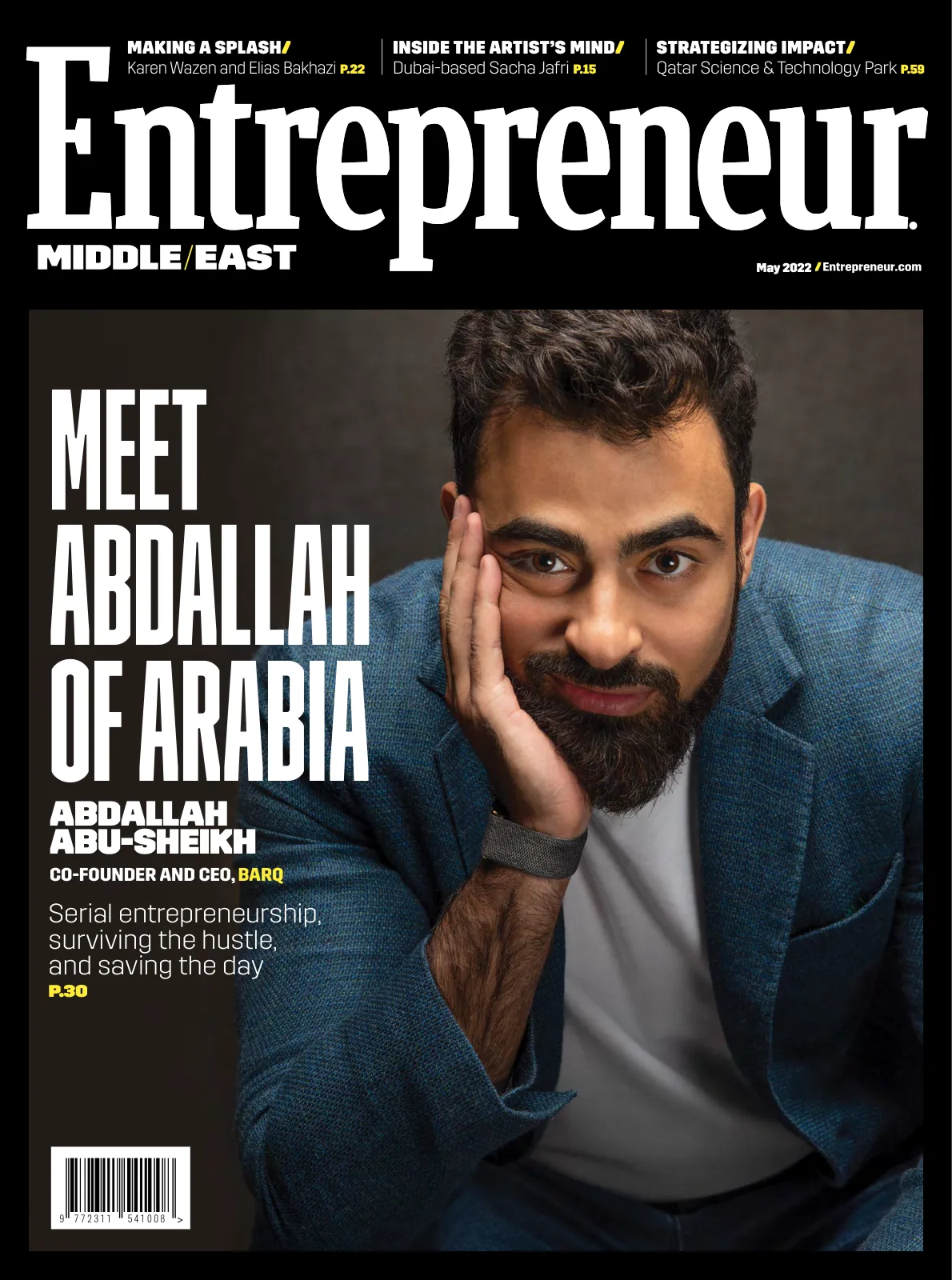
Entrepreneur Middle East, May 2022
Page 1
May 2022
9
7 7 2 3 1 1
5 4 1 0 0 8
>
STRATEGIZING IMPACT/
Qatar Science & Technology Park P.59
MAKING A SPLASH/
Karen Wazen and Elias Bakhazi P.22
INSIDE THE ARTIST’S MIND/
Dubai-based Sacha Jafri P.15
MEET
ABDALLAH
OF ARABIA
Abdallah
Abu-Sheikh
CO-FOUNDER AND CEO, BARQ
Serial entrepreneurship,
surviving the hustle,
and saving the day
P.30
Page 2
Page 3
Page 4
Page 5
Page 6
Applications are now open for the Be Bold 2022 program, a unique collaborative initiative
that aims to empower a network of health innovators from both the public and private sectors
to design new health programs focused on the well-being of the UAE’s citizens and residents.
Get Involved in the UAE’s First
Public-Private Health Initiative
Page 7
APPLY NOW
*Limited Availability
REIMAGINE HEALTHCARE
SYSTEMS AS PER THE UAE’S
FORWARD-THINKING STRATEGIES
BECOME AN ACTIVE AGENT
OF CHANGE IN THE GLOBAL
HEALTHCARE SECTOR
BE PART OF AN EXCLUSIVE
NETWORK OF INNOVATORS IN
THE HEALTHCARE SPACE
IMPACT
In collaboration with
Page 8
8 / ENTREPRENEUR.COM / May 2022
Contents/May 2022
P.22
Making
a Splash
Karen Wazen and Elias
Bakhazi get ready to cause
a stir in the MEA’s investment
arena with the launch of
their newest enterprise,
KE Partners.
by ABY SAM THOMAS
P.30
Meet
Abdallah of
Arabia
Abdallah Abu-Sheikh,
co-founder and CEO of Barq,
on serial entrepreneurship,
surviving the hustle, and
saving the day.
by ABY SAM THOMAS
P.15
Inside the
Artist’s Mind
Dubai-based contemporary
artist Sacha Jafri sounds
off on making art, building
something meaningful, and
yes, non-fungible tokens.
by TAMARA PUPIC
FEATURES
IMAGE COURTESY KE PARTNERS
← KAREN WAZEN launches
her newest enterprise, KE
Partners, which she has
co-founded with her husband,
Elias Bakhazi.
Page 9
Page 10
10 / ENTREPRENEUR.COM / May 2022
45 From Lean to Mean:
The How-To
Looking back on the early days of
creating her first venture, ROSHNI
KHEMLANI MEHTA reveals six tactics
that enabled a business with an
investment of US$15,000 secure over
$1 million in revenue in three years’
time.
52 Meals and the Metaverse
At first glance, dining and digital
realms appear to have little in
common but, as our technology and
social habits continue to evolve, they
may just turn out to be the perfect
match, writes GrubTech CEO and
co-founder MOHAMED AL FAYED.
54 Redemption amid
“The Great Resignation”
A look at the three ways companies
can boost employee engagement.
‘TREPONOMICS
EDITOR IN CHIEF Aby Sam Thomas
aby@bncpublishing.net
CEO Wissam Younane
wissam@bncpublishing.net
DIRECTOR Rabih Najm
rabih@bncpublishing.net
CREATIVE LEAD Odette Kahwagi
design@bncpublishing.net
MANAGING EDITOR Tamara Pupic
tamara@bncpublishing.net
STARTUPS SECTION EDITOR Pamella de Leon
pamella@bncpublishing.net
FEATURES WRITER Aalia Mehreen Ahmed
aalia@bncpublishing.net
DESIGNER Simona El Khoury
DIGITAL SOLUTIONS DIRECTOR
Mahdi Hashemi mahdi@bncpublishing.net
HEAD OF INNOVATION
Sarah Saddouk sarah@bncpublishing.net
GROUP SALES DIRECTOR – B2B GROUP
Joaquim D’Costa jo@bncpublishing.net
COLUMNIST Tamara Clarke
CONTRIBUTING WRITERS
Mohamed Al Fayed, Luay Al Shurafa,
Lucy Bradley, Paul Bridger, Fida Chaaban
Tom Clarke, Eduardo Greghi,
Roshni Khemlani Mehta
SUBSCRIBE
Contact subscriptions@bncpublishing.net to receive
Entrepreneur Middle East every issue
COMMERCIAL ENQUIRIES
sales@bncpublishing.net
ENTREPRENEUR.COM
Access fresh content daily on our website
All Rights Reserved 2022. Opinions expressed are solely those of the contributors.
Entrepreneur Middle East and all subsidiary publications in the MENA region are
officially licensed exclusively to BNC Publishing in the MENA region by Entrepreneur
Media Inc. No part of this magazine may be reproduced or transmitted in any
form or by any means without written permission of the publisher. Images used in
Entrepreneur Middle East are credited when necessary. Attributed use of copyrighted
images with permission. All images not credited otherwise Shutterstock. Printed by
United Printing and Publishing.
PO BOX 502511 DUBAI, UAE
P +971 4 4200 506
Contents
May 2022
59 Strategizing Impact
Qatar Science & Technology Park
Investment Director Dr. Danny
Ramadan is all about the long-term
game when it comes to making
Qatar a hub for tech innovation.
by PAMELLA DE LEON
68 Riding the Digital Wave
KMMRCE Holdings founder Darren
Hodgkin’s innovation-inspired
leadership has built an enterprise
that’s a decade old- and still going
strong. by AALIA MEHREEN AHMED
74 Built For Students
(By Students)
Qatar-born edtech startup Stellic
helps university students easily
plan and manage their paths to
graduation. by PAMELLA DE LEON
STARTUP
SPOTLIGHT
EntMagazineME
Entrepreneur-me
↑ SET TO BE A GAME-CHANGER, ABDALLAH ABU-SHEIKH’S
NEWEST VENTURE BARQ is the first-of-its-kind tech-driven
network of electric vehicles built to serve the MENA region’s
last mile delivery sector. P.30
Page 11
Page 12
12 / ENTREPRENEUR.COM / May 2022
Editor’s Note/
Editor’s Note/
W
hat do you do when you’re accused of doing
something wrong?
As entrepreneurs, you might have experi
enced such a scenario in a variety of contexts.
Maybe the charge is coming from a customer
who is upset for not receiving a service or
product in the manner your business had
promised it to them. Or perhaps it’s from an employee
pointing out a flaw or two in the way you’re running your
organization.
Over the course of my career, I’ve been privy to several
such situations play out in both private and public
settings, and I now believe that there are essentially four
different ways one can react in these kinds of circum
stances. The first of these (and perhaps the most imma
ture way to go about things) is to take such complaints as
some sort of a personal attack, and, as a result, go on the
offensive when responding to it, without even taking the
time to actually analyze the issue, and seeing if there’s
something at fault that needs to be corrected.
The second approach I want to highlight is one that’s in
direct contrast to the first- here, the accusation is heard
fully and objectively, and then dealt with in a fair manner.
For instance, if an investigation reveals something to be
actually wrong, then the necessary steps are taken to fix
the problem at hand, while also trying to ensure that it
doesn’t come up again. It’s an effective approach, even if
the accusation is found to be false or flawed- it is still
being responded to, and I think we’d all like to know that
we are being heard rather than ignored.
Unfortunately, many don’t seem to agree with that
notion- that would explain why the third common way
entrepreneurs and businesses react to any form of
criticism is by putting their heads in the sand about all of
it, and just letting things simmer as they are. The
thinking behind such a response is often an ardent hope
that such things will either be forgotten if ignored, or that
they will somehow get sorted out by themselves in the
long run- but this is rarely, if ever, the case.
And that brings me to the fourth strategy one can make
use of when confronted with such accusations, which is to
feign acceptance and understanding of the issues that are
being brought to light, but then put in only stopgap
solutions for them, or worse, do nothing about them at
all. I personally find this to be the most disturbing of the
four responses to these kinds of situations; however, the
argument can be made that it is an efficient solution to
the problem at hand, and it’s one that I’ve been seeing
increasingly being adopted by both individuals and
businesses in the world that we live in today. Having said
that, while such tactics may appear to work in the short
term, they almost always lead to bigger problems down
the road- all of which could have been avoided had one
decided to simply do the right thing at the get-go.
So, the next time you find yourselves or your businesses
at the brunt end of an accusation, which of the four
approaches will you adopt? I’d imagine your internal
debate to be between taking the aforementioned effective
route or simply the efficient one, and if so, I’d suggest
keeping these words by revered management guru Peter
Drucker in mind as you make your choice: “Efficiency is
concerned with doing things right. Effectiveness is doing
the right things.”
Aby Sam Thomas
Editor in Chief
@thisisaby
aby@bncpublishing.net
REACT RIGHT Fix your feedback loops
Page 13
Page 14
Page 15
15
May 2022 / ENTREPRENEUR.COM /
Inside the Artist’s Mind
SACHA JAFRI
The Dubai-based contemporary artist sounds off on making art, building something
meaningful, and, yes, non-fungible tokens by TAMARA PUPIC
↓ DUBAI-BASED BRITISH ARTIST
Sacha Jafri created the world’s
largest painting on canvas, Journey
of Humanity, as recognized by the
Guinness Book of World Records,
over 11 months during the COVID-19
pandemic in 2020 in Dubai.
IMAGES COURTESY SACHA JAFRI
Page 16
16 / ENTREPRENEUR.COM / May 2022
B/The Big Idea
→ THE ART MAZE, a first-of-its-kind
art gallery experience by Marcus
Schaefer and Sacha Jafri, was
officially unveiled on the Burj Al Arab
Jumeirah Helipad on March 23,
2022. Schaefer’s 12 metre by 12
metre steel labyrinth was home to
30 original Sacha Jafri works
inspired by UNESCO’s World
Heritage, which celebrates its 50th
anniversary this year.
W
hen asked to describe his creative
process, this is how Dubai-based
contemporary artist Sacha Jafri put it:
“Artists channel something from
above that is greater than ourselves;
we surrender, we borrow a moment,
something magical happens, and we
give it back with grace and gratitude.
Only then, it will keep coming back,
and it will stop coming as soon as we
think that we did it and thus engage
the ego, as soon as we forget that we
have merely borrowed a moment.”
There are many reasons to explain
why you’re reading about Jafri on the
pages of Entrepreneur Middle East- at
the bare minimum, his out-of-the-box
thinking, his courage to take on
gigantic projects, and his work for a
higher cause than himself are all traits
that would serve anyone in the
entrepreneurial domain quite well too.
For that reason, we talked with Jafri
about what it takes to be successful in
today’s art world, and about the rise in
interest in the nascent non-fungible
token (NFT) space, and how artists
and entrepreneurs should surf this
wave without being knocked back.
“We communicate at our most
poignant through energy, which is
made of our intentions, and if our
intentions become suspect, agenda-
filled, and financially-obsessed, then
we omit static, as energy can’t
communicate effectively through
static,” Jafri says. “That’s when the
breakdown of humanity’s more
poignant connection begins, and for
an artist, that’s a disaster.”
Such concerns explain why Jafri
urges caution if one decides to wade
into the NFT market as it stands
today. “The problem with this NFT
space at the moment is that it’s full of
a lot of noise, noise creates static, and
as an artist, you get approached by all
these 24-year-olds who are just
looking for a little bit of quick money,
exactly because this whole space is
brand new,” Jafri explains. “Yes, you
can make a little bit of quick money,
but you are not actually building
anything meaningful. You end up
becoming very hollow as a creator,
because you are not feeding what you
need to be feeding, which is that
connection to the soul of the earth.”
An Eton College and Oxford Univer
sity graduate, Jafri was 22 when he
put to rest his dreams of becoming a
cricketer and committed to his art full
time. In 2004, he worked on Ameri
can actor and filmmaker George
Clooney’s humanitarian project and
documentary, Sand and Sorrow,
filmed in Darfur, Sudan, which led
him to visit 42 refugee camps, and this
five-year journey has had him work at
the intersection of art-making and
charity ever since. Jafri’s official
biography states that he has raised
more than US$140 million for charity,
and that his clients list includes the
royal families of UAE, KSA, UK,
Brunei, India, Monaco, Spain, Nepal,
Bahrain, Qatar, Kuwait, as well as
international celebrities like Bill Gates,
Page 17
17
May 2022 / ENTREPRENEUR.COM /
In a world
where the metaverse
is becoming more
of a reality, The Art
Maze project is about
reconnecting humanity
to the beauty that
surrounds us.”
→ SCHAEFER AND JAFRI’S
VISION for The Art Maze pays
homage to the most
outstanding natural and
cultural places of the earth,
with it aimed as a unique
opportunity for people to
learn about the 30 World
Heritage Sites.
Page 18
18 / ENTREPRENEUR.COM / May 2022
Leonardo DiCaprio, Sir Richard Branson, Sir Paul McCartney,
Oprah Winfrey, David Beckham, Eva Longoria, Virat Kohli,
Huda Kattan, and many more. Today, besides acting as a
long-time ambassador for the Global Gift Foundation, the
45-year-old Jafri’s work has been auctioned to benefit entities
like The Start Foundation, The Elton John Foundation, Art &
Hope, The Eva Longoria Foundation, Al Noor’s Children with
Special Needs, The Al Madad Foundation, Sawtouna, and
many more. Other interesting details about Jafri include that
he has rarely cooperated with galleries (although today he does
work with New York and Dubai-based Leila Heller Gallery), as
he insists on a greater control over who buys his work by
meeting the buyers, and even visiting their houses to see his
work on their walls.
Taking a position that is often contrarian to the traditional art
world has worked very well for Jafri- last year, his
17,000-square-foot painting, The Journey of Humanity, was
sold for $62 million, which is the second highest ever auction
price achieved for a painting by a living artist. He spent 11
months of 2020 in the ballroom of Dubai’s Atlantis The Palm,
reportedly using 1,065 paintbrushes and 6,300 liters of paint
to create The Journey of Humanity, which also gained him a
Guinness World Record for working on the largest art canvas
in the world. Perhaps more importantly, all proceeds from the
sale’s profit were directed to the benefit of Dubai Cares,
UNICEF, UNESCO and the Global Gift Foundation to help
disadvantaged children amid the coronavirus pandemic.
My conversation with Jafri happens over Zoom in April, a few
weeks after I attended the unveiling of The Art Maze, the first
art exhibition held in a custom-built steel labyrinth on the
helipad of Dubai’s Burj Al Arab hotel. Jafri’s collection of 50
paintings, which aim to reconnect humanity through the 50
most poignant heritage sites of our world, was created in
celebration of UNESCO World Heritage Sites’s 50th year.
When talking about this project, I remember that Jafri was
quoted as saying that “in a world where the metaverse is
B/The Big Idea
↑ SACHA JAFRI on the Burj Al Arab Jumeirah Helipad
Page 19
19
May 2022 / ENTREPRENEUR.COM /
becoming more of a reality, The Art
Maze project is about reconnecting
humanity to the beauty that surrounds
us.” His statement makes me suspect
that Jafri might have been hesitant to
jump on the NFT bandwagon, and he
confirms this soon enough. “Yes, I was
hesitant to enter the NFT space,
because the space is brand new,” he says.
“It’s like the birth of the internet, and
when the internet was born, it exploded,
but it was a slightly inflated and
manipulated market, and we are exactly
the same with the NFT space now.”
Jafri goes to on to say that he consid
ers the current NFT space a pyramid
scheme that is unsustainable and will
most probably be deemed illegal in
most markets soon. “People mask it by
calling it a decentralized autonomous
organization, or a fractionalized asset,
or they give it all these names to hide
the fact that all of it is just a pyramid
scheme,” Jafri says. “You offer it very
cheap at the beginning to a few people
to get it going, then those people can
flip it and sell it for a bit more, and then
those people can flip it and sell it for a
bit more, and by the time you get up
there, the value is not sustainable, and
since it’s not worth that much money,
the whole thing crumbles, because you
haven’t actually created a real market,
but manipulated a market. That means
that the whole thing will crumble,
because it’s not sustaining the value,
and there are a lot of loose promises,
but when it comes to the reality, 10% of
that is delivered.”
In fact, Jafri expects that the current
hype around NFTs will collapse in about
1.5 to 2 years’ time. “I would say that
90-95% of NFT assets, which don’t
have a physical asset or meaningful
utility attached to it on the blockchain
through the smart contract, or any real
value beyond a jpeg, will be worth zero,”
he says. “It is because no one is going to
want to own a JPEG digital image of a
monkey with no real market value.”
Having said that, Jafri has taken the
time to look into the actual structure of
NFTs, and found that it can serve as a
base for a real market to evolve “exactly
in the same way as it happened with the
internet, and that real market will be
worth 10x the market at the moment.”
He adds, “The way to do that is not to
talk about community-building, and
access to this or that, and the things in
the metaverse that you never deliver,
because that’s tiny compared to what
can be achieved. What can be achieved
is that you can create NFTs, attach
physical assets to them, or real utilities
that gain in value, because today an
NFT is just a title deed, that’s all that it
is. It’s a title deed that cuts out the
middleman, validates and authenticates
the asset, and connects it to the
blockchain through a smart contract.
And then, the value of that NFT and the
physical asset behind it will grow over
time, and bring returns to investors.
That’s a real market.”
And that is why, to bring a bit of
certainty into the space that is so
unclear at the moment, Jafri has
decided to not create a one-off NFT
project, but a journey of six projects
that will be delivered over the next two
years. “The intention has to be there- it
has to be planned and laid out over two
years with a real vision, and then it has
to be implemented in a way that every
single project succeeds, that there’s no
rug pulling, and that it brings 5x the
value that the investor or collector puts
in,” he explains. “Then, you are creating
THE VALUE
OF THAT NFT
AND THE
PHYSICAL ASSET
BEHIND IT WILL
GROW OVER
TIME, AND BRING
RETURNS TO
INVESTORS.
THAT’S A REAL
MARKET.”
↓ JAFRI’S ORIGINAL PIECE entitled We Rise Together - with the Light of the Moon is set to become the first
official artwork to be placed on the moon within the NASA Commercial Lunar Payload Services (CLPS)
initiative. The artwork will be placed on the surface of the moon later this year by Spacebit, a company
developing technology for space exploration, and Astrobotic Technology Inc., a company providing end-to-
end delivery services for payloads to the moon.
Page 20
20 / ENTREPRENEUR.COM / May 2022
a real ecosystem, which is not full of
loose promises of community, because,
at the end of the day, the value of
community is much lower than people
are pretending it to be. Instead, you
need to link this to governments,
non-government organizations, and real
charitable and sustainable causes, and
to make sure that money goes from A to
B, without 90% of it being lost along the
way. Then, you can make real change.
From there, a community will be built,
but as a by-product of what you are
creating. That’s a better way of doing it;
otherwise, you are creating a commu
nity of 1000-2000 people that doesn’t
mean anything. But, if you create a
community of a billion people, that
means something, that creates power
and sustainable change.”
The first project in the series is called
The Power of the Reconnected World, a
collection of 1,000 high-value NFTs sell
ing at $250,000, with the proceeds
going to the Global Gift Foundation. “I
have created a painting based on the five
elements of our world -earth, wind,
water, fire, and humanity because I
don’t call the fifth element ‘air,’ because
I believe that air is the essence of life, it’s
not an element,” Jafri explains. “I cut it
up, and I created NFTs from that, and
we hope to raise $100 million from that
project that will go to the Global Gift
Foundation, and help support 20
charities around the world within the
four pillars- health, education, sustain
ability, and equality. Any charitable
concern will fit into one of those four
pillars. That’s the power of the recon
nected world.”
His second NFT project was created out
of his original oil on canvas painting On
the Wings of an Angel, which was sold
for just over $1 million at amFAR’s
annual Cannes Gala in 2021. The NFT
series sold for a record breaking $2.5
million in only 45 seconds, becoming
the fastest ever selling open-edition
NFT. All auction funds for this painting
were donated to amFAR’s AIDS and
COVID-19 research projects. “From that
project, I created the 99 Angels NFT
collection, where each angel represents
a charity, and 100% of the profits
achieved from each of those angels will
go to those charities, just like that first
one which was sold at amFAR,” Jafri
explains. “The Power of the Reconnected
World will launch in the next couple of
months, that will give you access to the
99 Angels, and my further projects lined
up to follow that, with a full schedule of
creations and ‘drops’ laid out for the
next 18 months, each connected to the
other and each adding value to the
investor.”
B/The Big Idea
← SACHA JAFRI is widely regarded as one of
the world’s most celebrated living artists
and has raised more than $140 million
dollars for charities across the world from
the sale of his art.
I CAN CREATE ONE PAINTING, FRACTIONALIZE INTO
ONE BILLION TOKENS, SELL EACH TOKEN AT $1, AND
THEREFORE RAISE $1 BILLION FROM THAT ONE
CREATION. THAT CHANGES THE ENTIRE STRUCTURE.
Page 21
21
May 2022 / ENTREPRENEUR.COM /
The next project will be placing the first
official NASA-certified physical artwork on
the surface of the moon by NASA’s Com
mercial Lunar Payload Services (CLPS), in
partnership with Spacebit, Selenian,
Astrobotic, and Jeff Bezos’s Blue Origin.
The landing site of Jafri’s artwork We Rise
Together – with the Light of the Moon will be
marked as a world heritage site landmark to
last eternally on our lunar surface. “There
will be an NFT series created out of that,
which we hope will raise in an excess of $1
billion, and again, you’ll get access to this
project only if you have taken part in the 99
Angels project, because the idea is that in
this way we are really building loyalty and a proper community
who believe in investing in something that is worthwhile and
that is helping our world,” Jafri explains.
Jafri describes his fourth project in this series as the biggest
one, as it will see him cooperating with Pak, an anonymous
digital artist who is ranked among the highest-grossing artist in
the world of NFTs. “We are very different- he’s an algorithm
digital creator, he’s obsessed with technology and how you can
create new things within the space, whereas I am very much
about expression, passion, organic movement of paint with a
release of intention, love, empathy, emotion, and beauty of the
paint pushing against the canvas,” Jafri says. “Together, we are
creating a series of 10,000 NFTs, which will create ownership
for about 150 million people in both a physical and virtual
space within our world, and beyond into the metaverse.”
Now, I am choosing to leave details of the two
projects remaining in this series for a future
article (stay tuned to @sachajafri on Instagram
if you’re curious), and instead, I’d like to share
Jafri’s response when asked about what he
finds most fascinating about the NFT space.
“The beautiful thing is that it has changed the
charitable model completely, because I can
create one painting and sell it for $10 million,
and that’s the end of it, but now I can create
one painting, fractionalize into one billion
tokens, sell each token at $1, and therefore
raise $1 billion from that one creation. That
changes the entire structure,” Jafri responds. “If
I give 90% to charity, I can raise $900 million
for charity out of one painting, and if I direct
that to proper charities that are making a real
difference in the world, with a real intention of
making a change, and I want to put it into the
areas of health, sustainability, education, and
equality, then you can actually help change our
world through art, fractionalization, and the
creation of NFTs.”
At this point, Jafri praises Dubai for having
the vision to become a major player in the NFT
landscape. “In the UAE, we are talking
about 3% of the global NFT market, so it is
tiny, but there is a huge intention here, the
speed in which they are doing things is very
typical of Dubai whereby they fast-track
and get things done incredibly quickly,”
Jafri says. “While there are still very few
high-level NFT creators in this country, the
government is issuing new laws to regulate
digital asset creation and sale, so if they can
regulate it, they can bring in foreign
investment, and create a real marketplace,
where I expect this figure to grow from 3%
to over 10% very quickly.”
As the world waits for a real, sustainable NFT market to
emerge in Dubai and elsewhere, Jafri advises artists and
entrepreneurs to be wary of “a lot of pretenders in the crypto
and NFT space, who talk big game, promise the world, and
deliver very little,” and advises them to “push the noise and
static away.” “My advice is to concentrate on how you live your
life, live a life of grace, get out of the noise, think what’s
important to you to create as an artist, and then go out, and
find people who can help you make it happen,” Jafri concludes.
“Don’t do it the other way round. If you create something
valuable, and then find a digital partner to take it into this new
space, the money will come, but only because you have created
something meaningful. If your starting point is right, and you
use the structure of NFTs to amplify that message, that’s
beautiful, but if you do it the other way round, it doesn’t work.”
↓ THE ART MAZE exhibition at the Burj Al Arab, Dubai
GET OUT OF THE
NOISE, THINK WHAT’S
IMPORTANT TO YOU
TO CREATE AS
AN ARTIST, AND THEN
GO OUT, AND FIND
PEOPLE WHO CAN HELP
YOU MAKE IT HAPPEN.
Page 22
22 / ENTREPRENEUR.COM / May 2022
MAKING
A SPLASH
get ready to cause a stir in the MEA’s investment arena with
the launch of their newest enterprise, KE Partners
by ABY SAM THOMAS
IMAGES COURTESY KE PARTNERS
Page 23
23
May 2022 / ENTREPRENEUR.COM /
→ THE DUO ARE LAUNCHING
KE PARTNERS with a sizeable
portfolio of startups, having already
invested in 12 different companies
mainly from the MEA region.
23
May 2022 / ENTREPRENEUR.COM /
Page 24
24 / ENTREPRENEUR.COM / May 2022
“OBVIOUSLY,
THE VISION AND
THE IDEA HAVE
TO BE THERE, BUT
FOR US, IT’S A LOT
MORE IMPORTANT
FOR US TO
BELIEVE IN THE
ENTREPRENEURS.”
24 / ENTREPRENEUR.COM / May 2022
Page 25
25
May 2022 / ENTREPRENEUR.COM /
I got to learn more about KE Partners when I met Wazen and
Bakhazi in April at their home in Dubai, and over the course of
a freewheeling conversation, the couple offered me an exclusive
look into this venture that they’ve founded “to support unstop
pable entrepreneurs building purposeful companies that aim to
improve and enrich people’s lives.” Now, while KE Partners may
have come into existence only recently, the co-founders are not
at all new to the investment realm- Wazen has been quietly
investing in startups for more than five years now alongside
Bakhazi, who himself boasts of a long and successful career in
the finance sector, having worked with the likes of Shuaa Capital
and HSBC, before joining his wife in the entrepreneurial realm
in 2021 as the co-founder and Managing Partner of Karen
Wazen Eyewear. The duo are thus launching KE Partners with a
sizeable portfolio of startups already- in fact, they tell me that
they’ve already invested in 12 different companies (based mostly
out of the MEA region), and that’s a figure that’s only set to rise
in the future.
For her part, Wazen admits being personally hesitant about
making investments in startups and entrepreneurs when she
started out in the domain about five years ago. “Back then, I
have to say that, from my end, I didn’t feel confident enough
about being an investor, especially because I come from a social
media background,” she says. “I was, like, who’s going to take me
seriously?” But Wazen persevered and learned her way around
this trade, aided in part by her own journey launching an
eyewear line that has gone on to become a reputed brand in its
own right. “It took time for me to build that confidence for
myself, over the years,” Wazen explains. “Having founded our
brand, seeing its growth, learning so much from this whole
process, and then sitting with people [in the investment realm],
I was like, actually, they’re just like me. They’re not much
smarter than me, and they haven’t accomplished more than
what I’ve accomplished… And then, in the projects that we were
investing in, I saw that the founders were really interested in my
input. So, it wasn’t just the money that they were interested in,
they were actually interested in the value that I could add,
separately to Luch’s experience.”
I must admit that, at this point, I wondered why Wazen would
have ever questioned the value she brings to the table- she is
someone who started with an online blog in 2016 and has since
grown to become one of the most influential people on the
Middle East’s social media landscape today, with her list of
achievements including being the first Middle Eastern
ambassador for Italian luxury brand Roberto Cavalli, as well as
the first regional ambassador for French beauty house Guerlain.
But while Wazen, despite her many accomplishments, may have
had misgivings about herself, the entrepreneurs she mentored
and supported certainly didn’t feel the same way- the spikes in
interest they saw in their startups whenever she posted about
them on social media are something they call “the Karen effect”
among themselves. Of course, Wazen happily confesses that she
feels personally gratified when the companies KE Partners
supports do well for themselves. “That’s why we named the
company KE Partners,” she says. “It’s not just because Luch and
I are partners with each other; it’s because we really see
ourselves as partners with the founders.” }
I
think you’d have to be living
under a rock if you’re in the
Middle East and haven’t heard
of Karen Wazen yet.” That’s
the response I got from a
friend when I asked them if
they thought there was
anyone left in the region who
hadn’t heard of Wazen
already, and yes, while there is a fair bit of
exaggeration in that statement, it does
shine a light on how amazingly popular
this social media personality and
entrepreneur currently is. And now, after
garnering more than 12 million followers
across her social media channels, and her
eponymous brand’s eyewear being
adorned by seemingly everyone from pop
star Dua Lipa to reality television star
Kourtney Kardashian, Wazen is now
announcing the official addition of a new
title to her profile -investor- thanks to the
launch of her newest enterprise, KE
Partners (pronounced as “key partners”),
which she has co-founded with her
husband, Elias Bakhazi, aka Luch, to those
close to him.
Page 26
26 / ENTREPRENEUR.COM / May 2022
}The key to success is the ability
to adapt. “The world we're living in is so
fast-moving and fast-changing that the successful
models are the ones that are easy to adapt.”
}Don’t be fearful of failure.
“Also, don't be fearful of what other people will think of
your failure as well.”
}Always put yourself out there.
“Because the more you give to the universe, the more the
universe gives back to you.”
}Dream big. “But don’t let the size of the dream
overwhelm you- just go for it one step at a time.”
Four pointers for entrepreneurial success
from Karen Wazen and Elias Bakhazi
'TREP TALK
Page 27
27
May 2022 / ENTREPRENEUR.COM /
Bakhazi agrees with this sentiment, with him bringing his
17+ years of corporate experience to support the development
and growth of the startups in the KE Partners portfolio. It’s a
veritable list of companies, by the way- one of the first ventures
Wazen and Bakhazi invested in is the Cape Town-headquar
tered startup Yoco, which has, since its launch in 2013, become
the market leader for small business payments in Africa,
having secured over 200,000 clients as well as a total of $107
million in funds to date. Another interesting venture in KE
Partners’ purview is personalized luxury shopping service,
Threads Styling, which was founded by Sophie Hill in 2010 in
London. Closer home, KE Partners has invested in companies
like hospitality group Addmind (the name behind Dubai
hotspots like White, Iris, and more), as well as Dubai-based
“future forward experiential attractions developer”
HyperSpace, which, in 2021, had notably secured $11 million
in equity and development seed funding. Bakhazi points out
here that so far, he and Wazen have been investing in
companies across sectors and stages, and that’s set to remain
the paradigm with KE Partners as well.
“Every year, we are looking to invest in three or four
companies, and there is no minimum ticket size,” Bakhazi
continues. “It could be, say, from $50,000 to, depending on
the valuation, more than a million dollars, based on the
maturity and growth phase of the company. But, at the end of
the day, we want to be a platform that supports ambitious
entrepreneurs.” Bakhazi goes on to explain that KE Partners
has been built off his and his wife’s personal wealth, and while
they are not currently planning on bringing in external limited
partners to their fund, it is something that they might consider
in the future. “I think, right now, we’re really happy with
having everything in-house,” he says. “We have our own
investment approach and selection process, and for now, we’d
like to keep it that way, but, in the future, you never know.” In
terms of locations, Bakhazi confirms that KE Partners does
have the MEA region as its focus; however, he and his wife
point out that they have previously made investments in
companies based in Europe and the US as well.
But while Wazen and Bakhazi may still be tinkering with
such aspects of KE Partners, they are extremely clear about the
kind of people and companies they hope to support with their
funds. “Obviously, the vision and the idea have to be there, but
for us, it’s a lot more important for us to believe in the
entrepreneurs,” Wazen says. “We have to believe in the people;
we have to feel that they’re willing to take the risk, that they’re
willing to dream big. And this is what we’ve seen across the
different investments that we have done- it was really people
that came with an idea, and were like, ‘We are going to make
this succeed, despite the odds; we are going to make this
happen.’ And when we saw that ambition and passion in those
entrepreneurs, it resonated.” The impact the businesses can
have in their particular industries and markets is also
something KE Partners looks for, Bakhazi adds. “We’re looking
for teams and ideas that challenge the status quo, and aim to
change people’s lives for the better,” he says.
Such statements offer a peek into the particular blend of
sensibilities that Wazen and Bakhazi are bringing to the
region’s investment realm with KE Partners, and the duo are
now looking forward to receiving an influx of pitches from
entrepreneurs hoping to become a part of their company’s
portfolio. However, at this point, I wondered aloud if Wazen
might be apprehensive of any criticism that might get thrown
at her for her new endeavor as well, especially since social
media influencers like herself are currently prone to a lot of
-often unwarranted- hate in digital spaces. “I think a lot of
these people don’t personally know me,” Wazen replies. “And
when someone doesn’t personally know me, they can feel free
to say whatever they like… They are free to make whatever
assumptions they like, but I know that on my bed, I sleep very
comfortably. I’ve only followed a journey that I believed was
the right one for me, and I haven’t, in any way, crossed anyone
else’s; I haven’t wronged anyone in my own journey. And,
honestly, I’m ambitious, I hustle, and I’ve worked my way up,
and it’s something that I’ve worked very hard on… The good
thing is that my growth wasn’t overnight, it was very gradual.
And the more you grow, the more you’re exposed to hate and
criticism and all of that. So, I learned to build thick skin along
the way, and today, it’s just part of what I do, and it’s noise.
And I just have to kind of push it to the back, ignore it, and do
things that prove otherwise!” Success is the best way to silence
such criticism, after all- and for Wazen and Bakhazi, that’s as
good a driver as any for them to chase their goals. Onward and
upward!
“IT’S IMPORTANT FOR US TO INVEST
IN THINGS THAT ARE ADDING VALUE TO OUR
SOCIETIES AND COMMUNITIES.”
Page 28
come as
you are.
Page 29
@ / # 25hourshotels
#hellodubai
we are now open!
25% off,
book via
enjoy
25hours-hotels.com
Overlooking the museum of the future, near dubai international
financial centre, 25hours hotel one central boasts 434 rooms
and suites in addition to flexible events and co-working spaces.
A total of four characterful restaurants and bars take guests on
a culinary trip around the world from northern india to the beer
gardens of bavaria: this is where urban nomads meet desert
flowers, where local heroes meet the well-traveled. Alongside
rental of mini cars and schindelhauer bikes the hotel will also
feature the extra hour spa, rooftop pool and dubai's first
mixed-gender rooftop sauna.
434 rooms | co-working spaces | monkey bar | tandoor tina
ernst | nomad dar bar | rooftop pool & sauna | spa | gym
Page 30
30 / ENTREPRENEUR.COM / May 2022
IMAGE COURTESY BARQ
MEET
ABDALLAH
OF ARABIA
Abdallah Abu-Sheikh
CO-FOUNDER AND CEO, BARQ
by ABY SAM THOMAS
Serial entrepreneurship, surviving
the hustle, and saving the day
Page 31
31
May 2022 / ENTREPRENEUR.COM / 31
May 2022 / ENTREPRENEUR.COM /
“WE HAVE OUR OWN
INNOVATORS, ENTREPRENEURS,
PEOPLE THAT WE CAN LOOK
UP TO. AND AS LONG AS I CAN
KEEP SPREADING THAT KIND
OF IMPACT, I THINK THERE’S NO
STOPPING.”
→ ABDALLAH ABU-SHEIKH
is globally renowned for launching
ground-breaking future-ready
platforms centered on
sustainability, mobility and
digitalization, led by unconventional
strategies and strong business
ethics.
Page 32
32 / ENTREPRENEUR.COM / May 2022
H
ave you watched Lawrence of
Arabia? The titular hero of this
1962 British film came up quite
a few times in the conversa
tion I had in April with Jorda
nian serial entrepreneur
Abdallah Abu-Sheikh at the
Dubai outpost of his latest
venture, Barq. For those of you
who are not familiar with this
movie, I’d urge you to watch
this Academy Award-winning
epic, but for the time being, let
me tell you that it’s a depiction
of the role a British army
officer -Thomas Edward
Lawrence- purportedly played
in the Great Arab Revolt of
1916, the military uprising led
by Arab forces against the Ottoman Empire
amid the First World War. Now, there’s lots
of debate and discussion about how much
of this tale is rooted in fact, but Abu-Sheikh
points to the premise of Lawrence of
Arabia, which is that an outsider from the
West, who essentially parachuted into the
Middle East, was needed to come up with
solutions to the Arab world’s problems, as a
narrative that plagues the minds of (most)
people in the region today. “Everybody’s
waiting for some kind of Lawrence of
Arabia to show up- we’re waiting for a guy
with blue eyes and blond hair to come and
say, ‘Do this, do that,’” Abu-Sheikh says. “But
Lawrence of Arabia was actually only a
catalyst that made things happen- every
thing the Arabs did, they could have done
without him. So, my idea is that the region
today needs a Lawrence of Arabia, if you
will, but from Arabia.” I found myself
agreeing with Abu-Sheikh as he said this,
and after chatting with the entrepreneur
for nearly an hour, I believe that he’s putting
in the hard yards to become the hero the
Arab world needs today- Abdallah of Arabia
does have a nice ring to it, after all. }
→ SET TO BE A GAME-CHANGER, ABDALLAH
ABU-SHEIKH’S NEWEST VENTURE BARQ is the
first-of-its-kind tech-driven network of electric
vehicles built to serve the MENA region’s last mile
delivery sector.
PHOTOGRAPHY FAROOQ SALIK
Page 33
33
May 2022 / ENTREPRENEUR.COM /
↓ BARQ OFFERS GROUND-BREAKING
SOLUTIONS to address the transport industry’s
much-needed demand for efficiency, comfort,
and rider safety.
Page 34
34 / ENTREPRENEUR.COM / May 2022
A
bu-Sheikh is only 25 years
old, and his ambitions match
the fervor with which he’s
chasing after them- that offers a clue
into how Barq, the UAE-based electric
mobility venture that he launched
earlier this year, is his third entrepre
neurial outing. Before Barq, he had
Rizek, which has, since its launch in
2019, grown to become a super app
dedicated to home services in the
MENA region, and prior to that, he
was the co-founder of Lux Develop
ment Partners, a renewable energy
and power development company
focused on projects in sub-Saharan
Africa that he launched in 2014, and
then exited four years later. Now, do
the math, and you’ll come to the
realization that Abu-Sheikh must have
become an entrepreneur when he was
only a teenager- but that, he reveals,
was a role that was essentially thrust
on him. “I come from a family business
background,” Abu-Sheikh explains. “I
was born in Jordan, then moved to the
UK, and then back to Jordan again,
and I spent almost most of my
childhood between China and London,
because our family business was
mainly based in Beijing. Then, in
2000, my father launched one of the
biggest private charter aviation
businesses in the region. But when he
passed away in 2013, the business
collapsed owing to family feuds- I was
still in my second year of university
then, but that’s when I had to start
experiencing what business is, or what
work is. Before that, I was completely
sheltered by my father and my family,
and I had no idea what money-making
was, or why it even mattered.”
T
hat is how Abu-Sheikh, at the
age of 17, became the de-facto
breadwinner for his family,
which, besides his mother, included
seven younger siblings. And this is
what led him to embark on a trip to
the African continent then- his father’s
aviation business had a strong base
there, and he was hopeful that he’d be
able to sell some of its assets in that
region. But once there, Abu-Sheikh
had a chance meeting that would lead
him to launch his first company, Lux,
and thereby changing his life as he
knew it. “It was by sheer luck that I
was introduced to renewable energy,”
he recalls. “It literally was a conversa
tion with the then President of The
Gambia [Yahya Jemmeh] who asked
me, ‘Can you build a renewable energy
project?’ And I was like, ‘Sure, I can do
this.’ I had no idea how I was going to
do this, but I needed to start building
something.” Now, when Abu-Sheikh
told me this part of his story, I admit
that I found it quite difficult to
process- sure, his background could
have definitely facilitated such an
occurrence, but my mind was blown
by the idea that an Arab teen could
have, at one point in the recent past,
be leading energy projects in sub-
Saharan Africa. But when one
considers how much of the continent
has, until very lately, been disregarded
→ In 2019, Abdallah Abu-Sheikh launched
RIZEK, THE FIRST ‘SUPER APP’ FOR
ON-DEMAND HOME SERVICES IN THE UAE,
which successfully raised $10 million
in a round of series A funding.
Page 35
35
May 2022 / ENTREPRENEUR.COM /
by most of the dominant global players
in the energy domain, one can perhaps
see why Abu-Sheikh was invited into
this arena. Looking at it from Abu-
Sheikh’s perspective, the absence of
competitors in the space allowed him
to launch Lux, and work on making it
a success. But, perhaps more crucially,
Abu-Sheikh had very personal drivers
for what he set out to do- and some
times, that’s the only fire one needs to
accomplish one’s goals.
“For me, it was a matter of do or die,”
Abu-Sheikh recalls. “I could either rise
to the occasion and build something,
or else, everybody’s going to suffer.
And this is where it was not by choice
at all- it was not at all something I
chose. I didn’t wake up one day, and
say, ‘I want to be successful, I want to
be an entrepreneur, I want to build a
business.’ Not really. And to be
completely honest, it was none of the
fairytale stuff that you hear in the
news. I was desperate. It was disgust
ing. It was very tiring, and very
dreadful. Because you’re 17 years old,
running around trying to build
projects for governments, right? The
number of times you get bounced off,
the number of times that you get told,
‘You don’t know what you’re talking
about,’ plus the sheer amount of doubt
that you have in yourself. You’re asking
yourself, every day, ‘Am I good
enough? Can I do this? Do I just go get
a job? What do I do?’ And on the other
side of all of this is that faint light,
saying, ‘I think I can pull it off. I think
I can make it happen.’ However,
success breeds success; it becomes
more of a need, and it moves into
becoming a habit. It becomes like, say,
going to the gym; it becomes like your
diet. You can’t stop, because you
discover that it’s not a destination, it’s
just the way you live- you are a person
that builds things, and impacts
people’s lives.”
L
ux thus got off the ground with
its work in The Gambia, and
over the next four years,
Abu-Sheikh proudly notes that the
company went on to build power
projects totaling 1.2GW in different
countries across sub-Saharan Africa.
By 2018, Abu-Sheikh remembers
global players making inroads into the
space his company operated in, and
that’s when he decided to exit the
venture. Once he sold his enterprise to
Chinese companies in the domain,
Abu-Sheikh then moved to the UAE. “I
came here with the mentality that I’m
retired,” he says. “I thought, ‘I don’t
need to work anymore. I have made
enough money to sit back and relax.’”
However, as someone who had been
bitten by the entrepreneurship bug,
Abu-Sheikh soon found himself with
dealing with the itch to start some
thing from scratch again. But why, I
ask Abu-Sheikh- why didn’t he decide
to, well, just rest, and enjoy the fruits
of his labor? “One reason is my
personal urge and addiction to be
productive,” he replies. “I can’t just sit
idly. Because you discover that once
you get on an entrepreneurial path, it’s
not about the end goals. Money is just
part of the process, becoming popular
is part of the process, but it’s a process.
You just tell yourself that this is what
you need to do every day. This is not
something I do for an amount of time,
and then I stop. It becomes a need- it’s
like, I need to be productive; I need to
build something.”
I
t is this need that led Abu-Sheikh
to launch Rizek in 2019, after
spotting a gap in the UAE’s
on-demand home services market.
While the domain did already have
other players operating in it, the
localized digital marketplace that Rizek
offered made it a hit with the masses,
and, yes, investors as well. Having
launched with a total investment of $5
million from Abu Dhabi Investment
Office, E-Tech Investments, Rozana
Investments, and others, the company
went on to secure $10 million from
Peak Investments, ADQ, and regional }
“SUCCESS
BREEDS
SUCCESS;
IT BECOMES
MORE
OF A NEED,
AND IT
MOVES INTO
BECOMING
A HABIT.”
↑ The Rizek team in Egypt
Page 36
36 / ENTREPRENEUR.COM / May 2022
family offices in a Series A round with
the aim to expand from its home base
in the UAE to Saudi Arabia and Egypt.
When asked to list the reasons for the
success Rizek has seen so far, Abu-
Sheikh points toward its differentiat
ing factor when compared to competi
tors in the market.
“There was a need for a local product
that spoke the local language, and that
had local market intelligence behind it
to make it all happen,” he explains.
“And this is where we came in, with
our sheer ability to execute very fast.
In fact, we were executing things
overnight. We launched our full
healthcare vertical in 24 hours- when
the COVID-19 pandemic hit, the next
day, we were on the market. It took
other people a year.” However, this is
not to say all of what Rizek achieved
happened in one clean sweep either-
Abu-Sheikh is clear that he had to
navigate plenty of twists and turns
along the way of building his second
venture. But then again, Abu-Sheikh
believes them to be a part and parcel
of the entrepreneurial journey.
“Hurdles are just a part of the
process, just as much as benefits are
part of it,” Abu-Sheikh says. “If you are
expecting to make money in the
process, you should also expect to have
sleepless nights and a lot of problems
that come with it. But you should also
be excited about facing problems,
because every problem you solve is a
money-maker, if you’re solving the
right problems. So, every time you
solve a problem, you’re, like, ah, bingo,
bank! That’s what most people don’t
understand- they say, ‘Oh, I want to
start a business, but, ah, but this is a
problem, and so, I’m not going to start
it.’ Great, then, you’re never going to
make any money, because everybody
thinks of the problems first. Instead,
think of the opportunity- look at the
situation, and think of it not as a
problem, but how you can solve it.”
This is a mindset that Abu-Sheikh
clearly feels very strongly about, and it
is something that he has carried with
him to his latest venture, Barq. And I
know this to be true because of the
words that were etched onto the
Barq-branded t-shirt that Abu-Sheikh
was wearing during this interview. You
see, on its sleeve were written the
words per aspera ad astra, a Latin
phrase that can be translated as
“through hardships, to the stars.” Not
only does it indicate the manner in
which Abu-Sheikh approaches all of
the obstacles that might come his way
as an entrepreneur, it is also a
showcase of the scale of the ambition
he has for Barq, which he has billed as
“the MENA’s first provider of smart
and sustainable mobility solutions.”
W
ith a mission to revolution
ize the region’s logistics
sector by building electric
vehicles that are customized for the
MENA, improve operational efficien
cies, and reduce carbon emissions,
Barq currently has three key products
in its portfolio: the Rena Lite bicycle,
the Rena Max scooter, and the Yas 1
drone. The idea for Barq came to
Abu-Sheikh after he saw the need (and
demand) for sustainable, smaller
vehicles in emerging economies,
especially in the logistics and delivery
domains- but the Middle East wasn’t
clued into this scene. “If you’re talking
about the demographic of the market
size, this is how it looks,” he explains.
“You have Chinese manufacturers and
Indian manufacturers, and both of
them are not fulfilling the demand of
their own home markets. For instance,
Indian multinational Ola said that it is
going to build the biggest two-wheeler
factory globally, with a capacity to
manufacture 10 million vehicles a year.
Today, they are at 20,000 vehicles a
month, and the Indian market
demand is almost 200 million
vehicles. So, if you supply 10 million
vehicles for 20 years, you’ve still not
reached 10% of the target. With that in
mind, after you’ve spent billions of
dollars building facilities in India,
would you be looking to expand into
other markets? I highly doubt it… It’s
the same with [manufacturers in]
China. They have a market of two
billion people, and they have South
east Asia right next door. So, when
they expand, they are going to start
looking at Southeast Asia- they are not
going to go look at the Middle East…
And that leaves a vacancy in our
region.”
A
nd that’s the vacuum that
Abu-Sheikh is swooping in to
fill with Barq. Now, much like
in the case of Rizek, there are other
companies attempting to take a slice
out of the MENA’s electric vehicle
market, but Abu-Sheikh points out
that his startup’s competitors are
merely importing technology and
products to the region- none of them
are creating something for the region,
from the region, as Barq is. “Today, we
are in a place where we’re the first to
→ BARQ CO-FOUNDERS
Ahmed Al Mazroui and
Abdallah Abu-Sheikh
Page 37
37
May 2022 / ENTREPRENEUR.COM /
launch electric mobility out of the
region,” Abu-Sheikh says. “We are
already embedded with the biggest
food delivery aggregators within the
region like Americana and Kitopi, and
we’re talking to everybody else as well.
What’s next for us is to start rapidly
expanding and commercializing within
the GCC, MENA, Turkey, Pakistan,
Bangladesh, and anywhere we find that
there’s no competitor to us. And all the
way from here to The Gambia, we are
seeing no competitors within this
space- and that’s what we’re on about.”
Abu-Sheikh reveals here that Barq
already has plans for manufacturing
facilities to be built all across the
region. “We’re underway with a facility
here in the UAE,” he says. “We’re also
underway with a facility in Egypt, and
we’re probably going to have a third
facility in Saudi Arabia. So, yes, we’re
starting from here- our intellectual
property is here, our engineers are
here, because, well, this makes for the
best laboratory in the world. You have
a regulator that’s willing to talk to you.
You have buyers that are willing to buy,
and suppliers who are willing to
supply. So, you don’t have to worry
about a lot of noise while you’re
experimenting. And then when you
scale, you simply have to consider the
new markets at your disposal, and
grow from there.”
G
iven everything that Abu-
Sheikh is attempting to do
with Barq, I’d now like to bring
your attention back to the Abdallah of
Arabia title that I like to think he is
working toward- and that’s something
that is further affirmed by his answer
to my question about the endgame he
has imagined for himself and the Arab
world at large. “I feel like I have the
energy and the means to keep impact
ing more people, and so, I’ll keep
trying to create more impact,” Abu-
Sheikh declares. “If I’m able to
incentivize other people to start
building locally, then, we will have
people growing up with the mentality
that they can build from the region,
and we will no longer be waiting for a
Lawrence of Arabia to come ‘save’ us.
We have our own people… We have our
own innovators, entrepreneurs, people
that we can look up to. And as long as I
can keep spreading that kind of
impact, I think there’s no stopping.”
→ THE BARK RENA MAX SCOOTER
is purpose-built for delivery services
in the MENA region
“WE ARE
SEEING NO
COMPETITORS
WITHIN THIS
SPACE-
AND THAT’S
WHAT WE’RE
ON ABOUT.”
Page 38
CO-WORKING
SPACES
Get our mobile
app for an
all-around
smooth
experience
www.fluidmeet.com
OFFICE
SPACES
BOOK
YOUR
Get our mobile
app for an
all-around
smooth
experience
Page 39
Book Online & SAVE!*
Use this coupon "FMSBO2022" to get 10% off
all bookings
*Terms & Conditions apply
BANQUET &
EVENT HALLS
SPACE
WORK
MEETING
EVENT
MEETING
ROOMS
Book Online & SAVE!*
Use this coupon "FMSBO2022" to get 10% off
all bookings
*Terms & Conditions apply
Page 40
lyveglobal.com
E-COMMERCE
MADE EASY
Supercharge your ecommerce and online operations
with Lyve. Get fast, flexible, and full-featured delivery and
technology solutions that meet your customers’ needs
and allow you to focus on what you do best.
Go Lyve Today �
lyveglobal.com/ecommerce
#golyve
Page 41
41
April 2022 / ENTREPRENEUR.COM /
Show up →
/Amazon Echo Show 10
B/Gear
#TamTalksTech
Gadgets and doodads that you might’ve missed out on,
sourced by a tech aficionado. by TAMARA CLARKE
← Put a ring on it
/Ring Alarm
Ring Alarm is a sleek, customizable home security system that’s easy to manage.
It keeps you connected to your property whether you’re at home or away via the
Ring app, enabled by Wi-Fi or ethernet. The Ring Alarm Security Kit includes a
keypad, contact sensor, motion detector and range extender. Set-up is hassle-
free. Simply install the contact sensor on a door or window, and place the motion
detector wherever you want to detect movement. When the alarm sounds, it
automatically triggers all ring cameras to begin recording, and notifies up to three
preset contacts that there is a fire or medical emergency. And if you wish to enjoy
the full tenets of the Ring Alarm, you must subscribe to a Ring Protection Plan.
TAMARA CLARKE, a former software development professional, is the tech and lifestyle enthusiast behind The Global Gazette, one
of the most active blogs in the Middle East. The Global Gazette has been welcomed and lauded by some of the most influential tech
brands in the region. Clarke’s goal is to inform about technology and how it supports our lifestyles.
Talk to her on Twitter @TAMARACLARKE. theglobalgazette.com
IMAGES COURTESY AMAZON | PULSEFIRE HASTE | RING ALARM
Amazon’s all-new Echo Show 10 is a
complete reimagination of Alexa as a
10-inch, adaptive HD display that
automatically stays in view when you
interact with the virtual assistant
technology. Ask Alexa to make a video
call, and don’t worry about being out of
frame because if you move, the screen
does too. The13-megapixel, wide-angle
camera pans and zooms to keep you
front and center. Plus, the new
brushless motor is completely silent,
meaning you won’t hear a thing as Echo
Show 10 rotates. Meanwhile, with Alexa
Group Callin, you can create a group of
up to eight friends and family members,
and simply say, “Alexa, call my family”
to initiate a call. Echo Show devices
also support Zoom and Amazon Chime
video conferencing, thereby allowing
you to say, “Alexa, join my Zoom
meeting,” or “Alexa, start my Chime
meeting” to join such calls.
Just scroll with it ↑
/HyperX Pulsefire Haste
The HyperX Pulsefire Haste wireless
mouse features 2.4 GHz gaming-grade
wireless technology to deliver low-latency
communication with a 1ms report rate.
Weighing in at 62 grams with an ultra-
lightweight honeycomb hex shell design,
the Pulsefire Haste wireless mouse offers
quicker movements, increased ventilation,
and up to 100 hours of battery life on a
single charge. The Pulsefire Haste wireless
gaming mouse also features TTC Golden
Micro Dustproof switches with 80M click
durability, six programmable buttons, and
onboard memory to save a custom profile
through HyperX NGENUITY software. It
also includes a HyperFlex USB-C cable
made with light and ultra-flexible paracord
material to reduce tension and resistance
for more effortless movements. Pulsefire
Haste comes in two colors: black and
white.
But that’s not all- Echo Show 10 is also compatible with a
host of media apps. You can ask Alexa to play TV
programs and films via Prime Video, Netflix, and more, or
even stream music from Anghami and Spotify. Note here
that the Echo Show 10 features dual, front-firing tweeters,
as well as a powerful woofer for directional sound that
automatically adapts to your space. What’s more, Echo
Show 10 uses advanced computer vision algorithms to
help make your home smarter and more secure. When
Alexa Guard is in Away Mode, Echo Show 10 can
periodically pan the room and send you a Smart Alert if it
detects someone in its field of view. You can also access a
live feed from another Echo Show device or the Alexa app,
with the ability to remotely zoom or pan the display and
camera to see the entire room, or set up a Routine that, for
instance, automatically turns on the lights when someone
enters the room. How’s that for smart living!
Page 42
42 / ENTREPRENEUR.COM / May 2022
/ ENTREPRENEUR.COM / May 2022
B/Gear
ART TAKES THE STAGE →
Les Benjamins
Renowned for her geometric henna patterns
that have gone viral on social media, Dubai-
based chiropractor-turned-artist Dr. Azra
Khamissa has teamed up with luxury
streetwear label Les Benjamins on an exclusive
capsule collection. Founded in Istanbul in
2011, Les Benjamins has often brought
together contemporary Eastern and Western
influences, and with this new collaboration
titled “Peace in the Middle East,” the
genderless line brings to life the synergy that
drives both the brand and Dr. Khamissa. The
14-piece collection includes a denim twinset of
a jacket and matching jeans, long- and short-
sleeved t-shirts, burgundy and sage-green
sweatshirts, relaxed-fit trousers, long skirts,
and loose shirts- all of which are versatile
pieces that can bring a new aesthetic to your
summer ensemble. The collection is available
in stores, including Les Benjamins’ newly
opened flagship store in Dubai’s Mall of the
Emirates, as well as online. lesbenjamins.com
The 14-piece collection
includes a denim
twinset of a jacket and
matching jeans,
long- and short-sleeved
t-shirts, burgundy and
sage-green sweatshirts,
relaxed-fit trousers, long
skirts, and loose shirts
From better goods to better wardrobe bests,
every issue, we choose a few items that
make the approved executive selection list.
In this issue, our picks include a luxury
streetwear collection, a reinvention of
a legendary timepiece, and more.
The Executive
Selection
Page 43
43
May 2022 / ENTREPRENEUR.COM /
Founded by UAE-based sisters-turned-
entrepreneurs Rashi and Nidhi Sethi, Skin
Story is a homegrown vegan, fragrance-free,
non-toxic, eco-friendly, sustainable beauty
brand. Driven by the lack of beauty products
catering to sensitive skin types, the brand
has released a range of multisticks that can
be easily applied on one’s lips, eyes, or
cheeks. Available in three shades, the
multisticks are manufactured in Korea, and
infused with avocado oil, japonica seed oil,
and marula oil. The brand also ensures that
each multistick is created without any
harmful ingredients or components, thereby
ensuring you can use them freely, without
any worries or concerns. skinstory.me
A SPLASH OF COLOR /
Breitling ↑
Unveiled at this year’s luxury watchmaking summit Watches and Wonders 2022 in Geneva,
Breitling is presenting an all-new 2022 Breitling Navitimer that’s come just in time to honor the
collection’s 70th anniversary. With 13 dial options on offer, the luxury brand has dressed up its
iconic aviation chronograph in bright new hues, while capturing its signature features and
enhancing it with modern refinements. Though we can still see the marks of an unmistakable
Navitimer, the 2022 edition features a flattened slide rule and a dome crystal, creating a more
compact profile. A slimmer silhouette also enhances the open caseback view of the Breitling
manufacture caliber movement, which provides approximately 70 hours of power reserve, and
allows the wearer to change the date (now visible through a discreet window in the subdial at six
o’clock) any time. The timepiece is available in a range of sizes (46, 43, or 41mm), two case
materials of either stainless steel or 18-karat red gold, a choice of straps between semi-shiny
black alligator leather and seven-row metal bracelet, and modern dial colors in shades of blue,
green, and copper. Beloved by aviators and watch enthusiasts alike, the 2022 Navitimer lineup is
definitely a must-have for a custom timepiece collector. breitling.com
← TRAVEL IN STYLE /
Rimowa
Need a quick break out of the city? Do it in style
with the Rimowa x Porsche Hand-Carry Case
Pepita, a limited-edition handheld case reflecting
the union of two powerhouse brands. Made in
Cologne, Germany, the sleek case pays an
homage to the craftsmanship and technical
innovation characteristic of both Rimowa and
Porsche. The signature hand-carry case takes in
design elements from the first-generation Porsche
911, while also including Rimowa’s signature
groove-aluminum aesthetic. It also has subtle
accented high-gloss details and a silver mirror
finish (a nod to the Porsche 911), plus a Porsche
crest embedded on the outer side. Its interiors
feature a zipped U-pocket and a seatbelt-inspired
X-strap, whilst also being adorned in houndstooth
pepita fabric and black leather accents. With only
911 exclusive pieces produced, it’s an ideal piece
for collectors. rimowa.com
EDITOR’S PICK
SKIN STORY ↓
Royal blue
leather
backpack and
duffle bag from
Santoni’s Fall/
Winter 2022
collection
IMAGES COURTESY LES BENJAMINS | BREITLING | SKIN STORY | RIMOWA
The Rimowa x Porsche Hand-Carry
Case Pepita, a limited-edition handheld
case reflecting the union of two
powerhouse brands.
Page 44
FUN COMES
GUARANTEED
YOU DECIDE WHEN THE PARTY
STOPS WITH 24HR FOOD & DRINK.
NOW OPEN AT DUBAI DIGITAL PARK.
RADISSONHOTELS.COM/RED
Page 45
45
May 2022 / ENTREPRENEUR.COM /
From Lean to Mean
[THE HOW-TO]
Six tactics that enabled a business with an investment of US$15,000 secure
over $1 million in revenue in three years’ time by ROSHNI KHEMLANI MEHTA
Page 46
46 / ENTREPRENEUR.COM / May 2022
1/ Being a jack of all trades is a
good thing for an entrepreneur
The first lesson I’d share is
accepting that, at the beginning,
you are more than capable of
wearing multiple hats. I think
that far too often in today’s
almost sexy startup culture, we
are seduced by the idea of
having to very quickly build a
huge team to have a company.
However, not only are you the
best initial person to sell your
own products, but you also need
to work directly within multiple
roles of your business to later
hold others accountable to do
those said roles. The truth is,
you can be a designer, a
marketer, and a sales agent,
because as a business owner, no
one understands your business
better than you, and so, no one
is going to sell it better than
you. Understanding this
allowed us to keep the team
extremely lean.
2/ Be wildly resourceful Every
customer and every company
you are going to sell your
product or services to is likely to
be online, and most likely, their
details too. Find them. Tools
like LinkedIn allow you to
connect with pretty much every
retail buyer in the world, email
addresses are freely online, and
if not, you can find the person
on social media, and, well, stalk
them, in a non-creepy way, of
course. In the early days of
Izaak Azanei, I found myself
acting as a part-time business
owner and a part-time private
detective, given my attempts to
find the email addresses of the
buyers of all the prestigious
stores that we wanted our
products to be in. I’d see what
trade shows they’d be at, what
agents they’d deal with, and
then subsequently, make a plan
to be there. You’ll be amazed by
how much free information is at
your fingertips if you only
dedicate time to it.
S
even years ago, I embarked on a journey of creating Izaak
Azanei, a contemporary womenswear brand that I
launched from scratch in a competitive industry that I had
no direct working experience within, no contacts, and no
relevant qualifications towards. Equipped with five years
of investment banking experience, and two of the best
co-founders I could have asked for (who conveniently
happened to be my sisters), we began this startup journey
with an initial stock investment of US$15,000. Within three
years post launch, we crossed the $1 million revenue
mark, becoming profitable after year one, while still being
fully self-funded, without a single external investor.
Looking back, the main reason for the success we saw with Izaak
Azanei is, I believe, very simple- and that is because, as a business,
we were incredibly lean. And now, as we embark on our second
startup, building our spin-off company Little IA, a children’s brand
focused on personalized keepsakes and gifts for little ones, I am
reflecting on those early days of creating my first venture and the
lessons I learned then about building a lean business. Here are six of
the key ones I’d like to share with you all:
‘T/Skillset
↑ Roshni Khemlani Mehta with her three children,
Riaan, Raiyana, and Reina, on the set of a Little IA Campaign
Page 47
47
May 2022 / ENTREPRENEUR.COM /
3/ Make the effort to get your
brand out there Today’s customer is
more conscious than ever, and to
connect with a conscious customer,
your brand values must be clear,
and who better to convey your
brand values than a brand owner?
Tools like Canva allow you to create
professional looking graphics in
minutes, and when you’ve created a
few templates that embody your
brand, you can create ongoing
content in mere seconds. You can
also use social media to get in touch
with press editors relevant to your
brand. In the early days, we’d
schedule time in the diary, the same
way we would do a meeting, just to
contact editors and buyers. If you
make this part of your daily routine,
the amount of people you can reach
is huge. And don’t be afraid to pick
up the phone if you don’t receive a
reply- the worst someone can say is
that they aren’t interested.
4/ Invest in your online presence If
you think you don’t have the
resources to engage dedicated
personnel or teams, there’s no need
to be disheartened- you can build
your website yourself using
platforms like Squarespace or
Shopify. Such platforms ensure
that you have a website that is
professional, easy to use, without
breaking the bank on developers.
The maintenance cost is low, plus
customizations are always possible
to achieve exactly what you want.
5/ Learn how to get close to your
customers Simple things like
adding a Whatsapp button to your
Instagram are a great way of
ensuring customers reach out as
and when they need to, which can
increase the likelihood of sales for
your business. We have also
benefitted from actively reaching
out to customers through a simple
phone call or email, to understand
their requirements, their likes, their
dislikes, and thereby ensure that we
create a customer experience that
adds value to them.
6/ Be on top of your numbers
(always) The habits you cultivate
when running your business at the
very beginning will dictate the
course of your business. Going
through your numbers on a weekly
basis from day one is an integral
habit to ensure you have the
necessary insight you need to
understand where your main
income comes from, and what fat
can be cut
After graduating from
The London School of
Economics in 2009,
with a BSc Hons in
Economics and Government, Roshni
Khemlani Mehta embarked on a
career within private wealth
management, working with several
family offices on the investment team
covering hedge funds, private equity
funds and direct assets. Having
extensively covered the consumer
goods market, in 2014, she took the
decision to start her own
entrepreneurial journey within the
retail space alongside her two sisters.
She founded Izaak Azanei, a
contemporary womenswear brand
with a niche focus on elevated
knitwear. The brand garnered
traction amongst retailers, and is
currently housed in some of the
world’s most desirable retail locations
including Bergdorf Goodman,
Harrods, Saks Fifth Avenue, and
Harvey Nichols, among others. In
March 2021, Roshni launched a
spin-off company, Little IA, an
e-commerce children’s brand
specialized in personalized baby gifts
and keepsakes, aimed to make
children’s gifting quicker and more
seamless for today’s busy customer,
whilst being unique, special and
crafted out of quality organic
materials. Having moved from
London in 2015, Roshni now resides
in Dubai with her husband and three
children. She is an avid reader, an
angel investor, and has a great
passion towards social impact with
regards to children. little-ia.com
The truth is, you
can be a designer, a
marketer, and a sales
agent, because as
a business owner,
no one understands
your business better
than you, and so, no
one is going to sell it
better than you.
↑ IZAAK AZANEI CO-FOUNDERS Karishma Rajwani Khemlani, Roshni Khemlani Mehta and Deeya Khemlani
IMAGES COURTESY IZAAK AZANEI
Page 48
48 / ENTREPRENEUR.COM / May 2022
‘T/Pro
more susceptible to mental health issues.
He found that entrepreneurs are twice as
likely to suffer from depression, three
times more likely to indulge in substance
abuse, twice as likely to have suicidal
thoughts, 10 times more likely to suffer
from bipolar disorder, and six times
more likely to have ADHD. Without
denigrating the mental health challenges
faced by other company CEOs, business
leaders or, indeed, any individual, the
mindset of an entrepreneur is naturally
allied with “strong emotional states,” says
Freeman. Negative emotional states can
include depression, despair, loss of
motivation, and a sense of hopelessness or
worthlessness.
}SELF-CARE AND STIGMAS
It’s lonely at the top, and entrepreneurs
carry the weighty burden of having to be
the smiling, confident face of their
business, both to employees and the
outside world: family, investors, other
business stakeholders. Behind the
scenes, however, they may be furiously
paddling to maintain the impression
that all is well. At this point, basic
human needs often fall by the wayside,
whether it’s eating properly, getting
enough sleep, spending time with
family, or just enjoying some much-
needed downtime.
In a 2021 study, Kings College London
found that only 50% of surveyed
entrepreneurs whose businesses had
been impacted by the COVID-19
pandemic found enough time to recover
from the stresses of work, with 44% also
reporting inadequate sleep. There is
also a knock-on effect on loved ones. A
2020 study by the US National Institute
of Mental Health noted that 23% of
entrepreneurs have family members
also dealing with mental health issues,
compared to just 16%of non-entrepre
neurs. Perhaps unsurprisingly, over the
last two years, we at The Kusnacht
Practice have seen an apocryphal rise in
entrepreneur clients reporting severe
insomnia, heightened levels of anxiety,
overwhelming stress, and increased
propensity to depression.
A major sticking point, and one that
doesn’t only affect entrepreneurs, is the
historic stigma associated with mental
health issues. It’s not easy for anyone to
(It Doesn’t Have to Be)
Lonely at the Top
Why entrepreneurs need to take charge of their mental health
by EDUARDO GREGHI
F
or every entrepreneur on the cusp of launching, or
running, a startup company, the journey is invariably a
rollercoaster of exhilarating highs and challenging lows. In
any “normal” year, the drive to succeed is intense, and the
pandemic scenario of the last two years has only amplified
the myriad of pressures placed on entrepreneurial
shoulders.
According to global studies from, among others, Johns Hopkins Medicine in the US, and
the UK’s NHS, around one in four adults is believed to suffer from mental health issues, but
it’s even more prevalent among entrepreneurs. Back in 2015, Michael A Freeman, Clinical
Professor of Psychiatry at the University of California San Francisco School of Medicine, and
an acknowledged expert on research and issues related to the mental health of entrepre
neurs, undertook a study that found that 49% of startup founders suffer from one or more
mental health conditions during their lifetimes. Over the last six years, this figure has only
continued to rise. More recent research, conducted in 2020 by the US National Institute of
Mental Health, noted that up to 72% of entrepreneurs are either directly or indirectly
affected by mental health issues, versus just 48% of non-entrepreneurs.
Freeman’s study also revealed that a number of noted conditions were particularly
prevalent, with entrepreneurs displaying specific character traits that make them inherently
← THE KUSNACHT PRACTICE
is renowned for its absolute,
dedicated attention and
precision, honesty and
transparency in a warm and
empathetic environment for all.
Page 49
49
May 2022 / ENTREPRENEUR.COM /
put their vulnerabilities on
show, and many entrepreneurs
feel that team members or
investors may misinterpret
public acknowledgment of this
as personal or professional
“weakness.” Mind Share
Partners’ 2021 Mental Health
at Work report examined
stigma pre- and during the
pandemic in US businesses,
and found that C-suite and
executive level survey
respondents were more likely
than other team members to
report at least one mental
health symptom. This
represents something of a sea
change at this level of business
leadership, opening the
gateway to acceptance that it’s
okay to not be okay.
One positive factor to emerge
from the pandemic has been a
greater normalization of
mental health challenges. We
have all struggled at some
point during the COVID-19
crisis, and the business world
has slowly begun to acknowl
edge that this is a real, and
pervasive, issue that deserves
empathy and action. In the
traditional workplace,
companies are instigating
mental health days, offering
reduced working weeks, onsite
support, access to mental
health support apps, and
more. But, what about the
person sitting alone at the top?
How do they manage both
their stakeholders, whilst
getting the support they
desperately need, while
avoiding the potential onset of
feelings of shame, failure, or
insecurity.
Numerous high-profile
entrepreneurs have bravely –
and publicly- shared their
struggles. Tesla CEO and serial
entrepreneur Elon Musk, for
example, has secretly battled
depression and a bipolar
diagnosis for years, and chose
to broach the topic via Twitter.
}RECOGNIZING THE SIGNS
Burnout is a brutal term, but it
is often the precursor or a
compounding factor in
identifying a mental health
condition. If not proactively
managed, the cumulative effect
of excessive and prolonged
stress linked to running a
startup can have serious
long-term health implications–
both mental and physical.
Entrepreneurs have a tenden
cy to internalize their own
wellbeing needs and tune out
the signs, in favor of focusing
wholly on the needs of the
business. This can prompt a
descending cycle of anxiety,
stress, and depression– a domi
no effect that leads them
deeper down the rabbit hole of
negative mental health.
However, if we are aware of the
signs and take note, we can
address issues before they
spiral out of control. These
signs may include:
1/ Negative feelings Facing up
to negative feelings and
thoughts and acknowledging
them is a great starting point. It
is helpful to jot them down, and
spend some time thinking
about the root causes.
2/ Stress triggers Is it
financial uncertainty, the sheer
volume of work, feeling out of
your depth, or worries about
not spending enough time with
family? Again, simply by
identifying triggers, we take a
step towards addressing them.
3/ Physical indicators
Consider how long you’ve been
suffering from insomnia,
working longer hours,
socializing less, eating less
healthily, drinking more,
stressing more, etc. In
identifying and acknowledging
the physical signs, this can be a
catalyst for change.
Professional help and support,
such as our treatments at The
Kusnacht Practice, is readily
available, but entrepreneurs
can also draw on their own
inner strengths and external
resources to regain control of
their emotional wellness. A few
examples of small steps are:
It can be as obvious as taking
the bull by the horns and
reaching out to fellow entrepre
neurs, many of whom are
undoubtedly having similar
experiences; to share thoughts,
and seek support from the peer
community.
As well as connecting to
like-minded entrepreneurs, it’s
also important to build a }
WE HAVE ALL STRUGGLED AT SOME POINT DURING THE
COVID-19 CRISIS, AND THE BUSINESS WORLD HAS SLOWLY
BEGUN TO ACKNOWLEDGE THAT THIS IS A REAL, AND PERVASIVE,
ISSUE THAT DESERVES EMPATHY AND ACTION.
IMAGE COURTESY ©JOHANN SAUTY
Page 50
50 / ENTREPRENEUR.COM / May 2022
strong support network across
friends, family, colleagues, and
mentors to counter self-im
posed social isolation, and
explore opportunities outside
of the office.
Mindset is paramount.
There is an inner gremlin
inside each of us who likes to
whisper negative thoughts in
the hope that they become
entrenched in our psyche. The
ability to effectively tune out or
confront disruptive thoughts,
and tear them down, is
incredibly powerful.
Entrepreneurs also have a
tendency to embed their own
self-worth within their
business success, and separa
tion of personal and profes
sional identity –and value– is
critical for effective self-care.
We all benefit from putting
down digital tools and
reconnecting with ourselves
and nature. It may be a cliché,
but nature is the ultimate
stress reliever. Research by the
UK’s Mental Health Founda
tion confirmed that spending
time outdoors was a key stress
reliever during the pandemic,
with 45% of UK residents
reporting that being in green
spaces was an invaluable
coping mechanism. And it’s
not simply a walk in the park,
it’s about taking time to listen
to and observe nature, to
connect with our breathing, to
slow down our heartrate and
step away from the world.
}LIFE BEYOND THE
BOARDROOM
The UAE, and the broader
Middle East, has always been a
magnet for innovators,
creatives, and business
visionaries with an entrepre
neurial mindset. As economies
continue to get back on track
following the events of the last
two years, entrepreneurship is
once more on the rise. A 2021
study by LinkedIn named
entrepreneurship as the
fastest-growing “job,”
year-on-year in the UAE, with
an annual growth rate of
98.3%. But while the figures
are impressive, the dialogue
around entrepreneurial
mental health must not be for
gotten.
The pandemic has changed
the way we view the world.
We’ve survived the ultimate
personal and professional
stress test, and this has led to
a lightbulb moment for many
entrepreneurs, with a dawning
realization that a refocus on
physical and mental health
can reap untold lifetime
benefits.
Simply put, presence is more
important than productivity.
And while there is relatively
little we can control in the
world, we are responsible for
our own actions. At The
Kusnacht Practice, we believe
that truly being present –in all
aspects of our lives- is
essential for positive mental
health. And it doesn’t have to
be lonely at the top.
Eduardo Greghi
has been CEO and
Chairman of the
Board of Directors
of The Kusnacht
Practice, the world’s most
exclusive and personal
treatment center, since
November 2018. He is an
entrepreneur, business leader,
and ambassador for his
company, and has had an
impressive and varied career.
Greghi combines his great
work ethic with a relaxed
approach; he believes in being
a warm-hearted motivator and
role model for his team.
kusnachtpractice.com
ENTREPRENEURS ALSO HAVE A TENDENCY TO EMBED THEIR
OWN SELF-WORTH WITHIN THEIR BUSINESS SUCCESS, AND
SEPARATION OF PERSONAL AND PROFESSIONAL IDENTITY –
AND VALUE– IS CRITICAL FOR EFFECTIVE SELF-CARE.
‘T/Pro
← Enveloped by nature, beauty
and clean air, The Kusnacht
Practice’s treatment center
offers holistic, -360degree, mind,
body and soul rebalancing and
restoration.
Page 51
Page 52
52 / ENTREPRENEUR.COM / May 2022
‘T/Pro
LIFE- BUT NOT AS WE
KNOW IT/
For those who don’t know, the metaverse
is a catch-all term used to describe the
third generation of the internet, one in
which decentralized tools and services
come together to deliver immersive and
interactive experiences. Whereas today
we access the internet via browsers and
apps, the metaverse –when combined
with virtual and augmented reality
hardware– will enable our unique avatars
to traverse 3D environments where
movement, sound, and even touch are
“built in.”
For instance, let’s say your Dubai office
wants to arrange a meeting with a
prospective client in New York. You start
by inviting them to your company’s
virtual office, which is bedecked with
corporate branding as well as a range of
stylish Non-fungible token (NFT) based
furniture and artwork. An hour into the
meeting, you ask everyone to join you in
the online branch of a popular coffee
chain. You select your drinks from a 3D
counter before returning to the board
room. 15 minutes later, smartphones
begin to buzz. Everyone’s coffees are
delivered in real life, and you sip away
while continuing your discussion.
Meals and
the Metaverse
(An unlikely pairing that go together like peanut butter and jelly)
I
f I’d been approached to write this article two years ago,
I imagine I’d have said that food in the metaverse was about
as welcome as a virtual reality (VR) headset in my favorite
Michelin star restaurant.
But I now know that I’d have been completely wrong.
Tempting though it may be to dismiss metaverse-based
meals as pie in the digital sky (as I once did), this is, perhaps,
to overlook the bigger picture. While crucial, dining is about more than
gustatory delights; it is, at heart, a social activity. What’s more, by
combining the best ingredients from our virtual and physical worlds,
I’m confident we can create something that is truly worth a chef’s kiss.
At first glance, dining and digital realms appear to have little
in common but, as our technology and social habits continue
to evolve, they may just turn out to be the perfect match
by MOHAMED AL FAYED
Page 53
53
May 2022 / ENTREPRENEUR.COM /
Note here that at no point have you had
to share your addresses or payment
details, because all of this information is
all integrated securely within your
blockchain-backed avatars. The
experience has been seamless, personal
and –most importantly– delicious.
So, why should you care?
Whether this tech sounds like the
future you’ve always dreamed of, or a
dystopian nightmare, one thing is
certain: it will have a significant impact
on your life. And although frequently
described as a fledgling industry, the
metaverse already represents big
business. According to a recent report
from Grand View Research, Inc., its
global market size is on course to hit
US$678.8 billion by 2030. If accurate,
that would mean a compound annual
growth rate of 39.4% during the same
period.
And not wanting to miss out on the
opportunity to back a winner, major
players are already angling for a slice of
the action. Household names from Nike
and Adidas to Taco Bell and Coca-Cola
are all making moves within the
metaverse, and countless other global
brands seem to be aping in on an almost
weekly basis. With decentralized
environments such as The Sandbox and
Decentraland expanding at a rate of
knots, this has all the hallmarks of a sea
change as opposed to a passing fad.
THE FUTURE IS (ALREADY)
HERE/
The technology I’ve described may
sound like the stuff of science fiction,
but it’s well within the scope of our
current capabilities. Make no mistake,
our transition to the metaverse is one
that will be measured over months and
years, rather than decades. And if you’re
wondering how something that seems so
far removed from our current day-to-
day experience could permeate our lives
so rapidly, there’s a simple answer. It’s all
thanks to the principle of exponential
change.
Moore’s Law states that technological
capabilities double every eight to 12
months, while cost reduces by approxi
mately 30% during the same period.
Another way to think of this process is to
imagine folding a piece of paper in half
50 times. Were you to succeed in doing
this, your sheet would be thick enough
to stretch from earth to the sun.
Here at GrubTech, we’re not interested
in following the crowd. In fact, we are
already finessing our first metaverse
experience, which will begin trials in Q2
2022. Soon, you’ll be able to walk into a
virtual version of a Dubai food hall,
select your favourite burger, fries, and
drink, and leave. Payment will take place
seamlessly on the back-end, and your
meal will be delivered straight to your
door soon after. Within three years, we
expect to be able to offer similar
experiences for our cloud and ghost
kitchens, as well as our omnichannel
restaurants.
A question may arise here: could we
have delayed our entry into the
metaverse? Absolutely. But the compa
nies that invest early usually reap the
greatest rewards. The point is that
technological progress is not linear. Its
rate of advancement is constantly
accelerating, meaning that those who
don’t embrace change today will soon
find it impossible to catch up.
So, are you still convinced meals and
the metaverse will never complement
one another? I’ll bet that’s what you said
about peanut butter and jelly- before
you tried it for yourself.
Mohamed Al Fayed is a tech
disruptor, global entrepreneur,
digital advisor, visionary and
mentor. He is the co-founder
and CEO of GrubTech, one of
the UAE’s fastest-growing tech startups that
enables cloud kitchens and restaurants to
successfully manage end-to-end operations
using state-of-the-art digital tools and
capabilities. Under his leadership,
GrubTech’s client portfolio has grown
rapidly to span 15 countries managing
millions worth of food orders for large
organizations like Delivery Hero’s Talabat
(including Expo 2020), and other
international food chains like California
Pizza Kitchen, Dunkin Donuts, and Paul’s.
grubtech.com
SOON, YOU’LL BE ABLE TO WALK INTO A VIRTUAL
VERSION OF A DUBAI FOOD HALL, SELECT YOUR
FAVOURITE BURGER, FRIES, AND DRINK, AND LEAVE.
Page 54
54 / ENTREPRENEUR.COM / May 2022
‘T/Skillset
Indeed, a small network of venture capitalists has now grown
into an investment stadium filled with angels, local institutions,
family offices, strategic investors, and global investment brands.
In addition to this inflow of funding, many of the region’s early
stars are now blossoming into prime thoroughbreds. To say it’s
an exciting time to be part of the region’s startup ecosystem
would be a vast understatement.
However, this rapid rate of expansion might not be sustain
able for much longer. As firms begin to grow inorganically and
quickly across borders, the need for more skilled tech talent is
intensifying especially in fields like agritech, healthtech, and
artificial intelligence (AI). Critically, unlike larger regions, the
talent pool here in the Middle East is more limited. Although
we are seeing talent move from the private sector into early-
stage businesses, startups still can’t hire fast enough. Without
the necessary capabilities and access to functional experts,
growth in the startup space may soon stall.
The current tech talent crunch is a global affliction that the
MENA is not spared from, and organizations here continue to
rely heavily on importing talent from overseas. But hiring is
only the first step– to ensure sustainable growth and maintain
competitiveness, retaining talented employees is just as crucial
to ensure the workforce accumulates institutional knowledge
and experience to drive the company forward. Keeping in mind
the importance of building and securing a pipeline of talent,
how can leaders motivate and keep their employees committed?
EMPLOYEE ENGAGEMENT: NOT A ONE-WAY STREET
Before companies jump in and take action to keep employees
satisfied, they must accurately identify their priorities so that
efforts can be directed at what really matters. In our experience
at Heidrick & Struggles of working with HR leaders, the lack of
advancement opportunities is one of the most common reasons
for employee departures.
As we now work in a hybrid world, concerns over missing out
on learning and development opportunities are amplified– re
mote workers worry that reduced contact time with their
superiors will affect performance reviews and impede career
progression, while others feel upskilling progress is disrupted,
as some companies have not yet adapted their training
frameworks to accommodate hybrid arrangements.
Career development takes two (or more) hands to clap– while
individuals should rightly be expected to take charge of their
Three ways companies can boost employee engagement by TOM CLARKE
Redemption Amid
“The Great Resignation”
S
tartup funding in the Middle
East and North Africa (MENA)
continues to rise to new
heights, with it having
reached US$206 million
across 44 deals in December
2021, registering an increase
of 215% from the previous
year. The sector’s exponential growth is
impressive- when I first started working
with startups in the region four years
ago, a client’s Series A funding
achievement of $10 million broke records,
but today, this amount wouldn’t even
make the top 30.
Page 55
55
May 2022 / ENTREPRENEUR.COM /
careers, companies who want
to retain these ambitious and
talented workers must also
do their part, and work
closely with employees to
help them achieve their
aspirations. Here are three
steps companies can take:
1/ Create a conducive
culture that leverages
digitalization to boost
flexibility and upward
mobility
The COVID-19 pandemic has
shown us that hybrid work is
incredibly viable, and that it
has helped to support and
elevate various groups of
employees, including working
mums, by allowing them to
balance professional and
personal commitments from
wherever they are. In fact,
many of our clients have
reported improved retention
rates when flexible working
arrangements are
implemented. For instance, a
top software company allows
employees to work two days a
week in the office, and also
offers a ten-week work from
anywhere in the world policy
every year. Meanwhile, a
healthtech organization we’ve
supported now leaves the
decision up to their
workforce- they can work
from home when they need
to, or come into the office
when they crave
brainstorming and
interactions with their friends
and colleagues. Additionally,
digitalization can facilitate
more equitable upward
mobility, since everyone
everywhere can have equal
access to opportunities, and
create new options for those
who can’t relocate or
physically be in the office. HR
and business leaders should
explore creative alternatives
that leverage virtual
arrangements such as taking
on a new position, or working
with a diverse global team, no
longer need to be hindered by
geography.
2/The soft touch in nurturing
employees
It’s promising to note that
more companies are paying
attention to improving
employee experience, and
making every interaction
count. A Heidrick &
Struggles client recently
shared that their
management is now focused
on addressing the different
touchpoints of an employee’s
journey, beginning from the
candidate experience right
through to offboarding. Since
revamping their onboarding
and induction process,
they’ve already received
positive feedback from new
hires. But of course, there is
now more work to be done
after an employee has settled
in. Through a good coaching
and feedback system,
employees and their leaders
will enjoy better alignment in
expectations, while also
building stronger
relationships to encourage
commitment. Instead of
simply depending on annual
performance reviews, it’s
advisable for leaders to set up
more regular and even
informal check-ups with
employees. This will provide
valuable opportunities for
employees to refresh their
goals, share progress, and
update aspirations (that may
evolve with time).
Recognizing the importance
of facilitating employee
development, we’ve seen
companies apply proper
grading structures,
strengthen their performance
management process, and
train line managers in
supporting their teams.
3/ Imparting the hard skills
for employees to thrive
Beyond cultivating soft skills
like empathy and
communication, companies
should also ensure that
employees are equipped with
the right technical expertise.
With refreshed definitions of
core capabilities in this
digital-first era, leaders must
help to identify the company’s
specific gaps, and ensure
their teams develop the
necessary competencies. For
instance, understanding new
technologies to serve
customers, and learning how
to incorporate technology to
build more efficient
workflows are some skills
that will serve the company
well in time to come.
Enabling workers to contrib
ute to the company’s growth,
will provide them with a
sense of ownership that
builds stronger commitment
to the organization they work
at.
CREATING A GREAT WORK
PLACE TO END
“THE GREAT RESIGNATION”
One of our clients from the
software industry once
shared an important lesson
that “people leave managers,
not companies.” Indeed,
while organizations imple
ment strategies and pro
grams, it is ultimately leaders
who are responsible for
executing and driving a
positive culture. Companies
that prioritize leading with
empathy, and maintaining a
dynamic and diverse working
environment are likely to
report low attrition rates- so,
it’s no surprise that according
to Heidrick and Struggles’
Leadership Monitor, 72% of
APAC leaders have embedded
more inclusive practices to
accommodate new modes of
working.
Every organization wants to
do well and enjoy good
financial returns. But before
they can reap these rewards,
they should first invest in
their teams. With the right
efforts and measures in place,
startups that encourage the
growth of their people are
sure to find themselves
growing together with them
as well.
Tom Clarke is a
Principal in
Heidrick &
Struggles’ Dubai
office and a member of the
global Technology & Services
and Digital Officers practices.
Tom has widespread experi
ence leading and executing
leadership projects within the
technology, digital, profes
sional services, and venture
capital sectors across the
Middle East, Africa, and Asia
Pacific. heidrick.com
HR AND BUSINESS LEADERS SHOULD EXPLORE CREATIVE
ALTERNATIVES THAT LEVERAGE VIRTUAL ARRANGEMENTS SUCH
AS TAKING ON A NEW POSITION, OR WORKING WITH A DIVERSE
GLOBAL TEAM, NO LONGER NEED TO BE HINDERED BY GEOGRAPHY.
Page 56
56 / ENTREPRENEUR.COM / May 2022
1/ Find the best people to run
the place Your team is going to
set the tone for your brand –
and most importantly, for your
customers– so, choose your
people wisely. At Rove, we have
invested a lot of time, energy,
and resources into bringing
together a team of Rovesters
from all over the globe, and it’s
been an incredibly worthwhile
investment. We call our team
members Rovesters, and we see
them more as friends and
family than employees. One
piece of advice I’ll stand by is
that you don’t have to find the
most experienced or qualified
person to do the job– simply
look for the most passionate,
and they’ll grow with you. The
majority of our senior leaders
have been with us since we
opened our Downtown Dubai
hotel, and they have climbed
the ranks as we’ve grown.
2/ Build a community of
followers Building loyalty can
be a challenge; so, find a point
of difference that resonates
with your customer base, and
keeps them coming back for
more. In our case, we served up
a fresh and informal take on
hospitality that charmed
long-time residents and made
first-timers in the city feel like
locals. Our Rovesters put a
whole lot of energy into
delivering unbeatable insider
knowledge, and they always
have a finger on the pulse of
what’s happening in the coolest
neighbourhoods.
3/ Listen to your customers All
the Rovesters –and that
includes me– take the time to
read as many reviews of our
properties as possible. We
analyze trends by hotel and by
department, and then share
best practices across our
network, so that we can create
the best possible experience for
our guests, or as we like to call
them, Rovers. One of the ways
we’ve made a difference for our
Rovers is addressing them by
their first names. We know they
want a high-end experience but
without all the fan-fare, and we
know they care about art and
sustainability, and we share that
STARTED FROM THE BOTTOM
(Now We’re Here)
R
ove Hotels grabbed the attention of Dubai’s discerning population,
savvy tourists, and digital nomads when the doors to its Down
town Dubai property swung open in 2016. Fast forward to 2022,
and the brand’s energy and enthusiasm for shaking up the
hospitality scene has proven to be infectious. The venture now has
nine locations across the UAE, and it has many more in the works.
Indeed, Rove Hotels now has more than 4,000 rooms open or
under development across the Middle East. So, how did we get
here? Here’s what I believe to be the strategies that have allowed the brand to
be declared as one of the best hospitality groups in the country:
Skillset
‘T/
Six strategies that enabled a homegrown hotel brand to make
its mark in the UAE by PAUL BRIDGER
→ ROVE HOTEL,
Downtown Dubai
Page 57
57
May 2022 / ENTREPRENEUR.COM /
with them by bringing the themes into
our hotels, and also knowing where to
find their favourite things outside the
hotel doors too.
4/ Keep it simple To put it simply: work
out what works, and stick with it. In our
case, we focus on maintaining an
energized team and well-maintained
hotels. That might sounds like an easy
enough goal, but it’s actually quite a
challenge when you consider the scale of
it. These two seemingly simple goals need
to be accomplished during every shift, in
every one of our hotels, every single day.
And hotels don’t sleep.
5/ Be creative to keep your costs low
We have been working to very tight
margins, especially over the past couple
of years, and we work really hard to
prevent cost creep. Something that’s
worked really well for us is challenging
ourselves to be creative, rather than
spending a lot on marketing activities.
The majority of our brand activations
have cost us nothing but time– and
they’ve been incredibly successful. For
instance, our commitment to the local
communities we’re operating in has led to
us opening co-working spaces that have
become the basecamp for podcasts and
photo shoots, and our Gamer Caves have
tapped into the booming e-sports market.
There are loads of ways to keep costs low
with collaborations and using resources
other than cold hard cash.
6/ Invest in your team, and they’ll invest
in you As a leader, it’s important to have a
crystal-clear plan in place to achieve the
goals and targets of your organization.
Sharing that plan with your entire team,
and making sure everyone’s onboard, is
even more important. I mentioned earlier
that bringing together a team of
Rovesters has served Rove Hotels
incredibly well. I believe that including
them in our vision and growth strategy
has allowed us to retain staff we’ve had
onboard since we first opened doors in
2016. They’re invested in contributing to
our growth and continued success, and
we’re just as invested in their personal
and professional development.
A proven hospitality leader
with more than 20 years’
experience across the Middle
East, Asia, UK & Ireland,
Paul Bridger is the Corporate
Director of Operations of Rove Hotels, the
smart, new value hospitality brand created
as a joint venture between Emaar
Hospitality Group and Meraas Holding.
As “Head Rovester,” Paul has led Rove
Hotels since its opening in 2016, and he is
responsible for overseeing the initiation,
planning, and achievement of strategic
brand objectives, ensuring a successful and
consistent roll-out of this new mid-scale
lifestyle offering. His role also includes
providing leadership and management
focus on the business operations to achieve
maximum financial performance, as well
as team and customer satisfaction.
rovehotels.com
BUILDING LOYALTY CAN BE A CHALLENGE; SO, FIND
A POINT OF DIFFERENCE THAT RESONATES WITH
YOUR CUSTOMER BASE, AND KEEPS THEM COMING
BACK FOR MORE.
IMAGES COURTESY ROVE HOTELS
→ ROVE HOTEL,
Downtown Dubai
→ ROVE HOTEL,
La Mer Beach
Page 58
JUNE 17, DUBAI | SOFITEL DUBAI THE PALM
2022
SUSTAINABILITY
Innovation Awards
#CBNMEAWARDS
SUBMIT YOUR ENTRIES
FACEBOOK.COM/CBNME
@CBNME
CONSTRUCTION BUSINESS NEWS ME
FOR SPONSORSHIP OPPORTUNITIES JOAQUIM D’COSTA
+971 50 440 2706 jo@bncpublishing.net
FOR NOMINATIONS KASUN ILLANKOON
+971 56 135 4769 kasun@bncpublishing.net
Page 59
59
May 2022 / ENTREPRENEUR.COM /
Strategizing Impact
Qatar Science & Technology Park Investment Director Dr. Danny Ramadan is all about the long-term game when
it comes to making Qatar a hub for tech innovation by PAMELLA DE LEON
→ Dr. Danny Ramadan’s role as
Investment Director at Qatar
Science and Technology Park
(QSTP) allows him to source,
structure, and close investment
opportunities, which further the
mission of Qatar Foundation.
IMAGES COURTESY QSTP
Page 60
60 / ENTREPRENEUR.COM / May 2022
S
ince its launch in 2009, Qatar
Science & Technology Park (QSTP)
has reached several significant
milestones in its mission to position
Qatar as a premier hub and
international destination for
technology development, innovation,
and entrepreneurship. Some of these
include investing QAR4.3 billion in research
and development activities by international
companies registered at QSTP, becoming
home to more than 50 companies,
including 20 multinational corporations,
and incubating 22 tech startups, among
other notable efforts. Given all these
achievements, it makes it hard to decide
how one should refer to QSTP: is it a free
zone, an accelerator and incubator, or an
investor? Actually, it’s all of that, and much
more.
S/Startup Finance
60 / ENTREPRENEUR.COM / May 2022
Page 61
61
May 2022 / ENTREPRENEUR.COM /
As part of Qatar Foundation (QF), QSTP offers a free zone
and technology park that hosts global tech companies,
while also mentoring and supporting promising tech
ventures and entrepreneurs. Located within QF’s
Education City, it is also well-connected to QF’s partner
universities, research centers and policy institutes.
Fostering an ecosystem that supports entrepreneurs every
step of the way is one of the entity’s main goals, and it does
this by offering a range of educational, acceleration, and
incubation support programs. In addition, QSTP also has
two major funding programs- the first is the Product
Development Fund, which is a grant for local startups to
develop products and services for the Qatari market and
fills an important gap in enabling access to early-stage
funds for tech entrepreneurs and SMEs. Next, for equity
transactions, is the Tech Venture Fund, a strategic venture
capital fund designed to support early-stage tech ventures.
With the Fund, entrepreneurs -whether local, regional, or
global- can source seed stage funding and follow-on capital
for their enterprises. Leading such efforts for QSTP is its
Investment Director Danny Ramadan, Ph.D., whose role is
dedicated to sourcing, structuring, and closing investment
opportunities.
Combining a background in physical sciences with
early-stage investment and portfolio management,
Ramadan has been with QSTP since its launch. He has
worked with global research centers, SMEs, and
multinational corporations, in support of the entity’s
portfolio of applied technology development programs. As
part of his current role, Ramadan manages the Tech
Venture Fund, which is interlinked with Qatar Foundation’s
vision and mission, as well as its numerous centers for
science, education, and policy. “The beauty of running a
strategic venture capital fund is that we have the
opportunity to link seemingly disparate elements to capture
value,” he says. “And this work is a reflection of what we call
the Multiversity, where a number of what may appear to be
separate elements work collectively for synergistic impact.”
According to the QSTP website, the Tech Venture Fund
can participate in seed rounds of up to US$500,000. In the
instance of priced rounds such as Series A or Series B, the
Fund can commit up to $1 million and $3 million
respectively once a lead institutional investor has
committed to the round. QSTP’s support is thus clearly an
impactful one for any kind of enterprise, and when asked
what drives the fund’s investments, Ramadan replies that
he and his team continually align their investment strategy
to Qatar Foundation’s mission. “One of the key principles is
recognizing that this is a fairly young innovation ecosystem,
and so we need to ensure that founders -whether first-time
founders and even seasoned entrepreneurs- pass their
experience and knowledge to those aspiring to start a
technology business,” Ramadan explains. “In doing so, and
in conjunction with a wider suite of innovation programs,
we can continually lower the barriers to entry for a tech
startup in the region.” }
THE BEAUTY OF RUNNING A STRATEGIC VENTURE IS THAT
WE GET TO REALLY CONNECT AND LINK SOME OF THESE SEEMINGLY
DISPARATE ELEMENTS TO CAPTURE VALUE.
↓ Located within Qatar Foundation’s (QF)
Education City, QSTP is part of a unique ecosystem
that comprises a cluster of eight leading
international and homegrown universities, primary
and secondary schools, research centers and
policy institutes, various scholastic and
community-focused entities.
Page 62
62 / ENTREPRENEUR.COM / May 2022
And the growth trajectories of the startups after QSTP
supports them is something that is especially gratifying for
Ramadan and his team. “When we invest, we see our portfolio
businesses begin to grow and from there reach a point where
they are attractive to other regional or international funds, it
begins to validate the Fund thesis. Like all funds, we endeavor
to capture the best opportunities we can.”
So, what kind of entrepreneur stands out for the fund?
Ramadan’s first pointer: “You need a clear ability to execute,
not just think about an idea. Anyone can have an idea, but
executing an idea requires a different skillset.” Tangentially to
that, he adds that understanding there is a real customer need
in a sizable market is an aspect that founders shouldn’t skip
out on. Finally, he emphasizes the importance of attracting an
S/
THE PEOPLE THAT THEY ATTRACT SHOULD SHARE THEIR MENTALITY
OF WANTING TO SCALE FROM DAY ONE, AND I THINK WHEN YOU PUT THESE
FACTORS TOGETHER AT A VERY EARLY STAGE, YOU ARE REALLY SETTING
YOURSELF UP FOR AN ELEMENT OF SUCCESS.
Startup Finance
Page 63
63
May 2022 / ENTREPRENEUR.COM /
all-star team to realize the startup’s
vision. “The people that they attract
should share their mentality of
wanting to scale from day one, and I
think when you put these factors
together at a very early stage, you are
really setting yourself up for an
element of success,” he declares.
Moreover, to be eligible for funds
from QSTP, Ramadan states that
having a full-time dedicated team is
important, as is having a product or
solution that the market actually
wants, and one that’s been validated
through pilot customers or early
revenue. Additionally, startups need
to have a scalable business model
and a clear advantage over others in
the space. It’s also worth noting
QSTP’s inclusiveness, not only to
Qatar-based startups, but also to
entrepreneurs across the world who
wish to have access to Qatar’s
market. Indeed, the Tech Venture
Fund is open to supporting interna
tional tech-based startups that are
looking to expand in Qatar and in
the region, as well as add value to the
Qatar ecosystem. “Our mandate goes
beyond borders, similar to many QF
programs,” Ramadan states.
As someone who’s had a firsthand
view on the growth of Qatar’s
entrepreneurial ecosystem through
the years, Ramadan points out that
five or six years ago, there weren’t a
lot of accelerators or incubators in
the country. In comparison to today,
the number of incubators that give a
platform to first-time founders to
build their businesses is continually
growing year on year. Speaking
specifically about QSTP, Ramadan
says the entity took a grassroots
approach to building the ecosystem,
be it with training programs, or by
launching an accelerator, an
incubator, and a venture fund. “We
wanted to try to own the entire
innovation value chain, and contrib
ute to the wider ecosystem,” he says.
Today, Ramadan proudly points out
that the country now has a growing
number of specialized accelerators
for, say, fintech, or manufacturing. In
addition to that, Ramadan notes that
there has also been an increase in
investable opportunities in Qatar.
“The capacity building effort is giving
fruit as founders are more comfort
able and better prepared to speak
with institutional funds and angel
investors,” he notes. Meanwhile,
compared to the lack of angel
investments five years ago, now,
there are angel investor networks in
Qatar, Ramadan says. “This is a
necessary component of cultivating
these innovation platforms, and so, I
think the progress is fantastic,” he
adds. }
↓ QSTP has been driving the
development of new high-tech
products and services for the
past decade, supporting the
commercialization of market-
ready technologies, and
contributing to the economic
diversification of Qatar.
} Keep it concise
“Realistically, the pitch should not exceed 12
slides. If it is too long, the message gets
cloudy; if it is too short, your proposition isn’t
terribly clear. So, you really have to be able to
explain the proposition in five minutes.”
} Know your customer
“You should be able to illustrate the unique
insight that you have into a market or a target
customer, and that’s key in the pitch.”
} Know your numbers
“You have to be able to explain the business
model, unit economics, and what your margins
are- those numbers are really key.”
} Showcase your USP and traction
“You have to be able to explain why you and
your team have an unfair advantage over
others, what unique insights do you really
have, and what traction do you have. It’s a
fantastic turn of events when the pitch
illustrates that there’s traction.”
Q&A with Dr. Danny Ramadan,
Investment Director,
Qatar Science & Technology Park
WHAT FACTORS ATTRIBUTE TO A
SUCCESSFUL STARTUP PITCH DECK?
THE INVESTOR’S
VIEWPOINT
63
May 2022 / ENTREPRENEUR.COM /
Page 64
64 / ENTREPRENEUR.COM / May 2022
But this doesn’t mean that Ramadan and his team have grown
lax about their efforts to help entrepreneurs in their endeavors.
Whilst Qatar today presents a much more favorable set of
regulations and laws around facilitating startups, there’s still
work to be done, he says. “Even when you set this fantastic
framework, we have to recognize that we have a lot of first-
time founders, and as first-time founders, they need some
direction, and rightfully so,” Ramadan explains. “What we
found is that the increasing access to mentorship is really a
spot where we are spending a lot of time and effort in thinking
about how we can leverage existing assets.” For instance, as a
globally renowned technology development hub and free zone,
QSTP is home to several large multinational organizations
across various industries, such as General Electric, Iberdrola,
Microsoft, and Shell, among others. As such, Ramadan notes,
“How can we leverage this expertise to help some of our
startups? This happens organically, because our incubator is
literally embedded in the heart of the QSTP. So, increasing
access to mentorship allows businesses to not always have to
learn things the hard way, is certainly something we have
invested in, and continue to support.”
As we end our conversation, Ramadan shares his advice for
entrepreneurs wanting their businesses to succeed. “Make sure
you understand what the customer needs, and know who your
customer is- that’s core,” he says. “Surround yourself with
mentors who give you access and give you really good advice.
On the metric side, continually think about how you can lower
your acquisition costs. I think this is something that people
think that should come later on, but you should be thinking
about it all the time… Last, and arguably the most important,
setbacks happen, right? Accept it, move on, learn from the
mistakes, and you will be better off for it.
To find out more about QSTP and its range of programs, please
visit: www. qstp.org.qa
S/Startup Finance
YOU NEED A CLEAR ABILITY TO EXECUTE, NOT JUST THINK ABOUT
AN IDEA. ANYONE CAN HAVE AN IDEA, BUT EXECUTING AN IDEA
REQUIRES A DIFFERENT SKILLSET.
↓ QSTP's unique ecosystem is designed to
leverage synergies across disciplines and sectors
to bring new technologies, matured in Qatar, into
the global marketplace.
Page 65
} Not having a well-balanced team
“You can have a fantastic person on
product, or you can have someone who is
really great on customer, but you may
miss someone with a larger vision. That
vision person helps with raising the
money, so really, when I think [of] a
well-balanced team, [it] has the product
person, the customer person and the
vision and financing person.”
} Not having a figure in mind (and the
reasons to back that up) “I think it is
really hard for entrepreneurs to know how
much they need to raise. You see a lot of
founders coming [in] with a number,
because they see others in the space
raising that same amount. But realistically,
you should be raising to hit a particular
milestone in your company, or to kind of
be in lockstep with what the market is
doing.”
} Ignoring the competition “Sometimes,
founders discount the agility of their
competition, or even worse, they may not
realize how much competition they have.
So, I think it is important to always remind
founders that they’re probably not the
only fish in the sea.”
} Not illustrating a sense of timing
“You should be able to articulate why the
timing of your startup is right, right now.
What economic trends are in your favor?
What new technology adoption is
affording you a boost? Properly framing
this helps tell a story.”
Dr. Danny Ramadan on the
common mistakes entrepreneurs
make when presenting their
enterprises to investors
WHAT MISTAKES DO
ENTREPRENEURS OFTEN MAKE
WHEN THEY APPROACH
INVESTORS TO SECURE FUNDS
FOR THEIR BUSINESSES?
PITCH PERFECT
65
May 2022 / ENTREPRENEUR.COM /
Page 66
66 / ENTREPRENEUR.COM / May 2022
Long considered an incubator of
innovation, the Middle East has
recognized the positive impact of startups
with a renewed focus on growing regional
businesses. In Saudi Arabia, the number
of deals sealed by startups rose five-fold in
the third quarter of 2021, versus the same
period in 2020, as the country actively
seeks to diversify its economy from oil.
Just recently, I had the honor of attending
and participating in the Global
Entrepreneurship Congress (GEC) in
Riyadh. I was truly blown away by the
energy and opportunities the startup
ecosystem in Saudi Arabia presents.
Organized by Monsha’aat, at GEC, we
discussed the importance of collaborating
with startups to realize our collective
visions and hearten innovation within our
region. The panel was an incredible
opportunity with insightful data on
various startups, their needs, and how we,
as multinationals, can be supportive of
their growth.
Innovation
is a Team Sport
Why General Motors believes startups are a key
component to the success of its global strategy
by LUAY AL SHURAFA
F
rom social media platforms to global e-commerce
marketplaces, startups have established a strong and
well-earned reputation for innovation. Often serving as
change agents, startups can bring a previously
underrepresented or an unconsidered perspective to
identify and capitalize on a gap in the market, or
reimagine an existing process or experience.
S/Ecosystem
Page 67
67
April 2022 / ENTREPRENEUR.COM /
In a similar vein, the UAE Ministry of
Economy announced that SMEs
represent 94% of the total companies
and institutions operating in the
country, and that they contribute more
than 50% to the country’s gross
domestic product. To drive this positive
momentum, the Ministry also recently
unveiled several new integrated
initiatives and services to further attract
young talent and startups to the UAE.
This is also true for the Kingdom of
Saudi Arabia with the multiple
initiatives the Ministry of
Communications and Industry are
taking, among other governmental
authorities.
}AT GENERAL MOTORS (GM), WE
SHARE THIS THIRST FOR INNOVATION.
As one of the largest and most successful
automotive manufacturers in the world,
we have the will, the skill, and the scale
to revolutionize the face of mobility. We
are disrupting the very foundations of
our industry with world-class vehicles,
cutting-edge tech, and wholly reimag-
ined customer experiences, building
“smartphones on wheels” to create a
seamless bridge between our customers
and their vehicles. However, innovation
is a team sport. We understand the
power of startups, and how collabora-
tion between them and GM is essential
to delivering against our global strategy,
and introducing a world of zero
emissions, zero crashes, and zero
congestion.
We are feeding this ecosystem through
GM Ventures, a dedicated global
business unit, that allows us to partner
with and invest in startups that share
our vision of building a brighter future.
GM Ventures provides a combination of
venture capital and active sharing of the
technical expertise we’ve earned over the
last century of engineering excellence.
Matched with our global business
resources, we are also able to
collaboratively improve, expand, and
scale technology. Harnessing the power
of startups, we are disrupting the
automotive industry, and driving
meaningful change for cities and people
across the region. Globally, GM has
made 54 investments through GM
Ventures to date, but a key element of
our strategy is collaboration and
expansion outside pure investments.
}A GREAT EXAMPLE OF THIS IS OUR
GM BACKED STARTUP, YOSHI. An
on-demand vehicle services company,
Yoshi currently provides gas delivery, car
washes, car-detailing, oil changes, and
other light maintenance services in
North America. Integrated with OnStar,
car owners can access a frictionless
customer experience and tailored
delivery services, when needed and
where needed, thanks to a livestream of
data insights about the vehicle’s
maintenance and fueling needs. In
2020, General Motors led a US$23
million investment round in Yoshi, along
with other investors, marking the second
time our GM venture capital arm has
participated in a funding round for the
Silicon Valley startup. To bring this level
of connectivity to the region, late last
year, we signed an memorandum of
understanding (MoU) between
Altawkilat (Universal Motors Agencies),
and Yoshi to explore mobile vehicle care
in the Kingdom of Saudi Arabia. The
two companies will focus on opportuni-
ties to provide contactless services to
increase convenience for customers. The
initiative will be centered around the
Yoshi last-mile delivery platform, which
is designed to deliver vehicle services
directly to consumers, wherever they are
in the Kingdom. Another outstanding
example is BrightDrop, a new business
from GM that’s reimagining commercial
delivery and logistics for an all-electric
future. We recently announced another
MoU between Emirates Post Group and
BrightDrop, which seeks to support the
former’s growing operations at Emirates
Post, the UAE’s official postal operator
and leading express services provider, for
more efficient, smarter, and sustainable
last mile solutions.
}WE ARE ALSO PLAYING AN ACTIVE
ROLE IN SUPPORTING THE EMERGENCE
of startups through talent development
in the next generation of the workforce.
We have engaged in multiple partner-
ships with educational, governmental,
and mentorship organizations to
nurture STEM and leadership capabili-
ties for the region’s youth. This includes
working alongside institutions such as
the Arab Youth Centre, Abu Dhabi
Sustainability Week, and the GITEX
Youth X High Flyer program. Our
contributions are varied, spanning
offering industry insights from our
leadership team, creating platforms for
discussion and learning, as well as
providing driven individuals the chance
to gain on-ground experience via
internships with GM Africa and Middle
East Operations, to support career
opportunities in the fields of technology
and mobility. We want the youth of the
region to draw from these resources, and
access our regional leaders to hone their
market understanding, and lay the
groundwork for their future entrepre-
neurial endeavors.
We see immense promise in startups
for their innovative approaches and
blue-sky thinking. Looking more broadly
at the future of our region, the
contributions of startups are set to grow
exponentially, considering accelerators,
incubators, and government-led
initiatives and various in-person events
right across the region. At GM, we see
innovation as a team sport- one we are
playing to win.
Luay Al Shurafa is President
and Managing Director at
General Motors Africa and
Middle East Operations.
gm.com
We are disrupting
the very foundations
of our industry with
world-class vehicles,
cutting-edge tech, and
wholly reimagined
customer experiences,
building “smartphones
on wheels” to create
a seamless bridge
between our customers
and their vehicle.
Page 68
68 / ENTREPRENEUR.COM / May 2022
S/Q&A
I
have always been
fascinated by digital
technology trends,
even at the earliest
stages of my career
spent working in print. I
saw a massive amount
of untapped potential in the
capabilities we could bring
clients, helping them to create
deeper connections with their
customers across multiple
platforms.” For Darren Hodgkin,
Chairman and founder of
UAE-based KMMRCE Holdings,
riding the wave of digital trends
and innovations has been his
career’s main purpose, long
before the coronavirus pandemic
re-maneuvered the business
landscape into making
“digitization” the norm.
Riding the Digital Wave
KMMRCE Holdings founder Darren Hodgkin’s innovation-inspired leadership has built an enterprise that’s
a decade old- and still going strong by AALIA MEHREEN AHMED
Over the past decade, KMMRCE Holdings
has built its standing in the UAE as a
portfolio of companies and investments that
offer agnostic software-as-a-service (SaaS)
and payment-as-a-service (PaaS)
technologies, and global fintech services.
Two such brands -homegrown SaaS
company KKMRCE Technologies and
financial ecosystem-as-a-service (EsaaS)
specialist KMMRCE Pay- were established
as KMMRCE Holdings’ subsidiaries in early
2022. Soon after, in a move to further
solidify its position in the country’s
ecosystem, KMMRCE Holdings opened its
headquarters at the Dubai International
Financial Center (DIFC). “With DIFC
committed to driving digital innovation,
Page 69
69
May 2022 / ENTREPRENEUR.COM /
we’re confident that their
world-class reputation and
infrastructural support will
play a big part in our
expansion as we cater to the
technological needs of both
local and international
entities,” Hodgkin notes.
}This statement briefly
reflects what Hodgkin has
maintained needs to be at the
forefront of every new project
he’s been at the helm of:
innovation. “On one hand,
technological innovation
means always looking ahead
and being prepared to act
fast, but simply being new
(or different) is never enough
for long,” he explains. “To
innovate successfully and
create something with
staying power, you need to
build the proper foundations
based on knowledge and
expertise. Rather than
rushing to be first over the
line, two of the biggest
lessons I’ve learnt are taking
the time to acknowledge
things you don’t know as a
leader, and being laser-
focused on finding the best
talent who can fill those
gaps.”
KMMRCE Technologies
and KMMRCE Pay are thus
the latest culmination of
Hodgkin’s entrepreneurial
learnings so far. As a SaaS
subscription and turnkey
e-commerce solution
platform, KMMRCE
Technologies predominantly
targets enterprise-level
clients across multiple
verticals, including grocery,
beauty, electronics, fashion,
wholesale, home furnishings,
edtech, and fittech. “The
platform features more than
50 unique modules that can
be used to customize, build,
manage, and grow a success
ful digital business,” Hodgkin
says. “KMMRCE Technolo
gies has two main revenue
models: the first being a SaaS
subscription. The second,
which falls under KMMRCE
Special Projects, involves a
full-service consultancy
solution tailored to the
specific needs of our clients’
businesses.” Using a tech
stack that enables businesses
to easily integrate into the
KMMRCE platform, it also
offers other amenities such as
customizable backend-as-a-
service (BaaS) dashboards,
digital wallets, and pre-
defined customer journey
maps.
}One may wonder what
exactly sets this particular
platform apart in a market
that has seen a sudden surge
in e-commerce solutions over
the past two years. The
answer to that lies in the time
that has been spent on
creating the technology that
runs it- KMMRCE Technolo
gies may be a standalone
brand today, but it was first
introduced ten years ago as a
developer. “We have been
developing the technology
behind KMMRCE in the
market for several years
through long-standing
digital, e-commerce, and
fintech partnerships,”
Hodgkin points out. “Our
goal, back then, was to
provide future-forward }
THE PLATFORM FEATURES MORE THAN 50 UNIQUE
MODULES THAT CAN BE USED TO CUSTOMIZE, BUILD,
MANAGE, AND GROW A SUCCESSFUL DIGITAL BUSINESS.
← DARREN HODGKIN,
Chairman and founder,
KMMRCE Holdings
Page 70
70 / ENTREPRENEUR.COM / May 2022
e-commerce platforms to take
clients online, and create
maximum impact in the eyes
of their consumers, at a time
when the majority of brands
were still relying on physical
stores. After developing a
comprehensive, proven
enterprise-level tech stack
that provided seamless
integration to clients’ varying
enterprise needs, we saw the
opportunity to move into the
SaaS market.”
}The COVID-19 crisis forced
business owners across the
globe to unlearn old ways and
adapt to a new world where
online businesses were now
the norm. But while this
process was one that was
novel and difficult to navigate
for many, it was familiar
territory for Hodgkin and the
KMMRCE team. That
ultimately became KMMRCE
Technologies’ main competi
tive advantage, says Hodgkin.
“With the technology already
in place to help middle-sized
to large retail organizations
maximize the massive
opportunities available, we
saw the breadth and reach of
our SaaS model grow rapidly,”
he says. “Our main focus,
however, has always been on
constantly evolving the
platform to help clients
increase revenue and achieve
their business goals. For
example, we’ve developed
added-value support in areas
such as picking, packing and
delivery and loyalty manage
ment systems.”
And if the setting up of
digital businesses has been
one digital trend Hodgkin has
aimed to stay atop, the other
has been the growth of the
fintech sector. Created as a
PaaS transactional-based
business, KMMRCE Pay
enables seamless online and
offline transactions for
financial institutions, both
traditional and digital.
“KMMRCE Pay offers an
entire payments ecosystem as
a service,” explains Hodgkin.
“We can deliver bespoke
payment solutions to tier-one
banks, governments, telcos,
fintech firms, and retail
merchants. By occupying the
role of issuer, processor, and
acquirer for online and offline
transactions, we serve clients
from end-to-end.”
}Among KMMRCE Pay’s many
services include payment
gateways, digital wallets,
issuance of credit, debit, and
loyalty cards, point of sale
(POS) installation, and
systems management. While
KMMRCE Pay can be availed
as a separate service, it can
also be used by merchants
and business owners who
have already set up digital
businesses using KMMRCE
Technologies. “Our individual
tech stacks offer seamless
migration via a payment
gateway, and KMMRCE
Technologies’ customers can
avail the best rates,” Hodgkin
says. “Online retailers can also
benefit from additional
plug-ins for social commerce
capabilities and loyalty
programs.”
}But the buck doesn’t stop
here for Hodgkin- he has
already got his sights set on
the next digital trend to
target. “SaaS, EsaaS, includ
ing grocery, beauty, electron
ics, fashion, wholesale, home
furnishings, edtech, fittech,
and fintech are only going to
get bigger and more aggres
sive with increased demand
for faster, agile, single-based
solutions,” he explains. “We
will be developing ancillary
services to streamline
operational efficiencies for
clients and equip them with
the digital retail and financial
infrastructure to excel.” As for
his goals for the long term,
Hodgkin’s reply brims with
the kind of confidence that
can only come when you’ve
been leading a firm with a
vision for over a decade.
“KMMRCE Technologies has
an aggressive roadmap for the
number of added-value
services we will offer clients,
and we aim to have more than
1000 individual websites
operating on the KMMRCE
platform in the next 12 to 18
months,” he says. “The focus
now is on investing in
developing our internal
resources to strengthen our
capabilities from within, so
that we can ensure the quality
of services we put out into the
market.”
WE CAN DELIVER BESPOKE PAYMENT SOLUTIONS
TO TIER-ONE BANKS, GOVERNMENTS, TELCOS,
FINTECH FIRMS, AND RETAIL MERCHANTS.
S/Q&A
Page 71
FACEBOOK.COM/HCNME
@HCNME
HOTELS & CATERING NEWS MIDDLE EAST
NEWS Middle East
HotelNewsME.com
FOR NOMINATION AND PARTNERSHIP OPORTUNITIES
AJ SINAMBAN
+971 4 4200 506 aj@bncpublishing.net
FOR EDITORIAL INQUIRIES
SEYMONE MOODLEY
seymone@bncpublishing.net
#HCNMEAWARDS
SUBMIT
YOUR
ENTRIES
JUNE 9, 2022 | SOFITEL DUBAI THE OBELISK
Page 72
72 / ENTREPRENEUR.COM / May 2022
S/Growth
1/ The lost art of the
follow-up We naturally rely
on technology to
communicate in a
hyperconnected world,
especially outside of 9-5
hours, and dealing with
different time zones. The
downside of this is that
many companies have
become dangerously lazy
with their follow-ups. These
days, a generic email or
WhatsApp seems to be the
norm. It might be tempting
to fire off a quick message to
check if a proposal has
landed, but the personal
touch almost always delivers
a better result. This is a
crucial time to build
relationships, and there’s
nothing more authentic than
picking up the phone. It
demonstrates to the client
that their business is
important to you, allows you
to answer any questions or
objections, and presents far
more opportunities to
connect than an email ever
could. And while Zoom
fatigue is a thing, video calls
can also work well in the
right circumstances. Either
way, a personal follow-up is
definitely preferable to a
cookie-cutter digital one,
hopefully heralding the start
of a beautiful friendship
with an engaged new client.
2/ Ask, and you shall
receive Marketing is meant
to get you noticed, but
instead of relying on being
found, why not take the
most direct route available,
and ask for a company’s
business. If there’s a brand
you can do great things for,
explain why you want to
work with them, and show
how you’ll add value. Your
enthusiasm and passion will
more than justify the ask,
and proactivity will keep you
front-of-mind.
Back to the Basics
Seven tried-and-tested ways to convert more leads to boost your business by LUCY BRADLEY
I
n an environment where so much
energy (and budget) is spent on things
like social media engagement, app
development, virtual and augmented
reality experiences, and even the
metaverse, it’s easy to forget the more
straightforward strategies available for
converting prospects into customers. While
grabbing attention and aiming for excellence
in the digital space is an important part of any
customer relationship management strategy,
innovation doesn’t have to be at the expense
of traditional methods, which served us quite
well before our physical and online realities
became blurred. Tried-and-tested tactics are
even more vital if you are an SME with tight
budgets, because such a lot can be achieved
by going back to basics and creating cost-
effective, memorable interactions that stand
out. Here are seven such strategies that are
worth recalling to the realm of business
today:
Page 73
73
May 2022 / ENTREPRENEUR.COM /
3/ Define and demonstrate
your USPs It’s a jungle out
there. In a crowded
marketplace, you can’t expect
clients to see why you’re
different unless you tell them.
Get clear about your USPs,
and be prepared to
communicate them
succinctly. Your approach
might not be right for
everyone, and that’s ok. But
when you do identify a
suitable prospect, explain why
you are right for them, then
bring out the evidence to back
that up. A strong bank of
work samples and
testimonials helps to build
credibility, and encourages
people to sign with you.
4/ Price is what you pay,
value is what you get Avoid
the all-too-common pitfall of
price-based promotion and
discounting your fees in a bid
to close the deal. It not only
cheapens what you offer, but
it’s a major annoyance among
fellow suppliers who feel pow
erless to push back. There are
several things you can do if a
client piles on the pricing
pressure. Keeping the
conversation friendly, while
asserting the positives, such
as increased value, point of
difference, and expected
returns, will put you in a
more credible position. A
market flooded with cost
cutting can be damaging all
round; businesses need to
educate buyers on the
benefits, and not undermine
their own and their industry’s
services.
5/ Data is king We’ve all
heard the phrase “content is
king” coined by Bill Gates
over two decades ago, and to
a certain extent, it still holds
true. Although, to create
content that resonates, you
need to know your
customer- and that’s why data
takes the crown in the digital
era. It’s amazing how few
companies are doing a proper
job of collecting, maintaining,
not to mention actually
utilizing, customer data. A
solid database is business
gold. Make a point of
collecting customer details
during physical and digital
interactions, then continue to
use them by staying in touch,
and targeting the right
message to the right audience
through tailored
communication across
multiple touchpoints.
6/ Team work makes the
dream work A cliché but,
nonetheless, a no-brainer-
collaborating with
like-minded companies who
have a similar target audience
for joint marketing efforts
provides multiple benefits.
These include sharing costs,
expanding your database,
gaining new customers,
generating engaging content,
and driving brand awareness.
7/ It’s the thought that
counts Sending something in
real life is incredibly rare
these days, but it’s such an
easy thing to do, and you’ll
definitely be remembered for
it. Maybe it’s sending a
handwritten card to a
prospective client thanking
them for the meeting, a tray
of cupcakes to brighten up the
day of an old customer you
want to win back, or a
beautiful birthday bouquet
for a supplier who frequently
passes you leads. When we
receive something physical,
it’s far more likely to leave a
lasting impression than a
virtual wave.
Lucy Bradley is
Brand Com
mander at Plug,
a Dubai-based
branding agency that she
established in 2007 with a
mission to make companies
more creative. With Bradley
at the helm, the Plug team
helps clients stand out from
the competition and win
more business by providing
unique graphic design and
branding solutions, creative
marketing concepts, and
targeted print and digital
campaigns. Over the past 15
years, the company has
helped a wide range of
brands achieve victory in the
market, including Hans
grohe, Sensasia Spas, Natura
Bisse, Chanel, VShakes, Street
Maniax, Pizza Di Rocco, and
Wofl. plug-uae.com
↑ PLUG is 15 years old, and Lucy Bradley has been its Brand Commander since Day 1.
A MARKET FLOODED WITH COST CUTTING CAN BE DAMAGING
ALL ROUND; BUSINESSES NEED TO EDUCATE BUYERS ON THE
BENEFITS, AND NOT UNDERMINE THEIR OWN AND THEIR
INDUSTRY’S SERVICES.
Page 74
74 / ENTREPRENEUR.COM / May 2022
S
Q&A
A
s any university student can attest, it
can be annoyingly perplexing to manage
college credits along the way to one’s
graduation. While it’s a crucial step in
this process, it can be incredibly difficult,
and that’s essentially what led the
co-founders of Stellic, a fully integrated
planning and advising platform to help
students seamlessly plan their college journeys,
to build their Qatar-born venture, which secured
a Series A funding round of US$11 million at the
end of March this year.
IMAGES COURTESY STELLIC
Built For Students (By Students)
Qatar-born edtech startup Stellic helps university students easily plan and manage
their paths to graduation by PAMELLA DE LEON
/
Headquartered in San Francisco, Stellic’s story begins
with a group of students wanting to find their own
solutions to problems they faced on a day-to-day basis.
While attending Carnegie Mellon University in Qatar
(CMU-Q), a Qatar Foundation partner university,
co-founders Sabih Bin Wasi, Rukshar Neyaz and Musab
Popatia remember finding themselves overwhelmed and
confused by the lack of access to tools that would help
them manage degree requirements and options available
to enhance their experience as students. “I had tons of
transfer credit from Pakistan, Musab wanted to graduate
in three years without financial constraints, and Rukshar
was looking to convert her computer science major into
electrical engineering,” recalls Bin Wasi, co-founder and
CEO.
→ STELLIC’S co-founders
SABIH BIN WASI, RUKSHAR NEYAZ
and MUSAB POPATIA
Page 75
75
May 2022 / ENTREPRENEUR.COM /
Stellic thus began as a
student project, with the
founding team digitizing
their extensive course catalog
into a planner that could
“capture our context as well
as CMU’s complex gradua
tion requirements and lay
out a personalized comple
tion pathway.” But the trio
soon realized that their
then-small solution could
solve bigger issues in higher
education. “With increase in
student diversity, complex
graduation requirements,
and a decrease in campus
resources, it was even harder
for college advisors to take
care of their hundreds of
advisees,” Bin Wasi explains.
“Registrar offices were
spending an entire semester
trying to ‘audit’ each graduat
ing senior’s progress to
ensure diplomas were
correctly awarded, without
which, their accreditation
was at risk… And the
provost/dean’s office had no
visibility into what students
really needed. In the age of
fluid careers, they were
relying on ‘historical analysis’
to determine how to allocate
their precious resources- in
structors and classrooms. All
this meant that if we could
build a platform to personal
ize completion pathways, and
share it with higher educa
tion administrators, everyone
wins, especially students who
are betting a lot on their
college experiences.”
Invigorated with this
purpose, in 2015, the trio
participated in XLR8, Qatar
Science & Technology Park
(QSTP)’s flagship accelerator
program that supports the
commercialization of
tech-based solutions. Over
the course of the three-
month program, the team
accessed training and
mentorship opportunities,
which enabled them to
successfully launch their
startup during the next phase
of its development as part of
QSTP’s incubation program.
With the intensive incuba
tion program (and having
just graduated from CMU-
Q), the Stellic team now had
access to a financial grant, an
incubation space, mentor
ship, and support to establish
as a legal entity. In 2016,
with the support of QSTP,
the team was accepted into
Silicon Valley’s prestigious
Alchemist Accelerator, which
focuses on boosting the
development of early-stage
ventures.
This was a pivotal moment
for the Stellic team, as they
knew that becoming a part of
the Alchemist Accelerator
would allow them to build
impactful relationships and
expand their networks as
well. And that’s why,
according to Bin Wasi, with
less than $10,000 in their
accounts, the team decided
to break into the US market,
with him describing what
ensured as “an expected
journey with many lessons
learnt along the way.” “We
initially built Stellic purely
for ourselves- never thinking
it would be a startup,” he
says. “Speaking to students }
WITH INCREASE IN STUDENT DIVERSITY, COMPLEX
GRADUATION REQUIREMENTS, AND A DECREASE IN
CAMPUS RESOURCES, IT WAS EVEN HARDER FOR COLLEGE
ADVISORS TO TAKE CARE OF THEIR HUNDREDS OF ADVISEES.
↑ STELLIC makes it easy for advisors to keep track of students and their plans with at-a-glance views and filters on
advisees, bulk messaging and most importantly, proactive alerts for when students are at-risk of falling behind.
Page 76
76 / ENTREPRENEUR.COM / May 2022
from other institutions
made it obvious that we
should aspire to convert
this little project into
something more. Being
fresh grads, we needed
logistics support to
continue working on the
concept. QSTP [supported]
us immensely in that
regard. And then as we
grew, it made sense to be in
San Francisco- I was taking
quite a few flights every
month to meet universities,
investors, and advisors.”
Their leap of faith paid
off- today, Stellic helps the
higher education system by
offering a unified software-
as-a-service (SaaS) B2B
platform that lets students
proactively manage their
progress and collaborate
with their advisors.
According to Bin Wasi, the
platform also helps
institutions increase their
operational efficiency by
10x, and automate resource
allocation based on
students needs and
demands. “We develop
partnerships directly with
institutions, who then
extend access to their
licensed platform to their
enrolled students and
advisors,” he explains. Even
as a US-based enterprise,
Bin Wasi notes that Stellic
is still catering to the Qatar
and MENA market, listing
universities such as
Carnegie Mellon University
in Qatar and Northwestern
University in Qatar, as well
as a couple of undisclosed
GCC-based institutes. “The
beauty of Stellic is that it
works in all higher ed
institutions that have an
elective-based curriculum,”
he adds.
The young startup is
currently helping 300,000
students in the United
States, Canada, Mexico,
Pakistan, and Qatar,
supporting more than 45
university and college
partners including
Columbia University, John
Hopkins, University of
Chicago and University of
Oklahama. The advent of
the COVID-19 hasn’t
deterred their traction
either- in fact, it has only
grown in the last two years,
with students from more
than 150 countries
accessing Stellic. But it’s
not just the numbers that
the team is pleased with- in
a blog post on their
company website, Bin Wasi
noted that it’s testimonials
from their users that have
been especially gratifying.
For students, Stellic has
been the “most valuable
technology,” which has
helped them “confidently
make decisions and
↓ The STELLIC team
WE DEVELOP PARTNERSHIPS DIRECTLY WITH INSTITUTIONS,
WHO THEN EXTEND ACCESS TO THEIR LICENSED PLATFORM
TO THEIR ENROLLED STUDENTS AND ADVISORS,
S
Q&A
/
Page 77
77
May 2022 / ENTREPRENEUR.COM /
graduate on time,” whilst student
advisors says that that it has allowed
them to “supercharge their impact.”
According to Bin Wasi, one of Stellic’s
culture values states: “Do good, and
good things will follow.” And that’d
explain the traction the business has
managed to attain in a relatively short
period of time. “In five years, we’ve
never lost a university partner,
primarily because of the impact we’ve
made on campuses,” he notes. “Our Net
Promoter Score is 80+, better than that
of Apple and Amazon. Our revenues
have grown exponentially. Just in the
last 12 months, we’ve seen 4x growth,
and we are projected to see even faster
growth this year.” In early March this
year, Stellic was also awarded a grant
from the Bill and Melinda Gates
Foundation, wherein they are tasked to
find new approaches to improve tech
challenges and decrease obstacles for
Black, Latino, and Indigenous students
and advisors.
Given all of these achievements, it
should come as no surprise that
investors have taken notice of Stellic
too- its $11 million funding round was
led by Reach Capital, an impact fund
focused on education. Reach Capital
was joined by US-based ECMC Group,
VC firm Impact Engine, and invest
ment firm Operator Collective as new
institutional investors. Rethink
Education and QSTP from its last
round also doubled their investment in
this round. With the new funds, Reach
Founding Partner Jennifer Carolan will
join Stellic’s board of directors. The
team also made a strategic decision to
invite selected leaders from the edtech
industry as angel investors, a list that
includes David Blake, co-founder and
Executive Chairman of Degreed, John
Katzman, CEO of Noodle, Dan Caroll,
co- founder of Clever, Philip Cutler,
CEO of Paper, Matt Pittinsky, founder
of Blackboard and Parchment, Taggart
Matthiesen, VP of Product at Lyft, and
Maria Barrera, Senior Director of
Growth at Nearpod.
All of this has made Bin Wasi
understandably excited about Stellic’s
next stage of growth. “We plan to invest
in building a community of partners
for each stakeholder- academic
leadership, registrars, advising groups,
and most importantly, students,” he
adds. “We hope that this community
will yield greater collaboration and
fostering of new ideas to advance
higher ed (beyond just technology).”
The company also plan to grow its base
of university partners to include
strategic partners, “particularly the
institutions where we can make the
deepest impact. As these partnerships
grow, the platform will have to
(intentionally) grow as well to further
support our mission.” Another effort
the startup will delve into (and a
project that the co-founders are really
excited about) is opening up the
platform to high school and transfer
students, thereby offering another
fragment of students help make better
decisions.
Besides having the right combination
of co-founders and investors, Bin Wasi
believes that that the crucial factor
that helped Stellic’s growth trajectory
was the team’s conviction in their
mission to help students succeed.
“Given how difficult the startup
journey is, it is critical to truly believe
in the mission, and to keep going,” he
says. “If Stellic’s co-founders weren’t so
committed to solving this problem, we
would have given up a long time ago.”
Looking toward the future, Bin Wasi
says that Stellic’s number one priority
remains the same: solving higher
education’s biggest challenges by
elevating the voice of students through
modern tech. “For higher education to
sustain its role as a liberator, we have
to make sure that institutions adapt to
the needs of today’s students,” he says.
“And today’s students have evolved-
they have complex backgrounds (e.g.
adult learners), diverse goals (e.g
freelancers), and limited resources
(e.g. full-time jobs). Higher ed must
evolve to accommodate this diversity
and complexity… And our role [as
Stellic] is to support this journey with
advanced, beautiful, student-centric
technology.”
WE PLAN TO INVEST IN BUILDING A COMMUNITY
OF PARTNERS FOR EACH STAKEHOLDER-
ACADEMIC LEADERSHIP, REGISTRARS, ADVISING
GROUPS, AND MOST IMPORTANTLY, STUDENTS.
↑ The STELLIC founding team
Page 78
78 / ENTREPRENEUR.COM / May 2022
S/Startup Finance
The company’s seed round, which was
led by Bahrain-based retail and
apparel firm Al-Rashed Group (ARG)
and Saudi Arabia-based venture
capital firm Impact46, also saw the
participation of angel investors from
WomenSpark, Sultan Al-Hokair, the
founder of fashion retail company
Eyad Mashaat, as well as Abhishek
Sharma and Jamil Ahmad, the
founders of apparel manufacturing
marketplace Fashinza. “Customers
today demand global access and
purchase opportunities, but, at the
same time, want it deeply personal
ized,” says Shahad Geoffrey, founder
and CEO of Taffi. “Our latest infusion
of capital will allow us to grow our
technology platform, continue
nurturing and scaling the MENA
region’s stylist community, and build
on the excellence of our customer
experience and continued customer
growth.”
}It was in 2020 that Geoffrey first
conceptualized Taffi, inspired by
global clothing subscription brands
such as Stitch Fix and Trunk Club.
Later in the same year, the company
was officially launched as an artificial
intelligence (AI)-driven platform
that offers personalized styling for
shoppers who seek specific styles, or
simply wish to explore their sense of
fashion, while also providing the
option of receiving expert recom
mendations from stylists from the
comfort of one’s own home. “Taffi’s
web app enables a state-of-the-art
digital platform for a three-way
marketplace of customers, stylists,
and brands,” Geoffrey explains.
Notably, Taffi was also a participant
of the 2020 cohort of Saudi Arabia-
based startup accelerator program
TAQADAM, which is located at the
King Abdullah University of Science
and Technology, and organized in
partnership with Saudi British Bank.
With TAQADAM’s mentorship and
experts-led workshops commencing
just a few weeks after Taffi’s launch,
Geoffrey credits the program for
having played a key role in fine
tuning and finalizing her startup’s
business model. That process was
F
or a region that has a fashion industry valued at US$55
billion in 2021, it shouldn’t come as a surprise that the
MENA is now seeing a rise in demand for personalized
styling and shopping services. That’s the market Saudi
Arabia-based Taffi is catering to with its online fashion
marketplace that connects brands, customers, and
fashion stylists with each other. And now, having closed a
seed funding round of over US$2 million in February this
year, Taffi is all set to move closer to its goal of becoming the
leading personalized styling provider in the region.
Saudi Arabia-based TAFFI raises over US$2 million in a seed funding
round as it aims to become the leading personalized styling services
provider in the MENA region
by AALIA MEHREEN AHMED
“We Got Funded!”
→ NSHAHAD GEOFFREY,
co-founder and CEO,
TAFFI
Page 79
79
May 2022 / ENTREPRENEUR.COM /
particularly important with
Taffi being launched in the
midst of the pandemic, notes
the founder. “The COVID-19
crisis forced everyone to go
virtual, but as humans, we will
always crave human interac
tions,” she adds. “Taffi brings
the best of both worlds by
bringing stylists and customers
together on the same plat
form.” According to Geoffrey,
this element of human
connection ensures customers
have a better purchasing
experience than what they’d
get from a typical digital
fashion marketplace. “Today,
e-commerce still has many
challenges,” she says. “From
discovering styles, to finding
the right fit for you, or the
right fit for a specific event, the
current e-commerce experi
ence is still not the shopping
experience we know modern
technology can deliver. Unlike
other e-commerce platforms
that are machine-driven and
only make generic run-of-the-
mill recommendations, Taffi
provides truly personalized
styles and experiences enabled
by people and powered by
technology.”
A study by RedSeer shows
that with the MENA region’s
e-commerce spending
expected to hit US$6.2 billion
in April 2022 (which coincides
with the holy month of
Ramadan), fashion e-com
merce spending is expected to
grow by 70%, which will be
second only to the amount
being spent on grocery
e-commerce. Meanwhile, a
2021 survey by Statista had
42% of respondents from the
region saying that they
prioritized standing out from
the crowd through their
clothing, especially during
Ramadan. Such figures
indicate that we are in a region
with a population that is
obviously fashion conscious,
and with personal styling
globally transforming into a
service that is no longer only
for the elite, it paves the way
for this space to now be
explored by startups like Taffi
in the MENA region.
In the first step of Taffi’s
aforementioned three-way
approach, customers can sign
up on the platform to receive
curated fashion suggestions
based on answering quick
quizzes or browsing the many
ready-made looks on the
platform. “For even more
intimate styles, Taffi offers
one-on-one personalized
styling with an expert stylist
via chat or video call,” adds
Geoffrey. “This allows the
stylist to really know the
customer and build trust
before providing the styles.
Once the customer confirms
the styles and the products,
Taffi takes care of the rest of
the logistics too- from
checkout to delivery, and
hassle-free refunds. Taffi’s
AI-powered platform contin
ues to learn and presents
valuable insights to the human
stylists, who then curate the
most personalized styles for
the customers.”
}Fashion stylists can also
sign up on the Taffi platform to
instantly start showcasing
their expertise. “However, to
provide one-on-one styling to
IMAGES COURTESY TAFFI
customers, they need to go
through an approval
process,” emphasizes
Geoffrey. “This process
involves a thorough assess
ment to ensure that Taffi’s
customers get the highest
quality of services.” Among
the many services stylists get
to avail on the platform
include access to product
inventory, style creation
canvases that use “what you
see is what you get” software,
as well as analytics to keep
track of work, earnings, and
impressions. There is also the
added benefit of constant
training and workshops to
help enhance their skillsets,
and stay up to date with the
latest fashion trends.
Here, Geoffrey iterates how
Taffi aims to address specific
pain points for fashion
stylists across the region; a
struggle that she herself is all
too familiar with. “Having
been a professional stylist for
many years, I have lived the
pain and hassle that goes
into the styling process,” she
says. “There are three critical
steps to becoming a success
ful stylist: making the right
style with the right set of
products that can delight a
customer, getting the styles
to potential customers across
various platforms, and
actually closing the sale.
Now, while social media
platforms can help you
achieve the second point, it is
the first and third ones that
are the real deal-breakers.
That is where Taffi becomes
a stylist’s best friend.”
}As for the third entity in
this process-the brands
themselves- Geoffrey assures
a seamless onboarding
process for their offerings.
“Taffi’s pluggable platform
can easily consume a given
brand’s application program
ming interface (API) to
showcase real time inventory
to stylists and customers,”
she says. “It also provides a
dashboard for brands to
monitor analytics and
scalable APIs that can be
integrated with brands’ own
ecommerce systems.” And as
for how Taffi itself makes a
buck out of these interrelated
transactions, Geoffrey
explains, “We take sales
commissions from the
clothing providers through
partnerships and affiliations
with fashion e-commerce
platforms, brands, and
retailers. We also charge a
styling fee for one-on-one
sessions with stylists.”
Now, having closed its seed
round, Geoffrey is hoping for
Taffi’s impact to be felt
beyond the geographical
boundaries it primarily
targets. “The global network
Taffi is building will enable
stylists to recommend
products to customers
beyond their reach, with the
right set of marketing and
technology tools, while also
giving the local brands and
designers access to showcase
their products to customers
who are looking for native
unique shops beyond their
geographic location,” she
says. “With Taffi, the world is
no longer a regional
marketplace!” taffi.co
Page 80
80 / ENTREPRENEUR.COM / May 2022
S
horooq Partners, a
UAE-based
early-stage venture
capital firm that
invests in innova
tive startups in the
Middle East, North
Africa, and Pakistan
(MENAP), has launched
SHFT Build, a program
focused on supporting
sectors that are driving the
future economy.
The first edition of the
program, SHFT Build
Gametech, will focus on the
gametech sector by targeting
founders who build startups
across the value chain of
gaming, and helping them
partner with other aspiring
founders and game enthusi
asts. It is now welcoming
applications from MENAP-
based game studios, game
developers, distribution
platforms, developers of
game engines, and streaming
platforms.
SHFT Build Gametech will
also seek to provide gam
etech startup founders with a
go-to playbook on how to
build seed-investment-ready
startups. The program comes
at zero cost and zero equity
for founders, and it aims to
connect with teams develop
ing technologies that are
enhancing game efficiency,
security, development, and
accessibility.
SHFT Build Gametech is
supported by Amazon’s cloud
computing services subsid
iary, Amazon Web Services
(AWS). Through this, partici
pating founders will be able
to avail offerings such as
AWS Gametech and AWS
Startups for in-depth
knowledge and mentorship.
Participants of the program
will also get to use AWS
Activate, a free program that
provides startups with
resources to work with AWS,
to build on the AWS Cloud.
The SHFT Build Gametech
program is also supported by
experts from US-based cross-
platform game engine Unity,
UAE ecosystem players like
AD Gaming and Sharjah
Media City (Shams), as well
as regional gaming compa
nies like Tamatem Games,
Nifty Craft, Batal Gaming,
and Calyx.
Through SHFT Build
Gametech, founders will gain
access to over 200 exclusive
resources including videos,
guides, and templates across
a multitude of sector-specific
areas, such as cloud gaming,
game localization, and
fundraising. Founders will
also get access to over 20
regional and global subject
matter experts through
online group workshops as
well as one-on-one mentor
ship. Over US$200,000
worth of in-kind benefits
including subsidized
business set-up options,
Unity software licenses, and
AWS Activate cloud credits
and technical support will
also be up for grabs.
“SHFT, as a platform, was
built to develop ecosystems
around industries that are
driving tomorrow’s econo
my,” said Mahmoud Adi,
Founding Partner of Shorooq
Partners. “This is to acceler
ate their development and
support corporations,
governments and founders to
leverage opportunities
presented by such indus
tries.”
Billed as the MENAP
region’s first sector-focused
online program, SHFT
Build’s future editions aim to
provide similar technical and
business-related resources
for founders in other sectors
such as web 3.0 and
cleantech, among others.
shft.shorooq.com
In The Loop/
Game On
IMAGE COURTESY SHOROOQ PARTNERS
Shorooq Partners launches the MENAP’s first online program
to support gametech startup founders
← Said to be the MENAP region's
first sector-focused online
program, SHFT BUILD'S AIMS TO
SUPPORT FOUNDERS IN GAMING
and other sectors, such as web 3.0
and cleantech.
Page 81
Homes from
AED587,000
*
*T&C apply
Boulevard living in harmony with nature
Invest in upscale 1, 2 and 3 bedroom apartments featuring direct access to green parks
with sports facilities and a busy boulevard with retail and dining experiences. Enjoy exclusive
access to a residents’ only gym and swimming pool, and benefit from smart home features
and premium white goods included as standard with every home.
Page 82