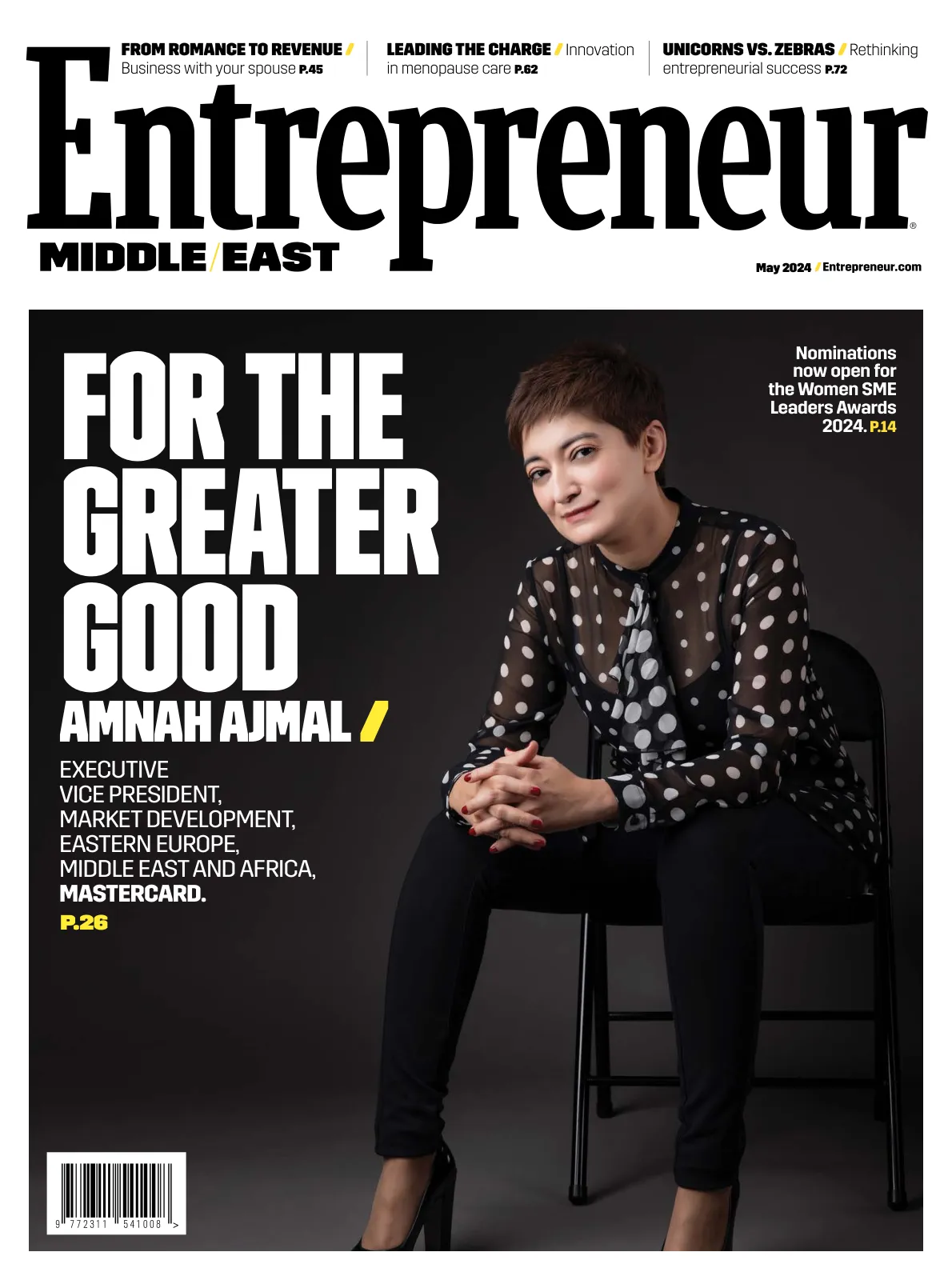
Entrepreneur Middle East, May 2024
Page 1
May 2024
UNICORNS VS. ZEBRAS / Rethinking
entrepreneurial success P.72
FROM ROMANCE TO REVENUE /
Business with your spouse P.45
LEADING THE CHARGE / Innovation
in menopause care P.62
AMNAH AJMAL /
EXECUTIVE
VICE PRESIDENT,
MARKET DEVELOPMENT,
EASTERN EUROPE,
MIDDLE EAST AND AFRICA,
MASTERCARD.
P.26
FOR THE
GREATER
GOOD
Nominations
now open for
the Women SME
Leaders Awards
2024. P.14
Page 2
27232
Homes from
AED 1,696,000
*
*T&C apply
Launching Sequoia,
your woodland paradise
A peaceful enclave hidden within the woodland.
Choose from a range of well-appointed homes, from
two-bedroom townhouses to six-bedroom signature villas.
Every residence at Sequoia blends nature-inspired design and
features with the latest smart home technology, bringing you
environmentally friendly convenience and comfort.
Page 3
Contents/May 2024
P.26
For The
Greater
Good
AMNAH AJMAL, Mastercard’s
Executive Vice President
for Market Development
across Eastern Europe,
Middle East, and Africa,
explains her mission to
empower individuals,
businesses, and
economies.
P.32
Seeing Ahead
DIFC Innovation Hub
CEO MOHAMMAD ALBLOOSHI
on the drivers for this
year’s Dubai FinTech
Summit running from
May 6-7, 2024.
P.34
Gateway to
Growth
Saudi Arabia-based
TAMAM, Zain KSA’s
fintech arm, is reshaping
Saudi Arabia’s micro-
financing landscape
by ensuring diverse
populations receive
financial services on an
equal footing.
FEATURES
→ AMNAH AJMAL is the
Executive Vice
President, Market
Development, Eastern
Europe, Middle East and
Africa, at Mastercard.
Page 4
Nestled by the coast of Lusail sits the splendor of
Raffles and Fairmont Doha, where luxury is rooted
in even the smallest details. Open the doors to
mesmerizing hospitality and make memories in a
world of sophistication.
Page 5
Page 6
Page 7
SUITE TREAT
Step into a world of opulence when you book a Suite at Raffles Doha.
Experience the added luxury of QAR 750 credit to spend
on dining in the hotel, and QAR 500 towards any Spa treatment.
Children aged 12 and below are welcome to indulge in the
enchantment of complimentary dining.
Rates starting from QAR 3,500 per night
For reservations, please call +974 4030 7100
or email reservations.doha@raffles.com
Raffles Doha, Iconic Towers, Marina District, PO BOX 4747, Lusail, Qatar
Page 8
Page 9
Welcome to the
E X C E P T I O N A L
An iconic hotel featuring
luxury rooms and apartments
with trendy dining options
in the heart of Riyadh
BOOK NOW
Mansard Riyadh, A Radisson Collection Hotel
4248 Prince Mohammed Ibn Salman Ibn Abdulaziz Road, Riyadh 6721-13315, Saudi Arabia
00966118290900 info.mansard@radissoncollection.com
radissonhotels.com/collection
Page 10
10 / ENTREPRENEUR.COM / May 2024
53 Harnessing Momentum
Supercar Blondie founder ALEX HIRSCHI
launches global digital car auction
platform, SBX Cars.
62 Leading The Charge
Making the case for why entrepreneurs
need to introduce innovation in the
menopause care market.
72 Unicorns Vs. Zebras
Balinca co-founder and CEO SHEREEN
TAWFIQ wants us to rethink what counts
for entrepreneurial “success” in the
MENA region.
70 “We Got Funded!”
Dubai-based edtech startup
SECUREMYSCHOLARSHIP raises
US$550,000 to accelerate growth and
expand operations.
STARTUP
SPOTLIGHT
‘TREPONOMICS
Contents/May 2024
17 Packaging Happiness
The HAPPY BOX Founder JUMANA AL
DARWISH reflects on 10 years of
being an entrepreneur.
22 A New Chapter
Seasoned corporate executive BEN
LOCKE aims to offer businesses from
all around the world a gateway into
the MENA region.
43 Vulnerability In The C-Suite
ANTON SKORNYAKOV on building a
culture of honest feedback and
strong results.
BUSINESS
UNUSUAL
← BEN LOCKE is the official
distributor for Cyberhive in
the GCC region, and
founder and Chairman of
Locke Lifestyle Properties
and Lemon by Locke.
EDITOR IN CHIEF Aby Sam Thomas
aby@bncpublishing.net
CEO Wissam Younane
wissam@bncpublishing.net
DIRECTOR Rabih Najm
rabih@bncpublishing.net
ART DIRECTOR Simona El Khoury
MANAGING EDITOR Tamara Pupic
tamara@bncpublishing.net
FEATURES EDITOR Aalia Mehreen Ahmed
aalia@bncpublishing.net
REGIONAL DIRECTOR
Mahdi Hashemi mahdi@bncpublishing.net
HEAD OF INNOVATION
Sarah Saddouk sarah@bncpublishing.net
GROUP SALES DIRECTOR – B2B GROUP
Joaquim D’Costa jo@bncpublishing.net
COLUMNIST Tamara Clarke
CONTRIBUTING WRITERS
Fida Chaaban, Malak Fouad, Sarah Lindsay,
Karan Moodley, Anton Skornyakov, Shereen Tawfiq,
Paulina Zalewska-Dzieciuchowicz
SUBSCRIBE
Contact subscriptions@bncpublishing.net to receive
Entrepreneur Middle East every issue
COMMERCIAL ENQUIRIES
sales@bncpublishing.net
ENTREPRENEUR.COM
Access fresh content daily on our website
All Rights Reserved 2024. Opinions expressed are solely those of the contributors.
Entrepreneur Middle East and all subsidiary publications in the MENA region are
officially licensed exclusively to BNC Publishing in the MENA region by Entrepreneur
Media Inc. No part of this magazine may be reproduced or transmitted in any
form or by any means without written permission of the publisher. Images used in
Entrepreneur Middle East are credited when necessary. Attributed use of copyrighted
images with permission. All images not credited otherwise Shutterstock. Printed by
United Printing and Publishing.
PO BOX 502511 DUBAI, UAE
P +971 4 4200 506
EntMagazineME
Entrepreneur-me
Page 11
Page 12
12 / ENTREPRENEUR.COM / May 2024
Editor’s Note/
Editor’s Note/
VALUE ATTRACTS VALUE
Startups honestly walking the community talk will see it returned in spades
W
hile there have been many harrowing photos and
videos showcasing the devastating impact of the
record-breaking storm in the UAE in mid-April, I
was particularly struck by one shared at the time
by Dubai-based small business, Bookends. A
second-hand bookstore that functions with both
online and offline components, Bookends found
its brick-and-mortar store located in Dubai Silicon Oasis
under a meter of water following the rains. Besides the
damage to the property at large, the business also lost over
10,000 of its books in its collection, and in an image that can
still be seen on the Bookends page on Instagram, one can
almost feel the desolation its founders Grace Karim and Somia
Anwar must have felt as they look upon their beloved space,
with a huge pile of damaged books at the center of it all.
I have been following the Bookends journey from almost its
very beginning- I was a mentor at the 2019 Startup Weekend
event that Anwar and Karim participated and then won third
place in, and the business went on to be featured in
Entrepreneur Middle East in 2021 as well. I have also been a
happy Bookends customer, and so, all of my personal
touchpoints with the business led me to feel really moved by
this dark episode in the enterprise’s story. As it so happens,
this could very well have been its final chapter- as Anwar later
admitted during an interview with Dubai Eye 103.8FM, she
was almost ready to call it quits as an entrepreneur. “After
living through the nightmare, I said, ‘I don’t want to do this
anymore,’” she said. “‘I’m done with this.’”
Founders are known to have a tendency to share just about
every aspect of their entrepreneurial journeys when things are
going according to plan, or at least a semblance of it. But when
a crisis hits, these same people clam up, and the community
they’ve built are often left unaware of the difficulties they’re
facing in their enterprises. As to why they’d choose to do this,
it can perhaps be drawn to their reluctance to showcase any
kind of vulnerability, and an insistence on keeping a stiff upper
lip through any troubles they might be facing. But all of this
should explain why I was so taken by Anwar and Karim’s
heartfelt admission of the crisis their business was going
through at that point in time. And while one may have thought
it as being a death knell for Bookends, it instead turned out to
be a rallying point for support in all forms for the young
enterprise.
From the outpouring of love and concern that they have
received, to the volunteers and well-wishers who have chipped
in to help the business get back on its feet, Anwar and Karim
now find themselves fueled by the community they had built
around them. In fact, Anwar told Dubai Eye 103.8FM, “I have
been blessed by the support from the community, from my
family, from my friends, everybody. The moment we put the
message out [that] we are closed, [that] we are affected by the
rains, the amount of love and support that has poured in has
been amazing. And I came to a point [where] I’m like, I have
no choice, I have to do this, not just for myself and my family,
but for everyone who has supported us in these dark times.”
Value really does attract value; it is a testament to the
importance of resilience in entrepreneurship, but also as an
example of the power of community in this realm.
There is clearly value in the collective- but only if you dare to
ask for it.
Aby Sam Thomas
Editor in Chief
@thisisaby
aby@bncpublishing.net
Page 13
Page 14
14 / ENTREPRENEUR.COM / May 2024
N
ominations are now open
for the 2024 edition of the
Mastercard Women SME
Leaders Awards in
partnership with Entrepre-
neur Middle East, an annual
event that aims to empower
women-owned and run
small and medium
enterprises (SMEs) across
Eastern Europe, Middle
East, and Africa.
Women executives or
business owners who have their
headquarters or offices based in Eastern
Europe, Middle East, and Africa, or offer
their services to these markets, can submit
their applications on womensmeleaders.
com before May 20, 2024.
Shortlisted companies and individuals
will be vetted by the Entrepreneur Middle
East team, and then the judging committee,
chaired by Mastercard and industry leaders.
Winners will be announced on June 6,
2024, at an awards ceremony taking place
in Dubai, UAE.
Launched in 2022 to empower
entrepreneurial women, the Mastercard
Women SME Leaders Awards aims to shine
a spotlight on women who are shaping the
future of the emerging markets around the
globe. In 2023, the initiative received over
4,500 submissions from women-owned and
run SMEs across 22 award categories.
With this year’s edition marking the third
occurrence of the annual event, the
Mastercard Women SME Leaders Awards
will be celebrating the achievements and
contributions of women entrepreneurs who
have demonstrated commendable
leadership, vision, and resilience in steering
their SMEs to success.
The event will thus highlight the
incredible achievements of women from all
walks of life, including those who are
reshaping the entrepreneurial landscape
with endeavors that range from
breakthrough technological innovations, to
championing social causes, and introducing
sustainable business practices.
For any enquiries related to the Mastercard
Women SME Leaders Awards 2024, please
email SMEleaders@bncpublishing.net.
Those interested in participating in this
year’s edition of the event can register on
the official website. womensmeleaders.com
In The Loop/
A Celebration of
Entrepreneurial
Women
Nominations are now welcome for
the Mastercard Women SME Leaders
Awards, which happens on June 6, 2024,
in Dubai, UAE
Page 15
New IVECO T-WAY: high productivity and safety on off-road terrains
With a complete line-up of AWD and PWD versions and the the 16-speed HI-TRONIX automated
gearbox, the IVECO T-WAY features a host of functionalities such as Rocking Mode, Off-road Mode,
Creeping Mode and 4 reverse gears to tackle with ease the toughest off-road conditions. The new
architecture of the EBS system, combined with disc brakes on all wheels, greatly improves the vehicle’s
performance and the driver’s safety in the most demanding applications.
New IVECO S-WAY: high technology and efficiency for on-road missions
The new IVECO S-WAY, with a completely redesigned and reinforced cab, offers a wide choice of
Euro III/V diesel engines, a delivering class-leading power from 360 HP to 560 HP Euro III / 570 HP
Euro V and superior fuel-saving devices, such as anti-idling feature, Ecoswitch, Ecoroll and Smart
Alternator, 12-speed HI-TRONIX automated transmission with the most advanced technology
in its category, electronic clutch and best-in-class torque-to-weight ratio.
Drive the new way.
Page 16
THE ART OF ELEVATION
OMNIYAT.COM
Page 17
17
May 2024 / ENTREPRENEUR.COM /
Packaging Happiness
The Happy Box founder Jumana Al Darwish reflects on 10 years of being an entrepreneur
by ABY SAM THOMAS
→ Jumana Al Darwish is an award-
winning serial impact entrepreneur
and philanthropist with over 19 years
of extensive experience shaping the
public and private sectors in the MENA
region. Her portfolio of investments
extends to the arts, education, tech,
and Web3 domains.
IMAGES COURTESY HAPPY BOX
Page 18
18 / ENTREPRENEUR.COM / May 2024
B/Q&A
O
h my God, it’s like a dream!” This is
what Jumana Al Darwish animatedly
exclaimed when I asked her how she
feels about the fact that her UAE-
founded enterprise, The Happy Box,
completes a decade in business in
May this year. Now, this response is
quite on-brand for this UAE-based
entrepreneur, given that she has an
incredibly buoyant personality- in
fact, it’s my belief that anyone who
has ever met Al Darwish can testify to
the abundant joyfulness that seemingly radiates out
of her. But don’t let her cheerful demeanor fool you
into thinking that Al Darwish must have had an easy
time running The Happy Box over the last 10 years-
on the contrary, it has been quite a topsy-turvy ride,
as she shares with me over the course of an hour-
long chat. However, Al Darwish does not wish to
wallow in the lows of the journey- instead, she
wants to celebrate what she calls the privilege of
just being able to be an entrepreneur. “I’m so
grateful,” Al Darwish says. “I’m so grateful for all the
learning. I look back at this journey of growth, and I’m
like, ‘Wow.’ This is a dream, a leap of faith, which has
materialized into a potential legacy.”
AL DARWISH’S FORAY
INTO ENTREPRENEUR-
SHIP happened in 2014,
which was two years after she
had given birth to her
daughter, Ayla. She had, until
then, been working with
government initiatives in both
her native Jordan and the
UAE- notably, the latter
tenure had seen her play a
vital role in the development
of Dubai Cares, a philanthrop-
ic organization that’s a part of
Mohammed bin Rashid Al
Maktoum Global Initiatives.
Al Darwish says that she has
fond memories of her career
prior to becoming an
entrepreneur, but she also
remembers feeling like she
wanted to do more than what
she was doing then. “I was,
like, 32 at the time; I had
become a new mom at 30,” she
says. “And I just felt like, well,
what’s next for Jumana?” And
it was as Al Darwish pondered
on thoughts like these that she
stumbled upon an entrepre-
neurial opportunity. As a
working mum in the UAE, Al
Darwish had been feeling that
she was “missing moments in
time” with her daughter. But
when attempting to rectify
this and secure quality time
with her child, she soon came
to realize that there was a gap
in the market for products or
services that facilitated or
encouraged family bonding. It
Page 19
19
May 2024 / ENTREPRENEUR.COM /
was then that she -along with her
US-based sister-in-law, Linda Al
Darwish- decided to bring to the
UAE the concept of “edutaining”
activity boxes for kids, which were
quite prevalent in North America
at the time. While the basic idea
was that these boxes would allow
for children and their parents to
come together and be engaged in a
number of fun-filled activities, Al
Darwish essentially “elevated the
concept, customized it, made it
more personable, and made it
more to be of a, let’s say, quality
that is really reflective of basically
what consumers in the UAE look
for.” She went on to call her
fledgling business The Happy
Box- a name that was indicative of
the value it brought to its
customers. “The target audience
was specifically parents that were
working that wanted something
different for their kids, for them to
do something that was education-
al and fun, but to also create these
pockets of happiness,” Al Darwish
explains. “So, essentially, I found a
way to package happiness!”
THE HAPPY BOX HAD ITS
PRODUCTS PRICED at about
AED260 a pop (which, by the way,
remains its cost to this day), with
each containing around eight fun
activities centered on a particular
theme- The Happy Party Animal
Box, for instance, aims to celebrate
the role animals play in our lives,
while The Happy Art Appreciation
Box introduces children to the
wonders of abstract art. Such
offerings hit a chord with parents
in the UAE, and The Happy Box
soon found its popularity growing,
aided by both word-of-mouth and
digital media marketing tech-
niques. The self-funded business
also expanded beyond the UAE
within the same year- Al Darwish
made use of a franchise model to
pilot The Happy Box in Kuwait,
Oman, Qatar, Bahrain, and Saudi
Arabia. Kuwait proved to be a very
good market for The Happy Box’s
offerings, and the company
continues to have a strong
presence there to this day. Oman,
however, had a very small
demographic for The Happy Box
to target, and so, it wound up its
operations there after realizing
growth in that market would be
hard to realize. Meanwhile, The
Happy Box opened up its doors to
a promising start in in Qatar,
Bahrain, and Saudi Arabia;
however, they eventually closed
owing to reasons ranging from
geopolitical tensions, to simply the
challenges of scale. “All those
offices were basically trials for us
in terms of franchising,” Al
Darwish says. “And it was a great
learning experience, don’t get me
wrong; it was phenomenal. And I
really attribute it to the support of
all of the franchisees, who I’m still
very good friends with, as they
were our first followers, or first
believers, in the concept, which, I
think, is really important. So, they
really helped validate the concept,
and they really helped us try and
see what works best in what
territory.”
THE HAPPY BOX LAUNCHED
WITH A SUBSCRIPTION-
BASED BUSINESS MODEL;
however, Al Darwish soon }}
I LOOK BACK AT THIS JOURNEY OF GROWTH,
AND I’M LIKE, ‘WOW.’ THIS IS A DREAM, A LEAP
OF FAITH, WHICH HAS MATERIALIZED INTO A
POTENTIAL LEGACY.”
Page 20
20 / ENTREPRENEUR.COM / May 2024
B/Q&A
found that customers
simply preferred to have the
choice to buy a product
from the enterprise every
month, as opposed to being
beholden to it. (“We have
commitment issues!” Al
Darwish laughs.) At the
same time, The Happy Box
also started to work with
clients in the luxury and
fashion spaces to aid their
marketing efforts for their
kids-centric products. “We
work with some of the
biggest brands globally;
think Dolce and Gabbana,
Givenchy, Harvey Nichols,
Al-Futtaim Group,” Al
Darwish reveals. “We’ve
been very, very lucky with
the level of brands that we
work with. We’re able to
cater to their clients
through our workshops,
and helping them realize
their marketing return on
investment. So, that was a
very smart way of how we
innovated our model.” All of
these efforts soon bore fruit,
with The Happy Box
breaking even as a business
three years down the line,
and that was also when Al
Darwish unveiled a partner
concept called The Happy
Studio, a pop art commu-
nity space in Dubai’s
Alserkal Avenue neighbor-
hood that can stage
everything from arts and
crafts workshops, to
themed birthday parties.
The space also became
home to the production
facility for The Happy
Box- while the business had
its products initially made
in the US, Al Darwish
found that she could cut a
lot in costs were she to
produce them locally, and
that’s exactly what she did.
Besides sourcing locally, Al
Darwish also sought out
talent in the same manner-
and her background in
social development and
philanthropy informed her
efforts in this regard. “I
started looking for women
who were artisans, but were
unfortunately in the service
sector, and didn’t have
really, let’s say, the educa-
tional skills or the opportu-
nities to grow,” she recalls.
“And what I did was I hired
them, gave them much
better offers than what they
would normally have, and I
trained them. And so, our
production facility became
run by these amazing
women who are migrant
workers that were in the
service sector, and now, all
of a sudden, had extensive
training and development
that allowed them to be
very creative, and do things
with their hands. That was
what The Happy Box gave
them- it gave them an
opportunity to use that
talent, to shine, and to
grow.”
AROUND THIS TIME,
AL DARWISH HAD
ALSO GRADUATED into
being the singular entrepre-
neur driving The Happy
Box, having dissolved -on
good terms though- the
co-founder model that she
had with her sister-in-law
when the company
launched. The Happy
Studio also grew in popular-
ity in the years after it came
into being, with new
products and services being
drawn up for it, and Al
Darwish also remembers
being on a hiring spree. But
all of that had to be paused
when the COVID-19 crisis
hit in 2020- today, Al
Darwish likens it to having
been a Black Swan event for
her business; yet, in
I AM NOT THE PERSON THAT FEELS LIKE, OKAY, IF I REACH
THIS MILESTONE, THAT’S IT FOR ME. NO, I AM REALLY EAGER
TO KEEP LEARNING, AND TO KEEP GROWING.”
↓ Jumana Al Darwish is the entrepreneur behind The Happy Box and The Happy Studio, which aims
to empower children and families through edutainment in the areas of science, technology,
engineering, the arts, and mathematics (STEAM), as well as community engagement.
Page 21
hindsight, she also recognizes the many lessons the period
afforded her as an entrepreneur. “I think the COVID-19 crisis
was a period of realization for me,” she says. “It made me take a
step back, really reassess my business, and figure out how to
make it leaner. Because when you’re cash-positive, the dividends
you make, you end up putting them back into the company, and
you’re then expanding further, buying more, and doing this and
that. But then, when the COVID-19 crisis hit, that was the
moment where I was like, wow, I really need to reassess a lot of
the work that we do. How can we make it leaner? How can we
work on a more outsourced model instead of having full-time
personnel all the time? How can we rely more on our networks?”
Asking questions like these is thus what allowed Al Darwish to
keep The Happy Box and The Happy Studio running amid a
rather tumultuous time for business- she pulled back on the
services side of her offerings, and, instead, capitalized on the
products they offered. Innovation became the name of the
game- Al Darwish now chuckles as she recalls the arts-and-
crafts workshops she and her team conducted over Zoom.
Keeping things lean also became the order of the day- layoffs
had to be done, but as Al Darwish noted in an article for
Entrepreneur Middle East at the time, “it is always hard to let
team members that you invested in go, but a crisis calls for thick
skin, and tough decisions to be made.”
SUCH MEASURES DID HELP HER TO GET THE BUSI-
NESS THROUGH this period though, and today, the entrepre-
neur is glad to see her business come into its own again. “After
the COVID-19 crisis passed, we started rebuilding,” Al Darwish
says. “It was as if we were starting all over again… But we started
to rebuild, and being gradual and effective about it all, being
smart with our time and effort, and really pushing hard on our
partnerships… And today, three years later, touchwood, we’re
back to being cash-positive, which is really amazing.” Al Darwish
says that today, 60% of her revenue comes from the events and
brand partnerships that she stages under the banner of The
Happy Studio, with the remaining credited to The Happy Box’s
products. Now, the argument could be made that Al Darwish
should perhaps focus more on the events side of the business;
however, she makes it clear that The Happy Box shall always
remain an integral element of her entrepreneurial endeavor. “We
know what gives us the most income, but we also have to remain
true to our story, which stems from The Happy Box,” Al Darwish
says. “I think that without The Happy Box, we would not be
existing- we would perhaps have just been any other type of
event company. And that’s amazing for companies who want to
be just that, but that’s not our story.” And just as focused as Al
Darwish is about the values that govern her business, the
entrepreneur is also emphatic about the importance of always
innovating and remaining relevant to the needs and demands of
the market at large. “I think there is no one winning formula,” Al
Darwish says. “I think that you have to consistently develop
along the way, and you have to constantly refine your products.
So, say, we had bestsellers, let’s say seven or eight years ago- we
still have them now, but we’ve refined them to make them even
better. You have to do things like that. You have to stay relevant-
you’re in a sea of red ocean of competition, and so, if you don’t,
you will get wiped out from the market.”
FOR HER PART THOUGH, AL DARWISH IS MAKING
SURE THAT HER BUSINESS CONTINUES to stay in vogue
and develops further, with her immediate growth agenda
including an expansion in Kuwait (The Happy Studio has yet to
make its entry there), and a reintroduction of sorts for both her
brands in Saudi Arabia. Al Darwish aims to move slowly on both
of these fronts; however, she admits that she’s been considering
soliciting venture capital to back her ambitions. Meanwhile, Al
Darwish is also pursuing a master’s degree in entrepreneurship
from the University of Cambridge in the UK, where she has been
exploring the gender tech gap in the world at large- HerTech.io,
her latest entrepreneurial venture that addresses this topic, is in
the works as well. As such, all signs point to Al Darwish
continuing to be wearing an entrepreneurial hat for the
foreseeable long term, and while she definitely has goals that
she’d like to realize, she is happy to simply just be on this ride all
the same. “I think I love the journey of growth,” Al Darwish says.
“I am not the person that feels like, okay, if I reach this mile-
stone, that’s it for me. No, I am really eager to keep learning, and
to keep growing. And I love that about life, and I love that about
us simply being able to do that- we’re so lucky that we are in an
ecosystem where we can learn, where we can create, where we
can build. And so, no, I don’t think I would retire, or take a step
back, and say, okay, I’m done, my life’s mission is done- no. I
think that this is only the beginning, I think that the last 10 years
were trial and error and learning, and I think that there’s still so
much more to be done from my side.”
Jumana Al Darwish shares four key
lessons learnt after having run The Happy
Box for a decade
}As an entrepreneur, you need to be fueled by passion “If
you’re passionate about what you’re doing, it will be a
success- no matter what.”
} Find (and keep) the right people around you “I know it
sounds cliche, and I know so many people say this all the
time, but really, your business’s success boils down to
the talent you have onboard.”
}Always be attuned to the needs of your customers “You
have to learn to be actually relevant to your market, to be
able to act fast and smart enough when you have to, and
to also have the flexibility and the strength to pivot at
times.”
}Money matters “I can’t stress enough how important it is
to be cash flow-positive.”
'TREP TALK
Page 22
22 / ENTREPRENEUR.COM / May 2024
A NEW CHAPTER
IN JANUARY 2024, when Ben Locke
wrapped up his 14-year tenure at Tungsten
Automation (previously called Kofax), a
California-headquartered global provider of
intelligent automation software, he found
entrepreneurship to be the best route for him
to apply his extensive skills and professional
experience he has gained in his career so far.
"Being Vice President at Kofax taught me a
huge amount about business operations, and
the various business industries across the
GCC and Africa,” Locke explains. "The
company was a software vendor who
essentially worked in and across all industries
and automated business processes as much
as possible. This gave me incredibly valuable
insight into a vast array of different
organizations in many industries, seeing how
they worked, where issues occurred, and the
best way to implement new methods and
practices to improve those businesses. And
this was hands-on, identifying issues, coming
up with solutions, and seeing those
implemented. Every solution implemented for
a client was essentially a business lesson and
example.”
This experience thus laid the groundwork
for a new chapter in his career trajectory,
which has seen him launch two new
businesses in Dubai, including real estate
specialist Locke Lifestyle Properties, and the
soon-to-be-launched boutique creative
agency Lemon by Locke. Speaking of the
latter, Locke says, "With so many new
companies entering the market, we wanted to
bring some fantastic individuals together to
help these new companies start up with
branding and advertising, or work with
existing companies to refresh/rebrand, and
keep them current with the ever-evolving
landscape.” At the same time, Locke is also
an active investor in startups, with one of his
latest investments being in UK-based cyber
security company CyberHive,where he will
also act as the official distributor in the GCC
region. “I am to bring them into this market,”
→ BEN LOCKE is the official
distributor for Cyberhive in the GCC
region, and founder and Chairman
of Locke Lifestyle Properties and
Lemon by Locke.
IMAGE COURTESY BEN LOCKE
Seasoned corporate executive Ben Locke aims
to offer businesses from all around the world a
gateway into the MENA region by TAMARA PUPIC
Page 23
23
May 2024 / ENTREPRENEUR.COM /
he explains. "The company will launch
in the UAE soon, bringing a new and
innovative solution to the
cybersecurity space that can protect
any device that connects to the
internet. It has taken a different
approach of hiding entry points– how
do you pick a lock that you can’t see?
I really believe this company can make
a difference.”
AS AN INVESTOR, Locke says
that he is focused on tech companies
that are either not yet in the GCC
region, or very new to it. "I can add
the most value to such companies by
utilizing my network to help
springboard them into the market, and
navigate any potential slowdowns,” he
explains. “When deciding on whether
to make an investment, I ask about
their general life experience, trying to
get to know what they have done/
lived through, and learn about how
they have got to this moment. There
should always be obstacles they have
to overcome. If that hasn't happened,
that could be a red flag, as you don't
know if the person can deal with, and
overcome challenges and setbacks.”
But if you are an ambitious individual,
Locke believes that the UAE offers a
fertile ground for new business ideas
and projects. "You only have to look at
the announcement by the UAE
Ministry of Economy at the beginning
of the year when they confirmed they
would be establishing a special entity,
the Intangible Assets Finance
Committee that is aimed at providing
financing to SMEs and startups by
facilitating access to financing,
supporting their growth, especially
during their critical initial years,” he
says. "In addition, under the National
Agenda for Entrepreneurship and
SMEs, the UAE aims to create 10
unicorn startups by 2031, and secure
a top three position in the Global
Entrepreneurship Index. There is
clearly a lot of government support,
which naturally creates an enticing
platform for startups.”
LOCKE CONSIDERS Dubai
and the UAE, his home for the past 14
years, to be a cornerstone of his
success, having offered him
unparalleled career opportunities, and
helping him build a valuable
professional network. His seamless
adaptation to life in the city, as well as
the broader MENA region, including
gaining a deep understanding of the
culture, and doing business in this
part of the world, is now of value }}
I’ve learned to approach
different cultures with
utmost respect and
curiosity. Never assume
you know how anything
works or will play out. Act
like a sponge, absorbing
the nuances and
intricacies of each
culture you encounter.”
“
Page 24
24 / ENTREPRENEUR.COM / May 2024
to the founders whom he supports. "I've learned to
approach different cultures with utmost respect and
curiosity,” he says. “Never assume you know how
anything works or will play out. Act like a sponge,
absorbing the nuances and intricacies of each culture
you encounter. Another key lesson is to never
underestimate the power of personal connections in
business. In this region, making a genuine connection
with those you work with is not just a nicety, it's a
necessity. As successful individuals, our actions and
attitudes speak volumes, and the impressions we leave
can have a significant impact.” As for the challenges for
fledging businesses in the UAE, Locke considers them to
be only just a handful. “I advise raising awareness of
extra startup costs other than licenses, and the time
involved in building or creating something physical,” he
says. "Getting building permits and sign-off from various
entities, the various cost differences between free zones,
and completing banking processes can take longer than
expected, but then, digital banking helps a lot. I also
suggest connecting with the correct Public Relations
Officer (PRO) company, and asking for all fees and
suggested timelines upfront.”
AS FOR HIS OWN BUSINESSES, i.e. Locke
Lifestyle Properties and Lemon by Locke, the entrepreneur
plans to spend the rest of 2024 on enhancing the quality
of service that each provides in order to ensure customer
satisfaction and loyalty. For Locke Lifestyle Properties,
that will mean integrating advanced technologies and
improving service delivery protocols with an aim of
retaining its current customer base and attracting new
clients. At the same time, he will be leading the Lemon by
Locke team in supporting ethical and sustainable brands
through creative excellence. "We deliver innovative
branding and marketing campaigns that amplify the
voices of businesses dedicated to making a positive
impact," Locke says. "We strive to drive meaningful
change through creativity and inspire love for brands."
Plus, for both of his businesses, as well as for CyberHive
in which he will act as a distributor to the GCC region,
Locke believes that focusing on talent development will
ensure that each remains competitive and innovative. "I
drive innovation in our line of work by adopting a culture
of creativity and continuous improvement within our
organization," he says. "Everyone should feel like they are
learning and adding value to themselves and the
company. We stay ahead of industry trends by embracing
new technologies and methodologies to enhance the
client experience and streamline operations. By
encouraging experimentation and empowering our team
to think outside the box, we can identify opportunities for
innovation and implement adequate solutions." While
Locke expects such an approach to significantly
contribute to driving revenue growth for all of his ventures,
he concludes by also emphasizing the importance of
fostering long-term relationships for the success of any
business. "Strategic partnerships and alliances will always
play a significant role in achieving our objectives," he
concludes.
Page 25
Page 26
26 / ENTREPRENEUR.COM / May 2024
A
llthough the topic of gender parity has risen in
prominence over the past few years,
momentum is key. And Amnah Ajmal, Executive
Vice President, Market Development, Eastern
Europe, Middle East and Africa, at global
technology payments giant Mastercard, is
someone who highlights the need for more
progress. “When it comes to gender parity, the
world is moving in the right direction, but we’re not
where we need to be yet,” she says.
FOR THE
GREATER
GOOD
MASTERCARD’S EXECUTIVE VICE PRESIDENT FOR MARKET
DEVELOPMENT ACROSS EASTERN EUROPE, MIDDLE EAST,
AND AFRICA EXPLAINS THE COMPANY’S MISSION TO
EMPOWER INDIVIDUALS, BUSINESSES, AND ECONOMIES
by TAMARA PUPIC
AMNAH AJMAL
IMAGES COURTESY MASTERCARD
A few barriers that impact women can be put in numbers. At
the current rate of progress, it will take 169 years to close the
economic participation and opportunity gender gap, as per
World Economic Forum’s Global Gender Gap Report 2023,
which raises concerns.
Ajmal highlights the subtle biases against women in the
workplace today. “For example, a study performed on attorneys
found that anger increased influence for men, but decreased
influence for women during group deliberations,” she explains.
“The study had implications for group decisions in general,}}
Page 27
27
May 2024 / ENTREPRENEUR.COM /
→ Amnah Ajmal is the Executive
Vice President, Market
Development, Eastern Europe,
Middle East and Africa, at
Mastercard.
Page 28
28 / ENTREPRENEUR.COM / May 2024
and jury deliberations in
particular, by suggesting that
expressing anger might lead
men to gain influence, but
women to lose influence over
others, even when making
identical arguments. These
diverging consequences
might result in women
potentially having less
influence on societally
important decisions than
men, such as jury verdicts.”
According to Ajmal, who
leads multiple business
verticals across 80+ markets,
women’s empowerment is
not just a moral imperative,
but a strategically sound
business approach. She
points out that empowering
women translates to
empowering the next
generation as well, which can
ultimately lead to the
development of business or
economic growth of a
country. “To ensure our
economic engines run on full
capacity, we need to ensure
that we include and enable
100% of our possible
economic contributors, and
not just 50%,” Ajmal
explains. “This means we
need to give them access to
training, insights, tools and
solutions to thrive as
professionals, as business
owners, and as individuals
who are contributing to a
better society.”
This explains why Ajmal is
spearheading a number of
initiatives at Mastercard that
are aimed at achieving
optimum momentum for
gender parity. One is the
Social Innovation Incubator
(SII) for women’s employ-
ment, a program Mastercard
WHEN YOU HELP WOMEN DEVELOP THEIR PERSONAL BRAND, THEY
ALSO INSPIRE OTHER WOMEN. I AM OBSESSED WITH THE IDEA OF
EMPOWERING WOMEN”
Amnah Ajmal took part
in a panel at the 2024
edition of the Women's
Empowerment (WE)
Convention, hosted by
the WE Council in Dubai.
is supporting, powering,
and scaling with the
international organization
Women Choice. The aim is
to create one million jobs
for women across the
MENA region in the next
five years. Another project
is the annual Mastercard
Women SME Leaders
Awards, designed in
partnership with Entrepre-
neur Middle East to
recognize and empower
women-owned and run
SMEs across the Eastern
Europe, Middle East, and
Africa region.
“Women entrepreneurs,
for example, have faced
more barriers compared to
their male peers when it
comes to both networking
and celebrating their own
achievements- this is why
we launched this project,”
Ajmal notes. “Not only do
they face barriers and
biases, women also have a
self-confidence challenge.
Research shows that a man
and woman with identical
credentials, who both lack
experience for a higher-
level position, come to
different conclusions about
being prepared for a
promotion. A man is more
inclined to assume that he
can learn what he’s missing
while in the new job. He
says to himself, ‘I am close
enough.’ The woman is
inclined to be more wary,
and less willing to step up.
Therefore, it is important}}
Page 29
29
May 2024 / ENTREPRENEUR.COM /
→ Amnah Ajmal
encourages businesses
to fully acknowledge
that diversity, equity, and
inclusion programs
invariably impact the
bottom line.
Page 30
30 / ENTREPRENEUR.COM / May 2024
to instill this confidence
in women.”
In 2023, Mastercard
had also collaborated with
the Global Summit of
Women conference in
Dubai to host many
ambitious women,
presenting them with an
opportunity to share their
stories on stage. “I often
speak to women entrepre-
neurs who believe they
have very ordinary
stories,” Ajmal says.
“However, when they
share them in a confer-
ence room filled with
hundreds of people, there
are often extraordinary
anecdotes that inspire
others. It’s amazing to see
these women engage with
other successful entrepre-
neurs, grow their
networks, workshop some
challenges, and generate
learnings.” Ajmal adds
that putting one woman
in the spotlight has a
multiplier effect on many
others. “When you help
women develop their
personal brand, they also
inspire other women. I
am obsessed with the idea
of empowering women,”
she says. “As a mother to a
daughter, I’ve been able to
give her choices that I
didn’t have. It’s important
for me to uplift women
and make them believe in
their dreams.”
All of these projects are
aligned with Mastercard’s
global commitment to
build a sustainable,
inclusive digital economy
where everyone can
prosper. “When Master-
card pledged to connect
50 million small busi-
nesses to the digital
economy by 2025, an
integral part of this
objective was equipping
25 million women
entrepreneurs with the
tools and resources they
need to grow their
businesses,” Ajmal says.
“This is a milestone which
Mastercard achieved in
June 2023- two years
ahead of the original
plan.”
While working on
Mastercard’s ambitious
goals, Ajmal does not shy
away from pointing to
other, often hushed,
conversations playing out
in the background in
many workplaces.
“Regarding the topic of
motherhood, it’s also a
pity that mothers with
young children often
leave their jobs, because
of difficulties in balancing
work and childcare,” she
says. “We must take more
pragmatic steps to create
programs that bring them
back to the workforce.
When I speak to women
who want to rejoin the
workforce, it’s often about
increasing their self-con-
fidence.” Here, Ajmal
adds another important
point, which is that
companies should rethink
today’s hiring practices.
“We shouldn’t just recruit
based on past experi-
ences, but also based on
the potential to create a
better future. There is a
way to gain new perspec-
tives, and that is by
activating a diverse
workforce. After all, in
today’s rapidly changing
times agility and curiosity
are the required traits to
WE HAVE A RESPONSIBILITY TO ACT FOR THE GREATER GOOD AS
CREATORS AND GUARDIANS OF SAFE DIGITAL NETWORKS THAT
INCREASE BUSINESS CONFIDENCE AND DRIVE TRUST IN DIGITAL
COMMERCE.”
Amnah Ajmal spoke
at the World Economic
Forum Special
Meeting in Riyadh in
April 2024.
Page 31
succeed- and the more diversity,
the more curiosity.”
Our conversation now turns to
how the lack of diversity in terms
of gender, background, culture,
and experience can eventually
stifle innovation. “Diversity means
that we can better serve custom-
ers, and better innovate solutions,
because we tap into diverse
perspectives,” she says. “That’s
why we are committed to having a
diverse workforce at Mastercard.”
In Ajmal’s opinion, organizations
should hold themselves account-
able to progress in this area. One
example, Ajmal continues, is
Mastercard’s Women’s Leadership
Network, through which the
company helps grow future
female leaders. “All organizations
should look at how they can add
value to an industry,” she explains.
“For us, as a technology company,
we also help fuel a future pipeline
for women in tech through our
Girls4Tech program. Over the
past 10 years, this award-winning
program has given 6.8 million
girls exposure to science,
technology, engineering, and
mathematics (STEM) subjects,
and as a result is encouraging
more young women to pursue
studies in STEM fields.”
At the end of the day, Ajmal
encourages businesses to fully
acknowledge that diversity, equity
and inclusion (DEI) programs can
invariably impact the bottom line.
“If you understand that, and
accept that, you can develop
goals, track your progress, and
benefit from that,” she says. “Also,
it must be everyone’s responsibil-
ity to help achieve those goals. At
Mastercard, we’ve tied our
employee compensation to key
environmental, social, and
governance (ESG) goals, like pay
parity, carbon neutrality, and
financial inclusion, making
everyone focused on spearhead-
ing progress.” By the same token,
Mastercard also balances the
potential of new technologies,
with the responsibilities they
bring, for example artificial
intelligence (AI), which the
company deploys to fight fraud
and enhance security. “We have a
responsibility to act for the
greater good as creators and
guardians of safe digital networks
that increase business confidence,
and drive trust in digital com-
merce,” Ajmal adds. “When it
comes to the development of new
technologies, it’s essential to
design appropriate safeguards
from the start, and to understand
how technology can replicate in
ways not initially intended. For
example, early AI systems
insufficiently represented gender
diversity due to biases in training
data. The reality is that AI can
scale anything, and that includes
inequality. It includes biases, and
that can be dangerous, so we need
to be aware and pro-active at
every turn and iteration. Fortu-
nately, there are great organiza-
tions who are tackling this
challenge, guiding future
developments of this technology
in ways that add value to
humanity.”
This segues into the themes of
leadership, where Ajmal sheds
light on her career journey, where
prior to her time at Mastercard,
also included C-suite roles at
Standard Chartered Consumer
Bank Malaysia, and Citigroup in
UAE, Egypt, UK, and Poland.
“Through my own personal
experiences, I have seen the value
of confidence in oneself, courage
to do brave things, humility, and
perseverance to continue along
what is sometimes the best path,
but not the easiest road,” she says.
“Having worked in the US, Asia,
Europe, and the Middle East, I
have also learnt the importance of
empathy, which plays a critical
role in innovation and leadership.”
Leaders, Ajmal adds, also need to
take informed risks and chal-
lenges outside their current
comfort zones. “This can be one of
the most powerful ways to drive
positive change at scale,” she
notes. “And to achieve it, one
needs to be passionate for
knowledge, but it needs to be
informed by a healthy dose of
humility. Humility and empathy
will enable leaders to drive big
bold changes that can transform
their business.”
As Mastercard continues “to
power economies and empower
people, so everyone prospers,”
Ajmal highlights that the
company does this by addressing
real needs and real pain points to
make commerce seamless and
digital transformation simpler.
“Many of our clients are venturing
into new lines of business, for
example, financial services, and to
help them do this, we lean into
data, innovative co-creation, and
distribution with telcos, retailers
and marketplaces,” she says. “We
support them in bringing their
visions to life.” The financial
services industry is complex, but,
Ajmal concludes, Mastercard
offers simple solutions to complex
problems “to fuel the bold
ambition of its clients.”
In today’s
rapidly
changing
times, agility
and curiosity
are the
required
traits to
succeed-
the more
diversity, the
more
curiosity.”
“
Page 32
32 / ENTREPRENEUR.COM / May 2024
↑ Mohammad Alblooshi
is the CEO of DIFC
Innovation Hub.
IMAGES COURTESY DIFC
Seeing Ahead
DIFC Innovation Hub CEO Mohammad Alblooshi on the drivers for this year’s Dubai
FinTech Summit running from May 6-7, 2024 by ENTREPRENEUR MIDDLE EAST STAFF
T
he second annual edition of
the Dubai FinTech Summit
will be held at Madinat
Jumeirah, Dubai, on May 6-7,
2024, with it being staged
under the patronage of H.H.
Sheikh Maktoum bin
Mohammed bin Rashid Al
Maktoum, Deputy Ruler of
Dubai, Deputy Prime Minister and
Minister of Finance of the UAE, and
President of Dubai International
Financial Centre (DIFC).
Organized by DIFC, the Dubai FinTech Summit is expected to bring together
8,000 decision-makers, over 300 thought leaders, and more than 200
exhibitors to discuss the latest innovations and challenges and showcase
cutting-edge technologies. In line with the Dubai Economic Agenda (D33) to
position Dubai among the top four global financial hubs by 2033 and DIFC’s
2030 strategy to shape the future of finance and innovation, the second
edition of the Dubai FinTech Summit 2024 is designed to encourage
cross-border collaboration and innovation which are considered pivotal to
transforming the global fintech sector.
Commenting on DIFC’s role in spearheading this event, Mohammad
Alblooshi, CEO at DIFC Innovation Hub, says, “As the leading global
financial center in the MEASA region, DIFC provides a unique platform for
the Summit where regional voices are heard, local innovations are showcased,
and unique challenges are addressed. We leverage our extensive network and
expertise to connect fintech players with regional opportunities and
resources. This strengthens Dubai’s role as a gateway, enabling cross-border
collaboration and driving fintech innovation across the region and beyond.”
Page 33
33
May 2024 / ENTREPRENEUR.COM /
WE
ENVISION
DUBAI AS A
GLOBAL
LEADER IN
FINTECH.”
From Alblooshi’s perspective, fintech
companies are playing a transformative
role in driving financial progress across the
Middle East, Africa, and South Asia region
by leveraging technology to innovate.
“Their impact extends beyond technologi-
cal advancements, fostering economic
growth, breaking down traditional barriers
to international trade and remittances,
enhancing experiences and paving the way
for a more inclusive and efficient financial
ecosystem,” Alblooshi notes. “According to
Innovate Finance, the UAE saw total
investment in fintechs soar by 92% in 2023
compared to 2022. This was partly due to
more fintech-friendly regulations, as well as
greater adoption of digital banking and
other tools in the region. Investments in
fintech, projected to grow by a compound
annual growth rate (CAGR) of 17.2% to
US$949 billion from 2022 to 2030, are
further accelerating the ongoing pace of
fintech innovation globally and in Dubai,
which offers access to high-growth
emerging markets in the Middle East and
North Africa (MENA), Western Europe,
Asia, and Africa.”
Dubai FinTech Summit 2024 will feature
an impressive line-up of distinguished local
and international speakers, such as more
than 20 governors of financial institutions,
including H.E. Essa Kazim, Governor,
DIFC; H.E. Dr. Philmnisi, Governor,
Central Bank of Eswatini; H.E. Cheaserey,
Governor National Bank of Cambodia;
H.E. Martin Galstyan, Governor, Central
Bank of Armenia; H.E. John Rwangomb-
wa, Governor, National Bank of Rwanda,
and H.E. Prof. Edward Scicluna, Governor,
Central Bank of Malta. Other notable
speakers include H.E. Abdullah bin Touq
Al Marri, UAE Cabinet Member and UAE
Minister of Economy; H.E. Helal Saeed Al
Marri, Director General, Department of
Economy and Tourism, Dubai and H.E.
Faisal Belhoul, Vice Chairman of Dubai
Chambers, and Chairman of J&F Holding.
The key themes for the Dubai FinTech
Summit 2024 will be finance renaissance,
eco-finance and impact, investment
vanguard, regulatory frameworks, global
financial dynamics and fintech 2.0.
Speaking about how these themes relate to
the UAE and the region, Alblooshi says,
“We are witnessing a rapid evolution in
fintech, with trends like open banking,
decentralized finance (DeFi), and the
metaverse shaping the future of fintech.
According to Mordor Intelligence, as the
financial technology sector continues to
increase worldwide, the UAE has emerged
as a hub for fintech innovations. The
Middle East region is the fastest-growing
real-time payments market globally, with
transactions in the region expected to grow
from $675 million in 2022 to $2.6 billion
by 2027, representing a CAGR of 30.6%,
according to the 2023 Prime Time for Real
Time report, published by ACI Worldwide.”
“The UAE stands at the forefront of
real-time payment innovations in the
Middle East,” he adds. “The nation’s
implementation of real-time payment
systems signifies not just a technological
advancement but a fundamental shift in
economic infrastructure. According to the
ACI report, 37.2 million real-time
transactions were made in the UAE in
2022, and this number is expected to
increase to 146 million by 2027, represent-
ing a five-year CAGR of 31.5%. The
Summit will delve into these trends,
offering insights into how they will redefine
banking, investment, and financial services
in the coming years.” Plus, Alblooshi points
out that the fintech industry is currently at
a pivotal crossroads, facing challenges such
as regulatory complexity and technological
disruption, while also embracing opportu-
nities in digital banking, blockchain, and
artificial intelligence. “The Summit is
designed to address these dichotomies,
facilitating dialogues and workshops that
focus on innovative solutions, regulatory
harmonization, and leveraging technology
for financial inclusivity and resilience, thus
fostering a robust and sustainable fintech
ecosystem,” Alblooshi adds.
The Dubai FinTech Summit is also set to
function as a vibrant ecosystem for fintech
startups and entrepreneurs, offering them
exposure, networking opportunities, and
access to funding. “We are dedicated to
nurturing these innovators, providing them
with the resources and support they need
to thrive,” Alblooshi says. “Our accelerator
programs, mentorship opportunities, and
talent acquisition platforms provide
startups and individuals with the resources
and guidance they need to succeed. This
nurtures a vibrant and diverse fintech
community in Dubai.” Indeed, a key
highlight of the Dubai FinTech Summit
2024 will be the grand finale of the FinTech
World Cup (FWC). The champions of the
FinTech World Cup will be announced on
the second day of the summit with the
winners securing an investment of up to $1
million.
Impact certainly seems to be the name of
the game at this year’s Dubai FinTech
Summit, and Alblooshi believes the event’s
impact extends beyond the fintech sector.
“The demand for fintech services has grown
significantly in the last few years, powered
by digital technologies and innovation
across sectors,” he explains. “We have an
optimistic outlook about the growth of the
fintech landscape. It is grounded in the
UAE’s continuous efforts to facilitate an
innovation-driven economy, supported by
state-of-the-art infrastructure, a forward-
thinking regulatory environment, and a
vibrant ecosystem that encourages
entrepreneurial ventures. Increasing
adoption of digital payments, the emer-
gence of blockchain technologies, and the
growing interest in sustainable and
inclusive financial services is driving the
next wave of financial solutions.” And when
it comes to the long-term goal for all of that
this year’s Dubai FinTech Summit is set to
showcase, Alblooshi draws it back to the
forward-thinking aspirations of the
Emirate of Dubai. “We envision Dubai as a
global leader in fintech,” he declares. “Our
aim is to continually support innovation,
attract top talent and investment, and
maintain a cutting-edge regulatory
framework. We look forward to delivering
an exceptional event that will inspire and
empower the fintech community.
“
Page 34
34 / ENTREPRENEUR.COM / May 2024I
n the world of business, there is usually a tone
of impressiveness that accompanies the
mention of any first-mover in this realm. And
that’s the narrative that accompanies Tamam,
the fintech arm of Saudi Arabia-based
telecommunications provider Zain KSA, which,
in 2021, became the first fintech company in
the Kingdom to receive a license for consumer
micro-financing from the Saudi Central Bank
(SAMA). “Tamam was conceived with the
ambition of becoming the leading one-stop
shop for financial services in Saudi Arabia,
seamlessly integrating with the fast-paced digital
lifestyle of today’s consumers,” says Yousef Al
Musaileem, CEO of Tamam. “As the fintech arm of Zain
KSA, Tamam’s establishment within Zain KSA’s
ecosystem was motivated by a clear strategy to
expand into adjacent markets, and tap new areas of
growth. The overarching goal is to drive the local
fintech sector by pioneering a homegrown innovative
financial services platform, tailored to the growing
needs of Saudi Arabia. Within this framework, our
vision and center of gravity are focused on evolving
and enriching the digital customer experience.”
GATEWAY
TOGROWTH
→ YOUSEF AL MUSAILEEM is
the CEO of Tamam, the
fintech arm of Zain KSA. It is
the first fintech company in
Saudi Arabia to receive a
license for consumer
micro-financing from the
Saudi Central Bank (SAMA).
SAUDI ARABIA-BASED TAMAM, ZAIN KSA’S FINTECH ARM, IS
RESHAPING SAUDI ARABIA’S MICRO-FINANCING LANDSCAPE BY
ENSURING THAT DIVERSE POPULATIONS RECEIVE FINANCIAL
SERVICES ON AN EQUAL FOOTING
by AALIA MEHREEN AHMED
Page 35
35
May 2024 / ENTREPRENEUR.COM /
“Tamam engages with
consumers through a mobile
app that has achieved a start-
to-finish cycle time of less than
two minutes for consumers
to complete the application
process and receive approval.
”
W
ith an aim to be known as the
“vanguard of the fintech revolu-
tion,” Tamam has thus been built as
a platform that offers quick, easy
and secure short-term financing
solutions that not just promise
instant approval processes, but are
also Shari’ah compliant. These solutions are
available on a mobile app -available to download on
both the Google Play Store and the Apple App
Store- as well as on its official website. “Our main
services include micro-loans and installment
financing options, all designed to empower consum-
ers and support them to fulfill their financial needs,”
Al Musaileem explains. “By leveraging cutting-edge
technology, Tamam’s mission is to ensure seamless
and inclusive access to financial services, with a
particular focus on servicing employees of micro,
small and medium enterprises (MSMEs) through
digital micro-finance services. Tamam also focuses
on enhancing the e-commerce sector through our
integrated micro-lending solutions.”
While Tamam has been curated to ensure financial
inclusion for a wide cross-section of consumers who
have had limited access to monetary support, there
has been one particular group whose access to
financial services is found wanting: the aforemen-
tioned MSME sector. “One significant pain point
we’ve identified is the limited access to finance,
particularly among employees of small and
medium-sized enterprises, who often face chal-
lenges in swiftly obtaining necessary documenta-
tion like salary certificates,” Al Musaileem notes.
“Open banking solutions are vital to ensure these
segments are reached and adequately supported. At
Tamam, we address this by offering a streamlined,
document-free, and entirely digital application
process. This innovation ensures that individuals
can secure financial products without the bureau-
cratic hurdles of traditional banking, emphasizing
our commitment to accessibility and immediacy.
Our platform’s ability to provide instant approval
around the clock, with funds available within 24
hours, is crucial for those in need of rapid financial
assistance. Tamam is also leveraging partnerships
as part of our dedication to meeting the immediate
needs of customers through efficient microfinance
solutions.” }}
”
Page 36
36 / ENTREPRENEUR.COM / May 2024
A
ccording to Al Musaileem, it is
Tamam’s digital approach -and
the ease of access it creates- that
has accentuated the other advantages
offered by the fintech platform.
“Tamam stands out in the market
with our focus on 100% digital
on-boarding and instant approvals,”
Al Musaileem notes. “We offer
hassle-free financing solutions
tailored to meet the diverse needs of
consumers. The purchase financing
service simplifies the user’s e-com-
merce needs, offering them a seamless
digital experience to finance their
installments. This solution also
provides users the flexibility to select
repayment options spanning up to 24
months. The cash financing service
ensures accessibility and convenience
through a simple digital process and
similar repayment terms. Both
services are Sharia-compliant. Tamam
engages with consumers through a
mobile app that has achieved a
start-to-finish cycle time of less than
two minutes for consumers to
complete the application process and
receive approval.”
In its quest to keep improving the
end users’ journey, in 2023, the
company also entered into strategic
partnerships with two MENA-centric
open banking platforms: Tarabut
Gateway and Lean Technologies. “At
Tamam, we’re expanding and scaling
up our financial services with open
banking, and utilizing artificial
intelligence, to improve customer
experiences,” Al Musaileem adds.
“We’re particularly excited about open
banking’s role in enhancing service
accessibility, especially for segments
like freelancers, who have been largely
overlooked. By leveraging alternative
data for credit scoring available
through open banking, we aim to
better serve the underbanked, driving
financial inclusivity across the
Kingdom with a more personalized
approach. This focus not only aligns
with our mission, but also positions us
at the forefront of financial innova-
tion. The collaborations [with Tarabut
Gateway and Lean Technologies] will
thus enable Tamam to expand our
service offerings, potentially including
financing solutions for freelancers.”
A
t this point, it should perhaps
come as no surprise that a large
part of Tamam’s pursuits lie in
creating an equitable micro-financing
ecosystem that -according to a report
by Allied Market Research, a global
provider of market reports, analytics,
and consulting services- is set to reach
US$1.68 billion by 2031, at a com-
pound annual growth rate (CAGR) of
9.4% . “As an integral part of Zain
KSA’s diversification approach, we are
also driven by a clear-cut sustainabil-
ity vision that prioritizes societal
well-being and serves as a cornerstone
for realizing the ambitious national
goals,” Al Musaileem notes. “And so,
by ensuring that individuals from all
walks of life have equitable access to
essential financial services, we can
contribute to improving the quality of
life across the Kingdom. This aligns
with Zain KSA’s focus on harnessing
innovation to empower people and
drive sustainable growth.”
A
l Musaileem is also quick to
highlight that Tamam’s solutions
also directly contribute towards
Vision 2030, Saudi Arabia’s national
plan to create a “vibrant, thriving, and
ambitious society, economy, and
nation by 2030”. Indeed, while
Tamam may have received the license
from SAMA in 2021, the entity was
actually officially launched in 2019
with a clear vision to address Saudi
Vision 2030’s Financial Sector
Development Program (FDSP)- an
initiative which aims to increase
financial inclusion in the Kingdom
and develop digital solutions for the
same. “We thus ensure our solutions
are accessible, transparent, and
inclusive, aligning with the nation’s
FSDP, formally approved by the
Council of Economic and Develop-
ment Affairs on May 9, 2018,” Al
Musaileem adds. “The FSDP, a
cornerstone of Saudi Vision 2030,
aims to develop a diversified and
effective financial sector, enhancing
its contribution to the national
economy and promoting income
diversification, savings, and invest-
ment opportunities.”
T
he first noteworthy indication of
Tamam’s commitment to the
FDSP came through the fintech
enterprise’s participation at the SAMA
Regulatory Sandbox, a 1.5-year-long
program that offers a live testing
environment for financial and fintech
companies as well as startups to test
new business models and concepts in
the market with real consumers
within a specific period. In fact,
Tamam receiving the honor of
becoming the first fintech with a
SAMA license to provide micro-
financing services came in the
→ TAMAM is a fintech entity
that was established in 2019,
with a goal to increase
financial inclusion in the
Kingdom in line with the
Financial Sector Development
Plan, which is a part of Saudi
Arabia's Vision 2030.
Page 37
37
May 2024 / ENTREPRENEUR.COM /
aftermath of this 18-month-long scrutinous journey. “From
2019 to 2020, our 18 months within the SAMA Regulatory
Sandbox allowed us to intricately navigate the multifaceted
regulatory environment, aligning our innovative business
model with the stringent requirements of the new microfi-
nance license,” Al Musaileem recalls. “The process involved
testing the app and the service for functionality, security,
and compatibility with customer user profiles in Saudi
Arabia. The platform displayed high product viability and
strong demand throughout testing. This rigorous adapta-
tion process not only enhanced our service offerings, but
also established our commitment to adhering to the highest
financial industry standards. Culminating in a milestone
achievement, Tamam was honored to receive the first
consumer micro-financing license from SAMA and a
subsequent Payment Card Industry Data Security Stan-
dards (PCI-DSS) accreditation [a cybersecurity standard
backed by all the major credit card and payment processing
companies], enabling us to launch full-scale operations as a
trailblazer in offering instant micro-lending solutions.”
I
t has been this sense of validation received from SAMA,
as well as its foundational vision to align with Saudi
Vision 2030, that has defined Tamam’s journey so far-
and if Al Musaileem’s plans for the future are anything to go
by, these elements will certainly continue to dictate the
enterprise’s upcoming endeavors too. “As a subsidiary of
Zain KSA, Tamam is committed to leading the digital
transformation of financial services, ensuring inclusivity,
transparency, and security,” he declares. “The Kingdom has
a growing fintech sector, driven by remarkable expansion
due to several factors, including the tech-savvy nature of
the young community, and the rising e-commerce demand.
We aim to catalyze the growth of this promising fintech
market, delivering to our customers the right products at
the right time. Additionally, Tamam’s leading position
within the Saudi fintech industry will position us within the
lead of the regional fintech ecosystem. Central to our
success is the robust digital application program interface
(API) ecosystem fostered by SAMA and supportive
government initiatives over recent years, which has been
instrumental in propelling us to the forefront of digital
finance. Moreover, the dedication and ingenuity of our team
have been pivotal in demonstrating that fintech innovation
originating from Saudi Arabia can compete on a regional
and global stage, underscoring our commitment to excel-
lence and the broader potential of the Kingdom’s fintech
sector. Backed by Zain KSA’s continuous investment in
technology and talent and our leading partnerships, Tamam
seeks to create a lasting legacy of positive change and
progress in the fintech landscape in Saudi Arabia and
beyond.”
TAMAM’S MISSION IS TO ENSURE SEAMLESS AND INCLUSIVE ACCESS TO
FINANCIAL SERVICES, WITH A PARTICULAR FOCUS ON SERVICING EMPLOYEES OF
MICRO-, SMALL-, AND MEDIUM-SIZED ENTERPRISES (MSMES) THROUGH DIGITAL
MICRO-FINANCE SERVICES.”
IMAGES COURTESY TAMAM .LIFE
→ TAMAM offers
individuals requiring
financing the opportunity
to immediately avail an
Islamic Shari'ah compliant
loan without physically
visiting a bank location.
The end to-end Shari'ah
approved process takes
minutes, from the time of
downloading the app, till
receiving the loan amount.
Page 38
FUN COMES
GUARANTEED
YOU DECIDE WHEN THE PARTY
STOPS WITH 24HR FOOD & DRINK.
NOW OPEN AT DUBAI DIGITAL PARK.
RADISSONHOTELS.COM/RED
Page 39
Sure Thing →
/Shure MV7+
B/Gear
#TamTalksTech
Gadgets and doodads that you might’ve missed out on, sourced
by a tech aficionado. by TAMARA CLARKE
← I’ve got the power
/Zendure SuperMini X3
The new Epson AM-C400 offers all the energy saving and
productivity advantages afforded by the brand’s existing line
of inkjet printers, but in a smaller, A4 format. Boasting high
print and scan speeds (up to 55ppm for print, and 100ipm
for scan), high paper capacities, and high yield ink
cartridges of up to 31,500 pages, this printer delivers
enhanced productivity benefits, and with an improved color
touch-screen user interface, operation is quick and easy. Its
C-shaped paper path and compact size makes AM-C400
ideal for environments that demand a highly reliable,
productive device, but where space is limited. Fast print
speeds, reliability, and a small product footprint are coupled
with the reduced energy consumption and waste reductions
expected from Epson Heat-Free inkjet, which supports the
brand’s sustainability agenda, while also offering a
compelling alternative to traditional laser printers.
TAMARA CLARKE, a former software development professional, is the tech and lifestyle enthusiast behind The Global Gazette, one
of the most active blogs in the Middle East. The Global Gazette has been welcomed and lauded by some of the most influential tech
brands in the region. Clarke’s goal is to inform about technology and how it supports our lifestyles.
Talk to her on Twitter @TAMARACLARKE. theglobalgazette.com
IMAGES COURTESY SHURE | SONY | EPSON
The Shure MV7+ Podcast Microphone features the
brand’s cutting-edge Voice Isolation Technology,
which focuses on your voice, not annoying
background noises. Engineered for podcasters,
streamers, and musicians, the mic includes a new,
innovative onboard Digital Signal Processing
engine that powers a suite of features, including an
improved Auto Level Mode, a Digital Popper
Stopper for enhanced plosive control, Real-time
Denoiser, and Adjustable Reverb. Thanks to its
unique full-touch LED live meter display and
numerous customization options, the MV7+ sets a
new standard in sound quality and personalization,
while also diving into a vibrant world of color. To
elevate your experience, the MV7+ podcast
microphone integrates with the new (and free!) MOTIV
Mix Desktop app, Shure’s latest MOTIV software
interface that allows you to easily configure the
microphone. The MV7+ integrates into any setup as it
provides hybrid USB-C and XLR output, and it
connects seamlessly with your laptop or smartphone
(iOS and Android), offering unparalleled flexibility and
ease of use. The MV7+ Podcast Microphone comes
in two colors, black and white, and it comes with a
3m USB-C to USB-C cable, a printed quick start
guide, and a MOTIV MIX Art Card with download
instructions.
Listen Up ↑
/Sony WH-1000XM5
From airplane noise to people’s voices,
the Sony WH-1000XM5 headphones
ensure you won’t hear any of it- and
that’s because they come with multiple-
microphone noise cancelling (NC) to
keep out more high and mid-frequency
sounds than ever before. Plus, with
Auto NC Optimizer, noise cancelling is
automatically optimized based on your
environment, and how you wear the
headphone. With four microphones on
each earcup, this is Sony’s most
ambitious step forward in noise
cancelling. Ambient sound is captured
even more accurately for a dramatic
reduction in high-frequency noise.
Smart features make using the
headphones easier than ever too. For
example, you can play music and
control the volume by simply pressing a
button. As soon as you start a
conversation, Speak-to-Chat
automatically stops your music and lets
in ambient sound– handy if you want to
keep your headphones on, or talk
hands-free. This smart feature uses
microphones built into your
headphones and advanced audio signal
processing to recognize and react to
your voice. And once your chat is over,
your music starts playing again
automatically! These lightweight
headphones are beautifully finished in
newly developed soft-fit leather. This
material fits snugly around the head
with less pressure on the ears, making
the headphones a pleasure to wear.
39
May 2024 / ENTREPRENEUR.COM /
Page 40
40 / ENTREPRENEUR.COM / May 2024
B/Gear
From better goods to better wardrobe bests,
every issue, we choose a few items that
make the approved executive selection list.
In this edition, our picks include Giorgio
Armani, Byredo, John Lobb, and NOVU Rituals.
The Executive
Selection
SETTING THE
NARRATIVE →
Giorgio Armani Men’s
Spring/Summer 2024
Collection
Titled “Weaving a Story,” the
Giorgio Armani Men’s Spring/
Summer 2024 line comes with
the declaration that the
brand’s own tale “always
stems from the same
unwavering urgency: to clothe
the present with a vibrant,
authentic sign fashioned from
dignity and elegance.” This
ethos has been translated
wonderfully into this line of
garments from the Italian
luxury fashion house, with it
including forms that are soft
and lengthened, intertwining
threads that are either actually
woven or evoked in prints that
imitate knots, weaves with a
summery feel, as well as
geometric motifs for rhythm.
Intertwining notes of blue,
sand, and natural tones
provide the chromatic
completion to this light and
fresh collection, which also
includes shoes and sandals
similarly characterized by
knots and weaves. armani.com
Page 41
41
May 2024 / ENTREPRENEUR.COM /
IMAGES COURTESY GIORGIO ARMANI | NOVU RITUALS | JOHN LOBB | BYREDO
AN EXPLORATION OF EMOTION ←
Byredo Mojave Ghost
Originally released in 2014, Mojave Ghost is one of Byredo’s most loved
fragrances, and the European luxury brand is celebrating its 10th anniversary with
a multipart campaign featuring model Amelia Gray, as seen through the lens of
photographer Harley Weir. Inspired by the untamed beauty of the Mojave Desert,
Mojave Ghost captures the essence of transformation and resilience, and Byredo
founder and Creative Director Ben Gorham’s vision for it is portrayed through
Gray’s intimate interaction with the mohavea confertiflora, the ghost flower at the
core of this scent. As for the fragrance itself, it opens with sweet notes of fresh
Jamaican nesberry and ambrette seeds, with a powerful heart that has powdery
violet unfurling to reveal the floral punch of magnolia and sensual sandalwood. At
the base, warming musk rounds out vetiver and cedarwood, leaving one with an
olfactive sensation that leaves the raw, untamed spirit of the desert lingering on
the skin. byredo.com
FITS LIKE A GLOVE ↑
John Lobb Pace
British bootmaker John Lobb has unveiled Pace,
its “ultimate urban casual soft loafer,” which,
besides being inspired from the craft behind
glove-making, is also a reimagination of its iconic
Lopez loafer. Lightweight and ultra-flexible, the
Pace loafer has been constructed from rich
materials like soft suedes, nubuck, or subtly
grained leather, and it comes in a warm palette
inspired by the mineral world- think ochre, sand,
deep browns. The suppleness of Pace is rooted in
the work on its new oval rubber super-flex sole and
the padded sock, which brings total lightness,
flexibility, and comfort to this entirely resoleable
loafer. johnlobb.com com
Novu Rituals ↑
"Skincare is selfcare is worldcare," declares Mary-Anne Maguire, founder of NOVU
Rituals, a homegrown sustainable skincare brand in the UAE, and it’s a proclamation
that certainly comes through in its mission to disrupt the current throwaway culture of
bathroom products, and bring it back to an era when chic ceramic bottles and glass
vials turned bathrooms into beauty apothecaries. As such, the NOVU Rituals line
(which currently comprises of a cleanser, a toner, a glow serum, and a hydrate cream)
come in beautiful refillable bottles; note here that the refillable pouches are also 100%
recyclable and reusable. As for the products themselves, they have been made from
purposeful, high-performance ingredients such as coconut oil, aloe vera, shea butter,
sandalwood oil, acai berry, jojoba oil, lavender oil, bentonite clay, pomegranate, and
rooibos tea. Crafted with high-performance vegan, organic, and naturally derived
formulas, the NOVU Rituals products have also been meticulously formulated to be
without toxins, and exclude dyes, parabens, synthetic fragrances, clogging oils, and
sodium lauryl sulfate. Plus, with the brand’s commitment to cruelty-free practices (no
animal-derived ingredient is used in any of its formulations too), NOVU Rituals thus
invites individuals to indulge in premium skincare experiences, without compromising
on quality or values. novurituals.com
EDITOR’S PICK
Page 42
12000+
Participants
400+
Exhibitiors
450+
Sessions
300+
Partners
150+
Minister Delegations
Page 43
43
May 2024 / ENTREPRENEUR.COM /
Vulnerability in the C-Suite
Building a culture of honest feedback and strong results
[THE HOW-TO] by ANTON SKORNYAKOV
In the business realm, especially among top executives,
vulnerability is frequently perceived as a sign of
weakness. Leaders are typically viewed as paragons of
relentless strength and absolute certainty. Yet, adopting
a stance of vulnerability can be a profoundly strategic
decision for a CEO, with substantial effects on the
company’s financial performance.
Entrepreneurs typically face the most difficult decisions with
the least amount of information. Whether you are choosing a
business partner, picking a project to invest in, or deciding on
the direction for your marketing campaign, it’s always done
under conditions of high uncertainty and unpredictability.
Here, the Pareto Principle is always at work. Only 10-20% of
features in most apps are used by customers, and around
10-20% of startups that get venture capital funding actually
make money for their investors. In such risky situations, }}
Page 44
44 / ENTREPRENEUR.COM / May 2024
it’s crucial for entrepreneurs to keep an
open mind, and be willing to rethink their
choices and plans regularly.
Yet, many businesses, including startups,
often continue investing in projects that
aren’t working well beyond the point they
should. Why does this happen? A major
reason is the cultural fear of admitting
failure or mistakes. This hesitation is based
on the false belief that every investment
must produce a profit- a myth that can
result in even bigger losses. Creating an
environment where it’s safe to express
doubts or concerns can help pinpoint
struggling projects before they use up
more resources. Consider this: what
percentage of your business’s ideas are
ultimately discontinued?
As an entrepreneur, your behavior and
mindset set the tone for your entire
business. If you act as if you never make
mistakes, a comfortable stance for any
human, you unintentionally create a
culture where everyone aims for perfec-
tion, and fears criticism. In such environ-
ments, team members might be reluctant
to speak up, or challenge the way things
are done, particularly if it means critiquing
ongoing projects.
This often creates a false sense of
harmony. And when criticism does finally
surface, it can cause significant disrup-
tions, leaving a mess that’s hard to clean
up. For a business to succeed, it’s essential
that team members regularly pinpoint and
address weaknesses without getting caught
up in personal conflicts. Accepting that not
finding the perfect solution on the first
attempt is a normal part of work, not a
personal failure, is key.
Building A Culture Of Constructive
Criticism
Here are three key strategies to create a
business environment where tough
feedback is seen as a strength, not a
weakness:
1/ LEAD BY EXAMPLE Show humility,
and be open to feedback. Demonstrate
how much you value others’ input by how
you react and adapt- whether that means
changing your strategies, or openly
discussing your own mistakes. Make it a
daily practice to:
• Seek advice from your team
• Openly confess when you don’t know
something
• Admit to a mistake
These actions set a positive example for
everyone. But be careful, it’s crucial how
you internally view these admissions-
whether as failures or as opportunities, to
prevent bigger issues in your business.
2/ ESTABLISH SAFE SPACES FOR
FEEDBACK Changing a business culture
often requires new structures that support
the desired changes. One effective method
for encouraging honest feedback is “ritual
dissent,” developed by Dave Snowden.
Here’s a short version of how it works:
• A team member presents a plan or idea
to a group as if it were potentially
problematic.
•The group’s job is to find as many faults
as possible, and critique the idea
thoroughly.
• The presenter, facing away from the
group, listens without responding,
focusing only on the feedback that
resonates.
This setup, where the presenter cannot
see the group and does not interact directly
during the critique, promotes honest
feedback, and helps the presenter absorb it
without becoming defensive. This method
avoids quick agreement, and shallow
group discussions. After a ritual dissent
session, asking participants to reflect on
their experience and the value of harsh
AS AN ENTREPRENEUR WHO IS OPEN TO VULNERABILITY
AND ACTIVELY SEEKS OUT NEGATIVE FEEDBACK, YOU
MUST ALSO ENSURE THAT YOUR BUSINESS IS NOT
ISOLATED FROM EXTERNAL VIEWPOINTS.
‘T/Pro
Page 45
45
May 2024 / ENTREPRENEUR.COM /
criticism can lead to valuable insights.
Initially, many may find this uncomfortable,
but it helps them understand the importance
of critique. This reflection can initiate
meaningful discussions and mark the
beginning of a shift from a feedback-averse to
a feedback-seeking business culture.
Implementing these approaches can
transform how your startup handles feedback,
turning what might seem like harsh criticisms
into opportunities for growth and improve-
ment.
3/ EMBRACE DIVERSE PERSPECTIVES As
an entrepreneur who is open to vulnerability
and actively seeks out feedback, you must also
ensure that your business is not isolated from
external viewpoints. The famous advice from
Steve Blanc, a Stanford entrepreneurship
professor, to “get out of the building,”
highlights the importance of this.
As the leader, it’s crucial for you to build
connections with people outside your
immediate circle. These might be current or
future customers, users of your products, or
industry experts, some of whom might need
to sign confidentiality agreements, or be
compensated for their insights.
Yes, you’re asking these outsiders to critique
your business, and you might even pay them
for their feedback. But the benefits are worth
the investment, as this external feedback
helps you separate the viable ideas from the
ineffective ones. Many businesses shy away
from this approach due to fear, but those who
embrace it gain a lasting competitive edge.
Incorporating vulnerability into your
leadership is not a sign of weakness; rather,
it’s about creating a transparent and flexible
business environment that can adapt and
thrive. By welcoming tough feedback, not
only do you improve your company’s
responsiveness and innovation, but you also
set it up for sustainable growth. Entrepre-
neurs who recognize the power of vulnerabil-
ity prepare their businesses to succeed in a
fluctuating market, demonstrating that true
strength often involves recognizing our own
limits.
Anton Skornyakov is a certified
scrum trainer with Scrum
Alliance and Managing Director
of Agile.Coach based in Berlin,
Germany. His new book, The Art
of Slicing Work, is a real-world, low-jargon
guide that teaches the main skill of a successful
manager in the 21st century– the ability to
master unpredictability. slicingwork.com
Four rules to remember when running a business with your
spouse by SARAH LINDSAY
From Romance
to Revenue
Eight years and four branches of
Roar Fitness later, I’ve found that
working with your spouse comes
with many pros, with one being that
you get to share so much of your life’s
successes and achievements together.
When couples work in different
industries, it can be difficult to
understand the intricacies of their
spouses’ work, and so, they often
cannot fully grasp or measure the
level of success in the other’s careers.
Working in the same line of business
and sharing matching objectives
makes it easy for both to understand
when success is reached, and both
can share a sense of job satisfaction
together. }}
O
ne of the most popular benefits of starting a business
is having the flexibility to spend more time with family
and loved ones. You are your own boss, and you can
set your hours to best fit your lifestyle. However, some
entrepreneurs want to spend even more time with
their spouse, including during work hours, and so, they
decide to start their own co-owned business venture-
as my husband Rich and I did when we opened the
first branch of Roar Fitness in London in 2016.
Page 46
46 / ENTREPRENEUR.COM / May 2024
We get asked about the
reality of working together
all the time, as many say that
they could not imagine
working with their spouse.
But having done it and made
it work successfully for many
years, these are my learnings
and the rules we follow to
make sure running a
business together works on
every level for us.
1/ HAVE THE SAME GOAL
Working together as a team,
my husband Rich and I are a
well-oiled machine, with the
same common goal and
dream. We are very aligned
as to where we want to go,
and that’s never in question
for a moment. It doesn’t
mean we always agree on
how to get there, or on what
is best for the business, as
how to achieve success can
often look different to a
couple. But the key is for
both parties to always want
the same outcome, and to
focus on that. A bit of
healthy debate and discus-
sion along the way is good
fun, and part of the journey.
2/ SHARE THE WORKLOAD
As a business partner, your
spouse will have a very clear
understanding of your
work-life balance, and thus
will be in an excellent
position to provide support
and advice. Interestingly,
studies have shown that
there is a lesser chance of
burnout when you work with
your significant other- just in
case you needed another
great plus point! The need to
endlessly juggle and try to
integrate work and home life
is removed, and therefore,
you are left with more energy
and resources to invest in
both areas. At work, Rich
and I have different roles
within the business, and we
play to each of our strengths,
which, in the long run,
brings out the best in the
business. My husband is a
very natural leader, and he
focuses on more team
management and day-to-day
operations; plus, he’s a
spreadsheet and numbers
genius, so I leave all the com-
mercial things to him! In my
role, I get to focus on the
more creative (and fun!)
areas, including marketing
and publicity, as well as
doing a lot of the new joiner
consultations. This didn’t
happen overnight, of course,
and it all happened very
organically, but we quickly
learned our strengths, and
what we both enjoyed, and
with time, we’ve honed in on
our skills, split the work
fairly and evenly, diminished
any chance of being
overloaded, and today, it’s
working really well.
3/ OPEN COMMUNICATION
As a couple in business
together, much like in a
marriage, the key to success
is to communicate honestly
and openly at all times, with
the obligation of holding
each other accountable.
Having very open, honest,
and direct conversations and
communication is vital, and
integrating this into our
work relationship helps us to
implement this into the rest
of our lives, not only with
each other, but with our
team, and the rest of our
family too.
4/ REMAIN PROFESSIONAL
AT ALL TIMES Every couple
argues, and it is imperative
to leave any of your personal
issues outside of the
workplace, remaining
positive and professional,
and producing the same
level of work consistently,
regardless of the situation at
home. This not only
contributes to your produc-
tivity and positivity, but also
to your employees who play
a vital part of your company
success– no one wants to
have to take sides, after all!
Keeping your team happy,
positive, productive, and not
affected by any of your
challenges as a couple is key
to keeping the business
running in the right
direction.
As ever, when it comes to
working with your other
half, there is no one right
path that suits all, or that
will help to overcome the
challenges that arise when
working together. Every
couple is different, and they
will come across different
challenges as they go along.
If you do choose to go down
this path, you need to find
your own way, and test and
learn, as with everything in
entrepreneurial life.
My final thoughts and
words of experience for you
would be to just not
overthink it too much, or
obsessively keep a tally of
who does what, as this won’t
get you very far. Keep
communicating, be
proactive in making choices
about combining your lives,
and, ultimately, enjoy what
you do together. And if you
do all this, then I strongly
feel that success -and all the
other good stuff- will
follow.
Sarah Lindsay, a
three-time
Olympic speed
skater, is the
owner of Roar Fitness.
roar-fitness.com
‘T/ Pro
KEEPING YOUR TEAM HAPPY, POSITIVE,
PRODUCTIVE, AND NOT AFFECTED BY ANY OF
YOUR CHALLENGES AS A COUPLE IS KEY TO
KEEPING THE BUSINESS RUNNING IN THE RIGHT
DIRECTION.”
Page 47
47
May 2024 / ENTREPRENEUR.COM /
P
odcasting is in its infancy in the Middle East, and as with
anything new, there are quite a few amazing peaks, and
some challenging troughs. One certain thing though is that
it is an exciting -and never dull- journey.
Being a first-mover in any industry can feel a bit daunting
and sometimes lonely, but I have found the journey to be
profoundly satisfying and deeply rewarding. In 2020, I
launched a podcast show called What I Did Next. As the
host of the show, I welcome different guests from around the Middle
East who discuss their life journeys. As we are currently in our
seventh season, I can comfortably say that the show and I are no
longer newcomers or in uncertain territory. We’ve been lucky
enough to be recognized multiple times by the premier podcast
service, Apple Podcasts, having been named one of their “Best
Shows” in 2021, as well as being featured in “Podcasts that Make Us
Think” in 2022.
Tuning Into Success
Entrepreneurial lessons from the frontlines of the
podcasting scene in the Middle East by MALAK FOUAD
}The show’s ethos is simple: to connect
the dots of our guests’ life journeys, to
look at the twists and turns their paths
have taken, to look at the paths not
taken, to consider the happenstance of
life, and to look at the essence of failure
and success. We delve deep and have
authentic discussions that, in many
cases,are firsts for our guests. The show
has seen some of the region’s most
prolific business personalities talk freely
about their personal rollercoasters, with
all the unpredictability that entails. From
the former Google X Chief Business
Officer and host of the Slo Mo podcast,
Mo Gawdat, to world-renowned heart
surgeon, Professor Sir Magdi Yacoub,
Lebanese jewellery designer Nadine
Kanso, Fadi Ghandour, co-founder of
Aramex, Hala Gorani, author and
ex-CNN anchor, Sultan Sooud Al-Qasse-
mi, academic and acclaimed art collector,
to Dr. Lama Al Sulaiman, pioneering
Saudi businesswoman, among so many
others. The ongoing Season 7 has a great
line-up as well, which includes Becky
Anderson, CNN’s Managing Editor in
Abu Dhabi, Hatem Alakeel, a trailblazing
Saudi fashion designer and branding }}
Page 48
48 / ENTREPRENEUR.COM / May 2024
guru, bespoke artist Janan Shihadeh,
and Moe El Fayed, the UAE-based
founder and CEO of Grubtech.
}As an Egyptian-American who grew
up outside the Middle East, and with
a career covering all aspects of the
communications industry across the
United States, the United Kingdom
and Egypt, I feel I am well-placed to
bring a fresh take on storytelling in
the region. A strong underlying
current of all I attempt to do with
A&T Media -the enterprise I
launched in 2021 that houses What I
Did Next- is to promote positive
narratives from the region, both for
the region, and for those outside it.
With the incredible dynamism
shaping all industries across our
region, there is a space for bringing
those stories to a wider audience.
That forms a strong part of my
motivation.
In the meantime, the podcasting
scene in the Middle East has also
seen a massive transformation. Once
a niche medium, it’s now growing to
become a well-represented channel of
content consumption. With global
podcast advertising revenue estimat-
ed at US$10 billion, and the US
market alone contributing around $4
billion, the MENA region is poised
for exponential growth, equal to the
US market. However, despite this
potential, we’ve only just scratched
the surface. The reasons are multifac-
eted, including a need for more
understanding and awareness
regarding podcasting’s value, a
scarcity of content tailored to
regional audiences, and a hesitancy
among brands to invest. Further-
more, the creator communities in the
region remain disjointed. Yet, despite
the diverse cross-sections across
multiple countries, there’s a signifi-
cant opportunity to build larger,
MENA-level communities. Such
networks could foster knowledge-
sharing, experience-exchange, and
collective growth, a strategy that’s
proven successful in other indepen-
dent creative communities.
One of the most pressing challenges
is the lack of regional data. In
contrast to the United States, where
quarterly qualitative podcast reports
detail behavior changes, categories,
and popular shows, the MENA
region relies heavily on surveys and
estimations. This gap hinders both
creators and advertisers from fully
understanding and leveraging the
market’s dynamics. Monetizing
content in a market still warming up
to the digital revolution presents its
own set of challenges. My own
journey, carving a niche in this
evolving landscape, sheds light on
some of these issues. I have found
that breaking through with audiences
has been significantly easier than
convincing brands that podcasting is
a viable marketing tool. With budgets
traditionally allocated to convention-
al media, marketing departments are
still unclear about what their money
will buy them, and some brands have
yet to understand the potential of
audio. What I Did Next has been
sponsored and supported by
avant-garde brands such as EFG
Holding, who have seen the potential
of connecting directly with an
audience that reflects their values.
}There’s a three-way trade-off we
value among creators, listeners like
ours (who trust our opinions and
brand partnership choices), and the
brands themselves, who are begin-
ning to see measurable results. With
more than half of podcast listeners in
the United States now known to be
more likely to buy a product after it
has been advertised or suggested on a
podcast, there’s a growing belief that
podcasts are likely to show similar
results in the Middle East.
With a large professional, multilin-
gual, multinational population across
the region, A&T Media aims to
provide high-quality, intellectually
rigorous, and engaging content that
resonates with podcast listeners. The
Middle East is a natural market for
great podcast content that is
entertaining as well as provides a
sense of connectedness. One of the
big attractions of audio entertain-
ment is the ease with which we can
interact with it. We often listen to
podcasts, while doing other things
such as driving, walking, working
out, and cooking. That makes it a
very attractive medium for both
advertisers and listeners. This ease of
use was one of the elements that
attracted me to podcasting as a
business.
}There are two distinct types of
podcasts in the audio content
universe. There are brand-owned
shows, driven by consumer compa-
nies that want to build interest in
their own brand– think Coke or
Vodafone launching a podcast that
promotes their products. The second
style of podcast is editorial in nature,
often with a strong narrative arch,
and focused entirely on entertaining
the listener. This is where a podcast
like What I Did Next lives.
Like all nascent industries,
podcasting in the Middle East is an
evolving medium. It is finding its
footing as a communication channel,
and as an additional tool in the
marketers’ arsenal, and it will be
shaped as much by the region’s
habits, likes, and dislikes, as it has
been in other more established
markets like the US and Europe.
As I look forward, A&T Media’s
mission remains unchanged: to
leverage the power of storytelling to
bridge cultures, foster understanding,
and create a shared space for
dialogue and discovery. I’ll forge
ahead, learning from fascinating
individuals who inspire, challenge,
and lead the way in their respective
fields.
Malak Fouad is the founder
of A&T Media, a company
that specializes in the
creation of audio content in
the form of podcasts. With
an emphasis on high-quality production
values, A&T Media is developing
podcasts that are intellectually rigorous,
attracting high caliber guests, as well as
a select audience across the Middle East
region and beyond. It is home to What I
Did Next, one of Apple Podcasts’ Best
Shows of 2021 and 2022, with Fouad
herself as the host. at-media-group.com
‘T/ Pro
Page 49
Invests
In
Entrepreneurs
What Are
You Building?
Learn more at entrepreneur.vc
Page 50
Page 51
Page 52
MAY 16
SOFITEL THE PALM, DUBAI
NOMINATE
NOW
AWARDS
MEP
CBNME
2024
RECOGNISING THE GAME CHANGERS IN THE REGION’S MEP INDUSTRY
FOR EDITORIALS
VIBHA MEHTA
+971 58 6314145
vibha@bncpublishing.net
FOR SPONSORSHIP OPPORTUNITIES
ALEX BROWN
+971 56 308 2946
alex@bncpublishing.net
JOAQUIM D’COSTA
+971 50 440 2706
jo@bncpublishing.net
Gold Partners
Silver Partners
Knowledge Partners
Page 53
53
May 2024 / ENTREPRENEUR.COM /
Harnessing Momentum
Supercar Blondie founder Alex Hirschi launches global digital car auction platform, SBX
Cars by AALIA MEHREEN AHMED
← ALEX HIRSCHI is the
founder of Supercar Blondie, a
brand that now falls under SB
Media Group, which was
co-founded by her and her
husband, Nik Hirschi, in 2017.
Page 54
54 / ENTREPRENEUR.COM / May 2024
S/Q&A
I
n 2017, when Alexandra Mary “Alex” Hirschi decided to steer her career away from broadcast
journalism towards creating social media content that truly resonated with her passion for
the world of cars and technology, it led to the launch of Supercar Blondie- an automotive
entertainment avenue that offers the latest insights on luxury cars, vehicle design and
technology- out of the UAE.
And in a tale of unexpected success for Hirschi, her content
went on to garner what is, today, a global online audience of
over 110 million followers on the world wide web (across
different social media platforms, as well as the official
Supercar Blondie website). Having assimilated the brand
into SB Media Group, a UK-based media and entertainment
company that Hirschi co-founded with her husband Nik
Hirschi in 2017, the Australian native -who is very much the
face of the Supercar Blondie brand- has now moved on to the
next step in scaling her venture: SBX Cars, a US-headquar-
tered global digital car auction platform.
W
ith more than US$100 million in consignments
already confirmed pre-launch, the SBX Cars
digital auction platform has gone live with a
collection of several world-first exclusives and other rare cars.
“SBX Cars will provide liquidity, transparency, trust and
speed on how luxury cars are being transacted in the UAE,”
Hirschi says, in an interview with Entrepreneur Middle East.
“On top of that it will open up the UAE luxury car market to
the world and to global buyers that may have shown certain
hesitation before, because they did not have the contacts to
this market. There is a huge appetite for the world’s best cars
to be bought and sold in the UAE with the amount of wealth
the country has, and the caliber of people and entrepreneurs
it has attracted. With only 5% buyer’s commission, SBX Cars
will help in transacting cars in a much quicker way, which
provides liquidity and access to a global pool of buyers and
sellers with a click of a button. We have some spectacular
cars from the UAE already consigned for our launch,
including the first ever Mercedes-AMG One to be publicly
auctioned, as well as a Lamborghini Veneno Roadster and La
↑ SBX Cars bills itself as
“the only digital auction
platform that specializes
in bringing you rare and
collectable vehicles from
all over the world."
IMAGES COURTESY SBX CARS
Page 55
55
May 2024 / ENTREPRENEUR.COM /
Ferrari just to name a few.
Once we launch, we believe
this platform will offer local
car lovers access to vehicles
that haven’t ever been
available to them before.”
L
ook deeper into
Hirschi’s observations
of the UAE luxury car
market, and one will find
that there is indeed an oasis
of opportunities that can be
tapped into. For starters, a
March 2024 report released
by India-based market
research firm Blueweave
Consulting shows that the
UAE luxury car market size
was valued at a whopping
$4.12 billion in 2023, and is
expected to reach $7.98
billion by 2030. The report
highlights that a number of
factors have contributed to
these statistics, including
increasing levels of dispos-
able income, the UAE’s
economic strength, as well
as a rising shift in consumer
preferences.
B
ut despite the
mammoth demand
in the country,
Hirschi notes that there
have been plenty of
bottlenecks for UAE-based
luxury car collectors and
enthusiasts. “If someone
wants to sell their premium
car, the options are
currently limited,” Hirschi
explains. “They either sell
with an in-house auction
company, where they might
have to wait months for the
next live auction, the fees
are three times as high,
logistically they will have to
ship the car to the physical
auction location, which
exposes them to risks that
the car can be damaged plus
they have to take out extra
transportation and insur-
ance costs. The other option
would be to sell with a
regional digital auction
platform with limited reach
and no focus on premium
access. Current digital
auction companies do a
fantastic job, but they only
serve one market, either the
US or Europe.”
With SBX Cars, Hirschi
thus hopes to eliminate such
woes- not just for the UAE
and the wider Middle East,
but for collectors across the
globe. “Our platform is
global, meaning a buyer in
the Middle East can find the
car of their dreams in
Japan, Europe or the US,
and have it shipped to
them,” Hirschi says. “There
are lots of very special cars
that exist around the world,
but it’s difficult to find them
unless you know exactly
where they are and how to
contact them. We’ve spent
the last seven years hunting
down these incredibly
unique and highly desired
vehicles and have now built
a platform where buyers can
find them all in one place.
Additionally, there is no
other auction platform that
has the marketing reach
that we do, so it offers
sellers an additional
advantage.”
I
ndeed, in its bid to open
doors for more accessible
purchases within the
luxury car space, SBX Cars
has found a way for users of
the platform to leverage SB
Media Group and Supercar
Blondie’s monthly viewer-
ship of two billion. “Our
social media expertise and
global reach has been key to
the success of SBX Cars,”
she says. “We could not have
built and launched with
over $100 million worth of
cars without the trust and
brand that we have built
over the last seven years on
social media. A lot of the
cars that we will sell will
serve as content for video
and website articles on
supercarblondie.com which
in return helps promote }}
WITH ONLY 5% BUYER’S COMMISSION, SBX CARS WILL HELP IN
TRANSACTING CARS IN A MUCH QUICKER WAY, WHICH PROVIDES
LIQUIDITY AND ACCESS TO A GLOBAL POOL OF BUYERS AND SELLERS
WITH A CLICK OF A BUTTON.”
Page 56
56 / ENTREPRENEUR.COM / May 2024
the auction. In addition,
we have SBX Cars social
media pages so each car
will have additional reach
there too and very unique
cars and collections will
also get access to complete
custom content opportuni-
ties and events.”
A
nother key strategy
that SBX Cars has
adopted -and one
that will noticeably set it
apart from high-volume
online auction sites- is its
dedication to prioritizing
quality over quantity while
choosing the finest luxury
consignments for its
platform. “Our focus is on
listing only premium and
collectable vehicles,”
Hirschi explains. “We have
four categories: Supercars,
Hypercars, Classics and
Special Vehicles. There is
no minimum dollar amount
for a vehicle to be listed on
our site. We will list a car if
it is premium, collectible or
if our auction specialists
feel the vehicle is unique or
special in some way.
Auctions attract rare and
unique cars because the
price for these vehicles are
hard to determine, so an
auction is the only way to
accurately reflect what that
specific vehicle is worth.
Generally speaking, rare
and unique cars are very
well cared for by their
owners and caretakers so
the vehicles on our site will
be of a higher quality than
those on a volume-based
auction site. Our photogra-
phers will also take on
average 150-200 photos to
capture every detail and
possible scratches or flaws
to ensure we can show the
true state of the car and
history, so buyers feel
comfortable to buy them
online without having seen
them in person.”
A
s Hirschi now looks
forward to what she
hopes could
potentially disrupt the luxu-
ry car market, the co-
founder reveals that she has
three clear-cut end goals in
mind for SBX Cars. “Our
primary goal is that both
seller and buyer are able to
transact at a price that
fairly reflects the true
market value of the car with
as little fees and logistical
costs as possible,” Hirschi
adds. “The second goal is to
provide a customer service
that makes both seller and
buyers feel that they’re
being looked after with
complete transparency.
With so many different
cultures and ways of doing
business around the world,
we provide a standardized
way where multi-million
dollar transactions can
happen more easily and
frequently. Lastly, our
platform now offers you
access to the world’s rarest
cars that buyers could not
find before, and may have
needed to wait years to find
the car they’ve been looking
for.”
OUR PLATFORM IS GLOBAL, MEANING A BUYER IN THE MIDDLE
EAST CAN FIND THE CAR OF THEIR DREAMS IN JAPAN, EUROPE
OR THE US, AND HAVE IT SHIPPED TO THEM.”
S/Q&A
← SBX CARS was
founded to provide a
space where buyers
and sellers of
premium vehicles
around the world can
connect.
Page 57
Page 58
58 / ENTREPRENEUR.COM / May 2024
For The Love Of Arab Art
With his Lebanon-based art gallery, Kalim ArtSpace founder Kalim Bechara is on a mission to
introduce emerging Arab artists to the world by AALIA MEHREEN AHMED
K
alim Bechara was
only six years old
when he started
learning how to
play the piano- a
moment in his life
that he believes
eventually plunged him into a deep
appreciation for the realm of arts,
design, and culture. And as his
understanding of arts broadened
through education and travel,
Bechara -who is originally from
Lebanon- soon found himself fixated
upon the works created by emerging
artists in the Arab region. It was then
that he decided to create Kalim
ArtSpace, a gallery dedicated to
supporting such up-and-coming
talents in arts and design- but it
wasn’t a move that was immediately
welcomed by those around him. “A lot
of people around me thought that
what I was setting out to do was not
sustainable, and that Arab art is not
the place where I should invest my
money,” he says. “I was told I shouldn’t
fight for this market, and that I should
just stick to Western art. But I believed
in my vision, I defended my vision, and
I had a passion for it. And because of
the firm belief that I have in Arab art, I
have also put a lot of skin in the game
by investing multiple million dollars
towards building a premium purely
Arab art collection.”
S/Q&A
Page 59
59
May 2024 / ENTREPRENEUR.COM /
N
estled in Hamra, one of
the major commercial
districts in the
Lebanese capital city of Beirut,
Kalim ArtSpace was conceptu-
alized in 2020 as a space that
would enable emerging Arab
artists to exhibit their work to
the world. “It started out as a
cultural hub, and it then slowly
turned into one of the best
galleries for emerging talents to
exhibit at,” Bechara recalls. “It
became almost like an incuba-
tor [for artists] in Beirut. This
is how it all started out, and it
is certainly how it will move
forward too.” Apart from
curating exhibitions for new
talents, Bechara also fashioned
Kalim ArtSpace as an educa-
tional and awareness hub for all
art lovers. “We also often do
guided tours for magazines and
museums,” Bechara says. “In
Lebanon, we work with schools
and universities, offering them
talks as well as guided visits.
Doing this has been very
helpful in spreading awareness
about Arab art.” And while its
focus may be on emerging
artists, Kalim ArtSpace has also
welcomed established names in
the field as well. “Most of the
artists that exhibit at Kalim
ArtSpace are certainly emerg-
ing artists from the Arab world,
and there has been a lot of buzz
created because of this,”
Bechara notes. “Kalim ArtSpace
is giving a huge opportunity to
these young artists, because of
the exposure we give them
through art fairs and our social
media presence. But at the
same time, at the gallery, we
exhibit very established artists
as well. We do a lot of dealing
across all sorts of art, including
with some very important Arab
artists. The event that I have
been most proud of curating at
Kalim ArtSpace was a retro-
spective exhibition of a very
dear artist in Lebanon, Leila
Nabut Wakim- we exhibited her
work over the past 50 years.”
Now, as someone who has
become deeply accustomed to
the art coming out of the region,
Bechara claims that under-
standing the themes that artists
explore in their crafts has been
a particularly exciting part of
his journey. “When it comes to
art emerging from the Arab
world, most of the prominent
themes have been, you know,
war, and the difficulties of the
way of living in the Arab world,
especially in the past,” Bechara
says. “But we are slowly getting
out of it, and moving forward.
There are a lot of expressions in
Arab art, and it’s very beautiful,
very powerful, and there’s
always a hidden message
whether it’s political, social, or
even psychological. I hope that
Arab artists and their work now
start becoming more recognized
and respected in the world.”
Bechara’s hopes for wider
recognition of Arab art,
however, are not solely the
product of his own ambitions-
according to the entrepreneur,
the general perception of, and
demand for, Arab art has
improved. “A few years back, we
didn’t have this much demand
for Arab art, but today, there’s a
lot of demand, because people
are seeing the potential in Arab
art as an investment,” he says.
“These pieces retain their value,
and, sometimes, their value
even goes up, because the
demand is crazy, and supply is
minimal. At the same time, even
if not as an investment, then
they are viewed as really
powerful artwork. So, I believe
every part of the world is
looking at Arab art very keenly
now. It’s the new rising Arab
market!”
S
o, what can Arab art
enthusiasts expect next
from Bechara and Kalim
ArtSpace? “We have a lot of
plans,” Bechara reveals. “We
have a very nice upcoming show
at the Cromwell Place in
London, which will be an
important opportunity for us to
showcase the worlds of two
famous Lebanese artists, Alfred
Basbous and Hussein Madi. I
will be the curator for that
exhibition. We will also be
presenting in Abu Dhabi Art
later this year, and I will be
curating a show there as well.
And back at the gallery in
Beirut, we will continue to do
shows every month for
emerging talents, as well as
established ones.”
“I WAS TOLD I
SHOULDN’T
FIGHT FOR THIS
MARKET, AND
JUST STICK TO
WESTERN ART.
BUT I BELIEVED
IN MY VISION, I
DEFENDED MY
VISION, AND I
HAD A PASSION
FOR IT.”
↓ KALIM BECHARA is
the founder and
Director of Kalim
ArtSpace, a
Lebanon-based art
gallery that is
dedicated to
showcasing the
works of emerging
artists from the Arab
world.
Page 60
60 / ENTREPRENEUR.COM / May 2024
What is AIM Congress, and what is its significance in the
global investment landscape?
AIM Congress, organized by the AIM Global Foundation, stands
as a pivotal event uniting global leaders, policymakers, investors,
entrepreneurs, and experts to discuss investment strategies and
challenges. Its significance lies in its role in boosting promotion
strategies, facilitating economic opportunities, and fostering
international economic relations, ultimately aiming to ignite
positive transformation and economic growth worldwide.
What makes the AIM Congress 2024 particularly special or
noteworthy compared to previous editions?
AIM Congress 2024 holds special significance due to its theme of
adapting to a shifting investment landscape, and harnessing new
potential for global economic development. This year the event
boasts an impressive lineup of participants, including over 25
government ministers, 45 city mayors, 12 central bank governors,
900+ speakers, 450 dialogue sessions, seven high-level
roundtable meetings, nine global stock markets, 50+ unicorns,
and more than 12,000 delegates representing 175 countries
worldwide, in 27 joint events organized in cooperation with 304+
international and global partners.
For attendees planning to participate in AIM Congress 2024,
what can they expect in terms of content, activities, and
opportunities?
Attendees can expect a dynamic and enriching experience at
AIM Congress 2024, featuring a wide range of content, activities,
and opportunities. From insightful panel discussions to
networking sessions, the congress provides a platform to engage
with global leaders, explore investment trends, and forge
meaningful partnerships to drive economic development.
What is the importance of the core tracks featured at AIM
Congress, and how do they contribute to the
overall objectives of the Congress?
The core tracks at AIM Congress play a crucial role
in
addressing various aspects of investment and
economic development. From focusing on small and
medium-sized enterprises to exploring innovation and
technology, these tracks facilitate knowledge-sharing,
best practices, and collaboration among attendees,
ultimately contributing to the congress's overarching
goal of fostering economic growth and transformation.
How does AIM Congress contribute to fostering
economic relations among nations and addressing
global challenges?
AIM Congress serves as a vital platform for fostering
economic relations among nations by bringing
together global leaders, policymakers, investors, and
entrepreneurs to discuss investment strategies and
opportunities. By facilitating dialogue and
UNLOCKING
OPPORTUNITIES
“WE ARE BUILDING
A NETWORK OF VENTURE
PARTNERS WHO BELIEVE
IN OUR MISSION AND
STAND BY SIMILAR VALUES.”
IMAGE COURTESY COTU VENTURES
Q&A WITH DAWOOD AL SHEZAWI,
PRESIDENT OF AIM GLOBAL FOUNDATION
AND AIM CONGRESS
Page 61
61
May 2024 / ENTREPRENEUR.COM /
collaboration, AIM Congress helps countries
identify common challenges and explore
solutions that promote economic growth and
development on a global scale.
In what ways does AIM Congress
support small and medium-sized
enterprises (SMEs) and entrepreneurs,
particularly through the SMEs Track
- Entrepreneurs Investment Summit?
The SMEs Track - Entrepreneurs
Investment Summit at AIM Congress
provides a dedicated platform for SMEs
and entrepreneurs to access investment
opportunities and resources. Through
fireside chats, panel sessions, and
networking events, AIM Congress offers
valuable insights, best practices, and
connections to help SMEs thrive and
expand. This initiative aims to stimulate
entrepreneurship, foster innovation, and
unlock the potential of SMEs in driving
economic growth.
Could you provide insights into the
role of innovation and technology in
driving economic growth, as
highlighted in the Innovation &
Technology Track of AIM Congress?
The Innovation & Technology Track at
AIM Congress showcases the
transformative impact of innovation and
technology on economic growth. From
artificial intelligence to blockchain
technology, this track explores emerging
trends and innovations across various
industries. By facilitating discussions,
presentations, and hands-on
experiences, AIM Congress aims to
inspire collaboration, foster innovation,
and drive economic advancement
through the adoption of cutting-edge
technologies.
What are some of the key discussions
or topics that will be covered in the
Future Finance Forum Track at AIM
Congress 2024, and how do they
reflect the shifting trends in the
financial sector?
The Future Finance Forum Track at AIM
Congress 2024 will explore the utilization
of cutting-edge technologies such as
blockchain, AI, fintech innovations, and
digital currencies in advancing financial
inclusivity, stability, and sustainability.
Key discussions will revolve around
opportunities, risks, and challenges
associated with implementing these
technologies in the financial sector. This
reflects the shifting trends in the financial
sector towards digitalization and
innovation, aiming to reshape financial
systems and drive sustainable economic
development.
Could you elaborate on the
significance of AIM Startup within the
framework of AIM Congress, and how
it empowers tech entrepreneurs?
AIM Startup, as one of the key pillars of
AIM Congress, plays a significant role in
empowering tech entrepreneurs by
bridging gaps in resources and
investments. Through mentorship,
investment opportunities, networking,
and exposure, AIM Startup provides
indispensable support for tech startups,
helping them thrive and succeed in the
global market. This initiative fosters
innovation, encourages collaboration,
and nurtures a new generation of tech
entrepreneurs, ultimately contributing to
economic growth and development.
How does AIM Congress facilitate
networking and collaboration among
attendees, and what are some
examples of successful partnerships
or initiatives that have emerged from
past congresses?
AIM Congress facilitates networking and
collaboration among attendees through
various channels such as panel
discussions, networking events, and
exclusive meetings. Attendees have the
opportunity to connect with global
leaders, investors, policymakers, and
industry experts, fostering valuable
partnerships and initiatives. Examples of
successful partnerships from past
congresses include cross-border
collaborations, joint ventures, and
investment opportunities that have
contributed to economic growth and
development in various regions.
THE EXECUTIVE
SUMMARY
AIM Congress is an initiative of the AIM Global
Foundation, an independent international
organization fully committed to empower the
world’s economy by boosting effective promotion
strategies, and facilitating opportunities for
economic productivity and expansion.
AIM Congress has established itself as a leading
investment platform in the Middle East, which
aspires to ignite positive transformation by
creating investment opportunities, upholding
solidarity and developing economic relations
among nations, as well as addressing the global
ordeals that will make a profound impact on
economic growth.
AIM Congress 2024 will gather cooperate
leaders, policymakers, business people, regional
and international investors, entrepreneurs,
leading academics, and experts showcasing
up-to-date information, strategies and knowledge
on attracting investments, and it shall bring
together visitors from both the public and private
sectors in Abu Dhabi from all around of the world.
AIM Congress 2024 is set to run from May 7-9,
2024 in Abu Dhabi, UAE. aimcongress.com
AIM CONGRESS SERVES AS A
VITAL PLATFORM FOR
FOSTERING ECONOMIC
RELATIONS AMONG NATIONS
BY BRINGING TOGETHER
GLOBAL LEADERS,
POLICYMAKERS, INVESTORS,
AND ENTREPRENEURS TO
DISCUSS INVESTMENT
STRATEGIES AND
OPPORTUNITIES.
Page 62
leading
the
charge
Making the case for why entrepreneurs need to
introduce innovation in the menopause care
market by AALIA MEHREEN AHMED
62 / ENTREPRENEUR.COM / May 2024
Page 63
63
May 2024 / ENTREPRENEUR.COM /
A
ccording to Ann
Marie McQueen, a
UAE-based journalist
and founder of HotFlash, a
global educational platform
that offers accessible
information on menopause
and perimenopause (the
natural period of transition
that begins 10-12 years before
menopause), the sorry state of
affairs can be drawn to the
general indifference show-
cased toward this stage of life
in women. “I think innovation
in the menopause market has
been stalled because the
demographic hasn’t been
taken seriously,” McQueen
says. “Some 1.1 billion women
will go through menopause
globally by 2025, and billions
more on either side are
dealing with either perimeno-
pause or postmenopause,
which can bring their own
challenges. Research has been
stalled as well. In the PubMed
[a free resource that offers
the latest biomedical and life
sciences literature] database
of all clinical studies, there
are 1.1 million studies on
pregnancy, and under
100,000 on menopause,
something all women go
through. When it comes to
perimenopause, there are less
than 10,000! All this adds up
to far fewer solutions for us
than we need to cope with
this transition.” }}
M
enopause, which is defined today as a natural phase of a
woman’s aging process during which she does not have her
regular menstrual period for 12 consecutive months, is a term
that was originally coined in the year 1821 by French physician
Charles Pierre Louis De Gardanne. But while a little over two
centuries have passed since the term came into being, global
healthcare allocated to menopause has been wrought with
misdiagnoses, misinformation, and very little innovation.
→ ANN MARIE MCQUEEN
is a UAE-based
journalist with over 30
years of experience in
the field, as well as the
founder of HotFlash, a
global educational
platform that offers
accessible information
on menopause and
perimenopause
“ENTREPRENEURS
SHOULD RECOGNIZE
WOMEN AND
MENOPAUSE AS
AN OPPORTUNITY
FOR GROWTH AND
EMPOWERMENT,
RATHER THAN A
PERIOD OF LOSS OR
DECLINE.”
Page 64
64 / ENTREPRENEUR.COM / May 2024
N
ow, the answer to achieving
innovation in any of today’s
business sectors often stems
from within the realms of entrepre-
neurship. Consider the implications of
this in a country like the UAE, that has
seen a flurry of startups within
healthcare and digital health- with the
latter market valued at US$9.3 million
in 2023, and expected to grow at a
compounded annual growth rate
(CAGR) of 23.3% from 2024 to 2030,
as per India and US-based market
research and consulting firm Grand
View Research. All of this thus raises a
pertinent question: is there a significant
potential for entrepreneurs in the UAE
to tap into the local menopause care
market? For Sophie Smith, founder of
UAE-based femtech startup Nabta
Health, the answer is in the affirmative.
“Like the rest of the globe, due to a
historic lack of focus on menopause,
from research, to healthcare delivery, to
workplace adaptation, and even
training for medical professionals, the
UAE and wider MENA region present a
sizable and largely untapped opportu-
nity for entrepreneurs in menopause
care- whether digital, traditional, or
hybrid,” Smith says. “If you assume the
female population of the UAE to be
roughly five million women, the average
life expectancy to be 80 years old, and
the median age of menopause to be 48
years old, that could mean as many as
3.3 million women (or 66% of the
UAE’s female population), who are
either perimenopausal or menopausal.
The implications of this are huge.
Arguably, one of the most significant
determinants of a woman’s health span
(her healthy years of life, as opposed to
total life expectancy), is how she
navigates perimenopause, and the
impact of the associated hormonal
changes on everything from bone
density, to muscle mass, to pelvic
health. Innovations in menopause care
are, therefore, key to extending a
woman’s health span and enabling her
to achieve her potential wherever she
is- whether at work, at home, or on the
move.”
I
ndeed, in a global menopause
market that was valued at $15.4
billion in 2021 and is projected to
reach $24.4 billion by 2030 -as per
another report by Grand View Re-
search- one might expect innovative
solutions to drive this anticipated
growth. But the aforementioned issue
of very little research continues to be
major bottleneck to achieving such
innovation in this field. Perhaps the
biggest example of a research-related
growth impediment in the history of
menopausal care has been the case of
Premarin- a hormone replacement
therapy (HRT) pill launched by
US-based Wyeth Pharmaceuticals in
1942. Found to be a highly effective
drug in treating menopausal symptoms
(which can range from hot flashes,
mood changes, and thinning hair to
osteoporosis and dry skin), Premarin’s
use continues to be marred with
inconsistent information due to a
research paper that came out in
2002- a medical fallacy whose immedi-
ate repercussions were experienced
firsthand by Dr. Fiona Rennie, Family
Medicine Consultant at Dubai-based
Genesis Healthcare Center. “Part of the
reason that doctors aren’t trained in
menopause is because, you know, 10-20
years ago people weren’t prescribing
much HRT, because there was a very
flawed study that came out of the US in
2002 that put everyone off hormone
treatment,” Dr. Rennie reveals. “So, I
was prescribing HRT in the 1990s, but
then that study came out, and everyone
-including me- stopped prescribing for
a while. And then that study was
disproved! The study said that HRT can
cause heart disease and breast cancer,
but we know now that that’s not true.
The problem is that a lot of doctors
have not caught up with the new
THE UAE AND WIDER MENA REGION PRESENT A
SIZABLE AND LARGELY UNTAPPED OPPORTUNITY FOR
ENTREPRENEURS IN MENOPAUSE CARE- WHETHER
DIGITAL, TRADITIONAL, OR HYBRID.”
→ SOPHIE SMITH is the
founder of Nabta
Health, a UAE-based
femtech startup that
was launched in 2017
as a decentralised,
patient-centric
healthcare platform for
women in emerging
markets
Page 65
65
May 2024 / ENTREPRENEUR.COM /
developments, and they are still telling women that hormone replace-
ment is dangerous, and just to push through with their menopause
symptoms. So, the problem lies in lack of training and lack of interest
in training. And there are only a few of us in the UAE that actually
know what we’re doing with HRT, and how to correctly prescribe it.”
I
t is here that Dr. Rennie laments how such dissemination of
misinformation has led to continued misdiagnosis of perimeno-
pausal and menopausal women- a claim that is supported by a
2023 report by digital health platform Elektra Health, which also
notes how women with menopause incur 45% more healthcare costs
each year, due to lack of proper diagnosis, than their non-menopausal
counterparts. But Dr. Rennie is quick to point out that improper
→ DR. FIONA RENNIE is a Family
Medicine Consultant at the UAE-based
Genesis Healthcare Center who has
spent nearly two decades in the
country working on perimenopause and
menopause-related health issues
↓ DR. JENNIFER KASIRSKY is the former Head of Obstetrics
at UAE-based Mediclinic Middle East, who is currently
working in OB/GYN with a specialty in menopause at the
US-based Ob Hospitalist Group
THE JOURNEY THROUGH MENOPAUSE
IS INCREDIBLY PERSONAL, WITH EACH
WOMAN FACING HER UNIQUE SET
OF SYMPTOMS AND CHALLENGES.
RECOGNIZING THIS DIVERSITY MEANS
ACKNOWLEDGING THAT THERE ISN’T
A ‘ONE-SIZE-FITS-ALL’ SOLUTION TO
MANAGING MENOPAUSE.”
research isn’t the only area of blame- subsequent
inability of medical providers to keep up with the
latest research and advancements are just as
responsible for the lack of menopause-related
healthcare. “A lot of the doctors aren’t particularly
interested in menopause,” Dr. Rennie says. “And if
it’s not something you’re interested in, then it’s not
something you’re going to do extra training in. Now,
at least menopause is understood by doctors, but,
unfortunately, perimenopause is not. Menopause is
obviously diagnosed when someone’s gone a year
without a menstrual period. But in the 10 years
leading up to it, women can have lots of problems
with sleep, anxiety, joint pain, irritability, feeling
emotional- and it’s often dismissed by doctors as
depression or anxiety, and they’re given antidepres-
sants when actually they need hormone replace-
ment therapy (HRT).”
In an almost direct follow-up to Dr. Rennie’s
observations, HotFlash’s founder McQueen reveals
that this phenomenon of disinterest among medical
professionals has, in fact, been named the “meno-
pause care gap” by Stephanie Faubion, medical
director of The Menopause Society in North
America. “This term refers to the fact that most
doctors don’t learn anything about menopause in
medical school, and even [specialists in] obstetrics
and gynaecology (OB/GYN) only spend a few hours
on it,” she adds. However, according to Dr. Jennifer
Kasirsky, the former Head of Obstetrics at UAE-
based Mediclinic Middle East, who is currently
working in OB/GYN with a specialty in menopause
at the US-based Ob Hospitalist Group, this }}
“
Page 66
66 / ENTREPRENEUR.COM / May 2024
glaring dearth in awareness
can prove to be a great space
for healthtech entrepreneurs
to tap into. “In general,
medical providers are not
well educated with regard to
menopause and perimeno-
pause, and medical training
-especially in gynecology and
family medicine- tends to
concentrate on the reproduc-
tive (or childbearing) years,”
Dr. Kasirsky says. “So, while
this does denote a lack of
customer centricity, this is
not unique to the UAE.
Startups can thus help to
educate doctors and fill in the
training gaps. Sponsoring
continuing medical educa-
tion would be a great help!
There is also a definite lack of
reliable HRT being imported
into the country- working to
import HRT would be a huge
boom to the menopausal
market. Creating a meno-
pausal and perimenopausal
centered clinic would be
great too. I am actually
partnering with Nabta
Health [to create such a
clinic], and hope to see this
come to fruition.”
N
ow, Dr. Kasirsky’s
revelation that she
has partnered up
with Smith’s startup Nabta
Health to create a clinic
focused solely on perimeno-
pause and menopause will
certainly be seen as a
welcome move by many in
the UAE. Should this
collaboration turn successful,
it would mark an addition to
the few similar initiatives in
the UAE, which includes the
capital city’s first dedicated
menopause clinic that was
launched in 2022 by the Abu
Dhabi Health Services
(SEHA). And the possibility
of having more such
menopause-focused centers
is something that Genesis
Healthcare Center’s Dr.
Rennie is betting on. “Well,
honestly, just having more
doctors that know what
they’re doing [is needed],”
Dr. Rennie says. “An example
would be someone like Dr.
Louise Newson, founder of
the Newson Health Meno-
pause and Wellbeing Center
in the UK, who’s got 120
doctors working for her just
for menopause! And the
thing about medicine is it’s
one on one! Menopause care
is only as good as the doctor
or the nurse or whoever is
delivering it.” Dr. Rennie’s
statements here hold
additional significance owing
to the simple fact that
menopause and perimeno-
pause do not manifest in the
same way in different
women. Entrepreneurs
moving into menopausal care
in the UAE will thus have to
consider curating solutions
that are wide-ranging but
also personalized.
S
haron James, a
women’s wellness and
menopause coach who
runs her eponymous
coaching center, Sharon
James Coaching, in the UAE,
agrees with this notion, and
it’s the first piece of advice
she’d give entrepreneurs
wanting to explore this
sector. “First and foremost,
it’s essential for entrepre-
neurs to grasp the profound
variability in how women
experience menopause,”
James says. “The journey
through menopause is
incredibly personal, with
each woman facing her
unique set of symptoms and
challenges. Recognizing this
diversity means acknowledg-
ing that there isn’t a ‘one-
size-fits-all’ solution to
managing menopause.
Entrepreneurs must design
solutions that are flexible and
adaptable to cater to the
broad spectrum of experi-
ences and needs. Entrepre-
neurs should recognize
women and menopause as an
opportunity for growth and
empowerment, rather than a
period of loss or decline.”
James follows this up with
another timely reminder for
startup founders looking to
venture into the menopause
treatment market. “There
have been accusations of
‘meno-washing,’ with critics
seeing some efforts as purely
sales-driven, rather than a
genuine attempt to improve
health outcomes,” she says.
“It’s not easy for entrepre-
neurs to navigate the
segment, and hit the right
mark. But, if they’re serious
about creating change, they
need an authentic approach
INNOVATIONS IN MENOPAUSE CARE
ARE KEY TO EXTENDING A WOMAN’S
HEALTH SPAN AND ENABLING
HER TO ACHIEVE HER POTENTIAL
WHEREVER SHE IS- WHETHER AT
WORK, AT HOME, OR ON THE MOVE.”
→ SHARON JAMES is a
mind and body coach,
and the founder of
Sharon James
Coaching, who has
spent over 30 years
successfully helping
hundreds of women
with their weight,
menopause and fitness
challenges
“
Page 67
67
May 2024 / ENTREPRENEUR.COM /
based on in-depth understanding.” Ob Hospitalist Group’s
Dr. Kasirsky, on the other hand, reminds startup founders
to be mindful of not propagating any unnecessary negative
connotations through their business ideas. “In terms of
‘solutions,’ I think it’s
important to acknowledge
that menopause is not a
disease,” Dr. Kasirsky says.
“It does not need to be
‘treated.’ But there are
symptoms that make a
woman’s quality of life poor,
and treatment of symptoms
can make life better.”
S
o, what would be a
good starting point
for entrepreneurs
who want to gauge a better
idea of the overall meno-
pause solutions market in
the UAE? “For entrepre-
neurs and startups looking
to carry out market
research, I would suggest
adding speaking to people
who have been involved in
the space to their top-level
numbers and consumer
behavior work,” replies HotFlash founder McQueen. “There
are a number of narratives playing out (‘hormone therapy
is essential,’ ‘natural’ is better,’ just to use the most polarized
examples), and by speaking to people who’ve been around
for a while, they can be aware of what is really going on.
And it is essential for anyone building a product to speak to
a range of women throughout the process to find out what
they need, or would have needed. A few years ago it was
estimated that the average woman in the US spent $2,000
per year trying to get to the bottom of her symptoms. How
is that money spent? What does she know now that she
wishes she knew then? What does she need now that she
can’t find?”
Drawing on her coaching experience of over 30 years,
James also shares strategies to help entrepreneurs ensure
their solutions are effective and impactful. “For starters,
gain a deep understanding of the UAE’s healthcare system,
focusing on how menopause-related issues are currently
addressed,” James says. “This is not easy; there is not a lot
of data to go on, but it is slowly getting better. It just takes
hard work and persistence. This includes knowing the
regulatory environment, key players, and existing gaps in
care. Consider cultural nuances in the UAE that affect
perceptions and treatment of
menopause. Tailor their
communication and solutions to
be culturally respectful and
appropriate. Look for healthcare
facilities, wellness centers, and
women’s health clinics that align
with your mission. Hospitals
with specialized women’s health
departments could be key
collaborators.” James also says
that developing or integrating
digital health tools like mobile
apps, telehealth services, or
wearable devices focused on
menopause management could
be a major focal point for
startups. “These should cater to
symptoms tracking, educational
content, and personalized care
plans,” she adds. “Explore
innovative treatments and
therapies that could be inte-
grated into existing wellness
programs. This might include
menopause replacement therapy (MRT) and many other
management tools, lifestyle intervention programs, or
non-hormonal treatment alternatives.”
D
rawing on her experiences as the founder of a
femtech startup herself, Nabta Health’s Smith is
keen to warn entrepreneurs embarking on a
menopause-related venture that it may not be an easy
journey. “As with everything, proper market research is
crucial before diving in- qualitative research, which could
take the form of focus groups, one-on-one interviews, and
surveys, and quantitative research,” Smith adds. “Under-
standing the cultural nuances of the MENA region and the
specific needs of women going through perimenopause is
also essential. Designing solutions that are inclusive,
affordable, and backed by medical expertise is key. This will
require entrepreneurs to spend time in the region (and
ideally live here) in order to build trust and foster open
conversations. Remember, many women might feel }}
THE MENOPAUSE MARKET PRESENTS A SIGNIFICANT OPPORTUNITY FOR
IMPACTFUL INNOVATION THAT CAN IMPROVE THE LIVES OF MILLIONS OF WOMEN
WORLDWIDE. RECOGNIZING AND ADDRESSING THE BARRIERS TO ENTRY IN THIS
MARKET IS A CRITICAL STEP TOWARD UNLOCKING ITS POTENTIAL.”
Page 68
“I WOULD IMPLORE
INVESTORS IN THE
REGION TO STOP
COUNTING OUT OLDER
WOMEN! WE ARE A FORCE
TO BE RECKONED WITH.
68
apprehensive talking about menopause. Entrepreneurs
should thus focus on creating a safe space for them to ask
questions and get the support they need, even at the
product design stage.”
F
or her part, Dr. Kasirsky urges entrepreneurs to also
focus on the overall wellbeing of perimenopausal and
menopausal women. “Everyone seems to focus on hot
flashes and genitourinary symptoms, but the fact of the
matter is more women will die of heart disease than any
other cause of death worldwide,” she says. “So, anyone who
addresses this with diet and exercise is doing a great service
to women. Mental health is also overlooked. Addressing this
with therapy or other activities that address depression or
loneliness would also be a huge service.” That said, from Dr.
Rennie’s perspective, the solution to the problem at hand is
pretty straightforward. “You know, it’s actually very easy to
treat women with menopause symptoms,” Dr. Rennie says.
“It’s just knowing how to manipulate the medication, what
tests you need to do beforehand, what follow-ups you need
to do. It’s not difficult, and it’s more about listening to
people, and acknowledging what they’re going through, and
helping them to find a solution.”
Now, for any such entrepreneurial idea to take flight, it is
but natural to expect some support from the investment
ecosystem. But it turns out that there have been plenty of
unfortunate pitstops in this space too, the first of them
being the societal stigmas that are often attached to
menopause. “Traditionally, menopause has been a taboo
topic in many parts of the world, including the MENA
region,” Smith notes. “This social stigma has led to a lack of
awareness and limited public discourse about menopause,
which, in turn, has resulted in low investor interest, and a
lack of innovation in developing solutions specifically
tailored to address the unique needs of menopausal women
in the region. Femtech, a sector focused on technological
solutions for women’s health concerns, has often focused on
topics relating to younger demographics like fertility or
period tracking. Partly because this is where the majority of
investment in traditional women’s healthcare is concen-
trated -the global in-vitro fertilization (IVF) market, for
example, is estimated to be worth $23.75 billion (as per a
2022 report by US-based global market intelligence and
growth consulting company SkyQuest Technology) with a
CAGR of 9.1%- but also because startup founders in
femtech have historically been from a younger demographic
and therefore solving for issues prior to menopause.”
I
nterconnected to such gender-based prejudices is the
issue of a gender gap within a highly male-dominated
venture capital (VC) funding landscape. For example, as
per a 2023 study by the World Economic Forum, women-
founded startups accounted for 2% or less of VC funding
invested in Europe and the US. “Given that femtech and
menopause-related startups are more likely to be founded
by women who have a personal or professional interest in
addressing these challenges, they face an uphill battle in
securing investment,” James notes. “This funding bias limits the
amount of innovation that can reach the market. The menopause
market presents a significant opportunity for impactful innova-
tion that can improve the lives of millions of women worldwide.
Recognizing and addressing the barriers to entry in this market is
a critical step toward unlocking its potential.”
B
ut all of this isn’t to say that there aren’t encouraging
developments in this space, McQueen reveals. “I would
implore investors in the region to stop counting out older
women!” she declares. “We are a force to be reckoned with. The
numbers do not lie, but somehow old beliefs die hard. I remem-
ber when I was starting Hotflash Inc. to help women going
through perimenopause, and speaking to a successful male
entrepreneur about what I was planning. First, he asked what my
demographic was. This is funny to me now, because what did he
think it would be? Then he looked confused. These are the kinds
of guys deciding who gets funding. They need to start getting it,
and catching up, you know? If I was running a VC fund or was an
investor in the region, I would make this sector a priority to fund
and seek out projects, similar to the way Portfolia, a community
of female investors, has done in the US. The latest round of
menopause startups in the US that have been successful in series
A funding rounds have been in this sector, including Evernow, a
platform that offers personalized care plans and evidence-based
treatments for perimenopausal and menopausal women, and
Midi Heath, a virtual care platform focused on female midlife
health.” The examples shared here can certainly serve as a great
template for the UAE menopause solutions market to replicate
and take inspiration from. And as such, it appears that the only
missing link that exists currently is a lack of entrepreneurs willing
to tap into the potential the market offers- as McQueen put it:
“Across the board, there are opportunities, and people are missing
them.”
68 / ENTREPRENEUR.COM / May 2024
”
Page 69
FACEBOOK.COM/CBNME
@CBNME
CONSTRUCTION BUSINESS NEWS ME
WWW.CBNME.COM
| AUGUST 30TH
| DUBAI
FOR EDITORIALS
VIBHA MEHTA +971 58 6314145
vibha@bncpublishing.net
FOR SPONSORSHIP OPPORTUNITIES
JOAQUIM D’COSTA +971 50 440 2706
jo@bncpublishing.net
ALEX BROWN +971 56 308 2946
alex@bncpublishing.net
SARAH SADDOUK +971 55 536 7011
sarah@bncpublishing.net
2024
SUSTAINABILITY
Innovation Awards
Gold Sponsors
Silver Sponsors
Page 70
70 / ENTREPRENEUR.COM / May 2024
IMAGES COURTESY SECUREMYSCHOLARSHIP
S/Startup finance
SecureMyScholarship, a Dubai-based
edtech platform that connects students
with scholarship opportunities, has raised
US$550,000 in a bridge funding round,
which, in turn, values the company at $6
million. The fresh funds will be utilized to
accelerate product development and
expand the startup’s operations into India.
The investment round was led by
Sabban Corp Investments, a Dubai-based
venture capital firm with a focus on
early-stage investments across the GCC,
and saw participation from a number of
high profile angel investors as well as
participation from existing shareholders.
The latest investment brings the total
capital raised by the startup to $1.2
million. The startup states that it is
already cash flow-positive, as well as
earnings before interest, taxes, deprecia-
tion, and amortization (EBITDA)-posi-
tive.
Since launching in November 2021,
SecureMyScholarship has managed to list
414 universities on its platform, including
nearly all of the private universities in the
UAE, over 220 in the USA, and over 150
in the UK. As of March 2024, the startup
has disbursed over $8.2 million in
scholarships, which has helped over 1,500
students secure scholarships, and enroll
into their dream universities around the
world.
Speaking about the demand for the
startup’s services, SecureMyScholarship
co-founder and CEO Craig Fernandes
“WE GOT FUNDED!”
Dubai-based edtech startup SecureMyScholarship raises US$550,000 to accelerate growth and
expand operations by TAMARA PUPIC
SECUREMYSCHOLARSHIP
securemyscholarship.com
says that there are between 5,000
to 10,000 students visiting its
website every week looking for
funding options and scholarships.
“Our platform is 100% free for
students applying for scholar-
ships in UAE, and for students
applying for scholarships in USA
and UK, we charge a nominal
one-time subscription fee of $50,”
Fernandes notes. “Aside from
scholarship support, our team
also helps students with loan
applications, visa applications,
and university application
submissions.” Fernandes and his
fully remote team, which consists
of 26 people based in 16 different
cities across five countries around
the world, now aim to connect
students with $100 million in
scholarships by expanding its
university network, growing to
new geographies, and further
enhancing the platform.
→ SecureMyScholarship
co-founders Craig
Fernandes (CEO) and Ian
Fernandes (COO).
Page 71
71
May 2024 / ENTREPRENEUR.COM /
Speaking about the future of the
edtech space, Fernandes expects
that, one, the demand for top quality
higher education will continue to
surge; two, tuition at top universities
will continue to rapidly increase;
and, three, demand for distance
learning/online degrees will continue
to significantly decline, which has
been an active trend since the end of
the COVID-19 crisis. “Our platform
is built keeping all three of these in
mind,” Fernandes says. “We list many
of the world’s top 200 universities on
our platform (including quite a few
of the top 50 global universities), and
all universities listed on our platform
are present with a scholarship/fee
waiver for students who apply via our
platform, thus helping provide
financial relief for students. 99% of
courses listed on our platform are
on-campus courses.”
Looking back on lessons learnt
through the fundraising process for
SecureMyScholarship, Fernandes
says that being authentic and
genuine is key when it comes to
pitching. “Investors hear hundreds of
pitches every week, so they can
recognize the ChatGPT jargon from a
mile away- instead, just be yourself,”
he explains. “Then, stand your
ground. Every investor has a
thousand ideas for what you could do
or how you could do it differently, but
at the end of the day it’s your startup
and your dream. Stay true to that,
and remember what you’re pitching.
If you try to rework your pitch every
time an investor has an idea, you will
end up going nowhere. Lastly, sell the
outcome (i.e. the vision), not the
process.”
According to Fernandes, the
success SecureMyScholarship has
seen is owing to him and his team
focusing on monetization from the
get-go, and that is his first piece of
advice for fellow entrepreneurs.
Indeed, he urges them to focus on
monetization rather than raising
funds as “pre-revenue startups in
UAE find it very difficult to raise
capital,” he notes. Furthermore, for
anyone looking to build a sustainable
business, Fernandes’ advice is to
start planning for geographic
expansion early on. “The UAE has
only ever had one unicorn exit
(despite the enormous amounts of
capital in the region), and the reason
for this is the small local market,” he
points out. “The UAE does not have
a large enough home market to scale
to millions of users, and, therefore,
eventually you will need to scale
regionally/externally.” Lastly,
building a team that cares about the
mission is key to the success of any
startup, Fernandes states. “Startups
are built on faith and hope, not fat
salaries or generous benefits,” he
concludes. “You will most likely have
to provide equity and underpay for
talent, and, therefore, it is very
important to build a team of people
that care deeply about the mission,
and who you can trust to have your
back when things get tough.
Otherwise, when plans don’t
materialize, and you need to shift
strategy, you may find key team
members leaving for higher salaries
elsewhere.”
EVERY INVESTOR HAS A THOUSAND IDEAS FOR WHAT YOU
COULD DO OR HOW YOU COULD DO IT DIFFERENTLY, BUT AT THE
END OF THE DAY, IT’S YOUR STARTUP AND YOUR DREAM. STAY
TRUE TO THAT, AND REMEMBER WHAT YOU’RE PITCHING.”
SecureMyScholarship
co-founder and CEO Craig
Fernandes shares his
advice for founders looking
to raise funds
}Minimize your burn and maximize your
runway “It’s not 2021/2022 anymore,
and capital is much harder to raise
than when interest rates in the US
were at 0%.”
}Push to become cash flow-positive
“This will instantly make your startup
more attractive to prospective inves-
tors who are increasingly looking for
‘real businesses.’”
}Stay focused, and have faith in your
vision “Every investor will give you their
two cents, but what really matters is
what you want to build and the future
that you envision for your startup.”
'TREP
TALK
Page 72
72 / ENTREPRENEUR.COM / May 2024
S/Ecosystem
Now, this thirst to become a
unicorn among the MENA’s
entrepreneurs does not differ
from that of any other region
around the world. After all,
becoming a unicorn reflects the
ambitious growth aspirations of
startups, and their quest to
become globally competitive
players in the startup ecosys-
tem.
THE APPEAL OF UNICORNS
Six main drivers summarize
such entrepreneurial ambitions,
and Startup Genome’s The
Scaleup Report tells a lot about
them. The first is validation and
prestige. Reaching the unicorn
level demonstrates that the
startup has achieved significant
growth and garnered substan-
tial investor interest. Second, is
access to capital- being a
unicorn can attract more invest-
ment from venture capitalists,
institutional investors, and even
sovereign wealth funds. These
investors often seek out
high-growth startups with the
potential for large returns on
their investments.
Third comes scaling and
market dominance: unicorn
startups typically operate in
high-growth sectors, and they
have the potential to disrupt
existing industries. Achieving
unicorn status often goes hand
in hand with rapid scaling and
market dominance. A fourth
driver is the power to attract
talent as many potential
employees are often drawn to
companies with a track record
of success and strong growth
prospects. Unicorns are also
capable of offering competitive
salaries, stock options, and
other perks to attract and retain
the best talent in the industry.
Fifth comes recognition, as
these startups often receive
extensive media coverage and
global recognition, and they are
under investors’ radars. And
last, unicorn status increases a
startup’s attractiveness to
Unicorns Vs. Zebras
Rethinking what counts for entrepreneurial “success” in the MENA
region by SHEREEN TAWFIQ
I
have lost count of the number of times I have heard startups express their
dream of becoming unicorns. (For those who may not know, a unicorn is,
to put it simply, a company valued at US$1 billion and more.)
From fintech to e-commerce, edtech, and beyond, startups in the MENA
region appear to set their sights on achieving unicorn status as the pinnacle
of success. They are marveling at the stories of the likes of ride-hailing app
Careem, the provider of tech-enabled mass transit solutions Swvl, and
cloud kitchen and tech-powered restaurant service provider Kitopi.
IMAGE COURTESY BALINCA
Page 73
73
May 2024 / ENTREPRENEUR.COM /
potential acquirers, and it can
provide more favorable terms
in the event of an acquisition
or initial public offering (IPO).
Many startup founders and
investors aim to achieve
unicorn status as a stepping-
stone towards a successful exit
strategy, whether through
acquisition by a larger
company, or by going public.
Startup unicorns are a rare
breed- as of January 2024,
there were little over 1,200 in
the world. A report by Saudi
venture capital fund STV finds
that in 2030, the MENA
region is anticipated to have
45 unicorns. These startups
are often characterized by
rapid growth and disruptive
innovation, capturing the
imagination of investors and
industry observers alike. They
defy conventional norms,
leveraging groundbreaking
technologies and business
models to carve out dominant
positions in their respective
markets. With their meteoric
rise, startup unicorns not only
attract substantial funding,
but also serve as beacons of
inspiration for aspiring
entrepreneurs worldwide.
However, their journey is not
without challenges, as they
navigate through intense
competition, valuation
challenges, regulatory hurdles,
and the pressure to sustain
their valuation, while also
scaling operations profitably.
Despite the risks, startup
unicorns symbolize the
limitless potential and
dynamism of the startup
ecosystem, shaping industries
and reshaping the way we live
and work.
ENTER ZEBRAS (AND WHY
THEY MATTER)
It is within such a dizzying
ecosystem that startup
“zebras” emerge as somewhat
more “authentic” alternatives.
Zebras represent a contrast-
ing approach to the entrepre-
neurial landscape when
compared to their unicorn
counterparts. Unlike unicorns,
which prioritize rapid growth
and sky-high valuations,
zebras focus on sustainability,
profitability, and social
impact. These companies aim
to build resilient businesses
that prioritize long-term value
creation over short-term
gains. They also prioritize
solving real-world problems,
and creating meaningful
solutions that benefit society
as a whole.
While zebras may not
capture headlines with
billion-dollar valuations, they
play a crucial role in fostering
a more balanced and inclusive
startup ecosystem. Unlike the
“heroic” and “supernatural”
characteristics of unicorns,
zebras are a refreshing, more
real alternative to the
hyper-growth mindset often
associated with unicorns, and
they demonstrate that success
in entrepreneurship can be
measured in more than just
monetary terms.
In the frenzied pursuit of the
next unicorn, it’s easy to
overlook the value of the
zebra. Zebras, with their slow
and steady approach, embody
resilience and sustainability.
While the allure of rapid
growth may be intoxicating, it
often comes with substantial
risks, as evidenced by the
cautionary tales of unicorns
like WeWork and Veev. Plus,
the aftermath of the COVID-
19 pandemic has prompted a
shift in investor sentiment,
with more emphasis placed on
safer investments and
profitability.
Here, it’s crucial to acknowl-
edge that true wealth creation
can stem from both growth
and profitability. Companies
must navigate the delicate
balance between expansion
and financial stability. While
initial focus may rightly lie in
proving product-market fit
and scaling, the ultimate goal
should always be to maximize
shareholder value. Striking
this equilibrium ensures not
only the survival, but the
thriving of businesses in the
long run.
But even though zebras seem
to be less risky than unicorns,
they still may encounter
difficulties in securing
funding, as most investors in
an ecosystem are often drawn
to high-growth potential and
flashy valuations. This can
make it challenging for zebras
to attract the necessary capital
to scale their operations. The
MENA region presents unique
market dynamics and
regulatory environments that
may pose challenges for zebras
too. Navigating complex legal
frameworks, bureaucratic
processes, and market
fragmentation can hinder the
growth and expansion of }}
WITH THEIR METEORIC RISE, STARTUP UNICORNS NOT ONLY
ATTRACT SUBSTANTIAL FUNDING, BUT ALSO SERVE AS
BEACONS OF INSPIRATION FOR ASPIRING ENTREPRENEURS
WORLDWIDE.
Page 74
74 / ENTREPRENEUR.COM / May 2024
S/Ecosystem
zebra startups. Building a diverse and skilled workforce can
also be challenging for zebras, especially in highly competi-
tive sectors.
Plus, unlike unicorns, which often benefit from extensive
support networks and resources, zebras may face a lack of
ecosystem support. This includes limited access to mentor-
ship, networking opportunities, and specialized support
services tailored to their unique needs. The cultural percep-
tion of entrepreneurship in the MENA region may prioritize
traditional business models and high-growth aspirations
over sustainable and socially responsible approaches.
Overcoming these perceptions and educating stakeholders
about the value of zebra startups can be a significant
challenge. Infrastructure limitations and technological gaps
in certain areas of the MENA region may hinder the growth
of zebra startups, particularly those reliant on advanced tech-
nology or digital infrastructure.
Despite these challenges, zebras still have the opportunity
to leverage their focus on sustainability, profitability, and
social impact to differentiate themselves in the market, and
build resilient businesses that contribute positively to society.
Collaborative efforts between stakeholders, including govern-
ments, investors, and support organizations can help address
these challenges, and create a more conducive environment
for zebra startups to thrive.
UNICORNS VS. ZEBRAS: WHAT’S BETTER FOR THE MENA?
Whether it’s better to be a unicorn or a zebra depends on
various factors, including market dynamics, investor
preferences, and the goals of the startup. Historically, the
MENA region has seen a surge in unicorns, particularly in
sectors like e-commerce, fintech, and technology-driven
industries. Unicorns often attract significant attention and
funding, which can be advantageous for scaling rapidly and
expanding across different markets.
However, the focus on hyper growth and massive valuations
may not always align with the socio-economic realities and
long-term sustainability goals of the region. In the MENA
region, whether a startup aims to be a unicorn or a zebra
depends entirely on the context, market dynamics, and the
founders’ values and goals. Each model carries its own set of
pros and cons, and so, the crucial decision lies in selecting
the strategy that best fits the startup’s vision, market
potential, and growth path.
Shereen Tawfiq, the award winning Saudi
co-founder and CEO of Balinca, stands at the
forefront of financial education, driving
transformative change through her edtech
company. Shereen founded Balinca with the
mission to demystify finance for non-finance individuals,
establishing it as a pioneering force in cultivating financial
literacy and decision-making skills by utilizing
groundbreaking approaches that include games and
simulations. balinca.com
From Idea to
Prototype
Insights from a student entrepreneur’s
journey by KARAN MOODLEY
S
tarting university can be tricky, especially
when finding your way around a huge
campus. And after personally witnessing
many new students struggling to find
their classes, the three of us -Karan
Moodley, David Mwenebatu Kasilembo,
and Djakaridja Traore, students of
Middlesex University Dubai pursuing bachelor of
engineering degrees in computer systems
engineering- decided to do something about it.
↓ Karan Moodley, David Mwenebatu
Kasilembo, and Djakaridja Traore, students
of Middlesex University Dubai, developed this
robot that is able to guide students to their
classrooms in their campus.
Page 75
75
May 2024 / ENTREPRENEUR.COM /
Our solution? A friendly robot that
guides students to their classrooms,
making the process fun and straightfor-
ward. At the heart of our robot is the
Arduino Uno R3, a microcontroller
board that’s easy to work with and
capable of executing a variety of tasks.
We picked it because it’s excellent for
building custom projects like ours.
With it, we’ve made a robot that can
follow lines on the ground and use
radio frequency identification (RFID)
tags to navigate the campus accurately.
While it currently requires input on the
desired destination, we’re developing its
ability to connect with the university’s
system and guide you based on your
schedule.
}We’ve faced a number of challenges
while developing our prototype, which
include everything from ensuring the
robot tracks paths accurately, to
knowing its exact location at all times.
That said, overcoming these hurdles has
moved us closer to making campus
navigation easier for everyone. However,
this project has been more than just a
school assignment for us; it has been
more about using our skills to make a
real difference. We’re not just trying to
make getting around campus easier;
we’re hoping to make the whole
university experience less stressful and
more enjoyable for new students. This
could be a step toward integrating more
technology into education, which could
help students perform better and feel
more connected.
}From our personal perspectives,
we’re excited to keep working on this
project- we believe that it is a great
example of how coming together,
sharing ideas, and using technology can
create something unique that helps
many people. Now, if you’re a student
like us, and are thinking about embark-
ing on your own entrepreneurial
journey, here are our top tips based on
the lessons we learned along ours:
1/ START WITH A CLEAR PROBLEM
Identifying a common issue many face
was our first step. This clarity has kept
our project focused and impactful.
2/ EMBRACE COLLABORATION Working
together has combined our strengths as
well as compensated for our weaknesses.
Collaboration is key to solving complex
problems.
3/ EXPECT CHALLENGES Every project
has its hurdles. Anticipate them, and
don’t get discouraged. Each challenge is
an opportunity to learn and improve.
4/ ENGAGE WITH YOUR COMMUNITY
Feedback from potential users is
invaluable. It ensures that the solution
you’re developing meets the needs of
those it’s intended for.
5/ BE PATIENT AND PERSISTENT
Progress can be slow, and setbacks are
part of the journey. Stay committed to
your vision!
Karan Moodley enjoys
learning new things and
rising to challenges. In
addition to taking third
place in his class and dominating the
chessboard, he is working towards a
bachelor of engineering degree in computer
systems engineering at Middlesex
University Dubai, demonstrating his
dedication to expanding his knowledge
and experience in the technology sector.
His passion for technology propelled him
to earn a certificate in Python from the
University of Michigan, a development
that further cemented his love for
technology and coding. He also finished
the Sri Sathya Sai International
Leadership Programme (SSSILP), which
helped him develop his leadership abilities
and embrace moral principles like
honesty, hard work, and selflessness. In
addition, he holds a Teaching English as a
Foreign Language (TEFL) certification in
Business English, which highlights his
wide range of skills and interests.
Karan has also started a podcast with
friends on technology and gaming outside
of academia. This project provided a lively
forum for connecting with like-minded
people and discussing passions. All of
these events have shaped Karan into
someone keen to use his abilities and
concepts to make a significant difference,
and he is eager to see where this path leads
him next. linkedin.com/in/karan-moodley
WE’RE NOT JUST TRYING TO MAKE GETTING AROUND
CAMPUS EASIER; WE’RE HOPING TO MAKE THE WHOLE
UNIVERSITY EXPERIENCE LESS STRESSFUL AND MORE
ENJOYABLE FOR NEW STUDENTS.”
Page 76
76 / ENTREPRENEUR.COM / May 2024
S/Ecosystem
}When compared with
its GCC counterparts,
Qatar has a relatively
fresher market, and it has
been actively making
efforts in working
towards evolving its
landscape, which is
creating a favorable
environment for startups.
Of the recent updates that
Qatar has undergone, a
key factor that will drive
momentum is significant
reductions in setup and
licensing costs that are
being made in order to
reduce barriers for entry
into the market for
aspiring entrepreneurs
and businesses. The
Ministry of Culture (MoC)
significantly reduced the
costs of all license fees in
relation to the culture and
media sector in the
country, and it is actively
reducing costs across an
increasing number of
sectors of licenses.
}Qatar has also wit-
nessed growth in a
number of areas, plat-
forms, and entities such as
labs and research
institutions, educational
centers, events, consultan-
cies, and other industry
associations. This
highlights the country’s
dedication to be support-
ing startups across various
sectors. New initiatives
and incubators -such as
the recently unveiled
Startup Qatar Investment
Program, powered by
Qatar Development Bank
(QDB), which aims to
attract tech startups
through providing
financial support and
other resources to startups
involved in technological
developments- are
encouraging the innova-
tion and growth of
startups within the local
ecosystem. This particular
initiative by QDB features
up to QAR18 million of
financing towards offering
solutions as well as
empowering startups to
expand their businesses to
Qatar.
}In addition, Qatar
boasts of world-re-
nowned educational
institutions and infra-
structure, and it has
invested heavily into
building the necessary
support systems required
to encourage startup
growth. These institutions,
which include the Qatar
campus of Carnegie
Mellon University
(CMU-Q) and Hamad Bin
Khalifa University
(HBKU), seek to attract
knowledge and talent into
the region. Besides having
esteemed educational
institutions in Qatar, there
is also robust infrastruc-
ture in place for support-
ing wider business growth
and prosperity, which play
a crucial role in encourag-
ing research, develop-
ment, and entrepreneur-
ship.
Igniting Innovation
Qatar’s startup ecosystem is a rising hub for entrepreneurial growth in the Middle East
by PAULINA ZALEWSKA-DZIECIUCHOWICZ
Q
atar has been
making significant
strides in recent
years to position
itself as a thriving
central hub for
startups in the
Middle East. With a host of
new events, initiatives,
programs, and reductions in
cost, Qatar’s evolving market
is aiming to promote
entrepreneurial growth, and it
is rapidly emerging as a
preferred destination for
startups that are looking to
establish and expand their
business in the region.
Page 77
77
May 2024 / ENTREPRENEUR.COM /
QATAR BOASTS OF WORLD-RENOWNED EDUCATIONAL INSTI-
TUTIONS AND INFRASTRUCTURE, AND IT HAS INVESTED
HEAVILY INTO BUILDING THE NECESSARY SUPPORT SYSTEMS
REQUIRED TO ENCOURAGE STARTUP GROWTH.
More recently, the Invest-
ment Promotion Agency
(Invest Qatar) has made a
strong push for encouraging
entrepreneurs and startups
into the country through
launching a program called
Startup Qatar. This initiative
has been created to act as a
one-stop online platform that
caters to all of the require-
ments that a business may
have, and it serves as a
complete single comprehen-
sive resource for information,
business support, and the
opportunities that are on
offer to startups in the
nation. The creation of these
initiatives aim to streamline
market entry, and ease the
processes for doing business
as a startup in Qatar.
}There has also been a
surge in funding for
platforms such as co-working
spaces and hubs across Qatar,
which reflects the ever-grow-
ing demand from startups
and smaller-sized businesses
for cost-effective and
collaborative work environ-
ments. The increase in these
spaces not only provides
startups with access to the
essential amenities for
successfully running a
business, but also assist in
facilitating networking and
collaboration amongst
like-minded individuals and
companies, which creates a
competitive and business-
friendly knowledge-sharing
environment.
The increased focus onto
startups through investments
and building towards an
encouraging ecosystem that
Qatar and other GCC nations
have shown can be attributed
to several factors. There is
growing recognition for the
need to diversify the economy,
and reduce its reliance on
traditional sectors such as oil
and gas. Through building
and encouraging a nurturing
startup ecosystem, Qatar is
poised to experience new
sources of innovation and
economic development.
}Qatar and neighboring GCC
countries are all investing
into attracting foreign
investment and entrepreneur-
ial talent. By positioning itself
as an attractive destination
for startups, Qatar is
attempting to set itself apart,
and capitalizing on the
opportunities presented by
engaging with startups. This
regulatory evolution, paired
with the added benefits of the
startup’s entrepreneurial
innovation, provides Qatar
with innovative competitive-
ness, both in the region, and
on a global scale. Plus, it is
anticipated that there is an
imminent announcement of a
freelance visa in Qatar, which
is expected to provide
additional flexibility and
support options for individu-
als who are looking to embark
on entrepreneurial ventures.
This will offer an additional
route through which
individuals can look to
explore the business environ-
ment and market in Qatar,
and potentially seek to
establish a startup company.
}The recent Web Summit
event held in Qatar served as
a testament to the country’s
growing prominence as a
startup hub in the Middle
East. With participation from
1,043 startups representing
81 countries, the event
provided a platform for
like-minded startup busi-
nesses to network, collabo-
rate, exchange knowledge,
and explore opportunities in
Qatar. These gatherings of
businesses, budding entrepre-
neurs, and stakeholders
within the startup ecosystem
will further catalyze discus-
sions and initiatives aimed at
driving innovative solutions
and programs for growth. The
resulting fast-tracked startup
setup process in Qatar
showcases the country’s
commitment to boosting
entrepreneurship as well as
attracting global talent and
investment.
}The strategic focus on
startups mirrors the
ambitious investment and
regulatory efforts the country
is making to diversify the
economy. With the supportive
startup environment, reduced
costs, and initiatives on offer,
Qatar is positioning itself to
emerge as a leading hub for
foreign direct investment
(FDI) and innovation-driven
growth. As the country
continues to improve and
develop its infrastructure,
initiatives, and strategic
partnerships, the fostering
environment of Qatar’s
startup ecosystem continues
to be promising for entrepre-
neurs in the Middle East.
Paulina
Zalewska-
Dzieciuchowicz
is Country
Manager, Qatar,
at PRO Partner Group, a
leading company set-up, local
partnership and PRO Service
provider in Abu Dhabi, Dubai,
the wider UAE, Oman,
Bahrain, Qatar, and Saudi
Arabia. propartnergroup.com
Page 78
78 / ENTREPRENEUR.COM / May 2024
Business France, the national agency
supporting to the international develop-
ment of the French economy, has
announced the second edition of Vision
Golfe, an annual event that fosters trade
cooperation between France and the Gulf
Cooperation Council (GCC) countries.
Following the successful inaugural edition
in 2023, this year’s event is scheduled for
June 4 and 5, 2024, at the French
Ministry of the Economy, Finance, and
Industrial and Digital Sovereignty in
Paris.
Endorsed by the French Ministry of
Economy and the Ministry of Europe and
Foreign Affairs, the first edition of Vision
Golfe attracted over 800 delegates,
including 400 key economic players from
the six Gulf countries. The event facili-
tated more than 1000 B2B interactions,
laying the groundwork for fruitful
collaborations and innovative partner-
ships.
As Paris’ premier business platform for
French-Gulf relations, Vision Golfe 2024
aims to host numerous sessions this year
featuring ministers, leaders of interna-
tional organizations, and distinguished
speakers. Discussions will cover strategic
topics such as the evolution of trade
routes and the Gulf’s pivotal role in global
commerce today in a region looking
towards a future where upgraded
infrastructures and transport systems are
the cornerstones of tomorrow.
A special focus at Vision Golfe this year
will be on national ambitions for 2030, ad-
dressing key sectors like sustainable
energy post-COP28, aiming for an energy
revolution. Health in the Gulf countries
also seeks to achieve excellence, while
artificial intelligence opens up avenues for
collaboration in research, development,
and innovation. For French brands,
consumer goods present new opportuni-
ties, supported by a practical guide for
investments in the GCC. Additionally,
major sporting events and tourism,
adapted to the digital era, aim to redefine
the leisure sector with connected experi-
ences, fostering innovative interactions
between French and Gulf participants.
10 panel discussions dedicated to the
aforementioned themes will be
accompanied by targeted and qualified
B2B enabling companies from the GCC
countries and France to establish close
commercial ties and discover mutually
beneficial investment opportunities.
Private and public professionals from the
GCC countries are offered complimentary
access to this significant event,
highlighting Business France’s
commitment to a strong and growing
partnership. If you’d like to be part of the
discussions that will shape the future of
Franco-Gulf commercial relations,
register on the event’s official website.
businessfrance.fr/vision-golfe/en
In The Loop/
FOSTERING ECONOMIC TIES
The second edition of Vision Golfe from June 4-5, 2024, is set to unveil the
future of Franco-Gulf business and trade relations
Page 79
Page 80