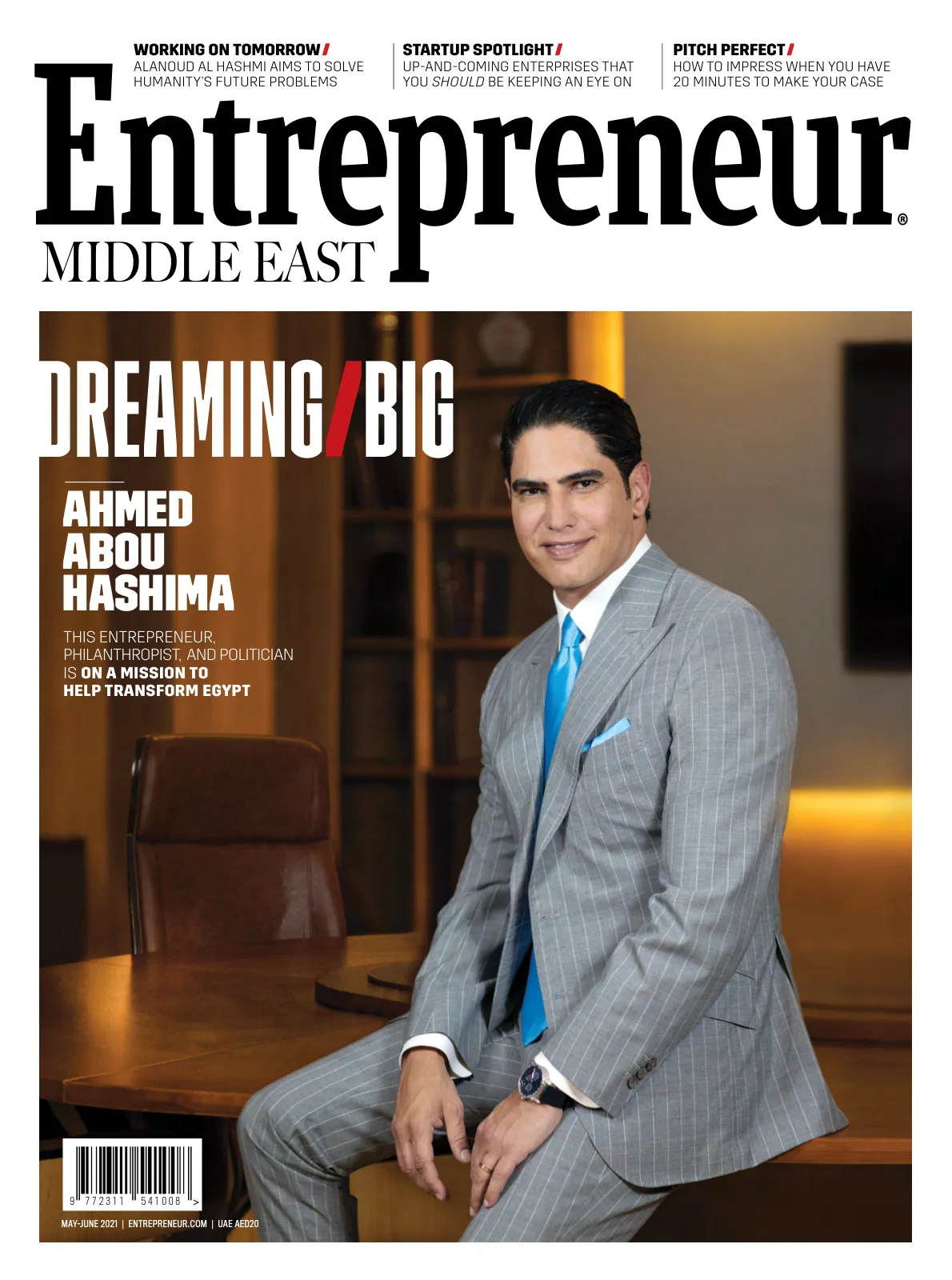
Entrepreneur Middle East, May-June 2021
Page 1
9
7 7 2 3 1 1
5 4 1 0 0 8
>
MAY-JUNE 2021 | ENTREPRENEUR.COM | UAE AED20
STARTUP SPOTLIGHT
UP-AND-COMING ENTERPRISES THAT
YOU SHOULD BE KEEPING AN EYE ON
PITCH PERFECT
HOW TO IMPRESS WHEN YOU HAVE
20 MINUTES TO MAKE YOUR CASE
DREAMING BIG
WORKING ON TOMORROW
ALANOUD AL HASHMI AIMS TO SOLVE
HUMANITY’S FUTURE PROBLEMS
AHMED
ABOU
HASHIMA
THIS ENTREPRENEUR,
PHILANTHROPIST, AND POLITICIAN
IS ON A MISSION TO
HELP TRANSFORM EGYPT
Page 2
Page 3
Page 4
Page 5
Page 6
6 / ENTREPRENEUR.COM / May - June 2021
16
INNOVATOR
DREAMING BIG
Ahmed Abou Hashima
This entrepreneur,
philanthropist, and
politician is on a mission
to help transform Egypt.
66
START IT UP
STARTUP SPOTLIGHT
A look at some of the
startups under the
Mohammed bin Rashid
Innovation Fund’s
accelerator program.
48
CULTURE
BUSINESS UNUSUAL
Working on tomorrow
Alanoud Al Hashmi,
CEO of The Futurist
Company, is building a
business that aims to
solve humanity’s future
problems.
22
START IT UP
Q&A
Sky-high ambitions
Saudi startup Firnas
Aero is using drones to
tackle a US$4 billion
problem in the aerospace
industry.
58
START IT UP
Q&A
Crafting connections
Dubai-based tech
startup GetBEE is on a
mission to humanize the
e-commerce retail sector.
38
‘TREPONOMICS
SKILLSET
Pitch perfect
A guide to impress and
make your case in front
of key stakeholders
in 20 minutes.
54
START IT UP
ECOSYSTEM
Together for the
greater good
Sweden’s Storytel and
UAE’s Kitab Sawti merge
in a bid to create the
world’s largest Arabic
audiobook library.
36
CULTURE
LIFE
Vickram Agarwal
reflects on how
rejection can fuel your
entrepreneurial success.
62
START IT UP
Q&A
Resell your reads
UAE-based Bookends
wants to make it easy
for you to buy and sell
secondhand books
online.
51
MONEY
ECON
Joining forces
Zahara Malik makes the
case on why philanthropy
and impact investing
need to align to aid the
world’s recovery from the
COVID-19 crisis.
32
‘TREPNOMICS
PRO
Why hierarchy is the
secret to agile teams
Lindred L. Greer lists
three hacks to use
hierarchy to accelerate
team agility.
56
START IT UP
STARTUP FINANCE
“We got funded!”
UAE healthtech startup
Smileneo raises US$2
million in a seed funding
round led by Kingsway
Capital.
CONTENTS MAY-JUNE 2021
22 Firnas Aero founder
and Chief Executive Aviator
Tariq Nasraldeen
Page 7
Page 8
Page 9
Page 10
10 / ENTREPRENEUR.COM / May - June 2021
SUBSCRIBE
Contact subscriptions@bncpublishing.net to receive
Entrepreneur Middle East every issue
EDITOR IN CHIEF Aby Sam Thomas aby@bncpublishing.net
CEO Wissam Younane wissam@bncpublishing.net
DIRECTOR Rabih Najm rabih@bncpublishing.net
CREATIVE LEAD Odette Kahwagi
MANAGING EDITOR Tamara Pupic
STARTUPS SECTION EDITOR Pamella de Leon
FEATURES WRITER Aalia Mehreen Ahmed
EDITORIAL DESIGN Christian Harb
DIGITAL SOLUTIONS DIRECTOR Mahdi Hashemi mahdi@bncpublishing.net
HEAD OF INNOVATION Sarah Saddouk sarah@bncpublishing.net
GROUP SALES DIRECTOR – B2B GROUP Joaquim D’Costa
COLUMNIST Tamara Clarke
PO Box 502511 Dubai, United Arab Emirates
P +971 4 4200 506 | F +971 4 4200 196
For all commercial enquiries related to Entrepreneur Middle East
contact sales@bncpublishing.net
All rights reserved 2021
Opinions expressed are solely those of the contributors.
Entrepreneur Middle East and all subsidiary publications in the
MENA region are officially licensed exclusively to BNC Publishing
in the MENA region by Entrepreneur Media Inc.
No part of this magazine may be reproduced or transmitted in any
form or by any means without written permission of the publisher.
Printed by United Printing and Publishing
upp.ae
Images used in Entrepreneur Middle East are credited when necessary. Attributed use of
copyrighted images with permission. All images not credited otherwise Shutterstock.
CONTRIBUTORS
entrepreneur.com/me
ACCESS FRESH CONTENT DAILY ON OUR WEBSITE!
MIDDLE EAST
EntMagazineME
@EntMagazineME
Entrepreneur-me
EntrepreneurMiddleEast
EntMagazineME
EntMagazineME
EntMagazineME
MIDDLE EAST
In addition to our print edition, we’re bringing
you all sorts of industry news on our web
mediums. Joining us online means getting
relevant business and startup content in
real-time, so you’re hearing about the latest
developments as soon as we do. We’re looking
forward to interacting with our readers on all of
our social media and web platforms- like any
thriving business, we’re looking to give and take.
#TrepTalkME is already happening on all of our
digi platforms, and all good conversations go
both ways. See you on the web!
Vickram Agarwal
Massimo Cannizzo
Matt Casey
Fida Chaaban
Tamara Clarke
Maria Fernandez
Lindred L. Greer
Zahara Malik
Pranaav Parrth
Sonia Weymuller
Page 11
Page 12
12 / ENTREPRENEUR.COM / May - June 2021
A
few years ago, I used
this platform to talk
about why entrepre-
neurs need to keep
their sense of entitle-
ment in check, saying
that they shouldn’t
expect to be “gifted
anything on a silver
platter,” and that this is what they
should keep in mind as they go about
soliciting support for their respective
enterprises. Now, I still stand by this
line of thought; however, recently, I’ve
found myself wondering about the
other end of this equation: for those
of us who interact with entrepreneurs
and the small businesses they run, are
we also being mindful of our sense
of entitlement as their patrons or
clientele?
This question popped into my mind
after coming across a couple of
instances of late where entrepreneurs
and their teams at their relatively
young enterprises were being faulted
or criticized (rather disproportionately,
in my opinion) for apparent faults or
errors in their offerings. One example
I can offer here is that of a newly
launched F&B venture in Dubai that
found itself being panned for its seem-
ing inability to receive and respond to
all of the calls it got on its bookings line.
Granted, the restaurant here definitely
had a problem when it comes to ensur-
ing its customer experience- but I also
do have apprehensions about the
outrage with which complaints about
this situation was characterized by
many among us.
I mean, it’s one thing to say you were
put off by an occurrence like this; it’s
another thing altogether to accuse
(and assume) the restaurant
is doing it as a deliberate
affront to you as, say, some
kind of marketing ploy. Why
was this thought of as an ac-
ceptable theory explaining the
problem at hand, as opposed
to the alternate (and, honestly,
more plausible) reasoning that,
well, this is a business that’s
only just begun to run, with the
entrepreneur behind it being
a first-time restaurateur who,
along with their team, are only
just starting to learn the ropes
of the trade? Maybe they were
just overwhelmed with work
and that’s why they didn’t pick
your call; maybe they just don’t
have the resources in place to
ensure a more seamless operation.
Calling businesses out for their faults
is our right, sure, but I can’t help but
feel that having a more empathetic
approach to the entrepreneurs and
the teams behind them would serve
us all better in the long run. Now, an
argument can be made here that, as
a customer, you don’t really need to
concern yourself with how or why
a product or service has not been
presented in the manner you expect.
And this is, I must admit, a perfectly
valid point of view- there is, after all, a
reason why “the customer is always
right” is an adage that pervades our
consciousness on a day-to-day basis.
The transactional nature of such a
relationship does allow for one to not
have to engage with the trials and
tribulations of those we’re interacting
with, regardless of whether they
are a small business, or a corporate
behemoth.
Having said that, I do wonder if this
is the kind of behavior that any of us
would want to see in ourselves or
those around us. There are plenty of
examples in the world today that make
the case for why a selfish, “me, me, and
only me” attitude to life is a problematic
one- as such, why would any of us
want to associate ourselves with that
kind of philosophy? And that in itself is,
I think, a good enough reason to keep
our sense of entitlement in check.
e
It’s all about you
Spoiler: it actually isn’t, but the way you’re
acting, it might as well be
Aby Sam Thomas
Editor in Chief
@thisisaby
aby@bncpublishing.net
EDITOR’S NOTE
Page 13
02 – 04 NOVEMBER 2021
DUBAI EXHIBITION CENTRE
GET INVOLVED TODAY
Next generation mobility
and logistics event
3,000+ VISITORS | 200+ SPEAKERS | 100+ HOURS OF CONTENT
hypermotion@uae.messefrankfurt.com
www.hypermotiondxb.com
Page 14
14 / ENTREPRENEUR.COM / May - June 2021
H
.H. Sheikh Hamdan bin
Mohammed bin Rashid
Al Maktoum, Crown
Prince of Dubai and
Chairman of The Execu-
tive Council of Dubai,
has launched Dubai
Next, a digital platform
that will enable innova-
tors and entrepreneurs in the Emirate to
secure funding for their projects.
Built with an aim to encourage and
support sharing of promising ideas
through crowdfunding, the integrated
virtual platform will work towards
ensuring the UAE’s highly competitive
SME sector can continue to thrive and
contribute to the national economy.
“The Dubai Next platform will con-
tribute to stimulating positive com-
petition and encouraging youth to put
forward innovative ideas as well as
obtain community support through
crowdfunding,” H.H. Sheikh Hamdan
said in a statement. “It will also em-
power a generation that is capable of
innovating to succeed in a competitive
commercial environment, thus reinforc-
ing the fundamental role of SMEs in
economic development, so that the UAE
can continue to stand as a model for
youth empowerment.”
The initiative comes at a time when
the government of UAE has been
actively seeking ways for the nation’s
youth to launch their own businesses
instead of opting for traditional
corporate jobs, notes H.H. Sheikh
Hamdan. Through its crowdfunding
feature, Dubai Next is also looking to
allow the community to directly par-
ticipate in supporting new and en-
terprising projects, which in turn can
promote the growth of enterprises
and society alike.
Owing to the digital nature of the
platform, aspiring entrepreneurs,
including students and youth, are
expected to be able to reach out to
a wider audience, both within the
region and beyond, and gain access
to better funding. Dubai SME will
also provide an incentives package
to the projects that receive financ-
ing through Dubai Next. The package
will include access to the Hamdan
Innovation Incubator (HI2) or one of
the 14 certified incubators in Dubai,
which will help SMEs to expand and
scale locally and globally.
EMPOWERING INNOVATORS
IN THE LOOP
Sheikh Hamdan launches digital
crowdfunding platform Dubai Next to boost
funding for startups in the Emirate
by PAMELLA DE LEON and AALIA MEHREEN AHMED
“THE DUBAI NEXT PLATFORM
WILL CONTRIBUTE TO
STIMULATING POSITIVE
COMPETITION AND
ENCOURAGING YOUTH TO
PUT FORWARD INNOVATIVE
IDEAS AS WELL AS OBTAIN
COMMUNITY SUPPORT
THROUGH CROWDFUNDING.”
Page 15
15
May - June 2021 / ENTREPRENEUR.COM /
Shahzad Bhatti, founder and
CEO of The Co-Dubai, a co-
working space and business
incubator based in Downtown
Dubai, is one of the entre-
preneurs that have already
enlisted their startups on
the Dubai Next platform. As
an entity certified by Dubai
SME, the startup received
early access to the platform,
with Bhatti applauding the
simplicity and ease of the
onboarding process. “The
initial registration was quick,
as I could use my UAE Pass
app, which automatically
provided the basic details,”
he explained. “I then used the
guided form to fill in the de-
tails on our concept and offer,
and I was able to fill this all
in within about 15 minutes. It
even gives the option to link
a video, which I think allows
the proposition to be more
personal.”
As someone who is well
versed with the value of
crowdfunding campaigns,
Bhatti is quite optimistic
about his enterprise being
on the Dubai Next platform.
“Crowdfunding allows us to
work with our existing com-
munity of customers, part-
ners, and friends to grow our
business, while directly bene-
fiting those who will be using
our services and spaces in the
long run.” As the entrepre-
neurial sphere is still recover-
ing from the COVID-19 crisis,
Bhatti adds that the platform
is a significant support. “It’s
been a rocky 12 months for all
businesses large and small,
but I think it’s important to
give extra attention to start-
ups and small businesses, as
they are the backbone of our
economy,” he noted. “There
are some really fantastic
ideas out there that never get
the chance to launch, simply
because of a lack of tradi-
tional funding. Crowdfunding
gives them an opportunity
to connect with like-minded
people who believe in their
ideas, and can give them the
financial backing they need
in return for early access or
discounts to the products or
services being offered.”
Marie-Christine Luijckx,
founder and Managing Partner
of Fruitful Day, is another
entrepreneur who stands by
the value of crowdfunding
for startups. Her startup,
which delivers fresh fruits
to workplaces and homes
on a subscription basis,
raised over AED3 million
last year on the Eureeca
crowdfunding platform.
“We chose crowdfunding
because it provided a unique
opportunity to involve
our supporters in a more
meaningful way and fund our
next stage of growth.”
As someone whose been
through the crowdfunding
process firsthand, Luijckx
has this piece of advice for
entrepreneurs seeking to
make use of Dubai Next.
“Once you have your
fundraising details ready,
be willing to put the time
and effort into spreading the
word,” she said. “Keep an
open mind throughout the
process, whether that’s on
feedback on the pitch or who
your potential investors might
be. Last of all, make sure
you get the structuring right
when you close, as an equity
investor is on the journey
with you for the long run.”
The Dubai Next platform also
presents another compelling
driver for entrepreneurs to
consider Dubai as their base,
says Carl Dowling, Partner
at CBD Corporate Services,
a Dubai-based firm that pro-
vides company formation and
restructuring services. “Plat-
forms such as Dubai Next
complements the many new
regulations that Dubai has
introduced in particular in
the last 12 months, which will
ensure the Emirate continues
to place itself at the forefront
of innovation in the Middle
East,” he said.
“What Dubai Next offers
is an opportunity for entre-
preneurs to bring ideas to
life when direct capital in-
vestment can be challenging
to source,” Dowling added.
“Dubai has a well-entrenched
private equity industry that
has been the driver for many
success stories; however, we
see Dubai Next providing an
opportunity for younger en-
trepreneurs to enter the mar-
ket and develop their proposi-
tion in their infancy. It could
bring the launchpad of the
Dubai garage-founded tech
startup that served the likes
of Apple, Google and Amazon-
dream big!” dubainext.ae
EMPOWERING INNOVATORS | DUBAI NEXT
“CROWDFUNDING ALLOWS
US TO WORK WITH OUR
EXISTING COMMUNITY OF
CUSTOMERS, PARTNERS,
AND FRIENDS TO GROW
OUR BUSINESS, WHILE
DIRECTLY BENEFITING THOSE
WHO WILL BE USING OUR
SERVICES AND SPACES IN
THE LONG RUN.”
IMAGES COURTESY DUBAI NEXT | SHEIKH HAMDAN IMAGE © SHUTTERSTOCK
Shahzad Bhatti,
founder, The Co-Dubai
Marie-Christine Luijckx, founder
and Managing Partner, Fruitful Day
Carl Dowling, Partner,
CBD Corporate Services
Page 16
16 / ENTREPRENEUR.COM / May - June 2021
IMAGES COURTESY AHMED ABOU HASHIMA
THIS ENTREPRENEUR,
PHILANTHROPIST,
AND POLITICIAN IS ON A MISSION
TO HELP TRANSFORM EGYPT
I
always deal with every day as one step forward to reaching my
endless dreams.” That’s how Ahmed Abou Hashima, founder
of Egyptian Steel, Egyptian Cement, Egyptian Media, and 107
Network, describes how he goes about his tasks on a daily basis.
Beyond entrepreneurship, Abou Hashima is active in philanthropy
as the founder of Abou Hashima El Kheir Foundation, and in
politics as the Vice President of the Republican People’s Party,
a Member of The Senate, Egypt’s consultative upper house, as
well as Deputy Chairman of its Industrial and Internal Trading
Committee. One thing should be clear here from the outset- all of
his roles require long working days, but Abou Hashima rarely feels
that he “worked 15 hours continuously.” He adds, “My dreams renew my passion
daily, and they make me work all day without boredom or exhaustion.”
DREAMING
BIG
AHMED /
ABOU HASHIMA
by TAMARA PUPIC
INNOVATOR
>>>
Page 17
17
May - June 2021 / ENTREPRENEUR.COM /
May - June 2021 / ENTREPRENEUR.COM
DREAMING BIG | AHMED ABOU HASHIMA
Page 18
18 / ENTREPRENEUR.COM / May - June 2021
“Major international
economic entities
flock to see
the Egyptian Steel
experience in
producing steel with
environmentally
friendly technology,
and the term ‘green
reconstruction’
has found more
acceptance since
we established these
two plants.”
More than a decade ago, the first of
these dreams was to introduce new
lifeblood into the steel industry in
Egypt. Today, the result of this dream is
the Egyptian Steel Group, an umbrella
company for the Industrial Investment
Company (IIC), operating in the field of
steel plants management, and National
Port Said Steel (NPSS) which run two
of the largest steel plants in the region-
in Beni Suef Governorate, and in Suez
Governorate (Al Ain Al Sokhna). Using
state-of-the-art, environment-friendly
technology, the Egyptian Steel Group
produces durable, high-quality steel out
of its four major plants, which have a
total production capacity of 2.3 million
tons per year, thereby “contributing
a lot to the Egyptian economy,” Abou
Hashima says. “When I decided to enter
the field of steel trade, I knew that it
was just one step, and that my success
in this field would be only the beginning
of my work on a project of my dreams.
Also, when I established the two plants
[in Beni Suef Governorate and in Suez
Governorate], developed them, and
started the production, I considered it
just as achieving one of my goals, but
not my ultimate goal.”
Abou Hashima’s vision is for the
Group to become a one-stop shop for
all building materials, and one step
towards this particular goal is another
venture: the Egyptian Cement Group,
which includes the largest building
materials complex in Upper Egypt and
the first in Sohag Governorate. In addi-
tion, Abou Hashima has also extensively
invested in the media sector in 2016,
establishing the Egyptian Media Group,
a media conglomerate consisting of TV
networks, print outlets and their web-
sites, video platforms, and companies
in the advertising and marketing sec-
tor. Throughout this interview, Abou
18 / ENTREPRENEUR.COM / May - June 2021
INNOVATOR
Page 19
19
May - June 2021 / ENTREPRENEUR.COM /
Hashima will reiterate that
his approach to work is one
of constant creation, as he
always strives for more. “Af-
ter each achievement, I have
always tried to quickly renew
my goals, and therefore, I still
have a lot to achieve,” he says.
“I have more plans in mind,
which I believe will lead me
to new success.”
These statements are an
indication of Abou Hashima’s
personal philosophy, an
aspirational mindset that
helped him overcome difficult
periods in his life and career.
“When I decided to establish
my own business, the term
entrepreneurship was not
widespread in Egypt or the
Arab world,” Abou Hashima
recalls. “It was neither
perceived well, nor it had
any kind of support from the
government or society. In
fact, it was not my plan to be
an entrepreneur in the way
it is known now, but I had
a dream and an ambition to
build a project of my own.”
And that is the first piece
of advice that he would
like to share with young
people looking to venture
into entrepreneurship. “You
should have a clear goal,”
Abou Hashima says. “Do not
be afraid of any area which
you decide to enter, as long as
you are confident with your
feasibility study and business
plan. You should be very well
prepared for this project, so
be familiar with the details of
expenditure, profit, and loss.”
It is with the same
mindset that the steel
entrepreneur approaches
another area he is committed
to: philanthropy. While
he is no stranger to being
engaged with philanthropic
initiatives, Abou Hashima’s
passion for paying it
forward was formalized
in the Abou Hashima El
Kheir Foundation. The
foundation is engaged in
various charitable initiatives,
especially in the community
development domain. “For
a long time, I have been
supporting entities that serve
citizens, such as the Tahya
Misr Fund, which launched
the largest food convoy in
the history of humanity Food
Bank, the Orman Association,
and other national entities
helping the most needy
people in Egypt. I also
launched my own initiative
‘Revamping The Most Needy
Villages in Egypt,’ of which
I’m very proud, because we
have already redeveloped
more than 17 villages all over
the country.”
Abou Hashima is also sup-
porting Egypt’s positioning on
the global map- for instance,
in 2014, Abou Hashima spon-
sored the “New Egypt” cam-
paign with an aim to promote
the country’s growth poten-
tial to international investors.
The campaign included vari-
ous initiatives, from digital
ads on the NASDAQ tower
in New York, to promotional
activities in Davos during the
World Economic Forum. An-
other example of Abou Hashi-
ma supporting his country’s
brand image in the world
is the Egyptian Steel Group
running print campaigns in
Africa after the June 2013
Egyptian revolution, in order
to make sure that the bond
between Egypt and its fellow
African countries remains
strong. Meanwhile, in the
field of youth development,
Abou Hashima is a proud
supporter of the Youth Lead-
ers Foundation, which roams
Egyptian provinces to select
young, talented Egyptians
who have the potential to be
groomed to become the future
leaders of Egypt.
>>>
DREAMING BIG | AHMED ABOU HASHIMA
>>>
Page 20
20 / ENTREPRENEUR.COM / May - June 2021
Abou Hashima is currently most in-
spired by his work on encouraging en-
trepreneurship in Egypt and beyond. In
2020, he launched the Startup Power
competition, held in partnership with
the Social Fund for Development for
Micro, Small, and Medium Enterprises,
which saw 100 Egyptian startups go
through a round of seminars and train-
ing sessions, out of which 30 finalists
shared an investment pie of a total of
EGP2 million. “When I thought about
the Startup Power competition, I went
to the experts in this field, as they have
a group of specialists in the field of ed-
ucation and training for young people,
and their internationally approved
courses can help young people to de-
velop successful projects,” he explains.
“I strive to pave the way for young peo-
ple to transform their entrepreneurial
ideas into projects that will add to
our economy, especially in the field of
technological development and digital
transformation.”
The success of the first edition of
Startup Power has inspired him to tri-
ple the value of the prizes -from EGP
2 million to EGP 6 million- for the
second installment, which starts in
September 2021. “I have realized that
the future of Egypt and the Arab world
relies on startups,” Abou Hashima says.
“I participated in many conferences
and forums that support the field of
entrepreneurship in Egypt and the Arab
world, including those held under the
auspices of the Egyptian Ministers Cabi-
net and the League of the Arab States,
and I was honored more than once for
contributions to that field, although I
consider it as my duty and I do not ex-
pect or deserve any recognition for that.
I am just doing my role to encourage and
support young people to establish their
independent projects that can add to the
national gross domestic product.”
It is beyond doubt that young Egyp-
tians can learn a lot from About
Hashima’s fruitful career. When asked
about achievements that he himself
considers particularly memorable, Abou
Hashima mentions the Egyptian Steel
Group developing and implementing the
first of its kind environment-friendly
technology in its plants in Beni Suef and
Al Ain Al Sokhna. “Major international
economic entities flock to see the Egyp-
tian Steel experience in producing steel
with environmentally friendly technol-
ogy, and the term ‘green reconstruction’
has found more acceptance since we
established these two plants,” he says.
“This is something we are very proud
of in Egypt and in Egyptian Steel.” He
adds, “I see that the future of the region
depends greatly on relying on advanced
and environmentally friendly technol-
ogy in all areas of industry. There is no
room anymore for traditional methods
of industry that waste raw materials,
natural resources, and greatly affect the
environment.”
INNOVATOR
“If we can bring
value today,
then in the future,
global, full-scale
adoption will
naturally ramp up.”
“I strive
to pave the way
for young people
to transform
their entrepre
neurial ideas
into projects
that will add
to our economy.”
Page 21
21
May - June 2021 / ENTREPRENEUR.COM /
Entering politics seems as a
continuation of his work to
date, since Abou Hashima
considers that the primary
goal of any politician is only
to serve his/her country, in-
ternally and externally. The
decision to start his political
career developed organically
a few years ago. “I supported
several movements after the
June 30 Revolution (2013)
led by young Egyptians, and
although one of these move-
ments turned into a major
political party in Egypt (Na-
tion’s Future Party), I still did
not intend to enter politics,
and my goal was only to sup-
port these young people,” he
says. He stuck to this stance
for a few years, as he was
unsure about people’s percep-
tion of businessmen getting
into politics- but he’s since
had a change of heart. “The
economic and security situa-
tion has stabilized, thanks to
the wise and strong political
leadership decisions over the
past few years, and in 2020, I
was totally convinced that it
was the right time to officially
enter the political life, and to
actively help the country and
its economic plans,” he says.
In 2020, he became the Vice
President of the Republican
People’s Party, a Member of
the Senate and Deputy Chair-
man of its Industrial and
Internal Trading Commit-
tee. “I chose the Republican
People’s Party, because of its
good reputation in the Egyp-
tian political circles. Also, the
party’s young members were
a big plus that encouraged me
to join the party, as they are
responsible and patriotic. My
ambition for my party is that
it becomes one of the top two
players in the Egyptian politi-
cal arena, to expand its youth
base, and to be well prepared
for the upcoming electoral
elections in order to achieve
a better position among other
Egyptian political parties.”
In every area of his work,
Abou Hashima obviously
remains a firm believer that
supporting young people,
especially by developing their
entrepreneurial skills, is a
lifeline for Egypt and other
Arab countries. And that
is perhaps why his advice
for youth in the country is
centered on ignoring the fear
of failure- according to Abou
Hashima, there are no real
failures in the business world.
“There are only economic
studies that have profit and
loss possibilities, but even if a
loss occurs, it does not mean
that you are wrong, because
that is simply the nature of
business in which there is
profit and loss,” he explains.
“When problems occur in a
project, or expose you to a
loss, then you should look
for an exit with the least loss.
The lesson learned from such
situations is that you should
not stop when you fall or lose.
On the contrary, take it as a
step that pushes you to work
harder and re-evaluate the
situation before embarking
on any new project in order
to avoid greater losses in the
future.”
DREAMING BIG | AHMED ABOU HASHIMA
1. Make a game plan for
yourself
“Set specific goals, and
determine the steps to
achieve each of them.”
2. Hurdles are part of the
journey- just run with
them
“Do not hurry to succeed,
and do not worry about
mistakes- but correct
them quickly, and continue
working towards your goal.”
3. Get people to back you
(and your vision) up
“Build a team who have the
same ambitions and goals
as you do, and who are
loyal to the idea, before the
person.”
4. Stay humble, stay
focused
“Renew your ambitions
regularly, and don’t be
deceived by false success,
because vanity, arrogance,
and narcissism can kill any
idea, project, or business.”
‘TREP TALK
Ahmed Abou Hashima’s
tips for entrepreneurs
Page 22
22 / ENTREPRENEUR.COM / May - June 2021
This Saudi startup is using drones to tackle
a US$4 billion problem in the aerospace industry
by PAMELLA DE LEON
FIRNAS AERO
START IT UP Q&A
T
he rising accessibility of drone technology has
presented limitless opportunities and use cases
for safe, cost-effective solutions, ranging from
data collection to delivery. According to PwC,
the emerging global market for business services
using drones is valued at over US$127 billion.
However, with few and constantly changing regu-
lations, the drone industry in the MENA region
remains nascent. Saudi entrepreneur Tariq Nas-
raldeen, founder and Chief Executive Aviator of
Firnas Aero, wants to bring the industry to the
next level by exploring an untapped avenue- the
use of drones on airport runways.
Foreign object debris, or FOD for short, consist of anything
lying on the ground on taxiways and runways that shouldn’t be
there. Plastic bags, misplaced tools, stray suitcases and even
coffee cups can cause aircraft engine damage, which Boeing has
estimated to cost the aerospace industry $4 billion a year. This
particular aspect proved the turning point for Nasraldeen’s
move into launching Firnas Aero- in 2015, while working in the
airside operations department at the King Abdulaziz Interna-
tional Airport in Jeddah, the entrepreneur saw firsthand how
the detection and removal of FOD was done manually several
times per day, with this having been a decades-long practice in
airports globally. “I quickly realized that driving on a 5,000-me-
ter runway with an SUV, and looking out the window for small
objects that might have fallen on the runway and removing them
was very inefficient,” Nasraldeen remembers.
SKY-HIGH AMBITIONS
IMAGES COURTESY FIRNAS AERO
>>>
Page 23
23
May - June 2021 / ENTREPRENEUR.COM /
SKY-HIGH AMBITIONS | SAUDI STARTUP FIRNAS AERO
“I quickly realized that driving
on a 5,000-meter runway with
an SUV, and looking out the
window for small objects that
might have fallen on the runway
and removing them was very
inefficient.”
Page 24
24 / ENTREPRENEUR.COM / May - June 2021
It was also during this time that he was experimenting
with drones, and that’s how he envisioned “flying a drone
over the runway” to scan it for FOD and give their precise
locations at a faster rate. He understood how an airport’s
most important commodity is time, wherein when one
flight is delayed, it creates a domino effect that can have an
impact on a whole day or a week’s schedule, and eventu-
ally, cause millions of dollars in losses locally and globally.
This deep understanding of these correlating factors gave
Nasraldeen a strong indication of the feasibility of his idea.
Testing it out with a drone and flying over the runway was
out of the question, so Nasraldeen did some experiments
in a remote location on empty backroads, mimicking a
runway environment. “The initial results not only had
regional potential, but global as well,” he explains. “Be-
cause all airports function pretty much in the same way
under similar regulations, and FOD runway inspection is
a multibillion-dollar global pain point for airlines and air-
ports alike.”
It should be clear by now that Nasraldeen’s entrepre-
neurial streak has been ignited from his passion for avia-
tion and interest in technology. Born and raised in Jeddah,
the entrepreneur moved to the United States after high
school, became an FAA certified commercial pilot, and
later received his BA in Airline Management and MBA
in Airport Management from Embry-Riddle Aeronauti-
cal University. Additionally, he also received his MA in
Transpersonal Psychology with a specialization in Creativ-
ity and Innovation from Sofia University, and he’s current-
ly seeking to earn his PhD in autonomous flight systems.
START IT UP Q&A
Page 25
25
May - June 2021 / ENTREPRENEUR.COM /
Though his fascination with aviation
started from an early childhood (“from
dragonflies to cartoons, like Astroganger
and movies like Star Wars”), Nasraldeen
counts his late father as a key catalyst
in his journey, and thus, being his big-
gest entrepreneurial role model. “I was
always amazed by his ability to start
businesses, of which many have failed,
but he had a remarkable ability of start-
ing again and again no matter the ob-
stacles,” Nasraldeen says, while adding
that he inherited tenacity and aptitude
from his father. “He was always tinker-
ing around the house to ‘fix’ things.
This DIY mindset also shaped the way I
interact with the world around me, and
in a pre-YouTube tutorial era, pulling
electronics apart and experimenting was
the method of which I eventually accu-
mulated the skills that led me to build
my first drone in 2016.”
His background as an aviator also
became a crucial foundation for his
comprehension of the industry. “Many
people who want to fly drones do not
realize that the skies are divided into
layers of airspace and many ‘highways’
and ‘zones,’ each with their unique set
of regulations and requirements, and
having a small robot buzz around in the
sky aimlessly is both dangerous and
disruptive,” he explains. “This deep
understanding gave me the clairvoy-
ance to plan ahead and anticipate what
will be possible, and what will simply
not work.” He also had the advantage of
having one of his closest friends, Sariah
Aljefri, who is an industrial engineer by
training and has worked at P&G and Mc-
Kinsey & Co., join him as a co-founder
at Firnas Aero. As someone who’s had
a venture before, Aljefri also brings the
learnings from his previous entrepre-
neurial experience. The duo have always
wanted to start a venture together, but
it wasn’t until launching Firnas Aero
that their plans finally aligned.
As FOD presented a universal concern
in the aviation industry, initially, the
team wanted to focus on airports, but
they soon saw the huge potential in
other domains, and they soon moved
from flying drones manually to making
use of artificial intelligence (AI) to oper-
ate them. “We had no flight planning
software, and cameras were add-ons, so
you had no way of controlling it from
the ground or seeing what the camera
is capturing until you actually landed,
and to top that off, batteries lasted 10
minutes max.” Today, however, Nas-
raldeen says he can use an iPad to fly
a multitude of drones simultaneously,
while performing a diversity of tasks on
pre-planned routes. The company uses
95% of the same hardware and software
for all clients, while the 5% difference is
factored in the AI models that is specifi-
cally designed to each case. While one
client might be looking for heat dissipa-
tion on heating, ventilation, and air con-
ditioning (HVAC) units or for corrosion
in pipelines, another might be looking
for intrusion detection- both problems
for which which the startup can provide
a customized solution.
Firnas Aero provides an autonomous
drone-in-a-box (DiaB) turnkey solution
that is comprised of three main compo-
nents: the software, the drone, and the
station. The team considered that the
unit will face harsh weather and im-
mense heat in the MENA region, so the
“box” is designed to protect the drone
from harmful elements, and it also has
an HVAC system to keep the electronics
at a cool temperature. It has a weather
station, cameras, and fail-safe layers-
all managed by a software designed for
regulating the charging of the drone or
battery swapping, opening and closing
and monitoring all the vitals. There’s
also a software that plans the flight
route for the drone, live feed, and where
to take pictures, as well as its altitude,
speed, and fail-safe parameters, which
are based on the scope of the client’s
requirements. The DiaB is then placed
on the client’s premises, where it can be
monitored and controlled by Firnas Aero
remotely, or programmed to do a certain
daily task- like “fly a certain route every
two hours or take a picture of a specific
object every 30 minutes, and then the
images are pushed to the AI to create
status reports or an alert.” And how
accurate is it? Nasraldeen notes that it
“starts off at 50%-70%, but ends up in
the 90%-95% within 5cm accuracy.”
To get better results, the team tests
over a period of eight weeks on average,
and once they reach a sufficient level of
accuracy agreed with client, they start
the project. “This is because machine
learning or deep learning improve over
time with more data training,” explains
Nasraldeen.
“All airports function
pretty much in the
same way under similar
regulations, and FOD
runway inspection is a
multibillion-dollar global
pain point for airlines and
airports alike.”
>>>
SKY-HIGH AMBITIONS | SAUDI STARTUP FIRNAS AERO
“I CAN TRULY SAY THAT THE
PANDEMIC HAD A POSITIVE
EFFECT ON OUR STARTUP.
YES, QUARANTINE TIMES WERE
CHALLENGING, BUT WE GOT OUR
FIRST PROJECT DONE DURING
THAT TIME, JUST BECAUSE OF THE
NEED FOR ALTERNATIVE METHODS
OF DOING BUSINESS THAT DID NOT
REQUIRE A LOT OF PEOPLE.”
Page 26
26 / ENTREPRENEUR.COM / May - June 2021
Like any other startup, Firnas Aero has
had its own share of stumbling blocks
too- one of the startup’s biggest hur-
dles was finding good local talent, as
well as getting all permits and licenses
required. Regulations were still in early
stage then, with Nasraldeen recalling
the lack of framework to deal with their
requests. The startup has since made
strides- originally launched with initial
funding from Nasraldeen’s own personal
savings of $150,000, it has gained a
$5,000 prize from the MIT Enter-
prise Forum, followed by an additional
$250,000 of convertible notes from
the KAUST Innovation Fund. It has also
acquired a $100,000 grant by winning
the first place in KAUST’s TAQADAM
Startup Accelerator program in 2019.
The team regards their experience of
being accepted and actually winning a
worthwhile pursuit, because it created
an environment for bold ideas and unex-
pected learnings within the enterprise.
As Nasraldeen notes: “You must be
comfortable with the unknown and not
let it stifle you.” Currently, Firnas Aero
is part of the accelerator program by
500 Startups and Sanabil Investments,
and it even has an ongoing collaborative
project with KAUST Smart for “a smart
home with a built-in drone delivery
launching pad, and integration with the
smart home system.”
And so far, Firnas Aero’s usability and
incredible potential can be seen with its
array of case studies. Catering to B2G
and B2B clients and offering inspection,
surveillance and delivery applications,
some of its projects are with Dubai Elec-
tricity and Water Authority, KAUST, and
Medina Municipality. A significant pro-
ject that they are working on is with The
Red Sea Development Company, which
needed an environmental assessment
to see the impact that construction will
cause on the ecosystem, as well as on
the trash that has been accumulated
over many decades on the islands. The
startup scanned the islands and gener-
ated high resolutions maps, with its
AI model analyzing numerous images
and pixels, and highlighted the trash,
categorized it, and gave its geo-location
coordinates for the team to clean up.
“We used a lot of the learning from the
FOD runway sweeping, and I can say
that walking down a beach aimlessly
looking for objects is not cost effective.”
This highlights the startup’s USP- Nas-
raldeen points out that the enterprise’s
only competition right now are con-
ventional methods, not drone service
providers. With the market being still in
its infancy, there are only a few players,
and high barriers to entry due to regula-
tory requirements. “We are much faster,
more accurate and efficient, and we aim
to empower the client,” claims Nasral-
deen. “Our secret sauce is doing things
from within your creative soul and leav-
ing a part of that in everything that you
do.” Autonomy is, as pointed out by the
founder, the startup’s significant ad-
vantage. “The drone is autonomous, the
software is autonomous, the analytics
and reporting are autonomous, and our
goal is to help the client be autonomous
as well, trusting that our drones are
doing their job effectively every single
day.”
START IT UP Q&A
“Look at the best data available,
but lead with intuition. You will
eventually make mistakes,
that doesn’t mean it was a bad
decision, it means you were
meant to learn this lesson, so be
grateful and move forward.”
Firnas Aero team
Page 27
27
May - June 2021 / ENTREPRENEUR.COM /
As for how the startup went through
the COVID-19 crisis, Nasraldeen
paints a picture that isn’t as dreary
as one might expect from stories of
this nature. “I can truly say that the
pandemic had a positive effect on
our startup,” he says. “Yes, quar-
antine times were challenging, but
we got our first project done during
that time, just because of the need
for alternative methods of doing
business that did not require a lot
of people. Also, we took that time to
iterate our product and experiment
with different models. Having a
positive mindset, instead of the fear
mindset that was widespread, was
a key factor. It was a difficult time,
but in hindsight, this is a fraction of
time, and startups should look be-
yond that. Our value proposition was
autonomy, and those times proved
the need for such services. Cash flow
was an issue of course, but the main
bottleneck was that everyone was
reluctant to take any steps, and eve-
ryone wanted to wait and see, which
is an expected reaction in times of
uncertainty. We try not to talk about
the pandemic, or use it for profiteer-
ing. Our plans are long-term, and the
current situations are not a signifi-
cant determining factor in our future
plans.”
As for the future, in 2021, the team
plans to perfect its DiaB system,
increase brand trust and awareness,
and grow its team, with the startup
constantly being on the lookout for
people who are “problem solvers,
have intellectual humility, learn
fast work hard, and want to change
the world into a better place.” Nas-
raldeen dreams for Firnas Aero to
expand across the GCC, MENA, glob-
ally, and even to space. As NASA
successfully propels a drone on Mars
(representing the first powered,
controlled flight by an aircraft on
another planet), the entrepreneur
aspires for his enterprise to reach
similar heights. “I envision Firnas
Aero, which might be called Firnas
Astro at that time, to participate in
such projects that will serve human-
ity, and this will start by developing
ingenious autonomous drones that
can do intricate tasks effectively
and carry cargo and people safely,”
he says. “This will give us room to
participate in the expansion of the
collective consciousness of humanity
by thinking imaginatively about pro-
gress, and delegating routine tasks to
our marvelous machines.”
1. Know who to get advice from
“Only seek advice from people who
actually did the thing that you are
asking advice about multiple times,
better the ones who have failed than
succeeded. It is very similar to how
we do not take our workout advice
from someone who has never been
to the gym.”
2. Know how to filter through noise
“Beware of confirmation bias, if you
do not know what that is, you are
probably doing it. The internet is
designed as the optimal confirma-
tion bias tool, so make sure you are
not only looking at evidence that
only supports your ideas online and
offline, and make sure you explore
ideas from all angles. You may end up
making the same choice, but at least
you will be informed and know the
alternatives.”
3. Trust your gut
“Look at the best data available, but
lead with intuition. You will eventually
make mistakes, that doesn’t mean
it was a bad decision, it means you
were meant to learn this lesson, so
be grateful and move forward. Your
inner voice knows the way, ignore all
advice, including this one.”
‘TREP TALK
Firnas Aero founder and
Chief Executive Aviator
Tariq Nasraldeen’s tips for
entrepreneurs
SKY-HIGH AMBITIONS | SAUDI STARTUP FIRNAS AERO
“WE USED A LOT OF THE
LEARNING FROM THE FOD
RUNWAY SWEEPING, AND
I CAN SAY THAT WALKING
DOWN A BEACH AIMLESSLY
LOOKING FOR OBJECTS IS
NOT COST EFFECTIVE.”
Firnas Aero won the first place
in KAUST’s TAQADAM S
tartup Accelerator program
in 2019
Page 28
28 / ENTREPRENEUR.COM / May - June 2021
GADGETS AND DOODADS THAT YOU MIGHT’VE MISSED OUT ON, SOURCED BY A TECH AFICIONADO.
YES, IT’S OKAY TO WANT THEM ALL… AND NO, IT’S NOT OUR FAULT.
POWERING PRODUCTIVITY
ACER CHROMEBOOK 311
IMAGES COURTESY HUAWEI | HD | ACER
TECH SHINY
The Acer Chromebook 311 gives
you processing power on-the-
go. Billed as an “ultraportable”
device, it combines durability,
long battery life and a lightweight
chassis (weighing in at just
1kg), which enables you to be
productive wherever the work day
takes you. The device features a
moisture resistant HD Touchpad
and concave keycaps to help you
type faster and more comfortably.
The Acer Chromebook 311 also
offers complete connectivity with
a fully functional USB-C port,
802.11ac Wi-Fi, and Bluetooth
4.2 to easily connect to multiple
devices at the same time. The
laptop has an integrated 720p
HDR wide-view webcam for video
calls in Google Meet. With all the
advantages offered by Chrome
OS such as quicker boot times,
built-in malware protection, and
access to millions of Android
apps, it’s easy to stay productive
with Chromebook 311.
Acer Chromebook 311
Page 29
29
May - June 2021 / ENTREPRENEUR.COM /
#TAMTALKSTECH Tamara Clarke, a former software development professional, is the tech and lifestyle enthusiast behind The Global Gazette, one
of the most active blogs in the Middle East. The Global Gazette has been welcomed and lauded by some of the most influential tech brands in the
region. Clarke’s goal is to inform about technology and how it supports our lifestyles. See her work both in print regional publications and online on
her blog where she discusses everything from how a new gadget improves day-to-day life to how to coordinate your smartphone accessories.
Visit theglobalgazette.com and talk to her on Twitter @TamaraClarke.
#TAMTALKSTECH | GADGETS AND DOODADS THAT YOU MIGHT’VE MISSED OUT ON
GET FIT
(IN STYLE)
HUAWEI BAND 6
The Huawei Band 6 offers unmatched
health and fitness monitoring with
smart alerts to help you make better
choices through the course of your
day-to-day life. Exercise enthusi-
asts can choose from 96 trackable
workouts including 11 professional
workout modes and 85 customized
modes such as fitness, ball games,
and different types of dance. To
round things out, the device features
a 1.47 inch AMOLED FullView display,
music playback, and a remote camera
shutter function. Thanks to its fast
charging and smart power saving
algorithms, the smart band boasts a
14-day battery life enabling continu-
ous heart rate and sleep monitoring.
One five-minute charge can power
the device for up to two days. Huawei
Band 6 comes in Graphite Black,
Sakura Pink, Amber Sunrise, and
Forest Green color combinations that
ensure you’re as stylish as you’re fit.
Sennheiser’s new HD 250BT
headphones deliver an audio
experience with dynamic bass
and Bluetooth 5.0 connectivity
in a durable design. Boasting
a 25-hour battery life and
advanced codec support, the
new HD 250BT lets you enjoy
Sennheiser’s superior audio any-
time, anywhere. Other features
include a rugged design, intuitive
controls, and soft, noise-isolat-
ing ear pads. If you’re looking to
personalize your audio experi-
ence, the Sennheiser Smart
Control app’s intuitive equalizer
makes it possible to tailor the
sound experience according to
your individual taste. Meanwhile,
aptX Low Latency technology
perfectly synchronizes audio
with on-screen action while
watching videos. Whether listen-
ing to music on the road for
hours at a time, or watching vid-
eos or taking calls via the built-in
microphone, the HD 250BT’s
25-hour battery life ensures the
headphones keep pace with the
busiest lifestyles.
AUDIO ANYTIME, ANYWHERE
HD 250BT
Sennheiser
Smart Control app
Sennheiser’s new HD 250BT
Huawei Band 6
Page 30
30 / ENTREPRENEUR.COM / May - June 2021
CULTURE TRAPPINGS
IMAGE CREDIT DUNHILL | ROLEX | DOLCE & GABBANA | BEAUTY BINGE
‘TREP TRIMMINGS
THE EXECUTIVE SELECTION
F
rom better goods to better wardrobe
bests, every issue we choose a
few items that make the approved
executive selection list. In this issue,
we present our picks from Dunhill’s
Spring/Summer 2021 line, a striking
new timepiece from Rolex, and more.
FASHION FORWARD
DUNHILL SPRING/SUMMER 2021
The times we are living through today seem to have certainly
made an impact on Creative Director Mark Weston’s vision
for Dunhill’s Summer/Spring 2021 range. “This collection is
not simply about deconstruction, but construction,” Weston
said. “It’s about the joy of making clothes, and the emotional
investment in them. These things felt particularly resonant at
this time.” It’s thus pretty timely that the new line is offering
a fresh perspective on workwear, with Weston declaring
that utility and elegance form the core of all its pieces. As
a celebration of the craftsmanship that is needed to make a
garment, the Dunhill Summer/Spring 2021 is an exemplification
of what it really means to be fashion forward. dunhill.com
Dunhill SS 2021
Page 31
31
May - June 2021 / ENTREPRENEUR.COM /
'TREP TRIMMINGS | THE EXECUTIVE SELECTION
EDITOR’S PICK
BRAVE THE UNKNOWN
ROLEX
Rolex’s 2021 Explorer collection is
here, and we can’t seem to take our
eyes off this particular timepiece
that’s been crafted out of Oystersteel
and 18k yellow gold. At 36mm, this
watch returns to the size of the
original Explorer launched in 1953,
which, in itself, was inspired by the
first successful ascent of Mount
Everest by Tenzing Norgay and Sir
Edmund Hillary in the same year.
Equipped with Calibre 3230, this
Explorer edition also features a
Chromalight display, whose elements,
in daylight, will have a bright, white
hue, and in darker conditions, will
emit an intense, blue glow- all of
which is a testament to this tool
watch’s ability to tell time, no matter
the circumstances. rolex.com
BEAUTY BINGE
Launched in 2020 by UAE-based
entrepreneur Minal Siyal, Beauty
Binge is a conscious beauty
platform that curates affordable
and clean beauty brands and
products that are cruelty-free,
vegan, and organic. Violets
are Blue, Conscious Coconut,
Blissoma, and Beauty Made
Easy are just a few of the brands
it features, with the products
range including everything from
skincare starter sets, to vegan
coconut flosses and charcoal
toothbrushes. We’re a fan of
the Conscious Coconut oil, an
organic-certified oil that boasts
of a high concentration of vitamin
E and antioxidants, and none of
the added fragrances or cheap
additions that one usually finds in
such products. And what can you
use the oil for, you ask? Well, let
us count the ways: it can function
as a makeup remover, a face
wash, a face and body moisturizer,
an under-eye cream, a shaving
cream, a hair mask, and much
more! cleanbeautybinge.com
SPRING AFFAIR
DOLCE & GABBANA
Concocted by perfumer Marie
Salamagne, Dolce Shine is
a floral, fruity fragrance for
women from Dolce & Gabbana.
Inspired by springtime on
the Italian coast, Dolce Shine
features top notes of luscious
mango, which contrast well
with the zest of natural
grapefruit essence. At its heart
is an airy jasmine accord,
infused with sun-drenched
blond woods. dolcegabbana.com
Oyster Perpetual Explorer
Page 32
32 / ENTREPRENEUR.COM / May - June 2021
‘TREPONOMICS PRO
C
ompanies around the
world are jumping
on the agility band-
wagon and revamping
their structures and
processes to support
agility. However, I’ve
noticed through my research and
consulting that sometimes compa-
nies throw the baby out with the
bathwater- dumping traditional or-
ganizational structures and formal
hierarchies in their quest for the
enhanced agility needed to survive
and thrive in the increasingly tur-
bulent business environment.
However, in the absence of hier-
archy, team agility is often unat-
tainable. Team velocity can even
be dramatically slowed down when
decision-making becomes unclear,
the responsibility for holding the
team accountable for execution
becomes diffused, and teams grind
to a halt. In the absence of a clear
guiding team structure, members
resort to micro-managing behav-
iors and politics, and resentments
rise.
In my research, I show that agility
can be enabled through a clear (and
importantly, well-designed) team
hierarchy. At the end of the day,
there is no substitute in a team for
a good leader. A clear hierarchy
-with a strong leader- allows teams
to know when to flatten out to
ideate or fall into rank to get things
done quickly- and that starts to
look like true agility!
Agility -in the most classic sense-
is the ability of a team to adapt its
structures and processes to meet
shifting customer and environment
needs. Truly agile teams can adapt
their ways of working -even within
a short meeting- to meet perfor-
mance goals. Indeed, while agility is
often associated with certain pro-
cess fads, the most basic definition
of organization agility is “the abil-
ity to gather and act on informa-
tion, make decisions quickly, and
implement change to meet rapidly
evolving requirements of customers
and the business environment.”
This inherent paradox -that hier-
archical structure enables flatness
and fluidity- has captured the in-
terest of management researchers.
Because of its inherent paradox,
this tension between hierarchy and
fluidity is an area of management
that requires special intentionality
and forethought from managers.
Here are three hacks for how you
can skillfully use organizational
hierarchy to create agile teams,
which can flex into flat, innovative
ways of working when needed:
Three hacks to use hierarchy to
accelerate team agility
by LINDRED L. GREER
WHY HIERARCHY
IS THE SECRET
TO AGILE TEAMS
HELPING LEADERS TO BE
SELF-AWARE OF AND
INTENTIONAL ABOUT THE
POWER THEY SHOW TO MATCH
THE LEVEL OF POWER AND
HIERARCHY THE TEAM NEEDS
IN ANY GIVEN MOMENT IS A
KEY TO TEAM AGILITY.
Page 33
33
May - June 2021 / ENTREPRENEUR.COM /
THE SECRET TO AGILE TEAMS | USING HIERARCHY TO ACCELERATE TEAM AGILITY
1. Make sure teams are clear about
the task at hand, and that they
know how to flex in and out of more
hierarchical ways of interacting to
match the given task
One of my favorite examples on
how to create agile teams, which
flex their hierarchical structures
and processes from task to task
involves a story from an MBA
student who came from the United
States Navy Sea, Air, and Land
Teams, more commonly known as
the Navy SEALS. He mentioned
how the team had a clear chain
of command while in action, and
flattened out (as initiated and
guided by the hierarchical leader)
to a very egalitarian atmosphere
to brainstorm in post-mission
reviews (a “burst of flatness,”
initially guided by the leader
and possible because of the
hierarchy), and then fell back
into hierarchy again afterwards.
Matching team structures and
ways of interacting to match the
task has been shown in empirical
research to positively predict
team effectiveness, and it is only
possible when there is a hierarchy
with a clear leader to guide
the team in its flexes between
different tasks and modes of
work!
2. Train leaders on how to match
their power (and the surrounding
perceived hierarchy) to team needs
In my own research and consult-
ing, I’ve watched 1000+ team
meetings, and have often noted
the role of the leader in being the
key “conductor” to orchestrate
these agile flexes in modes of
team collaboration. I’ve seen a
general manager in a health club
move to the back of the room,
and hunch over to make himself
physically small to encourage his
team to step up into their power
and brainstorm. I’ve also seen
a CEO of a healthcare company
deepen his voice and truncate his
sentences to step into and resolve
a team conflict, using verbal cues
to show power, and enforce a
hierarchy to keep a team agilely
moving through its paces.
A
study by Gallup found
that there are many
more bad managers
than good ones, and
50% of all employees
have, at one stage, left
a job due to a bad man-
ager. However, although
bad managers are everywhere, no one
ever wants to be one. Even the bad man-
agers want approval from their staff.
Since I left school at 14, I have had my
share of bad managers. I’ve also man-
aged hundreds of people, and concluded
there is one key trait that will always
mean you are seen as a bad boss. All the
other factors, you can eventually come
back from- but you can rest assured that
you will be seen as a bad boss if you care
about being seen as a bad boss.
Think about Michael Scott and David
Brent in The Office– they needed to be
admired, respected, and seen as good
leaders. Everything they did was to
try and achieve this, even using their
employees to gain this status. Their work
was about their own image, and people
resonated so well with these characters,
because it’s something they had seen
time and time again in their own offices
with their own managers.
To be a great leader, you will need to do what you
think is right– regardless of other people’s opinions
by MATT CASEY
Why you should stop caring
about being a bad boss
>>>
>>>
Page 34
34 / ENTREPRENEUR.COM / May - June 2021
Helping leaders to be self-aware of
and intentional about the power
they show to match the level of
power and hierarchy the team
needs in any given moment is a
key to team agility. I’ve seen vocal
and theatrical coaches do wonders
in helping with these skills.
3. Use cultural rituals to signal task
transitions
One of the interesting details from
the U.S. Navy SEALS example was
the cultural rituals the SEALS
used to ritualistically mark their
shifts from hierarchy to bursts
of flatness. For example, when
shifting from a mission into post-
mission brainstorm review mode,
the SEALS teams literally remove
their stripes and leave them
outside the door to the meeting
room to symbolically “leave the
hierarchy at the door.” In startups,
I’ve also seen such artifacts be
also ritualistically used to cue
agile team flexes into bursts of
flatness, such as teams where
post-its come out whenever it’s
time to brainstorm.
Through embracing these tools
(and by not throwing out the
hierarchy with the bathwater)
when embracing agile processes,
organizations can help enable
their teams to flexibly and fluidly
adapt to changing task and market
demands. That’s true agility!
When a manager is trying to seem clever
and charismatic, it often has the opposite
effect, and they lose creditability. They
will always be seen as a bad boss when
they use their position to validate them-
selves, regardless of how well they do
their jobs. All leaders should care about
is making choices that will have positive
outcomes for the business.
Your team will care much more about
your motivations than they will about the
mistakes you make. Someone seen as a
bad boss will likely be perceived to have
the wrong motivations for their actions.
Even good actions made out of self-inter-
est will cause a loss of respect from your
staff. However, if you are genuinely trying
to help your team to achieve their goals
then you will come across as a good
manager, despite any mistakes you make.
The French poet Jean de La Fontaine
said, “A person often meets his destiny on
the road he takes to avoid it,” and I think
that this is very applicable to anyone
trying hard to avoid being a bad manager.
(I also need to admit here that I don’t read
much French poetry, and I heard this from
Master Oogway in Kung-Fu Panda.)
It’s usually when we are trying to avoid
something that it ends up becoming our
reality– we’ve all experienced managers
who try to be fun and “one of the team,”
and the opposite ends up happening.
When we try to win people’s respect, we
actually end up losing it.
The last manager I ever had was one that
I never thought I would connect with.
He was a very traditional businessman
who had been to Harvard and wore suits
every day. As a high school dropout, I was
sure that we would never connect– but
he actually ended up being one of the
best managers I had ever worked for, just
because he didn’t care what I thought of
him. All he cared about was that I did a
good job, and so I found myself seeking
his approval, and looking up to him.
His actions were authentic and never
influenced by whether I liked him. He
would give out praise only when it was
deserved, and criticize when he thought I
needed it. He was careful to leave his ego
out of business, and only make choices
that would benefit the company.
The interesting thing is that although
he was the best manager I worked for, I
can’t remember a single thing he did that
stands out as particularly impressive.
There were no examples of mind-blowing
leadership, but he did consistently
act authentically to get the very best
outcomes possible. And this alone was
enough to make him one of the best
managers I had ever worked for.
To be a great leader, you will need to
do what you think is right– regardless
of other people’s opinions. If you master
this, I promise that you will never be seen
as a bad boss.
Matt Casey is a management expert, co-founder of DoThings.io, and author of The
Management Delusion: What If We’re Doing it All Wrong, which is out now. dothings.io
Lindred L. Greer is an
Associate Professor
of Management
and Organisations
at University of
Michigan’s Ross School of Business.
michiganross.umich.edu
WHILE AGILITY IS OFTEN
ASSOCIATED WITH CERTAIN
PROCESS FADS, THE MOST BASIC
DEFINITION OF ORGANIZATION
AGILITY IS “THE ABILITY TO GATHER
AND ACT ON INFORMATION,
MAKE DECISIONS QUICKLY, AND
IMPLEMENT CHANGE TO MEET
RAPIDLY EVOLVING REQUIREMENTS
OF CUSTOMERS AND THE BUSINESS
ENVIRONMENT.”
‘TREPONOMICS PRO
>>>
Page 35
lyveglobal.com
E-COMMERCE
MADE EASY
Supercharge your ecommerce and online operations
with Lyve. Get fast, flexible, and full-featured delivery and
technology solutions that meet your customers’ needs
and allow you to focus on what you do best.
Go Lyve Today �
lyveglobal.com/ecommerce
#golyve
Page 36
36 / ENTREPRENEUR.COM / May - June 2021
E
ntrepreneurship, much like parenting,
is operating with the belief that your
“baby” is the most beautiful. How can
anyone not see what you see? Why
isn’t the world around you as obsessed
as you are? I have been an entrepre-
neur for the better part of my life, and
I can tell you with certainty that I feel
this, every day. It is hard watching the
world passively engage with something,
when your passion for it is boundless.
When I launched Daddy’s Digest in
April 2018, I set out to change the world. I was building
a space for men to be better partners and parents- a
place for them to learn, share and grow. A global com-
munity, a business without borders.
Our story had no final destination; it was all about
achieving milestone after milestone. 250,000 Facebook
followers became 500,000. Everyday dads were writing
for us, bestselling authors and celebrities were making
videos for the platform, experts were reviewing our con-
tent, and they were sending in their own as well.
We were flying high on our own supply, and with good
reason- people were paying attention. I will admit,
there were times when our sense of reality was a bit
deluded, but that is part and parcel of the startup life.
Great things don’t happen if you aren’t operating on a
different wavelength from the world around you.
Like many startups, with each passing day, we inched
closer to the point where we could no longer grow by
bootstrapping. Our future goals were tied to dollar
bills, and it was time to face the reality of raising
capital. Or so we thought. Take a moment to imagine
how confident we were, given everything we had
achieved.
In October 2018, I remember walking into our first
meeting with an associate at an angel investment
group. When the life of your business is on the line,
you tend to remember things vividly. He was young,
casually dressed in a green round neck, and had lovely
bedside manners. Our deck had been reviewed in
advance, and we were given the opportunity to formally
pitch.
He seemed so proud of how far we had come, and I
got the sense (for a brief moment) that our work was
done. That we would walk out that room with the
promise of a check. That wasn’t what happened. He
congratulated us, and then politely ushered us out of
the boardroom, indicating that our business wasn’t the
kind of investment his enterprise was looking to make.
Basically, he said: “No.”
I was devastated. It didn’t matter that we had four
more pitches lined up for the week. How could our
achievements not have been good enough for this en-
tity’s money? What had we not said, or done right? We
asked ourselves a lot of questions, and all of them were
designed to soothe our bruised egos. We were licking
our wounds, wanting sympathy.
CULTURE LIFE
It isn’t always a “no”-
it may just be a “yes”
to a different question
by VICKRAM AGARWAL
How rejection
can fuel your
entrepreneurial
success
Page 37
37
May - June 2021 / ENTREPRENEUR.COM /
When you’ve been an entrepreneur for
long enough, you know that wallowing
in self-pity comes at the cost of survival.
Thankfully, we snapped out of it quickly,
and we then asked each other the ques-
tions that mattered most:
> “Why did he say ‘no’?”
> “If he said ‘no,’ will everyone else also
say ‘no’?”
> “What will they say ‘yes’ to?”
These were the three questions that
saved us, that helped us grow. Of all the
things I am proud of in my professional
life, what we did next ranks pretty high
up there.
Admittedly, we knew we weren’t going
to raise the money. But we also knew
that we had built an amazing business.
We knew we had meetings lined up
with some of the sharpest minds in the
venture capital business, and that it was
an opportunity for us to gain insights
and perspective.
What followed was a series of meetings
that started with short introductions
to our business and the milestones we
had achieved. The bulk of the hour we
were given was dedicated to soliciting
feedback. I urged them to give us the
unfiltered version of their thoughts.
And I promise you, they did just that.
It’s amazing how honest people can be,
when given free rein. We learned a lot
from that time, and we walked away
with valuable, actionable next steps. In
fact, our attempts to raise early-stage
funding and the repeated rejection
that followed was the wake-up call we
needed. It was like the slap in the face
that you are grateful for, because it set
you straight.
But we didn’t just take the critique- we
also took action on it.
The Daddy’s Digest website became
the focal point of our efforts, and we
went from 5,000 monthly article reads,
to over 375,000 per month with over a
million users. Our social media following
grew from 500,000 to over 800,000.
Our readers became contributors, and
they brought their own friends and
family into the fold. And what did all of
this lead to? In February 2021, Daddy’s
Digest was acquired by a Canadian
digital media firm, and it has since
moved its headquarters to Toronto.
As a startup, we count ourselves lucky
to have made lasting impressions with
the approach we took to build and grow
Daddy’s Digest. We turned the feeling
of dejection into fuel that powered our
engine. No one may have given us money-
but they did give us their time instead. In
fact, the investment associate from the
first meeting is now a dear friend, and
we are founding members of a mutual
admiration society. I made a choice back
then to talk less and listen more, to stand
on the shoulders of giants- and that has
made all the difference in the world.
Indeed, what I have realized is that
the repeated rejection we faced back
then wasn’t really a “no.” It was, in
fact, a “yes”- but simply to a different
question.
Vickram Agarwal is a digital and technology entrepreneur who founded Daddy’s Digest, an online platform that bridges the parenting gap
through the creation of expert and user generated content. Raised in India and the Middle East, educated in the UK, he started his marketing
career with General Motors in Dubai. In 2011, he founded Stroke Consulting, a strategy and digital marketing consultancy with a client
portfolio that included brands like GMC, Chevrolet, Suzuki, Kawasaki, Fiat, Abarth, Opel and MasterCard. He currently leads the Black Rock
Marketing Group as Partner and Managing Director. Based in Toronto, it works with global brands like Hershey, Canada Dry, Energizer, Nestle
Health Science, DAP and Mattel to name a few. In addition to being a business leader, he serves as an advisor and board member to several non-profits.
blackrockmarketing.com
DADDY’S DIGEST | BRIDGING THE PARENTING GAP
The Daddy’s Digest
website became the
focal point of our
efforts, and we went
from 5,000 monthly
article reads, to over
375,000 per month with
over a million users.
DADDYSDIGEST.COM
Page 38
38 / ENTREPRENEUR.COM / May - June 2021
T
he UAE has a great support
network for entrepreneurs
and startups to help ac-
celerate their growth- this
was proven when the
country was ranked first in
the Middle East and fourth
globally in the Global
Entrepreneurship Index
(GEI) for 2020. Plus, the World Bank
listed the UAE as 16th in their ease of
doing business rankings last year. At the
same time, given Abu Dhabi and Dubai’s
free zones and reforms in recent months
to encourage expats and investors in the
country, it’s safe to expect investment in
entrepreneurs and small businesses to
pick up again very soon.
This was something I felt as I partici-
pated in the Future Health Hackathon
2071, held in February this year by the
UAE Ministry of Health and Preven-
tion in collaboration with Entrepreneur
Middle East and BOLT. Through the
course of the event, I met some fantastic
startups with innovative ideas to help
the healthcare challenges of tomorrow.
However, I did think that some of the
pitches could have gone better. Most of
the individuals were simply not pitch-
ready- at the least, their presentations
could’ve been better if all of the compo-
nents that a jury or an investor like to
find in a pitch were there.
At Gellify, we consult corporates on
innovation, and we also invest in B2B
tech startups and help them succeed
in the market through our Gellifica-
tion program, providing a backbone
of investments, advisory, and tools
designed for startups to help them
transition from what we call a liquid
state to a solid one. This process brings
a reduction of risks for the enterprise,
while also increasing its value in the
market. As part of this process, we also
mentor startups on upskilling, upselling,
and adapting their products or pitches
to meet a client’s needs. Based off my
experience in this department, I’d like to
share with you a few pointers on what
stakeholders want to see and hear about
in a new business pitch- in essence, an
effective pitch should be based on these
four factors:
1. COMMUNICATE EFFECTIVELY
30% of the pitch’s impact comes from
the storytelling aspect of it. I want to
see your energy as a speaker, I want to
understand your credibility, and I want
to see a visually strong presentation.
2. PROVE YOUR CREDIBILITY
Another 30% of the pitch should focus
on the background of the startup’s
management and its advisory board
members. I want to see where your
experience is coming from, and what
support and advice you are receiving.
3. SHOWCASE YOUR STRATEGY
You need to confidently (and clearly)
respond to every question you are asked,
so ask yourself the why, what, who,
when, and how of your new venture. You
need to be able to arrive at your point
concisely- you will never have a lot of
time, and you need to grab a listener’s
attention.
4. SMART IDEAS MATTER
We are not looking for a copy-paste
idea. I’ve seen some wonderfully
creative ideas over the years, but tthey
are sometimes not concrete enough. I
am also not interested in unreachable
dreams or “change the world” ideas.
At events like the Future Health
Hackathon 2071, you will be judged on
the 10-15 minutes during which you
present. As such, make sure you spend
80% of your time on your presentation
deck- this is likely the first time the
judges will have heard from you, and
what you say here is all that matters. If
you have 20 minutes to pitch, cover off
all these areas in 10 slides- for me, this
is the best storyline:
‘TREPONOMICS SKILLSET
How to impress when you have 20 minutes
to make your case by MASSIMO CANNIZZO
PITCH PERFECT
Massimo Cannizzo is a C-level senior advisor, executive, and entrepreneur. He specializes in the space of innovative technologies across multiple industries
and countries. Cannizzo, before starting his venture with Gellify Group, recently served in roles of Global Data Strategy Lead at Accenture Strategy, as well as
the Tech and Digital Consulting Lead for South Europe and Middle East in Accenture Consulting. Cannizzo began his 28-year career with a five-year tenure in
aerospace systems in the US and Europe. He then joined Accenture, where he drove innovation and transformation programs in multiple European countries and
different industries, including telecommunication, banking, insurance, energy, public services and retail. Cannizzo graduated in 1992 with a master’s degree in
Telecommunication Engineering at the University of Rome. He is a father of three children and has resided in Dubai, UAE since 2012. gellify.com
Left to right: Gellify co-founders Fabio Nalucci and Massimo Cannizzo
Gellify office
IMAGES COURTESY GELLIFY
Page 39
39
May - June 2021 / ENTREPRENEUR.COM /
SPEAKER INTRODUCTION
The WHY
To create interest and polarize
attention:
> Include the problem statement
> highlight the market opportunity
> report relevant trends and a
competition analysis
The WHAT
To show concreteness and
competence:
> Include the solution/value
proposition,
> the business model,
> your pricing/revenue model
The WHO
To build trust:
> the background to the startup’s team
is key here,
> along with any mentors or advisory
board
The WHEN
To show your know-how:
> your proposed timeline,
> the company or product roadmap,
> business and operational volumetric
plans
The HOW
To show your ability to deliver:
> Include a go-to-marker strategy/plan
> the technology strategy
> sourcing and partnerships strategy
> fundraising plan,
> the business case (funding, revenues,
CAPEX, OPEX),
> logistics
Also, be prepared for a Q&A at the
end. At the end of the day, remember
that what everyone is really looking
for in an entrepreneur’s pitch is
proof that they have a ground-based
innovative idea, a solid strategy to
grow, and a reliable team, with the
company hopefully already out in the
market with a product and revenue.
Good luck with your pitches!
PITCH PERFECT | HOW TO IMPRESS WHEN YOU HAVE 20 MINUTES TO MAKE YOUR CASE
IMAGES COURTESY UNION SQUARE HOUSE REAL ESTATE BROKER
L
aunched in 2010, Union
Square House Real Estate
Broker (USH) is dedicated to
helping investors and resi-
dents buy a property in Dubai.
Whether you’re looking to in-
vest in an apartment, villa, or
a luxury listed property, the real estate
advisory firm caters to a wide range of
real estate needs to suit a customer’s
preferences and financial goals. The
firm’s services include property search
support in buying and selling, property
management through their partners,
real estate investment advisory, as well
as property selling and marketing.
Leading at the helm is founder and
Managing Director Gaurav Aidasani.
Coming from a finance background,
Aidasani never thought he would be
in the real estate industry. “The real
estate industry didn’t interest me,
until I started noticing that if there is
no limit in this industry, then why am I
limiting myself?” he says. “It made me
pay more attention, and I started to see
[the opportunities] across and figured
out whether I would be able to strive in
this industry. I’m sure that’s the riskiest
decision I had ever made.” And since
taking the leap into entrepreneurship,
Aidasani has learned the importance of
being disciplined when pursuing one’s
goals. “I understood being mediocre
is simply not in the vocabulary of suc-
cessful people. It is critical to set high
standards for yourself.”
Starting with a small office (which,
Aidasani says, was sometimes just
in a Nissan Sunny vehicle), a few
clients, and a three-person team, the
firm launched whilst facing negative
comments and suggestions amid the
cusp of the 2008-2009 global financial
crisis. “People who had come for the
inauguration said we were mad to
open a real estate company, as com-
panies were closing all around due to
the economic crisis. A few comments
that came across either said that we
had no brains, or that we just had too
muchmoney to spend a real estate
company,” recalls Aidasani. Armed with
some savings (which they had already
spent on the expense of opening a
new office), the team did extensive
research to understand their client’s
needs, especially as the market was
recovering from a recession then.
“Every agent we [have] reflects
the company and us,” he says. “We
ensure that every one of our agents
is honest, has integrity and works for
the client and not himself.” And these
are the principles that are helping
the company steer itself now in the
midst of the global COVID-19 crisis.
“We doubled our efforts, our marketing
budgets, invested more in technology
to help us do much better, and not to
lose hope,” he adds. Aidasani believes
that it is his firm’s ability to understand
client’s needs that will keep it going.
“We understand that every client has
a dilemma to solve. They have earned
money, and they would like to invest
their hard-earned money into only safe
products and [those which] match-
their needs. We are here to impart our
knowledge, and show them the proper
way around.” ushre.com
Union Square House Real Estate Broker’s
Gaurav Aidasani has his eyes set on transforming
the industry
No limits
Make sure you spend 80% of
your time on your presentation
deck- this is likely the first time
the judges will have heard from
you, and what you say here is
all that matters.
Page 40
Timeless Elegance
Where modern French art de vivre meets ancient Egyptian charm.
Book your stay at sofitel-dubai-theobelisk.com
PARIS - LONDON - ROME - DUBAI - SYDNEY - MEXICO CITY
Page 41
Page 42
42 / ENTREPRENEUR.COM / May - June 2021
INNOVATION PARTNER
Page 43
blacklabDubai
H
eld as a collabo-
ration between
the UAE Ministry
of Health and
Prevention and
Entrepreneur
Middle East, the Future of
Healthcare Forum was staged
as a physical conference at
Sofitel Dubai The Obelisk on
Wednesday, April 7, 2021.
As an event exploring the
shifts made in the UAE’s
healthcare sector amid the
global COVID-19 crisis, the Fu-
ture of Healthcare Forum was
held with the support of Inno-
vation Partner, GE Healthcare;
Exclusive Insurance Partner,
Daman; Gold Partner, OJ
Lifestyle; and Silver Partners,
Philips and 3M Middle East.
With three panel discussions
featuring leading figures from
the UAE’s healthcare sector,
this event looked into the pro-
gress made by the industry
in the recent past, as well as
the steps it needs to take to
bolster its future.
Besides representatives from
the event’s partners, the con-
ference also featured speak-
ers from AstraZeneca, PwC
Middle East, Gargash Hospital,
Abu Dhabi Healthcare Ser-
vices Company (SEHA), Black
Lab Dubai, and Bayer.
Emceed and moderated by
Eithne Treanor, the Future of
Healthcare Forum saw 150
attendees at the venue, and
it was also livestreamed to
more than 100 attendees
online. What follows is a
rundown of a few of the key
talking points from the con-
ference.
“It has been devastating in terms of what we’ve
been through with COVID-19, but it has also pro-
vided us with a great and powerful opportunity.”
SAQR AL HEMEIRI
CHIEF INNOVATION OFFICER,
UAE MINISTRY OF HEALTH AND PREVENTION
In his keynote address at the Future of Healthcare Fo-
rum, and later during his participation in the event’s first
panel discussion, Saqr Al Hemeiri, Chief Innovation Of-
ficer, UAE Ministry of Health and Prevention, highlighted
how the UAE’s healthcare sector was able to put up a
strong front in the battle against the global COVID-19
crisis thanks to the country’s and its leadership’s insist-
ence on being at the forefront of whatever it sets out to
do. “We put innovation at the core of what we do a long
while ago, and that’s what has been responsible for how
we have responded to COVID-19 in the UAE,” Al Hemeiri
said. This ethos, he noted, is what is governing MOHAP’s
work in terms of bolstering its future in the long-term.
“We don’t just strive to be the best healthcare system in
the world, we want to be the role model for other coun-
tries in the world,” he declared.
THE RECAP
THE RECAP | THE FUTURE OF HEALTHCARE FORUM
>>>
Page 44
44 / ENTREPRENEUR.COM / May - June 2021
“Through our experience with
the production of our COVID-19
vaccines, we have realized that
external collaborations and
strategic partnerships are the way
forward.”
HICHAM MIRGHANI
COUNTRY DIRECTOR (UAE, QATAR, BAHRAIN,
OMAN), ASTRAZENECA
With the vaccines produced by his
enterprise now playing a key role
in the battle against the COVID-19
pandemic, Hicham Mirghani, Country
Director for the UAE, Qatar, Bahrain,
and Oman at AstraZeneca, noted
how their development and rollout
was made possible through a variety
of partnerships and collaborations
with players in both the private and
public sectors of countries around the
world. According to Mirghani, this is
an indication of how enterprises like
AstraZeneca will function in the future,
and that is something that bodes well for
the healthcare industry as a whole. “The
old model of the pharma companies,
which was just focusing on developing
and manufacturing medications, is over,”
he said. “I think that, now, most pharma
companies are trying to go beyond
pills, and [instead] are trying to build
integrated ecosystem solutions.”
“We have a chance to reimagine
how healthcare is delivered.
We’ve learnt so much, and we
can capitalize on this.”
LINA SHADID
MIDDLE EAST HEALTH INDUSTRIES LEAD
PARTNER, PWC MIDDLE EAST
According to Lina Shadid, Middle East
Health Industries Lead Partner, PwC
Middle East, the manner in which
digital technologies have played a
central role in how healthcare has
been administered amid the global
COVID-19 pandemic is an indication
of the amount of positive change
that can be made possible within this
industry, if only one is open to it. Hav-
ing said that, Shadid also cautioned
against thinking of such technologies
as a one-size-fits-all solution for all of
the problems associated with health-
care in the world at large. “Digital can-
not be the answer to everything,” she
noted. “From a global scale, we have
millions of people still without access
to the internet. We need to think about
that when talking about the future of
healthcare.”
“When you are in a very difficult
situation like we have been
globally with COVID-19, it forces
you to collaborate outside your
norms- and that’s something we
need to keep doing, going forward.”
ROBERT HUGH NICHOLS
VICE PRESIDENT AND MANAGING DIRECTOR,
3M MIDDLE EAST AND AFRICA
In March 2020, 3M announced that it
had partnered with the Ford Motor Com-
pany to build air purifying respirators
that were needed to protect healthcare
workers working to battle the coro-
navirus pandemic. This collaboration
between the two entities is just one
example of the many business partner-
ships that have come into being over the
course of the COVID-19 crisis, with such
relationships having resulted in positive
benefits for all stakeholders involved.
Having brought this example up at the
Forum, 3M Middle East and Africa Vice
President and Managing Director Robert
Hugh Nichols noted that such alliances
shouldn’t be considered simply as a
stopgap for our current circumstances-
according to him, these kinds of unions
still have an important role to play in the
long-term. “I think it’s really important
that we make sure we have learned from
this kind of wake-up call that we’ve had
over the last 12 months,” he said. “The
crisis, after all, is still ongoing- it hasn’t
finished yet, and it is going to be with us
for a while longer.”
Page 45
45
May - June 2021 / ENTREPRENEUR.COM /
“In my view, the hospital
as we know it is dead.”
DR. SAMIR SAID
GENERAL MANAGER - CONNECTED
CARE AND HEALTHCARE INFOR-
MATICS, PHILIPS MIDDLE EAST,
TURKEY AND AFRICA
According to Dr. Samir Said,
General Manager - Connected
Care and Healthcare Informat-
ics, Philips Middle East, Turkey,
and Africa, one of the shifts the
COVID-19 crisis has inflicted
on healthcare systems around
the world is a reimagination
of where their offerings and
services can be accessed or
delivered.
“The home will become one of
the next hubs for healthcare
in the future,” Dr. Said declared,
with him noting how the ad-
vent of advanced technologies
will mean that patients will not
necessarily have to go in for
sequential visits to a hospital
or a clinic, and yet, still be sur-
rounded by a suite of caregiv-
ers- albeit virtually. While the
technology to enable such
interactions may have been
with us for a long while already,
the COVID-19 crisis forced peo-
ple to make use of it in a more
consistent fashion- and there
is no turning back from this
trend, Dr. Said predicts.
“In terms of the future
of healthcare, we
have to reimagine
everything- we
have to reimagine
ourselves, reimagine
our organizations,
reimagine even our
societies, in terms of
a paradigm shift. If we
don’t do that, we’ll fall
behind.”
DR. MUAAZ TARABICHI
CONSULTANT, GARGASH HOSPI-
TAL, AND CHAIR-ELECT, INTER-
NATIONAL ADVISORY BOARD,
AMERICAN ACADEMY OF
OTOLARYNGOLOGY - HEAD AND
NECK SURGERY FOUNDATION
When speaking about the re-
sponse of the global healthcare
community to the COVID-19
crisis, Gargash Hospital’s Dr.
Muaaz Tarabichi noted it to
have been quite outstanding,
especially when it comes to
the underlying technologies
that drove it. Be it the genome
sequencing that enabled the
creation of the COVID-19 vac-
cines, or the ongoing monitor-
ing of the coronavirus and its
mutations on a global scale,
cutting-edge technologies are
clearly playing a critical role
in the evolution of the health-
care; however, Dr. Tarabichi
noted that all of this shouldn’t
discount the importance of
the interpersonal relationships
that are at the heart of the
medical profession. “I think the
physician’s experience, as the
first point of contact with a
patient, offers a very important
and different perspective from
anyone else,” he said. “However,
often, because of the number
of players in the healthcare
market, physicians end up not
being recognized in their right-
ful role in this ecosystem. And
that’s something that should
be avoided, because people in
this field should understand
that there is nothing that can
replace the perspective of a
physician.”
THE RECAP | THE FUTURE OF HEALTHCARE FORUM
>>>
Page 46
46 / ENTREPRENEUR.COM / May - June 2021
“The maturity of the UAE
healthcare system is what
allowed us to contain the
COVID-19 pandemic as quickly as
we did.”
DR. KALTHOOM MOHAMMED
AL BLOOSHI
DIRECTOR OF HOSPITALS DEPARTMENT, UAE
MINISTRY OF HEALTH AND PREVENTION
In her address to the audience at the
Future of Healthcare Forum, Dr. Kalt-
hoom Mohammed Al Blooshi, Director
of Hospitals Department at the UAE
Ministry of Health and Prevention,
pointed out how the UAE’s response
to the coronavirus pandemic has been
nothing short of exemplary- indeed,
the Global Entrepreneurship Index for
2020 placed the country second in the
National Governments’ Response to the
COVID-19 lockdown and its impact on
the entrepreneurial sector. But if one
is to drill down into the reasons behind
the strength of the UAE’s healthcare
system, Dr. Al Blooshi said it can all be
drawn down to the vision of the rul-
ers of the country. “In the UAE, we are
fortunate to have a leadership who
have foresight,” she said, explaining that
while a pandemic may never have been
thought of as a reason to build a strong
healthcare system, the country’s deci-
sion to aim to be the best at everything
it does is what ultimately allowed it to
bear the crisis so well.
“Tomorrow is now. But to get
there, we really need to unleash
innovation- and innovation
can come only when all of us,
companies, clients, and caregivers,
collaborate.”
EHAB ZAWAIDEH
GENERAL MANAGER - MIDDLE EAST,
GE HEALTHCARE
While discussing the impact of data
analytics and artificial intelligence (AI)
on the healthcare sector, Ehab Zawai-
deh, General Manager - Middle East, GE
Healthcare, spoke of its role of in not only
helping hospitals culminate segregated
clinical data more efficiently, but also in
using their operational data better.
He provided the example of GE’s inte-
grated Edison platform, with which the
company is building data consolidation
techniques that will help improve pa-
tient outcomes and increase access to
healthcare even beyond the pandemic.
However, if such efforts are to succeed,
all parties in the healthcare system need
to work together- as Zawaideh put it: “In-
novation can only happen when all of us
collaborate- companies, clients, as well as
caregivers.”
“If we want to build something
faster, we have to remove our-
selves from thinking only in silos.”
FREDERIK BISBJERG
EXECUTIVE DIRECTOR - DIGITALIZATION AND
INNOVATION, DAMAN
Daman’s Frederik Bisbjerg was very hon-
est in his appraisal of the overall global
scenario when it comes to implementing
innovations in healthcare. “There are still
many countries and organizations in the
world that don’t have the capability to
implement and use the innovation that
we are delivering,” he said. “What I am fo-
cused on is understanding how we can
take the good we are doing, and bring it
into a real-world setting.” Bisbjerg also
noted how cost-saving measures and
revenue-generation techniques can go
hand-in-hand thanks to digital health
prevention programs. The introduction
of such programs can ensure healthier
populations, he said, which in turn will
cut down costs for hospitals.
“The ecosystem has to be in
place- with the right funding,
education, and awareness. If the
foundation is laid right, then we
can move forward.”
DR. HINDA DAGGAG
CORPORATE GENETIC PROJECT HEAD, ABU
DHABI HEALTH SERVICES COMPANY (SEHA)
Personalized medicine was the theme
of the panel discussion that Dr. Hinda
Daggag, Corporate Genetic Project
Head at the Abu Dhabi Health Services
Company (SEHA), was a part of, with
her explaining the term as “a medical
model where the medical treatment is
tailored to the specific needs of a pa-
tient, and that tailoring is done by using
the genetic profile of an individual to
guide in terms of diagnosis or preventa-
tive diagnosis.” Giving the example of
the Human Genome Project, which was
first conducted in 1990 by the National
Human Genome Research Institute in
the US, she noted how the initiative
revolutionized the concept of person-
alized medicine, and how it has led to
the development of the UAE’s Emirati
Genome Project, a government initiative
Page 47
47
May - June 2021 / ENTREPRENEUR.COM /
aiming to conduct genome sequencing
on one million Emiratis. “Initiatives like the
Emirati Genome Project show the UAE’s
commitment to personalized medicine,”
she explained, “And they can help bridge
the gap between research-based data
and clinical practice.”
“With the money that is being spent
in healthcare systems now, I am
sure that, after a few years, we
are going to see a number of new
treatments, vaccinations, etc. What
we need is for this momentum to
continue.”
H.E. DR. SAQER AL MUALLA
DEPUTY CEO AND HEAD OF PLASTIC SURGERY
DEPARTMENT, AL QASSIMI HOSPITAL
At the Future of Healthcare Forum, Al
Qassimi Hospital’s H.E. Dr. Saqer Al Mualla
shared his insights on the benefits of
a centralized platform in healthcare
systems, which, in his enterprise’s case,
organizes all of the medical treatment in-
formation for patients in an organized and
personalized manner, and thereby ensure
that they get a more efficient and comfort-
able experience whenever they need care.
“We wanted an efficient approach towards
medical treatments, and so, we created
regenerative centers where a patient can
meet a panel of doctors, and receive all
information on a tailored treatment that
will be administered over a period of time,”
Dr. Al Mualla explained. “The traditional
method is that you go to a doctor, get the
treatment, and then he/she refers you to
another doctor- we want to change that
into a more holistic form of treatment.”
“With the push around health,
AI, and machine learning in Dubai
now, we’re using this as a forefront
to grow one of the largest human
performance and human potential
centers in the Middle East.”
REZA MOHAMMAD KAZEMIPOUR
CO-FOUNDER AND MANAGING DIRECTOR,
BLACK LAB DUBAI
As the co-founder of a platform that
aims to help people realize and recog-
nize their own potential through science,
Black Lab Dubai’s Reza Mohammad
Kazemipour was keen on explaining
how knowing oneself to key to everyone
being able to make more informed deci-
sions in life- and that’s the offering he
wants to provide to the world at large.
“Our goal is to offer this service to eve-
ryone- whether you are a janitor or a
prince, everyone should have the oppor-
tunity of understanding who they are,”
he said. “And that’s one of the things we
are trying to do, creating a baseline for
everyone- once you create that baseline,
then you can see where your opportuni-
ties are, what your potential as a human
being is, and then execute on it.”
“The Middle East healthcare
market has been transformed by
COVID-19, with technology as the
catalyst. These advancements
as a result of the pandemic
have triggered behavior change
across the Middle East, making
personal, preventative care
possible.”
MOHAMED GALAL
VP, HEAD OF MIDDLE EAST,
BAYER CONSUMER HEALTH
“COVID-19 has left nothing un-
changed!” That was how Bayer
Consumer Health’s Mohamed Galal re-
sponded to a question at the Forum on
how the coronavirus pandemic impact-
ed the healthcare sector. According
to him, over the past year, everything
from the way business is done in this
sector, to the collaborations between
the health authorities, companies, and
consumers has seen a massive para-
digm shift. Indeed, it was thanks to the
speed of action and collaboration be-
tween various stakeholders within the
ecosystem that allowed for the crisis
to be tackled as it was in the UAE- and
that’s what one needs to remember as
we move ahead, Galal noted.
“The main challenge is as leaders, are
we accepting all of the new innova-
tions that are coming our way? And if
we have doubts, are we using our influ-
ence to educate others? The accept-
ance and response from stakeholders
and practitioners are key to success,”
he said.
THE RECAP | THE FUTURE OF HEALTHCARE FORUM
Page 48
48 / ENTREPRENEUR.COM / May - June 2021
CULTURE BUSINESS UNUSUAL
The CEO of The Futurist Company is building a business
that aims to solve humanity’s future problems by TAMARA PUPIC
ALANOUD AL HASHMI
WORKING ON TOMORROW/
IMAGES COURTESY THE FUTURE COMPANY
Page 49
49
May - June 2021 / ENTREPRENEUR.COM /
A
lanoud Al Hashmi, the
Emirati CEO of The Futurist
Company, defines herself
as “the daughter of Zayed,”
which is a nod to the late
H.H. Sheikh Zayed bin Sul-
tan Al Nahyan, the founding
father of the UAE. “I believe it’s the best
way to describe an Emirati woman,”
she says. “It embodies the meaningful
journey of our nation to challenge pos-
sibilities, in terms of making a desert
the site of what is today a futuristic na-
tion.” And this ethos also feeds into Al
Hashmi’s enterprise, which is all about
“turning future-facing projects into
reality.” This is perhaps best exempli-
fied in The Futurist Company’s work in
the agritech domain, which has been
inspired by Sheikh Zayed’s efforts to
promote agriculture in the UAE’s early
years. “It was at a time when agricul-
ture was an expensive and tiring task as
people had to fight the harsh climate,
but still Sheikh Zayed made it possible
even though the first advisors told him
it was impossible,” Al Hashmi explains.
But how does traditional agriculture
relate to agritech in a futuristic nature?
“Both are driven by human need for a
greener tomorrow, food security, and
better techniques and tools to fulfil the
growing demand, not only in the UAE,
but globally,” she answers.
Having launched The Futurist Com-
pany in the midst of the ongoing global
COVID-19 pandemic, Al Hashmi says her
entrepreneurial journey has seen a lot of
challenges, but the crisis has also helped
confirm the company’s value proposi-
tion right from the start. “It helped us
realize that the issues we’re facing today
are so small and minor compared to the
issues we’re going to face in 25-50 years
from now,” she explains. “It helped us
realize that we would like to work on
future-facing projects that actually find
a solution to some of these problems,
and that integrate innovation with tech-
nology that will help us face these chal-
lenges in the future.” Al Hashmi points
out that while businesses usually work
on their five-year or ten-year plans, her
team wanted to be ahead of the herd by
tapping into issues that the majority
are not even thinking of. “This is driven
by the business environment that our
leadership in the UAE have established,”
she adds. “While other countries are
planning for a decade or shorter than
that, our nation is gearing to the next 50
years, and we decided to be part of the
force achieving this.”
The business model of The Futurist
Company is to work on problems for
which the world is not yet prepared
(such was COVID-19) by integrating
their solutions into the initiatives of
different entities of the world’s govern-
ments and policy makers, which will
eventually enable humanity to face
these challenges in the future. “In the
future, humanity is going to struggle, so
this is where The Futurist Company has
developed its niche and its expertise,
and this has led us into the special-
ist segments we are working in,” Al
Hashmi explains. Although less than
a year old, Al Hashmi says that The
Futurist Company has garnered interest
from investors, international technol-
ogy partners, and the UAE government.
“When it comes to food security, climate
change, renewable energy, augmented
or virtual reality, or Wi-Fi segments,
many solutions already exist in a way,
but what we’re working on are the solu-
tions and products that don’t exist as of
yet,” she explains. “So, we’re developing
something with cutting-edge innova-
tion and technology that will change the
way that we look at the future, and our
attitude to existing technologies that we
have today. This is why one of our key
element is working with international
experts, scientists, and thought leaders,
all working together from all around the
world to help us develop our solutions
with the various cutting-edge technolo-
gies that we at at the Futurist Company
already work with.”
This future-oriented mindset is a basis
for Al Hashmi not believing in bounda-
ries and any kind of segregation between
countries, because, she explains, the
challenges that the world might be facing
in the future will require a collaborative
approach to solving problems. “It’s the
combined effort that we will all need in
order to take to tackle these problems,
because one country tackling them is not
good enough,” she says. “We are believ-
ers in internationalism and working
together.”
WORKING ON TOMORROW | ALANOUD AL HASHMI
The Futurist Company is working with some
of the world’s leading technology expertsto
bring a ground-breaking new Agri-Tech
solution to the MENA region
“WE WOULD LIKE TO
WORK ON FUTURE-FACING
PROJECTS THAT ACTUALLY
FIND A SOLUTION TO SOME OF
THESE PROBLEMS, AND THAT
INTEGRATE INNOVATION WITH
TECHNOLOGY THAT WILL HELP
US FACE THESE CHALLENGES
IN THE FUTURE.”
>>>
Page 50
50 / ENTREPRENEUR.COM / May - June 2021
She adds that the proof of validity for
her global approach to scaling up her
business is already evident through
the way in which today’s companies
work with governments. “It used to be
governments initiating a collaboration,
but now, it’s almost the reverse, because
companies collaborate to initiate some-
thing for governments,” she explains.
“It’s companies that are deciding what
is going to happen in the future, and
governments are embracing it, because
they have realized that modern technol-
ogy companies are working in a much
faster and responsive fashion. Govern-
ments realize that they can’t really catch
up with technology companies, and it
is these companies that are going to be
leading government initiatives, because
they are so much faster in the way that
they work, and in the way that they turn
around things is faster.”
In line with that sentiment, Al Hashmi
aims for The Futurist Company to be
acknowledged and known as a part of
a dynamic, fast turnaround-focused,
and innovative technology segment,
both in the UAE and around the world.
“Our goal is to build our projects here
in the UAE, so that they can be branded
‘made in the UAE,’” she explains. “As an
Emirati, this is a responsibility I hold
on myself, and then when we go global,
we will be able to donate to support
others. When it comes to our agritech
project, we are planning on donating
and expanding our corporate social
responsibility initiative to different
locations around the world through this
project.” With 15 years of experience in
entrepreneurial projects in the fields of
e-commerce and events as well as in ex-
ecutive roles in the UAE’s public sector,
Al Hashmi describes herself as a chal-
lenger by birth, who has always loved to
explore new untapped grounds. In her
current endeavor, she is grateful for the
support of Dubai SME, an integrated
division of the Department of Economic
Development that serves as a resource
for support, information, and outreach
for Dubai’s growing small and medium
enterprise sector. “As a business in the
UAE, we’re getting a lot of support from
the government,” she says. “They are
showing interest, and we’re going to
work together to share the findings and
the learnings from our projects, because
our optimum goal is actually to develop
a solution to tackle these issues when
it comes to problems, such as climate
change, renewable energy, and food
security.”
As a CEO, her day-to-day tasks include
keeping her team inspired about their
strategic goals, while also publicly pre-
senting her company in order for it to be
known as the number one advocate for
future-focused projects, and network-
ing with the right people in the govern-
ment and technology and innovation
companies. “Right now, the work is
pretty non-stop, and because we work
with international partners, the time
differences can mean that we sometimes
have calls at 2am, but these things are
necessary when we work with an inter-
national team,” Al Hashmi says.
CULTURE BUSINESS UNUSUAL
1. Be ready to put in the work
“Get used to two-day holidays. Entre-
preneurship is a job that will run from
5am to 11pm.”
2. Don’t go at it alone
“You will need support, so make sure
that you find a supportive partner, be-
cause it can affect your life if you have
a partner who doesn’t support you.”
3. Make the case for what you offer
“Focus on data and research, and do
surveys to learn whether there is a
demand for what you are doing.”
4. The customer comes first
“Get the best market information, par-
ticularly when it comes to the consum-
er. If you’re working with e-commerce
or an end-consumer beta version, see if
you can get all the information possible
to understand their needs and wants.”
5. Don’t be afraid to make mistakes
“That’s the best lesson; that’s the only
thing that’s going to help you learn.
Make mistakes and embrace them,
because without mistakes, we are not
learning at all.”
‘TREP TALK
The Futurist Company CEO Alanoud
Al Hashmi’s tips for entrepreneurs
“WHILE OTHER
COUNTRIES ARE
PLANNING FOR A DECADE
OR SHORTER THAN THAT,
OUR NATION IS GEARING
TO THE NEXT 50 YEARS,
AND WE DECIDED TO
BE PART OF THE FORCE
ACHIEVING THIS.”
Alanoud Al Hashmi, CEO, and Paul Marsh, Chief Strategy Officer, The Futurist Company
Page 51
51
May - June 2021 / ENTREPRENEUR.COM /
“I consider it as just part of the
ongoing progressive development
required to keep up the
momentum and to finalize the
projects.” This mindset seems
to what governs her opinion of
the MENA region as a place to
do business as well. According
to Al Hashmi, the two important
elements to consider in this
regard are the huge size of the
market, as well as the different
cultures in many of its parts.
“Understanding the scale of the
market in its entirety, as well
as understanding everyone’s
culture (even beyond MENA)
and working with people in a
way that respects their culture
is essential,” she explains.
“Developing an understanding
of our culture is vital to building
your network and will allow
you to be able to work with the
right people, which is also very
important.”
Her third point is more
UAE-focused, with Al
Hashmi emphasizing the UAE
government’s support to business
innovation again. “Particularly in
the UAE, there is such a vibrant
ecosystem for businesses. I
hope that that ecosystem will
be available all over the Middle
East, but I would be lying if I
say it will happen tomorrow. It’s
going to happen, it’s just going to
take time. I think the Abraham
Accords is playing a role with
how we’re going to be working
with cutting edge technologies,
and there’s going to be a lot
of positive impact because of
the regional collaborations.” In
conclusion, she has a special
piece of advice for women
entrepreneurs in the region. “I’m
going to be honest about this
one, and I would say don’t care
about what people are going to
say about you being a woman
in business,” Al Hashmi says.
“Follow your passion, work with
integrity, build your network, and
again, don’t care about people
going to say about you!”
ECON MONEY
T
he coronavirus pandemic and
the resulting economic down-
turn has created new realities
for many, more so than ever
with the global community
uniting to overcome the complexities
of the pandemic. Due to the ongoing
economic, human and institutional pres-
sures, the need for philanthropy and
impact investing has increased, it is
evident that the pandemic has propelled
both sectors to the forefront. Indeed, im-
pact investors and philanthropists have
had a critical role to play in responding to
the ongoing global COVID-19 crisis.
Greek playwright Aeschylus coined the
term philanthropy in the 5th century B.C.,
with the word meaning “love of human-
ity.” Today, philanthropy means generos-
ity in all its forms, and it is often defined
as giving gifts of “time, talent, and treas-
ure” to further the betterment for hu-
mankind and the planet. When the world
as we know it today is battling a health
crisis, the diplomatic drive in the global
ecosystem increases, and the oppor-
tunity for major innovation and change
is created. The philanthropic response
to the global pandemic has shown the
sector at its best, from the launch of
community-based rapid response funds,
to the development of diagnostics and
vaccines.
According to McKinsey & Company,
major philanthropists had committed
US$10.3 billion globally in May 2020 to
respond to COVID-19. Within the GCC, for
example, we have seen Saudi Arabia’s
$500 million commitment to accelerate
the development of new treatments and
vaccines. Furthermore, the UAE directed
donations through Abu Dhabi’s Author-
ity of Social Contribution, Ma’an, which
launched the “Together We Are Good”
campaign to mobilize funds for the
country’s pandemic response. Globally,
philanthropic leaders, which includes the
Bill and Melinda Gates Foundation, do-
nated $100 million to support detection,
isolation, and treatment efforts across
Africa and South Asia to protect at-risk
populations by also committing to the
accelerated development of vaccines,
drugs, and diagnostics. As such, phi-
lanthropy is evidently playing a pivotal
role in filling the funding gap as govern-
ments and institutions respond to the
global pandemic, with it having been the
primary source for funding such social
investments for centuries.
Why philanthropy
and impact investing
need to align to aid
the world’s recovery
from the COVID-19
crisis by ZAHARA MALIK
Joining forces
“We must appreciate that all over the world, right down the centuries, there have been
great faiths that have encouraged the idea of giving –of fighting poverty and of promot
ing the equality of human beings– whatever their background, whatever their political
beliefs. That spirit has lived in the world.”- Nelson Mandela
Greek playwright Aeschylus coined the term
philanthropy in the 5th century B.C.
>>>
Page 52
52 / ENTREPRENEUR.COM / May - June 2021
Meanwhile, impact investing is a grow-
ing asset class around the globe. Ac-
cording to the Global Impact Investing
Network (GIIN), impact investments are
“investments made into companies, or-
ganizations, and funds with the intention
to generate social and environmental
impact alongside a financial return.”
Keeping that in mind, philanthropy and
its giving essence, coupled with the
commercial preference of investing,
were ultimately seen as two separate
disciplines. As noted by the Rockefel-
ler Foundation, “one champions social
change, the other financial gain.” The
very idea that the two approaches could
be integrated in the same transaction
-in principle, delivering a financial return,
whilst also doing good- struck most
philanthropists and investors as being
far-fetched. However, the rise of the
responsible investor has continued to
grow across the globe and the growth of
impact investing as an asset class con-
tinued to mature as an investment option
for investors. In fact, GINN published the
2020 Annual Impact Investor Survey in
June 2020, which estimates the current
market size for impact investing is val-
ued at $715 billion.
As seen in the case of philanthropists,
we have also seen an increased re-
sponse to the pandemic by impact inves-
tors to curate solutions and long-term
rebuilding structures from the Response,
Recovery, and Resilience Investment
Coalition (R3 Coalition) launched in May
2020. One crucial competent of the R3
Coalition is the delivery of market intel-
ligence on financing needs and effec-
tive strategies to address those needs.
Many impact investors have already
demonstrated a commitment to address
the emerging needs and challenges
arising from the COVID-19 crisis. Given
this scenario, philanthropists and im-
pact investors must continue to work
to rebuild communities together, and to
support nations in protecting their most
vulnerable citizens, while also accelerat-
ing the development of tools to bring the
pandemic under control, and work as a
key pillar alongside governments and
the private sector. For impact investors,
people and planet are central to invest-
ment decisions, and for philanthropists, a
direct response to a problem is crucial.
Arguably, many long-term problems
can be fixed by market-based investable
ideas and structured as impact investing
transactions (think renewable energy,
affordable housing, or innovation within
healthcare), but there are many global
issues that will always be dependent on
generosity and an immediate need to
react, which is where philanthropy plays
a significant role. Both sectors can thus
essentially play a complementary role,
with both rapid response philanthropy
and impact investors able to invest in
community development, as well as in
emerging innovations that can bridge
capital gaps to help rebuild a sustain-
able economy over time. Globally, we
require the scalable and forceful power
of impact investing and philanthropy to
support communities and those in need
to create a more buoyant and prosper-
ous future. Based on the reaction of both
sectors to the pandemic, there have
been various trends in which both phi-
lanthropy and impact investing can con-
tinue to complement and join forces:
1/ Philanthropists transitioning as
impact investors
A growing number of philanthropists are
exploring innovative ways to maximize
the value of their donations to deliver
a measured, lasting, and sustainable
impact. During the pandemic, there
has been an increased interest from
philanthropists within impact investing,
primarily within healthcare, diagnostics
and immunization-based investments
and vaccines. For example, Dubai’s
Easa Saleh Al Gurg Group, a retail and
construction conglomerate contributed
$3.5 million to the Emirate’s education
and health authorities to strengthen
distant learning initiatives and prevent
the spread of the virus.
MONEY ECON
Globally, we require the scalable and
forceful power of impact investing and
philanthropy to support communities and
those in need to create a more buoyant
and prosperous future.
Page 53
2/ A prioritization of local communities
Both sectors recognize the significant
increase and acceleration of giving in
response to COVID-19 and the issues
it exposes, and this will require an
extraordinary response with a key
focus on local communities. To date,
philanthropists and impact investors are
drawn to global problems, leading them
to invest and donate in the wellbeing
of communities globally. Nonetheless,
these contributions and investments
are imperative to address global
issues, as well as to feed into the 2030
UN Sustainable Development Goals;
however, as a byproduct, the inequalities
in one’s own local communities are
heightened, and they continue to suffer.
According to McKinsey & Company,
almost 600 state and local community
funded COVID-19 funds have emerged
across the United States, which has
attracted contributions from private
foundations and investors alike.
Investing in local communities is an
opportunity for impact investors and
philanthropists to test, develop, and
learn from a range of community-led
grant-making models or funding vehicles,
which can then be applied globally.
3/ Partnering with governments
and the public sector
Both philanthropists and impact
investors are looking to partner not
only with each other, but to work
with government bodies and local
communities that are focused on urgent
relief. A new recognition in the value of
supporting the public sector may lead
to new funds being directed to support
governments and their initiatives
to support issues exposed by the
pandemic. There are numerous ways that
philanthropist and impact investors can
partner with governments; for example,
with governments often needing support
in addressing talent and employee
constraints, there could be innovation
in training government employees
and leaders who are in fundamental
positions, helping governments attract
great talent, and supporting the
expansion or creation of positions that
fill key specific gaps, from data analytics
to supply chain management.
Since the announcement of the
pandemic in March 2020, philanthropists
and impact investors have united
together alongside all key global
stakeholders to align their missions and
values to guide them through this period
of uncertainty. With this enhanced and
redefined sense of purpose comes an
opportunity to reshape priorities and
practices for the next era of impact and
giving. The pandemic has confirmed
that both sectors are able to adapt, be
agile, and pivot in a time of crisis. The
challenge now is for leaders across
philanthropy and impact investing to
further expand and institutionalize
the practices that surfaced during the
pandemic for the long road of recovery
ahead.
There isn’t -arguably- a universal solu-
tion to overcome the issues that have
emerged from the global pandemic, but
collectively, with philanthropy and im-
pact investing joining forces, it can unde-
niably play a pivotal role in providing both
a platform for (and bridging the funding
gap that is needed) the world to solve
the issues that have surfaced. As the
world rebuilds itself after the emergency
response, the drive to create systemic
sustainable economic change continues
to motivate and fuel the investment
community. By measuring and optimizing
the conditions that contribute to philan-
thropic vitality, and by taking advantage
of the opportunities that lie ahead for
impact investors, forward-thinking
funders and investors can meaningfully
improve the world’s need to restore and
drive change.
JOINING FORCES | WHY PHILANTHROPY AND IMPACT INVESTING NEED TO ALIGN
Zahara Malik is the co-founder and CEO of Grosvenor Capital (GroCap), a boutique advisory company headquartered in the UAE which focuses on
providing clients with business strategies, capital introduction and advisory services across the GCC, Africa and beyond.
Malik has a track record of working with successful entrepreneurs and prominent figures, including royal dignitaries, heads of state, ministers,
UHNWI, family offices and executives. She has built substantial experience of working in emerging and frontier markets as an investment
specialist holding senior positions at Access Power, Global Investment Bank, Invest Africa and Sunbird Group.
Furthermore, Malik has worked on key philanthropy and impact campaigns with HRH The Prince of Wales, The Princes Trust and Mosaic
International network. She formally chaired The Princes Trust Junior Associated Program, and is currently a trustee of Jaago Foundation, where she opened her first
school in Chittagong, as well as Chief of Amplification for Girls Do Good.
Malik was also a finalist for the “Rising Star” category in 2017 for the prestigious British Muslim Awards. Malik holds a MSc in global governance from UCL, and has
become a published researcher after earning a distinction in her master’s dissertation on the global issues surrounding water wars and the impact of shale gas
production across the US and China. grocap.co
Page 54
54 / ENTREPRENEUR.COM / May - June 2021
I
f history were taught
in the form of stories,
it would never be for-
gotten.” This Rudyard
Kipling quote is a great
reminder that stories
have always been one
of the most enraptur-
ing sources of escapism and
education for people across
the globe, and perhaps always
will be. Two audiobook plat-
forms, Sweden’s Storytel and
the UAE’s Kitab Sawti, were
individually built on this phi-
losophy.
Launched in 2005, Storytel
is a Stockholm-based audio-
book streaming subscription
service which has grown to
currently operate in over 20
countries. Kitab Sawti, on
the other hand, was launched
more than a decade later in
2016, and quickly became a
homegrown brand of Arabic
audiobooks operating out of
its headquarters in Dubai.
In July 2020, Storytel ac-
quired Kitab Sawti in a move
to better cater to Arab con-
sumers in the MENA region.
That move was taken one step
further when, in March this
year, Storytel’s MENA region-
al brand, Storytel Arabia, and
Kitab Sawti officially entered
into a merger in a bid to cre-
ate the world’s largest Arabic
audiobook library- a catalog
that now boasts over 5,000
audiobooks.
But among the many obvi-
ous and palpable synergies
that come with a business
merger, it is the encouraging
of greater love for stories and
storytelling that connects
the founders of both entities:
Storytel founder and CEO Jo-
nas Tellander and Kitab Sawti
founder Sebastian Bond. “We
believe that stories are for
everyone, everywhere, and
what we’ve seen is that peo-
ple enjoy listening to stories
in their local language,” says
Tellander. Bond, who is now
the head of Storytel Arabia,
mirrors this sentiment, say-
ing, “I really believe books
and audiobooks make the
world a better place with
more people reading and
gaining access to literature
they didn’t have access to be-
fore, and thus widening their
thoughts.”
When the two entrepre-
neurs Tellander and Bond
first met in March last year,
they realized that the overall
visions of both businesses
were in sync right from the
start. “The English audio-
book catalogues that we have
don’t perform particularly
well, because 85%-90% of
the consumption in the local
[Swedish] market is always in
the local language,” Tellander
explains. “So, when Sebas-
tian and I started talking, we
realized we’d probably have
a much stronger business in
the MENA region by joining
forces.”
Bond adds that the idea of
the merger was based on a
pretty strong hypothesis that
“one plus one can become
three.” “And with that in
mind, it simply made sense
to join forces and continue to
build the Arabic audiobook
market together,” he says.
Their common focus is “qual-
ity over quantity”. Therefore,
while the merger does bring
START IT UP ECOSYSTEM
TOGETHER FOR
THE GREATER GOOD
Sweden’s Storytel and UAE’s Kitab Sawti
merge in a bid to create the world’s largest Arabic
audiobook library by AALIA MEHREEN AHMED
IMAGES COURTESY STORYTEL | JONAS TELLANDER IMAGE © ASA LIFFNER
Jonas Tellander,
founder and CEO, Storytel
Page 55
55
May - June 2021 / ENTREPRENEUR.COM /
TOGETHER FOR THE GREATER GOOD | STORYTEL AND KITAB SAWTI MERGE
about the creation of the world’s larg-
est Arabic audiobook library, the two
founders keep their eyes firmly on pro-
viding high quality audiobook content.
“Storytel is in over 20 markets now,
and whenever we enter a local market,
we think about how we can gain ac-
cess to the best possible [audiobook]
catalogs so that people will really enjoy
the content we’re providing,” Tellander
says. “After all, that is what we’re going
for. Content is king! When setting up a
local business, we always make sure we
have the best local team in place with
a strong local leader. I felt that in Se-
bastian we had a really strong and good
leader who will be able to run this busi-
ness in many markets.”
Bond further adds that it is always im-
portant to keep in mind what consumers
want. “When we launched Arabic audio-
books five years ago, there was nothing
there in the market,” he explains. “This
has been a huge learning curve for the
Storytel Arabia and Kitab Sawti teams.
Now, when we merge these two firms
together, not only do we get the largest
Arabic audiobook library, but we can
also merge the learnings from the two
teams. I think we have managed to uti-
lize that in a very good way.”
This merger has come amid the global
COVID-19 pandemic, and with the in-
creased shift to e-commerce and digiti-
zation that followed, it might be natural
to assume that the audiobook market
may have experienced some peaks in
growth as well. But that isn’t necessarily
the truth, explains Tellander.
“We saw a big spike in the Nordic
region’s consumer intake in March and
April last year, particularly in markets
where you had schools closing down,”
he elaborates. “But I think overall, for
a company like Storytel, it hasn’t re-
ally pushed the needle upwards or
downwards. However, earlier we used
to have big spikes during the morning
and afternoon rush hour traffic, and
then at night- that consumption is now
much more evenly spread across the
day. But the online pivot that was seen
with physical stores isn’t as clear when
it comes to streaming services- there
has been a slight push for TV services,
because people are spending a lot more
time at home. But with audiobooks,
it is a media format that you mostly
consume when you’re on the move. So,
when it comes to actual listening of
stories, it has probably been a bit damp-
ened by people being more at home than
on the move.”
Notably, this was the case in a market
where audiobook consumption has now
become quite commonplace. “Just to put
things into perspective, in the Nordic
region today audiobooks is the main for-
mat to consume stories,” Tellander adds.
“The book market is still strong and
selling physical books like it did before,
but there is also a developed audiobooks
market now. The fiction part of the
Swedish book market increased by 17%
last year, which is almost unheard of as
a growth rate in the book market.”
This shift in consumer behavior didn’t
happen overnight and took close to a
decade to go from a trend to a norm.
And both Tellander and Bond believe
that with the right investments in mar-
keting, as well as some changes to the
payment subscription models currently
in use, the MENA region could emulate
the same results as those seen in the
Nordic region.
“WE BELIEVE THAT
STORIES ARE FOR
EVERYONE, EVERYWHERE,
AND WHAT WE’VE SEEN
IS THAT PEOPLE ENJOY
LISTENING TO STORIES IN
THEIR LOCAL LANGUAGE.”
Sebastian Bond,
founder,
Kitab Sawti
>>>
Page 56
56 / ENTREPRENEUR.COM / May - June 2021
S
mileneo, a UAE healthtech startup, has successfully raised
US$2 million in a seed funding round led by Kingsway
Capital. FJ Labs, a fund led by IG Expansion co-founder José
Marin and OLX Group co-founder Fabrice Grinda, joined
the round, as well as a number of global angel investors,
including Mato Peric, founder of MPGI Holdings, Leonard
Stiegeler, founder of Pulse, and Tom Stafford, Managing
Partner at DST Global.
Launched in 2019 by Dr. Jonathan Doerr, Smileneo enables patients
to access dental clinics that provide safe, effective, doctor-prescribed
and monitored clear aligners. Its business model is based on
connecting patients with local clinics through its partner network.
An e-commerce veteran, Doerr came to Dubai with a goal to build a
“patient-focused brand that would bridge a gap between patients and
doctors, while focusing on patient happiness.”
“WE GOT FUNDED!”
UAE healthtech startup Smileneo
raises US$2 million in a seed funding
round led by Kingsway Capital
by PAMELLA DE LEON
START IT UP ECOSYSTEM
IMAGES COURTESY SMILENEO | SMILENEO.IO
“It is going to take some time for audiobooks
to be a well-established media platform in
the MENA region,” Tellander admits. “Pay-
ment alternatives need to be well-estab-
lished, so that everyone knows how to pay
online for a recurring payment/subscription,
and you need people to actually understand
the concept of listening to stories. Typically,
you need friends to tell you that something
is great, and for that, we need more scale.
Which is why we are heavily investing now
in first building a catalog (with Storytel and
Kitab Sawti), and then growing the Storytel
Arabia brand into something meaningful in
the MENA region, country by country. We
hope it can become as meaningful in the
MENA book market as Storytel has in the
Nordic region.”
Most of Storytel Arabia’s work is currently
focused on the UAE, Saudi Arabia, and Egypt.
But with future plans to expand wider into
the region, the team’s core focus very much
remains on truly creating a love for stories
among its users. “A survey done by one of the
Storytel teams has shown that 72% of users
agreed that reading has also helped widen
their general knowledge,” says Bond. “In that
sense, I really do think the product we deliver
helps people to develop, and I believe it’s a
soft upside to what we’re doing.”
“WE ARE HEAVILY INVESTING NOW IN FIRST
BUILDING A CATALOG (WITH STORYTEL AND
KITAB SAWTI), AND THEN GROWING THE
STORYTEL ARABIA BRAND INTO SOMETHING
MEANINGFUL IN THE MENA REGION,
COUNTRY BY COUNTRY. WE HOPE IT CAN
BECOME AS MEANINGFUL IN THE MENA
BOOK MARKET AS STORYTEL HAS IN THE
NORDIC REGION.”
Dr Jonathan Doerr,
founder, Smileneo
Page 57
57
May - June 2021 / ENTREPRENEUR.COM /
After extensive research and market
anaylsis, Doerr and his team saw
that 85% of people across the MENA
region could benefit from orthodontic
treatments, but only less than 1%
actually receive them each year. A large
number of people don’t have access to
quality orthodontic care that fit their
budget and lifestyles. “We finally decided
to dive into the space by digitizing
orthodontics to modernize and improve
patient experiences while enhancing
convenience and affordability,” Doerr
says. “Our mission is to give everyone a
straighter and brighter smile with less
of the cost and hassle of traditional
dental-office driven treatment. We
want to empower people to make a
positive change with a new smile that
brings confidence to unlock limitless
opportunities.”
Being a healthtech startup in a
traditionally offline industry, as well
as convincing patients and merchant
partners to try out their service, requires
a clear-cut strategy. Therefore, Smileneo
offers a free online assessment for
patients to know whether or not they
are a candidate to Smileneo, saving
them any prior unnecessary investment
in their time and money. “Our partner
clinics only use 3D intraoral scanners
and x-ray to deliver more accurate and
precise results,” Doerr says. “In today’s
world, people are looking for convenience
and for affordable solutions that fit
their busy lifestyle.” This approach has
worked well to the advantage of both
patients and partner clinics, as it offered
affordable and faster solutions, without
compromising on patient care and high-
quality treatment.
When asked about the tactics that
Smileneo has used to reduce its burn
rate while also keeping its revenue
figures on the rise, Doerr listed a few
key factors he and his team have been
using to ensure just that. “First, one of
our main priorities to maintain efficiency
is to ensure technology is always at the
core of our processes and to deploy the
right tools to automate them. This has
already proven to reduce the burn rate of
our capital. Second has been to ensure
that we are deploying the right engines
of growth with the right marketing
channels (namely online), and constantly
test, measure, and iterate to intensify
acquisition and scale accordingly. Our
first and foremost priority will always be
our patients’ happiness and experience.
We don’t only offer high quality
treatments that are affordable, but we
also ensure we’re catering to our patients
with the highest level of service at any
point during their journey. The COVID-19
pandemic has actually fueled the need
for remote monitoring even further, and
that is why we have capitalized a lot on
the development on our app. With remote
monitoring, patients cut on their clinic
visits and track their progress from the
comfort of their home.”
Currently, the startup is operating in the
UAE, Saudi Arabia, Kuwait, and Bahrain.
With the new funds, Doerr plans to
hire top talent in MENA and expand the
startup’s operations, starting with six
new markets this year. “We will be heavily
investing in go-to-market strategies
and technologies, as we look for more
impactful ways to make it easier for
doctors to digitize orthodontics, and
for patients to have convenient and
affordable access to teeth straightening
solutions,” notes Doerr.
Given Smileneo’s line-up of investors,
which includes a mix of investors who
are very familiar with the MENA region,
as well as some who are investing
in the region for the first time, Doerr
has this piece of advice for fellow
entrepreneurs seeking to raise funds for
their enterprises. “To those seeking to
attract either foreign or local investment,
I advise them to first ensure that their
current business model delivers the
product-market fit, ensuring their product
or service provides value for people, and
that they have a solid growth plan with
the right talent in place,” he says. “Finally,
it is very crucial to always focus on the
core, and not lose sight of their main
drivers.”
HELPING LEADERS TO BE
SELF-AWARE OF AND
INTENTIONAL ABOUT THE
POWER THEY SHOW TO MATCH
THE LEVEL OF POWER AND
HIERARCHY THE TEAM NEEDS
IN ANY GIVEN MOMENT IS A
KEY TO TEAM AGILITY.
STARTUP FINANCE START IT UP
Page 58
58 / ENTREPRENEUR.COM / May - June 2021
CRAFTING/
CONNECTIONS
DUBAI-BASED TECH STARTUP GETBEE IS ON A MISSION
TO HUMANIZE THE E-COMMERCE RETAIL SECTOR by AALIA MEHREEN AHMED
T
oday, businesses in everything from
food and fashion to education and
entertainment have been seam-
lessly moulded into an online realm
of choices that customers can skim
through at their own pace. How-
ever, amid this rush to move to an
online retail space, the need for
human touch points in businesses
has been heightened. Indeed, this
particular observation has brought
to the forefront some loopholes, old
and new, of e-commerce. Those include online
cart abandonment, difficulties with creat-
ing and maintaining customer loyalty online,
as well as the massive reduction of a retail
salesforce that would otherwise be present
at a physical store. Dubai-based software as a
service (SaaS) company GetBEE was founded
by Thea Myhrvold to address these issues,
among others, by focusing on one specific dy-
namic within digital dealings: the consumer’s
emotions.
Now, all of these factors may seem unrelated
at first, but as Myhrvold begins to explain the
business model of her startup, the practicality
behind this emotion-charged mission begins
to slowly unravel. “There are a lot of tech
companies that want to replace people with
technology, whereas ours is the opposite- we
want to connect people through technology,”
she says. “The COVID-19 crisis, more than
ever, has shown us why that is important.
Don’t get me wrong, there are a lot of start-
ups that are using artificial intelligence and
machine learning for good. I think that can
replace the mundane and repetitive things
people do. But those human touch points and
moments- those are things that I don’t think
should be replaced. So, how can we use tech-
nology for good and connect people, and cre-
ate meaningful and interesting connections?
That is our mission.”
START IT UP Q&A
IMAGES COURTESY GETBEE | GETBEE.COM
Thea Myhrvold,
founder and CEO, GetBEE
Page 59
59
May - June 2021 / ENTREPRENEUR.COM /
Before understanding GetBEE’s opera-
tions, it is essential to understand why
the concept of humanizing technology
inspires this startup’s overall business
vision. For that, one perhaps needn’t look
further than the founder herself. With
educational qualifications in international
relations and economics, Myhrvold, who
has also worked as a teacher at one point
in time, admits that working in the tech-
nology sector wasn’t something she espe-
cially aspired to do. “As a young woman
back then, there weren’t many female
role models in tech either,” she observes.
“Now, it’s becoming more visual, which is
great, and that is why representation mat-
ters. But it wasn’t until I was in the mid-
dle of my university studies when I found
myself thinking, “I want to make a dif-
ference in the world, but how can I build
something that is accessible to people?’
And I realized the only way I could do that
was through technology.”
In the self-taught journey that followed,
Myhrvold coded one of the first game-
based educational apps for high school
students, and she later went on to launch
an online educational marketplace called
TeachMeNow. Interestingly, GetBEE was
created using her first startup’s software.
“TeachMeNow was a marketplace, and
we realized that the software that we use
could be used as a service at GetBEE,”
explains Myhrvold. “So, we repositioned
the software as such that anyone wanting
to create an on-demand workforce could
use the GetBEE software across different
industries. We are a white-label service
provider, which means that every brand
we work with has its own platform, but
we are empowering those brands through
our software!” GetBEE (the BEE stands
for “Bring Expertise Everywhere”) was
launched in 2018 to cater to three verti-
cals -education, retail, and wellness- with
an aim to help businesses find the right
balance between using digital tools effi-
ciently while also creating human connec-
tions using technology. With this concept
at its core, Mhyrvold says that GetBEE
isn’t necessarily just a B2B firm. “We are
not an e-commerce marketplace, but a
tech company,” she explains. “We help the
brands connect to their customers using
our software, but how they connect to
the customers, or how they position their
services or products is completely up to
the brands themselves. So, we’re more
B2B2C!”
Within the education and wellness
sectors, the GetBEE software allows
for educational institutions as well as
counsellors, therapists, nutritionists and
coaches to create on-demand classrooms
and consultation sessions. But while
GetBEE’s SaaS offering has catered well
to these two verticals, and continues to
do so, Myhrvold says that the startup’s
biggest focus is on “emotional purchases”
within the retail and luxury sector.
“Emotional purchases are those where
you actually need to talk to a specialist
or talk to someone before making the
purchase,” explains Myhrvold. “This can
be everything that revolves around baby
products, bridal, luxury items, pets, and
cars. For example, if you’re a mother for
the first time, there is a whole universe of
new products that you never even knew
existed. So finding an expert for some-
thing like that, which is a completely dif-
ferent topic to the consumer, can make a
big difference in the purchase experience.
For us, it is about empathy, and how you
make people feel.”
CRAFTING CONNECTIONS | GETBEE
“THERE ARE A LOT
OF TECH COMPANIES THAT
WANT TO REPLACE PEOPLE
WITH TECHNOLOGY, WHEREAS
OURS IS THE OPPOSITE-
WE WANT TO CONNECT PEOPLE
THROUGH TECHNOLOGY.”
>>>
Page 60
60 / ENTREPRENEUR.COM / May - June 2021
In layman terms, this entails that, by us-
ing GetBEE’s software, a retail or luxury
brand can have its sales experts engage
directly with consumers online, the way
they would in a physical store, and have
them guide the consumer from start
to finish- including helping them with
creating an online basket in real time,
or guiding them through to the final pay-
ment process. With this, it is easy to see
how the tech startup intends to negate
the issues of cart abandonment and build
customer loyalty through its customer-
centric approach. “Trust is the key ele-
ment here,” adds Myhrvold. “Emotional
purchases are something that you spend
time and effort on, not just money. If you
want to buy an AED10,000 watch for
someone, it is usually a gift for someone
you care about. It is true that a lot of
consumers shop online now at their own
leisure, but if it is an emotional purchase,
you need an expert. You don’t want to talk
to a chatbot!”
That last statement’s truest reflection
lies in how GetBEE’s software allows for
a brand’s sales employees to create their
own online profiles, listing their expertise
and background, which consumers can
browse through before deciding on which
expert they would like to consult. While
physical retail stores have unfortunately
created an environment where sales em-
ployees can be perceived to be ruining a
customer’s experience by offering inces-
sant and often unwanted assistance; in
an almost ironic way, GetBEE’s digital
approach appears to humanize sales em-
ployees much more. With the creation of
these profiles, not only can brands better
display the expertise of their employees,
it also gives customers the opportunity
to reach out to the person they feel at
ease with. Myhrvold says this is a win-
win situation for both the brand and the
consumer. “At a physical store, when
someone comes up to help you, they might
not be the right person you’re looking
for; you might want to talk to an expert,”
she adds. “But here you can actually see
who’s available, their expertise, and their
background. It is also a way for brands to
show leadership because a lot of brands
invest heavily in training and investing in
their people to make sure they carry the
required expertise in their subject matter
experts.”
But while the increased focus towards
building meaningful human connections
is a welcome move in an overly digitized
world, it may not necessarily be the road
every employer or business leader wants
to take. At the end of the day, business
profitability is what will keep a brand run-
ning. This is why it is important to men-
tion here that GetBEE’s business model
doesn’t appear to be choosing the empa-
thetic road just for the sake of a building a
favorable image. There is ample statistical
data to prove the software’s efficiency. To
put things into perspective, it is impor-
tant to look at cart abandonment and cart
conversion rates across the e-commerce
market. As of March 2021, the average
global e-commerce conversion rate, across
all industries, was 2.22% as per IRP Com-
merce. Another 2021 report by Annex
Cloud shows that while the global cart
abandonment rate is 75.52%, it is 76.1%
in the Middle East.
Myhrvold reveals here that GetBEE’s cart
conversion rate is much higher than the
industry average. “The average conversion
rate on an e-commerce site is only 2-3%,
but through us, our clients experience
around 25%, with some even showing
a 28.5% conversion rate in 2020,” she
says. “That speaks volumes, because the
power is in the data! Not only are the
conversion rates higher, people come back
if they like the employee they are talking
to, because they are building a relation-
ship, and usually the average basket size is
also higher, because they are trusting
that they’re getting the right product.”
Myhrvold also very proudly remarks that
GetBEE’s approach helps in creating more
jobs within the retail sector. With this in
mind, GetBEE’s approach provides some
respite during anxious times. “We’re very
proud to say that we help retail brands
in creating hybrid and flexible environ-
ments,” adds Myhrvold. “Retail can be
very brick and mortar, and was very de-
pendent on being present physically, but
people in-store were never incentivized to
sell online. But there is also a shift in the
mindset of the employer now. With COV-
ID-19, when the doors closed, employers
did not know how to use their human as-
sets. There was a need to digitally reach
out to the consumers, but it created a lot
of uncertainty for the employer, because
they couldn’t track what was being said
or sold, and it became very messy from a
management perspective. GetBEE’s soft-
ware allows for companies to still hire and
create meaningful, diverse, and flexible
workforces in a digital world.”
The tech startup currently offers its
software to enterprises in the Middle
East, Europe, and Latin America, and with
plans to expand further into the latter two
markets, as well as a new launch within
the maternity and baby products sector,
Myhrvold is optimistic about what the
future holds. “The need for personaliza-
tion in consumer behaviour is changing.
So, the personal touch has to be more of a
pull effect, instead of a push effect. A big
misconception and fear among people is
that technology will replace them; but it is
about how we can use technology to scale
and grow. I truly believe business is about
people, so we want to put people at the
center of what we do, and then use tech to
impact that.”
START IT UP Q&A
“IT IS TRUE THAT A LOT OF
CONSUMERS SHOP ONLINE
NOW AT THEIR OWN LEISURE,
BUT IF IT IS AN EMOTIONAL
PURCHASE, YOU NEED AN
EXPERT. YOU DON’T WANT TO
TALK TO A CHATBOT!”
Page 61
FUN COMES
GUARANTEED
YOU DECIDE WHEN THE PARTY
STOPS WITH 24HR FOOD & DRINK.
NOW OPEN AT DUBAI DIGITAL PARK.
RADISSONHOTELS.COM/RED
Page 62
62 / ENTREPRENEUR.COM / May - June 2021
D
ecluttering expert
Marie Kondo recom-
mends letting go of
books that no longer
have value, and as
an avid reader who
actually doesn’t
mind giving my books a “new
home,” I have often found
that it’s often difficult to find
simple avenues to do just that.
But now, there’s hope: a new
startup, Bookends, home-
grown in the UAE, offers a dig-
ital platform to buy and sell
secondhand books, with ship-
ping and delivery available all
over the UAE. Founded by So-
mia Anwar and Grace Karim,
the duo’s love for nourishing
their kids’ reading habits ig-
nited the motivation to launch
a platform for affordable used
books in the UAE. “As moms,
we have always encouraged
our kids to read more,” Ka-
rim says. “New books are
expensive, and kids outgrow
them very quickly. They need
new books that cost a lot of
money, and we struggle with
shelf space.” It’s to tackle this
issue that Anwar and Karim
started to think of ways they
could refresh each other’s
book collections in inexpen-
sive ways, and after countless
talks over coffee, the friends-
turned-business partners set
out to build a used bookstore.
Though the brick-and-mortar
store did garner a positive
response in the beginning, the
logistics aspect didn’t quite
work out, and that business
didn’t pan out.
But Karim, who is a teacher
of Arabic in several schools in
the UAE, and Anwar, a visit-
ing instructor at the American
University of Sharjah, didn’t
give up on the idea they had
in the first place- their entre-
preneurial minds were still
at work on that. Maybe this
is because both of them have
run businesses before- Ka-
rim had previously owned an
online shopping mall in Leba-
non, while Anwar managed an
apparel firm in the UAE. And
so, a few years later, the pair
made it to a Startup Weekend
event staged at the Sharjah
Entrepreneurship Center
(Sheraa) in 2019, which was
focused on building business-
es in the digital content and
publishing industries. After
going through a crash course
in business model creation,
programming, designing, and
market validation, the three
days Anwar and Karim spent
there culminated in a pitching
session competition that re-
sulted in the two women win-
ning third place in the contest
with a prize of AED25,000.
Equipped with both capital
and fresh knowledge, the co-
founders decided to digitize
UAE-based Bookends wants to make it
easy for you to buy and sell secondhand
books online by PAMELLA DE LEON
RESELL
YOUR READS
START IT UP Q&A
Grace Karim and Sonia Anwar,
co-founders, Bookends
IMAGES COURTESY BOOKENDS | BOOKENDS.AE
Page 63
63
May - June 2021 / ENTREPRENEUR.COM /
the idea they had, and that resulted in
the venture they now call Bookends. “We
started by going back to basics, and talk-
ing to all the stakeholders: avid readers,
children, adults,” Karim remembers.
“With limited competition in the market,
we felt that there was an opportunity
available to us. Our design philosophy fo-
cused on simplicity, ease of use, and value
for money. With that in mind, we created
a business model, policy and procedures,
and a product offering.”
Within the first week of the startup’s soft
launch, Bookends had more than 500
books on its platform. Since then, besides
fielding inquiries for sending books in,
the co-founders have been seeing re-
quests for specific books coming in on a
daily basis. Initially, the biggest challenge
they faced was in market awareness, and
turning potential consumers into actual
customers. The co-founders resolved it
by advertising within communities and
via social media. “When people want to
buy a book, people will immediately go
to a bookstore. We aim to get people to
check our website before they try to buy
a brand-new book,” states Karim. Their
next main challenge was navigating the
COVID-19 crisis as a new startup. First
off, the team implemented preventative
measures to ensure the safety of custom-
ers, “We put in a complete process for
sanitizing the pre-loved books, so they are
safe for us to handle, and safe for our cus-
tomers to read.” Originally, the Bookends
team had aimed to build a community of
book lovers through different events, as
well as partner with coffee shops that will
be a drop-off/pickup location for custom-
ers and sellers. Though this hasn’t been
possible with the pandemic, Anwar and
Karim are hoping to revisit these ideas
further down the line.
But despite such hurdles it threw in the
startup’s way, the COVID-19 pandemic
hasn’t deterred Bookends’ growth. “We
were hesitant at first, but to our surprise,
we saw a huge demand for our products,”
Anwar reveals. “As everyone went online
and most places [were] on lockdown ini-
tially, there was a huge demand for books.
RESELL YOUR READS | BOOKENDS
1. Just go for it
“Never wait for the right time to come,
just do it. As entrepreneurs ,we are
always waiting for the best and most
convenient time to start a new busi-
ness. We will never find that perfect
scenario to start. You just go for it, and
things will start to fall in place.”
2. Trust your instincts
“Don’t rely on anyone but yourself. You
know your strengths, weaknesses, op-
portunities, and threats (SWOT) better
than anyone, so if you want to get the
job done, do it yourself.”
3. Identify what really matters
“Focus on your core, and outsource
other tasks. Spend your time wisely
doing things that matter most. Don’t
hesitate to hire help.”
4. Learn from mistakes
“Be open to criticism, and adjust as you
go along. Use the feedback to improve
your product.”
5. Success takes time
“Building a business takes time, be
patient. You can’t expect things to start
booming from day one, you need to
invest money and time.”
‘TREP TALK
Bookends co-founders Grace
Karim and Somia Anwar share
their advice for entrepreneurs
“PEOPLE WANTED AN ESCAPE
FROM ON-SCREEN TASKS AND
ACTIVITIES. PARENTS WANTED TO
BUY BOOKS TO GET THEIR KIDS OFF
THE SCREEN. WITH EVERYTHING
CLOSED AND MINIMAL SOCIAL
EVENTS, MANY ADULTS WERE
INTERESTED IN READING MORE.”
>>>
Page 64
64 / ENTREPRENEUR.COM / May - June 2021
People wanted less screen time, and more
reading time. People wanted an escape
from on-screen tasks and activities. Par-
ents wanted to buy books to get their kids
off the screen. With everything closed
and minimal social events, many adults
were interested in reading more. We re-
ceived testimonials from customers who
were grateful that Bookends have revived
their passion for reading and made books
affordable.” The co-founders are also
pleased about Bookends being a venture
that champions sustainability. “We are
proud to do our little part to save our
planet,” Karim says. “The carbon foot-
print of an average book is 7.5 kg. Land-
fills are composed of 26% paper, and the
publishing industry uses 11% of the fresh
water. Every book that is resold creates a
positive impact on the environment.”
As an online marketplace, Karim notes
that Bookends has a pretty low-asset
business model, which has given them
steady and profitable growth so far. “We
are stocking books for the seller, and
in fact, we don’t pay the seller unless
the book gets sold. Our main costs are
in storage, logistics, and of course, the
platform.” Bookends is simple enough
to use: sellers can contact the Bookends
team via WhatsApp, where they will be
given a form to fill out and price books
as they see fit, with a minimum of 50%
markdown on the original retail price as
advised. Sellers are charged an average of
AED5 service fee per book and can either
drop off the books at the startup’s head-
quarters in Sharjah, or arrange a pick-up
with one of the company’s couriers for a
fee of AED20 (up to 5kg)- Bookends part-
ners with third-party couriers for deliver-
ies across UAE, from Sharjah, Dubai, Abu
Dhabi, Ajman and Ras Al Khaimah. Once
the book is sold, it can either be used as
credit to buy books on the platform or
receive cash.
Anwar reveals that Bookends has sold
about 15,000 books at the time of writing
this article, serving over 2,500 custom-
ers, with its database currently consisting
of about 300 sellers. “Most of these are
mothers and book readers who would like
to refresh their bookshelves by selling
their pre-loved books through us, and buy
books sold by others on our platform,”
notes Anwar. The partners hope to gain
more customers and encourage read-
ing and recycling. “Our clients are just
individuals who love reading, mothers
who want to offer more variety of books
to their kids, and even students looking
for a bargain.” In terms of support, the
startup has received AED25,000 from
the #SavetheSmallGuys campaign by the
Bank of Sharjah, which it used to make
use of a bigger storage facility as well as
offer more books on its digital platform.
The company also received a US$10,000
equity-free grant from Sheraa and CE-
Ventures, as part of the Startup Solidar-
ity Fund, which Anwar and Karim utilized
to build a custom-built software for a
book and seller management system.
In the coming months, the duo says
they’re focused on increasing Bookends’
inventory to maintain a stock of 10,000
books at any given time. The platform
currently has books in eight different
languages, and so, they are looking to
add more variety, while also considering
expansion plans to neighboring countries.
“Bookends aim to be the largest second-
hand books marketplace in the region,
with more than 50,000 books,” Anwar
declares. “We want to be people’s first
choice when they consider buying any
kind of books in the UAE.”
START IT UP Q&A
“WITH LIMITED COMPETITION
IN THE MARKET, WE FELT THAT
THERE WAS AN OPPORTUNITY
AVAILABLE TO US. OUR DESIGN
PHILOSOPHY FOCUSED ON
SIMPLICITY, EASE OF USE, AND
VALUE FOR MONEY.”
Page 65
Page 66
66 / ENTREPRENEUR.COM / May - June 2021
A ROUNDUP OF THE UP-AND-COMING ENTERPRISES
THAT YOU SHOULD BE KEEPING AN EYE ON
by AALIA MEHREEN AHMED, PAMELLA DE LEON, and TAMARA PUPIC
In this edition of Startup Spotlight,
we showcase a few of the entrepreneurs
that are a part of the Mohammed
Bin Rashid Innovation Fund (MBRIF)
innovation accelerator program running
out of Dubai, UAE. mbrif.ae
STARTUP
SPOTLIGHT
START IT UP Q&A
Page 67
67
May - June 2021 / ENTREPRENEUR.COM /
STARTUP SPOTLIGHT | MBRIF INNOVATION ACCELERATOR PROGRAM
T
he hotel industry is
a pivotal contributor
to the MENA’s hos-
pitality and tourism
sectors, and while
the COVID-19 crisis did stunt
the sector’s growth for a while,
there appears to be a return
to normalcy for many hotels
across the region. But one
major management hurdle still
remains for many hotels- the
lack of a centralized database.
This has meant that hotel teams
often find themselves struggling
with not having an automated
system that can show the latest
information about room book-
ings, vacancies, and other vital
data. This kind of misinformation
poses the threats of irreversible
reputational damage as well
as financial loss. On the other
side of the spectrum, this has
resulted in travelers and hotel
guests not necessarily always
having up-to-date information to
make informed choices, despite
umpteen options when it comes
to hotel listings.
To resolve these issues,
Dubai-based startup Hotel Data
Clouds (HDC) was launched in
2016 by Gregor Amon and Kevin
Czok. Described as a content
distribution platform, HDC is a
centralized global database for
descriptive hotel content that
disseminates vital information
about hotels across all major
travel websites, travel agent
databases, and points of sale,
using artificial intelligence and
machine learning. “Hotels usual-
ly need to manually update their
listings individually through OTA
extranets, share email updates
or fill out intake forms of their
directly contracted partners,”
explains Amon. “Front desk staff
and reservation offices receive
countless inquiries for trivial
information that is unavailable
on incomplete online listings.
This creates significant man-
ual workload. HDC can directly
source content from any type
of accommodation provider,
ranging from small independent
hotels to branded luxury resorts,
and distribute it on their behalf.
Our content is accessible via an
application program interface
(API), and consumed throughout
the entire value chain in travel
distribution.”
From a hotel guest’s perspec-
tive, HDC offers personalized
content and recommendations
on hotel websites and apps,
based on the latest informa-
tion. “For large segments of the
population, travel isn’t always
easy,” remarks Emon. “Many
people find travel for business
and leisure more difficult than
it should be, for a vast number
of reasons, including personal
traits or the circumstances of
a given itinerary. This includes
families, minors traveling alone,
religious travelers, members of
racial minorities, students, and
many others with personal chal-
lenges or simply specific prefer-
ences- especially travelers with
physical disabilities and mobility
challenges.” HDC’s vision makes
for a particularly compelling
case in light of how, in the wake
of the coronavirus crisis, 62%
of hotel guests prefer to use a
hotel app to make their reserva-
tions as opposed to the tradi-
tional reception desk procedure,
as per a study by Statista.
Amon says HDC’s services are
also of practical use for travel
companies, loyalty programs,
marketing organizations, and
tourism boards, as well as
airlines with holiday divisions.
“Travel agencies rely on legacy
systems that have not evolved:
content is still shared via
spreadsheets, plain text emails
or unbelievably, even via fax,” he
observes. “These disparate and
inconsistent delivery methods
severely impact content quality
and lead to high risks of content
becoming diluted or outdated.”
HDC currently has a portfolio of
over 11,000 hotels in 158 coun-
tries. Having signed its first ma-
jor group contract with Global
Hotel Alliance, covering over 570
luxury hotels, Emon says the
firm is now looking to raise its
next round of funding.
Kevin Czok and Gregor Amon,
co-founders,
Hotel Data Cloud
Why did you choose
Dubai as the base for your
startup?
“As a global hub for travel,
hospitality and tourism,
Dubai was deliberately
selected as a headquarter
for our business and as
founders, we personally
moved here specifically
for this reason. We also
recognized Dubai’s ambition
to become the region’s
leading startup hub, and
beyond this, placing strategic
emphasis on growing its
digital economy. One of
the key benefits is the
availability of many support
programs for early-stage
startups.”
How has the MBRIF
accelerator program
helped you and your
startup?
“The MBRIF Accelerator
differs significantly from
most other programs, by
offering bespoke support
that is tailored to each
startup’s individual
requirements at its
respective stage of business,
so the program appealed
to us even as experienced
founders, whose startup
already graduated from
other programs. The MBRIF
has opened doors for us and
accelerated negotiations
with commercial partners.
The program’s endorsement
and investor introductions
also improve our access to
capital.”
‘TREP TALK ME
GREGOR AMON
FOUNDER,
HOTEL DATA CLOUD
hoteldata.cloud
Hotel Data Cloud
IMAGE COURTESY HOTEL DATA CLOUD
Page 68
68 / ENTREPRENEUR.COM / May - June 2021
F
ounded in 2016 by Fahmi Al
Shawwa, Immensa special-
izes in manufacturing spare
parts in the oil and gas in-
dustry. “Spare parts are the
Achilles heel of the global oil
and gas industry,” explains Al Shawwa.
“Operators are often forced to maintain
extensive inventories of a large variety
parts and components to try and mini-
mize production losses resulting from
equipment breakdowns. Despite in-
vesting hundreds of millions of dollars
in slow-moving inventory, companies
still suffer billions of dollars of lost pro-
duction value each year.”
And with that comes the crux of Im-
mensa’s offerings: the startup’s digital
platform utilizes additive manufactur-
ing (AM) technologies, better known
as 3D printing, to enable organizations
reduce the number of spare parts
they have to physically store, while
also ensuring necessary parts are
available in a timely manner to reduce
downtime. With the platform, clients
can select from various kinds of parts,
have them produced at the nearest AM
operator, and delivered to the point of
need quickly and efficiently. Besides
reducing production loss, Immensa
also decreases operators and original
equipment manufacturers (OEMs)
costs related to maintain and manag-
ing a complicated and inefficient sup-
ply chain.
According to Al Shawwa, the goal for
Immensa is to make and categorize
every viable part used in the oil and
gas industry around the world. “We
are today the largest player in this
space, that intersects the oil and gas
industry with additive manufacturing,”
he adds, proudly. With development
starting back in 2017, the team started
pilot testing in 2019, with the founder
and CEO noting that they have gained
significant traction over the past years.
This is showcased from their work with
leading global oil and energy compa-
nies, as well as being active members
in the international associates that
have developed the standards for
metal 3D printing spare parts in the oil
and gas industry.
Case in point is its license approval
from KSA’s Ministry of Investments,
as part of its footprint in Saudi Arabia.
In terms of revenue, Al Shawwa says,
“We saw our top line grow by 300% in
2020, and we are on track to double
more than double this year.” With the
outbreak of the COVID-19 pandemic
in 2020, the startup explored produc-
ing medical face shields -notably
useful for workers in healthcare and
food industries- to help prevent the
coronavirus infection rates. As of April
2020, The National reported that the
startup has been able to supply nearly
5,000 units of face shields to different
organizations, including Hira Industries
and Emirates Food Industries.
Launching in Dubai, UAE, was a well-
thought-out decision, according to Al
Shawwa. With the aim to build a billion-
dollar company, the team considered
between the USA and the UAE when
choosing a base. While the States of-
fered numerous cities to launch from,
the team was reluctant as doing so
Fahmi Al Shawwa,
founder and CEO,
Immensa
Immensa immensalabs.com
START IT UP Q&A
IMAGE COURTESY IMMENSA
Page 69
69
May - June 2021 / ENTREPRENEUR.COM /
would mean it would be very
intrinsic and catering only to
the US market. “It would also
have been more challenging
to go overseas from the US,”
says Al Shawwa. Dubai, on the
other hand, offered them infra-
structure, legislation, access to
manpower, and a government
that was accessible and proac-
tive in promoting innovative
technology, while also being
able to cater to regional and
global markets.
But that’s not to say that the
team didn’t face any hurdles, Al
Shawwa adds. The first chal-
lenge: a lack of awareness and
openness from the private sec-
tor to work with startups. “Our
regional companies have never
spent on R&D or developed a
culture of openness to try new
things; we have always been
followers.” Next was Dubai’s
nascent 3D printing industry:
“The actual Dubai market for
what we do is small in nature,
and we would need to build the
business to leverage Dubai as
the hub that services compa-
nies across the GCC, Central
Asia, Europe, and the rest of
MENA.” But even though such
challenges exist, Al Shawwa
points out that they are out-
weighed by the advantages of
Dubai “having an easy to navi-
gate legal environment, a pres-
ence from all the major global
multinational companies, and
a government that is dynamic,
young, and operates and thinks
more like entrepreneurs, than
old-style bureaucratic estab-
lishments.”
Having kicked off in Dubai,
Immensa soon expanded and
opened a second facility in
partnership with the Sharjah
Research, Technology and
Innovation Park- it’s actually
the region’s first and only
industrial metal AM operation,
Al Shawwa says. As of date, the
startup has also raised “around
US$5 million” in funds, mainly
from founding partners and a
select small circle of investors.
The company also acquired
Saudi Arabia-based companies,
Shakl3D and LayLabs, to further
expedite the development of
the startup in the 3D printing
sector in the Kingdom. Today,
with over 32 engineers (a
number that’s set to increase
soon, Al Shawwa adds) and
an in-depth expertise in
the oil and gas and energy
sectors, Al Shawwa is proud
to note that his enterprise
is the only AM company
across the world with the
Petroleum Industry’s IS029001
certification. With operations
now in the UAE, Saudi Arabia,
Kuwait and Kazakhstan, it
will be interesting to see
how Immensa tackles what
it calls an untapped market
opportunity- which Al Shawwa
notes is worth $165 billion
today. Wait and watch!
How has the MBRIF
accelerator program
helped you and your
startup?
“Initially, we were reluctant
in applying to the MBRIF
program, since we were past
the incubation stage and
probably more advanced
than typical startups that get
into those cohorts. We had
been around for a few years
with a senior management
team in place. However, I
have to admit that the caliber
of mentors, the expertise
of the teams overseeing the
program, and the material
being provided far exceeded
what I had anticipated. The
MBRIF team curated the
focused on identifying the
right mentors and advisors
for the right companies. The
effort and deep dives they
did on our companies was
very impressive. The way
the program is structured
is valuable, and highly
customized per startup.
From a personal perspective,
there a lot of takeaways
I was able to extract, and
there were a few key points
that were specifically
addressed and resolved.
MBRIF provided a valuable
experience.”
‘TREP TALK ME
FAHMI AL SHAWWA
FOUNDER AND CEO,
IMMENSA
“We are today the largest player
in this space, that intersects the
oil and gas industry with additive
manufacturing.”
STARTUP SPOTLIGHT | MBRIF INNOVATION ACCELERATOR PROGRAM
Page 70
70 / ENTREPRENEUR.COM / May - June 2021
T
he idea of investing in
potentially profitable
stocks or a mutual
fund may be enticing
to many, but most of
them may not necessarily pos-
sess, or have access to, finan-
cial and/or market information
that ensures low risk and high
returns. Launched in Febru-
ary 2018, Dubai-based startup
Sarwa is an online platform
that offers financial advisory
that eases the process of in-
vestment. “Our primary aim is
to make investing easier not
only for first-time and younger
investors with little experience
in investing, but even for those
who know about investing,”
says co-founder and CEO Mark
Chahwan. “We saw a need
for disruption in the industry,
because we realized that not
everyone had equal access to
essential financial tools. Fees
were high, and there was an
inherent and selective advan-
tage for people who already
had wealth to grow their wealth
even more. We wanted to give
everyone, regardless of their
net worth, age, background, the
same opportunities to build for
a better future with easy, afford-
able, and transparent access to
investing. It’s this mission that
drove us to start Sarwa.”
Through the Sarwa Invest ser-
vices, users can build custom-
ized portfolios of low-cost index
funds, which are a type of mu-
tual fund or exchange-traded
funds (ETFs), while being guid-
ed by financial experts through
the decision-making process.
With features that allow us-
ers to set up and open their
accounts online in less than
10 minutes and auto-deposits
which allocate new funds into
the account and reinvestment
of dividends back into the port-
folio, Chahwan believes his firm
leverages technology to make
the entire investment process
easier. “With Sarwa Invest, our
clients get a globally diversi-
fied portfolio of ETFs that help
them build for long term wealth,”
elaborates Chahwan. “We made
the whole process easy and
smart by leveraging technology
and data-driven approaches
to bring down costs. We also
don’t use any jargon typical of
traditional financial institutions.
Our mission is to empower eve-
ryone to achieve their financial
goals and financial freedom.”
Having raised US$10M in
funding through its seed and
series A rounds, and now clos-
ing in on its series B funding,
Chahwan says the firm is now
looking to be more than just an
investment platform. “Sarwa
is ever-evolving and ever-
adapting, based on the needs of
our clients,” he explains. “Sarwa
is a customer centric brand:
we started as an investment
platform, but we are becoming
so much more than that. Sarwa
is well on its way to becom-
ing a personal finance app for
anyone looking to save, invest,
trade and grow wealth. We will
keep working towards enabling
our clients by providing prod-
ucts that speak to them and
help them achieve their finan-
cial goals.”
How has the MBRIF
accelerator program
helped you and your
startup?
“MBRIF brought together
a great community of like-
minded entrepreneurs.
The program helps with
a faster go-to-market
path and supports when
needed. It’s been a real
pleasure to have been a
part of this initiative.”
‘TREP TALK ME
MARK CHAHWAN
CO-FOUNDER AND CEO,
SARWA
sarwa.co
Sarwa
Mark Chahwan, co-founder and CEO, Sarwa
START IT UP Q&A
IMAGES COURTESY SARWA | NORTH LADDER
Page 71
71
May - June 2021 / ENTREPRENEUR.COM /
N
orth Ladder, a UAE-
based auction driven
secondhand market-
place for pre-owned
luxury assets and
electronics, is on a mission to
help those in need of a cash
money injection. However, co-
founders Pishu Ganglani and
Ricky Husaini insist on high-
lighting the human aspect of
their business- the fact that it
solves a huge pain point of ac-
cessing cash quickly in a safe
and dignified manner. “We real-
ized that when people needed
cash in a hurry, they would ei-
ther ask a friend, go to a money
lender/pawn store, or try to sell
something they owned,” Husaini
says. “Instead of creating yet
another platform where people
could ‘sell’ something, we decid-
ed to invite buyers of second-
hand items to compete on our
North Ladder auction engine to
buy things they liked.”
This is not the first entre-
preneurial endeavor for Gang-
lani and Husaini- in 1997, they
launched the world’s first au-
tomated platform to carry out
forex swaps of the Saudi riyal.
“It was pretty much ‘a buyback
for currencies,’” Husaini says.
“The hugely successful rollout
of the online riyal marketplace
taught us that disintermedia-
tion through the creation of an
online platform brought signifi-
cant value-add to end users, as
intermediaries were eliminated,
that auction driven competi-
tive pricing resulted in the ‘best
price’ for whatever one com-
peted for, and lastly, that when
not just asset pricing, but also
optimizing asset liquidation,
one could ‘get cash’ quickly!”
All of this made them realize
there was an opportunity to
provide a service for people in
difficulty. The company was
launched initially with the name,
Buy Back Bazaar, in January
2018. Today, it’s known as North
Ladder, with the startup hav-
ing reached over 15,000 deals
so far, while over 2,600 items
(across electronics, phones,
laptops, tablets, watches, and
so on) have live prices on their
platform. Nearly 90 nationalities
have been served, and about
80% of items which people sell
on their platform are bought
back by them- showing how
cost-effective and frictionless
the service is. “Besides an op-
portunity to just sell something,
we additionally gave people
the option of buying back their
item a short while later if they
wanted, which essentially made
us disruptors of both the classi-
fieds as well as the short-term
lending industry,” Husaini says.
Earlier this year, North Lad-
der announced a US$5 million
Series A funding round, led by
BECO Capital, which was aimed
to help the company scale up
its technology platform, en-
hance customer experience
and pursue further geographic
expansion. The investment is an
indicator of the co-founders’ ex-
pertise in the sector, as well as
in the region’s business arena.
Husaini was a currency dealer
at Manzil, an international non-
government organization dedi-
cated to helping individuals with
disability, while Ganglani boasts
stints at McKinsey & Company,
Reuters, and Emirates NBD.
When talking about Dubai as
a place to run a business out
of, the entrepreneurs note the
Emirate does have its pain
points. “It is not always as quick
and cost-effective, especially
when one is doing something
truly innovative,” Husaini ex-
plains. “Another would be having
more open and easy-to-access
resources around connecting
entrepreneurs with much need-
ed funding.” But this doesn’t
take away from Dubai’s appeal
as a hub for business either, he
notes. “We just love Dubai, and
its energy, positivity, and infra-
structure that is as good as it
gets anywhere in the world,”
Husaini says. “The single most
important differentiator has
been the amazing top-down
governance of Dubai Inc., which
sets the standards really high,
and brings comfort to everyone
that they will be treated fairly,
equally and impartially.”
How has the MBRIF
accelerator program
helped you and your
startup?
“As the initials of H.H.
Sheikh Mohammed Bin
Rashid Al Maktoum, the
letters ‘MBR’ have always
resonated with excellence
and innovation, so being
part of the amazing MBRIF
innovation accelerator
program has been like a
dream come true! The
biggest benefit has been
their ability to build both
capacity and capability for
the startup community,
from the ground up.
Opening doors to not just
funding, but also industry
experts from whom one
can constantly learn and
use their inputs has been
the hallmark of the MBRIF
journey for us so far.”
‘TREP TALK ME
RICKY HUSAINI
CO-FOUNDER,
NORTH LADDER
northladder.com
North Ladder
STARTUP SPOTLIGHT | MBRIF INNOVATION ACCELERATOR PROGRAM
Page 72
72 / ENTREPRENEUR.COM / May - June 2021
A
round this time last year, we
embarked on the due diligence
of our very first investment for
the VentureSouq Conscious
Collective (VSQ CC). After
a year of brainstorming and
soundboarding with investors
and founders from around the world,
we decided the time was right to bring a
conscious investment thesis to the region,
wherein investors would be provided with
the opportunity to give their money more
purpose- and more impact.
Conscious investing was picking up
steam in markets such as the US and
Europe, but there was no comparable
offering in the GCC. Much of our energy
was expended in talking to skeptics of
conscious investing and explaining that
there is more to it than the traditional
two-pocket driven approach: profit and
purpose can be complementary. Like a
sherpa, we climbed on as we led the way
for other conscious leaders -founders, in-
vestors, and fellow venture capitalists in
the region- out to prove that it was high
time for a conscious movement to shine
through in the region.
And then things abruptly changed. We
organized our first UAE conscious inves-
tor education session at the Youth Hub
in Abu Dhabi in early March 2020, with
little idea of what lay ahead of us. In the
following week, the eerie silence of a
lockdown descended upon our lives. The
initial shock at the economic collapse was
soon overtaken by the mind-numbing
visuals of the pandemic, red skies in
Australia and the West Coast, and the
harrowing image of an empty Sheikh
Zayed Road. We found ourselves in a new
world- the once in a generation crisis
transformed the economy, our markets,
and long-held investor beliefs over a span
of weeks.
Suddenly, our burden of proof in con-
vincing people to care and invest in sec-
tors like healthcare, climate change, and
education became more pressing. All pos-
tulations about technological disruptions
and social change that had been thought
of came to realize themselves organically
in a matter of months, instead of dec-
ades. As the crisis forced a reset on all of
us, our conversations waned away from
“What’s the right thing to do?” towards
“How to do it the right way now?” Our
conscious tribe gathered from the com-
forts of their homes to seek inspiration
and brainstorm solutions on how to best
solve the most pressing challenges of our
time with phenomenal speakers includ-
ing well-recognized authors, academics,
corporates, and investors such as Deepak
Chopra, Mona Hamdy, Von Wong, Caio
Malufe, and Beau Seil.
Later in the year, we had the opportuni-
ty to actualize our vision for a conscious
investing landscape across the GCC by
organizing the region’s first Conscious
Investor Fellowship Program. Cutting
across institutional and national lines,
we joined hands with the region’s top in-
stitutions including New York University
Abu Dhabi’s StartAD, Sharjah Entrepre-
neurship Center (Sheraa), King Abdullah
University of Science and Technology
(KAUST), and Hub71 to put together a
fellowship focused on nurturing the next
generation of regional leaders – investors,
corporates, and government stakehold-
ers from a variety of backgrounds - who
would contribute to extraordinary change
personally, and within the organizations
they lead, equipped with the right strate-
gic tools they needed.
Alongside our educational pillar, we also
invested in a remarkable cohort of global
founders who were using their tech prow-
ess to deliver exceptional impact- from
supporting SMEs in Indonesia, to ad-
dressing industrial-scale reforestation in
Australia; from providing basic medical
emergency cover to thousands in Africa
to helping the working poor in the United
States deal with financial stress through
innovations in financial technology. We’re
proud of them, and of all the great things
they will do.
Our journey over the last 12 months has
highlighted the intertwining of the launch
of a new movement of conscious invest-
ing in the MENA region, with a great
reset in investor mission triggered by an
unequaled spiral of crises. Our tribe of
mission-driven investors, entrepreneurs,
advisors and friends has grown- all bound
by the mission of improving the world
around them by harnessing the power of
markets for good. We believe in the power
of a more empathetic capitalism, one that
combines path-breaking technological in-
novation with the spirit of conscientious
entrepreneurialism- 2020 taught us that
this is possible.
by SONIA WEYMULLER, MARIA FERNANDEZ and PRANAAV PARRTH
Reflections post #stayinghome
Change is possible
MONEY VC VIEWPOINT
Sonia Weymuller is a Founding
Partner of VentureSouq. She is
an Advisor to Village Capital’s
Sustainability MENA Program, a
Charter Member and Board Director
for TiE’s Dubai chapter and serves as the UAE
Director for the Yale Alumni Schools Committee.
Maria Fernandez is an
Investment Associate at
VentureSouq. She helped
launch VentureSouq’s
Conscious Collective
investment platform together with the
Conscious Investor Fellowship.
Pranaav Parrth is an Investment Analyst
Intern at VentureSouq. He has supported
the launch of VentureSouq’s Conscious
Collective investment platform together
with the Conscious Investor Fellowship. He
is the youngest member of the World Economic Forum’s
Global Shapers from Abu Dhabi. venturesouq.com
Page 73
arada.com
At Arada, we build high quality communities.
Diverse neighbourhoods that come to life when
people share, exchange and celebrate.
arada.com
At Arada, we build high quality communities.
Diverse neighbourhoods that come to life when
people share, exchange and celebrate.
discover
Page 74