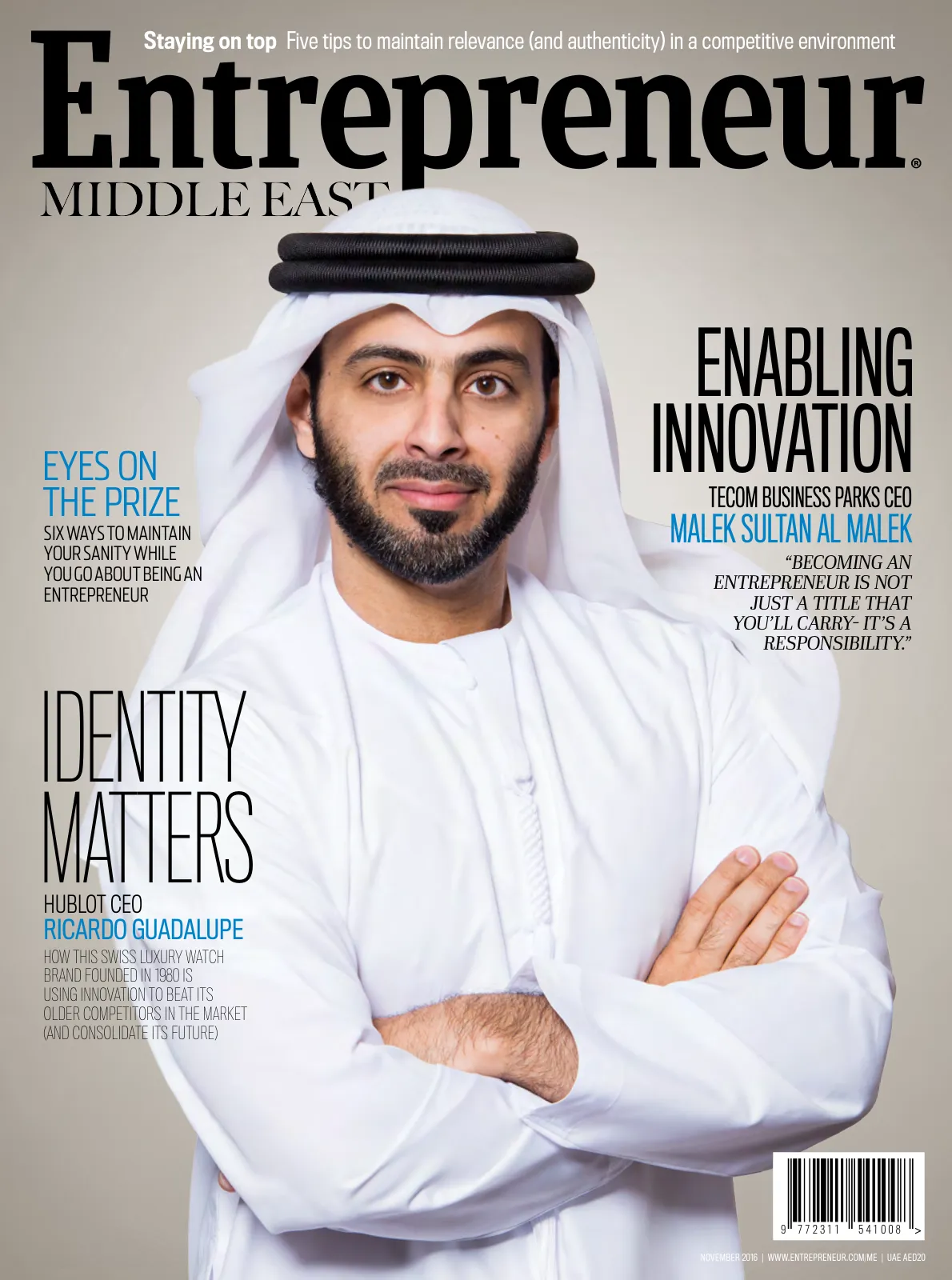
Entrepreneur Middle East, November 2016
Page 1
november 2016 | www.entrepreneur.com/me | UAE AED20
9
7 7 2 3 1 1
5 4 1 0 0 8
>
Staying on top Five tips to maintain relevance (and authenticity) in a competitive environment
Eyes on
the prize
Six ways to maintain
your sanity while
you go about being an
entrepreneur
Identity
matters
Hublot CEO
Ricardo Guadalupe
How this Swiss luxury watch
brand founded in 1980 is
using innovation to beat its
older competitors in the market
(and consolidate its future)
“Becoming an
entrepreneur is not
just a title that
you’ll carry- it’s a
responsibility.”
Enabling
innovation
TECOM Business Parks CEO
Malek Sultan Al Malek
Page 2
Page 3
november 2016 Entrepreneur
3
60 A panel discussion at ArabNet Kuwait 2016
CONTENTS
november 2016
Hublot CEO Ricardo
Guadalupe at the
World of Hublot
exhibit in Dubai Mall
26
20
INNOVATOR:
Enabling innovation
TECOM Business Parks
CEO Malek Sultan Al Malek
“Becoming an entrepreneur
is not just a title that you’ll
carry- it’s a responsibility.”
26
INNOVATOR:
Identity matters
Hublot CEO Ricardo Guadalupe
How this Swiss luxury watch
brand founded in 1980 is using
innovation to beat its older
competitors in the market.
40
‘TREPONOMICS:
SKILLSET
Staying on top
Mumzworld CEO Mona
Ataya lists five tips for your
business to maintain rel-
evance (and authenticity) in
a competitive environment.
42
TECH:
SHINY
#TamTalksTech
Gadgets and doodads
that you might’ve missed
out on, sourced by a tech
aficionado. Yes, it’s okay to
want them all… and no, it’s
not our fault.
82
START IT UP:
ECOSYSTEM
Nurturing innovation
Qatar Science & Technology
Park’s newly appointed
Managing Director Dr.
Maher Hakim says that
in order to advance
Qatar’s tech ecosystem, an
investment in human capital
is definitely needed.
56
‘TREPONOMICS:
MARKETING
Fueled by data
Profusion co-founder
Guy Marson delves
into the power behind
personalization engines.
Page 4
Page 5
Page 6
Page 7
Page 8
Page 9
Page 10
Entrepreneur november 2016
10
CONTENTS
46 The living room lounge at Hyatt Regency Dubai Creek Heights
november 2016
42
BlackBerry
DTEK60
Malek Al Malek,
CEO, Tecom
Business Parks
20
38
START IT UP:
WHO’S GOT VC?
Staying the course
Kunal Kapoor, founder,
The Luxury Closet explains
how he got his startup
funded all the way from
seed capital to Series B.
74
START IT UP:
Q&A
Digital detectives
UAE startup Comae
Technologies offers digital
forensic solutions for
law enforcement and
enterprises.
48
‘TREPONOMICS:
ESQUIRE GUY
Keep it clean
The Esquire Guy on how to
keep your social media SFW.
44
CULTURE:
TRAPPINGS
‘Trep gear
The executive selection for
the entrepreneur on your list
that has everything. Okay,
maybe for a little self-reward
as well.
62
‘TREPONOMICS:
SKILLSET
Pulling the plug
Sometimes, shutting down
your startup may be the
best way forward for an
entrepreneur for you as an
entrepreneur, says DTEC’s
Sirine Fadoul.
46
CULTURE:
TRAVEL
Fresh vibes
Business travellers, check
out the new Hyatt Regency
Dubai Creek Heights, the
latest addition to the Hyatt
portfolio in the UAE.
Page 11
Page 12
Entrepreneur november 2016
12
CONTENTS
november 2016
74
Matt Suiche, founder
and CEO, Comae
Technologies in a
panel discussion on
cyber security at Dubai
Future Accelerators
38
Kunal Kapoor, founder,
The Luxury Closet
68
TREPONOMICS:
SKILLSET
Don’t drink the Kool-Aid
Starting an enterprise?
Here’s what not to do,
according to Price
Global Group’s Vishal
Mahtani.
58
CULTURE:
LIFE
Eyes on the prize
Direction Dose founder
Samia Hasan lists six ways
to maintain your sanity
while you go about being
an entrepreneur.
34
TREPONOMICS:
PRO
Success oriented
Bayt.com’s Lama Ataya
offers eight steps to build
teams that last in your
enterprise.
16
EDITOR’S NOTE
By Aby Sam Thomas
70
FRANCHISE:
Cracking the market
HintHunt Dubai Managing
Partner Lina El-Saheb on
what you need to know
about building a successful
franchise business.
76
START IT UP:
Q&A
Catching ‘em young
BizWorld UAE wants
to prepare MENA’s
future generations for
their entrepreneurship
journey.
78
START IT UP:
STARTUP FINANCE
“We got funded!”
Online travel startup
HolidayMe.com raises
US$7 million in Series
A funding from Accel
Partners, F&C Overseas
Investment, and Al Sanie
Group.
Page 13
27
Henri Asseily,
Manager Partner,
Leap Ventures
Page 14
Entrepreneur november 2016
14
SUBSCRIBE
Contact subscriptions@bncpublishing.net to receive
Entrepreneur Middle East every issue
EDITOR IN CHIEF Aby Sam Thomas editor@bncpublishing.net
CEO Wissam Younane wissam@bncpublishing.net
MANAGING DIRECTOR Walid Zok walid@bncpublishing.net
DIRECTOR Rabih Najm rabih@bncpublishing.net
CREATIVE LEAD Odette Kahwagi
STARTUPS SECTION EDITOR Pamella de Leon
COLUMNIST Sindhu Hariharan
COLUMNIST Tamara Clarke
COLUMNIST Shoug Al Nafisi
COLUMNIST Erika Widen
EVENTS LIAISON Mark Anthony Monzon
PO Box 502511 Dubai, United Arab Emirates
P +971 4 4200 506 | F +971 4 4200 196
For all commercial enquiries related to
Entrepreneur Middle East contact
sales@bncpublishing.net
All rights reserved © 2016.
Opinions expressed are solely those of the contributors.
Entrepreneur Middle East and all subsidiary
publications in the MENA region are officially licensed
exclusively to BNC Publishing in the MENA region by
Entrepreneur Media Inc.
No part of this magazine may be reproduced or
transmitted in any form or by any means without written
permission of the publisher.
Printed by Raidy Emirates Printing Group LLC
www.raidy.com
Images used in Entrepreneur Middle East are credited when necessary. Attributed use of
copyrighted images with permission. All images not credited otherwise Shutterstock.
Jamilla Ali
Lama Ataya
Mona Ataya
James Clear
Fida Chaaban
Lina El-Saheb
Sirine Fadoul
Dr. Maher Hakim
Samia Hasan
Manish Jeswani
Kunal Kapoor
Ahmad Khamis
Vishal Mahtani
Guy Marson
Ross McCammon
CONTRIBUTING WRITERS
www.entrepreneur.com/me
Access fresh content daily on our website!
MIDDLE EAST
EntMagazineME
@EntMagazineME
Entrepreneur-me
EntrepreneurMiddleEast
EntMagazineME
EntMagazineME
EntMagazineME
MIDDLE EAST
In addition to our print edition, we’re bringing
you all sorts of industry news on our web
mediums. Joining us online means getting
relevant business and startup content in
real-time, so you’re hearing about the latest
developments as soon as we do. We’re looking
forward to interacting with our readers on all of
our social media and web platforms- like any
thriving business, we’re looking to give and take.
#TrepTalkME is already happening on all of our
digi platforms, and all good conversations go
both ways. See you on the web!
Page 15
BREITLING.COM
The superlative-charged chronograph. 50 mm case in Breitlight®. Exclusive Manufacture
Breitling Caliber B12 with 24-hour military-style display. Officially chronometer-certified.
Page 16
Entrepreneur november 2016
16
E
ver get that feeling when
reading something that
those words you are seeing
were written especially for
you? That’s the impression
I got when I read Shoug Al Nafisi’s
contribution for this month’s
issue of Entrepreneur, in which
she warns us to be wary about
the rather thin line between be-
ing ultra productive vs. mindless
activity. This past month has
been a very busy time for us at
Entrepreneur, yet we kept pushing
through, tackling one struggle
after the other. Looking back at
it now, it seems almost a wonder
that we didn’t keel and fall over in
the process.
The funny thing, though, is that
while I was indeed aware of the
overwhelming workload we had
pending, it was only after I read
Shoug’s article that I realized that
somewhere along the way, we
had seemingly lost control about
what we were being subjected to
in terms of work. Sure, we were
getting everything done as per our
standards, yes, but we had also
stopped considering our personal
welfare in the process. The signs
of this were plenty to see- but
only when I made an effort to
look for them. For instance, it had
become a norm rather than an ex-
ception to work from home while
sick, when ideally we should have
just taken the day off. Another ex-
ample: those times when we can-
celled our personal plans without
a word of protest, just so that we
could use those extra hours in the
day to get some work done. Then
there was my personal Achilles
heel: my senseless wanting to be
nice to people led me to say “yes”
to things that were simply adding
to my workload- and yet again, I
was doing this without properly
considering its consequences on
me. Shoug’s words were especially
haunting: “The facts may show
that you’re able to complete all
the tasks you want to, but then
lately, you’ve been feeling pres-
sured, anxious, and have had dif-
ficulty sleeping. Before you know
it, you’ll feel the tug and pull, and
you will be dragged down, com-
pletely drained.”
Now, that last line was like
a wake-up call of sorts: after
emailing Shoug with a dozen mut-
terings of gratitude, I did a self-
evaluation of sorts and considered
the hole we had dug ourselves into
thanks to our utter lack of mind-
fulness. While we had all signed
to be a part of Entrepreneur well
aware of the busy-ness of this job
considering the mandate we had
set for it, the realization came
that overextending ourselves and
burning out is, well, not going to
help anyone. This is something
that you entrepreneurs out there
need to understand- yes, being a
hustler is a part and parcel of your
lifestyles but don’t let it overrun
yourself entirely. The core of your
business is you and your team- so
don’t work yourselves into a rut.
This is the same principle I have
decided to put in place for myself
and my team: be it by saying no
to things that may sound good
but will drain us out, or by simply
committing to making time for
ourselves as we get through our
work load- that’s how we’re go-
ing to get ahead, and not burn
ourselves out. Of course, this is
easier to say than do for us Type-
A personalities at Entrepreneur-
but hey, we won’t know until we
try. Wish us luck!
EDITOR’S NOTE
Aby Sam Thomas
Editor in Chief
@thisisaby
aby@bncpublishing.net
Hustling smarter
(not harder)
It’s not about how much work you do,
it’s about how you do it
Page 17
LOOKING TO SET UP YOUR BUSINESS?
Call: 800 7111 Visit: www.rakftz.com Follow:
/ rakftz
FLEXI FACILITIES
AED 13,500
AED 25,500
OFFICES
AED 205/M2
WAREHOUSES
AED 18/M2
INDUSTRIAL LAND
Ras Al Khaimah Free Trade Zone
provides the right elements for
a successful business, including
licences, visas, facilities, 100%
foreign ownership and zero
taxation. Prices start from:
Page 18
Entrepreneur november 2016
18
IN THE LOOP
Partners for growth
Dubai Institute Of Design
And Innovation
launched in the UAE
Online grocery retail app InstaShop raises
funds from Souq.com
Dr. Amina Al Rustamani, Chairperson, DDFC, and CEO,
TECOM Group at the announcement of Dubai Institute of
Design and Innovation
Left to right: Ronaldo Mouchawar, co-founder and CEO,
Souq.com and John Tsioris, founder and CEO, InstaShop
Video by Broadcast Exchange © vimeo
O
nline hyperlocal
grocery ordering
app InstaShop
has raised an un-
disclosed amount
of funding from
Souq.com, the
region’s e-commerce major. As
the sole investor participating in
this round of funding, Souq takes
“a significant minority stake” in
InstaShop. Launched in June 2015
in the UAE’s competitive on-
demand grocery delivery market,
InstaShop counts over 50 super-
market chain partners and claims
to fulfill “tens of thousands of
orders” for a user base of 60,000+
active users. InstaShop plans to
deploy the funds “to speed up”
expansion in the MENA region, to
accelerate their growth, and also
invest in technological innovation
to enhance the app user experi-
ence. Jabbar Internet Group and
VentureFriends are InstaShop’s
existing investors from previous
rounds.
In reference to the funding, Souq
says that the investment is driven
by a view to “further expand its
offering in the fast-growing FMCG
and grocery categories, leveraging
on its current user base.” Ronaldo
Mouchawar, co-founder and CEO,
Souq.com says, “InstaShop has
a strong concept and platform in
its own right, but by utilizing our
leading logistics app, it is looking
to further grow its presence in
Dubai and the other Emirates.”
Speaking about the process,
InstaShop founder
and CEO, John Tsioris
says that the deal was
sealed after being in
touch with Souq.com
“for many months” and
was a result of Souq’s
interest in the groceries
vertical. “The best
part about Souq.com
investing in InstaShop
is the fact that we’ll
have the largest online
retail platform in the
Arab world by our side,
an experienced strategic
player to provide guidance and
offer valuable resources, such
as their enormous user base,”
says Tsioris. With a “rather
straightforward” approach to
arriving at the valuation, Tsioris
is pleased to note that the process
was free of intense negotiations
in this regard, and says that
Souq’s marketplace model also
helped InstaShop have an investor
without a “conflict of interest”
with their existing retail partners.
“With Souq.com, it was clear
that our business approach and
chemistry blended well, they
wanted to enter into groceries and
they liked the way we do it.”
Operating as a typical on-
demand service application,
InstaShop is available on both
Android and iOS, and says
that it can deliver groceries to
customers in “30 to 60 minutes”
(depending on location). The
users can choose the products on
the app, which provides for both
credit card payment and cash on
delivery option. With increase
in the acceptance of e-commerce
in the Middle East, and with a
growing population of a consumer
class seeking convenience in the
quickest means, online grocery
has seen improved adoption in
the UAE, and the region as a
whole. Even as large supermarket
chains have added omni-channel
capabilities by expanding their
online services, many tech
startups enabling grocery e-retail
are giving them close competition.
D
ubai is gearing up to welcome a world-
class design educational institute. The
UAE announced plans to set up Dubai
Institute of Design and Innovation (DIDI) in
collaboration with Massachusetts Institute
of Technology (MIT) and The New School’s
Parsons School of Design. Established by
Dubai Holding and Dubai Creative Clusters
Authority, under the directives of H.H. Sheikh
Mohammed Bin Rashid Al Maktoum, DIDI
will be located at Dubai Design District (d3),
and will welcome its first intake of students
in 2018. According to a statement from MIT,
the faculty from MIT’s School of Architecture
and Planning will support the creation
of the curriculum and launch of the new
undergraduate design educational institution.
Dr. Amina Al Rustamani, Chairperson,
DDFC, and CEO of TECOM Group, said,
“We constantly work to empower youth
to take ownership of the journey towards
a sustainable economy and a future led
by innovation. DIDI will be a strategically
critical platform for providing youth with the
tools they need to drive the UAE’s future
development.” Strategic design management,
product design, visual arts and media design,
and fashion design are a few courses expected
to be part of DIDI’s curriculum.
The MENA Design Education Outlook,
a recent industry study undertaken by
Dubai Design and Fashion Council (DDFC)
and d3, estimates that “at least 30,000
design graduates” are needed in MENA (a
nine-fold increase) by 2019, to support the
growth projected for the sector. Given that
the absence of a competitive and modern
educational framework has often been cited
as a missing link in the ecosystem, DIDI
may well be just what the region’s design
enthusiasts were looking for, and also attract
creatives to the Emirate.
Page 19
Charles Blaschke and
Chris Burkhadt of Taka
Solutions, winner of The
Page 20
Entrepreneur november 2016
20
innovator
.
Page 21
november 2016 Entrepreneur
21
By Aby Sam Thomas
“Becoming an entrepreneur is
not just a title that you’ll carry-
it’s a responsibility.”
Enabling
innovation
TECOM Business Parks CEO
Malek Sultan Al Malek
Page 22
Entrepreneur november 2016
22
innovator
“we are now competing
and also bringing this
spirit into ourselves
in industries that we
only used to import. I
think that’s probably
the clear shift that
we have had. And this
couldn’t have been
done if we didn’t have a
sustainable ecosystem.”
Dubai Internet City
Entrepreneur november 2016
22
C
onsidering the
size and scale that
TECOM Group boasts
of today, it can be
hard to imagine its
inception in Dubai
back in 2000, when
it started through the
establishment of Dubai Internet City
with a vision from Vice President and
Prime Minister of the UAE and Ruler
of Dubai, H.H. Sheikh Mohammed Bin
Rashid Al Maktoum. This initiative’s
early days should resonate well with the
entrepreneurs among you, and TECOM
Business Parks CEO Malek Sultan Al
Malek acknowledges the startup-like
origins of the organization, which saw
it not go down the traditional industry
development agency route. “We had
chosen [to do] things that no one has
done before,” Al Malek says. “We had
chosen a different way of doing things.
We set a benchmark; we were being
disruptive from the day we set out
on this project. So, from that end, we
were innovative, and we started very
small as well. So, from its DNA, when
TECOM started, I would claim that it is,
partially, an entrepreneurial trip that
we have chosen, to build all of this.”
And what a trip it has been: TECOM
Business Parks has grown to encompass
today the region’s most prominent
business hubs like Dubai Internet City,
Dubai Media City, Dubai Knowledge
Park and Dubai Science Park, and its
pace of progress is showing no sign of
slowing down anytime soon.
Having concentrated on developing
the industries of technology, media,
science and education, it’s good to note
that TECOM Group, a member of Dubai
Holding, has not only been able to bring
the world’s leading organizations in
these areas to set up shop in Dubai,
but it has also facilitated the creation
and development of SMEs in these
particular sectors as well. After all, the
aforementioned industries are the ones
where entrepreneurs have been making
their mark around the world, and it’s
been no different here in Dubai- as Al
Malek explains, these industries were
selected in the first place owing to
their potential to create future value
for the city and the country at large.
Al Malek points out the plethora of
media and technology companies that
have been created and developed,
thereby contributing to the making of
a robust entrepreneurial ecosystem
in the Emirate- which, according to
Al Malek, has a couple of beneficial
knock-on effects as well. “We think that
if everyone grows, ultimately, our cities
and our industries will grow as well,”
he explains, noting that today, there
are over 75,000 people working in the
communities built up by TECOM Group.
With this being the case, it should
come as no surprise that facilitating
and enabling the development of the
entrepreneurial ecosystem in Dubai
has been on the agenda for TECOM for
quite a while now. Perhaps its most
prominent endeavor in this regard has
been the setting up of the in5 Innovation
arm in 2013, which has been wholly
dedicated to incubating startups in
the ICT and digital media space. Al
Page 23
november 2016 Entrepreneur
23
His Highness Sheikh Mohammed bin Rashid Al Maktoum with Malek Al Malek, CEO of TECOM Business Parks
at GITEX 2016
Visa’s Jim McCarthy and TECOM Business Parks’ Malek Al Malek at the launch of
the VISA Innovation Center in Dubai
>>>
Malek explains that in5 came into
being after the team recognized a gap
for focused industry resources catering
to the specific needs of entrepreneurs
setting up their businesses in Dubai.
“Entrepreneurs want easier entry [into
the marketplace]; they need guidance;
they need support, both technically
and from a business point of view.
They need connections in business
development. All of this was translated
by TECOM into a vertical, which is our
incubator, in5… With in5, we created
a brand that has a mandate to deliver
[on the aforementioned points].” While
over 70 companies have been housed
at in5 since its launch, the center has
also managed to engage with more
than 20,000 people as its community
members. “In the last two to three
years, we have received more than
1,000 applications [to in5],” Al Malek
reveals. “Those applications go through
a process with industry members- we
have a steering committee who decide
on who’s qualified and who has an idea
that can be supported, accelerated and
incubated.”
Besides helping with setting up,
training, networking and mentorship,
in5 has also made alleviating one of
the key pain points of entrepreneurs
starting up businesses in the UAE –
access to funding- a key priority- in
fact, in5 has helped startups raise
AED58 million since its launch. “I think
this is clear evidence of the success
of this entrepreneurial platform,” Al
Malek says. It is thus in5’s success as
a startup incubator in the tech space
that has been a key driver for TECOM
Group to now invest in the creation of
a similar creative space for the media
industry- announced in late 2015, in5
Media, which will be located in Dubai
Production City, has declared its mission
to be to “empower entrepreneurs and
champion innovation and creativity
across the media sector.” The new space,
which is a part of TECOM Group’s
AED4.5 billion Innovation Strategy, is
expected to support over 200 media
entrepreneurs annually, with the
development including everything from
studios to fabrication labs to co-working
lounges. Much like the original in5, the
new center will also facilitate access
to mentors and investors for startups
housed under it, and thus drive the
development of Dubai’s
media industry. When
asked if there could be
other in5 centers in the
making, Al Malek says
that in5 Design catering
to design entrepreneurs,
freelancers and startups
will be launched in the
coming month, and that
the other sectors that
TECOM Business Parks
currently works in, such
as science, and education,
are also being assessed
in terms of them having
their own dedicated
innovation centers.
With initiatives like these, it’s clear
that TECOM Group is keen on playing a
key role in encouraging (and enabling)
entrepreneurship and enterprise in the
UAE, and from Al Malek’s perspective,
such a shift in mindset is well in line
with global business trends. According
to him, the UAE has the benefit of
having always been innovative in
whatever it does, and this has now
translated into the country’s business
sphere as well: “I think it’s very clear
that we are now competing and also
bringing this spirit into ourselves in
industries that we only used to import,”
he says. “I think that’s probably the
clear shift that we have had. And this
couldn’t have been done if we didn’t
have a sustainable ecosystem.” And
Al Malek is very emphatic on the
important role large corporates (many
of which are housed in TECOM Group)
have played in building up Dubai’s
entrepreneurial community. “They
have done a marvelous job,” he says.
“One of the important things they
have done is to establish the industry,
to do their regional development out
of here. Many of the partners we have
already have their own entrepreneurial
development programs for startups
and SMEs, and many of them have
Page 24
Entrepreneur november 2016
24
innovator
Startups showcase
A look at the companies that have
come out of in5
• Anghami | anghami.com
• Bridg | bridgtheapp.com
• Carpool Arabia | carpoolarabia.com
• Jamalon | jamalon.com
• Melltoo | uae.melltoo.com
• MrUsta | mrusta.com
• Snapp Card | snappcard.com
• Teach Me Now | teachmenow.com
• Wrappup | wrappup.co
Source: infive.ae
“In the last two to three
years, we have received
more than 1,000 applications
[to in5],” Al Malek reveals.
“Those applications go
through a process with
industry members- we
have a steering committee
who decide on who’s
qualified and who has an
idea that can be supported,
accelerated and incubated.”
in5 Innovation Centre
contributed to the growth of many
of our ecosystem’s smaller players. If
you look at Microsoft, they come up
with their own partnership program,
they have a competition where they
take the winners to a global stage,
etc. Our partners have thus definitely
contributed to the development
of the industry, to the availability
of knowledge, to the quality of the
individuals they bring as part of their
companies, and ultimately, produce
entrepreneurs, either directly or
indirectly… I think it’s fair to say that,
without these partners, this industry
could not exist.”
Hearing Al Malek speak, it seems very
evident to me that this CEO has a
particular interest in entrepreneurs,
and he admits to the same as well.
“My passion is, of course, recognizing
the critical value these individuals can
bring to the city, to their people, to
the country, and to the UAE economy,”
he says. “It gives me the fuel to make
sure we address anything that they
will require- from what we have seen
globally, we’ve seen the value that
entrepreneurs can bring. So what drives
me to make sure we are addressing
this is the recognition of their value to
Dubai and the region… My passion is
to see more companies created in our
creative spaces, and hopefully, we see
some of them recognized globally too.”
Given that Al Malek is someone who
has seen entrepreneurs by the dozens,
I ask him if he has any advice for those
who are considering taking on this
mantle. Al Malek replies that while
entrepreneurs need to be extremely
passionate about what they are doing,
they need to remain cognizant of their
surroundings and the market at large,
and be willing to pivot their services or
products as per business requirements.
“You should have passion- it should
take over everything, but it should
not make you blind to benchmarks,
comparisons or the sustainability of the
business,” he says. Most of all, Al Malek
says that one should remember that
becoming an entrepreneur comes with
great commitments- and one should
be prepared for the kind of lifestyle it
brings. “Becoming an entrepreneur is
not just a title that you’ll carry- it’s
a responsibility,” he says. “It’s not
something that you just jump in to
because it looks good.”
Page 25
Porto Arabia Towers
Doha, Qatar
������������������������������
Hill International
The Global Leader in Managing Construction Risk
www.hillintl.com
�����������������������������������������������������������������������
���������������������������������������������������������������������
��������������������������������������������������������������������������
������������������������������������������������������������������������
�������������������������������������������������������������������������
���������������������������������������������������������������������
��������������������
����������������������������������������������������������������������������
���������������������������������������������������������������������
�������������������������������������������������������������������������
�����������������������������������������������
��������������������������
�������������������������
��������������������������
If you can imagine it, we can manage it.
��������������������
Doha, Qatar
��������������
Doha, Qatar
Viva Bahriya Towers
Doha, Qatar
Page 26
Entrepreneur november 2016
26
Identity
matters
INNOVATOR
Hublot CEO
Ricardo Guadalupe
How this Swiss luxury watch brand founded in 1980 is
using innovation to beat its older competitors in the market
(and consolidate its future) By Aby Sam Thomas
Brought to you by
>>>
W
aiting in the finely-appoint-
ed interiors of the Hublot
boutique in The Dubai Mall
for my interview with the
company’s CEO Ricardo
Guadalupe, I couldn’t help but feel a
sense of foreboding as I examined the
stunning timepieces on display in the
showroom. The reason for this un-
ease was because I had, on this par-
ticular day in early October, chosen
to wear my Apple Watch on my wrist,
which, when compared to Hublot’s
offerings in the haute horology space,
looks –in my opinion at least- decid-
edly inferior as a watch (sorry, Apple
fanboys!), and I did worry about
Guadalupe’s thoughts on it, if he
were to see it. And sure enough, in
true adherence to Murphy’s Law,
the Hublot CEO did indeed note my
wearing of the Apple Watch, and his
thoughts on my smartwatch were
perfectly encapsulated in this pithy
remark he made about it: “It’s a de-
vice; it’s not a watch.”
Page 27
november 2016 Entrepreneur
27
Hublot CEO Ricardo
Guadalupe
november 2016 Entrepreneur
27
Page 28
Entrepreneur november 2016
28
INNOVATOR
“Our consumer is a guy who can go to the
World Cup to watch football; he can go to
the Formula 1 Grand Prix to watch Ferrari;
they can go on holiday to St. Tropez; they
can come here to Dubai. [Our aim is that]
everywhere they go, they should see Hublot.
At the end, they [should] think that Hublot
is a part of their world.”
Hublot Classic Fusion
Berluti Scritto Emerald Green
Big Bang Unico
Sapphire All Black
That succinct statement by
Guadalupe can be perhaps
better understood when one
takes into consideration the
exacting art, engineering
and tradition of watchmak-
ing, which is a hallmark of
a luxury timepiece brand
like Hublot. While it is a
relatively young enterprise
(Hublot was founded only in
1980), this Swiss company
is today recognized as being
one of the world’s leading
brands in the horology space,
with its key characteristic
being its ability to combine
traditional watchmaking
with futuristic innovations,
a leitmotif that has now
been enshrined in Hublot’s
‘Art of Fusion’ philosophy.
And to its credit, this theme
can be seen in just about
any Hublot watch- consider,
for instance, the All Black
timepiece launched in 2006.
As the name suggests, it was
a watch that was entirely
black (think black dial, black
case, black markers, black
everything), which made
reading time on it a little
tricky, to say the least- but
as Guadalupe points out,
that wasn’t the point of the
All Black. Given that one
can today find the time from
just about anywhere, be it a
cellphone or a smartwatch,
the All Black’s concept of
“invisible visibility” was
to put out the idea that
for a brand like Hublot, its
watches aren’t made to tell
time. “We sell watches that
express what the consumer
is himself, what he rep-
resents, what he wants to
show about his personality,”
Guadalupe explains. “That’s
why we created this concept,
and I think it has been very
successful, thanks to this
philosophy.”
Perhaps the best measure
of All Black’s success is to
take a look at the number of
inspired completely mono-
chrome watches that are out
in the market today- but, as
Guadalupe proudly declares,
Hublot was the first to
bring out this revolutionary
concept that set a standard
of sorts in the luxury watch
sector. The All Black is cel-
ebrating a decade of success
this year, with Hublot com-
memorating this triumph
with an exhibition called The
World of Hublot in key cities
around the world, including
Dubai. While the exhibit
goes through the various
iterations of the All Black
through the years (including
2016’s Big Bang Unico Sap-
phire All Black), The World
of Hublot also showcases its
Page 29
november 2016 Entrepreneur
29
“We are in sports. We are
in lifestyle [with] Berluti,
Italia Independent. We are
with cars [with] Ferrari.
We are in art- we are in
music: Lang Lang, Depeche
Mode. So I think that today,
you must really go in all
these different worlds, and
that’s how you can really
touch your consumer.”
Hublot CEO Ricardo Guadalupe
at The World of Hublot exhibit
in Dubai Mall
Italia Independent’s
Lapo Elkann with
Hublot’s Ricardo
Guadalupe
>>>
other timepieces that have
been crafted in collaboration
with brands like Ferrari,
Italia Independent and Ber-
luti. In terms of outreach
efforts, Hublot is a brand
that has managed to rack up
an impressive list of a global
who’s who as brand ambas-
sadors, which include sport-
ing legends like Pelé, Usain
Bolt and Kobe Byrant. These
larger than life names make
it clear that sports are a key
component of Hublot’s com-
munication strategy, with
the brand having aligned
itself with everything from
football to basketball to box-
ing. Football is where Hublot
has made its presence
particularly felt, with the
brand starting its association
with the sport in 2004 in a
bid to raise brand awareness.
Guadalupe reveals that the
company decided to zoom
in on football at the time
essentially because, well,
all the other sports were
“taken,” noting how sports
like golf and tennis had big-
name watch brands allied
with it already. “There was
no luxury watch brand that
was in football then,” Gua-
dalupe remembers. “And we
started step by step. We did
a small deal at the time with
the Swiss national football
team. And afterward, the
UEFA Euro Cup was coming
to Switzerland- [we said]
the Swiss watch industry
should sponsor the Euro Cup
organized in Switzerland…
And then we saw the po-
tential of football of giving
brand awareness. Of course,
you touch millions of people,
and those millions all cannot
afford to buy a Hublot watch,
but it doesn’t matter- we
said, if people know that
Hublot is a watch brand,
then it is already good,
because then we can become
aspirational.”
But such marketing efforts
are not just about making
Hublot an aspirational
brand- Guadalupe notes that
the events or places that the
company aligns itself are
also where its ideal custom-
ers are going to be likely
present. “Our consumer
is a guy who can go to the
World Cup to watch football;
he can go to the Formula 1
Grand Prix to watch Ferrari;
they can go on holiday to St.
Tropez; they can come here
to Dubai,” he says. “[Our
aim is that] everywhere
they go, they should see
Hublot. At the end, they
[should] think that Hublot
is a part of their world.”
The underlying concept,
according to Guadalupe, is
that the brand should go to
wherever its consumers are.
“The customer is moving
today. So he goes to different
places; he comes to Dubai,
he goes maybe to New York,
he goes to Miami… So the
idea is, really, to follow our
customer, and to be a part
of his world. That’s the key
element of our strategy in
marketing. Because, before,
the brand was saying, we
focus on one sport, or one
activity, and we stick to
that. But now, it’s changed.
We are in sports. We are in
lifestyle [with] Berluti, Italia
Independent. We are with
cars [with] Ferrari. We are
in art- we are in music: Lang
Lang, Depeche Mode. So I
think that today, you must
really go in all these differ-
ent worlds, and that’s how
you can really touch your
consumer.”
Of course, it must be noted
here that Hublot’s success
in the luxury market isn’t
just because of its celebrity
patrons, or its clever mar-
keting endeavors- there’s
no mistaking the fact that
the company’s concerted
efforts at being truly in-
novative while staying true
to the hallmark traditions
of watchmaking is what has
made Hublot the brand that
it is today. A look at Hublot’s
most talked about watches
over the years –consider the
Big Bang, King Power, Classic
Fusion, and the All Black- is
Page 30
Entrepreneur november 2016
30
INNOVATOR
“You have to reinvent yourself. For us, to come
with products that have a strong identity and
a lot of value, it’s really important. A watch
that is round, with just three hands and a
dial, today, is not enough. So I think the future
of the watch industry is through innovation,
through giving value, and through giving a
strong identity to the products that we sell.”
Hublot CEO
Ricardo
Guadalupe
proof enough of its prowess
in its craft, with the com-
pany today using all sorts of
materials like rubber, carbon
fiber, ceramic, titanium,
and its proprietary Magic
Gold (a fusion of liquid gold
and ceramic) to build its
watches, all of which were
practically unheard of in the
watch industry until Hublot
brought it center stage. It’s
clear that the company’s
‘Art of Fusion’ philosophy
continues to drive it even
today, with Guadalupe saying
that this essentially requires
the company to continue to
be creative and innovative.
“The ‘Art of Fusion’ is hav-
ing beautiful watches with
mechanical movements, all
respecting the tradition [of
watchmaking], but making
watches that connect you to
the future by using materi-
als of today. Rubber didn’t
exist 100 years ago, ceramic
didn’t exist 50-60 years
ago, carbon fiber, the same;
Magic Gold’s the same- so
we’ve really created watches
that no other brand offers.
So when you are unique,
when you are different, nor-
mally, if the product is good,
the marketing is good, then
you’re a success. Thanks
to that, we’ve been able to
grow in the last 10 years,
and to become now a part
of the best watch brands of
our industry. Some brands,
they have 200-300 years
[behind them], but I’d say
the difference is that we have
a concept, an identity, which
is different, and we have also
people in the brand [who
believe in that].”
While there’s no getting
away from the fact that
Hublot has been innovative
with its products so far, I ask
Guadalupe what innovation
means for the company in
its current milieu, in today’s
day and age. “Innovation is
defined by the fact that you
come up with products that
are not repeating the past,”
he replies. “So it’s not a
repetition of what has been
done before; it’s creating
something different to con-
nect you to the future.” Gua-
dalupe uses the company’s
track record so far to prove
his point: be it when Hublot
was the first to use a natural
rubber strap for a watch,
or even when its iconic All
Black became a trend for
others to follow, the brand
has always managed to stand
out in the market over the
years. As for the future,
Guadalupe says while the
watch industry today may be
in a sort of crisis, if Hublot
can continue to remain really
creative and innovative, then
this is a chance for it to be
stronger than its competi-
tors. “We must think how
we can be different, and still
exist,” he explains. “You have
to reinvent yourself. For us,
to come with products that
have a strong identity and a
lot of value, it’s really impor-
tant. A watch that is round,
with just three hands and
a dial, today, is not enough.
So I think the future of the
watch industry is through
innovation, through giving
value, and through giving a
strong identity to the prod-
ucts that we sell.” Guada-
lupe’s statement thus offers
an indication of how Hublot
is strategizing its future- and
all signs indicate a smooth
ride ahead.
Page 31
etro.com
Page 32
GETTING CLOSER TO THE TOP...
Getting closer to the top of the tallest mountain in the UAE will soon be a lot easier, thanks to the fleet of
Volvo construction equipment used in the building of the road to the Jebel Jais mountain. When it’s finished,
the route will run from Ras Al-Khaimah right to the 1,910 metre summit. The road has already become a
popular destination for motoring enthusiasts, who like to show off what their machines can do. But when the
road runs out, that’s where the Volvo operators show off their machines. And it’s impressive to see what they
can do. If you want to get closer to the action, scan the code and watch the video.
Building Tomorrow.
VIDEO
http://goo.gl/FPsU43
Page 33
Page 34
Entrepreneur november 2016
34
ETHICS | ESQUIRE GUY | SKILLSET | MARKETING | PRO
TREPONOMICS
Success
oriented
Eight steps to build teams that last
By Lama Ataya
I
n any work environment, we
frequently communicate,
coordinate, collaborate,
and correspond with other
professionals. No job is truly
isolated. Even if a particular
position does not clearly
fall under a distinct team, it
will always require interact-
ing with coworkers, managers,
and subordinates in order to
accomplish the job responsi-
bilities. So whether explicitly
or implicitly fashioned, teams
are an instrumental working
mechanism at every com-
pany and every organization
consisting of more than one
person. It is perhaps for that
reason that many HR manag-
ers and recruiters pay close
attention to teamwork and
communication skills before
hiring someone. Without effec-
tive and efficient teams, many
businesses would fail to de-
liver the simplest of projects.
Workplaces in the Middle East
and North Africa (MENA)
region are no different from
other markets in this regard;
team functionality is extraor-
dinarily valuable for accom-
plishing the day-to-day tasks,
as well as placing the business
on the right path. But simply
building teams will not get the
job done. Team dynamics can
be rather finicky and are often
influenced by various factors,
including their size, leader-
ship, communication style,
work division, and many other
elements. In order to truly
harness the power of teams,
there are a few indicators of
successful teamwork that
every manager should know
about.
In an effort to comprehend
the characteristics and the
underlying forces of success-
ful teams in our region, the
Bayt.com Teams in the MENA
Workplace poll, October 2016,
took a close look at teamwork
in the MENA. The poll revealed
many positive results in terms
of team effectiveness and pro-
ductivity in the region. The far
majority of the surveyed teams
are successfully accomplishing
their tasks, delivering results
on time, resolving their con-
flicts, and maintaining effec-
tive performance levels. These
results are truly noteworthy as
they pinpoint many traits and
practices of successful teams,
which are summarized in this
article.
1. Manageable size
The first thing to note about
team size is that there is no
perfect size. The number of
team members will largely
depend on the company size,
nature of project, and the
required workforce. One of the
good qualities of larger teams
is their tendency to have more
ideas, diverse perspectives,
and overall more human capi-
tal. However, it is important
to know that smaller teams
maintain a leg up in this equa-
tion. Smaller teams tend to be
more cohesive and are often
easier to manage. Arranging
for meetings, distributing
tasks, and taking decisions can
also be logistically smoother
as an advantage of having
smaller teams. Most teams in
the MENA are in fact small,
consisting of two to five
members each. By creating
sub-groups based on assigned
tasks or area of expertise,
large teams can also benefit
from the smoother and swifter
dynamics, otherwise reserved
for small teams.
Page 35
november 2016 Entrepreneur
35
infographic © bayt.com
2. Equitable work division
There is nothing more effec-
tive in starting a conflict and
impeding the workflow of a
team than a biased distribu-
tion of duties and responsi-
bilities. Dividing work and
responsibilities between team
members can be tricky and
contentious. Nonetheless, it
ought to be done in the most
equitable manner. Doing so
helps in mitigating conflict and
results in higher contribution
and optimized use of all the
resources on hand. In a team
where everyone is considered
equal and valuable, participa-
tion and efficiency are likely to
increase. For professionals in
the MENA, more than eight in
10 of them agree that work in
their teams is spread equally
and fairly. What equitable
work division also promotes
is a unanimous ownership
over the outcome: everyone
receives credit when the team
succeeds and everyone takes
responsibility when the team
fails. As predicted, this sense
of collective responsibility,
or accountability, is evident
in more than half of surveyed
professionals in the MENA.
3. Balanced leadership
A team without a decisive,
skilled, and hardworking
leader is deficient. A team
leader gives direction and clar-
ity to the team, coordinates
between different members,
updates and corresponds to
management, and generally
ensures that the team is on the
desired track. Team leaders are
also vital because they have
the ability to influence other
dynamics in the team such as
work division and communica-
tion. A team leader who is able
to make decisions but also
negotiate, take responsibility
but also delegate, speak up
but also listen, work hard but
also help others reach their
potential, is the ideal type for
every team. Nearly two-thirds
(65.8%) of professionals
in the MENA think of their
team leaders as hardworking.
Indeed, when the team leader
is dedicated and serious about
his or her responsibilities,
the rest of the team will be
motivated to perform their
best and keep up with what is
expected of them.
4. Open communication
Communication is a keystone
for teamwork; without it,
teams will be stuck and have
no momentum. In order to
accomplish their tasks, teams
rely on brainstorming, sharing
ideas, providing feedback, and
continuously following up
with one another. There are
various channels and modes
of communication that can be
adopted among teams. But the
most important communica-
tion style for teams to have is
that of openness, transpar-
ency, and active participa-
tion. Open communication
encourages all team members
to engage and share their
input without being shunned
or subjectively criticized.
Encouraging more participa-
tion means having more ideas
and material to work with. The
Bayt.com infographic showed
that teams in the MENA have
excelled in this aspect, where
two-thirds of them (66.3%)
are always communicating
openly and honestly, and
growing together as one unit.
5. Quick conflict
resolution
It would be unrealistic to
suggest that successful teams
have no conflict. The truth is,
any team is prone to disagree-
ments and disputes. Conflict
can help teams consider new
points of view, conduct more
thorough analysis of their
practices and decisions, and
sometimes can bring the team
together in a stronger fashion.
What really matters, though, is
the team’s ability to move past
their differences and resolve
their conflicts in a healthy and
Page 36
Entrepreneur november 2016
36
Lama Ataya is the Chief Marketing Officer at Bayt.com. In this
role, she heads the Marketing department at Bayt.com, and within
that role, she is also responsible for communications, content,
community experience, and corporate social responsibility.
ETHICS | ESQUIRE GUY | SKILLSET | MARKETING | PRO
TREPONOMICS
infographic © bayt.com
productive manner. Conflict
should never be a reason to
obstruct the work progress
and should be dealt with as
a quick learning experience.
Sometimes, when conflict
occurs as a result of inter-
personal or non-job related
matters, teams are in need of
a reminder of the business
goals at hands in order to
move away from any irrelevant
topics. In this regard, teams
in the MENA showed a very
healthy approach, as 88.6%
of them said that they resolve
conflicts honestly, quickly, and
effectively.
6. Efficient use of
resources
Being an efficient team means
having the capability to create
the highest value out of the
given resources and limita-
tions. Teams are always faced
with limited budgets and time,
which can sometimes create a
feeling of frustration. However,
successful teams are capable
of overcoming such obstacles
using their creative side and
optimizing what is available
to them. With regard to time,
for instance, more than half of
professionals in the MENA are
able to fully utilize their team
meetings to increase produc-
tivity. Time, being one of the
most valuable assets of today’s
workplace, is certainly not to
be taken for granted. An ef-
ficient use of time and similar
limited resources, leads to a
more impressive success story.
7. Ability to deliver
In addition to how a team op-
erates and internally handles
their daily tasks, delivering the
required outcome within the
given resources, budget, and
time frame is one of the most
irrefutable indicators of team
success. In the MENA, the far
majority of teams (93.3%) are
able to meet their deadlines
all or most of the time. It is
certainly desirable if the team
communicates well, resolves
conflict, assigns tasks fairly,
and encourages everyone to
participate. But these dynam-
ics on their own are not suf-
ficient for the company; the
team must not fail to complete
their projects in a timely
manner and show measurable
results. The ability to deliver
the envisioned outcomes can
also depend on the skills and
expertise of the team mem-
bers as well as the ability of
the team to work united as
effectively as possible. Nearly
eight in 10 professionals in the
MENA agree that their teams
work together effectively in
furtherance of the intended
business results.
8. Team satisfaction
At the end of the day, a team
that is working together
successfully is more likely to
have satisfied and productive
members. A good way to
measure team success and
healthy team dynamics is by
gauging the team satisfaction
level. Around two-thirds
(62.8%) of professionals in
the MENA are happy with
their teams at work. Not only
does team satisfaction impact
the work progress and the
accomplishments within the
team, but it can also have an
effect on the individual’s job
satisfaction and performance
at work. In fact, 90% of
professionals report that
teams are a very important
part of their satisfaction
at work. Happier and more
productive teams translate to
happier and more productive
individuals, and consequently
longer strides for the business
on the path towards success.
Page 37
Page 38
Entrepreneur november 2016
38
Staying the course
How to get funded
(and keep investors on your side)
ecosystem | who’s got VC | Q&A | STARTUP FINANCE
start it up
Kunal Kapoor, founder,
The Luxury Closet
By Kunal Kapoor
I
knew from the early
stage of my research and
planning for The Luxury
Closet that it had the
potential to be a viable
business, which could build
up to become a multi-million
dollar company- and shake
up the luxury retail market
in the process. Online luxury
retail has been shaping up its
own identity, heavily driven
by digitally-connected mil-
lennials with a penchant for
high-end brands, and new
technology that enables them
to exchange goods in a grow-
ing sharing economy. The
Luxury Closet was the one to
meet this market opportuni-
ty, by offering digitally savvy
consumers a convenient,
safe and customized online
marketplace to sell and buy
authentic, pre-owned per-
sonal luxury products.
But knowing this meant
nothing. I had to prove it.
Every entrepreneur knows
what the steps are: create a
compelling service, find and
grow a customer base, build
a great team, increase sales,
set your growth milestones
and hit them one by one.
But sheer will and commit-
ment alone don’t add up
to a multi-million dollar
company. There’s this little
detail you can’t lose sight of:
the growth of your startup is
conditioned in every way by
capital. In my case, I decided
early on to get this via VC
funding. My top priority
was to identify, pursue, and
secure the most relevant
and beneficial investors
for The Luxury Closet, and
to convince them that my
startup was the sure bet, the
next hundred-million-dollar
company they needed to
invest in.
As the startup grows and
matures as a business, how
the money is raised and
spent, and the types of inves-
tors brought in can make all
the difference for its future
path. All these Series A, B, C
funding rounds are essen-
tially stepping stones in the
process of turning a startup
into that industry changer, a
multi-million-dollar com-
pany.
Seed capital It’s how you
get started
Raising seed capital from
investors is a lot about trust.
Many companies raise fund-
ing from a business plan,
while some wait to have a
prototype or basic initial
traction. Nonetheless, what
you have in your hand when
you approach investors is
initial groundwork on what
could potentially be a large
business. Thus the biggest
factor by far that gets com-
panies funded is the strength
of the founding team. Inves-
tors need to trust that you
will execute and build a large
business. There is some ba-
sic research involved as well:
how big is the market, how
large are comparable global
companies in the field, and
if the model is scalable in
terms of operations and the
financial model.
Page 39
november 2016 Entrepreneur
39
www.theluxurycloset.com
Founder of The Luxury Closet, Kunal Kapoor is a serial entrepreneur with a background in luxury and fashion. He built a successful sportswear brand in India, and
then received an MBA from INSEAD in France. Kunal subsequently landed in Dubai, working for the French fashion empire Louis Vuitton. In 2011, Kunal founded
The Luxury Closet, the largest marketplace for luxury items in the Middle East. This successful and unique venture sees luxury products from Louis Vuitton, Chanel,
Rolex, Cartier, Louboutin and 100 other top brands sold for up to 70% off the original price. Kunal strongly believes that the ability to buy luxury items should be
available to everybody. His love of entrepreneurship and fashion has been the heart behind The Luxury Closet.
At present, The Luxury
Closet has acquired over
300,000 members, and
nearly half a million
monthly visitors from
around 60 countries,
and designed the most
personal and social
shopping experience in the
regional e-commerce space.
.
.
When The Luxury Closet
started, we went through
a similar process. We had
a business model, initial
customer traction, and a
site based on WordPress, all
of which was backed by a
sound plan on how the busi-
ness could successfully scale.
As a founder, I was able to
convince our first investor
Middle East Venture Part-
ners (MEVP) that they could
bet on me. I had a back-
ground in entrepreneurship,
experience in sales manage-
ment at Louis Vuitton, and
an INSEAD MBA- and these
factors certainly helped in
getting MEVP on board.
Series A It’s all about
optimization
Once the business proves
it can grow, the next step is
to build the foundation for
scalability.
At this stage, the startup
needs to have a working
model that is scalable and
figure out where the growth
will come from, i.e. will your
core business expand with
more users, will you diversi-
fy categories or markets, etc.
It is also really important to
think about your processes
and technology that will
enable you to operationally
manage volumes. The inves-
tors involved in the Series
A are usually institutional
regional investors with a lot
of experience in the tech and
e-commerce world, so in ad-
dition to capital, the startup
may also benefit from their
collective expertise.
During our Series A fund-
ing, we were able to secure
the backing of visionary
investors who shaped the
startup ecosystem in the
region, such as Dubai Silicon
Oasis Authority, twofour54,
and MENA Venture Invest-
ments, while continuing to
have the support of our seed
investors, MEVP.
The most important mile-
stone at this stage for us was
customer traction, to keep
the existing customers en-
gaged and loyal, and expand
the customer base simulta-
neously. It’s crucial to have
a high returning customer
base and a good return on
customer acquisition over
a time period that is within
your investment horizon. We
focused on making sure that
each month over 50% of
our revenues were generated
from returning customers,
and our acquisition costs
were paid back within six
months.
While investors are keen
to get to know and give a
lot of credit to the founding
partners and the core team
and their expertise, as the
company grows, they want
to be assured there is a team
in place with the ability to
carry out the operational
plan and hit the milestones
ahead. It’s vital to expand
the team with a handful of
capable, experienced people
with complementary skills
to fill in key roles, from
technology and customer
experience to marketing and
finance. We had some sharp
young talent who had joined
our team in the early stages,
and by the time of our Series
A funding, they managed key
operational tasks. A maver-
ick CTO joined our team as
well who built our technol-
ogy stack, which was pivotal
to move us to the next stage.
Series B It’s time to get
all engines on
Now it’s time to really take
the business to the next
level! While Series B may
appear similar to Series A in
terms of growth objectives,
processes and investor rela-
tions, everything is bigger
and bolder. By this stage,
it becomes clearer that the
team can scale the business,
the model is efficient and
scalable, and that a large
part of the market will adopt
the product. It’s then the
time to think about achiev-
ing much bigger scale, ex-
panding into new countries,
adding more product lines.
However, this period is also
the time when some or most
of your processes will show
cracks, and they will have to
be rethought. Costs become
extremely important as
servicing a larger volume can
be very expensive, which is
why you need to pay serious
attention to unit costs for
different processes.
Our business model has
been optimized and we
have proven traction with
consumers. At present, The
Luxury Closet has acquired
over 300,000 members, and
nearly half a million monthly
visitors from around 60
countries, and designed the
most personal and social
shopping experience in the
regional e-commerce space.
As for our team, we went
out to find the best of the
best for our key positions.
The size of our team al-
most doubled in a matter
of months, as we needed
to have the right talent in
place, well adjusted in their
roles, across operations,
tech, sales, customer sup-
port, marketing, to be able to
accelerate our growth at the
opportune moment.
In October this year, we
completed a US$7.8 million
Series B round of funding,
led by two of the region’s
leading VCs, Wamda Capital
and MEVP. This new capital
fuels our engines as we’re
preparing to enter Saudi
Arabia.
Now, our focus is entirely
on scaling up and expanding
market reach, as this is the
path for The Luxury Closet
to reaching profitability
and becoming a market
leader. I hope to come back
to Entrepreneur in one
year for a tell-all. Until
then, keep an eye out for
wwwitheluxurycloseticom!
Page 40
An international forum
CONNECTING SUSTAINABILITY
& ENTREPRENEURSHIP
28-29 November 2016
Rotana Hotel, Amman, Jordan
Under the patronage of HRH Prince El Hassan bin Talal of Jordan
Towards a Sustainable Future in MENA
Media Partners
Social Entrepreneurship Partners
An initiative by
bit.ly/AMWAJ2016
#
#
Strategic Partners
Page 41
november 2016 Entrepreneur
41
Mona Ataya is the founding partner and CEO of Mumzworld and is responsible for the overall strategic direction and management of the
company. Mona established Mumzworld.com following the frustrations and challenges she faced as a mother in the region. She recognized a
gap in the market for a comprehensive bilingual online shopping and information portal dedicated to everything mother, baby and child, and
subsequently launched Mumzworld in October 2011. Prior to establishing Mumzworld, Mona was part of the group of successful entrepreneurs
who founded Bayt.com, a well-established and recognized market leader in online recruitment in the region.
Five tips to maintain relevance (and authenticity)
in a competitive environment By Mona Ataya
Staying on top
TREPONOMICS
ETHICS | ESQUIRE GUY | SKILLSET | MARKETING | PRO
E
very brand idea has an expira-
tion date. We live in an iterative
economy, where consumers are
constantly seeking new versions
and upgrades, and the time-
frames within which a brand
must implement bold develop-
ments are becoming shorter and shorter.
It’s a terrifying notion for startups, but
something which influences every deci-
sion we make, because at some point,
the idea on which any brand pivots can
quickly lose its relevance.
Whether the category we are servicing
declines, or new subcategories emerge to
direct demand elsewhere, maintaining
the status quo is not always possible. But
remaining relevant is, if the right strate-
gic steps are taken.
Remaining relevant is inextricably
linked to a brand retaining authentic-
ity; evolving while staying true to itself,
its mission, vision, values and custom-
ers. Reinvent a company completely and
it risks losing the customer affinity it
once garnered. Reinvent too little and it
becomes stale, beaten by newcomers. It’s
a delicate balancing act. When we first
launched Mumzworld.com, the e-com-
merce market was nascent. As the first
mother, baby and child e-commerce play-
er, we certainly had an advantage, but it
was not without it’s challenges (as with
any new service), and we had to educate
customers on the merits and security of
ordering online. Nowadays, e-commerce
is thriving and customers understand the
benefits, which means there are a lot of
new entrants to the market. Some tips we
use to remain on top include:
1. Stay close to the customer
Customer is key, and as a brand, we make
ourselves customer-centric by listening.
We listen to the market, to feedback, to
preferences, trends and advice, and we
take it all on board. We use customer
feedback to evolve, to create relevant,
engaging and seamless consumer experi-
ences, to add new products where there
was a gap, and to create solid relation-
ships that keep customers coming back.
We are a company founded by mums,
for mums and that means we know what
our customers want– but we never stop
asking and listening. To do this, we have
expanded our customer service team,
because we want to ensure parents get
all the help they need, and if there is a
problem, we want to know about it im-
mediately so that we can address it.
2. Be consistent
Warren Buffet famously said: “It takes
20 years to build a reputation, and five
minutes to ruin it.” More than anything,
inconsistency is a surefire way to lose
customers, credibility and a reputation.
Even though there are a number of touch
points in the supply chain which have
the ability to impact delivery schedules,
and over which Mumzworld.com has no
control, steps must be taken to pre-empt
shortfalls. Putting robust processes
and procedures in place, harnessing the
latest technology for stock keeping and
shipping, and building great relation-
ships with long term suppliers are the
first steps in ensuring the same consist-
ent service time after time. Customers
need to trust they will receive what they
ordered, within the specified timeframe,
and in perfect condition. If there is no
consistency in the customer experience,
there is no trust.
3. Innovate and adapt
Agility and a quick response time in an
industry as fast-moving as e-commerce
is crucial. Businesses must be able to em-
brace change as fast as, or faster than the
changing environments to ensure they
aren’t left behind. Reinventing our search
functions, identifying new distribution
methods, and launching a new bilingual
app are just some of the many ways we
have developed to stay ahead.
4. Marry quality with value
We recognize the importance of offer-
ing mothers both quality and value for
money. We select the widest range of high
quality must-haves from the best suppli-
ers around the world, and secure the best
prices on all products, so mothers can be
assured they are getting the best value
for the best products. If a customer spots
a product at a lower price elsewhere, we
will also match it.
5. Be you, and do it well
There will always be competition in any
market, but spending too much time
worrying about what the rest are doing
instead of focusing internally can be a
fatal error. Although market awareness is
crucial, knowing exactly who you are as
a brand and what you stand for, staying
true to that, and constantly working to
deliver the best possible service -in a way
that is distinctive for your brand- will be
your key to success.
Authenticity is key to growing a brand;
relevancy is how it stays on top.
Page 42
TECH SHINY | WEBSITE TO WATCH | GEEK | MOBILE TECH | ONLINE ‘TREP | THE FIX
This month’s tech lineup includes headphones that allow you to get your game mode
on, Blackberry’s final in-house smartphone, and a compact camera that the snap-savvy
among you will want to take on your next trip.
Get in the game
Sennheiser enters the world of gaming
HTC Desire 10
Lifestyle
Entrepreneur november 2016
42
Sennheiser
GSP 350
The GSP 350 headset deliv-
ers an immersive experience
for PC gamers thanks to
Sennheiser’s high-end acoustic
technology and Dolby 7.1 Sur-
round Sound. As one of the
first products in Sennheiser’s
all new gaming portfolio,
the closed-back GSP 350
headset sports a new design
that fuses fresh looks with
high-end features for gamers.
Its memory foam ear pads
offer a best-in-class acoustic
seal to allow you to focus on
the game without being inter-
rupted by outside sound. The
ear pads have been designed in
accordance with Sennheiser’s
dedicated research into the
ergonomics of the human ear
for superior comfort– even for
longer periods of gameplay.
It’s also easy to precisely
adjust the sound experience.
GSP 350 comes with a new
Surround Dongle for PC to
quickly toggle between stereo
and Dolby Surround Sound,
while Sennheiser’s software
interface tailors the experience
to each gamer, their game,
or their surroundings. For
team communication during
gaming, the GSP 350 includes
a broadcast quality noise-
cancelling microphone that
minimizes background noises
and breathing sounds, so you
can be sure to be heard by your
teammates with perfect clarity.
Want a better experience? Grab
a GSP 350 headset and get in
the game!
Page 43
november 2016 Entrepreneur
43
Image courtesy Sennheiser, Sony, BlackBerry
Picture perfect
Sony expands the Cyber-shot series
Safety first
BlackBerry releases DTEK60 device
#TAMTALKSTECH Tamara Clarke, a former software development professional, is the tech and lifestyle enthusiast behind The Global
Gazette, one of the most active blogs in the Middle East. The Global Gazette has been welcomed and lauded by some of the most influential
tech brands in the region. Clarke’s goal is to inform about technology and how it supports our lifestyles. See her work both in print regional
publications and online on her blog where she discusses everything from how a new gadget improves day-to-day life to how to coordinate
your smartphone accessories. Visit www.theglobalgazette.com and talk to her on Twitter @TamaraClarke.
TECH
SHINY | WEBSITE TO WATCH | GEEK | MOBILE TECH | ONLINE ‘TREP | THE FIX
BlackBerry
DTEK60
Sony RX100
Blackberry
DTEK60
BlackBerry puts safety first
with the release of its new-
est (and its last in-house)
smartphone. DTEK60 is the
second device in the compa-
ny’s DTEK series of Android
smartphones. It provides
enterprises and organiza-
tions with full access to the
Android ecosystem with
higher-end specs to help
power productivity. It comes
equipped with all the security
features that BlackBerry’s
Android OS devices have, in-
cluding security patching and
the DTEK by BlackBerry app
that allows you to monitor
and control your privacy on
their phone. The BlackBerry
Fingerprint Sensor provides
added security for unlock-
ing your phone, accessing
Password Keeper and mak-
ing purchases– including
Android Pay. Add up to five
fingerprints, which are fully
encrypted with security you
can trust. DTEK60 has an
8MP front facing camera
and a 21MP auto-focus rear
camera with features like
Phase Detection Auto Focus
and a dual-LED flash. With
support for micro SD cards
up to 2 TB and a 3000 mAh
battery, DTEK60 keeps you
going by providing up to 24
hours of power.
The Sony Cyber-shot RX100
V model brings a new level
of performance and speed to
compact cameras. It features
a 20.1 megapixel sensor, an
autofocus system and a Fast
Hybrid AF system shooting
24 frames per second. The
RX100 V is packed with a
newly developed 1.0-type
stacked Exmor RS CMOS
sensor with a DRAM chip,
and a Zeiss Vario-Sonnar
T* 24-70 mm F1.8 - 2.8
large aperture lens. With
4K video recording and full
pixel readout, the RX100 V
condenses about 1.7 times
more data than what’s
required for 4K movies so
the output looks unbeatably
brilliant. RX100 V combines
technological advancements
and a compact body
making it an ideal choice for
photographers.
Page 44
Entrepreneur november 2016
44
business unusual | LIFE | TRAVEL | DESIGN | TRAPPINGS
CULTURE
F
rom better goods to boardroom wardrobe bests, each issue we
choose a few items that make the approved executive selection list.
In this issue, we present our picks from Christian Louboutin AW16
men’s footwear range, new additions to your grooming routine, and a
timepiece for your next long-haul flight.
Got a long-haul flight coming
up? Then make some room
for Breitling’s Chronoliner
Blacksteel. After its steel and red
gold limited editions, the brand
is injecting some retro vibes into
its flagship model by taking a
cue from the 1950s and 1960s.
Perfect for the frequent flyer, the
timepiece boasts powerhouse
functions like a chronograph to
measure flight times displaying
not one, but three time zones,
and Breitling’s self-winding
Caliber 24 chronograph
movement. The ceramic bezel
with a black steel case is coated
with a high-resistance carbon-
based treatment and paired with
a black rubber strap, and also
boasts water resistance up to 100
meters. As for aesthetics? It’s
all good. All black everything, of
course. www.breitling.com
READY FOR TAKE OFF
BREITLING
‘Trep trimmings
The executive
selection
Entrepreneur november 2016
44
Breitling
Chronoliner
Blacksteel
Page 45
november 2016 Entrepreneur
45
business unusual | LIFE | TRAVEL | DESIGN | TRAPPINGS CULTURE
images courtesey breitling, christian louboutin, tom ford, guerlain
OMEGA Pilot Style Sunglasses
THE PATH TO SUCCESS
CHRISTIAN LOUBOUTIN AW16
Editor’s pick
TOM FORD FOR MEN
Incorporating one more skincare staple into
your weekly routine sounds like something
you don’t want to do, doesn’t it? We beg to
differ, sir. Once every five days, get scrubbing
(gently) using the Tom Ford exfoliator for
men. With just the right amount of “squeaky
clean” afforded by this powerful product, it’s
really not something we consider optional.
www.tomford.com
With L’Homme Idéal, as its
translated title suggests, the
House of Guerlain sought to
develop a fragrance for the ideal
man. Conceptualized by in-
house perfumer Thierry Wasser,
tonka bean, leather, vetiver and
cedarwood are put to work as base
notes, topped by citrus, rosemary
and orange blossom with a center
of amaretto accord. And the
smooth almond note? A hat tip to
one of the House’s classic scents,
Jicky. Sophisticated and balanced,
L’Homme Idéal is well, an ideal
addition to your olfactory wardrobe.
www.guerlain.com
It’s hard to play favorites with
the AW16 Christian Louboutin
men’s range, but if we have to
pin down what we’re keen…
For the boardroom, we like the
Alpha Male, a lace-free oxford in
black leather and suede with an
elegant finish. In your off hours,
get edgy with the Nono Strap
Flat. Designed with the House’s
signature buckle strap, this high-
top sneaker has the makings of
a mountain boot but is still cool
enough for an on-point exec.
www.christianlouboutin.com
THE IDEAL CASE SCENARIO
GUERLAIN
OFF THE CLOCK
Nono Strap Flat
ON THE CLOCK
Alpha Male
Page 46
Entrepreneur november 2016
46
The Hyatt Regency Dubai Creek Heights is the newest
addition to the Hyatt portfolio in the UAE
Fresh vibes
Hyatt Regency
Dubai Creek
Heights
Vipin Khattar,
General Manager,
Hyatt Regency
Dubai Creek
Heights
W
ith General Manager
Vipin Khattar saying
that more than half of
Hyatt Regency Dubai
Creek Heights’ business
is generated from a
business travel-related guest, it’s pretty
safe to say that this hotel knows a thing
or two about catering to this particular
kind of guest. Located within Dubai
Healthcare City, the Hyatt Regency
Dubai Creek Heights is situated only
a few kilometers away from Dubai
International Airport, thereby allowing
its resident guests easy access to the
bustling metropolis that is Dubai to-
day, as well as the tourist attractions of
old Dubai. “We are the newest edition
to the Hyatt portfolio within the UAE,
and have our own unique product and
offering, as well as a location that sets
the scene,” Khattar explains. “We are
part of a destination with a buzzing city
lifestyle full of shopping and entertain-
ment options, and this translates into
the hotel as well.”
Khattar, who was formerly the Gener-
al Manager of the Hyatt Regency Sharm
El Sheikh Resort in Egypt, is an experi-
enced hotelier with 16 years of experi-
ence in this business, which included
stints at the Grand Hyatt Dubai and the
Atlantis, The Palm, Dubai. In his cur-
rent role, Khattar looks to be focused
on building up his property’s brand,
and his priority seems to be on ensur-
ing excellent customer service. “We
have a strategy based on retention and
development of our current business
clients, as well as ensuring new clients
are acquired unceasingly,” he says. “A
larger part of retention is ensuring
that the best service is provided con-
tinuously and consistently, with every
guest receiving a personalized service
offering, with a touch of care. Creating
new business for ourselves within the
UAE means being at the doorstep of
potential clients. We capture business
from overseas by conducting frequent
business trips to our feeder markets,
as well as online and offline marketing
initiatives.”
One indication of the success of Khat-
tar and his team’s efforts at marketing
the Hyatt Regency Dubai Creek Heights
can be seen by the many events that
have been hosted in the hotel since the
beginning of this year- these include
conferences organized by the Ministry
of Education (which featured 325
delegates) and the Ministry of Culture
(200 delegates), as well as the Nobel
Prize Series Dubai 2016 Awards, which
had over 300 delegates attending the
same. The number of guests at these
events is testament to the scale and
size of the property- as Khattar put it:
“What the hotel doesn’t lack is space.”
Of course, the service that Khattar and
his team provide cannot be discounted
either. When asked what he considered
to be the three most important facets of
a luxury property catering to a business
audience, Khattar replied, “The people,
the convenience, and letting business
travelers make the most of being away.”
For what it’s worth, it does seem to be
a strategy that works- and the evidence
can be seen during a stay at the Hyatt
Regency Dubai Creek Heights.
Page 47
november 2016 Entrepreneur
47
Recommended by the GM
images courtesy Hyatt Regency Dubai Creek Heights
CULTURE
business unusual | LIFE | TRAVEL | DESIGN | TRAPPINGS
“Hyatt Regency Dubai
Creek Heights offers
10,500 sq. ft. of meeting
facilities dedicated
to providing the most
versatile and flexible
options to suit every
event organizer’s
personalized needs.”
The La Tablita
restaurant at Hyatt
Regency Dubai
Creek Heights
A deluxe king room at Hyatt Regency Dubai Creek Heights
The living room lounge at Hyatt Regency Dubai Creek Heights
EXEC STAY
“With the Regency Rooms
starting at approximately 131
sq. ft. to Executive Rooms of
226 square feet and the ample
selection of 74 suites, the hotel
offers many options to cater
to the wide variety of needs a
traveler may have. Aside from
the standard amenities one
has become accustomed to in
any five star hotel nowadays,
Hyatt Regency Dubai Creek
Heights also offers every
guest a complimentary non-
alcoholic minibar stacked with
refreshments and snacks. All
rooms have a rain shower, a
media hub with inclusions such
as Bluetooth technology to
connect to the in-room TV, and
sensory lighting technology
with multiple switches to
control the mood in the room.”
CONFERENCE CAPABILITIES
“With a dedicated separate
entrance, Hyatt Regency Dubai
Creek Heights offers 10,500
square feet of meeting facilities
dedicated to providing the
most versatile and flexible
options to suit every event
organizer’s personalized
needs. Two spectacular,
pillar-less ballrooms, nine
flexible meeting suites and
a multi-event enclave are
complemented with unique
touches for a personalized
experience. We also have Al
Manzil, which is the most
exclusive residential-style
entertaining venue both
for business meetings and
social gatherings. Based
on the concept of a private
mansion, this theatrical setting
comprises a collection of five
individually styled rooms,
serviced by two interactive
open kitchens. It gives
organizers the opportunity to
hold events in a sophisticated
and exclusive personal
residence environment. Our
biggest ballroom, Al Maha,
offers an uninterrupted
space of 1780 square feet
and advanced audiovisual
technologies, divisible into
three soundproof sections
with a designated pre-function
area. Skyhooks are available
throughout, and an elaborate
lighting system to control the
mood in the ballroom. Four
projectors and screens that
hang from the ceiling span over
this large space, and the hotel
works with an extensive list of
partners to ensure the best and
latest cutting edge technology
or design options are available
for a flawless execution of any
event.”
MUNCH
“La Tablita, our Mexican
restaurant, is really one-
of-a-kind. Having gained
immense popularity in the
Dubai scene since its opening
last December, the lively team
and the food make anyone
want to sit there all night and
enjoy [themselves]… It’s the
most fun, quirky, and playful
dining destination in the hotel!
Live cooking and a passionate
team of native Mexicans both
in the culinary and service
teams enliven the Mexican
culture of shared dining, food,
entertaining and celebrations.
[My] favorite dish would be
the crispy chicken taco, and
of course, I cannot leave out a
mention of the guacamole.”
DOWNTIME
“[I would suggest our guests]
spend time at NYSA Spa and
Fitness, where one can enjoy
the gym, make use of the
freeform outdoor swimming,
indulge in a treatment, or
unwind at the Water Temple
that includes hydrotherapy
facilities such as three plunge
pools, a vitality pool, relaxation
showers, an ice fountain, and
heated ergonomic loungers.”
Page 48
Entrepreneur november 2016
48
TREPONOMICS
ETHICS | ESQUIRE GUY | SKILLSET | MARKETING | PRO
KEY TECHNICAL MATTERS
The Twitter disclaimer “Opinions are mine alone” does
not fully disclaim your ties to your company.
Especially when the first thing you list in your bio is your
job title.
Before posting something on social media about your
company, ask yourself: if my company were a person,
would it appreciate this?
You’re not harming the company when you post
something that isn’t “on brand.” You’re taking away its
brand-ness altogether. You’re “un-branding” it. In fact,
you’re humanizing it.
But you may be humanizing it in ways it doesn’t want
to be humanized. Especially when you tweet from the
restroom.
Keep it clean
The Esquire Guy on how to keep your
social media SFW
By Ross McCammon
“We use the example of the
player-coach model, where the
social executive is not only
giving the orders, what a typical
executive does, but is also very
involved in social, tweeting or
blogging. When the employees
see that… they feel great about
that person, they feel great
about their company.”
S
omething happened to all
of us about four years ago.
Quietly, and without our
approval, a new responsi-
bility was added to our job
descriptions: brand ambassador.
It happened to each of us the first
time we made a company-related
post on social media. The Facebook
post of colleagues at a bar after a
conference in 2011. The Instagram
shot of the dangling M&M’s bag in
the candy machine with the hashtag
“#soclose” in 2012. The tweet
“bored at work” and accompanying
photo of a (legitimately impressive)
paper-clip sculpture.
We were involved in acquiring
this responsibility- we practically
gave our companies no choice but
to confer it. But this responsibility
was never agreed upon. And there-
fore, the ramifications of failing to
meet the duties associated with it
haven’t been fully considered.
It’s not like we haven’t known it
was a problem. There have been
many casualties.
Consider Gene Morphis, former
CFO of clothing retailer Francesca’s
Holdings. In 2012, he tweeted the
following from his private Twit-
ter account: “Board meeting. Good
numbers = Happy Board.” Problem
was, the official earnings reports
weren’t available to all the inves-
tors. His tweet violated SEC rules.
He was fired, even though he had
only 238 Twitter followers.
Rule 1 Be especially careful in the
finance world or other highly regu-
lated fields, such as healthcare and
government.
Consider the GOP staffer who
insulted President Obama’s daugh-
ters, the paramedic who took dis-
graceful pictures of dying patients,
the assisted-living employee who
posted a photo of a client on the
toilet.
Rule 2 Uh, don’t do that, either.
Consider Trevor Noah, Jon Stew-
art’s replacement on The Daily
Show. Some of his old tweets re-
surfaced, depicting him as anti-Se-
mitic and sexist. He is a comedian,
though, and was able to recover by
faulting it to the nature of the job- a
few bad jokes.
Rule 3 Your social media history
never leaves you. Scrub it. Now
scrub what you scrubbed.
In the social media world, we’ve be-
gun referring to people’s “personal
brands.” So it would follow that the
tricky part about posting company-
related stuff is combining two
brands (yours and the company’s)
in a kind of merger. But I believe
this is the wrong way to think of it.
I don’t believe people are brands.
People are people. When you post
about your company, you’re making
your company a person, too. You’re
humanizing it in ways that might
Page 49
november 2016 Entrepreneur
49
how great companies make social meida work: the social employee © mc graw hill education
make the company uncomfort-
able. So, ask yourself: would the
company want this information out
there if the company were a human
being?
Here are two scenarios:
Scenario A You and Kyle just won
the potato-sack race at the com-
pany picnic. Jenny took a video and
wants to turn the part when you
fell down at the finish line into an
Instagram video. And you all work
for a defense contractor known for
secrecy, success and whatever the
opposite of “wacky” is.
Scenario B You and Kyle just won
the potato-sack race at the com-
pany picnic. Jenny took a video and
wants to turn the part when you
fell down at the finish line into an
Instagram video. And you all work
for a startup that is literally named
Whacki and encourages posts about
company events as part of its mar-
keting strategy.
The problem with Scenario A is
that you’re humanizing the compa-
ny in a way that no one wants it to
be humanized. You’re forcing it to
be something it isn’t. You’re embar-
rassing it. And it wants to leave the
picnic. Now.
You have to know how you fit into
your company’s marketing efforts,
says Mark Burgess, co-author of
The Social Employee: How Great
Companies Make Social Media
Work. “Maybe you work for an
airline, right? And maybe you share
on social media some interesting
articles on different destinations
or what you could do there … rock
climbing, scuba diving, whatever.
The point is that what you’re shar-
ing should be about the audience
and their needs.”
But what about a policy? Burgess
says social media policies tend to
fall into one of two categories. The
first is something like Southwest
Airlines’ approach, which boils
down to: employees are responsible
for their actions on the internet and
are encouraged not to post materi-
als that may reflect negatively on
the company. WhoSay, a social
media and branding platform for
celebrities, has a similar policy.
“One simple rule: assume everyone
you know will see it, and it will
live until the end of time,” explains
chief revenue officer Rob Gregory.
“Use judgment. No one wants to
see the inebriated BFF squad from
3 a.m.”
The second option is the 10,000-
word policy that no one will ever
read, written by a team of lawyers,
that boils down to: don’t express
yourself in any way, ever. You’re
not a real person. Stop being a real
person!
The second works well in the
short-term. That’s what draconian
ideas do: they eliminate conflict
by destroying rights. But the first
works well, too. And it works really
well if the boss takes the lead. Bur-
gess refers to this kind of boss as a
social executive.
“We use the example of the
player-coach model, where the
social executive is not only giving
the orders, what a typical executive
does, but is also very involved in
social, tweeting or blogging. When
the employees see that… they feel
great about that person, they feel
great about their company.”
The other benefit is that the leader
provides an example to follow. The
leader’s social media presence offers
guidelines and boundaries, making
clear the limits of the company’s
online personality and the point at
which things get inappropriate.
We must, once and for all, ac-
knowledge that our social media
profiles don’t reflect only ourselves.
We must acknowledge that when
we post a photo of our hotel’s pool
area and our bathing-suited col-
leagues during the team-building
retreat, we are saying to the world:
if our company were a person, it
would be hanging out in a Jacuzzi
with a Corona in its hand, yelling
“Woo!”
Is that how your company sees
itself? For what it’s worth, I see
your company as more: sitting in an
Adirondack chair drinking an IPA,
whispering “Right on.” But maybe
that’s just me.
See this article in its entirety at Entrepreneur.com
Page 50
fintech.naseba.com
To embrace digital innovation, join
FINTECH SUMMIT MENA
6th November, 2016, Dubai, UAE
DIGITISE
the entire ecosystem,
SECURE
critical assets,
ANALYSE
and manipulate big data,
WIN
the global copetition
Page 51
november 2016 Entrepreneur
51
M
any people, myself included,
have multiple areas of life they
would like to improve. For
example, I would like to reach
more people with my writing,
to lift heavier weights at the gym and
to start practicing mindfulness more
consistently. Those are just a few of the
goals I find desirable and you probably
have a long list yourself.
The problem is, even if we are com-
mitted to working hard on our goals,
our natural tendency is to revert back
to our old habits at some point. Making
a permanent lifestyle change is really
difficult.
Recently, I’ve come across a few
research studies that (just maybe) will
make these difficult lifestyle changes a
little bit easier. As you’ll see, however,
the approach to mastering many areas
of life is somewhat counterintuitive.
Too many good intentions
If you want to master multiple habits
and stick to them for good, then you
need to figure out how to be consistent.
How can you do that? Well, here is one
of the most robust findings from psy-
chology research on how to actually fol-
low through on your goals: research has
shown that you are 2 to 3 times more
likely to stick with your habits if you
make a specific plan for when, where
and how you will perform the behavior.
For example, in one study scientists
asked people to fill out this sentence:
“During the next week, I will partake in
at least 20 minutes of vigorous exer-
cise on [DAY] at [TIME OF DAY] at/in
[PLACE].”
Researchers found that people who
filled out this sentence were 2 to 3
times more likely to actually exercise
compared to a control group who did
not make plans for their future behav-
ior. Psychologists call these specific
plans “implementation intentions”
because they state when, where and
how you intend to implement a particu-
lar behavior.
This finding is well proven and has
been repeated in hundreds of stud-
ies across a broad range of areas. For
example, implementation intentions
have been found to increase the odds
that people will start exercising, begin
recycling, stick with studying, and even
stop smoking.
However (and this is crucial to
understand), follow-up research has
discovered implementation intentions
only work when you focus on one goal
at a time. In fact, researchers found
that people who tried to accomplish
multiple goals were less committed and
less likely to succeed than those who
focused on a single goal.
This is important, so let me repeat:
developing a specific plan for when,
where and how you will stick to a
new habit will dramatically increase
the odds that you will actually follow
through, but only if you focus on a
single goal.
What happens when you focus
on one thing
Here is another science-based reason to
focus on one habit at a time: when you
begin practicing a new habit it requires
a lot of conscious effort to remember
to do it. After a while, however, the
pattern of behavior becomes easier.
Eventually, your new habit becomes a
normal routine and the process is more
or less mindless and automatic.
Researchers have a fancy term for this
process called “automaticity.” Automa-
ticity is the ability to perform a behav-
ior without thinking about each step,
which allows the pattern to become
automatic and habitual.
But here’s the thing: automaticity only
occurs as the result of lots of repeti-
tion and practice. The more reps you
put in, the more automatic a behavior
becomes. For example, the follow-
ing chart shows how long it takes for
people to make a habit out of taking a
10-minute walk after breakfast. In the
beginning, the degree of automaticity
(According to science)
By James Clear
Why you should focus one thing
at a time
James Clear writes at JamesClear.com, where he uses behavior science to share ideas for mastering your habits, improving your
health, and increasing your creativity. To get useful ideas on improving your mental and physical performance, join his free newsletter
JamesClear.com/newsletter. To have James speak at your entrepreneurial event contact him jamesclear.com/contact
>>>
CULTURE
business unusual | LIFE | TRAVEL | DESIGN | TRAPPINGS
Page 52
UNDER THE ROYAL PATRONAGE OF
H.H. SHEIKH NAHAYAN MABARAK AL-NAHAYAN
MINISTER OF CULTURE AND KNOWLEDGE DEVELOPMENT, UAE
www.ablfseries.com | www.ablfawards.com | info@ablfseries.com
Produced by IEDEA (www.iedea.com)
NOVEMBER 12, 2016
PALAZZO VERSACE DUBAI, UAE
FOLLOW #ABLF2016 FOR UPDATES
IN ASSOCIATION WITH
/ablfseries
@ABLF
@theablfseries
/ablfseries
COME FACE TO FACE WITH ASIA’S FINEST LEADERS
AT THE REGION'S MOST INFLUENTIAL PLATFORM
PRESENTING PARTNERS
STRATEGIC PARTNER
MEDIA PARTNERS
NETWORKING
PARTNER
Page 53
november 2016 Entrepreneur
53
CULTURE
business unusual | LIFE | TRAVEL | DESIGN | TRAPPINGS
‘TREP TALK ME
The Business Biopipe biopipe.co
The ‘Trep Enver Misirli, co-founder
and co-CEO
q What are your tips for aspiring
entrepreneurs in the region?
A “I believe that any entrepreneur
working with a valuable technology
needs a strategic partner. Without
having a partner, it won’t be easy
to expand. You will be dealing only
locally and your technology can’t be
commercialized. If founders do not
have the business mentality that is
needed to expand, they should look
at business partnerships and not
be scared about entering into them
[such partnerships]. At the end of
the day, you need trust in business
and nothing can be achieved without
trust. [Second], having a mentor,
who you can reach out to whenever
you are stuck with anything, is also
important.”
walking for 10 minutes after breakfast chart source “how are habits formed: modelling habit formation in the real world” european journal of social psychology
Biopipe co-founders and co-CEOs Enes Kutluca (left)
and Enver Misirli
Automaticity
Day
Modeled values
Real values
40
30
20
10
0
0
10
20
30
40
50
60
70
80
90
100
Walking for 10 minutes after breakfast
is very low. After 30 days, the habit is
becoming fairly routine. After 60 days,
the process is about as automatic as it
can become.
The most important thing to note is
that there is some “tipping point” at
which new habits become more or less
automatic. The time it takes to build a
habit depends on many factors includ-
ing how difficult the habit is, what your
environment is like, your genetics and
more.
That said, the study cited above found
the average habit takes about 66 days
to become automatic. (Don’t put too
much stock in that number. The range
in the study was very wide and the
only reasonable conclusion you should
make is that it will take months for new
habits to become sticky.)
Change your life without
changing your entire life
Alright, let’s review what I have sug-
gested to you so far and figure out some
practical takeaways.
1. You are 2-3 times more likely to
follow through with
a habit if you make a
specific plan for when,
where and how you are
going to implement it.
This is known as an
implementation inten-
tion.
2. You should focus
entirely on one habit.
Research has found
that implementation
intentions do not work
if you try to improve
multiple habits at the
same time.
3. Research has shown
that any given habit
becomes more auto-
matic with more practice. On average,
it takes at least two months for new
habits to become automatic behaviors.
This brings us to the punchline of this
article… The counterintuitive insight
from all of this research is that the best
way to change your entire life, is by
not changing your entire life. Instead,
it is best to focus on one specific habit,
work on it until you master it and make
it an automatic part of your daily life.
Then, repeat the process for the next
habit.
The way to master more things in the
long-run is to simply focus on one thing
right now.
Page 54
Entrepreneur november 2016
54
How to make a positive first impression at your
first (real) job By Jamilla Ali
Get noticed
CULTURE
business unusual | LIFE | TRAVEL | DESIGN | TRAPPINGS
A graduate of St. Francis College in Brooklyn, New York, Jamilla Ali began her writing career as a freelance journalist in New York City.
She has covered various musical events, beats, and brand launches for multiple online platforms.
S
o you’ve finally landed
a job that will launch
your promising and ex-
citing career: congratu-
lations! After countless
resume submissions, net-
working, several interviews,
and perhaps some tears too,
the daunting task of job
searching is finally over. But
in the midst of narrowing
down the ideal companies
to work for and picturing
yourself there, you may have
overlooked the seemingly
mere yet complex obstacles
you’ll face once you’ve been
hired.
In my opinion, one of the
most considerable challenges
in career progression is get-
ting noticed at work. When
you’re just beginning your
career and unsure of where
you may belong amongst a
small or large pool of talent
(your colleagues), your con-
fidence can potentially take
a hit if you’re not strategic
during the ever so important
first few days at work. The
importance of adding value
through initiative will cer-
tainly get you on the radar of
important company influenc-
ers and potentially excite
your new counterparts. Here
are some ways to do just
that:
1. Observe your new
surroundings
There will inevitably be a
vast variety of characters at
your new job. The dynamics
of a new environment can
be, to put it simply, rather
overwhelming. Outside of
settling in and meeting your
new team, become your own
private spy. Observe the
in’s and out’s of those you’ll
interact with on a daily basis.
Watch the behaviors of col-
leagues and superiors that
are under tremendous pres-
sure. Attempt to make out
the trigger points and per-
sonalities of your new team.
This will be beneficial to you
in the long run. Why? Well,
observation gives you an idea
of who to turn to in times of
need, success, or advice.
2. Curiosity demon-
strates respect
During the first week of a job
I recently accepted, I saw an
opportunity to sit down with
a few of my new colleagues to
learn more about their day-
to-day tasks, and how I could
possibly help with that. I ex-
plained that I’m a genuinely
curious person, and under-
standing the diverse back-
grounds of my teammates is
incredibly important to me.
They happily discussed their
roles and seemed impressed
with my initiative. This in
turn has given me a leg up at
work, and put me on radar
of some important people.
Remember, most of today’s
novice professionals may be
intimated by demonstrating
initiative too early in their
careers. Be the one to stand
out, and show that you’re
excited to be there.
3. Be authentic
Not only will you be
observing your colleagues,
your new colleagues will
be critically observing
you. Be as authentic as
possible during your early
interactions at work.
Avoid being too passive or
overbearing. Instead, share
some positive stories of
your previous experiences
in work or life. Be sure to
make strong eye contact
and introduce yourself in
a graceful and respectful
manner. This in turn, will
ease your new colleagues,
uncertainty of having a new
person on board, which may
upset the dynamics of the
current workplace vibe.
4. Think like your new
boss
In my experience thus far,
you can learn a lot about your
boss and their expectations
of you from simply observ-
ing how they treat your
colleagues. As I said above,
being observant can benefit
you in the long run. Thinking
like your boss can relieve you
of any uncomfortable talks or
warnings you may encounter,
if you’re not measuring up
to expectations. Adjust your
mentality to think like your
boss while at work, and I can
guarantee you’ll find yourself
cultivating solutions, prob-
lem solving, and adding value
without even knowing it. A
good boss promotes proac-
tive and forward thinking.
If you’re so lucky to have a
boss like this, you’ll shine
and succeed in all you set out
to do.
5. Find a best friend at
work
Finding a pal at work can
take extended periods of
time. However, developing
a strong friendship with a
counterpart or superior will
give you the much-needed
support you’ll need in your
new role. A best friend at
work will be a shoulder to
lean on in bad times, but they
will also empower you to do
your best, despite the odds
that may stack against you
during the bad times. This
person will always have your
back, and embodies some of
the same qualities you have.
Once you’ve explored your
new job and all that it can
offer you, you’ll be making
waves through the company
in no time. Remember to stay
confident, positive, prompt,
and consistent in adding
significant value at work, and
you’ll be on your way to a
promising career.
Page 55
november 2016 Entrepreneur
55
ARK Solutions provides comprehensive business IT
services and support for significantly lower initial costs.
Our team of specialists will work closely with your business model to
customize a package that will adhere to your professional requirements.
24 hour Technical Support
Secure File Sharing
Application Development
File System & Storage
Disaster Recovery & Backup
Want to get your
business or project up
and running efficiently?
Empower your business
Contact us today for a free consultation
www.arksolutions.me
Page 56
Entrepreneur november 2016
56
Guy Marson is co-founder and Director of Profusion, a data science and intelligence marketing company. He has 16 years of experience in data
driven digital marketing, which has led him to work across a wide range of sectors including technology, retail and finance. Guy is passionate
about creating and using cutting-edge techniques to improve digital marketing. This led him to set up Profusion, which Guy co-founded with
business partner Russell Parsons in 2011.
TREPONOMICS
ETHICS | ESQUIRE GUY | SKILLSET | MARKETING | PRO
Fueled by data
Behind the power of personalization engines
By Guy Marson
Netflix on
the App Store
W
hen you look under the hood
of your car, it can be forgiv-
able if you haven’t got a clue
what most of the things inside
actually do. The same cannot
be said about your sales and marketing
efforts.
Knowing exactly what your customers
are going to buy, not just now but also in
the future, is a dream most businesses
aspire to and it is already a reality for
many. The likes of Souq, Netflix, eBay and
BasharaCare are all giving personalized
recommendations to consumers based on
their browsing and purchase behavior.
Being able to offer your customers a per-
sonalized service, however, is not reserved
for only large companies. Businesses of
all shapes and sizes can offer personalized
recommendations to their customers.
The key to unlocking these recommen-
dations for your customers is data. Your
customers create data every time they
interact with your business. Everything
from their online browsing behavior, to
their social media and previous purchase
data can be analyzed to work out what
they are likely to buy next. Once you know
this information, suggesting the products
your customers are likely to want to buy
becomes common business sense.
Before you get those recommendations
for your customers however, the data you
collect must first be run through a series
of algorithms that are collectively known
as a personalization engine.
Personalization engines
are nifty piece of data sci-
ence that, at their most
detailed, allow you to make
the kind of recommenda-
tions customers usually re-
ceive from friends and fam-
ily. Personalization engines
are the data equivalent of
a teacher recommending
a book to a student. The
important point to note
here is that friends, family,
teachers and personaliza-
tion engines cannot make any suggestions
without context. They all need informa-
tion in order to make informed decisions
about what an individual may or may not
like.
Personalization engines are particularly
powerful, as they not only allow busi-
nesses to recommend items to customers
that they are most likely to purchase. With
the right data, a personalization engine
may suggest products and services to a
customer that they may otherwise have
not considered, but that are suitable for
them based on their interests, needs and
desires. A good example of this is how
Netflix suggests TV series and movies
based off of previous viewing behavior.
Going a little left field with some recom-
mendations could pay dividends, diver-
sifying the type of products and services
an individual looks to purchase from a
business. Likewise, offering a customer
something a little different to what they
are accustomed to, which they then enjoy,
will help strengthen your relationship
with that customer and the sense of loy-
alty they feel towards your business.
Before you look to bring a personaliza-
tion engine into your business, it is worth
having some background knowledge of
how the technology works. There are
actually three different types of person-
alization engine available, each working
in slightly different ways and suitable for
different business needs.
The first of these is known as collabo-
rative filtering. A large amount of data
is collected on customers’ interactions
with a business, including their previous
purchases, when they have purchased,
where they have purchased (online or
Page 57
november 2016 Entrepreneur
57
How to design an abandoned shopping cart
campaign that works
In the final stage of complet-
ing your shopping online,
but you then exit the page
without making the buy? We
have all done it, and while
it’s just a few minutes spent
away from work for shoppers,
it is perhaps a marketer’s
worst nightmare. To help
e-commerce sites reengage
such undecided customers
and prevent missing out on
potential orders, PayFort
has released an infographic
depicting ways to bring
abandoned shopping carts
back to life. The infographic
suggests that the first step
in the process should be to
identify the why- the reasons
for abandonment. High
shipping costs and not being
ready to complete the buy
rank among the top reasons
for a customer shunning a
purchase. The infographic
also provides tips for devising
strategies to win back such
customers, stressing on
the effectiveness of simple
steps like email campaigns.
Timing the reminder emails
right, offering discounts on
shipping, and providing more
information to the customer
on the products abandoned
at checkout, are a few sug-
gestions put forward.
Make the sale
infographics © payfort
Before you look to bring a
personalization engine into your
business, it is worth having some
background knowledge of how
the technology works. There are
actually three different types
of personalization engine avail-
able, each working in slightly
different ways and suitable for
different business needs.
offline) and any other engage-
ments they may have had with
the company. All of this data
is then used to predict what
an individual customer may
be likely to buy, based on their
similarity to the business’
other consumers.
The second method is called
content-based filtering and it
works through keywords that
are used to describe individual
products or services. Profiles
are then built to indicate the
type of product or service a
specific customer may like,
according to the keywords
used. Individual customers
are therefore recommended
items that bear similarities
with previous purchases or
ones they have browsed online
and are possibly considering.
Recommendations through
this method can also be made
based on ratings and reviews
a customer has given on other
items.
The third type of engine is
actually a hybrid, mixing the
other two methods and in
some cases, this approach can
be the most effective. Netflix’s
recommendations are a good
example of this approach in
action.
Another point to note is
on the potential issues these
engines could encounter. The
most significant of these is
known as the cold-start prob-
lem. Much like how a car en-
gine needs fuel, the personali-
zation engine needs data, and
if it doesn’t receive enough, it
cannot accurately recommend
items. Therefore, there is a
minimum amount of data that
the engine needs to get going,
and for a new business with
little to no purchase history,
this could pose a problem.
The cold-start problem can
partly be resolved through con-
tent-based filtering, if items
are classified well. Potential
customers will then have to
list their preferences from the
beginning so the engine can
match those preferences with
the items’ classifications. A
constant feedback loop, where
customers then tell the system
whether or not a recommenda-
tion was useful to them, would
then train the engine to get
better with each personaliza-
tion.
A further issue could arise if
a personalization engine is set
up incorrectly. If the engine is
fueled by data that isn’t suit-
able for the method used or
needs of the business and its
customers, then the recom-
mendations given may simply
state the obvious. A customer
who buys a puppy is obviously
going to need puppy food, so
that recommendation will not
be useful to them. Suggest-
ing that they also get a radio
because other puppy purchas-
ers have discovered it helps
keeps the dog calm at night is
the kind of recommendation
that will surprise and delight a
customer.
Personalization engines are
still a growing and niche tool
for many businesses, and
until now, have largely been
reserved for larger businesses.
With the right method and the
right data however, businesses
of any size can offer the kind
of recommendations to their
customers that will keep them
coming back to you time and
time again. More and more
businesses will soon realize
the potential in predicting
what consumers want. When
this happens, personalization
engines will become as com-
monplace as their mechanical
counterparts. Just as there
is a car on every street, there
will soon be a personalization
engine powering every store.
Page 58
Entrepreneur november 2016
58
Part of being positive and
optimistic is to top up those
motivational highs that you get
during your early days. It might
be a new client, more business
or it could be something as
simple as people referring you
and appreciating what you do.
Make the most of it and let this
positive energy flow back into
your plans, taking them from
good to great.
Six ways to maintain your sanity while you go about
being an entrepreneur By Samia Hasan
Eyes on the prize
CULTURE
business unusual | LIFE | TRAVEL | DESIGN | TRAPPINGS
Samia Hasan helps millennials to know who they really are, and achieve what they are capable of. She is the founder of Direction Dose - Career
and Business coaching for millennials. She’s an ICF certified career coach, NLP Practitioner, writer and speaker, based in Dubai. Having over nine
years of experience at Procter & Gamble in brand management and coaching, Samia knows what it takes for Gen Y to excel and succeed in their
careers. Check out her website www.directiondose.com.
I
t was an early Friday
morning. I was exhaust-
ed after a long week of
work, from being the
CEO to all the way a
peon of my self-proclaimed
jazzy new startup. I wanted
to sleep in a little longer- if
only it wasn’t for that terrific
new idea that hijacked my
dream to wake me up, and
make me work on it right
away. Excited by the myriad
of possibilities, I kissed my
weekend goodbye. After all,
this is the life I had signed
up for. Diving into the topsy-
turvy world of entrepreneur-
ship, I was well aware that
it would be like being on
passion steroids for months
on end. Those heavy-duty
doses that make the impossi-
ble possible. Taking you to a
place where the line be-
tween work and life is quite
misconstrued, the distinc-
tion between weekdays and
weekend is often blurred.
One of the many joys of run-
ning a startup is that you are
always on a roller coaster
ride of extreme, intense
emotions. Initially, it felt a
wee bit inconceivable and
unfathomable that the week
could begin with me feeling
as resourceful and accom-
plished as Tony Robbins,
but mid-way into it, I would
feel like an utter measly
failure. For the longest time,
I blamed my hormones for
acting up, but then I figured
out there’s definitely more
to it than that. In a matter
of weeks, I had gone from a
buzzing office environment,
early morning coffee chats,
huge team working together,
back to back projects and
meetings, processes and
systems in place, to being
pretty much on my own
without having anyone to hi-
five with, bounce off ideas or
delegate work to. At times,
the silence was deafening.
Banking on one of my most
favorite strengths that have
always come forward to save
the day, I tuned into “posi-
tivity” with all my heart and
soul. Believing in the adage
“when the going gets tough,
the tough gets going,” I
marched into this seemingly
chaotic situation with all the
belief, faith and confidence
life has to offer. Six months
down the road, I’m proud to
say that I have exceeded my
own expectations. Those who
know me are well aware that
I set pretty high standards.
For all of you who are done
with the 9-5 grind, wanting
to take that huge leap of faith
or those who have mustered
the courage to do so already,
I want to share with you a
few handy tips that have
served me extremely well
along the way.
1. Know what drives you
at a deeper level
Self-awareness has been
my mantra through and
through. Not only because
it is at the heart of my new
found profession, but also
because it helps you know
what drives you at your core.
Without that knowledge,
your passion and energy will
run out faster than you had
probably imagined. Case in
point: people drive me. Deep
conversations stimulate me.
Making a meaningful impact
in their careers and lives is
what keeps me going. Foster-
ing creativity in whatever
I do is my outlet. Coming
back to these crucial factors
and designing my work and
life around it has been an
immense source of gratifica-
tion. Whenever I’m feeling
low, I know that I’m running
out of gas on probably one of
these. And so, I find a way to
fuel up just in time.
2. Find an uplifting daily
activity
Something that has stuck
with me since I left the
corporate job is to have an
action plan of crafting my life
around things I like to do. I
did not leave the stressful
work environment to be con-
Page 59
november 2016 Entrepreneur
59
I
n a first for the Middle East region, The National
Achievers Congress 2016, a conference aiming
to “educate, equip, and empower” attendees
to achieve their professional and personal goals,
comes to Dubai this year. Organized by Najahi and
Success Resources, the Congress will be held on
November 18-19, 2016 at Festival Arena in Dubai. In
its 23rd edition, the global event brings together a
line-up of international speakers and influencers to
address participants in the region to inspire them in
their entrepreneurial pursuits.
Keynote speakers at the event include Robert
Kiyosaki, businessman and author of personal
finance book Rich Dad, Poor Dad, Emirati business
consultant and author Ali Al Saloom, British
entrepreneur and mentor Baroness Michelle
Mone of Mayfair, OBE, among others. A few areas
that the Congress aims to focus on are finance
education
with emphasis
on “making
your money
work harder
for you,”
developing
strategies
for business
success,
investment
avenues for entrepreneurs, and others. Sponsors
for the 2016 edition include The Dubai Business
Women Council, Etihad Airways, and others.
In addition to the forum, the event is also offering
entrepreneurs and business leaders attending the
conference their own booths to showcase their
ideas and products- however, only 40 such booths
are available, and so requests for the same should
be sent to info@najahi.org at the earliest. These
platforms will allow exhibitors to interact with
potential sponsors, VCs, government officials, etc.,
as well as royal dignitaries like H.E. Sheikh Nahyan
Bin Mubarak Al Nahyan, Cabinet Member and
Minister of Culture and Knowledge Development,
who will be visiting the event on its first day.
Established in 1992, National Achievers Congress
is a platform that brings together experts in
business, finance, personal development, and other
fields to share their success stories and “inspire”
participants. Sir Richard Branson, Bill Clinton,
Tony Blair, and others are a few of the well-known
personalities who have been part of the Congress in
the past.
www.nationalachieverscongress.ae
The National Achievers Congress 2016 in
Dubai seeks to inspire its attendees
Carpe diem
Robert
Kiyosaki
Robert Kiyosaki Image via RichDad.Com
Connecting with people who
are on the same journey as you
is surely a breath of fresh air.
On one hand, you could benefit
from some hands-on practi-
cal business advice and on the
other you’ve found someone
who truly understands what
you are going through.
sumed by another hectic life
where I do not have much
control. From simple things
to making sure I work out
regularly, keeping my energy
flowing, to ensuring that I
spend quality time with my
daughter- it is these short,
worry-free moments of sheer
freedom and connection that
make my life so worth it.
3. Grab the motivational
highs and make the
most of them
I hear you. There’s no one
to celebrate your achieve-
ments unless you brag about
it endlessly. There’s no one
who has worked together
with you to acknowledge all
the sweat and tears you have
put in, for weeks and months
now. If you do not find a
way to give yourself a pat on
the back, no one else will be
bothered to do so. Part of be-
ing positive and optimistic is
to top up those motivational
highs that you get during
your early days. It might be a
new client, more business or
it could be something as sim-
ple as people referring you
and appreciating what you
do. Make the most of it and
let this positive energy flow
back into your plans, taking
them from good to great.
4. Outsource non-value
added, time consuming
tasks
Don’t we all just love DIY as
entrepreneurs. Even when
someone else is offering
to help. Even when we can
afford it. When the time
is right, evaluate what are
the non-value added tasks
in your business that could
be outsourced. Instead
of continuing to exercise
control across all areas of
business, approach it with
a savvy business mindset.
Your time is billable. If you
are spending two hours
every day keeping your social
media alive, you are doing
so at a much higher hourly
rate (your fee) that an intern
could manage for one-tenth
of that amount.
5. Talk to other like-
minded entrepreneurs
Connecting with people who
are on the same journey
as you is surely a breath of
fresh air. On one hand, you
could benefit from some
hands-on practical busi-
ness advice and on the other
you’ve found someone who
truly understands what you
are going through. Don’t shy
away from building mutu-
ally beneficial relationships,
even with people not in your
industry or line of work.
I’m sure you have learnt the
importance of networking by
now– it is not a nice to have,
it’s a must have.
6. Practice patience
After years of solid corporate
experience, entrepreneur-
ship will be a challenging
journey that might make
you question everything you
know about, well everything.
And that is precisely when
you need to be a walking and
living example of “patience
is a virtue.” You. Will. Get.
There. It might not happen
overnight, but it will hap-
pen if you keep at it with
this insatiable hunger for
success that you started out
with. Even if you fail a few
times, know that it will only
serve as a stepping-stone to
something bigger and bet-
ter. Does anyone remember
what the founders of Twit-
ter, LinkedIn, PayPal failed
at before succeeding with
these ventures? No. Always
remember that, and keep at
it with your dream!
Page 60
Entrepreneur november 2016
60
ArabNet Kuwait 2016
Come together
ArabNet founder and CEO Omar Christidis with the winners of ArabNet Kuwait 2016
Startup Demo challenge, Meddy, SoukDesigner and Pricinity
A panel discussion at ArabNet Kuwait 2016
in pictures
MENA ‘treps
congregate at
ArabNet Kuwait
2016
T
he digital future of
Kuwait, the diversifi-
cation of the economy
to new generation
businesses, and the
development of the
entrepreneurship community
took center stage at ArabNet
Kuwait 2016, the first edition
of ArabNet’s conference in
Kuwait held on October 4-5,
2016. Held under the patron-
age and in the presence of
H.E. Sheikh Salman Sabah Al-
Salem Al-Homoud Al-Sabah,
Minister of Information and
Minister of State for Youth
Affairs, the event welcomed
around 650 attendees from
across 25 countries, including
government officials, busi-
ness leaders, entrepreneurs,
investors and others. The
conference hosted over 50 ex-
pert speakers, who discussed
digital businesses and shared
insights with the startup
community, with participants
including Tarek Sultan, CEO
and Vice Chairman, Agility,
Abdulla Elyas, co-founder, Ca-
reem, Benjamin Ampen, Head
of Revenue, Twitter MENA,
Dany Farha, co-founder and
CEO, BECO Capital, and
Aby Sam Thomas, Editor in
Chief, Entrepreneur Middle
East. ArabNet also hosted
its signature competitions
Startup Demo and Ideathon,
where entrepreneurs pre-
sented their business to a jury
panel. Qatar-based Meddy (a
portal connecting doctors and
patients), Lebanon e-com-
merce startup SoukDesigner,
and Kuwait price discovery
platform Pricinity were the
top three winners of Startup
Demo. Kuwait-based parking
discovery platform My Spot
won the Ideathon challenge.
Page 61
Page 62
Entrepreneur november 2016
62
Sirine Fadoul is the Incubation Manager at DTEC Tech Startup Incubator, Dubai Silicon Oasis Authority. She is a founding member of Girls in
Tech Middle East and a Mentor and Coach for The Cherie Blair Foundation for Women’s Mentoring Women Program. Fadoul is also the founder
of Generation Disrupt, a nonprofit product design educational program for children.
TREPONOMICS
ETHICS | ESQUIRE GUY | SKILLSET | MARKETING | PRO
Pulling the plug
Sometimes, shutting down your startup may be the best way
forward for an entrepreneur By Sirine Fadoul
A
s an entrepreneur, you know
that, statistically, your ven-
ture is 90% expected to fail-
but how does one learn to
accept and manage that prob-
ability of failure? Rest assured that no one
and nothing will ever prepare you for that
painful moment when you will be asked
to unplug your dream. You’ll be asked (or
even encouraged) to do so by your inves-
tors, your advisors or even your team- the
founders are rarely the ones initiating the
euthanasia, but they are definitely the
ones who should turn off the last light.
It is often said that the best way to
manage difficulties and overcome them is
to face and accept them. But then again,
that’s easier said than done. Here are
three pointers that may help in this regard
though- these are lessons that I have
learnt observing some entrepreneurs, as
they went through the process of shutting
down their own companies.
1. The ‘I’ in failure is you
It’s not destiny, nor is it bad luck. It’s
not just bad timing, nor is it just fierce
competition. It’s all of the reasons you can
imagine, and none at the same time.
When your startup fails, take on all of
the blame and save all the lessons you’ll
learn. Blaming everything except yourself
will not allow you to truly move on- in-
deed, doing so will also hinder your future
moves. Blame is surely part of the healing
process, but unfortunately, what some en-
trepreneurs fail at is taking responsibility,
admitting their shortcomings, and most
importantly, putting the much-needed
effort into understanding the reasons
behind these shortcomings.
Some argue that failure in our part of
the world carries a heavy cultural impedi-
ment, a “what if and what would” mental-
ity that stalls the entrepreneurial drive.
Such cultural nuances are irrelevant when
reality hits and it’s time to move forward.
Avoiding responsibility and blaming the
universe (and the investors) will not take
you far.
The founding team of a tech startup
blamed its failure on a new competitor
that entered their market with more funds
and a larger team. While such a threat is
undoubtedly substantial and the decision
to raise the white flag might have been the
wisest, what this team did not demon-
strate was humility and accountability.
I have, in admiration, listened to found-
ers take the blame and admit failure due
to rushed and uninformed decisions they
made to later, admiringly witness their
triumphs after long, soul-draining and
cashless hassles. Some of them are still
hustling today- but they find excitement
in difficulties as much as successes.
2. Fool me once
When you accept your shortcomings
and your responsibility, the liberating
decompression will allow you to inves-
tigate what went wrong with a clear and
open mind.
Don’t close the chapter before making
sure that you are ready to open a new one.
Some entrepreneurs rush into pivoting by
capitalizing on the 1% success they had,
before taking the time to understand why
the 99% was a flop.
Most challenges are industry agnostic,
whether it’s a product flaw, a marketing
misstep, a budget blunder or a fundraising
muddle; make it your duty to understand
why certain decisions or actions did not
yield the desired results. Analyze the data
and stay away from assumptions and
personal hunches; dissect the data, bench-
mark it, and it will unveil itself to you.
You could also talk to those who suffered
the same losses, don’t be ashamed of your
failures, talk about them and discuss them
with mentors and advisors who can help
you understand what went wrong.
3. Just do it
Shutting down a startup is no walk in
the park. I have closed two in the past,
even after raising funds from angel inves-
tors. It is a painful process but one that
has to be triggered and concluded by the
founders.
Mentors and investors will advise you,
encourage you or even push you to close
your company, but the ultimate decision
should be yours.
It takes a great deal of courage to admit
that there is nothing more you can do to
save your dream, and I have seen entrepre-
neurs run in circles and delay the decision
for many reasons, some quite absurd.
Some founders, mainly those who have
been hustling for more than two years,
think that they lost their way back, and
that the marketplace will not understand
or appreciate their failed entrepreneurial
experience.
While such assumptions might be true,
it all boils down to packaging. The way you
package and present your failure, turning
Page 63
november 2016 Entrepreneur
63
By Shoug Al Nafisi
This is the kind of thing you might
want to read with your morning coffee.
I say this because if we’re alike in any
way, this is probably the only time
you have to yourself. While you let the
coffee cool off for a little bit, I just want
to tell you what’s been on my mind in
the meantime.
You see, it appears that there really
is a thin line between being ultra
productive, and mindless activity.
We’ve all been using a number of
productivity hacks to essentially do
more with the resources that we have,
namely time and energy. We’ve even
gone to the extent of considering the
ideas of working out-of-office and
shorter working days. In trying to cram
as much work in as we can during
usual office hours, we’ve fallen into the
trap of automation. Unfortunately, in
doing so, we lose control, even though
we get everything done. From the
moment we wake to the end of the
day, we’re rushing to tick off all that we
had planned for the day, every day.
What I’m trying to say is that it has
become easier to work harder and
faster on cue, but what about trying
to slow down? Have you noticed how
difficult it is to sit still, away from
all the noise, and think of nothing?
This has become another challenge
altogether.
One of the things I look forward to
every morning is my time with my cup
of coffee; its warmth, smell, taste, and
nothing else. It’s one of the few things
that I do consistently, in the same way,
wherever I may be, and yet, it always
feels just as good. This is probably
the case because, at the time, I’d be
focused on only one thing, and I’d be
very mindful of it.
As an entrepreneur, established or
up-and-coming, success is majorly
associated with your resources and
how you sustain them. That said,
burnout is a lingering threat that’ll
drain the core of your business–
you. Knowing that, a great part of
maintaining your energy is knowing
how much effort is needed to
put into given tasks, physical or
otherwise. Another part of keeping
that momentum is in routine self-
evaluation, and in slowing down
whenever you need to. This is where
mindfulness comes in.
Being mindful is being present, and
being present is slowing down and
consciously understanding signals
and their consequences, rather than
being simply subjected to them. It is an
art that you can only master through
continuous practice, and just as it takes
discipline to live an energy-efficient
lifestyle, it takes just as much to live
mindfully. The facts may show that
you’re able to complete all the tasks
you want to, but then lately, you’ve
been feeling pressured, anxious, and
have had difficulty sleeping. Before
you know it, you’ll feel the tug and
pull, and you will be dragged down,
completely drained. It is for that reason
that mindfulness should no longer be
a luxury.
Mindfulness has been linked to
reduced anxiety, and curbing unhealthy
and debilitating habits. It has become
more of a necessity now that the pace
of life has become faster. It’s really the
kind of thing you want to start your
day with, and with an act as simple as
having that regular cup of coffee in the
morning.
Feel like you’re caving into pressure? Try slowing down then
treat yo self
negatives into positives, will obviously im-
pact your potential employer’s perception,
and ultimately, the hiring decision as well.
True entrepreneurship has no
dead end
If it runs in your blood, then an entrepre-
neur, you will be. Failure can only make
you stronger, smarter and wiser.
You have to lose some to gain some,
is what I personally believe. Ask the
knowledgeable internet, and it will tell you
interesting stories of successful multimil-
lion entrepreneurs who failed miserably
more than once.
I once witnessed a very entertaining
conversation over dinner between two co-
founders of a Silicon Valley startup that
recently exited, making them very rich at
a very young age. They competed over who
made the most expensive mistakes trying
to scale the company, and the figures were
in hundreds of thousands of dollars. They
were able to joke about it now, but those
lessons helped them scale a new business
they started together.
One cheesy bit of advice I leave you with:
stay true to yourself, and if the corporate
world is what you are destined for, don’t
fight it. If entrepreneurship failed you,
you can either try again, or venture into
intrapreneurship. Good luck!
Page 64
Entrepreneur november 2016
64
Future
perfect
fig. 1 source: bloovo.com analysis
A blueprint for the evolution of the SME sector
in the Middle East By Ahmad Khamis
ecosystem | who’s got VC | Q&A | STARTUP FINANCE
start it up
Challenges Faced by SMEs in the GCC
Category
Description
Finance
§
Lack of enough credit lines to SMEs.
§
Harsh bankruptcy laws.
§
Limited array of Islamic finance products for SMEs.
Difficult business environment
§
Poor ease of doing business rankings in many GCC
countries.
§
Difficulty in accessing appropriate domestic workers
(i.e., the need to depend on expatriates).
Slower than expected progress
in reforms
§
Frequent legislative disagreements result in delay for
reforms.
§
PPP projects are facing inertia in some GCC countries.
Educational sector challenges
§
Lack of enough emphasis on modernizing the
educational sector across some GCC countries.
§
Little vocational training and internships, which means
that the pool base of knowledge workers in limited.
No research and additional
support
§
In many GCC countries, there are no bodies or
organisations to which entrepreneurs can turn to for
extensive research, data and reports on niche markets.
§
Absence of incubators and mentors in some cases.
ICT lag
§
In some GCC countries, digital governance or smart
governance with respect to facilitating SMEs through
apps for registering for licenses, etc., is missing.
Fig 1. Challenges faced by SMEs in the GCC
Some 3.4 million people in the
UAE are employed directly
by SMEs. Around 9.5 million
people in Saudi Arabia also
benefit from SME-generated
employment. Kuwait has around
0.6 million people employed
by SMEs, Oman has 0.8 million,
Bahrain has 0.4 million, and
Qatar 0.3 million.
I
t’s no secret that SMEs
are powerful drivers of
economy, industry and
employment throughout
the GCC, and the MENA
region as well. And their
economic contribution is
becoming more essen-
tial through a confluence of
three factors– large, young,
national populations seeking
gainful employment; a drop
in oil prices hurting gov-
ernment revenues; and the
onset of the fourth industrial
revolution, where nation
states are gaining com-
petitive advantages through
investments in technol-
ogy, innovation and IT, as
conventional relationships
between citizen, state and
economy are renegotiated.
In the MENA region, some
40% of the population is
under 25 years old. Apart
from expatriate workers,
GCC countries host a large
percentage of young nation-
als who need to be incul-
cated effectively into the
economic narrative. With
public sector job crea-
tion plateauing, SMEs will
compose the next wave of
employment opportunities.
The lower price of oil has
had a significant impact on
GCC countries, given that
they have historically de-
rived 80% of all government
revenues from petrochemical
sources. IMF figures show
that export revenues for
GCC countries fell by around
US$275 billion in 2015 due
to lower prices. A way of
offsetting this shortfall is by
building up the SME sector
to be more innovative, pro-
ductive and adding economic
value.
At the same time, the
World Economic Forum has
defined the fourth industrial
revolution as “…a fusion of
technologies that is blurring
the lines between the physi-
cal, digital, and biological
spheres.” With technological
change occurring exponen-
tially, the revolution puts
innovation at the heart of
national competitive ad-
vantage. GCC countries will
need a new wave of capable
SMEs to stay relevant to this
new ecosystem.
Why SMEs matter today
94% of all companies in the
UAE are SMEs. Together,
they contribute 30% of the
country’s GDP, and employ
72% of the country’s work-
ing population. SMEs oper-
ate extensively throughout
the rest of the GCC too. 90%
of all companies in Kuwait,
Oman and KSA are SMEs,
while the Qatari business
ecosystem is 75% composed
of SMEs. They employ 60%
of Saudi Arabia’s workforce,
43% of Oman’s, 57% of
Bahrain’s, 23% of Kuwait’s,
and 20% of Qatar’s.
Collectively, these SMEs
and the people they employ
are crucial to economic
growth in GCC countries.
Our research at Bloovo.com
shows that SME activity ac-
counts for 30% of the UAE’s
GDP, 28% of Bahrain’s, and
22% of KSA’s. Kuwait’s GDP
is 20% composed of SME
activity, with Oman’s GDP
relying on SMEs for 17% of
its total. In terms of absolute
numbers, the latest available
numbers show that there
are around 350,000 SMEs
operating in the UAE, some
670,000 in Saudi Arabia,
30,881 in Qatar, 27,000 in
Kuwait and 29,600 in Bah-
rain, and 13,741 in Oman.
While SMEs are largely as-
sociated with service provi-
sion, Bloovo.com’s research
shows them also playing
a very important role in
boosting GCC manufacturing
Page 65
november 2016 Entrepreneur
65
of quality jobs, the situation will prove difficult to rectify.
Youth unemployment in the GCC (2014)
Source: World Bank Database
4.4
Existing challenges
29.5%
19.4%
18.8%
10.9%
10.0%
1.3%
Saudi Arabia
Kuwait
Oman
Bahrain
United Arab Emirates
Qatar
fig. 2 source: world bank database | fig. 3 source: bloovo.com
Employment transition pathway
Source: BLOOVO.COM
Fig. 3 EMployment transition pathway
Fig. 2 YOUTH UNEMPLOYMENT IN THE GCC (2014)
>>>
capabilities. 2014 data from
the Gulf Organization for
Industrial Consulting (GOIC)
shows 13,480 small and
medium sized factories in
operation, of which 10,809
were small- and 2,671 were
medium-sized. Collectively
that year, they accounted for
a staggering 82.7% of the
total number of factories in
the GCC, and also employed
44.1% of the total industrial
sector workforce despite the
small investment size.
Employing future
generations
SMEs already employ around
17 million people across the
GCC, with that number head-
ing towards the 20 million
mark by 2020– a healthy
growth of 2.5%. But that’s
only the middle of the road
scenario: a more optimistic
scenario (where govern-
ments, regulators and in-
novation drivers align) could
take that figure to 22 million.
Some 3.4 million people
in the UAE are employed
directly by SMEs. Around
9.5 million people in Saudi
Arabia also benefit from
SME-generated employ-
ment. Kuwait has around 0.6
million people employed by
SMEs, Oman has 0.8 million,
Bahrain has 0.4 million, and
Qatar 0.3 million.
SMEs’ capability to gener-
ate jobs is crucial not just
for economic progress but
also social stability. With
GCC population growth
rates ranging between 0.5%
(UAE) and 8.1% (Oman),
and around 40% of the pop-
ulation being under the age
of 25, thousands of young
GCC nationals are expected
to be looking for gainful
employment every year. It’s
important for long-term se-
curity and sustainability that
nationals be meaningfully
integrated into economic
productivity.
However, top-down nation-
alization has its limitations.
In an era of tighter budgets
and increasing populations,
government jobs aren’t
plentiful. Yet nationaliza-
tion in the private sector has
proved elusive, with most
nationals preferring the
prestige and perks that come
from public sector employ-
ment. With government
sector employment reaching
saturation, SMEs will play
a crucial role in generating
rewarding job opportunities
that are innovative enough
to attract national talent,
and challenging enough
for skill-building. But for
SMEs to take center stage in
generating viable employ-
ment opportunities that can
attract young national talent
throughout the GCC, they’re
going to have to overcome
some significant challenges
that limit their ability to in-
novate and scale up.
Systemic challenges
It’s easy enough to estab-
lish that SMEs are a crucial
component for sustainable
economic growth in the GCC
post the oil price decline.
Not only do they contribute
very significantly to GDP,
they also generate high job
numbers. But they are con-
fronted by substantial and
systemic barriers to growth,
including a lack of credit
support- which is partly the
reason they still don’t have
the same economic signifi-
cance, or play the same role,
as their counterparts in the
EU, for instance.
SMEs suffer a lack of
credit lines, with banks in
the GCC unwilling to lend
to smaller concerns at a
time of squeezed liquidity.
Bloovo.com shows that
finance rejection rates run as
high as 75% for most GCC
countries. Only 2% of total
bank lending across the GCC
goes to SMEs. Meanwhile,
bankruptcy laws either
don’t exist or are harsh.
Funding challenges are a
big constraint for SMEs.
They find it very difficult
to raise conventional
debt-based finance due to
Page 66
Entrepreneur november 2016
66
ecosystem | who’s got VC | Q&A | STARTUP FINANCE
start it up
4.29%
3.58%
3.17%
3.16%
0.49%
0.47%
0.30%
0.25%
0.17%
0.04%
South Korea Japan
Finland
Sweden
UAE
Qatar
Oman
KSA
Kuwait
Bahrain
Regulatory development in the GCC
Category
Description
Saudi Arabia
In 2015, the Public Authority for Small and Medium Enterprises (PASME) was
formed.
Kuwait
In 2013, Kuwait’s National Fund for Small and Medium Enterprise Development
(National Fund) was established (fund value of USD 7bn).
UAE
Federal Law No 2 of 2014 was set up that will work towards categorizing SMEs,
establishing a dedicated council and determining incentives to be offered to
small business owners.
Qatar
In 2011, a body called ‘Enterprise Qatar’ was established to support the SME
sector in Qatar.
Oman
In 2012, Oman launched a SME Development Fund, which offers subsidized
finances to SMEs and makes available training and mentoring support, too.
Bahrain
In 2006, a body called ‘Tamkeen’ was established with the aim of supporting
the private sector, including SMEs.
Source: BLOOVO.COM Analysis
Fig. 4 REGULATORY DEVELOPMENT IN THE GCC
Fig. 5 r&d expenditure in gcc when compared to global peers
fig. 4 source: bloovo.com analysis | fig. 5 source: world bank database
SMEs currently play a
very important role in GCC
economies. They will also
power future prosperity by
leading the charge in terms
of innovation and helping to
provide gainful employment
to nationals who can no
longer look to the public
sector for jobs.
risk-aversion on the part
of lenders. There is also no
way to fail safely because
of financial laws. Other
challenges include a difficult
business environment
caused by poor ease of
doing business rankings in
many GCC countries, slower
than expected reforms in
regulation and legislation,
and a lack of emphasis
on modernizing the GCC
education sector to produce
the talent needed to create
knowledge workers. A lack
of research, data and reports
also hampers effective
decision-making.
The transition to a
knowledge economy
GCC SMEs are going to be
impacted by the fourth
industrial revolution, or In-
dustry 4.0, whether they are
ready or not. While the jury
is still out on what Industry
4.0 entails, consensus is
emerging around a potential
renegotiation of the relation-
ships between producers,
consumers, governments and
citizens. This renegotiation
will change how services are
offered and consumed, and
will be driven by big data
capabilities and the Internet
of Things (IoT) where more
and more devices are able
to communicate with one
another– and with human
users.
Bloovo.com’s research shows
there isn’t just room for
SMEs to grow in scale, but
also to become smarter and
more innovative. Advanced
data capabilities and
artificial intelligence are
bringing back the concept of
the knowledge worker, and
favoring technologically in-
novative economies over tra-
ditional manufacturing ones.
Bloovo.com’s research treats
the World Economic Forum’s
(WEF’s) Global Competi-
tive Index as a proxy for the
innovation-centricity of GCC
economies. And while Swit-
zerland, Singapore and the
United States lead the CGI
charts, the first GCC country
(Qatar) comes in at 14th.
Qatar is followed by the UAE
at 17th. Saudi Arabia is 25th
and Kuwait 34th, with Bah-
rain and Oman coming in at
39th and 62nd respectively.
While Qatar leads the GCC
across a number of innova-
tion variables –thanks partly
to a clearly defined national
research strategy– R&D
expenditure remains wor-
ryingly low across the GCC
when compared with in-
ternational peers. Germany
allocates 2.85% of its GDP
to R&D, while the USA ear-
marks 2.81%. In comparison,
the UAE leads the GCC by
investing 0.49% of its GDP
in R&D, followed by Qatar,
which sets aside 0.47%.
For SMEs to cope with
Industry 4.0 while gener-
ating the innovation and
viable employment oppor-
tunities, the order of the
day is to upgrade the entire
SME ecosystem– supported
by technology acquisition,
application oriented R&D,
skilled workforce develop-
ment, favorable regulations
and a strong intellectual
property regime.
The way forward
Despite challenges along
the way, Bloovo.com research
shows that GCC countries
are aware of the importance
of creating an effective SME
ecosystem, and have been
implementing support meas-
ures for some time now.
Bahrain was the first GCC
country to actively acknowl-
edge the importance of SMEs
in 2006 by setting up the
Tamkeen body to support
the sector. Qatar followed
in 2011 with its Enterprise
Qatar support body. Oman
established its SME Develop-
Page 67
november 2016 Entrepreneur
67
Ahmad Khamis is the co-founder and CEO of Bloovo.com. He brings over 12 years of expertise in private equity and venture capital to this new venture.
He started his career with KPMG, before moving on to become a Director at Global Capital Management, one of the largest private equity houses in the
MENA region. Ahmad served as a board member in several leading companies in the MENA region in different economic sectors. He also co-founded
Arab Business Review and has advised several startups in the GCC. Ahmad has a vast experience in enhancing companies’ performance through
strategic direction and operational restructuring, as well as starting up new companies and implementing growth initiatives.
Building an effective innovation framework
Source: OECD & BLOOVO.COM Analysis
Fig. 6 building an effective innovation framework
fig. 6 source: oecd & bloovo.com analysis
ment Fund in 2012 to deliver
subsidized finances, training
and mentoring for SMEs. In
2013, Kuwait established a
$7 billion National Fund for
Small and Medium Enter-
prise Development from
government coffers. More
recently, Saudi Arabia has
formed its Public Authority
for Small and Medium Enter-
prises (PASME) in 2015.
In 2014, the UAE estab-
lished Federal Law No. 2 of
2014 to categorize SMEs,
establish a dedicated council
and determine incentives to
be offered to small business
owners. In Abu Dhabi, the
Khalifa Fund for Enterprise
Development launched
in 2007 with AED2 bil-
lion in capital to create a
new generation of Emirati
entrepreneurs. It supports
and develops small and
medium-sized businesses
in the Emirate. Meanwhile,
Dubai has the Mohammed
bin Rashid Establishment for
Small and Medium Enter-
prises Development, also
known as Dubai SME. The
organization enables startups
and high-potential SMEs
through a range of support
services such as development
advisory, capability building,
licensing, funding and busi-
ness incubation.
While these efforts have
laid the groundwork for a
SME growth policy, more
needs to be done. Facilita-
tive regulatory mechanisms
can include setting up SMEs
funds for subsidized financ-
ing and effective mentoring,
changing company laws to
allow more flexibility in
structuring companies and
allowing greater foreign
national ownership, making
intellectual property protec-
tion and commercialization
easier, and integrating SMEs
into critical supply chains
through inclusive procure-
ment policy. For instance,
the UAE Federal Law No. 2
stipulates that government
authorities and ministries
must procure at least 10%
of their goods, services and
consultation from SMEs.
Human capital needs to
stay very much in focus.
SMEs will need access to
suitably trained national
talent. Yet public schooling
systems in GCC countries
often have trouble producing
candidates of the requisite
level due to old curricula,
rigid pedagogy and language
barriers. Innovation requires
a pipeline of talent, which
in turn necessitates educa-
tion sector reforms across
two fronts. First, the public
schooling system needs to be
made more effective in pro-
ducing the right talent with
the skills needed to adapt
to the present and future.
Second, the private schooling
system should be supported
by fair regulations that keep
the ecosystem accessible
for parents wanting quality
education for their children
without spiralling costs.
The road ahead
SMEs currently play a
very important role in GCC
economies. They will also
power future prosperity by
leading the charge in terms
of innovation and helping to
provide gainful employment
to nationals who can no
longer look to the public sec-
tor for jobs. Yet to evolve the
requisite size and maturity,
the SMEs ecosystem needs
broad-based collabora-
tive action to overcome key
hurdles and build the neces-
sary human capital, R&D
capacities and institutional
capability needed.
Political will, imagina-
tive solutions and a shift in
mindset are all required to
effect meaningful change
across they key areas of
education, private sector
activity, government, public
companies and technology
transfer. Educators need to
be empowered to create the
right talent, while the private
sector should be incentiv-
ized to invest in research.
Governments can accelerate
educational investments
and focus on establishing
scientific institutions and
supporting infrastructure.
Meanwhile, public-private
partnerships can facilitate
technology transfer and scale
up local value chains.
Bloovo.com’s research is
meant as an analysis of the
status quo on the way to
setting a blueprint for future
goals. It wants to support
GCC governments in catalyz-
ing growth in their SMEs
sectors. It might point out
systematic challenges, but
also offers comprehensive
recommendations for over-
coming these hurdles. The
aim is to deliver a road-
map for decision-makers
to develop a sophisticated
SME ecosystem, driven by
knowledge, technology and
innovation.
Page 68
Entrepreneur november 2016
68
Vishal Mahtani is a serial entrepreneur and seasoned businessman. Entering the business landscape in 1997, Vishal started his venture by heading
Price Club, one of West Africa’s biggest electronic retail companies for over 10 years, from 1997 to 2007, in Ghana. In 2007, he came to Dubai and
founded Price Global Group, the conglomerate company under which he established Price Global LLC, Office Direct, Perfection Rent A Car, Second
Chance and Price Global Conference & Events. With a turnover of over AED40 million and a wide client base in markets like UAE, India, Kuwait, West
Africa and USA, Price Global shows potential for great success under his leadership.
TREPONOMICS
ETHICS | ESQUIRE GUY | SKILLSET | MARKETING | PRO
Don’t drink the Kool-Aid
Starting an enterprise? Here’s what not to do.
By Vishal Mahtani
S
tarting a busi-
ness is like being
on a rollercoaster
ride- with no one
operating the
controls. You just
do not know if you
will make it in one piece. And
the possibilities of disaster are
too numerous to enumerate.
The problem is that there are
so many myths, half-truths
and outright falsehoods doing
the rounds that it is easy to
be misled. Add to that the fact
that most people who start
their business are often overtly
optimistic and operate under
the misconception that all
they need to succeed is a good
idea. They couldn’t be more
wrong– business, particularly
in a place like Dubai, which is a
melting pot of different nation-
alities and cultures, is a very
tough proposition. You need
to tread carefully, and learn as
you go. And if you know what
not to do, chances are you will
learn what to do more quickly.
So, here’s a laundry list of the
most common business myths-
ones that you, as an entrepre-
neur, should certainly not be
entertaining:
MYTH 1
The UAE is a rich country;
profits will come auto-
matically
This is one of the most
enduring myths about do-
ing business in this region,
particularly in Dubai and the
UAE. First-time entrepreneurs
often just assume that since
the Gulf is flush with funds,
the region is going to shower
money on them, and that even
half-baked ideas will result in
profits in double-quick time.
Nothing could be farther from
the truth. People in Dubai have
trust issues, and they do not
fall for any and every idea. You
need to convince them by hard
work and good intentions. It
takes time to build that kind of
trust. Remember, you will not
make money overnight.
MYTH 2
The customer is always
right
Much as this has been propa-
gated over the years, it is just
not true. The customer is very
important, but s/he is not al-
ways right. In fact, sometimes,
s/he has to be told so. Some-
times, customers are so wrong
that you have to take the tough
decision of cutting them out,
as they might be costing you
more money than you make
from them. Running a business
at the whim of the customer
will not make you a profitable
company. This does not mean
you stop seeing things from
their point of view, or that you
stop listening to them. It just
means you have to be firm at
times, make them see your
point of view, and set realistic
expectations for them.
MYTH 3
A good idea will result in
profits from the word go
Please remember that no mat-
ter how good your idea is, it is
very rare to make profits in the
first year of business. It does
happen sometimes, particu-
larly if you are supported by
a well-known company, or
if you are the offshoot of an
existing, profitable business.
In that case, you are cashing in
on the goodwill of the associ-
ate company. But if you have
no such support, the journey
is going to tough. One of the
challenges in this part of the
world is that you are not deal-
ing with any one nationality.
People from many cultures
and thought processes operate
here, and you have to invest
time and build trust before you
can break even, let alone make
profits.
MYTH 4
If I know about it, I can
make it work
Many startups operate on
the premise that knowledge
is power: if they are good at
something, the business will
turn out to be a success. This
is a fallacy, and the sooner you
junk this notion, the better.
For instance, just because you
are a good chef does not mean
you can run a restaurant busi-
ness profitably. Similarly, your
interest in, and knowledge of
sports, will not make you a
whiz kid at running a sports
venture. Your awesome fashion
sense will not make your
boutique sell clothes like hot
cakes. You will also have to be
involved in buying, budgeting,
payroll, managing employees,
taxes, and so forth. There are
many aspects to running an
enterprise, and you will be
wise not to have any fancy no-
tions of making it work on the
basis of a cool attitude.
Page 69
november 2016 Entrepreneur
69
www.vz.ae
2,500
AED
REWARDED
REFER A
FRIEND
AND
GET UP TO
BY INTRODUCING
YOUR FRIENDS TO
GET
E S TA B L I S H I N G S I N C E 2 0 0 9
+971 4 457 8200
TERMS & CONDITIONS APPLY
Harvard Arab Weekend (HAW), an
annual pan-Arab conference organized
by the Harvard Arab Weekend
Committee and Harvard Arab Alumni
Association, will be held at the Harvard
University campus on November 10-13,
2016. The event provides a platform
for MENA startups to showcase their
business to a global audience as HAW
2016 hosts the fifth edition of the
Harvard Arab Weekend Startup Pitch
competition, organized by the Harvard
Business School MENA club and the
Harvard Arab Alumni Association. Ten
pre-selected early-stage startups will
get a chance to pitch at the challenge,
and compete for monetary prizes up to
US$25,000.
In its tenth edition, HAW 2016 is
themed “Beyond the present; striving
towards a brighter future,” and being
at its decade mark, its focus is on the
Arab world’s future, key challenges that
lie ahead, and the catalysts required
to make a difference. Divided into six
segments on the basis of six themes:
arts, healthcare, activism, identity,
migration, and development, the event
brings together individuals to engage
with one another in various forms
including panel discussions, keynote
speeches, workshops, and networking
events. Running across the three days,
the workshops and talks cover topics
such as building startups in MENA,
role of venture capital and private
equity in the region, diversifying the
economy away from oil, and others.
The role of innovation in tackling the
refugee crisis also figures as a key
theme on the event’s agenda. In line
with its objective to empower the
youth, the event also features a career
fair to connect job seekers to potential
employers. Speakers sharing insights
at the event include Dr. Dalya Al
Muthanna, president and CEO, General
Electric Gulf, Tirad Al-Mahmoud, Group
CEO, Abu Dhabi Islamic Bank (ADIB),
H.E. Hussain Al Nowais, Chairman, Al
Nowais Investments, and others. www.
harvardarabweekend.com
Harvard Arab Weekend invites MENA startups
to its pitch competition
Ideas welcome
MYTH 5
If I work nonstop, I will surely
achieve success
Working nonstop is not the magic mantra
you need to be successful. You have to
work smart, and not 24/7. In fact, if you
overwork yourself, you are most likely to
burn out and have no energy left to take
crucial decisions. Just being busy does
not give you a healthy bottom line; you
have to be busy doing the right kind of
things. While you will need to work hard,
and there will definitely be periods of
seriously intense work, you also need to
balance that with good sleep, good food,
plenty of movement, and some fun.
MYTH 6
If my product is cheap, I will beat
the competition
This is a very common misconception.
Pricing your product aggressively might
work in the short run, but if it is not
backed by quality, if you do not know how
to market it, if the market is not ready
for your offering, if you do not invest in
your supply chain, if you do not motivate
and reward your sales people, you will
not succeed, no matter how cheap your
product.
These are just some of the common
business myths that people believe in.
There are many more. Ultimately, you
have to realize that starting a business
is a big challenge. You will need to have
a clear business plan that outlines your
cash flow. You have to identify your
customers, and make sure they are ready
to pay the price you have set for your
product or service. But you also have to
be flexible. Your business plan should
leave plenty of room for contingencies.
Starting an enterprise is hard work, but
if you are ready for it, and have realistic
expectations, chances are you will be
successful. Step into business with your
eyes wide open and enjoy the journey.
Page 70
Entrepreneur november 2016
70
What you need to know about building a successful franchise business
franchise
By Lina El Saheb
Cracking the market
www.hinthunt.ae
Lina El-Saheb set up HintHunt Dubai in November 2013 and has been the Managing Partner of HintHunt Dubai since June 2014. She is responsible
for its day-to-day operations, and continuously works on its development, while also being the main point of contact with the franchisor based in
Budapest. Lina is a graduate of the American University in Cairo, with a major in Mass Communication, specializing in Public Relations and Advertising,
and one course away from a Psychology minor.
I
t’s been a thrilling
journey being the
Managing Partner of
a franchise business
in the UAE, with the
process enabling me to
learn many lessons on
how to ensure success in a
competitive market. After
all, according to a new study
by LinkedIn, the number of
entrepreneurs in the UAE
has nearly doubled in the
past year, turning it into the
country with the highest
percentage of entrepreneurs
in the Middle East. The gov-
ernment’s encouragement
and support toward startup
businesses and SMEs has
been one of the many key
drivers for the rise of entre-
preneurs.
My company, HintHunt
Dubai, is a franchise
business originally from
London. Although this type
of business model provides
an established product or
service that may already en-
joy widespread brand name
recognition, it is crucial to
understand the challenges
and best practices to ensure
a successful franchise
business. Here are some of
my insights from my own
journey:
1. Being an entrepre-
neur is not a job; it is
a state of mind
Before developing a new
business, people should
understand that entrepre-
neurship comes from within,
and that it should be part of
their life’s philosophy. As a
female entrepreneur, I con-
sider myself a true believer
of the fact that when you
love what you do, you will
make your business work
and succeed. Any business
needs a high percentage of
dedication, but passion does,
if I may say so, 90% of the
job. With passion, time and
teamwork comes creativity,
which will then lead to the
business’ scalability.
2. Take risks and strive
to be different
Taking risks is a
feature intrinsic to any
entrepreneur. However, it is
always good to keep a note
and remind ourselves to
create value in everything
we perform by thinking out
of the box. Entrepreneurs
have fears too, but it is
crucial to believe in the
vision of the brand and strive
to achieve the competitive
edge, whether it’s through
the services or through a
constant innovation of the
product offering. Being
different was undoubtedly
the reason why I decided to
bring HintHunt to Dubai,
even though that could have
brought some challenges
in the early stages, as
people couldn’t completely
comprehend the new
concept. The first challenge
of an “escape game” is that
people were threatened by
the thought that they might
not be able to complete the
game successfully, and that
might lead to frustration.
However, with a solid and
consistent messaging as part
of an integrated marketing
and communication plan,
HintHunt Dubai has been
able to change people’s
perceptions. Also, the
fact that it is a franchise
originally from the UK means
the brand is recognized by a
significant number of expats,
who are willing to experience
it with their family, friends
and even co-workers.
3. Believe in your brand
This step is crucial to de-
velop a successful business.
Just as important as being
Page 71
november 2016 Entrepreneur
71
The Zen Room at HintHunt Dubai
HintHunt Dubai
to guarantee a solid business
strategy, both the franchisor
and the franchisee need to
share the same vision and have
an open door of communication
on how to continue developing
the brand.
passionate, entrepreneurs
must believe in their brands,
and understand why and
how their concepts are
bringing and adding value
to the community. With
HintHunt, we saw the great
opportunity escape games
brought to the UAE, as they
are great alternatives to the
mainstream activities such
as going to cinemas and
malls. Being in a country
where indoor activities
are highly promoted, this
represents one of the many
strengths of HintHunt
that attracts more people,
especially tourists who
are eager to search every
corner of Dubai. Apart from
the entertainment feature,
HintHunt is also relevant to
corporates as its games are
highly engaging, and hence
corporates aim at enhanc-
ing teamwork through this
creative team-building activ-
ity. In such a cosmopolitan
country, the corporates in
the UAE understand the
importance of engaging their
employees from different
cultural backgrounds. Being
relevant across different
targets, whether they are
families, hospitality or even
corporates, is key to ensure a
sustainable continuity of the
business.
4. Franchisor +
franchisee = best match
In order to guarantee a solid
business strategy, both the
franchisor and the franchi-
see need to share the same
vision and have an open
door of communication on
how to continue developing
the brand. As a franchisee
myself, I truly believe the
chemistry between the
different parties highly
facilitates communications
and that naturally helps in
the success of a business. It
is crucial to have two-way
communication to ensure
healthy synergy and support
between the two entities.
To recreate the brand’s
experience across different
markets is challenging, and
it requires a trained and an
experienced team. This is
where the franchisors play
a vital role in presenting
their unique products that
guarantee an unforgettable
experience, which is consis-
tent across their different
franchise businesses.
5. Staying ahead
of business
competitiveness
Uncertain economies are
dreaded elements for some
business people- but you
should never give up on your
brand, regardless
of the obstacles.
Opening a business
requires caution,
but at the same
time, it also needs
boldness. To stay
ahead in any com-
petitive market,
businesses must
always maintain
a high standard
approach across
all stakeholders,
whether internal
or external to the
organization. In
addition, team work
is another crucial
element to ensure
a positive synergy between
management and its employ-
ees. Investing in people and
giving them opportunities
to grow within the company
will reflect positively on the
employees’ productivity and
customer service as well.
6. Glocalize your
messages
The term “glocalization” is
already known among the
business market; however,
it is worth underlining the
importance of being region-
ally relevant to the com-
munity where the business
is present. Being a franchise
originally from London,
the opening of HintHunt
Dubai was the brand’s first
exposure to the Middle East
and North Africa market.
In order to attract the local
community, we understood
the importance of conveying
relevant messages to our
targets not disregarding the
overall positioning from
global franchise. That is
why HintHunt Dubai’s team
developed in-house a solid
messaging plan tuned into
the region’s profile in order
to add value to our target
audiences. Glocalizing the
brand’s messages build a
powerful brand narrative
that will guarantee a sus-
tainable business strategy
and also create social value.
As you can see from the
above, perseverance, vision,
creativity and relevancy are
four of the top elements
that must be intrinsic to any
successful business model. It
is important to keep track of
these features on an ongoing
basis, and promote a culture
of excellence among the
employees, while ensuring
their engagement with the
company’s vision.
Page 72
Entrepreneur november 2016
72
franchise
How to bring an international franchise to the UAE
By Manish Jeswani
Ready for launch
Manish Jeswani is the Managing Director of Eaters LLC and Franchise Rights owner of 800 Degrees Neapolitan Pizzeria.
Cracking a franchisee deal
can be quite intense. One will
need to hire a sound legal team
to advise on a strong, solid
franchise contract, and sign a
well thought out Franchise or
Area Development Agreement.
All of these need checking, re-
checking, as franchising can be
legally crushing if done wrong.
Left to right: Anthony Carron, Sapna Jeswani, Deepak Khushalani, Micky Jagtiani,
Omer Ali, Kishen Khushalani, Manish Jeswani, Neelesh Bhatnagar, Ashraf Bahrawi,
Rosario Accaria.
www.800degreespizza.com
M
y journey with 800
Degrees has been
one of great love,
happiness and
paperwork.
In my career before founding
Eaters, I have often signed
for franchising great con-
cepts from far and wide to
introduce here in the UAE.
My most recent franchising
affair, 800 Degrees, was
with the start of my com-
pany Eaters, with Anthony
Carron’s original concept
from L.A., and we have so
far introduced five branches
of this chain of delectable
Neapolitan restaurants to
Dubai.
But the very first time I be-
gan delving into franchising,
I was caught off-guard with
just the exact steps to take
for a successful launch. You
start by choosing a brand,
understanding it, legally
receiving rights, and then
working on collating capital.
But that’s just the start–
there’s much, much more to
franchising than what meets
the eye.
1. Breathe the brand
Choosing a brand simply
isn’t enough: you need to
know the ins and outs of the
brand you wish to open out-
lets for. Understand the mar-
ket position of the brand; its
net worth in terms of social
and financial capital; its
commercials and marketing
strategy. Knowing this not
only helps one’s pitch, but
also creates a foundation on
which one can base one’s
own marketing and brand
positioning efforts with a
regional expertise. Conduct-
ing a feasibility study is key,
so it is always wise to hire a
marketing company to take
surveys in order to assess
how lucrative the business
might be in the region. Also,
it is required to negotiate
with landlords for commer-
cial space, as well as with
the brand to be franchised
for rights of selected areas
along with commercials and
development plans.
2. The tough cookie
Cracking a franchisee deal
can be quite intense. One
will need to hire a sound
legal team to advise on
a strong, solid franchise
contract, and sign a well
thought out Franchise or
Area Development Agree-
ment. All of these need
checking, rechecking, as
franchising can be legally
crushing if done wrong. This
is the most sensitive part of
the endeavor. At this point,
one must also have a control
on expenses as the legal
costing for such an agree-
ment can rack up, fast. A
lawful contract with all met
guidelines from both ends
–locally, in the UAE, and in
the country of the brand–
are essentially the founda-
tion on which the business
success rests. Locations,
concept designs, packaging,
local branding strategies,
social media handles and
operations will all need to be
on the table. Once a location
is acquired and the concept
design is submitted by the
franchisor, it is good to hire
a qualified designer to work
on the detailed design of the
brand.
3. Setting up in the UAE
Once criteria are met and
issues solved and resolved,
one needs to collate capital
of all sort. Equipment, small
ware, packaging and label-
ing to be as per required
discussed standards need
to be bought. Sponsorships
and other deals for financial
capital need to be executed.
Hiring and training human
resources as per the brand
guidelines is key, and this
is when one can synergize
efforts with the franchisee
brand to create a body of
well-trained professionals
who live the brand interna-
tionally as well as locally.
Public relations, marketing
and media buying plans must
go into order to get the buzz
about the new franchise
chain out into the local
press. Once all of these items
are in check, then one is free
to run a trial run. Try and try
until the trial is successful.
Only then is the brand truly
ready for a launch.
Finally, while the setup of
a franchise is a long process,
and the work never ends
there, it is fulfilling to have
one’s name attached to a
wonderful concept, that has
been tailored to one’s region
based on one’s understand-
ing of the needs and wants of
the hour.
Page 73
WORLD’S #1 SUCCESS SEMINAR
ACHIEVING
THE UNIMAGINED
ENTREPRENEURSHIP • BUSINESS • HAPPINESS • WEALTH CREATION • INSPIRATION
Achieve Extraordinary Success From The World’s Leading Speakers
LADY
MICHELLE
MONE OBE
Global Speaker,
Entrepreneur
& Women’s
Fashion Advocate
ANDREW
MATTHEWS
Best Selling
Author, Masterful
Illustrator &
International
Speaker
For the First
Time in
DUBAI
For more information please call +971 (02) 203 5800
ORGANISER:
ROBERT
KIYOSAKI
Author of #1
Personal Finance
Book of all time
“Rich Dad Poor Dad”
18 - 19 November 2016 | Festival Arena, Al Badia
ALI AL SALOOM
Best Selling Author,
Cultural Consultant &
Local Media Celebrity
BOOK NOW
www.nacdubai.com/ent/
Page 74
Entrepreneur november 2016
74
Digital detectives
UAE startup Comae Technologies offers digital forensic
solutions for law enforcement and enterprises
By Sindhu Hariharan
ecosystem | who’s got VC | Q&A | STARTUP FINANCE
start it up
Comae signing a MoU
with the Dubai Police
Matt Suiche, founder
and CEO, Comae
Technologies in a panel
discussion on cyber
security at Dubai Future
Accelerators
A
routine Friday like any
other was thrown out
of gear for inter-
net users in the US
and parts of Europe
in October when hackers
disrupted access to some of
the world’s best known and
widely used websites such
as Twitter, Netflix, PayPal
and others. The fact that the
outage seemed to have been
initiated with simple inter-
net-connected devices made
it all the more astonishing.
Hardly a day goes by without
an alert of a new breach in
the cyber world, and the is-
sue is turning more real with
cyber security finding a top
spot on any CIO’s agenda.
Matt Suiche, founder of the
UAE-based Comae Technolo-
gies, explains the importance
of digital security by drawing
attention to the testimony
delivered in 1998 by hacker
group L0pht to a panel of
senators in America. L0pht
spoke about how unsafe the
use of computers were, and
how easy it was for anyone
to cause disruptions with it.
“Now, almost 20 years later,
the risk is still present and
almost nothing has changed,
even though we [have]
witnessed different cycles of
innovation,” Suiche says.
It is this need for advanced
digital forensics capabilities
in today’s “smart” world
that led Suiche to the UAE
in early 2016 to create a
forensic product for law en-
forcement and enterprises to
investigate cyber incidents.
Suiche’s interest in the field
goes back to his teenage
years- reverse engineering
Windows kernel (a close-
sourced memory manage-
ment tool) and figuring out
ways to extract information
on user and system activ-
ity was something Suiche
took on as a challenge then.
Cracking the process in just
a couple of months, Su-
iche started presenting his
insights at industry confer-
ences, and went on to work
at The Netherlands Forensics
Institute. Suiche became an
entrepreneur in 2011 when
he started CloudVolumes,
an application virtualization
company, which he subse-
quently sold to US-based
software company VMware.
Suiche’s current enter-
prise, Comae, aims to assist
investigators and incident re-
sponse teams in the process
of managing a cyber-attack.
“Every company or govern-
ment entity gets hacked, in-
cluding the National Security
Agency (NSA) and companies
like Google,” Suiche notes.
“Nobody wants to be the last
one to know about their own
breach, especially not in the
news.” Comae thus works on
developing endpoint detec-
tion and response software
that will help identify threats
in both law enforcement and
enterprise settings. While
law enforcement agencies
can monitor system activi-
ties and gather memory data
using its digital forensic
capabilities, enterprises can
use Comae’s products to
understand the entire trail of
how a cyber-attack occurred
and mitigate the damage.
Comae has another segment
as well, which focuses on
advisory services thereby
functioning as an “active
discovery” for its develop-
ing products. Given that the
enterprise is still finding its
feet in the MENA market, it
recently launched a range of
free cyber security tools on
its website, which was aimed
at “raising the profile of Co-
mae as a company and leader
in cyber security technol-
ogy.” The strategy seems to
have paid off- Suiche reveals
that the company saw 1,000
downloads of its offerings
after only a few weeks.
As an entrepreneur who
moved from San Francisco to
Dubai, Suiche often gets the
question of why he moved
from Silicon Valley to here:
“I often joke that I moved
Page 75
november 2016 Entrepreneur
75
‘TREP TALK
Matt Suiche, founder, Comae
What are your tips for
entrepreneurs looking to start
a business in Dubai?
“Make sure to find a free zone that will
not bug you with problems from the last
century (like not matching signatures),
and that delivers quickly. Also, look for a
good attorney to draft contracts for you.
[In your enterprise], do not dismiss the
technical aspect of what you do, or leave
it to someone else, especially if you are
a student, and you are thinking about
starting your own business. Software
engineering became its own culture in
places like Seattle or the Bay Area for
a [lot of] reasons; this provides you a
very powerful framework to identify and
resolve problems.”
IN TERMS OF ECOSYSTEM, HOW
WOULD YOU COMPARE DUBAI to San
Francisco?
“From the way I looked at the Bay
Area and San Francisco, it had several
limitations as a city, and as an ecosystem,
the monoculture, the poor quality of life,
the outdated airport. As an ecosystem,
Dubai has its challenges, but from a
potential point of view, if you have the
right ideas, this place has no limits. Dubai
is very KPI-oriented, and the decision
process on big ideas can be very short
and efficient. One of my big prediction for
the next 10 to 20 years is that innovation
centers will deeply shift to developing
countries and be decentralized from
main centers like the Bay Area. We are
entering in a new cycle, and we’ve already
started to see this happen: [cities like]
Seattle, London, Berlin, Singapore or
even unique poles like Shenzhen, where
Apple recently set-up an R&D center and
where hardware hacking is as common
as software development in the Bay Area,
are becoming relevant as global players
for innovation.”
What’s a MENA-based startup that
you think has made a difference
to the region?
“I’m a big fan of Fetchr. Idriss Al Rifai
[founder and CEO of Fetchr] is a smart
guy who created a service that makes
sense for the region, but you could not
achieve a similar goal in the U.S. or in
Europe due to the high operational cost
that it would represent. Also, the fact that
they attracted a foreign VC means a lot
for the region and its ecosystem. Every
entrepreneur in the region should thank
them for that.”
“Every company or government entity
gets hacked, including the National
Security Agency (NSA) and companies like
Google. Nobody wants to be the last
one to know about their own breach,
especially not in the news.”
Matt Suiche,
founder and
CEO, Comae
Technologies
here for the hummus,” he quips. On a
serious note, he explains that think-
ing out of the box and having a vision
are both important for entrepreneurs,
and the UAE ecosystem supports that
kind of thinking. “It is also a great
hub, and the vision of H.H. Sheikh
Mohammed Bin Rashid Al Maktoum is
remarkable- you can feel the positive
changes every day.” This is perhaps why
Comae was quick to apply for the Dubai
Future Accelerators (DFA) program, a
Dubai government initiative that pairs
selected innovative enterprises with
government bodies to make govern-
ance hi-tech. DFA picked 30 companies
from over 2000 applicants, and Comae
was selected to collaborate with Dubai
Police in tackling cyber investigations.
Speaking about the benefits for Comae
in being part of DFA, Suiche says, “As
a business, it means sitting down with
relevant actors and potential clients,
and developing a long-term strategy
and partnership to solve global chal-
lenges.” And Comae’s efforts to gain
visibility are already bearing fruits.
Comae Technologies and Dubai Police
recently signed a partnership to focus
on AI-based memory forensics analysis
solutions. The agreement goes be-
yond the 12-week DFA program, and
as Suiche puts it, Comae is building a
relationship “where we want to set a
standard in terms of law enforcement
technologies in the region and globally.”
Suiche adds that working with Dubai
Police at DFA has been smooth sailing
as well. “I was lucky they knew about
my prior work even before the program,
so both parties are really excited about
this collaboration,” he says. “From the
daily operations at the Dubai Future
Accelerators, to the Chief Commander,
everybody has been very helpful and
motivated on making this agreement
happening- everybody is very pleased
by how fast we are moving.”
Entrepreneurs working on new solu-
tions for safety of cyber space often face
hurdles associated with a dense and
saturated market, making it difficult for
startups to capture industry or investor
interest. According to a 2016 CB In-
sights study on investment trends in cy-
ber security, even as five out of the nine
“unicorns in cyber security” reached
more than US$1 billion valuations in
2015, and though the category is still
considered “hot,” funding has since
slowed down. The Middle East market
is no different, with large investments
in this space being rare. However, Su-
iche believes that given the “ambitions
of the country” and tendency to rapidly
adopt advanced tech, “heavy invest-
ment in cyber security including R&D,
products and solutions” are likely over
the next five years. And will Comae vie
for this funding? Suiche says there are
no plans to “do any funding rounds at
the moment,” and agrees with the view
that, while capital is key to develop
products, smart money, which comes
with investors who are seasoned entre-
preneurs and great advisors, is better.
In terms of challenges for his enter-
prise, Suiche declares access to talent
as being his biggest issue. “I initially
thought this would only be a problem
for Windows kernel developers, but
this also seemed to be a problem for
full stack developers,” he says. While
Comae’s team of four may come across
as small in conventional terms, the
startup does have the benefit of having
global partners, with Suiche believing
that “talent is borderless” in a digital
world. I ask Suiche if a program such
as DFA, which has global enterprises
working alongside regional startups,
helps bridge such ecosystem gaps, and
he agrees that potential collaborations
can keep the community “running and
evolving.” As for Dubai’s entrepreneur-
ial ecosystem itself, Suiche predicts a
change in the startups it produces very
soon. “The model where successful
startups in the region just had to rep-
licate existing models in e-commerce,
etc. is coming to an end,” Suiche says.
“Dubai is entering in a new cycle, where
innovative solutions will emerge from
here.”
Page 76
Entrepreneur november 2016
76
Catching ‘em young
BizWorld UAE wants to prepare MENA’s future generations
for their entrepreneurship journey
By Sindhu Hariharan
ecosystem | who’s got VC | Q&A | STARTUP FINANCE
start it up
> The MENA education market is forecast
to be worth US$230bn by 2020, and the
public sector holds 54% of the market
> Education expenditure in the region is
above the global average
> Education figures as a key priority post
the Arab Spring in 2011
> The region enjoys favorable
demographics
> No other program similar to BizWorld
currently exists
> Key skills that BizWorld’s programs
can develop in children: innovation and
creativity, problem solving, curiosity, self-
confidence, resilience, industriousness
www.bizworlduae.org
Stats don’t lie
Making the case for BizWorld
in the MENA region
A scene from a
BizWorld program
E
arn good grades and build
an enviable resume- these
are what most parents
expected of their kids
for a long time now, with
nurturing entrepreneurial
tendencies in children tak-
ing a back seat of sorts. But today, the
value of encouraging a child’s hustler
side start at a much earlier stage in life
is clear to see, as the ambition of be-
coming an entrepreneur becomes more
and more common among millennials.
Silicon Valley-based social enterprise
BizWorld.org took this up as its mission
as early as 1997, and it has since been
teaching elementary and middle school
children (ages 7-15) across the US and
in 100 countries around the world
about running a business, with an aim
to “empower children to become 21st
century thinkers by awakening their
entrepreneurial spirit.”
Spearheading BizWorld’s entry into
the MENA region is Helen Al Uzaizi,
who, after over a decade-long career
in the marketing and communications
industry, has now taken up community
development and entrepreneurship as a
cause. After brainstorming on starting
an initiative that combined her passion
to grow entrepreneurship and education
in the region, Al Uzaizi stumbled upon
BizWorld’s programs, and considered
them to be ideal partners to implement
her vision for the region. BizWorld
UAE, a social enterprise that is a part
of Future Entrepreneurs group, aims to
develop creative thinking and problem
solving skills among the student com-
munity, along with building traits such
as resilience and self-confidence. “I was
interviewed by the BizWorld group, and
I had to share the plan and potential
of the Middle Eastern market, as they
had never operated here before,” recalls
Al Uzaizi. “We had to look into the vi-
ability of Arabizing and localizing the
content to meet the needs of the MENA
region.”
Launched in July 2016 and head-
quartered in Dubai, BizWorld UAE has
already implemented a pilot program in
Jordan, and programs are also under-
way in a private school and the Abdul
Hameed Shoman Foundation in Jordan.
Other projects in UAE, commencing in
January 2017, are also on the cards. Al
Uzaizi admits that while many schools
have begun to introduce entrepreneur-
ship as a subject to their students, the
changes are happening in an “unstruc-
tured way without a long-term plan.
The programs that are being used only
touch upon a very small part of the cy-
cle and journey, and do not focus on the
core behavioral and technical skills,”
she notes. In contrast, BizWorld UAE is
structured to integrate entrepreneur-
ship into schools in a holistic manner,
which involves training teachers as well.
The organization will run project-
based courses for children including
entrepreneurship programs of 12-15
weeks duration, a comprehensive 60-
hour program that introduces kids to
concepts such as setting up a business,
marketing, coding, and launching a
product, among others. The programs
can either be integrated into other sub-
jects in the curriculum, or also be of-
fered as extra-curricular workshops and
camps. “They [students] are immersed
in the experience, learning to creatively
come up with an idea, work in a team,
know their strengths, manufacture a
product, raise money, give up equity in
exchange for money, and the other basic
principles that surround entrepreneur-
ship.” According to Al Uzaizi, assess-
ments reveal that children finishing
the program are found to develop team
skills, responsibility and accountability,
understand company framework, and
also improve their presentation and soft
skills- critical skills which they can take
on to their adulthood. “No matter what
career path they choose, they will grow
up to become well-rounded individuals
prepared to take on professional and
personal challenges,” she says.
The venture now aims to expand to
Egypt and Saudi Arabia, and Al Uzaizi
Page 77
november 2016 Entrepreneur
77
The road to resilience
How an executive coach can help you lead in challenging times
By Martin Braddock
‘TREP TALK
Helen Al Uzaizi, CEO, BizWorld UAE
Q What have been your biggest lessons
learnt as an entrepreneur?
A “It has definitely been a challenge
establishing a new business, but one that
has taught me many things along the
way. The term entrepreneurship is tossed
around like it’s a simple decision; follow
your heart, forget employment, and just
be an entrepreneur. Truth is, it’s not that
easy. Setting up a company, the right
way, has a lot of details that we don’t
realize exist until you get in the middle of
it. It takes
patience.
There will
be days
when you
want to
quit, but
you have
to remain
persistent.
If you
believe in
it from the
bottom of
your heart,
you’ll keep
going no
matter what happens because you hold
yourself accountable at the end of the
day. If you’re in it for the wrong reasons,
you’ll give it up because it is tough. This
is one important takeaway for me, and
should be for all entrepreneurs- if what
you are doing is aligned with your values
and is something you believe in, then your
persistence and hard work will pay off.”
Martin Braddock is an Associate Director of Performance Development Services
(PDSi) based in Dubai. He has over 25 years senior management experience within
international blue-chip and privately-owned fast growth organizations. Braddock
coaches throughout the MENA Region across a range of sectors including financial
and business services, healthcare, manufacturing, energy, automotive and engineering
services, pharmaceutical, and retail. Braddock holds a Diploma in Advanced Executive Coaching
accredited by The International Coach Federation.
claims to already have interest from
both countries for their programs.
Though self-funded currently, BizWorld
UAE has investments in the pipeline
secured by friends and family. “We will
look to raise money to further expand
in the region down the line,” says Al
Uzaizi. With industry and education
partners such as Aramex, Entrepreneur
Middle East, Bishop School, Abdul
Hameed Shoman Foundation, and other
organizations in Jordan, BizWorld UAE
is focused on its objective to provide
children “the opportunity to explore
beyond the traditional boundaries for
their future.”
A
ll organizations face challenging
times in their lifecycles. Rarely
in the commercial world are
the “fertile waters of growth and
development” calm and tranquil.
That’s the organization though- but
what about you, the individual, who
may be leading that organization,
and responsible for guiding the ship
through these troubled waters? As the
captain of the ship, you may also need
the powerful combination of support,
encouragement and challenge to assist in
your navigation.
But where can you get this backing
from? As the leader of the business,
aren’t you expected to deal with all
the challenges and obstacles that can
emerge? Well, yes, of course it’s the
leader’s role to lead, but securing the ear
of an independent coach can prove really
beneficial in helping you to navigate
“unchartered waters.”
Most of us (at times) can find our
daily challenges overwhelming. It’s how
we face, address and manage these
challenges that distinguish the leaders
from the followers. A great deal has been
written about stress management in
response to the emotions an individual
can experience in difficult times. This has
included the utilization of coaching to
highlight methods such as suppressing
feelings (not always a healthy strategy),
reframing, where a different perspective
can help realize a new approach to a
difficult problem, and of course (the
increasingly popular) mindfulness, where
a coaching conversation can bring people
into the moment, rather than focusing
their thoughts on regrets from the past
or worries about the future.
These are all very credible (and
where used appropriately), useful
methodologies. However, additionally
and perhaps more importantly, from a
practical viewpoint, the leader’s ability
to be resilient is becoming ever more
significant in particularly challenging
times. Being resilient is a critical quality
at such times. Resilience helps you to
cope more effectively with uncertainty,
enabling you to bounce back from
physical and emotional stress, absorb
high levels of constant change, and
remain effective, adjusting positively to
the inevitable disruptions in life.
Your mindset will be a primary factor in
your resilience profile, of which there are
three critical elements. These are:
1. Optimism A favorable view of a
situation, expecting a positive outcome.
2. Attitude The way a person views
something and behaves towards it,
including openness, flexibility, self-care
and well-being.
3. Awareness The ability to
understand yourself with regards to
behaviors, thoughts, emotions, skills,
strengths, weaknesses, traits, and
issues.
Working with a coach can help you
identify ways you practice constructive
behaviors and attitudes, providing you
with an opportunity to think seriously
about yourself and help uncover areas
in which to focus on to build your own
resilience. This includes specifically
taking action in terms of seeking help
and support to discover or search for
assistance, generating and exploring
options to identify and investigate
possible approaches, solutions or
outcomes and taking action to resolve
problems, reduce obstacles, decrease
negative impact, reach goals and positive
solutions.
And remember, no matter how
resilient you may think you already
are, a sounding board in the form of an
executive coach may be able to support
you in your navigation through the
aforementioned “fertile but turbulent
waters.”
Page 78
Entrepreneur november 2016
78
‘TREP TALK
Geet Bhalla, co-founder and
CEO, HolidayME.com
ON THE ECOSYSTEM
“I think the MENA ecosystem
has started maturing well.
There are a number of smart
investors who are looking at
the right investment oppor-
tunities, which align with the
market requirements. E-com-
merce in the region is growing
phenomenally, so the market
opportunity is not in question.
It is more about the execution
capabilities, differentiation and
traction. With this in mind,
investors will be investing in
teams that will build compa-
nies of the future.”
“We got funded!”
Startups showcase
HolidayMe.com raises US$7 million in funding
DTEC to host its 2016 edition of The Entrepreneur Day in November
ecosystem | who’s got VC | Q&A | STARTUP FINANCE
start it up
A scene from
DTEC’s TED 2015
Digvijay Pratap
and Geet Bhalla,
co-founders,
HolidayMe.com
image credit holidayme.com
A
ccording to the 2015
research findings
of the firm Pho-
cuswright, the Middle
East travel industry
is expected to rise to US$98
billion by 2017. This is the
market that online travel
portal HolidayME.com is tar-
geting, and to its credit, it’s
been gaining traction stead-
ily, and catching the atten-
tion of investors. In a Series
A funding round, HolidayME.
com has raised $7 million
from a variety of investors,
which consisted of U.S. VC
firm Accel Partners, Saudi
Arabia-based F&C Overseas
Investment and former in-
vestor Al Sanie Group, which
had invested $4 million in
the enterprise in 2015. The
startup can be seen as one of
Accel Partners’ entry points
into the MENA market, as its
previous investments include
Silicon Valley companies
such as Facebook, Dropbox
and Spotify. In a statement,
Prashanth Prakash, Partner
at Accel Partners, comment-
ed that it was the startup’s
focus on “building a person-
alized customer experience
platform” that makes it well
poised towards capitalizing
on the MENA’s future travel
market.
Founded by Geet Bhalla and
Digvijay Pratap in 2014, Hol-
idayME.com is available in
both English and Arabic and
offers customized travel ser-
vices and curated itineraries
for holidays, hotels, flights
and activities, integrated
with customer reviews from
TripAdvisor. On deciding its
valuation, Bhalla explains
that they looked into the cur-
rent traction and gross mer-
chandise value, the tech and
differentiators, market size
opportunity and the team. “A
lot of good money is chasing
good startups,” says Bhalla,
on how they determined
which investors to seek. “But
it is important to go beyond
money and understand how
an investor can add value in
the long run.” He notes the
benefits of having investors
like Accel Partners “who
are very adept at providing
the technology and busi-
ness expertise” with their
experience from numer-
ous startups, as well as the
advantage of having regional
investors who could “help
open doors for conversa-
tions to expand our business
across the GCC”- all of which
are important attributes to
their future growth plans.
The process
The funding process started
at the end of last year, with
Bhalla saying that it took
about 5-6 months to com-
plete, noting the relevance
of having structure and
schedule through the course.
“It includes convincing the
investors of the overall vision
of the company, current trac-
tion and how it can be scaled
for the future, technology de-
velopment, the team and its
execution capabilities,” re-
calls Bhalla. Once the inves-
tors were convinced, getting
the standard paperwork and
agreements together took
about 2-3 months, resulting
for the entire procedure to
take 5-6 months.
What happens next
The CEO explains that it’s
all about using the funds
across multiple areas of the
business, particularly in
enhancing their technol-
ogy, acquiring customers,
expanding regionally and
making strategic hires as part
of their 12-month plan.
Dubai Technology Entrepreneur Center
(DTEC), the tech entrepreneurship arm
of Dubai Silicon Oasis (DSO) is back
with The Entrepreneur Day (TED), its
annual flagship startup conference that
brings together entrepreneurs, investors,
and other business leaders. The event,
to be held on November 16-17, 2016
at DTEC, expects to welcome around
500 attendees, and plans to address
topics such as funding, success stories,
corporate-startup partnerships, etc.
Aiming to provide exposure to business
ideas of the tech startup community
(regardless of their location), TED plays
host to DSO’s annual pitch competition,
which offers cash prizes up to US$10,000
and free incorporation and incubation
support in DTEC for the winners. In a
first for the event, TED 2016 will extend
to a second day to include workshops for
entrepreneurs. TED also makes space for
a startup showcase area for businesses
to exhibit and network, and startups
shortlisted to pitch also get a free
showcase space at the event.
www.dtec.ae/ted16
Page 79
13-14 DECEMBER 2016, RAS AL KHAIMAH
Register at www.rakfif.com | #RAKFIF
ARRIVE... CONNECT… CAPITALISE….
SUPPORTED BY
OFFICIAL MEDIA PARTNER
RAK Media Office
Government of
Ras Al Khaimah
STRATEGIC PARTNERS
SILVER SPONSORS
BRONZE SPONSOR
H
O ON
SME ENHANCEMENT PARTNER
CONSULTING PARTNER
No.1 SME Platform
OFFICIAL TRADE MEDIA PARTNERS
MEDIA PARTNERS
SUPPORTING PARTNERS
FORUM HIGHLIGHTS
HIGH-LEVEL
EXPERT SPEAKERS
Gain first-hand
information and
knowledge from our expert
line-up of speakers on
investment projects that
are underway and planned
within the Emirate
UNDER THE PATRONAGE & WITH THE PRESENCE OF HH SHEIKH SAUD BIN SAQR AL QASIMI,
SUPREME COUNCIL MEMBER & RULER OF RAS AL KHAIMAH
Bringing investors and financiers together with key RAK entities to explore real
investment projects and venture opportunities in the Emirate
SECTOR SPECIFIC
BREAKOUT SESSIONS
Targeted discussions on
key economic sectors:
Infrastructure Development
– ports, airport, utilities
Manufacturing & Production
Hospitality, Tourism
& Real Estate
UNPARALLELED
NETWORKING
Mingle with key officials
and executives from local
government and private
sector entities in Ras Al
Khaimah as well as with
regional and international
senior level industry
practitioners, financiers
and investors
DEDICATED ONSITE
EXHIBITION
Meet local entities
showcasing the best of
RAK’s investment offerings
SITE VISITS
Gain an even greater
perspective of all that Ras
Al Khaimah has to offer by
participating in site visits to
selected locations
Quote code BNCRKF16 for your free entry pass before 21st November
Page 80
Entrepreneur november 2016
80
Virality matters
Startup Kasra wants to create Arabic content that trends
on the internet By Pamella de Leon
ecosystem | who’s got VC | Q&A | STARTUP FINANCE
start it up
www.kasra.co
1 Dennis, E. E., Martin, J. D., & Wood, R. (2015). Media use
in the Middle East, 2015. Northwestern University in Qatar.
Retrieved from www.mideastmedia.org
A
study conducted by the
Northwestern University in
Qatar, which polled more
than 6000 respondents in six
Arab nations in 2015, indi-
cated that nationals in these
countries are increasingly
interested in accessing Arabic content
online (93% in 2015, compared to 80%
in 2013), with online English content
finding less favorability among them as
well (33% in 2015, compared to 41% in
2013)1. It is this need for Arabic content
that ignited Kasra’s inception- founder
Nawaf Felemban says the Arabic web-
site aims to “empower Arabs to be nar-
rators of their own stories by publish-
ing compelling content that readers will
want to share.” Though there is Arabic
content already available on the web,
Felemban says that “what does exist is
niche, intended for some, but not for
all. This lack of content makes people
feel alienated from the Arabic internet-
and do not see the value of expressing
themselves in Arabic.” With that being
the case, Felemban explains that Kasra
was built with the purpose for Arabs
to find “relevant and engaging stories”
that speak to them.
Launched in May 2014 and currently
in growth stage, Kasra is headed by
founder and CEO Nawaf Felemban
who describes himself as an engineer-
turned-management consultant.
Originally from Jeddah, Felemban had
stints in Boston as an engineer develop-
ing advanced algorithms for radar tech,
as well as advising CEOs and ministers
on education and healthcare reform
at McKinsey & Company in Dubai. He
was also one of the authors on a 2011
report on the state of Arab youth E4E:
Realizing Arab Youth Potential pub-
lished by the IFC/World Bank. With its
headquarters in Dubai, the startup also
has offices in Riyadh, Jeddah, Cairo,
Amman and Gaza, and its user base ap-
peals to the young and old alike, while
also boasting of clients in the FMCG,
e-commerce and automotive sectors,
among others. Looking at the usage of
Arabic content online, an intriguing
aspect that Northwestern University’s
study found when they looked at the 50
most popular websites was that, Egypt
and Saudi Arabia ranked the highest for
having popular websites with Arabic
as its primary language. As a result, it’s
easy to see why these two countries
account for Kasra’s top markets right
now. Building the startup, the team be-
lieved (and still do) in the lean startup
approach: “We started with a MVP to
launch quickly into the market, with
the objective of validating critical busi-
ness hypotheses that we made about
the market. Once we validated those
hypotheses, we started collecting data
in terms of user feedback, behavior and
engagement to learn more about what
makes a good product.” Felemban as-
serts that this philosophy would enable
them to “never leave the testing phase,”
and be in constant pursuit to learn
about their users. As for its source of
funding? “Venture capital,” Felemban
says, opting not to disclose other de-
tails of its financials. As for its business
model, the team decided to pry away
Page 81
november 2016 Entrepreneur
81
‘TREP TALK
Nawaf Felemban,
CEO and founder, Kasra
What should businesses keep in
mind when it comes to working
with online Arabic content?
1. Building a non-tech based content
business is outdated and relies on
subjective, stereotypical views of
users.
2. Businesses should think of
themselves as content developers
not a website vs a YouTube channel,
etc. Platforms change rapidly and
publishers must evolve as fast as
platforms do.
3. Embrace native editorial advertising
and leave display advertising behind.
We are seeing business fall apart now
because display advertising is starting
to slow down.
What are your tips for
starting a business in the MENA
region?
1. Make sure you are passionate about
the idea and go all in. Don’t run a
business on the side.
2. Be in a constant mode of learning.
3. Focus- in this region where
opportunities are plenty, we could
be tempted into doing everything at
once, and thus, start to lose focus of
what truly matters.
Besides funding, what is lacking
for startups in this region?
Seasoned mentors. We’ve seen an
increased number of mentors for
startups, however, many of them
come from academia or big industry.
These mentors may have the
academic or traditional knowledge,
however, many times that knowledge
is not relevant in the startup
environment. The ecosystem needs
mentors who are founders or have
experience working in startups.
Nawaf
Felemban,
CEO and
founder, Kasra
Kasra team
from display advertising, avoiding the
negative impact it would have on user
experience as well as its ineffectiveness
for advertisers and brands. Instead,
the startup decided to “pioneer Arabic
native advertising, where ads are crea-
tive editorial that delivers value to the
reader and the advertiser. Our broad
presence and deep understanding of lo-
cal markets allow us to target the entire
Arabic speaking market. We work with
brands on regional companies as well as
hyperlocal ones.”
It’s an exciting time for the startup
right now, as the demand for Arabic
content is currently very high. It’s
quite a turnaround from when they
launched- Felemban says Arabic con-
tent wasn’t a “hot topic,” especially
among the investor community- he
recalls that they met naysayers who
didn’t believe Arabic content would be
successful. Another difficulty for the
startup was finding creative talent- the
region had abundant journalists, but
Felemban says that the market “pro-
vided little opportunity for creative
talents to hone in their craft.” Recog-
nizing the gap, Kasra sought out raw
talents themselves and train them.
Despite their initial challenges, the
team “continued to pour our energy”
into Kasra. “This taught us that if we
believe in something, then we must
work hard and persevere for us to real-
ize our dreams.”
With the current demand for Arabic
content, there’s several startups vying
to bridge that gap. During a talk on
building a startup at Tomouh Sum-
mit 2016 in Dubai, Felemban asserted
Kasra’s strategy to vary from tradi-
tional mediums and style of creating
Arab content. He noted how consumer
habits have changed, and English-
based content has “evolved with
every generation to stay relevant,” yet
the Arabic sphere in this
regard had stayed stagnant.
Kasra’s strategy stems from
understanding how their
readers consume content
and engage with others,
with even an “intelligent
tech-based platform” in the
works to allow the team to
understand user behavior,
interests and affiliations.
“To break the cycle of stag-
nant Arabic content, Kasra
has launched a website where Arabs
can find stories that are relevant and
engaging,” Felemban says. “Content
becomes accessible when it is written
in accessible language that everyone
can understand. And in today’s global
world where content is at your finger-
tips, content must be engaging. For
example, we understand and recognize
that in our daily lives, we communicate
in dialect, therefore we encourage our
writers at times, to write in dialect if it
could better communicate the emotion
intended by the piece.”
As for the future of Arabic content,
Felemban remarks on a “revolution in
video content” happening with Telfaz11,
a YouTube production studio startup
in Saudi Arabia, but none so far in the
realms of non-video content. The next
big thing though? Integrated content,
Felemban says. “Today, we segment
content into text, video, audio, print,
etc. Going forward, we will see con-
tent that is agnostic of format. The
user today tries to experience content
using different format by seeking the
same topic across different formats.
Publishers have a role in providing that
rich experience in one place.” And for
Kasra’s future timeline? On a short-
term level, Felemban says it’s all about
continuing to pilot their advertising
offerings with top brands in the region,
while on a long-term level, Felemban
states that they would continue to
invest in tech and expand their content
verticals. “We often joke and say we
want to ‘unite the Arab world one cat
picture at a time.’ Our goal is to break
the status of Arabic media by becom-
ing the first large-scale publisher of
viral Arabic content, on a safe platform
where everyone feels welcome. Along
the way, we hope to inspire [the] youth
to express opinions, thoughts and
creativity.”
Page 82
Entrepreneur november 2016
82
Nurturing innovation
To advance Qatar’s tech ecosystem, an investment
in human capital is needed
By Dr. Maher Hakim
ecosystem | who’s got VC | Q&A | STARTUP FINANCE
start it up
Dr. Maher Hakim is a sought-out expert and educator in technology innovation and entrepreneurship, entrepreneurship financing, venture capital,
and mergers and acquisitions in the tech industry. He has been recently appointed as Managing Director of Qatar Science & Technology Park, Qatar’s
primary accelerator and incubator for technology development, also part of Qatar Foundation Research and Development. Before assuming his most
recent role, Dr. Hakim was an Associate Professor of Entrepreneurship at Carnegie Mellon University Qatar (CMUQ) and head of CMUQ-Al Faisal
Innovation Entrepreneurship Center.
Qatar Science & Technology Park
T
hrough its nu-
merous affiliate
organizations,
Qatar Founda-
tion is making a
significant impact
in the technol-
ogy and research
development sector in Qatar.
Thanks to the extensive
research being conducted by
a number of its institutions
including, but not limited to,
Qatar Computing Research
Institute, Qatar Environ-
ment and Energy Research
Institute, Qatar Biomedical
Research Institute, Carnegie
Mellon University Qatar,
Texas A&M Qatar, and Weil
Cornell Medicine in Doha,
Qatar has arguably become
the most progressive and
largest technology hub in the
region.
Largely funded by the Qatar
National Research Fund, the
research being carried out is
advancing the local technol-
ogy sector, while address-
ing many local and global
challenges. Although our
researchers are making tre-
mendous progress in further
developing the technology
and research development
ecosystem in the country,
figuring out how we can turn
our investment in research
and technology development
into tangible products and
services for the benefit of the
wider community remains a
challenge.
If we are to make a sig-
nificant social and economic
impact from our investment
in technology research, it is
crucial for Qatar to continue
to advance its local tech-
nology ecosystems while
integrating into the regional
ecosystem. Emphasis needs
to be placed on encourag-
ing the private sector and
entrepreneurs to not shy
away from risk-taking, but to
rather branch out from tra-
ditional service-based sec-
tors such as transportation,
retail, education, healthcare,
and finance, and tap into the
product-based and solution-
based sectors.
We must make it our prior-
ity to challenge industry
and thought paradigms that
are resistant to change and
hinder risk-taking. It is our
responsibility to encourage
our future leaders to forge
a new path and to actively
seek out solutions to local
challenges through techno-
logical innovation.
Having recently taken on
the role of Managing Direc-
tor of Qatar Science and
Technology Park (QSTP), it
is a great honor for me to be
part of an organization that
aspires to lead on technology
entrepreneurship in Qatar
and the wider region. QSTP
actively explores new routes
to advance technological
growth in the non-tradition-
al sectors. As the main con-
tributor to the innovation
entrepreneurial ecosystem
and an applied technology
enabler in Qatar, QSTP in-
tends to help with economic
diversification and boosting
homegrown technologies, as
well as investing in human
capital that benefits Qatar
and the rest of the world. I
believe that being adaptable,
while remaining focused
on our vision, is the key to
our success, enabling us to
further drive the success
of our resident companies,
programs, and the local and
regional ecosystems.
Investing in human capital
is key to addressing the
challenge of translating our
technology and research
development into tangible
products or services that
have a positive impact on
society. This means going be-
yond the traditional science
and technology education
into educational and men-
torship programs to create
know-how in all aspects of
product development, inno-
vation entrepreneurship, and
creative collaboration. I have
had the privilege of seeing
the support Qatar Founda-
tion offers youth in Qatar,
and how they are encour-
aged to be creative, inven-
tive and entrepreneurial.
The educational institutions
within Education City are
encouraging our future lead-
ers to forge a new path and
to actively seek out solutions
to local challenges through
technological innovation.
Youth in Qatar –both local
and expats- are our future
leaders and the change
agents who will one day
be responsible for advanc-
ing the nation and region
through their innovation in
entrepreneurship and re-
search development. Nurtur-
ing a creative environment
that encourages youth to be
both adaptable and innova-
tive in the ever-changing
technology ecosystem, will
inspire them to proactively
address local and global
challenges through advanced
technology and research
development solutions that
are far-reaching.
Page 83
Page 84