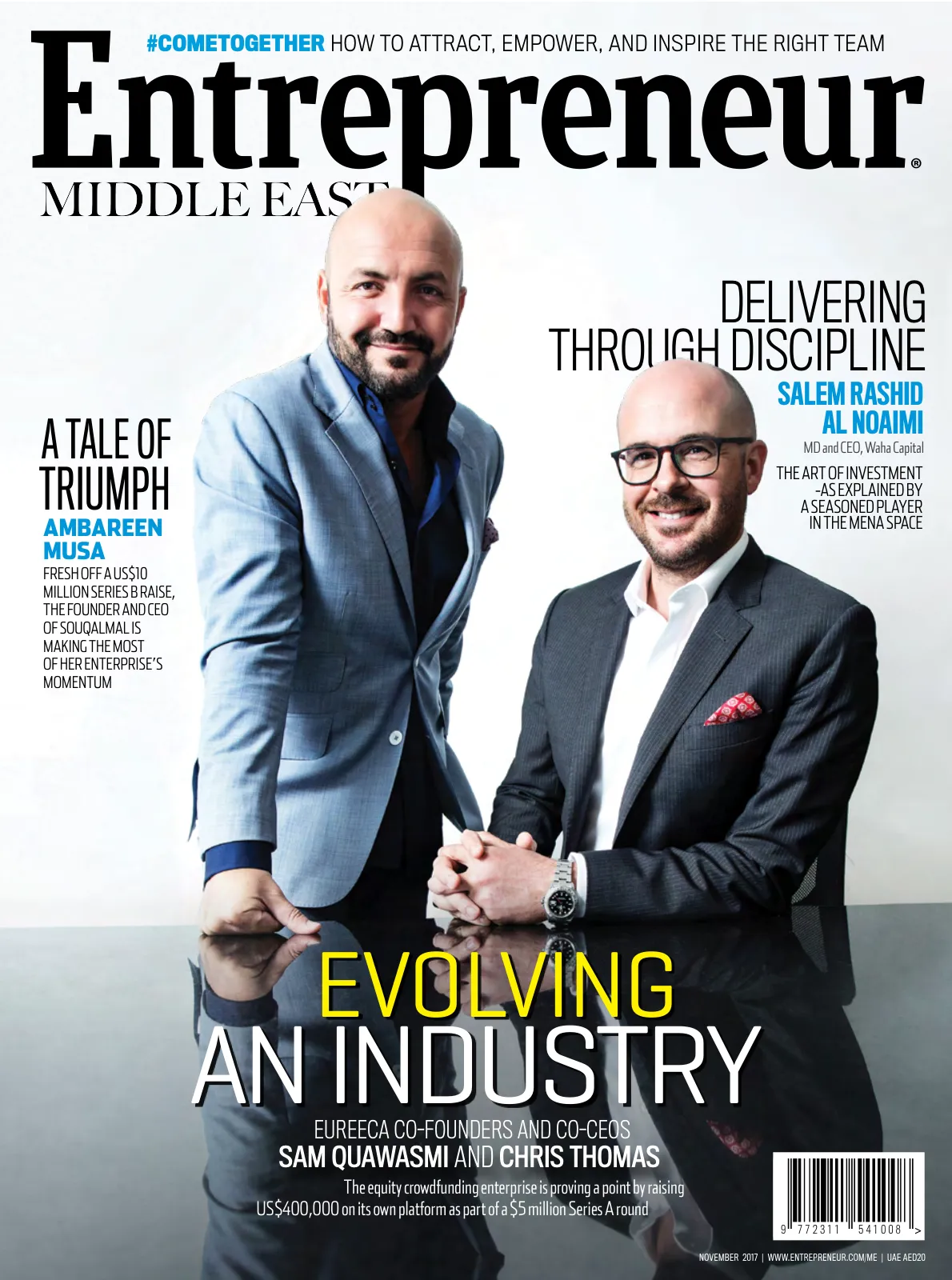
Entrepreneur Middle East, November 2017
Page 1
#ComeTogether How to attract, empower, and inspire the right team
november 2017 | www.entrepreneur.com/me | UAE AED20
9
7 7 2 3 1 1
5 4 1 0 0 8
>
A tale of
triumph
ambareen
musa
Fresh off a US$10
million Series B raise,
the founder and CEO
of Souqalmal is
making the most
of her enterprise’s
momentum
Evolving
an industry
Eureeca co-founders and co-CEOs
Sam Quawasmi and Chris Thomas
The equity crowdfunding enterprise is proving a point by raising
US$400,000 on its own platform as part of a $5 million Series A round
Delivering
through discipline
Salem Rashid
Al Noaimi
The art of investment
-as explained by
a seasoned player
in the MENA space
MD and CEO, Waha Capital
Page 2
Higher definition.
Bentayga Black Specification.
With 22” black gloss alloy wheels and black exterior detailing, the world’s fastest and most luxurious SUV
is now even more striking. See more at BentleyMotors.com/HigherDefinition
The name ‘Bentley’ and the ‘B’ in wings device are registered trademarks. © 2017 Bentley Motors Limited. Model shown: Bentayga Black Specification.
Page 3
november 2017 Entrepreneur
3
CONTENTS
november 2017
56 Cadillac Middle East Managing Director Christian Soemmer on how
his 115-year-old brand is still making waves around the world
20
20
innovator:
Evolving an industry
Equity crowdfunding portal
Eureeca is proving a point
by raising US$400,000 on
its own platform as part
of a $5 million Series A
round.
26
INNOVATOR:
Delivering through
discipline
Salem Rashid Al Noaimi, MD
and CEO, Waha Capital
The art of investment- as
explained by a seasoned
player in the MENA space.
32
INNOVATOR:
On route to the
future
Dirk Ahlborn
The co-founder and CEO
of Hyperloop Transportation
Technologies is accelerating
innovation.
36
INNOVATOR:
A tale of triumph
Ambareen Musa
Fresh off a US$10 million
Series B raise, the founder
and CEO of Souqalmal is
making the most of her
enterprise’s momentum.
60
INNOVATOR:
The connoisseur
Basil Al Salem
The founder and CEO of
Gastronomica on building
(and scaling) a F&B brand
out of Kuwait.
70
START IT UP:
ECOSYSTEM
The (right) formula to
cultivate entrepreneurial
talent
Sheraa General Manager
Najla Al Midfa on the
lessons she learnt in the
road to building a startup
ecosystem in Sharjah.
Sam Quawasmi
and Chris Thomas,
co-founders and
co-CEOs , Eureeca
Page 4
Page 5
Page 6
Page 7
Page 8
Page 9
Page 10
Entrepreneur november 2017
10
CONTENTS
november 2017
Fresh off a US$10 million
Series B raise, Ambareen
Musa, founder and
CEO of Souqalmal, is
making the most of her
enterprise’s momentum
36
32 Hyperloop Transportation Technologies co-founder and CEO Dirk Ahlborn
is accelerating innovation
56
‘TREPONOMICS:
PRO
Leading the way
Cadillac Middle East MD
Christian Soemmer on
how his 115-year-old brand
continues to make its
presence felt around the
world.
68
MONEY:
ASK THE MONEY GUY
Seal the deal
Lumina founder and
Managing Partner George
Traub on five ways to
better your business’
chances at a successful
exit.
72
START IT UP:
WHO’S GOT VC
Restaurant management
SaaS startup Foodics
and insurtech startup
Democrance on their latest
early-stage funding wins.
52
CULTURE:
LIFE
This ain’t no joy ride
Iman Ben Chaibah,
founder, Sail Publishing,
and Editor in Chief, Sail
Magazine, shares 10 things
you should know before
uprooting your life to
become an entrepreneur.
80
START IT UP:
Q&A
Digitizing payments
Having made its impact
felt in Kuwait, Ajar Online
is now gearing up to take
its platform to the rest of
the GCC.
48
CULTURE:
TRAPPINGS
‘Trep gear
The executive selection
for the entrepreneur
on your list that has
everything. Okay, maybe
for a little self-reward as
well.
Page 11
Page 12
Entrepreneur november 2017
12
CONTENTS
november 2017
42
‘TREPONOMICS:
PRO
Talent knows talent
Talentera’s Muhammad
Younas offers seven ways
to make your employee
referral program work for
you.
66
MONEY:
VC Viewpoint
Show me the money!
Careem’s VP of Corporate
Development Zach
Finkelstein on the six
key factors that can help
attract investors for your
startup.
64
MONEY:
ASK THE MONEY GUY
Making it big
Hasan Haider, Partner,
500 Startups, offers
ten tips for first-time
entrepreneurs to better
their startup’s chances at
securing funds.
54
‘TREPONOMICS:
SKILLSET
#ComeTogether
Benjamin Ampen, Head of
Revenue at Twitter MENA,
on attracting, empowering,
and inspiring the right team.
50
‘TREPONOMICS:
ESQUIRE GUY
Write till you talk
The Esquire Guy on how
to find your authentic voice
on social media.
46
TECH:
SHINY
#TamTalksTech
Gadgets and doodads that
you might’ve missed out on,
sourced by a tech aficionado.
Yes, it’s okay to want them
all… and no, it’s not our
fault.
47
BlackBerry KEYone,
fully Android,
with access to over
a million apps on
Google Play
82 Noor Shawwa, MD, Endeaovor UAE
Salem Rashid Al
Noaimi, MD and CEO,
Waha Capital
26
Page 13
60 YEARS OF ADVENTURE
AND DISCOVERY
Page 14
Entrepreneur november 2017
14
SUBSCRIBE
Contact subscriptions@bncpublishing.net to receive
Entrepreneur Middle East every issue
EDITOR IN CHIEF Aby Sam Thomas editor@bncpublishing.net
CEO Wissam Younane wissam@bncpublishing.net
MANAGING DIRECTOR Walid Zok walid@bncpublishing.net
DIRECTOR Rabih Najm rabih@bncpublishing.net
CREATIVE LEAD Odette Kahwagi
MANAGING EDITOR Tamara Pupic
STARTUPS SECTION EDITOR Pamella de Leon
COLUMNIST Sindhu Hariharan
COLUMNIST Tamara Clarke
EVENTS LIAISON Mark Anthony Monzon
PO Box 502511 Dubai, United Arab Emirates
P +971 4 4200 506 | F +971 4 4200 196
For all commercial enquiries related to
Entrepreneur Middle East contact
sales@bncpublishing.net
All rights reserved © 2017.
Opinions expressed are solely those of the contributors.
Entrepreneur Middle East and all subsidiary
publications in the MENA region are officially licensed
exclusively to BNC Publishing in the MENA region by
Entrepreneur Media Inc.
No part of this magazine may be reproduced or
transmitted in any form or by any means without written
permission of the publisher.
Printed by International Printing Press
ippuae.com
Images used in Entrepreneur Middle East are credited when necessary. Attributed use of
copyrighted images with permission. All images not credited otherwise Shutterstock.
Najla Al Midfa
Benjamin Ampen
Iman Ben Chaibah
Fida Chaaban
James Clear
Zach Finkelstein
Hasan Haider
Ross McCammon
Christian Soemmer
George Traub
Muhammad Younas
CONTRIBUTING WRITERS
www.entrepreneur.com/me
Access fresh content daily on our website!
MIDDLE EAST
EntMagazineME
@EntMagazineME
Entrepreneur-me
EntrepreneurMiddleEast
EntMagazineME
EntMagazineME
EntMagazineME
MIDDLE EAST
In addition to our print edition, we’re bringing
you all sorts of industry news on our web
mediums. Joining us online means getting
relevant business and startup content in
real-time, so you’re hearing about the latest
developments as soon as we do. We’re looking
forward to interacting with our readers on all of
our social media and web platforms- like any
thriving business, we’re looking to give and take.
#TrepTalkME is already happening on all of our
digi platforms, and all good conversations go
both ways. See you on the web!
Page 15
HONORING INTERNATIONAL
ACHIEVEMENTS IN KNOWLEDGE
DUBAI WORLD TRADE CENTRE
NOVEMBER 21
Knowledgeaward.com
Winners will be announced at
the Knowledge Summit 2017
knowaward
KnowAward
Page 16
Entrepreneur november 2017
16
EDITOR’S NOTE
Aby Sam Thomas
Editor in Chief
@thisisaby
aby@bncpublishing.net
Stand down
Entrepreneurs, you are entitled to nothing
E
very now and then, I get
stopped by someone –
both literally and figura-
tively- who asks me, often
in a rather accusatory
manner, as to why I haven’t re-
sponded to an email that they sent
to me. This can sometimes happen
in real life, at an event or some
other sort of gathering, or even
on social media, where I’m jolted
sometimes by a PR professional
asking for feedback on a press re-
lease, or other times, an entrepre-
neur demanding why they haven’t
been featured in the publication
yet. Now, I understand the need
(and importance) of following up
on things- it’s often a critical step
in getting things done in the real
world. But let’s take a step back
here: is whatever you are chasing
up on really worth a follow-up?
For instance, here are a couple
of situations I come across in my
day-to-day life as an editor: does
that generic press release that you
shot out to all your media contacts
really need you to call up each one
afterward asking “if it is going to
be published?” Or, for that piece
you wrote, which is clearly not in
line with the publication’s style
and tone, do you really need to
ask the editor as to why it hasn’t
gone online yet? Surely, you know
that editor is busy and has a
limited number of resources- so,
what makes you so special that
everything else be dropped and you
be taken on as the first priority on
the to-do tasks list? And, oh, let’s
not forget the repeated requests
from the often young, budding
entrepreneurs (who are only just
starting out on their businesses)
asking/demanding to be featured
in (or worse, be on the cover of)
the magazine: really? Are you
really that confident about the
prospects of your company you’ve
only just began- after all, we’ve had
much “bigger” individuals with
stronger backgrounds and deeper
pockets announcing ventures that
have ended up floundering in the
market.
So, for all of you who wonder
why your press release hasn’t got
a response from an editor, or why
your pitch deck has been ignored
by an investor, or in general, why
your plea for help has gone ignored,
here’s what a well-meaning friend
(with a penchant for no-nonsense-
quips) once told me: “You’re not
entitled to anything. The world
owes you nothing.” For the record,
I know that my friend is not the
one who originally made this
statement, but regardless, in my
opinion, this is a paradigm that
should essentially be drilled into
everyone’s heads, but especially
so, for entrepreneurs. Listen up,
‘treps: you are never going to
gifted anything on a silver platter;
you’re going to have to work hard
for everything you want or dream
about. Don’t expect anyone to
drop everything they have on their
hands to help you out- trust me,
they have enough on their plates
already, and so, no, they are not
obliged to do you a favor, for any
reason whatsoever. So, when you
follow up, when you chase up on
something, consider who you are
approaching, and please, don’t be
arrogant about whatever it is you
are doing. You might have not got a
response because maybe the pitch
was too weak, or maybe what you
were offering was not up to stan-
dard, or yes, maybe it was simply
not interesting enough to warrant a
reply. What you need to do is figure
out what was wrong, how you can
make your offering better, and,
quite simply, keep at it- you’ve got
to hustle, and earn everything you
want. You are entitled to nothing.
Page 17
DISCOVER HOW TO ACCELERATE YOUR BUSINESS
Powered by Thomson Reuters, Accelerate SME is the gateway to the
SME ecosystem in MENA; providing access to the resources and solutions
needed to support you at any business stage.
We have joined forces with some of the region’s most powerful financial
and workflow solution providers to service and support your specific needs.
As a member of Accelerate SME you can access a wide range of business
resources including, funding, online community, industry insights, tools
and easy-to-use templates.
ACCELERATE SME
CONTRIBUTE. ENGAGE. GROW.
FIND OUT MORE AT ACCELERATESME.COM
Page 18
Entrepreneur november 2017
18
A
rab Angel Fund has
announced raising
US$15 million for
its flagship Arab
Angel Fund I (AAF
I) thereby closing its
target of $25 million,
and also being oversubscribed
in the process. According to a
statement, the investment was
raised from 65 private family
offices and high net worth
individuals (HNWI) belonging
to the GCC and larger MENA
regions. As a mandate, AAF in-
vests in venture-backed early-
stage technology startups in
North America, and supports
the entry and growth of these
ventures in MENA and GCC, as
part of their expansion plans.
Speaking about the specific
avenues that AAF I is likely to
look at going forward, General
Partner and MD Omar Darwa-
zah says that while the Fund is
“sector agnostic and stage-
focused,” four key themes that
have emerged in the last 12
months are connected health-
care, Software-as-a-Service
(SaaS), fintech, and Direct-
to-Consumer sectors. “On the
short-to medium-term, I ex-
pect the Fund to deploy more
capital along these investment
themes. The team and I are
encountering impressive early-
stage companies in blockchain,
applied artificial intelli-
gence, robotics, healthcare
and e-commerce,” he says.
“We will continue to invest
in companies which we feel
have disruptive capabilities
to their respective industries
and especially those which
have commercial relevance
in the MENA/GCC regions.”
Having said that, he says the
AAF team will continue to be
on the look out for emerging
technologies, and deploy funds
in those that have massive
growth potential.
With the firm’s partners and
advisors comprising of former
diplomats, international busi-
ness executives, fund manag-
ers, and others from Egypt,
Jordan, Lebanon, Morocco,
Saudi Arabia, Kuwait, Turkey
and the UAE, AAF is able to
provide expertise
and experience
in a variety of
sectors, and thus
helps its portfolio
companies enter
emerging markets
in the MENA region
through joint ven-
tures, IP licensing,
and other modes.
“The Fund is bridg-
ing Middle Eastern
capital to the US
venture ecosys-
tem and imports
the commercially
viable and applicable tech-
nologies back to the region,”
Darwazah explains. “While
the Fund does not invest in
regional startups, the team
and I believe that bringing the
most cutting-edge and innova-
tive technologies from Silicon
Valley and North America in
general will add significant
value to the MENA/GCC tech
ecosystem as well as the
broader population,” he adds.
In a statement on the fund-
raising, AAF General Partner
and MD Kyle Hendrick added,
“We are excited to report that
our flagship fund was oversub-
scribed after receiving strong
interest from individuals,
family offices and HNWIs from
across the region. The over-
subscription is a testament to
the growing demand from the
region for early-stage venture
investing in North America as
well as an interest to diversify
in to an asset class which in-
vests in cutting edge technolo-
gies.” Since its first close in
September 2016, AAF I has
already invested in close to 50
startups along with US-based
VC firms and accelerators in-
cluding New Enterprise Asso-
ciates, Andreessen Horowitz,
Y Combinator, GE Ventures,
and Microsoft Ventures,
among others. Darwazah says
AAF helps these enterprises
“localize their product and
services,” and assists them
in navigating the nuances
associated with the regional
markets by connecting them
with prominent HNWIs and
family offices in the region.
With regard to the current
fundraising round, Darwazah
notes from his experience that
family offices and HNWI’s in
the region are keen to diversify
their investments in a higher
risk-return product. “I believe
the risk appetite for MENA /
GCC investors has increased
dramatically over the past sev-
eral years as a result of lower
and more volatile commod-
ity prices. Today, it is more
important than ever for these
family offices and HNWI’s to
continue to diversify away
from conventional asset
classes such as equities, bonds
and real estate and allocate a
small portion of their liquidity
in the early-stage venture as-
set class,” Darwazah observes.
www.arabangel.vc
IN THE LOOP
Arab Angel Fund closes US$25 million fund to
help American startups enter MENA
images courtesy arab angel fund
Strategic support
Hala Fadel
“On the short-to
medium-term, I expect
the Fund to deploy
more capital along
these investment
themes. The team and
I are encountering
impressive early-
stage companies in
blockchain, applied
artificial intelligence,
robotics, healthcare
and e-commerce.”
Omar Darwazah,
General Partner
and MD,
Arab Angel Fund
Kyle Hendrick,
General Partner
and MD,
Arab Angel Fund
Page 19
DOWNLOAD THE SHERAA APP AND JOIN OUR COMMUNITY
Page 20
Entrepreneur november 2017
20
innovator
image courtesy eureeca
“getting into as many
markets as we can, getting
our flag in the sand, and
getting the licenses there
is to be winning this race
globally, and we know how
to do it. We are already
fast at it.”
Eureeca co-founders and co-CEOs Sam Quawasmi
and Chris Thomas
Page 21
november 2017 Entrepreneur
21
The equity crowdfunding enterprise is proving a point
by raising US$400,000 on its own platform as part of a $5 million
Series A round By Tamara Pupic
Evolving
an industry
W
hen reviewing a pitch deck, investors
look for signs of the growth potential
and longevity of a business. Hardly
can entrepreneurs present a bet-
ter proof of this (or show that their
product has a stable marketplace full of current
and prospective clients) than having 87 of them
invest US$400,000 in the business in just six
hours. Eureeca, a Dubai-based equity crowdfund-
ing enterprise, has achieved this twice, raising
the same amount from their own platform. The
first self-funding campaign was completed after
12 days of being online in 2016. The latest one
was initiated as part of the Eureeca team’s efforts
to raise $5 million in a Series A funding round
from institutional investors across the globe,
and reached its target over the course of just one
afternoon. “When we embarked on this self-
funding campaign, it was actually quite refreshing
to see that there was more demand than we had
anticipated,” says Sam Quawasmi, co-founder
and co-CEO of Eureeca. “Those were an interest-
ing six hours in the office for all of us, to witness
how many investments came through. Never had
we anticipated that it would take us just six hours
to reach the funding target- we thought it would
probably be 12 days, like last time.” >>>
Page 22
Entrepreneur november 2017
22
Sam Quawasmi and Chris
Thomas, seasoned entrepre-
neurs and former invest-
ment bankers, launched
Eureeca in Dubai in 2013 as
an accessible digital platform
connecting growth-oriented
private businesses with
investors -ranging from
angel investors to strategic
institutional investors- glob-
ally. With the model being a
disruption of the way people
invest and businesses raise
capital, the co-founders soon
found themselves in a legal
grey area, having to assist
regulators around the world
to catch up with the chang-
ing market conditions. The
direct result of these efforts
is that Eureeca is today the
first equity crowdfunding
platform that is multi-reg-
ulated. It first got regulated
by the UK Financial Conduct
Authority in 2015, which
was followed by a license
from the Securities Commis-
sion Malaysia the same year.
Then in 2016, Eureeca got
the license from the Dubai
Financial Services Authority,
and that was soon followed
with one from the Neth-
erlands Authority for the
Financial Markets.
Being actively involved in
fostering robust fintech eco-
systems in several countries,
Quawasmi notes, helped
them gain trust of potential
investors worldwide. The
platform currently lists close
to 15,000 investors from 42
different countries. In ad-
dition of not being charged
commissions, Chris Thomas,
co-founder and co-CEO of
Eureeca, explains that their
main benefit is enjoying a
steady deal flow of vetted
equity investment oppor-
tunities in which they can
invest by simply crediting
their account via credit card
or bank transfer from their
phone. “It is about access,”
Thomas says. “Whether you
are a large or small inves-
tor, you simply do not have
access to a decent enough
deal flow globally. With
Eureeca, it is easy to go on
the platform, and see the
deals from around the world
that suit you. But, further
than that, investors can be
assured that, when a deal is
going through the Eureeca
platform, we have done the
compliance checks, we have
done the background checks,
and so on, which is impor-
tant because it ensures that
the investor is protected
throughout the journey. If
you are investing offline, you
don’t know whether you are
getting the best deal or might
not know how to navigate
the term sheet, but what Eu-
reeca does is make the pro-
cess a lot more compliant, a
lot more secure, and frankly,
it is much easier. But, larger
investors have the right to
negotiate additional rights.
It is totally fair and proper,
and entrepreneurs under-
stand it, that for example, if
I’m investing $100,000 or
$1 million, I should be able
to do that. The platform
itself allows larger investors
to have offline discussions
in order to determine a deal
that suits them best.”
On the other side of the
spectrum, out of approxi-
mately 2,800 applicants,
only 50 businesses -repre-
senting only 2%- have got
passed by Eureeca’s due
diligence process and have
got listed on the platform.
If not able to reach their
funding target within 90
days, the entrepreneurs are
refunded the application
fee costs which, Quawasmi
explains, are much lower
than the industry average.
“There is an application fee,
or a listing fee if you like,
which is $1,500,” he reveals.
“It is nowhere near to what
you would pay for on the
exchange. If you are to get
listed on the SME market on
Nasdaq Dubai as a growth
company, you are look-
ing at somewhere between
$30,000 to $50,000. We
charge just a small portion of
that.” Similarly, the inves-
tors participating in a failed
funding round are reim-
bursed.
To date, 20 businesses
have successfully closed
their funding round on the
platform, for which Eu-
reeca charges a success fee
of 7.25% of the funding
amount. “Our success of
40% is about the double of
what the industry average is
globally, which is between
12% and 18% of deals get-
ting funded,” says Thomas.
“The businesses who didn’t
get funded either lifted up
their valuation too high or
didn’t manage to mobilize
their network. A very impor-
tant part of equity crowd-
funding is the ability of the
entrepreneur to shout out
loudly to their customers,
their followers, the people
who know and love their
product and have an emo-
tional connection to it. Our
job is to help them convert
that emotional connection
into a financial investment.
The larger your network is,
the readier you are as an
entrepreneur to be proud of
“A very important part
of equity crowdfunding
is the ability of the
entrepreneur to shout
out loudly to their
customers, their
followers, the people
who know and love their
product and have an
emotional connection
to it. Our job is to help
them convert that
emotional connection
into a financial
investment.”
innovator
Sam Quawasmi,
co-founder and co-CEO, Eureeca
Page 23
november 2017 Entrepreneur
23
the fact that you are raising
money, and to mobilize it to
really shout loudly, the more
likely you are to raise that
cash.”
In addition, Thomas warns
entrepreneurs not to be idle.
“When people think of the
crowd, they think of little
guys who are investing $10
or $100, the novice inves-
tors, but actually the crowd
can be 10 people putting
$100,000 each,” he says.
“So, platforms like Eureeca
give the entrepreneur ac-
cess to that type of market.
They are still going to do
the same job offline, they
will be knocking on doors,
speaking to investors, going
to pitch events, but doing
it online as well makes the
process much more efficient,
transparent and easier. It
is best described by one
of our entrepreneurs who
got funded, who said that
fundraising was a full-time
job, but Eureeca made it a
part-time job. This is an im-
portant point- entrepreneurs
should not think of this as
an alternative way of raising
money, as they will still have
the same conversations, but
they will be doing it via an
online system.”
And the Eureeca team takes
pride in a number of their
success stories. Homes or
Houses, a UK-based real es-
tate business, set the record
for the largest equity crowd-
funding raise on Eureeca,
raising $611,000 in less than
30 days. This included a
$200,000 investment from
a UAE-based institutional
investment firm. Similarly,
Roula, previously Poupee
Couture, a Dubai-based
fashion brand, secured 165%
of its funding target, but also
generated great PR cover-
age and attracted a strategic
investor who helped with
market expansion. However,
it was Search in MENA, a
Dubai-based B2B online
marketplace, that made
headlines when it became
the first business on the
Eureeca platform to provide
their crowd investors with an
exit- only a year after clos-
ing a $140,000 investment
round on Eureeca in 2014,
the participating sharehold-
ers exited with 150% profits
on their investment through
a share buyback. “We are
proud of the fact that we are
about to have our second
exit,” states Thomas, not
being able to reveal more
details about this deal at the
time of the interview. “The
first exit we did provided
about 150% ROI. If you
invested $10,000, you were
offered $25,000, and it was
up to you to decide whether
to accept it or reinvest it
on the platform. That was a
very strong and quick return
for those investors, in just
13 months. I would say that
that was an unusual return,
and investors cannot expect
to get that return from every
business they invest in.”
The 17-strong Eureeca
team is now focusing their
marketing and communica-
tions efforts on Thailand,
Indonesia, Bahrain, and
Saudi Arabia, as Quawasmi
explains geographical expan-
sion tops their agenda at
the moment. In addition,
following phase one of its
“The larger your
network is, the
readier you are as
an entrepreneur to
be proud of the fact
that you are raising
money, and to
mobilize it to really
shout loudly, the
more likely you are
to raise that cash.”
Chris Thomas,
co-founder and
co-CEO, Eureeca
www.eureeca.com
>>>
Page 24
Entrepreneur november 2017
24
development which included
raising funds ranging from
$50,000 to $250,000,
Eureeca has entered phase
two, raising from $250,000
to $1 million, while phase
three will start in 2018
enabling them to raise funds
of up to $5 million on the
platform. “It is clear that it
is a success when you see a
Dutch investor investing in a
Dubai-based business, and a
Malaysian investor investing
in a Dutch business, which
we have seen this year; that’s
when you know that what
you’re doing is right,” says
Quawasmi. “These cross-
continent and cross-border
transactions really are a
validation of what we are
trying to do. Our strategy is
that we are not focused on
revenue right now but on
geographical expansion. We
are pre-known in some mar-
kets since our strategy is a
light touch strategy, meaning
to get our flag in the sand,
to have the ecosystem know
and understand that we exist
there, but not to be fully en-
trenched yet. Therefore, our
Series A is very important
because we will move from
that light touch strategy to
being fully entrenched in
some markets. You cannot
market or do any kind of
advertising for the platform
if you are not regulated,
so getting the regulatory
approval in those markets
will catalyze the business
and make it a truly global
business. For us, getting into
as many markets as we can,
getting our flag in the sand,
and getting the licenses there
is to be winning this race
globally, and we know how
to do it. We are already fast
at it.”
Globally, the equity crowd-
funding industry is expected
to be worth more than $93
billion by 2025, according to
the World Bank. Despite reg-
ulation currently being the
most important factor deter-
mining the spread of equity
crowdfunding, Quawasmi is
confident that we are about
to witness a dynamic era
for this industry. “The term
crowdfunding is somewhat
misleading, but what we ac-
tually do on the platform are
mini IPOs,” he concludes. “If
we are following any route to
market in terms of the busi-
ness model, we are follow-
ing the investment banking
business model. So, in the
future, once we cross the $1
million to $5 million raises,
and have 500,000 subscrib-
ers on the platform from all
of these different markets, I
wouldn’t be surprised that
we would be conducting
IPOs on the platform subject
to regulatory approvals, of
course. And why? Because
we brought it to your phone.
Why would flydubai do it
through an investment bank,
where investors need to
queue at Emirates NBD to
fill out forms, or correspond
via fax? We digitized the
whole process. Yes, we are
small right now, but as the
industry evolves, we will fol-
low the investment banking
business model, and frankly,
it will disrupt the industry,
slowly. I’m not saying that
investment banking will not
exist, but the smaller ones
will start feeling that the
world is moving into the
digital space, and that equity
crowdfunding platforms
and peer-to-peer platforms
have started to eat into that
lunch.”
“Never had we
anticipated that it
would take us just
six hours to reach
the funding target-
we thought it would
probably be 12 days,
like last time.”
innovator
Sam Quawasmi
and Chris Thomas,
co-founders and
co-CEOs, Eureeca
Page 25
Page 26
innovator
Chief Executive Officer and Managing Director, Waha Capital
Salem Rashid Al Noaimi
I
n early 2008, Waha Capital was hardly a
place for beginners. The ambitions of H.E.
Hussain Al Nowais, who founded the com-
pany in 1997 as Oasis International Invest-
ments to operate primarily in the aircraft
leasing sector, were about to leave no space
for hesitation. Slightly more than a dec-
ade after the company’s inception, H.E. Al
Nowais announced its bold reinvention- rebranded
as Waha Capital, it was to pursue economic diversi-
fication and exploration of new sources of income.
A gala dinner at the Emirates Palace Hotel in Abu
Dhabi, accompanied by a laser show to unveil the
company’s new corporate identity and vision, was as
sumptuous as the task at hand was daunting. Yet, he
was sanguine about the team’s ability to effectively
surmount every challenge along the way. Today, Sa-
lem Rashid Al Noaimi, Waha Capital’s Chief Execu-
tive Officer and Managing Director, seems peaceful
and content with what the company has achieved.
Not short of relevant experience from the outset, he
has built up a reputation for being an astute investor
over nearly a decade at the helm of the company.
“I’m very proud of what we have achieved over
the last 10+ years in this business, I think we have
exceeded expectations,” he says. “Remember that 10
years ago, we were in the aircraft leasing business,
and today, we are a diversified investment company,
touching multiple sectors, multiple geographies, and
multiple asset classes. We have a proven ability to
deploy capital, to invest in the right space, and make
returns in tough markets.”
The art of investment- as explained by a seasoned player
in the MENA space By Tamara Pupic
Delivering
through
discipline
Entrepreneur november 2017
26
>>>
Page 27
imageS courtesy waha capital
november 2017 Entrepreneur
27
“today, we are a
diversified investment
company, touching
multiple sectors,
multiple geographies,
and multiple asset
classes. We have
a proven ability to
deploy capital, to invest
in the right space, and
make returns in tough
markets.”
Salem Rashid Al Noaimi,
Chief Executive Officer
and Managing Director,
Waha Capital
Page 28
Entrepreneur november 2017
28
Before taking Waha Capital’s
reins in 2009, Al Noaimi was
closely familiar to the ins
and outs of the company- the
US-educated Emirati joined
the company in 2004 and rose
through the ranks to hold a
series of leadership positions,
namely Deputy CEO (2006)
and Acting CEO (2007) of
Waha Leasing, followed by CEO
of Waha Leasing and Deputy
CEO of Waha Capital (2008).
Yet, the company’s success has
been fueled by more than just
Al Noaimi’s shrewd instincts.
“If you look at the overall per-
formance of Waha Capital, our
average ROE over the last three
years has been close to 15%,
which is hard to find for an
investment company in these
market conditions,” he says.
“The real reason why that hap-
pened is because we do things
very cautiously, and because of
that, when the market turned
south, we didn’t have to change
too many things, because we
were always very disciplined.
Just because we have a lot of
funds available to deploy for a
specific strategy, doesn’t mean
that we are going to rush into
deploying it. For example, we
have been talking about private
debt for over 12 months, and
we have yet to deploy one
dollar into a business. Some
people look at that and ask
whether that is a failure of the
private debt unit of Waha Capi-
tal, and I say no, on the con-
trary, it means that we observe
discipline. We could have easily
deployed capital into different
opportunities, but we chose
not to, because we wanted to
maintain our focus on the long-
term, making sure that we have
the cash allocated for a specific
strategy, and because there is
a little bit of pressure from the
market about it, our core focus
still remains on doing the right
deal.”
We are only about 15
minutes into our meeting at
the company’s headquarters
in Abu Dhabi’s prestigious
Etihad Towers office block, but
the conversation has already
brought us rather neatly to two
(for me) crucial questions: how
has Waha Capital weathered
the storm potentially arising
from the currently challeng-
ing market conditions, and
when will the company widen
its focus to encompass early-
stage business ventures. Aside
from these being potentially
sensitive topics, to Al Noaimi
however, hindsight seems to
bring satisfaction- neither do
any of my latter questions get
evaded or left unanswered,
nor does any minute of the
hour and a half exclusively
committed to Entrepreneur
Middle East pass in tension.
Al Noaimi’s flawless manners
aside, one can glean further
insights into the company from
its latest financial report. Waha
Capital deploys capital through
its principal investments unit
and, more recently established,
asset management unit. The
total income from the for-
mer, which includes portfolio
companies AerCap Holdings,
Dunia Group, Waha Land,
Stanford Marine Group, MENA
Infrastructure Fund, National
Petroleum Services (NPS), and
Channel VAS, decreased 21%
in 2016. However, its strong
investment record over the
years has laid the foundations
for the company’s new asset
management unit to start
growing- in 2016, total income
generated by one of its three
pillars, the Capital Markets
division, which included Waha
CEMEEA Fixed Income Fund,
Waha MENA Equity Fund, and
Waha MENA Value Fund, in-
creased 76%. The other two of
its subdivisions -Waha Private
Equity and Waha Private Debt-
are expected to bear fruit in the
future.
Al Noaimi explains that the
company’s principal invest-
ments portfolio is still the core
of the business (“It is the bulk
of the balance sheet; it is what
pays the bills at the end of the
day.”), but it is getting smaller
only “because other areas are
growing.” He adds, “We have
planted the seeds of our asset
management platform, which is
now visible to the market, but
even in that space, if you com-
pare it to the index, we have
outperformed the index by
far; we have outperformed our
peers by far. If we look at our
two funds, both of which have
an absolute return strategy,
year-to-date (YTD) returns are
about 15%, and the S&P GCC
index is around 1%, so we have
outperformed dramatically.
For the fixed income strategy,
it’s the same thing. The index
is about 6%, and our returns
are north of 12% YTD. When
you do things right and in
a structured way, there are
ways of making money even in
these difficult conditions.” The
results serve as a testament to
the investment principles he
has closely guarded for years.
“The core part of how we do
things is one step at a time,
and in the right order. It is a
really simple recipe,” Al Noaimi
elaborates. “So, you don’t get
carried away with what’s hap-
pening in the market, when
things are too overhyped or too
underhyped. We are conserva-
tive in our approach, generally
innovator
“we are a publicly listed
business, we have over
22,000 shareholders, and
thus we are very careful
with what we do. So,
having a long-term view
and having an extremely
capable risk management
team who are really
close to the investment
team has proved to be
our recipe for success.”
innovator
Salem Rashid Al Noaimi
joined Waha Capital,
previously known as
Oasis International
Investments, in 2004
H.E. Hussain Al Nowais
speaking at the launch
of Waha Capital’s new
brand and business
strategy at the
Emirates Palace Hotel
in Abu Dhabi in 2008
Page 29
november 2017 Entrepreneur
29
because we are a publicly listed
business, and we cannot just be
swinging from right to left too
quickly. Our eyes are always
on the ball for the long-term.
Our tolerance for risk is much
lower than your average inves-
tor. Yet, our returns are higher
than your average investor. The
reason I think is that we look at
risk in a very disciplined way.
Discipline is key.”
“Also, to put things into
perspective, out of the AED1.8
billion allocated in our capital
markets funds, approximately
AED300-400 million is from
external parties, and the rest
is our own balance sheet,” Al
Noaimi adds. “So, we are still
the biggest investor in our
products. This, I think, is a key
differentiator for Waha Capital,
because most asset manag-
ers out there are seeding their
investment strategies with a
very small amount and they
are fundraising a lot of money.
A lot of them have done very
well, I don’t want to talk badly
about them, but I like the fact
that our team is managing our
money before they are manag-
ing somebody else’s money.
Somebody with a brand name
that Waha has established
over the last decade can easily
create a new strategy and invite
others to invest with us, but
that is not how we do things.
We put our own money first,
we tinker with it, we fine tune
it, we increase the things that
are working well, and we take
away the things that are not
working well, and that is when
we reach a point when we want
to raise third-party funds. Why
we want to raise third-party
funds is also important, and for
two reasons. Firstly, if we look
at our five-year strategy, as a
publicly listed business, we are
increasing our diversification
by adding fee income, which
we will generate from our
asset management platform.
So, there is a diversification
within the resources of income
for Waha Capital. Secondly,
within each strategy we also
want to have more volume so
that our team has more capital
to deploy. It is not only about
generating fees this year, next
year, or the year after, but I
want to do that over a five or
ten-year period.”
In 2014, the company re-
corded its strongest results to
date- a net profit of AED1,733
million, representing a stagger-
ing 466% increase on the pre-
vious year, and a 51% return
on equity. In the ensuing years,
however, Al Noaimi’s invest-
ment philosophy was put to
test. In 2015, Waha Capital re-
ported a preliminary net profit
of AED588 million, recording
a 18% increase year-on-year,
however, its 2016 full year net
profit was 30.7% lower than in
2015. Not denying the impacts
of the economic slowdown over
the past three years, Al Noaimi
points out to a silver lining. “I
think the fact that it has been
challenging has revealed spaces
that are much more interesting
and exciting in the long run,”
he says. “You could argue that
you don’t want an overheated
market, you’d rather have a
more balanced market. This
is an opportunity for players
like us to continue to grow.
For example, we entered NPS
Holdings Limited when it was
a challenging time to enter
the oil and gas space, but the
performance of NPS has proven
that we did the right thing
at the right time. The busi-
ness has continued to grow.
Margins have been compressed
slightly, but the business
has been growing consist-
ently year-on-year, which is
what we look for in that type
of investment. Again, we are
long-term players, we are not
trying to time the market, make
short-term gains, a quick buck,
and then exit. We are looking
for platforms that can show
sustainable growth and profit-
ability, and when you have that
approach to life, you are less
scared by what is happening.”
A quick research reveals that
Al Noaimi has always been able
to see and seize opportunities
when other investors wanted
to get out. When the 2008
economic slowdown caused
innovator
WWW.WAHACAPITAL.AE
>>>
Waha Capital
website
In December 2015, Waha
Capital launched a new
division focused on private
equity-style investments with
a mandate to deploy capital
into high return investment
opportunities across the
Middle East and North Africa.
“the success over
the five-year period
would be a continued
diversification of
asset classes into
other sectors and
geographies, maybe a
proper VC platform,
maybe even an
accelerator or a seed
investor unit.”
Offering shareholders and third-party investors
exposure to high potential opportunities
Page 30
Entrepreneur november 2017
30
many aviation companies to
defer business until the market
conditions stabilize, Al Noaimi,
as the CEO of Waha Leasing
at the time, purchased two
aircrafts to forge a long-term
partnership with Aeroflot, the
company’s first Russian client.
It is one more example to prove
why the investment communi-
ty’s current inclination towards
short-termism is a foreign con-
cept to him. “There are people
who are specialized at timing
the market and can do it really
well, but those generally get
burnt once in a while,” he says.
“From our point of view, we are
a publicly listed business, we
have over 22,000 shareholders,
and thus we are very careful
with what we do. So, having a
long-term view and having an
extremely capable risk man-
agement team who are really
close to the investment team
has proved to be our recipe for
success.”
Furthermore, the sharp divid-
ing line preventing this large
investment fund, known for a
historically narrow focus on
more mature businesses, from
dabbling into the early-stage
investments space is slowly
becoming more permeable. Re-
cently, Waha Capital diversified
its principal investment port-
folio by acquiring a significant
minority stake in Channel VAS,
a Dubai-based fintech company
operating in over 25 emerging
markets and providing micro-
finance lending solutions
to over 500 million mobile
network subscribers. “In terms
of life stage, we are broadening
our tolerance for less mature
businesses, and with Channel
VAS, we have proven that we
are now more able to have a
wider range of businesses, but
we are not yet ready to invest
in earlier stage businesses, for
now,” Al Noaimi says. “In 2-3
years, I’m sure things will be
different. Right now, we are not
there. The way we look at it is
that there are different asset
classes at different stages of
businesses, and within each
stage, there is always an added
diversification angle that we
can get from increasing our po-
sition in a certain asset class, a
certain sector, a certain geogra-
phy. After a while, it becomes a
little bit saturated. Then, if you
want to diversify further, and
if you want to change your risk
profile, it becomes necessary
to make yourself less exposed.
And instead of putting the
same dollar in the same asset
class or the same life stage,
it makes sense to move to
another bucket. At that stage,
we would start looking at that
[investing in early stage busi-
nesses].”
In December 2015, Waha
Capital launched a new
division focused on private
equity-style investments with a
mandate to deploy capital into
high return investment oppor-
tunities across the Middle East
and North Africa. When asked
for the company’s main criteria
for this type of investments, he
replies, “When we start a new
strategy, we generally prefer for
the asset to be up and running
and able to generate income
immediately. But, the company
must be a well-run business.
It is easy to say that, and a lot
of people talk about that, but
there are so many promising
companies out there that are
doing well, but they are doing
well because the markets are
lifting them. Yet, we look for
businesses that are doing well
and will do well [even] if the
markets are not lifting them
because they have a really
capable management team who
will be able to transform the
business. [When analyzing a
business], we take a typical
approach that anyone would
follow, but for me, emphasis
on risk is important. When
you look at entrepreneurial
businesses out there which
seem to have done very well, in
reality, their approach is that
they are too ready to cut some
corners. That’s key. We look for
businesses that have proven
that they don’t cut corners
and do things in a methodi-
cal, organized and structured
way. You are not going to find
a perfect business out there,
but you want to have a team
that is willing to transform the
business. If it is an earlier stage
business, the manager is the
owner, so it makes it even more
important that you have the
right partner with you. Also,
chemistry, making sure that
they recognize the value that
you bring and that you recog-
nize the value that they bring.
History has taught us that in
good times you can find a lot of
good partners, but when things
turn, you might end up having
innovator
“we entered NPS
Holdings Limited
when it was a
challenging time
to enter the oil and
gas space, but the
performance of NPS
has proven that we
did the right thing
at the right time.
The business has
continued to grow.”
H.E. Hussain Al Nowais
founded the company in
1997 as Oasis International
Investments to operate
primarily in the aircraft
leasing sector
Waha Capital’s team pictured with Bassim Haidar, founder of Channel VAS, during the announcement of Waha Capital’s investment
in the fintech company. leasing sector
Page 31
less straightforward partners
than you would want. That is
why we are very careful with
what we do.”
An in-depth analysis preced-
ed the Waha Private Equity’s
investment in Anglo Arabian
Healthcare (AAH), a UAE-
based integrated healthcare
management provider, which
reported a total revenue in-
crease by 18% in 2016. Poised
for strong future growth,
it now owns 30 healthcare
assets in the UAE, employ-
ing 900 people, and serving
over 540,000 outpatients.
Another area of the Waha
Private Equity’s interest is the
education sector; however,
no investment has been made
to date. “We’ve been talking
about investing in the educa-
tion sector since 2012/2013,”
Al Noaimi explains. “Yet, we
have not done much in that
space although we have done
a lot of analysis, looked at
many different opportunities,
but there was nothing that
ticked all our requirements.
We found a beautiful asset,
which had a good mix of exist-
ing and brownfield projects,
yet the valuation was way off.
Strategically, we want to do
something in education, but we
are not going to do it unless we
find something that checks all
our boxes. Our boxes are quite
strict, and we don’t change
them just because more people
are doing stuff in education.
From 2013 to 2015, there was
so much buzz around education
which, I believe, overheated
the market very quickly, and
therefore we couldn’t find the
right entry point. That shows
our discipline.”
The much talked about Waha
Private Debt unit was launched
in 2016 to provide bespoke
financing and direct lending so-
lutions to mid-market compa-
nies in the Middle East, Africa
and Turkey. For Al Noaimi, it is
due to the company’s evolution
from investing in the public
equity space, private equity
space, public debt space, and
now private debt space. “Es-
sentially, we said that there
were companies out there
which looked very interesting
to invest in, yet they didn’t fit
within the public equity space
as they were smaller, private
companies, and from a risk tol-
erance point of view, we were
not yet ready to invest equity
into them because we wanted
a little bit more security,” he
adds. “We saw that as an op-
portunity and we are now com-
mitted to this space, but we
will only deploy our own capi-
tal for the time being, and once
we have a few deals under our
belt, we will probably look to
get third-party investors along-
side us. I would say that over
the past 12 to 18 months we
have developed our approach
to this space. That research
happens in the background and
people don’t value it enough,
unfortunately. When some-
body comments why we still
haven’t deployed capital into
the private debt space, I think
it’s a short-sighted approach.
We have looked at many deals
within the private debt space
and in the end, the risk profile
might have been too much,
the return profile just wasn’t
enough, or something turned
us off in some way. There are
several deals that we are look-
ing at right now, and we will
continue to do that. However,
in 12 months’ time, even if we
still haven’t done any transac-
tions, yet we’ve evolved, I’ll be
happy with that.”
To gaze out onto the stunning
Abu Dhabi Corniche and the
Arabian Sea from Al Noami’s
office at 42nd floor of Etihad
Towers is to be conscious of a
thin line between the things
once only imagined and now
accomplished. On the day of
our interview, this is felt even
more as a fleet of gold fighter
jets whizzed in front of the
window (as part of the city-
wide celebrations of another
Abu Dhabi-based corporate
giant), just as the time allotted
for our interview has started to
run out. Rarely could I recount
a similar experience during
an interview, but it serves as
a symbol of a potential for
achievement of Waha Capital.
“I’m also very excited about the
next five to 10 years,” Al Noami
adds. “I think that during that
period we will really prove the
capabilities that we have here.
What I would like is more asset
classes, more successful strate-
gies, more geographies, and in
five years’ time, I would say
that third-party asset under
management would need to
be substantial. So, the success
over the five-year period would
be a continued diversification
of asset classes into other sec-
tors and geographies, maybe
a proper VC platform, maybe
even an accelerator or a seed
investor unit.” If whatever
he has achieved so far is any
indication, Al Noaimi shouldn’t
have an issue delivering on this
premise- and the UAE’s entre-
preneurial ecosystem will only
be the better for it.
Ecosystem
outlook
Waha Capital CEO Salem
Rashid Al Noaimi’s take on
the UAE’s startup scene
“The startup scene is very
exciting in the UAE right
now, and I think it’s going
to get even more exciting,
because the regulators are
looking at it: ‘How do we
help these guys and how do
we help small companies
grow?’ I think that the
government has noticed
that the regulations were
historically put in place for
bigger companies, but if you
want to encourage startups,
it becomes too burdensome,
and the government is
looking at adjusting that.
You can also see that the
approach of different entities
is focused on how to enable
these businesses to grow and
nurture them, rather than put
too much burden on them.”
“we look for
businesses that are
doing well and will
do well [even] if
the markets are not
lifting them because
they have a really
capable management
team who will be
able to transform
the business.”
The much talked about
Waha Private Debt unit was
launched in 2016 to provide
bespoke financing and
direct lending solutions to
mid-market companies in
the Middle East, Africa and
Turkey.
Page 32
Entrepreneur november 2017
32
F
or a concept that has
managed to capture
the imagination of
the general populace
as much as hyperloop
has, it shouldn’t come
as a surprise that
there are multiple companies
that are working on making
it a reality today. But what
stands out about Hyperloop
Transportation Technolo-
gies (HTT) in its attempt
to develop this proposed
mode of transportation is
the collaborative nature of
its efforts in this endeavor-
the startup proudly declares
that it has a team of more
than 800 people around
the world, who, alongside
40 leading industry play-
ers, are working on building
this fantastical concept.
Passion is almost certainly
the major driving force at
this enterprise, with HTT
utilizing a crowd collabora-
tive approach to build up the
company, which means that
most of its team contribute
their talent and expertise in
exchange for stock options.
During my conversation with
HTT co-founder and CEO
Dirk Ahlborn, which was
on the sidelines of the Oslo
Innovation Summit in late
September, he kept refer-
ring to the work he and his
team were doing as “a global
movement,” with his com-
pany having so far mobilized
more than 50 teams in 38
countries around the world.
“The bigger the movement
is, the more invincible it
becomes,” Ahlborn explains.
“Our model, by using people,
collaborating with industry
partners, in making every-
body part of the company by
giving them stock options,
working with our community
in an open way, and letting
people bring us the best
ideas, the best technologies,
the best contacts, really al-
lowed us to accelerate, and
be faster –and better- in
development.”
For the uninitiated, the
hyperloop mode of transpor-
tation would see passengers
or cargo in pods or cap-
sules levitated magnetically
through reduced pressure
tubes, with the low-friction
environment allowing for
travel speeds as high as
760mph. The current inter-
est in this proposed technol-
ogy began in 2013 after Tesla
and SpaceX CEO Elon Musk
published a research paper
that outlined the hyperloop
concept, and then invited
other companies to develop
it into an actual means of
Hyperloop Transportation Technologies co-founder and CEO
Dirk Ahlborn is accelerating innovation
By Aby Sam Thomas
On route
to the future
innovator
Dirk Ahlborn, co-founder and CEO,
Hyperloop Transportation Technologies
images courtesy hyperloop
Page 33
november 2017 Entrepreneur
33
transport for our time. At
the time, Ahlborn put the
idea up on JumpStarter, a
crowdsourcing incubator he
had co-founded, and asked
the community he had on
the platform if they should
work on making hyperloop
a reality. Ahlborn remem-
bers being blown away by
the response: “Not only did
they say we should be doing
it, but they also said, hey,
we want to be a part of it.”
This led to the incorporation
of HTT, with Ahlborn then
calling for people to invest
their expertise and hours in
the company, in exchange
for stock options. Ahlborn
and co-founder Bibop Gresta
(who now functions as the
Chairman of HTT) thus
started getting together a
team of people with highly
diverse and specialized
backgrounds, all of whom got
to work on determining the
build of the hyperloop.
And as they studied its fea-
sibility, the HTT team soon
realized that the technol-
ogy needed to execute their
vision already existed- it
was thus just a matter of
getting the right partners
on board to actually build
it. “Through our model, we
are able to partner with the
right companies that have
that knowledge,” Ahlborn
explains. “So, rather than
hire someone who’s a spe-
cialist in vacuum [technol-
ogy], I have the inventor of
the vacuum pump, the whole
company, on the team, and if
I want, I have 30-40 people
working for me, giving me
the whole expertise. That’s a
huge advantage, because you
literally have the best people
that have the best knowledge
in the industry. And it’s like
that in many, many fields…
So, those are essential- to
have that knowledge [with
us], rather than trying to
reinvent the wheel.” This
strategy explains the host
of partners that HTT now
boasts of on its website,
which includes names like
Atkins, Carbures Group, and
Lawrence Livermore Nation-
al Laboratory, among others.
“We want our partners to
have skin in the game,” says
Ahlborn. “Because then, they
are passionate about what
they’re doing, and they’re re-
ally showing their best work-
they are not doing it for the
margin.”
Indeed, when HTT an-
nounced in December 2016
that it had raised a total of
over US$108 million for it-
self, breaking the figure down
revealed that the company
had raised only $31.8 million
in cash from investors- the
remainder $77 million re-
ferred to man hours, services
rendered, land rights usage,
and future in-kind invest-
ments. That figure may pale
in comparison to the total
funding its main competi-
tor in the hyperloop space,
Hyperloop One, has raised (a
total of $245 million so far),
but Ahlborn doesn’t seem to
be too perturbed by that fact.
“I actually believe that we
can do much more without
money,” he says. “I think,
sometimes, we work better
when we don’t have money.”
At the same time, Ahlborn
believes that having more
than one company working
on the hyperloop is actu-
ally good for the business at
large. “Today, you hear about
hyperloop everywhere,” he
notes. “And that’s great,
because, at the end, you, as
a normal person, you don’t
care [about the name of the
company]. You don’t even
know the difference. But at
least you hear it’s moving
forward- and it’s the same
for politicians, it’s the same
for investors, and so forth.”
Everybody helps each other
at the end.” Ahlborn then
goes on to dismiss the idea
of any apparent bad blood
between the competitors.
“We wish everybody to be
successful,” he declares.
“I think the worst thing that
can happen to them is that
we fail, and the worst thing
that can happen to us is that
they fail.”
Hyperloop transportation technologies
Hyperloop
transportation
technologies
“for us, it’s
not only about
capsules moving
inside a tube,
but it’s about
building the
transportation
systems the way
you would do
in 2017.”
>>>
Page 34
Entrepreneur november 2017
34
innovator
Investments aside, Ahlborn
notes that the main chal-
lenge that actually lies before
HTT (or any of the other
companies in this space, re-
ally) in making the hyperloop
a reality is something quite
different. “The hurdles are
[often] governments,” Ahl-
born admits. “So, finding a
government that’s visionary
enough to taking this on, to
understanding this concept,
to understand that innova-
tion is a good thing, and to
be able to push the regulato-
ry framework, that’s crucial.”
This is why HTT has been
in talks with governments
around the world to figure
out feasibility studies for
the hyperloop, and thereby
ensure its practicality as a
mode of transportation. “The
most important part is work-
ing with the governments,”
he says. “We’re working
now with, I think, seven or
eight governments around
the world, and that’s really
the main key. You need to be
able to convince these gov-
ernments to create these new
regulations. Technology you
can buy, right- but if these
regulations are not there,
you can’t do anything.”
According to Ahlborn, this
approach HTT has chosen
to work with governments is
also how it is differentiating
itself in this space. “We have
a more holistic approach,”
he notes. “So, for us, it’s not
only about capsules moving
inside a tube, but it’s about
building the transportation
systems the way you would
do in 2017.”
Ahlborn notes that public
transportation systems
today, regardless of where
they may be located, are
mostly losing more money
than what they are making,
and that’s why HTT is trying
to reimagine this whole busi-
ness around mobility with
the hyperloop. According to
Ahlborn, ticketing doesn’t
have to be the only option
to make revenue- there’s
advertising to be considered,
of course, plus a passen-
ger’s time and experience in
the capsule or pod can be
monetized. “When you really
think about how you move
people, and you look into
that business model, and
you find out that everything
you see around you does not
make economic sense,” he
explains. “Because they’re
all losing money. So that’s
exactly where we come in-
we’re looking into creating a
better passenger experience.
So, [it’s] not [about] bring-
ing people closer together,
being cramped, but having
a better experience by find-
ing out alternate revenue
streams. And you do that
normally through enabling
an ecosystem. You’re build-
ing basically a completely
new economy, just like peo-
ple have done with the App
Store on the iPhone. You can
do the same thing in mobil-
ity, and that’s our approach.”
The United Arab Emir-
ates is one of the countries
where Ahlborn and his team
have been in talks with,
with the Abu Dhabi Depart-
ment of Municipal Affairs
and Transport signing an
agreement with HTT in
November 2016 to conduct
a feasibility study that’d
see Abu Dhabi and Al Ain
connected via a hyperloop
track. In January this year,
the Office of H.H. Sheikh
Falah Bin Zayed Al Nahyan
also announced the signing
of a strategic partnership
agreement with HTT, which
was in line with Abu Dhabi’s
Vision 2021 that sees the
Emirate take “a leading role
in the launch and adoption
of initiatives and projects
that are sustainable and
based on the latest technolo-
gies and innovations.” From
Ahlborn’s perspective, the
UAE has been a country that
“We just put the first
passenger Hyperloop
capsule into
production. This is
like an airplane; it’s
a complete fuselage.
It takes over a year
to manufacture. It’s
done in a way that
the cabin is pressure
proof, that you can
be inside, all the
components will be
together.”
Hyperloop
transportation
technologies
Hyperloop transportation technologies
Page 35
november 2017 Entrepreneur
35
has seemed more interested
than others in helping HTT
achieve its goals- he declares
the government to be one of
the few that seem to be re-
ally eager (and able) to push
ahead with the realization of
the hyperloop. As for why:
“Because they’re visionar-
ies,” Ahlborn states, quite
simply. “I think the UAE is
an interesting market,” he
adds. “The government is
pushing a lot towards in-
novation, so they are very
open. It is, of course, a new
ecosystem, so it’s a lit-
tle bit challenging. But it’s
definitely one of the places
where big ideas can be born,
and I’m a big fan of entrepre-
neurs that go after solving
big problems in the world,
rather than going after trying
to just build the next Insta-
gram or something.”
At the end of the day, for
all of the talk regarding hy-
perloop, people today seem
to be more eager to find
out when they can expect
to see this concept become
a reality. “We just put the
first passenger Hyperloop
capsule into production,”
Ahlborn reveals. “This is like
an airplane; it’s a complete
fuselage. It takes over a year
to manufacture. It’s done in
a way that the cabin is pres-
sure proof, that you can be
inside, all the components
will be together. So, I would
say we are much ahead
of our competition- all of
them.” As for exactly when
(and where) the hyperloop
would be first launched,
Ahlborn is keeping his cards
close to his chest, though
he does say that if it were to
happen in Abu Dhabi, the
goal would be to have it in
2021. “We hope to be able
to announce the first com-
mercial line over the next
six months,” he adds. “And
I can’t talk about where, but
let’s say that we hope the
Emirates is part of it.”
As an entrepreneur, what
are some of the biggest
challenges you face on a
personal level?
“The biggest challenge is that
when you’re doing any kind
of [entrepreneurial] vision,
you do whatever it takes, and
people say that’s a sacrifice-
but in reality, that’s not the
problem. Because I don’t sac-
rifice- I do what I really like to
do. The big burden that you
carry is that you are making
other people sacrifice...
So, my kids, for example,
they sacrifice, and they don’t
have a choice- they don’t care
if I’m building the hyperloop,
or if I do anything else, they
just want me to be home.
They just want me to be with
them. And I’m not giving
them a choice. You know, for
me, I could say, tomorrow, I’m
going to go home, I’m going
to stay with my kids. So, I’m
doing something based on
my free will. But the time you
take away from the people
that you love, that you care
about, things that you don’t
-you can’t- get back, that’s
really the big burden. And,
of course, like every entrepre-
neur, you have great days,
and you have days where
you’re very, very low, and
you just think, nothing’s
working. It’s just normal;
it’s really hard on the psychol-
ogy.”
When the going gets
tough, what keeps you
moving?
“In a way, what we’re doing
is already walking by itself,
right? So, it’s not me. I’m not
the company, and it’s not
Bibop [Gresta], my business
partner. You know, it’s never
the person- it’s the team that
we have created. It’s every-
body; everybody’s pushing,
everybody’s moving forward.
If I look in to our inner social
network, for example, right
now, I see so many people
doing something, moving it
forward...
By using our model, it’s
literally unstoppable, because
it’s so much passion-driven.
And even if you have a very
low, low day, you’re still get-
ting pushed forward. I mean,
I hope that I’m bringing
something to the venture
by guiding its strategy, and
making sure we are going in
the right direction, but at the
end, really, it’s more that I’m
guided by what we’re doing.”
What advice do you have
for entrepreneurs who are
just starting out?
“The advice that I can give
[entrepreneurs] is probably
to ask [other people for their
feedback]. Ask for help.
There’s a lot of people who
don’t do that. If you talk to
someone, and you explain
your company or your idea,
and they say ‘Wow, that’s
awesome,’ your next thing
should be asking him to join
you, and you would be sur-
prised at how many people
would join you, or how many
people would actually help
you. You don’t necessarily
need money. It’s not about
that. If you have a good vi-
sion, if you have a great idea,
people will love to be part of
it. And if they don’t say wow,
then maybe it’s time to look
for a new idea.”
Dirk Ahlborn, co-founder and CEO,
Hyperloop Transportation Technologies
‘TREP TALK
Hyperloop transportation technologies
Page 36
Entrepreneur november 2017
36
In hindsight, Musa recalls
being fearful when receiv-
ing a call from a SAMA
representative, although it
ultimately led to an unfore-
seen benefit. “They called
us in after learning about us
on Twitter, and I went there
thinking they would shut us
down,” she says. “I had never
been to Saudi Arabia before;
that was my first time, and
yet, that was when they
offered us to do financial
education for them. That’s a
new business for which we
are paid a fixed price.” If an-
ything, this episode speaks
volumes about her eager-
ness to follow through on
opportunities that present
themselves to her, notwith-
standing the fact that she
isn’t concerned with pre-
senting only the strongest or
any other best-behavior ver-
sion of her public self. When
we met at Souqalmal’s office
in Jumeirah Lakes Towers
for this interview, I found it
I
n early October, Souqalmal, a UAE-based financial and insurance aggregator, an-
nounced it had raised US$10 million to expand and move ahead of the pack, allow-
ing Ambareen Musa, the company’s founder and CEO, to deservedly ride a wave of
support on the internet as the entrepreneur of the moment. With the Saudi-based
Riyad TAQNIA Fund (RTF) as the lead investor, and UAE Exchange Group and
UK-based GoCompare joining the round, Musa has been applauded for building a
business with an appeal that effortlessly crosses borders and investor hesitation. But
the fundraising was soon followed by another triumph for Souqalmal- after a formal pitch
process, her company won a three-year agreement to help the central bank of Saudi Arabia,
Saudi Arabian Monetary Authority (SAMA), build, populate and manage an official financial
awareness platform for KSA consumers -SAMACares- including handling complaints from
both Saudi consumers and banks, finance, and insurance companies.
Fresh off raising a US$10 million Series B round, the founder and
CEO of Souqalmal is making the most of the momentum on her business today
By Tamara Pupic
Ambareen Musa
images courtesy souqalmal
innovator
>>>
Page 37
november 2017 Entrepreneur
37
innovator
Ambareen Musa,
founder and CEO,
Souqalmal
Page 38
Entrepreneur november 2017
38
interesting to note that she
didn’t bat an eyelid when
answering my plethora of
questions, always maintain-
ing a word-perfect commen-
tary about every detail of the
business she has built, and
how it has changed her and
her life. When an employee
walks into Musa’s office in
the middle of our interview,
looking to her for advice on
something, she takes a quick
glance at an excel sheet on
the former’s laptop, suggests
a solution, nods, and as if
not distracted in the slight-
est, continues talking to me.
At one point, she takes my
pen to circle or cross out a
few points in my notebook,
saving the time that uttering
the answer would require.
And it is there that her
multi-tasking expertise -in
addition to being a founder
of a fast-growing company,
Musa is a mother of two, to
name just two of her many
roles- displays itself as a
pivotal part of her success.
“I have to say that over
the last 12 months, I learnt
that I didn’t even know
how strong I was,” she says.
“Every single experience you
go through just makes you
stronger. Every time I raise
more funding now, I just get
more self-confident because
it’s about knowledge, pure
knowledge. The way to stay
calm and be able to deal
with all of this is that the
more knowledge you have,
the calmer you are. What
you really should stay out
of is panic mode, no matter
what happens. In the end, it
is about your mindset, your
ability of be calm and find
solutions.”
When I first interviewed
Musa some time ago, she
noted she was struggling
then to strike a balance
between motherhood and
entrepreneurship. Now,
instead of trying to define it,
she says, she takes it as it is.
“The trick about doing it as
a mum is to bring the kids
with you along your jour-
ney, so that they know and
understand what you do,”
she says. “I sometimes intro-
duce my kids to my clients,
my partners, because I also
want people to understand
that I am a person, and not
just a founder and CEO. It is
important for them to know
that it’s okay if I don’t an-
swer their call immediately.
Also, as I have the household
to manage, I have learnt that
you have to be super strict
on timing, and you have to
be productive. I don’t do
two-hour lunches anymore. I
also rarely do meetings after
6pm. So, I think it’s doable,
it’s manageable as long as
you know where your priori-
ties lie. At different times, I
have different priorities. My
kids understand that. And,
for example, when I signed
the term sheets, I went out
for dinner with my kids.”
It isn’t hard to discern why
her business is based on
offering online price trans-
parency and comparison
tools -or, in other words,
learning opportunities to
keep our finances in order-
that enables consumers in
this region to make more
educated financial choices.
Musa seems to have had
this hunger for learning in
abundance from an early age.
Her path reads as a guide
to venturing into entre-
preneurship, where a good
educational background, a
successful corporate career,
and a passionate personality
resulted in the creation of
a solid business. She holds
an undergraduate business
degree from RMIT University
in Melbourne, Australia, and
an MBA from INSEAD. Her
first forays into entrepre-
neurship include founding
an online property portal
for international students
in Australia, and an online
financial education site in
the UK. Later on, her corpo-
rate career saw her working
for GE’s financial arm, GE
Money, in London, and for
Bain & Company Middle
East after moving to Dubai in
2008. In Dubai, she went on
to set up the consulting arm
of MasterCard Middle East
and Africa, where she stayed
for two years before found-
ing Souqalmal.com in 2012.
Souqalmal has been
conceptualized as a highly
transparent marketplace to
empower consumers to make
the right choice by bringing
together on one convenient
platform all the latest details
on more than 3,200 retail
banking, insurance, and edu-
cation products offered by
various providers in the UAE
and Saudi Arabia. Financial
literacy has been its main
mission from the outset.
Those familiar with the
prevalent, often decadent,
lifestyles of the region’s
residents do not doubt the
innovator
“The training
itself becomes a
process, and then
you can add more.
the trick is to
learn how to
delegate, but also
to keep a bit of a
personal touch.”
Ambareen Musa,
founder and CEO,
Souqalmal
Page 39
november 2017 Entrepreneur
39
need for a trusted partner in these
matters- a recent Souqalmal survey of
300 UAE residents revealed that 83%
had at least one active loan, while over
a quarter (27%) had three or more
active debt obligations. “Over the last
five years, we have built a brand, which
I would say is the most trusted brand
when it comes to an aggregator, and it’s
because we’ve brought the full financial
education to the core of the busi-
ness,” Musa says. “Honestly, 60% of
our traffic comes through the content
today. So, more than half of our traffic
is due to people finding us and asking
for help. Putting the customer, and
the financial education as an aspect of
it, at the core of the business, really
helped us build the brand. Our USP is
really about that, and not about short-
term revenues. It really is a long-term
strategy of building a customer base of
residents who are smart enough to un-
derstand what they are getting them-
selves into. Naturally, because all this
information comes from us, we have
become a trusted brand. It is about
our customers because, at the end of
the day, the moment you get a whole
bunch of customers that trust you, the
revenue follows.”
Souqalmal’s business model is a
sustainable solution for the provid-
ers of these services as well. “On
the banks’ side we get paid per lead,
meaning any eligible customer they get
from us,” Musa adds. “In the insur-
ance business, it is different as it is
a commission-based model, meaning
that we have partnered with Life Care
International, which is our broker, and
we do a revenue share with them. It is
a revenue share between us and the in-
surance companies. That is very much
a scalable business. For others, it’s all
customer-per-lead. Yet, even the way
we make money is all about education.
For example, banks pay us, but some
of them weren’t excited about some of
their products at the beginning, and
then we tried to explain to them that
if they didn’t stop hiding details about
those products, they would get wrong
customers to start with. This has re-
sulted in us expanding our cooperation
with those banks.”
The successful raise of the aggrega-
tor’s $10 million Series B round comes
following its revenue increase of 300%
year-on-year since inception, with only
insurance vertical growing 800% in
the last 12 months. Previously, Souqal-
mal received funds from seven angel
investors (2012), and closed a $1.2
million Series A round
by London and Antwerp-
based Hummingbird Ven-
tures (2013), known for
supporting high-growth
startups like Deliveroo.
Musa is acutely conscious
of the responsibility
this conferred. “When it
comes to angel investors,
I remember that I spoke
to two guys on Monday,
and next Thursday I had
a check- in four days,” she reveals.
“There are a couple of reasons for
this. Angels liked that we were already
making money which proved to them
that the customer wanted to buy our
product. We were making $4,000 a
month. We were making nothing at the
time. But, I remember really well that
one of the angels sat with me and said
he wanted to invest in me because, one,
we were making money, and two, I had
INSEAD and Bain on my CV. That just
says something. Then, you realize that
your background, what you’ve done
before, does count. We closed seven of
them within a period of three months.
My angel investors are always close to
my heart, because if you think about
it, I was just one person working out of
a coffee shop, and these guys put their
savings into my business. It is impor-
tant for me, as a founder, to look after
the guys who backed me up early on.
So, in every other investment round
that I do, I always take care of them.
I think the whole entrepreneurship
world -and the whole journey- is about
the relationships that you build with
people. It’s about the trust that you
can bring out there and that is the only
reason people will give you money. If
they don’t trust you, they will not give
you money. And, even at this stage we
are at now, I cannot tell you how many
times I’ve heard that they are still
investing in the founder. Trust is still a
big part of it.”
The concept of an aggregator website
has been proven around the world, she
explains, leading Souqalmal’s investors
to base their decision only on whether
Musa has enough local knowledge and
ability to execute- to put it simply,
“the whole entrepreneurship
world -and the whole
journey- is about the
relationships that you build
with people. It’s about the
trust that you can bring out
there and that is the only
reason people will give you
money.”
Promoth Manghat, Group CEO and Executive Director, UAE Exchange, Ambareen Musa, founder and CEO, Souqalmal,
Faisal Galaria, Chief Strategy & Investments Officer, GoCompare, and Ivo Detelinov, Vice President - Head of Private
Equity Funds, Riyad Capital
The Souqalmal team
>>>
Page 40
Entrepreneur november 2017
40
whether she will be able to
build a business that shows
signs of long-term sustain-
ability and a path to profit-
ability at some point of time.
When asked for her main
lessons from all three found-
ing rounds, she replies, “You
learn what to watch out for.
You start to know what to
look out for, but you also
start to learn that in every
single race, there is give and
take. I also think that it’s
important to understand
that every round is different
because people come in at
different prices, people come
in for different reasons.
So, when you negotiate the
terms, you need to take all
of this into consideration.
And you need to make sure
that you, as a founder, get
motivated as well. You need
to pass this message on
very clearly to the investors
that are coming in. Also,
what you have to remember
is that you should always
think about the next round
because next time you will
have to accept even bigger
terms than the terms that
you accept today. The inves-
tors that are coming in next
time will normally request
preferred terms to the ones
who came before because
they are coming in at a
higher price. If you give more
today, you’ll have to give
even more next time. So, if
you give it all out in your
first round, what else do you
have to give later?”
For now, Musa and her
33-person-strong team are
focused on preventing a
fairly common fate among
tech startups- not handling
fast-paced growth properly.
There are two rules for scal-
ing up a business that she is
unapologetic about: build-
ing solid foundations and
keeping her personal touch
in all aspects of the busi-
ness. “Scaling up a business
is all about the objective,”
she says. “It can be done in
two ways. You can just go
out and burn a whole lot of
money on marketing and be
like: ‘We’ll figure it out when
the cash is gone.’ The other
way to do it is getting your
foundations right. That’s
what we’ve decided to do.
We’ve been very careful in
terms of how much invest-
ment we burn out. There is
a very good reason for that.
One, I believe very strongly
that before you start burning
marketing budgets, you need
to have your economics posi-
tive. You need to have your
foundations right, and when
I talk about foundations,
it can include everything,
starting with your conver-
sion rate, for example. We
have decreased our customer
acquisition costs by 80%. It
is about being smart to use
the money that you raise in
the most efficient way and
literally making sure that
the foundation that you are
going to scale up on doesn’t
just break down. That’s one
part of it.”
“The second part of it is
that most companies take
their call center as an admin,
but when you think about
it, most of the complaints
are because of that,” she
continues. “If these are the
people who are represent-
ing your brand, don’t you
think you should put more
effort into it? A consumer
judges Souqalmal by them,
not by me; they might not
even know who I am. So, I
go to our call center in Al
Quoz once a month just to
listen what’s going on there.
I also meet all 12 of our team
members [who work in the
call center] over dinner once
a month. As a founder, it is
easy that at some point you
just start delegating, and
lose that personal touch you
had when it was only five or
six people doing everything.
I try not to lose that. I spend
a couple of hours with them,
hear things that I bring back
into my world, and think
what I can do to help these
guys. It is about me show-
ing them that I need to give
them what they need to do
their job. It is easy to just
say: ‘Why didn’t you meet
your targets?’ It is better to
add layers and support good
employees. So, scaling up
is about that as well- train
them properly, get that
foundation right, so when
you scale up it becomes a
process. The training itself
becomes a process, and
then you can add more. So,
the trick is to learn how to
delegate, but also to keep a
bit of a personal touch.” This
is a tricky art, sure- but all
signs point to Musa having
been able to master it like
a pro. And it bodes well for
her enterprise as well- we’re
already gearing up for the
next big announcement from
Souqalmal soon. It’s only a
matter of time.
innovator
“you need to make
sure that you, as
a founder, get
motivated as well.
You need to pass
this message on
very clearly to the
investors that are
coming in.”
Ambareen Musa,
founder and CEO,
Souqalmal
Page 41
Page 42
Entrepreneur november 2017
42
Talent
knows
talent
ETHICS | ESQUIRE GUY | SKILLSET | MARKETING | PRO
TREPONOMICS
Seven ways to make your employee
referral program successful By Muhammad Younas
To promote
your program,
publicize your
incentives
and keep
showing your
employees
what’s in it
for them.
When there’s a
company opening, you
don’t want to settle
after announcing it
once. To keep your
employees actively
thinking about it,
provide them with
regular updates about
the progress, but
without spamming their
inboxes.
I
t is very common for companies and
organizations, regardless of size or
industry, to use a mix of different hiring
tools and methods to find their ideal
hire. Depending on the specific vacancy
or the career level, certain companies opt
to use a CV search tool, traditional job
postings, assisted sourcing services, or
even a fully branded career portal with an
applicant tracking system.
But most of the time, companies
complement these technologies with
an internal referral program. Employee
referral programs are, in fact, a leading
tool for talent sourcing based on the
resulting candidate quality and retention
rates. According to the Bayt.com Hiring
Practices in the Middle East and North
Africa Survey, employee referral was
among the most popular methods for
recruitment, especially for managerial
positions, where 38% of employers said
they use this approach.
This is why a well-executed referral
program can do wonders for your talent
pipeline. Nurturing a system to obtain
employee referrals should be a top priority
for every business due to many reasons:
referred hires dramatically reduce cost-of
and time-to hire, referred hires generally
exhibit a higher culture-fit and truly reflect
your employer brand, among other benefits.
Setting up a referral program is also not
that complicated. You’ll first need to come up
with a goal or a vision for the program. For
instance, are you attempting to have more
senior candidates in your pipeline? Are you
trying to increase your workforce diversity?
Are you trying to cut hiring costs? After you
determine the objectives of the program, set
up a very simple and user-friendly referral
system, communicate to your employees
what the program is all about, and bring it
to life.
But wait, that’s not all! In fact, coming
up with an employee referral program is
the easiest step to accomplish. What your
program’s success truly depend on is how it
is promoted and received by your existing
employees.
Once you’ve set up a killer program, you
know right away that it’s time to start
promoting it within your team to give it
momentum. Here are a few ways you can
ensure that your employee referral program
stays on top for your employees’ minds
whenever a new vacancy pops up:
1. Educate your hiring managers
Be it new joiners or existing employees, it
is crucial that you educate everyone in your
company on the benefits that an employee
referral program provides for them and the
company in general. Highlight the various
tools that they can use to achieve these
benefits.
Data works best because it gives an
objective view of the program’s returns.
Share stats and figures with the executive
team members, hiring managers, and
directors. Present cases of companies
that have truly thrived because of a good
employee referral program. Show how the
program is projected to influence your time-
to-hire, cost-of-hire, retention rates, and
employee turnover if you opt for a model
that has worked for similar competitor
companies. Some figures to get you started:
• 88% of employers rate employee referrals
as the leading source for quality hires.
• 70% of referred hires exhibit higher
retention rates compared to employees hired
from other sources.
After educating your senior employees
and obtaining their buy-in, encourage them
to share this information with their team
Page 43
november 2017 Entrepreneur
43
members so that they are incentivized
to refer their personal connections
for company vacancies. Also, make it
a practice to highlight the program
and its benefits during employee
onboarding and training as this will
motivate people to sign up for it from
day one.
2. Make it simpler
If you want your employee referral
program to get a following, you must
focus on its user experience. The
easier it is to use, the more often it
will be used. When you designed the
interface of the program, you should
have asked yourself these questions:
• Is it easy to submit a referral?
• Is it easy to track if the referring
employee was given credit?
• Is it easy to track the incentives that
were earned?
If you get a “yes” to all of these
questions, then you are well on
your track to deploying an engaging
employee referral program. However,
if the program makes your employees
jump through hoops to place a
referral, you can be sure that it won’t
attract many participants. Therefore,
give a lot of attention to making the
process smoother and simpler in order
to give your program organic reach.
3. Don’t forget the rewards
Much like any voluntary behavior, it’s
essential to incentivize the referral
process. To promote your program,
publicize your incentives and keep
showing your employees what’s
in it for them. Doing something as
simple as highlighting employees who
participate in the program, regardless
of the outcome of their referrals,
can bring favorable results for the
program’s popularity.
Because one size doesn’t fit all,
you can always incorporate a mix of
monetary and non-monetary rewards
to keep your employees interested.
Naturally, the best way to attract
participants is to make it look like
they need the program, and not the
other way around.
4. Partner with your
marketing department
When there’s a company opening, you
don’t want to settle after announcing
it once. To keep your employees
actively thinking about it, provide
them with regular updates about the
progress, but without spamming their
inboxes.
You should also involve your
marketing team to encourage
employees to opt into automated
social sharing to expand the reach
of your job postings. Since your
employees’ personal connections
mostly live across their social media
accounts, use software like GaggleAmp
to automate this process and share job
ads across their Facebook or Twitter
accounts with a few simple clicks.
This will keep the referral process
top-of-mind and convenient for all
employees, which makes it that much
easier for them to take part in it.
5. Keep it fresh
Once you launch an employee referral
program, you’ll notice its engagement
fall over time. It’s natural for people
to be more interested when the
program is new. To keep employees
interested long after its launch, keep
shuffling your incentives each quarter
and periodically send out internal
newsletters to keep employees up to
speed with the latest rewards mix and
job openings. You can also introduce
a social hour for new hires and the
employees who referred them as a
gratuitous gesture. This will not only
bolster your employer brand, but
will also contribute to keeping your
program on top of everyone’s mind.
6. Use a transparent process
Don’t leave your employees in a limbo
when they refer their best connections
for a job opening. Nothing will repel
participants from the program faster
ETHICS | ESQUIRE GUY | SKILLSET | MARKETING | PRO TREPONOMICS
www.talentera.com
An ATS will save you
from switching back
and forth between
different applications
to view, store and
share all the referred
profiles.
14
17
37
>>>
Page 44
Entrepreneur november 2017
44
ETHICS | ESQUIRE GUY | SKILLSET | MARKETING | PRO
TREPONOMICS
Muhammad Younas is General Manager at Talentera, the #1 ATS Provider in the Middle East and a product of Bayt.com.
Talentera powers more than 250+ companies’ career portals in the region. Younas can be contacted at younas@talentera.com.
Data works best
because it gives
an objective view
of the program’s
returns.
Share stats and
figures with
the executive
team members,
hiring managers,
and directors.
It is crucial that you
educate everyone
in your company on
the benefits that an
employee referral
program provides for
them and the company
in general. Highlight
the various tools that
they can use to achieve
these benefits.
www.bayt.com
with the employees, don’t forget the ones
sitting in the HR department. Once the
referrals start flowing in, they’ll appreciate
the technological relief brought about by an
ATS too.
Recruiting technology, like Talentera,
requires minimal effort from the employee
and recruiter end to keep the program afloat.
It makes it easy to track which employee
applied to the program and, in turn, makes it
easy to extend a reward when their referral
is hired. With its robust features, you can
quickly find the most relevant referrals and
prioritize your star referring employees who
have a history of recommending the best
candidates.
The bottom line
If you provide convincing reasons for your
employees to make referrals, they will
definitely do it and if you manage to keep
your employees happy, you will increase their
chances of engaging with the program and
in making repeat referrals with their best
recommendations. Discuss the importance of
referrals with your employees frequently. Use
recognition and creative incentives to keep
them engaged in the program. Remember:
large monetary incentives and persistent
nagging don’t have to be your only resort.
By simply focusing on your employees,
their satisfaction and your employee value
proposition, you can ensure that your
employee referral program thrives.
than the notion that their involvement
didn’t matter. Keep them involved in the
hiring process by actively letting them
know which stage of the hiring funnel
their referral has reached. Provide a
follow-up before they ask for it as doing
this will make them feel valued.
Even if an employee’s referral doesn’t
get through, deliver this news honestly
without criticizing them for their referral
choice and show gratitude for their help in
the process. This transparency will breed
an environment of trust and that will keep
the referrals coming.
7. Marry the program to your
technology
If you use an Applicant Tracking System
(ATS), managing your program will
become very simple. Through your ATS,
you can centralize all the referrals and
keep them organized. It will also help you
in identifying duplicate referrals in case
two employees refer the same candidate
or if the candidate already exists in your
talent pipeline.
An ATS will also save you from switching
back and forth between different
applications to view, store and share all
the referred profiles. It will allow you
to easily evaluate the performance of
the program and spot areas that need
improvement. When you work so hard on
making your referral program a success
sources used for recruitment
Employee referrals
38
43
32
38
34
30
37
42
30
40
19
31
28
26
29
42
26
28
23
38
24
28
21
23
21
19
23
31
19
18
18
23
18
24
12
19
12
12
8
8
8
9
6
12
7
6
9
4
Ads in newspaper
Recruitment agencies
Outside referrals
My company’s website
General online job sites
Industry-specific online job sites
Social media channels
My company’s internal network
Job fairs
University online career site / programs
Mobile recruiting / mobile apps
Total
GCC
North Africa
Levant
Page 45
THE REGION’S LEADING
INNOVATION AND
ENTREPRENEURSHIP SUMMIT
0 1 , 0 2 , 0 3 D E C E M B E R
#RiseUp17 will bring together the world’s most most influential
creatives, investors, and techies. Join thousands of entrepreneurs,
CEOs, speakers, and supporters from all over the world for three
days of non-stop content, events, and networking in the heart of
Downtown Cairo at the Greek Campus and AUC Tahrir.
This year, our purpose is to spotlight how innovation can improve
human experience (HX), at the intersections where creative, capital,
and technology meet.
REGISTER NOW: www.riseupsummit.com
#ThinkHX
#RISEUP17
RISEUP SUMMIT
Page 46
Entrepreneur november 2017
46
The new Moto Z2 Force
Edition redefines your
expectations from a
smartphone with a 5.5 inch
Quad HD AMOLED screen
that’s guaranteed not to crack
or shatter- yes, drops don’t
matter when it comes to
this device. Powered by the
Qualcomm Snapdragon 835
Mobile Platform, Moto Z2
Force allows you to download
large files and apps in no
time, or stream music and
videos effortlessly. The slim,
all-metal device features
dual 12MP cameras, one
monochrome and one color.
Extended camera features
allow to take brilliant photos
with the option to add a blur
effect to the background or
foreground, as well as capture
true depth of field. The Moto
Z2 Force Edition is packed with
the latest Moto Experiences
including the front fingerprint
reader, night display and
instant queries in Moto Voice.
Moto Z2 is also compatible
with Moto Mods, which
gives you more control over
your mobile experience. You
can instantly transform the
smartphone into a 360-degree
camera, gaming console, or
battery powerhouse. Simply
snap the new 360 Camera
Moto Mod onto the device,
and turn it into a 360-degree
camera. With the click of
a button, you can record
interactive 360-degree 4K
video with immersive 3D audio
that will follow the direction
you’re viewing. Advanced
editing software allows you to
adjust content and share easily
on social media or Google
Photos. Transform your Moto
Z2 into a handheld gaming
console by sliding on the Moto
GamePad. Use the dual control
sticks, D-pad and four action
buttons for a true gaming
experience, similar to that of a
traditional gaming controller.
And with the 1035mAh built-
in battery, you can play as
long as you like. Finally, you
can add charge to the device
almost instantly with the Moto
TurboPower Pack. TurboPower
charging adds eight hours of
power in just a few minutes.
Gadgets and doodads that you might have missed out on, sourced by a tech aficionado.
Yes, it’s okay to want them all… and no, it’s not our fault.
IMAGES COURTESY: motorolla, lenovo, blackberry
TECH SHINY | WEBSITE TO WATCH | GEEK | MOBILE TECH | ONLINE ‘TREP | THE FIX
A force to reckon with
Moto Z2 Force
Moto Z2 Force Edition
Moto Z2 Force Edition
The new Moto Z2 Force
Edition can be transformed
into a 360-degree camera,
gaming console, or battery
powerhouse.
Page 47
november 2017 Entrepreneur
47
Mix it up
Lenovo Explorer
Lenovo Explorer is a
standalone, PC-driven mixed
reality headset. With it, you
can experience more than 100
VR-ready titles, access the
Microsoft Office suite, browse
online, watch shows in a virtual
home office environment, and
watch 3D, 360-degree and 4K
videos. It sets up in minutes by
connecting a three meter cable
to your PC, and weighing in at
just 380 grams, the headgear
is lightweight and adjustable
with flip up spectacles that are
large enough to accommodate
glasses. Lenovo Explorer
achieves spatial recognition
using an inside out camera
tracking system, whereby
tracking takes place inside
the device, eliminating the
need to place sensors around
the physical space. With
Lenovo Explorer, you can also
experience content with mixed
reality on Windows 10: swim
with dolphins, tour top travel
destinations, or be the hero in
an exciting game right in the
comfort of your own home.
BlackBerry KEYone,
fully Android,
with access to over
a million apps on
Google Play
Lenovo Explorer
immersive
headset for
Windows mixed
reality
Lenovo
Explorer
Back to basics
Blackberry KeyOne
The BlackBerry KEYone is the
first smartphone released from
TCL Communication under a
new brand licensing agreement
with BlackBerry Limited. The
BlackBerry KEYone combines
a sleek aluminum frame and
soft grip textured back for
the best in durability. It runs
on Android 7.1 Nougat, which
gives you access to the entire
Google Play store. The iconic
physical BlackBerry keyboard
is back with this device,
giving you more flexibility
than ever before. It can be
programmed to launch up to
52 customizable shortcuts,
and you can use it to scroll
through web pages, the
picture gallery, or even take
a picture. BlackBerry Hub
brings all of your messages
into one consolidated place
that will include emails,
texts and messages from
any social media account.
The device includes a 12MP
rear camera with an industry
leading camera sensor that
captures sharp, crisp photos
in any light, and an 8MP front
camera with a fixed focus
84-degree wide angle lens.
With its 3505mAh battery -the
largest battery ever found in a
BlackBerry smartphone- the
BlackBerry KEYone will keep
itself up and running for nearly
26 hours.
#TAMTALKSTECH Tamara Clarke, a former software development professional, is the tech and lifestyle enthusiast behind The Global Gazette, one of
the most active blogs in the Middle East. The Global Gazette has been welcomed and lauded by some of the most influential tech brands in the region.
Clarke’s goal is to inform about technology and how it supports our lifestyles. See her work both in print regional publications and online on her blog
where she discusses everything from how a new gadget improves day-to-day life to how to coordinate your smartphone accessories.
Visit www.theglobalgazette.com and talk to her on Twitter @TamaraClarke.
TECH
SHINY | WEBSITE TO WATCH | GEEK | MOBILE TECH | ONLINE ‘TREP | THE FIX
Page 48
Entrepreneur november 2017
48
images courtesy Breitling
business unusual | LIFE | TRAVEL | DESIGN | TRAPPINGS
CULTURE
‘Trep trimmings
The executive
selection
From better goods to better wardrobe bests, every issue we
choose a few items that make the approved executive selection
list. In this issue, we present a timepiece worth adding to your
collection, a notable brand with a social mission, and a fitness
technique worth looking into.
TIME FOR A CHANGE
Breitling
Making its debut at the 2017 Frankfurt
Motor Show, the partnership between
Swiss watchmaker brand Breitling and
luxury carmaker Bentley have brought
the Bentley GT Dark Sapphire Edition.
Taking its design influences from
Bentley’s third-generation Continental
Grand Touring model, the timepiece
has a 48 mm diameter case from
Breitlight, a Breitling material that
the brand assures is four times lighter
than titanium. Other cool aspects are
its resistance to scratches, corrosion
and thermal stability, plus its cool
black-streaked surface texture, echo-
ing the patterns of the Continental
GT. It runs on Breitling’s self-winding
Caliber B06, officially chronometer-
certified by the COSC, and features
a 30-second stopwatch and a simple
calendar. For enthusiasts looking for
a timepiece with a rugged and sporty
demeanor, here’s one for you.
www.breitlingforbentley.com
Bentley GT
Dark Sapphire Edition
Bentley GT
Dark Sapphire Edition
Bentley GT
Dark Sapphire Edition
Page 49
november 2017 Entrepreneur
49
Editor’s pick
ON THE CUFF
Jan Leslie
Stand out from the crowd, and add
a dash of personality and sleek
details to your look with a pair of
cufflinks. Whether you want to
make a good impression in the
boardroom, or an evening event,
consider getting one of these
accessories from Jan Leslie’s line.
www.modaoperandi.com
images courtesy palestyle, Moda Operandi, redustim
business unusual | LIFE | TRAVEL | DESIGN | TRAPPINGS CULTURE
Shape up
Need help realizing your fitness goals?
Consider a session with ReduStim
Researching ways to burn fat off our bodies
is something most of us spend a lot of time
doing, and that’s what led us to discover
ReduStim, a class IIa medical device for
abdominal fat reduction. As for how it actu-
ally does this, it’s based on the principle of
cellular activation- ReduStim makes use of
bio magnetic fields to stimulate the reduction
of fat cell accumulation.
So, how does one actually make use of
ReduStim? Well, you spend 30 minutes in
this single-person device that envelopes
your body from the waist down. During this
clinically-recognized treatment -which is fully
hands-free, non-invasive, non-aggressive and
totally painless- the stored fat is eliminated
though your body’s natural fat-burning pro-
cess. A double-blind clinical trial demonstrat-
ed an average loss of more than 6 cm after
twelve 30-minute sessions, while resulting
in neither any side effects nor any impact on
metabolism.
As for who should try it and why: well,
it’s for all of you executives who spend a lot
of time sitting, it’s as simple as that. After
all, sitting is today widely considered as
“the new smoking,” and as one of the most
underrated health threats of the times we live
in today. But the ReduStim device does much
more for your health than just making you
fit- it also eliminates the bad fat (abdominal
or visceral) that is responsible for certain
types of cardiovascular diseases, strokes,
cancers and infertility, especially in obese
patients.
Following its success in France, Cosmosoft,
a designer, manufacturer and distributor of
professional slimming equipment, opened
an office in Dubai in order to meet the needs
of the local distributors, one of which is
ReduStim Middle East. Want to check the
device out for yourself? If you’re in Dubai,
head down to the Quality Life Medical Center
in Dubai Marina for a session that will leave
you feeling (and looking) better than you did
before it. https://redustim.com/me
Founded in 2009 by siblings and
entrepreneurs Zeina and Ahmed Abou
Chaaban, Palestyle is a UAE-based
luxury brand with a social mission,
featuring genuine leather handbags
with embroidery and Arabic calligra-
phy. Having visited refugee camps in
Lebanon, the duo formed Palestyle,
partnering with refugee women to
empower them, and support the art of
Palestinian embroidery. Having helped
more than 100 refugee women, the
brand also has several social develop-
ment projects towards the planta-
tion of olive trees to help Palestinian
farmers, as well as providing more
access to clean water supply, and
opening a community library for refu-
gee children. Besides the handbag’s
intricate design, the duo also selected
Italian leather for its durability and
aesthetic. With retailers in Dubai, Abu
Dhabi, Marrakesh, London, Lahore
and California, grab one of the brand’s
handbags for ample accessorizing, and
support the brand’s mission.
www.palestyle.com
FOR ART (AND A SOCIAL CAUSE)
PALESTYLE
Palestyle
Palestyle founders Zeina and Ahmed Abou Chaaban
Jan Leslie cuffs
Page 50
Entrepreneur november 2017
50
TREPONOMICS
ETHICS | ESQUIRE GUY | SKILLSET | MARKETING | PRO
L
et’s assume you’re rep-
resenting your business
in some official capacity.
Let’s assume you’re the
one in direct control of the
messages. Let’s also assume you’re
identifying yourself as “The Com-
pany,” i.e. you’re “Crazy Pete’s,” not
“Crazy Pete.”
Let’s also assume that, in general,
you market to your customers with
some measure of humanity, and
that even though it’s the company
talking, there seems to be a human
being driving the message.
It’s really about voice. Which used
to be something only novelists had
to figure out. But now we all need a
voice, because we write all the time.
We e-mail. We post. When we use
social media, we’re writing.
And if the words -and sounds and
images- that we create appear for
all to see, then we have a voice- be
it in a novel, or on LinkedIn. Or
Facebook. Or your company’s blog.
Or Tumblr. Or Twitter.
The unified theory of social
media voice
“Don’t get too caught up in the fact
that this is a shiny new technol-
ogy,” says Martha Barnette, co-host
of the public radio language show,
A Way with Words. “It doesn’t
matter what the medium is; there
are still a lot of basics for effective
communication that apply here and
elsewhere.”
The basics are everything. Social
media is often so spontaneous that
basic principles are necessary. And
the most basic principle of all is:
write like you talk. Which is the
best piece of advice any writer can
ever get.
“Write like you talk” ultimately
results in authenticity. What people
-even people who are well aware
that they’re being marketed to and
that this isn’t entirely a “social”
situation- respond to is authenticity.
However, when you write like you
talk, it is important you realize that
you don’t do the following:
• respond to some jerk on Twit-
ter with a canned response like
“Thanks for the feedback!”
• copy and paste a press release
onto a LinkedIn discussion board.
• post a PowerPoint to YouTube and
The Esquire Guy on how to find your authentic voice
on social media By Ross McCammon
KEY TECHNICAL MATTERS
Write like you talk
• Stay positive.
• “Thanks” is not a rich enough
social media message on Twitter (or
elsewhere).
• “Thx” isn’t either. But it’s easier to
type.
• Your “special social media
language” is the language of your
audience. For instance, if you’re
marketing to English speakers, your
special social media language would
be English.
• “Awesome” is not a language.
• Never attempt to use slang on social
media that you would not use in real
life.
• Reread your tweet. Do not respond
in an official capacity via social media
while distracted.
• Actually, do not respond even in a
non-official capacity via social media
while distracted.
• If your company’s annual revenue is
more than US$20 million, you may not
abbreviate “great” as “gr8.” (For more,
see our Twitter Abbreviation Guide.)
• If your company’s annual revenue
is less than $20 million, you may not
abbreviate “great” as “gr8.”
• This is good: light, amusing, useful.
• This is not so good: languid,
ponderous, moralizing.
• No grammatical errors.
• Funny only if you’re funny.
• No lawsuit threats via social media.
• If it involves “tips” of any kind,
people will click.
• Especially “simple tips.”
• Also, “giveaway.”
social media should be thought
of as “social” in the way we
used to think of social -the
way we thought of social
before social media existed.
Pretend you’re actually being
social. Pretend you’re speaking
to your customers and that
they’re right in front of you.
Page 51
november 2017 Entrepreneur
51
See this article in its entirety at Entrepreneur.com
call that “engaging your customers
via social media.”
The world’s largest cocktail
party
“A great analogy for social media is
the world’s largest cocktail party,
only without the drinking and at
incredible scale,” says Dave Kerpen,
CEO of Likeable Media and author
of Likeable Social Media: How to
Delight Your Customers, Create an
Irresistible Brand, and Be Generally
Amazing on Facebook (And Other
Social Networks). “At a cocktail
party, you wouldn’t walk up to
someone and say, ‘Hey, I’m Dave.
My stuff is 20% off.’ What you do
is ask questions, tell stories, listen
and relate to people.”
A couple of things to note here:
one, walking up to someone at a
party and saying, “My stuff is 20%
off” just might work (depends on
the party); two, there’s a bucket
load of wisdom in this.
What Kerpen is saying is that au-
thenticity is important. Transpar-
ency is important. Accountability is
important. What he’s saying is that
social media should be thought of
as “social” in the way we used to
think of social -the way we thought
of social before social media ex-
isted. Pretend you’re actually being
social. Pretend you’re speaking to
your customers and that they’re
right in front of you. Says Kerpen:
“The way to market content with-
out sounding like you’re marketing
content is to not market content.”
All this content everyone’s
talking about
We have a complaint. The word
content is a problem. Maybe it’s
a useful term, but is it the right
term? Content implies mass and
utility. But what it doesn’t imply is
“fun” or “ideas” or even “words” or
“writing and sounds and pictures.”
Which is what you should be
employing in social media. Content
is what’s inside a mattress, or a
Toaster Strudel, or the brain of a
frivolous man.
Content is filler. We need another
word. Stuff? No, stuff is too weak
a word. Sturf? Storf? Stoof? The
test for good content (until we
come up with another word, it will
have to do) is: would I care about
this if someone said this to me?
“We call it notability,” says Gary
Wohlfeill, VP, Brand and Vision at
CrowdRise, and formerly Creative
Director at outdoor apparel retailer
Moosejaw. “If it’s not notable;
if it feels too sales-y or pushy;
if I wouldn’t forward this to my
friends- then maybe we should
think about doing something else.”
The bottom line is that, even in
the social media universe, peo-
ple don’t want fast and easy. (Or
“quick and shitty,” as we say in the
Esquire universe.) They want rich
and smart. And efficient. Every-
thing should be rich and smart and
efficient. And occasionally amus-
ing. That has always been true.
War and Peace is rich and smart.
It is also efficient. And there are at
least a couple of lines -I’m thinking
Book 4, Part 3, Chapter 5- that are
amusing. Which is why it’s “good.”
A tweet can be rich and smart and
efficient and amusing, too. Thus, it
can also be good.
b4
yyd
Cld
DM
Twitter
Abbreviation Guide
b
be
b4
before
here24 heretofore
abt
about
gr8
great
idk
I don’t know
yyd
yes you do
DM
direct message
Cld
could
FF
Follow Friday
MM
Music Monday
WW
Wonderful Wednesday*
OU812
Not a good Van Halen album
!!!!!!
!
$$$$$$$ $
* Some items on this list may not be a real thing.
See this article in its entirety at Entrepreneur.com
The bottom line is that, even
in the social media universe,
people don’t want fast
and easy. They want rich
and smart. And efficient.
Everything should be rich
and smart and efficient. And
occasionally amusing. That
has always been true.
Social media is often so sponta-
neous that basic principles are
necessary. And the most basic
principle of all is: write like you
talk. Which is the best piece of
advice any writer can ever get.
Page 52
Entrepreneur november 2017
52
Iman Ben Chaibah, founder of Sail Publishing, a content hub for copywriting and e-books publishing, is also the Editor in Chief of Sail Magazine, a
general interest online magazine about community and culture. Iman is a multi-award winner in digital publishing, entrepreneurship, and literature.
She started her career in IT with the private sector, climbed the corporate ladder from a developer, to a project manager, all the way to a senior
manager in IT, before she decided to leave her safe job and take the risk of running her own company in the field of publishing, a field she’s always
been passionate about.
T
hrough my line of
work, whether at
Sail, as a magazine
and a publishing
house, or through
teaching at a univer-
sity, I meet a lot of
youngsters who tell me they
want to become entrepre-
neurs. At times, I feel like
they take that word rather
lightly. I’ve heard this from
some who haven’t yet gradu-
ated from their universities,
and I’ve heard it from some
who have worked a few years
and now plan to quit their
jobs for this new career tra-
jectory- but at such instanc-
es, I often wonder: do they
really know what they’re
getting themselves into?
Of course, I did ask the
ones that came my way
about why they want to
be entrepreneurs, and the
answers were amusing at
times, because some of them
implied a utopian view of
what entrepreneurship is. I
say “some,” because there
were the ones whom I could
see excelling at being entre-
preneurs, well, others who
I felt were heading toward
self-destruction. Here are a
few of the responses I’ve got:
• “I want to be my own boss.”
•“ I don’t want to wake up
early every day.”
• “I want to make a lot of
money.”
And the list goes on!
In such scenarios, I always
try my best to make time for
them and advise them on
what to actually expect as
an entrepreneur, because as
much as we like to believe
sometimes that all of us can
run businesses, but in real-
ity, just like we have different
personality traits, some of
those traits as well define
whether we’d be better off
as a business owner, or as an
employee. Of course, such
definitions are not set in
stone: it’s important to re-
member that different stages
in your life can have you
exhibiting different charac-
teristics: you can be a better
employee at some stage in
your life, and you could be
a better business owner in
another stage in your life.
Neither is strictly better
than the other, but you have
to know what you’re getting
into. So, here’s what I tell the
youth when I discuss entre-
preneurship with them:
1. Being your own boss
is really not all that
great
You will be your own
boss while running your
business, but if you think
this means you’ll work less
because no one is bossing
you around, then you’re
sorely mistaken. You’ll end
up working way beyond any
working hours, and through
weekends as well. At times,
if you have suppliers who
live in a different time zone,
you’ll even put alarms in
the middle of the night
to wake up to be able to
communicate with them and
get quick responses. The only
difference here is that you’ll
be working on projects (and
in an industry) that you love.
2. Entrepreneurship
is not a joy ride
No matter how much you
like your business’ industry,
don’t think it will all be
pleasant. You will be doing
some things that you won’t
enjoy, whether clerical tasks,
bookkeeping tasks, project
pitching, meetings, and
the list goes on. Yes, you’ll
eventually hire people to do
that for you, but while you’re
not making enough money
yet, you will be doing all that.
3. Revenue (often) takes
a long time to come in
Making money isn’t
automatic while running
a business, and it surely
doesn’t happen immediately.
While being an employee
means you get a steady
fixed salary on a monthly
basis (even when you’ve
been taking it slow and
not bothered with the big
projects), when running your
business, you’ll be hustling
for every dirham that comes
to your account, and from
whatever you make, there
will be so many operational
expenses you have to pay off
before actually enjoying any
of the remaining revenue.
4. Do remember to
account for your
existing lifestyle
If you’re supporting your
family, live on your own,
or have loans, do not quit
your job to become an
entrepreneur without really,
really thinking it through.
Think a hundred times before
you take that step. You can
try to start your business on
the side while you are still
working, so as to ensure that
you start making a little bit
of money, before you take
that leap of no steady salary
for a while. At the same time,
if you are going to take this
leap soon, start cutting down
on your lifestyle while you
are still employed, and try
to save as much money as
possible to survive the early
phase of your business.
5. Research, and
research some more
You will be blind towards
competitors at first, and
you might like to believe
that your business idea is so
unheard of and unique. But
chances are, there are other
businesses who are doing it
This ain’t no joy ride
10 things you should know before uprooting
your life and becoming an entrepreneur
By Iman Ben Chaibah
business unusual | LIFE | TRAVEL | DESIGN | TRAPPINGS
CULTURE
Page 53
november 2017 Entrepreneur
53
Saudi Arabia’s Crown Prince Mohammed
bin Salman announced in October the
Kingdom’s most ambitious plan yet
to free itself from dependency on oil.
Prince Salman revealed a US$500 billion
proposal to build a new transnational
“independent special zone” on the
Red Sea coastline that extends into
Jordan and Egypt. Strategically located
in proximity to international markets
and trade routes, the 26,500 sq. km.
zone -dubbed as NEOM- is set to be
powered by renewable energy, and has
its eyes on incorporating elements of
key sectors such as energy, advanced
manufacturing, biotech, and media &
entertainment.
Announced at the Future Investment
Initiative in Riyadh, NEOM (short for
New Future) will operate independently
from the “existing governmental
framework,” and is funded by the Saudi
government, its sovereign wealth fund,
and local and international investors,
according to a statement. Dr. Klaus
Kleinfeld, the former Chairman and
CEO of Alcoa and Arconic Inc. has been
appointed as CEO of NEOM. “The
NEOM project is set to transform the
Kingdom into a leading global innovation
and trade hub through the introduction
of value chains of traditional and future
industries and technologies to stimulate
local industry, private sector job creation
and GDP growth in the Kingdom,” reads
an official note on NEOM, explaining the
project’s mission.
The completion of the first stage of the
project is expected to be by end of 2025,
and its contribution to the Kingdom’s
GDP is projected to reach “at least $100
billion by 2030.” It’s exciting times ahead
for Saudi Arabia, as the world watches
how the Kingdom follows through on its
ambitious economic and social upheaval
plans. discoverneom.com
in other countries, or at least doing similar
concepts but in different industries. Learn
from their stories, mistakes, and business
models. Don’t start from scratch when you
can stand on a solid foundation by those
who preceded you, whether it’s learning
about how consumers behave towards a
certain industry, business models that can’t
work in this industry, new technologies that
could save you some capital, or new services
that can be used instead of investing in
existing infrastructure. Benchmarking,
research, and knowledge sharing are the
keys here.
6. Don’t drink the Kool-Aid Don’t
become an entrepreneur because it’s a
cool trend. Become one because you’re so
passionate about a certain industry that you
just can’t get enough of it, or because you
truly believe in this industry, and want to
make a difference.
7. Find yourself Learn about yourself
before you take the step. Do you have
the self-discipline and self-motivation to
continue doing a job no one is following
up with you on, and one that no one is
paying you directly for? And remember,
you know yourself, no matter how much
you might like to pretend otherwise. If you
don’t think you have it in you, don’t do it.
Or if you must, do it on the side of your
job- don’t quit till your commitment to
entrepreneurship is stronger.
8. Get help Make use of a life coach or a
business coach to help you stay focused,
face hurdles, and tell you what you might
not want to hear at tough times. Coaches
can do wonders!
9. Find your mentors Mentors don’t
have to meet you regularly, nor do they have
to be a single person. They are the people
you look up to in your field who would
answer your call or message when you
are looking for advice, and they will share
their experience and advice without any
reservations. But the important thing here
is: don’t wait for mentors to come to you.
You need to articulate your questions, go up
to them, and, well, ask.
10. Wanting to give up is part of the
process You will want to quit a million
times across the course of your business.
Your project pitches will be rejected another
million times. Don’t let that stop you. Learn
why are the clients rejecting your pitch,
adjust, and try again.
Saudi Arabia’s NEOM envisioned as a US$500 billion city
purpose-built ‘for a new way of living’
Redefining the future
infographic © neom
The worlds first independent special zone
spanning 3 countries in the Northwestern
region of Saudi Arabia
NEOM incorporates the new way of life and
the strategic crossroads in trade, innovation,
and technology with livability at its core
Will be developed independent of the
Kingdom’s existing governmental framework
with investors, businesses, and innovators
consulted at every stage of development
Expected to emerge as a leading global
hub that exemplifies the future of human
civilization by enabling the technology to serve
the human needs and creating the safest
destination environment with quality living
P R O J E C T I N
B R I E F
S U P P O R T E D BY
The Public Investment Fund
NEOM will be back by more than $500 billion over
the coming years by the Kingdom of Saudi Arabia,
the Saudi Arabian Public Investment Fund, local as
well as international investors
O B J E C T I V E S
PEOPLE
Building a global community
with tomorrow’s brightest talent
that embraces innovation,
creativity and friendship to
all nations
PROSPERITY
Providing the best in class business
environment and investors and
innovators to build tomorrow’s
economic models promoting
collaboration to achieve
sustainable economic growth
PLANET
Re-defining the art
of good living through
the most livable communities to
promote a sustainable future
and a healthy lifestyle
L O C AT I O N
Over 26,500 km2 in Northwestern Saudi
Arabia – a unique location facilitating NEOM’s
rapid emergence as a global hub bringing
together the best of Arabia, Asia, Africa,
Europe and America
T H E V I S I O N
The land of the future, where the
greatest minds and best talents are
empowered to embody pioneering
ideas and exceed boundaries
in a world inspired by imagination
T H E M I S S I O N
A unique location for private
participation and investment
within an effective
governance system
INVE STMENT CENTERS AROUND VARIOUS ECONOMIC SEC TORS
The future of
LIVING AS
NEOM’S
FOUNDATION
ENERGY AND
WATER
MOBILITY
FOOD
TECHNOLOGICAL
AND DIGITAL
SCIENCES
ADVANCED
MANUFACTURING
BIOTECH
MEDIA
ENTERTAINMENT
Page 54
Entrepreneur november 2017
54
Benjamin Ampen is the Head of Revenue at Twitter MENA. Since joining Twitter in 2012, Ampen has launched the company’s sales activities
in France, Spain, The Netherlands, Germany, and Italy. More recently, he launched Twitter’s operations in the region in August 2015 in Dubai.
Prior to joining Twitter, Ampen worked at Google for four years, where he spent his last year as an Industry Manager spearheading the business
development team across the UK and EMEA region. Ampen holds three master’s degrees in management from highly esteemed universities in
London, Germany, and Paris. Talk to him on Twitter @bampen.
W
hat does
it take to
build the
right win-
ning team
for your
enterprise?
Here are five techniques
that we have been using at
Twitter, both in the MENA
region and around the world,
to get the right people on
board- and then get them to
perform their best.
#PACEYOURSELF
WHEN RECRUITING
At the offset of any opera-
tion, leaders are tempted to
hire a large pool of talent in
a short timeframe. This usu-
ally stems from the assump-
tion that excessive hiring
will create a false sense of
success and will therefore
satisfy the organization’s in-
ternal stakeholders. Howev-
er, the ideal approach in this
scenario would be to analyze
the business requirements
before making any short-
sighted hiring decisions.
In the long run, the most
pertinent question is: would
the business rather be im-
pacted by delays in recruit-
ing the right candidate, or
by investing resources on
training low performers (and
potentially restarting the
hiring process for a replace-
ment)?
This is particularly impor-
tant at the beginning of a
project when everyone needs
to be autonomous in the
work they deliver. The ideal
approach would be to find a
team member who embodies
the company culture, grows
with the business, and has
an impact beyond the duties
outlined in the role.
#SEEKDIVERSEPERSPECTIVES
It’s important to work in a
company that’s committed
to making its teams more di-
verse. One of Twitter’s core
values is to “seek diverse
perspectives,” and we do so
by hiring candidates with
unique backgrounds and ex-
perience, yet by maintaining
a consistent, high talent bar
across the organization. In
our regional office in Dubai,
we almost have as many
nationalities as employees.
But diversity goes beyond
nationalities and gender. By
hiring people with different
backgrounds and experience,
those individuals help shape
the culture of the company
with their unique perspec-
tives.
From a personal stand-
point, diverse work environ-
ments contribute to your
development as a leader,
since you’re able to maxi-
mize the opportunities by
seeking different outlooks
and learning from your team.
Hence, being open to imple-
menting team ideas when
making business decisions
is both valuable to leaders,
and those who contributed
to them.
Another way to incorporate
diverse perspectives is dur-
ing the recruitment process.
Involve your team as much
as possible in the hiring
panel and work with your
human resources depart-
ment to put in place a refer-
ral program that incentivizes
employees for recommending
candidates.
#BUILDTRUST
To motivate a team, a leader
must first gain their trust.
Being approachable and
treating everyone in the team
as your peer encourages
open dialogue and feedback.
An important lesson that
I learnt from one of my
managers recently is not
to insinuate power in your
interaction with your direct
reports; they know you’re
leading the team, and you
don’t need to play “the boss”
card or imply that their
views are irrelevant to the
business.
To me, empowering a team
is vital. Give your team the
freedom to get the work
done, but keep checking in
regularly to see how you can;
not manage, but rather, sup-
port your team.
Another approach that has
worked well in my experi-
ence is to maximize the
number of times I engage
with my team. The idea is
to plan different types of
engagements with the team
based on the messages I
need to deliver or the input
I need from them. For ex-
ample, every week, it’s one
of my absolute priorities to
have one-to-one meetings
with my direct reports and
functional leads. In addition,
every Thursday at the end
of the day, we have a get-
together for the whole team
to participate in “Tea-Time”.
Globally, Tea-Time is a Twit-
ter tradition at the San Fran-
cisco headquarters where
employees discuss a range
of topics from team updates,
business news, to the latest
personal news within the
team. This friendly environ-
ment builds trust, making
it easier for employees to
understand how meaningful
their work is and why they’re
doing it.
BIRDS OF A FEATHER
#FLOCKTOGETHER
Tea-Time also gives all team
members the opportunity to
feel involved in the business,
its success and impact. It’s
important to provide your
teams with a clear vision on
where we have to drive the
business to succeed. With
the most junior person in
your team particularly, it’s
crucial for them to under-
#ComeTogether
How to attract, empower, and inspire the right team
By Benjamin Ampen
TREPONOMICS
ETHICS | ESQUIRE GUY | SKILLSET | MARKETING | PRO
Always start with listening.
The best way to make your
team grow is to know who
they are, what they want,
and how they feel. In order
to do this, just have them
talk. Particularly true at the
beginning of a relationship.
Page 55
november 2017 Entrepreneur
55
Embracing digitization in GCC’s
sectors is critical to achieving
national plans such as Abu
Dhabi Economic Vision 2030
and Saudi Vision 2030. And for
the region to attain the benefits
of digitization, workforce
skilled in the field are essential,
according to a report by the
Ideation Center at Strategy&
along with LinkedIn. The
Empowering the GCC Digital
Workforce: Building Adaptable
Skills in the Digital Era report
has found that the proportion
of digital jobs in GCC countries
are particularly low- account-
ing for only 1.7% of the GCC
workforce, compared to 5.4%
of the EU workforce employed
in similar roles. To counter this,
the study suggests that GCC
companies should work on
creating more digital job oppor-
tunities. The report also found
that GCC digital professionals
show a high-growth rate for
skills in technology sales and
distribution, while globally skills
in product development are
growing most rapidly- indicat-
ing the region’s underdeveloped
digital jobs market compared
to global markets. To develop
a skilled workforce, the study
proposes a crucial need to use
tech innovations in academia,
and empower students towards
digital careers. It also places
a high priority for digitization
among companies in the GCC,
and the significance of foster-
ing a better entrepreneurial
ecosystem for startups to pro-
vide digital careers, and attract
a well-skilled workforce.
www.ideationcenter.com/gcc-digital-
job-market
stand the bigger picture as
often as possible and explain
to everyone, whatever their
position, that they have
an important role to play.
For example: someone may
believe that the role of a
Twitter client servicing team
is “only” selling ads. But that
would be pretty reductive to
think so. What truly matters
is that the revenue generated
by one team helps in main-
taining the operations of
the consumer platform, and
hence gives a voice to more
than 320 million people
worldwide.
A great way to motivate a
team is taking some time to
celebrate successes and in-
vest in special moments- but
a team lunch at the end of
the week is not enough. One
of the best pieces of advice
that I received is that doing
good work is not enough, and
that people need to know
about it. Through additional
effort you can create quality
moments, and more impor-
tantly, build stronger ties
between colleagues.
INSPIRE BY #RESPECTING
ONE ANOTHER
When a competent team is
hired and motivated, usually
inspiring them is the easier
task and this results from
how you act as a leader. Here
are three suggestions that
have been yielding results for
me, and some of the leaders
who inspired me, over the
past 12 years.
Always start with listening.
The best way to make your
team grow is to know who
they are, what they want,
and how they feel. In order
to do this, just have them
talk. Particularly true at the
beginning of a relationship.
Secondly, accepting that
your ultimate goal as a
leader is not to be liked, but
rather to help people grow
and develop while doing
what’s right for the busi-
ness, is key. In some cases,
this means having to break
bad news, manage expecta-
tions, and make unpopular
decisions that might affect
some of your teammates
negatively. It is tough, but
necessary for the team to
recognize the sensibility of
your decisions in the long
run. This will earn you their
respect, and as a result, the
ability to inspire them.
Third of all, acknowledge
that as a leader, you set the
standard and your team per-
ceives you as a role model.
Your team is a reflection of
who you are. If you’re criti-
cal and lack passion, they
will behave similarly, but if
you’re inspiring and elude
positivity, the potential is
limitless.
Insights from LinkedIn And Strategy&’s study
on empowering the GCC digital workforce
Wanted: digital opportunities
image and infographic © linkedin and strategy&
The skills gap is the result of supply and demand challenges facing the digital job market
Supply challenges
7% of GCC digital
professionals studied
locally vs. 64%
37%
in the U.S.
and
in the U.K.
IT
2,000
Other subjects
…
8,700
Business /economics
01
Limited academic
preparation for digital
skills
02
Inadequate professional
development
environment
03
Limited interest in
pursuing digital
careers
Outdated ICT education system
contributes to the low number of
digital graduates from the GCC
Employers do not offer adequate
internships or training programs
Nationals prefer
business and economics majors
of Saudi employers offer apprenticeships or
internships to make up for the skill shortage
of organizations
in Saudi Arabia have
a formal ICT
training program
34%
29%
University graduates (2017)
Professional development offerings (2015)
UAE university graduates (2013)
GCC countries’ digital job markets are underdeveloped compared to international benchmarks
GCC digital professionals lack the skills that recruiters are seeking
Top available skills of GCC digital
professionals
1 Management
2 Team management
3 Project management
4 Microsoft Office
5 Team leadership
Digital skills most in demand
across sectors
1 Statistical analysis and data mining
2 Algorithm design
3 Web architecture and development framework
4 SEO/SEM marketing
5 Middleware and integration of software
(March 2017)
Supply
Demand
UAE
Ireland
Singapore
Malaysia
Saudi Arabia
Bahrain
India
U.K.
Canada
U.S.
Germany
Qatar
Kuwait
Oman
Modernizing the
digital job market
could create
1.3 million
additional digital
jobs in the GCC by
2025
The dynamics of the digital job
market in the GCC
Ali Matar, Head of LinkedIn EMEA
Emerging Markets, Middle East and
Africa, at the launch of the study on
empowering the GCC digital workforce
Page 56
Entrepreneur november 2017
56
I
t’s one thing to be an
iconic luxury auto
brand; it’s another
thing altogether to
be an iconic luxury
auto brand that can
boast of a 16-month
run of consecutive growth.
With the latter being what
Cadillac announced in
September this year, it’s a
nod to how this New York-
headquartered brand has
been making its presence
felt- and no, this isn’t a phe-
nomenon that’s restricted
to the United States; it’s
happening around the globe,
and yes, the Middle East is
indeed a market where the
company has been making
“significant gains.” So, with
that being said, what’s been
fueling Cadillac’s rise as a
brand? Christian Soemmer,
Managing Director, Cadillac
Middle East, puts it down to
an apparently basic formula.
“Pure and simple: it’s great
products, great communica-
tion and great service,” he
says. “First and foremost,
without a great product, you
cannot compete in the lux-
ury space. For us, it’s about
having a relentless attention
to detail, combining refined
driving dynamics with
purposeful technology that
makes the experience of be-
ing in a CT6 prestige sedan,
for example, something quite
special. Secondly, there is
little use in having a great
product if you don’t convey
this properly; so, for us, it’s
about inviting the people
of the Middle East into our
world through our channels,
whether that be marketing
campaigns, social media, or
sponsorships, through to
the experience at the dealer.
And on that note, it’s these
interactions with our people
on the showroom floor that
really make the difference in
this region. This is why we
introduced a certification
program for showroom staff
that holds them to our high
standards of customer ser-
vice. Together, I believe that
products, communication
and service are what gives
us a competitive edge in the
Middle East, and our other
markets around the world.”
Having been at Cadillac
for nearly a year now, and
having previously worked at
Audi Middle East for seven
years, Soemmer has obvi-
ously been privy to the va-
garies of the region’s luxury
auto market, which has been,
by all accounts, a rather
challenging space to navigate
for quite a while now. But
Soemmer notes that while
growth in the industry may
have cooled over the last
year, Cadillac has been mak-
ing conquests in the region
all the same, by introducing
new people to its particu-
lar take on sophistication.
“I think we’ve done some
great work in the last year in
communicating who we are;
an automaker that’s a risk
taker, as one that doesn’t
follow the pack, and one that
Cadillac Middle East Managing Director
Christian Soemmer on how his 115-year-old brand
is still making waves around the world
By Aby Sam Thomas
Leading the way
images courtesy cadillac | www.cadillacarabia.com
TREPONOMICS
ETHICS | ESQUIRE GUY | SKILLSET | MARKETING | PRO
Cadillac Middle East Managing
Director Christian Soemmer’s
tips for entrepreneuers
Keep your eye on the prize
“So many ventures fall flat
when entrepreneurs get swept
up in all the great possibilities
of what could be that they
lose focus on what is doable.
Consider what makes sense
and prioritize.”
Be flexible
“Although it’s important to
stick to your guns, as Darwin
mentioned, it’s not those who
are necessarily the biggest
or strongest that thrive, it is
those that can adapt to their
environment.”
Network, network, network
“You never know when op-
portunity may come knocking,
or when an acquaintance may
prove to be particularly helpful.
Keep communication lines
open, foster relationships, and
try to learn not only from the
best, but from as many people
as you can.”
It’s never too late
“The founder of Cadillac,
Henry Leyland, was 59 years
old when he established the
brand in 1902. Now, 115 years
later, we sell over 300,000
vehicles a year, all over the
world, and we are still growing.
His passion and vision were a
formidable driving force in our
success.”
Be brave
“As we say at Cadillac, ‘Dare
Greatly.’ If you don’t change,
nothing will.”
‘TREP TALK
Christian Soemmer,
Managing Director,
Cadillac Middle East
Page 57
november 2017 Entrepreneur
57
subsequently creates excit-
ing and unique vehicles,”
Soemmer explains. “And this
is what has driven indepen-
dently-minded people to
include our brand into their
consideration set. I often
hear about instances where
people have sat in a Cadil-
lac for the first time, and
from there, they’re hooked.
We’re looking forward to this
happening more and more in
the coming year.” Of course,
what helps Cadillac in this
regard is its particular sense
of distinctiveness- just turn
your attention to its lineup
today (which includes the
Escalade, XT5, ATS and CT6)
to get a feel of this particular
characteristic. “We’re seeing
people in the Middle East
really identify with and re-
spond to the fact that we’re
doing something different,
producing cars that don’t
look or drive like anything
else out there,” Soemmer
notes. “We’re taking the best
lessons we’ve learned over
the last century in terms
of engineering innovation
and creating head-turning
design, to embody what we
see as a new type of luxury–
one that’s bold, and sophisti-
cated, and authentic.”
And Cadillac has made sure
that its new values are com-
municated to the world, all
of which are centered around
its “Dare Greatly” ethos;
be it with its own market-
ing campaigns, or with the
events that it has associated
itself with. For the former,
look no further than “Arabs
of New York,” the slick mar-
keting campaign that Cadil-
lac launched in September
showcasing entrepreneurial
figures like Emirati com-
poser Mohamed Fairouz and
Lebanese architect Michel
Abboud who have made it
big in The Big Apple. “‘Arabs
of New York,’ which show-
cases real, young, ambitious,
talented people from this
region that are making it big
in Cadillac’s home of New
York City, helps to bring Ca-
dillac’s reinvention full circle
for us,” Soemmer says. “In
its truest sense, it captures
what entrepreneurials are
about– millennial era, go-
getters who are moving the
world forward. We wanted
to do something relevant for
the Middle East, which is
why it was so important to
be able to showcase the next
generation from this region
who embody this spirit.”
At the same time, Cadillac
is making sure to get itself
aligned with events and
programs in the region that
share its values, and Soem-
mer notes that such efforts
are already paying off for the
brand. “By using a differ-
ent look and approach in
our communication, and by
partnering with like-minded
ambassadors and events like
the STEP Conference and
Sole DXB, we feel that we are
showing our true selves,” he
says. “We’re not necessarily
portraying ourselves as just
a luxury auto brand, but as
“Daring greatly is
not just a tagline
to us: it is a mindset,
and it’s a culture. It
has to be led from
the top, and it needs
to be genuine and
authentic.”
Cadillac’s Arabs of New York campaign
>>>
Page 58
Entrepreneur november 2017
58
a luxury brand, full stop. We
think that people connect to
this authenticity, and clearly,
we have received a warm
reception from optimistic,
sophisticated, and bold peo-
ple, who feel that Cadillac
reflects their own image and
values.”
Of course, it’s not all just
about how Cadillac presents
itself to the world- the com-
pany is also making heads
turn thanks to its starring
role in shaping the future of
mobility, and this is particu-
larly noteworthy when you
consider that these innova-
tions are being spearheaded
by a brand that was born in
1902. “Cadillac is well and
truly involved in shaping the
future of mobility,” Soem-
mer explains. “For instance,
this year we launched Super
Cruise– our autonomous
highway driving feature in
the 2018 CT6 in the US. Un-
like other driver assistance
systems, Super Cruise utiliz-
es two advanced technology
systems -a driver attention
system and precision LiDAR
map data- that bring new as-
pects of safety and intuitive
control to further elevate
freeway driving. While the
system requires drivers to
be alert at the wheel, it al-
lows for hands-free driving,
and impressively, one of our
Super Cruise enabled CT6s
recently completed a journey
from New York to Los Ange-
les completely hands-free. It
was the first official hands-
free cross-country drive
ever done.” With features
like these to boast of, the
CT6 has been praised for
everything from “reinventing
driving” to being declared
“a technological leap step
forward in the long march to
full autonomy,” all of which
is a testament to the future
that Cadillac is crafting for
itself. With respect to the
Middle East market specifi-
cally, Soemmer notes that
technological advances
aside, path breaking changes
in the region could help
elevate Cadillac as a brand
as well. “The most exciting
trend in this region for the
year ahead is, of course, the
royal decree allowing women
to drive in Saudi Arabia,”
Soemmer notes. “This is one
of our largest markets, and
this monumental change of-
fers a lot of potential for our
brand in 2018. Our motto
at Cadillac is ‘Dare Greatly,’
which may resonate with the
women in Saudi, who choose
to take the new step of get-
ting behind the wheel.”
The future does look prom-
ising for Cadillac in the Mid-
dle East, and Soemmer, for
his part, is excited about the
road ahead. “It’s a once-in-
a-lifetime opportunity when
you get handed a 115-year-
old iconic luxury brand, and
asked to lead its reinvention
here in the Middle East,” he
says. “It’s a big responsibil-
ity, but the great news is that
the sky is the limit. Together
with my team, we’re look-
ing to disrupt the business,
we’re looking to innovate,
and we are taking our ‘Dare
Greatly’ motto to heart, as
we come up with new ways
to approach to the previ-
ously traditional automotive
business. Daring greatly is
not just a tagline to us: it is
a mindset, and it’s a culture.
It has to be led from the top,
and it needs to be genuine
and authentic. It has helped
us to create an environment
that is both motivating and
inspiring, where great ideas
are not shot down, because
the execution is deemed too
hard or unachievable. I am
open to any creative, innova-
tive ideas, and it doesn’t
matter if it’s influenced by
the non-automotive in-
dustry. One of my favorite
leadership philosophies
comes from the great Nelson
Mandela: ‘It always seems
impossible, until it’s done.’
There is so much truth and
courage in this, which sums
up the Cadillac way per-
fectly.’”
TREPONOMICS
ETHICS | ESQUIRE GUY | SKILLSET | MARKETING | PRO
Can you give us a rundown
on the models under the
Cadillac portfolio that are
especially popular in the
MENA market?
“In most of our markets, the
ever-popular Escalade continues
to be our bestseller, due to
its iconic status and being in
a league of its own when it
comes to high-end, full-sized
SUV luxury. Second on the list
comes the newest addition
to the Cadillac family, the
XT5 crossover, which had its
international debut in Dubai,
and has picked up where the
immensely successful SRX
left off. Rounding out the top
four are the ATS Sedan, which
is renowned for its driving
dynamics, and acts as a great
introduction to the Cadillac
lineup, and the newly launched
CT6, which is packed with
premium features such as
massaging seats, a 32-speaker
Panaray audio system, and
redefines what it means to ride
in or drive a prestige sedan.”
Regional rundown Cadillac in the Middle East
“‘Arabs of New York,’
which showcases
real, young, ambitious,
talented people from
this region that
are making it big in
Cadillac’s home of
New York City, helps
to bring Cadillac’s
reinvention full
circle for us.
Christian Soemmer,
Managing Director,
Cadillac Middle East
Page 59
Page 60
Entrepreneur november 2017
60
B
asil Al Sa-
lem, founder
and CEO of
Kuwait-based
hospitality
group Gastro-
nomica says he
can’t pick a favorite from the
varied dining concepts in his
portfolio, but admits that
his business came into being
thanks to his particular love
for “quality” burgers. “When
I first came back [to Kuwait]
from the US [in 1999], I
found myself missing a lot of
different foods, but nothing
so much as a good burger,”
he remembers. “Kuwait was
not short on burger options
at the time, but none of these
focused on quality coupled
with a good dining experi-
ence. I immediately knew that
if I was going to do something
that would work, would carry
minimum risk, and have great
potential, it would have to be
burgers.”
Returning to Kuwait from
the US as a finance gradu-
ate armed with a passion for
design, food, and to start a
business of his own, the food
and beverage sector seemed
an ideal arena to Al Salem to
explore his interests. With
this culinary passion as a
catalyst, Al Salem spent the
next two years working on a
business plan, and exploring
design options and locations
that could help him stand
out in the industry. After a
round of fundraising from
family and friends, Gastro-
nomica was born in 2003
with its first concept- the B+F
Burger Boutique- opening its
doors in 2005. Since then,
as an operator of what it
calls “original upscale dining
concepts,” Gastronomica has
grown to include eight restau-
rants and 15 operating units
-all created in-house from
scratch- and currently oper-
ates in Kuwait, KSA, Oman,
the UAE, and Qatar (with
Bahrain on the way).
Ask him about the one
constant business mantra
that he trusts absolutely,
and Al Salem replies with a
realization he had early on in
his entrepreneurial journey.
“The future of the restaurant
business is no longer [about]
the food, but providing
customers with a standout
experience,” he says. Bring-
ing various concepts under
one umbrella meant that “all
these brands needed to have a
common DNA that ties them
all together.” For instance,
while B+F Burger Boutique is
the group’s attempt at giving
a makeover to a dish that’s
historically considered junk
food, Slider Station is an
“industrial chic” restaurant
serving sliders and other
American food in the form
of a “conveyor belt burger
joint.” On the other hand,
there’s Nomad Kitchen, which
operates out of a vintage
1973 Airstream truck offering
Kuwait’s customers gourmet
Gastronomica founder and CEO Basil Al Salem
on building (and scaling) an F&B brand
out of Kuwait By Sindhu Hariharan
The connoisseur
Basil Al Salem,
founder and CEO,
Gastronomica
B+F Open Flame Kitchen
innovator
Gastronomica founder
and CEO Basil Al Salem’s tips
for ‘treps
1. Fuel yourself with
passion “You can’t excel if
you are not passionate about
what you do.”
2. Never stop learning
“There is nothing better
than continuing to educate
yourself to get better at what
you do and to have a better
understanding.”
3. Patience is a virtue “Good
things don’t come quickly.”
4. It’s not about you “The
true owner of the business is
the loyal customer.”
5. Believe in your hunches
“You don’t get a hunch every
day, but when you do it’s
usually right.”
6. Take time to day dream
“It sounds absurd but
dreaming about your business,
whether good or bad, helps
you look beyond reality and
step out of the box.”
‘TREP TALK
“We have already
crossed our US$50
million milestone,
and I am personally
looking forward
to hitting our next
milestone within
the next few years.”
Page 61
november 2017 Entrepreneur
61
street food on the move. As
for a common theme running
across all of Gastronomica’s
outlets, Al Salem calls it TDE
-Total Dining Experience- and
it’s a tool he and his team
have diligently focused on
incorporating in their brands.
“It’s that intangible aspect of
the business that is very hard
to propagate in the corporate
culture, but once set in place,
would have an immense
impact on the success and
sustainability of our restau-
rants,” Al Salem explains.
“TDE focuses on all five
senses, and thus we always
need to think of all the vari-
ous factors and elements that
will have a positive impact on
customers. It is through posi-
tive emotions that customers
will get the best memory of
their experience, and that is
always our ultimate aim.”
According to Al Salem, it
is TDE that’s helped B+F
Burger Boutique –a restau-
rant serving burgers made
from organic grass-fed beef
devoid of antibiotics and
hormones packaged in 100%
recycled paper- stand out
among its more casual peers,
and aided him in building
up the Gastronomica brand.
“We have been growing at a
high double-digit compound
annual growth rate, and our
target is to open 15 additional
units by 2018, out of which
the following six is already
under execution,” Al Sa-
lem says. “We have already
crossed our US$50 million
milestone, and I am person-
ally looking forward to hitting
our next milestone within
the next few years.” For all of
Gastronomica’s impressive
figures today, entrepreneurs
with scanty resources trying
to follow in Al Salem’s foot-
steps, can take solace in the
fact that his business got off
the ground with only a mod-
est grant from his father, a
conviction to “throw himself
wholeheartedly” in his busi-
ness, and a firm decision to
align with those who believed
in his concepts.
Beginning his career at Ku-
wait’s sovereign fund Kuwait
Investment Authority, Al
Salem admits that the plunge
into entrepreneurship from
the corporate world comes
with benefits, but also a lot
of pressure. “I left behind
a very good job, as Head of
Asset Management at one
of the leading regional real
estate companies, to build
this business,” he remembers.
“This decision meant that I
was constantly under mental,
physical and emotional pres-
sure to grow and develop this
business, and I had to work
tirelessly to build a large,
profitable and sustainable
business.” At the same time,
setting out to grow Gastro-
nomica with what he calls “a
limited knowledge of F&B,
and almost no experience
in this field” just added to
the struggle. But, luckily for
him, his passion and drive to
succeed proved to be strong
enough to surpass such
obstacles. “There were many
hurdles along the way- from
complicated bureaucratic red
tape, to finding locations, and
hiring the right team. It was
tougher than I had expected,
but I was young, and was
more than able to take on the
pressure.”
Getting into the restau-
rant business 12 years ago,
at a time when there wasn’t
Instagram to help get patrons
in, Al Salem considers it
quite “the learning curve.”
For instance, expanding into
other countries meant going
through similar complex
business procedures, which
the group tackled by adopt-
ing a joint venture (JV)
business model that enabled
them to offload the proce-
dural responsibilities to the
JV partner. “That strategy
worked and allowed us to
grow quickly and establish
Gastronomica as a regional
player in the F&B industry,”
he notes. This numbers-first
approach has also helped
Al Salem get out of spots of
images courtesy gastronomica me
>>>
Slider Station
Page 62
Entrepreneur november 2017
62
bother with his business. “We
did a gourmet falafel concept
back in 2009 next to Slider
Station, but the huge success
of Slider Station overshad-
owed it. I felt we were miss-
ing out, and the opportunity
cost of being there was great,
even though we did fairly well
with the concept. Six months
later, Falafel & Co was shut
down to make way for an
extension to Slider Station.
That was the best decision I
had made, which gave Slider
Station a life of its own till
this day.”
The entrepreneur’s own
involvement with scaling
Gastronomica and its award-
winning culinary concepts is
perhaps a key reason why Al
Salem is not just an inspira-
tional figure for Kuwait and
the region, but, in his own
words, but he is “somewhat
of an activist,” working to
improve the ecosystem as a
whole. “Personally, I have
lobbied with other entrepre-
neurs for years, to change
some of the more complicated
and outdated rules governing
our industry, and those ef-
forts have come into fruition
with the establishment of a
dedicated SME department
[in Kuwait],” he says. And Al
Salem counts this as a criti-
cal development for the Gulf
nation, because be believes
Kuwait houses substantial
talent that remains hid-
den without institutional
support. “Many aspiring
entrepreneurs felt that stick-
ing with their government
and corporate jobs was the
safest way to go… Having a
better ecosystem would mean
that these risks are mitigated
with better opportunities,”
he stresses. As for the chal-
lenging nature of the sector
that Gastronomica is a part
of, Al Salem feels that what
started out as an underserved
industry is now “over-satu-
rated with operators, most of
which are failing, [and] the
idea of supply and demand
is very difficult when there
are no SME resource centers
that can provide research and
professional counsel.”
However, the crowded
market doesn’t seem to have
impacted Gastronomica
adversely, which, according
to the founder, has been cash
flow positive from day one,
and he counts the JV model
as a key contributor to this,
since it provided almost 50%
of the finances needed for
expansion. “We are enjoying
high levels of cash flow at the
moment, as we are adopt-
ing a more cautious stance
towards a saturated market,”
he reveals. “At this stage,
our focus is not so much on
further growth as stability
and sustainability. We are,
however, always on the look-
out for good opportunities,
but these opportunities are
not as abundant as they once
were.” There’s little doubt
that for any investor shop-
ping around in the region’s
F&B market, Gastronomica,
with over a decade of experi-
ence, would be an exciting
acquisition opportunity. Is
Al Salem interested in such
a move? “We are not looking
for an exit at any point in the
future, but we could possi-
bly look into entering into a
strategic arrangement with a
partner that would enable us
to achieve our goals in both
the short and long-term,” he
replies.
Admittedly, this sort of a
practical approach towards
his business flows from
Al Salem’s background in
finance, and also tells you
why, if you are a non-finance
founder, you really need to
get a numbers person by your
side. “I had used this [finan-
cial] background to assess the
viability of every opportunity
we got,” Al Salem says. “I
consider myself to be risk
averse and would build the
projections on very conserva-
tive assumptions.” But ask
him what’s the one thing he
wished he’d known before he
started out, and that’s when
you realize how involved
he’s really been in build-
ing Gastronomica. “I wish I
had known that I would gain
weight!” he laughs. “Making
sure the food is good meant
that I had to taste and sample
before serving to customers,
and that came at an expense.
I would have forced myself to
set aside time for daily exer-
cise in my schedule to make it
a habit. But I guess, it’s never
too late.” Well, perhaps you
can’t top an entrepreneur
who gave a part of himself to
make his business a success,
but you sure can emulate his
learning!
innovator
The Gastronomica portfolio
B+F Burger Boutique
An upscale burger experience that
takes a green approach to both
food and design.
www.burgerboutique.com
Slider Station
A small bites place that’s inspired
by American gas stations of the
40’s and specializes in sliders,
grills, tapas and more.
www.sliderstation.com
B+F Open Flame Kitchen
Offering a high-end dining
experience, and featuring a live
fire grill, the restaurant caters to
the global connoisseur.
www.openflamekitchen.com
BRW Coffee
An “artisanal coffee” and bakery
in Kuwait that has a mission to
satiate the coffee lover’s thirst for
a quality brew.
www.brwcoffee.com
Nomad Kitchen
As the name suggests, the food
truck concept is for nomads who
can manage to chase it down.
www.instagram.com/nomadkitchen
Cocoa Room
This tastefully designed place is
for those who never miss a good
breakfast and cocoa cup.
www.cocoaroom.co
B+F Roadside Diner
A less-fancy and more roadside-
diner version of the B+F Burger
Boutique.
www.facebook.com/Roadsidediner
Skinny Cloud
The place offers a natural twist to
ice cream- made out of organic
skimmed milk, agave nectar,
probiotics, and other ingredients.
www.instagram.com/skinnycloud
“We are, however,
always on
lookout for good
opportunities,
but these
opportunities are
not as abundant as
they once were.”
Slider Station in Dubai
From the menu of Slider Station
Page 63
#EFICA_Awards
The EFICA gala dinner is one of the largest financial services
events in the UAE with a unique focus on ethical finance. At
the dinner, delegates will get to vote for the best initiative,
which will win the Ethical Finance Initiative Award and
US$100,000.
Help decide whose innovations could make the greatest
impact. Register for the gala dinner at EFICA.com
Witness how ethical
finance changes lives.
Gala Dinner / 15th November 2017
Ritz Carlton, Dubai International Financial Centre
Page 64
Making It
big
By Hasan Haider
to better their startup’s chances at securing funds
(and long-term success)
10 tips for first-time entrepreneurs
O
ver the past few years, we’ve seen an incredible growth and
development of the startup ecosystem in our region. There
are more startups, more founders and more industries
covered than ever before. I see around 700 to 1,000 startups
a year. I’ve come up with a few tips for the first-time founders
who are looking for funding right now in the MENA region.
money
ask the money guy | vc viewpoint | your money | ECON
Entrepreneur november 2017
64
Page 65
november 2017 Entrepreneur
65
1. You have an idea? Great!
It’s worthless
A lot of founders think that
their idea is what makes
them unique and offers
enough value for investors
to fund them. That’s not
the case. Ideas are really
worthless. Google wasn’t the
first search engine, Facebook
wasn’t the first social net-
work- they entered markets
that already had incum-
bents. Their ideas weren’t
unique. It was their execu-
tion that led to their suc-
cess. Don’t pitch investors
ideas- pitch your execution
of that idea.
2. Build a solid founding
team
We see a lot of former
consultants and bankers
turn to entrepreneurship.
It’s become a sexy thing to
do. Although they can put
together a nice pitch deck,
what you need in a founding
team is someone that can
lead the business, someone
that can lead the market-
ing, and someone that can
lead the technical side of
the startup. If you have two
out of three that’s fine, but
a single founder with no
marketing or technical talent
isn’t going to get far without
a strong, motivated team
around them.
3. Have divorce papers
written up
Although I advocate for a
founding team, one of the
most common causes of a
startup’s failure is an inter-
nal fight and breakup of the
founding team. A startup is
a high-stress environment.
If you and your co-founders
are not aligned, things will
escalate quickly and kill
the startup, no matter how
much money you raised or
traction you’ve seen. Make
sure all founders are on a
vesting schedule for their
shares, draft a process to
resolve disagreements, and
have everyone commit to it.
Finally. draft a document
to anticipate a potential
disagreement between the
founder, and spell out a fair
resolution in case of a split.
4. Don’t give up too much
equity
Too many founders still sell
too much of their equity
early on. I would recom-
mend not selling more than
20-30% of shares in your
startup at any financing
round. If you get to a Series
A round of funding and
you only own 20% of your
startup at that stage, it will
be very hard for you to raise
further rounds of capital.
VC investors always want
to ensure that you have
enough of an incentive to see
the startup through further
rounds of financing to the
eventual exit.
5. Winning prizes and
competitions doesn’t
mean you’re successful
I’ve seen a lot of founders,
once they’ve won a competi-
tion or a prize in their local
ecosystem, fall into this trap
of believing they’ve already
succeeded. You haven’t.
While prizes might be nice
for press or your ego, you
haven’t succeeded until you
have a profitable business or
have had a significant exit.
Don’t rest on your laurels-
the battle is just beginning.
6. The Goldilocks rule
Don’t raise too much. Don’t
raise too little. Most start-
ups that we look at in the
region at the seed stage are
between US$1-3 million in
valuation. These are startups
with significant traction,
likely have strong revenues
and demonstrated execution
and growth. If you’re still
not seeing significant trac-
tion and are going out to talk
to investors trying to raise
a $1 million round, you’re
probably wasting your time.
On the other hand, if you’re
too worried about dilu-
tion and don’t raise enough
funding to get you to the
next stage, you’re shooting
yourself in the foot. My ad-
vice for seed stage startups
would be to raise between
$200,000-600,000, de-
pending on your market, to
get you to the right metrics
to raise a Series A within the
next 12-18 months.
7. Fundraising is a
marathon
If you think you’ll be done
fundraising in a month,
think again. Although there
are rare cases when this
might happen, the major-
ity of fundraising in the
MENA region takes at least
six months to close from the
first meeting. Don’t leave
fundraising until you have a
month of runway left. Fun-
draising is a full-time job.
Make sure you understand
that; it needs to be the core
focus of at least one of the
founders to fundraise, while
the other founders focus
on continuing to grow the
business.
8. Do your research
before approaching
investors
The worst thing you can do
is pitch an investor that has
no interest in your sector,
stage or geography. They’ll
either think you’re an idiot-
or lazy. You don’t want that
to happen- first impressions
count, and the ecosystem is
a small place. I have men-
tioned in a lot of places that
I only look at investments
in the MENA region, at the
seed stage, after an estab-
lished product-market fit.
These are clear guidelines: if
you just have an idea, or are
not in the MENA region, or
not from the MENA region,
I will not be interested.
Nonetheless, you’d be sur-
prised how many idea stage
startups from other geogra-
phies send me emails. Also,
don’t send cold emails- try
to get an introduction. We’ve
invested in almost every ge-
ography, and have relation-
ships with many ecosystem
players- there should be
someone willing to introduce
you to us.
9. Focus on growth
Startups are not SMEs.
You need to show growth
and you should be aiming
for at least 20% monthly
growth in the key metrics
you are tracking. Inves-
tors and VCs are looking to
generate significant multi-
ples on their investment in
you. Let’s take $100,000
in annual revenues as an
example. If you’re growing
5% every month, by the
end of the year you’ll have
about $180,000 in annual
revenues. If you’re growing
at 20% every month, that
number becomes nearly
$892,000. That’s a signifi-
cant difference. Your whole
startup should be focused
and set up for growth.
10. Track metrics
obsessively
Lastly, and most impor-
tantly, you need to track
your metrics obsessively.
If I ask you what was your
growth rate last month, your
customer acquisition cost
(CAC), lifetime value (LTV),
you should have these all
at the top of your head. You
need to build a full market-
ing funnel, have data and
stats on every aspect of your
marketing and business.
How can you grow unless
you track your numbers? Set
this up right, and make it a
priority from the start.
Hasan Haider is a Partner at 500 Startups, the most active early-stage VC firm in the world, based in San Francisco. He oversees 500 Falcons,
the MENA-focused fund that is a part of the global 500 Startups network.
money
ask the money guy | vc viewpoint | your money | ECON
Page 66
Entrepreneur november 2017
66
In addition to financing,
good investors provide
advice, guidance and vast
networks that will help you
reach your business goals.
However, along with the
money and other benefits,
come big expectations.
You read articles every day
about startups raising mil-
lions of dollars of venture
funding, but this doesn’t
mean that it’s a simple
task. While there is a nearly
unprecedented amount of
VC money available, the bar
for fundraising is higher
than ever. Before pitching to
investors, there are certain
essentials that your startup
should already possess.
1. Have a (multi-) billion dol-
lar idea
Venture capital is risky, and
consequently, VC invest-
ments have a very low suc-
cess rate. For many VCs, a
successful investment should
be able to return their entire
fund. A business that’s
worth tens of million dollars
might be life-changing for its
founder, but it barely moves
the needle for its investors.
As a result, VCs like to back
entrepreneurs who are will-
ing to boldly chase billion
dollar opportunities.
2. Build for scalability
In order to get big returns,
VCs want entrepreneurs to
achieve massive outcomes
with a relatively small
amount of capital. Start-
ups need to balance their
immediate need to survive
with the type of long-term
thinking that will get them
from 100 transactions to
one million transactions or
more. This involves pursuing
scalable business models,
and executing them with the
long-term in mind.
3. Put technology first
A truly scalable startup
needs to put technology first.
Humans can solve problems
one at a time, but only soft-
ware can do so on a mas-
sive scale. One issue with
startups in the Middle East
is that they often outsource
development to save costs
and focus on operations.
This can work deceptively
well at a small scale but
rarely leads to multi-billion
dollar outcomes. It’s difficult
to build a technology-led
company without a strong
technology team and inves-
tors realize this.
4. Bet on people
Michael Dell once said:
“Ideas are a commodity. Ex-
ecution of them is not.” VCs
know that a great team is the
only way to bring a great idea
to life. A strong team can
even salvage a not-so-great
idea. Slack started out as an
online game, Venmo started
as a way to communicate
with bands, Twitter started
as a podcasting platform.
World-class teams find a
path to success regardless of
the odds.
5. Apply your resources to
the right problem
Even if a startup checks
these first four boxes, VCs
often ask entrepreneurs a
very simple question: “Why
are you the right one to solve
this problem?” In other
words, entrepreneurs should
think long and hard why this
problem hasn’t been solved
before, because they’re
certainly not the first people
to think of it. Myspace
came before Facebook. The
BlackBerry came before the
iPhone. Seeing a problem is
not enough, an entrepreneur
must solve it with the right
team at the right moment in
history in order to be suc-
cessful.
6. Demonstrate traction
It’s cheaper than ever to
start a business. This is great
news for entrepreneurs, but
it also raises the expecta-
tions of VCs. In the 1990s,
many entrepreneurs raised
huge amounts of capital with
ideas alone. Those days are
long gone. VCs will rarely
risk significant capital on an
idea without a product and
customers. They want to
see a signal from the market
that a product is taking off.
Without traction, everything
else may be for naught.
Walt Disney once said, “If
you can dream it, you can do
it.” At its heart, fundraising
is about helping VCs to share
your dream.
Show me
the money!
Six key factors to attract investors
for your startup By Zach Finkelstein
O
ne of the biggest challenges of being an entre-
preneur, especially in the Middle East, is attract-
ing your first institutional investment. It’s a key
milestone because it serves as a signal to poten-
tial employees, customers and future investors that your
company is here to stay. Most importantly, it provides you
with the capital that you need to realize your vision.
Zach Finkelstein is the Vice President of Corporate Development at Careem, the leading ride-hailing service in the Middle East and North Africa.
Zach joined Careem from Lumia Capital, where he was responsible for investment sourcing, due diligence, and portfolio company management.
As a Vice President, General Partner, and a co-founding member of the fund, Zach participated in Lumia’s investments in Careem, OpenDNS, Xtime,
Kabbage, Pitzi, EatStreet, Procore, and Hired, among others. In 2016, he was named one of the 30 Under 30 in Venture Capital by Forbes magazine.
money
ask the money guy | vc viewpoint | your money | ECON
Page 67
Page 68
Entrepreneur november 2017
68
A
s the Middle East’s
corporate landscape
continues to develop,
there is a growing
need for owner-
managed businesses in the
region to consider, plan and
prioritize their succession
planning and exit plan-
ning. We at Lumina Capital
Advisers are witnessing a
whole new emphasis on exit
planning by owner-managed
businesses in the region,
and many of these enter-
prises that started life 10-15
years ago are now sizeable
businesses, with significant
value.
Typical owner-managed
businesses can range from
the smaller US$5-10 million
range to in excess of $100+
million and beyond in value.
We specialize in working
with owner-managers on
mergers and acquisitions
(M&A) and corporate financ-
ing transactions across a
range of sectors including
healthcare, education, hos-
pitality, manufacturing and
distribution and construc-
tion sectors.
On the buyer angle, as the
large conglomerates (listed
and private companies) in
the region look for new ways
in which to deliver sustaina-
ble top line growth, a combi-
nation of divesting non-core
subsidiaries and acquisition
of companies in their focus
sectors are becoming an
integral strategic tool for
these groups to deliver on
their stated growth plans.
This focus, combined with
owner-managed businesses
seeking exits, are creating
a perfect storm for private
company M&A in the UAE,
and the region.
If you are an owner-man-
ager, it is likely that selling
your business is the culmi-
nation of a lifetime’s work– a
once-in-a-lifetime transac-
tion. Your prevailing buyer
pool is likely to be highly
professional, experienced
in M&A, and consisting of
large conglomerates with
specialist departments or
private equity purchasers.
An acquisitive conglomerate
or private equity fund would
typically screen literally
hundreds of opportunities
annually. So, they will expect
you to be well-prepared, the
business structured for a
sale, and shareholders ready
to execute a transaction with
very clear objectives, param-
eters and defined strategic
plans for the business post
sale or merger.
In our experience, there
are some key must-haves in
order to not only generate
buyer interest, but to give
yourself the best chance
of actually successfully
completing the transaction
intended.
1. Strong financial
systems and timely
audited reports
Timely and up-to date
accounting and controls
will significantly ease
the burden of the often
detailed due diligence
process that can ensue.
In addition to inspiring
confidence to a buyer
about the management and
operations of the business,
it spares months of data
collection and information
gathering on the seller’s
part, which often means
taking their eye off the ball
and the decline of day-to-
day operating performance.
More importantly, a typical
acquisitive company
looks at several potential
acquisitions a year, and quite
often many at the same time,
so this aspect is imperative,
to avoid “deal fatigue.”
2. Keeping personal
and business dealings
separate
Having founded and guided
an organization from its very
conception to a flourishing
and thriving business, many
owner-managers view the
business as an extension of
themselves. Many owner-
managers may therefore find
it difficult to separate per-
sonal and business dealings,
often leading to complex
carve-out structures of
personal versus business as-
sets, unnecessary operating
dependencies, and related
party transactions. This
is bothersome to a buyer–
why? Because they cannot
accurately ascertain if the
business performs the same
without these dependencies,
and it is difficult for them
define to what extent. This
adds a level of risk percep-
tion which then reduces the
potential price or value.
3. Key man risk
This comes to the heart of
the “succession planning”
issue. Grooming a second-
tier management team that
is competent, well-moti-
vated, and have the author-
ity and skills to lead the
business post-sale is critical
to capturing the ongoing
operating sustainability
of the business– which, in
short, is how the business is
valued, i.e. on its sustainable
future earnings, and not on
the past results of perhaps
one key person, who is
likely to transition out of the
business post sale. In paral-
lel with this, the business
would be expected to have
documented methodologies,
decision making processes,
operating procedures, manu-
als and ancillary policies. We
often ask the question that if
the owner-manager takes a
12-month vacation without
being able to be contacted,
will the business continue
By George Traub
Five ways to better
your business’
chances at a
successful exit
Seal
the
Deal
If your business is
dependent on a handful
of clients, projects, a
particular supplier, or a
particular personal or
business relationship,
this increases the level
of risk of the future
operating earnings
sustainability and hence
negatively impacts value.
money
ask the money guy | vc viewpoint | your money | ECON
Page 69
november 2017 Entrepreneur
69
to function and show similar
operating results for that
year? If the answer is “yes,”
you’re in good shape. If the
answer is “no,” then you
have work to do prior to
considering a sale.
4. Revenue diversification
If your business is depend-
ent on a handful of clients,
projects, a particular sup-
plier, or a particular personal
or business relationship, this
increases the level of risk of
the future operating earn-
ings sustainability and hence
negatively impacts value.
If you have diverse sources
of revenue this will ensure
there is less risk, and under-
pin the value of the business.
5. “Focused growth”
versus “just growth”
A typical mid-sized owner-
managed business’ core
appeal to a potential buyer
is its fundamental specialty
and niche market. Growth in
that focused market through
customer revenues and
operating earnings is what a
buyer is looking for. Rev-
enue streams outside of this
core focus, may be viewed
as a distraction and non-
repeatable and usually taken
at a discount or ignored. For
example, one-off projects or
gains from non-core trad-
ing activity. However, this
is distinctly different from
diversification of revenue
streams mentioned above,
that are within the business
specialty (rather than with-
out). For example, a health-
care business that generates
diverse revenue from differ-
ent medical specialties will
be sold at a premium to a
healthcare business that also
generates part of its financial
metrics from café’s and gyms
for example.
George Traub is the founder and Managing Partner of Lumina, a DIFC Category 4-licensed firm that provides services focused on M&A, equity
capital, debt advisory, and infrastructure project financing. Traub is a senior banker, finance professional and entrepreneur who has enjoyed a global
career as a Managing Director, a CEO and a Partner at multinational investment banks, global advisory firms and regional financial institutions.
His professional career spans ten years in London, five years in South Korea, and eight years in the Middle East. George’s Middle East experience
includes roles as a Managing Director of Investment Banking at Macquarie Bank with coverage of the MENA region, Head of Corporate Finance Advisory for KPMG
in the UAE, and as a Partner with one of the largest private equity firms in the MENA region managing US$2.5 billion of equity.
What are you worth?
When selling your business, you can generally
expect the offered price to be a multiple of annual
profits. The most common profit measure upon
which buyers are likely to assess the value of your
business is EBITDA (earnings before interest
taxes depreciation and amortization).
The EBITDA measure is often used as a proxy
for the cash generated by the business, and a
multiple is often applied to value the business
as an approximation to the future cash flow that
the business is likely to generate for the buyer, in
today’s terms. EBITDA strips out the effect on
many non-cash charges such as depreciation,
provisions and financing costs and taxes. It
therefore represents the operating cash profits
that the core operations of the business generate
on a yearly basis (subject to growth/decline),
in return for the lump sum invested, i.e. the
purchase price.
It is important to note that the value of the
business derived above is the value attributable
to all stakeholders in the business– equity,
debt and long-term financiers (such as finance
companies providing long-term equipment
leases, employees accruing their end of service
benefits yet to be paid, and so on). What most
business owners fail to appreciate is the amount
of attributed value implicitly embedded in the
business of stakeholders, other than equity
holders.
This often leads to a number of
misunderstandings and negotiating points
on purchase price versus business valuation
between seller and buyer. We examine below the
typical adjustments made to both EBITDA and
value, in order to arrive at a fair estimate of what
the equity price should be.
Adjustments to EBTDA or earnings
When assessing the earnings of a business, what
a buyer is typically assessing is the expected
sustainable level of earnings of the business into
the future. Most owners expect that the higher
the most recent year earnings are, the higher the
value of this business. But there are a number
of instances where this may be challenged. For
example:
• One-off or non-recurring revenues. For
instance, if the business benefitted from a
one-off project that contributed significantly
to the profits of the year, this may be adjusted
downwards on the basis that this isn’t repeatable or
sustainable on a future annual basis.
• Similarly, one-off costs or non-operational
expenses incurred may be added back to show
a higher level of earnings. For example, one-off
rebranding or marketing costs, one-off legal fees
incurred, charitable contributions, or a one-time
cost of either expansion or closure of certain units,
including staff costs.
• The shareholders’ salary is another key area
of examination by a buyer. If earnings have
been boosted by lower than market salaries
for shareholders (who are often also the key
management), often buyers will make an upward
adjustment to reflect a market cost of the
management. Similarly, in some cases, the reverse
may apply.
Every upward or downward adjustment to the
adjusted EBITDA will have a multiplier effect on the
value of the business.
How much value is attributable to
shareholders?
We have discussed that the value of the business is
attributable to all stakeholders above (the enterprise
value). Once the enterprise value of the business
is agreed, in our example, by the methodology
described above, it is now key to examine how much
of this value belongs to each stakeholder. Typically,
this total value would be carved up into:
Net debt Typically bank borrowings and the capital
value long-term finance leases outstanding less any
cash in the business. This value is attributable to
the debt holders
Other long-term liabilities Typically employees-
accrued gratuities or unfunded pension
entitlements. This value is attributable to the
employees.
Working capital requirements The deficit or
excess of current assets (receivables, inventory
and prepayments) over current liabilities (supplier
payments due and other short-term liabilities due).
This value is attributed to the day to day cash
operating requirements of the business.
What’s left over is then the value that is attributable
to the owners or shareholders of the business.
- By George Traub
How to assess a business offer
Page 70
Entrepreneur november 2017
70
I
n a region with the highest
official unemployment
rate in the world -as high
as 30% amongst youth-
creating entrepreneurs
out of disenchanted young
talent in MENA can seem
an arduous task.
At the moment, over 25
million working-age youth
are unemployed, most of
them university graduates.
These are even more drastic
statistics when one considers
that 60% of Arabs are under
the age of 30, thus causing
“a huge loss of productive
capacity” and costing the
Arab world’s economy about
US$40-50 billion in lost
revenue every year.
According to the openDem-
ocracy article, Jobs Above All
Else, the International Labor
Organization estimates that
the MENA needs to generate
5 million new jobs per year
up till the year 2030 to keep
up with the growth of the
working-age population.
At Sheraa, we believe in
building generations of job
creators, not job seekers.
Entrepreneurship is exactly
what our youth need- to
learn to see not just the
problems of a society, but
the potential solutions, and
to take the responsibility of
solving them into their own
hands.
We’re not doing it alone,
either. We have so far part-
nered with various Sharjah-
based entities including
Crescent Enterprises, a mul-
tinational firm, Air Arabia,
a budget airline, and Bee’ah,
an environmental & waste
management company. They
help us generate and support
ideas in social entrepreneur-
ship, travel and tourism, and
sustainability respectively.
The potential is there,
thrumming under the sur-
face. Innate change makers
who simply need an envi-
ronment supportive enough
to allow them to grow, and
would-be entrepreneurs-
those who are made by
building their skills, their
confidence, their ambition.
And to harness that poten-
tial as effectively as pos-
sible, Sheraa has a few key
principles embedded in our
programs.
1. Building the right
culture
This is perhaps the hardest
part, simply because of how
much must go into making it
a reality. However, it is also
the most essential, because
it is only when attitudes are
shifted towards problem-
solving, critical thinking,
innovation and possibility,
that people begin to make a
change.
Would-be entrepreneurs
must feel that it is not only
safe, but rewarding to chal-
lenge the status quo. They
must not only learn to ask
questions, but also learn
what the right questions to
ask are. They must learn to
see obstacles as challenges.
And they must learn to rec-
ognize and seize opportuni-
ties to collaborate- entrepre-
neurship is not a zero-sum
game, and should not be
treated as such.
Essentially, to be an en-
trepreneur, they must know
that it is actually possible
to be one, and then learn to
think like one.
2. Maintaining a sense of
honesty
To solve problems, one must
first acknowledge that there
are problems to solve. To
challenge the status quo,
one must realize that it just
doesn’t work. And to face a
challenge, means to face the
possibility of failure, criti-
cism, and feedback from the
people one is surrounded by.
All of this requires honesty
on the part of the entrepre-
neur. And it requires honesty
from us as well, as we ana-
lyze what works and what
doesn’t. Which ideas have
potential and which don’t.
Who has talent, but requires
skills, and who has the skills
but must hone their talent.
Honest work is good work,
and we value that through-
out the journey.
3. Finding the talent/
skills
Speaking of talents and
skills, another key aspect of
building an entrepreneurial
ecosystem is learning to
recognize them, and nurture
them as much as possible.
It also means identifying
any skills gaps and seek-
ing to close them, which we
constantly do through our
workshops that teach skills
both hard and soft.
These three principles are
embedded in all our pro-
grams, but none more so
than during the initial idea-
tion and incubation stages.
THE ENTREPRENEURIAL
FUNNEL
Our headquarters provide a
prime location. The Sheraa
hub is situated in the Ameri-
can University of Sharjah
campus at Sharjah Univer-
sity City, which is home to
30,000 students and over
25,000 alumni. This gives
us access to a huge market of
untapped potential, em-
powering and educating the
youth to launch their own
ventures.
We spent the first six
months post-launch building
our community, hosting 50
inspirational events attended
by over 3,700 aspiring entre-
preneurs. In our first year, we
also held 45 training sessions
and workshops on ideation,
coding, finding your passion,
and more, with almost 1,000
participants in total.
Through a mix of their
feedback and our research,
we implemented a structure
for Sheraa’s entrepreneurial
funnel.
Lessons learnt in the road to building a startup
ecosystem in Sharjah By Najla Al Midfa
The (right) formula
to cultivate
entrepreneurial talent
start it up
ecosystem | who’s got VC | Q&A | STARTUP FINANCE
Page 71
november 2017 Entrepreneur
71
The initial workshops lay the
foundation for what is now
our Sailors Program, which
teaches app development,
digital marketing, and graph-
ic design. Graduates then get
paid internships with the
startups in our Ideathon,
Incubator, Accelerator, and
Manassah programs.
Ideathon
The program is the first
stage of the entrepreneurial
journey as mapped out by
Sheraa, and it is where we
identify people with talent,
skills, and promising ideas
for startups. It is also the
beginning of cultivating that
culture of critical thought
and business acumen that
every entrepreneur needs, as
we teach aspiring entrepre-
neurs how to validate their
ideas with customer feed-
back, develop their business
model, and learn to pitch
their idea persuasively and
effectively. In the 10 Idea-
thons held so far, we’ve gen-
erated over 80 ideas, many of
which have been carried over
to the Incubator.
Incubator
The Incubator program was
established this year as a
bridge between the Ideathon
and the Accelerator. Here,
we take things to the next
level, adding financial sup-
port, mentorship, networking
opportunities and business
collaborations. The pro-
gram lasts between three to
six months, depending on
the pace of each founder,
allowing the selected ap-
plicants the flexibility to
manage their startup along
with their other responsi-
bilities as students and/or
employees. It is designed to
provide these startups with
mentorship and the skills to
continue product develop-
ment and testing, build their
prototype, and make their
first sale. Over 20 teams
have entered the program,
and one has already made it
through to the most recent
cohort of the Accelerator.
This stage is where entrepre-
neurs are truly tested on the
principles we teach them in
the Ideathon, with continual
feedback, milestones they
must achieve, and commit-
ments to their team, their
mentors, and their startup.
Accelerator
The Accelerator program
is where a select cohort of
10 teams receive a $10,000
equity-free grant, free access
to our co-working space,
expert workshops, free UAE-
based business licensing, and
more, in order to grow. The
program culminates with
a Demo Day wherein the
startups pitch their ideas to
ecosystem players, investors,
and our corporate partners,
reinforcing the principles of
support, collaboration, and
providing the right culture
for the ecosystem to grow.
Our first accelerator cohort
of 10 teams graduated in Feb-
ruary, earlier this year -dur-
ing a Showcase Day event
attended by H.H. Sheikh Dr.
Sultan bin Muhammad Al
Qasimi and Sheraa’s Chair-
person H.E. Sheikha Bodour
bint Sultan Al Qasimi-
armed with the confidence
and skills necessary to make
their business a success.
We have received almost
300 local and international
applications for our second
cycle, which we shortlisted
to 35 candidates. Now, we
are armed with our second
cohort of 10 startups.
Manassah
Here is where the entre-
preneurial ecosystem can
truly take off. A network of
established startups who are
given privileged access to our
co-working space, quarterly
networking events, seminars
and workshops, PR and pro-
motion, and more. The bonds
formed during the Incubator
and Accelerator programs
are further strengthened in
Manassah, with new rela-
tionships formed in between.
Startups are given a chance
to get a foot in the door of
their respective markets, as
well as receive facilitated
introductions to govern-
ment and corporate entities
for potential partnerships.
And, perhaps most vital,
Manassah startups will be
the ones driving the discus-
sions on strengthening the
entrepreneurial ecosystem
during scheduled roundtable
sessions.
To conclude, it is not a
matter of finding born-entre-
preneurs, but cultivating the
youth to become entrepre-
neurs of the future, and to do
that one must build the right
ecosystem.
This is not easy to do. We
could simply aim for being
the next Silicon Valley and
imitate the ecosystems culti-
vated abroad. However, this
is not Silicon Valley, nor are
we trying to be.
Every ecosystem is unique,
and our mission is to carve
out an environment that is
uniquely ours, addressing the
needs of our society, and our
economy.
Najla Al-Midfa is General Manager of Sheraa -Sharjah Entrepreneurship Center- a government entity that aims to inspire the next generation of entre-
preneurs and provide them with a launch pad for success. She is also the founder of Khayarat, a platform that enables young Emiratis to make informed
career choices. Najla is a member of the Board of Directors, and Risk Committee, Chairman of the Audit Committee at United Arab Bank. She is also
Vice-Chairman at Young Arab Leaders, a founding board member of Education for Employment UAE, and Women Corporate Directors GCC.
Would-be entrepreneurs
must feel that it is not only
safe, but rewarding to
challenge the status quo.
They must not only learn to
ask questions, but also learn
what the right questions to
ask are. They must learn to
see obstacles as challenges.
The Incubator program
was established
this year as a bridge
between the Ideathon and
the Accelerator.
Here, we take things to
the next level, adding
financial support,
mentorship, networking
opportunities and
business collaborations.
H.H. Dr. Sheikh Sultan Bin Mohammed Al Qasimi, Supreme Council Member and Ruler of Sharjah, H.E. Sheikha Bodour
Bint Sultan Al Qasimi, Chairperson, Sheraa, and Najla Al Midfa, General Manager, Sheraa, alongside graduates, strategic
partners and key players at Sheraa’s Showcase Day this year.
image courtesy sheraa
Page 72
Entrepreneur november 2017
72
FOODICS
www.foodics.com
Foodics, a cloud-based res-
taurant management system
born out of Saudi Arabia,
has raised US$4 million in a
Series A funding round -the
first external raise for the
startup- led by KSA-based
Raed Ventures and Riyad
TAQNIA Fund with partici-
pation from Naseel Holding
and 500 Startups. The
Foodics software manages
sales, transactions, inven-
tory, employee schedules,
and customer relationships
among other F&B operations
using iPads as a point of sale
(POS) device at restaurants.
The startup, a graduate of
the Badir Technology Incu-
bator in Saudi Arabia, was
co-founded in 2013 by two
KSA-based entrepreneurs,
Ahmad Alzaini and Musab
Alothmani, who are also
friends from university.
Foodics aims to use the
investment to consolidate
its position in the Middle
East by “hiring R&D, data
science, and AI experts to
continue innovating,” while
also building a talent pool
for customer support divi-
sions. “Part of this round
will also be used to expand
globally, starting from
Europe,” says CEO Alzaini.
The entrepreneur admits
that the upstart did not even
consider external investment
for the first three years of
operations, focusing only on
“delivering a great product
and creating a positive cus-
tomer experience.” “[It is]
this mentality that led to an
extraordinary growth of our
company, which was quickly
noticed by investors,” says
Alzaini. According to a press
statement, Omar Almaj-
douie, founding partner,
Raed Ventures views Food-
ics’ success as an indication
that the Kingdom’s startups
possess the capability to en-
ter any complex technology
field that were previously re-
served for global companies
to enter and disrupt. The
sentiment is shared by Al-
zaini as well, who counts the
investors’ trust and shared
passion for innovation and
customer happiness as key
advantages of getting the
current set of investors on
board their enterprise.
At the time of writing,
Foodics counts a team of
over 50 employees working
from its offices in Riyadh,
Jeddah, Khobar and Dubai,
and says it’s currently used
by over 600 F&B brands in
the Middle East- primarily
in Saudi Arabia and the
UAE. They serve F&B busi-
nesses ranging from food
trucks to large franchising
chains, and Alzaini believes
that a key element of Foodics
is that it’s scalable, allowing
them to provide a central-
ized, enterprise-level all-in-
one solution to clients, be
it a small eatery or a multi-
national chain. The Foodics
system, among other things,
supports multiple languages,
allows for third-party sys-
tems integration, provides
key reports exportable in
various formats, and also
boasts of a 24/7 customer
support. And interestingly,
all these utilities work via
a handy iPad device, and a
quick look at the customer
testimonials on the Foodics
website gives you an idea
of the extent to which the
product is simplifying opera-
tions management for F&B
enterprises.
Foodics’ growth story is
also in some ways a les-
son for entrepreneurs on
successfully pivoting your
startup at the right time to
kickstart growth. “Our first
product was actually quite
different; when we started
in 2013, our goal was to in-
novate the restaurant menu
market by providing a new
digital menu service. After
start it up
ecosystem | who’s got VC | Q&A | STARTUP FINANCE
Restaurant management SaaS startup Foodics and insurtech
startup Democrance on their latest funding rounds
By Sindhu Hariharan
IMAGE courtesy foodics
Ahmad Alzaini, CEO, Foodics
”We got
funded!”
Page 73
november 2017 Entrepreneur
73
DEMOCRANCE
www.democrance.com
UAE-based Democrance, a startup
that leverages technology to make
insurance accessible and affordable
for the low-income population, has
raised US$800,000 in its first exter-
nal funding round. The regional and
global investors who pitched in for this
investment in Democrance include
prominent tech investors Jabbar
Internet Group, London-based global
insurtech-focused VC firm Eos Venture
Partners, UAE-based Turn8, F-Horizon
Group from Saudi Arabia, Switzer-
land’s Seedstars, and a few other angel
investors from MENA, Europe, South
Asia and the US.
While insurtech as a subset of fintech
continues to generate a lot of interest
among investors globally, the MENA
is still catching up with the rest of
the world, and Democrance wants to
lead the development of the sector in
this region by providing insurance to
income groups that need it the most.
Democrance’s platform brings together
insurance and telecommunication
companies, allowing users to get ac-
cess to insurance through their mobile
phone, even without having a bank
account. The company says that only
developing the solution we
started approaching busi-
nesses, and we immediately
realized that most of our
potential clients required
an integration with their
POS solution, and that’s
where the idea of Foodics as
it is today came from,” says
Alzaini, explaining the early
years of the company. It was
then that the team noticed a
substantial gap in POS and
restaurant management tech
in the region, and decided to
tweak their product to build
what is now a cloud-based
SaaS product. “Without lis-
tening to your customers, to
the market, the competitors,
and without an eye for new
technology, there is a very
good chance your business
will struggle. On the other
hand, you also need to know
when to defend your ideas,
to trust your guts, when you
know that a risky business
decision you made is going
to pay off,” he notes.
However, the entrepreneur
admits that a boom in the
region’s foodtech space has
also brought with it more
competition- both from
established players doubling
up investment in the digital
front, and emerging tech
upstarts. Personally, he says,
the Foodics team focuses on
delivering the best customer
service, on partnering with
top businesses in the sector,
and integrating with the
right partners to stand out
in the crowded market. “The
industry needs vary in an
often subtle and fast paced
way, therefore you always
have to be on the lookout
for new trends. Classic-style
corporations can’t always
keep up with this evolu-
tion, and this opens up the
market for smaller startups
that are capable of rapid de-
velopment,” he adds. And to
Foodics’ credit, the startup
sure seems to keep up with
the tech evolution in their
field. For the future, the
company is planning to “in-
vest heavily in AI-powered
business intelligence” to
enable better data-oriented
decision making for users.
Further, the startup also
has an eye on expanding
the integration capabilities
of their product to help
create synergies with other
accounting tools and CRMs
used by client entities.
Given your fundraising
experience, what, according
to you, are the top three
elements that investors in
the MENA region look for
in a startup that they are
considering to fund?
1. Growth “One of the most
valued elements is definitely
exponential growth. If you
can achieve exponential
growth year over year, you
will definitely attract not only
investment, but also great
talent and partners.”
2. Market “Growth is
definitely a key factor, but
choosing a market with
a good potential is also
extremely important, and
highly valued by investors,
as it strongly affects the
company potential outreach
and development.”
3. Team and talent “I will
never stress this enough;
your company’s success is
entirely determined by the
talent that you manage to
attract. No market changes
or adverse situations can
bother you, as long as you
have a team of rock stars,
capable of overcoming dif-
ficult challenges. Investors
know this and highly value
startups with a team of
competent and committed
people.”
‘TREP TALK
Ahmad Alzaini, CEO, Foodics
The Democrance team
“Classic-style corpo-
rations can’t always
keep up with this
evolution, and this
opens up the market
for smaller startups
that are capable of
rapid development.”
>>>
Page 74
Entrepreneur november 2017
74
1% of MENA’s lower-income
population can access and
afford micro insurance, and
has set itself a target to
provide access to basic life
and health insurance to “15
million low-income people
across the MENA region by
the year 2020.”
“There are a number of
areas in which we will be
utilizing the funds,” says
Michele Grosso, co-founder
and CEO, Democrance.
“Number one will certainly
be the technology platform
itself, which we will contin-
ue to enhance and develop.
A portion of the amount will
be allocated to
release a num-
ber of additional
pilots across the
MENA region,
which we will
be able to talk
about in more
detail shortly.
Finally, we
are looking to
further grow our
team and add
additional skill
sets to our mix,”
he explains.
Having worked
for some of the
largest insur-
ance companies
in the world
like AXA and
MetLife in France, Egypt
and the UAE, Grosso left the
corporate world in 2015 to
launch Democrance.
In a statement on the
funding, Samih Toukan,
Chairman, Jabbar Internet
Group, said, “Investing in
Democrance aligns with our
vision to embrace entre-
preneurs in the Arab World
who are willing to innovate
and take risks to create
something great. The tech-
nological advancement that
Democrance has brought
to the market is not only
pivotal in terms of develop-
ing the insurance industry,
but critical to society’s
welfare as it is inclusive and
covers the working class
that would typically not
have easy access to insur-
ance.” Sam Evans, founder
and General Partner, Eos
Venture Partners, added,
“At Eos, we have a strong
focus on developing markets
where we believe the impact
of new technology, like
Democrance, can have a pro-
found impact. Our focus as a
global insurtech specialized
fund is to bridge the ‘digital
chasm’ between insurtech
startups and traditional
insurance companies.
Democrance embodies this
principle perfectly.”
While a social business
model comes with its own
set of fundraising chal-
lenges, Grosso says once
they found the right inves-
tors, they were “blown away
by their commitment and
enthusiasm.” For instance,
he draws attention to the
guidance Jabbar Internet
Group provides to Demo-
crance with their depth of
knowledge in the regional
startup space, and similarly,
Eos Venture Partners, he
says, brings the global
insurtech perspective to the
startup. “I think overall the
experience taught us that
there is a large pool of inves-
tors out there, but that it is
really important to hold out
to find the right fit for your
company and ideas,” Grosso
concludes.
start it up
ecosystem | who’s got VC | Q&A | STARTUP FINANCE
‘TREP TALK
Democrance co-founder and
CEO, Michele Grosso
What are your top tips for
entrepreneurs who are
looking to raise funds for
their enterprise?
1. Believe in yourself
“This is an obvious one,
but if you do not believe in
the potential of your ideas,
nobody else will.”
2. Be passionate about
what you do
“We work with large-scale
industries, [such as]
telecommunications and
insurance that traditionally
have not been very agile.
Change can take a long time
to take hold, and only if you
are passionate about what
you do day in day out will
you be able to persevere in
the long run.”
3. Remember that funding
is a means to an end, not a
stand-alone objective
“Of course, raising money
is important, but it is even
more important to keep a
close eye on scalability and
the need to commercially
stand on your own two feet
as soon as possible.”
Michele Grosso,
co-founder
and CEO,
Democrance
IMAGE courtesy democrance
Our focus as a global
insurtech specialized
fund is to bridge the
‘digital chasm’ between
insurtech startups
and traditional
insurance companies.
Democrance embodies
this principle
perfectly.”
Page 75
Page 76
Entrepreneur november 2017
76
G
rowing meat
in a lab might
sound like a
storyline from a
science fiction
film, but the
San Francisco-based startup
Memphis Meats is seeking
to do just that. Instead of
procuring meat from raised
or slaughtered animals, this
startup is developing and
producing lab-grown meat,
also referred to as “clean
meat,” by growing beef,
chicken and duck meat from
animal cells. And now, the
clean meat company is one
step closer to mass produc-
tion: the startup has just
completed raising a Series
A investment of US$17 mil-
lion with a prominent list of
high-profile investors. The
round was led by Draper
Fisher Jurvetson (which
will also join the company’s
board of directors), a VC
firm that has previously
funded Tesla and SpaceX,
along with Cargill and other
food sector entities. Other
investors included Bill Gates
and Richard Branson, VC
firms Atomico, New Corp
Capital, SOSV and Fifty
Years, investment firms In-
evitable Ventures and HRH
Prince Khaled bin Alwaleed
bin Talal’s KBW Ventures,
Suzy and Jack Welch, Kyle
Vogt and Kimbal Musk, plus
various research institu-
tions. In total, Memphis
Meats has now accumulated
14 investors, according to
Crunchbase, raising $22
million to date. In a state-
ment regarding the raise,
Uma Valeti, co-founder and
CEO of Memphis Meats,
underlined the startup’s
mission to produce meat via
a sustainable and affordable
method. He said that as de-
mand for conventional meat
continues to grow, Memphis
Meats wants to offer a way
to produce meat without
“creat[ing] challenges for
the environment, animal
welfare and human health.”
That’s the approach that
sparked the interest of
HRH Prince Khaled bin
Alwaleed bin Talal, CEO and
founder of KBW Ventures,
who is now backing the
concept. As an outspoken
advocate for sustainability,
animal welfare, and the
environment, Prince Khaled
invested in the startup
given his drive to “find a
better alternative to the
cruel and environmentally
devastating effects of factory
farming- and clean meat is
that alternative. I have my
sights set on sourcing and
getting behind solutions to
conventionally produced
meat that have better
carbon footprints, and for
the enhanced welfare of
animals and for strides
forward in terms of human
health.” Prince Khaled also
highlighted Memphis Meats’
quick growth trajectory, and
while he acknowledged that
the cost of creating clean
meat products is currently
high, he also said the fact
that a finished product had
already been produced was
an impressive feat in itself.
With its first clean meatball
released in February 2016,
and its first clean chicken
strips out in March this
year, the startup is steadily
working to bring clean meat
products to consumers.
With the newly-gained
funds, Memphis Meats has
already started growing its
team, and has said it intends
to put the investment
towards developing more
products, scaling up clean
meat production, and
reducing production costs to
levels that are on a par with
conventional meat costs.
“I have my sights set on
sourcing and getting
behind solutions
to conventionally
produced meat that
have better carbon
footprints, and for the
enhanced welfare of
animals and for strides
forward in terms of
human health.”
start it up
ecosystem | who’s got VC | Q&A | STARTUP FINANCE
Clean meat startup Memphis Meats raises US$17 million from
KBW Ventures and other high-profile investors
Funding change
HRH Prince Khaled
bin Alwaleed bin Talal,
Founder and CEO,
KBW Ventures
Memphis
Meats team
IMAGEs courtesy kbw investments, memphis meats
By Pamella de Leon
Page 77
november 2017 Entrepreneur
77
A
pple may have gone all
out in introducing its
newest iPhone 8 and
iPhone X (10) models to the
world, but Apple’s position as
the second-biggest smart-
phone maker in the world is
being threatened with the
global iconic smartphone
maker Huawei nipping at its
heels. IDC analyst Francisco
Jeronimo believes that Huawei
could overtake Apple in global
smartphone market share,
as early as 2017. “Huawei is
today the biggest challenger to
Apple and Samsung…They will
probably overtake Apple in the
smartphone business, either
this year or next year,” Francis-
co Jeronimo, research director
for European mobile devices,
IDC, told CNBC in an interview
earlier this month. According
to IDC data, in Q2 2017, Hua-
wei held a 11.3% market share
shipping 38.5 million units,
while Apple shipped 41 million
iPhones and had a 12% market
share. Not just that, research
firm Canalys, in a recent note,
has said that Huawei is closing
the gap with the leading duo
–Samsung and Apple- and is
now “within three million units
of taking the second place
from Apple.”
So what’s causing the
global ascent of the Chinese
telecommunication giant that
only recently launched its
consumer-facing business
division? While analysts cite
a combination of factors to
Huawei posing a threat to the
top global smartphone mak-
ers, the company’s aggressive
investment in smartphone
research and technology
figures as a key factor. Accord-
ing to a statement by Huawei,
“every year, the company
dedicates 10% of its annual
revenue to R&D, amounting
to over US$45 billion. In addi-
tion, Huawei operates 15 R&D
centers and 36 joint innova-
tions centers across the world
and, as a result, the company
has been ranked as number
9 in the Top 10 companies
in the world for R&D invest-
ment in 2016.” On top of this,
Huawei is also a firm believer
that collective strength (rather
than individual action) does
better to drive innovation. “It
is this unwavering belief in the
combination of both individual
authority and in the power of
collective networks that drives
the spirit of innovation across
the company,” Huawei says.
“This collective wisdom is very
much a top down approach, as
Huawei rotates its CEOs every
six months to stay fresh.”
According to IDC’s Jeronimo,
Huawei’s push in AI, with
the recent launch of its new
chipset the Kirin 970, is also
giving the company an edge
to face the future. At the same
time, heralding a new decade
of smartphone development,
Huawei recently launched
its highly acclaimed Mate 10
series. The devices are set to
deliver the ultimate intel-
ligent experience for users, by
providing more comprehensive
mobile intelligence through AI.
The Huawei Mate 10 Series
goes beyond smart, making
the smartphone so intelligent
with personalized AI ap-
plications that it completely
changes smart applications,
and delivers a faster, stronger
and seamless smartphone
experience to users.
Huawei’s steadfast efforts to
reach the top have not gone
unnoticed. Industry analysts
speak of the company’s
tendency to be urgent and am-
bitious in launching products
that suit the dynamic market
as its biggest strength. For
instance, in the 10th edition
of Fast Company’s World’s 50
Most Innovative Companies
ranking in 2017 (which places
impact as a key criteria), Hua-
wei ranks 15th for “iterating
fast.” Fast Company’s citation
for Huawei draws attention
to what Richard Yu, CEO of
Huawei’s consumer business
group (who’s set to deliver a
keynote address at CES 2018),
is reported to have said in
November 2016 at a launch
event in Munich: “When we
announced four years ago that
we wanted to sell phones,
people told us we were crazy.
When we said we wanted
to sell 100 million phones,
they told us we were crazy…
We are going to take [Apple]
step-by-step, innovation-by-
innovation.” This strategy of
the Chinese behemoth, to go
beyond undercutting its rivals
just by price and also match
-and improve- features offered
by rivals, is helping Huawei
navigate the market. Innova-
tion in action, indeed.
www.huawei.com
Coming up top
Huawei may overtake Apple in smartphone
market share in 2017, says IDC analyst
For startups focusing
on animal welfare and
environmental issues,
what’s your advice for
enterprises seeking
investments?
“I think with any startup that
is looking for investment,
you want to see founders
and teams with drive. You
don’t need a lot or really any
funds to get started. You
start your idea or project
and go. If you can prove that
your idea works and had the
potential to make money or
make an impactful dent in
the status quo, the funds
will quickly follow. If you’re
working on alternatives to
conventional meat, dairy or
eggs, be sure to get in touch
with the Good Food Institute
team. Check them out at
www.gfi.org. You’ll note
there that I’m part of their
advisory council.”
With the rise of AI,
blockchain and other tech
innovations, what concepts
do you think startups
should now leverage to get
ahead?
“You can’t expect to make
a difference using old
methods- especially in the
dynamic startup space.
If you want to perform
competitively, you’ll
need to adopt breaking
market solutions and tech
advancements. Investors
and users alike recognize
ventures that incorporate
the latest and greatest-
your idea could be sound,
but maybe there’s a startup
out there doing what
you’re doing but doing it
seamlessly, potentially
due to the use of tech like
blockchain and so on.”
The investor’s
viewpoint
HRH Prince Khaled
bin Alwaleed bin Talal,
Founder and CEO,
KBW Ventures
| MOBILE TECH |
Huawei Rotating
CEO Guo Ping
IMAGE © huawei
Page 78
Entrepreneur november 2017
78
M
AGNiTT MENA’s Q3
2017 Funding Report
card is here, and the
data reinforces the
powerful surge of fundraising
wins in the ecosystem that we’ve
all been coming across lately.
According to the report, 2017
has recorded a strong trend of
growth of investments in MENA
startups with deal count in the
first nine months of 2017 (169
deals), surpassing the entire
year of 2016 (164 deals). The
third quarter of 2017, in particu-
lar, is also reported to be “the
strongest Q3 in recent history”
clocking 62 new deals and over
US$75 million in investments.
However, it’s worth noting that
this performance is lower than
the bumper funding seen in the
previous quarter (Q2 2017) of
$109 million in funding across
64 deals (even excluding Souq
and Careem’s large fundrais-
ings).
With regard to startups that
were victorious this quarter,
fintech continued its momentum
as a buzzing sector in the region
gaining 2% in deal count from
previous quarter, and fintech
enterprises also comprised
the top three of the five largest
investments in Q3- Paytabs
($20 million), Souqalmal.com
($10 million), Beehive ($5 mil-
lion), Altibbi ($6.5 million) and
Foodics ($4 million) make up
the top five. MAGNiTT founder
and CEO Philip Bahoshy believes
that overall, the investments
trend is positive this quarter.
“When looking at the data, it is
clear that there is an emergence
of new players in the funding
landscape which is healthy for
startup investment. As well
as, there is greater appetite to
invest at all levels of startup
stage,” he notes.
Surprisingly, the e-commerce
sector in MENA seems to be lag-
ging behind others this quarter,
reporting a 4.5% drop in deal
count. Commenting on whether
this may be a sign of sector
consolidation of sorts, Bahoshy
notes that while quarterly data
may not be conclusive, there
does seem to be a slowdown in
the emergence of e-commerce
sites across the region. “This
will definitely have been as a
result of the entrance of Amazon
in the region, the creation [exist-
ence] of Souq.com, and the con-
solidation that has taken place
in that space,” he says. Further,
he adds that two out of the five
exits that took place in Q3 2017
were also found to be that of
e-commerce platforms.
In case of markets gaining from
the funding upswing, the UAE
continues to be the dominant
market with 50% of all deals
and 37% of all funding amount
(excluding Careem’s funding of
$150 million) in third quarter.
However, interestingly, the
period has seen an increase in
investment activity in Saudi
Arabia with the Kingdom re-
porting a 10% rise in deal flow
year-to-date from Q2. “KSA, as
a market, has showed contin-
ued growth and interest in the
entrepreneurship space. With
the launch of Vision 2030,
funds allocated by PIF [Saudi
Public Investment Fund], and
emergence of new VCs from the
Kingdom, we believe that this
trend is likely to continue to
grow,” Bahoshy opines.
Besides robust participation
from VC firms usually active in
the MENA region, 500 Startups,
following the launch of their
Falcon Fund in MENA, have been
the most active VC by number of
deals (16). MEVP with 10 deals,
and Turn8 with eight deals
followed close behind. KSA-
based VC have also made their
presence felt with Riyad Taqnia
participating in three out of the
five largest investment deals.
MENA on track for a record year of funding,
says MAGNiTT’s Q3 funding report card
Positive outlook
Hala Fadel
start it up
ecosystem | who’s got VC | Q&A | STARTUP FINANCE
infographic © magnitt
KSA
SERIES B
UAE
UAE
SERIES A
SERIES A
KSA
SERIES B
UAE
SERIES B
Page 79
T&Cs apply
Virtuzone will gift you up to AED 2,500 for every successful referral.
Have you heard?
If you know anyone who would like to set up a business in
the UAE, contact us today and collect your reward.
VZAE
8923
Page 80
Entrepreneur november 2017
80
A
s anyone in the GCC
can attest, paying rent
in this region can often
be a strenuous task for
both landlords and tenants.
In Kuwait, where payment
is commonly on a monthly
basis, Shaheen Alkudhari
found the process of paying
either by cash, check or bank
transfers, while chasing his
landlord to collect his rent
or receipt, or waiting for a
long queue at the bank, to
be rather a hassle. And so,
Alkudhari, who has a bach-
elor’s degree in management
information systems and
a MBA from the American
University of the Middle
East, decided to look for a
solution. Having worked for
10 years in fields as varied as
logistics, real estate, finance
and IT, he moved into an
entrepreneurial career tra-
jectory in early 2015, when
he had the idea for Ajar
Online, a platform offering
a seamless and hassle-free
way to digitize rent payment
and collection.
To validate the idea,
founder and CEO Alkud-
hari researched the real
estate market, focusing on
traditional methods of rent
payments and property
management, and concluded
that both entities faced the
same hurdles. Upon starting
Ajar Online as a cloud-based
rental payments service,
the main challenge he faced
was proving fintech solu-
tions were more efficient
than traditional methods
of payment. “Changing the
market’s mindset [that have
been embedded for] centu-
ries, and converting them
to automated methods was
difficult,” says Alkudhari,
adding how customers in the
region felt online payment
solutions weren’t secure.
The startup tackled this
issue by taking measures to
educate consumers on fin-
tech solutions and the ben-
efits of using the platform,
plus offering a free trial to
their services. Property own-
ers could try it by managing
multiple properties and rent
collections anytime and
anywhere on the platform,
and set up monthly auto-
matic payment notifications
for their tenants on their
desired due dates.
On the other hand, for
tenants, the task of meeting
up with landlords or going
to the bank was reduced to
simply receiving an SMS and
email from Ajar Online, with
a link to the platform’s pay-
ment section that allowed
them to pay through K-net
-the retail payment system
owned by several Kuwait
banks- and receive the re-
ceipt after payment. Another
hurdle the Ajar online team
faced was finding the right
workforce and partners,
which they tackled by es-
tablishing a non-exclusive
strategic partnership with
Warba Bank, one of the
well-known banks in Kuwait
to streamline the payment
process. Thanks to the part-
nership, customers felt more
secure about the credibility
of the startup, as it was now
backed by a governmental
and financial entity.
What are your tips to
starting up a business in
MENA?
“Look for a problem that
needs to be solved, build your
prototype and validate your
solution. Find the right inves-
tors who will support you [to]
grow, and self-funding at the
start is very likely, so make
sure you have the budget for
it. Listen to all the feedback
from users, investors and all
stakeholders, and make sure
you work on your project
accordingly when they have
valid points. Know your com-
petition. With a clear market
research and SWOT analysis,
you can identify your unique
selling point. Be proactive, to
make it easier to overcome
any barrier and be ready for
anything.”
‘TREP TALK
Shaheen Alkudhari, founder
and CEO, Ajar Online
Having made its impact felt in Kuwait, Ajar Online is now
gearing up to take its platform to the rest of the GCC
By Pamella de Leon
Digitizing payments
start it up
ecosystem | who’s got VC | Q&A | STARTUP FINANCE
The Ajar
Online team
images courtesy BECO Capital, Sharq Ventures | www.ajar.com.kw
In October 2016, Ajar
Online closed an
undisclosed first round
of funding from UAE-
based VC firm BECO
Capital, and again, in
October this year, raised
another undisclosed
second round of funding
from BECO Capital and
Kuwait-based VC firm
Sharq Ventures.
Page 81
november 2017 Entrepreneur
81
Launched officially in January
2016, the platform pre-
dominantly serves the Kuwait
market, with representatives
in the UAE and Saudi Arabia
now preparing for their
operations to start in 2018.
A mobile app is in the works,
as well as a second version of
Ajar Online with enhanced
offerings and tech for proper-
ty management requirements.
According to Alkudhari, the
platform has seen positive
growth on a monthly basis,
and at times, the figures
have even exceeded their
forecasts. As of writing, they
have more than 70 landlords/
real estate companies in
Kuwait, and more than 4,200
tenants using the platform.
Alkudhari asserts that Ajar
Online’s USP is that it is both
an online payment solution
and a property management
platform. The company also
provides white labelling on
their platform, wherein start-
ups can benefit and utilize
their tech to implement for
their customers based on
their requirements. Users can
use the property management
platform for free, and the
platform charges a transac-
tion fee for the online rent
payment to the property
owners.
In October 2016, Ajar
Online closed an undisclosed
first round of funding from
UAE-based VC firm BECO
Capital, and again, in October
this year, raised another
undisclosed second round of
funding from BECO Capital
and Kuwait-based VC firm
Sharq Ventures. Alkudhari
commends their investors as
being “part of the backbone
of our company,” with the
Ajar Online team utilizing
their backers’ experiences
and networks to scale their
enterprise further. In the next
few months, the team plans
to “strengthen our presence
by scaling globally with a
focus in our region,” with
their latest version seeking
to serve property owners
globally. Alkudhari adds
that the newly raised capital
will be used to accelerate
the company’s growth in
the region by upgrading its
services and tools for land-
lords to support expansion
in UAE and KSA, as well as
for increasing the size of the
teams in the three different
countries.
From a personal perspec-
tive, Alkudhari sees Ajar
Online to be a part of a
rather promising outlook for
the fintech industry. Citing
PwC’s Global Fintech Report
2017, Alkudhari notes
how its findings show that
traditional financial entities
such as banks, insurers and
investment managers are ex-
pected to partner with more
fintech companies in the
next 3-5 years, and expect
an average of 20% of ROI on
their projects. “Many stake-
holders that would have
never approached technol-
ogy solutions, are convinced
to partner and support
fintech companies today,” he
says. “Such opportunities
enable us to scale quicker,
create more networks, and
eventually succeed.”
The investor’s
viewpoint
YOUSEF HAMMAD, MANAGING
PARTNER, BECO CAPITAL
What motivated BECO Capital
to invest in Ajar Online?
“The problem Ajar is solving is
extremely huge; rent payment
makes up the biggest chunk of
any consumer’s monthly recur-
ring expenses (RE). Ajar’s plans
to digitize the RE rental market
is an extremely attractive value
proposition. Shaheen and all of
the Ajar team’s skillsets, ethical
standards and hard work made
us very bullish about their ability
to execute. The RE market in the
region is massive and growing,
given our population is mostly
youth that will be looking for
homes as they grow. In addition,
the RE market when it comes to
rental transaction, is completely
offline, and ready to be digitized.
Our research indicates a mini-
mum of 2.6 million rental units
in the GCC alone, the ability to
digitize this market is massive.”
As the first investment of
BECO in a Kuwait-based com-
pany, what are your thoughts
about Kuwait’s fintech scene?
“The Kuwaiti ecosystem has
already produced a number of
successful startups and exits
(Talabat, Carriage), and therefore
the excitement in the ecosystem
is strong, and the willingness to
take risks is high. Unlike Dubai,
Kuwait has very similar market
dynamics to KSA, and therefore,
the opportunity for Kuwaiti
entrepreneurs to enter and win
KSA, in my opinion, is higher
than those of Dubai-based start-
ups. Therefore, the opportunity
to build a test market in Kuwait,
and then to scale and win KSA is
unique and very attractive.”
HAMOUD S AL-SABAH,
PARTNER, SHARQ VENTURES
What motivated Sharq
Ventures to invest in Ajar
Online?
“Ajar Online is leading the new
wave of property management
solutions, using the next gen-
eration of technology to create
tranquility for landlords and
innovative customer experience
for tenants. We’ve been watching
Shaheen’s activities since he was
a student in business college,
and his work in the private sector
in Kuwait, and if he [continues
to be] determined… things [will]
start happening [continuing
onwards as] a success story! Ajar
will redefine the real estate sector
in the MENA region.”
Shaheen
Shaheen Alkudhari,
founder and CEO,
Ajar Online
Yousef Hammad,
Managing Partner,
BECO Capital
Hamoud S
Al-Sabah,
Partner
at Sharq
Ventures
Page 82
Entrepreneur november 2017
82
Ambareen Musa,
founder, Souqalmal.com
at Endeavor Gala 2017
E
ndeavor UAE’s Gala 2017, a
gathering that brought together
the network’s entrepreneurs
and mentors to recognize their
achievements and contributions,
was held in October at the Four Sea-
sons Resort Dubai. As the UAE arm of
the non-profit organization support-
ing entrepreneurs globally Endeavor,
Endeavor UAE strives to nurture
the nation’s entrepreneurial spirit,
with members of the network hav-
ing “generated over US$220 million
in combined 2016 revenues, raised
over $90 million in equity funding,
and provided employment to approxi-
mately 4,500 people.”
Kicked off by a keynote speech by
Endeavor UAE Founding Board Mem-
ber and Crescent Enterprises CEO
Badr Jafar, the Gala 2017 evening saw
the presence of some of the region’s
well-known business leaders, many of
whom are also supporters of Endeavor
UAE in its efforts to support high-
impact entrepreneurs. “We’ve achieved
a lot since we launched the Endeavor
UAE chapter in late 2013, and the Gala
was our way of acknowledging and
thanking everyone involved,” says Noor
Shawwa, MD, Endeavor UAE. “Bring-
ing the ecosystem is not only a great
networking opportunity, but it’s also
important to give our mentors and
board members the chance to stop,
and take stock of the incredibly strong,
diverse and far-reaching network we
have created, and see first-hand the
impact their commitment and dedica-
tion is having on the community.”
According to Shawwa, the turnout
for the event exceeded their expecta-
tions, and he considers it special that
the Gala could bring together various
stakeholders to interact, network, and
genuinely enjoy being a part of the
evening. “Even more impressive to see
[was] how strong the UAE’s pool of
high-impact entrepreneurs is, and how
many leaders are willing the help them
scale and succeed.” www.endeavoruae.org
Endeavor UAE’s Gala 2017 recognizes the achievements
of its network’s entrepreneurs and mentors
A night to remember
in pictures
images © endeavor uae
Badr Jafar, CEO,
Crescent Enterprises
and Endeavor UAE
Founding Board
Member
Alejandro Carbon,
Advisory board member,
Endeavor UAE with
Managing Director Noor
Shawwa
Entrepreneurs and
mentors of Endeavor UAE
network at the Gala
A scene from
Endeavor Gala 2017
Page 83
Page 84