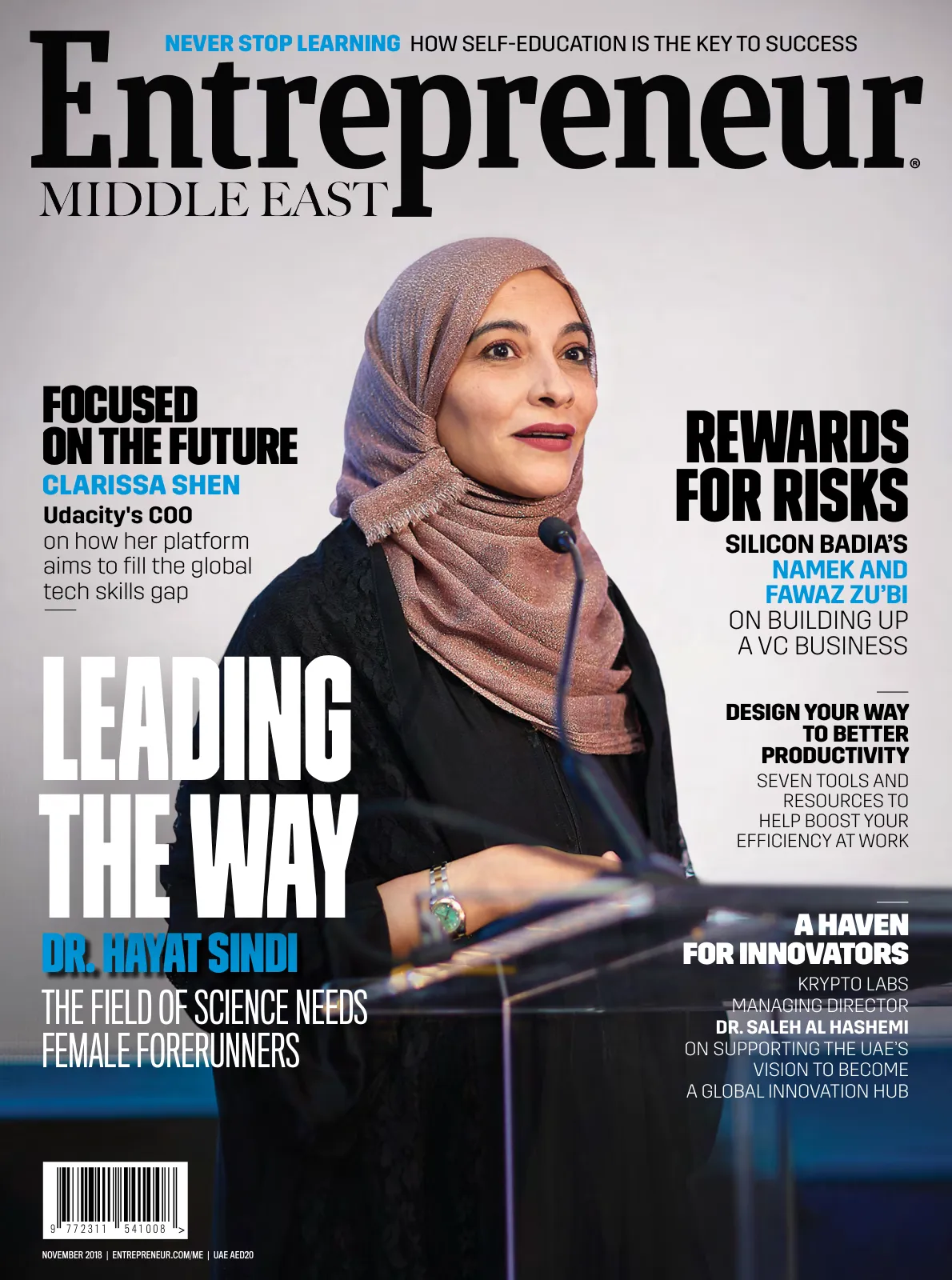
Entrepreneur Middle East, November 2018
Page 1
NOVEMBER 2018 | ENTREPRENEUR.COM/ME | UAE AED20
9
7 7 2 3 1 1
5 4 1 0 0 8
>
NEVER STOP LEARNING HOW SELF-EDUCATION IS THE KEY TO SUCCESS
THE FIELD OF SCIENCE NEEDS
FEMALE FORERUNNERS
A HAVEN
FOR INNOVATORS
FOR RISKS
REWARDS
SILICON BADIA’S
NAMEK AND
FAWAZ ZU’BI
ON BUILDING UP
A VC BUSINESS
DESIGN YOUR WAY
TO BETTER
PRODUCTIVITY
SEVEN TOOLS AND
RESOURCES TO
HELP BOOST YOUR
EFFICIENCY AT WORK
Udacity's COO
on how her platform
aims to fill the global
tech skills gap
CLARISSA SHEN
FOCUSED
ON THE FUTURE
DR. HAYAT SINDI
KRYPTO LABS
MANAGING DIRECTOR
DR. SALEH AL HASHEMI
ON SUPPORTING THE UAE’S
VISION TO BECOME
A GLOBAL INNOVATION HUB
LEADING
THE WAY
Page 2
Page 3
Page 4
#SEF18 #SHARJAHEF
@SHARJAHEF
WWW.SHARJAHEF.COM
MOHAMED ALABBAR
CHAIRMAN, EMAAR PROPERTIES
AND FOUNDER, NOON
CHAIRMAN, VAYNERX
FOUNDER AND CHAIRMAN,
THE ENTERTAINER
CO-FOUNDER AND CEO,
DECODED
GARY VAYNERCHUK
DONNA BENTON
KATHRYN PARSONS
Page 5
2 DAYS 100 INSPIRATIONAL SPEAKERS 70+ STARTUP EXHIBITORS
D A R E T O B E
D I F F E R E N T
G R E A T I D E A S S T A R T H E R E .
S H A R J A H G O L F
& S H O O T I N G C L U B
BE HERE
CO-FOUNDER AND CEO,
CAREEM
FOUNDER AND CEO,
SAMASOURCE AND LXMI
FOUNDER, MINDVALLEY
CO-FOUNDER, NUQAT
MUDASSIR SHEIKHA
VISHEN LAKHIANI
HUSSA AL HUMAIDHI
LEILA JANAH
Page 6
idealz.com/app
Page 7
Download the Idealz app
Buy a Hashtag Hoodie from the
Deals on Wheels campaign
Get your complimentary tickets!
3
EASY
3
STEPS
* Terms and conditions apply.
3
2
1
Page 8
We never sleep. So you can.
24/7 service.
Our business is trust.
Page 9
Page 10
Page 11
Page 12
A
PRIVILEGED
LIFE
Page 13
HEART OF DUBAI NOW HAS A SOUL
@ sobhahartland
Sobha Brand Studio
Umm Al Sheif
Sheikh Zayed Road
Dubai
Sobha Hartland Sales Gallery
Sobha Hartland
Mohammed Bin Rashid City
Dubai
LOCATED AT MBR CITY
ON THE DUBAI WATER CANAL
30% GREEN & OPEN SPACES
2 INTERNATIONAL SCHOOLS
HIGH-END HOSPITALITY & RETAIL OPTIONS
1.8KM CANAL BOARDWALK
The heart of Dubai is coming to life, with an 8 million sq. ft. canal-front, freehold gated
community – Sobha Hartland, now ready to welcome its first residents. Envisioned to
be the anti-thesis to urban life, this marquee development by Sobha Realty in
Mohammed Bin Rashid Al Maktoum City is located at the very epicentre of Dubai,
minutes away from iconic landmarks and business districts.
Visit us at Cityscape Global 2018 to avail exclusive privileges.
Dubai World Trade Centre | 02 - 04 October
Terms and conditions apply
800 999 999
sobhahartland.com
Rera 1544 / 1949
Page 14
COVER THE CITY
Unlocking the Power
of Digital Signage Advertising
Page 15
WITH YOUR ADS
Visit www.lifeonscreen.com
Page 16
Page 17
Page 18
Wake up to
Following outstanding sales in phases 1, 2 & 3,
ARADA presents Nasma Residences Phase 4.
Located in the lush surroundings of
a record-breaking community.
from AED 899,000
*
BAREEM TOWNHOUSES
800-ARADA (27232)
arada.com
• No service fee for life
• Pay 60% on completion
• Up to 10% ROI
Visit our Sales Office
Badriyah Ballroom,
Radisson Blu Resort, Sharjah
10am – 7pm
*T&C apply
No residency visa required to buy property
Open to all nationalities
Page 19
19
November 2018 / ENTREPRENEUR.COM /
70
Namek and Fawaz Zu’bi,
co-founders, Silicon Badia
NOVEMBER 2018 CONTENTS
32
INNOVATOR
LEADING THE WAY
Dr. Hayat Sindi, one of
Saudi Arabia's globally
known bio-technologists,
on why the field of
science needs female
forerunners.
78
START IT UP
EOSYSTEM
A haven for innovators
Krypto Labs Managing
Director Dr. Saleh Al
Hashemi on supporting the
UAE’s vision to become a
global innovation hub.
36
INNOVATOR
SCHOOLING FOR
TOMORROW
Singularity University
co-founder and Executive
Chairman Dr. Peter H.
Diamandis takes a deep-dive
into exponential technologies
(and mindsets) that are
mission-critical for educating
the next generation.
44
TECH
WEBSITE TO WATCH
Focused on the future
Udacity COO Clarissa Shen on
how her platform aims to fill
the global tech skills gap.
70
MONEY
VC VIEWPOINT
Rewards for risk
Silicon Badia’s Namek and
Fawaz Zu’bi on building
what they state to be the
first Arab VC with a fund
dedicated to early stage tech
startups in the US.
58
TECH
THE FIX
Staying in business
MoviePass CEO and former
founding executive of
Netflix, Mitch Lowe, on
building an enterprise that
stays the course.
32 Dr. Hayat Sindi with Ali Matar, Head of LinkedIn MENA, at the fourth LinkedIn
MENA Talent Awards in October 2018
Page 20
20 / ENTREPRENEUR.COM / November 2018
NOVEMBER 2018
CONTENTS
78
74
START IT UP
STARTUP FINANCE
Enter the dragon
A15 sells its stake in mobile
payment startup TPAY to
Helios Investment Partners
to create the region’s first
“dragon” company.
46
‘TREPONOMICS
SKILLSET
Never stop learning
Nour Al Hassan, CEO,
Tarjama and Ureed,
explains how self-
education is the key to
success for entrepreneurs.
Krypto Labs
co-working space
66
‘TREPONOMICS
MARKETING
Don’t blame the marketing
Alex Ionides, Managing
Director of Silx, gives five
reasons why your company
may actually be struggling.
26
EDITOR’S NOTE
By Aby Sam Thomas
68
START IT UP
STARTUP FINANCE
Leveraging big businesses
for big gains
Markus Massi, Senior
Partner and Managing
Director at The Boston
Consulting Group Middle
East, explains why
startups should tap into
the opportunity presented
by corporate venture
capital in the MENA
region.
40
TECH
SHINY
#TamTalksTech
Gadgets and doodads
that you might’ve missed
out on, sourced by a tech
aficionado. Yes, it’s okay to
want them all… and no, it’s
not our fault.
41 Belkin BOOST↑UP
Wireless Charging
Stand
58 Mitch Lowe, CEO, MoviePass
Page 21
Page 22
22 / ENTREPRENEUR.COM / November 2018
50
‘TREPONOMICS
PRO
Start off on the right foot
Your employee’s first 100
days at your enterprise can
make all the difference in
how they perceive you as an
employer, says Talentera's
General Manager
Muhammad Younas.
44 Maria Hatzistefanis, founder, Rodial
41 GoPro HERO7 Black
NOVEMBER 2018
CONTENTS
49
‘TREPONOMICS
MARKETING
How to stand out
(without making any noise)
LifeOnScreen’s Zina
Seibert gives a foolproof
guide to using soundless
video.
62
‘TREPONOMICS
MARKETING
Design your way to better
productivity
Infographic.ly founder Carla
Saliba lists seven tools and
resources to help boost your
efficiency at work.
44
CULTURE
BUSINESS UNUSAL
Persistence and
perseverance
Rodial founder Maria
Hatzistefanis on building
a beauty brand over two
decades.
42
CULTURE
TRAPPINGS
‘Trep gear
The executive selection for
the entrepreneur on your
list that has everything.
Okay, maybe for a little self-
reward as well.
28
IN THE LOOP
It’s time for #SharjahEF
again!
Mohamed Alabbar, Gary
Vaynerchuk among speakers
to headline the 2018
Sharjah Entrepreneurship
Festival.
Suitsupply
Fall/Winter 2018
46
43
Sacoor Brothers flagship store
at The Dubai Mall
Page 23
A rare jewel in the rocky contours of the vast Saiq Plateau on Oman’s fabled Green Mountain,
Anantara Al Jabal Al Akhdar Resort is the highest five star luxury resort in the Middle East.
ln this extraordinary destination, the true source of adventure is revealed through Anantara’s
distinctive natural luxury and innovative Omani hospitality.
Telephone: +968 2521 8000
Email: reservations.aaja@anantara.com
Book at anantara.com
Your #MountainEscape Awaits.
VISIT ANANTARA.COM
ASIA MIDDLE EAST AFRICA EUROPE
LIFE IS A JOURNEY
Page 24
24 / ENTREPRENEUR.COM / November 2018
SUBSCRIBE
Contact subscriptions@bncpublishing.net to receive
Entrepreneur Middle East every issue
EDITOR IN CHIEF Aby Sam Thomas editor@bncpublishing.net
CEO Wissam Younane wissam@bncpublishing.net
DIRECTOR Rabih Najm rabih@bncpublishing.net
CREATIVE LEAD Odette Kahwagi
MANAGING EDITOR Tamara Pupic
STARTUPS SECTION EDITOR Pamella de Leon
GROUP SALES DIRECTOR – B2B GROUP Joaquim D’Costa
COLUMNIST Tamara Clarke
EVENTS LIAISON Mark Anthony Monzon
PO Box 502511 Dubai, United Arab Emirates
P +971 4 4200 506 | F +971 4 4200 196
For all commercial enquiries related to Entrepreneur Middle East
contact sales@bncpublishing.net
All rights reserved 2018.
Opinions expressed are solely those of the contributors.
Entrepreneur Middle East and all subsidiary publications in the
MENA region are officially licensed exclusively to BNC Publishing
in the MENA region by Entrepreneur Media Inc.
No part of this magazine may be reproduced or transmitted in any
form or by any means without written permission of the publisher.
Printed by United Printing and Publishing
upp.ae
Images used in Entrepreneur Middle East are credited when necessary. Attributed use of
copyrighted images with permission. All images not credited otherwise Shutterstock.
Nour Al Hassan
Fida Chaaban
Dr. Peter H. Diamandis
Alex Ionides
Markus Massi
Megha Merani
Carla Saliba
Zina Seibert
Muhammad Younas
CONTRIBUTING WRITERS
entrepreneur.com/me
ACCESS FRESH CONTENT DAILY ON OUR WEBSITE!
MIDDLE EAST
EntMagazineME
@EntMagazineME
Entrepreneur-me
EntrepreneurMiddleEast
EntMagazineME
EntMagazineME
EntMagazineME
MIDDLE EAST
In addition to our print edition, we’re bringing
you all sorts of industry news on our web
mediums. Joining us online means getting
relevant business and startup content in
real-time, so you’re hearing about the latest
developments as soon as we do. We’re looking
forward to interacting with our readers on all of
our social media and web platforms- like any
thriving business, we’re looking to give and take.
#TrepTalkME is already happening on all of our
digi platforms, and all good conversations go
both ways. See you on the web!
Page 25
M E M B E R S G E T T H E B E S T R AT E S
W H E N YO U B O O K D I R E C T
radissoncollection.com
A collection of our finest hotels,
where memorable moments are made.
From Muscat to Kuwait to Riyadh.
Page 26
26 / ENTREPRENEUR.COM / November 2018
EDITOR’S NOTE
I
’ve noticed that, of late,
whenever I’ve told people
that work’s been keeping
me busy all the time, they
almost always reply with a
quip that goes along the lines
of: “That’s good; it’s better to
be busy than doing nothing!” This
is a remark that I too have laugh-
ingly said to many a counterpart of
mine, and while I perhaps should
not be reading too much into the
pleasantries we engage in when we
start up conversations, I’ve come
to the realization that I need to
stop passing off being “busy all
the time” as an acceptable state of
mind for those of us in the work-
force. No, it’s not “good,” neither
is it “normal,” and it’s definitely
not something worth glorifying
either- and this needs to be really
taken to heart by those of us in the
entrepreneurial realm.
While there’s been a lot of chat-
ter around burnout in the startup
ecosystem, I’ve come to realize
that it’s one thing to know about
these problems, and it’s another
thing altogether to actually do
something to prevent or solve such
issues. I must admit here that I’m
guilty of this personally- despite
the number of articles and advice
I’ve read and heard about keep-
ing oneself away from burnout
(which includes everything from
the importance of delegation, to
simply saying no to assignments
that overload you), I’m sorry to
say that I’ve been finding myself
completely drained and exhausted,
almost consistently, over what I
think has been an awfully long
period of time.
In order to get myself out of this
rut I’ve fallen into, I’m thinking
of taking a break from work- and
this time, I’m wanting a real break
from my job, which shall see me
hitting pause on anything relating
to it for a specific period of time.
The issue with a vacation that
sees you answering emails and
addressing minutiae via IMs is
that you aren’t on vacation. There
is no recharge time– and that is
an issue that gradually builds up
until you just can’t think straight
anymore.
There’s an odd sense of guilt
that hits me for even thinking this
way –after all, it’s absolutely a
privilege that I’m able to even con-
sider doing this- but I do feel the
need to cut myself off from emails,
tweets, WhatsApp messages, and
everything else that relate to work
for me to, well, refocus and rejig
my passion towards it again. It’s
no fun being tired all the time,
regardless of how much you may
enjoy or value what you do- and
if a break can help me get past it,
so be it.
Aby Sam Thomas
Editor in Chief
@thisisaby
aby@bncpublishing.net
Sometimes you really need to disconnect
Off switch
Page 27
Page 28
28 / ENTREPRENEUR.COM / November 2018
E
ntrepreneurial
heavyweights from
around the world are
gathering in Sharjah
for a feast of startup
talks at this year's instal-
ment of the annual Sharjah
Entrepreneurship Festival
(SharjahEF).
The speaker lineup includes
Emaar Properties Chairman
Mohamed Alabbar, VaynerX
Chairman Gary Vaynerchuk,
Careem co-founders Mu-
dassir Sheikha and Magnus
Olsson, Mindvalley founder
Vishen Lakhiani, Decoded
co-founder and CEO Kath-
ryn Parsons, author and
research neuroscientist
Baroness Susan Greenfield,
Donna Benton, founder, The
Entertainer, and several
other local, regional, and
international speakers.
Organized by Sharjah
Entrepreneurship Center
(Sheraa), the second edition
of SharjahEF, taking place
on November 20-21, 2018,
at the Sharjah Golf and
Shooting Club, will build
upon the festival’s mission
to promote and support
the growing ecosystem of
entrepreneurs in Sharjah
and the UAE.
With the main theme of
“Dare To Be Different,”
this year’s event is being
held under the patronage
of Sheraa Chairperson H.E.
Sheikha Bodour Bint Sultan
Al Qasimi, and with the
support of Gold Partners
Sharjah Islamic Bank, Shar-
jah Media City (Shams),
and Sharjah Asset Manage-
ment.
SharjahEF this year will
also play host to Startup
Town, showcasing the
region’s most impact-
ful startups, SharjahEF’s
Pitch Competition, in-
cluding prizes totaling
AED100,000, as well as the
2018 edition of The Seffy
Awards for the most prom-
ising locally-based entre-
preneurs in three different
categories.
Speaking at a press con-
ference to announce Shar-
jahEF, H.E. Najla Al Midfa,
CEO of Sheraa, said, “Our
aim with SharjahEF this
year is to get our attendees
IN THE LOOP
Mohamed Alabbar, Gary Vaynerchuk among speakers to headline the 2018
Sharjah Entrepreneurship Festival on November 20-21, 2018
It’s time for #SharjahEF again!
H.E. Najla Al Midfa, CEO, Sheraa
IMAGES COURTESY SHARJAH ENTREPRENEURSHIP FESTIVAL
The SEF team with its strategic partners
Page 29
29
November 2018 / ENTREPRENEUR.COM /
to think beyond the status
quo when it comes to their
careers, lives, and business-
es. This can range from them
following through on their
entrepreneurial dreams, re-
thinking how they go about
doing business today, or
even reimagining their local
enterprise as a global one-
essentially, we want them to
‘dare to be different.’”
H.E. Dr. Khalid Omar Al
Midfa, Chairman of Shar-
jah Media City (Shams),
emphasized that Sharjah
Media City’s commitment to
participating in the Sharjah
Entrepreneurship Festival
is part of its efforts, in line
with the vision of H.H.
Sheikh Dr. Sultan bin Mu-
hammad Al Qasimi, Member
of the Supreme Council and
Ruler of Sharjah, to contrib-
ute to building a dynamic
community and an ideal
environment for entrepre-
neurship and innovation.
“Sharjah Media City was
established to support and
empower young people
and provide them with the
knowledge and tools of
creativity and innovation,”
Dr. Al Midfa said, in a state-
ment. “We are dedicated
to utilizing all resources, in
collaboration with various
entrepreneurship founda-
tions and innovation sectors,
to contribute to achieving
creative entrepreneurship
and inspire business devel-
opment. We, at Shams, sup-
port a dynamic community
to innovate, live, learn and
create together. Therefore,
naturally, we find ourselves
a contributing entity to this
unique gathering of entre-
preneurs. May Allah help us
in playing a key role in mak-
ing this event a success.”
Commenting on Sharjah
Islamic Bank’s support of
SharjahEF, H.E. Jassim
Albaloushi, Head of Organi-
zational Excellence, Sharjah
Islamic Bank, said, “Since
its inception, the Bank has
been an active partner in
every community initiative
that supports youth, through
providing young entrepre-
neurs with all forms of sup-
port to enable them to turn
their ideas into projects that
positively impact develop-
ment. This is in line with
the visions and directions
of H.H. Sheikh Dr. Sultan
bin Mohammed Al Qasimi,
Member of the Supreme
Council and Ruler of Shar-
jah, the spiritual father of
youth and the main support-
er of their innovations.”
Alya Al Hebshi, Manager
of Corporate Communica-
tion Center, Sharjah Asset
Management, added, “Arab
and Emirati entrepreneurs
have successfully carved a
niche for themselves during
the last few years at the
local and global landscape,
making us all proud of their
achievements. At Sharjah
Asset Management, we
believe that entrepreneurs
are one of the pivotal axes of
any economy, and they need
adequate support and an
integrated advisory system
to turn their ideas into suc-
cessful businesses. As the
investment arm of the Gov-
ernment of Sharjah, we at
Sharjah Asset Management
look forward to building a
competitive economy in the
Emirate through embracing
and qualifying entrepreneurs
of all sizes and categories.
We also aim to promote
education and development
and foster entrepreneurship
in the Emirate through vari-
ous initiatives, of which the
Sharjah Entrepreneurship
Festival is the perfect plat-
form to extend our support
to the entrepreneurs.”
Najla Al Ansari, Manager
SEF, added that the Shar-
jahEF organizing team hoped
to provide value in a variety
of formats to all who attend
the festival. “Be it with our
line-up of inspirational
speakers, or with the inter-
active hands-on workshops
that we’ve got scheduled,
SharjahEF this year prom-
ises to be an exhilarating, in-
formative experience for eve-
ryone, whether it be those
who have just a kernel of an
idea for a business, or even
experienced hands looking
to do things differently,” Al
Ansari said. sharjahef.com
"SHARJAHEF THIS
YEAR PROMISES TO
BE AN EXHILARATING,
INFORMATIVE EXPERIENCE
FOR EVERYONE, WHETHER
IT BE THOSE WHO HAVE
JUST A KERNEL OF AN IDEA
FOR A BUSINESS, OR EVEN
EXPERIENCED HANDS
LOOKING TO DO THINGS
DIFFERENTLY.”
H.E. Jassem Albaloushi,
Head of Organization Excellence,
Sharjah Islamic Bank
Fajr Kassim Ali, Director - Media Sector
Development, Sharjah Media City (Shams)
Alya Al Hebshi, Manager of Corporate
Communication Center Manager, Sharjah
Asset Management
Najla Al Ansari, Manager, Sharjah Entrepreneurship Festival
Page 30
30 / ENTREPRENEUR.COM / November 2018
IMAGE CREDIT LIFEONSCREEN, STARTAD
IN THE LOOP
StartAD's Beyond The Pitch is looking for projects
solving environmental issues
Green business
A
re you a startup
with ideas to solve
environmental and
climate issues?
Then this oppor-
tunity is for you. StartAD,
the accelerator and entre-
preneurship hub based at
NYU Abu Dhabi and powered
by Tamkeen, is welcoming
applications for the second
edition of Beyond The Pitch,
a startup competition which
aims to utilize the entrepre-
neurial talent of UAE youth.
Organized in partnership
with the Ministry of Climate
Change and Environment
and the Global Green Growth
Institute (GGGI), the com-
petition is themed under
sustainability to focus on
generating solutions for chal-
lenges in relation to “climate
action, the circular economy,
green cities, and sustainable
food and agriculture.”
Open to UAE residents
between the ages of 18 and
25, the topics were cho-
sen to generate local ideas
which will have a significant
impact on the environ-
ment and economy. With 15
projects said to be short-
listed, individuals or teams
with an existing project are
encouraged to apply, as well
as projects that have been
part of previous hackathons,
competitions or other pro-
grams. Teams must be able
to demonstrate potential for
global impact.
The 15 teams will undergo
two preliminary bootcamps
on February 8-9 and Febru-
ary 15-16, 2019, where they
will receive guidance on
ideation, getting to product
market fit, customer devel-
opment. There would also be
more workshops throughout
March to April focused on
developing and validating a
business model, presenting
skills and more. Plus, teams
would also receive support
from business leaders, with
GGGI and the Ministry of
Climate Change and Envi-
ronment offering support in
matching teams with green
business experts to help
gain insights to building a
sustainable business.
Applications can be sub-
mitted online until January
15, 2019. For more informa-
tion, head to the website, or
join the information session
at the Dubai Technology
Entrepreneur Centre in
Dubai on November 25 from
6-8pm.
sites.nyuad.nyu.edu/nyuadstartad/btp
A
ccording to Pricewa-
terhouseCoopers,
digital out-of-home
(DOOH) media is expected to
reach a 15% annual growth
rate for the next four years,
overtaking traditional media
spend in 2020. The growing
trend enables companies with
well-developed digital screen
networks to advertise to their
consumers.
One example in this regard
from the MENA region is
ENOC Retail and Tasjeel
recently partnering with
LifeOnScreen, a Europe-
based company that started
operations in Dubai in March,
which offers an online
marketplace for advertisers
to directly access a wide net-
work of digital displays and
book their campaigns online
as well.
LifeOnScreen’s software
will allow the two companies
to capitalize on their cap-
tive audiences– ENOC’s 121
service stations across Dubai
and the Northern Emirates,
and Tasjeel’s 14 locations
around the UAE, representing
a combined customer traffic
of about 120 million people
annually.
In a statement, Zaid Alqufaidi,
Managing Director, ENOC Re-
tail, commented on ENOC’s
aim to reach prospective
customers. “At ENOC Group,
we continuously strive to
innovate and identify ways
to effectively reach out to
our customers and enhance
their experiences, and as a
result, we always look for
opportunities to partner with
companies that offer the
latest technology,” he said.
“LifeOnScreen software will
enable us to use our digital
screen network to advertise
to our consumers. We are
proud to be the first govern-
ment entity to adopt this
latest innovation in digital
technology for advertising.”
Susan Seibert, Business De-
velopment Director, LifeOn-
Screen, added, “LifeOnScreen
is taking the traditional
out-of-home advertising from
a local to global scale. As the
first online self-service mar-
ketplace of digital screens for
advertisers, it offers advertis-
ers of any size the choice
to purchase their DOOH
campaign within minutes
affordably, straight from their
smartphones.” lifeonscreen.com
ENOC and Tasjeel partners with LifeOnScreen
for digital signage offering
RETHINKING ADVERTISING
Tasjeel partners with LifeOnScreen
Previous edition of
Beyond the Pitch
Page 31
Obtain your DED licence on a dedicated desk in a sophisticated
shared space with great views, natural light and like-minded people.
Benefits:
- Ejari without the 200 sqft requirement
- The best business addresses in Dubai, without the high costs
- Secure, high speed WiFi, 24/7 IT and admin support
- Connect and collaborate with our community of 40,000 professionals
- Landline number and a dedicated receptionist to answer your calls
- Complimentary coffee and tea for you and your guests
- Access to fully equipped boardrooms and meeting rooms
Register Your Business In Dubai
On Servcorp’s Coworking Space
AED 3000/Month - DED Compliant
Emirates Towers
+971 4 319 7660
Habtoor Tower
+971 4 453 2670
Boulevard Plaza
+971 4 409 6880
160+ locations across the globe
Page 32
32 / ENTREPRENEUR.COM / November 2018
IMAGE COURTESY DR. HAYAT SINDI
"YOU NEED TO
SURROUND
YOURSELF WITH
PEOPLE WHO [...]
REALLY BELIEVE
IN YOU, NO
MATTER WHAT."
Dr. Hayat Sindi
INNOVATOR
32 / ENTREPRENEUR.COM / November 2018
Page 33
33
November 2018 / ENTREPRENEUR.COM /
T
he most impor-
tant thing is to
guard yourself
from anything
negative,
because that
really can derail
you,” says the
soft-spoken Dr
Hayat Sindi, known as one of
the world's leading biotech-
nologists and a Senior Advisor
to the President of Science,
Technology and Innovation
at the Islamic Development
Bank in Saudi Arabia, on the
sidelines of the fourth Linke-
dIn MENA Talent Awards
held in October in Dubai. Dr.
Sindi could never appear at a
loss for words about science
and the importance of putting
innovation in the service of
solving the world’s problems,
but her career speaks volumes
about the science of personal
achievement. Among many
other things, it includes her
being one of the first 30
women to be appointed to the
Shura Council, Saudi Arabia’s
highest consultative body, in
2013, or serving as a Goodwill
Ambassador for Science at
UNESCO, or being appointed
by the UN Secretary Ban Ki-
moon to a ten-member group
to support the technological
facilitation mechanism (TFM)
for the UN Sustainable Devel-
opment Goals.
At this point, our mind
may be quick to assume
that Dr. Sindi has reached
a point in her career where
she encounters only minor
obstacles, if any, to her work
and how she does it. However,
she assures me, it hardly gets
any easier. “Challenges never
change, but only move up to
a new level,” Dr. Sindi says.
“They remain similar to how
it is when you introduce a
new drug, people will not
want it to succeed, they will
try to pull you down, but you
will be more experienced at
dealing with them. And the
more successful you are, the
challenges just get bigger
and tougher, but the reward
is different. For example,
passing an English test to
study science in England
was once a challenge for me,
whereas now my challenges
are about getting funds for
my scientific initiatives,
or for mentoring young
entrepreneurs. So, there are
always obstacles, but the
impact of my overcoming
them is completely different.
Back then, it was only me and
my books. Now, it’s me and
different organizations trying
to come together to achieve
something much bigger.”
Originally from Makkah, Sau-
di Arabia, Dr. Sindi is the first
woman from the Gulf to earn a
PhD in biotechnology, study-
ing at King’s College London,
the University of Cambridge,
the Massachusetts Institute of
Technology, and Harvard Uni-
versity. As a woman, a young
scientist, and later on an en-
trepreneur, she was resolute
to get the best out of all three
cultures, which have had a
lasting impact on her personal
development. “Having been
raised in Saudi Arabia, I was
fortunate to get this strong
foundation of self-belief,” she
says. “My culture, my family,
and my faith have all con-
tributed to that foundation. I
had a father who could teach
me anything I wanted. When
I moved to England, it was
also a great platform for me to
discover who I was as a scien-
tist. In Britain, they are really
good at how they shape your
skills and talents, because
they throw challenges at you
and ask you to go and figure it
out. In the beginning, it was
tough, but when you adapt a
little bit, you realize that it
is amazing how a human can
adapt to difficult situations
and excel. When I went to
the US, I experienced another
type of culture in terms of the
concept ‘why not,’ meaning
that you can try anything and
not fear failure.” >>>
I2INSTITUTE.ORG
INNOVATOR
Saudi Arabia’s Dr. Hayat Sindi on why the field of science
needs female forerunners by TAMARA PUPIC
LEADING THE WAY
"ONCE YOU HAVE A
MISSION IN LIFE THAT
IS A LIGHT TO CARRY
YOU FORWARD, YOU
WON’T EVEN NOTICE
THE OBSTACLES AND
THE CHALLENGES
ANYMORE.”
Dr. Hayat Sindi is the founder
and Chair the Jeddah-based
Institute for Imagination and
Ingenuity (i2institute)
Page 34
34 / ENTREPRENEUR.COM / November 2018
In 2007, Dr. Sindi founded
and became the Director of
Diagnostic for All, a non-profit
initiative that creates low-cost
diagnostic devices designed
for the developing world. In
2011, she founded and chaired
the Jeddah-based Institute
for Imagination and Ingenuity
(i2institute) through which
she aims to promote science
education and innovation to
young people. To successfully
pursue these entrepreneurial
endeavors and make a lasting
social impact, having self-
confidence and a clear goal
in life is crucial, she says. “In
different environments, peo-
ple can judge you by the way
you look or talk, by the color
of your skin, and so on, and
you can’t please everyone,”
she adds. “Therefore, I always
treat my mind as a garden,
and focus on the beautiful
flowers in it, discarding all
the negatives, because people
and their opinions can get to
you very easily. Sometimes, I
do feel tired and exhausted,
but I never reach a dead end,
because I feel that if there is
a will, there is a way. And you
need to surround yourself
with people who, even if they
haven’t excelled in their own
education or career, really be-
lieve in you, no matter what.
It’s because you need that
unconditional trust and love.
And once you have a mission
in life that is a light to carry
you forward, you won’t even
notice the obstacles and the
challenges anymore.”
When it comes to women in
science, statistics certainly
don’t paint a positive picture-
according to the UNESCO In-
stitute of Statistics, less than
30% of the world’s research-
ers are women, despite the
male-to-female ratio among
PhD students and younger
post-doctoral graduates being
roughly 50:50. The beginning
of Dr. Sindi’s interests and ca-
reer in science was not much
different, and she is now reso-
lute to empower more women
across the Arab world to
follow in her footsteps. “It is
really important for women to
have role models,” she says. “I
used to ask my father whether
scientists were true human
beings, because I could not
see any women among them.
And the key thing for anyone
in the world, something that
if you don’t have, even if you
have the highest PhD, if you
don’t have self-confidence,
no one will trust you. Women
really need to believe that
they are amazing, talented,
articulate, beautiful, and they
really should believe that they
can do anything. In science,
they are better engineers than
men, because they don’t give
up, they seek solutions, and
they always persist.” Dr. Sindi
adds, “Another important
thing is that sometimes we
put heroes of the past on such
a great height, as if no one is
allowed to challenge Sir Isaac
Newton or Albert Einstein.
And why not?”
As a Senior Advisor to the
President of Science, Technol-
ogy and Innovation at the
Islamic Development Bank
in Saudi Arabia, Dr. Sindi
works on raising awareness
about two new Islamic De-
velopment Bank initiatives
aimed at youth, technology
and innovation: Transform,
a multimillion-dollar fund to
promote and nurture science,
technology, and innovation,
and Engage, a digital platform
aimed at accelerating econom-
ic and social progress in the
developing world through sci-
ence technology and innova-
tion. “If you look at statistics,
we miss women in leadership
positions in science to decide
on the direction of science,
where we should invest money
and on what type of innova-
tion,” she says. “Because I
believe that if we have women
in decision-making positions,
we won’t have fast cars and
nuclear weapons as much as
more cures, medicines, more
humanitarian goals achieved,
and so on.” And as a true
scientist, she has facts to
prove her statements. “Who
designed the bullet? A man
[Henri-Gustave Delvigne,
inventor of the cylindrical
bullet]. Who designed a bullet
shield? A woman [Stephanie
Louise Kwolek, inventor of
Kevlar],” concludes Dr. Sindi.
INNOVATOR
"IF WE HAVE WOMEN
IN DECISION-MAKING
POSITIONS, WE WON’T
HAVE FAST CARS AND
NUCLEAR WEAPONS AS
MUCH AS MORE CURES,
MEDICINES, MORE
HUMANITARIAN GOALS
ACHIEVED."
DFA.ORG
Dr. Sindi is the founder and Director of Diagnostic for All, a non-profit initiative that creates low-cost diagnostic devices
Dr. Hayat Sindi with Ali Matar,
Head of LinkedIn MENA,
at the fourth LinkedIn MENA
Talent Awards in October 2018
Page 35
Page 36
36 / ENTREPRENEUR.COM / November 2018
SCHOOLING
FOR
TOMORROW
A deep-dive into the exponential technologies (and mindsets)
that are mission-critical for educating the next generation
by DR. PETER H. DIAMANDIS
INNOVATOR
36 / ENTREPRENEUR.COM / November 2018
Page 37
37
November 2018 / ENTREPRENEUR.COM /
L
ast month, I discussed
how education needs
to radically change to
both leverage today’s
exponential tools,
and innovate around
the most prominent
emerging industries of the 21st
century. As automation and
tech-driven professions chal-
lenge us to give up 20th century
curricula and educational tools,
it is critical that we undergo a
major update to how we educate
our kids. That’s why this month,
I’m doing a deep-dive into the
exponential technologies and
mindsets that are mission-
critical for educating the next
generation.
Here’s an overview of the top
five technologies that will re-
shape the future of education:
1. VIRTUAL REALITY (VR)
Research has shown that we
remember 20% of what we
hear, 30% of what we see, and
up to 90% of what we do or
simulate. Virtual reality yields
the latter scenario impeccably.
VR enables students to simulate
flying through the bloodstream,
while learning about different
cells they encounter, or travel
to Mars to inspect the surface
for life. To make this a reality,
Google Cardboard just launched
its Pioneer Expeditions product.
Under this program, thousands
of schools around the world
have gotten a kit containing eve-
rything a teacher needs to take
his or her class on a virtual trip.
While data on VR use in K-12
schools and colleges have yet to
be gathered, the steady growth
of the market is reflected in the
surge of companies (includ-
ing zSpace, Alchemy VR, and
Immersive VR Education) solely
dedicated to providing schools
with packaged education cur-
riculum and content. Add to
VR a related technology called
augmented reality (AR), and
experiential education really
comes alive. Imagine wearing an
AR headset that is able to su-
perimpose educational lessons
on top of real-world experi-
ences. Interested in botany? As
you walk through a garden, the
AR headset superimposes the
name and details of every plant
you see.
2. 3D PRINTING
Never mind the computer on
every desktop (or a tablet for
every student): that’s a given.
In the near future, teachers and
students will want or have a 3D
printer on the desk to help them
learn core science, technology,
engineering, and mathematics
(STEM) principles. Bre Pettis, of
MakerBot Industries, in a grand
but practical vision, sees a 3D
printer on every school desk in
America. “Imagine if you had
a 3D printer instead of a LEGO
set when you were a kid- what
would life be like now?” asks
Pettis. You could print your
own mini-figures, your own
blocks, and you could iterate on
new designs as quickly as your
imagination would allow. Mak-
erBots are now in over 5,000
K-12 schools across the
United States. Taking this
one step further, you could
imagine having a 3D file for
most entries in Wikipedia,
allowing you to print out
and study an object you can
only read about or visualize
in VR.
3. SENSORS AND NETWORKS
An explosion of sensors
and networks are going to
connect everyone at gigabit
speeds, making access to
rich video available at all
times. At the same time, sen-
sors continue to miniaturize
and reduce in power, becoming
embedded in everything. One
benefit will be the connection
of sensor data with machine
learning and artificial intelli-
gence (AI), such that knowledge
of a child’s attention drifting, or
confusion, can be easily meas-
ured and communicated. The
result would be a representation
of the information through an
alternate modality or at a differ-
ent speed.
4. MACHINE LEARNING
No two students are identi-
cal- they have different modes
of learning (by reading, seeing,
hearing, doing), come from dif-
ferent educational backgrounds,
and have different intellectual
capabilities and attention spans.
Machine learning is making
learning adaptive and person-
alized. Advances in machine
learning and the surging adap-
tive learning movement are
seeking to solve this problem.
Companies like Knewton and
Dreambox have over 15 million
students on their respective
adaptive learning platforms.
Soon, every education applica-
tion will be adaptive, learning
how to personalize the lesson
for a specific student. There
will be adaptive quizzing apps,
flashcard apps, textbook apps,
simulation apps, and many
more.
5. ARTIFICIAL INTELLIGENCE
Neal Stephenson’s book, The
Diamond Age, presents a fas-
cinating piece of educational
technology called “A Young La-
dy’s Illustrated Primer.” As de-
scribed by Beat Schwendimann,
“the primer is an interactive
book that can answer a learner’s
questions (spoken in natural
language), teach through allego-
ries that incorporate elements
of the learner’s environment,
and presents contextual just-in-
time information. The primer
includes sensors that monitor
the learner’s actions and pro-
vide feedback. The learner is in
a cognitive apprenticeship with
the book: The primer models a
certain skill (through allegori-
cal fairy tale characters), which
the learner then imitates in real
life. The primer follows a learn-
ing progression with increas-
ingly more complex tasks. The
educational goals of the primer
INNOVATOR
>>>
NEVER MIND THE
COMPUTER ON EVERY
DESKTOP (OR A TABLET
FOR EVERY STUDENT):
THAT’S A GIVEN. IN THE
NEAR FUTURE, TEACHERS
AND STUDENTS WILL
WANT OR HAVE A 3D
PRINTER ON THE DESK TO
HELP THEM LEARN CORE
SCIENCE, TECHNOLOGY,
ENGINEERING, AND
MATHEMATICS (STEM)
PRINCIPLES.
Google Cardboard
MakerBot
IMAGES COURTESY GOOGLE | MAKERBOT
Page 38
38 / ENTREPRENEUR.COM / November 2018
are humanist: To support the
learner to become a strong and
independently thinking person.”
The primer, an individual-
ized AI teaching companion
is the result of technological
convergence and is beauti-
fully described by YouTuber
CGP Grey in his video, Digital
Aristotle: Thoughts on the
Future of Education. Your AI
companion will have unlimited
access to information on the
cloud and will deliver it at the
optimal speed to each student
in an engaging, fun way. This AI
will demonetize and democ-
ratize education, be available
to everyone for free (just like
Google), and offering the best
education to the wealthiest and
poorest children on the planet
equally. This AI companion is
not a tutor who spouts facts, fig-
ures and answers, but a player
on the side of the student, there
to help him or her learn, and
in so doing, learn how to learn
better. The AI is always alert,
watching for signs of frustration
and boredom that may precede
quitting, for signs of curiosity or
interest that tend to indicate ac-
tive exploration, and for signs of
enjoyment and mastery, which
might indicate a successful
learning experience.
MINDSETS FOR THE 21ST
CENTURY
Finally, it’s important for me to
discuss mindsets. How we think
about the future colors how we
learn and what we do. Psychol-
ogy is a key element of high
performance, and even more
so in such a rich and diverse
cultural environment that the
Middle East presents. While
I’ve written extensively about
the importance of an abundance
and exponential mindset for
entrepreneurs and CEOs, I also
think that attention to mindset
in our elementary schools, when
a child is shaping the mental
“operating system” for the
rest of their life, is even more
important. As such, I would rec-
ommend that a school adopt a
set of principles that teach and
promote a number of mindsets
in the fabric of their programs.
Many mindsets are important
to promote. Here are two to
consider:
1. Nurturing optimism and
an abundance mindset
We live in a competitive world,
and kids experience a sig-
nificant amount of pressure to
perform. When they fall short,
they feel deflated. We all fail
at times- that’s part of life. If
we want to raise “can-do” kids
who can work through failure
and come out stronger for it,
it’s wise to nurture optimism.
Optimistic kids are more willing
to take healthy risks, are better
problem-solvers, and experi-
ence positive relationships. You
can nurture optimism in your
school by starting each day by
focusing on gratitude (what
each child is grateful for), or a
“positive focus,” in which each
student takes 30 seconds to
talk about what they are most
excited about, or what recent
event was positively impactful
to them. (Note: I start every
meeting inside my Strike Force
team with a positive focus!)
Finally, helping students
understand (through data and
graphs) that the world is in fact
getting better (see my first book:
Abundance: The Future is Better
Than You Think) will help them
counter the continuous flow of
negative news flowing through
our news media. When kids feel
confident in their abilities and
excited about the world, they
are willing to work harder and
be more creative.
2. Tolerance for failure
Tolerating failure is a difficult
lesson to learn and a difficult
lesson to teach. But it is criti-
cally important to succeeding
in life. Astro Teller, who runs
Google’s innovation branch “X,”
talks a lot about encouraging
failure. At X, they regularly try
to “kill” their ideas. If they are
successful in killing an idea,
and thus “failing,” they save
tremendous resources in the
way of time and capital. The
ideas they can’t kill survive,
and develop into billion-dollar
businesses. The key is that each
time an idea is killed, Astro
rewards the team- literally, with
cash bonuses. Their failure is
celebrated and they become he-
roes. This should be reproduced
in the classroom: kids should
try to be critical of their best
ideas (learn critical thinking),
and then be celebrated for “suc-
cessfully failing,” perhaps with
cake, balloons, confetti, and lots
of Silly String.
In a century of increasing abun-
dance, it is long time we take
education to be a self-evident
human right for everyone on
the planet. And more than with
any other priority, we should
never settle when educating
our youth. Harnessing today’s
newest technologies and insight
into tomorrow’s industries,
our schooling systems must be
contextually relevant and adap-
tive, capable of accommodating
the demands of a 21st century
economy and populating a glob-
ally minded workforce. Whether
born in Dubai, Boston, Nairobi,
or Shanghai, children must hone
a critically thoughtful mind
and the ability to constantly
experiment, equipped with the
confidence to leverage both
today’s emerging technologies,
and those that will develop in
the centuries to come. Ulti-
mately, we’re heading towards a
vastly more educated world. We
are truly living during the most
exciting time to be alive.
INNOVATOR
Dr. Peter H. Diamandis is an
international pioneer in the fields of
innovation, incentive competitions,
and commercial space. In 2014, he
was named one of “The World’s
50 Greatest Leaders” by Fortune
Magazine. In the field of innovation, Diamandis is
founder and Executive Chairman of the XPRIZE
Foundation, best known for its $10 million Ansari
XPRIZE for private spaceflight. Diamandis is also
the co-founder and Vice-Chairman of Human
Longevity Inc. (HLI), a genomics and cell therapy-
based diagnostic and therapeutic company focused
on extending the healthy human lifespan.
He is also the co-founder and Executive Chairman
of Singularity University, a graduate-level Silicon
Valley institution that studies exponentially
growing technologies, their ability to transform
industries and solve humanity’s grand challenges.
In the field of commercial space, Diamandis is
co-founder/Co-Chairman of Planetary Resources,
a company designing spacecraft to enable
the detection and prospecting of asteroid for
precious materials. He is also the co-founder of
Space Adventures and Zero-Gravity Corporation.
Diamandis is The New York Times bestselling
author of Abundance – The Future Is Better Than
You Think and BOLD – How to go Big, Create
Wealth & Impact the World.
He earned an undergraduate degree in Molecular
Genetics and a graduate degree in Aerospace
Engineering from MIT, and received his M.D. from
Harvard Medical School. diamandis.com
KIDS SHOULD TRY TO BE
CRITICAL OF THEIR BEST
IDEAS (LEARN CRITICAL
THINKING), AND THEN
BE CELEBRATED FOR
“SUCCESSFULLY FAILING,”
PERHAPS WITH CAKE,
BALLOONS, CONFETTI, AND
LOTS OF SILLY STRING.
Page 39
N-Genius, the payment
platform inspired by you.
We’re inspired by business owners who make it happen every
day across the UAE. That’s why we created N-Genius, our
intuitive payment technology platform that opens a world of
innovation for your business.
Now you can accept payments on-the-go, create powerful
business strategies, integrate payments in retail and hospitality
environments, take your business online, or simply make your
customers’ lives easier. N-Genius. We make it happen.
To make N-Genius happen for your business,
visit www.network.ae or call 8004448.
Page 40
40 / ENTREPRENEUR.COM / November 2018
Logitech Z607 5.1 Surround
Sound with Bluetooth is a
new surround sound speaker
system that connects to a
plethora of audio sources.
Since you’re most likely to
stream music from your
phone, computer, or USB
drive, the multi-source
connectivity feature is spot
on. With 160W peak power
and a 5.25” subwoofer
driver, the Logitech Z607
delivers clear highs (up to
120 Khz) and deep bass
(as low as 50 Hz). You
can connect via Bluetooth,
3.5mm or RCA cables.
Extra-long 6.2-meter rear
satellite speaker cables allow
you to arrange the speakers
as you see fit, and you can
control the sound from
anywhere in the room with
a remote control. You can
play, pause, and skip songs,
control volume, select input,
change radio stations, and
more from up to 10 meters
away. There are also audio
controls located right on the
front panel of the subwoofer,
with an LED displaying the
current source input and
volume.
GADGETS AND DOODADS THAT YOU MIGHT’VE MISSED OUT ON, SOURCED BY A TECH AFICIONADO.
YES, IT’S OKAY TO WANT THEM ALL… AND NO, IT’S NOT OUR FAULT.
TURN IT UP
LOGITECH Z607 SPEAKER SYSTEM
TECH SHINY | WEBSITE TO WATCH | GEEK | MOBILE TECH | ONLINE ‘TREP | THE FIX
IMAGE CREDIT LOGITECH | HUAWEI | GOPRO
Logitech
Z607 5.1
Surround Sound
with Bluetooth
Logitech Z607 Speaker System
Page 41
41
November 2018 / ENTREPRENEUR.COM /
GoPro HERO7 Black is back,
and it’s taking action cams to
new heights. Its new feature,
HyperSmooth, is an in-camera
video stabilization that makes
it easy to capture professional-
looking, stabilized video with-
out using a motorized gimbal.
HyperSmooth even works
underwater as well as in high-
shock and wind situations
where gimbals can potentially
fail. With HERO7 Black, GoPro
is also introducing a new form
of video called TimeWarp,
which applies a high-speed,
“magic-carpet-ride” effect to
your videos. Imagine a scenic
drive, ocean dive, or walk
through the city compressed
into a super-stabilized, sped-
up version of itself, with the
entire experience playing out
in seconds. TimeWarp Video
transforms longer experiences
into short videos that are easy
to watch and share. Speaking
of sharing, there’s no faster
way to do it than live. HERO7
Black is the first GoPro to
offer live streaming, which
enables you to automatically
share in real time to Facebook,
Twitch, YouTube, Vimeo and
other platforms internation-
ally. HERO7 Black is a small
way to make big impact, while
on-the-go.
TECH
SHINY | WEBSITE TO WATCH | GEEK | MOBILE TECH | ONLINE ‘TREP | THE FIX
#TAMTALKSTECH Tamara Clarke, a former software development professional, is the tech and lifestyle enthusiast behind The Global Gazette, one
of the most active blogs in the Middle East. The Global Gazette has been welcomed and lauded by some of the most influential tech brands in the
region. Clarke’s goal is to inform about technology and how it supports our lifestyles. See her work both in print regional publications and online on
her blog where she discusses everything from how a new gadget improves day-to-day life to how to coordinate your smartphone accessories.
Visit theglobalgazette.com and talk to her on Twitter @TamaraClarke.
CAPTURE THIS
GOPRO HERO7 BLACK
TRIPLE THREAT
HUAWEI MATE 20 PRO
The Huawei Mate 20 Pro
breaks new ground as the first
smartphone to feature Leica
triple camera which includes a
40MP main camera, a 20MP
ultra wide-angle camera, and
an 8MP telephoto camera.
Together, the trio of lenses
supports a wide range of focal
lengths similar to professional
cameras. The new camera
system also utilizes artificial
intelligence (AI) to enhance
functionality. AI Portrait Color
video mode isolates human
subjects and desaturates the
colors around them to dramati-
cally highlight the person, while
AI Spotlight Reel identifies
clips with a shared theme and
auto-generates a montage,
made entirely of highlights.
The Huawei Mate 20 also has
improved battery life. It has a
large, high-density 4200 mAh
battery, and supports 40W
Huawei SuperCharge, which
gives the device 70% charge
in 30 just minutes. If you’re
concerned about security, have
no fear. The Huawei Mate 20
Pro supports 3D Face Unlock,
which quickly and securely au-
thenticates your facial features
using the 3D Depth Sensing
Camera System. In addition to
facial recognition, the device
has an in-screen fingerprint
sensor that can pinpoint the
location of your finger on the
screen. The Huawei Mate 20
Series comes with EMUI 9.0, a
smart operating system based
on Android P. It features AI
self-learning algorithms that
enables gesture navigation
support, object identification,
and food calorie counting, by
simply pointing the camera
towards objects. With IP68
water resistance and the ability
to project presentations, the
Huawei Mate 20 is an ideal
companion wherever you go.
Huawei Mate 20 Pro
GoPro HERO7 Black
Page 42
42 / ENTREPRENEUR.COM / November 2018
THE EXECUTIVE
SELECTION
From better goods to better wardrobe bests, every
issue we choose a few items that make the approved
executive selection list. In this issue, we present a
fresh scent for the season, a new leather piece to
supplement your boardroom attire, and more.
‘TREP TRIMMINGS
CULTURE
BUSINESS UNUSUAL | LIFE | TRAVEL | DESIGN | TRAPPINGS
FUNCTIONAL DESIGN
RADO
The first thing that will catch your
attention about the Rado True Open
Heart Automatic is its openworked
dial- framed by geometric shapes and
showing off the movement front and
center, while its long hands in light,
set as a contrast to the darker dial,
letting the owner to read time at a quick
glance. Not only aesthetically pleasing
to have, it gives an extra oomph to
Rado’s signature key elements of light,
scratch-resistant high-tech ceramic and
sapphire crystal. With up to 80 hours
of power reserve, it’s offered in three
colors of black, brown and metallic
silver. rado.com
IMAGE CREDIT RADO | DOLCE&GABBANA | MONTBLANC | SACOOR BROTHERS
Rado True Open Heart Automatic
Rado True Open Heart
Automatic
Rado True Open Heart
Automatic
Page 43
43
November 2018 / ENTREPRENEUR.COM /
CULTURE
BUSINESS UNUSUAL | LIFE | TRAVEL | DESIGN | TRAPPINGS
SACOOR BROTHERS
Looking to upgrade your wardrobe
ensemble? Take a look at Sacoor
Brothers’ new offerings this
season at its re-opened Middle
East flagship store at The Dubai
Mall. Bringing Portuguese art
and culture to the forefront, the
store bring shoppers to revel in
the brand’s legacy, and of course,
stays true to what the brand is
known for: elegance, exclusivity,
and authenticity. sacoorbrothers.com
EDITOR’S PICK
AN ODE TO TRADITION
DOLCE&GABBANA
Described as a fusion of the
Mediterranean and Oriental
perfumery with Italian ingredients,
the Dolce&Gabbana Velvet Incenso
celebrates the historical ingredient of
incense. Perfumers Cécile Matton and
Julie Massé created the scent to open
up with a blast of black pepper essence,
followed by citrus essence, intensified
with elemi for a hint of a natural,
pine-like forest feel. And of course, a
traditional incense note at its heart.
With just the right amount of richness,
there’s a balance of intriguing contrasts
in Velvet Incenso. dolcegabbana.com
BLUE IS THE NEW BLACK
MONTBLANC
For the entrepreneur looking for
style and functionality, look no
further than the Montblanc Sartorial
Document Case. Practical and sleek,
the leather piece, which is part of
the brand’s Sartorial collection, is
crafted with Italian saffiano leather
and lined in rich jacquard. For a
vibrant and bold supplement to your
boardroom attire, this wardrobe
staple is worth the investment.
montblanc.com
Sacoor Brothers flagship store
at The Dubai Mall
Dolce&Gabbana
Velvet Incenso
fragrance
Montblanc
Sartorial
Document
Case
Montblanc Sartorial
Document Case
Page 44
44 / ENTREPRENEUR.COM / November 2018
I
t is one thing to create
a business in a fiercely
competitive industry,
such as the skincare
sector dominated by mas-
sive corporate brands in
1999, but to continue owning
100% of the brand almost
two decades after -when it has
expanded across 35 countries
worldwide- is quite another.
That is the story of London-
based beauty entrepreneur
Maria Hatzistefanis, the
founder of Rodial, a London-
headquartered skincare and
beauty group, who shared
many of her tips for success in
her book for aspiring entre-
preneurs, How To Be An Over-
night Success. “I wanted to
offer advice in my book whilst
telling my story, along with
examples of how I overcame
many challenges when starting
my business,” she says. “The
process was very therapeutic,
and it definitely took me back
to certain situations which
represented difficult periods
in my life. To be honest, I in-
cluded everything I wanted to,
I didn’t want to filter my story
which is really the essence of
my book; it’s all about being
honest and inspirational.”
Originally from Greece,
Hatzistefanis started her
career as a beauty writer,
before moving to New York
where she received an MBA
from Columbia Business
School. Her career trajectory
includes a stint in corporate
finance at Salomon Brothers,
first in New York and then
London, which ended
infamously- overworked
and suffering from a severe
burnout, Hatzistefanis entered
a phase during which she
needed to be less committed
to her work, and luckily for
today’s Rodial’s customers,
it resulted in her being made
redundant in 1999. Before
long, she identified a niche
for treatments targeted to
specific skin concerns, and
then founded her skincare
and beauty group Rodial
from a room in the back of
her home in London. Today,
Hatzistefanis’s products are
sold through 20,000 doors
Rodial founder Maria Hatzistefanis on building a beauty brand
over two decades by TAMARA PUPIC
Persistence and perseverance
IMAGES COURTESY RODIAL
"I WANTED TO OFFER
ADVICE IN MY BOOK
WHILST TELLING
MY STORY, ALONG
WITH EXAMPLES OF
HOW I OVERCAME
MANY CHALLENGES
WHEN STARTING MY
BUSINESS."
Maria Hatzistefanis,
founder, Rodial
CULTURE
BUSINESS UNUSUAL | LIFE | TRAVEL | DESIGN | TRAPPINGS
Page 45
45
November 2018 / ENTREPRENEUR.COM /
around the world, which
includes retailers like Saks
Fifth Avenue, Space NK,
Harvey Nichols and Harrods.
While the Rodial brand is
aimed at treating specific
skin concerns, her second
brand Nip + Fab, which was
launched in 2010, targets
younger, more money-
conscious consumers. In 2014,
Hatzistefanis expanded Rodial
with a makeup collection,
and an exclusive sculpting
bar and counter in London’s
Harvey Nichols. “For the time
being, I still enjoy running
the business, we are 100%
private, and are planning to
remain that way,” she says.
“I want to continue growing
our makeup business globally
which is the focus for the
next few years. Skincare will
continue to expand focusing
on more innovative ingredient
lead product, but I would say
that creating Rodial makeup,
which has been an amazing
addition to Rodial, has come
with challenges, as it’s really
like starting a new brand all
over again. It takes time to
grow the line, and be available
in the right retailers, and in
the right spaces. I have big
plans for makeup growth over
the next few years.” Many
of her customers are in the
GCC region, she adds. “The
UAE is definitely a market
we’d like to grow, and we
work with a distributor to
help us navigate the market.
I am really inspired by the
Middle Eastern customer
who is currently dominating
the beauty space. We want to
continue developing products
that suit them from both
makeup and skincare.”
Hatzistefanis has been one
of the pioneers of the concept
of communicating with the
consumer in the digital age via
social media with her own so-
cial media handle @mrsrodial,
with over one million follow-
ers across Instagram, Twitter
and Youtube. Hatzistefanis is
also the executive producer
and star of the documentary
series, The Mrs Rodial Project,
describing the drama and
glamor of the world of beauty,
fashion and celebrities, and
is known for mentoring and
entrepreneurial guidance. Her
open, straightforward, and
honest approach also inspired
her to publish all her startup
lessons in her first book.
“Over the years, I was getting
a lot of questions on my
@mrsrodial Instagram account
on how to start a business and
what tips I would give,” she
says. “I have a lot of say about
starting and growing a busi-
ness, and share my story with
up and coming entrepreneurs,
and decided to write this book
to inspire them and help them
achieve their dreams.” The
book has gone on to become
one of Amazon’s bestsellers.
She adds, “I was speaking at
the BeautyCon conference in
London last November, and
had a book signing after that,
and I had this young woman
come to me in tears saying
that she was going through
a tough time in her life, got
fired (just like I was before I
started my business), and the
book gave her the confidence
to apply for her dream job, and
ultimately get it. All this feed-
back, and being able to affect
other people in such a positive
way makes it all worth it!”
1. Listen to yourself
“Believe in your gut, it’s
never wrong. You have to
trust in yourself, and know
that you are making the right
call for your business. Some
of the best decisions I have
ever made came from a gut
feeling, even when it comes
to making sacrifices.”
2. Hire smart
“Make sure you have the
right people in your team
that make a difference. You
have to make sure that
you do not over-hire also,
because having lots of
people in your team does
not automatically grow your
business overnight. You need
to hire cleverly and slowly
over time when the need is
there.”
3. Take risks
“If you are not willing to take
risks, then don’t start your
own business; it’s as simple
as that. You have to put
yourself and your business
out there, you have to strive
to do amazing things which
don’t always make sense,
but the result could be
groundbreaking.”
4. Prepare to persevere
“Be prepared to be
challenged and hear ‘no.’
Don’t let it slow you down.
Lots of people around you
will tell you that you can’t
do it, they will be negative,
and you have to drown out
that noise. I still get the door
shut in my face this very
day by some retailers. But I
go back to them every year
until it happens, there is no
such thing as an overnight
success!”
‘TREP TALK
Rodial founder Maria
Hatzistefanis shares her tips
for entrepreneurs
Page 46
46 / ENTREPRENEUR.COM / November 2018
As entrepreneurs, the
definition of success is
derived from education,
humility, and a whole lot of
tenacity. The keyword here
being education. To pave our
own way and craft our dream
career, a drive to continue
learning comes with the title.
It is the key to powering a
good life both personally, and
professionally.
Knowing that we are
in control of our own
destiny, as entrepreneurs,
freelancers, and startups,
we take it upon ourselves
to be proactive learners.
Staying informed about
market trends and refreshing
our skills is part of the
job. As entrepreneurs, we
must be duly prepared to
face the challenges of the
future, and build the type of
organization that is ready to
advance at any minute.
Our world is very different
now than it was just a few
years ago, and effective
leaders are taking notice.
There are economic
transformations driven
by new technologies and
automation, and notions
of workplace flexibility
and liberation, that
entrepreneurs are constantly
crafting new ways to adapt
and move forward. I find
that developing efforts to be
more active in the training
stages when it comes to
capacity building is one way
to redefine the norm.
We are big believers of
training ourselves, and for
International Translation
Day in September this
year, Ureed.com hosted a
day of free activities and
workshops, including a
translation crash course.
Part of our ongoing learning
entailed having to make the
event hip enough to attract
audience on a weekend, so
we spun it into the region’s
first word-a-thon –much like
a hackathon- live battling
translation speed against
time. The goal was to help
upskill participants of the
event, and offer one winner
an opportunity to intern
and train at Tarjama, the
platform’s sister company.
The level of competition
amongst individuals and
companies is at an all-time
high, and stagnation is not
an option. With companies
such as SpaceX changing
the economics of space
travel, and Nvidia developing
breakthrough technologies
like deep learning and
autonomous driving, what
happens when your company
doesn’t even have its own
website?
I’m not saying you have to be
at the frontiers of technology
and land on Mars in order
to guarantee success, but
being aware that skills
today are becoming even
more specialized should be
enough of a push to get you
to take the steps necessary
to evolve both personally and
professionally.
Companies today are
faced with a hard time
investing in programs that
specialize in upgrading or
How self-education is the key to success
for entrepreneurs by NOUR AL HASSAN
T
here is absolutely no doubt about the social and economic impact
education can have on humanity. On a personal level, the same
is undeniably true. Up until the age of 18, we develop in very
structured terms. Our formal education shapes the way we think
and how we view the world. After that it’s on us. Whether you work
at a large company where you collide with new ideas, skills, and
technologies that you’re forced to use daily, or you’re a freelancer
or entrepreneur and you’re the head of your own HR, marketing, and IT
departments, continuous education is what collectively propels us forward.
Nour Al Hassan, is a female founder and CEO of two companies that specialize in linguistic services and translation, Tarjama and Ureed. Building on
the success of Tarjama, which she founded in 2008, she realized there was demand to leverage the power of the internet to connect businesses and
freelancers across the region through a digital marketplace called Ureed. Nour is focused on driving Ureed to become the region’s official editorial
marketplace for linguistic and editorial services. With more than 15 years of experience, Nour is an Aspen Fellow, a certified life coach, and a member
of both the advisory board at Saint Joseph University in Lebanon. She holds a Bachelor of Laws from the Al-Ahlia University in Jordan. Ureed.com
THE CURRENT TRENDS
IN THE LABOR MARKET
AND TECH INDUSTRY
MAKE IT IMPERATIVE
FOR FREELANCERS AND
ENTREPRENEURS TO
REFRESH THEIR SKILLSET
EVERY SO OFTEN.
‘TREPONOMICS ETHICS | ESQUIRE GUY | SKILLSET | MARKETING | PRO
Never stop learning
Page 47
47
November 2018 / ENTREPRENEUR.COM /
training workers to acquire
emerging skills. Fast-growing
skills such as content
strategy and creation,
blockchain, and augmented
reality, to name a few, are
dominating the demand
lists. Instead, entrepreneurs
and freelancers are often
leveraged for these types
of jobs, because they are
more likely to upgrade their
knowledge on their own.
The current trends in
the labor market and
tech industry make it
imperative for freelancers
and entrepreneurs to refresh
their skillset every so often.
As technological change
and the knowledge economy
continue to advance, so
will work requiring specific
skills. So, we’re forced to
ask ourselves the tough
questions: am I doing the
absolute most I can for my
career? Have I learned any
new skills lately? What can
I do to evolve and grow as a
person and in my profession?
Becoming immersed in
literature, staying up to
date with online content,
participating in programs
and enrolling in courses are
just some of the few and
inventive ways entrepreneurs
are utilizing to stay ahead of
the pack.
We’re doing our part to
make learning accessible, by
launching Ureed Academy’s
first massive open online
course (MOOC) providing
translation experts with
in-depth insight on ways to
penetrate the translation
market by combining
practice with theory. It
is open to everyone with
an interest, and a way to
support our team of freelance
translators and writers, by
arming them with the skills
and knowledge to advance
further in their freelancing
careers.
Falling behind can happen
so quickly. A business or an
individual that is ill prepared
or unequipped with the
latest tools necessary to
survive in our current day
society may actually end
up regressing. A sense of
staleness can begin to invade
if we don’t find ways to invest
in ourselves. When too much
time has passed, you may
even feel unemployable at
some point in your career,
especially as the younger
generation sweeps in and
starts to reshape our modern
workflow.
I can’t stress this enough,
learning is lifelong, and it’s
the answer to a bold and
bright future. Find the time
and the drive for it, because
education is synonymous
with success. Find the
aspiration to move forward
and live successfully, and
continue to develop in a
capacity where you access
the tools you’ve been given
through years of formal
education and use them to
become a lifelong learner,
and an overtime achiever.
I
n October this year, BizWorld
UAE, a social enterprise
specializing in entrepreneur-
ship education, and Entrepreneur
Middle East organized the
KidPreneur Award 2018, the
largest business idea competi-
tion for students in the UAE.
Out of all the students that
applied from across the UAE, 10
finalists under the age of 15 were
selected to pitch their business
ideas through elevator pitches to
a panel of judges, in an exercise
designed to prepare young
people for the entrepreneurship
world.
The students had to pitch to
a judging panel that would
intimidate even grown-up entre-
preneurs, which was made up
of Magnus Olsson, co-founder,
Careem, Kris Fade of Virgin Ra-
dio Dubai’s The Kris Fade Show,
Nabra Al Busaidi, Executive
Director, Young Arab Leaders,
and Wissam Younane, CEO, BNC
Publishing (the media house be-
hind Entrepreneur Middle East).
The young innovators did not
go at it alone though- they were
paired up with some experienced
industry mentors, ranging the
field from CEOs, general manag-
ers, heads of marketing, and
communication experts as well.
After a grueling two hours of
pitches and tough questions
from the judging panels who
evaluated the students on the
creativity, viability, and market-
ability of their businesses, the
prizes were given out: first place
went to Sean Sanoop George
(aged 11) for his Read Swap Re-
peat book sharing idea. Second
place went to Afia Shahid Sjaikh
(aged 13) and Hurairah Muzam-
mil (aged 14) for their Disaster
Display emergency response
LESSONS LEARNT FROM THE KIDPRENEUR AWARD 2018
ORGANIZED BY BIZWORLD UAE by HELEN AL UZAIZI
IMAGES COURTESY KIDPRENEUR | WWW.UREED.COM
‘TREPONOMICS
ETHICS | ESQUIRE GUY | SKILLSET | MARKETING | PRO
ENTREPRENEURSHIP HAS
NO MINIMUM AGE
Kidpreneur Award 2018 winner with the judges
>>>
Page 48
48 / ENTREPRENEUR.COM / November 2018
system. Third place Karl Tchak-
makian (aged 13) for his EduBox
educational initiative. Tied for
fourth place was Sajini Varad-
harajan (aged 7) for her Sajini's
Green Balcony environmental
idea, and Emily Lindsay (aged
11) for her KidsCred e-commerce
system.
The KidPreneur Award, which is
the first of its kind in the entire
MENA region, was designed to
encourage young people across
the United Arab Emirates to
unleash their inner entrepreneur.
The goal of the KidPreneur
Award was also to nurture
students’ entrepreneurial spirit
and get the future generation
on the path to thinking like
entrepreneurs, innovators, and
inventors who will grow up to
shape our future economy and
community. Reflecting on this
exercise, we realized so many
paradigm-shifting ideas when
it comes to entrepreneurship-
ideas that need to be recognized
by decision makers at all levels
that impact the entrepreneurship
ecosystem:
1. Schools need to adopt
entrepreneurship in their cur-
riculums Schools, both private
and public, are not doing enough
to impart basic business and
financial knowledge. Under-
standing how businesses oper-
ate, keeping track of finances,
and working with others are not
just important skills for entre-
preneurs; these are basics that
are needed in the real-world.
The earlier students pick up this
basic knowledge, the less they
will have to struggle with man-
aging their bank accounts, being
effective in their jobs, or getting
along with others in any setting.
In parallel, entrepreneurship
education works on building up
resilience, developing a sense of
optimism, and other important
interpersonal skills. These traits
will help the future generation
deal with challenges, and find
ways to succeed in more com-
petitive environment.
2. Entrepreneurship has no
minimum age requirement
Every student that participated
in the KidPreneur Award was
under the age of 15. Every stu-
dent that made it to the finals
had a strong business concept,
smart social initiative, or an
invention that had potential to
change lives. These students
saw solutions to problems ,or
ideas to fill gaps in the market,
and were given the space to fur-
ther develop these ideas at the
event. They didn’t need years of
working at a job to develop these
ideas; they had it inside them
all along- they only needed the
space and support to develop
them.
3. The idea of traditional em-
ployment is slowly -but surely-
being challenged Parents want
to see their children grow up to
become successful profession-
als, a renowned doctor, or a big
lawyer. There is nothing wrong
with that, but entrepreneurship
has never been high on that list
for parents. However, that per-
ception is beginning to change.
Every student who attended
the KidPreneur Award was sup-
ported by their parents- we even
had many parents encouraging
their children to apply. Part of
the reason could be that famous
entrepreneurs are now enjoying
rockstar-like media coverage, but
we believe something deeper is
at play. The global economy is
beginning to shift from tradi-
tional manufacturing to greater
emphasis on tech startups and
innovation, and parents are
beginning to understand that
future jobs are going to be in
these sectors, not necessarily
the established jobs of the 80s
and 90s.
4. It’s our responsibility to
kindle the entrepreneurial
spirit in children One key
takeaway from the event, and a
core aspect of BizWorld UAE’s
mission, is that we need to do
more collectively (government,
education, and private sectors) to
support children’s entrepreneur-
ial ambitions. Governments will
benefit from raising a generation
of entrepreneurial youth that
will create jobs that can solve
the unemployment problem,
drive innovation, and make their
economy more globally competi-
tive. Schools and the education
sector will benefit by equipping
students with critical thinking,
creativity, and financial skills
that children need to succeed,
no matter what career path they
choose. Teaching entrepreneur-
ship means teaching students
how to think, not what to think.
The private sector should also
get involved because employing
entrepreneurial minded staff
means a more capable and
efficient workforce. They will
also have access to a workforce
that can think creatively to solve
problems and innovate, to keep
their businesses ahead of the
competition.
‘TREPONOMICS ETHICS | SKILLSET | MARKETING | PRO
Helen Al Uzaizi is the CEO of BizWorld UAE, Jordan, and Egypt, and founder of the entrepreneurship education platform for the MENA region,
Future Entrepreneurs. With a 15+ year career in the corporate and startup worlds, Helen directed her passion to the entrepreneurship education
field, working to instill the entrepreneurial mindset in the next generation of leaders. bizworlduae.org
Participants at Kidpreneur Award 2018
A participant
at Kidpreneur
Award 2018
The Kidpreneur Award 2018 judges talk with one of the young entrepreneurs
IMAGES COURTESY KIDPRENEUR
Page 49
W
hen it comes to
digital out-of-
home (DOOH)
advertising
campaigns, a
concern for
many advertisers and content
creators is consumer engage-
ment. After all, an adver-
tisement isn’t doing its job
unless people are looking at it,
absorbing it and remember-
ing it.
What makes digital signage
so effective is that it is in
world, and thereby inherently
engaged with by the people
around it. Unlike other forms
of advertising, it cannot be
turned off, thrown away or
muted. DOOH advertising
campaigns have a presence,
without being an annoyance to
the consumers. Given all these
factors, digital billboards
have a recall rate ranging from
74% to 89%.
Nonetheless, the nature of
DOOH -and all of what makes
it effective- entails certain
limitations. Video advertise-
ments on digital billboards
must be soundless. But a
video does not need sound to
effectively grasp attention. In
fact, the absence of sound can
add to a campaign video as it
presents opportunity for many
other techniques that could
not be used otherwise.
This article will lay out the
best techniques to soundless
video advertising campaigns
and why they are effective.
MAKE YOUR VIDEO VISUALLY
THEMATIC
A soundless video cannot
grasp and hold attention with
sound, so it relies entirely on
its
visuals. The visuals for such
content must have concept.
Narrowing that concept down
can be done as follows:
1. Find out who your audience
is and what appeals to them.
2. Based on this, narrow down
what your thematic focus will
be, ensuring that it reinforces
your brand’s concept, and your
audience’s interests.
Focusing on color, for in-
stance, does not have to be
limited to picking a color
scheme. Hues, saturation and
contrast can all effectively
draw attention or elicit appeal.
Similarly, minimalism can
be a powerful style as it is not
overwhelming. It can be much
easier to start watching some-
thing that is visually clean,
particularly in passing as with
digital signage.
What matters here is less
what you do, and more so that
you stick with it.
TEXT AND VIDEO AS A DUO
While visuals are essential to
an effective soundless adver-
tising campaign, language is
often still necessary to com-
municate a message. This is
where captions come in.
Text overlays provide clar-
ity to aid visual content. In
addition to that, it is worth
integrating captions into the
theme whether it be through
diction, animation and design
or both. Captions can also aid
in making a campaign more
memorable through specific
diction pertaining to your
brand and message. Over-
all, they should consolidate
and unify the scope of your
campaign. Nonetheless, while
captions can be used, they
should not be relied on too
heavily. The understanding of
the campaign should not be
dependent on captions.
THE CURIOSITY GAP
The curiosity gap is a theory
often employed in marketing
whereby an audience is
compelled by a trigger, in-
stigating their need to know
more. If applied correctly to
soundless video, it can be a
powerful way to engage an
audience.
What’s crucial to the curios-
ity gap is making the audience
aware of information -likely
regarding your product- such
that they then need to con-
tinue watching to learn
more. There are several ways
this can be done:
1. Eliciting curiosity through
visuals As aforementioned,
visuals can be entirely respon-
sible for making an advertise-
ment campaign. Applying the
curiosity gap to visuals entails
showing fragmented se-
quences of video or enigmatic
content that will urge the au-
dience to continue watching,
purely out of desire to make
sense of the visuals.
2. Eliciting curiosity through
captions Although it is best
not to use them in excess,
words can also be trigger
points. Diction that implies
there is more to be revealed
can achieve this effect.
A soundless advertisement
campaign has incredible
potential if executed correctly.
However, this is by no means
difficult to achieve. So long as
the campaign is cohesively
produced with its elements
aligning with the brand and
product message, the cam-
paign should be a success.
A foolproof guide to using soundless video
by ZINA SEIBERT
(without making any noise)
Zina Seibert was born in Panama, and grew up in an expat family in Mexico, Germany, Singapore, and the UAE. She completed her International
Baccalaureate at Dubai American Academy. Presently, Zina is studying Science Technology and International Affairs at the School of Foreign
Service of Georgetown University, Washington, and is part of the team at LifeOnScreen. lifeonscreen.com
‘TREPONOMICS
ETHICS | SKILLSET | MARKETING | PRO
How to stand out
IMAGE COURTESY LIFEONSCREEN
Page 50
50 / ENTREPRENEUR.COM / November 2018
O
nce a candidate is picked out of a large pile,
and after they receive and sign their job offer,
it seems that a big burden can be lifted off
of everyone’s shoulders. The hiring manager
can pause the hectic search mode, and HR
can switch to other pending tasks. Likewise, the newly
hired is at peace, knowing that they’ve transitioned
from an anxious job seeker to an employee. Yet,
there comes another critical phase after searching,
shortlisting, and selecting: onboarding. The first
few weeks of an employee’s tenure are incredibly
important. They can significantly influence the
employee’s learning, productivity, satisfaction at work,
and more importantly, time spent at the company.
YOUR EMPLOYEE’S FIRST 100 DAYS AT YOUR ENTERPRISE CAN MAKE ALL THE DIFFERENCE
IN HOW THEY PERCEIVE YOU AS AN EMPLOYER by MUHAMMAD YOUNAS
‘TREPONOMICS ETHICS | SKILLSET | MARKETING | PRO
START OFF ON THE RIGHT FOOT
No matter how
detailed and extensive
the recruitment
process is, It is the
onboarding period
that reveals so much
information about
relevancy and fit
between the employer
and the employee.
THE ONBOARDING
PERIOD CONNECTS
ATTRACTION
WITH RETENTION,
AND SIGNIFICANTLY
IMPACTS
PROJECTED
PRODUCTIVITY,
SATISFACTION,
ENGAGEMENT, AND
OVERALL CULTURE.
Talent management is quite a complex
endeavor. Mostly because it extends
beyond the hiring phase. Companies are
recommended to always clarify their hir-
ing strategy, to determine what skills are
most vital to their business, understand
what a culture fit looks like to them, work
on building a strong employer brand,
and then adopt the perfect technology
for recruitment. But if the goal is to not
only hire high caliber talent, but to also
maximize their productivity, and mini-
mize their retention, then a bit more work
ought to be done.
The onboarding period connects attrac-
tion with retention, and significantly im-
pacts projected productivity, satisfaction,
engagement, and overall culture within
the company. Here are some of the reasons
onboarding is big component of talent
management:
1. IT IMPACTS RETENTION
This is perhaps the most important reason to
look at the onboarding period strategically,
and to invest in enhancing it. Every company
attempts to minimize turnover, and to keep
its employees happily engaged and produc-
tive. Yet, with poor onboarding, the risk of
turnover runs high.
Employees form an impression of their
workplace during the first few weeks (if not
days) of joining the company. No matter
how detailed and extensive the recruitment
process is, it is the onboarding period that
reveals so much information about relevancy
and fit between the employer and the em-
ployee.
This is why it is essential that employees
feel that there is a clear plan and a sup-
porting system for them from day one. It is
also important that they build the positive
impression about their workplace, environ-
ment, colleagues, etc.
2. IT IMPACTS PRODUCTIVITY
According to a poll by Bayt.com entitled
On-The-Job Training in the Middle East
and North Africa, more than 9 in 10 (91.4%)
respondents deliberately look for companies
with clear training and development pro-
grams during their job search.
Training and development start from day
zero on the job. In fact, it is most critical
during the onboarding phase. Employees who
are simply thrown in and asked to figure it
out on their own, are likely to feel unsup-
ported and agitated. They are also less likely
to reach their highest levels of productivity
and performance.
No matter how experienced employees
are, they will always require some form of
Page 51
51
November 2018 / ENTREPRENEUR.COM /
learning and training support so that they
truly understand business practices and
details. Productivity can be at its highest
when a systematic onboarding and train-
ing program is put in place.
Nearly two-thirds of respondents
(63.3%) to the Bayt.com poll, On-The-Job
Training in the Middle East and North
Africa, cited increased productivity as the
greatest advantage of on-the-job training.
88.2% of MENA professionals also said
that it is essential that they have a men-
tor or coach during their first few months
at a new job.
3. IT IMPACTS SATISFACTION
AND ENGAGEMENT
It is widely agreed on that onboarding
impacts employee satisfaction, employer
brand and culture, and succession plan-
ning. A successful onboarding program
not only introduces new joiners to key
staff and teams, it also facilitates com-
munication, cross-departmental collabo-
ration, and clarifies rules and practices.
This is essential as it can set the tone of
how to engage with other coworkers and
teams and what needs to be done and
when.
Employees who are onboarded correctly
are more likely to be engaged at work,
as they have been fully equipped and
introduced to key information and people.
Likewise, employee satisfaction can
increase as a result of successful onboard-
ing, as this process is meant to address
employees’ needs, and prepare them for a
smooth and successful integration.
Without doubt, poor onboarding and
training programs reflect negatively on a
company’s culture and employer brand.
A whopping 85% of respondents to the
Bayt.com poll, On-The-Job Training in
the Middle East and North Africa, claim
that they would leave their current job to
find better training and career develop-
ment opportunities in another role. Since
the onboarding period includes the most
essential training elements, this can be a
sole cause of dented reputation and poor
employer brand among other profession-
als.
EFFECTIVE ONBOARDING
[THE HOW-TO]
Having discussed the importance of
an effective onboarding process, it is
imperative to start planning for one. The
onboarding process requires companies to
go through a wide range of steps such as
paperwork and legalities, team introduc-
tions, equipment provisioning, learning
activities, goal setting and KPIs, and
granting access to systems. How these
activities are structured and carried can
have a huge impact on talent productivity
and retention. This is why it is important
to follow some of the recommended steps
below:
1. BEGIN WITH THE END GOAL
Generally speaking, onboarding is aimed
at integrating a new employee into the
workplace, which includes dealing with
logistics and paperwork, introductions
and formalities, and learning and train-
ing. But certain companies might have
different priorities or tasks to include in
their onboarding programs. Therefore,
starting with a list of objectives is a wise
approach.
Does the company hire a lot of fresh
graduates who need significant training?
Is paperwork extensive and require longer
periods of time to complete? Are there
a lot of restrictions on access to internal
systems and software? Are there preset
regulations such as probation periods
or new employee tests that you need to
include in onboarding? All of these ele-
ments play a role in how the onboarding
program is structured and carried.
2. FOCUS ON TIMEFRAMES
The HR department should have a solid
idea of the recruitment cycle and can ac-
cordingly build an estimated timeframe of
the entire process, including onboarding.
Hiring managers should also be involved
in determining staffing needs, projected
turnover, and onboarding requirements.
‘TREPONOMICS
ETHICS | SKILLSET | MARKETING | PRO
TO EVALUATE YOUR CURRENT
ONBOARDING PROCESS,
YOU NEED A SYSTEM THAT ALLOWS
FOR SMOOTH TASK ASSIGNMENT,
COMMUNICATION, AND STREAMLINED
TASK MANAGEMENT.
Talentera.com
TALENTERA.COM
>>>
Page 52
52 / ENTREPRENEUR.COM / November 2018
Muhammad Younas is General Manager at Talentera, the #1 ATS provider in the Middle East, and a product of Bayt.com, the #1 job site in the
Middle East with more than 40,000 employers and over 31,100,000 registered job seekers from across the Middle East, North Africa and the globe,
representing all industries, nationalities and career levels. Talentera powers more than 250+ companies’ career portals in the region. Younas can be
contacted at younas@talentera.com.
‘TREPONOMICS ETHICS | SKILLSET | MARKETING | PRO
their new roles. AfterHire helps automate
paperwork through online forms, it quickly
assigns tasks to appropriate personnel
to streamline mundane activities like
equipment provisioning and financial
formalities. Moreover, employees can
be assigned learning and training tasks
through the platform to build up their job
knowledge.
With such tools, HR gets a high level
overview of each employee’s onboarding
process, they can add and remove tasks as
necessary, and they can ensure the process
is conducted fully and in a consistent man-
ner for the entire company.
4. ALLOW FOR CUSTOMIZATION
A startup might have a very different on-
boarding process from a well-established
company. Similarly, onboarding programs
might vary based on industry, location,
labor laws, company regulations, career
levels, nature of job, etc. An effective
onboarding tool allows for flexibility and
adjustment based on these variables.
Tools like AfterHire encompass a wide-
range of features that employers can take
advantage of, but they also allow employ-
ers to design their own onboarding process
using a workflow editor. Each company
inducts their new hires differently, and so
they’d need to be able to customize and
configure their onboarding programs easily.
5. COLLABORATE AND NURTURE
The onboarding period is collaborative by
nature. It involves the hiring manager, the
department or team of the new hire, the
HR team, the finance team, the IT depart-
ment, and more. Evaluate your current on-
boarding process to see how easy/difficult
it is to communicate and collaborate on
the process. You need a system that allows
for smooth task assignment, communica-
tion, and streamlined task management.
Another area to highlight is the need to
receive feedback and adjust the onboarding
process accordingly. Consider the input of
management, hiring teams, as well as the
newly hired individuals. What works and
what doesn’t? What could use a bit more
enhancement or streamlining? Such feed-
back is vital for the success of onboarding,
and all the subsequent metrics onboarding
has an impact on.
Creating a timeline is helpful in determin-
ing what type of tools and resources you
need for onboarding, how often you’ll need
to conduct these programs or sessions,
and how long a department or a manager
should expect to wait before a new em-
ployee is fully integrated to the workplace.
3. STREAMLINE THE PROCESS
Between all the different documents,
stakeholders, access requests, and such,
the onboarding process can easily become
time-consuming, tedious, and messy.
Manual and decentralized onboarding
activities can be very taxing on time, ef-
fort, and money. That’s why it is essential
to consider using tools and platforms
that automate the process and guarantees
higher effectiveness.
One tool to look into is Bayt.com’s
AfterHire: it is a configurable platform
that is specifically built and designed using
cutting-edge technology to streamline
the painstaking process of talent
onboarding, and ensuring that newly
hired talent are efficiently assimilated
to the company and fully productive in
Bayt.com’s AfterHire is
a configurable platform
that is specifically
built and designed
using cutting-
edge technology
to streamline the
painstaking process of
talent onboarding,
and ensuring that
newly hired talent are
efficiently assimilated
to the company and
fully productive in their
new roles.
EMPLOYEE
SATISFACTION
CAN INCREASE
AS A RESULT OF
SUCCESSFUL
ONBOARDING, AS
THIS PROCESS
IS MEANT
TO ADDRESS
EMPLOYEES’
NEEDS, AND
PREPARE THEM
FOR A SMOOTH
AND SUCCESSFUL
INTEGRATION.
Page 53
B
usinesses, small or big, are
often defined by the payments
experience they offer customers.
The right payments experience
can help a business convert a one-off
transaction to an advocate for life.
In today’s digital age, a payments
solution needs to respond to customers’
need for 24/7 access, convenience,
flexibility and security. Further, an
efficient payments system ensures a
business gets paid accurately and on
time, making it a critical aspect of any
business operation.
So how do you choose a payments
platform that is right for your business –
a solution that helps you connect better
with customers, improves operational
efficiency, provides you the insight you
need for decision making, and keeps pace
with your growth? The answer may well
lie in Network International’s N-Genius™,
a revolutionary Android-based platform
built for seamless, speedy and scalable
trading at the cash register or as a
mobile on-the-go solution for card and
contactless.
Reflecting the evolution of payment
technology from hardware to software,
N-Genius™ offers a highly mobile and
secure platform, built around user
experience and customer convenience.
Incorporating the latest payment card
industry software, the compact size
of N-Genius™ belies its superpower
capability. The plug and play platform is
geared to support all standard fixed and
mobile connectivity modes, including 3G
and WiFi, making it ideal for hospitality
and other service industry merchants
that aim to offer anywhere, anytime
payment convenience. Additionally,
end-to-end encryption offers businesses
and their customers further protection,
making it one of the most reliable and
easy payment platforms to use.
Adding to the versatility of N-Genius™ is
the platform’s ability to accept multiple
payment methods, including cashback
facilities easy payment plans and
dynamic currency conversion offered
to customers at the point of sale. A
Multicurrency Online feature enables
shoppers to pay in their card currency
while the business owner receives the
payment in AED.
Retailers will also benefit from
the Integrated Solution options of
N-Genius™, which allows complete
integration of merchants’ till systems,
eliminating the need to re-key
transaction values. Transaction
information can be sent directly from
tills to N-Genius for merchants to accept
payments and manage stock from a
single payment device.
For hospitality merchants, the Integrated
Solution consolidates payment processes
right from check-in to F&B and room
services and then on to check-out,
delivering a seamless experience with
a completely automated transaction
journey that ensures no room for manual
human error.
Ecommerce merchants can also access
the platform’s Online Solution which
includes a sophisticated, customisable
gateway with anti-fraud measures while
enabling 24/7 account monitoring from
anywhere via the platform’s interactive
smart-view dashboard. In addition,
Go-Online, is a new product offering
a one-stop web store builder that can
create a beautiful customised website to
showcase and sell products. It also offers
a single management platform that
permits businesses to monitor orders,
payments and shipments.
However, the feature that entrepreneurs
may enjoy most is the app-based
terminal’s ability to seamlessly adapt to
new payment methods, including Apple
Pay, Samsung Pay and Alipay, with no
business disruption, via remote software
updates.
Network International is the UAE’s
largest merchant acquirer and serves
over 65,000 merchants across the
Middle East and Africa region. In
addition to localised 24/7 customer
care support, monitoring and reporting
via the mobile-friendly Network Self-
Service portal, the company’s secure
data centres across the region offer
businesses protection and peace of mind.
So where do you sign up? Connect with
Network International today on 800448
or sales@network.ae. Our expert team
and digital onboarding system will have
your business up and running in days!
ADVERTORIAL
TRULY INGENIOUS
Network International’s N-Genius™
Page 54
54 / ENTREPRENEUR.COM / November 2018
O
mar (full name
withheld on re-
quest) fled his
hometown of
Aleppo, Syria,
in 2015, to
escape the vio-
lent civil war
devastating the
country. Searching for safety,
the restaurant owner landed
in Istanbul without knowing
how he would even begin to
rebuild his life again.
Today, Omar is among the
top trending Swift developers
on global software develop-
ment platform Github. He
turned his fate around by
taking some of Udacity's Na-
nodegree programs.
California-based online edu-
cation company Udacity offers
courses, which last six months
on average, in subjects tied to
growing technology occupa-
tions such as robotics, artifi-
cial intelligence, blockchain,
programming, data science,
and self-driving cars. Tuition
ranges from about US$1,000
to $2,400 for a course.
“He took three of our pro-
grams, [and] went from
knowing nothing, to iOS and
Android development, to
becoming a mobile developer,”
says Udacity's Chief Operating
Officer Clarissa Shen tells as
she recalled Omar during an
interview in Dubai.
It’s not just Omar though-
Udacity's self-paced programs
have helped impact the liveli-
hoods of many others affected
not only by regional conflicts,
but also by cultural and so-
cioeconomic barriers, and job
losses caused by technological
change worldwide.
The company, founded by
founded by Sebastian Thrun,
one of Silicon Valley’s pio-
neers in self-driving cars, acts
as a springboard for workers
to skill, upskill and cross-skill
for the jobs that will replace
their current careers as the
global tech skills gap contin-
ues to grow.
In the MENA region, where
60% of the population is
under the age of 25, yet youth
unemployment is twice as
high as the world average,
Shen sees huge potential for
Udacity to “transform an
entire generation -and region-
by connecting the desire to
learn, with the opportunities
to succeed.”
“In the U.S., [studies have]
shown now that university
students who are graduat-
ing today will likely have 10
to 12 different jobs in their
lifetime,” Shen notes. “That’s
different for different regions,
but that’s another trend that
we are looking at.” The exec
herself graduated magna cum
laude with a B.A. in English
and Environmental Studies
from Williams College, and
holds an MBA from Harvard
Business School.
“In the end, yes we were
really lucky to get great college
degrees, but honestly, I think
the skills I've learned go be-
yond what my degree meant,”
the Ivy League graduate says.
“It's a title. It was lucky for us
"I WAS A BUSINESS
MAJOR, BUT I'VE
LEARNT TO
PROGRAM AND
DATA ANALYSIS
SKILLS, AND I HAVE
TO KEEP UP.”
Udacity COO Clarissa Shen on how her platform aims to fill
the global tech skills gap by MEGHA MERANI
Focused on the future
TECH SHINY | WEBSITE TO WATCH | GEEK | MOBILE TECH | ONLINE ‘TREP | THE FIX
IMAGES COURTESY UDACITY | MENA.UDACITY.COM
Clarissa Shen,
COO, Udacity
Page 55
55
November 2018 / ENTREPRENEUR.COM /
that we get to network, and get
to be part of certain communi-
ties, and have exposure. But I
have learnt so much more on
the job and online to con-
tinue to make myself relevant,
especially in the tech industry.
I was a business major, but
I've learnt to program and data
analysis skills, and I have to
keep up.”
Shen’s comment should be
considered in the light of tech-
nology overhauling virtually
every job in every industry at
a never seen before pace. The
McKinsey Global Institute pre-
dicted in a report released last
year that by 2030, as many as
800 million jobs could be lost
worldwide just to automation.
However, Shen insists this
is not a new phenomenon.
“I think what you see a lot of
in the news that's hyped up is
things like drivers or factory
workers [losing jobs],” she
says. “But that's been hap-
pening for the last 10 years.
Factory work has become au-
tomated and robotics is taking
that over. That is not news.”
Less in the limelight, but
more significant, is the steady
ousting of office job descrip-
tions by a new future of work
that is inherently different
than the present. “White col-
lar jobs are changing,” Shen
points out. “It may not be as
obvious because maybe some
folks are able to make that
transition over. But take my-
self for example -in marketing
where I came out of– a mar-
keting professional from five or
10 years ago looks completely
different than today. You have
to think about digital market-
ing, social media, measure-
ment [and] ad tech platforms.”
In the finance sector, Udacity
is in talks with some banks in
the UAE to assess and upskill
existing employees. This
includes helping them build
internal digital market teams
rather than rely on external
agencies as well as other func-
tions. “Behind the scenes, they
say their growth and the jobs
they're displacing is actually
that (white collar),” she says.
“It's no longer just a financial
analyst- it’s ‘can that analyst
do a little bit of program-
ming?’”
Companies like Saudi
Aramco and Saudi Telecom
Company are also working
with Udacity to build internal
data science teams. “Those
are the kinds of jobs that
aren't just the future, they're
already happening,” Shen says.
“There’s going to be a creation
of 250 million new jobs in this
global economy... from large
telecom companies to large
banks, to healthcare, to retail...
they're telling us that today
they need to hire thousands of
data scientists.”
The same goes for web devel-
opment and mobile develop-
ment jobs, Shen adds. Existing
talent pools cannot meet the
growing demands from com-
panies. “Those are all things
that we know continue to have
demand and companies have
hard time filling one. And the
reality is that universities can
teach in very theoretical ways
but our approach is practical.
It’s about industry relevance.”
Shen adds that more aware-
ness is needed to educate
workers on the future of their
jobs too. “There's so much
more that needs to happen to
reach out to the broader com-
munity. Do they know their
jobs may be at risk? Do they
know where the growth op-
portunities are? Do they know
that they can actually learn
these skills?”
Udacity, which started in
2014, collaborates with more
than 120 global employer-part-
ners including AT&T, Google,
Facebook and Mercedes-Benz
to close talent gaps. Reuters
TECH
SHINY | WEBSITE TO WATCH | GEEK | MOBILE TECH | ONLINE ‘TREP | THE FIX
SHEN SEES HUGE
POTENTIAL FOR UDACITY
TO “TRANSFORM AN
ENTIRE GENERATION
-AND REGION- BY
CONNECTING THE
DESIRE TO LEARN, WITH
THE OPPORTUNITIES TO
SUCCEED.”
Sebastian Thrun, founder, Udacity
>>>
Page 56
56 / ENTREPRENEUR.COM / November 2018
reported in 2018 that the
company, with an eye to even-
tual IPO, has raised $163 mil-
lion to date, and was valued
at $1 billion at its last funding
round. It more than doubled
its annual revenue last year
-up from $29 million in 2016
to $70 million in 2017- fueled
primarily by student enroll-
ment, growing to more than
50,000 students from 16,000.
In November 2016, Udac-
ity launched its first Connect
Campus in Saudi Arabia in
partnership with the King-
dom's MiSK Foundation,
a non-profit organization
dedicated to cultivating learn-
ing and leadership in youth.
A year on, Udacity officially
began its MENA operations
with Shen saying she couldn't
think of a “more fitting envi-
ronment to share a message of
inclusion and opportunity”.
Most encouragingly, women
in Saudi have jumped on
board and even surpassed
the number of men enrolled
in the platform's futuristic
tech programs. “Female
representation in our Saudi
program is over 55%,”
Shen says, adding that the
proportion is “definitely
higher” than many global
markets. While the online
accessibility is appealing to
the female population in the
Kingdom, it also leads to a
flexible freelance or remote
working career path.
It has also empowered
women from conflict-torn re-
gions to find new careers. Like
Udacity student Fatima (full
name withheld on request),
who originally studied to be-
come a pharmacist at Baghdad
University, but was driven
to flee Basra with her family
after ISIS infiltrated her city.
“After all the destruction she
saw firsthand, she told herself
someday she would find a ca-
reer that helped people,” Shen
says. In 2016, Fatima signed
up for a Re:Coded Udacity
Bootcamp in Erbil, where she
learned Android development,
joined an incubator and went
on to raise seed capital for
her new venture, TechTeens,
a school that teaches children
and teenagers how to code.
Udacity's regional user base
is currently a little over half
a million of which more than
50% is out of GCC, with
Saudi leading the majority
while Egypt serves as the top
market. The platform has a
dedicated network of men-
tors and reviewers to provide
Arabic language support and
some of its most popular Na-
nodegree programs -Intro to
Programming, Android Basics,
and Android Developer– are
available in Arabic.
The company, which has of-
fices in India, China, Germany
and the UAE, is also working
with regional governments
and universities to reach more
youth by launching initiatives
such as its One Million Arab
Coders program, an ambitious
partnership with the Dubai
government to enroll a million
Arab youth into introductory
coding courses.
But the industry now needs to
step up, Shen says. The COO
says that while governments
in the region are investing in
empowering youth with skills,
the private sector needs to
play its part too. “There are
no other regions that I know
where the government is as
involved as here,” Shen says.
“I think that's huge credit to
the forward-looking people
that recognize that this is no
longer going to be an oil-
driven economy. There's so
much talk about becoming the
future in the digital economy,
and the option to leapfrog even
whatever is happening in other
regions. I see a lot more of that
actually here than, honestly,
even what's happening in
the US."
Udacity's message to
corporates in the region is
simple: “We cannot ever do
this completely by ourselves.
The unemployment rate is
there, but we [also] have 250
million jobs being created. It's
about bridging that gap. These
are talented people, talented
youth, but it's a lack of
opportunities, so we're asking
people to step up.”
Shen adds that her message
to companies is to “become
jobs neutral.” “We see
government trying to do
a lot of work, but it's not
sustainable if the private
sector doesn't step in as
well,” she stresses. “I think it
is the responsibility of tech
companies to not just say
we're here to disrupt, [and]
we're here to displace. We
have to bring people along–
and education is the answer
for technology companies
to bring people along. Think
about it as being jobs neutral.
For every job that you think
you're going to displace, create
a new one, sponsor a student
to get into this, [and] be part
of this change.”
TECH SHINY | WEBSITE TO WATCH | GEEK | MOBILE TECH | ONLINE ‘TREP | THE FIX
UDACITY, WHICH
STARTED IN 2014,
COLLABORATES WITH
MORE THAN 120 GLOBAL
EMPLOYER-PARTNERS
INCLUDING AT&T,
GOOGLE, FACEBOOK AND
MERCEDES-BENZ TO
CLOSE TALENT GAPS.
MENA.UDACITY.COM
Page 57
Page 58
58 / ENTREPRENEUR.COM / November 2018
M
itch Lowe,
the CEO of
Movie-
Pass, a New
York-head-
quartered
discount
movie ticket subscription
service, seemed collected
and optimistic during a
fireside chat organized by
Dubai Internet City and
Dubai Science Park on the
sidelines of the 38th GITEX
Technology Week in October.
It is perhaps not what one
would expect from someone
whose everyday tasks include
desperately trying to keep
the company afloat, whilst
battling with bad press and
vocal frustration from some
of its more than three million
subscribers. And when we
sit for an interview after the
on-stage chat, Lowe gives off
an aura of authority that the
burning issues have already
been taken care of, and that
the company will get to
profitability quicker than
currently expected.
MoviePass’s main premise
-letting moviegoers see a
movie a day for a monthly
fee- has gone through a num-
ber of formula adjustments,
from the initial one film a
day for US$9.95 a month
package, to ill-fated attempts
to introduce the $14.95 price
increase and surge pricing,
and to finally returning to
the original price but for
three movies per month,
while also charging extra for
the most popular films and
desirable show times. Lowe
is confident that the latest
pivot has brought them to a
winning formula. “This is a
breakeven business model
for us,” he says. “And we
have never wanted to make
money on subscription, but
to breakeven or even loose a
dollar or two per month, but
make money in other ways.”
Lowe goes on to explain that
the company’s main cus-
tomer segment is occasional
moviegoers, stating that 230
million Americans only go to
four and a half movies a year,
while another 18 million to
20 million go to 18 films a
year. “The average cost of
a movie ticket in the US is
$8.73, so $9.95 is a little bit
more than one movie ticket,”
he adds. “And if you price
a product at $9.95, which
is low enough to appeal to
those occasional movie goers,
when they join MoviePass,
they will double the number
of movies they go to. They
will go to roughly 10 or 11
movies a year.”
How MoviePass generates
the much-needed revenue is
through additional services,
namely advertising, studio
partnerships, and offering
combo packages that include
babysitting or dinner ser-
vices. “Studios pay us a lot of
money per month to promote
their titles, and we also have
brand partnerships with
companies offering services
through the platform,” Lowe
says. “So, essentially the
business model is to breakev-
en on the subscription, and
you do that by getting a lot of
people from lower cost mar-
ket segments, who end up
going once a month, which
is also good for the industry,
because those people used to
only go four times a year, and
then make money in other
ways.” Recently, MoviePass’
Staying in business
MoviePass CEO and former founding executive of Netflix, Mitch Lowe,
on building an enterprise that stays the course (regardless of the challenges
that may hit it along the way) by TAMARA PUPIC
TECH SHINY | WEBSITE TO WATCH | GEEK | MOBILE TECH | ONLINE ‘TREP | THE FIX
IMAGES COURTESY GITEX TECHNOLOGY WEEK
Mitch Lowe,
CEO, MoviePass
Gitex Technology Week
Page 59
59
November 2018 / ENTREPRENEUR.COM /
parent company Helios and
Matheson Analytics Inc.
launched MoviePass Films in
an attempt to steer Movie-
Pass subscribers toward the
films the company invests in.
At the time of writing, Helios
and Matheson Analytics also
announced its plans to spin
out MoviePass and some
associated holdings into an
independent company, in
order separate the movie
services’ brand from its own.
“We have this great ability
to get people to go to see a
movie which prior to that
marketers couldn’t convince
them to do,” Lowe says. “In
fact, we were able to triple
the number of our subscrib-
ers who go to a movie when
we marketed it. So, we
thought why we not do it for
ourselves, because if you are
able to improve the likeli-
hood of success for a film
by marketing it to your own
subscribers then it makes
a lot better investment. So,
that is why we bought half of
the studio and we are releas-
ing films that we make sure
people know about.
Those movies are intended
to be “bonus movies” for
MoviePass subscribers,
not counting towards their
monthly movie allotment,
while a select group of
subscribers will get the
chance to attend the films’
red-carpet premieres and
receive other perks. Speak-
ing about the company
venturing into the filmmak-
ing business, Lowe opines on
the future of storytelling and
content creation. “With the
democratization of content
creation due to lower cost
equipment and the related
ability to tell more stories,
I think we are going to see
a proliferation of people
making a lot of content, and
then going direct to consum-
ers, bypassing traditional
distribution,” he says. “Also,
what I’m seeing in the media
space is the move towards
shorter and shorter con-
tent. Up until recently, you
couldn’t put into production
a movie that was less than
an hour and a half long, and
you couldn’t get produced
a TV series that had fewer
than 13 episodes. But we are
now seeing content being
made that is 10 minutes
long. Lastly, the idea to cre-
ate local content is driven by
consumers wanting less and
less American, Hollywood
type of content, and more
content that speaks to them,
emotionally and personally.
For example, content made
in South America and China
is now incredibly popular in
the US and Europe.”
The only problem Lowe
faces right now, according
to his own words, is dealing
with rapid business expan-
sion. “As an entrepreneur,
one thing you always pray
for is fast growth, and I’ve
learnt this year that fast
growth can have its own
problems,” he says. “Last
year, we did about $20
million, and this year we’re
going to do between $300
and $400 million, and with
that we have seen all kinds
of problems. We thought
that we were still in a kind
of test and learn mode, but
it turned out that millions of
people loved what we have
to offer. In fact, we were the
fastest growing entertain-
ment subscription service,
faster than Spotify, Netflix,
and so on. With Netflix, it
took us 38 months to get
to 1 million subscribers.
With MoviePass, we did it
in four months.” However, a
quick look at the company’s
competitors, including the
largest US cinema chain
AMC Entertainment’s Stubs
A-List subscription service,
Sinemia and Cinemark
Movie Club, would make
one doubtful of MoviePass’s
enviable position. However,
Lowe is just as calm when
talking about the ongoing
movie-ticket subscription
wars. “Most of the industry
thinks that we are going
to fail, and in fact, every
month, there are bets, stu-
dios keep on betting that in
May, we are going to go out
of business, or in June, we
are going to go out of busi-
ness, but we are still in busi-
ness,” he says. “So, I think
that the challenge for all
startups is figuring out how
to balance growth, and fund-
ing, and delivering a product
that eventually can make
money. Amazon was losing
money for 20 years, Spotify
is still losing money. There’s
an endless list of these com-
panies but you need to have
a plan in place for how you
will get there. Because when
you start experiencing this
fast growth, you sometimes
find that you don’t have
enough time to figure it all
out. And that’s the position
we are in, but that challenge
energizes me.”
Reportedly, concerns over
MoviePass’s survival caused
the shares of its parent
company, Helios & Matheson
Analytics Inc., to lose more
than 99% of their value
this year. Responding to a
related question from the
audience during the panel,
TECH
SHINY | WEBSITE TO WATCH | GEEK | MOBILE TECH | ONLINE ‘TREP | THE FIX
“AS AN ENTREPRENEUR,
ONE THING YOU ALWAYS
PRAY FOR IS FAST
GROWTH, AND I’VE
LEARNT THIS YEAR THAT
FAST GROWTH CAN HAVE
ITS OWN PROBLEMS.”
“WITH NETFLIX,
IT TOOK US 38
MONTHS TO GET
TO 1 MILLION
SUBSCRIBERS.
WITH MOVIEPASS,
WE DID IT IN FOUR
MONTHS.”
>>>
Page 60
60 / ENTREPRENEUR.COM / November 2018
Lowe says, “I’ve learnt that it
is important to listen more,
and to make sure that I don’t
miss out on what people are
telling me, because they are
not telling me things in a
straightforward manner. My
recent example is with my
investors who had invested
about $300 million into
MoviePass. In hindsight,
now I know that there had
been a period of a couple
of months when they had
been asking me more and
more questions, so I should
have realized that they were
getting cold feet. I should
have acted faster to change
the business model. So, it’s
about listening and not being
so focused on what needs to
be done day-to-day.” While
powering through this storm,
he gained another important
insight, namely the need to
create a safe environment for
his team members to speak
openly and truthfully. “It
is about collaborating with
my team better,” Lowe says.
“If you have an organization
with multiple levels, you
never hear a straight story
from the people who report
to you. I find hiring people
right after college, or those
who haven’t gone to college
as first-time employees
great, because you get to
hear exactly what is going
on. They are not politically
correct, they will tell you ev-
erything. Your direct reports
will always color what they
are conveying to you.”
I find it hard to reconcile
the Lowe who patiently
answers my questions, his
smile never drooping, and
the Lowe portrayed in the
ongoing run of worrying
MoviePass-related coverage.
At moments, our audience
also seems nonplussed by his
effortlessness, possibly won-
dering how Lowe keeps up
the notion that MoviePass is
here to stay. But then again,
I realize that it is a genuine
self-confidence of a man who
has already been through a
similar storm. Lowe is best
known for being a founding
Executive at Netflix, Inc.,
serving as its Entertain-
ment Domain Expert and as
Vice President of Business
Development and Strategic
Alliances from 1998 to
2003. Netflix has arguably
become one of the most
successful dot-com ventures
of our times, but only after
starting its streaming busi-
ness in 2008- 10 years after
its launch. “The life of an
entrepreneur is overcoming
all those obstacles,” Lowe
says. “At Netflix, we had a
thing called the 90-day-rule,
so every 90 days, we would
reinvent the business if
what we were doing wasn’t
working. It wasn’t that we
weren’t successful before
2008. In 2002, we went
public, and made almost
$100 million in revenue.
Our movies-by-mail was es-
sentially about sending three
movies a month to millions
of subscribers across the US,
but before that and the con-
sequent streaming service,
we had probably six different
iterations of the business. It
was really about not giving
up.” The key, Lowe says, is
in having reliable partners,
such as Reed Hastings and
Marc Randolph, co-founders
of Netflix. “If you are all by
yourself, the chances are
that you are going to give
up,” he says. “One of the
things that I found incred-
ibly motivating about the
three of us was that when
we first had a new idea,
each of us went and told our
wives and children about
it, and they all said it was
the stupidest idea they had
ever heard. That motivation
to prove your wife and your
children wrong was what
kept us going.”
Apart from MoviePass,
Lowe has made many
personal investments in
startups primarily in the
entertainment sector, in-
cluding Cantaloupe Systems,
Booxby, and Vidbox. His
investment strategy, he says,
has improved over the years.
“I have learnt a lot over the
last 10 years about how to
pick good investments, and
one of the things that always
inspire me is meeting the
leaders of startups, when
I see the passion and the
intelligence and all the other
skills that can make someone
successful,” Lowe explains.
“That gets me interested
but I have also learnt that
investing in growing trends
can be a more likely suc-
cess.” And when looking at
the UAE’s entrepreneurial
ecosystem, passionate and
committed investors is
what he believes this region
needs. “There is definitely
a need for the collaboration
between the government,
universities, and businesses,
to create those opportunities
for startups to be successful,
but another important in-
gredient which is sometimes
overlooked is having quite
a lot of investors willing to
take risks to invest in early
stage businesses,” Lowe says.
“You need people willing to
risk investing in ideas with
very little hope that they
are going to be successful.
If you have all four of those
ingredients, you have an
environment where startups
can succeed.”
TECH SHINY | WEBSITE TO WATCH | GEEK | MOBILE TECH | ONLINE ‘TREP | THE FIX
"I FIND HIRING PEOPLE
RIGHT AFTER COLLEGE,
OR THOSE WHO
HAVEN’T GONE TO
COLLEGE AS FIRST-TIME
EMPLOYEES GREAT,
BECAUSE YOU GET TO
HEAR EXACTLY WHAT
IS GOING ON. THEY
ARE NOT POLITICALLY
CORRECT, THEY WILL
TELL YOU EVERYTHING.
YOUR DIRECT REPORTS
WILL ALWAYS COLOR
WHAT THEY ARE
CONVEYING TO YOU.”
MoviePass app
Mitch Lowe,
CEO, MoviePass
Page 61
Page 62
62 / ENTREPRENEUR.COM / November 2018
1. Trello | trello.com
THE ONLY PROJECT MANAGER
YOU NEED
I’m talking multiple clients,
multiple steps, multiple peo-
ple- you get the point. How
do you keep it all straight?
As much as I love a great
graphic layout to keep my
brain sane, that just doesn’t
fly in today’s world of work.
I came across Trello by ac-
cident, and what a happy
one that was! The visual list
tool makes collaborating
across teams, projects, and
borders incredibly easy. A
Trello board feels like you’re
looking at a website contain-
ing lists laid out horizontally
on the page, so you can get a
bird’s-eye view of your proj-
ect. Items within the lists,
called cards, can be dragged
and dropped onto other lists,
or reordered within lists
based on whatever method-
ology you have in place. It’s
intuitive, easy, and manage-
able based on the way your
mind works towards progres-
sion and completion.
2. Slack | slack.com
THE COMMUNICATOR OUT OF
THE INBOX
Getting bogged down on
email communication isn’t
always something we can
avoid when working with
clients, but it definitely
doesn’t have to be the same
case when communicating
among your colleagues. Yes,
there’s WhatsApp, but leave
that for your personal chats,
and give yourself the separa-
tion you deserve when the
work day is done. Slack is
the perfect office solution,
offering a messaging plat-
form for teams (even clients
in some cases), bringing all
communication together.
Not only does it help avoid
that embarrassing reply all
and ensure transparency,
but it also decreases the
number of meetings and
allows a space for input
on documents and designs
throughout. If Slack isn’t
slick, then I don’t know
what is.
3. Later | later.com
THE MARKETING TOOL
FOR TOMORROW
Social media has become
synonymous with market-
ing, and with Instagram’s
popularity rising, it's more
common than ever to man-
age most of it on your own.
That’s where Later comes
in, like its name explains,
allowing you to push your
marketing for tomorrow. It’s
the perfect visual scheduling
tool, helping you to stream-
line a social strategy and
simplify the process, provid-
ing engaging posts that in
turn will grow a following,
save you time, and ensure
consistency in your market-
ing activity with no excuse
of being too busy.
F
reeing up our time to do more of what we want is the ultimate goal of
many, but for entrepreneurs and small business owners alike, time is an
extremely precious commodity. Whether you’ve been at it more years
than you can count, or have recently taken the plunge into the deep end
of business ownership, you’ve likely felt the pressure of too much with too
little, at one point or another. There are many differences between entrepreneur-
ship and employee-based careers, but by far the biggest one I can attest to is the
element of support, in some cases, teams, to inject their expertise and skills, or fill
a gap in knowledge, which ultimately allows you to tackle that never-ending list
of to-dos. Regardless of how organized or ambitious you are, being productive is
a constant battle. That believe it or not can feel a little more attainable with these
seven affordable, reliable, and effective tools and resources. Here they are:
Design your way
to better productivity
Seven tools and resources to help boost your efficiency at work
by CARLA SALIBA
‘TREPONOMICS ETHICS | SKILLSET | MARKETING | PRO
Slack.com
Page 63
63
November 2018 / ENTREPRENEUR.COM /
4. EdX | edx.org
EDUCATION ON YOUR TERMS
A lot of times the key to pro-
ductivity is proactivity, tak-
ing on something unfamiliar
that answers a business
need, which leads to time-
saving results. We have the
privilege of being a part of a
sharing economy which also
includes knowledge, from
various touch points, be it
online or in person. Self-
educating is one area I never
tire of as an entrepreneur.
I have come across several
resources along the way that
keeps that passion alive.
EdX is perfect for all indus-
tries and interests. It’s an
open-source platform with
courses freely available with
the option of certification
upon completion for some.
And let’s not overlook the
power of books. OverDrive
(overdrive.com) is another
platform worth exploring
for those knowledge seekers,
making it easier than ever to
“check out” a book without
having to buy it. OverDrive
provides access to about
16,000 libraries and 10,000
school libraries in the US
In addition to ebooks, the
service also lets you borrow
audiobooks and streaming
video. The great news is it’s
free- all you need is a library
card.
5. Upwork | upwork.com
OUTSOURCING THE EXPERTS
From one entrepreneur to
another, yes, you can do
anything you set your mind
to, but I’ve learned the hard
way that there are just some
things you should leave
to the professionals. It’s
nothing we’re not willing
to try to do ourselves first,
especially if that means
a saving, but when the
outcome doesn’t outweigh
the hardship, reaching out
to someone who knows best
can make all the difference.
Take design, for example;
building a creds deck, creat-
ing a social ad here or there,
it can make all the difference
in landing the right client,
and communicating properly
to the right audiences. I’ve
got the design covered with
infographic.ly (naturally),
but when it comes to other
tasks, such as accounting
and IT, I’m a bit clueless
beyond the basics. >>>
INFOGRAPHIC CREDIT INFOGRAFIC.LY
edx.org
Page 64
64 / ENTREPRENEUR.COM / November 2018
I’ve found a number of trust-
ed resources over the years,
with one, in particular, that
has a little bit of everything
for everyone. With Upwork,
you’ll find a range of top
talent, from programmers to
designers, writers, customer
support reps, and more. The
process is straightforward
and quick. Simply upload a
job, review the freelancer’s
bids, choose your favorite,
and hire an expert.
6. Grammarly | grammarly.com
THE GRAMMAR POLICE YOU WANT
ON YOUR SIDE
You are a representative of
your business, and so are
your “words.” If you’re com-
municating with customers
or colleagues, you want to
be understood, which means
you have to write well. There
are plenty of tools out there
to give you the support you
need to be professional in
your comms. Grammarly is
just that with the essence
of a teacher, pushing you to
improve with every piece you
churn out. The service is a
facilitator to fixing spelling
mistakes, comma splices,
and subject-verb agree-
ments, ultimately freeing
up more time for you to do
everything else.
7. Google Drive |
google.com/drive
THE ONLINE FILE-SYSTEM TO
ORGANIZING YOUR LIFE
Organization, you either
love it or you hate it, but as
a business owner, you have
no choice but to accept it
as part of your many tasks
and to-dos. With a majority
of work happening on the
go and often from a remote
location, keeping files or-
ganized and accessible for
everyone at every moment
is incredibly important.
Sifting through emails for
the attachment sent weeks
ago, just doesn’t make sense,
and is not necessary. There
are plenty of sophisticated
platforms out there, but for
businesses just starting out
or smaller than a team of
100, Google Drive is the one
you need. A user-friendly
option that enables you to
store files in the cloud, sync
content across different de-
vices, and facilitate collabor-
ative editing of documents,
spreadsheets, presentation,
and storage.
The aforementioned seven
tools have done wonders for
my world of work, and while
they will definitely help you
make a dent to increasing
your productivity, in the
end, don't lose sight of why
you are doing it. To be a suc-
cessful business owner, you
have to have balance in your
life as well- that's the best
recipe for success, and it will
give you that reboot you need
to keep going. Enjoy what
you enjoy, and take solace in
the fact that you are more
than your productivity.
‘TREPONOMICS ETHICS | SKILLSET | MARKETING | PRO
Carla Saliba is the founder of Infographic.ly, a data-design and visualization agency based in Dubai, supporting companies communicate data
to its stakeholders clearly and effectively. Since launching Infographic.ly in 2013, Carla’s unique ability to make sense of complex information has
piqued the interest of global brands. Her list of clients includes MasterCard, TED, Reebok, and Mercedes-Benz, among others. Carla’s work has
also been featured in international publications, such as Wired and Entrepreneur, in which she regularly contributes on the subjects of business,
design, startup culture, and leadership. Infographic.ly
grammarly.com
upwork.com
Google Drive
Page 65
�������������������������������������������������
��������������������������������������������������������������
����������������������������������������������������
�������������
������������������������������������������
+���������������
��������@�����������������
���������������������
Page 66
66 / ENTREPRENEUR.COM / November 2018
1. Mismanaged sales effort
I know, marketers blame
sales; sales blame marketers.
But in truth, a big problem
some marketing teams face
is lack of conversion from
the leads they create. The
success of their campaign
relies on the sales depart-
ment sealing the deal. Yet,
when sales fall though, the
blame can trickle down to
the marketing team instead.
A lot of time and resources
are put into marketing ef-
forts, so costs stand out in
the accounts. Bosses want to
see this outlay reflected in
profits. It makes sense.
But instead of slashing the
budget, a more prudent
choice might be to align
sales and marketing better
using a customer relation-
ship management (CRM)
strategy. This kind of shared
customer database can help
align goals, improve commu-
nication, and help nurture
leads into sales. Most of all,
it will help the marketing
team prove that their hard
work is in fact paying off by
providing the transparency
needed to see exactly what
is happening to those leads
once they land with sales.
2. Poor customer service
Poor employee behavior
can greatly lower customer
satisfaction and weaken
your brand. We know
this from a seminal study
published back in 2006 in
the Journal of Marketing.
In this study, researchers
pulled out companies with
excellent customer service
and satisfaction (specifically,
the top 20% of the ACSI
index), then compared their
returns against companies
in the S&P 500. From 1997
to 2003 the “excellent
customer service and satis-
faction group” gained 40%,
compared with the S&P 500
group at 13%.
Yet if the service is poor
and customers are desert-
ing you, it can initially look
like a problem with the
marketing. Instead, consider
utilizing big data. Look at
your customer retention. If
your returning customers
are dropping away too, then
the problem may well run
deeper than marketing. It’s
quite possible they’re just
not getting the service they
used to.
C
utting marketing and advertising budgets during downturns is a
common knee-jerk reaction. But is it always the right one?
Marketing is just one of many departments that make up the anatomy
of a business. All of them work together and share responsibility for
success and failure. So before slashing the marketing budget, it’s
worth considering if any of these are the true causes of your company’s woes.
Don't blame the marketing
Five reasons why your company may actually be struggling
by ALEX IONIDES
‘TREPONOMICS ETHICS | SKILLSET | MARKETING | PRO
Alex Ionides is Managing Director of Silx, a Dubai-based digital marketing agency. Previously, Alex was General Manager of the Dubai office of
global PR company Hill+Knowlton Strategies, and Managing Director of Munich-based marketing agency Threeview. He grew up in Vancouver,
Canada, receiving a Bachelor of Applied Science in Mass Communication from Simon Fraser University. In addition to his career in marketing,
Alex worked for many years as a journalist in the Middle East. He has lived and worked in the US, Germany, Hong Kong, Egypt, and now Dubai.
silxdigital.com
RESEARCH SHOWS
THAT COMPANIES
LOSE 20% OF THEIR
PRODUCTIVITY
DUE TO HAVING
A DISORGANIZED
PROCESS. IT’S
SOMETIMES CALLED
“ORGANIZATIONAL
DRAG.”
Page 67
67
November 2018 / ENTREPRENEUR.COM /
3. Ineffective product
A company that was well
known for their great, in-
novative products suddenly
becomes complacent. It
happens. Take Apple prior
to Steve Jobs’ return in the
1990s. They were still spend-
ing a boatload on marketing,
but people were not buying.
The company was close to
bankruptcy.
All the marketing in the
world wouldn’t have helped
Apple survive. Yet, it’s far
easier to blame this, instead
of admitting your product
isn’t quite up to scratch.
When Jobs returned, he con-
centrated on turning their
strongest products into truly
epic products, an approach
that has since made Apple
the household name above
all others. So, return to
your sales data, understand
clearly the products that are
most profitable, and work
from there.
4. Disorganized process
Research shows that com-
panies lose 20% of their
productivity due to having
a disorganized process. It’s
sometimes called “organiza-
tional drag.” By this I mean
all those practices and pro-
cedures that waste valuable
time. In their book, Time,
Talent, and Energy, Michael
Mankins and Eric Garton
show that top businesses
such as Netflix beat their
competition by operating
their companies more ef-
ficiently. The results in some
cases can mean they’re up to
40% more productive than
the competition.
But when money starts
hemorrhaging from a busi-
ness, who gets the pressure?
Marketing. Yet if you’re
running an inefficient ship,
even a good sales growth
will still leave you in the
red. A different approach
would be to reduce the load.
Look at ways of streamlin-
ing processes and cutting
unnecessary costs. It will
help you understand if your
company is actually dragging
because it’s overloaded with
bureaucracy.
5. Lack of creativity
Some companies are so
focused on what all the data
is telling them that it stifles
creativity. People can become
so fearful of all the figures
and market research reports
that they never air their
ideas. Creativity is a term
often pinned on marketing
and advertising departments,
when in reality it should be
expected of all employees.
Creativity is a company-wide
issue that should be rooted
in organizational climate,
culture, resources and lead-
ership style.
So instead of demanding
less from your marketing
team by cutting their budget,
demand more creativity
from everyone. Foster new
approaches to problems by
restructuring the work envi-
ronment and giving employ-
ees the freedom to experi-
ment. Let them take risks
and express themselves.
But yes, sometimes, it can be
the marketing
Despite all this, we can’t
deny that marketing is also
to blame at times. Just
like all the other factors
mentioned above, so too
can marketing be poorly
managed. And the marketing
agency landscape certainly
doesn’t make it easy. There
are unfortunately far more
mediocre agencies out there
than good ones, and it’s not
always easy to size one up
prior to working with them.
It’s often a trial and error
process.
But whatever the cause of
poor company performance,
a knee-jerk budget slash on
the marketing front is rarely
the best option. Take your
time and analyze all parts
of the corporate anatomy,
and you’ll likely find out
that much can be improved
across the board to up those
top and bottom lines.
APLLE MUSEUM IMAGE © SHUTTERSTOCK | BOOK COVER © HARVARD BUSINESS REVIEW PRESS
‘TREPONOMICS
ETHICS | SKILLSET | MARKETING | PRO
ALL THE MARKETING IN
THE WORLD WOULDN’T HAVE
HELPED APPLE SURVIVE.
WHEN JOBS RETURNED,
HE CONCENTRATED ON
TURNING THEIR STRONGEST
PRODUCTS INTO TRULY EPIC
PRODUCTS.
CREATIVITY IS A
COMPANY-WIDE
ISSUE THAT SHOULD
BE ROOTED IN
ORGANIZATIONAL
CLIMATE, CULTURE,
RESOURCES AND
LEADERSHIP STYLE.
Apple Museum
in Prague
Page 68
68 / ENTREPRENEUR.COM / November 2018
With the surge of corporate
venture capital and increasing
pressure to jump onboard with
startups, numerous companies
across the industry spectrum
are making headways into ven-
ture investments. For instance,
Saudi Aramco Energy Ventures
(SAEV), the corporate ventur-
ing arm of Saudi Aramco, the
world’s leading integrated
energy enterprise, is looking
to invest in startups focused
on technologies related to oil
field, hydrocarbon processing,
and utilities optimization. As
an example, it has invested in
Gryphon Oilfield Solutions, a
Houston, Texas-based energy
and oilfield equipment and
service provider that develops
solution-based technology that
addresses challenges facing
operators in conventional
and unconventional oil and
gas plays around the world.
SAEV has also provided Series
C funding to Zahroof Valves
Inc., a Houston, Texas-based
company that has developed
and markets the revolutionary
StraightFlo Valve for use in
reciprocating gas compressors.
The motivation behind the
actions of CVC’s may vary, but
it is often concentrated on in-
novation return on investment
(ROI), one of them being the
fact that funding an innovative
startup and acquiring it (or
its technology) later is more
economical than building the
equivalent talent in-house. In
addition, it allows to invest
in an adjacent or new busi-
ness model and preserve the
entrepreneurial spirit and
agile operating model in order
to merge it later on with the
parent organization or make
the new entity the center of
competence and leader for
this business. The relationship
between startups and CVCs is
valuable with benefits com-
prising incubation, accelera-
tion, hackathons, platforms,
spinoffs, and halo customers.
But how can startups go about
capturing the attention of CVC
investors in the first place?
Here are three imperatives
they should consider:
Startups should tap into the opportunity presented by corporate
venture capital in the MENA region by MARKUS MASSI
LEVERAGING BIG BUSINESSES
FOR BIG GAINS
IN ORDER FOR CVC TO
WORK, IT IS CRITICALLY
IMPORTANT FOR
CORPORATIONS TO AVOID
HINDERING A STARTUP’S
AGILITY OR CRUSHING ITS
CREATIVE SPIRIT.
START IT UP ECOSYSTEM | WHO’S GOT VC | Q&A | STARTUP FINANCE
A
s digitization rapidly reshapes industries across the globe,
an increasing number of corporations are using corporate
venture capital (CVC) and other venturing tools such as
innovation labs, incubators, and accelerators to gain access to
new technologies and fast-track innovation by allocating big
budgets to invest and support startups. CVC is not the only tool
that companies can use to complement internal research and
development (R&D). Rather, it is one of several– companies choose which
tools to use in line with their business diversification, innovation strategies
or specific innovation goals. Venture investment is an additional method for
companies to assimilate new business models or innovation into their existing
business model. For larger corporations, CVC is a means to outsource some
of their R&D efforts in new and unproven technologies to enhance business
capabilities without assuming all of the associated costs and risks.
Page 69
69
November 2018 / ENTREPRENEUR.COM /
1. Startups can transport
a product or technology
that has been tested in
other markets, generating
a significant opportunity
to the local environment.
This can result in investors
placing strategic bets in the
technology sector. A case in
point: the region was ready to
benefit from the convenience
of on-demand or scheduled
ride-hailing, and Careem
addressed demand across a
variety of untapped customer
segments, and today, Careem
has a current valuation of
US$1.2 billion.
2. Startups can also work
on addressing a very specific
issue faced by consumers or
companies in the region by
developing unique sets of
technologies and business
solutions. For that, this
can raise the appetite of
players in adjacent sectors to
vertically integrate the new
technology and solutions
within their business. For
instance, PayTabs developed
a revolutionary one-stop
payment system to manage
businesses online; the
Bahrain-based startup raised
$20 million funding from
multiple investors in 2017.
3. Leverage technology to
enhance a specific sector that
hasn’t yet been affected by the
digital revolution that most
sectors are undergoing.
This is likely to result
in incumbent players
acquiring startups to gain
a technological and digital
edge on competitors. This
is evident with Bayzat, a
provider of insurance and
HR solutions in the region,
who successfully captured
a portion of a $30 billion
premium regional market.
The progress of CVC invest-
ments, seeking to invest in
high-growth businesses, has
seen an upsurge worldwide-
the percentage of CVC invest-
ment grew from 20% in 2016
to 26% in 2017. The similar
mandate is reflected region-
ally, whereby the relevance
of corporate investors in
venture capital (VC) deals has
steadily risen over the last few
years- approximately 84% of
total VC deals in the Middle
East involved participation by
corporate investors in 2017,
corresponding to about $550
million across 13 deals, up
from about 50% in 2015 or
$60 million across six deals.
In order for CVC to work, it
is critically important for cor-
porations to avoid hindering
a startup’s agility or crushing
its creative spirit. Similarly, of
equal weight, startups in the
Middle East today should in-
vestigate and delve deep into
the world of corporations, as
CVC units are on the constant
lookout to glean into the
startup industry segment, the
players, its business model,
and the technologies it uses
or develops, not only for the
purpose of acquisition, but
also to assess and analyze risk
investments.
Markus Massi is Senior Partner and Managing Director
at The Boston Consulting Group Middle East. www.bcg.com
Careem secures US$200 million as part
of a Series F funding round
The Dubai-headquartered
ride-hailing company
Careem, which now
describes itself as “the
leading internet platform in
the greater Middle East,” has
secured US$200 million in
an ongoing Series F funding
round in which the company
expects to raise over $500
million. Previously, the
company had raised $150
million raised in January
2017 and $350 million in
December 2016 in a Series
E round, making this new
investment an indication to
its valuation of over $1 billion,
which strengthens its status
as a homegrown unicorn
brand for the MENA region.
With the new investment,
Careem aims to further
expand its reach across
the region through mass
transportation, deliveries
and payments. Mudassar
Sheikha, CEO and co-
founder, asserts the
company’s outlook on the
region’s potential, and says,
“Internet-enabled services
are having a profound and
positive impact on our
region, where the consumer
internet opportunity is huge
and untapped. As a platform
with 30 million users and
presence in more than 120
cities, Careem is uniquely
positioned to tap into this
opportunity by expanding
into new verticals. We are
delighted and grateful that
our existing investors are the
first to commit additional
capital to support of our
vision.”
Careem still hasn’t
commented on the alleged
acquisition negotiations
with the US ride-hailing
app rival Uber Technologies
Inc, though according to
Bloomberg, the deal may be
worth between $1.5 billion to
$2 billion. Recently, Careem
has also recently realized
several other noteworthy
milestones, whch included
entering new markets
such as Sudan, launching
its bus-booking service in
Egypt, acquiring the UAE-
based restaurant platform
RoundMenu and Hyperabad-
based tech-driven bus
shuttle service Commut.
www.careem.com
THE RELATIONSHIP BETWEEN STARTUPS
AND CVCS IS VALUABLE WITH BENEFITS
COMPRISING INCUBATION, ACCELERATION,
HACKATHONS, PLATFORMS, SPINOFFS,
AND HALO CUSTOMERS.
"WE GOT FUNDED!"
START IT UP
ECOSYSTEM | WHO’S GOT VC | Q&A | STARTUP FINANCE
Careem co-founders Mudassir Sheikha and Magnus Olsson
IMAGES COURTESY CAREEM
Careem app
Page 70
70 / ENTREPRENEUR.COM / November 2018
T
here’s a Dilbert
comic strip
about venture
capitalists in
which its epony-
mous hero makes
a wisecrack
about starting
his own venture capital firm.
“I'm attracted to the concept
of watching people with mo-
ronic ideas beg for money,”
the satirical character quips.
Namek Zu'bi laughs when
he looks at this. “In terms
of bad ideas, we get them all
the time." But he always lets
them down constructively.
The 32-year-old co-founder
and Managing Director of
Silicon Badia says he tries
to “balance the fine line of
telling the entrepreneur that
his or her idea is terrible,
without being too rude or
disrespectful of someone
who is actually trying to do
something for themselves.”
Of course, Zu'bi is empathet-
ic because he's been through
his share of the hustle and
risk-taking.
After all, venture capital
is an odd business. It's a
negative-return asset class
on average, and it's widely
believed that 90% of ven-
ture industry performance is
generated by just the top 10
firms. Headquartered in Am-
man and New York, Silicon
Badia is an emerging global
alternative asset manager
consisting of a network of
venture capital funds that
invest in early-and growth
stage technology companies
around the world, with a
specific focus on the US and
the Middle East and North
Africa (MENA) region. Zu'bi
founded the firm in 2012
with his uncle Fawaz Zu’bi,
Jordan’s former Information
and Communications Tech-
nology Minister and founder
of VC firm Accelerator Tech-
nology Holdings, along with
Emile Cubeisy, who managed
the company's early-stage
tech investments.
Other MENA VCs invest
in American-based startups
too, but Silicon Badia says
it is the first Arab VC with a
fund dedicated to early stage
tech startups in the US.
About to hit its 50th invest-
ment milestone, the Badia
Outreach Fund is a seed and
early-stage fund that invests
in US tech ventures that
are utilizing technology to
solve inefficiencies in tradi-
tional niche markets such
as healthcare, finance, real
estate and education. Silicon
Badia also manages the Badia
Impact Fund, which invests
in Arab startups, with inves-
tors including the likes of
Cisco, King Abdullah II Fund
for Development and the Eu-
IMAGE CREDIT SILICON BADIA
Fritz Lanman, CEO, ClassPass
MONEY ASK THE MONEY GUY | VC VIEWPOINT | YOUR MONEY | ECON
Rewards for risk
Silicon Badia’s Namek and Fawaz Zu’bi on building up
a VC business by MEGHA MERANI
“WE ENCOURAGE
ENTREPRENEURS TO
FOCUS LESS ON
BUILDING THE NEXT
SHINY OBJECT,
BUT INSTEAD TO
BUILD COMPANIES
THAT ARE SOLVING
REAL PROBLEMS
CURRENTLY FACING
THIS SIDE OF THE
WORLD.”
Namek and
Fawaz Zu’bi,
co-founders,
Silicon Badia
Page 71
71
November 2018 / ENTREPRENEUR.COM /
ropean Investment Bank. Its
portfolio includes weather
forecaster ArabiaWeather, e-
commerce site ShopGo, and
restaurant reservation portal
Reserveout.
It's annoyingly disillusion-
ing when a venture capitalist
casually attributes success to
luck. But that's exactly what
it is, Zu’bi insists. “Building
a venture capital business is
not easy,” he stresses. “First
you need to convince people
to give you money for you
to invest into an extremely
risky asset class, where the
far majority of underlying
companies end up failing.
And then you need to go
out and find the best ones
out of the millions of ideas
out there to put money into
and help grow- sometimes
competing aggressively for
these deals. Finally, you
have to wait and figure
out how to make money
from all of this for your
investors first, and then for
yourself and your team.”
Of course, the challenge be-
comes worth it once you go
through a success story, and
take a company from found-
ers in a garage to a billion-
dollar story. A top quartile
performing fund that's
invested from a few hundred
thousand dollars up to US$1
million, the Badia Outreach
Fund I has a billion dollar
or so aggregate valuation of
all its portfolio companies
combined. Silicon Badia says
its fund beats the Mean TVPI
for 2012 US Venture Capital
Vintage by more than 200%.
Its average realized exit is
over 6x cash-on-cash return,
and 75% of its portfolio
companies have raised fol-
low-on funding, versus the
industry standard of 40%.
For every $1 the fund has in-
vested into a company, it has
attracted $20 in follow-on
investment.
Reflecting on his company’s
success, Zu’bi says, “It takes
a lot of hard work, patience,
and of course, a little bit,
or, arguably, a lot of luck.
It's not as cool as people
think it is.” Of course, the
firm's unique, strategic
approach has paid off too.
Specifically, in the US, Zu'bi
says, the VC firm sought to
go after “niche, inefficient,
offline and at many times
'non-interesting' verticals.”
These included real estate
technology, agricultural
technology, waste manage-
ment technology, and certain
verticals within health tech,
fintech, and blockchain. To
get in rhythm with the pace
and style of the two markets,
Silicon Badia sought to
become embedded in both
Amman and New York. An
office in the latter geography
was crucial, so they wouldn't
be seen as “outsiders,” but
rather as a part of the eco-
system. “It was really hard
to break into the US startup
ecosystem in the early days,”
Zu'bi recalls, describing the
environment as a “closed
off and highly competitive
community.” But once you're
in the ecosystem, the good
thing is “people reward you
for what you do more than
what or who you are,” he
adds.
“Our fundamental belief
was that we had to physi-
cally be in and a part of any
market we invest in, which
is why we established
operations and teams in
both markets from day one,”
adds the 62-year-old Fawaz
Zu'bi. Both markets are at
very different stages of their
maturity curves, the older
Zu'bi says. “The US, which
started in the 60’s and 70’s
or even earlier some say, is
a very mature ecosystem
from all aspects -investors,
entrepreneurs, infrastruc-
ture, and exits- while the
MENA region is still “very
early in its trajectory” and
maturing “slowly but surely.”
However, the asset class is
just as risky in both markets.
“(The) main difference is
that the US is a much more
liquid market that allows
entrepreneurs and investors
to generate returns at a con-
sistent pace,” he explains.
“So, the 'reward' part of
the 'risk-reward' is more
highly skewed in the US, but
this is a factor of time and
maturity.”
The MENA region also has
more loopholes and bureau-
cracy to deal with, which
many times hinders an en-
trepreneur’s ability to move
fast, he adds. “Each regional
market has its own peculiari-
ties and in many instances
it’s like having to start from
ground zero all over, and
multiple times. Dealing
with the complication and
intricacies of the bureau-
cracy (in the MENA) can be a
challenge. That said, the US
also has its own issues and
many have criticized Silicon
Valley for having a 'fake it
until you make it' culture,
where entrepreneurs want to
succeed at all costs.” But the
maturity of the US ecosys-
tem also makes it far easier
to get things done quickly,
notes Namek Zu’bi. “But at
the same time, it is highly
competitive and also fairly
crowded so you need to find
what works for you and run
fast,” he says. >>>
MONEY
ASK THE MONEY GUY | VC VIEWPOINT | YOUR MONEY | ECON
“EACH REGIONAL
MARKET HAS ITS OWN
PECULIARITIES AND
IN MANY INSTANCES
IT’S LIKE HAVING TO
START FROM GROUND
ZERO ALL OVER, AND
MULTIPLE TIMES.
Page 72
72 / ENTREPRENEUR.COM / November 2018
“In the MENA ecosystem,
things happen much slower
and companies usually take
much longer to develop
so it can be frustrating at
times but it is also less
competitive from a deals
perspective, especially if you
are looking for high quality
investors, and can also be
rewarding over time espe-
cially if you invest in first
generation digital category
leaders.”
Over a third of the US
startups Silicon Badia has
invested in are based in the
Bay Area and Silicon Valley,
a third are in the New York
area and the rest are spread
out over the rest of the
country, including Chicago,
Kansas City, and Austin.
“We definitely think that
a 'rise of the rest' trend is
happening in the US outside
of the traditional venture
hubs, and we have our eye
on this,” Namek Zu’bi says.
He notes also that the US
has also witnessed a very
“entrepreneur-friendly”
shift away from old-school
investment vehicles, which
has done away with some
lesser friendlier terms
within equity financing
like participating preferred
liquidation preferences and
full ratchet anti-dilution.
The market has instead
evolved to other friendlier
non-equity instruments like
the SAFE note, which allows
startups to structure seed
investments without inter-
est rates or maturity dates.
As for the MENA region,
Zu’bi says, “The MENA is
slowly catching up, but we
still see a lot of strange asks
from some of the newer
ecosystem investors– for
example, someone investing
a couple hundred thousand
into a company, and ask-
ing for a majority stake
and board seat.” Fawaz
Zu’bi adds that while the
region has come a long
way, the startup trend has,
to a large extent, focused
on emulating successful
models in more advanced
markets such as the US and
customizing them to the
region. But that's not the
way forward. “We encourage
entrepreneurs to focus less
on building the next shiny
object, but instead to build
companies that are solving
real problems currently fac-
ing this side of the world,”
the older Zu’bi advises.
“In this respect, there are
successes in such areas as
access to finance, healthcare,
agriculture, transporta-
tion, and education. Those
I would suggest are mostly
concentrated in the UAE,
Egypt, and Jordan, with
other countries like Saudi
Arabia rising.”
As for the road ahead, Sili-
con Badia is in the process
of exploring and raising its
next set of venture capital
funds. “We are doubling
down on our successful
efforts in the US and are
also still interested in the
'underdog' growth story
happening in the MENA
region,” Fawaz Zu’bi says.
The firm is also looking at
Europe as an “appealing”
new potential market. “We
still like the ‘off the beaten
path’ type investments in
the US,” Namek adds. “We
think those sectors still have
a long way to go from a dis-
ruption perspective, but also
like relatively newer spaces
like cybersecurity, block-
chain, and everyone’s new
favorite buzzword 'artificial
intelligence.’”
In the MENA, Silicon Badia
likes entrepreneurs who are
“trying to make people’s
lives easier.” They also need
to learn to move faster, the
firm adds. “We see great
talent in both, but entrepre-
neurs in the US benefit from
a more mature and resource-
ful ecosystem and are able
to move much faster,” Fawaz
Zu’bi explains. “The MENA
region needs to learn from
this- speed is critical in this
industry.” The “fragmented
nature” of the MENA market
remains a big challenge fac-
ing entrepreneurs, he adds.
“We may get there in time,
but we have to collectively
be aware of the challenges,
and seek to tackle them to
make it easier for someone
to start, build, scale, and
either close or sell their
venture.” In the meanwhile,
Namek Zu’bi says, Silicon
Badia is asking the hard
questions, and trying to
guide entrepreneurs in the
right direction. “In some
cases, the business idea is
really absurd, but luckily
there are a few layers before
those ideas get to me,” he
jokes.
Namek Zu’bi, co-founder, Silicon Badia
MONEY ASK THE MONEY GUY | VC VIEWPOINT | YOUR MONEY | ECON
1. Get involved
”We find it very difficult
to be fly by investors in
this asset class, especially
if you are investing in the
early stages. You need to be
there physically, and more
importantly, be involved.”
2. It's tougher than it
sounds
"There is also a big myth that
being a venture capitalist
is cool. It really isn’t... it is
actually a hard job -not as
hard as the entrepreneur’s,
obviously, but still hard- with
all odds stacked against you.”
3. Hustle harder
"Be prepared to roll up your
sleeves, and get to work.
Returns don’t come easy.”
4. There are ups and downs
"The reward comes when
you go through the ups and
downs of a typical startup,
go through one too many
near death experiences, and
then help someone build a
successful company that
eventually brings financial gain
not only to the founders or
its investors, but to all of its
hardworking employees - it
can be life-changing.”
THE INVESTOR'S
VIEWPOINT
NAMEK ZU’BI'S TIPS FOR
WANNABE VCS
"ENTREPRENEURS
IN THE US BENEFIT
FROM A MORE MATURE
AND RESOURCEFUL
ECOSYSTEM AND ARE
ABLE TO MOVE MUCH
FASTER. THE MENA REGION
NEEDS TO LEARN FROM
THIS- SPEED IS CRITICAL
IN THIS INDUSTRY.”
Page 73
CELEBRATING YOUR SUCCESS
THE MOST ACCLAIMED
HEALTH & LIFESTYLE
MAGAZINE IN THE REGION
BIGGEST AND PRESTIGIOUS HEALTHCARE AWARDS IN THE REGION
www.healthawards.ae
.... عمليات التجميل
دواعيها
فوائدها ومضارها
www.healthmagazine.ae
FITNESS | HEALTH | MEDICAL | FOOD | LIFESTYLE | BEAUTY
THE MOST ACCLAIMED HEALTH & LIFESTYLE MAGAZINE IN THE REGION
OCT/NOV 2014
Get Rid of
Those Love
Handles
Today
Kid friendly
snacks, lunchbox
ideas and recipes
The First Day
of School
Jitters
Technology
free time, Women
Multi-Tasking
تعدد مسؤوليا
المرأة قد ينع
علي اداءها
مشكلة كل عام دراسي
الرهبة والخوف من دخ
المدرسة
www.healthmagazine.ae
FITNESS | HEALTH | MEDICAL | FOOD | LIFESTYLE | BEAUTY
THE MOST ACCLAIMED HEALTH & LIFESTYLE MAGAZINE IN THE REGION
MAY/JUNE 2016
PLASTIC
SURGERY
LURES
PATIENTS
FROM
OVERSEAS
HOW GIVING CAN BOOST
YOUR WELLBEING
TIPS TO
PREPARE FOR
RAMADAN
Should We Be
Working Out in
Ramadan?
ae
كيف
لشهر
عادات بس
تساعد على
حماية البيئة
هل
يحتاج
طفلك
للمكمالت
الغذائية؟
السكتة
الدماغية
www.healthmagazine.ae
FITNESS | HEALTH | MEDICAL | FOOD | LIFESTYLE | BEAUTY
THE MOST ACCLAIMED HEALTH & LIFESTYLE MAGAZINE IN THE REGION
JAN/FEB 2018
REVEALS
HIGHLIGHTS
OF THIS YEAR’S
SHOPPING
EXTRAVAGANZA
Five Healthy
Resolutions
for Families
to Get More
Active
CLEAN
UP
AND
CLEAN
OUT
YOUR
LIFE
.... عمليات التجميل
دواعيها
فوائدها ومضارها
www.healthmagazine.ae
FITNESS | HEALTH | MEDICAL | FOOD | LIFESTYLE | BEAUTY
THE MOST ACCLAIMED HEALTH & LIFESTYLE MAGAZINE IN THE REGION
OCT/NOV 2014
Get Rid of
Those Love
Handles
Today
Kid friendly
snacks, lunchbox
ideas and recipes
The First Day
of School
Jitters
Technology
free time, Women
Multi-Tasking
تعدد مسؤوليا
المرأة قد ينع
علي اداءها
مشكلة كل عام دراسي
الرهبة والخوف من دخ
المدرسة
www.healthmagazine.ae
FITNESS | HEALTH | MEDICAL | FOOD | LIFESTYLE | BEAUTY
THE MOST ACCLAIMED HEALTH & LIFESTYLE MAGAZINE IN THE REGION
MAY/JUNE 2016
PLASTIC
SURGERY
LURES
PATIENTS
FROM
OVERSEAS
HOW GIVING CAN BOOST
YOUR WELLBEING
TIPS TO
PREPARE FOR
RAMADAN
Should We Be
Working Out in
Ramadan?
كيف
لشهر ر
عادات بسيط
تساعد على
حماية البيئة
هل
يحتاج
طفلك
للمكمالت
الغذائية؟
السكتة
الدماغية
www.healthmagazine.ae
FITNESS | HEALTH | MEDICAL | FOOD | LIFESTYLE | BEAUTY
THE MOST ACCLAIMED HEALTH & LIFESTYLE MAGAZINE IN THE REGION
SEPT/OCT 2018
HELPING KIDS
LOOK FORWARD
TO THE
FIRST DAY OF
SCHOOL
TAKING CARE
OF EMOTIONAL
NEEDS DURING
BREAST
CANCER
NOMINATIONS OPEN !
For sponsorships please contact
Kirun Sudhakaran
Mob: 055 302 5857
For more details please contact
Vignesh - Secretary awards
Mob: 055 881 0655
415555, DIFC, Dubai, UAE,
+971 4 298 5555
+971 4 298 9555
info@healthmagazine.ae
www.healthmagazine.ae
healthmagae
#HealthAwardsUAE
Dubai - 18th March 2019
At Grand Hyatt
Page 74
74 / ENTREPRENEUR.COM / November 2018
A
ll hail the dragon.
No, we’re not
talking about a
fire-breathing
mythological
creature- but a
startup exit that
returns all your funds is a
fiery achievement too.
A15, a Cayman Islands-
based technology investment
firm, announced in Septem-
ber that it had sold its 76%
stake in UAE-based regional
mobile payment startup
TPAY to Helios Investment
Partners, one of Africa’s
biggest private equity firms.
A15, a leading tech investor
in MENA, invests in growth
startups, and help them
scale by providing them with
investment and act as their
launch pad for expansion.
Both A15 and the current
executive team will remain
invested in a total of 24% of
the company, and continue
to lead implementation of
TPAY’s growth strategy.
The stake was sold for an
undisclosed sum; however,
A15 said the sale returned “a
multiple of the value of the
entire A15 Fund,” creating
what it declared to be the
“first dragon company” in
the Middle East and North
Africa (MENA). By definition,
a dragon is an investment
that returns the entire value
of the fund when exited, a
liquidity event considered to
be very rare in the global tech
investment space. While uni-
corns are rare, dragons are
said to be four times rarer.
Of course, no one at either
TPAY or A15 had any legend-
ary milestones in mind when
they first started out. “Early
on, we didn’t even think
about the possibility of a
dragon exit,” A15 CEO Fadi
Antaki says. “When we were
looking at the proof of con-
cept and the business model
for TPAY, our mind was set
on building a successful
market leader in a sector
that is yet to be created.”
Established in 2014, with
offices in Dubai and Cairo,
TPAY was the first open
mobile payment platform to
be launched in the region.
It’s geared towards markets
with low banking penetration
and high mobile adoption,
especially African markets
like Egypt, Algeria and
Morocco. The solution sup-
ports financial inclusion and
facilitates Internet payments
by empowering customers
to purchase products online
using their pre-paid minutes
or post-paid phone bills.
“There is a massive oppor-
tunity for businesses that
try to solve the financial
inclusion problem in the
Middle East and Africa, as
our regions have the low-
est percentage of bank
account holders globally,”
Antaki says. Quoting figures
from the Organization for
Economic Cooperation
and Development (OECD),
which counts the Middle
East as having only 14% of
cardholders from the total
population, he adds that
financial inclusion drives
economic growth by having
more people participate in
the financial system. Today,
TPAY has a total reach of 673
million users. It records an
annual growth of 65% that
outperforms the global an-
nual market growth of 23%.
The company says it com-
mands the largest market
share at 80% in the Direct
Operator Billing (DCB)
space, across 16 countries.
A15 sells its stake in mobile payment startup TPAY to Helios
Investment Partners to create the region’s first “dragon” company
by MEGHA MERANI
IMAGE COURTESY TPAY AND A15 | TPAY.ME | A15.COM
START IT UP ECOSYSTEM | WHO’S GOT VC | Q&A | STARTUP FINANCE
ENTER THE DRAGON
“WHEN WE WERE
LOOKING AT THE PROOF
OF CONCEPT AND THE
BUSINESS MODEL FOR
TPAY, OUR MIND WAS
SET ON BUILDING A
SUCCESSFUL MARKET
LEADER IN A SECTOR THAT
IS YET TO BE CREATED.”
Page 75
75
November 2018 / ENTREPRENEUR.COM /
“Collectively, this helps to
invigorate economies,” An-
taki adds.
But creating a direct carrier
billing (DCB) sector in the
region was no easy feat. Af-
ter all, this was an idea that
had never been executed in
the region. Most challenging,
for starters, was luring the
right talent to the unknown.
“Our challenges as a startup,
included first-time setup,
processes, and market pres-
ence, and these were key to
launch, run and sustain our
startup,” Sahar Salama, CEO
of TPAY, remembers. “You
can imagine the challenge
we had in trying to get the
best technical caliber for our
platform-driven proposi-
tion, where those calibers
are requested to leave their
secured career and big
company names they work at
and join TPAY. TPAY was an
unknown, fresh startup that
had not yet build its pres-
ence in the market, in a new
industry that, in itself, had
no track record that could
resonate in the technology
sector in Egypt or MENA.”
To convince people to come
on board, Salama not only
had to sell vision and po-
tential, but also the story of
becoming an entrepreneur
rather than an employee.
When she started out in
2014, the company con-
sisted of just two people–
Salama and TPAY’s current
Chief Technology Officer.
“Throughout those early
days, each one of us was do-
ing at least 3 to 4 jobs at any
one point, with one focus:
to build what is needed
to deliver and scale,” she
recalls. “During the first
two years, myself, (and) the
current CTO with two other
colleagues had to build the
platform, manage all the
pre-sales activities with
major accounts, integrate
and operate the accounts,
build the call center, face the
wave of social engineered
fraud attempts in the market,
and deal with the parties
involved.” All this, while
also building solutions and
processes into the platforms,
learning the requirements
of new sectors of merchants
and creating solutions
around their needs.
But the hustle began paying
off pretty quick. First mover
advantage allowed TPAY to
tap into the video-on-de-
mand (VOD) and streaming
sector and take them to the
world of mobile payment at a
time when industry vendors
had no knowledge or capabil-
ities in their platforms to do
that. The company was able
to build strategic partner-
ships with key regional and
international players such as
GooglePlay, Wargaming, Net-
Dragon, CrossFire, Gameloft,
OLX, Opensouq, MBC, iFlix,
Abu Dhabi Media and Dubai
Channels Network, amongst
others.
The number of active digital
content subscriptions setup
through TPAY’s platform
has grown at a compound
annual growth rate (CAGR)
of 149% since 2015. Through
its partnerships with 33 mo-
bile operators, the number
of successful transactions
processed by TPAY has grown
at a CAGR of 1,081% since its
launch. “Success takes a vi-
sion and hard work,” Salama
insists. The CEO says she’s
played the role of a travel-
ing salesperson throughout
the geographic expansion.
“I did not have budgets for
independent presence at con-
ferences and fairs, so I was
sharing the exhibition spaces
with some of my partners
and investors at all venues
related to payment, startup
or digital sectors, like gaming
conferences, for example,”
she says. “Most of the time, I
had to personally execute on
all the finance, settlement,
and legal work touch-points
with my partners, along with
the commercial offerings,
pricing and business devel-
opment, while being on the
road, traveling around the
region to build the brand and
the relationships.”
TPAY was also new for its
sister companies in A15,
which also set the added task
of incorporating the startup
into their existing structures
and processes. >>>
“A15 PLAYED A CRUCIAL
ROLE IN HELPING US
MANAGE THIS SITUATION.
WE WERE ABLE TO COME
OUT OF THIS PERIOD
UNSCATHED, AND ON
THE CONTRARY, MUCH
STRONGER."
"WE OFFERED REAL-
TIME HARD CURRENCY
CALCULATIONS TO
OUR STAKEHOLDERS
AND MADE ORDERLY
PAYMENTS IN A
CONSISTENT AND
METHODICAL WAY. THE
REST OF OUR ECOSYSTEM
WAS UNABLE TO DEAL
WITH THIS CURRENCY
SITUATION ADEQUATELY.”
Sahar Salama,
CEO, TPAY
The TPAY team
Fadi Antaki,
CEO, A15
Page 76
76 / ENTREPRENEUR.COM / November 2018
“The whole framework of
building an operational mod-
el for recruitment, structure,
compensation, branding,
financial and governance
that are in line with other
A15 portfolio companies and
becomes a compelling story
for A15 to incubate, was also
a challenge,” Salama shares.
This meant being hands-on
for all these functions, she
explains, until TPAY was
able to build its own fully
independent operational
functions in 2016– a key
success milestone for the
company.
But all this was dwarfed
by the company’s biggest
business challenge in 2016
when they had to cope with
Egypt’s currency devalua-
tion. Egypt devalued its cur-
rency by 48% in 2016 and
announced that it will be
allowed to float– as part
of measures to meet a key
demand by the International
Monetary Fund in order to
secure a US$12bn loan to
overhaul its ailing economy.
During this time, TPAY had
to deal with the ensuing
shortage of hard currency,
which was “highly needed”
to pay back its partners and
maintain the growth of its
biggest market partners in
Egypt.
“A15 played a crucial role
in helping us manage this
situation,” Salama says. “We
were able to come out of this
period unscathed, and on
the contrary, much stronger.
We immediately went into
an intensive communication
mode with all our stakehold-
ers, creating systems to
actively manage the situa-
tion. We offered real-time
hard currency calculations
to our stakeholders and
made orderly payments in a
consistent and methodical
way. The rest of our eco-
system was unable to deal
with this currency situation
adequately.” As a result, they
gained additional trust from
its existing partners, who
grew their investments in
the Egyptian market.
Some 622 million successful
transactions later, and in a
mere four years since TPAY’s
establishment, it was time
to sign the deal with Helios.
Eyeing the global market
for this sale, A15 and TPAY
chose a London-based bank-
er to work with through the
process. But the deal-making
process was a steep learning
curve for the startup. “From
a personal perspective,
everything was new to me,”
Salama says. “At some point,
I felt that the process was
long and extremely difficult,
especially that I still had
to focus on growing the
business when it was at its
inflection point, and I did
not want to miss that curve
for the company.”
START IT UP ECOSYSTEM | WHO’S GOT VC | Q&A | STARTUP FINANCE
“THERE IS A MASSIVE
OPPORTUNITY FOR
BUSINESSES THAT TRY
TO SOLVE THE FINANCIAL
INCLUSION PROBLEM IN
THE MIDDLE EAST AND
AFRICA, AS OUR REGIONS
HAVE THE LOWEST
PERCENTAGE OF BANK
ACCOUNT HOLDERS
GLOBALLY."
Sahar Salama, CEO, TPAY, and Fadi Antaki, CEO, A15
"TPAY IS CONSIDERED
AN ADVANCED
TECHNOLOGY COMPANY,
AND AT TIMES THIS
INTRODUCED CERTAIN
DIFFICULTIES TO THE
AUDIENCE WE ARE
TRYING TO TARGET."
IMAGE COURTESY TPAY AND A15 | TPAY.ME | A15.COM
Page 77
77
November 2018 / ENTREPRENEUR.COM /
Amidst the multitude of
meetings, calls and presenta-
tions, with so many parties
involved with the sale, Sala-
ma says the best lesson she
learnt was to always have
data on hand. “The one thing
I learnt is that meetings are
usually most effective when
they are supported with
lots of documentation and
data,” she says. “As a direct
carrier billing technology
company, TPAY is considered
an advanced technology
company, and at times this
introduced certain difficul-
ties to the audience we are
trying to target. However,
our abundant platforms of
data analytics and report-
ing, facilitated the process
a lot. I believe that our data
integrity and our ability to
demonstrate transparency
in our business, was edge for
the company and the team,
during the negotiations.”
But translating their
business model, contract
terms and systems data to a
tangible profit and loss, and
balance sheets for potential
buyers to understand wasn’t
easy, she adds. “Another
difficulty was represented
in how to engage with
international financial due
diligence or taxation experts,
coming from the Big 4 global
consultancies, with limited
exposure and little knowl-
edge on similar fintech or
technology companies,” she
explains. Her power move:
just pitch harder. “Manage-
ment teams in our side of
the world have to pitch the
business harder to potential
investors, to help them bet-
ter assess the opportunities
and risks,” she says. “We
need real measures relevant
to our markets rather
than unrealistic high-level
ones that are typically not
properly mapped out to the
particularities or realities of
our region.”
Meanwhile, savoring in its
fiery dragon-creator status,
A15 says it will continue
to strengthen its footprint
in other African and Asian
markets, and invest in early
stage fast growth startups in
MENA. The company’s focus
is on “talented management
teams who are passionate
about using technology to
find solutions for existing
problems.” The firm gener-
ates a year-on-year growth of
30% and an annual revenue
of $158 million through its
17 portfolio companies op-
erating in 20 markets. “The
TPAY deal has reconfirmed
the validity and power of our
investment strategy,” Antaki
says. “We have been encour-
aging our portfolio compa-
nies to grow beyond a single
country operation. While
our portfolio companies can
start in the UAE or Egypt, for
example, we will work with
them to have cross-country
operations in order to scale
up, like we did with TPAY.”
Antaki adds that A15 also
has the strategic advantage
of being in Egypt, which is
at the crossroads between
Africa, Asia and Europe. “A15
can become the investment
gateway to Africa for many
Arab, Asian and European
investors. We could also
become the gateway for
African investors to the Arab
and Asian regions.” And
while the ecosystem is still
in its infancy, Antaki believes
the region is building “high-
quality tech startups,” which
is evident from the mark
made by MENA entrepre-
neurs on the global deals
scene over the past couple of
years. His big tip for others
who want to follow in their
footsteps: “Work on solving
real problems that face the
African markets. Make sure
to test the validity of your
ideas early-on, and be ready
to turn around or move on
to the next big idea when the
initial one fails your proof of
concept. It is also important
to be data driven when
launching and managing your
venture, and to create con-
tinuous traction. Keep im-
proving and reinventing the
way you work, while staying
focused on your mission to
solve the problem that you
ventured to tackle.”
“WE NEED REAL
MEASURES RELEVANT TO
OUR MARKETS RATHER
THAN UNREALISTIC
HIGH-LEVEL ONES THAT
ARE TYPICALLY NOT
PROPERLY MAPPED OUT
TO THE PARTICULARITIES
OR REALITIES OF OUR
REGION.”
"OUR DATA INTEGRITY
AND OUR ABILITY
TO DEMONSTRATE
TRANSPARENCY IN OUR
BUSINESS, WAS EDGE
FOR THE COMPANY AND
THE TEAM, DURING THE
NEGOTIATIONS.”
The TPAY team
Page 78
78 / ENTREPRENEUR.COM / November 2018
The Krypto Labs hub is built
across 2,600 square meters,
and backed by Abu Dhabi Fi-
nancial Group, an investment
group with a global portfolio
of more than US$6 billion,
it has developed a global
network through partnerships
that enable it to offer various
services and support for en-
trepreneurs, such as mentor-
ship, funding and networking
sessions. In addition to their
signature program, Krypto
Labs regularly hosts a number
of global competitions as well
as events, including The Fe-
male Leaders Forum and The
Crypto Currency Discussion.
According to Dr. Al Hashemi,
the driver for Krypto Labs’
wide offering is in line with
what the UAE has to offer to
entrepreneurs around the
world. He notes that what
can be witnessed in terms
of the country’s activity and
leadership as a pioneer in the
startup scene is “just the tip
of the iceberg,” noting how
it has a lot more to offer in
human capital, ideas, market-
place, and an economy where
startups can thrive. “There
are many cases of ideas being
conceived outside of the UAE,
then moving to the UAE to
continue its growth, which is
proof to the fact that the UAE
is the right ecosystem with
the appropriate regulations,
and the right surrounding
marketplace,” Dr. Al Hashemi
says. “The UAE continues
to be a uniquely positioned
ecosystem in the region that
supports startups, we see
daily enhancements in the
UAE in terms of supporting
entrepreneurship and innova-
tion, and this brings a wealth
of opportunities.”
The official inauguration of
the Krypto Labs space was in
October 2017, alongside the
final round of the incubator’s
first Krypto Startup Contest
2017. The contest garnered
2,000 applications from 75
countries, which ended with
startups ModelMe3D, The
Difference and ToonYou.
com emerging as the final
winners. Not long after this
Krypto Labs Managing Director Dr. Saleh Al Hashemi on
supporting the UAE’s vision to become a global innovation hub
by PAMELLA DE LEON
D
escribing itself as an all-in-one business incubator, accelerator
and co-working space, Krypto Labs aims at becoming a haven
for startups and individuals worldwide who want to develop
revolutionary products and services across various industries,
right from its headquarters in Masdar City, Abu Dhabi, UAE. At its
helm is Managing Director Dr. Saleh Al Hashemi, who is also the
Chairman of Integrated Securities and Integrated Capital PJSC.
Having been in executive positions across the business, government, and
academia sectors, Dr. Al Hashemi’s role at Krypto Labs involves ensuring all
programs not just run smoothly but also grow, while discovering and sup-
porting talented entrepreneurs. “I have always been involved throughout my
career with innovation,” says Dr. Al Hashemi. “I have always pushed the limits
on many items at hand, and I seek change and getting new things out there,
whether it was research centers, collaborations, or partnerships.”
IMAGES COURTESY KRYPTO LABS
A haven for innovators
Krypto Labs
Page 79
79
November 2018 / ENTREPRENEUR.COM /
successful competition,
Krypto Labs launched the
$1 million Drone Innovation
Startup Contest to recognize
the world’s top innovators
in the aerial mobility sector.
In addition, Dr. Al Hashemi
notes that Krypto Labs also
runs in-house programs in
partnership with Silicon
Valley-based 500 Startups.
“This also gives our startups
and entrepreneurs an expo-
sure to the leading world-
class expertise in this field,”
he says. “We support local
startups at our Abu Dhabi-
based facility, and global
startups through our virtual
program in collaboration with
500 Startups. The timeline is
typically five months, but can
vary, depending on the need
of each startup. The benefits
it brings are the combination
of 500’s extensive reach and
network, and Krypto Labs’
strategic support for UAE-
based companies.”
In August, Krypto Labs
announced another of its
global competitions, but this
time specifically tailored for
the education technology
(edtech) sector. The EdTech
Innovations Startup Contest
2018 offers a total prize fund
of $270,000 to individuals,
teams, university students,
and companies around the
world who can utilize the
power of artificial intelligence
to positively impact different
categories of the currently
existing educational ecosys-
tems, including curriculum
applications, universal
access to classrooms, data
applications, lifelong learning
applications, supplemental
applications, and behavioral
analytics applications. The
winning startup, who shall be
dubbed the Entrepreneurial
Hero, will receive up to
$150,000 in funding, with
an additional $20,000 being
awarded to each star of the
six categories.
Dr. Al Hashemi asserts that
early-stage concepts need
significant support, as it is a
very special moment “when
you get to see the potential
of these startups, [so we
need to] invest in them, and
provide them with the neces-
sary support, so they grow
at an accelerated pace.” But
is there enough funding for
early-stage enterprises in the
region? While he believes
there’s enough funding
available, acquiring solid
funding can still be tricky.
Dr. Al Hashemi reiterates the
importance of entrepreneurs
conducting adequate market
research, and being able
to properly formulate and
present their ideas, while
understanding the market
they’re addressing. “Any idea
is a good idea, but a brilliant,
market-appropriate idea that
solves problems is the core to
the success of startups,” he
says. “Startups need to un-
derstand the market they’re
targeting, and whether it
needs the product they’re
selling at all.”
As for startup hurdles relat-
ing to growth, acquiring cus-
tomers, and being able to test
out their value proposition,
Dr. Al Hashemi reiterates the
commitment and hard work
needed to navigate these is-
sues. “The most difficult chal-
lenge for early-stage startups
is sustaining the same energy
and focused planning that
is found in the beginning,”
he says. “Many startups fall
apart because the founders
did not expect a certain issue
would arise, or failed to plan
accordingly to predict the ups
and downs of the starting-
up process. My advice is to
always plan, and keep track of
all changes happening- every
small detail count. Being able
to predict mistakes, control
damage, and solve problems
are valuable necessities for
the survival of early-stage
startups.”
According to Dr. Al Hash-
emi, a change is needed in the
mindset around the culture
of entrepreneurship today.
“As the ecosystem evolves,
the elements involved change,
so we have to make sure we
are in sync with upcom-
ing startups,” he explains.
“Early-stage enterprises and
entrepreneurs need more
than money, they need struc-
tured yet flexible support, as
they find that developing a
scalable business model is
complex and risky. Providing
mentorship, and access to
the appropriate networks is
considered just as vital as
funding nowadays.” He notes
that if done properly, now is
a very appropriate time to
start a business in the MENA
region, listing reasons like the
Middle East’s young popula-
tion, the region’s progressive
entrepreneurial ecosystems
that support entrepreneurs
and SMEs, and, last but not
least, because the UAE itself
can serve as a good access
point to all those regional
markets. Dr. Al Hashemi
concludes by adding that his
team is also in the process of
expanding to global locations
to grow Krypto Labs’ reach,
which will further aid the
UAE’s vision to become a
global hub for innovation.
START IT UP
ECOSYSTEM | WHO’S GOT VC | Q&A | STARTUP FINANCE
“THE UAE CONTINUES
TO BE A UNIQUELY
POSITIONED ECOSYSTEM
IN THE REGION THAT
SUPPORTS STARTUPS,
WE SEE DAILY
ENHANCEMENTS IN
THE UAE IN TERMS
OF SUPPORTING
ENTREPRENEURSHIP
AND INNOVATION, AND
THIS BRINGS A WEALTH
OF OPPORTUNITIES.”
“THE MOST DIFFICULT
CHALLENGE FOR
EARLY-STAGE STARTUPS
IS SUSTAINING THE
SAME ENERGY AND
FOCUSED PLANNING
THAT IS FOUND IN THE
BEGINNING.”
Krypto Labs
Dr. Saleh Al Hashemi,
Managing Director, Krypto Labs
Page 80
80 / ENTREPRENEUR.COM / November 2018
C
ustomer acquisi-
tion has become
a buzzword
that marketing
agencies love–
because that’s
what they prom-
ise to do: help your business
acquire customers.
When I hear a business
leader or entrepreneur talk-
ing about customer acquisi-
tion, I know their efforts to
acquire customers will be
very costly at best.
Why? Because customers
aren’t acquired- they are
created.
What do most businesses
mean whent they’re talking
about customer acquisition?
Usually, they’re thinking of
the sales activities they will
do to find prospective cus-
tomers, educate them about
their products/services, and
finally convert them into
paying customers– and there
we have it, a customer is of-
ficially “acquired.”
The first problem with this
approach is the activities
needed to proactively find
prospective customers
will be costly. They will be
promotional gambles that
may or may not produce the
desired result.
The second problem is
that is the education part.
If a prospective customer
requires a lot of “education”
to get them over the line to
make a purchase, they’re
probably not that convinced
on the value of the product
or service from the outset,
and are also not the ideal
customer for the business to
target.
The third and overall
problem with customer
acquisition is that the cost
is just plain not worth it. It
doesn’t make much sense at
all from an ROI (return on
investment) perspective.
Customer creation, on the
other hand, is a totally dif-
ferent ballgame.
Customers aren’t created
through a single transaction
where they buy a product or
service in exchange for mon-
ey. That view of customer
creation is a superficial one.
Customer creation is much
more than that– it involves
having a long-term, mutually
beneficial relationship be-
tween the customer and the
business, where both parties
benefit.
From the customer’s point
of view, the product/service
they buy (and continue to
buy) is so uniquely suited to
their wants, that they don’t
need to be endlessly educat-
ed about its benefits. They
recognize from the outset
that the product or service
has what they want- which
could be a particular feature,
a certain style, or the price
associated with purchasing.
The points of differentiation
are endless to an innovative
business wanting to differ-
entiate itself in the market.
From the business’ point
of view, creating customers
means they attract only the
best customers, because
their product/service is
so uniquely suited to the
customer’s wants; the best
customers being those who
are the most profitable to
the business. High-cost
promotional campaigns and
endless sales follow-ups
aren’t necessary to drag the
prospect across the line, and
mark them as a customer
acquisition. Instead,
customers are attracted to
the business, because of the
business’ unique ability to
fulfil their wants.
Smart, targeted promotion,
combined with some word
of mouth, will always outdo
an expensive shotgun pro-
motional campaign aimed
at educating everyone who
comes into contact with it.
Recognizing that customers
are created, instead of
acquired, provides a whole
new perspective to sales
and marketing. Marketing
efforts become more focused
on understanding what
the customer wants and
delivering a product/service
uniquely suited to those
wants. Sales efforts become
much more effective, by
focusing on only the best
customers, and doing away
with shotgun promotional
campaigns.
There’s a big difference be-
tween customer creation and
customer acquisition, and an
even bigger difference in the
profit results each approach
yields. Customer acquisition
is concerned with obtaining
individual sales transactions
through sustained effort.
Customer creation is con-
cerned with attracting and
building mutually beneficial
long-term relationships.
Matthew Chaban is the founder of Marketing Masters Consulting. He provides marketing workshops that show consultants & entrepreneurs
how to source new clients using his Client Sourcing Process™. Matthew plays drums, advises companies how to grow, and writes regularly
about sales and marketing. marketingmastersconsulting.com
Customers aren’t acquired-
they’re created
by MATTHEW CHABAN
‘TREPONOMICS ETHICS | SKILLSET | MARKETING | PRO
RETHINK HOW YOU GO ABOUT SCALING UP YOUR BUSINESS
Page 81
Every question, met with a solution.
Dedicated service managers.
Our business is trust.
Page 82