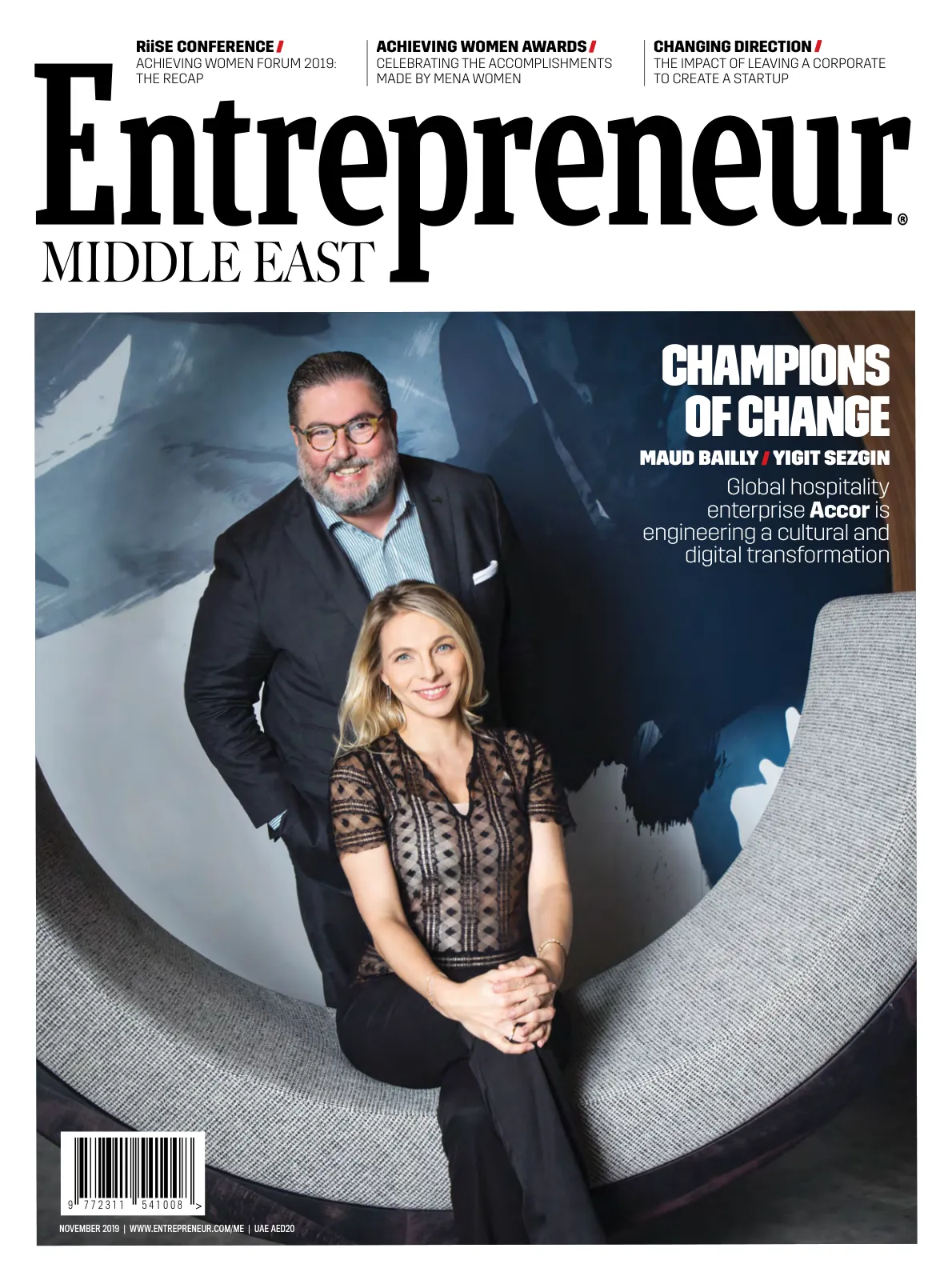
Entrepreneur Middle East, November 2019
Page 1
NOVEMBER 2019 | WWW.ENTREPRENEUR.COM/ME | UAE AED20
9
7 7 2 3 1 1
5 4 1 0 0 8
>
RiiSE CONFERENCE
ACHIEVING WOMEN FORUM 2019:
THE RECAP
CHANGING DIRECTION
THE IMPACT OF LEAVING A CORPORATE
TO CREATE A STARTUP
ACHIEVING WOMEN AWARDS
CELEBRATING THE ACCOMPLISHMENTS
MADE BY MENA WOMEN
champions
of change
MAUD BAILLY YIGIT SEZGIN
Global hospitality
enterprise Accor is
engineering a cultural and
digital transformation
Page 2
experience
downtown
living
The UAE’s most exciting new destination.
A journey of discovery for the whole family.
Where nature, fun and entertainment
come together.
800-Arada (27232)
arada.com
Page 3
3
November 2019 / ENTREPRENEUR.COM /
24
CONTENTS NOVEMBER 2019
Julia Gillard,
former Prime Minister of Australia
at the RiiSE Conference:
Achieving Women Forum 2019
36
26
Achieving Women
Awards 2019
20
INNOVATOR
CHAMPIONS OF
CHANGE
Maud Bailly and
Yigit Sezgin
Global hospitality
enterprise Accor is
engineering a cultural and
digital transformation.
26
THE RECAP
ACHIEVING WOMEN
AWARDS 2019
A look at the winners of
the 2019 Achieving Women
Awards, in association with
RiiSE, presented by du and
Accor, which celebrated
the accomplishments made
by MENA women in their
respective industries.
34
THE RECAP
RIISE CONFERENCE:
ACHIEVING WOMEN
FORUM 2019
Over 300 attendees and expert
speakers from around the
world participated in the RiiSE
Conference: Achieving Women
Forum 2019, presented by
Accor, in association with
Entrepreneur Middle East
and du.
70
START IT UP
Q&A
The next frontier
Sam Blatteis and Tammer
Qaddumi look at the thread
between innovation and
legislation in the UAE digital
economy.
50
INNOVATION FOR
IMPACT
BROUGHT TO YOU BY
MISK INNOVATION
Taking the leap
Saudi Arabia’s talent
pool is waking up to the
opportunities presented
by the country’s
entrepreneurial domain.
78
‘TREPONOMICS
SKILLSET
When revolution hits
evolution
Harvey Bennett of
AI-driven recruitment
platform Searchie shares
lessons from an AI startup’s
development (and growth)
in the MENA region.
Page 4
du.ae/businesscontrol
Control your business
with no contract.
Business Control Plan gives your employees
1GB
data
200
national minutes 200
Business Calling Circle
minutes
Page 5
Page 6
Memories create a journey you can always return to
©2019 The Ritz-Carlton Hotel Company, L.L.C.
Your urban adventure in the world’s most vibrant city begins with a luxurious stay at The Ritz-Carlton, Dubai International
Financial Centre. Indulge your senses with a serene experience in the comfort of our impeccable suites, enjoy the ease
of access to a bustling downtown with innovative food and beverage offerings, unforgettable arts scene, and world-class
shopping. On the sizzling evenings, retrieve to Sunken Garden for the best taste of local cuisine and ambiance. Whether
it’s a business trip, a family reunion, or a wedding anniversary, enjoy a memorable stay, and leave the rest to us.
Enjoy your Suite Upgrade Experience today. For reservations, please call +971 4 372 2555 or visit ritzcarlton.com/difc
Page 7
Page 8
Page 9
Page 10
Page 11
Page 12
12 / ENTREPRENEUR.COM / November 2019
20
CONTENTS NOVEMBER 2019
42 Erik Weihenmayer, the world’s first blind person to reach the summit of
Mount Everest, on what it means to live “a no barriers life”
80
MONEY
STARTUP FINANCE
Jumpstarting growth
Meddy's Haris Aghadi on the
11 lessons he learned when
raising a Series A round for
his health tech startup.
84
START IT UP
Q&A
One of a kind
The Project’s Saif Al Naji is
all about setting trends.
16
EDITOR’S NOTE
By Aby Sam Thomas
82
START IT UP
START IT UP FINANCE
“We got funded!”
The stories behind the
recent fundraising wins by
online learning platform
Almentor, as well as bulk
grocery e-commerce
platform BulkWhiz.
60
CULTURE
LIFE
Changing direction
Ian Dillon reflects on the
personal impact of leaving
a corporate to create a
startup.
54
TECH
SHINY
#TamTalksTech
Gadgets and doodads that
you might’ve missed out on,
sourced by a tech aficionado.
Yes, it’s okay to want them
all… and no, it’s not our
fault.
58
CULTURE
LIFE
What not to do when
starting up
Ayman Jaber looks at the
lessons from launching
-and failing at- an
entrepreneurial pursuit.
74
TECH
THE FIX
Evolving construction
Ramesh Jagannathan
explores advancing the
sector through cutting-edge
technological advancements.
61
CULTURE
LIFE
Likeability in business
The ability to make a
connection, and make the
other person like you is now
more relevant than ever.
86
START IT UP
Q&A
In the pursuit of greatness
Instabeat founder
Hind Hobeika on her
entrepreneurial journey
building a hardware
startup.
65
START IT UP
ECOSYSTEM
Keeping it real
Three myths about the
MENA entrepreneurship
ecosystem that need to
be tackled (for it to reach
greater heights of
success).
Maud Bailly,
Chief Digital Officer, Accor
Page 13
LESS TIME ON FUEL
MORE TIME ON MOVEMENT
Innovative fuel delivery service supplying quality fuel
and smart analytics for your fleet, anytime, anywhere.
Visit enoclink.ae/businesses or dial 800-ENOCLINK
Delivering fuel. Powering possibilities.
Page 14
14 / ENTREPRENEUR.COM / November 2019
SUBSCRIBE
Contact subscriptions@bncpublishing.net to receive
Entrepreneur Middle East every issue
EDITOR IN CHIEF Aby Sam Thomas editor@bncpublishing.net
CEO Wissam Younane wissam@bncpublishing.net
DIRECTOR Rabih Najm rabih@bncpublishing.net
CREATIVE LEAD Odette Kahwagi
MANAGING EDITOR Tamara Pupic
STARTUPS SECTION EDITOR Pamella de Leon
GROUP SALES DIRECTOR – B2B GROUP Joaquim D’Costa
COLUMNIST Tamara Clarke
PO Box 502511 Dubai, United Arab Emirates
P +971 4 4200 506 | F +971 4 4200 196
For all commercial enquiries related to Entrepreneur Middle East
contact sales@bncpublishing.net
All rights reserved 2019.
Opinions expressed are solely those of the contributors.
Entrepreneur Middle East and all subsidiary publications in the
MENA region are officially licensed exclusively to BNC Publishing
in the MENA region by Entrepreneur Media Inc.
No part of this magazine may be reproduced or transmitted in any
form or by any means without written permission of the publisher.
Printed by United Printing and Publishing
upp.ae
Images used in Entrepreneur Middle East are credited when necessary. Attributed use of
copyrighted images with permission. All images not credited otherwise Shutterstock.
Haris Aghadi
Laith Al-Qasem
Harvey Bennett
Sam Blatteis
Fida Chaaban
Tamara Clarke
Marc Cirera
Ian Dillon
Ayman Jaber
Ramesh Jagannathan
Megha Merani
Kim A. Page
Jayesh Patel
Tammer Qaddumi
CONTRIBUTORS
entrepreneur.com/me
ACCESS FRESH CONTENT DAILY ON OUR WEBSITE!
MIDDLE EAST
EntMagazineME
@EntMagazineME
Entrepreneur-me
EntrepreneurMiddleEast
EntMagazineME
EntMagazineME
EntMagazineME
MIDDLE EAST
In addition to our print edition, we’re bringing
you all sorts of industry news on our web
mediums. Joining us online means getting
relevant business and startup content in
real-time, so you’re hearing about the latest
developments as soon as we do. We’re looking
forward to interacting with our readers on all of
our social media and web platforms- like any
thriving business, we’re looking to give and take.
#TrepTalkME is already happening on all of our
digi platforms, and all good conversations go
both ways. See you on the web!
Page 15
Work better.
We believe working environments can inspire great work.
That’s why our workspaces are beautifully designed.
Ready-to-use O� ce Space, Coworking, Meeting Rooms,
Virtual O� ce & Flexible Working Plans
regus.ae | +971 4 313 2472
Page 16
16 / ENTREPRENEUR.COM / November 2019
EDITOR'S NOTE
L
ast month, Emirates
National Oil Com-
pany (ENOC) Group an-
nounced that it would
be launching ENOC
Link, a new digital ven-
ture that would see the
Government of Dubai-
owned oil and gas
entity start delivering
fuel at the doorsteps
of businesses and fleets across the
UAE, with a longer term plan to cater
to communities as well to serve the
general public. As a concept, there’s a
lot of similarity between ENOC Link’s
offering and what homegrown UAE
app CAFU, which was founded by
Rashid Al Ghurair (a board member
at Al Ghurair Investments, and the
founder of MENA Energy), has been
providing as a service in the UAE since
November 2018. This feeling of same-
ness between the two ventures was
compounded when a Gulf News article
on ENOC Link’s launch quoted ENOC
Group CEO Saif Al Falasi saying, “The
difference between us and CAFU is
safety. We’ve been in this business
many years, and have trained our staff
in case of all circumstances. There
will be new regulations, and services
will have to meet specifications. It
is my understanding that only three
main national oil companies (ENOC,
ADNOC, and Emarat) can sell fuel in
the UAE, and in the future, the gov-
ernment will regulate who is going to
be in the market or not.”
For those of us who champion entre-
preneurs and startups in the UAE, it
shouldn’t be hard to understand why
Al Falasi’s statement caused quite
a bit of chatter in the social media
space, as it went against many of the
public statements that have been
made about supporting innovators in
the country. ENOC’s moves was seen
by some as an example of how large
enterprises, by virtue of the capital
and resources they have, can elbow
out startups operating in a particular
domain, although it must be said here
that CAFU is quite well-funded as a
startup, having declared AED100 mil-
lion of total investments
to us in the September
2019 issue of Entrepre-
neur Middle East.
At the same time, while
there is a certain emo-
tional appeal to the “sup-
port our startups” cry
that went around Dubai
Twitter when ENOC Link
was announced, one must
remember that there is no
rule in the business realm
that bars well-established
corporates from swooping
in on a startup’s domain.
Commenting on ENOC’s
play, Arkan Partners
co-founder Ali Al-Salim told me in
an email: “It’s natural for the manage-
ment of any organization to seek out
new ways to grow their revenues and
margins… I don’t have advice for
ENOC, as their behavior is completely
rational, they need to increase rev-
enues in a market that is saturated,
and probably only grows in line with
population or GDP. Rolling out new
services is one way to explore ad-
ditional growth, and possibly margin
expansion.”
Robyn Brazzil, Director of the
startAD program at NYU Abu Dhabi,
agreed with Al-Salim, noting that
startups should always be prepared
for the fact that somewhere along
their business trajectories, they are
going to come up against competition,
and that can be anyone from another
young upstart, or an experienced
conglomerate. “It's just not a fair
Aby Sam Thomas, Editor in Chief, Entrepreneur Middle East,
and Rashid Al Ghurair, founder and CEO, CAFU
The entrepreneurial ecosystem weighs in on ENOC vs. CAFU
WHEN THE BIG GUYS COME KNOCKING, YOU KNOW
YOUR STARTUP HAS GOTTEN IT RIGHT
Imitation is the sincerest
form of flattery
Page 17
17
November 2019 / ENTREPRENEUR.COM /
playing field,” she said to me
over a phone call. “In any
case, someone with outside
resources can do more, but
then, obviously the startup
advantage is that they can
move quicker, and they can
be closer to the customer
in a lot of cases. Or that
this is their sole product or
service, whereas it may be a
new service, a new product
line, for a big corporate. So,
there are advantages to be-
ing a startup; it's just about
exploiting them.”
With that being said,
what can startups do if they
find themselves in such a
scenario- especially those
upstarts that may not have
as good of a financial back-
ing as CAFU? When I posed
this question to Nomod
founder Omar Kassim (per-
haps known best for being
the founder of e-commerce
marketplace JadoPado,
which Noon acquired in
2017), he replied, “Execute
fast and hard. Build things
and moats that are incred-
ibly difficult to overcome
by purely throwing capital
at the problem.” Al-Salim
added, “Being nimble is an
obvious advantage a startup
has over large incumbents.
Generally, the smaller you
are, the faster to market and
more customer-centric you
can be, versus larger bureau-
cratic organizations. In my
business career, I’ve person-
ally always found it more
rewarding to operate in an
overlooked niche, where you
have less competition and
enough time to build up a
defensible lead. Business
models and products that
depend on data are inter-
esting in that proprietary
data you capture is hard
–sometimes impossible– to
replicate. If you can build a
lead that depends on having
better data, even if a rival
has deeper pockets, they
don’t have the data you
have, hence their product
will never be as good.”
From a personal stand-
point, I must confess that
I didn’t see an issue at all
with ENOC venturing into
CAFU’s playing field. I actu-
ally thought that Al Ghurair
and his team should be
pretty proud that their of-
fering has gotten validation
in a sense, given that such
a well-established player
was essentially imitating
(and sparring with) them in
the public domain. Brazzil
agreed with this notion,
saying, “If I was in CAFU's
office, I would be kind of
smiling, because they're
being put on an equivalent
footing as this huge player.
So, I think that's something
to be applauded and kind
of recognized, that they are
there in the game. They're
being seen as a direct com-
petitor.”
This was the same vibe I
got from Al Ghurair himself,
when I got to chat with him
a couple of weeks after the
ENOC announcement was
made. “To be honest, I per-
sonally find it as a validation
to what we are doing, to the
model itself,” Al Ghurair
told me over a call. “Seeing
a conventional player come
into this space is proof that
the model is going to work.”
As for the safety standards
that govern CAFU’s opera-
tions, Al Ghurair pointed
toward all of the world-class
certifications and processes
the company has put in
place to ensure this, which
include partnerships with
entities like the Health and
Safety Executive in the UK,
TÜV Rheinland, and others,
as well as rigorous hiring
and training procedures to
make sure the startup’s staff
are up to standard before
they go out into the field.
Al Ghurair even proposed a
more cooperative approach
with ENOC to doing things
in this space. “We have car-
ried out more than 600,000
fill-ups, and I am extending
our experience [to ENOC],
because it’s a good practice
for both of us to collaborate
on the safety aspect,” he
said. “We also don’t want
them to do something un-
safe, because that will affect
the both of us.”
As for whether regulations
could be perhaps be put in
place to essentially control
the market, Al Ghurair dis-
missed that notion with the
conviction that the UAE’s
leadership wouldn’t allow
that to happen, as that’d
be stifling the country’s
progressive agenda for the
future. “My view is that I
belong to a country where
our leaders are forward-
looking,” he said. “They
support innovation, and
they want this country to
shine globally when it comes
to technologies and smart
cities. I know, as an entre-
preneurial landscape, the
UAE’s startup ecosystem is
quite young, but our leaders,
they will support this eco-
system.” At the same time,
Al Ghurair believes CAFU’s
customers are its biggest
advocates- and it’d be hard
to get something that has
got the buy-in of so many
people to be regulated out of
existence anyway.
And that’d be the message
I’d leave all you entre-
preneurs with: persevere,
persist, and put all your
effort in building a product
and service that people love.
After all, that will be what
guarantees your success in
the long-term.
Aby Sam Thomas
Editor in Chief
@thisisaby
aby@bncpublishing.net
Ali Al-Salim, co-founder, Arkan Partners
Robyn Brazzil, Director, startAD program
at NYU Abu Dhabi
Omar Kassim, founder, Nomod
Page 18
18 / ENTREPRENEUR.COM / November 2019
IN THE LOOP
IMAGE CREDIT DUBAI STARTUP HUB
HE Majid Saif Al Ghurair during the Market Access launch event
S
audi entrepreneurs, this is an opportunity
you shouldn’t miss. As part of the MIT
Enterprise Forum global network, the MIT
Enterprise Forum Saudi Arabia, along with Bab
Rizq Jameel, an initiative of Community Jameel,
has launched the fourth annual edition of the
Saudi Startup Competition. The competition is
designed to showcase Saudi entrepreneurs and
provide an avenue to present their projects and
ideas, and have the opportunity to gain cash
prizes totaling more than SAR325,000.
The competition has three tracks for interested
applicants. First up, is Ideas Track, which is open
for scalable ideas that already have a proof of
concept and a validated business model and
plan for growth. Next, is the Startup Track,
which targets high impactful startups legally
registered in KSA and has a working product or
service, traction and sales. The last is the Social
Track, which is designed for social enterprises in
KSA that has a working product/service which
addresses a social challenge with a for-profit
angle. Winners in the Ideas Track have a chance to
win SAR20,000 for the first winner, SAR15,000
for the second winner and SAR10,000 for the
third winner, while the Startup Track’s first winner
gains SAR100,000, SAR25,000 for the second
winner, and SAR15,000 for the third winner.
As for the Social Track, the first winner will
gain SAR100,000, while the second winner will
gain SAR25,000, and the third winner will gain
SAR15,000.
A panel of judges from the entrepreneurial
community will evaluate the applicants, while the
shortlisted 45 teams will proceed for the semi-
finals round in January 2020. Running for more
than six months, e-induction briefs have been
organized in selected universities and educational
institutions across KSA from September to mid-
December. Teams qualified for the semi-finals will
have access to activities, orientation sessions and
bootcamps with specialists and experts. Finalists
also will have the opportunity to participate in
the Saudi StartSmart Forum, a program of the
global network of MIT Enterprise Forum. Saudi
StartSmart is designed to encourage and guide
entrepreneurs through workshops and programs
related to technology and innovation. The nine
winning teams, three from each track, will also be
announced.
Registration have already begun, and will continue
until December 21, 2019. mitefsaudi.org
S
even major corporates
have signed up to Dubai
Startup Hub’s latest
edition of Market Ac-
cess, which pairs leading
companies in the UAE
with startups that offer innova-
tive solutions addressing their
key challenges. Sanofi, Mediclinic,
Sumitomo Corporation, Accenture,
Dubai South, Emirates Post Group
and Emirates NBD will list a series
of challenges on the Market Access
online portal, giving startups the
chance to submit their solutions
online and pitch their business
concepts to potential business
partners, Dubai Startup Hub, the
entrepreneurship arm of Dubai
Chamber of Commerce and Indus-
try, said in a statement.
In its fourth cycle, the Market
Access program had received
more than 500 applications from
corporate and startups in previous
rounds. The latest edition has been
revamped to offer a one-year mem-
bership to corporate participants,
specialized workshops and access
to a wider network of solutions,
as well as the opportunity to list
multiple challenges. Meanwhile,
startups that make the cut will
benefit from training and pitch-
ing workshops, access to lucrative
business opportunities, as well as
a platform to boost their market
exposure and build their brand
reputation.
Speaking during a launch cer-
emony, H.E. Majid Saif Al Ghurair,
Chairman of Dubai Chamber,
stressed the significance of
programs like Market Access in
providing an effective platform for
fostering innovation and forging
partnerships between established
companies and startups in Dubai.
He added that many large local
and global companies have realized
the benefits of collaborating with
startups, with such partnerships
are helping organizations success-
fully navigate the Fourth Industrial
Revolution and boost their com-
petitive edge.
Launched in 2017, Market Access
is a first-of-its-kind program that
aims to enhance cooperation and
facilitate deals between innovative
startups and SMEs from around
the world, and leading companies
and government entities in Dubai.
Dubai Chamber launched Dubai
Startup Hub in 2016 as an online
platform to connect startups,
entrepreneurs, developers, venture
capitalists and students, enabling
them to learn about new opportu-
nities and create new partnerships
that stimulate economic growth.
dubaichamber.com/dubaistartuphub/marketaccess
Dubai Startup Hub launches revamped Market Access
program for startups and SMEs
FOSTERING COLLABORATION
The new edition of MIT Enterprise Forum
Saudi Arabia Startup Competition is now
open for applications
INNOVATIONS WELCOME
Page 19
Page 20
20 / ENTREPRENEUR.COM / November 2019
INNOVATOR
Yigit Sezgin, Accor’s Chief Commercial Officer
for the Middle East and Africa (MEA),
and Maud Bailly, Accor's Chief Digital Officer
Page 21
21
November 2019 / ENTREPRENEUR.COM /
CHAMPIONS OF CHANGE | ACCOR IS ENGINEERING A CULTURAL AND DIGITAL TRANSFORMATION
CHAMPIONS
OF CHANGE
MAUD BAILLY YIGIT SEZGIN
GLOBAL HOSPITALITY ENTERPRISE ACCOR IS ENGINEERING
A CULTURAL AND DIGITAL TRANSFORMATION
by ABY SAM THOMAS | PHOTOGRAPHY FAROOQ SALIK
>>>
M
any companies talk about gender equality, diversity, and inclusion,
but only a small percentage put meaningful programs in place to
ensure their vision becomes a reality,” says Yigit Sezgin, Accor’s
Chief Commercial Officer for the Middle East and Africa (MEA), as
he describes what’s particularly noteworthy about RiiSE, the gender
parity and diversity platform that his global hospitality company has
been spearheading. Sezgin’s sentiment is echoed by Accor Chief
Digital Officer Maud Bailly, who co-chairs RiiSE with AccorInvest
CEO John Ozinga. “RiiSE was unveiled a year ago, and it announced
Accor’s renewed commitment to gender parity and equality,” Bailly says. “Previously known
as WAAG (Women at Accor Generation), this platform was in place for over five years.
However, the time came to update this platform and to ensure that men were also part of
the conversation; hence, the double ii’s in RiiSE. We also widened the platform to deepen
the commitment on not only gender parity, but also diversity as a lever for collective
performance.” The RiiSE platform today boasts of 30,000 men and women from 4,900 hotels
in 111 countries as its members, and more than 30% of them are working out of the MEA.
Page 22
22 / ENTREPRENEUR.COM / November 2019
“THE MINDSET THAT I AM TRYING TO CREATE,
IN LINE WITH OUR CULTURAL TRANSFORMATION,
IS ONE OF TRANSMISSION, EMPOWERMENT,
MENTORING, CELEBRATION, AND TRUST.”
INNOVATOR
Maud Bailly,
Chief Digital Officer, Accor
Besides its own efforts with RiiSE, Ac
cor is also a signatory of the HeForShe
campaign initiated by the United Na
tions, which invites people of all genders
“to stand in solidarity with women to
create a bold, visible and united force for
a gender equal world.” The company has
made several public pledges to realize this,
which include eliminating the pay gap
between men and women at the enter
prise, as well as raising the number of
female general managers for its properties
from its current figure of 29% to 35% by
the end of 2020, with a longer term goal
of making it 50%. Of course, such efforts
will require Accor to change internally
as an organization, and that’s a task that
Bailly has on her hands as she leads the
RiiSE initiative. “RiiSE has a mandate to
permeate our organization and serve as a
foundation, especially during waves upon
waves of change at Accor, from acquiring
new brands, to integrating new companies
and cultures,” she explains. “The mindset
that I am trying to create, in line with
our cultural transformation, is one of
transmission, empowerment, mentoring,
celebration, and trust.”
Now, it’s not just culture that Bailly has
been tasked with changing at Accor- she’s
also been spearheading the digital trans
formation of the enterprise as well. “Our
‘IMPACT’ strategy was launched at the
end of 2017, with a concrete roadmap of
three years- to precisely support Accor's
digital and cultural transformation. But,
beyond this timeframe, IMPACT strategy
is a never-ending process, enabling our
company to constantly reinvent itself, in
a fast-moving environment facing three
main trends: consolidation, diversifica
tion and acceleration, and in an asset-light
environment, where we have to prove,
more than ever, our added value to our
guests and to our owners.” Given the size
and scale of the Accor enterprise, saying
that converting this vision into reality
is a complicated process is definitely an
understatement, and while one may think
the complexity involved is largely owing to
the tech element in these kind of efforts,
Bailly disputes that notion. “The biggest
challenge of any digital transformation
is not about technology, but the human
element,” she explains. “There is no digital
transformation without a deep cultural
transformation. In order to fully embrace
the digital change, you need to change the
mindset- from a culture of a project, to a
product.”
“Contrary to what I can read online and
hear in some specialized events, digital
transformation is not a smooth process; it
can be long, difficult, and not everyone in
the organization is ready to embrace this
dramatic change,” Bailly continues.
Page 23
23
November 2019 / ENTREPRENEUR.COM /
>>>
“ALL IS QUITE SIMPLY
A PLATFORM THAT GIVES
CUSTOMERS ACCESS TO
THE WORLD OF ACCOR–
A DOORWAY TO NEW
BENEFITS, LOYALTY STATUS
LEVELS, AND EXPERIENCES
THAT WILL REDEFINE HOW
THE GROUP INTERACTS
WITH GUESTS."
Yigit Sezgin, Accor’s Chief Commercial Officer
for the Middle East and Africa (MEA),
and Maud Bailly, Accor's Chief Digital Officer
CHAMPIONS OF CHANGE | ACCOR IS ENGINEERING A CULTURAL AND DIGITAL TRANSFORMATION
“I think that one of the hardest parts of
the transformation is to make sure that
your internal assets match with your am
bitions. Migrating your digital assets into
the cloud to be ready for next AI-based
or API-based technologies is one thing,
but what about our most valuable asset:
people! At Accor, we are convinced that
technology is nothing without people,
and this is why the digital transforma
tion is strongly supported by initiatives
to accompany the teams. These include
pedagogy on all new concepts, creation
of an agile center to coach teams, set
up of trainings around product culture,
perpetuation of three feature teams, crea
tion and animation of three communities
(scrum, product owner, data worldwide),
rapprochement between IT develop
ment, and IT operations in a shared open
space. On top of all these initiatives, the
‘Tech Inside’ project aims at internal
izing 100 IT developers in order to secure
today’s and tomorrow’s skills. On a more
personal perspective, transformation is
also a challenge for me! I need to be able
to constantly challenge the roadmap, ac
cept to deliver fast but one step at a time,
renounce to projects with a lower priority
to respect the capacity planning, let the
customer or data make the final decision,
when we hesitate between two features or
design.”
One of the efforts that Bailly and her
team at Accor have been working on in
terms of its digital transformation is an
initiative called Accor Live Limitless
(ALL), which is a reimagination of its
online portal (accorhotels.com) and its
loyalty platform (Le Club AccorHotels).
“ALL is quite simply a platform that gives
customers access to the world of Accor– a
doorway to new benefits, loyalty status
levels, and experiences that will redefine
how the group interacts with guests, and
this cutting-edge lifestyle-focused digital
transformation is part of our DNA,”
Sezgin explains. “ALL, which goes live
before the end of the year, brings together
accorhotels.com and Le Club AccorHotels
to create a single global distribution and
loyalty platform for our guests, delivered
through a new app and website, and sup
ported by a dedicated call center. This
centralization transforms augmented
hospitality into a tangible experience
for customers. Mirroring Accor’s vastly
expanded portfolio, ALL offers guests pre
mium statuses, enriched benefits, exciting
partnerships, and inspiring experiences.
Benefits apply to the group’s entire eco
system, and experiences go beyond hotel
stays In the MEA, we’ve built genuine
partnerships with Bulldozer Group, which
brings a network of leading edge res
taurant and entertainment brands. This
includes BASE Dubai that plays host to A-
list celebrities, as well as exclusive access
during Formula 1 to the Cipriani terrace in
Abu Dhabi overlooking the stunning Abu
Dhabi Yas Marina Circuit, special offers at
Gaia, Scalini, Shanghai ME, and more.”
The manner in which Accor is cur
rently reimagining itself as a hospitality
enterprise is especially interesting to
watch given its current standing on the
global landscape- its international net
work boasts of more than 726,000 rooms
across 4,900 hotels in 111 countries, and
a robust pipeline of 202,000-plus rooms
in 1,153 hotels. In the MEA, Accor is the
largest hotel operator in the region, han
dling more than 61,000 keys in 282 prop
erties across 31 countries, and 150-plus
hotels are signed and under development.
“But the numbers alone do not make
us different,” Sezgin says. “Firstly, our
portfolio of 39 unique hospitality brands
is unrivalled. It includes some of the most
dynamic and innovative lifestyle concepts,
following our partnerships with and
equity stakes in companies such as sbe,
25Hours, Rixos, and Mantis, to name a
few. We also remain a leader in the luxury
hotel market with brands such as Raffles,
Banyan Tree, Fairmont, and Sofitel. In this
respect, Accor is much more than a hotel
operator- it is an augmented hospitality
group, with a growing portfolio of brands
and services designed to shape the way its
guests ‘Live, Work, and Play’, and this is
what really sets us apart from the compe
tition. We aim to be a ‘lifestyle enabler,’
connecting different parts of guests’ lives,
so they can enjoy Accor hospitality any
time, anywhere. We believe extraordinary
experiences should elevate everyday life,
not just during a vacation, so augmented
hospitality offers experiences beyond
overnight stays, and makes a pledge to
interact with guests more frequently.”
Page 24
24 / ENTREPRENEUR.COM / November 2019
INNOVATOR
ASK THE EXEC
ACCOR’S YIGIT SEZGIN ON HOW TO GO
ABOUT ACHIEVING GENDER PARITY
IN YOUR ORGANIZATION
1. ACTIONS SPEAK LOUDER THAN WORDS
“Don’t just talk about the importance of
gender equality, diversity, and inclusion,
put a meaningful program in place to en-
sure your vision becomes a reality.”
2. PRACTICE WHAT YOU PREACH
“Demonstrate to your team or workforce
that you are putting the program into
action, through training and development,
etc.”
3. COMMUNICATION SPEAKS VOLUMES
“Make sure you communicate the program
effectively to all staff members to ensure
they understand what it is, and why you
are doing it– and what your goals are.”
4. IT WORKS BOTH WAYS
“Once you have communicated your pro-
gram for gender quality and diversity, ask
for staff feedback. Ask if it hits the mark, or
if it requires finessing through colleague
input.”
5. INVEST IN TRAINING
“Workshops or seminars can help com-
municate your gender quality program,
and provide a platform to share ideas for
improvement or fine-tuning. Once a pro-
gram is in place, invest in training or tools
that meet your program goals.”
6. COMPANY CULTURE
“Ensure all of the above is implemented
to effectively transform, enhance, and
shape your company culture, based on
teamwork, collaboration, respect, empow-
erment, and above all, equality.”
One of the efforts that
Bailly and her team at Accor
has been working on in terms
of its digital transformation is
an initiative called Accor Live
Limitless (ALL), which is a
reimagination of its online portal
(accorhotels.com) and its loyalty
platform (Le Club AccorHotels).
While initiating changes like these are
challenging in their own right, they do
bode well for the future of the industry
as a whole, and Bailly agrees with this
notion. “Sébastien Bazin, Chairman and
CEO, and my boss, said it best when
describing travel and tourism as a blessed
industry,” Bailly says. “To put this into
greater perspective, the industry accounts
for 10.4% GDP (as a percentage of global
GDP), one out of 10 jobs is supported by
travel and tourism, there were 1.3 billion
international outbound travelers in 2017,
as opposed to 300 million during the
1980s. While our industry has a sig
nificant impact globally, the competitive
landscape that we operate in does pose
challenges. It is polarized around three in
tertwining buckets; namely, digital giants
such as booking.com, Expedia, Airbnb, and
Ctrip; 10 major hotel groups ranging from
six from the US, three from China and one
in Europe (Accor); and independents such
as Tencent, Google, Amazon, Alibaba, and
Facebook. I believe what I have described
earlier with Accor’s digital and cultural
transformation, our IMPACT strategy,
increased guest personalization and sticki
ness, a completely new ecosystem vis-à-
vis loyalty and ALL, and empowerment,
diversity, and inclusion as the foundation
of this transformation, will well equip us
to navigate and excel in this landscape.
We want to multiply touchpoints with our
guests, as it is key to better know them,
and offer personalized experiences.”
While it’s pretty evident that Accor is
leaving no stone unturned in its efforts
to tackle wide-ranging shifts in its sector,
the company’s leadership is also very clear
that all of what needs to be achieved will
have to come from within the enterprise.
“The key to achieving organizational goals
is always to create the right company
culture,” Sezgin explains. “You can have
a great strategy in place and invest in the
best technology, but if you don't com
municate this well to your team, you are
unlikely to meet your goals. At the same
time, equipping talent with the right
knowledge and training and motivating
and inspiring them, is paramount. We
are providing the team with cutting-edge
digital tools designed to help them deliver
maximum results. At the same time, in
preparation for the launch of ALL, we
launched practical training seminars
to over 800 colleagues in 15 countries
across the region. The intention of these
seminars was to demonstrate how ALL
will transform our approach to generating
customer loyalty, and its importance to
our overall operational strategy. I believe
that with our exceptionally talented team,
brilliant brands, and an unrivalled digital
presence, we are well placed to not only
maintain our edge as the region’s leading
hotel operator, but attain new heights of
success over the coming decade.”
Page 25
Page 26
A PRODUCTION BY
IN ASSOCIATION WITH
PRESENTED BY
PRESENTED BY
SUPPORTED BY
ECOSYSTEM PARTNER
SILVER ALLY
SILVER ALLY
EDUCATION PARTNER
GOLD ALLY
GOLD ALLY
GOLD ALLY
PLATINUM ALLY
26 / ENTREPRENEUR.COM / November 2019
Page 27
Held on October 21,
2019 at the Sofitel Dubai
The Palm Resort & Spa,
Entrepreneur Middle East’s
2019 Achieving Women
Awards, in association
with RiiSE, presented by
du and Accor, celebrated
the accomplishments made
by MENA women in their
respective industries, and
have set themselves apart as
role models in the region’s
business community.
The event, which is in its
first edition, is organized by
BNC Publishing, the media
house behind Entrepreneur
Middle East, and saw a total
of 23 awards presented at
the ceremony, with all of
the winners having made
significant contributions
to drive the Middle East
economy, and thereby raising
the bar for their industries.
Kicking off the event, Wissam
Younane, CEO of BNC
Publishing, applauded the
outstanding achievements of
the winners, and reiterated
Entrepreneur’s dedication to
elevate MENA’s promising
women in business and
the consistent leading
performance in their entities.
The 2019 Achieving Women
Awards, was a production of
Entrepreneur Middle East,
in association with RiiSE,
presented by du and Accor.
The event was supported
by Dubai Chamber of
Commerce and Industry and
Dubai Startup Hub, as well
as Platinum Ally, Berkeley
Assets; Gold Allies, Okadoc,
Regus and Multibank Group;
Silver Allies, Virtuzone and
Savills; Education Partner,
The University of Manchester
Middle East Centre; and
Ecosystem Partner, Dubai
Business Women Council.
Wissam Younane,
CEO, BNC Publishing
The winners of Achieving Women Awards 2019
Tom Urquhart,
emcee for the Achieving
Women Awards 2019
27
November 2019 / ENTREPRENEUR.COM /
Page 28
DIGITAL INFLUENCE Karen Wazen Bakhazi, founder, Karen Wazen Eyewear
DESIGN Noor Al Muhaideb, Founding Partner, Opaal Interiors and Detay Living
FACILITY MANAGEMENT Sara Momtaz, Executive Director, Khidmah
CORPORATE FASHION Melis Yazici, co-founder and Managing Director,
Dress Best
HUMAN CAPITAL Carine Bouery, founder and CEO, Synchro Comms
LOGISTICS Soumia Benturquia, founder and CEO, Fodel
RETAIL Asil Attar, CEO, Damas Jewellery
EDUCATION Randa Bessiso, Founding Director, The University of Manchester
Middle East Centre
REAL ESTATE Clementine Malim, Associate in International Residential Sales
in Middle East, Savills
HEALTHCARE Joelle Mardinian, founder, Clinica Joelle
HOSPITALITY Roula Jouny, Group CEO, FTI Group
WOMEN EMPOWERMENT du Women Council
SOCIAL ENTERPRISE Assia Riccio, founder, Evolvin Women
SOCIAL IMPACT Helen Al Uzaizi, CEO, BizWorld UAE
FINTECH Mirna Sleiman, founder and CEO, Fintech Galaxy
ENTREPRENEURSHIP ECOSYSTEM Natalia Sycheva, Manager for
Entrepreneurship, Dubai Chamber of Commerce and Industry
PRIVATE EQUITY Archna Cummings, Head of Operations, Berkeley Assets
IMPACT INVESTMENT Zahara Malik, co-founder and CEO, Grosvenor Capital
ANGEL INVESTMENT Sonia Weymuller, Founding Partner, VentureSouq
VENTURE CAPITAL Noor Sweid, General Partner, Global Ventures
CONTRIBUTION TO BUSINESS Zainab Mohammed, CEO, Property Management
DIVERSITY AND INCLUSION Zain Group
RiiSE AWARD Preveena Ageteela and Sarah Fernandez, Accor
WINNERS
Achieving Women Award in
Digital Influence
Karen Wazen Bakhazi, Founder,
Karen Wazen Eyewear
The award was presented by Wissam
Younane, CEO, BNC Publishing
Achieving Women Award in Design
Noor Al Muhaideb, Founding Partner,
Opaal Interiors and Detay Living
The award was presented by Rachael
Kennerley, Senior Surveyor, Asset
Manager, Savills
Achieving Women
Award in Human Capital
Carine Bouery, founder and
CEO, Synchro Comms
The award was presented
by Omar Jackson, Partner,
Berkeley Assets
Achieving Women Award
in Corporate Fashion
Melis Yazici, co-founder and
Managing Director, Dress Best
The award was presented by
Omar Jackson, Partner, Berkeley
Assets
28 / ENTREPRENEUR.COM / November 2019
Page 29
Achieving Women Award in Healthcare
Joelle Mardinian, founder, Clinica Joelle
The award was presented by Wissam Younane,
CEO, BNC Publishing
Achieving Women Award in Retail
Asil Attar, CEO, Damas Jewellery
The award was presented by
Wissam Younane, CEO, BNC Publishing
Achieving Women Award
in Education
Randa Bessiso, Founding Director,
The University of Manchester
Middle East Centre
The award was presented by Wissam
Younane, CEO, BNC Publishing
Achieving Women Award
in Logistics
Soumia Benturquia,
founder and CEO, Fodel
The award was presented by
Khalil Cheikha, Regional Account
Manager, MultiBank Group
Achieving Women Award
in Facility Management
Sara Momtaz, Executive
Director, Khidmah
(collected on her behalf)
The award was presented by
Rachael Kennerley, Senior
Surveyor, Asset Manager, Savills
29
November 2019 / ENTREPRENEUR.COM /
Page 30
Fastest Growth -
Harmeek Singh,
founder and
Chairman, Plan B
RiiSE award
Preveena Ageteela and
Sarah Fernandez, Accor
The award was presented by
Wissam Younane, CEO, BNC Publishing
Achieving Women
Award in Hospitality
Roula Jouny, Group CEO,
FTI Group
The award was presented
by Yigit Sezgin, Chief
Commercial Officer Middle
East & Africa, AccorHotels
Achieving Women Award
in Social Enterprise
Assia Riccio, founder,
Evolvin Women
The award was presented by
Sami Nasser, Chief Operating
Officer Middle East & Africa,
AccorHotels
Achieving Women Award
in Real Estate
Clementine Malim, Associate
in International Residential Sales
in Middle East, Savills
The award was presented by
Wissam Younane, CEO,
BNC Publishing
Osman Sultan,
CEO, du, speaking at the Achieving
Women Awards 2019
30 / ENTREPRENEUR.COM / November 2019
Page 31
Achieving Women Award
in Impact Investment
Zahara Malik, co-founder
and CEO, Grosvenor Capital
The award was presented by
Fodhil Benturquia, founder
and CEO, Okadoc
Achieving Women
Award in Private Equity
Archna Cummings,
Head of Operations,
Berkeley Assets
The award was presented
by Dimple Jansari, General
Manager, Regus Business
Center
Achieving Women Award
in Women Empowerment
du Women Council
The award was presented by Yigit
Sezgin, Chief Commercial Officer
Middle East & Africa, AccorHotels
Achieving Women Award in Entrepreneurship Ecosystem
Natalia Sycheva, Manager for Entrepreneurship,
Dubai Chamber of Commerce and Industry
The award was presented by Dimple Jansari, General Manager, Regus Business Center
Achieving Women
Award in Fintech
Mirna Sleiman, founder
and CEO, Fintech Galaxy
The award was presented
by Wissam Younane, CEO,
BNC Publishing
31
November 2019 / ENTREPRENEUR.COM /
Page 32
Achieving Women Award
in Diversity and Inclusion
Zain Group
The award was presented by Wissam
Younane, CEO, BNC Publishing
Achieving Women Award
in Social Impact
Helen Al Uzaizi, CEO,
BizWorld UAE
The award was presented by
Wissam Younane, CEO,
BNC Publishing
Achieving Women Award
in Angel Investment
Sonia Weymuller, Founding Partner,
VentureSouq (collected on her behalf)
The award was presented by Fodhil
Benturquia, founder and CEO, Okadoc
Achieving Women Award
in Contribution to Business
Zainab Mohammed, CEO,
Property Management
The award was presented by Wissam
Younane, CEO, BNC Publishing
Achieving Women Award
in Venture Capital
Noor Sweid, General Partner,
Global Ventures
The award was presented by Wissam
Younane, CEO, BNC Publishing
32 / ENTREPRENEUR.COM / November 2019
Page 33
33
November 2019 / ENTREPRENEUR.COM /
A
s an organization
that strongly sup-
ports diversity and
inclusivity of all
forms –which can
be seen through the
employment of staff from over
70 nationalities- creating the du
Women Council was a very im-
portant milestone for du, given
the male-dominated industry it
operates in. Since the council’s
launch in January 2019, and
in line with the UAE Vision
2021, the Council has created a
compelling three-year roadmap,
focusing on the key building
blocks required for sustainable
success going forward, from
leadership commitment to cul-
ture change, from talent cycle to
policies, structures, practices,
gender-balance related-commu-
nication, and dashboards.
The du Women Council
forms the dynamic force that
drives excellence towards the
establishment of an inclusive
organization, and advancing
du towards becoming the best
organization for gender balance
within the UAE. In order to
achieve this objective, the coun-
cil benefits from the engage-
ment of an incredible number
of internal champions, who are
supporting the Council’s key
initiatives, bringing excitement
within du employees, and open-
ing the door to a constructive
dialogue among the various
departments including both
men and women.
The company leadership is
fully supportive of this vision,
and the various initiatives that
the council has embarked on.
This reaffirms the commitment
from the company towards
making the council’s vision a re-
ality, which is for du to become
the recognized leading company
in gender balance across the
UAE. In fact, du CEO, Osman
Sultan, has said: “The achieve-
ment of female workplace
empowerment at du comes
down to our organization-wide
impetus to address the leader-
ship’s agendas for tolerance and
inclusivity at a granular level.”
Hanan Ahmad, Chairwoman
of the du Women Council,
added: “The hard work that
has gone into the formation of
the du Women Council mirrors
our commitment to empower-
ing women, and emphasizes
the pivotal role women have
in both society and all sectors
across the country. The UAE
leadership’s progressive stance
towards diversity is alive and
flourishing within our day-to-
day operations, and is repre-
sented by the council’s enlight-
ened steps to move us closer
to bringing the UAE’s women
empowerment and leadership
agenda to life.”
“At du, women make 29% of
the workforce. It is a pleasure to
be part of something as dynamic
and iconic as the du Women
Council. This is because we are
proactively working towards
creating a spirit of tolerance
and inclusion, bestowed to us
by the UAE leadership, that will
enhance the performance and
participation of female employ-
ees in the economic and social
progress of du and the country”
stated Hanan Ahmed.
By setting the trend and
breaking convention, du is ac-
tively leading the next chapter
for female equality, and influ-
encing all industries and organi-
zations to embrace the potential
of their highly talented and
engaged female human capital.
Gender balance, diversity, and
inclusion are important pillars
for the success of any organiza-
tion, and a platform like the du
Women Council is essentially a
key driver for du to achieve this
success.
Achieving Women
Awards 2019
The du Women Council explains why (and how) the platform
is diversity and inclusion in the workplace
SETTING THE TREND
Osman Sultan, CEO, du, speaking at
the Achieving Women Awards 2019
on the du Women Council
“WE ARE PROACTIVELY
WORKING TOWARDS
CREATING A SPIRIT
OF TOLERANCE AND
INCLUSION, BESTOWED
TO US BY THE UAE
LEADERSHIP."
The du Women Council
IMAGE COURTESY DU
Page 34
CONFERENCE
ACHIEVING WOMEN FORUM
Presented by
In association with
34 / ENTREPRENEUR.COM / November 2019
Supported by
B
ringing together expert speak
ers from around the world
and over 300 attendees, the
RiiSE Conference: Achieving
Women Forum 2019, presented
by Accor, in association with
Entrepreneur Middle East, and du, was held
on Monday, October 21, 2019 at Sofitel Dubai
The Palm Resort & Spa. Held in partnership
with RiiSE, Accor’s global parity and diver
sity platform that boasts of a global mem
bership of over 25,000 men and women
from over 4,000 hotels and 100 countries,
the event also had the support of Dubai
Chamber of Commerce and Industry and
Dubai Startup Hub, as well as Platinum Ally,
Berkeley Assets; Gold Allies, Okadoc, Regus,
and Multibank Group; Silver Allies, Virtuzone
and Savills, Education Partner, The Univer
sity of Manchester, and Ecosystem Partner,
the Dubai Business Women Council.
The RiiSE Conference: Achieving Women
Forum 2019 commenced with opening
remarks by Wissam Younane, CEO of BNC
Publishing, the media house behind Entre
preneur Middle East, who noted that the
Achieving Women Forum’s partnership with
RiiSE boosted its mission of elevating the
conversation around women in the region’s
business arena. “We are in awe of how this
platform has been amplified by people like
you in the audience today,” Younane said.
“We’ve gotten numerous stories of impact
as a direct result of the Achieving Women
Forum. It is a platform created for you, that
was then adopted by you; our community
of achieving women who turned this annual
event into a tool, and that is what has taken
it to the next level.”
Page 35
35
November 2019 / ENTREPRENEUR.COM /
Sebastien Bazin,
CEO, Accor
Speaking on behalf of Accor, CEO Sebastien
Bazin remarked on the conference’s objec
tive of providing a platform for diversity and
inclusion, and how it aligns with his group’s
mission to advocate for gender parity, while
Maud Bailly, Chief Digital Officer of Accor
noted the significance of the platform as a
driver of growth for women in the business
arena. Getting the conference started with
her welcome note, Hanan Ahmed, Senior
Vice President – Corporate Governance and
Company Secretary at du, and Chairwoman
of EITC Women Council, pointed out the
rising opportunities for today’s women in
business in the region, and how the future
requires a more united front from both
women and men. “Together we are stronger,
together we can rise,” she said.
Moderated by Julia Chatterley, anchor
and correspondent, CNN, the first of the
panel discussions under the title Overcom
ing Adversity explored perceptions around
roadblocks in lives and careers, the different
ways they can be overcome, and how such
situations can be turned into learning expe
riences. The panelists included Sebastien
Bazin, CEO, Accor; Hannah Beswick, Partner
ships Development Specialist, UN Women;
Dr. Nazli Neftci, clinical psychologist and
psychotherapist, Hamdi Kulahcioglu, Gen
eral Manager – The Deal, Chalhoub Group;
Lily Hoa Nguyen, owner and Executive Chef,
Vietnamese Foodies; and Jessica Smith
OAM, paralympian, author and speaker.
The discussion was followed by a keynote
speech by Erik Weihenmayer, the world’s
first blind person to reach the summit of
Mount Everest, who gave his personal take
on overcoming barriers and fears, and engi
neering your own path for the future.
The second panel discussion, titled Break
ing The Glass Ceiling, looked into tried-and-
tested techniques and tactics that female
executives have (and should make use of)
to advance themselves in the workplace,
with them sharing actionable advice that
can be implemented to advance women’s
careers. The discussion was driven by pan
elists Roula Jouny, Group Managing Director,
FTI Group; Debbie Stanford-Kristiansen, CEO,
Novo Cinemas; Dr. Alia Al Serkal, Vice Presi
dent – People Learning and Growth, du; and
Assia Riccio, founder, Evolvin’ Women.
The forum came to an end with a fireside
chat featuring Julia Gillard, former Australian
Prime Minister, and Maud Bailly, Chief Digital
Officer, Accor, both of whom advocated for
more women in leadership roles to foster
new ideas, as well as for creating new
avenues for diversity and inclusion.
Page 36
36 / ENTREPRENEUR.COM / November 2019
The former Prime Minister of Australia spoke at the RiiSE Conference:
Achieving Women Forum 2019 on her insatiable ambition for the
creation of a more equitable landscape for women and men by TAMARA PUPIC
JULIA GILLARD
NO HOLDING BACK
“GLOBALLY, IN MANY AREAS,
FEMALE LEADERSHIP IS LOWER
THAN 30%; SOME STATISTICS
EVEN SHOW THAT IT IS CLOSE
TO 20%. SO, I DID WANT TO MAKE
A CONTRIBUTION TOWARDS
WORKING OUT THE BEST WAY
TO ENSURE THAT WOMEN
CAN HAVE EQUAL
JOURNEYS TO MEN.”
CONFERENCE
ACHIEVING WOMEN FORUM
Julia Gillard,
former Prime Minister of Australia
speaking at the RiiSE Conference:
Achieving Women Forum 2019
Page 37
37
November 2019 / ENTREPRENEUR.COM /
“IT DID GET CRAZY, AND
ONE OF THE THINGS I HAVE
LEARNT IS THAT BECAUSE
I HAD NOT CALLED IT OUT
EARLIER, IT GOT HARDER TO
CALL IT OUT LATER.”
NO HOLDING BACK | JULIA GILLARD
Julia Gillard,
former Prime Minister of Australia
at the RiiSE Conference:
Achieving Women Forum 2019
>>>
A
s the stage got set for the
last session of the RiiSE
Conference: Achieving
Women Forum 2019,
presented by Accor, in
association with En-
trepreneur Middle East
and du, it was interesting to see that the
number of people in the audience did not
decrease, as usually happens at business
events. Of course, the reason for this
was our guest speaker, former Australia
Prime Minister Julia Gillard, famous
around the world for her support of edu-
cation, women's leadership, and mental
health-related initiatives. “My life has
taught me that there really are things
that hold women back, so I’m hungry to
see us get together, and clear those bar-
riers out of the way, so that we can see
many women come through into leader-
ship positions in various areas,” Gillard
said, at the beginning of a fireside chat
with CNN anchor and correspondent
Julia Chatterley and Accor Group Chief
Digital Officer Maud Bailly. “Globally, in
many areas, female leadership is lower
than 30%; some statistics even show
that it is close to 20%. So, I did want to
make a contribution towards working out
the best way to ensure that women can
have equal journeys to men.”
For those even vaguely familiar with
Gillard’s career, it is not necessary to
explain why she can talk at length about
“things that hold women back.” Original-
ly from Adelaide, Gillard earned a degree
in law from the University of Melbourne
in 1986, and started her career at a
private law practice where she eventually
made partner, specializing in industrial
law. In the late 1970s, Gillard joined the
Australian Labor Party (ALP) Victorian
Branch, rising through the ranks to
become an ALP leader, and in 2010, she
was sworn in as Australia’s first female
prime minister. Over the three years of
being Prime Minister (PM), Gillard was
repeatedly confronted less with reasoned
arguments, and more with gender-based
criticism. “While I was the PM, a degree
of stereotyping was everywhere, but I
thought that the worst reactions to the
first female PM would be in the early
days of my prime ministership, that there
would be some people saying they were
not happy with having a female PM, but
then there would be politics as usual,”
Gillard told the audience. “Yet, politics
as usual in Australia is a pretty rough old
show; however, I thought it would not
be different from what former PMs had
experienced. What I actually found was
that the most gender-based reactions did
not come at the start, but towards the
end [of my term], and always when the
government had some troubles. The go-to
insults always had a gender component
in it, so people would be demonstrat-
ing against a government policy, holding
signs saying, ‘Ditch the witch,’ or how I
should be put in a bag, and dropped into
the sea. That left me joking that those
people didn’t understand that they could
not drown a witch like that, it wouldn’t
work.”
Gillard became the symbol of women’s
fight for gender equality after her famous
misogyny speech against Australian
politician Tony Abbott, who, at the
time, was the leader of the opposition
in the country’s House of Representa-
tives in 2012, with the 15 minute clip
having been viewed millions of times
on YouTube. Recollecting the barrage of
misogynistic attacks she had been facing
at the time, Gillard said that she wished
she had given them the dressing down
they deserved when they started up in
the first place. “It did get crazy, and one
of the things I have learnt is that because
I had not called it out earlier, it got
harder to call it out later,” Gillard said.
“So, lesson number one is don’t let it get
crazy, start calling them out from the
beginning. Lesson number two is that it
is not necessarily about the woman at
the heart of it that needs to be the person
to call it out, because, in my case, if there
had been a man to come forward and
say, ‘We won’t communicate like this,’ it
would have made a big difference. When
people see a woman in this situation,
they say, ‘Why isn’t she doing something
about it?’ But what they should ask is,
‘Why am I not doing something about
it?’ It takes all of us coming together, and
making that change.”
Gillard shared the story of her tenure
as prime minister in the memoir, My
Story, published in 2014. Working on
the memoir also prompted her to initiate
global research into the ways in which
gender impacts perceptions of leader-
ship, which resulted in her becoming the
inaugural chair of the Global Institute
for Women's Leadership at King's Col-
lege London. Throughout all this work,
including her own podcast on female
leadership, Gillard advocates against
underestimating structural, cultural, and
organizational barriers holding women
Page 38
38 / ENTREPRENEUR.COM / November 2019
CONFERENCE
ACHIEVING WOMEN FORUM
"I’M HUNGRY TO SEE US GET
TOGETHER, AND CLEAR THOSE
BARRIERS OUT OF THE WAY, SO
THAT WE CAN SEE MANY WOMEN
COME THROUGH INTO LEADERSHIP
POSITIONS IN VARIOUS AREAS.”
Fireside chat with Julia Gillard, former Prime Minister of Australia,
and Maud Bailly, Chief Digital Offficer, Accor, moderated by Julia Chatterley
Julia Gillard, former Prime
Minister of Australia,
speaking at the RiiSE
Conference: Achieving
Women Forum 2019
back from top leadership positions. “I do
think that the agendas of getting women
to lean in, or about women behaving
differently underestimate the structural
barriers,” she said. “We’ve got to clear
those structural barriers out of the way.
To give you just an example of that, there
was a wonderful experiment, which
included regular meetings of male and
female scientists, and the researchers
watched their interactions in the room.
They noticed that the women talked less
than the men, concluding that it was a
woman’s confidence problem. If we could
get women to be more confident, they
would speak more. Then, they looked
deeper, and what they actually discov-
ered was that, in that room of scientists,
if a male scientist put forward an idea
that was a bit right and a bit wrong, the
dynamic of the meeting was to accept
the bit that was right, and to collectively
work on the bit that was wrong. But, if
a woman put forward an idea that was a
bit right and a bit wrong, it was dis-
missed. So, the women rationally learnt
that unless they were 1000% sure that
their idea was right, it was better not to
speak. I think that there are many subtle
things here that take us back to this
structure, and how everybody is listening
and receiving when women bring in their
contributions.”
Gillard also opined on the increasingly
talked about issue of women not sup-
porting other women enough, or at all.
“Sometimes we do see a bit of that be-
havior, because we have all been schooled
in the politics of scarcity,” she said.
“A lot of times, many of us have been
fighting to be that one woman who gets
to be at the table, but now, we have to
break out of that, and say that our fight
really is not with the other woman, who
is also trying to be the one woman at
the table, but that our fight is against
the system, so that there could be more
women at the table.” In connection to
that, Gillard went on to point out the im-
portance of establishing a culture in the
workplace that is in full support of gen-
der diversity. “I know from my own ex-
perience that you don’t change a culture,
because you put one woman in a setting,”
she said. “I won’t name the business,
but it’s a global household
name, whose chairman told
me a story that they had had
one woman on the board, and
when they had been consid-
ering a multi-billion dollar
acquisition, all the men on
the board had been in favor
of it, the management had
been in favor, and the woman
hadn’t spoken, but he had
noticed, and interpreted her
body language that she had
had something to say. So, he
had invited her into the con-
versation, and she had put in
the argument that had made
them all realize that it would
have been be a multi-billion-
dollar error. He told me that
what he learnt from that was that if they
had more women, they could create an
environment where women could more
easily speak, and they would not be at
risk of not getting that one opinion.”
In conclusion, Gillard is most confi-
dent about the younger generation who,
she believes, “is going to challenge and
change” the way the world works. “I am
a real optimist for the future, because
I think that today’s younger generation
is thinking, is mobilized, is intolerant
of gender inequality, or inequality in
general,” Gillard said. “They are looking
at today’s leadership generation, and al-
ready saying to us, ‘Why aren’t you doing
better?’ Having said that, I do think we
don’t just need not just to harvest that
energy, but to use it for new purposes,
and the toxicity of social media is one
of the new challenges… One part of this
agenda has to be how we deal with that
kind of poison, and how we teach young
women and young men to nurture a
sense of self that isn’t going to be hostage
to whether people are saying nice things
about them or not.”
Page 39
CLEMENTINE MALIM
ASSOCIATE - MIDDLE EAST
clementine.malim@savills.me
+971 50 558 2853
WHY SAVILLS
INTERNATIONAL RESIDENTIAL
MIDDLE EAST
international@savills.me
+971 4 365 7700
IN-DEPTH KNOWLEDGE
AND INSIGHT OF THE
CURRENT MARKET
WE ARE ONSITE IN LONDON AND READY TO
TAKE YOU ON AN EXCLUSIVE SITE VISIT WITH
ONLY THE BEST DEVELOPMENTS
LOCALLY AVAILABLE TO HELP NAVIGATE
YOUR INVESTMENT JOURNEY FROM
THE UAE THROUGH TO LONDON
TRIPTYCH
BANKSIDE
KING’S ROAD
PARK
GRAND
UNION
LINCOLN
SQUARE
A SELECTION OF THE FINEST
NEW RESIDENTIAL HOMES
L O N D O N
BATTERSEA
POWER STATION
Page 40
40 / ENTREPRENEUR.COM / November 2019
The RiiSE Conference: Achieving Women Forum 2019 delved into
how all of us can go about overcoming adversity by PAMELLA DE LEON
BUILDING RESILIENCE
CONFERENCE
ACHIEVING WOMEN FORUM
F
rom perceptions around adversity in lives and careers, to facing crossroads, and explaining how
it can be turned into learning experiences, the first panel of the RiiSE Conference: Achieving
Women Forum 2019 featured insights on how each of us can deal with our biggest challenges
and difficulties, and confront them with confidence and actionable strategies to conquer future
obstacles. Moderated by Julia Chatterley, anchor and correspondent, CNN, the panelists included
Sebastien Bazin, CEO, Accor; Dr. Nazli Neftci, clinical psychologist and psychotherapist; Hamdi
Kulahcioglu, General Manager – The Deal, Chalhoub Group; Lily Hoa Nguyen, owner and Executive
Chef, Vietnamese Foodies; Jessica Smith OAM, paralympian, author and speaker; and Hannah Beswick,
Partnerships Development Specialist, UN Women. Here are a few highlights from the discussion:
“OUR VULNERABILITIES ARE
IN FACT ENABLING US TO LEARN
MORE ABOUT OUR OWN LEVEL
OF RESILIENCE, AND OUR OWN
LEVEL OF ABILITY TO ADAPT TO
NEW SITUATIONS."
1/ THERE ARE LESSONS TO BE LEARNT
FROM THE ADVERSITIES WE FACE
Smith, who was born missing her left
arm and then suffered an accident as
a toddler that saw her sustain burns
to 15% of her body, said that she saw
her life’s adversities had given her
an advantage in the long run. “Our
vulnerabilities are in fact enabling us
to learn more about our own level of
resilience, and our own level of ability to
adapt to new situations,” she explained.
“Our adversities equip us to take on new
challenges.”
2/ LEARN THAT YOU DON’T HAVE TO DO
EVERYTHING
“We need to stop feeling guilty about not
being able to do all the tasks at the same
time,” said Vietnamese Foodies’ Nguyen,
as she noted how women are often too
hard on themselves when it comes to the
goals they set for themselves, and how
they go about realizing them. Delegation
is the solution, and this is especially
true for entrepreneurs, Nguyen noted,
for them to have better personal and
professional lives. “I need to be ready to
free my mind, [and that would make me]
able to do bigger things.”
3/ REMEMBER YOUR WORTH
When faced with setbacks, it’s easy to
fall into the rabbit hole of feeling inad-
equate, and feeling sorry for ourselves.
In such situations, Dr. Neftci said that as
important it is to accept our shortcom-
ings, one must also remember to actually
know our capabilities, and embrace our
achievements as well. “Know who you
are, but also know what you can and
can’t do,” Dr. Neftci said. Understanding
this is key to advancing yourself in life
and work, she said. “Own up to your own
accomplishments.”
But that is not to say that there can’t
be structural issues that might de-
limit one’s progress in life and work. For
instance, women have challenges that
are specific to them when it comes to
advancing their careers. How do we get
past them? UN Women’s Beswick replied
that men and women will need to work
together to make this happen. “If men
and women aren’t part of the solution
at all levels, lower, middle and senior
management, we won’t have effective
change,” she noted.
4/ DON’T BE AFRAID TO ASSERT YOURSELF
Regardless of one’s experience or
background, Accor CEO Sebastien Bazin
encourages his employees (and everyone
else, really) to let go of their worries
about voicing their opinions when
confronted with challenging situations,
and that they learn to use each of these
opportunities to improve themselves.
"Give the answer, and speak with your
heart,” he said, noting how the biggest
limitations one has are often in one’s
own mind.
Of course, this is often easier said
than done- but that’s where the leader-
ship can set the tone at the top when it
comes to how people in the organization
respond and react to challenges, said
Chalhoub Group’s Kulahcioglu. “We, as
leaders, should walk the talk,” he said,
noting that a company culture that al-
lows for (and encourages) discussion and
debate can go a long way.
Page 41
RiiSE Conference: Achieving Women Forum 2019
First panel: Overcoming Adversity
Dr. Nazli Neftci,
clinical psychologist
and psychotherapist
Hamdi Kulahcioglu,
General Manager –
The Deal,
Chalhoub Group
Jessica
Smith OAM,
paralympian,
author and
speaker
Lily Hoa Nguyen,
owner and
Executive Chef,
Vietnamese
Foodies
Sebastien Bazin,
CEO, Accor
Hannah Beswick,
Partnerships
Development
Specialist,
UN Women
41
November 2019 / ENTREPRENEUR.COM /
Page 42
42 / ENTREPRENEUR.COM / November 2019
ERIK WEIHENMAYER
The world’s first blind person to reach the summit of Mount Everest,
on what it means to live “a no barriers life” by TAMARA PUPIC
OVERCOMING ADVERSITY
(FOR REAL)
CONFERENCE
ACHIEVING WOMEN FORUM
Erik Weihenmayer speaking at the RiiSE Conference: Achieving Women Forum 2019
I
t’s not hard to figure out why
Erik Weihenmayer was one
of the biggest draws of the
RiiSE Conference: Achieving
Women Forum this year- he’s
someone who has conquered
Mount Everest- actually,
all of the Seven Summits,
the world’s seven high-
est mountains. He has also
completed the Leadville 100
bicycle race, and has kayaked
the entire 277-miles of the Colorado River
through the Grand Canyon. And he has
done all of that (and more) despite losing
his sight at the young age of 13. When
looking for a speaker on overcoming ad-
versity and fighting back from perceived
failures, I doubt we could have found
someone with a message stronger than
the one which was delivered by Erik Wei-
henmayer, the athlete, adventurer, author,
activist, and motivational speaker. “What
my talk does is that it takes the excuses
away, such as, ‘I could have done this if it
were not for this or that,’” Weihenmayer
says. “It is a story about how I, as a blind
guy, climbed mountains, and how I built
the purpose behind those climbs, and
how I built a great team, because there
are a lot of things I cannot do, so, I need
people to support me and lift me up.
And how, even though I can’t see, I have
figured out a way to live a purposeful life
and contribute to the world. It makes
people take the gloves off, and understand
that no matter what is their background
and ability, and their circumstances, and
how difficult their lives have been, that
they really can live this ‘no barriers life,’
and contribute to the world in some way
or fashion. It’s an excuse elimination.”
Page 43
OVERCOMING ADVERSITY (FOR REAL) | ERIK WEIHENMAYER
“WE ALL GO THROUGH THE
SAME PAINS, STRUGGLES,
FEAR, SUFFERINGS. SO, THE
POINT OF MY TALKS IS TO
GIVE THEM A LENS INTO
THEIR OWN LIFE, THEIR OWN
PROCESS OF CREATION, AND
CONTRIBUTION.”
Erik Weihenmayer speaking at the RiiSE Conference: Achieving Women Forum 2019
Weihenmayer’s speaking career has
seen him share the stage with the likes
of George W. Bush, Al Gore, Tony Blair,
Colin Powell, to name but a few, but
also help countless entrepreneurs and
corporate teams on how to overcome
avalanches, blizzards, or high winds that
come in life and business. “It’s for any
9-to-5 team that wants to understand
what their potential is,” Weihenmayer
explains. “Even though I might not know
much about their specific business, I
have accomplished some big things,
and I have built great teams, so I have
gone through that process of growth,
and I think it’s good for them to hear
about these things in a context differ-
ent from their own. You are learning
about yourself and your own journey,
but through the lens of somebody doing
something totally different, and stand-
ing in totally different shoes, and having
a totally different experience- but at the
same time, at a macro level, it’s the same.
It is a part of human nature to put up a
wall between you and me, like, he is a
blind guy climbing mountains, and they
are different, just 9-to-5-ers but we are
not different at all. We all go through the
same pains, struggles, fear, sufferings.
So, the point of my talks is to give them a
lens into their own life, their own process
of creation, and contribution.”
Behind all of this is a philosophy of
life aimed at inspiring and empowering
everyone to live a “No Barriers Life,” a
term Weihenmayer has coined for his set
of principles on how to develop a mindset
to continually challenge ourselves to
grow and evolve. However, Weihenmayer
is not hiding that his goal of changing
and transforming an audience can be
achieved in many different, often surpris-
ing, forms. “Early in my speaking career,
a guy came out to me after the talk, say-
ing, ‘This talk has changed my life. I’m
out of here,’” Weihenmayer says. “And I
was like, ‘No, it wasn’t the point of my
talk for you to quit.’ I was really surprised
actually, and a little bit taken aback, but
after thinking about it and talking with
some people I respect, they said, ‘You’ve
just saved that company a ton of suffer-
ing and misery, because he wasn’t a fit
to be there, he didn’t find his purpose
there, and you kind of helped quicken the
process that was inevitable anyway.’ So,
that’s not something a company wants
to hear, and although it was surprising, I
felt like I did that team a service, because
he was not meant to be there.” Another
insightful anecdote, Weihenmayer shares,
happened when an attendee approached
him after one of his talks, saying that
hearing Weihenmayer’s story “made him
feel bad [about his own life].” “Although
I want to motivate people, instead of
making them feel bad, it is a universal
thing that, when you start a process of
change and growth, you do feel bad a lit-
tle bit, and you do feel empty,” Weihen-
mayer adds. “Sometimes, great positive
things begin with a bit of discomfort and
negativity, so I thought that maybe it was
good for that guy to struggle, question
himself, and search a little bit.” >>>
Page 44
44 / ENTREPRENEUR.COM / November 2019
“'CLIMBERS' ARE
THOSE PEOPLE WHO
CONTINUE TO CLIMB, TO
GROW, AND INNOVATE,
AND CHALLENGE
THEMSELVES, EVERY DAY
OF THEIR LIVES, UNTIL
THEY DIE.”
CONFERENCE
ACHIEVING WOMEN FORUM
Erik Weihenmayer speaking at the RiiSE Conference: Achieving Women Forum 2019
Erik Weihenmayer speaking at
the RiiSE Conference: Achieving
Women Forum 2019
Weihenmayer is also the founder of the
No Barriers organization, a non-profit
that helps people overcome various chal-
lenging experiences. “It’s a non-profit,
a movement, where we bring together
pioneers, people who have challenges,”
he says. “Be it veterans who have been
hurt in the battlefield, or children who
have had struggles, both physical and
emotional, so both visible and invis-
ible things, such as addiction, or post-
traumatic stress disorder (PTSD), or
struggling with anxiety, or they could
be business leaders who are struggling
to bring something new to the world, so
it’s a very diverse community that leans
in and says, ‘Let’s get stronger together,
and solve these problems together.’” The
US-based organization holds large events,
such as a two-day summit in New York
City, but also smaller group outings, all
aimed at helping people contribute back
to the world. “We bring these pioneers
who have broken the barriers themselves,
who have pushed the envelope in science,
art, technology, or any other aspect of
life, to deliver workshops or give talks to
give a glimpse of what this no barriers
life looks like, and what they have done to
build it.”
Weihenmayer has authored multiple
books, including his memoir, Touch The
Top Of The World: A Blind Man's Journey
To Climb Farther Than The Eye Can See.
His second book, The Adversity Advan-
tage: Turning Everyday Struggles Into
Everyday Greatness, was co-authored
with Paul Stoltz, while his most recent
one, No Barriers: A Blind Man's Jour-
ney to Kayak the Grand Canyon, was
co-authored with Buddy Levy. In terms
of his message for enterprising audiences
around the world, Weihenmayer says that
he often prefers to talk about a concept
developed by Stoltz for the book. “In that
book, we talk about ‘quitting, camping,
and climbing.’ We made up these terms,
while ‘quitters’ are self-explanatory,
‘campers,’ I would describe as people
who climb to a certain point and stop.
They get to a plateau, and they think it’s
a nice safe spot to stop, like no more pain
and suffering, no more challenges. And
‘climbers’ are those people who continue
to climb, to grow, and innovate, and
challenge themselves, every day of their
lives, until they die. I think that under-
standing these categories in which we all
fall into, and then deciding to continue
growing and challenging yourself, instead
of choosing to settle, to camp, to begin to
stagnate. That’s a framework for growth
that helps you understand where you are
now, and what you are striving for.”
Page 45
BUSINESS BANKING
Connect with us
EmiratesNBD.com/business
Business profit always on your mind?
Your business is your main focus, and your business is our business. Explore opportunities for
global expansion with our products, packages and solutions that are tailored to your goals.
Start your relationship with the Best Retail Bank in the Middle East.*
> FX Solutions
> Specialised Lending Programs
> Trade Solutions
> Liquidity Management Solutions
> Online Banking
> Dedicated Relationship Team & Centers
Our Business Banking Solutions:
Terms and conditions apply. *Asian Banker Awards 2019.
Emirates NBD Business Banking
Exploring Opportunities
To apply,
SMS ‘BBGN’ to 4452
Page 46
46 / ENTREPRENEUR.COM / November 2019
Female execs voiced their thoughts on breaking the glass ceiling in
the MENA region at the RiiSE Conference: Achieving Women Forum 2019
by TAMARA PUPIC
GETTING A SEAT AT THE TABLE
CONFERENCE
ACHIEVING WOMEN FORUM
T
he second panel discussion at the RiiSE Conference: Achieving Women Forum 2019 saw
Roula Jouny, Group Managing Director, FTI Group; Debbie Stanford-Kristiansen, CEO, Novo
Cinemas; Dr. Alia Al Serkal, Vice President – People Learning and Growth, du; and Assia
Riccio, founder, Evolvin’ Women, voice their opinion on the tools and tactics that women can use
to break the glass ceiling in their respective workplaces. Here are a few highlights:
RiiSE Conference: Achieving Women Forum 2019
Second panel: Breaking the Glass Ceiling
1/ EMBRACE THE CHALLENGE
“For me, it has never been about the glass
ceiling, but I always say that it’s more
about the glass floor, meaning that it’s
more about how much confidence and
courage you have to take that first step,”
Evolvin’ Women’s Assia Riccio said at the
forum. “I come from the south of Italy,
a community whose social norms have
created an image that a woman should
only be a mother, so after the first year of
my marriage, my parents wondered why
I was not pregnant, and the year after, it
was already about the questions of which
one of us had a problem. At that moment,
for me, it was about how much courage
I had to voice my decision not to have
children.”
Dr. Alia Al Serkal, Vice President – Peo-
ple Learning and Growth, du, echoed this
sentiment by saying, “The glass ceiling
depends on how one perceives it. Initially,
at the beginning of one’s career, you may
see it as the glass ceiling. But as you
move and progress, and understand how
to navigate the work environment, you
break that glass ceiling.” The experience
of Roula Jouny, Group Managing Direc-
tor, FTI Group, was different. She said,
“For me, it has been a journey of breaking
through the glass ceiling. First of all, I got
married very young, at 19 years old, and
after four years of bad marriage, I had to
escape with my young son, and had to
come to this region, where I started a suc-
cessful business and raised my son on my
own. After 10 years in this region, I went
to Europe, where you would have ex-
pected that things would have got easier,
but then I realized that the UAE had been
a blessing for a woman like me when seen
in contrast to other countries.” >>>
Page 47
RiiSE Conference:
Achieving Women
Forum 2019
Second panel: Breaking
the Glass Ceiling
Assia Riccio, founder,
Evolvin’ Women
Dr. Alia Al Serkal,
Vice President –
People Learning and
Growth, du
Roula Jouny,
Group Managing
Director, FTI Group
Debbie Stanford-
Kristiansen, CEO,
Novo Cinemas
RiiSE Conference: Achieving Women Forum 2019
47
November 2019 / ENTREPRENEUR.COM /
Page 48
48 / ENTREPRENEUR.COM / November 2019
CONFERENCE
ACHIEVING WOMEN FORUM
“TODAY, THE WORKING WOMAN
HAS BECOME THE NORM, BUT
WHAT IS STILL NOT THERE IS
HAVING A WOMAN AT A HIGH
EXECUTIVE LEVEL. IT’S NOW
ABOUT TIME AND AWARENESS.
JUST AS THE EDUCATION GAP
BETWEEN MEN AND WOMEN HAS
BEEN CLOSED, NOW WE NEED
TO CLOSE OTHER GAPS AND IN
DIFFERENT SECTORS.”
Novo Cinemas CEO Debbie Stanford-
Kristiansen added, “If you had asked me
that question 25 years ago, I would have
said yes, there really was a glass ceiling,
but for me right now, there is no glass
ceiling anymore. I grab every opportu-
nity that comes my way, because I don’t
want to live my life with any regret, even
if I have made poor decisions along the
way. Having that confidence of how I can
rebound from those decisions, and take
myself forward keeps me grounded, but
25 years ago, I didn’t have that confi-
dence at all.”
2/ BUILD YOUR SUPPORT SYSTEMS
Stanford-Kristiansen explained that
mentorship had a huge role in boosting
her self-confidence. “They say that
mentors see things in you that you don’t
see yourself, and they help you to bring
that confidence out,” she said. “When
I was 25, I was in the travel industry,
and I had an amazing boss. I went on a
business trip to Jordan with him where
we were supposed to be presenting to the
Travel Trade by the Jordanian Tourist
Board. We got to the event, and about
ten minutes before he was about to go
on stage, he said that that day would
be different, because I was going to be
presenting. I was absolutely petrified,
and I said that there was no way I could
do it. He said, ‘I wouldn’t put you in
this situation unless I believed you were
ready for it.’ It was because of the fear
of letting him down that I got through
it. 20 minutes later, that exhilarating
feeling of overcoming one of my greatest
fears of standing up in front of people
and presenting was the most amazing
feeling.”
Du’s Dr. Al Serkal pointed out to
another reason why mentorship was im-
portant. “In 20 years’ time, 75% of roles
will be different or not exist anymore,”
she said. “So, it’s not about skills any-
more, but about behaviors which include
agility, being dynamic, being curious, be-
ing out there, and ready for whatever we
have to embrace. I think that as long as
we can develop the workforce, both men
and women, to be ready for whatever the
future will bring, that will be a way of
closing the gap as well. For that reason,
at du, we are about to create a council
where both men and women will be
mentored in order to make them realize
that there are no barriers to how much
they can grow.”
Riccio noted that that the mission of
Evolvin’ Women has been essentially
derived from mentorship. “We work with
women who have gone through violent
experiences, and one thing that we do
with them before we even start seek-
ing help from other people, is to teach
them to pat themselves on the back, and
celebrate small achievements,” she said.
“Once you do that, learn to be kind to
themselves, you’ll need less help from
others, and then, of course, mentorship
is the next step.”
3/ RISE WITH, NOT AGAINST, EACH OTHER
When it comes to women advancing
in their careers, Stanford-Kristiansen
said, “Women cannot make it on their
own, just as men cannot make it on their
own. They need to support each other.
Today, the working woman has become
the norm, but what is still not there is
having a woman at a high executive level.
It’s now about time and awareness. Just
as the education gap between men and
women has been closed, now we need to
close other gaps and in different sectors.”
Jouny put forward an idea in this re-
gard. “In order to make sure that we have
more women rising to top positions, I
believe that we have to set the mandates
when looking for top executive positions,
in order to have as many women as men
at the final interview stage,” she said.
“So, we need to mandate that for final
interviews, and then assess purely on
skills.”
However, Stanford-Kristiansen said
that women need to be more supportive
of each other. “I faced an issue with a
woman during my career; it wasn’t a
boss, but a counterpart whom I really
admired, but I didn’t realize that she
felt threatened by me, which is a very
sad thing to experience,” she said. And
how does she deal with these kind of sce-
narios? “I kill with kindness,” Stanford-
Kristiansen continued. The only way I
can deal with those situations is to be
the nicest person I could possibly be. I
won’t allow someone to treat me badly
and to put me down, but that makes me
more energized to be nice to and to help
those people, because I actually felt sorry
for that person needing to break some-
body else down, especially other women.
We should be bringing each other up.”
4/ CHANGE STARTS AT THE TOP
All of the speakers noted that a societal
culture that actively supports women is
integral to the advancement of women in
the workplace, and the UAE has been a
great example in terms of a nation that’s
actually walking the talk, they said. “The
UAE is known to be one of the most
competitive business environments,
but still, every day of my hard work has
paid off,” said Jouny. “Not for one day
did I think that as a woman I would be
less privileged than a man. That has
happened in other countries, not here.”
Assia Riccio, founder, Evolvin’ Women,
added, “Once, I was asked by an investor
what my family plans were when we
talked about my business plan- and that
was not in the UAE. In return, I asked
him whether he would ask my husband
the same thing if he had been there, but
he just moved on from there. So, when it
comes to this, and in terms of opportuni-
ties, we are so lucky to be living in the
UAE when compared to other countries.
Also, when it comes to gender imbalance,
which is a really complex topic, and to
address it you need to create differ-
ent systems, in your workplace, in your
family, and an important part is finding
channels where you can share and con-
nect with others. In the UAE, we have
the Women Empowerment Principles
Committee, which is a great platform for
all of us to share best practices in this
area. It is important, because sometimes
we need to unlearn what we know and
embrace change, little by little.”
Page 49
Erik Weihenmayer speaking at the RiiSE Conference:
Achieving Women Forum 2019
Hanan Ahmed, SVP – Corporate
Governance, du, and Chairwoman
of EITC Women Council,
RiiSE Conference: Achieving Women Forum 2019
Julia Gillard,
former Prime
Minister of
Australia
Julia Chatterley,
anchor and
correspondent,
CNN
Wissam Younane,
CEO, BNC Publishing
ECOSYSTEM PARTNER
SILVER ALLY
SILVER ALLY
EDUCATION PARTNER
GOLD ALLY
GOLD ALLY
GOLD ALLY
PLATINUM ALLY
49
November 2019 / ENTREPRENEUR.COM /
Page 50
50 / ENTREPRENEUR.COM / November 2019
INNOVATION
FOR IMPACT
BROUGHT TO YOU BY
SAUDI ARABIA’S TALENT POOL IS WAKING UP
TO THE OPPORTUNITIES PRESENTED BY
THE COUNTRY’S ENTREPRENEURIAL DOMAIN
TAKING
THE LEAP
by MEGHA MERANI
Page 51
51
November 2019 / ENTREPRENEUR.COM /
“MOST SAUDI FAMILIES FORCE
[THEIR CHILDREN] TO STUDY
ENGINEERING AND MEDICINE.
THAT'S WHY A LOT OF THEM ARE
UNEMPLOYED. THERE IS AN EXCESS
SUPPLY [OF ENGINEERS AND
DOCTORS] AND THEY ARE ASKING
FOR HIGH SALARIES WHEN THERE
AREN'T ENOUGH JOBS.”
>>>
TAKING THE LEAP | SAUDI ARABIA'S TALENT POOL
Hashim Alhussaini, co-founder & Managing Director, Monimove
H
ashim Alhussaini has
had first-hand experi
ence with and insight
into the entrepreneur
ial landscape in the
Kingdom of Saudi Ara
bia. The Saudi national
has founded five startups over the past
decade, and as such, has had his share
of being turned down by potential
recruits, including trusted friends,
back when the ecosystem was almost
non-existent. “When I started in Saudi
Arabia 11 years ago, people were laugh
ing at me,” he recalls. “Friends who I
wanted to bring [onboard] (because I
wanted to work with trusted people)
said: 'Sorry Hashim, how can we come
with you? Maybe you will close this
small company [if it] will not succeed
after four or five months, and then I
will have to go find another job.’”
But responses like these are beginning
to change, especially after Saudi Ara
bia’s ambitious economic reform plan
Vision 2030, driven by Crown Prince
HRH Mohammed bin Salman, set rais
ing the current contribution of small
and medium-sized enterprises (SMEs)
to the GDP as a top priority. “Today, I'm
hiring a lot of these people who were
laughing at me,” Alhussaini says, as
part of his current role as co-founder
and Managing Director of Monimove, a
B2B fintech platform that enables fund
providers to create live links between
the projects they are funding, and the
results being produced. Monimove,
which has been in the works for three
years and launched just 60 days ago,
is still at pre-revenue stage but has
received an official valuation from De
loitte of $2.4 billion as a projection over
three years.
Monimove is based in the UK, and it
operates globally with offices in London
and Delaware, an office in Dubai for
its operations in the Middle East and
North Africa, and now, a branch in
Saudi Arabia for which he is currently
recruiting. In a recent meeting with
H.E. Dr. Nabeel Koshak, CEO of Saudi
Venture Capital (SVC), Alhussaini says
the executive asked him why, as a Saudi
citizen, his company was based in the
UK, and operating from the UAE.
“I told him [that] I am loyal to my
country, [and] would have loved to
[setup in Saudi], but three years ago,
no one wanted to listen to innovation.
No one wanted to support the youth,
and believe in new ideas that change
the world. That's why we setup in the
UK. We came to Dubai, because we
found that people here would really
like to support innovation.” But the
environment is rapidly changing now,
Alhussaini says. “[From] What I've
seen here the last couple of weeks, we
are going to be better than Germany in
the next few years.”
Game of guts
But developing the startup ecosystem
in the Gulf's largest economy will take
time, says Ahmad Alzaini. It all comes
down to “risk,” explains the co-founder
and CEO of Saudi cloud-based point-
of-sale system for F&B businesses,
Foodics, of trading a generous paycheck
and the cushy security of working in the
public sector or for large multinational
corporations, in exchange for a more
challenging life at a startup. Foodics
announced that it raised US$4 million
in Pre-Series B funds in June this year,
taking its total investment raised so far
to $8 million.
“It's always been really hard and a big
challenge finding talent and convincing
[them] talent to leave their comfortable
and stable jobs to shift to a startup
and come to Foodics,” he says. “Family
plays a very huge role on convincing the
talent not to take a risk.” The mentality
has been passed down for generations,
Alhussaini adds. “Their fathers and
their grandfathers used to say learn
in school, because you have to go get a
secure government job and a salary.” he
says. “This is the conventional thinking
that they've been raised with. Even if
you offer them money, or more money,
they will say the most silly things [like],
'How can I be sure if [the company
is] going to carry on for six months or
not?' They don't believe in sacrificing
today for tomorrow. They don't want to
have the guts.”
A report by Wamda Research Lab
(WRL) in 2017 said a survey among
university and vocational school
learners found that more than half of
students still preferred to work for the
government, even after announcements
were made about prospective cutbacks
in civil service recruitment.
Forced choices of study major also
impact expectations and employability,
Alhussaini says. “Most Saudi families
force [their children] to study engineer
ing and medicine,” he explains. “That's
why a lot of them are unemployed.
Page 52
52 / ENTREPRENEUR.COM / November 2019
SAUDI'S VISION 2030 PLAN WAS DESIGNED TO
ATTRACT FOREIGN INVESTMENT, CREATE JOBS FOR
CITIZENS AND MOST IMPORTANTLY, DIVERSIFY THE
ECONOMY AWAY FROM DEPENDENCE ON OIL AFTER
CRUDE PRICES PLUMMETED IN 2014.
TAKING THE LEAP | SAUDI ARABIA'S TALENT POOL
“IN ANY GROWING ECONOMY
THERE'S GOING TO BE A NEED
FOR MORE TALENT. THE IDEAL
APPROACH IS ALWAYS TO SOURCE
[TALENT] LOCALLY, ESPECIALLY
IF YOU'RE SOLVING LOCAL
PROBLEMS. WHAT'S EXCITING
ABOUT STARTUPS IN SAUDI IS THAT
THEY'RE WORKING ON SOLVING
LOCAL NEEDS.”
Ayman Itani, business growth specialist
There is an excess supply [of engineers
and doctors] and they are asking for
high salaries when there aren't enough
jobs.”
On the other hand, Alhussaini says
the lack of people with both financial
and technology expertise is a chal
lenge as well as those with knowledge
in supply chain and logistics, all big
sectors that are currently undergoing
massive digital transformation. “There
is lack of availability of developers,
data engineers and machine-learning
experts,” Alzaini adds, and the available
pool only gets even smaller for early-
stage startups. “Early stage companies
are facing more difficulties to find and
convince talent, but it becomes easier
as the company gets bigger in size and
value,” he explains, adding that hiring
dynamics typically change right after a
round of funding makes headlines.
In all fairness, potential recruits
aren't wrong to be skeptical, he ac
knowledges. “They are aware about the
companies that go bankrupt, so a good
reputation in the ecosystem matters
too.” The most challenging hire is find
ing a co-founder to take the risk with
you, Alzaini adds.
A good start
But while the majority are still “reluc
tant” to take the leap, Alhussaini be
lieves the minority is a good start. “As
with everything, you are changing or
disrupting the thinking of the people,”
he says. The mentality among Saudi
youth is also changing owing to this
generation's Silicon Valley successes,
he notes. “They've seen that the people
who did Facebook, WhatsApp, Google,
and so on, are all young people.” And
it's vitally important for the country's
future prosperity perceptions change,
Alzaini insists. “In America, 90% of the
government's revenue comes from the
startup companies like Google, Apple,
Amazon, [and] Facebook,” he points
out.
Saudi's Vision 2030 plan was de
signed to attract foreign investment,
create jobs for citizens and most impor
tantly, diversify the economy away from
dependence on oil after crude prices
plummeted in 2014. The government's
target is to raise the contribution of
SMEs to GDP from 20% to 35% by
2030.
Dubai-based business growth special
ist Ayman Itani, who advises founders
and governments that run startup pro
grams in the UAE and Saudi Arabia, is
bullish on the changing scene. “In any
growing economy there's going to be
a need for more talent,” he says. “The
ideal approach is always to source [tal
ent] locally, especially if you're solving
local problems. What's exciting about
startups in Saudi is that they're work
ing on solving local needs.”
And with success stories in the region,
like Uber's acquisition of Dubai-based
ride hailing app Careem for US$3.1
billion, the largest technology sector
transaction in the Middle East so far, as
well as other exits in the region, Itani
says he witnesses more and more indi
viduals in the Kingdom wanting to shift
to entrepreneurship every day. “They're
leaving their comfortable jobs to go to
challenging startups. They're putting
in their own money and family money
as well, because they are eager to do so
now and also it's more socially accept
able due to the success of Careem.”
Moreover, with many startups of
fering workers ownership interest in
the company through employee stock
ownership plans (ESOPs), Itani says
talent are become more tempted to
venture into the ecosystem. “Even if
they're not starting their own business,
they want to be part of a growth story,”
he explains. “That gives them long-term
benefits as well, financially, or as an
alumni of the startup. One talent trend
that I see that I think is encouraging
for everybody is that let's say you
work with an early stage startup, as
that startup and its name grows, you
become wanted, and can move on to a
bigger startup. So, you could be vested
in this one, and have moved on.”
Page 53
53
November 2019 / ENTREPRENEUR.COM /
“THERE IS LACK OF AVAILABILITY
OF DEVELOPERS, DATA ENGINEERS
AND MACHINE-LEARNING EXPERTS.
EARLY STAGE COMPANIES ARE
FACING MORE DIFFICULTIES TO
FIND AND CONVINCE TALENT, BUT IT
BECOMES EASIER AS THE COMPANY
GETS BIGGER IN SIZE AND VALUE."
Ahmad Alzaini, CEO and co-founder, Foodics
The real struggle for founders, Itani
adds, is hiring the right person based
on their budgets. “They always want a
higher level of talent than they have,
as they're always trying to level up,” he
says. “[But] this is not a Saudi issue,
it's a startup issue because in any city,
members of startups aren't a 100%
fit [for the role] but that's what helps
them be able to succeed.”
A change in mindset
Sharing stories of failures and suc
cesses with youth is crucial to shifting
the mindset, Foodics' Alzaini says. The
successes are important to inspire and
show them what's possible, and failures
are to help them learn from the mis
takes of predecessors who have more
experience. “I believe colleges play a
very important role in encouraging
entrepreneurs to start their career and
take a risk at early ages so they always
have time to recover,” Alzaini says,
adding that he has been approached
by many students to share his story
as a business case study and speak at
events. They would have less responsi
bilities at a younger age, he adds. “No
wife, no kids, they can do whatever they
want. If they fail, they can go get a job.”
Ultimately, Alzaini adds, recruit
ing is “all about sharing your belief”
with your team. “The only way we can
convince them is by sharing the vision
and invite them to be a part of the vi
sion,” he says, explaining that his pitch
when hiring includes selling the idea of
feeling that you are making an impact
that is proportional to output. “In big
companies, you cannot find impact. My
question to people is do they want to
be part of a passionate team, want to
be agile, [whether] they find risk really
interesting, [whether they] need to be
a part of the new thing in the country,
part of development and disruption. If
you're a qualified person, you shouldn't
worry about your future. Because if you
fail for example, you'll still have experi
ence, and you can join another career,
or you will have an idea to found your
own company, and be an entrepreneur.”
Not everybody can work at a startup,
he warns. “People who like to be part
of a change, this is the guy that we
are looking for. People who like to
just watch what's happening, they're
not for us.” Monimove's Alhussaini has
his own story with potential hires. “I
tell them I am an example [because] I
worked in a bank,” he says. “One of my
friends was working in a very presti
gious bank in Saudi Arabia, and he's
now joining me as Operations Director.
Now, we're about to hire [more people]
in Saudi, and I know, for example, if
someone is taking SAR10,000 a month,
I will tell him: 'Come [work with us].
You know you're going to add value, For
me, I'm going to have billions so my job
with you is not for you to just be staff.
Come, take the experience, take more
salary, be a partner [through] revenue
sharing, and I don't want you to stay
with me [indefinitely]. If you want to
stay with me, it's ok, but my goal is to
give you the experience and transfer the
knowledge so you can go make yourself
an entrepreneur and make another
business, and you can even become a
customer of me or I can become a cus
tomer of you.' If you talk to them with
this language, they want to go for this.”
Meanwhile, as many young Saudis are
getting themselves educated in pres
tigious business schools, Alhussaini's
question to them is: “Why are you get
ting an education in a business school,
if you are only going to remain an
employee? Why is your father spending
so much on you just to go get a job, and
you stay for your entire life in a job?
Go take the job, get the experience, and
then go [build something].”
Alhussaini admits that he's an anom
aly though. Rather than dealing with
discouragement from family against
risking life as an entrepreneur, he's
had the rare advantage of having his
father as his co-founder. But political
will and reforms have already powered
big waves of transformation across the
desert state. “I went to Saudi [in Octo
ber]... and we've seen something that
we couldn't believe in how the country
is changing now,” he says. “We found
people of action [and] people who re
ally want to listen to innovation.”
Unlike three years ago, Alhussaini
says banks and government institutions
he met with “saw the problem” and
understood the solution his startup
offers. “They agreed that we have the
right solution that will make a big
advantages and leverage the national
economy. We're not coming to solve a
local problem. Hidden operational risk
is a global problem in the entire lending
cycle, whether by governments or by
banks. This is a problem we've lived
with for years.”
More significantly, what he found in
the new Saudi is expedited response
times. “They took action immediately,
and they said, ‘Ok, let's go and do
it,’” he recalls. “They sent us an email
immediately. Can you imagine a govern
ment entity sending you an email in five
minutes after a meeting? This is like a
dream. Two years ago, if they reply to
you after six months or one year, you
are a champion. Now everything has
changed. We are very proud of this.”
He adds: “Our Crown Prince has said
we can be number one. I believe we can
be. If you see the Saudi youth that I'm
now seeing every day, it is something
really incredible, something that we've
never seen before.”
Page 54
54 / ENTREPRENEUR.COM / November 2019
GADGETS AND DOODADS THAT YOU MIGHT’VE MISSED OUT ON, SOURCED BY A TECH AFICIONADO.
YES, IT’S OKAY TO WANT THEM ALL… AND NO, IT’S NOT OUR FAULT.
IN A FRAME
SONY RX100 VII
IMAGES COURTESY SONY | HP | HONOR
TECH SHINY
The Sony RX100 VII is a premium
compact camera for enthusiasts who
want to shoot like a pro. Borrowing
technologies from Sony’s full-frame
mirrorless Alpha 9 camera, RX100
VII takes still photos and video shoot-
ing to a whole new level. A newly
developed 1.0-type stacked Exmor RS
CMOS image sensor and the latest
generation BIONZ X image processor
offers better autofocus and speed.
The camera performs AF/AE calcula-
tions up to 60 times per second, and
captures fast moving action at 20fps
with AF/AE tracking, ensuring that you
don’t miss a single moment of action.
Keep fast moving objects in view with
advanced real-time tracking, which
uses object recognition technology
based on artificial intelligence. RX100
VII also offers professional level video
making with 4K movie recording, and
editing capabilities through the Image
Edge mobile application. Physically,
the camera has all the same bells and
whistles as its predecessors, including
a 180-degree flip screen, an external
microphone jack, and Bluetooth sup-
port. With all of this ground-breaking
technology (and a host of other
features), RX100 VII is truly a profes-
sional tool that fits in your pocket.
Sony RX100 VII
Sony RX100 VII
Page 55
55
November 2019 / ENTREPRENEUR.COM /
#TAMTALKSTECH Tamara Clarke, a former software development professional, is the tech and lifestyle enthusiast behind The Global Gazette, one
of the most active blogs in the Middle East. The Global Gazette has been welcomed and lauded by some of the most influential tech brands in the
region. Clarke’s goal is to inform about technology and how it supports our lifestyles. See her work both in print regional publications and online on
her blog where she discusses everything from how a new gadget improves day-to-day life to how to coordinate your smartphone accessories.
Visit theglobalgazette.com and talk to her on Twitter @TamaraClarke.
POP UP
HONOR 9X
#TAMTALKSTECH | GADGETS AND DOODADS THAT YOU MIGHT’VE MISSED OUT ON
Honor 9X takes smartphone
photography to a whole new
level with a 48MP triple cam-
era, and its stunning X-shaped
design. The front of the Honor
9X boasts an immersive 6.59”
FullView Display with no notch
or cut-out on the screen,
providing a seamless viewing
experience with no distrac-
tion. Its LCD screen boasts
an impressive 91% screen-
to-body ratio thanks to the
pop-up mechanism of the front
camera, which retracts back to
the device when it’s not in use.
Honor 9X offers you a host of
other features including 6GB
of RAM, 128GB of expandable
internal storage, a USB Type-C
connector, a 3.5mm headphone
jack, and a 4,000mAh battery
to keep you going all day.
COOL QUOTIENT
HP ELITE DRAGONFLY
HP helps you and the planet
with its first notebook that is
made of ocean-bound plastics.
HP Elite Dragonfly, a light,
compact laptop for profes-
sionals on the move is crafted
from CNC-machined magne-
sium finished in a command-
ing, iridescent Dragonfly Blue.
The 13-inch durable device is
powered by an 8th Gen Intel
Core processor, and features
proprietary HP technology,
including HP Sure Sense
which defends against mal-
ware attacks using artificial
intelligence, HP Sure Recover
to get your machine back up
and running in a snap, and HP
Privacy Camera to help you
control what you share with
the world.
HP Elite Dragonfly
HP Elite Dragonfly
Honor 9X
Page 56
56 / ENTREPRENEUR.COM / November 2019
Brioni SS19
Brioni SS19
CULTURE TRAPPINGS
‘TREP TRIMMINGS
THE EXECUTIVE SELECTION
From better goods to better wardrobe bests,
every issue we choose a few items that
make the approved executive selection list.
In this issue, we present our picks from the
Digel Autumn/Winter 2019 range, a staple for
your olfactory senses, and more.
SUBTLE STYLE
DIGEL
For this year’s Autumn/Winter collection, the Digel
brand wants to offer you complete looks that run the
gamut from sport jackets to trousers, and scarves to
shoes. For the entrepreneur on the go, suits have been
broken up to show off both their relaxed sides, as well
as their ready-to-take-on-the-boardroom vibes. This
line has had its pieces showcased by Michelin-starred
chef Andreas Bagh in his hometown of Copenhagen,
Denmark, which is a nod to Digel’s ethos of designing
fashion for “real people with real stories.” Warm and
cozy, lightweight flannel materials make its mark in
the collection, along with a mix of patterns, checkered
jackets, striped waistcoats, and plain trousers in shades
of grey, alongside pigments of navy blue and beige.
digel.de
Digel Autumn/Winter 2019
Digel Autumn/Winter 2019
Digel
Autumn/Winter
2019
Digel Autumn/Winter 2019
Digel Autumn/
Winter 2019
Page 57
57
November 2019 / ENTREPRENEUR.COM /
REVISITING A LEGACY
GIVENCHY
Created by perfumers Dominique
Ropion, Anne Flipo, and
Fanny Bal, the L’Interdit is a
reinvention of the legendary
scent that was launched in 1957,
one of the first perfume creations
from Givenchy, dedicated to
actress Audrey Hepburn, a
renowned muse of the House’s
founder, Hubert de Givenchy.
Its 2018 version offers a distinct
composition, composed from
the basis of contrast between a
mix of white flowers (including
jasmine, tuberose, and orange
blossom), and intense woody
and earthy notes of patchouli
and vetiver. Perfect for the cooler
days ahead, this scent comes
across at first with a touch of
sweetness, but if you give it a few
seconds, there’s a floral woody
touch that then compliments its
blend. givenchy.com
CHANNELING YOUR INNER CLEOPATRA
CAESARS BLUEWATERS DUBAI’S QUA SPA
This month’s spa review took us to Dubai’s newest island
oasis, Caesars Bluewaters Dubai, which is the Caesars
brand’s first ever non-gaming resort. Its Qua Spa boasts
eight treatment rooms, a relaxation lounge, and male
and female facilities with rock saunas, aroma steam
rooms, experience showers, and ice fountains. It is their
distinct treatments that makes this newly-opened venue
particularly interesting, such as a Quartz Bed, which is
based on hot sand therapy originally used in ancient
Egypt to treat medical ailments, or an Iyashi Dome, which
is inspired by a traditional Japanese practice (Suna
Ryoho) where the locals bury themselves in the sand
near hot springs on the beach to eliminate toxins. Overall,
the spa’s offering is centered around five elements for
perfect qi. For my very first visit, I booked myself into
a 90-minute 24 Carat Golden Glow facial, which is a
treatment offered in partnership between Qua Spa and
British beauty pioneer, Carol Joy London. It is a three-part
facial that includes cleansing the skin of any impurities
and blackheads, a stage focused on cell renewal and
skin rejuvenation, and finally, the gold mask. Throughout
the treatment, my therapist combined clinically proven
pure triple-action collagen and refined golden millet oil,
both designed to revitalize dry and dull skin, and give it a
natural glow. For those interested in treatments aimed at
achieving an age-defying appearance, a visit to Qua Spa
should be on your to-do list. caesars.com/dubai/qua-spa/
EDITOR’S PICK
'TREP TRIMMINGS | THE EXECUTIVE SELECTION
IMAGE CREDIT DIGEL | GIVENCHY | CAESARS BLUEWATERS DUBAI
by TAMARA PUPIC
PERSONALIZED PROWESS
PICCOLA
For the #bosslady always in
and out of the office, you’d
be interested in Piccola’s
hand-painted pieces by expert
artisans to spruce up your look.
The Croatian brand creates
personalized accessories, and is
known for their woven basket
bags and clutches, as well as luxe
cashmere scarves, wool berets,
and more. Buying from Piccola
will add a personalized touch
to your look- and you’d also be
supporting an entrepreneurial
pursuit launched by Doriana
Miletić in 2016. piccolacreations.com
Piccola
Piccola
Page 58
58 / ENTREPRENEUR.COM / November 2019
A
s soon as Netflix
documentary of the Fyre
Festival fiasco dropped, I
rushed to watch it. Brim-
ming with the sordid
details of one of the most
disastrous music events
in history, the feature ex-
ceeded my expectations,
leading me to watch it again, and again,
and again- after all, who doesn’t enjoy
witnessing a train wreck in slow motion?
Aside from fueling hundreds of memes
and providing thousands of viewers with
much-needed humor, the documentary
was a cautionary tale detailing what not
to do when starting up a new venture. It
still is a valuable lesson in business that
should forever be immortalized in a busi-
ness school syllabus.
In the span of a week, I had watched the
Netflix feature every single day, replaying
parts of it over and over. My interest in it
bordered on compulsion. It wasn’t long
before this obsession signaled a much
deeper root cause- I was seeing the same
mistakes that I made during my stint as
an entrepreneur.
It suddenly made sense; I was witness-
ing someone else make rash business
moves similar to the ones I had taken a
year earlier. It was easier for me to watch
Fyre Festival co-founder Billy McFarland
fail, than to confront the path that led
me to give up on a lifelong dream.
As soon as I began my career in ad-
vertising, I set my eyes on launching my
own superior agency by the age of 25. I
used my time in the industry to hone my
skills, diversify my experience, and gain a
deep understanding of the ins and outs of
advertising.
By late 2017, I was ready to put all that
I’ve learned to the test, and just in time
to become the 25-year-old entrepreneur
I envisioned myself to be by launching
INTEGR8. I began by tackling the es-
sentials: a solid business plan, a cohesive
brand strategy, and an innovative, albeit
idealistic, vision.
The thrill of running my own creative
powerhouse nearly blinded me. I was
overtaken by fantasies of pitching for
the region’s biggest accounts, launching
award-winning campaigns that would
put Donald Draper to shame, and posing
for my portrait in Forbes’ 30 under 30
list.
While being able to envision a clear
career path for yourself is admirable,
Ayman Jaber is a digital and social media strategist with experience working across a multitude of industries spanning automotive,
entertainment, and construction. As a finance graduate, Ayman combines his knowledge of data analysis with a passion for creativity to
develop innovative and holistic communications solutions.
Lessons from launching -and failing at- an entrepreneurial pursuit
by AYMAN JABER
WHAT NOT TO DO WHEN STARTING UP
CULTURE LIFE
COVER ART FOR FYRE COURTSEY NETFLIX | BILLY MCFARLAND WEB SUMMIT IMAGE COURTESY THE COMMONS
Page 59
59
November 2019 / ENTREPRENEUR.COM /
failing to acknowledge your own capabili-
ties and limitations will always be your
undoing. After 18 months of self-reflection
and 40+ Fyre Festival reruns, I’m finally
able to jot down a list detailing the causes
of INTEGR8’s untimely demise. While
McFarland’s endeavor was much larger in
scale, I saw parallels within my own expe-
rience that can be applied to a business of
any size.
1. Yes, marketing is important, but it’s not
the most important aspect
Fyre Festival’s failure can be attributed
to multiple causes: an unrealistic vision,
a conman for a CEO, and an unorthodox
method of retrieving water containers.
However, the most glaring mishap is the
extravagant marketing plan and budget
that overshadowed the operational side
of the business. With US$250,000 being
spent on a single Instagram post by an
influencer, one can see why guests ended
up with doggie bags, in lieu of the gourmet
meals they signed up for.
As someone who has spent his entire
career focusing on the communication
aspect of a business, I knew that spend-
ing money on building awareness for the
agency was the right call. From the get-go,
I invested what little I had into the crea-
tion of ridiculously extravagant business
cards that would portray to any prospec-
tive client that INTEGR8 breathes creativ-
ity. The cards were meant to showcase our
capabilities and innovative spirit.
My next ill-advised move was to place
INTEGR8 at the center of the creative
world by sponsoring an industry event.
For a company that hadn’t seen the sliver
of a profit since its conception, spend-
ing money on logo placements plastered
around a hotel lobby was probably not the
right call to make.
While I still believe that investing in a
solid marketing strategy is vital to the
success of a business, prioritizing it over
the more important aspects, such as hir-
ing the right people, and leasing out an
office, isn’t advisable.
2. Know your limits, and set a plan
I can’t help but admit that McFarland had
a good idea- an app that allows every Tom,
Dick, and Harry to book a celebrity for an
event. It’s definitely a revolutionary con-
cept. However, instead of focusing all of
his time, money, and effort into perfecting
the technology, he chose to spread himself
thin, and plan an over-the-top music
festival in parallel.
In order to launch the app, he would
have been better off hosting a smaller
event where he’d invite the celebrities he
can manage to book as well as influencers,
and showcase the concept on a smaller
scale. Once popularity for the app starts to
increase, and the buzz around it intensi-
fies, a larger festival would be the next
move.
As with McFarland, I chose to start big.
Instead of focusing on my key area of ex-
pertise (digital), I decided to create a one-
stop-shop that would offer every service
conceivable to man. INTEGR8’s services
included brand identity development,
public relations, 3D production, social
media management, website development,
etc.
With only five employees working across
all of these verticals, our nights were end-
less. It was nearly impossible to grow our
skills as an agency in any one area; there
was just too much going on. What made
matters worse was my lack of experience
in some of these specializations. It made
it extremely difficult for me to manage a
team when I knew nothing about running
a large-scale production project, which
in turn resulted in somewhat lackluster
activations.
Our inability to excel in every area of our
service offering became obvious to our
clients. It wasn’t long before they moved
their businesses to other agencies.
3. Manage expectations
McFarland’s ability to exaggerate his own
potential is extraordinary. He was able to
convince visitors and his own employees
that they would be a part of a historical
event. From the fake content on Fyre’s
website, to McFarland’s constant lies, the
entire communication approach bordered
on fantasy. There was no way the festival
could have ever lived up to the dream that
was sold to thousands of people.
INTEGR8 had a similar issue with spew-
ing off idealistic promises. It’s a trap that
I always tend to find myself caught in; I
just can’t help but share my vision with
those around me, without setting realistic
expectations.
As an employee, I always lived by the
golden rule of a media planner: under-
promise, and over-deliver. However, as a
business owner, I threw that mantra out
the window, and convinced my employees
as well as clients that INTEGR8 would
soon rival the largest network agencies.
Those promises soon turned sour when
I was unable to match the image that had
I painted with the messy realities of run-
ning a business. The result? My employees
found themselves searching for a fresh
start while I accepted that I may never
succeed as an entrepreneur.
Would I ever attempt being an entrepre-
neur again? Yes, I would. However, I’d take
every bitter lesson that I learned- and do it
better. I’d focus on my skills, make smarter
investments, and set realistic expectations
for myself, and those around me.
WHAT NOT TO DO WHEN STARTING UP | LESSONS FROM LAUNCHING -AND FAILING AT- AN ENTREPRENEURIAL PURSUIT
INSTEAD OF FOCUSING ALL OF
HIS TIME, MONEY, AND
EFFORT INTO PERFECTING THE
TECHNOLOGY, MCFARLAND CHOSE
TO SPREAD HIMSELF THIN, AND
PLAN AN OVER-THE-TOP MUSIC
FESTIVAL IN PARALLEL.
Billy McFarland with Ja Rule at the 2016 Web Summit
Page 60
60 / ENTREPRENEUR.COM / November 2019
I
was 29, working in
investment banking
for HSBC in London,
and had opportunities
to travel around the
world. I was on a great
career path. But in
2015, I gave all of that
up to start a fintech
startup in the Middle East,
NOW Money. Why?
Any job has many advantages
and many disadvantages. For
me, my job in banking gave
me the primary advantages
of money, progression, and
structure. But it also gave me
the disadvantages of a lack of
independence, a lack of mean-
ing, and a lot of bureaucracy.
On paper, the advantages
should have outweighed the
disadvantages. The money was
great (although I didn’t fully
appreciate this at the time!),
and on the face of it, I led a
jet-set lifestyle. I had flown
around the US in a private jet
at age 27. I come from a modest
background where people just
don’t get these opportuni-
ties. But I was unhappy, and I
didn’t know why. I felt like my
life was slowly slipping away,
and dreamed of feeling like
my life had more purpose and
meaning.
It is only now, almost five
years in to my journey as an
entrepreneur, that I under-
stand why I felt what I felt in
my banking job. Leaving the
security of such a job, starting
a company from scratch, and
moving countries is hard. It is
only through the process of go-
ing through the lowest of lows
-and the highest of highs- that
I have learned so much about
myself, and what drove me to
make such a dramatic leap.
When you leave your job and
start as an entrepreneur, the
first thing that happens is the
money stops. When you’ve
earned a good salary consist-
ently for years, the impact of
this disappearing -and the
speed that you start to eat
through your savings- hits you
mentally. All of a sudden, time
becomes the most valuable
asset, and something you’re
acutely aware of - and how
little of it you have before you
will need to get a salary again.
My co-founder Katharine
Budd and I, when we started
NOW Money, naively thought
we’d be able to pay ourselves a
salary again within six months.
However, it took 15 months
before we got an income
again, in which time we’d
had to support ourselves and
the company in Dubai, each
burning through US$90,000
in the process, which was all
we had. We were broke- had it
taken one more month to raise
seed funding, we’d have had
to go back to corporate jobs to
support ourselves again, and
NOW Money would never have
happened.
Exaggerating the new pres-
sure of time is the feeling of
Ian Dillon is the co-founder of NOW Money. Ian was educated at Cambridge and Exeter Universities. Whilst at Cambridge, he started a
successful e-commerce business, which has recently been sold. Ian’s former banking career was spent at HSBC, working in retail and
corporate banking and FX, before taking a management role within investment banking capital markets. In 2015, he co-founded NOW
Money, an accounts and remittance service for the unbanked population of the Middle East. He was recently honored with the “UAE Fintech
Founder” award at the Fintech Abu Dhabi 2019 Awards. nowmoney.me
The personal impact of leaving a corporate
to create a startup by IAN DILLON
CHANGING DIRECTION
CULTURE LIFE
Page 61
61
November 2019 / ENTREPRENEUR.COM /
having to start from nothing. With your
HSBC Investment Bank business card
and an email address ending with
“@hsbc.co.uk,” you get a swift response
from most people you write to. At the
time, you feel it’s because of you and
your expertise- but without it, you
quickly realize people were responding
mainly to the corporate brand. Replac-
ing this takes time, and a lot of effort, as
there are no shortcuts.
An example of this is that at HSBC,
every law firm wanted to work for us. I
assumed this was what law firms were
like. Then, when we had started NOW
Money, we met and spoke to every firm
we could in Dubai, and found only one
firm that would even open a meaning-
ful dialogue with us. It was the same
story with potential investors, banks,
partners, clients. Everything had to start
from scratch. Every ounce of respect and
traction was earned with hard graft- we
got no head start with anyone.
A big thing that helped for us was
moving from working from Katharine’s
front room to a co-working space, where
we were all of a sudden in the middle of
a network of people experiencing similar
issues, on whom we could lean on to
help with advice and contacts to get is-
sues sorted.
The time pressure, lack of money, and
feeling of having to start from noth-
ing inevitably have an impact on your
personal life. We closed a funding round
whilst I was on honeymoon (In hind-
sight, this was not a good idea!), been
issued with legal notices at Christmas,
and my daughter was born at the most
stressful time running the business
to date. Some of these, I’ll look back
on as real milestones; all are, I know,
great learning experiences, but none are
particularly enjoyable for anyone that is
close to, or relies on, you. I am fortunate
to have Lucy Dillon as my wife, who is
the most wonderful and supportive per-
son I know, but I have no doubt I have
tested her to the limit!
WHEN YOU LEAVE YOUR
JOB AND START AS AN
ENTREPRENEUR, THE FIRST
THING THAT HAPPENS IS
THE MONEY STOPS.
WHY WE NEED IT MORE THAN EVER by KIM A. PAGE
Likeability in business
CHANGING DIRECTION | THE PERSONAL IMPACT OF LEAVING A CORPORATE TO CREATE A STARTUP
WHEN WE DO BUSINESS, we do it
through relationships. We select whom
we want to engage with, and whom we
come back to for more. The ability to
make a real connection, and make the
other person like you is a big part of your
success or failure.
It can be useful to look at it from the
angle of positional and personal power.
Sometimes positional power makes it
possible for us to engage in any way we
want. The people we are trying to reach
simply have to respond. But the way they
do, of course, is affected by our likeability,
or lack thereof.
In the new gig economy with more and
more entrepreneurs, we cannot lean on
positional power only. Even for employ-
ees inside organizations, an entrepre-
neurial mindset is often desired. Part of
that mindset is knowing how to navigate
and connect, while making ourselves
likeable.
I’ve supported several stellar profes-
sionals make the transition from a big
corporate position to create their own
venture and brand, witnessing their
surprise when they discover a need for
a whole new approach. On the journey
of acquiring personal power, likeability
changes from a nice-to-have to a vital
career resource.
Defining likeability is a strange thing; at
the same time, an intuitive gut feel-
ing, and a series of different traits. In
his book, The Popularity Illusion, Mitch
Prinstein describes likeable people as
cooperative, able to keep a conversation
going, while giving others a chance to
speak, and creative at solving awkward
dilemmas. In short, they’re good at being
part of a group. It’s finding that gentle
balance of feeling comfortable in our
own skin to share and lead, without the
need to dominate.
The road to get there starts right at
home. Before anything else, we need to
like ourselves. In the same way as the
instructions for oxygen masks in the
airplane, we need to put our own mask
on first, and then we can begin to help
others. When we let go of judgment
towards ourselves, it’s so much easier
to like people around us. The relationship
between the two is parallel. Once we’ve
landed in a safe haven of self-accept-
ance, we make it easier for other people
to join in and like us, too.
Here are three strategies that have
made it possible for me to create that
special link with strangers and collabo-
rators across almost any distance, be
it geographical, socio-economical, or
among different business sectors.
1. BE ROOTED
When we meet a new person, the first
thing we pick up is a quality of trust: friend
or foe? And the way we know is that feel-
ing of presence. When it comes to trust, it
doesn’t typically show up in grey scales or
a continuum, it’s an either-or.
One of the reasons it’s not always
that easy to come across to others as
authentic is because we tend to be in a
mental space. Or, using the poignant de-
scription by James Joyce, “Mr. Duffy lived
a short distance from his body.”
When we stay up in our head, it’s
easier for others to manipulate us, both
physically and on an emotional level.
Without connection to our core, we have
a hard time drawing boundaries when
confronted with a strong will we don’t
agree with. >>>
>>>
Page 62
62 / ENTREPRENEUR.COM / November 2019
Kim A. Page is a communication expert and author. Kim has helped thousands of
professionals get their message through in multinational and local organizations.
A passionate communication expert with an embodied approach, she brings
a substantial toolbox with body language, influencing skills such as active
listening and unforgettable presentations and she is a vocal coach and a
choir leader. She is the author of The Right Kind of Loud that guides other to
find their communication voice. Kim currently teaches on the AUD EMBA Program where she
supports participants to learn the skills (including likeability) that will prepare them for the future.
kimapage.com
>>> And it’s not all feelings and sensa-
tions. Modern science has named it the
gut brain, or the little brain. We have an
enteric nervous system inside our in-
testines, impacting our immune system,
decisions, and our presence in the room.
Most of us haven’t been taught to
tune in with our gut brain, and the mes-
sages it has for us. During your days
with different conversations and meet-
ings, find your own way of integrating
that question inwards. “What does my
gut brain say to this?” You might have
some startling insights. And it’s easier
to like someone when they’re bringing
their whole self along.
2. BE REAL
One of the factors that have the strong-
est oscillation on the scale of likeability
is the voice. When was the last time you
were listening to an automated voice
assuring you of how much it cares,
while cringing inside? It’s almost violent
to sit through a longer call with robotic
recordings, each menu option push-
ing us further into frustration. And the
opposite? The magic of an auditorium
joining in the wordless mixture of heart-
break and promise of a new tomorrow,
as they are showered by the velvet in
a human voice. Nothing touches us the
way the voice does.
It’s not only when we listen to beauti-
ful concerts that the voice has an
impact on others. In everyday conver-
sations, each time we speak, our voice
is telling a story on top of or under the
words we are using. It’s the story of
what we are feeling. Feeling about the
words we’re saying, about the person
we’re talking to, and feeling about
ourselves.
When we make a call, and our conver-
sations are pure audio without facial
expressions and body language, all of
our nonverbal signals are concentrated
into the voice. It’s so obvious to us
whether the person on the other end of
the line believes in his or her own words.
Even in situations when we all know
that the words are part of a formality,
we can still hear if the person is adding
that personal touch.
During your days with different
conversations and meetings, pause in
between to check in with yourself. Are
you choosing the words that resonate
with your personal truth, and if not, is
there a way to align your words and
your voice? It’s such a likeable trait to
say what we mean and mean what
we say.
3. BE RESPONSIVE
In the cult movie Pulp Fiction, Mia Wal-
lace asks her guy: “Do you listen, or do
you wait to talk?” Unfortunately, we
have a tendency to do just that- there’s
a lot of waiting to talk. Not necessarily
because we are selfish, but because
listening requires discipline and dedica-
tion, it’s not easy.
As listeners, we have a longing.
“Make this moment memorable. Tell me
something that’s relevant. Make me
feel like you have never told this story
to anyone else in this way.” We want to
feel special. We want our exchanges to
have meaning.
One of the most tangible ways of
creating that meaning is to listen to the
person we’re talking to, and adapt our
content along the way. It’s the opposite
of repeating the same old script. During
your days with different conversations
and meetings, make sure to make space
for the part of the exchange that no one
knows where will land. You’ll be more
likeable for sure, and you’ll have more
rewarding conversations as well.
Writing this, I could go on and on about
the challenges faced as an entrepreneur;
however, I think the point has been made-
it’s tough. So, why am I not back working
in banking now?
Firstly, it is in countering these chal-
lenges you learn more than you could
any other way, and come to understand
yourself. In doing so, you come to respect
yourself so much more. I’ve been put in
the most adverse, stressed scenarios that
impact every facet of my life, and come
out of them with my head held high,
knowing I acted in accordance to my
beliefs. Not everyone has this- I take some
kind of strange comfort in knowing that
when pushed to the absolute limit, I will
act calmly, with dignity, and stay true to
what I believe in- because I’ve been there.
Secondly, slowly but surely, it does start
to get easier. Four and a half years after we
started, we’re now awash with law firms
wanting to work with us. Katharine and
I have been able to pay ourselves a salary
for the past three years- albeit a modest
one, with a couple of gaps! We also have
some of the world’s leading venture capi-
tal firms as investors, and we have a team
of 12 that I believe are some of the best
people I know. It still feels twice as hard
as working in a bank, but I’ve made peace
with that now!
Finally, running a fintech startup offers a
unique chance to change the world. We’ve
had a rollercoaster in getting here, but
we’re the first and only in this region to
launch effectively a branchless bank, we’re
bringing hundreds of previously unbanked
workers into the financial system every
month, have been a part in changing the
whole financial services landscape in the
GCC, and promoting the realities and
opportunities in region to the rest of the
world.
It’s been uncomfortable, and I may never
be as financially wealthy than if I had of
stayed in banking- but I feel wealthier
in every other way. I am thankful for
everything the last four and a half years
has brought to me, and I am excited for
what lies ahead in the future. Would I be
able to say these things had I not changed
course? Almost certainly not.
RUNNING A FINTECH STARTUP
OFFERS A UNIQUE CHANCE TO
CHANGE THE WORLD.
ONE OF THE FACTORS THAT HAVE THE
STRONGEST OSCILLATION ON THE SCALE OF
LIKEABILITY IS THE VOICE. WHEN WAS THE
LAST TIME YOU WERE LISTENING TO AN
AUTOMATED VOICE ASSURING YOU OF HOW
MUCH IT CARES, WHILE CRINGING INSIDE?
CULTURE LIFE
Page 63
Page 64
64 / ENTREPRENEUR.COM / November 2019
I
f you’ve ever dreamt
of owning your own
chocolate factory, this
entrepreneur is sure
to spark some envy in
you. Sonya Mohamed
Abdulla Janahi, whose
background stems from over
20 years in Bahrain’s banking
sector, is the founder and
CEO of Bahrain’s premium
artisan chocolate brand, Maya
La Chocolaterie. Launched
in July 2007, Janahi took
advantage of untapped op
portunities in the Kingdom
to create a niche F&B concept
around an ingredient she’s
particularly passionate about:
chocolate. The aficionado,
who pursued a Professional
Chocolatier Certification from
Ecole Chocolate, debuted
with a focus on healthy,
preservative-free ranges of
chocolates and desserts, and
went on to introduce the
Maya chocolate bar concept
out of its own chocolate fac
tory- which, at the time, was
a quite a new concept, and
paved the way for a home
grown Bahraini brand to be
exported outside of its market
as a franchise business. Dur
ing the same year, Janahi also
established The Living Con
cepts, a hospitality and F&B
consultancy company that
aims to create Bahrain-born
brands that can be franchised
internationally, and she has
also founded other brands
such as Maya Delices and
ChocoB’s.
Janahi’s entrepreneurial
drive was ignited when she
felt an inclination to “pro
mote change for the better
of the market.” Forgoing the
traditional corporate setting
began when the founder felt
that “what I was doing was
not enough, and I needed to
be able to do much more to
create the necessary change
that will reflect not only
on myself, but also on the
society, the sector, and future
generations.” And with Maya
La Chocolaterie, Janahi has
clearly managed to make a
dent in the market. “Maya as
a brand has reached a mature
stage of validation, and the
next step is to expand the
brand globally with the opti
mization of technology and af
filiations/JVs with new part
ners to create a global brand,”
she says. With franchise
locations available in Bahrain,
Riyadh and Jeddah (and
soon in Europe, US, Canada,
Australia, South America, and
select Asian markets), Maya
La Chocolaterie’s philosophy
stems from creating “a busi
ness about great chocolates,
breakthrough recipes and pas
sion for what we do every day-
a unique experience,” which
has enabled the enterprise
to grow through franchises
and strategic partnerships.
Its state-of-the-art facility
in Bahrain produces an aver
age 25 tonnes of chocolates
annually, serving an array
200 types of delicacies from
pralines, truffles, chocolate
pastries, crepes, waffles, and
a selection of hot and cold
chocolate drinks, as well as
experimenting with spices and
herbs for distinct flavors that
give the brand an added edge,
in addition to the quality of
the raw chocolate.
Managing various entities
and roles takes dedication and
discipline, and when asked
about the strategies she uses
to do it all, Janahi says it’s
all about being flexible (yet
organized) with your key
milestones in mind, delegating
responsibilities, and manag
ing your expectations. When
it comes to making critical
decisions, Janahi encour
ages entrepreneurs to reflect
what’s it in for the team and
stakeholders, and the value it
will add to the economy. But
most importantly, she states
Sonya Janahi, founder and CEO of Maya La Chocolaterie, has built
a Bahraini brand that’s going global by PAMELLA DE LEON
CULTURE BUSINESS UNUSUAL
Sweet dreams
IMAGES COURTESY MAYA LA CHOCOLATERIE
Maya La Chocolaterie
Sonya Mohamed Abdulla Janahi,
founder and CEO, Maya La Chocolaterie
Page 65
65
November 2019 / ENTREPRENEUR.COM /
it’s all about passion in her endeavors:
“My passion drives me to constantly
work and aspire for greater mile
stones.” The founder and CEO believes
that as a leader, one should have the
intention to bring the best out of,
challenge, and reward employees to
grow and develop their capabilities.
Besides respect and trust, she also em
phasizes on the importance of trans
parency with your team to ensure that
regardless of one’s position, everyone
is in tune with the objective, and is
able to share the passion. “Creating
a culture where everyone feels [like]
they are partners and not just employ
ees is vital, and this is why many who
have been with us for over 15 years,
share our vision for development.”
Janahi is also an ardent advocate of
Bahrain’s entrepreneurial ecosystem-
as a board member of the Bahrain
Chamber of Commerce & Industry
(BCCI), she heads the steering com
mittee managing the 10 sectorial
committees, and she’s also a member
of the audit committee, head of
the business management system
committee, and head of the working
committee for the Arab Businessmen
and Investors Conference (ABIC),
which is scheduled to take place from
November 11th to 13th 2019. Janahi
notes they’re currently in the process
of transforming BCCI to become a
prominent partner in the business
community, with a focus on non-oil
sectors that the BCCI identifies will
add value to the economy and support
the Bahrain Vision 2030. Held under
the patronage of His Majesty King
Hamad bin Isa Al-Khalifa, the ABIC
(which will be held with the Entrepre
neurs Investment Forum 2019) aims
to bring together stakeholders such as
policymakers, regulators, investors,
entrepreneurs, and universities to
foster an ecosystem that will enhance
MENA’s business sector.
Three myths about the MENA entrepreneurship ecosystem that
need to be tackled (for it to reach greater heights of success)
by LAITH AL-QASEM
KEEPING IT REAL
>>>
>>>
T
here are many success sto
ries coming out of the MENA
region’s entrepreneurship
ecosystem, and it can be
quite inspiring to hear and
see what these innovative startups
are doing in different spaces, and how
they are transforming industries be
fore our very eyes. This is all well and
good, but can we step back, and take
a realistic look at the ecosystem? To
do this, we need to first address some
misconceptions, so as to get to what
the ecosystem really needs.
MYTH #1
You need lots of creative and
innovative people
Innovative and creative minds are
great, they can lead to some life-
changing and paradigm-shifting ideas.
However, and it is a big “however,” an
innovator may not necessarily be a
good business manager. Someone
with a great idea or tech superpowers
can establish a new business, but
they may lack the management skills
needed to take it to the next stage,
and turn it into a profitable business.
There must be hundreds of great ideas
or technological developments that
have been forgotten, just because of
poor management that led to a failed
business. The enterprise I lead, the
Innovative Startups and SMEs Fund
(ISSF), has identified this as a major
issue that startup entrepreneurs
need to come to grips with. Yes, you
may have a great idea, but do you
have the skills and mindset required
to transform it into a business? That’s
why we work with the ecosystem to
ensure that the management train
ing component is being invested in,
and that these entrepreneurs have
access to capacity building programs
to give them the skills they need, and
ensuring they are establishing proper
processes and good corporate gov
ernance standards in their startups.
Investment readiness needs to be
considered for all entrepreneurs.
MYTH #2
There are so many startups, which
must be a good thing
While it may be encouraging to see
that many people are heading down
the entrepreneurship path, the number
of startups does not correlate to a
healthy and sustainable economy. The
truth lies in the quality of these start
ups, and their ability to turn a startup
into a stable money-making institution.
SWEET DREAMS | MAYA LA CHOCOLATERIE
"AS AN EMPLOYEE OR AN EMPLOYER,
I NEVER HAD TO COMPETE WITH
A MAN TO PROVE MYSELF, IN FACT
I HAD TO COMPETE WITH ‘THE BEST,’
REGARDLESS OF GENDER."
Page 66
66 / ENTREPRENEUR.COM / November 2019
Are these micro-businesses grow
ing in a healthy manner? Will they last
beyond one year, and go through the
growth stages? A large number of
these startups with underprepared
founders may actually have a negative
effect on the economy by creating un
stable job opportunities with no future
prospects, spent capital, and invest
ment on ideas that never mature. The
ISSF believes this gap can be primarily
addressed by investing in incubators
and accelerators, to ensure they are
creating a foundation of solid startups
and capable entrepreneurs, who even
if their business doesn’t ultimately suc
ceed, they, as entrepreneurs, have the
resilience to try again.
MYTH #3
The biggest challenge for
entrepreneurs is funding
Funding may be a struggle, but the
number one thing entrepreneurs
struggle from in the region is attracting
and retaining talent. More specifically,
hiring sales and management types,
as opposed to those with technology
and technical expertise. Startups
are competing with large corporate
employers with bigger budgets, they
have less experience in the HR field,
and are under pressure to do more
with what they have, requiring new
hires to take on much more responsi
bility than at a larger organization. In
certain economies where there are
90% micro and small enterprises, the
level of experience in the market may
also not match the particular growth
aspirations of startups. The ISSF is
not only directing investments toward
training programs for young people
entering the entrepreneurship eco
system as part of a startup team, but
we are also advocating professionals
who have experience in the market to
work for startups, instead of traditional
corporate or government jobs, whether
through mentoring, board member
ship, or in advisory roles. As a startup
company evolves and grows, its value
is very often related to the ability of
the entrepreneur to build resilient and
competent management and mana
gerial systems. As companies grow
and evolve, this is where institutional
added value is built. Without this, the
entrepreneurs and existing sharehold
ers sacrifice institutional value, which
means that the consecutive capital
raising rounds erodes the entrepre
neur’s shareholding.
There are many other areas we can
talk about such as human capital
development, capacity building, educa
tion, financial literacy, the roles of funds
and accelerators, but by tackling these
three misconceptions first, we can be
gin to approach ecosystem investment
in a more holistic way.
We need to start looking beyond creat
ing a lot of startups, and focusing on
their quality instead. We need to have
more capable managers and business-
savvy individuals who can lead
startups from the idea phase to the
institution stage. We need to create an
ecosystem that attracts talent away
from the traditional “dream jobs.”
How can this be done? A harmonious
ecosystem, with all its parts working
together, is needed as opposed to
the silo approach that we are cur
rently on. This means that every single
component, from the startups to the
accelerators, from the funds to the
government and infrastructure, are in
lockstep and collaborating. This also
means investment across all the eco
system components. Funds that invest
in other funds, accelerators, incubators,
services, education in addition to the
startups. Working and communicat
ing in a structured manner creates a
shared responsibility and accountabil
ity in an ecosystem that if all parts are
working together, can be greater than
the sum of its parts.
Laith Al-Qasem is the CEO of the Innovative Startups and SMEs Fund. Al-Qasem
has over 25 years of business and development experience. He identified, invested
in and was involved in 19 startup companies, several of which have become
paragons of success. Al-Qasem is a member of the Jordan Economic and Social
Council, and has led and participated in several national economic development
initiatives such as the Jordan Vision 2020, the National Agenda, and the Global Entrepreneurship
Monitor. Al-Qasem is also a board member of several national associations and NGOs. issfjo.com
Janahi calls it a “challenging, but re
warding experience,” as it will create
the necessary information to support
the economy and hopefully, future
generations. She encourages entre
preneurs to have a global vision, and
states Bahrain’s business-friendly
conditions as ideal for any business
model to created and tested. A key
consideration, she says, is to have a
good legal structure and a reliable
accountant to be the “backbone of
the organization, and who can bring
you down to reality, if necessary.”
But for sustainability, she says,
“Entrepreneurs need to ensure their
model can have an innovative edge,
and can sustain globally, and not just
in Bahrain.”
When it comes to obstacles she has
faced, Janahi says that, like many
SMEs, finding funds and having VC
entities who believe in her vision
has been a challenge. She feels that
there’s still a lack of in the Middle
East who have an “appetite to share
the passion and the risk for SMEs, to
not just succeed within Bahrain, but
also to become global brands.” Has
being a female entrepreneur affected
her at all? Janahi states that she
hasn’t faced any pressure or restric
tions in her career so far because of
her gender. “In fact, I have always
felt empowered, and was mentored
by many women and men who were
my superiors, and mentored me to
be who I am today. In addition, of
course, my parents always believed
in me, and gave me the strength and
power to have faith, perseverance,
and a vision for success. As an em
ployee or an employer, I never had to
compete with a man to prove myself,
in fact I had to compete with ‘the
best,’ regardless of gender.”
CULTURE BUSINESS UNUSUAL
Maya La Chocolaterie
Page 67
Page 68
68 / ENTREPRENEUR.COM / November 2019
As industries across the globe go through stages of evolution, the food
industry is in the midst of a transformation with food producers racing
to reinvent ingredients and processes in response to spiralling consumer
demand for healthier, ‘clean’ and ethical food which still tastes, smells and
looks good.
Gaining and maintaining market share in an industry where the consumer
is in the driving seat more than ever before is pushing sector innovation
into over-drive. Where once innovation was in the hands of the industry and
marketing experts, ultra-discerning consumers, insistent on knowing where
their food comes from, what’s in it, as well as its impact on their health and
the environment, are turning the tables.
Those same consumers still want quality product at the right price. This has
resulted in interesting times for the industry in which those who listen and
those who respond positively will stay ahead of the curve.
Central to the consumer-focused food innovation revolution is ingredients,
with alternatives to sugar, sodium, animal proteins and certain fats now
mainstream and subject to increasing regulation. Plant and even insect-based
ingredients are now being tipped as tomorrow’s heroes.
ALL EYES ON ALTERNATIVES
One of the biggest names in the regional business, Dubai’s Food Specialities
Limited (FSL), has joined the revolution. A key ingredients supplier to F&B
manufacturers in the Middle East and North Africa and an established
supplier of agro and dairy commodities, FSL is now dipping its toes into
meat, dairy and sugar substitutes in addition to healthier fat solutions.
“We are now venturing into the plant-based ingredients sector to create meat
and dairy analogues in addition to sugar replacers and trans-free fats to build
a healthier and more sustainable food and beverage ecosystem in the region.”
explained Dhruv Dhawan, FSL’s Head of Marketing.
FSL’s new era will be in focus at the Ingredients sector of this month’s
Gulfood Manufacturing show in Dubai, the largest F&B processing and
packaging show for the Middle East, Asia and Africa (MEAA), which will bring
together more than 1,600 local, regional and international exhibitors from the
global food supply chain under the ‘food production reinvented’ banner.
FSL will be sharing its stand at the 29-31 October mega event with 15
ingredients manufacturing partners from around the world offering new
solutions for juice and beverages, bakery and confectionery, meat, culinary
and snacks, flavours and dairy ingredients. Some of FSLs participating
long-term partners include DuPont, Agrana, Austria Juice, AAK, Friesland
Campina, Great Giant Pineapple, Van Hees and Aromatech.
“We are very excited to feature our plant-based innovations with meat
alternatives for burgers, nuggets and sausages and with dairy alternatives
such as oat, almond, cashew and soy milk.” said Dhawan. “We will also house
our own Innovation Lab at the show where we will be featuring innovative
products and trends on the global food scene with the intent of developing
these products for the region and customizing their taste profiles to the local
market preferences.
CONSUMERS MORE EDUCATED THAN EVER BEFORE
The race to meet rising consumer demand in the direction of health and
sustainability is, according to Dhawan, a by-product of social media and
the digital age, which is putting brand loyalty in the shade: “The health-
consciousness trend has very much entered this region as it has steadily
swept the rest of the world. Consumers in our region now read labels very
closely in order to make informed food choices. Social media usage disrupts
brand loyalty to a great extent while facilitating a shift towards more
transparent, healthier and environmentally conscious products.”
To appeal to the discerning consumer, FSL’s marketing, technical and
sales team are actively developing and promoting solutions with healthier
ingredients such as trans-free fats, sugar replacers, oat beta-glucan, fibres,
probiotics, plant-based proteins and natural colours and flavours.
“We are passionately working with our current and potential customers to
develop healthier food and beverage products which excellent taste profiles
because taste will always reign supreme in this industry and we believe that
consumers should not have to make a sacrifice between enjoying their food
and living a healthy life. explained Dhawan.
LEADING THE FUTURE FOOD FIGHT
Meanwhile, global industry leader IFF – is out to champion the revolution
with offerings it says “extend beyond simply inspiring the senses, into health,
wellness, and experiences so we can focus on impact, outcomes, and doing
more good in real, tangible ways.” This approach, the firm says, will keep it
and its customers, ahead of the revolutionary curve.
“We believe that the world doesn’t need another flavour and fragrance
company; it needs a partner that’s willing to fight for more. Our booth at
Gulfood Manufacturing 2019 will showcase this shift, sharing everything
from samples of our latest taste technologies to advanced insights from our
IFF Futures research,” explained Mamdouh Seoudy, Business Development
Manager at IFF.
Staying at the forefront of the revolution means staying more informed than
ever, which is why the new trends, challenges and solutions will be explored,
debated and explained at Gulfood Manufacturing’s probing FoodTech Summit
and Ingredients Lab. This is where show-goers and delegates will get a real
taste of the future of food – consumers may have to wait a while longer.
Food industry professionals will have the opportunity to maximise their
attendance at Gulfood Manufacturing 2019 as it runs alongside co-located
events including Private Label and Licensing Middle East Exhibition, the
MENA region’s exclusive exhibition for food and non-food FMCG product mix
expansion and brand placement; yummex ME, the MENA region’s leading
event for the sweets and snacks industry; and SEAFEX Middle East, the only
professional seafood event for the Middle East, Africa and Asia.
THE FUTURE OF FOOD IS HERE
ADVERTORIAL
MAJOR GLOBAL FLAVOURS AND INGREDIENTS INFLUENCERS SET THE TONE FOR ‘FOOD PRODUCTION REINVENTED,’
WHICH WILL TAKE CENTRE STAGE AT GULFOOD MANUFACTURING 2019
Gulfood Manufacturing 2019 is open from 10 am – 6 pm on 29-30 October and 10 am – 5pm on 31 October. The show is open to food and beverage
industry professionals and visitor attendance is free of charge. www.gulfoodmanufacturing.com
Page 69
MIDDLE EAST
FOR THE MOST
DARING LEADERS
FOR THE MOST
DARING LEADERS
BNCPUBLISHING.NET
Page 70
70 / ENTREPRENEUR.COM / November 2019
Weaving the thread between innovation
and legislation in the UAE digital economy
by SAM BLATTEIS and TAMMER QADDUMI
THE NEXT
FRONTIER
START IT UP ECOSYSTEM
Page 71
71
November 2019 / ENTREPRENEUR.COM /
50
years ago in October,
the first message ever
was sent over the inter-
net. A college student
sent the text “Login”
to Stanford Research Institute on AR-
PANET, the precursor to the internet- but
after the letters “L” and “O”, the system
crashed, making the first message ever
sent online “LO.” An hour later, after
recovering, the full text “Login” was suc-
cessfully sent. No single invention of the
last half century has changed the way we
live now as much as the internet. Fast
forward to the UAE today -a still point in
a turning world- and imagine looking at
the “gears” and “pipes” of the UAE digi-
tal economy that govern how payments
online are made- as backend developers
looked at the predecessor of the internet,
full of stunning potential, but a system
that only responds to those addressing it
in the proper form. That’s what’s happen-
ing for UAE-based businesses wanting to
conduct transactions online. They must
navigate and decipher the Central Bank’s
cumbersome policies simply to process a
payment.
Bureaucratic rules for businesses to get
a “clean bill of health” even to legiti-
mately participate in the UAE payments
economy have worn down, akin to an
old ship floating along, drifting between
icebergs of the bureaucratic payment
processing rules- leaving fintech compa-
nies to figure out how to grow without
ending up on the “wrong side” of the law.
This results in a situation that presents
a fundamental choice for the chief archi-
tects of the UAE digital economy: make it
easier for new businesses to legally enter
the payments sector allowing them to,
one, get licensed, and, two, onboard small
businesses more efficiently (to really
oversimplify it)- or continue business-
as-usual through an incremental ap-
proach to reform, essentially looking after
incumbent banks.
The emerging reality is that UAE long-
term interests straddle reimagining the
country’s payments economy -on how to
attract or include- newer digital pay-
ments’ businesses to foster the nation’s
future-oriented, non-oil economy. Pay-
ment platforms are similar to arteries
in the body, circulating blood, or in
this case, “cash,” through the financial
system, contributing to the larger body,
the economy’s long-term health. When
the body and arteries are neglected and
become lethargic, they begin to become
less healthy, and less competitive. The
UAE payments economy sits at the heart
of this. It can become overweight, slow
down, and less productive as well, with-
out careful management.
Modernizing the UAE’s payments
economy is probably also in the country’s
business interests. The country’s econ-
omy only grew 1.7% last year, but online
transactions swelled 21% here. The total
value of the growth in online transactions
in 2018 exceeded the combined capital
needed to build Dubai Media City, Dubai
Internet City, and Dubai Marina. UAE
online transactions have been post-
ing double-digit growth the last several
years, unlike a range of analog, “offline”
industries.
The UAE has more fintech startups than
the rest of the Arab world- combined,
north of 85. This is no anomaly. The UAE
has more than 90 incubators and accel-
erators, in a country of 11 million people-
London, a place with roughly a similar
size population, only has 68.
EMERGING CHALLENGES TO THE UAE
DIGITAL ECONOMY
The status quo, drip-drip approach, how-
ever, to reforming how -and which- UAE-
based businesses can process payments
here may not be economically viable
much longer for three reasons.
First, the UAE payment economy is
fundamentally changing. Its share of
cash-on-delivery payments has shrunk
from 77% four years ago to 42% today.
Healthy fundamentals of digital payment
growth are rapidly shrinking revenue
per transaction. The public’s accelerat-
ing shift in preferences from “offline” to
“online,” coupled with bulging youth de-
mographics, are increasing the quantity
of services that banks provide, beyond a
traditional card system, to stay relevant
with the changing needs of a younger
public than 30 years ago.
Second, unwieldy rules objectively
expand incentives for foreign businesses
to migrate to less-regulated platforms.
New market entrants which the UAE is
trying to attract, vent “in a friendly way”
how ambiguous the controls governing
payments online still are in 2019. Despite
facilitating a growing number of “sand-
boxes,” the Central Bank has only issued
a trickle of fintech licenses to non-incum-
bent businesses, since unveiling fintech
licenses almost two years ago now. The
financial system here often rejects well-
intended small businesses pursuing mar-
kets online because of minimum revenue
thresholds, burdensome documentation,
or simply because they don’t have an ex-
isting relationship with a large bank here.
THE UAE HAS MORE FINTECH STARTUPS
THAN THE REST OF THE ARAB WORLD-
COMBINED, NORTH OF 85. THIS IS NO
ANOMALY. THE UAE HAS MORE THAN 90
INCUBATORS AND ACCELERATORS, IN A
COUNTRY OF 11 MILLION PEOPLE- LONDON,
A PLACE WITH ROUGHLY A SIMILAR SIZE
POPULATION, ONLY HAS 68.
THE NEXT FRONTIER | WEAVING THE THREAD BETWEEN INNOVATION AND LEGISLATION IN THE UAE DIGITAL ECONOMY
>>>
Page 72
72 / ENTREPRENEUR.COM / November 2019
This maze has fostered a local payments
system ecology here where many payment
processing startups practically avoid
dealing with the Central Bank- which is
not healthy for anyone. If leading high-
tech companies that are literally building
the future, and government regulators are
working in separate silos, that is a recipe
for miscommunication.
Third, the traditional argument that
the public “needs” stringent payments
rules to protect it from online fraud may
no longer hold up to scrutiny that they
are making the UAE safer online. One
seasoned Emirati law enforcement leader
put it best: “Cybercrime is eclipsing all
other forms of crime here.”
THE PRIZE IS SIGNIFICANT
The challenges hampering the UAE pay-
ments economy, however, do beg the
question: imagine the UAE 10 years into
the future- and what’s best for the na-
tion. Do we want to protect the past from
the future or the future from the past?
The most important policy document in
the country, Vision 2021, at the core, is a
plan to build a new knowledge economy.
Picture this future-oriented economy
with the newest Careem’s, Airbnb’s,
and Deliveroo’s. It doesn’t take a secret
decoder ring to know that they will
almost all rely on efficient, sophisticated
payment processor firms to send “capi-
tal” through the UAE digital economy.
The upcoming “big bang” of disruptive
financial technologies will see regulators
determine how to apply today’s laws,
some of which may not be nimble enough
to change- but this doesn’t have to be
complicated.
Envision writing the rules govern-
ing payments like playing with a box of
Legos. You have all these building blocks,
you take the things that you’re already
familiar with, and just repackage them in
ways that make more sense. The Central
Bank could explore rebooting the rules of
the payment economy -to enable, rather
than stifle fintech startups- in clear ways
that do not inhibit, or even touch on
national security:
> Ensure fintech application process is
operational, simplified and easily acces-
sible on the Central Bank website.
> Create training sessions and forums to
show fintech startups how to obtain a
license. Answer their questions. Outline
common pitfalls made on the application
forms, and show them good practices of
what the Bank’s licensing regulators are
looking for.
> Quality-assure responsive, professional
staff who want to find creative ways to
cooperate with companies.
> Provide a clear decision-making process
and timeline for payment processors’
license applications, with a target to have
them adjudicated in 30 days.
> Listen to UAE digital payments com-
panies, and global ones like Stripe and
Careem, that know “what they’re doing.”
There is no substitute to listening direct-
ly to experts. How many people would
ever have a brain surgery, performed by
a dentist? You wouldn’t. And fintech is a
multi-billion-dirham UAE industry, and
among the fastest growing parts of the
country’s digital economy.
THE WAY AHEAD
Not doing anything is also a choice. But
building the fintech payment processing
revolution is becoming almost like water
behind a breaking dam: trying to ignore it
is practically self-defeating, because it’s
inevitable. It will either happen to you, or
you can manage it. The ultimate ques-
tion is to what extent financial regulators
here will manage this disruptive event,
or generally continue business-as-usual,
letting coming global market creative
disruptions happen to them.
Perhaps overhauling the UAE’s fintech
licensing system could help “level the
playing field”, but what we do know is
that reforming the country’s fintech
policy approach would create new op-
portunities for smaller businesses that
don’t know the regulators too. That said,
we are under no illusions that govern-
ment priorities face a constantly-shifting
frontier between developing a knowledge
economy, strengthening public safety,
and preserving traditional businesses.
Balancing these concerns is a diffi-
cult problem to solve- but that’s never
stopped the UAE before.
THE CENTRAL BANK COULD EXPLORE
REBOOTING THE RULES OF THE PAYMENT
ECONOMY -TO ENABLE, RATHER THAN
STIFLE FINTECH STARTUPS- IN CLEAR
WAYS THAT DO NOT INHIBIT, OR EVEN
TOUCH ON NATIONAL SECURITY.
START IT UP ECOSYSTEM
Sam Blatteis is co-founder and CEO of The MENA Catalysts,
a premium brand public policy and government relations
firm advising senior leaders at technology multinationals
expanding in the region on their public policy priorities.
Tammer Qaddumi, Founding Partner at VentureSouq, an
equity funding platform for early-stage companies, is a
Senior Advisor at The MENA Catalysts.
Page 73
73
November 2019 / ENTREPRENEUR.COM /
The Middle East and North Africa (MENA)
region is bustling with fintechs. In 2018, the
region’s fintech startups recorded growth
in deals (366) and investments (US$893
million), and by 2022, we’re expecting to
see investments worth $2 billion fund
about 465 startups- a staggering 384%
increase from 2019.
As the leading global technology pay
ments company, Visa has been pioneering
the evolution of the payments’ ecosystem
for the last 60 years, long before the
fintech phenomenon began in the early
2000s. For decades, Visa has been dis
rupting the payment status quo, replacing
cash with digital payments, offering en
hanced user experience, security, and con
venience. A few years ago, in recognition
of the growing consumer and merchant
demands, Visa drove the change in en
abling its financial institution partners to
up their digital game, so that they can keep
pace with consumers’ evolving needs.
The future of payments and digital
innovation depends on the ability to col
laborate with traditional and new players
in the banking and payments sector to
solve real consumer and merchant needs.
That’s why Visa is working closely with
all our partners, to grow the payments
ecosystem, and with fintechs especially, to
help open new acceptance and friction
less payments across the MENA region
and around the world.
We are actively engaging with pas
sionate, entrepreneurial startups to
understand where synergies exist in order
to foster and bring new experiences to
life in a secure and scalable manner in
our shared pursuit of a digital future. Visa
also helps connect new players and their
ideas with our traditional partners, so that
collectively we can deliver intuitive and
relevant payment, banking, and retail expe
riences to customers and merchants.
Our global initiatives -the FinTech Fast
Track program, and Visa Everywhere
Initiative (VEI)- have been rolled out in the
MENA region to help fintechs and startups
develop and accelerate the adoption of
digital payments.
In the UAE, Visa has partnered with two
fintech accelerators. The first of these
is the FinTech Hive program at the Dubai
International Financial Centre (DIFC), a
first-of-its-kind accelerator in the region
launched in 2017. This accelerator brings
fintechs and an emerging generation of
technology leaders and entrepreneurs to
address the evolving needs of the region’s
financial services industry.
The second fintech accelerator program
we’re supporting was launched in 2018 by
Startupbootcamp in partnership with DIFC,
Visa, and HSBC. This program focusses
on accelerating 40 startups in the MENA
region, working in a range of fields impact
ing financial services innovation, such as
artificial and machine intelligence, distrib
uted ledger technologies, and digital and
open banking.
Most recently, Visa’s new Partner Portal
now provides comprehensive services
and resources fintechs need to bring
new ways to pay to life. With the launch
of the Visa Partner Portal, fintechs have
an unprecedented platform to scale and
build payments solutions with speed and
security.
We are bringing our marketing assets
and resourcing capabilities to support
the fintechs so that they can launch and
become operational in the market. So “in
vestment” is a very broad term for us, as it
involves engagement with fintechs across
multiple levels.
Because of our global scale -access to
more than 15,000 banks, global availability
across 200+ markets, and three billion
cards, brand value, security, reliability and
technical capabilities- Visa is a natural
partner to fintechs. In addition, fintechs
can also leverage Visa’s relationships and
technology to issue Visa cards, virtually or
with a physical card, to their consumers,
opening up a network through which they
can make payments at more than 53.9 mil
lion merchant locations globally.
The opportunity for fintechs in the MENA
region is huge. We want these motivated
organizations to work with us to continue
to pioneer new kinds of digital payments,
and usher in the next generation of pay
ments innovation that will drive financial
inclusion and empower consumers, help
businesses grow, and support govern
ments with their digital commerce and
innovation agendas.
Otto Williams is Vice President, Head of Strategic Partnerships, Fintech, and Ventures for CEMEA at Visa. visa.com
The MENA region is bustling with fintechs
(And here’s how Visa is empowering them)
ADVERTORIAL
by OTTO WILLIAMS
73
November 2019 / ENTREPRENEUR.COM /
Page 74
74 / ENTREPRENEUR.COM / November 2019
I
t would not be an exaggeration to
observe that construction is one of
a handful of horizontal sectors that
impacts all aspects of humanity in
some form or fashion. The global
significance of the infrastructure
sector and its impact on people’s
quality of life is undisputed and
historically dates back to Roman
times, who are credited with inventing
concrete. The Roman empire was said to
have an estimated 400,000km of roads,
of which 80,500km were paved. A recent
UN study reports that infrastructure and
construction programs have a direct link to
economic growth that directly reduces pov-
erty, with over a billion people coming out
of poverty over the last three decades.
In addition to this, a recent World Bank
report emphasized the foundational impor-
tance of infrastructure development and
construction output for economic growth
and job creation in emerging market econo-
mies, as well as reaching their sustainable
development goals (SDG). According to
an IMF report (2014), every 1% of GDP
invested in infrastructure returns a 0.4%
increase in GDP in the same year, and a
1.5% increase after four years.
The good news is that the global con-
struction industry is growing at a steady
rate of 3.6% through 2022, to a value of
US$12.7 trillion. Its share of the global GDP
is around 6%, and can be as high as 8% in
emerging economies. In the UAE, the total
value of construction projects in 2017 was
around $818.2 billion. It was a third of the
total value and about half of the construc-
tion projects in the GCC. In Dubai, the total
cost of Expo 2020 construction projects
alone amounts to around $42.5 billion.
However, the estimated infrastructure
investment gaps in these economies are
around $1.3 trillion per year. The sector is
facing unprecedented pressure from more
than half the world’s population living in
urban settings now. For example, 850 mil-
lion Chinese, that is 60% of the popula-
tion, live in cities. That number is expected
to grow to two-thirds by 2050. By 2025,
the amount of urban generated waste in
the world would exceed 2.2 billion tons
per year, which is an increase of 70% in
just over seven years. The problems extend
to all aspects of urban life such as air and
noise pollution, transportation, energy de-
mands, physical and mental health issues,
education and security.
National policies are in place in many
countries to address the challenges imposed
by urbanization through high priority smart
cities initiatives. Asia Pacific countries lead
the pack with smart cities investments of
32% (CAGR), followed by North America
at 22%. The MENA region is at 6%. The
UAE government plans to make Dubai the
smartest city in the world by 2021, from
smart transportation to smart housing to
smart government. In addition, over 1,000
government services will be made “smart,”
and their transportation initiatives are
expected to generate staggering savings of
over $5.9 billion.
It is common knowledge that the con-
struction sector is an integral part of any
smart city program. In this context, a recent
report published by McKinsey & Company
highlights some serious concerns about the
current state of the construction industry.
In a nutshell, cutting across sectors and as-
set types, large projects are consistently not
meeting target time lines and running sig-
nificantly over budget. Typically, they are
taking 20% longer to complete a project,
and cost 80% over budget. Construction
labor productivity has remained essentially
flat over the last 25 years, and lags behind
the overall economic productivity by 30%.
Innovation in the construction sector is
practically at a standstill until now, and the
R&D budget is less than 1% of the revenue.
In terms of embracing digitalization, among
TECH THE FIX
Advancing the sector through cutting-edge
technological advancements by RAMESH JAGANNATHAN
EVOLVING
CONSTRUCTION
IMAGES COURTESY ROB|ARCH | ETH ZURICH | DEZEEN
ROB|ARCH 2018 conference series in zurich
Replicator 2 by Makerbot
Page 75
75
November 2019 / ENTREPRENEUR.COM /
EVOLVING CONSTRUCTION | ADVANCING THE SECTOR THROUGH CUTTING-EDGE TECHNOLOGICAL ADVANCEMENTS
22 leading industrial sectors, the construc-
tion sector is at the bottom at #21, ahead of
agriculture and hunting, in all three catego-
ries, namely, assets, usage, and labor.
According to the McKinsey Global
Institute estimates in 2013, in order to
keep pace with global GDP growth, the
construction sector has to spend close to
$57 trillion (2010 prices) by 2030 that is
more than 60% of what has been spent
in the last two decades. It is interesting to
note that 40% of this additional spending,
could be recouped through improved pro-
ductivity by digitalization, and embracing
currently available technologies. The irony
is that global smart cities are being built
by a sector that is traditionally technology
averse. But the second machine age, un-
leashed from the discovery phase, fueled by
the precipitous fall of the price of graphic
processing units (GPU) is feeding on the
limitless data raining from the cloud,
seeded by the millions of algorithmists and
coders from around the world. In short,
software is “eating the world,” sector by
sector, and the construction sector is next
in line.
To manage the growing challenges of the
construction market, from increasing popu-
lations and energy consumption to climate
change, the industry is adopting a range
of technologies to stay ahead, and gain a
competitive edge. This presents the startup
sector with a unique opportunity, one
where it’s possible to make a real impact on
the future of the construction sector. Just
as the internet created history by releasing
the digital imaging baton into the waiting
hands of the millennials, artificial intel-
ligence (AI) and deep learning are releasing
the 3-D printing paradigm to the myriad of
global startups to change the way we build
things, forever. It is no longer a fascinat-
ing concept. It is about building houses
in less than a day for less than $10,000,
about giving the power to build back to the
individuals, and reduce the dependency
on specialists, and democratizing access to
build anywhere, at any time, at low cost.
The innovations cover a wide range:
a swarm of mini-robots autonomously
building architectural structures, building
a structure directly on and from the local
soil, emergency shelters in less than half an
hour, robots building bridges in real-time
as they walk on them. The innovations
extend to new and sustainable construc-
tion materials, such as, construction
blocks with an in-built evaporative cooling
system, desktop 3-D printed ceramic bricks
of any shape or structure for large scale
construction and so on. Contour Crafting is
building 3-D printing robots to build struc-
tures in outer space, in real time.
The disruptive power of 3-D printing
technology is due not only to its effects
on the existing construction paradigms,
but to opening of new doors that were
inconceivable before. Architects who were
hamstrung by process and cost considera-
tions traditionally chose to build the much
weaker rectilinear structures with edges,
instead of the much stronger curvilinear
forms. 3-D printers use thicker, self-sup-
porting concrete mixtures, and can print
curvilinear forms as a matter of routine.
The second breakthrough introduced by
3-D printing is that for the first time in his-
tory, it allows us to combine any number
of building materials in real-time, and
enabling structures with built-in tunable
properties. For example, one could print
flexible or rigid materials, materials with
varying degrees of opacity, bio-compatible
materials, and smart functional electronics
materials and circuits.
The potential power of 3-D printing
disrupting and shaping the construction
industry rests on the explosive advances in
software technology built on AI and deep
learning, which is impacting fields such as
construction robotics and building infor-
mation modeling (BIM). To improve safety,
reduce injury, personalized robotic exosuits
with motorized muscles are deployed in
construction sites. The Semi-Automated
Mason (SAM), a robotic bricklayer, can
lay 800-1200 bricks a day, compared to
500 by a highly skilled mason. Gensler has
invented a mobile 3-D printing drone to
build structures in difficult to reach places.
Imagine a time when we could send this
drone to build a concrete containment
structure in a nuclear disaster site such as
Fukushima Daiichi.
Architects and engineers are using the
AI driven computational technique called
Generative design that mimics the natural
evolution processes to examine to vast
number of complex and rigorous designs
options from rudimentary requirements,
such as the size of the structure, preferred
materials, geolocation and more. Declining
hardware cloud computing costs, wire-
less virtual reality, and augmented reality
techniques are becoming standards in the
architecture, engineering and construction
(AEC) industry resulting in much improved
client satisfaction, reduced waste, and
increased productivity.
For the first time in history, technology
has the opportunity to solve the age-old
problem of infrastructural insufficiencies,
which will lead to healthier societies for
us all.
Ramesh Jagannathan is NYU Abu Dhabi Vice Provost for Innovation and Entrepreneurship, Associate Dean of Engineering,
and startAD Managing Director. nyuad.nyu.edu
To manage the growing challenges
of the construction market, from
increasing populations and energy
consumption to climate change,
the industry is adopting a range of
technologies to stay ahead, and
gain a competitive edge.
MAS ETH in Architecture
and Digital Fabrication
Page 76
76 / ENTREPRENEUR.COM / November 2019
ADVERTORIAL
THE BREXIT EFFECT ON PROPERTY
A BUYER’S MARKET FOR THE MIDDLE EAST INVESTOR
T
he economic outlook and market conditions under
standably have a huge impact on investments and the
property market. As the Brexit situation continues to
develop and unfold, London and the rest of the UK are
shrouded in uncertainty. Businesses need clarity to
operate effectively, which is not being provided by this opaque
Brexit process, and which will continue to have ramifications on
the UK economy until, one way or another the curtains are drawn
on the saga.
Looking at the impact on the real estate market, at Savills we
downgraded the prediction for UK house price growth this year,
namely due to the confusion created by Brexit and the ‘will-they,
won’t-they’ exit process. Under the assumptions of an orderly
Brexit on 29th March 2019, we had originally identified a potential
1.5% average growth in house prices over 2019. Following the
Brexit timeline changes, house prices are now expected to re
main flat for the year. London has felt some of the worst impact,
with average house prices in the capital falling each month.
Despite doom-mongering amongst certain parts of the popu
lace, the informed view is that the UK will still remain a global
hub for business. GDP is set to grow steadily over the next
ten years, with an increase of 27% between 2019 and 2029.
London will be a key part of that uptick as a significant player
on the world stage. The capital city is responsible for around
a quarter of all of the UK’s economic output and will continue
to be an important exporter of services, particularly financial
services. Indeed, nearly half of the nation’s service exports are
rooted in London.
The working population in the capital is growing too, with
London welcoming an extra 615,000 jobs over the next 10
years. Major companies are seeing the incentive to locate in
London. Google is putting £1bn of investment into a new King’s
Cross HQ, creating 3,000 jobs by 2020, while Apple are creating
a world-class hub at Battersea Power Station HQ, generating
another 1,400 jobs. Amazon, Snapchat, Facebook and Netflix are
also pumping money and jobs into the city’s business sector.
Page 77
77
November 2019 / ENTREPRENEUR.COM /
Putting the short-term volatility
aside, there is an opportunity
for Middle Eastern investors to
take advantage of very favour
able terms, particularly with
dollar-denominated funds. For
a £5m property in prime cen
tral London, a buyer in US dol
lars would be paying 40% less
today than they did 5 years
ago pre-tax. Now might be the
opportune time for overseas
buyers to enter the market as
the currency window could be
closing. Sterling has been rally
ing intermittently as and when
developments in the Brexit
negotiation process occur. This
would suggest that the market
will respond positively should
the UK reach a Brexit deal and
Sterling will strengthen as a
result. Lucian Cook, head of UK
residential research at Savills,
says that some buyers “are
sensing a market that could be
at, or close to, its bottom”.
Indeed, by considering the
model that supply and demand
affects the underlying price, it
is significant for investors that
new buyer registrations for
central London properties over
£1m were up 36% during the
first quarter of 2019 - in other
words there is an increase
in demand. That hasn’t yet
translated into increased mar
ket activity, which has been
attributed to buyers adopting
a ‘wait-and-see’ approach until
the outcome of Brexit becomes
clearer. However, once that
clarity is in place over Brexit,
the latent demand from those
adopting a watching brief,
could drive an increase in
transactions.
Even if transactions, and in
turn price, do not increase in
the short-term there are still
many reasons for optimism for
London investment. London is
home to many of the world’s
most highly regarded universi
ties, medical schools and
business institutions, as well
as world-class leisure, culture
and entertainment. It continues
to be a global leader across
many sectors and remains the
number one worldwide city for
cross border investment into
real estate. London’s place at
the forefront of global invest
ment isn’t likely to change any
time soon. According to Savills’
Impacts research London is
the world’s third most resilient
city – in other words an excel
lent location to withstand the
many disruptive forces facing
global real estate not just
today, but for the next 10 years.
With this in mind, at Savills
we predict that prime central
London residential property
prices will recover post-Brexit,
potentially increasing by 12.4%
over the next 5 years. 1
Such hot spots are focussing
on the desires of a changing
market and economy. King’s
Road Park has a plethora of top
of the range facilities including
two in-house cinemas, a 25m
swimming pool, gym, spa, and a
golf simulator. When it comes
to regeneration projects, the
iconic Battersea Power Station
has transformed an Art Deco
masterpiece into a fully func
tioning, thriving community
with a range of apartment and
penthouse options. Meanwhile,
the canal side Grand Union has
11 acres of public green spaces
including landscaped gardens
and waterside walks. It’s not
all about the facilities either;
location still plays a vital role,
with new developments such
as Triptych Bankside, near
to Borough Market, Shake
speare’s Globe Theatre and
The Shard as well as a number
of transport hubs, holding a
very attractive proposition, and
Battersea Power Station set to
get new underground access
by 2021. These world-class
residential developments are
well aligned with investors who
seek long-term stability and
growth within London.
Overall, investors are set to
benefit in the long term as
London remains a robust city
and a key player in the global
market, presenting a once-
in-a-lifetime opportunity for
Middle East investors.
ADVERTORIAL
1 Savills prime central London house price forecast for the second hand market, as at October 2018
TOP 10 CITIES BY INVESTMENT VOLUME IN 2018
Source: Savills’ Impacts research
Page 78
78 / ENTREPRENEUR.COM / November 2019
F
ounded by Sahiqa Bennett
and I, Searchie is a technol-
ogy company, focusing on
human resources (HR), which
uses artificial intelligence
(AI) and live video streaming
to pre-screen and shortlist
candidates. Our proprietary
machine learning software
can accurately profile candidates, in real
time, based on competencies, behavior
and cultural fit. The feedback from the
majority of people who view our platform
is that Searchie will revolutionize HR;
however, the challenges we have faced is
how to simplify complexity into a market
that may be looking for evolution, versus a
revolution.
The first challenge we have dealt with is
around the whole understanding of AI. A
lot of people are unfamiliar with AI, and
quickly come to the conclusion that AI is
all about removing humans from the work
landscape. Now, Searchie can do a lot of
exciting and time-saving things at scale
that directly impact the role of a recruiter,
from interviewing candidates while the
recruiter is sleeping, through developing
a profile, through analyzing data which
explains how well candidates fits a role.
However, what we can’t do is replace the
role of people in the recruiting process.
Nevertheless, the most common feed-
back we received from prospective clients
who pushed back were on things like, “We
prefer the human touch,” or “Human rela-
tionships are important to us,” or “What
if the candidate doesn’t do well in a video
interview?” Therefore, the challenge to us
was how to change our communications so
that we could emphasize the role of Sear-
chie in providing a tool to assist in making
better and quicker decision, thereby
allowing recruiters and senior managers
more time to focus on improving talent,
instead of spending hours per day reading
through CVs and trying to determine the
fit of new employees.
The challenge of education is arguably
ongoing is likely to be a hallmark of
companies pioneering this new technol-
ogy across the world. We realized that the
depth of communication we needed to
have was heavily restricted by our avail-
able human resources, and this limited
our ability to scale.
Enter distribution partners. An inflec-
tion point for our business occurred when
we realized we could leverage channel
companies that shared synergies with us
to spread our message, and communicate
the value of our product, which then
drove sales. This isn’t easy. AI technol-
ogy is complicated, and when you layer in
organizational psychology, it’s very easy
to overwhelm even the sharpest people in
the room. So, we began exploring ways to
explain topics at scale. LinkedIn Live has
become a key method for keeping partners
engaged in the conversations and keeping
them up to date with the technology, sci-
ence, maths, and industry considerations.
As sales have become more frequent,
this in turn has caused a requirement to
accelerate product development. Building
an AI company is arguably more complex,
more time-consuming, and more expen-
sive than a typical software business. For
starters, pre-launch, there is an extraor-
dinary amount of R&D required to build,
test, validate, explore, and productize.
In our case, it took roughly two years of
development work to get to market- this
was so much longer than we originally
expected.
Beyond the R&D, data science, organi-
zational psychology, and maths resources
involved in the team, there is an entirely
new cost center that a typical software
Lessons from an AI startup’s development
(and growth) in the MENA region by HARVEY BENNETT
Harvey Bennett is the Chief Strategy Officer at Searchie, where he spends his time helping employers reduce their reliance on manual screening processes,
so that talent acquisition specialists can concentrate on developing the social contract between their best candidates and the company they’re interviewing
at. At Searchie, he works with a team of super smart Ph.Ds, data scientists, and software engineers to democratize the moneyballing process for recruitment
with video and AI technology. searchie.ai
When revolution
hits evolution
‘TREPONOMICS SKILLSET
BUILDING AN AI COMPANY IS
ARGUABLY MORE COMPLEX,
MORE TIME-CONSUMING, AND
MORE EXPENSIVE THAN A
TYPICAL SOFTWARE BUSINESS.
FOR STARTERS, PRE-LAUNCH,
THERE IS AN EXTRAORDINARY
AMOUNT OF R&D REQUIRED TO
BUILD, TEST, VALIDATE, EXPLORE,
AND PRODUCTIZE.
IMAGES COURTESY SEARCHIE
Page 79
79
November 2019 / ENTREPRENEUR.COM /
business doesn’t have to carry: data
cleansing and data labeling. In order for AI
technology to work, you have to feed the
model an overwhelming amount of data.
Usually, that data comes in two parts: one,
the source, and two, the label (the ground
truth).
The de facto method for labelling data
is to outsource micro tasks to a third
party- alternatively, you can build your
own pool of micro-taskers in house and
the infrastructure to manage them, assure
the outputs’ quality, share new jobs, and
extract, transform, and load, etc. This cost
is unavoidable. You have no model with-
out this data. While the cost of a single
task is inexpensive, the volume required
is so great that it becomes one of the most
expensive line items of your profit and
loss statement.
To make matters even more challenging,
there is no data labelling platform operat-
ing from the GCC or the wider MENA
region. A quick search for data labelling
in Dubai returns 1.8 million results for
companies offering barcodes, stickers, nu-
tritional labelling for food products, and
other physical labelling equipment. We
eventually settled on a data labelling plat-
form based in the US, with micro-taskers
all over the world. Updating, testing our
labeling plans and instructions, or sharing
feedback is obviously impaired by the
time zone and availability issues, which
are intrinsic in working with companies
on the other side of the world.
Bias influences everything around us,
all the time. In some part, it is due to our
neural programming and pattern recog-
nition abilities. In other circumstances,
we may fool ourselves into believing
something that is inaccurate or not based
in fact. Trying to color the lens through
which we see the world as fairly and
evenly as possible is difficult, particularly
when your use case is subjective. We’ve
taken steps at a technical, human, and
behavioral level to reduce our exposure
to group think. Our team is comprised of
55% female and 45% male employees,
hailing from 16 different nationalities, and
ages ranging from 20 to the mid-40s. We
also perform internal cultural analy-
sis with our own technology to review
behavioral diversity, and ensure we don’t
submit to group think or conformity.
All this complexity has had an impact on
how we sell our product. We had been
targeting annual subscription packages to
large clients for a month, when the market
signaled it wanted something more trans-
actional, and to “test our technology.” We
got to work and quickly integrated with a
payment gateway that allowed us to pivot
to a pay-per-interview business model.
Within a few weeks, this solution was in
production.
Which leads to my last secret: funding.
The range of experience in the venture
capital sector, combined with the depth
of experience in AI, can create some
friction in the evaluation process. In
meetings with investors, we’ve fielded
questions running from, “What if a
candidate doesn’t like video cameras?”
to “How do you imagine the prediction
engine applying across different industries
outside recruitment?” Eventually, they all
converge on: “How much revenue are you
generating?” and “How did you arrive at
the valuation?”
Both are seemingly good questions,
except that our sales strategy starts with a
free trial, which is usually tied to a typical
recruitment cycle of approximately three
months. The true indicator of growth in
our case is the delta between converted
and unconverted trials over three months.
Interestingly, we are seldom asked, “How
do you measure growth?” After all, a
key requirement for AI to work is data
acquisition, and so, unsurprisingly, a key
measure for growth for us is the number
of video interviews we perform. Addition-
ally, trials precede sales.
Another question that should be asked
is about our growth key performance
indicators. We’ve completed 40,000
video interviews in half a year, and that’s
growing at about 35% per months. With
respect to repeat customers, our model is
designed to be transactional, and as such,
we’re creating an “always on” approach to
recruitment.
The conclusion to all of this is that our
journey with Searchie has been harder
and longer than we expected. Listening
and responding to the market has meant
we’re regularly reviewing our priorities,
as well as our product roadmap. At the
end of the day, we continue to be driven
by customer feedback, and the benefits
they are experiencing from being an early
adopter of technology.
WHEN REVOLUTION HITS EVOLUTION | LESSONS FROM AN AI STARTUP’S DEVELOPMENT (AND GROWTH)
THERE IS NO DATA LABELLING
PLATFORM OPERATING FROM THE
GCC OR THE WIDER MENA REGION.
A QUICK SEARCH FOR DATA
LABELLING IN DUBAI RETURNS 1.8
MILLION RESULTS FOR COMPANIES
OFFERING BARCODES, STICKERS,
NUTRITIONAL LABELLING FOR
FOOD PRODUCTS, AND OTHER
PHYSICAL LABELLING EQUIPMENT.
Harvey Bennet,
Chief Strategy Officer,
Searchie
Page 80
80 / ENTREPRENEUR.COM / November 2019
1/ Start early (as it will take
a while) Fundraising is a very
long process, as you have
to build a relationship with
investors before they are ready
to talk terms and commit. A
lot needs to happen between
your first call or meeting, and
ultimately wiring the funds.
According to a report published
by MAGNiTT, 71% of startups
claimed fundraising took up to
nine months. So, don’t start
fundraising when you have only
less than three months of run
way. You will probably not close
in time, and even if you do,
you’re unlikely to get favorable
terms, because you won’t be in
any position of leverage.
2/ It’s a sales process Clos
ing a venture deal is very
similar to a long enterprise
sales cycle. It’s highly unlikely
that your first meeting will
lead to a term sheet. You will
probably start with an email,
which will lead to a call,
which will lead to a meeting,
which will lead to reviewing
the numbers and research,
and so on and so forth. There
are multiple decision makers
along the way, and it’s key
that you be spending most of
your time with the key decision
maker. You will know you’re
making strides when they start
introducing to other people in
the firm to get their buy-in.
Remember that it’s not uncom
mon for your lead to go cold on
you after staying in touch for
weeks or months- you may have
to find another entry point to
get back on their radar.
3/ Manage your funnel properly
You should treat fundraising
similar to how you treat a sales
pipeline- you have to manage
and nurture them properly. I
maintained a Google Spread
sheet with detailed information
about investors, their sector
focus, prior investments, last
meetings, etc. Towards the
11 LESSONS LEARNED RAISING A SERIES A ROUND
FOR MY STARTUP by HARIS AGHADI
JUMPSTARTING
GROWTH
MONEY STARTUP FINANCE
Noor Sweid, General Partner, Global Ventures
M
y startup Meddy,
a GCC-based consumer-
facing online platform
that helps patients find
the best doctors and
book appointments
with them, recently raised a total of
US$2.5 million in a Series A funding
round led by NYC-based Modus
Capital, along with participation
from 212 Capital, Kasamar
Holdings, Dharmendra Ghai
(Health Tech Angel), Innoway,
and others. While we get
set to use the funds we
raised to scale up our
operations in the UAE,
I also wanted to share
some of my insights
from the fundraising
experience with all
you entrepreneurs out
there- hope these help
you in your own startup
trajectories!
Page 81
81
November 2019 / ENTREPRENEUR.COM /
end of it, this evolved into
becoming a nice customer
resource management (CRM)
record of all the investors I
met, as well as those who I
needed to meet. At the end
of the day, it’s a sales funnel,
and you have to keep feeding
the top of the funnel with a
lot of investor meetings to
increase the probability of
some of them eventually con
verting and writing a cheque.
4/ Don’t underestimate a very
well-written cold outreach
The prevailing wisdom is
always to get warm intros to
investors, and I fully agree
with that. But most people
underestimate a very well-
written cold outreach. My
lead investor came through a
cold outreach on Twitter.
5/ Target the right investors
Do your research to figure
who would be the right
investor for you, and for the
stage of your company. Most
investors make it explicitly
clear on their website at
what stage they invest in.
So, don’t spend too much
time chasing investors who
do late-stage growth rounds,
when you’re raising your
seed or Series A round. You
should certainly get in touch
with them to get their feed
back and nurture them with
quarterly updates to eventu
ally get them to participate
in your next round. However,
it’s best you prioritize your
time finding a strong lead in
vestor for your round. As the
name suggests, lead investors
are extremely important as
they set the terms for the
round for them, and for
everyone else to participate.
They also become your part
ner, and they will help you
close other investors.
6/ Remember that venture
capital (VC) funds are not the
only source of venture capital
As counter-intuitive as it
may sound, there are more
sources of capital than just
going after the venture funds.
Angels, angel groups, and
accelerators are, of course,
a big part of the ecosystem,
but not many startups are
targeting family offices, high
net worth individuals, C-level
executives at big companies,
large corporates as strategic
investors, etc. Most of
them are looking to diver
sify their investments from
asset-heavy businesses to
asset-light investments- not
to mention their extensive
network connections in the
market that you can leverage.
7/ Build a document for
frequently asked questions
(FAQ) Since you will be meet
ing a lot of investors, you will
start getting the same ques
tions over and over again.
Instead of winging an answer
every time on the fly (and
probably putting yourself
at risk of saying a different
answer), you should build an
FAQ document for yourself
where you can put concise
answers that you say to any
one who asks you the same
query another time. This
will make you sound more
confident and prepared, and
investors like it when you
have already thought about
the questions and concerns
that they have. It just makes
you seem that know what you
are talking about.
8/ Legal takes a long time
When we first got a term
sheet, I thought I can just
delegate all this legal stuff to
a lawyer, and have him/her
take care of this. I couldn’t
have been more wrong. Legal
ended up taking an insane
amount of my time. Legal
due diligence gets very messy
if not handled properly, but
that’s for a different post
altogether.
9/ Be prepared to not get any
answers You will be meet
ing a lot of investors, and as
such, you’ll constantly be
getting feedback. It’s impera
tive you learn from the feed
back, and improve your busi
ness and pitch deck. Some
investors would be kind
enough to give you an affir
mative “no,” and even give a
rationale behind it. This will
help you move on, and spend
your time and effort going
after others. However, most
investors will not reply, and
they’d just ghost you. VCs are
notorious for not saying no to
keep you on the hook, in case
you become interesting down
the line. From my experience
raising multiple rounds of
funding so far, a “yes” usu
ally comes a lot quicker than
a “no.” However, it’s not un
common for them to change
from a “yes” to a “no” later
on as well.
10/ Get better at storytelling
In order to raise funding, you
need to have great numbers
and compelling overall trac
tion. But numbers are not ev
erything. You’re there to tell
a story, you’re painting a pic
ture that roughly follows this
format: the current status
quo is not good enough, mil
lions of people are struggling
with a problem. You have
a product that is 10 times
better at solving the prob
lem, and is, in the process,
making the world slightly
better. You need their money
to accelerate that progress.
You’re there to convince
them that you and your team
are the right people to pull
it off. Numbers and traction
definitely help with making a
decision, but they are not ev
erything. It’s also a lot about
your chemistry between you
and the partner at the fund.
After all, people make deci
sions emotionally; they just
rationalize the decisions to
others (and themselves) with
numbers. So, being good at
telling a story and convincing
others to join on that vision
is super important.
11/ Always keep in mind that
fundraising is a means to an
end -and not an end in itself
Fundraising itself is not a
goal of your company-
that should be to build a
sustainable business that
solves a problem. So, treat
fundraising as such, and
get back to working on your
business. Don’t spend any
more time on fundraising
then you have to.
Michelle Karam,
founder, Travel Junkie Diary
JUMPSTARTING GROWTH | 11 LESSONS LEARNED RAISING A SERIES A ROUND FOR MY STARTUP
Haris Aghadi is the co-founder and CEO of Meddy, a GCC-based doctor booking platform that helps patients find the best doctors, and
book appointments with them. It allows patients to find doctors best suited for them based on a wide array of filters and reviews.
Meddy is a 500 Startups portfolio company. meddy.com
YOU SHOULD TREAT
FUNDRAISING SIMILAR
TO HOW YOU TREAT A
SALES PIPELINE- YOU
HAVE TO MANAGE
AND NURTURE THEM
PROPERLY.
Page 82
82 / ENTREPRENEUR.COM / November 2019
ALMENTOR
Almentor.net
E-learning in the MENA
region has gained a boost as
online learning and personal
development platform Al
mentor raised US$4.5 million
in a Series A round led by
Egypt-based VC firm Sawari
Ventures, and joined by Egypt
Ventures, Endure Capital, and
angel investor Mohamed El
Amin. Founded in 2016 by co-
founders Ihab Fikry, Ibrahim
Kamel, Hesham Heikal, Husni
Khuffash, and Abdelrhman
Fahmy, the online video
marketplace for e-learning
and professional business
development was launched
for Arab self-learners to reach
their best potential. Cater
ing to the Arabic-speaking
audience across 56 countries
around the world, Almentor
offers free crash courses and
paid full tracks for organiza
tions and individuals on
different topics including
entrepreneurship, soft skills,
parental and relationship
management, sales and
marketing, business manage
ment, humanities, health and
fitness, technology and more.
CEO and co-founder Fikry
points out that compared to
the competitors, Almentor
has a distinct USP: “We have
the edge of understanding our
region- the culture of both
learners and mentors. So, we
handpick the right mentors,
and go to the market with the
most efficient means (digital
ly and face-to-face) to explain
to new learners the benefits
of personal development.”
Commenting on the funds
raised, Fikry says, “Almentor
has the chance to benefit
from the collective experi
ences of its investors, not
only from the financial and
funding viewpoints, but also
in terms of business develop
ment and critical thinking as
well.” One of the investors,
Sawari Ventures Partner
Wael Amin, believes that the
online professional develop
ment platform is taking on
a significant opportunity in
the region, “[They] have put
together a capable manage
ment team and have quickly
“WE GOT FUNDED!”
The stories behind the recent fundraising wins by online learning platform
Almentor as well as bulk grocery e-commerce platform BulkWhiz
by PAMELLA DE LEON
What is the online learning
industry landscape like in the
MENA region?
“Cost effectiveness in the
continuous learning and
training space is definitely an
issue in this part of the world.
But infrastructure is improving
regarding the availability of
online payment and internet
speed. Mindsets are moving
towards enhancing knowledge
and skills through videos,
which we can see with the
uptake of Netflix and YouTube
in the region. And so, it’s here
where we find opportunity. We
start any [program] track with
the video content to capitalize
on this existing habit, then
we encourage our learners
to interact with their mentors,
download materials and go
through quizzes and exams to
get the best out our offered
learning experience.”
Ihab Fikry, co-founder and
CEO, Almentor
‘TREP TALK
IMAGES COURTESY ALMENTOR | BULKWHIZ
Washmen team
START IT UP STARTUP FINANCE
Ihab Fikry, co-founder and CEO, Almentor
Page 83
83
November 2019 / ENTREPRENEUR.COM /
BULKWHIZ
Beta.bulkwhiz.com
BulkWhiz, an AI-powered bulk grocery
e-commerce platform in the Middle
East, has successfully closed its Series
A funding round. The investment
round was led by BECO Capital, along
with 500 Startups, and new investors,
China-based MSA Capital and Kuwait’s
Faith Capital.
Founded in 2017 by Amira Rashad
with the idea to ease grocery shopping
for families and small businesses by
offering a bulk buy option, BulkWhiz
built its own proprietary AI that learns
consumer behavior and personalize
the experience to their needs. Since its
launch, co-founder and CEO Rashad
notes that the initial AI they used has
“built the foundation for personalizing
the customer experience and for realiz
ing efficiency across the value chain, en
abling us to own our entire supply chain
at a fraction of the traditional cost.”
And with the new capital infusion,
they’re investing it back to their core
tech- Rashad notes that it will be used
to continue improving and building
their AI to continue offering a personal
ized grocery shopping experience, as
well as to build new channels and grow
into new markets. Plus, with their new
investors who are from in and out of
the MENA region, the team perceives
their new partners would give them a
boost with their global experience and
operational expertise.
Commenting on the funding round,
Rashad is keen on scaling their startup
to further to address the market op
portunity in MENA using their tech. “As
a mom, I am acutely aware of the chal
lenges of grocery shopping from wasted
time, and running out, to not getting
proper service or value for money.
Frankly, I am excited that BulkWhiz is
addressing all these challenges one by
one for MENA consumers."
As they continue to grow, Rashad says
they’re focused on “building the right
organization with the right talent,”
as well as investing in their tech and
product to further boost their growth.
To entrepreneurs seeking funds, Ra
shad advises to remember to “give the
process enough time, be prepared with
the required assets and numbers, and
choose the right partners who will be in
it for the long haul.”
established themselves as the
market leader when it comes
to going after this opportu
nity.” The capital infusion
comes at an opportune time,
with Fikry saying the funds
are set to be used for content
production, as well as for
enhancing the platform’s tech
to maintain momentum. He
adds that marketing is also
critical, not just as a startup,
but to raise awareness on the
value of online continuous
learning, as well as investing
in finding the right talent,
as the startup continues to
develop their business. For
‘treps in the fundraising
phase, Fikry advises them
to remember to spend their
capital right, to focus on your
customers instead of their
competitors, and to prioritize
on making their revenue
stream work. “Raising money
is only a step in your journey;
making profits with high
margins are the real success
of your company.”
In terms of boosting Almen
tor’s growth, Fikry says he’d
like to see more support
from government entities
and organizations to sponsor
courses and program tracks.
“The more support we get…
the more we reach to learn
ers across the region,” he
explains. “This is already
happening in Egypt, Saudi
Arabia, UAE, and Bahrain.”
The startup is also seeking
mega-scale initiatives to
reach their goal of having 25
million Arab learners on the
platform. “But we can’t wait
until the education systems
and policies are reformed
across the region; with our
accessibility and scalability,
we can make a huge impact in
developing our [people’s edu
cation] with what we provide
right now.”
Ahmed Wadi,
founder and CEO,
Moneyfellows
WE GOT FUNDED | ALMENTOR AND BULKWHIZ SECURE THEIR LATEST FUNDRAISING WINS
BulkWhiz team
Wael Amin, Partner, Sawari Ventures
Page 84
84 / ENTREPRENEUR.COM / November 2019
S
aif Al Naji -who’s arguably
better known by the name he
DJs under, Saif and Sound- is
the entrepreneur behind The
Project, an Abu Dhabi-based
enterprise that creates and
delivers “one-of-a-kind en-
tertainment events and experiences.” Al
Naji, who’s also an RJ currently working
with Channel 4 Radio in the UAE, says
that The Project came into being about
six years ago, although, at the time, it
was only set up to function as a manage-
ment company for his bookings as a DJ.
However, as time went by, Al Naji noticed
that there was a dearth of creative flair
in the entertainment, events, and night-
life landscape, especially in Abu Dhabi,
and he felt that, given his first-hand
experience in this industry, he could put
together offerings that would essentially
plug this particular gap that he saw in
the sector. “I decided to take the risk,
and expand what The Project was doing,
and commenced on working on strate-
gies to expand our deliverables and what
we do,” Al Naji recalls. “One of the key
focuses of The Project is to bring together
the different elements that make up this
industry, and create one-of-a-kind expe-
riences. I personally do not believe in a
traditional approach to anything I do in
life, and I wanted to translate that in the
work we do at The Project as well.”
According to Al Naji, The Project has
today evolved into becoming a one-stop-
shop in the UAE for anyone wanting to
put together an event in the entertain-
ment and nightlife space. “We do concept
creation, execution, production, talent
sourcing, public relations, social media,
media relations…” Al Naji says. “The list
can go on forever, to cover everything
from A-Z.” Having worked with clients
like Four Seasons, Rosewood, Marriott,
and others, Al Naji believes that one
of The Project’s differentiating factors
from other companies like it in the field
is the fact that they are emphatic about
the customer’s needs at the forefront of
everything they set out to do. “At The
Project, we make sure that we under-
stand who our client is, and what sort of
help they need,” Al Naji explains. “Then,
we tailor-make our deliverables based on
each client’s needs, and not just based on
what we do.” He goes on to say that for
every project he and his team takes up, a
key component of the work they do is in
researching what the market has to offer,
not just from a local viewpoint, but from
a global standpoint as well. “We look at
both the successful events and concepts,
as well as the not so successful ones that
have been put together,” he says. “We
the dissect the entire process until we
come up with a winning equation that
can cater to the UAE market, and the Abu
Dhabi market specifically.”
One of The Project’s particular charac-
teristics as an enterprise is in its team
structure, Al Naji notes. “I keep say-
ing that The Project is different from
any event, entertainment and nightlife
company, and because we are different,
the employees and number of employ-
ees differ,” he says. “I work with a full
freelance team, which, to me, I believe, is
a great USP not just to my business and
START IT UP Q&A
THE PROJECT’S SAIF AL NAJI IS ALL ABOUT
SETTING TRENDS
ONE OF A KIND
"I PERSONALLY DO NOT BELIEVE
IN A TRADITIONAL APPROACH
TO ANYTHING I DO IN LIFE, AND
I WANTED TO TRANSLATE THAT
IN THE WORK WE DO AT THE
PROJECT AS WELL."
IMAGES COURTESY THE PROJECT
Saif Al Naji,
founder,
The Project
The Project
Page 85
85
November 2019 / ENTREPRENEUR.COM /
company, as much as it’s a benefit to
my clients, and what I can provide them
every time. I highly believe in young
emerging talents, and I believe it’s very
important to keep your pool of talents
fresh and excited. We all have different
interests, and the team is hired based
on what every project and concept we
take on board is about. We are differ-
ent in so many aspects, which includes
my strong belief in getting the team to
go out, and find their perfect spot. I do
not believe in offices and having people
sit behind a desk, and then expect them
to be creative and come up with things
differently from other companies. I have
a solid team of four who are permanent
employees, but my extended team goes
beyond us, and sometimes goes up
to 50-100 employees, and that really
depends on the size of the investment
and event we are running and putting
together.”
When it comes to revenue streams, Al
Naji says that The Project has a variety
of avenues to make use of to keep the
business running. “Clients come to us
sometimes requiring concept creations
to different venues they run, and then
we provide the concept and execute it
on the ground,” he says. “While other
clients require us to create a concept
that fits their venue, source talents,
work on production (that includes AV,
decoration, fitting out the venue, and
other production aspects), moving on to
marketing services such as market re-
search, pricing, graphic design, market-
ing strategies, promotions. This can then
move on to PR and communication, and
that includes drafting releases, social
media content creation and strategy, as
well as execution, and finally on-ground
services as handling the event from start
to finish, and that would include han-
dling the door, selling tickets or tables,
and providing other services as required.
Our segments within the market differs,
but our main revenue stream is from
working closely with F&B outlets within
hotels and beach clubs. We do work a
lot with the Abu Dhabi Department of
Culture and Tourism (DCT) on city-wide
events and performances. However, this
does not cut it for us; we see ourselves
as creators, and we are always search-
ing for new segments as we are always
hungry for new ideas and concepts.
And because we are different from
other events and nightlife companies,
our clients profiles vary, and some of
the names we work with include Flash
Entertainment, DCT, FIFA Club World
Cup, Marriott International, Al Futtaim,
ADNEC, Cultural Foundation, and the
list goes on.”
For someone who’s only 28 years old,
it’s probably safe to say that Al Naji is
one of the older entrepreneurs operating
in this particular industry sector in the
UAE, but that doesn’t mean he’s had it
easy starting up either. “I have been in
this business for quite some time now,
and it was not the easiest roadmap, to
be extremely frank,” Al Naji confesses. “I
took the risk in starting up the company,
although the market is saturated with
event companies backed with massive fi-
nancial support, but I decided to do this,
and learn everything on my own. Which
is also my motto with the team. I always
encourage the team to learn skills, and
to get things done on their own. I am a
huge believer that when you know how
things are done, you create better, and
get things done better as well. With that
mindset, we cut down on cost and capi-
talize on our profit, and we end up doing
everything in-house, and gain experience
as well. We do not want to be a money-
making machine, but I want to make
sure that the team understands what it
takes to make things come to life.” So,
what keeps Al Naji going even when the
going gets tough? “Doing what you love
is what keeps you motivated,” he replies.
“I do not want to sound like a cliché, but
doing what you love and running after
your dream is such a rewarding process.
You wake up every day looking forward
to your day and what it brings, regard-
less if it’s another success or a failure,
but it’s your dream, and you are running
after it.”
ONE OF A KIND | THE PROJECT’S SAIF AL NAJI IS ALL ABOUT SETTING TRENDS
1. Dream extremely big.
“But also be realistic.”
2. Take one step at a time.
“I understand you want to be the biggest
entrepreneur, but you need to make sure
your steps are firm and steady.”
3. Learn everything about your
business.
“For you to succeed, you need to know
everything about what you do, and how
it gets done.
4. Give to gain.
“Don’t expect to earn money in the first
year. Be prepared to earn experience, but
almost zero income. To gain trust and
experience, you need to go above and
beyond.”
5. Learn from your failures.
“If you don’t fail, then you are doing
something wrong. Failure is a must. This
is how you learn. But don’t ever give up
after your failure.”
6. Learn, and learn again.
“I am a firm believer of learning. And by
learning, I mean learn about your client,
as much as you learn about your work
and business. Make sure to understand
what your client or target market needs,
and what you think they need.”
7. Listen more than you talk.
“This goes without saying. Listen to
your team, to your clients, to your target
market, and to your intuition. “
8. Be involved.
“Be part of everything you provide and
do. Take part in what you provide. You
can only do better when you are there,
and on ground. If it’s a product you are
supplying, make sure to be the first to try
it, and if it’s a service, be the first one to
experience it.”
‘TREP TALK
The Project’s Saif Al Naji shares his
tips for entrepreneurs
The Project
The Project
Page 86
86 / ENTREPRENEUR.COM / November 2019
L
ast July, Instabeat, a
San Francisco-based
hardware startup
founded by Lebanese
entrepreneur Hind
Hobeika, launched its
in-sight immersive
swimming wearable, designed
to help swimmers improve
performance with real-time
training optimization. It was
a typical announcement, de-
tailing the key features and
benefits of the product, which
included providing swim-
mers with real-time heart rate
feedback, automatic stroke
recognition, lap detection, and
detailed analytics to elevate
performance and motiva-
tion in the water. It further
added that the swim trainer
had been tested on over 250
swimmers and triathletes,
including Olympic swimmer
Sabine Hazboun and Ironman
World Champion Leanda Cave.
In stating that Instabeat had
spent a total of eight years of
research and development be-
tween Lebanon, China, and the
US, the announcement only
hinted at the perseverance and
hard work Hobeika invested to
bring this product to market.
Hit rewind, and we will find
Hobeika in Beirut, juggling
the studies of mechanical
engineering at the American
University of Beirut, and being
a passionately competitive
swimmer, devoting hours of
training in the pool. After
graduating and still in the pur-
suit of swimming greatness,
she looked for tools to improve
her technique for maximum
results. “I was shocked to see
the gap in those products for
swimming, even in water-
proof tech products,” Hobeika
says. “That’s how the idea
of Instabeat came about.” In
2010, she took part in Stars of
Science, a pan-Arab edutain-
ment reality TV show, which
annually invites Arab inven-
tors to produce an engineering
prototype, and demonstrate
the viability of new technol-
ogy that can have an impact
on their communities. “The
prototype was big and bulky,
but it proved that we were
able to accurately measure
the heart rate from the temple
underwater, and that the sen-
sor system could be fitted on
the side of a goggle,” she says.
“However, the Stars of Science
experience was so unique,
because, for the first time of
my life, I went from an idea, to
working on a prototype in just
three months. This blew my
mind. I had previously worked
at a very large corporation,
where it had taken years and
thousands of people to create
only one feature in a product.
I was hooked on the power of
creating, and more so, to the
power of hardware to create
unique experiences.”
One year later, Hobeika
founded the company in
Beirut, and she carried out
extensive research into user
preferences for her future
product. “I first interviewed
around 40 swimmers from all
over the world to understand
their training behavior, strug-
gles and criteria for success,”
she says. “I understood that
swimmers were not willing
to give up their goggles, and
were not willing to wear any
additional tool that would
add friction, and so, they were
lacking real-time feedback.
That helped me define the user
specifications of the product,
that it should be a unit that
could be mounted on any
swimming goggle, and that
delivered accurate actionable
data to aid training for better
performance. I also wanted to
make sure the product pre-
served the meditative aspect
and the magic of swimming,
and would not be ruined by
this piece of tech, which is why
we picked colors over a digital
screen.”
In 2013, Hobeika launched a
crowdfunding campaign with
a goal of raising US$35,000.
Within the first few days of
the campaign, the target was
more than twice surpassed by
the contributors coming from
56 countries around the world.
During this time, Hobeika ex-
plains, she learnt some of the
most important lessons about
IN THE PURSUIT OF GREATNESS
START IT UP Q&A
Instabeat founder Hind Hobeika on her entrepreneurial
journey building a hardware startup by TAMARA PUPIC
IMAGES COURTESY INSTABEAT
Instabeat immersive wearable
Page 87
87
November 2019 / ENTREPRENEUR.COM /
hardware design, namely that
designing a prototype, and de-
signing for manufacture should
be treated separately. “If you
have a design and engineering
team who are well-versed in
manufacturing, they can save
you a lot of time by consider-
ing manufacturing and supply
chain constraints early in the
design,” she says. “I would
advise any other entrepreneur
building a hardware product
to understand their design
constraints early on, and test
for them. I can’t stress this
enough. We were testing our
product on swimmers in Leba-
non, who all had fairly similar
head shapes and skin com-
plexion. Yet, when we started
testing outside, we realized
that our design was biased.
The second lesson I learned
the hard way was the differ-
ence between being a research
and engineering company,
and a consumer company. In
research, especially when you
are working on something re-
ally new that hasn’t been done
before, it’s really hard to have
hard deadlines, as discovery is
a part of the process. However,
when you’re a consumer-
facing company, you need to
answer questions very quickly,
and be ready to handle all
complaints. This gets particu-
larly challenging if you don’t
have the answers, which is
why a hardware startup needs
to think very carefully about
the right time to go consumer-
facing.”
Regardless of the hardships,
in 2015, Instabeat started
shipping its products. The
initial few batches received
good reviews, but behind the
scenes, the team faced numer-
ous problems, this time with
manufacturing. “Back then,
I looked for manufacturers
who had experience working
with waterproof products, and
found one in Silicon Valley
who had also had experience
working with large Fortune
500 companies, so I thought
it had high design standards I
could trust,” Hobeika recalls.
“That partner looked really
good on paper; however, they
did not have the skillset to
tackle our difficult manufac-
turing challenge, which was
designing a flexible silicone
case. So, I would advise anyone
that, once they have under-
stood their design complexities
really well, they should look
for someone who has already
solved that problem.” She adds
to highlight the importance of
this advice to other hardware
entrepreneurs: “Having the
right manufacturing contract
in place can make or break
you. I once heard one of the
big manufacturing giants
say, 'Most startups we work
with run out of cash before
we get them to production.'
Incentives with your manufac-
turer should be aligned, so the
relationship can work on the
long-term.”
By 2016, Instabeat stopped
manufacturing, leading
Hobeika to a painful dilemma
of deciding whether to shut
down the company or try
one more time. By a chance
encounter, she met Alex As-
seily, co-founder of Jawbone,
a San Francisco-based startup
which is today known for its
innovations in the wearables
market, but which has been
through its own share of ups
and downs. The two decided to
team up, and rebuild Instabeat
from scratch. Hobeika raised
$4 million from Berytech Fund
II, and then moved to San
Francisco. “Our test protocol
to get to a final form factor was
really unique, as we involved
almost the entire swimming
community in San Francisco
and Lebanon to make it hap-
pen,” Hobeika says. “We would
3D print in the morning, go to
the pool in the afternoon with
10 people, each of whom would
need to swim with 10 differ-
ent sets of goggles. If it leaked,
we would film and modify the
prototype on the spot, and that
cycle kept repeating for over
nine months, until we got to a
product that would seamlessly
fit onto any swimming goggle
and provide accurate reading.”
IN THE PURSUIT OF GREATNESS | INSTABEAT FOUNDER HIND HOBEIKA
"I WANTED TO MAKE SURE THE PRODUCT
PRESERVED THE MEDITATIVE ASPECT AND
THE MAGIC OF SWIMMING, AND WOULD NOT
BE RUINED BY THIS PIECE OF TECH."
Hind Hobeika,
founder, Instabeat
The Instabeat app
>>>
Page 88
88 / ENTREPRENEUR.COM / November 2019
"A HARDWARE
STARTUP NEEDS
TO THINK VERY
CAREFULLY ABOUT
THE RIGHT TIME
TO GO CONSUMER-
FACING."
1. Your hardware product needs
to be something that can’t be
easily replicated “Make sure
you have a very strong hardware
barrier to entry, at least at the
beginning.”
2. Market research is critical
to the success of your product
“There is no ‘lean hardware’
or A/B testing to figure out
specifications on the go, you
should really dive deep into
consumer insights in any way you
can before locking the product
specifications.”
3. Don’t go into manufacturing
until your product is absolutely
ready “When you get to the
manufacturing stage, every
‘mistake’ to fix costs thousands
of dollars and weeks of time to
fix.”
4. Always keep an eye on your
finances “Manage your cash
flow really well. When you are half
way through your prototyping,
I would suggest to get a supply
chain person with a very strong
financial background to do that
for you.”
5. Be extremely sure before
your enterprise goes consumer-
facing “Pick the moment you go
public very carefully.”
6. Do not release a product that
you’re not a 100% sure about
“When you launch, you can’t just
release a software update to fix a
bug. A hardware recall can break
your company.”
7. You need a team who has
expertise in the field “In order to
do things right, fast, and in a cost-
effective way, it’s really important
to have a team who has launched
similar products before, ideally in
the same category.”
‘TREP TALK
Instabeat’s Hind Hobeika on
navigating challenges and
opportunities as a hardware
startup
START IT UP Q&A
Instabeat immersive wearable
However, Hobeika once again
was not spared from chal-
lenges related to design and
manufacture. “At that point,
we had a commitment from
a large contract manufac-
turer that was interested in
investing in startups, and we
had hired a design firm to
design the product according
to a technique that only the
manufacturer could do, but
at the very last minute, our
project manager quit, and the
new one did not have the same
interest.” Hobeika explains
that, throughout 2017, she
talked with nearly 100 manu-
facturers in the US and China,
all of whom refused to work
on her product because of its
complexity. Not forgetting her
experience with manufacturers
when the company was still
based in Beirut, she now opted
for a manufacturer who had
experience in flexible silicone
products. “They turned out to
be an amazing partner, work-
ing hard with us to launch the
product. In 2018, I started
working with them from the
US, but then I quickly realized
that, as a small firm, they
needed my help, so my two-
week-long trip ended up being
a one-year stay in China, until
the product got made.”
To date, Instabeat has raised
a total of $6 million in funding
from Berytech Fund, Wamda
Capital, Jabbar Capital, and
angel investors. Advising
other hardware entrepre-
neurs on how to pitch to
investors, Hobeika highlights
that their minimum viable
product should solve the main
competitive advantage over
other competing products.
“It doesn’t have to be fully
functional,” she adds. “So, for
example, Instabeat’s MVP was
a heart rate sensor that could
accurately read the heart rate
from the temples underwater.
The most important part of
the pitch is the competitive
advantage that your hardware
will have, how it will help
you win the market, and why
you cannot run your business
without the hardware portion.
Otherwise, there’s no reason
to justify the investment, and
all investors prefer software
investments. When it comes
to picking investors, unfor-
tunately, there aren’t a lot of
hardware investors in our re-
gion. So, either go to the very
few who have already done it,
or plan on filling that gap in
your team’s side, so that they
can gain confidence.”
For those thinking of relo-
cating their startups to San
Francisco too, Hobeika advises
it to be done for strategic rea-
sons only. “I first went there
because I was working with
our manufacturing partner
there, but then I realized that
all Olympic swimmers were
based there, and that San
Francisco was a huge city for
triathlons. Being there allowed
me to be part of the same com-
munity as my target customer.
Also, I would say that in a
city like San Francisco, it’s
easier to make friends who
are on a similar journey, and
there is also more serendipity
that happens in general. For
instance, I met an Olympic
swimmer at the dentist’s, or
I met a very big swimming
brand at a conference, but
does that justify multiplying
your business cost by five?
Probably not.” Looking back,
Hobeika is proud that Insta-
beat is the only sensor product
that can mount on any pair
of goggles, and give real-time
heart rate performance met-
rics. “This is really important
because swimmers are so
particular about their goggles,
and with over 90 different
shapes in the market, it’s really
hard to create a ‘one size fits
all’ design, but we were up for
the challenge,” she says. “Our
heart rate sensor and our mo-
tion algorithm are one of the
most accurate on the market!”
She adds that it is the first
time in the history of the sport
that swimmers are able to
get bio-feedback in real-time,
enabling them to learn from
data that was neither known
nor proven before. “The goal
for Instabeat is to advance the
science and tech behind the
sport for bettering perfor-
mance, but also it’s being used
by fitness swimmers as a mo-
tivation tool to explore more
in their training,” she says. To
conclude, Hobeika says, “Be
patient! Launching a hardware
product takes an enormous
amount of time, keep pushing
through, and don’t lose touch
with your consumer while
you’re doing it!”
Page 89
Flexi-Time
IWG Has The Flexible Workspace Market Cornered
ADVERTORIAL
89
November 2019 / ENTREPRENEUR.COM /
F
lexible working is growing rapidly, with IWG’s continued
expansion across its operating brands, seeing another
156 new locations opening in 34 countries around the
globe. From Perth in Australia to Paris in France, the first
half of 2019 has seen more rapid growth from IWG’s
flexible workspaces brands like Regus and Spaces.
A report by consultancy firm The Instant Group found demand
for flexible workspace globally increased by 19% last year, stating
that the growth in the supply of flexible space was ‘the number-
one story’ in commercial property markets around the world.
John Williams, head of marketing at The Instant Group, puts the
growth down to two factors: a change in how large companies
were operating –specifically in relation to flexible working prac
tices– and changes to the nature of the workforce itself. He says:
“It’s a mixture of the increase in the contingent workforce –con
sultants, one-man bands, and startups– and the fact that larger
companies now work in a more agile way. Businesses are now
keen to offer their employees more choice in where and how they
work, and digital technology enables them to work anywhere.”
A reluctance by major companies to sign long-term lease
agreements in order to stay financially flexible was also a driver.
“Corporates are less keen now on signing lease agreements for
the long-term as business cycles have become shorter since
2008, and companies have had to become more agile to adapt to
this change. This means being able to grow, and contract, quickly
rather than be tied to one space for 10 years or more.”
Despite the rise in flexible workspaces, much of this footprint is
still concentrated on the world’s major “global cities,” according
to the report, with New York and London taking up the lion’s share
of such available sites. IWG’s portfolio of operating brands, with
Regus at the forefront, is continuing to expand into these major
cities, but also into other growth territories. Since the turn of the
year it has established new office space in places such as Braga,
Bilbao, Rennes, Gdansk, or Huntingdon, in Cambridgeshire.
When it comes to the nature of the workforce driving the
change in working practices, many might perceive that it centers
on the creative sector, with visions of young app developers
in casual clothes looking to avoid what they might feel to be a
more traditional, perhaps even “stuffy,” 9-to-5 office culture. But,
according to Williams, this is not what their research has found.
“There is a misconception that it is millennials who work in the
creative or tech industries that are driving this change. This is not
the case at all,” he says.
“We find in the US and UK, it is actually financial services and
professional services organizations who are using flex space
more than tech companies,” Williams says. “It is larger companies
taking bigger requirements of flexible workspace that are among
the fastest growing segments of the flex workspace sector.”
Although relatively nascent as a trend in the commercial rented
sector, with 5% of the total office market, Williams suspects
flexible workspace will make up 30% of the market in the next
decade.
So, now is the perfect time to capitalize on this new business
opportunity. IWG, the global leader of flexible workspace and co
working, has launched its franchise offering, based on its proven
business model, over 30-year experience and leading global
brands like Regus and Spaces. It’s an opportunity to diversify
away from traditional franchise industries while benefiting from
strong cash returns, with access to over 2.5 million customers,
and rely on a strong partner to maximize your investment.
For more information, get in touch via email: franchise.MENA@iwgplc.com,
or by visiting franchise.iwgplc.com
Page 90
90 / ENTREPRENEUR.COM / November 2019
(CSR is dead) by MARC CIRERA
Marc Cirera is the founder and CEO of Companies for Good, a social enterprise designed to help businesses change for good. Marc is a
business ethics, CSR and sustainability specialist with a clear vision: a world where companies operate in a more sustainable and responsible
way. He strongly believes that good business practices help companies outperform, while benefiting employees, the environment, and society
at large. companiesforgood.ae
Welcome to the Age of Good
‘TREPONOMICS PRO
C
orporate social responsibility
(CSR) gained traction in the
1980s, as it was a period
where governments gave
businesses a lot of freedom
in the name of encouraging
profitability and economic
growth. Unfortunately, this carte blanche
allowed business leaders to commit a
number of unethical and irresponsible
acts, such as throwing barrels of chemi
cals into the ocean, and dumping large
amounts of non-biodegradable waste into
landfills.
In this world, CSR not only made a lot
of sense– it was essential. The world
needed a way to talk about businesses’
behavior, and businesses needed a way to
offset their negative impacts, and protect
their reputations.
Since then, we’ve witnessed a number
of evolutions. In the 90s, the triple bot
tom line (TBL) framework, or the three
Ps (People, Planet and Profit), came into
play. In the nineties, the term, “sustain
ability” became increasingly popular.
Many companies then started to create
their own unique programs, such as
Marks & Spencer’s Plan A, or Nestle’s
Creating Shared Value. Nowadays,
most companies are jumping onto the
Sustainable Development Goals (SDGs)
bandwagon.
At the end of the day, these are simply
newer versions of the same CSR ideology,
which implies that businesses have a
legal and moral obligation to operate in
a certain way, and are expected to give
back to their communities. For CSR ad
vocates, the solution to the world’s most
pressing issues rests in the hands of large
and powerful conglomerates.
The reality, however, is that while we’ve
been trying to make CSR happen for
decades, the same challenges remain. Our
planet is being plundered for resources at
an utterly terrifying rate, and we current
ly have no plans for how we’ll cope with
a rapidly growing global population. It’s
clear that companies have reached the
end of the road with CSR, and that there
is a need to embark on a new era- an era
where businesses actually and effectively
make the world better.
MOVING INTO A NEW ERA
As the name suggests, CSR essentially
implies that corporates have a respon
sibility towards society. However, as we
know all too well, responsibility on its
own is not a powerful motivator. When
we have to do something, we do the bare
minimum. Responsibilities don’t make us
feel good because we don’t have a choice;
however, when we want to do something,
our attitude changes. Caring genuinely
about the task at hand makes us feel
good, and so we put more effort into our
actions- this is a fundamental human
truth that goes beyond business.
In this new era, our actions will be
based on what makes us happy. The most
critical aspect is that it won’t be led by
governments, charities, or businesses; it
will be led by us, the people who want to
make change happen. Organizations will,
of course, play an essential role in shap
ing the new era, but they cannot be the
drivers of change. Inequality is growing,
pollution is getting worse, water is being
depleted, and we ultimately can’t rely
on other people to make change happen.
Governments and businesses won’t chal
lenge the status quo that’s giving them
power, and, unfortunately, charities are
doing important, noble work, but they’re
largely patching up a flawed, unfair eco
nomic system.
In the Age of Good, we won’t take posi
tive action, because it’s the right thing to
do, we’ll do it because we want to, and
it makes us happy. We won’t recycle be
cause a policy says we have to, but rather
because we want to– because protecting
the planet makes us happy. In the Age of
Good, the paradigm will slowly shift, and
will have a domino effect on the world,
making us do good, and feel even better.
This is what inspired me to start a
business that focused on “doing good,” as
opposed to “being responsible.” Through
Companies for Good, businesses -and
their people- have the opportunity to do
good instantly- it is essentially good, on
demand. Through a two-fold approach
that involves people and the environ
ment, a positive impact is created for
both society and the planet. It is only by
creating scenarios where everyone wins
that we can achieve the changes we so
desperately need.
Page 91
Control your business
with no contract.
Business Control Plan gives your employees
du.ae/businesscontrol
1GB
data
200
national minutes 200
Business Calling Circle
minutes
Page 92