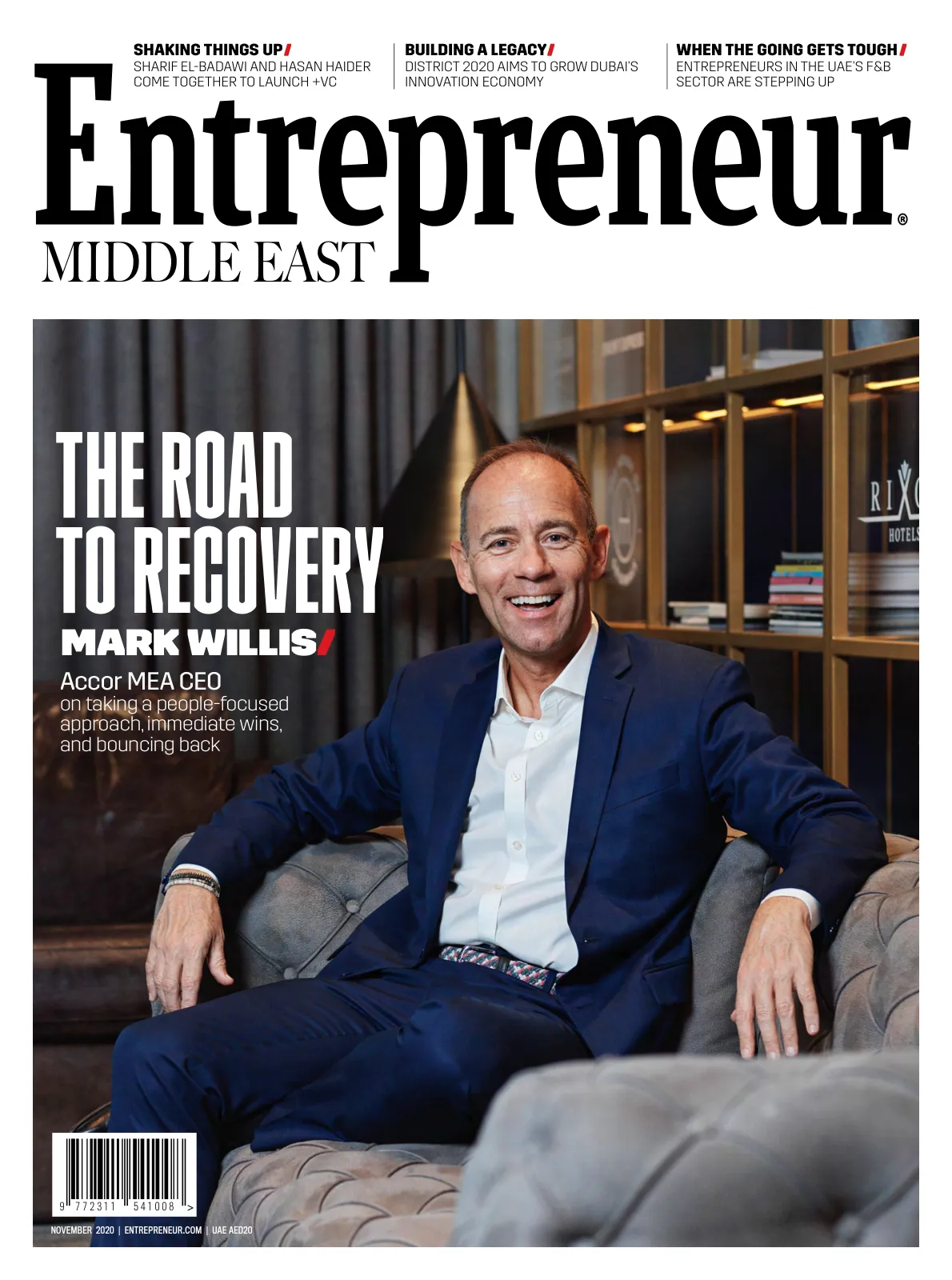
Entrepreneur Middle East, November 2020
Page 1
NOVEMBER 2020 | ENTREPRENEUR.COM | UAE AED20
9
7 7 2 3 1 1
5 4 1 0 0 8
>
SHAKING THINGS UP
SHARIF EL-BADAWI AND HASAN HAIDER
COME TOGETHER TO LAUNCH +VC
WHEN THE GOING GETS TOUGH
ENTREPRENEURS IN THE UAE’S F&B
SECTOR ARE STEPPING UP
THE ROAD
TO RECOVERY
MARK WILLIS/
Accor MEA CEO
on taking a people-focused
approach, immediate wins,
and bouncing back
BUILDING A LEGACY
DISTRICT 2020 AIMS TO GROW DUBAI’S
INNOVATION ECONOMY
Page 2
Continue doing business,
seamlessly and safely
with Smart Office Thermal Screening solutions.
du.ae/thermalcameras
Page 3
Page 4
4 / ENTREPRENEUR.COM / November 2020
20
INNOVATOR
THE ROAD TO RECOVERY
Mark Willis
Accor MEA CEO on taking
a people-focused approach,
immediate wins, and
bouncing back.
26
INNOVATOR
BUILDING A LEGACY
Tala Al Ansari
The Director, of
Scale2Dubai, District
2020, is leading a global
initiative aimed at growing
Dubai’s innovation
economy.
36
CULTURE
DESIGN
Challenge accepted
UNESCO launches an
international competition to
rebuild a global icon in Iraq.
46
ROUNDTABLE
RETHINKING BUSINESS
The latest edition of the
Entrepreneur Middle East
Round Table presented
by du emphasized the
importance of pivoting
business models through
the course of the COVID-19
crisis.
68
MONEY
VC VIEWPOINT
Go big or go home
Al Waha Fund’s Areije Al
Shakar opines that more
Middle Eastern boldness is
needed to break “the scale-
up ceiling.”
58
START IT UP
PRO
Inshallah, hayom
Matthew L. McGrath
explores how the Abraham
Accord between Israel and
the UAE can generate new
business opportunities.
59
START IT UP
PRO
Moving forward, with hope
Yair Levy on how the Israel-
UAE accord can enable the
countries’ startup ecosystems
to benefit from each other.
54
MONEY
VC VIEWPOINT
Shaking things up
Sharif El-Badawi and Hasan
Haider, co-founders of +VC,
on how they expect their
US$60 million fund to boost
and bolster the region’s
startup ecosystem.
CONTENTS NOVEMBER 2020
20
Mark Willis,
CEO of Accor Middle
East and Africa
Page 5
5
November 2020 / ENTREPRENEUR.COM /
experience
downtown
living
The UAE’s most exciting new destination.
A journey of discovery for the whole family.
Where nature, fun and entertainment
come together.
800-Arada (27232)
arada.com
Page 6
Page 7
Page 8
Page 9
Page 10
Magnifique Meetings
Sheikh Rashid Road, P.O. Box 30904, Dubai - UAE, 04 324 9999
Book a meeting with confidence at Events.Dubaitheobelisk@sofitel.com
PARIS - LONDON - ROME - DUBAI - SYDNEY - MEXICO CITY
Page 11
Page 12
12 / ENTREPRENEUR.COM / November 2020
62
START IT UP
ECOSYSTEM
When the going gets tough
Despite the negative reper
cussions of the COVID-19
crisis, entrepreneurs in
the UAE’s F&B sector are
stepping up to challenge
the status quo.
66
START IT UP
Q&A
Saying yes to
opportunities
Dana Baki, co-founder and
Chief Operating Officer at
MUNCH:ON, reflects on
her journey in the entre
preneurial domain.
52
‘TREPONOMICS
PRO
Keep on trucking
Gaurav Biswas, founder
and CEO of TruKKer,
reveals the ins and outs
of growing a logistics and
supply chain business
during a global crisis.
50
‘TREPONOMICS
PRO
Staying ahead
Toufic Kreidieh looks back
at the lessons learned
during two decades of
growing the Brands For
Less Group.
18
IN THE LOOP
Securing the future
Sheraa launches UCAN
Startup Awards to
support and promote
healthtech and agri-
foodtech entrepreneurs in
the MENA region.
30
TECH
SHINY
#TamTalksTech
Gadgets and doodads
that you might’ve missed
out on, sourced by a tech
aficionado.
32
CULTURE
TRAPPINGS
‘Trep gear
The executive selection
for the entrepreneur on
your list that has every
thing. Okay, maybe for a
little self-reward as well.
CONTENTS NOVEMBER 2020
38
30
H.E. Noura Al Kaabi,
UAE Minister of Culture
and Youth
Porsche Design
Acer Book RS
Page 13
Ready to get
rewarded?
Join Radisson Rewards
for exclusive benefits
We can’t wait to welcome you as a member across our
six hotel brands and 1,100+ locations worldwide. Thank
you for choosing Radisson Hotels.
Award Nights
Use your points for stays - it’s that simple!
Members Only Rate
Save up to 10% when you book on
radissonhotels.com/rewards
More benefits
Including savings of up to 20% on food and
beverages, room upgrades for Elite members
and more
Join today at the front desk
or on radissonhotels.com/rewards
Page 14
14 / ENTREPRENEUR.COM / November 2020
SUBSCRIBE
Contact subscriptions@bncpublishing.net to receive
Entrepreneur Middle East every issue
EDITOR IN CHIEF Aby Sam Thomas aby@bncpublishing.net
CEO Wissam Younane wissam@bncpublishing.net
DIRECTOR Rabih Najm rabih@bncpublishing.net
CREATIVE LEAD Odette Kahwagi
MANAGING EDITOR Tamara Pupic
STARTUPS SECTION EDITOR Pamella de Leon
DIGITAL SOLUTIONS DIRECTOR Mahdi Hashemi mahdi@bncpublishing.net
GROUP SALES DIRECTOR – B2B GROUP Joaquim D’Costa
COLUMNIST Tamara Clarke
INTERN Aalia Mehreen Ahmed
PO Box 502511 Dubai, United Arab Emirates
P +971 4 4200 506 | F +971 4 4200 196
For all commercial enquiries related to Entrepreneur Middle East
contact sales@bncpublishing.net
All rights reserved 2020.
Opinions expressed are solely those of the contributors.
Entrepreneur Middle East and all subsidiary publications in the
MENA region are officially licensed exclusively to BNC Publishing
in the MENA region by Entrepreneur Media Inc.
No part of this magazine may be reproduced or transmitted in any
form or by any means without written permission of the publisher.
Printed by United Printing and Publishing
upp.ae
Images used in Entrepreneur Middle East are credited when necessary. Attributed use of
copyrighted images with permission. All images not credited otherwise Shutterstock.
CONTRIBUTORS
entrepreneur.com/me
ACCESS FRESH CONTENT DAILY ON OUR WEBSITE!
MIDDLE EAST
EntMagazineME
@EntMagazineME
Entrepreneur-me
EntrepreneurMiddleEast
EntMagazineME
EntMagazineME
EntMagazineME
MIDDLE EAST
In addition to our print edition, we’re bringing
you all sorts of industry news on our web
mediums. Joining us online means getting
relevant business and startup content in
real-time, so you’re hearing about the latest
developments as soon as we do. We’re looking
forward to interacting with our readers on all of
our social media and web platforms- like any
thriving business, we’re looking to give and take.
#TrepTalkME is already happening on all of our
digi platforms, and all good conversations go
both ways. See you on the web!
Tala Al Ansari
Fida Chaaban
Tamara Clarke
Matthew McGrath
Toufic Kreidieh
Yair Levy
Areije Al Shakar
Page 15
Page 16
16 / ENTREPRENEUR.COM / November 2020
I
t is perhaps a characteristic of
the times we currently live in
that I have been recently find-
ing myself being posed ques-
tions for which my reply, often
grudgingly, is that “I don’t
know.” Those of you in leader-
ship roles at your respective
places of work may have found
yourselves in the same boat lately-
given the COVID-19 crisis, we are often
being asked as to “when will things go
back to the way they were,” and having
to accept and acknowledge our igno-
rance on this particular matter can
be quite frustrating, especially since
we may have well been looked upon
as people who’d have all the answers
once upon a time.
For me, personally, the reason for my
discomfort with saying “I don’t know”
is centered on the premise I have sort
of built in my head that uttering this
three-word-phrase is an admission of
the fact that one hasn’t tried enough
to figure out a solution to the problem
at hand. Now, I still think this to be
the case for certain matters, but I’ve
also come to the realization that there
is a definite difference between saying
“I don’t know” because I’m too lazy to
find an appropriate solution, and say-
ing “I don’t know” because I haven’t
been able to find a solution, despite
how hard I tried.
The latter feeling is essentially what
I’ve been wrestling with over the
course of the COVID-19 crisis- and I’ve
since found that it’s not just me deal-
ing with this in this our current era
of uncertainty. From people managing
teams within large conglomerates,
to entrepreneurs running shoestring
startups, business leaders everywhere
are having to come to terms with the
idea that they are now playing in a
strange, new arena where the rules
seem to be constantly changing. Not
only do they not have answers for
everything, they simply cannot predict
outcomes as comfortably as they prob-
ably did at one point in time.
So, where do we go from here? Well,
for starters, I think we need to start
getting a lot more comfortable with
saying “I don’t know,” and not seeing
it as a personal failure, and instead
looking at it as being true to who we
are, and what we know, in our current
circumstances. At the same time, it
is leveling the ground between us and
those around us- such instances are
essentially opening up avenues for
dialogue and conversations that could
perhaps help us figure out potential
solutions in a collective manner.
Indeed, this might even lead to just a
tacit acceptance of the way things are
today, and taking on things one day at
a time- and moving on ahead, regard-
less.
EDITOR'S NOTE
You aren’t expected to have all the answers
NO ONE HAS A CRYSTAL BALL
Aby Sam Thomas
Editor in Chief
@thisisaby
aby@bncpublishing.net
Page 17
FUN COMES
GUARANTEED
YOU DECIDE WHEN THE PARTY
STOPS WITH 24HR FOOD & DRINK.
NOW OPEN AT DUBAI DIGITAL PARK.
RADISSONHOTELS.COM/RED
Page 18
18 / ENTREPRENEUR.COM / November 2020
IN THE LOOP
T
he ongoing CO
VID-19 crisis has
brought forward
the importance of
the healthcare and
food industries to
societies and governments
across the globe. As Najla
Al Midfa, CEO of Sharjah
Entrepreneurship Center
(Sheraa), puts it: “Our soci
eties and economies are only
as strong as our food and
healthcare infrastructure.
Progress across industries
can be sustained so long
as people have continuous
access to nutritious food
and affordable healthcare
services.”
It’s with this thought in
mind that Sheraa, as part of
its wider response to coun
ter the effects of the corona
virus pandemic in the MENA
region, launched the Ubuntu
Care And Nurture (UCAN)
initiative in late September
this year. The contest has
been specifically conceptual
ized to help promote and aid
socially-minded innovations
that can cater to either
one of two main themes:
“Healing the World” for
healthtech, and “Feeding the
Future” for agri-foodtech.
The initiative’s name itself
reemphasizes Sheraa’s
allegiance to the #Ubun
tuLoveChallenge, a global
social movement founded
by Sheraa Chairperson
H.E. Sheikha Bodour bint
Sultan Al Qasimi and Africa
2.0 Foundation founder
Mamadou Kwidjim Toure
that encourages people
across the world, regardless
of their background, race, or
religion, to foster and spread
values of humanity and col
lectiveness through acts of
kindness and solidarity.
“We launched the UCAN
Startup Awards in partner
ship with the Ubuntu Love
Challenge in order to sup
port entrepreneurs working
to leave a lasting impact on
their communities, and who
are developing solutions for
a post-COVID-19 world,” Al
Midfa says. “Through this
initiative, we want to sup
port startups whose unique
healthtech and agri-foodtech
solutions are meeting the
urgent needs of not just the
communities they serve, but
the world at large. By direct
ing our immediate focus to
these key sectors, Sheraa
seeks to promote the UAE’s
and the region’s efforts to
secure our future.”
Al Midfa reveals that the
UCAN initiative has, so far,
received nearly 700 submis
sions from the MENA and
sub-Saharan Africa regions.
With applications now
closed, the semi-finalists of
the competition are sched
uled to be announced on the
November 4, 2020, with the
finalists scheduled to be an
nounced a week later on the
12th. The final winners of
the UCAN initiative will be
announced on December 6th
this year.
The initiative, which has
a US$250,000 equity-free
prize purse, will reward
the first prize winners with
a $100,000 grant, while
each of the runners-up will
receive a grant of $25,000.
The basic requirements to
fulfil the judgment criteria
was simple: the startup
must have a fully developed
product or minimum viable
product (MVP), display
growth and impact through
their idea, and be interested
in expanding into the MENA
market.
But in addition to the
aforementioned cash prizes,
the winning startups are
also set to receive plenty of
other benefits. For start
ers, the Sharjah Research
Technology and Innovation
Park (SRTIP), a partner of
Sheraa, will provide access
to subsidized licensing and
office set up support to the
winning teams. GEN Ac
celerates, another one of
Sheraa’s global partners, has
provided all startup appli
cants with a comprehensive
content library.
A few selected startups
will also receive exclusive
access to media and PR
support services owing to
Sheraa’s partnership with
Entrepreneur Middle East.
The final winners of the
UCAN initiative will be able
to gain access to conferences
and networking events, and
receive mentorship from
industry experts to scale up
and grow in the region.
Al Midfa points out that
while the competition itself
is heavily reliant on tech-
enabled innovations, the
core underlying reason for
this initiative is still largely
driven by the need to create
sustainable, social impact in
a post-COVID-19 world.
“Essentially, the UCAN
Startup Awards, in addition
to being Sheraa’s response
to challenges posed by
COVID-19, is also an en
deavor to promote conscious
entrepreneurship at home
and across our region, which
is already a growing global
force,” Al Midfa concludes.
sheraa.ae/ucan
Sheraa launches UCAN Startup Awards to
support and promote healthtech and agri-
foodtech entrepreneurs in the MENA region
by AALIA MEHREEN AHMED
Securing the future
Page 19
Page 20
20 / ENTREPRENEUR.COM / November 2020
INNOVATOR
IMAGES COURTESY ACCOR MEA
Page 21
21
November 2020 / ENTREPRENEUR.COM /
THE ROAD
TO RECOVERY
MARK WILLIS/
Accor MEA CEO on taking a people-
focused approach, immediate wins,
and bouncing back
I
t was at the second day of the 2020 Arabian Hotel Investment
Conference (AHIC) held in Dubai in late September that I got to meet
with Mark Willis, CEO for the Middle East and Africa at Accor, at his
suite in the Rixos Premium Dubai Jumeirah Beach Residence (JBR),
one of the many hotels that fall under the umbrella of the Paris-
headquartered global hospitality company that he works for. In my
conversation with him, I found that Willis exhibited all of the gracious
characteristics one would typically expect from someone who works
in the hospitality business, and yet, his charm couldn’t belie the fact
that he is working in an industry that hasn’t yet completely recovered from
the economic repercussions of the coronavirus pandemic that hit the world
in 2020. But while Willis didn’t deny the dire straits that his sector has found
itself in over the last couple of months, he remains almost incredibly optimistic
about the road ahead. “I think, from an Accor perspective, like many of the big
brands, we’ve obviously been heavily impacted by the last six months,” Willis
says. “And now is the time to look forward and take a positive position on what
that future looks like. We have a portfolio of wonderful brands at Accor, and
everything to play for. The market remains subdued, of course, but that won’t
last. And you’ll see as you move out of 2020 and into 2021, the dynamics of
business and the demand of our industry will start to come back, I’m sure.”
by ABY SAM THOMAS
THE ROAD TO RECOVERY | MARK WILLIS, CEO, ACCOR MEA
Page 22
22 / ENTREPRENEUR.COM / November 2020
Glimmers of this hopeful
future that Willis foresees
are already starting to show-
he’s actually been privy to it
thanks to his role at Accor.
With over 35 brands in the
Middle East and Africa, Ac
cor currently has a portfolio
of 300 properties and over
65,000 keys in the region,
covering all segments running
from economy (think Ibis)
to luxury (think Fairmont).
As such, it’s easy to see that
the COVID-19 pandemic
must have dealt a big blow to
this hospitality enterprise’s
operations in the region, with
it having to suffer through
everything from cancellations
to closures through the course
of the crisis. This was espe
cially evident in its operations
in the UAE, where Accor is
(with over 64 hotels across the
country) the largest operator
across all brands. But today,
it’s the resumption of Accor’s
business in the UAE (and the
reception to it) that is one of
the clearest indicators of the
recovery that’s slowly happen
ing across the region’s hospi
tality landscape- over 75% of
its hotels in the country have
now reopened, and there’s a
tide of consumers flocking to
them as well. “While there are
obviously changes on the ho
rizon, we are opening hotels in
the right way, following local
legislation and working with
government entities,” Willis
says. “From a practical per
spective, you can follow all the
legislation, implement social
distancing, etc., but you can
still also provide a wonderful
experience at a hotel level. No
more so than this hotel where
we are sitting today, the Rixos
Premium Dubai JBR, which,
for September, is running
figures ahead of last year,
which is just wonderful to see.
Regional demand, and now,
international demand is start
ing up again, as people look to
travel, or start to travel, with
Dubai being a destination of
choice.”
It’s signs like these that Wil
lis is using to bolster his belief
that things will be looking a
lot better for his enterprise
(and the hospitality industry
in general) in the months to
come. “I think that there will
be a very positive period next
year, hopefully on the back
of global trends,” Willis says.
“Things will start to improve.
Here, you’ve obviously got
key demand drivers: religious
tourism into KSA, and here
in Dubai, of course, we’ve got
Expo 2020 from Q3 into Q4
next year, which will have a
huge effect, I’m sure. I think,
from a global perspective,
and not just in relation to
Accor, I think others will
take a similar approach of
positivity. Today, at AHIC here
in Dubai, we’ve seen [data
INNOVATOR
“While there are obviously changes on
the horizon, we are opening hotels in
the right way, following local legislation,
working with government entities.”
Sofitel Dubai The Obelisk
Page 23
23
November 2020 / ENTREPRENEUR.COM /
intelligence provider] STR
talk about growing statistics,
increases in occupancy and
rates globally, no more so in
China, now touching about
50% occupancy levels month-
on-month, which is super
positive to see- obviously, they
are a little bit ahead of the of
the pandemic versus every
body else, but, yes, definitely,
demand is returning. Yes, it’s
slow, and, yes, the outlook
remains uncertain, but, I
think, from an Accor perspec
tive, we continue to remain
positive and look ahead to the
future and what that business
landscape is going to look like,
and indeed, how we’re going
to function accordingly.”
Now, if we go by the princi
ple that one’s actions today
are a signifier of things to
come, then Accor seems to be
on the right track for a world
after the coronavirus pan
demic, given what Willis tells
me the company has been do
ing through the course of this
crisis. “As we’ve gone through
the last months, Accor has
taken a very people-focused
approach to the pandemic,”
Willis says. “We’re a business
entity, of course, we’re a com
mercial entity, and focused
on that, absolutely- but this
has been a definite period of
focusing on our people, our
customers, and indeed, our
owners, and making sure
that we all come through the
pandemic, and the way that
it’s impacted our business,
together, as positively as we
can.”
Willis placed his team first
when listing his company’s
priorities when navigating the
COVID-19 crisis, and this was
ably demonstrated by Accor
through the launch of its ALL
Heartist Fund in April, with
the “ALL” being a nod to its
“Accor Live Limitless” brand
promise. Following consulta
tions with its main sharehold
ers JinJiang International,
Qatar Investment Authority,
Kingdom Holding Company,
and Harris Associates, Accor
announced its decision to allo
cate 25% of its 2019 dividend
payment -which came around
to EUR70 million- to this
Fund that was aimed at assist
ing the company’s 300,000
employees in a variety of
ways. Besides pledging to
pay for any COVID-19 related
hospital expenses for employ
ees without social security or
medical insurance, this Fund
also aimed to support, on a
case-by-case basis, furloughed
employees suffering great
financial distress, as well as
individual partners facing
financial difficulties. Accor
Chairman and CEO Sebastien
Bazin also announced he’d
forego 25% of his compensa
tion during the crisis, with
the cash equivalent being
contributed to the Fund as
well. Talking about the Fund
and its roll-out, Willis con
fesses to me that when it was
first announced, he was quite
skeptical about the impact it
would have- but he was soon
proved wrong. “When it was
first brought out, I really had
an anticipation that it would
be a very overly bureaucratic,
administration nightmare to
do,” Willis admits. “But that
hasn’t been the case at all. It’s
been very simply put together,
under very clear direction
from our CEO: the Fund is
available to support our team
members that are impacted by
COVID-19, in whichever way,
shape, or form… And that has
been a wonderful fund to have
at our disposal. Here, in my
area specifically, we’ve granted
over 2,500 grants- and, obvi
ously, that’s escalating now as
we move forward.”
When it comes to the cus
tomers, Willis says that Accor
has been doing pretty much
whatever it can to try and en
courage people to return to the
company’s properties through
every stage of the COVID-19
crisis. One of its earliest
efforts in this regard was in
May when Accor launched the
ALL Safe initiative in all of its
hotels, which saw it develop
intensified hygiene and pre
vention measures in partner
ship with Paris-headquartered
certification company, Bureau
Veritas, and then implement
it across all of its properties to
safeguard guests’ health and
safety. “I think the collabora
tion with Bureau Veritas has
been very positive in assisting
us with implementing ALL
Safe, which has been a very
well put together, structured
program implemented across
all the brands, at all hotels,
looking at both the operation
al practicality of dealing with
COVID-19, and also making
sure that guests are as safe as
they can be when they come
to our hotels,” Willis adds.
“We also put in a 24-hour
help line, which has been done
with [insurance company]
AXA, which, again, I thought
would not be utilized as much,
but it actually has been so
well received, not least from
an information flow perspec
tive from our guests.” Willis
also points out that given
the uncertain climate we are
all currently living in, Accor
has also made use of flexible
booking policies and attractive
promotions to try and entice
people to return to hotels
again- small things that have,
as he put it, “made a differ
ence.” >>>
THE ROAD TO RECOVERY | MARK WILLIS, CEO, ACCOR MEA
Mark Willis, CEO of Accor Middle East and Africa and Fahad Al-Alloush, CEO of Al Raya Real Estate
Page 24
24 / ENTREPRENEUR.COM / November 2020
At the same time, given the
current market conditions,
one would perhaps assume
that new developments,
signings, and openings in the
hospitality industry would
have come to a standstill- but
that’s absolutely not been
the case at Accor, Willis says.
“Have things slowed down?
Yes, of course. They’ve slowed
down, especially on the open
ing front, as we work with our
partners, and indeed, we’re
advising some partners to
slow down with openings, for
sure. But it hasn’t stopped in
any way, shape, or form. No
more so than here at AHIC,
which normally is a place for
signing hotels- we signed two
super hotels today, a Rixos
that will open in Deira, Dubai,
called Jewel of the Creek, with
Dubai Developments. It’s going
to be a fabulous hotel when
it’s up and built, and once we
get to opening, that one will
be an amazing addition to
that area of Dubai. We’ve also
signed in Jeddah today a Swis
sotel Living with our partners
there (it’s the first one in the
Kingdom), and again, it’s going
to be a super project.” Willis
also proudly points out that
Accor is also in the process
of opening new properties in
the region- Sofitel Dubai The
Obelisk recently opened its
doors, while the Grand Mer
cure Dubai Airport is also set
to be welcoming guests very
soon as well. All of this serves
to reiterate Willis’ statement
about Accor still moving
ahead with its long-term
plans, despite the uncertainly
that surrounds the market at
this time. “Yes, the climate
is tough, but also, it’s still
developing, it’s still working
forward,” Willis says. “A lot
of our investors have also got
a long-term view on how they
invest… And while COVID-19
is impacting us today in 2020
and into 2021, they are look
ing far more forward, and I’m
sure organizations like that
will continue to develop as we
move forward.”
I feel that this forward-
thinking outlook is something
that Willis also possesses,
especially as he shares with
me his almost buoyant expec
tations about the future of the
sector he’s built his career in.
“The industry will recover,”
he declares. “At some point,
the pandemic will come to
a close. The desire to travel
will kick back in, the desire
to do business face to face
will kick back in. The outlook
today is extremely uncertain,
but I really, really believe that
the hotel sector will rebound
fully. And with the introduc
tion of a change to the current
landscape (and that probably
comes in the form of vaccine),
I think we’ll see an immedi
ate spike in return to travel.
You can see key destinations
around the world being heav
ily, so heavily searched, on
Google- I read some statistics
recently on that saying Dubai
was at the forefront of it,
which is wonderful to see…
So, change is coming. People
are looking, they are search
ing, and again, where people
were being super cautious
only two months ago, that
is starting to turn a corner.”
Of course, Willis’ convic
tion about this stems in part
INNOVATOR
Mark Willis, CEO, Accor MEA
Page 25
25
November 2020 / ENTREPRENEUR.COM /
from the way his company
and its leadership has been
navigating the COVID-19
crisis so far- while there have
been plenty of twists and
turns, Accor’s focus on what
actually makes up its busi
ness -i.e. their people, their
guests, and their owners- has
helped it ride this wave all
the same. “If you’re trying to
devise a very detailed, very
structured, strategic plan to
deal with COVID-19, I would
question that one, because
the dynamic changes so
much,” Willis adds. “Focus
on the key elements of your
business, see how you can as
sist those elements, and [use
that to] try and get yourself
through this very difficult
period- and I think Accor has
done a good job in that.”
At this point, I ask Willis
to share his advice for people
leading businesses through
the times we currently live
in, and he replies with two
pointers almost instantly.
“Honesty over everything,
number one,” he says. “I
made a career out of being
honest. And that may sound
like quite a strange comment-
everybody will tell you, ‘Oh,
I’m totally honest all the
time, and I speak my mind.’
But there have been times
where me being honest and
me speaking my mind in a
transparent way has not been
good for our business. I can
assure you that has not been
100% welcomed all the time.
But, I still believe in honesty
over everything- we need to
be transparent when there’s
a need to convey a message.
You know, people inherently
have no issue conveying a
positive message. But, no
more so than in the last six
months, there’s been a lot
of times where we’ve been
needing to convey a negative
message or a troubling mes
sage, whether it be with our
owners, or with our team
members, etc., and that’s
when you have to stand your
ground, take a breath, and
convey that difficult message.
Do that in the right way, and
people will always respond
to you, if you’re giving what
you feel is one, the correct
message, but also, what is the
solution attached to that, in
your opinion.”
Willis follows this piece of
advice with a note on leaders
needing to surround them
selves with the best people
they can find. “Too many
times, I see under-utilization
of the skillsets of the people
around leaders,” he says. “For
me, one thing’s for sure: I’m
the leader of Accor here in
the Middle East and Africa,
I’m the CEO, but I can tell
you nine times out of ten, I
am, for sure, not the smart
est person in the room. And
when you get these super
specialist guys that I work
with, and as I mentioned be
fore, I try and surround my
self with the most fabulous
people I can, you know, many,
many times, you are better
off asking their opinion,
and them feeling comfort
able telling you’re wrong, or
taking the discussion in a
different direction, than you
being an overbearing CEO
or leader. And that’s been
especially the case for me
these last six months, where
I really value the fact that
I’ve got a very transparent
rapport with my team. And
there’s been many occasions
where a dialogue has taken us
in a totally different direction
that I thought it would- and
I don’t believe that makes me
any less of a leader. So, yeah,
trust in the people around
you.” Indeed, when it comes
to his personal strategy when
leading Accor in the Mid
dle East and Africa, Willis
is someone who believes in
a collaborative approach
when it comes to working
with those around him. “My
leadership philosophy has
always been one that is cen
tered around my team and
the people that I work with,”
Willis explains. “Invariably,
I’m not that good, so I put
a huge amount of effort in
surrounding myself with the
most wonderful people that
I can. And I’m really good at
that- and I think you can see
that in the team that’s been
assembled at Accor. And that
philosophy has remained,
even through this crisis.”
And that is a mantra that
that will stand him in good
stead for the long run, Willis
says- and judging by what he
has accomplished with that
strategy so far, I think it’s
safe for all of us to take his
word on that.
“The industry
will recover. At
some point, the
pandemic will
come to a close.
The desire to
travel will kick
back in, the desire
to do business
face to face will
kick back in.”
THE ROAD TO RECOVERY | MARK WILLIS, CEO, ACCOR MEA
Brasserie Boulud, Sofitel Dubai The Obelisk
Page 26
26 / ENTREPRENEUR.COM / November 2020
D
ubai has a habit of
thinking what’s next,
and its Expo 2020
Dubai, the first World
Expo to be held in the
Middle East, Africa,
and South Asia region,
as well as the first to
be hosted by an Arab
nation, is no exception. Some months
ago, one would have thought that the
teams behind this event already had too
much on their plates- they were, after
all, preparing Dubai for the 173 busy days
when the Emirate would become a global
stage for business and also welcome
tens of millions of visitors. Then, the
coronavirus pandemic happened, and
news soon broke that the event had been
postponed to happen between October
1, 2021 to March 31, 2022. This was a
new reality where fast adjustments were
essential, and the Expo 2020 Dubai team
soon proved they are that up to the task
as well.
But despite all of what has happened,
one thing about Expo 2020 Dubai hasn’t
changed- and that is the event’s focus
on enabling entrepreneurs and startups
from around the world to realize their
dreams in Dubai. And that is evident
with Expo 2020 Dubai’s plans for what it
will transform into after the event closes,
which is District 2020, an integrated
community that will continue to support
the acceleration of Dubai’s development
as an ecosystem for innovators, families,
artists, and pioneers. “Once doors close
on the Expo in March 2022, the site will
transition into District 2020 and evolve
into a mixed-use community and in
novation ecosystem that will contribute
to the growth of Dubai’s innovation
economy,” says Tala Al Ansari, Director,
Scale2Dubai, District 2020. “While our
timelines may have shifted as a result
of the pandemic, our commitment to
enabling startups and global innovators
to scale their businesses in Dubai within
District 2020 has only strengthened.”
According to Al Ansari, Dubai is already
a global hub for startups and entrepre
neurs, and the Expo is aiming to support
Dubai and the UAE’s proactive approach
to helping small and medium enterprises
and the important role they play in the
country’s resilient, innovation-driven
economy. This is where District 2020’s
Scale2Dubai comes into the picture. It is
a global entrepreneur program that offers
startups and small businesses with a
proven track record in their countries an
opportunity to scale up in Dubai, starting
with a soft landing in the Emirate and
easy set-up within District 2020’s eco
system. The program also enables local
startups and small businesses to prosper
as part of an ecosystem that focuses on
INNOVATOR
BUILDING A LEGACY/
The Director of Scale2Dubai, District 2020
is leading a global initiative aimed at growing
Dubai’s innovation economy
TALA AL ANSARI
by TAMARA PUPIC
>>>
District 2020 office
Page 27
>>>
BUILDING A LEGACY | TALA AL ANSARI, DIRECTOR, SCALE2DUBAI, DISTRICT 2020
IMAGES COURTESY DISTRICT 2020
Page 28
28 / ENTREPRENEUR.COM / November 2020
specific industries important to the UAE
economy, and through collaboration
with global organizations. It is expected
that Scale2Dubai will quickly become an
innovation ecosystem that will enable
collaboration between startups, SMEs,
Fortune 500 companies, R&D centers,
educational institutions, and accelera
tors. “For example, if you are a startup
or small business in logistics technology,
there is a chance you could be placed
in close proximity to Siemens Logistics
Headquarters at District 2020. We
would facilitate your connections, and
rewarding collaboration is likely to fol
low,” Al Ansari says. “If you are a startup
or small business in artificial intelligence
(AI) or internet of things (IoT), what
better place to be than close to Terminus
Technologies’ Artificial Intelligence
and Internet of Things research and
development centre at District 2020?
An accelerator will also be established
within the centre, providing IoT and AI
startups with programs to help nurture
their growth.”
The idea of an entrepreneur program
was initiated by the Expo 2020 leader
ship and executed by the District 2020
team, with Al Ansari saying that her
team spent a considerable amount of
time conducting benchmark studies and
understanding the needs of entrepre
neurs locally, regionally, and globally.
From a personal perspective, Al Ansari
says her role was to use these findings
to design and launch the program at the
end of 2019; however, due to the impact
of COVID-19 on their timelines, her team
will now be commencing the full applica
tion process for Scale2Dubai in the third
quarter of 2021. “This gives us more time
to tailor the program, and create more
opportunities for startups in sectors
that have become even more relevant
and pivotal during the past few months,”
Al Ansari says. “It has also given us
the opportunity to partner with global,
regional and local organizations that
are best placed to promote our program
among their networks in their respective
countries.”
The revised timelines have also given
interested startups and small businesses
more time to prepare for registering on
the District 2020 website once applica
tions open. “As a strong believer in de
sign thinking, I’m making sure we speak
to entrepreneurs and stakeholders to
understand the challenges they now face,
and how their needs have changed,” she
adds. “We developed the Scale2Dubai
program from informed conversations
and will continue to use these discus
sions to make sure we’re shaping a pro
gram that will be as relevant and benefi
cial as possible.” At the moment, high on
Al Ansari’s agenda is attracting the best
businesses to Dubai. “Our world is very
interconnected, and so we all compete
in one big marketplace,” she says. “This
adds to the challenge and complexity of
attracting the best entrepreneurs and
innovators out there. It is for this reason
that we place great emphasis on ensuring
District 2020’s innovation ecosystem is
inclusive, while also curating the right
types of businesses that meet our criteria
and will add value to each other and to
our ecosystem. Our world is also incred
ibly dynamic. This has taught me how to
be comfortable with change, and how to
continuously adapt.”
Scale2Dubai is an equity-free program
in which successful applicants will
benefit from two years of free working
space, two-year visas, an accommodat
ing business set-up, subsidized urban
living, access to special rates for service
providers, and more. “We are confident
that after two years, Scale2Dubai entre
preneurs will choose to remain part of
District 2020 as permanent tenants,” Al
Ansari says. “They’ll be able to continue
enjoying the advantages of being based in
Dubai, the benefits of their surrounding
innovation ecosystem, and being part of
a community. Our ultimate goal is to give
businesses a platform from which they
can successfully scale, and the confidence
to go on to bigger things.” All interested
applicants are requested to register to
a dedicated website (more details can
be found on https://www.district2020.
ae/scale2dubai), after which all entries
will undergo a screening process where
priority will be given to applicants that
align to District 2020’s key industries
and technologies, as well as to businesses
that are in the scale-up stage, preferably
those in Series A funding rounds. “At the
next step, the technical aspects of ap
plications will be assessed by a panel of
judges,” Al Ansari says. “This panel will
be made up of verified experts in each of
INNOVATOR
“We developed the
Scale2Dubai program
from informed
conversations and
will continue to use
these discussions
to make sure
we’re shaping a
program that will
be as relevant and
beneficial as possible.”
District 2020 office rooftop
Page 29
29
November 2020 / ENTREPRENEUR.COM /
the industries and technolo
gies. The judging panel will
use multiple criteria to score
the startups and small busi
nesses, before finally choosing
the applicants to join the
program. We are an ambitious
and inclusive program that
will accept hundreds of global
and diverse applicants in each
annual cohort. So, I highly en
courage entrepreneurs to take
advantage of this opportunity.”
Al Ansari explains that,
since building awareness is
key to the success of any new
program, her team has been
ensuring that entrepreneurs
from all over the world hear
about Scale2Dubai through
multiple channels. “We
have been building strategic
partnerships both locally and
internationally with organiza
tions that understand our
vision and mandate. We are
working closely with multiple
partners, chambers, and ac
celerators to help us scout the
most promising entrepreneurs
that would benefit from both
the Scale2Dubai program and
being based at District 2020.
They are collaborating with
us to channel these startups
towards the program, while
identifying the specific sup
port they are looking for.”
In order to strengthen their
offering, the Scale2Dubai has
already partnered with Dubai
SME and the Mohammed
Bin Rashid Innovation Fund
(MBRIF) to supply District
2020 with a pipeline of high-
potential startups and small
businesses, helping eligible
companies join Scale2Dubai.
“Specifically, Dubai SME will
work on identifying innova
tive national projects from
the members of its Hamdan
Innovation Incubator, as well
as from the different countries
participating in its Innova
tion Attraction Program, to
strengthen District 2020 as
a platform for startups to
grow regionally and access
international markets,” Al
Ansari explains. “MBRIF,
as an accelerator initiative
launched by the UAE Ministry
of Finance, will also provide
financial support to help local
and international startups and
small businesses looking to
grow.”
Prior to working with Expo
2020 Dubai, Al Ansari’s career
was focused on guiding the
process of transformation and
innovation in various national
corporate settings. “Innova
tion is my passion, and so I see
myself continuing to enhance
the culture of innovation in
the UAE,” she says. “I started
by developing an innovation
and transformation program
in the oil and gas industry,
and became a certified lateral
thinking trainer to build inno
vation capabilities.” When Al
Ansari joined the Expo 2020
team in the International
Participants Department,
she began working on an
international scale, and was
responsible for signing up both
countries and international
organizations to take part in
the expo. “I now curate an in
novation ecosystem for Dubai
and empower global entre
preneurs as a part of District
2020, which is Expo 2020’s
future and legacy,” she adds.
“I’m really enjoying the di
verse route my role is carving
out for me, which also involves
building partnerships and
engaging with stakeholders
across government, academia,
accelerators, incubators, and
service providers.” An addi
tional incentive for Al Ansari
is the fact that her work is
aimed at generating positive
change for Dubai through the
curation, execution, and stra
tegic development of District
2020’s innovation ecosystem.
“Supporting my nation in
hosting the world and devel
oping an innovation ecosystem
is what makes Expo 2020
such a privilege,” she says.
“Alongside all this, I want to
help make an impact globally
by supporting the growth of
worldwide entrepreneurs
through Scale2Dubai.”
According to Al Ansari,
Dubai has already been lead
ing the way when it comes to
giving startups and small busi
nesses a platform to grow, in
addition to also being a leader
in most of District 2020’s
focus sectors and technologies.
However, the city’s resilience
during the past few months
has shown how important -if
not indispensable- innova
tion is to contending with and
overcoming the challenges
posed by crises, such as pan
demics, she notes. In her own
work, she applies the skills of
agility, program management,
and stakeholder management
on daily basis. “However, what
is more important than skill
is passion,” Al Ansari says. “I
believe that my passion for
innovation and my constant
quest to learn is what will
really ensure I succeed. It’s
about adjusting, experiment
ing, learning, and never set
tling.” But when it comes to
achieving success in entrepre
neurship, there is no straight
forward formula, she says.
“Globally, we have not reached
a consensus on what ‘success’
means for those two areas,” Al
Ansari explains. “However, I
embrace this challenge in my
career as it gives me room to
get creative and to contribute
to knowledge creation. Also,
our world is very intercon
nected, and so we all compete
in one big marketplace. This
adds to the challenge and com
plexity of attracting the best
entrepreneurs and innovators
out there. It is for this reason
that we place great emphasis
on ensuring District 2020’s
innovation ecosystem is inclu
sive, while also curating the
right types of businesses that
meet our criteria, and will add
value to each other and to our
ecosystem.”
“We are working
closely with multiple
partners, chambers,
and accelerators
to help us scout
the most promising
entrepreneurs that
would benefit from
both the Scale2Dubai
program and being
based at District
2020.”
BUILDING A LEGACY | TALA AL ANSARI, DIRECTOR, SCALE2DUBAI, DISTRICT 2020
Page 30
30 / ENTREPRENEUR.COM / November 2020
GADGETS AND DOODADS THAT YOU MIGHT’VE MISSED OUT ON, SOURCED BY A TECH AFICIONADO.
YES, IT’S OKAY TO WANT THEM ALL… AND NO, IT’S NOT OUR FAULT.
POWER UP
PORSCHE DESIGN ACER BOOK RS
IMAGES COURTESY PORSCHE/ACER | HUAWEI | APPLE
TECH SHINY
Porsche and Acer have teamed up
to give you powerful processing and
impeccable design in one device.
The Porsche Design Acer Book
RS, which comes with an all-metal
chassis, has a diamond-cut CNC-
machined 3k carbon fiber cover that
gives the device a distinctive touch.
It is fitted with the latest 11th Gen
Intel Core i7 processor as well as an
NVIDIA GeForce MX350 GPU, while
weighing in at just 1.2kg. Porsche
Design Acer Book RS features a 14-
inch FHD IPS touchscreen covered
with a layer of Antimicrobial Corn-
ing Gorilla Glass. It also has backlit
keys, 16 GB of RAM, and a battery
that lasts 17 hours. The battery also
supports fast charging- plugging
it in for 30 minutes gives you four
hours of usage. This striking and
extremely portable device rounds
out with smart features such as
secure fingerprint logins via Win-
dows Hello and Wake on Voice from
Modern Standby.
Porsche Design
Acer Book RS
Porsche Design Acer Book RS
Page 31
31
November 2020 / ENTREPRENEUR.COM /
#TAMTALKSTECH Tamara Clarke, a former software development professional, is the tech and lifestyle enthusiast behind The Global Gazette, one
of the most active blogs in the Middle East. The Global Gazette has been welcomed and lauded by some of the most influential tech brands in the
region. Clarke’s goal is to inform about technology and how it supports our lifestyles. See her work both in print regional publications and online on
her blog where she discusses everything from how a new gadget improves day-to-day life to how to coordinate your smartphone accessories.
Visit theglobalgazette.com and talk to her on Twitter @TamaraClarke.
#TAMTALKSTECH | GADGETS AND DOODADS THAT YOU MIGHT’VE MISSED OUT ON
BEST MATES
HUAWEI MATE 40 SERIES
Huawei takes another leap further
ahead of its competition with the
release of its Mate 40 Pro and Mate
40 Pro+. Both models incorporate
the world’s first five-nanometer 5G
system-on-chip (SoC), the Ultra Vision
Cine Camera system, and the iconic
Space Ring Design on the back of the
smartphones. Pushing the boundaries
on aesthetics, the devices sport a small
front camera cut-out enabling 3D Face
Unlock, an Ultra Vision Selfie Camera,
and Smart Gesture Control. Huawei
Mate 40 Pro and Huawei Mate 40 Pro+
are powered by the Kirin 9000 Series,
which is fully equipped for 5G and
multi-tasking. The camera system on
the Huawei Mate 40 Series has been
co-engineered with Leica. The Ultra Vi-
sion Selfie Camera supports 4K video
capture with Steady Shot, while the XD
Fusion HDR Video ensures balanced
exposure, even with extreme lighting
situations. Huawei Mate 40 Pro also
features a Periscope Telephoto Camera
to support 10x hybrid zoom and 50x
digital zoom, and Huawei Mate 40
Pro+ takes it further with a dual-tele-
photo camera system that enables 20x
hybrid zoom and 100x digital zoom.
Both devices are IP 68 dust and water
resistance, and feature Smart Gesture
Control making it easy for you to take
your new mate anywhere.
The all new Apple iPad Air features
an all-screen design with a larger
10.9-inch Liquid Retina display, cam-
era and audio upgrades, a new
integrated Touch ID sensor in the top
button, and the powerful A14 Bionic
for a boost in performance. The new
screen brings together 3.8 million
pixels and advanced technologies,
including full lamination, P3 wide
color support, True Tone, and an anti-
reflective coating for an improved
viewing experience. iPad Air is
compatible with Magic Keyboard, and
its floating design features a built-in
trackpad, the Smart Keyboard Folio,
and new Smart Folio covers, as well
as the second generation Apple
Pencil, which attaches magnetically
to the side of iPad for easy pairing,
charging, and storing. Its camera
technology has been upgraded too.
iPad Air includes a 7MP front-facing
FaceTime HD camera, and it now
features the same 12MP rear camera
used in iPad Pro for higher resolution
photos and 4K video capture. The
new design is complete with stereo
speakers in landscape mode, a USB-C
port comes for up to 5Gbps data
transfer, Wi-Fi 6 performance, and
60%-faster LTE connectivity, along
with A14 Bionic, making it the most
powerful iPad Air ever.
RAISE THE BAR
APPLE IPAD AIR
Apple iPad Air
Huawei Mate 40 Pro
Page 32
32 / ENTREPRENEUR.COM / November 2020
CULTURE TRAPPINGS
IMAGE CREDIT MB&F | ASCOTS & CHAPELS | DOLCE&GABBANA | BOUCHERON
‘TREP TRIMMINGS
THE EXECUTIVE SELECTION
F
rom better goods to better wardrobe bests, every
issue we choose a few items that make the approved
executive selection list. In this issue, we present our
picks from the Ascots and Chapels AW20 collection, a
refined timepiece that could be your next splurge, and more.
BEYOND FIRST IMPRESSIONS
MB&F
Designed by Stephen McDonnell
for MB&F, the Legacy Machine
Perpetual EVO may seem just like a
fancy sports watch at first glance,
but it is much more than that. As
many MB&F enthusiasts know, many
of the brand’s creations leans more
toward the style of haute horology,
and less towards that of conventional
sport watches. The 44 mm case is
lightweight and contains durable
zirconium between slabs of sapphire.
It is redesigned to showcase openness
and clarity, thanks to its new Super
LumiNova on its dials. Also fitted
between the case and the movement
is a new monoblock shock protection
called FlexRing, created to help
protect the 581 components of the
movement from the effect of an active
lifestyle. With dial colors available in
orange, blue, and black, it also has a
screw-down crown and 80 meters of
water resistance, a first for the brand.
With MB&F only manufacturing
15 pieces of the Legacy Machine
Perpetual EVO in each color, this is a
collector’s timepiece. mbandf.com
Legacy Machine
Perpetual EVO
Page 33
33
November 2020 / ENTREPRENEUR.COM /
'TREP TRIMMINGS | THE EXECUTIVE SELECTION
IF THE CROWN FITS
DOLCE&GABBANA
Concocted by Daphné Bugey
and Nathalie Lorson, the K by
Dolce&Gabbana eau de parfum
is inspired from the earthy,
rugged landscape of Tuscany in
Italy. A woody spicy fragrance
for men launched just this year,
it opens with a fusion of zesty
orange, lemon, and cardamom
essence, while at its heart, notes
of cardamom, clary sage, and
lavender add a touch of sweetness.
Finally, at its base, touches of
cedar, patchouli, and vetiver
are intensified by Nagarmotha
wood. Encased in a lacquered
glass of deep blue, the iconic
crown atop the bottle is especially
noteworthy- it’s a scent fit for
royalty. Dolcegabbana.com
COOL COMFORT
ASCOTS & CHAPELS
British luxury tailoring house Ascots and Chapels
is infusing traditional tailoring techniques with
modern design principles in its Autumn Winter
2020 collection. Aptly called Heritage Redefined, the
collection gives a new look for the three-piece suit, a
classic piece showcasing sophisticated panache that
has comfort taking precedence as well. For dapper
looks that will easily fit in today’s wardrobes, casual
separate and smart tailored pieces are also included.
The mix and match options bring in versatility to the
pieces, thereby ensuring that the personality of the
wearer shines. ascotsandchapels.com
EDITOR’S PICK
BOUCHERON
Having arrived just in time for fall, we’re enthusiastic about the new
blue edition of Boucheron’s Quatre collection. Introduced in 2004, the
range has become a timeless unisex icon with a sculptural look that
is constantly being reinvented. Its four rings represent the brand’s
architectural codes, and the result: a range of pieces to suit all moods,
while exploring variations of gold, texture, and colors, inspired by
a graphic motif. Whether as a pendant, a tie-necklace, or as a ring,
wear it with a ruffled silk blouse over denim to bring out the contrast
between a straight jean and a touch of jewelry. Experiment with color
variations, or accessorize with stacked bracelets and rings, and yes, it
looks great paired with all shades of denim- after all, it is the inspiration
for this new line! boucheron.com
Page 34
The new-generation –Ford Expedition, sets
the benchmark yet again for the full-size
SUV segment. The model redefines its
category with its all-new design inside and
out, its unique smart technologies, best in
class power and fuel economy, and more
expected towing capability than any other
full-sized SUV. The new generation Ford
Expedition is the smartest, most capable
and most adaptable Expedition ever.
SMARTEST EXPEDITION EVER
The Expedition offers more driver-assist
technologies than any other full-size
SUV. In addition, an all-new high-strength,
aluminium-alloy body and redesigned
ADVERTORIAL
More power, capability and
smart technology than ever
Ford
Expedition
34 / ENTREPRENEUR.COM / November 2020
Page 35
ADVERTORIAL
high-strength steel frame form the founda
tion for Expedition’s rugged off-road and
strong towing capabilities.
Thanks to the use of advanced materials,
the Expedition saves up to 136 kg, and the
team reinvested that weight savings ev
erywhere it counts to give customers more
technology and convenience features than
ever before.
More than 40 features and driver-assist
technologies new to Expedition help make
the journey as enjoyable as the destination.
These include class-exclusive enhanced
active park assist to easily pull in and out of
parking spots, as well as available 360-de
gree camera technology to help customers
see more around their Expedition for easier
parking.
On the road, Expedition’s lane-keeping aid is
designed to reduce unintentional drifting of
the vehicle outside its intended lane, while
adaptive cruise control with stop-and-go
allows drivers to set a cruising speed, using
radar and camera technology to monitor
traffic to maintain a set distance between
vehicles.
Its collision avoidance detection system
helps drivers avoid other vehicles or pedes
trians, while available Blind Spot Information
System helps monitor blind spots outside
the driver’s immediate view. In addition,
Expedition offers available new connectivity
technologies and convenience features,
including:
• Wireless charging: Expedition was Ford’s
first vehicle to feature this system, which
allows customers to place compatible
mobile devices on an integrated charging
pad conveniently located in the front centre
console
• Dual-headrest rear seat entertainment
system provides a next-generation video
experience that allows passengers to view
their media on either of two video screens
or hand-held devices
• SYNC® 3, with both Apple CarPlay™ and
Android Auto™ capability, allows drivers to
stay connected on the move. And with the
new Expediton, SYNC® 3 debuts its off-road
maps for the Middle East
• Power for passengers in every row, with
four 12-volt power points, six USB chargers
and a 220-volt power outlet that lets pas
sengers stay charged and connected
• 12-speaker B&O PLAY premium audio
system perfected by acoustic engineers for
a sound experience even audiophiles will
appreciate
• Advanced cargo manager with an
adjustable shelf behind the third row lets
owners create a storage space customised
to whatever they’re hauling; even when
parked on a hill, cargo won’t roll out the
back of Expedition when the liftgate is
opened
• Panoramic Vista Roof spans two rows, a
feature not offered by any competitor
MOST CAPABLE EXPEDITION EVER
Powered by a 3.5-litre EcoBoost® engine
with standard Auto Start-Stop plus a class
exclusive new 10-speed automatic trans
mission, the all-new Expedition offers best-
in-class fuel economy and power, with up to
400 horsepower and 610Nm torque avail
able. A newly-available electronic limited-
slip differential on models with Intelligent
4WD enables improved off-road capability
by sending power where it’s needed.
The Ford Expedition also offers the best
towing capability of any full-size SUV,
together with features such as Pro Trailer
Backup Assist, which makes backing up a
trailer as easy as turning a knob. Plus, an
available hands-free liftgate makes loading
cargo easy.
MOST ADAPTABLE EXPEDITION EVER
The Expedition has a roomy, flexible interior.
With seating for up to eight people and their
gear, this full-size SUV makes modern family
adventures more comfortable during short
and long trips alike.
The Expedition is the first full-size utility
to feature a sliding second-row seat with
tip-and-slide functionality, providing easy
access to the third row without the need to
first remove a child safety seat. Once in the
third row, even adults will appreciate more
legroom and reclining seats.
Expedition’s second- and third-row seats
can be quickly folded flat with the push
of a button to open up a cargo area wide
enough to handle 4x8-foot sheets of ply
wood and other gear, depending on cargo
weight and load distribution, even with the
liftgate closed.
35
November 2020 / ENTREPRENEUR.COM /
Page 36
36 / ENTREPRENEUR.COM / November 2020
UNESCO launches an international competition
to rebuild a global icon in Iraq
Architects and designers
invited to reimagine Mosul’s
historic Al-Nouri Complex
CHALLENGE / ACCEPTED
I
t was once described by 10th century
Arab geographer Al-Muqaddasi as “the
metropolis of this region,” but that is
almost certainly not the impression one
may have of the city of Mosul in Iraq
today. Given the troubles and turmoil it
has faced over the last couple of years,
Mosul’s history and heritage seem to have
been relegated to the background on
account of the damage and destruction the city
has undergone, but that looks set to change now
thanks to a new project being spearheaded by the
United Nations Educational, Scientific, and Cultural
Organization (UNESCO), in collaboration with the
governments of Iraq and the United Arab Emirates.
CULTURE DESIGN
by ABY SAM THOMAS | AL-NOURI COMPLEX IMAGES © UNESCO / MOAMIN AL-OBAID
THIS ARTICLE WAS ORIGINALLY PUBLISHED IN DESIGN MIDDLE EAST
Page 37
37
November 2020 / ENTREPRENEUR.COM /
CHALLENGE ACCEPTED | ARCHITECTS AND DESIGNERS INVITED TO REIMAGINE AL-NOURI COMPLEX
Page 38
38 / ENTREPRENEUR.COM / November 2020
To understand the relevance
of this particular initiative, a
look at Mosul’s past is neces
sary. While history records
the establishment of Mosul’s
Old City to have happened
in the seventh century B.C.,
the city rose in prominence
around the 12th century A.D.,
when it was under the rule of
the Zangid dynasty. Founded
by Imad Ad-Din Zangi, the
Zangi dynasty ruled over Mo
sul for 130 years, which has
since been referred to as “the
golden years” of the city. One
of the highlights of this period
was the construction of the
grand mosque of Mosul, the
Al-Nouri Mosque, situated
at the geographical heart of
Mosul, with one of its many
claims to fame included its
leaning minaret, which led
to it becoming known as the
Al-Hadba (Arabic for “hunch
back”) Minaret. The area of
the mosque, which, in follow
ing years, included a prayer
hall, a madrasa, and other
buildings, has since been
referred to as Al-Nouri Com
plex, and it became a hall
mark of the Old City, which
also included the churches of
Al-Sa’a and Al-Tahira, both of
which were iconic structures
in their own right. With it
being a place where people
of diverse cultures and faiths
peacefully coexisted with each
other, it’s easy to see why
this city -whose name trans
lates to “the linking point” in
Arabic- came to be a definite
source of pride for and rep
resentative of the diversity of
the Moslawi people, a popu
lation that includes Arabs,
Kurds, Tukens, Armenians,
Assyrians, Yazidis, Shabahkis,
Mandeans, Kawliyans, Circas
sians, and several other ethnic
groups.
It is this symbol of the his
toric city of Mosul that was
severely damaged in the
summer of 2017, when the
terrorist forces of the Islamic
State of Iraq and the Levant
(ISIL, or Da’esh), which had
occupied the city in 2014,
was defeated and forced to
leave by a coalition led by the
Iraq government and its in
ternational allies. Amid their
retreat from Mosul, ISIL left
a series of explosives in the
Al-Nouri Complex, which, be
sides destroying the mosque
and its minaret, left the loca
tion mostly covered in rubble
and thus inaccessible as well.
With the monument being
emblematic of Mosul, ISIL’s
destruction of the Complex
was described by the then
Prime Minister of Iraq Haider
Al-Abadi as the militant
group’s “declaration of de
feat,” but it’s safe to say that
its loss also weighed heavily
on the minds of the country’s
people. Indeed, this is the
impression I got when I talked
with Dr. Hassan Nadhem, the
current Minister of Culture of
Iraq, on the relevance of this
landmark to not just his coun
try, but to the entire Mid
dle East region as well. “Its
importance stems from the
fact that it represents two im
ages,” Dr. Nadhem said. “The
first one shows the depth and
the multitude of the Iraqi leg
acy, especially given that this
area includes the churches of
Al-Sa’a and Al-Tahira in the
Old City, in addition to the
many traditional buildings
near the Mosque. The second
image represents a painful
picture of the modern age,
embodied by ISIL in the most
horrific way, as they tried to
murder the identity and his
tory of Iraq.”
Dr. Nadhem’s response is
essentially an explainer of
why UNESCO launched the
“Revive the Spirit of Mosul”
initiative in 2018. This pro
ject, whose goal was declared
to be “to foster reconciliation
and social cohesion in Mosul
and its Old City,” aimed to
both restore and reconstruct
its iconic landmarks, which
includes the Al-Nouri Mosque
and its Al-Hadhba minaret,
as well as the churches of
Al-Sa’a and Al Tahira. While
UNESCO led this project in
collaboration with the Gov
ernment of Iraq, “Revive the
Spirit of Mosul” also had the
backing of the Government
of the United Arab Emirates
(UAE) as well, with it pledg
ing more than US$50 million
to this endeavor. In order to
understand the UAE’s inter
est in and support for this
initiative, I spoke with H.E.
Noura Al Kaabi, UAE Min
ister of Culture and Youth,
who pointed out to me that
CULTURE DESIGN
Page 39
39
November 2020 / ENTREPRENEUR.COM /
this particular project’s importance is
tied not just to Iraq, but the Middle
East and the world as a whole as well.
“Iraq’s culture and history have played
a key role in our collective history,
and the destruction of the Al-Nouri
Mosque is an attack on our shared cul
tural heritage,” she explained. “To see
the project completed, and Al-Nouri
Complex used as a vibrant community
space for worship, education, and con
nection will serve as a strong example
of hope, resilience, and coexistence for
Iraq, the region, and the world.”
Al Kaabi also noted how rebuilding
Mosul in the model of the culturally
diverse ideals that’s embedded in its
history sends out a clear message in
terms of the positive principles that
the Middle East stands for, as opposed
to the negative hues it is often painted
with in the larger global landscape.
“The city of Mosul has, for thousands
of years, been a commercial and cul
tural link between the north, south,
east and west,” Al Kaabi explained.
“One of the world’s most ancient cit
ies, its origins date back to seventh or
sixth century BC. As such, the legacy of
the city is primarily defined in terms of
its centuries of pluralism and cultural
coexistence. The Al-Nouri Mosque
has been a significant landmark for
the Old City of Mosul, and a symbol
of its cultural identity, since the 12th
century A.D. Therefore, its importance
has to be seen, both in terms of the
city’s architectural history and cultural
history. Although it underwent many
renovations over the years, it was de
stroyed only when Da’esh captured the
city. Rebuilding it and restoring it to
its original glory is an act of resistance
to terrorism. It is particularly relevant
in the context of the Middle East, as
it sends out a clear message that the
mayhem spread in the region by ex
tremists and terrorists will not only be
defeated militarily, but the destruction
they cause will be undone, and the
divisive ideas they propagate will be
countered.”
“Al-Nouri Complex, after reconstruc-
tion, will be a cultural, humanistic
memorial of the war that Iraq waged
for the sake of humanity.”
Dr. Hassan Nadhem,
Iraq Minister of Culture
CHALLENGE ACCEPTED | ARCHITECTS AND DESIGNERS INVITED TO REIMAGINE AL-NOURI COMPLEX
>>>
Page 40
40 / ENTREPRENEUR.COM / November 2020
CULTURE DESIGN
Page 41
41
November 2020 / ENTREPRENEUR.COM /
LOCATED IN THE NORTH-EASTERN
SECTOR OF THE OLD CITY, WITH AN
AREA OF APPROXIMATELY 11.050
SQ., AL-NOURI COMPLEX INCLUDES
MAIN LANDMARKS, SUCH AS THE
AL-HADBA MINARET AND AL-NOURI
PRAYER HALL, A NUMBER OF
SECONDARY BUILDINGS AND AN
EXTENSIVE OPEN AREA.
CHALLENGE ACCEPTED | ARCHITECTS AND DESIGNERS INVITED TO REIMAGINE AL-NOURI COMPLEX
Page 42
42 / ENTREPRENEUR.COM / November 2020
This idea of getting people to come to
gether for the greater good of not just
Iraq, but the world as a whole, seems
to be a definite undercurrent with UN
ESCO’s latest undertaking as part of the
“Revive the Spirit of Mosul” initiative.
It has just launched a global competi
tion (see more details on https://unes.
co/mosulcompetition) that is invit
ing architects, engineers, companies,
or joint ventures from all around the
world to come up with a design for the
new Al-Nouri Complex. According to
Ernesto Ottone R., the Assistant Direc
tor General for Culture at UNESCO, the
contest, which will be accepting sub
missions until spring of next year, seeks
to rehabilitate the Complex in a man
ner that’s reflective of Mosul’s storied
heritage, while making use of new and
modern techniques to weave it into the
city’s current fabric. “One of UNESCO’s
missions is to protect culture in emer
gency situations, and build on its power
to promote peace-building, recovery,
and reconciliation,” Ottone said. “Such
action is fundamental to achieving
sustainable development and fostering
security. It was therefore natural for our
organization to be at the bedside of the
Moslawi, and support them in their ef
forts to rebuild this Al-Nouri Complex,
without which they could not recover
totally from the trauma of the destruc
tion. It should also be added that one of
our guiding principles is to facilitate a
consultative approach to ensure that all
steps taken towards the rebuilding is in
line with the expectations of the local
communities and authorities. This is
why the decision to organize an inter
national architectural competition was
taken and agreed upon in April 2020
by the project’s steering committee in
which local authorities, community
representatives, and religious leaders
are represented.”
Ottone went on to explain the factors
that will govern how UNESCO and its
partners will determine the winners
of this contest. “The competition will
be guided by a set of clear values that
“Iraq’s culture
and history have
played a key role
in our collective
history, and the
destruction
of the Al-Nouri
Mosque is an
attack on our
shared cultural
heritage.”
CULTURE DESIGN
H.E. Noura Al Kaabi,
UAE Minister of Culture and Youth
Page 43
43
November 2020 / ENTREPRENEUR.COM /
UNESCO and our Iraqi coun
terparts would like to see re
flected in the design,” he said.
“Situated at the heart of the
old city, Al-Nouri Complex is
surrounded by beautiful 18
and 19th century late Otto
man buildings. Thus, we hope
that architects and design
ers will see the opportunity
to offer an integrated design
inspired by such a unique
and rich architecture of Mo
sul’s Old City. Moreover, and
most importantly, the project
should harmoniously fuse the
old –the remains of the com
plex’s own historical build
ings- with its newly designed
ones, and all together with
the landscaping design. We
also hope that the architec
tural proposals will provide
a space for the community,
which is a place of sharing
knowledge, and hosting cul
tural and religious manifesta
tions. We would like to see
designs that that respect the
heritage environment, and
convey a sense of peace and
tranquility for worshipers. Of
course, we also advocate for
an environmentally friendly
design that prioritize local
constructive cultures and lo
cal artisans’ know-how.”
This sentiment is echoed in
Nadhem’s vision for what he
believes the people of Iraq
would want the Al-Nouri
Complex to signify with re
spect to its redesign. “Iraq’s
interest in reconstructing Al-
Nouri Complex has two rea
sons,” he said. “The first rea
son is related to Iraq’s interest
in preserving its legacy, which
can be considered to be both a
national and an international
one. The second reason is
related to Iraq’s war against
terrorism that has caused
the death of many brave Iraqi
people. This war was not only
to maintain the safety and
security of the country, but it
was also a triumph of peace,
culture, and coexistence of
society and life with all its
meanings. Al-Nouri Complex,
after reconstruction, will be
a cultural, humanistic me
morial of the war that Iraq
waged for the sake of human
ity. In addition, this Complex
is for the citizens of the city
who are conscious about
the legacy and the inveter
ate history of their city.” The
UAE’s Al Kaabi agreed with
this statement from her Iraqi
counterpart, saying, “The
Al-Nouri Mosque was used
by Da’esh to announce their
‘caliphate’ in 2014, and de
stroyed by them three years
later before they were pushed
out of Mosul. These actions
cast a shadow on a mosque
that for 800 years had stood
as a symbol of coexistence and
inclusion, in a city where the
sound of church bells and the
call to prayer were often heard
at the same time. It is espe
cially important during these
times when we see all around
us divisive narrative intent
on pitting groups of people
against each other, to counter
this narrative with a stronger,
louder message of resilience,
hope, and peace.”
“WE HOPE THAT ARCHITECTS AND
DESIGNERS WILL SEE THE OPPORTUNITY
TO OFFER AN INTEGRATED DESIGN
INSPIRED BY SUCH A UNIQUE AND RICH
ARCHITECTURE OF MOSUL’S OLD CITY.”
Ernesto Ottone R.,
Assistant Director General
for Culture at UNESCO
CHALLENGE ACCEPTED | ARCHITECTS AND DESIGNERS INVITED TO REIMAGINE AL-NOURI COMPLEX
>>>
Page 44
44 / ENTREPRENEUR.COM / November 2020
An independent, international jury will
determine the winners of this competi
tion, with Ottone saying that it will be
composed of experts in the key domains
relating to this initiative, and selected
by UNESCO and the Government of
Iraq. According to him, the jury will look
at “the extent to which the proposal
accomplished an almost seamless in
tegration with the rich architecture of
Mosul’s Old City, the capacity to which
it achieved the integration of its own
remaining and reconstructed buildings
with its newly designed ones as well as
the landscaping of the entire complex,
the potential of the design to create an
oasis of peace and tranquility for wor
shipers and a vibrant vital center for
the community, and the capacity of the
project to envision an environmentally
conscious design.” Meanwhile, Al Kaabi
noted how an international competition
of this nature would allow for innovative
and creative ideas from all corners of
the globe to participate in the rebuilding
of the Al-Nouri Complex, while also in
creasing global awareness on the themes
of cultural preservation and restoration,
the impact of terrorism on our culture,
and the importance of international co
operation in the cultural sphere.
“As for the values and ideas we hope
the participants to bear in mind, it is im
perative to focus on retaining all the tra
ditional elements of the original struc
ture, including use of the remains of
the historic landmark,” Al Kaabi added.
“The participants should consider using
traditional materials and modern tech
niques, to allow for harmonious integra
tion between the Old City’s architecture
and the new design. The new buildings
will make use of colors and materials
in accordance with those used in the
Old City of Mosul. In short, we expect
traditional architectural typologies with
subtle modern re-interpretations. There
“To see the project completed, and Al-Nouri
Complex used as a vibrant community space
for worship, education, and connection
will serve as a strong example of hope,
resilience, and coexistence for Iraq, the
region, and the world.”
CULTURE DESIGN
Page 45
45
November 2020 / ENTREPRENEUR.COM /
are other functional aspects
we invite the participants
to pay attention to, such as
accessibility for people with
disabilities.” From Nadhem’s
standpoint, he reiterated
the importance of the Al-
Nouri Complex to the people
of Iraq, and how its design
and development needs to
be done keeping that aspect
firmly in mind. “In the many
meetings we had with UN
ESCO, we have set the plan
for the reconstruction of the
Al-Nouri Complex,” he said.
“We have confirmed two im
portant basic points, which
relate to preserving the
inherent traditional counte
nance and the architectural,
cultural identity of the struc
ture, and setting a clear time
frame for plan for the recon
struction plan.”
With the UNESCO compe
tition now getting underway
and open for entries, one
waits with bated breath
for what hopes will be a
slew of innovative, inspir
ing ideas that bring back
to life one of Mosul’s most
loved landmarks. And it’s
not just about Iraq- as Al
Kaabi points out, the UAE’s
involvement in this UNESCO
project is testament to the
significance this initiative
has for the wider Middle
East, and, of course, the
world in its entirety. “The
UAE pledged to join the
initiative not only because
of UNESCO’s international
credibility in the cultural
field, but because the pro
posal was about more than
rebuilding cultural sites,” Al-
Kaabi said. “It put Moslawis
at the center, and aimed at
reviving the identity, spirit,
heart, and soul of the com
munity... The project fully
aligns with our vision for a
moderate, harmonious social
fabric for our region, and
is reflective of not only our
fraternal ties with Iraq, but
also of our cooperation with
international organizations,
and the importance we place
on preserving humanity’s
shared heritage.”
CHALLENGE ACCEPTED | ARCHITECTS AND DESIGNERS INVITED TO REIMAGINE AL-NOURI COMPLEX
Page 46
46 / ENTREPRENEUR.COM / November 2020
RETHINKING
BUSINESS
A
little over six months into the
global COVID-19 crisis and its
many repercussions, there are
plenty of signs that business
leaders across the MENA region
are now getting a grasp on which facets
of their business models work well, and
which ones are too rigid and outdated for
a constantly changing world. A detailed
and honest discourse on this “new
normal” was the main focus of the latest
Entrepreneur Middle East Round Table
presented by du, which was hosted as a
virtual event in October this year.
Moderated by Entrepreneur Middle
East Editor in Chief Aby Sam Thomas,
this edition of this gathering of promi-
nent business leaders from the MENA
region featured Hany Fahmy Aly, Execu-
tive Vice President of Enterprise Business
at UAE-headquartered telecom, du;
Roberto Croci, Managing Director for the
Middle East and Africa at Microsoft for
Startups, a free, global program dedicated
to helping B2B startups successfully scale
their companies; and Padmini Gupta,
co-founder and CEO of Rise, a Dubai-
headquartered fintech startup supporting
migrants by facilitating their remittance
payments between their home and host
countries.
Among the umpteen topics brought up
during the hour-long event, the issues
of effective communication and building
trust in the era of remote working, and
how physical social distancing measures
have influenced hiring processes stood
out as major talking points. Gupta, for
instance, spoke candidly about how the
sudden change of her company’s entire
business plan caused by the global lock-
down in April was actually a blessing in
disguise when it came to talent acquisi-
tion. “It’s been a powerful breakthrough,”
she said. “Our teams have become much
more effective, and we’ve expanded the
talent pool. Now the talent pool is not
just the UAE. It’s anywhere across the
globe.” Indeed, while remote working has
become quite the norm in many compa-
nies by now, Microsoft has taken a step
further by announcing in early October
presented by
ROUND TABLE
The latest edition of the Entrepreneur Middle East Round Table
presented by du emphasized the importance of pivoting business
models through the course of the COVID-19 crisis
by AALIA MEHREEN AHMED
ROUNDTABLE
Hany Fahmy Aly,
Executive Vice
President of Enterprise
Business at UAE-
headquartered
telecom, du
Page 47
47
November 2020 / ENTREPRENEUR.COM /
that its employees can permanently
work from home. The tech giant unveiled
a “hybrid workplace” concept for its
employees once its offices reopen post
pandemic, allowing them to work from
home for less than 50% of the working
week.
The new announcement by Microsoft
also entailed that managers will be able
to approve permanent remote work
should employees request for it. Address-
ing this decision, Microsoft for Startups’
Croci noted that, ultimately, what should
matter most to a company is performance
management and taking good care of its
employees. “I’d say the last six months
have taught us a lot of lessons on how
to efficiently take care of people,” he
said. “Even though we’re a technology
company, the takeaway has been that it
is not [only] about technology. Having
employees that have the possibility to
permanently work from home doesn’t
mean that employees are not going to
gather. Whenever there are situations
where it works better to have small gath-
erings, and have this physical touch that
technology is not going to replace, we’re
going to do that.”
The social distancing measures and
practices have also resulted in businesses
noticing their consumers increasingly
shifting towards e-commerce and digital
platforms. Speaking about this shift in
consumer demand towards more digital
services, Aly presented the “phygital”
term to explain that a large percentage of
demand for various types of products and
services requires a mix of physical and
digital approaches. “Everyone now has an
app [for different services], and business
owners have responded to that because
they want to survive,” he said. “Last
week, I read about how [Dubai-based
mall] Dragon Marthas started its own
online platform. This in itself is a huge
statement about how demand has shifted
significantly.”
But for Gupta’s fintech startup, the most
significant change was the fact that phys-
ical cash remittances were no longer safe
or feasible options for people across the
globe. That’s what led Rise to recently an-
nounce the launch of a new digital service
Xare, a UAE-developed app for migrant
workers that eases the process of sending
remittances back to their home countries.
Xare was created because this sudden
shift towards a more cashless society pre-
sented an opportunity for Gupta and her
team. “Remittance houses were closed,”
she recalled. “That was one of the other
breakthroughs that came through for us
during COVID-19: how can we give people
who have always been using cash access
to the digital marketplace? And so Xare
was our brand-new product.”
Croci, on the other hand, mentioned
that for the team at Microsoft a big-
ger concern was to adapt quickly to the
sudden, catalyzed shift towards more
digitization. “From a technology perspec-
tive, the situation accelerated our deci-
sions because many more organizations
have been looking to adopt technology
at an even faster pace,” he said. Almost
daily changes in government regulations
during the COVID-19 related lockdown
have also been an unprecedented shift
“THE FOCUS SHOULD BE MORE ON ‘HOW CAN WE DISRUPT
THE CUSTOMER EXPERIENCE?’ THINKING LONG-TERM
SHOULD BE MORE ABOUT RE-IMAGINING THE EXPERIENCE
WITHOUT PUTTING TECHNOLOGY FIRST.”
RETHINKING BUSINESS
>>>
Page 48
48 / ENTREPRENEUR.COM / November 2020
in the landscape for many businesses-
however, Gupta stated that those have
only catalyzed a move towards greater
business innovation in the UAE. “We
have received a lot of support from our
investors during the last six months,
and I also know that all the Emirates are
working with accelerators and startups
to build innovation within the system
itself,” she said. “For companies of our
size, it is extremely helpful that we are
getting incentives from governments as
well as from organizations that work with
governments to help drive innovation at a
faster rate. That’s one of the reasons I feel
like our products are more in demand.
Our digitization of financial services has
seen an amplification over the last few
months because people see that they
actually need it.”
However, Croci raised an important
point by restating that while the shift
towards greater use of technology is an
important disruption, the focus shouldn’t
solely be on that. “It’s not about dis-
rupting the industry per se,” he said.
“The focus should be more on ‘how can
we disrupt the customer experience?’
Thinking long-term should be more about
re-imagining the experience without
putting technology first.” Aly agreed,
noting the impact of the pandemic on
small businesses in particular. “I think
businesses need to make tough deci-
sions,” he advised. “It can be that you
need less retail space now, and that you
need to move more towards building an
online presence. It [the quick and flexible
decision-making] has to revolve around
your business model, but not everyone
has the right mindset to pivot. That is
why we’re seeing some people closing
their companies, while others are shifting
and growing faster than ever.”
A big part of the discussion also
revolved around the uncertainty of the
future ahead. On how their thoughts and
philosophies on leadership in the new
landscape have changed, the speakers had
different experiences to share. “Things
are not going back to the way they were,
and people who don’t like change will
have to accept it and move on,” Gupta
said. “There will be more digital-first
consumers. We’re a digital-first company
anyway, but that also means we’ll have to
supply all the demand that’s there for us
now. The second is taking advantage of
a very distributed world – we no longer
have to hire only within where we are.
So, take advantage of what is available
to you because that’s part of looking at
the potential of the current situation and
amplifying your reach.” She also touched
upon the importance of showing empathy
and compassion as leaders. “Within our
own organization, if someone is asking
for a job that isn’t available, we scale,
train them and have a little more pa-
tience,” she said.
Croci agreed that leadership will
inadvertently now shift towards a more
human-centric approach. “There is a
lot of talk about authentic leadership,
but you should also add effectiveness to
that authenticity,” he said. “It is not just
about doing a good job, but who you are
as a human being. Is there clarity of pur-
pose that you bring to the team? Can you
keep the blame, but pass the credit to the
team?”Aly added to this point by touch-
ing upon the fact that there are many
visceral fears that people are dealing
with right now. “These days, people are
juggling many different fears at the same
time, so it’s important to be compassion-
ate and empathetic,” he said. “We also
have to be open-minded and adaptable
to changing circumstances. As a leader,
this collaborative type of leadership is
crucial.”
As the discussion drew to a close, the
significance of constantly changing and
adapting business models in order to
survive, and even thrive, amidst a crisis
remained the most important conclusion
of the event. Aly’s final piece of advice
was honest and succinct. “Hope for the
best, but prepare for the worst,” he said.
“Be agile and move faster. Scenario plan-
ning is dead, now you have to be able to
constantly shift, perhaps even on a daily
basis. We all would have responded to
this crisis in a better way if we had had
this mindset from the beginning of it.”
Of course, it remains to be seen how
many business leaders and entrepreneurs
inculcate such a mindset going forward-
and how many will emerge with flying
colors because of it on the other side of
this pandemic. Watch this space.
“For companies of our
size, it is extremely
helpful that we are
getting incentives from
governments as well as
from organizations that
work with governments
to help drive innovation
at a faster rate.”
Padmini Gupta,
co-founder and
CEO of Rise
Roberto Croci,
Managing Director
- MEA, Microsoft
for Startups
ROUNDTABLE
Page 49
Page 50
50 / ENTREPRENEUR.COM / November 2020
1/ React and adapt to
unprecedented circumstances
affecting your market
The COVID-19 pandemic and
its resulting measures weak-
ened many markets at a time
when business was already
fragile. Companies needed
to quickly adapt, especially
in retail, through bolstering
their e-commerce platforms
to provide a viable alternative
for the in-store experience.
We fully embraced this reality
and quickly pivoted funds and
brains into our e-commerce
strategy, and opening up a new
state-of-the-art, 30,000 sq. m.
e-commerce warehouse in the
Jebel Ali Free Zone to future-
proof our business. When
necessary, quickly assessing
and responding to how you can
serve your customer in a new
way is fundamental to long-
term success.
2/ Be proactive rather than
reactive if you want to succeed
and overcome challenges
Building on our first tip, we
discovered that whenever we
went with our gut feeling at the
onset of a challenge and listened
to our customers (what they
need, and how), we managed to
overcome what initially looked
like a threat. At Brands For Less
(BFL), we have become known
for our in-store experience,
where we aim to offer value
for customers through exciting
merchandising displays and
an ever-changing selection of
designer goods at discounted
prices. Therefore, during the
early stages of the COVID-19
pandemic, rather than panick-
ing when some of our retail
locations had to close, or refuse
to adapt, we acknowledged the
fact that we needed to recreate
and enhance the BFL experience
online through fun, immersive
visuals and promotions, as
well as through a new rewards
program, dubbed “Smile” to be
launched in November. Staying
in sync with market demands
and future trends, having
contingency plans, and being
willing to change course at any
given moment is integral.
3/ Learn by trial and error to
perfect your approach
Without risk, there is no
reward, and we have learned
over the years that it’s ok to
get some things wrong. The
lessons are always greater than
the losses, and you will be bet-
ter poised for greater success.
Being innovative means making
mistakes sometimes, so we
encourage all businesses and
entrepreneurs to experiment by
trying things that may not have
been done before, as long as
they make sense for your busi-
ness vision.
4/ Customer experience is vital
to survival and leadership
When we first started out, there
were no other off-price retailers
in the Middle East. Throughout
our company’s 20-year his-
tory, we’ve always had to make
sure we keep our customer at
the heart of everything we do.
How can we excite them and
make them want to return to
our stores, or go online? We’ve
done this mainly through inte-
grating rapid-fire merchandise
purchasing and inventory turn-
over into our retail model creat-
ing a treasure-hunt experience,
so customers are always excited
to explore our new assortment
in-store and online. Find out
which customer insights your
business can tap into, and cre-
ate a positive benefit or experi-
ence around them.
5/ Look into the diverse
expectations of customers from
different cultures
Brands For Less has grown to
have 54 stores in 135 cities
from the Middle East to Europe.
We’ve also acquired busi-
nesses with different origins
like Tchibo (German), Mumuso
2020
marks the 20th anniversary of the Brands
For Less Group in the UAE- two decades
after we took on the challenge to become the biggest
off-price retailer in the region. We had big plans for
this year- some were achieved, and others were not,
because of the impact of the COVID-19 crisis.
Just like everyone else, we could have never pre-
dicted the exceptional events that were about to occur
this year, including the coronavirus pandemic and its
economic, social, and financial repercussions. It’s been
a time of great reflection, and we have taken it as an
opportunity to further refine our retail business for the
future, as well as to look back on the biggest achieve-
ments and lessons over the last 20 years.
Here are our top tips and lessons for navigating and
growing your business in the long-term:
‘TREPONOMICS PRO
STAYING AHEAD
LESSONS LEARNED GROWING
THE BRANDS FOR LESS GROUP ON
ITS 20TH ANNIVERSARY IN THE UAE
by TOUFIC KREIDIEH
Toufic Kreidieh, Founding Partner and CEO, Brands for Less Group
IMAGES COURTESY BRANDS FOR LESS
Page 51
51
November 2020 / ENTREPRENEUR.COM /
(Korean) and Muy Mucho (Spanish), in
addition to introducing new in-house
concepts such as Homes For Less and Toys
For Less. With so many different cultural
backgrounds from a partner and customer
perspective, we have to make sure that we
take our research seriously to determine
what products are best for each market,
as well as the best way to position Brands
For Less and the other affiliated concepts
there. We’re still true to our brand es-
sence, but mindful and respectful of these
different needs. Use data mainly through
customer feedback to address and excel
your business approach in existing and
new regions.
6/ Value is not just about low price- it’s
about quality, price, and experience
We believe that being an off-price retailer
offering items at low prices has not been
the only factor to our success. Customers
still want quality and the feeling of getting
a bargain being associated with a unique
experience, which is why we’re excited
to offer well-known designer brands to
them at a more accessible price, as well as
to introduce new exciting brands that fit
their expectations. For example, when we
introduced Tchibo (the German premium
coffee, home items, and apparel lines)
into some of our stores in 2004, it made a
significant impact, as our customers loved
the new selections, which were sold out
very quickly. We have also rolled out a
cafe in some of our bigger stores to elevate
the shopping experience for customers,
enabling them to relax and further enjoy
their in-store experience.
7/ Keep your brand identity intact across
different markets
When you’re scaling your business and
opening new stores in different areas
and markets, you need to ensure your
brand image and identity stays intact. We
want our customers, whether visiting a
Brands For Less store in Dubai or Oman
(where we will be opening a new store in
towards the end of 2020), to have that
same experience of discovery and enjoy-
ment in shopping for high quality goods at
discounted prices. It also comes down to
training your staff to uphold your brand’s
vision in a relevant way and ensure the
customer’s experience is the same in all
our stores around the world.
8/ Build a strong business foundation
before expanding
Every business owner needs to create a
“skeleton” for their company- that is your
key offering and a business model that
makes you unique. Once you’ve grown and
established a loyal customer base, then
you can expand- as long as its relevant and
ties in together. We grew Brands for Less
steadily from 2000 to 2004 before we
made our first acquisition of Tchibo, as we
were confident of our brand offering, lead-
ing retail position, and ability to make it
even better by expanding and bringing in
new partners without diluting our brand.
We also make sure our customers can have
the Brands For Less experience across our
different in-house offerings like, Toys For
Less and Homes For Less.
9/ Be data-driven to improve your
decision-making process
Research and feedback is paramount for
business success. Thanks to emerging
technologies, gathering data has never
been as easy. Take advantage of this,
because data is crucial for informing your
business decisions, from making new
product selections based on past results
or trending searches, to looking ahead to
future growth opportunities.
10/ Support innovation to stay ahead of
the competition
While we are the largest off-price retailer
in the Middle East, we need to continually
innovate on a micro and macro levels to
keep our customers engaged and ensure
we stay in the lead. For example, we’ve
achieved this through expanding our
first Brands For Less into other category
offshoots in homeware and children/toys
and through acquisitions/partnerships to
enter new markets. While your business
needs to stay true to its central offering,
customers always want new experiences,
so it’s important to be curious and think
of ways to keep moving and improving.
STAYING AHEAD | BRANDS FOR LESS
Toufic Kreidieh is an entrepreneur who is the Founding Partner and CEO of the Brands for Less (BFL) Group, an off-price retail business that provides
customers with expensive luxury brands at a fraction of the cost, spanning clothing for women, men, and kids, accessories, toys and home decor products.
BFL was founded by Kreidieh and Yasser Beydoun in 1996, opening their first store in Lebanon. In 2000, BFL opened its first store and business headquarters
in the United Arab Emirates. Kreidieh has played an integral role in expanding the BFL Group portfolio beyond the original Brands for Less platform, through
acquiring and creating different concepts like Toys For Less, Homes For Less, Tchibo and MUMUSO. Today, BFL Group has a large retail presence both online
and with over 50 outlets in countries including the UAE, Bahrain, Lebanon, Kuwait, Malta, Spain, and Saudi Arabia. brandsforless.ae
“WE DISCOVERED THAT
WHENEVER WE WENT WITH
OUR GUT FEELING AT THE
ONSET OF A CHALLENGE
AND LISTENED TO OUR
CUSTOMERS, WE MANAGED
TO OVERCOME WHAT INITIALLY
LOOKED LIKE A THREAT.”
Page 52
52 / ENTREPRENEUR.COM / November 2020
T
he COVID-19 pandemic has
taught us many lessons, but
the one key takeaway I would
like to emphasize is the impor-
tance of resilience. It was the
resilience -and courage- of our
drivers and teams at my com-
pany, TruKKer, the MENA region’s largest
on-demand truck aggregator, that ensured
all our 15 offices remained operational
during the crisis. This helped us not only
to weather the storm, but actually to grow
our business as a reliable service provider
for our clients.
Growing the logistics and supply chain
business in the time of lockdowns, border
closures, and demand destruction may
sound impossible, but the current chal-
lenging circumstances have actually
worked in our favor. Microsoft CEO Satya
Nadella recently noted that the world has
seen two years’ worth of digital transfor-
mation in just two months. This dramatic
pace of change has impacted not just
technology companies, but also those in
sectors that have traditionally been slow
to transform, such as the logistics and
road freight industry.
The pandemic has jolted organizations
in our corner of the world into accelerat-
ing their digital transformation journeys,
and this is precisely where we stand to
gain. Our business model, at its core, is
about consolidating smaller suppliers into
one digital platform. I have often said that
TruKKer aspires to become the first freight
exchange with digitized transactions for
our users, and the COVID-19 pandemic has
given us the opportunity to accelerate on
that vision.
Over the last few months, we have focused
our energies on acquiring market share,
by helping those most impacted by the
pandemic- smaller transporters who were
struggling or even considering pausing
their business in the face of mounting
financial difficulties. TruKKer managed to
acquire key clients, and even though the
overall demand for trucking might have
come down temporarily, we continued to
grow in an extremely large sector.
Across the world, the road freight sector
is highly fragmented- large fleet owners
account for less than 5% to 10% of the
total supply of trucks, while the rest is
made of individual owner-operators and
small fleet companies. We doubled down
on empowering small transporters and
individual operators with advanced tools
and technology interfaces that improve
service quality and reliability. At the same
time, the business accelerated customer
acquisition to constantly feed more to the
platform.
TruKKer was one of the earliest to take
precautionary steps while the pandemic
was still getting closer to the region. I
remember briefing our teams across three
markets in March 2020, and urging them
to brace for what was coming. No one
knew how to deal with it, and anxiety
levels were high all across. We have also
been one of the early organizations to
preach and practice optimism. We cheered
ourselves in June and took a contrarian
approach, saying that the bad times were
behind us and that we needed to stop
hiding from the virus, and to instead take
necessary precautions. In June, we were
back to rapid hiring across all our stations
and markets.
This strategy worked wonders for us.
March 2020 was our best-ever month
of operations pre COVID-19, while in the
following months, we experienced some
dip in transaction due to large-scale lock-
downs. However, we reported a typical v-
shaped recovery with July crossing March
numbers, and August putting us back on a
20+% month-on-month growth.
The larger picture
The logistics sector is, to some extent,
pandemic-proof. Our basic human needs
are food, shelter, and clothing, and all of
those require the wheels of supply chain
to function. Our operations did not come
to a complete standstill because of the
‘TREPONOMICS PRO
KEEP ON TRUCKING
GROWING A LOGISTICS AND SUPPLY CHAIN BUSINESS
THROUGH THE COURSE OF A GLOBAL CRISIS
by GAURAV BISWAS
Page 53
53
November 2020 / ENTREPRENEUR.COM /
pandemic, as we continued
to transport essentials such
as pharmaceuticals, health
care equipment, food, and
consumer goods. The next few
months and years will be very
interesting and fulfilling for
the road freight sector in the
region. We expect regulatory
focus on improving asset qual-
ity, stricter environmental and
performance norms, better
safety standards, and all of
these create a stronger case
for technology based operators
like TruKKer to thrive.
Our data sciences constantly
provide us key parameters
that drive utilization improve-
ments– a key competitive
advantage over traditional fleet
owners or brokers. TruKKer
is generating thousands of
data points every day that are
creating multiple monetiza-
tion opportunities. This will
be complemented by our deal-
making abilities and collabora-
tion with asset owners, and
financing institutions.
As for the road ahead, I
believe that organizations
that innovate and adapt will
emerge as sector leaders in our
post-pandemic future, while
“old-school” businesses will be
forced to innovate, or they will
get challenged. The mobility
sector too is at a crossroads,
and we have seen an increas-
ing number of consumers and
businesses moving towards
digitization of all processes
and functions. I am delighted
to see how quickly the region
is adopting technology, with
Saudi Arabia leading the
charge at both public and pri-
vate sector led innovation.
The pandemic has made our
clients more price sensi-
tive, and this has resulted in
increased traction for digital
platforms like TruKKer that
deliver efficiencies based on
shared economic principles. It
has also highlighted the need
for automation at all levels in
the road freight sector, and
we see a huge opportunity for
technology-driven businesses.
Though in this sector, there
cannot be a one-size-fits-all
solution- the technology that
meets the needs of a truck
driver will be very different
from what works for a freight
forwarder, or a warehouse
operator, or an e-commerce
fulfilment business.
I believe “cool” tech, like
artificial intelligence, machine
learning, blockchain, internet
of things, and all other buz-
zwords will continue to pro-
gress, but those that produce
immediate commercial advan-
tages will thrive. I believe that
autonomous driving tech will
first see large-scale adoption in
the trucking business, before
it becomes mainstream in cars.
To sum up, I foresee efficient
and technology-based op-
erators, like TruKKer, that are
also adequately capitalized, to
benefit the most in the months
ahead, as the world emerges
from the shadows cast by the
pandemic.
But despite all this, we have
to take care to not forget the
human touch in our busi-
ness. The pandemic has been
most devastating in its impact
on livelihoods. TruKKer has
attempted to be most empa-
thetic and balanced. We did
not undergo any large-scale
redundancies, and our teams
stood by us to share the pain.
Recently, we distributed food
to thousands of truckers,
facing hardships during the
Islamic festival of Eid.
TruKKer has also ramped
up its investment in supply
infrastructure and driver wel-
fare to ensure that the job of
a trucker, which is one of the
hardest jobs, is duly recog-
nized and appreciated. In the
coming months, TruKKer will
announce major initiatives and
programs focused on drivers
and the creation of infrastruc-
ture for enhanced cargo safety
and security.
At the end of the day, I
strongly believe that any
organization is only as good
as the people working for it.
TruKKer is built of a group of
high energy, ambitious hus-
tlers who do not give up, and
constantly innovate their path
to success.
STAYING AHEAD | BRANDS FOR LESS
Gaurav Biswas is the founder and CEO of TruKKer, the MENA region’s largest on-demand truck aggregator. He completed his post-graduation in structural
engineering in the UK and later completed an MBA. Gaurav had a 12-year international consulting career focused on transaction advisory of billion-dollar
real estate projects across the UK, North America, and the Middle East, before founding TruKKer in 2016. High commercial acumen, a fearless personality,
high risk-taking abilities, and hard work shape his professional life. Biswas is also the President of Fruit Capital LLC, developers of The Meadows, 158 acres
mixed-use master plan in Dallas, Texas and President of Crown Partners LLC, a real estate holding company in the US east coast. trukker.com
“WE EXPECT REGULATORY
FOCUS ON IMPROVING ASSET
QUALITY, STRICTER ENVIRON
MENTAL AND PERFORMANCE
NORMS, BETTER SAFETY
STANDARDS, AND ALL OF
THESE CREATE A STRONGER
CASE FOR TECHNOL
OGY BASED OPERATORS LIKE
TRUKKER TO THRIVE.”
Gaurav Biswas,
founder and CEO, TruKKer
IMAGES COURTESY TRUKKER
Page 54
54 / ENTREPRENEUR.COM / November 2020
P
lus Venture Capital
(+VC) is a newly
launched early-stage
tech startup fund for
the MENA and its
diaspora, and it’s be
ing led by two familiar
names in the region’s
startup ecosystem.
Sharif El-Badawi and Hasan Haider,
the former Managing Partners of 500
Startups’ MENA fund (500 Falcons)
are behind the new US$60 million
fund that aims to target 120 invest
ments over the next three years.
At this point, it’s fair to wonder
whether now is the right time to start
up a new investment venture given
the impact of the ongoing COVID-19
pandemic on the region’s economies,
but the co-founders’ confidence in
their enterprise stems from their
thorough knowledge of the ecosystem
in which they plan to operate. For
instance, according to Haider, the
sustainability of a thriving startup
ecosystem hinges on several key pil
lars, such as the availability of talent
and funding, accessibility to market
and customers, and foundational
infrastructure and regulatory frame
works to make doing business easier
for small tech startups looking to grow
fast- and they are all well in place in
the MENA region. “The region has
gone through a number of infantile
phases over the past 20 years,” El-
Badawi adds. “From the occasional
tech startup in the UAE or Jordan,
such as Bayt and Jeeran, respectively,
to a sort of renaissance phase over the
past five years. Moreover, within just
the past few years, coinciding with the
launch of our previous fund and many
others, the region has seen the number
of investors spike from just a handful
in 2015, to over 200 institutional
investors investing in the region, with
approximately 25% of those investing
from the outside in, and that’s not
including angel investors.”
MONEY VC VIEWPOINT
The co-founders of the newly launched Plus Venture Capital (+VC) on how they expect
their US$60 million fund to boost and bolster the region’s startup ecosystem
by TAMARA PUPIC
Shaking things up
SHARIF EL-BADAWI / HASAN HAIDER
IMAGES COURTESY +VC | PLUS.VC
Page 55
55
November 2020 / ENTREPRENEUR.COM /
Indeed, the MENA is fast emerging as
a key startup ecosystem in the global
landscape, with several startup exits,
such as the acquisition of Careem by
Uber in 2019 and the acquisition of
Souq by Amazon in 2017, putting the
region in the spotlight. It has a posi
tive macro story, the +VC co-founders
explain, with a largely young, highly
connected market of over 400 million
people with a similar culture and lan
guage. “We’re now entering the ado
lescent stage of the investment land
scape in the MENA region, whereby
dozens of funds are now raising
their second or third funds, invest
ment managers are starting to move
around and do new things, many have
learned from rich past experiences,
and founders are succeeding, exit
ing, failing, and recycling into other
startups,” El-Badawi says. “Dozens of
new funds are being formed to serve
the region, and more institutional
limited partners, development funds
and family offices are opening up in
the space. We’re very bullish at this
next stage, particularly coming out of
the COVID-19 pandemic with more
mainstream awareness of the benefits
and adoption of technology.”
In line with that, the COVID-19
pandemic has also put a light on
deeper issues affecting the startup
investment landscape in the region.
“We have seen deal activity slow
down significantly since the start of
the pandemic, and remain slow until
now,” Haider explains. “Investors are
reticent to deploy precious capital,
and are correctly evaluating startups
and their founders more closely on
the metrics that matter most, with an
overlay of whether the startup’s busi
ness model and sector is ‘COVID-19
proof’.” He adds that many startups
have shown a V-shaped recovery in
their metrics from the moment mar
kets reopened. “Both founders and
investors have had to take stock and
become more grounded in their strat
egies,” El-Badawi adds. “For founders,
this means going back to fundamen
tals of building a business, focusing
on the bottom line, and not just
so-called vanity metrics. Investors
have either become bearish, and are
holding out for new investments, or
trying to spot companies that are and
will thrive in a post-COVID world. A
return to first principles around cash-
flow, unit economics, and runway has
taken its rightful seat at the center
of analysis, and will hopefully leave a
lasting mark on founders and inves
tors going forward.”
SHAKING THINGS UP | PLUS VENTURE CAPITAL (+VC)
“BOTH FOUNDERS AND INVESTORS
HAVE HAD TO TAKE STOCK AND
BECOME MORE GROUNDED IN THEIR
STRATEGIES.”
“A return to first principles around cash-
flow, unit economics, and runway has
taken its rightful seat at the center
of analysis, and will hopefully leave a
lasting mark on founders and investors
going forward.”
>>>
Page 56
56 / ENTREPRENEUR.COM / November 2020
A better quality of founders who are
focused, passionate, and driven has
been emerging from the pandemic,
Haider confirms. “From a tech eco
system perspective, we think that the
most likely outcome is that the de
mand for technology solutions across
all sectors will be catapulted forward,
and acceleration driven by a youthful
fervor and acute memory of the losses
and lessons learnt in 2020,” he says.
“We can only believe this will be posi
tive all around, helping to bring more
tenacious founders to the surface, as
well as better and more experienced
investors and more support from cor
porations and governments.” Grasping
the lessons learnt from the pandemic,
such as to always consider founder’s
grit and resilience, will lead the +VC
co-founders to lean towards founders
who are mindful of their bottom line,
not just hyper growth. “We’re strong
believers that our primary role is to
help founders succeed through the
provision of our time, our network,
and, of course, our money,” El-Badawi
adds. “But we also hold high the
notion that we are here to serve the
founders, to share in their optimism
to do something bold, something
valuable that will ultimately provide
immense value in returns. We also
believe that more investing, more fre
quently, along with heavy dry powder
reserves will not only help regional
founders start out on the right foot,
but maintain a proper trajectory
through their Series A rounds.”
El-Badawi also says that they make it
a point to seek out and track female
founders as a core part of what they
do at +VC. “We’re also trying to do
our part in nurturing, bringing more
female investors into our own team,
and otherwise. Also, we expect to
continue co-investing with the great
female investors in our ecosystem,
of which there are several amaz
ing ones. Some of the women-led
funds even specifically train new
female investors, and solely invest
in female founders. I’d say compared
to other regions in the world, taking
the ecosystem’s age into account,
the MENA region is poised to be one
of the strongest in terms of gender
representation.” And Haider has
numbers to confirm this- over the
past five years, 24% of their invest
ments in over 175 companies had at
least one female founder. “A number
that may be far from the ultimate
goal, yet is among the highest in the
world,” he notes. “Our own team
gender ratio has held pretty steady at
50%, with females representing all
levels of seniority. We’re fortunate
to work and interact with numerous
women-led startups and investors,
and believe many venture firms in
the region do have females on their
investment teams. The region is also
home to several female-led venture
funds across Jordan, Egypt, Lebanon,
Morocco, Kuwait, UAE, KSA ,and so
on. In addition, we’ve had a strong
history of women-led angel groups,
entrepreneur support organizations,
governmental departments that all
play a part in fostering a healthy
entrepreneurial ecosystem.”
Haider and El-Badawi have more
than 35 years of combined investing
and operating experience. In addition
to completing over 200 transactions
together, each of the co-founders
brings in a specific set of skills.
Haider is an entrepreneur and former
investment banker who worked in
venture capital in Silicon Valley and
MENA, and established one of the
first angel investment groups in the
region, while El-Badawi is a seasoned
serial entrepreneur, operator, and
investor, with experience of working
at high profile internet companies
such as Google. Being complementary
in their backgrounds, yet highly relat
able to each other’s work history,
is the added value they bring to the
table, El-Badawi says. “My personal
bias as a previous serial entrepreneur
and operator is that the best VCs are
ones that have been in the founders’
shoes before, and have gone through
the ups and downs of building tech
nology companies. These types mostly
have engineering and science back
grounds, or marketing and sales back
grounds. However, venture investing
is ultimately a financial service, and
therefore, the other type of investor
needed is one that comes with the
financial or legal perspective and
expertise.” Haider adds that, as ven
ture capitalists, they aspire to invest
early and often with certitude in the
founders and stick to their commit
ment: to follow global best practices
and standards, keeping terms simple
and fair, while wiring the investment
as fast as possible, and to spend their
time and resources post-investment
nurturing the companies to their next
stage. “We need more investors who
believe in the upside, and share in
the optimism of the founders they
finance, rather than only be risk-
focused, trying to get the best deal for
themselves in a single transaction.
Investors should help protect founder
and shareholder interest, not trying
to control and take over their compa
nies,” Haider concludes.
MONEY VC VIEWPOINT
“THE MENA REGION IS POISED TO BE ONE OF THE
STRONGEST IN TERMS OF GENDER REPRESENTATION.”
Page 57
Page 58
58 / ENTREPRENEUR.COM / November 2020
W
ith the new openings of the
Abraham Accord between
Israel and the UAE, we are
seeing the early stages of
the Gartner Hype Cycle
play out at the nexus of
global diplomacy and busi-
ness. With a flurry of travel by VCs and
entrepreneurs on both sides to generate
new business together, the possibilities
for collaboration across all sectors are
seemingly endless and expectations are
high.
It will take years, if not decades, to
achieve a steady state of foreign invest-
ment and trade between the UAE and
Israel. There will be notable successes
early on, likely followed by disputes
over deals gone wrong, and followed by
questions in the next three to five years
over the right long-term partnership
model. To achieve long-term success in
the relationship and avoid the notori-
ous “trough of disillusionment” in the
coming years, the UAE and Israel should
focus on a few fundamental principles of
commercial diplomacy:
1/ Let cultures meet in the middle
For understanding cultural differences
in business decision making, INSEAD
professor Erin Meyer’s classic book
The Culture Map provides a terrific
resource. As complex negotiations
begin, there may be differences in
behavior on each side arising from
cultures of communication. As with
all good relationships, both sides must
be prepared to meet in the middle,
somewhere between inshallah and
hayom. As Yagub AlSerkal, founder of
YAS Investments, put it: “Ultimately,
we will be guided in this relationship by
new generations who want peace and
prosperity, who see more commonalities
than differences, and who take the time
to understand one another.”
Israeli negotiators are notoriously di-
rect and blunt in their delivery. This is
borne of a mindset from Israel’s found-
ing that tomorrow is not a certainty, and
therefore, be productive today (hayom).
This culture has benefitted the Israeli
people and Israeli industry, though
sometimes it can feel like you are nego-
tiating with a bulldozer. Yoni Heilbronn,
founder of IL Ventures, tells us: “While
Israelis often can be overstated in re-
spect of business opportunities, we will
need to cut down on the ‘chatter,’ and
demonstrate real value as we are culti-
vating new relationships.”
‘TREPONOMICS PRO
Matthew L. McGrath is the founder and Managing Director of Emissary Holdings, a London based global advisory firm working with
institutional investors to resolve their international disputes and political risks, with a focus on time-value of recovery and preserving
reputation. emissaryholdings.co.uk
Getting down to business after the Abraham Accord
between Israel and the UAE by MATTHEW MCGRATH
Inshallah, hayom
Washington DC, USA - September 15, 2020: Benjamin Netanyahu, Donald Trump, Abdullatif bin Rashid Al Zayani,
and Abdullah bin Zayed Al Nahyan attend the Abraham Accords ceremony in The White House.
IMAGE © SHUTTERSTOCK
Page 59
59
November 2020 / ENTREPRENEUR.COM /
2/ Find the “members clubs” to
buffer new relationships
It is a general rule of network
science that there will be more
trust in a bilateral relationship
if there are more relationships
in common and stronger
relationships in common. For this
reason, a UAE-Israel Chamber
of Commerce has already been
announced, to bring together
leading businesses from both
sides and facilitate a community
with a higher basis of trust. The
analogous UAE-India Business
Council, which was set up in 2015
when the bilateral partnership
between the two countries was
renewed under Abu Dhabi Crown
Prince H.H. Sheikh Mohamed
bin Zayed and India Prime
Minister Narendra Modi, has
since helped to open channels
of communication for new
business, regulatory advocacy, and
addressing problematic business
cases between the nations.
Other investor forums with a
track record in the UAE and re-
lationships in Israel may play a
prominent role in creating mutual
networks of trust. The Milken In-
stitute has held very high profile
conferences in Abu Dhabi in the
past three years, and it is known
to have terrific connectivity in Is-
rael as well, so that may also be a
natural forum for new business.
3/ Structure partnership
incentives, not just transactions
As evidenced in the UAE’s
strategic partnerships with India
and China, resilience is built not
by focusing on one transaction,
but by creating long-term
partnerships that will include
various deals over time. The
partnership approach creates
opportunity cost to subverting
the terms of earlier deals, in that
future value will be lost.
A long-term view similarly helps
to de-risk new investments or
relationships, because it allows
more time to get comfortable with
the new partner. Being in a rush
leaves room for cutting corners
and further disputes, which can
place a damper on the whole bilat-
eral relationship.
Observing the UAE’s strategic
partnership with India, the inter-
est to see growth in trade and
investment across a range of sec-
tors has incentivized both sides
to take on the hard issues when
certain deals inevitably do not
go as planned, as seen in the tel-
ecommunications and real estate
sectors. It takes long-term com-
mitment to work through the ups
and downs.
4/ Trust but verify: deploy virtual
due diligence to check hidden risks
Because the track record of
UAE/Bahrain and Israel firms
working together is in its infancy,
conducting due diligence on a
potential partner will lack certain
comparators that might already
exist for example in the UAE-
India or UAE-China relationships.
Therefore, it is worth investing
time and resources into virtual
due diligence, to understand
whether your experience of
the prospective partner or deal
comports with other forms of data
that can be aggregated. “Trust
but verify” are words to live by,
particularly in new and unfamiliar
circumstances; corporate
intelligence will help to reduce
uncertainty and risk.
INSHALLAH, HAYOM | GETTING DOWN TO BUSINESS AFTER THE ABRAHAM ACCORD BETWEEN ISRAEL AND THE UAE
T
hese are exciting, unpredictable
times in the Middle East and all
over the globe. On one hand, the
COVID-19 crisis poses economic
threats and exposes political weaknesses,
testing the will and capability of
individuals, companies, and governments
to adapt fast to a new, rapidly changing
reality. As tech entrepreneurs, we are
quite familiar with the need to act fast and
with determination, towards scalable and
sustainable solutions. It is at the core of
our work. On the other hand, after decades
of segregation and fear, a new word is now
spreading between the Mediterranean
and the Gulf: hope. This word is now
inspiring many in Israel and the United
Arab Emirates, during an economically
challenging period for both countries, for
the region, and for the world.
The Israel-UAE accord has the potential
to lead to successful collaborations
between the startup ecosystems of the
two countries, for a number of reasons.
First and foremost, Israel and the
UAE are two nations that have a lot in
common. Both have relatively small
populations, as well as modest geographic
territories, in comparison to most of their
neighbours. Both societies are driven
by innovation, and thrive on the usage
of new technologies. Both countries are
considered relatively open and inviting
to foreigners. But most importantly, both
economies are very well versed in the
language of international business.
MOVING FORWARD,
WITH HOPE
How the Israel-UAE accord can
enable the countries’ startup
ecosystems to benefit from
each other by YAIR LEVY
“TRUST BUT VERIFY” ARE WORDS
TO LIVE BY, PARTICULARLY IN NEW
AND UNFAMILIAR CIRCUMSTANCES;
CORPORATE INTELLIGENCE WILL HELP
TO REDUCE UNCERTAINTY AND RISK.
>>>
>>>
Page 60
60 / ENTREPRENEUR.COM / November 2020
‘TREPONOMICS PRO
5/ Use strong “prenuptial
agreements” to encourage strong
“marriages”
It is an adage that “good
fences make good neighbors,”
and so do clear agreements
make good business partners.
Particularly when dealing across
borders and native languages,
it is as important to know
how the parties would unwind
a relationship as it is how a
relationship would grow. Having
clear, respectful conversations
about exit clauses and dispute
resolution clauses sets clear
expectations for what happens
in the event that one side is not
happy. Having a business plan
of action in the event of dispute
helps investors to reduce risk and
uncertainty.
Importantly, dispute resolution
clauses should call for governing
law and jurisdiction outside the
UAE or Israel. For example, the
London Court of International Ar-
bitration, International Chamber
of Commerce in Paris or Bahrain
Chamber for Dispute Resolution
are all high-quality institutions .
A progressive dispute resolution
clause will also require a period
of commercial diplomacy or direct
negotiations prior to commence-
ment of any legal proceeding.
Beyond hype
The sectors for collaboration are
seemingly endless at the moment,
with entrepreneurs on both sides
wanting to partner across tech-
nology-focused “4.0” industries,
all the way through to expanding
trade in dates, a most ancient
food of the region. While there is
considerable excitement, a flurry
of cross-border Zoom calls, and
a surge in visits from Herzliya to
ADGM, the real fulfillment of the
Abraham Accord will take many,
many years to see its potential
realized. The success of the com-
mercial aspects of the new opening
with Israel will rely on long-term
commitments to effective com-
mercial diplomacy, with investors
and their emissaries ensuring
best practices for partnership de-
velopment. This way, we will get
beyond the Hype Cycle, and make
real long-term progress.
60
>>> An example of how the above factors
can come into play, and how the startup
ecosystems in both Israel and the UAE can
benefit as a result of the recent accords,
is through Salaryo, a fintech company
that I have the privilege to lead, while
also being one of its original founders. To
date, Salaryo, is the first Israeli startup to
publicly announce an investment from a
UAE-based fund.
Salaryo provides small business owners,
entrepreneurs, and freelancers with
instant access to business loans and
working capital in the United States,
helping them to cope with one of the
most challenging financial periods of
our times. Now that we have made
our first step in the UAE’s institutional
investor landscape, we can continue
to explore new strategic partnerships
that may enable us to extend help to
small businesses and entrepreneurs in
the UAE, Bahrain, and hopefully other
countries in the region. Together, we can
keep spreading peace and prosperity
throughout the region. The Salaryo case
is also a good representation of how the
two respective business cultures of Israel
and the UAE can complement each other
to perfection. While Israel brings to the
table creativity, velocity, and flexibility,
the UAE brings ambition, long-term vision,
and the capability to manage large-scale,
global transactions. With the two sets of
qualities combined, we can turn aspiring
and inspiring ideas into a reality today.
Finally, both Israel and the UAE are
countries that live their current present
with a brave view of the future, along with
a strong connection to their traditions,
beliefs, and past. The peace agreement
between Israel and the United Arab
Emirates was not named the “Abraham
Accords” in vain- its name symbolizes that
respect for the past and the religion that
sits in the core being of each one of these
two countries.
Indeed, the outcome of this agreement,
the business relations that it is opening
for independent entrepreneurs, startup
companies and investors, has hope
written all over it.
Yair Levy is the co-founder and CEO
of Salaryo. salaryo.com
Page 61
WETEX & DUBAI SOLAR SHOW 2020 SPONSORS
THANK YOU
TO ALL OUR SPONSORS
We would like to extend our sincere gratitude to all sponsors for your support, dedication
and commitment that has led to the success of this year’s WETEX and Dubai Solar Show. Your efforts
have helped open up new possibilities in the water, energy, technology and environment sectors.
Page 62
62 / ENTREPRENEUR.COM / November 2020
W
hen exploring the impact
of the COVID-19 pandemic
on small businesses, the
topics of advanced tech-
nologies and changing
consumer preferences
seem unavoidable. Mohammed Bin
Sulaiman, Senior Manager, Business
Relations, Dubai Chamber of Commerce
and Industry, confirms that the two
features are common within the ongoing
transformation of the UAE’s food and
beverage sector. “Smart solutions such
as convenient delivery apps and con-
tactless menus and payments are now
becoming the new norm, complementing
the traditional restaurant experience
and creating value for industry players
and customers alike,” he adds. “Food
businesses in the UAE are now rethink-
ing their business models, and focusing
their efforts on adapting to new market
conditions and innovating, as they plan
ahead for the post-COVID-19 recovery.
This is a positive development that will
raise industry standards, create new
business opportunities, and drive sus-
tainable growth. The COVID-19 crisis
pushed food businesses to explore non-
traditional markets, and this has helped
Dubai to strengthen its role and status
as a major food distribution centre in
the region, and a key player in address-
ing food security issues.”
Soniya Ashar can talk at great length
on both of the aforementioned top-
ics. Her startup NutriCal is a food
data intelligence software that aims to
equip food businesses with pertinent
information they can use to attract and
retain customers. She considers the F&B
and foodtech industry to be in a grow-
ing phase, despite it being quite large
already- in the UAE alone, it stands
at approximately US$30 billion. It is
overcrowded, she says, with it including
food aggregators, cloud kitchens, last
mile, value added softwares, and the
like, which is leading everyone to look
for a piece of the pie. Therefore, she ad-
vises entrepreneurs to have a clear un-
derstanding of the market and the need
that their product needs to fulfill to be
successful and sustainable. “Even in the
foodtech industry, the eventual benefi-
ciary is a regular consumer of food, like
you and me, and the same needs to be
kept in mind while creating a product or
solution,” she says.
Being attuned to the customer needs
has been even more important since
the outbreak of the COVID-19 crisis,
Ashar says. “As an early-stage startup,
our purpose is to partner with as many
clients as possible from the food indus-
try, but we are completely mindful of
the fact that restaurants, cafes, and the
overall food and beverage industry has
taken a huge hit,” she explains. “Hence,
WHEN THE GOING
GETS TOUGH
Despite the negative repercussions of the COVID-19 crisis,
entrepreneurs in the UAE’s F&B sector are stepping up to
challenge the status quo by TAMARA PUPIC
START IT UP ECOSYSTEM
Soniya Ashar,
founder, NutriCal
“THE EVENTUAL BENEFICIARY
IS A REGULAR CONSUMER OF
FOOD, LIKE YOU AND ME,
AND THE SAME NEEDS TO BE
KEPT IN MIND WHILE CREATING
A PRODUCT OR SOLUTION.”
Page 63
63
November 2020 / ENTREPRENEUR.COM /
WHEN THE GOING GETS TOUGH | ENTREPRENEURS IN THE UAE’S F&B SECTOR ARE STEPPING UP TO CHALLENGE THE STATUS QUO
one thing that we have done
is to be aggressive and more
flexible with pricing. Moreo-
ver, with improvements in
technology and new features
that have been developed
at breakneck speed, such as
smart contactless menu op-
tions, highlighting immunity
boosting ingredients, and so
on, our platform is designed
to be an investment that a
business does to increase rev-
enue and brand equity, rather
than be an added expense in
their profit and loss state-
ments.”
A similar piece of advice
-i.e. opting to rely on in-
house rather than third
party solutions- is what
Mark Carroll and Andreas
L. Borgmann, founders of
Kcal, a Dubai-headquartered
food company, would like
their peers to take out of the
economic crisis caused by
the pandemic. “Be flexible to
adapt to new changes when
needed, and learn from the
hard times to plan and be
better for the future,” Car-
roll says. “Thirdly, focus on
building your own ordering
platforms to avoid relying on
third-party aggregators as the
main revenue stream.” And
Samer Zayat, founder of Al
Beiruti, a Lebanese restaurant
and cafe concept operating
in Dubai, echoes a similar
sentiment by adding that
everyone in the sector should
use the COVID-19 crisis as
a time for reflection, and go
back to the basics by focusing
on their brand proposition,
rather than diluting their ef-
fort on secondary strategies.
“First of all, everyone has to
remember that the industry is
suffering as whole, and no one
has reached full recovery yet.
That’s why everyone must fo-
cus on their internal business
model, and not get carried
away with what others are
doing,” Zayat says. “Secondly,
brand value comes first- don’t
throw away all the effort you
have invested in creating your
brand by adopting temporary
strategies such as aggressive
discounts that might impact
your long-term position.”
Zooming in on their respec-
tive ventures, Ashar starts
by saying that the NutriCal
team had already been work-
ing remotely out of Southeast
Asia, and thus the COVID-19
pandemic came to reinforce
their belief that work can be
done from anywhere if the
right team has been put in
place. “The pandemic came
as a reminder that employee
well-being, physical as well
as mental and emotional, lies
at the core of the efficiency
of any business,” she says.
“Working from the office,
working from home, or a com-
bination of the two are just
details relating to the same.
This flexibility empowers em-
ployees to make responsible
choices. On the bright side
of things, it was easier to get
a hold of the right decision
makers, such as restaurant
owners, and operations man-
agers, since everyone was
confined to one place and rel-
atively easy to get a hold of.”
As for Kcal, with its 300 em-
ployees spread across three
restaurant locations in Dubai
and two in Abu Dhabi, the
company was quick to adapt
its business operations to
manage the impact of the
pandemic. “We implemented
reduced capacity working
at our central kitchen from
the start, so that we could
ensure that our operations
continued. Our restaurants
have been following govern-
ment guidelines to a tee,”
Borgmann says. “The safety
of our employees and cus-
tomers comes before every-
thing. Efficiency levels have
remained as high as ever,
with employees now having
the benefit of finding what
works best for them, whether
that be continuing to work
from home where possible,
or socially distanced on site.”
Not compromising on health
and safety requirements was
a must for Zayat too. “While
the official lockdown was
three weeks, we had opted
to remain closed for almost
three months, taking the
time to understand the new
normal, and ensuring that
all measures are in place,” he
says. “My advice to all other
restaurants would be to take
firm measures in enhancing
all core health and safety pro-
tocols. If we all work hand in
hand in doing so, this would
grant our industry a faster
road to recovery by increasing
customer confidence in din-
ing out.”
Zayat adds that the COV-
ID-19 pandemic has brought
fast-moving and unexpected
“SMART SOLUTIONS SUCH AS CONVENIENT
DELIVERY APPS AND CONTACTLESS MENUS AND
PAYMENTS ARE NOW BECOMING THE NEW NORM,
COMPLEMENTING THE TRADITIONAL RESTAURANT
EXPERIENCE AND CREATING VALUE FOR INDUSTRY
PLAYERS AND CUSTOMERS ALIKE.”
Mohammed Bin Sulaiman, Senior Manager, Business Relations,
Dubai Chamber of Commerce and Industry
>>>
Page 64
64 / ENTREPRENEUR.COM / November 2020
variables to the sector, forc-
ing his team to promptly
adjust their overall business
strategy. “We have adopted
crisis management strategies
across all areas, and focused
on protecting our ventures
by revisiting every single in-
put of our business model,”
he says. “A weak point from
our pre-COVID strategy was
our high dependence on mall
locations, which proved to be
a disadvantage as customers
dining preferences shifted to
non-mall, brick-and-mortar,
or outdoor locations.” Kcal
founders grasped similar
lessons, mainly relating to
the company structure and
operations, which resulted
in streamlining several pro-
cedures. “Like working a
muscle, the stress on the
business has helped us to
continue to grow bigger and
stronger,” Carroll says. “We
also found that because of the
established name Kcal has in
the market, and our record of
excellent food hygiene, we’re
a trusted company. Consum-
ers now think twice before
choosing a food provider, and
our excellent track record and
quick reaction times through-
out the pandemic has made
them feel more comfortable
with ordering from Kcal.”
Going forward, Ashar opines
that more and more restaura-
teurs and cloud kitchens will
want to introduce healthier
menus and products in order
to attract consumers who will
remain committed to building
and maintaining their immu-
nity to prevent contracting
the COVID-19 virus. “Our so-
lution is a cloud-based recipe
management tool with food
costing and calorie calcula-
tion. It serves as a tool in the
kitchen and in operations
management, which allows
reduction in headcount by
leveraging technology. Ad-
ditionally, our features that
allow for safe and contact-
less dining, such as QR Code
Menu, are beneficial on the
front-end to attract consum-
ers.” Borgmann says that
Kcal will be focused on daily
adjustments to their busi-
ness and individual clients’
changing lifestyles. “A prime
example is our recent part-
nership with a local payment
provider, Post-Pay, which al-
lows our meal plan clients to
have the option of spreading
payments over the term of
their meal plan to avoid the
upfront payment that most
companies demand,” he says.
“Our clients have appreciated
this flexibility in the current
circumstances.”
In conclusion, Ashar ex-
plains that the overall senti-
ment in the sector is mixed.
“There is hope for change in
the future, but it is combined
with slight caution,” he says,
pointing toward reactions
from investors in the sector,
“Given that the food and bev-
erage sector has been particu-
larly hit hard, foodtech start-
ups that allow restaurants to
become more efficient, lower
operating costs, and create an
industry need and niche will
be of interest to the investor,”
she adds. “Although, given
these unpredictable and un-
precedented times, investors
have become more conscious
with their investments.” For
Carroll, the need for tech in
the food industry has become
more important than ever.
“The fact that luxury restau-
rants have now had to shift
to deliveries to be able to
continue the business proves
just that,” he concludes. “The
businesses that were tech
ready, pre-pandemic have not
been impacted quite as much,
so I would expect a higher
interest purely based on the
fact that they have proven
to be the most robust during
difficult times.”
START IT UP ECOSYSTEM
Mark Carroll and
Andreas L Borgmann,
founders of Kcal
“BE FLEXIBLE TO
ADAPT TO NEW
CHANGES WHEN
NEEDED, AND LEARN
FROM THE HARD
TIMES TO PLAN FOR
THE FUTURE.”
Samer Zayat,
founder of Al Beiruti
Page 65
lyveglobal.com
EXPERIENCED
PLAYER.
NEW SUIT.
You may have already met at dinner time. Perhaps
you saw them delivering something awesome to your
neighbour. One thing is for sure: Every day you’ll see
and meet more and more of our delivery specialists in
red, ready to put a smile on your face with fast, reliable,
and safe deliveries.
Lyve reimagines logistics through advanced and agile
solutions and technology innovations that connect
organizations and opportunities.
Go Lyve Today �
BEYOND DELIVERY
#golyve
Page 66
66 / ENTREPRENEUR.COM / November 2020
T
he adjustment from
a steady corporate
job was definitely
tough, especially
for a type A, high-
achieving person-
ality like mine,
because I had to learn how to
stomach the rollercoaster of
entrepreneurship.” says Dana
Baki, co-founder and Chief
Operating Officer of Dubai-
headquartered food delivery
app MUNCH:ON, as she re-
calls her decision to leave a
sought-after role at Procter &
Gamble to test entrepreneur-
ial waters instead. “Everyone
in my life was supportive of
the jump I made, and I think
that I was probably harder on
myself than anyone else- go-
ing from a steady and high
profile corporate job to a new
country where I knew no one,
and in a space where I knew
nothing, was really tough, and
needed a lot of patience, per-
severance, and hard work.”
Was it the right decision?
Well, since launching as
LUNCH in 2016, MUNCH:ON
has enjoyed a double digit
month-on-month growth,
serving companies and resi-
dences across the UAE and
KSA. Its success stems from
Baki, and her two co-founders
Mohammed Al Zaben and
Awn Ali, who seem to have
an intuitive understanding
of needs of residents in the
countries they serve. The
trio focused on using res-
taurant downtime and order
consolidation to make res-
taurants more efficient and
lower the price of ordered
meals, thereby solving both
the problem of overpriced
meals with expensive delivery
charges, as well as long order-
ing and delivery times. Not
only do their results speak
from themselves, but the team
has even managed to turn the
COVID-19 crisis to their ad-
vantage- quickly, they pivoted
their offering from being fo-
cused on corporate lunches to
now delivering its discounted
meals across all meal times to
residential areas in the UAE.
Looking back at her career
so far, Baki remembers being
a newcomer to Dubai and us-
ing the time to explore jobs
different sectors, from private
equity to NGOs, until she ul-
timately landed in the startup
ecosystem and venture capi-
tal, “because of the passion I
had for the space,” she says.
“I always knew I wanted to
live in the Middle East, and
always had my eye on Dubai,
given the unfortunate situ-
ation in my home country,
Lebanon,” Baki adds. “After
getting my MBA in the USA,
where I grew up and started
SAYING YES
TO OPPORTUNITIES/
Dana Baki, co-founder and Chief Operating
Officer at MUNCH:ON, reflects on her journey
in the entrepreneurial domain by TAMARA PUPIC
START IT UP Q&A
IMAGES COURTESY MUNCH:ON
Page 67
67
November 2020 / ENTREPRENEUR.COM /
my career, my itch for start-
ing a new chapter of my life
took over, and I did something
very unlike myself- I moved
to Dubai without a career
plan.” Before starting up
MUNCH:ON though, she took
the time to familiarize herself
with UAE-based entrepre-
neurs, learning more about
their business and financial
models, and even ended up
investing in a few. When
asked about the qualities she
looks for in founders before
investing in their businesses,
she replies, “Generally, I look
for passionate entrepreneurs
that demonstrated grit and
the ability to ‘hustle’ and
make things happen, solid
business and financial models
that could stand the test of
changing assumptions wildly
and that show a clear path
to profitability, and scalable
ideas that could travel across
markets.”
Today, she leads a team of
135 people across five coun-
tries and credits her time at
Procter & Gamble for instill-
ing in her leaderships skills
that brought her to this career
peak. “Although I knew my
long-term aspirations did not
lie in the corporate space, I
learned invaluable lessons
on how a business should be
run and what true leadership
skills are from my time at
P&G,” she says. “Firstly, my
time in the corporate world
helped define the true charac-
teristics of a business leader,
namely visionary leadership
-bringing to life a vision, and
rallying others around that
vision- which is fundamental
to building anything disrup-
tive, especially as an entre-
preneur. However, it is also
important to build realistic
action plans for achieving that
vision. Without the ability to
build and execute quickly, you
cannot succeed in any sort of
startup setting.” The second
lesson she grasped from the
corporate world relates to
nurturing a culture in which
people are the greatest asset.
“P&G invests a tremendous
amount in their employees,
and I benefited from a ton of
on and off-the-job training,
and was blessed to have many
mentors and managers that
were invested in my growth
and development,” she says.
“Similarly, I gained invalu-
able experience managing and
mentoring global teams, and
people management became
something I truly enjoyed. We
nurture a similar culture at
MUNCH:ON- ensuring that
our teams are challenged,
coached, and provided the
room to not only make mis-
takes, but grow as leaders, is
incredibly important to the
company’s growth.”
However, her entrepre-
neurial journey was not all
smooth sailing. Baki explains
that there have been many
challenges along the way (“too
many to count”) from finding
top talent, to operational is-
sues, and to fundraising. The
MUNCH:ON team has so far
raised a total of US$6 million
in funding over three rounds.
Her piece of advice for entre-
preneurs raising funds in the
post-COVID-19 era is to, more
than ever, focus on develop-
ing their financial acumen.
“Financial modeling and
deep understanding of your
unit economics and levers of
growth is pivotal,” Baki says.
“Further, if COVID-19 should
have taught us all something,
it is that we should always
plan for the unexpected. Sce-
nario plan for your business
to ensure that your business
model, team, and technology
are agile enough to handle any
necessary changes or pivots.”
Similarly, the value-add and
global experience that an in-
vestor can provide to a start-
up is even more important in
these times, she says. “The
region needs investors that
have a global perspective on
financials, growth, markets,
metrics, consumer behavior,
scaling, and so on,” she says.
“This is going to continue to
be important even after the
COVID-19 aftermath, as many
startups in the region look to
expand outside of the region.”
If Baki’s story can teach us
something, it is that entrepre-
neurship is more a vocation
than a profession, leading
one to build ventures and
add value, even when it was
neither planned nor envi-
sioned before. “Nothing good
comes easy, and the path to
something great comes with
a lot of twists and turns, ups
and downs,” Baki says. “Some
leadership skills apply to life
as well as business- set a vi-
sion for what you would like
to achieve, build a plan to
achieve it, and then expect
nothing to go as planned. Take
the time to build the solid
foundation, because you will
need to have confidence in
yourself, and what you are
building, but perhaps some of
the most important skills to
build revolve around agility,
perseverance, and the cour-
age to say ‘yes’ to opportuni-
ties presented to you, even if
you don’t feel fully prepared.
Even if you are not completely
ready, the most powerful
learning will come from the
journey, and that’s half the
fun and the challenge.”
SAYING YES TO OPPORTUNITIES | DANA BAKI, CO-FOUNDER AND CHIEF OPERATING OFFICER AT MUNCH:ON
“SOME LEADERSHIP SKILLS APPLY TO LIFE
AS WELL AS BUSINESS- SET A VISION FOR
WHAT YOU WOULD LIKE TO ACHIEVE, BUILD
A PLAN TO ACHIEVE IT, AND THEN
EXPECT NOTHING TO GO AS PLANNED.”
“P&G INVESTS A TREMENDOUS
AMOUNT IN THEIR EMPLOYEES,
AND I BENEFITED FROM A
TON OF ON AND OFF-THE-JOB
TRAINING, AND WAS BLESSED
TO HAVE MANY MENTORS
AND MANAGERS THAT WERE
INVESTED IN MY GROWTH AND
DEVELOPMENT.”
MUNCH:ON team
Page 68
68 / ENTREPRENEUR.COM / November 2020
MONEY VC VIEWPOINT
I
n the Middle East, as little as 10
years ago, entrepreneurship and
striking out on one’s own was seen
as unusual and even taboo. How
times have changed. Today, start-
ups and entrepreneurship have
grown into key drivers of sustain-
able growth for almost every economy
across the region.
In Saudi Arabia, for example, SMEs
now constitute a staggering 99% of
businesses and provide 64% of total
employment. In the UAE, the SME
sector represents more than 98% of
the total number of companies and con-
tributes some 52% of non-oil GDP– a
figure they want to increase to 60% by
2021. In Bahrain, during the first half of
2020, SMEs claimed a record 47 public
tenders worth a combined US$21.8
million– despite the confidence-denting
influence of the pandemic.
The urgent region-wide requirement
for rapid economic diversification called
for boldness. Governments, the private
sector, and individuals responded.
Across the region, we witnessed a
paradigm shift: longstanding norms
were broken as citizens throughout the
Middle East stepped up to meet the
changing needs of the times.
Despite the rapid emergence and
growth of entrepreneurship, cultural
resistance to the digital economy re-
mained. The Middle East’s preference
for cash had stretched well into the
digital era, with even local tech startups
having to accept cash payments. Then
crisis struck. In the face of COVID-19,
the most significant global public health
emergency of the 21st century, govern-
ments across the region rapidly imposed
stringent lockdown and quarantine
measures. For a second time, the Middle
East stepped into the unknown, and
adapted. In a region known for its vast
shopping malls and inventory-heavy
businesses, digital payments surged.
Now, once again, Middle Eastern bold-
ness is needed. Startup scenes across
the region have thrived, and steadfastly
navigated the unpredictable waters of
the COVID-19 era. However, it seems
that Middle Eastern innovation has hit a
ceiling. As research from New York data
analytics firm CB Insights makes clear,
only one Arab country –the UAE– can
currently make the claim to be home to
its own unicorn company. 30 countries
can also make this claim, with some,
like the US, boasting as many as 235
Unicorns. So what’s holding us back?
The growth of VC communities across
the region has been an integral pillar to
the emergence of our dynamic startup
ecosystems. And even in the face of the
pandemic, VC interest in the Middle
East has continued to grow. Despite
global funding falling to its lowest level
since the global financial crisis, research
from MAGNiTT tells us that the first
half of 2020 saw a record $659 million
invested in MENA-based startups– rep-
resenting a 35% year-on-year increase.
And yet while funding into the region
continues to grow, it has understand-
ably become more cautious. Investors
are turning their attention to lower-
risk, later stage startups. More money
is being invested, but more sparingly.
This is a positive step in the evolution of
Middle Eastern VC, but now it is time to
move to the next step.
Investors and fund managers in the
region have shown their willingness to
write cheques up to a Series B or Series
C level. But for Series C and Series D,
a larger cheque is needed. A larger risk
appetite is needed too. This reticence is
posing a hurdle to Middle Eastern inno-
vation, holding back our startups from
making the leap to the coveted unicorn
status. This region is a voracious con-
sumer of innovation, and has the means
to buy it and bring it over. But we need
bolder funding to really grow our own.
We have the infrastructure, we have
the talent, and we have the demand. The
region boasts one of the world’s young-
est and fastest growing populations, the
world’s highest internet growth rate,
and accounts for 10% of global mobile
app traffic and revenue generation.
Smartphone penetration stands at well
over 10%. VCs investing in the region
have been right to be cautious so far, but
now it’s time for them to show a little
Middle Eastern boldness of their own.
Areije Al Shakar is Director and Fund Manager at Al Waha Fund of Funds. alwahafund.com
More Middle Eastern boldness is needed to break
“the scale-up ceiling” by AREIJE AL SHAKAR
GO BIG OR GO HOME
Page 69
Get exclusive online offers
on the latest smartphones.
Visit the small business
eShop to enjoy great value.
du.ae/BusinessPhones
Page 70
50 Years of Growing Together
From the very humble beginnings of this land, to the vibrant hub that it is today. Today’s Abu Dhabi is a
reflection of the pride of the past. The possibilities of today... a reward for the efforts of those before.
For fifty years our nation’s journey has been our own. A shared dream of making the UAE the leader that
it is today A beacon of light and opportunity for those who dare to dream
Al Masaood Group exemplifies everything that Abu Dhabi stands for. Indeed, the late Ahmed Al Masaood,
our first chairman, was the first president of the Abu Dhabi Chamber of Commerce, and Al Masaood was
registered as company number 1 by the Chamber.
For half a century Al Masaood has contributed to the emirate’s aspiration of being a modern, innovative,
and sustainable economy. Our quest is to bring home the world’s best brands that constitute essential
and commercial building blocks in the making of a nation.
Together with our nation, its leaders, and its communities, we continue to grow together, deliver value
and embrace heritage.
Through it all, Al Masaood has been there. Strong and robust. Bringing home the world’s most renowned
brands. From Automotive to Industrial.. and from Marine to Retail.
All under one home… Al Masaood.
AL MASAOOD LLC
PO Box 322, Abu Dhabi | Tel. +971 2 201 7000 | Email info@masaood.com | www.masaood.com