Entrepreneur Middle East, November 2025
Page 1
SWEET DEAL/ FIX Partners
with Careem P.66
MIRRORED AMBITIONS/ Rohan Mehta,
Managing Director, Petrochem Middle East P.15
RELATIONSHIPS FIRST/ Ruban
Shanmugarajah, CEO, Babyshop P.42
www.entrepreneur.com
November 1, 2025 Middle East Edition
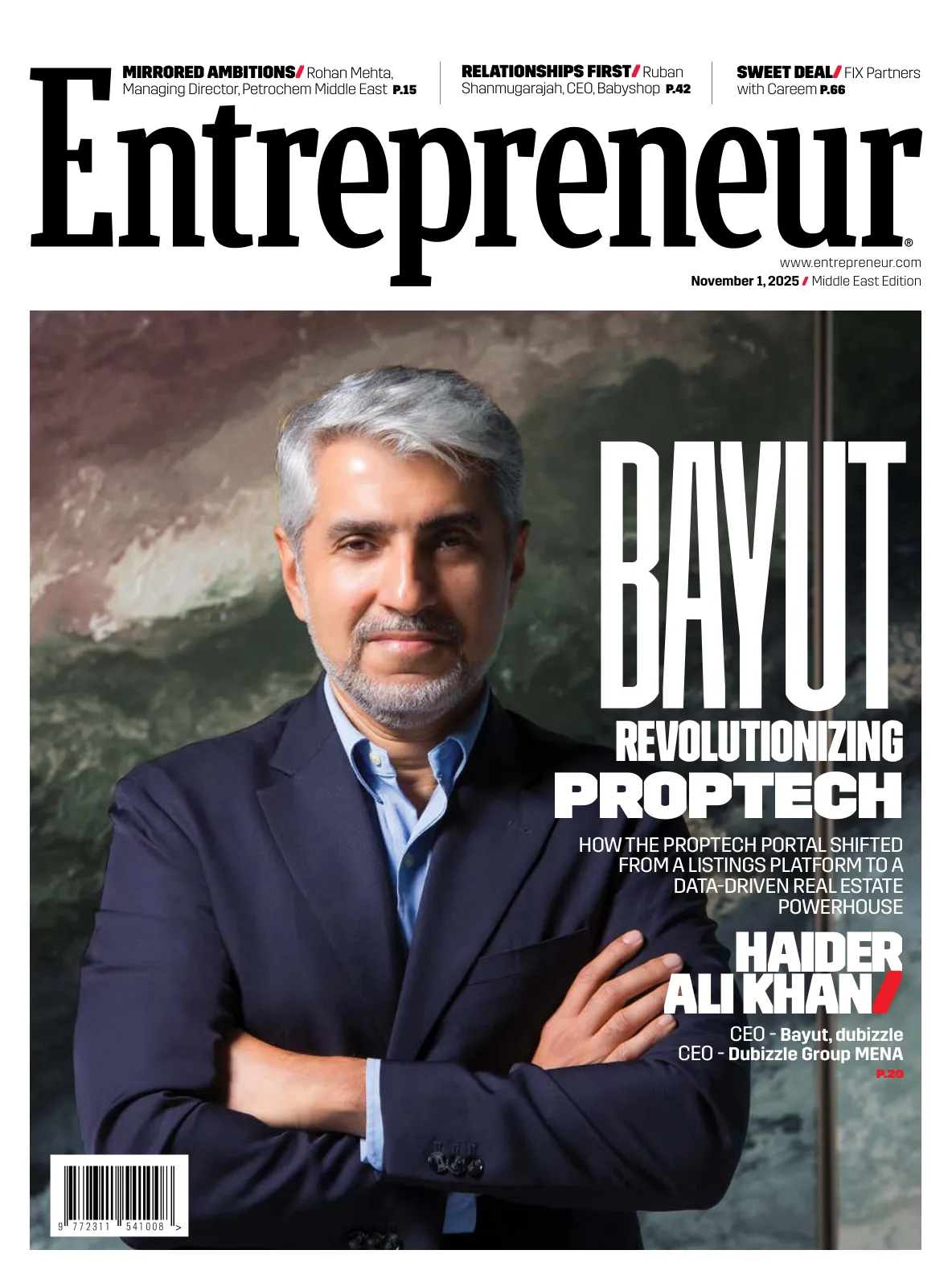
CEO - Bayut, dubizzle
CEO - Dubizzle Group MENA
P.20
Haider
Ali Khan/
BAYUT
HOW THE PROPTECH PORTAL SHIFTED
FROM A LISTINGS PLATFORM TO A
DATA-DRIVEN REAL ESTATE
POWERHOUSE
REVOLUTIONIZING
PROPTECH
Page 2
THE ALL NEW NISSAN PATROL
BOOK NOW
Page 3
Contents/November 1, 2025
P.20
Revolutionizing
Proptech
From The UAE To
The World
Born from a mission to redefine real estate
through technology, Bayut sparked a
movement that evolved into the global
proptech and classifieds leader, Dubizzle Group
— and today, we go back to understanding the
homegrown powerhouse that started it all.
FEATURES
3
November 1, 2025 / ENTREPRENEUR.COM /
→ Haider Ali Khan is the
CEO of Bayut and
dubizzle, and CEO of
Dubizzle Group MENA
Page 4
BUILT FOR MOMENTS
THAT MATTER
EXTRAORDINARY
Escape to a home where urban sophistication
meets resort tranquility.
PRIVATE POOLS | 30+ AMENITIES | PRIME LOCATIONS
800-SAMANA | WWW.SAMANADEVELOPERS.COM
Page 5
DISCOVER REFINED living
*Ranking as per the H2025 1 sales
volume data of property monitor for Dubai
Page 6
Page 7
SUITE TREAT
Step into a world of opulence when you book a Suite at Raffles Doha.
Experience the added luxury of QAR 750 credit to spend
on dining in the hotel, and QAR 500 towards any Spa treatment.
Children aged 12 and below are welcome to indulge in the
enchantment of complimentary dining.
Rates starting from QAR 3,500 per night
For reservations, please call +974 4030 7100
or email reservations.doha@raffles.com
Raffles Doha, Iconic Towers, Marina District, PO BOX 4747, Lusail, Qatar
Page 8
Page 9
Welcome to the
E X C E P T I O N A L
An iconic hotel featuring
luxury rooms and apartments
with trendy dining options
in the heart of Riyadh
BOOK NOW
Mansard Riyadh, A Radisson Collection Hotel
4248 Prince Mohammed Ibn Salman Ibn Abdulaziz Road, Riyadh 6721-13315, Saudi Arabia
00966118290900 info.mansard@radissoncollection.com
radissonhotels.com/collection
Page 10
P.37
Finding Direction
SAIRA SHEIKH on why her first brand
decision was to choose authenticity
over comfort
P.37
Sell More, Pitch Less
LACHLAN JACKSON says it is time to stop
‘TREPONOMICS
IN THE LOOP
Contents/November 1, 2025
P.58
Sweet Deal
FIX Dessert Chocolatier partners
exclusively with CAREEM
P.15
Mirrored Ambitions
ROHAN MEHTA becomes PETROCHEM’S
Managing Director as the company
celebrates its 30th anniversary
P.28
Steering the Future of Mobility
In conversation with HUSSAM
BAGHDADI, Chief Operating Officer of
AW ROSTAMANI AUTOMOTIVE
P.32
Building A Business Of
Relationships
As BABYSHOP celebrates its
50th anniversary, CEO RUBAN
SHANMUGARAJAH shares his vision for
the future
P.49
Investor Insights
The MENA region’s leading venture
capitalists share practical advice
to help founders navigate the
challenges of building and scaling a
startup.
P.54
Building Meaning Beyond
Business
How startups Fleetroot and Aumet
align with Qatar National Vision 2030
BUSINESS
UNUSUAL
STARTUP
SPOTLIGHT
→ Rema Alyahya
Vice President,
Venture Capital,
Merak Capital
CEO Wissam Younane
wissam@bncpublishing.net
MANAGING DIRECTOR Rabih Najm
rabih@bncpublishing.net
ART DIRECTOR Simona El Khoury
EDITOR IN CHIEF Anil Bhoyrul
anil@bncpublishing.net
MANAGING EDITOR Tamara Pupic
tamara@bncpublishing.net
FEATURES EDITOR Aalia Mehreen Ahmed
aalia@bncpublishing.net
DIRECTOR OF INNOVATION
Sarah Saddouk sarah@bncpublishing.net
GROUP SALES DIRECTOR – B2B GROUP
Joaquim D’Costa jo@bncpublishing.net
HEAD OF PARTNERSHIPS
Samir Glor Samir@bncpublishing.net
COMMERCIAL LEAD
Anna Chipala anna@bncpublishing.net
COLUMNIST Tamara Clarke
CONTRIBUTING WRITERS
Lachlan Jackson, Saira Sheikh, and Fida Chaaban
SUBSCRIBE
Contact subscriptions@bncpublishing.net to receive
Entrepreneur Middle East every issue
COMMERCIAL ENQUIRIES
sales@bncpublishing.net
ENTREPRENEUR.COM
Access fresh content daily on our website
All Rights Reserved 2025. Opinions expressed are solely those of the contributors.
Entrepreneur Middle East and all subsidiary publications in the MENA region
are officially licensed exclusively to BNC Publishing in the MENA region by
Entrepreneur Media Inc. No part of this magazine may be reproduced or
transmitted in any form or by any means without written permission of the publisher.
Images used in Entrepreneur Middle East are credited when necessary. Attributed
use of copyrighted images with permission. All images not credited otherwise
Shutterstock. Printed by United Printing and Publishing.
PO BOX 502511 DUBAI, UAE
P +971 4 4200 506
EntMagazineME
Entrepreneur-me
chasing funding, and start chasing
sales
P.42
ANAX Developments,
ELLE Residences
ANAX Developments latest landmark
project has unveiled ELLE Residence
redefining branded living in the region.
10 / ENTREPRENEUR.COM / November 1, 2025
Page 11
PROPERTIES
solproperties.ae
800-765-1
Learn More
Page 12
12 / ENTREPRENEUR.COM / November 1, 2025
Editor’s Note/
Editor’s Note
I
’ve been following the arc of Sharjah’s
development for years, but what I witnessed this
week left me genuinely excited. The emirate’s
economy expanded by a striking 8.4 % in 2024,
nearly triple the global average of around 3 %.
That alone is enough to make investors sit
up—and here’s why I believe we’re witnessing the
emergence of one of the world’s best investment
hotspots.
First, the growth is broad-based and durable.
More than just a headline number, the surge is
being driven by real estate and transport. Real
estate anchors the investment activity, while transport
and logistics are recording double-digit increases. What
that means for me is a landscape of solid, structural
opportunity—not just a spike that’s about to fade.
Second, the location and infrastructure strategy are
aligning perfectly. Sharjah is gearing up for what the
authorities term a “connectivity leap” — the launch of the
Etihad Rail together with expanded airport and port
capabilities means Sharjah is positioning itself as a
logistics hub for regional and global trade. As an investor,
infrastructure that reduces friction is gold.
Third, the environment feels open. The leadership has
made it clear: they’re building not just for growth, but for
sustainability, quality of life, and a balanced economy.
That kind of vision translates into stability—a major plus
in my book when deciding where to allocate capital.
So what does this mean, personally, for me—and for you
if you’re thinking like I am? It means I’m actively looking
at Sharjah’s upcoming property developments, logistics-
land parcels, and even tourism-adjacent ventures. The “so
what” is clear: getting in at this stage in Sharjah feels like
buying into Dubai in the early years—when the premise
was right and the upside still large.
In short: Sharjah isn’t just growing—it’s evolving. If
you’re scanning the globe for where to invest next, the
emirate deserves serious attention. I’m bullish.
Anil Bhoyrul
Editor-in-Chief
IS SHARJAH THE WORLD’S NEXT
INVESTMENT POWERHOUSE?
With 8.4 % growth and major infrastructure unlocking new value, Sharjah is changing
the map for global capital.
Page 13
Page 14
Enlighten Your Eternal Beauty,
Inside and Out!
info@muarjewels.com
@muarjewels
www.muarjewels.com
Page 15
15
November 1, 2025 / ENTREPRENEUR.COM /
Mirrored Ambitions
On the company’s 30th anniversary, Rohan Mehta took on the mantle of Managing
Director at the UAE-homegrown Petrochem. He talks about what it means to lead
a company whose journey has been reflective of the nation’s own growth tale, why
effective succession planning is paramount to a family business, and the lessons he’s
learned from the brand’s founder- his father, Yogesh “Yogi” Mehta. by AALIA MEHREEN AHMED
→ Rohan Mehta is the
Managing Director of
Petrochem Middle
East, a petrochemical
products’ distribution
and trading company
that has been
operational in the UAE
since 1995.
Page 16
16 / ENTREPRENEUR.COM / November 1, 2025
B/Impact Tales
I
n the world of business,
there are perhaps few
situations as daunting as
taking on the helm of a
30-year-old company
that generates nearly
US$2 billion in annual
revenue and exports to
over 40 countries. Yet
that is exactly what
Rohan Mehta did, in June
2025, when he became
Managing Director of Petrochem
Middle East– a petrochemical
products’ distribution and
trading company that his father,
Yogesh “Yogi” Mehta, launched in
Dubai’s Jebel Ali Free Zone in
1995. “The biggest lesson I’ve
learnt from my father is
patience,” Mehta says. “I’ve
always been energised by new
ideas and opportunities, which
can make me quite driven and
eager to act, but he taught me
that patience ultimately wins the
race. It’s about taking the time to
make considered decisions
rather than rushing, which has
been invaluable in building a
sustainable business. Another
key lesson from him is the
importance of trusting and
investing in people. He believed
that when you hand someone
the baton, you must also trust
them to run with it. That trust
fosters ownership and
accountability, which you cannot
create alone. This philosophy
has shaped how I lead today; our
company supports thousands of
families, and putting the
company first while believing in
and empowering our people
ensures they, in turn, take the
company forward.”
→ Rohan Mehta
and his father,
Yogesh “Yogi”
Mehta
Page 17
November 1, 2025 / ENTREPRENEUR.COM / 17
I
t is that trust that Mehta hopes to
respect as he now leads a company
which has roughly 250 employees
and serves global markets from its
regional hubs in the UAE, Saudi
Arabia, Egypt, and India. “Petrochem
currently generates just under $2
billion in revenue across three core
verticals: Distribution, Trading, as well
as Logistics and Infrastructure, with
distribution being the largest (70%)
contributor to the business,” shares
Mehta. “Beyond the regional hubs,
Petrochem also maintains commercial
offices around the world, including in
the Netherlands, Singapore, Taiwan,
China, and Colombia, enabling it to
manage operations and reach clients on
INSPIRED BY THE
UAE’S OPENNESS TO
DIVERSE CULTURES
AND NATIONALITIES,
PETROCHEM HAS
NURTURED AN
ENVIRONMENT
WHERE DIFFERENT
PERSPECTIVES ARE
WELCOMED, OUR TEAMS
ARE SUPPORTED, AND
SUCCESS IS SEEN AS A
SHARED JOURNEY: IF OUR
PEOPLE WIN, WE WIN.”
“
}}
a truly international scale.
Visibility is key to both sides of
the spectrum, our suppliers and
customers, which is what truly
underpins our global reach and
sets us apart.”
But in cementing such a wide
reaching presence today, Mehta
credits the UAE for having been
the perfect launchpad 30 years
ago. “Petrochem’s story is
inseparable from the UAE’s own
growth trajectory,” Mehta says.
“Our success is fully correlated
with the country’s vision and
leadership. We’ve grown
alongside the emirate [of Dubai],
the nation, and the wider region,
and we give full credit to the
UAE for creating an environment
where homegrown family
businesses like ours can thrive.
When we began, the UAE was
primarily an import hub; today,
with its world-class infrastruc-
ture and strategic vision, it has
evolved into a major export hub,
and Petrochem has mirrored that
journey. Operating in the UAE
has offered immense advantages.
The government has provided
the right tools and infrastructure
to trade, handle operations, and
manage the import, export and
distribution of petrochemical raw
materials to manufacturing
industries globally from the
Emirates. Port authorities have
also been exceptionally flexible
and accessible, enabling smooth
vessel movements even when
shipments aren’t precisely
scheduled, a level of support that
is critical in our industry.”
Here, Mehta notes how the
government’s proactive strategies
have offered unique opportuni-
ties to the business. “The UAE’s
streamlining of business
regulations during challenging
times, like the pandemic, acted as
a springboard for our recent
successes,” he says. “For example,
our close collaboration with
entities such as the Ministry of
Health, particularly during
sensitive periods like the surge in
demand for sanitiser raw
materials, is another testament to
how the country’s leadership
actively supports the private
sector. This partnership-driven
ecosystem continues to shape
both Petrochem’s growth and the
UAE’s position as a global
trading hub.”
Beyond the government’s direct
initiatives, however, Mehta also
credits the UAE’s overall
transition from being an
→ Petrochem began as a single-office operation in Dubai’s Jebel
Ali Free Zone. Over the past three decades, the company has
evolved into a $2 billion global enterprise.
Page 18
18 / ENTREPRENEUR.COM / November 1, 2025
B/The Big Idea
import-export hub to
championing local
manufacturing as a pivotal
shift in Petrochem’s
journey. “This created an
opportunity for us to cater
to demand directly within
the UAE, rather than
focusing solely on periph-
eral markets like India and
Saudi Arabia, which
historically dominated due
to their larger populations
and manufacturing bases,”
Mehta explains. “We give a
great deal of credit to this
broader manufacturing
shift in the country, which
has directly supported
Petrochem’s long-term
hub-and-spoke vision. Our
goal has always been to
bring petrochemical raw
materials closer to our
customers, positioning
ourselves at the center of
activity rather than on the
sidelines. The UAE’s
geographic advantage also
plays a crucial role in
shaping the industry’s
landscape. Being strategi-
cally located at the
crossroads of East and
West, the country offers
unparalleled access to
import raw materials at
competitive prices,
supported by world-class
infrastructure and
logistics. This unique
positioning has not only
benefited the overall indus-
try but also enabled
Petrochem to stay aligned
with our vision of being a
true hub for chemical
distribution.”
Now, although Mehta
stepped into the role of
Managing Director only a
few months ago, he has
witnessed the impact of
such macrotrends and
ecosystem changes
firsthand. He has, after all,
made his way up the ranks
at Petrochem having started
out as a Sales Manager in
2013. While such extensive
experience will clearly hold
him in good stead for his
new role anyway, Mehta
credits an effective
management handover
strategy for his readiness
and confident outlook.
“Succession planning at
Petrochem wasn’t an
afterthought; it was rooted
in my father’s vision from
the very beginning,” he
shares. “He has always been
a forward-thinking leader,
determined to leave behind
not just a thriving business
but a legacy built to endure.
That mindset shaped how
the company approached
every major decision,
including leadership
transition. When I joined
the business 12 years ago as
the next generation, it
became even more of a
priority for me to formalise
my vision. We focused on
putting robust systems,
processes, and foundations
in place so the company
would not only succeed
today and tomorrow, but
continue thriving decades
from now. Our goal has
always been to create a
business that can sustain
itself for 100 years, not just
10 or 20. This is why
succession planning
became a strategic initiative
rather than a reactive
measure. It’s not only about
profitability but about
building a resilient,
sustainable business that
stands the test of time.”
Already, Mehta has goals
such as vertical integration,
digitalisation, and geo-
graphic expansion across
the Middle East, Africa, and
Asia marked out on his
vision roadmap. Among
these goals is a plan to
“inaugurate the largest
investment in our history”–
a $100 million terminal in
Jebel Ali, designed to triple
Petrochem’s storage
capacity and meet the
future needs of global
logistics. But underscoring
such lofty dreams is the
vision the company was
created with all those many
SUCCESSION PLANNING AT PETROCHEM WASN’T AN AFTERTHOUGHT; IT
WAS ROOTED IN MY FATHER’S VISION FROM THE VERY BEGINNING. HE HAS
ALWAYS BEEN A FORWARD-THINKING LEADER, DETERMINED TO LEAVE
BEHIND NOT JUST A THRIVING BUSINESS BUT A LEGACY BUILT TO ENDURE.”
→ With a presence in
over 10 countries and
a network that
supports industries
from pharmaceuticals
to oilfield services,
Petrochem is a leader
in distribution,
logistics, and supply
chain innovation.
Page 19
years ago. “My father’s original vision
was to build a business rooted in
strong values and relationships,
creating opportunities not just for the
company but for everyone connected
to it– I’ve sought to honour that by
maintaining those values while
adding my own leadership style,
blending patience with a willingness
to explore new ideas, and building on
our foundation with a forward-look-
ing approach,” Mehta says. “Beyond
my father, my greatest role model has
been the people who work with us
every day. Their dedication, resilience
and commitment to the company
inspire me constantly, and they
remind me why my father’s lessons
about trust and patience remain
timeless.”
Much of Mehta's, and indeed his
father’s, people-centric approach
towards business has seeped into
Petrochem’s day-to-day operations
and ultimately become the company
culture. Here, too, Mehta attributes
such workplace attitudes back to the
UAE’s own value system as a nation.
“Inspired by the UAE’s openness to
diverse cultures and nationalities,
Petrochem has nurtured an environ-
ment where different perspectives are
welcomed, our teams are supported,
and success is seen as a shared
November 1, 2025 / ENTREPRENEUR.COM / 19
When we began, the
UAE was primarily an
import hub; today,
with its world-class
infrastructure and
strategic vision, it
has evolved into a
major export hub,
and Petrochem has
mirrored that journey.”
“
long-standing focus on its people.
These values are not just part of our
heritage; they actively shape our future.
They empower us to remain resilient,
attract and retain top talent, and seize
new opportunities while continuing to
grow alongside the UAE.”
Emboldened by his past experience
and a clear cut vision for the future,
Mehta now hopes to maintain, and
grow, the business’ success. “We’re in a
legacy business; my job is to keep the
ship moving, keep it profitable, and
keep oil in the engine so the legacy
remains strong,” Mehta declares.
“That’s what brings me to work every
day. In the long term, my hope is to
build a truly sustainable business that
can thrive in a fast-changing world.
We’re no longer the generation that
founded and built Petrochem from
scratch; we’re the team entrusted with
carrying it forward. That means
creating a culture and a team that
deeply believes in the company’s vision,
while optimizing and building on the
incredible foundation we’ve been given.
I feel very fortunate to have a headstart
where the seeds have already been
planted. My responsibility now is to
water and grow them, to turn our
existing strengths into new opportuni-
ties, and to ensure Petrochem’s name
and legacy continue to flourish for
decades to come.”
journey: if our people win, we win,” he
says. “This commitment is reflected in
the loyalty and growth of our senior team
members, many of whom have stayed
and advanced with the business for
decades, a testament to the company’s
Page 20
20 / ENTREPRENEUR.COM / November 1, 2025
→ Haider Ali Khan is the
CEO of Bayut and
dubizzle, and CEO of
Dubizzle Group MENA.
Page 21
21
November 1, 2025 / ENTREPRENEUR.COM /
REVOLUTIONIZING
PROPTECH
FROM THE
TO THE
WORLDUAE
BORN FROM A MISSION
TO REDEFINE REAL
ESTATE THROUGH
TECHNOLOGY, BAYUT
SPARKED A MOVEMENT
THAT EVOLVED INTO THE
GLOBAL PROPTECH AND
CLASSIFIEDS LEADER,
DUBIZZLE GROUP — AND
TODAY, WE GO BACK
TO UNDERSTANDING
THE HOMEGROWN
POWERHOUSE THAT
STARTED IT ALL.
by TAMARA PUPIC
Page 22
22 / ENTREPRENEUR.COM / November 1, 2025
T
oday, Dubizzle Group is a
powerful digital ecosystem
that connects individual and
business sellers with prospective
buyers across multiple verticals, from
real estate and automotive. With over
18 million monthly active users, a
workforce of 2,600 employees across
10 countries, and impressive profit
margins of nearly 50%, Dubizzle
Group has become a symbol of
sustainable tech success in MENA.
Yet, amid all this scale and success,
it’s easy to overlook the true spark
that ignited it all — Bayut, the
homegrown Dubai startup that grew
from a small office in Dubai Internet
City into one of the region’s most
inspiring digital success stories.
"Bayut isn’t just a platform; it’s the
story of a dream born in the UAE,”
says Haider Ali Khan, CEO at
dubizzle and Bayut, and CEO of
Dubizzle Group MENA. "What began
as a simple idea has grown into a
movement that’s redefining how
people find and experience homes
across the nation. Built on technol-
ogy, powered by data, and shaped by
an intimate understanding of the
UAE’s heartbeat, Bayut has helped
people discover not just properties,
but places where their ambitions,
memories, and futures take shape."
He adds, "At its core lies a promise of
trust, transparency, and innovation. A
promise that has turned the complex
journey of real estate into something
more human, more connected, and
more inspiring. Through every listing
and every interaction, I feel Bayut
continues to build bridges of
confidence and craft a smarter, more
connected property landscape for the
generations to come."
With a degree in electrical engineer-
ing from the University of Texas at
Austin, Khan spent over 14 years in
the United States working with
leading technology and finance firms,
including Goldman Sachs, Silicon
Labs, and National Instruments.
Although Bayut was founded in the
UAE in 2008, it was in 2014 that
Khan moved to Dubai with an aim to
"build technology that genuinely
makes people’s lives better.” Khan
adds, "From day one, Bayut wasn’t
Shams Business Centre
W
hen Dubizzle Group — which was established in the UAE and
grew under the guidance of Haider Ali Khan — merged with
the Amsterdam-headquartered classified businesses OLX
Group in 2020, it became the region’s first homegrown unicorn
in the digital classifieds and proptech space.
“
}}
BAYUT IS THE STORY
OF A HOMEGROWN
PLATFORM THAT USED
DATA, TECHNOLOGY,
AND PASSION TO
REDEFINE HOW THE
UAE EXPERIENCES REAL
ESTATE.”
Page 23
23
November 1, 2025 / ENTREPRENEUR.COM /
IMAGES COURTESY SHAMS
Page 24
24 / ENTREPRENEUR.COM / November 1, 2025
Page 25
25
November 1, 2025 / ENTREPRENEUR.COM /
just another property portal. We saw an opportunity
to solve real problems in transparency, efficiency, and
trust using data and technology. My approach to
leadership has always been digital-first and human-
centric. Empower the best minds, give them the right
data, and let them innovate fearlessly. That combina-
tion has shaped Bayut into a best-in-class proptech
platform and a benchmark for the industry and the
region.”
Walking the talk of his philosophy, Khan turned
words into action as Bayut brought more than 80 data
scientists on board - one of the largest data science
teams in the region - to deepen its analytics capabili-
ties, transforming the company into a truly data-rich,
insight-led business. "Today, data science powers
almost everything we do, from lead scoring and
market trend forecasting to hyper-personalized
consumer experiences,” Khan explains. "It’s the
backbone of how we serve our users and partners
better every single day.”
Proof of Bayut’s innovation can already be seen in
the success of TruBrokerTM and TruEstimateTM — two
proprietary tools that have redefined how the region’s
real estate market uses data. But Khan asserts that
“it's only the beginning. We have many such exciting,
value-driven products in our pipeline.”
In a nutshell, TruBrokerTM is an agent ranking
system that rewards quality and accountability, while
TruEstimateTM is an AI-powered valuation engine
trained specifically on UAE transaction. Yet, Khan
points out. "TruBrokerTM is more than a rewards and
recognition system, it's a complete ecosystem designed
to elevate agent professionalism and performance
through data, gamification, and recognition,” he says.
"It brings transparency and accountability into how
agents operate, while celebrating the ones who go
above and beyond. It’s been amazing to see how
TruBroker™ has inspired a whole generation of real
estate professionals to embrace digital tools and
continuous improvement.”
He adds that TruEstimateTM, on its part, has
completely transformed how people think about
property valuations. "It’s a data-driven solution
powered by our AI models, giving users and agents
access to reliable, real-time insights on property
prices,” Khan explains. "What’s powerful is how it
bridges information gaps and builds trust between
sellers, buyers, and brokers by making valuation data
accessible, transparent, and credible.”
One of the most revealing ways to understand
Bayut’s data-led tools is through the challenges the
company set out to solve. That is why TruBrokerTM
and TruEstimateTM helped Bayut overcome its biggest
early challenge - ensuring accuracy and trust in
property listings. "We knew that if we wanted to raise
industry standards, we had to build technology that
enforced accountability while rewarding integrity,”
Khan says. " That’s where TruCheck™ and TruBro-
ker™ made a real difference.
"Before TruCheck™, the market had verification
tags, but they were largely surface-level, inconsistent,
and often outdated. Users were still left wondering
whether a property was genuinely available or not.
TruCheck™ changed that paradigm. It went beyond
simple labels by validating listings directly against
real-time availability, using data authentication rather
than declarations. That was a first for the region. It
gave people the confidence that what they saw on
Bayut was real, accurate, and up to date, setting a
completely new standard for trust and transparency in
the UAE’s real estate industry.
"TruBroker™, meanwhile, helped us address the
behavioural side of the challenge by rewarding agents
who consistently deliver accurate, high-quality listings
and exceptional service.
By combining innovation with data and recognition,
we didn’t just fix a market issue, we shifted the
culture. Today, accuracy, responsiveness, and profes-
sionalism are measurable and celebrated. That’s how
technology drives real, sustainable change."
For Bayut, however, growth and innovation must go
hand in hand with one non-negotiable principle —
trust. As Khan notes, “growth without trust is
short-lived.” He adds, "Every innovation we launch
has to strengthen confidence whether it’s for the end
“EMPOWER THE BEST
MINDS, GIVE THEM THE
RIGHT DATA, AND LET THEM
INNOVATE FEARLESSLY. THAT
COMBINATION HAS SHAPED
BAYUT INTO A BEST-IN-CLASS
PROPTECH PLATFORM AND
A BENCHMARK FOR THE
INDUSTRY AND THE REGION.”
}}
Page 26
Khan highlights that
operating in the UAE - where
the government leads with
vision and innovation - has
been a defining advantage for
Bayut. "Our partnerships
with Dubai Land Depart-
ment and Abu Dhabi Real
Estate Centre are testaments
to that,” he says. Together,
we’ve worked on digital
integrations that make real
estate transactions more
transparent and compliant.
We share the same goal - to
make the UAE the most
advanced, tech-enabled real
estate market in the world.
He adds, "Dubai is built for
scale and ambition. The
infrastructure, policy
environment, and openness
to innovation are unmatched.
The city rewards companies
that think big but execute
with precision and that’s
where Bayut thrives. The
leadership here doesn’t just
encourage innovation, it
institutionalizes it. That’s
incredibly powerful for a
proptech company with a
vision like ours."
As the region’s property
market becomes increasingly
digital, the proptech
landscape is shifting toward
smarter, data-led decision-
making. Khan believes the
next few years will mark the
beginning of an “age of
intelligent real estate,” where
every choice — from pricing
to investment — will be
informed by real-time data
and predictive insight. "The
next three to five years will
see AI valuations become the
norm, blockchain simplifying
transactions, and predictive
insights transforming how
people buy and sell homes.”
However, Khan points out
that "as surprising and
contradictory as this might
sound, technology will be
making real estate more
human centric again.” He
explains, “Technology is
removing friction, uncer-
tainty, and bias from the
process. Whether it’s through
personalized recommenda-
tions, immersive tours, or
smart valuations, we’re
giving people confidence and
control in one of the biggest
decisions of their lives. That’s
the real power of digital
innovation.”
Against this backdrop,
Khan foresees Bayut
reaching new heights. "We’ll
continue to lead with
innovation. More AI-driven
tools, immersive 3D and AR
experiences, and deeper
integration between data, AI
and decision-making. We’re
not just building for the
UAE, we’re building a
proptech model that the
world can learn from,” Khan
concludes.
“WE DON’T ACQUIRE FOR THE
SAKE OF SIZE; WE ACQUIRE TO
ENHANCE VALUE. IF THERE’S
AN OPPORTUNITY THAT
ACCELERATES OUR DIGITAL
VISION OR STRENGTHENS
THE USER JOURNEY, WE’LL
ABSOLUTELY EXPLORE IT.”
TREP TALK
Bayut’s Haider Ali
Khan Advises Proptech
Entrepreneurs
}"Start with purpose, stay
obsessed with the customer,
and build on data. Proptech
isn’t just about code, it’s
about context. The UAE is a
phenomenal launchpad, but
to succeed you need to
blend speed with substance.
Focus on solving problems,
not following trends. If your
tech can make life easier for
even one person today,
you’ll find your scale
tomorrow."
26 / ENTREPRENEUR.COM / November 1, 2025
user, for the agent, or for
the ecosystem as a whole.
Our north star has always
been trust through
technology. That’s how
we’ve managed to grow
rapidly while remaining
the most trusted name in
UAE real estate.”
Taking it a step further,
Khan reiterates that
Bayut’s future isn’t defined
by innovation alone, but
by the impact those
innovations create. "We
track data points, yes.
Engagement, ROI,
conversion; these are all
important but the real
metric is how much easier
and more informed we
make the property
experience and how much
more value we have
created for our partners,”
he says. "The fact that we
attract the largest traffic
and have the highest
number of agency
partners working with us
today is a sign that we are
on the right path.”
With an aim to scale
their impact, Bayut and its
parent company, Dubizzle
Group, have made a series
of strategic acquisitions
over the years — including
Lamudi in April 2019,
DriveArabia in May 2024,
and Property Monitor in
April 2025. "Our acquisi-
tions are always about
synergy and scalability,”
Khan explains. "Property
Monitor strengthened our
analytics and valuation
capabilities, while
DriveArabia deepened our
automotive ecosystem. We
don’t acquire for the sake
of size; we acquire to
enhance value. If there’s
an opportunity that
accelerates our digital
vision or strengthens the
user journey, we’ll
absolutely explore it."
Page 27
TRAILBLAZING
WOMEN
27
November 1, 2025 / ENTREPRENEUR.COM /
Page 28
28 / ENTREPRENEUR.COM / November 1, 2025
I
n this exclusive Q&A, Hussam Baghdadi, Chief Operating Officer
of AW Rostamani Group, reflects on the legacy he seeks to
build—one rooted in resilience, integrity, and innovation—as he
aligns the company’s automotive operations with the UAE’s
vision for a sustainable, technology-driven mobility future.
Steering the Future of
Mobility:
Hussam Baghdadi, Chief Operating
Officer, AW Rostamani Automotive
Under Hussam Baghdadi’s leadership, AW Rostamani
Automotive is evolving beyond vehicles toward a connected
mobility ecosystem. The COO shares with how purpose,
integrity, and innovation are shaping both his leadership
legacy and the wider transformation of the UAE’s automotive
landscape. by WISSAM YOUNANE
You’ve been with AW Rostamani
Automotive for more than three decades,
rising from a sales consultant to Chief
Operating Officer (COO).How has this
journey shaped your leadership
philosophy?
When I joined AW Rostamani Automotive
in 1995, I had an enthusiasm for cars, but
little experience in the industry. What I did
have was curiosity, and that made all the
difference. From my early days as a sales
consultant to now leading the organization,
I’ve worked through nearly every stage of the
customer and operational journey. That
exposure grounded me in the realities of
what makes our business thrive: people,
trust, and service.
My leadership philosophy was shaped by
that foundation. I’ve learned that titles don’t
define leadership - responsibility does. The
higher you rise, the greater your duty to
create clarity, inspire growth, and empower
others to lead. Success in our industry is
never a solo effort; it’s the collective strength
of people who believe in a shared vision.
That belief continues to guide how I lead
today, with integrity, inclusivity, and a deep
respect for the people who drive our
progress.
Having overseen the transformation of
multiple global brands under AWR, what
do you see as the key leadership traits
that have enabled you to guide teams
through disruption and change?
In times of change, people don’t follow
plans; they follow conviction. When
disruption hits, teams look for steadiness,
clarity, and empathy in equal measure. I’ve
found that the most effective leaders are
those who can be firm in direction yet
flexible in approach.
B/The Big Idea
→ Hussam Baghdadi
is the Chief
Operating Officer of
AW Rostamani
Group.
Page 29
29
November 1, 2025 / ENTREPRENEUR.COM /
At AW Rostamani Automotive, we’ve
navigated transformations: digital,
economic, and structural, by focusing on
transparent communication and a clear
sense of purpose. My approach has
always been to connect strategy with
humanity: to make sure people under-
stand why change is happening and how
they are part of the journey. That
combination of decisiveness and empathy
builds resilience, and resilience is what
ultimately sustains performance through
uncertainty.
The automotive industry is
undergoing rapid digital disruption.
How is AW Rostamani Automotive
harnessing AI-powered tools—such
as predictive inventory management
and smart stock planning—to
transform dealership operations?
AI has moved from being a futuristic idea
to an operational backbone. In a business
where timing, precision, and availability
shape customer satisfaction, predictive
intelligence is transforming the way we
plan and respond.
We see it as a strategic enabler that
drives speed, accuracy, and smarter
decision-making. Our new Parts
Distribution Center in Dubai Industrial
City - the largest of its kind in the UAE
- will bring predictive systems together
under one roof, setting new standards for
efficiency and responsiveness. Beyond
automation, AI empowers our teams to
focus on innovation and customer
relationships while technology manages
complexity. It’s how we’re building a
smarter, more agile dealership model
designed for the future of mobility.
In your view, how will AI-driven,
data-powered decision-making
redefine sales, after-sales, and
marketing strategies across the UAE
in the coming years?
AI is redefining what we mean by
“knowing the customer.” Data now allows
us to understand preferences, predict
needs, and personalize engagement
across every touchpoint, from the first
click to post-purchase service.
In sales, that means identifying how
and when customers prefer to connect. In
after-sales, it means anticipating service
“I’VE LEARNED THAT TITLES
DON’T DEFINE LEADERSHIP
- RESPONSIBILITY DOES.
THE HIGHER YOU RISE, THE
GREATER YOUR DUTY TO
CREATE CLARITY, INSPIRE
GROWTH, AND EMPOWER
OTHERS TO LEAD.”
}}
Page 30
30 / ENTREPRENEUR.COM / November 1, 2025
requirements before an issue arises. In marketing, it means
focusing resources on what truly matters, not just what’s visible.
But data alone doesn’t create value - interpretation does.
That’s why we are using AI to build connected intelligence
across functions, not silos. When sales, service, and marketing
insights work in harmony, the result is an ecosystem that serves
customers seamlessly and builds loyalty organically.
With mobility increasingly seen as a service rather than a
product, how do you envision advanced technologies and
AI reshaping the way customers interact with cars in the
region?
Mobility today is about access. Customers want freedom to
choose, to switch, to personalize how they move. AI is enabling
that flexibility by bridging digital discovery with physical
experience.
Our goal is to expand choice. Some customers value the pride
of owning a Patrol or QX80; others prefer short-term leasing or
subscription models for city driving. Technology allows us to
serve both, intelligently and intuitively.
AI deepens this by analyzing behavior and suggesting tailored
solutions that make every interaction feel personal. The future
of mobility will be about designing journeys that evolve with
people’s lives.
Today’s customers expect seamless, frictionless journeys.
How is AWR reimagining the online-to-offline car buying
experience?
Today’s customer is better informed than ever. By the time they
walk into a showroom, they’ve already done the research,
compared models, and read reviews. Our role is to elevate the
experience.
We’ve reengineered our processes to make the digital-to-physi-
cal transition effortless. Whether it’s through online configura-
tion tools, digital kiosks, or AI-driven lead tracking, every
touchpoint connects seamlessly, but we never lose the human
element. Technology makes the process faster; people make it
meaningful. That combination is where real customer
satisfaction lives.
What role does personalization and digital-first
engagement play in strengthening trust and loyalty with
customers?
Personalization is the modern form of respect. It tells the
customer: we see you, we understand you, and we value your
time. Our digital-first approach ensures that every interaction
- from a service reminder to a product offer - is relevant and
timely. By using data ethically and intelligently, we’re able to
build trust over time. The result is loyalty that isn’t transac-
tional, but emotional. Customers stay because they want to.
Beyond the sale, what are some of the post-purchase
engagement initiatives you’re championing to build
long-term relationships with customers?
The sale is only the beginning of the relationship. What defines
a brand is how it shows up after the transaction. We’ve invested
in digital platforms that simplify ownership, from booking a
service to tracking vehicle updates in real time. Our loyalty
programs and community events extend that engagement
beyond the workshop, into lifestyle, wellness, and purpose-
driven initiatives.
After-sales, to me, is a philosophy. It’s about staying present in
the customer’s journey long after the handover, ensuring they
always feel supported, appreciated, and connected.
B/The Big Idea
THE PERSONAL FIRSTS ARE THE ONES THAT HAVE HAPPENED WHEN I WAS VERY YOUNG. I WAS THE FIRST
ONE TO WIN NATIONALS WHEN I WAS 12, AT THE UNDER-14 AND THEN THE UNDER-16 CATEGORIES. SO STUFF
LIKE THAT, WHICH IS NOT REALLY OUT THERE IN THE WORLD, ARE JUST AS SPECIAL.”
→ AW Rostamani
Group is a leading
multi-sector family
business in the
Middle East, driven
by a legacy of over
seven decades.
Page 31
31
November 1, 2025 / ENTREPRENEUR.COM /
Do you see sustainability
practices evolving into a
competitive
differentiator for
automotive companies in
the Middle East?
Sustainability has evolved
from being a moral
obligation to a business
advantage. Customers are
now choosing brands that
reflect their values.
In our region, we’re seeing
an accelerated transition
toward electric mobility,
supported by national
visions and policy frame-
works. We see sustainability
as part of innovation.
Whether it’s through
energy-efficient operations,
EV adoption, or communi-
ty-driven initiatives, our
aim is to create impact
that’s both measurable and
meaningful.
Leadership today is
measured by purpose
aligned with progress,
which becomes a true
differentiator.
The UAE has positioned
itself as a mobility and
smart-city hub. How is
AW Rostamani
Automotive aligning with
and contributing to this
national vision?
The UAE’s vision for smart
mobility is a masterclass in
combining ambition with
execution. It’s not just
about futuristic ideas - it’s
about building the
infrastructure and
ecosystem that make those
ideas accessible to people.
At AW Rostamani
Automotive, we’re proud to
play a role in that transfor-
mation. From advancing
EV adoption to integrating
digital retail and service
platforms, our initiatives
are designed to make
innovation tangible. We
align our strategy with the
national agenda so that
every step we take
contributes to the UAE’s
broader journey toward
smarter, more sustainable
cities.
With responsibility
across Nissan, INFINITI,
and Renault, how do you
approach bridging global
OEM strategies with the
unique needs of the local
market?
Global automotive brands
bring technological
excellence and strong
product portfolios, but
success in the UAE
depends on cultural
intelligence, understanding
how people here live, drive,
and connect.
Our role is to bridge the
global and the local. We
adapt global strategies
from Nissan, INFINITI,
and Renault to create
experiences that resonate
authentically with
customers in this market.
Whether it’s refining model
mixes, tailoring communi-
cations, or enhancing
aftersales service, we make
sure every decision reflects
both international quality
and local relevance.
From your vantage point,
what role can the UAE
play in shaping the
regional dialogue on the
future of mobility and
innovation?
The UAE is leading in the
mobility transformation.
The nation’s investments in
smart infrastructure,
advanced regulation, and
innovation ecosystems are
setting a regional bench-
mark. Its ability to pilot
new technologies and scale
them effectively gives it
both influence and
credibility. The UAE
doesn’t just talk about the
future. That blend of vision
and execution is what
positions the country to
shape the regional dialogue
on mobility and innovation
for years to come.
Looking ahead, what do
you see as your most
important legacy
contribution—both
within AW Rostamani
Automotive and the
wider automotive
industry in the region?
Legacy, for me, will be
measured in people as
much as in projects.
Within AW Rostamani, I
want to be remembered for
building resilient,
values-driven teams that
carry forward the culture
of integrity and customer
focus. Beyond the
company, I hope my role is
seen in how we helped
align the automotive
industry with the UAE’s
wider vision of mobility -
one that embraces
technology, sustainability,
and service as part of a
single ecosystem. If I have
contributed to preparing
both the company and the
industry to meet the future
with confidence, that will
be a legacy worth leaving.
Wissam
Younane is a
prominent
media
executive and
entrepreneur based in
Dubai, United Arab
Emirates. He serves as the
CEO of BNC Publishing, the
company behind
Entrepreneur Middle East,
a leading business media
platform in the MENA
region.Under his
leadership, BNC Publishing
has become a key player in
the regional media
landscape, producing
content that supports and
celebrates entrepreneurship
and innovation.Younane is
known for organizing
high-profile events that
bring together influential
figures from the business
world. For instance, he
played a central role in
hosting the “Legends of
Entrepreneurship Awards”
in February 2025, which
honored notable
entrepreneurs and featured
former UK Prime Minister
Boris Johnson as a keynote
speaker.
“THE SALE IS ONLY
THE BEGINNING OF THE
RELATIONSHIP. WHAT DEFINES
A BRAND IS HOW IT SHOWS UP
AFTER THE TRANSACTION.”
Page 32
32 / ENTREPRENEUR.COM / November 1, 2025
I
n the little over fifty years that the
regionally homegrown children and
maternity retail brand BabyShop has been
operational, while parenthood and the
emotional and economic complexities that
accompany it have evolved, what hasn’t
changed is the visceral bond that defines
parent-child relationships. So when Ruban
Shanmugarajah took on the role of CEO at
Babyshop in 2021, he was faced with a related
dilemma. “My first thought was, ‘how do we
preserve the heart of this brand while preparing
it for its next era?’” he shares. “Babyshop has
always been built on warmth and trust, and I
did not want to lose that. But I was also looking
at a generation of parents who are digital-first,
globally influenced, and expecting brands to
meet them where they are. My vision was to
evolve Babyshop without losing its soul. Four
years on, a few milestones stand out. Our
digital shift has been transformational, not just
building e-commerce but creating a truly
omni-channel brand where online and offline
amplify each other. We have modernised our
stores, sharpened our assortments, and made
our collections more aspirational without ever
losing accessibility. To me, the real win is that
families today still recognise the Babyshop they
trust, but they see it in a fresher, more relevant
form.”
Launched in 1973 in Bahrain under Landmark
Group, one of the largest retail and hospitality
conglomerates in the Middle East, BabyShop
today operates over 250 stores across MENA,
Africa, Southeast Asia, and India. “Saudi Arabia
Building A Business
Of Relationships
As children and maternity brand BabyShop
celebrates its 50th anniversary, CEO Ruban
Shanmugarajah shares how five decades of
centering trust and safety is already defining the
future roadmap for a new generation of families.
by AALIA MEHREEN AHMED
↓ Ruban
Shanmugarajah is
the CEO of
UAE-based children
and maternity retail
brand Babyshop; a
role he has held
since 2021.
Page 33
33
November 1, 2025 / ENTREPRENEUR.COM /
and the UAE continue to be our
biggest markets, but our
expansion into Southeast Asia
and India is particularly
exciting,” Shanmugarajah adds.
“Both regions have welcomed
Babyshop with real enthusiasm.
As for verticals, apparel remains
our leading category, powered
by our in-house brands and our
ability to respond quickly to
evolving style trends. Nursery,
toys, and travel gear are also
growing strongly, driven by
conscious parenting, gifting, and
the need for practical,
high-quality essentials. It is no
longer about being just a
children’s clothing retailer.
Today, Babyshop is positioned as
a complete partner in parenting,
and that breadth of trust across
categories is one of our greatest
strengths.”
Indeed, in addition to keeping
up with a digitally transformed
retail industry and changed
consumer tastes,
Shanmugarajah notes that there
has been the added onus of fully
understanding the psyche of the
modern day parent. “Parents
today are raising children in a
very different world– they are
far more informed, intentional,
and discerning in their choices,”
he notes. “Quality and safety are
non-negotiables, but they also
want brands that simplify their
lives, inspire them, and make
everyday parenting easier.
Parenting has become more
planned, and expectations from
retailers are higher than ever. At
the same time, cultural values
remain central in this region,
and those traditions continue to
shape how families make
decisions. At Babyshop, these
shifts have influenced every part
of our operations. We have
doubled down on product
innovation, from design and
fabrics to bringing in best-in-
class features in quality and
safety.”
In turn, three tenets became
paramount to Babyshop’s
operations. “Parents told us
what mattered: relevant
products, better availability, and
smoother omni-channel
We have modernised
our stores,
sharpened our
assortments, and
made our collections
more aspirational
without ever losing
accessibility. To
me, the real win is
that families today
still recognise the
Babyshop they
trust, but they see
it in a fresher, more
relevant form.”
“
Page 34
34 / ENTREPRENEUR.COM / November 1, 2025
experiences,” Shanmugarajah
says. “We listened, and then acted
quickly: building sharper
assortments, renovating stores,
stepping up our marketing, and
fine-tuning our supply chain. That
agility has been key. The uplift is
encouraging, but I do not see it as an
end point. For me, it is a signal, proof
that when we stay agile and in tune
with families, growth follows. It gives
us the confidence to double down on
our next chapter: deeper omni-
channel integration, expansion in
emerging markets, and building even
more depth across our categories.”
In the midst of such parent-centric
shifts, Babyshop has also had to keep
an eye on how pop culture interests
and emotional intelligence of
toddlers and children today are much
different than that of previous
generations. “Kids today are
incredibly expressive– they want
their clothes, toys, and even
accessories to reflect who they are,”
Shanmugarajah explains. “Our role is
thus to give them that sense of
individuality without fast-tracking
them out of childhood. That is where
our research and design teams play a
critical role. They take global fashion
cues, then reinterpret them in ways
that are playful, comfortable, and
age-appropriate. Partnerships also
matter here. We work closely with
global names like Disney and Mattel,
and more recently with anime and
gaming properties, to create
collections that excite children while
delivering value for parents. It is
about listening carefully and giving
families what they aspire to buy, but
doing so responsibly so the joy and
innocence of childhood remain
intact.”
LOYALTY IS NEVER INSTANT; IT IS BUILT SLOWLY, OVER YEARS, SOMETIMES DECADES. FOR BABYSHOP, IT HAS
COME FROM BEING PRESENT IN PEOPLE’S LIVES AT THE MOMENTS THAT MATTER MOST. PARENTS WHO ONCE
WALKED INTO OUR STORES IN THE 80S ARE NOW RETURNING WITH THEIR GRANDCHILDREN, AND THAT
GENERATIONAL BOND IS SOMETHING I VALUE DEEPLY.”
Page 35
35
November 1, 2025 / ENTREPRENEUR.COM /
As such, it is these strategies
that have amalgamated into
what “innovation” means to
the brand today. “Our
approach is to keep an eye
on global innovations in
these areas and be the first
to bring them to market for
parents in our region,”
Shanmugarajah says.
“Alongside that, we have
introduced seamless
technology in our stores to
support customer journeys
better, trialled new store
layouts and formats to suit
different shopping missions,
and strengthened our
omni-channel capabilities
so parents can interact with
us however they choose.
Even in marketing and
content, we are becoming
sharper and more efficient
to ensure that families see
Babyshop as relevant at
every touchpoint.The
balance between innovation
and cultural values lies in
listening carefully and
adapting thoughtfully. Not
every global trend is right
for this region, and we are
conscious of that. Our role
is to bring modernity,
convenience, and
inspiration in ways that feel
authentic here, so parents
see Babyshop as both
forward-looking and deeply
rooted in the values that
matter to families. That is
what keeps us both relevant
and trusted.”
But as much as
Shanmugarajah’s leadership
model has been forward-
looking, it has also, deeply,
been reflective of the values
that has allowed Babyshop
to thrive for five decades in
the region. “Loyalty is never
instant; it is built slowly,
over years, sometimes
decades,” he notes. “For
Babyshop, it has come from
being present in people’s
lives at the moments that
matter most. Parents who
once walked into our stores
in the 80s are now
returning with their
grandchildren, and that
generational bond is
something I value deeply. At
the heart of it is trust: trust
that the product will last,
that the pricing is fair, and
that the brand understands
families. What has not
changed in 50 years is our
philosophy that we are not
in the business of
transactions; we are in the
business of relationships.
That mindset shapes how
our teams show up every
single day.”
One such unchanged value
has been Babyshop’s
commitment to never
compromise on quality and
sustainability in favor of the
fast fashion model. “This is
where we have drawn a very
firm line,” Shanmugarajah
emphasizes. “Parents should
never have to choose
between affordability and
safety. We design with
longevity and wellbeing at
the centre, from cotton-rich
fabrics tested to
international standards, to
non-toxic finishes in our
nursery ranges, to durability
built into our travel gear.
We back this up with action.
For example, our nursery
and travel ranges come with
a two-year warranty. For a
brand trusted by millions of
parents over decades, this is
more than a promise, it is a
responsibility. And it is why
quality and safety remain
non-negotiable at
Babyshop, regardless of
price.”
As Shanmugarajah now
gears up for the final stretch
of 2025 and the new year, it
is this legacy that he hopes
to continue honoring in
leading a brand that has
become deeply embedded
in family life across the
region. “Families trust us
with some of their most
important milestones, from
the first crib to the first
school bag, from birthdays
to everyday essentials,” he
says. “That level of trust is
humbling. It is a privilege,
but also a deep
responsibility. It also sets
the compass for our future.
Every decision we make,
whether growth,
innovation, or partnerships,
has to answer one question:
are we making families’
lives better? If the answer is
‘yes,’ then it is the right
path. That principle has
carried us through 50 years,
and it will keep Babyshop
relevant for the next 50 and
beyond.”
Page 36
The voice of
entrepreneurship
around the world
Access fresh content daily on our website
Page 37
37
November 1, 2025 / ENTREPRENEUR.COM /
Finding Direction
Why my first brand decision was to choose authenticity over comfort. by SAIRA SHEIKH
Page 38
38 / ENTREPRENEUR.COM / November 1, 2025
F
or five years, my book lived only in my journals.
Raw, unfiltered, and entirely private. The idea of
becoming an author and publishing my work
didn’t begin with a marketing plan or a target demo-
graphic. It began with a simple, terrifying question:
What if my silence is costing someone else their
healing?
When I lost my mother, I inherited two competing
narratives. My Pakistani heritage taught me that grief
should be endured quietly, that discussing emotions
signaled weakness, and that “moving on” was an
unspoken expectation. But my inner voice, the one
drowning in anxiety and depression refused to stay
silent. That tension between cultural conditioning and
personal truth became the foundation of both my
book, Healing in the Shadow of Loss, and my author
brand.
Every entrepreneur faces a crucial pivot point. Mine
came when I realized that building an author brand
meant deciding who I was writing for.
The safe choice would have been to write something
palatable, something that didn’t challenge cultural
taboos around mental health and therapy. But the
market I needed to serve was the one suffering in
silence across South Asian communities and beyond. It
required radical honesty.
So my first brand decision was this: I would be the
author who said what others couldn’t and be honest
about it. I identified a gap: readers needed something
deeply personal yet practically applicable and relat-
able. They needed permission to hurt while being
shown a path forward. More importantly, they needed
someone who understood the cultural weight of
staying silent about pain and societal expectations.
I also made a decision to write for two audiences
simultaneously: those grieving and those supporting
grievers. This doubled my potential market while
filling another gap. Most grief books ignore the
desperate supporters who want to help but fear saying
the wrong thing. By addressing both, I created a book
that could be gifted, recommended by therapists, and
used in support groups, expanding distribution
channels organically.
Location as Business Asset:
One of the most underestimated aspects is the
environment. Dubai became my unexpected business
partner.
As an expatriate in this multicultural hub, I had
access to resources unavailable in more culturally
homogeneous settings: diverse perspectives, mental
health services without stigma, speaking events
featuring global thought leaders, and a community
that celebrated rather than silenced personal transfor-
mation. This city’s culture of opportunity allowed me
to test my message in real-time. I could gauge
reactions across cultures and understand which
aspects of my story had universal resonance versus
which were specifically culturally rooted. Your location
shapes your brand. For authors writing about cultur-
ally sensitive topics, being in an environment that
embraces diverse narratives isn’t just helpful, it’s
essential!
Turning Pain into Platform:
Building an author brand in the self-help space means
your product is your pain. Your brand is built on the
worst moments of your life, carefully packaged for
public consumption.
This creates a unique challenge. How do you build a
platform on vulnerability without becoming performa-
tively broken?
My answer was “healing with intent”, both as a
philosophy in my book and as a business practice. I
positioned myself not as someone still drowning in
grief, but as someone who had done the work, carrying
‘T/Wellness
Page 39
39
November 1, 2025 / ENTREPRENEUR.COM /
it forward and was now
extending a hand to
others.
Creation as Healing: The
Unexpected Business
Laboratory
Before I ever wrote a word
of my book, I discovered
another path through
grief: creation itself.
During my darkest days, I
launched a luxury candle
venture, her in the UAE
– called Glam Accents.
It wasn’t a calculated
business move, it was
survival. Working with my
hands, experimenting with
scents, building something
tangible from raw
materials became deeply
therapeutic. Creation
offered an outlet. The
process of transforming
simple ingredients into
something beautiful
mirrored what I was
trying to do with my own
pain.
This venture taught me
invaluable lessons that
later shaped my author
brand. I learned that
healing doesn’t have to
look one way. Tt can be
journaling, connections,
therapy, or melting wax at
2 AM. I discovered that
building something
entrepreneurial while
grieving wasn’t distrac-
tion; it was integration.
Most importantly, I
understood viscerally that
creation itself is healing.
This experience became
foundational to my book’s
philosophy. When I write
about “healing with
intent” and taking active
steps toward wholeness,
I’m not speaking theoreti-
cally. I’m speaking from
the experience of building
something while rebuild-
ing myself. The therapeu-
tic effect of creation,
whether crafting candles
or crafting sentences,
showed me that we heal by
making, by doing, by
transforming our pain into
something that exists
beyond ourselves.
Saira Sheikh
is a
multicultural
author,
entrepreneur,
and mental health advocate
whose unique global
perspective spans over three
decades as an expatriate.
Born and raised in Saudi
Arabia, Sheikh has called
five different countries
home, creating
adaptability and a rich
tapestry of cultural
understanding that deeply
informs my writing and
worldview.
She pursued higher
education across
continents, earning her
business degree through
studies in both Pakistan
and the United Kingdom.
Professionally, Sheikh has
successfully navigated both
the corporate world and
academia. For the past 13
years, Sheikh has lived in
the UAE, where she
balances her role as a
devoted mother of two,
along with her
entrepreneurial venture
Glam Accents- a brand of
hand poured luxury soy
candles.
Sheikh’s debut book,
Healing in the Shadow of
Loss, marks my emergence
as a significant voice in
mental health literature
making her the first
Pakistani author to pen a
non-fiction self help book
on healing after loss.
Published internationally
on Amazon, this non-
fiction self-help work draws
from Sheikh’s journey and
cultural insights to address
the critical gap in mental
health resources for
multicultural communities
rather than a scientific or
clinical perspective.
Sheikh’s work primarily
centers on creating
inclusive spaces where
authentic conversations
can flourish within the
framework of cultural
respect and understanding.
THIS CITY’S CULTURE OF OPPORTUNITY ALLOWED ME TO TEST MY MESSAGE IN
REAL-TIME. I COULD GAUGE REACTIONS ACROSS CULTURES AND UNDERSTAND
WHICH ASPECTS OF MY STORY HAD UNIVERSAL RESONANCE VERSUS WHICH
WERE SPECIFICALLY CULTURALLY ROOTED.
Page 40
40 / ENTREPRENEUR.COM / November 1, 2025
Raising money isn’t real validation.
It’s just fuel. The real test is
whether anyone actually cares
enough to pay you for your product
or service. When you’re out there
selling, you’re learning. Every
conversation is instant feedback on
what works, what doesn’t, what
people value and what they’ll pay
for. It’s faster, cheaper and far more
honest than anything you’ll get
from an investor meeting. The
market doesn’t challenge your
hockey-stick shaped financial
projections or ask for follow-up
slides. It doesn’t waste your time; it
just tells you, very clearly, yes or no.
When you speak to customers,
you’re dealing with human beings
who are evaluating your offering
from a completely different
perspective to an investor, and
genuinely hoping it will solve their
SELL MORE, PITCH
LESS
W
ant to start a business? Stop pitching investors
and start selling customers.
Too many founders fall into the trap of thinking
the key to building a successful company lies in a
pitch deck. They spend months refining slides,
polishing numbers, rehearsing lines for investors.
But none of this matters, if nobody wants to buy what you’re
selling. All this time spent pitching is time that is not spent selling.
Stop chasing funding; start chasing sales.
by LACHLAN JACKSON
Page 41
41
November 1, 2025 / ENTREPRENEUR.COM /
problems. This is a
fundamentally different
and less intimidating
proposition than pitching
to a room full of VCs, who
spend their days
ruthlessly evaluating
businesses on a
proprietary set of
investment criteria.
The typical VC sees
hundreds, even thousands
of pitches a year, and
funds only a handful.
Founders often end up
tailoring their pitch to
please investors, not
customers, and take
rejection as a sign their
idea is bad when it may
simply not fit that
investor’s criteria.
Startups that validate
early by selling to
customers are far more
likely to succeed than
those that raise first.
According to CB Insights,
the major causes of
startup failure are
running out of cash and a
lack of market need.
While a VC can arguably
solve the first, getting out
there and selling to
customers can solve both.
Selling early forces
focus. It cuts through the
noise of ideas and makes
you to build something
that works in the real
world, not just in your
head or on a spreadsheet.
Once you can sell, raising
money becomes a choice,
not a necessity. The
conversation flips. You’re
not asking for money to
find customers; you’re
raising to serve more of
them.
Investors are drawn to
traction anyway. The
irony is that nothing helps
you raise money faster
than proving you don’t
need it. Show consistent
sales, even small ones,
and suddenly your story
isn’t theoretical. It’s
working. You’ve already
done what most founders
are still pitching about.
A pitch deck might open
a door. But a customer
opens a business. Spend
less time trying to
convince people with
money, and more time
convincing people with
problems. Because if you
can sell, everything else,
from funding to hiring to
growth, gets easier.
I am not saying raising
money is a bad thing, or
that it isn’t a necessity to
get a business off the
ground. But if you want
true validation, get it from
the market by selling
something. Then sell
more.
Lachlan
Jackson is the
co-Founder of
Ecocoast, an
international
marine company
headquartered in the UAE,
helping build safer, cleaner
and more sustainable
coastlines worldwide.
STARTUPS THAT VALIDATE EARLY BY
SELLING TO CUSTOMERS ARE FAR
MORE LIKELY TO SUCCEED THAN
THOSE THAT RAISE FIRST.
ACCORDING TO CB INSIGHTS, THE
MAJOR CAUSES OF STARTUP
FAILURE ARE RUNNING OUT OF
CASH AND A LACK OF MARKET NEED.
Page 42
42 / ENTREPRENEUR.COM / November 1, 2025
A
NAX Developments, one of Dubai’s
most dynamic luxury developers, has
unveiled ELLE Residences, its latest
landmark project redefining branded
living in the region. This stunning
project marks a new era of branded
residences in the heart of Dubai
Islands. Following the success of its
first residential tower in Miami, ELLE, owned by
← Moidu Chandanam
is the founder of
logistics platform
Fleetroot.
ANAX DEVELOPMENTS
ELLE RESIDENCES
the Lagardère Group, has partnered with ANAX
Developments to create its branded residences
portfolio in the Middle East, for the very first
time. This landmark collaboration combines
ELLE’s global lifestyle ethos with ANAX’s deep
understanding of Dubai’s evolving luxury market,
creating a new flagship project that is set to
become a cultural and architectural icon for the
region.
Page 43
43
November 1, 2025 / ENTREPRENEUR.COM /
F
eaturing a collec-
tion of 91 beautiful
apartments and 7
stunning townhouses,
each thoughtfully de-
signed to combine priva-
cy, space and spectacular
views, the project will be
an investor’s delight and
a homeowner’s pride. The
project will offer a range
of intimate one-bedroom
residences to expansive
four-bedroom townhous-
es spanning up to 4,592
sq ft. Every home has
been created to frame the
sea and skyline through
floor-to-ceiling glazing
and wraparound terraces.
Whether a seasonal
retreat or a year-round
address, the layouts bal-
ance open-plan living
with private escapes - a
rarity in Dubai’s luxury
residential market.
The apartments and
townhouses are being
brought to life by two
internationally acclaimed
design firms; The One
Atelier, renowned for its
work with leading global
fashion houses on luxury
branded residences such
as Dolce & Gabbana,
Fendi Casa and Karl
Lagerfeld and AR-
QUINAUT, the creative
studio acting as a consul-
tant for ELLE Residences
concept and the official
ELLE representative.
Interiors draw on ELLE’s
five pillars of fashion,
beauty, culture, lifestyle
and society to create
spaces that feel curated
and completely unique.
Expect sculptural fire-
places, bespoke wall-
papers, bronze accents
and marble alongside
soft, layered lighting and
art that pays homage
to the city’s vibrant and
contemporary scene.
ELLE Residences Dubai
Islands is designed as a
wellness-driven com-
munity where rooftop
pools and sunlit terraces
capture panoramic Gulf
view and curated spaces.
From private spas and
yoga decks to landscaped
gardens and social
lounges offering sanc-
tuary and connection.
A 24-hour concierge,
valet and security ensure
seamless service, while
the amenities are tailored
for balance, beauty and
belonging.
Living at ELLE Resi-
dences Dubai Islands is
about embracing a
lifestyle as iconic as the
brand itself. It’s a world
where every detail is
designed to inspire
confidence, connection
and joy. It’s an invitation
to live your own cover
story. The result is a
collection of homes that
feel as though they
belong on the pages of a
magazine.
Satish Sanpal,
Chairman, Anax Holding
Entrepreneur | Investor
Page 44
THE MOST ATTENDED
REAL ESTATE EVENT
STEP INTO
THE FUTURE
OF URBAN
LIVING
17-20 NOVEMBER 2025
Riyadh Exhibition & Convention
Centre (Malham), Saudi Arabia
40 Countries Exhibiting
460+ Exhibitors
10 Country Pavilions
450+ Speakers
4 Stages
Page 45
Watch out →
/Apple Watch Series 11
B/Gear
#TamTalksTech
Gadgets and doodads that you might’ve missed out on,
sourced by a tech aficionado.by TAMARA CLARKE
TAMARA CLARKE, a former software development professional, is the tech and lifestyle enthusiast behind The Global Gazette,
one of the most active blogs in the Middle East. The Global Gazette has been welcomed and lauded by some of the most
influential tech brands in the region. Clarke’s goal is to inform about technology and how it supports our lifestyles.
Talk to her on Twitter @TAMARACLARKE. theglobalgazette.com
IMAGES COURTESY APPLE |OPPO | GALAXY XR
Apple Watch Series 11 offers
longer battery life, a more
durable glass cover and 5G
cellular capabilities, all in its
thinnest and most
comfortable design yet. With
up to 24 hours of battery life
and Ion-X glass that’s 2x more
scratch-resistant, Apple
Watch is more convenient
than ever to wear throughout
the day and night. Its powerful
sensors capture data during
sleep such as heart rate, wrist
temperature, blood oxygen
and respiratory rate - and, it
can even possibly discover
sleep apnea. With watchOS
26, Apple Watch can collate
all of this data into a sleep
score to help you understand
and improve the quality of
your sleep. With a cellular
plan, you can take calls, send
messages, and get help from
emergency services, even
when you’re away from your
phone. Apple Watch Series 11
is available in 42mm and
46mm sizes in jet black, rose
gold, silver, and new space
gray aluminum cases, and
also in polished titanium in
natural, gold, and slate.
A new galaxy ↑
/Galaxy XR Headset
Galaxy XR allows you to enjoy deeply
immersive AI experiences, both at
work and at home. With Gemini
integrated at the system level, Galaxy
XR feels like a new type of AI
companion that helps manage daily
tasks through voice, vision and
gesture. The headset understands
your surroundings by seeing what
you see and hearing what you hear,
which allows Galaxy XR to respond in
a conversational way that feels
natural and human. Thanks to its
advanced sensors, cameras, and
powerful hardware, Galaxy XR can
precisely track your head, hand and
eye movement. Microphones are
strategically placed and supported by
software to filter out external noises
and you can explore both virtual and
real worlds in XR-specialized apps
with assistance from Gemini. The
headset also opens new levels of
immersive entertainment such as
viewing sports in a stadium and
receiving coaching advice while
playing AI enhanced games. The
battery pack is separate from the
headset, making the device more
compact, light and comfortable to
wear. Galaxy XR also features a
detachable light shield to block
external light when attached. These
thoughtful innovations allow you to
fully engage in Galaxy XR
experiences with ease.
45
November 1, 2025 / ENTREPRENEUR.COM /
← Level up
/Oppo Find X9 Pro
Oppo Find X9 Pro pushes boundaries even further with its
breakthrough 200MP Hasselblad Telephoto camera, which delivers
unparalleled detail and clarity in zoom shots. Beyond photography, Find
X9 Pro delivers exceptional video capabilities, supporting recording at
up to 4K 120fps in Dolby Vision. The device is powered by the
MediaTek Dimensity 9500 chipset, paired with OPPO’s advanced
third-generation silicon-carbon battery technology, with 7500mAh in
capacity to deliver up to two days of battery life with average usage.
Finally, to ensure seamless connectivity across ecosystems, O+
Connect now supports both Mac and Windows PCs, allowing you to
manage phone files from your computer or remotely control your
computer using your mobile phone. Screen Mirroring also lets you cast
and control up to five apps from your phone on a PC, perfect for
multitasking during meetings or lectures.
Page 46
46 / ENTREPRENEUR.COM / November 1, 2025
B/Gear
From better goods to better wardrobe
bests, every issue, we choose a few items
that make the approved executive
selection list. In this edition, our picks are
from Jara by Martín Berasategui and
UKLASH.
The Executive
Selection
UKLASH BRINGS HAIR-CARE
LINE TO THE UAE ↓
Founded in London in 2018, UKLASH set
out to create effective, affordable products
that enhance natural beauty. Originally
known for its lash serum, the brand has
since expanded into a full hair-care range
and now ships worldwide, including to the
UAE. It targets consumers seeking stronger,
fuller hair through non-invasive, everyday
beauty solutions.
I recently tried a few of UKLASH’s new hair
products: the Hair Growth Serum, OMG Hair
Vitamins, a scalp massager, and the Mini
Hair Essentials travel set.
The Hair Growth Serum—made with pea
sprout extract (AnaGain™) and other
botanicals—felt light and non-greasy. After a
few weeks, I can expect less shedding and
more baby hairs, but only if I stay consistent.
The OMG Hair Vitamins are vegan, gluten-
free gummies packed with biotin, B vitamins,
and zinc. They’re easy to take, but patience
is required—results are said to appear after
about three months.
The scalp massager turned out to be my
favorite add-on—it makes applying the
serum easier and genuinely feels relaxing.
Overall, UKLASH’s hair line feels thoughtful
and cleanly formulated. For those seeking a
stylish, clean beauty brand focused on hair
density and strength, UKLASH presents a
credible option.
www.uklash.com
Page 47
47
November 1, 2025 / ENTREPRENEUR.COM /
IMAGES COURTESY JARA BY MARTÍN BERASATEGUI AND UKLASH.
FROM TAPAS TO KRUG ↓→
A Basque Celebration at Jara
by Martín Berasategui
There’s something quietly magnetic about Jara at The Lana,
Dorchester Collection — the kind of place that makes you
pause before the first bite even arrives. This season, the
restaurant unveils its autumn-winter program, bringing the
flavors and warmth of the Basque Country to Dubai through
tapas-inspired evenings, oyster rituals, and special
celebrations of Basque heritage.
The space glows with an amber light that turns dinner into
theatre. The croquetas are impossibly smooth, the octopus
perfectly charred, and the pintxos arrive as delicate
compositions of texture and flavor. Every dish feels personal,
crafted with the kind of precision that tells you someone
cared.
With this new chapter, Jara continues to cement its place
as one of Dubai’s most distinctive dining destinations —
where European craftsmanship meets Middle Eastern
sophistication in every course.
If you’re looking for a dining experience that blends artistry,
warmth, and quiet sophistication, Jara is a must-visit this
season. Go for the food — stay for the feeling it leaves
behind.
The Lana, a Dorchester Collection Hotel
Marasi Drive, Business Bay, Dubai, UAE
www.dorchestercollection.com/dubai/the-lana
EDITOR’S PICK
Page 48
Invests
In
Entrepreneurs
What Are
You Building?
Learn more at entrepreneur.vc
Page 49
49
November 1, 2025 / ENTREPRENEUR.COM /
Investor Insights Every
Entrepreneur Needs
The MENA region’s leading venture capitalists share practical advice to help founders
navigate the challenges of building and scaling a startup.
by TAMARA PUPIC
Page 50
50 / ENTREPRENEUR.COM / November 1, 2025
TAMMER
Qaddumi
W
hat are the top 3
things founders
should
absolutely do when
preparing to raise their
first round?
The first thing is clarity.
Founders should be able to
explain their problem and
solution in a way that is clear
and understandable to
anyone. Too often, we see
decks centered around a
premise of "this can be a
one-stop-shop, all things for
all people." When you distill it
down, it's not clear what
specific problem(s) they
intend to solve initially.
Hopefully these businesses
will become end-all, be-all
platforms. But if you can
communicate your initial value
proposition and business
model simply and powerfully,
that's a huge advantage.
The second is some form of
traction. At the early stage,
this doesn't always mean
revenue, but there should be
signs that people want what
you're building—maybe it's
user growth, pilots with big
partners, or a strong
community forming around
the product. That signal
shows you're building
something real, not just
theoretical.
And the third is being
prepared. This means very on
top of your own numbers
(particularly on how you
spend, and how that spend
converts to revenue). It means
being clear and direct about
what you're asking for -
investors get uncomfortable
when a founder is vague
about the amount they're
raising or how they'll use it. It
also means having a good
understanding of what the
investor on the other side of
the table cares about.
Investors very rarely are
making isolated decisions
about whether or not they like
companies. They are solving
for their own sets of
objectives or constraints. Try
to get an understanding of
what those are.
} We are of course excited
about the intersection of
AI with both fintech and
climate,including energy.
And we're particularly
excited about applications
in emerging markets.
There's a huge
infrastructure and
sophistication gap in
financial services, and we
believe AI will usher in a
significant "leap-frogging"
of solutions that have been
developed over the past 10
years. We're also excited
about how this new
productivity paradigm will
be applied to cross-border
commerce. This is
particularly important in
our region, and the tighter
the global trade
restrictions become, the
greater the opportunities
for the private sector to
serve as the bridges and
connectors.
Sectors
TO WATCH
Co-founder and General Partner,
VENTURESOUQ
venturesouq.com
S/Funding
Page 51
51
November 1, 2025 / ENTREPRENEUR.COM /
MOKHTAR
Ibrahim
Investment Principal,
BECO CAPITAL
F
rom your
experience, what
are the top three
priorities for a founder
getting ready to raise
their first round?
Build a compelling,
evidence-based narrative
around timing and
outcomes. A founder
needs to articulate
precisely why they're
raising now (not six
months ago or six months
from now), exactly how
much they need, and what
specific milestones they'll
hit within 18-24 months.
This isn't only about
growth projections; we
also want to see that
founders understand their
business mechanics and
have deep reasoning
behind their plans.
Develop genuine capital
discipline and efficiency
metrics. Before founders
access investor capital,
they need to show they
have a firm grasp of their
financial dynamics. This
means understanding unit
economics at a granular
level, modelling burn rates
across various scenarios,
and identifying the key
drivers that impact their
business, both within and
beyond their control. Most
importantly, they need to
prove they can achieve
significant progress with
limited resources. The
strongest founders view
capital as an accelerant,
not a substitute for
resourcefulness. This
disciplined approach
prevents the trap of
building quick fixes rather
than sustainable solutions,
ultimately creating
businesses that can
weather market volatility
and thrive across
economic cycles.
Master the art of confident
vulnerability. Founders
should be absolutely clear
about their unique
advantages and what they
understand about their
market that others don't.
But equally important, own
mistakes and knowledge
gaps completely. The
startup journey is long and
} Personally, I'm most excited about logistics
right now because of the perfect storm of factors
aligning in our region. There are macro shifts
happening globally with supply chains
restructuring, and our positioning in the Middle
East puts us at the centre of emerging trade
routes. What makes this particularly compelling
is our leapfrog advantage. Unlike markets with
legacy infrastructure that create switching costs
and complexity, we can build modern logistics
networks from scratch. We don't have the burden
of outdated systems that other regions need to
work around. The sector is ripe for disruption
across multiple layers. On the software side,
there are massive opportunities in AI-powered
optimization and automation. On the hardware side,
we're seeing robotics and autonomous systems
becoming commercially viable. The combination
creates this rare situation where you can disrupt
the entire stack simultaneously.
At BECO, we've developed a specific thesis around
logistics and are actively seeking founders who
understand both the regional opportunity and the
technology convergence currently underway. It's
one of those sectors where timing, geography, and
technology are all aligned.
Sectors
TO WATCH
becocapital.com
not always up and to the
right, investors know this.
We get excited by founders
who demonstrate clarity on
why and what they're
building, are open about
failures and learn quickly,
and have the intellectual
honesty to pivot when
necessary. This
combination of conviction
and humility signals they're
coachable and won't waste
time or money defending
ideas that don't pan out as
expected.
Page 52
52 / ENTREPRENEUR.COM / November 1, 2025
SAMIH
Toukan
Chairman and CEO,
JABBAR INTERNET GROUP
jabbar.com
P
lease name three non-
negotiables for founders
preparing for their first
fundraise.
First, get clarity on your story—investors
want to know why you and why now. That
means a sharp narrative that explains the
problem you're solving, your
differentiation, and why this is the right
moment in the market.
Second, understand your numbers. Too
often I see early founders pitch a vision
but struggle to explain basic unit
economics, market size, or go-to-market
strategy. Even at the seed stage, having a
realistic view of financials and growth
drivers builds credibility.
Third, assemble the right team. Investors
back people, and they want to know
you're not building this alone. Even at the
earliest stage, having a small but capable
team, especially a strong cofounder is
essential. A good founding team with
complementary skills often matters more
than the idea itself.
} Everybody is talking about AI.
I'm also closely watching
AI-driven applications. For me,
it's less about building the next
foundational model and more about
practical AI that transforms
industries—whether it's
healthcare, education, or
commerce.
I'm also excited about fintech
and financial inclusion,
especially in emerging markets.
There's still a massive gap in
access to credit, savings, and
transparent financial products,
and technology is bridging that
gap. We have great Fintech
companies in our portfolio such
as Ziina that is doing just that.
Finally, I'm passionate about
social impact ventures. With
Tadamon, the non-profit app I
co-founded in Jordan, I've seen
firsthand how digital platforms
can mobilize communities and
resources. I believe the next
wave of great startups will not
just be profitable, but also
purposeful.
Sectors
TO WATCH
S/Funding
Page 53
53
November 1, 2025 / ENTREPRENEUR.COM /
W
hat three things can
make or break a
founder’s first
fundraising round?
First thing would be (as cliché as it
sounds) to have your 30 second pitch
ready in plain language. It needs to be
so clear and memorable that I can
repeat it to someone outside your
industry. And always bring it back to
market size and inevitability: why this
matters, why now, and why it could be
big. Your deck should also reflect that
in a clean, basic format: problem,
solution, market, traction, forecast,
how much you're raising, what you'll
use it for, and why your team is the
one to back.
Second, I would suggest keeping your
cap table simple. Investors want to
see a straightforward ownership
structure. It's always better to have
fewer, more aligned partners on your
cap table than a long list of people.
And lastly, I would say to show that
you're operating with what's current.
Every founder today says "we're using
AI" so if you are doing that, then own it
and be specific about how you're
integrating new tech to be more
efficient and capital-smart. Whether
you think we're in a bubble or in the
middle of a real transformation, have a
stance, because investors want
founders who are keeping up with
what's happening in 2025.
} What's genuinely exciting to me
is the idea that the tools we use
every day don't have to be
boring. For so long, the apps we
used for learning, health, or
managing our tasks felt like a
burden and I'm fascinated by how
ideas from gaming and media are
changing that. Rather than just
making people more "productive",
it's about using the principles
of play and community to make
achieving personal goals
genuinely engaging. Plus, I just
love the concept that we can use
technology to bring more joy and
engagement into the necessary
parts of life.
Sectors
TO WATCH
REMA
Alyahya
Vice President
VENTURE CAPITAL,
MERAK CAPITAL
merak.capital
Page 54
54 / ENTREPRENEUR.COM / November 1, 2025
S/Qatar
Building Meaning Beyond
Business: Fleetroot
Moidu Chandanam, founder of logistics platform Fleetroot, on how his startup aligns its growth with
Qatar National Vision 2030’s drive toward smarter, more sustainable logistics. by TAMARA PUPIC
Since launching in the
UAE in 2018, Chanda-
nam’s startup has grown
into a software-as-a-
service (SaaS) platform
that helps businesses in
optimizing the last-mile
delivery of goods and
services, predominantly
in healthcare, retail, and
logistics. Following the
support from Egypt-
based Flat6Labs and the
UAE’s Mohammed Bin
Rashid Innovation Fund
(MBRIF) accelerator
program, Fleetroot is
now a part of TASMU
Accelerator by Qatar’s
Ministry of Communica-
tions and Information
Technology (MCIT).
“Right now, we’re
focusing on strengthen-
ing our footprint in
Qatar and expanding
into other GCC markets,
while continuing to
build our product,”
Chandanam says. “The
support in Qatar has
been encouraging.
Accelerators and
programs like TASMU
Accelerator have given
startups like ours access
to mentorship, network-
ing, and exposure that
would have been
difficult to achieve on
our own. The regulators
are also showing
flexibility, which is
W
ith a strong foundation in the transportation industry, Moidu
Chandanam, founder of logistics platform Fleetroot, gained
firsthand insight into the operational challenges businesses
encounter in managing their logistics efficiently. However,
his decision to tackle these challenges went beyond simply
launching a business—it was driven by a desire to create
lasting impact and build something meaningful. “The big gap
I saw was in how last-mile logistics and mobility were man-
aged,” Chandanam says. “Businesses were relying on manual and outdated
systems, and customers expected fast, seamless service post-COVID-19. That
mismatch created inefficiencies and frustrations. I realized there was a huge op-
portunity to build technology locally that could solve these gaps, while also being
scalable across the region.”
← Moidu Chandanam
is the founder of
logistics platform
Fleetroot.
Page 55
55
November 1, 2025 / ENTREPRENEUR.COM /
important for innovation. Of
course, there’s room for the
ecosystem to grow further, but
the direction is very positive.”
For Fleetroot, Chandanam
continues, Qatar has proved to be
a strong launchpad. “The
domestic market is smaller, yes,
but it allows us to test, learn, and
refine our solutions quickly,” he
says. “From there, we’re already
looking outward especially to
GCC neighbors where similar
problems exist. The key is to build
something solid at home and then
replicate it across markets where
the need is just as strong.”
Speaking of startup challenges,
Chandanam points out to
building trust and raising capital.
“As a startup, you don’t always
have the brand or resources of
larger companies, so you have to
prove yourself with every
customer,” he says. “I overcame it
by being very hands-on with clients,
listening closely to their needs, and
making sure we delivered on our
promises. Over time, that consis-
tency built credibility.”
Chandanam adds, “Raising capital
is never easy, anywhere in the
world. In Qatar, the conversations
are definitely opening up more than
before. Local investors are becom-
ing more curious about early-stage
startups and the kind of value they
can create beyond just financial
returns. That said, I think we’re still
in the early days but the shift is
happening, and it’s promising.”
Fleetroot’s mission to revolutionize
last-mile delivery through advanced
technology and customized
solutions—viewed as essential to
any company’s success—aligns
seamlessly with the Qatar National
Vision 2030. Chandanam adds,
“Qatar National Vision 2030 is
about building a knowledge-based
economy, and that directly aligns
with what we’re trying to do using
technology to improve efficiency
and sustainability. Having that
alignment gives us confidence that
our work is contributing to a bigger
national goal, not just our own
company’s growth.”
As a closing thought, he advises
aspiring entrepreneurs in Qatar to
align their ventures with the
nation’s long-term vision while
focusing on solving real, on-the-
ground challenges. “Start small, but
start. Don’t wait for the perfect
moment or the perfect product.
Entrepreneurship is a journey of
constant learning and adapting,”
Chandanam concludes. “Also, be
patient, success doesn’t happen
overnight, but if you stay close to
your customers and keep solving
their problems, growth will follow.
Most importantly, remember why
you started your ‘why’ will keep you
going through the tough times.”
THE SUPPORT IN QATAR HAS BEEN
ENCOURAGING. ACCELERATORS AND
PROGRAMS LIKE TASMU ACCELERATOR
HAVE GIVEN STARTUPS LIKE OURS
ACCESS TO MENTORSHIP,
NETWORKING, AND EXPOSURE THAT
WOULD HAVE BEEN DIFFICULT TO
ACHIEVE ON OUR OWN.”
“
↑The Fleetroot team. SOURCE: FLEETROOT
Page 56
56 / ENTREPRENEUR.COM / November 1, 2025
Building
Global
Ambitions
from Doha
Adel Haddad, co-founder and Chief
Strategy Officer at Aumet, an artificial
intelligence (AI)-first procurement operating
system for healthcare, on how his journey
reflects the promise of Qatar’s evolving
startup ecosystem. by TAMARA PUPIC
B
efore co-founding Aumet, an
artificial intelligence (AI)-first
procurement operating system for
healthcare, Adel Haddad worked in
finance, corporate and investment
banking, which offered valuable
structure and discipline but also
highlighted the limits of large
organizations. To broaden his perspective, he
pursued an MBA at IE Business School, where
he deepened his interest in entrepreneurship
and innovation. However, it was his Aumet
co-founder, Yahya Aqel, who ultimately ignited
his entrepreneurial spark. “While working in
pharmaceutical supply chains, Yahya
experienced first-hand how manual and
wasteful procurement cycles were, and how
fragile healthcare supply chains became during
COVID-19. For me, it was the convergence of
seeking a faster-paced environment and
tackling a meaningful inefficiency. Together we
decided to build Aumet to address those pain
points in healthcare procurement.”
As an AI-enabled
business-to-business
(B2B) healthcare platform
that provides tailored
solutions to healthcare
providers, Aumet sprang
to life in the US, Saudi
Arabia, and is now a part
of TASMU Accelerator by
Qatar’s Ministry of
Communications and
Information Technology
(MCIT). “Healthcare
providers—hospitals,
clinics, pharmacies—
struggled with two
interrelated issues: access
and waste. On one side,
securing the right
medicines on time was
difficult due to fragmented
procurement and supply
chain silos. On the other,
huge quantities of
medicine expired unused
because of short shelf life
and poor forecasting,”
Haddad explains. “In
Qatar, as in the wider
region, providers lacked
digital infrastructure for
inventory forecasting,
redistribution, or real-time
data-driven procurement.
That gap is what Aumet
set out to solve: building a
platform that minimizes
waste, ensures consistent
supply, and reduces
inefficiencies across the
healthcare value chain.”
Aumet now operates in
Saudi Arabia, the Gulf
Cooperation Council,
Jordan, Egypt, and France.
“We are at a pivotal
moment, closing our Series
A round. This will allow us
to expand in Qatar by
hiring a dedicated business
development team and
tapping into the strong
data science talent pool
from local universities,”
Haddad says.
Beyond fundraising,
Haddad adds, Aumet has
already proven the impact
of its solution at scale. “In
Jordan, we successfully
digitized the procurement
and inventory cycle for the
↑Adel Haddad is the co-founder and Chief Strategy Officer at
Aumet.
S/Qatar
Page 57
57
November 1, 2025 / ENTREPRENEUR.COM /
Ministry of Health’s hospitals,”
he says. “At Al-Bashir
Hospital, the largest in the
country, our system reduced
medication waste
significantly—translating into
over JOD2.3 million in
savings in just one year. That
success has validated both our
technology and our model,
giving us a strong case study
to replicate in Qatar and
beyond.”
Having raised pre-seed, seed
stages, and pre-Series A
round, the Aumet team is
now encouraged that Qatar
Development Bank (QDB),
one of Qatar’s sovereign
entities, has come on board
as a strategic backer in its
current Series A round. “It is
helping us bring our solution
into the public hospital
system. This type of
institutional support not only
provides capital but also
credibility and access to
major stakeholders,” Haddad
says. “We’re also seeing a shift
among other investors in
Qatar. While early-stage risk
appetite is still developing,
accelerators like TASMU
Accelerator | MCIT have
bridged that gap by
validating startups,
connecting them with
corporates, and providing
structured pathways for
engagement. This is creating
more confidence for investors
to consider backing early-
stage companies.”
In developing the Aumet
platform, Haddad found it
challenging to balance the
fast-paced nature of a startup
with the slower, more
structured processes of larger
institutions. “Public
procurement processes and
regulatory frameworks often
take time, which can feel slow
for an agile company like
ours,” he says. “We’ve learned
to adapt by starting with
smaller pilots that
demonstrate value quickly.
Once stakeholders see
tangible results, it’s easier to
build trust and scale. We also
invest heavily in relationship-
building with regulators,
hospital administrators, and
partners early on, so that
when the time comes to
expand, we’re already
aligned.”
As Qatar positions itself as a
regional hub for innovation,
the country’s expanding
ecosystem of investors,
regulators, and accelerators
has become a key enabler for
emerging entrepreneurs.
Within this dynamic
environment, Haddad
explains how the local
support network has shaped
and accelerated his journey.
“The support ecosystem has
been instrumental. TASMU
Accelerator, for example,
gave us direct exposure to
policymakers and healthcare
providers that would have
been hard to reach alone,” he
says. “Regulators have also
shown increasing
openness to digital health
solutions, particularly
those that align with
national priorities. These
combined efforts create an
environment where
startups can genuinely
plug into the ecosystem
rather than operate on the
fringes.”
As Qatar positions itself as
a regional hub for
innovation, especially
trough its Qatar National
Vision 2030 and National
Health Strategy 2024-
2030, the country’s
expanding ecosystem of
investors, regulators, and
accelerators has become a
key enabler for emerging
entrepreneurs. Within this
dynamic environment,
Haddad reflects on how
the local support network
has shaped and
accelerated his journey.
“Qatar prioritizes system
efficiency, resilience, and
service quality—goals that
align directly with our
mission,” he says. “For us,
that alignment means our
projects have strategic
relevance: when we
present a solution that
improves efficiency in
procurement and reduces
waste, we are not just
solving a hospital’s
operational problem—we
are contributing to
national objectives. That
perspective shapes how we
pitch, where we allocate
resources, and how we
design our partnerships.”
As many founders look
beyond Qatar for growth,
Haddad remains focused
on building a strong
foundation from Doha
while strategically
exploring regional and
global opportunities.
“Qatar offers a strong
foundation: reliable
infrastructure, high
standards of living, and
visa policies that make it
easier to attract
international talent. That
makes Doha a viable base
for scaling,” he says. “At
the same time, our growth
strategy is regional and
global. We are using our
success cases—like the
Jordan MOH
transformation—as proof
points for neighboring
markets in the GCC and
MENA. We are exploring
partnerships with
regulators, large hospital
groups, and distributors in
Saudi Arabia, the UAE,
and Egypt.”
Haddad concludes, “In
short, Qatar is our
launchpad, but our
ambition is to replicate
successful deployments
wherever healthcare
procurement challenges
exist.
↑ Aumet is an artificial intelligence (AI)-first procurement operating
system for healthcare.
Page 58
58 / ENTREPRENEUR.COM / November 1, 2025
F
IX Dessert Chocolatier, creator of
The Original Dubai Chocolate,
has announced an exclusive
partnership with Careem, the
Dubai-based super app.
Starting October 20, 2025, Careem
will be the only platform where
customers can order FIX’s chocolate
bars — delivered through Careem
Quik in as little as 20 minutes across
Dubai and Abu Dhabi.
Speaking exclusively to Entrepreneur
Middle East, Mudassir Sheikha,
co-founder and CEO, Careem, said, “In
just three years, we’ve built Careem
Quik into a service that delivers almost
anything customers need - from
everyday essentials and groceries to
electronics, and now premium desserts
- faster than ever. Our partnership
with FIX brings together two home-
grown brands that have become part
of daily life in the UAE, making
something that once felt a little out of
reach incredibly easy to get. FIX’s
iconic Dubai Chocolate is a true
reflection of local creativity and
ambition, and we’re proud to help
bring it to even more people across the
country.
Known for its elusive presence, FIX
operates with no physical retail store,
website, or authorized reseller beyond
its celebrated pop-up at Dubai
In The Loop/
Sweet Deal:
FIX Dessert Chocolatier Partners
Exclusively with Careem
From October 20, 2025, Careem has become the only destination
for the original Dubai Chocolate — as two iconic homegrown
brands join forces to redefine indulgence and convenience.
International Airport Terminal 3
— making this collaboration a
rare opportunity for fans to get
their FIX conveniently.
As part of the launch, Careem
Plus subscribers will enjoy free
delivery, with limited daily drops
at 2pm and 5pm. Each hand-
crafted dessert bar starts from
AED 68.25.
FIX’s Dubai Chocolate has
become famous for sparking
frantic runs and back-to-back
sellouts whenever it’s released.
At the World Economic Forum
in Davos, attendees reportedly
queued outside FIX’s pop-ups in
the freezing Swiss air to buy its
signature Dubai Chocolate bars.
This partnership brings
together two UAE-born success
stories, each celebrated for their
innovation and quality — and
marks another step in showcas-
ing Dubai’s ability to blend local
creativity with digital conve-
nience.
Yezen Alani, co-founder of FIX
Dessert Chocolatier, said, “As we
continue to grow, our customers
will remain at the heart of
everything we do and every
decision we make. As a home-
grown brand, choosing the right
partner is really important to us
– and we’re thrilled to begin this
new chapter hand in hand with
Careem.”
Bassel Alnahlaoui, Chief
Business Officer at Careem,
added, “This partnership brings
together two brands that have
become part of everyday life in
the UAE. By bringing FIX’s
iconic bars to Careem, customers
in Dubai and Abu Dhabi can
enjoy a true local favourite
delivered straight to their
doorstep. From rides and meals
to groceries and now premium
desserts, our goal has always
been to deliver what customers
want, when they want it:
seamlessly and all in one place
through Careem.”
↑ Mudassir Sheikha, co-founder and CEO of Careem; and Sarah Hammouda, founder of FIX Dessert
Chocolatier
Page 59
February 6, 2026
Jumeirah Carlton Tower, London , United Kingdom
Nominate
Now
www.GlobalRELeaders.com
For Commercial Opportunities
Joaquim D’Costa
+971 50 440 2706
jo@bncpublishing.net
Andrea Mocay +971 54 502 7927
andrea@bncpublishing.net
For Editorial Opportunities
Vibha Mehta
+971 58 631 4145
vibha@bncpublishing.net
Roma Arora
roma@bncpublishing.net
Page 60