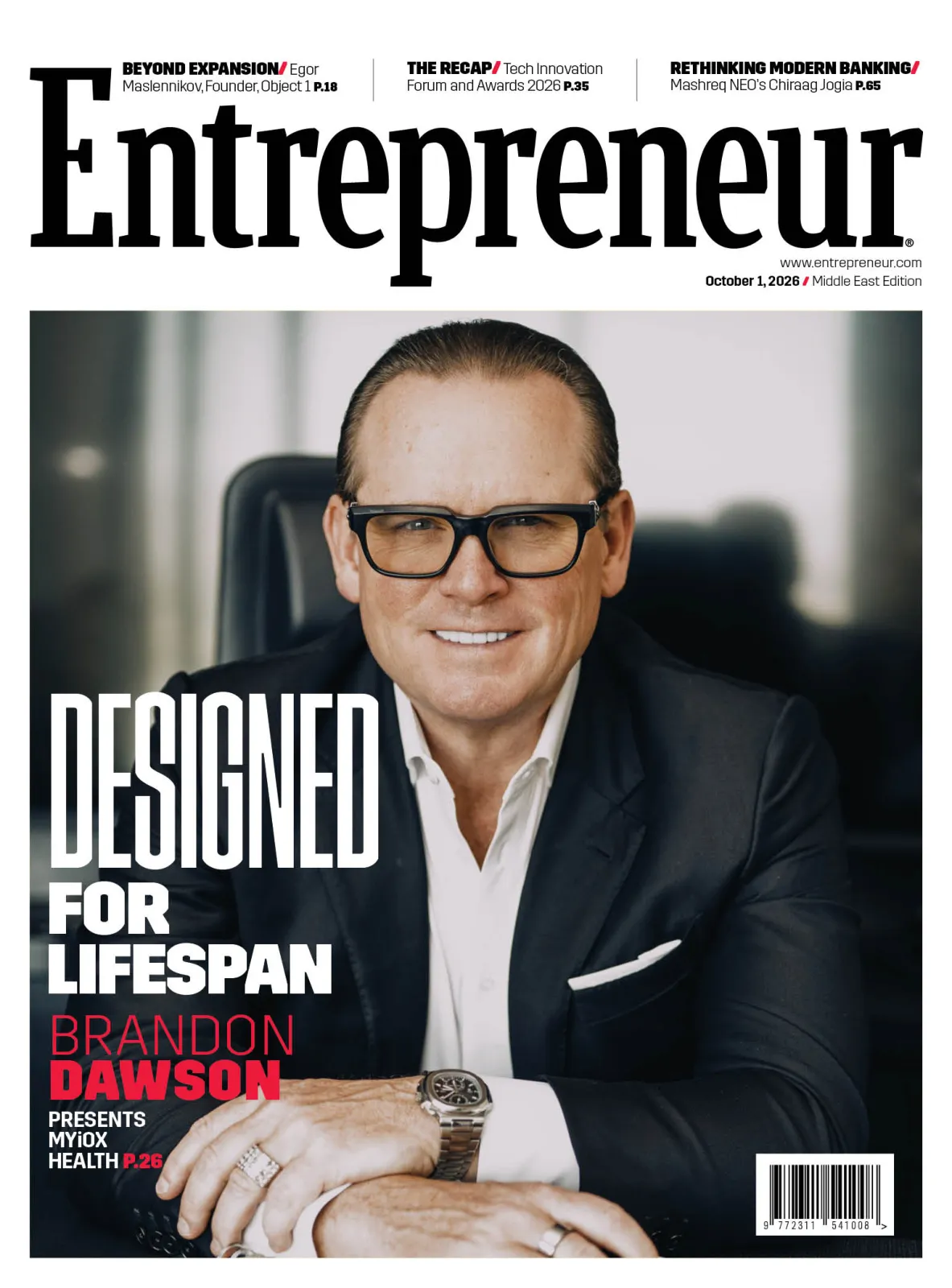
Entrepreneur Middle East
Entrepreneur Middle East, October 1, 2026
Page 1 / 84
Entrepreneur Middle East
Page 1 / 84
Eywa Way of Water is a state-of-the-art residential community with only 65 exceptional waterfront residences, with a holistic wellness ecosystem, curating authentic experiences and best-in-class amenities few have dreamed of. Contact us today: +971 54 308 6000 I sales@byrevolution.com E Y W A . A E E V E R Y T H I N G T H AT O N E C O U L D I M A G I N E F O R E X T R A O R D I N A R Y L I F E
The Mirra 2 Chair just keeps getting better. How? We updated the chair so it’s 30 percent lighter than the original Mirra - and the chair’s nylon base and spine are now 100 percent recycled content. We also gave it a fresh, inspired colour palette so it can look professional, casual, or sporty. One thing that hasn’t changed is the flexible yet supportive design that allows your body to move naturally and freely - the way it was meant to move. The Mirra® 2 Chair is turning heads again hermanmiller.com © 2026 Herman Miller
Contents/ October 1, 2026 P.26 Designed for Lifespan BRANDON DAWSON presents MYiOX Health P.13 Art Meets Ambition Digital artist KODE ABDO -aka ‘BossLogic’- looks to the UAE for the next phase of his creative career P.18 Beyond Expansion Object 1 founder and Chairman EGOR MASLENNIKOV on driving the firm’s next phase FEATURES 5 October 1, 2026 / ENTREPRENEUR.COM /
BUILT FOR MOMENTS THAT MATTER EXTRAORDINARY Escape to a home where urban sophistication meets resort tranquility. PRIVATE POOLS | 30+ AMENITIES | PRIME LOCATIONS 800-SAMANA | WWW.SAMANADEVELOPERS.COM
DISCOVER REFINED living *Ranking as per the H2025 1 sales volume data of property monitor for Dubai
STARTUP SPOTLIGHT IN THE LOOP TREPONOMICS Contents/October 1, 2026 P.76 Where Young Minds Shine NORA NAHHAS channels her passion for education into parenting platform Stars by Nora P.80 Narrowing Gap BLACKROCK explores changing capital flows and growing global interest in the Middle East P.82 AI Investment MICROSOFT plans to invest more than US$10 billion across four Middle East markets by 2030 P.65 Rethinking Modern Banking Mashreq NEO’s CHIRAAG JOGIA reflects on NEO PLUS’ first year and what comes next P.70 Navigating Opportunity Standard Chartered’s RAJESH KANNAN examines the UAE’s wealth advantage through resilience P.35 Return on Intention WISSAM BREIDY, co-founder, BRDG House, on turning trust and purpose into lasting business value P.38 Leading Through Change Investor and author ALAIN BEJJANI on the qualities investors look for beyond a strong business idea P.41 Commercial Mindset Bayut and dubizzle CEO HAIDER KHAN shares lessons in turning technology into a business that sells P.44 Growth Unfiltered JOELLE MARDINIAN reflects on the costly lessons and personal drive behind building Joelle Group P.47 Regional Reach RICHARD FITZGERALD shares Augustus Media’s Middle East expansion strategy P.51 Wealth Unlocked RAMESH MURTHY, VIKTOR UZUNOV, and NAEEM HUSSAIN explore how AI is reshaping investing and trust P.56 Tech Innovation Forum and Awards 2026 Celebrating the region’s leading tech innovators INNOVATOR 8 / ENTREPRENEUR.COM / October 1, 2026 CEO Wissam Younane wissam@bncpublishing.net MANAGING DIRECTOR Rabih Najm rabih@bncpublishing.net ART DIRECTOR Simona El Khoury EDITOR IN CHIEF Tamara Pupic tamara@bncpublishing.net EDITOR AT LARGE Anil Bhoyrul anil@bncpublishing.net SENIOR FEATURES EDITOR Aalia Mehreen Ahmed aalia@bncpublishing.net JUNIOR EDITORIAL ASSISTANT Kristine Erika Agustin kristine@bncpublishing.net DIRECTOR OF INNOVATION Sarah Saddouk sarah@bncpublishing.net GROUP SALES DIRECTOR – B2B GROUP Joaquim D’Costa jo@bncpublishing.net HEAD OF PARTNERSHIPS Samir Glor Samir@bncpublishing.net BUSINESS DEVELOPMENT DIRECTOR Andy Soulahian andy.soulahian@bncpublishing.net COMMERCIAL LEAD Anna Chipala anna@bncpublishing.net COUNTRY MANAGER KSA Amjad Fakhouri amjad@bncpublishing.net COLUMNIST Tamara Clarke CONTRIBUTING WRITERS Rajesh Kannan SUBSCRIBE Contact subscriptions@bncpublishing.net to receive Entrepreneur Middle East every issue COMMERCIAL ENQUIRIES sales@bncpublishing.net ENTREPRENEUR.COM Access fresh content daily on our website All Rights Reserved 2026. Opinions expressed are solely those of the contributors. Entrepreneur Middle East and all subsidiary publications in the MENA region are officially licensed exclusively to BNC Publishing in the MENA region by Entrepreneur Media Inc. No part of this magazine may be reproduced or transmitted in any form or by any means without written permission of the publisher. Images used in Entrepreneur Middle East are credited when necessary. Attributed use of copyrighted images with permission. All images not credited otherwise Shutterstock. Printed by United Printing and Publishing. PO BOX 502511 DUBAI, UAE P +971 4 4200 506 EntMagazineME Entrepreneur-me
100 THE Influence. In every dimension. The people shaping the region. The stories that deserve to be told. w w w. t h e1 0 0 m e . c o m
Editor’s Note/ Editor’s Note/ I f you have spent long enough around entrepreneurs -and I have been in this space since 2012, so 14 years and counting- you will have heard it millions of times that ideas are abundant, free, and cheap. The only thing that they all value is execution. Execution built Apple, Amazon, Google, SpaceX or Tesla, not simply the ideas behind them. Execution creates value, but it comes at a high price. Just recall Musk’s breaking point in 2008, when SpaceX’s first three Falcon 1 launches had failed and the company was running out of money. He later described himself as feeling “closer to a nervous breakdown than he had ever been.” SpaceX somehow managed to scrape together enough resources for one final attempt, and on September 28, 2008, Falcon 1 finally reached orbit. The feedback on my column, “A Fool With a Tool Is Still a Fool,” was phenomenal, but it also brought out some interesting arguments in favor of AI writing. One was that it’s okay to use AI to organize your thoughts, test an argument, or clean up your writing, as long as the idea itself is yours. I have to admit, I heard similar justifications from a couple of well-established experts when discussing their recently published books at our event last week. No, people, not just the idea, all of it has to be yours. Jobs, Musk, and Bezos organized their business plans, tested their products, figured out what was not working, and endlessly fine-tuned them so that today you can use the products and services of Apple, Tesla, SpaceX, and Amazon. All that work, not simply having the original idea, is what made them some of the world’s best-known founders. The same goes for writing. Some three weeks ago, Jason Feifer, Editor in Chief of Entrepreneur Magazine, made an interesting post on LinkedIn, establishing “A new rule: Don’t lie and say you did something — when AI did it for you.” I’ll let you read the post yourself, because Feifer uses it to make a different point, but it nevertheless made me feel a little less lonely in this quest not against AI, but against taking credit for work you did not actually do. I also found comfort in the words of Alain Bejjani, one of the speakers of our Tech Innovation Forum 2026, who said, “AI is the first non- biological intelligence on planet Earth. In reality, we are now sharing our habitat with a new form of intelligence that, arguably, we can still DON’T TAKE CREDIT FOR WORK AI DID Tamara Pupic Editor in Chief | Entrepreneur Middle East control. But we all know that we are moving at a pace where we may not be able to control it anymore.” Perhaps one day, that first non-biological intelligence will get up and start claiming authorship of all the articles and books it actually wrote. That will be fun. 10 / ENTREPRENEUR.COM / October 1, 2026
The World’s Largest AI-First Expo & Summit The New Intelligence Order from Abu Dhabi, the AI Capital of the World SAVE THE DATE AIEverythingAbuDhabi.com #AiEverythingAbuDhabi GET INVOLVED DESTINATION PARTNER ORGANISED BY GLOBAL PARTNER HOST PARTNER 1113 MAY 2027 ADNEC CENTRE
From Creative Passion To Global Brand Work with Marvel, Disney, Warner Bros., and Sony Pictures. Receive commissions from Hollywood stars Dwayne “The Rock” Johnson and Ryan Reynolds. Have your work publicly acknowledged by the likes of Robert Downey Jr. and Jake Gyllenhaal. Kode Abdo, the digital artist behind BossLogic, has checked all of these off his list. But the Syrian-Australian illustrator’s creative ambitions are far from satiated as he embarks on the next phase of his career – and the UAE is set to play a significant part in it. by AALIA MEHREEN AHMED → Kode Abdo, widely known as BossLogic, is a Syrian- Australian digital artist and graphic designer known for his pop-culture- inspired work. 13 October 1, 2026 / ENTREPRENEUR.COM /
B/Creativity I couldn’t pinpoint the exact art piece that made me start following digital artist BossLogic on X (still ‘Twitter’ at the time), but by late 2011 to mid-2012 I’d already become an ardent fan. So in 2018, when Kode Abdo first decided to reveal himself to the world as the artist behind BossLogic, I was one among the thou- sands who watched the moment unfold online. In the nearly 15 years that I’ve followed his work, I have witnessed not just the astronomical growth of his brand [his Instagram page currently sits at close to 2 million followers, and he has a little over half a million followers on X], but also monumental opportu- nities like working with entertainment industry giants Marvel, Disney, Warner Bros., and Sony Pictures come his way. But despite the extensive amount of professional work he’s done over the years, Abdo says showing his face to the world has been the most challenging decision of his career. “If you’ve been following me since the 2010s, you know I’ve been a ghost. I didn’t show my face, so putting a face to the work and holding that face to the work, while being me and trying to stay true to myself, has been a big challenge,” Abdo tells me. “For a whole lifetime, my artwork was out there, but if it was during the AI days, people would say I was AI—I had no face. That’s what it brought to the table. It made me real. It made me connect with people, and they con- nected with me on a more personal level instead of just through the art- work. There are health journeys, ups and downs, nights of no sleep, the whole creative process that I share… but now they have a face to it.” “I’ll be honest with you: the day I posted my face and did my reveal, it took 12 hours,” he adds. “I wouldn’t press the button because I was too hesitant. I feared the world. But it was probably the greatest thing I did at that point in time.” I’ll be honest with you: the day I posted my face and did my reveal, it took 12 hours,” he adds. “I wouldn’t press the button because I was too hesitant. I feared the world. But it was probably the greatest thing I did at that point in time.” }“ → From creating traditional sketches at the age of six to becoming a globally recognized digital artist, Abdo has built BossLogic into a distinctive creative brand. 14 / ENTREPRENEUR.COM / October 1, 2026
Indeed, Abdo’s Internet face reveal coincided with a career shift that catapulted the Melbourne-based Syrian- Australian artist’s career into the big leagues. For starters, in 2019, an unofficial Aveng- ers artwork by Abdo caught the attention of directors Joe and Anthony Russo, more popularly known as the ‘Russo Brothers’, and best known for directing Captain America: The Winter Soldier (2014), Captain America: Civil War (2016), Aveng- ers: Infinity War (2018), and Avengers: Endgame (2019). The Russos not only commissioned him for their social media, but Joe later also connected Abdo with the creative team at Disney – a move that led to Abdo creating official artwork for Avengers: Endgame in 2019. Beyond Marvel, Abdo’s fan art caught the atten- tion of Dwayne “The Rock” Johnson, who commissioned him for a project that later led to a collaboration with comic-book artist Jim Lee, while Ryan Reynolds com- missioned him for work including official artwork for 6 Underground. His work has also been acknowledged by renowned Hollywood figures including Robert Downey Jr. and Jake Gyl- lenhaal, while his career has expanded to commissions for Disney, Warner Bros., Netf- lix, Paramount, and Sony, as well as comic-book credits IT WAS A LONG TIME BEFORE THE RIGHT PEOPLE STARTED SEEING MY WORK. BUT THAT WAS NEVER THE OBJECTIVE. IT WAS NEVER MY GOAL FOR COMPANIES TO SEE MY WORK. I JUST KEPT OUTDOING MYSELF AND KEPT GETTING BETTER AT WHAT I DO… MY WORK, AND WHAT PEOPLE LIKED ABOUT IT, BECAME MY LIFESTYLE AND EVENTUALLY SOMETHING I COULD MONETIZE. BUT I NEVER LET THAT TAKE ME AWAY FROM WHY I STARTED THIS IN THE FIRST PLACE.” 15 October 1, 2026 / ENTREPRENEUR.COM / → BossLogic’s portfolio spans official promotional artwork, theatrical posters, comic covers, video game campaigns and original conceptual art.
16 / ENTREPRENEUR.COM / October 1, 2026 across Marvel, DC, BOOM! Studios, IDW Publishing, and others. As such, this is perhaps the right spot to mention the advice Abdo has for up and coming creative entrepreneurs seeking to convert their passion into business. “I keep telling artists, even young ones, just keep putting your work out there and building your portfolio,” he says. “Right now, the social media sphere is huge. You put your work out there, people love it, people fol- low you, and companies will come. You’re going to get at least one eye seeing your work, and that one eye will lead to others. If you sell yourself short to any publisher just because you think you’re not going to get anywhere, you’re literally putting a lock on yourself. So keep producing, keep working. Yes, [seek to] do some work with Marvel and DC, but don’t lock yourself down. Do work for everyone, especially for yourself. And if monetization is your only motivation, it’s never going to work out.” Aspiring and budding artists would certainly find it helpful to heed Abdo’s words. Having fallen in love with drawing at the age of six, he successfully transitioned his talent into digital art and has created a recognizable global brand. Along the way, apart from the aforemen- tioned career milestones, he has also rubbed shoulders with some of the biggest names in Hollywood. (“Yeah, I’ve met Simu [Liu],” he casually tells me when I meet him at this year’s Middle East Film and Comic Con (MEFCC) in Abu Dhabi, where Liu, the Shang-Chi and Avengers: Doomsday star, is a guest.) But as is apparent to most who follow Abdo, the Hollywood glitz and international acclaim When you look at an AI-generated image and you know it’s an AI-generated image, it has no feeling. Even if it’s trying to portray a feeling, it doesn’t have it. One day, we’ll have robots creating their own artwork. Let them have that. As humans, we’ve got to create with our hearts and our minds.” “ } → Abdo’s work has led to official collaborations with entertainment companies including Marvel Studios, Disney, Warner Bros. and Sony Pictures. Pictured: Robert Downey Jr. sharing Abdo’s artwork on Instagram stories B/Creativity
17 October 1, 2026 / ENTREPRENEUR.COM / haven’t affected his creative process or his humility (the latter evident to my team and me in the way he graciously turned up for this interview in the middle of the stuffy and bustling MEFCC main hall). “Look, for me, social media just blew up what I’ve been do- ing my whole life,” he says. “I always used to draw. I always used to put stuff in front of my family, in front of my friends. They loved it. But social media gave my artwork new eyes. And it was a long time before the right people started seeing my work. But that was never the objective. It was never my goal for companies to see my work. I just kept outdoing my- self and kept getting better at what I do. Those companies started reaching out, wanting to do some work with me and all that sort of stuff. But the thing is, it turned into a career by itself, which is rare these days. My work, and what people liked about it, became my lifestyle and eventually something I could monetize. But I never let that take me away from why I started this in the first place.” That passion to keep creating, instead of relegating to contentment, is most evident when Abdo reveals that he has plans to bring his studio to the Middle East, and the UAE in particular. “Taking it all from Australia to the Middle East, I thought it was going to be easy because I’m from here. But it’s been a hard transition. This is my ambition. This is what I want to do. It’s a tough challenge, but I want to make it work.” And Abdo already has an idea of what he wants that next chapter to look like. At is center is ‘AFK (All Frequencies Known)’, his own intellectual property (IP) set in a dystopian future in 2175 where law, order and chaos are “a mirrored image only justified by perspective,” and humanity is divided by sound, with different genres providing havens for the factions that remain among the neon ruins. It is a project he now hopes to bring to the Middle East—and his ambitions for the region extend beyond his own creation. “Comic books are strong, but comic book movies, comic book media—that sort of thing—is what’s growing exponen- tially,” Abdo says. “I’m literally here. I came here a couple of months ago so I can build my studio and brand and bring an IP here. I have my own IP that I want to release in the Middle East to compete with Marvel, the Avengers and all that sort of stuff. I want to do that. I don’t know how to push it across the line here yet because I know the UAE, and especially Dubai, wants to build that sort of thing. I think it’s about having something clear on the table that we can do. I would love to be part of it on the foundation floor, and I’d love to help build it. So if they want to, I’m like, ‘Let’s do it.’” Abdo’s plans align neatly with a post he put out in February this year where he shared an announcement that his “first chapter was about being part of worlds others created. Now it’s about building one of my own.” Accompanied by a short video detailing his whirlwind journey so far, Abdo noted that his sights are set on building a legacy much bigger than him and his art. “It’s not about just making visuals anymore,” he added in the caption. “It’s about building spaces. Creating platforms. Opening doors. Something bigger than me. I’m growing into the next purpose of my life and career.” This new chapter, of course, comes at a time when Genera- tive AI has trickled into creative industries. When asked about how he sees the effects of this advanced technology unfolding in the comics and illustrations space, Abdo offers advice befitting someone who has tasted the sweetness of the creative process all his life. “I don’t know how the world will be in five or ten years, but right now, there’s already this phrase: ‘made by humans for humans.’ If you’re passionate about it, you know what the right thing is to do. Generative AI is the line that we draw. When you look at an AI-generat- ed image and you know it’s an AI-generated image, it has no feeling. Even if it’s trying to portray a feeling, it doesn’t have it.” “One day, we’ll have robots creating their own artwork. Let them have that. As humans, we’ve got to create with our hearts and our minds.”
→ Egor Maslennikov is the founder and Chairman of Object 1. Beyond Expansion EGOR MASLENNIKOV ON DELIVERY, COMMUNITY, AND OBJECT 1’S NEXT CHAPTER Object 1 founder and Chairman Egor Maslennikov discusses driving the developer’s next phase. In this Q&A, Entrepreneur Middle East talks with Egor Maslennikov, founder and Chairman of Object 1, talks about scaling with discipline, building communities, and the strategy shaping the Dubai-based developer’s next chapter of growth. 18 / ENTREPRENEUR.COM / October 1, 2026
19 October 1, 2026 / ENTREPRENEUR.COM / O bject 1 entered the UAE market in 2022 and has grown rapidly in a short period. Looking back, what have been the most defining milestones in the company’s journey so far? When we entered the UAE market, our ambition was not simply to launch projects but to establish a long-term development platform capable of contributing meaningfully to Dubai’s urban landscape. The first milestone was building the right founda- tion—assembling a team that shared our vision and creating the operational structure required to support sustain- able growth. Over the past few years, we have expanded significantly, launching more than 30 projects across some of Dubai’s fastest-growing residential communities like JVC and JVT. However, I believe the most defining milestone is not the number of launches or sales achieve- ments. It is the fact that we have reached the stage where our first developments are now being completed and handed over. Every developer can present a vision, a concept, or a master plan. The true test begins when residents receive their keys and start living in the spaces you have created. Reaching this point marks an important transition for Object 1—from a company focused on growth and expansion to one increasingly focused on delivery and long-term resident satisfac- tion. RA1N Residence and V1TER are the first projects to complete handover this year. What does this milestone represent for the company? For us, the handover of RA1N Residence and V1TER represents the beginning of a new chapter. The development process often focuses on planning, design, construction, and sales. Handover shifts the conversation entirely. Suddenly, every decision that was made throughout the development cycle is being experienced by real people in real time. This milestone is important because it validates our ability to execute. At the same time, handovers create an invalu- OVER THE PAST FEW YEARS, WE HAVE EXPANDED SIGNIFICANTLY, LAUNCHING MORE THAN 30 PROJECTS ACROSS SOME OF DUBAI’S FASTEST-GROWING RESIDENTIAL COMMUNITIES LIKE JVC AND JVT.”
20 / ENTREPRENEUR.COM / October 1, 2026 able learning opportunity. They allow us to understand how residents interact with the spaces, which amenities are used most frequently, and what aspects of the living experience matter most after occupancy. These insights become extremely valuable when planning future developments. Can you tell us more about the con- cept behind RA1N Residence and what kind of lifestyle it was designed to offer residents? RA1N Residence was developed around the idea of creating a calm and balanced living environment within one of Dubai’s most dynamic residential districts. Modern city life is increasingly fast-paced, and we wanted to create a project that offers residents a sense of comfort, convenience, and well-being without sacrificing connectivity to the city. The concept was inspired by the idea that a home should provide more than shelter—it should support everyday quality of life. The project combines contempo- rary architecture with thoughtfully designed communal areas and amenities that encourage both relaxation and social interaction. Particular attention was given to creating spaces that integrate naturally into residents’ daily routines. As people continue to prioritize wellness, we believe developments such as RA1N Residence reflect the direction in which urban residential living is evolving. V1TER is another project you have in JVC. What was the vision behind this development? V1TER was created with a strong focus on community-oriented living and long-term value creation. Jumeirah Village Circle has evolved into one of Dubai’s most active residential destinations because it appeals to both end-users and investors. When designing V1TER, we wanted to create a development that responded to both audiences I BELIEVE THE MOST DEFINING MILESTONE IS NOT THE NUMBER OF LAUNCHES OR SALES ACHIEVEMENTS. IT IS THE FACT THAT WE HAVE REACHED THE STAGE WHERE OUR FIRST DEVELOPMENTS ARE NOW BEING COMPLETED AND HANDED OVER.”
21 October 1, 2026 / ENTREPRENEUR.COM / WE WILL CONTINUE EXPANDING OUR PORTFOLIO ACROSS THE UAE WHILE REMAINING DISCIPLINED IN OUR APPROACH. GROWTH IS IMPORTANT, BUT SUSTAINABLE GROWTH IS EVEN MORE IMPORTANT.” “ support a more complete lifestyle experience rather than simply offering residential units. This also reflects a wider direction across Dubai, with increasing emphasis on creating greener, more comfortable and liveable urban environments. Our vision was to create a building that would remain relevant not only at launch but throughout its lifecycle. That means prioritizing quality, efficient layouts, attractive commu- nal spaces, and features that support long-term occupancy and resident satisfaction. How have these first handovers helped Object 1 better understand what end users and investors value most after a project is delivered? What these handovers have shown us is that people are not only buying square metres. They are choosing a place where they may raise a family, build routines, work, rest, meet neighbors and feel part of a commu- nity. This is an important lesson for any developer. The UAE has become one of the most attractive places in the world for families and investors to settle. The country continues to invest in safety, infrastructure, education, quality of life and long-term residency, and this gives people confidence to build their future here. while maintaining a strong emphasis on everyday livability. The project was designed around practical functionality, high-quality finishes, and shared amenities that contribute to a stronger sense of community. Ergonomics was also carefully considered across both the apartments and common areas, with attention given to the smaller details that can make everyday living more comfortable. Landscaping and greenery were equally important to the design, helping to create a more natural and harmonious environment around the development. We have seen a growing demand from residents for developments that
22 / ENTREPRENEUR.COM / October 1, 2026 OUR GOAL REMAINS UNCHANGED: TO CREATE DEVELOPMENTS THAT DELIVER LASTING VALUE FOR RESIDENTS, INVESTORS, AND THE COMMUNITIES IN WHICH WE BUILD. THE PROJECTS WE ARE HANDING OVER TODAY ARE ONLY THE BEGINNING OF THAT LONG-TERM VISION.” “ With 2026 marked as the Year of Family, this direction becomes even more relevant. For Object 1, 2026 is also our year of handover, so these two ideas connect very naturally for us. Our responsibility is to create homes that support this kind of life. This is why we do not look at amenities as additions, but as part of the living experience. Children’s areas, swimming pools, sports zones, lounges, wellness spaces and shared community areas all matter because they shape how residents use the building every day. After handover, you see whether a project truly works for people. You see if families feel comfortable, if residents use the spaces, if the community feels alive. That is the real measure of success for us. Object 1 has also announced its expansion into Abu Dhabi. Can you tell us about your recent developments there and why the capital is an important next step for the company? Abu Dhabi is a natural next step for Object 1. After becoming one of the top 15 developers in Dubai, we began looking at where our model could create long-term value next, and the capital was the clear direction. Abu Dhabi is planning decades ahead, with Economic Vision 2030 supporting diversification, regulation, quality of life and sustainable urban growth. This direction is very aligned with the kind of communities we want to build. The market momentum also supports this decision. In 2025, Abu Dhabi recorded AED142 billion in real estate transactions, a 44% increase, while residential sales rose 67% to AED76 billion. At the same time, areas such as Al Reem Island, Saadiyat Island, Yas Island and Masdar City are strengthening the capital’s position as a destination for families, professionals and long-term investors. Our first project in Abu Dhabi, A1LA Residence on Al Reem Island, reflects this strategy. It will include 171 units across one, two and three-bedroom apartments, as well as a limited collection of duplexes, with amenities designed around family living, wellbeing and community. This follows our acquisition of four waterfront plots on Al Reem Island spanning more than 2 million sq ft, with a combined project value of AED4.5 billion. For us, Abu Dhabi is not a short-term opportunity. It is the beginning of a broader UAE growth strategy. With more than 20 projects, first handovers underway, and expansion into Abu Dhabi, what does the next stage of Object 1’s growth look like? The next phase is about maturity. The first chapter of our journey was focused on establish- ing the business and building momentum. The second chapter is about strengthening delivery capabilities, refining our product offering, and continuing to elevate the quality of what we create. Today, Object 1 has evolved into a stable, full-cycle business, bringing project design, development and construction together within one holding company. This gives us greater control across the entire development process and allows us to continu- ously improve from one project to the next. We will continue expanding our portfolio across the UAE while remaining disciplined in our approach. Growth is important, but sustainable growth is even more important. As we begin handing over more projects, our focus is not only on maintaining momen- tum but on strengthening every part of the business as we scale. Our objective is not simply to build more projects—it is to build better projects, informed by the lessons we gain from every completed development. We also see significant opportunities in technology, sustainability, and wellness-focused design. As cities evolve and resident expectations continue to change, developers must be prepared to adapt. Ultimately, our goal remains unchanged: to create developments that deliver lasting value for residents, investors, and the communities in which we build. The projects we are handing over today are only the beginning of that long-term vision.
23 October 1, 2026 / ENTREPRENEUR.COM /
Standard Chartered Bank UAE is licensed by the Central Bank of the UAE Corporate & Investment Banking. Global Markets. Global Banking. Transaction Services. Now is your time sc.com/cib Make growth your next stop Dub Johannesburg New York
London Singapore bai Shanghai
26 / ENTREPRENEUR.COM / October 1, 2026
American entrepreneur, visionary operator and business scaling strategist Brandon Dawson is applying his expertise to accelerate the growth of a precision-health ecosystem connecting genetics, biomarkers, nutrition, AI and clinical care, with 10XREVIV and MYiOX Health establishing Abu Dhabi as the center of their regional expansion. by WISSAM YOUNANE DAWSON Why Abu Dhabi Is Ground Zero For His Next Big Build 27 October 1, 2026 / ENTREPRENEUR.COM / BRANDON
28 / ENTREPRENEUR.COM / October 1, 2026 T “ T here is no shortage of health data today. A smartwatch can tell you how well you slept. A blood test can produce pages of biomarkers. Genetic testing can reveal predispositions that would have been inaccessible to the average consumer a generation ago. Apps can track heart rate, glucose, activity, stress, recovery and nutrition. And yet, Brandon Dawson believes one of the biggest problems in modern health remains surprisingly basic: people have more information about themselves than ever before, but often have little idea what to do with it. That problem sits at the center of Dawson’s push into precision health through 10XREVIV, a partnership between Abu Dhabi-based global health company M42, US-based human optimization and lifespan company 10X Health, and UK-headquartered preci- sion-nutrition company REVIV Global – and its new precision-health platform MYiOX Health. The vision to turn a fragmented system into a connected, functioning precision- health ecosystem draws on Dawson’s extensive experience helping organiza- tions unlock their potential and building the infrastructure needed to scale. That business acumen has been shaped by more than three decades of building, scaling and exiting companies. Dawson founded Sonus, a Warburg Pincus- backed consolidation company that he took public on the American Stock Exchange at age 29, before founding Audigy Group, which he bootstrapped and later sold for US$151 million in 2016. He subsequently helped the acquir- ing public company grow its share price from US$18 to US$94 within three years, adding US$3.5 billion in market value. Today, Dawson is the co-founder, Chairman, CEO, and Managing Partner of 10X Health and Cardone Ventures, a business growth and investment firm that he co-founded with his wife Natalie Dawson and American entrepreneur and real estate investor Grant Cardone. Pointing out that Cardone Ventures has invested US$45 million through convertible loans into REVIV Global and partnered with the company in 10XRE-
29 October 1, 2026 / ENTREPRENEUR.COM / October 1, 2026 / ENTREPRENEUR.COM / } The biggest opportunities are often not created by inventing one more product. They’re created by connecting things that already exist but do not work together.” “ VIV to co-create MYiOX Health, Dawson explains that he is now applying the wisdom gained from building and scaling businesses across multiple sectors to bring together the best of all three companies in advanc- ing precision nutrition, longevity, and precision healthcare focused on extending both lifespan and healths- pan. “The biggest opportunities are often not created by inventing one more product,” Dawson says. “They’re created by connecting things that already exist but do not work together.” It is through that lens that Dawson sees the healthspan, wellness, and longevity sector. Consumers are surrounded by diagnostics, wearables, supplements, nutrition programs and increasingly sophisticated medical options. At the same time, longevity clinics are proliferating, physicians are moving into preventive and personalized medicine, and interest in understand- ing individual biology continues to grow. The opportunity, Dawson believes, is not simply to add another company to that crowded landscape. It is to create the infrastructure connecting it. That is the idea behind MYiOX Health, the world’s first global operator in 40 countries. FROM DATA TO DECISION Dawson describes MYiOX as an end-to-end human optimization platform designed to take an individu- al’s biological information and translate it into personalized actions— then connect those actions, where appropriate, to qualified clinical care globally. Providing consistency and continuity for individual care. The ambition is significant. Instead of producing another score or dashboard for consumers to interpret themselves, MYiOX is intended to create a continuous journey: collect data, understand it, make recommendations, act on those recommendations, measure the results, and use the new information to inform what happens next on a global basis.
30 / ENTREPRENEUR.COM / October 1, 2026 30 / ENTREPRENEUR.COM / October 1, 2026 At the intelligence layer sits what the company describes as its BEAM Score, being developed around hundreds of life-science-weighted biomarkers. The larger objective, however, is not the score itself. “Giving somebody another score isn’t enough,” Dawson says. “Infor- mation without action doesn’t optimize anything.” The platform is being designed to translate biological intelligence into recommendations spanning nutrition, lifestyle, protocols, products and supplements, while providing a pathway toward clinical intervention when that becomes appropriate. The distinguishing idea is mea- surement. Dawson does not only want the platform to tell an individual what they could change. He wants it to determine what happened after they changed it. Biological data informs an intervention. The intervention produces an outcome. That outcome creates more data. The cycle begins again. In technology language, it is a feedback loop. In health terms, Dawson sees it as an attempt to make personalization dynamic rather than static. BUILDING THE PIECES MYiOX did not emerge in isolation. Dawson points to the work already carried out through 10X Health, REVIV and the subsequently combined 10X REVIV platform as the foundation from which the larger MYiOX vision is being developed. Through 10X Health, Dawson says his team gained direct insight into what health-conscious consumers increasingly want: not simply access to information, but help understand- ing what their information means. “Understand me, show me my data, and tell me what I can actually do with it,” is how Dawson summarizes that demand. REVIV, meanwhile, brings an established international clinical and life-sciences infrastructure. Its founder and CEO, Sarah Lomas, built the Manchester-headquartered med-tech company around a vision of making elective IV therapies, vitamin supplementation, hydration and preventative healthcare more widely accessible. Today, REVIV operates a clinical network spanning more than 40 countries, supported by a common clinical SaaS platform designed to accommodate local healthcare regulations. Over more than a decade, Lomas and her team have expanded that → 10X Health and REVIV Global partnered with M42 to launch 10XREVIV in Masdar City, Abu Dhabi, bringing its proprietary AI-powered Precision Nutrition System to the UAE.
31 October 1, 2026 / ENTREPRENEUR.COM / 31 October 1, 2026 / ENTREPRENEUR.COM / I didn’t want MYiOX to launch somewhere simply because there was capital. I wanted to be where leadership, culture, science, healthcare and long- term investment were aligned around human potential. That is Abu Dhabi.” “ } foundation beyond IV therapy into precision nutrition and genetic analysis, investing in the science and technology required to connect indi- vidual genetic profiles with nutritional and health outcomes. That work has become particularly important to MYiOX: Dawson describes the life-sciences expertise developed by Lomas and her team at REVIV as the “human intelligence” behind the platform and a key reason for investing in the company. The plan is to bring these layers together. The consumer-facing experience and the clinical infrastructure are intended to communicate through a common technology architecture, with biological information moving through a proprietary life-sciences framework before being translated into an individual- ized plan. Dawson characterizes MYiOX not as a startup idea developed during the most recent longevity boom, but as the convergence of years of work across healthcare, science, technology and business building. “This isn’t an idea we woke up with six months ago,” he says. “It’s the convergence of years of science, healthcare, technol- ogy, consumer experience and business building.” For an entrepreneur whose career has largely revolved around creating and scaling businesses, that distinction matters. MYiOX is not being positioned simply as a health company. Dawson is trying to build a global health and lifespan platform. OPTIMIZE FIRST There is also a personal philosophy behind the business. Dawson and his wife Natalie, together with their partners the Cardone Dawson and Sarah Lomas, founder and CEO, REVIV, in Abu Dhabi, UAE.
32 / ENTREPRENEUR.COM / October 1, 2026 family, have framed their mission around helping people better understand their individual biology and giving them evi- dence-based tools to improve it. That philosophy requires careful language, particularly when the discussion reaches medication. Dawson is explicit that the objective is not to encourage people to stop prescribed medication. Rather, the com- pany’s stated aim is to give individuals and their healthcare professionals better information and additional evidence-based nutrition and lifestyle options that may, when clinically appropriate, help reduce unnecessary dependence on medication. Clinical decisions, he stresses, remain with qualified medical professionals. Precision nutrition consequently becomes one of the most scalable entry points. Unlike a medical procedure performed occasionally, nutrition touches almost everyone every day. The group’s 10X Precision Nutrition System is being positioned around genetic insights, blood biomarkers, mitochondria function, and nutritional science to make that everyday interaction more individualized. It also illustrates a much larger principle underlying MYiOX. If two people are biologically different, Dawson argues, why should their health strategies automatically be identical? YOUR BIOLOGY SHOULD TRAVEL WITH YOU For Dawson, personalization should not disappear when someone gets on an airplane. A person living between Abu Dhabi, Miami and London may currently deal with multiple physicians, apps, laborato- ries, wellness providers and clinics, each possessing only a fragment of that person’s health information. MYiOX is being designed around a different premise. “Your biology should travel with you,” Dawson says. “Your health strategy shouldn’t reset every time you cross a border.” Through a shared clinical and technology infrastructure, the goal is eventually to allow an individual’s biological profile and personalized protocol to move across participat- ing markets rather than forcing them to effectively begin again with every new provider. That same continuity is intended to address another fracture in modern health- care: the divide between being a consumer and becoming a patient. Most wellness technology exists outside traditional clinical systems. A person can spend months tracking sleep, exercise, nutrition and biomarkers through consumer platforms, but the moment medical intervention becomes necessary, that information often sits outside the health- care environment they enter. Dawson wants MYiOX to bridge that wall. The platform is being designed to connect biological understanding and wellness recommendations with trained clinical environ- ments and qualified health- care professionals when medical care becomes necessary. “Most health platforms stop at information,” Dawson says. MYiOX, by contrast, is intended to connect informa- tion to action, action to care, and care back to measurable biological outcomes, without giving medical recommenda- tions. But rather insights and information to act on in real time. WHY ABU DHABI? For a platform being conceived as global from the begin- ning, Dawson faced a strategic question. Where should it make its debut? Based on the advice of his mentor, Michael Milken, Chairman of the Milken Institute, his answer was Abu Dhabi. The choice, he says, extends well beyond access to investment. Dawson points to the late Sheikh Zayed bin Sultan Al Nahyan’s emphasis on human development as one of the philosophies that connected him personally to the emirate. He sees a modern continuation of that philosophy in Abu Dhabi’s investments in genomics, population health, artificial intelligence, precision medicine and life sciences. “The investments are different because the world is different,” Dawson says. “But to me, the underlying philosophy is remarkably consistent: invest in the individu- al, invest in their health, invest in their knowledge and capabilities, and you invest in the future of the country.” It is difficult to ignore the fit. Abu Dhabi has spent years positioning itself as a leader in healthcare, biotechnology and longevity as strategic sectors. For a company trying to } This next chapter is about bringing business building, technology, life sciences, nutrition and medicine together around the most important asset any of us will ever own. Ourselves.” “
33 October 1, 2026 / ENTREPRENEUR.COM / build around individualized biology, Dawson is equally drawn to the UAE’s diversity. The country brings together more than 200 nationalities, according to the source material, offering the kind of multicultural environment Dawson believes is important for a health platform whose core thesis begins with human biological individuality. For Dawson, Abu Dhabi represents the intersection of long-term capital, government ambition, scientific infrastructure, healthcare capability and international talent. And that brings him to M42. A STRATEGIC ALIGNMENT WITH M42 Dawson describes MYiOX’s relationship with Abu Dhabi-headquartered health company M42 as a strategi- cally important part of the broader story. M42 facilitates the Emirati Genome Programme, which the source material says has attracted approximately 780,000 UAE national participants, and has worked with organizations including Microsoft and the Broad Institute of MIT and Harvard on areas related to genomic and precision- health infrastructure. For Dawson, the signifi- cance is less about individu- al partnerships than the ecosystem they represent. Abu Dhabi is not merely accumulating genomic information. Its health sector is working toward integrating genomics with clinical decision-making, biobanking, prevention, precision medicine and healthy longevity. That alignment is exactly what Dawson says he was looking for. “I didn’t want MYiOX to launch some- where simply because there was capital,” he says. “I wanted to be where leadership, culture, science, healthcare and long-term investment were aligned around human potential.” This is why he chose Abu Dhabi, and today, 10X REVIV is a proud Masdar City entity, where Dawson intends to tap into the emirate’s AI infrastructure and talent to advance the company’s mission globally. THE BUSINESS BUILDER’S BET Strip away the biomarkers, genetics and clinical terminology and Dawson’s strategy begins to resemble something familiar from other industries trans- formed by technology. Platforms tend to win not because they manufacture every individual component of an ecosystem, but because they create the infrastruc- ture that allows those components—and their users—to interact. Dawson has spent more than two decades thinking about businesses through precisely that lens. He has operated as founder, investor, buyer, seller and business builder. One lesson he says has followed him throughout that career is that some of the largest enterprise-value opportuni- ties can arise from creating the infrastructure through which an entire ecosystem operates. That is ultimately how he sees MYiOX. “We’re not trying to build another supplement company. We’re not trying to build another wearable. We’re not trying to build another longevity clinic. And we’re not trying to build another health-data dashboard,” he says. “We’re building the platform that connects them.” Its proposed architecture brings together a consumer application, biological intelligence, personalized recommendations, precision nutrition, future market- place capabilities, clinical connectivity and MYiOX Pro, the company’s clinical SaaS layer. If that architec- ture develops as Dawson intends, it gives MYiOX two potential audiences simultaneously. On one side sits the individual trying to better understand and optimize their health. On the other sits the healthcare professional helping them do it. “That’s how you move from building a product to building a platform,” Dawson says, “and from building a platform to building an ecosystem.” THE OCTOBER MOMENT The MYiOX brand will be unveiled in October at the Abu Dhabi Future Health Summit, with the platform launching in January, 2027. After years of scientific development, technology investment, consumer- health experience and clinical infrastructure building, Dawson and his partners are preparing to unveil the MYiOX Health global platform in Abu Dhabi. For a businessman accustomed to thinking in terms of enterprise value, however, this project represents something broader than the next transaction. The thesis behind it is remarkably simple. No two people are biologically identical. Therefore, Dawson argues, the future of health cannot remain entirely one-size-fits- all. The real opportunity is not to produce more data for people already overwhelmed by data. It is to help them understand their biology, decide what to do with that understanding, connect them with appropriate clinical care when it becomes necessary, and then deter- mine whether those decisions actually produced results. For Dawson, this may be the ultimate evolution of the business-building philoso- phy that has defined much of his career. He has spent decades building companies. Now he wants to build an ecosystem around something considerably more personal. “This next chapter is about bringing business building, technology, life sciences, nutrition and medicine together around the most important asset any of us will ever own,” Dawson says, “Ourselves.”
34 / ENTREPRENEUR.COM / October 1, 2026 PROPERTIES solproperties.ae 800-765-1 Learn More
INNOVATION 2026 Forum & Awards \THE TECH IN NOVATION FORUM 2026 RECAP WISSAM BREIDY C O - F O U N D E R , B R D G H O U S E In conversation with GEORGE HOJEIGE, Group CEO of Virtugroup/Virtuzone, WISSAM BREIDY, co-founder, BRDG House, explained why reputation and trust create enduring business value. by TAMARA PUPIC E ntrepreneur Middle East’s Tech Innovation Forum 2026 opened with a fireside chat with Wissam Breidy, co-founder, BRDG House, exploring his transition from one of the region’s most trusted television hosts and public figures to entrepreneur and brand-building consultant, and the lessons he has carried from one world into the other. In conversation with George Hojeige, Group CEO of Virtugroup/ Virtuzone, Breidy traced his career back to an unlikely beginning. He was just 17 and still in high school when he joined Studio El Fan, the renowned Lebanese talent show that launched careers across singing, presenting, acting, directing and modeling. Breidy initially intended to compete as a model, until an acting coach and close friend suggested that his real strength might lie elsewhere: television hosting. “Once I was on air, I was just myself,” Breidy said. “I kept passing from one level to the next because I was different from the others. I didn’t take myself too seriously. It became a huge transformation in my life because, until then, my ambition had been to become a pilot. “After the show, I decided that if I was going to pursue this, I needed to take it seriously. I joined a radio station, and radio really elevates your skills. I was doing a three-hour morning show, just talking and connecting with the audience. I stayed there for two or three years, and that experience gave me the skills to start my first television show.” His career as a public figure certainly opened doors, but he is careful to distinguish visibility from business credibility. “Media 35 October 1, 2026 / ENTREPRENEUR.COM /
INNOVATION 2026 Forum & Awards Entrepreneurship, however, had long been in the background. “I created a restaurant chain called Rymful, which today operates as a franchise in Abu Dhabi, Dubai, Egypt and Iraq,” Breidy said. “I also worked in communications, helping brands through transformation. That became one of the core areas of my work in Dubai: helping companies move from being purely profit-driven to becoming purpose-driven.” Having travelled regularly to Dubai since 2006, Breidy eventually made the city his permanent home in 2019, as Lebanon entered a period of deepening crisis. “I moved to Dubai with my family with the intention of building something differ- ent. I already had relationships here and brands I had worked with,” Breidy said. “I moved my F&B business and registered its IP in the UAE because I wanted the brand to grow from here. It still has its Lebanese authenticity and spirit, but I wanted its base to be in the UAE.” Breidy’s first mark on Dubai’s business landscape came through his role as CEO of HRE Development, which evolved from a construction company into a purpose- led property developer focused on creating long-term social value. “My move into real estate was very intentional,” Breidy said. “From the day I came here, it was clear that real estate was where much of the action was in Dubai. And real estate is actually very close to what I had been doing for 25 years in the media. Both are project- based. You have a project, you work hard on it, you launch it, you get feedback from people, you interact with them, and then you move on to the next opportunity.” Breidy’s relationship with HRE began not with a leadership position, but with a branding assignment. He was initially brought in to help shape the identity of a new development, and his conversations with the company’s chairman soon revealed a shared belief that business should create value beyond commercial returns. “The company had been a construction company and needed to move into devel- opment,” Breidy explained. Being a developer is completely different from being a contractor. Development requires vision, positioning, marketing and storytelling. You need to understand where you want the project to sit in the market and how you want people to perceive it. “The challenge was to build the brand. You can either spend millions on traditional branding and advertising, or you can do something completely different. The company had AED6 billion in inventory to sell, so we needed to establish trust quickly. “Instead of spending millions of dirhams on billboards on Sheikh Zayed Road, I suggested that we invest in a mission.” One of HRE’s standout initiatives included a AED30 million contribution to Dubai Cares, supporting education for children and youth in developing countries. Later on, it partnered with the Fazza International Championships for People of Determination 2025, reinforc- ing its dedication to inclusivity and empowerment. “I changed the company’s entire branding around the idea of being ‘a building with purpose.’ The purpose was “ P E O P L E T O D AY A R E E X P O S E D T O M I L L I O N S O F P R O J E C T S A N D M I L L I O N S O F I D E A S . H AV I N G A N I D E A I S N O LO N G E R E N O U G H , ” H E E X P L A I N E D . “ YO U C A N G O T O C H AT G P T O R C L A U D E , E X P L A I N W H AT YO U A R E T H I N K I N G , A N D T H E Y C A N G I V E YO U A S T R U C T U R E A N D A S T R AT E G Y. T H E Q U E S T I O N I S : H O W A R E YO U G O I N G T O E X E C U T E I T ? T H AT C O M E S B A C K T O I N T E N T I O N . 36 / ENTREPRENEUR.COM / October 1, 2026 and being a public figure opened doors for me, but I never closed a deal because I was a public figure,” Breidy said. “That is an important distinction. Being known gave me opportunities and introductions because people trusted my reputation and were willing to hear what I had to say. But when it came to a real deal or a real business opportunity, everyone looked at the value they would get from it.”
not simply to sell real estate,” Breidy explained. ”I wanted every person buying from the company to feel that their investment meant more than owning a property, that part of their investment was contributing to children’s education. “The impact in the market was huge. The media started paying attention to HRE because there was a story worth hearing. Brokers became interested in working with us because they had a story they could tell their clients. That story wasn’t necessarily what closed the deal, but it broke the ice. It showed that this company stood for something different. “In one month, we positioned the company in a way that could otherwise have taken three years and hundreds of millions of dirhams in branding and marketing.” Currently, Breidy is channeling his experiences across media, branding and business into his upcoming book, The New ROI. “Television taught me how to understand people’s behavior, how to tell stories, how to build trust and credibility, and how to create impact,” he said. “I believe we learn through stories. Before mobile phones, we got information from television. Before television, people gathered around the radio. And before radio, people gathered around the fire and learned from one another’s experiences. “If someone in a village faced a challenge during the day and came back and told the story of what happened and how he responded, the others learned from his experience. The next time they faced the same challenge, they knew what to do. That is how human beings have always learned: through stories.” That belief became the starting point for his book. “I was looking through my social media and LinkedIn and seeing all these posts I had written about ideas and experiences, and I thought: why not develop them? I wanted to tell my own stories and explore the impact those experiences had on my life and on other people,” Breidy said. “I call the book The New ROI. We know the traditional ROI as return on investment. My new ROI is ‘return on intention.’ “You need to put intention into everything you do, even if you are making a US$100 million transaction. Intention is what creates the real value behind that transaction.” Breidy believes that distinction is becoming increasingly important as AI makes ideas and strategies easier to generate. “People today are exposed to millions of projects and millions of ideas. Having an idea is no longer enough,” he explained. “You can go to ChatGPT or Claude, explain what you are thinking, and they can give you a structure and a strategy. The question is: how are you going to execute it? That comes back to intention. “If you take away the valuation, the numbers and the applause, what makes you wake up every morning and go back to your company? It is your intention. It is the impact you want to make through that company. That is what makes us human. “Return on investment is important. You need it for cash flow and to grow a company. But a company without a soul will not survive.” “ I F YO U TA K E AWAY T H E VA L U AT I O N , T H E N U M B E R S A N D T H E A P P L A U S E , W H AT M A K E S YO U WA K E U P E V E R Y M O R N I N G A N D G O B A C K T O YO U R C O M PA N Y ? I T I S YO U R I N T E N T I O N . I T I S T H E I M PA C T YO U WA N T T O M A K E T H R O U G H T H AT C O M PA N Y. T H AT I S W H AT M A K E S U S H U M A N . 37 October 1, 2026 / ENTREPRENEUR.COM /
38 / ENTREPRENEUR.COM / October 1, 2026 38 / ENTREPRENEUR.COM / October 1, 2026 INNOVATION 2026 Forum & Awards \THE TECH IN NOVATION FORUM 2026 RECAP ALAIN BEJJANI I N V E S T O R , A U T H O R , G L O B A L T H O U G H T L E A D E R At Entrepreneur Middle East’s Tech Innovation Forum 2026, ALAIN BEJJANI shared his perspective on entrepreneurship, leadership, and the growing impact of AI on economies and everyday life. by TAMARA PUPIC O ne of the most impactful conversations at Entrepreneur Middle East’s Tech Innovation Forum 2026 featured Alain Bejjani, investor, author, and global thought leader. With more than two decades of leadership experience across the Middle East, North Africa, and South Asia, Bejjani has led major business growth, digital transformation, and sustainable finance initiatives. Earlier in his career, he served as Executive Vice Chairman of the Investment Development Authority of Lebanon (IDAL), and today serves on the Atlantic Council’s International Board. At the Tech Innovation Forum 2026, the conversation began with his more recent role as an investor on Shark Tank Lebanon and his efforts to support the country’s emerging entrepreneurs. Bejjani explained that he joined the show to help advance entrepreneurship in Lebanon, but its impact has extended beyond the investments made on screen, as several founders who left Shark Tank Lebanon without securing a deal later received investment from people who had discovered their businesses through the show. That multiplier effect, he said, is one of the outcomes he takes particular pride in. Drawing on his experience as both a business leader and investor, Bejjani shared what he believes separates an entrepreneur who makes a strong impression from one who is genuinely investable. “It is about their business, but more importantly, it’s about the investment opportunity they are presenting to you,” he said. “Coming to me and telling me how great your business is, fantastic. But for me, that’s the backdrop. What you need to convince me of is: why should I invest with you rather than allocate my capital elsewhere? One thing people are starting to get better at is understanding that they are not only there to sell their business; they are also there to sell the investment opportunity itself. That is someone who is investable. “Second, that person has to come across as someone who has the leadership needed to turn vision into reality. Because that is what leadership really is: turning vision into reality. “Someone who does not have the ability to do that, even if they have great ideas, is not investable. It will remain a fantastic idea, but it will not materialize in the way they are planning.” Ïn essence, Bejjani’s approach to startup investing is three-fold. “First, does this person understand that I’m an investor coming in, not someone taking over the business? They need to understand the alignment of interests between the investor and the operator or founder. “Second, does that person have the ability and the skill set to turn that vision into reality? Execution, of course, is very important. “Third, is this person adaptable enough? The world is changing. By the time someone pitches their idea and hits the ground running, the world has most likely changed, especially now. And finally, do they have an open and curious mindset? Do they have a learning mindset? Because you will need to learn a lot along the way. Entrepreneurship is a learning journey. You never know everything. We are all continuously a work in progress. I personally believe that any leader is a work in progress until they leave this world. It’s a mindset.” Bejjani began his career in law and business advisory in 1999 before serving as Executive Vice Chairman of the Investment Development Authority of Lebanon (IDAL) from 2000 to 2005, working to attract foreign investment and support economic growth. He describes those years in Lebanon as among the most formative of his career. “I think those were my most formative years. I learned so much in four years, under the presidency of Prime Minister Rafic Hariri, who was later assassinated. I had the opportunity to work closely with him, and I learned tremendously from that experience,” Bejjani says. “I left IDAL when I was 32. For those who don’t know, the job was about promoting Lebanon as an investment destination and promoting Lebanese exports abroad. So, on one side, it was a business and economic role. On the other, it was a role in a highly political environment. “It was extremely formative for me. I think my biggest lesson was about human nature, understanding how far people are willing to go, both high and low. I used to tell myself that I was fortunate to have experienced this so early in my career, because otherwise it might have taken me another 40 or 50 years to understand these things. “When I eventually came to Dubai, it was because of the 2006 war in Lebanon. I hadn’t planned to come to Dubai at all.” His move to Majid Al Futtaim came almost by chance. The group was already one of his legal clients in Lebanon when, during a dinner in Beirut, a friend introduced him to its founder, Majid Al Futtaim. The
39 October 1, 2026 / ENTREPRENEUR.COM / 39 October 1, 2026 / ENTREPRENEUR.COM / following morning, Al Futtaim called Bejjani and asked him to join the company. Bejjani was declining until the 2026 war in Lebanon, when he ultimately joined Majid Al Futtaim, beginning what would become a 17-year career with the group. “When I started, I had no ambition to become the Group CEO. I started in legal, then moved into business development and corporate development, before becoming CEO,” Bejjani said. The mentor who had the biggest impact on me was Majid Al Futtaim himself. I had the privilege of working with him on a daily basis from 2008 until the end of 2021, when he passed away. He made me the person I am today. I learned a lot, and I think my most important relationship in my life was with him.” Bejjani helped drive the company’s growth and expansion. Appointed CEO in 2015, he grew the company into a US$15 billion enterprise across 17 countries by modernizing it with digital and AI tools and introducing new approaches to sustainable finance, including the region’s first 1.2 billion sukuk, or green bonds. “Majid Al Futtaim was already a very successful company before I joined. It was a story of good to great. But it was a name, not yet a brand,” Bejjani said. “One of the most important things I did before becoming CEO was rebranding the company: defining its sense of purpose, its vision of creating great moments for everyone, every day, and the values it stood for. We then translated that purpose across the entire business. “When I became CEO, we integrated the business to a large extent. We were serving the same customer through multiple touchpoints, our malls, Carrefour, cinemas, fashion, home retail and financial services. It made sense to bring that data together, understand the customer better and move from being in the business of real estate, retail and entertainment to what I called ‘the business of the customer.’ “When you understand your customer and have the right data and technology, you can build a much deeper relationship. My ambition for Majid Al Futtaim was to become a trusted, lifelong partner to our customers. “Technology allowed us to customize the customer experience at an individual level rather than simply around customer personas. That creates loyalty and gives customers a reason to choose you over someone else. “A I I S C O M P E T I N G W I T H P E O P L E F O R T H E I R J O B S , A N D I T I S O N LY G O I N G T O G E T B E T T E R . T H E R E I S N O WAY W E W I L L B E A B L E T O C O M P E T E W I T H A I O N R AW I N T E L L I G E N C E A LO N E U N L E S S W E E V E N T U A L LY R E A C H A P O I N T W H E R E T E C H N O LO G Y S I G N I F I C A N T LY A U G M E N T S H U M A N C A PA B I L I T I E S .
40 / ENTREPRENEUR.COM / October 1, 2026 INNOVATION 2026 Forum & Awards 40 / ENTREPRENEUR.COM / October 1, 2026 “But transformation has to be driven by a clear vision, and you have to be able to communicate that vision clearly. People need to understand what you are doing and why. “More importantly, they need to see you walking your talk. People do not follow what they hear; they follow what they observe. If you say one thing and do another, they will disregard what you say and pay attention to what you do.” Bejjani explored his approach to leadership in his book, “NEXT: Leading Through the New Realities, in which he identifies four defining challenges that today’s leaders must address: continual change, artificial intelligence, talent, and sustainability. “The reason I wrote the book is because I deeply believe that what really matters in life is leadership: your ability to lead yourself and to lead others. Whether you’re leading a team, a business or a country, the principles are the same. But leading ourselves is the most difficult task we face,” Bejjani said. “We tend to be most complacent with ourselves. We find excuses, whether it’s about losing weight, business, family or anything else. That’s why the most difficult person to lead is yourself, and the most difficult battles are those you fight with yourself. Leadership is at the heart of success, whether personal or collective.” However, Bejjani argues that leading in tomorrow’s world is fundamentally different from leading before 2020 and the COVID19 pandemic. “Since COVID, we have seen new realities come together. One of them is constant volatility and change,” he said. “The post-1945 world we grew up in, and many of the structures we continue to rely on, are now being challenged by some of the most important and influential forces on the planet. That is why we are experiencing constant change. We had COVID and its enormous disruption, followed by many events that disrupted global supply chains and commodity prices, and so on.” The most consequential change, however, will be the impact of AI. In explaining its implications, Bejjani also addressed the growing importance of talent and sustain- ability which are the two other themes he explored at length in his book. “AI is the first non-biological intelligence on planet Earth. In reality, what we are doing now is sharing our habitat with a new form of intelligence that, arguably, we can still control. But we all know that we are moving at a pace where we may not be able to control it anymore,” Bejjani said. “The reason human beings are at the apex of the food chain is because we have been the smartest and most adaptable species. Today, we have created a non-biological intelligence that already seems to be seeping out. We are seeing cases in which AI systems behave in ways that were not necessarily intended. It is not out of control, but we are testing the boundaries, and even the creators of AI have expressed concerns about where this technology could go. “At the same time, no one really wants to stop because, as Trump puts it, whoever wins AI wins. I think the whole world as we know it is going to change. The very concept of the nation-state, the structure of society, companies, the way we run businesses, everything is going to be affected, if not completely changed.” For Bejjani, AI also raises a more immediate question for business leaders: whether the companies and business models they are building today will remain sustainable tomorrow. “My concern about sustainability is, first, that the planet continues to be in trouble and we have to fix it. I think AI will help us to a certain extent, not enough, but it will help,” he said. “Second is the sustainability of every business model. You are businesspeople. You build businesses and you build value. But when a business model can be taken over by AI, the valuation of that business could fall dramatically. If I have a billion- dollar company today, or a million-dollar company, I’m not sure that business will still exist in three years, five years or even six months. So the questions become: What am I building? What is my net worth? What are the underlying economic fundamentals on which we are underwriting investments? All of these questions are now up for grabs, alongside the issue of AI crowding out talent and potentially putting people out of jobs, which is another reality we are already beginning to see.”” Ultimately, Bejjani believes this transforma- tion will shift the advantage from capital to talent, a concept he calls “talentism.” He said, “I coined the term talentism versus capitalism because, in the past, capital was what mattered most. In this transition, what matters most is talent.
41 October 1, 2026 / ENTREPRENEUR.COM / 41 October 1, 2026 / ENTREPRENEUR.COM / \THE TECH IN NOVATION FORUM 2026 RECAP HAIDER KHAN C E O , B A Y U T A N D D U B I Z Z L E C E O , D U B I Z Z L E G R O U P M E N A At Entrepreneur Middle East’s Tech Innovation Forum 2026, KHAN delved into the importance of building a commercial mindset early as an entrepreneur by AALIA MEHREEN AHMED “YOU CAN BUILD SOMETHING REALLY AWESOME, BUT IF YOU CAN’T SELL IT, THERE’S A P ROBLEM.” I n his roles as the CEO of Bayut and dubizzle and CEO of Dubizzle Group MENA, Haider Ali Khan today helms companies whose platforms span property, cars, classifieds and jobs, with dubizzle alone listing more than 20,000 cars a month and attracting over 300,000 job seekers daily, while Bayut connects millions of property seekers and real estate professionals across the UAE as part of a group that has attracted more than US$450 million in investment. In 2021, dubizzle went one step further in becoming a part of its user base’s day-to-day vernacular with the introduction of ‘dubizzle it’: a brand catchphrase that turned the online classifieds platform into a verb, essentially meaning to list, sell or find something through the platform. But in a trajectory reminiscent of many inspiring entrepreneurial tales, Khan’s story too had humble beginnings. “The early days were at an office that was probably a little bit smaller than this stage that we’re sitting on, with just a couple of people,” he told the audience at Entrepreneur Middle East’s Tech Innovation Forum 2026, held on September 17 at Habtoor Palace.
42 / ENTREPRENEUR.COM / October 1, 2026 INNOVATION 2026 Forum & Awards 42 / ENTREPRENEUR.COM / October 1, 2026 E The fireside chat, moderated by Wissam Younane, CEO of BNC Publishing [the media house behind Entrepreneur Middle East], offered a deep dive into Khan’s career so far, his decision-making processes, and his companies’ growth strategies. But what underscored the entire conversation was the element of curiosity that has quietly defined Khan’s business journey – evi- dent right from his life-changing decision to move away from a 15-year-long tech career in the US and move to the UAE in 2014. “I was pretty well-placed. I was doing well in the US, but a part of me also felt that more can be done,” he said. “I think this is interesting because in the corporate world, you get up to a certain point. Probably not the case everywhere, but what I largely saw was that it can become fairly stagnant in terms of creativity. I felt that there’s more that can be done, so I came to Dubai. Originally, I was born in Pakistan, so it is close to home. There was this little business that was founded by my brothers. It was called Bayut. What I was told was, in our industry, we’re in general classifieds or marketplaces. You don’t challenge incumbents. I think that’s something that was interesting because all my life, I’ve just chased challenges. I thought that was an interesting challenge, so I just came here and I’ve been here since, just focused on trying to grow the business.” While the wealth of tech-related knowledge he’d amassed up until that point held Khan in good stead from a product-improve- ment angle, he self-admittedly had to spend a considerable amount of time learning the ropes when it came to sales and marketing. “I have an engineering mindset, which is to get into the problem and understand things at the leaf level. At such a stage you have little to no revenue, and yet have a vision that you want to achieve something. Coming from engineering, I was never really into sales or understanding sales. But once you start managing sales, you understand that there’s a whole separate side to this world. You can build something, but if you can’t sell it, that’s where the game changes. For me personally, getting acquainted with sales and trying to understand how to run sales, and then marketing and building a brand over time, were unknown things to me. They were interesting and challenging, but also unknown territory when I came here.” That inquisitiveness to do better is ultimately what laid the foundation for Bayut’s growth. Six years after he joined Bayut, in 2020, Bayut and dubizzle eventually came under the same group following the merger of their parent companies, Emerging Markets Property Group (EMPG) and OLX Group, which combined their MENA and South Asia operations to form a Dubai-based company valued at AED3.6 billion (US$1 billion), giving it unicorn status. “Look, the only thing I knew when I came here was I saw what was available in the market, and I felt we could generally do a lot better than this, purely from a technology point of view,” Khan told the audience. “The part that I did not know was that, again, as I said earlier, you can build something really awesome, but if you can’t sell it, there’s a problem. In my heart, in my mind, I was well-in-tuned with the fact that we can build something way better than what’s available. The journey of actually going and then trying to sell that and make a space in a market that’s already crowded, that’s been a very learning and rewarding experience as well, but it’s not been an easy journey by any means yet.” It therefore came as little surprise that Khan’s advice to budding entrepreneurs incorporated the need to build “a commercial mindset” while simultaneously trying to solve an existing, unaddressed problem. “I think there’s a lot of money that’s gone into tech and building tech, and you hear about the one out of hundreds or thousands of stories that are successful. But if you’re going to build a good business, you have to solve a problem, you have to solve it better than somebody else is solving it, and there needs to be a commercial angle,” he reiterated. “A lot of times when I meet people, I think the commercial angle comes in later, and that’s fine. That’s how the industry has evolved over the years, where you throw money at a problem, let people solve it and say the money will come. But if you can have that commercial mindset early on, I think it generally helps. When times get tough, nobody looks at your top line; people start looking at your bottom line.” The success of Bayut and dubizzle has, in many ways, been reflective of the UAE’s own tale of success. Khan, in turn, noted that the country itself, and Dubai in particular, has been his North Star. “I think the inspiration for all of us, frankly, has been Dubai. That’s what’s allowed us to build these businesses,” he said. “The pace at which Dubai has grown over the last three or four years is just remarkable. The market went, if you go back to 2019 or prior years, it’s almost tenfold growth in a matter of a few years. You just don’t see that happening. So, to me, ‘dubizzle it’ is a byproduct of ‘Dubai-it’. When the government is supportive, legislation is supportive, infrastructure is good, there’s always opportunity. And it’s difficult to find that many spots in the world where you can get a combination of these together.” Operating at the intersection of that growth and the consumers participating in it has also afforded Bayut and dubizzle another advantage: an enormous volume of data that can offer an early
43 October 1, 2026 / ENTREPRENEUR.COM / 43 October 1, 2026 / ENTREPRENEUR.COM / glimpse into how demand is shifting. “Usually we’re leading indicators because a lot of searches start on the platform,” Khan explained. “We can see how demand is shifting very early because consumers use our platform. We can gauge early patterns in terms of what’s happening and whether it’s going up or down, or what the shifts within the market are - if somebody is going to be looking for villas more than apartments. With dubizzle, we can also triangulate because we have other categories, so we can see what kind of cars are moving, where there’s probably a shortage in supply, those kinds of things. So, yes, we do get a lot of those trends.” And as artificial intelligence increasingly reshapes how technology businesses operate, Khan believes the value of that data extends well beyond identifying consumer trends. Indeed, Dubizzle Group’s investment in AI began well before the current generative AI boom, with an emphasis on ensuring that the data driving its platforms could itself become a competitive advantage. “I think we started investing in AI about five, six years ago,” Khan said. “What I mean by that is not necessarily building LLMs or anything like that, but we have a fairly large, disproportionate team in terms of making sure that our data is clean, understanding our data and protecting our data. Because I think in this day and age, as a business, what do you have that protects you from being replaced easily? It’s the data that you have, and how well you can put a wall around it and make use of it and build your own proprietary models.” But for all the possibilities AI presents, Khan also offered a reminder that technological adoption and consumer readiness do not necessarily evolve at the same pace. “Initially, a few years ago, I thought it’s a good productivity tool. I still believe that,” Khan said. “I think within businesses we’ve started to optimize things in terms of AI. In terms of the usage from consumers, we don’t see a huge shift. Humans don’t change habits very quickly. Anytime, whether you’re using any social platform or whatever, even when Facebook changes their interface, people don’t like it. As we introduce these tools, what we see is the adoption is pretty small. It’s increasing, but it’s fairly small. We also are fundamentally challenged with—even if we produce things fast—humans don’t adopt them as fast. As a platform, we have to manage that balance: don’t release too many things because they’re just going to go to waste.” One aspect of Khan’s leadership that has reflected that same sense of balance is the decision to partner with and invest in up-and-coming UAE-based proptech startups that align with Bayut and dubizzle’s collective vision. Two of these have included invest- ments in Tern, a rental rewards platform, and Takeem, a rent guarantee platform, both of which took place over the summer this year. In April last year, Dubizzle Group also acquired Property Monitor, a leading UAE-based real-estate market intelligence platform. “I think there are plenty of good businesses around. We’ve acquired a couple and invested in a few, so we’re constantly looking for those opportunities,” Khan said. “We took over Property Monitor, we’ve invested in Tern, which is using credit cards to pay your rent—I think that’s a fabulous solution if it can be scaled—and there’s Takeem, which is helping landlords get insurance. We look for these kinds of businesses because we have the consumer universe with us. We look for good founders, number one, who are executors and builders, and then we can back them financially as well as with the consumer base that we have. That’s mutually beneficial for us.” As the conversation drew to a close, Khan’s parting words once again highlighted the need to stay curious while emphasizing the need for founders to build with purpose. “I think for those of you who are on this journey, what I’ve realized over the years is that we are kind of configured as we grow up to look for a job, find the best job and be the best at it. But when you can spread your wings a little bit and take risks early on in life, when you don’t have a lot of responsibilities, and try to live it out a little bit louder than you otherwise would and do your own thing, it is such a rewarding experience. It genuinely opens up your view of the world and how it works. So I would encourage people to be builders, to be really, really good at executing and building stuff. Frankly, when we look for people, the only quality that I look for is: can we find people who are builders, who can build stuff, who have built stuff? So try to be a bit more adventurous early on if you can. And it’s never too late. I started pretty late myself”
44 / ENTREPRENEUR.COM / October 1, 2026 INNOVATION 2026 Forum & Awards 44 / ENTREPRENEUR.COM / October 1, 2026 \THE TECH IN NOVATION FORUM 2026 RECAP JOELLE MARDINIAN F O U N D E R A N D C E O , J O E L L E G R O U P At the Tech Innovation Forum 2026, media personality and entrepreneur JOELLE MARDINIAN reflected on nearly two decades of building Joelle Group and the costly lessons that changed how she thinks about growth. by KRISTINE ERIKA AGUSTIN A t Entrepreneur Middle East’s Tech Innova- tion Forum 2026, Joelle Mardinian, founder and CEO of Joelle Group, reflected on what it has taken to turn her television career into a regional beauty and wellness business, pointing to trust, choosing the right partners, and a direct relationship with her audience as some of the factors that have shaped the company over nearly two decades. In a fireside chat moderated by Omar Hamdi, founder and CEO of Pathos, Mardinian traced that journey from opening her first salon to expanding across the region, while speaking openly about the financial mistakes, investment decisions, and failed expansion that changed the way she runs the business today. “I want people to know it wasn’t like a magic stick that got me to where I am today. It’s a lot of hard work,” Mardinian said. “There were a lot of ups and downs. Yes, I failed in many projects because I should have done things differently.” “Why I’m still growing is because of, I think, my honesty, the followers that I have, and the hard work that I put into reaching my followers every single day,” she added. “So I’m very serious about my connection with my audience.” Mardinian is the entrepreneur behind Joelle Group, the beauty and wellness conglomerate spanning Maison de Joelle, Clinica Joelle, and Joelle Paris. Her public profile first grew through “Joelle,” the makeover television show she hosted on Saudi-headquartered MBC, before she went on to build businesses across salons, cosmetic treatments, and beauty products. She has also brought audiences closer to her personal and professional life through her Shahid reality series “Joelle Unfiltered.” But entrepreneurship, Mardinian said, was not initially the plan. After moving to Dubai in 2004, she approached MBC with the idea of working on a makeover program and soon found herself hosting the No.1 female show on the channel with an audience of 120 million. As she worked around makeup, hair, and fashion on screen, viewers increasingly began associating the services and
45 October 1, 2026 / ENTREPRENEUR.COM / 45 October 1, 2026 / ENTREPRENEUR.COM / transformations they were seeing with her personally, which became a business opportunity. “It wasn’t my decision to become an entrepreneur,” she said. “I took advantage of a situation.” After four years on TV, Mardinian recalled receiving offers from people interested in opening a salon under her name. At the same time, she was conscious that a television career could be temporary and saw the business as a way to create something that could give her greater control over her future. “I was scared that one day, this opportunity would be taken away from me,” she said. “So, I had to think: how can I secure myself to do something that, just in case the channel decided they didn’t want me anymore, I can still survive?” And in 2008, Mardinian founded Maison de Joelle, growing it into a regional network of 13 salons and eventually expanding into Clinica Joelle and other businesses across the region. Despite that growth, Mardinian still sees room for an investor who can help accelerate the business beyond what they can achieve alone. “I hope one day, we do get an opportunity where an investor will come in and say, you know what, there’s so much potential, not just in this person as a celebrity or as an entrepreneur who already proved herself, but in this sector,” Mardinian said, pointing to the scale of the global beauty industry. “But here, I have to do this, we have to do this as myself and my team and my husband, on our own,” she said, while contrasting her experience with celebrity-backed businesses in the US, UK, and Europe, where investors and experienced teams are often brought in to help build the brand. “We’re succeeding, of course, but not at the rate that I would like it to be.” Her first salon had opened with the backing of a silent investor, whose support she said was essential to getting started. But looking back, Mardinian believes one of her early mistakes was treating that relation- ship primarily as a source of capital rather than seeking stronger guidance in the areas of business she did not yet understand. “I wish now, looking back, I had asked more of this partner for guidance, especially in accounting,” she said. “I was robbed a lot throughout my career because I was concentrating too much on growing the business, expanding. I was concentrating a lot on the branding, the marketing, the PR, the social media, and I was neglecting the accounts.” “So I lost a lot of money, and that’s something I say I failed at, but I learned very quickly from my own mistakes. But I think if I had smart money where a partner was more involved in the business and took that “ S O I LO S T A LO T O F M O N E Y, A N D T H AT ’ S S O M E T H I N G I S AY I FA I L E D AT , B U T I L E A R N E D V E R Y Q U I C K LY F R O M M Y O W N M I S TA K E S . B U T I T H I N K I F I H A D S M A R T M O N E Y W H E R E A PA R T N E R WA S M O R E I N V O LV E D I N T H E B U S I N E S S A N D T O O K T H AT PA R T F R O M M E , T H E O P E R AT I O N PA R T , T H E N I W O U L D H AV E AV O I D E D T H O S E B I G M I S TA K E S T H AT I H A D T O L E A R N F R O M . ”
46 / ENTREPRENEUR.COM / October 1, 2026 INNOVATION 2026 Forum & Awards 46 / ENTREPRENEUR.COM / October 1, 2026 part from me, the operation part, then I would have avoided those big mistakes that I had to learn from.” “I think smart money is so important,” she said. “I had an entrepreneurial mind and a will, and I was fearless, but I didn’t have the know-how on how to run a safe business.” When her first investor later needed his money back, Mardinian said she took loans from two banks to repay him. She then continued financing growth with her own money. That lesson became even more apparent when Mardinian and her husband chose to expand Clinica Joelle directly into Saudi Arabia. With a substantial audience in the Gulf and her television career established on MBC, she felt confident about the market and wanted to retain more of the potential returns by opening the operation themselves rather than franchising it. “My husband and I, we got greedy,” Mardinian said. “We said Saudi Arabia is my market.” The venture ultimately resulted in signifi- cant losses, and Mardinian said she now believes franchising would have been the better route. “We partnered with someone that didn’t put money in, but we had to partner because of the way that’s how business was supposed to be done at the time, and we lost it all. So, we lost everything. That’s another lesson.” “It’s smart money, but they’re opening doors to those people in those industries. That’s why each person chooses an industry that they know they can actually impact,” she added. Rather than distancing herself from those setbacks, Mardinian has made them part of the way she talks about entrepreneurship. “I love transparency,” she said. “I’m here just to advise people so they don’t have to go through the same mistakes that I did. So one thing: don’t get greedy in business.” Her openness also extends to how she has built and main- tained her relationship with the audience behind her businesses. For Mardinian, visibility has never been something to take for granted simply because her name is already known. She argued that even the world’s largest brands continue advertising because staying familiar to consumers requires constant presence. “Those huge brands, do they need us to know who they are? But they want to keep on reminding us they are still there. And that’s what I do on my platforms. I take that so seriously.” With more than 50 million monthly views on Instagram and some Snapchat videos reaching up to 20 million views a day, Mardinian said she continues to invest time in her social platforms because of the role they play in supporting her businesses. “I have my own media. And that’s something a lot of people didn’t understand at the beginning. When I first started in 2013, I knew that those platforms were going to help me a lot,” she said. “They’re going to help me give the messages that I wanted to my audience, directly to my audience, not through other channels. So I was never worried about being transparent.” Authenticity has also become central to how Mardinian connects with her audience, with less polished and more relatable content helping her maintain that relation- ship. “All businesses have to have a human touch, especially for me. I’m much more convinced when I like a brand, when I feel that brand is super authentic and is reaching out to everybody. It’s not a stuck-up brand.” Mardinian said that the human element extends beyond communication and into Joelle Group itself, which continues to operate with the mentality of a family business and places as much emphasis on how customers feel as on the products, equipment or services they receive, particularly in beauty where clients may come to a clinic or salon for deeply personal reasons. Asked how she sees technology interact- ing with the human side of beauty, Mardinian acknowledged some concern about how far artificial intelligence and robotics could eventually develop, while recognizing that AI is already influencing her sector. “Honestly, AI scares me a little bit, like where it’s going to get to in the future. I’m so scared of robots. I’m so scared of what robots can do to us because they’re becoming so intelligent,” she admitted. “But of course, in our business and the beauty industry, they’re using a lot of AI in developing products. Our industry is moving so fast.” As AI and other technologies increasingly shape product development and drive advances in beauty and longevity, Mardinian sees them creating new possibilities in an industry that has evolved significantly since she opened her first salon in 2008.
47 October 1, 2026 / ENTREPRENEUR.COM / 47 October 1, 2026 / ENTREPRENEUR.COM / \THE TECH IN NOVATION FORUM 2026 RECAP RICHARD FITZGERALD F O U N D E R A N D C E O , A U G U S T U S M E D I A In conversation with WISSAM YOUNANE, CEO, BNC Media Group, Dubai-based Irish entrepreneur and media executive RICHARD FITZGERALD shared how he grew Augustus Media into a regional digital media powerhouse. by TAMARA PUPIC T he fifth fireside chat at The Tech Innovation Forum 2026 by Entrepreneur Middle East brought together two figures from the UAE’s media industry: Richard Fitzgerald, founder and CEO, Augustus Media, and Wissam Younane, co-founder and CEO, BNC Media Group. Their conversation traced Fitzgerald’s journey from social media and advertising to building one of the region’s largest independent digital media groups, while exploring the evolution of Lovin’, the company’s expansion across the Middle East, its growing bet on streaming and live sports, and what comes next for the media industry. Fitzgerald has worked in media and advertising since 2006, across agencies in Ireland, England and the UAE. He built the regional social media department at Mindshare MENA before becoming managing director of a creative technology startup, and in 2015 launched Augustus Media, the modern media company behind platforms including Lovin’, Smashi and ODEUM. Under his leadership, the company has expanded across more than 30 cities and grown to more than 140 employees, with a portfolio that includes more than 30 Lovin’ cities and 12 verticals across Smashi and ODEUM. “Media has always been fragmented, from radio to television, and I think influencers are simply another part of “ T H E R U L E S O F T R A D I T I O N A L M E D I A , S U C H A S J O U R N A L I S T I C E T H I C S A N D P R O G R A M M I N G S TA N D A R D S , S T I L L A P P LY, B U T N E W F O R M S O F M E D I A , F R O M S T R E A M I N G T O D I F F E R E N T WAY S O F C O N S U M I N G C O N T E N T , A L S O A L LO W F O R N E W R U L E S . ”
48 / ENTREPRENEUR.COM / October 1, 2026 INNOVATION 2026 Forum & Awards 48 / ENTREPRENEUR.COM / October 1, 2026 that evolution. We’re moving more and more into digital,” Fitzgerald said. “The rules of traditional media, such as journalistic ethics and programming standards, still apply, but new forms of media, from streaming to different ways of consuming content, also allow for new rules.” Fitzgerald’s own career developed alongside that shift. “I studied in Ireland, worked there and in London, including within WPP, and I was always in social media,” he said. “When I came to Dubai in 2012, I was working across the region in social media and community management. That experi- ence gave me a blueprint for what would eventually become Augustus Media.” When he launched the com- pany in 2015, BuzzFeed appeared to offer a blueprint for the future of digital publishing. Fitzgerald believed elements of that model could be adapted to the Middle East. “When I started Augustus Media in 2015, BuzzFeed was seen as the future of media. That ultimately didn’t materialize in the way people expected, but I believed there was something in the model that could work locally. We managed to take that idea and make it successful through Lovin Dubai and locally relevant branded content.” Lovin’ initially operated as a franchise, giving Fitzgerald both a recognizable brand and the technology infra- structure needed to start building an audience. “Lovin started as a franchise. At the time, anyone could start a blog, but it was difficult to be taken seriously,” he explained. The franchise gave us a brand and a backend CMS without having to build the technology ourselves. When you’re building a media company, you need to build an audience before you can sell, so that helped enor- mously in the early years.” But five years into the business, the economics of the arrangement no longer made sense to him. “After running it for five years, I felt the franchise model was flawed for us because Lovin wasn’t an established international brand. I learned a lot about the value of brand equity, but also about the costs of franchising, including royalties. We bought out the franchise in 2020 and took ownership of the IP.” Around the same period, Fitzgerald began developing Smashi as Augustus Media’s own intellectual property, deliberately giving it a very different identity. “I set up Smashi around 2019 and 2020 as our own IP and deliberately positioned it as the opposite of Lovin. Lovin is about loving life, escapism and having fun. Smashi is for the driven, the dreamers and the doers. Having worked across the region, I saw people building businesses, working second jobs and constantly pushing forward. I wanted to create a media brand that represented that side of the region.”
49 October 1, 2026 / ENTREPRENEUR.COM / 49 October 1, 2026 / ENTREPRENEUR.COM / The business was also built with relatively little external capital. “Our initial franchise fee was US$20,000. My brother and I put in US$40,000, and two other investors put in US$120,000. That US$160,000 is the only investor money that has ever gone into the business. We became profitable in 2017 and have been profitable since, with the exception of the COVID19 pandemic year when we didn’t pay dividends.” Coming out of the pandemic, however, Augustus made a significant investment in its physical production capabilities. “In 2021, coming out of the pandemic, we had taken a 12,000-square-foot studio in Dubai Production City, and the fit-out was putting pressure on free cash flow. It ultimately cost around AED4 million to AED5 million. SME financing can be difficult to access in the region, so the Beehive debt financing helped us fund that expansion.” Despite running a digital-first media business, Fitzgerald remains a strong believer in bringing creative teams together physically. “I fully believe in digital, but I also believe in the chemistry of young, creative people working together in one space. Since we moved into those offices in January 2022, the business has continued to grow. That has obviously been helped by the UAE economy and our regional expansion, but I believe there is a correlation between bringing people together and what we have achieved.” That belief extends to how Augustus approaches talent. “As a rule, we like trusting young talent. I think some media companies in the region import talent rather than trusting the young people who are already here.” As Augustus grows, however, Fitzgerald recognizes that scaling also requires experienced executives. “I recently heard Reid Hoffman describe companies as having ‘missionaries’ and ‘mercenaries.’ You usually start with missionaries, people who believe in the cause and want the company to succeed. But as you scale, you sometimes need to bring in experienced executives who have done it elsewhere. It’s about finding that balance. I don’t mind bringing in one or two, but I don’t want us to become a completely mercenary company.” One area where that expertise is increasingly important is streaming. Smashi has expanded into Smashi Business and Smashi Sports, while Augustus has been building its presence across connected TVs and investing in subscription products. “Smashi has evolved into Smashi Business and Smashi Sports, and we’ve been building our streaming platform across connected TVs. I realized early on that people weren’t necessarily going to pay to watch a business show in Arabic, but they would pay to watch local sports. So we’ve invested increasingly in that.” “We’ve signed with UEFA for 750 games this season, and we use AI cameras for many of our leagues. As we expand into connected TV, subscriptions and streaming, there are areas where we need to bring in people who have already done it.” Fitzgerald says the decision to focus on live sports rather than trying to build a Netflix-style originals operation also drew on what Augustus already knew how to do. “We chose live sports rather than trying to build a Netflix-style originals business because real-time YO U U S U A L LY S TA R T W I T H M I S S I O N A R I E S , P E O P L E W H O B E L I E V E I N T H E C A U S E A N D WA N T T H E C O M PA N Y T O S U C C E E D . B U T A S YO U S C A L E , YO U S O M E T I M E S N E E D T O B R I N G I N E X P E R I E N C E D E X E C U T I V E S W H O H AV E D O N E I T E L S E W H E R E . I T ’ S A B O U T F I N D I N G T H AT B A L A N C E . I D O N ’ T M I N D B R I N G I N G I N O N E O R T W O , B U T I D O N ’ T WA N T U S T O B E C O M E A C O M P L E T E LY M E R C E N A R Y C O M PA N Y. ”
50 / ENTREPRENEUR.COM / October 1, 2026 INNOVATION 2026 Forum & Awards 50 / ENTREPRENEUR.COM / October 1, 2026 content is much closer to what we already knew from Lovin Dubai. Our teams were used to coming in early and producing content quickly. Live sports felt much closer to home.” There is also a simple consumer logic behind the strategy. “I’m also a consumer. If I want to watch my football team and there isn’t a free stream available, I’ll put in my credit card five minutes before the game without thinking too much about the price. There’s a lot of value that can be created there, although live streaming is technically much harder than on-demand streaming.” At the same time, Fitzgerald sees advertising budgets beginning to follow audiences onto new platforms. “Connected TV and retail media are becoming major areas of media advertising spend. Years ago, social media wasn’t even a line item on media plans; eventually it became one. Now we’re seeing connected TV, streaming, audio and retail media increasingly becoming part of those budgets.” Augustus is already positioning Lovin’ within that changing distribution landscape. “Our Lovin Dubai TV channel is now on platforms including Samsung TV Plus and LG Channels. This is no longer satellite television, it’s streaming directly through the operating system of the television. I see that as the next frontier of distribution.” He adds, “We also have the Lovin app available across these operating systems, where people can access content from around 30 cities across the region. We have around 70 podcasts in English and Arabic. That’s part of the evolution of our streaming strategy.” Owning the Lovin’ IP also opened the door to much faster geographic expansion. “After buying out the franchise in 2020, we had the freedom to expand Lovin into more cities. We would launch in a market on social media first, and when we saw traction, we would open offices, hire people and obtain the necessary licenses.” Egypt has become one of the company’s most significant expansion markets. “We entered Egypt in 2021, initially around technology and Arabic business content, and launched Lovin Cairo in 2022. It took time to get the market right, but over the past three years Lovin Cairo has really grown. We’ve doubled down, hired around 50 people and built a much bigger operation there.” Fitzgerald is particularly optimistic about Egypt’s North Coast. “Lovin Sahel has incredible potential. You have 300 to 400 kilometers of Mediterranean coastline, and I couldn’t be more bullish about Egypt’s North Coast. From a media perspective, I think it is a platform you can do a lot with.” More broadly, his formula for choosing new Lovin’ markets is based on audience size and behavior. “When deciding where to launch Lovin, I look at smart- phone penetration, social media usage and population. You have to be aware of the economics, but I also believe the local-news model can work in markets with more challenging economics. We’re beginning to see that with Lovin Beirut, Lovin Amman and Lovin Damascus.” Saudi Arabia is another long-term priority. “In Saudi Arabia, we now have around 25 people, about 22 of whom are Saudi nationals, across two offices. We have a Saudi managing director and a Saudi head of content. The business is still much smaller than our UAE operation, but I see the long game in Saudi.” One decision Fitzgerald is particularly glad he made was entering the market independent- ly. “One piece of advice I’m glad I ignored was that we needed a partner in Saudi Arabia. I decided to do it ourselves. We have 100% ownership and are the only foreign company with a government- media license.” Beyond expanding Augustus itself, Fitzgerald believes the region needs more homegrown media companies capable of reaching significant scale. “I think it’s important for our sector to have leaders and companies from the region that can build genuinely regional businesses. There are very few independent media companies in the region operating at significant scale. I look at companies such as SRMG and MBC and their revenues and ask: how do we aspire to become that? For the wider ecosystem, having ambitious regional media companies creates jobs and opportunities here.” That ambition ultimately extends beyond the region. “Dubai has its own airline and its own property developers. Can we also build aspirational media companies here that are recognized globally? Can we create modern media businesses from this region? That’s what I’m interested in.” Building more sustainable revenue streams will be central to that ambition. “We’re pushing ourselves very hard to develop subscrip- tion revenue. Many people believe this isn’t a subscription market, but the more sustainable revenue we can create, the more jobs and opportunities we can create in the region.” Not every transformative moment in the Augustus story, however, came from a carefully planned strategy. Fitzgerald points to the acquisition of the assets of UAE newspaper 7DAYS as one of the company’s most consequential moves. “The best deal Augustus ever made was buying the assets of 7DAYS in 2017. They had around 600,000 Facebook followers when the newspaper shut down. I contacted the CEO, did the deal, and got Facebook to merge the pages. We took off from there.” Now, as another wave of technological disruption reshapes the industry, Fitzgerald expects artificial intelligence to create an entirely new category of competitors. “My prediction for 2027 is that we’ll see fully AI-powered media companies beginning to generate advertising revenue.” For Augustus Media itself, however, there are still plenty of opportunities to pursue through its existing model. Asked which market Lovin’ should double down on next, Fitzgerald had a clear answer: “I’d say Kuwait. We’re already seeing advertising interest there.” “ I N V E S T O R S I N C R E A S I N G LY H AV E T O C O N S I D E R N O T O N LY T H E I N S T I T U T I O N M A N A G I N G T H E I R M O N E Y, B U T A L S O T H E A I M O D E L S I T U S E S , T H E S E C U R I T Y E M B E D D E D W I T H I N T H E M A N D T H E G O V E R N A N C E S U R R O U N D I N G T H O S E S Y S T E M S . ”
51 October 1, 2026 / ENTREPRENEUR.COM / 51 October 1, 2026 / ENTREPRENEUR.COM / \THE TECH IN NOVATION FORUM 2026 RECAP THE FUTURE OF WEALTH - HOW AI IS DEMOCRATIZING INVESTING Featuring RAMESH MURTHY, Senior Executive Officer at CUSP Wealth; VIKTOR UZUNOV, co-founder and CEO of UEB3; and NAEEM HUSSAIN, founder and CEO of LockThreat, the panel explored how technology is changing who gets to invest, how they invest and whom they trust. by TAMARA PUPIC
52 / ENTREPRENEUR.COM / October 1, 2026 INNOVATION 2026 Forum & Awards 52 / ENTREPRENEUR.COM / October 1, 2026 T he last conversation at Entrepreneur Middle East’s Tech Innovation Forum 2026 brought together three leaders working at the intersection of finance, investment, artificial intelligence and security to explore how technology is changing who gets to invest, how they invest and whom they trust. Moderated by Tamara Pupic, Editor-in-Chief of Entrepreneur Middle East, The Future of Wealth: How AI is Democratizing Investing featured Ramesh Murthy, Senior Executive Officer at CUSP Wealth; Viktor Uzunov, Co-Founder and CEO of UEB3; and Naeem Hussain, Founder and CEO of LockThreat. For Murthy and Uzunov, the journey into the new world of investing began with traditional finance. Uzunov spent almost a decade on the global markets floor at Jefferies in London before recognizing what he saw as a fundamental shift in finance around 2020. “I saw a big shift towards what, back then, wasn’t even called on-chain finance. It was just crypto,” Uzunov said. “I thought that this was the future of finance in general, not just investments.” That conviction ultimately led him to UEB3, which he said has grown from US$70 million to US$150 million in assets. “With the emergence of AI, there is going to be this massive shift towards on-chain finance and technology being fully implemented into “ D U B A I H A S I T S O W N A I R L I N E A N D I T S O W N P R O P E R T Y D E V E LO P E R S . C A N W E A L S O B U I L D A S P I R AT I O N A L M E D I A C O M PA N I E S H E R E T H AT A R E R E C O G N I Z E D G LO B A L LY ? C A N W E C R E AT E M O D E R N M E D I A B U S I N E S S E S F R O M T H I S R E G I O N ? T H AT ’ S W H AT I ’ M I N T E R E S T E D I N . ”
53 October 1, 2026 / ENTREPRENEUR.COM / 53 October 1, 2026 / ENTREPRENEUR.COM / finance, investments, payment solutions, generally, the whole financial sector.” Murthy’s turning point came from a different realization after more than 30 years across corporate and investment banking, institutional banking and personal finance: traditional wealth management was simply not designed for everyone. “One thing became very clear to me: who the entire system is built for and who it is not built for,” Murthy said. “In personal finance or personal banking, the best tools, the best advice, the best research were always available for the wealthy.” “That left many of those who needed guidance most, including first-time investors and wealth builders, without the same opportunities. Technology offered a way to change that. “CUSP Wealth is not a cheaper version of what exists. It’s genuinely a different kind of platform for people to invest. Institutional- grade advisory is available for anybody who has a smartphone.” If technology has dramati- cally expanded access to investing, however, the discussion quickly moved to what may prove an even bigger challenge: trust. For Hussain, the definition of trust itself is changing. “In the past, especially in investing, trust would mean: can you take care of my money?” he said. “Now, when we say trust, especially with AI and the use of high-tech, it means a lot of different things. “Investors increasingly have to consider not only the institution managing their money, but also the AI models it uses, the security embedded within them and the governance surrounding those systems. “Fintech has already created that access. Trust today is to make sure that these AI systems are actually governed so that something negative and consequential doesn’t occur. I think it will truly become a competitive advantage in the future.” Uzunov sees the combina- tion of AI and on-chain finance as particularly powerful. “On-chain finance provides the access, and AI can provide the productivity edge and the ease of understanding,” he said. It is also changing the competitive landscape. “Back in the day, it was men in suits in corporate boardrooms that had access to data,” Uzunov said. “Right now, any small firm, my firm is boutique, and we have a competitive edge over anyone 10 years ago, even two years ago.” AI, he added, gives smaller firms capabilities in research and data analytics that were previously concentrated “A I , A S M U C H A S W E U S E I T A N D A S G R E AT A S I T I S , I S N ’ T A S O L U T I O N T O E V E R Y T H I N G . I T ’ S A P R O D U C T I V I T Y T O O L A N D I T ’ S A FA S T T R A C K T O D O I N G WAY B E T T E R A N D WAY B I G G E R T H I N G S , B U T H U M A N A C C O U N TA B I L I T Y I S T H AT M U C H M O R E I M P O R TA N T. ”
54 / ENTREPRENEUR.COM / October 1, 2026 INNOVATION 2026 Forum & Awards 54 / ENTREPRENEUR.COM / October 1, 2026 within large institutions. But that does not mean handing over responsibility to technology. “AI, as much as we use it and as great as it is, isn’t a solution to everything,” Uzunov said. “It’s a productivity tool and it’s a fast track to doing way better and way bigger things, but human account- ability is that much more important.” Murthy, meanwhile, argued that democratization must be accompanied by regulation, transparency and products designed around the actual needs of investors. He pointed to the example of a young, first-time investor seeking to build wealth while remaining guided by her faith. “The thresholds are low. It’s no longer US$5,000 to US$50,000. It’s as low as US$50,” he said of CUSP Wealth. “There are no hidden fees. We are not trying to slip in anything. It’s very transparent.” As AI takes over more of the research, analysis and information processing previously performed by humans, Hussain believes another human capability will become more valuable rather than less. “Artificial intelligence is now abundant,” he said. “I think what happens when that level of abundance exists is that judgment becomes scarce. “You can get a lot of exponential speed, but still human judgment is going to be absolutely critical, and expertise in that space becomes important.” The liveliest disagreement of the conversation emerged around regulation. Uzunov questioned how much protection regulation ultimately provides, pointing to the collapse of major financial institu- tions during the 2008 global financial crisis. “I don’t think regulation is going to change anything about the course of AI and of the financial sector,” he said. “People on the investment side are going to continue to find new, very eloquent ways of making more money, and people on the tech side are going to continue to find more ways to advance technology regardless of what regulation does or doesn’t do.” His own approach, he added, is straightforward: “I’m just transparent with our investors. I keep it real and I always keep it sugar-free.” Hussain challenged that position, arguing that regulation only works when institutions and the people running them genuinely follow it. “Regulations by themselves cannot be enforced. Humans have to do the job, and so it comes back to your credibility and your integrity,” he said. Murthy agreed. “It always helps to play by the rules,” he said. “The rules are there for a purpose. There’s a rationale, there’s a logic.” Looking ahead, all three expect the relationship between finance and technology to deepen further. Uzunov said UEB3 is moving heavily into real-world assets and tokenization, spanning assets from watches and collectible bags to property. “For retail investors, I think it becomes way more accessible,” he said. “People are way more educated because of the informa- tion access that AI gives them.” At LockThreat, Hussain is focusing on what he calls “GRC 3.0” a model of governance, risk and compliance that is continuous, automated, integrated and intelligent. The rise of agentic AI, he warned, makes this increasingly important. “We’re talking about using AI to provide us with intelligence to make decisions. Now imagine the next step: you don’t only say, ‘Get me intelligence.’ You say, ‘Now go and execute,’” Hussain said. “I see an incredible future of adoption of this awesome technology, but it will come with a lot of risks that need to be managed.” For Murthy, the principles for entrepre- neurs building the next generation of financial platforms remain surprisingly human. “When you build a product, you have to build for a real person,” he said. “Don’t build a product and reverse engineer to look for a customer. Look for the customer first and ask: what are the problems?” And technology and financial expertise alone will not be enough. “You also need somebody with local intelligence, the intelligence about the customer needs,” Murthy concluded. “You need both people in the room. You cannot build one without the other.”
100 THE Influence. In every dimension. The people shaping the region. The stories that deserve to be told. w w w. t h e1 0 0 m e . c o m
T he awards gala was hosted by BNC Publishing and Entrepreneur Middle East with the support of Virtuzone, in5, The Impression, Lucidity Insights, Numai, Canama, and BusinessToday. ME. The Tech Innovation Awards 2026, hosted by BNC Publishing and Entrepreneur Middle East, brought together some of the region’s leading entrepreneurs, technology companies, innovators, and industry pioneers at Al Habtoor Palace in Dubai. Held on September 17, 2026, the annual event recognized the individuals and organizations turning ambitious ideas into practical solutions and contributing to the development of the MENA region’s technology and entrepreneurship ecosystem. The event was supported by Virtuzone, in5, The Impression, Lucidity Insights, Numai, Canama and BusinessToday.ME. Here is the complete list of winners from the Tech Innovation Awards 2026: 56 / ENTREPRENEUR.COM / October 1, 2026 THE RECAP Entrepreneur Middle East’s Tech Innovation Awards 2026 INNOVATION 2026 Forum & Awards ALL IMAGES COURTESY FAROOQ SALIK/BNC PUBLISHING.
BNC PUBLISHING CEO Wissam Younane WINNERS of the Tech Innovation Awards 2026 57 October 1, 2026 / ENTREPRENEUR.COM / ECOSYSTEM HUB OF THE YEAR/ DTEC OPEN SOURCE AI INNOVATOR OF THE YEAR/ SUSE STARTUP OF THE YEAR/ CUSP WEALTH BEST USE OF GENERATIVE AI/ EXOTEL DIGITAL FINANCE INNOVATOR OF THE YEAR/ UEB3 BEST DIGITAL TRANSFORMATION/ CHAT360 BEST AI-POWERED CORPORATE SERVICES PROVIDER/ VIRTUZONE BEST ISLAMIC BUSINESS SOLUTION/ EMIRATES ISLAMIC BANK FINTECH STARTUP OF THE YEAR/ ABHI BEST INNOVATION IN SPORT/ SMASHI SPORTS / AUGUSTUS MEDIA PROPTECH COMPANY OF THE YEAR/ BAYUT AI DISRUPTOR OF THE YEAR/ HOLLYWOOD.AI & BOLLYWOOD.AI ONLINE MARKETPLACE OF THE YEAR / dubizzle BEST PAYMENT SOLUTION PROVIDER/ e& MONEY MEDIATECH INNOVATION OF THE YEAR/ LEDSGO SMART MOBILITY SOLUTION OF THE YEAR/ MICROPOLIS ROBOTICS BEST FINTECH INNOVATION/ FUNDEDNEXT AI FILM PRODUCTION OF THE YEAR/ ANYFILM.AI PHYSICAL AI R&D EXCELLENCE AWARD/ AHOY TROUVE LABS AI INNOVATION IN AUTOMOTIVE TECHNOLOGY/ AUTO MILLENNIUM DIGITAL INVESTMENT INNOVATOR OF THE YEAR/ ZAD INSURTECH COMPANY OF THE YEAR/ QATAR GENERAL INSURANCE AND REINSURANCE
58 / ENTREPRENEUR.COM / September 2024 OPEN SOURCE AI INNOVATOR OF THE YEAR – SUSE ECOSYSTEM HUB OF THE YEAR – DTEC DIGITAL FINANCE INNOVATOR OF THE YEAR– UEB3 INSURTECH COMPANY OF THE YEAR – QATAR GENERAL INSURANCE AND REINSURANCE 58 / ENTREPRENEUR.COM / October 1, 2026 INNOVATION 2026 Forum & Awards
59 September 2024 / ENTREPRENEUR.COM / BEST AI-POWERED CORPORATE SERVICES PROVIDER – VIRTUZONE BEST DIGITAL TRANSFORMATION – CHAT360 STARTUP OF THE YEAR – CUSP WEALTH BEST USE OF GENERATIVE AI – EXOTEL October 1, 2026 / ENTREPRENEUR.COM / 59
60 / ENTREPRENEUR.COM / September 2024 BEST INNOVATION IN SPORT – SMASHI SPORTS / AUGUSTUS MEDIA BEST ISLAMIC BUSINESS SOLUTION – EMIRATES ISLAMIC BANK FINTECH STARTUP OF THE YEAR – ABHI BEST PAYMENT SOLUTION PROVIDER – E& MONEY 60 / ENTREPRENEUR.COM / October 1, 2026 INNOVATION 2026 Forum & Awards
61 September 2024 / ENTREPRENEUR.COM / PROPTECH COMPANY OF THE YEAR – BAYUT SMART MOBILITY SOLUTION OF THE YEAR – MICROPOLIS ROBOTICS 61 October 1, 2026 / ENTREPRENEUR.COM /
62 / ENTREPRENEUR.COM / September 2024 ONLINE MARKETPLACE OF THE YEAR – DUBIZZLE BEST FINTECH INNOVATION – FUNDEDNEXT 62 / ENTREPRENEUR.COM / October 1, 2026 INNOVATION 2026 Forum & Awards AI DISRUPTOR OF THE YEAR – HOLLYWOOD.AI & BOLLYWOOD.AI MEDIATECH INNOVATION OF THE YEAR – LEDSGO
AI FILM PRODUCTION OF THE YEAR – ANYFILM.AI DIGITAL INVESTMENT INNOVATOR OF THE YEAR – ZAD PHYSICAL AI R&D EXCELLENCE AWARD – AHOY TROUVE LABS AI INNOVATION IN AUTOMOTIVE TECHNOLOGY – AUTO MILLENNIUM
FIND HOMES, SECURE INVESTMENTS. CITYSCAPE GLOBAL 2026
65 October 1, 2026 / ENTREPRENEUR.COM / Rethinking Modern Banking One year since NEO PLUS’ launch, Chiraag Jogia, Senior Vice President – Global Head of Customer Value Management at Mashreq NEO, reflects on how the proposition is simplifying wealth-building by bringing banking, saving, investing and financial insights into one accessible, personalized digital experience. by AALIA MEHREEN AHMED → Chiraag Jogia is the Senior Vice President – Global Head of Customer Value Management at Mashreq NEO.
66 / ENTREPRENEUR.COM / October 1, 2026 customer value go hand in hand,” says Jogia. “The growth we have seen in deposits and revenue is a result of more customers choosing NEO PLUS, engaging more deeply with the proposition and increasingly trusting Mashreq NEO with their primary banking relationship. The improve- ment in customer Net Promoter Score is equally important because sustain- able growth depends on creating experiences that customers genuinely value and are willing to recommend.” That momentum has also translated into industry recognition, with Mashreq NEO securing six titles at The Digital Banker’s Global Retail Banking Innovation Awards 2025. Three went specifically to NEO PLUS, for Best New Digital Product of the Year, Best Savings Account and Best Virtual Account. “What makes this particularly meaningful is that NEO PLUS was never designed as a single product or benefit,” Jogia shares. “It was built as an integrated experience, with each element playing a different but important role. The mobile banking experience keeps managing money simple, our savings and investment propositions help customers make their money work In July 2025, Mashreq’s digital banking platform, Mashreq NEO, launched NEO PLUS: a fully digital banking proposition for customers earning a monthly salary of at least AED10,000 or maintaining a balance of AED 50,000. Combining fee-free everyday banking, saving and investing within a single app, the NEO PLUS Saver Account offers a 6.25% annual interest rate for qualifying salary customers and a 5% rate for non-salary customers who meet the balance requirement. Customers can also begin investing from US$1, receive 10 free trades per month, or access managed portfolios starting from US$100, with the broader proposition designed to make wealth-building more accessible and straightforward. At the heart of all this technical jargon, however, is a simple yet ambitious vision. “To us it was clear that we wanted to create the UAE’s leading banking proposition for the mass-affluent segment,” declares Chiraag Jogia, Senior Vice President – Global Head of Customer Value Management at Mashreq NEO. “But before defining what that proposition should look like, we spent time listening to customers and understanding what they genuinely wanted from their bank. Two messages came through consistently: help me grow my money, and make it simple. Those insights became the foundation for NEO PLUS. We wanted to move beyond everyday transactions and create a proposition that delivered meaningful value while making it easier for customers to save, invest and build their wealth. Just four months after setting that ambition, we launched NEO PLUS.” That attention to detail has ultimately held NEO PLUS in good stead in the one year it’s been operational in the UAE. For starters, it has seen double-digit year-on-year growth in deposits and revenue, alongside growth in customer Net Promoter Score [a widely used measure of customer satisfaction and loyalty, based on the question: How likely are you to recommend this company, product or service to someone else?] “For us, commercial growth and ‘T/Banking FOR US, COMMERCIAL GROWTH AND CUSTOMER VALUE GO HAND IN HAND. THE GROWTH WE HAVE SEEN IN DEPOSITS AND REVENUE IS A RESULT OF MORE CUSTOMERS CHOOSING NEO PLUS, ENGAGING MORE DEEPLY WITH THE PROPOSITION AND INCREASINGLY TRUSTING MASHREQ NEO WITH THEIR PRIMARY BANKING RELATIONSHIP.” “
67 October 1, 2026 / ENTREPRENEUR.COM / harder, and the broader proposition brings everything together in a way that is accessible, rewarding and relevant. Industry recognition therefore provides valuable external validation that we are building something differentiated.” Here, Jogia is quick to circle the conversation back to the bank’s custom- ers, stating that the recognition received from the users is the ultimate nod of approval. “We see that in the way customers are engaging more deeply with the proposition, using more of its capabilities and continuing to share positive feedback with us. So, yes, awards are an important proof point, but they are not the destination. What matters is whether the different parts of the proposition work together to create meaningful value and a better experience for customers. The combination of industry recognition, customer engage- ment and customer feedback gives us confidence that NEO PLUS is moving in the right direction.” But beyond the numbers, awards and customer response lies the question of what gap NEO PLUS was designed to fill in the first place. For Jogia, the answer lies in what Mashreq NEO saw as an underserved space between traditional premium banking and existing digital offerings. “When we looked at the UAE market, we felt there was a clear gap for the mass-affluent customer,” he explains. “Traditional premium banking proposi- tions often came with high entry thresholds, complex qualifying criteria, or fees for packaged benefits that customers did not necessarily want or use. At the same time, many digital banking propositions made everyday transactions easier but did not go far enough in helping customers save, invest and grow their wealth. We wanted to remove those trade-offs.” That meant rethinking what “premium” banking itself should entail. “For us, premium banking should not mean complexity or paying for a bundle of benefits that may not be relevant,” Jogia adds. “It should mean delivering meaningful value and giving customers simple, accessible tools to manage their everyday finances and grow their money.” At the core of NEO PLUS’ growth trajectory, however, is a perhaps less evident but significant factor: its attempt to narrow the gap between having access to wealth-building tools and actually YES, AWARDS ARE AN IMPORTANT PROOF POINT, BUT THEY ARE NOT THE DESTINATION. WHAT MATTERS IS WHETHER THE DIFFERENT PARTS OF THE PROPOSITION WORK TOGETHER TO CREATE MEANINGFUL VALUE AND A BETTER EXPERIENCE FOR CUSTOMERS. THE COMBINATION OF INDUSTRY RECOGNITION, CUSTOMER ENGAGEMENT AND CUSTOMER FEEDBACK GIVES US CONFIDENCE THAT NEO PLUS IS MOVING IN THE RIGHT DIRECTION.” “
68 / ENTREPRENEUR.COM / October 1, 2026 understanding how to use them. “In the mass- affluent segment, building wealth is rarely just about having access to another financial product. More often, it is about understanding your current position, building confidence and developing positive habits over time,” Jogia explains. “That starts with better visibility. For example, Mashreq Money Insights can help NEO customers understand where their money is going, see their income and spending more clearly, and identify recurring commitments through features such as Activity Tracker and Subscription Tracker. The aim is to turn financial data into simple, actionable information.” “The next step is helping customers turn that understanding into action. Features such as Auto- Save allow customers to put their savings on autopilot, making it easier to save consistently and build positive habits. The goal is to help each customer take the next best step in their financial journey, whether that means understanding their spending, building a regular savings habit, or feeling ready to begin their investing journey.” For Jogia, continuing to listen to what the NEO PLUS customers have to say has been paramount in fine-tuning the service’s efficiency. “Even right after the launch, we did not stay still - constantly taking feedback and evolving the proposition, introducing new capabilities that deepen customer value and make managing and growing money simpler,” he adds. Amid the lessons learned through this process, Jogia notes that some stood out more than others. “Perhaps the most important lesson from the first year is that customers are looking for more than an attractive rate or a collection of benefits,” Jogia says. “They want a deeper banking relationship that helps them understand their money, make better decisions and take meaningful action. One of the strongest indicators of that is the growth we have seen in customers choosing NEO PLUS for their primary banking needs, including moving their salary to Mashreq NEO. That represents more than product adoption. It demonstrates trust and shows that customers see value in bringing their everyday banking, saving and investing together in one relationship.” “We are also seeing clear evidence that better visibility can lead to better financial decisions,” Jogia shares. “Four in five customers engage with Money Insights to better understand their finances, and one in five take an action directly as a result of the insights they receive. We have also seen strong growth in the use of features such as Auto-Save.” Jogia notes that this has been particularly encour- aging among customers aged 18 to 30. “Rather than waiting until they have accumulated significant wealth, they are using digital tools and insights to start building better habits today. For me, that is one of the clearest measures of the proposition’s impact. It is not only helping customers access products. It is helping them become more engaged, better informed and more confident in how they manage and grow their money.” As such, Jogia believes that these insights and PERHAPS THE MOST IMPORTANT LESSON FROM THE FIRST YEAR IS THAT CUSTOMERS ARE LOOKING FOR MORE THAN AN ATTRACTIVE RATE OR A COLLECTION OF BENEFITS. THEY WANT A DEEPER BANKING RELATIONSHIP THAT HELPS THEM UNDERSTAND THEIR MONEY, MAKE BETTER DECISIONS AND TAKE MEANINGFUL ACTION. ONE OF THE STRONGEST INDICATORS OF THAT IS THE GROWTH WE HAVE SEEN IN CUSTOMERS CHOOSING NEO PLUS FOR THEIR PRIMARY BANKING NEEDS, INCLUDING MOVING THEIR SALARY TO MASHREQ NEO.” “ ‘T/Banking
69 October 1, 2026 / ENTREPRENEUR.COM / }NEW BEGINNINGS: “Many people arrive in the country at a pivotal stage in their lives, whether they are beginning a new career, building a family or seeking new opportunities. As new residents, they may initially have limited visibility of their likely living costs, how best to manage their finances or where to begin when it comes to saving and investing.” }SIMPLIFYING FINANCE: “Customers want to manage their everyday finances, understand where their money is going and find ways to make it work harder, without having to navigate multiple providers or complicated processes. Bringing those needs together in one place is important, but what takes the experience over the line is keeping it simple.” }EVOLVING EXPECTATIONS: “Customers increasingly expect their bank to do more than hold and move their money. They want greater transparency, more control and clearer value from the relationship. They are more conscious of the returns available on their savings, more open to beginning an investment journey and less willing to accept unnecessary complexity, high barriers or benefits that are not relevant to them.” Chiraag Jogia on what modern banking means for UAE customers TREP TALK ‘ behaviours give his team a great starting point to continue improving the proposition as NEO PLUS enters its second year. “As we enter the second year, our ambition remains the same as when we began this journey 18 months ago: to make a step change in banking for the mass-affluent segment. Commercially, that means continuing to grow the customer base, while also deepening relationships across everyday banking, saving and investing. We want NEO PLUS to become an increasingly important part of customers’ financial lives, rather than simply being a proposition they use for one particular benefit. From a customer perspective, success means seeing more people take greater control of their finances, build long-term financial resilience and make confident progress towards their individual goals. It means creating greater value from their everyday banking and developing more relevant, personalised ways to support those goals. The customer feedback we have received, together with the behavioural trends we are seeing, gives us confidence that we are building something special. The first year has established strong foundations, but there is much more potential ahead. Our focus now is to build on that momentum, continue listening to customers and evolve NEO PLUS in ways that deliver stronger commercial performance by creating even greater value and better financial outcomes for the people we serve.”
70 / ENTREPRENEUR.COM / October 1, 2026 The UAE’s Next Wealth Advantage: Turning Resilience into Opportunity by RAJESH KANNAN R esilience is often described as the ability to withstand disruption. In wealth management, that is no longer enough. True resilience is the capacity to keep making purposeful decisions through change: protecting what matters, preserv- ing room to manoeu- vre and remaining ready when opportu- nity emerges. Resilience is not simply the ability to absorb a shock; it is the ability to act with conviction after it. Few markets illustrate this more clearly than the United Arab Emirates. Having recently marked two years in the country, I have seen how its openness and long-term orientation shape investor confidence—and how wealth itself is being managed. The UAE’s progress is not simply a story of attracting capital. It is a story of creating the conditions in which capital can be deployed with conviction. Consistent policymaking, world-class infra- structure, economic diversification and openness to new industries have widened the opportu- nity set. For investors and families, this creates something increasingly scarce: confidence in the direction of travel. Capital may move quickly, but conviction is built over time. That confidence matters because uncertainty tests more than portfolios; it tests decision-making. The strongest wealth strategies are not built around one forecast or market cycle. They are designed to absorb shocks, maintain liquidity and help investors respond without abandoning long-term objectives. Resilience is not a defensive posture. It is an active investment advantage. This demands a broader view of wealth. Performance matters, but so do governance, succes- sion, liquidity and the ability to make decisions across generations. Affluent clients are asking not only where to invest, but how their financial structures can support business ambitions, family priorities and future transitions. The conversation is moving from products to purpose, from transactions to a plan. The UAE is well placed to enable this shift. Its maturing financial ecosystem brings together entrepreneurs, family businesses, investors and advisers in an environment built for ‘T/Wealth
71 October 1, 2026 / ENTREPRENEUR.COM / long-term growth. As more wealth is created and managed from the country, the opportunity is to move beyond being a destination for capital and become a centre where wealth strategies are shaped. The next chapter is not just about where wealth arrives, but where its future is decided. This is particularly relevant for internationally active families, whose decisions span currencies, legal frameworks and generations. Their needs cannot be met through isolated transactions. They require coordi- nated advice connecting investments with liquidity, protection, succession and the realities of living and operating across markets. For global families, complexity does not stop at a border—and advice cannot stop there either. Global Indians are a powerful example. Many are building enter- prises and careers in the UAE while retaining deep commercial, cultural and family ties to India. Their priorities increasingly include professionalising family wealth, preparing the next generation and creating structures that can endure beyond the founder. The UAE can serve as a strategic base for these ambitions, combining proximity to India with a sophisticated environ- ment for planning, investment and succession. It is not simply a bridge between markets; it can be the control tower for a family’s global ambitions. The next phase of wealth management will be shaped as much by the quality of decisions as by access to opportuni- ties. Investors need help separating short-term noise from structural change, understanding how risks interact and deciding when patience— or action—is required. Access opens the door; judgement determines what happens next. This is where trusted advice earns its value. Technology can strengthen that process. Better data, digital tools and intuitive platforms give clients greater visibility and make routine interac- tions faster. Yet information alone does not create conviction. Technology should sharpen conversations, surface relevant choices and give advisers more time for judgement and context. Technology can accelerate a decision; it cannot own its consequences. The most effective model will combine digital convenience with human accountability. Clients should be able to manage their wealth seamlessly while having access to advisers who challenge assumptions, connect decisions and help families stay aligned. The future of advice is not human or digital. It is human judgement, amplified by digital intelligence. For financial institutions, this raises the bar. Global reach matters only when it is translated into relevant advice and coordinated execution. The differentiator will be the ability to understand the whole of a client’s financial life and bring the right expertise together at the right moment. Global reach only matters when it feels personal. For investors, the lesson is equally clear. Resilience does not mean avoiding risk or waiting for certainty. It means building a plan robust enough to withstand disruption and flexible enough to capture opportu- nity—through thoughtful diversifica- tion, appropriate liquidity and choices connected to personal and family goals. The aim is not to predict every storm; it is to build with the confi- dence to navigate one. The UAE’s next chapter in wealth is therefore about more than scale. It is about becoming a centre for consid- ered decision-making, where capital, ambition and advice come together with long-term purpose. In a less predictable world, that can turn resilience from a national strength into a lasting advantage for investors and families. The UAE’s most compelling wealth proposition may ultimately be this: not certainty about what comes next, but confidence in the ability to meet it. Rajesh Kannan Head of Wealth and Retail Banking UAE, Jersey (UK) and Head of Global Indian. With three decades of experience in the financial services sector, Rajesh brings a wealth of knowledge in retail banking and wealth management particularly in the affluent client segments. His expertise spans a broad-spectrum including business strategy, marketing, retail and wealth solutions, sales and distribution, international banking and digital transformation. His previous role at Standard Chartered, based out of Singapore, involved heading the Global Affluent Segments, where he was instrumental in shaping the client continuum strategy and driving business growth across markets in Asia. In the new role (recently appointed), Rajesh will be instrumental in driving Standard Char- tered’s growth agenda and international wealth offerings across the UAE, Jersey (UK) and the EMEA region. He is also responsible for leading the bank’s global strategy and offerings for the Global Indian affluent client segment. A passionate advocate for client value, innovation, and collaboration, Rajesh is committed to fostering a culture of continuous learning and development. Recently, he completed the Advanced Management Program at INSEAD, one of the world’s premier business schools. Outside of his professional achieve- ments, Rajesh is an avid music enthusiast trainer percussion artist, tennis player, cyclist, and yoga practitioner. The UAE’s most compelling wealth proposition may ultimately be this: not certainty about what comes next, but confidence in the ability to meet it.
100 THE Influence. In every dimension. The people shaping the region. The stories that deserve to be told. w w w. t h e1 0 0 m e . c o m
Save it ↓ /SanDisk Extreme Pro Portable SSD B/Gear #TamTalksTech Gadgets and doodads that you might’ve missed out on, sourced by a tech aficionado. by TAMARA CLARKE Watch out → /Huawei Watch GT 7 Series The Huawei combines refined design, advanced health management, intelligent fitness features and long-lasting battery life for its Watch GT 7 series. Powered by the HUAWEI TruSense System, the series introduces upgraded Health Insights and Physical Readiness features designed to help you better understand your recovery and overall wellbeing. Making its exclusive debut on the series, the AI-powered Padel Points app can recognize racket swings and track swing speed, providing players with useful data to better understand their performance on court. The series also adds new skiing and cycling experiences, alongside more than 110 workout modes and intelligent training analysis. The Huawei Watch GT 7 Series works with both iOS and Android smartphones through the Huawei Health app. It supports devices running Android 9.0 or later and iOS 13.0 or later, although individual feature availability may vary by device, operating system and market. TAMARA CLARKE, a former software development professional, is the tech and lifestyle enthusiast behind The Global Gazette, one of the most active blogs in the Middle East. The Global Gazette has been welcomed and lauded by some of the most influential tech brands in the region. Clarke’s goal is to inform about technology and how it supports our lifestyles. Talk to her on Twitter @TAMARACLARKE. theglobalgazette.com IMAGES © SANDISK | HUAWEI | APPLE Save time storing and transferring data with the powerful Sandisk Extreme Pro Portable SSDNVMe, which has read/write speeds up to 4000MB/s with compatible devices. This means you can move up to 10 minutes of 12K video in under a minute. Choose the space you need as Sandisk Extreme Pro Portable SSD is available in 1Tb, 2TB and 4T models. And, whatever data you transfer is secure with password protection, featuring 256-bit AES hardware encryption. Its forged aluminum chassis and silicon shell absorb heat to deliver higher sustained speeds. In addition, it is dust and IP65 water resistant, offering up to three meters of drop protection, thanks to its casing. Coupled with its handy carabiner loop, Sandisk Extreme Pro Portable SSD can be secured to your backpack or belt loop, making it rugged enough to take anywhere. Available from the Google Play store, the SanDisk Memory Zone app lets you unlock, access and back up your phone's files in one location. It can also automatically move files from your device to your SSD to free up space. This professional-grade storage from Sandisk allows you to work faster and gives you the space you need to save and transfer projects of any size. An apple a day ↑ /Apple iPhone 18 Pro and iPhone 18 Pro Max iPhone 18 Pro and iPhone 18 Pro Max is equipped with a new 48MP Fusion Main camera, delivering better low-light photos and video with sharper detail. New Pro controls also let you customize your experience in the Camera app. Both models feature a smaller and even more useful Dynamic Island, as well as A20 Pro and a next-generation vapor chamber that together deliver the highest sustained performance in iPhone history. iPhone 18 Pro Max also delivers the largest increase in battery life ever on iPhone, thanks to advancements in Apple silicon and a larger battery. Pro controls is a new customizable experience that makes it easier than ever for you to access your most used settings and introduces new options for manual control of settings, such as lens aperture, shutter speed, and white balance, or use a histogram to check exposure levels throughout a scene. iPhone 18 Pro models deliver a massive leap in battery life, charging up to 50 percent in around 15 minutes, or wirelessly charge up to 50 percent in 30 minutes. On iPhone 18 Pro Max, five minutes of wired charging provides around seven hours of video playback, and up to 30 hours of usage on a full charge. iOS 27 delivers improvements that make iPhone more responsive, reliable, and easy to use, along with refinements to the software design and more ways to personalize the appearance of Liquid Glass. Additionally, powerful new tools give parents more flexible ways to manage what their kids can see, who they can talk to, and when they have access. iOS 27 also introduces iPhone Handoff, which allows you to easily switch back and forth between two iPhone models with the same phone number. iPhone 18 Pro and iPhone 18 Pro Max are available in four finishes: black, silver, glacier, and an all-new burgundy. 73 October 1, 2026 / ENTREPRENEUR.COM /
74 / ENTREPRENEUR.COM / October 1, 2026 B/Gear Meta’s first audio-focused glasses are also its lightest and slimmest AI glasses yet, weighing 43 grams. Available in Clubmaster and Burbank styles, they offer hands- free music, podcasts, calls, and access to Meta AI, with up to 12 hours of battery life and another 48 hours through the charging case. Four New Meta Glasses Arrive in the UAE. Meta is expanding its smart eyewear portfolio in the UAE, with its latest Meta Glasses now available in the market following Meta Connect 2026. Developed in partnership with EssilorLuxottica, the collection combines wearable design with hands-free access to Meta AI, alongside features including audio, calls, photography, video, and live translation. Here are four of the newest options. The Executive Selection RAY-BAN META AUDIO →
75 October 1, 2026 / ENTREPRENEUR.COM / → META GLASSES BY KYLIE JENNER → RAY-BAN META (GEN 3) Meta is expanding its Kylie Jenner collaboration with a new Ivory colorway of the Starfire frame. The fashion-led design brings Meta Glasses technology into Jenner’s signature aesthetic. The third generation of Ray-Ban Meta glasses introduces a slimmer design, up to nine hours of battery life, a customizable Meta AI action button, and a six- microphone array designed to reduce background noise. A 12MP camera captures photos and 3K Ultra HD video, while the collection includes Wayfarer, Aviator, and new cat-eye Zena frames. IMAGES COURTESY RAY-BAN ← META GLASSES BY LISA Created with international star LISA, the new collection comes in two designs: the Moonlit Sky Meta Adventurer LISA Edition with Blush lenses and the Eclipse cat-eye Meta Capri LISA Edition with grey lenses. Details include a custom star on the case and temple tips, charms inspired by LISA’s pets, and exclusive digital photocards unlocked through the glasses.
Where Young Minds Shine How Nora Nahhas built Stars by Nora to help parents and educators better understand young minds, nurture trust, and guide children toward brighter futures in an increasingly complex world. by AALIA MEHREEN AHMED → Nora Nahhas is an architect, behavioral and educational consultant specializing in children and families, and an internationally certified Montessori trainer. 76 / ENTREPRENEUR.COM / October 1, 2026
M y first extended chat with Nora Nahhas happens on the morning of Entrepreneur Middle East’s Tech Innovation Forum this year in Dubai. Later the same day I join Nahhas just as she strikes a conversation with Joelle Mardinian, founder of beauty and wellness brand Joelle Group, and one of the speakers at the Forum. As the conversation between them organically meanders into the topics of motherhood, the perils of teenage years and the challenges of raising children in that age bracket, I get to quietly observe not just both women’s shared joy of being mothers but also why Nahhas loves working as a behavioral and educational consultant for children and families. For one, her laments on modern-day parenting challenges come from a place of compassion and not harsh judgment. “As I raised my daughter, Anna, I observed her friends and how they interacted with one another and with their parents,” Nahhas shares, a few days later, during this interview. “I was often dissatisfied with their behavior, the parenting styles I witnessed, and even the level of respect shown within families. For instance, a simple yet significant detail was that my daughter called me “Mama,” whereas her friends addressed their mothers by their first names—a practice I considered pedagogically incorrect. This sparked an idea: I wanted to do something to help mothers raise their children and alleviate some of the pressure they face. I thus set out to find a way to study the Montessori method—widely regarded as the finest approach to child-rearing.” What followed was a year and a half long journey which finally resulted in Nahhas pursuing a Montessori diploma in Jordan through the American University before becoming an internationally accredited trainer through the American Montessori Center. This, however, wasn’t her first certification in the field of education. Originally having completed a degree in Architecture and worked as a freelance architect for a few years, Nahhas had pursued a second university degree -a bachelor’s degree in Early Childhood Education from Damascus University- at the behest of her late mother. With the additional Montessori qualifications under her belt, and a zest to put her passion to good use, Nahhas had but one final decision: to find a suitable platform to showcase her expertise. “It was my husband who suggested, and supported, the idea that I become a content creator, producing educational and parenting-focused material for mothers and teachers,” she shares. “That was how the concept of “Stars by Nora” was born. My goal was to offer behavioral and parenting advice and consultations, as well as to guide teachers on the effective use of Montessori materials. I launched an Instagram page—choosing the platform because of its widespread use—with the aim of providing valuable, educational content rather than mere entertainment.” Among the many aspects of modern-day parenting Nahhas addresses on the platform, the one she advocates quite strongly for is positive and gentle parenting. “There is no such thing as “behavior modification”—a term I consider offensive to the child. Every child possesses a unique personality and mindset; we must guide their behavior in a way that aligns with their specific abilities and skills, rather than basing it on external I aspire to turn Stars by Nora into a guaranteed reference for every mother, father, and teacher, and to establish specialized educational centers in the Montessori curriculum in the Middle East, whether through electronic platforms or educational centers.” “ ↓ Nahhas is the founder of Stars by Nora, an Instagram and Facebook platform through which she shares educational guidance for parents and kindergarten teachers working with children from birth to age 12. 77 October 1, 2026 / ENTREPRENEUR.COM /
78 / ENTREPRENEUR.COM / October 1, 2026 expectations,” she says. “For instance, we should avoid comparing the child to others or reprimanding them in front of anyone other than their parents. It is also wrong to demand anything that exceeds their physical or mental capabilities, and it is damaging to fail to appreciate even the smallest things they do.” Deploying such strict methods is something educational institutions too must avoid, Nahhas adds. “Sometimes teachers reject a child’s method of solving a math equation simply because it differs from their own, even though the answer is correct,” she explains by means of an example. “This is a mistake; the child has solved the problem using their own unique thought process—a sign of intelligence, given that they arrived at the right result in a novel way. Scolding is also among the most harmful actions parents and teachers can take—especially when done in front of peers. This undermines the child’s confidence, makes them shy, leaves them vulnerable to bullying, and can lead them to view themselves as failures.” Nahhas’ insights are backed by hard data – and the numbers suggest that adopting gentle, positive parenting practices benefits not just the children but the parents themselves. Gitnux’s 2026 Gentle Parenting Statistics report shows that while 68% of gentle parenting children exhibit lower cortisol levels (indicating reduced stress), the method also lowers parental burnout by 39%. Among the many studies examining this topic, research has also found that 65% of children whose parents practice active listening demonstrate higher self-esteem by age 10, while children raised with positive reinforcement show 20% better academic performance by the third grade. “Trust between the child and their parents is the foundation of this developmental stage; earning that trust through dialogue and constructive discussion is essential, whereas a lack of trust leaves the child feeling lost,” Nahhas says. “In such cases, children may turn to bad company or the internet to find a sense of comfort and validation—seeking to feel successful and valued rather than marginalized by parents and teachers. These elements are all interconnected; earning a child’s trust and affection, and providing a sense of security, form the basis of the relationship between parents, children, and teachers. Through this bond, we protect the child from external influences that are unsuitable for their developmental needs.” But beyond parenting techniques lies another, more elusive challenge for parents nowadays: the many digital outlets children are exposed to. “Excessive screen time hinders a child’s intelligence; the World Health Organization advises against any screen exposure for children under the age of three—a guideline that is frequently ignored, particularly in our Arab societies,” Nahhas says. “Curbing this habit can be exhausting for parents, as children often become obsessively attached to their devices.” Addressing this issue has therefore become a major part of Nahhas’ work through Stars by Nora. “I always strive to help mothers limit this excessive usage through tailored plans suited to each child’s specific situation. Generally, however, a gradual approach is best: reducing daily screen time by half-hour increments (though this reduction might be paused if the child is stubborn or uncooperative). We can replace screen time with activities like household chores, reading, or simply THERE IS NO SUCH THING AS “BEHAVIOR MODIFICATION”—A TERM I CONSIDER OFFENSIVE TO THE CHILD. EVERY CHILD POSSESSES A UNIQUE PERSONALITY AND MINDSET; WE MUST GUIDE THEIR BEHAVIOR IN A WAY THAT ALIGNS WITH THEIR SPECIFIC ABILITIES AND SKILLS, RATHER THAN BASING IT ON EXTERNAL EXPECTATIONS.” S/Education
79 October 1, 2026 / ENTREPRENEUR.COM / sleeping, while also increasing the quality of interactive time parents spend with their children—such as discussing the day’s events and work pressures, or asking for the child’s opinion on how parents might handle certain situations. We can also encourage children to use the internet to explore useful topics together and gather valuable information. Treating the child and their opinions as important helps us overcome the challenges associated with technology and the internet.” Here, Nahhas shares that all of these practices have been an integral part of her own motherhood journey so far. “I employed positive parenting methods while raising my daughter and strove to understand her personality and way of thinking,” she says. “I did not treat her merely as someone expected to obey my orders and instructions; instead, I recognized her individuality and encouraged her to express her opinions—albeit within the bounds of politeness and appropriate limits. We maintained household rules that were not to be violated, though we remained open to discussing them whenever necessary.” It is precisely Nahhas’ ability to be transparent about her own parenting techniques that has helped her amass an attentive and loyal online Stars by Nora community. “Credibility is the most crucial element in building a successful business. As the mother of a teenage girl, I face numerous daily challenges; I sometimes share these with my followers to illustrate the realities of raising children,” she says. “While information is now readily available to everyone, the questions remain: Is it accurate? Does it truly serve the best interests of the child and the family? This is where my strength lies—in the cases I have handled with families and children, which have yielded outstanding results. Word spread among parents about my approach and the privacy I ensure for every child, as well as the excellent outcomes we achieved together. My work with children is deeply rooted in emotion and nobility; I do not view it merely as a job. Instead, I regard every mother as a sister and every child as my own—someone I am duty-bound to protect and guide toward a bright future.” That sentiment has inevitably built the vision Nahhas has for her brand. “Every child is a unique star in their own space, and every child has a wonderful personality. From here, I am working on building my brand as a shining name in the field of raising every child, so that I can help as many parents and teachers as possible in the way of raising the child and maintaining the internal balance of every educator, given the pressures involved. I aspire to turn Stars by Nora into a guaranteed reference for every mother, father, and teacher, and to establish specialized educational centers in the Montessori curriculum in the Middle East, whether through electronic platforms or educational centers.” Before the interview ends, I ask Nahhas if her work in architecture all those years has had any bearing on her entrepreneurial journey in education at all. “Through my studies in architecture, I learned discipline. I learned how to focus on the foundations of a structure to create a complete, towering edifice built to endure for centuries. I learned that a building’s exterior must harmonize with its interior. This applies equally to children: as parents, we must shape our children’s characters and attend to their upbringing just as architects attend to every detail of a building, inside and out.” But while architecture may have influenced the structural decisions of her business along the way, it was inadvertently the decision of Nahhas’ late mother to move into the education industry that laid the foundation for Stars by Nora - a moment in her life that she looks back on fondly. “All the success I’ve gained so far, I dedicate to the soul of my mother whom I lost a few years back at an early age,” she says. “And that is why, perhaps, in my view, success and influence are inextricably linked. As a mother myself now, when my daughter sees me working to secure a good life, caring for her, offering detailed guidance while respecting her freedom of choice—all within a framework of mutual trust—she grows into a mature individual capable of building a brilliant future.” “Raising a child—instilling values and principles—is a way of building an independent, conscious individual. I am deeply dedicated to every child I work with; I treat each child as if they were my own, much like how I view a building I design as my own creation before it belongs to the client.”
Middle East Still Exports More Capital Than It Attracts, But the Gap Is Narrowing, BlackRock Finds T he newly released BlackRock Market Evolution: The Middle East report reveals that Middle Eastern investors still make considerably more private equity and venture capital deals overseas than at home, but the gap is narrowing. In 2021, they completed around 560 deals overseas compared with 220 in the Middle East, a difference of roughly 340 deals. By 2025, that gap had narrowed to around 190 deals, with approximately 360 overseas and 170 at home. Speaking at a media roundtable in Dubai to mark the release of the report, BlackRock executives said they expect that shift to continue, with more of the region’s capital being deployed closer to home. “In the GCC, we are fortunate to have relatively strong balance sheets, so there is no need to do anything urgently. But our analysis suggests that, at the margin, around US$50 billion to US$100 billion of capital that might previously have flowed out of the region could stay here. That is a significant number,” said Ben Powell, Chief Investment Strategist for the Middle East and APAC, BlackRock Investment Institute. “This is really about where the marginal dollar will be invested. The GCC will remain a significant exporter of capital, but more of that capital is likely to stay at home. At the same time, we think the GCC will For the UAE specifically, BlackRock sees the country’s ability to continue attracting people and businesses as an important source of underlying demand. 80 / ENTREPRENEUR.COM / October 1, 2026 by TAMARA PUPIC In The Loop/
81 October 1, 2026 / ENTREPRENEUR.COM / increasingly become an investment destination for global allocators of capital. That process will play out over the coming quarters and years.” Saudi Arabia’s Public Investment Fund (PIF) has been a major driver of the trend. Its direct private equity deal activity within the Middle East overtook its activity elsewhere in the world in 2023 and has remained ahead since. PIF’s direct deal activity in the region grew from approximately 25% in 2020 to a little shy of 70% in 2025. Its direct deal activity around the world fell from almost 80% in 2020 to slightly above 30% in 2025. But BlackRock cautions against viewing the GCC as a single investment market. “When we talk about the GCC, we have to be careful because these economies are not all the same,” Powell said. “Different countries face different risks and opportunities, and the same is true at the sector and individual-secu- rity level. Our job as investors is therefore to become much more nuanced and specific about different geographies, different sectors within those geographies, and exactly where we allocate capital.” At the same time, international investors are increasingly examining the region as an investment destination. “We are seeing increasing interest from global investors in the region as an investment destination,” Powell said. “But there is still a significant education process underway internationally around the differences between markets such as Qatar, Oman, Saudi Arabia and the UAE, and then between individual sectors within those markets. That suggests there is still considerable upside in terms of how global capital could flow into this region.” The report shows that Saudi Arabia and the UAE already dominate the region’s private-capital ecosystem. Of 590 Middle East-based funds closed since 2015, 359 were based in Saudi Arabia and 143 in the UAE, with the remaining 88 spread across Qatar, Kuwait, Bahrain, Oman and other Middle Eastern markets. For the UAE specifically, BlackRock sees the country’s ability to continue attracting people and businesses as an important source of underlying demand. “The UAE remains a place where people want to work, live and bring their families. I still think the UAE is very close to the top of the global list, and that feeds directly into real estate because it creates a demand impulse that many other countries can only dream of,” Powell said. Middle Eastern sovereign wealth funds tracked by Preqin, meanwhile, allocate 43% of their exposure to private capital, compared with 35% among their global counterparts. Some 83% of Middle East limited partners are positive about or considering future private equity mandates in 2026, up from 70% in 2019. The changing flow of capital is not limited to sovereign wealth funds. Among GCC family offices considering new mandates, private equity accounts for 27%, followed by real estate at 19%, private credit at 16% and infrastructure at 14%. “At the same time, we are seeing investors within the region, individuals, family offices and sovereign investors, continue to deepen and broaden the way they invest. So it isn’t an either-or story. We are seeing both more sophisticated capital allocation within the region and growing interest in the region from global investors,” Powell said. “This is really about where the marginal dollar will be invested. The GCC will remain a significant exporter of capital, but more of that capital is likely to stay at home. At the same time, we think the GCC will increasingly become an investment destination for global allocators of capital. That process will play out over the coming quarters and years.” → Ben Powell, Chief Investment Strategist for the Middle East and APAC, BlackRock Investment Institute.
82 / ENTREPRENEUR.COM / October 1, 2026 M icrosoft plans to invest more than US$10 billion in capital and operating expenses across the Middle East by 2030, expanding its cloud and AI infrastructure across the UAE, Saudi Arabia, Qatar and Kuwait. The technology company also plans to invest more than US$400 million in subsea and terrestrial connectivity across the region by 2030. This will build on existing infrastructure investments, including the SeaMeWe-6 subsea cable system, which has landing points in the UAE, Saudi Arabia and Qatar. The plans form part of a new Middle East framework announced by Microsoft Vice Chair and President Brad Smith and Microsoft Middle East and Africa President Naim Yazbeck during a roundtable on the sidelines of the United Nations General Assembly in New York. The meeting was attended by government representatives from the UAE, Saudi Arabia, Qatar and Kuwait. Microsoft said the framework will focus on technology infrastructure, digital resilience and workforce development. The company will expand partnerships with governments and national AI organizations, including UAE-based G42, Saudi Arabia’s HUMAIN, QAI and the Government of Kuwait. Its existing regional initiatives also include TAMM in the UAE, SDAIA’s ALLaM in Saudi Arabia, TASMU in Qatar and Microsoft 365 Copilot adoption across the Government of Kuwait. Microsoft also announced plans for a Middle East Digital Resilience initiative focused on business continuity and recovery. The company said it will expand data protection, sovereignty and business continuity services for eligible governments and customers through Microsoft Sovereign Public Cloud, Sovereign Private Cloud and Project Digital Shield. Cybersecurity cooperation with national authorities in the UAE, Saudi Arabia, Qatar and Kuwait will also be expanded, with dedicated Microsoft cybersecurity specialists in each market. On responsible AI, Microsoft plans to expand its work with the Responsible AI Future Foundation, which it co-founded with G42 and Abu Dhabi’s Mohamed bin Zayed University of Artificial Intelligence (MBZUAI). Microsoft to Invest More Than US$10 Billion in UAE, Saudi Arabia, Qatar and Kuwait by 2030 In The Loop/
100 THE Influence. In every dimension. The people shaping the region. The stories that deserve to be told. w w w. t h e1 0 0 m e . c o m