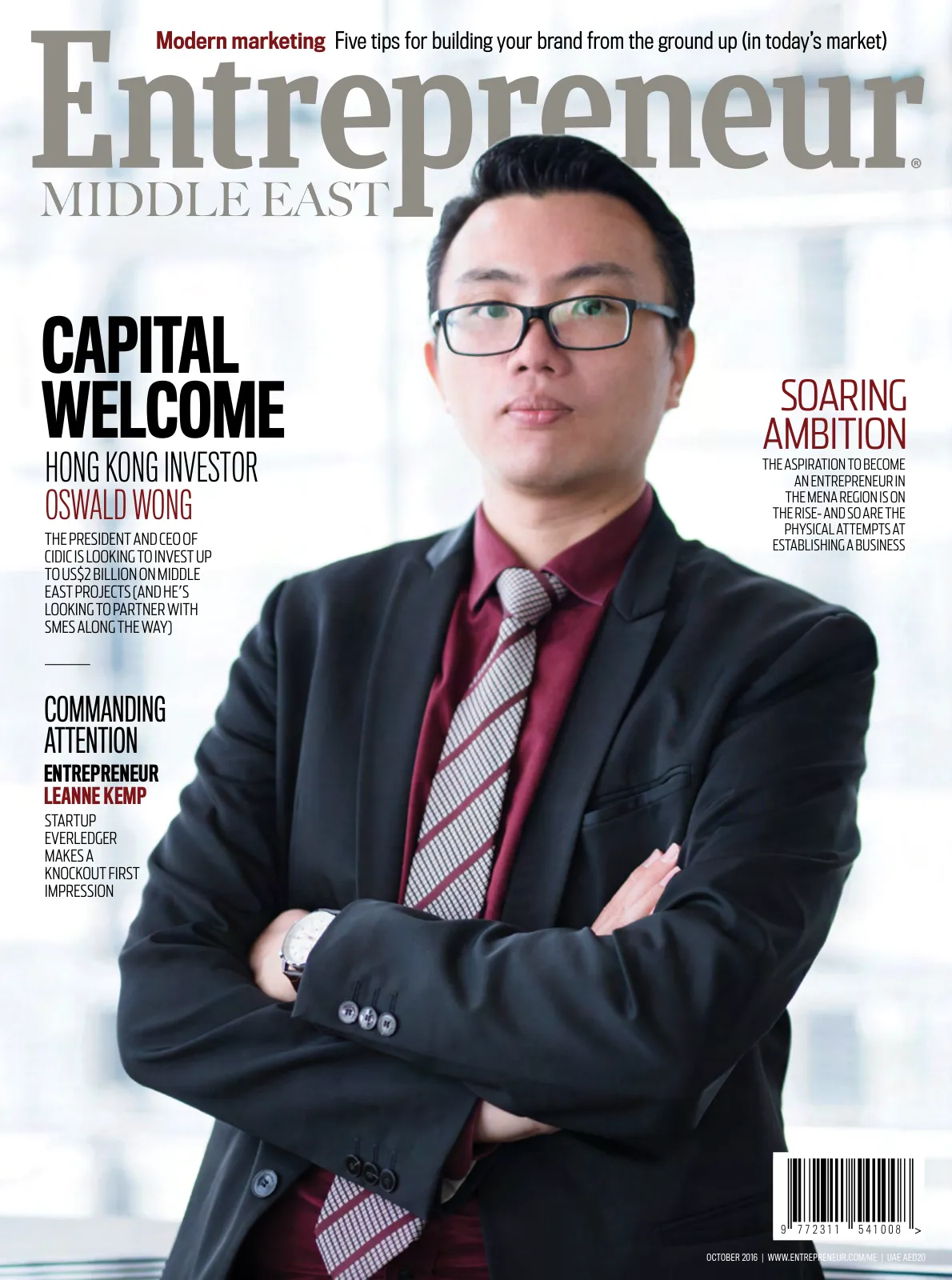
Entrepreneur Middle East, October 2016
Page 1
october 2016 | www.entrepreneur.com/me | UAE AED20
9
7 7 2 3 1 1
5 4 1 0 0 8
>
Modern marketing Five tips for building your brand from the ground up (in today’s market)
Capital
welcome
Hong Kong investor
Oswald Wong
The President and CEO of
CIDIC is looking to invest up
to US$2 billion on Middle
East projects (and he’s
looking to partner with
SMEs along the way)
Startup
Everledger
makes a
knockout first
impression
Commanding
attention
Entrepreneur
Leanne Kemp
Soaring
ambition
The aspiration to become
an entrepreneur in
the MENA region is on
the rise- and so are the
physical attempts at
establishing a business
Page 2
Naushad Ansari, Plant Director Jindal Shadeed
Our search for the ideal location
became a journey of partnership.
With a substantial and expanding
cluster of metal industries, investments
of $25 billion and seamless sea-road-air
access to the region’s largest markets,
it’s no wonder so many companies
choose to start their journey in SOHAR,
one of the world’s fastest growing
Port and Freezone developments.
Page 3
october 2016 Entrepreneur
3
24 FFWD on the evolving role of designers
CONTENTS
october 2016
20
INNOVATOR:
Capital welcome
Hong Kong investor
Oswald Wong
The President and CEO of
CIDIC is looking to invest
up to US$2 billion on
Middle East projects (and
he’s looking to partner with
SMEs along the way).
70
TREPONOMICS:
SKILLSET
Building values
Founder and CEO Omar
Kassim on how he and his
team are building JadoPado
as an organization.
42
TECH:
SHINY
#TamTalksTech
Gadgets and doodads that
you might’ve missed out on,
sourced by a tech aficionado.
Yes, it’s okay to want them
all… and no, it’s not our
fault.
44
CULTURE:
TRAPPINGS
‘Trep gear
The executive selection for
the entrepreneur on your list
that has everything. Okay,
maybe for a little self-reward
as well.
30
CULTURE:
BUSINESS UNUSUAL
Inspired pursuits
Turn your passion into a
viable business- MENA ‘treps
talk what works (and what
doesn’t).
24
CULTURE:
DESIGN
Fashion focus
The MENA region is making
a concerted attempt at
nurturing entrepreneurship in
the style sector.
Oswald Wong with H.E.
Sheikh Nahyan bin Mubarak
Al Nahyan and artist Shi
Dachan at the latter’s
exhibition in the UAE
20
Page 4
Page 5
Page 6
Page 7
Page 8
The superlative-charged chronograph. 50 mm case in Breitlight®. Exclusive Manufacture
Breitling Caliber B12 with 24-hour military-style display. Offi cially chronometer-certifi ed.
Page 9
BREITLING.COM
Page 10
Entrepreneur october 2016
10
CONTENTS
50
TECH:
THE FIX
Paradigm shift
IBM’s Juan Jose De La Torre
on the need for MENA
businesses to embrace
digital transformation.
68
CULTURE:
LIFE
Question the status quo
Contrary to popular thought,
having entrepreneurial
employees in your
organization is a good thing.
72 Pieter Sleeboom, MD, Marhababy; winner of the Dubai edition of CACSC
Juan Jose De La Torre,
IBM, Digital Transformation
Leader for Middle East
and Africa
50
october 2016
38
TREPONOMICS:
PRO
Soaring ambition
The aspiration to become an
entrepreneur in the MENA
region is on the rise- and so
are the physical attempts at
establishing a business.
54
CULTURE:
LIFE
Learning to be creative
James Clear enlists five steps
to enable more innovative
thinking.
62
‘TREPONOMICS:
MARKETING
Modern marketing
Ramzi Haddad, Managing
Director, Carat UAE and
Lower Gulf, offers five tips
for building your brand from
the ground up (in today’s
market).
72
IN PICTURES:
Plugging in
Alibaba Cloud and DSOA host
startup challenge to reward
Middle East entrepreneurs.
42
HTC Desire 10
Pro
jj de la torre Image location courtesy of St. Regis Dubai
Page 11
Page 12
Entrepreneur october 2016
12
CONTENTS
october 2016
30
Omar Samra, founder,
Wild Guanabana
34
Leanne Kemp at IBM Edge 2016
82
START IT UP:
ECOSYSTEM
Global ambitions
Shant Oknayan, Regional
Head of E-commerce,
Retail, Online Services and
Media at Facebook Middle
East and North Africa,
says it’s a lot easier now
for MENA businesses to
venture into new markets.
64
‘TREPONOMICS:
MARKETING
Crowdsourcing customer
acquisition
According to Melltoo
co-founders Morrad
Irsane and Sharene Lee,
for startups, the most
cost-effective way to get
customers is through other
customers.
76
START IT UP:
Q&A
Breaking (linguistic)
barriers
Morocco-based Sahih
Business provides
accounting software in the
Arabic language for MENA
small businesses through
its Aliphia platform.
52
‘TREPONOMICS:
ESQUIRE GUY
The don’t-be-a-schmuck
guide to rescheduling
Yes, it happens to
everyone, but there’s a
right way and a wrong way
to go about it.
58
‘TREPONOMICS:
MARKETING
All about the #feels
Melissa Moubarak, Strategy
Manager at UM MENA,
offers a perspective into
the future of targeting-
customized communication
is the way forward.
16
EDITOR’S NOTE
By Aby Sam Thomas
80
START IT UP:
STARTUP FINANCE
“We got funded!”
compareit4me.com gains
US$2.4 million in latest
investment round, which
means the startup has now
raised a total of $6 million in
funds to date.
Page 13
27
Henri Asseily,
Manager Partner,
Leap Ventures
etro.com
Page 14
Entrepreneur october 2016
14
SUBSCRIBE
Contact subscriptions@bncpublishing.net to receive
Entrepreneur Middle East every issue
EDITOR IN CHIEF Aby Sam Thomas editor@bncpublishing.net
CEO Wissam Younane wissam@bncpublishing.net
MANAGING DIRECTOR Walid Zok walid@bncpublishing.net
DIRECTOR Rabih Najm rabih@bncpublishing.net
CREATIVE LEAD Odette Kahwagi
STARTUPS SECTION EDITOR Pamella de Leon
COLUMNIST Sindhu Hariharan
COLUMNIST Tamara Clarke
COLUMNIST Shoug Al Nafisi
COLUMNIST Erika Widen
EVENTS LIAISON Mark Anthony Monzon
PO Box 502511 Dubai, United Arab Emirates
P +971 4 4200 506 | F +971 4 4200 196
For all commercial enquiries related to
Entrepreneur Middle East contact
sales@bncpublishing.net
All rights reserved © 2016.
Opinions expressed are solely those of the contributors.
Entrepreneur Middle East and all subsidiary
publications in the MENA region are officially licensed
exclusively to BNC Publishing in the MENA region by
Entrepreneur Media Inc.
No part of this magazine may be reproduced or
transmitted in any form or by any means without written
permission of the publisher.
Printed by Raidy Emirates Printing Group LLC
www.raidy.com
Images used in Entrepreneur Middle East are credited when necessary. Attributed use of
copyrighted images with permission. All images not credited otherwise Shutterstock.
Lama Ataya
James Clear
Fida Chaaban
Tarig El-Sheikh
Ramzi Haddad
Omar Kassim
Sharene Lee
Ross McCammon
Melissa Moubarak
Shant Oknayan
Dr. Petar Stojanov
CONTRIBUTING WRITERS
www.entrepreneur.com/me
Access fresh content daily on our website!
MIDDLE EAST
EntMagazineME
@EntMagazineME
Entrepreneur-me
EntrepreneurMiddleEast
EntMagazineME
EntMagazineME
EntMagazineME
MIDDLE EAST
In addition to our print edition, we’re bringing
you all sorts of industry news on our web
mediums. Joining us online means getting
relevant business and startup content in
real-time, so you’re hearing about the latest
developments as soon as we do. We’re looking
forward to interacting with our readers on all of
our social media and web platforms- like any
thriving business, we’re looking to give and take.
#TrepTalkME is already happening on all of our
digi platforms, and all good conversations go
both ways. See you on the web!
Page 15
Fresh from his summer in France, Gary Rhodes returns to Rhodes W1 at Grosvenor House
with an Anglo-French menu. Pick innovative pairings and taste fabulous French flavours
while you sip selected ‘Rhodes Round The Clock’ drinks from AED 25, whatever time you dine.
F o r r e s e r v a t i o n s c a l l 0 4 - 3 1 7 6 0 0 0 | G r o s v e n o r H o u s e | D u b a i | w w w . r w l - d u b a i . c o m
Page 16
Entrepreneur october 2016
16
W
hen Entrepreneur
Middle East was
launched two years
ago, one of the foun-
dational principles
that we laid out
for ourselves as a
publication was that we needed to
be more than a mere spectator of
what’s happening in the region’s
business arena- our mandate
was to be active participants of
the entrepreneurial ecosystem
here, cheering, supporting and
enabling the men and women
trying to make a definite impact
in the MENA region through their
professional endeavors.
Now, I’ll be the first to admit
that having such a directive
hanging over our heads has been
a daunting affair for those of us
working under this banner. Our
desire to be different from the sta-
tus quo meant that we had to be
inventive in how we went about
doing things- we became purpose-
ly choosey about what we feature
as content; we made it a point to
be at as many ecosystem events as
we can (this is why you often see
us working over weekends, so as
to catch up with time we lost over
the week!), and we were keen on
using our platform to throw the
spotlight on not just the business
people who had “made it,” but
also the fledgling new enterprises
that showed the potential to actu-
ally affect change in the region.
It is thus this particular founda-
tional value that is governing our
newest initiative at Entrepreneur
Middle East: a contest that will
see us give away US$25,000 each
to two deserving startups operat-
ing in the Middle East. You’ll
hear more about this competition
and how you can enter it over
the course of October- keep an
eye out for #EntMEStartups on
our social media channels; that’s
the hashtag we will be using to
refer to this contest over all our
platforms. At its very essence, our
aim with #EntMEStartups is to
find enterprises in the region who
are being (at the risk of sounding
cliché) really innovative, and
award them with this prize that,
we hope, will contribute to their
success in the long term.
At Entrepreneur Middle East,
we’ve so far put in time and effort
to helping build this ecosystem-
and now, we are putting in
capital as well. Stay tuned for
#EntMEStartups.
EDITOR’S NOTE
Aby Sam Thomas
Editor in Chief
@thisisaby
aby@bncpublishing.net
Impact investments
First, we put in time and effort into the ecosystem-
and now, capital
Page 17
Page 18
Entrepreneur october 2016
18
T
he Venture, a
global competition
staged by Chivas,
is back this year
seeking promising,
up-and-coming
startups that also
have a positive impact. The com-
petition is open to startups that
have a working business model,
and at the same time, create
social good with its endeavors.
With 32 countries taking part,
each region will have its regional
round, whose winners will then
participate in the grand finals
for a chance to win and share
a stake from the US$1 million
social entrepreneurship fund.
Last year’s judges at the grand
finale in New York included Eva
Longoria, Sonal Shah, Joe Huff
and Alexandre Ricard.
The contest has had an impres-
sive line up of social entre-
preneurs over the years: the
2015 GCC winner was Dumyé,
presented by founder Sahar
Wahbeh, a brand creating hand-
crafted eco-friendly dolls that
can be personalized and donates
to an NGO with every purchase,
while the 2016 GCC winner was
Taka Solutions, presented by
founder and Managing Director
Charles Blaschke and co-founder
and Commercial Director Chris
Burkhadt, a startup that aims
to use its tech to save money
and reduce the world’s energy
consumption. Think you have
what it takes to represent the
GCC region and have a stake at
the $1 million fund? Head to
The Venture and apply before
November 30, 2016.
www.theventure.com
Global startup competition The Venture
2017 launches US$1 million fund
IN THE LOOP
The search is on
N
ew York University Abu Dhabi (NYUAD)
and Flat6Labs Abu Dhabi have come
together to organize the newest edition
of Startup Series, a four-month-long program
comprising of panel discussions and group
activities aimed at promoting a culture of
entrepreneurship among its students as
well as the community at large. As part of
NYUAD’s startAD entrepreneurship initiative,
the Startup Series talks aim to create an
“interactive educational experience” with
expert speakers sharing technical advice
and experiences with existing and aspiring
entrepreneurs.
Structured as 90-minute talks, the Startup
Series and other startAD community
education programs are designed to
function as a source of guidance for aspiring
entrepreneurs and also “engage public and
private organizations.” The Startup Series
sessions will be held at NYUAD during
September to December, and they will cover
topics such as team dynamics in business,
customer development, crafting a pitch, and
managing burn rates, among others. Besides
the Startup Series, the startAD initiative
also includes other concept programs open
to all, such as Tech Tuesdays, a tech startup
community meetup, Legal Clinic, sessions
connecting the startup community with legal
professionals, and others.
http://sites.nyuad.nyu.edu/nyuadstartad/
Kicking off
NYUAD and Flat6Labs launch Startup
Series 2016 in Abu Dhabi
Charles Blaschke and Chris
Burkhadt of Taka Solutions,
winner of The Venture GCC 2016
A scene from a prior edition of NYUAD Startup Series
NYUAD
Dumyé founder Sahar Wahbeh’s pitch at the
Gulf finals of The Venture 2015 in Dubai, UAE
Page 19
Charles Blaschke and
Chris Burkhadt of Taka
Solutions, winner of The
Page 20
Entrepreneur october 2016
20
I
t’s hard not to be at least a little
flabbergasted when looking
through China International
Development and Investment
Corporation Ltd. (CIDIC)
President and CEO Oswald
Wong’s career summary- besides
details about the senior executive
roles and responsibilities he has had to
shoulder in his various jobs so far, the
resume that I looked at (which is eight
pages long, by the way) is peppered
with images of Wong’s meetings
with several distinguished business
personalities from the Middle East.
These include H.E. Saeed Mubarak
Al-Hajeri, Chairman of the Board at
Abu Dhabi National Energy Company
(TAQA), Aabar Investments CEO
Mohamed Hamad Al Mehairi, Sobha
Group founder and Chairman P. N. C.
Menon, Emaar Properties COO Amit
Jain, and so forth- Wong’s resume thus
makes it seem that this Hong Kong-er
is quite comfortably connected to this
region’s business community. As for
how this came to be: well, that’s where
Wong’s enterprise, CIDIC, comes into
the picture. A diversified investment
company based out of Hong Kong, CIDIC
is focusing primarily on infrastructure
and property development, with its
business activities stretching all around
the world. Projects under its current
purview include a US$1.4 billion
mixed-used development at Arizona
in the United States, a $1.2 billion
biofuel project at KwaZulu-Natal and
Mpumalanga in South Africa, a $125
million residential development at
Alberta in Canada, and a $350 million
hospital project in Saudi Arabia. When I
asked Wong if there was an approximate
amount that he thinks CIDIC would
be investing in projects in the Middle
East, he replied that the enterprise
is targeting projects that go from a
“minimum $50 million, up to $2 billion
in construction value.”
The sheer size of the investment
his company is considering to spread
around in to the region is, indeed,
impressive and welcome, with Wong
noting that CIDIC’s target sectors
in the Middle East include property
development and infrastructure, with
the latter focusing mainly on power
projects like solar energy, and –perhaps
The President and CEO of CIDIC is looking to invest up
to US$2 billion on Middle East projects (and he’s looking
to partner with SMEs along the way)
Capital
welcome
By Aby Sam Thomas
innovator
Hong Kong investor Oswald Wong
.
>>>
Page 21
october 2016 Entrepreneur
21
Page 22
Entrepreneur october 2016
22
surprisingly- waste management as
well. “I have good faith in the waste
management [sector] in this region,”
Wong says. “I do believe there’s a big
chance and opportunity on the waste
management sector, especially in waste-
to-energy [projects].” Wong reveals that
he’s already in discussions with various
entities in the region, with the aim being
to have local partners for the projects
CIDIC chooses to invest in. “Although
we cannot say we are very new to the
market, this world is a totally different
one to the Western one,” he explains.
“So it’s better to have someone locally
as [a partner].” According to Wong,
these partnerships will be realized in the
form of SPVs (special purpose vehicles)
with CIDIC, thereby enabling projects to
be executed without too many hitches
along the way. But what are the factors
that govern the selection of a project
by CIDIC in the first place? “The first
is the location of the projects,” Wong
explains. “Second, we need to see how
is the purchasing power of the locals.
Third, we need to see the local law and
regulation- is this something that’s
feasible and good for us? Fourth is the
local contribution [to the projects].
And the last [factor] is the vision of the
country, its local utilities, infrastructure,
etc.”
Given these parameters, and the
industry sectors that CIDIC is interested
in, it should come as no surprise that
the Middle Eastern countries that Wong
is currently keeping an eye on include
the UAE, Qatar and Saudi Arabia.
But while these big projects will see
CIDIC working with, well, big entities,
Wong reveals that his enterprise is
looking to involve SMEs in the region
in certain capacities as well. “We try
to use the local companies for all the
local support,” he says. “We try to use
local [entities], rather than going for
international ones- even if the local
[entity] may charge us a higher price
than the other. This is one form of
support we show for the local SME
sector. Secondly, we are trying to
cooperate with various SMEs in the
local space- like, say, recently, we were
planning an event, and we decided to
use a local company to handle media,
a local company to organize the event,
etc. And thirdly, we are also targeting
to do investment in SMEs, but again,
that depends on the company. At the
moment, we are not investing in any
SME; it’s not in the scope of our works
right now, but maybe in the future,
yes.” In line with CIDIC’s project
strategy in the region, Wong says that
he’d look out for SMEs working in the
fields of property and infrastructure
development, but adds industry to the
mix, especially in the power sector.
For the record though, Wong is indeed
putting his money where his mouth
is- CIDIC recently partnered with the
UAE-based SME Sulty Events and
Entertainment to put together an
exhibition showcasing the ink paintings
of acclaimed Chinese artist Shi Dachan
for the first time in the country. In a
statement, Vanessa de Caires, owner
of Sulty Events and Entertainment,
said, “As a well-organized organization,
we are delighted by the confidence
shown by CIDIC to our firm, and we are
committed to making our first Chinese
innovator
“Collaborating with other countries
and their growth initiatives with
young dynamic entrepreneurs benefits
the progress of both countries, and we
look forward to building bridges with
this exhibition.”
Oswald Wong, President
and CEO, CIDIC with
Vanessa de Caires, Owner
of Sulty Events and
Entertainment Dubai
Oswald Wong with H.E. Sheikh Nahyan bin Mubarak Al Nahyan and artist Shi Dachan at the latter’s exhibition in the UAE
Page 23
october 2016 Entrepreneur
23
art related project for the
exhibition and cultural
exchange a success.” In
the same release, Wong
reiterated his commitment
to empowering the local SME
sector, while enhancing the
China-UAE relationship as
well: “Collaborating with
other countries and their
growth initiatives with young
dynamic entrepreneurs
benefits the progress of
both countries, and we look
forward to building bridges
with this exhibition.”
It’s easy to see from
Wong’s statements that his
strategy for CIDIC in the
Middle East is adherent to
the “One Belt, One Road”
initiative being spearheaded
by the Chinese government.
As a development strategy
aimed at increasing China’s
cooperation and connectivity
with Eurasia, “One Belt, One
Road” was unveiled in 2013,
and has since been making
headlines for its potential to
reshape global trade. While
many Chinese companies
have signed up to be a part
of the “One Belt, One Road”
drive, Wong says that CIDIC
is hoping to differentiate
itself in the manner it
implements this particular
scheme. “They [other Chinese
companies] try to bring
everything from China- labor,
equipment, management,
etc.,” Wong notes. “They have
a little bit of a hesitation to
use local [talent]- they have
no localization. And this is
a major difference between
us and the [other] national
companies.” Wong believes
that while capital and
know-how from China may
be used to govern overseas
projects under the “One Belt,
One Road” scheme, there
also needs to be a concerted
attempt at utilizing the
local resources, and creating
job opportunities for the
talent in those markets as
well. This thus explains
CIDIC’s modus operandi in
the Middle East- Wong is
keen on not just paying lip
service to the “One Belt,
One Road” initiative; he’s
insistent on making regional
collaboration a key aspect of
his company’s endeavors in
this region, and he’s in it for
the long haul. “Long-term
plans, we’ll stay here at least
till a minimum of 2025,”
he says. “We are trying to
have more investment in the
infrastructure side- that’s
our target, frankly speaking.”
Wong adds that the future
could also possibly see
him look at other sectors
like industry, media, and
hospitality in the region,
given the grand visions
countries in this region
have for themselves- which
essentially means that we’ll
be seeing a lot more of Wong
and CIDIC in the Middle East
in the future. And Wong’s
insistence on making local
participation a key part of
CIDIC’s agenda here can only
mean good things for this
region- and it’s something
that will be worth looking
forward to.
CHINA BY THE NUMBERS
1,364,270,000 Population of
China according to the Doing
Business 2016 report
7,380 Gross National Income per
capita (US$) of China according to
the Doing Business 2016 report
84 China’s “Ease of Doing
Business” rank as of 2016, a drop
from the rank of #83 in 2015
according to the Doing Business 2016
report
$19.39 trillion The 2015 estimated
GDP (purchasing power parity) of
China, an increase from the 2014
estimated GDP of $18.14 trillion, as
stated by the CIA World Factbook
6.9% China’s 2015 estimated GDP
real growth rate, a drop from 2014’s
7.3% estimated GDP real growth
rate, as stated by the CIA World
Factbook
$2.27 The number in trillions (US$)
of China’s estimated 2015 exports,
an increase from 2014’s estimated
exports at $2.244 trillion, as stated
by the CIA World Factbook
$36.3 The value in billions (US$) of
Alibaba Group founder Jack Ma, as
stated in the Bloomberg Billionaires
list, Ma was ranked #14 out the
total list of 200, and #1 of China’s
billionaires
11 The number of Chinese billionaires
listed on the Bloomberg Billionaires
index
Industries World leader in gross
value of industrial output; mining
and ore processing, iron, steel,
aluminum, and other metals, coal;
machine building; armaments;
textiles and apparel; petroleum;
cement; chemicals; fertilizers;
consumer products (including
footwear, toys, and electronics);
food processing; transportation
equipment, including automobiles,
rail cars and locomotives, ships,
aircraft; telecommunications
equipment, commercial space launch
vehicles, satellites1
1 Source: The World Factbook
www.cia.gov/library/publications/the-world-factbook/
Oswald Wong has more than
10 years of capital raising
and project development
management experience
working across Mainland
China, GCC countries (UAE,
Qatar, Bahrain and Saudi
Arabia), other Middle East
countries (Jordan, Syria,
Yemen, Turkey, etc.), Africa
(Senegal, South Africa,
Libya, Egypt, etc.), and North
America (USA and Canada).
He has primarily worked in
senior management roles
that saw him getting directly
involved in the fundraising
procedures and leading the
business operations and
project teams for overseeing
the delivery of mega projects,
which include mixed-use
and hospitality properties,
infrastructural developments
like solar power stations,
sewerage treatment, etc., and
industrial projects.
The Executive
Summary
Oswald Wong,
President and CEO, CIDIC
www.cidicgroup.com/
Page 24
Entrepreneur october 2016
24
F
or a long time now, the Middle
East region’s ties to the fashion
industry has been primarily a
commercial one- the region’s
prominence as a retail hub,
owing to its purchasing power,
and its population’s flair for
elegance and opulence are what came
to one’s mind when thinking of the
region’s fashion sector. But while the
early goals of the region (especially the
UAE) may have stressed on wielding
influence as a powerful customer base
for Western creations, the narrative
has, in recent years, shifted to a focus
on developing a fashion ecosystem
right here. Policymakers and stake-
holders have begun to realize that it’s
not enough for the region to have just
large spenders, but it also needs to ce-
ment its place in the evolution of the
industry.
Take Dubai, for instance. In many
ways, 2013 was a landmark year for its
fashion ecosystem. It was a year when
the country took a leap to get closer to
the billion-dollar industry dominated
by the Europe, the U.S. and others.
With top fashion brands already tap-
ping the market here, UAE Vice Presi-
dent and Prime Minister and Ruler of
Dubai H.H. Sheikh Mohammed Bin
Rashid Al Maktoum set up the Dubai
Design and Fashion Council (DDFC)
to steer design and fashion initiatives
in the Emirate. If DDFC was meant to
be the umbrella entity for all things
design and fashion, the move was fol-
lowed up with the creation of Dubai
Design District (d3), a free zone to
house and nurture the region’s crea-
tive thinkers. To make the space a hub
for the region’s creatives, d3 aims to
create a close-knit community, where
designers can share space, collabo-
rate on ideas, and attract talent from
across the globe. In the meantime,
the region also got its own official
By Sindhu Hariharan
The MENA region is making a concerted attempt
at nurturing entrepreneurship in the style sector
CULTURE
business unusual | LIFE | TRAVEL | DESIGN | TRAPPINGS
Fashion focus
Amato at FFWD
“the design industry is gaining grounds at a rapid rate.
Its market value surpassed US$100bn in 2014, and now
constitutes over 4.5% of the global design market. The
sector has grown at more than double the pace of the
global industry over the last few years, and is expected
to continue outperforming the global design industry.”
Page 25
october 2016 Entrepreneur
25
fashion week, the Arab Fashion Week
(AFW). Organized by the Arab Fashion
Council, AFW has earned a name as
a high-profile showcase event in the
league of similar fashion weeks held in
New York, London and Milan.
“As we found through the MENA
Design Outlook report released by
DDFC in collaboration with d3, in the
MENA region, the design industry is
gaining grounds at a rapid rate,” says
Nez Gebreel, CEO, DDFC. “Its market
value surpassed US$100bn in 2014,
and now constitutes over 4.5% of the
global design market. The sector has
grown at more than double the pace of
the global industry over the last few
years, and is expected to continue out-
performing the global design industry.
With an average growth of 6%, the
MENA design industry will grow at
twice the pace of the global design
sector and by 2019, its contribution
to the global design sector will reach
5.2%.” Gebreel notes that there’s
been a strong influx of design-focused
initiatives and events over the past
few years, one of them being Fash-
ion Forward Dubai (FFWD). Sensing
a need for a platform to give more
visibility to designers and hone their
skills, Ramzi Nakad and Bong Guer-
rero launched Fashion Forward Dubai
(FFWD), an organization aiming to
streamline the fashion industry’s ef-
forts. Having run Brag, an experiential
lifestyle marketing agency, the duo
had developed a strong relationship
with the region’s designers and had
noted a feeling of “displacement”
among the emerging talent. Endorsed
by DDFC and operating in partnership
with d3, FFWD follows a two-pronged
approach, addressing both education
and real-world experience for fashion
entrepreneurs. With their bi-annual
fashion events, FFWD helps fledgling
designers go through the process of
putting together shows. “Every six
months, we make them think of the
business aspects involved- collections,
production, costing, marketing, work-
ing with a team of professionals, and
exposing them to a large audience,”
Nakad explains.
Aspiring fashion entrepreneurs had
more reasons to rejoice with FFWD
extending their involvement in the
sector recently, launching EPIC (Em-
powerment Program through Industry
Collaboration), a program to provide
business development opportunities
to regional fashion talent, in collabo-
ration with Samsung MENA, d3 and
DDFC. The initiative came about as a
result of the MENA Design Education
Industry insider
Nez Gebreel, CEO, Dubai
Design and Fashion Council
Tips for aspiring ‘treps in the design
industry- from those in the know
1. It’s really all about the product.
Everything else will follow.
2. Research your landscape and
differentiate your business angle.
Determine how your business will
stand out within a market where
numerous emerging designers are
vying for a spot of visibility.
3. Find a niche market.
Understand who your core
customers are and what they are
looking for.
4. Know your competitors. Being
aware of what is going on in the
design and fashion industry is key.
It is an ever-changing industry
with new trends and topics making
the news on a daily basis.
5. Communication is key. It is
important to get the word out on
your business and your product on
the best channels for it. Know your
target audience and aim for them
through the popular channels that
they frequent.
6. Learn about the basics
of copyrights, patents and
trademarks, and understand
your rights. Intellectual property
protection is very important for
design and creative businesses.
“With an average growth
of 6%, the MENA design
industry will grow at
twice the pace of the global
design sector and by 2019,
its contribution to the
global design sector will
reach 5.2%.”
FFWD on the evolving role of designers
>>>
Page 26
Entrepreneur october 2016
26
Outlook study, conducted by DDFC
and d3. Besides noticing a skills
gap in the industry, the report drew
attention to business development
challenges for fashion entrepreneurs.
“What came out [from the report]
was that designers need more support
in retail pop-up opportunities,” says
Nakad, which EPIC aims to address,
along with showroom retail. “Since
most large multi-brand retailers buy
in showrooms, we decided to set up a
FFWD showroom in Paris during Paris
Fashion Week, where we pick design-
ers, who we feel are ready to go global,
and help them get buyers,” explains
Nakad. Besides that, EPIC will also of-
fer scholarships for courses in fashion
management, and also enable tie-ups
with key social media influencers in
the region, to galvanize further sup-
port for local designers.
One can’t take an analytical look at
the region’s fashion industry without
addressing the massive contribution
and influence of Islamic or “modest”
fashion as well. Thomson Reuters’
State of Global Islamic Economy Re-
port 2015-16 lauds the modest fashion
space to have continued to expand
even amid all the pressures faced by
the mainstream fashion industry. The
Islamic Fashion Design Council (IFDC)
is leading the charge for growth and
development of the sector globally,
with a presence in seven countries.
Alia Khan, founder and chairwoman,
IFDC says that the organization was
launched to “keep a finger on the
pulse of the modest fashion industry,”
with IFDC offering consultancy ser-
vices, assisting designers and creating
a community for this sector. While
the council engages with government
agencies on what Islamic fashion
could mean for their economies, Khan
says she would like policymakers to
work more closely with them. “We
have knocked on doors, and people
have not understood the importance
of it [Islamic fashion],” she says. “But
I think we will get there.”
However, even with external factors
rooting for the industry, it’s difficult
to take an ecosystem to the next level
without sufficient human and mate-
rial resources. “There will inevitably
be challenges that any industry will
face as it achieves growth,” says
Gebreel. “Ensuring that these chal-
lenges are identified through in-depth
research, and then working together
as an industry to address these gaps
is what will help us continue on this
positive trajectory.” For instance, the
MENA Design Education Outlook
study estimates a substantial skills
gap in the design industry (which in-
cludes fashion) to support the growth
projected for the sector. But educa-
tion in this sector is a weak link for
the region, given the lack of specialist
educational institutions. But there is
change happening here as well: while
Gebreel notes that DDFC is working
on implementing initiatives for higher
education as well as K-12, institutions
like ESMOD Dubai (part of the global
Industry insider
Ramzi Nakad, co-founder
and COO, Fashion Forward
Dubai
Tips for aspiring ‘treps in the design
industry- from those in the know
1. Be patient. Patience is the
key. A lot of designers from this
generation expect things to go
fast.
2. Follow your passion. Do it
because this is what you love,
not for fame or because you
want to get rich.
3. Collect as much knowledge
as you can. Learn every day.
Reach out if you need support.
There are a lot of things
happening in the region.
4. Discover yourself. Carve out
an identity for yourself.
CULTURE
business unusual | LIFE | TRAVEL | DESIGN | TRAPPINGS
TCA Abu Dhabi
activity guide
Industry insider
Alia Khan, founder and
Chairwoman, Islamic Fashion
Design Council
Tips for aspiring ‘treps in the design
industry- from those in the know
1. Firstly, have a vision that’s beyond
yourself. Those with a vision that
doesn’t relate to self always end up
building a legacy.
2. Second, don’t try to do things
that you think should be done a
certain way. Fashion is a unique
space, and what works in other
industries may not necessarily be
the course that you should take.
3. Thirdly, be very committed to
who you are. In modest fashion, it
really is about your beliefs. Know
what you stand for, and let your
work show it.
“There will inevitably be
challenges that any industry
will face as it achieves
growth. “Ensuring that these
challenges are identified
through in-depth research,
and then working together
as an industry to address
these gaps is what will help
us continue on this positive
trajectory.”
Page 27
october 2016 Entrepreneur
27
ESMOD group), which bills itself as
Dubai’s “first and only fashion insti-
tute,” are also a move forward. The
school stresses that building a fashion
business requires skills in “creation,
production, marketing and commu-
nication,” and offers courses such as
fashion design, fashion management,
luxury management, fashion buying,
and others. ESMOD Dubai Manag-
ing Director Tamara
Hostal also highlights
the school’s ESMOD
Fashion Designers
Incubator, which was
created after being
disappointed “seeing
students who stop try-
ing to become design-
ers because they don’t
get any support from
the industry.” Gebreel
notes DDFC is aware of
this issue too. “There is
also a need for dedicat-
ed training and men-
torship,” she says. “One
of our most recent
initiatives is a partner-
ship with Chalhoub Group. As part of
the partnership, Chalhoub Group will
provide expertise to designers on a
wide array of topics.”
Like in other industries, the con-
sumer mindset on dealing with local
brands is a key hurdle for the fashion
sector too. Nakad believes that that is
a primary challenge they focus on at
FFWD. “If you look at sustainability
of the economy, we have to focus on
creating brands that we can export to
countries,” says Nakad. “We need to
convince the end consumer to shop
local; to shift part of the spending
power from imported or interna-
tional brands to regional ones.” Nakad
believes that providing more exposure
“We need to convince the
end consumer to shop
local; to shift part of
the spending power from
imported or international
brands to regional ones.”
www.dubaidesignandfashioncouncil.ae
Zaid Farouki
with his design
Dripping Amends
ESMOD
Dubai
>>>
Page 28
Entrepreneur october 2016
28
to local talent and offering products
“on par or even better” than global
brands can help the cause. Designer
Zaid Farouki says cost pressure is also
an issue, along with talent sourcing and
retention. “The majority of the tai-
lors, embroiders, pattern makers, have
learnt the trade through inheriting it
from their parents, or through practice,
but it is very little talent that you find
that went to school to learn the trade;
therefore, you really have to filter the
talent pool down.” Aya Sadder, lead or-
ganizer of this year’s edition of Startup
Weekend Dubai that focuses on the
fashion sector, adds that practical chal-
lenges every entrepreneur faces in the
region also applies to designers. “SMEs
have to pay various amounts like rents,
employee cost, and other bills, even be-
fore you start creating any magic with
your designs,” she notes. She adds that
without a family to back you monetar-
ily and in other ways, it’s difficult for
designers to get their name out, given
the regulatory hurdles. IFDC’s Khan
highlights a need for aspiring designers
to focus on affordable production solu-
tions without comprising on quality.
“Sourcing, production [management],
quality control, and challenges of
securing enough orders from retailers,”
are other issues, she notes.
Be it a tech startup, or a fashion
venture, every business needs money to
grow, and according to Nakad, getting
investors to look at fashion in a “futur-
istic” way is the way to go. “We live in
a day and age of collaboration,” he says.
“Technology and lifestyle can be a great
combination and I would definitely en-
courage angels and VCs to see how they
can collaborate or cross-promote differ-
ent industries.” He believes growth of
sectors such as e-commerce and mobile
commerce can aid the ecosystem’s
growth, owing to their inter-relation. It
is this connection that also prompted
global consumer electronics giant
Samsung to back the EPIC program.
Abdo Chlala, Regional Head - IT &
Mobile Division, Samsung MENA, says
that the company saw the potential to
“enable the fashion space in the region
through meaningful technologies.” “The
primary challenge in fashion and design
industry today is that yesterday’s wow
is today’s new normal,” Chlala says.
“It (technology) is key to maintain the
excitement and longevity of fashion
content, and remain relevant in today’s
world.”
As for the road ahead for the fashion
industry, while it’s easy to look back
and be awed by the distance covered in
such a short time, industry insiders say
that there’s a need to continue chasing
progress. Nakad believes that just like
entrepreneurs, d3 and DDFC too are
going through an interesting learning
curve of their own. “We want to help
them [policymakers] to help position
Dubai as a global fashion capital and
more success stories will help material-
ize this,” he says. As for the entrepre-
neurs in this space, Farouki believes
it is the responsibility of designers to
fight the internal struggles of pleasing
both the creative and business sides
of their ventures. “As a creative, your
business model needs to be updated
all the time to last, and you need to see
eye-to-eye with investors,” he says. But
at the same time, dreaming big is good-
and Farouki encourages that whole-
heartedly. “Everything will fall into
place eventually, but work for what you
dream for every day and every hour,
and let the world work in its mysteri-
ous ways.”
CULTURE
business unusual | LIFE | TRAVEL | DESIGN | TRAPPINGS
STARTUP WEEKEND DUBAI 2016
Startup Weekend Dubai Fashion
will bring together industry experts,
designers and developers to
brainstorm and “create the best
MVP’s” in relation to wearables,
design and technology products,
on October 13-15, 2016 in Dubai.
The startup crash course, which
encourages “learning by doing,”
invites participants to pitch an
idea, start building on the ideas,
and present their prototypes to the
judges- all in 54 hours. Advocating
the lean startup methodology, Startup
Weekend Fashion aims to help fashion
entrepreneurs to go out there and
“actually do it.”
www.dubai.startupweekend.org
www. dubaidesigndistrict.com
“We live in a day and age of
collaboration. Technology
and lifestyle can be a great
combination and I would
definitely encourage angels
and VCs to see how they can
collaborate or cross-promote
different industries.”
Abdo Chlala,
Regional Head
- IT & Mobile
Division,
Samsung
MENA
Page 29
Page 30
Entrepreneur october 2016
30
Inspired
pursuits
Turn your passion
into a viable business
MENA ‘treps talk what works (and what doesn’t)
Hussein Bazaza
Ali Mansoor
Nada and Noor Alawi
Rosemin Manji
Omar Samra
Sultan Al Qassemi
Michelle Karam
Brought to you by
business unusual | LIFE | TRAVEL | DESIGN | TRAPPINGS
CULTURE
Page 31
october 2016 Entrepreneur
31
Ever since his debut collection
came out in 2012, Lebanese
fashion designer Hussein Ba-
zaza has been steadily climb-
ing up the popularity charts
thanks to his signature style
and, of course, the slew of
industry awards he has been
winning along the way- these
include the Elle Style award
for Best Upcoming Middle
East Designer in 2013 and
the Dubai Design and Fashion
Council - Style.com/Arabia
Fashion Prize in 2015. “Every
collection I ever launch has a
fairytale behind it,” he says.
“My creative process starts
by researching a specific topic
at first. After the extensive
research and data retrieved
from the subject, I make up a
character to go with the theme
of the collection. Later on,
after all the pieces of my story
are put together, we walk
through it step-by-step all the
while creating outfits to match
the tale.” As someone who be-
lieves local designers are often
wary of being risky, Bazaza is
keen on differentiating himself
from the crowd- and he cer-
tainly seems to be winning on
that endeavor.
Q What’s your advice for crea-
tives who want to break into
the fashion industry?
A “Those who want to break
into fashion need to be confi-
dent and fearless enough to
do so. First and foremost, they
must study and fully under-
stand their target market to be
well aware of its needs. They
also must have a creatively
unique sense of style to have
their own character in the fash-
ion scene all the while creating
artistic pieces that are sellable.
For me, in the beginning, it was
rather hard, because it was a
confusing time where some
would give me so much advice,
and others would throw criti-
cism my way, so the challenge
was to deal with all of that
and choose which comments
among them all would be a
kind of guideline. The most
important lesson I learned was
to always believe in myself.”
“Our unique selling point is a
mixture of technology, heart
and guts.” That’s how Baroque
co-founder and CEO Ali Man-
soor hopes to make his UAE-
headquartered (and newly
launched) creative production
company stand out in what is
quite a crowded market out
there. Mansoor’s credentials
work to his advantage though-
he boasts of 15 years of experi-
ence in the advertising indus-
try, and his passion for the
sector easily comes through
in the projects he has done so
far. “The freedom of no limits
bestowed on creatives today,
combined with the freedom of
consumers to ignore us with
a click, has created this new,
fantastic, vast and exciting
frontier for fearless creative
and innovative entrepreneurs
who are committed to merging
technology with heart and
guts,” he says. “Creatives who
are not seeing the fast, ever-
changing, increasingly com-
petitive global marketplace
as a problem, but instead as a
huge inspirational incentive to
skip the nonsense, to skip even
knowledge and experience, and
to dare to jump off the cliff.
And they are jumping off the
cliff in order to challenge their
ability to fly and land securely,
as they break new ground in
uncharted territories.” As
someone who has taken such
a leap by creating Baroque,
Mansoor’s journey promises to
be one to watch out for- and
others should follow suit.
Q What are your top three tips
for an entrepreneur to start a
business in the MENA region?
A “Tip number one is that
there are no limits anymore.
Nothing is impossible. Both
technology and organization-
wise. You can run a company
from your bedroom or front
porch. The internet has made it
easier and more fun to become
an entrepreneur by giving us
constant access to the best and
newest knowledge right in our
hands. Creativity now has the
most optimal life conditions
and inspirational resources. Tip
number two is educate yourself
constantly– get used to getting
smarter every day. And tip
number three is don’t be afraid
of failure. Have the guts to
follow your visions and to enter
uncharted territory, to do crazy
things, to do things opposite of
what is the norm. Tip number
four, don’t only have three tips
to offer. So, my fourth tip is
never lose sight of what it’s all
about: people. Fellow human
beings. Communicating value
to your fellow human beings
in order to improve their lives–
not to make you look sexy and
important in a Porsche. There’s
nothing more important than
enriching other people’s lives.”
Founder, Hussein Bazaza
Co-founder and CEO,
Baroque
Hussein
Bazaza
Ali
Mansoor
business unusual | LIFE | TRAVEL | DESIGN | TRAPPINGS CULTURE
“The internet has made
it easier and more fun to
become an entrepreneur
by giving us constant
access to the best and
newest knowledge right
in our hands. Creativity
now has the most optimal
life conditions and
inspirational resources.”
“Those who want to
break into fashion need
to be confident and
fearless enough to do
so. First and foremost,
they must study and
fully understand their
target market to be
well aware of its needs.”
Ali Mansoor,
Founder
and CEO,
Baroque
Hussein Bazaza,
Founder,
Hussein Bazaza
Page 32
Entrepreneur october 2016
32
The Bahrain-based Annada made quite
an impression when it launched in
2011 offering scarves featuring original
artwork by two regional artists, and
co-founders (and sisters) Nada and
Noor Alawi have since proved them-
selves to more than just a flash in the
pan- the company’s range has grown
to includes apparel as well as leather
and paper goods built in collaboration
with regional artists. The venture’s
success should serve as an inspira-
tion for other wannabe entrepreneurs
wanting to follow their passion- Crea-
tive Director Nada Alawi, for instance,
used to work in the oil and gas indus-
try, before launching Annada with her
sister. “The brand is in our DNA, we
know it, we’ve developed it, it is our
way of life,” she says. “We had set off
with two highly celebrated artists; Ab-
bas Almosawi and Hassan Haidar. We
set up our shop online at
annadaonline.com, and from there, the
collection continued to grow. We have
now collaborated with over twenty
artists from the region, and have
gained a loyal following to whom we
are ever so thankful.”
Q What’s your advice for designers
looking into developing their own line of
niche products?
A “Listen to where your heart wants to
go, then show up, and do the work to
get there. It’s as simple as that. Every
day will be a new challenge, as if you
were in a reality show, and each episode
has a different theme. The key is to
break apart the challenge into small
pieces, and tackle them one at a time.
Throughout this nonstop journey, you
will have your ups and you will have
your downs, but always remember, the
most beautiful things await you on the
other side.”
Co-founders, Annada
Nada and
Noor Alawi
business unusual | LIFE | TRAVEL | DESIGN | TRAPPINGS
CULTURE
Having worked in the fashion industry
for more than 17 years, Rosemin
Manji’s influence in the sector
shouldn’t be measured based off
just her social media presence- the
founder of RR & Co. Bespoke Luxury
Management has worked with the
likes of Tom Ford, Burberry and Gucci
over the course of her career, and her
efforts at building personal relation-
ships with these brands and designers
then have certainly contributed to her
success today. And even as the nature
of the region’s luxury sector changed,
Manji smartly set herself to be one
step ahead of these trends- and made
herself a force to reckon with in the
business of fashion.
Q As someone who’s been repeat-
edly lauded as a prolific digital media
influencer in the region, how do you go
about maintaining your presence?
A “There is no doubt that social media
is impactful. I think where brands make
an error is choosing ‘influencers’ by
numbers and not by quality. It’s better
to be associated with a celebrity/in-
fluencer that naturally fits the brand’s
aesthetics and values, than someone
for the numbers only. Honestly, readers
and followers are intelligent to know
what’s real and what’s just a paid post.
I also believe that the influencer has
to personify the brand on and offline.
That’s a true brand ambassador. I
get a lot of offers to endorse brands
and products, but I say no more often
than yes because like everything in the
world, it has its ups and downs, and
right now, there is a surge in social me-
dia, but I strongly believe by maintain-
ing integrity is what will stay true and
last. I think about the long term.”
Founder, RR & Co. Bespoke
Luxury Management
Rosemin
Manji
“I think where brands make an
error is choosing ‘influencers’
by numbers and not by quality.
It’s better to be associated
with a celebrity/influencer
that naturally fits the
brand’s aesthetics and values,
than someone for the numbers
only. Honestly, readers and
followers are intelligent to
know what’s real and what’s
just a paid post.”
“We have now collaborated with
over twenty artists from the
region, and have gained a loyal
following to whom we are ever
so thankful.”
Nada and Noor
Alawi, co-founders,
Annada
Page 33
october 2016 Entrepreneur
33
It’s almost impossible to not
feel inspired hearing Omar
Samra’s story of how he went
about setting up his adventure
travel company Wild Guana-
bana. This Egyptian entrepre-
neur used to have a corporate
career in finance before he set
up his own enterprise that
was driven off his own passion
for travel- a zeal, really, which
has seen Samra travel to more
than 80 countries around the
world already. Wild Guana-
bana differentiates itself by
offering memorable, out-of-
the-ordinary and ethical travel
experiences for its customers,
and Samra is keen on main-
taining the company’s small-
but-intimate feel- the goal, as
he puts it, is not to become
supremely rich, but rather to
“make a change, to be a part of
something bigger than myself.”
Q For a business such as Wild
Guanabana that was founded
on a very specific set of ethical
principles, how do you go about
measuring the company’s
success and growth, while stay-
ing true to your foundational
values?
A “In terms of measuring
success, I personally think,
and it’s something I feel very
strongly about, that, looking at
the world in general, the way
we measure value is inher-
ently flawed. How we measure
value in the world right now, in
terms of companies, is basically
based off shareholder return,
or if it’s a private company, the
bottom-line and so on. But this
sort of measurement is actually
flawed, because it might have
been effective in the times of
the industrial revolution or pre
that time, but now the world
has limited resources. And so
value creation cannot just be
about increasing shareholder
value or selling more things,
it’s about what kind of value
you can add to the world and to
society. So it has to encom-
pass things like, the people
that work with you, are they
being inspired in the place that
they work and able to create?
The people that you serve, the
clients, are you changing their
lives, are you having a mean-
ingful impact in what they do?
How are you conserving your
environment, raising awareness
about current issues through
the work that you do? And so,
in a way, I never intended for
Wild Guanabana to become an
empire kind of thing- certain
kinds of businesses, if you grow
them beyond a certain
point, it’s impossible
to stay true to the
ethics [it was founded
with]… So when I
looked at myself and
my business, I believed
that I had to maintain
a certain sort of scale
in order to be faithful
to the values of the
business, and be able
to serve every single
client the way we
wanted to, a personal
service that is of high
quality and still caring
of the host commu-
nity, the environment
and so on. And even
though we are a small
company, we can play
a much bigger role
if we stay faithful
to the sustainable
guidelines that we
have. We can become
a champion of our
industry, and hopefully inspire
other companies, big and small,
to start adopting more ethical
practices.”
Founder,
Wild Guanabana
Omar
Samra
business unusual | LIFE | TRAVEL | DESIGN | TRAPPINGS CULTURE
“Value creation
cannot just be
about increasing
shareholder value
or selling more
things, it’s about
what kind of value
you can add to the
world and to society.”
Omar Samra
at TEDx
Omar Samra, Founder,
Wild Guanabana
Page 34
Entrepreneur october 2016
34
As the founder of an organiza-
tion dedicated to the develop-
ment of the art scene in the
Arab world, Barjeel Art Foun-
dation’s Sultan Al Qassemi is
keen on shifting the narrative
about the region in the global
landscape- and he’s using
the digital arena to make this
change. “It’s important to use
the internet to respond to
people who generalize about
the Middle East,” Al Qas-
semi said at the 2016 STEP
Conference in Dubai. “I think
the onus is on us -whether
it’s appearing on television,
going on radio- we have to
always counter the narrative.”
And that is essentially what
he is doing with Barjeel as
well. “My aim for Barjeel is
to establish a collection that
has a unique identity,” Al
Qassemi says. “A collection of
Arab artists that is accessible,
approachable and available
for loan, that kind of nur-
tures cultural understanding,
tour-able in that you can take
it out of the country, show it
elsewhere and bring it back,
and contributes to broadening
the dialogue, and distancing
ourselves away from the ste-
reotypical discussions that we
have surrounding the Middle
East and Arab world.”
Q From your perspective,
what’s the case you’d made
for a company in the region to
invest in a MENA-based artist?
A “To begin with, you are
creating a distinct environment
by injecting culture into the
space that makes a state-
ment about your vision as a
corporate leader. It’s a unique
statement about the corpora-
tion; it says that ‘We differenti-
ate ourselves.’ There is also a
CSR responsibility, as many of
these companies are not taxed
in the region so it’s a way to
give back to the community.
It’s an immediate investment in
culture and community- it’s not
a CSR initiative that doesn’t
have a direct return to the
institution. These artworks will
go up in value, [as] the more
people that buy quality work,
the more certain the valuations
are in these artworks.”
It may be easy for people to
dismiss Travel Junkie Diary
founder Michelle Karam as
“just another digital influenc-
er,” but a closer review of what
this entrepreneur does on her
online travel platform (curated
trips, creative content, brand
campaigns) and associated so-
cial media channels (check out
her Instagram presence) may
cause you to reconsider that
notion- the digital revolution
has changed the way consum-
ers shop for travel products,
and Karam is simply capitaliz-
ing on this shift in the market.
“Travel Junkie Diary is not
just about a beautiful Insta-
gram image,” Karam explains.
“It’s true, our followers cannot
see what we do behind the
scenes, but we give our clients,
the brands we work with,
a digital solution, consult-
ing them on the right path
for using social media on the
right platforms, and making
sure they work with the right
influencers or bloggers.” And
in an era where quantity over
quality seems to be the norm,
Karam is keen on moving in a
different direction with what
she does- making her dream of
becoming known as someone
who turned their passion into
a successful career closer to
reality.
Q How do you make sure your
platform, Travel Junkie Diary,
continues to remain innovative,
stay relevant and appealing to
your current followers, while
attracting new ones as well?
A “Creativity is the key, and
you cannot get creative without
research. Getting to know what
the brand represents makes
it easier for me to deliver the
right message in my content,
and curate the right itinerary
for guests. It’s about learning
the trends in travel and creat-
ing it at the same time. Being
consistent is always great, but
sometimes, a change every
now and then can help you
increase your followers. A new
destination that has not been
done over and over is always a
fabulous appeal to attract new
(and maintain) followers. Being
informative in almost every
post I do also helps a lot. At the
same time, branching out and
writing for different print and
online publications in English
and Arabic helps me to reach
a wider audience across the
globe.”
Founder, Barjeel Art
Foundation
Founder,
Travel Junkie Diary
Sultan
Al Qassemi
Michelle
Karam
business unusual | LIFE | TRAVEL | DESIGN | TRAPPINGS
CULTURE
“Being consistent
is always great, but
sometimes, a change
every now and then can
help you increase your
followers.”
“My aim for Barjeel is to
establish a collection
that has a unique
identity. A collection
of Arab artists that is
accessible, approachable
and available for loan.”
Michelle Karam,
Founder, Travel
Junkie Diary
Sultan Sooud
Al Qassemi,
Founder, Barjeel
Art Foundation
Page 35
Our latest room types offer the comfort of bigger space, even as you spend less. That means
space to breathe a little bit more, and space to throw your cares away!
All rooms are equipped with the same complete facilities as all our suites
• free Wi-Fi connections for up to 4 devices
•
•
•
mplete with amenities like
slippers and toiletries
• fully-equipped kitchenette
To book your room today, you may call +971 4 3098 122 or email reservations@hsdubai.com.
Our 3-Bedroom Suite is a wide 160 sqm unit
with 2 master bedrooms and a twin bedded
room, perfect for stays of up to 6 adults and 2
kids.
Our Family Apartment
is a spacious
1-bedroom unit that offers 100 sqm of space
and a sofa cum bed, ideal for 2 adults
and 2 kids, or as many as 4 adults.
© 2013 Hawthorn Suites by Wyndham. This property is operated by R Hotels (a member of R Holding) under a franchise agreement with Wyndham Hotel Group.
The Walk / Jumeirah Beach Residence | P.O. Box: 120253
Dubai, U.A.E. | T: +971 4 399 9979 | F: +971 4 399 2661
HAWTHORN SUITES BY WYNDHAM® JBR
hsdubai.com
BREATHE MORE
worry less
sofa cum bed
sofa cum bed
Page 36
GETTING CLOSER TO THE TOP...
Getting closer to the top of the tallest mountain in the UAE will soon be a lot easier, thanks to the fleet of
Volvo construction equipment used in the building of the road to the Jebel Jais mountain. When it’s finished,
the route will run from Ras Al-Khaimah right to the 1,910 metre summit. The road has already become a
popular destination for motoring enthusiasts, who like to show off what their machines can do. But when the
road runs out, that’s where the Volvo operators show off their machines. And it’s impressive to see what they
can do. If you want to get closer to the action, scan the code and watch the video.
Building Tomorrow.
VIDEO
http://goo.gl/FPsU43
Page 37
Page 38
Entrepreneur october 2016
38
I
t is hard to think of a time
when the economic and
job-related conditions in
the Middle East and North
Africa (MENA) region were
static or predictable. The
region is highly dynamic to
the extent that daily occur-
rences create new and criti-
cal data for those of us keen
on navigating our respective
industries and job markets.
Given how damaging the ever-
growing instability has been
to the region’s economies, the
automatic prediction would
point to a stagnant environ-
ment for all types of employ-
ment, investment, and entre-
preneurship. Yet, it comes to
many as striking that aspiring
entrepreneurs are on the rise
across the MENA region and
are taking more steps and
exerting more effort to join the
force of the self-employed.
Entrepreneurship represents
a key process in creating
economic value and employ-
ment opportunities across
all industries and sectors.
Entrepreneurs often revolu-
tionize existing products and
services; they fill in the gaps
by addressing unmet consum-
er needs and desires, shake
up dormant competition,
and, along the way, generate
new investment platforms
and career opportunities for
their countries. Therefore, it
is undisputable that entrepre-
neurship is a positive phenom-
enon and is becoming a more
integral part of the MENA
economy. When Bayt.com con-
ducted the Entrepreneurship
in the Middle East and North
Africa Survey, August 2016, it
was evident that more people,
when compared to the survey
findings of 2015, are opting for
self-employment. Addition-
ally, more aspiring entrepre-
neurs in 2016 are taking the
necessary steps to launch their
businesses. For instance, 71%
of the 2016 survey respond-
ents prefer self-employment
while 64% preferred self-
employment in 2015. It is not
merely about preference, as
more respondents in 2016 said
that they have taken the first
steps towards establishing
their own business and have,
hence, began implementing
their ideas on the ground.
Based on the survey find-
ings, entrepreneurship is
certainly not declining in the
MENA region; in fact, it is
appearing more favorable and
stronger than before. This is
particularly true among recent
graduates and millennials,
currently experiencing the
highest unemployment levels
in the world.
Why entrepreneurship is
on the rise
It may still sound counterin-
tuitive that more startups are
popping up across the MENA
today when the economic con-
ditions seem more challeng-
ing than ever. There are, in
fact, a few factors that further
explain this trend.
1. The unemployment
effect We can think
of self-employment and
unemployment as alternatives.
It is a simple analogy to show
how higher unemployment
works as an incentive for
aspiring entrepreneurs. At
the end of the day, many of us
prefer self-employment over
unemployment. 2016 brings
about a highly enriched, yet
challenging, environment for
employment and retention;
one in four young people in the
MENA region are unemployed.
This number is much
higher, in fact, if we include
informal unemployment and
underemployment figures.
Despite the fact that persistent
unemployment is economically
and psychologically taxing,
it can motivate job seekers
to explore alternative routes
such as entrepreneurship. This
ultimately creates jobs for the
entrepreneur and for many
others.
ETHICS | ESQUIRE GUY | SKILLSET | MARKETING | PRO
TREPONOMICS
Soaring ambition
The aspiration to become an entrepreneur in the MENA
region is on the rise- and so are the physical attempts at
establishing a business
By Lama Ataya
Entrepreneurs often revolu-
tionize existing products and
services; they fill in the gaps
by addressing unmet consumer
needs and desires, shake up
dormant competition, and, along
the way, generate new investment
platforms and career opportuni-
ties for their countries.
Reasons for preferring to seek employment in a company
%44
%41
%35
%31
%28
%26
%16
%14
%11
%11
%10
%9
%9
%5
%5
%4
Lack of an appropriate business idea
Lack the confidence for running own business
Severity of the self-employment decision
Lack of necessary skills to be self-employed
No investment required
Little risk involved
Consistent resources / flow of work
Current political system
Unaffordable economic conditions
Enjoy the social aspects of an office
Lack of finances to start own business
Fixed working hours
Benefits and perks
Stability of employment / job security
Learning new skills
Regular income
environment
75%
21%
4%
Between 2011 to 2016
(in the last 6 years)
Between 2006 to 2010
(in the last 10 years)
More than 10 years ago
(2005 or before)
State of self-employment
Page 39
october 2016 Entrepreneur
39
In its Middle East Job Index
Survey, February 2016,
Bayt.com measures the Hiring
Expectancy Index (HEI) for
countries in the MENA region.
This year the index presents
a three-point decrease as
compared to June 2015, which
suggests that those seeking
employment in a company may
face even more difficulty in the
future. However, if entrepre-
neurship continues to grow as
an alternative for unemploy-
ment, we can assume that
those who launch a successful
business will help offset the
decrease in hiring expectancy.
Entrepreneurs who seek to
grow their business and sur-
vive the competition will most
likely need to build a team
and will hire more job seekers.
Ultimately, those who pursue
the self-employment path will
secure jobs for themselves and
a few others. Today’s entre-
preneur can be thought of as
tomorrow’s employer.
2. The millennial effect
The fact that the MENA region
is very youthful cannot be
overlooked when it comes to
entrepreneurship. Millennials
comprising the largest
proportion of the job-seeker
population means that they
highly influence the trends
and changes of the job market.
First of all, unemployment
is more prevalent among the
millennials. As indicated in
the Bayt.com Millennials in
the Middle East and North
Africa Survey, February
2014, eight in 10 respondents
state that unemployment is
a significant issue in their
respective countries. Higher
unemployment among
millennials suggests that more
of them are likely to seek self-
employment as an alternative.
Another area that explains
the millennial effect on en-
trepreneurship in the MENA
region is the career attributes
that millennials value the most.
According to the Bayt.com
Millennials in the Middle
East and North Africa Survey,
among respondents who are
looking for a job, work-life
balance and personal fulfill-
ment come on top. Millennials
look beyond the salary; they
are interested in a career that
parallels their passion and
career goals; a career that is
ethically sound; and a career
that affords them a balanced
life. Without doubt, seeking a
higher salary is a significant
incentive for a millennial to en-
ter and exit a specific field. Yet,
there are other equally valuable
attributes that millennials are
looking for in their job search.
In fact, many of these at-
tributes are also what make
self-employment very attrac-
tive. The Bayt.com Entre-
preneurship in the Middle
East and North Africa Survey
looked at the reasons entre-
preneurship is so desirable
nowadays. The most cited
motive was the greater sense
of independence at work (39%
of respondents). Being able to
choose working hours, dress
code, and vacation allowances
are highly wanted perks of
entrepreneurship. Large com-
panies with excessive hierarchy
often diminish independence
at work. Entrepreneurs value
self-management and find that
it enables them to better focus
on what they want to achieve
in their careers.
Challenges faced in starting a business (those who tried but couldn’t / failed to do so)
18%
Neither easy nor difficult
Somewhat easy
Extremely difficult
Extremely easy
Somewhat difficult
36%
28%
12%
6%
charts © bayt.com
%52
%51
%22
%19
%19
%17
%17
%14
%14
%13
%13
%10
%10
%9
%9
%6
%3
%3
Other
Lack of confidence / risk taking spirit
Too much hard work and effort
Corruption in business
Unable to establish the 'right' contacts / wasta
Difficult to reconcile with family situation
Do not have the requisite skills and experience
Fear of failure
Unable to meet licensing and regulatory requirements
Lack of skilled workforce required in the business
Strong competition in the line of business
Difficult to obtain information on starting business
Strict government regulation / Bureaucracy
Lack of resources required
Economic uncertainty
Cost of acquiring technology was prohibitive
Not able to self-finance the start-up of the business
Unable to obtain financial support
Ease of setting up own business
>>>
Page 40
Entrepreneur october 2016
40
Another reason many indi-
viduals in the MENA region
prefer self-employment is that
it allows them to do exactly
what they are interested in.
According to the same survey,
58% of respondents find that
starting their own business af-
fords them a sense of personal
fulfillment. Millennials who
are driven by a mission, more
so than a dollar figure, will find
entrepreneurship ideal for real-
izing their passion. Those who
seek to start a new business
often start with their passion
as a guiding map to formulat-
ing their business idea.
What these trends mean
for your country
The aspiration to become
an entrepreneur is evidently
on the rise, and so are
the physical attempts at
establishing a business.
Nonetheless, succeeding at
establishing a business that
adds economic value and
survives the competition
is partially dependent on
the host environment. The
Middle East and North Africa
is a very diverse region
and its entrepreneurial
environment varies greatly
from one country to another
and from one city to another.
There is a number of factors
that aspiring entrepreneurs
consider before launching an
investment in a particular
city. These factors include
laws and regulations of setting
up a business, regulations
of existing competition,
taxes, and access to investors
and talent. The Bayt.com
Entrepreneurship in the
Middle East and North Africa
Survey found out that the
most important factor for
entrepreneurs was the ease of
setting up the business. What
this means is that potential
entrepreneurs will look at
the process of obtaining a
licence, registering a business,
and setting up the facilities
and evaluate whether it is
inviting enough. Based on
that, different cities will
witness different levels of
entrepreneurial activity.
Indeed, entrepreneurs have
had diverse experiences set-
ting up business operations
across the MENA region. Some
of these differences are as
perceived, but the attractive-
ness of the host environment
remains different across the
region. The Bayt.com Top
Cities in the Middle East and
North Africa Survey, October
2015, examined the attractive-
ness of cities based on many
economic and entrepreneurial
variables.
The entrepreneurship factors
consist of aspects that have an
impact on a city’s economic
prosperity. These include
taxes, ease of setting up a
business, bureaucracy level,
ability to find finance and
talent, market willingness to
accept new ideas, as well as
market saturation. Some of
the cities that scored highest
on the entrepreneurship fac-
tors include Dubai, Abu Dhabi
and Manama. This means that
these cities are more likely to
experience most of the entre-
preneurial fever and incubate
more startups in 2016, when
compared to other cities in the
region.
Lama Ataya is the Chief Marketing Officer at Bayt.com. In this role, she heads the Marketing department at Bayt.com, and within that role, she is also
responsible for communications, content, community experience, and corporate social responsibility.
ETHICS | ESQUIRE GUY | SKILLSET | MARKETING | PRO
TREPONOMICS
charts © bayt.com
37%
12%
37%
12%
2%
Never
After a lengthy career
Mid-career
Right after college/university
Anytime
6%
They mentor young
people and promote the
entrepreneurial spirit
They are effective risk-
takers
They are a source of
innovation in society
They are opportunity-
driven
They help in creating
new jobs
They create new
products/services for
the society’s benefit
They only think about
their own profit
2%
11%
21%
32%
42%
34%
16%
7% 2%
41%
33%
18%
5% 4%4%
4%
1%
3%
12%
37%
48%
47%
34%
12%
5% 2%
3%
7%
19%
37%
34%
29%
30%
21%
11%
8%
Neither agree nor disagree
Somewhat agree
Strongly disagree
Strongly agree
Somewhat disagree
Best time to start a business
Perceived image of entrepreneurs
The fact that the MENA region
is very youthful cannot be
overlooked when it comes to
entrepreneurship. Millenni-
als comprising the largest
proportion of the job-seeker
population means that they
highly influence the trends
and changes of the job market.
Page 41
Page 42
Entrepreneur october 2016
42
TECH SHINY | WEBSITE TO WATCH | GEEK | MOBILE TECH | ONLINE ‘TREP | THE FIX
From slick smartphones to ultra-thin laptops, this month’s tech lineup showcases products that you’d
need in your day-to-day life. Yes, it’s okay to want them all… and no, it’s not our fault!
Worldly desires
HTC unveils its new flagship smartphones
IMAGES COURTESY htc, acer, homeiq
HTC has unveiled two new
smartphones, the HTC Desire
10 Pro and the HTC Desire 10
Lifestyle, both of which feature
stunning design and flagship-
level features. The Desire 10
Pro has a 5.5 inch, 1080p Full
HD display, 4GB of RAM, 64GB
storage space and amazing
high-resolution cameras. It has
a 20MP main camera with pre-
set options like sport mode and
night mode, electronic image
stabilization to provide smooth
videos even with shaky hands,
and auto HDR on both the front
and rear cameras. Snap your
best selfies with the 13MP front
camera that features a new
150-degree Selfie Panorama
mode. A fingerprint sensor that
recognizes your finger from
every angle and position sits on
the back of this model too. The
HTC Desire 10 Lifestyle boasts
a 5.5-inch, 720p HD screen, up
to 3GB of RAM, 32GB storage
space and HTC BoomSound Hi-
Fi Edition plus 24-bit Hi-Res au-
dio. Both smartphones offer up
to 2TB of expandable memory
and share the same stunning
look with metallic gold trim that
complements the matte finish.
Available in four distinct colors
-Stone Black, Polar White, Royal
Blue and Valentine Lux- the
HTC Desire 10 Pro and Lifestyle
blend function and fashion…
flawlessly.
HTC Desire 10
Lifestyle
Page 43
october 2016 Entrepreneur
43
HomeIQ’s connected home
wireless system is an easy and
efficient way to manage your
home. The system requires no
drilling or technical expertise
to install and allows you to
automate lights, locks and appli-
ances as well as protect against
leaks, fire and theft. Hardware
for the system includes a central
hub that works with other smart
device like A/C thermostats
that program themselves, flood
detectors that shut off water
supply when a leak is detected,
smoke alarms that send notifica-
tions in case of fire, and smart
locks that can remotely unlock
a door. Got kids? HomeIQ can
help automate their lifestyles too
by restricting access to game
consoles and TVs to specific
times through the installation of
a simple smart switch. The sys-
tem is entirely customizable and
available through HomeIQ’s on-
line platform. Once installed you
can manage your smart home
using an app on your Android or
iOS mobile device.
#TAMTALKSTECH
Tamara Clarke, a former
software development
professional, is the tech and
lifestyle enthusiast behind
The Global Gazette, one of
the most active blogs in
the Middle East. The Global
Gazette has been welcomed
and lauded by some of the
most influential tech brands
in the region. Clarke’s goal is
to inform about technology
and how it supports our
lifestyles. See her work both
in print regional publications
and online on her blog where
she discusses everything
from how a new gadget
improves day-to-day life
to how to coordinate your
smartphone accessories.
Visit www. theglobalgazette.
com and talk to her on
Twitter @TamaraClarke.
Style quotient
Acer introduces new Swift Series
Smart home
HomeIQ offers a wireless management system for your home
Acer has launched the Swift
Series, a lineup of lightweight,
ultra-thin laptops. The Swift
3 model combines a 14-inch
HD or Full HD IPS anti-glare
display with 6th or 7th Gen-
eration Intel Core processors,
512GB SSDs and up to 8GB
memory in a slick aluminum
chassis. Other specs include
a USB 3.1 Type-C port and
an HD webcam with high
dynamic range. Its design is
rounded out with an optional
backlit keyboard that’s paired
with a large 72mm touchpad.
Perhaps the most novel fea-
ture is the built-in fingerprint
scanner located at the upper
right-hand corner of the palm
rest- yes, there’s a place to
rest your palm. It works in
conjunction with Windows
Hello for enhanced security,
and takes less than one sec-
ond from scanning a fingertip
to access the desktop. The
scanner can also recognize
specific people and link ac-
tions to approved individuals.
All-in-all, the Swift 3 promises
to be a slick device with im-
proved safety.
HomeIQ
Acer Swift 3
Page 44
Entrepreneur october 2016
44
Keeping an entrepreneurial spirit is
essential- even for a prestige brand
that already has a loyal following
since its establishment in 1848. Swiss
watchmaker OMEGA is expanding its
brand to luxury eyewear with its first
summer collection in partnership with
Marcolin Eyewear in Italy. We’re a fan
of the pilot style shades- suitable for
both office wear and leisure attire. And
if you’re familiar with OMEGA’s high-
caliber aesthetics, its influences are
found in the collection too- scratch-
resistant and anti-reflective lenses and
its shiny black finish is reminiscent
of OMEGA’s Dark Side of the Moon
timepiece lineup- a hat tip to the
brand’s beginnings.
www.omegawatches.com
business unusual | LIFE | TRAVEL | DESIGN | TRAPPINGS
CULTURE
GEAR UP
OMEGA SUNGLASSES
Editor’s pick
COS AW16
The COS AW16 collection is
rich in both color and texture-
partly because the collection
is inspired by the work of
Berlin-based artist Lev Khesin
whose works consists of
semi-transparent layers and
deep muted, gradient colors.
It’s evident that the range is
intent on conveying a mixture
of deep pigments and subtle
layering, displayed by high
turtlenecks and elongated
sleeves in geometric defining
cuts. One ensemble we’re keen
on? A navy merino wool top
paired with a classic navy wool
tailored jacket and trousers,
finished off with a pair of black
leather sneaker. It sure looks
good to us.
www.cosstores.com
‘Trep trimmings
The executive selection
F
rom better goods to boardroom wardrobe bests, each issue we choose a few items that
make the approved executive selection list. In this issue, we present the COS AW16 men’s
range, a new timepiece for travelling ‘treps, and our suggestions for eyewear to include in
your better accessories collection.
COS AW16
OMEGA Pilot Style Sunglasses
COS AW16
images courtesey omega, cos
Page 45
october 2016 Entrepreneur
45
images courtesey Patravi TraveltTec
business unusual | LIFE | TRAVEL | DESIGN | TRAPPINGS CULTURE
Patravi
TravelTec II
TIME MACHINE
PATRAVI TRAVELTEC II
Hopping on and off so many flights that
you’ve lost track of which time zone
your next conference call is in? We’ve
got the solution: Patravi Traveltec’s
newest timepiece. A worthwhile
addition to your watch collection, it
was designed with the passion and
craft of renowned watchmaker Carl
F Bucherer. The Patravi TravelTec II
features a distinctive chronograph with
three time zones, and boasts water
resistance up to 50 metres. Finished
with a rose gold case and lightweight
titanium pushers, this watch will
ensure that you’re on time and looking
fine at it too. Include this in your travel
essentials, and you’re ready to go.
www.carl-f-bucherer.com
october 2016 Entrepreneur
45
Page 46
Entrepreneur october 2016
46
F
or an event
that was
organized by
IBM, one of
the largest
(and oldest)
technology
companies in
the world, it was no surprise
to hear “innovation” being
the center point of this year’s
edition of the Edge confer-
ence. Staged in the United
States in September at the
MGM Grand in Las Vegas,
Edge 2016 aimed to inspire
its attendees to “outthink the
status quo,” with IBM using
the event to showcase how
it was enabling great strides
and delivering value in fields
as varied as cognitive busi-
ness, cloud technology and
collaborative innovation.
High-ranking IBM executives
like IBM Systems Senior Vice
President Tom Rosamilia
took to the Edge 2016 stage
to deliver this message,
which was further bolstered
by its partners in these
endeavors, which included
bigwigs like Red Bull Racing,
Welch’s, and Hortonworks.
But while all of these
prolific industry names gave
presentations that were
impressive in their own
right, I must admit here that,
from a personal standpoint,
the Edge 2016 speaker that
particularly stood out to
me –entrepreneur Leanne
Kemp- didn’t belong to a
“big” company per se: Kemp
is the founder and CEO of an
18-month-old startup called
Everledger, that currently
employs a team of 20 people.
But as Kemp outlined the
work that her enterprise
was doing, the technology
it was using to do this, and
the scope of its applications,
it was easy to see why the
London-headquartered
Everledger (with offices in
Australia and New York)
warranted a presence on the
Edge 2016 stage, despite the
company’s relatively young
age and small size- this
startup definitely seems to
be on to something with its
offering, and Kemp’s passion
and drive for her company
was, quite simply, grand and
infectious.
Commanding
attention
SPECIAL REPORT
IBM EDGE 2016
Startup Everledger makes a KNOCKOUT first impression
By Aby Sam Thomas
Mai Medhat, co-founder and CEO, Eventtus with
President Barack Obama, Facebook CEO Mark Zuckerberg and
other entrepreneurs at GES 2016
IBM Edge 2016
Entrepreneur Leanne Kemp
Page 47
october 2016 Entrepreneur
47
Everledger describes itself
as “a permanent, digital,
global ledger that tracks
and protects diamonds and
other valuable goods on
their lifetime journey.” With
the use of technology like
blockchain, smart contracts,
machine vision and AI, this
startup essentially creates an
immutable digital footprint
for a diamond, thereby pro-
viding a secure, transparent
record which stakeholders
throughout the supply chain
can use to track and protect
their assets. Given its cur-
rent focus on the diamond
industry, Kemp explains that
Everledger’s clients include
banks, insurance companies
and certification houses, and
its technology has, so far,
been used to certify over a
million diamonds. That’s no
small feat for a company that
was founded only in April
2014, which also boasts of
having won a number of in-
dustry awards, like the 2015
BBVA Europe Open Talent
Competition, the 2015 Meffy
Awards, and the 2016 Fin-
tech Finals, to name a few.
The value of what
Everledger brings to the
table can be best understood
when one looks at what is
at stake here: the diamond
industry is worth about
US$80 billion, but it is
rattled with problems like
theft and fraud, as well as
concerns over their sourc-
ing from conflict zones.
According to Everledger,
insurance fraud is a global
problem, with US$2.5 mil-
lion spent a year by insurers
to tackle this problem. With
this in mind, the solution
Everledger offers can be
put to good use in diamond
verification processes by
banks, insurers, law enforce-
ment, and even the owners
themselves, who can now be
confident about their asset’s
sourcing. “I think the real
game changer for us is when
we are able to give enough
transparency with a depth
of data over time, so that
the consumer can have the
full consciousness of mind
around the purchase of the
diamond,” Kemp says. “I
think the horizon for us is
to bring full spread of the
true provenance, the chain
of custody, and the reputa-
tion of the diamond to the
consumer.”
And while Everledger’s
technology has been
currently put to use for
diamonds, the underlying
ledger concept can be used
to track other valuable assets
as well, like gemstones, art,
luxury goods
and more. “You
know, Amazon
started with
books, and
Everledger
started with
diamonds,”
Kemp says.
“Our vision is
so much bigger.
You go from
diamonds to
colored stones,
rubies and sap-
phires; you can
go to watches
to art to wine.” It’s a bold vi-
sion- but it’s one that Kemp
is confident that Everledger
can accomplish because of
the ingenuity of its solution.
“I think the reaction to
Everledger from day one has
been somewhat of an ‘aha!’
moment for many, many
people,” she says. “And I
think that’s a testament
to our ability to distill the
technology to its pure potent
form to really understand
the core building blocks that
were never going to change
through the evolution of the
tech, and to apply that to a
problem… We knew what
the problem was, and we
“We knew what the problem was, and we
had the ability to say, hey, there is some
technology here that could actually
really solve this. And these problems are
problems that have not yet been solved
before today- so we truly are trying to
solve a problem that is real world issue.”
SPECIAL REPORT
IBM Edge 2016
“the real game changer for us is when
we are able to give enough transparency
with a depth of data over time, so that the
consumer can have the full consciousness
of mind around the purchase of the diamond.
I think the horizon for us is to bring full
spread of the true provenance, the chain of
custody, and the reputation of the diamond
to the consumer.”
www.everledger.io | images courtesy ibm
Leanne Kemp with a
few of the awards won
by Everledger
>>>
Page 48
Entrepreneur october 2016
48
had the ability to say, hey,
there is some technology
here that could actually
really solve this. And these
problems are problems that
have not yet been solved
before today- so we truly
are trying to solve a problem
that is real world issue.”
Kemp, a serial entrepreneur
who has built and sold start-
ups successfully in the past,
says that Everledger was
predominantly funded from
her own personal wealth.
The startup was invited to be
a part of the 2015 Barclays
Accelerator program in Lon-
don, which afforded it an in-
vestment of US$120,000 as
well. “We were supported by
an industry name this year,
but we haven’t publicly an-
nounced that,” Kemp reveals.
“We will announce that as
part of our Series A that
will come out in the next
number of months.” Having
showcased its digital encryp-
tion expertise in the polished
diamonds space, Everledger
announced at Edge 2016
that it has now extended
its technology to tackle the
trade of rough diamonds as
well, certified through the
UN-mandated Kimberley
Process, and thus enabling
transparency at every stage
of a diamond’s journey.
Everledger’s presence at Edge
2016 is also reflective of the
good working relationship
between the startup and
IBM, and I was curious to
hear from Kemp how this
partnership came about. “We
are a company that enables
technology, so that industry
can consume it, and we can
solve problems,” she ex-
plains. “We have some of the
brightest minds in the insur-
ance business; we have some
of the brightest engineers
that are working with us. But
we are not a protocol-based
engineering team, so we’re
reliant upon the emerging
fabrics that come to market.
And there have been very
many startups that have
attempted in the space that
have built certain architec-
ture, and we’ve embraced
that architecture. But when
we got to the first year [of
the company], we achieved
the million diamond mark,
and it was actually quite a
sobering moment for me at
Christmas, because it had
dawned upon me that whilst
a lot of people were applaud-
ing the engineering efforts
of our team, the reality is
we need to go from a million
to 10 million to 30 million
diamonds. How do we scale
that securely, how do we do
that globally, and how do we
also bring the elasticity in
terms of that service offering
to market? And so, to bring
that elasticity, as well as the
rigidity ensuring that if you
stretch it too long, it’s not
going to snap, [we chose to
work with IBM].”
And Kemp doesn’t seem
to regret her decision one
bit- she was quite gracious
of IBM’s efforts in relation
to Everledger. “IBM is one
of the chosen companies
that’s been around for 100
years. They’ve continued to
re-innovate themselves; in-
“IBM is one of the chosen companies that’s
been around for 100 years. They’ve continued
to re-innovate themselves; innovate the
market. And they understand security. They
understand hard architecture. And they
understand enterprise level applications. So,
for me, it was around, really, being counter-
intuitive, around some of the decisions that
we were making as a startup.”
Leanne Kemp at IBM Edge 2016
SPECIAL REPORT
IBM EDGE 2016
Page 49
october 2016 Entrepreneur
49
novate the market. And they
understand security. They
understand hard architec-
ture. And they understand
enterprise level applications.
So, for me, it was around,
being counter-intuitive
around some of the decisions
that we were making as a
startup. Actually kind of do-
ing the old Wayne Gretzky,
you know, let’s go to where
the puck is likely to be,
rather than trying to be there
right this very second. And,
you know, that intuition is
paying off right now for us.”
Given Everledger’s successful
collaboration with IBM, I
ask Kemp if she had any tips
for other entrepreneurs who
may be, like her at one point,
weighing the pros and cons
of working with an industry
giant. Kemp replies with a
mountaineering analogy.
“There are ways to scale
the heights of Everest. And
I think that the air is thin
when you get up there quite
high. But the ability to find
the right sherpa in industry
to bring you through those
parts, and the challenges and
the potential avalanches,
and to weather the storms
that happen is really the key
to success. You know, for
me, we’ve invested a lot in
understanding the challenges
of us wanting to really take
ourselves to new heights. But
IBM has been a part of that
sherpa process for us. And,
you know, we have not nec-
essarily spent a lot of time
in the business-facing end
of IBM; we really have been
spending a lot of time with
the technology team. We’ve
been making the engineering
investment. We’ve been con-
tributing to the open source
initiative. You know, we’ve
been giving first; we’ve been
giving it out, and respect-
fully, IBM has supported us
through this journey, and
quite rightly, probably to the
benefit of them, as well as it
is to the benefit of us.”
But weren’t there ever any
concerns about working with
a giant like IBM- perhaps
worries about the startup
being swallowed by it?
“You know, IBM was once
a startup,” Kemp replies.
“They were once a startup.
And I don’t think I’ve forgot-
ten that. So, at the very core
of IBM, you know, they really
have the embodiment of
trust. And I remember hav-
ing a conversation with some
of the top management team,
and looking them in the eye
and saying, you know, this
could potentially be a David
and Goliath moment. I mean,
there’s no reason why you
couldn’t shove Everledger
to one side, and actually
put an engineering army of
200 people to it, and take
us out of the market in five
split seconds. But I really
think, and, you know, maybe
I’m putting words in IBM’s
mouth, but I really think
that they’ve enjoyed the true
collaboration. I think that
they have enjoyed the sensi-
tivities that we’ve brought to
the engineering framework.
We really understand the
acuteness of the problems
in the marketplace. And you
know, we’ve been agile in our
approach. I mean, a 20-hour
working rhythm for us, 24/7
across three countries in 18
months, is really something
that I guess they probably
haven’t seen too many times
in a startup. I mean, we’re
hungry. We want IBM to
work with us. We’ll do what-
ever it takes to be sure that
the industry can consume
this technology. And for me,
I want to be the crazy old
lady in a nursing home that
tells the story, that there was
something that we did to
change the world.”
“we’ve invested a lot in understanding the
challenges of us wanting to really take
ourselves to new heights. But IBM has been a part
of that sherpa process for us. And, you know,
we have not necessarily spent a lot of time in
the business-facing end of IBM; we really have
been spending a lot of time with the technology
team. We’ve been making the engineering
investment. We’ve been contributing to the open
source initiative.
IBM Edge 2016
SPECIAL REPORT
IBM Edge 2016
images courtesy ibm
Page 50
Entrepreneur october 2016
50
T
ech has changed the
way we work and
live, and with that,
more so than ever,
the need for enter-
prises and startups to shift to
strategize the digital market
is high. Businesses are called
to create more efficient and
seamless ways to incorporate
consumer-centric experiences
with digi technologies, and
IBM’s Digital Transformation
Leader for Middle East and
Africa Juan Jose De La Torre
focuses on addressing this
demand. According to De La
Torre, digital transforma-
tion is all about helping
clients leverage technology
“to actually reinvent their
business models to reinvent
their operations, to reinvent
the processes, and basically
to transform.” Enhancing
customer experience needs
to be the centerpoint of this
transformation strategy,
which should essentially re-
late to the consumer’s specific
needs and wants. “You need
to change how you actually
create, and how you actually
build the proposition,” he
explains.
While De La Torre agrees
with the notion that the rate
of digital adoption is high in
the MENA region, when it
comes to “using these digital
technologies embedded in
us as part of the business or
part of our customer journey,
we’re still not there.” As for
why this is the case, De La
Torre feels there’s a misun-
derstanding of sorts about
what digital transformation
exactly entails when it
comes to a business. “Digital
transformation now is a
buzzword,” he says. “Everyone
is using it, everyone wants it,
and everyone wants to have
it as part of their strategy-
but digital transformation
is very difficult, [and] very
different to digitalization.”
As an example, De La Torre
points toward the onslaught
of businesses getting on social
media channels like Twitter,
for instance, and then failing
to keep an up-to-date and
responsive presence on the
platform. Another instance is
when a retailer creates an e-
commerce side to the existing
business- but while it should
aim at channeling the same
kind of customer experience
it already has, it’s often a dif-
ferent operation entirely, with
different pricing, strategies,
etc.
“Digital transformation is
not about digitalization, it’s
about transforming your op-
eration,” De La Torre explains.
“If I open a new channel, that
channel needs to be consis-
tent with experience. It needs
to be actually something that
elevates the experience. It’s
something that requires pro-
cesses in the company to be
re-examined and most of the
time to be updated; it requires
technologies to be reevalu-
ated. It requires changes to be
made in how companies work.
In other words, the mistake
comes in taking the shortcut.
The shortcut is, I want to do
digital, I just go and do some-
thing without transforming
how I operate, without trans-
forming how we do things.
So then I start creating these
islands, scattered islands of
digital components, which are
not cohesive and not part of a
single experience.”
Keeping that in mind,
what is the one thing that
businesses, large and small,
should keep in mind when
thinking about their digital
strategies? “What’s the end?
What do you want to get out
of it? It’s a very simple ques-
tion, and it’s basic, but an
important one- are you going
to use technology to commu-
nicate to your customers? You
want to use it to understand
them better? You want to use
it to increase your sales? You
want to use it as customer
care? What is the aim? And
that aim should be translated
to vision. From aim, we go to
vision, from vision we go to
customer experience: so what
is the customer experience
that you want to create? And
how that is going to encom-
pass [digital]? Then you take
that customer experience
and decompose it into KPIs,
objectives, etc. This [might
look a bit] disconnected, but
this is the way to do it and be
successful. When you design,
you design with an intention
of a behavior, and by having
that, you achieve your busi-
ness goals. It’s exactly the
same. When I open a digital
channel, I need to understand
why I’m opening it, or if I’m
going to digitize, why I’m
going to digitize.” Once the
operating model has been put
in place, then the focus, De
La Torre says, needs to be on
the people putting this into
action. “You need the right
talent to drive this- people are
the key component for trans-
formation,” he says. “At the
end, when we’re talking about
evolutions, this reinvention,
we need to focus on people. It
needs to be not only about the
vision, the customer experi-
ence, what’s going to generate
profit, or how we’re going to
do it, but also, we need to
have a focus on how we’re
going [to] transit our orga-
nization from today to that
future state, and how we’re
going to transit people. Don’t
underestimate the impact on
people- the people that are
inside the organization that
need to embrace this, and the
people that you need to bring
in to help you to actually
conduct this.”
TECH SHINY | WEBSITE TO WATCH | GEEK | MOBILE TECH | ONLINE ‘TREP | THE FIX
IBM’s Juan Jose De La Torre on the need for MENA
businesses to embrace digital transformation
By Pamella de Leon
Paradigm shift
Executive speak
J. J. De La Torre’s
impressions on the MENA
startup ecosystem
“What we see in the region
when it comes to startups,
are regional replicas of global
trends. There’s a global
startup that is becoming
successful, then we have our
own local version, which then
comes down to a matter of
execution and a matter of
time to market, like, local vs.
global, who will win- the one
that is able to grab the most
traction in the market in the
short time. What I would like
to see is more unique value
propositions that were born
out of the region, based in the
region, and basically that solve
a particular situation from
the region, that we can scale
then to the globe. Again, IBM
is helping startups, not only
in the region but across the
world, by putting a number
of tools at their disposal by
supporting the ecosystem. It’s
not about pushing technology,
per se, it’s about identifying a
need that then can be solved
for a value proposition, that is
fueled by digital technology.”
Juan Jose De La Torre, IBM,
Digital Transformation Leader for
Middle East and Africa
Image location courtesy of St. Regis Dubai
Page 51
Porto Arabia Towers
Doha, Qatar
©2014 Hill International, Inc.
Hill International
The Global Leader in Managing Construction Risk
www.hillintl.com
For nearly four decades, owners and developers in the Middle East have
turned to Hill International to manage their construction projects and
programs throughout the region. Hill is proud to have helped our clients
turn their most challenging visions into realities. We have participated
in over 10,000 projects with a total construction value in excess of $500
billion, managing all phases of the construction process from concept
through completion.
Hill is also the leading construction claims firm in the world, having helped
resolve problems on some of the most complex projects throughout the
Middle East and around the world. To minimize risk and maximize results
on your next project, turn to Hill International
Dubai Office: 971 4 227 0078
Doha Office: 974 4 435 8381
Corporate HQ: 800 283 4088
If you can imagine it, we can manage it.
Qatar National Museum
Doha, Qatar
Mall of Qatar
Doha, Qatar
Viva Bahriya Towers
Doha, Qatar
Page 52
KINGDOM OF SAUDI ARABIA
OFFICIAL COUNTRY PARTNER
Companies globally are
reimagining business realities fast.
Join Gitex to stay ahead
A Dedicated Event Day just for your industry.
Experience the best in your business
VERTICAL DAYS
MONDAY 17
TUESDAY 18
WEDNESDAY 19
THURSDAY 20
Aseem Puri
CMO, UNILEVER
INTERNATIONAL,
Singapore
Insider on Unilever’s ‘zerobased
budgeting’ strategy
One of the leading minds behind
the biggest fintech disruptor
Industrial revolution 4.0 - how do you
integrate cyber autonomy in everyday lives
Becoming the world’s largest online
grocery store using AI & robotics
How to transform into a number
one digital city in the world
Insider on Total’s integration of
nanosensors & robotics in digital oilfields
Mapping a path to the most connected
campus & pioneering the future of learning
World’s first Google Glass surgeon
Rafael Grossman
Healthcare Futurist,
Technology Innovator
and Surgeon, US
James Baresse
Former CTO,
PAYPAL
Jonathan Reichental
CIO, CITY OF
PALO ALTO
Paul Clarke
Chief Technology
Officer, OCADO
Assine George
CIO, UNIVERSITY
OF WESTERN
AUSTRALIA
Keith Kaplan
CEO, TESLA
Pascal Dauboin
R&D and
Innovation
Director, TOTAL
Learn how the best companies across every industry including yours
integrate these technologies to sharpen their competitiveness
Be part of the
largest indoor
VR experience
Powered by
and
Augmented
Reality
Machine
Learning
3D
Printing
Robotics
UAVs
& 18 more
sectors
Startup
MOVEMENT
MOVEMENT
DUBAI WORLD TRADE CENTRE
G LOBAL
MOST
LAUNCHING
STARTUP
the
GITEX
OUTTALK CONFERENCE - PITCH COMPETITION
MENTOR CLINICS - CORPORATE ACCELERATOR NETWORKING
Applying groundbreaking technologies to outrun your competitors.
Tech investor, startup founder, music
mogul defining the careers of numerous
recording artists including Lady Gaga
Troy Carter
Head of Client
Liaison, SPOTIFY
The owner of world’s largest home
swap club, biggest competitor
to AirBnB.
Debbie Wosskow
Founder, LOVE
HOME SWAP
Founder of world’s leading bitcoin
software company, raised over
$30million from top tier investors
Nicolas Cary
Founder
BLOCKCHAIN
Named an ‘Emerging Tech Leader’
by Politico as well as a ‘newsmaker to
watch’ by Washington Business Journal
Evan Burfield
Founder
1776
HEAR LIVE FROM THESE VISIONARIES WHO DID IT.
Learn how companies apply the
newest and most innovative concepts
to clinch global success.
We curate 4,000
of the best tech
suppliers from
77 countries
Featuring 150+ high profile
practitioner speakers who
achieved awe-inspiring
breakthroughs
We recognise dare
to change companies
with enviable
achievement awards
MARKETING &
HEALTHCARE
FINANCE &
INTELLIGENT CITIES
RETAIL &
EDUCATION
ENERGY
www.gitex.com/visit | Tel : +971 4 308 6037 / 6901 | Email : gitex@dwtc.com | For conferences : fahad.khalife@dwtc.com
REGISTER
NOW
& SAVE!
OVER 150
SPEAKERS
Game changing tech
Official Airline
Partner
Organised by
Cyber Security Innovation Partner
CIO Breakfast Briefing Sponsor
Tech Talks Support Partner
Entrepreneurship Enabling Sponsor
Entrepreneurship
Enabling Sponsor
Startup Support Sponsor
Startup Partner
Startup Ecosystem Partner
Digital Strategy Partner
Official SME Partner
Official SME Partner
Official Publications
Cyber Security Innovation Partner
Exclusive ICT
Transformation Partner
Strategic Partners
Digital Transformation
Partner
Startup Digital
Engagement Partner
Startup Incubation
Partner
Robotics Partner
Lead Industry
Partner
VIP Majlis Partner
Student Lab Headline Sponsor
Banking Vertical Sponsor
Inteligent Cities Vertical
Sponsor
Green Partner
Digital Data Center Partner
Page 53
october 2016 Entrepreneur
53
H
i. Sorry. I know you came all
this way, but I’m gonna have
to reschedule this reading
experience. You didn’t confirm,
so I thought it wasn’t going to work for
you. So, anyway, I’ll get in touch about
another time, OK? Sorry, it’s just been
really crazy the past few days. I’ve been
sick, and I’m just, you know: “Aaah!”
Let’s analyze why the above’s such a
bad way to reschedule.
1. It happened too late.
2. It placed blame on the other party.
3. The rescheduling is left open-ended.
4. “It’s just been really crazy” is not a
valid reason to postpone anything in
business.
5. “I’ve been sick” is unnecessarily bur-
densome information.
And 6. “Aaah!”? Aaah!
No professional action is more revealing
than the manner in which a person re-
schedules a meeting. It indicates how im-
portant the person thinks they are, how
important they think the other person
is and how efficient, considerate and de-
pendable they are in business. The re-
scheduling request is both minefield and
opportunity. But mainly: opportunity.
The mechanics of rescheduling
Earnest times call for earnest words. If
you’re going to bump that lunch meet-
ing, you need to show that the meeting
is still important and that your profes-
sional bond remains intact. That means
expressing four things: contrition, avail-
ability, deference and reassurance. “Use
words like important or I need to change
the schedule or Let’s get this rescheduled
as soon as possible,” says Jeffrey Seglin,
director of the communications program
at Harvard University’s John F. Kennedy
School of Government.
And then get down to the
rescheduling.
But don’t just ask, “When’s good for
you?” says Greg Avola, co-founder and
CTO of Untapped. “If you say, ‘When are
you available?’ it puts the onus back on
them.” And now you’re playing onus vol-
leyball. “When’s good?” pops the onus
over the net, and then the other person
lobs it back with a “Not sure, crazy
week.”
You canceled, so you offer new times.
Give two or three. Be specific. “A mistake
I see people make over email is not
responding in a way that moves the
conversation forward,” says productiv-
ity expert Maura Thomas, founder of
RegainYourTime.com. “Don’t just say,
‘Tuesday’s good.’ Say, ‘How’s 1 p.m.
Tuesday?’ Take the conversation to the
next step.”
The power of deference
And let me reiterate: you need to reiter-
ate. You just canceled a meeting, so you
need to remind the other person just how
important this meeting -and they- are
to you. This is simple work. Say that you
know the other person is busy, and that
you don’t take their schedule lightly. Add
a personal, complimentary note. Say why
you’re looking forward to the meeting.
Say what you think both sides will gain
from having met.
It’s flattery, sure. It’s also compensation
for the irritation of rescheduling. Maybe
they’ll do it in return. Now you’re playing
flattery volleyball.
The pointlessness of
explanation
No excuses. Rarely, if ever, give a reason
why you need to postpone. If you do,
you’re just telling them where they are
on your hierarchy of responsibilities. But
when someone reads, “Unfortunately,
I have to reschedule our meeting for
tomorrow,” they imagine any number of
scenarios- from the mundane to trau-
matic. But, importantly, they can’t judge
the situation.
Let them fill in the blanks. Don’t give
an excuse. Preserve the leverage that
discretion affords.
If you do it wrong, rescheduling weak-
ens a business relationship through
irritation and complication. If you do it
right, you will irritate and complicate,
but you will make the other feel like
they matter more than they did when
you first scheduled the meeting. You’ll
turn a mundane scheduling matter into
an occasion to prove sincerity, persever-
ance, respect and ownership of one very
impressive onus.
Speaking of, I’d like to get next month’s
column on your calendar. How’s a month
from now for you?
TREPONOMICS
ETHICS | ESQUIRE GUY | SKILLSET | MARKETING | PRO
The don’t-be-a-schmuck guide
to rescheduling
By Ross McCammon
See this article in its entirety at Entrepreneur.com
Yes, it happens to everyone, but there’s a right way
and a wrong way to go about it
Page 54
Entrepreneur october 2016
54
A
lmost all great ideas follow
a similar creative process,
and this article explains how
this process works. Under-
standing this is important
because creative thinking is
one of the most useful skills
you can possess. Nearly every
problem you face in work and in life can
benefit from creative solutions, lateral
thinking, and innovative ideas.
Anyone can learn to be creative by
using these five steps. That’s not to say
being creative is easy. Uncovering your
creative genius requires courage and
tons of practice. However, this five-step
approach should help demystify the
creative process and illuminate the path
to more innovative thinking.
To explain how this process works, let
me tell you a short story.
A problem in need of a creative
solution
In the 1870s, newspapers and printers
faced a very specific and very costly
problem. Photography was a new and
exciting medium at the time. Read-
ers wanted to see more pictures, but
nobody could figure out how to print
images quickly and cheaply.
For example, if a newspaper wanted to
print an image in the 1870s, they had to
commission an engraver to etch a copy
of the photograph onto a steel plate by
hand. These plates were used to press
the image onto the page, but they often
broke after just a few uses. This process
of photoengraving, you can imagine,
was remarkably time consuming and
expensive.
The man who invented a solution
to this problem was named Frederic
Eugene Ives. He went on to become a
trailblazer in the field of photography
and held over 70 patents by the end of
his career. His story of creativity and
innovation, which I will share now, is a
useful case study for understanding the
five key steps of the creative process.
A flash of insight
Ives got his start as a printer’s ap-
prentice in Ithaca, New York. After two
years of learning the ins and outs of the
printing process, he began managing
the photographic laboratory at nearby
Cornell University. He spent the rest
of the decade experimenting with new
photography techniques and learning
about cameras, printers, and optics.
In 1881, Ives had a flash of insight
regarding a better printing technique.
“While operating my photostereotype
process in Ithaca, I studied the problem
of halftone process,” Ives said. “I went
to bed one night in a state of brain fog
over the problem, and the instant I
woke in the morning saw before me,
apparently projected on the ceiling,
the completely worked out process and
equipment in operation.”
Five steps to enable more innovative thinking
By James Clear
CULTURE
business unusual | LIFE | TRAVEL | DESIGN | TRAPPINGS
The creative process
>>>
Page 55
Page 56
An international forum
CONNECTING SUSTAINABILITY
& ENTREPRENEURSHIP
28-29 November 2016
Amman, Jordan
APPLY TODAY
Under the patronage of HRH Prince Hassan of Jordan
Towards a Sustainable Future in MENA
bit.ly/AMWAJ2016
#
#
An initiative by
Social Entrepreneurship Partners
Page 57
october 2016 Entrepreneur
57
CULTURE
James Clear writes at JamesClear.com, where he uses behavior science to share ideas for mastering your habits, improving your
health, and increasing your creativity. To get useful ideas on improving your mental and physical performance, join his free newsletter
JamesClear.com/newsletter. To have James speak at your entrepreneurial event contact him jamesclear.com/contact
Ives quickly translated his vision into re-
ality and patented his printing approach
in 1881. He spent the remainder of the
decade improving upon it. By 1885, he
had developed a simplified process that
delivered even better results. The Ives
Process, as it came to be known, reduced
the cost of printing images by 15x and
remained the standard printing tech-
nique for the next 80 years.
Alright, now let’s discuss what lessons
we can learn from Ives about the crea-
tive process.
The five stages of the creative
process
In 1940, an advertising executive named
James Webb Young published a short
guide titled A Technique for Producing
Ideas. In this guide, he made a simple,
but profound statement about generat-
ing creative ideas.
According to Young, innovative ideas
happen when you develop new combina-
tions of old elements. In other words,
creative thinking is not about generat-
ing something new from a blank slate,
but rather about taking what is already
present and combining those bits and
pieces in a way that has not been done
previously.
Most important, the ability to gener-
ate new combinations hinges upon your
ability to see the relationships between
concepts. If you can form a new link
between two old ideas, you have done
something creative.
Young believed this process of creative
connection always occurred in five steps.
1. Gather new material
At first, you learn. During this stage,
you focus on 1) learning specific mate-
rial directly related to your task and 2)
learning general material by becoming
fascinated with a wide range of con-
cepts.
2. Thoroughly work over the
materials in your mind
During this stage, you examine what you
have learned by looking at the facts from
different angles and experimenting with
fitting various ideas together.
3. Step away from the problem
Next, you put the problem completely
out of your mind and go do something
else that excites you and energizes you.
4. Let your idea return to you
At some point, but only after you have
stopped thinking about it, your idea will
come back to you with a flash of insight
and renewed energy.
5. Shape and develop your idea
based on feedback
For any idea to succeed, you must re-
lease it out into the world, submit it to
criticism, and adapt it as needed.
The idea in practice
The creative process used by Frederic
Eugene Ives offers a perfect example of
these five steps in action.
First, Ives gathered new material. He
spent two years working as a printer’s
apprentice and then four years running
the photographic laboratory at Cornell
University. These experiences gave him
a lot of material to draw upon and make
associations between photography and
printing.
Second, Ives began to mentally work
over everything he learned. By 1878,
Ives was spending nearly all of his time
experimenting with new techniques. He
was constantly tinkering and experi-
menting with different ways of putting
ideas together.
Third, Ives stepped away from the
problem. In this case, he went to sleep
for a few hours before his flash of in-
sight. Letting creative challenges sit for
longer periods of time can work as well.
Regardless of how long you step away,
you need to do something that inter-
ests you and takes your mind off of the
problem.
Fourth, his idea returned to him. Ives
awoke with the solution to his problem
laid out before him. (On a personal note,
I often find creative ideas hit me just as I
am lying down for sleep. Once I give my
brain permission to stop working for the
day, the solution appears easily.)
Finally, Ives continued to revise his
idea for years. In fact, he improved so
many aspects of the process he filed a
second patent. This is a critical point
and is often overlooked. It can be easy
to fall in love with the initial version of
your idea, but great ideas always evolve.
The creative process in short
Robert Frost said, “An idea is a feat of
association, and the height of it is a good
metaphor.”
The creative process is the act of mak-
ing new connections between old ideas.
Thus, we can say creative thinking is
the task of recognizing relationships
between concepts.
One way to approach creative challeng-
es is by following the five-step process
of 1) gathering material, 2) intensely
working over the material in your mind,
3) stepping away from the problem, 4)
allowing the idea to come back to you
naturally, and 5) testing your idea in
the real world and adjusting it based on
feedback.
Being creative isn’t about being the
first (or only) person to think of an idea.
More often, creativity is about connect-
ing ideas.
business unusual | LIFE | TRAVEL | DESIGN | TRAPPINGS
The printing process developed by Frederic Eugene Ives used
a method called “halftone printing” to break a photograph
down into a series of tiny dots. The image looks like a
collection of dots up close, but when viewed from a normal
distance the dots blend together to create a picture with
varying shades of gray.
Ives stepped away from the problem.
In this case, he went to sleep for a
few hours before his flash of insight.
Letting creative challenges sit for
longer periods of time can work as well.
Regardless of how long you step away, you
need to do something that interests you
and takes your mind off of the problem.
Ives got his start as a printer’s
apprentice in Ithaca, New York. After two
years of learning the ins and outs of
the printing process, he began managing
the photographic laboratory at nearby
Cornell University. He spent the rest
of the decade experimenting with new
photography techniques and learning
about cameras, printers, and optics.
printing process image jamesclear.com
Page 58
By Melissa Moubarak
A perspective on the future of targeting
All about the
#feels
ETHICS | ESQUIRE GUY | SKILLSET | MARKETING | PRO
TREPONOMICS
P
ersonalization, an age-old tactic used by marketers to lure us into think-
ing we’re special. Especially in today’s era of mass communication –the
one-size-fits-none model– personalization remains potent. Just ask
anyone who bought a can of Coke with their name on it. Digital media
has opened up new ways to customize communication, but so far, most
of it remains focused on demographic personalization; basically, your gender,
name, and date of birth1.
By Melissa Moubarak
Entrepreneur october 2016
58
Page 59
october 2016 Entrepreneur
59
* Not a historical fact, nor an actual forecast
1 UM Strategy.
2 Google Beacon August 2016.
3 Festival of Media 2016.
Advertising
Getting personal since
1432*
While the aforementioned
personalization still works,
our view on segmentation is
continuously expanding. As
beacon technology spreads,
ambient targeting becomes
poised to change the retail
environment. For its most
recent Galaxy 7 launch,
Samsung used smartphone
weather data to push an
ad around the waterproof
features of its new phone.
Ads were also day-parted
around sunset to remind po-
tential consumers about its
low-light camera features.
As webrooming and show-
rooming become the norm,
in-the-moment messaging at
point-of-sale increases the
number of incremental store
visits on average, compared
to online purchase conver-
sions. These are store visits
that otherwise would not
have happened, proving the
substantial offline impact
delivered by mobile search
ads2.
We are also aware now
that age and gender are
not accurate indicators of
interest, making a purely
demographic segmentation
redundant. You hear that,
Facebook? Just because I’m
a single female in my 20s
doesn’t mean that I need to
be served ads about “single
men near you” and “losing
weight fast.” Or maybe that’s
Tinder and MyFitnessPal
betraying me. The point is,
consumers are more than
just ad blind; in MENA, 27%
of them installed an ad-
blocker last year3.
Unlike some sensational-
ist naysayers, I don’t see
the rise of ad blockers as
the death of the industry.
In fact, an IPG Media Labs
study found that contex-
tually relevant ads raised
purchase intent by 13%4.
Which means that done
right, behavioral targeting
can make advertising useful
again, seamlessly introduc-
ing consumers to products
they might want or need.
Or don’t need, but want,
like that really cool banana
ice-cream maker I insist on
keeping.
But can we produce
personalization at scale?
Well, some bold brands are
already setting the bar. Axe
deodorant in Brazil created
100,000 versions
of their content
series Romeo
Reboot. The
team broke their
consumers into
four segments,
offering 25,000
permutations of
the same video
to each segment.
You saw a differ-
ent version based
on your musical
tastes or brands
you identified with. Burger
King Australia did something
similar with its Anti-Pre Roll
campaign. Creating 64 dif-
ferent pre-rolls that incor-
porated the type of content
being watched on YouTube.
Special mention here goes to
big data, which is pivotal for
successful behavioral target-
ing, helping us gather insight
on tastes and preferences.
Targeting
Becoming emotional
starting 2016*
Beyond contextually relevant
ads, the same IPG Media
Labs study points out to
a further 11% increase in
purchase intent, this time
resulting from an ad that
matches the emotional tone
of the content it runs before.
No longer satisfied with just
reaching consumers with the
right message at the right
time, brands that are ahead
of the curve are now ensur-
ing their consumers are in
the right frame of mind. The
next big thing for media is
targeting emotions. Emo-
tions are focal in our deci-
sion making process, and
marketers have long tugged
at our heartstrings to change
behavior because emotion-
ally connected consumers
are 52% more valuable than
highly satisfied consumers5.
But we’re not talking here
about a Don Draper-esque
30-second tearjerker. We’re
envisioning the possibility
of seeding a funny influencer
video when we pick up on
cues that you’re feeling
bored.
Brands are already offering
emotion-based services such
as mood playlists on iTunes
and Anghami; but these re-
quire active consumer input.
You need to tell Movie Twist
what you’re feeling for it
to make suggestions about
what to watch, the same
goes for Hoppit recommend-
ing restaurants by mood.
UM MENA
4 IPG Media Labs, “The Power of Relevance”, January 2016.
5 Harvard Business Review, “The New Science of Customer Emotions”, November 2015.
6 CANVS, “Teen Wolf S5 Finale” White Paper 2015
Emotion
Behaviour
(purchases, tastes)
Ambient
(location, weather)
Demographics
(gender, name, date of birth)
Figure 1:
The Personalization Pyramid
UM MENA Media Trends Report 2016
Bentley Inspirator Car-Configuration App
bentley inspirator app youtube.com
>>>
Page 60
Entrepreneur october 2016
60
Yet technology is quickly
leading up to more passive
analysis of emotional signals.
Skyscanner is using Face
Recognition Analysis to gauge
feelings and suggest holiday
destinations accordingly.
Bentley is also dabbling in
face recognition software to
create individually designed
cars. The Bentley Inspirator
uses emotion metric algo-
rithms based on data from
3.4 million faces in more
than 75 countries to create a
customized model car.
Beyond neuroscientific
cues, emotions targeting is
being built upon text and
emoticon use. Facebook’s
DeepText is pioneering a
method to better understand
posts, by extracting intent
and emotion. Using mixed
content signals like text and
images, it seeks to improve
the user experience and
make calls to action more
seamless.
A study by Canvs found
emotional analysis 2x more
accurate than traditional
sentiment social listening6.
Which is why at UM, we are
going beyond the positive-
negative-neutral paradigm
adopted by most sentiment
analysis tools, social listen-
ing, to pick up on emotional
cues around conversations.
Robert Plutchik’s psycho-
evolutionary theory pro-
vides a framework for eight
primary feelings from which
all others are derived (Figure
2). These basic emotions are
joy, sadness, trust, disgust,
fear, anger, surprise, and
anticipation.
By associating each emo-
tion with a set of local
key words, we can target
emotionally charged mo-
ments with the right type of
content.
Making it count
A vision for the future
of media
How will we monetize all
this mood analysis into ad
targeting? Well, Apple has
already filed a patent for an
ad service that targets users
based on emotions. Accord-
ing to the filing, the system
generates a “baseline mood
profile” for a user. It can
then infer how a user is feel-
ing at a given moment and
serve up an appropriate ad.
Mood-associated charac-
teristics can be physical,
behavioral or spatial-tempo-
ral. For example, heart rate,
blood pressure, adrenaline
level, perspiration, body
temperature, and vocal
expressions may all be used
to determine a user’s mood.
And this is where wearables
come in, extending the per-
sonalization by connecting
our physical signals to the
internet of things.
We are already feeding
heart rate data into our
phones, but a slew of upcom-
ing emotion tracking weara-
bles such as Thync, Doppel,
and Moodmetric, indicates
we can soon tap into more
sophisticated emotional da-
tabases. Lightwave, debuting
at the SXSW Festival in Tex-
as, sent audience interaction
metrics such as temperature
and mood to the performer
who then customized their
live sets in reaction to the
crowd’s experience.
Data isn’t intrinsically
emotional, but people are,
so we need to make it so. By
leveraging a growing stream
of emotional data from ac-
tive and passive sources,
brands should become able
to craft more relevant and
personalized messages.
These will be targeted at the
right time, when the user is
in the right frame of mind.
The applications of such
emotional targeting will even
transcend screens, moving
into TV and OOH, which are
increasingly becoming smart
and connected. That’s how
media will be combining
mass awareness with per-
sonalized engagement.
ETHICS | ESQUIRE GUY | SKILLSET | MARKETING | PRO
TREPONOMICS
Melissa Moubarak, Strategy Manager at UM MENA, is responsible for the creation of inspiring and measurable media communication
campaigns for the entire client portfolio across the regional offices. With a unique skill set and background of marketing research and financial
analysis, Melissa’s contribution to all the brand teams has been a crucial element of their campaigns successes. She is a storyteller at heart and
an evangelist for the importance of data in marketing, with five years of experience operating in startups across London and Beirut. Melissa has
a strong penchant for words and is a regular contributor to UM’s thought leadership initiatives, including the MENA region’s first media trends
report, Next Thing Now 2016.
Figure 2:
Plutchik’s wheel
plutchik’s wheel the commons
Page 61
Page 62
Entrepreneur october 2016
62
D
rive down Sheikh
Zayed Road, one
of the longest
highways run-
ning through
Dubai, and
an average of
18,000 visuals
will bombard you with their
messaging. I’ve been in the ad-
vertising industry for 15 years,
and I can’t help but notice that
the majority of messaging to-
day has become promotional in
nature, because at some point
in time, selling took over from
storytelling.
I was in Tokyo two years
ago when I heard one of our
executives say: “If you’re not a
startup, you’re a turnaround.”
In this fast moving economy of
the digital age where consum-
ers are constantly online, and
the way they interact and
transact with brands is shifting
closer to the convenience of
wherever they might be, and
farther away from the brand’s
actual physical store, such a
statement should be taken to
heart by companies and corpo-
rations in the region that need
to think different. A friend of
mine just launched a new tech
company out of Beirut, and his
current focus with his small
team is driving the quality of
his high tech product up to a
standard by which it will be
ready to launch commercially.
When he came up to me for
advice on media choices to
promote his product, I told
him these five tips:
1. First, know that where
and how consumers shop
has changed
Consumers now interact and
transact at the same time on
the same mobile device, so
brand building and influencing
have to go hand in hand with
selling. With the shopping fun-
nel being turned upside down,
there are more chances for
your consumers to interact and
buy immediately, without the
need for a physical showroom
for them to touch and feel the
brand. The showroom is now a
five-inch screen that needs to
offer an intuitive, quick to load
and easy to navigate stories
about your brand or product,
and a one-step click to buy.
2. The traditional
approach to advertising
is dead
The key launch visual that
you used to usher a campaign
into existence with, and then
the follow-up promo ad to
sell your product are both
deceased- may they both RIP.
Think of the story, not the
visual. Remember that a story
today is told in multiple parts
on multiple media, and it will
most probably start on a mo-
bile and not on a TV, because
that’s where consumers are
spending most of their time.
Brand building used to be ref-
erenced as a long-term objec-
tive tracked with research on
brand attributes over time, and
then correlated to the general
sales pattern of a brand. Brand
connections today, however,
are created on the fly, and just
like the human relationships
of today, they are volatile,
TREPONOMICS
ETHICS | ESQUIRE GUY | SKILLSET | MARKETING | PRO
TREPONOMICS
ETHICS | ESQUIRE GUY | SKILLSET | MARKETING | PRO
Five tips for building your brand from the ground up
(in today’s market)
By Ramzi Haddad
Modern marketing
A lot of marketers still judge
creativity in old-fashioned
ways, on a big screen, or an
A3 printout. Put that piece of
creative on your mobile and see
what it looks like. That’s when
you’ll really get a sense if it
works for your product or
not. Long narratives are just
too much for your potential
customer to invest time in.
Page 63
october 2016 Entrepreneur
63
instant and easily substituted
if you don’t “feel the love.” The
build-up to campaigns needs
to deliver quicker reach via
new frequencies offered by
media players like Snapchat
and Instagram, where you
click out of interest, and if the
content is quickly relevant, it
captures you and directs you
to an e-commerce portal to
complete the purchase.
3. Find a set of influencers
who can show and try
your product
You can’t build a brand today
if you don’t have cool people to
talk about it, show it, and try
it as well. A YouTuber recently
got bumped into first class by
Emirates, and he filmed his ex-
perience with the flight. More
than 3 million views later, the
airline is still benefiting from
the exposure with potential
customers who want to know
what first class is like, without
having to actually be there.
The “showroom” is on their
screen, and that recommenda-
tion from someone trusted on
a major video portal to provide
“cool” and “real” reviews is all
they need to trust the experi-
ence. I’m sure many business
travelers who watched this
video will seriously consider
upgrading to first class on
their next flight.
4. Make sure the brand
story is creative and fast
A good story needs to build up
quickly. Just think: there are
2000 stories on Facebook for a
user to go through every day. Is
your story compelling enough
to watch, comment and share?
A lot of marketers still judge
creativity in old-fashioned
ways, on a big screen, or an
A3 printout. Put that piece of
creative on your mobile and
see what it looks like. That’s
when you’ll really get a sense
if it works for your product or
not. Long narratives are just
too much for your potential
customer to invest time in.
They’re already online four
hours a day, if not more, and
they don’t have the time to
watch a long piece of content
about your brand or product.
5. Remember that cash is
still king
In this region, customers still
seek the emotional security of
not storing their credit card
data online on any portal,
simply because they don’t
trust regional websites to be
so robust when it comes to the
security of their data. One out
of three people who shop on-
line in the UAE still prefer pay-
ing in cash on delivery. They
also want the guarantee to
return something if they’re not
happy with it. That’s a reality
that any business built around
e-commerce needs to come
to terms with. Even cashless
companies like Uber have
started offering cash payment
for rides in the UAE, because
they finally understand that
they’re missing out on the
“cash is king” customer.
Ramzi Haddad is a communication professional with 15 years
of experience in building brands. He’s worked with advertising
agencies the likes of Saatchi & Saatchi and BBDO on
multinational brand assignments in the GCC and in Europe.
He now leads Carat, one of the fastest growing media agencies
in the UAE and Lower Gulf.
| MOBILE TECH |
Move over Ikea, there’s a new product on the
assembly line. Developed at MIT’s Self-Assembly
Lab, researchers led by Skylar Tibbits are
experimenting on developing a working mobile
phone that can assemble itself. Yes, all by itself.
The phone is put together quite simply: the
phone comes in six parts with a tumbler and
unassembled components that will only lock itself
with compatible parts (Fast Company). The parts
are placed in the tumbler and shaken at an optimal
speed until the parts lock together, all in under a
minute.
The MIT Self Assembly Lab based its process on
the similar way of how proteins work when cells
are formed- and the team is trying to learn as
much as it can from the biological ecosystem to
apply concepts to its products. The idea for the
phone comes from MIT professor David Mellis,
who proposed a DIY cell phone kit, open-sourcing
instructions for a basic cell phone design with parts
worth US$200. Proposing a cheaper and easier
alternative to high-cost consumer electronics, the
team has been working on Mellis’ phone, with
Tibbits and his team developing prototypes for its
parts to assemble itself since 2013, its concept low
budget and simple. All details can be optimized-
with various tumbler speeds or more parts in the
tumbler to assemble faster. The team hopes to scale
it for mass production, as well as that the method
can help reduce the cost of automated assembly.
It’s not the team’s first foray into experimental
manufacture: in 2011, Tibbits set up a team to
conduct research with 4D printing and has received
funding from Defense Advanced Research Projects
Agency (DARPA) to conduct experiments with
materials that can assemble itself. So far, they’ve
come up with a self-constructing Ikea table, self-
replicating spheres, and à la Back To The Future,
self-lacing sneakers. An exciting aspect of it is
how other blocks can be mixed in the tumbler for
different functions as well, akin to the now defunct
Google’s Project Ara phones. It’s just the start, and
we can’t wait for more.
MIT Lab is building a self-assembling
mobile phone
Fix it up
Self assembling phone parts
self assembling phone parts Source: Self Assembly Lab MIT, Vimeo.com
Consumers now interact and
transact at the same time on the
same mobile device, so brand
building and influencing have to
go hand in hand with selling. With
the shopping funnel being turned
upside down, there are more
chances for your consumers to
interact and buy immediately.
Think of the story, not the
visual. Remember that a story
today is told in multiple parts
on multiple media, and it will
most probably start on a
mobile and not on a TV, because
that’s where consumers are
spending most of their time.
Page 64
Entrepreneur october 2016
64
O
ur startup, Melltoo, hit
an important mile-
stone in June this year,
when we reached US$1
million of sales on our
peer-to-peer market-
place for secondhand
things. For a small, not-very-well-
funded startup, we are very proud of
ourselves. We had no fancy marketing
campaigns, no popup booths, no pro-
fessional PR, no outdoor advertising,
and only a limited PPI (pay per install)
budget. What we do have is a product
people love, which makes it possi-
ble for us to crowdsource customer
acquisition.
First of all, it’s important to note
that customer acquisition is not like
brand marketing, where impressions
and awareness are the key metrics.
What counts in customer acquisition
is when someone becomes a customer
that generates revenue, or becomes a
user of the product. For most early-
stage startups, such as Melltoo, devot-
ing resources to brand marketing is
a luxury we cannot yet afford. Right
now, what matters is growth that is
quantifiable by revenue or users. This
is not to say that brand marketing
is irrelevant, but given our limited
resources, brand marketing is not cur-
rently the priority.
What worked before doesn’t
work anymore
Customer acquisition strategies that
were once successful in the past have
been copied a lot, and many have
lost their effectiveness over time.
For example, cold emails (aka spam)
to targeted users were very effective
when Airbnb first automated this on
Craigslist in 2009. Today, however,
most people have trained their email
clients to recognize spam, and when
these emails do land in the inbox,
people delete them without so much
as a glance.
The same can be said with social
media. Startups assume that acquiring
customers must be easy with plat-
forms like Facebook and Instagram.
But this is the case only if you can
pay them. If you don’t have marketing
budgets that rival your competitors,
getting attention for your enterprise
can be difficult. Organic reach on
social media is pitiful, except in cases
where you have a niche (aka small)
audience that are actively seeking
you out. However, if you are a mass
consumer-facing product (the best
kind to be in small markets like the
GCC), trying to reach people organi-
cally on social media is like trying to
get someone’s attention at a crowded
party, while they are deep in conversa-
tion and the music is on at full-blast
as well.
What about content and SEO, you
ask? These options will only work
if your content is truly unique and
doesn’t exist elsewhere, and again, you
need to appeal to niche audiences. It
makes sense to devote resources to
this if you are in the business of con-
tent, where content is your product;
otherwise, you cannot compete with
people who sell content. Just think of
pitting your content against Michelle
Phan and PewDiePie, or Entrepreneur
and CNN.
As technology accelerates change
in customer behavior, marketers are
struggling to keep up. One thing is
for sure: there is no one-size-fits-all
marketing; every startup, every busi-
ness, is different, and therefore, how
you acquire customers must also be
different. The best practices of the past
don’t apply anymore. Today’s customer
acquisition strategies are best crafted
not by professional marketers, but by
the people at the frontlines interacting
with customers. Focus on what cus-
tomers want, and craft your customer
acquisition strategy accordingly.
Acquire, convert, retain: you’ve no
doubt heard of this paradigm before.
TREPONOMICS
ETHICS | ESQUIRE GUY | SKILLSET | MARKETING | PRO
TREPONOMICS
ETHICS | ESQUIRE GUY | SKILLSET | MARKETING | PRO
For startups, the most cost-effective way to get
customers is through other customers
By Morrad Irsane and Sharene Lee
Crowdsourcing customer
acquisition
To figure out what your
customer acquisition strategy
should look like, you need to
understand what your users
want, and how that can drive
your business model. In other
words, how can you “pay” users
with your product (and not
actual money), and still motivate
them sufficiently? Customer
psychology matters: you must
think like your customers.
www.meltoo.com
Melltoo co-founders
Morrad Irsane and
Sharene Lee
Page 65
october 2016 Entrepreneur
65
Once you get the customer in the
door, you’ve got to convert them to
perform the desired action, and then
you need to figure out a way to get
them to come back. A good prod-
uct and service is half the battle,
onboarding is vital, and continued
engagement lowers your overall cus-
tomer acquisition costs. This article
discusses the first part of this funnel,
getting customers into the door.
Crowdsourcing customer
acquisition: what’s in it for
them?
The best advertising for startups is no
advertising, because people are condi-
tioned to ignore advertising. So unless
your budget rivals Apple, you’re not
going to get far. You might build brand
recognition, but you won’t acquire
customers. For startups, the most
cost-effective way to get customers
is through other customers. Think
about it as crowdsourcing customer
acquisition. Instead of paying Face-
book and Google, figure out a way to
“pay” your customers instead. Pay
them with your product, which means
your product better bring value or
this won’t work. YouTube shares ad
revenue with their content produc-
ers. Therefore, content producers are
highly incentivized to get people onto
YouTube. At the same time, YouTube
also allows people to embed videos
in external websites, which is akin to
dropping breadcrumbs all over the in-
ternet for users to find. Website own-
ers get value from this because they
don’t have to write their own video
streaming code, nor do they have to
bear server costs of hosting videos.
Another example is Facebook: I can’t
think of many websites today that
don’t let you sign up with Facebook.
The Facebook login is an incredible
user acquisition tool. You can’t avoid
it, and you can’t ignore it. Why do
developers use Facebook logins and
promote Facebook for free? Because
Facebook shares their user data with
developers, and that’s how Facebook
“pays” them.
At Melltoo, we make our customers
our partners. By virtue of being a
two-sided peer-to-peer marketplace,
we benefit from network effects. Every
new user that joins the marketplace
adds value to the network as a whole,
and thereby benefits individual
users. Each additional buyer means
sellers have a greater chance of
selling quickly, and each additional
seller means buyers have a greater
chance of finding what they want at
the right price. Hence, our customer
acquisition strategy focuses on
making our users partners in our
network. Through Melltoo’s referral
program, we incentivize users by
rewarding referring and referred
buyers with credit to purchase in-app,
which in turn helps sellers sell faster.
We further incentivize referring
users if the friends they’ve referred
to purchase or sell in-app by sharing
a portion of the revenue with them.
Every member of our network benefits
and is highly motivated to grow the
marketplace.
Psychology and details matter
To figure out what your customer
acquisition strategy should look like,
you need to understand what your
users want, and how that can drive
your business model. In other words,
how can you “pay” users with your
product (and not actual money), and
still motivate them sufficiently? Cus-
tomer psychology matters: you must
think like your customers. All market-
ing messages are essentially calls to
action, an attempt to get someone to
do something. So whenever you put
a marketing message out there, think
about how a potential customer would
react to it.
The best advertising for startups
is no advertising, because people
are conditioned to ignore
advertising. So unless your budget
rivals Apple, you’re not going to
get far. You might build brand
recognition, but you won’t acquire
customers. For startups, the most
cost-effective way to get customers
is through other customers. Think
about it as crowdsourcing customer
acquisition.
>>>
Page 66
Entrepreneur october 2016
66
The greatest objection to overcome is
the “too-good-to-be-true-so-it-must–
be-a-scam” syndrome. As startups,
it is our modus operandi to build
great products that are genuinely “too
good to be true.” But be careful about
marketing it in this way, because, well,
nobody will believe you. Human psy-
chology dictates that there is “no free
ride in life,” and people expect to work
for something, especially if it’s of value.
At Melltoo, our referral program is
effective, because it requires users to
work for it. Users have to refer their
friends in exchange for free credit to be
spent in-app. Referrals take a bit of ef-
fort since their friends have to sign up
and get verified. In effect, giving refer-
ral credit is equivalent to giving users a
discount when they purchase some-
thing. However, psychologically, having
to “earn” referral credit makes it seem
a lot more valuable than simply being
given a discount (that everyone else
is given as well). What’s more, seeing
that free credit balance grow gives us-
ers a sense of ownership, like watching
a bank balance grow. These factors may
seem rather specific, but in the digital
age, details matter more than ever
before. In a time where everything is in
sound bites and the average adult has a
five-second attention span, details af-
fect customer psychology, and they can
work to either build, or destroy, trust
and credibility.
Friction is the root of all
churn: it’s all about the flow
Details make or break customer
acquisition strategies. If your strategy
takes place digitally, then “the flow”
or “the funnel” is where all the details
are. What is the first thing that people
see? What is the call to action? What
happens when they click? Where do
they go, what do they see next? What
should they do next? What are they
thinking along this entire process?
The best way to figure this out is to get
it tested out by other people.
If you want people to do something,
reduce the friction- like they say, keep
it simple, stupid. Friction is at the
root of all churn. If something is too
difficult to do, you will confuse your
audience and lose an opportunity
to convert a customer. So when you
design your customer acquisition
strategy, break it down into baby
steps, and make sure each step leads
into the next one seamlessly. At each
step, customers should have only two
options: continue or quit. If there is
more than one link or call to action
at each step, you’re doing it wrong.
Ideally, there shouldn’t even be many
steps at all. And most importantly,
when you finally get the customer
into your “shop,” make sure he finds
what he’s looking for and what you
promised him he would find.
In our case, as soon as a new
user successfully signs up, he gets
AED20 in his Melltoo wallet, which
is plainly visible on the main screen
in-app. It’s not buried in his email
inbox, and he never has to hunt for
a coupon code. The free credit is
applied automatically at the time of
checkout, so the user can see exactly
how much he saves. That AED20
thus hangs over his head throughout
the app experience, which constantly
reminds him that he has “hard-
earned” money to spend. This triggers
the psychology of loss, (i.e. people
hate to lose something more than
they enjoyed gaining it to begin with)
which motivates him to spend it in
order not to lose it. After the customer
makes the first effort of completing the
signup process, he never has to think
twice about it.
Look forward, not backwards
Startups are innovative, and yet, start-
up marketing often isn’t. Startups tend
to fall back on tried and tested market-
ing strategies and find that they aren’t
effective for them. This is unsurprising.
Just as technology changes our daily
lives, it changes our behavior as well. It
changes how we respond to marketing
messages and necessitates changes to
marketing strategies. Today, the best
startup marketing is done by people at
the frontlines. Your customer service
people probably know how to acquire
customers better than your marketing
team does. By virtue of regular interac-
tion with customers, customer service
people know what customers want.
Thus, to get started on crowdsourcing
customer acquisition, start with what
customers want, and then figure out
how to give it to them.
Morrad Irsane and Sharene Lee are the co-founders of Melltoo, a mobile marketplace for secondhand goods, based in the UAE. The startup launched
in March 2014 and has experienced explosive growth since then. CEO Morrad is is a lifelong entrepreneur, having founded multiple businesses in the
past, including two successful prior exits internationally. COO Sharene is a serial entrepreneur, with Melltoo being her third major venture and two prior
successful exits in Los Angeles and France.
TREPONOMICS
ETHICS | ESQUIRE GUY | SKILLSET | MARKETING | PRO
TREPONOMICS
At Melltoo, our referral program is
effective, because it requires users
to work for it. Users have to refer
their friends in exchange for free
credit to be spent in-app. Referrals
take a bit of effort since their friends
have to sign up and get verified. In
effect, giving referral credit is
equivalent to giving users a discount
when they purchase something.
ETHICS | ESQUIRE GUY | SKILLSET | MARKETING | PRO
www.meltoo.com
Page 67
Page 68
Entrepreneur october 2016
68
I
t was some time ago, over a
shared coffee, when I found
myself frustrated, complaining
about having started working
for a corporate organization.
My observant coffee companion
listened patiently, before sud-
denly retorting, “Well, of course,
you can’t stand working there! You’re
an entrepreneur at heart, and we all
know that entrepreneurs make terrible
employees.”
This is when I began to wonder: do
entrepreneurial employees really make
for bad employees, or is it something
else that’s causing the problem?
Entrepreneurial employees, commonly
labeled as intrapreneurs, are employees
that embrace entrepreneurial thinking
in order to bring value to their organi-
zations. My companion’s misjudgment
was the same that tends to run through
most organizations, which is that intra-
preneurs make bad employees.
But are they really such a bad fit? In
reality, nothing could be further from
the truth. When correctly nurtured and
managed, intrapreneurial employees
can become standouts, contributing
broad-ranging benefits to their employ-
ers and organizations. So who are these
employees, and how can we identify
them?
Vilfredo Pareto of the Pareto Prin-
ciple fame noted that roughly 80%
of the peas in his garden came from
just 20% of the peapods. Whilst it is
amusing to draw a comparison between
peapods and employees, we observe a
similar phenomenon in the workforce,
where both productivity and talent are
disproportionately weighted amongst
high-performing employees. There is
an undeniable link between high-per-
forming employees and intrapreneurial
tendencies. The litmus test for the
long-term health of an organization is
when their highest-performers begin to
leave. In fact, most organizations will
readily admit to not being able to retain
their top-performing talent. At the
same time, a recent Bayt.com survey
of entrepreneurship across the MENA
region found that 64% of respondents
would rather be self-employed. With
that being the case, this bad rep for
intrapreneurs can thus be linked to the
fact that organizations often tend to be
really bad employers of highly entre-
preneurial employees. It is no coinci-
dence that Airbnb, Bain and Company
and GuideWire (ranked the top 3 in
Glassdoor’s 2016 Best Places to work)
are themselves examples of highly in-
novative companies, whose success is
made possible by the intrapreneurial
tendencies they seek out and nurture
in their own employees. That’s why in
this article, we turn our focus toward
the perspective of that of an organi-
zation- here are the five key traits of
intrapreneurs that employers should
look out for:
1. Intrapreneurs question
the status quo
Organizations run on rules, lots and
lots of them. The structures, systems
and processes that are necessary to
run the existing business require rigid,
structured thinking. The problem
arises when the same rigid structured
thinking is applied in innovation and
the creation of new business models.
Without questioning the status quo,
any attempts at innovation are doomed
from the outset.
Intrapreneurs are driven by purpose,
not by process. Rather than being mo-
tivated by answers, they are motivated
by questions. Filing a weekly team
report or a regular meeting simply “be-
cause it was always so” will invite vig-
orous questioning. The phrase “that’s
just the way we do things around
here” will never be acceptable to an
intrapreneur. Apple, itself famous for
challenging the status quo, embodies
the philosophy of its former CEO Steve
Jobs, who famously said, “It doesn’t
make sense to hire smart people and
tell them what to do; we hire smart
people so they can tell us what to do.”
Intrapreneurs understand the
importance of both efficiency
and effectiveness, and tend
to be “efficiently effective” to
the point of ruthlessness. This
means they tend to cut out the
unnecessary or the redundant,
especially when they see it is
irrelevant to the outcome.
TREPONOMICS
ETHICS | ESQUIRE GUY | SKILLSET | MARKETING | PRO
Question the status quo
Contrary to popular thought, having entrepreneurial
employees in your organization is a good thing
By Tarig El-Sheikh and Dr. Petar Stojanov
Tarig El-Sheikh is an experienced entrepreneur and finance professional with a 15-year
track record across emerging markets in building global businesses, technology
startups and finance. His most recent enterprise, Beneple, an HR and health
management platform was successfully acquired in August 2015 after only eight
months of operations.
Page 69
october 2016 Entrepreneur
69
2. Intrapreneurs work best
unfettered and without
boundaries
Leading on from the first point, another
stereotype of intrapreneurs is that they
have issues with authority. This also
couldn’t be further from the truth.
During my time at Lehman Brothers,
our teams were actively supported and
encouraged by the organization to work
outside of conventional boundaries.
Given that Lehman hired the very best
talent in the market from an extraor-
dinarily diverse range of backgrounds,
the single common rule was that senior
management never attempted to micro-
manage.
Intrapreneurs despise being kept on
a short leash, as most talented and
independent-thinking employees would
agree. In the right work environment,
intrapreneurs can be enormously pro-
ductive; however in the wrong one, they
can be more difficult to handle than
petulant problem children.
3. Intrapreneurs are focused
on the pursuit of excellence
Intrapreneurs strive for excellence,
whilst there are plenty of organizations
and people within them that strive
for mediocrity. Average employees,
conscious not to disrupt the status quo,
can be excellent at creating a façade of
“busyness,” spending vast lengths of
time trying to do as little work as pos-
sible. New ideas and new ways of doing
things are seen as extra chores with no
direct benefit. The feeling extends to
the higher ranks, with former employers
of mine having openly said, “Let’s not
question the status quo,” or worse, “We
don’t get paid for this.”
On the other hand, intrapreneurs are
keenly aware of connecting the dots
between their work and the broader
vision of the company, tending to view
disruptions to the status quo as oppor-
tunities to make a difference, fueled by
their purpose.
4. Intrapreneuers are impa-
tient (and that’s a good thing)
This isn’t a misconception; I must ad-
mit that this one is true. Intrapreneurs
tend to be extremely impatient. But it
is important to understand why- side
note: intrapreneurs tend to ask “why?”
a lot. Whilst many employees in cor-
porate organizations don’t wish to feel
rushed or pressured, and are happy to
ride along the organizational wave, in-
trapreneurial impatience acts as a proxy
for the fact that they connect their own
purpose with that of their work; other-
wise they simply wouldn’t care.
Impatience is a virtue to be nurtured,
not a failing to be punished. It is this
ambition to “get the right stuff done
properly” that should be encouraged in
all employees as part of the organiza-
tional culture.
5. Intrapreneurs know
the value of time
Intrapreneurs understand the impor-
tance of both efficiency and effective-
ness, and tend to be “efficiently effec-
tive” to the point of ruthlessness. This
means they tend to cut out the unneces-
sary or the redundant, especially when
they see it is irrelevant to the outcome.
Politics, the social lubricant of the
corporate environment and a wholly
necessary evil for career success, tends
to be seen as both inefficient and inef-
fective by intrapreneurs, who tend not
to involve themselves with politics.
Large corporates tend to be incubators
of inefficient cultures and processes,
riddled with layers of bureaucracy and
endless, pointless meetings. If you’ve
been following me so far, you can imag-
ine how this would spell disaster for an
efficiency-seeking intrapreneur.
In conclusion, the negative stereotype
of the entrepreneurial employee simply
isn’t true. In fact, it is exactly the oppo-
site. Given the benefits, it makes sense
for organizations to embrace intrapre-
neurs by creating an environment with
the right support, leadership, rewards
and compensation structures. Only then
can organizations win over the people
who hold the key to enormously posi-
tive impacts on companies.
Intrapreneurs are driven by purpose,
not by process. Rather than being mo-
tivated by answers, they are motivated
by questions. Filing a weekly team
report or a regular meeting simply
“because it was always so” will invite
vigorous questioning.
Dr. Petar Stojanov is co-founder of Ebtikaar, a boutique consultancy whose aim is to
change the entrepreneurship and innovation landscape in the MENA region. Petar has
also facilitated strategic growth workshops for the Dubai SME Top 100 companies,
as well as working with regional banks and finance partners to close the SME funding
gap following the recent economic downturn.
+971 4 457 8200
www.vz.ae
2,500
AED
REWARDED
REFER A
FRIEND
AND
GET UP TO
BY INTRODUCING
YOUR FRIENDS TO
GET
E S TA B L I S H I N G S I N C E 2 0 0 9
TERMS & CONDITIONS APPLY
Page 70
Entrepreneur october 2016
70
I
n October 2015, we
closed our first external
funding, raising US$4
million in a round led
by BECO Capital, a
fast-growing VC firm based
out of Dubai. As the t’s were
crossed and the i’s were
dotted, Aamir Kassim, VP of
People Operations at Jado-
Pado, and I started mulling
over what the future of Jado-
Pado would look like. What
sort of organization were we
building? How could we in-
still the values that were im-
portant to us, while evolving
and dissipating our culture
as we grew into a larger and
more diverse team?
Aamir had already started
work on defining the values
that we implicitly shared
into a base from which to
build. Rather than creating
them in a vacuum or paying
them the unfortunately typi-
cal lip service, he sent out an
email (we don’t do internal
email, making this a pretty
big deal) to the rest of our
team, and simply asked what
they thought our most im-
portant values were and used
their responses to create a
long list. These were then
carefully distilled down to
thirteen values that capture
the essence of JadoPado.
While this may be seen
as clichéd, taking the time
to define and express who
you are, what you’re doing
and where you’re going is
an important foundational
building block for your
organization. From whom
you hire to what you end up
building can and should boil
back down towards whether
you’re fulfilling what you
set out to do. When you find
yourself going off track, your
values should guide you back
in the right direction.
Designing organization
policies
As we began to think more
about the organizational
policies that were loosely in
place, but were poorly de-
fined, we realized that most
organizations build policies
for what we call “the 2%,”
those individuals who have a
tendency towards disruption
and therefore need rules to
govern their organizational
behavior. Unfortunately this
leads to long documents that
no one reads (until there’s a
problem), and a complicated
set of policies that the other
98% have to live by. More
rules aren’t the right solu-
tion.
One of the issues that we
came across very consistent-
ly was the confusion around
leave. How much leave had
one taken, how much they
had left, what type of leave
were they eligible for and the
list goes on. It was compli-
cated and messy. Long being
admirers of Netflix’s incred-
ible people management
framework, we knew in our
hearts that we would col-
lectively be doing ourselves
injustice if we didn’t at least
attempt to live by a set of
simple common sense rules
that worked for the 98%,
rather than the 2%. And
thus was born unlimited
leave.
After much discussion and
debate, this is our current
leave policy:
“We have an unlimited
leave policy. Take as many
days off as you want.”
That’s it. We’re typically
met with skepticism and
then incredulity, before
the realization that we’re
not trying to pull one over
them. The top two questions
are usually a variation of:
“Surely this can’t work?”
closely followed by “What if
it’s abused?” The response
tends to be pretty simple.
Firstly, make sure that your
team and whoever is manag-
ing you is ok with you going
on leave. Unlimited leave
doesn’t mean that you go on
leave whenever you fancy.
Secondly, if someone were
to abuse the policy, with the
reasonable assumption that
we had the right individu-
als in the organization, they
would be pushed out, as
they’d have a net negative
affect on team and organiza-
tional performance.
Six months later, unlimited
leave is ticking along and it
has given everyone one less
thing to think about. We
strongly encourage taking
time off to travel, learn,
discover and unwind before
returning for the next big
push.
Flexible and remote
Next, we tackled when and
where you work.
Many jobs do not need to
happen between 0900 and
1800, and can actually hap-
pen at anytime, as long as
tools are available to allow
teams to work asynchro-
nously. Slack, an incredibly
strong chat-based collabora-
tion tool and Trello, a task
WWW.jadopado.com
By Omar Kassim
How we’re building JadoPado as an organization
Building
values
ETHICS | ESQUIRE GUY | SKILLSET | MARKETING | PRO
TREPONOMICS
Page 71
october 2016 Entrepreneur
71
management platform, are
two without which we would
not be able to run JadoPado
the way we do today.
Our VP of Engineering,
Jobin George, is incredibly
productive between 0000
and 0300. Asking him to
come into the office at 0900
just because everyone else
does so (a hangover from the
industrial age), doesn’t feel
right. This led to the logical
conclusion that we should
allow anyone who wanted
to, to work the hours they
wanted, with some overlap
availability to allow for col-
laboration, whilst recogniz-
ing that our approach needed
to shift towards being able
to measure outcomes rather
than hours worked.
Occasionally, Aamir and
I amuse ourselves thinking
through what a truly remote
organization would look
like. Could we, no, dare we
operate without a physical
presence anywhere? While
building a remote organiza-
tion from the ground up
has its challenges, evolving
an existing organization to
go remote is significantly
harder.
During Ramadan earlier
this summer, we pushed
(read: forced) the JadoPado
team based in Dubai to not
come into JadoPado HQ. Giv-
en our existing experiences
working with the other half
of our team who are based
in Colombo, we roughly
knew that we had the right
tools and a good
approach to
being able to
quickly evolve
our processes.
While the first
few days of
#Ramadan-
Remote went
well, by the first
Wednesday, save for one
person, everyone else was
back in the office. By the end
of week two, I threw in the
towel and decided that we
were done- for now. Perhaps
it was a Dubai summer thing.
We’ve not written off work-
ing remotely and instead
moved back to what was pre-
viously working well. This
allows whoever needs to,
to work remotely when the
need arises, while strongly
encouraging them to come
in and use the resources
that are at their disposal in
our physical environments,
but more importantly spend
quality time with their col-
leagues, face to face.
Today, being able to work
remotely at JadoPado is an
earned privilege rather than
an absolute right. This feels
like a good way to dip our
collective toes in the water,
while we get comfortable
with making the shift to-
wards not all being together
in a physical space.
Organizations tend natu-
rally to lean towards being
secretive and insular, and
even more so as they grow
into large monoliths. Human
nature is to protect what one
knows and to use it to build
a competitive advantage.
Unexpectedly, being trans-
parent can be even more
powerful, which is why we’ve
made it our mission to get
as much as we can out there,
for everyone else to be able
to build on top of.
Dubai-based online home services marketplace
MoveSouq.com has managed to capture investor
attention all the way from Russia. MoveSouq has
closed a US$3 million Series A funding round led by
AddVenture, a Russia-based global venture capital
firm. Founded by former consultants Bana Shomali
and Wim Torfs in 2013, MoveSouq provides quotes
and connects users to service providers for a host of
home services including moving, cleaning, handyman
and insurance services in four cities in the Middle East.
The platform claims to have an extensive network
of more than 300 service partners, and counts over
50,000 households in Dubai and Abu Dhabi, who
discovered and booked services through the platform
in the last year. The current fundraising is the startup’s
third round, after seed and angel rounds in 2013 and
2015.
Commenting on the investment raised, Bana Shomali,
founder and CEO, MoveSouq.com, says in a statement:
“The home services market in the region represents a
significant untapped opportunity, estimated at US$5
billion per year in the GCC alone, and consumers are
starting to buy these services online. We will utilize the
new funding to aggressively go after this opportunity
and maintain our first-mover advantage.” Elaborating
on the specific areas where the funds will be utilized,
Shomali says that the company intends to focus on
both “cementing leadership in the UAE, while growing
services to new cities in the region.” She adds that
MoveSouq also intends to expand their services
portfolio, deliver “premium, personalized customer
experience,” and ramp up the technology framework,
with the support of the investment.
MoveSouq expects AddVenture’s expertise from
working with similar platforms globally to be a positive
for its business. As per AddVenture’s website, the VC
firm looks for startups with “strong teams committed
to business” that have a business model proven
globally and a “large addressable market.” Aggregator
businesses, e-commerce, and online marketing are
a few focus sectors for the company, which makes
investments in different stages of a venture.
“We got funded!”
Dubai-based MoveSouq.com closes
US$3 million series A funding from Russia-
based AddVenture
Omar Kassim is the founder and CEO of JadoPado, a marketplace where people
around the world come together to buy and sell great stuff. Omar runs the business
from a strategic and operational level and immerses himself across all aspects of
the business to ensure JadoPado continues to build itself as an industry standout.
| startup finance |
MoveSouq co-founders Bana Shomali and Wim Torfs
Omar Kassim, founder and CEO, JadoPado
Page 72
Entrepreneur october 2016
72
A
libaba Cloud, the
cloud computing
arm of Chinese
e-commerce giant
Alibaba, hosted
the Dubai edition
of Create@Alibaba Cloud
Startup Contest (CACSC)
–a global entrepreneurship
challenge- on September
21, 2016. Conducted in
partnership with Dubai
Silicon Oasis Authority
(DSOA) and held at Dubai
Technology Entrepreneur
Centre (DTEC), the contest
saw ten technology startups
working across e-commerce,
multimedia, gaming, social
media, and other sectors,
come together to present their
ventures. E-commerce startup
Marhababy emerged as the
winner of the competition,
landing US$50,000 credits
to be redeemed on Alibaba
Cloud’s products and services.
The startup also heads to
China to compete in the
international final to be held
later this year, thus enjoying
an opportunity to network
with investors and business
leaders in China’s market.
Alibaba Cloud also announced
$10,000 credits in cloud
resources for all the other
participating startups.
The winning startup
Marhababy is an e-commerce
firm that creates and provides
soon-to-be mothers with free
gift boxes filled with relevant
information, expert advice
and samples- a starter kit of
sorts for expecting mothers.
Speaking about Marhababy’s
expectations from the
challenge, Managing Director
Pieter Sleeboom noted that
the mentoring they hoped
to receive from Alibaba and
regional business leaders is
bound to be “very valuable
for every young and fast-
growing business.” Sleeboom
added that the team will use
the feedback from the Dubai
event to compete in the global
finals. “We also hope to
build new relationships and
learn a lot, because China is
leading in digital areas like
mobile, social, and video,
that are super relevant for
Marhababy,” he adds.
The CACSC Dubai session
invited applications from
companies registered in the
Middle East which met the
criteria laid down by the
global challenge, i.e. “have
a clear business model,
innovative products and a
good potential to grow.” The
startups showcased their
business potential to a jury
panel, which included Dinesh
Ajmera, SVP of Technology,
Souq.com, Prashant Gulati,
founder, The Assembly,
Wissam Younane, CEO, BNC
Publishing, among other
ecosystem stakeholders.
Souq.com, Careem, PayFort,
In5, Flat6Labs, and others
were partners for the contest.
Alibaba Cloud and DSOA host startup
challenge to reward Middle East
entrepreneurs
Plugging in
Startup Marhababy’s MD Pieter Sleeborn; winner of CACSC, Dubai
Alibaba Cloud CACSC, Dubai Edition
The participants in Dubai edition of CACSC
IN THE LOOP
Page 73
Page 74
Entrepreneur october 2016
74
E
stablished in 2009,
Alibaba Cloud
develops cloud
computing and
data management
platforms, and provides
an array of cloud services
to Alibaba Group’s e-com-
merce ecosystem, and to
third-party businesses. As
part of its growth strategy,
the Chinese heavyweight
has already set up data
centers outside China in the
US, Hong Kong and Singa-
pore. Sensing a potential
in the Middle East cloud
market and seeing global
providers marking their
footprint in the region,
Alibaba Cloud has entered
the region in a joint venture
with Meraas Holding in
2015 with an entity called
Yvolv. This joint entity is
working together to build a
data center in Dubai, which
according to Yipin Gong,
Regional Manager, Alibaba
Cloud International - MEA
& India, will likely open
by the end of this year.
Excerpts from a chat with
Gong, who was in Dubai for
CACSC:
What were Alibaba
Cloud’s reasons to
launch CACSC in the
Middle East?
“We are looking for innova-
tions in all kinds of busi-
nesses. We are a platform,
and startups can use our
platform to reduce their
costs, and to improve their
efficiency. So, we are here to
host and support this kind
of a challenge. Our target is
purely to support startups,
since we understand their
need. We wanted to see
if the entrepreneurs have
the market understanding,
if their product has the
market potential- regional
or international, the kind of
technology they are using,
whether they have a clear
go-to market strategy. All
these are of importance to
us.”
What kind of support
can startups in the
region expect from Ali-
baba Cloud?
“Different startups have
different needs for cloud,
based on their industry. At
Alibaba, we can take care
of all their needs, which
can save time and cost. We
have an office and a local
team based here in Dubai,
and we can provide onsite
supports to the startups
in the region, giving them
the best of cloud infra-
structure and service. The
winning startup today [in
the CACSC challenge] gets
US$50,000 in cloud credits
from us, and all the other
competing startups too will
each get $10,000 [in] cred-
its. Further, all the startups
will also receive mentor-
ing and guidance from
the judges panel and from
Alibaba on a continuous
basis. This is one of Alibaba
Cloud’s first initiatives for
entrepreneurship, and we
look forward to more.”
How is the adoption of
cloud-computing tech-
nology by businesses in
the region?
“Though there are no
trends specific to the
Middle East market, we
believe that the market is
well placed to leverage the
global trend towards cloud
adoption. Yes, people need
to understand cloud first.
For example, the US market
is several years ahead, and
in the beginning companies
there too hesitated to move
on to cloud, but now more
and more people think
moving on to cloud is the
correct way. In this market,
it will indeed take some
time. We need to educate
the market and the cus-
tomer but we are confident
that it is the future. With
regards to the security and
data privacy, yes, we defi-
nitely ensure we align with
regulations, but we see it as
a potential opportunity for
us to grow.”
Moving Mainstream
Yiping Gong, Regional Manager,
Alibaba Cloud MEA & India, with the
Marhababy team
Yiping Gong, Regional Manager, Alibaba Cloud
International -MEA & India, on her company’s
inroads into the MENA region
www.yvolv.ae
IN THE LOOP
Page 75
WORLD’S #1 SUCCESS SEMINAR
ACHIEVING
THE UNIMAGINED
ENTREPRENEURSHIP • BUSINESS • HAPPINESS • WEALTH CREATION • INSPIRATION
Achieve Extraordinary Success From The World’s Leading Speakers
LADY
MICHELLE
MONE OBE
Global Speaker,
Entrepreneur
& Women’s
Fashion Advocate
ANDREW
MATTHEWS
Best Selling
Author, Masterful
Illustrator &
International
Speaker
For the First
Time in
DUBAI
For more information please call +971 (02) 203 5800
ORGANISER:
ROBERT
KIYOSAKI
Author of #1
Personal Finance
Book of all time
“Rich Dad Poor Dad”
18 - 19 November 2016 | Festival Arena, Al Badia
ALI AL SALOOM
Best Selling Author,
Cultural Consultant &
Local Media Celebrity
Buy 1 Get 1 Free
BOOK NOW
www.nacdubai.com/ent/
Page 76
Register now for FREE entry
THE HOME OF REAL ESTATE INVESTMENT
Jeddah Urban Development & Real Estate Investment Event is Saudi
Arabia’s premier real estate investment event. Bringing together
investors, developers, homebuyers, government officials and real
estate professionals, there is no better place to find investment
opportunities and new business partners. Whether you are a real
estate developer, broker or real estate service provider, the event
provides a unique opportunity to access the Saudi real estate and
investment community all under one roof.
2-4 November 2016
JEDDAH CENTRE FOR FORUMS AND
EVENTS, JEDDAH, KSA
Organisers
I WANT TO EXPAND
MY INVESTMENT
PORTFOLIO
Official Magazine
+966 2 668 5656/+971 4 336 5161
info@jeddahurbandevelopment.com
www.jeddahurbandevelopment.com
License # 55 - 2016
POWERED BY
Under the Patronage of His Royal Highness Prince Misha’al bin Majed bin Abdulaziz, Governor of Jeddah
Page 77
october 2016 Entrepreneur
77
M
anaging fi-
nances, invoic-
ing for products
or services
provided, and
other financial
tasks may not be
alluring aspects
of starting a business, but
they are undoubtedly key re-
quirements for running and
scaling it. While established
companies or even startups
with deep pockets have the
luxury to hire a large finance
team or implement systems
to automate finance function,
it’s often a budget that small
businesses cannot afford
in early-stages of business.
Being an SME themselves,
Morocco-based IT solutions
company Sahih Business was
quick to realize that using
large accounting systems
required a “long curve of
learning,” and needed users
with prior experience with
such software. In case you
are wondering what’s unique
about a startup creating a
financial software, consider
this: after launching its SaaS
accounting product in 2011,
Sahih Business decided to
go one step ahead in 2013
with its flagship product
Aliphia- the “first” Arabic
cloud-based SaaS accounting
software for SMEs.
“Our objective is to offer
a solution, easy to use, that
encourages the use of cloud,
and actually fits company
requirements,” says Mo-
hammed Adnan Morabet,
co-founder and
CEO, Sahih Busi-
ness, summarizing
the key proposition
of Aliphia. “Aliphia
offers a true Arabic
user experience
interface. That
means that the soft-
ware was made to
support the Arabic
language from the
beginning, and
not translated or
“hacked” to poorly
offer it,” he ex-
plains. The cloud-
based platform is
specifically tailored for small
businesses and freelancers,
allowing them to create and
customize invoices, maintain
accounts, manage clients,
and track financial progress,
among other functions. Al-
iphia also offers personalized
financial reports on its dash-
board, and supports Arabic
text formatting, including
Persian numbers. As for why
they decided to create a sepa-
rate Arabic solution, Morabet
says, “We should consider
that only a few languages are
actually written from right
to left in the globe, meaning
that a translation is required
to have your software ready,
and that was never a priority
for software vendors, due to
the market requirements.”
But governments across the
MENA region have increas-
ingly been adopting Arabic
as a legal mandatory for
businesses. For instance, in
the UAE, Dubai’s Depart-
ment of Economic Develop-
ment (DED) has instructed
commercial establishments
to use Arabic as the main
language for receipts and
invoices by 2017, in addition
to a language of their choice.
Morabet’s passion for web
design, and his work expe-
rience of over 10 years in
The Aliphia platform offers accounting software in the
Arabic language for MENA small businesses
ecosystem | who’s got VC | Q&A | STARTUP FINANCE start it up
Breaking (linguistic)
barriers
Growing from feature to
feature, Aliphia now counts
an average of 14,000 active
users for the product, and has
crossed the 500 customers
mark just last quarter.
Mohammed Adnan
Morabet, co-founder
and CEO, Sahih
Business
Aliphia dashboard
By Sindhu Hariharan
>>>
Page 78
吀䔀䌀䠀
Page 79
october 2016 Entrepreneur
79
Morocco and Spain’s SaaS
market, kept him going as he
spent nearly three years in
developing and refining his
product, a process in which
he was ably supported by
co-founder and CMO Asmae
Bouabdellah’s marketing ex-
pertise. Being a firm believer
of a “solid business model”
and “strong product,” Mora-
bet says that the startup
continues to build varied
value-add features, and has
structured itself to suit both
product and services busi-
nesses. Following a freemium
business model, Aliphia
accepts e-payments thanks
to its integration with digital
systems, such as PayPal and
2Checkout. As Morabet puts
it, the company’s mission
goes beyond selling software,
and it is keen on providing a
full stack support for small
businesses to scale. In line
with this, Aliphia is also
offered in local mode- cli-
ents with poor connectivity
can enjoy the same Aliphia
experience even without an
internet connection with
Aliphia BOX, a server that
hosts Aliphia in LAN/WAN.
Growing from feature to
feature, Aliphia now counts
an average of 14,000 active
users for the product, and
has crossed the 500 custom-
ers mark just last quarter.
Going by flow of orders, the
company expects to reach
over 1,000 customers at the
end of 2017. While it sup-
ports bookkeeping in Arabic,
English, Turkish and French,
Morabet says an average of
3,000 Arabic invoices are
created each month on the
platform. Saudi Arabia is
its biggest market with a
74% share, and the startup
also has users in Egypt, the
UAE, Kuwait, Libya, Jordan,
Palestine, and Yemen. Boot-
strapping and re-investing
revenue back into the busi-
ness, Aliphia is focusing on
growth through partner-
ships with key players in
online payments, finance and
telecom in KSA and UAE, in
the coming year, and is also
working on implementing
their software on third-party
products.
With installable software
(that are sometimes free) and
simple spreadsheets posing
threat to Aliphia’s adoption,
Morabet counts “a low price,
and pay-as-you-go model,”
and unique Arabic support
as their selling proposition.
Elaborating on what has
been the startup’s biggest
challenge, Morabet men-
tions difficulties faced in
customer conversions and
misconceptions about local
providers. He feels that the
region’s customers tend to
look favorably at foreign
vendors, and often see local
ones as “less competent [or]
trusted.” Another challenge
Aliphia faces is inadequate
feedback from users, which,
Morabet says, leaves them
wondering about their reten-
tion strategies. “Most of the
customers use it and never
come back, and you need to
know why [this happened]
when you have just started.”
There is also the awareness
gap with regards to cloud-
based solutions, especially
when it comes to their target
customers- SMEs.
But as small businesses
struggle to scale up with-
out access to sophisticated
financial management tools,
and regulators insisting
on making Arabic a legal
business requirement in the
region, Morabet is convinced
that there is a sizable market
for Aliphia, but also a long
way to go for the startup.
However, true to his com-
pany’s objective, Morabet is
very clear on where Aliphia’s
focus lies: “We want to help
Arabic businesses achieve
their objectives of success
by giving them access to the
right tools that will help
them pursue their goals.”
On entrepreneurship in
Morocco
“I think that countries like
Morocco should learn more
from the UAE and KSA; they are
a clear example of successful
Arab nations growing an
entrepreneurship ecosystem
with fundamentals. Contests,
incubators, mentorship and
funding are needed in the
[Morocco] region to help
entrepreneurs. They must be of
quality, and serve a real purpose
to the entrepreneurs and not the
organizers.”
Tips for aspiring
entrepreneurs
“First, start selling as soon as
possible, and from there improve
your product and margins.
The quantity of customers
doesn’t matter if they are happy
using your product; you need
customers to learn about your
business from them. Second,
know your competition, and
don’t do only what they do. Do
what they thought they cannot
do. Many businesses doing the
same stuff can also be a lot of
businesses doing the wrong
things. Third, don’t believe the
information you find over the
internet about the MENA region;
there is a lot of wrong data. Take
it into consideration, but always
take decisions using your own
business data mixed with in-
house tests.”
‘TREP TALK
Mohammed Adnan Morabet,
co-founder & CEO, Sahih
Business
ecosystem | who’s got VC | Q&A | STARTUP FINANCE start it up
Aliphia team
at work
Aliphia product
Page 80
Entrepreneur october 2016
80
L
aunched in August 2011 in
the UAE, compareit4me.com
started as a finance comparison
site for bank accounts and in-
surance, growing since then to include
comparisons between personal loans,
mortgages, car loans, and is further
diversifying its product portfolio to
letting users compare and buy car in-
surance. It has also grown its markets,
with operations in nine countries to-
day: UAE, Qatar, Bahrain, Kuwait, KSA,
Egypt, Lebanon, Jordan and Oman.
With a steady growth over the years,
the fintech startup has continued to
garner investor interest.
While it was aiming to achieve US$1
million new funds, the startup man-
aged to surpass its goal and received
$2.4 million in its latest round of
bridge funding from an array of inves-
tors. It’s certainly a testament to their
track record, as previous investors
continue to join in for future rounds-
more than half of the investment has
been contributed by existing investors
Wamda Capital, STC Ventures and
Dubai Silicon Oasis, and this comes
after they joined the previous $3 mil-
lion Series A funding round in 2015.
Mulverhill Associates, one of its origi-
nal angel investors in its first round of
investment in April 2014 with a sum
of $300,000, and later on in Decem-
ber the same year, invested another
$200,000, continues to show its sup-
port. As for new investors, SANED, a
VC fund focusing on MENA early-stage
startups, has joined in the ring, as well
as private investors who are executives
at e-commerce and financial compari-
son businesses, and VC firms. This new
round means that compareit4me.com
has raised a total of $6 million in funds
to date.
Mulverhill Associates Managing
Director Jonathan Hall notes how the
startup has grown since co-founders
Jon Richards and Samer Chehab
started working from coffee shops in
early 2014, to how it has progressed
in the past years. Hall says that one
of the reasons his company continues
to invest in the startup is after noting
how finance comparison businesses in
the UK have become profitable in the
sector, and therefore, he feels similar
businesses that can meet the market
here would also be successful. This also
echoes Wamda Capital’s attraction to
the startup, with Managing Partner
Khaled Talhouni saying how traction on
the site exceeded initial expectations,
which added to his good impressions
on the team’s execution of
compareit4me.com’s goals.
compareit4me.com gains US$2.4 million in
latest investment round
start it up
ecosystem | who’s got VC | Q&A | STARTUP FINANCE
By Pamella de Leon
“We got funded!”
“Typically, raising money in the
Middle East is a six-to-nine-month
process. Our insurance business
has been killing it- it’s been growing
by 30% to 80% per month, so we
thought the time was right to
add additional funds so that we
can acquire more customers and
continue that growth.”
www.compareit4me .com
Page 81
october 2016 Entrepreneur
81
With an impressive line up of inves-
tors, Richards points out that when
they were considering which investors
to pursue, they weren’t just looking
for financial clout, but rather, the CEO
says what mattered was investors
who could support, provide insights
and further connect the startup to a
network of investors. Another factor
was having investors with backgrounds
in e-commerce, who could steer
them to upcoming challenges and
opportunities, especially given the
diversification of their product lineup.
“Launching our insurance portal has
meant a shift in business model, as it’s
a transactional business with custom-
ers buying their insurance online,”
Richards explains.
THE PROCESS
“Typically, raising money in the Middle
East is a six-to-nine-month process,”
says Richards. “Our insurance business
has been killing it- it’s been growing by
30% to 80% per month, so we thought
the time was right to add additional
funds so that we can acquire more cus-
tomers and continue that growth. We
wanted to find the quickest way pos-
sible to raise money, and a convertible
was the way to do it. Creating a con-
vertible document is the quickest way
to raise funds, as you reduce the legal
work and streamline the documents.
This meant the whole process took six
to eight weeks from start to finish.”
WHAT HAPPENS NEXT
The team is already considering Series
B funding, as they’ve started talks
with investors in Middle East, Europe
and the US. Richards says they plan
to raise an additional $10-15 million
in the next round to strengthen its
UAE market, and grow in KSA, Egypt
and the rest of MENA. Richards also
talks about expanding their insurance
platform in MENA, saying, “Our users
are saving up to AED1,000 per year
on their insurance, and we want to
bring those sorts of savings to as many
people as possible.”
While compareit4me.com currently
lets users compare and buy car, home,
travel and life insurance, the startup
is also looking at expanding into other
insurance verticals such as health in-
surance. “We see the opportunity and
know we have the right mix of technol-
ogy, experience and funding to make
a difference. Our goal is to save users
time and money, and I’m confident we
can do that for those buying health
insurance, just like we do for users
buying car insurance.”
Khaled
Talhouni,
Managing
Partner,
Wamda
Capital
“We believe
in investing in businesses that
leverage technology to address
inherent inefficiencies in the
market place. With comparison,
we are enabling individuals
to actively compare financial
services and then also (with
the insurance offering) help
them select and acquire the
right product/service for them.
The power of the insurance
product is that it not only allows
consumers to compare but also
gives them the ability to acquire
a policy directly through the
site.”
Angus
Paterson,
Partner,
STC
Ventures
“Since
investing,
the team has continued to
demonstrate their ability
to execute well and deliver
impressive growth, against
a backdrop also of a tougher
banking market and economy
generally, and in a capital
efficient manner. They have
reinforced their leading
market positioning in banking
comparison, deepened the
management team with the
addition of strong new talent,
and have developed and been
first-to-market with a real-
time transactional insurance
comparison product, which
offers huge regional potential.
We’re delighted to be backing
them a second time around.”
INVESTOR’S
OUTLOOK
Regional investors explain
why they decided to support
compareit4me.com
Mulverhill Associates, one of its
original angel investors in its
first round of investment in April
2014 with a sum of $300,000, and
later on in December the same
year, invested another $200,000,
continues to show its support.
compareit4me.com co-founder and CEO Jon Richards
Page 82
Entrepreneur october 2016
82
T
oday, people
around the
world are more
connected
than ever be-
fore. In 2012,
there were
only 2.7 billion people on the
internet. By 2018, that num-
ber is expected to be 3.82
billion– a growth of over
40%. And last year, more
than 900 million people
around the world had at least
one international connection
on social media.
As technology brings the
world closer together, it
not only connects people to
people, but people to busi-
nesses. The ease of access to
modern day technology, and
the reach it provides, has led
to the emergence of first gen-
eration entrepreneurs while
allowing existing small and
medium businesses (SMBs)
to achieve scale.
In nations where SMBs
form the backbone of the
economy, the opportunities
are massive.
Across the Middle East and
North Africa, we have seen
this hold true. For example,
95% of the UAE economy is
comprised of SMBs; this is
not just an inspiring statis-
tic, but also demonstrates
the potential of the SMB
sector in playing a role in
the economic progress of
nations.
But one question we always
receive is: what next? For
SMBs that have achieved
a certain size, how do they
scale up further, secure
new customers, and grow
revenue? One solution is to
simply look at a map of the
world, point and go!
Today, with the help of
technology-based tools and
solutions, engaging in inter-
national markets has never
been easier. The region’s
geographic location means
that most Middle Eastern
and North African countries
have easy customer and
logistical access to the rest of
the world. Take for example
Careem, the region’s app-
based chauffeur-driven car
booking service. From a base
in Dubai, Careem has entered
markets from Pakistan to
Morocco using services from
Facebook. Careem was able
to successfully scale its cam-
paign across the Middle East
using the Lookalike Audienc-
es tool to further refine its
ad targeting across Facebook,
Instagram and the Audience
Network, which ensured that
it could reach more people at
a reduced frequency.
Many more businesses in
the MENA region have the
potential to cross geogra-
phies into new markets. In
fact, across the UAE, 74% of
people are already connected
to at least one business in a
foreign country. In Egypt and
in Saudi Arabia the figure
is at 63%. Regional busi-
nesses can easily leverage the
connectivity on Facebook to
grow and expand. Other than
Lookalike Audiences, we’ve
developed Worldwide Deliv-
ery, which helps businesses
set up a global campaign
and find efficient conver-
sions. Additionally, Country
Snapshots and Insights
Playbook help businesses
create customized cam-
paigns in each country. As an
entrepreneur, this means you
can be located anywhere on
the planet but still be able to
engage with the rest of the
world and achieve measur-
able results.
At Facebook, as we seek to
connect the world, we want
to be able to help businesses
achieve global ambitions.
That is why we’re evolving
our solutions to help busi-
nesses connect with new
customers in new countries.
Being a partner in the growth
of small and local businesses
means we are able to directly
impact a nation’s economy
positively from the grass-
roots up. By leveraging the
power of technology, we are
able to create an ecosystem
that spurs economic growth.
Shant Oknayan is the Regional Head of E-commerce, Retail, Online Services and Media at Facebook Middle East and North Africa. As part of his
role, Shant leads efforts to enable e-commerce, retail and online services businesses in the region to scale growth and engage with consumers
on Facebook. Oknayan brings with him over 15 years of experience in leading business development, with subject- matter expertise in digital and
investment strategies for governments and corporations. His understanding of the startup space saw him co-found GlamBox, the first and leading
beauty e-commerce company in the MENA region. He holds a MBA from MIT and a MEng with Hons from Imperial College London.
‘TREP TALK ME
The Business
Park Key www.parkkey.com
The ‘Trep
Founder Adnan Masood
Q Can you give us a brief
overview of what Park Key is all
about?
A “The online platform Park Key
helps to connect parking seekers
with parking providers. For the
parking seeker, the platform
allows them to find parking
locations, pricing and other site
specific details. They can choose
the parking spot they like and
make a booking with a click
of a button. The user receives
confirmation instantly. We also
help user to navigate to the park-
ing spot. For parking providers,
we offer a platform to advertise
parking spots to active parking
seekers, with secure cashless
payments and efficient use of
their parking spots. In short, Park
Key offers ‘on-demand, cashless
parking for all.’”
Q What kind of effort went into
building the network of partners
and customers that you now
serve? Also, how are you getting
the message out about your
business?
A “We have been very fortunate
in that partners have welcomed
us, and it only took a couple of
appointments to sign partner-
ships. The bigger challenge is
to reach to the masses, and we
use mix of online and offline
marketing strategies to reach
customers. We are very pleased
that the conversion rate of
customer reached to customers
who bought the service is very
high, so we are only limited by
how much awareness as we can
spread.”
Global ambitions
It’s a lot easier now for MENA businesses to venture
into new markets By Shant Oknayan
start it up
ecosystem | who’s got VC | Q&A | STARTUP FINANCE
Page 83
Page 84
At HSBC, our unique global network in over 60 countries,
where 90% of the world’s trade and capital flows originate,
provides you with immediate access to a world of
opportunities wherever your international business takes you.
So when entering a new market, you will not do so alone,
our in-depth knowledge of your business will go with you.
Our local experts on-the-ground will help you set up working
relationships with new partners quickly, easily and confidently.
Smoother global expansion. One of the benefits of partnering
with a bank that has both the expertise and in-depth
understanding of your business, to support your
ambitions globally.
Find out more at
www.business.hsbc.ae/network
Issued by HSBC Bank Middle East Limited U.A.E Branch, P.O.Box 66, Dubai, U.A.E, regulated by the Central Bank of the U.A.E for the purposes of this promotion and lead regulated by the
Dubai Financial Services Authority. CRN 160471. © Copyright HSBC Bank Middle East Limited 2016 ALL RIGHTS RESERVED. No part of this publication may be reproduced, stored in a retrieval
system, or transmitted, in any form or by any means, electronic, mechanical, photocopying, recording, or otherwise, without the prior written permission of HSBC Bank Middle East Limited.
OPENING THE DOOR
TO A WORLD OF
OPPORTUNITIES.