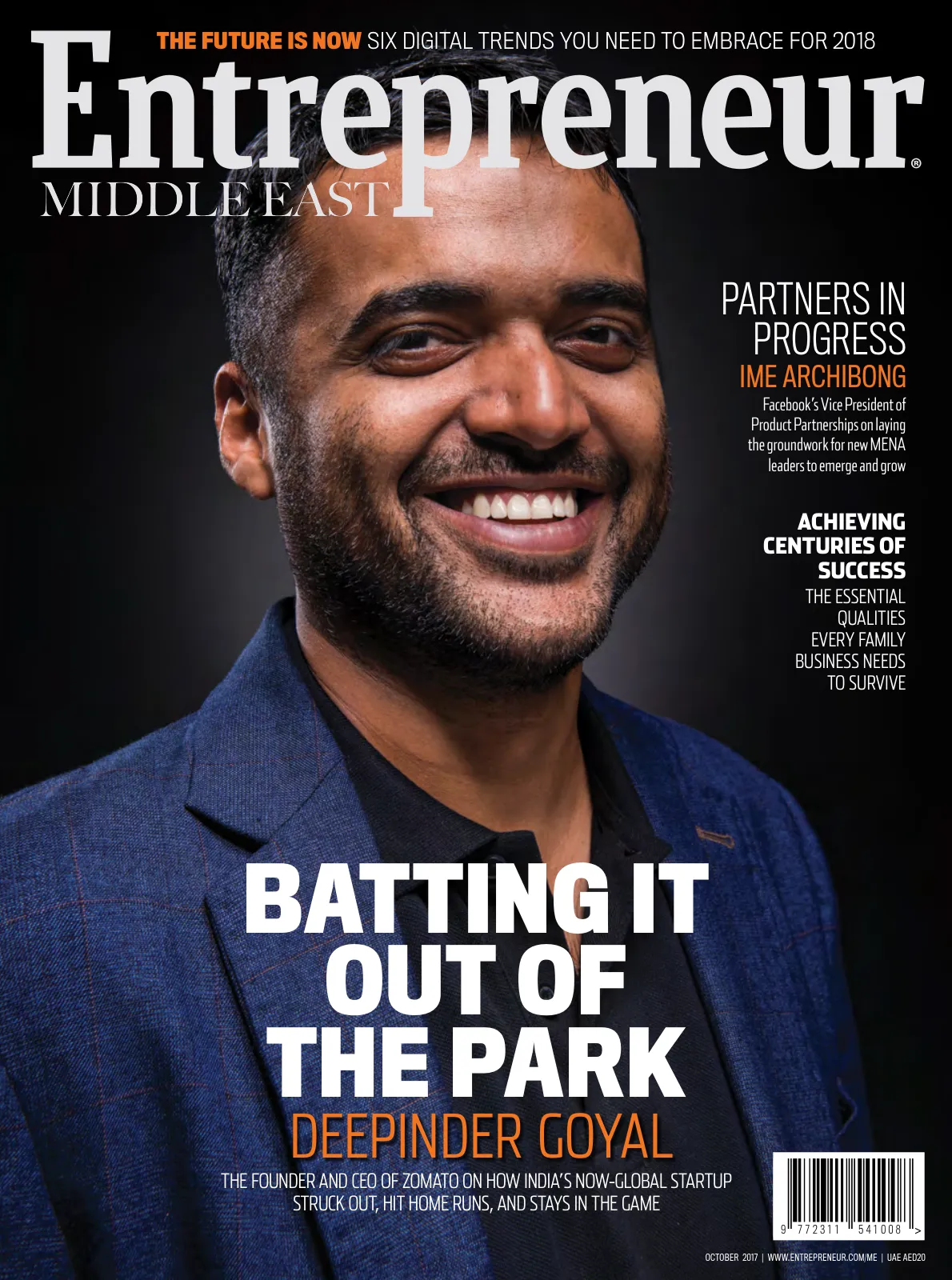
Entrepreneur Middle East, October 2017
Page 1
The future is now Six digital trends you need to embrace for 2018
Partners in
progress
Ime Archibong
Achieving
centuries of
success
The essential
qualities
every family
business needs
to survive
Facebook’s Vice President of
Product Partnerships on laying
the groundwork for new MENA
leaders to emerge and grow
october 2017 | www.entrepreneur.com/me | UAE AED20
9
7 7 2 3 1 1
5 4 1 0 0 8
>
Batting it
out of
the park
Deepinder Goyal
the founder and CEO of Zomato on How India’s now-global startup
struck out, hit home runs, and stays in the game
Page 2
Page 3
october 2017 Entrepreneur
3
CONTENTS
october 2017
72 Mahmoud Al-Darawsheh, founder and CEO, Mind Rockets Inc,
and Mark Zuckerberg, CEO, Facebook at Facebook Developer Confence F8 2017
20
Deepinder Goyal,
founder and CEO,
Zomato
20
INNOVATOR:
Batting it out of
the park
Deepinder Goyal, founder
and CEO, Zomato
How India’s now-global
startup struck out, hit home
runs, and stays in the game.
62
START IT UP:
WHO’S GOT VC
Setting a precedent
NOW Money co-founder Ian
Dillon on his startup’s recent
fundraise from American VC
firms, and why it’s good for
the MENA ecosystem.
26
INNOVATOR:
Leading the change
After forays into his family
business and F&B, Sami Al
Daud, MD, Al Daud Group,
is now looking into the
education sector.
30
START IT UP:
ecosystem
Partners in progress
Ime Archibong, Vice
President of Product
Partnerships, Facebook,
on how the social media
network is laying the
groundwork for leaders to
emerge and grow in MENA.
34
‘TREPONOMICS:
PRO
Building your startup team
Bayt.com’s Suhail-Al Masri
offers a guide to finding the
perfect hire.
72
START IT UP:
Q&A
Be heard
Jordan startup Mind
Rockets wants to give a
voice to the MENA region’s
deaf community.
16
EDITOR’S NOTE
By Aby Sam Thomas
Page 4
Page 5
Page 6
Page 7
Page 8
60 YEARS OF ADVENTURE
AND DISCOVERY
Page 9
Page 10
Entrepreneur october 2017
10
CONTENTS
41 Galaxy Note8
68
Andy Meikle,
founder, 10
38 Turab Saleem, founder, Perfetti Hospitality
october 2017
38
‘TREPONOMICS:
SKILLSET
Staying ahead of the game
Turab Saleem, founder,
Perfetti Hospitality, gives
his take on what makes for a
winning formula in the local
F&B scene.
58
TECH:
THE FIX
The future is now
Ema Linaker, Director of
Digital at Edelman MEA,
lists six digital trends
you need to embrace for
2018.
42
TECH:
SHINY
#TamTalksTech
Gadgets and doodads that
you might’ve missed out on,
sourced by a tech aficionado.
46
‘TREPONOMICS:
ESQUIRE GUY
Lights! Camera! Action!
The Esquire Guy offers a
guide to media interviews.
56
START IT UP:
ECOSYSTEM
Bolstering entrepreneurship
Badir CEO Nawaf Al
Sahhaf believes that Saudi
entrepreneurs, when
properly empowered,
can deliver extraordinary
innovations- and his
program’s results are proof.
48
CULTURE:
LIFE
To boost happiness, stack
the pain
James Clear offers a
strategy to help you master
your habits even when
the day-to-day grind gets
frustrating.
42
Belkin’s Boost
Up Wireless
Charging Pad
A workspace
designed
by Steelcase
50
Page 11
Page 12
Entrepreneur october 2017
12
30
CONTENTS
october 2017
53 Voldemars Bredikis, Board Member, Latvian Business Angel Network
60
TECH:
ONLINE ‘TREP
Driving growth
Yaoota co-founder and CEO
Sherif ElRakabawy, offers
a primer on achieving (and
sustaining) triple-digit
growth for your online
business.
52
START IT UP:
ECOSYSTEM
Business in the Baltic
The northern European
state of Latvia is eager to
make itself a haven for
entrepreneurs- and the
UAEs (and the regions)
upstarts are welcome.
64
‘TREPONOMICS:
SKILLSET
Achieving centuries of
success
Mohamed Hareb Al Otaiba
on the essential qualities
every family business needs
to survive.
50
CULTURE:
DESIGN
A new way to work
Xavier Fuchs, Sales
Director, Middle East &
Sub-Saharan Africa for
Steelcase Inc., believes that
today’s executives need
workspaces that foster an
adaptive culture.
70
START IT UP:
Q&A
Working the crowd
Nader Amiri, CEO of
Dubai-based e-grocery
app el Grocer, shares
experiences of crowdfunding
record amount of funds on
Eureeca.
68
‘TREPONOMICS:
SKILLSET
Building up a business
Hisham Samawi, co-owner
of Clinton St. Baking
Company in Dubai, explains
why expanding an F&B
venture is a whole other
story than starting it.
Ime Archibong,
Vice President,
Product Partnerships,
Facebook, and
Manal Rostom,
founder, Surviving
Hijab
Page 13
Page 14
Entrepreneur october 2017
14
SUBSCRIBE
Contact subscriptions@bncpublishing.net to receive
Entrepreneur Middle East every issue
EDITOR IN CHIEF Aby Sam Thomas editor@bncpublishing.net
CEO Wissam Younane wissam@bncpublishing.net
MANAGING DIRECTOR Walid Zok walid@bncpublishing.net
DIRECTOR Rabih Najm rabih@bncpublishing.net
CREATIVE LEAD Odette Kahwagi
MANAGING EDITOR Tamara Pupic
STARTUPS SECTION EDITOR Pamella de Leon
COLUMNIST Sindhu Hariharan
COLUMNIST Tamara Clarke
COLUMNIST Shoug Al Nafisi
COLUMNIST Erika Widen
EVENTS LIAISON Mark Anthony Monzon
PO Box 502511 Dubai, United Arab Emirates
P +971 4 4200 506 | F +971 4 4200 196
For all commercial enquiries related to
Entrepreneur Middle East contact
sales@bncpublishing.net
All rights reserved © 2016.
Opinions expressed are solely those of the contributors.
Entrepreneur Middle East and all subsidiary
publications in the MENA region are officially licensed
exclusively to BNC Publishing in the MENA region by
Entrepreneur Media Inc.
No part of this magazine may be reproduced or
transmitted in any form or by any means without written
permission of the publisher.
Printed by International Printing Press
ippuae.com
Images used in Entrepreneur Middle East are credited when necessary. Attributed use of
copyrighted images with permission. All images not credited otherwise Shutterstock.
Suhail Al Masri
Mohamed Hareb Al Otaiba
Helen Al Uzaizi
Fida Chaaban
James Clear
Ian Dillon
Sherif ElRakabawy
Xavier Fuchs
Ema Linaker
Ross McCammon
Hisham Samawi
CONTRIBUTING WRITERS
www.entrepreneur.com/me
Access fresh content daily on our website!
MIDDLE EAST
EntMagazineME
@EntMagazineME
Entrepreneur-me
EntrepreneurMiddleEast
EntMagazineME
EntMagazineME
EntMagazineME
MIDDLE EAST
In addition to our print edition, we’re bringing
you all sorts of industry news on our web
mediums. Joining us online means getting
relevant business and startup content in
real-time, so you’re hearing about the latest
developments as soon as we do. We’re looking
forward to interacting with our readers on all of
our social media and web platforms- like any
thriving business, we’re looking to give and take.
#TrepTalkME is already happening on all of our
digi platforms, and all good conversations go
both ways. See you on the web!
Page 15
NEW
THINKING.
HOW FAST,
HOW MUCH.
WHAT’S
NEXT.
Learn how to think like a
Silicon Valley VC with Sunny
Dhillon, Founder of Signia
Venture Capital
Matt Spence, Partner at
Andreesen Horowitz, world’s
biggest VC, tells you why
funding in AI is booming
Putting together a
crowdfunding campaign, from
Andrea Baldereschi, Founder,
Remedi and Daniel Zywietz,
CEO of Enerwhere
Social ads that pooled in
$1.5 million in 4 weeks,
Jonathan Wichmann, Founder,
Wichmann/Schmid
Patrick Grove, Founder of iflix,
on taking 4 companies from
startup to IPO and beyond
Learning how to grow business,
from the mobile only continent
of Africa, Toby Shapshak, Editor
in Chief, Stuff Magazine
Explore how blockchain can
liberate the music industry
with Benji Rogers, Founder of
PledgeMusic
The journey of foldable smart
scooters – from crowdfunding
to selling on Amazon
Say hello to Nadia, an
emotionally intelligent chatbot
built by Soul Machines
3 content-rich conferences covering:
Official Travel
and Tourism
Partner
Startup
Movement
Supporter
Investment
Knowledge
Supporter
Event Partners
Official Investment
Media Partner
Startup Robotics Sponsors
Best Arab & African
Startup Sponsor
Entrepreneurship
Enabling Sponsors
Talent Partner
Collaboration
Partner & Innovation
Cup Sponsor
Knowledge
Partner
Co-Located
with
Organised
By
Official
Business
Publication
Official
Business
Website
Dubai World Trade Centre
8-12 Oct 2017
Save AED 600! Book with promo code STARS
Visit www.gitexfuturestars.com/emeconfreg
www.gitexfuturestars.com
For three days only, we’re bringing
the world’s top startup experts to
be your business advisors.
Dubai in Conversation
with 150+ Global &
Silicon Valley Leaders
Page 16
Entrepreneur october 2017
16
EDITOR’S NOTE
Aby Sam Thomas
Editor in Chief
@thisisaby
aby@bncpublishing.net
Come together
Startups are known to compete with contemporaries,
but sometimes it’s better to team up
A
s much as I enjoyed talk-
ing with Zomato founder
and CEO Deepinder
Goyal for the story that
headlines this issue of
Entrepreneur Middle East, one
predicament I had with this long,
free-wheeling conversation is that
I wasn’t able to use all of the chat’s
most interesting bits for the piece I
ended up writing, given the maga-
zine’s space constraints. But one
perk of being Editor in Chief is this
space for my note every edition,
and so, this time, I’m devoting it to
reveal an additional tidbit from my
conversation with Goyal.
One of the interesting factors
that have contributed to Zomato’s
growth as a company has been the
slew of acquisitions it has done to
boost and consolidate the business
over the years. As explained by
Goyal, the majority of buyouts that
Zomato did were of its competitors
in markets outside of India, there-
by strengthening its position in
new geographies. But, Zomato has
also acquired three fellow Indian
startups: these include Maple POS,
Sparse Labs and Runnr. When
I quizzed Goyal on his thought
process when it comes to Zomato’s
acquisition strategy, he replied, “I
deeply realize that if we have to
build something big, we have to get
other founders on our side. Like,
the team here cannot actually ex-
ecute everything on their own. So,
[when you are] working with great
teams, you actually feed off the
energy of other people, right; you
can’t always be doing stuff on your
own. So, for me, I mean, half of the
deals we have done, they were for
traffic in some other countries, but
India-based, any kind of M&A we
have done, it was more or less for
the teams and the founders.”
Goyal’s response should be a good
lesson for entrepreneurs in the
MENA region who often complain
about not having enough entre-
preneurial talent to hire in these
parts- this notion is contradicted
by the fact that new startups are
being founded on a fairly regular
basis here. Many a time, we at
Entrepreneur Middle East receive
pitches from newly founded start-
ups whose business ideas or mod-
els are pretty similar or could be
value-adds to existing enterprises,
and sure, while competition is a
good thing, every now and then, I
do wonder if their goals and mis-
sions would be better served if they
would ally themselves with their
counterparts, as opposed to racing
against each other. As Goyal put
it so succinctly, there’s a lot more
that can be achieved if entrepre-
neurial teams work together- and if
the Zomato story is any indication,
success becomes much more likely.
Page 17
Page 18
Entrepreneur october 2017
18
IN THE LOOP
MIT Enterprise Forum Arab Startup Competition
2018 is now open for entries
Entrepreneurs welcome
www.noon.com / www.mitarabcompetition.com
MENA retailers, brace
yourselves
Alshaya Group makes e-commerce bet
with investment in Noon.com
Kuwait’s Ghinwa app, the winners of the MIT Enterprise Forum Arab Startup
Competition 2017
Hala Fadel
M
.H. Alshaya Co., a
seasoned MENA-
based retail group,
has invested an undisclosed
amount in Noon.com, the
region’s latest e-commerce
venture backed by Mohamed
Alabbar and Saudi Arabia’s
Public Investment Fund, ac-
quiring a “strategic stake.” In
addition to getting on board
as an investor, Alshaya is
also set to become a seller on
the Noon platform with this
partnership, hence opening up
access to a vast portfolio of
its products covering fashion,
health and beauty, home and
lifestyle, among other catego-
ries, to the tech-savvy online
customer base of the region.
With global retail franchise
operator Alshaya making
digital bets of its own to
adapt to the changing retail
landscape, its Executive Chair-
man Mohammed Alshaya
notes that the partnership
with Noon will complement
their existing online chan-
nels. “We are impressed by
Noon’s capabilities, and we
are excited to partner with
the Noon team to present a
winning value proposition for
the region’s online shoppers,”
he said, in a statement. “Our
partnership with Noon will
allow us to expand our cus-
tomer base, reach new market
segments, and participate
in the next level of growth in
regional e-commerce.” On his
part, Noon founder Mohamed
Alabbar said: “It is our privi-
lege to partner with Alshaya,
and give our customers
access to Alshaya’s leading
international brands. Noon
brings a new business model
for e-commerce, developing
a strong supply chain that
benefits regional businesses.
We will work with the region’s
leading brands and retailers to
help them grow their business
through Noon.”
Esanjo founder Omar Kas-
sim, who was formerly the
founder and CEO of JadoPa-
do.com, which Noon acquired
in May 2017, noted this devel-
opment to be “massive” on
his Twitter feed. When asked
why, Kassim pointed toward
the significance of having one
of the region’s largest retail-
ers enter the e-commerce
arena by partnering with an
existing player in the space.
Whether this e-retail strategy
of Alshaya pays off, however,
remains to be seen- Noon’s
launch is still pending, though
it was originally unveiled in
November 2016 as a US$1
billion e-commerce venture
with plans to go live in Janu-
ary 2017. The latest state-
ment says that Noon is set to
launch later this year- so just
keep your eyes peeled!
F
or entrepreneurs look-
ing for support, if you
know where to look,
opportunities are rife:
entries are now being
solicited for the MIT Enterprise
Forum Arab Startup Competi-
tion 2018. In partnership with
Community Jameel, the annual
startup competition, which is
now in its 11th year, seeks to
continue supporting startups
by providing an avenue to
exhibit and test ideas. Win-
ners can have the chance to
receive cash prizes of up to
US$160,000, including train-
ing, mentorship, media expo-
sure and networking opportu-
nities. Entrepreneurs can join
three different tracks: the Ideas
Track (for entrepreneurs with
just an idea for a product or a
service, although a team is not
required); the Startups Track
(for legally registered compa-
nies with a working prototype
and traction), and the Social
Entrepreneurship Track (for
enterprises addressing social
issues). The application sub-
mission deadline is November
27, 2017, with semi-finalists to
be announced on January 2018,
and the final event announcing
the winners at a later date.
MIT Enterprise Forum of the
Pan Arab Region was founded
in 2005, and is one of the 28
global chapters of the MIT
Enterprise Forum Global. Ac-
cording to its website, the com-
petition has supported more
than 2,200 entrepreneurs with
trainings and also established
over 430 startups. Commenting
on the significant opportuni-
ties and support that startups
receive with the program, Hala
Fadel, Chairperson of the MIT
Enterprise Forum Pan Arab,
says, “Following the competi-
tion’s 10th anniversary last
year, we are very excited to be
embarking on another decade
of innovation. The region grad-
uates over 300,000 engineers
every year; that’s three times
as much as California. Talent
in this region is here and ready
to innovate, and we are here to
support these talented young
men and women.”
www.mitarabcompetition.com
Page 19
DISCOVER HOW TO ACCELERATE YOUR BUSINESS
Powered by Thomson Reuters, Accelerate SME is the gateway to the
SME ecosystem in MENA; providing access to the resources and solutions
needed to support you at any business stage.
We have joined forces with some of the region’s most powerful financial
and workflow solution providers to service and support your specific needs.
As a member of Accelerate SME you can access a wide range of business
resources including, funding, online community, industry insights, tools
and easy-to-use templates.
ACCELERATE SME
CONTRIBUTE. ENGAGE. GROW.
FIND OUT MORE AT ACCELERATESME.COM
Page 20
innovator
founder and CEO, Zomato
Batting it
out of
the park
Deepinder Goyal
L
et’s start with a disclaimer: I’m a
regular user of Zomato, the global
restaurant discovery and food order-
ing platform that was founded by
Deepinder Goyal and Pankaj Chaddah
in India in 2008. As someone who
finds cooking to be an arduous and
time-consuming task, the ability
to order food online on the Zomato app has been a
godsend for me, especially on nights when I get home
hungry (and tired) after work. As a result, there were
a few moments in my Skype conversation with Goyal
where I heard myself transform into an unabashed
Zomato fanboy: I gushed over how useful I found the
app to be, and how I go about professing its features to
the people around me. Goyal, to his credit, didn’t seem
to mind my zeal, and he accepted all my compliments
with a gracious smile; in those instances, he looked
like every other entrepreneur out there who chances
upon a user who loves the product he/she built. But
let’s be clear here: Goyal is not just another entre-
preneur- he is the founder of a unicorn startup that
has become one of India’s most prolific brands, with
a presence in 24 countries around the world. Goyal
and his team have built a company that today has over
2,000 employees, received about US$225 million in
funding, and with an operating revenue of more than
$50 million, recently became a profitable enterprise as
well. That’s right: Zomato is now making more money
than it is spending, and for a company that started out
as an online platform featuring scanned restaurant
menu cards (more on that later), its profitability is an
indication of how far the business has come since its
founding in 2008. Zomato’s growth has truly been out-
standing, and while it has had plenty of hurdles along
the way, the company has managed to come out of it all
looking stronger, and well, better. But did Goyal ever
foresee such a good fortune for Zomato when it started
out? “Not really,” he replies, quite candidly. “I think,
as you grow bigger, I would say that the goal post also
keeps on shifting. So, when we started off, we would
have happily taken even an outcome one-twentieth of
this size. And as you grow, you get to know more, you
get to learn more, and then you want to do more as
well. Your organization grows; you get more people,
the team grows, and collectively, you want to do many
more things to grow bigger. So, I think, it’s a journey;
it’s not about the destination as such.” >>>
How India’s now-global startup struck out, hit home runs,
and stays in the game By Aby Sam Thomas
Entrepreneur october 2017
20
Page 21
october 2017 Entrepreneur
21
imageS courtesy zomato
Page 22
Entrepreneur october 2017
22
Deepinder Goyal,
founder and CEO,
Zomato
innovator
“We launched in
a couple more
cities, and then
Info Edge gave us
the seed round of
$1 million. That
was almost a tad
more than seven
years ago. And
yeah, life changed
since then.”
Zomato’s journey has been an
exhilarating one to watch. The
startup’s origin story is almost
legendary now- Goyal and
Chaddah were working at Bain
& Company’s Delhi offices at
the time, when they noted how
they and their colleagues had
to queue up to look at a stack
of menu cards at the company’s
cafeteria, just so that they could
decide what food to order. “The
rule was that you cannot take
these menu cards to your desks,
because if you would actually
lose them, then nobody would
be able to order,” Goyal remem-
bers. “So, we just solved a very
simple problem of people order-
ing food- we just scanned those
menu cards, and put them up on
the Bain intranet portal.” It was
a simple premise, yes, but the
concept was a hit- Goyal and
Chaddah saw their colleagues
at Bain react very positively
to their little online outing;
the frequency of visits was
particularly noteworthy. And
that’s when the duo decided to
scale up their offering- there
was a world outside of the Bain
cafeteria, after all. “I think we’d
spent a week of traveling around
Delhi, and we picked up pretty
much all the menu cards that
we could find from different
restaurants,” Goyal recalls. “And
we just scanned these menu
cards and put them online on a
website, which you would hate
to see the first version of. It had
blue HTML links; there was
no search, but you could use a
browser search bar to look for
a restaurant. And as soon as
you clicked on one, you used to
get its phone number on top,
and a bunch of JPEG files [the
scanned menu cards]. So that
was the first version of what we
were called back then, which
was Foodiebay, and that was
the first version- people used to
love it!”
Goyal laughs at this point,
and it’s easy to see why, when
you look at the sleek, and, quite
simply, beautiful interface that
Zomato has today. But back
then, Foodiebay’s look didn’t
really matter: it may have not
been easy on the eyes, but the
online enterprise was solving a
genuine problem in India then,
and people flocked to use it.
Restaurants began to sit up and
take notice as well- they began
contacting the Foodiebay team
to advertise on the site, and
that’s how the revenue stream
began. Goyal and his team
bootstrapped for the first two
years, and after seeing how their
offering was received in Delhi,
they began to include other
cities in Foodiebay as well. At
this point, Goyal was still work-
ing at Bain, and Foodiebay was
something he worked on over
the weekends. But given how
the latter was turning into a
large operation, Goyal made the
decision to quit Bain and be-
come a full-time entrepreneur.
“We were making enough cash
to pay our rentals, and put food
on the table- that’s all you need
at the end of the day, anyway,
right,” Goyal tells me. “So, we
had enough cash for that, and
[for] six months, we did that.”
And then, a major development:
in 2010, Foodiebay got its first
round of funding from Info
Edge, which is today a publicly
listed holding company with a
portfolio of several noteworthy
Indian internet companies like
Naukri.com, 99acres.com and
others. “We launched in a cou-
ple more cities, and then Info
Edge gave us the seed round of
$1 million,” Goyal remembers.
“That was almost a tad more
than seven years ago. And yeah,
life changed since then.”
Changes were aplenty after
that Info Edge investment- and
perhaps the most impactful one
Page 23
october 2017 Entrepreneur
23
that consumer saw was with
the renaming of the Foodiebay
enterprise. The CFO of Info
Edge then, Ambarish Raghu-
vanshi, told Goyal and his team
how the last four letters of
Foodiebay alluded to another
prominent internet company,
and so, changing its name now
would get rid of any potential
trademark issues down the line.
Goyal and his team agreed with
this notion, and they eventually
zeroed in on two options for the
company’s new name: one was
Zomato, and the other was…
Forkwise. (Yes, dear reader, I
raised my eyebrows at Forkwise
as well.) Personally, I couldn’t
see why one would choose
the staid Forkwise over the
livelier Zomato- but Goyal has
a sheepish smile as he explains
the economics of the situation
then, which was just after their
seed round. “Zomato.com, the
domain name was $10,000. And
Forkwise.com was $10… So, I
mean, that was a big deal for us-
like, how do we spend $10,000
out of the million dollars that
we just raised!” As a result,
Goyal and his team were leaning
toward choosing Forkwise- but
that’s when Raghuvanshi inter-
vened and made his voice heard.
“He was quite pissed at us for
dropping Zomato.com, which is
such a cool domain name, and
wanting to buy Forkwise.com,”
Goyal remembers. “He actually
offered to buy it for us person-
ally! And then, I was like, if you
have that much confidence on
this to buy it personally, we will
buy it ourselves, so, don’t worry
about it. And that’s how we
bought Zomato.com.”
And thus began Zomato’s
growth story. The startup
decided to focus on India as a
market, and as more and more
people visited the Zomato web-
site, they also added new cities
in the country to their platform,
which was now becoming more
than just a listing of restau-
rants- users were reviewing
these outlets as well. The
company also launched an app;
Zomato was one of the first in
India to do this, and Goyal says
that this enabled them to on-
board a lot of users back then.
The startup had more rounds of
funding as well: $3 million in
2011, and $2.3 million the next
year, both of which was led by
Info Edge. By 2012, Zomato had
come into its own as a restau-
rant discovery platform in India,
and it was making good revenue
as well- but now, Goyal and his
team were thinking about how
to further grow the enterprise.
Zomato had made a name for
itself in the business of food in
India, and now it had to decide
what to do next. “There were
two choices in front of us: one
was that we could get into other
verticals within the country- so,
for example, we could start do-
ing spas, salons, plumbers, all of
those things, become a horizon-
tal classifieds business,” Goyal
explains. “Or we would have
taken the food business to other
countries outside of India, i.e.
the restaurant listing business.
We thought that learning new
geographies is going to be easier
than learning new businesses.
And therefore, we took a call
that, okay, we’ll stay focused.”
The UAE was the first country
they chose to take Zomato to
(Goyal recalls one of the factors
influencing this decision being
the cheap flight tickets from
India to there), and started get-
ting the business off the ground
in this new locale.
This move into new markets
outside of India was a massive
step for Zomato, and it was
one that worked out extremely
well for the business in the
long run. While the UAE may
seem like a smaller market
when compared to India, Goyal
points out another factor that
makes the former a very attrac-
tive market for a company like
Zomato. “The ticket sizes in the
UAE for your meal are almost
3-4x the size of ticket sizes in
India,” he explains. “So that
makes the UAE alone a market
which is almost the same size
as India for us. So, people don’t
see that, because all you see is
a billion and a half people in
India, and you think the size
of the country is big. But when
it comes to our sector, I mean,
like, the UAE is almost the same
size of India.” And Goyal points
toward Zomato’s UAE business
to prove his point: four months
after it was launched, its opera-
tions here broke even, and it
also became the market leader
by traffic. “That was very, very
fast,” Goyal says. “That gave us
the confidence that we have a
good product on our hands, and
we should probably take it to
more countries.” Soon enough,
Zomato was making inroads
into countries all around the
world (these include the UK,
Turkey, Brazil, New Zealand,
Portugal, and many more),
which was buoyed by new fund-
ing- a $10 million round from
Info Edge, followed by a $37
million round by Info Edge and
Sequoia Capital. Goyal proudly
declares that users always
loved the product, regardless
of where they were- of course,
there were some markets where
Zomato didn’t work, because
the local competition was
already strong there. And that’s
how the company began on its
acquisition strategy: it simply
bought out its competitors. In
July 2014, Zomato made its first
innovator
WWW.ZOMATO.COM
“when we started
off, we would have
happily taken even
an outcome one-
twentieth of this
size. And as you
grow, you get to
know more, you get
to learn more, and
then you want to
do more as well.”
>>>
Page 24
Entrepreneur october 2017
24
innovator
“As human beings,
we are wired to be
non-confrontational.
Even though it can
feel like death by a
thousand cuts is way
more comfortable,
have the hard
conversations, no
matter how difficult
they seem in that
moment.”
>>> acquisition by buying Menu
Mania in New Zealand, which
was followed by the buying out
of Lunchtime in Czech Republic,
Obedovat (Slovakia), Gastro-
nauci (Poland) and Cibando
(Italy). Following a sixth round
of funding of $60 million by Vy
Capital alongside Info Edge and
Sequoia Capital again in late
2014, Zomato made headlines in
2015 when it acquired Urban-
spoon, the leading player in the
restaurant discovery platform
space after Yelp in the United
States. But Goyal tells me now
that it wasn’t the US market
that was the key target for them
in this acquisition- Urban-
spoon’s presence in Australia,
where it was the lone player,
made it a very attractive invest-
ment for Zomato.
As all of this was happening
for Zomato, the online food
delivery space was garnering
a lot of steam back at home in
India, and around the world
as well- Goyal says the first
quarter of 2015 saw a crazy
number of investments being
made into the food tech space in
India. The market was hot, so to
speak, and Goyal and his team
decided that they had to get
into this sector as well, and they
launched online food delivery
in India in June 2015, the same
month Urbanspoon got switched
to Zomato. As you can see, it
was a period that was filled with
a number of changes at Zomato,
and given the multiple priorities
requiring the team’s attention at
the time, Goyal admits that they
weren’t really focused on rev-
enue then. They had scaled mas-
sively, but they were also being
spread thin- and they were, as
Goyal later put in a blog, “losing
focus on what matters and what
works.” But then something
happened that caused them to
reevaluate- the market suddenly
turned. “It was almost over-
night, and fundraising suddenly
became 100x harder,” Goyal
remembers. “And then, we were
like okay, we are not going to be
able to raise money in this kind
of an environment, so [let’s]
start cutting down losses. We
pulled our teams out of a few
countries where we had just
started, because, I mean, there
was no meaningful traffic back
then, and we had just started-
it was pure cost. So, we shut
down some of those countries,
and we started focusing on
revenue.” Layoffs also happened,
and Goyal still grimaces as he
talks about it. “When we look
back at that [period], I think
doing all of those things was
necessary to save the rest of the
organization,” he says. “We’re
not particularly proud of what
we had to do. We had to let go
of a lot of people who we had
hired ourselves, and they are
actually still good friends. So,
I mean, that was never an easy
thing. And I think going through
that, I mean… There’s a thing,
they say that ‘great companies
only get built once they have
seen the value of death.’ So, if
you don’t know that, you don’t
really appreciate what it feels
like being there. So, I think that
phase made us learn a lot, and
we hope we never repeat those
mistakes again.”
According to Goyal, the strat-
egy that Zomato took then
–which was to focus on their
core advertising business, as
well as their new but rapidly
growing online delivery arm,
and bring them together-
saved the company. Investors
continued to back the com-
pany- April 2015 saw Info Edge
lead a seventh round of $50
million, and later in September
the same year, Temasek led a
$60 million round alongside
existing investor Vy Capital. The
company got working on reduc-
ing its burn rate, and at the
same time, it focused on raising
its revenue numbers in all of
the markets it is in. Zomato’s
international expansion efforts
paid off as well- today, it is the
market leader in 22 of the 24
countries it is in, with 82% of
its total traffic and about 60%
of its revenue coming outside
of India. This is not to say that
Zomato didn’t have hurdles post
the 2015 downturn- in May
2016, HSBC came out with a
report that slashed the unicorn
startup’s $1 billion valuation
down to $50 million. This led
to a slew of bad press (one note-
worthy but undoubtedly painful
headline said: “From Unicorn
to Unicorpse: Zomato Floun-
ders”), and Zomato found itself
once again under scrutiny from
everyone around it. For his part,
Goyal defended his company,
and called into question the
veracity of the HSBC report- a
point that is now bolstered
by the fact that a new report
released by Japanese financial
services company Nomura
pegged Zomato’s valuation at
$1.4 billion. “Valuations, I don’t
care about them much, because
it doesn’t really affect anyone,
right?” Goyal says. “None of
these things are real, except
for a percentage up or down
in the gap table, and it doesn’t
really matter in the long-term.
What the HSBC thing did to
us- HSBC did not know the
business, right. It wasn’t even
an investor in Zomato. It’s like
my Uber driver telling me that
Zomato is half the value I mean,
come on… You don’t even know
what we are doing. You don’t
even know the strengths of the
business, and you’ll go around
telling people whatever you
want to. So, I think it hurt us
quite a lot, in terms of inves-
tor sentiment, employees’ own
morale. And I think it made the
value of death even harder to get
out, because, suddenly, hiring
good people became harder.
So, that was hard. But I think,
even that [experience] was a
lot of character building for a
bunch of us. And that helped us.
That has definitely helped me
become who I am right now. I’m
very calm and patient; none of
these things affect me… Like,
stay on course, and everything
shall pass. And, I mean, even
Nomura- while the Nomura
report is really well researched,
and they spoke to us, they actu-
ally took the time to understand
our business, it doesn’t change
real life, except for the fact that
now people want to join us, and
want to invest in us.”
There are rumors aplenty
now that Zomato is in talks
with the Chinese company Ant
Financial –the payments busi-
ness arm of e-commerce giant
Alibaba- to raise a new funding
round of $100-$200 million.
Goyal doesn’t directly address
these reports, but tells me that
raising new funds isn’t out of
the picture for Zomato. “So, we
don’t need the money,” Goyal
says. “But, we would like to
build a war chest of sorts, for
a rainy day, although we hope
it never comes… There are a
bunch of new initiatives that we
want to fund, but I think that
our revenue will be able to fund
all of them going forward. So, I
mean, yeah, raising money will
not be bad for the company, in
the short-term or the long-
term.” The company is also con-
tinuing with its acquisitions- in
2015, Mekanist, NexTable and
Maple POS became a part of
Zomato, which was followed by
Sparse Labs and Runnr in 2016
and 2017 respectively. In the
meantime, with his company
becoming profitable, Goyal and
his team are now concentrat-
ing on making investments in
Zomato’s future. “Almost 20%
of our cost is actually being
spent on new things,” Goyal
Page 25
‘TREP TALK
Zomato founder
and CEO Deepinder
Goyal’s advice for
entrepreneurs
Get your priorities
right “Focus on building a
business that solves a real
problem. There’s a very apt
quote from Warren Buffet:
‘Only when the tide goes
out do you discover who’s
been swimming naked.’
If you believe you aren’t
naked, then you shouldn’t
worry about the tide going
out.”
Listen to yourself
“Value your gut- when your
gut feels like something is
wrong, think hard about it,
and don’t let data take over
that decision.”
Execution matters
“Execution is extremely
under-rated. All the big
things (strategy) are a
sum total of small things
(execution).”
Continue your
education. “Have a
learning mindset. The three
hardest words in the world
are: “I don’t know.” Don’t be
afraid to say them in front
of people, and work hard to
learn and get better.”
Get on the ground
“Customer surveys are
overrated. Send your
product guys to the field-
make the user your biggest
priority.”
Do it right the first
time “Don’t put processes
around problem solving-
take as long as it takes to
get to the right answer. And
once you get to the answer,
give it everything to get it
done.”
Keep aiming high “Stakes
should always be high, not
personal- don’t be afraid of
personal failure.”
“Value your
gut- when your
gut feels like
something is
wrong, think
hard about it,
and don’t let
data take over
that decision.”
Deepinder Goyal,
founder and CEO,
Zomato
says. “So, you can really say that
20% of our revenue is actually
on research and development,
to put it in conventional terms.
And that gives us the comfort
that we’re on our way to build-
ing something good and great.”
Proof of this is already showing:
Zomato Gold and Zomato Treats
are new subscription-based
offerings that the company is
offering its user base today.
“There are a couple more things
that are coming up,” Goyal says.
“We are actually piloting it in a
couple of neighborhoods here;
let’s see if they shape up into
something worthwhile.” At the
same time, Goyal and his team
are eager to make sure Zomato
benefits from the lessons they
have learnt over the company’s
tough phases. “I think the team
has really matured a lot, and any
problem that we try to solve,
money is actually not even a
part of the solution set,” he
reveals. “We just keep money
out of the whiteboard, and
ask people to solve problems
without them. And that’s when
people come up with the most
creative, sustainable answers
to building and growing the
business. If you have money, it
can actually spoil you. So that’s
my biggest learning over the
last few months, that, I mean,
good work can easily replace
capital- I mean, not always, or
maybe always, but yeah, it can
definitely do wonders.”
As for Goyal himself, the
entrepreneurial journey he has
been on over the last nine years
has transformed him as a per-
son- but the essential principles
that tie him to Zomato remain
the same. “I think I used to love
working on the product; I still
love working on the product.
So, I think, the biggest part of
me that has changed is that I
am more thoughtful about stuff.
And thoughtful is not just that
you end up taking the right
calls- like, it’s not about making
less number of mistakes, but do-
ing things in a better way… And
I think I used to lose my temper
a lot, and now, you are going to
have to try really hard to make
me lose my temper. And, it’s
not like that I try to do that;
I’ve just actually become that
person.” Of course, this doesn’t
mean that Goyal’s passion for
Zomato has diminished- on the
contrary, he remains extremely
committed to the enterprise
and seeing it move ahead. “I
think what’s driving me, and a
lot of other people at Zomato, at
least in the senior management,
forward is that it’s not about
the size of what you build- it’s
about how much meaningful
impact you can create in other
people’s lives. And we’re in
that space which is so close
to people’s hearts: food. And
there is so much to be done
here. And, I mean, we genuinely
think, and I’m not saying it in,
like, any clichéd manner, but I
genuinely think we’re just get-
ting started. There is so much
more to do, and I don’t want to
spoil your fun for the next few
years looking at us- but there’s
so much more coming.” Goyal is
excited about Zomato’s future,
I can tell- and for the record, so
am I.
Page 26
Entrepreneur october 2017
26
O
mani busi-
nessman
Sami Al
Daud still re-
members the
day when he
first learnt
that about 20% of school
age children in Dubai have
special educational needs
(SEN), or require additional
learning support. To his
dismay, those children had
to be either home schooled
or involved in dedicated
special needs centers, while
enrolled in one of the city’s
mainstream schools. It was
the only option their parents
had, he explains, shaking his
head in disbelief as we chat
at his office in Dubai Media
City’s Business Central
Tower. “Historically, it’s been
a taboo to talk about it or to
say that a family member has
special needs,” he notes. In
the following few minutes of
our conversation, he doesn’t
boast about his charitable
activities aimed at solving
this societal issue, as one
may expect from business-
men of his ilk. To add some
context to this observation-
Al Daud is the Managing Di-
rector of the Oman-based Al
Daud Group, a private busi-
ness conglomerate founded
by his father in 1964. Apart
from his family business, Al
Daud has built a success-
ful business of his own of
note- he is the founder and
Executive Chairman of Gour-
met Gulf, a food and beverage
company owning franchise
rights for seven international
F&B brands. So, when he
came across the problems
children with special edu-
cational needs face, he was
dubious about whether a
generous donation to some of
the relevant initiatives would
foster the positive changes
he wanted to see in society.
Instead, Al Daud did what he
knew best- he built a busi-
ness to solve the problem.
In 2014, he partnered with
the Belhasa Group to set up
Tarbia -meaning “education”
or “training of the spirit” in
Arabic- an education-spe-
cific joint venture company
that now operates in three
education sub-sectors:
early childhood education,
special needs diagnostic and
therapy centers, and inter-
national schools. Today, it is
an umbrella company for the
Riverston Children’s Centre
(RCC) for Special Educa-
tional Needs, opened in Umm
Suqeim earlier this year
via a joint venture with the
Riverston Group, a London-
based provider of services
for children with special
educational needs, and Busy
Bees Tarbia, a joint venture
with Busy Bees Childcare, a
UK nursery provider. Al Daud
plans to own and operate 20
nurseries by 2021. Lastly,
a SEN-focused K-12 school
is now also in the pipeline.
“We decided to establish
an education company, and
bring in the best in class,” Al
Daud says. “I was thinking
about the different verticals
I wanted to be in. I chose a
school and a nursery, both
to be the best in class, and
a special needs center, also
the best in class. We’ve
never been in the education
business, so I’m not going
to try to reinvent the wheel
here. I have partnered with
big names. The Riverston
Children’s Centre (RCC) for
Special Educational Needs
has taken off really well. The
feedback I’m getting from
parents whose children have
enrolled in the center is that
now they have seen a differ-
ence in their child. For me,
that is a huge tick.”
And what’s next? “The next
phase is that we are close to
closing a property for a SEN
school,” Al Daud continues.
“It will be a full-time school.
For now, there are no such
schools here. This one will
be up to the eighth grade,
and after that we will open
another one for the eighth to
MANAGING DIRECTOR, AL DAUD GROUP
SAMI AL DAUD
innovator
After forays into his family business and F&B, this Omani businessman
is now looking into the education sector, with a focus on children
with special educational needs By Tamara Pupic
LEADING
THE CHANGE
Sami Al Daud,
Managing Director,
Al Daud Group
Page 27
Images courtesy Al Daud Group
“The Riverston
Children’s Centre
(RCC) for Special
Educational Needs
has taken off
really well. The
feedback I’m getting
from parents
whose children
have enrolled in the
center is that now
they have seen a
difference in their
child. For me, that is
a huge tick.”
In 2014, Sami Al Daud
partnered with the Belhasa
Group to set up Tarbia
-meaning “education” or
“training of the spirit” in
Arabic- an education-specific
joint venture company.
The Riverston Children’s
Centre (RCC) for Special
Educational Needs
the 12th grade. Today, if your
kid has special needs, where
can you take him/her? To a
mainstream school. But they
will not be able to learn at
the same pace as others in
the mainstream school. Very
quickly and easily, they will
fall behind. So, what do you
do? My idea is to provide
them with a school to enable
them to graduate and go to a
university. So, the idea is not
to forget the kids with spe-
cial needs. In our region, his-
torically, they’ve been forgot-
ten.” Coincidentally (or not),
earlier this year, H.H. Sheikh
Mohammad Bin Rashid Al
Maktoum, Vice President
and Prime Minister of the
UAE and Ruler of Dubai,
launched a six-part national
policy for empowering people
with disabilities -referred to
as “the determined ones.”
Praising the Ruler’s efforts,
Al Daud sees his own work
in this field as a means of
paying it forward. “It is going
to be a for-profit school but
the directives I’ve given are
that we are not going to run
it as our other businesses in
which we try to maximize
profits,” he explains. “If it
takes me 40 years to get my
investment back, that’s okay.
The key to this school is
not how much money it will
make. If it doesn’t make me
any money, that’s also okay.
The region, the UAE and
Oman have been very good to
us [the Al Daud family], and
if we are going to give back a
little, I think that is our duty.
To me, that is very clear.”
The importance of provid-
ing children with the best
education possible, Al Daud
says, is a lesson he learnt
from his father, the fam-
ily patriarch of the Al Daud
Group. Sami Al Daud gradu-
ated from Boston University
Questrom School of Business
before joining the family
business in 2000. “There
was never ever any pressure
to join the family business,
but in my mind, there was
no doubt about what I was
going to do over all the years
of me growing up,” he says.
“I knew I would go into the
family business. Actually, it
was all I knew. All lunch and
dinner conversations with
my dad and my brothers
were always about our busi-
ness. For example, I went to
a boarding school in the UK,
and in the last year we would
all go to see a counselor. All
my friends spent half an hour
or an hour in his office, and
I was wondering what they
were talking about. I was
there for a maximum of 10
minutes. I knew what I want-
ed to do after school. My
father’s mentality was that
his job was to give us a great
education. If he threw us in
the middle of New York City,
we should be able to survive
on our own, he thought.”
The four Al Daud broth-
ers -one based in Oman,
one in London, and two in
Dubai- now run the Oman-
headquartered business con-
glomerate, covering food and
consumer item distribution,
restaurants, retail, real estate
development, construction,
oil and gas services, building
materials and telecommuni-
cations, among others. >>>
Page 28
Entrepreneur october 2017
28
innovator
“Open at the right
place with the
right operations
and make sure that
everything is right,
because if you
don’t, it will take
the breath out of
you. I’ve done that
with all our other
brands.”
The Riverston Children’s
Centre (RCC) for Special
Educational Needs
Gourmet Gulf employs 1,250 people and enjoys a 75% year-on-year growth
With 1,350 people on its
books, the group operates
in the UAE, Oman, Bah-
rain, Qatar, Kuwait, Saudi
Arabia, India, Turkey, and
Taiwan. This year, the group
is projected to have a 6%
growth over the last year. Al
Daud started off in the com-
pany’s construction equip-
ment business, and is now
managing and overseeing its
F&B, education, and trading
divisions. However, he was
eager to carve out his own
entrepreneurial path. “It is
really nice to join a family
business, have a nice, cushy
job, and just go along for the
ride, but for my brothers
and I, it was not enough,” he
says. “It was important not
just to run the companies
our father had started, but to
do something from zero. Was
it to subconsciously prove
to myself that I could do it
on my own? Maybe. But, it
was really important to me.”
In 2003, he ventured into
the UAE’s food and beverage
market by opening a branch
of Yo! Sushi, a UK conveyor
belt sushi restaurant fran-
chise, in BurJuman, one of
the oldest shopping malls in
Dubai. Nearly 15 years later,
Al Daud cites the exact date
of the opening: September
3, 2003. “I remember that
at the time my dad was not
very pleased with it, but he
is also the type who will say
it, and that’s it. He is not
going to hold it against you if
you don’t do what he says,”
he says. “I opened in BurJu-
man against everybody’s ad-
vice in terms of location, but
I was very confident in terms
of the site. When we opened,
it did really well, and I real-
ized I liked that business. For
me, what was great was that
people would buy and pay
straight away. It is because
in our construction equip-
ment business, you would
wait 60, 90 or 120 days to
get paid. And half of that
time you need to chase them
for that money. It is usually
such a pain.”
This success has had a
cascading effect. In 2006, Al
Daud established Gourmet
Gulf, owned by the Al Daud
Group and Majid Al Futtaim
Ventures, as an umbrella
company that now holds the
Page 29
october 2017 Entrepreneur
29
exclusive development and
franchise rights in a number
of MENA markets for seven
international brands- Cali-
fornia Pizza Kitchen (eight
stores), Hummingbird
Bakery (five stores), TDB
(four stores), Panda Ex-
press (four stores), Dalloyau
(three stores), Azkadenya
(five stores) and Yo! Sushi
(ten stores). The company
employs 1,250 people and
enjoys a 75% year-on-year
growth. “If Yo! Sushi had
not been that successful, I
wouldn’t be in the business
today, and my advice to all
people entering this sec-
tor is to take their time for
the first unit, if they need
six months or a year more,
they should take it,” he says.
“Open at the right place with
the right operations and
make sure that everything is
right, because if you don’t,
it will take the breath out of
you. I’ve done that with all
our other brands. I always
say that the first unit is the
most important because
that is what gives you the
confidence in the brand. You
may think that you’ve got
the best brand in the world,
you open the first unit, it
doesn’t do well, and then you
start doubting it.” Al Daud’s
plans for Gourmet Gulf are
ambitious, to say the least.
By 2020, he aims to have 114
operating units for all the
seven casual dining brands
under the company’s belt.
When asked whether he
has considered developing
an original F&B concept,
Al Daud explains that his
approach is more pragmatic
despite F&B being his true
passion in business. “If you
show me this and that, I can
tell you what I like, but, if
you tell me to create this,
no,” he says. “I have nei-
ther the time nor the brain
that can create a concept.
Frankly, it [a homegrown
F&B concept] is a pain, you
will make so many mistakes
until you get it right. There
is a winning formula that I
can just take, tweak slightly
and that’s it. Yet, I would en-
courage everybody who has
that creative spark to do it. I
don’t, and I’m the first one to
say it. Also, I’ve never been a
brand collector, as I pick my
brands very carefully. I have
to make sure that there is a
gap in the market and that
what I am bringing is the
best in class. If there isn’t
any gap in the market for a
brand and the competition
is already there, I then check
whether the brand is the
best in class. Can I come and
beat the competition? What
is also important is that the
brand I’m thinking about is
big enough, and structured
enough to franchise, mean-
ing are they ready to support
you? I gave up a big brand
in the past, because they
were franchising just to get
money and not because they
believed in it.”
One of the secrets to his
success is making the right
hires, he says. “You have
to be honest with your-
self,” Al Daud notes. “It is
easy for somebody to have
their head grow big as their
business grows. I think it is
important to stay grounded
and be honest with yourself
because that will also help
you in hiring. You cannot
hire great people and then
micromanage them. The
great ones will not stay with
you. We have separate teams
for each of our companies,
but I’m able to have time for
my personal life because I
have hired well and because
I have been able to del-
egate.” Towards the end of
our conversation, he recalls
a chat with a friend in Los
Angeles last summer. The
friend proposed they opened
a restaurant in this Southern
Californian city, but Al Daud
immediately asked who
would run it. “You cannot
do it by remote control,” he
explains, adding that every
entrepreneur needs to put in
his/her sweat first. “Don’t
live life with ‘what ifs,’ take
calculated risks, but do
your homework,” he advises
young entrepreneurs. “Busi-
ness is not easy. For exam-
ple, my restaurant business
is most probably my most
difficult business because
when you are a restaurant,
you are a manufacturer, a
retailer, and so on. Also, the
reality is that three people
have different tastes. But,
in this business, you have
to satisfy all three of them.
You will have thousands of
people coming through your
door and you have to make
sure that everyone is happy.
It is a difficult business,
but get involved and get
your hands dirty. There’s no
shame in it.”
It seems that Al Daud’s
entrepreneurial journey rests
on three pillars- his family
business, which is a reflec-
tion of his pride in his ances-
tors; his restaurant business,
which is his passion; and
his SEN-focused initiative,
which appears to be his
legacy. “No child should be
left behind,” a statement he
reiterates a few times, before
I turn off the recorder.
“I think it is
important to stay
grounded and
be honest with
yourself because
that will also
help you in hiring.
You cannot hire
great people and
then micromanage
them.”
The Riverston Children’s
Centre (RCC) for Special
Educational Needs,
opened in Umm Suqeim
earlier this year
The Riverston Children’s
Centre (RCC) for Special
Educational Needs
Page 30
Entrepreneur october 2017
30
Ime Archibong, Vice President of Product Partnerships,
Facebook, on how the social media network is laying the groundwork
for new MENA leaders to emerge and grow
By Tamara Pupic
Partners in
progress
Ime Archibong
B
usiness is not just about
the numbers, and no one
made it clearer than Face-
book founder and CEO Mark
Zuckerberg when he revealed
the company’s new mission statement
earlier this year. His initial plan -to
make the world more open and con-
nected- needed an upgrade as it strug-
gled to provide a much-needed sense
of purpose to about two billion people
already actively using the platform. The
new mission statement -announced
at Facebook’s first Community Sum-
mit last June- is to bring the world
closer together, meaning to empower
people to create and join meaningful
communities online, forging deeper
friendships and civic ties both online
and offline. “The traditional sources of
community as from where people get
their meaning, identity and support
have slowly started to erode, over the
last three or four decades,” says Ime
Archibong, Facebook’s Vice President
of Product Partnerships, during his
recent visit to Dubai. “We thought that
our technology could help reverse that
trend, and bring people closer together.
The hypothesis here is that there are
about 100 million people that we see
across Facebook right now, who we
believe have found a meaningful com-
munity on Facebook. They have found
a group that they feel connected to and
that gives them purpose. We believe
that there is no reason why that num-
ber should not be one billion people
over the next couple of years. Now, the
question is how can we connect more
people to these meaningful groups
and these meaningful experiences.
The strong hypothesis that we have is
that each one of these communities is
underpinned by a leader or a group of
leaders, who have emerged and said:
‘We are taking it upon ourselves to
actually make sure that this community
stays vibrant, meaningful, and safe
for the people using it.’ We are now em-
powering community leaders.”
Archibong’s visit to the Middle East
proves that Facebook’s new goals are
not just part of an empty statement of
ideas relegated to paper, but an action
plan being implemented with a detailed
step by step approach. Prior to our
interview, he had met with Sumayyah
Sayed, a Dubai resident who created a
Facebook group to launch the nonprofit
Ramadan Sharing Fridge initiative. It
grew into a city-wide phenomenon, in-
spiring Dubai residents to regularly fill
more than 170 fridges for those in need
during this year’s Ramadan. Sayed’s
Facebook group now has nearly 24,000
members. Archibong also met (and
went on a run around Dubai Marina)
with Manal Rostom, the founder of
Surviving Hijab, a women-only Face-
book group created to empower and
support veiled Muslim women, count-
ing nearly 460,000 members to date.
Both Sayed and Rostom, Archibong
explains, are “emerging and unexpected
leaders” that the Facebook team wants
to discover and support. “I’m trying
Page 31
october 2017 Entrepreneur
31
images courtesy ime archibong | mark zuckerberg image © shutterstock
“They are
local people
trying to solve
problems within
their local
communities.
For Facebook,
these are the
exact types of
entrepreneurs,
of builders,
that we want to
support.”
Mark Zuckerberg,
CEO, Facebook
During his recent visit
to Dubai, Ime Archibong
went on a run around
Dubai Marina with Manal
Rostom, the founder of
Surviving Hijab
start it up
ecosystem | who’s got VC | Q&A | STARTUP FINANCE
to understand how we can
empower people like Manal,
so that she can continue to
build this supportive com-
munity for half a million
people or more,” he adds.
“They are local people trying
to solve problems within
their local communities. For
Facebook, these are the exact
types of entrepreneurs, of
builders, that we want to
support and figure out how
we can continue to produce
innovative infrastructures
for them to take their com-
munities to the next level.”
Launched in 2010, Facebook
Groups have now become
the tool of the social media
platform’s further expansion.
However, prior to announc-
ing the new mission state-
ment, Zuckerberg published
a 6,000-word letter stating
that the Facebook commu-
nity should be supportive,
safe, informed, civically en-
gaged and inclusive. “We are
trying to understand what
type of leadership train-
ing we can give them [the
emerging leaders], how they
are scaling their leadership,
how they are attracting and
training other admins, and
to hear their pain points,”
Archibong explains. “For
years, we have spent time
with developers and start-
ups to understand what
Facebook can build from a
more tech perspective to
help them grow and mon-
etize their applications, for
example. In the same way,
we now want to hear from
these folks [non-tech build-
ers] about their pain points.
For example, when they say
that they don’t understand
500,000 people that are
in their group, what their
demographic breakdown is,
where geographically they
all are from, or what their
gender breakdown is. If
they knew that, they could
serve the group better. So,
for example, we
launched Insights
for Groups, and
people saw value
in that. Also, some
leaders can have a
queue of 80,000
people who want
to join the group,
and they [the
admins] need to
go through them
one by one. So, we
launched Filter-
ing. For example,
Manal’s group is
women-only, and
if we give her an
option to filter
out all men in one
click, that will
save hours of her time. Also,
they all have stories of trying
to figure out how to keep
their community safe. We
launched a bunch of tools to
let the admins identify the
bad actors fairly quickly and
pull them out of the group
fairly quickly. So, I’m spend-
ing a lot of time with them to
hear what else is broken.”
In parallel, Facebook con-
tinues to build the capacity
of coders, programmers and
engineers, including those
in emerging markets. At this
year’s F8, Facebook’s annual
developer conference, two
MENA-based startups -In-
staDeep, a Tunis-headquar-
tered Artificial Intelligence
startup, and Mind Rockets
Inc, an Amman-based tech
startup assisting the hearing
impaired with voice re-
cording, book reading, and
viewing online videos- were
chosen by Zuckerberg to at-
tend the F8 2017 VIP round-
table. The Facebook MENA
team has already hosted F8
Meetups in five regional cit-
ies -Dubai, Amman, Casa-
blanca, Beirut, Cairo- where
participants watched live
streams of the sessions in
San Francisco. Furthermore,
at this year’s F8, the com-
pany announced Developer
Circles, a community-driven
program that is free to join
and open to any developer
willing to connect, learn, and
collaborate with other local
developers. To date, there
have been eight Developer
Circles in the MENA region-
Casablanca, Algiers, Tunis,
Cairo, Gaza, Amman, Beirut,
and Baghdad. Keeping the
Middle East firmly on its
radar, Archibong says, is
part of Facebook’s mission
to identify other ecosystems
around the world that “have
the same DNA as Silicon
Valley.” He adds: “What I >>>
Page 32
Entrepreneur october 2017
32
Ime Archibong,
Vice President,
Product Partnerships,
Facebook, and
Manal Rostom,
founder, Surviving
Hijab
start it up
ecosystem | who’s got VC | Q&A | STARTUP FINANCE
Page 33
october 2017 Entrepreneur
33
start it up
ecosystem | who’s got VC | Q&A | STARTUP FINANCE
mean by that is that they all
have the right ingredients
and elements that have made
Silicon Valley successful
in terms of breakthrough
innovation. The entrepre-
neurs and companies there
have that idea of being able
to build something new, to
maybe fail, and then start
building something new
again. The capital and re-
sources there enable people
with great ideas to bring
them to fruition.
“Over the last few years, I
have probably spent more
time outside Silicon Val-
ley than being there, really
just trying to understand
these communities a bit
better. I’ve spent quite some
time in the Middle East as
well, whether it’s in Egypt,
Jordan, or Dubai, trying to
understand and really con-
nect with those communi-
ties. One of the things that I
consistently find, including
here over the last 48 hours,
is the talent, creativity and
curiosity of people to come
together and build some-
thing that is a challenge for
them, or to seize an opportu-
nity and build breakthrough
products or services. In this
region, there is nothing that
is unique and different and
that stands out vis-à-vis
other ecosystems around the
world, but I would say that
everyone’s approach to what
the problem is and what
opportunities they are trying
to seize for their communi-
ties is fairly specific. We at
Facebook meet people who
are building tech-enabled
businesses, people who are
building apps, or whatever
it might be, and often times
the real value we can add
to them is not necessarily
how they can build a more
compelling product to serve
their local market, because
they know it best, but how to
apply that idea to the globe,
and that is where we can
add unique value to some of
them.”
Last February, Facebook
launched the Bots for Mes-
senger Challenge in 64 cities
across the wider Middle East
and Africa to recognize and
reward developers who could
create the most innovative
new bots on Messenger.
Developers were asked to
build new bots focused on
three categories- gaming and
entertainment, productiv-
ity and utility, and social
good. Top 60 finalists were
selected to be paired with a
Facebook mentor and given
three weeks to iterate on the
best versions of their bots
for the final judging. Face-
book selected three winners
from the region who won
a prize of US$20,000 and
three months of Facebook
mentorship, while three
regional runner-up teams
won $10,000 and three
months of Facebook mentor-
ship. Messenger Challenge
meet ups are now being held
regularly across the MENA
region, from Casablanca to
Baghdad. To add to that,
more established regional
companies have already
recognized the role bots
can play in growing their
businesses. Mercedes-Benz
Cars Middle East is the first
automotive brand globally
to go live with Facebook’s
Messenger Chatbot service,
which allows their users to
book test drives, explore the
latest model range and more,
just by chatting. Another
example is Mashreq bank’s
e-banking Messenger bot
-an Artificial Intelligence
agent or chatbot- which
enables customers to
display Mashreq products
and perform cardless cash
transactions, low-ticket local
transfers and inquire about
balance and recent transac-
tions on an account. Lastly,
the MENA’s largest transpor-
tation and logistics company
Aramex hopes that their
recently launched Messenger
bot will largely reduce SMS
and phone call costs, while
improving the company’s
customer experience.
However, Facebook is not
forgetting smaller businesses
either. “One of the patterns
that we have seen emerging
is that more and more busi-
nesses are becoming tech-
enabled,” Archibong says.
“There is no one industry
right now that is not think-
ing about the way digital and
tech are impacting and in-
fluencing their business. So,
as we have been witnessing
that shift over the past dec-
ade or more, we have tried
to figure out the ways that
we can make sure that we
are not just servicing people
who are building web pages
or apps, but someone who is
starting a food delivery ser-
vice or a food truck around
the corner, truly all those
SMEs. How we can help
them have leverage with not
just Facebook, but the whole
concept of social infrastruc-
ture, including Whatsapp,
Messenger, Instagram, and
one day it will be Oculus,
and all these other tools that
we are building to connect
people with other people,
to now connect businesses
to people.” One example
of Facebook’s support to
young businesses comes
from Egypt. Elves, founded
by Karim Elsahy and Abeer
Elsisi, a husband-and-wife
entrepreneurial duo, allows
people to ask human agents
for mainly travel-related
requests. It has become a
featured app on Messenger.
The support from the Face-
book team means that Elves’
engineers now have access to
Facebook’s new features and
code which results in, for
example, a plus sign lead-
ing to the Elves app every
time MENA users open up
Messenger. The 18-month-
old Egyptian startup is now
generating about $80,000 in
monthly revenue.
Facebook is regularly
revealing a growing host of
tools and services to keep
up with the demand from its
users, and especially from
coders, programmers and
engineers, as well as commu-
nity leaders- the two groups
are often referred to as tech
and non-tech builders.
Persistently carving new ave-
nues to better serve entre-
preneurs globally, Archibong
says, is a way of ensuring
that Facebook’s past and
current success will have a
matching future. “The rea-
son why we started all of this
very intentionally a couple
of years ago was two-fold,”
he explains. “One, when we
were a smaller company,
we realized how the likes of
Microsoft in Silicon Val-
ley helped us out along our
journey, and really gave us
some guidance. We wanted
to make sure that we could
do that for the communities
that were coming up after
us. Two, there is a symbiotic
relationship between big and
small tech companies. We
wanted to make sure that
over time, small tech com-
panies continue to see us as
allies on their journey. And
vice versa- there are many
things we can learn from
them, such as how we stay at
the forefront of what is hap-
pening in tech, or make sure
that we are not losing track
of trends.”
“I’m trying to
understand
how we can
empower people
like Manal,
so that she
can continue
to build this
supportive
community for
half a million
people or more.”
Page 34
Entrepreneur october 2017
34
Building
your
startup
team
ETHICS | ESQUIRE GUY | SKILLSET | MARKETING | PRO
TREPONOMICS
A guide to finding the perfect hire
By Suhail Al-Masri
technology
can do
wonders
even in the
fields of
recruitment
and talent
management.
Startups are making
use of a multitude of
tools that include the
classic and highly
effective job postings
tool, in which they are
able to provide detailed
job descriptions;
set up automatic
filters and screening
questionnaires;
and segment their
applicants based on
the specific needs they
have for their business.
F
irst of all, hiring for a startup
often times means hiring for the
first time. It could be that the
company is a one-man show that
has reached the point where one
person can’t do everything on their own.
This is when the company is ready to tran-
sition from one multitasker to a team. It
could also be that the company has a small
group of co-founders who are ready to
grow. In either scenario, hiring with little
to no experience in the recruitment field
can be very challenging.
There are several steps that need to be
taken to complete a successful hire, such
as creating job descriptions, determin-
ing which recruitment methods to use,
creating a talent acquisition and retention
strategy, determining salary and compen-
sation packages, etc. All of these steps can
be hard to crack when a company is still in
infancy.
Second of all, entrepreneurs and start-
ups have very specific talent requirements.
When a company is still in the kick-off
phase, it requires the type of talents who
are:
• Malleable and can easily multitask
• Flexible and are able to adjust to constant
change
• Entrepreneurs by nature and have the pas-
sion for new businesses
• Highly dependable and natural leaders
Because smaller companies are always
changing, growing, restructuring, and experi-
menting, they require employees who have
the ability to adjust and grow along with the
company. At the same time, they also require
employees who are fond of the idea of start-
ups and have the determination and the pas-
sion to see their companies excel. In a sense,
entrepreneurs hire (aspiring) entrepreneurs,
and that’s not always easy to come by.
Third of all, the fact that smaller businesses
and entrepreneurs do not have the time and
the resources to dedicate for talent scout-
ing and screening poses another dilemma.
In-house resources for startups are often
limited and tied up to other functions of the
business. The process of searching, screen-
ing, shortlisting, interviewing, assessing, and
hiring candidates can be quite time-consum-
ing and demanding. Startups may simply lack
that time.
Sourcing, screening, and
shortlisting startup talent
To address these challenges, companies of all
sizes, industries, and locations are putting
recruitment technology to use and making
great strides. In fact, over three-quarters
(76%) of respondents to the Bayt.com Hir-
ing Practices in the Middle East and North
Africa Survey report that online recruitment
has facilitated the process of hiring talent in
the region.
Without doubt, technology can do wonders
even in the fields of recruitment and talent
management. Startups are making use of a
multitude of tools that include the clas-
sic and highly effective job postings tool, in
which they are able to provide detailed job
descriptions; set up automatic filters and
screening questionnaires; and segment their
applicants based on the specific needs they
have for their business.
Other startups are using a highly powerful
CV search technology, which affords them
access to millions of quality candidates at a
click of a button. Along with this, a multi-
tude of tools and features, such as the ability
to pre-set filters, save CVs in customized
folders, and use boolean and advanced search
functions, is making it much easier and more
efficient for companies to quickly find their
talent needs.
Page 35
october 2017 Entrepreneur
35
ETHICS | ESQUIRE GUY | SKILLSET | MARKETING | PRO TREPONOMICS
www.bayt.com
>>>
Extent to which online recruitment has facilitaed hiring process
In order to succeed,
startup founders need
overachievers on
their team who will
agree to put in 200%
and be fully dedicated
to the company.
9
6
11
14
17
17
23
15
41
45
29
38
33
32
37
Greatly
Moderately
Not too much
Levant
North Africa
GCC
Total
Not at all
37
32
When companies are in a real pinch
and they just need to quickly hire
high-caliber talent, they can comple-
ment such technologies with a talent
sourcing service, such as Source2Hire
from Bayt.com. This service provides
a shortlist of candidates who are
qualified, interested, and available to
start the job. This way startups with
limited resources can focus on other
critical functions in their business
and only get involved in the interview
and hiring steps.
The point is, numerous tools and
technologies are available for startups
across the Middle East and North
Africa to put to use and effectively
hire talent. Hiring nowadays does not
need to be a complicated process or an
extra burden for companies.
Interviewing startup talent
At this point, conducting a job inter-
view can seem quite simple: use the
shortlist of candidates, meet them,
ask them questions, and compare
them with other applicants. But
how can you guarantee that a good
interviewee will translate into a good
employee for your startup? The cost
of a bad hire is very high. Keeping
aside salary expenses, the cost of
training, customer complaints, and
hiring replacements that keep adding
up in the long run.
To prevent this from happening, here
are the five things you should look for
when interviewing candidates for your
startup:
1. A passion and a dream similar
to yours
Statistically speaking, most start-
ups have funding issues and could
ultimately fail. In order to succeed,
startup founders need overachievers
on their team who will agree to put in
200% and be fully dedicated to the
company. Ideally, you need people who
believe in your vision and are passion-
ate enough to want to help transform
this vision into a reality. In the Middle
East, five in 10 professionals would
want to work for a company where
they feel their work is part of a greater
purpose, as revealed in the Bayt.com
What Makes a Company an Attrac-
tive Place to Work? poll. So “passion”
is already a common point of interest
with many job seekers out there.
The best test during the job inter-
view is to ask candidates to speak
about something they are passionate
about and see if their passion aligns
with yours. You could also ask them
how they have pursued their passion
up to this point in time and how they
plan to keep pursuing it when they
join your company.
2. The skillsets you vitally
need
With a naturally small team, you have
to hire people who are, one, multi-
skilled and, two, skilled at something
your team lacks and needs critically.
You should already have an overview
Page 36
Entrepreneur october 2017
36
ETHICS | ESQUIRE GUY | SKILLSET | MARKETING | PRO
TREPONOMICS
Suhail Al-Masri is the VP of Employer Solutions at Bayt.com. Al-Masri has more than 20 years of experience in sales leadership,
consultative sales, account management, marketing management, and operations management. His mission at Bayt.com goes in line with
the company’s mission to empower people with the tools and knowledge to build their lifestyles of choice.
With a naturally
small team,
you have to hire
people who are,
one, multi-
skilled and,
two, skilled at
something your
team lacks and
needs critically.
Look for flexible people
who are comfortable
with change, are willing
to adjust their workload
and habits, can focus
on implementing new
processes without
getting distracted, and
are ready to learn from
their failures.
www.bayt.com
ated with their willingness to bring new and
innovative ideas to the table.
Along with this, your employees would
need to have a sense of ownership towards
the business by being as passionate as you
are to solve problems, develop your products
and offerings, and see every project or task
they handle through completion.
During the interview process, you could as-
sess this area by giving the candidate a series
of hypothetical (but relevant) situations and
see how they would tackle them while main-
taining an eye on your business objectives
and vision.
5. Curiosity and a willingness
to learn
Dedicate some time at the end of the
interview for candidates to ask you ques-
tions. This is a good time to judge how well
the candidate knows your startup and how
interested they are in learning more– not just
receiving information and instructions.
Apart from this, having a curious mind is
an extremely important quality in a fresh
company. This is because everything is new
and everyone is experimenting and learning
on-the-go. The more intelligent and thought-
provoking the candidate’s questions are, the
more you should consider hiring them.
of their skills from their CV and appli-
cation, but you can always ask them to
elaborate during the interview.
To verify their skills, look for past
achievements; areas where they have used
these skills to benefit a previous employer.
It also wouldn’t hurt to test them on these
skills, as evaluating someone in action
is much different than hearing them talk
about it. This way, you will avoid hiring
someone who appears to be confident and
skilled but, in reality, isn’t as competent
as they claim to be.
3. Flexibility
Startup founders don’t usually follow a
structured process in their work as they’re
probably still figuring it out themselves.
They often change their initial assump-
tions about the market as they learn more
about their customers and the industry
in which they operate. On top of that,
they are simply much more susceptible
to change as they introduce new prod-
ucts and experiment with different tools
and strategies. As a result, their business
model could also be frequently altered to
suit these changes.
As a growing startup, you’ll want to look
for flexible people who are comfortable
with change, are willing to adjust their
workload and habits, can focus on imple-
menting new processes without getting
distracted, and are ready to learn from
their failures.
4. An entrepreneurial spirit
Startups are risky and you need to gauge
whether your candidate is brave enough
to take the leap of faith in your business.
Their entrepreneurial spirit can be associ-
Page 37
For general enquiries, please contact:
Qaboos Khalid, Event Director | +971 50 329 2211 | q.khalid@turretme.com
Tickets to the event are completely FREE, what are you waiting for? Save the Date and register your visit today.
www.ifce-ad.com
International Franchise Exhibition is your
opportunity to meet with hundreds of the
best proven franchises, who are looking to
meet people like you.
IFE is an Excellent Platform where you can
explore the brands, gather all the
information & advise what you require and
walk away with the franchise of your dream!
THERE IS NO BETTER TIME TO
CONSIDER INVESTING IN A
FRANCHISE, WHY NOT MAKE 2017
THE YEAR YOU START YOUR
FRANCHISE AND BECOME YOUR
OWN BOSS!
EVER DREAMED
ABOUT BECOMING
YOUR OWN BOSS?
28 Countries
Represented
200+ Exhibitors
Representing 10
Different Sectors
MEDIA PARTNERS
ECOSYSTEM
PARTNER
SUPPORTERS
STRATEGIC
PARTNER
Page 38
Entrepreneur october 2017
38
Turab Saleem, founder, Perfetti Hospitality, gives his take on what
makes for a winning formula in the local F&B scene
By Tamara Pupic
Staying ahead of
the game
ETHICS | ESQUIRE GUY | SKILLSET | MARKETING | PRO
TREPONOMICS
“the lack of
knowledge and
experience does add
a lot of challenges
to a new brand.
You need to do your
homework well, and
get an experienced
team on board. Even
if you get your food
and beverages right,
you are still half way.
The rest is about your
PR and marketing.”
Turab Saleem,
founder,
Perfetti Hospitality
T
o leave a mark on the
UAE’s local hospitality
scene, should one take a
leap of faith by develop-
ing new dining concepts, or
stick to importing tried-and-
tested international brands?
It’s a question many are ea-
ger to find the right answer
for. However, Turab Saleem,
the founder and owner of
Perfetti Hospitality, a Dubai-
based hospitality company,
has gone down both routes-
and found success in each of
them.
The local dining public
might not have heard of
Saleem, but he knows them
all too well, having pleased
them on many an occasion
with both his homegrown
concepts (Indian restau-
rant Ushna, and Persian
cuisine-based Anar), as well
as Michelin-starred chef-
powered restaurants (Asia
De Cuba Abu Dhabi, Gary
Rhodes Abu Dhabi, and the
new Toro Toro Abu Dhabi).
As Saleem starts talking
about his latest opening
–the Latin restaurant con-
cept Toro Toro at The Jumei-
rah at Etihad Towers in Abu
Dhabi- he appears confident
that his long-standing co-
operation with the brand’s
owner, award-winning Mexi-
can chef Richard Sandoval,
will again be a fruitful one.
Of course, this belief
might stem from Saleem’s
more than two-decade-long
hospitality career that has
seen him working on over 68
projects valued at US$4.2
billion. Or it might be due
to him possessing a solid
knowledge of the indus-
try- his route into hospital-
ity was a conventional one
that included obtaining a
Bachelor’s degree in Hotel
Management from Swiss
Hotel Schools, and Mas-
ter’s degrees from Cornell’s
School of Hotel Administra-
tion as well as New York
University.
Or it might be a certain
personal trait -leniency-
especially required when
working with genuinely
talented, but often unpre-
dictable, celebrity chefs.
“There are some celebrity
chefs you cannot even talk
to,” Saleem says. “They do
what they want and that’s
the end of the story. I re-
member working with a chef
a couple of years back who
wanted everything silver-
plated and gold-plated, and
something handmade from
Italy, and something from
Japan. He got everything
that he wanted, but when
he had to deliver, he failed
to understand the market,
and thus delivered a menu
that was not successful here
at all. That was despite all
our guidance, because he
did only what he wanted
to do. It was too difficult to
communicate with him. Six
months later, he was out of
the hotel. Owners here are
much nicer. Anywhere else
in the world, they would sue
the guy. So, here, restaurants
are very young, and owners
are nice, so they [chefs] get
away with this. Otherwise,
it is a crime. They will not
listen to you until you make
more sense than them. You
should know more than
them. That means that you
need to travel more than
them, and open more venues
than them.”
Working with those known
for being able to ruffle a few
feathers obviously requires
a lot of patience, and Saleem
displays just that. During
our conversation in a noisy
café at the Media One Hotel
in Dubai, his attention is
undivided- not for a moment
does he scan over my shoul-
der in search of something
more interesting. Discreet
and clearly highly compe-
tent, he is focused solely on
talking about his restaurants.
Saleem goes on: “If you just
copy and paste their knowl-
edge from one market to an-
other, it doesn’t work. What
works in New York might not
work in Hong Kong or Dubai.
They [chefs] come here, they
are not prepared, and they
don’t know the local market,
so they just copy paste the
concepts from wherever they
are coming from. That does
not work in Dubai, when it
comes to flavors, portions,
finishing, plating, and so on.
Every city has its own habits,
likes and dislikes.”
Page 39
october 2017 Entrepreneur
39
images courtesy toro toro abu dhabi
‘TREP TALK
“we have up to 25
world class chefs
working in the
UAE. That has a big
impact on taking
the standards,
quality, and image
of the food and
beverages sector
here to a different
level.”
Award-winning chef
Richard Sandoval
-dubbed ‘the father of
Mexican food’- partnered
with Turab Saleem,
founder of Perfetti
Hospitality, to open Latin
restaurant concept Toro
Toro in Abu Dhabi.
The interior at
Toro Toro
Abu Dhabi
Toro Toro
Abu Dhabi was
opened at
The Jumeirah
at Etihad Towers
in September
>>>
“One example is from one
of my restaurants, Asia de
Cuba,” he says. “If you look
at their plates and portions
in New York and here, they
are different. They are much
bigger there, and the whole
presentation is different.
Here, people want a little bit
more action, drama, sophis-
tication. So, we literally
modified the whole presen-
tation. What happened then
was that it was so successful
that they implemented it in
other markets. To achieve
that, you need to know
where your local market
is right now and what the
future trends are. However,
it is not an easy adjustment,
it is a very risky one. Most
of those chefs will not listen
to you. Due to [them] being
overconfident, a number of
them have failed miserably.
To make them believe in you,
you need to know a lot. We
are lucky that we have been
in the industry for so long,
and we now understand this.
We have a wealth of local
market knowledge that is
hard to bring on the table.”
But Saleem notes that
Richard Sandoval is dif-
ferent –“he goes with the
market”- and that is the
key to his success, he says.
With respect to the locale,
Saleem points out that
it is the UAE’s ability to
advance the foodie conver-
sation, and place its stamp
on the world’s culinary
map that has lured many
celebrity chefs to this part
of the world. “There was a
time when I used to travel
to these destinations to
learn something about my
field, but now we are there,”
Saleem says. “Today, if I go
to Singapore or Shanghai to
learn something, there is not
much I can get out of it. Ba-
sically, now they are asking
questions. We are among the
top destinations, people here
are very international, they
love to try new things be-
cause they travel a lot. Also,
we have up to 25 world-class
chefs working in the UAE.
That has a big impact on
taking the standards, qual-
ity, and image of the food
and beverages sector here to
a different level. They would
never come if Dubai wasn’t
a happening place. They are
here because they see that
their image is well-polished
in this city.”
Looking at statistics, this
comes as no surprise- the
region’s hospitality industry
is booming. It should reach a
market value of $36.7 billion
by 2020, according to Eu-
romonitor International. In
the UAE alone, much of that
growth is driven by increas-
ing population and rapidly
growing tourism industry,
with just one international
event, Dubai Expo 2020,
expected to draw in 20 mil-
lion visitors. KPMG’s 2016
UAE Food & Beverage Report
predicts that at least 19,000
F&B outlets will open by
2019. According to Saleem,
the fate of many of them
will depend on one decision
-the choice of location- and
if they take note of the fine
print. “I would say that
waterfront locations are
doing well,” he says. “The
reason is that because for
half of the year, you can’t go
out, but once the weather is
good, people like to sit out
and next to the water. But
you also need to take into
account your neighborhood,
your accessibility, and so
on. Any location that has a
liquor license is more expen-
sive, and all the locations
with high footfall are expen-
sive, but that is also a trap.
You look at the footfall and
end up paying high rent, but
the day the market goes a bit
slower, you then start work-
ing for those landlords only.
You don’t make money at all.
Also, the people who are new
to this don’t know how to
read the contracts which are
Page 40
Entrepreneur october 2017
40
Snappcard users
have collected
4,000 snaps or
points per day,
resulting in US$2.2
million worth of
rewards to date.
Toro Toro
Abu Dhabi
ETHICS | ESQUIRE GUY | SKILLSET | MARKETING | PRO
TREPONOMICS
“With a worldwide-
known brand,
the immediate
recognition from
the market is
there, whereas
with homegrown
concepts, it takes
a little bit of time
to make it right,
to tweak it, and
introduce it to
the world.”
The interior
at Toro Toro
Abu Dhabi
so tricky. They will show you
a low rent, but then there is
a 2% fee for this, 1% fee for
that, and so on. When you
start paying the rent, you
realize that you are liter-
ally paying double because
you could not understand
the contract. I’ve just read a
contract for my new pro-
ject which states that for
an opening party, I need to
pay them AED50,000. Why
should I pay something to
them when it’s my opening
party?”
Saleem notes that in the
UAE, opening a five-star
quality restaurant with a
Michelin-starred chef costs
north of AED20 million. To
open his last three restau-
rants, the bills amounted to
AED25 million each. When it
comes to profitability, how-
ever, today’s market is tough,
he says. “With some of our
restaurants, we managed to
breakeven in the third year,”
Saleem adds. “They were
open in good times, but now
it is a bit challenging. I be-
lieve it will take longer, four
or five years. Yet, if you click
with the market well, the
ROI can come much quicker.
If you don’t click, there is
no ROI, you just pack and
go home. The failure rate in
our industry is extremely
high. About 50% to 60%
of new restaurants cannot
cross the first year.” Over the
past few years, chef-driven
restaurants have faced an
additional threat- the rise
of homegrown concepts.
“Most restaurants located
in hotels, are suffering big
time because free-standing
restaurants are taking over
at the moment,” Saleem
says. “The entrepreneurs
behind these restaurants are
very direct, they are aware of
new trends, their approach
is aggressive, so hotels are
losing to them.”
This trend will continue.
The country’s most an-
ticipated event -Dubai Expo
2020- will open further
opportunities for F&B entre-
preneurs and SME owners.
From October 2020 to April
2021, the event is expected
to generate AED2 billion in
onsite food and drink sales.
Participating vendors are
expected to serve 85,000
every hour at peak times,
while additional five million
meals will be required by the
Expo 2020 Dubai workforce.
As we conclude the inter-
view, Saleem speaks at great
length to share a piece of
advice for all of them. “With
a worldwide-known brand,
the immediate recognition
from the market is there,
whereas with homegrown
concepts, it takes a little
bit of time to make it right,
to tweak it, and introduce
it to the world,” he says.
“For example, Sandoval has
been in business for nearly
40 years. He has refined
his concept to a very high
level. It is not easy for a new
person to get that knowl-
edge and experience. When
we combine his and mine
experience, it is a bonus to
us. So, the lack of knowledge
and experience does add a
lot of challenges to a new
brand. You need to do your
homework well, and get an
experienced team on board.
Even if you get your food and
beverages right, you are still
half way. The rest is about
your PR and marketing,
that is extremely important.
Overall, it is a complex set of
activities to put everything
together in the right way. My
advice is to take advice from
somebody who has done
it, to walk you through the
process.”
“A very important point is:
don’t listen to your personal
likes and dislikes,” Saleem
adds. “That is the last thing
you want to do. Restaurants
fail, because owners fol-
low this. If one was a chef
before, he tends to forget
other important parts, and
focuses only on food. If one
was a designer before, he
focuses on interior design,
and forgets everything else.
If you do follow your own
likes and dislikes, make sure
that you have a solid reason
for that, and that it is con-
nected to your target market.
Otherwise, your restaurant
will be empty. But once you
have established one or two
successful restaurants, then
it is about copying what
proved right.”
Page 41
Page 42
Entrepreneur october 2017
42
Gadgets and doodads that you might have missed out on, sourced by a tech aficionado.
Yes, it’s okay to want them all… and no, it’s not our fault.
The Frame TV was
included in an exhibition
entitled “Painting or
Not” at Kaviar Factory
in Loften, Norway
IMAGES COURTESY: belkin, apple, linksys, lg
Apple’s recently released
smartphones support wire-
less charging, and Belkin
has readied itself to support
this new development. The
company worked closely with
Apple to develop the Boost
Up Wireless Charging Pad,
specifically for iPhone 8,
iPhone 8 Plus and iPhone X.
It features a non-slip surface,
supports charging up to
7.5W, and charges through
most lightweight cases
under 3mm thick. And, the
minimally designed, circular
device is easy to use. Simply
lay your smartphone on top
of the device and an LED light
indicates when the phone is
properly aligned for charg-
ing. The Boost Up Wireless
charger works by way of Qi
inductive technology, and it
will charge any Qi enabled de-
vice. If you’re a Samsung user,
there’s a Boost Up charger for
you too. It’s compatible with
the latest Samsung devices,
and it charges up to 15W- the
fastest wireless charging solu-
tion possible. Whatever your
preference, there’s a wireless
Belkin charging pad to help
you cut the cord, and stay
powered up.
TECH SHINY | WEBSITE TO WATCH | GEEK | MOBILE TECH | ONLINE ‘TREP | THE FIX
Power up
Belkin Boost Up Wireless Charger
iPhone 8 on
Belkin Boost Up
Wireless Charger
Belkin Boost Up
Wireless Charger
Page 43
october 2017 Entrepreneur
43
#TAMTALKSTECH Tamara Clarke, a former software development professional, is the tech and lifestyle enthusiast behind The Global Gazette, one of
the most active blogs in the Middle East. The Global Gazette has been welcomed and lauded by some of the most influential tech brands in the region.
Clarke’s goal is to inform about technology and how it supports our lifestyles. See her work both in print regional publications and online on her blog
where she discusses everything from how a new gadget improves day-to-day life to how to coordinate your smartphone accessories.
Visit www.theglobalgazette.com and talk to her on Twitter @TamaraClarke.
Snap it up
LG Airport Robots
Get connected
Velop by Linksys
Linksys Velop is a modular
Wi-Fi mesh system of nodes
built to provide Wi-Fi coverage
throughout your home. It sets
up in minutes, and delivers a
full-strength signal from one
end of your home to the other,
no matter its size. Simply
add additional nodes to work
around walls, problem areas,
or multiple stories. Each Velop
node is a powerful Tri-Band
connection point offering up to
2,000 square feet of coverage.
With Dynamic Tri-band
technology and a combination
of three Wi-Fi radios, Velop
provides faster speeds and
load balancing. Whether you’re
streaming 4K content, gaming,
or video chatting, Velop delivers
fast, dependable Wi-Fi to
ensure optimal performance
even when multiple Wi-Fi
devices are connected.
Moreover, its modern design
allows Linksys Velop to blend
with your home decor to keep
the aesthetic clean, and you,
connected.
LG is rolling out airport
robotics with an eye to
helping frequent fliers with
its technology. Each robot in
this repertoire solves a spe-
cific problem, and performs
tasks that would traditionally
require human interaction.
For instance, the Airport
Guide Robot connects to the
airport’s central server, and
roams around the space to
provide you with estimated
distances and walking times
to locations of restaurants,
shops, and other destina-
tions within the airport. It
can scan ticket barcodes and
tell you boarding time, flight
and gate information, as well
as the time and weather of
your destination, in a matter
of seconds. Don’t have your
boarding pass handy? No
problem. The robot has voice
recognition, and it can speak
four languages: English, Ko-
rean, Chinese and Japanese.
The Airport Guide Robot is
intended to reduce the hassle
associated with flying, by
giving you quick, accurate
information on-the-go. On
the other hand, the Airport
Cleaning Robot is a super-
sized robot vacuum equipped
with a large capacity dust
canister, as well as multiple
brushes and motors. Capable
of cleaning everything from
tiles to carpet floors, this
robot is equipped with the
latest in smart sensors and
multiple cameras to ensure a
safe, effective, and powerful
performance in even the
most crowded airports.
Multiple sensors using
light detection and ranging
(LIDAR) as well as sensi-
tive bumpers which detect
obstacles are used to help
the robot function. Thanks
to the use of simultaneous
localization and mapping
(SLAM) technology, the
robot is always aware of its
location- and yours.
TECH
SHINY | WEBSITE TO WATCH | GEEK | MOBILE TECH | ONLINE ‘TREP | THE FIX
LG Airport Guide Robot
LG Airport
Guide Robot
Linksys
Velop
Linksys Velop
Page 44
Entrepreneur october 2017
44
images courtesy Rado
business unusual | LIFE | TRAVEL | DESIGN | TRAPPINGS
CULTURE
‘Trep trimmings
The executive
selection
Rado
DiaMaster
Grande
Seconde
Rado
DiaMaster
Grande
Seconde
Rado DiaMaster Grande
Seconde
From better goods to better wardrobe bests, every
issue we choose a few items that make the approved
executive selection list. In this issue, we present our
selections from a notable timepiece for your collection,
the Brunello Cucinelli Autumn/Winter 2017 range, and
a must-try fitness regime.
WATCH OUT
RADO
As a watchmaker renowned for its ceramic cases,
Rado is upping its game in the luxury watch world-
and the brand wants its aficionados to indulge
with the new additions to the DiaMaster Grande
Seconde line. The timepieces feature Rado’s plasma
high-tech ceramic case and the noteworthy asym-
metrical dial design of two stacked sub-dials, run-
ning on an ETA 2899 automatic movement. Cool
new touches (and a reminder that details can make
a difference) are the added Roman numerals and
a sunray pattern framing the sub-dials. An ideal
timepiece for men and women, the timepieces come
in blue dial with a black leather strap, or brown dial
with a light brown leather strap. www.rado.com
Page 45
october 2017 Entrepreneur
45
images courtesy Harvey Nichols, BODYSMART
business unusual | LIFE | TRAVEL | DESIGN | TRAPPINGS CULTURE
Editor’s pick
A MULTITASKER’S DREAM
UAE-based Bodysmart is offering you an alternative
way to get fit
As many Dubai-based professionals who work hectic hours,
have busy lifestyles, and often deal with everyday stress, and
occasionally fall into “emotional eating,” I have also started to
struggle to reduce fat in certain areas, such as the stomach,
hips, buttocks and thighs. Then, I met Allison Pickford, founder
and Director of BodySmart, a targeted body shaping studio
based on HYPOXI technology, with four branches across Dubai.
Invented by sport scientist Dr. Norbert Egger, HYPOXI is a
stationary exercise bike machine that combines compression
and vacuum technology to help you achieve your fitness
results- faster and easier. I was eager to try it, of course-
wearing just a comfortable gym t-shirt and knee length tights,
I went for my session at a BodySmart center at The Meadows
Town Centre. There, I was asked to wear a compression skirt
and to have a heart rate monitor strapped around my ribcage
and a thigh, before entering a vacuum chamber from the waist
down. During the following 30 minutes, I was not only pedaling
-which was what I had come for- but also checked my emails
and made a few phone calls. Several lifestyle adjustments are
required, of course, such as drinking a lot of water, not eating
carbs a few hours after the session, or skipping dinners, but
I wouldn’t have achieved similar results by hitting my gym’s
treadmill. In a couple of sessions, not only did I achieve my
body shaping goals, but the whole experience seemed as a
multitasker’s dream. BodySmart offers free trials, after which
you are encouraged to subscribe to some of their membership
packages that are often offered at very attractive discounted
rates. To busy entrepreneurs eager to get fit, our tip is to book
a session and try it out yourself. -By Tamara Pupic
www.bodysmart.ae
Brunello Cucinelli
AW17
Brunello Cucinelli
AW17
Brunello Cucinelli
AW17
BodySmart
WINTER IS COMING
Brunello Cucinelli
Autumn/Winter 2017
Is that a hint of a cool
breeze? We’d like to think so
too. If you’re as hopeful as
us, have a look at Brunello
Cucinelli’s Autumn/Winter
2017 line. Founded in 1978,
the Italian House stays true
to its signature of blazers,
colored cashmere sweaters
and tailored suits. Domi-
nated by a palette of earthy
tones of blue and beige, the
collection blends in denim
shirts and polo necks, adding
in loose and cropped match-
ing trousers. Hustle through
your business meetings with
a distinctive look that can
easily be switched up to
a casual ensemble for the
weekend.
www.brunellocucinelli.com
Page 46
Entrepreneur october 2017
46
The Esquire Guy’s guide to media interviews
By Ross McCammon
Lights! Camera!
Action!
KEY TECHNICAL MATTERS
After asking the producer what the
interviewer is going to ask you and
rehearsing possible answers and
picking out some clothes to wear, start
smiling. And keep smiling until the
interview is over. Unless the interview
is about a grave subject, smile like you
mean it.
Not a hopeful beaming. Not a slight
grin. A confident smile- somewhere
between a smirk and a simper. (The
simper is underrated.)
When you’re being interviewed for
broadcast, speak slowly. But not too
slowly. You want to talk like this.
Youdon’twanttotalklikethis. And you
don’t want to talk like this. And you
don’t want to talk like this! And, like,
you, um, don’t want to, like, talk like,
um, this.
• Stand or sit up straight. And make
eye contact. And listen. Really listen.
Because you’re having a conversation-
-a stilted one, but a conversation
nonetheless.
• Have details ready. An answer isn’t
interesting unless it involves details.
• Never interrupt an interviewer. You’ll
seem impatient and nervous.
• Never stare down an interviewer.
You’ll seem scary and weird.
• Wait a half beat before answering a
question. You’ll seem measured and
authoritative. Anything longer than
that and you’ll seem confused and
lonely.
For the purposes of your time
together, the interviewer is your friend.
The interviewer might surprise you
with questions you hadn’t prepared
for, but the interviewer is your friend.
The interviewer might belittle you
and make you feel awful, but the
interviewer is your friend. (The
interviewer might punch you in the
stomach, but the interviewer is your
friend- and also a psychopath. But
still, your friend.)
And remember that your performance
is always going 30% less than
however you think it’s going. If you
think it’s awkward, it’s 30% less
awkward than you think. If you
think it’s fascinating, it’s 30% less
fascinating than you think. If you think
it’s boring, it’s 30% less boring than
you think. If you think it was a total
disaster, it wasn’t.
If you said during the interview, “This
is a total disaster,” then it probably
was a disaster.
But 30% less than you think.
As long as you’re smiling.
ETHICS | ESQUIRE GUY | SKILLSET | MARKETING | PRO
TREPONOMICS
F
irst, a few things that peo-
ple who’ve done broadcast
interviews know: it’s more
casual than you think it will
be. It will be over way faster
than you think it will be. And after
the interview airs, people will get in
touch with you- people you haven’t
heard from for some time. Also,
it’s kind of a big deal. You and your
company are better off for having
done it. A broadcast interview is
like minor surgery- but without the
recovery time.
The mistake people often make
when preparing for an interview
is thinking about how to talk to an
audience, instead of thinking about
how to talk to a single person. If
you’re consciously thinking about
the audience, then your attention is
misguided. The audience indirectly
affects the tenor of the conversa-
tion, of course, and the whole thing
wouldn’t be happening if it weren’t
for the audience, but the audience
should be dismissed.
The only person to think about is
the interviewer. And your interac-
tion with the interviewer -your
respect for the person, your smil-
ing, and not openly mocking the
person’s ignorance- is more of a
determining factor for success than
any other.
Have a conversation
“With our program, you’re on it be-
cause we want you to be on it,” says
Robin Young, host of Here & Now,
a daily show on Boston’s NPR news
station, WBUR. “Be conscious of
that. It’s not as if you have to push
something.”
There’s a lot of indirect advice in
what she’s saying. Because, one, you
really don’t have to work. And two,
you are the most interesting person
in the world. It helps to think of
yourself as the most interesting
person in the world, because if you
do, that’s how you’ll be treated. If
the interviewer isn’t treating you
Page 47
october 2017 Entrepreneur
47
See this article in its entirety at Entrepreneur.com
Things you should never*
say during an interview
• It all started waaaay back in ...
• Like ...
• Um.
• Ya know?
• Like, um, ya know?
• Is this thing on?
• Hold up. I’d like to do a shout-out
to ...
• I have no idea what the answer is.
• Who do you think you are?
• Would you like to have dinner
sometime?
• Just who do you think you are?
• You know how when you have a word
on the tip of your tongue?
• That’s happening to me right now.
• Why are you being so mean to me?
• “I can’t be cool. I can’t be laid-back.
Something happened, and I want to
celebrate it.” (For the uninitiated, that
was Tom Cruise to Oprah in a now
infamous TV moment from 2005.)
• Stop staring.
• If you’ll allow me to read a passage
from my new book entitled …
This interview is over.
* almost never
like the most interesting person
in the world, then the interviewer
isn’t doing a good job. What makes
for a good interview -on both sides-
is focus and engagement.
The best part about being the
most interesting person in the
world is that the bar is set incred-
ibly low. Whatever comes out of
your mouth is going to be great. It’s
hard to suck at being interviewed,
is what we’re saying. You almost
have to willfully suck. Because all
you have to do is talk.
Talking is a tricky thing, of course.
Especially when the stakes are high.
But we know how to do it. The key
to doing it on camera or over the
radio: talk with the person across
from you and forget about the many
other people listening to you. Sit up
straight and lean forward slightly.
You want to seem as interested in
the questions as you are in your
own answers. You want to seem like
you love the sound of the inter-
viewer’s voice. You want to respond
as if the interviewer is highly intel-
ligent, but isn’t particularly aware
of you or what you do. You want
to seem like you’re on a great first
date, now that we think about it.
Mainly, you want to listen, which
is the most important part of talk-
ing. Listening forces you to allow
the interviewer to control the
conversation. And you have to cede
control. Young says to speak not as
if you’re selling something, but as if
you’re trying to make people under-
stand something: “You may be an
entrepreneur when you’re coming
on the air, but in real life, you also
play the role of the consumer. So,
as a consumer, what would you
want to hear?”
What a consumer wants to hear is
civility and authority and jargon-
free wisdom. Confidence and
effortlessness. Easy- unless you or
what you’re representing is in a lit-
tle trouble.
The art of the difficult
message
Everything up to now has assumed
you’re going to be interviewed in
friendly territory. But what if you’re
being called upon to answer uncom-
fortable questions? What if you’re
being asked to defend certain prac-
tices? What if you’re being taken to
task? What if you are effectively the
spokesperson for a huge mess?
“If something is bad, it’s bad,” says
Om Malik, founder of San Fran-
cisco-based technology and media
company GigaOm. “Instead of trying
to spin it too much, just answer
the questions. People are scared to
speak the truth.”
Media trainers will say, “Answer
the question you wish they asked.”
Politicians do this. It’s an interest-
ing move because it makes you
seem self-possessed and stupid at
the same time. Rule: if you’re asked
a question, you have to answer
it. You might answer it with an “I
don’t know,” or an “I can’t tell you,”
or some other lame, readymade
answer, but you need to answer the
question.
Another interesting move? The
“pivot,” where you sort of answer
the question, then construct a
verbal bridge to the thing that you
really want to talk about. That move
has been rendered moot by the
thousands of pundits and politi-
cians who practice it every day, over
and over again. It’s a transparent,
tired, greedy technique. Leave the
pivot to the basketball players and
the ballroom dancers.
It’s easy for an audience to detect
fear and discomfort and manipula-
tion. And once these are detected,
your message becomes irrelevant.
So, when the circumstances are
tricky, do the same thing you’d do
under better circumstances: listen,
smile, and sound authoritative.
Also -and this is underrated- sound
humble. (There is almost no busi-
ness situation in which this formula
does not work.)
Being interviewed is talking. And
talking is easy -fun, even- when you
know what you’re talking about.
Fortunately for your company -and
the interviewer and the audience
and the people waiting to con-
gratulate you and your own sense of
pride- you do.
Page 48
Entrepreneur october 2017
48
James Clear writes at jamesclear.com, where he uses behavior science to share ideas for mastering your habits, improving your health,
and increasing your creativity. To get useful ideas on improving your mental and physical performance, join his free newsletter
jamesclear.com/newsletter. To have James speak at your entrepreneurial event contact him jamesclear.com/contact
CULTURE
business unusual | LIFE | TRAVEL | DESIGN | TRAPPINGS
By James Clear
To boost happiness,
stack the pain
This tactic will help you master your habits even when
the day-to-day grind gets frustrating
If you choose to pursue
things where the pain
of the experience is
largely in the beginning
then you will tend to
look back on those
experiences fondly
because they improve
over time.
It might be
painful now to
battle through
the uncertain
early years of
entrepreneurship,
but as you learn
to build a stable
business you’ll
remember the
experience as a
positive one.
B
efore I became an
entrepreneur, I went to
business school. While
studying for my MBA,
there was one lesson
that I learned which has
proved to be useful over and
over again in my life.
I was sitting in a marketing
class and we were discussing
ways to design a wonder-
ful customer experience.
The goal was not merely to
provide decent service, but to
delight the customer.
Behavioral scientists have
discovered that one of the
most effective ways to create
an enjoyable experience is
to stack the painful parts of
the experience early in the
process. Psychologically, we
prefer experiences that im-
prove over time. That means
it’s better for the annoying
parts of a purchase to happen
early in the experience. Fur-
thermore, we don’t enjoy it
when painful experiences are
drawn out or repeated.
Here are some examples.
If you’re at the doctor’s
office it’s better to combine
the pain of waiting into one
segment. The wait will feel
shorter to your brain if you
spend 20 minutes in the
waiting room, rather than
spending 10 minutes in the
waiting room, and 10 min-
utes in the exam room.
People enjoy all-inclusive
vacations, because they pay
one lump sum at the begin-
ning (the pain) and the rest
of the trip is divided into
positive experiences, excur-
sions, and parties. In the
words of my professor, all-
inclusive vacations “segment
the pleasure and combine
the pain.”
If you’re a professional
service provider (lawyer,
insurance agent, freelancer,
etc.) it is better to give the
bad news to your clients
first, and finish with the good
news. Clients will remember
an experience more favorably
if you start weak but finish
on a high note, rather than
starting strong and ending
poorly.
These examples had me
thinking: if you can make a
customer experience more
delightful, why not make
your life experiences more
delightful? How can you take
advantage of the way your
brain processes painful and
annoying experiences, and
use that knowledge to live a
better life?
To boost happiness,
stack the pain
A delightful customer experi-
ence combines the painful
experiences into a single seg-
ment that occurs early in the
process and then improves
over time. If you want to
increase your happiness and
have a more delightful day,
you can do the same thing.
Here is an example. On
a normal day, you might
have something annoying or
painful to do (like paying the
bills). And you also might
have something good happen
to you (like a friend sending
you a thoughtful email).
If you read the email on
your lunch break and then
pay the bills when you get
home from work, you will
remember your day as going
from a good experience to a
bad experience. That’s the
opposite of what you want.
However, if you decide to
stack the pain early in your
day -for example, if you pay
your bills in the morning be-
fore you go to work, and then
read the email from your
friend on your lunch break-
Page 49
october 2017 Entrepreneur
49
‘TREP TALK ME
THE BUSINESS
Yoginfinity
www.yoginfinity.com
THE ‘TREP
Founder, Stefania Brunori
Q Does entrepreneurship
make you a happier
individual?
A “It most certainly does!
I have created a company
that is 100% aligned with
my personal values and
professional standards
that are important to me.
My startup is a reflection
of who I am, giving me a
great deal of fulfillment and
satisfaction. I work hard,
but I can do it on my time
and my terms- not slowed
down by rigid corporate
structures, or nine-to-five
routines. In addition, I
derive a lot of passion and
energy from having created
a brand that gives others
happiness and contributes
to a healthier, more fulfilled
lifestyle: it is incredibly
rewarding to know that
in addition to launching a
successful company and
being profitable, we can
also have a vital impact on
not only our own but our
customers’ happiness.”
you will remember your day
as going from bad to good. As
a result, you’ll feel happier
because your brain likes it
when experiences improve as
time goes on.
This same principle can be
applied in dozens of ways
throughout your day.
When you’re working on a
project, cleaning the house,
or doing homework, start
with the task that you dislike
the most. Once that is out
of the way, your experience
will improve and you’ll finish
with a more satisfied feeling.
When you’re trying to start
a new habit, combine the
pain of starting into a small
segment. For instance, when
you go to the gym, start
with the exercise you dislike
the most. With the hard-
est exercise out of the way,
your experience will improve
throughout the workout
and you’ll be more likely
to remember your workout
as positive. And when you
remember your workouts as
positive, it’s more likely that
you’ll show up next time and
workout again.
Stacking the pain for
the long-term
It’s easy to worry about
making the right choices
with your life. However,
if you choose to pursue
things where the pain of the
experience is largely in the
beginning -like building a
business, losing weight, or
creating art- then you will
tend to look back on those
experiences fondly because
they improve over time.
By comparison, doing
things like trying to beat
the stock market or become
a professional gambler are
very inconsistent. They can
provide big wins, but they
can also provide big losses
at any time. The pain isn’t
necessarily in the beginning.
Because of this, these experi-
ences are less likely to make
you happy over the long run.
Of course, that can be easy to
forget when you’re struggling
to succeed with other goals.
In the beginning, it can be
easy to feel like, “Building
a business is so hard, why
shouldn’t I try to beat the
stock market?”
Understanding this differ-
ence can help you stay on
track, and continue to master
your habits even when the
day-to-day grind gets frus-
trating.
It might be painful now to
put in the work required to
get in shape or become a bet-
ter athlete, but as your skills
improve over time you’ll
remember the experience as
a positive one.
It might be painful now
to create bad art, but as
you master your craft and
your work gets better you’ll
remember the experience as
a positive one.
It might be painful now to
battle through the uncertain
early years of entrepreneur-
ship, but as you learn to
build a stable business you’ll
remember the experience as
a positive one.
Choosing to frontload pain
and discomfort isn’t just a
choice that applies to daily
tasks and errands. It can also
be used to nudge you toward
the goals you have that you
tend to procrastinate on.
Where to go from here
If you’re anything like me,
you want to get to the end of
your life and remember it as
being joyful and happy. Given
what we know about behav-
ioral psychology, we are more
likely to remember our lives
as happy if they improve over
time.
This is one reason why
working through the pain
of learning new skills for
your job, training to become
stronger and healthier, and
putting in the time required
to master your craft is
worthwhile. In the begin-
ning, you may feel stupid
while learning a new skill or
frustrated while sacrificing
current pleasure for a future
payoff, but when you make
the choice to go through the
pain early, you get to enjoy
the benefit of delight later
on.
The path to a delightful life
looks a lot like the path to a
delightful customer experi-
ence. It starts off with a few
painful experiences and im-
proves over time. Using this
strategy allows you to move
toward happiness even when
there are annoying or painful
things you have to get done.
All the more reason to stop
procrastinating, get the bad
experiences out of the way
early, and take on the hard
stuff now.
Page 50
Entrepreneur october 2017
50
T
oday’s leaders
must navigate an
economic envi-
ronment that is
far more complex
and unpredictable
than in the past. Traditional
hierarchy-based management
practices that previously pro-
pelled success can no longer
keep pace with the constantly
shifting business landscape.
The risks and rewards inher-
ent in times of change are well
known to senior leaders, who
have to seize opportunities
for growth, while sidestep-
ping pitfalls. But there’s a
big difference between being
aware of a rapidly evolving
business landscape and taking
successful action to leveraging
it– especially when the ground
beneath them seems to be
constantly shifting.
Progressive leaders are em-
bracing the chaos by reshaping
their organizations to operate
as complex adaptive systems.
They are fundamentally dis-
mantling the orderly processes
and protocols of the past to
create more inclusive and
connected organizations. They
are building organizations that
are better able to attain the
big-picture intelligence and
purposeful engagement that
are so necessary for success-
ful adaption to the disruptive
realities of today.
Employees play a fundamen-
tal role in this evolution. They
must act as resilient, agile
“agents”: interacting, learn-
ing, adapting and responding
to change. Yet leaders face a
major barrier– a workforce in
which the largest employee
segment, 37%, is disengaged,
simply doing enough work to
get by, according to a study by
Steelcase and global research
firm Ipsos called Engagement
and the Global Workplace.
But there is good news: 34%
of employees are engaged and
want to work in new ways,
seeking meaningful work and
workplaces that enable them
to make meaningful connec-
tions. And the 29% of em-
ployees wavering between en-
gagement and disengagement
can be within reach for leaders
who take proactive steps to
address what employees really
want and need in their work
experiences.
Deep diving in to the chal-
lenges leaders encounter
and how they need to work
differently, a team of Steelcase
researchers and designers
conducted a two-year study
of executives’ behaviors. The
research followed the Steel-
case Human-Centered Design
Process– a simple but rigorous
approach to research, analysis
and design development that
puts human beings and their
needs at the core. Through
the observations, Steelcase
researchers identified common
and expected behaviors of
top executives, as well as key
challenges that executives face
today.
1. Infobesity Executives
are facing the same onslaught
of information that most
employees are experiencing–
only more. Leaders are coping
with “infobesity” and need to
quickly winnow out extrane-
ous data to find information
of value. They can’t rely on
information making its way up
and yet know that they can’t
fall into the trap of trying to
know everything themselves,
so they need to rely on their
expert networks, internally
and externally.
2. Rapid context shifting
The breadth of leaders’ work
results in rapid context shift-
ing, requiring a mental reset
for each new meeting that fills
their jammed schedule.
3. Need to protect brand
influence Executives today
need to protect their brand
and influence, span organiza-
tional and geographic bounda-
ries and manage a large num-
ber of external and internal
relationships.
4. Extreme need for
privacy Dealing with infor-
mation that is often sensi-
tive or confidential causes a
balancing act for leaders who
also need to be accessible and
visible.
5. Highly fragmented
schedules The pace of work
has accelerated for everyone
and, for global executives
who are in constant demand,
images courtesy steelcase
Xavier Fuchs is the Sales Director in Middle East & Sub-Saharan Africa for Steelcase Inc., the global leader in office furniture industry. He joined
Steelcase in 2000 to lead sales and distribution strategy in Scandinavia. Since joining Steelcase, Xavier has regularly engaged with leaders from the
most dynamic industries in fast paced cities like Dubai, Riyadh, Paris, Istanbul, Johannesburg, Milan and Moscow. He has used proven methodologies
and an insight-led approach to drive focus toward business development and innovation in these markets. Xavier holds a degree in Business and
Marketing from Clermont-Ferrand in France.
A new way to work
Today’s executives need workspaces that foster
an adaptive culture By Xavier Fuchs
A workspace designed
by Steelcase
A workspace
designed
by Steelcase
CULTURE
business unusual | LIFE | TRAVEL | DESIGN | TRAPPINGS
Page 51
october 2017 Entrepreneur
51
image courtesy expo 2020
P
lanned across 65,000 square meters of residential space,
and 135,000 square meters of commercial space, the plan
for District 2020, “an integrated, inclusive and diverse
community” that will come into being after Dubai’s hosting
of Expo 2020, was unveiled at this year’s edition of Cityscape
Global in September.
Visitors to the annual exhibition got a peek into the design
and infrastructure behind the futuristic development area,
which is a key part of the legacy of Dubai Expo 2020, and is
expected to be operational from the fourth quarter of 2021.
Some of the USPs of the District 2020 site include LEED gold
standard constructions, state of the art architectural designs,
smart digital services, sustainable amenities, advanced telecom
services, and around 44,900 square meters of greenery.
Dubai World Trade Center is also said to be working on a
conference and exhibition center to build on Dubai’s standing as
the region’s destination of choice for major events. According
to a statement, District 2020 is expected to take forward the
Expo’s mission as a destination to “Connect, Create, Innovate,”
with it set to become an eclectic environment for all concerned,
comprising of collaborative office spaces, modern residential
areas, cultural attractions, and more.
Expo 2020 also anticipates that the area would help
accelerate the Emirate’s development, and will be “a long-term
economic contributor for the UAE as a home for innovators,
original thinkers and pioneers, creating jobs and attracting
investment.” District 2020 is keen to function as an innovation
hub, and aims to be a place where enterprises working on
emerging technologies can collaborate. “It’s for the startup, the
SME and the multinational,” says Expo 2020.
Commenting on the legacy site, H.E. Reem Al Hashimy, UAE
Minister of State for International Cooperation, and Director-
General of Dubai Expo 2020 Bureau, said: “H.H. Sheikh
Mohammed Bin Rashid Al Maktoum, Vice-President and Prime
Minister of the UAE and the Ruler of Dubai, instructed us to
build a site for a permanent legacy, and therefore we had to
think of ways to capitalize on what was being built for Expo,
as well as for post-Expo. We have created District 2020 to
achieve that goal. It has been a key part of our planning from
the very start, not just for our legacy team, but the entire Expo
organization.” www.district2020.ae
Dubai’s hub ‘for the startup,
the SME, and the multinational’
The vision for District 2020 was unveiled
at Cityscape Global 2017
Leadership spaces
can be designed
to help facilitate
better connections
between people and
information.
A rendering of
District 2020
schedules have become even
more fragmented and extended
to span multiple time zones. A
frequent casualty is the loss of
connection with people– not
only their employees, but with
their executive peer group.
Rather than working collabo-
ratively as a leadership team,
they risk inadvertently work-
ing at cross-purposes.
6. Highly mobile More than
ever executives are getting out
of the office to enable better
information flows. However,
being highly nomadic can actu-
ally undermine their reasons
for doing it. Instead of gaining
energy, insights and inspira-
tion from others, they risk
becoming cognitively overbur-
dened as they strive to heroi-
cally work longer and harder.
7. Defense on assistance
Executives rely on connections
with their assistants to man-
age their dynamic schedules in
the face of changing contextual
information needs.
8. Heightened levels of
stress Executives are facing
high levels of stress as they
manage high performance
expectations and constant
demand for their time.
Observing the gap between
expectations, behaviors and
the reality, Steelcase research-
ers identified opportunities
for the office to better support
leaders in their new roles and
reinforce new ways of leading.
Based on this analysis, the
Steelcase team identified three
key principles for designing
leadership spaces that can
foster an adaptive culture.
1. Nurture the individual
There is a link between
physical health, mental health
and cognitive performance.
Executives need to manage
significant stress from the
performance pressures they
face. Environments that help
executives manage stress
and promote their wellbeing
can enhance their cognitive
processes.
2. Space as synapse
Executives face even greater
challenges in maintaining
relationships and informa-
tional connections, especially
in globally integrated organiza-
tions. Leadership spaces can
be designed to help facilitate
better connections between
people and information, while
providing remote executives
with a virtual presence more
similar to the experience of
leaders who are physically
present in the space.
3. Enable transitions
Executives are challenged
with the need to constantly
switch informational contexts
throughout the day. Time is
also a critical resource. Physi-
cal spaces can help accelerate
contextual immersion and
support leaders getting into
flow faster.
While networked organizations
can be more agile than tradi-
tional hierarchies, they require
leaders to shift context rapidly,
working on a broader range
of issues than ever before,
jumping from one meeting to
the next. Leaders have more in-
formation to absorb and more
relationships to manage than
ever. They are highly mobile,
hopping time zones and always
“on.” It’s crucial these modern
needs are supported by a work-
place that promotes social in-
teraction, offers accessibility to
employees and organizational
happenings, and is designed to
offer a range of private and col-
laborative spaces for whatever
the task at hand.
Page 52
Entrepreneur october 2017
52
Latvia, a small northern European state, has started forging
strong business ties in the GCC region, and especially in the UAE
By Tamara Pupic
O
ver the last few years, the UAE and Latvia have taken their relationship
to the next level. In fact, the UAE was the first Arab country to open an
embassy in the Baltic region in 2014, and soon after, Latvia appointed its
first ambassador to the country, following the opening of its embassy in
Abu Dhabi. An exchange of visits of highly-ranked government officials has
brought forth negotiations on a number of sectors, which has been further bolstered
with the launch of a direct flight by the Latvian airline airBaltic between the Latvian
capital Riga and Abu Dhabi. The imports and exports between the two countries
have been on the rise as well: last year alone, the export of Latvian goods to the UAE
amounted to EUR76.8 million, while the import value reached EUR4.8 million.
in the Baltic
Business
start it up
ecosystem | who’s got VC | Q&A | STARTUP FINANCE
Ilze Zaharane, founder
and CEO, CheeksUp
images courtesy Latvian Investment Agency | www.cheeksup.com
CheeksUp website
The subsequent increased
promotion of economic ties
between Latvia and the UAE
has attracted entrepreneurs
in both nations to consider
each other’s backyards more
closely, which is a devel-
opment I got to witness
first-hand on a trip to Latvia
that was organized by the
Investment and Development
Agency of Latvia. Consider
the example of Ilze Zaha-
rane, the founder and CEO
of CheeksUp, a Riga-based
startup that has developed a
motivational computer game
to be used by speech thera-
pists for children. Her start-
up was one of the finalists
for the Expo 2020 Dubai’s
bi-annual Expo Live’s In-
novation Impact grants pro-
gram. Following her stay in
the UAE, Zaharane believes
that the country offers many
opportunities to entre-
preneurs of her ilk. “The
population is growing, and
people in the UAE are always
eager for the best things
you can get,” she says. “The
biggest strengths of Latvian
entrepreneurs are analyti-
cal thinking and creativity,
but our biggest weaknesses
are that we often undervalue
our importance, the qual-
ity of our projects, and their
ability to grow. This low
self-esteem, and in combina-
tion with being shy, which is
due to our Nordic mentality,
can sometimes be a deal-
breaker for the business. On
the contrary, entrepreneurs
in the UAE definitely don’t
have this ‘quality.’ From
what I have seen, they are
great traders, which means
that they are courageous and
excellent communicators.
Latvians need to stop being
shy and pessimistic, and
entrepreneurs from the UAE
are definitely a good inspira-
tion for us to overcome our
struggles.”
Latvia has been increasingly
making its name heard in
the European Union’s (EU)
startup scene. Last year, the
Latvian parliament passed a
new law that has created a
favorable tax regime for new
businesses. Other elements
that make the country and
its businesses attractive
to foreign partners are a
large pool of educated and
talented people, low living
costs, developed internet
infrastructure, among many
other benefits. Voldemars
Bredikis, Board Member, Lat-
vian Business Angel Network
(LatBAN), explains that most
of Latvian angel investors
are local entrepreneurs who
had previously developed
and scaled their businesses.
But achieving commercial
success despite the country’s
Page 53
october 2017 Entrepreneur
53
“both groups of
investors’ strengths are
high intellectual and
professional capacity,
analytic approaches, and
commitment.”
Relations between our countries have never
been so intense and dynamic as they are today.
Latvia opened the diplomatic mission in the UAE
in 2014, and a year later [in 2015] the Foreign
Economic Representative Office of Latvia in the
United Arab Emirates, promoting ever closer co-
operation between businesses of our two coun-
tries. Moreover, this year [2017] Latvia welcomed
the posting of the first resident Ambassador of
the United Arab Emirates to Latvia, and Latvia
also appointed its first resident Ambassador to
the UAE.
On May 8, 2016, the Agreement on Economic
Cooperation Between Latvia And The UAE was
signed. We hope that very soon we will welcome
delegations from the UAE to our capital Riga
to hold the first session of the Joint Economic
Committee.
To promote stronger business cooperation
between Latvian UAE-based entrepreneurs, rep-
resentatives from almost 70 companies visited
the UAE in February 2017, during the visit of
President of Latvia H.E. Raimonds Vejonis. The
visit was an important step for our entrepreneurs
to establish contacts and agreements on coop-
eration with their Gulf counterparts, especially
in food, information technologies, tourism and
medical tourism, pharmaceuticals, as well as
construction and educational areas. During the
visit, the Memorandum of Understanding on
the establishment of the Latvian Arab Business
Council of Entrepreneurs was signed.
Furthermore, we are very glad that Latvia has
already been successfully represented with a
national stand at international exhibitions taking
place in Dubai- Gulfood, Gitex, The Big 5, Arab
Health and Downtown Design.
Over the past few years, Latvia has been rap-
idly developing its startup ecosystem to attract
companies from all over the world, including
the UAE which is an important partner for
Latvia. As a result, Latvia has become an at-
tractive choice for startup businesses, offering
various advantages: a special tax regime for
startups; an opportunity to receive a residence
permit up to three years under The Latvian
Startup Visa program; funding from three new
accelerator funds and two venture capital funds
for seed, and two for growth stage businesses,
with a total of EUR60 million public financing
available in 2018; access to the EU market and
benefits of Eurozone member country; compa-
rable low living costs; and an easy connection
to the rest of the world.
SMEs are the backbone of the Latvian econ-
omy, thus strengthening their competitiveness
is crucial to job creation. One of our top
priorities is to facilitate startup and SME de-
velopment- Latvia has implemented more than
540 activities, reduced costs of establishing a
business, introduced a one-stop shop principle
for starting up businesses, introduced property
online registration, and simplified regulation
for tax accounting and payment, among other
activities. – By Arvils Aseradens
Arvils Aseradens, the Minister for
Economics of the Republic of Latvia and
the Deputy Prime Minister, on the ties
between Latvia and the UAE
Forging bonds
Ingus Augstkalns, founder,
Aerodium Technologies
Arvils Aseradens,
Minister for Economics
and Deputy Prime
Minister of the
Republic of Latvia
Voldemars
Bredikis, Board
Member, Latvian
Business Angel
Network
>>>
previously difficult and tradi-
tional business environment
has left its mark by turning
them into conservative and
risk-averse investors. “In
developing our angle investor
community, we also have to
deal with the specifics of our
unique mentality –Latvians
have pretty high individual-
ism concept– which some-
times lead to poor collabora-
tive capacity,” Bredikis says.
“Another side of this is
competence and responsibil-
ity- since we rely only on
ourselves, we try to have
enough knowledge and skills
for what we do, and then we
also see ourselves responsi-
ble for that. Venture capital-
ists here are more regulated,
and driven by international
practices. In general, I would
say that both groups of
investors’ strengths are high
intellectual and professional
capacity, analytic approach-
es, and commitment.”
Another Latvian entrepre-
neur eager to expand into
new markets is Ingus Augst-
kalns, founder of Aerodium
Technologies, a Latvian com-
pany building vertical wind
tunnels for human flight. An
experienced skydiver and a
wind tunnel flyer, Augstkalns
created a successful business
from his passions- among
the company’s many projects
are taking part in the To-
rino Winter Olympic Games
Closing Ceremony of 2006,
Expo 2010 Shanghai China,
and the Jackie Chan movie,
Chinese Zodiac. Having had
a few clients in the Middle
East, Augstkalns explains
that Latvian entrepreneurs
can learn ambition and
scale from GCC/UAE-based
entrepreneurs, while their
Gulf counterparts can ben-
efit from the creativity and
price-quality ratio delivered
by Latvian businesses. “The
first thing that I would sug-
gest is to understand who
are you talking to,” he says,
sharing his experience of
partnering with Gulf-based
businesses. “If you talk to
the highest-level executives
or business owners, make
sure that you are as con-
cise as possible. If you are
presenting, use images, and
make sure that you answer
straight away ‘what’s in it for
me.’ For management level,
you should present exactly
as you will deliver. Keep your
word. If you are selling, pay
attention to emotional as-
pects- the latest, the biggest,
the greatest.”
Page 54
Entrepreneur october 2017
54
Andris Ozols,
General Director,
Investment
Development
Agency of Latvia
“our country is
especially attractive
for investors who are
interested in the Baltic
countries, Scandinavia
or CIS markets, or those
companies that are
looking to establish
manufacturing operations
in the European Union.”
start it up
ecosystem | who’s got VC | Q&A | STARTUP FINANCE
Janis Oslejs,
founder and CEO,
Primekss
Riga, Latvia
images courtesy Latvian Investment Agency
One of the more established
Latvian businesses making
their presence felt in the Gulf
is Riga-based Primekss, a
patented system for making
ecologically-friendly concrete
solutions. Its founder and
CEO Janis Oslejs explains
that negotiating a deal in
the GCC region involves
developing deeper trust and
personal bonding, whereas
Latvian entrepreneurs take
a more pragmatic approach
to business. “When nego-
tiating with GCC clients,
a strong feeling emerges
that heart and soul have far
higher importance,” he says.
“In the GCC region, busi-
ness is more than business;
it is also a deep connection,
friendship, and family. That
is good, because it makes life
richer and more meaning-
ful. Another key difference is
that for Northern Europeans,
it takes longer to negotiate
the contract to which, once
signed, people don’t try to
make changes, in order to
avoid spending time on re-
negotiating. The cost of this
behavior is that sometimes
the contracts do not match
the reality, and things are
not done in the most super
optimal way, although they
are predictable in the future.
In the GCC region, however,
signing a contract is just a
good beginning for further
negotiations to adjust it to
real life. That is sometimes
confusing for Northern Eu-
ropeans. The benefit of this
is that things are perfectly
adjusted and optimized.”
When looking at the man-
agement style of Latvian and
GCC-based business owners,
a difference can be seen in
that Latvians accept delegat-
ing their work, whereas their
GCC counterparts prefer to
hold the reins of power more
strongly, Oslejs adds. “For
Latvians, the rank of the
person making the deals does
not matter so much,” he says.
“It is not unusual for a quite
low-ranking person to hold
power to sign agreements
and negotiate the details, to
which the boss will just nod
and accept. In GCC, the sys-
tem is to have the boss enter
negotiations in a much more
hands-on manner. Indeed,
in the GCC it is important
to talk boss-to-boss. It can
happen that a Northern
European company sends a
lower-ranking employee, as
it is their habit, whereas a
GCC company sends the boss
to negotiate. This may lead
for the GCC partner to feel
he/she is not respected, and
not taken seriously enough.
We have to accept that for
negotiations in the GCC
region, a high-ranking official
or owner must be present to
avoid inadvertently insulting
the GCC party. I would say
that Latvians can learn the
speed of decision making and
flexibility in the face of prob-
lems, whilst our colleagues
in the GCC region can learn
how to involve more people
to make meaningful im-
provements to the company
processes and products.”
Another important devel-
opment is the recent adop-
tion of the Latvian Startup
Visa program, a Latvian
government initiative to
ease visa requirements for
foreign entrepreneurs, which
is expected to attract the
best-and-brightest to come
and develop their ideas in
Latvia. “On September 12,
2017, we announced Latvia’s
first ever Startup Day,” says
Andris Ozols, General Direc-
tor, Investment Development
Agency of Latvia (LIAA).
“Last year, LIAA established
15 business incubators
across the country. In munic-
ipalities where no incubators
are available, entrepreneurs
will be able to use a virtual
incubation service, includ-
ing co-funding for renting
premises. Latvia has EU and
Eurozone membership, a
good legal framework, open-
ness to foreign investments,
and a strategic position as a
natural gateway between the
EU and Russia. We are also
constantly improving our tax
regime- starting from the
1st of January 2018, corpo-
rate income tax on retained
earnings will be 0%. So, our
country is especially attrac-
tive for investors who are
interested in the Baltic coun-
tries, Scandinavia or CIS
markets, or those companies
that are looking to establish
manufacturing operations in
the European Union.” With
offerings like these, Latvia is
stacking up all its cards in
its bid to become known a
place for thriving businesses,
throwing its doors open for
entrepreneurs -regardless
of where they are from-
to house their next great
startup idea in. Could Latvia
soon become a Baltic haven
for new business? We’ll have
to wait and watch.
Page 55
Tonye Cole
Nigerian oil tycoon & member, UN advisory board for
SDG fund.
Went from bankruptcy to co-found energy giant
Sahara Group.
Founder of Nehemiah Youth Empowerment.
www.wilforum.com
Hear from him and other champions of
change at #GWEF17.
Page 56
Entrepreneur october 2017
56
start it up
ecosystem | who’s got VC | Q&A | STARTUP FINANCE
Badir has served
more than 200 startups
since it launched
Badir CEO Nawaf Al Sahhaf believes that Saudi entrepreneurs, when properly empowered,
can deliver extraordinary innovations- and his program’s results are proof
“Badir proudly made
steps in creating
the missing links in
the ecosystem. In 2009,
it created the Saudi
Business Incubator
Network (SBIN) paving
the way for unifying
the regulations and
standards for operating
the business and
accelerators in the
Kingdom.”
Bolstering
entrepreneurship
Nawaf Al Sahhaf, CEO, Badir
F
or an initiative that was
launched in 2007 by the
King Abdulaziz City for
Science and Technol-
ogy (KACST) in Saudi
Arabia, the Badir Program
for Technology Incubators
has come a long way since
its inception. Commencing
operations with just one
incubator on the ground, ten
years later, Badir now has
five incubators spread across
the cities of Riyadh, Jeddah
and Taif- and that number
is only set to increase in the
future. In terms of impact,
the program –which aims
to promote and enhance the
culture of innovation and in-
dependent business amongst
Saudi youth- has served
more than 200 startups
since it launched, with Badir
CEO Nawaf Al Sahhaf noting
that the program has incu-
bated 127 technical projects,
and just 34 of these have
generated a market value of
SAR331 million (US$88.26
million). “We are very
proud of our entrepreneurs’
achievements,” Al Sahhaf
says. “We are also delighted
that they were able to prove
themselves as developed and
successful startups, thanks
to the hard work they have
put in, and the practical ex-
pert training they underwent
in the program’s incubators.”
This, by all means, is an
achievement in itself, but
Al Sahhaf makes it clear
that Badir has bigger goals
ahead of it. “Today, Badir is
focusing on expanding its in-
novation and entrepreneurial
hubs across the Kingdom in
order to achieve its KPIs of
creating 600 startups and
3,600 jobs by 2020,” he
says. “That plan falls within
the policy of KACST, which
consists of encouraging,
supporting and promoting
the cognitive economy and
entrepreneurship. It also
constitutes a positive step in
the government’s thrust to
diversify sources of economy,
by developing non-oil techni-
cal industries, and promoting
innovations and creations.”
Al Sahhaf points toward
Saudi Arabia’s Vision 2030
as being a guiding force to
what Badir has set out to do.
“In 2016, the government re-
leased Vision 2030, an eco-
nomic blueprint for national
long-term economic growth,”
he explains. “The plan aims
to move away from central-
ized planning and state-led
growth towards open market
policies, where entrepre-
neurship and the private
sector can take a leading role
in economic development,
through job creation and
competitiveness.”
With encouraging (and sup-
porting) entrepreneurship
being the main area of focus,
Badir has been structured in
such a way that it tackles all
of the key aspects relating to
starting up a business. “The
Badir Program covers four
main roles: incubation, ac-
celeration, funding facilita-
tion, and entrepreneurship
awareness,” Al Sahhaf ex-
plains. “We provide services
to startup companies in the
idea stage, as well as those
that have ready products
and can enter the market.
We help them with shared
working spaces, private of-
fices, infrastructure support,
legal support, accounting
and bookkeeping services.
Additionally, we provide
workshops and courses to
develop the skills of the en-
trepreneurs.” However, this
doesn’t cover the full scope
of work that Badir does
to support the Kingdom’s
business ecosystem- in fact,
it has been spearheading
several pioneering efforts to
bolster the entrepreneurial
mindset in the Saudi society.
Al Sahhaf points toward
one instance in 2007 when
Badir launched: he remem-
bers that there was no angel
investment network, no
network for incubators and
Page 57
october 2017 Entrepreneur
57
Qoyod, an accounting platform for entrepreneurs and SMEs, is part of the Badir
Technology Incubator Program
1. Know your target
segment By knowing your
target segment you can
think like them and know
what they really need in a
product, let them tell you
what they need. Plus, by
gauging the size of your tar-
get segment you will have a
better way of evaluating you
returns.
2. Ask those with previ-
ous experience No one
can succeed alone; the
least help you can have
is advice from those who
have succeeded before you,
and those who have failed.
Learn from them, and gain
an advantage.
3. Always work on your
added value The market
is very competitive. Even if
your product is revolution-
ary, someone will step in
and compete with you.
Your added value is going
to be the main driver for
customers. This is an ongo-
ing process though, don’t
delay anything because it’s
not perfect, deliver with
what you have, and work on
improving as you go.
4. The team is the
backbone Your startup is
as strong as its team. Make
sure you partner with, or
hire people who believe in
creating, building and in-
novating because your first
few years are all about that.
Focus on the principles as
much as the skills.
5. Know your people
Networking with people
in your industry can open
doors for investors and
partners both can help
elevate your product or
service. If you can, utilize
booths at events and expos
to both acquire and retain
customers.
‘TREP TALK
Badir CEO Nawaf
Al Sahhaf’s tips for
entrepreneurs
images courtesy badir accelerator program | www.badir.com.sa
accelerators in the Kingdom,
and none of the regulations
now in place existed then.
“Badir proudly made steps
in creating the missing links
in the ecosystem,” Al Sahhaf
claims. “In 2009, it created
the Saudi Business Incubator
Network (SBIN) paving the
way for unifying the regu-
lations and standards for
operating the business and
accelerators in the Kingdom;
down the line, Badir also cre-
ated the Saudi Angel Inves-
tors Network (SIRB), which
filled a big gap between the
entrepreneurs and the inves-
tors.”
According to Al Sahhaf, the
Badir program has received
a good welcome in Riyadh,
where it focuses on three
major verticals: advanced
manufacturing, information
communication technology,
and biotechnology. In Jeddah
and Taif too, the incubator
has seen strong demand for
its ICT programs, he adds.
As for the sectors that he
is most optimistic about,
he feels “a period of greater
opportunity and integration”
is on the cards for Saudi
Arabia’s healthcare, utilities,
industry, tourism, and ICT
sectors. At the same time,
the solutions emerging from
entrepreneurs who are part
of Badir are also as wide-
ranging as the program’s
benefits itself. “Certain ex-
amples of innovation that we
have seen at Badir include a
bandage lined with extracts
from shrimp shells that
enjoy natural wound heal-
ing properties, which could
primarily benefit diabetics.
Others are the design and
manufacture of CNC ma-
chines at ultra-low costs. We
have also witnessed other
achievements of innova-
tion in IT applications, like
Morni, which revolution-
ized the roadside assistance
experience for vehicle own-
ers; Quant, which achieved
amazing strides in data
analysis and actuary sciences
selling advanced software to
big companies to organize
and assess big data.” If these
innovations are any indica-
tion, then Al Sahhaf is right
in his contention that “Sau-
dis, and Saudi companies,
when properly empowered,
can deliver quite extraordi-
nary innovative solutions to
local and regional problems.”
And with Badir along for the
ride, the Kingdom’s entre-
preneurs can be confident
about the road ahead.
Page 58
Entrepreneur october 2017
58
TECH SHINY | WEBSITE TO WATCH | GEEK | MOBILE TECH | ONLINE ‘TREP | THE FIX
Ema Linaker is the Director of Digital at Edelman, MEA. She is a digital native who has been working on integrated communications for leading
brands and agencies for over 20 years. She has worked at Google, Nuance, Ogilvy & Mather, and prior to her current role at Edelman, she used to
head up Leo Burnett’s team of social, mobile and digital experts, working on multinational brands like McDonalds, Samsung and P&G. Talk to her
on Twitter @emalinaker.
By Ema Linaker
The future is now
Six digital trends you need to embrace for 2018
marketers must
study the insights
and micro-
moments of their
target audience,
and then
experiment with
them by providing
targeted
advertising
based on user
information.
A
daptability and con-
stant curiosity will be
the hallmarks of suc-
cessful communicators
and marketers in 2018.
So how do we make sure
we’re creating the appropri-
ate strategies?
For a start, customer
demand for best in class
experience and personal
appreciation will only come
to the fore in the context of
increasingly fierce competi-
tion. Marketers will need
data (lots of it), automated
processes, and analytical
intelligence. High time-to-
market pressures will only get
more intense as digitalization
lowers market entry barriers,
enables new business models,
and shifts the value chain.
Companies will be under
growing pressure to deliver
profitability by meeting the
increasing demands of
customers who are mobile,
always on, linked, social,
prepared to switch, and ac-
customed to a best in class
user experience. So, they’ll
be expecting you to achieve
results fast in a high-speed,
complex digital environment–
and that’s a challenge every
marketer will face sooner
than later.
The successful digital
marketer in 2018 must be
ready to experiment, pivot,
break the rules, even step
so far out of their organiza-
tion’s comfort zone that
they stand alone. Social and
video marketing, analytics,
native ads, programmatic, in-
store mobile offers, content
marketing, and other digital
techniques are changing the
ways we reach our customers,
and we can only do this if we
are fearless in the face of this
new world.
Based on my own experience
in MENA markets, I believe
there are six key trends the
region’s communicators and
marketers need to wrap their
heads around now in order to
succeed in 2018.
1. Speed of feed:
personalized content
at the speed of social
Consumer-centric content is
not new, but it needs to get
a lot more personal. Smart
Insights tells us that 61%
of customers place more
trust in, and are more likely
to make repeat purchases
from, companies that deliver
personalized content. Recode
reports that mobile video
ad spend will grow 49% to
roughly US$18 billion in
2018, while non-mobile video
ad spend is expected to fall
1.5% to $15 billion.
Facebook and Instagram
Creative Strategist Kat Hahn
has calculated that we scroll
through 300 feet of content
every day. Here’s how she
believes brands should craft
their communications to
stand out from the crowd:
> 70% “on-the-go” Short
and snappy content that
consumers will view and like
immediately, but not be too
invested in.
> 20% “lean forward” Inter-
active content that catches
the attention of consumers
looking for something to
watch.
> 10% “lean back” Immersive
content that goes into more
detail for consumers will-
ing to watch something for a
sustained period of time.
2. Facebook is social
media
The Facebook ecosystem will
dominate the social media
-and social commerce- land-
scape for the foreseeable fu-
ture. In June 2017, Facebook
had over 2.01 billion monthly
active users worldwide, up
17% over June 2016- and
more than half were mobile.
This is hugely significant-
mobile advertising revenue
represented around 87% of
all Facebook’s advertising
revenue in Q2 2017.
The company is even more
dominant as a driver of traffic
to news websites- a direc-
tion that cannot be ignored
given the ongoing debates
about fake news. Traffic from
Facebook can make or break
news publishers’ social media
success, accounting for over
85% of the traffic from social
networks. Twitter’s contri-
bution as a primary driver
is surprisingly low, given
the platform’s emphasis on
news, and all other social
media channels combined
play a marginal role at best.
Between them, Facebook and
Page 59
october 2017 Entrepreneur
59
I
f you’re looking for a way
to scale your tech startup,
here’s your chance to get a
boost from a tech giant. Google
Launchpad Accelerator, the
company’s accelerator program
for startups in emerging mar-
kets, is now welcoming growth
stage startups from Algeria,
Egypt and Morocco, and 17 more
countries worldwide. Launched
in 2015, it was initially open to
a handful of countries in Latin
America and Asia, and has since
expanded earlier this year to
include countries from Africa
and Europe. The accelerator
program invites tech startups
with a traction record looking
to increase their development,
with its application consider-
ing the startup’s impact to its
country or region, market value,
management team, fundraising
status and monetization, among
other factors.
As part of the six-month pro-
gram, startups would receive eq-
uity-free support and two weeks
of all-expense-paid training at
Google HQ in Silicon Valley,
where they can have access to
Google engineers, resources and
mentors. After which, startups
would also receive support
from Google for six months, PR
training and media opportuni-
ties, and credits to use Google
products. With its equity-free
incentive, Google’s offer might
call for a second look: after all,
what does the tech company get
in return? Besides supporting
startups globally, the program
will inevitably gear towards
Google’s products- when it
initially launched, Launchpad’s
Global Lead Roya Glasberg told
VentureBeat how the program
can provide an avenue for
feedback on Google’s products,
and how they can be improved.
https://developers.google.com/
startups/accelerator/
Google Launchpad
Accelerator expands
to Egypt, Morocco
and Algeria
Get the Google
advantage
| IN THE LOOP |
Traffic from
Facebook can
make or break
news publishers’
social media
success,
accounting for
over 85% of the
traffic from
social networks.
Twitter account for 98% of
social media-generated traffic
to news websites.
3. Voice-powered search
The voice interface has really
come into its own this year,
with voice search traffic now
exceeding 10% of all search
traffic, according to Mind
Source. Virtual assistants
respond to 50 billion voice
searches every month, and
Amazon Echo is currently the
fastest-selling Bluetooth tech-
nology of all time. By 2020,
over 200 billion searches will
be voice-driven.
The technology is only just
beginning to impact the Mid-
dle East market, but the rapid
growth of social marketing
and commerce here will soon
change that. For some really
interesting uses of Amazon
Echo in marketing communi-
cation, look no further than
Just Eat. When Alexa first
appeared, users were limited
to ordering a Domino’s pizza,
and that was about it. But
through a partnership with
Just Eat, more than 27,000
food sellers are right in their
living rooms- just tell Alexa
what you want, and she does
the legwork, finding the out-
lets with the best customer
feedback, and placing your
order.
4. Chatbots and social
messaging
With an estimated two bil-
lion users receiving messages
through over-the-top (OTT)
apps by 2018, social messag-
ing is likely to be embedded in
every online interaction. Cou-
ple that with the prediction
that 75% of developer teams
will include AI and other self-
learning functionality in at
least one app or service, and
it’s no wonder chatbots top
many companies’ wishlists.
62% of millennials are more
loyal to brands that engage
with them via messaging
applications that deliver that
personal touch, transparency,
and collaboration of one-on-
one communication. Face-
book’s making those people’s
lives even easier by enabling
them to click on ads that will
take them directly into a chat
with the brand. It’s a fast,
personalized response that
ensures a better experience
every time.
5. Micro-moments
The average mobile user
owns six devices, uses them
three times a day, and opens
their phone 200 times a day
to read emails, go shopping
online, or check social media
feeds. In doing so, they are
bombarded with push mar-
keting that is, quite frankly,
ignored. This is exactly where
the strength of “micro-
moments” comes in– that
snapshot in time when a user
turns to a device to answer a
question, or decide where to
go, what to do, or what to buy.
96% of users reach for
their smartphones to conduct
research on the spot. The
most successful brands will
be those that have the ability
to anticipate and address
those impulses with micro-
moments that deliver the
right information at the right
time to that user.
For this kind of just-in-time
communication to work, mar-
keters must study the insights
and micro-moments of their
target audience, and then
experiment with them by
providing targeted advertising
based on user information,
like the search terms they’re
using or their recent browsing
activities. Armed with that
data, marketers can deliver
an interactive experience
that offers truly personal-
ized value- deals, discounts,
insight, experiences, and
more. Micro-moments are set
to be the 2018 sweet spot for
mobile-first websites.
6. Geofencing
For many, mobile devices are
becoming extensions of their
bodies. Wherever they go,
their devices go. Users trigger
on average 75 separate mobile
sessions every day, so they’re
engaging with the devices
throughout their day across
multiple locations.
Marketers can collect
information about and target
their customers as they enter,
leave or stay in specific areas,
known as geofences, which
prompt mobile notifications
when a customer is active in
those areas. During those key
moments, marketers have the
opportunity to engage with
users by sending contextu-
ally relevant promotional
messages. Bear in mind,
however, that customers have
to “allow” your app to track
their location, so you’ll need
to highlight how location
sharing will improve their
experience.
The future is now
The future of digital market-
ing is approaching at blind-
ing speed. This is no time
to rely on what’s worked in
the past– you need to engage
with the future today.
Page 60
Entrepreneur october 2017
60
Sherif ElRakabawy is co-founder, CEO and CTO of shopping search engine Yaoota, which raised US$2.7 million in growth capital from foreign
investors in 2005. Prior to founding Yaoota, Sherif was a full-time assistant professor at American University in Cairo, which he joined after
two years with consulting firm Booz & Company as part of their business technology practice.
By Sherif ElRakabawy
Driving growth
How to achieve (and sustain) triple-digit growth
for your online enterprise
TECH SHINY | WEBSITE TO WATCH | GEEK | MOBILE TECH | ONLINE ‘TREP | THE FIX
W
hen we launched
Yaoota in late June
2014, it was a unique
moment of excitement.
We had been build-
ing the product day and night,
focusing on small details,
striving to build a shopping
engine that adds value in the
fragmented landscape of ever-
increasing online shops.
One number has likely
become of significant im-
portance in our lives since:
user traffic. Post-launch, in
August 2014, Yaoota attracted
roughly 25,000 visits. Fast-
forward 36 months, and the
number stands at more than
6,000,000. Together with
the recently acquired phone
comparison platforms Mo-
bilesgate and Mobihall, Yaoota
has become the largest product
discovery platform in the Mid-
dle East and Africa by traffic.
Yaoota app
Recognizing your
service is key for
building a core
recurring user
base. Building
a strong brand
by building a
community around
your service
fosters such a
recognition, and
hence, traffic
numbers.
Growing at a high rate
can easily backfire
if your technical
infrastructure cannot
handle the increased load
associated. Therefore, we
designed our technical
architecture early on for
scalability in order to
grow hand-in-hand with
increased traffic.
Three years post-launch, it’s
moving Gross Merchandise
Volume (GMV) worth more
than EGP100 million (which
is around US$5.5 million)
annually, with an average
year-on-year traffic growth
of 600%+, serving users in
Egypt, Saudi Arabia, United
Arab Emirates, Nigeria and
Kenya.
Hitting triple-digit growth
is challenging, but sustaining
it even more so. Particularly
in e-commerce, with fierce
competition from well-fund-
ed big players who spend
millions of dollars in market-
ing each month, a well-
rounded strategy is required
to grow at such rates. Here’s
how we went about doing it
at Yaoota.
First, we prepared our
infrastructure for growth.
Growing at a high rate
can easily backfire if your
technical infrastructure
cannot handle the increased
load associated. Therefore,
we designed our technical
architecture early on for
scalability in order to grow
hand-in-hand with increased
traffic.
Second, we focus on the
product. While this might
not seem to have a direct
correlation with high growth,
it is -in fact- the core of it.
Growth is spurred by loyal
users who keep coming back
to use your service. This can
only happen if you listen to
their feedback, and do your
best to keep improving their
experience.
Third, we are building a
brand. Recognizing your ser-
vice is key for building a core
recurring user base. Building
a strong brand by building
a community around your
service fosters such a rec-
ognition, and hence, traffic
numbers.
Fourth, we do not purchase
traffic. The vast majority of
user traffic is organic and
direct, and we do not spend
on direct traffic acquisi-
tion. When we spend on
marketing, we rather spend
on brand and community
building, in addition to SEO.
Direct click acquisition
produces traffic with high
bounce rate and barely
returning users. Plus: you
will hardly be able to match
heavy spending by deep-
pocketed big players.
Fifth, we have grown by
acquisition. In mid 2017, Ya-
oota has acquired Mobiles-
gate and Mobihall, the two
largest phone comparison
platforms in the Arab world.
The acquisition has, in es-
sence, increased Yaoota’s
footprint six-fold, and dou-
bled revenue and GMV.
Page 61
A
cquisitions usually fall
under two categories: hori-
zontal and vertical. A hori-
zontal acquisition involves
a case in which acquirer
and acquiree both operate
in the same market -being
potential competitors pre-acquisition- for
the purpose of increasing customer base,
leveraging synergies, and/or expanding
product portfolio. A vertical acquisition
describes a case in which a company
integrates with one or more entities in its
supply chain (e.g. one of its suppliers) as
part of a process to streamline operations,
and improve efficiency and cost structure.
In the online domain, horizontal acquisi-
tions are more common, as they provide
the acquiring online platform with access
to users of the acquired website/applica-
tion, typically with the aim of rapid growth.
As it is the case with Yaoota’s acquisition,
we managed to serve a new audience that
is keen to get price and product informa-
tion online, hence adding value for both
entities: Yaoota and the acquired portals.
This type of buyouts, as opposed to
gradual investment in brand and user
acquisition, provides a near-instant growth
in traffic. This does not, however, assume
that every acquisition is bound to be a
successful one. You can hardly predict
whether the anticipated growth effect
would kick-in as planned, as there exist
several unknown variables in the equation.
Here’s what we did at Yaoota to minimize
acquisition-related risks.
First, we took time analyzing the targeted
portals. In fact, we took over a year follow-
ing their numbers closely, analyzing their
audiences, and connecting with them in
person to understand their business and
operation in detail.
Second, we made sure that we are tar-
geting the right audience. That is, as part
of the process of understanding the busi-
ness of the targeted portals, we focused
on answering the question of whether
their audience fits as part of Yaoota’s user
portfolio, or whether such an audience
would feel alienated when using Yaoota’s
services. More importantly, we asked
ourselves the question of whether Yaoota
would add value for such audience, or not.
Third, we conducted a cost-benefit
analysis. We constructed a model to
predict projected growth figures post-
acquisition, in addition to projected cost,
to calculate whether -and if yes, when- we
would see a positive return. Within this
context, it’s paramount to study the effect
of the extra traffic on key performance
metrics.
Fourth, we started with the smaller
acquisition. Mobilesgate was clocking in
a fraction of Mobihall’s traffic. Hence, we
chose to acquire it first, and took time to
analyze the impact of the acquisition on
our key metrics. Subsequently, we fed
our cost-benefit model with the results,
and inflated the numbers to reflect the
difference in size as compared to Mobihall.
As both portals attract a similar audience,
this way, we had a good projection on
what to expect if we acquire Mobihall, the
bigger brother.
Buyouts can boost your website’s traffic- but you need
to be smart about them By Sherif ElRakabawy
Understanding acquisitions
in the online space
TECH
SHINY | WEBSITE TO WATCH | GEEK | MOBILE TECH | ONLINE ‘TREP | THE FIX
Attendees and exhibitors at
Cityscape Global 2017 witnessed
the resilience of Dubai’s property
market in action at the World
Trade Center recently. At the exhi-
bition, investors from across the
world showed greater interest and
confidence in Dubai real estate,
which is testament to the excep-
tional reputation that Dubai enjoys
as a safe haven for investors.
This positive outlook is con-
firmed by the latest research from
Dubai Land Department, which
shows that real estate transac-
tions for the first half of 2017
reached a total value of AED 132
billion across 36,000 transactions.
This is a value jump of 16.8%
compared to the first half of 2016,
while transaction numbers also
grew by 26% over the same pe-
riod. In addition, 5,400 completed
residential projects have been sold
in the first five months of 2017,
and a further 78,000 residential
units are under construction and
due for completion by 2020 – a
very important year for Dubai.
As a semi-government organi-
sation, wasl Asset Management
Group is heavily involved in the
development and progress of
Dubai itself, and in supporting our
leadership’s vision for sustainable
real estate growth, particularly in
the run-up to Expo 2020 but also
well beyond it. Our vision is to
make Dubai the world’s favourite
destination to live, work and visit.
We have been proud to contribute
to the city’s skyline and help to
drive its thriving real estate sector,
which has played a major role
in Dubai’s transformation over
the past 30 years and continues
to not only maintain its perfor-
mance, but in fact grow year by
year thanks to the ambitious and
progressive culture of the Emirate.
wasl has supported the market’s
growth by launching flagship
projects such as the MGM Grand,
wasl1, wasl tower, and many other
developments where work is still
progressing. These will bring hun-
dreds of new residential units to
the market, each of which offers a
contemporary, cosmopolitan and
integrated lifestyle that reflects
our high aspirations for Dubai.
By providing our tenants with a
new way of life, we are making a
significant contribution to the real
estate sector by attracting new
investors and residents to the city.
According to the latest esti-
mates from the United Nations,
the current population of the
UAE is approximately 9.1 million.
Euromonitor predicts that by
2030, this figure will have grown
by 21.9% from 2015 to a total of
10.5 million. The world is recognis-
ing Dubai as a safe and secure
haven where residents can enjoy a
modern and happy lifestyle. This
atmosphere of security extends to
Dubai’s real estate sector, where
transparency, credibility, qual-
ity and investor confidence have
never been higher. As we embark
on new projects and prepare
ourselves for Expo 2020 and
beyond, I am confident that our
real estate market will continue
to go from strength to strength.
advertorial
From strength
to strength
An outlook on Dubai’s
Real Estate Market by
H.E. Hesham Al Qassim,
CEO, wasl Asset
Management Group
Hesham
Al Qassim,
CEO, wasl
Asset
Manegement
Group
Page 62
Entrepreneur october 2017
62
setting a precedent
NOW Money’s recent raise of funds from American VC firms
is good news for the MENA funding landscape
By Ian Dillon
N
OW Money, the company I co-founded in 2015, recently raised funding
from US venture capital (VC) firms Accion and Newid Capital. NOW
Money provides accounts and remittance options to low-income
migrant workers in the Gulf Cooperation Council (GCC). This was the
company’s second round of funding following seed funding in June
2016. Accion and Newid Capital are VC investors with a specific mandate to
invest in fintech startups that help solve the global problem of financial exclusion.
Although they are based in Washington, they invest globally. Accion and Newid
invested in this funding round alongside Myrisoph Capital, a prominent local VC
and private equity fund, and Women’s Angel Investment Network (WAIN). Both
are prominent investment firms that invest frequently in the region.
start it up
ecosystem | who’s got VC | Q&A | STARTUP FINANCE
The startup scene in the
GCC is relatively new. When
we founded NOW Money in
2015, support for startups
was virtually non-existent.
However, support for in-
novative new technologies
and companies has grown
quickly, so much so that now
there are a range of support
networks from co-working
spaces, regulatory sandboxes,
and legal support, amongst
others. However, availabil-
ity of capital, such a vital
element component for the
success of early-stage compa-
nies, has remained lacking.
The reasons for this are
threefold. First is the number
of quality companies that
potential investors are pre-
sented with. There is no one
quick fix for this– but already
across the GCC, support
networks and the quality of
entrepreneurs are starting to
rapidly evolve and improve.
The second is the atti-
tude towards failure in the
region’s culture. Unlike in the
West, where failure is often
seen as a learning experi-
ence and a badge of honor,
in Arabic culture, failure is
not seen so kindly. Venture
capital investment theory is
built on a portfolio model,
where if a VC investor makes
10 investments, seven will
fail, two will be moderately
successful and breakeven,
and one will make a 10x-20x
return or more. It is this
big success that covers the
losses of the others. This is
important, as investing at
an early-stage is more of an
art than a science, with the
large amount of variables and
future unknowns making it
virtually impossible to put a
scientific probability of suc-
cess on any single early-stage
investment. This means that
in order to capture the one
investment that achieves the
huge returns VC investors
are looking for, they have to
make a relatively large num-
ber of investments, and be
prepared to see a large num-
ber –potentially the majority
of their portfolio– fail.
The third is attitudes
towards investment into
early-stage companies in
the GCC. Given the previous
two factors, there has been
a preference for safe and
understandable investments.
In the GCC, this has led to
huge volumes of invest-
ments in property and gold.
We shouldn’t forget that the
modern economies in the
GCC are relatively new– the
Western economies have
been a constantly evolv-
ing model over hundreds,
if not thousands, of years,
whereas the economies in
the GCC went from subsist-
ence economies to some of
the richest in the world over
the course of a very short
space of time. Attitudes and
business models cannot
change overnight, so there is
naturally a lag whilst some
elements of the economy
catch up with others.
Given these factors, one
would have thought that
there would have been a
flood of Western capital com-
ing in to fill the capital fund-
ing void- but there hasn’t.
So, the question arises: why
not?
The GCC is often misun-
derstood. Many in the West
don’t realize how advanced
and comprehensive some
of the economies in the
region are, and the depth of
industries and cultures that
are represented. There is also
an assumption that there’s
plenty enough oil money that
floods into funding anything
and everything. In addition,
business environments are
seen as relatively hostile,
with Arabic-based law
hard for Western business
people to understand, and a
perception of corruption and
Page 63
october 2017 Entrepreneur
63
Ian Dillon is the co-founder of NOW Money. Ian was educated at Cambridge and Exeter Universities, and whilst at Cambridge, he started a successful
e-commerce business which has recently been sold. Ian’s former banking career was spent at HSBC, working in retail and corporate banking and
FX, before taking a management role within investment banking capital markets. In 2015, he co-founded NOW Money, an accounts and remittance
service for the unbanked population of the Middle East.
The Accion and Newid investments into NOW
Money, plus the later stage American VC investment
into Fetchr, and a US$650 million Souq.com exit
to US corporate Amazon, could be the catalyst to
the early-stage investment market that the startup
industry in the GCC is desperately craving.
Ronaldo
Mouchawar,
CEO and
co-founder,
SOUQ.com
NOW Money founders
Ian Dillon and
Katharine Budd
images courtesy NOW Money, Souq.com
politics having widespread
influence.
However, the business
environment and the op-
portunities available to those
willing to put the time and
effort into understanding
the region are actually highly
conducive to profitable busi-
nesses and investment.
Accion and Newid, unlike
most other VCs, are sector
specific– they only invest in
fintech startups. Due to this,
they understand fintech as
an industry, and have plenty
of experience investing in
similar companies to NOW
Money. This meant that they
had little fear or uncertainty
around the industry, our
business model, or the op-
portunity open to us; their
only hurdle was to get to
understand investing in the
region.
Thankfully, they did put a
lot of time and effort into do-
ing so. They came out to the
United Arab Emirates and
spent time with individuals
in our target market, local
corporates and SMEs, law-
yers, other startups, inves-
tors, and UAE nationals. Like
us, they came to understand
that doing business in the
GCC is not more inherently
risky, corrupt or culturally
removed from that in the
West– it’s just different, and
with a little understanding,
it’s as potentially profitable
and exciting an opportunity
as investments anywhere else
in the world.
The Accion and Newid
investments into NOW
Money, plus the later stage
American VC investment
into Fetchr, and a US$650
million Souq.com exit to US
corporate Amazon, could be
the catalyst to the early-stage
investment market that the
startup industry in the GCC
is desperately craving. Start-
ups in the region have relied
on angel investors –primarily
individuals– to help them
in the very early-stages, but
angel investment doesn’t last
long or set the path towards
significant growth. The
VC funds that exist in the
region already, for perfectly
understandable reasons, are
increasingly investing in a
later stage, PE-like manner,
and not supporting the num-
ber of early-stage startups
the economy needs to sustain
a vibrant and innovative
sector that makes a serious
contribution to the local
economy. Local VCs have
had it all their own way for
too long. This means there
is a big funding gap in the
region for seed and early-
stage investments– the most
crucial stage for the success
of a startup.
A key element of making VC
investments is the opportu-
nity to get the big exit that
gives 10x-20x returns, and
the recent sale of Souq.com
has given a big credential of
just that. This added to the
recent credentials of Ameri-
can VCs investing into NOW
Money and Fetchr should
give comfort to other VC
investors. The opportunities
are present, and the business
environment is supportive
enough to make early-stage
investments. With global
investment opportunities
into traditional sectors, such
as real estate and listed equi-
ties, becoming ever lower
yielding, and VC funds in the
West looking outside of their
traditional markets to gain
access to new opportunities,
we hope the increased inflow
of capital made available to
early-stage investments, and
increased competition for
VC investments, will compel
existing and potential inves-
tors make early-stage capital
available to more companies
in the region than has tradi-
tionally been the case.
The benefits to the local
economies in the GCC of this
happening could be profound
and far-reaching. In London,
the fintech ecosystem alone
employs more than 60,000
people and contributes $60
billion a year to the economy.
SMEs are the powerhouse
of job creation (40% of
GDP and 42% of jobs in the
UAE are created by SMEs),
and today’s startups are
tomorrow’s SMEs and big
corporates. As an example,
Souq.com directly employs
over 3,000 people, indirectly
employs many more, and
has contributed billions
of dirhams to the UAE
economy– and this is just
one local startup.
Startups are also respon-
sible for driving innovation
and positive change far more
comprehensively and quickly
that corporates or govern-
ments ever could. Innova-
tions always end up giving
the biggest positive effect to
the consumer– just look at
Uber (and Careem), which
have given us on-demand
convenient taxis, and
Souq.com that gave us online
shopping. Souq.com and
Careem are just two exam-
ples of innovations that have
benefitted the local economy
and its consumers- imagine
the effects of many more. The
next billion-dollar GCC suc-
cess story is likely out there
already, and the next few
could currently be receiving
the early-stage backing they
need to get there.
Page 64
Entrepreneur october 2017
64
Achieving centuries
of success
The essential qualities every family business needs to survive
By Mohamed Hareb Al Otaiba
A younger leadership
team brings with
it a wealth of new
knowledge and
expertise. The
question is the
balance of respecting
the past while still
driving forward with
new markets and
meaningful ways to
expand the business.F
ew companies survive
and flourish based
on their good fortune
alone. It’s a great
shame that fewer than
one third of family
businesses make it as
far as their third generation
of leadership. Clearly, what
sets the successful ones apart
is not simply one single thing.
So here, given my role as the
Chairman of my family busi-
ness, the Mohamed Hareb Al
Otaiba Group, I would like to
look at how one can go about
building on the past to succeed
in the future. Because every
decision made today, is also
part of the legacy that belongs
to your company –and family–
for years to come.
Continuing the legacy
Generation on generation, the
business grows, changes, and
adapts. As CEOs age and have
the will to step away from
the daily management of the
business, we must be ready to
appoint new heirs. Yet, with
each new leader, there should
be a level of transformation of
the company.
In fact, appointing new lead-
ership can help not only revi-
talize strategy but assist the
company with future growth
and profitability. As new CEOs
take the helm of a company,
the winds change. A younger
leadership team brings with
it a wealth of new knowledge
and expertise. The question
is the balance of respecting
the past while still driving
forward with new markets and
meaningful ways to expand the
business.
So, succession planning is
something that should be front
and center– it’s crucial we take
the time to fully comprehend
the impact of handing over the
reins of any business empire.
Innovative ideas for the
community and nation
A truly successful and sustain-
able family business is much
more than a mere commercial
entity- it is an integral part of
the country, region, and com-
munity. There are many ways
a family company can help
boost the quality of life for the
nation as a whole, but few are
as effective as offering innova-
tions that may be currently
lacking.
Bringing in known brands
that deliver much-needed
products or services to our
region is something that ben-
efits both the holding company
in question, as well as the
nation as a whole. Whether in
transport, trading or technol-
ogy– the right move in any of
these sectors means a positive
direct impact on the economy
and wider community, and the
progress of the nation.
Delivering new products
and systems to a region will
surely yield profitable results.
Consumers will be willing to
pay what’s sometimes called
an “innovation premium” in
exchange for goods that they
cannot get elsewhere; mean-
while, in offering a unique
service to the community, our
businesses become essential
to the nation and those who
reside in it.
A sense of frugality and
sacrifice
Family businesses have a
unique quality in that every
member of the family needs
to play their role. There will
inevitably be slowdowns-
this is the very nature of a
modern-day enterprise– but
Page 65
october 2017 Entrepreneur
65
ETHICS | ESQUIRE GUY | SKILLSET | MARKETING | PRO TREPONOMICS
Mohamed Hareb Al Otaiba has been the Chairman of Mohamed Hareb Al Otaiba (MHAO) Group since 1995. Since taking over the family business,
he has led the company with the focus and drive to further accelerate its upward trajectory of MHAO, securing additional big name brands for the
company’s portfolio. Today, Al Otaiba has a wealth of experience in sales and operations management and boasts many prestigious and long-lasting
business relationships with top global organizations, including Avis, Bosch, and Xerox. Looking to the future, Al Otaiba’s goal is clear: to make
MHAO a household name synonymous with high-quality, throughout the UAE and beyond.
Times change, and so must our
businesses. To stay relevant
in the ever-moving world, it’s
absolutely essential that
we understand emerging and
declining industries. Should a
sector begin to die off, we must
be ready to adapt and bring
something new to the market.
how we handle these periods
is fundamental to our survival
and ongoing success.
The rule here is that we must
all be willing to make sacri-
fices in both our personal lives
and in terms of our finances.
Contrary to popular belief, it is
the former that gains the most
notable results, and it’s those
business owners who make
personal sacrifices for their
companies that see better
growth.
Understanding that the ven-
ture as a whole is bigger than
any individual is the easiest
way to put this into a greater
context. Each family member
must be willing to sacrifice
their own desires or needs in
order to further the progress
of the business and ensure the
security of the family in the
coming years. It takes a noble
leader to understand the grav-
ity of their role in these terms.
Constant reinvestments
in the business
Expanding on the above qual-
ity, sacrificing finances in the
short-term may allow us to
reinvest in the venture, thus
allowing it to flourish in the
long-term. Retaining some of
the capital for this purpose
will allow us to continuously
develop the business and safe-
guard it against instability.
In theory, this process ought
to be direct. However, it may
bring challenges to a family
business– especially if family
members take money from
the company for their own
purposes. This action not
only weakens the enterprise
as a whole but can lead to a
multitude of negative emo-
tions –jealousy, greed, pride–
all of which can have a further
impact on your business.
An aim to diversify the
business
To diversify is to enter new
lines of business which stray
from the current offering. This
type of planning means that in
times of economic downturn
the finances and profits can
be better protected. For this
reason, we should have an aim
to diversify our portfolio as a
key element of our long-term
family business strategy.
Clearly, diversifying can be a
risky financial move– but it’s
one that every businessperson
must make if they hope to
progress within their indus-
try. Expanding a commercial
portfolio only serves to create
a stable platform– working
across a myriad of sectors
and industries creates a solid
backdrop.
Each area in which you
operate may be unique, but if
they form a direct response to
consumer needs in the UAE
at large, you are doing your
job. This diversification is not
only across industry but also
territory, expanding into other
Emirates. Of course, to di-
versify successfully, we must
understand the modern
market.
An urge to move with the
tide of time
Times change, and so must our
businesses. To stay relevant
in the ever-moving world,
it’s absolutely essential that
we understand emerging and
declining industries. Should a
sector begin to die off, we must
be ready to adapt and bring
something new to the market.
Keeping our fingers tightly
on the pulse is crucial. While
no one can predict what will
happen, staying up to date
with business trends, cycles,
and patterns can inform our
strategy. Searching out the
various growth rates of sectors
in the region is important. So,
armed with this information,
we may have the finest tools
to ward off any threats that
changing times may indeed
bring our way.
Value and respect for
employees
Loyalty is the core of any fam-
ily business. This is a theme
that needs to run throughout
the company, not just among
the family members. Hence,
respecting and valuing our
loyal employees is a worthy
cause. These are the individu-
als who enable us to sustain
the company– and without
their ongoing support and
service, we would face further
challenges.
Rewarding the very profes-
sionals who aid us in our
business functions can be as
simple as giving back. In fact,
those leaders who are more
concerned about others (than
themselves) ultimately gain
the best results from their
workforce. The lesson is that
appreciating our team mem-
bers ought to be at the heart of
business ethos.
Creating a master plan as
we go forward
The qualities we’ve examined
here are not inherent in each
family business, and yet may
be implemented over time. As
CEOs and leaders, it’s our duty
to create a wider master plan
for the future of our compa-
nies, so that it may continue
for many centuries to come.
In some respects, having this
foresight is perhaps one of the
greatest and most valuable
characteristics any busi-
nessperson may have. Regard-
less of the current standing
of our ventures, we ought to
be always looking to improve
stability and sustainability–
for both our companies and
families.
Page 66
Entrepreneur october 2017
66
Helen Al Uzaizi is the CEO of BizWorld UAE, and founder of the entrepreneurship education platform for the MENA region, Future Entrepreneurs.
With a 15+ year career in the corporate and startup worlds, Helen directed her passion to the entrepreneurship education field, working to instill the
entrepreneurial mindset in the next generation of leaders.
CULTURE
business unusual | LIFE | TRAVEL | DESIGN | TRAPPINGS
Raising (entrepreneurial)
kids right
Five ways you can foster a hunger for innovation
in your children By Helen Al Uzaizi
I
f there is one common
denominator amongst the
world’s most successful
entrepreneurs, it would
be innovation. Not just in
the sense of inventing a new
technology or product, but
finding creative solutions to
age-old problems or a new
way of looking at the world.
Looking at it from another
perspective, innovation is
also key to business growth
and sustainability. It’s the in-
novative entrepreneurs who
keep their businesses ahead
of the game and adapting
to the world ahead of them.
Being innovative isn’t a gift
bestowed on a lucky few,
but a muscle one needs to
exercise as early as possible.
If you would like to foster
this hunger for innovation in
your children, there are some
simple yet proven methods
that can really help them in
the future.
1. Encourage curiosity
Why is curiosity so
important? Being inquisitive
is one of the cornerstones of
innovation. It takes a special
mindset to keep questioning
and wondering “How can I
do this better?” or “How do
I solve this problem?” By
encouraging this curiosity
around the house, you
are in essence associating
questioning positively.
Hobbies are a great starting
point, especially ones
with a deeper scientific or
artistic component, such as
astronomy or even poetry.
The more children are
exposed to new ideas and
perspectives, the greater
motivation they will have to
continue learning and diving
deeper into the subject.
In general, encouraging
children to ask questions
and positively reinforcing
their natural curiosity will
give them a life skill that can
set them apart in any job or
when they start their own
business.
2. The importance of
thinking for themselves
Critical thinking requires
conceptualizing, analyzing,
and evaluating information,
then putting it into a greater
context. At school, our kids
may get into the habit of
memorizing information
from a book for the sole
purpose of repeating back
on a test. This comes at a
price however, and that is
accepting all information
that is presented in front of
them. Innovators are able
to look at long-held beliefs
and question their validity,
coming up with their own
views which can lead to
important technological
developments. If we want our
kids to think critically then
we can help them by asking
open-ended questions, giving
them space to discover how
things work, and develop
their own hypotheses and
ideas on the world around
them,
3. Give them a creative
and mentally
stimulating diet
Innovation does not come
out of the blue, it requires
some sort of inspiration to
get things started. Much
like we need fruits and
vegetables for a healthy diet,
young minds need healthy
mental stimulation. Creating
an environment where
your children are exposed
to inspirational sparks,
whether it be literature or
nature, can get them hooked
on seeking these triggers.
Today’s constant barrage
of readily accessible media
can seriously sap creativity
and critical thinking.
Instead of reading a book
with complex thoughts,
social media can provide
that instant gratification
we all seek. Getting your
children to putting their
phones down and taking
them out on nature walks or
encouraging them to read can
give their young minds much
needed mental stimulation.
Any activity that requires
utilizing all of their senses
and thinking caps will shape
their mindset for years to
come.
4. The power of
practical positive
thinking Where would
all the world’s greatest
inventors be if they gave
up on the first try? With a
negative leaning mindset,
many young people can get
stuck in the rut of “I can’t.”
However, those with a more
positive outlook will look at
a problem and say, “It can be
done, if…” When confronted
by a problem, encourage your
children to find a solution
for it instead of giving up
or saying it can’t be done.
Without providing too
much of a crutch for them,
when children learn to solve
problems, it builds their
self-confidence. The same
self-confidence will make
them positive thinkers who
always look at challenges
as problems to be solved
versus obstacles that can’t be
overcome. Even if they do fail
in their attempts, they will
look at failure as something
to learn from, rather than be
defeated by it.
5. Nurture an appetite
for risk Innovative
entrepreneurs are risk-
takers; they stood by their
ideas when everyone else
warned them otherwise. It
takes more than a strong
sense of self-confidence
and positivity to take risks,
it also requires a healthy
relationship with failure.
When our children face
failure in their lives they
can either learn from it and
do better next time or let it
overcome them, creating a
self-fulfilling cycle that is
difficult to escape. When our
children go through difficult
times or when they’ve made
a decision that failed to pay
off, we need to guide them
to help realize there are
valuable lessons to be had.
This will help them develop
a better grasp the concept
of risk taking. This must be
done at a healthy distance
so they can come to this
realization independently
and better weigh their
decisions in the future.
Page 67
Page 68
Entrepreneur october 2017
68
Clinton St. Baking
Company at City Walk,
Dubai
It’s one thing to start up an F&B enterprise- expanding it
is a whole other story By Hisham Samawi
Hisham Samawi is the co-owner of Clinton Street Baking Company & Restaurant in Dubai. Recognizing an opportunity and gap in the regional landscape,
Hisham brought over the famous New York restaurant, Clinton Street Baking Company, to Dubai, and opened its first location at Burj Views in Downtown
Dubai. His first endeavor into the food and beverage industry, the restaurant has quickly established itself as Dubai’s go-to place for all day breakfast and
high quality casual dining. Signing the master franchise for the MENA region, Hisham is looking to grow and develop the brand across the region.
TREPONOMICS
ETHICS | ESQUIRE GUY | SKILLSET | MARKETING | PRO
Having assumed
control of a
master license for
the entire Middle
East, geographical
expansion was
always a key
component of
our long-term
objectives for the
enterprise.
a business
Building up
F
or us at Clinton
St. Baking Com-
pany, as nascent
restaurateurs
within the UAE, it
certainly took us
time to hone our
instinct in the food and bev-
erage (F&B) business. Having
assumed control of a master
license for the entire Middle
East, geographical expansion
was always a key component
of our long-term objectives
for the enterprise. Yet, despite
our ever-present desire for
expansion, we wanted to take
our time to not only build our
brand, but to also reinforce
our corporate infrastructure,
so as to attain sustainable
growth.
When establishing our first
outlet, our foremost challenge
was to not only find, but more
importantly, secure a suitable
spot for the business- the
reason being that there was
an undersupply at that time,
and as we were a relatively
unknown brand, we didn’t
have access to prime loca-
tions. Even though our first
location was at Burj Views in
Downtown Dubai, our choice
was a risk at the time, since
the location was set back
from the boulevard, thus pas-
serby visibility was minimal.
Furthermore, the entire sub-
development was relatively
new; so, we were unable to
draw upon historical records
to understand customer
traffic to pre-existing F&B
outlets.
In hindsight, we were quite
fortunate in terms of having
successfully launched with a
bang; we’ve been busy from
the day that we opened. But
when considering the long-
term viability of our brand,
coupled with the aforemen-
tioned challenges of establish-
ing ourselves in a relatively
new sub-development, I real-
ized that it would be difficult
to replicate the level of traffic
we saw at Burj Views, without
the benefit of casual footfall.
I had always hoped to secure
a location that would deliver
incidental footfall in a more
tourist-friendly development,
especially when considering
that tourism accounts for a
relatively substantial portion
of Dubai’s population at any
given time.
Two years on from launch-
ing our Burj Views outlet saw
us in discussions with master
developer Meraas. We were
eventually offered a location
in City Walk; a location we
believed would offer us access
into another market on the
other side of Sheikh Zayed
Road. Incidentally, establish-
ing our second location gave
us the valuable experience
of managing multiple loca-
tions, an experience that has
become invaluable as we take
Clinton Street Baking Com-
pany through the motions
of geographical expansion
through sub-licensing.
Another revenue stream
we explored as part of our
expansion efforts was the
use of food trucks. Just a few
months after we opened, we
were invited to launch a pop-
up at the very first edition of
the Sole DXB event. This was
well before Dubai’s food truck
boom, and we subsequently
leased a container, and fitted
it out with the necessary
equipment. Fortunately, we
discovered that our food
travelled very well. Admit-
tedly, we made it up as we
Page 69
october 2017 Entrepreneur
69
went along, but ultimately
found the entire project to
be a phenomenal exercise in
marketing.
Since then, we initiated
many more of these pop-ups,
but never made substantial
returns, since our revenues
simply paid for the rental of
our equipment. Having suc-
cessfully completed enough
pop-up food truck events and
seen enough light at the end
of the proverbial “financial
tunnel,” we then chose to
move forward with a substan-
tial investment in our food
truck. The mobile food truck
market has since exploded in
Dubai, and Clinton Street’s
truck has now evolved into
a very convenient channel of
reaching our intended target
market.
We also moved into the
catering market, which we
found to be massive in Dubai.
We are still quite new to it,
and are constantly developing
our offerings. We originally
began with a Thanksgiving
promotion- given that Dubai’s
culinary jet set is always on
the hunt for a traditional
taste of Americana, we de-
livered it in the form of a
wholesome turkey meal. As
for the road ahead, the third
and fourth quarters of the
year are when Dubai’s social
calendar typically comes
alive. We do quite a bit of
catering during this time of
the year, which is why we
hope to leverage off of this
experience by promoting our
catering services well into the
slower months of the year.
During the slower months
of the year, catering helps
make the most of what would
otherwise be underutilized
resources.
F&B is always an attractive
business for anyone from the
outside looking in. It may look
like a simple process when
one witnesses a well-oiled
restaurant running smoothly,
but there is so much plan-
ning and training that goes
into it. What is more, Dubai’s
F&B space is hyper competi-
tive in all aspects, which is
why we believe that given the
sheer level of F&B options
the city offers, we foresee an
inevitable reduction in supply
coupled with a reduction in
mainstream F&B investors
as they pivot into more niche
markets. We have already
seen a shift from luxury din-
ing to venues packing more
punch, in terms of price,
quality, and value.
My biggest piece of advice
for entrepreneurs want-
ing to get into this sector
would be to make sure you
have the right team and
systems in place before you
get started. As people who
delved into this business
without prior experience,
we initially focused all our
energy on merely opening on
time, given the innumerable
challenges that arrive hand
in hand with the design and
fit-out of a restaurant. Yet,
once the doors actually open,
work progresses so fast that it
is often difficult to quickly get
things done. Having the right
team and operations from
the get-go thereby simplifies
matters.
At the end of the day, if you
hope to be involved in the
F&B space, be ready to go all
in. I recall launching deliver-
ies without having enough
drivers to meet our initial
demand. In those cases, I
would often have to leave the
restaurant to deliver food
myself. I even had situations
wherein I would knock on a
door to deliver food, and the
customer would turn out to
be a friend of mine. When it
comes to the service business,
one must always be humble
and willing to get down and
dirty; it shows that your team
cares, and is dedicated to
their goals.
Clinton St. Baking
Company
images courtesy Clinton St. Baking Company
Incidentally, establishing
our second location gave
us the valuable experience
of managing multiple
locations, an experience
that has become invaluable
as we take Clinton Street
Baking Company through
the motions of geographical
expansion through sub-
licensing.
once the doors
actually open,
work progresses
so fast that it is
often difficult to
quickly get things
done. Having the
right team and
operations from
the get-go thereby
simplifies matters.
Clinton
St. Baking
Company
Page 70
Entrepreneur october 2017
70
Dubai-based e-grocery app el Grocer raises record amount
of funds on Eureeca By Sindhu Hariharan
Working
the crowd
start it up
ecosystem | who’s got VC | Q&A | STARTUP FINANCE
Left to right:
Kashif Hameed,
Senior Technology
Manager, Nader
Amiri, CEO, and
Mickael Costache,
Country Manager
UAE
infographic courtesy Eureeca | www.elgrocer.com
L
aunched in 2015,
el Grocer is one of
the earliest grocery
e-commerce apps
launched in the MENA
region, with the brand manag-
ing to carve a pretty strong
identity for itself within its
core market of the UAE. Even
with such a market standing,
when the startup recently
decided to raise funds to
scale up further, el Grocer
chose to step away from the
venture capital route, and
instead tried crowdfunding to
help fuel its growth. Aiming
to “stay light as they scale,”
el Grocer started in April
2017 a 12-week campaign on
Eureeca, a pioneering equity
crowdfunding platform in
the MENA, setting a target to
raise US$300,000. And, to its
credit, the company realized
its goals in a matter of just
four weeks. The company
closed the campaign in July
2017 as a “190% funded”
company on the platform,
with it being declared as the
highest raise (and one of the
most overfunded Middle East
businesses) on Eureeca, at
the time of writing. In terms
of actual figures, el Grocer
hit their initial $300,000
target by week 4, their next
$400,000 target in six
weeks, and by week 9, they
had closed the funding just
above $550,000. As for why
crowdfunding seemed as the
best option for el Grocer, CEO
Nader Amiri says, “We had a
couple of strategic individu-
als who loved the idea [of el
Grocer], and wanted to get
involved from an investment
as well as support perspec-
tive. So, we thought, why not
involve key individuals and
many smaller ones through a
reputable, modern, regulated
platform in a simple way all
in one go… It gives access to
right amount of capital, smart
network of investors who can
be very helpful as we grow,
and all with the same flex-
ibility of running the business
the way we see fit, until we
scale further.”
Hailing from an FMCG
background (having worked
with large enterprises such
as Unilever, Kraft Foods, and
Coca-Cola in the past), Amiri
says the idea of el Grocer was
sown in his and co-founder
and Country Manager Mickael
Costache’s head as early as
the emergence of online food
delivery phenomenon. “It was
a small thought in the back of
my mind that I didn’t do any-
thing about, and then a bunch
of friends, ex-colleagues,
and I got together to really
build the idea properly, plan,
and prepare for it to come to
reality,” he says. The entre-
preneurial bug, however, had
bit him much earlier, with
Amiri having been involved in
ventures such as an unnamed
marketing agency in Iraq,
and helping out in his family
business before conceiving
the idea of el Grocer. With a
vision to create a “value-add
marketplace platform to con-
nect shoppers with retailers
and brands to deliver conve-
nience,” the startup wants to
give users the power of choice,
when in comes to their gro-
cery buying habits. Be it the
power to choose from a vari-
ety of stores, a wide-ranging
product catalog, or the power
to receive purchases in less
than one hour (the app says
orders will arrive within 60
minutes), el Grocer is operat-
ing as a welcome respite for
busy and lazy shoppers in
the UAE. “The other point
[benefit] is our ‘same store
pricing’ policy, which means
no hidden mark-ups or fees,”
adds Amiri, talking about the
app’s policy to offer goods
for the same prices as bought
in-store. Without divulging
performance metrics of the
el Grocer app, Amiri says
they “had a good solid base of
stores, users, and other key
metrics” when they started
their round with Eureeca,
and with good organic growth
coming their way, they are set
to turn it into “high week-on-
week double digit growth”
on the back of the latest
fundraising.
The mode of this round
of el Grocer’s fundraising
shines the spotlight on the
state of crowdfunding in the
region, and where it stands
can be best understood from
a recent finding by Khalifa
Fund. The finding shows that
approximately 50-70% of
SME applications for funding
in the UAE are rejected by
conventional banks. “Loans
to SMEs account for just
4% of the outstanding bank
credit in the UAE, below the
MENA average of 9.3%,” it
reads. Yet, given that SMEs
contribute nearly 60% of
the UAE’s GDP, it is a dire
necessity for alternate sources
that seems to have fueled the
growth of crowdfunding in the
region, especially in the UAE.
Accordingly, Dubai Financial
Page 71
october 2017 Entrepreneur
71
What are some of the aspects
users can watch out for with
respect to el Grocer’s markets
and product-related strate-
gies?
“Geographic expansion is a key
priority as we need to become
more accessible- UAE expansion
(Abu Dhabi, Sharjah) as short-
term, [expansion in] key GCC
cities in the mid-term, and rest of
MENA in the long-term [are our
priorities]. Definitely, multilevel
marketing optimization is key
as well. Don’t forget that we are
changing/evolving one of the old-
est consumer habits of ‘grocery
shopping’ so ensuring the right
marketing channels, messaging/
creatives, with the right frequency
is important to evolve this habit.
As for product features, online
payment is definitely one of the
important short-term priorities.
It enhances the convenience of
the entire experience. While in
the long run, growing beyond
just an ‘app’ is something we
think a lot of. Apps will continue
being important for years ahead,
but surely providing the right
ordering platform as consumer
needs evolve will be key (think
integration with smart fridges or
leveraging VR).”
What are your thoughts on
the MENA entrepreneurship
ecosystem, its evolution over
the years, and where it’s
headed?
“Although I’m the new guy on
this block, I’ve kept an eye on
things and kept in touch with
people in the ecosystem. One of
the things that encouraged me to
jump in is the improving transpar-
ency, faster progress, higher
global interest in this region, and
growth of funding availability.
With economic diversification
becoming more of a priority for
GCC and MENA, it’s just a matter
of time for the ecosystem to
bloom. We as a team, and I as an
entrepreneur, are taking big bets
on this ecosystem that we see a
very high potential in.”
‘TREP TALK
Nader Amiri, CEO, el Grocer
“It was a small
thought in the back
of my mind that I
didn’t do anything
about, and then a
bunch of friends,
ex-colleagues, and
I got together to
really build the idea
properly, plan, and
prepare for it to
come to reality...”
Services Authority (DFSA)
also launched recently a
regulatory framework for loan
and investment-based crowd-
funding platforms, which is
considered as one of the first
such frameworks in the GCC.
In such a climate, the kind
of reception el Grocer has
enjoyed on a MENA-based
equity crowdfunding platform
has the potential to inspire
and motivate aspiring entre-
preneurs seeking early-stage
funding. However in terms of
turnover time, Amiri cautions
upstarts that the process
can take roughly 3-4 months
end to end, but has the
benefit of being a much more
transparent mode of funding,
which also lets you test the
waters on user response to
your offering. Amiri is also
candid in admitting that, at
the start, they were skeptical
of the potential of the route.
This is where, he believes,
the platform matters. “We
got a lot of support from the
Eureeca team- from proposal
development guidance, to
basic project management,
to reducing the paperwork
burden, to even cheering as
we crossed some key mile-
stones… It’s rare to find such
serious, supportive, and fun
partners, and we see them as
partners, versus just a fund-
raising platform,” he says.
Amiri is hence all praise
for the Eureeca team, and
attributes their transparency,
professionalism, and local
and international track record
as a motivator for el Grocer
to jump into equity crowd-
funding. el Grocer’s crowd
investors hail from countries
such as UAE, Malaysia, Saudi
Arabia, Lebanon, and Canada,
and Amiri says the nature
of investors too are a varied
mix. “We have got first-time
investors, students, mid-level
professionals from many dif-
ferent industries, and we
have some senior strategic
investors too,” he says. It’s
interesting to note here that
this is the only other external
backing the company enjoys,
besides a seed round closed
in May 2015 from friends,
family, and early-stage inves-
tor Nuummite Ventures, and
a grant from Publicis Group
in the P90 Global Competi-
tion. As for el Grocer’s
growth plans, Amiri says the
company currently earns
revenue from two key sources
-commission from the stores
on orders and on value-added
business insights, and earn-
ings from brand partner-
ships- and is also working on
a third revenue stream, about
which we will hear soon.
With regard to its strategy, el
Grocer has its eyes on various
e-commerce trends that it
plans to leverage, with special
focus on simplicity. “I think
people underestimate the
power of simplicity; it’s one
of the trends that goes and
comes, but always wins,” says
Amiri. “The other interesting
one [trend] that we have our
eye on is AI. Thanks to our
new funding, we plan to em-
bark on this journey…It’s not
an easy thing, and making it
industry specific is even more
challenging, but we have
some cool ideas that we are
working on,” he adds.
And will el Grocer reach
back to the “crowd” to fuel
its future funding needs?
The entrepreneur admits
that as e-grocery becomes
more ubiquitous, and gains
acceptances among users, the
startup will need “a bigger
war chest and wider strategic
connections,” so is more like-
ly to opt for VC/private equity
and/or a family/individual
investors approach. With
a founding team that takes
inspiration from successes of
its global counterparts such
as America’s Instacart and
South Asia’s Happy Fresh at
its helm, el Grocer is focused
on becoming a name synony-
mous with e-grocery in the
MENA region- here’s wishing
them all the best for this goal!
Page 72
Entrepreneur october 2017
72
Mind Rockets wants to give a voice to the MENA region’s deaf community
By Pamella de Leon
Be heard
the startup has gained
an upper hand as
a first-mover in the
assistive tech field
with their real-time
video and website
interpreting avatars,
plus customized
solutions for the
medical field, such as
pharmacies.
Mind Rockets website interpreter
start it up
ecosystem | who’s got VC | Q&A | STARTUP FINANCE
F
or most of us, on
the most part,
conversations are
as easy as they
come. For 360
million people
-over 5% of the
world’s population, according
to the World Health Organi-
zation- that have disabling
hearing loss, conversations
can be a challenge. MENA
startup Mind Rockets Inc
wants to change that, and
they’ve tasked themselves
with the mission of develop-
ing assistive tech solutions
to make the world accessible
to the deaf community. The
founders of Mind Rockets,
Mahmoud Al-Darawsheh
and Mohammad Al-Kilani,
pointed out that illiteracy
was a huge challenge for the
deaf, as reading and writing
may not come as naturally
since written and spoken
words are a second language
for them: “The mother
language for a deaf person
is his community’s visual
three-dimensional language.”
With a focus on the deaf and
hard of hearing (DHOH),
the Jordan-based startup
develops smart animated
avatars that translate text or
speech to sign language. The
avatars are used for two of
the startup’s apps: Mimix3D
for American sign language,
and Al Turjuman for Arabic
sign language, both available
on iOS and Android devices.
Realizing the avatars’ market
potential, Mind Rockets
wanted to release it for a
bigger market: the team thus
went on to develop a custom-
ized solution for pharma-
cies, and it recently rolled
out websites integrated with
avatars to provide content in
Arabic sign language.
According to the founders,
this is their distinct advan-
tage- with Mind Rockets,
entities can reach a sig-
nificant segment by making
an avenue for businesses
to cater to an overlooked
demographic, and to provide
equal access to content and
services for the deaf commu-
nity- a win-win situation for
both. Al-Kilani stresses on
the need for the startup: “We
are providing a very basic hu-
man need, it’s not something
secondary, every deaf person
has the right to access to in-
formation and services.” The
team found research on how
only 1-2% get access to sign
language classes, as well as
the huge lack of human inter-
preters. However, Al-Kilani
points out how they don’t
aspire to replace human
interpreters, but rather, let
the avatars fulfill a “serious
and substantial” part of the
gap. Though there’s a Brazil-
ian competitor specializing
in Portuguese sign language,
the startup has gained an up-
per hand as a first-mover in
the assistive tech field with
their real-time video and
website interpreting avatars,
plus customized solutions
for the medical field, such
as pharmacies. It’s essential
to commend here the work
developed by Mind Rocket’s
CEO and founder Mahmoud
Al-Darawsheh, who -besides
founding two startups earli-
er- has been coding since his
elementary school years, and
then proceeded to enhance
his coding experience under
multiple disciplines. In fact,
it was from participating in
Intel International Science
Page 73
october 2017 Entrepreneur
73
www.mindrocketsinc.com
Malek Zuaiter, Business
Development Executive,
Mind Rockets Inc,
as the startup won Public
Vote Award at Seedstars
Summit 2017
Mahmoud Al-Darawsheh,
founder and CEO, Mind
Rockets Inc, and Mark
Zuckerberg, CEO, Facebook
at Facebook Developer
Confence F8 2017
The startup earned an invite
to join a roundtable meeting
with Facebook CEO Mark
Zuckerberg during this year’s
F8 developer conference, and
won the Public Vote Award at the
Seedstars Summit 2017, a global
startup competition, from an
audience of almost 1,000 people.
>>>
and Engineering Fair (ISEF),
a global high school STEM-
focused fair, that Al Daraw-
sheh came up with the idea
to create a smart solution
for the deaf since there was
a lack of assistive tech solu-
tions, and thus, developed an
avatar sign language inter-
preter. Learning more about
the deaf community and no-
ticing the lack of interpreters
and education, Al Darawsheh
says the urgent need for such
initiatives became clear.
Al Darawsheh is joined by
co-founder and Chairman
Al-Kilani, who brings in his
experience in operations
and business development
from organizations in the IT
and construction industry,
and has had his time in the
ecosystem through coaching
and mentoring employees, as
well as in growing early-stage
startups, among others. The
duo were bootstrapping since
2008, until they received an
undisclosed amount from an
angel investment, and with
that, officially launched in
May 2016. Currently, the
startup is self-funded from
generated revenue, and is
seeking a Series A invest-
ment round. As its business
model, Mind Rockets has two
main revenue streams. First,
a subscription model for its
web interpreter product,
where websites can sub-
scribe to enable its webpages
to become accessible to
the deaf community using
their scripts. Its second
model is through strategic
partnerships- prospective
partners can gain exclusive
rights for a product, as is,
in Saudi Arabia’s pharmacy
sector, wherein the product
is distributed to pharma-
cies, and the profit is shared
between both partners.
They’re also working on a
SaaS revenue-based model
utilizing the API’s developed
by the startup, letting de-
velopers build assistive tech
solutions based on their
core technology. Coming
a long way from a science
fair idea, Mind Rockets has
been operating within two
markets: the American sign
language app Mimix3D, in
the US/Canada region, and
the Arabic sign language
app Al Turjuman catered to
the MENA and GCC region,
both garnering more than
80,000 users as of writ-
ing, in addition to the first
set of websites for their
client, online media house
Creative Investments, which
is integrated with their
website interpreter. Other
partners who have signed on
include Zain Jordan as well
as the National Call Center
for the Deaf (NCCD) in KSA,
exclusively for the pharma-
cies solution.
Developing the apps
certainly had its own hur-
dles- the founders explain
that contrary to common
assumptions, sign language
isn’t universal, with each
word having a different sign
in American sign language,
compared to Arabic sign
language, with British and
Australian sign languages
differing as well. Adding
to different structures for
different sign languages,
Al-Kilani comments, “The
deaf communities have dif-
ferent cultures of their own,
so what might be acceptable
in a certain deaf community,
might be unacceptable in
another. So, the appearance
of characters is also im-
portant.” For the Al Turju-
man app, which took seven
months of development, the
duo says a main challenge
was building the core engine
to handle interpreting Arabic
words to Arabic sign lan-
guage. Not an easy feat, but
the team’s dedication here
was evident- the team
Page 74
Entrepreneur october 2017
74
‘TREP TALK
Mahmoud Al-Darawsheh, founder and CEO,
and Mohammad Al-Kilani, co-founder and Chairman,
Mind Rockets
start it up
ecosystem | who’s got VC | Q&A | STARTUP FINANCE
With a focus to the deaf and
hard of hearing (DHOH), the
Jordan-based startup develops
smart animated avatars that
translate text or speech to
sign language.
What would be your advice for
startups that are considering
working with larger enterprises
as partners?
“Our best tip, is to be brutally
honest with your potential
strategic partner and avoid
over promising, because this
usually leads to struggling with
achievement, or worse, losing
focus on your main task of
making your startup sustainable
Make sure your aspirations
and goals are aligned with your
strategic partners, check what
is being said based on previous
experiences with other startups
and past projects related to
your startup’s vision and
potential market. It’s also very
important to have a balanced
relationship with the strategic
partners, seeing eye to eye
on roles, projects and goals.
We believe we were very lucky
with our partnership with Zain
Jordan, they started giving
us unconditional [support]
even before we agreed on [a]
partnership with them, this
laid a solid foundation of trust
even before we signed the
deal. And we have been gaining
momentum ever since, Zain
Jordan were quick to take action
and move things forward, which
is something that you rarely
see in large organizations. The
speed and attention at which
they operate is critical, we didn’t
expect it, but they move as
quickly as a startup in making
decisions. Having this kind of
strategic partnership will keep
you going forward quickly instead
of moving at a slower pace.”
What are some of your tips for
starting a business in MENA’s
e-health industry?
“‘Give first’, we have an old
Arabic Bedouin saying in Jordan
and the rough translation goes
something like this, ‘you can
never truly repay the one who
gave first’. In the Arab world,
if someone offers help to you
first, even if you give back to
them, still, you do not repay
them completely- giving first
itself is an advantage that is not
easily caught up with. It applies
to doing business as well. One
must be well-acquainted with
the culture here (and anywhere,
obviously) to be able to do
business. If you have a startup
from outside the ME and wish
to enter, I would advise getting
some Middle Easterners to be on
your side and not to go about it
on your own. The same should
be done wherever you want to
expand in the world.
Always ask and know your
audience, that’s probably your
best advantage. Sometimes you
ask them through a quick survey
on your app, sometimes, you
watch them use your application.
Without knowing your audience
and how they interact with
your product, you cannot move
forward.
What you shouldn’t do in
the Middle East, in general, is
being extra careful when you
are building a relationship with
potential partners or customers.
It is one thing being smart in
negotiating better terms, and
it’s a completely another thing,
if you are negotiating every
item in an MOU (Memorandum
of Understanding), or if you
are always assuming the worst
will happen every step of the
way. You can’t build trust in the
Middle East if the other party
feels that you are not entering
in good faith, in dealing with
people and organizations, do
your background check and
assume goodwill in all your
actions, otherwise it may be
taken personally and it will
definitely kill your chances if
it’s taken as a personal insult of
mistrust. At the end, it’s your
actions, negotiations, attitude,
handshakes, honesty, smiles and
breaking bread together, that is
what will infuse trust, it’s never
the two words of good faith
on that piece of paper called a
contract.”
Mohammad Al-Kilani,
co-founder and Chairman, and
Mahmoud Al-Darawsheh,
founder and CEO, Mind Rockets Inc
studied the basic principles
of Arabic sign language to
understand its structure,
and learnt to break down
Arabic words into parts
that can be correlated with
Arabic sign language, and
even hired a deaf team
member, who’s well-versed
with Arabic sign language.
And the feedback? Based
on the apps’ reviews, the
apps assist family members
and friends communicate
with each other, as well as
teachers utilizing it in class-
room settings with hearing
and non-hearing students.
Another cool factor? The
startup also earned an invite
to join a roundtable meet-
ing with Facebook CEO
Mark Zuckerberg during
this year’s F8 developer
conference, and won the
Public Vote Award at the
Seedstars Summit 2017, a
global startup competition,
from an audience of almost
1,000 people. The team
see the tech going beyond
its current market. Listing
down the benefits of their
tech for government bodies,
to news, business and sports
websites, the founders sees
his company’s offering as
an opportunity to be more
inclusive to the deaf commu-
nity. He adds that decision
makers are part of their tar-
get customer demographic,
as they can “cause transfor-
mations and improvements
for the benefit and de-mar-
ginalization of the mar-
ginalized.” In the next few
months, the team is focusing
on increasing the adoption
of its website interpreter lo-
cally and regionally, with an
eye (and hope) on having it
among government entities
and medium-to-large organi-
zations. “We believe that
accessibility and inclusive
environments are becom-
ing the new standard for
organizations. The demand
for new solutions can only
be attained with collective
efforts of a strong developer
community. This is why we
are working on building a
network of developers, giving
them access to our APIs, so
they can use them and come
up with their own creative
solutions to the challenges
at hand.” In essence, Al-
Darawsheh is saying that
Mind Rockets has a large
audience to cater to- as he
puts it: “Our market is every
organization who wants to
be deaf-friendly.”
Page 75
THE DEFINITIVE
EVENT FOR SME'S.
Plan for the future
If you are a business owner or
a senior executive, and you are
looking for business solutions
that will increase performance
and profits, then Smart Business
Expo is the most efficient way
to spend your time; the solution
providers you meet during the
expo could become one of your
preferred suppliers
Network
SBE offers you an excellent
opportunity to meet hundreds
of new suppliers and solution
providers and make new
connections.
Listen to the experts
The expo focus is on providing
you with FREE up to date
information and need to know
workshops, SBE is your chance to
listen to and be inspired by the
top keynote speakers and get
advices from the industry experts.
It's all completely FREE!
Incredibly, every aspect of the
event including all the seminars,
workshops and other features are
completely free of charge.
For general enquiries, please contact:
Mohanad Terkawi - Event Director | +971 2 234 8410 | m.terkawi@turretme.com
www.sbexpo.ae
FREE
Get ideas
The expo is the chance for you to
get fresh ideas and inspirations
from other companies about what’s
the best solution that can help you
develop your business.
WHY YOU SHOULD VISIT
SMART BUSINESS EXPO?
Tickets to the event are completely FREE, and give you access to our full range of workshops and seminars,
so what are you waiting for? Save the date and register your visit today.
Our focus is on providing you with FREE up to date information and need to
know workshops:
• VAT (Everything an SME needs to know)
• Abu Dhabi Vision (The next 5 years and what it
means for your business)
• Technology Focus (10 things you have to keep up
to date with or your business will fall behind)
• Financing for Growth (Options for SME's)
Strategic Partner
Media Partners
Research Partner
�����������
Ecosystem Partner
SME Booster Partner
Page 76
Entrepreneur october 2017
76
back to the future
Taking place from October 8-12, 2017, this year’s GITEX Future Stars
will be a showcase of startups from around the world working in a vari-
ety of sectors- from virtual reality and education tech, to health tech,
gaming, and others. We went through the list to find ten MENA-based
startups that we at Entrepreneur Middle East think you should keep an
eye out for, as you head to GITEX Future Stars 2017.
FEGI (Future Emirati Game
Innovators)
Spearheaded by two Emirati women
game developers, FEGI has a vision
of delivering “compelling educational
games” that help organizations and
educational institutions convey their
message in an effective manner. Based
in Al Ain, UAE, the Arabic gaming
upstart’s mission thus aligns with the
UAE government’s own vision to use
tech to improve education.
www.fegigames.com
5Dvr (Fifth Dimension)
A Cairo-based digital studio, 5Dvr is
involved in delivering immersive VR/AR
experiences, and strive to create “emotion-
al engagement” with both their platform
and content. Creating experiences since
2011, 5Dvr has an enviable list of clientele
including the likes of Hardees, Visa, Dodge,
Philip Moris, Cheetos, and others, and
is going global from their base in Egypt.
www.5d-vr.com
Linovate
Linovate is a platform that connects stu-
dents and researchers with the industries
to facilitate communication and collabora-
tion between the parties that can help
innovators grow their idea into a feasible
business. In line with the UAE’s objective
of building a knowledge-based economy,
Linovate wants to be the bridge between
those creating solutions and those who can
help scale the same. www.linovate.ae
IDiaBeat
This health tech startup wants to help
create awareness about diabetes in the
UAE with a glucose monitor in the form
of a phone case, which, along with an app
helps track glucose levels in the body. IDi-
aBeat wants to improve the lifestyle of the
region’s (and global) diabetic patients by
doing away with a need to carry large/com-
plex devices for continuous monitoring.
www.idiabeat.com
Ten startups to watch out for
at GITEX Future Stars 2017 in Dubai
start it up
ecosystem | who’s got VC | Q&A | STARTUP FINANCE
eFatoora
The eFatoora app is a sustainable smart
shopping solution that wants to make
Dubai’s retail experience paperless. The
app can send you digital receipts for any
transaction without the need for registra-
tion and without risk of fraudulent trans-
actions- the retailer requires no change in
their billing systems, and the consumer
can enjoy a safe and easy checkout.
www.efatoora.ae
Mind Rockets Inc
Mind Rockets Inc develops assistive tech-
nological solutions for those deaf or hard
of hearing in the form of “Avatars” that
translate text and speech to sign language
(both English and Arabic). In its journey to
promote inclusion of the deaf community,
the Jordanian startup is supported by
strategic partners such as Zain, and has
been recognized by forums such as Seed-
stars Summit, Startup Weekend, and in
fact, earned an invite to join a roundtable
with Facebook CEO Mark Zuckerberg dur-
ing this year’s F8 developer conference.
www.mindrocketsinc.com
Page 77
Your Eye-Opener
to the Real Estate World
ASSOCIATED EVENTS:
T: + 971 2 674 4040 | E: info@realestateshow.ae | www.realestateshow.ae
GOLD SPONSORS:
SILVER SPONSORS:
ORGANISED BY:
SUPPORTED BY:
KNOWLEDGE PARTNER:
RESEARCH PARTNER:
DATA PARTNER:
TV PARTNER:
STRATEGIC PARTNER:
LEGAL PARTNER:
MEDIA PARTNER:
Page 78
start it up
ecosystem | who’s got VC | Q&A | STARTUP FINANCE
THE FRENCH TECH PAVILION @ GITEX TECHNOLOGY WEEK
08-12 OCTOBER 2017
Come and meet the most promising software & hardware French companies in Hall 4
For more information, contact :
Fayssal MAJID Project Manager fayssal.majid@businessfrance.fr
Christelle PEYRAN Trade advisor christelle.peyran@businessfrance.fr
Miryem OUKAS-MESSIDI Communication Manager miryem.oukasmessidi@businessfrance.fr
MANY THANKS TO OUR PARTNERS
FriendyCar
With a slew of recognitions such as victo-
ries in the Dubai Smartpreneur challenge,
and ArabNet Dubai, startup FriendyCar is
slowly but steadily growing its presence in
the region as a marketplace for borrowing
and lending cars. The platform is a fairly
simple and rewarding experience for car
owners thanks to a borrower’s verification
system and customer support center, and
is also an affordable option for car borrow-
ers. www.friendycar.com
twigBIG
The twigBIG app is a social marketplace
that learns what you like, and then offers
personalized recommendations for prod-
ucts and experiences involving food, travel,
beauty, shopping, fitness, and other activi-
ties. A user just needs to tell the technol-
ogy how they feel to enjoy economical and
enjoyable recommendations.
www.twigbig.com
Blink App
A boon for the Middle East roads, this
Egypt-based accident detection and noti-
fication system enables emergency units
to respond to vehicle crashes quickly. An
end-to-end solution, the app analyzes mo-
tions, detects crashes “within 70 millisec-
onds,” and notifies a pre-determined set of
people. www.blinkapp.net
Gurfati.com
This Saudi Arabia-based travel/hospital-
ity startup wants to make your business
travel hassle free with its web and mobile
platform that helps you book furnished
apartments in the Kingdom. With a vast
portfolio of properties listed across des-
tinations such as Riyadh, Jeddah, Dam-
man, and other cities, everything you
need to book and manage a furnished
apartment is just a few clicks away.
www.gurfati.com
Page 79
T&Cs apply
Do you know anyone with a great
startup idea?
Get rewarded up to AED 2,500 by referring a friend who is looking to
set up a business in the UAE.
VZAE
8923
www.vz.ae/referral
Page 80
Entrepreneur october 2017
80
By Pamella de Leon
MENA startup Widebot will help build
your chatbots in Arabic
Bots that speak the MENA
language
one of the hurdles during
Widebot’s development
phase was “finding the
smoothest flow for data
between the user, the
backend and the bot.”
www.widebot.com
start it up
ecosystem | who’s got VC | Q&A | STARTUP FINANCE
A
study from Juniper
Research has
forecasted that
-particularly in the
customer service
industry- chatbots
could save busi-
nesses up to US$8 billion an-
nually by 2022, up from $20
million in 2017. Of course,
as the benefits of bots grow
(and improve), the market for
them will also increase- but
building chatbots requires
specific skills, and one needs
to invest time, effort and
money to train the requisite
AI engine and integrate it
with the necessary services.
But if this notion worries you,
do not fear: Egyptian startup
WideBot, a bot builder plat-
form, aims to take the hassle
out by letting users build
chatbots- and no, you don’t
need to have any special cod-
ing or technical skills to do
that. Founded by Mohammed
Nabil and Ahmed Labib, the
Cairo-based startup launched
earlier this year after the duo
came across bots on the Tel-
egram app, and after market
research, saw the potential
of bot technology for busi-
nesses and consumers. The
co-founders, who come from
a software development back-
ground and also have previ-
ous startup experience, no-
ticed the market value of bots
when tech giants started to
make inroads into this space.
Facebook, for instance, al-
lowed businesses to integrate
and support chatbots on its
Messenger platform last year,
while Microsoft developed its
own bot builder framework,
and IBM launched Watson, a
natural language processing
(NLP) tool, which can build
chatbots that understands
natural language to integrate
to various messaging plat-
forms.
What makes WideBot
particularly noteworthy is
its focus on supporting AI in
Arabic. Though the platform’s
generated chatbots interact
in both Arabic and English,
Nabil says they wanted the
enterprise to focus on Arabic
to give them a competitive
edge against rivals in this
space. Considering the
various Arabic dialects from
Arab-speaking nations, it is
indeed a challenge (and, to be
fair, a feat for them) to tackle.
Another USP that sets the
company apart is that Wide-
Bot is an industry-specific
bot builder- that is, instead of
having a general platform for
building bots for all indus-
tries, WideBot promises to
ease the process by catering
to specific sectors. Its website
elaborates that WideBot’s
framework functions includes
natural language understand-
ing, machine learning, and
conversation support, as well
as integrations with Word-
Press, RSS feeds, Mongo DB,
Twilo SMS, WooCommerce
and more platforms. Cur-
rently, WideBot has more
than 30,000 users using their
bots, with clients from Argen-
tina, Saudi Arabia, and Egypt,
including Santander Rio Bank
and Americana Group in KSA.
Its core business model is
monthly subscription-based
and providing white labeled
chatbots for enterprises. A
nifty product under WideBot
(where the framework’s capa-
bility shines) is Menu Maker,
its bot builder platform for
restaurants to automate the
food ordering process by
helping customers order food
directly from the messenger
and thereby lower costs too.
Besides providing notifica-
tions for ready orders on the
web, Android, or desktop app,
the bot’s distinct advantage
is its ability to interact in
Arabic. At the time of writ-
ing, Menu Maker serves
more than 10 restaurants,
and brands are incentivized
to try it out as they have a
two-month free trial period
to test functionality and fea-
tures, with the team on hand
to offer customer service.
WideBot also has a product
targeted for the e-commerce
sector under development,
which the team plans to
launch by the end of Novem-
ber this year, with their Ara-
bic integration once again as
its forte, as well as seamless
integration with third-party
services like Zapier, Word-
press, Google and Json.
Nabil notes that one of the
hurdles during WideBot’s de-
velopment phase was “find-
ing the smoothest flow for
Page 81
october 2017 Entrepreneur
81
‘TREP TALK
Mohamed Nabil, co-founder
and CEO, WideBot shares
the lessons he learnt
launching a tech startup in
the Middle East
1. Know your market
“The Middle East market
is very big and has great
opportunities. But before you
start your business, you must
study the market very well,
and be sure that the market
will accept your solution.”
2. Get the right people
on board
“The amazing human
resources are available and
very qualified, but you need
to make extra effort to find
them.”
3. Make use of a
mentor
“Every stage in your startup
needs mentoring (idea, MVP,
market fit or growth). Search
hard for the right mentor, and
accept the criticism.”
4. Treat your people
well
“I think that the most
important lessons I learned
so far are to accept our failure
and mistakes and fix it very
fast. Also, the startup = the
team, not the founders.
Our mission as founders
is to make every person in
our team feel that he owns
Widebot, not just [as] an
employee, [and] after that, he/
she will give Widebot amazing
results.”
“We tracked and analyzed all [the] user testing we
made so far, and created a predefined automated
solution that test our bots, and gets faster results
with specific persona of people.”
“Every stage in
your startup needs
mentoring (idea, MVP,
market fit or growth).
Search hard for the
right mentor, and
accept the criticism.”
The WideBot team at ArabNet
Cairo’s Startup Battle
data between the user,
the backend and the bot.”
Given the nascent space of
chatbots, the team makes it
a point to thoroughly test all
functionality with users, and
so far, the feedback has been
positive. “We tracked and
analyzed all [the] user test-
ing we made so far, and cre-
ated a predefined automated
solution that tests our bots,
and gets faster results with
specific persona of people.”
A common issue with chat-
bots is bot discovery and
onboarding users, given that
everyday consumers are not
accustomed to the tech yet.
To get past this, the team
encourages brands to make
their Facebook cover photo
relate to their bots with a
call to action, while also
including testimonials of
customer’s experience. They
also advise to insert refer-
ral links in ad campaigns,
and even use QR codes,
which has worked out well
for restaurants. Over on the
tech side, the team looks out
for conversations that take
a longer-than-usual session
time, and try to improve
its UX design and reduce
conversation steps to create
smoother flow to the process
and improve accuracy. A
“help” text is also available.
Nabil describes the process
as being a “guided experi-
ence for users, in which they
learn how to use the bot, by
using it.” Plus, to motivate
users, the team has gamified
the process, and user data is
retained to improve reten-
tion and provide personal-
ized offers and messages for
each individual user.
Regarding trends in the
chatbot arena, Nabil says
they’re looking to leverage
their tech in the e-commerce
and fintech industry, as they
feel it’s these industries
that maintain a relationship
with customers based on
trust, and the startup want
to “take it to the next level”
to help enterprises perform
better and generate more
user engagement and reten-
tion. They’re also consider-
ing providing white labe-
ling to clients working in
the telecom, banking and
healthcare sectors. For the
next six months though, the
team is focused on hitting
some hefty milestones: this
includes sustaining their
product in the food ordering
and e-commerce industry,
plus gain at least 500 clients
in the region. Besides form-
ing an ardent team, they also
aim to train their AI engine
to answer up to 90% of
user inquiries, and further
improve their knowledge
database to serve those two
core industries. It does look
like WideBot can accomplish
these goals though- after
all, the startup, which was
initially bootstrapped,
has done quite a lot in its
first year: it joined Egypt’s
Technology Innovation and
Entrepreneurship Center
(TIEC) wherein it received
an undisclosed angel invest-
ment from its incubation
program, and won ArabNet
Cairo’s Startup Battle 2017
in first place. Given these
achievements, and with a
mission to have the “strong-
est and smartest” AI engine
that can understand and
interact in Arabic in the
MENA region, this startup is
definitely one that’s worth
keeping an eye on.
Page 82
Entrepreneur october 2017
82
Startups WaveX, Docswallet and uHONCHO emerge winners
of startAD’s Fintech Venture Launchpad
Taking off
in pictures
images © startad
Docswallet CEO
Avira Tharakan
pitching at the
demo day
First place winner
WaveX
Kiran Sispal,
CEO, uHONCHO
Ramesh Jagannathan, MD, startAD
at the demo day
The jury panel for the startAD
Fintech Venture Launchpad
M
arking the end of a 10-day
program that helped par-
ticipating entrepreneurs de-
velop skills around business
model design, MVP devel-
opment, team culture, and fundrais-
ing, New York University Abu Dhabi’s
(NYUAD) entrepreneurship platform
startAD held a demo day of their
Fintech Venture Launchpad in Sep-
tember. Aimed at helping early-stage
startups “develop scalable, repeat-
able and capital efficient ventures,”
this edition of the Venture Launch-
pad focused on the fintech sector and
intended to connect startups in this
space with large industry players.
At the end of a pitching session,
where the program’s top 10 teams
showcased their businesses to inves-
tors and other ecosystem stakehold-
ers, fintech startups WaveX, Docs-
wallet and uHONCHO were declared
the first, second, and third place win-
ners. While Sharjah-based WaveX
is working on building “a democra-
tized energy market” leveraging the
Internet of Things and blockchain,
India’s Docswallet seeks to bring gov-
ernment transactions online using
digital identity and electronic signa-
ture, and uHONCHO is an app that
freelancers can use to track, measure
and manage their day-to-day activi-
ties and finances. The winning teams
are entitled to US$120,000 in IBM
Cloud credit for a year to implement
their applications as part of the IBM
Global Entrepreneur program, in
addition to mentorship, and go-to
market support.
Supported by the UAE Ministry of
Economy, UAE Exchange, IBM, and
Abu Dhabi Global Market, this year’s
edition of the program attracted
over 200 applications, and 20 teams
were shortlisted to participate in
the program, following which 10
were chosen as finalists. Noting in a
statement that the pace of emergence
of fintech startups in the UAE is “al-
most three times faster” than other
hubs in the MENA, the program
focused on helping entrepreneurs ad-
dress key challenges such as visibil-
ity, customer awareness, and product
trust. The demo day also featured a
session of talks by industry profes-
sionals including Promoth Manghat,
CEO, UAE Exchange, John Tate, CEO,
Tamkeen, and Ramesh Jagannathan,
MD, startAD, among others.
Page 83
Page 84