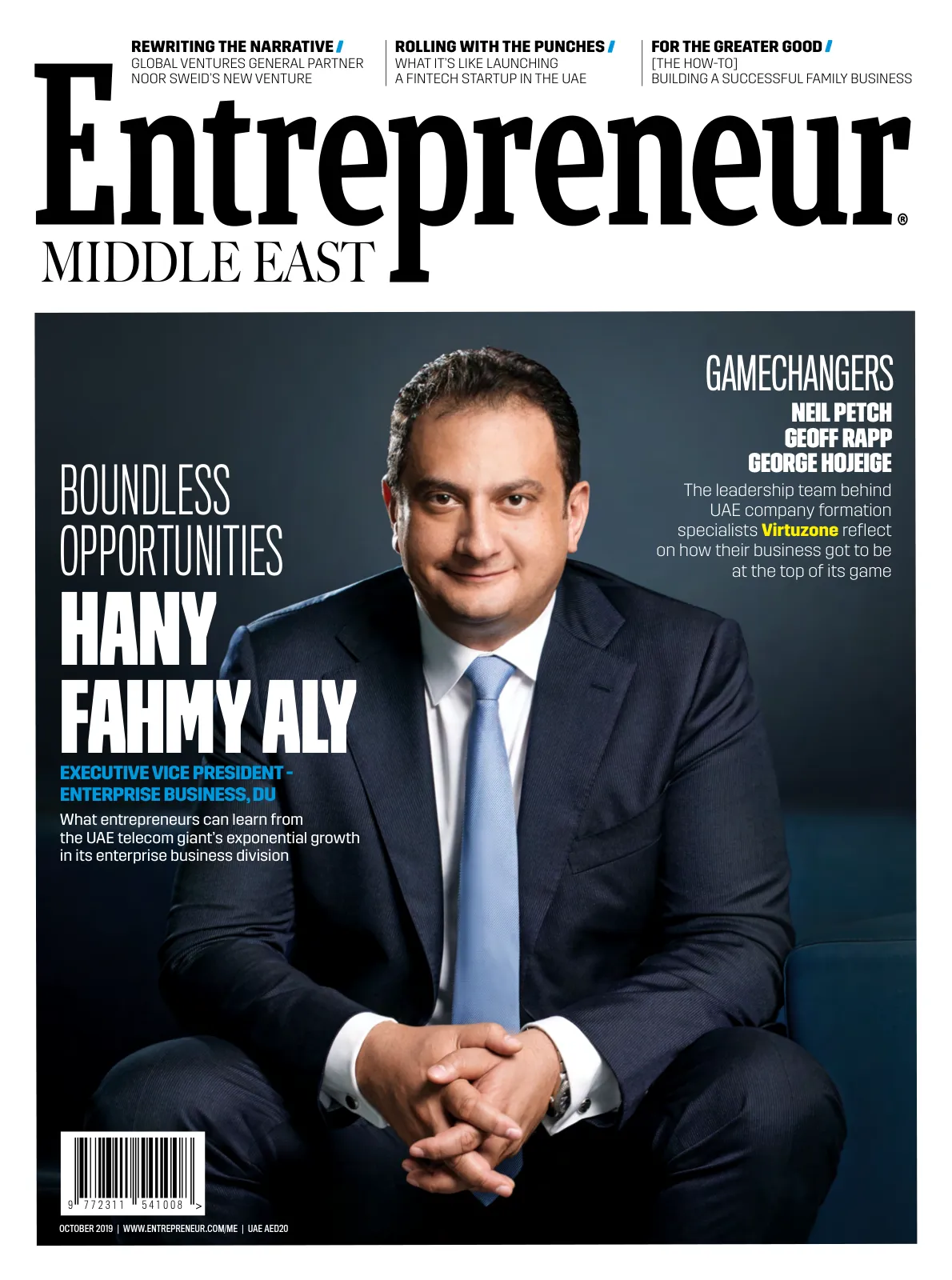
Entrepreneur Middle East, October 2019
Page 1
OCTOBER 2019 | WWW.ENTREPRENEUR.COM/ME | UAE AED20
9
7 7 2 3 1 1
5 4 1 0 0 8
>
REWRITING THE NARRATIVE
GLOBAL VENTURES GENERAL PARTNER
NOOR SWEID’S NEW VENTURE
FOR THE GREATER GOOD
[THE HOW-TO]
BUILDING A SUCCESSFUL FAMILY BUSINESS
ROLLING WITH THE PUNCHES
WHAT IT’S LIKE LAUNCHING
A FINTECH STARTUP IN THE UAE
The leadership team behind
UAE company formation
specialists Virtuzone reflect
on how their business got to be
at the top of its game
GAMECHANGERS
NEIL PETCH
GEOFF RAPP
GEORGE HOJEIGE
BOUNDLESS
OPPORTUNITIES
HANY
FAHMY ALY
What entrepreneurs can learn from
the UAE telecom giant’s exponential growth
in its enterprise business division
EXECUTIVE VICE PRESIDENT -
ENTERPRISE BUSINESS, DU
Page 2
experience
downtown
living
The UAE’s most exciting new destination.
A journey of discovery for the whole family.
Where nature, fun and entertainment
come together.
800-Arada (27232)
arada.com
Page 3
3
October 2019 / ENTREPRENEUR.COM /
24
CONTENTS OCTOBER 2019
Hany Fahmy Aly,
Executive Vice President -
Enterprise Business, du
22
46 HP Presents
#NeverStopBusiness,
powered by Entrepreneur
Middle East
22
INNOVATOR
BOUNDLESS
OPPORTUNITIES
Hany Fahmy Aly, Executive
Vice President - Enterprise
Business, du, on what
entrepreneurs can learn
from the UAE telecom
giant’s exponential growth
in its enterprise business
division.
28
INNOVATOR
GAMECHANGERS
Neil Petch
Geoff Rapp
George Hojeige
The leadership behind
UAE company formation
specialists Virtuzone reflect
on their company’s 10th
anniversary- and how the
business got to be on the
top of its game.
34
INNOVATOR
DRIVING MOMENTUM
Sahir Berry
The founder of Nigeria-
based fintech solution
NowNow is thinking out
of the box as he taps into
the African (and global)
economy.
38
INNOVATION FOR IMPACT
OPPORTUNITY KNOCKS
Nine business sectors
that entrepreneurs can
capitalize on in Saudi
Arabia.
62
‘TREPONOMICS
PRO
For the greater good
Philippe Mueller gives
a how-to on building a
successful family business.
72
MONEY
ECON
Rewarding returns
Allied Investment
Partners, a partnership
between Al Hail Holding
and Future Capital, is
raising an AED5 billion
fund to invest in products
that straddle across the
risk spectrum.
46
IN PICTURES
THE RECAP
HP Presents
#NeverStopBusiness
Powered by Entrepreneur
Middle East, the event
discussed market
opportunities, challenges
about starting up, and
insights on achieving
success.
Page 4
du.ae/business-pos
Your window to expand.
Introducing Business POS for
cashless payments with better
transaction rates.
Page 5
Page 6
Page 7
Call: 800 UPSALE | up.ae
*Terms and conditions apply
MOTOR CITY
Own Your Dream Home In Dubai
& Move In Today
Aed 80,000*
30 months
Post-Handover Payment Plan
50% DLD
Fee Waiver
1,2,3,4
Bedroom Apartment
Page 8
Page 9
Page 10
Page 11
Page 12
COVER THE CITY
Unlocking the Power
of Digital Signage Advertising
Page 13
WITH YOUR ADS
Visit www.lifeonscreen.com
Page 14
14 / ENTREPRENEUR.COM / October 2019
Nir Eyal, author,
Indistractable
50
CONTENTS OCTOBER 2019
68 Global Ventures General Partner Noor Sweid’s new venture has her on a mission
to enable global entrepreneurial success stories from the MENA region
78
START IT UP
ECOSYSTEM
Shared success
Joe Abi Akl on how the
private sector can (and
should) help startups
succeed in the Arab world.
50
CULTURE
LIFE
It’s time to push back
against distraction
Indistractable author
Nir Eyal on how to stand up
against on onslaught
of connectivity.
80
START IT UP
ECOSYSTEM
Rolling with the punches
NOW Money’s Ian Dillon
shares what it’s like
launching a fintech startup
in the UAE.
84
‘TREPONOMICS
PRO
The winning formula
Create Media Group’s Tom
Otton on how they got their
company to be recognized
as one of the fastest growing
agencies in the world.
54
CULTURE
LIFE
Four ways to engage
millennials in the workplace
(according to a millennial)
Atteline Director Bianca Riley
gives a primer on retention
strategy on young talent.
59
‘TREPONOMICS
PRO
Understanding the growth
mindset
Clear Review’s Stuart Hearn
explores cultivating a growth
mindset and how it applies to
performance management.
82
START IT UP
Q&A
For the underserved
communities
Egypt’s Halan is keen to
dominate the ride hailing space
for two and three-wheelers.
64
START IT UP
ECOSYSTEM
Every wave has a silver lining
Dr. Amman R. Ammar delves
on innovation, and the art of
sailing in shifty winds.
58
‘TREPONOMICS
PRO
The right hire
Bayt.com’s Nadine Obeid
points out three common
mistakes to avoid when
recruiting for your
enterprise.
66
‘TREPONOMICS
PRO
Closing the skills gap
through innovation
Getting ready for the job
market of the future needs
a rethinking of our approach
toward education, writes
Dr. Tatiana Zalan.
Page 15
The RiiSE Conference: Achieving Women Forum,
presented by Accor, in association with
Entrepreneur Middle East and du, is a platform
for women in the MENA region to engage
in entrepreneurial and business discourse.
The event will have keynote speeches and panel
discussions take place over the course of the
morning, and end with a networking lunch.
OUR SPEAKERS THIS YEAR
JULIA GILLARD Former Prime Minister of Australia
ERIK WEIHENMAYER American athlete and activist
JULIA CHATTERLEY Anchor and Correspondent, CNN International
ROULA JOUNY Group Managing Director, FTI Group
DEBBIE STANFORD-KRISTIANSEN CEO, Novo Cinemas
(more speakers to be announced soon)
MONDAY OCTOBER 21ST, 2019 STARTING 8:00 A.M. | SOFITEL THE PALM
CONFERENCE
Presented by
In association with
ACHIEVING WOMEN FORUM
SUPPORTED BY
A PRODUCTION BY
TO REGISTER, EMAIL US AT EVENTS@BNCPUBLISHING.NET
Page 16
16 / ENTREPRENEUR.COM / October 2019
SUBSCRIBE
Contact subscriptions@bncpublishing.net to receive
Entrepreneur Middle East every issue
EDITOR IN CHIEF Aby Sam Thomas editor@bncpublishing.net
CEO Wissam Younane wissam@bncpublishing.net
DIRECTOR Rabih Najm rabih@bncpublishing.net
CREATIVE LEAD Odette Kahwagi
MANAGING EDITOR Tamara Pupic
STARTUPS SECTION EDITOR Pamella de Leon
EDITORIAL ASSISTANT Junaid Seraj
GROUP SALES DIRECTOR – B2B GROUP Joaquim D’Costa
COLUMNIST Tamara Clarke
PO Box 502511 Dubai, United Arab Emirates
P +971 4 4200 506 | F +971 4 4200 196
For all commercial enquiries related to Entrepreneur Middle East
contact sales@bncpublishing.net
All rights reserved 2019.
Opinions expressed are solely those of the contributors.
Entrepreneur Middle East and all subsidiary publications in the
MENA region are officially licensed exclusively to BNC Publishing
in the MENA region by Entrepreneur Media Inc.
No part of this magazine may be reproduced or transmitted in any
form or by any means without written permission of the publisher.
Printed by United Printing and Publishing
upp.ae
Images used in Entrepreneur Middle East are credited when necessary. Attributed use of
copyrighted images with permission. All images not credited otherwise Shutterstock.
Joe Abi Akl
Dr. Ammar R. Ammar
Fida Chaaban
Shailesh Dash
Ian Dillon
Jerome Droesch
Stuart Hearn
Rob McGovern
Phillipe Mueller
Nadine Obeid
Tom Otton
Bianca Riley
Tatiana Zalan
CONTRIBUTORS
entrepreneur.com/me
ACCESS FRESH CONTENT DAILY ON OUR WEBSITE!
MIDDLE EAST
EntMagazineME
@EntMagazineME
Entrepreneur-me
EntrepreneurMiddleEast
EntMagazineME
EntMagazineME
EntMagazineME
MIDDLE EAST
In addition to our print edition, we’re bringing
you all sorts of industry news on our web
mediums. Joining us online means getting
relevant business and startup content in
real-time, so you’re hearing about the latest
developments as soon as we do. We’re looking
forward to interacting with our readers on all of
our social media and web platforms- like any
thriving business, we’re looking to give and take.
#TrepTalkME is already happening on all of our
digi platforms, and all good conversations go
both ways. See you on the web!
Page 17
Page 18
18 / ENTREPRENEUR.COM / October 2019
Having an accountability buddy for work (and play)
can make all the difference
Two is better than one
Aby Sam Thomas
Editor in Chief
@thisisaby
aby@bncpublishing.net
EDITOR'S NOTE
O
ver the last few
weeks, my Managing
Editor Tamara Pupic
and I have embarked
on a sort of project
together- the two
of us had come to a
realization that we
were spending way
too much of our time on work, and
even in the free hours we had, we
were simply lazing around and just
cocooning ourselves.
We then decided that we were going
to, well, get out more, and we were
going to hold each other accountable
for our efforts in this department.
Our partnership began with Tamara
making sure that I take some time off
for a short vacation- I’m notoriously
bad at planning holidays, but Tamara
insisted that I schedule it on my
calendar. She then essentially took
it upon herself to let anyone and
everyone around us know that “Aby
is out for a week in September.” And
yes, I managed to get some time away
from the office, traveled around,
relaxed a bit, read three books, made
new friends, had fresh experiences,
and thanks to all that, I got back to
work feeling quite refreshed and
rejuvenated.
In a similar manner, Tamara and I
worked together to battle the feeling
of staidness that was threatening
our day-to-day lives owing to our
overpowering workloads. We agreed
to make a concerted effort at finding
things or people that excited or
interested us, getting out of our
comfort zones, trying out experiences
we’ve never had before, plus
connecting and interacting with new
people outside of our current circles,
and thus broaden our horizons a little
bit. We did all this because we felt
we were getting too comfortable (and
perhaps even a little bored) with the
status quo, and if we wanted to save
ourselves from this situation, it was
clear that it was up to us (and no
one else) to put in the effort to make
this happen. And whenever either of
us would falter in these efforts, the
other would make it clear that we are
not to slip back into the routines that
we were used to.
While it’s still early days to commend
on the results of our efforts, I like to
think that Tamara and I have already
begun to see rewards from our little
scheme- while both of us still have
got our hands full with work, making
ourselves accountable to each other
for our out-of-work time has enabled
us to at least make some positive
changes to our lifestyles. The salient
point here? It has had a knock-on
effect on everything else we do as
well, including our day-to-day work.
We often talk about accountability
buddies when we talk about setting
goals for everything from our
fitness to our businesses, but I’m
here to say that it’s good to have
someone looking over you to ensure
your work-life balance as well. It’s
(seemingly) worked for Tamara and
me, and I can’t see why it wouldn’t
work for you too.
Page 19
CLEMENTINE MALIM
ASSOCIATE - MIDDLE EAST
clementine.malim@savills.me
+971 50 558 2853
WHY SAVILLS
INTERNATIONAL RESIDENTIAL
MIDDLE EAST
international@savills.me
+971 4 365 7700
IN-DEPTH KNOWLEDGE
AND INSIGHT OF THE
CURRENT MARKET
WE ARE ONSITE IN LONDON AND READY TO
TAKE YOU ON AN EXCLUSIVE SITE VISIT WITH
ONLY THE BEST DEVELOPMENTS
LOCALLY AVAILABLE TO HELP NAVIGATE
YOUR INVESTMENT JOURNEY FROM
THE UAE THROUGH TO LONDON
TRIPTYCH
BANKSIDE
KING’S ROAD
PARK
GRAND
UNION
LINCOLN
SQUARE
A SELECTION OF THE FINEST
NEW RESIDENTIAL HOMES
L O N D O N
BATTERSEA
POWER STATION
Page 20
20 / ENTREPRENEUR.COM / October 2019
IN THE LOOP
SYRIA DIGITAL LAB AIMS TO BOOST
THE SYRIAN DIGITAL SPACE
UNLOCKING POTENTIAL
IMAGE CREDIT SYRIA DIGITAL LAB
Syria Digital Lab team
W
ith an aim to
“create an ef-
fective digital
ecosystem
that identi-
fies, con-
nects, incubates, accelerates
and sustains Syrian-led digi-
tal initiatives,” the idea for
Syria Digital Lab (SDL) came
into being in 2018 when
co-founder Malik Al-Abdeh
was trying to figure out ways
to bring the people of Syria
together and help them build
up their lives after many
years of conflict.
“I wanted to focus on
youth, who were at risk of
becoming a lost generation
due to the disruption of
their education,” Al-Abdeh
says. “To me, it made perfect
sense to focus on digital
interventions, because of the
obvious access issues and
the dispersal of Syrians in
the diaspora. Through digital
means you can reach a mas-
sive number of young people,
and offer them educational
and training opportunities
as a way of plugging them
into the digital economy. In
order to achieve this, I be-
lieve Syria needed a digital
ecosystem to connect all
players in the digital space.
Through SDL, we aim to
bring the private, public and
NGO sectors together with
Syrian digital innovators,
creators, disruptors, and of
course, entrepreneurs. We
want to achieve a sustain-
able, highly-networked
community of Syrian entre-
preneurs who can realize an
idea into a successful digital
business.”
SDL recently conducted its
first startup competition,
which invited applications
from entrepreneurs who are
building digital solutions
addressing the Syrian com-
munity's education, health-
care, and youth engagement
challenges. “We will be
evaluating the applications
based on a number of re-
quirements,” says Al-Abdeh.
“First and foremost, we
want to ensure the solution
is tech-powered, feasi-
ble and that it creatively
addresses the challenges
Syrians face either locally or
in the diaspora. As with any
business plan competition,
we want to understand the
maturity of the project, the
team behind it, the scalabil-
ity, and financial sustain-
ability.”
As for what winners of the
competition can expect, Al-
Abdeh points to a variety of
benefits. “Syria Digital Lab
offers both financial support,
in addition to mentorship
and training,” he explains.
“Through our partners, the
Syrian International Busi-
ness Association (SIBA),
VIP.Fund (Very Important
Projects Fund), and Syria
Youth Assembly, we offer
competition finalists access
to a large network of inves-
tors, counselors, mentors
and marketers. These indi-
viduals and organizations
offer support depending on
the needs of the organiza-
tions, and regardless of age
or stage.”
VIP.Fund co-founder Rama
Chakaki is also a co-founder
at SDL, with Al-Abdeh pay-
ing credit to her experience
in the startup, angel invest-
ment, and venture capital
worlds as being integral to
the initiative’s development
and growth, noting, “With-
out her, this project would
not have moved in the direc-
tion that it did.”
SDL has also benefited
from funds provided by
the European Union(EU),
Al-Abdeh reveals. “When
I pitched SDL to the EU in
September 2018, they were
interested, and asked me to
develop the idea further,”
he recalls. “The EU and
Germany gave us a modest
amount of funding to pre-
sent the SDL concept at an
event on the opening day of
the Brussels III Donor Con-
ference in March 2019. The
reception we received was
amazing. For the first time in
a long time, more than one
thousand attendees, most of
whom were government of-
ficials, heads of INGOs, and
civil society organizations,
were listening to an idea for
the future of Syria that was
fresh, exciting, and promised
hope. We need to continue
drawing attention to the
need for bigger investment
in the Syrian digital space
to create that vital ecosys-
tem, and that’s what we are
doing.”
As for how he sees SDL
grow and develop in the
future, Al-Abdeh says that
the initiative is all about
bringing people together on
a shared vision. “It is a polit-
ical in the sense that it does
not favor one or the other of
the warring sides in Syria,”
he explains. “It’s about Syri-
ans, primarily young Syrians
from all around the world,
gaining access to training
and mentorship, developing
ideas, and securing invest-
ment. As long as you are
connected to the internet,
you’re good to go.”
At the same time, Al-
Abdeh doesn’t discount the
potential it has to reach
people across Syria. “SDL
cuts across the various
segments of Syrian soci-
ety,” he explains. “Whether
you are unemployed in a
Lebanese refugee camp, or
an IDP (internally displaced
people) in Idlib, or a young
student in Damascus, the
tools are there for you to
make productive use of that
space to earn a respectable
income, and connect to the
global economy. This is a
powerful incentive for Syr-
ians, because it offers them
the two things that they
seek the most: freedom and
dignity. Technology could
often be part of the solution
for Syria, and SDL is at the
forefront of that.”
Page 21
Page 22
22 / ENTREPRENEUR.COM / October 2019
BOUNDLESS
OPPORTUNITIES
What entrepreneurs can learn from the UAE telecom giant’s
exponential growth in its enterprise business division
HANY FAHMY ALY
EXECUTIVE VICE PRESIDENT - ENTERPRISE BUSINESS, DU
INNOVATOR
>>>
by TAMARA PUPIC S
ome minutes into our conversation, Hany Fahmy Aly, Executive
Vice President - Enterprise Business, du, says he isn’t keen on
offering generalities to avoid answering how the UAE’s telecom giant
functions from the inside, as we often hear from other executives
of his rank. In fact, all 400 of du’s Enterprise Business employees
do not have a hard time to get him to listen to them- his team holds
regular meetings with the staff where the management provides
updates on the progress of the implementation of their annual
strategy, and then informs them on what the focus will be over
the next quarter. “Some people can stand up and say, ‘I think this
is not fair,’ and you have to answer it in front of 400 people, and
sometimes, you might not have the answer, but you need to do it,
because answering it is important for you to stay in touch with what’s going on,” Aly says.
“It can be about a process, like, ‘In order for me to sell this product, I need to have this
signed, and it takes me two weeks. By that time, the deal is gone.’ In the end, we are an
organization who wants to sell, and if our front line troops have problems, or if there are
things that don’t make sense to them, and they are complaining, we have to listen to them.”
Page 23
23
October 2019 / ENTREPRENEUR.COM /
BOUNDLESS OPPORTUNITIES | HANY FAHMY ALY
Page 24
24 / ENTREPRENEUR.COM / October 2019
INNOVATOR
“CORPORATE ENTREPRENEURSHIP
IS ALL ABOUT TRANSFORMATION,
AND THAT’S HOW WE APPROACHED
THE REDEVELOPMENT OF OUR
ENTERPRISE BUSINESS.”
"IF SOMETHING IS NOT WORKING,
DON’T HAVE A BIG EGO BUT
STOP IT, CUT YOUR LOSSES, AND
MOVE ONTO SOMETHING ELSE. IF
SOMETHING IS WORKING BUT IS
NOT WORKING PROPERLY, LOOK
AT THE QUICK FIXES, LIKE THE
80%-20% RULE, MEANING WHAT
THINGS YOU CAN DO IN ORDER TO
FIX THE PROBLEM AND GET GOOD
RESULTS QUICKLY. "
Hany Fahmy Aly, Executive Vice President - Enterprise Business, du
Over his six-year-long tenure
at du, Aly has witnessed first
hand the power of technology
to change the world; however,
a topic that he returns to
most often relates to people,
and why listening to them is
important for a company like
du to continue delivering the
best service possible. As he
is in-house, Aly is equally an
active listener when it comes
to du’s customers, meeting
them regularly at their prem
ises, or organizing or attending
different events to become
more attuned to their needs.
Similarly, Aly is well-versed in
the development of the local
entrepreneurial ecosystem,
stating that the region is now
more than ever keen to back
local startups, due to a string
of success stories, such as
Maktoob’s sale to Yahoo, Ama
zon’s purchase of Souq, and
Careem’s sale to Uber. “Kids
are graduating from univer
sity, and they want to launch
a startup,” Aly says. “Before,
they would have wanted to
work for a large corporation
straight out of school. This
new generation grew up in
a world that is always-on,
hyper-connected, and on-
demand. They see opportuni
ties in new places, and their
thinking isn’t restricted by the
physical world. Where I had a
stack of cassettes and CDs in
my bedroom growing up, they
have access to the entire world
of music on-demand, and at
the click of a button.”
Looking forward, Aly states
that du is perfectly positioned
to support this mindset shift
and empower local entrepre
neurs to create even more
success stories. Aly believes
that the region, and especially
the UAE, is on the cusp of an
other wave of innovation. He
explains that while 3G enabled
Google Maps and other useful
apps, 4G brought real-time
communications and video to
our devices, 5G is now expect
ed to deliver a new paradigm
for communications and appli
cations. "We’re moving from
connecting millions of sub
scribers to billions of devices,”
Aly says. “It is creating a
data-rich environment, where
anything can be connected to
the network efficiently. This
moment we’re at with 5G
mirrors what our discussions
about cloud were three to four
years ago. Cloud is here, and
we’re all benefitting from it.
5G will have a similar innova
tion cycle, but an even bigger
impact. The sharing economy
will go from cars and houses,
to anything you can think of,
including clothes. If it is on the
network, it can be shared and
monetized. On the B2B side,
connected vehicles, manufac
turing, smart cities, and all
kinds of vertical-centric solu
tions will be enabled by 5G.”
Aly believes that with more
funding available for new
ventures, 5G coming online,
and the IT infrastructure put
in place, the only thing today’s
hungry young entrepreneurs
need is a great idea. And he be
lieves that du, as a large organ
ization with an entrepreneurial
history, holds many lessons for
them on how to translate these
ideas into products and ser
vices. Once again, it is listening
to the customer needs that
brought Aly and his team to
develop du’s current offerings.
“Corporate entrepreneurship is
all about transformation, and
that’s how we approached the
redevelopment of our enter
prise business,” Aly says. “We
went through a period of very
high growth, then we went
through a period of low growth.
When we first started offering
our enterprise solutions at the
end of 2013, we had phenom
enal growth rates, because we
were doing things which cus
tomers wanted, and because
the market was still a virgin
market from the enterprise
point of view. We grew much
faster than our competition,
and yes, we were smaller in
size, but we were still a multi
billion dirham business when
we started our transforma
tion. Growing exponentially in
terms of revenue on top of that
was not easy in a very short
time, but we did it. Then, as it
happens in any other industry,
the market matures, you have
Page 25
25
October 2019 / ENTREPRENEUR.COM /
“WE WANTED QUICK WINS, MILESTONES, AND
PROOF THAT WE WERE ON THE RIGHT PATH.
AFTER THAT IT WAS ALL ABOUT EXECUTION.”
BOUNDLESS OPPORTUNITIES | HANY FAHMY ALY
WWW.DU.AE
>>>
forces coming from outside,
and attacking your pie.”
This is a moment in our
conversation where I realize
that du going through different
cycles of growth holds many
lessons for other executives
and entrepreneurs. In more
detail, apart from the process
described above but simul
taneously with it, du started
developing its information
communications technology
(ICT) business, a process which
in itself holds many lessons
on how to overcome hurdles.
Regarding this, Aly explains, “It
started with us thinking what
our purpose was again, since
we could see that our custom
ers wanted a simpler experi
ence, as their IT organizations
became more complex. From
small to large businesses, they
wanted a partner that would
understand their needs, and
make it simple-to-use technol
ogy in order to be successful.
That was our starting point.
After that, we set a 100-day
plan. We wanted quick wins,
milestones, and proof that we
were on the right path. After
that it was all about execution.”
The main result, Aly says, was
that du entered the ICT space,
and went way beyond just basic
network connectivity services.
“We could have played it safe,
and just focused on network
and mobility, but that was not
what our customers wanted,
who were asking for cloud solu
tions to drive cost-efficiencies
and increase their agility,” he
adds. “Furthermore, IT security
is a massive one, and we rec
ognized that without security,
all of these new innovative
solutions would be useless. We
had to give customers a secure
foundation for their transfor
mation. In this way, playing it
safe was not going to work. We
had to get out of our comfort
zone, hire great people, and
partner strategically.”
Once the ICT part of the
business was up and running,
the du team went back to the
drawing board to see how it
could help the enterprise as
a whole. “It was about how
to change the mindset of the
organization that they were
not selling telecom anymore,
but ICT,” Aly explains. That
was a change that required
training. So, we put together
a marketing and a sales
academy where we focused
on consultative selling called
SPIN selling, which helped
us understand the buying
cycle of organizations. So, we
created what we call the du
Enterprise University, which
was mandatory for all our
employees, and little by lit
tle, we started to change the
mindset and started seeing
very good results.” The most
fascinating part about this
story are the results the com
pany saw- Aly states that,
in the end, the du team grew
their revenues exponentially,
and created entirely new rev
enue streams that have been
growing with healthy margins
ever since. “More than just the
financials, we created a base
for continual transformation,”
he says. “We learned how to
learn. That’s about adaptabil
ity, and encouraging internal
entrepreneurship.”
Remaining calm even when
recalling these difficult times,
Aly considers it a normal part
of business that, at times,
certain things do and do not
work, but advises entrepre
neurs and executives to not
shy away from acknowledging
the latter as quickly as pos
sible. “Once you acknowledge
it, you need to create a safe
environment where you can
have proper discussions in
order to solve the problem,”
he says. “The most important
thing is to stop the bleeding
first, and then to start treating
the root cause. That’s the best
way to handle a problem. So,
if something is not working,
don’t have a big ego but stop
it, cut your losses, and move
onto something else. If some
thing is working but is not
working properly, look at the
quick fixes, like the 80%-20%
rule, meaning what things
you can do in order to fix the
problem and get good results
quickly. Ultimately, once you
have more time, and once the
things have been corrected, at
least partially, you can revisit
the strategy what caused the
problem.” During the process
of du reinventing itself, Aly
explains, the biggest challenge
did not relate to technology,
but to making sure that every
single member of his staff was
crystal clear on the plan ahead.
“That’s easier said than done,”
he says. “It’s just human na
ture that if you communicate
something once to somebody,
and even though you think
they got the idea, it might not
work. The most difficult thing
about managing large enter
prises is the people element.”
Page 26
26 / ENTREPRENEUR.COM / October 2019
INNOVATOR
"THIS MOMENT WE’RE AT
WITH 5G MIRRORS WHAT
OUR DISCUSSIONS ABOUT
CLOUD WERE THREE TO FOUR
YEARS AGO. CLOUD IS HERE,
AND WE’RE ALL BENEFITTING
FROM IT. 5G WILL HAVE
A SIMILAR INNOVATION
CYCLE, BUT AN EVEN BIGGER
IMPACT."
“THE GROWTH OF 5G IS GOING TO
OPEN UP OPPORTUNITIES TO CREATE
VERTICAL-CENTRIC SOLUTIONS, AND
PARTNER WITH DIFFERENT KINDS OF
SOLUTIONS PROVIDERS.”
Hany Fahmy Aly,
Executive Vice
President - Enterprise
Business, du
For his team, Aly has a three-
fold rule: everyone needs to
understand the vision and
objectives, to believe in it and
be energized and excited about
it, and lastly, to know that the
management is there to help
them to remove any obstacles
on the way.
In more general terms, Aly
says that his management style
is objective-oriented. “The
most important thing for me
is that we all need to have a
plan, and the plan starts with
us getting together, and having
frank discussions,” he says.
“I don’t impose a plan on my
direct reports, because each of
my eight direct reports have a
big team under them, since, as
a whole, we are a team of 400
people. It’s important for them
to think of what they want to
do in their areas, while my role
is to guide them and chal
lenge them, and to make sure
that they are working towards
our overarching objectives.
Once we have a plan, it’s very
important to define it into
parts, which are manageable,
like specific goals, and then
who, and when. After that, we
have weekly meetings where
we look at dashboards, KPIs,
and if needed, we take actions
to correct the course. I also
meet with the entire team,
the whole group, so I don’t
just rely on my direct reports,
because I believe that you need
to communicate with every
one.” With its team emerging
stronger from what could have
been some serious setbacks, du
is now thriving, but Aly is even
more excited about the future.
“Each of the solutions we
branched out into were close to
our DNA, and this is only going
to continue,” he says. “The
growth of 5G is going to open
up opportunities to create
vertical-centric solutions, and
partner with different kinds
of solutions providers. At the
same time, we’re going to con
tinue to support Smart Dubai,
Dubai’s smart city initiative,
and explore a growing number
of opportunities in IoT.”
However, one thing will never
change- regardless of the solu
tions they offer, du’s purpose
will always remain making it
simple and easy for custom
ers to use technology in their
businesses, and giving them
an amazing digital experi
ence. “I’m excited about the
continued digitization of our
business, and offering seamless
experiences that cater to the
next generation of IT innova
tors,” Aly concludes. “That’s a
challenge, but it is absolutely
critical to our future. We need
to increase automation, while
offering online procurement
and experiences that match
Amazon Web Services and
other platform-based busi
nesses. It is going to take an
entrepreneurial approach and
some really fresh thinking to
push our business to get to
that level. It will be hard work,
but it will absolutely be key
to our further growth in the
future.” Or, shall we say, du
will do it again.
Page 27
ONLINE BANKING,
DESIGNED FOR YOU.
Call 8008NBF(623)
to start our partnership
nbf.ae
NBF Direct
User-friendly
Interface
Secure
Biometric
Access
Easy
Balance
Transfers
Simplified
Trade
Finance
Real-time
Status
Alerts
Customised
Dynamic
Reports
Experience real-time banking at your fingertips
with NBF. Much more secure, convenient and
further simplified using your biometrics to attend
to your personal or corporate banking needs.
Page 28
28 / ENTREPRENEUR.COM / October 2019
The leadership behind UAE company formation specialists Virtuzone
reflect on their company’s 10th anniversary- and how the business got
to be on the top of its game by ABY SAM THOMAS
GAMECHANGERS
NEIL PETCH GEOFF RAPP GEORGE HOJEIGE
INNOVATOR
>>>
I
t’s not uncommon to hear
entrepreneurs in the UAE
talk about how they find the
business set-up process in
the country to be a cum
bersome affair, and that’s
exactly the pain point that
Neil Petch and Geoff Rapp
were aiming to tackle when
they founded Virtuzone
in 2009. 10 years on, the
enterprise, which today has
George Hojeige at its helm as its CEO, has
become one of the leading players in this
particular domain in the UAE- in fact,
I’m willing to bet that Virtuzone is the
company that first comes to mind for most
people in the country (and even outside it)
who are looking for someone to help them
launch their entrepreneurial ventures.
After all, Virtuzone proudly declares it has
been able to launch over 16,000 compa
nies over the years- that number is an in
dicator of the kind of experience it boasts
of, while also showcasing the amount of
trust people have in the brand.
So, how did Virtuzone get to where it is
today? That’s a story that Petch (who’s
today the Chairman of Virtuzone), Rapp,
and Hojeige tell me over the course of an
afternoon at their office in Dubai’s Souk
Al Bahar as they celebrated the tenth
anniversary of their enterprise. Virtuzone
essentially came into being as an idea that
Rapp had when he was working for The
Executive Office of Dubai (i.e. the office
of H.H. Sheikh Mohammed bin Rashid
Al Maktoum, UAE Vice President and
Prime Minister, and Ruler of Dubai) in
the early 2000s. At the time, Dubai was
in the throes of making itself out to be
a hub for business in the MENA region,
be it with its real estate endeavors, or
with its launch of free zones like Dubai
Media City, and while larger enterprises
were being catered to with these efforts,
Rapp had noticed that smaller players
weren’t getting as much attention. Rapp
saw that the entrepreneurs behind these
companies (which were often in the very
early stages of their business trajectories)
didn’t actually need office spaces or desks
for them to run their enterprises– after
all, they could work from practically any
where, but they did need the basic aspects
of running a business here, which include
things like the requisite legal structures,
trade licenses, bank accounts, etc. Rapp
thus saw a need for “a virtual free zone”
that catered to these startup businesses,
and while his idea was appreciated by his
employers at the time, it was shelved on
account of the other undertakings Dubai
had put higher on its priority list back
then. Now, that idea would have stayed on
the backburner had it not been for Rapp
meeting with his long-time friend Petch a
few years later, who agreed that there was
potential in the concept- and that it was
an untapped opportunity. Petch took the
idea (after a fair bit of repackaging and
rebranding) to the Emirate of Fujairah’s
Creative City Free Zone, and that entity
gave him the green signal to run with it,
and with the aim to simplify the process
for entrepreneurs and businesses to set
up shop in the UAE, Virtuzone came into
being in July 2009.
Page 29
29
October 2019 / ENTREPRENEUR.COM /
GAMECHANGERS | NEIL PETCH | GEOFF RAPP | GEORGE HOJEIGE
The Virtuzone team. Left to right:
Geoff Rapp, Founding Partner; Neil Petch, founder and Chairman; and George Hojeige, CEO
Page 30
30 / ENTREPRENEUR.COM / October 2019
INNOVATOR
“WE REALIZED WE WANTED TO TARGET
STARTUPS- NO ONE ELSE WAS AFTER
THAT SECTOR, AS THE OTHER PLAYERS
WERE MUCH KEENER ON LARGER
COMPANIES WHO HAD A LOT OF PEOPLE,
OR A GREAT BIG OFFICE.”
Neil Petch, founder and Chairman, Virtuzone
Note the year here- this was
the time when the world at
large was in the middle of a
global financial crisis, and yes,
the UAE was being affected by
it too. “We actually officially
launched the business in the
teeth of the first crash that
Dubai had seen,” Petch recalls.
“We didn't realize it then, but
eventually that was a huge
opportunity for us. Timing
is everything in business,”
Rapp adds. “So, the fact that
it happened right at that time
of the global financial crisis,
literally, from 2008 into 2009,
it was great timing, because a
lot of people were losing their
jobs, they didn't want to leave
Dubai, and they were looking
for other opportunities. So
that was certainly a factor that
actually played in our favor.”
And when these entrepreneurs
needed help with setting up
their enterprises, Virtuzone
found itself perfectly placed to
cater to their needs. And while
the startup sector may haven’t
been the most appealing of
industries to be a part of in
those days, Petch and Rapp
were able to make their com
pany an indispensable partner
to all of these newly launched
businesses. “We came up with
the name Virtuzone, because,
obviously, we were represent
ing a free zone, and we wanted
something that was virtu
ous, that enabled people to
set up for a limited amount
of money,” Petch says. “We
realized we wanted to target
startups- no one else was
after that sector, as the other
players were much keener on
larger companies who had a lot
of people, or a great big office.”
Of course, this strategy proved
to be a hit for Virtuzone in the
long run, as these young busi
nesses it supported and ena
bled ended up being the ones
that allowed for Dubai and the
UAE to recover from the effects
of the recession in the long
run. The formula, according
to Petch, was that Virtuzone
would grow alongside their
clientele- and for that to hap
pen, their customers needed
to succeed. “So, very rapidly,
in the first year of operation,
we realized we need to pro
vide them with a supportive
ecosystem,” Petch continues.
“That meant helping them get
bank accounts. That meant
helping them have accounting
services, which sounds very
obvious, but if you're a one-
person or two-person opera
tion, then you can't afford an
accounts person… So, provid
ing a supportive environment
became an absolute tenet of
our business.”
Virtuzone thus became more
than just a company to go
to when you needed a trade
license- it started offering a
host of services that helped its
clientele with everything from
setting up a bank account, to
funds to enable startups to
get off the ground without a
huge initial investment. “One
of the roles that Virtuzone has
provided, which we did before
anyone else, was being a bridg
ing point,” Petch says. “So, if
you set your company up, we
would finance you, we would
enable you to pay for the costs
of setting up your company
over the course of the year,
which meant, suddenly, that
the ability to set a company
up [became easier].” It didn’t
stop at financing though- to
day, Virtuzone prides itself
on being a one-stop-shop for
anyone wanting to set up a
business in the UAE, with the
roster of services it provides
for startups including every
thing from design to IT. It has
also partnered with leading
organizations from across sec
tors over the years to add to
its support of entrepreneurs.
“Now, if you look at our part
ners, and if you compare us to
anyone else out there, we're
partners with Etisalat, we're
partners with KPMG, we're
partners with Aramex, we're
partners with Dubai FDI, we're
partners with the Chamber of
Commerce, we sit on the panel
of ease of banking in the UAE,”
Petch notes. “You can tell a
lot about a man by his friends,
and a lot about a company by
its partners. Compare us to
anyone else; they don't have
partners.” At the same time,
for all of the services and sup
Page 31
31
October 2019 / ENTREPRENEUR.COM /
GAMECHANGERS | NEIL PETCH | GEOFF RAPP | GEORGE HOJEIGE
“BACK THEN, PEOPLE
DIDN’T LOOK AT COMPANY
FORMATION FROM A
BRANDING/MARKETING
PERSPECTIVE. WE WERE
THE FIRST TO REALLY
LAUNCH A BRAND,
BUILD A BRAND, AND
COMMUNICATE TO PEOPLE
AT AN EMOTIONAL LEVEL.”
Geoff Rapp, Founding Partner, Virtuzone
>>>
WWW. VZ.AE
port it provided its clientele,
Virtuzone was also aided in its
growth by the fact that it was
one of the first organizations
to build a sort of brand around
itself as a company formation
specialist in the UAE. Rapp
was the one leading the charge
on this front, with his exper
tise from a career in marketing
at companies like Emirates and
Bowing certainly aiding Vir
tuzone in its outreach efforts.
“Back then, people didn’t look
at company formation from
a branding/marketing per
spective,” Rapp recalls. “We
were the first to really launch
a brand, build a brand, and
communicate to people at an
emotional level.”
On the marketing front, it’s
safe to say that Virtuzone is
continuing to push the bar
when it comes to the crea
tive ways in which it makes
sure it’s always on top of
mind when people talk about
company formation in the
UAE. Be it by being one of the
first players in the market at
large to do content marketing
right, or by its recent launch of
a radio show (Starting Up on
Dubai Eye) for entrepreneurs,
Virtuzone has always man
aged to go above and beyond
other players in the indus
try in this domain. “From a
marketing perspective, we are
seen as the reference,” says
Hojeige, crediting Petch and
Rapp for choosing to invest
in this particular function at
Virtuzone. “One of the biggest
mistakes entrepreneurs do
is that they don't invest in
marketing when they start. So,
you can have the best team in
the world, you can have the
best product in the world, but
if you're not marketing, you're
not going to sell anything. And
if you don't sell, you're not
going to succeed as a business.
So, the guys have always had
the guts and the vision to actu
ally invest heavily in market
ing. We still, I believe, invest
a lot in marketing, a lot more
than your typical SME would,
as a percentage of its revenue
or turnover. And that's paid
up- we're in a pull business;
we're not in a push business…
What we need to do is we need
to go pull as many of those
people that want to start com
panies, and pull them to our
site.” Hojeige, whose career
so far has seen him lead sales
and business development at
various organizations as well
as entrepreneurial pursuits
of his own, joined the Virtu
zone team only recently, but
having been a long-time friend
of Petch and Rapp, he’s been
privy to the development and
growth of the company as well.
In fact, Hojeige recalls how he
and others would joke with
Petch and Rapp on how, in the
early days of Virtuzone, they
expected their company to be
shut down by the authorities,
as their offering was essential
ly a quasi-government func
tion. Of course, it’s a testa
ment to the Virtuzone’s team’s
hard work and leadership that
this didn’t end up happening,
and while the company has
had a fair number of chal
lenges thrown in its path, it
persevered through all of them,
and today, it offers its clients
support with starting up in
any of the UAE’s 52 free zones
or the mainland, as well as an
assortment of other offerings.
But despite the success that
Virtuzone has seen, Petch,
Rapp, and Hojeige are all in
agreement that the company
cannot sit on its laurels, and
instead has to continue to be
pushing the envelope for it
to remain ahead of the curve.
“When we started, it was all
about how many licenses we
can sell,” Petch says. “And we
realized that we need to get
the processes right [to do this
properly]. We now have thou
sands of customers, and even
if a small percentage of those
customers are not happy, then
you are going to hear about it
on social media. So, we need to
make sure our customer expe
rience is absolutely at the top
of its game.” Indeed, this focus
on their clients is absolutely
critical to their business, the
trio say- that’s essentially
why Virtuzone takes charge of
all of the different processes
relating to the company set-up
Page 32
32 / ENTREPRENEUR.COM / October 2019
INNOVATOR
“ONE OF THE BIGGEST
MISTAKES ENTREPRENEURS
DO IS THAT THEY DON'T
INVEST IN MARKETING WHEN
THEY START. SO, YOU CAN
HAVE THE BEST TEAM IN
THE WORLD, YOU CAN HAVE
THE BEST PRODUCT IN THE
WORLD, BUT IF YOU'RE NOT
MARKETING, YOU'RE NOT
GOING TO SELL ANYTHING."
George Hojeige, CEO, Virtuzone
procedure, as then they can
make sure all of what is being
done for the customer is done
at a very high standard, as well
as in an extremely efficient,
effective manner, at a very
competitive price point. It’s
thanks to efforts like these that
Virtuzone can proudly declare
that almost 90% of its clients
renew their licenses with it
on a yearly basis, with its cus
tomers themselves becoming
ambassadors of the brand to
other new, prospective clients.
Petch’s glee is palpable as he
talks about the startups he and
his team have helped get off
the ground over the years, with
many of them having grown
right alongside Virtuzone to
greater heights of success.
“One of the most wonder
ful things about working at
Virtuzone is that we're setting
up over 300 companies a
month, and people are coming
in here with their dreams, and
we're helping them turn it into
a reality,” Petch says. While
Petch, Rapp, and Hojiege ac
knowledge that there are other
players in the market today
that work in the same space as
Virtuzone, they are adamant
that their company stands
miles ahead of the others, and
that they are often looked on
as a role model even by their
competitors. Copycats could
be seen as a problem- but the
Virtuzone team don’t seem
to be too concerned about
that. “Whilst some people
have been playing catch up
and looking at what we were
doing previously, we're now
looking at how we can improve
the customer experience, how
we can improve the amount
of time that they stay with
us,” Petch explains. “If they
continue simply to copy us,
yes, it's going to cost them less
to do it, but they are going to
get into a lazy mentality of not
innovating. And so, we're go
ing to continue to stay ahead,
continue to look for the next
thing, which of course is going
to benefit the customer at the
end of the day. That's the way
that we do our business.”
As for the road ahead, Petch,
Rapp, and Hojeige are clear
that they are going to continue
innovating at Virtuzone and
what they do for their clientele
in the UAE, but they are also
hard at work on building up
the nation’s brand outside
of its borders as well, and
thereby bring more businesses
to set up here. “I think the
opportunity for the UAE, and
I really would want to drive
this, is there's a massive trend
happening in the world at the
moment- the offshore markets,
in which there are hundreds of
thousands of companies, are
under pressure,” Petch says.
According to him, given these
global dynamics that are turn
ing away from offshore centers
(think places like the British
Virgin Islands, or Panama), the
UAE is extremely well placed
to be seen as an alternative
to these places, by virtue of
it being a much more condu
cive place -be it with its legal
structures, or its political sta
bility, or simply its geographic
location- to do business in. On
the homefront though, Petch,
Rapp, and Hojeige are united
in the company’s premise to
always keep their customer
first, and continue to develop
their offerings to assist entre
preneurs in building up their
respective businesses in the
UAE. And as for what makes
Virtuzone stand apart from the
rest, Hojeige replies: “Experi
ence. Nothing beats experi
ence. You know, we are the
longest running in the market.
We are the most trusted by
both jurisdictions and by
clients. So, I think trust is the
main issue here. And I realize
this more and more, and I real
ize it more every day, starting
a business, for some people,
is literally putting everything
they have into that busi
ness. And trust, I think more
than price, more than being
Western, or being Indian, or
being Arab, or being whatever
it is, trust in the person that's
doing it for you, I think, would
beat any other asset, in my
opinion. And that's something
that we thankfully have from
our clientele, and it goes from
mouth to ear from there. So,
trust and experience, I think,
is our main driver, and our
main advantage on everybody
else. We can compete on price
any day. That's easy. The price
part is easy, because we buy
better than anybody else. But I
think building trust and build
ing confidence is something
that taken 10 years to build,
and you can't build that over
night.”
Page 33
A MEMBERS OF EMIRATES TRANSPORT BUSINESS CENTERS:
Page 34
34 / ENTREPRENEUR.COM / October 2019
DRIVING
MOMENTUM
The founder of Nigeria-based fintech solution NowNow
is thinking out of the box as he taps into the African
(and global) economy by TAMARA PUPIC
SAHIR BERRY
INNOVATOR
>>>
I
always ensure I have
a written agenda for
everything I plan to
accomplish on a daily
basis, because ac
countability to one’s
self is paramount.
While in my ear
lier years, organiza
tion was an issue, it became
something I focused on,
addressed, and I’d like to think
that today it has become my
core strength. My passion to
achieve constant growth in my
business and build up a suc
cess story drives me every day,”
says Sahir Berry, and now, as
we start listing the many of
his entrepreneurial endeavors,
these words will resonate even
more.
While Berry credits his educa
tional background (a bachelor’s
degree in international busi
ness from Suffolk University
– Sawyer Business School, and
a master’s degree in hospitality
management from Les Roches
International School of Hotel
Management) for “the valuable
lessons in foreseeing customer
demands and finding, import
ing, or pertinently developing
locally the market tools to
meet them,” he highlights the
experiential knowledge he has
gained from watching and tak
ing part in his family enter
prise, the UK-based security
technology company Contec
Global Group, establishing its
presence across Asia, Europe,
and Africa. Namely, alongside
his father and brother, Dr.
Benoy Berry and Roheen Berry
respectively, Sahir Berry has
been instrumental in growing
Contec Global Group by bol
stering government e-identity
projects, such as e-visa, e-
passport, and driving licenses
across Africa, the UAE, the US,
and India.
Many companies with a
global presence shy away
from the often too challenging
African market, however, Berry
sees nothing but opportuni
ties there, and particularly
in Nigeria, the world’s 23rd
largest economy, the nation
with the biggest population
(200 million), and the biggest
economy in Africa. “We’re
talking obviously about a
continent with its own unique
challenges, particularly in
starting up or running a busi
ness,” Berry says. “These range
from poor supportive infra
structure in certain regions, a
high cost of business financing,
lack of market information and
data- all impediments that
make customer education on
new payment related products,
such as ours, somewhat tedi
ous at times.”
In this way, Berry is open
ing up the conversation about
his other two businesses,
both subsidiaries within the
Contec Global Group, which he
launched to seize opportuni
ties arising from the fact that
Nigeria’s financial sector is ripe
for disruption. Namely, Berry
Page 35
35
October 2019 / ENTREPRENEUR.COM /
DRIVING MOMENTUM | SAHIL BERRY
“THE VISION IS TO DEVELOP
A CASHLESS ECONOMY
CROSS-SECTOR, HONING-IN
ON THE DISRUPTIVE POWER
OF TECHNOLOGY WHILE
CAPTAINING FINANCIAL
INCLUSION WHEREIN THE
BIGGEST HINDRANCE TO
AUTONOMOUS GROWTH HAS
BEEN ACCESS TO CAPITAL.”
Sahir Berry, founder, NowNow
Page 36
36 / ENTREPRENEUR.COM / October 2019
INNOVATOR
"WHILE THERE ARE CHALLENGES,
THE OPPORTUNITIES FOR FINTECH
PLATFORMS TO EFFECTIVELY
INTEGRATE AND THRIVE IN THESE
COMMUNITIES ARE UNDENIABLE."
CONTECGLOBAL.COM
is also the founder of AfriOne,
Nigeria’s first smart devices
manufacturing company, and
of NowNow, a mobile wal
let changing the way people
on the African continent
relate to financial services.
“While I admit there are no
magic answers to overcoming
these challenges, with a good
understanding of the African
business environment acquired
over decades of experience,
and the right relationships
on hand, which have enabled
our out-of-the-box strategies
and timely interventions to
drive growth, NowNow has
overcome past impediments
and we are driving momentum
and gaining traction in market
share,” Berry explains.
Here is some insight into why
Berry believes that Nigeria
would benefit from NowNow’s
solutions- first of all, 42% of
the Nigerian adult population
is financially excluded, while
the remaining part is serviced
by only 22 banks. “Nigeria
hosts undeniably the largest
population in Africa with a
rapidly growing economy, both
formal and as yet unknown,”
he explains. “There remains a
large segment of the popula
tion which is still ‘cash driven,’
both rural and urban com
munities, and excluded from
financial market inclusion.
While there are challenges,
the opportunities for fin
tech platforms to effectively
integrate and thrive in these
communities is undeniable,
and I contend that we are in
pole position in that race.”
Secondly, Nigeria’s internet
subscription currently stands
at about 91.9 million, and
mobile subscription at 155
million, Berry states, and to
put that into perspective, he
explains that, in 2018, only
9.07 million unique subscrib
ers (out of a population of 200
million and 70 million adult
population) performed online
payment transfers. Berry thus
sees a large untapped mar
ket for NowNow, adding that
his vision for the company
is “to own every financial
transaction in Nigeria, from
recharges, bill payments,
money transfers, P2P transac
tions, micro lending, parking
payments, tolls, fuel payment,
cross border transactions
and much more.” Berry says,
“NowNow is Nigeria’s fastest
growing fintech platform, and
currently the third largest in
terms of money transfers. Our
vision is to become the largest
transaction-focused enterprise
across Africa, the top perform
ing company in the fintech
space on the continent. So far,
money transfer and cash with
drawals have been the biggest
growth stories for us, and
over the last three quarters,
our growth rates have been
70% month-on-month. We
are in the process of show
casing 360-degree use cases
in Nigeria, while exploring
expanding our reach to various
sectors, including transporta
tion, government, gaming,
entertainment, shopping,
online transactions, and so on.
It’s an exciting time to work at
NowNow, and to be a NowNow
customer. The ecosystem you
enter today will grow around
you tomorrow, and we are
privileged to play our role in
the emerging market ‘ease of
doing business’ process.”
To date, NowNow has built
a 4,000-strong agent network
all across Nigeria as well as
partnerships with all major
banks and other financial
stakeholders. “I foresee a con
tinuance and steady growth in
accessing what remains largely
an untapped economic market,
and putting Fourth Industrial
Revolution-inspired techno
logical innovation forward in
allowing for ‘mobile money’,
e-loans and the business of
electronic payments in West
Africa to thrive,” Berry says.
“The vision is to develop a
cashless economy cross-sector,
honing-in on the disruptive
power of technology while
captaining financial inclusion
wherein the biggest hindrance
to autonomous growth has
been access to capital.”
In further support of this
process of increasing financial
inclusion in the country, in
2017 in Lagos, the Berry family
set up a hardware arm of the
Contec Global Group, Afri
One, to manufacture afford
Page 37
37
October 2019 / ENTREPRENEUR.COM /
"NOWNOW IS NIGERIA’S FASTEST GROWING
FINTECH PLATFORM, AND CURRENTLY THE THIRD
LARGEST IN TERMS OF MONEY TRANSFERS."
NowNow founder Sahir Berry’s
tips for entrepreneurs
‘TREP TALK
1. Keep an open mind
“Think big, think fast, think clearly, and
think about the bigger picture.”
2. Teach yourself to be innovative
“Sometimes out-of-the-box solutions
are required to solve a problem; don’t
be afraid to search for them.”
3. Test and test again
“Keep innovating, and don’t shy
away from rebuilding your product to
achieve, and maintain a competitive
advantage.”
4. Always look to grow
“Keep looking for multiple revenue
streams to stay in the game, so don’t
be afraid to diversify.”
5. Errors are to be expected
“Of course, acknowledge and learn
from your mistakes.”
The NowNow app
DRIVING MOMENTUM | SAHIL BERRY
able smart devices. Since then, AfriOne,
dubbed Nigeria’s first local mobile phone
brand, has announced two smartphones,
the Gravity Z2 & Champion Pro, and two
feature phones, Naija 1 & Punch, and more
recently, a new range of tablets, music
devices and accessories. “We are in the
process of setting up smart phone device
production across Africa, a replicable
model which began in Lagos and has
now started to expand and evolve in line
with our long term vision to improve
high-skills development, support youth
employment and empowerment on the
continent, increasing the national GDP in
the process.”
For Berry, ensuring that his ventures
reach their targets requires building a
strong and reliable team, and being open
to learning from mistakes, individually
and collectively. “As a leader, one has to
learn from past mistakes. Mistakes will
happen, but it’s important for a CEO to
learn and grow from them and to know
how to prevent them from happening
again. Also, I have always believed that
a great organization comes from a great
team, and finding team members who
display integrity, character, and insight.
The tenets you yourself strive to adhere
to, is important, but finding talent and
empowering them to put their skills to
work on a shared vision, ensuring that
they stay when the time comes to make
difficult decisions, these are the trials and
tribulations inherent in any management
position.” One of Berry’s approaches to
this is in encouraging references from
existing team members and searching on
popular professional forums, he explains,
adding that “grassroots methodologies
have always played a part of my strat
egy to find the right resources.” Berry
says, “I’m privileged to have around me
loyal teammates who share my drive for
achievement and NowNow’s success. The
longer he or she has stayed, I find that
the more loyal he or she is towards daily
responsibilities, the easier our constant
communication becomes; and, with career
development assured at that stage, we can
present to new employees that we foster a
climate of greater team retention.”
Regardless of so many successful
projects under his belt, Berry considers
humility to be the most important trait he
should keep going forward. “I don’t always
stick to one single plan unabashedly;
I believe in adjusting, confronting and
conquering as required because bespoke
challenges require bespoke solutions,”
he says. “Furthermore, despite our suc
cesses, it’s important to keep one’s ego in
check. I listen to crucial advisors around
me on a regular basis for their critical
input and feedback, knowing that they are
as much a part of NowNow as I am. This
has helped my organization to accomplish
great things. This also means as required,
effective delegation and when doing so,
avoiding micromanagement, as tempt
ing sometimes as it may be to intervene.
At the end of the day, I’ve learnt not to
be afraid of reinvention. I keep thinking
about how an existing idea can be changed
or how technological innovation can take
what was ‘next-generation’ at the time to
a higher level, maintaining competitive
advantage for NowNow.”
While the fintech sector has been thriv
ing across the world, Berry is proud that
NowNow is also present in the Middle
East. “While the Middle East is perhaps a
more mature market, we are seeing today
a global conduciveness for fostering a
climate of innovation, region on region,
that allows for established brands, such
as NowNow, to pioneer new technolo
gies and to integrate new additions to the
financial system,” he concludes. “We offer
with rapidity and prowess that would
otherwise have taken years to be received
and deployed. In short, I believe that now
is a very good time to start a business in
the MENA region, and we are delighted to
have a business established and primed
for wholesale integration- a proven model
replicable the world over.”
Page 38
38 / ENTREPRENEUR.COM / October 2019
INNOVATION
FOR IMPACT
BROUGHT TO YOU BY
NINE BUSINESS SECTORS THAT ENTREPRENEURS
CAN CAPITALIZE ON IN SAUDI ARABIA
OPPORTUNITY
KNOCKS
by MEGHA MERANI
38 / ENTREPRENEUR.COM / October 2019
Page 39
39
October 2019 / ENTREPRENEUR.COM /
“YOU’RE LOOKING AT A MARKET THAT IS
NOT ONLY YOUNG, BUT ALSO HAS A VERY
HIGH EXPENDABLE INCOME, AS WELL
AS A VERY HIGH GDP THAT IS BEING
CREATED YEAR-ON-YEAR.”
Abdullah Altamami, Investments Director for Integrated
Networks Company (iNet)
>>>
T
he math is a no brainer,
tech investor Abdullah
Altamami explains. A GDP
of US$782 billion in 2018,
and a population surpass
ing 34 million- of which
60% are below 35 years
of age. Add to that, the fact that Saudis
are extremely digital with smartphone
penetration at 96%, and online penetra
tion at 89%– well above the 57% world
average.
All of these are factors that simply
don't exist elsewhere.
“When an economy as big and as scalable
as the Kingdom of Saudi Arabia opens
up, you instantly, overnight, have many
opportunities that open up with it,” says
Altamami, Investments Director for In
tegrated Networks (iNet), a leading tech
nology firm in Saudi Arabia with more
than $30 million assets under manage
ment in venture capital across the world.
He also sits on the Board of Directors for
San Francisco-based Loyyal Corporation,
Saudi-based HyperPay, and Dubai-based
Eco4Pay. “[And] you’re looking at a mar
ket that is not only young, but also has
a very high expendable income, as well
as a very high GDP that is being created
year-on-year.”
The landscape of opportunity has
changed significantly, of course, since
2016 when Saudi Arabia’s Crown Prince
Mohammed bin Salman announced Vi
sion 2030, a package of economic and
social reforms designed to diversify the
economy away from dependence on oil,
attract foreign investment and create
jobs for citizens. Raising the current
contribution of small and medium-sized
enterprises (SMEs) to the GDP from
20% to 35% by 2030 is listed as a top
priority for the crude producing Gulf
state's prosperity.
“I'm an advocate of first principles
thinking,” adds Saudi investor Waleed
Alballaa. “There will always be a bet
ter way of doing things in a market, as
long as you get the timing right. There's
a significant economic leakage in our
markets, due to a mismatch between
demand and supply in various sectors.
For a long time, this has allowed many
foreign players to exploit our markets
without much effort, nor understanding.
Entrepreneurs and investors alike see
this now, and have started turning those
old problems into new opportunities.”
Here are seven sectors of opportunity
for aspiring entrepreneurs and startups
in Saudi Arabia to consider (and what
investors are looking for):
1. FINTECH
Fintech is an area with a lot of potential
in the Kingdom, Altamami says. “Be
cause you [have] a very strong banking
system in Saudi, however, at the same
time, not a lot of services,” he explains.
For example, SME loans, peer-to-peer
lending, payment processing and
payment aggregation, are all areas to
look at. And with sandbox regulatory
environments like those offered by Saudi
Arabian Monetary Authority’s (SAMA)
becoming available in Saudi, there is
now a mechanism to “help” startups
safely test their innovations, before of
ficially going to market.
Mohammed Jawabri, COO of Lendo, a
Saudi-based Sharia compliant peer-to-
peer lending platform with core focus
towards SMEs debt finance, points
out that the financing gap for SME’s
was about $100 billion in 2018 and is
expected to increase to $300 billion by
2030. This gap, Jawabri says, can be
closed by providing digital and online
solutions to the growing younger demo
graphic choosing to enter this market.
“[For example] By understanding the
needs of the smartphone generation of
founders, we are providing innovative
solutions that help them finance their
business activities and provide them
with liquidity as the entire Saudi market
grows” he adds.
2. CAPITAL MARKETS
“Capital markets have not been tapped,”
Altamami adds. “We have a lot of com
panies in the payment industry coming
up, especially in financing, loaning, peer-
to-peer lending. But Saudi’s Capital
Market Authority (CMA) is a very active
player as well and now we have equity
crowdfunding, and that is picking up as
well.” The CMA has also committed to
support fintech innovation by provid
ing a simplified regulatory framework,
wherein companies can apply for a
financial technology experimental per
mit, in order to participate in a fintech
lab where they can deploy and test their
fintech products, services, and business
models related to capital markets.
3. ENTERPRISE
Enterprise, in general, hasn't received
enough attention from entrepreneurs
as of yet, according to Alballaa. “I'd
invite the reader to take a cursory look
at the IPO performance of enterprise
startups in the US to get a sense of the
opportunity,” he says. That said, Albal
laa adds, the top opportunities for any
given entrepreneurial founder depend
as much on the founder themselves as it
does on the market. “There's little use
for a big opportunity that a founder isn't
equipped to compete on. Thus, I'd define
the top opportunities as those that
enable a viable founder-market fit. Hav
ing said that, I see a unique window of
opportunity to help build our digital in
frastructure including areas like fintech
and logistics.” Altamami adds: “We see
too much focus on B2C, too much focus
on food delivery, and basic e-commerce.
We want to see more specific B2B solu
tions.”
4. INSURTECH
Both health insurance and motor insur
ance are mandatory in Saudi Arabia,
with tremendous untapped opportunity.
“Consider these two mandates, and then
let me tell you this: only 55% of cars are
insured, and only 45% of people who are
insurable are insured,” Altamami says.
Page 40
40 / ENTREPRENEUR.COM / October 2019
"THE KEY TO ENHANCING THE
LEARNING EXPERIENCE IS TO GET ALL
STAKEHOLDERS TO WORK TOGETHER
TO LEVERAGE THE STRENGTH OF EACH
PLAYER, AND DEVELOP A WIN-WIN
FORMULA FOR ALL INVOLVED, AND
ULTIMATELY BENEFITING THE FUTURE
GENERATION."
OPPORTUNITY KNOCKS | NINE BUSINESS SECTORS THAT ENTREPRENEURS CAN CAPITALIZE ON IN SAUDI ARABIA
“THERE WILL ALWAYS BE A BETTER WAY
OF DOING THINGS IN A MARKET, AS LONG
AS YOU GET THE TIMING RIGHT.
Badr Ward, CEO, Lamsa
Saudi investor Waleed Alballaa
“So, there is a lot of activity in digital
insurance purchasing. [We are] seeing
small brokerages buying big volumes for
their clients and we are yet to see more.”
5. EDUCATION AND EDUTECH
“Learning online on a mass scale has
not happened yet in Saudi, and I believe
Saudi youth are ready for it,” says Badr
Ward, CEO of Saudi Arabic edutainment
app, Lamsa. Unlike many other places
around the world, he adds, Saudi's
digital infrastructure is “remarkable”
when it comes to connectivity, acces
sibility, and payment processing. “Saudi
has a high youth and youngster popula
tion who shop online, play online, meet
online, and even order their food online.
Having these foundational components
in place, coupled with its tech-savvy
consumer behavior, makes it the ideal
place for edtech startups to flourish
and succeed.” Meanwhile, Ward notes,
high-quality products and services for
early childhood development (ECD) are
also “scarce” in Saudi, which presents
significant opportunity. He adds, how
ever, that education stakeholders need to
collaborate better. “Schools, ministries,
and edtech companies currently work
in silos. I believe the key to enhancing
the learning experience is to get all
stakeholders to work together to leverage
the strength of each player, and develop
a win-win formula for all involved, and
ultimately benefiting the future genera
tion.”
6. FOOD AND ENTERTAINMENT
“People [in Saudi] are getting excited
by fine dining,” Altamami says. “Fine
dining is booming in Saudi, which is
shocking, [because] by fine dining I mean
a restaurant that costs between SAR500
to SAR1,000 for a dinner. But there's a
lot of demand in that space as well. The
new generation is looking more towards
eating out.” Meanwhile, Altamami adds,
entertainment is also “booming” in Sau
di, creating opportunities for ventures
in events, catering, logistics, marketing
and digital marketing. “One of the great
things that the government is doing is
that they’re engaging with [local] SMEs
to fulfill the project they have, instead of
going with big international companies,
and they’re empowering local talent as
well. They’re spreading contracts across
companies that are owned by Saudis and
that hire Saudis.” Social reforms in the
conservative Gulf Arab state have created
many opportunities in entertainment
and service sectors. The government said
earlier this year that it plans to invest
$64 billion in its nascent entertainment
sector over the coming decade.
7. MILITARY TECHNOLOGY
While unconventional and niche,
military development of technology is
a massive opportunity for startups in
the Kingdom, says Altamami. “In Saudi
Arabia, we already have a mandate to
dictate that 10% of spending on military
has to be from local companies.” But,
for example, there is no local or regional
company offering cyber security solu
tions. Instead, he says, the region relies
on global tech giants. “Few companies
operating in this [military technology]
area and they’re not famous but they’re
making a lot of money,” he adds.
8. HAJJ AND UMRAH
With millions of pilgrims arriving in
Makkah every year, accommodation
providers, travel companies, restau
rants, and other services present huge
opportunity for startups. “Hajj and
Umrah by their very nature represent a
unique fertile ground for innovation and
transformation especially with the Saudi
government's invitation for startups to
engage,” Alballaa says. In 2016, the Busi
ness Incubators and Accelerators Com
pany (BIAC), a subsidiary of the Saudi
Technology Development and Investment
Company (TAQNIA), was established by
royal decree to focus on setup, operation,
and management of business incubators
and accelerators, as well as other entre
preneurship support platforms in line
with the Kingdom's Vision 2030. The
initiative includes supporting the launch
of the first business accelerator special
ized in supporting and developing the
works of projects in the Hajj and Umrah
sector, such as those related to crowd
management, travel and transportation.
9. AGRICULTURE
Meanwhile, innovation in agriculture or
agritech is crucial to tackle the region’s
food security problem, and overcome its
extreme climate, as well as contribute
to sustainability. In September, Abu
Dhabi-based Pure Harvest Smart Farms,
a technology-enabled agribusiness, an
nounced that it has successfully closed
$1.75 million of growth equity financing
to invest in new technologies and to seed
its expansion into Saudi Arabia. The
King Abdul Aziz City for Science and
Technology (KACST), represented by the
Badir Program for Technology Incubators
and Accelerators, and in collaboration
with Faisal bin Mishal bin Saud bin
Abdulaziz Community, Mojtamae, said
in September that it will launch the first
agricultural hackathon in the Kingdom
of Saudi Arabia. “Agriculture has been
ignored in the region,” Altamami notes.
Page 41
MIDDLE EAST
FOR THE MOST
DARING LEADERS
FOR THE MOST
DARING LEADERS
BNCPUBLISHING.NET
Page 42
42 / ENTREPRENEUR.COM / October 2019
GADGETS AND DOODADS THAT YOU MIGHT’VE MISSED OUT ON, SOURCED BY A TECH AFICIONADO.
YES, IT’S OKAY TO WANT THEM ALL… AND NO, IT’S NOT OUR FAULT.
WATCH OUT
LG CINEBEAM
IMAGE CREDIT LG | LENOVO | SONY
TECH SHINY
LG’s new CineBeam 4K UHD lineup of
projectors allows you to turn things up
a notch in your home cinema. These
versatile, smart home cinema solu-
tions, which include LG’s first Ultra
Short Throw (UST) 4K UHD CineBeam
Laser projector and the LG 4K UHD
CineBeam LED projector, produce
amazingly sharp, large-scale images.
Thanks to LG’s innovative Wheel-less
Laser and LED technology, both 4K
UHD projectors deliver excellent view-
ing experiences with incredible color
accuracy. The new technology also
helps the devices render more distinct
images than traditional projectors with
color wheels, and practically eliminates
distracting visual elements, such as
the rainbow effect, clouding, and color
distortion. The UST 4K UHD Cine-
Beam Laser projector can be set 5.6
centimeters from the wall to project a
90-inch diagonal image, or placed 18
centimeters away for a massive 120-
inch picture, while the more compact
LG 4K UHD CineBeam LED projector
produces a picture up to 140 inches di-
agonally. Regardless of which one you
choose, you’re sure to win friends and
frequent guests with this top-of-the
line home cinema equipment.
LG CineBeam 4K UHD projector
Page 43
43
October 2019 / ENTREPRENEUR.COM /
#TAMTALKSTECH Tamara Clarke, a former software development professional, is the tech and lifestyle enthusiast behind The Global Gazette, one
of the most active blogs in the Middle East. The Global Gazette has been welcomed and lauded by some of the most influential tech brands in the
region. Clarke’s goal is to inform about technology and how it supports our lifestyles. See her work both in print regional publications and online on
her blog where she discusses everything from how a new gadget improves day-to-day life to how to coordinate your smartphone accessories.
Visit theglobalgazette.com and talk to her on Twitter @TamaraClarke.
ALL ABOUT THAT BASS
SONY WH-XB900N
#TAMTALKSTECH | GADGETS AND DOODADS THAT YOU MIGHT’VE MISSED OUT ON
The WH-XB900N wireless noise
cancelling headphones make it
easier than ever for music lov-
ers to enjoy their favorite tunes
with extra bass. These extra luxe
headphones travel well too with a
sleek, foldable design. You can slide
on the generously padded earcups
and tune out the rest of the world
thanks to digital noise cancelling
technology, which cuts out ambient
noise. If you do need to tune into
the background, simply touch the
right earcup to lower the volume as
this device is gesture enabled. Touch
control lets you swipe the touch pad
on the right earcup to play, pause
and skip songs. WH-XB900N is
also outfitted with Sony’s EXTRA
BASS technology allowing the de-
vice to deliver deep, punchy sound
with a whole lot of bass.
SWITCH IT UP
LENOVO YOGA SMART TAB
Lenovo has paired the versa-
tile features of the Yoga Tab 3
with Google Assistant to give
you a smart home hub. Yoga
Smart Tab combines top-
of-the-line audio and video
capabilities with a signature
multi-modal Yoga kickstand
that allows you to tilt, stand,
hold, or hang the tablet.
That means you can stand,
sit, recline, or lie down while
using the Yoga Smart Tab,
and still get a full experience
at virtually any angle. The
addition of its smart charging
station is what transforms
the device into an always-on
family hub. Designed using
metal and aluminum, the Yoga
Smart Tab looks and feels me-
ticulously handcrafted, coated
with a soft-touch matte finish.
Binge-watch your favorite
shows on its 10.1-inch FHD
IPS display, and catch the
play-by-play with dual JBL
Hi-Fi speakers, optimized with
Dolby Atmos.
Lenovo Yoga
Smart Tab
Lenovo Yoga Smart Tab
Sony
WH-XB900N
headphones
Page 44
44 / ENTREPRENEUR.COM / October 2019
Brioni SS19
Brioni SS19
CULTURE TRAPPINGS
‘TREP TRIMMINGS
THE EXECUTIVE SELECTION
From better goods to better wardrobe bests,
every issue we choose a few items that
make the approved executive selection list.
In this issue, we present our picks from the
Brunello Cucinelli Fall/Winter 2019 line, a few
pocket squares from Sacoor Brothers to
spruce up your look, and more.
OLD IS GOLD
BRUNELLO CUCINELLI FW19
A fusion of refinement and comfort is evident in the
Brunello Cucinelli Fall/Winter 2019 collection. Founded
in the 1970s, the Italian luxury couture house has
enriched its signature style with a mix of new volumes
and combinations, while paying homage to the icons of
the 1950s, an era when the new crop of designers altered
tailoring traditions by bringing forward unconventional
elements while following customary dress codes. The
signature Brunello Cucinelli suit is interpreted through
fine tailoring and relaxed approach for your day-to-day
look, with a versatility achieved through contoured
trousers, and pleats that converges between a traditional
and a modern silhouette. Its color palette explores scales
of neutrals, from greys to blues in intense and dark
shades, to the warm shades of red and violet, and more.
brunellocucinelli.com
Brunello Cucinelli FW19
Brunello
Cucinelli
FW19
Brunello
Cucinelli
FW19
Page 45
45
October 2019 / ENTREPRENEUR.COM /
Located at the iconic Burj Khalifa in Dubai, the
12,000 sq. ft. Armani/SPA has quickly become a
spa of choice for both the city’s residents and
tourists, and is increasingly also becoming so for
its entrepreneurs, allowing them a moment of
peace and tranquility between meetings in the city
center. Following a personal consultation with the
spa professional in order to choose a treatment
that would fulfill my need to release the stress and
tension from my body, I opted for a Liberta body
massage that is aimed at soothing aching muscles,
relieving strained joints, and alleviating deep-
seated physical stress. While Armani/SPA’s Liberta
treatments are focused on releasing physical pain,
its other two treatment options serve different
purposes- MU is for instilling relaxation and stillness,
and Fluidità to enhance vitality and restore internal
balance. For the massage, which lasts about 60
minutes, the spa staff use custom-made, naturally
fragrant bois, jasmine, and jade oils by Armani. After
the therapist kneaded away tough knots and tight
muscles in my body, I was ready for another week at
the office, but not before the final step of my Armani/
SPA journey- having a relaxing cup of tea with some
dried fruits by the pool, and looking up at the Burj
Khalifa. armanihoteldubai.com/en/spa
ALL GOLD, ALL BLACK
TUDOR
The renowned Black Bay family debuts the first Tudor chronograph,
running on a self-winding manufacture caliber, with a column
wheel and vertical clutch, in tones of steel and gold. Known for its
professional divers’ watches since 1954, Tudor pays tribute to this
aquatic heritage for a touch of nostalgia. Black Bay Chrono S&G’s
aesthetic includes the famous “snowflake” hands (which have been
used in Tudor divers’ watches since 1969), while the matte black
dial and gold tone creates a nice contrast, along with a fixed bezel in
yellow gold finishing the look of the timepiece. Encased in 41mm steel
case with polished and satin finish, it is also waterproof up to 200m.
tudorwatch.com
ALL ABOUT THE DETAILS
SACOOR BROTHERS
You may have found the perfect suit for your ensemble, but adding
these pocket squares will give your look an added sense of depth.
We’re quite keen on Sacoor Brothers’ SS19 pocket squares- subtle on
the eyes, and stylish enough to give you the right flair. Incorporating
lines and dual-toned patterns, these will give your ensemble that right
touch of detail. sacoorbrothers.com
EDITOR’S PICK
'TREP TRIMMINGS | THE EXECUTIVE SELECTION
REFRESH AND REINVIGORATE
THE ARMANI/SPA
IMAGE CREDIT BRUNELLO CUCINELLI | TUDOR | SACOOR BROTHERS | THE ARMANI/SPA
by TAMARA PUPIC
Tudor
chronograph
Sacoor Brothers SS19 pocket squares
Page 46
46 / ENTREPRENEUR.COM / October 2019
HP PRESENTS #NEVERSTOPBUSINESS
Powered by ENTREPRENEUR MIDDLE EAST
IN PICTURES
[THE RECAP]
A
bout 200 entrepreneurs and business owners came together
in September at Atlantis The Palm Dubai for HP presents Never
Stop Business, powered by Entrepreneur Middle East, an
event where they discussed and shared market opportunities,
challenges about starting up, and insights on achieving
success. The event, which was centered around the UAE launch of
the world’s first cartridge-free printer designed specifically for small-
and medium-sized businesses (SMBs), the HP Neverstop Laser, had
Entrepreneur Middle East Editor in Chief Aby Sam Thomas as its emcee,
who also moderated discussions with prominent members of the
country’s entrepreneurial community.
Fireside Chat with Aby Sam Thomas, Editor in Chief, Entrepreneur Middle East, and Ronaldo Mouchawar, Vice President, Amazon MENA, and co-founder, Souq.com
>>>
The event included attendance from
Peter Oganesean, Managing Director of
HP Inc. UAE and East Africa, Tony Bssat,
Category Head of Printing Business Unit
of HP Inc. Middle East, KSA and East
Africa, and other executives from the
HP leadership team. “Market reports
estimate employment potential for small
and medium sized enterprises in the
GCC to touch 22 million, with the sector
valued to be worth US$920 billion by
2023,” said Oganesean. “This offers a
huge opportunity to cater to an audience
that demand hassle-free products to
increase efficiency. In line with this, we
developed the Neverstop Laser printer
to reduce common interruptions, thus
giving entrepreneurs and SMBs a chance
to focus on running a seamless business
operation. And, besides meeting customer
demands, another aspect that is extremely
important to us is sustainability. This
remains at the core of what we do, and is
reflected in the Neverstop Laser design,
which is made with more than 25%
recycled plastic, while the toner reload kit
is made of 75% recycled plastic.”
Following the launch of the HP
Neverstop printer, the knowledge-sharing
element of the event began with Thomas
engaging in a fireside chat with Ronaldo
Mouchawar, Vice President, Amazon
MENA, and co-founder, Souq.com.
Reflecting on his career so far, Mouchawar
shared stories from his personal
history that proved insightful for the
entrepreneurs and business owners
gathered at the event. “You have to
prioritize among the many ideas you
have, because your resources, as a SME
owner, are limited,” Mouchawar advised.
"We were wrong many times, launched
services that didn't work, our first app
was a disaster, we acquired businesses we
shouldn't have, but you have to fail fast
and move on.” As for the current state
of the startup ecosystem, Mouchawar
acknowledged that it’s a lot better for
entrepreneurs in the region today;
however, he remained emphatic that it’s
not a path for everyone. “Failure is not as
much a taboo as it used to be,” he noted.
“I’m much more bullish on the region’s
entrepreneurs, but entrepreneurship is
not a replacement for a job- they need to
believe in their ideas.”
Page 47
47
October 2019 / ENTREPRENEUR.COM /
[THE RECAP] | HP PRESENTS #NEVERSTOPBUSINESS
Ronaldo Mouchawar,
Vice President,
Amazon MENA,
and co-founder,
Souq.com
Tony Bssat, Category
Head, Print Business Unit,
HP Inc. Middle East, KSA
and East Africa
Panel discussion with Aby Sam Thomas,
Edior in Chief, Entrepreneur Middle East;
Tom Otton, founder and CEO, Create Media
Group; Manar Al Hinai, co-founder and
Storyteller-in-Chief, Sekka
Page 48
48 / ENTREPRENEUR.COM / October 2019
IN PICTURES
Fireside Chat with Aby Sam Thomas, Editor in Chief, Entrepreneur Middle East, and Ronaldo Mouchawar, Vice President, Amazon MENA, and co-founder, Souq.com
Tony Bssat,
Category Head, Print
Business Unit, HP
Inc. Middle East,
KSA and East Africa
Aby Sam Thomas, Editor in Chief, Entrepreneur Middle East, and Tom Otton, founder
and Managing Director, Create Media Group
Page 49
49
October 2019 / ENTREPRENEUR.COM /
“MARKET REPORTS ESTIMATE
EMPLOYMENT POTENTIAL FOR
SMALL AND MEDIUM SIZED
ENTERPRISES IN THE GCC TO
TOUCH 22 MILLION, WITH THE
SECTOR VALUED TO BE WORTH
US$920 BILLION BY 2023.”
[THE RECAP] | HP PRESENTS #NEVERSTOPBUSINESS
Manar Al Hinai,
co-founder and
Storyteller-in-Chief,
Sekka
Omer Gurel,
co-founder and CEO,
Repeat
Tom Otton, founder
and Managing Director,
Create Media Group
Peter Oganesean, Managing Director,
HP Inc. UAE and East Africa
The fireside chat with Mouchawar
was followed by a panel discussion on
challenges entrepreneurs face on a day-
to-day basis, and how they get past them.
Manar Al Hinai co-founded Sekka, an
online platform dedicated to uncovering,
publishing, and promoting Khaleeji
stories, in 2017, with her entrepreneurial
journey beginning after she quit her
career in corporate communications
in the investment development sector.
“When we launched Sekka, a type of an
online magazine which had not existed
before, I had to put my ego out of the
business,” Al Hinai said. “I knew that
I had a vast experience in comms and
marketing, but not particularly in this
field [the publishing industry]. So, I had
to be humbler, to be willing to learn, and
to be more open. I also had to learn about
different facets that come to play in this
business, such as graphic design, culture
graphics, and once you learn how all these
things work, you need to learn to delegate,
because you need time to start strategizing
your plans for the forthcoming years.
When we started, another challenge
was time management, but I think it’s
a constant challenge because as your
business grows, you need to inject more
hours into it every day.”
Another panelist, Tom Otton,
founder and Managing Director, Create
Media Group, a Dubai-based digital
communications agency, spoke about
taking his company from a startup stage
to a business that now has a multi-
faceted team of 70 people working with
clients like Emirates Airline, Expo 2020,
and Dubai Tourism. In achieving that,
Otton explained, he has relied on making
thoughtful, informed decisions as quickly
as possible. “Some of the challenges are
decision-based, and your decision-making
process changes over time,” Otton said.
“When there are time constraints, you
have to come to these decisions more
quickly than you may think. As a small
young company, you have to move fast
while, at the same time, trying to keep
up with the speed and think even bigger,
but if you keep focused on what sort of
business you are in and its capacity, your
decision-making can get easier. Therefore,
whether you are a small or a large
business, being time efficient as a founder
is absolutely crucial.”
Lastly, Omer Gurel, co-founder and
CEO, Repeat, highlighted the importance
of having the right team onboard on a
startup to get it to develop and grow.
“When you start with one idea, what I
can tell you from my personal experience
is that you will always have to pivot that
idea, and any idea without a business
model to monetize it is wasted,” Gurel
said. “Therefore, even if you think that
it’s a good idea, the underlying factor is
executing it effectively… One of the fatal
mistakes you can do, especially at the
higher management level, is not judge
rightly how your people management
works, or whether it is done right. If you
believe in only a small percentage of your
employees to be the ones to work on and
executive a task, then you’re causing a
large chain of errors right there.”
Page 50
50 / ENTREPRENEUR.COM / October 2019
Indistractable author Nir Eyal on how to stand up
against an onslaught of connectivity by ROB MCGOVERN
IT’S TIME
TO PUSH BACK
AGAINST
DISTRACTION
CULTURE LIFE
W
e live in a world of constant distraction
these days. Or at least that’s the
way it feels. An army of devices and
digital media channels call out to us,
demanding our attention, and sucking up
our time. It’s getting harder and harder to
focus on the things that actually matter.
We’ve all been there. Whether it’s trying to concentrate on
something at work only for a never-ending stream of emails
to keep us from reaching a flow state, or in a family or social
setting where everyone in the group has their head buried in
their phone, these distractions are taking over our lives.
In his new book Indistractable, Nir Eyal is on a mission to give
readers the tools to combat the multitude of distractions of
the modern world. Nir’s previous book, Hooked: How to Build
Habit-Forming Products, outlined the ways in which tech
companies keep us returning for more. Now he’s back, but
this time to help us stand up to this onslaught, and guard
ourselves from a world of round-the-clock connectivity. We
had a chat with Nir to learn more about what we can do to
push back, and regain control of our attention.
CULTURE LIFE
In your new book Indistractable, you aim
to help people control their time and at
tention by understanding the psychology
of distraction. What are some of the most
common distractions we face today that
you’ve come across in your research?
NIR EYAL: When I started writing Indis
tractable, I thought that the distractions
that we generally face were the usual
suspects: the pings, dings, and rings in
our environment that prompt us to do
things we don’t really want to do. What
I was surprised to realize is that these
guys are just one source of the problem.
A much more pernicious source are the
distractions that we don't see coming.
For example, we don't think about how
distracting the open floor plan office is,
or how distracting meetings can be, or
how our constant reacting to emails or
group chats can be something that derails
us from achieving our bigger objectives
and more important goals when it comes
to the workplace.
Equally, we don't understand how many
of our distractions are spurred, not by the
external triggers in our environment, but
within, from an uncomfortable emotional
state that we seek to escape from. If we
don't understand these internal triggers,
we will always find distraction in one
thing or another. So, it's very important
not only to focus on the obvious potential
sources of distraction, but also to dive
deeper into the more pernicious forms,
the less clear sources of distraction like
those in the office setting, or like those
that start from within us.
So, distraction has as much to do with
what we are avoiding, as it does with
what we look for when we reach for our
devices. How does this work?
NIR EYAL: When we try and understand
the source of distraction, we have to start
with why we do anything, not only why
we do things against our better inter
est when we get distracted, but what is
the nature of all human motivation and
behavior. Most people will tell you that
it’s about the pursuit of pleasure- this is
called Freud's Pleasure Principle. But it
turns out that it's not actually true. From
a neurological basis, the brain gets us to
act, not through pleasure, but through
pain. It's all about the desire to escape
Page 51
51
October 2019 / ENTREPRENEUR.COM /
"One of the main reasons that
people call frivolous meetings,
or send emails they shouldn't
send, is because they are
desperate for a sense of control,
for a sense of agency."
INDISTRACTABLE AUTHOR NIR EYAL ON HOW TO STAND UP AGAINST AN ONSLAUGHT OF CONNECTIVITY
IMAGE COURTESY TED.COM
"THE MORE DISTRACTED WE ARE AT WORK,
THE POORER OUR WORK PERFORMANCE IS."
Nir Eyal, author, Indistractable
>>>
discomfort. So, if our behavior is spurred
by a desire to escape discomfort, this
means that time management is essen
tially pain management. And if we don't
understand the fundamental reasons why
we are looking to escape into our devices,
or with some other distraction, we will
always become distracted by something.
So, the first step has to be to master our
internal triggers.
When we feel a lack of control at work,
we often reach for our tech tools to feel
better. Why do we do this, and how can
distractions hurt us at work?
NIR EYAL: Well, it's pretty clear that
the more distracted we are at work,
the poorer our work performance is.
We know our work suffers because of
these distractions, and we know that in
order to compensate for an uncomfort
able sensation, a lot of the time what we
do is reach for our devices. The kind of
feelings that we are looking to escape are
the usual suspects: boredom, loneliness,
fatigue, stress, anxiety, a lack of control.
All of these things spur us to look for
a distraction. Apart from checking our
devices, one of the main reasons that
people call frivolous meetings, or send
emails they shouldn't send, is because
they are desperate for a sense of control,
for a sense of agency. We've seen people
who call these frivolous meetings just be
cause they want to hear themselves talk,
or because they don't want to do the real
work of actually figuring out the problem
for themselves.
You mention that distraction is conta
gious. How can this negatively affect us in
a social setting?
NIR EYAL: That’s true, it’s called “social
contagion,” and what we find is that
when we use our device in a social set
ting, or in a meeting, it has a similar
effect as when a smoker sees another
person smoking, and says, “Oh well, now
must be a good time to smoke.” We see
this in social settings when someone
takes out their phone and starts checking
Facebook or their email or whatever, it
leads other people to do the same. This is
particularly harmful when it comes to the
work environment, when you see other
people in a meeting checking their email,
you can’t help but think, “I've got emails
too. I better check them as well.” And so
that's why if I’m going to a meeting in the
workplace or in a social setting, I aim to
leave those devices out of that environ
ment, because we really can't be fully
present with other people that we care
about or other people in the workplace.
Our minds aren't fully there if they're
half on our phones and half with the
people around us.
Page 52
52 / ENTREPRENEUR.COM / October 2019
CULTURE LIFE
"WE DON'T UNDERSTAND HOW MANY OF OUR
DISTRACTIONS ARE SPURRED, NOT BY THE EXTERNAL
TRIGGERS IN OUR ENVIRONMENT, BUT WITHIN, FROM
AN UNCOMFORTABLE EMOTIONAL STATE THAT WE
SEEK TO ESCAPE FROM."
Nir Eyal, author, Indistractable
IMAGES COURTESY NIR EYAL
With that in mind, how much does our
success and happiness depend on our
ability to manage our attention?
NIR EYAL: I would say that it is a signifi
cant factor. Some people will argue that
procrastination -delaying a task that
you intended to do with a diversion or
re-prioritization- has some good aspects.
While there's nothing wrong with re-
prioritizing if your circumstances change
or something gets in your way, the prob
lem is that when people procrastinate,
they don't allow for it in advance. They
procrastinate in the moment, and that is
essentially skirting your responsibility to
yourself. We know what happens when
we lie to other people- it feels bad. You
carry around that guilt all day, and it's
horrible. Well, it turns out that when we
lie to ourselves, the same thing occurs.
We spend time rationalizing why we
didn't do something. We beat ourselves
up and say “Oh, I'm lazy. I'm this. I'm
that,” and none of that feels good. None
of that is helpful. There's a really perni
cious effect to this habit that we get into
around procrastinating. When circum
stances change, we can re-prioritize, but
we don't want to do that in the moment.
If you commit to doing a task, stick by
what you say you're going to do. It feels
so great when you get to the end of your
day, and are able to say, “I did what I
planned to do.” I recommend that people
reassess their calendar at least once a
week to make sure that the week ahead
is still consistent with their values and
goals. But we don't want to change our
plans in the moment. It has a really nega
tive effect on our sense of well-being and
our happiness.
To what extent can understanding the
psychology of distraction help us guard
ourselves against it?
NIR EYAL: Initially, I didn't understand
why I kept doing the same bad things that
were not consistent with my values and
goals, and not getting the things done that
I did want to do. It wasn't until I under
stood the deeper psychology of distrac
tion that I could do something about it.
There's a famous quote that's attributed
to Einstein, “Insanity is doing the same
thing over and over again but expecting
different results.” And that's what most
of us do. Day in and day out, we keep
getting distracted by the same things. We
have that huge to-do list, half of which
gets rolled over from one day to the next,
and we don't get the things done that we
say we're going to get done. That's insan
ity, and we've got to stop. And so, the idea
here is that when you understand the
deeper psychology of distraction, when
you understand what actually drives us
to do the things we don't want to do that
are against our better interests, we can
do something about it. And that's what
being Indistractable is all about.
Page 53
53
October 2019 / ENTREPRENEUR.COM /
Robert McGovern is a Digital Strategist at Horizontal Integration Dubai. He is passionate about the intersection between technology and creative marketing,
and has been living in Dubai since 2011. horizontalintegration.com
INDISTRACTABLE AUTHOR NIR EYAL ON HOW TO STAND UP AGAINST AN ONSLAUGHT OF CONNECTIVITY
INDISTRACTABLE BY NIR EYAL
“Indistractable is the most practical and
realistic approach to balancing technol-
ogy with well-being. A must-read for
anyone with a smartphone.”
Mark Manson, author, The Subtle Art of Not
Giving a F*ck
You sit down at your desk to work on an
important project, but a notification on your
phone interrupts your morning. Later, as you’re
about to get back to work, a colleague taps
you on the shoulder to chat. At home, screens
get in the way of quality time with your family.
Another day goes by, and once again, your most
important personal and professional goals are
put on hold.
What would be possible if you followed
through on your best intentions? What could
you accomplish if you could stay focused?
What if you had the power to become “indis-
tractable?” International bestselling author,
former Stanford lecturer, and behavioral design
expert, Nir Eyal, wrote Silicon Valley’s handbook
for making technology habit-forming. Five years
after publishing Hooked, Eyal reveals distrac-
tion’s Achilles’ heel in his groundbreaking new
book.
In Indistractable, Eyal reveals the hidden psy-
chology driving us to distraction. He describes
why solving the problem is not as simple as
swearing off our devices: abstinence is imprac-
tical, and often makes us want more. Eyal lays
bare the secret of finally doing what you say
you will do with a four-step, research-backed
model. Indistractable reveals the key to getting
the best out of technology, without letting it get
the best of us.
Empowering and optimistic, Indistractable
provides practical, novel techniques to control
your time and attention- helping you live the life
you really want. nirandfar.com/indistractable
Many entrepreneurs and small business
owners struggle with the idea of discon
necting and feel that breaking with an
“always on” approach might negatively
affect their business. What do you say to
them?
NIR EYAL: So, this is exactly what Leslie
Perlo, a researcher at Harvard Business
School, found when she went to do a
case study with the Boston Consulting
Group, and she heard this feedback from
a culture that had very high employee
turnover. People were dropping left and
right, and the excuse was that while we're
in the client services business, we need
to always be available. And it turned out
that it was just an excuse. People think to
themselves, “How can I get some focused
work time in my day?” And it's actually
not that hard to figure out if you want to.
There are solutions you can use like the
“do not disturb” function that comes with
every smartphone where if somebody
really needs to contact you, they can text
you with the word “urgent,” and it will
get through to you, and that's just one of
dozens of ideas I mention in the book. But
fundamentally, we need to ask ourselves if
it’s really true that we need to be always-
on all of the time. For most jobs out there,
you need some focused work time, not
just constantly reacting to emails and
meetings. We can't do our best work un
less we have time to reflect, to strategize,
to think. And so, it behooves you and your
business to make time for reflection in
your day.
Page 54
54 / ENTREPRENEUR.COM / October 2019
(ACCORDING TO A MILLENNIAL)
by BIANCA RILEY
FOUR WAYS TO
ENGAGE MILLENNIALS
IN THE WORKPLACE
Bianca Riley is a Director at Atteline. atteline.com
CULTURE LIFE
M
illennials are the
most represented
generation in
the workplace
currently, and
because of that, there has
been a lot of discussions not
only around how to engage
them, but also on how to keep
them engaged. Studies show
that this generation spends
an average of two years with a
company, meaning leadership
often struggle to retain them.
As a millennial myself, I’ve read
enough about my generation’s
traits (work-based and
otherwise), and insisted I don’t
fit the mold. But if I’m honest, I
can imagine a few meeting room
discussions whereby my seniors
openly debated how to retain
young talent to get the most
out of them, myself included.
Given the vast impact my peers
have on the output of their
companies, it is very important
for people in leadership roles
not only to acknowledge their
value but to work on retention
strategies that will last. But
how? Here’s a primer:
1/ EMPHASIZE SOCIAL IMPACT
Humans in general, but
especially the younger
generations, feel the need to
make a significant contribution
to society, and lead a meaningful
life. This desire for significance
requires three things that
millennials have been
programmed to avoid due to this
expectation for convenience:
dedication, patience, and
effort. Organizations need not
combat this; they just need
to acknowledge it, and work
with them accordingly, so they
also learn to work to your
expectations. This generation
is passionate about using the
workplace as a vehicle for
change. Choose causes that
the majority can rally around,
or, alternatively, open up a
conversation and allow for
suggestions on how to impact
the community, showing
their roles are not just about
maximizing shareholder value,
but also about social purpose.
2/ BE FLEXIBLE
It sounds simple enough, but a
lot of organizations, regardless
of who is at the helm, get caught
up in old ways of working, the
way they were taught was the
right way. My first boss always
said if you’re not 10 minutes
early, you’re late. While this is
mandatory for client meetings
and strict deadlines, a recent
study by Bentley University
stated that the majority of mil-
lennials surveyed felt flexibility
in office hours would increase
productivity. If someone comes
in 30 minutes late, trust they’ll
work outside of office hours to
ensure their work is complete. If
coffee shops or the comforts of
their couch are where they get
their best work done, trial this,
and explore how the majority of
your staff feel they’ll best meet
objectives.
3/ COMMUNICATION AND TRUST
Cultivating a company culture
where employees feel their
input matters transcends all
generational boundaries, but
showing millennials that they’re
trusted to do the job you hired
them for is critical. Scrutinizing
their attendance and micro-
managing tactics are usually not
only unnecessary, but detrimen-
tal. If you’ve selected qualified
candidates, they’ll do their
best work if you give them the
freedom to do so. Trust doesn’t
stop there, though, involve
them in important decisions,
particularly ones that affect
their roles or departments. Not
only does this form a strong
bond between the employer and
the employee, but it cultivates
an engaging environment, which
ultimately correlates directly
with workplace satisfaction and
retention.
4/ FOCUS ON TEACHING
You get out what you put into
anything. Mentorship and
training is a key focus for mil-
lennial staff, with the desire for
personal development being
important to a majority of the
generation, with 59% of those
surveyed saying it’s a decid-
ing factor when choosing a
job. This is as simple as team
training programs and setting
up mentorship opportunities,
of which often are just as much
of a learning opportunity for
senior staff.
With millennial employees en-
tering the workforce in droves,
is your company ready? Making
these conversations outlined
a part of your management
strategy will allow you and your
organization to reap the benefits
of increased engagement from
your workforce. Four seemingly
simple changes, most of which
are behavioral, that can not only
impact company culture but
your bottom line.
Page 55
[THE HOW-TO]
MANAGING STRESS IN THE WORKPLACE
by JÉRÔME DROESCH
Adopting mindfulness
for productivity
Based in Dubai, Jérôme Droesch is the Chief Executive Officer of Cigna MENA. In his capacity, he is responsible for advancing the company’s
operations as the premier provider of both health and wellness insurance services to individuals, groups and government entities across the
MENA region, Turkey and India. In addition, he oversees Cigna’s locally regulated offices in the Middle East and the implementation of high-level
strategies for ensuring the long-term profitable growth of the organization. cigna.com
55
October 2019 / ENTREPRENEUR.COM /
LIFE CULTURE
M
ost of us spend a large
majority of our time work-
ing, so it’s not unusual
that a wide range of aches and
pains may stem from this aspect
of our lives. We’ve all had periods
where we’ve undergone high
levels of stress, whether it be
an important work deadline or a
final exam.
However, modern life has
created an environment where
stress is almost universal, and
its constant nature is having a
negative impact. A well-being
survey we at Cigna conducted
this year also points to high
level of stress among the UAE
population, with close to 22% of
residents facing unmanageable
levels of stress, reinforcing
similar results from the 2018
survey.
According to a similar study
we undertook in 2018, work
and personal finances are the
leading causes of stress. This
study also revealed that seeking
help is not a very common
practice, due to feelings of
unease about discussing
personal issues with a stranger.
However, some individuals are
better at finding ways to reduce
levels of stress, like meditation or
exercise, which enable them to
perform well in instances where
others struggle.
It’s important to remember
that while chronic stress can
have negative long-lasting
effects on the body, not all
stress is bad. In moderation and
managing effectively, it is an
efficient motivator to overcome
obstacles, and can help people
to achieve their goals.
That jolt of adrenaline caused
by a looming deadline can
be an effective motivator for
some, but for others, it will have
the opposite effect. One good
comparison is amongst athletes,
a group which are highly tuned
to managing their physical and
mental wellbeing. Sprinters
Usain Bolt and Justin Gatlin were
keenly matched on the track, yet
Justin Gatlin liked to listen to loud
hip-hop before each race, while
Usain Bolt preferred the calm of
silence.
If poorly managed, and stress
responses are not understood,
the long-term effects can
manifest themselves in physical,
mental and behavioral ways.
From insomnia, back and muscle
pains, anxiety, depression, and
unhealthy dietary changes, the
potential negative effects are
multiple.
RECOGNIZING STRESS
(AND ALLEVIATING IT)
Cultural shifts in attitude
towards these problems are
improving, with HR professionals
becoming more mindful about
the effect of stress on their
employees. Although some
companies promote a positive
company culture, there are still
many businesses struggling to
identify their toxic environment.
The positive thing is that there
are techniques that can be
taught which enable people to
recognize stress in the body and
find ways to alleviate it before it
reaches a crisis point.
43% of the surveyed in 2019 in
the UAE claim their companies
have a formal workplace
wellness program in place, with
a high participation rate of 69%.
However, more than half of them
think that workplace wellness
programs are committed only
to physical wellness, and fail
to give mental well-being the
attention it deserves. Developing
a culture of support is important
for employees to know they
can speak up when needed.
This is parallel to prioritizing
mental health. It’s no surprise,
according to the World Health
Organization, organizations
that promote mental wellness
find employees take fewer sick
days, are healthier, and are more
productive.
Other tools, such as having
more flexible work arrangement/
hours, or even opening up to
newer techniques such as
yoga or gym sessions to help
employees to move around,
reduce pressure and release
tension, allowing workers to
better focus on the job at hand.
One technique that I use is a
self-body scan. This practice,
which is easily trainable, allows
people to sit back and do a
mental scan of all places in
their body where stress might
have unknowingly built up-
even something as simple as
releasing your shoulders from
your ears will help your body
reset a little bit before tackling
the task at hand.
Starting with your head, slowly
move down your body, and
notice where small tensions
lie. Because of the fast-paced
nature of the workplace, it’s very
easy to ignore what your body
is trying to tell you. Doing these
exercises will allow you to slow
down, and listen to your body
more. Systematically focus on
each part of your body, neck,
back, arms, shoulders, chest,
etc., and become aware and
familiar with the sensations that
are present in each part of your
body. This method will become
more automatic the more you
do it.
Once you have identified those
tense areas, breathe into them.
Visualize breathing out the
tensions in that particular area
out of your body. The feeling
maybe a little intense at first,
but if you keep your focus, the
feeling will dissipate. Move on to
the next part of your body when
you feel ready. The best thing
about this is, you can perform
quick body scans throughout
the working day, providing you
with an automatic reset function.
Taking time out of your day to
remind yourself not to hold onto
unnecessary tension in your
body may not seem like much,
but it’s a start to being able
to recognize how stress can
manifest itself in the subtlest of
ways.
Page 56
56 / ENTREPRENEUR.COM / October 2019
ADVERTORIAL
DEMANDS OF THE FUTURE
Lucy Bush, Head of
Residential Sales and Leasing,
Middle East
Robert Pearce, Director -
Head of International
Residential, Middle East
What are the key trends amongst developers
internationally?
Robert Pearce: There is an acknowledgment that buyers
desire convenience-driven, technologically connected and
sustainable community living. This has led to more focus on
the themes of placemaking, regeneration and sustainability
when developers plan communities. In many Tier 1 Global Cities
where property values continue to outperform wage inflation
and the top end of the market remains sluggish, many leading
developers have pivoted towards the in-demand affordable
housing and build-to-rent sectors.
Specifically looking at London, how are developers
approaching transformation of the city and its
infrastructure?
RP: There are a range of urban regeneration schemes that
are helping to create new, exciting communities. These include
Battersea Power Station, King’s Road Park and Grand Union
which are transforming former disused light industrial and
brown field sites into connected, world-class residential
communities which offer a mix of apartments, market leading
private residents’ facilities, retail and food and beverage.
Developments are not just seen as isolated projects, but
rather as contributing to the enhancement of the city, both
architecturally and socially.
How does this compare to Dubai and what has been
learned from the past decade of urban growth in the
emirate?
Lucy Bush: The demographic evolution over the last decade
has both diversified and grown at break-neck speed, with
developers responding and playing ‘catch up’ to meet economic
conditions and unprecedented acceleration in both population
and investment. Developers have put a greater focus on
creating fully-fledged master communities that have excellent
town planning and superior designs, with a real identification
of resident requirements and good infrastructure. Those
developments that have not been as well considered, that lack
facilities or are disconnected from infrastructure are not able to
compete with better planned communities on quality and instead
have to rely on offering lower pricing or more competitive offers.
London and Dubai are two of the world’s greatest cities, with exciting developments and opportunities. London is historic and many
of its infrastructure challenges are rooted in redeveloping and transforming existing spaces into liveable locations. As a relatively new
urban metropolis, Dubai has rapidly scaled and faces the task of connecting its neighbourhoods to form cohesive communities. Savills
experts Robert Pearce, Director – Head of International Residential, Middle East, and Lucy Bush, Head of Residential Sales and Leasing,
Middle East, offer their thoughts on how London and Dubai will address the demands of the future.
Page 57
57
October 2019 / ENTREPRENEUR.COM /
And how are these lessons shaping current
construction trends?
LB: Developers are identifying USPs to set their projects apart,
whether simplified design and efficiency in construction to enable
competitive pricing, or raising the bar with stand-out features
such as private beaches, uber contemporary design or state of
the art private health clubs. Developers are looking carefully at
their target market wish list and tailoring accordingly. Essentially,
developers are becoming more attuned to the requirements
of the market and paying close attention to global and regional
megatrends.
What are the most important considerations in terms
of infrastructure to ensure that developers create
sustainable communities?
RP: It is very much the idea of placemaking and capitalizing
upon the opportunity to enhance public and private spaces
that promote engaged and happy communities. In an urban
environment, access to convenient public transport that moves
large populations around safely and easily is a key consideration.
Efficient construction to ensure the most economical and
intelligent use of space and helping to reduce the long term
management costs are important. Environmentally, incorporating
the latest renewable energy technologies and providing electric
vehicle charging infrastructure will also be increasingly important
as we move towards a more technologically and socially
responsible habitat. People want to live in places that are clean
and green, well-connected, with thriving community hubs and
access to excellent facilities such as retail, education, leisure
and healthcare. Social forecasts highlight that city populations
will continue to seek capital wealth, but there is a growing
appreciation that this should not be to the detriment of health or
happiness.
LB: Dubai’s specific climate conditions play an important part
in the necessity for enhanced infrastructure. Dubai Metro has
just celebrated its 10 year anniversary, which is success and
testament to increasing demand for public transport that offers
door-to-door travel right into the heart of new communities with
tunnels and connective walkways. We can also expect to see
future use of underground building design that offers climatic
insulation and sustainable features.
And how will Dubai compare in that same not-so-far
off future?
LB: The last 20 years has seen an exponential transformation of
Dubai. We work so fast in Dubai it is hard to imagine the potential.
It would be good to see the maturing balance of neighbourhoods
and the dots joined between communities like any other city.
But I think the biggest change will be the realisation of the
waterfront and beachfront that will wind through and refresh
Dubai, which is very much a city on the sea.
How will London look 20 years from now?
RP: London will be very technologically and environmentally
focused. Buildings will have low emissions in mind and the future
connected transport infrastructure will be paramount to cater for
a growing, mobile population.
The working population in the capital is growing too, with London
welcoming an extra 615,000 jobs over the next 10 years. Major
companies are seeing the incentive to locate in London. Google is
putting £1bn of investment into a new King’s Cross HQ, creating
3,000 jobs by 2020, while Apple are creating a world-class hub
at Battersea Power Station HQ, generating another 1,400 jobs.
Amazon, Snapchat, Facebook and Netflix are also pumping money
and jobs into the city’s business sector.
Our developers are recognising this growth across London and
responding to the increased demand and requirements expected
in the next couple of years. Newly launched King’s Road Park,
Grand Union and Triptych Bankside, and Battersea Power Station
offer mixed use residential and work communities that are and will
be connected to these future transportation links.
ADVERTORIAL
Grand Union
Triptych Bankside
Page 58
58 / ENTREPRENEUR.COM / October 2019
MISTAKE #1
FOCUSING TOO MUCH ON CVS
If a candidate’s CV was the sole determinant for their success at the job, then why
should employers bother with other stages of the recruitment process, such as inter-
views, tests, and assessment centers?
The CV, although crucial, is only a starting point of the candidate selection process.
But, unfortunately, many employers fall for the trap of turning down candidates too
early, and solely based on their CVs. This can speak volumes on how little time some em-
ployers are willing to devote in the selection stage of the hiring process, and ultimately
lower their chances of hiring their best possible candidate for the job.
Three mistakes to avoid when recruiting
for your enterprise by NADINE OBEID
THE RIGHT HIRE
‘TREPONOMICS PRO
W
ith the growing competition among companies
and organizations of all sizes and industries
for top talent with the most relevant skills,
securing great hires is becoming more
challenging. Aside from ensuring that their
recruiters are actively measuring and looking
at hiring KPIs like time-to-hire and ratio of
confirmed hires, leaders should also be wary of avoiding common
mistakes that lead to bad hires. Here are some common mistakes-
and how you can avoid them in your enterprises:
Nadine Obeid is the UAE Country Manager at Bayt.com, the #1 job site in the Middle East with more than 40,000 employers and over
36,900,000 registered job seekers from across the Middle East, North Africa and the globe, representing all industries, nationalities and
career levels. bayt.com
Some employers dismiss candidates early
on in the selection process, because their
CVs were missing a specific keyword,
or because the candidate didn’t go to a
reputable university. Regardless of what
the reason might be, understanding a
candidate’s true potential solely based on
their CV is quite difficult and rare.
Now, no one disagrees with the fact that
a candidate’s CV plays a pivotal role in the
recruiting process, and that employers
should thoroughly review each candidate’s
CV before going forward with their job
application. Nonetheless, a CV should ide-
ally be coupled with other factors that can
help highlight the strengths of a candidate.
Likewise, a CV can look incredibly
well-written and well-organized, without
accurately reflecting the candidate’s skills
and experience.
Bayt.com’s video assessment platform,
Evalufy, uses the latest AI technology
to help employers not only put a face
and voice to their candidates, but also
put them to the test, and hire based on
competency. This can help employers
understand each candidate’s potential
beyond their CV, and ultimately make a
thoroughly assessed decision, while avoid-
ing the risk of a bad hire.
For Bayt.com’s internal recruitment
process, we’ve found video assessments to
be a fantastic way to get a holistic view of
a candidate’s skills, right at the screen-
ing stage. They help us make quantifiable
decision, and also give all suitable candi-
dates a fair chance.
MISTAKE #2
LOOKING ONLY FOR “THE ONE”
Some employers set stringent require-
ments and characteristic that they choose
to identify an ideal candidate for a job
role, especially for educational degrees
and years of experience.
This can serve as a major drawback
in an employer’s search for top talent,
because they can miss out on the many
other worthy candidates that might even
be more qualified for the job, but miss the
mark on what the employer has strictly
identified as fit.
Instead, employers should take a holistic
approach when it comes to identifying an
ideal candidate. Having some minimum
Page 59
59
October 2019 / ENTREPRENEUR.COM /
(AND ITS ROLE WHEN IT COMES TO PERFORMANCE
MANAGEMENT AT YOUR STARTUP) by STUART HEARN
UNDERSTANDING THE GROWTH MINDSET
THE RIGHT HIRE | THREE MISTAKES TO AVOID WHEN RECRUITING FOR YOUR ENTERPRISE
FOR BAYT.COM’S INTERNAL
RECRUITMENT PROCESS, WE’VE
FOUND VIDEO ASSESSMENTS TO BE
A FANTASTIC WAY TO GET A HOLISTIC
VIEW OF A CANDIDATE’S SKILLS,
RIGHT AT THE SCREENING STAGE.
>>>
>>>
requirements combined with previ-
ous hiring data is a great place to start.
However, employers should go beyond
that, and focus on hiring the right cul-
ture fit. Skills can always be taught, but
character cannot.
If an organization has not defined a
perfect cultural fit, they can consider
where the organization is headed, what
challenges they might face in the future,
how the nature of the job may change,
and what skills are needed to address
the upcoming journey for the organiza-
tion.
With such an approach, employers
might find themselves in need of re-
evaluating the job design and descrip-
tion, key requirements, and essential
qualifications to look for. Along with
that, adopting a forward-thinking
mentality that focuses on potential and
long-term growth of the candidate can
be key in this area.
MISTAKE #3
FORSAKING CULTURE FIT
Relevant to mistake #2, but important
enough to expand on, cultural fit is es-
sential. An organizational culture is a
system of shared assumptions, values,
and beliefs that govern how people be-
have in a company. These shared values
have a strong influence on the people in
the organization, and dictate how they
act and perform. Unfortunately, many
hires struggle due to culture misfit,
where they do not fit in with the team,
they are not aligned with the values and
goals pre-established, or their personal-
ity and workstyle is not compatible with
what the company offers.
A great way for employers to start
seriously considering culture fit when
hiring is to, firstly, define their organi-
zation’s culture, and make sure that it
is visible and communicated regularly.
Some employers do this by developing a
strong online employer brand that can
be viewed by potential job applicants.
By announcing their organizational
DR. CAROL DWECK’S DISCOVERY of
(and experiments with) fixed and growth
mindsets have changed the way we
think about learning and develop-
ment. The theory, popularized in her
book Mindset: The New Psychology of
Success, affects the way we look at
education and potential, innovation, and
performance.
Over three decades ago, the Stan-
ford University psychology professor
became interested in how students
reacted to failure. Dweck and her col-
leagues noticed some students bounced
back fairly quickly, while others seemed
devastated by even small setbacks.
Dweck investigated why this was, and
whether it is something we can control.
Her search ultimately led her to coin the
term “growth mindset,” which is now
often used in management circles.
But what exactly is a “growth mindset,”
and how does it apply to performance
management? Why is it crucial to the
development of entrepreneurs, and the
secret ingredient in the success of a
tech startup? We’ll explore this below-
as well as covering how we can adapt
our feedback culture to best nurture a
growth mindset.
What is a growth mindset?
We use the term “growth mindset” to
describe our underlying beliefs and atti-
tudes towards learning and intelligence.
If you have a “fixed mindset,” you
effectively believe you have limited
potential. You have your strengths and
your limitations, and you are unable to
work above and beyond them. Employ-
ees with a growth mindset believe they
can become smarter, more productive,
and more talented. They also under-
stand that effort and perseverance
makes them stronger, which helps them
achieve more.
To best illustrate a growth mindset, we
can look at an experiment conducted
by Dweck. She decided to investigate
the language used in a classroom, after
noting that teachers were far more likely
to praise students for being “clever” or
“talented,” rather than for their effort.
Dweck’s experiment involved a group
of children who were asked to solve a
basic puzzle. Half the children involved
were praised for being smart, while the
other half were given a pat on the back
for trying hard. They were then given a
more complicated puzzle to solve.
The results showed the children told
they were smart the first time around
gave up sooner, and scored lower with
the second puzzle. Meanwhile, the chil-
dren who were encouraged and praised
for their effort persevered, and earned
higher scores. Dweck also discusses
how praise relating to intellect could
-perhaps- instill a fear of failure.
Why do startups need to cultivate
a growth mindset?
A growth mindset encourages ex-
perimentation and creativity. As San
Francisco-based startup accelerator
RocketSpace states in its Tech Startup
Founders Blog, experimentation is one of
the most important principles of startup
growth and success. Many sources
echo this sentiment.
Creativity, innovation, and experimen-
tation are crucial to entrepreneurship
and business success- and are espe-
cially essential to tech startups. Such
companies need a growth mindset to
challenge themselves, advance, and set
themselves apart. Tech entrepreneurs
need to be persistent and determined.
They also need to be brave enough
to take risks, while staying thirsty for
knowledge and development. At the
same time, they need to be able to ac-
cept setbacks by understanding that
“failures” are stepping stones, or lessons,
on the way to success.
Page 60
60 / ENTREPRENEUR.COM / October 2019
‘TREPONOMICS PRO
Stuart Hearn is CEO and Founder of Clear Review, a fast-growing tech startup.
Clear Review helps companies revitalize and streamline their processes to
improve efficiency and employee engagement levels. clearreview.com
CREATIVITY, INNOVATION, AND
EXPERIMENTATION ARE CRUCIAL
TO ENTREPRENEURSHIP AND
BUSINESS SUCCESS- AND ARE
ESPECIALLY ESSENTIAL TO TECH
STARTUPS.
>>> The reason we need to keep an eye
on emerging performance management
trends is that -as the years progress- so
does our understanding of neuroscience
and employee motivation. Due to these
advances, we now know the human
brain is much more easily influenced
than we thought before. A field known
as brain plasticity demonstrates that
connectivity between neurons can
change with experience and practice.
Neural networks can develop new
connections, become strengthened, and
send impulses at a speedier rate. This
same field tells us we can increase our
neural growth by taking certain actions.
We should ask the right questions,
practice, sleep, and eat well- and
persevere.
Ultimately, managers can change
specific environments and processes
to influence mindsets and encourage
a thirst for learning. When we do, it
can lead to increased performance,
motivation, and achievement.
How to apply a growth mindset to
performance management
Now, you’re aware of the benefits of a
growth mindset. The next question is,
how do we nurture such a mindset in
our organization using performance
management processes? There is no
set method for this- although there
are a few techniques that can start
to slowly and surely promote growth
mindsets.
1. Introduce regular coaching
conversations
Coaching conversations provide
managers with the opportunity to give
recognition, reward, and praise to their
employees. Approval is important- but
equally important is the type of praise
delivered. When exchanging feedback,
encourage employee efforts as well as
successes.
2. Create SMART objectives
Encouraging a growth mindset involves
providing your employees with a
challenge. Their SMART objectives
should be a stretch, without being
unrealistic. Once employees accomplish
goals just outside of their comfort zone,
they will see how far perseverance and
determination take them. When they
experience setbacks, you should know
that people with a growth mindset see
setbacks as opportunities to learn.
3. Encourage a thirst for learning
Provide your workforce with a sense
of curiosity, and let them know your
company encourages continual training
and development. You can go a step
further, and work with your employees
to create personal development
objectives that structure their goals.
4. Help them to change their inner
monologue
This one is more tricky, but managers
should try to help employees see
themselves in a different light. The
way they talk to themselves matters.
Encourage a healthy, positive outlook,
and encourage your employees to
speak to themselves in a positive,
energized way. Rather than thinking, “I
can’t,” encourage them to ask how they
can achieve a particular goal.
Instead of relying on a single, yearly,
backward critique of past performance,
managers working with continuous
performance management can develop
a healthy feedback culture through
regular coaching conversations. These
discussions mean your employees have
consistent guidance towards future
goals and development objectives.
Continuous, agile performance
management is an approach that
prioritizes real-time feedback and
transparent communication. It also
means your employees can develop
while helping the company meet its
organizational objectives.
culture to potential applicants, it is
more likely that employers will receive
candidates who truly share their core
values and principles and are able to
smoothly assimilate.
Another step that employers can also
adopt when looking at the right culture
fit is implemented during the interview
stage. Now, depending on the employer’s
hiring process, several employees of
their organization may be involved in
the interviewing process. It is impor-
tant that they all have a firm grasp of
your organizational culture, in order to
ensure the interviewee is a good fit.
Having said that, there are certain
questions that employers can ask during
an interview that can also help deter-
mine the cultural fit of a candidate.
These include asking the candidate
what they know about the organiza-
tion’s values, their familiarity with the
mission and vision that the organization
upholds, and their knowledge about the
pillars that the organization was estab-
lished upon. Comparing the candidate’s
own values and traits is then required.
An additional method that employers
can deploy during the interview is to
ask the candidate what they would do in
certain situations or moral dilemmas to
delve deeper into their thought process,
personality, and ethics.
At Bayt.com, we prioritize hiring
candidates who reflect our values as an
organization. Even our annual apprais-
als are designed to measure people on
how well they’ve reflected our values
during the year. We find relevant talent
by asking behavioral questions dur-
ing the interview process, as well as by
adopting an internal referral system
for current employees, where they can
nominate friends who believe will be a
perfect cultural fit at Bayt.com.
Page 61
The iconic jewel of Kuwait City; Symphony Style Kuwait
commands the finest views of Kuwait’s bay.
An oasis of calm amidst the city’s vibrant energy
designed for lofty living.
Welcome to the
EXCEPTIONAL
radissoncollection.com/symphony-style-hotel
A R A D I S S O N CO L L E C T I O N H OT E L
Page 62
62 / ENTREPRENEUR.COM / October 2019
Building a successful family business
[THE HOW-TO]
by PHILIPPE MUELLER
Philippe Mueller is Head of Investment Themes, Chief Investment Office, UBS Global Wealth Management. ubs.com
FOR THE GREATER GOOD
‘TREPONOMICS PRO
THE MOST SUCCESSFUL
BUSINESSES INCORPORATE
STRONG FAMILY VALUES,
AND HAVE ESTABLISHED
FIRM FAMILY INSTITUTIONS
TO MANAGE THE FAMILY'S
INTERESTS. FAMILY
GOVERNANCE HELPS TO
PROTECT GUIDING VALUES
AND MITIGATE CONFLICT.
F
amily businesses
can be found all over
the world, and they
comprise of small
local businesses,
small- and medium-
sized companies that
typically are the backbone
of many economies, as well
as well-known large global
listed players. According to
market surveys, family busi-
nesses represent two-thirds
of all businesses worldwide,
generate over 70% of world
GDP, and account for 50–80%
of jobs in many countries.
The European Family Busi-
nesses Organization states
that family businesses ac-
count for between 60-90%
of all companies in various
countries within Europe, and
for 40-50% of the region’s
private employment. In the
UAE, family-owned businesses
represent a large part of the
local business community, and
contribute significantly to the
growth of the economy across
the GCC countries.
What are the main character-
istics of a successful family
business?
"If it is good for the company,
it is good for the family too,”
said André Hoffmann, Vice-
Chairman of Roche, and fourth
generation descendant of the
company’s founder. Entre-
preneurs create or acquire a
business, develop, grow it,
and transfer it to the next
generations as a legacy. While
the growth of the business is
underpinned by its family val-
ues and governance, aligning
family values and management
culture is often a rather chal-
lenging task. Family-owned
businesses, regardless of their
size or industry and geographic
region they operate in, tend to
have some common character-
istics which include:
> Entrepreneurship
> Long-term vision, strategy,
and commitment to
stakeholders
> Wealth creation, and
preservation over generations
> Family values, and family
governance
> Alignment of interests be-
tween business and family
> Combination of ownership,
control, and management
> Concentration of the family
wealth in the company
> Good relationships
with stakeholders, and
trustworthiness to build a good
reputation in society
> Challenges include
governance issues, family
conflicts over money,
succession, and nepotism.
The most successful busi-
nesses incorporate strong fam-
ily values, and have established
firm family institutions to
manage the family's interests.
Family governance helps to
protect guiding values and
Page 63
FOR THE GREATER GOOD | BUILDING A SUCCESSFUL FAMILY BUSINESS
THE FRENCH TECH PAVILION
@ GITEX TECHNOLOGY WEEK
6-10 OCTOBER 2019
La French Tech and the latest innovations to be
showcased at Hall 4
For more information, contact :
Nathalie MARCHAL
Project Manager
nathalie.marchal@
businessfrance.fr
Christelle PEYRAN
Regional Trade Advisor
christelle.peyran@
businessfrance.fr
Miryem OUKAS
Communications Manager
miryem.oukasmessidi@
businessfrance.fr
WWW.BUSINESSFRANCE.FR
FAMILY BUSINESSES THAT
ADDRESS SUCCESSION AND
FAMILY WEALTH PLANNING
EARLY CAN REDUCE RISK, AND
ENSURE A SMOOTH SUCCESSION
THROUGH FAIR AND CLEAR
FAMILY INTERNAL PLANNING.
mitigate conflict. This helps
when non-financial, emotional
goals influence the actions of
the family, for example, if they
want to keep the control over
the company.
At the same time, family
businesses that address
succession and family wealth
planning early can reduce
risk, and ensure a smooth
succession through fair and
clear family internal planning,
and by welcoming external
advice from trusted friends
and professional advisors.
So, how can entrepreneurs
ensure a successful and sus-
tainable family business? Here
are seven key points to keep
track of:
1. REPUTATION
It is important that the values,
interests, and visions of the
family are aligned, as their
reputations are interwoven.
Fair employment practices
and support for social
efforts prove both family
and business are engaged
and care. Demonstrating
commitment to stakeholders
can help businesses keep good
employees, find new talent,
and develop sustainably.
2. INNOVATION
It is more vital than ever to
focus on innovation, and
consider partnerships that
are of mutual benefit, given
elevated disruption risks, for
example from digitalization.
3. BUSINESS PLAN AND
GOVERNANCE
As a company grows, and
gets passed on to the next
generation, it is essential to
document both the business
plan and governance properly.
Keeping these in the head of
the founder may work only in
the early years of a company's
existence.
4. SUCCESSION
A succession plan should be
well documented and prepared
early to avoid stress, company
breakup, or even bankruptcy
in a worst-case scenario.
Although most entrepreneurs
want to build a legacy, they
tend to undermanage their
succession. This may happen
abruptly in the case of an
accident or the death of the
head of the family, which may
lead to a dangerous leadership
vacuum or family disputes.
5. DELEGATION OF
RESPONSIBILITIES
Build and expand the or-
ganizational structure as the
business grows, and delegate
responsibilities to enable and
motivate the workforce, and to
free up sufficient time to man-
age the firm.
6. NEPOTISM
It is important to keep
nepotism in check to sustain
a strong reputation, as well as
high management and work-
force capabilities.
7. CAPITAL INFLEXIBILITY
Family businesses need to
spend wisely and maintain
financial flexibility in the bal-
ance sheet, given more limited
access to liquid financial mar-
kets, and to keep control over
the company.
It is said that, if you can raise
a family, then you can build
a business. Similarly, to your
family, your family business is
what you inherited or created,
it is also what you aspire into
building further, and carrying
it forward for the generations
to come.
Page 64
64 / ENTREPRENEUR.COM / October 2019
START IT UP ECOSYSTEM
Innovation, and the art of sailing in shifty winds
by DR. AMMAR R. AMMAR
Every wave
has a silver lining
F
or a beginning
sailor on the
Charles River in
Boston, sailing is
a puzzle: a sailor
needs to be at
once patient and
quick, independ-
ent but a good
team player, disciplined with
an open mind to the shifty
wind, cautious and optimis-
tic, with the ability to turn
challenging winds, into an
opportunity to go further.
Innovation is a similar puz-
zle: its impact decreases in
proportion to our ability to
anticipate and understand it.
Nonetheless, the capacity for
steady innovation is the most
important economic, political,
and social asset in a rapidly
changing world. It is also the
single most important dividing
feature between “developed”
and “developing” countries,
and a marker for a nation’s
trajectory on the development
spectrum, as we see in the
case of China, South Korea,
and Singapore.
So, what would it take to take
the Middle East from turmoil
and uncertainty to a viable
development model, without
letting “hope triumph over ex-
perience,” as the saying goes?
I have no quick answer, but
based on my personal experi-
ence growing up in the Middle
East, my time at the Massa-
chusetts Institute of Technolo-
gy (MIT), and my involvement
in a number of entrepreneurial
ventures, I hope that whatever
I have say could be useful.
For the pessimist, the region
is a troubled place: 28% of
the population is between
the ages of 15-29, and youth
unemployment ranges from
5% to a jarring 40-50%,
exacerbated by declining oil
prices, desertification, war,
and irreconcilable differences.
For those who lived, and live
there, it’s a space of generos-
ity and warmth, where young
men and women spend their
time discussing how the region
could be remade to reflect its
poetic image.
Both views are understand-
able. But, there’s a silver
lining, and data to support
it: these same young people
create startups, invent new
technologies, provide labor for
new industries, and markets
for new products. The region
also spends 5% of its GDP on
education, enjoys high levels of
wellbeing, and an organic cul-
tural safety net. These young
healthy people are already on
the move, with a few success-
ful startups to show for it.
Similarly, the environmen-
tal problems, while pressing,
provide an opportunity for
cooperation, and accelerated
innovation in areas such as
sustainable agriculture and
energy, to name a few. Neces-
sity, after all, is the mother of
invention.
LAUNCHPADS,
NOT ROAD BLOCKS
As far as organizations go,
startups are unusual: they
have to learn from the past,
operate in the present, and
cater to the future. They
have to deal with uncertainty
and the risk of failure, and
when they succeed, they also
create wealth out of limited
resources. This mixture of
risk, constraint, and ambiguity
demands eccentric people who
are willing to take the risk, and
to think and do things differ-
ently. In order for this to hap-
pen, however, entrepreneurs
Page 65
65
October 2019 / ENTREPRENEUR.COM /
EVERY WAVE HAS A SILVER LINING | INNOVATION, AND THE ART OF SAILING IN SHIFTY WINDS
Dr. Ammar R. Ammar is an entrepreneur residing in New York City. He is a Founding Partner and Director at Predata, a startup that analyzes and
quantifies geopolitical and macro-economic risk, and as an advisor to Singularity Ventures, an emerging markets venture capital fund. He has
previously served as an entrepreneur in residence at Teneo Holdings and Teneo Intelligence, a co-founder at Celect Analytics, a Researcher at
Microsoft Research, and an Engineer at Google. In his free time, he volunteers as a sailing instructor and a mentor. He holds a Ph.D., M.Eng., and
B.Sc. from MIT. predata.com
need a firm ground- a stable
society that accepts their
eccentricity, and gives them
room to try and fail, and try
again. Fortunately, in parts of
the Middle East, we find sta-
bility in the form of a healthy
population, social cohesion,
and organic safety nets. This
could serve as a launchpad for
new ideas to move forward.
Of course, this has to be done
pragmatically, but the Middle
East, having endured millen-
nia of change, has no shortage
of pragmatism.
OUT OF MANY, ONE
At MIT and other ventures, I
had the opportunity to work
with talented people from
many countries. Throughout,
I learned about different cui-
sines, cultures, and languages,
but I also learned that talent
has no nationality: with a way
to communicate, and a com-
mon destiny, talented people
can work wonders.
Difference, as the current
global political climate shows
us, has its perils. It always
has, but as the careful student
of history knows, these chal-
lenges can, and have been,
managed. To this end, recog-
nizing our common destiny,
and diligently cultivating our
civil and professional net-
works, can go a long way.
Difference also has an upside
that outweighs the manage-
ment cost, and dwarves the
risk of stagnation that accom-
panies its absence: “where all
think alike, no one thinks very
much”.
IF YOU WANT TO GO FAST
AND FAR, GO WITH OTHERS
A good venture needs inves-
tors with domain expertise,
and other forms of non-
financial support. This takes
time to develop in an emerging
hub, which leaves a gap that
is often filled with ad-hoc
structures, and well-dressed
management consultants,
that startups cannot afford.
This does not have to be the
case. An effort can go faster
and further through team-
work, partnerships, and joint
ventures, local and global.
Innovation does not have to be
a zero-sum game.
As a founding partner in two
startups, I have seen how a
partner and client relationship
can leverage a pooling of re-
sources towards a shared goal.
I also see it from my experi-
ence as an advisor to emerg-
ing markets funds, where the
supporting infrastructure in
the US can be very helpful
in serving emerging markets,
through partnerships with
local investors and entrepre-
neurs.
WHEN YOU HAVE TO,
GET OUT OF THE WAY
Mark Twain said: “Don’t let
your schooling interfere with
your education.” My friends at
NuVu Studio, in Cambridge,
created a viable educational
model in this spirit. Their
students alternate between
structured learning, applica-
tion, and feedback, and in the
process, make robots, films,
3D printed shoes, and every-
thing in between.
The same is true for innova-
tion. Entrepreneurs need the
room to create, and institu-
tions need to allow for this
space. As an illustration,
both Microsoft and Facebook
started at Harvard University
during “reading period,” a
time between Christmas and
the final exams, when students
are supposed to be studying
for the exams.
In Innovation - The Miss-
ing Dimension, my friend
and mentor, Michael Piore,
together with Richard Lester,
provide a framework to un-
derstand this dynamic. They
identify two fundamental
processes: analysis, rational
systematic problem solving,
and interpretation an open
embrace and use of ambiguity.
The latter is critical for the vi-
tality of an economy, and often
ignored by policy makers.
In conclusion, there is no
shortage of challenges in
the Middle East, and in our
world today, and there is no
fast recipe to deal with them.
Fortunately, there is plenty
to be optimistic about, and
the journey does not have to
be painful. Like all the sailors
before us, we need to stay
open and vigilant to the winds
of change, and to leverage
stability and difference,
wherever they are, to steady
the ship, and get to our
destination.
Page 66
66 / ENTREPRENEUR.COM / October 2019
Closing the skills gap
through innovation
Getting ready for the job market of the future needs
a rethinking of our approach toward education
by DR. TATIANA ZALAN
WHILE MANY INDIVIDUALS
WORRY THAT GLOBALIZATION,
ARTIFICIAL INTELLIGENCE, AND
ROBOTS WILL DECIMATE THEIR
JOBS, CEOS DESPERATELY
NEED TALENT, AND NEARLY
80% OF THEM, ACCORDING TO
A PWC SURVEY, REPORT THAT
SKILLS GAPS ARE LIMITING
CORPORATE GROWTH.
‘TREPONOMICS PRO
T
he jobs are there,
but the skills are
not” is the most
familiar refrain you
will hear from senior
executives today. I
have recently seen a
Twitter survey on #StartingUp
that asked whether employers
believe that young people are
getting the skills they need to
get ahead, and over 60% of
respondents said “No.” The
vast majority of employers
expect that by the early 2020s,
as high as 42% of the required
workforce skills will undergo a
dramatic shift, and billions of
people displaced by automa-
tion will need re-skilling. In
Europe, about 170 million peo-
ple (44% of the working age
population) don’t have even
basic digital skills. The UAE
alone is predicted to experi-
ence a US$50 billion skills gap
by 2030. University graduates
here lack STEM and language
skills, as well as problem-
solving, critical thinking, and
collaboration skills demanded
by employers.
Meanwhile, employers
worldwide are struggling to fill
job vacancies, and it will only
get worse. LinkedIn estimates
that by 2030, the financial
and business services sector
alone will be almost 11 million
workers short, and there will
be more than four million jobs
unfilled in the technology, me-
dia, and telecommunications
sector. While many individuals
worry that globalization, arti-
ficial intelligence, and robots
will decimate their jobs, CEOs
desperately need talent, and
nearly 80% of them, according
to a PwC survey, report that
skills gaps are limiting corpo-
rate growth. Skill gaps do not
only put a break on growth,
but also threaten economic
opportunities and may result
in staggering costs. As an
example, by the early 2020s,
a massive 3.5 million short-
age of cybersecurity experts
could raise the cost of damage
to as high as $6 trillion per
annum. Future Agenda, a think
tank, suggests that even for
traditional jobs, such as those
of scientists, engineers, and
nurses, the skills requirements
are changing fast, and the
digital economy is particularly
hungry for skilled workers.
What is worrying, however, is
that despite these job vacan-
cies, 30-45% of the global
population is underutilized–
unemployed, inactive, or
part-time. What is even more
unsettling is that almost 300
million of people in the 16-24
age group are not involved
in education, employment,
or training. According to
McKinsey, we are facing high
technological unemployment
in a skills-scarce digital age.
The causes behind the skills
gap are complex. It is brought
about by a convergence of
economy-wide technologi-
cal disruption, digitization
of business, the changing
dynamic between workers
and machines, a lack of a
clear path from education to
employment, and an under-
investment of corporates in
upskilling or reskilling their
employees.
RETHINKING EDUCATION
Given the magnitude of the
problem, what is being done to
close the skills gap? Many cor-
porates have revamped their
HR policies and training. IBM
has recently embraced the era
of “new collar” worker, put-
ting skills above degrees. Its
global workforce of 380,000
employees have access to Wat-
son Career Coach, and a wide
range of learning and develop-
ment programs. Amazon plans
to spend some $700 million
on reskilling to third of its
workforce in the next six years.
PwC Australia is now offering
a new apprenticeship program
in business and technology for
students straight after high
school.
Universities are also address-
ing the skills gap to ensure a
smoother path from education
to employment.
Page 67
67
October 2019 / ENTREPRENEUR.COM /
CLOSING THE SKILLS GAP | RETHINKING OUR APPROACH TOWARD EDUCATION
Dr. Tatiana Zalan (PhD, MBA, MA), currently on the faculty of the American University in Dubai and involved in the recently launched Executive
MBA Program, has more than 30 years of experience in business and academia across Australia, Asia, Europe, and now the Middle East. Tatiana’s
business experience includes two startups, one of them being a new private university in Australia, where she was the MBA Program Director. In
mid 2016, Tatiana was doing an academic study on the disruptive influence of fintech on the financial services industry in the MENA region, which
is when she realized the transformative potential of blockchain and cryptocurrencies. She has been Academic Advisor of Planet Blockchain (a
platform based in Dubai dedicated to education about blockchain), and of another blockchain-based edtech project. Tatiana frequently presents at national and
international academic and industry conferences on topics related to digital disruption, blockchain, and cryptocurrencies. aud.edu
LAMBDASCHOOL.COM | CREDLY.COM
As an example, a 2018 study
by Coinbase shows that over
40% of the world’s top 50
universities have introduced
at least one class on crypto-
currencies and blockchain
(technologies underpinning
the recent fintech revolution),
both highly demanded by
industry. MENA universities
are diversifying their computer
science degree offerings to fill
in the IT skills gap. American
University in Dubai, one of the
regional leaders in graduate
employability, is developing a
master’s degree in AI consist-
ent with the UAE’s national
strategy for artificial intel-
ligence.
Governments are also in-
troducing supportive policy
changes. One of the most ro-
bust initiatives is SkillsFuture,
launched in 2015 in Singapore.
The program provides all citi-
zens with access to training,
including through workshops,
work-study programs, and
online courses. It has become
a model for public-private
investment and cemented the
role of Singapore as an innova-
tion hub.
STARTUP SOLUTIONS
The most exciting develop-
ments, however, are happening
in the startup space, where
edtech ventures are disrupting
traditional college to offer in-
demand skills in high-growth
sectors of the digital economy.
Lambda School (which re-
ceived $30 million from inves-
tors including Google Ventures
and Y Combinator), an online
coding school, is an income-
share agreement (ISA):
students pay nothing while
attending the school, and then
pay a portion of their earn-
ings once they are employed.
Currently at 2,700 students
and growing at 10% a month,
Lambda is planning to transfer
the ISA model to other in-
demand jobs such as nursing.
Udacity, an online platform,
is specifically focused on in-
demand technical skills (e.g.,
programming, artificial intel-
ligence, cloud computing and
data science) which are offered
in the form of Nanodegrees de-
veloped in collaboration with
and recognized by leading tech
companies like Google, AT&T,
IBM, nVidia and Amazon Web
Services (AWS).
Beyond the ISA model, boot-
camps are rising in popularity,
globally and in the MENA.
In the early days, bootcamps
were typically focused on
coding and computer science,
now they are expanding into
areas beyond tech– sales, data
science, digital marketing,
and machine learning. These
are intense programs usu-
ally developed in conjunction
with industry and taught by
professionals, where students
work on real projects (or in
a simulated environment),
and graduate with a portfolio
of work as evidence of their
skills. Many bootcamps, at
least in the US, boast place-
ment rates north of 80%.
A host of innovative startups
do not directly provide skills
training, but instead focus on
skills assessment, certification,
and credentialing. Employ-
ers, following the likes of
Google and IBM, have started
to use microcredentials or
e-portfolios to assess employ-
ees’ competencies. Credly, a
venture capital backed startup,
verifies evidence of skills and
achievements through digital
badges. Portfolium, another
venture-funded US company,
enables students and recent
graduates to showcase their
projects, skills and credentials.
Closer to home, AssessHub
uses advanced analytics to
assess employees’ skills so as
to help employers to hire, train
and promote talent. These in-
novations give me confidence
that students and employees
remain fit for the job market of
the future.
Page 68
68 / ENTREPRENEUR.COM / October 2019
GLOBAL VENTURES GENERAL PARTNER NOOR SWEID’S
NEW VENTURE HAS HER ON A MISSION TO ENABLE
GLOBAL ENTREPRENEURIAL SUCCESS STORIES FROM
THE MENA REGION by ABY SAM THOMAS
REWRITING
THE NARRATIVE
MONEY VC VIEWPOINT
Noor Sweid, General Partner, Global Ventures
>>>
H
aving met and
interacted
with Global
Ventures
General
Partner Noor
Sweid quite
a few times
over the course of the last
couple of years, I’ve come to
realize that there is a sort of
protocol or understanding
that both of us bring to the
table whenever we do get
the opportunity to catch
up. Sweid is direct, to-the-
point, knows what she’s
talking about, and doesn’t
really have time to waste- all
of which are qualities that I
respect and try to exhibit as
well, and also allow me, as a
journalist, to have extremely
efficient, effective conversa
tions with her. And so that’s
exactly what resulted when
I got to catch up with the
accomplished entrepreneur
and investor over coffee and
gummy candies at the Four
Seasons Hotel in Dubai
International Financial
Center in September, with
Sweid telling me what
she’s been up to since our
last interview in February
2016. At the time, Sweid
was Managing Partner of
Leap Ventures, following
which she took on the role
of Chief Investment Officer
at the Dubai Future Foun
dation, and then, in early
2018, she set up Global Ven
tures with Basil Moftah,
who, like herself, boasts of
several years of experience
in operating, exiting, and
investing in businesses.
While Moftah’s career has
seen him work at Thomson
Reuters for 18 years in a
number of different roles
(his last position there was
as President, Intellectual
Property and Science, and
prior to that, he was Man
aging Director for its Global
Emerging Markets Unit),
Sweid’s experience includes
working at corporate firms
like Accenture and Charles
Schwab, leading the IPO
of interior decorating firm
Depa onto NASDAQ Dubai
and the London Stock Ex
change, and also launching,
scaling, and exiting her own
startup, ZenYoga. As for
why the two came together
to launch Global Ventures,
Sweid says that they saw
a gap in the market when
it came to access to capital
for enterprise tech founders
from the MENA region, who,
while being based here,
had the potential to grow
internationally. “We find
that the region has a lot of
enterprise tech, B2B tech,
but that there's a challenge
enabling these companies
to be scaled globally,” Sweid
explains. “And so, that's
where we come in.”
Page 69
69
October 2019 / ENTREPRENEUR.COM /
Michelle Karam,
founder, Travel Junkie Diary
WWW.GLOBAL.VC
“WE FIND THAT THE
REGION HAS A LOT OF
ENTERPRISE TECH,
B2B TECH, BUT THAT
THERE'S A CHALLENGE
ENABLING THESE
COMPANIES TO BE
SCALED GLOBALLY.
AND SO, THAT'S
WHERE WE COME IN.”
REWRITING THE NARRATIVE | GLOBAL VENTURES GENERAL PARTNER NOOR SWEID
>>>
Sweid describes Global Ventures as
a network-based venture fund (“we
believe we can enable the growth of
revenues through our networks”),
with most of its limited partners (LPs)
being people who are either operating
businesses on the lookout for new
technologies, or tech founders and VCs
internationally that are keeping on
eye on new markets, like the MENA.
While the fund is 70-80% focused on
B2B tech, Sweid says that it also has a
20-30% focus on B2C, as they “believe
that the consumer market in the region
is massive, and still has a lot of space
to grow in the next 5-10 years.” In
terms of companies it has taken under
its wing so far, Global Ventures’ portfo
lio includes names like field workforce
management solution provider Arrow
Labs (which boasts of clients like the
Jumeirah Group, DP World, G4S, Hita
chi, etc.), food tech startup Lunch:ON
(whose subscription-based platform
for corporate employees to order lunch
from over 200 restaurants in the UAE
currently counts more than 9,000 cus
tomers), online floral B2B marketplace
Floranow (which is disrupting the
flower supply chain on a global level by
enabling direct transactions between
growers and florists), among others.
As Sweid describes the companies that
Global Ventures has supported so far,
it’s not hard to find a common link be
tween them- while they are all players
that have started out in the region, the
offering they propose has international
appeal. For instance, Lunch:ON solves
the universal problem of employees
at any company asking, “What do we
do for lunch?” (Sweid tells me there’s
only one other company, located in
the US, that has a proposition similar
to that of Lunch:ON, whose solution
helps not just its direct customers,
but restaurants as well), while Arrow
Labs, while building a solution catered
toward a workforce management prob
lem in emerging markets, found that it
had a global application as well. “The
region is actually ahead of the curve in
certain verticals,” Sweid explains. “One
being anything we've seen in food tech,
that tends to be ahead of the curve- we
[in the MENA] like to eat! Second, any
thing we see in distribution logistics,
and third, anything we see in travel and
hospitality.”
Page 70
70 / ENTREPRENEUR.COM / October 2019
MONEY VC VIEWPOINT
“THE REGION IS ACTUALLY
AHEAD OF THE CURVE IN
CERTAIN VERTICALS, ONE
BEING ANYTHING WE'VE SEEN
IN FOOD TECH, THAT TENDS TO
BE AHEAD OF THE CURVE- WE
[IN THE MENA] LIKE TO EAT!
SECOND, ANYTHING WE SEE IN
DISTRIBUTION LOGISTICS, AND
THIRD, ANYTHING WE SEE IN
TRAVEL AND HOSPITALITY.”
“A LOT OF THE BEST TECHNOLOGY
WAS BUILT BY PEOPLE WHO
ARE ORIGINALLY FROM THE REGION,
STEVE JOBS ONWARDS.”
Noor Sweid, General Partner,
Global Ventures
According to Sweid, the
aforementioned sectors are
where the action is happen
ing on a global level, and
Global Ventures is seeing
and reviewing proposals
from regional players in
these fields on a rather fre
quent basis. “We're seeing
about 15 to 20 deals a week
now,” she says. “I would say,
we really like two or three
of them- we will probably
invest in five this year; we
did five last year… We think
that there's a lot of innova
tion happening here, as well
as emulation. So, there's a
lot in emulation; everyone
knows that: this worked
somewhere else, and so
they have to work here. But
there's also a lot of founders
in the region that are solving
problems with an emerging
market lens, and then that
logic gets used internation
ally.” When asked about
the specific characteristics
she looks for in a startup,
Sweid replies that Global
Ventures looks at companies
that have at least a million
dollars in revenue, and they
can prove that their technol
ogy is “somewhat unique,
or superior” to what’s out
there on the market. And
don’t think you can bluff
your way in a pitch to the
company- Sweid’s pride is
evident in the way Global
Ventures operates as per
international best practices,
and as such, the VC firm’s
due diligence for a startup
involves contacting everyone
from its clients, to its ex-
employees, and everyone in
between. “We operate our
fund on a very much a global
best practices level,” Sweid
explains. “Even the way we
run our deals, the way we
make our investments, the
terms we give founders, it's
all very much international
best practices, it's run as an
international VC fund, the
same way it'd be run if we
were in the Bay Area.”
With this being an indica
tor of how things run at
Global Ventures, one can
easily make the case for
how this Deloitte-audited
firm (which recorded a 38%
net asset value increase in
its first year of operations)
was selected to be a part of
Draper Venture Network’s
DVN Beta program, making
it the the first fund from the
MENA region to become a
part of this global network.
Founded by Tim Draper in
1990, Draper Venture Net
work (DVN), consists of over
20 VC funds from around
the world that collectively
manage US$2 billion in
assets. The collective oper
ates in more than 60 cities
around the world, with more
than 800 companies being
funded by it over the years,
and Sweid’s excitement and
Page 71
71
October 2019 / ENTREPRENEUR.COM /
REWRITING THE NARRATIVE | GLOBAL VENTURES GENERAL PARTNER NOOR SWEID
WOMEN FOR WOMEN
Global Ventures’ Noor Sweid
on being one of the few females
in the MENA VC space
(and what can be done to fix that)
“30% of our portfolio is female founders…
The fact that there just aren't that many
female VCs means that most female
founders looking for funding end up in my
office at some point, just by default. And
so, I think that a larger portion of our pipe-
line end up being female founders, and
therefore a larger portion of our deals.
I think what's happening in the US is re-
ally interesting. I think they have realized
that, the end result being that female VCs
will end up seeing more female found-
ers, and therefore, funding more female
founders, just as a statistical result…
But there are so few female VCs. And so,
the US solution to that was, let's fund
more female managers, because if we
put more money in the hands of female
funders, then you'll end up with more
female founders being funded and more
successful female-run companies. And
statistically, that actually generates bet-
ter returns.
So, I think that that's where it starts,
if it is going to start anywhere. It doesn't
start at the bottom, it starts at the top,
where there need to be more female
managers managing money, generally
across the board.”
“WE HAVE VERY SMART
PEOPLE, GREAT IDEAS, THE
RIGHT INFRASTRUCTURE
FROM A TECHNOLOGY AND
LEGISLATIVE PERSPECTIVE,
THE ABILITY TO ATTRACT
TALENT... IT'S JUST CAPITAL
THAT IS THE MISSING PART
OF THE ECOSYSTEM.”
happiness at Global Ventures becoming
a part of this rather exclusive group is
easily palpable. “What that means is
you end up having access to 20 general
partners (GP), so, a large percentage of
deals get to be syndicated among these
GPs, which, since we like syndicating
deals, it makes sense,” Sweid says.
“And it allows our portfolio companies
to have access to new markets.” At the
same time, the significance of Global
Ventures being the first MENA entity in
the Draper Venture Network shouldn’t
be understated either- this achieve
ment, as Sweid put it, has elevated
the MENA region as such that “it has
been put on the map, literally!” Besides
enabling Global Ventures’ portfolio of
enterprise tech startups to get a foot
in the door in international markets,
being a part of the network also allows
the firm to be a part of curated events
that the Draper Venture Network puts
together over the course of the year,
with Sweid letting slip that Tim Draper
himself is set to make an appearance in
Dubai later this year.
Now, while achievements like these
deserve to be lauded and appreci
ated, I can’t help but note that these
are almost like part of the course for
someone like Sweid, who has already
had winning forays into the realms of
entrepreneurship and business. While
she is indeed wearing an investor cap
at Global Ventures now, Sweid says
that her current venture is very much
an entrepreneurial outing for her, at
least personally. “I am an entrepreneur
more than I'm an investor,” she says.
“Not just time-wise, but also thinking-
wise. For me, I'm always looking for the
next problem to solve, as any founder
or entrepreneur is. I look back at the
fortunate success stories we've had,
and the exits, and in my personal expe
rience, I realized that we would've nev
er been able to scale those companies,
had we not had the right capital. And
then, if there's one thing that hinders
companies here from growing to their
full capacity, it's access to capital…
The percentage of capital that gets put
into ventures is still tiny, and so, we
need to solve that problem of access
to capital. So, as an entrepreneur, I set
out to solve the problem of access to
capital for entrepreneurs. And that just
happens to be called venture capital.
And the only way to solve that problem
is actually to generate significant
outsize returns for investors, to prove
to them that this section of capital
markets is actually worth investing in,
which will then drive further and fur
ther investment, which will create an
abundance of capital for founders, and
then they can grow their companies
in the way that makes most sense. So,
we're out there to generate returns,
and find the best founders that can
benefit the most from our capital, and
become global success stories, rewrite
the narrative of the region, from, you
know, a technology production, not just
consumption, perspective. And this is
the best way to do that.”
When I ask her why she wants to en
able another 10 or 20 entrepreneurial
success stories from the MENA, Sweid
has a very simple but clear-cut answer.
“Because I think that the region de
serves it,” she declares. “I think that
we have really smart people. Even if
you take a look internationally, a lot of
the best technology was built by people
who are originally from the region,
Steve Jobs onwards. So, we have very
smart people, great ideas, the right
infrastructure from a technology and
legislative perspective, the ability to
attract talent... It's just capital that is
the missing part of the ecosystem. And
so, there's no reason that these people
shouldn't have similar opportunities to
people as elsewhere whether it's in In
dia, or in Singapore, or in China, or in
the US, or in Europe. Especially given
that we have the right talent, it's a
shame not to have success stories, and
to grow these companies, and to create
jobs and employment, and to create
returns in the region, just because of
one lacking part of the ecosystem. So,
what drives me is the ability to create
these success stories, because, then,
everybody wins. And, you know, one
success story might create 10,000 jobs,
but it inspires a 100,000 people. And
I think what we need in this part of
the world is hope and inspiration, and
the belief that we can do it.” Sweid is
certainly optimistic about the MENA
region and its prospects, and it’s hard
not to be taken in by her enthusiasm
and the work that she’s doing at Global
Ventures. It may well be a long road
ahead- but with people like Sweid
along the way, the region seems to be
well on its way to getting there.
Page 72
72 / ENTREPRENEUR.COM / October 2019
Allied Investment Partners, a partnership between
Al Hail Holding and Future Capital, is raising an
AED5 billion fund to invest in products that straddle
across the risk spectrum by TAMARA PUPIC
REWARDING
RETURNS
MONEY ECON
Iyad Abu Hweij, Managing Director,
Allied Investment Partners
"THE FACT THAT SOME LOCAL
ENTREPRENEURS HAVE FULLY
OR PARTIALLY EXITED MEANS
THAT THEY HAVE SEEN SOME
ALIGNMENT OF INTERESTS WITH
INTERNATIONAL PLAYERS."
IMAGE CREDIT AIP
A
sk Shailesh Dash about the
MENA region’s economic and
investment landscape, and
he will not blink when saying
that local and international
investor sentiment and con-
fidence in the region is high.
It is a statement one would expect from
Dash, given that he is the founder and
CEO of Al Masah Capital, Regulus Capital,
and Future Capital, which are just a few
of financial services companies he has
founded over the last 25 years to promote
ethical and socially responsible invest-
ments in the region. However, for anyone
out there doubting his words, the veteran
of the MENA alternative investments sec-
tor has added one more business to this
list as proof that he wastes no time to
move from words to action.
In 2018, Allied Investment Partners (AIP),
a private joint stock company that has
been in business for more than a decade,
was fully acquired by two new sharehold-
ers, Abu Dhabi-based Al Hail Holding
and Dash’s Future Capital, with an aim to
expand the new partners’ global wealth
management and asset management busi-
ness. “AIP has been there since 2007, but
it was not a very active business, and we
thought that with new regulations coming
in [in the UAE], it’s much more attractive
to have an onshore business and more
regulated business,” Dash explains. “It’s
also in line with us helping with what the
capital market in this part of the world
is trying to achieve. We have never had
such a license before [a fully-fledged
investment license issued and regulated
by the UAE Securities and Commodities
Authority (SCA)], and we thought that it
is a much more diversified license which
would give us an opportunity to do a vari-
ety of things we could not do before.”
This new UAE-based wealth and asset
management firm, Allied Investment
Partners PJSC, is the brainchild of Iyad
Abu Hweij, who has spent the last two
decades leading financial houses in the
GCC region, including being one of the
co-founding team members at Al Masah
Capital, before becoming the Managing
Director of AIP. On top of Abu Hweji’s
agenda today is raising an AED5 billion
fund to invest in a series of products, and
position AIM as a one-stop-shop for in-
vestors seeking superior returns. “We are
developing a new set of products which
will be launched later this year,” Abu
Hweji says. “These products will enable
AIP to further address market demand
for safe, liquid, and unique investments
across different asset classes.”
AIP already caters for a varied set of cli-
ents, such as institutional clients, HNWIs
and family offices, with a range of its ser-
vices including asset management, wealth
management, advisory, custody, research,
and alternative investments. However,
the appointment of a new board and the
management team led by Abu Hweji has
resulted in a new strategy- over the next
four years, the AIM team will roll out five
diversified investment products, each
specifically developed for the needs of a
region it will be targeting. The AIM’s new
fixed income product will be mainly fo-
cused on the MENA region, private capital
on the MENA region and South East Asia,
trade finance in Sub-Saharan Africa, and
infrastructure in the GCC region. Last but
not least, its venture capital arm will act
as a global fund, but a large portion will
be allocated to the MENA region.
On the sidelines of the press conference
announcing AIP and its new strategy, Abu
Hweji talked about exit options avail-
able to MENA scaleups interested to
take their businesses to the next level- in
Page 73
73
October 2019 / ENTREPRENEUR.COM /
REWARDING RETURNS | ALLIED INVESTMENT PARTNERS
What the UAE’s business owners can expect
(and stand to gain) from the country’s new permanent
residency offering by SHAILESH DASH
BOLSTERING THE FUTURE
Shailesh Dash, CEO,
Al Masah Capital
>>>
>>>
particular, about what route they should
take, i.e. through acquisitions, or initial
public offerings. “Over the past few years,
we have seen several successful startups,
such as Careem, Fetchr, Dubbizle, and oth-
ers, which today are regional names and
companies that have achieved their vision,
but now they face growth challenges,” Abu
Hweji explains. “On the other hand, US or
European markets are more mature than
our market here, so given that those big
companies have first-mover advantage, and
can acquire our local players, since that
complements their expansion strategy. We
have seen acquisitions by international
players who wanted to expand into our
region. It would have been challenging for
them to start up here on their own, and
that’s why they prefer inorganic acquisi-
tions, meaning they buy a local company,
rebrand it and expand its skills and offer-
ing. I am in favor of that model.”
This model, Abu Hweji continues, is in
line with the plans of many local entrepre-
neurs. “Every entrepreneur today is open
to bringing new shareholders onboard if
their interests are aligned,” he says. “So,
the fact that some local entrepreneurs have
fully or partially exited means that they
have seen some alignment of interests with
international players, such as the inves-
tors bringing added value to the table, and
on how they could grow their business
further or take it some other parts of the
world. This is how entrepreneurs look at
W
hen the UAE government an-
nounced in May that it would
grant some 6,800 investors
permanent residency under its new
“Golden Card” system, the news was
welcomed by business profession-
als- a move that would largely stabilize
the economy, and boost the property
market. It’s a historic development in
the timeline of the UAE economy. What
can it mean, long-term, for business
owners and SMEs? I believe the per-
manent residency and long-term visas
will help attract significant amounts
of capital and skilled resources, if the
policy is implemented properly.
FOR THE LONG HAUL
Traditionally, most expats have chosen
to move to Dubai with a short-term
plan- make lots of money, and then
return home. Permanent residency al-
lows them to think of life in the UAE as
a long-term, rather than a short-term,
solution.
Business owners and SMEs can also
begin to strategize differently. After
all, make no mistake about the current
contribution of SMEs- a 2018 study
revealed that 47% of the Emirate’s
GDP and 52% of its workforce comes
via small to medium enterprises. Every
savvy business owner knows the
importance of short-term, medium-
term and long-term planning- the first
facilitating immediate tracking of im-
provements, while the latter allows for
evaluating progress towards eventual
goals and targets. When investment
and recruitment is long-term from the
outset, it allows for long-term planning
that encompasses major capital ex-
penditure, such as purchasing equip-
ment, property, and facilities.
What excites me in particular is the
emphasis on permanent residency for
“exceptional talent,” and everybody
who “positively contributes to the suc-
cess story of the UAE,” as H.H. Sheikh
Mohammed bin Rashid Al Maktoum,
UAE Vice President and Prime Minister
and Ruler of Dubai, said in the tweet
that broke the news in May. When
a destination incentivizes itself by
offering permanent residency to tal-
ented doctors, researchers, scientists,
artists, and even students, we find
ourselves overwhelmed by those who
contribute to the knowledge economy.
And we only have to look at South Ko-
rea to realize how worthwhile superior
education and an environment that
nurtures intelligence is.
And the potential for the property
market is huge. Permanent residency is
bound to make people reconsider their
housing options, if they are to stay in
the country for longer periods of time.
Page 74
74 / ENTREPRENEUR.COM / October 2019
MONEY ECON
Shailesh Dash is an entrepreneur and financier with over 24 years of
alternative investment experience. He has founded various financial
services and operating ventures in the MENA and SE Asia regions.
THE 100% OWNERSHIP FOR FOREIGN
BUSINESSES WILL HELP ATTRACT
INVESTMENT IN THE SECTOR-
STIMULATING SMALL BUSINESSES
ALREADY INVOLVED IN PROPERTY AND
HOUSING, AND ANCILLARY AGENCIES
TOO THAT CAN TAKE ADVANTAGE OF
A MORE STABLE MARKET.
these acquisitions, such as getting that
new blood, new support to grow the
business, but that, of course, does not
mean that local entrepreneurs would
not been able to grow their businesses
themselves.” While Abu Hweji is wary of
advising entrepreneurs to pursue an IPO
route in the region at the moment, he
also believes that local IPOs will become
an interesting option for businesses in
the near future. “The market in terms of
IPOs is not [in] the right time,” he says.
“If you look at the capital markets here,
you need to have more volume and more
mature markets, but I believe that as we
speak, the local capital market is picking
up, and maybe in the next period, we will
have some IPOs in the UAE. Furthermore,
Saudi Arabia has a few IPOs every year,
which gives a good indicator as well, so
I expect that the UAE’s IPO market will
become more active the following few
years.”
Abu Hweji’s advice is sound as local and
international media report of a long IPO
drought on the local UAE market. The last
IPO on the Dubai Financial Market was
when Emaar Development sold US$1.3
billion in new shares, and Adnoc Distri-
bution listed 10% of its shares on the
Abu Dhabi Securities Exchange, the other
of the UAE’s two main bourses, in late
2017. In the meantime, local companies
have been looking at listing abroad. How-
ever, the local capital market is expected
to see more activity very soon mainly due
to the UAE Cabinet’s decisions to allow
100% foreign ownership of companies in
select sectors, raising foreign ownership
limits, and launching long-term visas.
With that in mind, Abu Hweji advises
entrepreneurs to gauge carefully what is
best for their business. “You cannot say
whether it’s better to opt for an acquisi-
tion or an IPO,” he says. “You need to
look at what your shareholders require,
and you need to balance between the
achievements of your company, and
what you and your shareholders want.
IPOs confirm that there is a value in the
company, in what has been built, and
that once it’s liquid on the capital market,
any investor who wants to exit can sell
through the capital market. So, it’s just
one of the exit options available to entre-
preneurs today. But there is no one choice
that can be considered better, since it
depends on a case by case basis.”
>>> The 100% ownership for foreign
businesses will help attract invest-
ment in the sector- stimulating
small businesses already involved in
property and housing, and ancillary
agencies too that can take advantage
of a more stable market. SMEs and
entrepreneurs can afford to think
long-term, and invest in new ideas and
business models that center around
property.
If residency is longer, families and
leisure time will now form a bigger part
of what the UAE offers. While the area
already has a reputation for world-
class amenities and lifestyle (and
is thought to be home to more than
55,000 millionaires), the expansion of
permanent residency can only mean
more of the same.
BOLD AND TIMELY DECISIONS
All in all, the policies the UAE govern-
ment has put in place are positive and
encouraging news for entrepreneurs,
and they will certainly go a long way
in attracting talent and capital to the
country. But the policies need to be
followed through with an enabling
environment for entrepreneurs that al-
lows for fundraising, and the creation
of an infrastructure which will help
small businesses succeed.
What other moves will help? There
needs to be a focus on long-term
sustainability- perhaps through the
expansion of the permanent residency
scheme. We could look beyond invest-
ment and skills to include working
and self-employment, which would
support SMEs in the UAE. You see this
in permanent residency schemes in
the EU.
Take the EU Blue Card or work permit
scheme, where holders can apply for
permanent residency once they have
worked for 21 months in a host state,
or five years in any of the EU member
states. In Germany, self-employed
expats who have an established busi-
ness and a secure livelihood are able
to take up permanent residency in the
country after three years. Some 80%
of residents in the UAE are expats,
so widening the scope of permanent
residency is bound to benefit our
economy now and for years to come,
attracting more people who want to
set up small businesses.
In terms of the property market, the
UAE government would be as well to
take from the Singapore permanent
residency model where holders can
secure housing loans to buy property,
and are able to buy resale government
property managed by the country’s
Housing and Development Board.
Investment in real estate would add
longevity to the property market. In-
novative mortgage schemes such as
interest-only plans like the ones avail-
able in Europe and the US would also
serve our country well. Because the
outlay is low at the start, this allows
affordable financing that both UAE
nationals and expats can obtain easily.
The next few years promise exciting
times- it has never been a better time
to be a man or a woman with a plan,
the ambition, and the drive to succeed
in the UAE. The government has put
in place tools that prioritize long-term
economic growth, where those with
vision and daring have a real chance
to succeed.
Page 75
ORGANIZED BY
#WGES2019
20 – 21 st October 2019
Dubai International
Convention & Exhibition Centre
UNITED ARAB EMIRATES
WORLD GREEN
ECONOMY SUMMIT
Page 76
DRIVEN BY DEMAND
ADVERTORIAL
INAUGURAL PRIVATE LABEL AND LICENSING MIDDLE EAST EXPO TO SHINE LIGHT ON SOARING
OPPORTUNITIES ACROSS REGION’S FOOD AND NON-FOOD FMCG SECTORS
Private Label and Licensing Middle East 2019 is open from 10 am – 6 pm on 29-30 October and 10 am – 5pm on 31 October.
For more information, visit www.prime-expo.com
P
rivate label products are poised to take up more space on
offline and online retail shelves as major retailers around
the world listen ever-more intently to their customers
when it comes to price, quality and product options. That
is the verdict of industry heavyweights ahead of the first
Private Label and Licensing Middle East Exp, the MENA
region’s first dedicated private label and licensing exhibition, which runs
at Dubai World Trade Centre (DWTC) from 29-31 October.
As consumer preferences and buying habits continue to evolve around
the world, retailers spanning the full food and non-food FMCG sectors
are constantly searching to expand their product offering to meet
demand.
Multinational corporations have succeeded in latching onto the growing
global private label trend. Amazon, the world’s largest online retailer,
which provides a platform for brands to sell their own private labels,
recorded USD450 million in sales of its own branded products in 2017.
MENA region primed for private label growth
The trend is also gathering pace across the Middle East and North
Africa (MENA). While private labelling is entrenched in sectors such as
commercial aviation, hospitality and cosmetics, more brands across the
full retail spectrum, from grocers to fashion retailers, are recognising the
opportunities afforded by private labels.
Such is industry demand for a dedicated platform, the inaugural Private
Label and Licensing Middle Expo has attracted more than 130 specialist
manufacturers from more than 50 countries with more than 5,000 local
and international visitors expected descend on the three-day event to
network and do business.
Carrefour, the Retail Excellence Partner of Private Label and Licensing
Middle East, has witnessed private label success with the introduction
of its Bio line and Carrefour-branded products across the region. Miguel
Povedano, the head of operational excellence for Carrefour in the
region, explains that while the private label trend offers opportunities
for brands to compete, it also encourages retailers to consider quality
control and the end consumer.
“Retailers have a responsibility to instill trust and demonstrate to
customers that private label products are on par with their counterparts.
The process with private label products starts with a benchmarking
exercises, where retailers conduct research to identify the market-
leading brands,” said Povedano, COO of UAE & Head of Operational
Excellence, Carrefour of Majid Al Futtaim Retail.
“The entire development cycle is intense and can take up to seven
months, however we don’t stop there, we make sure to put all our
products through quality assurance tests up to ten times a year.”
The private label brand of Lulu Group, meanwhile, covers more than
2,500 products and having first hit the shelves a decade ago, Lulu
branded products are now one of the retailer’s best sellers in its 179
stores across the UAE and wider Middle East, North Africa, India and
the Far East.
The first Private Label and Licensing Middle East expo, which will run
alongside Gulfood Manufacturing 2019 allowing participants to explore
the full business potential of the food industry supply chain, has come
at an opportune moment for the UAE-based group as it looks to
double its private label portfolio by next year.
“We listen to feedback from our loyal customers and understand
that we need to constantly innovate our products to meet those
needs. We’ve seen strong growth in brand loyalty through our private
label products. That loyalty is very important, which is why we are
constantly on the lookout for new products to expand our portfolio,”
said Mr Shamim Sainulabdeen, Head of Product Development Division
of Lulu Group.
“Our customers are looking for value for money and there is a shift
in demand for locally produced products. Having our own private
label brand allows us to deliver this as we source as many quality
ingredients as possible from local suppliers. We also source the high-
quality products from the most reliable leading manufactures around
the globe”.
As more retailers demonstrate agility to meet consumer demands and
make their own mark in the private label space, the first Private Label
and Licensing Middle East Expo is a significant step in shaping the
sector’s future, says show organisers.
“With more businesses across the food and non-food FMCG sectors
realising and maximising the potential of private label, the inaugural
Private Label and Licensing Expo is the industry meeting point that
will help set the future agenda,” said Trixie LohMirmand, Senior Vice
Presidents, Events and Exhibitions, DWTC.
“Leveraging the co-location with Gulfood Manufacturing and Dubai’s
strategic position as a business incubator, accelerator, and gateway
to new markets, the three-day expo will be abuzz with industry-
defining discussions, game-changing business opportunities and
unprecedented networking,” added LohMirmind.
The dedicated expo focused on private labelling, brand licensing and
contract manufacturing includes a range of features designed to
enhance the experience of visitors and exhibitors alike. A dedicated
Hosted Buyers Programme has attracted pre-qualified buyers from
F&B to FMCG with a purpose of sourcing new products; meeting
with global suppliers and manufacturers offering new business
opportunities, while the Meetings Programme will enable retailers and
FMCG players to meet and network with providers. Furthermore, the
RFP Portal for will allow buyers to upload purchasing requirements,
receive proposals and schedule meetings ahead of the show.
The Private Label & Licensing Middle East Summit will provide a
tailored knowledge-exchange arena for industry experts to share
insights on product innovations and the latest market trends, including
sessions on ideation, distribution and customer loyalty. Elsewhere,
Brand Licensing Workshops are free-to-attend sessions designed for
manufacturers and retailers to understand the importance of product
differentiation as a conduit to increasing bottom line.
Page 77
Get Free Entry to the
Conference and Meeting Programme
Register Now
Page 78
78 / ENTREPRENEUR.COM / October 2019
START IT UP ECOSYSTEM
How the private sector can (and should) help startups
succeed in the Arab world by JOE ABI AKL
SHARED SUCCESS
BY INTERACTING WITH
STARTUPS, OUR OWN TEAMS
GAIN NEW SKILLS AND
INSIGHTS. WE DEVELOP A
REPUTATION AS A FORWARD-
LOOKING ORGANIZATION
THAT IS OPEN TO INNOVATION,
GIVING US ACCESS TO A WIDER
POOL OF TALENT, AND MAKING
IT EASIER TO ATTRACT THE
PEOPLE WE NEED.
City Center Bahrain
IMAGE COURTESY MAJID AL FUTTAIM
S
haring doesn’t always
come naturally in
business. A fiercely
competitive instinct
is essential to win
commercial success, and even
more necessary to see off
determined competitors. So,
suggesting that companies
should offer a helping hand to
other businesses might seem
strange.
But that is exactly what es-
tablished private sector play-
ers in the Arab World must
do. The startup sector needs
our assistance, and it makes
business sense.
Entrepreneurship is deeply
ingrained in Arab culture.
Today, our startups are devel-
oping a global reputation for
innovation and agility that is
richly deserved.
According to MAGNiTT’s an-
nual MENA Venture Invest-
ment Report, 2018 saw a re-
cord number of startup deals
in the region, with nearly
US$900 million invested in
366 deals. And while 2018
was a record-breaking year,
2019 has already witnessed
the landmark sale of ride-
sharing app Careem to Uber
for more than $3 billion.
Yet, despite these deals and
the welcome government
initiatives to make it easier to
set up businesses, many start-
ups face significant barriers.
The population of the region
is larger in size than the US
and the EU, but the market is
much more fragmented with
complex regulatory landscapes
and geographical challenges.
There is also a lack of patient
capital, particularly for
companies looking to scale up
their operations, while access
to the right talent, advice, and
expertise is often limited.
A golden opportunity
At the same time, established
businesses in the region are
facing their own challenges, to
adapt and thrive in the digital
world of the fourth industrial
revolution. To take advantage
of the opportunities that new
technologies provide, we need
to develop new products and
ways of working.
A narrow way of approach-
ing this challenge would be
to see only two alternatives:
developing new capabilities
in-house, or partnering with
an already established service
provider. Each has its draw-
backs. Starting from scratch
means investing time, money,
and talent in an area outside
your expertise, with no guar-
antee the end product will
even be worth it. In contrast,
buying off the shelf (most
likely from a supplier outside
the region) means accepting a
product that isn’t tailored to
your particular needs.
At Majid Al Futtaim, we
see a golden opportunity in a
third way– collaborating with
startups.
As a lifestyle conglomerate
with extensive interests in
retail, we look to work with
partners that help us en-
sure a signature end-to-end
customer experience across all
touchpoints.
Page 79
79
October 2019 / ENTREPRENEUR.COM /
SHARED SUCCESS | HOW THE PRIVATE SECTOR CAN (AND SHOULD) HELP STARTUPS SUCCEED IN THE ARAB WORLD
Joe Abi Akl is the Acting Chief Corporate Development Officer at Majid Al Futtaim, the leading shopping malls, retail, and leisure pioneer across
the Middle East, Africa, and Asia. Joe is responsible for driving corporate and growth strategy, business development, M&A, startup investments,
and strategic partnerships, and is a board member of several leading startups. He also oversees advanced analytics, digital and technology for
the Group. Joe holds a multi-disciplinary engineering degree from Telecom Paris Tech and an MBA degree from INSEAD. He brings over 14 years
of management consulting and corporate development experience in consumer and technology industries and real estate across the Middle
East, S.E. Asia, Europe, and Africa. majidalfuttaim.com
Record # of deals and $ funding in 2018 (excl. Souq & Careem)
366 deals marks a new record in investments in MENA based startups, up 3%
from 2017. Another record of total funding when you remove previous
investments in Souq.com and Careem, up 31% on 2017
Startups graduate to later stages of funding
Maturity in the startup ecosystem has seen more
startups raise later stages of investment, with
14% of all deals at series A, 3% at Series B, and
2% at Series C and higher in 2018
155+ institutions invested in MENA
startups, 30% from outside the region
2018 saw a 5% increase in the number
of
institutions
and
angel
groups
investing in MENA-based startups, of
which 47% had not previously invested
in the region
UAE remained the top destination for startup
investment
UAE accounted for 30% of all deals, while Egypt
(22% of deals) saw the biggest increase of 7% and
Lebanon (10% of deals) saw the biggest drop of 4%
FinTech overtook E-commerce as the most actively invested industry
FinTech, ranked first, accounted for 12% of all deals, while E-commerce came
second (11%), followed by Delivery & Transport in third (9%)
$893m
Total Funding
366
Total Deals
AS A LIFESTYLE CONGLOMERATE WITH
EXTENSIVE INTERESTS IN RETAIL, WE
LOOK TO WORK WITH PARTNERS THAT
HELP US ENSURE A SIGNATURE END-TO-
END CUSTOMER EXPERIENCE ACROSS
ALL TOUCHPOINTS.
MAGNiTT annual MENA Venture Investment Report
INFOGRAPHIC © MAGNITT
And it’s not just about financial in-
vestment. Even more important to the
startups’ success, we give them access to
the resource that startups find hardest
to reach: our customers. Not their data,
of course– that is private. But custom-
ers using our stores, malls, and digital
assets can use the startups’ services to
have a more compelling and personalized
experience.
One such example of collaboration is
our partnership with a leading regional
logistics startup with whom we launched
a customized hands-free shopping experi-
ence in our shopping malls. It adds value
for our customers, and fits perfectly with
our core mission. The obvious benefit for
the startup is access to capital, but access
to customers, capabilities, and physical
footprint is even more powerful.
And their success is good for our busi-
ness too. We are able to provide a service
much more quickly than if we had to
develop it ourselves. We deal with entre-
preneurs who bring fresh approaches and
ideas. By interacting with startups, our
own teams gain new skills and insights.
We develop a reputation as a forward-
looking organization that is open to in-
novation, giving us access to a wider pool
of talent, and making it easier to attract
the people we need.
Another example is our partnership with
I.AM+ on its Omega platform. The AI
powered “super app” will revolutionize
consumer convenience by providing cus-
tomers with a personal assistant that is
integrated with multiple every day apps.
Carrefour and VOX Cinemas customers
will be the first to benefit, and we simply
could not have done this on our own. But
by working together from the start, we
have been able to tailor a product specifi-
cally to our customers’ needs.
Spreading the benefits
The benefits of investing in and
collaborating with startups go beyond
the immediate business relationship. A
flourishing startup ecosystem is good
for society more broadly.
Social enterprises across the globe
are making a real difference to people’s
lives– we have seen this first hand
with Enable, a UAE-based home and
garden brand that offers a range of
products assembled by people with
cognitive disabilities. For each product
sold, 15% of the sale price goes back
to the employee who created it. Rather
than investing capital, we provided
something more beneficial: business
plan guidance, and distribution through
our Carrefour stores.
Education is another area where the
private sector can make a dramatic
impact on the region’s long-term growth
prospects by enabling the next generation
of entrepreneurs. In Jordan, for example,
Parachute 16 has set up almost 90
innovation labs and incubators for young
people and students, in partnership with
national and international organizations,
to grow the next generation of
entrepreneurs.
The Arab world needs thriving startups
to truly deliver on its potential. By cham-
pioning them, the private sector can help
everyone share in their success.
Page 80
80 / ENTREPRENEUR.COM / October 2019
What it’s like launching a fintech startup in the UAE
by IAN DILLON
Rolling with the punches
START IT UP ECOSYSTEM
IMAGE COURTESY NOW MONEY
NOW Money founders Ian Dillon and Katharine Budd
NOW Money app
WE’VE JUST CLOSED A FUNDING
ROUND, LED BY THE UK’S LEADING
FINTECH VENTURE CAPITAL
INVESTOR. WE ARE WORKING
HARD ON ADDING ADDITIONAL
EXCHANGE AND OTHER PARTNERS
TO OUR NETWORK TO GIVE OUR
CUSTOMERS MORE CHOICES,
PREPARING FOR UPCOMING
LAUNCHES TO SAUDI ARABIA AND
BAHRAIN
I
t took us four years, but
we launched our fintech
startup NOW Money
in May this year, and
the reception so far has
made it all worth it.
We started NOW
Money in the summer
of 2015. Back then,
we didn’t yet know how little
we knew about what we were
trying to do and how to do it,
but we did know exactly the
problem we wanted to solve.
Bank accounts are often
accessible only to those that
earn over AED5,000 per
month. In the GCC, there are
25 million low income workers
that earn less than this. This
means no bank accounts, no
online payments, no ability to
send money home using cheap
online providers that almost
everyone from Europe is used
to. Our goal was to provide the
best account in the GCC, with
these excluded workers our
customers.
My co-founder, Katharine
Budd, and I had seen the suc-
cess of the new mobile only
“challenger banks” that had
started in the UK- the likes of
Monzo, Startling, and Revolut.
Customers loved them and had
a passion for them that had
never been seen for banks and
financial services companies
before. We wanted to do the
same thing first in the UAE,
and then across the GCC.
These days, startup and
fintech are the new big buz-
zwords. Billions are invested
into fintech startups annually;
many people have entrepre-
neurial ambitions to start or
work at a startup, and a num-
ber of corporates have strate-
gies to partner with or support
entrepreneurs and startups.
However, in 2015, mindsets
were completely different.
Almost no one understood
why we’d left well paid jobs
or the corporate ladder. We
were laughed out of meetings,
often told that what we were
trying to do was impossible.
We couldn’t get legal support,
couldn’t get a bank account
ourselves, and were light years
away from being able to raise
funding. We made life hard for
ourselves by being focused on
remaining independent, creat-
ing our own technology, and
providing the best customer
service possible from day one,
and the delays were demoraliz-
ing, and at times, we wondered
if we’d ever get to launch.
However, with persistence,
we broke down each of the
barriers, and four years (and
a lot more grey hairs) later,
we launched in May this year.
We had to overcome so many
challenges in those four years
to launch, the most time-
consuming being banking (try
getting an account, let alone
a banking partnership as a
fintech startup in the UAE)
and regulatory issues. These
barriers took so long to break
down that we had got used to
running the company in a cycle
of break down a barrier, move
to the next problem, raise
funding to keep the lights on,
repeat. So, when we had finally
received the last of the approv-
als required earlier this year
and launched, it all felt quite
surreal.
Page 81
81
October 2019 / ENTREPRENEUR.COM /
ROLLING WITH THE PUNCHES | WHAT IT’S LIKE LAUNCHING A FINTECH STARTUP IN THE UAE
Ian Dillon is the co-founder of NOW Money. Ian was educated at Cambridge and Exeter Universities. Whilst at Cambridge, he started a
successful e-commerce business, which has recently been sold. Ian’s former banking career was spent at HSBC, working in retail and
corporate banking and FX, before taking a management role within investment banking capital markets. In 2015, he co-founded NOW Money,
an accounts and remittance service for the unbanked population of the Middle East. nowmoney.me
NOW Money app
The NOW Money team
For the first time, and after
years of planning, we had
customers. This meant the
problems we had to solve
quickly changed from dealing
with bankers, regulators, and
investors, to issues such as
customers losing their cards,
remittances being delayed,
customers not having the right
documentation to open an
account, etc. We realized that
even with the most compre-
hensive planning, you cannot
prepare for (and have no idea
of) what will happen until you
launch! We’ve learned to be
very nimble and adaptable,
aided by our incredible in-
house team of tech developers
that are all with us in Dubai
and everyone in the company
(and this means everyone!) is
on the ground with customers
at least once a fortnight. We
believe it is this connection
with our customers, and our
ability to innovate quickly to
optimize ourselves around
their needs, which sets us
apart from the competition.
The satisfaction and valida-
tion of our mission that we’ve
seen since launching has been
immense. Numbers of custom-
ers continue to grow strongly
-we’ll accept over 2,000
new customers in September
alone- but the most pleasing
thing has been the reception
from customers. With an ac-
count through NOW Money, it
would be easy for our custom-
ers to use the MasterCard we
provide to take their salary
out at an ATM, and continue
to spend this cash in the same
way in which they did before,
and at first, they did. In our
first month in May, just 12%
of our customers used the ac-
count for anything other than
cash withdrawal. However,
since then, the engagement
has exploded as customers
discover the range of ser-
vices available to them in the
app- services that save them
significant amounts of time
and money, which ultimately
ends up in the hands of their
families back home.
And as word of mouth
spreads amongst our custom-
ers, the change in behavior has
happened rapidly. Last month,
almost 60% of our customers
made an in-app transaction or
significant card spend in-store,
and this ratio is continuing
to trend strongly upwards.
More importantly, the direct
feedback we collect daily has
been overwhelmingly positive,
with customers used to often
being ignored surprised that
a company would go to such
lengths to provide a great solu-
tion for them. It is also pleas-
ing is to see the appreciation
of their employers. Employers
in the UAE often get a bad rap
for the way they treat staff-
but those we’ve worked with
really do care, and on a couple
of occasions, I have even been
called directly to thank us
for providing a service their
employees like so much, and
that provides them with the
financial independence they’ve
not experienced before. This
has led to employers referring
us to other corporates in their
networks- the very best form
of sales lead.
We’ve just closed a funding
round, led by the UK’s leading
fintech venture capital inves-
tor. We are working hard on
adding additional exchange
and other partners to our
network to give our customers
more choices, preparing for
upcoming launches to Saudi
Arabia and Bahrain, and work-
ing on an offering for SMEs in
the UAE. But one goal that will
remain our number one prior-
ity -the same mission that got
Katharine and I through the
tough times for four years- is
providing the best account in
the GCC for our customers.
We don’t believe that income,
nationality, or any other fac-
tor should stop anyone from
having the best experience and
loving their account, and so
far, the response we’ve seen
from our customers is proving
that it isn’t.
Page 82
82 / ENTREPRENEUR.COM / October 2019
Egypt’s Halan is keen to dominate the ride-hailing space
for two and three-wheelers by PAMELLA DE LEON
For the underserved
communities
START IT UP Q&A
IMAGE COURTESY HALAN
“WHILE EVERYBODY IS
FIGHTING TO BRING RIDE-
HAILING TO ONE BILLION
PEOPLE IN THE WORLD,
HALAN IS FOCUSING
ON THE REMAINING SIX
BILLION.”
Mounir Nakhla,
founder and
CEO, Halan
A
side from private cars, taxis,
and other four-wheeled vehi-
cles, an ubiquitous sight on the
streets of Cairo (and in other
parts of the MENA, as well
as the world at large) are the
three-wheeled tuktuks and two-wheeled
motorcycles to navigate daily traffic- and
taking a bite out of the opportunity in the
alternative transport market is Egypt-
born startup Halan. The ride-sharing app
for tuktuks, motorcycles, and tricycles
-a first in the region- was launched in
November 2017 in underserved communi-
ties in Cairo where roads tend to be too
narrow for cars, and provided a cheaper
alternative to cars and buses. It grew
across Giza, Alexandria, Minya, Luxor and
Qalyubia governorates, and expanded to
Sudan in 2018. It also offers on-demand
logistics solutions to support large organi-
zations and small businesses alike in their
distribution and supply chain. Founded by
Mounir Nakhla and Ahmed Mohsen, the
former had the lightbulb moment when
the idea was proposed to him by one of
Gojek’s seed investors. After meeting Nad-
iem Makarim, the CEO of Gojek, a startup
that has been dubbed Indonesia’s first
unicorn venture and has grown as an on-
demand tech company for the transport,
payment, and food sector, Nakhla was in-
spired from its success, and saw potential
for a similar impact in Egypt. With Egypt’s
population of more than 100 million,
internet penetration, fast-growing sales of
smartphone devices and a growing use of
mobile apps, all the elements were posi-
tive, he notes. “Transportation is one of
the fastest ways of acquiring customers by
solving a real need, and we wanted to be
the app of choice for the underserved,” he
says. “Egypt has north of 700,000 tuktuks
already operating as taxis, and just over
1.5 million two-wheeler vehicles, used
for both personal transportation and for
delivery services, and this is where Halan
comes in.” As part of the startup’s efforts
to organize the market and ensure safety,
Nakhla says they also have a meticu-
lous screening process when recruiting
drivers. Besides offering convenience to
customers, Nakhla says they also provide
incremental business for their drivers,
and thus increase their incomes.
The founder and CEO is no stranger to
working with Egypt’s mobility scene and
underserved communities- he co-founded
Mashroey, an Egypt-based light trans-
port financing business, and Tasaheel,
an Egypt-based micro-financing venture,
which Nakhla says, has served more than 1
million customers combined. And the rest
of the founding team are veterans in the
transport field too: co-founder and CTO
Ahmed Mohsen has published several pa-
pers in IEEE on AI, was part of the found-
ing team and a shareholder in SecureMisr,
a security consultancy company in Egypt,
and founded MusicQ and CircleTie. Plus
Mohamed Aboulnaga, Careem’s former
Regional Director and Fawry’s Busi-
ness Development Manager, joined as
co-founder and COO. They also have key
members who have worked previously
with Uber and Ghabbour Auto, which
has resulted in a team that is comprised
of “technically very competent, passion-
ate, creative, results-driven individuals
with a high work ethic. Each one with a
unique strength, that when brought to-
gether make for an unrivalled team.” After
launching in 2017, Nakhla says that the
company was doing around 50,000 rides
by March 2018, and they closed their Se-
ries A round in the same year in a round
co-led by Battery Road Ventures Hold-
ings (BRVH) and Algebra Ventures. As
for their funding, Nakhla put in 20% of
the seed capital, and raised the rest from
Raouf Ghabbour, founder of GB Auto, as
well as BRVH. According to Nakhla, Halan
has so far raised single-digit millions in
total, and are currently in the process of
their Series B funding round. The com-
pany’s business model involves taking a
percentage of the ride fare as commission.
Currently serving more than 100,000
customers, Halan has exceeded 10 mil-
lion rides and operates in around 20-25
cities in Egypt and Sudan. As for its
Page 83
83
October 2019 / ENTREPRENEUR.COM /
FOR THE UNDERSERVED COMMUNITIES | HALAN IS KEEN TO DOMINATE THE RIDE HAILING SPACE
The Halan team
Halan app
on-demand logistics offering,
Halan is currently partnering
with prominent names in the
fast food industry, including
McDonald’s, KFC, Pizza Hut,
Hardees, and many more. The
startup has also been recently
awarded Fastest-Growing Mo-
bility Solution in the Market
during the second edition of
the E-Commerce Summit in
September this year.
With respect to the tech
startup’s initial process on
onboarding tuktuk drivers to
utilize the online platform,
though that may seem to have
been a challenge at first, Na-
khla recalls his and his team’s
surprise on how seamless it
was to onboard drivers, as it
was probably due to the wide-
spread usage of the internet
and smartphones. “It is impor-
tant to note that ride-hailing
is already an integral part of
our culture. What Halan did
was organize it and ensured a
safe and reliable service for its
customers.” However, Nakhla
says that the biggest hurdle
has been adapting to the “very
fast-paced growth, building an
organization that can sup-
port it and promote further
growth, while introducing new
verticals and business lines.”
With Egypt’s market, Nakhla
says they’re set on building
“multiple verticals on the
back of mobility” to address
consumer needs. Focusing on
this seems to have been the
strategy as well as the startup
expanded to Sudan in 2018.
“Sudan, hit all the right boxes:
a large population size that is
mostly underserved, and a big
fleet of two and three-wheeler
vehicles. It was also easy from
a UI point of view, since the
language is the same.” The
company’s tactics to cater to
Sudan’s market differed as
they faced different issues- the
founder and CEO says they had
to adapt and maneuver around
restrictions in general, and
specifically to those on online
marketing and social media. In
Sudan, the company has gone
ahead with a lot of direct mar-
keting, such as on-ground acti-
vations and outdoor billboards
in order to raise awareness. “If
the political environment was
more stable, our growth would
have multiplied even further,”
he adds.
As a ride-sharing venture,
it’s inevitable to compare
the startup as it competes to
bigger players in the region
such as Careem and Uber. But
Nakhla believes this is isn’t
the case. “While Uber and
Careem dominate the ride-
hailing space for four-wheeled
vehicles, Halan dominates
the space for two and three-
wheelers. We ventured into
this space due to its enormous,
untapped potential, and to
solve for the great need for
safe and reliable means of
transportation in communities
where we operate. This service
is much needed in areas with
poor urban planning and
villages characterized with
many narrow, unpaved streets,
where cars cannot enter.”
Oscar Salazar, Uber’s founding
CTO, who joined Halan as an
investor and board member,
also comments, “While
everybody is fighting to bring
ride-hailing to one billion
people in the world, Halan is
focusing on the remaining six
billion.” But the team is also
keen on the positive impact
of the success of Careem’s
exit as it confirms the value of
MENA-born startups. As for
competitors in the micro-
transportation space, Nakhla
comments, “We only have
direct competition in 30%
of our business line, within
which Halan is in the lead.
We do not have formalized
competition in 70% of
our business.” He names
two factors as competition
instead: tuktuk ownership
(which is currently declining),
and potential customers
who still choose to hail a
tuktuk the traditional way.
To cope with that, the team
aims to make the tech for
their service to be the most
effective and efficient for
the customer. “By improving
trackability, we make it safer
for women to use this mode
of transformation, and users
in general to use it at night,
and by increasing proximity,
we save the customer an
average 5-10-minute walk to
the nearest main street every
time.”
As the startup faces various
issues, Nakhla says the one
tactic he keeps in mind is, “to
do what others don’t, and to
go where others have never
been before.” As someone who
has professed to have had a
strong entrepreneurial spirit
at a young age, Nakhla says,
identifying opportunities
comes naturally for him, “I
get excited with ventures that
serve a large number of people
and solve a real need for the
people. When it comes to
execution, I would build strong
teams, but [would] always
pay attention to details.” He
reminds entrepreneurs: “What
might seem as a big problem
can be a huge opportunity-
always look for the opportu-
nity.” And what’s next for the
startup? Nakhla’s ultimate
goal is to become Egypt’s
“super app,” with verticals
coming up including logistics
and payment, to name a few.
It’s also expanding to more
cities in more parts of Egypt,
namely Sharqeya, Daqahleya,
Damietta, Qena, and Gharbeya.
Plus, they’re also expanding to
Ethiopia soon, with tests un-
derway by a team in Adama, a
small village away from Addis
Ababa, the country’s capi-
tal city, and wherein they’re
aiming to recruit drivers from
before launching country-
wide. Keep your eyes on this
venture- this is definitely a
startup on the rise!
Page 84
84 / ENTREPRENEUR.COM / October 2019
How we got our company to be recognized as one of the fastest
growing agencies in the world by TOM OTTON
Tom Otton is the founder and Managing Director of Create Media Group, a fast-paced digital communications agency with a multi-
faceted team of 70, that work with clients such as Emirates Airline, Expo 2020, and Dubai Tourism. He spends his spare time chasing
goals in extreme endurance, including twice completing the 250km Marathon Des Sables. createmedia-group.com
The winning formula
‘TREPONOMICS PRO
The Create Media Group team
IMAGE COURTESY CREATE MEDIA GROUP
C
haotic, excit
ing, relentless;
all words to
describe an
intense journey
for Create
Media Group
over the past
three years. We have grown
our digital agency from 20
to 75 people, with an average
annual growth rate of +65%,
all without the comforts of
financing, and we recently
got recognized by Adweek as
one of the 100 fastest grow
ing agencies in the world!
There are many ways to
drive growth- it’s rarely lin
ear, and often takes years of
groundwork to get that “for
mula” right. Tech companies
often buck that trend, but,
in a service-based business,
it takes time, thousands of
decisions, and patience.
You’d think that when a
business is achieving growth
like this, the internal focus
must be very much on sales
targets, and a relentless drive
for more. Well, actually, no.
This is not where our focus
has been, we have done
things a little differently, and
it’s worked out. Our formula
is likely something you’ve
heard before, but talking
about it, and actually imple
menting it are two very dif
ferent things. Here are some
factors that have worked for
us at Create Media Group:
1. Build a safe environment
When you are prepared to
drop a AED500,000 client
because of the way they
interact with your team, then
you are going in the right
direction. A relentless focus
on fostering an inclusive
culture so strong and safe
that the team only need to
concentrate on what they are
good at will do wonders to
what a business can achieve.
Cut the politics, the gossip,
and whenever you have the
opportunity to do the right
thing, do the right thing.
2. Lose the ego and insecuri
ties
Many negative behaviors
in the workplace are due to
people bringing insecurities
to work, and that starts with
management. The manage
ment style sets the tone for
the rest of the business,
what is valued internally,
and what is not. If the senior
team are constantly trying to
outdo each other to receive
recognition, you can bet
that will filter down. So will
not having an ego, listening
to every opinion, and col
lectively backing each other
up. Again, so much more
can be achieved if everyone
is working together towards
a common goal, and not in
competition with each other.
We all have our own skillsets.
3. Learn to watch and listen
The market is slow? That is
your opportunity. When we
are seeing disruption across
industries in the way we are
now, there is a real chance
for growth, but you need to
watch and listen. By listen, I
mean listen at the coalface,
not in reports and papers.
Get in front of your clients,
and ask them where their
pain points are, and what do
they need. Repeat, repeat,
repeat. This isn’t rocket
science, but if you get it
right, you can build a rocket.
4. Be flexible, be fast
More established businesses,
the big advertising agencies
as a prime example, are
structured to deliver a
certain set of services in
a certain way, and they’re
often very good at that.
What they are not good at is
change, and the speed that
is required in a disrupted
market. As an SME, you
need to stay nimble, and
reduce bureaucracy at
every touchpoint. As you
grow, it will creep in, half
of it will be just for the sake
of it. Remember what is
important, make decisions
quickly, and as Richard
Branson says: “Always
protect the downside.” After
all, you want this to be a long
game, not a quick one.
Page 85
du.ae/business-pos
Your window
to expand.
Introducing Business POS for
cashless payments with better
transaction rates.
Page 86
Ready-to-use O� ce Space, Coworking, Meeting Rooms,
Virtual O� ce & Flexible Working Plans
regus.ae | +971 4 313 2472
Work agile.
We believe businesses should work without constraints.
That’s why you can scale our workspace up or down as your needs change.
Work
your way