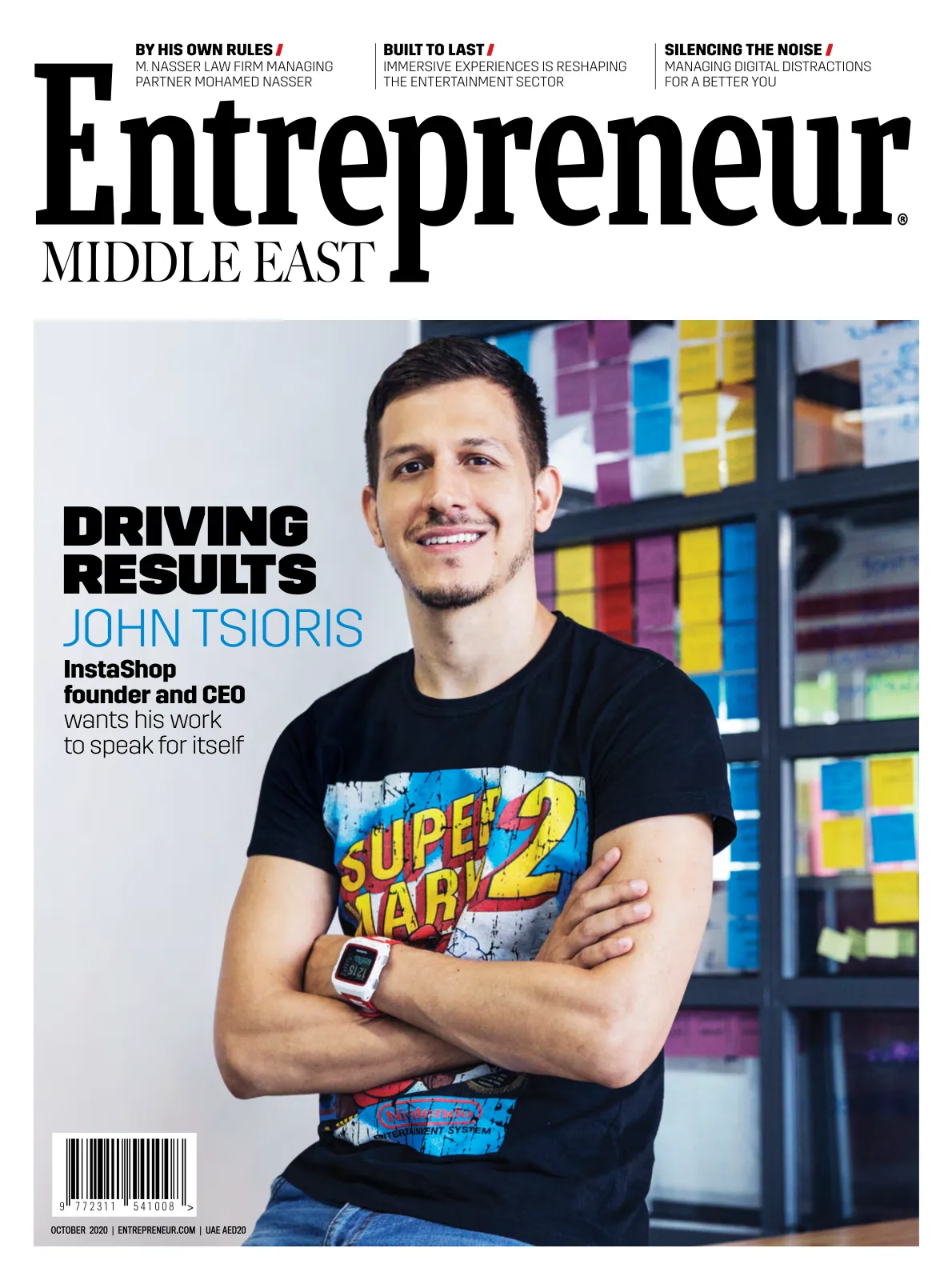
Entrepreneur Middle East, October 2020
Page 1
SILENCING THE NOISE
MANAGING DIGITAL DISTRACTIONS
FOR A BETTER YOU
BY HIS OWN RULES
M. NASSER LAW FIRM MANAGING
PARTNER MOHAMED NASSER
OCTOBER 2020 | ENTREPRENEUR.COM | UAE AED20
9
7 7 2 3 1 1
5 4 1 0 0 8
>
BUILT TO LAST
IMMERSIVE EXPERIENCES IS RESHAPING
THE ENTERTAINMENT SECTOR
DRIVING
RESULTS
JOHN TSIORIS
InstaShop
founder and CEO
wants his work
to speak for itself
Page 2
Continue doing business,
seamlessly and safely
with Smart Office Thermal Screening solutions.
du.ae/thermalcameras
Page 3
Page 4
4 / ENTREPRENEUR.COM / October 2020
18
INNOVATOR
DRIVING RESULTS
InstaShop founder and
CEO John Tsioris
wants his work to speak
for itself.
52
START IT UP
ECOSYSTEM
Reinventing experiences
Dubai’s events sector was
hit hard by the COVID-19
crisis- but the Emirate is
now leading the way in
terms of reimagining this
industry.
24
MONEY
STARTUP FINANCE
Risk vs. reward
A look at how overcoming
fear led The Gritti Fund
founder Marcel Muenster
on his entrepreneurial
journey.
58
START IT UP
Q&A
Ride on
Oman-based Carzaty makes
use of an omnichannel
approach for its online car
showroom platform.
51
CULTURE
LIFE
Enabling environments
It’s time for workplaces
to stop adapting and start
evolving, especially for
women in finance, writes
Hanadi Khalife.
56
START IT UP
Q&A
Swipe for (real) love
Egypt-headquartered Muslim
matchmaking app Hawaya is
in the business of fostering
genuine connections.
38
START IT UP
Q&A
Built to last
The AED45 million
UAE-based equity fund
Immersive Experiences
is reshaping the MENA
region’s entertainment and
leisure sector.
36
CULTURE
LIFE
Silencing the noise
Marcus Smith gives six
tips to manage your digital
distractions.
CONTENTS OCTOBER 2020
18
InstaShop founder
and CEO John Tsioris
wants his work to
speak for itself.
Page 5
5
October 2020 / ENTREPRENEUR.COM /
experience
downtown
living
The UAE’s most exciting new destination.
A journey of discovery for the whole family.
Where nature, fun and entertainment
come together.
800-Arada (27232)
arada.com
Page 6
Page 7
Page 8
Page 9
Page 10
10 / ENTREPRENEUR.COM / October 2020
33 The IVY CLIQ2 Instant Camera Printer lets you
click, print, and stick photos in an instant.
24
30
‘TREPONOMICS
PRO
Handing over the reins
It may be hard, but
sometimes, founders need
to take a step back and
hand over control to a new
team for the betterment of
their enterprise.
60
START IT UP
Q&A
Pacing growth
Mohammed Aldhalaan
on the lessons learnt
while building his Saudi
Arabia-headquartered
edtech platform Noon
Academy.
60 Aziz AlSaeed and Mohammed Aldhalaan, co-founders, Noon Academy
46
START IT UP
Q&A
By his own rules
M. Nasser Law Firm
Managing Partner
Mohamed Nasser on how
he forged his own path in
the MENA region’s legal
landscape.
28
‘TREPONOMICS
PRO
The unicorn state of mind
Property Finder President
Ari Kesisoglu reflects
on how success is not
just about a com-pany’s
evaluation.
50
CULTURE
LIFE
Time for a reset
Marian Salzman on what
the COVID-19 crisis might
mean for gender equality.
32
TECH
SHINY
#TamTalksTech
Gadgets and doodads
that you might’ve missed
out on, sourced by a tech
aficionado.
29
MONEY
VC VIEWPOINT
Looking beyond the
balance sheet
Al Waha Fund’s Areije Al
Shakar explains the role
of soft facts in investment
decision-making.
How overcoming fear led
The Gritti Fund founder
Marcel Muenster on
his entrepreneurial journey
CONTENTS OCTOBER 2020
Page 11
Ready to get
rewarded?
Join Radisson Rewards
for exclusive benefits
We can’t wait to welcome you as a member across our
six hotel brands and 1,100+ locations worldwide. Thank
you for choosing Radisson Hotels.
Award Nights
Use your points for stays - it’s that simple!
Members Only Rate
Save up to 10% when you book on
radissonhotels.com/rewards
More benefits
Including savings of up to 20% on food and
beverages, room upgrades for Elite members
and more
Join today at the front desk
or on radissonhotels.com/rewards
Page 12
12 / ENTREPRENEUR.COM / October 2020
SUBSCRIBE
Contact subscriptions@bncpublishing.net to receive
Entrepreneur Middle East every issue
EDITOR IN CHIEF Aby Sam Thomas aby@bncpublishing.net
CEO Wissam Younane wissam@bncpublishing.net
DIRECTOR Rabih Najm rabih@bncpublishing.net
CREATIVE LEAD Odette Kahwagi
MANAGING EDITOR Tamara Pupic
STARTUPS SECTION EDITOR Pamella de Leon
DIGITAL SOLUTIONS DIRECTOR Mahdi Hashemi mahdi@bncpublishing.net
GROUP SALES DIRECTOR – B2B GROUP Joaquim D’Costa
COLUMNIST Tamara Clarke
INTERN Aalia Mehreen Ahmed
PO Box 502511 Dubai, United Arab Emirates
P +971 4 4200 506 | F +971 4 4200 196
For all commercial enquiries related to Entrepreneur Middle East
contact sales@bncpublishing.net
All rights reserved 2020.
Opinions expressed are solely those of the contributors.
Entrepreneur Middle East and all subsidiary publications in the
MENA region are officially licensed exclusively to BNC Publishing
in the MENA region by Entrepreneur Media Inc.
No part of this magazine may be reproduced or transmitted in any
form or by any means without written permission of the publisher.
Printed by United Printing and Publishing
upp.ae
Images used in Entrepreneur Middle East are credited when necessary. Attributed use of
copyrighted images with permission. All images not credited otherwise Shutterstock.
CONTRIBUTORS
entrepreneur.com/me
ACCESS FRESH CONTENT DAILY ON OUR WEBSITE!
MIDDLE EAST
EntMagazineME
@EntMagazineME
Entrepreneur-me
EntrepreneurMiddleEast
EntMagazineME
EntMagazineME
EntMagazineME
MIDDLE EAST
In addition to our print edition, we’re bringing
you all sorts of industry news on our web
mediums. Joining us online means getting
relevant business and startup content in
real-time, so you’re hearing about the latest
developments as soon as we do. We’re looking
forward to interacting with our readers on all of
our social media and web platforms- like any
thriving business, we’re looking to give and take.
#TrepTalkME is already happening on all of our
digi platforms, and all good conversations go
both ways. See you on the web!
Nader Amiri
Marcello Baricordi
Fida Chaaban
Tamara Clarke
Ari Kessisoglu
Hanadi Khalife
Mohamed Nasser
Marian Salzman
Mark Sephton
Areije Al Shakar
Marcus Smith
Page 13
Page 14
14 / ENTREPRENEUR.COM / October 2020
W
hen doing busi-
ness amid an
economic crisis,
entrepreneurs can-
not be faulted for
wanting to take on
every possible op-
portunity they get to generate revenue
for their enterprises. At the current
stage of the world’s battle with the
coronavirus pandemic, it’s safe to say
that when it comes to business, times
remain tough, cash flow seems to be
coming close to a standstill, and pretty
much everyone is beginning to resign
to the fact that things may never actu-
ally “get back to normal.” As such, it’s
easy to see why people would hesitate
from saying no to any road that prom-
ises returns, regardless of whether the
path indicated is precarious, or even
perilous. But that in itself makes it
clear why we should be thinking long
and hard before making the decision
to go down such routes for our busi-
nesses.
Two recent developments in the
MENA entrepreneurial ecosystem have
been on my mind lately- one was the
shut down of the e-commerce platform
Awok, and the other was the liquida-
tion of private equity firm Al Masah
Capital, both of which were based out
of the UAE. Prior to their collapse,
these two companies were pretty
prolific in the region’s business land-
scape- indeed, they were both featured
in Entrepreneur Middle East at differ-
ent points in time over the last couple
of years. However, their demise has
led to questions being posed on how
these enterprises were really being
run, and what their leaders may have
publicly said about their particular
management philosophies wasn’t what
they were actually practicing in their
respective companies.
Speculations on what essentially
caused the closures of Awok and Al
Masah Capital are undoubtedly un-
derway in the region’s business arena;
however, I have used the principle
of Occam’s razor to come to my own
conclusion about their downfalls- the
simplest explanation here is that these
companies were somehow mismanaged
(depending on who you speak to, there
are quite lot of fingers being pointed).
It seems rather apparent that their
leaders were making bad decisions
when running these companies- to
put it quite simply, they were saying
“yes” to things that they should have
absolutely said “no” to. And therein
lies the warning note for the rest of us
running businesses through the ongo-
ing COVID-19 crisis.
As entrepreneurs, it’s perhaps easier
for us to say “yes” to the wrong things
at this point, with our faulty decisions
being passed off under the premise
of “doing whatever we need to do to
survive.” But if the aforementioned
business failures are any indication,
one should be particularly wary of
doing this- the leaders of those en-
terprises were also almost certainly
thinking of short-term wins when they
made those decisions that would end
up crippling their companies in the
long run. Amid the COVID-19 crisis,
it can be tempting to think of only the
here and now, but remember, your en-
terprise is something you want to stay
for the long haul. As such, step away
from those decisions that don’t make
sense from a long-term perspective- if
anything, your conscience will thank
you for it.
EDITOR'S NOTE
Short sighted decision-making can lead to long-term strife
THE CASE AGAINST QUICK WINS
Aby Sam Thomas
Editor in Chief
@thisisaby
aby@bncpublishing.net
Page 15
FUN COMES
GUARANTEED
YOU DECIDE WHEN THE PARTY
STOPS WITH 24HR FOOD & DRINK.
NOW OPEN AT DUBAI DIGITAL PARK.
RADISSONHOTELS.COM/RED
Page 16
16 / ENTREPRENEUR.COM / October 2020
T
he winners of the UAE leg of The
James Dyson Awards 2020 were
recognized during a ceremony
in Dubai in September, with the
UAE being the first country in
the Middle East to host this event.
The James Dyson Awards is an interna-
tional competition that calls upon young
innovators to solve real-world problems
using design and engineering. The com-
petition, which was launched in 2005,
now takes place in 27 countries with
regional winners going on to compete
in the global finale. An expert panel of
regional judges joined the 2020 James
Dyson Awards candidates to help award
the winners in a ceremony held at Youth
x Hub Dubai. This year’s judges included
Emirati engineer and driverless car
designer, Reem Al Marzouqi, and aircraft
engineer and aviation advisor, Dr. Eng.
Suaad Al Shamsi, among others.
Before announcing the winning entry,
the judging panel took part in a discus-
sion about innovation and sustainability.
While each person drew upon their own
expertise in varying disciplines, the
consistent themes included creativity,
engineering, and simplicity. For instance,
Al Marzouqi explained the difference
between invention and innovation,
noting that it’s perfectly fine to take an
existing product and tweak it. Not only
does this save time, it improves upon
solutions that are already in place. She
also revealed two things that every con-
sumer product needs. “You need to make
money, and you need to be unique,” she
said, noting that those elements were
found in the winning project.
This year’s national James Dyson
Award winners in the UAE is the Touch
Device, an invention that can help people
with visual impairments identify colors
through lights and speech feedback.
People with visual impairments may not
be able to see colors, but they do have a
conceptual idea of what different colors
are. With the invention of Touch, they
can now be in control of some of the
basic daily functions of life, including
being able to choose the color of clothes
they pick from a wardrobe, or identify
supplies such as vegetables at the gro-
cery store.
Invented by two American University
of Sharjah students, Maryam Moustafa
and Nada El Dash, Touch is the ulti-
mate culmination of a class assignment.
“Touch started off as a university project
where we were tasked to create a smart
surface device that would help people,”
explained Nada. “After graduating, our
Professor reached out to us about the
James Dyson Awards with the hopes
that we would apply so we decided to
give it a shot and see what would hap-
pen. The idea of Touch started when we
were brainstorming ideas about smart
surface devices, and the conversation
drifted to the concept of color. We asked
ourselves how we could describe color
if we couldn’t see it. This led us to dive
deep into the conceptual idea of color
from the point of view of the visually
impaired. Touch is the result of trying to
bring color closer to them to give them a
greater sense of independence.”
Touch is an elegantly designed smart
ring that uses haptic, audio, and visual
feedback to alert the user. The ring
vibrates, lights up, or communicates
with the wearer using audio speech via
a Bluetooth earphone. Winning the na-
tional leg of the James Dyson Award will
inject AED 9,500 into the Touch project,
paving the way for the two inventors to
create a working prototype of the device.
Eventually, they plan to expand with
a range of complementary accessories
for the smart ring to include necklaces,
bracelets, cufflinks, and more. Speaking
about the win, Nada said, “We are very
honored and extremely grateful for this
experience. The James Dyson Award has
given us the confidence to push forward
with our careers and continue to think of
ways to help people. It is extremely grati-
fying to have our work recognized and
we are very excited for what the future
holds for us”.
The James Dyson Awards have two
stages, the national competition, and a
second international prize. Touch, along
with UAE runners up Grounded and Obi-
lizer, will now progress to the interna-
tional stage of the James Dyson Award,
whose winners will be announced on
November 19, 2020.
IN THE LOOP
IMAGE COURTESY JAMES DYSON
Here are the UAE winners of The James Dyson Awards 2020
WELCOME A NEW GENERATION
OF ENTREPRENEURS
The winners of the UAE leg of The James Dyson Awards 2020
by TAMARA CLARKE
Page 17
Page 18
18 / ENTREPRENEUR.COM / October 2020
INNOVATOR
DRIVING RESULTS/
InstaShop founder and CEO
wants his work to speak for itself
JOHN TSIORIS
by ABY SAM THOMAS
IMAGES COURTESY INSTASHOP
O
ne of the first things I noticed about
InstaShop founder and CEO John
Tsioris as I chatted with him on Zoom
in September is that he didn’t seem
to be particularly interested in the
conversation we were having. While I
had put on my sunniest demeanor for
the purposes of this interview, I felt like Tsioris was
cautious about interacting with me, with him choos
ing to keep his replies to my questions and prompts
extremely concise, to the point, and nothing more.
As a journalist, I found this situation to be a little dis
concerting- during my time working at Entrepreneur
Middle East, I must confess I’m more accustomed to
interview subjects who, to put it quite frankly, seem
to love the sound of their own voices, and have zero
qualms about droning on and on about themselves
and their achievements. And yet, here I found myself
with Tsioris, who, while having every right to toot
his own horn -he did, after all, lead his five-year-old
Dubai-headquartered grocery e-commerce platform
to be bought by Berlin-based global online food
ordering and delivery marketplace Delivery Hero
for a whopping US$360 million in August this year-
doesn’t seem at all interested in doing anything
remotely like that. In fact, I’m almost certain that he
wasn’t keen on chatting with me, and that he’d much
rather have preferred his time to have been spent
on something else- like, well, his actual work. And
this impression of mine gets further solidified as I
persist with keeping the conversation with Tsioris
going- here was an entrepreneur who, quite simply,
didn’t want to be doing the talking; he wanted his
work to do the talking for him. “Personally, I’ve never
really cared too much about what other people think
about me, about InstaShop,” he tells me. “I always
think that we should speak through our actions.
We just put our heads down, work hard, and drive
results- and the results will speak for themselves. It
doesn’t matter what people tell you; what matters is
what you convey to the world, to society, and so on,
and we’ve been very consistent in that. We’re not a
marketing-focused company, we never really were
the particularly public relations (PR) heavy, bragging
company. I always hoped PR would come naturally,
because we had value.” >>>
Page 19
19
October 2020 / ENTREPRENEUR.COM /
>>>
DRIVING RESULTS | INSTASHOP FOUNDER AND CEO JOHN TSIORIS
Page 20
20 / ENTREPRENEUR.COM / October 2020
This is the sentiment that
seems to have underpinned
Tsioris’ decision to launch
InstaShop in the first place,
in 2015- the Greek entrepre
neur remembers having to
call stores to order groceries
for himself then, and he
found the process to be inef
fective and inefficient, and,
not to mention, frustrating
as well. “The experience was
sub-optimal, and effectively,
I was never happy,” he says.
“And before long, I was like,
I’m done with this, let’s
create an app, and take this
experience to the next level.”
At the time, Tsioris was just
bringing down the shutters
on his first entrepreneurial
outing (a voice social net
work called Vound), and he
launched his new enterprise
with a team of just five
people, while bootstrapping
the company to get it off
the ground. InstaShop’s
business model was (and
remains) pretty straight
forward- it’s essentially a
marketplace that connects
customers with vendors.
The platform facilitates the
purchase and gives users
a hassle-free experience
with respect to getting the
groceries they want, while
the shops take care of the
delivery and logistics them
selves. Of course, it’s hard
to miss InstaShop’s appeal
in the world of today, which,
thanks to the coronavirus
pandemic, has made e-
commerce ventures almost
indispensable to us getting
on with our lives despite
the circumstances that sur
round us. However, back in
2015, Tsioris remembers the
reception to his fledgling
venture to have not been as
enthusiastic as he’d have
liked it- retailers did take
their time before signing on
to be a part of InstaShop
then. But Tsioris doesn’t
believe this aspect of his
entrepreneurial journey was
anything out of the ordinary.
“Everything is difficult in
startups, especially if you
don’t come from a strong
financial background, or if
you don’t have experience,
or if it’s your first time,” he
says. “So, it was hustling; it
was mainly a lot of hustling,
a lot of chasing. Every single
step of the entire process re
quired extensive pushing to
get to the next step. Even on
boarding the first shop was
a big process of convincing
the shop owner that online
groceries is a thing that can
actually generate value for
them, and that it’s not just a
charity or something nice to
have; it’s really going to have
a significant impact in the
future.”
INNOVATOR
Cracking the nut of the complexity of online
groceries, and a functioning, healthy marketplace
is extremely difficult.”
“
John Tsioris,
founder and CEO,
InstaShop
Page 21
21
October 2020 / ENTREPRENEUR.COM /
It may have taken some
effort then- but Tsioris
and his team at InstaShop
are certainly reaping the
rewards for that now. As of
the second quarter of 2020,
the company has managed to
generate nearly $300 million
in gross merchandise value,
with more than 500,000
active users in five countries
across the Middle East. And
InstaShop has done this
all with a comparatively
modest amount of external
investment- Tsioris tells
me that the company had
raised $7.5 million in funds
from Athens-based Venture
Friends and Dubai-based
Jabbar Internet Group in the
five years since its incep
tion. Speaking about the
investors he got on board,
Tsioris notes that both VC
firms were both quite clued
into the long-term potential
of his startup. “Jabbar was
very, very interested, and
they had already identified
the opportunity,” he says.
“So, there was quite some
passion from their side. It
just so happened –[due] to
a certain extent, luck, and
so on- that we met, and our
passions for online groceries
converged. We presented
the idea, they were already
excited about the area, they
saw the future potential,
and they went into it. Ven
tureFriends was considering
investing in our previous
startup, and since we were
converting and going into the
new concept, they explored
that, and they joined it also.
They were also very excited
about the potential of online
[groceries]. It’s a very tan
gible concept, right- it’s easy
to explain: you order your
groceries, and they’re at your
doorstep in under an hour.”
Now, the concept may sound
easy- but let that not take
away from the amount of
work that needs to happen
for it to happen as seamless
ly and smartly as InstaShop
does it. And that would
explain why this startup
continues to make its pres
ence felt in this market land
scape, despite the steady rise
of competition in this space
from both small and large
players. “The way we see it
is that the industry is ex
tremely complicated,” Tsioris
explains. “Even though it’s
at a nascent stage, and there
is potential and so on and
so forth, the reality is that
cracking the nut of the com
plexity of online groceries,
and a functioning, healthy
marketplace is extremely
difficult. So, while we do see
a lot of players that are going
to be playing around [in this
sector], and in general, com
petition is fine and healthy,
we do [expect to] see a lot of
them realizing that maybe
the effort and the focus re
quired is way too high, [and
that] they will eventually
focus back onto their core
business. That’s what we do
see. Because this is a busi
ness that’s not for everyone.
There are different dynamics
that really make a company
able to thrive and grow in
the online grocery segment,
and that’s something that
you can’t find easily.” And
Delivery Hero’s acquisition
of InstaShop does look
like a validation of Tsioris’
analysis of the matter- in a
statement, Niklas Östberg,
co-founder and CEO of
Delivery Hero, noted, “As a
leading player in the grocery
segment, InstaShop has built
a service customers love,
and their expertise is a great
addition to our quick com
merce expansion. Together,
we will continue to invest to
drive the future of delivery
by pushing the standards for
speed and convenience.”
As per the deal’s terms,
InstaShop will continue to
operate as an independent
brand under the Delivery
Hero umbrella, with the
startup’s immediate focus
being on “driving growth
within its current geogra
phies,” while also looking
into opportunities that could
have it expand its footprint
on a global level. As such, the
acquisition is certainly an
achievement that Tsioris and
his team should be proud
about- but it’s interesting to
hear the founder admit that
this wasn’t an end goal he’d
envisioned for the company.
“It wasn’t our goal to be
sold at all; we were quite
happy building the company
independently,” he says. “It
just so happened that we
crossed paths with Delivery
Hero, they’re also very active
in the region, and the mo
ment we crossed paths and
started drafting and discuss
ing, we saw a huge overlap
in our culture, in our style
of working, in our values.
They’re also an organization
that’s very passionate about
growth, very passionate
about supporting local entre
preneurs, and independence
was key for us. So, they gave
us, basically, absolute inde
pendence in operating the
local organization, making
sure that we’re absolutely
relevant and localized. That
was extremely important
for us- also, for myself as an
entrepreneur, I wanted to be
able to act in the region -and
beyond the region when we
grow- by doing what we’ve
been doing best over the
last few years. So that’s the
uniqueness of partnering
with Delivery Hero.”
DRIVING RESULTS | INSTASHOP FOUNDER AND CEO JOHN TSIORIS
AS OF THE SECOND QUARTER OF
2020, THE COMPANY HAS MANAGED
TO GENERATE NEARLY $300 MILLION
IN GROSS MERCHANDISE VALUE,
WITH MORE THAN 500,000 ACTIVE
USERS IN FIVE COUNTRIES ACROSS
THE MIDDLE EAST.
INSTASHOP.COM
>>>
Page 22
22 / ENTREPRENEUR.COM / October 2020
INNOVATOR
According to Tsioris, Deliv
ery Hero is going to be “an
enabler of growth” for In
staShop, and he is confident
that his company’s offering
could work not just in newer
markets in the Middle East
(it’s currently operating in
the UAE, Qatar, Bahrain,
Egypt, and Lebanon), but
anywhere else in the world
as well. Indeed, InstaShop’s
performance amid the CO
VID-19 crisis can be seen as
an indication of how strong
it is as an enterprise- while
Tsioris admits to him and
his team feeling ambushed
at the onset of the pan
demic, they had already
been working towards scal
ing up their operations, and
so, they were ready to tackle
the surge in demand, despite
the challenges presented in
this period. “We experienced
significant constraints in
the supply of our shops,
and at the same time, we
experienced a significant
surge in demand- it’s a
very difficult combination,”
Tsioris says. “But we have a
very strong network of part
ner supermarkets, we have
very strong technologies to
manage adversities from an
operational perspective, and
so, we managed to provide
a reliable service overall,
even when we were facing
extreme chaos and peaks
in demand.” At this point,
Tsioris has only praises for
his team who rose to the
occasion and kept InstaShop
running in these tumultuous
times. “The team is young
overall, so they get excited
with adventures; it’s not
that difficult to keep them
going,” he says. “The more
you pressure them, the more
they get excited, to some
extent. But the reality is also
the pandemic offered us a
mission, and a true purpose.
A lot of our users actually,
suddenly, exclusively relied
on getting their grocery
supplies on InstaShop.
Other people were very
worried about going outside;
they didn’t want to go to
supermarkets at the peak
of the pandemic. They were
heavily relying on us, and
we understood that we had
a very serious role to play in
order to keep the population
at ease, as much as possible.
That really motivated all of
us to keep working harder.”
It’s this ethos that Tsioris
hopes he and his team will
keep building on as they
work on InstaShop’s next
chapter of growth, and that
is something he’s personally
looking forward to as well.
“I guess we’ve combined a
very healthy group of people
that are very performance-
oriented, but are also
have very strong integrity,
and are, overall, very nice
people,” Tsioris notes. “For
us, we really put niceness
above skillfulness, and we
don’t really care if someone
is skillful alone- they won’t
stay in the company if they
don’t have the right cultural
fit in terms of the values,
in terms of how to interact
with the team. We do seek
skill- but skillfulness alone
is not enough.” From a per
sonal standpoint, Tsioris is
keen about developing him
self as an entrepreneur- five
years ago, he was fueled by
a desire to start something
on his own and make a
success out of it; now, he’s
more excited about what
growing what he has built,
and the new set of lessons
that will come with the
process. As he himself put
it: “Everyone sees me now
as a successful entrepre
neur, but the reality is that
there is a lot more to learn
to be a globally successful
entrepreneur.” Of course,
Tsioris does seem to be
ready for the ride ahead-
and we at Entrepreneur
Middle East can’t wait to
see how far he will go.
“The pandemic
offered us a
mission, and
a true purpose.
A lot of our
users actually,
suddenly,
exclusively relied
on getting their
grocery supplies
on InstaShop.”
John Tsioris, founder and CEO, InstaShop
InstaShop team
Page 23
FireLake Grill House & Cocktail Bar, Radisson Blu, Dubai Waterfront
Page 24
24 / ENTREPRENEUR.COM / October 2020
INNOVATOR
IMAGES COURTESY THE GRITTI FUND
How overcoming fear
led The Gritti Fund founder on
his entrepreneurial journey
by TAMARA PUPIC
RISK
VS.
REWARD
Marcel Muenster
Page 25
25
October 2020 / ENTREPRENEUR.COM /
T
hese days, Marcel Muenster, founder
of The Gritti Fund, is getting ready to
assess what MENA startup founders
are made of by testing their mettle- in a
very literal sense.
The Gritti Fund, the world’s first in-
vestment fund focused on the founder’s
mental and physical performance, has
been soliciting applications for its
#PitchUpInTheSky initiative (check
out pitchupinthesky.com for more de-
tails) for a chance to win a US$10,000 investment as
well as mentorship for a year, in addition to a number of
services and perks from enterprises like Lark Suite and
Microsoft For Startups. Held as a partnership with Tik
Tok, the competition will see the shortlisted finalists
deliver their startup pitches as they rapidly ascend in an
aircraft for a skydive in what is expected to be the most
live-streamed startup pitch event in history.
Now, some of you must be wondering where the idea
of delivering a startup pitch before jumping out of a
plane has come from, and it stems from a story that is
not part of Muenster’s official biography but, as you
will see, that tale may well be the driver of a lot of what
he has ended up doing in his life and career. “In 2006,
as a medical student, I applied for a job at a German
company offering on time delivery of bone marrow for
leukemia patients, although I had a significant fear of
flying,” Muenster says. “The only reason why I even ap-
plied for this job was because I realized that the delivery
itself, meaning saving a human life, was way more im-
portant than my own fear. I wouldn’t be who I am today
without this experience. It was the first example of me
overcoming fear in my whole life, and it was one of those
moments that become a tipping point when something
fundamentally changes in the way you see and pursue
life. Without that experience as a student, I wouldn’t
have been as worldly and as educated as I am today.”
RISK VS. REWARD | THE GRITTI FUND FOUNDER MARCEL MUENSTER
“IN ENTREPRENEURSHIP,
YOU ARE DEALING WITH
PROBABILITIES. IF IT WERE
ABOUT CERTAINTY, EVERYONE
WOULD GET RICH, AND
EVERYONE WOULD BUILD
COMPANIES, BUT IT’S REALLY
ABOUT PROBABILITIES.”
>>>
Page 26
26 / ENTREPRENEUR.COM / October 2020
Prior to founding the Gritti Fund, Muen-
ster started up Doctor in Your Pocket, a
global digital medical concierge service.
But his entrepreneurial journey came after
a career as a healthcare management con-
sultant, following his training as a medical
doctor and public health expert at Johns
Hopkins, a reputed non-profit academic
medical center in Baltimore, Maryland,
known for setting healthcare standards
in patient care, research, and education.
Muenster’s change in his career path
is something that will seem familiar to
many in the startup sphere, and while the
reasons behind such decisions may seem
different on the surface, it often all comes
down to being or not being able to make
an impact one has dreamt of in younger
years. “I love medicine for so many rea-
sons, but what led to my decision of not
pursuing medicine as a day-to-day profes-
sion was that I felt that my impact would
be much bigger by supporting the sys-
tem from the outside, rather than being
stuck inside the system at a micro level,”
Muenster explains, noting that it was the
culture of competitiveness that drove him
away from this field. “The medical profes-
sion is an individual sport, not a team
sport,” he says. “It might appear as such,
but in my opinion, it is not, simply be-
cause when you have certain career goals
in that profession, you need to build a
reputation over a very long period of time,
and in most cases, that leads to a very cut-
throat competitive behavior. Often times,
it is more about ‘What’s in it for me?’
rather than ‘What’s in it for us?’”
Having said that, Muenster admits that
the journey from being a Johns Hopkins-
trained medical doctor to becoming the
founder of Doctor in Your Pocket was a
lesson in humility. “I was in this golden
age of John Hopkins-trained doctors
where we were taught that we were the
best in the world, and it sort of gets to
your mind,” he adds. “So, when I became
an entrepreneur, all of a sudden, there
was not much left from ‘the best.’ It was
a very humbling experience. My approach
has changed, which does not mean that
today I simply listen to everyone, but that
I am very humble in the sense that I really
learn every day. What keeps me moving
forward and achieving my goals is being
humble and being curious. Entering entre-
preneurship for making money is, in my
opinion, the wrong incentive, so the right
one is [about] being humble, being curi-
ous, and caring about what you do.”
However, starting up a digital company
out of Boston in 2012 was not smooth
sailing also for so many other reasons,
Muenster explains. “Once we launched
our website, and once we got our first
investors onboard, we started think-
ing about the market in which we could
to test our product, so I went on a trip
around the world, because I knew back
then that I wouldn’t achieve anything
unless I understood what it would take
to sell that company, that product, to
the market,” he says. “Then, I figured
that being a medical doctor is one thing,
but being a medical doctor and trying to
convince other medical doctors to join
your platform was a completely different
ballgame. That was when I learnt one of
my toughest and most enduring lessons
of how actually to become a salesperson.”
Another big lesson for Muenster was mas-
tering the fine art of saying both ‘yes’ and
‘no’ at the right time, and for the right
reasons. “Developing this filter system
really gives you a unique ability to follow
your gut in order to pursue a path that
you think is most likely to succeed,” he
says. “The reason is that, in entrepreneur-
ship, you are dealing with probabilities.
If it were about certainty, everyone would
get rich, and everyone would build compa-
nies, but it’s really about probabilities.”
As a startup founder, Muenster’s com-
mitment and dedication led to the Digital
Health Forum naming Doctor In Your
“THE COMBINATION OF HAVING THE ANALYTICS
AND DATA IN PLACE TO PROVE A POINT AROUND
THE WELL-BEING OF FOUNDERS AND RELATED
BUSINESS OUTCOMES IS WHAT, I THINK,
THAT THE INVESTMENT COMMUNITY WILL
EVENTUALLY UNDERSTAND: NUMBERS.”
INNOVATOR
Marcel Muenster, founder, The Gritti Fund
Page 27
27
October 2020 / ENTREPRENEUR.COM /
Pocket the “Hottest Digital
Health Startup” in 2014, as well
as the startup winning the Web
in Travel Middle East startup
showcase. In 2015, Muenster
was named a finalist for Ernst
& Young’s Entrepreneur of
the Year Award. It was around
that time that Muenster began
to realize the extent to which
the personal and professional
lives of an entrepreneur can
get intertwined, in the sense
that challenging circumstances
in one’s personal life can lead
to less favorable professional
outcomes and vice-versa. “Be-
fore becoming an entrepreneur,
I was a professional athlete
[Muenster was part of the Ger-
man Olympic training center as
a middle-distance runner], and
even though I had the mindset
of discipline and performance,
I got so sidetracked and de-
railed a bit, because I got so
overwhelmed with what was
happening that I couldn’t nec-
essarily see clearly anymore,”
Muenster recalls. “That is when
the whole idea of human perfor-
mance as an underlying driver
for the success of businesses
came about. Now, I can see very
clearly, and my list of priorities
is that my health comes first,
and everything else after it.”
Today, one of the main tag-
lines of his early-stage fund
is helping startup founders to
own their potential. The ulti-
mate goal of the Gritti Fund is
to enhance the success rate of
startups that fail due to founder
burnout (65%), and therefore
change the global investment
paradigm for early-stage invest-
ments. “I cannot singlehandedly
change the mindset of the glob-
al investment space, but what
I can do with a small blueprint
of what we are doing, which is
small in size but big in vision,
is to use the data that we are
collecting and the research that
we are doing as part of the fund
and to try to prove that the
well-being of founders makes a
huge difference on the perfor-
mance of the business,” Muen-
ster says. As of today, the fund
focuses primarily on healthcare
investments in the Middle East
and Africa. It has less than $10
million under management, but
due to investing at earlier stages
-with tickets ranging from
$25,000 to $50,000- it aims
to reach and influence a larger
number of startup founders to
prove that putting their health
first leads to a better perfor-
mances.
Is it a premise that would
gain support from investors
worldwide? “My goal now is
to identify those investors who
care about the topic deeply
enough to actually support it,”
Muester says. “I have been put-
ting so much effort in building
a research team behind our
approach, because of a very
specific reason. Everything that
we do needs to be data-driven.
What is measurable is manage-
able, and what is manageable
gets done. So, if I were just to
go out and talk about this, I
wouldn’t get very far, but the
fact that we are building actual
evidence of this [how the state
of the founder’s well-being af-
fects business outcomes], will
make a difference in the future.
So, the combination of hav-
ing the analytics and data in
place to prove a point around
the well-being of founders and
related business outcomes is
what, I think, that the invest-
ment community will eventu-
ally understand: numbers.”
Muenster points out that he
has already found support for
his endeavor- the current lim-
ited partners to the Gritti Fund
include former Fortune 100
CEOs from Becton Dickinson
and other accomplished entre-
preneurs. “The topic of mental
health has reached the peak
of perception unlike any time
before. It’s a global pain. The
investors who we have attracted
are very accomplished people,
and they truly get what we are
trying to accomplish. As for
the rest, while our work is very
important from the spiritual
and emotional point of view, I
am aware that with the invest-
ment community [in general],
we won’t get anywhere until
they see the numbers. And that
is exactly what we are working
on,” Muenster concludes.
RISK VS. REWARD | THE GRITTI FUND FOUNDER MARCEL MUENSTER
Page 28
28 / ENTREPRENEUR.COM / October 2020
I
t is no doubt that the
Middle East, and the
UAE especially, is rec
ognized as a potential
breeding ground for
new startups and bud
ding entrepreneurs.
An unsaturated market
which has an immense
scope for growth, supportive
government regulations and
initiatives, and a rich pool
of talent eager to drive the
region’s startup landscape
to new heights. According
to MAGNiTT, the MENA
startup ecosystem witnessed
a record high of US$188
million in total funding in
2020. With two UAE-born
unicorn startups, Souq and
Careem, paving the way and
inspiring young entrepre
neurs as well as more es
tablished companies to join
their journey, the country is
well on its path to becoming
a goldmine for new ventures
and tech innovation.
So, what is a unicorn
company? By definition, a
unicorn company is one that
has a valuation of more than
one billion dollars. However,
in my opinion, the definition
of unicorn entails so much
more than a company’s
valuation. The company’s
mindset, the people, the
culture, the operations, how
it optimizes data, and com
bines it with learnings– each
and every aspect of a startup
needs to be streamlined to
work towards the ultimate
North Star, becoming a uni
corn company. Achieving the
status of a unicorn startup is
definitely a moment of pride
for any company, but on a
much bigger scale, it sets off
a series of chain reactions
that in turn impact and
contribute to the national
economy.
Success is directly as
sociated with becoming a
unicorn. The more unicorn
companies that are born
out of the country, the more
attractive the country be
comes to new entrepreneurs
and venture capitalists. As
more and more startups
kick off and succeed, the
country establishes itself as
a rising hub for new profes
sional opportunities, further
attracting top tier talent
from around the world. The
UAE has created an ideal
and nurturing environment
for startups, which range
from long-term visas and
startup incubators, to Abu
Dhabi’s reduction in tech
startup licenses, and a series
of funding and support
programs. While a handful
of brands have achieved the
unicorn status by collabo
rating with leading global
companies to widen their
offering and scope, what the
country lacks is companies
that evolve into unicorns
independently, without
being acquired by bigger
players– and this, is the true
North Star for my company,
Property Finder.
We have been at the fore
front of tech innovation and
advancement, and in 2020,
the company welcomed a
fresh leadership team to
accelerate its journey to be
coming the region’s first ever
independent unicorn com
pany. Each of the five key ap
pointments (President, Chief
HR Officer, Chief of Strategy
and Transformation, Chief
Commercial Officer, and
Chief Financial Officer)
come from leading inter
national companies, and
bring with them a wealth of
knowledge and decades of
experience across varying
industries and departments.
Having served at Google
and Facebook myself, I have
witnessed the mindset and
the culture adopted by these
‘TREPONOMICS PRO
It’s not just about a company’s evaluation
by ARI KESISOGLU
The unicorn state of mind
BY DEFINITION, A
UNICORN COMPANY
IS ONE THAT HAS A
VALUATION OF MORE
THAN ONE BILLION
DOLLARS. HOWEVER,
IN MY OPINION, THE
DEFINITION OF UNICORN
ENTAILS SO MUCH MORE
THAN A COMPANY’S
VALUATION.
Page 29
29
October 2020 / ENTREPRENEUR.COM /
THE UNICORN STATE OF MIND | IT’S NOT JUST ABOUT A COMPANY’S EVALUATION
Ari Kesisoglu is Property Finder’s President. Property Finder is one of the largest technology startups in the region and on a journey
to becoming a unicorn. Ari is driving the leadership team to create a lighthouse technology company that will have a lasting impact
on the entire tech ecosystem in our geography. Ari holds an MBA from INSEAD and a bachelor’s degree in business from Bogazici
University in Turkey. He resides in Dubai with his family. propertyfinder.ae
global players to ensure that all their
operations and employees collectively
align towards achieving one unified
goal.
However, startups enjoy certain
advantages and they can leverage on
their capacity to be more malleable to
change. Established corporates have
rigid structures in place, ensuring
minimal error, but at the same time,
also limiting the scope for creativity.
It has been eight months since I joined
the team at Property Finder, and
every day since has been an incredible
adventure. Global corporates and their
well-defined systems certainly have
their perks, but having reached the
peak of my professional career, I was
excited to join a homegrown startup
and exercise my expertise to drive the
company to new heights. Startups
encourage employees to take calcu
lated risks and completely own their
decision- we encourage our teams to
develop strategies and give them the
bandwidth to spread their wings and
soar to their full potential. If you have
an idea that is well-backed by data to
succeed, there is a sure chance that
you will be given the responsibility to
lead on it and take it forward.
At senior management level, day to
day decisions are easier to execute,
without having to go through layers of
approval. When I joined the company,
we were following a corporate mental
ity, and my first goal was to transform
this into a startup mentality– everyone
is approachable, all our doors are open,
and we are keen to hear all ideas. Each
employee is valuable, and all of their
views will be heard. Once we were on
track progression, operations started
flowing smoother than ever before- a
simple example is the introduction of
live-viewings on our platform. Earlier
this year, we implemented “Ninja,”
a month-long sprint to develop new
products and tech. This resulted in
the launch of live-viewings within two
mere weeks during the lockdown from
the conceptualization of the idea– a
timeline like this would be unimagi
nable at a global corporate.
That being said, regional startups
also enjoy the advantage of adopting
well-established global models to
suit their goals. My advice to young
entrepreneurs aiming to eventually
grow into a unicorn company would
be to first validate the business model,
and find a niche that makes you stand
out from the rest, find out what makes
your product or offering unique, and
build on it. If I were to narrow it down
to three fool-proof routes to success,
these would be:
1. Adapt and replicate a successful
global model to suit regional demand.
Check out the likes of Careem, Souq,
and Property Finder, who noticed a gap
in the market, and introduced a global
ly-recognized model to solve this.
2. Observe and develop a specific
solution that caters to a national chal
lenge. Egypt’s Swvl would be a great
example here– a transportation solu
tion designed to facilitate and simplify
commuting within the city through a
network of bus routes.
3. Develop a product that contributes to
global challenges. Consider Instabug,
which is a platform developed in Egypt
that helps app developers resolve their
issues by offering curated bug and
crash reports and user surveys to cre
ate a seamless end product.
Second, and I can’t stress this enough,
understand the importance of data and
research– the Googles, the Facebooks,
and the YouTubes of the world, none
of them would be where they are today
without their wealth of data. Data
forms the very backbone of every busi
ness– it allows you to predict trends
and develop products and services,
specifically designed to align with the
customer’s needs.
Finally, talent– your aim should be
to recruit leaders, achievers, and men
tors. Even if they may be starting off in
their career, the attitude and energy of
an individual holds the power to drive
the company to incredible heights.
Bring these wonderful brains and
personas into a room together, and
you have created the nerve center of
your company. At the end of the day,
a company’s success lies in the hands
of its workforce– make sure your team
shares the same drive and aspiration
for success, and everything else will
eventually fall in place.
AT SENIOR-MANAGEMENT
LEVEL, DAY TO DAY
DECISIONS ARE EASIER TO
EXECUTE, WITHOUT HAVING
TO GO THROUGH LAYERS OF
APPROVAL.
Page 30
30 / ENTREPRENEUR.COM / October 2020
T
he company that I founded,
elGrocer, now has a new man
at its helm.
Over the last few weeks,
the most common question I
got from fellow founders and
friends was why Raed Hafez
(an existing board member at elGrocer)
had been appointed as the company’s
new CEO, while I have been moved to
being “just” the COO.
It may sound strange to many: why
would anyone relinquish the CEO title
and the dream of running their own
show? In fact, such changes are usually
filled with controversy, and more
typically, “forced” by an enterprise’s
investors/boards, or perhaps done due to
an acquisition.
But, in my case, there is no such thing-
in fact, I requested Raed to take over the
role. And I am not just okay with that; I
am excited.
After over 10 years in the corporate
world, in 2017, I quit my job at Coca-Cola
to lead elGrocer and satisfy a hunger to
start my own business. I felt it was the
right time to take the plunge, despite
the fears of whether I was ready to do
this, as well as its associated risks.
However, the enthusiasm of friends and
family, who were our seed investors,
simply encouraged me to take the leap.
And, when we started elGrocer, besides
being one of the first investors, Raed’s
experience, wisdom and mentorship,
along with the chemistry we shared with
each other, was something I heavily relied
on, especially given that elGrocer was my
first venture.
The best part of this journey, besides
the excitement and lessons learnt, was
the self-discovery. Having built a solid
career in the fast-moving consumer
goods (FMCG) industry in marketing,
commercial management, product
innovations, and strategy, I learned more
about myself in the last three years. I not
only recognized what I am good at, but
also what I really enjoyed, and that’s a
fine line.
No matter how much you love what
you are doing, there are many tasks we
don’t enjoy, but are unable to delegate to
our teams. In my case, I found that I am
much more passionate about operations,
product, business development, team
management, coming up with new ideas
and executing them, and less about many
other things that a CEO’s role required,
and that was fine as long as I could
balance my time.
However, the coronavirus pandemic
crisis changed the game.
For a long period of time since
its launch, elGrocer had very little
competition in the online grocery space,
and it was growing quite steadily. But
the COVID-19 crisis did not just change
the volume of orders; it also changed
the competitive landscape, the investor
appetite, consumer behavior, and the
retailer perspective online, posing a
whole new set of operational challenges.
Our key differentiator, which was
offering a full logistics set of services to
our retail partners, became a complex
operation with hundreds of people
handling thousands of daily orders,
while communicating and keeping the
customer base satisfied and confident of
receiving their orders.
At the same time, all our FMCG brand
partners increased their spend and their
elGrocer campaigns, while many more
brands approached us to get onboarded.
In the middle of all this, we were also
already in the plans of planning our
Series A round, and that work could not
stop. Each of these areas required a team
of experts in order to continue driving
the company towards excellence in
everything it does. This brought me back
full circle to the board and investors. I
asked for more support, and I received it!
We quickly got a bridge investment and
the go-ahead for the additional resources.
Looking at everything that needed
to be done, I knew that my heart and
passion was in the operations side of the
business, as it defined the cornerstone
of our differentiation. I also knew that
Raed’s skills in leadership, strategy and
Founders may need to step back and hand
over control to a new team for the betterment
of their enterprise by NADER AMIRI
Handing over the reins
‘TREPONOMICS PRO
Nader Amiri is the founder and COO of elGrocer. elgrocer.com
elGrocer’s Xavier Nunez, Raed Hafez and Nader Amiri
IMAGES COURTESY ELGROCER
Page 31
31
October 2020 / ENTREPRENEUR.COM /
investor relations would serve the
company best in the CEO position.
And that’s why I look forward to
advancing our shared vision under
the new leadership headed by Raed.
As such, Raed, Xavi Nunes (CMO),
Tareq Abu Kaff (CTO), and I will each
drive in unison to grow elGrocer and
achieve new milestones. After all,
elGrocer is a leading player in the
UAE market, and it will soon become
a leading regional and global player
as a result of the combined efforts of
the new leadership team.
elGrocer is the first of, hopefully,
many new ventures I intend to found
over the years, and I’m confident
now more than ever before that we
have the best team and leadership to
create a success story, because money
can buy many things- except the right
people’s minds and hearts.
HANDING OVER THE REINS | FOUNDERS MAY NEED TO TAKE A STEP BACK AND HAND OVER CONTROL TO A NEW TEAM
Areije Al Shakar is Director and Fund Manager at Al Waha Venture Capital Fund of Funds. alwahafund.com
W
hen it comes to investment-
decision making, VCs rightly
focus on the detail. We conduct
comprehensive and complex analysis
of fundamental and technical metrics–
we look at the hard facts, such as a
company’s financial statements and the
competitive landscape within which it
operates. In this way, we seek to form a
holistic picture and make definitive as-
sessments of a company’s potential for
growth.
But what about the soft facts? How
many times do we overlook as investors
the importance of building teams, for
example, and how much do we actually
drill down into it? We might talk about
experience, background, and schools, but
how do we actually measure the ability of
those people being able to adapt to dif-
ficult situations or decision making?
Perhaps one silver lining to the ongoing
COVID-19 crisis is that it has forced us to
refine and refocus our approach. I have
written before how the pandemic has
forced VCs to be more diligent, sparing,
and strategic in their investments. The
first six months of 2020 saw record lev-
els of funding attracted by MENA start-
ups, even as around much of the rest of
the world, VC confidence had taken a hit.
But something had changed. Investors
are investing more money, but in fewer
startups, targeting lower-risk, later-stage
companies, and focusing on industries
that have evolved in the current climate,
such as fintech, edtech, and healthtech.
What else has changed? Increasingly,
investors are looking beyond the balance
sheet. CSR, diversity, employee engage-
ment, and retention -the non-financial
and non-market related factors, the soft
facts until recently were little more than
a box-ticking exercise for investors– have
taken on a renewed prominence in any
VC’s decision-making process. During
the current crisis, considerations such
as developing an adaptable and innova-
tive team have emerged as an ongoing
ambition and priority for any firms looking
to deliver sustainable growth. And when
hiring an individual, you don’t just look at
their experience and education to make
a hiring decision, you meet them and test
them to understand who they are as a
person and how they would work with
your team.
In the Middle East, our burgeoning VC
community is still in its early stages. We
are continuously learning and exploring
how to grow and improve– both from
studying what other, more established
ecosystems have achieved, and also
where they have gone wrong. A region of
late adopters and fast learners, we are
also able to react and adapt with more
agility than others when it comes to
paradigm-shifting crises.
This is how we stay ahead of the curve.
There are plenty of lessons to learn
from COVID-19, but perhaps the most
important for the region’s VCs, whether
they err towards the fundamental or
technical side, is the need to focus on the
soft facts as much as the hard. It is time
to look beyond the balance sheet.
LOOKING BEYOND THE BALANCE SHEET
THE ROLE OF SOFT FACTS IN INVESTMENT DECISION-MAKING
by AREIJE AL SHAKAR
Page 32
32 / ENTREPRENEUR.COM / October 2020
GADGETS AND DOODADS THAT YOU MIGHT’VE MISSED OUT ON, SOURCED BY A TECH AFICIONADO.
YES, IT’S OKAY TO WANT THEM ALL… AND NO, IT’S NOT OUR FAULT.
TAKE YOUR PICK
VIVO X50 SERIES
IMAGES COURTESY VIVO | CANON | HONOR
TECH SHINY
Vivo’s new X50 series delivers, be it
with its advanced professional photog-
raphy features, or its sleek, smart
design. Both the X50 and X50 Pro
sport a 6.56-inch AMOLED display
with 90 Hz refresh rates. Powered by
a 33W FlashCharge battery 2.0, the
devices charge to around 57% in just
30 minutes. Vivo X50 smartphones
also feature 5G Seamless Switch, a
function that automatically switches
between 5G and 4G networks for
optimized connectivity. While both
phones have a lot in common, they
each have characteristics unique to
them. The X50 has a 32MP front
camera and four rear cameras, includ-
ing a 48MP main camera with optical
image stabilization (OIS), an 8MP
super wide-angle camera, a 13MPpro-
fessional portrait camera, and a 5MP
super macro camera. On the other
hand, X50 Pro has a 32MP front cam-
era, with four rear cameras including
a 48MP gimbal main camera, a 13MP
professional portrait camera, an 8MP
super wide-angle camera, and an 8MP
5x telescopic camera.
Vivo X50 series
Vivo X50 series
Page 33
33
October 2020 / ENTREPRENEUR.COM /
#TAMTALKSTECH Tamara Clarke, a former software development professional, is the tech and lifestyle enthusiast behind The Global Gazette, one
of the most active blogs in the Middle East. The Global Gazette has been welcomed and lauded by some of the most influential tech brands in the
region. Clarke’s goal is to inform about technology and how it supports our lifestyles. See her work both in print regional publications and online on
her blog where she discusses everything from how a new gadget improves day-to-day life to how to coordinate your smartphone accessories.
Visit theglobalgazette.com and talk to her on Twitter @TamaraClarke.
#TAMTALKSTECH | GADGETS AND DOODADS THAT YOU MIGHT’VE MISSED OUT ON
SNAP ATTACK
CANON IVY CLIQ2
The IVY CLIQ2 Instant Camera
Printer is designed with fun in mind.
Built with a 5MP camera, automatic
flash, and the coveted selfie mirror,
the all-in-one device lets you click,
print, and stick photos in an instant.
It’s pocket-sized, so you can take IVY
CLIQ2 with you, and use it on-the-go.
It even lets you get creative and print
with a white border, or make use
of filters using its built-in Frame &
Filters feature. Thanks to a peel-and-
stick backing, you can place the 2x3
inch photos that it prints virtually
anywhere. To match your style, the
new Canon IVY CLIQ2 comes in three
fresh colors: petal pink, turquoise,
and charcoal.
HONOR Magic Earbuds render
sound that you can feel– literally.
With intuitive touch controls, you
have the ability to take full control
of what you’re listening to. HONOR
Magic Earbuds are designed with an
intelligent built-in capacitive touch
sensor, which lets you manage
playbacks, phone calls, and toggle
the noise cancellation feature with
a few taps. By double tapping on
either earbud, you can play or pause
the music when in music mode,
and answer or end calls when in call
mode. By pressing longer on the
earbud, you can control the noise
cancellation feature by turning it on
or switching it off. If that doesn’t
suit, you also have the ability to cus-
tomize touch commands using the
Huawei AI Life application on your
smartphone.
SOUNDS LIKE MAGIC
HONOR MAGIC EARBUDS
HONOR
Magic Earbuds
IVY CLIQ2
Page 34
34 / ENTREPRENEUR.COM / October 2020
CULTURE TRAPPINGS
IMAGE CREDIT PAUL SMITH | ESPAND | MORESCHI | LAMISE BEAUTY
‘TREP TRIMMINGS
THE EXECUTIVE SELECTION
F
rom better goods to better wardrobe bests, every issue we choose
a few items that make the approved executive selection list. In this
issue, we present our picks from Paul Smith, Moreschi, and more!
ON THE CLOCK
Paul Smith AW20
THE SPIRIT OF REINVENTION
PAUL SMITH SS20
For its 50th anniversary collection,
Paul Smith is refreshing its
signature wardrobe elements for
the Autumn/Winter 2020 line.
The brand is bringing back prints
and shapes to reinvent renowned
pieces. Classic double-breasted
overcoats are made with contrasting
top stitching and raw edges, while
also giving way for the clean, lean
tailoring style of the 70s. Natural
tones influence the palette, with
teal, clay, and terracotta that are
complemented with shades of sky
blue. With the fluidity of lightweight
Italian fabric, there’s an air of
ease and looseness at the heart of
this collection, along with tailored
garments that are made just for you.
paulsmith.com
OFF THE CLOCK
Paul Smith AW20
ON THE CLOCK
Paul Smith AW20
Page 35
35
October 2020 / ENTREPRENEUR.COM /
'TREP TRIMMINGS | THE EXECUTIVE SELECTION
EDITOR’S PICK
A STORY IN EVERY STITCH
ESPAND BY MAZ
Launched at the beginning of the year, Espand by Maz is
a brand that pays homage to the culture of Afghanistan.
Following a visit to the country, founder Mariam Haz
Hakim was inspired to create a brand that reflected Afghan
heritage, while fusing Eastern and Western cultures to build
a line that could be worn in a contemporary environment.
With materials bought from Afghanistan and then sewn in
the UAE, the brand has had a great response so far, with
it being sold not just in the region, but also in Austria,
Australia, Canada, and the UK. While it has an assortment
of jackets, abayas, and bags to showcase, we have our eye on
the mirrored rainbow clutch. espandbymaz.com
MEDITERRANEAN MOODS
MORESCHI
Not yet ready for autumn? Then you’d probably like to take a look
at Moreschi’s Spring/Summer 2020 range, which is influenced by
the Mediterranean Sea, with a color palette varying from the intense
blue shades of the sea, to the neutral sand colors of brown, alongside
touches of orange, green, and grey. Emulating a relaxed and informal
vibe, the collection still evokes the signature Moreschi style of
effortless chic, while also keeping in mind comfort and quality for
the wearer. With loafers, oxford, and derby styles in the collection,
there’s a lot to choose from. moreschi.it
LAMISE BEAUTY
Entrepreneur Kate Wooyeon Park initially launched Lamise Beauty
in 2017 as an online platform that showcased some of the best
brands from South Korea and curated a variety of products suited
for people living in the Middle East. This proved to be a hit, and
in 2019, the brand went on to launch a physical store at Asian
supermarket and specialty coffee shop, 1004 Gourmet in Dubai.
For those of you who are unfamiliar with Korean beauty products,
we recommend trying out the Huxley Cleansing Foam: Deep Clean,
Deep Moist, which is a soft foam with naturally-derived ingredients
that is great for all skin types to remove oil, sebum, and other
impurities with a simple
cleanse. And if you’re
looking for a bonus pick-
me-up, we’re eyeing up
the Huxley Esse: Grab
Water, a lightweight
essence with Sahara
prickly pear seed oil,
acai berry, and more
antioxidants to protect
and hydrate your skin.
Simply apply a thin layer
onto your face, and then
pat lightly to help with
absorption- your skin will
thank you for treating it
right! lamisebeauty.com
Huxley
Moreschi SS20
Page 36
36 / ENTREPRENEUR.COM / October 2020
T
he world is becoming noisier by
the day, with distractions seem-
ingly flung at us from every direc-
tion. While some may argue a
little noise can reap benefits, with
it comes huge distractions that
prevent us from doing some of our best
work, meaning we need to be very careful.
When was the last time we sat down to
read a chapter of a book without check-
ing Instagram, or had a deep conversation
with a friend without a phone pinging in
the background? It would seem such days
are few and far in between. Mind blowing,
isn’t it?
More than once, Netflix’s latest
documentary The Social Dilemma suggests
that social media represents “humanity’s
greatest existential threat,” exposing
the ways in which technology giants
have manipulated human psychology to
influence how we behave. And if you think
that sounds absolutely terrifying, then
you’d be right.
Not only is much of this increased
noise is distracting us from reaching our
highest potentials, it is also intoxicating
us, and filling our human hard drives with
information and thoughts that somehow
make us doubt ourselves, feel inadequate,
or even give up on our dreams completely
before we have even really started.
It’s not all doom and gloom though, and
the good news is that in order to change
this, all we need are some simple tools to
help silence the noise and release us from
these toxic distractions. Here are six tips
that are easy to integrate into our daily
lives, and will ensure you stay on that path
to success and achieve your goals in 2020
and beyond.
1. Silence the noise
Hands up if you own a mobile phone, lap-
top, or tablet. Chances are high. However,
there’s nothing stopping you from turning
off notifications when it’s time to get your
head down and work, or simply enjoy some
you-time without distractions from the
outside world. Do you really need to be
disturbed every time someone replies to
your LinkedIn post, or likes your picture
on Instagram? While we’re not completely
to blame –studies show that with every
“like” or “follow,” the brain releases the
neurotransmitter dopamine, effectively
causing it to rewire itself to constantly
crave social media- ask yourself what val-
ue that brings to your life. A notification
does not make you a better human being,
so please turn it off. Apply the same habits
to the books you read, friends you socialize
with, and places you visit.
2. Plan your time
An increasing number of people do busi-
ness via WhatsApp, making it impossible
to do good work if you are constantly
checking your phone. Instead, set aside
specific time slots each day to get back
to messages, and make sure you stick to
them. Back in the early days, I worked
for a company who would connect to the
internet for one hour in the morning and
one hour in the evening, which worked
perfectly as it meant we would check our
emails in the morning, work on them in
the afternoon, and then reply in the even-
ing. While I know this would be impossible
and potentially detrimental in today’s
workplace, the concept of planning time to
address emails and WhatsApp messages
will help keep you focused on all other as-
pects of your life and work as well.
3. Develop a deeper understanding through
daily reflections
While people may dismiss daily reflections
as a passing new age trend, they have actu-
ally been a popular practice for a number
of years. A short daily reflection is nothing
but a healthy habit where you regularly re-
flect on why you do certain things, analyze
how effectively you are doing them, and,
most importantly, evaluate where your
actions are leading you. It is important to
take this time for yourself and to better
understand your actions, behavior, and
their end results.
Managing digital distractions
for a better you
THERE’S NOTHING STOPPING YOU
FROM TURNING OFF NOTIFICATIONS
WHEN IT’S TIME TO GET YOUR HEAD
DOWN AND WORK, OR JUST
SIMPLY ENJOY SOME YOU-TIME
WITHOUT DISTRACTIONS FROM
THE OUTSIDE WORLD.
by MARCUS SMITH
Silencing the noise
CULTURE LIFE
Marcus Smith is an entrepreneur, motivational speaker, and international athlete. With a clear vision of building brands that improve people’s
lives through health, culture and environment, he has developed and established two successful businesses, including international
performance company, InnerFight, and paleo food provider, Smith St Paleo. innerfight.com
Page 37
37
October 2020 / ENTREPRENEUR.COM /
4. Check in on your goals often
When unnecessary distractions eat up
time that we could be dedicating to
chasing our goals, it can be detrimental
to self-development. Keep yourself on
track by having your goals clearly writ-
ten down with timelines, and be com-
mitted to those timelines. Your daily
reflections should help you realize if
your actions are taking you closer to
your goals or further away, and if it’s
the latter, then it might be time to in-
vest in some form of help, support, or
mentorship to get you back on track.
5. Have clear outs
The same way that your closet needs
cleaning out every six months, so do
the things that are distracting you. In
the era of technology and countless
apps, an effective clean up involves
reorganizing your phone, and deleting
numbers no longer in use as well as
apps that do not serve you. The same
applies for your social circle, too– be
it friends or family, don’t be afraid to
remove toxic people from your life that
do not make you a better human. Clear
outs on every single level in life are
beneficial, and they should happen on
a regular basis.
6. Take days off
As we’re becoming more tech-savvy in
our digital-centric lives, our physical
and mental health just can’t keep up.
Quitting the use of technology cold
turkey is unrealistic, but taking the
odd day off can work wonders for your
well-being. Start easy if this makes you
anxious- leave your phone in a drawer
for an hour, and build from there.
You will probably feel lost at first, but
you’ll be able to fill this time with
something fun and productive, and
instead of documenting every moment
of your weekend, you can enjoy each
moment without the pressure of being
constantly connected.
While the onset of social media has
most certainly connected people,
the flipside is that the distractions
it causes simply don’t serve you and
your goals. By following these simple
tips, you can reduce or completely
remove these distractions, and take
pride in the fact you are creating
a better, more rounded version of
yourself.
SILENCING THE NOISE | MANAGING DIGITAL DISTRACTIONS FOR A BETTER YOU
L
ife has become more and more chal-
lenging now. We are more stressed
and anxious than ever before. While
I prefer to live in reality and the here
and the now, I have always looked to the
horizon for the next best thing to enter my
life, and when it’s hard to see the more posi-
tive things on the horizon, it can leave you
feeling flat.
So, how do we find beauty in the imper-
fection? How does one practically and
mentally do just that? I have always been
one to try and overcome a challenge- after
all, I have a fair degree of stubbornness that
runs through my veins, and I want every-
thing yesterday. I am pretty sure that could
ring true for you too, and so, here’s how I
have gone about realizing this particular
endeavor, and how you could do the same:
1. ACCEPTANCE
Accepting where you are in life, and real-
izing you have what you have based on the
choices you make (with some exceptions,
of course), but if we really look at our life,
our situation is often based on the small
everyday choices to the more life-changing
ones that we are responsible for, where we
live, what job we do, etc. Acceptance often
brings us empowerment. We become at
peace with ourself when we just accept
where we are in life, and look to make small
steps to improve and evolve in our quest for
more fulfilment.
2. PROCESS
T. D. Jakes said: “You can’t have progress
without process.” This means that some
lessons in life, we simply can’t bypass. There
is wisdom, growth. and knowledge in the
process. People dislike Monday’s so much,
and yet the only way to the weekend that
people love is to go through Monday to get
to it. Sometimes, we have to go through
the ugly and the painful (a child birth, for
instance) to have a positive result (a baby).
3. BEING GRACIOUS WITH YOURSELF
For me, this is probably the most important
point, and the one that I struggle with the
most. I always expect more and better from
myself, I always want to outperform myself;
I want to live in the best way I know. I want
to do everything with heart, or not at all.
The need here is for us to realize that what
we may be going through in life is stressful,
difficult, and problematic, without feeling
the need to embrace shame and guilt when
perhaps we haven’t dealt with a situation
with excellence, and so become highly criti-
cal of our own behavior or performance. We
must accept when we are doing our best,
and be accepting that, at times, sometimes
our best is not enough, and that’s ok.
4. A SHIFT IN MINDSET
Everything is won and lost within our minds.
Our ability to rule our mind is the most criti-
cal component to the way we see the world
and ourselves. Our mind is what will lead
us to our greatest achievements and our
worst nightmares. We are all on a journey of
self-discovery. Finding beauty in the imper-
fection comes from us shifting our minds to
one of criticism to self-care, and extending
grace to our imperfections and moving
from the not-quite-there-yet to the realm of
I-have-nailed-it.
At the end of the day, we need to know
that where we are right now is not where
we are going to be tomorrow, next week, or
next year. Depending on how well life is go-
ing, that could be me throwing you a bone,
or giving you a reality check that life fluctu-
ates between the beautiful and the brutal,
but when it is of the more brutal variety,
that’s when we all need to find the beauty
in the imperfection, in the pain, and in the
struggle. Be encouraged, take two minutes
to consider where you are in life, and how
you feel, and while your family, business,
and life maybe missing key components,
you can still find little pockets of beauty. Life
keeps moving forward, so the small choices
we make every day do matter, and they do
count. Rome wasn’t built in a day- focus
on the bricks, and not the fortress. Focus
on the beauty in the imperfect. Establish a
routine and stick to it, create spontaneity
within your routine, and take back control.
Appreciate there is always a gulf between
where you are, and where you want to be.
THERE’S VALUE TO BE FOUND IN THE TRANSITION FROM WHERE WE ARE,
TO WHERE WE WANT TO BE by MARK SEPHTON
FINDING BEAUTY IN THE IMPERFECTION
Mark Sephton is an international mentor to entrepreneurs, an acclaimed radio and
TV show host, and a top selling author. marksephton.com
Page 38
38 / ENTREPRENEUR.COM / October 2020
BUILT TO LAST/
Immersive Experiences
The AED45 million UAE-based equity fund is reshaping
the MENA region’s entertainment and leisure sector
“YOU NEED TO BE
CONSTANTLY ASKING
YOURSELF, AT EVERY
STAGE OF THE PROCESS,
WHETHER THERE IS A WAY
OF IMPROVING INDIVIDUAL
ASPECTS, OR THE
CONCEPT AS A WHOLE.
AND, A CONCEPT NEVER
REALLY ‘FULLY DEVELOPS,’
BUT CONTINUES TO
EVOLVE OVER THE COURSE
OF ITS LIFECYCLE.”
Sameer Ali
Co-founder and Managing Partner,
Immersive Experiences
START IT UP Q&A
IMAGES © IMMERSIVE EXPERIENCE | IEX.AE
Page 39
39
October 2020 / ENTREPRENEUR.COM /
T
he COVID-19 crisis has
presented investors with
an opportunity either to
pause and rethink their
investment strategies- or
to unlock their courage and
use their capital to com-
pletely disrupt and redefine
industries as we know
them today. Sameer Ali,
Mohamed Ali, and Sultan
Alrajhi, the trio of seasoned entrepreneurs
who co-founded Immersive Experiences, an
AED45 million UAE-based equity fund, fall
in the latter group.
Formed in 2017, Immersive Experiences
came to life after the co-founders identified
a gap in the region’s entertainment indus-
try, which led them to spend over a year
and a half selecting a suite of pioneering,
engaging, and multi-sensory entertainment
concepts to completely reshape the current
entertainment options that exist in the
region today. To date, its portfolio includes
a mix of franchised facilities, as well as its
own proprietary flagship concepts- these
include Xstrike, a live-action combat simu-
lation concept that successfully bridges
the gap between traditional paintball and
laser-tag; Woo-Hoo!, an experiential edu-
tainment center that stimulates children in
a fun and entertaining way; MultiVRse, a
bespoke virtual reality theme park that of-
fers an unparalleled combination of realism
in motion, graphics and team-member in-
teraction; WipeOut Park, the action-packed
experience known from the popular televi-
sion show that brings challenging courses
and epic obstacles built on both land and
water; and DARE, the first of its kind gami-
fied indoor adventure park in the UAE.
Bringing these concepts into reality is a
challenging task, involving several shifts
taking place from the conceptualization
stage to the final implementation, all of
which Sameer Ali considers to be a good
thing. “It’s important to never ‘settle’ when
developing a concept,” he explains. “You
need to be constantly asking yourself, at
every stage of the process, whether there
is a way of improving individual aspects,
or the concept as a whole. And, a concept
never really ‘fully develops,’ but continues
to evolve over the course of its lifecycle.”
Asking the key questions at every stage of
the process is crucial, Ali adds. “We need
to ensure that the business model is resil-
ient with margins that are not just healthy,
but sustainable as well. We need to ensure
that the concept will not just ’work’ as
a standalone location (for example, in a
warehouse), but THRIVE in such circum-
stances. Therefore, we keep on returning to
these questions with each stage of evolu-
tion and development, and if we’re not sat-
isfied with any of the answers, we have to
refocus our efforts, re-strategize our goals,
and make the correct tweaks and altera-
tions to get the answers, and eventually,
the outcome, that we need.”
With this approach, it is easy to under-
stand that Immersive Experiences is based
on very solid foundations, and thus at-
tracts many requests for cooperation and
partnerships. The fund has an aggressive
roll-out plan that is set to see more than
15 facilities launched across various ter-
ritories in the region in the coming years, a
couple of which are set to open by the end
of 2020. Mohamed Ali notes that all their
plans are built to withstand any future
market changes and challenges, and to add
to that, Sultan AlRajhi believes that the
regional market seems ready for their new
and refreshing ideas. “We have seen a surge
in interest from top retail players across
the GCC who are looking for new opportu-
nities and innovative concepts to reshape
the retail experience,” he concludes. “In-
vestor confidence remains solid; in fact,
confidence is rising as new opportunities
present themselves, and new ideas are
brought to the fore. Now is an exciting time
for the industry as companies and inves-
tors pivot to a new way of thinking to ac-
commodate customers and their demands.
Moving forward, our focus will continue to
be on creating concepts that are disruptive,
but also safe.”
Sultan AlRajhi
Co-founder and Managing Partner,
Immersive Experiences
“NOW IS AN EXCITING TIME
FOR THE INDUSTRY AS
COMPANIES AND INVESTORS
PIVOT TO A NEW WAY OF
THINKING TO ACCOMMODATE
CUSTOMERS AND THEIR
DEMANDS.”
>>>
BUILT TO LAST | IMMERSIVE EXPERIENCES
Page 40
40 / ENTREPRENEUR.COM / October 2020
Please tell us more about the
investment thesis of your fund-
what does it mean to set “the
future direction for growth in the
leisure and entertainment sector
by investing in new, disruptive
concepts”?
The region’s entertainment industry
has remained stagnant for the last
two decades with little in the way of
innovation. People, companies, and
investors have been too focused
on safe concepts– they haven’t
looked for inspiration, or aimed to
bring in anything radical, new, and
able to shake up the marketplace.
This means the landscape is ripe for
disruption and poised to accept new
concepts. Despite a sluggish attitude
towards change, over the last 5-6
years, investment in traditional en-
tertainment has actually increased
as retailers look to drive footfall. We
feel this is a sideways, or backwards
step. In millennials and Gen Z, we see
that audiences are changing. Per-
sonalized experiences and 360-de-
gree immersive entertainment is
where the industry is headed. The
investment in edutainment has also
increased significantly, as audiences
seek more unique and experiential
sources of fun and opportunities
to socialize. Moving with the times
has never been more important, so
you must have an eye on trends,
successes and failures in order to
deliver a product that is impactful,
sought-after, and fun.
Has the COVID19 crisis changed
your strategy when it comes to the
fund’s current investments?
It hasn’t changed our strategy. It’s
made us pause, reevaluate, and
change our operations model, but
the strategy remains the same– to
focus on fresh, innovative concepts
that disrupt traditional leisure and
entertainment. The COVID-19 crisis
has lead us to perform what we call
our internal “sanity checks” on the
concepts we have in the pipeline to
make sure that they can function
just as well in a post COVID world,
as they would before. Our belief
in the leisure and entertainment
industry as a whole has not only
been reinforced, but strengthened–
we do believe the industry will boom
in a post COVID world. We’re still
driven by our core goals: competitive
pricing, premium experiences, and
innovative concepts. If anything, the
COVID crisis has accelerated the de-
cline of traditional retail within malls,
which was already in freefall due to
the rise of e-commerce. This trend
has lead to a number of developers
in the region making overtures to
us, because of which we’ve had to
accelerate our own expansion plans
given the opportunities present.
What piece of advice would you
share with other investors in the
leisure and entertainment sector?
Don’t be afraid of investing in new,
innovative, and fresh concepts, but
always keep the demographics of
the region in mind if you’re doing
so. What works elsewhere is not
guaranteed to work in the GCC.
Avoid the temptation to import
ideas and concepts wholesale from
abroad, and “drop” them into a new
environment where customers have
different tastes, wants, and sensibili-
ties. Ideas are there to be reworked,
reinterpreted, and repackaged– you
must be prepared to put in the work
to evolve concepts and always get
creative. Feasibility is also hugely
important. At the end of the day, any
investment needs to make sense
from an ROI perspective, as business
ideas are only as good as the profits
they make for their investors. Also,
don’t be afraid to look closer to home
for ideas and talent. There’s lots of
fantastic talent in the region right
now and, importantly, they know all
about the people you want to get
through the door. Regional talent
knows what works for the region in
a way that a lot of external consul-
tants may not- it really is that simple.
Sultan AlRajhi, co-founder and Managing Partner,
Immersive Experiences
INVESTING WITH COURAGE/
Q
&
A
START IT UP Q&A
“AVOID THE TEMPTATION TO
IMPORT IDEAS AND CON-
CEPTS WHOLESALE FROM
ABROAD, AND “DROP” THEM
INTO A NEW ENVIRONMENT
WHERE CUSTOMERS HAVE
DIFFERENT TASTES, WANTS,
AND SENSIBILITIES.”
Page 41
41
October 2020 / ENTREPRENEUR.COM /
IT’S IMPORTANT TO KEEP
AN OPEN MIND TO IDEAS THAT
SEEM UTTERLY RIDICULOUS
BECAUSE, MORE OFTEN THAN
NOT, THESE ARE THE ONES
THAT, WITH A LITTLE FINE
TUNING, END UP BEING THE
VERY BEST YOU HAVE!
BUILT TO LAST | IMMERSIVE EXPERIENCES
>>>
Given your expertise in the leisure and
entertainment sectors, please tell us
more about how the fund selected
the ventures it has introduced or is
planning to introduce to the UAE/GCC
region?
All our concepts and intellectual prop-
erty have been created in-house. Each
concept represents something unique
and fresh that’s new to the region, and
more importantly, they’re designed to
cater to the region’s demographics–
they appeal to a diverse range of tastes,
attitudes, demands, and cultures to have
maximum impact and longevity. We’re
proud to say that each venture we’ve
introduced has its own distinct set of
unique selling points that sets both it
and us apart from the old traditional
concepts that have dominated the
market and are failing to innovate and
grow. For example, woo-hoo! disrupts the
edutainment market with custom-built
exhibits and unique learning objectives,
whereas Xstrike taps into a sizeable and
unaddressed niche market of people
who find laser tag too kiddish, and
paintball too painful. It brings the world
of online gaming to reality, which taps
into Gen Z and millennials. Edutainment
is attracting investment on a significant
scale nowadays, and is emerging as one
of the most exciting areas of the sector
as audiences look to be challenged in
new ways– the best entertainment
concepts today are not passive, but
rather entirely immersive and fascinat-
ing on numerous levels. We also know
that competitive socialization will be
the driving force in the next wave of
entertainment- audiences are seeking
somewhere to play, compete, hang out,
and socialize. We’re proud to be the only
independent leisure and entertainment
portfolio in the market with concepts
that are flexible and can be easily
altered to fit any location and audience.
We expect an upward trajectory.
What would be your piece of advice
to other leisure and entertainment
entrepreneurs developing and
launching other innovative concepts
these days?
Never rule anything out. We operate in a
market that is open to experimentation.
This is fantastic! Make the most of it.
Possess an attitude that lies halfway
between crazy and rational, and never
settle for average or mediocre with
the concepts you are launching. It’s
important to keep an open mind to ideas
that seem utterly ridiculous, because,
more often than not, these are the ones
that, with a little fine tuning, end up being
the very best you have! It’s essential
to make sure your business model
has enough strength and resilience to
see you through periods when ideas
and solutions are not flowing as freely
as you would like. Never just focus on
one source of revenue– diversify your
revenue sources to build strength
and resilience into your monetization
model. Also, and this is important in a
market such as the Middle East, but also
everywhere, you can’t rely on footfall
solely to bring in customers and gener-
ate interest. The concept needs to work
anywhere, regardless of location, be it
in a warehouse at the outskirts of the
city, or in the middle of a busy shopping
mall. If it’s good enough, it’ll draw people
to it. Inspiration is all around. Look at
existing concepts and see what can be
improved, listen to others and make sure
you really absorb what they’re saying.
From the perspective of your
enterprise, what are your plans
for 2021?
The year will be a very important period
for us with exciting concepts and proj-
ects in the pipeline, including DARE and
multiVRse, which will offer something
new, fresh and exciting to the sector.
DARE is the world’s first fully gamified
indoor adventure park, and multiVRse is
our very own bespoke and custom-built
virtual reality theme park. Gaming repre-
sents one of the fastest growing enter-
tainment sectors the world’s ever seen.
We will be at the head of this growth
through introducing thrilling, disruptive,
and immersive concepts that bring to-
gether the latest tech and most popular
games and platforms. Each of these
concepts and IPs have been created in-
house, which is something we’re proud
of. As well as new launches, we’ll expand
our footprint across the GCC, and ex-
plore more franchising opportunities in
the region. Raising over AED45 million in
funds in 2019 allowed us to conquer all
our near and short-term goals –however,
we’ve received several proposals for
further partnerships– of which we are
currently evaluating strategic partners
to help add value to the fund.
Sameer Ali, co-founder and Managing Partner,
Immersive Experiences
NEVER SETTLE FOR AVERAGE/
Page 42
42 / ENTREPRENEUR.COM / October 2020
START IT UP Q&A
How has the local market
reacted to your innovative
concepts like Xstrike, as well
as those that you plan to
launch in the near future?
The reaction has been well
beyond our expectations.
Post the COVID-19 lockdowns,
we’ve seen people rushing
back, which is a great sign.
This is down to the fact we
listened to our customers, and
adapted our concepts based
on their feedback. We put this
knowledge to work to change
our operations in line with
what people now expect from
an entertainment provider. Our
newest concept, woo-hoo!,
is an innovative approach to
learning and play for children
with an unmatched hands-on
experience. We will be opening
doors to public this month,
and early indications suggest
that it’ll be exceptionally well
received, as families are look-
ing for opportunities to have
safe spaces to build lasting
memories, and make up for
the time lost in the challeng-
ing few months that we have
gone through. We’re opening
in unprecedented times, and
we’ve adapted our operations
to not only meet the new
safety standards, but also go
a step above to make sure
that all spaces are exceed-
ingly safe for our staff and
guests. There are challenges,
but there are also opportuni-
ties to establish our concepts
at the pinnacle of the sector.
What have been your
main lessons learnt during
Xstrike’s construction and
development phase?
The main lessons have come
from finding new ways to
value engineer our concepts,
while still maintaining the
highest quality and standards
our customers expect. This
has been challenging, but it is
something I’m confident we’ve
achieved across the entire
project. Being smart, working
with trusted and reliable
partners and contractors, not
compromising on our values,
and, ultimately, not diluting the
product has always been the
goal. The funding we raised
gave us options, but how
we planned to use it in the
COVID-19 environment has
taken on an increased level
of importance– how we value
engineer our product is es-
sential to our plans. But, with
seasoned entrepreneurs at
the helm and a team of some
of the top minds in the indus-
try, Immersive Experiences is
moving ahead with its ambi-
tions of changing the face
of leisure and entertainment
through innovative offerings
such as Xstrike, woo-hoo!,
MultiVRse, DARE, and other
future concepts.
When it comes to the fund’s
other projects, how has the
COVID-19 crisis influenced
your work on the ground?
How have you navigated this
challenge?
COVID-19 has definitely raised
the bar in terms of the types
of difficulties we face day-
to-day, as well as presenting
us with a range of otherwise
unforeseen challenges. Once
it was apparent that the
pandemic was going to be a
long-term problem, we had to
adapt and overcome many
obstacles. For woo-hoo!, we
had to delay our launch due to
the disruption to work while
we were in lockdown. This
presented a unique challenge
of not being able to continue
with some of the contractors
in other countries.
Mohamed Ali,
co-founder and Managing Partner,
Immersive Experiences
BUILDING SOLID
FOUNDATIONS/
“IMMERSIVE EXPERIENCES
IS MOVING AHEAD WITH ITS
AMBITIONS OF CHANGING
THE FACE OF LEISURE AND
ENTERTAINMENT THROUGH
INNOVATIVE OFFERINGS SUCH
AS XSTRIKE, WOO-HOO!,
MULTIVRSE, DARE, AND OTHER
FUTURE CONCEPTS.”
Page 43
43
October 2020 / ENTREPRENEUR.COM /
BUILT TO LAST | IMMERSIVE EXPERIENCES
We are still navigating these issues by
working closely with our core selection
of trusted partners to create and com-
mit to a tight schedule. This includes
trusting them to fully understand and
implement the new rules and regulations
our industry must follow, and thereby
enable us to work effectively and over-
come any new challenges. We’ll continue
to navigate the challenges COVID-19
presents us, and to seize the opportuni-
ties it throws our way.
Your fund has successfully navigated
the COVID-19 disruption- to what do
you attribute your ability to do so, and
what advice do you have for other
entrepreneurs undergoing this crisis
or any other disruptive shift?
Our ability to successfully navigate
through the pandemic is solely attrib-
uted to having a team that is close knit
and functions as a family. The team at
Immersive Experiences stayed resilient
and worked on creative solutions in
order for us to overcome the disruption
caused by COVID 19. I would also at-
tribute this to our unique concepts and
taking swift action in these troubled
times. The concepts and business
models were built to withstand market
changes and challenges– something
we’ve seen a lot of lately. From the be-
ginning, our model was anchored in deep
consumer insights and strong econom-
ics, allowing us to ride downturns in the
markets. As the effects of the pandemic
were becoming apparent, we were able
to craft a short and mid-term strategy
for dealing with the disruption. The ability
to be flexible, agile, and open to seeing
opportunities in every challenge really
can’t be understated in today’s world.
My advice to other entrepreneurs is to
ensure you build a strong team that is
appreciated and respected. Overcoming
such challenges requires the team to
be working as a unit, and to be able to
come up with a model and strategy on a
foundation of strength and resilience, so
you are in great shape to withstand any
hurdles that may come your way. Be pre-
pared for things not to go to plan, react
positively, and seek the opportunities
that are behind every challenge.
“Our newest concept, woo-hoo!, is an innovative
approach to a learning and play for children with
an unmatched hands-on experience.”
www.iex.ae
Page 44
44 / ENTREPRENEUR.COM / October 2020
T
he COVID-19 crisis has
caused a sharp increase in
the consumption of digital
content and urged busi-
nesses to rethink their
strategies for engaging with
customers digitally. When it
comes to the usual customer acquisition-
customer retention formula, the latter
seems to have gained more importance in
the recent months. “With new revenue
streams hard to come by, companies are
focusing on customer retention, as it costs
five times less to retain existing custom-
ers than acquiring new ones,” says Dr.
Amadeo Rahmann, CEO of Mondia Group,
a technology company that specializes in
the marketing and distribution of digital
content. “They are realizing that if they
increase customer retention by 5%, it can
increase profits between 25-95%.”
Launched in Dubai in 2000, Mondia
operates across Europe, Africa, and the
Middle East, with a total of over 1.4 billion
end-users across 48 countries. It operates
multiple verticals, including health and
digital payments, that cater to companies
and telecommunications operators across
a plethora of markets and cultures. Speak-
ing about how the basic business model
of Mondia’s services works, Dr. Rahmann
says, “We work with more than 80 telco
operators around the world, over 1,000
content providers and 200 merchants to
create personalized digital experiences for
subscribers by providing them with the
best and latest digital content from health,
entertainment, lifestyle, gaming, music to
sports. We also help enterprise customers
grow their user engagement and maximize
their monetization potential through pay-
ment connectivity, customer acquisition,
and life cycle management services.”
However, since the outbreak of the
coronavirus pandemic, Mondia has had
to find new solutions to help its clients
better engage with their customers
digitally. Last June, the Mondia team
launched Enterprise, a new vertical that
offers the use of tailor-made content
to help brands solidify the relationship
with existing customers and catalyze the
acquisition of new ones by getting a better
understanding their digital behaviors. It
is a direct consequence of their thorough
understanding of digital behaviors, as
Simon Rahmann, CEO of Mondia’s digital
payment entity, Mondia Pay, explains. “In
general, there has been a surge in digital
consumption across all categories,” he
says. “In addition, there has been a de-
TECH DIGITAL
Strategizing growth
Having launched in Dubai, digital services provider
Mondia Group is now setting its sights on the world
by AALIA MEHREEN AHMED
Dr Amadeo Rahmann and Simon Rahmann of the Mondia Group
Page 45
45
October 2020 / ENTREPRENEUR.COM /
crease in the overall consumer
spending resulting in custom-
ers looking for more added
value. Mondia is perfectly posi-
tioned to adapt to the changing
consumer landscape, we are
agile and have our own R&D,
UX/UI team and tech delivery
hub, which allows us to re-
spond to current market condi-
tions. One example of how we
adapted to current conditions
is that we have given custom-
ers the option of subscribing
to bundled services, which is
proven to deliver added value.”
Another area where fast
digitization is the need of the
hour, especially in a world
where social distancing is a
matter of health and safety, is
contactless payment. Mon-
dia Pay has seen a change of
consumer perceptions and
behaviors in this area, and
Rahmann explains that this
sudden shift has allowed for
more business merchants to
break into emerging markets
as well– something that wasn’t
possible in a pre COVID-19
world. “New opportunities
have been identified by mer-
chants to expand their offering
to emerging markets, where
the collection of payment has
been the overarching bar-
rier of entry,” he says. “Social
distancing has fast-tracked the
adoption of digital payments,
and this is evident with this
business vertical.” An increase
in payment integration service
requests has been noted from
premium merchants and
Mondia Pay’s transactions on
average have tripled over the
last six months, and currently
boasts of 900 million transac-
tions per month.
At the same time, one of the
biggest challenges the world at
large continues to face is that
of health and safety, and thus,
the telehealth and telemedi-
cine sectors are already high
on Mondia’s agenda. “Mondia
health’s vision is to provide
customized digital health
solutions, making cross-border
digital healthcare services
accessible to even the most
vulnerable and remote socie-
ties around the world,” says
Dr. Rahmann. “The upsurge in
telemedicine can accomplish
far more than just reactive ur-
gent care or a virtual consulta-
tion; it points the way towards
a robust system, capable to
treat every major health crisis
impacting the community at
large.” One of the company’s
initiatives in this regard is
Mum and Baby, a stage-based
mobile health platform, to
provide users with maternal,
neonatal, and child healthcare
information, which is cur-
rently being developed for use
in the African market. Amid
the coronavirus pandemic,
Mondia also joined the race to
make tests for the disease more
accessible- it co-created a
COVID-19 self-assessment tool
in Pakistan. “With an estimat-
ed of one-third of the global
population facing a lockdown,
the need for remote healthcare
is accelerating telemedicine, a
trend noticed prior to the COV-
ID-19 pandemic,” Dr. Rahmann
says. “We have teamed up with
clinical medical experts to
help identify a wide range of
medical conditions, includ-
ing COVID-19 tracking and
treatment, through the use of
smart data in real-time. Smart
data has enabled us to respond
faster and reach a wider range
of patients in remote locations
who have limited access to pri-
mary healthcare. We are also
using smart data in research
to help pharma companies ad-
dress specific health issues in
selected demographics.”
In achieving all of this, Dr.
Rahmann is showcasing Mon-
dia’s international outlook on
how it goes about growing its
business, with its team being
dispersed across the Middle
East, Africa and Europe. “Mon-
dia operates from 13 locations
across the globe, and has a
representation of 37 nation-
alities that collectively speak
22 languages,” he says. “Our
diversity supports our innova-
tive approach, which starts
with each individual making an
impact in delivering solutions
people want. Mondia embraces
a ‘glocal’ attitude, where we
think global and act local to
adapt to our diverse customer
base.” On a closing note, when
asked about what Mondia’s
future plans entail, Dr. Rah-
mann’s points towards the
African continent as being a
key focus market. “Our mission
is to digitalize Africa, as we
are well-positioned to rapidly
expand to East, West, and Cen-
tral Africa. We have recently
signed a strategic partnership
with Huawei as its technical
platform partner in Africa.
This is proof of our abilities
and expertise, and sets us apart
from any other player in the
region.” And given the world’s
ever-increasing dependence on
digitalized services, Mondia’s
growth will certainly be one to
look out for.
STRATEGIZING GROWTH | MONDIA GROUP IS NOW SETTING ITS SIGHTS ON THE WORLD
Dr Amadeo Rahmann, CEO , Mondia Media Group
Simon Rahmann, Managing Director, Mondia Media Group
“MONDIA HEALTH’S VISION
IS TO PROVIDE CUSTOMIZED
DIGITAL HEALTH SOLUTIONS,
MAKING CROSS-BORDER
DIGITAL HEALTHCARE
SERVICES ACCESSIBLE TO
EVEN THE MOST VULNERABLE
AND REMOTE SOCIETIES
AROUND THE WORLD.”
Page 46
46 / ENTREPRENEUR.COM / October 2020G
iven that
he is one
of the
youngest
lawyers in
Egypt who
can boast
of having
an estab-
lished firm
of his own
that caters to a client list that
includes everyone from multi-
national corporates to fledgling
startups, one may assume
that 36-year-old Mohamed
Nasser has perhaps inherited
his role as Managing Partner
at M. Nasser Law Firm- but
nothing could be farther from
the truth. As it so happens,
Nasser is actually someone
who comes from a family with
no ties to the legal profession
(which is especially interesting
considering that most of the
biggest law firms in Egypt are
essentially family businesses
that have been in the game for
a long while), and yet, he has
managed to build a firm that
has, since its launch in 2008,
grown to become an enterprise
with a team of 22 lawyers and
a client roster that includes big
names like Coca Cola Egypt,
Rawabi Holding KSA, Pan-Ma-
rine Oil & Gas, and Rick-Zwan.
So, how did Nasser manage
to accomplish all this? His re-
ply to that question is a story
that essentially speaks to both
his passion for and persever-
ance in the field that he oper-
ates in. “I have been passion-
ate about law and justice since
I joined university; to me, it’s
not only a profession, it’s a
message and my responsibil-
ity to teach younger lawyers
how to get people their rights,”
Nasser says. “I chose to spe-
cialize in corporate and civil
law, not criminal law. I started
off as an intern in prominent
law firms when I was in col-
lege, I was only 17 then. I’m
self-made, and no one in my
family is a lawyer, which is not
the norm in Egypt. The big-
gest law firms are all family
businesses passed on from one
generation to the next. It was
not an easy market to pene-
trate, or to create a solid name
in at a young age. I worked in
a law firm for six years after
M. Nasser Law Firm Managing Partner on how he forged
his own path in the MENA region’s legal landscape
START IT UP Q&A
IMAGES COURTESY DOCTORI | DOCTORIAPP.COM
Mohamed Nasser
by ABY SAM THOMAS
BY HIS OWN RULES/
Mohamed Nasser,
Managing Partner, M. Nasser Law Firm
Page 47
47
October 2020 / ENTREPRENEUR.COM /
“EGYPT’S LAW SCENE IS
MONOPOLIZED BY CERTAIN FAMILIES,
AND BREAKING IN AND CREATING A
SOLID NAME WAS THE TOUGHEST
DECISION I EVER TOOK. BUT LOOKING
BACK, IT WAS ALSO THE BEST
DECISION I EVER TOOK.”
my graduation, and the lawyer
who owned it was my mentor,
role model, and probably my
biggest supporter in my career.
After six years, when I told him
I want to start my own firm, he
encouraged me, and let me keep
my job with him on a part-
time basis, till my firm started
getting clients. He believed
in me, and supported me till
I fulfilled my dream. I started
off in a small office, with two
junior lawyers as my staff. We
had only two companies, and
10 individuals as clients. A few
years down the line, and due to
the outstanding reputation that
we built, we moved to a much
bigger office, and we now have
50 corporations, and more than
400 individuals as our clients.”
Nasser has seen his firm
achieve success in the years
since he launched it- one of
the key milestones on this
journey happened when his
client, Cedar Glass, got into a
lawsuit with the Ministry of
Environment in Egypt and was
given penalties worth millions-
however, these got waived after
this enterprising lawyer won
this case against the govern-
ment. Wins like these have
cemented the enterprise’s
reputation in the market,
which explains why, despite the
repercussions of the ongoing
global coronavirus pandemic,
M. Nasser Law Firm continues
to find clients coming to it for
their legal requirements. “This
year, although was a tough year
on all industries, is also a piv-
otal point for our firm,” Nasser
says. “We are currently getting
a large number of due dili-
gences including Mercedes Ser-
vice Centers in Egypt, LOC (a
UK-based company), and Aton
Holding for Financial Invest-
ments. Foreign investors are
now coming to us, and we are
ensuring they get the best legal
services, guaranteeing their
investments are utilized cor-
rectly with smooth legal trans-
actions.” Of course, the law
firm has seen losses as well,
but Nasser paints them as be-
ing experiences that he and his
team learn from. “Setbacks and
mistakes are also a normal part
of the journey,” he notes. “Our
loss rate doesn’t exceed 5% of
the cases we work on, but every
time we learn, we understand,
where we went wrong, and how
it could have been avoided, and
when a similar case comes our
way later, we win it.”
BY HIS OWN RULES | MOHAMED NASSER
“I’m self-made, and no
one in my family is
a lawyer, which is not the
norm in Egypt.”
THE EXECUTIVE SUMMARY
Q&A with M. Nasser Law Firm Managing Partner
Mohamed Nasser
Given your experience working in the region, what are your
thoughts on the MENA as a place to do business? From
your personal point of view, what are some of the main
considerations that businesses/entrepreneurs should
keep in mind when running a business here?
“When expanding your business, or starting a new business
from scratch in the MENA region, there are many details
to take into consideration. One should look at foreign
investors’ laws, which countries offer tax exemptions and
for how many years, what benefits different governments
offer, the cost of labor, the cost of rent, the market needs.
We, as a firm, have extensive knowledge about these laws,
not only in Egypt, but across the region, and we will offer
sound legal advice and get all legal requirements fulfilled
in the most time-efficient manner. We have also handled
employee contracts for numerous companies, so we can
give valuable insight on the labor cost and other company
establishing costs, which is all vital information for starting
a new business with proper detailed feasibility studies.
Also, there are residency benefits, which we can advise our
clients about. The focal point, which will determine success,
is that the client has a clear picture of why they want to
invest in a certain country, what are the benefits, and what is
their target. For example, we have a corporate client in Saudi
Arabia, that decided it’s in their best benefit to move their IT
and finance departments to Egypt. It saved them huge sums
of money, and the workflow maintained its efficiency. Having
a knowledgeable and strong legal firm will always be in favor
of the client when they are making these decisions.”
In terms of advice for people who want to start businesses
in the region, what would your suggestions to be to them
from a legal viewpoint?
1. HIRE A QUALIFIED LEGAL FIRM “You might think that’s extra
cost, but what a proper legal team can do for your company
will pay off. They will guide you to the right path that will
ensure you get the best benefits, and ultimately have the
best return on your investments.”
2. CHOOSE THE CORRECT LEGAL FORM FOR YOUR BUSINESS
THAT BEST SUITS YOUR NEEDS “Your legal firm will advise
you on the best form, the pros and cons of each, and which is
the most suitable for your partners and yourself.”
3. LIST THE PURPOSE OF YOUR COMPANY CORRECTLY IN
ORDER TO FULL UNDER THE LAWS THAT BEST SERVE YOUR
PURPOSE “For example, if you buy a land to plant it and
export the crops, and if it’s listed under real estate law, then
it wouldn’t get certain exemptions available for exporting
crops.”
4. REGISTER YOUR TRADEMARK AND PATENTS “We always
have a vision for our clients and help them grow- taking
these steps early on will protect them and their identity
when they expand and grow, perhaps into other parts of the
region, or globally.”
>>>
Page 48
48 / ENTREPRENEUR.COM / October 2020
This understanding of what
works (and what doesn’t) in
the current legal landscape is
what has led Nasser to open up
his firm to delivering services
for clients that come from the
entrepreneurial realm. “The
world now is changing, and
there is an unprecedented rise
in the number of startups cre-
ated by young professionals,”
Nasser notes. “As a team of
young professionals ourselves,
we had to adapt to the changes
in the corporate world. We do
not only focus on multination-
al corporations; we created a
fully new department dedicat-
ed to startups. We understand
their needs, that they are still
starting their journey, and can-
not afford what multinationals
could for legal advice and ser-
vices. Therefore, we came up
with more affordable packages
of legal services that could be
offered to startups, that will
help them start off on the right
foot, without breaking their
bank. We want to see people
succeed, and we want to offer
them the support they need
in their beginning. We have a
vision- we want to start with
them, and we grow together as
they flourish and succeed.” At
this point, it’s worth remem-
bering that Nasser is an en-
trepreneur himself- that’s the
mindset that has led him to be
on the career path he is cur-
rently on. “I believe the most
pivotal moment [in my career]
was my decision to start my
own firm at such a young age,”
he says. “It was a major risk.
Egypt’s law scene is monopo-
lized by certain families, and
breaking in and creating a
solid name was the toughest
decision I ever took. But look-
ing back, it was also the best
decision I ever took.”
Nasser has thus strived to
build an enterprise that is
seen in high regard by not
just his clients, but also his
employees. “Within my team,
I always ensure everyone de-
velops a sense of belonging,”
he says. “They feel this is not
only their workplace, it’s their
second family. They have the
freedom and comfort to talk to
me even about their personal
problems. As for our clients, I
do not deal with my clients as
a one-time business opportu-
nity. I work on building long-
term fruitful relationships
with them. Our clients know
we are their partners, and that
we hold their best interest at
heart- we’re not aiming for
legal fees of a one-time deal.
My mantra could be summa-
rized in investing in human
relations, whether with my
team or the clients. When they
know you actually care about
them, they will develop a
sense of loyalty, and in return,
they do get top-notch services
or workplaces.”
“AS A TEAM OF YOUNG PROFESSIONALS
OURSELVES, WE HAD TO ADAPT TO THE
CHANGES IN THE CORPORATE WORLD. WE
DO NOT ONLY FOCUS ON MULTINATIONAL
CORPORATIONS; WE CREATED A FULLY NEW
DEPARTMENT DEDICATED TO STARTUPS.”
START IT UP Q&A
Mohamed Nasser,
Managing Partner, M. Nasser Law Firm
Page 49
lyveglobal.com
EXPERIENCED
PLAYER.
NEW SUIT.
You may have already met at dinner time. Perhaps
you saw them delivering something awesome to your
neighbour. One thing is for sure: Every day you’ll see
and meet more and more of our delivery specialists in
red, ready to put a smile on your face with fast, reliable,
and safe deliveries.
Lyve reimagines logistics through advanced and agile
solutions and technology innovations that connect
organizations and opportunities.
Go Lyve Today �
BEYOND DELIVERY
#golyve
Page 50
W
e know the
COVID-19
pandemic
will change
our lives.
For some
-those who
have lost loved ones, the mil-
lions whose employment has
been disrupted- it has been
devastating. For others, this
major disruption will lead to
changes in behavior, and per-
haps a greater sense of vulner-
ability.
Yet, despite its many negative
impacts, I wonder whether this
crisis might serve as a sort of
reset. The shutdown has forced
us to pause, offering a chance
to rethink, recalibrate, and
reframe. We have seen kindness
triumph over hate, science and
reason cut through partisan
rhetoric, and a resurgence in
compassion and community.
Many leaders around the
world have emerged as strong,
empathetic, and kind, stepping
up and coping with the new
normal. They are demonstrating
how these global crises might
help shepherd in an era marked
by what I call the new 4 C’s:
compassion, camaraderie,
civility, community.
In this context, women have
been at the forefront in leading
the fight against COVID-19.
Women heads of state –be
it in New Zealand, Germany,
Finland, Iceland, Taiwan,
and other places– have been
celebrated for being steady and
strong in the face of difficult
issues. As health professionals,
scientists, frontline responders,
caregivers, or volunteers,
women have made valuable
contributions to defeating this
pandemic all over the world.
There is no guarantee that a
woman will be a better leader,
but I would like one after-effect
of these times to be a greater
willingness to promote women
and minorities in power.
At Philip Morris International
(PMI), we believe that gender
equity begins with the basics,
and for us, that means equal
pay. I take great pride in the
fact that we were the first
multinational to receive global
EQUAL-SALARY certification
last year, meaning that women
are paid equally to men for the
same work in every market
where we operate.
Like a growing number of
businesses, PMI recognizes
that a diverse and inclusive
organization instills strength
and contributes to the ability
to innovate. Our efforts have
been recognized by the Top
Employers Institute, the global
authority on recognizing
excellence in people practices.
For five years running,
PMI Middle East has been
awarded the certifications of
Top Employer UAE and Top
Employer to Middle East. We
have continuously strived to
create an inspiring, diverse and
inclusive working environment
for our 145 employees in the
UAE. These recognitions testify
to PMI’s status as a rewarding
place to work and our daily
pursuit to be a better employer.
Equality must be recognized
by all as a sacred value-
toward women, minorities,
and everyone, no matter our
differences. It’s my hope that
the experience of heeding the
collective calls to “stay home
and keep positive” will result in
a greater appreciation toward
one another post-pandemic. We
will remember the healthcare
workers, of course, but also
all the essential workers who
helped keep our pantries
stocked and our infrastructures
running. Today we are all
“seeing” each other in new
ways- seeing human faces
rather than just the “cashier”
or the “delivery driver.”
Business leaders have had a
glimpse (via videoconferencing)
into their employees’ personal
worlds, offering a broader
view of who they are outside
the workplace. I am hopeful
that these insights will not be
forgotten.
I think we can also expect
consumers to exert even more
pressure on companies and
brands to be purpose-driven,
diverse, gender equitable. Don’t
be surprised if, post-pandemic,
consumers reassess their
loyalties based on how brands
have conducted themselves.
Most of us have been paying
attention to how companies
have treated their workers and
customers during the pandemic
and the recent protests, and I
expect that to influence brand
fortunes going forward.
There are signs of a tectonic
shift in society. I am hopeful
that we will see a tempering of
the combative exchanges that
have been so prevalent in the
digital age. I am hopeful that
employers will now operate and
set policies with a heightened
awareness of the day-to-day
pressures facing workers. And
I am hopeful, too, that the
leadership displayed by women
during this crisis will begin
to chip away at the gender
bias that has been entrenched
within companies and society
for so long.
Let’s resolve to do what we
can to ensure that our “next
normal” is far better than the
previous one.
What the COVID-19 crisis might
mean for gender equality
by MARIAN SALZMAN
Time for a reset
Marian Salzman is Senior Vice President, Global Communications at Philip Morris International. pmi.com
CULTURE LIFE
WOMEN HAVE BEEN AT THE
FOREFRONT IN LEADING THE
FIGHT AGAINST COVID-19.
WOMEN HEADS OF STATE –BE
IT IN NEW ZEALAND, GERMANY,
FINLAND, ICELAND, TAIWAN,
AND OTHER PLACES– HAVE
BEEN CELEBRATED FOR BEING
STEADY AND STRONG IN THE
FACE OF DIFFICULT ISSUES.
Page 51
51
October 2020 / ENTREPRENEUR.COM /
Hanadi Khalife is Senior Director, ME & India Operations, Institute of Management Accountants(IMA).
D
iversity is no longer only
about gender balance
and respect for race,
religion, or ethnicity; it is
really about evolving into
a diversity of thought. A
progressive mindset can actually pay
off in business performance. A study
conducted by the Boston Consulting
Group found that companies with
higher than average diversity in their
management teams reported innova-
tion revenue at close to 20% higher
than their below-average counterparts.
So, it is, in fact, great for business. The
truth is that women bring a different
perspective and experience to the
table. Their approach and understand-
ing of business are fundamental to
the creation and success of high-
performance workplaces. Here’s why.
Beyond the enormous role diversity
plays in attracting and keeping new
talent, according to an S&P Global
Market Intelligence study, within the
first two years of appointing female
CFOs, companies saw a 6% increase
in profits, and 8% better stock return.
Even though men outnumbered women
in the CFO job by about 6.5 to 1, the
study found that these women brought
in $1.8 trillion of additional cumulative
profits in comparison to their male
peers. For example, a company with a
female CFO generated over US$200
million in profits, which was almost $30
million more than the $175 million aver-
age produced by other peer companies.
Having said that, female CFOs have
historically occupied less positions in
Fortune 500 companies. Just two years
back, there were less than 65 female
CFOs in Fortune 500 companies, glob-
ally. This female CFO shortage is part of
a wider gap of female senior financial
executives. In general, many women do
not reach the types of leadership posi-
tions that serve as stepping-stones to
that corner office. The women who do
manage to become executives tend to
be relegated to roles in HR, marketing,
or sales. This is certainly alarming,
especially when considering that in the
U.S. alone, more than 50% of bachelor’s
degrees in accounting are held by
women. According to the U.S. Bureau of
Labor Statistics, over 60% of account-
ing and auditing positions are held by
women. But, for some reason, this early
career majority does not translate into
a C-suite position.
Another Harvard Business School
report states that, globally, women
in venture capital and private equity
companies barely held 9% and 6%
of senior positions respectively.
Similarly, in hedge funds, that number
dropped even lower, to a mere 3%.
How ironic is it that these figures are
so low, in spite of women receiving
the majority of college degrees in
finance! A Glassdoor study points out
that men acquire over 61% of degrees
in finance, and are the ones whose
careers progress much further. Could
low job satisfaction or the balance
between professional vs. personal life
be the reason for scarcity of women
in top financial roles?
A National Bureau of Economic Re-
search study from Denmark identified
a couple of reasons for women falling
behind in their career. Apparently, even
in progressive countries, at the peak
of their careers, women tend to spend
more time raising their children. As a
result, they work fewer hours, take
longer breaks from employment, and
are more likely to move into less de-
manding jobs that have lower growth
and less pay. It is no wonder then
countries like Finland are imposing
paternity leave as a means of giving
women a break. This surely places
the responsibility on companies to
imbibe a flexibility quotient in their
work cultures, so that interested and
deserving female candidates are
given the opportunity to move on to
the next level.
Organizations, globally, need to col-
laborate to create an enabling environ-
ment that allows women to explore
their true and untapped potential. The
workforce must be reflective of the
diversity that exists within its popula-
tion. Fast-growing industry segments,
such as finance, are a storehouse of
opportunities. Having said that, women
have made slow but steady progress
over the past decade. Back in 2006,
women held only 6.8% of Fortune 500
CFO positions. With gender equality a
common factor in corporates today, it
is time to stop imposing on women to
adapt to the patriarchal workplace, and
time for the workplace itself to evolve
and own up to the task at hand.
Enabling environments
FOR WOMEN IN FINANCE, IT’S TIME THEIR WORKPLACES
STOP ADAPTING, AND START EVOLVING by HANADI KHALIFE
LIFE CULTURE
51
October 2020 / ENTREPRENEUR.COM /
Page 52
52 / ENTREPRENEUR.COM / October 2020
T
he COVID-19 crisis
has required all in-
dustries to rethink
their business mod-
els, but it seems
that the impact has
been felt most by
the events sector. From small
boutique event agencies to
larger players, the sector has
had to reshape its traditional
offerings and find ways to bet-
ter utilize their digital capa-
bilities. With Dubai resuming
its calendar of conferences,
meetings and exhibitions (lo-
cal meetings restarted on Sep-
tember 15, while international
meetings are set to return
from October 1, 2020), the
city’s event organizers are be-
ing urged to closely follow the
latest government announce-
ments in order to correctly
navigate the do’s and don’ts
of hosting events in the safest
way possible.
Omar Khan, Director of
International Offices, Dubai
Chamber of Commerce and In-
dustry, says that the reopening
of Dubai’s meetings and events
industry is an important
development that will drive
business tourism and boost
confidence in the Emirate on
a global level. “The strategic
move comes at the right time,
as business gets back on track
and companies prepare for a
post-COVID-19 recovery,” he
explains. “The demand from
the corporate side is already
there, so it is now up to event
organizers to ensure that they
are following the strict regula-
tions and preventative meas-
ures put in place by authori-
ties. We will soon get a glimpse
into what the new normal will
look like in terms of physical
events, which is expected to
incorporate more digital ele-
ments and online interaction.
In this respect, Dubai has
positioned itself as a pioneer
as it has successfully lever-
aged its sophisticated digital
infrastructure to shift most of
it business activities to online
channels, and I am confident
that other major business hubs
around the world will look to
the Emirate’s experience as it
strengthens its reputation as a
safe destination to host world-
class events.”
DUBAI’S EVENTS SECTOR WAS HIT HARD BY THE COVID-19
CRISIS- BUT THE EMIRATE IS NOW LEADING THE WAY IN TERMS
OF REIMAGINING THIS INDUSTRY by TAMARA PUPIC
Reinventing experiences
START IT UP ECOSYSTEM
Page 53
53
October 2020 / ENTREPRENEUR.COM /
Since the UAE reopened to international
visitors in July, the authorities have
been examining how gatherings can
take place safely, which resulted in the
launch of a new set of guidelines for the
business events scene. These include
following procedures that are already in
place at the airport, hotels, restaurants,
attractions, and other visitor touch-
points around the city, as well as making
use of mandatory thermal scanners or
contactless temperature checks, face
masks, gloves for staff in direct contact
with delegates, two-meter social dis-
tancing, and thorough sterilization of
venues before, during and after events,
among others. Besides these, following
the introduction of the new guidelines
in order to ensure that Dubai is “at the
forefront of the global recovery of the
business events sector,” the city has also
been awarding the “DUBAI ASSURED”
stamp to companies and entities after
they successfully undergo a stringent
verification and validation process. The
“DUBAI ASSURED” compliance program
was launched in collaboration with the
Department of Tourism and Commerce
Marketing (Dubai Tourism), Depart-
ment of Economic Development (Dubai
Economy) and Dubai Municipality and is
based on the preventive protocols issued
by Dubai’s Supreme Committee of Crisis
and Disaster Management.
And several of these new protocols have
already been put to use- the AI Every-
thing x Restart Dubai Summer Confer-
ence, which took place in July, was the
first in-person event held in the region
since the outbreak of the coronavirus
pandemic. It served as a testbed for the
global MICE sector, and all accounts
point to it have been a successful event.
Dubai-based Done Events is a company
behind another of the first post COVID-19
live events in the city: the three sold-out
shows of British comedian Jimmy Carr
held at the World Trade Centre in Au-
gust. Its Managing Director Girish Anil
Bhat says that his team has had to learn
and adapt to new circumstances quite
quickly. “The biggest challenge we faced
at the start of the lockdown was the re-
scheduling all of our on-sale events to a
new date in 2021,” Bhat says. “We also
had to write-off all the work that went
into the planning of all corporate events
for our clients that were scheduled this
year, as most have decided to go virtual,
or reschedule to next year. The biggest
challenge in this will be to get the con-
sumer confidence back into live events.
However, I have to say that I was very
impressed at how the ticket holders em-
braced the rules regarding social distanc-
ing in the seating, digital tickets, contact-
less payments, and dedicated zones as
per ticket categories, for our recent sold
out shows with Jimmy Carr. They were
all extremely polite and understanding.”
Another of Dubai’s flagship events,
Cityscape, will be organized in a new
format as the Real Estate Summit, a
one-off edition of Cityscape co-created
with the real estate industry, and Chris
Speller, Group Director - Cityscape, In-
forma Markets, explains that the decision
is a result of listening to their partners’
wants and needs. “The overall sentiment
was to push forward with the event, but
not at the expense of safety and precau-
tions,” Speller says. “With this in mind,
Informa, along with other leading event
organizers and government entities,
came together to create the ‘Informa
AllSecure’ guidelines, which outlines 10
commitments and procedures to safely
host events during the global pandemic.”
Speller explains that Real Estate Summit,
taking place from November 16-17, 2020,
REINVENTING EXPERIENCES | THE EMIRATE IS NOW LEADING THE WAY IN TERMS OF REIMAGINING THIS INDUSTRY
Omar Khan, Director,
International Offices,
Dubai Chamber
“DUBAI HAS POSITIONED ITSELF AS A PIONEER AS IT HAS
SUCCESSFULLY LEVERAGED ITS SOPHISTICATED DIGITAL
INFRASTRUCTURE TO SHIFT MOST OF IT BUSINESS ACTIVITIES
TO ONLINE CHANNELS, AND I AM CONFIDENT THAT OTHER
MAJOR BUSINESS HUBS AROUND THE WORLD WILL LOOK TO THE
EMIRATE’S EXPERIENCE AS IT STRENGTHENS ITS REPUTATION AS A
SAFE DESTINATION TO HOST WORLD-CLASS EVENTS.”
“I WAS VERY IMPRESSED AT HOW
THE TICKET HOLDERS EMBRACED
THE RULES REGARDING SOCIAL
DISTANCING IN THE SEATING, DIGITAL
TICKETS, CONTACTLESS PAYMENTS,
AND DEDICATED ZONES AS PER TICKET
CATEGORIES, FOR OUR RECENT SOLD
OUT SHOWS WITH JIMMY CARR.”
Girish Bhat, Managing Director, Done Events
>>>
Page 54
54 / ENTREPRENEUR.COM / October 2020
will have an entirely new look when com-
pared to a typical Cityscape Dubai event,
and for one year only, the event will
move away from the sizeable exhibition
stands of norm, and focus instead on cre-
ating smaller pods to support developers
and service providers reach the market,
while considering challenged budgets in
a year of unparalleled disruption.
“This year, the way Cityscape has been
packaged is in direct response to what
the industry has been asking of us,”
Speller says. “The crux of this is using
the event to bring together the indus-
try and focus on business-to-business
aspects such as knowledge-sharing and
networking. We strive to offer the most
secure event experiences, and the prin-
ciples in ‘Informa AllSecure’ will act as
a blueprint for this. Its four key pillars
-physical distancing, deep-cleaning,
and hygiene, protect and detect, and
communication- will provide an event
format that is safe and secure.” When
asked about the main lessons he and his
company have grasped navigating this
crisis, Speller lists three key factors:
communication, resilience, and adapta-
tion. “Throughout the last few months,
communication and openness have been
critical for both myself and the team,” he
says. “To move forward and effect change
during these times, and make decisions
that both positively impact stakehold-
ers and the Cityscape team, it has been
important to show as much transparency
as possible. Discussing ideas and plans
openly, and listening to input and feed-
back has been crucial to understanding
how we should shape our product offer-
ing to meet the needs of our customers
and audience.”
Spellers’ advice to other entrepreneurs
in the events realm echoes this senti-
ment. “Speak with your stakeholders
and partners before any major changes
are made to your event,” Speller says. “It
is important to adapt accordingly, and
to always be mindful of your customers’
concerns and constantly try to learn and
understand market trends and needs.”
Meanwhile, Done Events’ Bhat says that
the future of the events sector will in-
clude a lot of hybrid shows combining
digital with in-person elements, since
“with current guidelines the capacity
is hugely affected.” He says, “Lockdown
and avoidance of social contact brought
the outdoor events to a standstill, giv-
ing rise to the live streaming of events
and virtual networking, but instead of
seeing it as a challenge, we feel it can be
an advantage,” he says. “If used strategi-
cally, this can lead to growth in audience
engagement. Those who find the physi-
cal locations and venues to be extremely
crowded can now get some respite, as the
same events can also be enjoyed while
sitting on your couch at home, and not
just for people in Dubai but for fans from
anywhere around the world.” In the com-
ing months, Bhat says that he will lead
his team to provide both a live experi-
ence to visitors who crave that experi-
ence and a global involvement, by giving
the opportunity to customers across the
world to experience their events on a
digital platform.
In conclusion, in terms of advice to
entrepreneurs in this sector, Bhat ad-
vises caution and focus on conducting
proper due diligence given the effects
of the COVID-19 crisis. “Anyone wish-
ing to enter the industry, particularly in
these current times, should ensure that
they have spent a significant period of
time researching into all possible costs
that could arise as part of their busi-
ness plan,” Bhat says. “With the current
market being more competitive than ever
–with a significantly lower amount of
work to compete against– it is important
that those who get selected to execute
corporate events really go over and above
to deliver. In this market, there are no
second chances!”
Chris Speller,
Group Director - Cityscape,
Informa Markets
START IT UP ECOSYSTEM
“THIS YEAR, THE WAY CITYSCAPE
HAS BEEN PACKAGED IS IN
DIRECT RESPONSE TO WHAT THE
INDUSTRY HAS BEEN ASKING OF
US. THE CRUX OF THIS IS USING
THE EVENT TO BRING TOGETHER
THE INDUSTRY AND FOCUS ON
BUSINESS-TO-BUSINESS ASPECTS
SUCH AS KNOWLEDGE-SHARING
AND NETWORKING.”
Page 55
Page 56
56 / ENTREPRENEUR.COM / October 2020
I
t’s fair to say that any-
one can tell you about
the rollercoaster of a
journey that comes
with trying to find a
life partner for oneself.
Four years ago, Sameh
Saleh saw the struggle
that his Muslim sister
went through in this matter:
from the amount of pressure
coming as a result of tradition-
al norms and societal expecta-
tions in the Middle East, to the
inefficient and limited availa-
ble tools available for arranged
marriages, with online dating
platforms at the time offering
little in terms of privacy and
safety for users. “I believed
technology could facilitate
meaningful relationships and
empower singles to meet their
future life partners, but there
were no products serving my
community or addressing more
conservative normal norms,”
says Saleh. With the aim to
help single Muslims find and
connect with their potential
life partner in a comfortable,
private, and safe platform,
Saleh gathered his founding
team to develop Hawaya. Along
with CTO Tamer Saleh, Public
Relations Officer Shaymaa
Ali, and engineer Aly Khaled,
Saleh thus set out to use tech
to enable Muslims to find a life
partner for themselves.
Upon launch, Sahel notes
that at first, the challenges
they had to face include in-
troducing the idea of online
matchmaking in the market
(which had a lot of social
stigma at the time), as well as
encouraging women to trust
and use Hawaya, and at the
same time, creating a product
that is “modern, serious, cul-
turally fitted, and accepted by
parents.” In contrast to other
dating and relationships apps,
Sahel emphasizes that Hawaya
is crafted to fit the MENA
region’s culture. “Our com-
munity’s approach to relation-
ships is very different from the
West. We approach them with
high intent and [to eventually]
seek marriage, and that is what
makes Hawaya a unique propo-
sition globally,” says Sahel.
“No other brand understands
the experiences and emotions
of single Muslims like we do,
because all [of us] co-founders
come from the same culture,
and have lived through the
struggle of finding the right
life partner. Unlike others, we
don’t just spark meaningful
connections, we make sure
they blossom into genuine
relationships.” Indeed, when
they were developing the app,
the co-founders, who come
with their own personal ex-
periences with matchmaking,
kept in mind their loved ones
and friends who could benefit
from Hawaya in the future.
Hawaya’s algorithm makes
use of a “scientific, safe, and
culturally accepted approach,”
Saleh says. The algorithm
depends on the info that us-
ers enter, such as where they
live, interests, age, education,
Swipe for (real) love/
Egypt-headquartered Muslim matchmaking
app Hawaya is in the business of fostering genuine
connections by PAMELLA DE LEON
START IT UP Q&A
IMAGES COURTESY HAWAYA
Sameh Saleh,
co-founder and
CEO, Hawaya
Page 57
57
October 2020 / ENTREPRENEUR.COM /
work, religious views, etc., and
from that, the app shows users
the most compatible matches
that are geographically close
to them. The app, which fol-
lows a freemium model and is
available for both Android and
iOS devices, was built with the
help of a team of psychologists
too. As the app is tailored for
single Muslim men and women
between the ages of 21 to 50
years old, the team tailored
it to match the sensibilities
of their target users. As such,
one of their main focus areas
was to encourage female users
in the region to trust and use
the app by embedding various
features to assure safety and
security. These include a selfie
verification feature for all new
members to prevent the crea-
tion of fake profiles, as well as
the option for female users to
initially display blurred profile
pictures, and then unblur them
when they feel comfortable
with their match, and finally,
a “Guardian” feature, which
would give the opportunity to
involve a trusted person like a
friend or family member to be
included in the communica-
tion thread as the two users
get to know each other. The
app also offers helpful tools to
encourage fruitful conversa-
tions like engaging icebreakers
and personalized conversation
starters. “We worked hard to
ensure that these additional
features will help them feel
safe and secure,” says Sahel.
“And we are still working on
enhancements that will make
us achieve our goal.”
Despite the initial chal-
lenges it faced, Hawaya has
grown in popularity. After its
initial launch in Egypt (which
continues to remain its larg-
est market), the platform has
since expanded to new markets
like Turkey and Indonesia.
Saleh states that he and his
team have a big dream to
achieve with Hawaya, which is
to “solve the difficult journey
of marriage that exists in our
society, and to empower sin-
gles to find their life partners.”
As such, with every decision
they need to make, the team
ponder on two questions:
“Does that bring us closer to
our vision? Does that make for
a useful product in the hands
of millions?” And so far, the
company’s North Star is paving
opportunities- in 2019 (when
it was still formerly known
as Harmonica), the app was
acquired by Match Group, a
US-based tech company that
owns dating websites and
apps like Tinder, OkCupid, and
Match.com. Previously backed
by 500 Startups and Flat6Labs
Cairo, the investors have since
fully exited the startup fol-
lowing the acquisition. Sahel
notes that the Match Group’s
talents and experience in the
online matchmaking industry
was similar to their vision,
and with their help, Hawaya
has since expanded to more
markets. Earlier in May of
this year, they launched in the
UAE, Kuwait, and Saudi Ara-
bia, plus they’ve also expanded
to Canada, France, Germany,
and USA.
The onset of the COVID-19
virus has also presented a dis-
tinct effect on Hawaya’s usage
among its users. Given that
the app encouraged users to
take their time to get to know
each other more, the period
of the pandemic meant that
more users were at home, and
thus had more free time on
their hands. Indeed, between
March and May of this year,
the startup recorded a surge of
40% in terms of messages be-
ing exchanged by users, a 25%
increase in the time spent on
the app, and a 50% rise in
the usage of its exclusive chat
mode feature, wherein two
users can choose to commu-
nicate exclusively with each
other, and be unable to mes-
sage anyone else on the app.
The Hawaya team have also
shifted completely to working
from home (while allotting
expense allowances to set up a
comfortable home office), and
have increased the size of the
workforce by 20% during the
pandemic. So, what’s next?
Saleh says that while they do
have plans to expand to more
regions, they don’t have a
definite timeline as of yet. He
is keen to maintain a slow and
steady approach: “We want to
be sure that we take the time
needed to enter new markets
the right way.” In any case, Ha-
waya is surely going places- so,
keep your eye on this one!
SWIPE FOR (REAL) LOVE | EGYPT-HEADQUARTERED MUSLIM MATCHMAKING APP HAWAYA
“UNLIKE OTHERS, WE DON’T JUST
SPARK MEANINGFUL CONNECTIONS,
WE MAKE SURE THEY BLOSSOM
INTO GENUINE RELATIONSHIPS.”
Hawaya app
Hawaya co-founders Sameh Saleh,
Tamer Saleh, Shaymaa Ali and Ali Khaled
“OUR COMMUNITY’S
APPROACH TO RELATIONSHIPS
IS VERY DIFFERENT FROM
THE WEST. WE APPROACH
THEM WITH HIGH INTENT
AND [TO EVENTUALLY] SEEK
MARRIAGE, AND THAT IS WHAT
MAKES HAWAYA A UNIQUE
PROPOSITION GLOBALLY.”
Page 58
58 / ENTREPRENEUR.COM / October 2020
H
eadquartered in
Muscat, Oman,
Carzaty is, in lay-
man’s terms, a
virtual car show-
room that allows
users to choose
from both new and used cars.
Founded in 2017, the online
car retail platform is described
as “a technology-driven omni-
channel automotive retailer” by
co-founders Hassan Jaffar and
Marwan Chaar. The firm also
recently expanded into the UAE
market with an office located in
Umm Suqeim, Dubai.
While the business model
adopted by the Carzaty own-
ers is heavily dependent on
technology, it actually involves
a blend of online and physi-
cal showrooms. “Carzaty of-
fers cars in an omni-channel
approach, which means both
online via our website or at our
brick-and-mortar retail stores,”
says Chaar. “Our CarHub,
which is our digital showroom,
does not have physical cars
present inside the showroom.
Instead, we have screens, where
our CarMatchers show cus-
tomers our entire inventory,
digitally, meaning they are no
longer limited to the 20 or so
cars that can fit in a typical
car showroom. Compared to
traditional car showrooms, the
entire process is much quicker,
since the customer can simply
zone in on what they’re looking
for, rather than spending time
explaining their requirements
to a sales assistant, schedul-
ing a test drive, and bartering
the price.” The aforementioned
CarHub is described by the
owners as an easily accessible
location, no matter where the
customer resides. Once the cus-
tomer chooses a specific car via
the online platform, it is deliv-
ered to said location in a matter
of 15 minutes for a test drive.
“In this way, we combine the
best of online with the best of
offline,” says Chaar. The found-
ers also believe this blended
model has helped them reduce
major overhead costs that come
with running a physical show-
room.
What’s interesting to note here
is that in addition to bringing
the car to the customer for a
test drive, Carzaty also offers a
home delivery system. “For our
new cars, we offer home deliv-
ery right away,” Chaar explains.
“With used cars, we offer a test
drive first so that our custom-
ers can be sure of their choice.
Once their decision has been
made, then we will deliver the
car to their home. This just
keeps it economical for us and
our customers.” He also firmly
believes that the standard of
car safety and quality offered
by the firm is trustworthy,
especially when it adheres to
the used car sales. “We take
pride that our assured cars go
through rigorous checks and
are certified to the highest
quality standards. For addition-
al peace of mind, all of our cars
have optional extended warran-
ties, guaranteeing a smooth and
dependable ride.”
But there were some initial
hurdles the founders had to
face, particularly in relation to
the pricing of their used cars.
Jaffar weighs in on the situa-
tion by saying that while their
cars may be slightly higher
priced, there is greater value-
for-money through Carzaty.
“Buying from us, rather than
an individual, where the car’s
history or maintenance can’t
be guaranteed, has greater
long-term economic benefits.
For example, a simple change
of tires can cost the customer
thousands of dirhams. Our cars
are checked, fixed, and ser-
viced, so they can drive away
with full confidence that noth-
ing will go wrong. Buying cars
that are lower quality will cost
the customer more in the long-
term,” he explains. Amid the
COVID-19 crisis, Marwan and
Jaffar noted a specific change
in consumer behavior– more
people in the region were in-
terested in buying secondhand
Oman-based Carzaty makes use of an omnichannel
approach for its online car showroom platform
by AALIA MEHREEN AHMED
Ride on
START IT UP Q&A
IMAGES COURTESY CARZATY | CARZATY.CO
Carzaty co-founders
Hassan Jaffar and Marwan Chaar
Page 59
59
October 2020 / ENTREPRENEUR.COM /
cars. “A recent survey by Frost & Sullivan showed that 80% of
consumers in the UAE prefer to buy a used car instead of new,”
Chaar says. “Customers in a post-COVID-19 world want to buy
the most economically attractive car, and that is a quality used
car that they can trust. Of course, our established online pres-
ence has helped us attract customers that are more willing to
search and buy online.”
When asked what the biggest advantage Carzaty offers to its
customers, Chaar continues to reiterate that reliability, afford-
ability, and convenience are the firm’s biggest USPs. “What
makes us unique is our ability to tap into the latest technology
and retail trends to offer a more affordable and convenient way
to buy cars, and we do not see pure online sales as realistic in
the short-term,” he elaborates. Customers can browse through
all the inventory that is available with 30 high resolution, de-
tailed pictures of each car along with the specifications and fea-
tures, and the website has a calculator for financing and a com-
parison section where customers can evaluate cars side by side.”
Now, with plans of expanding to Kuwait and Saudi Arabia next,
it will be interesting to see how Carzaty can take advantage of
changing consumer needs and the increased shift towards e-
commerce to gain more sales- all the best to the startup for the
road ahead!
RIDE ON | OMAN-BASED CARZATY
“COMPARED TO TRADITIONAL CAR
SHOWROOMS, THE ENTIRE PROCESS IS
MUCH QUICKER, SINCE THE CUSTOMER
CAN SIMPLY ZONE IN ON WHAT THEY’RE
LOOKING FOR, RATHER THAN SPENDING
TIME EXPLAINING THEIR REQUIREMENTS TO
A SALES ASSISTANT.”
L
ed by Truist Ventures, US-based global
payments platform Veem has raised
US$31 million in a strategic round, along
with the participation of AB Ventures, the
independent corporate venture capital
arm of Arab Bank, and Amman-based
venture capital firm DASH Ventures. Veem, which
aims to simplify remittance services for small
businesses worldwide, plans to use the new capital
to develop “a robust channel partner program”
for the enterprise’s geographic footprint, as well
improve its product capabilities.
The funding round boasts an impressive global
investor base, ranging with participants from the US,
China, Japan, Australia, Malaysia, Canada and Jordan.
Other participants include MUFG Innovation Partners
Co. Ltd., CVC of MUFG, the largest bank of Japan.
Previous investors that contributed to this round
include GV (formerly Google Ventures), Goldman
Sachs, Kleiner Perkins, Silicon Valley Bank, National
Australia Bank Ventures and Trend Forward Capital.
Having banking institutions invest in the startup
certainly shows how traditional entities are seeing
the advantage of smaller enterprises such as
Veem. And with AB Ventures and DASH Ventures
participating in the transaction, it’s also an indication
how the region’s firms are keen to bring more tech
and innovation from other markets and to the wider
MENA market. Faisal Hakki, Managing Director of
AB Ventures, notes that the payments sector has
always been on the top of their agenda, and Veem’s
offering and room for growth was one to watch:
“From a value proposition centered on the needs
and wants of small businesses and a visionary
management team, to its innovative business model
and proprietary underlying technology, Veem is a
clear category leader in business payments.”
veem.com
MENA investors AB Ventures and DASH
Ventures give a boost to US fintech
startup Veem in a strategic funding round
“WE GOT FUNDED!”
Page 60
60 / ENTREPRENEUR.COM / October 2020I
t is the customer who
matters the most when
it comes to product
development- that is
the key lesson Mo-
hammed Aldhalaan
has grasped over his
years starting up and
building his edtech
platform, Noon Acad-
emy. Launched in 2013, the
Saudi-headquartered digital
learning platform has adopted
a gamification approach to its
educational services to ensure
the users find it interactive and
engaging, and here’s why: “We
realized that what matters is
no longer access to education;
what matters is making it en-
gaging and interactive,” Aldha-
laan says. “The new generation
expects apps at bar to experi-
ence the entertainment and
gaming world. It took us years
of experiments and unlocked
puzzles in students’ behaviors
to get to this conclusion. With
a heavy discovery mindset, we
navigated our way to win stu-
dents’ hearts, before winning
their minds.”
Aldhalaan admits that it took
a lot of trial and error, over
the past seven years, to create
the right product that fit the
target markets. Today, due to
the effort of Aldhalaan and his
co-founder Aziz AlSaeed, the
edtech startup has expanded its
operations from Saudi Arabia
to India and Pakistan, while
plans to start offering its online
services to the London market
later this year are also on the
cards. However, what Aldhalan
learnt while acquiring over six
million registered users across
these four major markets is
that the best product isn’t
necessarily always the one that
undergoes severe tweaking or
modification. “We didn’t adjust
much. We didn’t change the
product; we sometimes local-
ize messaging, value proposi-
tion, and the job to be done.
Universally, everyone likes live
tutoring and an interactive and
engaging product, so not much
to be tweaked. There are just
sign-up experiences and copy-
writing that need to be tweaked
in every country. Having said
that, different study needs are
served in different countries,
depending on the study culture
and students’ mindsets.”
START IT UP Q&A
IMAGES COURTESY NOON ACADEMY | NOONACADEMY.COM
Mohammed Aldhalaan on the lessons learnt while
building his Saudi Arabia-headquartered edtech
platform Noon Academy
by AALIA MEHREEN AHMED
PACING GROWTH/
Left to right:
Aziz AlSaeed and Mohammed Aldhalaan,
co-founders, Noon Academy
Page 61
61
October 2020 / ENTREPRENEUR.COM /
With the onset of the COVID-19
crisis and a greater focus
on online educational tools,
Aldhalaan and the team at
Noon Academy were quick to
realize the opportunity and
greater sense of responsibility
this brought on the firm. “We
thought establishing credibility
with parents may take some
time, and when COVID-19 hit
us, we realized that it will take
much faster than we expected
in terms of adoption and cred-
ibility,” he explains. “We have
validated an open platform
business model where teach-
ers can open a group and start
teaching without waiting for
any permission. If they do a
great job, we then promote
them. This will become the fu-
ture business mode.” But with
growth and expansion comes
the very obvious manage-
rial issue of building the right
team to cater to the varied
students and teachers who use
Noon Academy. Aldhalaan is
blatantly honest when asked
about what his biggest lessons
have been over the last seven
years when it comes to creat-
ing the perfect team. “We look
for employees who are humble,
original in their thinking, who
are bold, and can learn very
fast. No matter what you do to
maintain the culture at home
or overseas, it’s all about the
people you hire and fire. Firing,
honestly speaking, is equally as
important as hiring! Be patient
with those who learn and do
their best to scale, but have
zero-tolerance with those who
violate your company’s values,
and cut off that cancer early
on.”
While building the right team
has been vital in catalyzing
the firm’s growth, Aldhalaan
is also fully aware that they
also require the right kind of
investors when it comes to
fundraising– more specifi-
cally, investors who are aligned
with the vision and values of
the firm. The edtech startup
recently announced a US$13
million pre-Series B fundraise.
But Aldhalaan remains firm
that unless the investors do not
show a keen, genuine interest
in Noon Academy’s long-term
goals, he doesn’t approach
them. “We bootstrapped till the
end of 2016, and in 2017, we
raised some hundred thousand
dollars (slightly more than
$400,000). We then raised $8
million in Series A in 2019, and
now we just raised $13 million.
The Series A round was the
most difficult to raise as it was
a bit big, and very few inves-
tors were fit to our criteria back
then. We needed investors who
are strategic and super aligned
with us. We have not yet raised
from an international inves-
tor. It’s due to many reasons,
including proximity, cultural
barriers, and familiarity with
the market.”
With such a straightforward
approach to nearly all aspects
of the firm’s operation, it is
interesting to note what he
shares as advice for budding
entrepreneurs in the region.
Again, Aldhalaan is succinct
and to-the-point. “Your first
idea is definitely not your best
idea. Have a discovery mindset,
not the execution mindset.
Nothing is more important than
product-market fit, especially
in early days. Startups are hard,
and we typically underesti-
mate things. So, make sure you
spend your sweat and tears in a
problem that is worth it!” On a
closing note, when asked about
future plans, Aldhalaan re-
mains cautious and says pacing
growth is key, but he remains
confident of the possibilities.
“The market is huge with a lot
of opportunities, and we’ve
doubled down on our growth,”
he says. “We have a core value
which is ‘own it and be bold.’
As long as the market is recep-
tive and big enough, there’s no
need for us to slow down.”
PACING GROWTH | NOUN ACADEMY CO-FOUNDER MOHAMMED ALDALAAN
“FIRING, HONESTLY SPEAKING, IS EQUALLY AS
IMPORTANT AS HIRING! BE PATIENT WITH THOSE
WHO LEARN AND DO THEIR BEST TO SCALE,
BUT HAVE ZERO-TOLERANCE WITH THOSE WHO
VIOLATE YOUR COMPANY’S VALUES, AND CUT OFF
THAT CANCER EARLY ON.”
Page 62
62 / ENTREPRENEUR.COM / October 2020
M
ore than six
months have
passed since the
novel coronavirus
became known
worldwide, and
the challenges of coping with
life during the ongoing pandemic
continue to evolve.
For businesses, the particulars
of COVID-19 have made it excep-
tionally challenging to respond
to the changing needs and con-
cerns of customers. A virus that
spreads through touch and close
contact has compelled both small
and large enterprises to rethink
their every physical interaction
with the community, including
how they collect payments.
Visa’s global Back to Business
study, which assessed the finan-
cial impact of COVID-19 on small
and micro businesses (SMBs)
worldwide, found that nine out of
every 10 consumers in the UAE
have changed how they pay for
purchases, including preferring to
shop online when possible (59%).
The study, conducted as part of
Visa’s regional “Where You Shop
Matters” initiative to provide
merchants with insights that will
help them weather the crisis, also
found that four out of 10 custom-
ers are now avoiding the use of
cash (40%), and more than half
are using contactless payments
(52%).
Whether cash still has a future
after COVID-19 remains to be
seen, but the outbreak has radi-
cally changed how we transact,
and merchants urgently need
to find ways to reduce physical
interaction to accept payments
even from cardholders to protect
both staff and customers.
Businesses should immediately
end any practices that encour-
age their staff to touch the
customer’s card(s). Merchants
should not require cardholders
to produce identification as a
condition of accepting a Visa
payment product or need to
capture a cardholder verification
value 2 (CVV2) for card-present
and face-to-face transactions.
Not only do these interactions
increase risk, they are also not
permitted under the Visa Rules.
To redesign in-store payment
policies to reduce physical con-
tact, merchants should look for
new ways to reduce or eliminate
the need for customers to physi-
cally interact with POS terminals.
Some examples of policies that
can unnecessarily lead to con-
tact include confirming the trans-
action amount of a purchase. This
is not a Visa requirement, and has
no impact on transaction pro-
cessing or dispute resolution.
Additionally, transaction
receipts can be provided elec-
tronically rather than on paper –a
more sustainable option too– and
customers should no longer be
required to key in phone numbers
or email addresses for loyalty
purposes at store terminals. The
information can be captured ver-
bally instead, or by encouraging
customers to sign-up from home
in exchange for incentives.
Nearly all (90%) shoppers
polled as part of Visa’s Back to
Business study said they would
switch to buying from a store that
installed contactless payment
systems, highlighting the critical
need for businesses to shift to
contactless commerce. Almost
three in four consumers said they
would no longer shop at a store
that only offers payment meth-
ods that require contact with a
cashier or other shared devices.
To make the shift, small busi-
nesses can consider options like
Tap to Pay, which enables pay-
ment between contactless-ena-
bled cards or payment-enabled
devices thereby reducing the
physical interaction with POS
terminals. Merchants can further
reduce risk by positioning their
contactless POS terminals in a
customer-facing orientation and
within easy reach of the cus-
tomer, in order to enable a con-
tactless transaction without any
need for the merchant’s staff to
handle the customer’s card.
Another way to reduce card-
holder interaction is to use the
Visa Easy Payment Service
(VEPS), which eliminates the
need to capture a CVM (signa-
ture, PIN, or consumer device
cardholder verification method)
for transactions up to a certain
amount. VEPS helps create a
seamless checkout experience
for cardholders and, because no
CVM is captured, reducing the
need for customers to touch POS
terminals.
Meanwhile, using EMV® chip
technology and EMV-capable
devices (i.e., tap, dip, and swipe)
can also help merchants reduce
or eliminate the need for physi-
cal interaction at points of sale.
Merchants deploying EMV chip
technology for transactions
conducted via all interfaces at
EMV-capable devices are not
required to capture and validate
a signature
If you’re weighing up whether
making the move to contactless
will help your business not only
during COVID-19 but also beyond,
consider the many ways contact-
less payments could help you,
including that it offers customers
a fast, easy, safe and secure pay-
ment experience at checkout. It
may also lead to a lasting overall
growth in tap to pay transactions,
and –most importantly– that it
significantly reduces exposure
of your employees and custom-
ers to each other by allowing
your customers to pay without
contact.
A report from management
consultancy Kearney found that
some 80% of consumers in the
UAE have shifted their shopping
habits in response to the out-
break. More than half stated their
intention to maintain the altered
habits even after government
measures are fully relaxed.
These altered shopping behav-
iours, if carried over post-pan-
demic, could have a major impact
on how merchants do business in
the future, making it important to
consider once the economy be-
gins to return to normal- or estab-
lishes a new state of normalcy.
It’s safe to expect a crisis on
this scale will change the world
permanently. Merchants will need
to continue to evolve their coping
and resilience strategies as the
crisis continues.
What UAE merchants should stop doing
now (and beyond) the COVID-19 crisis
by MARCELLO BARICORDI
Back to business
‘TREPONOMICS PRO
Marcello Baricordi
is General Manager for
Middle East and North
Africa at Visa.
Page 63
Get exclusive online offers
on the latest smartphones.
Visit the small business
eShop to enjoy great value.
du.ae/BusinessPhones
Page 64
REDISCOVER ALL POSSIBILITIES NEAR YOU
WHETHER YOU’RE LOOKING TO TAKE A TRIP CLOSE TO HOME, OR VENTURE
FURTHER AFIELD, REST ASSURED THAT YOUR SAFETY AND COMFORT IS OUR
PRIORITY. THAT’S WHY YOU’LL FIND OUR ALLSAFE MEASURES IN OUR HOTELS,
EXCLUSIVELY FOR MEMBERS OF ALL.
B O O K NOW AT A LL. COM
#ALLSAFE #ALLTOGETHER
RE
PLAY
FRESH
D I S C O V E R
ENERGISE
FRESH
ON STAYS & DINING*
50%
SIGN UP AND SAVE