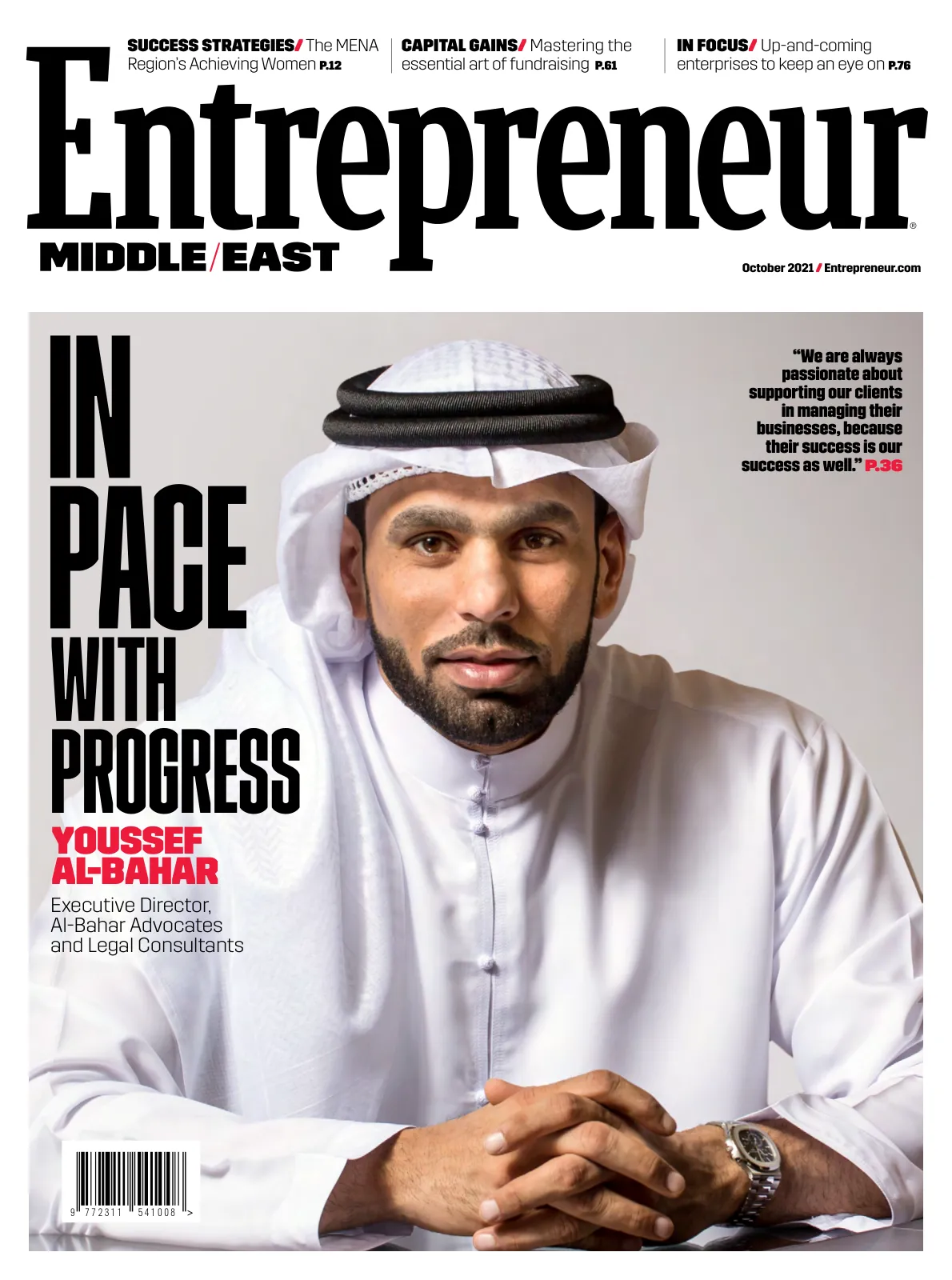
Entrepreneur Middle East, October 2021
Page 1
IN PACE
WITH
PROGRESS
YOUSSEF
AL-BAHAR
Executive Director,
Al-Bahar Advocates
and Legal Consultants
“We are always
passionate about
supporting our clients
in managing their
businesses, because
their success is our
success as well.” P.36
October 2021 Entrepreneur.com
9
7 7 2 3 1 1
5 4 1 0 0 8
>
CAPITAL GAINS/ Mastering the
essential art of fundraising P.61
SUCCESS STRATEGIES/ The MENA
Region’s Achieving Women P.12
IN FOCUS/ Up-and-coming
enterprises to keep an eye on P.76
Page 2
Page 3
Page 4
Page 5
sbe.com/sls-dubai
@slsdubai
A blend of lifestyle & luxury in
a timeless elegant atmosphere
Page 6
Page 7
Page 8
6 / ENTREPRENEUR.COM / October 2021
P.49
Slow and
Steady
With her enterprise,
Clay Encounters,
Qatar-based entrepreneur
Reema Abu Hassan is
inspiring a passion for
making within the local
community.
by PAMELLA DE LEON
P.52
Back to the
Basics
James Berry, General Manager,
Park Inn by Radisson Dubai
Motor City and Radisson Blu
Hotel Dubai Media City, on the
COVID-19 crisis enabling a
reminder of what hospitality is
really about.
by TAMARA PUPIC
P.12
The MENA
Region’s
Achieving
Women
Success, motivation, and
exceptional enterprise
conduct strategies for
women in business.
P.36
In Pace
with
Progress
Youssef Al-Bahar, Executive
Director, Al-Bahar Advocates
and Legal Consultants, is
following the Dubai model
of success as he charts his
enterprise’s growth.
by TAMARA PUPIC
P.30
Be the Change
NYLA KHAN, co-founder
for Mirai Partners, Willow
Tree Kids and Kids World
Nurseries, shares lessons
from a woman in business
(for other women in
business).
P.32
Turning the
Tide
FACEBOOK COO SHERYL
SANDBERG on how going
digital is enabling the
success of female
entrepreneurs in the UAE
(and beyond).
P.42
Pushing
Boundaries
Irfan Tansel, CEO of Al
Masaood Automobiles,
on realizing success in
business
by TAMARA PUPIC
FEATURES
Contents/October 2021
BUSINESS
UNUSUAL
→ VILMA JURKUTE,
Executive Director, Alserkal
Page 9
Page 10
8 / ENTREPRENEUR.COM / October 2021
61 Capital Gains
TALAL BAYAA, co-founder and CEO
of Bayzat, discusses how digital
entrepreneurs can master the
essential art of fundraising.
64 Strategy Bites
LIRA Strategy Partners founder
and Managing Director RAFFAELLA
CAMPAGNOLI talks to Muzzammil
Ahussain, Executive Vice
President - Consumer Travel,
Seera Group on pivoting to a new
digitally driven business model,
and empowering Saudization and
the female workforce.
66 Collaboration is
Redefining the Future of
Healthcare
LÁSZLÓ SVINGER, Regional Vice
President and Managing Director
of 3M Middle East and Africa,
explains how the scramble for
diagnostics, personal protective
equipment (PPE), and vaccines
have given rise to a new era of
multi-stakeholder collaboration.
68 Fueling Growth
HEC Paris in Qatar has
published Qatar’s Entrepreneurial
Ecosystem, the first
comprehensive review of
the country’s entrepreneurial
ecosystem.
‘TREPONOMICS
EDITOR IN CHIEF Aby Sam Thomas
aby@bncpublishing.net
CEO Wissam Younane
wissam@bncpublishing.net
DIRECTOR Rabih Najm
rabih@bncpublishing.net
CREATIVE LEAD Odette Kahwagi
design@bncpublishing.net
MANAGING EDITOR Tamara Pupic
tamara@bncpublishing.net
STARTUPS SECTION EDITOR Pamella de Leon
pamella@bncpublishing.net
FEATURES WRITER Aalia Mehreen Ahmed
aalia@bncpublishing.net
DIGITAL SOLUTIONS DIRECTOR
Mahdi Hashemi mahdi@bncpublishing.net
HEAD OF INNOVATION
Sarah Saddouk sarah@bncpublishing.net
GROUP SALES DIRECTOR – B2B GROUP
Joaquim D’Costa jo@bncpublishing.net
COLUMNIST Tamara Clarke
CONTRIBUTING WRITERS
Talal Bayaa, James Berry, Raffaella Campagnoli
Fida Chaaban, Nyla Khan, Sheryl Sandberg,
László Svinger
SUBSCRIBE
Contact subscriptions@bncpublishing.net to receive
Entrepreneur Middle East every issue
COMMERCIAL ENQUIRIES
sales@bncpublishing.net
ENTREPRENEUR.COM
Access fresh content daily on our website
All Rights Reserved 2021. Opinions expressed are solely those of the contributors. Entrepreneur
Middle East and all subsidiary publications in the MENA region are officially licensed exclusively to
BNC Publishing in the MENA region by Entrepreneur Media Inc. No part of this magazine may be
reproduced or transmitted in any form or by any means without written permission of the publisher. Images
used in Entrepreneur Middle East are credited when necessary. Attributed use of copyrighted images
with permission. All images not credited otherwise Shutterstock. Printed by United Printing and Publishing.
PO BOX 502511 DUBAI, UAE
P +971 4 4200 506
Contents/October 2021
EntMagazineME
Entrepreneur-me
71 Gamechanger
By promising entrepreneurs
zero-balance business
accounts that can be opened
in 48 hours, Ahmed Mohamed
Al Naqbi, CEO, Emirates
Development Bank (EDB),
says the new EDB Business
Banking app aims to redefine
business banking in the UAE.
by ABY SAM THOMAS
74 In Focus
A roundup of the up-and-
coming startups you should
be keeping an eye on.
by AALIA MEHREEN AHMED
80 TAQADAM Tales
A look at six startups that
have gone through KAUST’s
TAQADAM Accelerator
Program.
by AALIA MEHREEN AHMED
STARTUP
SPOTLIGHT
↑ FOUNDED BY FADY
AZZOUNY AND ABDELREHEEM
HUSSEINM, Vetwork is built
as a platform that provides
in-home as well as online
services for people with pets.
Page 11
lyveglobal.com
E-COMMERCE
MADE EASY
Supercharge your ecommerce and online operations
with Lyve. Get fast, flexible, and full-featured delivery and
technology solutions that meet your customers’ needs
and allow you to focus on what you do best.
Go Lyve Today �
lyveglobal.com/ecommerce
#golyve
Page 12
10 / ENTREPRENEUR.COM / October 2021
Editor’s Note/
HAVE YOU EVER FOUND YOURSELF feeling like
you’re busy all through the day, yet there’s
nothing really of value to showcase once you
come to the end of it?
Now, take that one day from your memory,
and imagine it happening repeatedly over the
course of a week or more. That’s the scenario I
found myself in recently after a particularly
hectic period at work, during which I was
tackling one task after the other on what
seemed to be an infinite to-do list, and yet, I
somehow still felt like I wasn’t accomplishing
anything particularly worthwhile.
That is, until I came across a candid video of
Ketish founder Emaan Abbass, who we had
featured in the August 2021 issue of
Entrepreneur Middle East, coming across that
publication, and the story that I had written in
it about her and her business, for the very first
time.
Let me try to describe what I saw in this
recording that was shared on Instagram
Stories by one of Abbass’ friends. Her reaction
starts with absolute shock- Abbass gasps as she
sees herself in print, before bursting into tears,
and then tumbling into the throes of pure
exhilaration.
Abbass’ joy is resplendent in this video, and it
was positively heartening to see her react to the
work that I and my team do in such a positive,
wholesome manner. In fact, it was just the
thing I needed to remind myself of what really
drives me to do what I do at Entrepreneur
Middle East, despite it seeming like a
never-ending pile of work at times- and that is
to enable entrepreneurs like Abbass, give them
the support and validation that they need and
deserve, and be a part of their growth journeys
into the future.
As entrepreneurs, I am sure that there are
times when you, like me in the aforementioned
scenario, start to question the value of what
you do, especially when things aren’t going the
way they are supposed to. During such
moments, make it a point to seek out or reflect
on the positive impact of what you do on those
around you. Your work matters.
Aby Sam Thomas
Editor in Chief
@thisisaby
aby@bncpublishing.net
The Daily Grind Has Its Moments
You are often reminded of your impact when you need it most
Page 13
Page 14
ACHIEVING
WOMEN
THE MENA REGION’S
12 / ENTREPRENEUR.COM / October 2021
SUCCESS,
MOTIVATION, AND
EXCEPTIONAL
ENTERPRISE
CONDUCT
STRATEGIES FOR
WOMEN
IN BUSINESS
H . E . H E N D A L O TA I B A
A L I A A L- S H A M S I
M A E R O M E R O D O -T H A N H
V I L M A J U R K U T E
N Y L A K H A N
PA N C H A L I M A H E N D R A
G R A C E N A J J A R
N A R J I S A N D N I D A A R Y W E C K
S H E R Y L S A N D B E R G
Page 15
13
October 2021 / ENTREPRENEUR.COM /
H.E. Hend
Al Otaiba
UAE Ambassador to France/
It’s this principle that Al Otaiba seems to have used to
govern her career so far, which has been centered around
the field of communications, for the most part. “I was
always interested in telling the UAE story to the world,
and building bridges between cultures,” she says, as she
recalls how she started off her career overseeing cultural
programs for Abu Dhabi’s Tourism Development and
Investment Company, including that of the Louvre Abu
Dhabi. Al Otaiba then went on to work for Abu Dhabi
Media as a Director of Strategic Communications,
following which she became an advisor for the UAE
Minister of Foreign Affairs and International Coopera
tion, H.H. Sheikh Abdullah bin Zayed Al Nahyan. She
was then tasked with building and heading the Ministry’s
Strategic Communications Department, which oversaw
all of the communications of the UAE’s foreign policy
agenda, and that was her last role before becoming the
UAE’s Ambassador to France.
Looking back, Al Otaiba freely admits that she couldn’t
have realized the success she saw in her career, had it not
been for the support she received through its course. “I
believe I am where I am today, because of the faith the
leadership has placed in the dedication and commitment
I provide my career with,” she says. “I believe it is
important to be passionate about what you do, in order
to serve well. In my case, serving my country has been the
key driver, and coupled with the support I received from
the leadership, I have found a large space to thrive. With
respect to the key lessons I have learned along the way, I
see collaboration, and the building of allies based on
mutual interest, as very important. It is also important to
make adequate assessments to every scenario or issue
faced.” When asked if she had any particular challenges
to face at her work on account of her being a woman, Al
Otaiba replied in the negative. “I am very proud of my
country’s support of women’s empowerment, and I view
the UAE as a leader in this field, not just regionally but
globally,” she says. “I have not faced any issues in my
career due to my gender; in fact, I was presented with
much more opportunities and respect.” }
H.E.
Hend Al Otaiba was
appointed as the
UAE’s Ambassador to
France in July this
year, and while it has
only been a few months since the start of
her tenure, the significance of the role
she currently essays is something that
she holds very dear to her heart. “I am a
mother of two beautiful boys, Khalid and
Mana,” she reveals. “Waking up every
morning and seeing them reminds me of
the duty and role that our leadership has
entrusted me with; they are constant
reminders of what I am striving for, and
that is the future of our country,
embodied in the generations to come.”
“I have not faced any issues in
my career due to my gender;
in fact, I was presented with much
more opportunities and respect.”
REGION’S
ACHIEVING
WOMEN
THE MENA
IMAGES COURTESY H.E. HEND AL OTAIBA
Page 16
14 / ENTREPRENEUR.COM / October 2021
Al Otaiba has plenty of examples to support her assertion that
Emirati women like herself find themselves with more
advantages than disadvantages in the UAE. The country’s
cabinet, for instance, currently has nine female ministers,
while women’s representation in its parliamentary body, the
Federal National Council, has been set at 50%. Al Otaiba also
notes that 66% of government employees in the UAE are
women- 30% at a leadership level, and 30% in the diplomatic
corps. “Emirati women have also attained positions through
out the professional field, established themselves as formidable
entrepreneurs, forged individual creative paths, and shattered
barriers by entering into typically male-dominated fields, such
as race-car drivers, mountaineers, pilots, car mechanics, and
internationally successful athletes,” she adds. “Emirati women
have been part of all major national projects, including the
Emirates Mars Mission (Hope Probe), representing 34% of the
Hope Probe mission, and 80% of its science team.”
Al Otaiba can certainly add herself to the list of Emirati
women breaking new frontiers- indeed, her appointment as the
UAE’s ambassador to France marks the first time the country
has ever named a lady to this particularly prestigious post.
The announcement was greeted with much fanfare in the UAE
and beyond, and Al Otaiba was seen putting her diplomatic
chops to good use almost immediately in her new role. “Since
my appointment as the UAE’s Ambassador to France, in the
short amount of time that has passed, it is not an understate
ment to say that my experience has been fruitful,” Al Otaiba
reveals. “I have had the pleasure to meet my counterparts, key
French decision makers, as well as members of the cultural
scene. My strategy is to continue to build on the solid relation
ship between the UAE and France, building bridges, and
furthering cooperation. The people-to-people component is
also an important area of focus for me, as we share many
aspirations and values. It is important to note that shared
ideals of coexistence, commerce, and culture are at the heart of
the five decades of close and enduring UAE and France ties.”
Al Otaiba points out here that the UAE is celebrating its
golden jubilee this year, and the country is already committing
wholeheartedly to safeguarding its next 50 years. This has
been clearly indicated by the recently announced “Projects of
the 50,” which Al Otaiba describes as a series of “ambitious
initiatives” aimed at boosting the development of the UAE.
“Since its independence in 1971, and thanks to our leadership’s
vision, our country achieved a series of unprecedented
successes, building a modern and diversified economy,
infrastructures, providing education, health, security, and
stability for its citizens,” she explains. “Our ambition, the
ambition of the ‘Projects of the 50’ initiative, is to continue this
path.” Al Otaiba adds here that “Projects of the 50” will see the
UAE government injecting US$13.6 billion into the economy
in 2022, and $150 billion by 2030, which, according to her,
means that now is an extremely opportune time for anyone
who wishes to start or invest in a business in the country. “If I
have one message to send to entrepreneurs, it would be to
come and see with their own eyes, as to what can be achieved
in the UAE,” Al Otaiba concludes. - B Y A B Y S A M T H O M A S
THE EXECUTIVE
SUMMARY
Hend Al Otaiba’s tips for women
in business
}You are your greatest resource.
“Work on self-development, and do not shy away from taking
opportunities. It is important to also seek help where required.”
}Know your worth
(and demand it).
“I encourage women to be outspoken, and claim their right
space in society.”
WITH RESPECT TO THE KEY LESSONS I HAVE LEARNED ALONG
THE WAY, I SEE COLLABORATION, AND THE BUILDING OF ALLIES
BASED ON MUTUAL INTEREST, AS VERY IMPORTANT.
→ HEND AL OTAIBA, UAE AMBASSADOR
TO FRANCE, WITH EMMANUEL
MACRON, PRESIDENT OF FRANCE,
and H.H. Sheikh Mohamed bin Zayed Al
Nahyan, Crown Prince of Abu Dhabi and
Deputy Supreme Commander of the
UAE Armed Forces.
Page 17
15
October 2021 / ENTREPRENEUR.COM /
Vilma
Jurkute
Executive Director/
Alserkal
I
n her role as the Executive Director
of Alserkal, a Dubai-based arts and
culture enterprise that has Alserkal
Avenue, Alserkal Advisory, and
Alserkal Arts Foundation under its
purview, Vilma Jurkute is easily
one of the most recognizable faces
on the UAE’s art scene today. While
Alserkal Avenue has -since its inception
in 2008 by founder Abdelmonem Bin
Eisa Alserkal- grown into becoming
Dubai’s premier creative district
featuring everything from contemporary
art galleries to homegrown designer
businesses, Alserkal Arts Foundation is a
non-profit that was founded in 2019 to
support practitioners and researchers
working on themes relevant to the
regional artistic community. Meanwhile,
Alserkal Advisory came into being in
2020 as a guide for public and private
sector entities wanting to develop their
own cultural programming or spaces,
and overseeing all three organizations is
Jurkute, who is making sure that that
each of these entities are leaving an
indelible mark in shaping the creative
sector of the UAE. “Our work is ground
ed in an ethic of care, shared authority,
and collective learning, where open
dialogue and long-term cooperation are
foregrounded in our partnerships,”
Jurkute says. “Both the epistemic process
as much as the final product are part of
our practice when delivering our public
promise. Alserkal was never synonymous
with the built environment; on the
contrary, as a polyphonic, multidisci
plinary community, we have always been
a platform where diverse voices and
stories are presented and represented.
This now continues to evolve and grow
through our global collaborations and
projects. Supporting the new generation
of thinkers to challenge the conventional
–leading to new forms of knowledge– is
what lies at the heart of our mandate.”
At this point, there may be a contention
made that Alserkal’s goals are lofty or
perhaps even overtly ambitious, but
Jurkute makes it clear that they are
integral and important aspirations for
the entity in a world that has been forever
transformed by the still ongoing
COVID-19 pandemic. “In the face of this
current situation, we cannot act like
nothing has happened; everything has
changed,” she explains. “We will continue
to change. Our cities will be different. }
“We still have a lot to achieve,
but I am proud that the arts scene
in the UAE is predominantly driven
by fellow women leaders.”
REGION’S
ACHIEVING
WOMEN
THE MENA
IMAGES COURTESY ALIA ALSERKAL
Page 18
16 / ENTREPRENEUR.COM / October 2021
And Alserkal will be different. It is
imperative we have a space to compre
hend the urgencies that concern us all
and allow ourselves the time to reflect,
as we begin to recalibrate and recast
new patterns through experimentation,
ultimately shaping our new discourse.
This historic moment posits us with
the opportunity to rethink our role as a
community, and the new possibilities
for generating value today, and in the
future.” And Alserkal has wasted no
time in ensuring that such discussions
are taking place- indeed, Jurkute
reveals that ideas like these form the
basis of the programming it has built
for its recently announced commission
from Expo 2020 Dubai, aptly titled
Cultures in Conversation. “With
Alserkal’s extensive experience
developing cultural content, we have
taken a research-based approach to the
development of programs for the ten
theme weeks during Expo 2020,”
Jurkute reveals. “The themes are
Climate and Biodiversity, Space, Urban
and Rural Development, Tolerance and
Inclusivity, Knowledge and Learning,
Travel and Connectivity, Global Goals,
Health and Wellness, Food, Agriculture
and Livelihoods, and Water.”
Cultures in Conversation will thus see
Alserkal stage a series of multidisci
plinary interventions and artistic
commissions that will be showcased
over the six months of the Expo.
“Through partnering with Expo 2020
Dubai to conceptualize Cultures in
Conversation, we have thoughtfully
brought some of the world’s leading
thinkers from multiple disciplines
together to address and reimagine
critical contemporary issues in a world
of the Anthropocene,” Jurkute says.
“Cultures in Conversation allows for a
meta-narrative that offers reflection,
awareness, and re-envisioned ap
proaches, as a result engendering new
forms of knowledge, activating social
discourse, and shaping borderless
communities on a collaborative Expo
stage.” It’s worth noting here that
Alserkal’s efforts with this initiative are
in line with the ethos it showcased in
the early days of the COVID-19 crisis,
during which it was seen doing
everything from offering rent waivers
to its tenants, to initiating the Alserkal
Pay It Forward program that support
ed vulnerable communities around it.
“The erosion of boundaries through
shared compassion is something I will
carry with me from this pandemic,”
Jurkute adds. “Over the past year, the
aspects of collectivity, togetherness,
and giving back, which are an intrinsic
part of our community, ensured that
we never felt alone. As a collective of
creatives, cultural thinkers, and
makers, we have always been driven by
challenging the conventional, and
seeing boundless possibilities through
the work we do.”
It should be pretty apparent by now
that Alserkal has embraced a forward-
thinking approach to building itself as
an enterprise, and a large part of the
credit for this needs to go to Jurkute,
who joined the family-run business in
2012, and has been instrumental in its
evolution since then. “It is never easy to
be the ‘first’ or a pioneer, because there
is no model or playbook you can
follow,” Jurkute says. “I take comfort in
the advice someone once gave me:
‘Don’t be afraid of uncertainty; it
means you are innovating.’ To be
honest, when we started, I feel like the
West didn’t know what to do with us,
because we didn’t fit any of their
‘boxes,’ in terms of art paradigms. We
began as an arts neighborhood in the
Al Quoz industrial area, then through
Alserkal Avenue’s expansion in 2015,
we extended our platform to welcome a
curated community of entrepreneurs
across various industries, acting as
building block for the creative economy
locally. And through our commitment
to artistic production, residency
programs, scholarship, and research
we evolved further as an institution,
forming the Alserkal Arts Foundation.
It created for a context-specific and
organic model that responds to our
city, our history, and our publics.
Alserkal and its initiatives are every
one’s community commons: collabora
tive, open, experimental, and flexible
by nature. Furthermore, tenacity, hard
work, a solution-focused attitude, and
long-term thinking are all part of the
formula.”
These principles aren’t descriptive
of only Alserkal though- these are traits
that can be seen in Jurkute herself,
who proudly claims to have dedicated
her career to developing creative
communities in New York, Chicago,
London, and now in Dubai. When
“As a collective of
creatives, cultural
thinkers, and
makers, we have
always been driven
by challenging the
conventional, and
seeing boundless
possibilities through
the work we do.”
Page 19
17
October 2021 / ENTREPRENEUR.COM /
asked if being a woman has had an impact on her career in any
manner, Jurkute replies, “Equality and equity are still key
challenges for many geographies today. We still have a lot to
achieve, but I am proud that the arts scene in the UAE is
predominantly driven by fellow women leaders.” And to make
sure she stays at the top of her game, Jurkute has steadfastly
refused to rest on her laurels. “I learned long ago that there are
no shortcuts to success, and that education has an expiry date,”
she says. “It is with that intent that despite my full-time career,
I challenged myself to pursue my master’s degree at Oxford
University in sustainable urban development. It allowed me to
continue learning and take distance, in order to reevaluate and
recalibrate our trajectory at Alserkal, while being better
informed about today’s challenges, and how we can collectively
begin tackle them.” This also offers a perspective into how
Jurkute goes about being a leader, with her strategy centered
on the ideas of collaboration and cooperation. “Humility,
collective work, and authorship of ideas with people you work
with is key,” she says. “Many leaders still cling onto old,
hierarchical methods of management. I certainly hope this
dated logic and approach to leadership is now dated!” After all,
the times we live in call for a new breed of leaders, Jurkute
says. “Failures, challenges, changing dynamics, and uncertainty
are part of doing business today,” she explains. “What is
demanded of leaders today is the ability to mitigate, adapt,
deconstruct, and plan in the age of uncertainty, through
resilience, and a humanized approach.”
- B Y A B Y S A M T H O M A S
ALSERKAL AND ITS INITIATIVES ARE EVERYONE’S COMMUNITY COMMONS:
COLLABORATIVE, OPEN, EXPERIMENTAL, AND FLEXIBLE BY NATURE.
FURTHERMORE, TENACITY, HARD WORK, A SOLUTION-FOCUSED ATTITUDE,
AND LONG-TERM THINKING ARE ALL PART OF THE FORMULA.”
→ VILMA JURKUTE JOINED ALSERKAL
IN 2012 and, in her time with the
organization, she has been
instrumental in its evolution and
responsible for overseeing Alserkal
Avenue’s physical expansion of
US$20 million in 2015. Since its
launch, the 500,000 sq. ft. plot has
become a key cultural destination for
the MENASA region, housing more
than 60 most prominent
contemporary art galleries,
community, and creative spaces.
Page 20
18 / ENTREPRENEUR.COM / October 2021
REGION’S
ACHIEVING
WOMEN
THE MENA
IMAGES COURTESY ALIA AL-SHAMSI
Page 21
19
October 2021 / ENTREPRENEUR.COM /
In response to my first question revolving around women’s
empowerment in the UAE, Al Shamsi replies that she prefers to
talk about gender equality, rather than women’s empowerment
per se. “The measure of our success will be to talk about
challenges faced not just by women, but by all, so as to include
our male counterparts in these conversations,” she says. “We
seem to be grouped in a female narrative, but what is that? I
believe that this isolation, when we talk only about women’s
empowerment, can be a little bit detrimental in the sense that
women are singled out rather than celebrated as a universal,
human achievement.” As for the UAE, Al Shamsi points out that
history has regarded the mother of the country’s founding father,
the late H.H. Sheikh Zayed Bin Sultan Al Nahyan, Sheikha
Salama bint Butti Al-Qubaisi, as having been an accomplished
woman in her own right, which only serves to prove her point
that women here have not just been “empowered, but in power
from the start.” At this point, I ask Al Shamsi what that actually
means, and she replies, “When you have a government that
supports you, the doors are obviously open, but you need to seize
these opportunities. You are given something, but what you
make of it is what renders you unique from another. Some people
take these opportunities, and create something larger.”
Al Shamsi’s career indicates that she may well be one of these
people that she’s talking about. From an educational perspective,
she is the holder of a bachelor’s degree in photography from
Griffith University in Australia, as well as a master of arts degree
in the photographic image from Durham University in the
United Kingdom. In 2005, she was declared to be the youngest
photographer to participate in the Photographic Biennale in
Italy, exhibiting alongside famous photographers and artists like
Julia Margeret Cameron and Cindy Sherman. Today, her works
are displayed everywhere from the UAE’s Rove Hotels, to a
private collection at the UAE Embassy in Washington D.C. }
Acting Cultural
Programming Manager/
Louvre Abu DhabiA
lia Al Shamsi logs on to our
Zoom call from her home in
Dubai that we scheduled
not only to minimize
COVID-19 risks, but also
because the Acting Cultural
Programming Manager
at the Louvre Abu Dhabi
was out of the office. “I
am on vacation, but I’ve
been sending emails since
early morning, and now I’m
having a call with you,” Al
Shamsi says, laughing. Her
work ethic shouldn’t come
as a surprise keeping in
mind that the Louvre Abu
Dhabi, as the first of its
kind museum in the Arab world, is an
extremely active center with a variety
of activities in the domains of cultural
exchange, community engagement,
and progressive dialogue. And just as
her days off defy expectations, her
professional biography does too. “I am
someone who always focuses on my
personal work as well, simply because
I am a firm believer that a person is
also something beyond their job titles,”
she explains. “Yes, I work at the Louvre
Abu Dhabi, and I am very proud of that,
but I like to continue saying that I am
also an author, poet, and photographer,
because that is my identity more than
anything else, and what I do at the
Louvre Abu Dhabi feeds into that.”
Alia
Al-Shamsi
“I like to continue saying that
I am also an author, poet,
and photographer, because that
is my identity more than anything
else, and what I do at the Louvre
Abu Dhabi feeds into that.”
→ AL SHAMSI IS THE
AUTHOR AND ILLUSTRATOR
OF YOU ARE MADE OF
STARS, an exercise book
designed to enhance
creativity and self-
expression in children.
Page 22
20 / ENTREPRENEUR.COM / October 2021
“Personally, I will never forget that from the very first opportunity
that I got, when I was supported for a photography exhibition, and
I said, ‘I don’t know how to thank you.’ And my CEO at the time
said, ‘Alia, pay it forward.’ So, I grew up with this very strong
feeling that I need to pay it forward, and that is what empower
ment means to me. Being empowered is not about me, but about
how many other women I can empower, and how I can make that
sustainable and long-term.”
And not long ago, she got an opportunity to do just that. In 2021,
Al Shamsi took part in Vacheron Constantin’s six-month-long One
of Not Many Mentorship Program, which invited six Emirati
women to mentor six young female Emirati students from Zayed
University. “With my mentee, I specifically focused on bringing in
a different member of the art community to each of our sessions,
because a lot of people don’t understand that going into arts
doesn’t mean that you have to be an artist,” Al Shamsi explains. “It
can also mean having a business, like an owner of a gallery, and so
on.” Throughout this mentorship program, Al Shamsi focused on
opening doors for her mentee, so that “in the future, she has access
to the same network as I do.” Al Shamsi adds, “My strength is my
network, and to be very honest, I think that we don’t talk enough
about the importance of building a network. A lot of times, I was
given opportunities, because I was socializing. At the Louvre Abu
Dhabi, I’m always advocating that we go, visit, and work with other
institutions. That is how the world works. If you work in a silo and
wonder why no one is discovering you, it is because you don’t even
make an effort to get to know the market and the people. I wanted
my mentee to build her network, because it is very important for
an artist.”
Another example of how Al Shamsi is paying it forward is by
making use of her skills for philanthropic efforts. Teaming up with
The Happy Box, a Dubai-based educational and social enterprise,
for its Happy Hearts initiative, Al Shamsi took part in four
separate charity trips to Kenya, India, Morocco, and Egypt, which
aimed to provide necessary supplies to community-driven schools
and centers for women and children. Al Shamsi also published a
book titled Mama Africa, with proceeds from the sales going
directly to regional charities. “I went into photo-journalism as a
dreamer wanting to see, make, and contribute to change in the
world, and I have always cherished a social documentary aspect of
photography,” she says. “Whenever I would get an opportunity to
work with children, I was like, ‘Don’t give me city children, but let’s
go out of the cities.’ I did workshops with children across the UAE,
and it was a completely different experience. You get to understand
that the reason why certain remote areas are known for their art is
due to the nature surrounding them, and the way people live there.
Children there are so isolated, and a lot of them don’t get the
opportunities that city children do. Therefore, I am a big advocate
of going outside of cities, and of working with children in remote
areas.”
As an author, Al Shamsi has been presented with the Edaad
Scholarship in 2007, as well as the British Council Cultural
Leadership International Award in 2010. As we start talking about
her first book, a children’s book entitled Alayah (for which she
received the first Dubai Culture Publishing Award), I ask how she
ventured into writing in the first place. “There is an element of
sensitivity and vulnerability in creativity that is a very big
challenge,” Al Shamsi says. “I started narrating things visually, and
then I went into writing. There, I started with children’s books,
and it was as if I was hiding behind a child’s voice. In a sense, it
was true, because it was about me becoming more confident with
my own voice. Alayah is a nickname for Alia, and the book is
almost a autobiography, because it explores this idea of rediscover
ing one’s identity, and despite me hiding behind a child’s voice, a
lot of adults loved that book, simply because it touches on the
changes of Dubai, and what it means to have roots and to have a
home.”
WHEN YOU HAVE A GOVERNMENT THAT SUPPORTS YOU,
THE DOORS ARE OBVIOUSLY OPEN, BUT YOU NEED TO SEIZE
THESE OPPORTUNITIES.
→ AL SHAMSI WAS DECLARED TO BE THE YOUNGEST
PHOTOGRAPHER to participate in the Photographic
Biennale in Italy in 2005, exhibiting alongside famous
photographers and artists like Julia Margeret Cameron
and Cindy Sherman.
Documentation Al Mudheef 2010
Private Collection UAE Embassy Washington 2009
Al Kazan
Al Ghurair Mosque
Page 23
Al Shamsi is also the creative talent
behind Night and Day, one of the UAE’s
first three silent books published in 2018,
while her consequent release, You Are
Made of Stars, is an exercise book
designed to enhance creativity and
self-expression in children that was
released in 2020. “I was always
interested in art therapy, and since I am
also doing a master’s in applied
psychology, researching creativity, art,
and the human mind, when COVID-19
hit, I needed a way of expressing for my
son that wasn’t verbal,” Al Shamsi says.
“One of the things I tried to work on was
to engage a child in a conversation
through art. Then, I made it available for
other parents, and I also created a special
edition for The Happy Box. It picked up
during COVID-19, because it was a
moment for children and parents to do
something together that was not
academic, but allowed them to open a
conversation about how they felt, what
they thought, and so on.”
Her latest release, The Ocean Sees
Through My Soul, is her first book
dedicated to an adult audience, which
takes readers on a poetic journey
through moments of introspection. Al
Shamsi describes it as the most
courageous thing that she has ever done.
“It is really exposing,” she says. “It’s
exposing my vulnerability, uncensored,
and very raw. I’ve always written poetry,
but I have never really published it,
because poetry is a sort of a therapy tool
that I used throughout those 10 years
when I was sort of finding and reinvent
ing myself. You can see my progress in
the chronology of poems in this book.” To
other creatives, Al Shamsi has only one
piece of advice: don’t be afraid. “In
retrospect, if I look at some of the poems
and articles I have written, or some of
the photos I have taken at that early
stage, I smile, because I can see my
progress,” she says. “So, you need to take
that first step. Unfortunately, a lot of
people think that they are not good
enough, but they have to start some
where. Only once you start sharing and
exhibiting can you become able to raise
the benchmark. Taking the first leap is
very difficult, but it is also about being
good to yourself by accepting where you
are at that moment, and accepting that
you will progress from there. You perfect
it along the way.”
Today, Al Shamsi’s role at the Louvre Abu
Dhabi benefits from her varied interests
and initiatives. “Before taking up the role
of Acting Cultural Programming
Manager, I basically opened up the unit
for academic outreach at the Louvre Abu
Dhabi, because I went there with my
laptop and presentation, telling them
what I was passionate about, and what I
would like to do,” Al Shamsi says. “So, we
started with that, and me building their
communities with universities, people
with determination, the elderly, and so
on. When this new role opened, my
manager invited me to take it and apply
the same formula that I applied for
building their community outreach unit.”
The timing was perfect, Al Shamsi adds,
because due to the COVID-19 crisis, the
museum was keen on including commu
nity-building within its cultural program
ming. “All of a sudden, it was all about
collaborations, and COVID-19 gave this
opportunity of togetherness within the
art community,” Al Shamsi concludes. “I
found myself at home at the museum
because of the universality of it. We are
one as humans. Our experiences are
different; however, we are in cultural
dialogues. There is always a meeting
point. I find myself in this, because when
I’m creating programs, it’s about
dialogue, about coming together.”
- B Y TA M A R A P U P I C
21
October 2021 / ENTREPRENEUR.COM /
تأليف ورسم: عليا الشامسي
نَهارٌ ولَيْل
↑ AL SHAMSI IS THE CREATIVE TALENT BEHIND NIGHT AND DAY, a children silent book on the
myth of the creation of night (Arabian Myth) and day (Aztec Sun god story).
Page 24
22 / ENTREPRENEUR.COM / October 2021
Launched in 2020, The Branding Room started out
as a beauty lounge, but it soon pivoted to an aesthetic
clinic providing elevated skincare, slimming, laser, and
dermatological services. Driven by its mission of
“approachable luxury,” The Branding Room aims to
provide luxurious treatments that is accessible and
affordable for all. “At first, I was working on the
premise of putting up something based on what I love
doing,” Do-Thanh says. “But as we were going along
the process, we also realized that we have this great
opportunity to bring a concept that doesn’t yet exist in
the community and neighboring areas of JVC.” As it is
the “first” enterprise of its kind in the community,
Do-Thanh believes that her business has quite an
advantage as the premier specialized provider of face
and body treatments in the area. Do-Thanh has also
made it a point to hire relatively younger staff at her
enterprise, which she believes adds on to the business’
ethos. “I believe that it makes us bring a fresh
perspective into the field, which flows into my belief
that, we as persons, and The Branding Room as a
business, exist, so we may be able to help others be the
best version of themselves.”
Being the best version one can be, despite what the
naysayers may think, also seeps into how Do-Thanh
takes on hurdles she faces as an entrepreneur in the
UAE. “It is a lot of whammies in my case,” she says.
“Not only am I a woman, but I am also an Asian
woman, and specifically, a Filipino… I have been boxed
into stereotypes associated with my profile multiple
times. How many times have people expressed their
surprise that I am the owner of The Branding Room?
I’ve already lost count. As well as the number of times
that others do not take me too seriously, because of my
gender and my physical appearance. It somewhat
seems to them that I am just this silly, tiny thing, who
is trying to wiggle her way into a league that is not of
her own.” According to Do-Thanh, this perception
exists because though there are several Filipino and
Filipina business owners in the UAE and in the wider
MENA region, their contributions are often sidelined
or ignored. “It’s still somewhat considered uncommon,
just because we are still outnumbered by other
nationalities in terms of being business owners,” she
notes. “The majority of the population are categorizing
us, generally, as being in the UAE as hired hands.
Because of that, it does seem like we are out every day
to prove that not only Filipinos are good employees,
but we can be good business owners too.”
Do-Thanh is clearly fighting a lot of racial connota
tions as she goes about building her business in the
UAE, but she also refuses to let it affect the vision she
has for her enterprise- and it’s a paradigm that she
recommends her fellow Filipino entrepreneurs in the
UAE to follow as well. “If we do put up businesses
here, rarely would they be elevated enough to be able
to compete with other concepts. I stand together with
other Filipino entrepreneurs and professionals, who
Mae Romero
Do-Thanh
Owner and CEO/ The Branding Room
W
hen Mae Romero Do-Thanh was venturing into entrepreneur
ship, she didn’t have to look too hard for inspiration- after all, her
father is someone who built an enterprise from the ground up,
and it remains a thriving business even after four decades. And
as someone who’s been encouraged to pursue her passions and be
enterprising in life from a very early age, it should therefore come
as no surprise that Do-Thanh chose the beauty industry and the
world of aesthetic treatments to start a business in. “I personally
like getting treatments done,” she says. “But aside from that, I
also like learning about the concepts and methods, and that
made me do all sorts of experiments on myself, family, and friends.” Indeed, it’s
this drive that has led her to today become the owner and CEO of The Branding
Room, a Dubai-based aesthetic clinic located in the Emirate’s Jumeirah Village
Circle (JVC) neighborhood.
REGION’S
ACHIEVING
WOMEN
THE MENA
IMAGES COURTESY THE BRANDING ROOM
Page 25
23
October 2021 / ENTREPRENEUR.COM /
are constantly proving that we, as well, can bring
forth establishments that are refined.” And while it
may seem like an uphill battle, Do-Thanh says that
she has figured out a way to get through all of the
assumptions that are thrown her way. “What I
have learned to overcome is the feeling of
frustration that is associated with those pre-con
ceived notions,” she says. “I do that by simply
taking everything with a grain of salt. I try to look
ahead, so I would not dwell on certain thoughts
and events that I know I would just laugh about
eventually.” At the end of the day, Do-Thanh always
makes sure she stays true to herself- and that’s
what keeps her going, no matter what. “One must
adjust according to the situation, but that
shouldn’t mean that you should lose who you are
in the process,” she concludes. “Keep being
honorable, even when you’re thrown in the den of
thieves.” - PA M E L L A D E L E O N
Achieving
Women
}Be patient.
“I really had to learn that patience is key. I am sure that the topic of patience as a
lesson learned has been said countless times, but it truly is something an entrepreneur
who’s starting out must learn. In business, a lot of important and joyous milestones
and experiences do not happen overnight. You just have to keep persevering with your
best effort.”
}Trust your gut.
“Trust has to be tempered with cautiousness. I, generally, am a trusting person, and I
think the environment in the UAE, wherein the idea that it is a safe place, will heighten
that confidence that one can have in other people. I did learn that others, even those
who you can ‘trust,’ like consultants, landlords, partners in business, or employees,
can take advantage of you. At the end of the day, everything is a business, and so, you
must not forget to look out for yourself as well.”
}Research the ins and outs.
“Always strive to be knowledgeable about policies and your rights in relation to your
business and your job, so you may be able to speak up when the circumstances call
for it. I had to learn to let go of my habit of suffering in silence. I have realized that often
times, I am not doing myself and others a favor by not bringing up certain points, just
because I want to avoid a discussion or a possible confrontation. I always remind
myself that a way for certain changes or expectations to come is to talk about them.”
Mae Romero Do-Thanh’s tips for women in business
THE EXECUTIVE
SUMMARY
ONE MUST ADJUST ACCORDING TO THE SITUATION,
BUT THAT SHOULDN’T MEAN THAT YOU SHOULD LOSE
WHO YOU ARE IN THE PROCESS.
→ What started out as a luxe
beauty lounge in Jumeirah
Village Circle, THE BRANDING
ROOM HAS BEEN TRANSFORMED
to the only aesthetic clinic in the
Dubai community.
Page 26
24 / ENTREPRENEUR.COM / October 2021
I
n every tale of triumph about a woman, there is almost
always one emotional aspect that shines through more
splendidly than others: self-belief. Women who’ve firmly set
out to achieve their dreams, no matter what the odds, by
fully believing in themselves, have always been sources of
motivation and inspiration for many. And it is this
characteristic that has remained a constant in the career
trajectory of Panchali Mahendra, Managing Director of
boutique culinary firm, Atelier House Hospitality.
As a woman working in a male-dominated industry, Mahendra
admits that she has often felt neglected or forgotten by her
peers in the sector- however, she made sure that such chal
lenges never deterred her from realizing her goals. “Women just
need to make an endeavor to shine and push themselves to be
heard and seen,” Mahendra says. “We can’t always blame the
other gender. I have been able to break many glass ceilings, so, I
am sure many can do it too!” It is this unfazed attitude that
Mahendra has adopted throughout her career, which now sees
her at the helm of the Dubai office of Atelier House Hospitality,
a New York-based full-service hospitality advisory, develop
ment and operations management firm that aims to deliver
expert knowledge on the many nuances that come with
running a high-caliber F&B venue. “With decades of experience
and a team of world-class talent, Atelier House empowers and
emboldens small and large businesses alike, combining global
perspective with local know-how,” Mahendra says. “In my role
as Managing Director, I have been in charge of everything from
conceptualizing, to building and expanding brands, and
operating them to success.”
Mahendra joined Atelier House Hospitality in 2017, but her
overall experience in the F&B sector has spanned for more than
17 years. In that time, she has overseen and conceptualized the
launches and operations of over 45 restaurants. And it is this
wealth of expertise and knowledge that she used in leading two
recent projects that she says she is most proud of: the interna
tional expansion of UAE-based Indian restaurant Mohalla (a
homegrown concept that Mahendra came up with), and the
launch of only the second branch of New York-based Michelin
star Italian restaurant Marea. “With Mohalla’s expansion, it
was all about taking a homegrown brand international,”
explains Mahendra. “We were able to launch it in Riyadh, and
also franchised ten units of the restaurant to the royal family of
Saudi Arabia.” Mahendra has also been pivotal in leading her
team towards the launch of other F&B brands in the UAE such
as The Host, Asma, Meshico, Morini Riyadh, 11 woodfire,
RSVP, and SOMA.
Panchali Mahendra
Managing Director/
Atelier House Hospitality
WE CAN’T ALWAYS BLAME THE
OTHER GENDER. I HAVE BEEN ABLE
TO BREAK MANY GLASS CEILINGS,
SO, I AM SURE MANY CAN DO IT TOO!
REGION’S
ACHIEVING
WOMEN
THE MENA
IMAGE COURTESY ATELIER HOUSE HOSPITALITY
Page 27
25
October 2021 / ENTREPRENEUR.COM /
But amid successes are the inevitable lessons that
come through failed endeavors and unprecedented
stumbling blocks. Mahendra’s business lens appears
to be untainted by unrealistic expectations, and that
is perhaps most evident in how she analyzes what
the many challenges of the COVID-19 crisis have
taught her. “Expect the unexpected!” she declares. “I
think my leadership style has remained unchanged
through the pandemic, but the overall emotional
quotient paradigm has definitely shifted. Crises
bring humans together, and this was no different. I
think camaraderie, empathy, and patience have
evolved a lot more through the last one year.” The
underlying traces of realism in Mahendra’s
leadership, a style she describes as “pragmatic and
personal,” become even more prominent when she
recounts the best piece of business advice she has
ever received. “The best thing I learnt is to take
nothing for granted, to stay humble at all times,
especially through success, and to let the results
speak for itself,” she says. “Dirty hands are a sign of
clean money, so you need to be a part of the system
to know the system.”
But even the most hardworking of people can at
times feel let down, unmotivated, or even face issues
that stem from their own insecurities. So, how does
Mahendra deal with such moments? “There will
always be certain amounts of insecurities and
competition, but I know one thing for sure: hard
work goes far, and in due course, is recognized,” she
says. “But I also have my loving and protecting
family, a super supportive boss, and a great team to
keep me going. I have always kept my head high
with work ethics and dignity, and know that no one
can take that away from you.” But Mahendra also
urges everyone to make it a point to find out how
they can boost themselves- indeed, she has already
devised a formula that works for her. “Personally, I
find that working out and spending time with my
dog are the biggest stressbusters,” she concludes.
“And a bit of a nightcap never hurt anyone!”
- B Y A A L I A M E H R E E N A H M E D
THE EXECUTIVE
SUMMARY
Panchali Mahendra’s tips for women
in business
}Be the hero of your own story.
“Never play the underdog!”
}Patience is the biggest virtue.
“Know that it might take time, but it will happen.”
}Invest in yourself.
“Keep reading and studying, as self-awareness and being
worldly wise is very significant.”
Page 28
26 / ENTREPRENEUR.COM / October 2021
T
hey say blood is thicker than water, and in the story of
Narjis and Nidaa Ryweck, sisters who ended up
becoming co-founders of a business, that statement has
been indeed proven to be true. Having started their
journey at global e-commerce-based direct selling
company QNET, the duo soon realized the potential in
assisting and enabling direct selling for those wishing to
run their own businesses. The fruition of that idea was
Championaires, a UAE-based business coaching and
leadership development company (classified as an
independent enterprise under QNET), led by both the
Ryweck sisters, along with their brother Ibrahim. “We
loved the idea of having a business that wasn’t just about earning
money, but also helping other aspiring entrepreneurs achieve
success,” Narjis explains. “That’s how the idea of creating a business
dedicated to helping others like us realize their potential was born,
and along with our brother Ibrahim, we established Champion
aires. Today, we have one of the largest teams in the GCC region
with thousands of young men and women who are building their
own businesses using the QNET direct selling opportunities.”
In their roles as business leaders at Championaires, the trio of
siblings take on the responsibility to guide, coach, support, and
mentor aspiring entrepreneurs in the region who wish to build their
own sales or e-commerce businesses via QNET’s platform. But
before delving into the Ryweck sisters’ present and future goals, it is
important to understand how both women reached this particular
stage in their entrepreneurial journeys. Early on in their careers,
there were plenty of hurdles they had to maneuver their way
through; from working multiple jobs at a time to make ends meet,
to finding ways to escape the shackles of corporate rigidity. But a
quick rewind of their life experiences displays how one of the
biggest obstacles they had to overcome stemmed primarily from
their immediate social surroundings, and the many prejudices that
come with such territory. “We started our business in Saudi Arabia,
and then moved to the UAE, and our business is largely in the
Middle East, so, you can imagine the different types of challenges
we have faced over the years,” says Narjis. “We’ve been harassed and
judged by others, and many times men wouldn’t want to join our
business, only because they didn’t want to deal with a woman.
People would point out and say, ‘What are you doing? You are a
woman, and you are dealing with so many men, and meeting with
them?’ As you know, this is frowned upon in certain cultures in the
Middle East. However, we have learnt not to take it personally, and
we don’t allow it to affect our morale.”
But this is where the Ryweck siblings bring in an interesting
tangent to the gender equality discourse. According to them, it was
an existing lack of bias, gender or otherwise, in the world of direct
selling that attracted them towards the sector in the first place.
“One of the best things about doing the QNET business is that it is
completely online, thus making it easily accessible to everyone,”
explains Nidaa. “Therefore, in direct selling, there is no discrimina
tion based on gender, age, education, culture, work experience, or
social background. It is a level playing field. This means our gender
plays no role in our ability to succeed. Only our hard work, talent,
and skills matter! It’s never a problem being a woman in this
business.” Narjis also highlights another aspect that enticed her
entrepreneurial instincts: the opportunity to work on self-develop
ment. “I was 22 years old when I decided to become an entrepre
neur, and started this business,” Narjis says. “Today, I am a
completely different person, and I don’t just mean that from a
financial perspective. I have also grown significantly as a person.
My level of confidence, how I carry myself, the way I speak- every
thing has transformed for the better. I have faith and belief in
myself, which is very different from the tentative 22-year-old who
started out. I don’t know of many industries out there that focus so
much on the self-development aspects of a person. That’s one of the
reasons I love direct selling!”
From both ladies’ accounts, it is apparent that they experience an
almost symbiotic relationship with the direct selling world. When
asked how each of them would describe the kind of leaders they
perceive themselves to be, Narjis says she focuses on “integrity,
ethics, and team work,” while Nidaa firmly replies that she is
“assertive and straightforward, not one to beat around the bush,
Co-founders/ Championaires
Narjis and
Nidaa Ryweck
MY DREAM HAS ALWAYS BEEN TO
BE MY OWN BOSS, AND FOR ME TO
HAVE NOT ONLY FINANCIAL
FREEDOM, BUT TIME FREEDOM.
REGION’S
ACHIEVING
WOMEN
THE MENA
IMAGES COURTESY CHAMPIONAIRES
Page 29
27
October 2021 / ENTREPRENEUR.COM /
and extremely goal-oriented.” And when you look a little deeper into
the values that both sisters have carried with them from the start of
their journey, it becomes evident that their leadership styles have
always been laced with honesty and integrity. “My dream has always
been to be my own boss, and for me to have not only financial
freedom, but time freedom,” recalls Narjis. “I remember the first year
I started this business, I was reluctant to give up my day job, so I was
doing this on the side. It took about a year before I felt confident to
quit my job, and focus on building my business full-time. However,
the best part of this journey is that we get to help people who are
serious about taking charge of their life. And when we see them
achieve their goals, which are sometimes very simple like being able
to give their children better education opportunities, or give their
family a bigger home, that is so satisfying!”
When an entrepreneur’s goals go seemingly beyond just monetary
success, it is also interesting to understand how they deal with failures
and setbacks. And the Ryweck siblings are no strangers to facing
challenges, having overcome financial difficulties, social and familial
prejudices, as well as the many common hurdles that come with the
decision to become an entrepreneur. “The way I deal with challenges
is to work through them, rather than run away from them,” says
Nidaa. “I take an hour every day to meditate, and that has helped me
overcome so many inner obstacles. I have realized that for most
challenges we face, the solution usually lies within, not outside. If you
change the way you look at things, the things you look at will change.”
Narjis also echoes her sister’s sentiments on seeking strength from
within. “Ups and downs are a way of life; we all go through them,”
she says. “What’s important is how we get over the period of slump.
I’ve learnt that when I am feeling down, I shouldn’t rely on external
factors to pull me out of it; I just need to develop the inner strength
to motivate myself. I believe that’s what defines a real leader and a
real entrepreneur.”
Now, as the sisters look forward to a future after the COVID-19
crisis, there is one particular post-pandemic shift in the direct
selling ecosystem that they believe will continue to work in their
favor: digitization. “For entrepreneurs like us whose business is
100% e-commerce, the shift to moving many of our offline activities
to the virtual world has been almost seamless,” says Narjis. “It has
also presented us with the opportunity to get creative!” With many
of Championaires’ training, mentoring, and networking events now
being conducted online as well, it has opened up the startup’s doors
to beyond the Middle East. “We are no longer restricted by any
geographical limits,” adds Nidaa. “We have been able to reach people
in other countries who either lost their jobs due to COVID-19, or are
looking for supplemental income opportunities to secure their
future. As the saying goes, in every challenge, there is an opportu
nity, and our opportunity has allowed us to expand internationally.
The world is our oyster now!” - B Y A A L I A M E H R E E N A H M E D
}Surround yourself with the right
people.
“It has been proven time and again that we are the products of our
surroundings. The most valuable tip would be to surround yourself
with people who are aligned with your vision and goals, and reflect
the person you want to be.”
}Stop thinking about gender as
something that defines you.
“If anything, being a woman gives you an advantage in building a
business. Most women are naturally nurturing and patient, which is
a great quality when building a team. I find that women are also
much more adaptable and resilient, which are important traits in
entrepreneurship.”
}Believe in yourself.
“In the beginning of the journey, most likely you won’t find many
people believing in your potential, vision and mission, goals and
dreams. That is why believing in yourself is key. Believing that the
thing that you want or the thing that you are seeking is not just a
coincidence. It is something that is meant for you to achieve.”
}Have your cake (and eat it too).
“Women are born with the innate ability to multitask, so if anyone
ever told you that you can’t have it all, they didn’t ever work with a
woman.”
}Learn to trust your intuition.
“We all have that voice inside of us, but fear holds us back. Listen
to yourself more, and follow your instinct, and, most importantly,
trust your intuition: you will thrive.”
THE EXECUTIVE
SUMMARY
Narjis and Nidaa Ryweck
share their tips for women in business
IN EVERY CHALLENGE, THERE IS
AN OPPORTUNITY, AND OUR
OPPORTUNITY HAS ALLOWED US
TO EXPAND INTERNATIONALLY.
Page 30
28 / ENTREPRENEUR.COM / October 2021
T
he unparalleled transformation
of the MENA region over the
past few decades, with complex
mega projects becoming a
reality at an unprecedented rate,
has rendered the project
management profession more
relevant here than in other parts
of the world. Grace Najjar,
Managing Director for the
MENA Chapter at Project
Management Institute (PMI),
one of the world’s largest professional
project management associations with
members in 208 countries, and founder of
Align Management Solutions, explains that
delivering excellence at speed has been the
only acceptable standard for helping MENA
countries become oil-independent and
digitally transformed.
Najjar has dedicated 26 years of her
career to advancing the project management
profession, educating the region’s talent in
business and engineering, and actively
contributing to the UAE’s vision of
becoming one of the most advanced
countries in the world. Today, Najjar is
focused on the UAE’s 2021 vision for fast
upskilling and reskilling talent, and by being
PMI’s Energy Lead, she also runs educa
tional initiatives in the construction
management field, advising clients such as
Saudi Aramco, Saudi Telecom Company, Emaar, and Dubai’s Road
and Transport Authority. Her outreach also includes the Depart
ment of Innovation and Strategy at UAE’s Prime Minister’s Office,
the UAE’s Ministry of Cabinet Affairs and Future, as well as the
Federal Authority for Government Human Resources, to name but
a few.
According to Najjar, there’s a skills gap between the demand for
project management skills and the availability of talent, not only in
the MENA region, but globally. “The global economy needs 25
million new project professionals by 2030, and to close this talent
gap, 2.3 million people will need to enter project management-
oriented employment per year just to keep up with the demand,”
she says. “By being the go-to source for innovation in upskilling
and reskilling, and building the power skills and skills of tomorrow,
PMI is helping to close this talent gap.” To further explain her focus
on educating the next generation, Najjar mentions that, in the
MENA region alone, the annual demand for project managers is
estimated to reach 2.6 million by 2030. “Talent is considered the
fuel of tomorrow, and it’s the main asset in the MENA region,
which has a ravenous appetite for learning with strong K-12 levels,”
she says. “As the modern business landscape continues to evolve,
growing ever more complex and presenting us with new and
unprecedented challenges, innovation in educational reform is
needed to keep pace.”
Grace Najjar
Managing Director - MENA Chapter/
Project Management Institute
Founder/ Align Management Solutions
REGION’S
ACHIEVING
WOMEN
THE MENA
IMAGE COURTESY PMI
Page 31
29
October 2021 / ENTREPRENEUR.COM /
Najjar advises replacing traditional,
lecture-based approaches with more
interactive, interdisciplinary methods based
on collaboration, experience, and a
combination of courses. “It is crucial that we
train tomorrow’s talent adequately, and
prepare them for life in the real world, a
world that is becoming more and more
uncertain,” she explains. “The interdisciplin
ary, reskilling programs, especially for
business leaders, are key to unlocking full
potential.” When it comes to the top skills of
the future, Najjar lists critical thinking and
decision making, leadership and manage
ment, and advanced data analysis, while
also noting that project management is
among the top 10 skills listed in McKinsey’s
2020 survey on talent gaps. “When we at
PMI talk about the power skills, we mean
acquiring an innovative mindset to give one
the ability to create and embrace new ideas
and ways of working,” she says. “It means
collaborative leadership to gain the ability
to lead through inspiration and persuasion,
rather than simply issuing orders. Also, it
means having empathy for the voice of the
customer in order to be capable to truly
listen and better address their pain points.”
Responding to market needs has never been
more important than during the COVID-19
pandemic, when Najjar led PMI’s rapid
shift to providing education online. “Speed
is the new benchmark, and organizations
that are too slow will be left behind,” she
says. “Our goal has been to prepare
organizations and individuals at every stage
of their career journeys so they can deliver
fast results and drive success in a rapidly
changing world.”
PMI’s Organizational Transformation
e-learning course is an example of the
organization’s thought leadership in the
field, Najjar adds. Another offering is PMI’s
Diversity, Equity, and Inclusion initiative,
which maintains a global culture that
recognizes the contributions and interests
of all PMI’s employees. When asked about
the major partnerships that PMI has inked
with leading players in the region’s business
arena, Najjar explains that such ties cannot
be forged without trust and a thorough
understanding the pain points and needs of
one’s partners.
“It is important to be the enabler of
success and excellence, rather than to focus
on a sales approach,” Najjar explains. “At
PMI, our community is at the heart, and we
put them first and foremost. We understand
the culture, and ensure that we work toward
the goals and visions of our partners. And
lastly, PMI has become a trusted thought
leader in the region, because of its one-team
spirit, where we stay committed to our
supportive role, under any circumstances.”
From a personal perspective, Najjar says
that she has built her career with courage as
a cornerstone. “I have taken leaps of faith
knowing that I will find my way eventually,”
Najjar says. “You do not need to know
everything to make things happen. Courage,
a doer attitude, and entrepreneurial spirit
are essential. We only lose if we don’t try.
This is what confidence means to me.”
- B Y TA M A R A P U P I C
}Keep your eyes
on the prize.
"Stay focused on your path, stay determined,
avoid any disruptions, and remain pragmatic and
committed to your life goals. Be outcome-driven.
You will see that in the long term, these will help
you reap satisfactory results."
}Keep learning.
"The best investment is in self-learning. Stay
humble and modest with all the knowledge you
have. And be flexible in adapting to new
methods and mindsets to ensure you are
best-placed to navigate future challenges."
}Embrace your innate
qualities.
"For example, many women excel at
emotional intelligence, empathy, resilience,
and strength. Build upon your inner peace,
honesty, and transparency. These are strong
qualities that will help make you more
successful in business."
Grace Najjar’s tips for
women in business
THE EXECUTIVE
SUMMARY
→ GRACE NAJJAR HAS HELPED PMI ESTABLISH STRONG CONNECTIONS WITH
INFLUENTIAL ORGANIZATIONS IN THE REGION through regional, national and
international roles. Most recently, Grace supported PMI as the Corporate and
Government Relations Manager in the Middle East.
“The interdisciplinary,
reskilling programs, especially
for business leaders, are key
to unlocking full potential.”
Page 32
30 / ENTREPRENEUR.COM / October 2021
LESSON 1/ PROTECTION VERSUS ENCOURAGEMENT
Yes, everyone is familiar with the savior complex, but it
gets so much worse in the world of business. I want to say
this gets better as you get older, but I have seen it happen
to my colleagues with 20 and 30 years of experience as
well. The assumption that we, as women in business, are
naïve, standing like deer-in-the-headlights, is a real stereo
type that we find ourselves fighting against more often
than not. Getting advice from those more experienced
than you can be useful; however, it is essential that you
question the intention of that advice. Is the intention one
of protection, fear of your inability to succeed, or for your
safety? Here is what I am going to say: you know your
work better than anyone. Trust your own instincts and
critical analysis. For instance, when we at Mirai Partners
were entering Lagos as a new location for our business,
most people gave us incredibly discouraging advice. We
thought differently, and here we are, three years later, with
state-level contracts and further expansion planned over
the next three years.
LESSON 2/ BREAKING INTO THE BOYS CLUB
Do I feel entirely comfortable going for a meeting or
networking at events after work hours or outside a
conference? The real answer is no, but I have done it many
times, because when you own your own business, you have
to. A 2019 survey revealed that out of 600 female entre
preneurs, nearly 56% had experienced some form of
discrimination or harassment in their capacity as business
owners. As such, the reason many women do not feel
comfortable with gatherings associated with work is that
we fear that men in those spaces will behave in a way that
we don’t expect or want. However, as someone who’s had
her own share of such odd experiences, I do have a set of
ground rules to prevent such occurrences in the future,
which might help you as well:
If you are not meeting someone in their office, try and
pick a neutral and public place.
If they make you feel uncomfortable, no business
opportunity is worth it.
Personal questions about your relationship status
shouldn’t be asked, so don’t be afraid to not answer.
LESSON 3/ CHOOSE YOUR LABELS: #GIRLBOSS,
OR JUST #BOSS?
Change takes time, and even if we haven’t broken the glass
ceiling as we would like to, it’s essential that we celebrate
the small wins. I am going to be honest here- I am not the
biggest fan of the #girlboss movement, but I can agree that
it has had a paramount effect on the rise in women owning
their power in the workplace. But here’s the thing though:
why can’t we just be seen as a #boss? I always come across
female-focused small business sessions or female empow
erment initiatives by human resources teams, and my
response to them is always that the issues women face at
work is not a women’s issue, it’s a gender issue. As such,
for us to push the dial, it’s important that women in
breaking the glass ceiling includes men, seeing as it
involves them. It can be likened to if all the animals at the
zoo broke loose, but the main gate keys were still with the
keeper. In the same manner, no matter how many
Be the Change
Lessons from a woman in business
(for other women in business) by NYLA KHAN
T
he need to break the glass ceiling has
existed for the past couple of centuries,
and women have been fighting long
and hard for that big moment.
Available statistics suggest that 36% of
small businesses worldwide are owned
by women.
People ask me about what it’s like
being a woman in business at my age, and I always have
the same answer: “It’s difficult, there are challenges, but
you push through.” My challenges, of course, pale in
comparison to the million others who don’t have the
environment, access, or support that I have had.
However, we often hear the words that it’s difficult, but I
think it’s important that we take the time to break it
down. I am a highly solution-focused person, for better
and for worse, and so, I would like to plug in some
guidance to all those navigating similar experiences.
REGION’S
ACHIEVING
WOMEN
THE MENA
Page 33
31
October 2021 / ENTREPRENEUR.COM /
ceremonial awards we may receive, we aren’t getting out of
those gates. As an entrepreneur, I want to be known for the
work I do- not that somehow me being a woman makes it more
special. I love supporting or advocating for people starting
businesses, not specifically men or women. The gender of the
founder does not and should not have an impact on how you
see the quality or value of the business.
LESSON 4/ BE THE ROLE MODELS YOU SEEK
I feel like this is a big ask, because the representation of women
in business is already skewed. This isn’t about celebrating
leaders because they are women; this is about showcasing more
women in halls of fame, business case studies, and lists
alongside men- and not separately. In addition to having
representation, I think it is also important to ensure we are
able to look up to a diverse set of representation. So, not just in
terms of race and ethnicity, but in terms of personality,
industry, and impact. For instance, I wish we saw more women
doing incredible work in the public sector, education, health
care, engineering, agriculture, and so on. It isn’t all about tech,
finance, and retail. It is also important to portray women as
they are- as leaders. Not every female boss is a tyrant who lacks
empathy, as we also have fearless and compassionate female
leaders, shy and intelligent female leaders, and charismatic and
artistic female leaders. You can also have leaders that are
women that have had multiple failures before they succeeded,
but because we are so afraid to make a mistake, we don’t want
to be that women in business who failed.
LESSON 5/ BE YOUR OWN CHEERLEADER
You are going to have moments of loneliness or highly stressful
moments. These are going to be very trying and testing times,
and this is why you need to invest in yourself. In order to build
a business that is resilient, you must foster that within yourself.
I say that from personal experience and not as a self-help
guide. In the moments when I did not listen to what my mind
and body needed, my business always landed up suffering.
Whether it be chronic pain, strained eyes, or deteriorating
mental health, you can only avoid it for so long. As a woman,
you are already up against a million barriers, especially the
silent ones you’ve been addressing for years that have created
your insecurities. This is why we need to pay attention to the
underlying causes of our emotional and physical state of
being- it’s not only your business that needs to be stable, you
deserve a better quality of life too. I recommend therapy for
everyone, but if it’s too expensive, please check out the online
portal, BetterHelp. If you just don’t think it’s for you, then try a
business coach- at least they will help you manage difficult situ
ations, conversations, or even just time management.
LESSON 6/ TAKE CARE OF YOURSELF
Cultivating healthy habits will in turn help you deal with the
deadlines and other pressures that come with being an
entrepreneur. From paying attention to your physical, emo
tional, and psychological health, all of which are interconnect
ed, you will be able to focus properly and run your business
effectively. With reports stating that self-employed women are
at a higher risk of having poor mental health due to gender
obstacles and isolation, it is important to trumpet the need take
the issue seriously.
You don’t need an award, recognition, or anyone to tell you
what you are doing is right at work. Your work will speak for
itself; however, that, by no way, means that you shouldn’t put
yourself out there. It is essential that if you do find yourself
doing well, seek out conversations with journalists, media, and
potential companies you would like to partner with. At the end
of the day though, I’d like you to remember this Mohadesa
Najumi quote that someone shared with me, one that I will
never forget: “The person to fear most is a woman who needs
no validation.”
Nyla Khan is the co-founder of Mirai Partners, Willow Tree Kids, and
Kids World Nurseries. She is a Forbes 30 Under 30 millennial
educator who has over the past ten years, lived, worked, and pursued
the same dream of wanting to create sustainable and scalable change
for the most vulnerable among us. Over the past two years, as the
co-founder at Mirai, Nyla brought artificial intelligence and literacy
assessment to governments across the MENA region, which has the
potential to impact millions of students. On the other hand, with
Willow Tree Kids and Kids World Nurseries, she and her team have
been pioneering a new nursery for “the new normal,” along with
launching the first machine learning-enabled personalized early
learning platform. miraipartners.co
YOU KNOW YOUR WORK BETTER THAN ANYONE.
TRUST YOUR OWN INSTINCTS AND CRITICAL ANALYSIS.
Nyla Khan
IMAGE COURTESY NYLA KHAN
Page 34
32 / ENTREPRENEUR.COM / October 2021
A
fter having her first baby, Sarah
Seklani was looking for a way to
keep working while looking after
her daughter. Inspiration struck at a
friend’s baby shower. Sarah ordered a candy
cart from England– and the other guests
loved it. So, she started her own business
-Laila’s Candy Cart, named after her
daughter- catering events in Dubai with
tailored candy boxes.
When the COVID-19 pandemic hit, all her
events were cancelled, and orders dried up.
Overnight, Sarah had to completely rethink
her business. With stockpiles of candy in
her home, she focused all her attention
online to try and sell it. She sold gift
hampers, activity boxes, and other products
through her website, and used personalized
ads on Instagram to reach potential
customers. What started out as a necessity
soon became a huge success. Her web traffic
surged, and sales soared. As a result, she’s
gone from working alone in her home, to
opening her first office and hiring five
employees.
Sarah’s creativity and resilience helped her
triumph in the face of adversity, but not
every business has survived the pandemic.
The last year and a half has been hard on
small businesses across the Middle East and
beyond. When Facebook surveyed
businesses in the United Arab Emirates
towards the end of last year, nearly one in
five was closed, and more than half of those
still open said sales were down.
O
ur latest global State of Small
Business survey, carried out in July
and August across 30 countries and
territories, painted a very similar picture.
18% of small businesses said they were
currently closed, an improvement on 24%
in February. However, of those still
operating, more reported reduced
employment this time round, rising from
30% in February to 36% in July.
And the COVID-19 crisis has been
especially hard for businesses run by
women. Our surveys have consistently
found that female-owned businesses are
more likely to have closed than male-owned
ones, more likely to have seen sales drop,
and significantly more likely to be
concentrated in the sectors most affected
by restrictions on business.
But there are signs of hope. For Sarah,
shifting her business online started out as
a necessity, but turned it into a big
success. Even before the pandemic, more
and more people were spending their
time and money online, and businesses
were increasingly going digital to reach
them. What had been a gradual trend
accelerated dramatically last year when
having a digital storefront, taking online
orders, and reaching customers remotely
became essential for businesses every
where.
The good news is all these things are
much easier than they were just a few
years ago– and that’s especially good for
women and communities who have
historically had fewer opportunities to
succeed. Here are three things every
business can do to achieve success online:
1/ Establish your digital presence For
many, this is the biggest leap. Yes, setting
up a website can be complicated and
expensive. But, in just a few clicks, anyone
can set up a Facebook Page or an Insta
gram Business Profile for free. There are
even free tools available to make it easy to
take orders and sell online.
2/ Learn the basics of digital advertising
Some small business owners think
advertising is something only big compa
nies can afford– and that used to be true.
But with personalized ads, you can reach
people you think will be interested in your
products for just a few dollars. Learning
the basics is easy– you can quickly learn
how to create effective ads, identify
audiences to show them to, and measure
your results.
3/ Know where to get help There is
support out there if you need it. Businesses
can find user-friendly resources and
trainings at Facebook’s Middle East and
North Africa Small And Medium Business
Training Hub, and there’s more support
available at our Business Resource Hub.
After a period filled with hardship and
heartbreak for so many, I believe there are
many reasons to be optimistic. The ongoing
digital transformation can be good for
businesses in the United Arab Emirates
and beyond, especially for women and
others that have often had barriers placed
in their way.
In 2021, you don’t need anyone’s
permission to turn a good idea into a
successful business.
Turning the Tide
How going digital is enabling the success of female
entrepreneurs in the UAE (and beyond) by SHERYL SANDBERG
REGION’S
ACHIEVING
WOMEN
THE MENA
Sheryl Sandberg is the Chief Operating
Officer at Facebook, overseeing the
firm’s business operations. She also
serves on Facebook’s board of directors.
Prior to Facebook, Sheryl was vice
president of Global Online Sales and
Operations at Google, chief of staff for the
United States Treasury Department under
President Clinton, a management consul
tant with McKinsey & Company, and an
economist with the World Bank.
Sheryl is the co-author of Option B: Facing
Adversity, Building Resilience, and Finding Joy
with Wharton professor and bestselling
author Adam Grant. She is also the author
of the bestsellers Lean In: Women, Work, and
the Will to Lead and Lean In for Graduates. She
is the founder of the Sheryl Sandberg &
Dave Goldberg Family Foundation, a
non-profit organization that works to build
a more equal and resilient world through
two key initiatives, LeanIn.Org and
OptionB.Org. Sheryl serves on the boards of
Facebook, Women for Women International,
ONE, and SurveyMonkey.
Sheryl lives in Menlo Park, California,
with her fiancé and their five children.
facebook.com
IMAGE COURTESY SHERYL SANDBERG
Page 35
Page 36
The Harbour Row combines the best of business
and leisure providing world-class residences in
the heart of Bahrain Financial Harbour.
For more information, please call us
or WhatsApp us on +973 3304 4044.
Best Development
in MENA
gfhproperties.com
THE NEW
PLACE TO BE
TAKE ADVANTAGE OF OUR EXCLUSIVE
5-YEAR POST-HANDOVER PAYMENT PLAN
Page 37
Page 38
36 / ENTREPRENEUR.COM / October 2021
by TAMARA PUPIC
PHOTOGRAPHY FAROOQ SALIK
IN PACE
WITH
PROGRESS
The Executive Director of
Al-Bahar Advocates and Legal
Consultants is following
the Dubai model of success as
he charts his enterprise’s growth
→ EMIRATI LAWYER
YOUSSEF AL-BAHAR
specializes in family
disputes, real estate,
as well as criminal and
civil cases.
YOUSSEF
AL-BAHAR
Page 39
37
October 2021 / ENTREPRENEUR.COM / 37
October 2021 / ENTREPRENEUR.COM /
← HAVING GRADUATED
FROM DUBAI POLICE
ACADEMY IN 2002, Youssef
Al-Bahar left his successful
stint as an officer in Dubai
Police Headquarters and
followed the path of his
father Mohamed Al-Bahar
in the field of law, joining Al
Bahar & Associates in 2008.
Page 40
38 / ENTREPRENEUR.COM / October 2021
Y
oussef Al-Bahar, Emirati lawyer, international arbitrator, and Executive
Director of Al-Bahar Advocates and Legal Consultants, sets the tone
for this story right away at the beginning of the interview, with a
declaration that his UAE-based law firm has always been ambitious,
and that its vision has been inspired by its location in the dynamic
Emirate of Dubai. “We derive from Dubai our speed to keep pace with
all legal transactions and procedures that facilitate people’s lives,”
Al-Bahar says. “I don’t think that there are law firms in the world that
can complete most of their clients’ procedures, as smartly and easily
as we can in Dubai. So, we are always keen to apply the latest smart technologies
for communicating with our clients, and we are always passionate about supporting
them in managing their businesses, because their success is our success as well.”
Page 41
39
October 2021 / ENTREPRENEUR.COM /
E
xpo 2020 Dubai serves as the latest example of how
inspirational Dubai can be, Al-Bahar continues, with
the event serving as a new economic breakthrough for
the UAE, putting it on a progressive path towards the next 50
years for the UAE Centennial 2071. “The UAE has also
become the focus of the world’s attention in
the economic field, having announced a set
of important economic initiatives to push
the post-COVID-19 growth and develop
ment process,” Al-Bahar says. “This is in
addition to taking important steps and
making major amendments in offering new
types of residence permits that support
investors and enable family stability.”
Zooming in onto his particular area of work,
Al-Bahar adds that the UAE’s flexible laws
greatly contribute to making it one of the
most advanced countries in this domain-
here, he puts forward the example of Dubai
International Financial Centre (DIFC)
Courts, an entity that has helped make
Dubai a global destination for commercial
litigation through the use of arbitration.
It is more than evident that Al-Bahar is
equally passionate about both his country
and his profession, and I now inquire where the latter is
coming from. He obtained a bachelor’s law degree from the
Dubai Police Academy, which he describes as “a prestigious
national institution that is truly producing men of honor, as it
teaches them commitment and discipline, in addition to
providing the best scientific curricula that qualify them for
serving the Emirati nation.” Then, he joined the law office of
his father, Mohamed Al-Bahar, who taught him how to
embed wisdom, humanity, and passion into his work in the
legal field. And for that reason, Al-Bahar claims to have never
found the demands of the legal profession burdensome. “The
legal profession does not have a daily routine, but it’s rather a
matter of daily work that brings a new challenge every day,”
Al-Bahar says. “Every case is a mental challenge and a source
of lot of ideas, and dealing with it is in itself a great passion
and responsibility for us. We are keen to perform with
honesty, sincerity, and dedication for the sake of our clients,
as well as for the sake of justice, because the legal profession
is an important partner for achieving justice within the
judicial system.”
With Al-Bahar Advocates and Legal Consultants being one
of the first law firms in Dubai, its team of expert jurists and
lawyers has built a significant track record in the profession;
however, Al-Bahar makes sure they never rest on their laurels
either. “We also work for the future, and keep abreast of all
developments in the legal, judicial and justice fields,” he says.
“We have clients of all nationalities and from all countries
around the world, managing their legal work, and represent
ing them before the judiciary.” One of the firm’s recent
developments is its opening of a private notary department,
following a new law that granted licenses to
UAE lawyers to act as private notaries. “We
have educated and qualified our employees
in this area in order to make it much easier
for our clients to complete their transactions
and power of attorney services (POAs), and
thus save their time and effort.”
All the firm’s offerings stem from Al-Ba
har’s commitment to speed and efficacy,
which has him making sure that the interest
of his clients are always catered to, first and
foremost. This attitude to his work, Al-Bahar
notes, is a result of following in the footsteps
of the UAE’s leadership. “We have learned
leadership, creativity, and creating opportu
nities from them, and the magic recipe for
everything related to leadership for me is in
just one sentence of H.H. Sheikh Moham
med bin Rashid Al Maktoum, Vice President
and Prime Minister of the UAE, and Ruler of
the Emirate of Dubai: ‘The word impossible is not in the
leader’s dictionaries- no matter how big the challenges,
strong faith, determination, and resolve will overcome them,’”
Al-Bahar declares. Using the example of the COVID-19 crisis,
Al-Bahar notes how it was a challenge for both the public and
private sector, but Dubai has, once again, managed to not
only get past hurdles, but also create new opportunities for,
and ensure the continuity of, its businesses.
F
or that reason, Al-Bahar also believes that the current
legal scene in the UAE is a reflection of the UAE’s rapid
development and growth in all fields. “Real estate
development has reflected positively on real estate laws, and
the development of businesses has also reflected positively on
all laws that relate to establishing companies, including labor
laws, and so on,” he explains. In Al-Bahar’s opinion, the
UAE’s main differentiator from other countries in the world
is its ability to keep pace with the changes in laws and
legislation that serve the community and protect its interests.
“For example, with the emergence of social networking sites
and cyber crime, the UAE was one of the first countries to
develop a specialized law to combat this type of crime (UAE
Law No. 5 of 2012 on combating information technology
crimes), which contributed to protecting society, people’s
financial rights, and preventing infringement.” }
“The failure to keep
abreast of changes
will contribute
to stopping the
developmental
processes in
societies that do
not wait for the
hesitant or the late
to keep up.”
→ AL-BAHAR ADVOCATES AND LEGAL
CONSULTANTS is a prestigious UAE-based
corporate law firm with offices in Dubai and
Abu Dhabi. The firm offers tailored and
integrated legal services across a wide range
of practice areas to both UAE and
International clients, which includes debt
collection services and paralegal services..
Page 42
40 / ENTREPRENEUR.COM / October 2021
A
nother feature of the UAE’s legal
system that Al-Bahar prefers to
highlight is its flexibility, which is
always aimed at achieving the greater good
and prosperity in society as a whole. “The
laws here are not rigid and do not require
many years to be amended, as it happens in
some countries, but rather keep pace with the
changes,” he says. “The world is in a continu
ous and rapid development in various fields,
and therefore laws must be advanced;
otherwise, the failure to keep abreast of
changes will contribute to stopping the
developmental processes in societies that do
not wait for the hesitant or the late to keep
up.” In this manner, Dubai has become a
global destination in the field of litigation, Al-Bahar repeats,
stating that the DIFC Courts play an important role in
“arbitration between major international companies.” He
explains, “Here, we must make it clear that arbitration has
become the preferred method for litigation among large
companies, which prefer it over traditional courts, due to the
speed of issuing judgments and reaching decisions in a way
that does not affect the production wheel. Investors and major
international companies want to ensure the continuity of their
business, and that is what Dubai provides them through the
DIFC Courts.”
D
ubai’s favorable conditions for investments, most
recent among them being a new system for long-term
residence visas (the golden visa scheme) and allowing
foreigners 100% ownership of their
business on the UAE’s mainland, are other
initiatives that have attracted the world’s
attention, Al-Bahar says. “In addition to the
‘United Global Emirates’ global media
campaign that highlights the benefits and
incentives of the UAE for entrepreneurs,
other initiatives, such as ‘Tech Drive,’ a
AED5 billion program to support advanced
technology adoption in the industrial
sector, are encouraging for entrepreneurs
wishing to establish their businesses in the
country,” he adds. Al-Bahar points out that
the UAE’s standing on the global landscape
can also be seen in its quick recovery from
the COVID-19 crisis, evident through the
decrease in the number of infected people, as well as the speed
at which it got citizens and residents vaccinated through the
course of the pandemic.
“These good results give indications that the future is better,
especially since we have recently witnessed the return to
normal life in many sectors,” Al-Bahar says. “Therefore, the
future is promising and favorable, under the directives of our
leadership and government plans that have been announced
for the next 50 years.” This ties into his advice for entrepre
neurs, with Al-Bahar highlighting the ease of opening and
doing business in the UAE. “The UAE legal system is an
attractive environment for labor and commercial activities,
and, on my part, I encourage companies to choose Dubai for
their business, especially due to the forward-looking vision of
the UAE towards the centenary of the union,” he concludes.
“The future
is promising
and favorable, under
the directives of
our leadership and
government plans
that have been
announced for
the next 50 years.”
→ AL-BAHAR ADVOCATES AND
LEGAL CONSULTANTS has won
numerous awards from the
Department of Justice and law
associations, ranking as one of the
leading law firms in the UAE.
Page 43
Page 44
IMAGES COURTESY AL MASAOOD AUTOMOBILES
→ IRFAN TANSEL’S PASSION FOR
AUTOMOBILES began at the age of 15
when he apprenticed as an auto
mechanic. Now an entrepreneurial and
visionary leader, Irfan is credited for his
unique approach to innovation, employee
engagement, and more recently,
succeeding in a challenging market.
42 / ENTREPRENEUR.COM / October 2021
Page 45
43
October 2021 / ENTREPRENEUR.COM /
BOUNDARIES
PUSHING
IRFAN TANSEL, CEO OF AL MASAOOD AUTOMOBILES,
ON REALIZING SUCCESS IN BUSINESS by TAMARA PUPIC
J
udging by the numbers his business is professing, Irfan
Tansel, CEO of Al Masaood Automobiles, the exclusive
distributor of Nissan in Abu Dhabi, Al Ain, and the Western
region of the UAE, must have been unfazed by the
COVID-19 pandemic. His company reports achieving
a market share growth of 30% in 2020, outselling all
competition in the region of Abu Dhabi by the number of
units sold, as well as marking a retail growth of 34%. How?
“The formula is simple and straightforward,” Tansel replies.
“Ambition and hard work, as well as sincerity and empathy
in dealing with people.”
BUT THAT’S NOT ALL- the company’s other milestones
include it becoming the first automotive dealership in the
GCC region to receive Bureau Veritas’ Safeguard Label for
its sales and aftersales operations, as well as it being able
to unveil Nissan’s first interactive e-commerce platform in
the Middle East, Africa, India, and Turkey. Tansel also points
out that Al Masaood Automobiles has also launched an online
auto retail financing scheme that allows customers to obtain the
necessary funds, without the need to physically visit a showroom
or bank. Having been implemented in partnership with top UAE
banks, the auto retail solution gives customers total peace of
mind by offering them a complete online journey that meets their
needs and requirements. }
Page 46
44 / ENTREPRENEUR.COM / October 2021
The new service is part of Al Masaood Automobiles’ continu
ing efforts to ensure the health, well-being, and safety of the
community in light of the COVID-19 pandemic. The company
was also one of the first dealers to launch an interactive
virtual sales initiative called CLIX (Connected Live Interac
tive Xperience), which allowed customers to enjoy the
convenience of a full interactive live showroom experience
from the comfort of their homes. Such efforts made by the
enterprise also explain why Al Masaood Automobiles is the
first ever car dealer to have been recognized by Dubai Islamic
Bank as one of its distinguished partners that have made a
significant contribution to the bank’s auto finance business.
Having listed a long list of milestones that Al Masaood
Automobiles achieved recently, I realize that, in fact, their
commitment to excellence must have made any other year
equally successful. This observation is evident through some
of the industry accolades that the company has received so far.
In 2019, Al Masaood Automobiles won the coveted Nissan
Global Dealer Award 2019 – National Sales Company for its
respective market size, crowning the company with the title
“Best of the Best.” In the following year, the company was
again awarded the highest accolade for Global Partners, but
this time by their French principal brand Renault. Most
recently, Al Masaood Automobiles surpassed global targets
stipulated by the Nissan brand for aftersales services and
secured the Global Nissan Aftersales Award, outperforming
other Nissan dealers operating globally within its segment.
Once, the company was also named the Best Performing
Partner by National General Insurance (NGI), after it
recorded the highest sales among NGI’s partners for the
provision of affinity insurance products.
O
ne common theme among successful people is that
they always make an effort to stay at the top of their
game, and I suspect that there must be some element
of such habits that Tansel also utilizes in order to win in his
career through the years. “First and foremost, it’s discipline,”
Tansel explains. “It is the road to accomplishing your goals.
Like the saying goes, motivation gets you going, but discipline
keeps you growing. Being an early riser, I believe that manag
ing your time wisely is also a very important habit. I have
always had the highest doses of clarity and the best ideas at the
break of dawn. Planning and diligence are essential for success
in business as well.” But let’s not discount the importance of
sheer hard work, Tansel reiterates.
“I started my career as an apprentice, and I took every work
experience to heart,” he says. “Because I had every intention to
get the best out of every job I did, knowing that a greater truth
will reveal itself as you give every task your very best.” Here,
Tansel is talking about when he, at 15 years of age, worked as an
apprentice auto mechanic, but he claims to have learnt some
key life lessons even before becoming a teenager. “I was born in
Turkey, and as a child, like many, I migrated with my family
to Germany,” Tansel explains. “I had to adapt to a completely
new culture at a very tender age. This meant learning ways to
move out of my comfort zone and embrace change.”
WHAT MAKES YOU A SUCCESSFUL LEADER IS SOFTENING THE EDGES OF YOUR ORGANIZATION BY
BEING EMPATHETIC AND UNDERSTANDING VERY WELL, WHERE EACH TEAM MEMBER STANDS IN THEIR
LIFE AND WHAT THEY’RE GOING THROUGH. CULTIVATING A HUMAN CONNECTION WITH PEOPLE, BE THAT
WITHIN YOUR ORGANIZATION, OR MERELY PEOPLE YOU RUN INTO IN LIFE, DOES TAKE YOU PLACES.
Page 47
45
October 2021 / ENTREPRENEUR.COM /
This is essentially how being self-made became a major
personal driver for Tansel. “Being a foreigner means you
cannot just be like others, you need to be better than them,” he
says. “That created the seed of ambition and competitiveness
in my persona, and I have lived a life of welcoming challenges,
one after another.”
H
is hyphenated identity (Turkish-
German) has also allowed Tansel to
grasp the best out of the two
cultures. “My Turkish roots have ingrained
in me the tendency to be very people-
centric, empathetic, connected, and hold a
deep sense of value for family bonds and
human relations,” Tansel says. “My
German upbringing, on the other hand,
sharpened my business acumen by
charging me with a profound respect to
discipline, precision at work, calculated
decision-making, and a deep focus on
efficiency of process and planning. In a
nutshell, I got the best of both worlds.”
Tansel’s upbringing illustrates two things
about him. The first one is already
obvious: his absolute love for his work.
But the second one -his people-oriented attitude- reveals itself
even more when I ask about the mistakes he has made
throughout his career.
“I’ve always had a compelling urge to do the right thing, and
one important skill I learned along the way is how to confront
with grace,” Tansel explains. “To deliver uncomfortable
messages to employees in honest yet empowering ways. When
you’re in the situation and probably too passionate about it,
you don’t realize that you could have applied pressure on the
other party. I do recall a time when I was deeply absorbed in a
conversation that I may have gone hard on some of my
associates. I have learned over the years how to remain
adamant, but with grace, and to confront people with
empowerment.” Tansel stresses the importance of treating
one’s team well. “What makes you a successful leader is
softening the edges of your organization by being empathetic
and understanding very well, where each
team member stands in their life and what
they’re going through,” he says. “Cultivating
a human connection with people, be that
within your organization, or merely people
you run into in life, does take you places.”
Tansel is also attuned to the needs of his
clients and the larger community. Examples
of Tansel’s proactive response to changing
customer needs are Al Masaood’s Auto
Leasing solution, which is aimed at providing
personalized leasing solutions to both their
retail and corporate customers, or the Al
Masaood Confidence program that is rolled
out to boost trust and confidence by allowing
customers to ask for a replacement of their
new or pre-owned vehicles within 15 days
from the date of purchase. One more
example is the company’s partnership with
Kanari, a Dubai-based experience management technology
company, which allows them to leverage the power of real-time
customer feedback in driving improvements in customer
experience. Furthermore, the recently launched Al Masaood
Auto App attracted more than 5,000 customers by the end of
2020, and it currently enjoys an average usage of 70%. The app
allows customers to book their vehicle service, track the
progress of a current service, request roadside assistance,
explore new and pre-owned car models and even trade-in
existing cars, to name a few services. }
The best way to
grow and progress
is to look in the
rear view mirror,
and see a road full
of opportunities,
not obstacles.
Page 48
46 / ENTREPRENEUR.COM / October 2021
“We built up a good momentum during 2021, and we are
now gearing up to end the year with great offers and new
launches,” Tansel says. “It’s been a good year for us, and we
are pleased with the increased market share and healthy
growth that we achieved despite the pandemic.” Al Masaood
Automobiles’ strategic mid-term plan “Project Falcon,”
which was launched a few years ago, is also a testament to
Tansel’s foresight that the company should focus on driving
operational excellence by optimising costs and developing
new business lines and retail formats. He explains that 2022
will mark the final year of the mid-term plan, and adds, “It’s
great to wrap up Project Falcon with all our deliverables
fulfilled, as we now set to strategically plan for its next
phase.”
Meanwhile, Al Masaood Automobiles’ humanitarian initia
tives include being the official partner and exclusive automo
tive sponsor for the Special Olympics World Games, the
world’s biggest humanitarian spectacle that took place in the
Middle East for the first time from March 14-21, 2019. In
partnership with Nissan, Al Masaood supplied a fleet of over
315 vehicles during the event to help transport athletes,
delegations, and coaches, and provided simultaneous support
for events throughout the UAE in the build up to the main
event. Another of Al Masaood Automobiles’ initiatives aimed
at uplifting others can be seen in its support to Al Jazira, an
Emirati professional football club based in Abu Dhabi.
“Reaching out to the youth of Abu Dhabi in personal and
creative ways remains a top priority for Al Masaood Automo
biles,” Tansel says. “This partnership with Al Jazira Club made
perfect sense for us and our flagship brand Nissan, because
football, being the world’s most popular sport, holds a special
place in its heart. Nissan already has a legacy of strategic
partnerships for several major global competitions, such as
the UEFA Champions League.”
L
ooking back at his career so far, Tansel says, “My
younger self would be very proud to see how my
journey has unfolded. The ambition has always been
there, but it is often the ailment of high achievers to not
truly believe in their own potential, and rush into criticism
of their own selves. My younger self would never settle, but
instead was always on the lookout for the next challenge. It
had the assurance that the harder you work, the more
successful you are. That the harder you work, the luckier
you get as well. And that step by step, slowly but surely, you
do win the race.” In time, Tansel has learned a few more
lessons too- that one becomes more attentive to even the
smallest details, that one cannot keep on monitoring or
micromanaging people, and again, that one’s business
success is also about being available for one’s team members.
→ THE COVID-19 PANDEMIC
in 2020 brought unprecedented
challenges across all industries.
Despite this, Irfan Tansel’s forward
thinking vision, innovative
strategies, and ability to engage
his team, enabled Al Masaood
Automobiles to grow their market
share by 30%, outselling their
direct competitors by number of
vehicles sold.
STEP BY
STEP, SLOWLY
BUT SURELY,
YOU DO
WIN THE RACE.”
I HAD TO ADAPT TO A COMPLETELY
NEW CULTURE AT A VERY TENDER AGE.
THIS MEANT LEARNING WAYS TO
MOVE OUT OF MY COMFORT ZONE
AND EMBRACE CHANGE.
“
Page 49
47
October 2021 / ENTREPRENEUR.COM /
“When you take a genuine interest in their lives, this creates a
strong bond built on transparency, trust, and empowerment,” he
says. “I know back in the day this truly made a difference to me.”
I
f he could start all over again, Tansel would not do anything
differently, although he does admit that some of the
decisions he had to make did take a toll on his family. “I
think some of the hardest career decisions I have made where
those that were also linked to my family,” he says. “Throughout
my career, there were times when my family had to move
countries and get reestablished in new regions and cities. This
meant a new life starting over for my young children and for
my wife.” In the end, Tansel admits to appreciating the journey,
with all its setbacks and leaps. “Yes, some lessons were hard
and some were enlightening, but I have never felt regret for
anything I have done,” he says. “I think the best way to grow
and progress is to look in the rear view mirror, and see a road
full of opportunities, not obstacles. I honor all the lessons that
I have learned along the way, and I am grateful I have experi
enced them.”
And his final piece of advice for entrepreneurs echoes this
sentiment. “I’m a true believer that life is all about taking
calculated risks,” Tansel concludes. “Unless we take risks and
push boundaries, we are not going to grow.”
Page 50
02 – 04 NOVEMBER 2021
DUBAI EXHIBITION CENTRE
GET INVOLVED TODAY
Next generation mobility
and logistics event
3,000+ VISITORS | 200+ SPEAKERS | 100+ HOURS OF CONTENT
hypermotion@uae.messefrankfurt.com
www.hypermotiondxb.com
Page 51
49
October 2021 / ENTREPRENEUR.COM /
Slow and Steady
With her enterprise, Clay Encounters, Qatar-based entrepreneur Reema Abu Hassan
is inspiring a passion for making within the local community by PAMELLA DE LEON
→ ENTREPRENEUR AND
PROFESSOR at the Virginia
Commonwealth University in Qatar,
Reema Abu Hassan aims to infuse a
love for the art in Qatar through her
enterprise, Clay Encounters, a
ceramics studio and curated design
shop located at The Pearl in Doha’s
Qanat Quartier.
A
s the mindful craft of pottery gains popularity in the
world at large, entrepreneur Reema Abu Hassan is
aiming to infuse a love for the art in Qatar through her
enterprise, Clay Encounters. As a trained architect, Has
san first encountered her love for pottery during a
ceramics class in her final year of study at the American
University of Sharjah. “I was drawn to the tactility of
clay and watching it transform into a functional object,” she
recalls. With her background in architecture, digital fabrica
tion, theory, design and ceramics, the interdisciplinary designer
went on to work as an architect at the Office of Metropolitan
Architecture in Dubai as well as in its head office in Rotterdam,
Netherlands. But after moving back home to Doha, Hassan
quit her job as an architect and decided to pursue her passion
for ceramics. “I craved making, but I could not find a space to
do so,” Hassan says. “Qatar’s art and design scene at the time
was slowly growing, but there was a lack of creative studio-like
spaces. I saw an opportunity to reintroduce the craft of pottery,
and to provide a space for people to be in a creative space
focused around making.” And while she got started on a
two-year full-time Master of Fine Arts Design Studies program
at the Virginia Commonwealth University in Qatar (in which
she is a professor today), Hassan looked at the potential of
setting up a venture with such a concept in mind. }
Page 52
50 / ENTREPRENEUR.COM / October 2021
Within seven months, on
August 1, 2018, Hassan opened
up the doors to Clay Encoun
ters, a ceramics studio and
curated design shop located at
The Pearl in Doha’s Qanat
Quartier. Hassan deliberately
started it as a small space to
evoke the feeling of a family-
run business, saying, “People
could sense the warm and
welcoming atmosphere in the
studio… Everything I did came
from a place of love and
passion for the craft, and I
believe that people sensed
that.” It’s no wonder then that
the studio quickly gained
popularity and amassed a
community surrounding it.
Designed to create a collective
space that brings people
together from Qatar and
beyond, Clay Encounters offers
ceramics classes for adults,
kids, and families, with its
three-day course being the
most popular one. “The course
gives the community a chance
to learn the basics and to join
our studio family as open
members,” says Hassan.
The studio also offers open
studio memberships, if you just
need a creative space to make
things out of clay, as well as
host private events, birthdays,
celebrations, and get-togethers,
all centered around a creative
act of making. “We have built a
great community around the
studio through our member
ship program, and the
members have become the
heart and soul of the space,”
says Hassan. The shop’s
handcrafted ceramics, which
are mostly sold on its website,
have also seen an increase in
demand. “I believe that the
workshops have risen aware
ness in the country towards
handmade objects, and people
understand their value,” she
explains. “Our products usually
sell out in under an hour, and I
am very thankful for the
support that we have gotten
since our opening.”
Besides its classes and open
studio membership as revenue
streams, Clay Encounters also
has The Artisanry as a vertical
to accept design commissions
and orders of custom-made
sets and ceramics for cafes,
shops, museums, homes, and
institutions. It has also
introduced The Design Lab,
which allows the team to be
more experimental and
collaborate with designers and
exhibitions to craft objects and
other design-based activities. It
has since inked several
successful partnerships with
enterprises like Qatar
Museums, Virginia Common
wealth University in Qatar,
Qatar Airways, Al Jazeera, and
more. The brand has also
exhibited internationally at
world renowned fairs such as
the Maison&Objet in Paris, the
Venice Biennial, and the Salone
del Mobile in Milan. Hassan’s
research work as a professor
also aligns with the studio’s
research component of
incorporating digital tools into
analog modes of making within
ceramics. The products that are
crafted at Clay Encounters are
heavily impacted by digital
tech, according to Hassan. This
has resulted in an ongoing
collaboration between the
studio’s design shop, Qatar Mu
seums, and the Virginia
Commonwealth University in
Qatar, with its finished
products sold at the National
Museum of Qatar.
Clay Encounters’ multiple
revenue streams proved quite
useful upon the outbreak of the
IMAGES COURTESY CLAY ENCOUNTERS
B/The Big Idea
I LIKE TO THINK OF CLAY ENCOUNTERS AS A CERAMIC DESIGN STUDIO
THAT IS DESIGNED SPECIFICALLY FOR THE DIVERSE COMMUNITY AND THE
CONTEXT. IT IS SPECIAL, UNIQUE, AND SUCCESSFUL BECAUSE OF THIS,
AND I CONSTANTLY FINE-TUNE EVERYTHING THAT WE DO AT THE STUDIO.
Page 53
51
October 2021 / ENTREPRENEUR.COM /
COVID-19 pandemic, wherein
Hassan notes that, besides
being a chance to reflect, it also
made her and the team realize
the value of their crafting
expertise. Indeed, the period
was when the team completely
shifted to making its hand
crafted designs, as they couldn’t
host workshops involving the
public. “We sold hundreds of
handcrafted ceramics during
the first few months that we
were closed,” Hassan recalls.
“We also collaborated on many
design projects with both local
and international designers.
The pandemic is essentially
what helped us identify the
value of adding The Artisanry
and The Design Lab.” But while
she is grateful for the growth
Clay Encounters has been in
the recent past, Hassan is not
keen on hurrying things and is
happy to let the business
develop in its own pace. “I
began small, and let the growth
of the studio fund the growth
of the space, and it has
happened quite organically,”
she says. At the same time,
Hassan reveals that her
business has been approached
with offerings of funds and
partnerships to grow it across
the country, and it is something
that is definitely on the cards
for Clay Encounters in the
future.
As a small business, Clay
Encounters seems to be
following a slow and steady
approach to growth, and
Hassan confirms that it has
been something that she has
stuck to ever since the business
took off. “The biggest challenge
was to start small and to resist
growing my business right
away,” she notes. “I had many
ideas that I wanted to explore;
however, I was also aware that
I needed to build a community
prior to expanding.” Another
factor that Hassan and her
team wanted to focus on was to
design the studio and its
workshops to suit the local
context. “I had the privilege of
visiting many pottery and
design studios around the
world, and I knew that I had to
adapt the standard ceramic
studio setup to make it
successful in Qatar,” she
explains. “I like to think of Clay
Encounters as a ceramic design
studio that is designed
specifically for the diverse
community and the context. It
is special, unique, and
successful because of this, and
I constantly fine-tune
everything that we do at the
studio.” As a successful
independent studio, Hassan
thus plans to maintain Clay
Encounters’ autonomy, while
simultaneously growing the
design lab of the studio.
Besides that, as a professor
focusing on design research
through making, Hassan is also
eager to engage in more design
research at the studio, whilst
considering the potential of
expanding the space further as
demand grows.
As Hassan is someone with
an artistic bent who started up
a business, I ask her about how
she regards her entrepreneur
ial journey to have been like,
and she replies, “The process of
setting up a business is never
easy, because it is a very steep
learning curve. I learned so
much about entrepreneurship
very quickly, and I was not
afraid of failure because I
believed so much in my
concept and my business.” Has
san also admits that she’s been
lucky to have been supported
in her endeavors from other
women in Qatar’s business
arena. “There is a willingness
among the female entrepre
neurs in Qatar to support one
another, and I have made
many friends over the past few
years,” she says. “I have collabo
rated with many female
entrepreneurs, because there is
a drive that constantly inspires
me. The misconception is that
as female entrepreneur things
are harder, and I think that
this cannot be any more
untrue. Women in Qatar are
widely supported, and we have
many great female role models
that we look up to who have a
massive impact in the local
community.”
What’s been your biggest
lessons from the challenges
you’ve encountered as an
entrepreneur?
“Being an entrepreneur is
challenging, but it is also one of
the most rewarding things that
you can do. One of the biggest
things that I had to learn is that no
one knows how your business
really works more than you, and
so, you must trust your instinct.
Most importantly, if you love what
you do, if you put in the work, and
have a passion for it, then you will
succeed! Many people have told
me that my passion and the
passion of my team made them
fall in love with pottery and the
studio. The community can spot
passion, and people will always be
drawn to a business that operates
from a place of passion, and
focuses on community
engagement.”
Q&A with Reema Abu
Hassan, Founding Director,
Clay Encounters
'TREP
TALK
Page 54
52 / ENTREPRENEUR.COM / October 2021
IMAGES COURTESY SAMSUNG
B/What's next?
Samsung Galaxy Z Fold 3 is a phone
and tablet hybrid designed to help you
get the most out of your smartphone.
From the flexibility of its expanded
screens, to the versatility of using
multiple apps at once, this nifty
smartphone is one to watch.
The Galaxy Z Fold 3 is Samsung’s
most durable foldable device yet, with it
also featuring IPX8 water resistance,
and an Armor Aluminum Gorilla Glass
Victus display to allow submersion in up
to 1.5 meters of freshwater for up to 30
minutes, while also enabling a more
optimized use of its apps on its foldable
screen.
On first glance, the Galaxy Z Fold 3
may seem like a regular phone. But
opening it reveals its 7.6-inch OLED
screen for tablet-like activities, such as
watching a video, playing a game, or
using two or three apps in a split-
screen configuration. Besides allowing
for a refined split-screen experience,
you can save your favorite
sets of apps to a
multitasking menu for
easy access too.
Want to do more with
Galaxy Z Fold 3’s massive
screen? Well, know that it
is robust enough to be
used with Samsung’s S
Pen stylus too, making it
ideal for portable
sketching, annotating
documents, or even
handwriting notes, be it
while you’re on a business
call, or simply watching a
movie. And with the device
offering storage capaci
ties of 128GB, 256GB, and
512GB, you’re assured of
never running out of
space.
Powered by Qualcomm’s
latest Snapdragon 888
processor, the device runs
on ONE UI 3.1 based on Android 11,
developed to fully utilized its large
screen. For the camera fanatics, it
boasts three rear 12MP cameras as
wide angle, ultra-wide angle, and
telephoto lenses, a 10MP selfie camera,
and a 4MP selfie camera under the top
right of the internal screen.
With the device being offered in colors
of black, silver, and green, the Galaxy Z
Fold 3’s design is sleek, sophisticated,
and stylish. Whether for work or for play,
using this combination of a phone and
tablet is guaranteed to unfold a whole
new set of experiences for you.
samsung.com
The Next
Level of
Performance
Samsung Galaxy Z Fold 3
Page 55
53
October 2021 / ENTREPRENEUR.COM /
Style and substance →
Apple iPhone 13 /
The new iPhone 13 and iPhone 13 mini have durable
flat-edge designs and aluminum frames that come in
five gorgeous colors. Both the 6.1-inch and 5.4-inch
displays feature Ceramic Shield on the front, making
the device less prone to breaks, while the improved
Super Retina XDR OLED displays deliver an incredible
contrast ratio for true blacks, as well as a 28%
increase in maximum outdoor brightness. Both models
are rated IP68 for water resistance, and they start at
128GB of storage to accommodate all of your photos
and videos. A redesigned rear camera layout with
diagonally arranged lenses make up the advanced
dual-camera system, which enables the TrueDepth
camera system and the Face ID offering. The iPhone
13 and iPhone 13 mini also boast of super-fast
performance and enhanced power efficiency thanks to
its use of the A15 Bionic. The new models also feature
longer battery lives, with users getting to enjoy 2.5
more hours of battery life on iPhone 13, and 1.5 more
hours on iPhone 13 mini than previous versions- and
who wouldn’t want that?
B/Gear
#TamTalksTech
Gadgets and doodads that you might’ve missed out on,
sourced by a tech aficionado by TAMARA CLARKE
↑ Well read
Amazon Kindle Paperwhite /
Amazon’s all-new Kindle Paperwhite comes with a
6.8-inch display and a smaller 10.2-mm bezel for a
more sleek, flush design. The Paperwhite display is
glare-free, delivering laser quality text and resembling
real paper for easy reading. To help you read as much
as possible, Kindle Paperwhite has fast USB-C
charging, which takes only 2.5 hours to reach full
capacity. The device features tons of other functions
to enrich your reading experience, such as
Whispersync, which saves bookmarks and
annotations, Word Wise, which provides short
definitions that automatically appear above difficult
word, and Book Covers, which allow you to see the
covers of the title you’re reading on the lock screen.
And as with all Kindle e-readers, the new Paperwhite
comes with instant access to the Kindle Store.
↑ Be heard
Shure MV7 /
The Shure MV7 microphone is designed for
podcasters and vocalists. It has enhanced audio
controls, and it’s compatible with third party
conferencing software such as Zoom and Microsoft
Teams, making it perfect for use at home. The
microphone delivers versatility and control, flexible
connectivity options, and high-quality audio in a sleek,
compact design. The newly launched bundle includes
a mini tripod and a yoke to easily adjust the
microphone for maximum comfort.
TAMARA CLARKE, a former software development professional, is the tech and lifestyle enthusiast behind The Global
Gazette, one of the most active blogs in the Middle East. The Global Gazette has been welcomed and lauded by some of the
most influential tech brands in the region. Clarke’s goal is to inform about technology and how it supports our lifestyles.
Talk to her on Twitter @TAMARACLARKE. theglobalgazette.com
IMAGES COURTESY APPLE | SHRE MV7 | AMAZON KINDLE
Photo taken with the
new iPhone 13
wide camera, which
features sensor-shift OIS
and a ƒ/1.6 aperture
Apple iPhone 13 live text
Page 56
54 / ENTREPRENEUR.COM / October 2021
B/Gear
DEFYING CONVENTIONS /
Audemars Piguet
Horologists, make room in your
collection for the new faces of
Audemars Piguet’s iconic Royal Oak
Offshore Chronograph line. Equipped
with the Calibre 4404 flyback
chronograph movement, the timepieces
make a notable impression with their
42mm sizes. Meanwhile, the Méga
Tapisserie pattern on their dials, which
have been part of the brand’s story
since it debuted in 2001, gets a
makeover in this instalment, with the
new versions also boasting of a steel
case for the blue dial, and titanium for
the green dial. For those of you who like
a sporty feel on your wrists, it’s certain
that you’ll find something in this
Audemars Piguet collection that’s worth
your while. audemarspiguet.com
The Executive
Selection
From better goods to
better wardrobe bests,
every issue, we choose a
few items that make the
approved executive
selection list. In this
issue, our picks include
Paul Smith’s new line for
the season, a reinvention
of an Audemars Piguet
classic, and more.
IMAGES COURTESY AUDEMARS PIGUET | PAUL SMITH | BRUNELLO CUCINELLI | L'COUTURE
Page 57
55
October 2021 / ENTREPRENEUR.COM /
TIME FOR A RESET /
Paul Smith
For its Autumn/Winter 2021 line, Paul Smith takes
us on a journey of subcultures, reinventing iconic
British clothing design for a new generation. In a
fully digital presentation directed by Chanel alum
George Harvey, the new collection featured
remixed versions of some of Paul Smith’s signature
looks.There’s tartan tailoring reminiscent of ska in
the 70’s, traditional suits fitted as a slim four-button
mod suits, as well as modern takes on its jackets
from the 80’s. We’re a fan of the collection’s use of
dusty, muted colors in shades of green, purple, and
brown, accented by faded pink, mauve, and
mustard yellow. paulsmith.com
BREAK THROUGH /
Brunello Cucinelli
Taking a break from the grind? Make sure to
take these new bags from Brunello Cucinelli’s
Spring/Summer 2021 men’s collection with you
as you head out to unwind. Lightness and
comfort take centerstage in this pairing of fine
materials and practical design (made with the
brand’s supple leathers, of course) and it’s
equipped with lots of room in the form of
interior compartments as well. brunellocucinelli.
com
L’Couture/
Founded by Lyndsay Doran in 2019,
luxury athleisure brand L’Couture
came about as a result of the UAE
entrepreneur’s fitness journey,
during which she realized there was
a gap in terms of the quality of
comfortable clothing that is inclusive
of women of all sizes.
With L’Couture, Doran aims for each
of her designs to deliver in both form
and function, with soft-to-touch
fabrics distinctly designed for high-
performance results, as well as fresh
colors and patterns. With its offerings
now available internationally online,
as well as in malls in the UAE and a
dedicated boutique in Dubai,
L’Couture and its all-female team is
eager to help you become the best
version of yourselves. lcouture.com
EDITOR’S PICK
Paul Smith AW21
Paul Smith AW21
Brunello Cucinelli
SS21 bags
Page 58
56 / ENTREPRENEUR.COM / October 2021
B/
W
ith the new
Ferrari Roma,
the Maranello-
based luxury
sports car
manufacturer
is promising its
riders la nuova
dolce vit, i.e.
“the new good
life.”
With its clean and symbiotic form, the
Ferrari Roma’s harmonious proportions
and balanced volumes are in line with
(and inspired by) the Italian brand’s
mid-front-engined grand touring
traditions of the iconic 250 GT Berlinetta
Lusso and 250 GT 2+2.
While the Ferrari Roma embodies a
modern design language that underlines
its authentic, refined styling, its sleek
lines retain the sporty vocation shared by
all of the vehicles bearing the Prancing
House insignia.
The new offering also guarantees
best-in-class performance thanks to the
engineers at Ferrari who have developed
several leading-edge technologies, one
of which is its mobile rear spoiler. Besides
being integrated into the rear screen and
thus designed to retain the car’s formal
elegance when retracted, it guarantees
the downforce essential for the Ferrari
Roma’s extraordinary performance by
automatically deploying at high speeds.
As a member of the V8 family (winner
of the International Engine of the Year
award four years in a row), the Ferrari
Roma features variable boost manage
ment for instantaneous throttle re
sponse. In addition, due to the adoption of
gasoline particulate filters, the sound of
the exhaust system on Ferarri Roma has
been completely redesigned, with the
silencers removed and the introduction
of new bypass valves.
The car’s new eight-speed dual-clutch
gearbox is more compact and six
kilograms lighter than its seven-speed
predecessor. As well as reducing fuel
consumption and emissions, shifts are
faster and smoother, which makes the
car responsive on the open road, but also
especially comfortable in town. Plus, the
new coupé sports a V8 turbo engine that
punches out 620 cv at 7,500 rpm, making
it the most powerful in its segment.
As for the Ferrari Roma’s interiors, its
cabin features two separate cells, one
each for the driver and the passenger. Its
crafting has been based off a complete
redesign of the human-machine
interface- for instance, its steering wheel
is designed using the “eyes on the road,
hands on the wheel” philosophy. As such,
all of the car’s main commands are
actioned by haptic controls, ensuring
that you don’t have to move your hands
from the wheel and thereby, making sure
you’re enjoying the drive through and
through. ferrari.com
‘Trep’s Choice
The Ferrari Roma
The Italian luxury sports car manufacturer’s latest coupé is a contemporary
reinterpretation of the carefree lifestyle of Rome in the ‘50s and ‘60s
Gear
IMAGES COURTESY FERRARI
Page 59
FUN COMES
GUARANTEED
YOU DECIDE WHEN THE PARTY
STOPS WITH 24HR FOOD & DRINK.
NOW OPEN AT DUBAI DIGITAL PARK.
RADISSONHOTELS.COM/RED
Page 60
58 / ENTREPRENEUR.COM / October 2021
I
t’s no secret that the COVID-19 crisis led to a
period that drained the entrepreneurial
juices and handcuffed the business
performance of hospitality players around
the world. In fact, James Berry, General
Manager of the Park Inn by Radisson Dubai
Motor City and the Radisson Blu Hotel Dubai
Media City, describes the time as having
been when most hospitality players around the world
found themselves under the most pressure. New
protocols, practices, standards, and stakeholder
expectations were expected to be read, digested,
understood, translated, communicated, implemented,
and maintained in an instant, over sessions on Zoom
and Microsoft Teams. For Berry, when every moment
then was marked with a higher rate of urgency (if not
panic, anxiety, or fear), he was reminded of the
importance of having a good team when working in the
hospitality domain. “Your guests looked to your frontline
receptionist of three months tenure for instructions on
how to get to the airport, what time to have their
COVID-19 tests, provide personal protection equipment,
inform them of the airport and quarantine protocols,
and personally know every medical center in a 20km
radius,” he explains. “They looked to your room atten
dant for ultraviolet light testing of the particle complex
ity of the microscopic dust on the light fitting. They
looked to your security to personally escort them
through a sanitized cocoon of safety all over your hotel.
And your team, well, they were expected to work.”
James Berry, General Manager, Park Inn by Radisson Dubai Motor City and Radisson Blu Hotel Dubai Media
City, on the COVID-19 crisis enabling a reminder of what hospitality is really about by TAMARA PUPIC
Back to the Basics
B/Pro
IMAGES COURTESY RADISSON GROUP
Page 61
59
October 2021 / ENTREPRENEUR.COM /
The first lesson Berry grasped from this
experience was to appreciate the work
his team did on a more concerted
basis- virtual recognition, online
engagement, and distanced welfare
management thus became the order of
the day. “We had to adapt to find ways
to communicate, share, celebrate, and
discuss on different levels and in
different ways,” Berry says. “We had to
support people through financial
sacrifices, job losses, personal losses,
family issues, mental health problems,
and isolation.” He also notes that being
a hospitality manager through the
COVID-19 storm gave him no margin
for error, but also no right for any kind
of excuse either. “You had a choice,” he
recalls. “You could say ‘pandemic’ and
‘unprecedented’ as many times as you
could in every meeting with owners,
management companies, and stake
holders, laying out every reason why
commercial expectations were not being
met. Or, you could try to adapt,
innovate, create, and try to survive.”
The first option, Berry says, would have
put him and his property on a perma
nent path of decline, and that is why he
chose the latter- to innovate. “I have
stores that are now gift shops, and I
have back-of-house stores that are now
rented out to dark kitchens, and I have
a sushi business on a bar counter that
takes over my all-day dining seating
after breakfast and lunch are finished,”
Berry explains. And as he made all of
these adaptations to the current
circumstances, Berry followed a “one
door closes, another opens” philosophy.
“I have challenged every square meter of
tile to make a contribution financially,
not just aesthetically,” he says. “I have
new concepts, new menus, new theme
nights, new event nights, new event
partners, new catering partners, from a
house catering, to a drop-off yacht
buffet, to mass tourism volume.”
Berry’s efforts did pay off, and while the
F&B and occupancy rates returned in
the second half of 2020, he chose to
tread the road of recovery very carefully.
“As a predominantly corporate hotel
location in a business district, surround
ed by global corporations that all have
their own travel policies and working
protocols, we have no real sight of the
new normal,” Berry says. “We will need
to be ready, yet again, for anything, but
with hope that the change will be
positive this time.” Today, Berry says, his
venues are seeing patrons much like
they did before the COVID-19 crisis.
One of them is the Radisson Blu Hotel
Dubai Media City, located in the region’s
leading media hub, which attracts both
leisure and business travelers. The hotel
features 246 stylish rooms or suites,
amenities such as a fully equipped gym
and two outdoor pools, as well as dining
options that include award winning
Italian restaurant Certo, cocktail bar
Tamanya Terrace, and others.
Berry also oversees the Park Inn by
Radisson in Dubai Motor City, billed as
the only motor-themed hotel in Dubai,
which features 146 colorful and
comfortable rooms, and a host of
offerings that include an all-day
restaurant, a gym, and a spa. With a
brilliant location overlooking the Dubai
Autodrome Racetrack and the Dubai
Marina skyline, its F&B venues (which
include the Live Inn Room, Le Petit
Belge, SushiNations, as well as a
partnership with Jones the Grocer
providing home delivery in one of the
city’s most upcoming areas) offer a
variety of choice for its guests. Both of
the hotels provide easy access to Expo
2020 Dubai, with Berry adding that all
of the Radisson Blu properties in Dubai
are more than ready for the mega-event.
“We have a responsibility to help
showcase our city and our Emirate, and
to support one big six-month-long
party,” Berry says. “We will be the
perfect Expo hosts, offering everything
from packages to logistical support,
tickets, any other information, and
memorable stay moments for our
guests.”
WE WILL NEED TO BE READY, YET AGAIN,
FOR ANYTHING, BUT WITH HOPE THAT
THE CHANGE WILL BE POSITIVE THIS TIME.
James Berry's tips
for hospitality execs in a world
recuperating from the COVID-
19 crisis
}Stay in the present.
"Don’t overthink the future, and don’t
dwell on the difficulties of the last 18
months. If you focus on the present
moment, and try to make a small
emotional deposit into your team and your
guests’ time with you every day, all of you
will feel better for it."
}The glass is half-full, not
half-empty.
"In any situation, positive or negative,
there is more to learn and more to gain in
terms of experience, so embrace the
opportunity. The alternative is to sit on
your hands and blame your situation,
which is not good for your business, your
team, or your own state of mind.”
}Accept the situation.
"There are things you can effect- focus on
them. Then, there are things you cannot,
so make peace with these things."
The Executive
Summary
Page 62
Page 63
61
October 2021 / ENTREPRENEUR.COM /
Capital gains
HOW DIGITAL ENTREPRENEURS CAN MASTER THE ESSENTIAL ART OF FUNDRAISING by TALAL BAYAA
THE MIDDLE EAST’S GOVERNMENTS have always known
that startups and SMEs form the backbones of their econo
mies, employing the majority of workers, and producing the
lion’s share of the non-oil gross domestic product of their
countries. But even by regional standards, recent funding
activity has been intensive.
In Saudi Arabia, startup investment levels in the first half of
this year grew by a staggering 65% over the same period in
the previous year, with capital raised in the Kingdom
accounting for around one dollar in every seven across the
MENA region. The surge was driven by deals like that of
fintech firm Tamara, which closed a funding round led by
Checkout.com for US$110 million. And in the neighbouring
UAE, fledgling businesses attracted $755 million in the same
period.
When considering the number of these firms that are
technology firms, it is apparent that this is a great time to be a
tech entrepreneur in the region. Every government would be
delighted to support the next tech unicorn. Because of the
cloud, tech firms have a shorter scaling path, and therefore
-under ideal circumstances- a shorter path to an initial public
offering. But those ideal circumstances all revolve around
funding. Investors back the winner, and market share is
normally determined by that backing. }
Page 64
So, if you want to be on that fast track, you simply cannot wait
for the day when your cash reserves will support you. You
must find hungry investors that you can turn into believers.
They are searching for a prospect with high growth potential,
with the understanding that, for example, growth of just 10%
can represent an exponentially greater return on investment
for them. Here are some pointers for getting investors on
board your enterprise:
1/ CRAFT YOUR STORY When assessing the value of your
company, investors will look beyond financials to your story
and vision. Uber, for example, may be valued at much less
when examined as merely a ride-hailing platform, than when
viewed as a logistics powerhouse. So, your story needs to be
about where you are going, rather than where you are, or even
how far you have come. Take your pitch deck, preliminary data
on financials, cap tables, market studies, and an information
memorandum, and talk to potential backers. Build your story
based on their feedback, rather than wasting precious hours
and days crafting a message that may not resonate.
2/ PROTECT YOURSELF (LEGALLY) Be careful not to give away
the farm, in terms of articles of association, shareholders
agreements, and veto powers, for investors. Consider legal
advisors as one of the most important investments you will
make. Do not settle for the cheapest one; rather, hunt for the
savviest one. From seed rounds onwards, seasoned legal
experts that specialize in venture capital and are part of a
global firm will be invaluable in protecting you and other
shareholders.
3/ BUILD YOUR NETWORK OF INVESTORS Many seem to
believe they need to wait for introductions to investors, as if
cold outreach is unthinkable. This is not an optimal approach.
You do not need to reach out just regarding upcoming
fundraising rounds. Try to have a call with a potential investor
or investment banker every two weeks, to keep yourself front
of mind. As you build your network, it helps to categorize
investors. Identifying an initial set to test your pitch on can
give you invaluable feedback that you could then use to
iteratively refine your proposition, to the point where it is
watertight by the time you approach the investors you’re most
excited about. Also, do not be afraid of keeping in touch with
those who rejected you in previous rounds, perhaps on a
quarterly or annual basis. The investor conversation then
tends to be that much easier to have than a pure sales pitch.
Most investors are open to hearing your story, even if they are
not ready to invest in you yet. Unlike consumers or businesses
who may not be in the market for a given product or service,
investors and venture capitalists are actively looking for
companies with potential. When you start to get serious and
enter “fundraising mode,” however, make sure you are talking
to the decision maker. Many funders use factfinders as a
buffer, and the person you talk to may just be building metrics
and gauging the market on their behalf, or assessing you
against one of your competitors. Always remember to leverage
your shareholder network to make sure you are face-to-face
with the decision-maker.
4/ GET THE TIMING RIGHT Timelines -getting all your investors
to align around expressing interest and signing letters of
intent- will be one of your greatest challenges. An advisor
from an investment bank can prove useful in moving things
forward. But while some regionally-based professionals will be
prepared to help you with rounds in the $10 million to $15
million range, you can get away without using them up to the
Series C round. From Series C onwards, however, investment
bankers can prove not only useful, but necessary, and their
absence can even deter investors from fully engaging.
At the end of the day, remember to raise as much as you can in
each round of funding. Seek more backing than what you
project you will need for the coming 18 months. Always try to
close each round before the fourth quarter, so you can deploy
the funds in the new year. Concentrate on your growth, as
year-on-year progression remains a strong indicator for
investors.
The region is awash with success stories, and you can be one
of them. With the right narrative, told well to the right
audience, you can build your network, bide your time, and
mount your funding campaign with confidence.
Talal Bayaa is the co-founder and CEO of Bayzat,
a UAE-based technology startup that empowers
businesses with smart and effective insurance and
human resource solutions. bayzat.com
‘T/Skillset
SEEK MORE BACKING THAN WHAT YOU PROJECT YOU WILL NEED FOR THE COMING
18 MONTHS. ALWAYS TRY TO CLOSE EACH ROUND BEFORE THE FOURTH QUARTER, SO
YOU CAN DEPLOY THE FUNDS IN THE NEW YEAR. CONCENTRATE ON YOUR GROWTH,
AS YEAR-ON-YEAR PROGRESSION REMAINS A STRONG INDICATOR FOR INVESTORS.
Page 65
63
October 2021 / ENTREPRENEUR.COM /
Page 66
64 / ENTREPRENEUR.COM / October 2021
Pro
‘T/
Tell us a little bit about yourself and
your business.
Seera Group started its journey as the
Al Tayyar Travel Group in 1979, got
listed on the Saudi Stock Exchange in
2012, and rebranded as Seera Group
in 2019, with a refreshed vision and
mission to take our journey to
another level with technology
investments and international
businesses. Today, Seera Group is
the largest travel company in the
Middle East and a part of the
National Saudi Champion
companies. We have a very
diversified set of business units such
as consumer travel, corporate travel,
car rental, religious tourism,
hospitality, and corporate ventures.
Lately, we launched our last project,
Discover Saudi, focused on Saudi
destination management.
I have been working at Seera
Group since 2018. As Executive Vice
President of Consumer Travel, I lead
Almosafer, the leisure travel
platform in KSA that covers 80% of
travelers, as well as Tajawal, which is
focused on desktop and mobile
booking services.
As an enterprise in Saudi Arabia,
how are you and your entity
embracing Vision 2030?
Over the last five years, Seera Group
embarked on a significant
transformation by embracing the
Saudi Vision 2030 on different
aspects, which include in/outbound
tourism generation and management,
pivoting to the new digitally driven
business model, and empowering
Saudization and the female workforce.
It’s easier to recap our achievements
with some numbers and data:
Strategy/Bites
Insights and inspiration from some of Saudi Arabia’s
most notable business execs by RAFFAELLA CAMPAGNOLI
Strategy Bites is a series of interviews that LIRA Strategy Partners founder and
Managing Director Raffaella Campagnoli is conducting with some of Saudi Arabia’s
most notable business executives for Entrepreneur.com. In this edition, she talks to
Muzzammil Ahussain, Executive Vice President - Consumer Travel, Seera Group.
← MUZZAMMIL AHUSSAIN
LEADS SEERA GROUP'S
CONSUMER TRAVEL
STRATEGIC BUSINESS
UNIT - which is powered
by its flagship brand
Almosafer, providing
seamless Omni-channel
travel services across
online and retail
touchpoints around the
region.
Muzzammil
Ahussain
Executive Vice
President - Consumer
Travel / Seera Group
Page 67
65
October 2021 / ENTREPRENEUR.COM /
We strongly invested in tech, data, digital
enablement, first of all with Almosafer, by
pivoting to the new seamless traveler for
inbound and domestic travels.
We strongly fostered Saudization: 65% of
our over 2000 employees in Saudi Arabia
are nationals, and about 60% of them are
female, which is kind of unique for the
travel and hospitality sector.
Saudi Arabia is planning 100 million
tourists by 2030, with 30 million just
traveling every year for the Hajj pilgrimage.
Seera Group is the largest and most
advanced travel service provider, and we are
targeting to be a key contributor to that
growth in tourism.
What are the key changes you are seeing
when it comes to the business landscape
in Saudi Arabia today?
Saudi Arabia is leapfrogging from a very
traditional (and not open to tourism)
country to one of the most advanced ones.
The business landscape is, for sure, one of
the most interesting globally right now. As
an example, let’s consider the evolution we
have been investing in over the last three
years:
We are managing 80% of our bookings on
the Almosafer digital application by having
enhanced our seamless journey
We launched WhatsApp booking in 2020,
which is really successfully paying back the
investment, as we have more than 10% of
our customers booking through WhatsApp
messaging
The omnichannel approach we have
designed is connecting our stores with the
digital ecosystem we have developed, being
able to manage 360-degree travel needs
with a significant physical presence and
powered by a digital engine
Customer care has been enhanced with
the use of chatbots, allowing consumers to
find their answers immediately with
effective, artificial intelligence-driven
responses
Corporate travel bookings are enabled
with a very immediate digital portal,
covering from car rental to train tickets,
VIP Lounge passes, and hotel and flights
reservations
Last but not the least, Discover Saudi was
launched in 2019 to support Vision 2030’s
goal of domestic tourism enhancement. We
are engaged with our mega and giga
projects to create a strong ecosystem
enabling the Kingdom to become a unique
destination, not only for tourists but also for
nationals to explore domestically.
What are Seera Group’s plans when it
comes to international collaborations?
Cultivating international collaborations is
part of our investment plan. Tourism means
being able to embrace different cultures
and different languages- for example, one of
the challenges we have faced is the
availability of Japanese, Chinese, and
Russian translators in the Kingdom.
At Arabian Travel Market 2021, we have
announced our exclusive partnership with
Klook, a world-leading travel and leisure
booking platform. Together, we will create a
one-stop digital platform with end-to-end
content and inventory management
solutions that will support tourism and
leisure activity providers in Saudi Arabia,
and provide an unprecedented choice of
product offering for travelers to, from, and
within the Kingdom.
With this partnership, activity providers in
the Kingdom will be able to connect with
global marketplaces and tour distributors,
enabling them to build their business,
which will not only support the local
tourism landscape, but also elevate Saudi
Arabia’s footprint on the global tourism
map. The platform will also showcase tours
and activities operated by Discover Saudi,
Seera’s integrated destination management
company.
Back in 2019, we signed our partnership
with Intercontinental Hotel Group (IHG),
which counts 15 brands and over 5600
hotels in its portfolio in more than 100
countries, for the leisure travel category.
Seera Group has access to automated
real-time pricing and inventory across
IHG’s portfolio, and we have connected
with a wider audience of leisure travellers.
Leisure travel is a growing category
amongst the region’s domestic and
outbound travellers, including the Kingdom
of Saudi Arabia, with a number of projects
initiated under the KSA National Vision
2030.
Given your role, what are the things that
keep you up at night? Adding to that, what
excites you most about what you do?
Like in any business, there are many
challenges; however, the “natural” and more
significant one in the Kingdom is about
human capital. Vision 2030’s plans are very
ambitious- it is the first time the Kingdom
is facing such a tremendously fast and
significant transformation: culturally, very
impactful, and business-wise, very
transformational, and internationally hard
to benchmark. Seera Group is fully
committed to supporting Saudi Arabia in
its vision to be considered one of the best
countries to experience, and we will
continue investing in our growth embracing
Vision 2030 and its objectives.
“Saudi Arabia is
leapfrogging from a very
traditional country to one
of the most advanced
ones. The business
landscape is for sure one
of the most interesting
globally right now.”
Page 68
66 / ENTREPRENEUR.COM / October 2021
‘T/Pro
Collaboration is
Redefining the Future
of Healthcare
The scramble for diagnostics, personal protective equipment (PPE), and vaccines have given rise to a new era
of multi-stakeholder collaboration, which is ushering in a new era of discovery by LÁSZLÓ SVINGER
↑ UNDERSTANDING SOCIAL
RISK FACTORS is all part of
the journey towards
preventative healthcare– if
we know who is at risk, from
what and why, we can create
early targeted interventions.
T
he COVID-19 crisis has showed us
that no matter how good one
organization is, we cannot solve the
world’s problems in isolation. The
Oxford/AstraZeneca vaccine is a
case in point, and the spirit of
collaboration looks set to define the
next chapter in the world’s journey
towards medical breakthroughs.
In the early months of the pandemic in 2020, the world
needed a breakthrough. A global shortage of respirators
saw the Ford Motor Company join forces with 3M and GE
Healthcare to develop a new kind of powered air-purify
ing respirator (PAPR). Ford located some of its off-the-
shelf parts like fans from its cooled seats, whilst 3M used
its HEPA air filters to filter airborne contaminants such as
droplets that carry virus particles.
Transformative collaborations are also shaping the
future of testing– and there appears to be a common
theme: strategic partnerships between academic
research institutions and commercial companies. It was
announced in April 2021 that the University of Oxford, the
diagnostics company Prenetics, and the Oxford Suzhou
Centre for Advanced Research (OSCAR) are collaborating
to further develop OxLAMP, a molecular testing technol
ogy for infectious diseases. The three-year project aims
to establish a scientific and long-term partnership that
will advance diagnostic testing for unmet global needs.
Page 69
67
October 2021 / ENTREPRENEUR.COM /
Ford and GE Healthcare continue to work together to expand the
production of a simplified version of GE Healthcare’s existing
ventilator design. The hope is that the collaboration will deliver a
technology that can support patients with respiratory failure or
difficulty breathing caused by COVID-19.
Collaboration is just one of three major developments that are
collectively redefining research and development. The accelerated
digital transformation is another. As digital solutions advanced in
2020 amidst the pandemic, health information systems (HIS)
became more powerful. They are key to healthcare transformation:
they enhance efficiency, boost productivity, lower costs and directly
deliver better clinical outcomes. In April 2021, 3M introduced a
new technology that has again come about through collaboration.
The platform, which is called 3M Social Determinants of Health
Analytics, allows healthcare providers and payers to prioritize care
and allocate resources for high-risk individuals and patient
populations. It has been created using social risk intelligence from a
company called Socially Determined. The collaboration has
delivered a piece of HIS software that brings together clinical,
social, and population health data to enable public and private
health stakeholders to visualize a holistic, fully-rounded picture of
patient health. This is critically important in being able to identify
those who are at greater risk of disease.
Understanding social risk factors is all part of the journey towards
preventative healthcare– if we know who is at risk, from what and
why, we can create early targeted interventions. We have seen many
examples of how social determinants of health have left some social
and ethnic groups more vulnerable to COVID-19 than others. HIS
systems are set to be a crucial tool for prevention and treatment
post the COVID-19 crisis.
If we can understand who is most at risk and where, we will know
how to direct certain therapeutic interventions like the vaccine
adjuvant, 3M-052, developed by 3M. It boosts the immune
response and enhances the efficacy of vaccines being developed. It
is a trailblazing development that, when combined with HIS
systems, opens up new possibilities for prevention and intervention
where it is needed most.
“Where” is the third post-COVID-19 trend that is dramatically and
irreversibly redefining the future of healthcare. It is now far less
important where a patient is, thanks to the explosion of remote and
virtual healthcare provision. To reach communities in rural
locations and to overcome the obstacles of social distancing and
lockdowns, virtual provision has become the norm for many.
Across industry, we see healthcare insurance companies and
healthcare providers recognizing the enormous benefits of artificial
intelligence (AI), data analytics, and remote provision, particularly
in widening access to consultations and advice. According to new
data released by the UAE division of the international telehealth
provider, vHealth, UAE residents are embracing telemedicine, with
virtual consultations through its mobile application increasing by
500%. The public is hungry for technological change.
The good news for policymakers is that when they choose to
collaborate with corporations, the public is increasingly on their
side. The 2021 3M State of Science Index (SOSI) shows that
scientific advances made during the COVID-19 crisis have
heightened the world’s expectations for what is possible. Science is
becoming more of a uniting factor as the world moves toward a
common mission to build a safer, greener, stronger, and more
equitable future.
It is patently clear from the world’s incredible progress that
scientific miracles can happen when great minds think alike. Data
and AI have combined with a new spirit of collaboration between
corporations and state players. If science is unleashed through such
an approach, we can move closer to realizing our shared dream of
equitable healthcare. Perhaps then humanity will have the tools it
needs to reach even the most vulnerable when the next pandemic
emerges.
On June 1st, 2021, Laszlo Svinger
was appointed Vice President and
Managing Director of 3M Middle
East and Africa. The AmCham
Dubai Member of the Board of
Director’s mandate is to continue
strengthening 3M’s footprint both
regionally and globally. His
career at 3M was preceded by 11
successful years in the oil and gas
industry at ExxonMobil and ENI
(Agip). Joining 3M Hungary in
2008, Laszlo Svinger began his
career as a Business Development
Manager in Safety, Security and
Protection Systems, now known
as the Industrial Business. In
2010, he joined the Healthcare
Business group, and was relocated to the Middle East in his capacity
as Area Business Director – Healthcare, working across all countries
in Central and East Europe and Middle East Africa. Most recently,
he was the Area Division Director of the Food Safety Division for
Europe, Middle East, and Africa. Laszlo holds a Middlesex
University MBA and a degree in economics from the University of
Pecs in Hungary. Prior, the academically trained economist
graduated in Engineering from the University of Advanced
Technologies, in Gyor, Hungary. The regional Vice President and
Managing Director MEA is trilingual in Hungarian, English, and
Russian. 3m.com
IF WE CAN UNDERSTAND WHO IS MOST AT RISK AND WHERE, WE WILL KNOW
HOW TO DIRECT CERTAIN THERAPEUTIC INTERVENTIONS LIKE THE VACCINE
ADJUVANT, 3M-052, DEVELOPED BY 3M. IT BOOSTS THE IMMUNE RESPONSE
AND ENHANCES THE EFFICACY OF VACCINES BEING DEVELOPED.
Page 70
68 / ENTREPRENEUR.COM / October 2021
A
new book published by HEC Paris in
Qatar is shining a light on the
country’s emerging startup ecosys
tem, with it providing data and insights to
support stakeholders through every stage of
the entrepreneurial journey.
Authored by HEC Paris Postdoctoral
Research Associate Dr. Allan Villegas-Mateos,
Qatar’s Entrepreneurial Ecosystem has been
built based off both research and first-hand
experiences of participants in this space.
“I wanted to learn about Qatar’s entrepre
neurial ecosystem, but when I started
researching it a year ago, I realized that there
isn’t too much available data, so, I took on the
challenge of collating the data myself,” Dr.
Villegas-Mateos said, in an interview with
Entrepreneur Middle East. “Hence, the
opportunity to write a book came about, and I
viewed it as a scientific contribution to the
development of Qatar.”
Following its release in May this year, Dr.
Villegas-Mateos’ book has been billed as the
first to examine Qatar’s entrepreneurial
ecosystem and processes in their entirety,
with it also listing recommendations for
different stakeholders in the country to help
bolster the national economy and advance its
progress as per the Qatar National Vision
2030.
“Right now, in Qatar, the business environ
ment feels more flexible and open, especially
with the FIFA World Cup being hosted here
next year, and the end of the blockade at the
beginning of this one,” Dr. Villegas-Mateos
noted. “Nevertheless, the COVID-19
pandemic has impacted the country as it has
the rest of the world, and it has delayed some
growth plans for economic development. I
can see that business incubators and
accelerators in Qatar are struggling to find
good ideas and entrepreneurs to participate
in their programs. The dilemma is that even
when the country strives to create better
entrepreneurship conditions, if the culture
and people don’t want careers as entrepre
neurs, then you have problems in developing
innovation and technology.”
According to Dr. Villegas-Mateos, more
inter-institutional collaboration is needed to
cultivate a stronger entrepreneurial culture,
as well as support those who are interested in
becoming entrepreneurs. “The most natural
places to find and/or create new entrepre
neurs are universities,” he added. “In
consequence, from HEC Paris in Qatar, I am
leading the creation of a network involving
stakeholders of different institutions, from
universities, to incubators and governmental
players. One example is that for the first time
in Qatar, we implemented this year an
international study in Education City and
Qatar University called the Global University
Entrepreneurial Spirit Students’ Survey to
measure entrepreneurial career intentions.”
While Qatar remains the world’s richest per
capita country, Dr. Villegas-Mateos pointed
out that its intention to transition into a
knowledge-based economy requires it to
invest in its entrepreneurial ecosystem,
especially now that the world’s eyes are on the
country ahead of the FIFA World Cup in
2022. “For a country like Qatar right now,
supporting entrepreneurship is very
important, because it is the fuel for tomor
row’s growth,” he explained. “Entrepreneur
ship serves as an important vehicle for
economic and social prosperity by improving
productivity and economic competitiveness,
and for this reason, cooperation between
participants is essential to acquire and diffuse
knowledge in the creation of knowledge-
based economies.” qatar.exed.hec.edu
‘T/Ecosystem
Fueling Growth
HEC Paris in Qatar publishes first comprehensive review
of Qatar’s entrepreneurial ecosystem
1
Fintech
Venture Capital
Startups
SMEs
Business Incubators
Disruptive Technologies
Innovation
↑ HEC PARIS Postdoctoral Research Associate
Dr. Allan Villegas-Mateos
Page 71
69
October 2021 / ENTREPRENEUR.COM /
Bedaya Center for Entrepreneurship and
Career Development (Bedaya Center),
an entity created jointly by Qatar
Development Bank and Silatech,
collaborated with Fifty One East, a
Qatar-based department store, to launch
an exhibition that showcased locally-
made fashion and design innovations by
young Qatari entrepreneurs.
Titled “Tomorrow’s Designers,” the
exhibition that kicked off in late Septem
ber aimed to encourage budding
designers in the country to take their
businesses forward, with it being a
showcase of Qatar-made creations that
could potentially be considered on par
with leading designers in the local,
regional, and global fashion and design
markets.
The event provided these startups and
entrepreneurs to meet varied fashion
enthusiasts, while also being given the
opportunity to collaborate and cooperate
with Fifty One East in order to further
scale their products and designs. Among
the many brands on display at the
exhibition were Keshtban, Lovah, Ello
Activewear, Dana Riad, Swayra Jewellery, I
L A N, Hindam, ATOURS, Tifa.line, H&H Line,
SB Couture, Kaftanii, LUSSO DI S, Soie De
Luxe, Gahfia, NT Abaya, Ghand Jewellery,
Sadiem Collection, and Nero Fashion.
“The exhibition is a result of the efforts
exerted by Bedaya Center to support
small and medium enterprises, as it
enhances the capabilities and skills of
entrepreneurs to adapt to the require
ments of society,” said Abdulla Faleh Al
Saeed, Board Member and General
Manager of Bedaya Center. “The exhibition
also confirms Fifty One East’s keenness
to support talents and competencies to
consolidate the concept of adopting
national projects by providing the
opportunity for entrepreneurs in Qatar to
highlight their talent, present their ideas,
and provide a platform to display their
products and market their brands, which
enhances their confidence and helps
achieve Qatar National Vision 2030 in
supporting human development.”
“We always strive to be a source of
support and inspiration for the younger
generation in Qatar by sharing our
long-standing experience,” said Bader
Al-Darwish, Chairman and Managing
Director of Fifty One East. “Direct
investment in young human energies
contributes greatly in achieving the
country’s strategy aimed at diversifying
its economic activities. We wish all
designers continuous success, and we
invite all our valued customers to visit the
exhibition and discover various brilliant
designs and breathtaking inspiration.”
51east.com
Design Takes Centerstage
Qatar’s Bedaya Center and Fifty One East launch “Tomorrow’s Designers”
exhibition to showcase local entrepreneurial innovations in fashion
Dr. Allan Villegas-Mateos’
recommendations for Qatar’s
entrepreneurial ecosystem
}A reconsideration of
local constraints for
entrepreneurial activities.
“It’s not just about making new laws, it’s also
implementing them, and opening up equal
conditions for everyone, men and women,
Qataris, and non-Qataris.”
}The need for government
and investors to
collaborate closer and
understand each other’s
needs. “This will help startups,
scaleups, and small and medium enterprises
to grow faster with existing conditions, and
to attract more foreign direct investment. It
will require investment in building the
foundations of angel and mentor networks,
the hosting of bigger events, and the
development of talent.”
}Qatar must consider an
ecosystem branding
strategy. “The FIFA World Cup 2022
can serve as a trampoline to boost the
country’s global visibility and show potential
investors and entrepreneurs that settling in
Qatar is a good choice. The location, the
taxes, the easy access to international
markets, and success stories will help to
build the proposition.”
}Collaboration among
stakeholders is key “The
Qatari government is very straightforward in
its development plan stated in the Qatar
National Vision 2030, but with the current
world economic situation, different
institutional stakeholders need to strengthen
their networks and collaboration, and aim to
specialize in some specific sectors, rather
than trying to cover them all at the same
time.”
}Strategy development
needs to be measured.
“Several key indicators and datasets are
missing or are difficult to access- the most
relevant of these are seed funding and
venture capital indicators, because the
number and amount of early-stage
investments are comparable to ecosystem
success rates.”
The Executive
Summary
Page 72
Page 73
Page 74
18TH IRF WORLD MEETING & EXHIBITION
R O A D S TO TO M O R R O W
7-10 NOVEMBER 2021 | DUBAI | www.irf2021.global
4
DAYS
CONFERENCE
TRACKS
SESSIONS
SPEAKERS
ATTENDEES
60
12
250
2500
DELIVERING SOLUTIONS TO THE WORLD’S MOBILITY CHALLENGES
FOR MORE INFORMATION VISIT
www.irf2021.global
PLATINUM
SPONSORS
BRONZE
SPONSORS
MEDIA
PARTNERS
GOLD
SPONSORS
SILVER
SPONSORS
Page 75
73
October 2021 / ENTREPRENEUR.COM /
Gamechanger
By promising entrepreneurs zero-balance business accounts that can be opened in 48 hours,
Ahmed Mohamed Al Naqbi, CEO, Emirates Development Bank (EDB), says the new EDB
Business Banking app aims to redefine business banking in the UAE by ABY SAM THOMAS
→ AHMED MOHAMED AL NAQBI
is a leader in financial services
with a focus on developing the
economy of the UAE. In May 2020,
Emirates Development Bank
(EDB) appointed Al Naqbi as its
new CEO to lead the lender's new
strategy that will provide
financing to reinforce the UAE
industrial sector's expansion over
the next five years.
PHOTOGRAPHY FAROOQ SALIK
Page 76
74 / ENTREPRENEUR.COM / October 2021
IMAGE COURTESY EDB
S/Q&A
E
mirates Development Bank (EDB) has
launched its new EDB Business
Banking app, with an aim to redefine
the banking experience for
entrepreneurs, startups, and SMEs
across the UAE.
Powered by YAP, a UAE-based fintech
company, the EDB Business Banking app was
unveiled on Monday, September 20, 2021, at a
ceremony at the Dubai Future Foundation, in
the presence of H.E. Dr. Ahmed Belhoul Al
Falasi, UAE Minister of State for
Entrepreneurship and SMEs, EDB CEO Ahmed
Mohamed Al Naqbi, and other dignitaries.
}In an interview with Entrepreneur Middle East, Al Naqbi
discussed how the app is set to be a gamechanger for the
UAE’s banking domain, with EDB promising businesses who
use it to create accounts that they will see them activated in a
maximum of 48 hours, provided all of the valid documenta
tion has been delivered within the required timeframe.
“What’s fantastic about the app is that anyone in the country
basically can use it to set up a business bank account,
granted, of course, that they have right documentation in the
sense of like their Emirates ID, their trade license, and some
other basic information, and they can get an international
bank account number (IBAN) within minutes,” Al Naqbi
says. “And once they have this IBAN, we’ve actually revised
the entire know-your-customer (KYC) process to make it as
simple and straightforward as possible- there’s literally one
KYC form.”
Once the KYC form is filled and submitted, Al Naqbi says
that someone from the EDB team will then almost immedi
ately contact the customer to schedule an appointment for
them to visit the latter at a location of their choosing. At this
meeting, the EDB representative would verify documents as
needed and collect the requisite forms, and should everything
be in order, customers are assured of their accounts being
activated and ready in a span of 48 hours or less.
↓ Left to right:
H.E. Dr. Ahmed Belhoul Al Falasi,
UAE Minister of State for
Entrepreneurship and SMEs and
Emirates Development Bank CEO
Ahmed Mohamed Al Naqbi
Page 77
75
October 2021 / ENTREPRENEUR.COM /
“The second you download the app, you
should have everything already ready and
in place, and within 48 hours, you will
have an active account,” Al Naqbi says.
“Now, compare that to the horror stories
that I’ve heard, where people take
months [to launch an account], and they
also have to go through all kinds of
hurdles and hoops, where they have
speak to this person, and then speak to
that person. Anybody that’s listening to
me right now, who’s in the startup world,
will understand exactly what I’m saying.
Forget that; we want you to come to
EDB.”
According to Al Naqbi, who was
appointed as the CEO of EDB just about
four months ago, the EDB Business
Banking app came into being after
conversations with a variety of stakehold
ers from across the UAE business
domain, just as he started his tenure at
the bank.
“One key element that kept coming up
over and over again was the fact that
entrepreneurs face a lot of difficulty when
opening up a bank account,” he remem
bers. “So, I knew, within a month of
joining, that this was something that we
could solve, and that it would have a real
impact on entrepreneurs, SMEs, and
startups in the UAE.”
}The effects of these discussions that Al
Naqbi and his team at EDB had with
members of the public and private
sectors of the UAE’s business landscape
can be seen in the characteristics that the
EDB Business Banking app professes
today solely for the benefit of entrepre
neurs.
“We have no charges; this application is
completely free to use,” Al Naqbi points
out. “There are no monthly fees. There
are no maintenance fees. There is no
minimum account balance requirement…
You can have zero balance. It’s your
money- we’re not here to make a profit
off of you. We’re here to try to support
and enable you.”
Al Naqbi reveals that plans are already in
place to build on the offerings that will be
available on the app, which include
features that allow for payrolls, remit
tances, and other such services, although
they may have costs associated with
them. “What we promise as EDB is that
we will partner with the best people on
those value-added services,” Al Naqbi
declares. “And we will make sure that
whatever cost is on there is as fair as
possible.”
}As a bank whose mandate is to develop
the UAE’s economy, Al Naqbi points out
that as a non-commercial entity, EDB is
uniquely positioned to bring out
solutions like the EDB Business Banking
app, which is solely targeted at furthering
business within the UAE.
“We are not looking to compete with
commercial banks,” Al Naqbi explains.
“They are doing what they are doing, and
more power to them- they’re doing the
best they can on behalf of their share
holders. For us, it’s about addressing that
gap that we completely understand
cannot necessarily be addressed on the
commercial side of things, but at the
same time, is a critical need for the
growth and development of the country.”
When asked how he’d go about pitching
the app to be used by entrepreneurs in
the UAE, many of whom have had
difficulties dealing with banks in the past,
Al Naqbi urged them to look at this new
digital initiative with an open mind. “The
only thing that I can say is that the proof
is going to be in the pudding,” he says.
“When you actually use this application,
you will see. If you have access to your
funds in your accounts, and you’re able to
use it to your needs, and you’re not seeing
anybody trying to charge you or price
gauge you, and that there’s nothing for
you there to feel like you’re being taken
advantage of, then all of this should be a
new experience for you. But again, you
have to try it, and I hope that you do, as
an entrepreneur.”
ANYONE IN THE COUNTRY CAN USE IT TO SET UP A BUSINESS
BANK ACCOUNT, GRANTED, OF COURSE, THAT THEY HAVE RIGHT
DOCUMENTATION [..] THEY CAN GET AN INTERNATIONAL BANK
ACCOUNT NUMBER (IBAN) WITHIN MINUTES.
}Offers SMEs access to 24x7
secure, convenient, on-the-go
digital banking services
}Free to all, across all Emirates,
with no minimum balance
criteria
}Account can be applied for in
seconds online
}Business account IBAN is
reserved in a matter of minutes
}Account activation completed
as fast as 48 hours
}Offers a comprehensive suite
of banking facilities including a
fully operational business bank
account, bill payments,
invoicing, budgeting, and
analytics.
edb.gov.ae/en#/download
A closer look at what you
can expect from the new EDB
Business Banking app
THE EXECUTIVE
SUMMARY
Page 78
76 / ENTREPRENEUR.COM / October 2021
Ajar/ajar.com.kw/
S/Q&A
A roundup of the up-and-coming enterprises you should be keeping an eye on
by AALIA MEHREEN AHMED
IN FOCUS
H
aving observed that the
regional real estate market
provide services that were
largely haphazard in nature,
Mohammad Almunaikh,
co-founder and CEO of
property management and
rent collection platform
Ajar, decided to create a
software that could
potentially bridge the many
communication and other gaps between
tenants and landlords. With this goal in
mind, Almunaikh had initially set out to
offer payment solutions to landlords in an
attempt to make rent collections easier.
But that didn’t solve the underlying
issues that were truly ailing the sector, he
says. “The payment solutions only added
extra effort to the landlords’ workload,”
adds Almunaikh. “So, we decided instead
to offer safe, fast, and more organized
solutions in the field of property
management and automated rent
collection.”
↓ AJAR CO-FOUNDER AND CEO
Mohammed Almunaikh
OUR VALUE PROPOSITION AT AJAR IS TO REDUCE LANDLORDS’ ANXIETIES AND
INCREASE THEIR RETURN ON INVESTMENT (ROI) BY AUTOMATING HOME MANAGEMENT
WORKFLOWS, ENABLING ARTIFICIAL INTELLIGENCE-DRIVEN DECISION MAKING,
INCREASING TENANT LIFE EXPECTANCY, AND PROCESSING SWIFT MONEY TRANSACTION.
Page 79
77
October 2021 / ENTREPRENEUR.COM /
That was how Ajar’s property management software
came to fruition in Kuwait in 2016 (with it now also being
used in Bahrain and the UAE), and with it, Almunaikh is
attempting to kill two birds with one stone. “The first of the
two main problems that we are focusing on is that there are
too many boundaries between landlords and tenants, which
add unnecessary costs and inefficiency to both of them,” he
explains. “The second issue is that factors such as invest
ment performances and monitoring reports for landlords do
not exist in the traditional real estate industry. We want to
change that with Ajar!”
Ajar’s services reflect the vision Almunaikh speaks of.
Among other aspects, one point worth noting is that these
services are for landlords who own as little as one property
to those with more than 1000 property units, which
essentially opens up Ajar’s offerings to everyone, regardless
of how much they own. Through a “message center” feature,
it allows for individual landlords to directly communicate
with tenants, understand their requirements, and also
receive online payments. On the other hand, it also enables
better decision-making for property managers by providing
them with important insights and data on the units they’re
in charge of.
For real estate companies, Ajar eases the process of
monitoring requests through its maintenance tracking
system and provides automated invoices and receipt
generation. With such a holistic approach, Almunaikh
believes his startup can prove to be of great value to
landlords. “Our value proposition at Ajar is to reduce
landlords’ anxieties and increase their return on investment
(ROI) by automating home management workflows,
enabling artificial intelligence-driven decision making,
increasing tenant life expectancy, and processing swift
money transactions,” he adds.
When setting up in the UAE, Almunaikh admits that it
was initially quite a task to access the wide network of
property managers in the country, and convince stakehold
ers to shift to digital payments- however, the COVID-19
crisis helped in overcoming the latter challenge. “The biggest
benefit was the talent pool available in Dubai, and the access
we had to the banking sector,” he adds. This also leads into
why the startup decided to become a part of the Mohammed
Bin Rashid Innovation Fund (MBRIF) accelerator program.
“We chose to be a part of MBRIF, because we’re interested in
connecting with likeminded individuals in the UAE, and
being part of this great initiative certainly also helped us to
scale our business and in easing access to desired markets
and clients,” Almunaikh says.
The Ajar team is currently a team of 20 people, and having
closed its last funding round of US$5.6 million in 2019,
Almunaikh hopes the firm can keep gaining the trust of
landlords across the region. “The point we are trying to
make is that if you are a landlord in the GCC region, with
less than 100 units, Ajar will be the best solution for you to
manage your property, and increase your RoI!” he declares.
W
e got started in the first place
based on a simple observation
that inefficient communication
and knowledge sharing cost
companies 20-30% of their annual
revenues!” With this statement,
Giisty co-founder and CEO Mo
hammed Alami encapsulates the essence of the
concept of his tech startup. Built with the sole aim
of fostering interactive communication within
corporate offices and teams, the Abu Dhabi-based
startup offers to replace emails, meetings, and
typical knowledge sharing methods with short
peer-reviewed audio and video messages. “In our
daily lives, we send tons of video and audio mes
sages to friends and family to share information
and experiences, but almost none at work,” ex
plains Alami. “And despite knowing the negative
effects of miscommunication, many companies
continue to ‘make do’ with their current applica
tions, while they might not be the most suitable
solutions. Through Giisty’s services, corporations
would considerably improve knowledge sharing,
access to information, engagement, and overall
workforce productivity.” }
Giisty/giisty.com/
→ GIISTY CO-FOUNDER AND CEO
Mohammed Alami
Page 80
78 / ENTREPRENEUR.COM / October 2021
Initially launched as Tuitify in 2018, the organization rebrand
ed as Giisty in early 2021. “We started off with my co-founder in
Paris with only an idea, and decided to come to the UAE to
develop it and make it grow as a business,” recalls Alami. “Since
then, we have hired over 20 collaborators and signed industry
leaders such as AXA, Sanofi, and HSBC. Our solution is used in
15 countries and across four continents.” Alami believes that
what was launched in 2021, through Giisty, were brand-new
offerings that were much more in line with what the corporate
market was in need of- particularly in light of how the ecosys
tem had changed in the aftermath of the global coronavirus
crisis. “With the pandemic, communication and knowledge
sharing had been disrupted, and corporations had an urgent
need for a solution that would help their teams keep their
productivity or even enhance it, and that’s how we came up
with Giisty,” he explains.
One of the platform’s many offerings is the somewhat
unfamiliar concept of video emails. As an approach that the
Giisty team says can increase productivity by up to 30%, this
feature encourages team members to send short videos to
quickly summarize what they intend to communicate, thereby
leaving little room for misinterpretation or confusion.
Another interesting feature the platform offers is a Centralized
Communication Hub wherein questions that are frequently
asked to managers and team members can be reduced by up to
70%. Giisty’s platform also provides a Partners and Customers
Portal where companies can share short video content with just
their partners and customers with the aim of improving their
understanding of the products and services they offer.
While there were a few hurdles that had to be overcome during
the startup’s journey thus far, Alami insists being located in the
UAE has played a major role in elevating their success rate.
“Once the business is all set, being in the UAE gives us access to
several markets and positions us in a technology hub that
allows us to spread across four continents, as we are pretty
much in the middle of all of them,” he says. “The vision of our
leaders about the importance of technology and innovation is a
locomotive that is helping us convince corporations to use a
solution like ours.” Being part of the Mohammed Bin Rashid
Innovation Fund (MBRIF) accelerator program also helped the
enterprise a lot, Alami notes. “The MBRIF team, contrary to
other programs, created a tailor-made experience for each one
of the startups to target our needs and help us overcome our
weaknesses,” he says. “We worked with several mentors to
better identify our core values and re-rewrite our pitch deck,
and we are already seeing great feedback and tangible results
from clients and investors. The high level of commitment from
the team and the knowledge of each mentor made us grow
faster in three months than we would have on our own in a year
or more.”
S/Q&A
BEING IN THE UAE GIVES US ACCESS TO SEVERAL MARKETS
AND POSITIONS US IN A TECHNOLOGY HUB WHICH ALLOWS US
TO SPREAD ACROSS FOUR CONTINENTS.
↓ GIITSY REPLACES
INEFFICIENT COMMUNICATION
and knowledge-sharing
channels with short interactive
audio and video messages.
Page 81
79
October 2021 / ENTREPRENEUR.COM /
Based in the Emirate of Ras Al Khaimah, Hawa Water’s
business model provides one such solution. “Hawa Water,
born in the UAE, is harvested from the humidity of the air
and delivered as bottled drinking water in a returnable glass
bottle,” explains General Manager Jaufre Rouanet, who
co-founded the startup along with Gregory Sauvage and Nabil
Hamade. “Respecting the environment and protecting the
water resources of the UAE, Hawa is fresh water from a
sustainable abundant source: the atmosphere, with a strong
commitment to eliminate plastic waste, and reduce the
carbon footprint of the simplest resource of earth required for
life.” With this approach, Hawa Water eliminates one obvious
element of drinking water production: relying on existing
water bodies. It is also a concept that very neatly aligns with
one of the 17 United Nations Sustainable Development Goals:
ensuring the availability and sustainable management of
water and sanitation for all. “Our team, with a diverse
background, is united around the objective of making a
long-term pledge to the planet: providing fresh water without
adding waste or brine,” adds Rouanet. “We are clear when
looking at all the various water brands coming from ‘the other
side of the planet,’ or from desalination plant factories, we
believe in decentralized and decarbonized local water
generation from the atmosphere.”
What this approach has resulted in is the production of zero
sodium, pure, and alkaline still as well as sparkling water, that
are sold in glass water bottles, thereby ensuring zero plastic
waste. “Hawa Water is not a concept anymore,” says Rouanet.
“Production has started in our factory in the UAE, and after }
W
ith the UAE’s desertic terrain
and limited water resources,
there have been plenty of
innovative endeavors over the
years in trying to ensure
sustainable yet consistent
access to drinking water. It is
an area that the government
of the country too has been actively
invested in by introducing initiatives such
as the UAE Water Security Strategy 2036.
To put matters further into context, it is
perhaps important to note that thermal
desalination is the most often used
technology to make seawater potable in
the UAE. But with limited freshwater
sources, there has been an increasing
need to connect desalination technologies
to renewable energy options.
Hawa
Water
/hawawater.com/
→ MOHAMED NABIL is the founder of
WideBot, the first-ever Arabic-focused
bot builder platform
↓ HAWA WATER CO-FOUNDERS
Gregory Sauvage, Jaufre
Rouanet and Nabil Hamade
Page 82
80 / ENTREPRENEUR.COM / October 2021
S/Q&A
T
here are over 20 Arab countries in
the MENA region, and with each
country having its own set of
distinct dialects, it poses a commu
nication challenge that often goes
under the radar in many industries.
To cater to this specific issue,
California-based startup Kanari AI launched
its dialectal Arabic speech technology
solutions, with specific features that focus
on automatic speech recognition as well as
text-to-speech conversion, in 2020. “There is
a lack of speech technology adoption in the
MENA region, and our technology addresses
the four main pain points of speech tech
nologies in the Arab world: poor accuracy,
deployment concerns, lack of customization,
and complicated integration,” explains Kanari
AI founder and CEO Ryan Carmichael. “We
detect 19 Arabic dialects in one global
speech model. We have also licensed our
technology from Qatar Computing Research
Institute, and have since improved accuracy
and focused on commercialization efforts.”
Kanari AI
/kanari.ai/
a long administrative journey, Hawa is now distributed in the
UAE by our local partner, United Foods, and we are now
available online. We have also been gratified by supporters
who helped us during our journey to bring Hawa to reality,
and we are now looking at opening the doors to hotels,
restaurants, and specialized organic shops to bring Hawa
within the reach of everyone in the country!”
Having worked on developing the idea for two years,
and subsequently been funded by the co-founders’ circles of
friends and family, the Hawa Water team expects the startup
to fare well in the months to come. However, Rouanet
remains wary of the challenges that lie ahead. In particular,
he is attentive to the fact that many restaurant and hotel
owners may not necessarily want to immediately switch from
their previous water suppliers’ contracts. But he remains
hopeful that the spirit of the nation itself will ensure that
more and more clients will be welcoming of Hawa Water in
the near future. “The UAE is a unique hub of culture and
diversity of profiles, and throughout our journey, we have
been able to engage with so many different individuals
sharing our view of sustainability and engagement,” he adds.
As such, this would explain why the Hawa Water team
participated in the Mohammed Bin Rashid Innovation Fund
(MBRIF) accelerator program. “Hawa is at a stage where it
needs a booster!” Rouanet explains. “MBRIF is the booster
we expect for reaching out to our clients, to the world, for
giving the opportunity to Dubai visitors, residents and
nationals to taste the water from the sky. We trust that
MBRIF will help us share our vision with opinion leaders and
visionaries of the country: this is a solution to water scarcity
and opening a new horizon for a local decarbonized water.
Life is in the air!”
OUR TEAM, WITH A DIVERSE
BACKGROUND, IS UNITED AROUND
THE OBJECTIVE OF MAKING A
LONG-TERM PLEDGE TO THE PLANET.
→ KANARI AI
FOUNDER AND CEO
Ryan Carmichael
Page 83
81
October 2021 / ENTREPRENEUR.COM /
According to Carmichael,
Kanari AI’s speech technology
can be adopted across a
variety of sectors, ranging
from media and education, to
legal and government, and it
also provides valuable
assistance to firms deploying
security and voice assistant
services. But detecting a
variety of Arabic dialects isn’t
all that there is to the startup
either. Within its automatic
speech recognition offerings,
it can also use pre-existing
datasets, that Kanari AI’s
clients have on their own
systems, in order to increase
the accuracy of its results. It
also enables on-premise,
cloud, and hybrid cloud
solutions that make its
speech-to-text features
flexible and quick.
The team behind creating
this technology is spread
across the globe, which makes
the startup what Carmichael
calls a “global remote
company. The Kanari AI team
currently comprises of 10
members, with the founder
himself based in California,
while the engineering team is
currently located in the
Indian city of Bangalore. “Our
Chief Scientist is based in
Doha, and we have artificial
intelligence (AI) researchers
in Lebanon, UAE, and Egypt,”
adds Carmichael. But while
having such a diverse,
remotely-based team poses a
challenge in itself, Carmichael
also had to deal with the
problems associated with
launching a startup in the
middle of a global pandemic.
“Launching a global startup
during COVID-19 has been
challenging, especially with
in-person relationship
building being important for
enterprise solutions,” he says.
“But having a local presence
in Dubai has allowed us to
not only build our local
brand, but has also provided
more access to top AI and
engineering talent.”
Joining the Mohammed Bin
Rashid Innovation Fund
(MBRIF) accelerator
program also helped the
company in this regard.
“MBRIF was able to provide
much needed regional
support for our company,”
adds Carmichael. “The
MBRIF team has been very
responsive by helping us in
setting up our local presence,
and they also introduced us to
enterprise partners and local
investors.” Given the increas
ing number of industries in
the region that are finding
themselves in need of Arabic
speech technology solutions,
Kanari AI looks to be all set
to capitalize on the opportu
nities ahead- it’s only a matter
of time.
WE ARE TRYING TO CREATE A UNIQUE
ECOSYSTEM OF LOYALTY, GIFT CARDS,
AND PREPAID CARDS TO BECOME
ONE BIG FINTECH COMPANY.
← KANARI AI PROVIDES
DIALECTAL SPEECH
TECHNOLOGY SOLUTIONS,
which tackles four main
pain points of speech
technologies in the Arab
world: poor accuracy,
deployment concerns, lack
of customisation, and
complicated integration.
The US-based startup was
founded in 2020 by Ryan
Carmichael, Giri Nagaraja
and Ahmed Ali.
Page 84
82 / ENTREPRENEUR.COM / October 2021
G
raduates of
TAQADAM’s 2018
cohort, Luisa Javier
and Sandra Medina
launched their biotech startup
Wayakit in 2019. Wayakit
started out by developing a
laundry spray that can be used
by travelers on the go- a
product that Medina very
succinctly describes as “a
washing machine in your
pocket!” The inspiration for it,
in fact, came out of a traveling
mishap of sorts which both
ladies experienced a few years
ago. “The first spark for
Wayakit came when we were
travelling for a conference, and
the airline lost our luggage
during that trip,” recalls
Medina, who is also the
startup’s CTO. “At that moment
we realized the challenge of
doing laundry while travelling,
and thought of using our
technology and our knowledge
to solve this issue.”
S/Q&A
The stories of six startups that have gone through KAUST’s TAQADAM Startup Accelerator Program
by AALIA MEHREEN AHMED
TAQADAM TALES
WAYAKIT/wayakit.com
S
ince its inception in 2016, the TAQADAM Startup Accelerator, a program by Saudi Arabia’s
King Abdullah University of Science and Technology (KAUST) and powered by Riyadh-based
Saudi British Bank, has been able to boast of providing a nurturing environment for many
successful startups. 126 startups have, so far, graduated through its various cohorts, with
the program having helped nearly 450 entrepreneurs convert their innovative ideas into
viable business models. This feature takes a closer look at the success stories of six such
TAQADAM startups. Through these, what is made evident is TAQADAM’s secret for success,
which seems to be a combination of the best of technological advancements and mentorship, with a keen
focus on building a sense of community within Saudi Arabia’s entrepreneurial ecosystem. taqadam.kaust.edu.sa
AS SCIENTISTS, WHAT WE WANTED TO DO WHENEVER WE HAD
A NEW IDEA WAS TO GO TO THE LAB AND START DEVELOPING ON IT.
BUT WHAT TAQADAM TAUGHT US IS THAT YOU NEED TO
UNDERSTAND THE CUSTOMER FIRST, AND VALIDATE THE MARKET.
Page 85
83
October 2021 / ENTREPRENEUR.COM /
While this initial idea went through multiple iterations when
both founders enrolled in TAQADAM, the biggest, and
possibly most significant, step in this entire journey was one
that happened outside the science laboratory, says Medina.
“As scientists, what we wanted to do whenever we had a new
idea was to go to the lab and start developing on it,” she
explains. “But what TAQADAM taught us is that before
anything, you need to understand the customer, and validate
the market. So, we conducted more than 120 interviews, and
identified two pain points for travelers: smells and stains.
Our laundry spray was created to target these two issues.”
TAQADAM’s approach to entrepreneurship held special
significance for CEO Javier, who says it completely changed
the way she perceived her job, despite having ventured into
other entrepreneurial endeavors in the past. And that mental
shift in perception was only accentuated with mentors like
500 Startups MENA’s Partner Amal Dokhan to guide them,
she says. “I still remember the first conversation I had with
Amal Dokhan,” adds Javier. “She said: ‘Are you ready to put a
bit on hold all the entrepreneurial knowledge that you have?
Leave it there and re-learn!” For me coming from doing a
business, and having a background in entrepreneurship, that
was impressive. I think there was a shift!”
But with the laundry spray targeted primarily towards the
travel sector, one of the most adversely affected industries
during the peak of the global coronavirus crisis, it was
effectively rendered unusable for a while. That didn’t stop
the duo however- they quickly pivoted towards a new
product: an organic disinfectant. “We knew that our laundry
spray had some antibacterial properties, but we had never
tested for viruses before,” elaborates Medina. “So we
modified it to create our second product- a disinfectant that
kills the coronavirus in 30 seconds. It is nothing like what
you find in the market. Our product is based on natural
components -our active component being citric acid- and it
is really effective.”
Of course, this transition was made easier with KAUST
offering the entrepreneurs the use of a new production plant,
located at the KAUST Research Park, which allows
manufacturing of up to 20,000 liters of its new disinfectant
per day. But as sudden and unexpected as this pivot was, it
was also one that opened new doors for Wayakit. “Our
product is now used to disinfect the cabins of aircrafts like
Air France and KLM,” explains Javier. “We migrated a little
bit from the solution of the spray, and went to a solution that
can help with disinfection in the B2B area.”
Now, with the travel industry slowly getting back on its feet
again, and plans to close a US$4 million pre-Series A round
later this year, this duo of female scientists are keen on
taking their enterprise forward. “Right now, we are in a
position of starting business in the complicated aviation
industry but it is exciting,” explains Javier. “However, in the
Middle East, we see a great potential for introducing this
type of disinfectant in the B2C segment as well. We are
planning to use the next round of funding to increase our
production capacity.”
REHLA CAR
/rehlacar.com
B
orn out of an idea inspired by the
French car-pooling marketplace
BlaBlaCar, Rehla Car essentially
functions as a ride-sharing
company in Saudi Arabia. A 2017
TAQADAM alum, its founder
Abdualrahman Alshaikhy says he
had observed many glaring issues in the way
intercity travel in the Kingdom occurred. “I found
there is a lack of resources when you want to
find ways to move from city to city, and during
times like Ramadan, the roads are even more
crowded than usual,” explains Alshaikhy. “And
with issues like fuel and maintenance, travelers
also cannot sleep during long-distance journeys.
It was around that time when I came across the
BlaBlaCar app, and I thought why don’t I create a
similar concept for Saudi Arabia.” }
↑ FOUNDED BY ABDUALRAHMAN ALSHAIKHY, Rehla is the
first licensed application by the public Authority of
Transport in the Kingdom of Saudi Arabia to provide
technical solutions for the service of passenger transport
between and within cities.
Page 86
84 / ENTREPRENEUR.COM / October 2021
S/Q&A
Launched in 2019, Rehla Car’s business model is quite
simple. Potential drivers can register their vehicles on
the app, and specify which city they will be traveling to
and when, and these routes are then presented as
options for travelers to choose from. Currently, Rehla
Car’s offering caters to tourists visiting Jeddah, as well as
the two holy cities of Makkah and Madinah, which see
hundreds of thousands of pilgrims visiting every year.
“Rehla Car has now created a way for tourists and
visitors to travel in an affordable way, while also getting
to find out more about our culture,” Alshaikhy says. “We
have also added some services like ride hailing and
booking-in-advance, which are similar to what some
other companies offer, but a concept like ride-sharing is
not heard of in Saudi Arabia and the Middle East.”
And in bringing an unfamiliar idea to the Saudi market,
TAQADAM had a huge role to play to ensure its success,
admits Alshaikhy. “In terms of the grants we received, to
the special mentorship it offered, TAQADAM’s
resources supported us a lot,” he explains. “They also
helped us in raising SAR2.3 million, which we were able
to use to run the company for 12 months. It would’ve
taken a long time for us to be here had it not been for
this program!”
The lockdowns during the COVID-19 crisis proved to
be the biggest hurdle for the startup, since road travel
and social distancing protocols challenged the very
essence of its business model. But that opened doors for
some new features to be added, says Alshaikhy. From a
sociological perspective, there is one interesting point
Alshaikhy raises when speaking about his future plans:
with Saudi Arabia now issuing driving licenses for
women, it opens up the opportunity for female drivers
to use Rehla Car. “Women in the country can now also
travel in the safety of having all-female passengers and
drivers by using our app,” says Alshaikhy. “So I really
hope more female drivers use Rehla Car.”
Now, with a new workspace provided by KAUST,
the opportunity to avail its many connections, and a
keen focus on Vision 2030, Alshaikhy is working to
further expand his business. His aim: to make Rehla Car
a super app. “There are 53 million monthly road trips
between Saudi Arabian cities,” he adds. “Now, imagine if
that could be significantly reduced- we can also reduce
pollution, traffic, and accidents. By providing ride-
sharing, ride-hailing, parcel delivery, booking in
advance, and tourism trips all in one place, we plan to
become a super app in the region.”
L
aunched in 2018, UnitX is an AI company whose flagship
enterprise solution, Vizard, takes in streaming video feed
coming in from drones or CCTV cameras, and analyzes it
in real-time to trigger instant insights, alerts, and
notifications. “Vizard basically leverages the combination of deep
learning with edge computing, and it is uniquely positioned to
capture the computer vision market for safety and surveillance,”
explains CEO Kiran Narayanan. “The industries we are targeting
right now are oil and gas industrial sites, airports, as well as event
management companies.”
Frustrated by the knowledge that contemporary scientific
academic research didn’t necessarily always translate into
real-world solutions that achieve economic impact, Narayanan
admits that he entered the TAQADAM program with a fair
amount of trepidation. However, those worries soon melted away.
“My co-founders and I had a passion to commercialize high-
performance computing and artificial intelligence, and TAQA
DAM helped us in realizing and conceptualizing that dream,”
explains Narayanan. “The team there assured us they have a
program that can help define whatever ideas we had.”
UNITX
/unitx.io
WE ARE TRYING TO CREATE A
UNIQUE ECOSYSTEM OF LOYALTY,
GIFT CARDS, AND PREPAID CARDS
TO BECOME ONE BIG FINTECH
WITH BUSINESSES SHRINKING THEIR
INNOVATION BUDGETS AND FOCUSING
ON OPERATIONAL COST REDUCTION IN
2020, WE HAD TO PIVOT TO VIZARD.
↑ UnitX FOUNDER AND CEO Kiran Narayanan
Page 87
85
October 2021 / ENTREPRENEUR.COM /
A
s a college student in 2017, Miqyas founder Abdulla
Almazrooa was fascinated by the idea of offering
online custom-fit options, and initially pondered upon
the possibility of using it for measuring the Arabian
thobe, a garment that’s traditionally worn by men of
the Middle East. “I was just observing what was
happening in computer vision and the quick advance
ments in deep learning, and it occurred to me that it was just a matter
of time before we are able to scan human bodies using only a camera,”
recalls Almazrooa. This idea was then modified to incorporate all
clothing, from across the fashion e-commerce realm, and eventually
led to the launch of Miqyas in 2020. Built as a software as a service
(SaaS) platform, Miqyas helps online fashion retailers precisely mea
sure clothing sizes for customers. “We developed two Miqyas prod
ucts,” Almazrooa explains. “The first service, ‘custom-fit,’ takes two
customer images and measures exact body measurements. The
second one, ‘size-it,’ asks users simple questions on product pages,
and then recommends the perfect size on all brands. Our clients can
use these plug-ins on their platforms to solve the problem of online fit,
and we charge them a subscription fee.” }
By offering a US$20,000 grant,
TAQADAM was particularly helpful in
kickstarting the business. But while the
business itself is entirely technological in
nature, Narayanan says it is the emotional
support he received that proved to be the
biggest source of strength. “What
TAQADAM really did for us was it created
a safe space for us to go crazy and take the
plunge into entrepreneurship,” he adds.
“To this day, I still meet up with my
mentors for dinner, and that gives you the
emotional solidarity that you need. I think
TAQADAM is the best in the Middle East
when it comes to that!”
It’s interesting to note that UnitX’s initial
product was, in fact, a high performance
computing platform called Sentient
targeted at entities like banks and
aerospace firms. But the COVID-19
pandemic changed course for the startup.
“We’ve always been B2B as a business, but
with businesses shrinking their
innovation budgets and focusing on
operational cost reduction in 2020, we
had to pivot to Vizard,” explains
Narayanan. With plans now to open
UnitX subsidiaries across the region as
well as India, and with companies
expanding their innovation budgets again,
Narayanan is optimistic about UnitX
being able to cater both its products to the
market. “We are right now in a post-seed
stage,” he says. “In 2019, we closed a seed
round of $2 million led by Saudi Aramco’s
Wa’ed Ventures Fund and KAUST
Innovation Fund. So, right now, we’re
hitting that growth stage where we’re
getting production orders, so we need to
scale our team in order to deliver.”
But when asked what keeps him going
despite all odds, Narayanan reverts to his
stance on the importance of emotional
support and the spirit of camaraderie.
“When I meet my TAQADAM mentors
today, I can see that the sense of
camaraderie they instilled in me is in our
team now,” he says. “This is what keeps
me going now! Before, the emotional
support was from TAQADAM; now it
comes from our own team. At the end of
the day, a company is just a few people
who come together and create a product
or a service. So, it should always be about
the people, and we’ve got the ‘people’
aspect of UnitX right!”
MIQYAS
/miqyas.net
↓ MIQYAS FOUNDER AND CEO
Abdulla Almazrooa
Page 88
86 / ENTREPRENEUR.COM / October 2021
S/Q&A
B
uilt as a platform that provides
in-home as well as online
services for people with pets,
Vetwork was launched in early 2019 by
Fady Azzouny, who makes it a point to
introduce himself as “co-founder, CEO,
and pet owner” when talking about his
startup. “Our main mission is to make
pets healthier, and pets owners’ lives
easier,” says Azzouny, who has previ
ously worked on two other entrepre
neurial ventures in the veterinary
industry. “We provide basic animal
healthcare services that can be done at
home. We also have Vetwork care that
includes grooming, dog training, dog
walking, and pet sitting, and a Vetwork
stall where we sell pet products
including dry food, fresh food, and
accessories.”
With ample experience stemming
from his previous experience in the
veterinary industry (with his current
co-founder Abdelreheem Hussein) and
having already graduated from 500
Startups’ accelerator program, Azzouny
already had a wealth of knowledge
under his belt while starting VetWork.
But even so, Azzouny says it was
TAQADAM’s help last year that ensured
his startup made it through the
COVID-19 crisis relatively unscathed. “I
honestly don’t know if we would still be
here had we not joined the program,” he
admits. “The guidance, the mentors,
and the spirit of the program itself- it
all helped us immensely. I’m an
Egyptian so obtaining relevant data
about the Saudi market was only
possible for us through TAQADAM.”
But one of the biggest takeaways for
Azzouny, which ultimately helped
strengthen Vetwork’s business model,
was a course on defensibility by
TAQADAM’s Program Manager,
Abdulrahman Aljiffry. “It was some
thing I was not even thinking about; I
was only thinking about how to make
the product better,” he adds. “But now,
if someone wants to compete with
Vetwork, they will have to provide all
our services and have an e-commerce
vertical too, which will make it harder
for them.” Azzouny also touches upon
VETWORK
/vetwork.co
With many fashion retailers moving
towards e-commerce as a result of the
repercussions of the ongoing COVID-19
crisis, the demand for Miqyas’ services
has increased. Take, for example, its
recent partnership with Femi9, an
online women’s fashion retailer. “Femi9
had a problem with online sizing, so we
gave them the solution, and they’re not
only using it on their e-commerce, but
in their physical stores too,” Almazrooa
explains. “Women in Saudi don’t have
fitting rooms in malls, which is
inconvenient. But with Femi9’s physical
stores, we eliminate that problem
completely, by integrating our solution
to their physical retail store, which
resulted in less returns, higher
convergence, and higher basket size.”
While the startup has been boot
strapped ever since its launch,
Almazrooa says it was TAQADAM’s
network that helped in gaining its first
client. “I got in touch with a fellow
TAQADAM entrepreneur from 2018,
although we’d never met before, told
him about our business and sure
enough, that is how we got our first
client through TAQADAM’s network,”
he says. And it is this sense of together
ness that sets the accelerator program
apart from the rest, according to the
founder. “I can definitely see that
everyone at TAQADAM wants to help
each other out,” Almazrooa says. “We all
want to see the other startups succeed
and it’s a great community to be a part
of. If you’re in the MENA region, I
think it is the best accelerator program
that exists!”
Now, with plans to have the startup
enter into other sectors in the future,
Almazrooa believes that KAUST will
continue to play a major role in Miqyas’
journey. “Our plan is to continue
expanding in the short term in the
fashion market, and in the medium
term, as we expand and get more data,
we want to move to other applications
such as fitness, augmented and virtual
reality,” he says. “In order to do that,
there are a lot of things that we need to
do- one of them is having access to a
super high performance computer, and
I think KAUST is the best option that
we have, since we are already familiar
with its supercomputer, Shaheen.”
↑ THE STARTUP, FOUNDED BY
ABDELREHEEM HUSSEIN AND FADY
AZZOUNY, has managed to raise a 7 figure
number from 500 Global, The Cairo Angels,
OQAL, LeanNode and several angel
investors.
Page 89
87
October 2021 / ENTREPRENEUR.COM /
When Jami and Battach joined TAQADAM in June 2020, they’d
initially had the plan of creating a links and quick response (QR)
code platform. That plan was quickly redefined with the help of the
mentors at TAQADAM. “We had to pivot and come up with
something easy for the customers to understand and clients to get,
and a service that actually provided them with benefits,” explains
Jami. But while the business plan changed owing to the COVID-19
crisis, Boonus CTO Battach notes that the startup wasn’t keen on
catering to retailers that already had an online presence anyway. “We
weren’t really focusing on the e-commerce sector, because our initial
thought was about how we can help local retailers who have physical
stores sell in this pandemic,” he adds. Notably, this also entailed
saying “no” to the rising demand that came in from some already
established online businesses.
It is perhaps this forthright approach that helped Jami and
Battach despite the many struggles they had to face early on- a
phase in which TAQADAM’s impact was majorly felt. “What I
sensed back then was that every time I thought we were going to
hit a wall, they’d give us a new direction and we wouldn’t hit the
wall,” adds Battach. “Haitham Alhumsi, TAQADAM’s Online
Learning Manager, was our own one-to-one mentor, and he was
available for us at any time, day or night, to answer questions. It
was amazing!” And it is this mentorship that the duo continues to
be grateful for even as Boonus recently got acquired by Saudi
digital gifting company Resal- a move they believe will help them
achieve their entrepreneurial dreams much quicker.
“Our vision matches very well with that of Resal’s,” explains Jami.
“They were planning to add loyalty programs in the future, but we
came up with a ready-to-use loyalty solution. So, right now we are
trying to create a unique ecosystem of loyalty, gift cards, and
prepaid cards to become one big fintech company in the future.
The way we see it, we are going to dominate the market with our
services, and we’re going to change how people look at loyalty.”
Battach says they’re only on the cusp of what they truly want to
achieve from this point onwards. “It was amazing to have this
M&A,” he says. “Who can believe that you can achieve your exit
just over a year into your entrepreneurial journey? So, we are now
working on a lot of things that we want to bring to the region from
a technology perspective. Stay tuned!”
an aspect of the program that other
TAQADAM startup founders have
mentioned as well. “It can be a bit lonely
for startup founders sometimes,” he says.
“So, it is nice to receive emotional support
from someone who knows what we’re
going through, and the people at TAQA
DAM really understand what the founders
are going through.”
By adding features such as online
services and complementary healthcare
kits, as well as working with animal care
shelters, Vetwork has thus managed to
persevere as a business, and Azzouny is now
gearing up to build its future as well. “I’m a
veterinarian, and the biggest problem for us
is that our patients cannot speak,” he says.
“So, I want to give the animals a voice. That
is my crazy dream! I want a dog to be able
to enter the clinic, and directly tell the vet
that he is not feeling well- not literally, of
course! But with the help of a wearable
device that reads the important metrics of
the animal’s body, this device can help us
for telemedicine as well. And KAUST has
the technology and the people to help
realize that dream!”
BOONUS
/boonus.app
L
aunched in July 2020 by
Abdulrahman Jami and Yahia Battach,
Boonus is a fintech company that
specializes in providing loyalty and
rewards programs by enabling
retailers and merchants to curate
their own loyalty solutions. “By using
Boonus, retailers can have their own
loyalty programs, run it the way they want,
create campaigns, get to know their clients,
and get more insights about their customers
and clients,” explains CEO Jami. “It is
dedicated for small- to medium-sized
businesses, particularly restaurants, cafes,
and entertainment outlets.”
↑ BOONUS CO-FOUNDERS Yahia Battach and Abdul Rahman Jami
WE ARE TRYING TO CREATE A UNIQUE
ECOSYSTEM OF LOYALTY, GIFT CARDS,
AND PREPAID CARDS TO BECOME
ONE BIG FINTECH COMPANY.
Page 90
88 / ENTREPRENEUR.COM / October 2021
L
ife’s challenges are sometimes a way for us to reset,
and part of that reset is a moment of nothingness
that sets in our minds, turning off the creative
thought process, kind of like a computer. This
happens to just about all photographers, film
directors, writers, and creatives.
When this happens, I escape to the desert, the
mountains, or the oceans. I sit there and do nothing,
but look and smile, and it allows me to recharge or reboot. I
also make it a point to enjoy the work of others in my field
during this period. This part helps me feel like I’m part of a
circle or a group of people who love doing what I do, and I
love seeing what they see.
So, when things get really tough and I begin to draw a blank,
doing both of the aforementioned things helps me get back
on track and refocus- indeed, it makes me realize that
whatever I am going through is simply not the end of the
road for me. In fact, it’s only just a reset.
IHSAN EID SALHIA (perhaps better known as The Guy, aka TG) is the founder and CEO of TG Media Productions LLC.
Follow him on Instagram @TGFROMDUBAI. tgmproductions.com
Time for a reset
Musings on entrepreneurship
WORDS & PHOTOGRAPHY by IHSAN EID SALHIA
What Inspires Me/
IMAGE COURTESY TG MEDIA PRODUCTIONS
Page 91
arada.com
At Arada, we build high quality communities.
Diverse neighbourhoods that come to life when
people share, exchange and celebrate.
arada.com
At Arada, we build high quality communities.
Diverse neighbourhoods that come to life when
people share, exchange and celebrate.
discover
Page 92