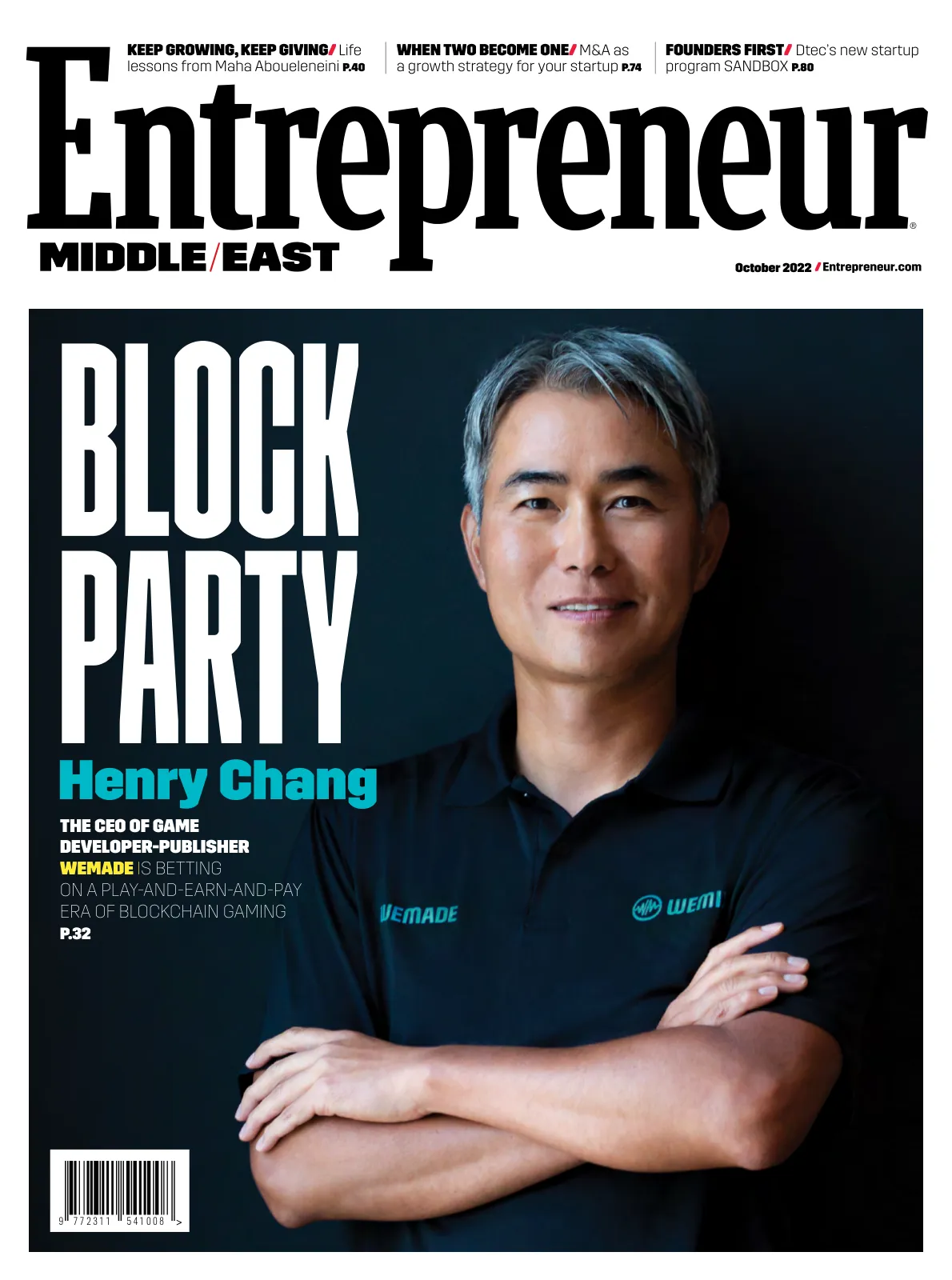
Entrepreneur Middle East, October 2022
Page 1
WHEN TWO BECOME ONE/ M&A as
a growth strategy for your startup P.74
9
7 7 2 3 1 1
5 4 1 0 0 8
>
October 2022
FOUNDERS FIRST/ Dtec’s new startup
program SANDBOX P.80
BLOCK
PARTY
KEEP GROWING, KEEP GIVING/ Life
lessons from Maha Aboueleneini P.40
THE CEO OF GAME
DEVELOPER-PUBLISHER
WEMADE IS BETTING
ON A PLAY-AND-EARN-AND-PAY
ERA OF BLOCKCHAIN GAMING
P.32
Henry Chang
Page 2
100,000+
regional and
international visitors
500+
tech expert
speakers
750+
global tech
exhibitors
400+
cutting-edge
start-ups
Feb 6-9, 2023
Riyadh Front Expo Centre
Saudi Arabia
Join us in
February 2023 as
we take the LEAP
Into New Worlds
Page 3
Co-organised by:
Join us online to
discover more and carry
on the conversation
@LEAPandInnovate
#LEAP23
Will you take the LEAP?
Register now for free
Page 4
Page 5
Page 6
Page 7
Page 8
8 / ENTREPRENEUR.COM / October 2022
Contents/October 2022
P.32
Block Party
Henry Chang, CEO of game
developer-publisher Wemade, is
betting on a play-and-earn-and-pay
era of blockchain gaming.
by ABY SAM THOMAS
P.40
Keep
Growing,
Keep Giving
Armed with lessons learnt through
a successful career spanning more
than 25 years, Maha Abouelenein,
a communications-pro-turned-
entrepreneur, is now authoring her
own book.
by TAMARA PUPIC
P.27
Movement
Matters
Cairo-based startup Goodspace
is using the art of dance to build
a tight-knit community and a
successful business.
by AALIA MEHREEN AHMED
FEATURES
IMAGE COURTESY MAHA ABOUELENEIN
←”My measuring stick
for life is based on
what I am doing to
bring value to
others- personally and
professionally.”
- Maha Abouelenein.
Page 9
Page 10
10 / ENTREPRENEUR.COM / October 2022
EDITOR IN CHIEF Aby Sam Thomas
aby@bncpublishing.net
CEO Wissam Younane
wissam@bncpublishing.net
DIRECTOR Rabih Najm
rabih@bncpublishing.net
CREATIVE LEAD Odette Kahwagi
design@bncpublishing.net
MANAGING EDITOR Tamara Pupic
tamara@bncpublishing.net
STARTUPS SECTION EDITOR Pamella de Leon
pamella@bncpublishing.net
FEATURES WRITER Aalia Mehreen Ahmed
aalia@bncpublishing.net
DIGITAL SOLUTIONS DIRECTOR
Mahdi Hashemi mahdi@bncpublishing.net
HEAD OF INNOVATION
Sarah Saddouk sarah@bncpublishing.net
GROUP SALES DIRECTOR – B2B GROUP
Joaquim D’Costa jo@bncpublishing.net
COLUMNIST Tamara Clarke
CONTRIBUTING WRITERS
Jumana Abdel-Razzaq,
Jad Antoun, Fida Chaaban,
Ahmad Mkhallati, Jasmine Navarro,
Medea Nocentini, Osman Sultan
SUBSCRIBE
Contact subscriptions@bncpublishing.net to receive
Entrepreneur Middle East every issue
COMMERCIAL ENQUIRIES
sales@bncpublishing.net
ENTREPRENEUR.COM
Access fresh content daily on our website
All Rights Reserved 2022. Opinions expressed are solely those of the contributors.
Entrepreneur Middle East and all subsidiary publications in the MENA region are
officially licensed exclusively to BNC Publishing in the MENA region by Entrepreneur
Media Inc. No part of this magazine may be reproduced or transmitted in any
form or by any means without written permission of the publisher. Images used in
Entrepreneur Middle East are credited when necessary. Attributed use of copyrighted
images with permission. All images not credited otherwise Shutterstock. Printed by
United Printing and Publishing.
PO BOX 502511 DUBAI, UAE
P +971 4 4200 506
Contents
October 2022
‘TREPONOMICS
65 The Future of Living
Dubai-based proptech firm Stella
Stays is combining the best of
hospitality and real estate to
reinvent how we find homes for
ourselves.
70 Game On
Qatar-based Sponix Tech is
transforming how people engage
with largescale sporting events.
74 When Two Become One
Having completed three acquisitions
in 2022, Huspy co-founder and CEO
Jad Antoun shares his learnings
from their M&A strategy.
78 Bang For the Buck
Nama Ventures founder and
Managing Partner Mohammed
Alzubi is confident about his
bets on the MENA region and its
entrepreneurs.
80 Founders First
Dtec’s new startup program
SANDBOX aims to create a new
community of innovators in Dubai.
STARTUP
SPOTLIGHT
BUSINESS
UNUSUAL
EntMagazineME
Entrepreneur-me
↑ Established in 2000, WEMADE is an
international game developer publisher
that has grown from a handful of
passionate game pioneers to a group of
over 1,300 game enthusiasts. P.32
50 The Influence of Olivetti
Global Ventures’ Medea Nocentini
details the impact (and inspiration) a
purpose-led business can realize.
53 New Leadership
Osman Sultan reflects on what it
takes to lead Generation Z.
56 Here Be Dragons
Jumana Abdel-Razzaq gives a
guide on what marketers can
learn from the OSN+ campaign to
promote House of the Dragon.
60 Taking Charge
(In the Face of Uncertainty)
Jasmine Navarro delves on
how proactive coping can help
entrepreneurs succeed.
Page 11
Page 12
12 / ENTREPRENEUR.COM / October 2022
Editor’s Note/
Editor’s Note/
A
s someone who works in media, I have been on the
receiving end of plenty of bombastic, superfluous, and
downright ridiculous statements made by people and
businesses in the name of public relations, or worse,
personal branding. Now, look, I get it: all of us want to
present the most impressive versions of ourselves and
our enterprises to the world, and if an Instagram filter
or a white lie here and there helps us do that, well, one can
argue that’s relatively harmless. But, surely, shouldn’t there
be a line drawn somewhere about the amount of exaggeration
or hyperbole that we attach to someone or something?
This is the thought that has been plaguing me after being
recently subjected to an alarming number of baseline
mediocrities that have been dressed up as apparent
accomplishments worth shouting to the world about. Be it
the wannabe influencer who talks a good game but has
nothing substantial to show for it, or the platform that
declares itself to be the next big thing just because it says it is,
I have, of late, been finding myself puzzling over a number of
instances where the façade being showcased is a far, far cry
from the reality on the ground, especially when you get down
to the brass tacks of it all.
Now, this is not really an issue that is new to the
entrepreneurial landscape- cautionary tales abound about
startups that essentially plotted their own downfalls by using
falsehoods and fictions to portray themselves as functional
businesses when the truth was that they were anything but.
And yet, it sometimes feels like our ecosystem continues to be
flush with poseurs and pretensions hell-bent on realizing the
“fake-it-till-you-make-it” fallacy, and it’s downright
exasperating to see many of them get ahead of those who do
things the right way, putting in the hard yards to realize
something meaningful or impactful.
I suppose this is the point when one of you pipes up to tell
me that we live in an unfair world, and that, as such, I should
not begrudge those who “hustle” or “play the game” to move
themselves up the ladder of success. But such an argument
makes me curious about what you consider an achievement
per se- can drinking your own Kool-Aid really quench the
vacuousness you surround yourself with? And let us not
forget that you will have to remove the blinkers you wear one
day or the other- one can only hope that the effort you’ve
unnecessarily put in keeping up appearances will be worth
something then.
I’ve said it before, and I’ll say it again: being self-aware can
only ever do you good. A 2021 study published in the Journal
of Corporate Finance found that “boasting about performance
is rarely associated with value creation,” and that’s something
I’d urge individuals and institutions alike to consider the next
time you wish to shoot off your mouths about something
you’ve done. It’s one thing to celebrate what you have
accomplished- it’s another thing altogether to do that in
isolation of everything that’s happening around you. By all
means, celebrate your small wins- just don’t make them
bigger than they actually are.
Aby Sam Thomas
Editor in Chief
@thisisaby
aby@bncpublishing.net
PUT IN THE HARD YARDS
Bragging rights should be earned
Page 13
Page 14
14 / ENTREPRENEUR.COM / October 2022
O
n September 21,
2022 at the
Etihad Museum
in Dubai, the UAE
Ministry of
Health and
Prevention
(MOHAP) launched of the 2022
edition of the BE BOLD program, a
first-of-its-kind federal initiative in the
UAE that aims to design the future of
healthcare by building on the capabili
ties of talent in the country.
This year’s instalment of BE BOLD
will be running from September 21,
2022 to November 24, 2022 under the
motto #TogetherForHealthUAE, and it
is being staged with the support of
Dubai Health Authority (DHA),
Emirates Health Services (EHS),
Viatris, Klaim, and Johnson &
Johnson as strategic partners.
The program has been built in
partnership with Entrepreneur Middle
East Impact, the educational arm of
the region’s leading publication on
entrepreneurship, Entrepreneur
Middle East, which develops programs
designed to encourage and enhance
innovation within companies in both
the private and public domain.
INITIATING INNOVATION
The UAE Ministry of Health And Prevention kicks off the 2022 edition of BE BOLD with the aim
to "shape the future of healthcare"
THERE IS ALWAYS A HIDDEN CAUSE THAT ISN’T
BEING ADDRESSED, AND IT CAN LEAD TO A SOLID
SOLUTION THAT CAN REALLY CHANGE HEALTHCARE.
In The Loop/
→ BE BOLD 2022 is an initiative by the UAE
Ministry of Health and Prevention aimed at
designing the future of healthcare by building
on the capabilities of talent in the country.
Page 15
15
October 2022 / ENTREPRENEUR.COM /
BE BOLD 2022 will bring
together a group of 20
participants belonging to
different parts of the
healthcare sector, which
include public and private
sector professionals,
seasoned entrepreneurs,
government stakeholders, as
well as academia in the
field, to help design the
UAE government’s national
health programs of the
future.
At the end of the BE
BOLD 2022 program, the
participants will pitch their
innovative national
healthcare ideas to a jury
panel, and the winner will
receive financial and
practical support from
MOHAP, Entrepreneur
Middle East, DHA, EHS,
Viatris, Klaim, and Johnson
& Johnson in order to
implement their proposal
on a national level in the
UAE.
Commenting on the launch
of BE BOLD 2022,
MOHAP Undersecretary
H.E. Dr. Mohammed Salim
Al Olama said, “We have
launched the program in
implementation of the
directives of H.H. Sheikh
Mohammed bin Rashid Al
Maktoum, Vice President,
Prime Minister and Ruler of
Dubai, who constantly urges
the adoption of a design-
thinking culture in all areas
of government work, and to
collaborate with the
community to design
innovative solutions to
potential challenges, in line
with the principles of the
50th and the UAE
Centennial Plan 2071.”
Speaking at the event
kicking off BE BOLD 2022,
Saqr Al Hemeiri, Chief
Innovation Officer and
Director of Strategy and the
Future at MOHAP, said,
“Five years ago, our dream
was to find a way to work
in collaboration with the
private sector and
government to enhance
the healthcare sector of
the UAE. Today, we are
realizing that dream with
the second edition of the
BE BOLD program.”
The official launch event
was also attended by H.E.
Dr. Yousif Mohammed
Al-Serkal, Director-General
of EHS, H.E. Dr Hussain
Abdul Rahman Al Rand,
Assistant Undersecretary
for the UAE Public Health
Sector, Dr. Amin Hussein Al
Amiri, Assistant
Undersecretary for the UAE
Health Regulation Sector,
and H.E. Salem Al Darmaki,
Advisor to the UAE
Minister of Health and
Prevention. Also present
were leadership and
representatives from the
Dubai Health Authority and
other program partners.
Speaking at the event,
Wissam Younane, CEO of
BNC Publishing, the media
house behind Entrepreneur
Middle East, said, “As the
first initiative of its kind in
the UAE, BE BOLD is
staying true to its name in
that it is attempting
something daring, some
thing new, and something
innovative within the
healthcare sector of the
UAE, which can have not }}
BE BOLD 2022 WILL BRING TOGETHER A GROUP OF 20 PARTICIPANTS BELONGING
TO DIFFERENT PARTS OF THE HEALTHCARE SECTOR, WHICH INCLUDE PUBLIC AND
PRIVATE SECTOR PROFESSIONALS, SEASONED ENTREPRENEURS, GOVERNMENT
STAKEHOLDERS, AS WELL AS ACADEMIA IN THE FIELD, TO HELP DESIGN THE UAE
GOVERNMENT’S NATIONAL HEALTH PROGRAMS OF THE FUTURE.
↑ At the launch of BE BOLD 2022, emcee Sally Mousa moderating a
discussion with Tom Loney, Associate Professor for Public Health and
Epidemiology at the Mohammed Bin Rashid University Of Medicine and
Health Sciences in Dubai, Tamer El-Sallab, Head of Gulf and Levant
Cluster at Viatris, and Karim Dakki, co-founder and CEO of Klaim.
↑ Ameera Al Hamed, Head of Innovation and Future Foresight at MOHAP, at the launch of BE BOLD 2022.
Page 16
16 / ENTREPRENEUR.COM / October 2022
just a sizable, but also a meaningful
impact on the population of the
country.”
Meanwhile, Ameera Al Hamed,
Head of Innovation and Future
Foresight at MOHAP, said that the
second edition marks a milestone for
the BE BOLD given its collaboration
with entities “that are already
reinventing the healthcare sector in
the UAE.” The event also featured a
panel discussion on building
healthcare ecosystems in the UAE
that hosted Tom Loney, Associate
Professor for Public Health and
Epidemiology at the Mohammed Bin
Rashid University Of Medicine and
Health Sciences in Dubai, Tamer
El-Sallab, Head of Gulf and Levant
Cluster at global pharmaceutical
company Viatris, and Karim Dakki,
co-founder and CEO of Dubai-based
healthtech startup Klaim, in a
conversation with emcee Sally
Moussa.
The panelists highlighted the
importance of including entrepre
neurs and intrapreneurs in creating
new healthcare projects, with Loney
saying, “While we need horizontal
communication, we also need vertical
communication. So, when a problem
is being identified, you absolutely
need people with different ways of
approaching and solving it.” In line
with this, Dakki and El Sallab advised
the BE BOLD 2022 participants to
always be open to discussions and
new insights. “There is always a
hidden cause that isn’t being
addressed, and it can lead to a solid
solution that can really change
healthcare. So, don’t come into it with
preconceived notions,” El Sallab
added.
The BE BOLD 2022 program will
feature 14 personal training courses,
three main semesters, and 60 hours
of online instruction. Also, high-
profile experts in future foresight,
leadership, and design thinking from
the UAE, Germany, the Netherlands,
Colombia, the US, China, and Canada
will be taking part in the initiative,
shedding light on three key pillars,
including public health, mental
health, and women’s health.
The BE BOLD program responds to
the directives of H.H. Sheikh
Mohammed bin Rashid Al Maktoum,
UAE Vice President and Prime
Minister and Ruler of Dubai, to adopt
a culture of design thinking in all
fields of government work, and to
work in partnership with the
community to design innovative
solutions for future challenges in line
with the principles of the Fifty-Year
Charter and the UAE Centennial Plan
2071. beboldme.com
FIVE YEARS AGO, OUR DREAM WAS TO FIND A WAY TO WORK IN
COLLABORATION WITH THE PRIVATE SECTOR AND GOVERNMENT
TO ENHANCE THE HEALTHCARE SECTOR OF THE UAE. TODAY, WE
ARE REALIZING THAT DREAM WITH THE SECOND EDITION OF
THE BE BOLD PROGRAM.
In The Loop/
↑ Saqr Al Hemeiri, Chief Innovation Officer and Director of Strategy and the Future at MOHAP,
at the launch of BE BOLD 2022.
↑ Guests at the launch of the BE BOLD 2022
initiative at the Etihad Museum in Dubai.
Page 17
Page 18
O
n September 15, 2022, at Sofitel Dubai The Palm,
Entrepreneur Middle East staged the Leaders
in Fintech Awards 2022, sponsored by du and
in partnership with in5 Dubai, to recognize the
individuals and enterprises that are shaping the
future of the MENA region’s fintech ecosystem.
The second instalment of this annual event saw a total of 25
awards being presented, with all the winners celebrated as the
movers and shakers of a space that is predicted to be worth
US$3 million by the year 2026.
With the winners ranging from innovative banks to startup
disruptors in the cryptocurrency space, the Leaders in Fintech
Awards 2022 proved to be a celebration of the innovations that
will be powering the Middle East’s fintech arena today and into
the future.
“It’s no secret that fintech is one of the most exciting and
lucrative industries in the world of today, and the potential that
the MENA region presents in this sector is truly unmatched,” said
Wissam Younane, CEO of BNC Publishing, the media house behind
Entrepreneur Middle East, at the gala event. “After all, our region
is home to 85 million of the world’s two billion unbanked adults,
and while they may be often disregarded by large-scale financial
institutions, they also represent the opportunity that is ripe for
the taking- and the innovators and entrepreneurs in this room
tonight are the forerunners in this field.”
“It is with that thought in mind that I would like to applaud
each and every one of you for making your way through an
industry that is definitely filled with hurdles, and yet, getting
past all of them to work on realizing a better financial future for
every single one of us,” Younane added. “Thank you for all the
work that you do, and we at Entrepreneur salute you for your
efforts.” fintechawardsme.com
18 / ENTREPRENEUR.COM / October 2022
PRESENTED BY
Page 19
BEST TRADING PLATFORM / EFG Hermes One
BEST FINTECH SOLUTION FOR HEALTHCARE / Klaim
BEST CRYPTO TRADING TECHNOLOGY / BTSE
BEST BNPL PLATFORM / valU
BEST EMERGING BLOCKCHAIN SOLUTION / Inery
BEST FINTECH SOLUTION FOR SMEs / Beehive
MOST INNOVATIVE BLOCKCHAIN ECOSYSTEM / Illumishare
MOST INNOVATIVE ISLAMIC BANK OF THE YEAR / Nomo Bank
OPEN BANKING PLATFORM OF THE YEAR / Tarabut Gateway
CRYPTO PAYMENT GATEWAY OF THE YEAR / Alchemy Pay
WEB3 CONSULTING FIRM OF THE YEAR / Luna PR
SME DIGITAL MARKETPLACE OF THE YEAR / Mashreq Business Banking
ECOSYSTEM ENABLER OF THE YEAR / Wa’ed Ventures
FINTECH STARTUP OF THE YEAR / QFIL Solutions
METAVERSE ADVISOR OF THE YEAR / Dustin Plantholt, Crypto Editor, Forbes Monaco
CRYPTO ENTREPRENEUR OF THE YEAR / Mani Thawani, founder, Mundo Crypto
FINTECH INVESTOR OF THE YEAR / Flat6Labs
FINTECH LEADER OF THE YEAR / Sahir Berry, founder, NowNow
INVESTOR RELATIONS CONSULTANT OF THE YEAR / Pimlico Partners
FASTEST GROWTH / Huspy
BEST WEB3 PROJECT OF THE YEAR / ICICB
CRYPTO STRATEGIST OF THE YEAR / Sharp Markets
BETS MOVE TO EARN APP / PUML
BEST ISLAMIC FINANCE SOLUTION PROVIDER / Tamweel AlOula
BNC PUBLISHING CEO Wissam Younane
WINNERS of the Leaders in Fintech Awards 2022
19
October 2022 / ENTREPRENEUR.COM /
Page 20
20 / ENTREPRENEUR.COM / October 2022
FINTECH LEADER OF THE YEAR
Sahir Berry, founder, NowNow
CRYPTO
ENTREPRENEUR
OF THE YEAR
Mani Thawani, founder,
Mundo Crypto
NIMI MEHTA, EMCEE FOR THE
LEADERS IN FINTECH AWARDS 2022
FINTECH
STARTUP OF
THE YEAR
QFIL Solutions
Page 21
21
October 2022 / ENTREPRENEUR.COM /
FASTEST GROWTH
Huspy
ECOSYSTEM ENABLER OF THE YEAR
Wa'ed Ventures
WEB3 CONSULTING FIRM OF THE YEAR
Luna PR
CEO OF THE YEAR
Ozair Puda, CEO, Service My Car
Page 22
22 / ENTREPRENEUR.COM / October 2022
BEST FINTECH SOLUTION FOR SMES Beehive
METAVERSE ADVISOR OF THE YEAR
Dustin Plantholt, Crypto Editor, Forbes Monaco
BEST MOVE TO EARN APP
PUML
BEST FINTECH SOLUTION FOR HEALTHCARE Klaim
Page 23
23
October 2022 / ENTREPRENEUR.COM /
BEST EMERGING BLOCKCHAIN SOLUTION
Inery
BEST CRYPTO TRADING TECHNOLOGY
BTSE
MOST INNOVATIVE
BLOCKCHAIN ECOSYSTEM
Illumishare
FINTECH INVESTOR OF THE YEAR Flat6Labs
Page 24
24 / ENTREPRENEUR.COM / October 2022
BEST BNPL PLATFORM valU
BEST WEB3 PROJECT OF THE YEAR
ICICB
OPEN BANKING PLATFORM OF THE YEAR
Tarabut Gateway
Page 25
25
October 2022 / ENTREPRENEUR.COM /
CRYPTO STRATEGIST OF THE YEAR
Sharp Markets
INVESTOR RELATIONS
CONSULTANT OF THE YEAR
Pimlico Partners
CRYPTO PAYMENT GATEWAY OF THE YEAR
Alchemy Pay
MOST INNOVATIVE ISLAMIC BANK OF THE YEAR
Nomo Bank
SME DIGITAL MARKETPLACE OF THE YEAR
Mashreq Business Banking
Page 26
Page 27
27
October 2022 / ENTREPRENEUR.COM /
Movement Matters
Cairo-based startup Goodspace is using the art of dance to build a tight-knit
community and a successful business by AALIA MEHREEN AHMED
→ MAHMOUD SHOUKRY AND
LAYLA GHALEB ARE THE
CO-OWNERS OF GOODSPACE,
a Cairo-based dance company
looking to create a tight knit
community of performing
artists.
IMAGES COURTESY GOODSPACE
Page 28
28 / ENTREPRENEUR.COM / October 2022W
hen Layla Ghaleb and Mahmoud Shoukry founded their Cairo-
based dance company Goodspace in July 2021, they did so with a
clear vision built upon their collective experiences as active
participants in Egypt’s dance community. After all, Shoukry has
been a choreographer for over 15 years, while Ghaleb is a self-
taught dancer who became a professional choreographer and
teacher. “We both always dreamed of creating something special;
a space that is safe for everyone, for people from all walks of life
to train and grow and excel,” Shoukry says. “Layla and I discussed
it randomly a couple of years ago, actually- our hopes and
dreams for the Egyptian dance community, and how we have so
many local talents here that deserve exposure and a spot in the
international community’s limelight. I guess that’s where it all started.”
→ Using the slogan ‘Good people,
Good company, Good souls,’ the
Goodspace studio aims to create
a safe space for its users.
B/What’s Next?
Page 29
29
October 2022 / ENTREPRENEUR.COM /
The business that Ghaleb
and Shoukry launched is
today demarcated into three
main verticals: Goodspace
Studios, a dance studio open
to people across all age
groups, Goodspace Talents,
a dance agency, and
Goodspace Events, the
firm’s event management
arm. “Goodspace Studios
personifies our company
slogan, ‘Good people, Good
company, Good souls,’ by
aiming to create a safe space
for athletes, dancers, and
performers to train towards
the betterment of their craft,
and also welcomes hobby
ists -young and old, and
from all walks of life- assist
ing them in their growth
physically, mentally, and
emotionally,” Ghaleb adds.
“Dance opens you up; it
invites you to understand
and comprehend everything
that is within you and
outside you, be it spiritual
or physical. Within that
exploration and under
standing and openness,
there is a sense of vulner
ability that does come along
with it, and when that is
met with love and accep
tance, tolerance and
compassion, no words can
express what that can do for
the soul!” Shoukry adds to
Ghaleb’s statement, saying,
“That is what we’re aiming
to do at Goodspace: help
people grow, and have love
for themselves, and
everyone else around them!”
At this point, I must
mention that despite this
interview being done via
email, Ghaleb and Shoukry’s
innate passion for dance,
and the goodness they hope
to spread through it, is
palpable through their
written replies. Like many
across the globe who have a
keen interest in the
performing arts, the
co-owners cite the likes of
Michael Jackson and
Madonna as their inspira
tions, with Ghaleb specifi
cally mentioning husband-
and-wife choreographing
duo Keone Madrid and
Mari Madrid’s interpreta
tion of the Bob Marley song,
Is This Love. “Watching
their interpretation of Is
This Love was unlike
anything I’d ever seen or
witnessed before,” she
recalls. “It told a story of a
love that is old and timeless,
and the innocence that can
live on within two people’s
love. It was the first time I
realized that dance doesn’t
just have to be about fun
and sass, but it can also
convey a story, a message.
You can share your feelings
and emotions and thoughts
in a way that is soul-baring.”
Having imbibed such
sentiments and experiences
into their teaching responsi
bilities, it comes as no real
surprise when Ghaleb and
Shoukry say that witnessing
their students gradually
journey into the process of
becoming instructors and
teachers themselves has
been one of their biggest
entrepreneurial achieve
ments. Goodspace Studios,
in particular, seems to
already be enabling the
sense of community and
camaraderie that both
co-founders so desperately
hope to achieve. “Some
times, we’ve had people who
are too young to attend
advanced classes come in
and kill it, and other times
we’ve had people who are in
their thirties and forties
dancing for the first time,”
Shoukry says. “It’s so
refreshing to see their
passion ignited and to see
them grow into the
performers that they want
to be, even if it’s just for fun.
That’s another thing that we
love about this job- we are
always pleasantly surprised
by the different people from
all walks of life that come
and join our classes in
search of self-love, empow
erment, connection, love,
and community!”
WE HAVE SO MANY LOCAL TALENTS HERE THAT DESERVE
EXPOSURE AND A SPOT IN THE INTERNATIONAL COMMUNITY’S
LIMELIGHT. I GUESS THAT’S WHERE IT ALL STARTED.
↓ Mahmoud Shoukry and
Layla Ghale, co-owners,
Goodspace, want “to help
people grow, and have love
for themselves, and
everyone else around them!”
Page 30
30 / ENTREPRENEUR.COM / October 2022
But goals centered around using dance
to create a tight-knit community is just
one part of what Shoukry and Ghaleb
have set out to do- the other aim is, of
course, to build a successful business.
Within just a year of its launch, the
company has been instrumental in a
wide array of commercial projects,
including a video for Adidas’ Run For
The Oceans campaign, an advertise
ment by UAE-based telco Etisalat that
featured Egyptian actors Khaled El
Nabawy and Sherine Reda, as well as a
music video for Arab singer Balqees
Fathi. “The concepts of conscientious
ness and succeeding are not antithetical
notions; you can truly do both,” Shoukry
says. “Some people don’t understand
that just because we want to give back
to the community does not mean that
we don’t want to be a successful
business! You can carry out and
implement an ethical business that
betters the community, without having
to compromise your morals or ethics for
commercial success.” Ghaleb points out
that overcoming this preconceived
notion has been one of the many
societal hurdles faced in building
Goodspace. “The process of overcoming
it is still ongoing, I suppose, but in
terms of how we deal with it, we do it
the way that anyone should deal with
anything really: just be genuine,” she
says. “We are living our truth and people
that have worked and trained with us
see that- they see our intention, our
love, and our dedication to the dream
that is a bigger and stronger community
of performing artists that love and
support each other.”
At the time of writing this piece, the
co-founders are confident that they will
reach their biggest milestone yet during
an event planned for the end of
September 2022: Goodweekend, an
international dance camp organized by
its aforementioned events arm Good
space Events, that will feature a string of
globally renowned choreographers such
as Los Angeles-based Nicole Kirkland
and Emmy-nominated Melvin Timtim.
Set to run from September 28, 2022 to
October 1, 2022 in Cairo, it is being
pegged as the first-of-its-kind interna
tional dance camp in the Middle East.
“To be able to say that we are getting
these amazing instructors and choreog
raphers in one place at the same time
for the first time ever in the Middle East
does qualify as a milestone I think- pos
sibly the milestone of milestones!”
Ghaleb says. “We are thus looking
forward to celebrating our one-year
company anniversary alongside this
amazing line-up as well as everyone else
that will be attending the camp! It will
be a ‘Goodweekend’ indeed; an
anniversary to remember!” Open to
those who possess beginner, intermedi
ate, as well as advanced dance education
levels, the camp is welcoming partici
pants as young as 10-year-olds. And
when asked what he hopes for the
participants of Goodweekend, Shokry
replies, “We want people to experience
something they’ve never experienced
before in the Middle East- an intense,
rigorous training schedule where you
will dance, learn, and connect with the
best of the international dance commu
nity. We want people to walk away with
a newfound love and appreciation for
everything that is related to the
performing arts and dance.”
And this camp will simply prove to be
the first step in the many other goals
Goodspace hopes to achieve moving
into the new year, says Ghaleb. “I just
look forward to seeing everyone’s faces
and smiles at Goodweekend for now,
but I think 2023 will be another year to
grow and better ourselves,” she says. “As
individuals, we’ve put our blood, sweat,
and tears into this, and have made a lot
of sacrifices individually and collectively
to ensure that our dream comes to life.
So, 2023 will be the year we give back
little to ourselves, so we can keep the
train going.” But Shoukry adds that
taking things one step at a time will be
the motto that drives Goodspace
forward. “We are still unsure what our
next step is going to be, so for now we
are focused on making Goodweekend
the best experience that it can be,” he
says “Going into 2023, who knows?
Maybe we’ll open up a new branch,
maybe we’ll dive into organizing
another camp… we don’t want to take
on too much all at once. For now, we’re
just enjoying the ride.”
WE WANT PEOPLE TO EXPERIENCE SOMETHING THEY’VE
NEVER EXPERIENCED BEFORE IN THE MIDDLE EAST-
AN INTENSE, RIGOROUS TRAINING SCHEDULE WHERE
YOU WILL DANCE, LEARN, AND CONNECT.
B/What’s Next?
Page 31
lyveglobal.com
E-COMMERCE
MADE EASY
Supercharge your ecommerce and online operations
with Lyve. Get fast, flexible, and full-featured delivery and
technology solutions that meet your customers’ needs
and allow you to focus on what you do best.
Go Lyve Today �
lyveglobal.com/ecommerce
#golyve
Page 32
PARTY
Page 33
THE CEO OF GAME
DEVELOPER-PUBLISHER
WEMADE IS BETTING
ON A PLAY-AND-EARN-AND-PAY
ERA OF BLOCKCHAIN GAMING
by ABY SAM THOMAS
PHOTOGRAPHY FAROOQ SALIK
HENRY
CHANG
33
October 2022 / ENTREPRENEUR.COM /
Page 34
34 / ENTREPRENEUR.COM / October 2022
Wemade is perhaps best known for being the makers
of the incredibly successful massively multiplayer
online role-playing game (MMORPG) series, Legend
of Mir, which has fans from around the world
numbered in the hundreds of millions- in fact, Chang
proudly tells me that more than two decades after its
launch, the title’s intellectual property continues to
be as loved by (and relevant to) gamers today as it
ever was. I find this to be an indication of how
Wemade has seemingly cracked the code of creating
something timeless, while also staying in tune with
the times- and this can also be seen in the transfor
mation it is currently ongoing from being a tradi
tional video game company to now becoming an
open platform for blockchain games.
For the uninitiated, blockchain games are video
games that make use of blockchain-centered
technologies like cryptocurrencies and non-fungible
tokens (NFTs) in their gameplay. Presently a nascent
industry, Wemade has set out to position itself as a
frontrunner in this space with the launch of Wemix,
its open blockchain gaming platform, and its
eponymous token. While there are only 17 games
hosted on Wemix as of October this year, it’s already
home to a smash hit: MIR4 Global. Launched by
Wemade in August last year, MIR4 Global went on to
secure 20 million cumulative users within just a year.
MIR4 Global’s success bodes well
for the blockchain gaming ecosystem, especially
considering that the game reached 6.5 million
monthly active users in just a few months, despite
having no formal marketing campaigns to support its
launch. “I think it’s safe to say that MIR4 Global is
the most successful blockchain game ever,” Chang
says. “The game proved that it is possible to make an
enjoyable, well-made blockchain game for players, a
game that people would love to play not just to earn
cryptocurrencies, but for the sheer fun of the
gameplay.”
Note here Chang’s point about people wanting to
play MIR4 Global purely as a game, and not just for
the rewards it offers. This is a huge win for Wemade
in the domain of blockchain games, and in order to
understand why, Chang suggests starting by
examining what differentiates them from their
“traditional” counterparts. “Blockchain games are
characterized by in-game assets that present both
monetary value and real-world use cases,” he
explains. “Originally, traditional in-game assets have
been contained and trapped inside the game. When
those assets are owned by the players instead of the
gaming company, it gives them a sense of ownership.
Users can now freely and in a seamless manner buy,
trade, and stake their in-game assets. These elements
set apart blockchain games from traditional main
stream games.”L
et me start this piece with
an admission that I knew
little to nothing about
South Korea-based game
developer and publisher
Wemade before I was
offered an interview with its
CEO, Henry Chang, when he
visited the UAE in August
this year. But my ignorance
about the company says
more about me not being
much of a gamer, than
anything else- after all,
Wemade is a publicly listed
billion-dollar-business
whose offerings have been
(and continue to be) made
use of by hundreds of
millions of people around the world.
And when Chang tells me he was
recognized by people on the streets
of Dubai on account of the Wemade-
branded jacket he was wearing
at the time, it’s more than enough
impetus for me to want to learn more
about him and his company.
→ OPPOSITE PAGE
LEGEND OF MIR2, the original Hallyu game, has
attracted more than 500 million users
worldwide. Even today, after more than two
decades, Legend of Mir IP-based games
continue to be played and loved by hundreds
of millions of enthusiastic fans.
“Games can provide answers.”
Page 35
35
October 2022 / ENTREPRENEUR.COM /
N
ow, it’s this opportunity to earn assets in
blockchain games -usually cryptocurrency
tokens of one kind or the other- that has lately
led to the eruption of the play-to-earn (P2E) model in
this landscape. “P2E was one of the most popular
keywords in the gaming industry last year,” Chang notes.
“In the crypto market, it’s treated as the next big thing.
Although the stock prices of the gaming industries in
Korea are stagnant right now due to microeconomic
instabilities such as inflation, last year, the stock prices
of the game companies skyrocketed when they
mentioned the word P2E, NFT, or blockchain. The P2E
model has been popularized in the press and by some
crypto communities mostly because these tokenomics-
focused games are designed to provide economic
gain- before anything else.”
And therein lies the problem that has materialized
alongside the rise of the P2E model in the gaming
ecosystem. “Creating games from the position of
financial engineering, as opposed to from a game
developer’s perspective, has led to higher barrier to
entry. Players consistently cashing out and not
contributing to the ecosystem, and games that lost their
primary entertainment value and felt more like manual
labor,” Chang explains. “P2E games are also associated
with social issues related to gaming addiction, and
playing them as a full-time job deprives entire
societies of their human capital and negatively
impacts their productivity too.”
It is to subvert such consequences that Chang is
pushing for greater adoption of what Wemade is
calling a play-and-earn-and-pay model in the
gaming sphere. “Because of the aforementioned
issues and more, I do not believe a purely
tokenomics-dependent P2E ecosystem is
sustainable and scalable,” Chang says. “It is then
necessary to go back to the essence of gaming,
which was always about bringing entertainment
value with well-made games. The play-and-earn-
and-pay model puts well-made games at the center
of ecosystem, and it provides the basis of a
sustainable ecosystem by incentivizing users who
enjoy the game to not just play and earn
cryptocurrencies or NFTs, but to invest their earned
tokens back into the ecosystem by upgrading their
characters, etc.”
T
his should explain why Chang sees the
success that MIR4 Global has seen as such a
great win for Wemade and the gaming
landscape at large- the fact that it had more than 1.4
million concurrent users shortly after it launched is
a testament to the sheer prowess of the game. “As
many in the gaming industry know, this is an
exceptional result for an MMORPG, which
normally takes more time to go through and finish
the game,” Chang adds. And Wemade isn’t sitting on
its laurels- it’s already pushed out its latest offering.
“We recently released MIR M, the newest spinoff of
the Legend of Mir series locally in June, with a
global launch expected later this year,” Chang says.
“There has been some great initial response to MIR
M, which makes me confident the global version
will do even better than MIR4.”
“I think it’s safe
to say that MIR4 Global
is the most successful
blockchain game ever.”
}
Page 36
36 / ENTREPRENEUR.COM / October 2022
→ WEMADE has
continued to
develop and
service dozens of
PC and Mobile
based games for
fun loving gamers
since its inception.
A
ll of this are good tidings for the blockchain
games industry as well, Chang says. “Not only
does it prove to the world that it is possible to
make well-made games embedded with blockchain
technology, but it also shows that gamers who have
been accustomed to traditional Web 2.0 games for
decades have embraced this new technology with
open arms as well,” he says. This, in turn, is a shot in
the arm for the bet Wemade has made on its Wemix
platform. “As we further expand our Wemix platform
ecosystem, we expect its part of revenue will grow
exponentially,” Chang says. “Although the platform’s
revenue is weak now, I expect Wemix to be at the
center of our sales in the future. I firmly believe we are
on the right track to succeed as an open blockchain
game platform, similarly to what Apple’s App Store
and Google’s Play Store have achieved.”
At this point, Chang acknowledges that there remains a
certain amount of hesitancy toward blockchain games from
the traditional gaming community at large- however, he
also believes that it will subside as blockchain adoption
becomes more prevalent in our world. And that, he
predicts, is when Wemade’s early investment in this space
-i.e. Wemix- will allow it to become the dominant global
platform by default. “Our ultimate goal is to create a mega
ecosystem, and become the Steam of blockchain games,”
Chang says- for the non-gamers reading this, Steam is the
largest distributor of personal computer games in the world
today.
“Every year, there are around 50,000 news games
launched, and I believe that in the near future all these
games will be blockchain games,” Chang continues.
“In-game items have always existed even in Web 2.0 games;
however, with blockchain technology, users are able to take
those in-game items out into the real world enhancing the
user gaming experience. By putting all our efforts into
blockchain technology, we aim at becoming the global open
blockchain game platform by default, enabling hundreds of
new games to onboard our platform each year, and benefit
from blockchain technology and our ecosystem even
without previous knowledge in the blockchain space.”
At this point, in case of any of you think that this is a lofty
ambition for Wemade to make in a fledgling industry that
has also been rocked recently by a crypto winter, Chang is
here to help disprove you of that notion. “Based on my 26
years of experience in the gaming industry, I firmly believe
that blockchain gaming is the future,” Chang declares. “As a
publicly traded company with over 20 years of corporate
history, Wemade is well ahead compared to its competitors,
and we will put everything we have into keeping it that way
despite the current market conditions.”
Our ultimate
goal is to create
a mega
ecosystem.”
“
→ Established in 2000,
WEMADE is an
international game
developer publisher that
has grown from a handful
of passionate game
pioneers to a group of
over 1,300 game
enthusiasts.
Page 37
37
October 2022 / ENTREPRENEUR.COM /
Chang admits here that as a relatively new technology,
blockchain still has a long way to go in terms of regula
tions, implications, and even applications- but from
Wemade’s perspective, it represents an opportunity,
rather than a challenge. “When Bitcoin was first
introduced in 2009, like many people in the gaming
industry, I didn’t believe it was special back then, and
treated it like some sort of game money that players use
in games,” Chang recalls. “I, alongside many of my
colleagues, thought we knew everything about game
money, and that it was absurd to use it outside games
and in real life. But now, thanks to the few innovative
people who recognized early the potential of the
technology, and then utilized it to develop business
solutions and industrial advancement, we have arrived to
where we are today.”
C
hang currently professes a steadfast belief in the
potential (and power) of blockchain, and that is
what he has channeled to lead Wemade through
the instability that has been seen in the crypto landscape
through the course of 2022. “Our response to the
turbulence in the current market has been to focus on
providing utility to the users, and making more
investments and strategic partnerships to strengthen our
position as a leading global open blockchain game
platform,” Chang says. “Even back in 2018, during the
previous crypto winter, we didn’t give up, and we spent
human resources into developing our blockchain
technology and services; we continue to do the same even
now.”
Chang speaks with the confidence attained by working
for 26 years in gaming- in fact, he started out in the
industry when he was still a senior at college. His first job
was at Nexon, which was then a Seoul-based small
business with fewer than 10 employees- today, however,
it is one of the biggest game companies in South Korea,
as well as one of the biggest listed companies in Japan.
Following a long stint at Nexon, he joined another game
publisher, Neowiz, as its Chief Financial Officer, and then
became Head of the Strategic Planning Division of
Neowiz Games, before finally going on to lead Neowiz
Mobile as its Chief Executive Officer. Chang then joined
Wemade in 2013, and he was appointed its CEO a year
later.
Chang’s career trajectory should make it clear that he is
someone who is extremely well-versed with the industry
he operates in, and that should serve as reason enough
for why his viewpoint on the potential blockchain
presents in this landscape shouldn’t be taken lightly.
“What’s interesting is that as someone who spent his
entire career in the gaming industry, there is no doubt
that role-playing games, like the MMORPG Legend of
Mir series, already provide a similar concept to a
metaverse, and it is interesting to see how the rest of the
world is now embracing this new technology and
concept,” Chang says. “I believe at the heart of the
metaverse are games, and that there are a lot of exciting
new developments to happen in the space within the
near future.”
Chang reveals here that the MENA figures strongly in
Wemade’s aspirations for the future, and he points out
that MIR4 Global has been able to create a strong
fanbase in the region. “MIR4 Global ranked first across
the UAE, Saudi Arabia, and Qatar amongst role-playing
games on the Google Play Store back in March 2022, and
it has succeeded in maintaining its top three rank in
multiple MENA markets even now,” Chang says.
Page 38
38 / ENTREPRENEUR.COM / October 2022
“In addition, the MENA is impor
tant from a blockchain development
point of view. The MENA offers
licenses for crypto coin platforms,
and we are in the process of applying
for one. Once done, we will move
some of our development team to
the region, and develop a state-of-
the-art blockchain platform and
crypto hub.”
A
nd it’s not just an increase in
the Wemade user base that
Chang hopes to see resulting
from the MENA- he’s also hoping to
see a rise in the number of
stakeholders from the region as well.
“Wemade is a listed company in
South Korea, and I would like to
invite MENA institutional and retail
investors to buy our stocks and our
WEMIX coin, which is listed in
more than 25 exchanges around the
world,” Chang says. “I believe both
Wemade’s stock and the WEMIX
coin present very attractive
investment opportunities, as they
are both liquid and under-valued
considering their huge growth
potential. I myself have been buying
WEMIX coin with my salary and
bonus income from the market for
the last seven consecutive months,
and I do not intend to stop until I
retire; I also have not and will not
sell a single WEMIX coin.”
It’s interesting to note here that the
conviction with which Chang speaks
about Wemade’s endeavors in the
blockchain gaming space today- it is
truly in stark contrast to the
perspective with which they were
seen when the company was just
starting out on them. “For the first
three-and-a-half years, our block
chain gaming business didn’t look
like much from the outside,” he says.
“But when MIR4 became the first
commercial hit globally in August
2021, I was very thrilled to realize
that I’ve been right all along. And
during the past year, the excitement
has been growing within me every
day, at every moment.” Chang is thus
watching with glee as the building
blocks of a new digital blockchain-
centric economy involving NFTs,
decentralized asset organizations
(DAOs), decentralized finance
(DeFi), and more get put into place,
and when it all actually comes
together, he is aiming for Wemade
“to become the dominant open
blockchain game platform, as the
number one global mainnet.”
Chang recently revealed details
about WEMIX$, the stablecoin of
its mainnet Wemix 3.0, during his
keynote speech at the TOKEN2049
event held in Singapore in Septem
ber. “Stablecoins must be stable,” he
said. “This is the first requirement.
WEMIX$ meets that through 100%
USDC [a digital stablecoin pegged
to the United States dollar] reserve.”
Following that, Chang continued by
listing “stable/native coin reflexivity”
as a second requirement for a
successful stablecoin. “When a
stablecoin is doing well, it should
affect the native coin,” he explained.
“The native coin must be able to cap
ture the demand and trade of
stablecoin. Thus, the reflexive
relationship between stablecoin and
native coin must be structured.” As a
third and final requirement, Chang
listed scalability, which WEMIX$
secures through Wemade’s DIOS
protocol, which, in turn, will let it
expand according to the ecosystem’s
growth.
The aspirations Chang has for
Wemade, along with the results it
has already achieved with him at its
helm, also serve as a testament to his
leadership of the company, which, by
the way, is a realization of a
childhood dream he had to run “a
big, great company.” “There’s an old
OUR WEMIX COIN IS
LISTED IN MORE THAN
25 EXCHANGES
AROUND THE WORLD.”
“
Page 39
39
October 2022 / ENTREPRENEUR.COM /
“Setting up your vision, crafting
your strategies, and taking
steps to achieve your goal
in the long run is the key to the
success and growth of your
company.”
saying that ‘good things take time,’” Chang says. “When I
make plans for business and new technology that will
determine the future, I try to think for the long term, like,
say, in ten-year periods. In 2018, all gaming companies
were interested in blockchain games, and some entered
the market. But they all gave up during the crypto winter
that happened afterward. Wemade was almost the only
company that kept up, because we thought it might take
ten years to succeed from the start. I believe that setting
up your vision, crafting your strategies, and taking steps
to achieve your goal in the long run is the key to the
success and growth of your company.”
This is clearly the same vision that is governing Chang as
he oversees Wemade’s ongoing investments in the crypto
realm. “We’re making investments in blockchain compa
nies and projects with great potentials all over the world,
and we have been quite successful in our endeavors, to put
it mildly,” Chang explains. “We have been making
significant investments in blockchain and game companies
to expand our Wemix ecosystem from its current game-
centric approach to later encompass all other types of
x-to-earn models, such as move-to-earn, watch-to-earn
etc. To do so, we invest and are heavily involved in the
development of our portfolio of startups, based on our
industry knowledge and blockchain expertise. The most
recent examples of such investments were in the luxury
fashion metaverse ALTAVA’s TAVA coin, and the watch-to-
earn short-form platform CELEBe’s FANC coin, and
SNKRZ, a next generation move-to-earn project.”
W
emade is thus all set to continue its bold foray
into the world of blockchain, but I cannot
help but point out to Chang that questions
and doubts continue to rise about the technology’s
applications in the real world. Chang replies that he can
identify with this sentiment- he too has wrestled with
this query at one point in time, but he also believes he
has found a response to it in the industry he operates in.
“For me, personally, the most important question that
every cryptocurrency has to answer is: ‘Where is this
going to be used?’” The question is still valid now, and
there are many coins out there that still can’t answer this
question. I found that the answer lies within games- and
that’s when I became certain that cryptocurrencies will
flourish in games… When skeptics ask, ‘Where can we
use cryptocurrency?’, games can provide answers,” Chang
concludes.
}
Page 40
40 / ENTREPRENEUR.COM / October 2022
KEEP GROWING,
KEEP GIVING
Armed with lessons learnt
through a successful career
spanning more than 25 years,
this communications-pro-
turned-entrepreneur is now
authoring her own book
MAHA
ABOUELENEIN
by TAMARA PUPIC
→ Maha Abouelenein’s prowess
as an entrepreneur and digital
communications consultant
comes from running her strategic
communication consulting firm,
Organizational Consultants, with
offices in the USA and Dubai, as
well as its signature podcast,
Savvy Talk.
A
t one point during my
conversation with Maha
Abouelenein over Zoom,
she holds a sweater label
tag close to her camera,
saying, “This is a certificate
that basically says that it is
an original piece of clothing
that has been authenticated
on the blockchain. This is
the value of what we’ll be
able to do with Web3, and
this is why people need to
learn and understand
blockchain technology.”
Out of her living room in
her home in the American
state of Minnesota,
Abouelenein would not be
imploring me (and you) to
take Web3 seriously if she
was not sure that it would
significantly change the
way we live and work. And
Abouelenein is someone
you’d want to listen to- before moving back
to the US in 2020, she had been working
as a strategic communications consultant
out of Egypt and the UAE for 23 years, and
during this time, she had firsthand
experience of the profound impact
technological disruptions have had on the
world at large. “I had a front seat into the
internet being introduced into the MENA
region, and then to the introduction of
mobiles by launching almost every mobile
network in the Middle East and Africa in
more than 18 countries,” Abouelenein
recalls. “And now, we’re about to launch
into Web3 and non-fungible tokens (NFT)
and become the thought leader in the
space when it comes to how blockchain
technology will impact brands, businesses,
and our lives.”
Page 41
IMAGES COURTESY MAHA ABOUELENEIN
41
October 2022 / ENTREPRENEUR.COM /
Page 42
42 / ENTREPRENEUR.COM / October 2022
I
t is therefore not surprising that
Abouelenein now, again, has the
edge over how brands and
businesses should find their voice
in this new world professed by
Web3- she has already led communi
cations for some of the leading
projects in the space, such as the
VeeCon 2022 mega-conference hosted
by VeeFriends, the NFT project run by
acclaimed entrepreneur Gary Vayner
chuk, aka GaryVee. Her prowess as an
entrepreneur and digital communica
tions consultant comes from running
her strategic communication consult
ing firm, Organizational Consultants,
with offices in the USA and Dubai, as
well as its signature podcast, Savvy
Talk. Besides managing the personal
brand public relations for Vaynerchuk,
Abouelenein also offers her advisory
services to a clientele that includes
noted Indian-American author Dr.
Deepak Chopra and Dubai-based
influencer-cum-entrepreneur Karen
Wazen, as well as acclaimed compa
nies like Target and Emirates Airline,
alongside Web3 startups like Utopia,
Bedu, and Vayner3, among others.
However, it is indeed news to me that
Abouelenein wants to talk with me
now about an old-fashioned, paper
back book, and not just any book, but
a book based on her personal story. “I
want to tell my story, because I want to
inspire people,” Abouelenein says. “I
want to inspire women who want to
learn how both to take care of their
parents and build their own careers,
entrepreneurs who don’t know how to
do communications but know it’s an
important piece of their business,
people who have setbacks in their
careers but realize that they can switch
gears, and create a new chapter for
themselves.” And now, if you expect
that this interview will give you a
sneak peek into how Abouelenein has
done it all, you are right, it will; but
her whole story will be available in
2024, when the book is expected to be
published. “My measuring stick for life
is based on what I am doing to bring
value to others- personally and
professionally,” Abouelenein says,
when asked about the secret to her
success. “Creating value behind the
scenes is about finding that value
equation that comes from knowing
how to choose the right strategy, how
to put in the work, and how to build
the right network. It all comes with
experience.”
Born to Egyptian parents in Manka
to, Minnesota, Abouelenein earned her
bachelor’s and graduate degrees at
Minnesota State University, and
started her career by interning for
Weber Shandwick and also briefly
working for General Mills, before mov
ing to Egypt in 1997 to care for her
mother who was unwell at the time,
while her father accepted a new
assignment as the dean of a business
school in the UAE. In Cairo, she first
worked for Egyptian billionaire and
media and telecom mogul, Naguib
Sawiris. “During my time there, I was
part of the team that led the country’s
first dual listing on the London and
Egyptian stock exchanges,” Abouele
nein recalls. “We did the largest initial
public offering (IPO) in Egyptian
history, and we also worked on the
largest acquisition in the history of
Egypt when we acquired 18 licenses
from the telco, Telecel, in Africa.”
It was also in Egypt that, a few years
later, Abouelenein was appointed
Google’s Head of Global Communica
tions and Public Policy. “I accepted the
job on January 25, 2011, which was the
day the Arab Spring started in Egypt,
and so, I started only in March and
worked on helping businesses leverage
the economic impact of the internet,”
she explains. “We launched Google
Maps Street View and YouTube in the
Middle East. We invested heavily in
getting more Arabic content online,
and building the internet ecosystem
among developers and the tech
industry.” Another of her key roles in
her career was being the founding
Managing Director of Weber Shand
IMAGES COURTESY METAHERO | EVERDOME
THE BEST PART OF
BEING AN EGYPTIAN
AMERICAN IS USING
MY KNOWLEDGE
OF BOTH CULTURES
AND WORLDS.”
“
↑ Maha Abouelenein with Indian-American author Dr. Deepak Chopra
Page 43
43
October 2022 / ENTREPRENEUR.COM /
wick for the MENA region, in which
she set up 18 offices for the enterprise.
In between these high-profile stints,
Abouelenein has also been committed
to her Minnesota and Dubai-based
communications firm Organizational
Consultants, which has helped the likes
of companies like Netflix, Udacity, and
Careem to help with their public
relations in the Middle East. “One of
the biggest things that I’m really proud
of that I did, for example with Netflix,
is that when they first decided to come
into the Middle East, they didn’t know
the importance of Ramadan,” Abouele
nein says. “But by the next year, they
had shows about food, cooking, and
family, as well as television serials. So,
by explaining the nuances of our Arab
culture, we were able to make that
bridge between East and West, and say,
‘This is like our Super Bowl, where the
advertising is really high during this
peak period, and so watching ad-free
content on Netflix would be a huge
advantage.”
→ Maha Abouelenein with Dubai-based
influencer Karen Wazen
Tips for entrepreneurs from
Maha Abouelenein
‘TREP TALK
}It’s ok to not know what you
don’t know “I became the
Managing Director of my own
company in 2004 when I really had no
idea how to do that. I was capable of
doing the work and serving the clients,
but I had no idea when it came to
running a ‘company,’ or how to
manage key pillars, like finance, human
resources, operations, legal, and so
on. Then, you learn the gaps, and you
have to hire to fill them. It was a fast
awakening of all of my shortcomings-
just because I knew about PR and
comms didn’t mean I knew how to run
a PR company. Thankfully, it's 2022,
and I look back and take away so
many lessons from that time. The big
lesson here is: ask for help, and hire
the right people you need to deliver. Be
humble, and admit what you don’t
know.”
}Believe in yourself “When all
else fails, who can you rely on to show
up? You! You have to put in the work;
you have to believe you can. If you
don’t believe in yourself, nobody else
will. Self-doubt is a killer. I really
struggled with putting myself out there,
because I wasn’t sure anyone who
care about what I had to say, or that
nobody would listen to my advice. But
I believed- I kept saying, if not me,
then who? I can do this. And I did, one
day at a time.
}Invest in yourself “Nobody will
ever put you at the top of their priority
list. You have to do that. Information is
for free- you need to seek it. So invest
in yourself, learn new skills, read
newsletters, and blogs, watch YouTube
videos- do what it takes to sharpen
your skills and stay relevant.”
}Managing yourself is hard
work “If you are an entrepreneur and
you work from home, you feel me right
now! Being disciplined around time
organization, the structure of your
team, of your day and all from home is
not easy. So the best thing to do is the
best that you can. Build a routine.”
}Build a network “Nobody can
get ahead or win alone. Nobody knows
how to do everything alone, you need
a network. How much time are you
spending on that network- building,
nurturing, growing, and supporting it?
Time to get building!”
“IT’S ABOUT FINDING
THAT VALUE EQUATION
THAT COMES FROM
KNOWING HOW TO
CHOOSE THE RIGHT
STRATEGY.”
↓ Maha Abouelenein with Gary Vaynerchuk at the VEECON 2022 mega-conference
Page 44
44 / ENTREPRENEUR.COM / October 2022
IMAGES COURTESY METAHERO | EVERDOME
→ “The best part of being an
Egyptian American is using
my knowledge of both
cultures and worlds to be a
bridge between East and
West in my career. I feel it’s
what has given me an edge
and propelled me to be in a
unique position. I come from
a place of tremendous
gratitude for being in the
right place at the right time
when it comes to things like
that.”
Page 45
45
October 2022 / ENTREPRENEUR.COM /
H
er advice on these matters were heeded by the
likes of Microsoft’s Bill Gates and Udacity’s
Sebastian Thrun, whom she remembers telling
to not go straight into business at meetings in
the Middle East, but to focus a bit more on
building personal connections. More recently, Abouele
nein remembers her work with Vaynerchuk serving as a
reminder on the importance of understanding one’s
audience in order to avoid unnecessary mistakes. “I was
very nervous when I first brought Vaynerchuk to the
UAE, because he is in-your-face, very loud, high-energy,
and all this kind of stuff, but he was actually completely
intuitive at reading the room, respecting the culture,
letting them lead, and
listening first,” she recalls.
Another story from her time
with Vaynerchuk serves as a
more practical response to my
question to her to define what
the value is that she brings to
others. “It’s something that’s
important to you, not to me,”
Abouelenein replies. “And the
secret sauce is finding out
what you value the most, and
then how I can deliver it for
you.”
With Vaynerchuk, this meant
realizing that, in addition to a
30-person team building his
personal brand on social
media when Abouelenein
started working with him over
five years ago, she had to look
at how to bring him to new
audiences through personal
relationships, leveraging his
speaking gigs and getting him
in front of editors and news
programs. “I had to find a lane to bring value because
he had such a robust content machine team,” Abouele
nein explains. “I started to think about what new
relationships I could create for him when he is only a
direct message away from anyone he wants to connect
with. I started focusing on news organizations and
media outlets, and new markets like Dubai, to reach
new audiences. For example, last week, Gary was on
The Drew Barrymore Show, a television show that
appeals to more women, which is a target audience we
really care about reaching.”
Our conversation now turns to the ambitious Emirate
of Dubai where Abouelenein has a number of satisfied
clients, including Dubai Future Foundation, Emirates
Airlines, Careem, Al Ghurair Foundation for Education,
Rain, and FitRepublik, to name but a few. She states
that, while she is a proud Egyptian, she cherishes Dubai
for “what it stands for and what it enables people to do,”
and aims to use her PR skills “to tell people about why
they should do business with and in Dubai.” Mean
while, to Minnesota, she is grateful for “teaching her
American business ethics and values.” Abouelenein
adds, “The best part of being an Egyptian American is
using my knowledge of both cultures and worlds to be a
bridge between East and West in my career. I feel it’s
what has given me an edge and propelled me to be in a
unique position. I come from a place of tremendous
gratitude for being in the right place at the right time
when it comes to things like that.”
Abouelenein has been writing
her book from that place of
gratitude, and she assures me
that it will not be a tell-all book,
but instead a collection of her
memories and personal experi
ences that are aimed at illuminat
ing a larger mindset change. One
example, she says, is that she
wants to make the concept of
switching gears in lives and
careers more acceptable,
especially among people in the
Middle East. “You go to school,
you get married, you have kids,
you get a job are societal norms
that exist everywhere, right? But I
think now what we’re learning
because of new words in our life,
like disruption, or a side hustle,
or a startup, is that it’s okay to
switch gears and to pick your
passion and to do things you love
in addition to what you were
traditionally expected to do, or
planning to do.”
As our conversation comes to an end, I realize that
Abouelenein’s career has been destined to blur the
boundaries between opposing sides -be it the East and
the West, or online and offline- and bring them closer
together. And that is in line with the main goal that she
wishes to achieve with her book- to put her knowledge
in the service of everyone everywhere. “At this point in
my career, I really am in a position to pick what I want
to work on, and so what I think about the most now is
how to scale my knowledge for everyone to learn,”
Abouelenein concludes. “It is because everybody should
be thinking about their personal brand, their reputa
tion, or startups about their PR, and I don’t want to be
on their payroll, but to give them the tools so that they
can win on their own and learn critical communications
skills they need.”
“WHAT I THINK
ABOUT THE MOST
NOW IS HOW
TO SCALE MY
KNOWLEDGE
FOR EVERYONE TO
LEARN.”
Page 46
FUN COMES
GUARANTEED
YOU DECIDE WHEN THE PARTY
STOPS WITH 24HR FOOD & DRINK.
NOW OPEN AT DUBAI DIGITAL PARK.
RADISSONHOTELS.COM/RED
Page 47
47
October 2022 / ENTREPRENEUR.COM /
IMAGES COURTESY FITBIT | SWITCH | AMAZON
Let’s Get Physical →
/FitBit Sense 2
B/Gear
#TamTalksTech
Gadgets and doodads that you might’ve missed out on,
sourced by a tech aficionado. by TAMARA CLARKE
Boost your Wi-Fi ←
/Amazon Eero 6
Amazon eero Pro 6 and eero 6, two all-new
mesh wifi systems, feature Wi-Fi 6, which
delivers faster speeds, higher performance,
and better support for connected devices.
Getting fast and reliable coverage throughout
your home or office is easy with eero 6
devices, which offers Wi-Fi 6 coverage for
more than 75 devices simultaneously.
Featuring a built-in Zigbee smart home hub,
the devices connect compatible devices on
your network, and so, you won’t be needing a
separate Zigbee hub. Plus, eero Pro 6 and
eero 6 work with your existing internet service,
and are backward compatible with all eero
generations, making it easy to expand or
upgrade your network. All eero devices use
TrueMesh technology, which helps you to
enjoying 4K streaming, gaming, and
conferencing without buffering and drop-offs.
Plus, you can use the eero app to manage
your network, pause the internet, share your
network with friends or guests, and more-
whether you’re at home, or on the go. With the
eero “skill” for Alexa, you can also use an
Alexa-enabled device or the Alexa app to
manage features using voice commands like,
say, “Alexa, turn on the guest network.” With
an elegant, compact design that blends into
any décor, eero devices fit seamlessly into
your lifestyle.
TAMARA CLARKE, a former software development professional, is the tech and lifestyle enthusiast behind The Global Gazette, one
of the most active blogs in the Middle East. The Global Gazette has been welcomed and lauded by some of the most influential tech
brands in the region. Clarke’s goal is to inform about technology and how it supports our lifestyles.
Talk to her on Twitter @TAMARACLARKE. theglobalgazette.com
FitBit Sense 2 is an advanced, health-
focused smartwatch packed with features
to help you manage your overall health. With
sensors that can detect signs of atrial
fibrillation through an electrocardiogram
(ECG) app and photoplethysmography
(PPG) algorithm, you can keep tabs on your
heart rate variability, skin temperature and
more. It also includes the new Body
Response sensor, which measures
continuous electrodermal activity (cEDA) for
all-day stress management. Plus, you can
unlock extended services with Fitbit
Premium such as Daily Readiness Score,
which gives you personalized
recommendations for your exercise
regimen, and Sleep Profile, a deep dive into
your sleep data and progress, as well as
over 1,000 workout and mindfulness
sessions. With more than six days of battery
life, Sense 2 is the perfect companion to
keep your mind and body active.
Get your ride on ↓
/Switch E-Scooter
There’s a new way to move around town with
Switch electric scooters. The trendy
transportation unit pack a powerful 450W
motor, pneumatic 9.5-inch tires, and triple
suspension. It’s also decked with front and
rear lights to keep you safe during night-time
rides when visibility might be a challenge.
Every scooter can be connected to your
smartphone via a Bluetooth Smart App,
which allows you to control your scooter. The
app also doubles as a dashboard to track
various parameters of your scooter, like its
speed on the road, distance covered, and
battery level. Along with that, it comes with a
one-click folding mechanism for easy
stowaway. The scooter has a maximum
speed of up to 30 km/h, and it allows you to
travel 60 km per charge, so you can go full
speed ahead with Switch.
Page 48
48 / ENTREPRENEUR.COM / October 2022
B/Gear
From better goods to better wardrobe bests, every issue, we choose a few items that make the approved
executive selection list. In this issue, our picks include Missoni Men’s Fall/Winter 2022 line, Aesop skincare
essentials for your next long-haul, and more.
The Executive Selection
BOLD AND THE BEAUTIFUL →
Missoni
Abstract Italian art from the 1940s takes centerstage in Missoni’s Fall/
Winter 2022 collection for men. Dominated by shades of gray and blue,
along with vibrant touches of red, yellow, orange, and green, this
collection offers distinctive graphics, highly tactile textures, and versatile
pieces. Of course, knitwear in Missoni’s signature style takes the
spotlight, especially in its chunky sweaters, unlined suits, and slim
coats. In addition, to complete the informal and relaxed approach of the
collection, the brand’s Mountain Calling capsule offers a selection of
winter knits, sweats, and t-shirts, all designed with the brand’s colorful
patterns and aesthetic.
missoni.com
Page 49
49
October 2022 / ENTREPRENEUR.COM /
Channel your Top Gun dreams with a pair of
timeless Aviator frames from Ray-Ban’s
newly released capsule collection. The
range offers has something for everyone:
the Classic Aviator that generations have
come to know and love, the Outdoorsman,
which has been specifically designed for
those who enjoy hunting and fishing, and
the Shooter, which offers a vintage twist on
the sunglasses. Each pair comes in gold
with classic G-15 green lenses and the
signature logo etched in the same tone, and
take it with you when you travel in the
exclusive camel-colored case produced for
this collection. ray-ban.com
For the upcoming fall/winter season, Tod’s proposes a bold new take on
the Di Bag, one of the house’s most iconic creations. Introduced in the late
90s, the natural leather Di Bag, named after (and worn) by the late Diana,
Princess of Wales, was a hit when it launched, and it has since become an
expertly crafted versatile must-have. the Di Bag features refined leather and
its signature central-stitched seam and rolled handles, with techniques
similar to those used by ancient saddle makers. The bad now also comes
in various sizes and a wide color palette, thereby ensuring you sport an
elegant and timeless look, no matter the dress code. tods.com
← MAVERICK
Ray-Ban
↑ REINVENTING AN ICON
Tod’s
IMAGES COURTESY MISSONI | TOD’S | RAY-BAN | AESOP
Got a long flight coming up? Then Aesop’s
Departure Kit is the perfect companion for a
jetsetter such as yourself. With an
impressive seven products that are in-flight
and cabin luggage-friendly, the kit covers
everything for all your skin and body care
needs. Our favorite is the Blue Chamomile
Facial Hydrating Masque, which boasts an
intense hydrating formulation to ensure your
skin stays cool and refreshed. To use, simply
apply a generous layer over the face and
neck after cleansing. Keep on hand for
in-flight use, or to refresh your skin
discreetly upon arrival. The kit also includes
the Resurrection Rinse-Free Hand Wash,
Resurrection Aromatique Hand Balm,
Immediate Moisture Facial Hydrosol, Cedar
& Citrus Lip Salve, and more. aesop.com
EDITOR’S PICK
↓ AESOP
Page 50
50 / ENTREPRENEUR.COM / October 2022
I
grew up in the small Italian town
of Ivrea where Olivetti, the famous
designer and manufacturer of
typewriters founded by Camillo
Olivetti, established a working
model for corporate responsibility.
Olivetti’s initiatives extended
beyond his employees to the full
community of Ivrea. While my
parents did not work for Olivetti, I
and others like me were given access to
medical and sports facilities, art and
culture initiatives, educational activities,
and much more. And when added to the
government’s provision of basic services,
plus charitable initiatives for under
privileged minorities, an ecosystem of
incredible opportunity for all children
was created.
Olivetti inspired me to see any
business as a potential force for good,
and its impact on my personal life drove
me to launch C3, or Companies Creating
Change- a platform helping emerging
changemakers use the power of business
to make a change in the world. My
thinking was simple: if one private
company could impact an entire town
positively for over a century, imagine
what a community of innovative
founders intentional about their impact
could do, especially when backed by
like-minded investors and operating in a
conducive ecosystem?
Impact-driven founders already have
plenty to focus on: building a great
business solution aligned to their
mission, creating a sound governance
structure, securing funding, scaling
their impact, while bringing financial
returns to investors. Yet, despite the
challenges they face, many pioneering
C3 alumni have shown it is possible to
use the power of business to bring
systemic change to their community and
the world. At C3, we believe a purpose-
led business contributes more to
humankind than any other type of
organization.
The MEA region’s challenges are
increasingly daunting, despite decades
of international aid, government
investments, and generous private dona
tions. C3’s vision is to help good
businesses become great at solving the
world’s most pressing issues. In the
MEA, we have a growing network of
over 2500 impact-driven founders,
4000 experts, and 150 investment firms
helping to accelerate over 200 startups
from 18 countries via our flagship
programs.
With a 97% survival rate, hundreds of
millions of dollars raised, and incredible
awards received, C3 alumni make us
proud every day. Success stories include
Desert Control, which successfully went
public in 2021, Hydro Wind Energy, the
energy and desalination startup that
secured EUR50 million in funding
pledges, and Almentor, which secured
multiple rounds of funding and
significantly scaled its impact and reach,
to name just a few.
While C3 has enabled so many
emerging changemakers today, we
remember a time where being “impact-
driven” was an idealistic theory. Few
people believed the triple bottom line
was attainable, and for most, it was not
clear what it meant. Fortunately, and
Detailing the impact (and inspiration) a purpose-led business can realize
by MEDEA NOCENTINI
IMAGE COURTESY OLIVETTI
The Influence of Olivetti
B/Personal
← OLIVETTI WAS FOUNDED
AS A TYPEWRITER
MANUFACTURER by Camillo
Olivetti in 1908 in the Turin
commune of Ivrea, Italy. The
firm was mainly developed
by his son Adriano Olivetti,
whose utopian vision led not
only the company's
worldwide expansion and
commercial sucess, but also
influenced business practice,
politics, and culture.
Page 51
51
October 2022 / ENTREPRENEUR.COM /
even more so after the COVID-19
pandemic, there is growing under
standing of what it means to run an
impact-driven business.
For example, if the focus of a
business is on green mobility, the
solution needs to be affordable to
ensure adoption in emerging
economies. When a blockchain-based
marketplace is launched in energy-
scarce markets, the chosen block
chain protocol needs to be efficient in
terms of energy consumption. If a
food security solution is introduced in
arid areas of the world, it needs to
leverage widely available natural
resources (i.e. salted water), rather
than scarce natural resources (i.e.
fresh water).
Moreover, companies focusing on
impact from the get-go should seek
alignment between their mission and
financial performance, avoiding
having to find trade-offs between
returns and impact. To make their
impact targets a reality, and create
sustainable change, all stakeholders
must create an environment where
start-ups can flourish. NGOs,
governments, academia, corporate
organizations, and investors have an
opportunity to join and support the
journey of incredible changemakers.
Now, impact investing is gradually
becoming mainstream. BlackRock
anticipates that by 2030, over 75% of
its investments in companies and
governments will be tied to net-zero
emissions targets- up from 25% now.
Likewise, Citibank provides thorough
analysis showing how investors are
moving from impact awareness to
now contributing positively and
measuring impact. At Global
Ventures, where I am a Senior
Partner and COO, we have partnered
with incredible founders in health
tech and diagnostics (Proximie,
Helium Health, Altibbi, Valeo, Vivoo,
Ilara, and Remedial Health), financial
inclusion (Paymob, Nowpay, Mamo
pay, Abhi, Tabby, Democrance, and
Pyypl), edtech (Nexford, Lamsa, and
Meta School), as well as enterprise
software as a service and foodtech.
We have also invested in agritech
(Red Sea Farms), sustainable food
(Seafood Souq), future of work
(Minly, Ogram, Neol), and green
mobility (MAX).
For emerging economies, new
solutions must address critical
societal and environmental chal
lenges such as food security to
financial and healthcare inclusion, to
accessible learning and job readiness.
Investors who embrace this new wave
of innovation see a lower risk -as
suggested by the 97% survival rate
and the successful fundraising rounds
of C3-accelerated startups- and
potentially higher returns for LPs.
We are confident grassroots
solutions for, and from, the frontier
will continue to attract backing from
investors worldwide. Not only
because of the growth potential from
the large untapped markets of
emerging economies, but also
because supporting them will give
humanity a better chance at realizing
a global transition to a sustainable,
just, and inclusive future. Now,
Global Ventures and C3 are exploring
jointly supporting early-stage
regional changemakers. And on a
personal note, I hope that Camillo
Olivetti would be impressed.
Medea Nocentini is
Senior Partner and Chief
Operating Officer at
Global Ventures, an
international venture
capital firm investing in startups
with innovative business models and
disruptive technologies, with the
potential to transform emerging
markets, and scale globally. She is
also the co-founder and CEO of C3
(Companies Creating Change), a
UAE-based social enterprise helping
impact-driven entrepreneurs in the
Middle East and Africa unlock their
growth potential and maximize their
positive impact on the community.
global.vc wegrowwithc3.com
FOR EMERGING ECONOMIES, NEW SOLUTIONS MUST ADDRESS
CRITICAL SOCIETAL AND ENVIRONMENTAL CHALLENGES SUCH
AS FOOD SECURITY TO FINANCIAL AND HEALTHCARE
INCLUSION, TO ACCESSIBLE LEARNING AND JOB READINESS.
↓ Adriano Olivetti at the production line.
Page 52
Page 53
53
October 2022 / ENTREPRENEUR.COM /
C
all them millennials or Gen Z; with or
without the labels, businesses are
learning to reflect the needs, habits, and
beliefs of young people. After all, this is
the generation that will soon dominate
the workforce.
And nowhere is the shift more visible
than in the demographically young
MENA region. Coupled with the fact that in 2022,
MENA economies are ranked among the world’s
fastest growing, making the case for attracting,
understanding, and retaining young employees
even more pressing.
Taking stock of the 25 years I have spent as an
entrepreneur and a CEO, and drawing on my
interactions with young talent, and also contrast
ing today’s workplace with that of 25 years ago,
these are the main directions I recommend that
leaders and organizations in the Middle East
explore over the next few years:
How To Lead Generation Z
(AKA the generation that will soon dominate the workforce) by OSMAN SULTAN
Page 54
54 / ENTREPRENEUR.COM / October 2022
1/ Tell the world what you stand
for– every day
You’ve heard of storytelling, of always
coming back to the “why.” The truth is,
these aren’t fads; here this year, gone
the next. They are expressions of the
work and youth cultures of the 2020s
that are strongly social and values-
based. (The biggest companies out
there -Google, Meta, Baidu- don’t
make boxes; they connect people with
content and with each other.) Your best
job applicants want to see that your
business lives and breathes integrity,
transparency and sustainability. They
want to know that growth and
innovation, as well as improvements to
the company culture, involve many
people- and not just the privileged few
in the top-floor office.
Enterprises in the pharma sector, for
instance, don’t shy away from remind
ing their workforce, again and again
that with every shipment, we improve
a patient’s health, and a family’s
wellbeing. Perhaps you are worried
about going over the top? Don’t be.
Today’s business culture loves the
maverick. It’s okay to do things
differently– and not only in Silicon
Valley. Right from its inception, du, a
UAE-based telco that I led, chose the
path less trodden. It never sought to be
just another carrier. Instead, it blazed
its own path of fresh, dynamic
customer experience, as well as edgy
branding and innovative corporate
values.
2/ Young employees are your number
one client
The days of heads-down work in a
cubicle are over. That is the reality, and
it has nothing to do with loosening
control. The change is driven by
customers who demand fast, conve
nient, smartphone app-powered
end-to-end solutions, enriched with a
personal touch. Those solutions can
only be provided by a workforce that
thrives on working across corporate
functions, sharing information, asking
colleagues for help– and throughout,
getting their hands dirty, in the spirit
of joyful curiosity, exploration, and
discovery.
The 2020s rule of thumb is that it
takes happy and engaged employees to
produce happy customers. In fact, your
employees are a key customer. They
deserve so much more than a desk and
a laptop. This is why corporations like
Marriott and Raiffeisen Bank are
designing employee journeys and
experiences and rolling out people-first
initiatives. After the COVID-19
pandemic, the newfound flexibility and
employers’ willingness to try new paths
and formats is what I like to call the
COVID dividend. The world has
changed, boundaries have blurred,
and, at times, disappeared. More than
anything else, young staff want the
opportunity to grow. It may well be
that their career trajectory will lead
them outside your company– to an
ecosystem partner, a regulator, an
incubator. They may also be keen to
take sideway or diagonal steps in their
careers– for example, through an
overseas posting. As an employer, you
need to embrace and anticipate these
trends, instead of fighting them.
3/ Don’t preach. Empower– tangibly,
visibly, practically
Much has been said about Gen Z as the
first generation of true digital natives–
people who never experienced life
without internet connectivity and
data-powered gadgets. What is
important for employers to distinguish
is that digital means more than moving
things online- just like new ways of
working aren’t just about work from
home. As powerful and omnipresent as
technology has become, it is first and
foremost a platform, a conduit to doing
things better, faster, with sharper
feedback. What you need to build on
‘T/Leadership
CROWDSOURCING, HACKATHONS, AND OTHER TECH-ENABLED
EVENTS COST VIRTUALLY NOTHING TO SET UP AND ORGANIZE.
YET THEY CAN REVOLUTIONIZE THE WAY YOUR WORKFORCE REACHES
OUT TO OTHER DIVISIONS AND MARKETS.
Page 55
55
October 2022 / ENTREPRENEUR.COM /
top of this platform is a
culture of peer learning,
collaboration, and experi
mentation. At the Lambo
rghini factory near Bologna,
Italy, young engineers some
times relax by competing
with each other in virtual
racing. Is it all fun and
games? No– it’s also a smart
way to improve their
collaboration skills, observe
new behaviors, and feed off
the raw energy and insight
of their peers in the room.
Similarly, crowdsourcing,
hackathons, and other
tech-enabled events cost
virtually nothing to set up
and organize. Yet they can
revolutionize the way your
workforce reaches out to
other divisions and markets,
rapidly pools their expertise,
and solves real-world
problems your company is
facing. Need to learn the
ropes first, or pick up a bit
of inspiration? Not to
worry: in business hubs like
Dubai, hackathon sessions
are in progress round the
clock– focusing on every
thing from citizen wellbeing
and talent strategies, to
health tech and blockchain.
There are no two ways
about it: in this day and age,
executives who don’t nudge
their workers towards these
learning opportunities are
not leaders!
Meanwhile, big organiza
tions are increasingly
adopting agile ways of
working– grouping their
staff into squads and tribes,
letting teams self-organize
and pull work towards
themselves, and moving
decision-making down
towards the customer-fac
ing frontline. Empower
ment is the name of the
game. The good news is that
you don’t need to be a giant
like ING or Rabobank to
dabble in agile processes.
Making meetings a brisk,
standup affair in front of a
whiteboard, allowing
product developers to run
through sprints and create
prototypes at their own
pace– all these are great
ways to shake things up.
Not only that, your staff will
quickly learn that with
making their own decisions
comes responsibility, with
autonomy comes the need to
align with others, and
freedom works best when it
plays out in an agreed
framework. Companies
including Gucci and Accor
Hotels have gone as far as
setting up “shadow boards”
composed of next-genera
tion workers, distilling the
young perspective into their
corporate strategy.
4/ Collect feedback and
make decisions based on
data
With old ways ceding
ground to new ways just
about everywhere, how do
you know what is working
and what isn’t for you and
your company? The simple
answer is: use data. With the
ubiquity of digital, data is
the one thing of which there
is no shortage. As a matter
of fact, its volumes are
growing exponentially.
Making decisions based on
facts and evidence will work
wonders for the quality of
how your business is run. It
will melt away biases and
office politics. Not least of
all, it will curtail unhealthy
meddling by bureaucracy
and old boys’ networks,
desperate to retain their iron
grip on how things are done
around here.
Gathering people round on
Zoom? Make a conscious
effort to run quick surveys,
and collect on-the-spot
feedback. But, in a tradi
tional organization, what is
it that typically happens
with feedback? That’s right:
nothing at all. Therefore, as
a next step, wherever
possible, act on that
feedback. If you show your
young staff that you have
listened to and implemented
their ideas, it will earn you
loyalty that money can’t buy.
Even if it boils down to a
trivial matter of cutting
down on paper towels, or
picking the preferable type
of coffee machine for the
office pantry, the underlying
message is paramount.
Companies like Cargill have
learned to collect employee
feedback on a daily basis. It
is truly the lifeblood of the
modern organization.
5/ Your personal leadership
is needed– more than ever
before
With these dramatic
transitions afoot, maybe
leadership isn’t even needed
anymore? Wrong. More
than ever, young workers
need access to leaders who
will coach them, ask
questions, and provide a
sense of perspective when
necessary. To use one
example out of many: the
24/7 avalanche of informa
tion, the instant and often
random access to data
points, the hypermediated
age we live in, where our
attention has become the
main currency- what is
absent from these trends is
healthy filtering; a good old
human sense of adequacy
and measure.
An act as simple as
pointing out, at the right
moment, that a [social]
medium very often is the
message, and that it may be
projecting a fantasy which is
quite divorced from reality
can go a long way to instill
confidence and critical
judgment in young people.
So is explaining that there
was once a world and a
society that predated the
internet, and where humans
struggled with similar issues
as they do today– personal
ambition, work aspirations,
fairness, and social accep
tance. Granted, some things
change explosively, and
other things –the underly
ing, invisible ones– remain
the same, through the ages.
In many contexts and in the
long term, that may well be
the most important lesson a
leader can share.
Osman Sultan
is co-author
with Bruno
Lanvin of The
Future Is Young: How
Technology, Talent And
Innovation Can Help Us
Face The Most Pressing
Challenges Of Our Time
published by IMD. imd.org/
research-knowledge/books/
future-is-young/
Page 56
56 / ENTREPRENEUR.COM / October 2022
‘T/Marketing
Alongside a 1,000-drone
activation in Riyadh, a digital
media campaign in AlUla, and
an immersive screening in
Dubai, the team at UAE-based
streaming platform OSN+
engaged in a fully comprehen
sive campaign that resulted in
the platform’s most successful
premiere to date. Following a
tightly scheduled marketing
campaign that captured the
attention of the region, the
OSN+ marketing team utilized
traditional channels and
branding, layered with newer
tactical strategies that were
more disruptive. This was
combined with wide-ranging
elements of public relations
(PR), social media, radio, and
creative to establish a fully
holistic campaign that sought
to generate interest and
increase subscriber numbers in
what is fast becoming an
extremely competitive and
saturated industry.
“OSN+ had a big task of
bringing this all together,
Here Be Dragons
What marketers can learn from the OSN+ campaign to promote House of the Dragon
by JUMANA ABDEL-RAZZAQ
D
ragons are coming.”
Appearing seemingly
overnight on the
Egyptian coastal town of
El Alamein, the tag line
was enough to create a
significant level of
intrigue in the lead up to
the launch of one of the most highly anticipat
ed television series in the world: HBO’s House
of the Dragon.
IMAGES COURTESY OSN
Page 57
57
October 2022 / ENTREPRENEUR.COM /
through working directly with
HBO on approvals and
creatives, to creating a
360-strategy involving social
media and PR, and essentially
getting four different activations
together in a timeframe of one
month,” says Ashley Rite, VP of
Marketing and Growth at
OSN+. “It was a huge
opportunity for us as well,
considering the success of its
predecessor, Game of Thrones,
which at the time of the finale
had been OSN’s most successful
episode premiere so far. So, we
definitely had to go big for this
one.” With that thought in mind,
the OSN+ team, through a
phased campaign, planned
around reigniting interest of
Game of Thrones fans, while
engaging with a new audience,
building momentum through
trailer releases and teasers to
generate excitement, and then
successfully sustaining this
momentum through continued
buzz after launch.
A huge component of the
campaign’s success was its focus
on events and activations, most
of which took place in August
ahead of the official launch of
the series on the 22nd of the
same month, engaging not only
media and influencers, but fans
across the region by bringing
inclusivity, community, and -of
course- a sense of fear of missing
out (FOMO) through the
campaign. The activations were
also carefully curated based on
insights and trends in each
market at that time of year,
where it was not only important
to find suitable locations, but
also crucial to collaborate with
the right partners, like Gamers8
in the case of Riyadh, as well as a
strong influencer strategy for
amplification in all markets. For
the screening event, the team
chose to steer away from a
traditional cinema setting and
instead looked to creative
spaces, like the Theatre of
Digital Art in Dubai, to create an
immersive experience and bring
an Instagram-able concept to
life. In fact, technology played a
significant role in this campaign,
beginning with the unique
augmented reality invitations
that created a buzz with media
and influencers, while using a
sharable piece of content that
would draw likes, mentions, and
shares on social media. A dragon
egg appeared to break, revealing
a scroll with the official
invitation pulled from within.
Influencers loved it.
A multisensory experience
with a digital and audio takeover
of the 82 screens at Riyadh
Boulevard City later lit up the
sky at the Gamers8 Festival for
an eight-minute activation that
included 1,000 drones soaring
across the sky, successfully
drawing in crowds and coverage
across Saudi Arabia. Timing
proved everything here. It was
the right day– a Thursday
evening at the beginning of the
weekend in the Kingdom,
during a popular festival with
40,000 in footfall on the day.
One observation here was that
the activation itself could have
benefited from a shorter run
time as attention spans have
shortened, and snappier visual
content is proving more
appealing to audiences across
different segments.
Timing was also important
when planning the campaign in
general, as the summer period
means a quieter media
landscape, due to the hotter
climate and summer breaks,
posing one of the larger
challenges. The solution was to
drive a content-led campaign
with video at its heart.
The aim was to disrupt the
media landscape, which can be
challenging in a cluttered
marketplace. The team had to
rely heavily on visuals and
artworks that were not always
usable for OSN+’s markets; plus,
making the content feel relevant
specifically for an Arab audience
was key. One way this was done
was by partnering with media
company Vice Arabia to create
content that regional audiences
could relate to in their own
language. As the new series
lacked fan attachment to the
characters, the team had to
create a strong emotional
connection with familiar aspects
of the series franchise- think
dragons, the symbols of the
House Targaryen in House of the
AS ATTENTION SPANS SHRINK AND AUDIENCES ARE
BOMBARDED WITH INFORMATION, HAVING A VIDEO STRATEGY
IS HUGELY SIGNIFICANT TO ANY CAMPAIGN.
→ House of the Dragon
celebration in Riyadh
Page 58
58 / ENTREPRENEUR.COM / October 2022
Dragon, and of course, Big task
of bringing itself.
Video proved king. The digital
campaign in AlUla, which
included premium videos with
dragons seemingly appearing
in the desert, helped OSN+
capture nearly 13 million views
across all its platforms,
including Instagram, TikTok,
and Twitter, alongside an
expansive influencer campaign
across the region- YouTube saw
nine million views for one video
alone. We also added some
unique above-the-line
marketing locations
throughout UAE, Saudi Arabia,
and Kuwait to ensure the
awareness factor across these
key markets. And the campaign
continues through the run of
the season, with further
activations both digital and on
the ground, making sure to
keep the intrigue and FOMO
coming, and retaining those
loyal viewers in the process.
During the launch, app
downloads increased by triple,
landing OSN+ at number one
in app stores in UAE, Saudi
Arabia, and other GGC
markets for a few consecutive
days during the launch.
So, what are the key lessons
marketers can take away from
all of this? Here’s a primer:
1/ Go digital-first, but
remember, traditional
advertising is the OG OSN+
digital campaigns helped
bring in a lot of mentions,
likes, and shares, but
traditional advertising, like
out-of-home, still added value
and stretched the campaign’s
reach to the streets of Saudi
Arabia, Kuwait, and the UAE.
2/ Physical events aren’t
going anywhere People still
love meeting face-to-face. It’s
a great way to start fruitful
conversations, network, and
create press and interview
opportunities on the spot.
Plus, influencers can capture
live content to add hype to a
product as it’s happening. A
creative concept (think
immersive experiences,
activations, and giveaways)
can also help draw in crowds
and keep people engaged.
3/ TikTok is a force to be
reckoned with This social
platform is on the rise as a
credible player in the
marketing landscape, proving
to be one of the best ways to
start conversations and reach
wider audiences. In fact,
TikTok is even rivalling
Twitter with how fast
information is shared on the
platform. It is also great to use
when trying to reach a
younger audience, and it is a
must to include in any
marketing campaign, big or
small.
4/ Did I mention video is king?
As attention spans shrink and
audiences are bombarded with
information, having a video
strategy is hugely significant to
any campaign. Short and
snappy is always the way to
go– make anything longer than
a minute, and you’ve lost them.
That’s also why TikTok is rising
in the ranks of the social media
game.
5/ Don’t stop with the start
Coming out with a bang is
great, but a plan must be put in
place ahead of any launch to
keep the momentum going.
Through a long-term social
media strategy, continued
media partnerships, and
ongoing press and influencer
outreach, you can make sure
that audiences continue to
engage in your product and
brand far beyond the initial
release.
Of course, we can’t deny that
a generous marketing budget
helped bring many of these
campaign elements to life. But
taking smart risks while
allowing your team to get
creative is, however, essential
when trying to produce
something memorable. A tight
deadline helps too.
Jumana
Abdel-Razzaq is
the PR Manager
at OSN+,
managing press
and media relations for some of
the platform’s biggest series and
film releases of major studios
including HBO, Paramount,
and NBCUniversal. A
journalist by trade, Jumana
has been a contributing writer
for magazines like Vogue
Arabia, Harper’s Bazaar
Arabia, and Identity, and she
was a former digital editor for
Architectural Digest Middle
East. osnplus.com
AS ATTENTION SPANS SHRINK AND AUDIENCES ARE
BOMBARDED WITH INFORMATION, HAVING A VIDEO STRATEGY
IS HUGELY SIGNIFICANT TO ANY CAMPAIGN.
‘T/Marketing
→ Image still from HBO's
House of the Dragon
Page 59
Homes from
AED587,000
*
*T&C apply
Boulevard living in harmony with nature
Invest in upscale 1, 2 and 3 bedroom apartments featuring direct access to green parks
with sports facilities and a busy boulevard with retail and dining experiences. Enjoy exclusive
access to a residents’ only gym and swimming pool, and benefit from smart home features
and premium white goods included as standard with every home.
Page 60
60 / ENTREPRENEUR.COM / October 2022
‘T/Skillset
T
here is a new
buzzphrase floating
around the internet
that you may have
seen- it’s called
“toxic positivity.” It
is the idea that
there is too much
pressure to be
optimistic about absolutely
everything all the time, to the
point where it feels like it will
do us more harm than good.
An example would be
looking out of your window,
and seeing that your garden is
full of weeds. “Toxic positivity”
advice will tell you that you
should say a positive mantra
every day when you wake up
to help solve the problem. I
can save you some time here,
and tell you that this won’t
work. The weeds will keep
growing, because optimism
alone doesn’t make good
things happen, or ward off
bad events.
Whilst I absolutely believe
that a positive outlook can be
an asset when facing many of
life’s problems, I also
recognize that it is not a
magic superpower that works
without any other
intervention. It takes a little
practical effort on our part
-and also a realistic
expectation- that life and
business has many
uncertainties, and rather than
trying to wish them away, we
need to look for ways to cope
with them.
Interestingly, a 2022 study
by the University of
Amsterdam’s Judith Langerak
and her colleagues supports
this idea. The Dutch report
looked at the difference
between two coping
strategies, one in which
participants of the study
reacted to events, and another
in which they were proactive
and tried to anticipate and
mitigate them. The study
involved 266 Dutch
employees, all from a wide
range of employment
sectors, including employees
and entrepreneurs. The
participants answered
weekly prompts related to
their job insecurity
experiences, and were
assessed as to whether their
coping strategies were
proactive or reactive.
Which group fared better?
Well, the proactive group did
fare best in the end; however
it wasn’t a black-and-white
case that getting ahead of
problems always helped
people get better results. In
fact, the study’s authors
realized that strategies that
revolved around making
plans for the future took
some time to produce
positive benefits.
Furthermore, sometimes,
these strategies actually
produced pain in the short
term.
That doesn’t sound ideal,
but it makes sense if you
think about it. Imagine that
you were planning a
business trip. A strategy that
coped reactively to problems
would be one in which you
simply hoped that
everything was going to turn
out alright, and did no pre
planning at all. However, if
your flight got cancelled, or
the meeting place turned out
to be double-booked, then
you would be forced to react
to deal with the problem.
This would mean a
stress-free start to the trip,
but potentially a lot of stress
if and when a problem
occurred. On the other hand,
a proactive approach,
otherwise known as
old-fashioned planning,
would include a bit more
How proactive coping can help entrepreneurs succeed by JASMINE NAVARRO
Taking Charge
(In the Face of Uncertainty)
Page 61
61
October 2022 / ENTREPRENEUR.COM /
stress up front. Maybe
phoning to double-check
bookings, or having a plan B
in case something went
wrong.
So, how can entrepreneurs
implement proactive coping
strategies? One way is to pay
attention to the language that
you use. Take the example of
demands placed on your time.
We all know how easily a
well-planned day can get out
of hand when your phone
starts filling up with instant
messages, and someone
always needs a “quick” word
with you. Add just one extra
unexpected Zoom meeting on
top, and your productivity can
be seriously derailed. Or
rather, it can be derailed if you
react to those pulls on your
time.
Does that message that just
popped up really have to be
answered right away? Should
you stop what you are doing
to answer the “quick” question
from your employee right
now, or deal with it later? If
you chose to react, you might
find yourself doing the tasks
and losing a lot of time, or
using phrases such as “I’m
sorry, I can’t right now.”
Many people will choose the
reactive method, because it
contains two temptations.
One is that it feels
productive. After all, if you
respond to a lot of messages,
and answer some queries
from your employees, you
can feel like you have
achieved something.
However, we should
remember, there’s a big
difference between “getting
stuff done,” and actually
making progress.
The second temptation is
that reacting feels like we are
dealing with something
urgent. However, we need to
remember that there is big
difference between a task that
is urgent, and a task that is
important. Important tasks
are the ones that are aligned
with our long-term goals and
help the company grow.
Urgent tasks are things that
need doing right now. Falling
prey to reactivity means that
we get stuck in a feeling of
urgency. It also means that we
feel we are being pulled by
external forces, which can
make us feel like we are not in
control; something or
someone else is. The solution
is to flip to a proactive strategy
where we focus on what is
important, not what is urgent.
So, back to language. Let’s
take a look at a proactive way
that we can cope with requests
on our time, so that we don’t
get stuck in reacting, and then
wondering where our day
went. What we need to do is
to say “no” to these tasks in a
different way. To do this, try
incorporating the following
phrases into your vocabulary:
• “I don’t respond to emails
after 8pm. ”
• “I don’t reply to instant
messages when I am out of
the office”
• “I don’t deal with queries
while I am working on…”
Notice that we are using “I
don’t.” This is a much better
alternative to “I can’t,” “I won’t
be able to,” or “I am sorry that
it’s not possible this time.”
This is because using “I don’t
+ verb” is an example of the
present simple tense. We use
this tense for habitual actions.
Therefore, it means that I
regularly don’t do this. It is my
habit. Not only are you saying
no to the task you are being
asked to do right now, you are
also saying no to similar
things ahead of time. By
telling people in advance what
your working habits are, you
are much more likely to avoid
having to react to potentially
time-sucking activities. There
is another reason why this
choice of phrase is beneficial.
The phrases “I can’t” or “I
won’t” can be interpreted as
negative and personal, but
saying “I don’t” keeps things
general, and, therefore, more
polite.
If you want to work out
some more workplace
situations in which you can
use proactively coping, spend
some time engaging in
“scenario thinking.” This is
where you project out the
possibilities for a situation
that might develop. What
things might interrupt you in
your work tomorrow? And
what “I don’t”-type phrases
might you be able to come up
with to explain to those
around you what working
habits serve you best? The
great advantage here is that
once you have told people
what your working habits are,
you will not have to keep
saying “no” in the future.
Thinking ahead about
scenarios that could affect us
might not seem like the most
optimistic activity, but it is a
great way of taking charge in
the face of uncertainty.
Business can be unpredict
able, and we need to find a
way to move forward despite
this. Being proactive means
investing in your future,
putting in a bit more effort
upfront, so that any problems
that do occur will have less
impact, leaving you and your
business able to survive and
thrive.
Jasmine Navarro
is a certified
family coach and
qualified teacher
with 17 years of international
work experience. She is the
founder of Nava, a coaching
company focused on helping
teenagers and adults flourish.
Through her coaching and
Creative Confidence program,
she is on a mission to teach the
key tools and techniques that
prepare teenagers and adults to
manage the pressures of modern
life. Besides providing resources
to empower and educate
employees to manage their
family lives and also enable
them to thrive in the workplace,
she also delivers workshops to
individuals and companies to
build confidence and resilience
around wellbeing challenges.
She also works closely with
educational institutions
supporting teachers, students
and parents, and her coaching
program can also be
implemented by educators,
coaches, and counsellors across
the globe to use with their
clients. withnava.com
THERE IS BIG DIFFERENCE BETWEEN A TASK THAT IS URGENT, AND A TASK THAT IS
IMPORTANT. IMPORTANT TASKS ARE THE ONES THAT ARE ALIGNED WITH OUR
LONG-TERM GOALS AND HELP THE COMPANY GROW. URGENT TASKS ARE THINGS THAT
NEED DOING RIGHT NOW.
Page 62
Page 63
Page 64
Page 65
65
October 2022 / ENTREPRENEUR.COM /
The Future of Living
Dubai-based proptech firm Stella Stays is combining the best of hospitality and real
estate to reinvent how we find homes for ourselves by AALIA MEHREEN AHMED
← MOHANNAD ZIKRA is the
co-founder and CEO of
STELLA STAYS, a Dubai-
based proptech company
that offers furnished
residences and suites, on a
subscription-basis, for as
short a duration as one
night to longer periods of
more than a year.
IMAGES COURTESY STELLA STAYS
Page 66
66 / ENTREPRENEUR.COM / October 2022
I
n April 2022, the launch of the UAE’s remote working visa scheme -an arrangement that
allows for people to live in the UAE while working for employers outside the country-
opened the nation’s doors to remote workers from across the globe. The potential influx of
such digital nomads -described by Statista as a faction of the global population that
“generally combine remote work and travel for various reasons and lengths of time”- thus
presents quite a unique challenge to the UAE’s real estate and hospitality markets. “A lot of
professionals, especially millennials and Gen Zs, these days are on freelance visas; they’re
digital nomads who want to come to Dubai to check it out for a few months,” says
Mohannad Zikra, co-founder and CEO of Dubai-based proptech company Stella Stays. “But
what options do they have [for their stay]? Hotels are often very costly and inconvenient,
but they can’t sign a one year lease for an apartment either. What we thus realized is that this
next generation needs flexibility- the ability to pay by credit card, pay monthly, and be in a place
that gives them the value, the experiences, and the community that they want.”
Q&A
S/
→ A STELLA STAYS FURNISHED
RESIDENTIAL UNIT IN RIYADH.
The startup has achieved 100%
occupancy rates in the city.
Page 67
67
October 2022 / ENTREPRENEUR.COM /
}And this is exactly what
Zikra’s enterprise, Stella
Stays, offers. Launched in
2019, the company offers
furnished residences and
suites on a subscription-basis
for as short a duration as one
night to longer periods of
more than a year. The vision
that Stella Stays aims to
achieve is to help people
simply “show up and live,”
and apart from the UAE, its
furnished residences can also
be found in Saudi Arabia,
Bahrain, Turkey, and Canada.
According to Zikra, Stella
Stays’ main strength lies in
its promise to offer a
seamless and quick selection
process using the company’s
own digital platform- an
aspect, he believes, is
beneficial to both the
property developers as well
as the tenants. “What we do
is we take a full residential
building, and instead of
having the real estate
developer put it on the
market and deal with many
different tenants, we convert
it into our own designed,
furnished rentals- ones that
are enabled with technology
and amenities,” Zikra adds.
“We have our own in-house
technology team that looks
into everything from the way
we manage the operations
and introduce automations,
to giving guests an app that
simplifies and digitizes the
whole experience.”
}Plus, in a step to further
ease the process of moving
into an accommodation in
the UAE, home-seekers
aren’t required to use a local
bank’s check or pay a real
estate agency fee at any Stella
Stays unit, regardless of the
duration of a tenant’s stay.
There is also no need to
present an Emirates ID -an
official ID from any country
will suffice- and the hassles
of activating one’s accounts
with Dubai Electricity and
Water Authority and/or telco
provider du are also taken
care of by the startup. These
are just a few of the factors
that make the Stella Stays
offering stand out, and that
the name that Zikra chose for
his company only serves to
assist in this regard. “What
we wanted to do is build a
brand name the same way
that customers talk about a
Marriott or a Four Seasons,”
Zikra explains. “’Stella’ means
‘star’ in Italian, and it held a
lot of significance for us
because, the way we see it,
our customers have so many
‘stars’ to always find and
come back to. So, they can
say, ‘Oh, today I’m staying at
a Stella in Jumeirah Lakes
Towers; tomorrow, I’ll stay at
the Stella in Marina.’ It’s a
very catchy name, and so I
think we did a good job!”
It is vital to point out here,
of course, that what shaped
the fabric of these services by
Stella Stays is the very
occurence to that led to the
migration of digital nomads
and the shift to working from
home: the COVID-19
pandemic. “When the
COVID-19 crisis happened,
there was so much demand
for flexibility, because, owing
to financial instability, not
everyone was sure about
whether they should renew
their rental contracts or not,”
Zikra explains. “And so there
was a 50% increase in
furnished rental bookings at
Stella Stays during this
period. People didn’t know
how long this pandemic was
going to last, and so they
needed something that’s
more flexible.” And it was
precisely during that period
that the Stella Stays team saw
the potential in how their
model could be used by a
plethora of people, and not
just digital nomads and
travelers. “Initially, when we
started, our focus was really
around hospitality and
tourism, but when the
COVID-19 crisis hit us, we
realized our furnished
apartments actually serve
diverse use cases,” Zikra
explains. “It can work very
well for a traveler, but it also
works very well for a
resident. Because if you really
think about it, an apartment
is a necessity for pretty much
every person in the whole
world. It just depends on
what persona you apply: is it
someone that’s traveling for
work that needs a place for
three months, or is it a family
that’s in between moving
houses within a city and
needs somewhere to stay?
And so, we really focused a
lot of our technologies and
strategies in understanding
how we actually build a
product that works for
residents to adopt the ‘show
up and live’ concept as well.”
}Here, Zikra states that the
model adopted by Stella
Stays -from offering a flexible
way of living, to easing the
process of finding the right
home- is an important step
towards breaking some of the
rigidity that has often
characterized the real estate
industry. “Globally, technol
ogy has come in as an enabler
of change- Netflix changed
the way people watched
content, Amazon changed
the shopping experience,
Uber changed the transpor
tation business; but when it
came to accommodations, it
is still one of the most
traditional businesses that
has not changed whatsoever,”
Zikra explains. “Whether you
want to purchase or rent, the
processes within the real
estate space are still very
traditional; they have not
been digitized or innovated.
That is the big loophole we’re
really addressing, by allowing
↓ STELLA STAYS
RESIDENTIAL UNITS can be
moved into for a duration as
short as one night using its
subscription-basis model.
Page 68
68 / ENTREPRENEUR.COM / October 2022
people to find the right
place at a reasonable price
that they could move into,
and start living in within a
few clicks, without all the
headaches that come with it.
It was very transparent and
very personalized as well- if
our tenants have specific
requests, they can make
that. So, we’re really
creating the future of living
overall- whether you’re
living for a week or two, or a
month, or a year, this has
become an essential part of
what we’re doing.”
}Zikra reveals here that the
accommodations provided
by his company in Riyadh
are witnessing 100%
occupancy rates- a statistic
that is especially significant
given that Stella Stays
moved into the Saudi Arabia
market not too long ago, in
June 2022. “If you also take
a look at our global
occupancies today, we’re at
over 80%, and the reason
why we have that is because
one of the first things that
we’ve done is we’ve built a
technology platform,” Zikra
adds. “We’ve actually built
something called a dynamic
pricing engine that makes
sure that not only do we
market our products across
channels like PropertyFind
er, Airbnb, Booking.com,
and Expedia, but also in our
own system. So along with
diversifying our primary
offerings to serve many
different use cases, we also
have the technology that
makes sure that we’re
always competitively
priced.” But for a company
that prides itself on its
digital prowess, Zikra
believes there is good reason
to believe that such results
stem from the human
element of Stella Stays
model. “Part of what we
have to do in the vision of
Stella Stays is thinking
about how we can foster
communities and make
people feel at home,” he
says. “And that’s why we
have our own interior
design teams. At our
recently launched building
in Riyadh, we’ve engineered
amenities, such as co-work
ing spaces, rooftop, lounges,
and different types of areas
that allow people to get
together and communicate.
Yes, the process of booking
is tech-enabled, and that’s
really what helped us get to
100% occupancy there. But
it is three things together
-the technology, the
building and the stay, and
the community that really
put together the offering
that we’re providing!”
}So, what’s next for Zikra
and Stella Stays? “We’re on
a mission to grow really
quickly globally, but part of
our strategy is to really
dominate the MENA region
for now,” Zikra declares. “As
a company, we want to
become the biggest landlord
globally. And so our focus
right now is to build a
model that works, that’s
proven, that’s multi-city,
that’s tech enabled, and
make sure that we can build
branded residences across
all neighborhoods.” Here’s
hoping!
Q&A
S/
STELLA STAYS’ MAIN STRENGTH LIES IN ITS PROMISE
TO OFFER A SEAMLESS AND QUICK SELECTION PROCESS
USING THE COMPANY’S OWN DIGITAL PLATFORM.
↑ MOHANNAD ZIKRA, co-founder and CEO, STELLA STAYS
Page 69
Page 70
70 / ENTREPRENEUR.COM / October 2022
As a football and technology enthusiast (who was also a
professional football player once upon a time), Abbaspour, who
had previously developed a sports tech startup in 2013, says
that he had always kept a close watch on trends correlating the
two sectors.“Watching innovations in producing new content
for football made me move forward [with Sponix Tech] ,” says
Abbaspour. “Based on my past experience in tech companies
and my big passion for football, I decided to introduce
something new to the market.” Abbaspour thus launched
Sponix Tech with its first solution in 2019, the SPov Immersive
Replay, which allows fans to view a match through the eyes of
the players on the pitch. Broadcasters are then able to utilize
this first-person footage of the match for instant replays, as
well as social media marketing to boost fan engagement and
boost partnership revenue streams. In the years since it
launched, the SPov Immersive Replay has become the
company’s most renowned offering, but it was first implement
ed during the 2020 UAE Pro League held in Dubai, which
Abbaspour points out, was quite a feat. “This was big news in
the industry, since, for the first time in a football game, a
company was able to provide the point of view of players
without having any hardware or camera installation in the
stadium.”
Game On
Qatar-based Sponix Tech is transforming how people engage with largescale sporting events
by PAMELLA DE LEON
B
e it smart stadiums, sports data
analytics, or digital signage, the
use of advanced technologies in
sports has skyrocketed in the
recent past with the aim to both
improve fans’ viewing experi
ences and engagement, as well as
to improve athletes’ performance. In fact,
according to a 2022 report by Grand View
Research, the global sports technology market
size is estimated to reach US$55.14 billion by
2030. Seizing the opportunity present in this
space is Mohammad Ali Abbaspour, the entrepre
neur behind Qatar-based Sponix Tech, which
develops software-based technologies using
artificial intelligence (AI), machine learning and
computer vision to drive fan engagement and
monetization opportunities for sports rights
owners, broadcasters, and brands.
Q&A
S/
← Founded in 2020 by
Mohammad Ali
Abbaspour, SPONIX
TECH develops
software-based
technologies using
artificial intelligence,
machine learning, and
computer vision to
drive fan engagement
and monetization
opportunities for
sports rights owners,
broadcasters, and
brands.
IMAGES COURTESY SPONIX
Page 71
71
October 2022 / ENTREPRENEUR.COM /
As the company gained
momentum in the market,
Sponix Tech was selected in
2020 to become a part of the
Qatar SportsTech, an accelera
tor program founded by Qatar
Development Bank. This
offered a boost to the
company’s growth, particu
larly towards entering
international markets such as
Europe, and working with
more broadcasters, rights-
holders, leagues, and clubs,
and Sponix Tech soon became
the recipient of several
industry awards as well.
Looking back, Abbaspour says
that a key factor in fueling his
company’s growth was its
decision to not rely solely on
its first tech solution, but to
develop another product as it
ventured into the European
market. This new offering was
called the SPboard Virtual
Advertisement, which helps
clubs and leagues to increase
their revenue by creating
personalized virtual ads
powered by AI and machine
learning. “With this
technology, we can produce
different signals for different
regions, with different
sponsors, at the same time,”
explains Abbaspour. “It means
each billboard could be sold
several times for a targeted
market instead of one time.
We help the clubs, leagues,
and TV channels sell more
digital sponsorships through
our technology.”
With a B2B business model,
the startup’s clients include
clubs, leagues, sports
federations, broadcasters, as
well as brand sponsors as it
creates a new marketplace to
display their messaging. With
different clients and partners
in the sports industry,
Abbaspour notes that his
company is currently working
with top rights-holders such
as the Union of European
Football Associations (UEFA),
Mediapro, Associations of
Tennis Professionals (ATP),
and the UAE Pro League. In
the broadcasting sector, the
startup works with beIN
Sports, Sky Sports, RMC
Sports and Al Kass, among
others. “We are growing fast
and expanding to new
markets,” Abbaspour says.
“These days, we are receiving
many new approaches from
different sports on different
continents.”
Sponix Tech’s offerings
are also getting the startup
noticed- while it was initially
funded by Qatar Development
Bank and a couple of angel
investors, in August 2022, the
startup received an undis
closed investment from
UK-based Aser Ventures, the
co-owner of Leeds United
Football Club. With the
investment, Aser Ventures has
also acquired a strategic stake
in the startup, and Abbaspour
explains that they plan to use
the new funds to improve
WITH THE SUPPORT OF QATAR SPORTS AND TECHNOLOGY
ORGANIZATIONS, WE ARE MOVING FORWARD IN THE
NATIONAL AND INTERNATIONAL MARKETS.
↑ The Sponix Tech team at an industry event.
↓ Sponix Tech’s SPov
Immersive Replay, which
has become its most
renowned product, allows
fans to view a match
through the eyes of the
players on the pitch.
Page 72
72 / ENTREPRENEUR.COM / October 2022
current technology, develop
new products, as well as boost
marketing and promotion
efforts, and improve the
startup’s infrastructure and
operations. Meanwhile, the
startup has also been selected
as one of the three national
winners to represent Qatar at
the Entrepreneurship World
Cup 2022, a global startup
pitch competition featuring
entrepreneurs from over 200
countries.
Of course, building a sports
tech company in Qatar has its
ups and downs. According to
Abbaspour, with Qatar
hosting the 2022 FIFA World
Cup, the country has
developed better infrastruc
ture for startups in the sports
sector. “More importantly, the
culture of accepting startups
and supporting them during
their growth has been
established in Qatar and
MENA region,” he says.
“Startups can feel that they
are able to work perfectly on
their ideas and grow to the
next stage with the
infrastructure and support
from the Qatar ecosystem.”
Plus, with the country having
an influx of renowned
sporting events such as the
upcoming 2030 Asian
Games, the Qatar Grand Prix,
the Qatar TotalEnergies
Open, and others, there are a
lot of opportunities up for the
taking for companies like
Sponix Tech. However,
Abbaspour points out the
local sports industry is not as
mature as in the US and
Europe. “Our technologies
like immersive replays and
virtual advertisements are so
attractive for European and
US clients, but we have some
difficulties introducing our
technologies to the sports
market of Qatar,” says
Abbaspour. “But with the
support of Qatar sports and
technology organizations, we
are moving forward in the
national and international
markets.”
As for Sponix Tech’s future
plans, Abbaspour says that
his team is currently in touch
with top-tier rights-holders
like the UEFA and FIFA,
adding, “We are planning to
grow the number of matches
that we cover during a
month.” In the next months,
the team are working on top
competitions like Premier
League and the much-await
ed 2022 FIFA World Cup,
with the startup’s SPov
technology set to be used by
select broadcasters of the
tournament. And it’s not just
football- Abbaspour says that
he and his team are gearing
up for Sponix Tech’s offerings
to to be used in other sports
like basketball, handball,
padel, and others. In terms of
the long term, Abbaspour
hopes to start partnerships
with other global entities in
the industry (“like the NBA”),
as well as plans to enable a
collaboration between local
sponsors and the 48
participating countries during
the 2026 FIFA World Cup.
“There is no end in the
technology world; we have to
adapt ourselves based on the
new trend in the sports tech
industry,” he says. “Since our
technologies are all developed
from scratch, our innovative
teams at Sponix are thinking
of future products based on
the development of cloud
systems, artificial intelligence,
and machine learning
knowledge.”
1. Determine your product market fit
“Be sure of the market requirements, since there can be a difference
between your ideas and what really matters for the market/clients.
2. It’s a marathon, not a sprint
“Entrepreneurs have to work hard and be focused on their product
and strategy. The market does not usually attract to their ideas and
products in a couple of weeks or months; it can sometimes take
more than a year t to see the first results and get feedback from the
market.”
3. Stay on top of trends
“One of the missing parts that I observed several times among
entrepreneurs is that they don’t know what the latest technical and
commercial trends in their sector are. But it is so critical to know the
latest situation in terms of their clients' needs as well as their
competitors' progress and next moves.”
Tips for entrepreneurs from Mohammad
Ali Abbaspour, founder and CEO, Sponix
'TREP TALK
Q&A
S/
← Sponix Tech’s SPov Immersive
Replay, which has become its
most renowned product, allows
fans to view a match through the
eyes of the players on the pitch.
Page 73
Tel: +971 4 3479191
Mob: +971 55 8990060
800-cryarc (272-7272)
Al Qouz Industrial Area,
Interchange #3
Al Manara, Dubai - U.A.E
Page 74
74 / ENTREPRENEUR.COM / October 2022
W
hen you hear about mergers and
acquisitions (M&A), startups are
normally the ones being acquired-
not the ones acquiring.
After all, acquisitions cost time
and money, and they come with
inherent risk. An acquisition gone
wrong can hit even a strong
business hard, especially when
there is a mismatch between the
culture and values of the two
companies. Large corporations are
ready to take on these risks, because the potential reward is
so tempting: if all goes well, a company adds industry exper
tise or innovative tech solutions to their business fast,
without the need to hire and train a new team, go through
research and development, etc.
Yet, M&A can prove to work for startups as well- if done for
the right reasons. M&A can help a startup achieve scale and
complement their existing areas of expertise in a short time
frame. Data shows that venture capital (VC)-backed
startups globally have recently been on a shopping spree
acquiring other companies, and 2022 may be a record year
for this trend. In the first five months of the year alone, 663
startups have been acquired by other VC-backed companies.
At Huspy, we have completed three acquisitions in 2022 in
an industry that is highly competitive and fragmented. In
January 2022, Huspy acquired Home Matters to become
the leader in the home mortgage segment in the UAE. We
followed that up in August with the twin acquisitions of Just
Mortgages and Finance Lab. Here are my learnings from
our M&A strategy at Huspy, along with some advice for
founders on what they should keep in mind if they go down
this route too:
When Two Become One
M&A as a growth strategy for your startup by JAD ANTOUN
Ecosystem
S/
IMAGE COURTESY HUSPY
→ Ankit Shah, Head of M&A,
Mortgages UAE, Huspy; Jad
Antoun, CEO & co-founder, Huspy;
Ana Monteiro, GM Mortgages,
Huspy; Ramesh Khemani, founder
of Just Mortgages; Manish
Bhaggnari, CEO & Founder of
Finance Lab
Page 75
75
October 2022 / ENTREPRENEUR.COM /
1/ The acquisition must fit your business strategy.
First, understand if a particular acquisition makes sense for
your business. Does it help you gain access to a new
customer segment, expand to new markets, or explore
different verticals? Having clarity on the objective of the
acquisition is a key prerequisite for a successful transaction.
Simply being able to afford it is not a good enough reason to
follow through with the deal.
2/ Know the financial impact.
Founders with strong cash flow or access to funding may
find it tempting to acquire businesses for the simple reason
of achieving scale. But without understanding the financial
implications of acquiring a business, an acquisition may not
have the intended impact on your company goals. As a
business leader, you must work through how the two
businesses can complement each other, to create top-line
and/or bottom-line impact.
3/ Commit to being hands-on through the acquisition.
An acquisition is much more than just a financial
transaction. Founders must be involved through every
stage– scouting for a deal, defining the terms, the
agreement, and, at the very end, integrating the two
businesses. It requires patience and active involvement to
see this through. By being hands-on, founders also send the
right signal to both teams of their commitment to make this
a success.
4/ Ensure the culture and values match.
It takes time and effort for a startup to define who they are
as a team amidst the hustle and chaos of the early days, and
then to stay true to those values. If you are at that stage,
appreciate and celebrate the culture you have built, and
evaluate if the other company’s culture is a good fit for you.
When acquiring a company, you want to ensure that both
businesses have a vision, culture, and values that align, or, at
the very least, do not conflict with each other. This is
especially important if you acquire a traditional business.
5/ Communicate proactively.
In a startup focusing on growth, internal communications
can often take a backseat. It is important that news about
M&A is communicated to both teams timely and appropri
ately. By communicating early, you give your team members
an opportunity to be engaged in the acquisition journey, and
ensure their buy-in and support. It is crucial that employees
hear about the acquisition first-hand internally, not while
reading morning news.
IMAGE COURTESY BEDAYA
Speaking on the vision behind such a move, Hamad
Al-Qahtani, General Manager of Bedaya Center, said,
“We always seek to enrich and enhance the capabilities of
entrepreneurs in order to advance their businesses and
put them on the right path to take their first steps in the
world of success. Our mandate is to help our promising
entrepreneurs achieve their desired goals that would
stimulate their business, emphasize the quality of their
products, and enhance their pioneering role in society by
qualifying them to expand their clients base and achieve a
wider reach for their offerings.”
Shop Local,
Support Local
QATAR'S BEDAYA CENTRE PARTNERS
WITH LULU HYPERMARKET TO
LAUNCH A DEDICATED PAVILION FOR
LOCAL ENTREPRENEURS
D
oha-based Bedaya Center for
Entrepreneurship and Career
Development (Bedaya Center), a
joint initiative by two other Doha-
headquartered entities, Qatar
Development Bank and social
organization Silatech, has part
nered with retail store network
LuLu Hypermarket’s Gharafa branch to launch a
dedicated section that will enable local entrepre
neurs to display their products and services.
DATA SHOWS THAT VENTURE CAPITAL
(VC)-BACKED STARTUPS GLOBALLY HAVE
RECENTLY BEEN ON A SHOPPING SPREE
ACQUIRING OTHER COMPANIES, AND 2022
MAY BE A RECORD YEAR FOR THIS TREND.
↑ On the shelf Initiative
Page 76
76 / ENTREPRENEUR.COM / October 2022
6/ Have an integration plan from day one, but remain flexible.
I believe that it is the people behind the M&A that ultimately
determine whether it is a success or failure. Startups must
always have a plan on how they are going to integrate the two
businesses and create an environment that is welcoming of
incoming employees. Craft an action plan with clear steps and a
timeline to follow. The onboarding process is key for newcom
ers to understand the overarching vision, as well as the
technicalities of daily routine: for instance, what tools to use,
and how to communicate with other team members. At Huspy,
with team members coming in with years of experience in
different domains –real estate, mortgages, banking and account
management– we struggled initially to adapt the existing
processes, and drive the adoption of the company’s customer
relationship management (CRM). Each team member brought
the working style and tools they had been using for years. Old
habits die hard, but it is important to unify work processes if
you want to build an efficient business. With a unified CRM, we
are now able to create efficiency for the business, and a better
employee experience across the organization. To achieve similar
results, be prepared to continuously align and manage team’s
expectations and make the necessary trade-offs along the way.
7/ Communicate benefits to your existing customers and
partners.
For a growth-oriented company, unlocking growth by way of an
acquisition can be an obvious decision. However, companies
must also evaluate how their current customers and partners
will benefit from this. By acquiring a new business, will your
customers have access to a range of new products? Alterna
tively, will your partners benefit from the increased scale of
your operations? Let all of your ecosystem stakeholders
understand the value of the acquisition and the opportunities
for them.
Building a startup means having a bold vision and ambitious
goals, taking risks, but also being able to fail fast, take full
responsibility for your actions, and having a back-up plan. As I
look back on Huspy’s two-year journey, acquisitions have
provided us with significant scale, knowledge, and expertise
that would otherwise have taken us time to gain. We launched
the business to transform the entire home-buying experience in
the region, from finding a house, to financing it, and closing the
deal. And with the three acquisitions we have done this year, we
are well on our way towards our goal.
Jad Antoun is the co-founder and CEO of Huspy, a
UAE-based proptech startup on a mission to
improve the home-buying process in the MENA
region and beyond. Huspy aims to create a
category-defining business by building a single platform where
customers can find and finance their home faster and more
easily than ever before. The company’s innovative technology is
at the heart of the real estate ecosystem, empowering all market
players -brokers, agents and banks– to redefine the future of
home-buying. huspy.com
This particular announcement follows Bedaya
Center’s “On the Shelf” initiative which had been
launched in early 2022 -also in collaboration with Lulu
Hypermarket- to offer six Qatar-based startups with an
in-store space to display their products for a period of
three months at no cost. The 33 participants from the
six startups went through a three-day program to learn
how best to prepare their products for inclusion and
display in retail shops and supermarkets.
On his part, Dr. Mohamed Altaf, Director of Lulu
Group International, spoke of how the new
announcement continued to further his company’s goals
too. “We are elated to witness the successful results of
the strategic partnership with Bedaya Center, which is
in line with our vision of supporting and embracing
Qatari startups, small and home businesses by opening
new horizons for a large number of entrepreneurs who
avail the Center’s support, especially when the Qatari
products have proven their worth and ability to compete
in terms of high quality and best prices,” he said. “As we
witness the launch of a special section dedicated for
startups to display the products of the participating
projects under the umbrella of Bedaya Center, we are
confident that this distinguished initiative will be a
constructive step in the joint co-operation with Bedaya
aimed at supporting Qatari entrepreneurs and their
emerging projects.” bedaya.qa
IMAGES COURTESY BEDAYA
Ecosystem
S/
Page 77
Tel: +971 4 3479191
Mob: +971 55 8990060
800-cryarc (272-7272)
Al Qouz Industrial Area,
Interchange #3
Al Manara, Dubai - U.A.E
Page 78
78 / ENTREPRENEUR.COM / October 2022
A
lthough Mohammed
Alzubi, founder and
Managing Partner of Nama
Ventures, a venture capital
fund focused on fostering
technological innovation
across the MENA region,
believes that each of more
than of his 80 investments
has served as a good
learning opportunity, some
are more surprising than others.“There
was a startup that I had a lot of
conviction in and truly felt it would be
a success, especially since the indica
tors of success were present, and it did
raise north of US$150 million in its
lifetime, but it eventually failed,”
Alzubi recalls. “Yet, another standout
investment I made was in a company
that felt simply like a company that
would produce good, although not
significant, returns, but it turned out
to become among top five global
unicorn companies.”
}These anecdotes hint at the breadth
of Alzubi’s career as an engineer,
entrepreneur, and investor. Having
earned a bachelor’s degree in electrical
engineering from Brigham Young
University and an MBA from London
Business School, Alzubi has worked in
Sillicon Valley, Dubai, Kuwait, and
Saudi Arabia, while also co-founding
Tech Wadi in Silicon Valley, and also
becoming a founding board member of
Riyadh Angel Investors, among many
other engagements. His investment
philosophy is simple, he explains, as it
revolves around betting on great
teams, and trying to influence their
success from an early stage.
“The first $25,000 angel investor
check I wrote back in 2005 was the
best money I’ve ever spent, because it
taught me what not to do when
investing,” he says. “My personal
philosophy has changed a lot since
then, because I used to be focused on
providing value by consulting in my
technical domain expertise. As the
years have gone on, I realized that a lot
of investing and advising is about
empathy, and truly making entrepre
neurs understand that I know what
S/VC Viewpoint
Nama Ventures founder and Managing Partner Mohammed
Alzubi is confident about his bets on the MENA region and its
entrepreneurs by TAMARA PUPIC
Bang for the Buck
Page 79
79
October 2022 / ENTREPRENEUR.COM /
they’re going through, since
I’ve been there myself. That’s
why we’re focused on leading
pre-seed funding at Nama
Ventures, as our value-add is
our experience in the
entrepreneurial journey, and
less so about technical
domain expertise.”
}NAMA Ventures’ approach
to startup investing is
people-focused, as Alzubi
believes that while the
problem a startup is working
on solving can vary over its
lifetime, the right team can
tackle these changes
correctly and propel the
company toward success in
the long run. “Take Airbnb,
for example, which started
out as a platform for people
to rent out extra rooms in
their apartments,” he
explains. “Since its founding,
Airbnb has expanded to
larger rental markets and
experiences. The problem
and solution kept changing,
and the team was adapting to
this. I think that if a startup
is still focused on the same
problem/solution mix after
18 months of launching, then
something is wrong- they
likely haven’t gained enough
insight to pivot or correct
their solution.” To be precise,
Alzubi points out that
successful companies are
built by teams that have the
ability “to be humble and
accept that their initial
assumptions were not
correct, including the skills
to try out various solutions.”
Alzubi gained this insight not
just from his work as an
investor observing other
startup founders, but as an
entrepreneur too. When he
was the founder of Silicon
Valley-based tech solutions
provider Sulaf Solutions back
in 2002, Alzubi learned
firsthand that initial
assumptions made by
entrepreneurs are often
wrong. “And that’s actually
not a bad thing,” he adds. “It’s
important to launch your
minimum viable product,
and then find out how it
stands up against what the
market truly wants. When
we launched Sulaf Solutions,
we wanted to address the
SME sector by providing ‘IT
in a box.’ This was much
before cloud services, so a
tech startup or SME still
needed to build and
maintain their own network
infrastructures, which is a
costly task. By offering these
services in a retainer model
instead of the usual payroll
model, companies could save
big.”
With that change in their
business model, Alzubi says
that the Sulaf Solutions team
managed to gain the likes of
companies like Sun Micro
systems, Embarcadero
Systems, and Wilson Sonsini
as customers within a year of
launching. “We would have
never imagined that we’d
have giant customers like
these, but we had the right
team that asked thoughtful
questions, and responded
thoughtfully with a solution,”
Alzubi adds. “We pivoted,
reacted, and built a product
that people really needed.”
Armed with this kind of
entrepreneurial experience,
Alzubi then returned to the
MENA region to set up
Nama Ventures, which he
dubbed as “the champions of
pre-seed in MENA tech
startups.” He explains, “I left
the epicenter of technology
in the world to come to the
MENA to create a lasting
impact in entrepreneurship.
It’s safe to say that you can’t
find a bigger fan for the
region- I’ve bet the next 10
years of my life on the belief
that the MENA will produce
world class technology
companies. This is the golden
age of entrepreneurship in
the region, and there is no
better time to be a founder in
MENA.”
}In line with this belief,
the Nama Ventures website
features dozens of their
portfolio startups, but when
talking particularly about
startups from the MENA
region, Alzubi mentions a
quote by American actor
Steve Martin who explained
his success as a comedian by
saying that he had followed
the “be so good that they
can’t ignore you” advice. By
the same token, Alzubi
believes, MENA startups
have managed to gain a repu
tation among international
venture capital funds. “And
that’s why I’m so confident
that the tech ecosystem in
MENA will drive meaningful
impact, both locally and
globally.” And Alzubi is even
more confident about the
future, especially since he
expects technology to disrupt
every facet of our lives, and
give rise to potential startup
unicorns in literally every
sector- and many of those
might just be from the
MENA region. “At Nama, we
make it a point to be sector
agnostic, since there are
opportunities in every
industry for technological
innovation,” he says. “We’ve
made bets in fintech,
entertainment tech,
education tech, and beyond.”
MENA-based entrepreneurs,
Alzubi advises, should look
at the world’s most successful
tech companies and pivot
their work in such a way that
makes it relevant to this
region. “Essentially, you
should study a list of unicorn
companies, understand what
their value is, and figure out
if someone is already doing
that in MENA,” he con
cludes. “If not, that’s a good
place to start.”
IMAGE COURTESY NAMA VENTURES
AT NAMA, WE MAKE IT A POINT TO BE SECTOR
AGNOSTIC, SINCE THERE ARE OPPORTUNITIES IN EVERY
INDUSTRY FOR TECHNOLOGICAL INNOVATION.
Tips For MENA-based
investors from Nama
Ventures founder
Mohammed Alzubi
MONEY
MATTERS
}One learns only by doing
"The best lessons are learned with
your own money, because you have
to invest to learn. You will get it
wrong the first time around, and
because losing money hurts, the
lessons will resonate."
}Risks are part of the
process "We don't have all the
answers at the starting line. We gain
insight in the journey, so take a leap
of faith, and don’t be afraid to take
risks."
}Collaboration is key
"I had to learn the hard way that
entrepreneurship is a team sport.
Your job is to enable, not to operate,
the companies you invest in. Plus,
earn the trust of founders- when
earned, it can last a lifetime."
Page 80
80 / ENTREPRENEUR.COM / October 2022
“SANDBOX IS NOT ABOUT DTEC; I want
to make that really clear! SANDBOX is
about founders.” In this statement,
Hans Christensen, Senior Director,
Technology and Entrepreneurship, at
Dubai Technology Entrepreneur
Campus (Dtec), fully encapsulates the
essence of the entity’s latest startup
program, SANDBOX. Open to tech
startups with a minimum viable
product (MVP) and are within the seed
stage of their enterprises, SANDBOX
is a 12-month-long in-person program
being held at Dtec, the Dubai Silicon
Oasis-run innovation hub that’s the
largest of its kind in the MENA region.
“When we designed the program, we
started primarily with one question:
‘How can we best service and resource
early-stage founders in a timely
manner?’” Christensen says. “That’s the
very simple basis upon which the
whole program is built. The SAND
BOX program is sector-agnostic, and
the reason we’ve chosen to do so is,
because diverse startups attract diverse
founders, and a diverse set of founders
means a diverse set of knowledge.
Inherently, when one founder is doing
well, he or she will pull the others up,
and everyone improves. That sense of
camaraderie is a super important
element to the program.”
SANDBOX accepts applications from
UAE-based teams who can promise
scalable business models and defen
sible technology, and it has no cohorts,
which simply means that there are no
application deadlines; the program
accepts applications on a rolling basis.
“Startups and founders can apply
whenever they’re ready for us, without
the pressure of an arbitrary deadline,”
Christensen explains. “You can see that
IMAGES COURTESY DTEC
S/Ecosystem
Dtec's new startup program SANDBOX aims to create
a new community of innovators in Dubai
by AALIA MEHREEN AHMED
Founders First
Page 81
81
October 2022 / ENTREPRENEUR.COM /
we are reflecting how
founder-centric SANDBOX
is from the application
process alone, not to
mention the actual program
itself. SANDBOX is not an
accelerator. Rather, it is a
founder-centric program
that’s been developed from
the ground up by founders,
by former founders, by
venture capitalists, and by
Dtec, which has been at the
forefront of the founder
ecosystem in Dubai for
years.” Noting that the
acceptance rate of applicants
enrolled into SANDBOX is
just shy of 2%, Christensen
adds that “the application
process is deliberately tough.
We’re looking for quality
founders, building quality
tech startups. We’re not
driven by quota.” Fortunately,
rejected applicants can
reapply to the program as
soon as four months after
their prior try. Christensen’s
advice to founders applying
to SANDBOX is to “be
genuine, be concise, and
showcase your product no
matter how early it is.”
Applicants need not be
commercially active, but they
ought to show evidence of
initial traction and highlight
why they are the right people
–and why now is the right
time- to be building what
they’re building.
SANDBOX’s founder-
focused approach is keen on
keeping the attention solely
on quality and merit. “It’s
really a meritocracy, so to
speak,” Christensen says. “If
the applicant is great
enough, then they can come
into the program. There’s
nothing stopping anyone
from applying to the
program. We are completely
open!” Here, Christensen
adds, “We really focus on the
business, and that’s where we
can truly help.” Once
accepted into the program,
the founders stand to receive
a plethora of offerings. These
include over 200 hours of
workshops, over 100 hours of
one-to-one mentoring from
industry practitioners
working with startups,
weekly legal support, as well
as weekly access to accoun
tants. The SANDBOX
program also offers in-kind
credits valued at more than
US$1 million from partners,
as well as opportunities to
partake in multiple Dubai-
based exhibitions such as
GITEX and Step Conference.
“Currently, there are 19
startups enrolled in the
program, which is absolutely
fantastic,” Christensen
reveals. “They are all early
stage -typically pre-seed to
seed stage- many of whom
are with a proven product-
market-fit already. Several
are also revenue generating,
which I’m pleased to share.
Some of them are already
venture capital-backed;
others are at least angel-
backed. So, there’s a very
diverse, eclectic mix of
startups so far!”
For a program that runs all
year long, however, it is only
right that it remains tethered
to certain fundamentals that
can guarantee consistency in
achieving growth. Six such
pillars form the basis of
SANDBOX: product
development, traction,
scaling, financial diagnostics,
legal support, and, uniquely,
wellness. “We’ve added each
pillar because they are core
elements to building a
THE SANDBOX PROGRAM IS SECTOR-AGNOSTIC, AND THE
REASON WE’VE CHOSEN TO DO SO IS, BECAUSE DIVERSE
STARTUPS ATTRACT DIVERSE FOUNDERS, AND A DIVERSE SET
OF FOUNDERS MEANS A DIVERSE SET OF KNOWLEDGE.
← Open to tech startups
from a minimum viable
product (MVP) to seed
stage, SANDBOX is a
12-month-long in-person
program held at Dtec
↑ Hans Christensen, Senior
Director – Technology &
Entrepreneurship, Dtec
Page 82
82 / ENTREPRENEUR.COM / October 2022
successful startup,” Christensen
explains. “We are arguably the
program in the region that places an
equal weighting on building a product,
getting it out to market, sales and
fundraising, as we do on wellness,
founder wellbeing, mental resilience,
fostering a winning team culture, and
everything that comes with the
wellbeing discipline.” Christensen then
goes on to explain how SANDBOX has
vetted and assigned local and global
industry experts who contribute to
each program pillar. “These experts
and mentors are on hand as and when
the founders need them,” he says.
“They contribute to each pillar in the
form of workshops and one-to-ones,
with their teams often working on or
in the startup on behalf of the founders
as well.” But, access to expert mentor
ship isn’t all that is up for grabs within
these pillars. “What is unique about
the structure of the SANDBOX
program is that founders can pick and
choose which pillar to focus on, based
upon their priorities or key perfor
mance indicators in any given day,
week, month, or quarter,” Christensen
adds. “That allows us to offer a
program that accommodates to the
needs of founders, not just the needs of
startups, across lots of different
disciplines at the same time.”
And with the global business land
scape facing what is being called the
funding winter, Christensen expects
the two most utilized pillars of the
program so far -financial diagnostics
and legal support- to continue being in
high demand. “Once a startup achieves
product-market-fit, or is perhaps in its
growth stage, it typically looks to raise
funds, and so, the founders often
leverage the support of those two
pillars to put them in the most optimal
position to fundraise,” Christensen
adds. “It’s also worth mentioning that
fundraising is tricky and challenging at
an early-stage across the board, across
the world, throughout time. While the
other pillars are also very well utilized,
there’s a lot of demand from the
founders on these two pillars because,
ultimately, they are not accountants or
lawyers; they’re entrepreneurs!” But
amid all the technical nitty gritties of
building a startup that’s being
WE’VE BEEN HUMBLY SURPRISED BY THE LEVEL OF
UPTAKE AND ENGAGEMENT NOT JUST FROM THE
FOUNDERS, BUT ALSO FROM THE BROADER DUBAI
COMMUNITY, FOR THIS INITIATIVE.
S/Ecosystem
← Once accepted into the
program, the founders
stand to receive over 200
hours of workshops, and
over 100 hours of
one-to-one mentoring
Page 83
83
October 2022 / ENTREPRENEUR.COM /
addressed by SANDBOX,
one mustn’t overlook its sixth
and final pillar: wellness.
72% of the entrepreneurs
sampled for a 2021 study by
UC Berkeley suffered from
mental health issues.
Another study by Wamda
and Microsoft showed that
55% of startup founders in
the MENA region were
stressed due to investment-
related issues, and 35.9% of
founders rated the state of
their mental health as “bad.”
To address this looming
issue, SANDBOX organizes
regular team outings for its
startups, as well as yoga and
meditation sessions.
But there is one other event
that Christensen believes has
been key in catering to the
program’s community-build
ing and wellness goals.
“Every Monday morning, we
host a breakfast whereby we
invite one guest in,” Chris
tensen reveals. “The guest is
typically a venture capitalist,
an angel, or a Series
A++/B/C entrepreneur from
the region, and we have a
roundtable discussion with
no agenda, just an open
conversation amongst
founders to learn from one
another. We’ve been humbly
surprised by the level of
uptake and engagement not
just from the founders, but
also from the broader Dubai
community, for this initia
tive.” Here, Christensen adds
that the in-person nature of
the SANDBOX program
contributes to better founder
wellbeing. “Within just a few
months of launching, it is so
great to see these founders
supporting one another;
sharing their personal
successes as well as lessons
from failures,” Christensen
says. “It reduces the stress
level of the individual
founder when he/she has
somebody to talk to, who’s
going through probably
something similar or can
pick the other person up
during a low phase. That is
something that’s really
working out well.”
As the SANDBOX team
now looks towards working
with the 19 startups cur
rently enrolled in the
program, Christensen reveals
that this is only one out of
the many endeavors in
achieving a much bigger
picture. “We obviously want
to create the innovation
community of Dubai, that’s
our ultimate goal as Dtec,” he
says. “One bigger goal of
Dubai Silicon Oasis would be
to attract foreign direct
investment into the country.
So, SANDBOX is one
program that is up and
running, but we are already
looking at other programs as
well. It’s too early to say what
exactly, but we want to be the
space where innovation and
entrepreneurship is happen
ing. And right now, we could
not be more satisfied with
what we have created with
SANDBOX.” sandbox.dtec.ae
A look at the 19 startups currently
enrolled in Dtec’s SANDBOX program
AHAD A B2B marketplace for
cybersecurity solutions
ASKWHO A social network to
meet new people and join local
events
Bitocast A platform to explore,
listen to, and create micro
podcasts
Delivers.ai A platform that
enables autonomous, robotic
last-mile delivery
Distichain A B2B marketplace
solution for seamless global
trade
DUDI A sports social
marketplace enabling sports
enthusiasts to connect, book
and play
EYouth A platform providing
online interactive learning
programs for youth in MENA
Hifz A startup addressing the
issue of unsold food
Hulexo A subscription-based
low-code enterprise resource
planning solution for SMEs
Ingeniodata An indoor
wayfinding solution merging
maps, augmented reality and
Bluetooth beacons
iSchool An edtech platform
that teaches coding, robotics
and graphic design programs to
children online
Konspot A whitelabel video
conferencing tool for any
business workflow
MENAcashback A cashback
loyalty platform for consumers
in the MENA region
MENAflow A marketing
automation platform to
increase your eCommerce
revenues by 30%
Oslo Offering on-demand
cloud-based pet insurance
across MENA
Revent A B2C marketplace
specializing in pre-owned
electronic devices
SanoCRM A platform that
enables healthcare providers to
attract, acquire and retain more
patients
SawaUp A learning experience
platform to build a future-ready
workforce
Sketshare A collaborative
digital whiteboard with video
call functionality
ROLL CALL
Page 84
84 / ENTREPRENEUR.COM / October 2022
S/Startup Finance
TAMARA, A KSA-BASED BUY-NOW-
PAY-LATER (BNPL) FINTECH STARTUP,
has raised US$100 million in a Series
B equity round led by Sanabil
Investments, a wholly owned
company by the Kingdom’s Public
Investment Fund. The round also
included participation from New
York-headquartered investment
company Cotaue, Abu Dhabi-based
venture capital firm Shorooq
Partners, seed-stage funding firm
Endeavor Catalyst, and a follow-on
investment London-based payments
solutions provider Checkout.com.
Founded in 2020 by Abdulmajeed
Alsukhan, Turki Bin Zarah, and
Abdulmohsen Albabtain, the startup
has seen a steady pace of growth- from
garnering more than three million
customers, 10x year-on-year revenue
growth, and over 4,000 partner
merchants that include global and
regional brands like IKEA, SHEIN,
Adidas, Namshi, and other enterprises.
It was also the first BNPL entity to be a
part of the Saudi Central Bank’s
(SAMA) Sandbox program. In addition,
in January last year, only five months
after its launch, the startup was able to
close a round of $6 million, which has
been regarded as the largest seed round
raised in Saudi Arabia. This was
followed by another capital investment
of $110 million led by Checkout.com in
April 2021.
The new capital infusion will be used to
bolster the startup’s product offering,
while also entering adjacent markets,
“WE GOT FUNDED!”
The stories behind the recent fundraising successes seen by MENA-based startups
Tamara and The Cloud by PAMELLA DE LEON and AALIA MEHREEN AHMED
TAMARA
tamara.co
→ TAMARA CO-FOUNDERS
Turki Bin Zarah,
Abdulmajeed Alsukhan,
and Abdulmohsen
Albabtain
}}
OUR SUCCESS IS DRIVEN BY A CONSTANT DRIVE
TO SPEAK WITH OUR CUSTOMERS, BENCHMARK
OURSELVES TO THE BEST GLOBALLY AND SET VERY
HIGH STANDARDS FOR QUALITY.
IMAGES COURTESY TAMARA
Page 85
85
October 2022 / ENTREPRENEUR.COM /
says Alsukhan, co-founder and CEO of Tamara. “It’s a very
exciting time for Tamara,” he says. “In the coming months we will
be launching some major brands, and rolling out new products
that enhance the shopping and payments experience.” Demand
for the BNPL model, which enables customers to order a product
and delay payments, has gained traction in recent years. For
Tamara’s customer base, Alsukhan notes that it’s appealing to
consumers and merchants alike. “On the customers side, we see a
clear need for more financial inclusion,” he explains. “Credit card
penetration is relatively very low, and existing financial offerings
lack transparency and fairness. Our seamless and completely
digital journey is a game changer.”
At the same time, Alsukhan states that the startup offers tangible
top and bottom-line benefits to its network of merchants,
resulting in an increase of conversion rates and reduction of
returns. The startup’s solutions have also been able to reduce
cash-on-delivery payment methods for merchants, one of the
major hurdles for e-commerce platforms in the MENA region.
Meanwhile, looking at the startup’s end-user demographic,
Alsukhan notes that though they see customers from all age
groups, with millennials and Gen Z remaining the highest
concentration. There’s also a higher share of women compared to
men, although it varies depending on the category. “We find that
the biggest motivation [for users] is flexibility,” says Alsukhan.
“Another factor that drives adoption is trust- customers can
approach Tamara across multiple channels, and we are fair and
transparent.”
With new entities entering the BNPL market, it’s interesting to
see the team’s approach to ensuring its solutions remain distinct.
As a B2B and B2C business, Alsukhan notes that they focus on
innovation by addressing pain points across both its customer
groups: its merchant partners and end customers. “Our success is
driven by a constant drive to speak with our customers, bench
mark ourselves to the best globally and set very high standards
for quality,” he says. “Tamara has top quality international talent,
and we challenge ourselves to raise the bar every day. This
philosophy permeates across the company, and it is the main
reason why we have achieved so much in such little time.”
While the global entrepreneurial landscape is seeing challenges
amid current volatile periods, Alsukhan reminds fellow entrepre
neurs to remain steadfast in order to survive and thrive. “Market
cycles will come and go, this is not the first and definitely not the
last,” he says. “We focus on being a trusted, reliable, and
sustainable partner to our partner merchants. Tamara does not
chase growth at all costs, and we prioritized core economics early.
Serious investors will reward businesses that create sustained
value, it has always been the case.”
WE FIND THAT THE BIGGEST
MOTIVATION [FOR USERS] IS
FLEXIBILITY.
Page 86
86 / ENTREPRENEUR.COM / October 2022
THE CLOUD, AN ABU DHABI-BASED
BUSINESS-TO-BUSINESS-TO-CUSTOM
ER (B2B2C) CLOUD KITCHEN PLAT
FORM, has raised US$10 million in a
Series A funding round led by Middle
East Venture Partners (MEVP), a
venture capital firm that caters to
early and growth-stage tech compa
nies, and Olayan Financing Company,
the Middle East investment arm of
Europe-based multinational enter
prise The Olayan Group. The round
also saw the participation of Saudi
Arabia-based venture capital firm
Rua Growth Fund, among a consor
tium of other venture investors.
}Launched in 2019 by Kamil Rogalin
ski and George Karam, The Cloud
was designed with a vision to become
“the Airbnb of kitchens” by enabling
the transformation of regular
restaurant kitchens into artificial
intelligence-powered cloud kitchens,
and thus increasing their kitchen
utilization capacities. In just a little
over two years of operation, the
startup has already set up shop in the
UAE as well as Saudi Arabia and
parts of Europe. “The rise of virtual
restaurant brands is possibly the
biggest disruption of the food service
industry in the past 50 years,” Karam,
CEO, The Cloud, said. “Virtual brands
can be created and launched quickly,
and The Cloud’s intelligent kitchen
matching technology allows brands to
be launched in localities and kitchens,
where they are most likely to succeed.
For F&B entrepreneurs, this means
that they can test concepts and ideas
very, very quickly using a fast fail
mentality, and without having to take
the full risk of setting up a physical
restaurant. Proof of concept can be
obtained in weeks, rather than
months. The same, of course, goes for
expansions into new markets.”
Now, with the new influx of capital
expected to be allocated towards
further developing The Cloud’s
kitchen platform, the startup is keen
on continuing its own expansion
plans into the GCC and Europe. First
on the cards, however, is solidifying
its position in Saudi Arabia, where
The Cloud launched in August 2022.
“Our extremely fast growth since
launching in Saudi -we are already in
15 cities in the country- shows that it’s
a hungry market,” Karam said. “The
country has a very big young audi
ence, keen to try out new F&B
concepts and cuisines and eager for
THE CLOUD
thecloud.ae
IMAGES COURTESY THE CLOUD
S/Startup Finance
↑ KAMIL ROGALINSKI AND GEORGE KARAM, co-founders, The Cloud
Page 87
87
October 2022 / ENTREPRENEUR.COM /
new tastes. The Cloud can thus cater
to these tastes very fast and we are
creating new brands every month and
also bringing favorite brands from
around the world to Saudi Arabia.
The Cloud also allows us to increase
customer variety and serve customers
in the provinces and more remote
areas, where there is less choice of
traditional brick and mortar restau
rants.”
}Karam and his team’s aspirations
align well with the projected success
rate of the cloud kitchen market, as a
whole. As per Allied Market Research,
the sector is expected to globally
reach $112.7 billion by 2030, with a
2022 report by Zawya showing how
MENA-based cloud kitchens are
already contributing to a sizable
chunk of that growth trajectory. But
while the pandemic accelerated the
interests of investors and consumers,
alike, in cloud kitchens, there also
remains the return to normalcy
within the F&B sector: in-person
dining and brick and mortar restau
rants are back. That, however, hasn’t
deterred the team at The Cloud.
“We’re happy that people are dining
out again; F&B needs a good mix of
sales channels, but we also realized
that the COVID-19 crisis has changed
the landscape permanently and has
opened many restaurateurs’ eyes to
the potential of delivery,” Karam said.
“Consumers now value having a
choice whether to dine out or in, or to
organize a quick get-together with
friends and good food. Restaurateurs,
on the other hand, realized that they
can evolve their restaurants into
multi-brand restaurants, growing
profitability and optimizing resourc
es.”
}Karam and his team’s overall vision
has deeply resonated with the leading
investors who partook in the Series A
round. “The Cloud is truly collabora
tive in its approach and operates
adroitly at the delicate intersection of
restaurant owners, aggregators and
food connoisseurs,” Ankit Sarwahi,
Managing Director at MEVP, said.
“This unique positioning is central to
our investment in The Cloud.” A
spokesperson for the Olayan Financ
ing Company mirrored similar
investor sentiments, saying, “We
recognize that The Cloud -which is
now firmly established in the UAE’s
food technology, online food ordering
and delivery industries- is at the heart
of today’s increasingly complex
restaurant ecosystem. It is accelerat
ing growth by unleashing entrepre
neurial opportunities and enabling
chefs and restaurant owners to focus
on what they do best– making great
food and building incredible brands.”
}The Cloud’s goals, of course, will be
catapulted into action through its new
round of funds. So, for F&B entrepre
neurs who may need pointers on
fundraising, Karam shared advice
that is largely centered on resilience.
“Persevere and be determined, and
expect many no’s before getting a
single yes,” he said. “The entrepre
neurial journey is a long one; so
prepare the right story, make sure you
articulate your vision well so that it
resonates, and network, network,
network! Surround yourself with
like-minded people who will only
motivate you to succeed. And above
all, believe in your product, work to
make it better every day, and have a
fail fast mentality.”
CONSUMERS NOW VALUE HAVING A CHOICE WHETHER
TO DINE OUT OR IN, OR TO ORGANIZE A QUICK GET-
TOGETHER WITH FRIENDS AND GOOD FOOD.
→ WITH THE NEW INFLUX OF CAPITAL
expected to be allocated towards further
developing The Cloud’s kitchen platform, the
startup is keen on continuing its own
expansion plans into the GCC and Europe.
Page 88
88 / ENTREPRENEUR.COM / October 2022
B
ahrain Development Bank’s Al Waha Fund of Funds
and international investment firm Hambro Perks
(HP) have announced the launch of HP Spring
Studios, billed as the MENA region’s first fintech
venture studio.
Based out of Manama, Bahrain, HP Spring
Studios will both co-found and invest directly into
next generation fintech startups. It will focus on
attracting highly skilled international talent while also
training local talent through upskilling, internships, and
educational initiatives in partnership with local institutions.
Areije Al Shakar, Director and Fund Manager at Al Waha,
expects that both local and international entrepreneurs will
benefit from a fintech friendly regulatory environment in
Bahrain and its close relationships with the Central Bank of
Bahrain and Bahrain Economic Development Board.
“There are many problems to solve within fintech in the
region, and my first tip would be to take advantage of the
forward-thinking regulatory framework in Bahrain and the
other regulators across the region,” Al Shakar says. “There is
strong investor sentiment and belief in the growth of this
regional market, so take the leap forward and start your
business. There has never been a better time to be in fintech,
especially after COVID-19 accelerated the uptake and
acceptance of fintech solutions. The support is there,
entrepreneurs need to take the leap.”
Startups will work closely with Al Waha and Hambro Perks’
local and global network of private and public institutions,
including National Bank of Bahrain, Mumtalakat, and
Batelco, to drive customer traction, and secure future funding
rounds to exit.
Al Shakar added that while Al Waha Fund of Funds was
founded to help startups overcome challenges around access
to funding, HP Spring Studios is expected significantly
enhance the region’s fintech ecosystem, “not only empowering
startups, but also helping to materially improve the way
people save, send, lend, manage, and invest their money.”
springstudios.io
Al Waha Fund of Funds and Hambro Perks launch a fintech venture studio in Manama
IMAGE COURTESYAL WAHA FUND
Take the Leap
→ AREIJE AL SHAKAR is a
senior leader in Bahrain’s
financial industry, bringing 17
years of experience in the
startup and banking sectors to
Al Waha Fund of Funds via her
role as Senior Vice President
at Bahrain Development Bank.
In The Loop/
Page 89
Page 90