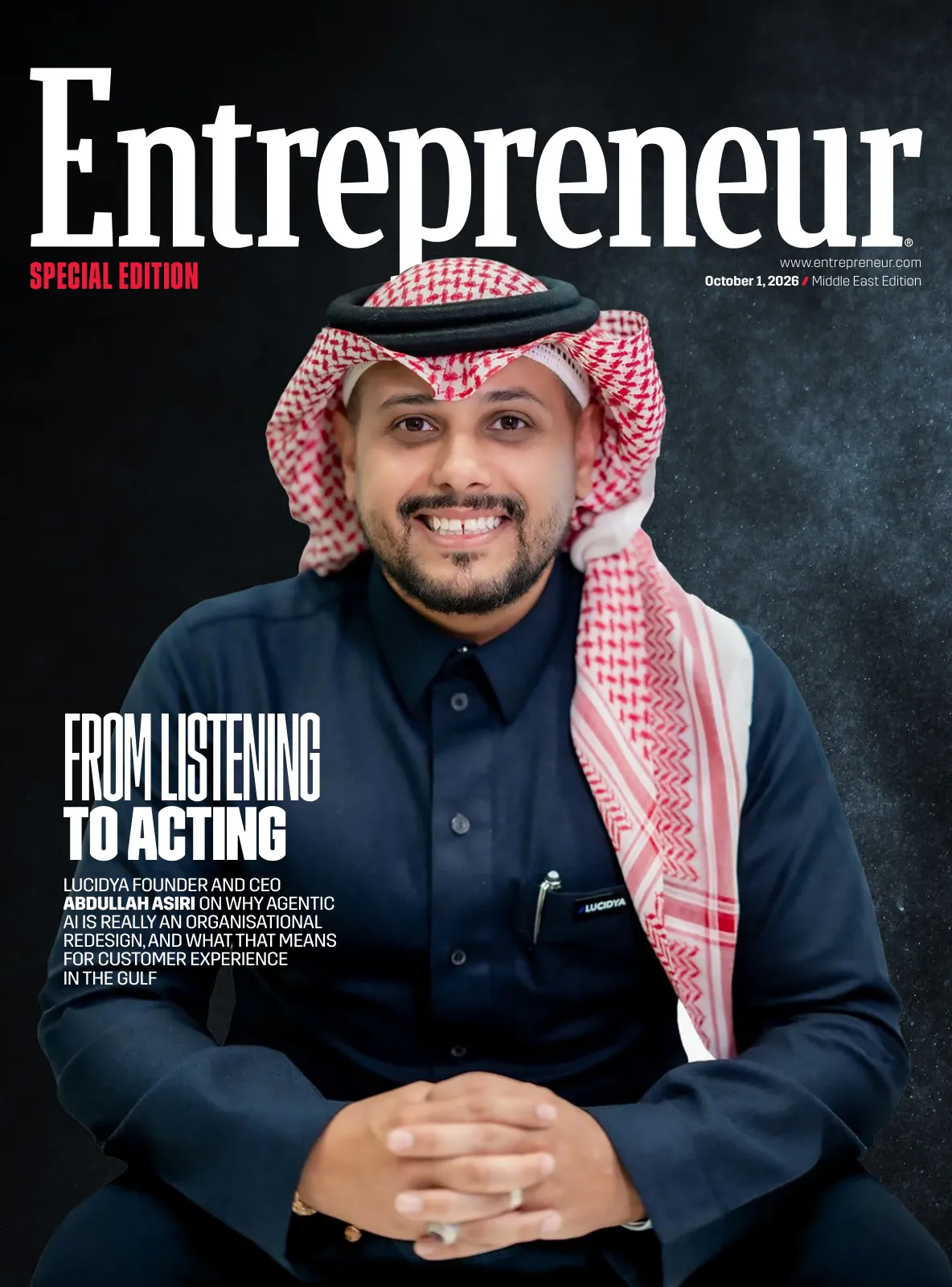
Entrepreneur Middle East, October 2026
Page 1
01
Special Edition / ENTREPRENEUR.COM /
www.entrepreneur.com
October 1, 2026 Middle East Edition
FROM LISTENING
LUCIDYA FOUNDER AND CEO
ABDULLAH ASIRI ON WHY AGENTIC
AI IS REALLY AN ORGANISATIONAL
REDESIGN, AND WHAT THAT MEANS
FOR CUSTOMER EXPERIENCE
IN THE GULF
TO ACTING
SPECIAL EDITION
Page 2
The Mirra 2 Chair just keeps getting better. How?
We updated the chair so it’s 30 percent lighter
than the original Mirra - and the chair’s nylon base
and spine are now 100 percent recycled content.
We also gave it a fresh, inspired colour palette so it
can look professional, casual, or sporty. One thing
that hasn’t changed is the flexible yet supportive
design that allows your body to move naturally and
freely - the way it was meant to move.
The Mirra® 2
Chair is turning
heads again
hermanmiller.com
© 2026 Herman Miller
Page 3
03
Special Edition / ENTREPRENEUR.COM /
P.05
From Listening to Acting
Founder and Chief Executive
Officer ABDULLAH ASIRI built a
SAUDI AI company on the wager
that the region’s four hundred
million Arabic speakers
deserved technology built for
them first, not translated for
them later.
P.12
SAUDI ARABIA IS
BUILDING THE WORLD’S
NEWEST
AI ECONOMY, AND THE
OPPORTUNITY IS WIDE
OPEN
How sovereign capital,
compute and Arabic-first AI
are turning the Kingdom into
an operating base for the
next generation of technology
companies
P.16
BIG TECH’S FLAGSHIP
EVENT LEAVES
A GLOBAL LEGACY
LEAP: How KSA Built a $250
Million Global Operation
Across Three Continents
P.20
POWERING THE
AGENTIC AI AMBITION
Saudi Arabia is building the
infrastructure and trust needed
for agentic AI to transact, audit
and connect autonomously.
Contents/Special Edition
CEO Wissam Younane
wissam@bncpublishing.net
MANAGING DIRECTOR Rabih Najm
rabih@bncpublishing.net
ART DIRECTOR Simona El Khoury
EDITOR IN CHIEF Tamara Pupic
tamara@bncpublishing.net
EDITOR AT LARGE Anil Bhoyrul
anil@bncpublishing.net
SENIOR FEATURES EDITOR Aalia Mehreen Ahmed
aalia@bncpublishing.net
JUNIOR EDITORIAL ASSISTANT Kristine Erika Agustin
kristine@bncpublishing.net
EDITOR - SPECIAL PROJECT Kasun Illankoon
kasun@bncpublishing.net
DIRECTOR OF INNOVATION
Sarah Saddouk sarah@bncpublishing.net
GROUP SALES DIRECTOR – B2B GROUP
Joaquim D’Costa jo@bncpublishing.net
HEAD OF PARTNERSHIPS
Samir Glor Samir@bncpublishing.net
BUSINESS DEVELOPMENT DIRECTOR
Andy Soulahian andy.soulahian@bncpublishing.net
COMMERCIAL LEAD
Anna Chipala anna@bncpublishing.net
COUNTRY MANAGER KSA
Amjad Fakhouri amjad@bncpublishing.net
COLUMNIST Tamara Clarke
CONTRIBUTING WRITERS
Salman Ansari
SUBSCRIBE
Contact subscriptions@bncpublishing.net to receive
Entrepreneur Middle East every issue
COMMERCIAL ENQUIRIES
sales@bncpublishing.net
ENTREPRENEUR.COM
Access fresh content daily on our website
All Rights Reserved 2026. Opinions expressed are solely those of the contributors.
Entrepreneur Middle East and all subsidiary publications in the MENA region
are officially licensed exclusively to BNC Publishing in the MENA region by
Entrepreneur Media Inc. No part of this magazine may be reproduced or
transmitted in any form or by any means without written permission of the publisher.
Images used in Entrepreneur Middle East are credited when necessary. Attributed
use of copyrighted images with permission. All images not credited otherwise
Shutterstock. Printed by United Printing and Publishing.
PO BOX 502511 DUBAI, UAE
P +971 4 4200 506
EntMagazineME
Entrepreneur-me
↑ His Royal Highness Prince Mohammed
bin Salman bin Abdulaziz Al Saud, Crown
Prince and Prime Minister of the Kingdom
of Saudi Arabia
Special Edition / ENTREPRENEUR.COM /
Page 4
04 / ENTREPRENEUR.COM / Special Edition
04 / ENTREPRENEUR.COM / Special Edition
Page 5
05
Special Edition / ENTREPRENEUR.COM /
Founder and Chief Executive Officer Abdullah Asiri built a Saudi Agentic CX Platform
on the wager that the region’s four hundred million Arabic speakers deserved
technology built for them first, not translated for them later.
M
ost technology
companies make
broad claims
about artificial
intelligence
that amount to
little more than
marketing language. Lucidya is
making a harder one. Lucidya
is the Agentic CX Platform
that enables organizations to
autonomously turn customer
and market intelligence into
real-time resolution and
measurable business outcomes,
and its Founder and Chief
Executive Officer, Abdullah
Asiri, argues that nearly ten
years of Arabic-language data,
collected before anyone was
rewarding that choice, has
produced a technical advantage
that competitors cannot simply
fund their way into. It is a
claim that only holds up if the
company can prove it outside
Saudi Arabia, in markets where
nobody cares where the flag
comes from. That is precisely
the test Asiri has now set for
himself.
Lucidya was founded in
2016 in Jeddah by Abdullah
Asiri alongside Hatem Kameli,
Mohamed Milyani and Zuhair
Khayyat. Today it serves
customers in thirteen countries
from banking and government
to travel, insurance and
logistics, and Frost & Sullivan
has named it a category leader
in AI-powered customer
experience. Its platform brings
together social listening, media
monitoring, customer profiling,
surveys and omnichannel
engagement through its
OmniServe solution, with
proprietary models the company
says understand seventeen
Arabic dialects, from Khaliji to
Maghrebi, and achieve ninety-
two percent accuracy. In an
extended interview, Asiri walked
us through the decisions that
built that position, the ones
he regrets moving too slowly
on, and why he thinks Saudi
Arabia’s technology sector is
only now being tested for real.
FROM
LISTENING
TO
ACTING
Written by: Kasun Illankoon
Special Edition / ENTREPRENEUR.COM / 05
Page 6
06 / ENTREPRENEUR.COM / Special Edition
THE COMPANY FORCED HIM TO
CHANGE, NOT THE OTHER WAY
AROUND
Asiri is unusually blunt about
how little of his own leadership
evolution was voluntary. “The
honest answer is that I have
had to become a different CEO
roughly every eighteen months,
and each time it was the
company forcing the change, not
me choosing it,” he said. In the
earliest years, that meant doing
everything himself. “In the early
years, leadership meant doing.
I was writing the pitch, sitting
in the sales meetings, arguing
with engineers about model
accuracy. That is not a style, that
is survival.”
The first real break came
between 2022 and 2023,
when Lucidya had one working
product, social listening, and
a comfortable path to keep
compounding on it. Instead, the
company shipped OmniServe,
a customer data platform and
engagement tools inside roughly
twelve months, and revenue
grew. But Asiri points to a
quieter consequence as the more
important one. “I stopped being
able to hold the whole company
in my head. That was the moment
I understood my job was no
longer to make good decisions. It
was to build an organisation that
makes good decisions without me
in the room.”
That realization also meant
embracing a different approach
to leadership: bringing in
experienced specialists across
key functions and trusting them
to lead. Lucidya’s chief financial
officer previously ran global
finance at a company generating
seventy times its revenue. Its vice
president of engineering helped
scale a company through a $3.5
billion IPO. Its chief revenue
officer owned revenue in the
fastest-growing region for a $100
billion company.
“Hiring them was the easy
part. Getting out of their way
was much harder,” Asiri said. “I
had to unlearn a habit I did not
know I had, which is walking into
a meeting, hearing a problem,
and immediately supplying the
answer. It feels like leadership. It
is not. What happens over time
is that people stop bringing you
their thinking and start bringing
you a decision to rubber-stamp.”
He credits Liz Wiseman’s
book Multipliers with naming
the pattern precisely. “I was
an accidental diminisher,” he
said. “Now I try to walk in with
questions instead of answers, and
I hold myself to a simple rule. If
someone else can make a call at
seventy percent of my quality,
they make it. My bandwidth
belongs to the ten percent of
decisions that only I can make.”
The third shift, Asiri says, is
happening right now, as agentic
AI forces Lucidya to reconsider
what a customer service
organization is, including its
own. “It is genuinely difficult to
disrupt a product you built and
that clients are happily paying
for,” he said. “Choosing to do it
anyway, while scaling past three
hundred people across multiple
countries, has demanded a kind
of leadership I did not have five
years ago. Less certainty, more
clarity. Slower on the decisions
you cannot reverse, and much
faster on the ones you can.” He
summarizes ten years in a single
line: “I started as the person with
the answers, and I am trying to
become the person who builds
the place the answers come
from.”
ARABIC AS THE PRIMARY
PRODUCT
Asked which single decision most
shaped the company’s trajectory,
Asiri does not hesitate. “The first
was deciding that Arabic would
be the product, not a feature,”
he said. In 2016, the obvious
and cheaper path was to build a
strong English tool and bolt on
Arabic support later. Lucidya
went the other way, and paid
for it in slower fundraising and
harder investor conversations.
“What it bought us is the thing
nobody can buy back: 10 years of
Arabic conversation data, more
than ten billion public posts,
and models trained on seventeen
sub-dialects,” he said. “Today
our Arabic models outperform
general-purpose frontier models
on regional dialect. That gap did
not come from being clever. It
came from starting earlier and
never switching.”
The second consequential
decision was choosing to earn
credibility in the public sector
first, against conventional startup
advice to chase faster-moving
private clients. “We chose the
harder path on purpose, because
serving ministries forces you to
solve data residency, security
certification and compliance
properly rather than promising
to solve them later,” Asiri said.
That standard, once met, made
the move into banking, telecom,
retail and travel a step down in
friction rather than up. Lucidya
now serves brands across more
than ten industries.
The third was resisting
pressure, once large language
models arrived in 2023, to strip
out proprietary research and
become a thin layer on top of
someone else’s API. “We chose
a hybrid instead,” Asiri said.
06 / ENTREPRENEUR.COM / Special Edition
Page 7
07
Special Edition / ENTREPRENEUR.COM /
“I STOPPED BEING ABLE TO HOLD THE WHOLE COMPANY IN MY HEAD.
THAT WAS THE MOMENT I UNDERSTOOD MY JOB WAS NO LONGER TO MAKE GOOD
DECISIONS. IT WAS TO BUILD AN ORGANISATION THAT MAKES GOOD DECISIONS
WITHOUT ME IN THE ROOM.”
Abdullah Asiri, Founder and CEO Lucidya,
at the annual Gamechangers 2025 Event
Special Edition / ENTREPRENEUR.COM /
Page 8
08 / ENTREPRENEUR.COM / Special Edition
“We use frontier models where they genuinely win, and we
keep our own models where Arabic dialect, Saudi context
and accuracy actually decide whether a customer trusts the
output. If we had outsourced our intelligence layer in 2023,
we would be a distribution company today with no defensible
position.”
Of the four, Asiri singles out Arabic-first as structurally
different from the rest. “Arabic-first is the only one of the four
that compounds while I sleep,” he said. “Every conversation
that runs through our platform makes the models better,
which makes the product better, which brings more
conversations. The other decisions were good judgement.
That one was structural.”
He is equally candid about a mistake he says he has
repeated. “On senior people who were not working, I have
consistently moved too slowly. Every time, the delay cost
more than the correction would have,” he said. “I now force
myself to answer one question before any significant people
decision: in six months, will I regret not having made this call
sooner? If the answer is yes, I move within two weeks.”
COMPETING ON CAPABILITY
For Asiri, Saudi Arabia’s next generation of global
companies will be defined by a harder test than the one their
predecessors faced. “The previous generation of successful
Saudi companies largely competed on access, meaning
privileged relationships and a privileged position in a
protected market,” he said. “That model produced real
businesses, but it does not travel. The moment you
leave the Kingdom, access is worth nothing.” What
has changed, in his telling, is that global vendors are
already inside the Kingdom competing directly. “We
do not win those deals because we are Saudi. We win
them when our product is measurably better at the
thing the customer actually needs, and we lose them
when it is not. That pressure is the best thing that has
happened to Saudi technology.”
Asiri traces his own ambition back to a specific
sentence he has carried for fifteen years, since starting
his first company in 2011. “When I came back from
the United States, the dream was very specific. Not
to build a successful Saudi company serving Saudi
customers. To build technology made in Saudi
Arabia and export it, from the east of China
to the west of the United States,” he said. “It
sounded unreasonable when I first said it out
loud, and I said it anyway, because if you do
not name the destination you will never build
toward it.”
He argues Lucidya’s international claim
rests on something narrow and defensible
rather than a national story. “Arabic is not a
niche language. It is spoken by more than four
hundred million people, and until recently
it was served by technology built as an afterthought,” he
said. The second thing that travels, he says, is the operating
standard forced on the company by Saudi regulation.
“Building to that standard means that when we sell in the
Gulf, in the United Kingdom or in the United States, we are
not scrambling to meet requirements we have never seen. We
are already above them.”
That is no longer theoretical. Lucidya now serves
customers across thirteen countries including the United
States, with a sales team on the ground building the
American market. “It is early and it is hard, and I would
rather talk about it honestly than package it as a success
story before it is one,” Asiri said. He is careful to separate
the exciting parts of the Saudi technology story from the
unglamorous ones still being proven. “Not raising money, not
launching products, but sustaining retention, holding margin
discipline over years, and building management depth that
does not depend on the founder. Those are unglamorous
and they are what separates a company that scales from a
company that has a good few years.”
The internal standard he holds Lucidya to is deliberately
stripped of national framing. “If we build a company that
would be competitive if you removed the Saudi flag from it
entirely, then the Saudi flag becomes a genuine advantage
rather than an explanation,” he said. “Not ‘impressive for
Autonomous AI Agent
08 / ENTREPRENEUR.COM / Special Edition
OmniServe
Page 9
09
Special Edition / ENTREPRENEUR.COM /
“I NOW FORCE MYSELF
TO ANSWER ONE
QUESTION BEFORE
ANY SIGNIFICANT
PEOPLE DECISION:
IN SIX MONTHS, WILL
I REGRET NOT HAVING
MADE THIS CALL
SOONER?
IF THE ANSWER IS
YES, I MOVE WITHIN
TWO WEEKS.”
Social Listening
a Saudi company.’ Just good.” He
returns, unprompted, to what he says
he cares about more than any outcome
for Lucidya itself. “I want the next
generation of Saudi founders to start
from a bigger default. Not to build for
Riyadh and think about the world later,
but to assume from the first day that
what they build is meant to leave the
country. In five years, I do not want
anyone to find it remarkable that a
global category leader in AI came out of
Riyadh.”
FROM ANALYSIS TO ACTION
Asiri resists the now-common habit of
companies claiming to be Agentic CX
without the label meaning very much.
“The distinction that actually matters
is whether AI is the thing you sell or the
thing you added,” he said. He points to
three layers that make Lucidya’s use of
AI structural rather than decorative:
nearly ten years of compounding
Arabic conversation data, more than
fifty proprietary models running in
production alongside frontier models
where they genuinely perform better,
and a shift from analysis to action
that he considers the real
turning point. “For most of our
history the product answered
questions. What are customers
saying, what is the sentiment,
where is the problem. Valuable,
but it stops at the insight and
a human still has to do the
work,” he said. “Our AI Agent
closes the loop. It resolves the
case inside the customer’s own systems,
under policy controls, with an audit
trail, and escalates when it should.”
The results from one deployment,
run over five months, are specific.
“The agent handled around eighty-
five percent of eligible cases with no
human touch and removed roughly
six thousand hours of work from that
team,” Asiri said. “That is not a better
dashboard. That is capacity that did
not exist before.” It is the basis for a
line he repeats often, including from
the stage at LEAP. “Agentic AI is an
organisational redesign disguised as a
technology purchase. Companies buy it
expecting a tool and discover it changes
what their teams are for. The ones who
treat it as a procurement decision get a
chatbot with a bigger budget. The ones
who treat it as a redesign get a different
cost structure and a different service
standard.”
Asked what separates companies
that turn AI pilots into real business
impact from those stuck in permanent
experimentation, Asiri points first
to measurement discipline. “Most
projects begin with ‘we should be doing
something with AI.’ That is how you
end up with a demo,” he said. “The
companies that succeed start from
a specific operational number they
are already accountable for. Cost per
contact. Backlog. Time to resolution.
First response SLA.” The second is
resisting the pull toward impressive
demos in favor of unglamorous, high-
volume work. The third, which he
calls the single biggest failure point
he sees, is refusing to give AI systems
real authority. “Organisations deploy
AI that can talk but not act, because
giving a system write access to the CRM
or the order management platform
feels dangerous. So the AI has a nice
conversation and then hands off to
a human who does the actual work.
You have added a step, not removed
one.”
He argues governance belongs
at the start of a project, not as a
checkpoint at the end, and that the
deepest failure is treating automation
as a technology purchase rather
than a redesign of work itself. “If
you automate forty percent of a
process and change nothing else,
you keep the same team doing the
same workflow with a slightly lighter
load, and the savings never appear,”
he said. “That is why I keep saying
that agentic AI arrives disguised as a
technology purchase and is actually
an organisational redesign.”
On where the industry goes
next, Asiri predicts the last three
years of generative AI in customer
experience will look, in hindsight,
like a false start. “Chatbots that
finally sounded human. That was
a genuine improvement over the
scripted decision trees people hated,
but it solved the wrong half of the
problem,” he said. “A system that
apologises fluently and then transfers
you to a queue has not helped you.”
The real shift ahead, in his view,
is the move from conversation to
execution, which he says will invert
the economics of the entire industry,
make service proactive rather than
reactive, retire deflection as a metric
companies boast about, and make
governance a purchasing criterion
rather than a compliance checkbox.
Special Edition / ENTREPRENEUR.COM /
Page 10
10 / ENTREPRENEUR.COM / Special Edition
A DELIBERATE, STAGED PATH ABROAD
Asiri is openly skeptical of the instinct
that drives most companies to expand
internationally. “My honest position
is that most companies expand
internationally too early, and they
do it for the wrong reason,” he said.
“Expansion is exciting, it looks good
in a board deck, and it is often a way
of avoiding harder work in the home
market. I have had to talk myself out of
it more than once.” Lucidya’s rule, as
he describes it, is to stage everything
and commit real money only at the final
step, moving through phases he calls
explore, test, validate and scale.
He divides Lucidya’s markets into
three tiers. The Gulf is treated as an
extension of home rather than a foreign
market, given shared language and
overlapping enterprise customers. The
United States, where Lucidya already
has customers and a sales team on the
ground, is the market Asiri says he cares
most about, precisely because it offers
no local advantage to hide behind. “We
are going in product-led, letting people
use the product, prove value on their
own, and pull us in,” he said. “It is a
much harder discipline because there is
nowhere to hide behind a relationship.
The product either wins or it does not.
That is exactly why it is the right test.”
The rest of the Middle East and North
Africa region, by contrast, is demand-
led rather than a target for investment
ahead of signal.
Four questions determine where
Lucidya goes next, in order: whether
there is genuine market pull rather
than a slide showing total addressable
market, whether the company can win
on capability rather than proximity,
whether leadership has the bandwidth
to enter without diluting focus on the
core business, and whether the move
compounds by strengthening more than
one part of the company at once. “The
best expansion moves strengthen more
than one thing at once. Revenue, yes,
but also product hardening, credibility,
talent access, or the ability to enter
the next market more cheaply,” he
said. “Earn the right to expand, then
expand with conviction. When we go
somewhere, I want us to be the best
option available to that customer, not
the interesting one.”
CULTURE DOES NOT DECAY ON ITS OWN
Asked how Lucidya protects an
entrepreneurial culture while scaling
past three hundred employees, Asiri
pushes back on the framing itself.
“What you are actually protecting is
decision speed and ownership, and
both of those are killed by specific,
identifiable behaviours, most of which
start at the top. Culture does not decay
on its own. Leaders decay it,” he said.
He points to the same seventy percent
rule that governs his own decision-
making, extended to the rest of the
company, and to a discipline of naming,
out loud, which decisions are reversible
and which are not. “We treat most
decisions as two-way doors. Move at
fifty or sixty percent confidence, decide
now, correct later,” he said. “What kills
speed in most scaling companies is
applying irreversible-decision rigour to
reversible decisions.” He returns again
to the risk of accidental diminishing,
this time as a company-wide discipline
rather than a personal confession, and
adds a fourth mechanism: making it
safe to kill initiatives that no longer
make sense. “We use a simple test:
knowing what we know today, would
we start this now? If no, we stop it, and
stopping it is treated as good judgement
rather than failure.”
He is unwilling to treat culture as
separate from enjoyment of the work
itself. “I want this to be fun. That is
not a soft point,” he said. “Nobody does
their most inventive work while playing
defence, and a scale-up that becomes
joyless will still hit its numbers for
a year or two before the good people
leave. High performing and fun is not a
trade-off I accept.”
WHAT THE ECOSYSTEM BOUGHT, AND
WHAT IT STILL OWES
Asiri credits Saudi Arabia’s public
sector with a role he calls decisive
in Lucidya’s growth, though he is
precise about which parts mattered
most. “The most important thing was
demand, not subsidy,” he said. “A first
enterprise customer teaches you more
than any amount of funding, because
it forces you to be genuinely good
rather than promising.” He counts
regulation, often overlooked as a form
of support, among the most valuable
interventions the Kingdom made. “Data
residency requirements, the personal
data protection framework, cloud-first
policy, national AI ethics guidelines.
From the inside, complying with all of
that is expensive and slow, and there
were moments it felt like a tax on being
Abdullah Asiri, Founder and
CEO Lucidya, at the annual
Gamechangers 2025 Event
10 / ENTREPRENEUR.COM / Special Edition
Page 11
11
Special Edition / ENTREPRENEUR.COM /
small. In hindsight it was the single best
thing that happened to our product.”
Lucidya also holds a research grant
with the Saudi Data and AI Authority
alongside King Abdullah University of
Science and Technology, working on
training methods for large language
models, a form of collaboration Asiri
says did not exist when he started his
first company.
He is careful, though, to draw a hard
line around what government support
can and cannot deliver. “Government
support creates the conditions. It does
not create the capability, and it must
never become the reason a company
exists,” he said. “We have never won
a competitive deal because we are
Saudi. We win when our product is
measurably better and we lose when it
is not, and I want to keep it that way,
because a company built on protection
cannot export.”
Looking at what would help most
going forward, Asiri argues for fixing
procurement rules that inadvertently
exclude the scale-ups the Kingdom is
trying to build, shifting government
and enterprise contracts to pay for
measurable outcomes rather than
software licenses, and building a
public, national benchmark for Arabic-
language AI so vendors can be checked
against a shared standard rather than
making unverifiable claims. He also
wants recognition tied to international
traction rather than domestic revenue
alone. “Local success can be explained
by proximity. International revenue
cannot. I would rather compete for
support on that basis, and I think most
serious founders here would say the
same.”
START FROM THE DESTINATION,
NOT THE TASK
Asked what has stayed constant across
fifteen years and three companies, Asiri
returns to a single organizing idea. “The
principle that has not moved in my
fifteen years of building tech companies
is this: start from the destination, not
from the task,” he said. “Almost every
decision gets tested against where we
intend to be, not against whether it is
useful this quarter.” He acknowledges
the cost of that discipline plainly. “It
has a cost. It makes you look stubborn,
and sometimes you are simply wrong,
in which case you have been stubborn
about the wrong destination for two
years. But the alternative, optimising
for the nearest visible win, produces
companies that are busy and going
nowhere in particular.”
His advice to founders building
from the Middle East toward global
scale follows the same logic: name
an ambition even when it sounds
unreasonable, find the advantage
that compounds with time rather
than capital, refuse to compete on
being local, get disciplined about the
unglamorous fundamentals of retention
and margin, and move quickly on
decisions that can be undone while
slowing down on the ones that cannot.
His closing advice is the most personal.
“Expect it to take longer than you
planned. Lucidya is ten years old, and it
is only now that competing globally is
a credible sentence rather than a hope.
If you are three years in and it feels
harder than it should, you are probably
on schedule.”
For a founder who has spent years
advocating that Arabic would be an
advantage rather than the limitation,
that patience reads less like caution
than like conviction. “I would rather be
one of the companies that went first,
took the hits, and left a usable map
behind, than the company with the best
individual outcome,” Asiri said. “If the
founders coming up behind us can learn
our lessons without paying for them,
that is a better return than anything on
our balance sheet.”
“ IF THE FOUNDERS
COMING UP BEHIND
US CAN LEARN OUR
LESSONS WITHOUT
PAYING FOR THEM,
THAT IS A BETTER
RETURN THAN
ANYTHING ON OUR
BALANCE SHEET. ”
Abdullah Asiri, Founder and CEO Lucidya, with the team
Special Edition / ENTREPRENEUR.COM /
Page 12
12 / ENTREPRENEUR.COM / Special Edition
SAUDI ARABIA
IS BUILDING THE
WORLD’S NEWEST
AI ECONOMY, AND
THE OPPORTUNITY
IS WIDE OPEN
How sovereign capital, compute and Arabic-first AI are
turning the Kingdom into an operating base for the next
generation of technology companies
S
audi Arabia has
stopped treating
artificial
intelligence
as a national
talking point
and started
building it as an
industry, and for
entrepreneurs
and investors
watching
the Gulf, that shift changes the
calculation entirely.
For years, the global AI
conversation belonged to Silicon
Valley, China’s technology giants
and a handful of European research
hubs. Saudi Arabia is forcing its
way into that conversation with a
playbook none of them used first.
Rather than trying to recreate
Silicon Valley in the desert, the
Kingdom is building artificial
intelligence as a national industrial
platform, one that fuses sovereign
capital, energy, computing
infrastructure, government
demand, Arabic-language
technology and partnerships with
the world’s largest technology
companies into a single strategy.
That distinction is the whole
story. In this race, the countries
that move fastest are not
necessarily the ones inventing
every foundational model or every
semiconductor. They are the ones
that can secure compute, build
infrastructure, attract talent, create
real demand and deploy AI across
their economies at scale. On every
one of those measures, Saudi Arabia
is now genuinely difficult to ignore.
The Advantage Of Moving Early
The Kingdom’s AI push did not start with
the generative AI boom. Saudi Arabia’s
National Strategy for Data and AI was
approved back in 2020, setting targets
that included placing the Kingdom among
the world’s top 15 AI nations, training
more than 20,000 data and AI specialists,
attracting roughly SAR75 billion in
related investment and helping create
more than 300 startups in the sector.
In 2026, the government raised the
stakes further, officially naming it Saudi
Arabia’s Year of Artificial Intelligence, an
initiative built to accelerate AI adoption
across government, business and society
and to cement the technology’s place at
the center of Vision 2030.
That early institutional groundwork
explains much of why Saudi Arabia
looks so far ahead today. While many
His Royal Highness Prince Mohammed
bin Salman bin Abdulaziz Al Saud,
Crown Prince and Prime Minister of the
Kingdom of Saudi Arabia
12 / ENTREPRENEUR.COM / Special Edition
Page 13
13
Special Edition / ENTREPRENEUR.COM /
governments are still debating how aggressively to
respond to AI, Saudi Arabia has spent years building
the machinery around it. The Saudi Data and Artificial
Intelligence Authority, or SDAIA, gives the country a
single, centralized body responsible for driving national
data and AI strategy, and that has produced a level of
coordination between policy, investment and execution
that larger, more fragmented economies still struggle to
match.
But the most consequential move came in 2025.
Enter HUMAIN, The Commercial Engine
In May 2025, the Public Investment Fund launched
HUMAIN, a national AI company built to operate across
the entire artificial intelligence value chain, from data
centers and cloud infrastructure to AI models and
applications. Chaired by Crown Prince Mohammed bin
Salman and led by chief executive Tareq Amin, HUMAIN
gave Saudi Arabia something most countries still lack: a
commercial engine capable of turning national AI policy
into infrastructure, products and partnerships.
It moved fast. HUMAIN struck a plan with NVIDIA to
develop AI factories with a projected capacity of up to 500
megawatts over five years, powered by several hundred
thousand of NVIDIA’s most advanced GPUs, with the first
phase built around an 18,000-GPU NVIDIA GB300 Grace
Blackwell AI supercomputer. A separate collaboration
with AMD envisions up to 10 billion dollars of investment
to deploy another 500 megawatts of AI compute capacity
over the same period. AWS and HUMAIN have announced
more than 5 billion dollars of investment in an AI Zone
in the Kingdom, combining infrastructure, cloud services
and training capabilities, while Qualcomm and HUMAIN
are targeting 200 megawatts of AI inference infrastructure
beginning in 2026.
These are not pilot projects. They are infrastructure
scale bets, and they point to what may be Saudi Arabia’s
sharpest strategic insight: in the age of AI, compute
is becoming economic infrastructure in the same way
electricity, ports, airports and telecom networks powered
earlier waves of growth. Access to massive computing
capacity is starting to determine where the next generation
Special Edition / ENTREPRENEUR.COM /
Page 14
14 / ENTREPRENEUR.COM / Special Edition
of companies gets built, and Saudi
Arabia already understands how to
build infrastructure at scale. Decades
of executing enormous energy and
industrial projects have left the
Kingdom with capital, land, energy,
connectivity and execution capability
that AI companies now need urgently.
Saudi Arabia is one of the few places
on earth that can offer abundant power
alongside land and connectivity at the
scale AI now demands.
From Compute To Commerce
The buildout keeps expanding. In
August 2026, HUMAIN and DataVolt
announced plans for a new data center
at Oxagon in NEOM, with an initial
phase expected to deliver around 100
megawatts of capacity.
But data centers alone do not
build an economy. Saudi Arabia
needs companies actually using
them, and that part of the strategy
is moving just as quickly. Adobe
recently became one of the first major
global software companies to move
regional AI workloads onto HUMAIN’s
infrastructure, an early signal that the
Kingdom wants to be more than an
owner of computing capacity. It wants
to be a destination for global enterprise
AI workloads.
The push toward mass adoption is
even more telling. In August 2026,
Adobe expanded its partnership
with Saudi Arabia’s Ministry of
Communications and Information
Technology and HUMAIN in a deal
expected to give more than 27 million
Saudi citizens and residents a year
of free access to selected AI-powered
creative tools, including an image
generation model built around Saudi
culture and Arabic-language prompts.
Countries do not become AI economies
simply by owning GPUs. They become
AI economies when businesses,
entrepreneurs, students, creators and
everyday consumers start using the
technology daily, and Saudi Arabia is
trying to accelerate supply and demand
at the same time.
Where The Real Opportunity
Sits For Founders
This is the part of the story that
should matter most to entrepreneurs.
A data center on its own does not
create an innovation economy. What
gets built on top of it does, and
Saudi Arabia already has enormous
industries where AI can be deployed
at real scale: energy, healthcare,
banking, logistics, aviation, tourism,
manufacturing, construction and
government services.
Few companies illustrate that
potential better than Saudi Aramco.
The company says it generated 1.8
billion dollars in AI-driven value in
2024 alone, having identified 442 AI
use cases across its operations and
deployed more than 200 solutions
by late 2025. Its planned investment
in HUMAIN pairs one of the world’s
most sophisticated industrial
operating environments with Saudi
Arabia’s emerging AI infrastructure,
a combination few markets anywhere
can replicate. AI becomes commercially
transformational the moment it moves
beyond chatbots and into drilling,
engineering, predictive maintenance,
manufacturing, supply chains, energy
optimization and robotics, and Saudi
Arabia has industries large enough
to become genuine testing grounds
for exactly those applications. For
a founder building an industrial AI
product, that is a customer base most
markets cannot offer.
The Arabic-First Opportunity
The Kingdom is also betting that
AI should speak the language, and
understand the context, of the region
it serves. HUMAIN’s ALLAM models
sit at the center of that ambition,
positioned around a market of more
than 400 million Arabic speakers.
That is a real commercial opening.
Arabic remains comparatively
underserved by many global generative
AI platforms, particularly around
dialects, cultural context, local
knowledge and specialized enterprise
applications. If Saudi Arabia can
build models that genuinely perform
across Arabic-speaking markets, its
addressable market extends well
beyond its own borders, and this
localization could become one of
the Kingdom’s strongest long-term
advantages. The next phase of AI will
not be decided solely by who owns
the smartest general-purpose model.
It will increasingly come down to
who can apply intelligence to specific
languages, regulations, industries and
business processes, and that creates
real openings for hundreds of new
Saudi and regional companies.
14 / ENTREPRENEUR.COM / Special Edition
Page 15
15
Special Edition / ENTREPRENEUR.COM /
H.E. Yasir O. Al-
Rumayyan,
Governor of Public
Investment Fund
H.E. Eng.
Abdullah
Amer Alswaha
Minister of
Communications
& Information
Technology
Tareq Amin,
CEO at
HUMAIN
Building The Talent To Match
The Infrastructure
Saudi Arabia is treating talent
as part of its infrastructure
strategy, not an afterthought.
Partnerships involving NVIDIA,
KAUST, international universities
and global technology companies
are designed to develop Saudi
developers, researchers and
engineers at scale. Aramco alone
has committed to training more
than 6,000 AI developers, working
with institutions including Imperial
College, Caltech and KAUST.
The early signs suggest the
strategy is gaining real traction.
Saudi Arabia ranked first in the
Middle East and North Africa in
Oxford Insights’ 2025 Government
AI Readiness Index, and according
to SDAIA, the Kingdom also
ranked fourth globally for company
adoption of AI in the IMD World
Competitiveness Yearbook 2026.
The IMF’s 2026 assessment of
Saudi Arabia found that most of
the Kingdom’s interim AI targets
on workforce development and
investment had already surpassed
their 2025 goals.
The Work Still Ahead, And Why It
Favors Builders
None of this means the hard
questions disappear. Saudi Arabia
remains dependent on foreign
semiconductor technology,
particularly American processors,
and gigawatt scale AI infrastructure
requires enormous amounts of
electricity and sophisticated cooling
in a hot, arid climate. Those are
real engineering and supply chain
challenges, and they are also exactly
the kind of problems that create
openings for founders building in
energy efficiency, cooling technology
and infrastructure software.
The bigger question is whether
Saudi Arabia can convert AI capital
expenditure into productivity,
intellectual property and globally
competitive companies, and
that is where the opportunity
for entrepreneurs becomes most
direct. Will HUMAIN’s computing
infrastructure stay genuinely
accessible to Saudi startups.
Will government entities and
major corporations become early
customers for homegrown AI
businesses. Can local founders
build products in Riyadh and
sell them across the Middle East,
Africa, Asia and eventually the
world. Every early signal, from the
pace of infrastructure deployment
to the speed of enterprise adoption,
suggests the answer is trending
toward yes.
Why Saudi Arabia Could Win
That is ultimately why Saudi
Arabia’s AI ambitions deserve
serious attention from the
entrepreneurial community. The
Kingdom is not placing one bet on
artificial intelligence. It is aligning
policy, capital, infrastructure,
industry and talent around the
technology at the same time, and
few countries anywhere can mobilize
all five at that speed.
Silicon Valley still leads the world
in frontier AI companies and private
investment. The United States
remains dominant in advanced
semiconductor technology and
leading models, and China remains
a formidable force in research,
infrastructure and industrial
deployment. Saudi Arabia is not
trying to replace either of them, and
it does not need to. Its opportunity is
different: to become the place where
AI is financed, powered, localized,
deployed and commercialized
across one of the world’s fastest
transforming economies, and then
exported to the wider region.
For founders, investors and global
technology companies, that makes
Saudi Arabia far more than another
emerging market to watch. It makes
the Kingdom a genuine operating
base for the next generation of
artificial intelligence businesses, and
in a race moving this fast, building
the infrastructure before everyone
else fully understands what it will
be used for could turn out to be
one of the smartest moves in the
industry.
Special Edition / ENTREPRENEUR.COM /
Page 16
16 / ENTREPRENEUR.COM / Special Edition
W
hen LEAP first opened in Riyadh in
2022, it looked like another technology
conference chasing a moment. Five years
and 17.6 billion dollars in economic
impact later, it looks like something
else entirely: a working model for how a
government and a private company can
move at the same speed, one that Saudi
Arabia is now exporting to other markets, starting with Hong
Kong. That distinction, between an event and an operating
model, is the real story behind Tahaluf, the company Mike
Champion and Annabelle Mander built with the Ministry
of Communications and Information Technology (MCIT)
and the Saudi Federation for Cyber Security, Programming
and Drones (SAFCSP), under the direction of Minister Eng.
Abdullah Alswaha.
BIG TECH’S FLAGSHIP EVENT
LEAVES A GLOBAL LEGACY
From a five-person startup to a $250 million operation spanning three continents,
LEAP’s co-founders explain how Tahaluf turned one Saudi conference into a
repeatable model for national growth.
16 / ENTREPRENEUR.COM / Special Edition
Page 17
17
Special Edition / ENTREPRENEUR.COM /
A FIVE-PERSON STARTUP BECOMES A
$250 MILLION OPERATION
Tahaluf, the joint venture between
Informa PLC, SAFCSP and the Events
Investment Fund (EIF), started as a
five-person team in 2022. It is now a
300-strong global operation generating
more than 250 million dollars in
revenue, with 35 percent growth
in 2025 alone. In under five years,
the partnership built four category-
defining events: LEAP, Money 20/20
Middle East, Black Hat MEA and
DeepFest.
Champion, Tahaluf’s chief executive,
measures that growth deliberately
conservatively. “Across 2023 to 2025
our events generated US$17.6 billion
of economic impact, and that is a
deliberately conservative number,” he
says. “Most organizers use a multiplier
of five. We use two. We still added
more than US$10 billion of property
transactions completed on the show
floor itself, and well over a quarter
of a million jobs created through our
activity over those three years.” He sets
that figure against two of the world’s
biggest single-moment gatherings.
“The FIFA World Cup in Qatar was
around US$17 billion and the Paris
Olympics around US$11 billion. Those
are single moments that then move
on. What we are building stays, and it
recurs. That is the real measure.”
The Market Read Nobody Else Made
Neither founder arrived in Saudi
Arabia as a newcomer placing a bet on
an unproven market. Champion had
worked in events since 2010, starting
at IQPC before leading Informa’s Saudi
operations, where he grew annual
revenue from 2 million dollars to 180
million dollars in four years, and 265
million dollars in five. Mander’s path
began with a planned two-day stopover
in Dubai at 21 that turned into more
than a decade in the region, through
roles at Dubai World Trade Centre and
Informa Markets before she stepped
into her first major leadership role
at the start of the pandemic in early
2020, convincing internal stakeholders
it was the right time to scale in Saudi
Arabia.
“Quite simply, we saw the
opportunity. I have 15 years’ experience
working on events in this region and
I have never seen a market upscale as
quickly as Saudi Arabia,” Champion
says. “His Excellency The Minister
of Communications and Information
Technology Eng. Abdullah Alswaha
asked us to build a world-class
event for the Kingdom, and we could
have built something safe. Instead,
we agreed to build something with
immediate global impact. The
opportunity nobody else had spotted
Special Edition / ENTREPRENEUR.COM / 17
Page 18
18 / ENTREPRENEUR.COM / Special Edition
ANNABELLE MANDER,
Executive Vice President
of Tahaluf and Co-Founder
of LEAP
“SCALE IS
IMPRESSIVE, BUT
SCALE WITHOUT
OUTCOMES IS
ULTIMATELY JUST
A LARGE EVENT.”
was simple. If a government is prepared
to move at the speed Saudi Arabia was
prepared to move, you can compress 20
or 30 years of growth into one or two.”
For Champion, the case for Saudi
Arabia was never about the money.
“When we set out the blueprint for
LEAP, the government did not just
listen to our private-sector advice, it
doubled down on it. It was the first
time in my career I had worked with a
government that behaved like a partner
rather than a regulator,” he says. “Once
I saw that, the destination question
answered itself. Give a place that kind
of coordination and it does not just
become a good market, it becomes the
market.”
BUILDING A CULTURE BEFORE BUILDING
A CONFERENCE
Champion had already worked
alongside Mander for roughly five
years before Tahaluf’s founding, long
enough to see a great leader with the
potential to become an exceptional one.
“What Annabelle brings to Tahaluf
is somebody that I can trust to build
an exceptional and kind culture in
which people are rewarded well and
fairly, as well as being recognized and
enfranchised,” he says.
Mander’s philosophy pairs
empowerment with high standards.
“We give people real responsibility,
permission to challenge us and space
to make decisions. Innovation becomes
very difficult when everything requires
permission from the top,” she says.
“Mike has always encouraged me to
take bigger risks, but equally to remain
authentic in how I lead. What makes
me proudest today is that so many
of the ideas changing LEAP don’t
come from Mike or me. They come
from people across our team who
feel genuine ownership of what we’re
building.”
Champion points to staff retention as
the quieter driver behind that culture.
“Staff retention is Tahaluf’s most
important driver of growth,” he says,
having seen the alternative firsthand
at companies where few people stayed
on the same event year over year. “I
have seen firsthand how this stultifies
growth, because you are always
having to relearn the same lessons.”
At Tahaluf, retaining talent has
compounded over time. “Any mistakes
made five years ago are repeated much
less, and that is a massive contributor
to the growth of the events we have.”
TURNING AN EVENT INTO AN
ECOSYSTEM
Mander wanted LEAP to have
consequence beyond scale from the
very first year. “Scale is impressive, but
scale without outcomes is ultimately
18 / ENTREPRENEUR.COM / Special Edition
Page 19
19
Special Edition / ENTREPRENEUR.COM /
just a large event,” she says. “We
wanted companies to enter the Saudi
market, founders to raise capital,
investors to find opportunities and
partnerships to exist because LEAP
happened.”
That thinking shows up in the
platform’s design. In 2026, LEAP
runs across 16 stages and more than
20 tracks, with live technology on
display through the Tech Arena and an
increasingly sophisticated investor and
founder program. It also shows up in
Rocket Fuel, the startup competition
Mander and Champion launched
with a 1 million dollar prize fund, at
the time the largest of its kind in the
world, structured to give founders
capital and visibility without taking
equity. “The new generation of Saudi
founders doesn’t ask whether an idea
can succeed here; they ask whether
it can lead its category anywhere,”
Mander says. More than 145,000
unique business tourists have flown
in since Tahaluf was founded, many
experiencing Saudi Arabia for the first
time. “They go home and tell the real
story, which is worth more than any
campaign we could run,” Champion
says.
EXPORTING A SAUDI-MADE MODEL
The real inflection point came earlier
than either founder expected. On the
second day of the very first LEAP,
Champion and Mander were invited
to the Royal Court and told that
what they had built was exactly what
the Kingdom wanted to replicate
across other sectors. After a year
of negotiation, Tahaluf was born in
January 2023. “That was the moment
LEAP stopped being an event and
became a blueprint,” Champion says.
Today, more than a third of the events
named in cabinet meetings chaired by
the King or the Crown Prince belong to
Tahaluf.
That blueprint is now traveling.
Taking something
built in Riyadh
and launching its
first international
edition in Hong
Kong, through LEAP
East, marked a
defining moment for
Mander. “We aren’t
exporting a copy of
a Saudi event; we’re
taking a Saudi-
created model into
another global
market and adapting
it intelligently,”
she says. Her
approach protects
the underlying
philosophy rather
than replicating the
format: ambition,
ecosystem,
commercial
outcomes and
exceptionally high
standards. “Global
expansion isn’t
about becoming less
Saudi. It is about
demonstrating that
something created
here can have relevance and impact
anywhere in the world.”
Mander connects that expansion
directly to the vision that set Tahaluf
in motion. “H.E. Eng. Abdullah
Alswaha’s vision has always been
much bigger than creating a successful
technology event,” she says. “It is
about building talent, attracting
investment and positioning Saudi
Arabia as a creator and leader in the
global technology economy.” She
credits Faisal Al Khamisi, Chairman of
SAFCSP and Co-Chairman of Tahaluf,
and Muteb Al Qani, CEO of SAFCSP,
as central to a partnership that has
behaved like a genuine collaborator
rather than a conventional client.
WHAT LEGACY LOOKS LIKE FROM HERE
Both founders measure success
less in attendance numbers than in
what those numbers leave behind.
Asked what he would want to define
Tahaluf’s legacy a decade from now,
Champion keeps it simple. “I’d like our
Saudi government partners to believe
we’ve achieved our mission of bringing
world class events to the Kingdom
and making it a global events hub.
And I’d like the colleagues I’ve worked
alongside to think of me personally
as a good leader and someone they’ve
enjoyed working with.”
For Mander, LEAP East is proof
that legacy is already taking shape,
evidence that the Kingdom can export
globally relevant platforms and ideas,
not simply host them. As content
becomes instant and infinite, she
argues, the value of physical events
lies in what only happens when people
share a room: a founder meets capital,
a government attracts investment,
a technology is experienced rather
than described. “The next generation
of events won’t simply inform an
industry,” she says. “They will be
judged by the businesses created,
capital deployed, relationships formed
and decisions made because that
community came together.”
That is the measure Champion
and Mander are building toward: not
another record crowd, but a blueprint,
born in Riyadh, that the rest of the
world is now watching.
Mike Champion, Founding Chief
Executive Officer of Tahaluf and
Co-Founder of LEAP
Special Edition / ENTREPRENEUR.COM / 19
Page 20
20 / ENTREPRENEUR.COM / Special Edition
POWERING THE AGENTIC AI AMBITION
S
audi Arabia is no longer waiting
for the agentic AI economy to
arrive. It is building the rails for
it. In Riyadh, four executives
from Visa, EY, Nokia and COFE Tech
described a shift already underway
across banking, audit, telecom
infrastructure and enterprise software,
each pointing to the Kingdom as the
place where autonomous AI systems
stop being a concept and start
transacting, auditing and connecting
on their own.
Godfrey Sullivan of Visa called it a
tipping point for agentic commerce,
where AI agents complete purchases
rather than just browsing on a shopper’s
behalf, and where Visa’s readiness
program is already onboarding roughly
40 regional banks to make that possible.
Khurram Mian of EY described a
parallel transformation inside auditing,
where agentic AI now scans millions of
journal entries across 10,000 MENA
engagements, freeing human auditors to
focus on judgment rather than routine
checks. Roque Lozano of Nokia framed
the moment in infrastructure terms,
arguing that Saudi Arabia’s push into
data centers and new connectivity
corridors positions the Kingdom not
just to consume the AI economy but
to generate and export it. And Ali Al-
Ebrahim of COFE Tech, fresh off a $178
million funding round, made the case
that Riyadh has become the region’s
essential proving ground for enterprise
platforms built to run on AI-native
infrastructure.
Different industries, same
throughline. Trust, infrastructure and
capital are converging in Saudi Arabia
at a pace that suggests the country
is positioning itself as a genuine
contributor to, rather than merely a
customer of, the global AI economy.
What follows are the conversations that
shaped that thesis.
Written by: Kasun Illankoon
20 / ENTREPRENEUR.COM / Special Edition
Saudi Arabia is building the infrastructure and trust needed for agentic AI to transact,
audit and connect autonomously.
Page 21
21
Special Edition / ENTREPRENEUR.COM /
VISA
Agentic commerce will not scale on clever technology
alone. It will scale on trust, and Visa believes the region
is closer to that threshold than most shoppers realize.
Godfrey Sullivan, SVP, Products & Solutions, CEMEA at
Visa, argues that the shift from AI-assisted browsing to
AI-completed purchasing is already underway.
Sullivan leads products and solutions across 87 markets
in Central Europe, Central Asia, the Middle East and
Africa, a footprint that shows him how quickly consumers
adopt new payment habits. His assessment of the moment
is direct. “We’re at a tipping point for Agentic Commerce.”
THREE CONDITIONS THAT UNLOCK AGENTIC PAYMENTS
His framework has three parts, each owned by a different
player in the ecosystem. Banks come first. Issuers must
make sure “their payment cards, their Visa cards can
be tokenized and safely uploaded into agents.” Visa’s
agentic readiness program, now running across about
40 institutions in the Middle East, is helping lenders
prepare. Merchants are the second piece, and the friction
is real. Sullivan points to a quiet failure happening
today: “many of the e-commerce websites we use will
not honor those transactions because they think it’s a
bot.” Storefronts built for human clicks must learn to
welcome delegated buyers.
The third piece sits with AI platforms such as OpenAI.
Consumers already lean on agents to find products,
compare prices and weigh recommendations. What
remains is completing the payment inside those same
experiences. “And we think we’re going to see that over
the next 6 to 12 months.”
SIMPLICITY IS THE GROWTH ENGINE
Sullivan reads the trajectory from history rather than
hype. Every time payments get easier, adoption follows.
“We have seen time and time again when Visa and other
payments firms makes transactions easy, whether it’s
contactless or tap to pay, we see huge customer adoption.”
The same logic applies to agents. A shopper who lets an
assistant hold a delivery address and securely tokenized
credentials removes the most tedious steps of online
checkout. “I think consumers are going to find it’s
just easier.” For businesses, that ease translates
into fewer abandoned carts and a smoother path
to revenue, which is why Sullivan frames the
opportunity as shared. “It’s that combination of
trust and simplicity that’s going to bring the next
wave of e-commerce growth.”
WHY THE NETWORK MATTERS
Payment networks sit at the center of this shift
because a new kind of transaction demands a new
kind of confidence. The reassurance shoppers
feel when they use a card online or abroad is the
standard Visa intends to carry forward. “That same
level of trust needs to be replicated for agents.”
Visa’s ambition is to anchor a trust layer connecting
banks, merchants and AI agents, which Sullivan calls
the key unlock.
A MEASURE OF SUCCESS BEYOND THE METRICS
Asked about success, Sullivan steps away from
products and volumes. “Success is about how you
feel each evening when you go to bed.” He describes
going to sleep content with what he has achieved for
business, family and the wider world, then waking
with anticipation. “That sense of fulfillment, that is
what real success is for me.”
It is a fitting philosophy for an executive building
infrastructure meant to make everyday life easier.
21
Special Edition / ENTREPRENEUR.COM /
Godfrey Sullivan, SVP, Products & Solutions, CEMEA at Visa
Page 22
22 / ENTREPRENEUR.COM / Special Edition
22
/ ENTREPRENEUR.COM / Special Edition
Audit runs on a single currency, and
agentic AI is helping the profession
strengthen it. Khurram Mian,
Managing Partner and Assurance
Leader at EY MENA, explained how
the firm is embedding intelligent
automation into the core of its
assurance work.
Mian describes the energy at the
event as a privilege to witness, and
he ties it to the responsibility his
profession carries. Capital markets
rely on audited statements to raise
funds, banks use them to disburse
loans, and fiscal authorities lean on
them to verify tax provisions. His
summary of the mandate is short. “We
are all about trust.”
ROUTINE WORK GOES TO MACHINES, JUDGMENT
STAYS WITH PEOPLE
The shift Mian describes is a division
of labor rather than a replacement.
Technology now absorbs the mundane
tasks, and agentic AI builds on that
foundation. “The more routine work
is now being done by technology and
the more complex work is now being
focused upon by our humans our
professionals.”
The quality dividend is significant.
Software can examine millions of
journal entries across a client’s books,
correlating and triangulating patterns
at a scale no team could match, while
auditors apply judgment where it
counts. EY is applying the approach
across 10,000 audit engagements
in MENA and 160,000 worldwide.
Regulators, whose core aim is to
keep improving audit quality, have
welcomed the direction.
CLIENT ZERO AS A CREDENTIAL
EY earns credibility by testing its own
advice first. “What we are drawing
upon is our own experience as client
zero.” The firm belongs to the first
cohort of 14 organizations selected
by Microsoft and Harvard Business
School as frontier firms, companies
weaving AI through every function
with the aspiration of becoming a
“human-led agent operated business.”
That experience shapes the
counsel Mian gives clients.
Successful adoption, he argues, spans
governance, risk and technology
together, and EY supports it with
an assurance AI framework for its
auditors and nine principles of
responsible AI applied across its
processes.
WINNING THE AI NATIVE GENERATION
For Mian, the technology also solves
a recruiting question. “Gen Z is the
first AI native generation who’s going
to enter the workforce.” Graduates
expect modern tools, so a profession
that embraces AI becomes a more
compelling career choice.
Internally, EY backs that appeal
with training, certifications and
badges, and with a culture that invites
ideas from every level. “Innovation is
not only top down. It can be bottom
up.” Structured processes then carry
promising ideas through to execution
under the responsible AI principles.
LEGACY MEASURED IN CAREERS
Asked about success, Mian points
to what he leaves behind. “Success
is all about legacy.” At the strategic
level, that means handing over an
organization stronger than the one
he inherited. At the personal level, it
means mentoring young professionals
toward partnership, which he treats
as his own performance indicator. His
reasoning is simple. “They don’t look
for a job, they look for a career.”
Khurram Mian, Managing Partner and
Assurance Leader at EY MENA
EY
Page 23
23
Special Edition / ENTREPRENEUR.COM /
NOKIA
The next chapter of the AI economy will be won by whoever
moves data best, and Nokia believes the Gulf is positioned
to lead it. Roque Lozano, Senior Vice President, Network
Infrastructure, Middle East & Africa at Nokia, sees a region
that wants to shape the technology as well as consume it,
with Saudi Arabia setting the pace.
Lozano calls the Middle East and Africa “the most
inspiring region in the world,” and he organizes the
opportunity into three streams: connectivity, regional AI
ambition and a new token economy.
NEW ROUTES FOR A CONNECTED REGION
Connectivity comes first. Operators and governments are
racing to open fresh paths for traffic. “Everyone is looking for
new and alternative routes to connect locally, regionally and
internationally through the seas, through the lands, through
the new gateways like Syria or Iraq or Libya.” The demand
goes beyond raw capacity. “There is a huge demand for that
capacity with a huge emphasis on diversity for resilience and
latency.”
FROM CONSUMER TO CONTRIBUTOR
The second stream is ambition. Gulf states, Saudi Arabia in
particular, are investing in power and data center capacity,
including what Lozano calls AI factories, to generate and
export local content rather than simply translating what
global hyperscalers produce. The digital economy, in his
telling, flows in both directions. It is “coming to the Gulf
is coming to the region but as well is going to be generated
through the region for the region and beyond.”
A CURRENCY MEASURED IN QUADRILLIONS
The third stream is the most striking. Telecom built services
around voice, then data, then video. “Now the new currency
is the token.” Lozano uses scale to make the point, noting that
a quadrillion “is not a billion it’s not a trillion it’s a 1,000
trillion.” He says roughly five quadrillion tokens are managed
through the AI economy today, a volume he expects to multiply
about 24 times by 2030. “It’s very difficult to visualize a
quadrillion but you can imagine how big is big in the AI.”
Saudi Arabia’s goal, he argues, is to be “a main contributor
of the AI super cycle across the country across the gulf across
the region.”
TIME AND MONEY, AND A CONCRETE MILESTONE
Ambition at this scale brings a practical constraint. Investment
is large and returns take time. “So this time and money is
probably the biggest challenge.” Nokia’s answer is a holistic
approach that lets operators earn revenue from the first phase
they build, which reassures the institutions funding the rest.
The company has a fresh proof point. Nokia was awarded
Saudi Arabia’s data center interconnection project, which
Lozano describes as “the largest data center interconnection
network in the region and probably one of the top three in the
world.” The network will link the country’s new data centers
with international gateways, terrestrial and submarine, so
traffic now crossing the Red Sea can also transit Saudi Arabia.
6G AND THE MACHINE TRAFFIC AHEAD
Lozano expects the Gulf to adopt 6G quickly, as it has with
earlier generations. He notes that 5G monetization challenged
the industry, but the next wave looks different because “we
are going to have traffic which is not generated by people is
generated by machine is generated by agents.” Fixed fiber and
radio will blur into one infrastructure, and the network itself
will sense and adapt.
SUCCESS AS PREMIUM CONNECTIVITY
Lozano defines success through Nokia’s contribution to
the buildout, enabling the AI super cycle with premium
connectivity inside and outside the data center, across
international gateways, and for users that increasingly include
bots, agents and machines.
23
Special Edition / ENTREPRENEUR.COM /
Roque Lozano, Senior Vice President,
Network Infrastructure, Middle East &
Africa at Nokia
Page 24
24 / ENTREPRENEUR.COM / Special Edition
COFE
A funding round this size says something about where the
region’s business technology is headed. COFE Tech, the
enterprise platform founded by Ali Al-Ebrahim, has closed
a round valued at approximately $178 million, and its
founder and CEO is using the moment to lay out a thesis
for what comes next. Al-Ebrahim positions the company
as something like the Salesforce of the MENA region, a
platform that runs enterprise operations rather than simply
advising on them.
He chose Riyadh for the announcement, and the location
was deliberate. “Riyadh became now the Silicon Valley of
the Middle East.” For any startup hoping to scale, he argues,
the Saudi capital has become an essential gateway.
A GAP IN ENTERPRISE CUSTOMIZATION
COFE Tech’s opportunity started with a gap Al-Ebrahim
kept encountering. Enterprises across the region were being
handed software that offered advice but little customization,
and little help at the operational level. His company set out
to manage and work alongside businesses instead.
Today the focus is on two products, a procurement
engine and a commercial engine. AI now handles CRM
work, funneling and marketing positioning, tasks that
once demanded heavy manual effort. For Al-Ebrahim, the
direction of travel is settled. “Enterprise solution for every
business is a must now with AI and we’re the platform that
connects this to them.”
THREE WAYS THE PLATFORM DELIVERS VALUE
Al-Ebrahim describes the payoff in three parts. The first
is cost. “We’re lowering a lot the cost from an operation
perspective.” The second is visibility into procurement and
the supply chain, which helps businesses understand what
they truly need. The third is knowing the customer, because
retail success extends well beyond online ordering to growth
engines and the data layers inside every department and
dashboard.
Underneath all three sits a structural point that gives the
company its edge. Artificial intelligence is only as useful as
the data foundation beneath it. “A lot of enterprise need
that infrastructure to actually empower AI and help their
businesses grow.”
THREE TRENDS DEFINING THE NEXT CHAPTER
Al-Ebrahim names three forces shaping the region. The first
is the arrival of AI inside enterprise systems, which COFE
Tech is now building into its own offering.
The second is hospitality and commercial development.
International hotel towers and commercial companies are
moving into the region, and the demand they create ripples
through supply chains. “All the mega projects revolve around
that.” COFE Tech has already placed itself inside that flow.
“We’re one of the biggest suppliers of beverage right now.”
The third trend is the beverage market itself. Consumer-
facing competition is intense, but the business-to-business
side is where he sees the larger prize. “There’s a huge
competition but also in the B2B it’s even bigger demand and
we’re positioning ourselves to be the lead in that angle.”
WHAT THE ROUND SIGNALS
The pattern across his answers is consistent. AI, mega-
project growth and B2B beverage demand are converging in a
market that rewards platforms able to operate at scale. With
fresh capital and a foothold in Saudi Arabia’s expanding
ecosystem, COFE Tech is betting that the region’s next wave
of enterprise growth will be run on data.
Ali Al-Ebrahim, Founder and CEO of COFE
Page 25
25
Special Edition / ENTREPRENEUR.COM /
Invests
In
Entrepreneurs
What Are
You Building?
Learn more at entrepreneur.vc
Page 26
26 / ENTREPRENEUR.COM / Special Edition
FROM LISTENING
TO ACTING
https://mena.entrepreneur.com/