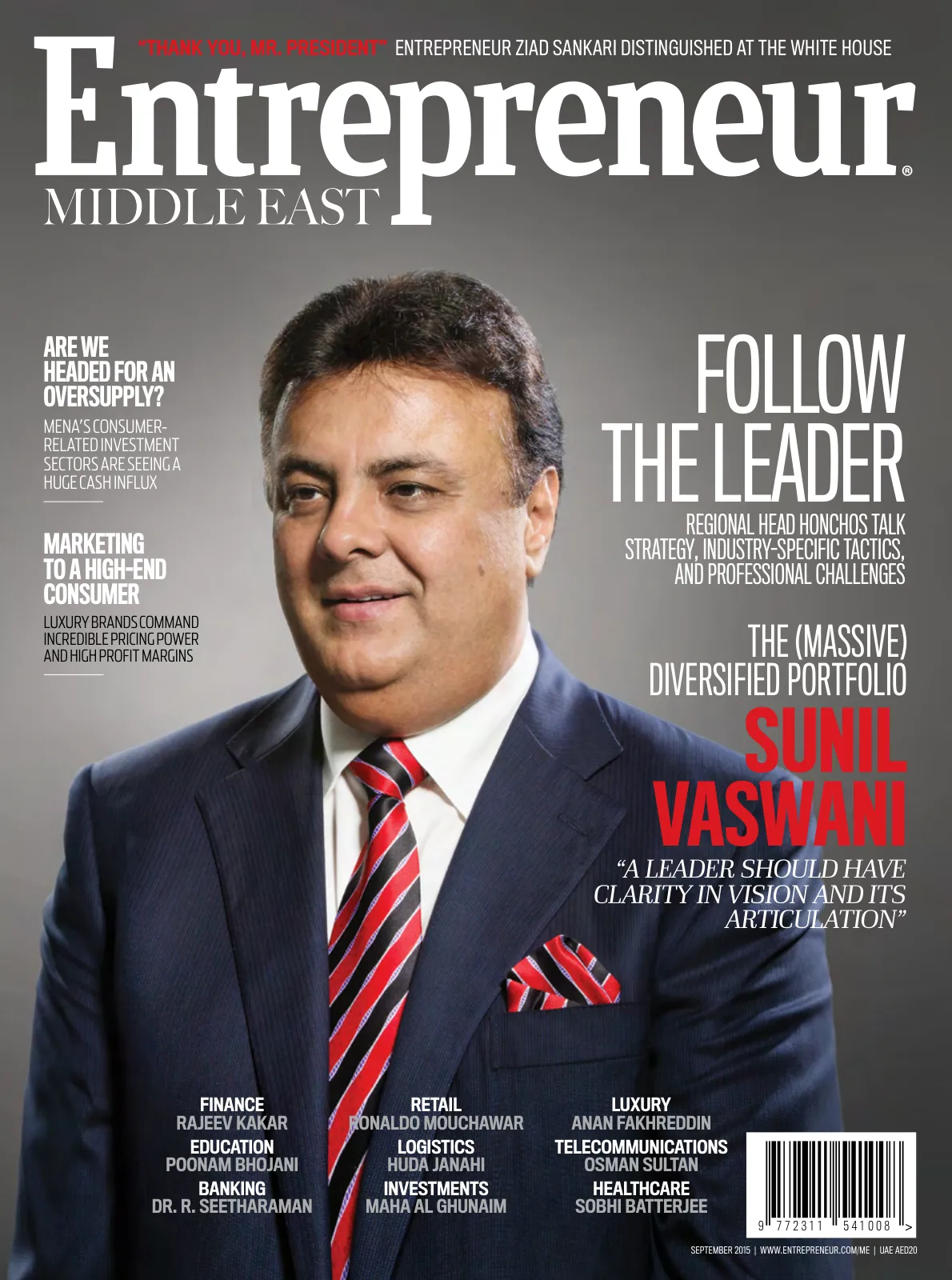
Entrepreneur Middle East, September 2015
Page 1
SEPTEMBER 2015 | www.entrepreneur.com/me | UAE AED20
9
7 7 2 3 1 1
5 4 1 0 0 8
>
“Thank you, Mr. President” Entrepreneur Ziad Sankari distinguished at the White House
Finance
Rajeev Kakar
Education
Poonam Bhojani
Banking
Dr. R. Seetharaman
Retail
Ronaldo Mouchawar
Logistics
Huda Janahi
Investments
Maha Al Ghunaim
Luxury
Anan Fakhreddin
Telecommunications
Osman Sultan
Healthcare
Sobhi Batterjee
Regional head honchos talk
strategy, industry-specific tactics,
and professional challenges
The (Massive)
diversified portfolio
Sunil
Vaswani
“A leader should have
clarity in vision and its
articulation”
FOLLOW
THE LEADER
Are we
headed for an
oversupply?
Marketing
to a high-end
consumer
MENA’s consumer-
related investment
sectors are seeing a
huge cash influx
Luxury brands command
incredible pricing power
and high profit margins
Page 2
© 2015 Hilton Worldwide
For further details visit complimentsofconrad.com
Receive a $100 hotel credit to spend as
you wish when you book a two night stay
at any of our Conrad Hotels and Resorts.
How will you spend yours?
INSPIRATIONAL VIEWS
…LASTING MEMORIES
COMPLIMENTS OF CONRAD
Page 3
september 2015 Entrepreneur
3
CONTENTS
september 2015
Investments
Maha Al Ghunaim
Retail
Ronaldo Mouchawar
Luxury
Anan Fakhreddin
Healthcare
Sobhi Batterjee
36
“Thank you,
Mr. President”
Entrepreneur Ziad Sankari
is distinguished at the
White House for his work
with his enterprise,
CardioDiagnostics.
12
EDITOR’S NOTE
By Fida Z. Chaaban
48
TECH:
ONLINE ‘TREP
State of Payments 2015
E-commerce payment
services company, PayFort,
released this year’s State of
Payments report highlighting
all that you need to know
about the region’s electronic
commerce sales and trends.
50
SHINY
#TamTalksTech
Gadgets and doodads that
you might’ve missed out on,
sourced by a tech aficionado.
Yes, it’s okay to want them
all… and no, it’s not our
fault.
Telecommunications
Osman Sultan
Finance
Rajeev Kakar
Education
Poonam Bhojani
Banking
Dr. R. Seetharaman
Logistics
Huda Janahi
18
INNOVATOR:
Follow the leader
Regional head honchos talk
strategy, industry-specific
tactics, and professional
challenges.
The (massive)
diversified portfolio
Sunil Vaswani
32
Sunil Vaswani,
Group Chairman,
Stallion Group
26
Dr. R. Seetharaman, Group CEO, Doha Bank
Page 4
Entrepreneur september 2015
4
CONTENTS
september 2015
27
Henri Asseily,
Manager Partner,
Leap Ventures
50 #TamTalksTech:
Galaxy S6 edge+
36 Entrepreneur Ziad Sankari
distinguished at the White House by
U.S. President Barack Obama.
Ronaldo Mouchawar,
founder and CEO, Souq
28
40
‘TREPONOMICS:
PRO
Seven steps to
cultivating a good
employer image
Bayt.com’s Lama Ataya
explains why branding
your company helps you
attract better quality
talent.
64
SKILLSET
Your signature style
Olympian and entrepreneur,
James Clear, discusses a
fellow Olympic medalist’s
tactics for success: Dick
Fosbury and the surprising
power of being unconven-
tional, and how it worked
for him.
54
MARKETING
Marketing to a high-end
consumer
Vincent Bastien, former
CEO at Louis Vuitton
and HEC Paris professor,
analyzes how luxury brands
command incredible
pricing power and high
profit margins.
66
ESQUIRE GUY
How not to scare the new
guy
Ross McCammon lays down
the law on making new
hires feel welcome at your
enterprise- remember your
first day at work?
52
CULTURE:
TRAPPINGS
‘Trep gear
The executive selection for
the entrepreneur on your list
that has everything. Okay,
maybe for a little self-reward
as well.
Page 5
Page 6
Page 7
Page 8
Entrepreneur september 2015
8
CONTENTS
september 2015
Osman Sultan,
CEO, du
20
63
LIFE
Life is a marathon, not
a sprint
Mark Sephton says that
you need to stop the
“busyness” and remain
productive. Here’s how you
do it.
58
LIFE
Tony Hchaime’s tips to re-
jig your success-ratio
Don’t toil away at work-life
balance; instead, optimize
your performance.
88
START IT UP:
Q + A
It’s time to call in the pros
MENA startup mrUsta offers
a platform for your service
needs.
86
Q + A
A giant leap for MENA’s
m-commerce space
T-Pay founder Sahar Salama
covers her bases with her
startup, and they’ve gone
MENA-wide.
84
ECOSYSTEM
Let’s get real
The challenges this
company’s founder faced as
a “non-sexy” startup in the
Middle East.
90
MONEY:
ASK THE MONEY GUY
A viable solution for SMEs
Amr Frkash says that your
enterprise could benefit
from mini-bonds in the
MENA region.
76
ECON
Healthcare, education and all
consumer-related investment
sectors are by far the most
popular investment sectors in
the MENA region nowadays,
but how much is too much?
23
Anan Fakhreddin,
CEO, Damas
54
Luxury brands command incredible pricing power and high profit margins
Page 9
FOR EVENTS WITH RECORD
ATTENDANCE, LOOK NO FURTHER
The views, the venues, the attention to detail, the team
of designers and organisers at your disposal. For events
that are talked about long after they come to an end,
The Address Downtown Dubai presents all the ingredients
that matter, in our own inimitable style.
After all, with an address like this, attendance is assured.
T +971 4 436 8812 | meet.downtowndubai@theaddress.com
WWW.THEADDRESS.COM
Page 10
10
Entrepreneur MARCH 2015
SUBSCRIBE
Contact subscriptions@bncpublishing.net to receive
Entrepreneur Middle East every issue
EDITOR IN CHIEF Fida Z. Chaaban editor@bncpublishing.net
MANAGING DIRECTOR Walid Zok walid@bncpublishing.net
DIRECTOR Rabih Najm rabih@bncpublishing.net
DIRECTOR Wissam Younane wissam@bncpublishing.net
PUBLISHER Nehme Abouzeid
MANAGING EDITOR Aby Sam Thomas
CREATIVE LEAD Odette Kahwagi
ONLINE LIAISON Kareem Chehayeb
COLUMNIST Pamella de Leon
COLUMNIST Tamara Clarke
COLUMNIST Shoug Al Nafisi
PO Box 502511 Dubai, United Arab Emirates
P +971 4 4200 506 | F +971 4 4200 196
For all commercial enquiries related to
Entrepreneur Middle East contact
sales@bncpublishing.net
All rights reserved © 2015.
Opinions expressed are solely those of the contributors.
Entrepreneur Middle East and all subsidiary publications in
the MENA region are officially licensed exclusively to BNC
Publishing in the MENA region by Entrepreneur Media Inc.
No part of this magazine may be reproduced or transmitted
in any form or by any means without written permission of
the publisher.
www.entrepreneur.com/me
Access fresh content daily on our website!
MIDDLE EAST
Printed by Raidy Emirates Printing Group LLC
www.raidy.com
EntMagazineME
@EntMagazineME | @Fida
Entrepreneur-me
EntrepreneurMiddleEast
EntMagazineME
EntMagazineME
EntMagazineME
MIDDLE EAST
Images used in Entrepreneur Middle East are credited when necessary. Attributed use of
copyrighted images with permission. All images not credited otherwise Shutterstock.
Lama Ataya
Ziad Awad
Vincent Bastien
Amal Chaaban
Iman Ben Chaibah
James Clear
Ray Hennessey
Simon Hudson
Ross McCammon
May Rostom
Kara Schoeffling
Mark Sephton
Brett Smyth
Shelina Jokhiya
Erika Widen
CONTRIBUTING WRITERS
In addition to our print edition, we’re bringing you all sorts of
industry news on our web mediums. Joining us online means getting
relevant business and startup content in real-time, so you’re hearing
about the latest developments as soon as we do. We’re looking
forward to interacting with our readers on all of our social media and
web platforms- like any thriving business, we’re looking to give and
take. #TrepTalkME is already happening on all of our digi platforms,
and all good conversations go both ways. See you on the web!
Page 11
Page 12
Entrepreneur september 2015
12
EDITOR’S NOTE
Fida Z. Chaaban
Editor in Chief
@fida
editor@bncpublishing.net
Post your suggestions with the hashtag on Twitter or Instagram
@EntMagazineME
Do you know a MENA region entrepreneur, startup,
or SME that we should be watching?
#EntMETreps
A rare (learned) talent that can benefit you as a ‘trep
Rising to the occasion
I
can start this edition by saying
that I have seen this talent, this
special something, in people
from all walks of life. Being able
to rise to the occasion is, often,
what sets the winners apart from the
losers. Rising to the occasion isn’t a
quality that defies definition, in my
opinion, it’s actually quite simple.
It’s being able to smile and jest
when necessary, but it’s also about
being firm and maybe even a bit
stubborn when you need to make
your point. It’s about admitting with
grace when you stand corrected,
and it’s also about having a grand
enough presence to hold people’s
attention. You all know someone like
this, you’ve all encountered people
who seem to have a captivating way
about them. That magnetic energy,
that pull, is a skill that you can learn
with sincerity. Once you learn it
(sincerely) and you’ve adopted it the
way you might adopt a good physical
habit (like sitting up straight), you
can then apply it to your work. This
month, I was prompted to write this
by seeing one of these rare and regal
people in action. This person isn’t
regal by title, but rather regal by
bearing. And that is worth so much
more. Special people often know in-
trinsically that they are special- and
it doesn’t mean that they were born
with it, it means that they saw a
glimmer of possibility in themselves
that they worked on and that they
cultivated.
So work on it, cultivate it, and
finally, at the very least try to rise
to the occasion. The more you apply
new skills, the more they appear
to others as your inherent talents.
Remember, it isn’t just about being
charming (although admittedly that
does have a great deal to do with
it), it’s about being able to stand up
straight, square your shoulders, look
someone in the eye, and then get
it done. I’m breaking my own rules
here by underlining text in print, but
that’s the essential point. To get it
done, you need to rise to the occa-
sion, every single time. It’s tough, I
won’t say it isn’t. But it’s worth a try.
Page 13
OHSAS 18001 certified
ISO 9001, 14001 and
130+years of
project experience
LEED Platinum, LEED Gold
and LEED Silver Capability
End to End Integrated Solutions
Pioneering Engineering Construction since 1881
www.drakescull.com
700+
Projects Delivered
For over 130 years, Drake & Scull International PJSC has been shaping skylines and transforming the lifestyle of
communities around the world.
Drake & Scull is an industry leader, with a proven history of delivering more than 700 projects through its General
Contracting, Engineering, Rail, Oil & Gas, Water and Wastewater Treatment and Infrastructure development business
streamlines across the region.
Page 14
Entrepreneur september 2015
14
IN THE LOOP
Puerto Rico’s debt crisis could change
everything
Egypt splashes cash at a time of economic
difficulty and security concerns
The New Suez Canal
The first ship at the entrance of the new Suez Canal. The first three ships included Apl of Southampton,
traveling from Jeddah to Port Said, Maersk Cheerness of Luxembourg, traveling from Singapore to the
U.S., and Mayssan of Bahrain, traveling from Jeddah to Italy.
San Juan, Puerto Rico
W
hat’s worse than being a small
island anticipating a tropical
storm? A small island that is
also dealing with a massive
debt crisis, which could change its political
status. Ever since 1921, Puerto Rico was para-
dise for doing business, as the U.S. territory
(not an official state) enjoyed many years of
American federal tax advantages. However,
that all changed as of 1996, when it was
decided to phase all that out over a 10-year
period. That didn’t go too well, and things
started to crash by the time phase-out period
ended in 2006.
Puerto Rico’s recent economic history has
been unfortunate to say the least, but on Au-
gust 3, its government defaulted for the first
time in its history after failing to pay a US$58
million debt. The island was only able to pay
back $628,000, a percentage so small that
you don’t even have to bother doing the math.
To make matters worse, the money is mostly
owed to ordinary Americans, rather than
financial institutions, in the form of municipal
bonds which are exempted from
federal income taxes. Through-
out Puerto Rico’s many years
of economic misfortunes and
capital mismanagement, the
government hiked taxes hoping
to balance debt. As a result,
Puerto Rico’s middle class has
been diminishing so quickly, you
could say it’s fallen off a cliff.
Unemployment in Puerto Rico is at 12.6% as
of June 2015, and only 40% of adults there
are currently employed or searching for work.
About 50,000 Puerto Ricans are leaving for
the U.S. mainland every year, according to a
report released by the Pew Research Center
12 months ago. That’s among most rapid
population loss in the world, and Puerto Rico
isn’t going through any civil wars, violent
uprisings, or other security crises.
What about Puerto Rico’s political status?
Well that’s just it. It’s not officially an Ameri-
can state, nor is it an independent one. De-
spite having some sovereignty, it’s ultimately
controlled by the United States government,
even though its citizens don’t enjoy all the
same rights and benefits that Americans liv-
ing in the 50 states do- so it’s basically a colo-
ny. Among Puerto Ricans is an intense debate
of what its status should be: bid for American
statehood, maintain the status quo as a U.S.
territory, or secede, for lack of a better term.
Polls show that most of the population want
Puerto Rico to become an official U.S. state,
but the independence movement is growing.
E
gypt has been expe-
riencing a plethora of
economic problems,
and the many regime
changes and recent
security concerns with the
Islamic State has only been
adding fuel to the fire. That
being said, August 6 marked
the inauguration of the Suez
Canal- or rather, the new Suez
Canal. In what seems like a bid
to win back the optimism of
investors and those interested in
doing business with Egypt, the
expansion project of the Suez
Canal was sped up to be com-
pleted sooner that was originally
planned. While the project was
started on August 5, 2014 and
was expected to take five years
to finish, President Sisi however
shortened the deadline to three
years, before finally setting in
stone a one-year timeframe.
The canal’s expansion consists
of quite a few touch-ups, start-
ing with a new 35-kilometre
wide lane. Those familiar with
the Suez Canal will probably
know that it only had space for
one lane, meaning that ships
sailing in from the opposite
direction usually had a 11-hour
waiting time. The new lane also
(almost) doubles the number of
ships that pass through daily.
The second major component is
the addition of not one but six
new tunnels for cars
and trains to connect
the isolated Sinai
Peninsula to the rest
of Egypt. Prior to that,
there was only one
highway. In addition,
the Egyptian govern-
ment also plans to
turn the area around
the canal into a hub
for manufacturing and
shipping.
But if the project
sounds like a costly one
to be completed in just
one year by a country
going through economic turmoil,
that’s because it is just that.
The Suez Canal’s expansion cost
Egypt US$8.4 billion. While
the Egyptian Armed Forces
supervised this project, over 80
engineering firms were involved
in its construction as well. This
included international organiza-
tions from the MENA region,
Europe, and the United States,
as well as local ones such as the
private Egyptian firm Orascom
Construction Industries and
the state-owned Arab Contrac-
tors. What also doesn’t comfort
many is that while officials says
that the expanded canal can
boost annual revenues to around
$13.5 billion by 2023, this
would require the economy to
grow much faster than the vast
majority have been anticipating.
But could what appears to be an
industrial zone near the canal
be Egypt’s saving grace? This
particular component at least
appears to be off to a good start,
with President Sisi and Russian
President Vladimir Putin agree-
ing to set up a Russian industrial
zone 12 months ago.
Page 15
Page 16
Page 17
Page 18
Entrepreneur september 2015
18
Finance
Rajeev Kakar
Education
Poonam Bhojani
Banking
Dr. R. Seetharaman
Retail
Ronaldo Mouchawar
Logistics
Huda Janahi
Investments
Maha Al Ghunaim
Luxury
Anan Fakhreddin
Telecommunications
Osman Sultan
Healthcare
Sobhi Batterjee
The (Massive)
diversified
portfolio
Sunil Vaswani
Nine of the region’s CEOs across different sectors who have impacted the market
and continue to shape MENA’s corporate trends… and our pick for Chairman
running a truly global conglomerate
Regional head honchos talk strategy, industry-specific
tactics, and professional challenges
INNOVATOR
FOLLOW
THE LEADER
Page 19
september 2015 Entrepreneur
19
Regional head honchos talk
strategy, industry-specific tactics,
and professional challenges
FOLLOW
THE LEADER
“
“
Poonam Bhojani
EDUCATION
Founder and CEO
Innoventures Education
“To me, innovation is every time we are able to find
a lateral solution to a linear problem.”
“You need to keep in
mind that private educa-
tion in this part of the
world gets no subsidy.
We have to also manage
global competition for
talent, and locally we
have to compete with
other real estate asset
classes like retail, hos-
pitality and healthcare
for getting real estate
for schools.”
Poonam Bojani,
CEO, Innoventures
Education
T
oday’s competitive
environment dic-
tates that profit
is viable over the
long-term only
if quality in education is be-
ing delivered,” says Poonam
Bhojani, when discussing the
line educators need to toe
between focusing on profits
versus looking after aims that
serve the greater good. As the
founder and CEO of Inno-
ventures Education, Bhojani
has played a pivotal role in
the inception and leadership
of a number of schools and
nurseries in the UAE. She
has her work cut out for her
now more than ever, since
the debate over the quality of
education in the UAE is now
raging across online forums,
social media, and in the daily
newspapers. One of the hotter
points of contention has been
the ever-climbing cost of put-
ting children in quality edu-
cational institutions, and to
this, Bhojani points out that
amongst other factors, good
quality instructors cost good
money: “You need to keep in
mind that private education
in this part of the world gets
no subsidy. We have to also
manage global competition
for talent, and locally we have
to compete with other real
estate asset classes like retail,
hospitality and healthcare for
getting real estate for schools.
Besides, we are unique as an
industry in Dubai, where our
main cost of inputs (teachers)
are subject to inflation in
global markets, whereas our
selling price is controlled by
local regulation.”
Despite the fact that Bhojani’s
business is in education, she
says that like any other indus-
try the money will come only
after you deliver on your mar-
keted value add. “In any busi-
ness, if the focus is on quality,
the financial outcomes come
on their own,” adds Bhojani.
And her focus is on quality-
she says that her day-to-day
challenge is the positive
growth of their substantial
student body, and by this
she doesn’t mean numbers,
she means prioritizing every
student’s individual wellbeing.
“We will start the new aca-
demic year 2015-2016 with
approximately 8000 students
across our nine nurseries and
four schools. The challenge
is in ensuring that for each
student, each and every school
day is as meaningful and full
of learning as it possibly can
be.”
Bhojani’s work in this
sector saw her become the
President of the Middle East
International Baccalaureate
Association of Schools in
2008, and she continues to
serve on its executive commit-
tee today. Prior to her career
as an educationalist, Bhojani
worked in the technology
sector for over 16 years, with
her work taking her to several
countries across three con-
tinents. Over the course of
her career, Bhojani has seen
a number of corporate and
entrepreneurial leaders come
and go, and she says that there
are discernable qualities that
set the good leaders apart
from the great ones. “This can
be summarized in a few ‘Cs’:
commitment, collaboration,
communication, clarity, and
compassion. A great leader
is one who is respected and
followed; this can be com-
manded but not demanded. A
great leader is one who has a
vision for what the business
should be as well as the ability
to achieve the same. A great
leader is one who can lead by
example from the front and
one who cares for all stake-
holders.”
A hands-on CEO, Bhojani
says her chief priority rests
with ensuring high quality
experiences for the children
enrolled at the many In-
noventures institutions. “My
focus has always been on
ensuring that all decisions we
make are student-centric. I
am completely involved each
day in ensuring that all staff
members are able to maximize
their potential in delivering
the best possible quality of
education to each and every
child. I am fortunate to have
a wonderful and dedicated
team that ensures that Inno-
ventures Education is able to
deliver our promise on educa-
tion. After all, each day we are
engaged in building the future
of our most valuable assets:
our 8000-odd students.”
And on retaining her best
and brightest team members?
It’s simple, says the CEO;
awarding respect and ap-
preciation is “paramount to
retaining quality managers,”
and ensuring proper division
of labor paired with instilling
every member of staff with
a sense of ownership over
the business can go a long
way. “Appropriate delegation
through a model of distributed
leadership is essential so that
people can develop ownership
and experience the success
of their initiatives. I am truly
fortunate to be working with
a dedicated team that will do
what it takes in delivering the
best for their students.”
Do you think the word
‘innovation’ is being
overused?
“No, I do not believe this, as
the importance of innovation
cannot be undermined in a
world where change is the
only constant and especially in
education, where we try to im-
part the skill of critical thinking
to our students. Innovation
is key to the success of any
business operation especially
in a fast developing global city
like Dubai where dreams have
known to come true. UAE is
blessed with visionary leader-
ship that nurtures and rewards
innovation. To me, innovation
is every time we are able to
find a lateral solution to a
linear problem. I also consider
the usage of technology as a
vital tool in driving innovation.”
Page 20
Entrepreneur september 2015
20
Osman Sultan
TELECOMMUNICATIONS
“
CEO
du
“Collaboration is paramount to our business
strategy, and this includes having a healthy
cooperation with our customers, as much as we
have with our staff and business associates. In
simple terms– we listen.”
Regional head honchos talk
strategy, industry-specific tactics,
and professional challenges
FOLLOW
THE LEADER
du office training
“I
nnovation is a revolu-
tion that has gripped
the global society. It is
all about moderniza-
tion, originality and
improvement. It’s a
new mindset that we
all must adopt– and it’s bril-
liant. Innovation is a key factor
to succeed in today’s busi-
ness world, given the rapidly
increasing needs of our clients
across the board and the tough
competition we are experienc-
ing from emerging disruptors,
not originally associated with
telecommunications.” That’s
du CEO Osman Sultan’s take
on what seems to have become
the buzzword of choice of the
MENA region’s C-suite- but
unlike so many of his peers,
Sultan is someone who can
actually say that at his com-
pany, he has indeed put his
money where his mouth is. “At
du, we have a solid focus on
innovation, as we believe that
it is the key to sustainability
and progress,” he explains.
“This year, we created the role
of Senior Executive Officer of
New Business and Innovation
to drive the theme of innova-
tion across all aspects of our
business. Our aim now is to
foster a connected society, and
empower business acumen
within leaders throughout the
company.”
Sultan’s insistence on in-
novation being a core factor
of his business makes more
sense when one realizes the
dynamics of the operations
he runs. “du is the fastest
growing telecommunications
provider in the Middle East
region- what this means is
that we have to stay abreast of
innovation. Maintaining pace
with the latest technologies in
this industry, as well as others
that are converging onto the
digital highway is challenging.”
So how does du go about in-
graining such a culture within
the company? A customer-
centric approach is key,
of course, but Sultan also
notes the importance of
having employees who
are keyed into the overall
organization’s vision.
“At du, we aim to offer a
seamless service for all
our customers, regardless
of them being enterprise,
mobile or home custom-
ers,” he explains. “Hence,
we all have to be aligned
in our goals, throughout
the organization- working
as one well-oiled machine.
To achieve this, we try to
maintain the spirit of fam-
ily, by supporting our staff
with a variety of internal
initiatives aimed at increasing
engagement levels.”
But Sultan admits that find-
ing (and retaining) employees
who are up for the job at hand
is a hard task. “The biggest
challenge is not finding tal-
ented and capable people; it is
finding people who are adapt-
able to change, who are willing
to innovate and who are skilled
at creating ideas and oppor-
tunities that drive business
in a positive direction, so that
it outpaces the competition,”
he says. “The challenge does
not just come with finding
great staff; it’s about nurturing
them, so that they give their
best to the organization. Main-
taining quality and perfor-
mance amongst employees is a
vital aspect of our business. At
du, we provide our staff with a
great package, together with a
clear career path. We are com-
mitted to employee engage-
ment, which is why we support
a number of social causes
where our committed staff can
volunteer.” And the results of
du’s efforts in this regard are
easy to see- with an employee
engagement level of 4.29 out
of 5, du is today in the 65th
percentile of Gallup’s global
benchmark for the same. The
company has also been twice
awarded the Gallup Great
Workplace Award, and Dubai
Women’s College declared du
to be the “Employer of the
Year” for three consecutive
years. “At du, we truly strive
to be the employers of choice,
which is why we get the best
out of our staff,” Sultan says.
“We believe that great leaders
create leaders– not followers.”
Given that response, one has
to ask: so what exactly are
the factors that make a CEO
a great leader? “In this day
and age, three things come to
mind– foresight, flexibility and
adaptability,” Sultan replies.
“In the relatively short span of
time that I have been in this
position, the winds of change
have blown in several direc-
tions. The Internet culture has
undergone a transformation,
and we have had to adapt by
offering a host of new products
and services to ensure that
we stay ahead of the game. As
an example, we are ventur-
ing into cloud based and
machine-to-machine services
in order to keep abreast of
the Internet of Things. With
all these developments, and
seemingly overnight changes in
technology, one cannot have a
pre-disposed mindset, if they
are to lead a team the size of
du successfully. In addition,
a leader has to be just that– a
team player and a positive
influence who dispenses
constructive advice and guides
Page 21
september 2015 Entrepreneur
21
Regional head honchos talk
strategy, industry-specific tactics,
and professional challenges
FOLLOW
THE LEADER
Osman Sultan,
CEO, du
his team. A great business
leader has to have a familial
character amongst his staff.”
Again, Sultan is someone who
practices what he preaches-
besides trying to stay as close
as possible to his team, he also
maintains an open door policy
at his office.
From a business standpoint,
Sultan is keen on building du
up to be in line with the UAE’s
Smart City Vision, and one of
the company’s initiatives in
this respect that he has taken
a particular interest in has
been WiFi UAE. “My personal
belief is that connectivity is
the right of all UAE popula-
tion,” Sultan says. “In order
to provide this connectivity,
and exponentially enhance the
quality of life in the UAE, we
implemented WiFi UAE, an
initiative that provides access
to WiFi in public areas for all
UAE residents. WiFi UAE is
already available in over 200
footfall locations including
Dubai Metro, Dubai Tram,
Dubai International Financial
Centre, Knowledge Village,
Dubai Media City, Emaar
Boulevard, Global Village and
du shops. We will continue
its roll out until we ensure
that all areas throughout the
UAE are covered.” Of course,
WiFi UAE is just one of the
many innovative drives that du
has been spearheading in the
country, and given its recent
association with the Global
Innovation Index (GII), one
can expect several more such
initiatives from du to pop up in
the near future. “We want to
support the creation of an en-
vironment that could unleash
the potential for innovation
for all in a sustainable manner,
and lay the groundwork for
societal change and develop a
framework for cohesive syner-
gies through collaboration,”
Sultan says. “Our commitment
to innovation is ongoing.”
du by the numbers
As of Q2 2015, fixed and mobile
data generated the biggest
growth for du, in terms of
revenues.
> Mobile data revenues in-
creased by 4.9% to AED719.3
million from Q2 2014
(AED685.9 million).
> Fixed revenue climbed 20.2%
to AED649.8 million as com-
pared to Q2 2014 (AED540.7
million).
> Mobile data now represents
31.1% of mobile service rev-
enues as compared to Q2 2014
(29.4%).
> As per market date released
by the UAE Telecommunica-
tions Regulatory Authority,
du’s mobile subscriber market
share in the UAE has been
consistently above 45% since
September 2011. Year-over-year,
du’s mobile market share data
has been 48.7% in 2012, 47.4%
in 2013 and 46.3% in 2014.
Page 22
Entrepreneur september 2015
22
Regional head honchos talk
strategy, industry-specific tactics,
and professional challenges
FOLLOW
THE LEADER
As anyone who has listened to Osman
Sultan speak can attest, the du CEO is a
gifted orator. Since one of the requisites
of being a great leader is (arguably)
being a good speaker, we asked Sultan
to share his thoughts on how one can
master the art of public speaking- here’s
what he had to say.
Osman Sultan’s public speaking
tips for execs
THE MASTER ORATOR
Osman Sultan
1. Ditch the podium
“The idea of a podium may seem appeal-
ing, especially to people without much
public speaking experience; it gives them
something to hold on to, and a place to put
their written speech; however, as much as
a podium may seem like a positive addition
to the stage, there are a lot of negative
associations with the podium. For the
speaker, it ties them to one place and stifles
any movement away from the podium.
More importantly, it becomes a physical
barrier separating the speaker from the
audience, which on a psychological level can
foster feelings of mistrust and unapproach-
ability amongst the listener. When an orator
shows all of themselves, the listeners feel
that they are more open and thus place
more trust in what they have to say.”
2. Avoid industry jargon
“Language can also create barriers. It’s
remarkable how the tool with which we
communicate can easily alienate our
listener. Orators must ensure that their use
of syntax is effortless, uncomplicated and
easily understood. Avoid the use of insider
references that might only be understood
by a few of the listeners, to avoid creating
distance with others. As a public speaker
who is an expert in the field about which
they are speaking, stay clear of abbre-
viations. While you are the expert, your
audience is not expected to know what, for
example, IP, B2B or BSS/OSS stand for,
hence speakers have to simplify their use
of terms to engage the entire audience and
not just a part thereof.”
3. Create a narrative
“A speech should have a logical flow,
where every element enriches the content,
however it should also compel the listener
through the use of inspired language and
concrete adjectives that will transcend the
audience. Humans are visual creatures, and
using heightened language will enhance the
audience’s visualization of the speech. The
story element will make the speech tan-
gible, allowing the listener to engage with
the speaker, and understand their point of
view. For example, if the speaker were dis-
cussing the success of a change in policy,
they might explain it in the form of a story
about the every-man worker who benefits
daily from the change, thus humanizing the
policy.”
4. Be animated
“When speaking with an audience, engage-
ment on all levels is important. Orators
should use gestures in their vocal deliveries
to enhance their speech and reinforce the
points to the listener. An example of this is
if openness and honesty within a business
is being discussed, the gesture of open
arms and open palms should follow. In the
listener’s mind, the speaker is showing that
they have nothing to hide.”
5. Use multimedia support
“The use of visual multimedia tools will en-
hance the content being delivered, and en-
gage the audience with the subject matter
contained within the speech. The discourse
can benefit by being enhanced with a short
video, for example, which enables a mes-
sage to come across more clearly as it is
supported with text, image and voice over,
and it will change the pace of the presenta-
tion for the audience. Using an interactive
slideshow is an additional way to increase
listener engagement, however, images that
are too complicated may lose the audience
attention. Finally, avoid using too much text
in the presentation slides; audiences find
it difficult to concentrate on simultaneous
text and speech. Use visual aids to sup-
port the content of the presentation, and
enhance it with interesting and engaging
subject matter.”
6. Engage with your audience
“Having an inspired, actively engaged
audience is a rarity; event permitting, if the
audience questions a speaker in the middle
of a presentation, allow them to do so. If
their question will be addressed later in
the speech, engage with them regardless
by acknowledging that their query will be
addressed. However, if the audience is one
that just listens, open the floor to them at
the end of the speech. Inviting audience
participation and discussion derives maxi-
mum interest from the listeners; pepper the
discussion with additional points to your
speech to make the discourse even more
effective and rewarding. The end of any
presentation should always leave the audi-
ence with thoughts- they should be feeling
inspired, reflective or be galvanized into
action. If, at the end of a speech, one of
these three reactions is achieved, the orator
has triumphed.”
Page 23
september 2015 Entrepreneur
23
Regional head honchos talk
strategy, industry-specific tactics,
and professional challenges
FOLLOW
THE LEADER
“
Anan Fakhreddin
LUXURY
CEO
Damas
“What really contributes in making a CEO a great leader is
representing the brand values and the mission and vision
of the company, and promoting these values across the
corporate culture. These traits enable the organizational
culture to be well-aligned and adaptable to market trends.”
Anan Fakhreddin,
CEO, Damas
A
nan Fakhreddin, CEO
of Damas Interna-
tional Limited and
an executive member
of the company’s board of
directors, already had years of
experience across the precious
metal and gemstone industry
sectors prior to joining the
Dubai-headquartered jewellery
company. Fakhreddin, credited
with realigning the business,
retail and product strategies of
Damas, doesn’t shy away from
the ever-increasing competi-
tion. Many global mainstay
jewellery brands figured that
the Middle East was ripe for
their wares and set up shop
quite a long time ago, so
how does Damas deal with
market contenders for their
client-base? “The success of a
brand depends on its ability to
adapt,” says Fakhreddin. “We
also have to accept that com-
petition will always be there.
At Damas, the key to dealing
with this is our aim to seek
excellence in everything we do-
especially when it comes to our
consumer touch points such
as products, shops, sales force,
website, customer service,
and providing true value as a
brand.” Providing true value,
according to the CEO, means
localizing international tastes
and trends in jewellery, con-
tinuously innovating in terms
of design, and keeping to the
brand’s guarantee to deliver
high standards of production
and materials, which, in this
case, are precious metals and
gemstones. “Our clients have
an eye for luxury and quality,
and they know what to expect
from a name such as ours. The
search for new designs never
ends; we examine the interna-
tional fashion standards and
adapt this for our Middle East
clientele. Quality is [also] an
essential part of our product
offering and service proposi-
tion- we have enriched the
idea of a jeweller to a jewellery
retail concept that delivers
high-end products and a wide
range of collections to all of
our clientele. We continuously
research opportunities and
trends that can help us grow,
expand our offerings and
engage with our key customer
base.”
Prior to joining Damas,
Fakhreddin acted as the Man-
aging Director at the World
Gold Council for Middle East
and Turkey. For nine years in
the GCC, he also served as the
Director of Diamond Trading
Company, a member of De
Beers Group. His responsibili-
ties for both of the aforemen-
tioned senior management
positions included tactical
market penetration to encour-
age consumer adoption of jew-
ellery and increasing interest
in the market both regionally
and internationally. In 2011,
his demonstrated leadership
track in the sector saw him
appointed Chairman of the
Gold and Jewellery Group in
the UAE, focused on promot-
ing Dubai as an international
frontrunner of the fine jewel-
lery market. But promotion,
especially in luxury segments,
is often considered a double-
edged sword. The delicate
nature of marketing to a luxury
client can be challenging- too
much and you might cease to
be considered an elite sought-
after item, too little and your
brand name may not attract
the clientele that can afford
your business’ luxury goods or
services. “Damas markets its
offerings at two levels; the first
is the corporate level, which
is constantly reminding our
customers what Damas stands
for. The second marketing level
is collection specific, where
we communicate products to
a targeted audience creating
awareness of these unique
offers and driving sales for a
wide segment,” Fakhreddin
explains, citing a 2014 report
that put total top of mind
awareness for all segments at a
whopping 92%. For all types of
businesses, it is important to
reevaluate existing processes
and procedures, then innovate
to improve on the status quo,
and Damas has acted no differ-
ently. “We recognize adaptabil-
ity to trends as a key to success
and decided to optimize two
of our internal procedures,
namely, inventory planning
and our new product develop-
ment (NPD). Today, our inven-
tory system is a process that
monitors the performance of
all products based on which fu-
ture merchandising is planned.
Inventory can be kept at
optimal levels without stock-
outs. The NPD represents a
team of dedicated jewellery
specialists who constantly
monitor trends and purchasing
behavior to ensure that the
product selection at Damas is
innovative and unique.” The
company also went for a client-
facing overhaul, and undertook
remodeling efforts in 2013 to
enhance shopping experiences
and cater to perceived client
interests. “We decided to
remodel our stores by moving
towards a two-store format
retail strategy. Our Damas
boutiques offer some of the
most prestigious international
brands globally, while Damas
Collections showcase a variety
of innovative Damas brands
and collections. Both store
formats offer gold jewellery,
diamonds and pearls in an ar-
ray of high-end designs.”
ASK THE EXEC
What are some communica-
tion strategies that you
found effective?
“It actually depends on the nature
of the entity. When we were listed
with NASDAQ, communication
with stakeholders was sensitive
and had legal requirements. Now
as a privately-owned company, our
communication with stakeholders is
more focused. In general, we always
make sure that all stakeholders are
fully aware of the developments
that occur in Damas. Our policy is
to maintain transparency; we have
a very strong corporate governance
implemented across the business
supported by a transparency policy.
Under these two umbrellas we
conduct our stakeholder communi-
cation based on the business needs
and our tools vary from reports to
one-to-one meetings. At specific
times, trade-wide meetings are
called, similar to our meeting in Ba-
sel a couple of years ago to update
our Swiss watch and jewellery sup-
pliers on the recent developments
in Damas.”
Page 24
Entrepreneur september 2015
24
Sobhi Batterjee
HEALTHCARE
“
President and CEO
Saudi German Hospital Group
“I want to build as many hospitals as possible and
treat as many people as possible. In 2013, we treated
two million people, and performed approximately
150,000 surgeries. To me, that’s an achievement.”
“There’s no CSR these
days, but there is social
business, and this is run
by social entrepreneurs.
Social business means
creating a business for
the community that is
sustainable.”
Regional head honchos talk
strategy, industry-specific tactics,
and professional challenges
FOLLOW
THE LEADER
“َُ
Sobhi Batterjee, President and CEO of Saudi German Hospital
Group, featured as the Entrepreneur Al Arabiya June 2014
cover interview.
I
don’t want to talk about
money. Who cares about
that? Do you care? I
don’t. That’s not why
I’m here. That’s not why
we’re all here. We’re here to
help people, our customers.”
If you want to talk about for
the for-profit health industry
with the President and CEO of
Saudi German Hospital Group,
take it from us, you had better
come up with a clever strategy
beforehand. Sobhi Batterjee
completely foils our plans,
and summarily dismisses
the idea that this interview
should be about how you can
make one of the most lucrative
industries work for you. No, he
won’t talk to you about how
the healthcare group turns an
impressive profit across the
GCC, and no he won’t give you
details about the cost of his
latest venture in Egypt and
what kind of feasibility studies
were commissioned. So scrap
whatever ideas you have going
in to meet Batterjee, and in-
stead let him do what he does
best: lead.
Batterjee, an engineer by
education, is the first person
to admit that healthcare is
“foreign” to him. “I’m not a
doctor, but I love this busi-
ness,” says Batterjee, smiling.
He is theatrical (in a good
way), bold (like most effective
leaders), and basically either
the CEO of your dreams (if you
perform up to his standards),
or your worst nightmare (if
you demonstrate a lack of
interest or passion toward
SGH). “When patients call me,
I connect the CEO of the hos-
pital and the doctor in charge.
The patient tells them about
the problem. This process
works because my staff realize
that I am always available,
leading them to take better
care of the patient. When the
man in charge is accessible,
it’s a fantastic culture,” he
says, continuing to discuss his
particular checks and balances
system.
After 30 minutes of listening
to SGH’s animated President,
you might start to reconsider
how modern day companies
approach CSR. “This is a big
subject. For God’s sake, there
is no longer anything called
corporate social responsibil-
ity! It’s like saying I’m going
to send a fax- it’s outmoded.
CSR is a method of polishing
a company’s image. Emaar, for
example, can build homes for
the less fortunate. They can
leverage their power, weight,
and development to bring
costs down by building nice,
functional, affordable homes.
This is sustainable and that
is social business- it’s not a
temporary thing like CSR. It’s
a sustainable model that can
push society forward. If a new
person joins, they can scratch
any CSR program they don’t
like off the agenda overnight.
There’s no CSR these days,
but there is social business,
and this is run by social en-
trepreneurs. Social business
means creating a business for
the community that is sustain-
able.” Here Batterjee goes
into a rather long explanation
about how large-scale money-
making corporations need to
re-evaluate their priorities and
whether or not they actually
want to help society, as op-
posed to just white-washing
their images. He defines
social business as “a separate
entity away from the mother
company, functioning on its
own, that provides services
and products that are low-cost
that can help less fortunate
people. I use my engineers
and my architects- we are a
healthcare developer not just
hospital operators- we design
hospitals, we build them, we
equip them, we staff them,
we operate them, and we own
them. So I can use that organi-
zational knowledge to develop
low-cost hospitals. These
hospitals won’t have the fin-
ishings of SGH nor
the luxury, just the
minimum needed
to concentrate on
healthcare items-
that brings the
cost down. I will
concentrate only on
primary and sec-
ondary care, which
is less-complicated
and less-expensive.
I will get medicines
free of charge,
because I buy
medicines for my
organizations in
big amounts and I
tell my suppliers,
‘Look, you’re going
to give me medi-
cines free of charge
for this social busi-
ness.’” Batterjee
says that while it has nothing
to do with SGH and that the
institution’s name will not
appear, he’s adamant that it
needs to be done, and he’s
got the resources and human
capital to make it happen: “I’ll
use some of my staff to donate
time free of charge, I’ll use
some of our construction sup-
pliers to give me materials at
50% cost because we buy bulk
from them for our for-profit
hospitals, but here I tell them
this is for Allah’s sake.”
Perhaps the most important
thing that Batterjee stressed
on is that the bigger the
company, the more they can
use that to mitigate how much
social business gets done:
“This is about using your orga-
nizational equity, brand name,
economy of scale, to build
another hospital that is low
cost that can give consultation
to the less fortunate people,
and instead of taking AED600
for this service, we can give
it to the patients for AED10.
That is called social business-
and that is the new way of the
world. That will create jobs,
that will treat people, and it
will give them products or
services.”
Page 25
Page 26
Entrepreneur september 2015
26
Dr. R. Seetharaman
BANKING
“
Group CEO
Doha Bank
“I conceptualized that you need not have to be
the biggest to be the best. You can be small, but
you can be the best. You can have a differentiated
vision; you can have differentiated thinking on
redefining the institution.”
Dr. R. Seetharaman,
Group CEO, Doha Bank
“Irrespective of your
considered vision,
you have to produce
the earnings. No
shareholder is go-
ing to give you a free
lunch, unless you have
responsible returns
coming in. So you have
to produce maximum
returns to sharehold-
ers, which we managed
to achieve.”
Regional head honchos talk
strategy, industry-specific tactics,
and professional challenges
FOLLOW
THE LEADER
I
t’s one thing to have
visionary ideas about
leading your organiza-
tion, but it’s another
ballgame together to
actually have those dreams
put into practice. However,
Doha Bank Group CEO Dr. R.
Seetharaman is someone who
can proudly claim to have
done both in his career- ever
since he joined the establish-
ment 13 years ago, the bank
has, under his leadership,
grown into becoming one of
the most influential financial
organizations in the Middle
East region. “Back in 2002,
Doha Bank was not looking for
a simple management- they
were looking for transfor-
mation,” he remembers.
“The board had envisioned
clear-cut objectives, and they
wanted to redefine the bank.”
For Dr. Seetharaman, this
task was something that he
was especially interested in
doing, given how the industry
then was being influenced
by the forces of technology,
regulation and globaliza-
tion. “The whole dynamics
of the banking business
model was changing,” he
says. “Conventional banking
was changing, and the new
generation model was coming.
And my experience was well
suited to that- even though
I was a qualified accountant
by profession, my passion
was more toward technology.
In my earlier assignment as
head of technology operations
[at the Bank of Oman], I had
experimented as such with
customer-centric values that
triggered improvement in the
market share. So it was easy
for me to come to Doha Bank
with conviction and transform
the institution, especially in
a market that was just getting
set… The supportive market,
the vision of the board, and
the experience we had were all
converging to deliver on the
journey.”
The changes Dr. Seethara-
man brought about at Doha
Bank touched upon a variety
of spheres- these included
everything from moving the
bank away from a wholesale
philosophy to cater to its
retail market clients, to
making it the frontrunner
in Qatar (and the region as
well) in terms of bringing
Page 27
september 2015 Entrepreneur
27
“Creative values are
important- that’s an
excitement for any
business. Sustainability
is what entrepreneurs
should be looking at-
the vision should be
long-term always. Focus
on building a reputa-
tion- the success of
entrepreneurship is all
about a conscious, pro-
gressive measurement
of your goodwill. Once
you have goodwill, the
rest follows through.”
Regional head honchos talk
strategy, industry-specific tactics,
and professional challenges
FOLLOW
THE LEADER
FORGING GERMAN-QATARI TIES AHK QATAR BEEFING UP INTERNATIONAL BUSINESS RELATIONS
9
7 7 2 3 1 2
5 9 5 0 0 0 >
MAY 2015 | WWW.ENTREPRENEUR.COM/ME | QAR15
IS IT TIME TO
SEEK OUTSIDE
HELP?
THE HOW-TO
CHOOSING
A CONSULTANCY
SERVICE FOR
YOUR BUSINESS
ALLIANCES
STRATEGIC
DR. R. SEETHARAMAN
LEADERSHIP,
SUSTAINABLE SUCCESS
AND SUPPORTING
ENTREPRENEURSHIP
CREATE
YOUR OWN
SUCCESS
BEDAYA CENTER’S
REEM AL-SOWAIDI
ENCOURAGES
H
T
U
O
Y IR
A
T
A
Q
GET INCUBATED, FUNDED,
AND SCALABLE
THE NEXT
GENERATION OF
QATARI
BUSINESS
LEADERS
AYSHA AL MUDAHKA
BELIEVES IN
YOUR POTENTIAL
Huda Janahi
LOGISTICS
Founder and CEO
Global Group
“I changed the rules.”
Dr. R. Seetharaman, Group CEO of Doha Bank, featured as the
Entrepreneur Qatar May 2015 cover interview.
Huda
Janahi
about advanced web and
mobile banking solutions for
its customers. (“What all we
have innovated, others have
replicated,” Dr. Seetharaman
notes.) The Group CEO also
made it a priority to convert
Doha Bank from being a Qa-
tari bank to one with a more
global presence. “Unless you
go global, being a local bank,
the opportunities are limit-
ed,” he explains. “We started
redefining the strategic
options for the bank- when
the local market has become
global, we have to go global…
So apart from strengthening
the local market operations
and improving the retail,
wholesale, corporate and
overall operation efficiency of
the bank, I started thinking
about redefining its interna-
tional presence.” With this
target in mind, Dr. Seethara-
man oversaw the process of
Doha Bank expanding from
its base in Qatar to other
Gulf nations like the UAE and
Kuwait, alongside the set-up
of the bank’s representative
offices in countries like Japan,
Singapore, Turkey, South Ko-
rea, China and several others.
Dr. Seetharaman’s contin-
ued focus on ensuring Doha
Bank saw sustainable success
helped the bank perform
consistently not just in the
“boom” years from 2002-
2007, but also during the
global financial crisis of 2008,
and from there, onward to
its current market situation
today. “Irrespective of your
considered vision, you have
to produce the earnings,” he
explains. “No shareholder is
going to give you a free lunch,
unless you have responsible
returns coming in. So you
have to produce maximum re-
turns to shareholders, which
we managed to
achieve.” But
how exactly did
he manage to
do that? “I con-
ceptualized that
you need not
have to be the
biggest to be the
best,” Dr. Seeth-
araman says.
“You can be
small, but you
can be the best.
You can have a
differentiated
vision; you can
have differenti-
ated thinking on
redefining the
institution. And
that’s how the
transforma-
tion [of Doha
Bank] was showcased.”
What’s also important to
note when tracking Doha
Bank’s impressive growth is
that it never stopped with
this process of redeveloping
and realigning itself with the
changing dynamics of the
market- as Dr. Seetharaman
put it: “When you have to
build the brand equity, you
have to keep working at it- I
mean, [we need] consistency
and sustainable returns, more
than anything else.”
When asked if he had any
advice for entrepreneurs look-
ing to make it big in business,
he was quick to answer with
a rundown of tips, one after
the other. “I always believe
innovation is a must,” he says.
“Creative values are impor-
tant- that’s an excitement for
any business. Sustainability is
what entrepreneurs should be
looking at- the vision should
be long-term always. Focus
on building a reputation- the
success of entrepreneurship
is all about a conscious,
progressive measurement of
your goodwill. Once you have
goodwill, the rest follows
through. And you cannot
build goodwill without trans-
parency, commitment and
innovation. You can’t sustain
anything unless you have
value streaming responsive to
all stakeholders. So, if I have
to advise entrepreneurs, I’d
say, be innovative, be creative,
be transparent. Sustain your
values- have a committed,
responsible value creation for
all the stakeholders… And as
entrepreneurs, you have to
have shared values and shared
leadership: it’s not I. It’s We.”
F
rom a homemaker
to a successful busi-
nesswoman in the
male-dominated en-
vironment of cargo services,
Bahraini national Huda Ja-
nahi bested the odds stacked
against her as a woman in the
closed-off logistics sector. Ac-
cording to Janahi, when she
started her business, “they
rejected my license,” because
she was a woman. Customs
clearance was only granted to
men when she first put her
application through, but forti-
tude of personality and a de-
sire to succeed caused Janahi
to question established cus-
toms regulations. Requesting
an explanation as to why she
was denied the necessary
clearances, she ultimately
credits her persistence and
determination for enabling her
to become the first woman in
Bahrain with this license- the
required customs clearance.
“I’m proud. I changed many
things in my country because
I am insistent.” While female
entrepreneurs in the Middle
East still face big challenges
in accessing capital, the
most successful like Janahi
will always find a way. From
launching her company with
a modest US$4000, Janahi
puts the current day valuation
at approximately $16 million.
Page 28
Entrepreneur september 2015
28
Ronaldo Mouchawar
RETAIL
“
Founder and CEO
Souq
“The feeling of going to work to solve problems is
in my DNA- the things we are trying to solve now
are not the same things we were tackling two or
three years ago. That part of being an entrepreneur
should never go away.”
Regional head honchos talk
strategy, industry-specific tactics,
and professional challenges
FOLLOW
THE LEADER
Ronaldo Mouchawar,
founder and CEO, Souq
R
onaldo Mouchawar
still thinks of
Souq, the mam-
moth enterprise
that it is today, as a
startup. The founder and CEO
even laughs when he stands
corrected: “I guess that’s true;
Souq isn’t really a startup
anymore, but if continuing
to think of Souq as a startup
helps us innovate, then great.”
As one of the MENA region’s
most visible entrepreneurs,
Mouchawar is much loved on
the startup circuit, mostly be-
cause in addition to his huge
success story, he has made
himself highly accessible. He
participates regularly as a
speaker at conferences, and he
encourages other MENA ‘treps
to do the same: “It’s kind
of also about building your
own personal network. When
you decide to share, you also
learn. Fadi [Ghandour] and
Samih [Toukan] are definitely
catalysts for us in multiple
ways. They were
the early entrepre-
neurs, and you can
learn a lot from
them, and what
works and what
doesn’t. They’ve
gone through quite
a bit, and having
them participate
in events always
draws a lot more
people.”
This ‘trep’s advice
also starts at home
in terms of not
just participating
in the ecosystem,
but actually help-
ing it grow and
become more
intermeshed. Souq
has several arms
that are entrepre-
neurial endeavors
of and within
themselves, and
the verticals are
even branching out
to be bigger than
what was originally
conceived. The
company has
acquired many
smaller enterprises,
and that’s also part
of developing the
ecosystem. Some
of the startups are
integrated into the
larger Souq model,
while others are encouraged
to “aspire to lead and grow,
and that means developing
their own revenue models and
branching out.”
Mouchawar is quick to point
out that while support for
entrepreneurship in the region
has increased greatly over the
past two years, there is much
more to be done in terms of
accessible funding and barri-
ers to entry. “There are many
businesses who are localizing
international ideas and deal-
ing with the challenges of
that, and there’s a lot of new
ideas coming off the ground. I
think investors would invest,
but the plan has to cover the
market. I see many people fo-
cusing on UAE or Jordan, and
while those are good markets
and easy to start in (because
you have the human capital
to execute those ideas), the
big wins are executing in the
region’s more difficult areas,
[like] Saudi Arabia, Egypt,
some of the bigger markets
in the region. We’re still not
there in terms of the funding
ecosystem, but I think it’s
up to the entrepreneurs to
believe in their ideas, and
raising capital is part of what
entrepreneurs need to do.
If the business plan is solid
enough, you will find people
able to raise capital, and there
are many more people who
managed to raise recently
more than before. When we
started Souq and when Samih
[Toukan] started Maktoob,
there was definitely a big gap,
and there was very little belief
in the ecosystem.” Mouchawar
adds that if your business
concept is exportable abroad,
that’s a surefire way to get
investors to jump in.
Launched in 2005, Souq is
now the largest online shop-
ping portal in MENA. Part of
the Jabbar Group, Souq, as an
online marketplace constantly
injects oomph into their
business, not just by offering
a multitude of products, but
Page 29
september 2015 Entrepreneur
29
Regional head honchos talk
strategy, industry-specific tactics,
and professional challenges
FOLLOW
THE LEADER
Ronaldo Mouchawar
at the Huawei Honor
6 launch in Abu Dhabi,
UAE
by offering sought-after items
exclusively. The recent launch
of Huawei’s Honor 6 is a
good example of one of these
retail-coups: the smartphone
was exclusively available on
Souq, and Mouchawar himself
participated in the glitzy Yas
Island launch. Mouchawar
also points out that as Souq
operates across multiple
countries, each country team
is innovating to meet area-
specific challenges, since these
things vary from nation to
nation. Lebanon’s issues are
not Oman’s issues, and while
some challenges do cross
over logistically speaking,
for the most part each Souq
domain has to tailor opera-
tions according to what needs
present themselves. But there
are some areas that require
stiff management and strong
guidelines- like stakeholder
communication and the fi-
nancial side of the enterprise,
regardless of size.
“As a startup, with the
growth rates we have, we’re
very rigid on the finance side,”
Mouchawar explains. “You
have investors and you want
to make sure that all of your
reporting is as accurate as
possible. On that side of the
fence, you have to be very
rigid, and quite aggressive in
enforcing these procedures,
and make sure that you are
definitely reporting. In terms
of innovation, there is always
going to be some problems as
the business scales and you
need to innovate around them.
If innovation goes away, the
business will definitely suf-
fer- you have to look at things
as problems and solutions at
every step of the business.
The feeling of going to work
to solve problems is in my
DNA- the things we are trying
to solve now are not the same
things we were tackling two or
three years ago. That part of
being an entrepreneur should
never go away.”
Mouchawar won’t comment
on Souq’s speculated valua-
tion, nor will he discuss the
pervasive regional talk of Souq
as the region’s first unicorn,
as he says it’s not his focus.
So what is?
“Creating a
workforce, cre-
ating massive
opportunity,
and we have a
team of over
2,500 people.
For me, it’s the
joy of offering
jobs in IT,
e-commerce
and technology
in the region
that’s really
amazing. The
whole fact that
I have someone
walk into our
offices, and they say they
couldn’t imagine such a great
ambience- that’s promising.”
Mentioning a few of the hot
ongoing entrepreneurial
debates in MENA, he isn’t in
agreement with what seems
to be the majority opinion.
“I think every company has a
destiny and lifecycle, and at
one point there is a plan of
how a company returns value
to their investors in the form
of some sort of an exit. We
should not, as entrepreneurs
or investors, be averse. Some
companies can give profit and
dividends as a return, and
for some exits makes a lot of
sense; I don’t think there is
a right or a wrong time. So
I wouldn’t say that we let
Talabat go too early, Aramex
went IPO, Maktoob was sold,
we have a unicorn- it’s about
what is right for the business
and when the investors think
it is the right time.” Moucha-
war admits that while he has
seen some entrepreneurs hold
onto their idea too long, po-
tentially missing their respec-
tive windows of opportunity,
it’s not the prevalent scenario
and that entrepreneurs need
to really understand what
their investors are seeking
from them, and choose their
next steps accordingly.
Ronaldo Mouchawar, distinguished with several awards in the
sphere of business, was also presented with the Arab Social
Media Influencers award in the shopping category by H.H.
Sheikh Mohammed bin Rashid Al Maktoum in March of this year
for Souq’s online market penetration and pervasive presence
on the Internet. The ‘trep holds a Master’s degree in Digital
Communications and a Bachelor degree in Electrical and Computer
Engineering from Northeastern University in Boston, and has
experience in both the tech side of things, and actually managing
businesses- both of which he put to work at Souq.
What is your opinion on the
gender gap between men
and women in MENA’s entre-
preneurial ecosystem?
“If you see our team at Souq,
about 50% of our top tier execu-
tives are women. We have lots of
women [in upper management]
across categories- analytics,
customer service, fashion. In our
organization, women are empow-
ered, and I always tell my team to
promote this. I’m a big believer in
women in entrepreneurship, and
I think it’s a place they call home.
A lot of women in the region are
embracing entrepreneurship-
Designer-24, Nabbesh, Souqalmal,
Mumzworld.com, all founded by
women. I think women in this
region are sometimes more com-
fortable working for themselves,
and I think this drives them.
Women are detail-oriented and
great managers. The rates here of
women in entrepreneurship might
not be exactly like abroad, but even
if you look at Silicon Valley there
isn’t as many women especially in
technology. If you go beyond tech,
there’s a lot of women.”
Page 30
Entrepreneur september 2015
30
Rajeev Kakar
FINANCE
“
Managing Director and CEO
Dunia Finance
“Dunia provides a holistic solution to empowering
SMEs, as we understand all the struggles they go
through from the very start.”
Regional head honchos talk
strategy, industry-specific tactics,
and professional challenges
FOLLOW
THE LEADER
Rajeev Kakar,
Managing Director and CEO,
Dunia Finance
Dunia Finance recently reported a record half-year net profit of AED119.6 million
W
hile it was
launched in
2008 as a
partnership
between
Fullerton Financial Holdings,
Mubadala Development, Waha
Capital and A. A. Al Moosa En-
terprises, Dunia Finance today
has come into its own as a fi-
nancial institution that boasts
of not just an impressive
customer base of over 187,000
users, but also of noteworthy
revenue figures as well- in
July this year, the company
reported a record half-year
net profit of AED119.6 million,
with an operating income of
AED335.3 million. With num-
bers like that, it should come
as no surprise that there are a
lot of eyes on Dunia right now-
various news outlets suggest
that UAE Exchange, KKR & Co.
and Majid Al Futtaim Holding
are among the many firms that
are currently considering a
bid for the Abu Dhabi-based
consumer finance firm, with a
Reuters report in August not-
ing that Dunia may be valued
at more than US$680 million.
With its targets including both
mass market and mass affluent
segments through its consumer
financial services side, and
SME and small business cus-
tomers on its business finance
side, Dunia’s product range
includes loans, credit cards,
financial planning services,
deposits and more.
So what have been the fac-
tors that have led to Dunia’s
success? Rajeev Kakar,
Managing Director and CEO,
Dunia Finance, boils it down
to a strategy involving three
main elements. “Firstly, our
unwavering commitment to
the customer and ensuring
they are at the heart of every-
thing we do- we will go the
extra mile for our customers
in order to enrich lives and
deepen our relationship with
them,” he says. “Secondly, it
is the result of the expertise
and commitment of all our
employees, who are able to
provide all our customers with
the service they deserve and
expect, as well as innovating to
help develop new ideas, finan-
cial products and solutions.
Thirdly, it is the result of our
excellent research, analytics, IT
and CRM infrastructure, which
gives us a competitive edge and
helps ensure we’re operating at
the cutting edge from a techno-
logical perspective. We have
invested heavily to transform
our technological capabilities,
through the introduction of
leading mobility solutions and
social media channels, which
enables deeper customer
insights and allows for rapid
deployment of customized of-
ferings.”
But besides the above points,
it’s also important to take
note of Kakar’s stewardship
of the Dunia brand for its
success in the market- Kakar
has 27 years of experience in
the banking market, with his
last role prior to Dunia having
been as the Regional Head
and CEO for Citibank’s Global
Consumer Bank, managing
the Middle East, Africa and
Turkey region. He’s also got
an entrepreneurial streak in
him- besides coming from a
family of entrepreneurs, he has
also launched several startups,
and so, it shouldn’t come as a
surprise to learn that he uses
entrepreneurial principles to
run his business as well. “In
my case, I see entrepreneur-
ship as a product lifecycle,”
he says. “So, I invest my time,
passion and money in building
those products. I follow the
same strategy at my organiza-
tion… At Dunia, we believe
that innovation should be at
the forefront of what we do.
Ideation is an ongoing theme
and is integral to our DNA. Our
distinctive customer focused
approach ensures that our
products are directly relevant
to the customer’s needs. Con-
tinuous innovations in tech-
nology necessitate continuous
evolution to keep pace with
the changing times, and we
understood this early on with
our earlier innovations, such
as electronic statements and
instant utility bill payments.”
Kakar also notes the
importance of having a good
executive team in place for the
success of any venture- and
for all you entrepreneurs out
Page 31
september 2015 Entrepreneur
31
Executive speak
Rajeev Kakar on the UAE’s entrepreneurial ecosystem
Regional head honchos talk
strategy, industry-specific tactics,
and professional challenges
FOLLOW
THE LEADER
Maha Al Ghunaim
INVESTMENTS
Vice Chairman and Group CEO
Global Investment House
“We have seen a lot of startups fail simply due to the
lack of a feasibility study, and a clear and viable busi-
ness plan. Spend time to understand the market, the cli-
ents, and most importantly the competition, and create
a business idea that will give you a competitive edge.”
Maha
Al Ghumaim
“
“The UAE market and the global
economy needs a generation of
job creators, and not job seekers,
who are entrepreneurial, innova-
tive and equipped to start new
ventures, lead enterprises of the
future, and to establish a new
momentum for growth that our
world so critically needs. The
market here is hungry and in
need of such people. If you can
combine an entrepreneurial ap-
proach with gaps in the market,
you will be onto something truly
exciting. That’s what we have
done with Dunia, and we’re now
trying to encourage the next
generation to think the same
way and become leaders. As
a company, we truly believe in
empowering people, enabling
success and enriching lives. That
is what this business is really all
about.
From a more operational
perspective, Dunia provides a
holistic solution to empowering
SMEs, as we understand all
the struggles they go through
from the very start. As such, we
provide a range of solutions–
business services, specialized
there, this is especially good
advice as your startup scales
up. “In the early days of setting
up your own enterprise, it is
natural to try to own as much
of the ‘to-do list’ as you can
yourself,” Kakar explains. “But,
as your company grows, this
becomes more challenging.
And, in fact, trying to do too
much, without tapping into
other skillsets and experiences,
is a mistake. That’s why hiring
a great team around you,
especially the executive team,
is so important.” Incidentally,
this is a principle that Kakar
has put to use at Dunia as well.
“I truly believe that building
a career path and helping
someone find a job is about
taking chances, or employee
responsibility, and providing
opportunities, which is the
organization’s responsibility,”
he says. “We are all about
empowering people, enabling
success and enriching lives.
We do not want to be a
traditional financial services
company seeking to maximize
profits alone. We also want
to hire talented people that
can contribute to the success
of our business.” And it’s a
strategy that has worked out
well for Dunia: “For us, talent
is a true differentiator,” Kakar
says. “Several key members
of our original launch team
are still with us, celebrating
milestones as a family. This
makes me very proud as the
founding CEO of the business.”
Given his track record in
business so far –which has
been, by all accounts, quite
an illustrious one- what does
Kakar think makes a CEO a
great leader? “Over the course
of my career, I have learnt
three things that have led me
this far: hard work, integrity,
and an unwavering commit-
ment to continue learning,” he
says. “It is very true that being
a successful CEO is more than
just being a strong leader of
people. You have to be able to
master the science and art of
CEO-ship- that combination
of knowledge, experience, and
leadership that results in a tru-
ly effective chief executive of-
ficer. A CEO’s success depends
on the capacity to fulfill all
this, as well as the definitive
responsibility, which is leading
the company boldly into the
future, and inspiring and guid-
ing the entire team to achieve
good results. These different
factors, when [put] positively
in place, can transform a com-
pany’s results significantly, im-
proving self-esteem, creativity
and execution of any strategy
or initiative.”
services, transaction services, as
well as essential financial services
solutions to small and medium
sized firms, including credit
cards, flexible loan facilities,
secured and unsecured loans,
wage protection solutions, fixed
deposits and labor guarantees
at attractive terms, tenors and
rates tailored to suit their specific
requirements.
As an organization that believes
in continually learning and devel-
oping people’s skills at an early
stage, we also launched the Du-
nia Young Business Leadership
three years ago, which has been
a big success ever since. Through
this program, we are giving
students exposure to a broad
skillset and empowering them to
take charge of their own future.
They have the chance to engage
with industry leaders and real-life
business practitioners, giving
the students an authentic feel
for life in the commercial world.
We want these young people
to experience the ups and the
downs of doing business, as well
as learning about the essential
skills needed to succeed, so that
they are prepared and ready to be
the next generation of business
leaders, both in the UAE and in
our fast evolving world.”
F
ollow your passions
and start a business
that you love, and
give it all you can,”
advises Maha Al Ghunaim, the
Vice Chairperson and Group
CEO of the Kuwait-based
Global Investment House
(GIH). Al Ghunaim’s company
was the very first Kuwaiti or-
ganization to be listed on the
London Stock Exchange, and
today manages a formidable
US$4.3 billion in assets. Back
when it was launched, Global
was a small startup, with only
a very determined woman at
the helm. Today, the company
plays a key role promoting in-
vestment opportunities across
the Middle East through its
brokerage, asset manage-
ment, and investment bank-
ing divisions. In fact, GIH’s
private equity funds –one of
which, Global Buyout Fund,
distributed $15 million to its
investors in August- have
distributed a total amount of
more than $473 million since
its inception. The company
is now working on launch-
ing a Middle East-focused
Secondary Fund (the first of
its kind in the region), as well
as a platform to invest in the
healthcare market of the GCC
and Turkey.
Page 32
Entrepreneur september 2015
32
Regional head honchos talk
strategy, industry-specific tactics,
and professional challenges
FOLLOW
THE LEADER
Sunil Vaswani
THE (MASSIVE)
DIVERSIFIED PORTFOLIO
Group Chairman
Stallion Group
“When the world thought Africa was
a risky place for business, I saw the
opportunity, and backed my efforts with
full commitment and perseverance.”
“We typically associate
with the best organiza-
tions in the world in the
areas of production tech-
nologies, distribution of
products and services.
Today, Stallion is an ex-
ample of how a business
can succeed in Africa in a
highly ethical and compli-
ant manner.”
Sunil Vaswani,
Group Chairman,
Stallion Group
A
s the Group
Chairman of
the Dubai-
headquar-
tered Stallion
Group, Sunil
Vaswani may
be one of the most influential
business leaders in the Middle
East, Africa and Asia regions
today, but more than 25 years
ago, he was –like most of you
entrepreneurs out there- just
a man with a vision, wanting
to make the most of an oppor-
tunity he had envisioned.
At just 21 years of age,
Vaswani believed that his
father’s Nigeria-based trad-
ing business –a modest
operation at the time- had
the potential to be much
bigger than what it was
then, and time has certainly
proved him right. “When we
got going, we identified key
products and services that
impacted people’s daily lives,
and developed a business
model that delivered them
to the mass population at
high quality and fair pricing-
[these included] staple food,
nutrition, transportation,
fertilizers, FMCG products,
banking, clothing and several
others,” Vaswani explains.
“The other strategy was to
collaborate with world leading
companies in delivering their
expertise to the underdevel-
oped African markets.” With
those principles governing the
company, the Stallion Group
has today grown beyond
its African borders into the
Middle East and Asia (the
Group currently has a pres-
ence in 18 countries), and is
today a diversified business
conglomerate with multiple
business lines that include au-
tomobiles, commodities, food,
agri-business, industries and
services. “Currently, our top
sectors are agri-commodities
and agriculture, automobile
assembly and distribution,
food products and industries,”
Vaswani reveals. “We are also
developing substantial new
revenue streams for the future
in the areas of gas-based
heavy industries, infrastruc-
ture, healthcare, education
and others.”
As these things often seem
when examining them in
hindsight, Vaswani’s journey
with the Stallion Group may
sound like a breeze right now-
but it was hardly, if ever, that.
“This was more than 25 years
back, when Africa was full of
people looking to meet their
everyday needs, while other
parts of the world had moved
rapidly in economic develop-
ment,” Vaswani remembers. “I
was determined to align my-
self with the socioeconomic
needs of Africa, and create
a bridge with other parts of
the world for its growth and
prosperity.” Again, Vaswani’s
location is a key thing to
remember when considering
his business acumen at the
time- Africa was not, as it is
commonly referred to nowa-
days, the hot new market to
be explored, and businesses
were wary of setting up shop
in the continent. But that
was the gap that Vaswani
took advantage of. “When the
world thought Africa was a
risky place for business, I saw
the opportunity, and backed
my efforts with full com-
mitment and perseverance,”
he explains. “I took over my
father’s trading business with
his kind blessings and a burn-
ing ambition to take make it
big, [and] more importantly,
to make a positive impact on
people’s lives. Establishing
businesses and running them
in a sustained manner, in
some of the world’s most com-
plex markets, can be highly
challenging. The ultimate
success however has given us
a healing touch, outweighing
the difficulties faced in the
process.”
But that is not to say the
45-year-old, 10,000-employ-
ee-strong Stallion Group is
content to sit on its laurels ei-
ther- it aims to continue mak-
ing big investments in Africa,
while also growing its pres-
ence and reach in the Middle
East and Asia. “Our focus
now is to be at the forefront
on Asia-Arab-African trade
flows and investments; we are >>>
Page 33
september 2015 Entrepreneur
33
Regional head honchos talk
strategy, industry-specific tactics,
and professional challenges
FOLLOW
THE LEADER
“There have been several defining
moments in my life; I take things as
they come and try to be dispassion-
ate to impactful events that happen
around me, positive or negative. The
nature of the markets we operate
in provides us with a raft of risks
and problems. I try my best to look
at them as learning opportunities
to make us better.”
september 2015 Entrepreneur
33
Page 34
Entrepreneur september 2015
34
partnering world-renowned
companies taking them to
the African and Middle East
markets,” Vaswani says. “Our
development in Africa will
largely be based on optimal
utilization of local resources,
in the areas of agriculture,
heavy industries and others,
producing products and ser-
vices that substitute imports.”
And how does Vaswani antici-
pate the road ahead to be like?
“We operate our business
with well-set objectives, great
teams and high perseverance. I
believe nothing is impossible.
We are customer-focused, and
are passionate about giving
them a fair deal and with con-
sistency. We are strict about
ethics and compliance; this
has helped us tide through
several challenges we have
faced in the markets, through
frivolous allegations and other
matters.”
Of course, Stallion’s track re-
cord holds it in good stead for
the future. Despite the legal
issues that have dogged the
company (the latest of these
was in August, when Nigeria’s
House of Representatives or-
dered a probe into an alleged
tax evasion by the company),
Stallion has managed to get
past such controversies, and
instead maintain its focus
on further growth and de-
velopment. For instance, the
company today, to its credit,
continues to boast of an im-
pressive list of multinationals
as its partners. “For instance,
we have collaborated with
the likes of Nissan, Hyundai,
Regional head honchos talk
strategy, industry-specific tactics,
and professional challenges
FOLLOW
THE LEADER
“We run diversified
businesses across
many sectors, and the
biggest satisfaction
[for us] comes from
the socioeconomics
impact of our busi-
nesses– local value
addition, providing
employment, fostering
ancillary industries,
community welfare
programs, local hu-
man skills develop-
ment and others.
Stallion can claim
to have positively
impacted the lives of
millions of people
directly and indirectly
through the above
means, in addition to
be their trusted sup-
plier of products and
services.”
Stallion Group
facilities
Stallion Group
facilities
Page 35
september 2015 Entrepreneur
35
Volkswagen, IVECO, Ashok
Leyland and other auto majors
to assemble their passenger
and commercial vehicles,” he
says. “We typically associate
with the best organizations
in the world in the areas of
production technologies,
distribution of products and
services. Today, Stallion is an
example of how a business can
succeed in Africa in a highly
ethical and compliant man-
ner.” But while Africa remains
a key concern for Stallion,
Vaswani says that the Middle
East is also in the company’s
sights for further growth. “We
aim to consolidate our pres-
ence in sub-Saharan Africa,
and enhance our presence
in Turkey and the GCC, UAE
specifically within the GCC,”
he says. “In Dubai, we are es-
tablishing an Africa-specialist
organization that would fa-
cilitate trade and investments
into this exciting continent.
We aim to leverage our years
of experience operating in
these complex markets, and
forge partnerships with
renowned global companies to
fuel growth.”
Vaswani’s plans for the fu-
ture of his business may seem
rather expansive for all of
you smaller-scale entities out
there- but the methodologies
he uses to put such strategies
together is something that
entrepreneurs would be wise
to emulate, be it when looking
for new market opportunities,
or when looking out to raise
funds for their respective
enterprises. “Any new busi-
ness or expansion starts with
a thorough evaluation of the
consumer’s needs- tastes,
volumes, competition, mega
trends that determine future
demand for that product or
service,” Vaswani explains.
“Thereafter, we try to create
a major entry impact that
could put off competition
and provide us a major initial
push for market share. Forging
the right supply/technology
associations is another key
factor for success, as well as
keeping the momentum going
throughout until we reach
the desired market position.
Once we have a workable
business plan, typically, it is
not too difficult to raise fund-
ing internally or externally,
given your past track record
of success and proven credit
worthiness.”
With respect to his leader-
ship style, Vaswani is some-
one who believes in walking
the talk. “I believe a leader
should lead by example,” he
notes. “[A leader should have]
clarity in vision and its articu-
lation, building and empower-
ing the right team, [and the]
perseverance in taking mat-
ters to their logical conclu-
sion.” And this is the formula
he uses to motivate his em-
ployees as well. “I believe the
best way to be inspired is by
efforts leading to successful
conclusions, on a sustained
basis,” he explains. Of course,
given the sheer scale of the
business he runs, Vaswani
is also quick to emphasize
the importance of delegating
tasks- and this is something
that should be kept in mind
by entrepreneurs who, when
starting up their enterprises,
often try to do everything by
themselves. “Stallion Group,
having evolved into a fledgling
multi-business conglomerate,
is being managed by profes-
sionals with defined authori-
ties and responsibilities,” he
reveals. “My involvement is
predominantly at a strategic
level, leading the group
management team and not
on the day-to-day activities.
However, I get informed
on the key parameters that
govern the performance of our
businesses. Our leadership
team ensures the compliance
with board directives and
objectives.”
Given his own entrepreneur-
ial chops, Vaswani seemed
especially eager to encourage
anyone who wanted to follow
in his footsteps in the world
of business. In terms of advice
for entrepreneurs, Vaswani
was rather concise- but his
pointers are pretty clear
too: “Articulate your vision,
plan well and pursue your
ambitions with wholehearted
effort- anything is possible.”
And what about hurdles that
might come along the way
when pursuing one’s goals?
“I have considered failures as
opportunities to learn,” Vas-
wani replies. “Of course, you
do your best to avoid them,
but the absorption of a failure
with a positive learning spirit
could add immense value to
your future capabilities.” In
fact, according to Vaswani,
such “failures” are often
where new prospects for busi-
ness come up. “I have seen
challenges and problems often
opening up new avenues of
opportunities and uncharted
territories,” he says. “You just
need to be alert to spot them.”
Regional head honchos talk
strategy, industry-specific tactics,
and professional challenges
FOLLOW
THE LEADER
“Establishing busi-
nesses and running
them in a sustained
manner, in some of the
world’s most complex
markets, can be highly
challenging. The ulti-
mate success however
has given us a healing
touch, outweighing
the difficulties faced
in the process.”
Stallion Group
facilities
Page 36
Entrepreneur september 2015
36
innovator
“Thank you,
Mr. President”
Entrepreneur Ziad Sankari
distinguished at the White House
Founder and CEO of
CardioDiagnostics,
Ziad Sankari, with U.S.
President Barack Obama
at the White House
A
s a ‘trep, there
might be almost no
bigger validation of
your success and
innovation than
having an award presented
to you by a head of state, and
that validation only increases
when your enterprise is based
in a highly competitive and de-
veloped market. Ziad Sankari,
the founder and CEO of Car-
dioDiagnostics, had that honor
in May of this year. Speaking
at the White House, Presi-
dent Barack Obama discussed
“empowering pioneers like
Ziad Sankari,” noting how the
young entrepreneur had first
gone to the U.S. on a Fulbright
scholarship and later won a
competition that earned him
seed funding to develop his
invention, a heart-monitoring
technology that clips to cloth-
ing waistbands. “Today, he is
improving the way we respond
to cardiac incidents, which
will have enormous ramifica-
tions not just in places like
Lebanon, but potentially all
around the world,” the Presi-
dent said, before thanking
Sankari for “helping to save
lives.” And how has being offi-
cially applauded by the White
House impacted CardioDiag-
nostics’ business? According
to Sankari, demand increased
immediately afterward, and
the company had to speed up
recruitment to keep on top
on the new-found consumer
base. “The recognition was
a remarkable moment in the
progress of CardioDiagnostics.
It has raised the bar for us
to deliver more and more,”
Sankari said. “Although the
cardiac industry in general is
thought of as mature, our
particular segment -wireless
cardiac monitoring, long-term
off-hospital monitoring- is
quite nascent and hungry
for innovation. Innovation
in technology and business
model have been the keys to
[our] success in the advanced
U.S. market.”
At the age of 17, Sankari lost
his father to heart failure, and
that is what first spawned the
idea for his invention. “The
idea of monitoring patients
with heart problems started
after the loss of my father in
2003,” he explained. “My edu-
cation in computer engineer-
ing exposed me to the use of
technology and modern com-
munication to real-time moni-
toring of patients. [The] first
prototype appeared as part of
my final year project in 2007;
technology was improved
during my graduate educa-
tion in the USA from 2008-
2010. Then, a more advanced
prototype appeared in 2011
through Stars of Science, a
reality TV program sponsored
by the Qatar Foundation. My
first endeavor was raising
money from Berytech fund
and launching CardioDiagnos-
tics in 2013.” Currently, the
largest segment of the com-
pany’s business comes from
the U.S., followed by Saudi
Arabia, Kuwait, and Lebanon,
with Sankari adding that the
Turkish market is next on
the expansion agenda. The
company’s devices, currently
manufactured in the U.S. are
FDA-approved, but at the out-
set, the biggest challenge faced
by CardioDiagnostics was
the “access to high-quality
standardized manufacturing,
which is required to produce a
world-class product.” Sankari
says that CardioDiagnostics’
innovations are two-fold: “cre-
ating a unique technology that
allows dummy sensors to turn
into lifesaving tools by lever-
aging the power of real-time
analytics and cloud technolo-
gies. Our second innovation is
building a lean business model
to run an otherwise capital-
intensive operation.”
As someone who’s extremely
interested in the startup space,
Sankari says that there has
never been a better time to be
an entrepreneur. “Never have
I read about a period in time
that startups and innovation
had that much attention,” he
said. “Never have we seen that
many unicorns being born in
[such] a short period of time.”
While he is keen on self-en-
richment, he doesn’t neces-
sarily believe in the work/life
balance debate in the estab-
lished sense, instead referring
to a “work/life integration,” a
mixture of social and learning
time that he says works well
for him as an active ‘trep. A
big fan of Elon Musk, Sankari
dubs the entrepreneur’s ideas
like Tesla and SpaceX as being
“very bold and beyond this
era. He acts upon his thoughts
and dreams.” What about tips
for ‘treps looking to success-
fully penetrate a challenging
enterprise space? “Analyze
the market carefully, focus on
innovation, exceptional cus-
tomer service is key to success,
and find the right partner-
ships.”
Page 37
WT18789
Page 38
The “Emerald Palace Kempinski Hotel Palm Jumeirah” is developed by and the Hotel Units are sold by Sunrise Properties Limited, companies independent from the Kempinski group,
and the “Kempinski” name is used by the developer under a license from Kempinski Hotels SA. The role of the Kempinski group is limited to the management of the hotel.
Page 39
Page 40
Entrepreneur september 2015
40
TREPONOMICS
ETHICS | ESQUIRE GUY | SKILLSET | MARKETING | PRO
infographics © bayt.com
TREPONOMICS
ETHICS | ESQUIRE GUY | SKILLSET | MARKETING | PRO
Branding
your company
helps you
attract
better
quality
talent
Seven steps to cultivating a good
employer image
By Lama Ataya
A
n employer’s brand is what shapes
the perception of a current employee,
a potential employee or a former
employee with regards to your
organization. It is what sets you apart
from other employers and defines you as a great
employer to work for– an employer of choice or
“top employer.” Similar to marketing a product,
a necessity in today’s world is marketing yourself
and your company.
The 2013 Bayt.com Personal
Branding in the Middle East
and North Africa poll has
shown that managing one’s
online presence and creating a
powerful brand is more impor-
tant now than ever, with nine
out of 10 respondents turning
to the Internet to search for
people they’ve just met or are
about to meet, and 70.5% of
them saying they have changed
their mind about a candidate
based on their online presence.
At the same time, 41.5% of
responding companies always
research new hires online
before hiring. Today, we’re see-
ing more and more job seekers
use the Internet as a place to
search for jobs and conduct
employer searches. This trend
is set to increase year over year
and we’re predicting that on-
Page 41
september 2015 Entrepreneur
41
Job seekers are well aware of the
importance of the web for their
hiring prospects, and so should
you. Looking at results from the
same poll, we can see that 92% of
respondents think that personal
branding increases their career
opportunities, with the most impor-
tant benefits being the ability to
showcase their skills (23.2%) and
connect to their target audience
(21.1%). Being able to distinguish
themselves from others in their
field (14.7%) and becoming an ex-
pert or thought leader (13.2%) are
also important.
line searches will soon become
the most common job-search
activity among applicants.
Job seekers are well aware of
the importance of the web for
their hiring prospects, and so
should you. Looking at results
from the same poll, we can see
that 92% of respondents think
that personal branding in-
creases their career opportuni-
ties, with the most important
benefits being the ability to
showcase their skills (23.2%)
and connect to their target
audience (21.1%). Being able
to distinguish themselves from
others in their field (14.7%)
and becoming an expert or
thought leader (13.2%) are
also important.
How top companies are
pushing their brand to
the top
Fortune Magazine ranks Apple
as the world’s most admired
company. What is it that
makes Apple so grand? What
is it that urges the world’s
prime talents to fiercely strive
for a job at Apple? It’s much
more than perks and benefits,
it’s the image that Apple
imprints in people’s minds,
the means they use to connect
with them on an emotional
level, the way they position
themselves as not only a
global seller and manufacturer
of state-of-the-art gadgets
and software, but also as a
global top employer. All this
combines to formulate the
company’s “employer brand.”
Bayt.com, on the other hand,
has just been awarded one of
the top 10 companies to work
for in Asia by the Great Place
to Work® institute. The award
goes only to companies that do
the impossible to make sure
their employees are happy
and engaged at work. We had
previously been awarded the
Great Place to Work in the
UAE award four years running
from 2011-2014. Top com-
panies to work for are ones
that have successfully built
trust-based cultures, devel-
oped strong relationships
with employees, and have put
in place programs to develop
their workplace.
Bayt.com’s mission has al-
ways been to improve people’s
lives, and what better way to
do that than ensure its very
own team is receiving eve-
rything it needs to grow and
prosper while working in an
environment where teamwork
and creativity can flourish and
ideas can be shared freely. Our
employees will tell you that
Bayt.com is not just a com-
pany; it’s a family.
Building your own
employer brand
It is fundamental for employ-
ers to take a holistic approach
to branding throughout all
activities related to the em-
ployment process as the ‘’per-
ceived’’ power of a company’s
brand is directly representa-
tive of the ‘’actual’’ power of
the brand. A few tips below:
1. Manage job postings
with diligence
More often than not, jobseek-
ers are drawn to minuscule
particulars of the job– they
wish to discover all there is to
know about it and no amount
of detail is superfluous. As an
employer aiming to have your
employer brand prevail, make
sure all vacancies you publish
(online, in the newspaper, etc.)
comprise a thorough and elo-
quent job description. Throw
Page 42
Entrepreneur september 2015
42
TREPONOMICS
ETHICS | ESQUIRE GUY | SKILLSET | MARKETING | PRO
infographics © bayt.com
One of the key benefits of the
web is that it allows you to cre-
ate profiles on different plat-
forms that all reflect your com-
pany’s unique brand and message.
A cohesive brand is especially
important when you’re reaching
out to and trying to attract top
talent. The simplest thing to do in
order to figure out your online
reputation is to Google the name
of your company.
in supplementary excitement
stimuli here and there about
perks and benefits and other
development opportunities.
Include your logo and a brief
and concise narrative of who
you are, what you do as a com-
pany and what the company
stands for. Incite candidates to
want to join you and to want
the job no matter what! Let
everyone know that you are
hiring while putting your best
resources and efforts into mak-
ing it a pleasant experience
for job seekers. At the same
time, make it very clear that
you are firmly and steadfastly
committed to your employees
by expounding on such items
as company culture, retention
programs, employee satisfac-
tion surveys and employment
standards. Differentiate your
company in the job posting by
expounding on not just all the
items you require of prospec-
tive candidates but also all the
items that make your company
a preferred place to work.
2. Manage your company
website with diligence
With typically no less than
eight hours of work a day,
five days a week in the same
office, a company becomes an
employee’s second domicile
and its staff becomes,
voluntarily or not, a second
family. According to the
What Makes a Company an
Attractive Place to Work?
poll, 76% of professionals will
always turn to the Internet
to research a company
when considering a job
opportunity. Therefore, you
can undoubtedly count on
prospective candidates to
pay your website a visit to
dig into details that would
ease their hearts and minds.
Make sure your website is
a winning one! This is not
simply a matter of using the
right graphics, colors, images,
backgrounds and formats. You
need to make sure your vision,
mission statement, values and
culture are all very clearly and
concisely articulated. Show
potential candidates why they
should and would want to
join your organization and the
benefits they will reap once
part of your team. Including
pictures and videos and
biographies of your existing
staff/management and keeping
content up-to-date would
also contribute to make your
website even more compelling
and your vacancies even more
in demand.
3. Manage candidate job
applications with diligence
Hiring managers and
recruiters all over the world
receive gargantuan masses of
job applications every single
day, some of which may be
appealing enough to call the
subject in for an interview,
and others of candidates
who could be unqualified,
overqualified or simply totally
irrelevant. However, this does
not imply unfit candidates
can be ignored and left in
the midst of uncertainty.
An employer aiming to have
their employer brand prevail
does of course use all means
available to screen and qualify
talent and source only the
best, however they do, as well,
take the time to actually reply
to all applicants, regardless
of whether or not they were
successful enough to proceed
to the next stage. In fact, there
is nothing more frustrating
to a candidate than not being
acknowledged by a company
after putting the time and
effort to research it, apply to
it, and trust it enough to want
Page 43
september 2015 Entrepreneur
43
Lama Ataya heads the Marketing de-
partment at Bayt.com and within that
role is also responsible for communica-
tions, content, community experience,
and corporate social responsibility.
Hiring managers and recruiters all
over the world receive gargantuan
masses of job applications every
single day, some of which may be ap-
pealing enough to call the subject
in for an interview, and others of
candidates who could be un-
qualified, overqualified or simply
totally irrelevant. However, this
does not imply unfit candidates can
be ignored and left in the midst of
uncertainty.
to join it. Your employer brand
is calling you to take action: a
simple, “Thank you. You have
not made it to the interview
phase,” will not only ease the
candidate’s doubt, but it will
also showcase the professional
and dedicated person that
you are, and the respectful
and considerate organization
that your company is. Brand
yourself the right way– make
every point of contact with the
outside world a professional
one!
4. Manage job interviewees
with diligence
They have developed interest
in your company, they have
researched your line of work
and your culture and liked it,
they have succeeded in getting
to you via their carefully-
written job application, and
they are now here for the
interview. Your employer
brand has, hitherto, been on
the right track, but it does
not end here! The interview
represents the perfect setting
for you to convey an exemplary
image about your company
and yourself. Do be on time,
do be professional, do be
friendly and most importantly,
do put the interviewee at
ease. Remember, you are not
simply making a mere business
transaction. You are aiming
at recruiting a “relationship”
before recruiting an employee.
Always aim at guaranteeing a
winning relationship via the
recruitment process whether
the prospective employee
does or does not get the job.
Solid recruiting relationships
translate into a more solid
employer brand!
5. Manage employees
with diligence
Nothing can boost an
employer brand better than
having existing employees
willingly want to brag about
your organization! Satisfied
employees often tend to
volunteer to tell stories about
their company’s unrivaled
success, unique culture, and
exquisite bundle of values.
Make your employees happy:
reward them when due,
support them when needed,
and leave the doors open for
communication at all times
just so they know they can
come to you for both positive
and negative feedback.
Transparency, integrity,
support and gratitude are
what talents are after in their
quest for their ideal employer
today.
6. Have a compelling
online presence
One of the key benefits of the
web is that it allows you to
create profiles on different
platforms that all reflect your
company’s unique brand and
message. A cohesive brand is
especially important when
you’re reaching out to and
trying to attract top talent.
The simplest thing to do in
order to figure out your online
reputation is to Google the
name of your company. Are the
top 20-30 results positive?
Are there any negative
customer reviews? Prospective
employees should be able to
look at any one of your profiles
and get a good feel of what
your company is about. In
addition to having elaborate,
well-thought-out online and
social media profiles, you need
to create a company profile
on a high traffic, leading job
site. 80% of professionals
check a company’s online
profile before applying to its
advertised jobs, as revealed in
the Social Recruiting in the
Middle East and North Africa
poll.
7. Actively engage with job
seekers online
It’s important to reply to your
online followers quickly and
diligently. Never ignore or
delete their comments. You
can also ask for their opinion
or feedback. The same social
media poll revealed that 55%
of professionals feel they are
more likely to be hired if they
are active online.
Page 44
Five top tips to
help you tap into
Generation Y
Desperate to belong but fiercely inde-
pendent, digitally connected but socially
aloof, the millennial generation pres-
ents a conundrum that both marketers
and businesses are desperately trying
to figure out. This new generation of
driven, educated and highly-skilled indi-
viduals is rapidly taking over the world’s
workforce, iPads and hashtags in
hand, forcing enterprises to reevaluate
their value propositions and find new
ways to break through the seemingly
impenetrable force field that surrounds
Generation Y.
TREPONOMICS
ETHICS | ESQUIRE GUY | SKILLSET | MARKETING | PRO
Make your business brand more appealing to millennials
By Brett Smyth
Entrepreneur september 2015
44
Page 45
september 2015 Entrepreneur
45
Brett Smyth
is the CEO of
EngageME,
a company
founded in
2013 based on
his deep-seated
drive to make
a difference.
Using a unique
combination of strategic smarts and
creative capabilities, EngageME works
with businesses to create collaborative
cultures of success, using innovative,
unique and impactful solutions to
unlock employee potential and drive
positive transformation. In its short
lifespan to date, the company has
already received numerous accolades,
and Brett was nominated as one of five
finalists for the Young Entrepreneur of
the Year Awards in the UAE in 2013.
Brett’s passion for adventure has
fueled his career, which has seen him
bring real and lasting change to a
diverse range of organizations across
the globe. From London to New York,
Dubai to Doha, Brett has brought his
unique brand of communications,
organizational psychology and change
management consulting expertise
to the table. Along the way, he also
managed to pick up an MBA from the
prestigious London Business School,
and gave himself Ivy League accredita-
tion in the process, with a full-time
exchange to Tuck Business School at
Dartmouth College in the States.
Raised in the age of advertising
and educated during the digital
boom, millennials are equal
parts savvy and cynical, and
unwilling to settle for anything
less than what they perceive to
be their right to eternal happi-
ness. Given these lofty expecta-
tions, job-hopping has become
the norm, the days of long-term
employment and retirement
benefits now firmly relegated to
the past.
As such, businesses have lost
the upper hand in the recruit-
ment game, and now have to
work much harder to nab and
keep the world’s brightest stars.
Whereas in a previous era,
throwing money at the problem
might have solved it, this
generation is much harder to
buy. You see, millennials seek
purpose over payouts, flexibil-
ity over financial stability– they
believe that work should fit into
their lives rather than the other
way around. In short, engage-
ment no longer comes with a
price tag.
So how do you appeal to this
new breed of employee, and
foster the type of loyalty and
engagement that ensures they
don’t run off to your closest
competitor after six months
of “padding the CV”? Luckily,
there are ways to make this “me
culture” work in your favor.
Here are five top tips to help
you tap into Generation Y:
Be flexible
Work-life balance is incred-
ibly important to millennials,
and many simply don’t see the
need to be office-bound for
eight hours of every day when
they have plentiful communica-
tion devices at their disposal.
Businesses are slowly adjust-
ing to this burgeoning need
for flexibility, and many are in
fact starting to see significant
benefits as a result. After all,
why force a night owl to sit
at a desk from 9-5 when you
could get much more out of
them after dark? Millennials
might be driving this trend,
but businesses are the ultimate
beneficiaries, so don’t be afraid
to embrace a more moderate
approach to working hours.
Focus on existing
employees
A generation raised in an age
rife with multi-platform ad-
vertising is largely impervious
to marketing tricks, so if you
want them to stand up and take
notice of your business, word of
mouth is the way to get there.
Peer reviews have taken the
world by storm, largely thanks
to the inherent cynicism of
this new generation, and that
applies as much to the working
world as anywhere else. So get
your current employees talking
about your business –whether
you do this by offering new
benefits, implementing free
lunches or enforcing remote
working is up to you– and the
millennials will soon come
knocking.
Get digital
We’re best equipped to reach
our potential in an environ-
ment that feels familiar, and
for the millennial generation
raised in a connected world,
that environment is the digital
arena. Far more comfortable in
front of a screen than an actual
living person, millennials thrive
in the online space, which is
why collaborative tools like
Slack and Yammer have gained
tremendous popularity over the
past few years. Similar in na-
ture to networks like Facebook
and Twitter, these applications
allow employees to interact,
collaborate on projects and
connect with one another in
a way that feels comfortable–
and if your millennials feel
comfortable in your organiza-
tion, they’re a whole lot likelier
to stick around in the long run.
Listening and learning
With rapidly dwindling atten-
tion spans, millennials are no
longer responsive to passive
acquisition of information.
If you ever feel like you need
to drive your Facebook usage
figures through the roof, just
hold a one-hour, Powerpoint-
based training session for a
group of Gen-Yers. Today’s
workforce wants to learn by
engaging, interacting and col-
laborating with others, so it’s
important that you offer them a
forum through which to do so.
Encourage innovation, schedule
time for the development of
new ideas and give your mil-
lennials a chance to have their
voices heard. Not only will this
keep them happy and help them
to feel recognized, but it’ll also
boost the likelihood of learning
and expose your enterprise to
a world of creative ideas that
might surprise you.
Think with your heart
Saving the world is a priority
for many a millennial- you’re
unlikely to find anyone in
today’s generation who isn’t
supporting some cause or the
other. So for Generation Y, a
company’s commitment to CSR
can play a huge role in deciding
whether or not they sign on
the dotted line. Giving back
has become an increasingly
significant factor when it comes
to both employee acquisition
and retention– not only does
it help to round out your em-
ployer value proposition, but it
also assists in boosting morale
throughout your ranks. So
don’t be afraid to get involved
in your community, and to
publicize your efforts within
the walls of your organization.
Better yet, get your employees
involved, and you’ll soon see
your engagement rates ticking
up swiftly.
Page 46
GTX
Horizons: UAV
Meet the world’s
leading drones and UAV
Manufacturers.
Google CSI Lab
The biggest ever
Google CSI Lab in the
Middle-East & Africa
GTX
Student Lab
See a display of next
generation technology
projects from today’s
brightest minds.
GTX 3D Printing
Meet investors and
manufacturers that are
shaping the future of
3D Printing.
GTX App Hack
Developing smart city
solutions for
Regional Governments.
Register Today at
www.gitex.com/
registration2015
20,000
CXOs
3,900
Exhibitors
144,000
Visitors
GTX
Horizons: Robotics
The region’s largest leading
demonstration of robotics
and drones live
at Gitex.
With every visitor pass enjoy complimentary access to:
STUDENT LAB IN
ASSOCIATION
WITH:
STUDENT LAB
HEADLINE SPONSOR
LEAD
INDUSTRY
PARTNER
DRONES AREA IN
PARTNERSHIP
WITH:
CO-LOCATED
EVENT
OFFICIAL
PUBLISHER
OFFICIAL
TRAVEL
PARTNER
ORGANISED
BY
OFFICIAL
COURIER
HANDLER
GTX IGNITE
PLATINUM
SPONSOR
RETAIL
TECHVERTIVAL
SPONSOR
OFFICIAL
AIRLINE
PARTNER
3D PRINTING
HEADLINE
SPONSOR
VIP MAJLIS
SPONSOR
PRE-
REGISTRATION
SPONSOR
ANALYTICS
PARTNER
MOBILE
APP TITLE
SPONSOR
BANKING
TECHVERTICAL
SPONSOR
STRATEGIC
PARTNERS
ROBOTICS
PARTNER
THE INTERNET FUTURE
THE INTERNET FUTURE
OF EVERYTHING
OF EVERYTHING
Your essential platform to create connected ecosystems
through innovations and collaborations.
PRE-REGISTER NOW AND GET FAST TRACK ACCESS TO GITEX 2015 WWW.GITEX.COM
•
On-floor seminar sessions covering latest trends in IoT,
Cloud, Mobility, Security, Big Data, Robotics, UAV
•
Connexions Networking Program - make connections
that matter
•
Live displays of UAVs, Robotics, Autonomous Vehicles
•
3D Printing demonstrations
Page 47
september 2015 Entrepreneur
47
“If you build it...”
(or print it)
in the loop
Google to reorganize into new
company called Alphabet
By Ray Hennessey
Dubai releases designs for
3D printed office
World’s first 3D
printed office set to
come up in Dubai
www. abc.xyz
S
ay goodbye to Google. Say hello
to Alphabet. Google Inc. says
it is creating a new operating
structure under a newly formed
umbrella company it is calling Alphabet
Inc. Co-founder and current CEO Larry
Page will lead the new company, while
Sergey Brin, the other co-founder, will
serve as president. Google itself will be
an operating unit and get a new CEO:
Sundar Pichai, who had been running
Android and Chrome. It’s not just a
name change, but a reorganization of
the company. In a blog post announc-
ing the change, Page said they wanted a
“slimmed down” version of Google, with
other businesses, such as Life Sciences
and the Calico biotech unit to be their
own operating companies. Each unit,
Page suggested, would get its own CEO.
Page sought to position the move as
a further move toward the technology-
driven disruption and innovation he,
Brin and Google have all long espoused.
“We did a lot of things that seemed
crazy at the time,” Page wrote. “Many of
those crazy things now have over a bil-
lion users, like Google Maps, YouTube,
Chrome, and Android. And we haven’t
stopped there. We are still trying to do
things other people think are crazy but
we are super excited about.” Yet, the
move positions Google as far more tradi-
tional than disruptive. Many companies
have found that a conglomerate model
-which is essentially what Alphabet will
be- helps manage the overall company
better by putting key executives in
charge of the underlying companies,
leaving the top management to focus on
making the company work as a whole.
Indeed, Page, in his blog post, said as
much. “In general, our model is to have
a strong CEO who runs each business,
with Sergey and me in service to them
as needed,” he wrote. “We will rigor-
ously handle capital allocation and work
to make sure each business is executing
well.”
That also gives shareholders an
advantage. Now, Alphabet can more
easily spin off these units into their
own public companies, with existing
holders getting some shares. Indeed,
the history of business shows that
periods of consolidation with large
conglomerates is generally followed by
times when companies split off some of
their holdings. While the structure of
Alphabet isn’t unusual, the timeline to
create such a massive conglomerate is
nothing short of breathtaking. Google
is a company not yet old enough to buy
beer, founded officially in 1997. Two
years later, it opened its first official
office, with just eight employees. Then,
growth exploded and within five years,
the company went public. At the time, it
even disrupted that process, holding an
auction-style initial public offering so
more retail investors could buy shares.
The company, just before the Alphabet
announcement, is now valued by the
market at US$444 billion.
Alphabet Inc. will replace Google
Inc. as the publicly-traded entity, the
company said. All shares of Google will
automatically convert into the same
number of shares of Alphabet. And, why
the name Alphabet? “We liked the name
Alphabet because it means a collection
of letters that represent language, one
of humanity’s most important innova-
tions, and is the core of how we index
with Google search,” Page wrote. “We
also like that it means alpha-bet (Alpha
is investment return above benchmark),
which we strive for!”
See this article in its entirety at Entrepreneur.com
Y
ou’ve heard of a 3D printed engine, a 3D
printed bionic arm, and hey, even a 3D
printed pizza. Well, Dubai is now upping
the ante. The Emirate has put forward de-
signs for an office building that will be constructed
using materials from a 3D printer. According to a
statement released by the UAE National Innova-
tion Committee, the one-story prototype building
will have approximately 2000 sq. ft. of floor space,
and will be printed layer by layer by a 20-foot tall
printer. While the use of 3D printed structures is
expected to reduce construction time by 50-70%
and labor costs by 50-80%, the building itself is
set to be assembled onsite in a few weeks, with in-
terior furniture and components also planned to be
3D printed using a mixture of reinforced concrete,
gypsum reinforced glass fiber, and plastic.
The project is a result of a partnership between
Dubai and WinSun Global, a China-based 3D
construction company that was behind the first
3D printed six-story villa in the world, as well as
international architecture and engineering firms
Gensler, Thornton Thomasetti, and Syska Hen-
nessy. The building will serve as a temporary
office for the staff of the Museum of the Future, an
initiative by H.H. Sheikh Mohammed bin Rashid Al
Maktoum, while the Museum is being constructed.
But are we prepared for the ripple factor that may
come with the development of this project? In
2013, New Statesman suggested that 3D printing
on a construction level could affect architecture “at
the expense of integrity.”
Page 48
Entrepreneur september 2015
48
WHAT IS A MAJOR ONLINE PAYMENT CHALLENGE?
"Cash on delivery can be crippling for small ecommerce companies due to the costs and high return rates. Many firms are struggling to get to grips with this
local challenge."
State of Payments 2015
Acceptance Ratio
Cash-on-Delivery
Alternatives
Increase Payment
options for
Customers
Increase Trust
on Checkout
with End Users
Fraud
13%
13%
32%
16%
26%
E
-commerce payment services company PayFort
released this year’s State of Payments report,
highlighting all that you need to know about the
region’s electronic commerce sales and trends. The
report focused on the UAE, Saudi Arabia, Egypt,
Lebanon, Jordan, and Kuwait, giving a balanced analysis on
six popular but very different markets. The 2015 State of
Payments report focused its regional analysis on five markets,
including e-commerce, airlines, and tourism. It also looked
at consumer trends, including payment methods and social
media popularity. Whether you’re trying to maximize online
sales or whether you want to make sure your e-commerce (or
m-commerce) payment solution will be a regional hit or not,
these are some of the major takeaways from the report that
shouldn’t be ignored.
E-commerce’s influence in MENA grows
By Kareem Chehayeb
TECH SHINY | WEBSITE TO WATCH | GEEK | MOBILE TECH | ONLINE ‘TREP | THE FIX
Source: State of Payments report by PayFort
SEO is vital for online
sales
Unless you’re in the entertain-
ment and events industry,
SEO still plays a pivotal role
in increasing online sales and
improving brand visibility. In
the region’s airline market, SEO
is given top priority, alongside
social media, email marketing,
and offline marketing channels,
making it more important than
content marketing. It’s a similar
case with the e-commerce
industry, where SEO and social
media are the two top marketing
channels. In the growing indus-
try of marketplace services, SEO
is the most important marketing
channel at 26%. While offline
channels, referrals, and social
media are considered impor-
tant (each at 13%), they aren’t
considered anywhere near as
resourceful. In the travels and
tourism market, SEO is second
to user reviews, but only by
2%, and understandably so.
However, SEO isn’t considered
an online sales booster at all in
the entertainment and events
industry. The report shows that
this industry heavily priorities
paid searches at 44%.
E-Commerce’s market size
gets bigger and bigger
Of all the different markets in
the region covered, the one that
is expected to grow the most is
the e-commerce market. While
its current market size is already
rather large, given the obstacles
to change consumer trends when
it comes to online payment, its
market size is expected to grow
by US$6.4 billion by 2020. This
means that the e-commerce
industry in the MENA will be
valued at about $13.4 billion,
almost twice as large as it was in
2014 when it was at $7 billion.
Of the countries studied, the
UAE’s industry has the largest
market share in the region at
$2.3 billion, and is expected to
grow to $4.4 billion by 2020.
Saudi Arabia and Egypt are both
rather large as well, currently at
around $1.5 and $1.4 billion re-
spectively, and are each expected
to grow up to $2.9 and $2.7
billion by 2020.
The other studied markets are
certainly growing as well, just
not as substantially. The region’s
airlines market size is projected
to grow from $11 billion in 2014
to $16.2 billion. While it comes
to no surprise to see the UAE
and Saudi Arabia’s already large
market shares grow, it appears
that Egypt is also heavily invest-
ing in its airlines industry, with
a projected growth from $1.9
billion in 2014 to $2.8 billion in
2020. While Lebanon and Ku-
wait are both expected to grow
by $0.2 billion by 2020, Jordan
isn’t expected to experience any
substantial growth.
Largest buyer age-group:
26-35
Perhaps this isn’t much of a
shocker, but it’s still worth
mentioning. 26-35 year-olds
are the largest online buyers in
the region in all countries, and
by a huge amount. Apart from
Lebanon, where 26-35 year-olds
make up 34% of online buyers,
the UAE, Saudi Arabia, Egypt,
Kuwait, and Jordan’s 26-35
year-olds make up at least 42%
percent of online buyers. In
Egypt, they make up 50% of all
online buyers.
While it makes sense to see
those between the ages of 36-40
and 41-50 years settle some-
where between 15-20%, it is
probably most startling to see
18-25 year-olds not exceed the
18% mark. Apart from Saudi
Arabia, where 18-25 year-olds
make up 25% of online buy-
ers, other countries have
much smaller amounts, most
surprisingly the UAE at only
10%. While it is surprising to
the see the UAE, the country
Page 49
september 2015 Entrepreneur
49
with its popularity at 72%. That
said, that’s not a surprise, given
that credit card ownership is
very low there. It looks like the
most successful e-commerce
payment solution will be the
ones that target consumers who
don’t own a credit card. Time to
be creative.
$200
million
Arab World
$16
million
$10
million
$4
million
$6
million
$2
million
$152
million
MARKET SIZE - 2020
"Entertainment and Events is still a relatively small market in the Middle East and we predict 2020 revenues top out at $200 million. Growth is driven by the
UAE which is the hub for concerts and cultural events in the region."
UAE
KSA
Egypt
Kuwait
Lebanon
Jordan
25
stateofpayments.com |
T
he July acquisition of White Pay-
ments by PayFort has all the signs
of becoming a huge turning point in the
MENA’s somewhat blossoming e-com-
merce industry. PayFort’s presence in
the region has been growing extensively,
but its client base has mostly been in
larger businesses and institutions. But
startups won’t feel left out for long,
now that they have acquired White
Payments, whose key selling point is
the simple and quick setup process for
startups and small businesses. “PayFort
is phenomenal at handling larger
merchants: airlines, governments- all
sorts of crazy, large merchants,” explains
White Payments founder Yazin Al-
irhayim. “But the same process doesn’t
exactly apply to smaller merchants.
This is something we’re very good at.
This [deal] allows PayFort to span the
entire spectrum, and as startups grow,
they can still operate within PayFort. For
White, we see this as an opportunity
to leverage banking relationships that
PayFort already has in the region, and
grow faster than we would have been
able to do alone.” PayFort Managing
Director Omar Soudodi added that
more announcements are in the offing.
“You’ll definitely see PayFort ramp up
its presence in the entire GCC very soon.
We’re looking at Bahrain, Qatar, Kuwait.
There’s Jordan and Lebanon as well. Of
course some markets will be launched
closer than others- end of this year, early
next quarter, etc.” says Soudoudi.
“It’s going to be much
easier to be an SME”
PayFort acquires White
Payments
Facebook
Twitter
Linkedin
Google +
Pinterest
41%
4%
4%
9%
23%
Instagram
Others
5%
13%
Omar Soudodi and Yazin Alirhayim
in the region with the larg-
est e-commerce market have
a smaller percentage of young
adults buying online than the
other surveyed countries except
for Kuwait, it is expected to see
these numbers grow across the
region as the online payment
solutions develop further and
consumer trends evolve.
Facebook and Twitter still
rule social media– for now
Of the six countries surveyed,
Facebook and Twitter are still
the two most important social
media platforms. However, it
looks like things could change
a bit in the coming years, so
entrepreneurs should take note
of this if they want to maximize
their online sales. Facebook is a
must; apart from Saudi Arabia
where its popularity is at 67%,
its popularity in the other five
countries exceeds 80%, and
goes past 90% in Lebanon and
Egypt. Twitter is still quite
popular in the region, but falls
far behind Facebook, and has
several social media platforms
almost equally as popular.
LinkedIn, for example, is huge
in Lebanon and is more popular
than Twitter and Instagram by
6%. It also exceeds Twitter in
the UAE, and only falls behind
by a few percentage points in
other markets, except for Saudi
Arabia where it doesn’t seem
to be a huge hit. Presence on
Google+ is important too, given
that its popularity across those
six country ranges between
30-38%. One thing is for sure
though, Instagram keeps on
getting more and more popular.
While the results only show
its rising popularity in certain
markets, it’s just a matter of
time before it makes its way out
of a deadlock with LinkedIn,
Google+, and even Twitter in
some of the other ones.
COD still most popular
payment method
Perhaps it’s almost sinister to
save this fact to the end, with
all the relatively positive news
about online purchases and the
e-commerce industry happening
in the region. It’s important to
remember that the dreaded Cash
on Delivery (COD) method still
dominates payment methods for
online purchases.
PayPal? Forget about it. Only
1-6% of consumers use it as a
payment method. Oddly enough,
Lebanon’s at about 2%, even
though PayPal isn’t compatible
with Lebanon yet, if ever. Paying
directly with a credit card isn’t
that popular either. It’s currently
the most popular in the UAE at
just 39%. Lebanon and Kuwait
are right behind it at 38% and
36% respectively. CashU is also
mentioned, which is a popular
prepaid online and mobile pay-
ment method; but its popularity
doesn’t exceed 4%. There are
also “other” payment methods,
but those percentages are small,
bar Kuwait’s, which is at 20%.
The elephant in the room
is still COD, and it makes the
other payment methods look like
rodents. It’s the least popular in
Kuwait with only 41% popu-
larity, but is the most popular
among over half of UAE online
buyers at 51%. Saudi Arabia’s
COD popularity is at 59%. COD
has found a cozy home in Egypt,
Page 50
Entrepreneur september 2015
50
TECH SHINY | WEBSITE TO WATCH | GEEK | MOBILE TECH | ONLINE ‘TREP | THE FIX
#TAMTALKSTECH
From reimagining your workspace to a new wearable, this edition’s choices showcase some tech that we’d like to call our own.
Work it
Steelcase’s equips the office of the future
Steelcase introduced concept
products for the intelligent office
at NeoCon 2015. Armed with
feedback from the IPSOS-Steelcase
consumer survey and the latest
research in neuroscience, the
company combined modern design
and technology to help you think
and feel better at work. The Brody
WorkLounge contains a seat sensor
that activates a red light around its
perimeter, signaling to others that
the unit is occupied. It also includes
audio controls that allow you to
choose from a selection of sounds
that play from speakers embedded
in the headrest. Is your office always
cold? Steelcase has a solution for
that too. Brody WorkLounge had a
heated lumbar option to keep you
warm and comfortable. If you crave
a more minimalist work space, how
about a chair upgrade? Gesture
Chair monitors posture, sitting
habits, stress level and displays data
on a nearby iPad. This smart seat,
made in conjunction with Darma
technology, even coaches you on
how to sit better. With productivity
and better physical support in mind,
Steelcase is working to deliver the
office of the future.
Brody WorkLounge
Steelcase Gesture Chair
Page 51
september 2015 Entrepreneur
51
Cutting edge
Samsung releases Galaxy S6 edge+
Samsung unveiled the Galaxy S6
edge+ with a host of innovative new
features. While hardware upgrades
like 4GB of RAM, an advanced camera
system with quick launch capability
and embedded wireless charging
technology are all welcomed, it’s
the software additions that put the
new device over-the-top. Samsung
leveraged the unique design of its
predecessor to make the Galaxy S6
edge+ more user-friendly. It features
the new Apps edge for easy access
to your favorite apps, and enhanced
People edge for easy communication
with preferred contacts. From the
edge screen, users can quickly find an
app or their pre-set contacts to send
a message or place a call. Galaxy S6
edge+ is the perfect blend of form and
function. An added plus to the great
specs? It looks damn good.
Tamara Clarke, a former software development professional, is
the tech and lifestyle enthusiast behind The Global Gazette, one
of the most active blogs in the Middle East. The Global Gazette
has been welcomed and lauded by some of the most influential
tech brands in the region. Clarke’s goal is to inform about
technology and how it supports our lifestyles. See her work
both in print regional publications
and online on her blog where she
discusses everything from how a
new gadget improves day-to-day
life to how to coordinate your
smartphone accessories.
Visit www.theglobalgazette.com
and talk to her on Twitter
@GlobalGazette.
#TAMTALKSTECH
Ashley Madison, the now-beleaguered online
dating portal for people already in committed
relationships, has now become the world’s most
famous un-kept secret. The site, whose tagline is
“Life’s short, have an affair,” was recently hacked,
exposing private data belonging to millions of its
users. The news reports of the size of the hack
vary from 30 million users to 37 million users,
and at the time of writing, class-action lawsuits
against the parent company behind AshleyMadi-
son.com had also been filed. The hack has been
attributed to competitors, “the morality police,”
and there’s even speculation of an internal leak.
Regardless of how it happened, Internet users
should beware: whether you’re shopping online
for a used car or a tryst with someone else’s
spouse, your digital footprint is not private and
never truly safe.
Not so secret,
after all
Hack reminds users that there’s no
such thing as privacy online
Leaps and bounds
Acer launches its first wearable
Acer helps you leap into the age
of wearables with its new fitness
tracker, Liquid Leap. It’s a simple,
sleek accessory that tracks activity
and displays notifications from your
phone. Liquid Leap pairs with devices
running iOS 7 or Android 4.4 and
also features a touchscreen, music
controls and has up to a week of
battery life to keep you connected.
The attractive, textured wristband is
button-free and comes in five lively
colors. The device works with Leap
Manager, an app where your activity
data is stored and managed. Are you
considering a splash into the world
of wearable tech? Then get your feet
wet with Liquid Leap.
Acer Liquid Leap
Galaxy S6 edge+
ashley madison website
Page 52
Entrepreneur september 2015
52
business unusual | LIFE | TRAVEL | DESIGN | TRAPPINGS
CULTURE
We’re seeing pocket squares everywhere
lately -from boardrooms to the après-work
watering holes- so we’ve chosen a few that
we think make a statement. Gentlemen look-
ing to add a bit of personality to the “dark
suit look” can opt for an attractive (and well-
made) pocket square by Eton. We suggest
choosing one in charcoals and one in accents
of red for two completely different vibes.
www.etonshirts.com
Designer menswear brand Hardy Amies
gives a nod to adventurers of the highest
order (you’ll have to pardon the pun) with
the newly-launched Autumn/Winter 2015
collection: mountaineers. The House’s
Creative Director, Mehmet Ali, mentions
that this season’s inspiration looks to
Mount Snowden in Wales, immortalized
by some of history’s great artists, from
painter J. M. W. Turner to poet William
Wordsworth. Boasting a Savile Row HQ,
Hardy Amies even incorporates climber-
staple mountaineering tube rope as part
of the graphic design- all this is, of course,
put forward in great lines and superior
cuts. Onward and upward, ‘treps!
www.hardyamies.com
The great outdoors
Hardy Amies AW15
Hardy Amies AW15
Hardy Amies AW15
AT THE OFFICE
AT THE EVENING AFFAIR
THE LOOK
Pick pocket
Eton
‘Trep trimmings
The executive
selection
F
rom better goods to boardroom
wardrobe bests, each issue we decide
on a few items that make the approved
executive selection list. In this edition, we
present our choices from the Hardy Amies
Autumn/Winter 2015 collection, some great
hardware for ‘treps who like it off the cuff, and
best in class pocket squares by Eton. All of the
items we’ve selected are within your reach: hit
up Bloomingdale’s in Dubai, UAE.
Page 53
september 2015 Entrepreneur
53
MAGES COURTESY Bloomingdales’s Dubai
Off the cuff
Tateossian
Tateossian at
Bloomingdale’s Dubai
Editor’s pick Cogs and wheels
The engineers among you might get a special kick out of
this set of particularly eye-catching cufflinks. Tateossian’s
four-colored metal workmanship flatters a variety of shirt and
suit shades, and bring a bit of whimsy to even the sternest
banker’s suit. An added bonus? Some of the cogs and wheels
actually turn (we tried them out just to make sure!).
Hardware can make or break your boardroom
look, and Tateossian promises to help you out
by giving you a range of cufflinks to choose
from. For the more conservative crowd,
Tateossian’s simple, clean-lined geometrics
in silver and black work nicely, and for those
looking of you looking to add a little flair, the
knot-braided, finely-worked set should do the
trick. Another notable piece in their collec-
tion: the tie-pin. www.tateossian.com
Page 54
Entrepreneur september 2015
54
Marketing to a high-end
consumer
TREPONOMICS
ETHICS | ESQUIRE GUY | SKILLSET | MARKETING | PRO
TREPONOMICS
ETHICS | ESQUIRE GUY | SKILLSET | MARKETING | PRO
40
years ago, a group of European luxury brands, famous but small
at the time, decided to use the opportunity of globalization to
grow significantly beyond the small circle of their happy-but-few
historical customers. To do so, they needed to implement a mar-
keting strategy, but they quickly discovered that while the usual marketing strate-
gies would help them grow, they would also put them out of the luxury bracket.
So, they decided to implement a totally new business strategy, which lies behind
the nonstop success of those brands. All this is detailed in The Luxury Strategy1,
the book that I co-authored with Jean-Noël Kapferer, based on my own experi-
ence with Louis Vuitton- one of the leaders of this strategic move. For this article,
I will focus on the marketing aspect of this strategy, and, more precisely, on what
we named “the anti-laws of marketing.” In fact, we coined the term anti-law of
marketing to designate the counterintuitive managerial principles, which made
these brands command their incredible pricing power and margins.
Luxury brands command incredible pricing power and
high profit margins By Vincent Bastien
1 Bastien, V. / Kapferer, J-N. (1st edition 2009/ 2nd edition 2012): The Luxury Strategy: Break the Rules of Marketing to Build Luxury Brands – Kogan Page
Van Cleef & Arpels and Officine Panerai boutiques in Paris, France next to the Park Hyatt Paris Vendôme
Reaching your client
The first step is to understand
that in the so-called luxury
market, there are three
possible strategies, which I
named in my book as luxury,
fashion and premium. The
difference between these
three strategies is huge. It
does not change much in the
eyes of most basic consumers,
at least in the short-term.
But when one has to manage
a brand, the difference is
pivotal. In fact, if you decide
to implement a fashion or
a premium strategy, the
classical marketing styles
works pretty well. But if
you decide to implement a
luxury strategy, you need to
reconsider all the aspects of
your marketing management.
A. The luxury strategy aims
at creating the highest brand
value and pricing power
by leveraging all intangible
Page 55
september 2015 Entrepreneur
55
One of the major anti-laws of mar-
keting looks like heresy to classical
marketing theory. After all, isn’t the
credo of all well-managed companies
to be customer-oriented? Shouldn’t
any marketing plan start by summariz-
ing the voice of the consumer? Yes,
but only for those brands that do not
follow the luxury strategy.
Maserati Quattroporte in Dubai
Richard Mille boutique in The Dubai Mall, Dubai, UAE
elements of singularity- i.e.
time, heritage, country
of origin, craftsmanship,
man-made, small series,
prestigious clients, etc.
B. The fashion strategy is
a totally different business
model: here, heritage, time,
are not important; fashion
sells by being fashionable,
which is to say, a very
perishable value.
C. The premium strategy can
be summarized as “pay more,
get more.” Here the goal is to
prove -through comparisons
and benchmarking- that this
is the best value within its
category. Quality/price ratio
is the motto. This strategy is,
by essence, comparative.
The luxury strategy was
originally developed for
the broadly defined luxury
market, and it is there that
you can find it the most
today as well– in fact, it’s
the most efficient strategy
in this market. It is seldom
met on other markets,
even though it can be very
successful there, as brands
like Apple and Nespresso have
demonstrated. There are 24
anti-laws (see the full list at
the end of this article); here
I analyze four that require an
in-depth treatment.
ANTI-LAW #1
Forget about
positioning because
luxury is not
comparative In consumer
marketing, at the heart of
every brand strategy, you
will find the concept of
positioning, of the unique
selling proposition (USP) and
the unique and convincing
competitive advantage
(UCCA). Every classic brand
has to specify its positioning,
and then convey it through
its products, its services, its
price, its distribution and its
communication. Positioning
is the difference that creates
the preference for a given
brand, over the one that it has
decided to target as a source
of new business and whose
clients it is going to try to win
over.
Nothing is more foreign to
this approach than luxury.
When it comes to luxury,
being unique is what counts,
not any comparison with a
competitor. Luxury is the ex-
pression of a taste, of a crea-
tive iden-
tity; luxury
makes the
bold state-
ment “this is
what I am,”
not “that
depends”–
which
is what
positioning
implies. It is
identity that
gives a brand
that particu-
larly power-
ful feeling of
uniqueness,
timeless-
ness, and the
necessary
authenticity
that helps give
an impression
of permanence.
Chanel has an
identity, but
not a position-
ing. Identity is
not divisible, it
is not negotia-
ble– it simply
is. Luxury
is superla-
tive, and not
comparative.
It prefers to be
faithful to an
identity rather
than be always
worrying about
where it stands
in relation to a
competitor.
ANTI-LAW #3
Do not
pander to your
customers’ wishes One
of the major anti-laws of
marketing looks like heresy
to classical marketing theory.
After all, isn’t the credo of
all well-managed companies
to be customer-oriented?
Shouldn’t any marketing
plan start by summarizing
the voice of the consumer?
Yes, but only for those
brands that do not follow
the luxury strategy. This
does not mean being deaf,
of course, but the function
of luxury brands is to create
dreams, not to answer to
problems and needs. Luxury
is a non-necessity made
desirable: it sells promotion
emotions (self elevation,
pleasure, recognition),
not prevention emotions
(risk reduction, absence of
problem and discomfort).
Promotion emotions lead to
thrill, excitement and delight.
Prevention emotions lead
to security, confidence, and
satisfaction.
There is another struc-
tural reason why traditional
marketing is prohibited in the
luxury strategy: using market
studies to listen to the con-
sumer leads to a regression to
the mean. And luxury must
be different. Luxury brands
are cultural forces. Luxury is
about taste education. This
is why it flirts so much with
art, avant-garde art. Luxury
brands do not aim at being
popular (that is to say, liked
by everybody today), but >>>
Page 56
Entrepreneur september 2015
56
TREPONOMICS
ETHICS | ESQUIRE GUY | SKILLSET | MARKETING | PRO
TREPONOMICS
ETHICS | ESQUIRE GUY | SKILLSET | MARKETING | PRO
celebrities are to be used with
caution in the luxury strategy.
They are not to be used as selling
agents for new customers to buy
the product through an imitation
model (“I want to buy the bag
because this celebrity has it.”)–
this is the fashion business model.
The Ascots & Chapels
boutique in Dubai, UAE
Fendi boutique in Hong Kong
fendi boutique image © tungcheung / shutterstock | louis vuitton outlet image © tonyv3112 / shutterstock
instead aim at setting the
long lasting standards of taste
for tomorrow. Capitalizing on
what the majority of average
present targeted consum-
ers declare they like today
is not the route to build the
future Louis Vuitton bag. We
must surprise the customer,
bringing something he or
she was not expecting. What
luxury sells is excitement,
new territories; not security,
not problem reduction. Think
about the first iPhone.
ANTI-LAW #10
Communicate to those
whom you are not
targeting Luxury has
two value facets– luxury
for oneself and luxury for
others. To sustain the latter
facet, it’s essential that there
should be many more people
that are familiar with the
brand than those who could
possibly afford to buy it for
themselves. In traditional
marketing, the keyword is
return on investment. In
advertising for example, the
media plan must concentrate
on the target consumers
and nothing but the target
consumers– every person
reached beyond the target is
a waste of investment money.
In luxury, if somebody is
looking at somebody else and
fails to recognize the brand,
part of its value is lost. It is
essential to spread brand
awareness beyond the target
group, but in a very positive
way– brand awareness is not
enough in luxury; it has to be
prestigious.
ANTI-LAW #16
Beware of celebrities
This third anti-law has
been received with surprise
by many professionals and
executives in the luxury
sector- after all, when
one browses through the
pages of glossy magazines,
celebrities are everywhere
in the advertisements, as
well as in the pages relating
who attended what select
event sponsored by a luxury
brand. Celebrities are to be
used with caution in the
luxury strategy. They are
not to be used as selling
agents for new customers
to buy the product through
an imitation model (“I want
to buy the bag because this
celebrity has it.”)– this is
the fashion business model.
They must be used, when
used, as a testimonial (“This
famous person is also using
my bag, staying in the
hotel I went to last year.”)
for existing customers– it
comforts the status of being
an extraordinary product for
a usual customer, which is
also an ordinary product of
extraordinary people.
Implementing the
luxury strategy beyond
the luxury market
When you consider those
anti-laws, you see that they
define a whole consistent and
original marketing strategy–
the luxury strategy. You also
see that this strategy is not
limited to the existing luxury
market, although it is the
place where it is the most
relevant– hence its name.
Apart from the 12th anti-law
(“Luxury sets the price, price
does not set luxury.”), the
word “luxury” does not ap-
pear in their expression. This
means that the marketing
strategy defined by those laws
can be implemented beyond
the luxury market.
For instance, Apple, which
is not a luxury brand, has
been immensely successful
in applying the luxury
strategy in the computer and
phone market, where the
pure luxury market is just
a niche, even though it can
be a beautiful one, as Vertu
has demonstrated for mobile
phones. As soon as you have
a unique product and service,
this strategy is worth to be
considered. It can also be
used when you are facing
scarcity of human talent–
McKinsey is a very good
example in the consulting
business. Or when you are
facing scarcity of resources-
think of the problems of
sustainable development,
and the example of the Tesla
strategy in full electric cars.
Think also of the issues of
agriculture and bio-food. In
fact, the luxury strategy is
often the best business model
to make sustainable products
or services profitable at the
launch phase.
Page 57
september 2015 Entrepreneur
57
Vincent Bastien,
currently
a teacher
of luxury
marketing
strategies,
holds a Master
of Sciences
from the
Polytechnique
School of Paris
and a MBA
from HEC;
and is also
alumni (SEP) of Stanford Business School. Bastien
started his career in the Group Saint-Gobain in 1972,
where later he became the CEO of Saint-Gobain
Desjonquères. From 1988 to 1995 he was the CEO of
Louis Vuitton. In 1995 he headed the Beauty Branch
of SANOFI (Yves Saint-Laurent, Yves Rocher, Nina
Ricci, Sanofi Beauté) and was the CEO of Yves Saint
Laurent Parfum. In 1998 Bastien joined Vendome
Luxury Group as the General Director of Lancel.
Having left the luxury industry, Bastien directed
Smart Valley, a startup IT consultancy group, and
later was CEO of Quebecor World Europe. He is the
author, with Jean-Noël Kapferer, of a book on luxury
strategy in French (Luxe Oblige) and in English (The
Luxury Strategy).
1. Forget about positioning; luxury is not
comparative.
2. Does your product have enough flaws
to give it soul?
3. Don’t pander to your customers’
wishes.
4. Keep non-enthusiasts out.
5. Don’t respond to rising demand.
6. Dominate the client.
7. Make it difficult for clients to buy.
8. Protect clients from non-clients, the
big from the small.
9. The role of advertising is not to sell.
10. Communicate to those whom you are
not targeting.
11. The presumed price should always
seem higher than the actual price.
12. Luxury sets the price; price does not
set luxury.
13. Raise your prices as time goes on, in
order to increase demand.
14. Keep raising the average price of the
product range.
15. Do not sell.
16. Keep stars out of your advertising.
17. Cultivate closeness to the arts for
initiate.
18. Do not relocate your factories.
19. Do not hire consultants.
20. Do not test.
21. Do not look for consensus.
22. Do not look after group synergies.
23. Do not look for cost reduction.
24. Do not sell openly on the Internet.
The anti-laws are a good way to illustrate the uniqueness
of the luxury strategy
The 24 anti-laws of marketing
Louis Vuitton outlet in Beijing
Page 58
Entrepreneur september 2015
58
I
f you’re looking for more hours to add to the day, then you’re doing it all wrong. In
an attempt to manage ourselves effectively, we write out schedules and push things
around, hoping the shuffle would clear up some space. Well, what do marathon
runners and full-time employees have in common? Other than the run, there’s a
whole lot more you’ll need to be in control of in order to move forward. Financier,
investment banker, wellness coach, mentor, and Ironman triathlete, Tony Hchaime has
taken a go at it. His methods are more than a call to get you to work out or think right;
it’s an active way of life that allows you to work at full capacity whenever you want to. “I
don’t separate personal life from career and performance goals in the traditional sense,”
Hchaime says. “I see success in personal life as one of multiple pillars of success, and
each pillar is equally important. I plan my personal life just like I plan my professional
life, and equally importantly, my self-development. The goal came first: achieve more in
all aspects. The how came next: educate myself in the arts and sciences of psychology,
behavioral change, productivity, and efficiency. Today I continuously learn, apply and
teach principles in all three [areas] to advance my and others’ lives.”
Tony Hchaime’s tips to re-jig your success-ratio
By Shoug Al Nafisi
business unusual | LIFE | TRAVEL | DESIGN | TRAPPINGS
CULTURE
Don’t toil away at work-life
balance; instead, optimize your
performance
Tony Hchaime
After a very successful career
run followed by several knock-
downs, Hchaime devised his own
plan to attend to (and excel at),
all aspects of his life- not just his
career. Whether you’re an exec
or a ‘trep, Hchaime advises you
to “never settle.” And how have
his athletic endeavors changed
his outlook? “I often draw
on the skills and techniques I
learned as an endurance athlete
and coach to be more effective at
work. These include manipulat-
ing my nutrition for maximum
sustained energy, breathing
exercises for stress manage-
ment, productivity, making every
minute count, and much, much
more.”
Living a career-driven life,
it’s a given that entrepre-
neurs have their ups and
downs. How do you propose
to handle setbacks when
they seem to be beyond your
control?
This is probably the biggest
obstacle entrepreneurs face
on a daily basis. Acceptance of
failure is a key success factor,
and the ability to use that failure
as a bouncing board for better
attempts is critical. While a
minority of entrepreneurs have
an innate invincible mindset,
many don’t, but they still have
the opportunity to become
extremely successful. The trick
for such individuals is to build a
strong support network consist-
ing of a mentor, success beyond
professional life that creates
self-confidence and can be used
as fuel alongside passion, and
the use of triggers as a psycho-
logical tool. For example, I’m a
big fan of using visual cues of
the “why” that is the foundation
for your venture. The fourth is
evidence; do your research and
trust the numbers– it’s objec-
tive and independent from your
emotions.
As a wellness coach, you’ve
probably met with many
people who are looking to
improve their circumstanc-
es. What are the greatest
self-management misconcep-
tions you’ve come across?
Without exception, the biggest
hurdle I come across when it
comes to high performance is
the self-defeating thought of “it
can’t be done.” The reason I’m a >>>
Page 59
Page 60
Entrepreneur september 2015
60
business unusual | LIFE | TRAVEL | DESIGN | TRAPPINGS
CULTURE
Typically, entrepreneurs rarely
have time to read dozens of books
to learn the various aspects of
business needed to succeed. No
one can be an expert in everything,
yet a venture cannot thrive on
the quality of its product alone.
Having a network of mentors who
can help you transform your
business from ideal to thriving
business is critical.
big fan of reading biographies is
because I can use real-life exam-
ples of people who demonstrated
time and time again that ‘it can
be done.’ In fact, the message I
often articulate, which is equally
important, is that “it can be
done by anyone,” as long as
you’re willing to put in the effort
to learn the skills and acquire
the tools. Whenever faced with
an obstacle, always ask yourself:
“How do I acquire the skills to
get over it?”
What are three tips you’d
give to entrepreneurs living
the fast life?
First, get off the treadmill, take a
step back, assess, plan, then act,
and do this every single week.
You will be shocked at how many
hours and how much energy you
waste on non-critical tasks- in
my experience, up to 70%.
Second, never lose sight of your
“why.” Put it front and center:
it’s your biggest source of energy.
Put it on your desktop, as the
wallpaper on your phone, as a
Post-it in your car, and on your
bathroom mirror. Third, sleep
and hydrate. Sleeping less than
seven hours per night has been
shown to reduce cognitive ability
by ~30%. Being dehydrated does
the same. So imagine the impact
on your business if you don’t get
enough sleep or water.
In your opinion, is it time
management that helps
most or is there another
way of making it all happen?
I don’t believe in time manage-
ment, because time is something
you cannot control. What you
can control are your energy and
productivity. I can get more done
today in five hours and feel en-
ergized afterwards than I did in
10 hours three years ago. I strive
to achieve more per hour rather
than just allocating hours, which
is commonly referred to as time
management.
What is the greatest chal-
lenge you’ve come across
and how did you handle it?
I’ve always been fortunate
enough to find the will and
energy to stand back up when
life knocked me down, and I got
knocked down quite a few times
in the past 15 years. However,
the biggest challenge was stand-
ing back up after an entrepre-
neurial venture failed two years
ago, costing me two years of my
life and sending me tumbling
down the professional ladder.
Rational and analytical thinking,
self-education, and most impor-
tantly, support at home from my
wife are the reasons why I was
able to not only recover from
that episode, but to thrive in all
aspects of my life once again.
I believe in having the right
environment and support
system to thrive. What are
elements of your environ-
ment that are most rel-
evant, and what kind of
support system keeps you
going?
I fully agree that one cannot
thrive without the right environ-
ment. There are many elements
that are key, but I’ll focus on the
three I believe to be the most
critical.
1. Legal framework. Let’s face
it, whatever your venture is,
you need to be able to finance
it, generate revenues, and move
cash around. This is a key reason
why some countries in the re-
gion continuously fail to achieve
their potential in entrepreneur-
ship.
2. The vote of confidence
from your significant other.
Building a business drains en-
ergy and time, and every person
directly affected by it needs to
believe in the business almost as
much as the entrepreneur him/
herself. Many ventures fail be-
cause of the toll it takes on their
marriage/relationship, so com-
munication and a shared sense
of belief is absolutely key.
3. Mentorship. Typically,
entrepreneurs rarely have time
to read dozens of books to learn
the various aspects of business
needed to succeed. No one can
be an expert in everything, yet
a venture cannot thrive on the
quality of its product alone.
Having a network of mentors
who can help you transform your
business from ideal to thriving
business is critical.
What are your top three
books for ‘treps?
That’s a tough one! I read a
lot and there are many books I
consider to be essential reading.
Autobiography: Total Recall by
Arnold Schwarzenegger, produc-
tivity: The 4-Hour Workweek by
Tim Ferris, self-development:
The Power of Full Engagement
co-authored by Jim Loehr and
Tony Schwartz.
Page 61
Page 62
Count on a majestic experience the moment you set foot at Royal Rose
Hotel. Feel like going back in time with hotel’s classy architecture and
interior resembling a 17th century French palace. Located at the heart of
Abu Dhabi, Royal Rose Hotel offers the best of what the capital has to
offer from cultural landmarks to the bustling commercial complex.
Check in into a world of luxury along with modern Arabian hospitality
at Royal Rose Hotel.
1025 Sheikh Zayed the 1st (Electra/7th) Street, Al Markaziyah District, Abu Dhabi, UAE
T +971 2 672 4000 | F +971 2 672 0001 | E info@royalrosehotel.com
www.royalrosehotel.com
A Member of City Seasons Group of Hotels
Page 63
september 2015 Entrepreneur
63
Mark Sephton is
an international
personal mentor
to entrepreneurs,
basing his
program on a
GPS system
with eight key
fundamentals. This system reveals
blind spots, efficiencies and deficien-
cies, and is used to find your “inner
sniper” to improve your instinct,
producing devastating results in your
own revolution of discovery. It is hard
to see the picture when you’re in the
frame. Changing the way you think
through culture and mindset shifts
and introduced to game-changing
habits helps increase your productivity
and skyrocket your personal brand.
www.marksephton.com
How to stop busyness and remain productive
Life is a
marathon, not
a sprint
By Mark Sephton
business unusual | LIFE | TRAVEL | DESIGN | TRAPPINGS CULTURE
‘Trep talk ME
THE BUSINESS Rula Galayini
THE ‘TREP Founder and designer
Rula Galayini
Q What do you think about the
state of crowdfunding and crowd-
investing in UAE?
A “It’s a relatively new concept
here in the UAE, but has recently
been gaining more popularity.
Investors see it as good way to
become part of an interest-
ing concept with a minimum
investment capital. They gain an
emotional sense of ownership that
is both motivating to them, and
productive to the entrepreneur.
There is also an aspect of giving
back to the local economy that is
quite noble. Typically, investments
were poured into telecom and
service industries, but slowly un-
conventional industries are being
considered, providing solutions to
entrepreneurs from diverse back-
grounds.” www.rulagalayini.com
E
verybody wants a piece of
your time; be wise about
whom you choose to give it
to. Explore curiosities, but
be intentional and do everything
with purpose. According to
research, your brain will attempt
to “simulate” real productive
work by avoiding big projects
and focus on small, mindless
tasks to fill your time. Don’t
allow your time to be choked
up with busyness! Don’t accept
tasks just because someone will
pay you for it. Only accept tasks
that are in line with your pas-
sions and strengths. Be mindful
of this, and you will soon find
yourself more productive, and
less busy.
Take time to reflect. Reflection
is one of the most important
tools for personal growth. It’s
helpful to take time out and take
stock of how you’re performing,
what you’re involved in, what’s
taking up your energy and focus.
Discover what motivates you;
your personal mission statement.
Don’t be busy, be productive
Stop multitasking! Multitasking
dilutes your focus and execu-
tion. When you’re doing more
than one thing at any one time,
you’re not giving all your energy
to anything. Focus on the most
important thing at that moment
to save energy in the long run.
Unless you cut yourself in half,
you can only physically be in one
place at any time. Know what
matters to you and center your
thoughts on that. The only way
to make your life extraordinary
is to know what extraordinary
means to you. Once you know
what matters, set your priorities
accordingly.
Tips on finding balance
1. Take care of yourself. Get
enough rest. Exhaustion and
sleep deprivation results in
poor decision making. You will
not only protect but absolutely
increase the reputation of
your brand by coming from a
place of rest, recovery and focus.
2. Focus on one thing at a
time. Find that one thing and
become an expert in that one
area of focus. Rid yourself of
those duties that no longer
stimulate your passions or give
you the opportunity to flex your
skills.
3. Ensure technology serves
you. Don’t be a slave to the
distractions of social media and
every device that you own.
4. Secure your downtime.
Take regular time to just switch
off. Carve out regular breaks or
take time to reflect, unwind and
enjoy the fruits of your labor.
Often when we take timeouts
we tap into our real inventive
genius.
5. Find order in your
purpose. Write down your
mission statement. This
encapsulates your purpose and
values. Your mission statement
sets the direction for your
personal and professional
development. Set clear and
measurable goals and objectives
to accomplish your mission with
deadlines to reaching them.
Page 64
Entrepreneur september 2015
64
Your signature style
Olympic medalist Dick Fosbury and the surprising
power of being unconventional By James Clear
TREPONOMICS
ETHICS | ESQUIRE GUY | SKILLSET | MARKETING | PRO
D
ick Fosbury took a moment to meditate as 80,000
people looked down at him from their seats in
Mexico City’s Olympic stadium. The fans at the
1968 Olympic Games didn’t know it at the time, but
they were about to witness not only the setting of an Olympic
record, but the complete revolution of a sport.
Just three or four years earlier, nobody
in the world of athletics had even heard
the name Dick Fosbury. As a long and
lean teenager from Oregon, Fosbury
was just another kid interested in track
and field. He wanted to compete in the
high jump, but he had failed to clear the
height required to participate in a high
school track meet during his sophomore
year. Shortly after, Fosbury had a stroke
of genius.
You see, the high jump is a simple
event. The athletes jump over a bar and
whoever jumps the highest wins the
event. Usually, each athlete will toss
their body over the bar and crash onto
a padded landing pit on the other side.
Like most schools in the 1960s, the
landing pit at Fosbury’s high school was
made of woodchips and sawdust. Before
his junior year, however, Fosbury’s high
school became one of the first to install
a foam landing pit and that gave him a
crazy idea.
What if, instead of jumping the con-
ventional way with his face toward the
bar, Fosbury turned his body, arched his
back, and went over the bar backwards
while landing on his neck and shoul-
ders?
THE “FOSBURY FLOP”
Fosbury’s new style was criticized at
first. One local newspaper said that he
looked like “a fish flopping in a boat”
while another called him the “World’s
Laziest High Jumper” and ran a photo
of him sliding over the bar backwards.
By 1968, however, Fosbury was
the only one laughing as he used the
unconventional technique to win the
NCAA championship and qualify for the
Olympic Games in Mexico City. By the
time the games were finished, Fosbury
not only set a new Olympic record by
jumping 2.24 meters (7.35 feet), but
also changed the entire philosophy of
the sport. Within 10 years his tech-
nique became the de facto standard for
Page 65
september 2015 Entrepreneur
65
James Clear writes
at JamesClear com,
where he uses
behavior science
to share ideas for
mastering your
habits, improving
your health, and
increasing your
creativity. To get
useful ideas on improving your mental and
physical performance, join his free newsletter
JamesClear.com/newsletter. To have James
speak at your entrepreneurial event contact
him jamesclear.com/contact.
.
Take the transportation company Uber, for
example. Taxis were the standard way to get
around town for decades. At some point, mobile
phones and constant Internet access became
the norm in our daily lives, but everyone
continued to flag down taxis and pay for them
the old fashioned way. The environment had
changed, but the behavior stayed the same.
Then one day Uber came along and said, “Use
your phone to request a car, we’ll pick you
up wherever you are at, and you can easily pay
through your phone.” Today, Uber is said to be
the biggest taxi company in the world.
dick fosbury image © the commons
By 1968, Fosbury was the only one
laughing as he used the unconventional
technique to win the NCAA championship
and qualify for the Olympic Games in
Mexico City. By the time the games were
finished, Fosbury not only set a new
Olympic record by jumping 2.24 meters
(7.35 feet), but also changed the entire
philosophy of the sport. Within 10
years his technique became the de facto
standard for high jumpers everywhere.
Nearly every gold medal winner and
major record holder in the last 35 years
has used the “Fosbury Flop.”
Dick Fosbury
high jumpers everywhere. Nearly every
gold medal winner and major record
holder in the last 35 years has used the
“Fosbury Flop.”
DIFFERENT ENVIRONMENT,
SAME APPROACH
Fosbury’s story offers two lessons that
extend far beyond the world of high
jumping.
First, his success came during a period
when the environment of the sport
had changed, but everyone was still
following old patterns of behavior. Even
though the switch to foam landing pits
allowed athletes to experiment with
a wider range of jumping techniques,
everyone continued to do the same old
thing until Fosbury came along.
This is exactly why you see startups
completely disrupt established
industries. Take the transportation
company Uber, for example. Taxis were
the standard way to get around town
for decades. At some point, mobile
phones and constant Internet access
became the norm in our daily lives, but
everyone continued to flag down taxis
and pay for them the old fashioned way.
The environment had changed, but the
behavior stayed the same.
Then one day Uber came along and
said, “Use your phone to request a car,
we’ll pick you up wherever you are at,
and you can easily pay through your
phone.” Today, Uber is said to be the
biggest taxi company in the world.
This is lesson one: when the environ-
ment around a task changes, a new
and better way to do things is usually
possible.
RIGHT APPROACH, WRONG
ENVIRONMENT
The second lesson that Fosbury’s story
reveals is that even great strategies
require appropriate environments.
About three years before the Fosbury
Flop began its rise to fame, there was a
high jumper named Bruce Quande from
a little high school in Montana who was
experimenting with a backwards jump
technique.
Why has no one ever heard of Bruce
Quande? Because he stopped competing
in the high jump shortly after trying his
new technique. Maybe he lost inter-
est. Maybe his school didn’t have the
right landing surface. The only reason
we know he tried is because someone
discovered an old photo of him going
over a bar backwards 50 years after it
happened.
There is no debate that Fosbury’s
technique is the best approach to the
high jump. It immediately outperformed
every other method and it has been the
standard in modern high jumping for
decades now. But even though Bruce
Quande had the right idea, he didn’t
have the right environment to turn that
idea into a success.
Good ideas are like seeds. Plant them
in fertile soil with the sun and water
they need and a little idea can explode
with growth. Toss them on rocky
ground and even the best strategies
will struggle to take root. Environment
matters. If your methods are constantly
fighting your surroundings, then pro-
gress is difficult. That is lesson two: you
can’t expect a great strategy to work
well in the wrong environment.
FIND YOUR OWN FLOP
I’m a big believer in the power of per-
sonal science. Simply put, you have to
be willing to experiment with new ideas
if you’re serious about discovering what
works best for you.
Dick Fosbury found success because his
sport had switched the landing material
and he was willing to experiment with a
new jumping style. Let’s consider some
common situations where experiment-
ing with new approaches would serve
us well. Here are some examples:
• A smart high school student gets good
grades without studying. When they go
to college, however, the environment
changes and the workload increases.
To find success in the new environ-
ment, they need to change their study
techniques.
• An athlete stops playing sports, but
continues eating as if they are still
training each day. If they want to avoid
gaining weight, they need to adjust
their eating habits to match their new
lifestyle. The situation has changed, so
they need a new approach.
• A busy parent takes a new job with a
longer commute. They try to squeeze in
their workout routine just like before,
but they end up feeling rushed and
drained. The environment has changed
and they need to find a new method to
keep exercise part of their life.
We all face changing environments at
work, at home, and in our relation-
ships. The key is to be aware of when
the landing material changes, so that
we can experiment with new jumping
styles and discover what works best.
Page 66
Entrepreneur september 2015
66
The Esquire Guy on making new hires
feel welcome By Ross McCammon
How not to scare
the new guy
TREPONOMICS
ETHICS | ESQUIRE GUY | SKILLSET | MARKETING | PRO
Whoever did the hiring should
do the first-day greeting of the
new person.
And the awkward introduction
tour.
And possibly the lunch.
And the pointing out of the
restrooms.
Note: The new person doesn’t
need to be accompanied to the
restroom.
The new person should be
given something to do.
Reading the employee manual
is not one of those things.
The new person should be told
about any important quirks of
the office.
How the coffee machine
works...
That the vending machine
doesn’t accept coins...
That printing is discouraged...
The deal with that guy over
there.
When introducing the new
person to individual employees,
say, “This is Deb.” Don’t call
Deb “The New Lindsay.”
Because Lindsay isn’t deceased.
She just works at another
company.
Anyway, Deb was Deb before
she got here, and she’s going to
be Deb when she leaves.
“Hi, Deb!”
KEY TECHNICAL MATTERS
The fruit basket isn’t just a nice thing
to do. It’s an emblem of preparation
and care. Which is all any new person
wants to see and feel when he or she
walks in the door. An activated email
account is a fruit basket. A clean work-
space is a fruit basket. Being greeted at
the door by the person who hired you
is a fruit basket. An effusive introduc-
tory email is a fruit basket.
All employees want something to do.
There is no emptier feeling than that
of being bored at work. It’s effec-
tively prison: You have nothing to do,
and you have to stay where you are.
So give the new person something to
do. Even if it’s just, “Can you start
thinking about this?” Or “Have a look
at this and let me know what you
think.” Work. If the first day dimin-
ishes an employee, a proper task will
ennoble them.
F
or the new employee, little
that happens on the first day is
indicative of the workplace, the
people who work there or the job
itself. It’s like a long, boring preface
to an otherwise exciting book. The
first day of a job is irrelevant, and it
blows.
But there’s another kind of first
day that happens on day one: the
first day of being a boss to the new
person. But not just a boss- a men-
tor, a friend, a guide, a protector. The
manager’s job on the employee’s first
day is to mitigate the one thing every
new hire fears: awkwardness. Which
is a simple, generous, short-term
act that has long term implications.
Because if you get the first day right,
the new person will never forget it.
The First Hour
The first hour should be worked
out in advance. Maybe even well in
advance. “Before the person even
starts, we send a fruit basket,” says
Roger Lee, co-founder of PaperG,
a San Francisco-based advertising
technology company whose staff tri-
pled in size last year. “So by the time
that first day comes around, they feel
welcome and excited.”
Maybe not excited. It’s a fruit
basket, after all. But they will feel
welcome. And feeling welcome is
everything.
The fruit basket isn’t just a nice
thing to do. It’s an emblem of prepa-
ration and care. Which is all any new
person wants to see and feel when he
or she walks in the door. An acti-
vated email account is a fruit basket.
A clean workspace is a fruit basket.
Being greeted at the door by the per-
son who hired you is a fruit basket.
An effusive introductory email is a
fruit basket. These things make an
employee feel valued from the outset.
A job offer doesn’t fully do that; the
gestures do.
You can’t underestimate how
important expressions of apprecia-
tion are, because you can’t underes-
timate how intense it is to walk into
an office for the first time. Nobody
remembers how weird this is. We
forget that an office is a tribe, and
encountering a tribe for the first
time is highly unsettling. You don’t
speak the language. You don’t know
the customs.
Page 67
september 2015 Entrepreneur
67
THE INTRODUCTORY ALL-STAFF EMAIL: A TEMPLATE
(It’s OK to be effusive. And a little off-topic. And brief.)
I’m very excited to welcome ______.
She comes to us from ______ where she ______. (This part can be long.)
She has the important task of ______ and will work closely with ______.
Apparently, she ______ (snow skis, collects and presses flowers, does
orienteering, dabbles in hapkido, etc.).
I couldn’t be happier to have her here.
You can’t underestimate how impor-
tant expressions of appreciation are,
because you can’t underestimate how
intense it is to walk into an office for
the first time. Nobody remembers how
weird this is. We forget that an office
is a tribe, and encountering a tribe for
the first time is highly unsettling.
The first hour should be
worked out in advance. Maybe
even well in advance. “Before
the person even starts, we
send a fruit basket,” says Roger
Lee, co-founder of PaperG, a
San Francisco-based advertis-
ing technology company whose
staff tripled in size last year.
“So by the time that first day
comes around, they feel wel-
come and excited.”
Jessica Miller-Merrell, CEO of Okla-
homa City-based Xceptional HR says,
“I think anytime you’re in a life tran-
sition, which a new job is, it’s very
important for the employer to put on
a good face but create a more formal
process. [The new hire] doesn’t
know the nuances or personalities
or the certain things that you know
as you get comfortable in an office.
They’re not familiar with the grumpy
guy in the corner who doesn’t smile.
Someone needs to say, ‘That’s Bob,
that’s how he is.’”
The new person should be told
about Bob. The new person should
be told about other strange things.
We’d like to propose that the new
person be given a list. And that list
should be called ‘Things You Should
Know About This Office.’ It can be
emailed, handwritten or spoken out
loud. But these things should be
shared.
Or you could make a complete
set of briefing books, like the guy
who’s responsible for welcoming
the first family to the White House
does. “The initial one I gave to the
incoming first lady when I met with
her was intended to start a conversa-
tion,” says Gary Walters, chief usher
at the White House from 1986 to
2007 and maybe the most fastidious
and prepared first-day manager in
America. “Preparation is the most
important part. We have to be in a
position to allow the family to feel
comfortable from the time they walk
in the door.”
You don’t need to make a set of
briefing books, but you do need to
provide information. Every new em-
ployee should be afforded the same
kind of courtesy as the first family.
A Few Words on Lunch
Take the new person to lunch. Or
have someone else take them. Not
taking the new person to lunch is a
shunning by the tribe. It’s humiliat-
ing and lonely. Expense it.
And Maybe Give Them Some
Work. Like, Actual Work.
All employees want something to do.
There is no emptier feeling than that
of being bored at work. It’s effec-
tively prison: You have nothing to do,
and you have to stay where you are.
So give the new person something to
do. Even if it’s just, “Can you start
thinking about this?” Or “Have a
look at this and let me know what
you think.” Work. If the first day di-
minishes an employee, a proper task
will ennoble them.
The End of the Day
Maybe you grab a drink after work.
Maybe you have a quick chat in the
office. The point is that the welcome
is a daylong thing. I’m glad you’re
here is the message that needs to
be expressed. You might even make
it the actual message. Because “I’m
glad you’re here” is exactly what
someone wants to hear at the end
of a weird day. It’s direct, reassuring
and generous.
The whole first day should work that
way. Anyone can make an invitation;
that’s what the job offer is.
The hard part is the welcome. But
if you handle it right, the welcome
settles the nerves and demystifies
the tribe. And it establishes the most
important factor in business: trust.
See this article in its entirety at Entrepreneur.com
Page 68
Page 69
Page 70
Entrepreneur september 2015
70
Professional development
Five reasons going to a conference abroad
is a must for SMEs By Iman Ben Chaibah
TREPONOMICS
ETHICS | ESQUIRE GUY | SKILLSET | MARKETING | PRO
T
o go to that conference or not to go; that’s always the
question any startup or SME owner asks themselves every
time they get to know about a great conference, course or
exhibition in their domain coming their way. I know that
because I always struggle with that question myself. And I’m not
talking about the one-day free events in your home city, because
it’s much easier to decide on allocating your time when no travel
is involved. A conference in your hometown can be evaluated by
asking yourself if the content is relevant to you and your business.
Is the networking quotient of this event going to prove valuable? If
you answer no to either of these questions, then skip the event and
instead use that time to finish the load of work that seems to be
ever-increasing.
Even though going to a course abroad
can be intense and perhaps even
tiring, it’s time away from your daily
grind, a whole new (inspiring) envi-
ronment, and a break from routine.
This makes you come back with fresh
perspective and full of energy to
resume work on a high note.
As an SME, it’s always hard to carve
out the time to attend anything,
because we always have a full plate of
must-do items, overdue items, wishful
items, and the array of new-thinking
items that you’d like to devote your
limited time and resources to. Not to
mention, with sometimes limited cash-
flow, you will think twice before decid-
ing to spend your hard-earned funds on
a course. You might spend that money
instead on the company’s development,
forgetting that your development is
part of your enterprise’s development.
Although I try to always go to two
conferences abroad yearly, I always
struggle to confirm my attendance until
the month before. This is partly due
to projects in progress or possibly the
financial commitment, but I’m always
reminded why it was important after
I’ve gone. Here are some of the reasons
why your professional development
matters:
1. Familiarizing yourself with
new trends
Although I keep up with the
international journals in my industry,
still, every time I attend a new
conference/course abroad, I find a
whole new set of trends and practices
that I wasn’t aware of. It’s not because
Page 71
september 2015 Entrepreneur
71
Iman Ben Chaibah is
the founder of Sail
Publishing, a digital
publishing house for
online magazines and
ebooks, and Editor-
in-Chief of the Emirati
Sail Magazine, an
online magazine about
community and culture
written in English by
Emirati columnists.
Iman is a multi-award winner in digital
publishing, entrepreneurship, and literature.
She started her career in IT with the private
sector, climbed the corporate ladder from a
programmer, to a project manager, all the way
to a senior manager in IT before she decided to
leave her safe job and take the risk of running
her own company in the field of publishing, a
field she’s always been passionate about.
D
espite being under occupation, Pal-
estine does have an entrepreneurial
ecosystem that is slowly but surely
becoming more dynamic. Palestine For
A New Beginning (PNB), a coalition
of private and public sector institu-
tions that collaborate for Palestinian
entrepreneurial ventures, and the
Qatar-based social initiative Silatech
have launched the Palestine Entrepre-
neurial Ecosystem Map, an interactive
map that reveals and categorizes the
different players in the ecosystem,
whether they’re SMEs or VCs in the
finance sector, or even accelerator or
incubator programs. A huge plus about
this map is that each business on it is
hyperlinked to its website, with Silat-
ech and PNB hoping that better com-
munication will lead to more instances
of entrepreneurship in Palestine. The
map can be accessed directly on www.
palestinemap.info, and it can also be
seen on the Silatech website as well as
job portal, Palestine Ta3mal (Pales-
tine Works), a joint initiative between
Microsoft, Silatech, and the Palestine
Ministry of Labor.
Pinpointing
Palestinian
‘treps
Silatech collaborates
with PNB to
launch entrepreneurial
ecosystem map
as with any event, you will grow your
network of contacts of people in the
industry. Consider the value of knowing
and being exposed to the other at-
tendees, and the speakers and train-
ers. This fresh international network
allows you the opportunity and chance
to learn more, and potentially develop
collaborations with enterprises out-
side of your home ground.
Being away at a conference/course
means that I have very little time
to rest at the end of the day, and
I don’t have much time to access
my laptop. This forces me to find a
way either to delegate tasks (may-
be grooming a person for a bigger
role), or to find a way to automate
the repetitive things that don’t
require a human touch.
I’m outdated, it’s simply because
different markets develop what works
with them, and you can learn a whole
lot from that, and apply it to running
your business in a more effective
manner. Also, being updated through
reading sometimes doesn’t give you the
full picture as hearing the stories and
experiences directly from the sources
themselves.
2. Knowing that my struggle
isn’t unique to me!
I find that a lot of my current challenges
and difficulties in running the business
(whether I was conscious of them or
not) are often shared by the industry.
There are always so many, “Oh my
God, you too! I thought I was the only
one!” conversations, and let me tell
you, sometimes, with all the struggles
of running a new business, it feels very
lonely. So finding that you aren’t alone
in those struggles (and that sometimes
there is a way out of them) is definitely
worth making it to an event!
3. A whole world…
of contacts
Needless to say, as with any event, you
will grow your network of contacts of
people in the industry. Only with this
will you be able to expand internation-
ally. Consider the value of knowing and
being exposed to the other attendees,
and the speakers and trainers. This
fresh international network allows you
the opportunity and chance to learn
more, and potentially develop collabo-
rations with enterprises outside of your
home ground.
4. Stripping away repetition
and redundancy
Being away from the office makes
me see what tasks I may have been
committed to on a daily basis that are
repetitive and unnecessary routines.
Being away at a conference/course
means that I have very little time to
rest at the end of the day, and I don’t
have much time to access my laptop.
This forces me to find a way either
to delegate tasks (maybe grooming a
person for a bigger role), or to find a
way to automate the repetitive things
that don’t require a human touch.
This has worked wonders in clearing
my schedule for more important and
pressing work.
5. It’s a break
Even though going to a course abroad
can be intense and perhaps even tiring,
it’s time away from your daily grind,
a whole new (inspiring) environment,
and a break from routine. This makes
you come back with fresh perspective
and full of energy to resume work on a
high note. Now that I’m back from my
recent course, I’m full of new ideas,
redrafting additional plans for the
remainder of this year and growing
the company’s 2016 and 2017 year
plans even further. It was definitely
worth it, as was every professional
development event abroad I’ve made
the time to attend.
Page 72
Entrepreneur september 2015
72
Executing the business
rebrand
franchise
The co-founders of Freedom Pizza have left
the franchise safety net By Pamella de Leon
Currently, the company’s focus is on
establishing the brand locally and
regionally, with five outlets across
Dubai (Al Barsha, Dubai Marina, Dubai-
land, Downtown, and Mirdif), a team
of almost 300, and its first Abu Dhabi
outlet opening in the next month or
so. For now, GCC-penetration is a goal
in the company’s expansion plans.
E
stablishing a franchise brand
in the region takes a lot of
hard work, but getting out of
that comfort zone to launch
your own venture demands guts.
The former UAE franchise owners
of NKD Pizza, Ian Ohan and Rob-
bie Vitrano, are going through the
latter scenario after they ended
their franchise agreement to found
a new brand called Freedom Pizza. A
“fundamental breach by the fran-
chisor occurred,” says Ohan, CEO,
Freedom Pizza, as he explained the
reasoning behind why they left the
NKD Pizza setup. He felt that the
franchisor wasn’t delivering to the
standard they believe should be the
foundation of F&B businesses, and
he wanted to return to upholding
their core values. But disconnecting
from the franchisor wasn’t a piece
of cake either. “We were faced with
increasingly compromised situations
that culminated in our contract being
fundamentally breached, forcing us
to make the most difficult decision
of terminating our agreement,” Ohan
remembers. “We talked about what
mattered to us as individuals, and
distilled it down to Freedom [Pizza].”
Calling this step one of his hardest
decisions in his career, Ohan says
that his passion is in building busi-
nesses that are “deeply connected”
with customers and community.
Freedom Pizza brings this vision
to life as it’s a locally-owned brand
that offers a “delicious, honest pizza
with a culture that cares,” embody-
ing ideas close to him such as trust,
generosity, honesty and a spirit of
collaboration.
Talking about their newly-launched
brand, Ohan asserts that it’s essen-
tial to have a cohesive story and phi-
losophy, pointing out that companies
often erroneously think that brand-
ing is simply having a catchphrase or
logo. According to him, “a brand war-
rants attention on a consistent basis,
[and] represents something [the]
consumer [can] connect with and
wants to be part of.” Freedom Pizza
focuses on its strong commitment
to the founders’ vision, culture and
business ethics, how they support lo-
cal entities to support local commu-
nities, and in turn, help people lead
Page 73
september 2015 Entrepreneur
73
Freedom Pizza’s brand exemplifies
ethical and sustainable locally-sourced
ingredients, so naturally –excuse our
pun- it partners with UAE brands
to use clean, natural ingredients as
much as possible. For its fresh organic
vegetables, it sources from Greenheart
Organic Hearts, while Skinny Genie pro-
vides its gluten-free pizza crusts. Free-
dom Pizza also uses Italian-style artisan
cheese products made in the UAE with
locally sourced milk. The recent addition
to its local partners is Savarin, a com-
pany specializing in gourmet desserts,
which will provide Freedom Pizza with
desserts made with fresh and natural
ingredients- so no artificial flavorings
and preservatives.
Talking about their newly-launched
brand, Ohan asserts that it’s essential
to have a cohesive story and philosophy,
pointing out that companies often er-
roneously think that branding is simply
having a catchphrase or logo. According
to him, “a brand warrants attention on
a consistent basis, [and] represents
something [the] consumer [can] connect
with and wants to be part of.”
Working within the
entrepreneurial ecosystem
Freedom Pizza partnerships
healthier lives. As its brand strives to
depict “moments of freedom,” Ohan
says everything from the visuals, to
the language and the quality of food
and service executed by Freedom
Pizza embodies that. “Your brand is
not what you say it is, it [is] what
they say about you and is a direct re-
sult of what you, and every member
of your company does each and every
day.” Now for the ever-pressing ques-
tion that all F&B businesses seek to
answer, how do they plan to attract
and retain consumer attention in the
market? Ohan maintains it’s about
delivering on their promise of a
“delicious, honest pizza that you can
feel good about,
in freaky-fast
time.” Also,
they’re deter-
mined on estab-
lishing a strong
digital presence
to demonstrate
the conveni-
ence of being a
Freedom Pizza
customer, and
also as a way
to tap into the
growing millennial demographic.
Currently, the company’s focus is
on establishing the brand locally and
regionally, with five outlets across
Dubai (Al Barsha, Dubai Marina,
Dubailand, Downtown, and Mirdif),
a team of almost 300, and its first
Abu Dhabi outlet opening in the next
month or so. For now, GCC-pene-
tration is a goal in the company’s
expansion plans. “We’re excited at
the prospect of building our own
‘Made in the UAE’ [brand], and
taking it global.” His advice to ‘treps
thinking of launching their own ven-
ture? “Start with your vision, find
your passion, do right by everyone.
Work to deliver the absolute best
product or service. Work hard and
work smart. Surround yourself with
likeminded people who have the
same approach [as] you do. Don’t
compromise on quality, business
ethics, [and] follow through. Work
hard, not because you have to, but
[because] you are building something
that matters.”
Page 74
Register now for FREE entry
THE HOME OF REAL ESTATE INVESTMENT
Cityscape Global 2015 is the largest and most influential real estate investment
and development event for emerging markets globally. Bringing together
investors, developers, government officials and real estate professionals, there
is no better place to find investment opportunities and new business partners.
Supporter
Property Registration
Trustee Partner
Project Marketing
District Operator Sponsor
Foundation Sponsors
Gold Sponsor
Page 75
I WANT TO EXPAND
MY INVESTMENT
PORTFOLIO
8 - 10 SEPTEMBER 2015 Dubai World Trade Centre, UAE
+9714 336 5161
cityscapeglobal@informa.com
www.cityscapeglobal.com
Organised By
Official Lifestyle
Magazine
Official Architecture
Magazine
Official Business
Publication
Official Magazine
Official Online
Partner
Regional Broadcasting
Partner
Research Partner
Official International
Media Partner
Media Partner
MIDDLE EAST
Page 76
money ask the money guy | vc viewpoint | your money | ECON
How much
is too much?
Money is definitely flowing into Dubai’s
consumer sector By Ziad Awad
Entrepreneur september 2015
76
H
ealthcare, education and all consumer-related investment sectors are by far
the most popular investment sectors in the MENA region nowadays. This ap-
plies to both the private equity and public equity investors. And the (surpris-
ing?) success of the Marka IPO is only one of many signs of this investment
frenzy. First, let’s discuss why these sectors are so popular. Then we can try to judge
whether it is still time to invest or if the investment appetite has driven valuations up and
increased competition to the point where the investment thesis no longer holds. Why are
consumer related investment sectors so popular across the Middle East? There is a set of
positive reasons (the pull), as well as a set of negative reasons (the push).
Page 77
september 2015 Entrepreneur
77
According to the World Bank,
the percentage of the popula-
tion aged between 0 and 14 years
old is around 30% in both Egypt
and Saudi, the two most popu-
lous countries in the region, and,
unsurprisingly, most popular
investment destinations for con-
sumer related sectors.
High levels of urban population
drive certain consumption pat-
terns such as packaged and fro-
zen food, eating out and the use
of health and fitness facilities.
Not surprisingly, the levels of
urbanization of desert-dominated
countries such as the UAE and
Saudi are at 85% and 83% re-
spectively, just above the United
States, which is at 81%.
www.data.worldbank.org/region/MNA
THE PULL
Here are the top three reasons
why investors love to invest
in the consumer related sec-
tors in the MENA region:
1. The demographics
MENA’s population offers a
number of characteristics
that are very supportive for
economic growth in general,
and for the consumer sector
in particular. The percentage
of young people in the region’s
population is extremely high
relative to the rest of the
world. According to the World
Bank, the percentage of the
population aged between 0
and 14 years old is around
30% in both Egypt and
Saudi, the two most populous
countries in the region, and,
unsurprisingly, most popular
investment destinations for
consumer related sectors.
Compare this to 19% in the
USA and 13% in Germany.
The populations are growing
at rates above global averages.
While Saudi Arabia is growing
at 1.9% and Egypt at 1.6%,
the United States is only
showing 0.7% and Germany a
mere 0.3%.
2. Government spending
Despite the fall in oil prices,
government spending remains
high in the region and is
focused on supporting the
consumer and infrastructure
sectors. Education and
healthcare have been in
particular highlighted in
the budgets of various
countries including Saudi
Arabia. This spending is both
natural given the young and
growing populations and
also politically motivated in
the wake of the Arab Spring
episodes. And for those
concerned about the recent
oil-price fall related cuts, the
SWF reserves, tax and debt
raising capabilities of most
of the sovereigns, offer ample
backup for supporting further
spending for many years to
come.
3. Socioeconomic
evolution
Potentially, more impactful
that the quantitative
evolution of the regional
population is its qualitative
change. The following are key
socio-economic facts that
are key for investors in the
regional consumer sector:
A. Urbanization High lev-
els of urban population drive
certain consumption patterns
such as packaged and frozen
food, eating out and the use
of health and fitness facilities.
Not surprisingly, the levels
of urbanization of desert-
dominated countries such
as the UAE and Saudi are at
85% and 83% respectively,
just above the United States,
which is at 81%. On the
other hand of the develop-
ment spectrum, Egypt’s urban
population stands at 43%,
according to the World Bank.
This represents a potential
huge reservoir of additional
consumers. Compare this for
example to other emerging
market giants such as Turkey
(73%) or even Indonesia
(53%).
B. Increased number of
single households This
is directly linked to urbaniza-
tion and ties into the same
consumption patterns (pack-
aged food and dining out).
C. Rise in female par-
ticipation in the labor
market More women in
the workforce means more
disposable income for house-
holds as well as more demand >>>
Page 78
Entrepreneur september 2015
78
World coffee consumption
In thousand 60kg bags
Calendar years
2011
2012
2013
2014
CAGR
World total
139 364
143 099
147 495
149 162
2.3%
Africa
9 186
10 089
10 621
10 809
5.6%
Asia & Oceania
26 316
27 894
29 397
30 023
4.5%
Central America & Mexico
4 974
5 035
5 028
4 973
0.0%
Europe
49 311
49 532
50 621
50 291
0.7%
North America
25 618
25 730
26 931
27 674
2.6%
South America
23 958
24 820
24 897
25 393
2.0%
Exporting countries
42 788
44 196
44 951
46 144
2.5%
Brazil
19 573
20 178
20 146
20 771
2.0%
Indonesia
3 333
3 584
4 042
4 167
7.7%
Ethiopia
3 383
3 387
3 463
3 656
2.6%
Mexico
2 354
2 354
2 354
2 354
0.0%
Philippines
2 150
2 175
2 175
2 175
0.4%
Vietnam
1 600
1 694
1 869
2 025
8.2%
India
1 829
1 917
1 917
1 917
1.6%
Venezuela
1 650
1 650
1 650
1 650
0.0%
Colombia
1 341
1 439
1 470
1 561
5.2%
Thailand
856
1 108
1 148
1 213
12.3%
Madagascar
454
435
415
395
-4.6%
Dominican Republic
378
378
381
383
0.5%
Honduras
345
345
345
345
0.0%
Guatemala
340
340
340
340
0.0%
Haiti
340
340
340
340
0.0%
Côte d'Ivoire
317
317
317
317
0.0%
El Salvador
274
272
275
275
0.1%
Peru
250
250
250
250
0.0%
Cuba
220
220
220
220
0.0%
Costa Rica
279
277
278
219
-7.7%
Others
1 522
1 538
1 557
1 571
1.1%
money ask the money guy | vc viewpoint | your money | ECON
According to the International
Coffee Organization, the
world consumption of coffee
grew at a CAGR of 2.3% from
2011 to 2014. In the same pe-
riod, it grew at 8.6% in KSA and
a whopping 121% in Egypt!
world coffee consumption table © international coffee organization
for packaged food and restau-
rants. The ratio of female to
male labor force participation
rate is 32% in Egypt, 26%
in Saudi Arabia (up from
24% in 1999), and 51% in
the UAE. Without comparing
this to the 82% observed in
the USA, even a continua-
tion of current growth levels,
particularly in Saudi, should
be a supportive factor.
D. “Western” food While
this is a global phenomenon,
with much debated implica-
tions on health and diets, it
has been a major driver of
consumption patterns. Burg-
ers are a well-documented
subject, but consider the fol-
lowing statistics on the con-
sumption of coffee. According
to the International Coffee
Organization, the world
consumption of coffee grew
at a CAGR of 2.3% from 2011
to 2014. In the same period,
it grew at 8.6% in KSA and a
whopping 121% in Egypt!
E. Increased focus on
health and fitness With
the “Western” food consump-
tion patterns quickly comes
a renewed focus on health
and fitness. This includes an
appetite for healthy foods and
diets, but also a higher pro-
pensity for going to the gym,
the spa, etc.
THE PUSH
There are also “negative”
reasons for investors to focus
on the consumer sectors.
There are growing pools of
cash dedicated to investing in
the regional companies. How-
ever, investors are relatively
conservative and are generally
looking for defensive sectors.
The consumer sector, includ-
ing healthcare and education,
is much less cyclical than oth-
er sectors, such as real estate
and financial services, which
still make up very large parts
of the market capitalizations
of regional stock markets.
With this strong push and
pull, it is easy to understand
the enthusiasm for these sec-
tors. Here is an illustration of
this point, this time focus-
ing on the food production
sector: the Gulf Organization
for Industrial Consulting
announced investments in
the GCC food industries grew
at a CAGR of 14.8% dur-
ing 2010-14. The number of
factories grew to 1,965 at
CAGR of 5.2%, while labor
force rose to 238,825 workers
at CAGR of 10.6%. The sector
represents c. 12.1% of total
manufacturing, 6.2% of its
investments and 15.6% of its
labor.
THE QUESTION
Are these sectors still offering
attractive investment oppor-
tunities or have some of them
entered a “bubble” stage?
The answer is not straight-
forward.
Education Every evidence
we observe points to still
insufficient supply of quality
education across key parts of
the GCC. On the other hand,
while we have a multitude
of investors on the lookout
for education investment
opportunities, we very
rarely see any offer of such
investments, at least not in a
mature and investment-ready
format.
Healthcare Healthcare has
a multitude of sub-sectors
such as hospitals, clinics,
equipment, pharmaceuticals
etc. The same dynamic seems
to apply in the hospital and
clinic sectors as in education
where we see much more
buyers than any willing
sellers. On the pharma and
medical equipment front, the
picture is more fluid as this
is more of a trading market,
with most pharmaceutical
products being imported,
while the emerging regional
pharma industry is also
geared towards the export
market.
F&B (Note: This covers
a very broad range of
sub-sectors) As far as the
food manufacturing and
distribution value chain is
concerned, there seems to be
Page 79
september 2015 Entrepreneur
79
Ziad Awad is the CEO of Awad
Capital, an independent Dubai-based,
DFSA-regulated financial services
firm specializing in M&A, corporate
finance and capital markets advisory.
Ziad has more than 20 years of
investment banking experience, and
has advised on around US$100 billion
of M&A and half a trillion of capital
markets transactions, mostly for
sovereign borrowers including the
U.K., Germany, France, and Belgium.
Prior to founding Awad Capital in
2013, Awad held a number of senior
positions with Bank of America and
Merrill Lynch in Dubai, and with
Goldman Sachs in Dubai, London and
Paris. His career spans M&A, with
specializations in industrials, energy
and power, as well as the debt capital
markets and trading businesses.
http://data.worldbank.org/region/MNA
http://www.ico.org/prices/new-consumption-table.pdf International Coffee Organization, July 2015
http://www.reuters.com/article/2015/02/04/kudu-ma-abraaj-tpg-idUSL6N0VE3AX20150204
an ongoing demand to replace
imports with locally produced
quality products. With higher
quality standards being
imposed by governments
such as UAE and KSA, we
expect this sector to continue
growing in a healthy manner.
Again, we see slightly more
buyers than sellers in this
sector. In my mind, it’s the
restaurant sector that is the
most cause for concern. Up
to probably two years ago,
the investment oversupply
concern was focused on
the very high-end of the
market, also known as fine
dining. This sub-segment is
characterized by iconic brand
names, generally imported
from the West and a heavy
dependence on bar sales. This
creates two major issues from
an investment perspective;
the “iconic” nature of the
brand means that each
concept can be rolled out only
once per city (unless you are
London and can support two
Nobus for example). Think
of all the DIFC supper club
destinations as survivors and
the countless others which
have come and gone or about
to go. With only a handful
of cities in the entire MENA
region capable of supporting
such brands, the upside
and scale potential of any of
these concepts is extremely
limited from an investor’s
perspective.
The dependence on bar sales
creates in turn two hurdles
for investment:
I. Licenses are only avail-
able in limited locations and
in limited cities. Even then
they are very “risky” as they
can be pulled for a variety of
reasons and with very little
notice.
II. A limited investors uni-
verse willing to back concepts
that rely on bar sales due to
the popularity of Sharia-com-
pliant investing in the region.
Add to this that the
attraction of these
types of brands is
strong for certain
nonfinancial minded
investors. They often
end up overpaying for
them (for nonfinan-
cial reasons), result-
ing in an investment
landscape that is at
the same time quite
expensive and has
paradoxically more
sellers than buyers.
Having realized the
challenges of invest-
ing in fine dining,
F&B investors woke
up to the potential
of investment in the
“casual dining” sector.
This low to mid-range sector
includes everything from
“fast food” chains up to the
higher end family restaurants.
The success of the sales of
stakes in Shakespeare to NBK
Capital, Kudu (a Saudi fast
food chain) to Abraaj and TPG
or Bateel to L-Capital Asia
are demonstrations of the
ongoing appetite of private
equity firms for this subsec-
tor. The question is whether
these are good investments or
not. Of course only the test
of time will tell but market
talk seems to indicate that
the valuation on Kudu for
example was very “frothy,” to
say the least.
More concerning is some of
the action we are seeing at
the smaller deal-size end of
the market. One can no longer
count the number of burger,
cupcake and other junk food
chains opening or looking to
open in the region. We are
definitely sensing a glut on
this front from the inves-
tor side, while the number
of chains looking to enter
the market (tempted by the
above-mentioned success
stories) is ever-increasing.
This phenomenon of early
movers making a successful
investment and exit, followed
by a gold-rush of a myriad of
copycats is typical of a bubble
and worth mentioning.
One consumer sector where
we see a mixed picture is the
health and fitness segment.
Some early attempts at
creating high-end gyms have
not been successful. More re-
cently, there has been mixed
reports about some gym
closures, while other outlets
report full occupancy and are
raising their prices.
Buyer beware applies as
always. While the consumer
driven sectors offer great
macroeconomic fundamen-
tals, no investment should be
made blindly. A good macro-
economic foundation is only
the start of a good investment
thesis; the next steps include
a careful study of the exact
sub-segment and geography
where the business operates,
and a detailed analysis of the
business plan and the valu-
ation being offered. Indeed,
valuation is often the key, as
a good valuation can mitigate
the risks of an investment,
while overpaying for an
investment can all but erase
the value that the investor is
hoping to create.
Page 80
October 25th - 26th 2015
Sofitel The Palm Dubai
www.cfomideast.com
9th Annual CFO Strategies Forum MENA
15% Discount
for Entrepreneur Middle
East Magazine subscribers
Use the reference code
CFOME2015ENTME when registering
Network with over 100 CFOs from the Middle East and North Africa
Workshops
Panel discussions
Keynotes
Think tanks
Speakers include
Sponsors and partners
Paul-Louis Gay
CFO
Almarai
Mahmoud Al-
Kurdy
CFO
Banque Audi
Eyad Ramlawi
Vice President
& Chief Strategy
and Finance
Officer
Alturki Holding
Jassim Alseddiqi
CEO
Abu Dhabi
Financial Group
Greg Fewer
CFO
Aldar
Properties
Vicki Gillespie
CFO for
Middle East
and Africa
PepsiCo
Matein Khalid
Managing
Director
IPC Global
CONTACT Hammad Khilji | hammadk@naseba.com | +971 44 55 79 66
Forum highlights
Mark Beer
Chief
Executive and
Registrar
DIFC Courts
Supporting Partner
Silver Sponsor
Platinum Sponsor
Gold Sponsor
Knowledge Partners
Intelligence Partner
Leadership series by
Bronze Sponsors
Media Partner
Page 81
september 2015 Entrepreneur
81
ecosystem | who’s got VC | Q&A | STARTUP FINANCE start it up
Staying loyal
B
usinesses work tirelessly to fortify and
maximize their consumer loyalty. It’s more
relevant than ever today, with competition
more intense than ever. Infinia Managing
Director Prashant Khattar describes the
need for consumer loyalty using what I think is the
most accurate word: “crucial.” After over a decade
of work experience in the financial industry, Khattar
established Infinia Services & Solutions in 2011 in
the UAE, hoping to become the ideal consultant for
consumer loyalty and payment solutions for busi-
nesses. But what inspired Khattar to start this B2B
service? Simply put, it’s the current state of affairs in
the MENA region’s flourishing markets that led to the
establishment of Infinia. “The current customer has
a privilege to shift very easily between brands, and
so, retaining a customer is a constant effort,” explains
Khattar. “It challenges marketing strategies to inno-
vate in communicating with a customer.”
Prashant Khattar wants to help your
business retain customers
By Kareem Chehayeb
start it up
www.infiniasns.com
Infinia Managing
Director
Prashant Khattar
Developing Infinia was
definitely capital-intensive.
Khattar says that the devel-
opment process, which took
over a year, required “heavy
investment in terms of time,
effort, knowledge and capital,”
especially given that the ini-
tial team consisted of just him
and his two partners. He now
has a much larger team, which
he describes as being “highly
talented and motivated,” with
its members spread across
different countries. “Infinia is
headquartered in UAE,” Khat-
tar explains. “We have a busi-
ness team of 30 professionals
in sales and marketing.” And
the rest? “Our technology,
delivery and operations team
is based out of Mumbai and
includes over 100 personnel.”
Despite the massive
growth in such a short
period of time, Khattar
tells me that Infinia
required no angel in-
vestors, and that he
isn’t considering the
idea for the foreseeable
future. That’s quite
impressive.
I asked Khattar to talk more
about Infinia’s different solu-
tions it offers for potential
clients. The founder tells me
that the company’s offering of
“redemption content” is most
preferred by customers, not-
ing the importance of having
a “versatile” loyalty platform.
He uses technology as an
example of an avenue that can
be taken to improve a loyalty
platform. This particular ser-
vice covers everything, from
marketing to e-commerce.
Khattar also claims that Infin-
ia’s payment platforms stand
out from the e-commerce and
m-commerce crowds, and one
main element stood out for
me: the consultation factor.
As hired consultants, Infinia
helps set up and manage the >>>
Page 82
Page 83
september 2015 Entrepreneur
83
ecosystem | who’s got VC | Q&A | STARTUP FINANCE start it up
Arabiaweather.com This site offers free subscription for local
weather news, and some news on topics like nature, science,
climate, health, ecosystems, and space.
Officerock.com This site is an online marketplace based in UAE
for office needs catering to SMBs and larger entities.
Instabeat.me Founded by a swimmer, this wearable tech startup
was developed to monitor heartrate and swimming performance.
It’s essentially a Fitbit for watersport enthusiasts.
Designer-24.com Users can rent high-end designer attire, with
free delivery and pickup. The user is sent two sizes of the same
gown to determine the best fit.
Learn more about Jabbar’s support of MENA-based startups by
visiting Jabbar.com
These four startups all have one thing in common: they managed
to pitch successfully for investment by Jabbar Internet Group.
Chairman Samih Toukan’s primary reason for injecting capital into
these MENA startups? “They all have a great team, and unique
business models in our region.”
Four startups in MENA that nailed an investment
“We invest in stars!”
| STARTUP FINANCE |
Samih Toukan,
Chairman, Jabbar
Internet Group
@SamihToukan
payment platforms. But
that’s not all. Inspired by the
“growing adoption and usage
of social media applications”
across the MENA region,
Khattar seems to be true to
his word about wanting to
stay innovative, mentioning
social media payments via
Facebook and WhatsApp.
With this kind of activity
with online and mobile pay-
ments, I asked Khattar about
how he thinks the “dreaded”
Cash On Delivery (COD) pay-
ment method could be eradi-
cated from the MENA region.
However, I had to rephrase
the question, given that he
wasn’t part of what I thought
was a region-wide consen-
sus- he actually believes that
COD plays a vital role in the
ecosystem, and it can be re-
formed to become more con-
venient. Khattar adds that
COD is an “integral” method
of payment, saying that for
some products, customers
would want to pay after they
have “received and inspected
the product.” For its part,
Infinia offers a reformed COD
solution, where customers
could pay with credit card
rather than cash.
With Infinia’s services ap-
pealing to several markets
and industries, it appears
that the financial sector
makes up the vast majority
of their clientele. That said,
despite building a strong re-
lationship with banking and
other financial institutions
since 2012, Khattar says
that Infinia has also been
able to make “very strong
inroads into the telecom and
the retail services sectors in
2014.” He also hopes to build
stronger ties with businesses
in the hospitality and travel
sectors. Having said that,
they’re already quite busy,
with over 30 clients to date.
This year is a big year
for Infinia, with Khattar
sharing some of their big
expansion plans, both
within their platform and
their geographic presence.
He lists “Africa, South
Asia, South East Asia and
Eastern Europe” as areas
being considered for Infinia’s
expansion, and he also
mentions the hard work
being put into expanding
Infinia into the telecom,
retail, and hospitality
sectors. Despite the plans
to regionally expand, it
is questionable whether
Infinia would move their
headquarters away from
Dubai- after all, Khattar
believes that the Emirate is
the best city in the MENA
region to be an entrepreneur.
Page 84
Entrepreneur september 2015
84
Y
ou always hear about the challenges for tech
and innovative companies when starting their
company- from getting investors, dealing with
competition from other tech savvy companies
and hiring the right talent. Not many hear
about the struggles of SMEs and solopreneurs that start
up in the region (like us at DeCluttr ME) and have no
aspiration to expand to have more than a 1000 employ-
ees after a year and sell up later for billions. So here are
a few of our struggles:
Let’s get real
ecosystem | who’s got VC | Q&A | STARTUP FINANCE
start it up
The challenges we faced as a “non-sexy” startup
By Shelina Jokhiya
Free service Canva used to create artworks
Through social media,
networking and writing blogs
and articles, I was able to
spread the concept to a wider
audience quickly. In less than a
year, I was able to get clients
who appreciated what I did and
needed my help desperately.
To help me become a better
salesperson, I found a
business mentor. She showed
me how to focus on my sales
technique with potential
clients and also how to market
myself online and offline.
1. Getting the word out
Professional organizing is
a huge industry in the U.S,
and Europe, but very few had
heard of decluttering here. I
knew it would be a difficult
concept to explain to people
here when I first started it in
2013 (plus it was not innova-
tive or tech sexy), but I had
no idea I would have to deal
with “eye-glaze face” as often
as I did when I first started.
Through social media, net-
working and writing blogs
and articles, I was able to
spread the concept to a wider
audience quickly. In less
than a year, I was able to get
clients who appreciated what
I did and needed my help des-
perately. (Plus it didn’t hurt
when Marie Kondo brought
professional organizing to the
global forefront this year.)
2. Being lean
No, I’m not talking about
“leaning in” with other female
entrepreneurs. I am talking
about being lean with your
spending when you start up.
You might have a big amount
of share capital in your bank
account when you start up,
but it does not mean you have
to use those funds!
These are examples of how
I have saved or how I did not
spend money on my business
since founding the company:
A. We didn’t buy fancy office
furniture. Buy secondhand
furniture or hit up Ikea. You
really don’t need that fancy
spinning CEO chair when you
start.
B. I advise people to visit my
website. Most of my funds
have been spent to create a
user-friendly uncluttered
website. Use the money on
the site rather than spend
money on printing brochures
(they only get thrown away).
C. I use online virtual as-
sistants to help me with my
admin work.
D. Make the most of the
services available on Fiverr.
I have engaged a video editor
in Costa Rica and an artwork
creator in Macedonia to help
my business.
E. Use the free service Canva
to create artwork for my
blogs.
F. Pay for photos using one of
the US$1 per photo sites.
Once I have made my first
million dollars, I will go out
and celebrate at a high class
restaurant using the com-
pany’s petty cash, but for now
I am enjoying how lean my
business is running.
Full disclosure: I did spend a
silly small amount for adver-
tising in a newspaper, it was
the biggest waste of money
for my business. But we are
all allowed to make mistakes.
3. Forming a company
I found forming the company
very simple as I was a solicitor
and company secretary in my
previous life. The reality is
anyone can form a company
on their own. You just have
to fill in many forms, hand in
copies of all your IDs a few
times and provide a packet of
passport photos. The difficult
part of forming an SME is
paying the high license fees.
If you are a solopreneur with
no investor or million-dollar
trust fund, the startup license
fees are hard to swallow.
(The renewal fees are slightly
easier to swallow.)
Page 85
september 2015 Entrepreneur
85
‘Trep talk ME
THE BUSINESS JadoPado
THE ‘TREP Founder Omar
Kassim
Q What do you think are
some exciting trends emerg-
ing in MENA?
A “The quality of startups
in general has started to
pick up, and the type of
products that are rolling
out are getting better and
better. In some way or form,
the region tends to emulate
trends that are taking place
elsewhere, usually with a
regional twist (e.g. Magic,
the texting service that blew
up a few weeks ago in the
Valley versus The Wasta,
a local variant). We’re yet
to see concepts invented in
the region that are being
emulated elsewhere, but it’s
a matter of time!”
www.jadopado.com
Talking (and tweeting) to other
entrepreneurs, I have found that many
of us burn the midnight oil, but you
are never warned that you could be
working much longer hours than when
you were an employee for a corporate.
www.decluttrme.com | www.canva.com
Even if you do form the com-
pany and pay the huge license
fees, you then have to try and
open a bank account. Many
banks expect you to leave
over AED100,000 in the bank
account at all times. That
AED100,000 could be used
to build your company! After
all that, you are expected to
rent an office to maintain the
trade license. Rent in UAE
is not getting any cheaper
from what I have seen. There
are always articles stating
that the DED and free zone
authorities and banks love
SMEs, but I have to yet to
see the love for SMEs from a
financial point of view.
4. Being a rubbish
salesperson
I’m not a natural salesperson.
Some of us have the selling
ability, and some of us recoil
in horror at the thought of
pushing someone to buy our
product or service. I have
always disliked the hard
push by salespeople, so I had
to think of a way to sell my
products without annoying
potential clients. To help me
become a better salesperson,
I found a business mentor.
She showed me how to focus
on my sales technique with
potential clients and also how
to market myself online and
offline.
5. It’s no 9-5 job
Being an entrepreneur, I’ve
found I tend to work outside
of the normal 9-5 structure.
When I am with a client, I will
work from 9-5 helping them
to declutter and organize.
However, once I have finished
with them, I still have to deal
with the numerous emails,
admin, and running of the
company. That means I can
still be working at midnight
or even later catching up with
my business related tasks.
Talking (and tweeting) to
other entrepreneurs, I have
found that many of us burn
the midnight oil, but you are
never warned that you could
be working much longer
hours than when you were an
employee for a corporate.
These are a few challenges I
have faced over the last few
years, but the joy I get from
running this company far
outweighs the challenges that
are occasionally encountered
(except maybe the license
fees).
Page 86
Entrepreneur september 2015
86
A giant leap for MENA’s
m-commerce space
ecosystem | who’s got VC | Q&A | STARTUP FINANCE
start it up
W
ith much talk about the MENA region’s e-commerce indus-
try, some might assume that all’s quiet on the m-commerce
front. Wrong. There’s T-Pay. Founder and General Manager
Sahar Salama founded T-Pay relatively recently in January
2014, inspired both by regional problems and developments.
At first she noticed what she describes as the “convergence of the IT and telco
sectors,” the latter being her area of expertise. With that, she was inspired to
tackle a problem that entrepreneurs across the region have been trying to sort
out. “Credit card penetration is low, mobile penetration is high and the con-
version rate for buying online digital goods through a credit card is low,” says
Salama, leading to the eureka moment. She realized that sales could increase
if consumers pay by including their transactions to their monthly mobile tel-
ephone bill; simply by entering a mobile phone number. The founder saw it as
a more cost-efficient and safer way than the dreaded Cash on Delivery (COD)
method, and reaches a much wider audience than credit cards.
T-Pay founder Sahar Salama covers her bases
By Kareem Chehayeb
T-Pay
founder
and
General
Manager
Sahar
Salama
With T-Pay covering almost
the entire MENA region, I
could only assume that the
development process was
difficult and tiresome. It
was. “We needed to change
mindsets in order to succeed,”
says Salama, elaborating that
the regional telco business
models wouldn’t allow some-
thing like T-Pay to fit in. That
means that these companies
had to shift the focus of their
business models from strictly
“value added services” to give
them some space to become
what she calls a “payment
enabler for third parties.” Of
course, there was also the tech
side of things. Fortunately
for Salama, T-Pay was able
to partner up
with an opera-
tor in Egypt, and
worked closely
with them for
a while. The
startup’s founder
admits that she
“knew that the
only way this
would work is
to become real
partners for
the operators
and offer them
technical and
operational assis-
tance throughout
this transforma-
tion.” The hard
work did pay off,
though. They’ve
partnered up with 20 opera-
tors thus far.
As is to be expected, de-
veloping T-Pay was capital
intensive. “Most of our initial
investment went into product
development,” but says that
this was important in creat-
ing “a valuable, versatile and
scalable product.” It was a
successful gamble too. In less
than two years, T-Pay’s pres-
ence is region-wide, and Sahar
Salama and her team were able
to wind down their marketing
costs. Most of T-Pay’s capital
goes into their technical and
sales team, their “main area of
investment at the moment.”
Salama also told us about T-
Pay’s investors: the company’s
initial funding came from
OTVentures and its subsidiary
company ArpuPlus. She was
much less explicit about ROI,
but claims that the number
of transactions through T-Pay
are “multiplying monthly
month-on-month.” I found the
response valid, given T-Pay’s
positive reception across the
region. Salama mentions that
T-Pay “covers all the opera-
tors” in Egypt, Saudi Arabia,
Jordan, Qatar, the UAE, and
even Palestine. They also
“have 70% coverage” in Ku-
wait and the tiny island GCC
state of Bahrain.
What puts them above the
Page 87
september 2015 Entrepreneur
87
www.tpay.me
rest of their e-commerce and
m-commerce competition?
The founder gives credit to
two main factors, starting with
“the phenomenal consumer
reach we were able to achieve
in the 18 months.” Sure, T-
Pay’s a unique platform, and
I completely see how it could
be appealing to consumers
across the MENA region. That
being said, I’m still baffled by
how fast a concept like this
could be adopted across many
countries in less than two
years. That’s where the second
key factor comes in, which I
think will be a more effective
bargaining chip for T-Pay’s fu-
ture ambitions. Salama claims
that they “are literally there at
the doorsteps of our partners,
whether merchants or opera-
tors,” allowing them to cooper-
ate with them on a closer
level to make the most out of
T-Pay’s services and provide
them with whatever help is
necessary from a technical or
sales angle. When asked about
which market in the MENA
region has been most enthu-
siastic about T-Pay, Salama
listed Saudi Arabia and the
UAE, as well as Egypt, known
for a relatively low credit card
ownership rate despite its
large population.
T-Pay’s marketing strategy
is simple as the startup has
to deal with a narrow audi-
ence: mobile operators and
merchants. “Our market-
ing strategy for this phase
focuses on businesses and are
mainly business-to-business
(B2B) activities,” she says.
That means that if you’re at
a MENA startup conference,
keep your eye out for Sahar
Salama and T-Pay. Given the
service that T-Pay provides
and how it works, it appears
unlikely that this marketing
strategy would change anytime
soon, but Salama has hinted
that the next phase would
including directly reaching out
to consumers. Future plans
for T-Pay are simple: expan-
sion. The objective this year
is to “aggressively push to
go live with operators in the
rest of North Africa.” That
said, she also plans to keep
pushing merchants to get on
board in countries that T-Pay
has already set up in. T-Pay
sounds like a platform with
conviction, and Salama sounds
nothing short of ambitious; so
I asked her if she sees T-Pay
as a solution that could finally
put COD to rest, or if she sees
it more as a stepping-stone to
changing consumer trends in
the region. Her answer might
have been a reality check for
all of us. T-Pay’s market pen-
etration hasn’t reached what
she calls the “physical good
e-commerce sector,” asserting
that it will continue to rely on
COD for a long while.
I personally think that a
direct carrier billing m-com-
merce platform like T-Pay will
be most successful for apps,
music, and other software, but
who knows where it will go in
the future, given the region’s
budding ecosystem for ‘treps
in the tech sector. Salama lists
Dubai, Cairo, Amman, and
Beirut as the cities with “first-
rate fertile environments”
for tech. Her advice to those
ambitious entrepreneurs? “It’s
all about people!”
>>>
Page 88
Entrepreneur september 2015
88
ecosystem | who’s got VC | Q&A | STARTUP FINANCE
start it up
It’s time to call in
the pros
I
t’s not too hard to see what makes mrUsta so
appealing to its 350-odd client base. Let’s put it
this way: if you’ve ever had to frantically search
your contact list or ask friends for recommenda-
tions of a maintenance company after one of the
pipes in your apartment bursts, mrUsta can come
to the rescue. As a platform that aims to provide an
easy way to find service maintenance companies or
quality trades people based on customer feedback,
from air conditioning services, to electricians,
painters, plumbers, cleaning services, moving com-
panies, appliance repair and more, mrUsta can be
your go-to place in ensuring services.
mrUsta offers a MENA-based platform
for your service needs
By Pamella de Leon
the startup uses various recruit-
ing methods- one way is physically
going to a company’s headquarters
and getting them to visit the site,
offering a “recommend your Usta”
option for clients and online
sourcing through the startup’s
interns, with “roughly 20%” regis-
tering themselves organically. The
main criteria that the team ensures
Ustas have is that they are a legiti-
mate Usta, ensuring it by meeting
them face to face.
MrUsta car
Initially bootstrapped by its
founders, mrUsta now has
several revenue models in de-
velopment. The first revenue
stream is to charge the Ustas
(which refers to the service
providers, as it means ‘mas-
ter’ or ‘guru’ in Arabic, Turk-
ish, etc.) for leads, following
a pay per lead model, whether
it’s a call, message or they re-
ply to a job posting. Another
is the advertising route for
companies to secure an ad
space in relevant categories to
clients in need of its ser-
vices and products. The third
revenue stream is by creat-
ing reports based on data for
companies to find and know
their demographics. In terms
of investors, Ibrahim Colak,
founder and CEO of mrUsta,
says the company was on the
lookout for “smart money”-
i.e. an investor that would not
only invest, but also under-
stand the business’ model
and vision, and has a strong
industry network. “We raised
a seed funding round of
AED1.3 million led by Amjad
Ahmad [former CEO of NBK
Capital Partners, a private
equity firm in MENA],” says
Colak, adding that over the
past 12 months, the team has
been pitching to investors
motivated by the substantial
growth both from users and
service providers.
With respect to mrUsta’s
business value proposition,
for clients, the platform
provides a trusted source of
local service providers based
on reviews and ratings in a
convenient way, saving users
time and money. For Ustas,
it’s providing an online pres-
ence for them, allowing for
visibility and also to gener-
ate new client leads, plus the
startup can present them
with a targeted audience
seeking their services, which
in turn, increases the pros-
pect of gaining customers.
Colak asserts that, compared
to other local and regional
concepts, mrUsta’s forte is
that it provides different
services based on customer
ratings in an easy way and
ask quotations from a variety
Page 89
september 2015 Entrepreneur
89
www.mrusta.com
FOUNDERS
The startup has four
founders: 35-year-old
CEO Ibrahim Colak
has a background
in engineering and
marketing and
digital marketing
and approached his
ex-colleagues to
develop the concept.
34-year-old CMO
Dunia Othman is also
a co-founder, whose
experience is on mar-
keting and business
development. There’s
also 32-year-old
CTO Onur Tepeli
who has experience
in software develop-
ment from different
industries such as
finance to telecom,
while 40-year-old
CFO Serhan Yazici’s
background includes
roles in civil works
and project manage-
ment in international
blue chip companies.
DIGITAL SAVVY
“As cliché as this
may sound, the world
is becoming digital.
Consumers are rely-
ing more and more on
accessing what they
need online. The gen-
erations that didn’t
know life before Inter-
net are now becoming
decision-makers and
major consumers. So
if you are not online,
they will not find you.
Each of these clicks
is potentially a lost
customer.”
CHOOSING AN
INVESTOR
“We strongly believe
that to create and
develop a successful
company, you need
to have talented
team members with
complementary
skills. We were seek-
ing investors with
extensive experience
and expertise in de-
veloping and growing
companies. We also
wanted someone who
shared our vision and
passion for mrUsta.”
>“Research the market exten-
sively, [to] fully understand
how things are being done now
and what are the issues- look
at similar concepts.”
>“Your partners/co-founders
are essential, they need to
truly believe in your concept
and be committed to be with
you. At the same time, your
skills [need to] complement
each other.
>“Understand that no matter
what, there is no one-size-fits-
all. The GCC has many things
in common, but at the same
time you can’t just copy and
paste a concept.”
RESEARCH “Know your concept and target market in detail
including key facts and figures.”
TAKE IT As a learning experience “Learn from every
pitch session by noting all questions, reactions and observations
made by potential investors.”
KNOW YOUR USERS “Understand your audience and their
track record well.”
TOP THREE TIPS IN PITCHING FOR STARTUPS
MrUsta founders
STARTING A BUSINESS IN GCC
of service providers. From the
Ustas side, the startup uses
various recruiting methods-
one way is physically going
to a company’s headquarters
and getting them to visit the
site, offering a “recommend
your Usta” option for clients
and online sourcing through
the startup’s interns, with
“roughly 20%” registering
themselves organically. The
main criteria that the team
ensures Ustas have is that
they are a legitimate Usta,
ensuring it by meeting them
face to face, whether they
have a website, a working
phone number and if the
company has been mentioned
elsewhere online.
Colak is active in the MENA
entrepreneurial ecosystem,
having represented mrUsta at
ArabNet Dubai 2015 and Step
Conference 2015. Is this part
of mrUsta’s marketing tac-
tics? It seems so, as driving
brand awareness is their key
marketing strategy. “We want
everyone to know mrUsta and
associate it with local service
providers,” says Colak, add-
ing that the team uses both
traditional and digital media
and relies heavily on word-
of-mouth marketing. Besides
that, enhancing client experi-
ence is also part of their focus
area: “Our ultimate aim is
that whenever someone in
the region needs a service
provider, mrUsta will be their
first stop.”
And it’s a strategy that
seems to be working, as
Colak claims that the startup,
even with a limited market-
ing spend, has had positive
traction over the last year of
operation. According to the
CEO, from the 1500 Ustas
listed from launch, it went
up to 3500 listed companies
in 200 categories. From the
client side, currently, there
are 350 users, with 35-40%
contracting the companies
over the site. What do they
have in mind for the future?
Now that they’ve raised their
latest round, their plans
center on technology im-
provements, client marketing
and Usta development. An
update of its website with an
improved user experience,
along with mobile apps for
iOS and Android, increasing
marketing efforts, and build-
ing closer relationships with
existing Ustas and acquiring
new Ustas are also next on
the agenda.
Page 90
Entrepreneur september 2015
90
money ask the money guy | vc viewpoint | your money | ECON
Amr Omran
Farkash is a
principal with
the Euro-
pean Bank
for Recon-
struction &
Development
(EBRD) and
is based in
Cairo, Egypt.
He previously
held posts with Huawei as its Middle
East & Africa Structured Finance
Director and before that worked at
HSBC’s Investment Banking division in
London. In addition, he has worked for
USAID and Arab African International
Bank. Amr holds an MSc in Banking
and Finance from the Business School
of the University of Leeds and a BA
in Accounting and Finance from the
American University in Cairo.
Making the case for mini-bonds in the MENA region
By Amr Frkash
A viable solution
for SMEs
O
ne of the main
reasons behind the
Arab Spring in 2011
was the dissatisfac-
tion of the masses with the
economic conditions. Taking
a closer look at the policies of
the Arab countries before the
Arab Spring, it is evident that
many countries were follow-
ing and pursuing economic
growth strategies; however, in
reality, those strategies failed
to reach the lower quartile
of the populations. With
increasing unemployment
rates and the tumble in oil
prices post revolutions, the
new administrations were left
with a tougher job to stimu-
late their economies and pave
the way for a future of hope.
The magical word of SME
then surfaced again, and it
was proposed by many to offer
a helping hand to rebound
economic activity and help
ease the increasing unemploy-
ment rates.
But it’s one thing to propose
solutions, but it’s a whole
other ballgame when it comes
to execution. The SME sector
has -not only regionally, but
internationally as well- al-
ways suffered from disinter-
mediation. Banks’ lending
activities have always favored
big-ticket transactions, leav-
ing the SME sector always
struggling for credit to grow
its activities. Enterprises’
growth is always dependent
on the amount of invest-
ment in growth assets (fixed
assets that generate future
revenues), and doing that
requires medium to long term
financing that is very scarce
to find for SMEs. Tradi-
tional short-term financing is
never a trouble to source for
SMEs; however, longer term
financing has always been a
hindering factor that keeps
medium-size enterprises from
growing to become large ones,
and small companies from
growing to their next levels.
Often times, SMEs remain
hanging in their positioning
without breaking through to
the next level.
G20 meetings have stressed
in 2014 the need to stimu-
late job creation and GDP
growth, and this can never
happen without a real game
changer in the way lending
activities are perceived for
the SME sector. Apart from
investments in the infra sec-
tor as a definite driver for
economic growth, the SME
sector comes in equally as a
savior and more governments
are realizing its importance.
The SME sector is one of the
top priorities for the Euro-
pean Bank for Reconstruction
and Development (EBRD) to
develop in the southern and
eastern Mediterranean (SE-
MED) region as it represents
the backbone of the economy,
and it is the source of much
needed job opportunities.
Since 2012, EBRD has provid-
ing specific credit lines with
a value of more than EUR380
million for SMEs in Egypt,
Jordan, Morocco and Tunisia,
in addition to donor-funded
capacity building. Interna-
tional financial institutions
(IFIs) including the EBRD are
placing great attention not
only on funding activities, but
also on advisory and capacity
building for SMEs. The role of
IFIs cannot be more impor-
tant in the current transition
period, as many Arab coun-
tries are finding it difficult to
kick-start economic activity
and thus traditional and in-
novative solutions are very
much needed.
The relatively new product
“mini-bonds” has not yet
been introduced in the MENA
region, and thus shedding
some light on the topic might
create the noise needed for
such a market to break-
through in the region. Accord-
ing to Capita Registrars, the
industry, which accounted for
£90 million in 2012 world-
wide, is expected to reach £8
billion by 2017. Yes, that is ca.
88 folds, and without a doubt,
this can’t be taken lightly.
So what are mini-bonds?
They are the mini version
of corporate bonds, with a
twist of lighter structures
and infant regulation. The
attractiveness of mini-bonds
lay within the fact that these
bonds offer the hungry indi-
vidual investor higher rates
than the conventional banking
deposit rates. In addition,
mini-bonds require much less
regulatory requirements that
have attracted not only small
businesses, but larger ones as
well. However, for that latter
reason, mini-bonds unques-
tionably have a higher risk
element, which explains the
higher returns. Mini-bonds,
unlike corporate listed bonds,
are non-transferable, which
leaves investors stuck for the
whole term, while in the case
of listed bonds, the transfer-
able element caters, as well as
an “ejector seat” option.
The MENA market can
benefit out of this emerging
asset class, to curb down its
high unemployment rates,
reorganize the funds’ flow
between deficit and surplus
units in the economies. Creat-
ing this new channel of fund-
ing can have with no doubt
its shadow of mini-sukuk
(Islamic version) that can fur-
ther furnish those that prefer
Sharia complaint financial
instruments.
Financial disruption is here
to stay, and make no mistake,
mini-bonds/sukuk are receiv-
ing much support in the west
as a viable solution for SMEs,
and so should be the case in
the MENA region.
Page 91
Page 92