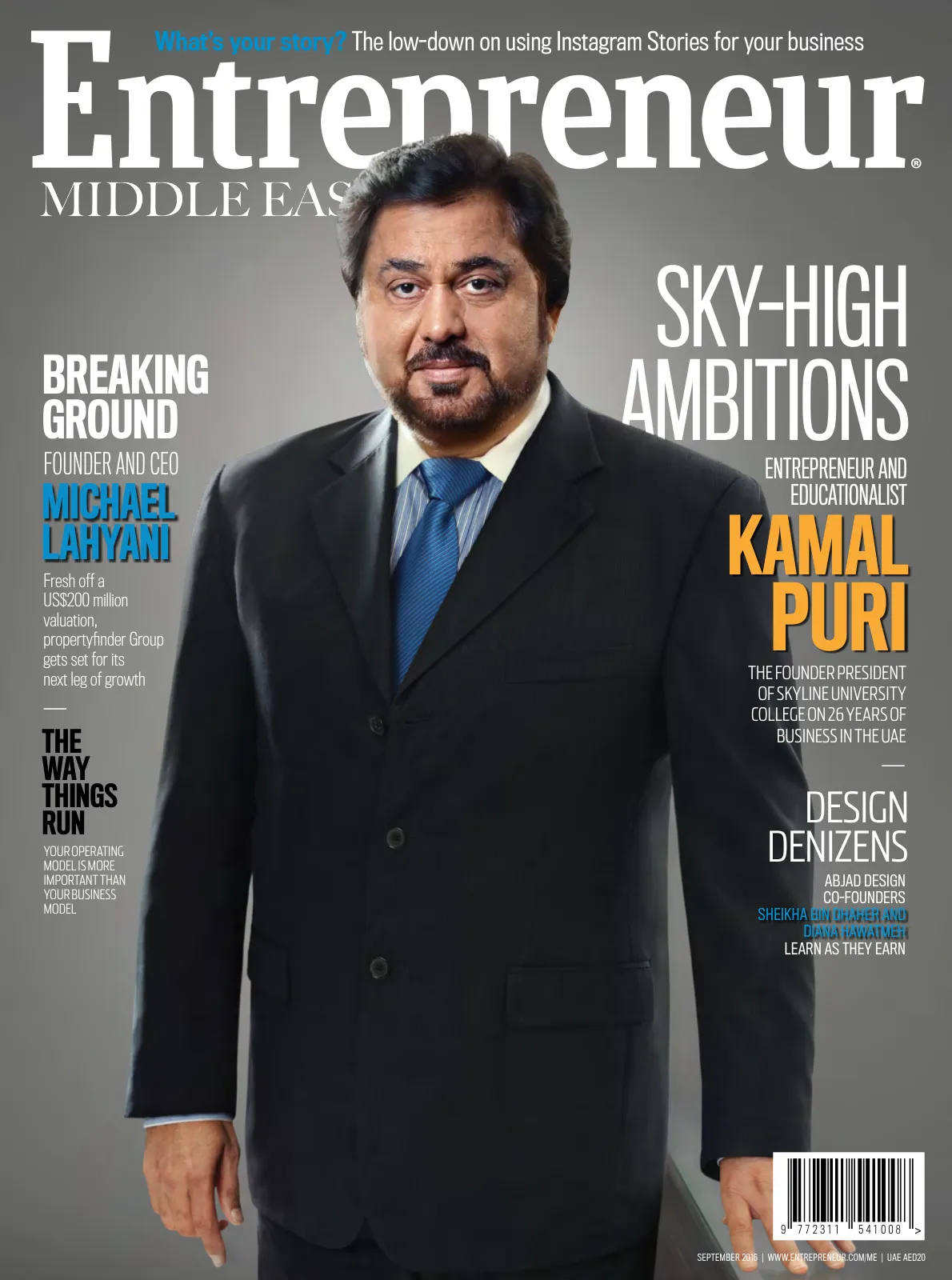
Entrepreneur Middle East, September 2016
Page 1
Sky-high
ambitions
SEPTEMBER 2016 | www.entrepreneur.com/me | UAE AED20
9
7 7 2 3 1 1
5 4 1 0 0 8
>
What’s your story? The low-down on using Instagram Stories for your business
Breaking
ground
Michael
Lahyani
Founder and CEO
Fresh off a
US$200 million
valuation,
propertyfinder Group
gets set for its
next leg of growth
The
way
things
run
Your operating
model is more
important than
your business
model
Design
denizens
Abjad Design
co-founders
learn as they earn
Sheikha Bin Dhaher and
Diana Hawatmeh
Entrepreneur and
educationalist
The Founder President
of Skyline University
College on 26 years of
business in the UAE
Kamal
Puri
Page 2
Page 3
september 2016 Entrepreneur
3
60 The low-down on using Instagram Stories for your business
CONTENTS
september 2016
70
TREPONOMICS:
SKILLSET
The way things run
Even if you have a valid
business model, an awesome
pitch deck and a great team,
your idea means nothing if
you don’t have an operating
model.
60
‘TREPONOMICS:
MARKETING
What’s your story?
Edelman’s Ema Linaker has
the low-down on how you
can go about using Instagram
Stories for your business.
34
CULTURE:
DESIGN
Design denizens
Abjad Design co-founders
Sheikha Bin Dhaher and
Diana Hawatmeh learn as
they earn.
44
TECH:
SHINY
#TamTalksTech
Gadgets and doodads that
you might’ve missed out on,
sourced by a tech aficionado.
Yes, it’s okay to want them
all… and no, it’s not our
fault.
26
INNOVATOR:
Breaking ground
Michael Lahyani, founder and
CEO, propertyfinder Group
Fresh off a US$200 million
valuation, propertyfinder
Group is getting set for its next
leg of growth.
20
INNOVATOR:
Sky-high ambitions
Entrepreneur and
educationalist Kamal Puri
The Founder President of
Skyline University College
on 26 years of business in
the UAE.
Kamal Puri, founder,
President and
Chairman, Skyline
University College
(SUC), with H.E.
Marwan bin Jassim Al
Sarkal, CEO, Sharjah
Investment and
Development Authority
(Shurooq)
20
Page 4
Page 5
Page 6
Entrepreneur september 2016
6
CONTENTS
september 2016
26
Michael Lahyani, founder and CEO,
PropertyFinder
34
Abjad Design co-founders Sheikha
Bin Dhaher and Diana Hawatmeh
learn as they earn
30
‘TREPONOMICS:
PRO
The next generation of
MENA entrepreneurs
Bayt.com’s Suhail Al-
Masri reveals that 39%
of fresh graduates in the
MENA region are actively
considering setting up
their own business.
14
EDITOR’S NOTE
By Aby Sam Thomas
76
START IT UP:
Q&A
Linking up
MyHUBBER wants to
reward users for social
engagement.
64
‘TREPONOMICS:
PRO
Building up
Simon Kennedy, Director
at Edward and Towers,
explains what you need to
know when starting up a
company in Dubai’s real
estate space.
82
‘TREPONOMICS:
PRO
Women in finance
Racha Alkhawaja, Head
of Institutional Coverage
at Menacorp Financial
Services LLC, explains
how women can succeed
in the male-dominated
finance sector.
52
‘TREPONOMICS:
ESQUIRE GUY
The Esquire Guy on what
interviewees want
Ross McCammon enlists tips
for interviewing that every
hiring manager should know.
66
MONEY:
ECON
Growing the Islamic
economy
As Islamic finance grows,
it needs innovation to
support fast-growing Islamic
economy SMEs.
45
TAG Heuer
Connected
in 18K rose
gold
Page 7
At HSBC, our unique global network in over 60 countries,
where 90% of the world’s trade and capital flows originate,
provides you with immediate access to a world of
opportunities wherever your international business takes you.
So when entering a new market, you will not do so alone,
our in-depth knowledge of your business will go with you.
Our local experts on-the-ground will help you set up working
relationships with new partners quickly, easily and confidently.
Smoother global expansion. One of the benefits of partnering
with a bank that has both the expertise and in-depth
understanding of your business, to support your
ambitions globally.
Find out more at
www.business.hsbc.ae/network
Issued by HSBC Bank Middle East Limited U.A.E Branch, P.O.Box 66, Dubai, U.A.E, regulated by the Central Bank of the U.A.E for the purposes of this promotion and lead regulated by the
Dubai Financial Services Authority. CRN 160471. © Copyright HSBC Bank Middle East Limited 2016 ALL RIGHTS RESERVED. No part of this publication may be reproduced, stored in a retrieval
system, or transmitted, in any form or by any means, electronic, mechanical, photocopying, recording, or otherwise, without the prior written permission of HSBC Bank Middle East Limited.
OPENING THE DOOR
TO A WORLD OF
OPPORTUNITIES.
Page 8
Entrepreneur september 2016
8
CONTENTS
50
CULTURE:
TRAVEL
Royal treatment
The Ritz-Carlton Riyadh
wants business travellers
to have a productive stay
at its property in Saudi
Arabia.
46
CULTURE:
TRAPPINGS
‘Trep gear
The executive selection for
the entrepreneur on your
list that has everything.
Okay, maybe for a little
self-reward as well.
74
CULTURE:
LIFE
Do you have what it takes to
work at a startup?
Vuclip founder and CEO
Nickhil Jakatdar says that
every employee at a startup
needs to be willing to
embrace change from the very
beginning of the enterprise.
80
START IT UP:
Q&A
Serving it hot
Kuwait-headquartered
Bilbayt.com is helping event
hosts discover food caterers…
online.
40
‘TREPONOMICS:
MARKETING
Let’s stay together
Unisono’s Liam Farrell makes
the case for why long-term
client-agency relationships
make good commercial sense.
58
CULTURE:
LIFE
Getting back to the grind
Just got back from a vacation?
Mark Sephton offers ideas on
how you can transition better
to your usual work routine.
46 Sacoor Brothers FW16
Lexus UAE’s
Managing Director
makes strategic
market growth a
matter of fact
20
september 2016
64 What you
need to know
when starting up a
company in Dubai’s
real estate space
50
The Ritz-Carlton
Riyadh
Page 9
27
Henri Asseily,
Manager Partner,
Leap Ventures
Page 10
Entrepreneur september 2016
10
SUBSCRIBE
Contact subscriptions@bncpublishing.net to receive
Entrepreneur Middle East every issue
EDITOR IN CHIEF Aby Sam Thomas editor@bncpublishing.net
CEO Wissam Younane wissam@bncpublishing.net
MANAGING DIRECTOR Walid Zok walid@bncpublishing.net
DIRECTOR Rabih Najm rabih@bncpublishing.net
CREATIVE LEAD Odette Kahwagi
STARTUPS SECTION EDITOR Pamella de Leon
COLUMNIST Sindhu Hariharan
COLUMNIST Tamara Clarke
COLUMNIST Shoug Al Nafisi
COLUMNIST Erika Widen
EVENTS LIAISON Mark Anthony Monzon
PO Box 502511 Dubai, United Arab Emirates
P +971 4 4200 506 | F +971 4 4200 196
For all commercial enquiries related to
Entrepreneur Middle East contact
sales@bncpublishing.net
All rights reserved © 2016.
Opinions expressed are solely those of the contributors.
Entrepreneur Middle East and all subsidiary
publications in the MENA region are officially licensed
exclusively to BNC Publishing in the MENA region by
Entrepreneur Media Inc.
No part of this magazine may be reproduced or
transmitted in any form or by any means without written
permission of the publisher.
Printed by Raidy Emirates Printing Group LLC
www.raidy.com
Images used in Entrepreneur Middle East are credited when necessary. Attributed use of
copyrighted images with permission. All images not credited otherwise Shutterstock.
Suhail Al-Masri
Racha Alkhawaja
Fida Chaaban
James Clear
Liam Farrell
Blake Goud
Nickhil Jakatdar
Simon Kennedy
Ema Linaker
Alex Malouf
Ross McCammon
Dawn Metcalfe
Mohammed Nosseir
Waleed Rashed
Mark Sephton
Andreas Skorski
CONTRIBUTING WRITERS
www.entrepreneur.com/me
Access fresh content daily on our website!
MIDDLE EAST
EntMagazineME
@EntMagazineME
Entrepreneur-me
EntrepreneurMiddleEast
EntMagazineME
EntMagazineME
EntMagazineME
MIDDLE EAST
In addition to our print edition, we’re bringing
you all sorts of industry news on our web
mediums. Joining us online means getting
relevant business and startup content in
real-time, so you’re hearing about the latest
developments as soon as we do. We’re looking
forward to interacting with our readers on all of
our social media and web platforms- like any
thriving business, we’re looking to give and take.
#TrepTalkME is already happening on all of our
digi platforms, and all good conversations go
both ways. See you on the web!
Page 11
DEDICATED PASSION
P.O.Box 2036 Malé Noonu Atoll Republic of Maldives
T +960 656 0591 F +960 656 0592
www.thesunsiyam.com
• 52 acre island giving space and seclusion
• Famous for continuous white sand beach surrounding
the entire island
• House reef with colorful corals and fishes
• Ideal for couples & families
• 14 top level restaurants and bars (endless options)
• All of the restaurants are available for All Inclusive plan
• Main restaurant has a separate area for families
• Awarded 3 times with Best Spa
• Awarded Best Kids Club in Maldives
• Adults only pool
• Large variety of over water & beach fronted villas
• 45 minutes scenic seaplane flight
THERE’S SOMETHING FOR EVERYONE
AT THE SUN SIYAM IRU FUSHI MALDIVES
AT A GLANCE
Page 12
breitlingforbentley.com
Breitling for Bentley chronographs stem from an encounter between two exceptional brands, two worlds
dedicated to performance, two identical passions for excellence. Craf ed by Breitling with an extreme
concern for perfection, they combine highly distinctive designs, opulent fi nishing and mechanical movements
chronometer-certifi ed by the COSC, a token of superior precision and reliability. Breitling for Bentley:
the best of two worlds.
Page 13
BENTLEY B05
UNITIME
Page 14
Entrepreneur september 2016
14
B
ased on what I’ve seen
and heard over the last
two months, it looks to
have been a tough summer
for small and medium
enterprises in this region.
In the UAE, for instance,
hushed whispers about difficulties in
everything from collecting payments
to bad debts have been doing the
rounds. But if the picture painted by
the Q2 2016 SME Sentiment Survey
by Gulf Finance is any indication,
then the country’s SME sector
doesn’t seem to be too bogged down
by the environment they are in- in
fact, their mood remains “cautiously
optimistic.” And as if to bolster this
feeling, Dubai announced at the end
of August that 20% of contracts for
Dubai Expo 2020 would be awarded
to both local and international
SMEs- this essentially means that
there’s set to be about US$1.36 bil-
lion up for grabs for the SME sector
in the years leading up to the event.
But while that is indeed something
to look forward to, it must be said
that the state of business in the
region currently requires SMEs to re-
think and reevaluate their strategies
for their growth and survival. I’ve
previously spoken about the bane
of laziness that seems to have fallen
upon many an entrepreneur here,
and while I’m no soothsayer, I do feel
that enterprises led by such figures
are set to find themselves in hot
water very soon. A closely related
problem is complacency, the tenden-
cy to do things as they always have
been done, and it’s an issue that I’ve
been seeing in a lot of startups and
SMEs lately. With all due respect to
the “if-it-ain’t-broke-don’t-try-to-
fix-it” philosophy, it’s alarming to see
businesses in this tough economic
climate go down their regular (argu-
ably boring) routes to try to gain
work, and then appear shocked or
flabbergasted when they learn their
efforts haven’t borne any fruit.
For all of the press around in-
novation that we see these days
(and not to mention, the pages we
devote in Entrepreneur Middle East
extolling the virtues of the same),
there definitely seems to be some
kind of disconnect between actively
talking about things like these, and
actually doing it. It isn’t enough for
entrepreneurs to just have that one
great innovative idea to start up the
enterprise- that spirit of doing things
differently needs to be distilled
throughout the company, and how it
goes about its day-to-day work. For
instance: are you trying to impress
a client with the same presentation
you used for another customer? Hey,
it may work, but then again, don’t
be surprised if it doesn’t: taking the
time out to customize how you’re
going to approach your client would
have probably given you a better
chance at landing the deal. In a simi-
lar vein, if you’re going to send out
a press release (like everyone else),
or send a corporate bio of yourself
(again, like everyone else) in the
hopes of gaining press coverage: well,
don’t be taken aback when editors
don’t reply to your emails- it’s all too
commonplace for them to even want
to take a look.
Complacency should have no place
anywhere in a startup or SME (or
any kind of business, really), and
using staid logic and methodologies
in tough business times like these
aren’t likely to do you any favors.
Innovation shouldn’t just be when
you are starting a business- it needs
to be there when you are running it
as well.
EDITOR’S NOTE
Aby Sam Thomas
Editor in Chief
@thisisaby
aby@bncpublishing.net
Shake things up
Getting inspired during tough times isn’t easy,
but it’s got to be done
Page 15
The Regional Leaders of
Construction Evolution
Over 25 flourishing years, ACICO Group sustained a sophisticated position in GCC
& the Middle East as the ideal partner for every property owner, regardless to its type,
throughout the entire project’s life cycle, from construction to management.
00965-1888811
ACICO INDUSTRIES CO. (K.S.C) PUBLIC
www.acicogroup.com
Page 16
Page 17
Page 18
Entrepreneur september 2016
18
M
ohamed
Alabbar,
founder of
Alabbar
Enterprises,
and Chair-
man, Emaar
Properties, has led two investor
groups that acquired a combined
16.45% stake in logistics major
Aramex. According to Bloomb-
erg, Alabbar acquired stakes in
Aramex in two modes- 9.9% own-
ership through Boson Ventures
Corporation (of which Alabbar is
mentioned to be a lead investor)
that purchased shares offloaded
by Aramex founder Fadi Ghan-
dour, and another 6.55% stake
through Jaona Investment LLC,
by way of a direct trade worth
US$119 million on the stock mar-
ket. The transaction seemed to
have been welcomed at the stock
market as Aramex’s shares rose,
even as the GCC equity markets
declined. An earlier Bloomberg re-
port on the Jaona deal attributes
Alabbar’s move to his keen inter-
est to be a part of the Middle East
region’s digital future, by building
a region-wide e-commerce retail
business. While Alabbar’s previ-
ous acquisition of 4% ownership
in luxury fashion retailer YOOX
Net-A-Porter in April points
to the Group’s interest in e-
commerce,
Alabbar
Enterprises
had also
acquired
in June a
stake in
Kuwait Food
Company
(known as
Americana)
for $2.36
billion, through Adeptio Invest-
ments.
When Aramex announced its
financial results for the second
quarter of 2016, it had reported
an increase of 36% in its net
profit and growth of 17% in rev-
enues- both compared to the same
period last year. E-commerce has
been a key focus of Aramex too in
recent years, with the company
investing in a number of start-
ups to strengthen its last-mile
delivery including what3words
in UK, Grab.in and Logisure in
India, Shippify in South America,
and others. Speaking to Bloomb-
erg about why he exited Aramex,
Ghandour mentioned that while
he had been in an advisory role in
Aramex for almost four years, he
now wanted to focus his attention
on the venture capital fund he was
building, catering to technology
investments in the region. As for
Alabbar’s interest in his com-
pany, Ghandour noted that any
company that desires to be in the
e-commerce space needs a strong
last-mile logistics infrastructure,
and “it’s natural of anybody who
thinks [of] logistics to think of
Aramex.” Ghandour plans to use
the capital from the sale to now
ramp up his VC fund, with plans
to set up “another fund going for-
ward” and invest in tech startups
as well.
Investment round led by Mohamed Alabbar
acquires 16% stake in Aramex
IN THE LOOP
Selling point
Ralf Wenzel,
co-founder and
CEO, foodpanda
group
D
eciding which online food delivery
website to use just got easier for Saudi
Arabia’s consumers. Online food delivery
company foodpanda has merged its
Saudi Arabian arm Hellofood with Hungersta-
tion, a KSA-based food delivery startup. In a
statement on the deal, foodpanda says that the
business consolidation move pushes foodpanda
to be a “clear market leader” in the region. Food-
panda also announced that with this merger, the
company is now profitable in Middle East region,
after having turned a profit in Central Eastern
Europe last year. The company adds that both
brands will continue to operate post-merger,
providing access to variety of restaurants to
Saudi consumers. Ebrahim Al-Jassim, founder,
Hungerstation, will lead the existing teams,
while Mehdi Oudghiri and Anass Boumediene,
Managing Directors of foodpanda Middle East,
will oversee operations.
Commenting on the deal, Ralf Wenzel, co-
founder and CEO, foodpanda, says that the
company will now enjoy the benefits of hav-
ing an experienced local team on the ground,
“which understands the market, built strong
relationships with restaurants, and continu-
ously strive to bring the most convenient food
delivery experience to our customers.” Having
entered Middle East in 2013 under the Hellofood
brand, foodpanda also operates two other food
delivery companies in the region- 24h in the
UAE, and Otlob.com in Egypt. Al-Jassim founded
Hungerstation in 2012 in Dammam, KSA, as
one of the first online food ordering portals in
the region. The new deal comes at a time when
consolidations are becoming common in the
food tech sector, with investment action in new
startups slowing down. According to a recent CB
Insights report, global food tech deals dropped
to 27 in Q1 of 2016 from a record high of 78 in
the last quarter of 2015. UK-based food delivery
company Deliveroo has emerged as an exception,
raising US$275 million in Series E financing.
What’s cooking?
Foodpanda merges with
Hungerstation to strengthen
Saudi Arabia presence
Fadi Ghandour,
founder,
Aramex
Founder and Chairman of
Emaar Properties,
Mohamed Alabbar
Page 19
Porto Arabia Towers
Doha, Qatar
©2014 Hill International, Inc.
Hill International
The Global Leader in Managing Construction Risk
www.hillintl.com
For nearly four decades, owners and developers in the Middle East have
turned to Hill International to manage their construction projects and
programs throughout the region. Hill is proud to have helped our clients
turn their most challenging visions into realities. We have participated
in over 10,000 projects with a total construction value in excess of $500
billion, managing all phases of the construction process from concept
through completion.
Hill is also the leading construction claims firm in the world, having helped
resolve problems on some of the most complex projects throughout the
Middle East and around the world. To minimize risk and maximize results
on your next project, turn to Hill International
Dubai Office: 971 4 227 0078
Doha Office: 974 4 435 8381
Corporate HQ: 800 283 4088
If you can imagine it, we can manage it.
Qatar National Museum
Doha, Qatar
Mall of Qatar
Doha, Qatar
Viva Bahriya Towers
Doha, Qatar
Page 20
innovator
Entrepreneur september 2016
20
Page 21
W
hen conversing with
Kamal Puri, one
thing becomes easily
apparent to me- the
Founder President
and Chairman of Skyline University
College is an educationalist through
and through, with every statement
he makes in his bold, booming voice
tinged with a flair characteristic of a
professor or a teacher. But don’t let
that fool you- make no mistake: Puri
is not just an educator; he’s also one
of the UAE’s (and indeed the MENA
region’s) most successful business-
men; an entrepreneur who started
his enterprise way back in 1990 in
the Emirate of Sharjah. While it was
path-breaking in its own right, Puri’s
institution had rather humble begin-
nings- it started out offering diploma
courses in travel and tourism, and
today, Skyline University College’s
portfolio consists of business educa-
tion courses in everything from in-
formation systems to strategic man-
agement and leadership, with the
enterprise gaining a name for itself
not just in the UAE but throughout
the region as well. Skyline’s growth
over the years is reflected in the size
of its campus as well- it may have
launched with classes happening in
just a handful of rooms, but today,
it boasts of infrastructure spread
across 40 acres of land in Sharjah’s
University City. Sitting at the helm
of all this is Puri, who saw his en-
terprise celebrate its silver jubilee
recently as well.
But Puri is not someone who’s con-
tent to sit on the achievements his
enterprise has made thus far- Puri
and his team believe in continu-
ally looking toward the future, and
this foresight is what he believes
will help ensure and consolidate
Skyline’s continued success in long
term. Puri wants to equip Skyline
in such a way that is ready for the
student populace in the years to
come- and this means analyzing >>>
Sky-high
ambitions
Entrepreneur and
educationalist
Kamal Puri
“In any business, you
have to keep it in mind
that this century
is not [about] how
many hours you
put in; it’s what you
create. Creativity has
taken a front stand.”
The Founder President of Skyline University College
on 26 years of business in the UAE
By Aby Sam Thomas
september 2016 Entrepreneur
21
IMAGES COURTESY SKYLINE university college
Page 22
Entrepreneur september 2016
22
current industry trends and anticipating
future demand, which would help the
team at Skyline to better tailor their
various educational offerings. This is
indeed the modus operandi Puri has
in place at Skyline already, and if the
institution’s current state is any indica-
tion, then it’s a strategy that has worked
out quite well for the enterprise. “We
limited ourselves in the areas where we
felt that these are the areas that are go-
ing to grow,” Puri explains. “And now we
have completed 26 years.” When asked
about subjects that can be considered to
be of import to the MENA region (and
beyond) today, Puri highlights fields like
travel and tourism, retail marketing and
international business, among others,
which, when considering the ambitions
most of the countries in this locale have
decided for themselves, are certainly
poised for an increase in demand for
skilled professionals in those particular
areas.
With respect to the UAE’s education
sector itself, Puri says there’s need for
a uniform accreditation and approval
system across the country, as opposed
to the fragmented situation that is in
existence today- Puri puts forward one
example, which is of schools in free
zones in the UAE, which don’t need to
seek approval by the Government-run
Commission for Academic Accreditation.
But a student who graduates from such
a school will find that their degree is
recognized only by the home Emirate,
thereby limiting their chances at landing
a job in the UAE. “I, as a professional,
feel that the UAE should have one policy-
not different systems operating [across
the various Emirates],” he says. “Because
the market is confused.” Another is-
sue is with standards- Puri says that
there are some institutions that are not
recognized by anybody
here, yet still manage
to give away diplomas
and degrees by virtue of
their registration with,
say, the Department of
Education in the U.S.
So what’s the solution?
“What I expect [from]
this country, [is that]
the Ministry of Higher
Education [and Scien-
tific Research] has to
make a uniform policy.
Standards have to be
laid down. Most of the
institutions are in busi-
ness education; they have to put a limit
on that, taking [into account] the needs
and demands of the manpower here. The
same national standards need to be fol-
lowed- not state standards.”
Besides keeping an eye on those indus-
tries that will play an important role in
the future of the region, Puri also notes
that the changing nature of the process
of teaching and learning itself is also
helping decide Skyline’s approach to
its own future as a business enterprise.
“Education is no more just in bricks;
it’s in bricks and clicks!” Puri exclaims,
pointing toward how the evolution of
technology and the internet has enabled
the rise of a whole new style of educa-
tion in the world today. Puri is insistent
on Skyline being cognizant of these
changes and adapting itself to this new
online environment, because in his view,
academic institutions turning a blind eye
to these trends are doomed to be left by
the wayside very soon. “According to me,
in the next 20 years, you will see at least
10-15% of educational establishments
close down,” he predicts, likening the
situation to the way travel agencies were
left in the lurch not too long ago, after
online ticketing and booking systems be-
came a lot more commonplace. But while
other educational institutions may find it
difficult to catch up with the times, Puri
points out that Skyline has been ahead of
the curve in this regard, with respect to
innovator
“What I expect [from] this
country, [is that] the Ministry
of Higher Education [and Sci-
entific Research] has to make
a uniform policy. Standards
have to be laid down. Most
of the institutions are in
business education; they have
to put a limit on that, taking
[into account] the needs and
demands of the manpower
here. The same national stand-
ards need to be followed- not
state standards.”
Skyline University College Founder President Kamal Puri (on left) with H.H. Sheikh Sultan Bin Mohammed Al Qasimi,
Ruler of Sharjah (third from left).
A scene from
Skyline’s Silver Jubilee
celebration
“We limited ourselves
in the areas where we
felt that these are the
areas that are going to
grow. And now we have
completed 26 years.”
Page 23
september 2016 Entrepreneur
23
the curricula it offers. “Ours is the best
of both [the online and offline] worlds,”
he declares, noting that Skyline already
has online-cum-onsite courses on offer,
with more such programs in the pipeline.
It is thus with this eye on the future
that Puri and his team hope to keep
Skyline’s offerings renewed and relevant
in the years to come. “In any business,
you have to keep it in mind that this cen-
tury is not [about] how many hours you
put in; it’s what you create,” Puri says.
“Creativity has taken a front stand.” This
means that when it comes to Skyline,
Puri’s entrepreneurial vision and fore-
sight will be key in taking the enterprise
forward. “If we are preparing students
today, [we need to know] what will be
the demand in 2025,” Puri says, as he
outlines Skyline’s forthcoming schemes.
“We are very clear in our strategic plan
for the future. We are launching doctor-
ates; we already have BBA, MBA, and
DBA [programs]. So we are confined
to those areas. [That’s] number one.
Number two, some courses are shift-
ing to online. Number three, market
diversification- we
are getting a lot of
proposals coming
from all around the
world to join with
them and set up
universities. That
is something we’re
looking at this
time.” At the same
time, while the
education sector
remains Skyline’s
primary agenda,
Puri explains that
the organization
has also ventured into other areas of
business- these include investing in an
IoT-focused company, running senior
citizen homes in Canada, and other
varied interests in sectors like real estate
and hospitality as well.
It’s rather clear from Puri’s thoughts on
everything from ensuring Skyline’s lon-
gevity, to its diversification strategy, that
the entrepreneurial spirit with which he
started his enterprise is as active as ever.
From an operational standpoint, Puri
believes in discipline, dedication and
transparency as being key to establish-
ing a successful business- these are the
principles he imparts to those among
his students seeking to start their own
companies. While strict discipline is
needed to maintain the high quality and
standards of one’s business, Puri says
dedication is an attribute an entrepre-
neur simply must have, since, as he puts
it, “every business takes one life[time]
to build,” and transparency is required
to maintain its reputation over the years.
As for his own leadership style, Puri
doesn’t see a distinction between Sky-
line, as a brand, and his own personal
brand, and he is keen on leading the way
from the front, for the rest of his team.
september 2016 Entrepreneur
23
Skyline University College celebrating the silver jubilee of the institution’s founding
Skyline University College
in Sharjah
1990 The year SUC was established
40 The size of the first SUC class
6000 The number of SUC alumni as of
January 2015
40 The size in acres of the SUC campus
in Sharjah, UAE
SUC by the numbers
“once you’re secure with
your finances, you can do
other experiments on that-
because if you don’t have the
finances, you cannot experi-
ment! It’s very, very impor-
tant for every entrepreneur
to have a cushion to fall back
[on] fast.”
>>>
Page 24
Entrepreneur september 2016
24
“A leader is like an engine [driving the
organization],” he says. “If my staff
comes at eight-o-clock, then I’ve to be
here at seven-o-clock- because I am a
role model. If, in any business, you don’t
have people skills, then you can’t run a
business… And no vertical organization
can work- it [the hierarchy of manage-
ment] has to be horizontal.”
From a personal standpoint, Puri
claims to not be driven by his ego, or by
any kind of external motivation, with re-
spect to what he does as a businessman.
“I have an internal motivation,” he says.
“I have my own vision, mission, purpose,
goals, objectives.” At this point, I press
him to tell me what exactly pushes
him to do whatever he does. “Happi-
ness comes through only one thing in
life- when you help others,” he replies,
adding that this has been his guiding
principle ever since he started out as an
entrepreneur. “I consider myself to be a
privileged child of God,” Puri says. “He
has given me education, He has given
me everything… Privilege and money
were never a shortage in my life. So if I
don’t give back to society, I’m a thief!”
As an educational institution, Skyline,
Puri points out, has always made it a
priority to allow for scholarships and
other awards that
would help the less
privileged to move
ahead with their lives.
In addition to such
initiatives, Puri makes
sure that students at
Skyline are instilled
with principles like
his, by making it
mandatory for them
to perform community
service before they
graduate- these can
include performing
a variety of activities, which range from
becoming teachers for people in prison,
to donating blood for medical institu-
tions in the country.
Puri’s notion of giving back isn’t
restricted to just his social endeavors
though- given his own success as an
entrepreneur, he’s keen on helping
younger peers in this space get a leg up
with their enterprises as well. Skyline’s
Innovation Lab has been especially
created for this purpose- besides being
a space for students to build up their
ideas and their teams, the Innovation
Lab also enables meetups between these
budding entrepreneurs and investors
who can help their ideas get to fruition,
with Skyline also allocating some of
its own funds for enabling these new
startups get their feet off the ground. Of
course, Puri himself can be a source of
inspiration and information on starting
up an enterprise here in the UAE- his en-
trepreneurial journey has obviously had
its own share of hurdles, and he had to
obviously pour in a lot of effort to make
what Skyline what it is today. Looking
back, Puri acknowledges the hard work
he had to put in, but he still counts him-
self to have been rather fortunate with
his enterprise. “See, nothing comes easy;
we have to remember [that],” he says,
in a matter-of-fact way. “But I will still
consider [myself] very lucky- my efforts
have paid off! There are so many people
who put in a lot of effort, but don’t get
their rewards. Here [with Skyline], I got
[my] rewards!”
Comparing the ecosystem today to
what it was back when he started up,
Puri feels there are more opportunities
for entrepreneurs today, despite the
seemingly crowded business arena of
the region. “Competition will always
increase in every field, no doubt at all.
But then again, also keep it in mind
[that] if you create something new, it
will have a very short shelf life. You’ll
see it gets outdated very fast… So you
have to make sure that whatever you are
doing, you work on a skimming pricing
policy, rather than a penetration pricing
policy. So then you charge your prices,
you cash that, and then once you’re
secure with your finances, you can do
other experiments on that- because if
you don’t have the finances, you cannot
experiment! It’s very, very important for
every entrepreneur to have a cushion to
fall back [on] fast.” Puri also emphasizes
the importance of having a team that is
tuned in to the entrepreneur’s vision and
mission, and also insists on the need for
well-defined systems to be put in place
right from the start of the enterprise.
These are principles that Puri has imple-
mented in his own life, and if his success
so far is any indication, then it’s safe to
say that entrepreneurs today would be
wise to follow his lead with respect to
their own startup journeys. As for Puri
himself, he doesn’t plan to rest on his
laurels- diversification, be it in Skyline’s
offerings, industries or markets, is on
the agenda, and his ambitions remain as
sky-high as ever.
innovator
1. Discipline
“It is the most important thing
[to build your business].”
2. Dedication
“If your inputs are sincere, the output is
bound to come.”
3. Transparency
“It take ages and ages to build up
your brand- and it can be destroyed in
minutes. Work on a marketing concept,
not on a selling concept.”
4. People
“One brain is no good as compared to,
say, five brains. Always work in a team.”
5. Community
“Ultimately, whatever you do, make
sure it contributes to the betterment of
society.”
‘Trep Talk ME
Kamal Puri’s five-point
checklist for young
entrepreneurs
“Competition will always
increase in every field, no
doubt at all. But then again,
also keep it in mind [that] if
you create something new, it
will have a very short shelf
life. You’ll see it gets out-
dated very fast… So you have
to make sure that whatever
you are doing, you work on
a skimming pricing policy,
rather than a penetration
pricing policy.”
Founder President and Chairman of Skyline University College Kamal Puri
Page 25
Page 26
Entrepreneur september 2016
26
I
strongly believe that behind
each frustration, stands a
potentially great solution.” This
statement by propertyfinder
Group founder and CEO Michael
Lahyani may seem rather sim-
plistic, but the premise it puts
forward is, in effect, a rather
accurate summation of how this entre-
preneur went about setting up (and suc-
ceeding with) his aforementioned online
real estate classifieds enterprise. “Every
business, and more importantly, [every]
tech business starts by identifying an
issue, a difficulty among end users or
within businesses,” says Lahyani. “In
2004, when I first moved to Dubai and
started looking for a home, my only op-
tion was Gulf News’ Classified section-
pretty limited for a booming real estate
market. There was a clear issue around
consumers looking to rent or buy an
apartment, and an obvious need for a
search engine that allows you to find
your apartment in a couple of clicks.
The business was therefore focused
around solving that pain initially.”
Lahyani started up his business in
2005 with the launch of a UAE-based
property print magazine called Al Bab
World, and in 2007, its online portal
AlBabWorldicom had 51% of its stake
bought by the News Corp Australia-
owned, Melbourne-headquartered
online real estate advertising company
REA Group. This acquisition also
marked the rebranding of the company
as propertyfinder.ae, and the website
continued to gain popularity as an
easy and convenient way to look at
real estate opportunities in the UAE.
In 2010, while the market around
them was dealing with the effects of
the recession, Lahyani and co-founder
Renan Bourdeau bought back REA
Group’s stake in propertyfinder, and
the company soon broke even. Shortly
after, propertyfinder decided to grow
beyond its UAE borders- 2012 saw
its international operations begin in
Qatar, and that was just the beginning
of its expansion in the region. Today, >>>
Fresh off a US$200 million valuation, propertyfinder Group
gets set for its next leg of growth
By Aby Sam Thomas
innovator
Founder and CEO Michael Lahyani
.
Page 27
“Our aim at propertyfinder
Group is to release consumers
from the pain related to
house hunting. Our mission
is clear: to shorten the
path to property for our
consumers. It’s an ambitious
mission, because across the
region, there are still a lot of
hurdles, even in Dubai.”
Michael Lahyani, founder and CEO, PropertyFinder
september 2016 Entrepreneur
27
Page 28
Entrepreneur september 2016
28
propertyfinder Group operates in seven
markets across the MENA (UAE, Qatar,
Bahrain, Egypt, Saudi Arabia, Lebanon,
Morocco), with its sites boasting of
more than one million visits per month.
Of course, if those figures alone
weren’t proof enough of its success
as an enterprise, then take a look at
propertyfinder Group’s US$200 million
valuation earlier this year, following its
raise of US$20 million in capital from
Sweden-based Vostok New Ventures
Ltd., which bought a 10% stake in the
company. This raise is particularly
significant not just because of its sheer
size, but also for the reason that before
it came through, propertyfinder Group
had managed to grow through the years
having raised only a comparatively low
amount of funds. “We had our initial
funding from the founding members in
2005, and in 2007, News Corp came in
about $2 million, and later on in 2012,
Beco [Capital] also injected around $2
million,” Lahyani reveals. “We got all
the way to 2015 with relatively minimal
funding, considering the overall valua-
tion of the business, and we wanted to
make sure that we would establish our
clear leadership in all the markets we
were undertaking, and therefore raising
a significant amount was needful, in
order to gear up for that domination
phase.”
Vostok New Ventures’ interest in prop-
ertyfinder Group can also be seen as an
indication of the transformation and
evolution of the MENA entrepreneurial
ecosystem, one that Lahyani has been
a part of for more than 10 years now.
“Three years ago, it was unthinkable
that external investors would invest
in tech companies in this part of the
world,” Lahyani points out. “And when
Vostok raised an interest in our busi-
ness, we felt it was a real opportunity
to bring in funding and a know-how
to our part of the world. Vostok New
Ventures’ funding is a
perfect example of what
we’ve become: a brand
that grew beyond UAE’s
borders. Dubai was pre-
viously known for being
a land of opportunities.
Any ideas to fill in the
many market gaps were
welcome. Today it has
become a hub for inno-
vation. Homegrown en-
terprises are burgeoning,
and expanding regionally
and sometimes globally.
These [are] very exciting
times for entrepre-
neurs!”
Now, it’s very easy to
be bowled over by all
of the obviously great
things that are happen-
ing at propertyfinder
Group these days, but
one must bear in mind
that all of this did not
come easy- Lahyani and
his team have had plenty of testing
situations along the way, many of which
may seem familiar to startups and
entrepreneurs operating in the region
even today. For instance, when Lahyani
set up the business in Dubai in 2005, it
might interest you to learn that he too
was once vexed with deciding between
choosing a local partner to start up the
business, or go for a freezone set-up
model. (Just FYI, he went for the latter
option, as “it offered more flexibility.”)
For the forward thinking among you,
who feel that your awesome startup idea
doesn’t have a receptive audience yet,
know that there was once a time when
Lahyani and his team found it difficult
to convince stakeholders that there was
a need for what propertyfinder offered.
“The biggest difficulty we faced back
in the early days was to convince real
estate brokers that they needed a dif-
ferent source of leads for their deals,
and that they had to be exposed to the
internet,” Lahyani remembers. “It took
many years before we convinced them,
but ultimately, when big names started
signing up, everyone else followed!”
As for funds when starting up, Lahyani
dug deep into his own pockets to get his
business off the ground- and he advises
other entrepreneurs to follow his lead.
“As an entrepreneur, putting your own
funds in the beginning is a must if you
innovator
“The initial business started
10 years ago. We came into a
market quite early, way before
customers and consumers
were ready for our platform.
We had to educate the market:
agents about digital marketing,
and consumers about online
and mobile property search.
That took quite some time. We
were actually losing money
during the first six years of
the business, and only became
profitable in 2011.”
Page 29
september 2016 Entrepreneur
29
want to remain a respect-
ful shareholder across the
journey,” he explains. “If your
first dollars are raised from
external investors, you will
naturally suffer a large dilu-
tion from day one which you
want to avoid by gathering
money from your own savings
or close family and friends.
Getting the business off the
ground with your own money
is essential!”
The above examples are just
a sampling of the difficulties
Lahyani faced as an entrepre-
neur in the MENA region- a
Google search on his name
will showcase articles where
he has talked about troubles
with investors, competitors,
and other such elements
as he went about building
propertyfinder Group. “The
lifecycle of a startup is paved
with unpredictable chal-
lenges, and in my experience,
a successful team knows
how to turn obstacles into
opportunities,” Lahyani says.
“That’s how we survived at
propertyfinder. The initial
business started 10 years ago.
We came into a market quite
early, way before customers
and consumers were ready
for our platform. We had to
educate the market: agents
about digital marketing, and
consumers about online and
mobile property search. That
took quite some time. We
were actually losing money
during the first six years
of the business, and only
became profitable in 2011.
It took a lot of focus, persis-
tence and discipline. We are
today in the consolidation
phase. The market has now
recognized us as the lead-
ing real estate portal in the
Middle East. And this is what
we are doing in every market:
aiming at becoming the clear
number one.”
International growth is
thus a key component of
propertyfinder Group’s
strategy for the future. “We
are currently operating in
seven markets,” Lahyani
says. “A couple of years ago,
we were number one in only
three of those markets; today,
we have managed to secure
a leadership position in
two extra markets. The two
remaining ones are taking a
big part of our focus, while
potentially eyeing an eighth
market in the coming year,
where we believe we can also
secure a leadership posi-
tion.” According to Lahyani,
propertyfinder Group’s
experience thus far stands
it in good stead for this
particular goal. “Today, we
are facing the same problems
we faced 10 years ago in the
UAE, but in our international
markets,” he explains. “The
lessons learned from our UAE
experience is a competitive
advantage for us.” At the
same time, the company isn’t
averse to making acquisitions
to proliferate its brand bet-
ter- in Morocco, for instance,
propertyfinder Group bought
one of its competitors there,
Selektimmo, thereby allowing
it to get a leg up in terms of
becoming a leader in the on-
line real estate marketplace
there. However, Lahyani
makes it clear that acquisi-
tions won’t be the only way
forward for the company.
“Growing by acquisition is
not our sole strategy,” he
notes. “We’ve established our
leadership through organic
growth, but if there is a great
opportunity that makes sense
for an acquisition, then we
will seize it.”
As Lahyani sees it, there’s
still ample room for prop-
ertyfinder Group’s further
growth in the coming years,
and the company’s offering
will need to be continu-
ally improved and innovated
upon for it to remain a leader
in the marketplace. “Our aim
at propertyfinder Group is
to release consumers from
the pain related to house
hunting,” Lahyani says. “Our
mission is clear: to shorten
the path to property for our
consumers. It’s an ambitious
mission, because across the
region, there are still a lot of
hurdles, even in Dubai. As
long as we can improve that
process, then we can bring
value to the end users, and
therefore, to our customers,
and deliver them leads.” As
for the real estate sector
itself, Lahyani remains quite
excited about it- according to
him, the industry continues
to be a good place to start a
business in this region. “The
real estate space is an amaz-
ing space for entrepreneurs
to enter, and there are a lot of
more disruptions to come,”
he says. “My prediction is
that multiple players offering
services in different niches
will be disrupting the in-
dustry. Technology will play
a major role in challenging
‘useless’ players. As a leader
in our market, we want to
see younger companies enter,
and help us make the entire
property buying and renting
a smoother process.” And
there you have it, folks: an
open call from Lahyani for
real estate-focused startups
that can help better proper-
tyfinder Group’s offerings- so,
if you fit the bill: well then,
carpe diem, ‘treps!
1. KNOW YOUR MARKET
“Put your head down into the
business, and push through
all the obstacles that are
ahead of you, and make sure
that the prize is big enough.
The first question an investor
will ask you about your
project is: ‘What is the size
of your market?’ So before
starting, you need to know
what the size of the market
will be, and what are you
going after.”
2. BUILD A TEAM THAT
COMPENSATES FOR
YOUR WEAKNESSES
“It is more important to
know your weaknesses than
your strengths. Surround
yourself with people who
have better skills in the areas
where you are weak; look for
complementarity [in] people
when hiring.”
3. BE PERSISTENT
“Make sure you enjoy doing
what you do every day, be-
cause it will take at least twice
longer than you had expected,
and you will need as much en-
ergy in the beginning, middle
and ‘end’ -although there is
no real end- of the journey.
4. DON’T BUILD TO EXIT
“Don’t build a business to sell
it, because buyers don’t come
when you need them. Build
a business that can sustain
booming markets, and
ultimately, if your business
is solid, you will find a solid
acquirer.”
5. PROTECT YOUR
RELATIONSHIPS
“Finally, my last advice would
be to never burn bridges.
Every relationship that you
will think is not important
today might be counting
tomorrow. ‘What goes around
comes around.’”
TAKE FIVE
Michael Lahyani’s tips
for entrepreneurs
www.propertyfinder.ae
“Today, we are facing the same
problems we faced 10 years
ago in the UAE, but in our
international markets. The
lessons learned from our UAE
experience is a competitive
advantage for us.”
Page 30
Entrepreneur september 2016
30
I will keep looking until I do
43%
21%
16%
7%
7%
6%
Start my own company
Not sure / can’t say
Start looking for a job in another industry / job
role of my choice
Start looking for a job no matter the industry /
job role
I have a job in my exact target job role and
industry already
ETHICS | ESQUIRE GUY | SKILLSET | MARKETING | PRO
TREPONOMICS
The next generation
of MENA
entrepreneurs
39% of fresh graduates in the MENA region are actively
considering setting up their own business
By Suhail Al-Masri
Whether due to the economy
or something else, it is clear
that entrepreneurship in the
MENA region has grown. In
terms of future aspirations,
39% of fresh graduates are
actively considering setting up
their own business; 41% may
consider it.
Safisfaction with quality of
higher education
Very satisfied
Somewhat satisfied
Neither satisfied nor dissatisfied
Somewhat dissatisfied
Very dissatisfied
Perceived motivations to hire fresh graduates
6%
15%
16%
25%
34%
45%
Other
Fresh graduates have better teamwork
skills
Fresh graduates are more creative
Fresh graduates are able to handle more
challenge
Fresh graduates are compliant and willing
to follow instructions
Fresh graduates have lower expectation
on salary
Plan of action if unable to secure employment in target industry
I
magine yourself trying to
find a job as a fresh gradu-
ate in the Middle East and
North Africa (MENA) re-
gion. Not only would you be
looking for employment in
one of the most tumultuous
regions in the world, in chal-
lenging economic times, but
you would also be competing
with millions of other gradu-
ates who are looking for jobs.
Aggravating this situation,
demographic projections reveal
that the region’s youth popula-
tion will continue to surge. To
us at Bayt.com, these factors
exhibit themselves in very real
ways: the average job vacancy
advertised on the website gets
well over 500 applicants. This
compares to barely tens of ap-
plicants that most leading job
sites globally boast. While job
sites all over the world com-
pete to get applicants on their
sites, Bayt.com invests a tre-
mendous amount of time and
effort trying to help employers
make sense of the massive
choice they are getting, and
communicating to job seekers
realistic expectations for being
selected for a job.
In a recent report, Bayt.com
and YouGov investigate the
reality of the job market and
employment opportunities
available for fresh graduates in
the MENA region. The report
describes some of the obsta-
cles fresh graduates face when
looking for a job, and reveals
the extent to which higher ed-
ucation is preparing them for
the current workplace. Find-
ings in the report demonstrate
how particularly challenging it
is for young job seekers across
the region to secure a first job
with their current skills, and
why entrepreneurship could
well be the solution to the
youth unemployment problem
in the MENA region.
The reality of the
job market for fresh
graduates in the MENA
It’s not news to anyone
that the job market across
the Middle East and North
Africa (MENA) region is a
tough place. Talents are in high
supply, while jobs, on the other
hand, are very limited.
According to the Bayt.com
Fresh Graduates in the Middle
East and North Africa Survey,
July 2016, 60% of fresh gradu-
ates say it is challenging to find
a first job, with half of them
stating the greatest challenge
standing between them and
a successful career is the fact
that candidates with previous
work experience are preferred
by employers in the region.
In addition to employers pre-
ferring experienced candidates,
respondents cited a lack of
knowledge as to where to find
relevant jobs (35%), and a lack
of understanding regarding
how to effectively search for
jobs (32%), as the main chal-
lenges they face when trying to
secure their first job.
Page 31
september 2016 Entrepreneur
31
charts © bayt.com
Bayt.com offers multiple
options and various streams
that can both help graduates
develop their skills as
aspiring entrepreneurs or
job market entrants, as well
as help employers identify
the skills of a candidate for a
specific role.
Bayt.com Courses
Learning new skills and
adding them to your CV
is a great way to highlight
your expertise to employers.
Courses vary from soft skills
to technical skills, and can
prepare fresh grads for their
first job.
Get smart
A look at the tools Bayt.com offers
to develop your skills
Bayt.com Tests
Test and qualify your skills to
employers with Bayt.com tests.
Choose tests that are related
to your industry, and show
employers just how capable you
are with the skill set you have.
Bayt.com Specialties
Network your way to success
with Bayt.com Specialties.
Stand out from the crowd by
connecting with industry peers
and employers, discussing
important topics, asking
and answering questions,
and gaining know-how and
expertise within your industry-
all for free.
31%
29%
34%
5%
Very difficult
Difficult
Neither difficult nor easy
Easy
Very easy
2%
Level of difficulty in securing first job
Industries perceived to hire the most fresh graduates
Advertising / Marketing / Public Relations
Military / Defence / Police
Banking / Finance
Education / Academia
Other private sector
Government / Civil service
Engineering / Design
Healthcare / Medical services
Commerce / Trade / Retail
Business Consultancy / Business Management / ..
Real Estate / Construction / Property Development
Consumer Goods / FMCG
IT / Internet / E-commerce
Telecommunications
Hospitality / Recreation / Entertainment
Manufacturing
Oil, Gas and Petrochemicals
Automotive
Human Resources
Tourism
Aerospace / Airline / Aviation
Charity / Voluntary sector / NGOs
Domestic Services
Don’t know / can’t say
20%
20%
18%
12%
12%
11%
9%
9%
9%
8%
8%
8%
8%
8%
7%
6%
6%
5%
5%
5%
4%
4%
4%
13%
While finding a job may be
challenging, fresh graduates
throughout the region are
not giving in. Despite what
many perceive as a “negative
outlook,” the largest propor-
tion (43%) claim they will
keep looking until they find a
job in their industry of choice.
Nevertheless, results also point
to a pragmatic youth, with
one in every five (21%) fresh
graduates surveyed across the
region claiming they will start
looking for a job in another
industry, and a further 16%
claiming they will look for any
job no matter the industry.
Unfortunately, the majority
(61%) of fresh graduates sur-
veyed across the MENA region
feel they would have fared
better in the job market if they
had selected either a different
major (32%), the same major
but from a different school
(11%), or both a different
major and a different school
(19%).
Are fresh graduates the
new entrepreneurs?
Most surveyed across the
MENA region have a fairly
pessimistic view regarding job
availability for fresh graduates,
with three-quarters (73%)
rating it as “low,” with fresh
graduates in North Africa and
Jordan exhibiting least positive
feelings towards the availabil-
ity of jobs, and those rating job
availability as either “high” or
“moderate” in these countries
ranging from 8% only in Jor-
dan to 15% in Morocco.
Officially, one in four young
people (aged 18-29) in the
MENA region are unemployed.
Unofficially, this number >>>
Page 32
Entrepreneur september 2016
32
Suhail Al-Masri is the VP of Employer Solutions at Bayt.com. Al-Masri has more than 20 years of experience in sales leadership, consultative sales,
account management, marketing management, and operations management. His mission at Bayt.com goes in line with the company’s mission to
empower people with the tools and knowledge to build their lifestyles of choice.
ETHICS | ESQUIRE GUY | SKILLSET | MARKETING | PRO
TREPONOMICS
charts © bayt.com
Yes, full-time
Yes, part-time
Yes, part-time and would prefer full-time
No
Employment in field of study
Greatest challenges faced when looking for a job
51%
35%
32%
20%
16%
15%
9%
2%
5%
Candidates with work experience are preferred
Where to find relevant jobs
Knowing how to effectively search for jobs
Knowing how to develop good interview skills
Knowing how to apply to relevant jobs
Knowing how to compile a CV
Knowing how to write a cover letter
Other
None of the above
Leading online job sites
Direct applications to target companies
Family and friends network
Social media sites
Newspaper ads
Physical and virtual career fairs
Alumni network and university placement office
Other
63%
45%
36%
33%
28%
17%
14%
2%
Avenues pursued to find first job
could be much higher, espe-
cially when considering the
large prevalence of informal
unemployment and underem-
ployment in the region. With
such diminished job pros-
pects, an emphasis on youth
entrepreneurship in the MENA
is imperative. If young people
cannot find jobs, they should
be able to create their own,
and ideally generate jobs for
others.
Good news is, Bayt.com’s
research has shown over and
over again that people in the
MENA are more interested in
running their own business
than being employed. Unlike
previous generations, for many
millennials, climbing the cor-
porate ladders isn’t a goal they
are struggling to attain. Actu-
ally, eight in 10 fresh graduates
said they might be turning
their backs on the traditional
career path soon and instead
become owners and runners of
their own business.
Whether due to the economy
or something else, it is clear
that entrepreneurship in the
MENA region has grown. In
terms of future aspirations,
39% of fresh graduates are
actively considering setting up
their own business; 41% may
consider it.
These findings mirror a
Bayt.com survey in partner-
ship with Stanford Univer-
sity, which showed that in
every Arab country surveyed,
about 40% of respondents
expressed interest in being
self-employed, with 50% of
them saying that they started a
business because they wanted
greater independence.
The final word
Stimulating entrepreneurship
is intrinsic to creating both
sustained economic value and
jobs, and it is clear that this
goal has become of increasing
importance in the Middle East
and North Africa for creating
stability and common prosper-
ity, especially for the youth,
with youth entrepreneurship
being of particular importance.
Members of this generation of
fresh grads have proven to be
innovative and great at analyz-
ing and solving problems, re-
ducing a certain amount of risk
by increasing the probability
that employers will be able to
quickly recover their onboard-
ing costs. While most of these
young job seekers firmly believe
that their lack of experience is
what is jeopardizing their job
search, results from our re-
search into the MENA region’s
employment sector disagree
with that assumption. The
truth is, employers are increas-
ingly tapping into the graduate
talent pool, and the proof is
Bayt.com, where hundreds of
entry-level jobs are advertised
on the website every day.
Page 33
A WORLD-LEADING LUXURY
PROPERTY DEVELOPER
Based in Dubai, United Arab Emirates, privately owned Seven Tides is an internationally
oriented holding company established in 2004. Currently focusing on hospitality and
real estate sectors, Seven Tides thinks progressively, works creatively and partners
strategically. The result is a current portfolio of offerings from landmark hospitality
acquisitions and commercial buildings to residential towers and multi-use complexes
in the gateway cities of London and Dubai.
T. + 0700 444 4 971 | info@seventides.com
www.seventides.com
seventidesinternational
@seven_tides
@seventides
Page 34
Entrepreneur september 2016
34
By Pamella de Leon
Abjad Design’s duo learn as they earn
Co-founders Sheikha Bin Dhaher and Diana Hawatmeh
CULTURE
business unusual | LIFE | TRAVEL | DESIGN | TRAPPINGS
Brought to you by
Design denizens
Abjad Hawaz
bookends
W
alking into Abjad
Design’s office, the
one thing I noticed
right away is that
the people behind
this enterprise
loved their work- this was evident
from all the illustrations, print-outs
and posters of their branding, logo and
design projects that were scattered
across the walls of the space. Founders
Sheikha Bin Dhaher and Diana Hawat-
meh set up Abjad Design around the
end of 2010, which was when both of
them had secured a few years of experi-
ence under their belts (Bin Dhaher had
done branding work, Hawatmeh worked
at a graphic design agency and at an
internship in Amsterdam with multi-
lingual designer Tarek Atrissi, and both
had worked in publishing houses and
their own freelancing stints), and they
now felt it was time for them to start
something of their own. “The industry
here, it lacks the whole culture of a de-
sign studio,” says Bin Dhaher, on what
prompted them to start their business.
“We see big branding agencies, but we
don’t see the smaller [design agency]
businesses.”
The founders met while studying in
the American University of Sharjah-
the duo is passionate about graphic
design, and their relationship with
each other has moved from being just
friends to business partners. When
asked on whether this changed the
dynamics between them, Hawatmeh
likens a business partnership to a rela-
tionship between a couple: “They have
their differences, but maybe it’s the
differences that makes them better.” At
some point, there’s bound to be chal-
lenges- Bin Dhaher says this definitely
happened with them at the beginning,
however she says that “through experi-
ence and time, you learn to accept the
person and understand- it becomes like
a balance, so this person complements
you as this, and you complement this
person in this.” Having thus been able
to establish a harmonious relationship,
Hawatmeh adds that these days, Bin
Dhaher concentrates on art direction,
Page 35
september 2016 Entrepreneur
35
“we are very particular of who we
work with, because Abjad [does]
very niche work. We’ll have to go
for someone who understands our
culture, understands our style.”
Multaqa Zayed
National Museum
booklet
Abjad Design
co-founders Sheikha
Bin Dhaher and
Diana Hawatmeh
Kay Collection
corporate identity
images courtesy abjad design
and while she still does that
role too, her focus is more on
business development, with
both also aiming to foster an
efficient working environ-
ment for their growing team.
One of the ways they do this
is by going to conferences,
such as ING Creative, a
creative event with talks and
workshops from renowned
artists and speakers, to keep
everyone creatively moti-
vated and give their graphic
designers and team members
“room to grow,” with Ha-
watweh saying, “Sometimes,
they need to figure out the
solution by themselves to be
able to compete with their
other designers.”
The duo also had their fair
share of startup hurdles,
especially in the beginning,
as they were setting up.
Without a business educa-
tion background, they’ve
learnt on the go, with some
guidance from their family
members who were more
adept and experienced in
business. A family member,
Dhaher bin Dhaher, who is a
current silent partner, was
helping them out, and has
continued to advise them
on business strategy, as well
helping with connections
and workspaces. As is the
case with most startups, hir-
ing was also an issue, since
they didn’t have a big budget
for salaries. This prompted
them to hire interns, which
turned out to be a good deci-
sion, as a lot of
the interns ended
up working with
them, or even
just freelance for
them.
But while start-
ing up might have
been difficult, the
founders have
done pretty well
in the six years
of their business’
operation. They
say they have
received offers
from a couple of
entities who are interested
in partnering, however Bin
Dhaher asserts that “we are
very particular of who we
work with, because Abjad
[does] very niche work.”
To work with a partner, Bin
Dhaher adds, “We’ll have to
go for someone who under-
stands our culture, under-
stands our style.” Though
she hopes to never need an
investor, as the co-founder
hopes to “build everything
by ourselves,” Bin Dhaher
hopes that, when they want
to expand in a few years,
they will find an investor
who “believes in us,” one
who understands their busi-
ness to ease the transition.
Looking into the portfolio
of Abjad Design, the graphic
design studio has various
expertise such as logo work,
illustration, web, branding,
spatial design, time-based
design, print work, packag-
ing, product, invites/greet-
ings and information design.
When I ask the co-founders
to describe their brand,
they say, “conceptual, clean,
modern,” which varies per
project: “You learn and de-
velop a style that is simpler-
it becomes more concep-
tual.” And from their works
with brands, museums,
galleries, F&B ventures and
projects like Abu Dhabi Art
2015, RTA Dubai’s annual
report 2013, Dubai Design
& Fashion Council, Candyli-
cious’ web design and Ara
Gallery, they have stayed
true to their brand ethos.
Another detail I noticed was
their knack for bilingual
design, and being strong
both in English and Arabic
typography is an attribute
that they count as one of
their strengths and business
value. “A lot of people do it
here, but they do it badly,”
says Bin Dhaher. “For exam-
ple, the English looks really
good, and the Arabic looks
really bad,” noting how “the
strokes are not correct- the
Arabic looks more sloppy in
the way it’s done… It’s more
like an afterthought.” Bin
Dhaher reasons that perhaps
it’s because most design-
ers study abroad and aren’t
exposed to a lot of Arabic >>>
Page 36
Entrepreneur september 2016
36
CULTURE
business unusual | LIFE | TRAVEL | DESIGN | TRAPPINGS
Maryam Omaira brochure
The Cake
Company
boxes
TCA Abu Dhabi
activity guide
typography or even Arabic design, “so
that’s why when Arabic get executed,
either people lack the knowledge of
the actual script or the language, or
people [sic] who are Arabs, but not yet
exposed as much to dealing with Arabic
type.”
But the times are changing, and Bin
Dhaher notes that people are now
trying to make Arabic look good again.
She says that this has been the case
especially with regional startups (usu-
ally in the fashion and F&B sectors),
wherein even without a background in
graphic design, they’re keen to create
something interesting, as well present-
ing examples in mood boards for the
designers to emulate, and what they
usually choose is aligned to how Abjad
Design would work with too. When
it comes to startups developing their
branding identity, the duo suggests
startups should know what they want
and do their research, and most impor-
tantly, “know [your startup’s] message
and why you’re doing it.” Creating clean
and minimalistic work is something
they try to promote as well. “I feel we
can do both, it really depends on the
actual requirement. We are adaptable.
We adapt to the brands, and to the
needs,” Hawatmeh explains, “because
each brand has its personality, its own
story.”
When asked about lessons they’ve
learnt in their six years of operation,
Bin Dhaher says, “We’re still learn-
ing, to be honest,” recalling how they
did everything or taught themselves
in the beginning, from accounting to
managing teams before starting to hire
more team members, and especially on
building terms and conditions for crea-
tive work they created, in lieu of the
copyright laws in the UAE. They’ve also
learnt how to deal with people better,
be it designers or clients. “The learning
doesn’t stop,” Bin Dhaher reiterates.
“No matter what degree you have, it’s
always good to keep yourself informed.”
As for the design culture in the MENA:
“I think we just need to give it time,
it’s very young,” comparing the region’s
scene to other parts of the world, where
it’s booming.
But while their startup grows and
expands, the founders have also made
it a point to give back to the design
community through teaching work-
shops, and they have collaborated with
art conferences such as ING Creatives
to conduct workshops on designing
Arabic books and typography, with
an upcoming one in September too
with Tashkeel. Final words of advice
for their peers in the entrepreneurial
ecosystem? “Go for it, don’t be afraid.
It’s going to be challenging at the begin-
ning. You need to find something that
unique, something that you’re passion-
ate about, as long as you’re passionate
about it. I think being passionate or lik-
ing what you do- it will keep you going.
Enjoy it, enjoy your business and being
able to make money out of something
you enjoy.”
CREATIVE ASPIRATIONS
Sheikha Bin Dhaher and
Diana Hawatmeh,
co-founders, Abjad Design
What is the Abjad team
planning to do next?
Are you, as co-founders,
going to venture
outside your specialty?
“We hope to work on more
cultural projects on an
international level. Coming
from the Middle East, we
are used to importing talent
from the outside; we’d like
to change the common
perception that everything
from outside is better. We’d
like creative Arab talent to rise
from its point of origin and
spread outwards. Perhaps,
one day Abjad can be more
than a design studio. It may
incorporate an educational
platform, a space for
workshops or even a type
foundry. Who knows?”
What’s in the pipeline
for Abjad Design in the
short-term?
“In the next few months,
we’ll be conducting an Arabic
design workshop at Tashkeel
[Art Gallery] and other places
which are yet to be confirmed.
We will also be launching our
online store very soon.“
Page 37
Triggering Desire.
Building Demand.
This edition of OMD predicts will uncover
the factors that trigger desire in today’s
landscape and how brands can adapt their strategies to
the evolving consumer
psychology. We will also examine the role
of the on-demand economy and the eeective use of
data to build predictive models for demand planning
and forecasting.
Featuring David Plouue Chief Advisor, Uber; Senior
Advisor to President Barack Obama (2011-2013);
Campaign Manager, 2008 Obama for President; and
New York Times Best-Selling Author.
Wednesday 7th of Sep, 2016.
The Westin Mina Seyahi, The Serdaal Ballroom.
By invitation only: menaevents@omd.com
In partnership with
Associate sponsor
Supporting partner
Page 38
Entrepreneur september 2016
38
Andreas Skorski is the founder and CEO of THE LIST (www.gothelist.com), the Middle East’s leading marketplace for luxury goods. Currently
based in Dubai, UAE, Andreas started his first tech company in Germany at the age of 17, and has since successfully founded and invested in
several lifestyle and tech startups.
The new
normal
TECH SHINY | WEBSITE TO WATCH | GEEK | MOBILE TECH | ONLINE ‘TREP | THE FIX
For luxury brands, a digital uplift is long overdue
By Andreas Skorski
Until now, Burberry has
stood out as one of the few
industry players daring to
reimagine the traditional
supply chain. Its strong
digital push and bold move to
make its catwalk collections
instantly available online and
offline give a glimpse into
the future of high-end retail.
www.burberry.com
F
or too long,
luxury
brands have
been observ-
ing digital
disruption
from their el-
evated safety
zone- or so they thought.
Fearing that the online
sphere could hurt their ex-
clusivity, they clung to their
brick-and-mortar model, and
embraced digital much too
cautiously. But their comfort
zone is being swept from
under their feet.
Luxe labels’ glossy shops
have been losing their luster.
Footfall dropped by 20%
in early 2016, according
to Move Now Commercial
Brokers, a Germany-based
firm that gives real estate
advice to high-end retailers.
And in China, most luxury
brands shut down stores last
year, with Maserati’s Beijing
showroom, 20 Hugo Boss
stores and five Gucci loca-
tions among the casualties.
Dwindling Chinese and Rus-
sian demand, low consumer
confidence in Europe and
the US, and tectonic shifts in
consumer behavior are mak-
ing it impossible for luxury
brands to go on resting on
their laurels. Since 2014, the
sector has been growing at a
much slower pace, described
by Bain as the “new normal.”
Amid such a state of flux, it
makes more sense than ever
for luxury brands to turn to
digital for salvation. Broker-
age firm Sanford C. Bernstein
predicts that web sales of
luxury goods will grow twice
as quickly as the overall
luxury market by 2019.
Yet Chanel continues to
sell only its perfume and
skincare ranges on its online
shop. Prada resisted selling
on Net-a-Porter’s European
platform until August this
year. And only 36% of
prestige watches and jew-
elry brands in the U.S. have
an e-commerce channel,
compared to 76% of more
affordable labels, according
to a report by business intel-
ligence firm L2.
The unrealized growth
potential of online channels
for high-end retail is mas-
sive. But to unlock it, luxury
brands have to realize once
and for all that today’s afflu-
ent consumers are a whole
new breed, with needs and
priorities that the in-store-
only shopping model is out of
pace with.
Here are three key expecta-
tions of the modern luxury
buyer that can only be ful-
filled through solid digital
strategies.
1. No time to waste
Today’s constantly con-
nected, tech-savvy and
social-media-empowered
consumers want the freedom
to discover and purchase
Page 39
september 2016 Entrepreneur
39
The Abraaj Group
closes first Turkey fund
at $526 million
| IN THE LOOP |
T
he Abraaj Group has
closed its first Turkey-
dedicated fund at
US$526 million, which includes
$40 million in co-investments,
against a target of $500 mil-
lion. In a statement, Abraaj re-
vealed that Abraaj Turkey Fund
I (ATF I) has been supported
by contributions from new and
existing investors, with 70% of
the funds coming from Europe
and North America-based back-
ers. Further, institutional inves-
tors and sovereign wealth funds
account for 78% of the capital.
ATF I is said to target “well-
managed, mid-sized business-
es” operating in sectors such as
consumer goods and services,
healthcare, financial services,
logistics and retail. ATF I has
already made two investments-
one in Turkish e-commerce
company Hepsiburada, which
counts five million customers,
and secondly, in Fibabanka, a
leading bank in Turkey.
Abraaj has been active in
Turkey’s private equity industry
through a local team for almost
a decade now, having deployed
$900 million across 11 invest-
ments. Abraaj also admits to
have generated over $800 mil-
lion in exit proceeds in Turkey
markets, to date. Abraaj’s close
of the Turkey fund comes at a
time when global credit rating
agency Moody’s is review-
ing Turkey’s bond ratings for
a downgrade, post the failed
coup in July 2016. Moody’s has
said in a recent statement that
despite the failure of the coup,
the agency is assessing the me-
dium-term impact on Turkey’s
investor sentiment, and growth
prospects. However, Selçuk
Yorgancioclu, Partner and
Regional Head of Turkey and
Central Asia, The Abraaj Group
remains optimistic, and said in
a statement that given that it is
underserved by private equity,
the Turkish market presents
opportunities for “smart capital
to drive expansion among well-
managed companies.”
image © Tiffany & co / instagram
Tiffany & Co.’s #LoveNotLike campaign
on Instagram
products whenever, wher-
ever and however they want.
Radical innovators such as
Uber, with its on-demand
rides, and Amazon, with
its 1-Click payments and
ultra-fast delivery options,
have been raising the levels
of convenience that buyers
take for granted. And luxury
brands will have no other
option than to follow suit.
Until now, Burberry has
stood out as one of the few
industry players daring to
reimagine the traditional
supply chain. Its strong digi-
tal push and bold move to
make its catwalk collections
instantly available online
and offline give a glimpse
into the future of high-end
retail.
Fast and seamless payment,
pick-up, delivery and returns
systems -possibly operated
by drones and artificial intel-
ligence technologies- will
eventually become the bare
minimum.
Yes, refashioning supply
and distribution require
-apart from courage and
imagination- sizeable IT and
logistics budgets. But these
investments are lower and
less risky than the fixed costs
of the old brick-and-mortar
model, which are not only
prohibitively high but also
make companies extremely
vulnerable to regional down-
turns.
In an industry that makes
high-value goods in very low
qualities, many labels won’t
have the necessary scale to
bring e-commerce in-house,
but that’s no excuse to lag
behind. They can outsource
their online channels to
multi-brand platforms. Mar-
ket research firm Technavio
found that multi-brand re-
tailers have been better than
single brands at providing
services such as free ship-
ping and easy returns, and
will be the drivers of luxury
e-tailing growth from now
until 2019.
2. The lifestyle
experience
More than ever, consumers
are thirsty for unique, share-
able experiences. To keep
them hooked, their path to
purchase must be filled with
meaningful moments. As
sales continue to shift on-
line, physical stores will in-
creasingly become spaces for
branded experiences rather
than points of purchase. The
Marc Jacobs café in Milan
and The Polo Bar by Ralph
Lauren in New York are
preludes to this convergence
between retail and leisure.
Just like physical stores,
e-commerce platforms will
also have to move beyond
pure sales. Through rich
content, good curation and
creative interaction, online
channels can magnetize
consumers who are on a con-
stant lookout for inspiration
and trends.
Tiffany & Co. created a
Snapchat filter that allows
users to try on their diamond
rings through the app, and
Valentino often takes Snap-
chat viewers on virtual tours
of its showrooms around the
world. Now that Pokémon Go
has brought augmented real-
ity into the mainstream, the
commercial possibilities for
digitally enabled experiences
seem endless.
Multi-brand and multi-
product platforms have
an even better chance of
becoming hubs of inspiration
because they can appeal to
different aspects of a con-
sumer’s identity. A man who
has a thing for luxury watch-
es is more likely to become
engaged with a platform that
also speaks to his interest
in art and vintage furniture,
than to a mono-brand watch
website.
3. Data-driven
personalization
The need for personalized
and exclusive goods and
services has always been and
will always continue to char-
acterize wealthy consumers.
Although luxury brands
have traditionally feared the
commoditizing effect of the
web, digital -done right- has
the power to not only repli-
cate but even to enhance the
industry’s targeted, exclusive
offerings.
The success of online cap-
sule collections, such as Gu-
cci’s 18-piece handbag line
on Net-a-Porter, has proven
that wealthy consumers can
still feel the rush of acquir-
ing hard-to-get items even
if all they have to do is click
for it.
The fear of not giving cus-
tomers personalized treat-
ment is equally misplaced.
With the wealth of data gen-
erated by digital channels,
it’s easier than ever to tailor
products and the entire
brand experience to users’
personal preferences. Online
luxury retailer Farfetch
discovered, through data,
that men made up 40% of
their customer base, and
then adjusted their offerings
accordingly.
Disruptors in other indus-
tries have already leveraged
data mining, social media
interaction and logistics
technologies to tear down
cracked systems and build
new ones. Just like Airbnb
and Uber, the future winners
in the luxury retail space
will be those who are guided
by the unfulfilled needs of
today’s consumers, not by
their old success formulas.
Page 40
TREPONOMICS
ETHICS | ESQUIRE GUY | SKILLSET | MARKETING | PRO
Let’s stay
together
Why long-term client-agency relationships make
good commercial sense By Liam Farrell
Entrepreneur september 2016
40
F
ew things go as well together as fish and
chips, mint and lemon, or brunch and
Fridays, but when it comes to your business
relationships, you can probably count on a
couple of fingers just how many truly great
and satisfying relationships your firm has
garnered over the years. One great relation-
ship all power brands have in common is the client-
agency relationship. But in the Middle East, where
relationships are everything in business, client-
agency relationships here seem to be overlooked or
plainly undervalued. It seems to be fact totem of the
region’s creative industry that long lasting client-
agency relationships are as rare as legible govern-
ment-sponsored safety campaigns. All too often,
creative works are commissioned in a similar way to
nuts and bolts- the lowest cost is the best; if you’re
considering only the immediate cost of creativity,
those guys in accounts are going to have a supremely
detrimental affect on your brand’s long-term value.
Page 41
september 2016 Entrepreneur
41
Liam Farrell is Unisono’s Founding Partner and Executive Creative Director. Unisono, the branding firm Liam started in Bahrain back
in 2006, is the only branding practice in the entire Middle East to be inaugurated into the REBRAND Hall of Fame. Liam is also the
strategic communications sponsor for EO Bahrain.
Honda’s “Love/Hate” campaign is the
product of a trusting relationship, as
is TBWA\Chiat\Day’s “Think Different”.
The latter challenged formal
linguistic relevance in a way that
most clients would not support; the
former used negativity as a thematic
device, which is typically a total brand
no-no. These award-winning works
can only come when a brand trusts
its agency to know its brand and its
consumers implicitly.
www.tbwachiatdayny.com
What brands in the Middle East fail
to appreciate is the essential nature of
client-agency relationships in creat-
ing business advantage: the industry’s
best work is the result of long lasting
creative relationships. For example,
Honda’s brand image has been forged
largely thanks to the insightful and
often large-scale creative muscle of
Wieden+Kennedy. For decades, some
of Apple’s most iconic advertising
resulted from its founder’s partnership
with TBWA\Chiat\Day. The firm was so
instrumental in crafting Apple’s image
that Steve Jobs sacked the incumbent
agency and reappointed TBWA\Chiat\
Day when he was brought back to lead
the firm in 1997.
What power brands like Apple and
Honda understand is the power of
harnessing creativity and the passion
of creative people in the pursuit of
their business objectives. To remain
relevant, brands have to evolve consist-
ently and this evolution takes deep
understanding of a brand’s DNA and
soul. In the Middle East, the sense of
permanence is a relatively new thing
and things change like sandiness in a
breeze, more often to the detriment
of a brand’s consistency. Considered
evolution becomes chaotic revolution
and the equity and trust a brand has
struggled to build is lost.
All brands have to evolve to remain
relevant to a changing society and
its evolving expectations. Evolving a
brand has to be done in tune with its
strategy. This work takes deep insights
and careful consideration, which isn’t
going to happen when the agency is
changed every time the pitch calendar
chimes. Changing annually just because
“it’s time” results in ego-driven work
winning out over consistent evolution.
While agencies might not like to admit
it, when new creative teams win an
account, they want to put their stamp
on the brand, to change it, to take it in
a new direction. This is often contrary
to the interests of well-established
brands. That is not to say that many
brands in the Middle East don’t need
a radical overhaul, but that all too
often, brands with well-established
aesthetics change their tone of voice all
too quickly, to the detriment of their
established equity and trust.
Building a trusted relationship with
an agency ensures they understand
your brand and are invested in your
success. The creative team begins to
appreciate what makes your brand tick,
its likes and dislikes, things it should
and shouldn’t do. This kind of learning
takes time, and when you change an
agency, you lose this learning and have
to restart educating a new team. Build-
ing on top of this learning, however, is
where the great creative work happens.
Insights about the essential nature of
your brand and how these can best
be coupled with insights about your
consumers is the fertile ground for
growing truly engaging communication
and innovations.
When you feel like a team under-
stands both your brand and your
consumer, you begin to trust them
when they push you to create the
communication that’s unique and can
cut through the noise. Honda’s “Love/
Hate” campaign is the product of a
trusting relationship, as is TBWA\
Chiat\Day’s “Think Different.” The
latter challenged formal linguistic
relevance in a way that most clients
would not support; the former used
negativity as a thematic device, which
is typically a total brand no-no. These
award-winning works can only come
when a brand trusts its agency to know
its brand and its consumers implicitly.
Some might say this work is risky,
but Honda and Apple had such trust
in their agencies that they were able
to play closer to the edge than many
mainstream brands were thought capa-
ble of, and the results were impactful.
The future of your brand should be
entrusted to people who care about it.
Guns-for-hire, who are only in the fight
for a single round, are not the caring
champions that will ensure a brighter
future. It’s like expecting the bit of fluff
you picked up at the bar the other night
to stick by you when your credit card is
maxed out- unlikely. Long relationships
benefit both parties tremendously as
you can both learn what each other
need to grow. In all relationships, there
are going to be good times and bad, but
if you work the issues out, you will find
that the relationship, like a good mar-
riage, can be deeply rewarding, in the
way a series of dates can never be.
Page 42
Page 43
Page 44
Entrepreneur september 2016
44
TECH SHINY | WEBSITE TO WATCH | GEEK | MOBILE TECH | ONLINE ‘TREP | THE FIX
SMARTEN UP WITH NEXT-GEN TVS TO SMART TIMEPIECES. THIS MONTH’S TECH LINEUP SHOWCASES PRODUCTS
THAT BOAST UTILITY AND DESIGN. PERHAPS A DEVICE OVERHAUL IS IN ORDER!
Watch out
Samsung introduces SUHD TVs
Samsung SUHD TV
Samsung SUHD TV
Samsung takes things up a notch with
its new range of SUHD TVs that feature
the Quantum dot display, the world’s first
bezel-less curved design and a smarter
user interface. Each Quantum dot shows
precise colors, while traditional TVs show
mixes instead. The technology gives off
pure colors and ensures that primary
colors can be more clearly distinguished.
Built on the Tizen operating system,
SUHD TVs make it easier for you to
access all of your favorite content and
services, from broadcast TV and mov-
ies to games all in one place. The new
Samsung Smart TV eliminates the need
to juggle multiple remote controls as the
Samsung Smart TV will automatically
recognize the type of game console,
OTT box or home theater system that
is connected to the TV and allow you
to control those devices with the Smart
Control remote. With no bezel (border
around the screen) your attention is fo-
cused on what matters most– the content
on the screen. The sleek, elegant TVs are
available in 78-inch, 65-inch and 55-inch
models that look good from every angle.
Page 45
september 2016 Entrepreneur
45
#TAMTALKSTECH Tamara Clarke, a former software development professional, is the tech and lifestyle enthusiast behind The Global Gazette, one
of the most active blogs in the Middle East. The Global Gazette has been welcomed and lauded by some of the most influential tech brands in the
region. Clarke’s goal is to inform about technology and how it supports our lifestyles. See her work both in print regional publications and online on
her blog where she discusses everything from how a new gadget improves day-to-day life to how to coordinate your smartphone accessories.
Visit www.theglobalgazette.com and talk to her on Twitter @TamaraClarke.
Classic connection
TAG Heuer Connected
Welcome Generation X
LG unveils new series of smartphones
IMAGES COURTESY samsung, lg, tag heuer
LG X series
TAG Heuer
Connected in 18K
Rose Gold
LG X series
LG X series
TAG Heuer Connected is a
smartwatch that blends classic
luxury styling with cutting-edge
technology. With grade 2 titanium
finishes and a leather wristband,
it looks like a traditional timepiece,
but includes features like 4GB of
memory, a lithium battery, and
a small microphone that enables
Google Voice control. To round
things out, TAG Heuer Connected
has a 46 mm diameter bezel with
a sapphire crystal touchscreen.
The water-resistant device can be
synchronized with a mobile phone
operating Android 4.3 or iOS 8.2.
If the specs weren’t enough for
you to be impressed, TAG Heuer
also extends a two-year warranty
on the accessory with an option to
upgrade. At the end of the warranty
period, you can exchange the TAG
Heuer Connected for a Swiss-Made
Carrera Calibre 5 mechanical watch-
because, well, once you experience
the luxury of TAG Heuer Connected
watches, there’s no going back.
LG gives you the power of choice
with the new X series of smart-
phones. Each of these devices have
unique features that match a specific
set of interests. The LG X screen
comes with LG’s Second Screen, the
Always-on Display that allows you to
check basic information such as time,
date and notifications without having
to wake up the phone. It also fea-
tures a 1.2GHz Quad-core processor,
4.93 inch HD In-Cell Touch Display, a
13MP rear camera, and an 8MP front
camera with face detection. The X
screen is designed with curved edges
with the back covered in crystal-clear
glass fiber. The LG X cam offers Pop-
out Picture, a feature that combines
two images taken with the standard
and wide-angle lenses to create a
picture-in-a-frame effect.
Available only on the X cam,
Animated Photo delivers a
hybrid video and still photo,
while the Signature feature
allows you to add a caption
or byline after taking a
photo. These features are
supported by a 1.14GHz
Octa-Core Processor, a 5.2
inch Full HD Display and
120-degree wide-angle dual
camera.
Page 46
Entrepreneur september 2016
46
BACK TO BASICS
images courtesy sacoor brothers, Hermès, paris gallery
business unusual | LIFE | TRAVEL | DESIGN | TRAPPINGS
CULTURE
‘Trep trimmings
The executive
selection
SACOOR BROTHERS FW16
ON THE CLOCK | Sacoor Brothers FW16
ON THE CLOCK | Sacoor Brothers FW16
OFF THE CLOCK
Sacoor
Brothers
FW16
OFF THE
CLOCK
Sacoor
Brothers
FW16
ON THE CLOCK
Sacoor
Brothers
FW16
Founded in 1989, this fine House hailing
from Lisbon, Portugal sparked from the
entrepreneurial drive of four brothers
dedicated to elegance, quality and style.
With outlets in various cities worldwide,
the FW16 line up is an ode to its early
beginnings that paved Sacoor Brothers’
passion for tradition and refinement, and
the brand has extended that with styles of
sophisticated preppy touches. The classic
suits line features plains, patterns and
pinstripes, along with the double breasted
jacket for the discerning man seeking for a
more textured look- great for on the clock
wear. As for quality? We got you, the Sacoor
Brothers incorporates the acclaimed Italian
Loro Piana fabric in its suits, assuring
quality for your attire. Whereas, for an off
the clock look, you can opt for the Sacoor
Brothers’ signature item- the polo, and
whether you layer it with different textures
or chino trousers, it’s certain to depict
you can carry stylish ensemble without
neglecting comfort. www.sacoorbrothers.com
F
rom better goods to boardroom
wardrobe bests, each issue we
choose a few items that make
the approved executive selection
list. In this issue, we present the Sacoor
Brothers FW16 men’s collection, a new
interpretation of the pocket watch, and
our suggestion for a fragrance to include
in your fragrance wardrobe.
Page 47
september 2016 Entrepreneur
47
Hermès Pocket Plein Cuir big image ® Claude Joray, small images ® Sandro Campardo
TIME AFTER TIME
Hermès POCKET PLEIN CUIR WATCH
Editor’s pick
GIVENCHY GENTLEMEN ONLY ABSOLUTE
Simon Baker
for Givenchy
Gentlemen Only
Absolute
Hermès Pocket
Plein Cuir
For those who of you who
appreciate a timepiece that will
take you back to a period of
refined elegance, the House of
Hermès might have just what
you’ve been looking for. Initially
called Nuremberg Eggs and
developed in the 16th century
as a transitional design size
between clocks and watches,
pocket watches were worn
around necks until Charles II of
England introduced waistcoats,
making pocket watches easier
to carry around- it then became
the gentlemen’s luxury staple
item. Fast-forward to 2016,
and Hermès has presented a
pleasing interpretation with the
Pocket Plein Cuir fob watch. A
nod to the fine French House’s
signature leather forte, the
watch is close-fitted with a
four-layer leather surround
intricately stitched together
completed by heat-finished
edges. Among its fine details
is the white-gold watch which
boasts of a Grand Feu enamel,
black Roman numerals, and the
H912 movement- which, just
to give you a bit of contextual
background, is crafted by the
Vaucher in Switzerland but can
still be considered in-house as
Hermès has a 25% stake in the
manufacturer. Whether you go
the traditional route of attaching
it to a vest or shirt pocket, or
go casual by attaching it to your
trouser pocket, it definitely
adds a dandy aspect to your
ensemble. www.hermes.com
When a House continues to refine
an already impressive collection,
you can be certain that nothing less
than the best will do. The classic
1974 Givenchy Gentlemen inspired
2013’s Gentlemen Only; the
popular scent was followed
by 2014’s Gentlemen Intense,
2015’s Gentlemen Only Casual
Chic, and earlier this year,
Gentlemen Only Parisian Break.
Now, Givenchy presents its
newest eau de parfum aiming
to capture the attention of
the confident, elegant man.
Gentlemen Only Absolute,
an oriental, woody and spicy
composition, is a movement
towards warmth, sensuality,
and sophistication, with notes of
bergamot, nutmeg, cinnamon,
saffron and a sandalwood-vanilla
base. Are we on board? Absolutely.
www.parisgallery.com
Page 48
Companies globally are
reimagining business realities fast.
Join Gitex to stay ahead
KINGDOM OF SAUDI ARABIA
OFFICIAL COUNTRY PARTNER
A Dedicated Event Day just for your industry.
Experience the best in your business
VERTICAL DAYS
MONDAY 17
TUESDAY 18
WEDNESDAY 19
THURSDAY 20
Aseem Puri
CMO, UNILEVER
INTERNATIONAL,
Singapore
Insider on Unilever’s ‘zerobased
budgeting’ strategy
One of the leading minds behind
the biggest fintech disruptor
Industrial revolution 4.0 - how do you
integrate cyber autonomy in everyday lives
Becoming the world’s largest online
grocery store using AI & robotics
How to transform into a number
one digital city in the world
Insider on Total’s integration of
nanosensors & robotics in digital oilfields
Mapping a path to the most connected
campus & pioneering the future of learning
World’s first Google Glass surgeon
Rafael Grossman
Healthcare Futurist,
Technology Innovator
and Surgeon, US
James Baresse
Former CTO,
PAYPAL
Jonathan Reichental
CIO, CITY OF
PALO ALTO
Paul Clarke
Chief Technology
Officer, OCADO
Assine George
CIO, UNIVERSITY
OF WESTERN
AUSTRALIA
Keith Kaplan
CEO, TESLA
Pascal Dauboin
R&D and
Innovation
Director, TOTAL
Learn how the best companies across every industry including yours
integrate these technologies to sharpen their competitiveness
Be part of the
largest indoor
VR experience
Powered by
and
Augmented
Reality
Machine
Learning
3D
Printing
Robotics
UAVs
& 18 more
sectors
Startup
GITEX
MOVEMENT
MOVEMENT
DUBAI WORLD TRADE CENTRE
G LOBAL
MOST
LAUNCHING
STARTUP
the
OUTTALK CONFERENCE - PITCH COMPETITION
MENTOR CLINICS - CORPORATE ACCELERATOR NETWORKING
Applying groundbreaking technologies to outrun your competitors.
Tech investor, startup founder, music
mogul defining the careers of numerous
recording artists including Lady Gaga
Troy Carter
Head of Client
Liaison, SPOTIFY
The owner of world’s largest home
swap club, biggest competitor
to AirBnB.
Debbie Wosskow
Founder, LOVE
HOME SWAP
Founder of world’s leading bitcoin
software company, raised over
$30million from top tier investors
Nicolas Cary
Founder
BLOCKCHAIN
Named an ‘Emerging Tech Leader’
by Politico as well as a ‘newsmaker to
watch’ by Washington Business Journal
Evan Burfield
Founder
1776
HEAR LIVE FROM THESE VISIONARIES WHO DID IT.
Learn how companies apply the
newest and most innovative concepts
to clinch global success.
We curate 4,000
of the best tech
suppliers from
77 countries
Featuring 150+ high profile
practitioner speakers who
achieved awe-inspiring
breakthroughs
We recognise dare
to change companies
with enviable
achievement awards
MARKETING &
HEALTHCARE
FINANCE &
INTELLIGENT CITIES
RETAIL &
EDUCATION
ENERGY
www.gitex.com/visit | Tel : +971 4 308 6037 / 6901 | Email : gitex@dwtc.com | For conferences : fahad.khalife@dwtc.com
REGISTER
NOW
& SAVE!
OVER 150
SPEAKERS
Game changing tech
Cyber Security Innovation Partner
Startup Support
Sponsor
Official Publications
Official Airline
Partner
Organised by
Strategic Partners
Digital Transformation
Partner
Startup Incubation
Partner
Robotics Partner
VIP Majlis Partner
Student Lab
Headline Sponsor
Green Partner
Digital Data Center
Partner
Page 49
september 2016 Entrepreneur
49
|‘Trep’s Choice |
The Porsche Cayenne Turbo
business unusual | LIFE | TRAVEL | DESIGN | TRAPPINGS CULTURE
By the numbers
The Porsche Cayenne Turbo’s
performance specs at a glance
• 4.8-litre twin-turbo V8 engine (EU6)
• 382 kW (520 HP) at 6,000 rpm
• Maximum torque: 750 Nm between
2,250 and 4,000 rpm
• Acceleration from 0 to 100 km/h: 4.5
secs
• op speed: 279 km/h
• Fuel consumption in l/100 km:
15.9–15.5 (urban); 8.9–8.7 (extra
urban); 11.5–11.2 (combined)
• CO2 emissions in g/km: 267–261
Porsche Cayenne
Turbo
T
he distinctive design of the
Porsche Cayenne Turbo is perhaps
what will first draw your attention
to this sharp and sophisticated
vehicle, but take its wheel and
that’s when you will realize that there’s a
lot more to this Porsche than its (stunning)
looks. Fitted with a 4.8-liter twin-turbo V8
engine, the Cayenne Turbo has been billed
as “a vehicle that handles the daily commute
as supremely as it does the Corkscrew at
Laguna Seca.”
The Cayenne Turbo’s 8-speed Tiptronic
S gearbox is also made to adapt to your
individual driving styles, which ensures you
a comfortable experience at the wheel, while
also lowering fuel consumption. Of course,
these performance specs shouldn’t really
come as a surprise given that the Cayenne
Turbo is, well, a Porsche, and this sensibility
seems to have governed the design of its
interiors as well, where practical ergonomics
go hand-in-hand with supreme styling.
www.porschedubai.com
Page 50
Entrepreneur september 2016
50
The Ritz-Carlton Riyadh wants business travelers
to have a productive stay
Royal treatment
CULTURE
business unusual | LIFE | TRAVEL | DESIGN | TRAPPINGS
Deluxe Room
Pool Foyer
W
hen asked
what aspects
he counts
as being key
for any luxury property to
capture interest and loyalty
of business travelers, Gerrit
Graef, General Manager of
The Ritz-Carlton Riyadh,
puts his staff front and
center: “Our ladies and
gentlemen- the ones who
demonstrate outstanding
hospitality service creat-
ing guests for life, product
innovation, and listening
to the hotel’s customers.”
Given that the hotel’s
overall strategy is “all about
service excellence,” Graef
definitely seems to be on
track with this approach. “As
a business hotel, we ensure
providing the requirements
of our corporate travel-
ers in order for their stay
to become productive as
possible,” says Graef. 66%
of the hotel’s visitors are
business travelers, with the
largest share coming from
the US (23%) and the UAE
(21%). A veteran of the hos-
pitality sector with 30 years
of industry service, Graef,
who’s been with The Ritz-
Carlton, Riyadh for around
eight months now, was most
recently hotel manager at
The Ritz-Carlton, Jeddah,
and his global experience
includes stints in Germany,
Dubai, Qatar, and Southeast
Asia, among others.
Reflecting on the demand-
ing nature of Saudi Arabia’s
hospitality sector, Graef
notes the need for a multi-
cultural approach to provide
“exceptional services” to
the clients, with the hotel’s
700+ staff coming from
over 26 different countries.
Discussing The Ritz-Carlton,
Riyadh’s offerings for busi-
ness travelers, Graef says,
“Apart from the basic room
amenities we offer to busi-
ness travelers, we have ame-
nities that will help them
be productive and energized
during their stay. All of our
rooms and suites have high-
speed internet access, LAN
internet access, computer
and fax connections and
data port. Our Club rooms
and suites have an exclusive
access to The Ritz-Carlton
Club, a facility that offers six
complimentary meals per
day to energize our corporate
guests. Multi-line and cord-
less phones with personal
voicemail, and in-room safe
with power outlet for laptops
are available in our suites, be
it Executive, Executive Club
and Royal suites. Additional
features are offered to our
guests staying in a Royal
suite such as personal office
space with workstation and
complete office facilities, and
butler service for our guest’s
convenience and comfort.”
Given its lavish and palatial
settings, the hotel also bowls
over its corporate guests
with its leisure facilities as
well. “During idle time, I
suggest to utilize sporting
facilities like gymnasium
and Strike bowling alley. The
Ritz-Carlton, Spa is a perfect
place to pamper yourself to
relaxation. One can unwind
and be satisfied with a wide-
range of food and beverage
facilities inside the hotel.”
For those who appreciate
what’s on their plate, Graef
suggests trying out some of
their latest menu creations
from across their food and
beverage outlets. “Or, relax
in the outdoor space of the
Chorisia Lounge, with the
display of some of the iconic
olive and chorisia trees,” he
adds. For the professionals
who can’t function without
quality caffeine, Graef high-
lights the special “Art of Cof-
fee” space recently launched
at the hotel’s Chorisia
Lounge. “Our coffee expert is
highly-trained in the craft of
coffee making and extraordi-
nary coffee presentation to
guests. We use the top 5%
of beans produced in the
world originated from three
different countries such as
Colombia, East Java and
Ethiopia,” says Graef. For the
hyperactive professionals
among you, that should serve
as incentive enough to pack
up your bags for Riyadh- and
Graef and his team at the
Ritz-Carlton will be ready
to greet you when you are
there.
Page 51
september 2016 Entrepreneur
51
Recommended by the GM
images courtesy ritz-carlton riyadh
The Ritz-Carlton Riyadh
Porte Cochere
Chorisia Lounge
Corporate Specs “The Ritz-
Carlton, Riyadh has the most
diverse, spacious, and palatial
meeting spaces in Riyadh,
Saudi Arabia. Our 62,000
square feet of hotel conference
space offers the ideal setting
for international summits,
high-profile board meetings
and gala celebrations.
Technology wise, we
have the latest audio-video
equipment, a high-speed
wireless internet access for
guest’s connectivity and a
meeting and services app -
Chime that can cater to the
needs of event planners from
room requests, set up changes,
culinary alterations and more.
This 2016, we have just
hosted some of the biggest
events in the GCC and KSA
such as the AMEX World
Luxury Expo 2016 and the 4th
Saudi Tweeps Forum that was
attended by five GCC ministers.
We have also hosted massive
corporate events conducted
by Majid Al Futtaim Group, a
Dubai-based Emirati holding
company that is behind the
construction of the soon-to-be
largest mall in the Kingdom
of Saudi Arabia, and the Royal
Protocol KSA. These large-
scale events expose us and
help us deliver a world-class
service to the world-class
attendees driving our team to
service excellence and delivery.”
Munch “I love Hong, our
Chinese restaurant. And it’s
the Peking duck that I like the
most as it is prepared by our
Chinese Chef who is originally
from Beijing and he makes
the dish so authentic and
tastefully.”
Conference Capabilities
“The Ritz-Carlton, Riyadh
has two colossal ballrooms at
21,000 square feet each and
two vast auditorium-style
theaters with stepped floors
and built-in stages, perfect
for big press conferences
and symposium lectures.
Our Aubergine restaurant is
also available and dedicated
for the delegates and
accompanying security
personnel. Additionally, the
hotel has the latest audio-
video equipment to support all
meeting needs, and a one-of-
a-kind meeting and services
mobile app (Chime) that can
cater to meeting requirements
from room requests, set up
changes, culinary alterations
and more.”
Connectivity “Technology
is indeed valuable nowadays
especially in the travel and
hospitality industries. And so,
we at The Ritz-Carlton ensure
that our digital platforms are
user-friendly and compatible
to all devices for maximum
benefit of our guests. In fact,
we have introduced in the past
years some guest services that
totally changed the experience
from the traditional method
of check-in and check-out.
Now, Ritz-Carlton guests are
able to do this process at the
tip of their finger through
their mobile phones. The Ritz-
Carlton, Riyadh also launched
a meeting and event planner
mobile app – Chime, to utilize
the hotel’s services with a
touch of a button. The app,
available for any web-enabled
device, can cater to needs from
room requests, set up changes,
culinary alterations and other
options available on the app’s
menu. Lastly, in the technology
efforts of the hotel is the
upgrade made to increase the
internet bandwidth within
the hotel premises, providing
a smooth-sailing and fast
internet access either inside
the guest rooms, meeting
rooms, or in the public area.”
A personal favorite from
the Ritz-Carlton stable
“The Ritz-Carlton, Hong
Kong is my personal choice.
Perhaps, due to the fact that
this property is the tallest
Ritz-Carlton hotel in the world,
located 490 meters in the air.
Plus, the food and beverage
selections they have are pretty
astounding. One of which is
the Ozone Bar, the highest bar
in the world located on the
118th floor of the International
Commerce Centre building
overlooking the city center
including the famed Victoria
Harbour. The location itself
appeals to the customers to
visit the hotel all over again.”
Page 52
Entrepreneur september 2016
52
Tips for interviewing every hiring manager should know
By Ross McCammon
What
interviewees
want
TREPONOMICS
ETHICS | ESQUIRE GUY | SKILLSET | MARKETING | PRO
“We don’t want to craft a culture.
We want it to be natural and
authentic. And in order to reach
that, it’s important for us to
have a diverse team with diverse
interests. We don’t want someone
who’s just going to fall into the
same patterns that we’re already
in, see the same problems the way
we see them.”
Prospective candidates hang on
every word, every clue, every
indication. If you say you’re going
to make a decision in a week, then
make a decision in a week or let
them know you need more time.
Let job candidates know their
status -even if they are no longer
being considered for the position.
And if you’re stalling, and letting
people hang, ask yourself why.
L
et’s start by assuming the
following:
a) You’ve written a job
description that is concise,
intriguing and honest.
b) You’re doing this all on your own,
without the help of an HR person.
c) You don’t have a standardized
system of recruiting and vetting.
d) You aren’t so obsessed with your
company culture that you’re looking
for the exact right combination of
personality, pedigree, and the answer
“honey badger” to the question “If
you could be any animal..?”
e) You have the capacity to empathize
with people, generally.
Got it? Now here’s what interview-
ees want.
Truly value new perspectives.
Candidates should not feel like
they’re trying to join a club during
an interview. Has an obsession with
culture worked for some companies?
Yes. But don’t be so obsessed that
you come off as a goggle-eyed evan-
gelist. The only difference between
“culture” and “cult” is “ure.” As in:
“Ure kinda creeping me out with all
this culture business.”
Says Michael Williams, director of
strategy and growth at Wine ’n Dine,
a food and restaurant app based
in New York City: “We don’t want
to craft a culture. We want it to be
natural and authentic. And in order
to reach that, it’s important for us
to have a diverse team with diverse
interests. We don’t want someone
who’s just going to fall into the same
patterns that we’re already in, see the
same problems the way we see them.”
A prospective employee should be
looked upon as an addition who rep-
resents possibility, not as a slot-filler.
This has the power to change your
whole approach to interviewing.
Sit next to us. (At times,
literally.)
This happened to me once, and I will
never forget it. My prospective boss
shook my hand from across his desk,
then walked around and grabbed one
of two chairs in front of the desk and
invited me to sit in the other one. We
sat as equals and had a conversation.
Not an interview. A conversation. It
started things off in exactly the right
way.
Says Pamela Skillings, co-founder
and president of Skillful Communica-
tions, and a consultant specializing
in interview coaching and career
counseling: “You’re going to get
much better information if you make
the person feel comfortable. Body
language plays a role on both sides of
the table.”
Wait a beat after we finish
answering a question.
This is a journalist’s technique. When
an interviewee has stopped talking,
wait just a moment before you ask
the next question or make the next
point. Often, interviewees will give
you their best answer once they’ve
gotten the obvious answer out of
their head. Many times you’ll be sur-
prised by how great the second-tier
response is.
Page 53
september 2016 Entrepreneur
53
Roll out the welcome mat
Below, a template for a single email to be sent to a new employee a few days before he or she starts work. Adapt as necessary.
Dear [name of hiree],
I’m so glad you chose to come work with us here at [name of company].
On Monday, I would arrive at [optimum time, not too early, not too late]. I [or someone else’s name] will be here to greet you.
One thing to keep in mind is [something in your company that could seem very odd to people coming to work there]. We’re not sure
why this happens, but [expression of bemusement]. You’ll get the hang of it.
While you should get your bearings on your first day, I think you should begin to think about [specific task]. That will be an important
focus during your first [specific time period].
I’ve scheduled a lunch at [restaurant that serves a cuisine described as “New American”] on Monday with you, [person hire will be
working closely with] and me for 12:30.
If you have any questions at all, call me at [number].
Best, [Your name]
P.S. This is gonna be [extremely positive adjective, edging right up to hyperbole, but not quite]!
One of the worst things I’ve ever
done for an employee was not listen
to a reference who was all but
screaming: “Don’t hire her!” So, listen
to them. Don’t necessarily act on
what they’re saying, but listen.
Don’t ask: “Where do you see
yourself in five years?”
This question is useless. Most people
know to say something that sug-
gests they would be committed to the
organization and want to grow within
it for the next five, 10, 20, 50, 100
years. What good is that?
Says Skillings: “The reason people
ask is to find out if the candidate is
just looking for a stepping stone and
is going to leave after a couple months
if something better comes along.”
Which is unknowable and easy to
mask.
Don’t ask: “What am I going to
find out about you six months
in that I won’t like?”
Because this is an impossible ques-
tion to answer. Also, it’s cruel.
Tell us how we did on the thing.
You know, the thing. Maybe it was
a test. Maybe it was a few ideas for
improving a process or a product. I
was interviewed by the editor in chief
of a major magazine once, and right
as I was about to leave his office, he
said, almost as if it were an after-
thought, “Why don’t you look at the
latest issue and tell me how it could
be improved?”
I spent the next three days working
on these tasks. I turned it all in and
never heard a word back. Awful.
Listen to our references.
One of the worst things I’ve ever done
for an employee was not listen to a
reference who was all but screaming:
“Don’t hire her!”
So, listen to them. Don’t necessar-
ily act on what they’re saying, but
listen. Ask open-ended questions like
“What else should I know about this
candidate?”
And please, for the love of God,
let us know what’s going on.
Prospective candidates hang on every
word, every clue, every indication.
If you say you’re going to make a
decision in a week, then make a deci-
sion in a week or let them know you
need more time. Let job candidates
know their status -even if they are no
longer being considered for the posi-
tion. And if you’re stalling, and letting
people hang, ask yourself why.
The interview, while socially
fraught, is not the trickiest part of the
hiring process. At least not for the
interviewee. No, the most vexing part
for the interviewee is the waiting.
And one last thing. The correct
answer to the animal question is:
baboon. Intelligent, wily team players.
When you’re hiring people, look for
baboons.
See this article in its entirety at entrepreneur.com
Page 54
Entrepreneur september 2016
54
By James Clear
Your environment (often) matters more
Motivation is overvalued
CULTURE
business unusual | LIFE | TRAVEL | DESIGN | TRAPPINGS
People who seem to stick to good
habits with ease are often ben-
efitting from an environment that
makes those behaviors easier.
Meanwhile, people who struggle
to succeed could be fighting an
uphill battle against their envi-
ronment. What often looks like a
lack of willpower is actually the
result of a poor of environment.
continent orientation courtesy james clear
I
t can be tempting to
blame failure on a
lack of willpower or a
scarcity of talent, and
to attribute success to
hard work, effort and
grit. To be sure, those
things matter. What is
interesting, however,
is that if you examine how
human behavior has been
shaped over time, you
discover that motivation
(and even talent) is often
overvalued. In many cases,
the environment matters
more.
Let me share an example
that surprised me when I
first learned of it.
The shape of human
behavior
In his award-winning book,
Guns, Germs, and Steel, sci-
entist Jared Diamond points
out an obvious fact: different
continents have different
shapes. At first glance, this
seems rather unimportant,
but it turns out to have a
profound impact on human
behavior.
For example, the general
shape of the Americas is
north-south. That is, the
land mass of North and
South America tends to be
tall and thin in shape rather
than wide and fat. The same
is true for Africa. The pri-
mary axis runs from north to
south.
Meanwhile, the land mass
that makes up Europe, Asia
and the Middle East is the
opposite. This mas-
sive stretch of land
tends to be more
east-west in shape.
Interestingly, the
shape of each region
has played a signifi-
cant role in driving
human behavior
throughout the cen-
turies.
The remarkable
power of our
environment
When agriculture be-
gan to spread around
the globe, farmers
had a much easier
time expanding along
east-west routes than
along north-south routes.
This is because locations
along the same latitude
generally share similar cli-
mates, amounts of sunlight
and rainfall and comparable
changes in seasons. This al-
lowed farmers in Europe and
Asia to domesticate a few
crops and easily grow them
along the entire stretch of
land from France to China.
Meanwhile, the climate
can vary wildly when you
travel from north-south.
Just imagine how different
the weather is in Florida
compared to Canada. Many
crops that grow well in warm
weather do not grow well
in cold weather. In order
to spread crops north and
south, farmers would need
to find and domesticate new
plants whenever the climate
changed.
As a result of these envi-
ronmental differences, agri-
culture spread 2x to 3x faster
across Asia and Europe
as it did up and down the
Americas. Over the span of
centuries, this had a very big
impact. The increased food
production in Europe and
Asia allowed for more rapid
population growth in those
areas. With more people, the
cultures in Europe and Asia
were able to build stronger
armies and develop new
technologies and innova-
tions.
The changes started out
small -a crop that spread
slightly easier, a population
that grew slightly faster- but
compounded into substantial
differences over time. While
there were other factors, it
is not a stretch to say the
shape of the continents was
an important reason why
Europeans rose to power
and conquered the native
tribes of North and South
America, and not the other
way around.
The invisible hand
Environment is the invisible
hand that shapes human
behavior. We tend to believe
our habits are a product
of our motivation, talent,
and effort. Certainly, these
qualities matter. But the
surprising thing is, especially
over a long time period, your
personal characteristics tend
to get overpowered by your
environment. >>>
Page 55
Leadership forums
10TH CFO STRATEGIES
FORUM MENA
cfomideast.com
+97144557966
Discover the latest in:
Through engaging sessions led by experts from:
Vision 2030: Competitiveness & diversification
VAT: Preparing for the new tax regime
Is ‘agility’ just a buzzword?
Stress-proofing liquidity management
NMC Health
Abu Dhabi Financial Group
Aldar Properties
Business continuity & contingency planning
7 skills of highly successful CFOs
CFO as a growth driver
Risk-enabled growth
Al Futtaim
DP World
SEDCO Holding
PepsiCo
DIFC Courts
Al Turki Holding
Prepare, transform and
grow your business
& more
& more
cfomideast.com
Use the code
CFOME16ENTR
when registering.
SAVE
25%
MIDDLE EAST
Page 56
Q: How do you increase
return on equity
by up to 35%?
A: Add more
women
to your management.
If you’re not willing to listen to the data,
why ask the questions?
#EmbraceDiversity
18TH GLOBAL WIL ECONOMIC FORUM
Oct 24-25, Ritz-Carlton, DIFC, Dubai, UAE
www.wilforum.com
Page 57
september 2016 Entrepreneur
57
CULTURE
business unusual | LIFE | TRAVEL | DESIGN | TRAPPINGS
James Clear writes at JamesClear.com, where he uses behavior science to share ideas for mastering your habits, improving your health, and
increasing your creativity. To get useful ideas on improving your mental and physical performance, join his free newsletter JamesClear.com/newsletter.
To have James speak at your entrepreneurial event contact him jamesclear.com/contact.
TREP TALK ME
THE BUSINESS The Assembly
www.theassembly.ae
THE ‘TREP Founder and Maker-in-Chief
Prashant K. Gulati
Q How has the MENA entrepreneurial
ecosystem changed over the years that you
have been a part of it?
A “The biggest difference I see is the
diversity in terms of ideas, the background
of the startup founders and the variety of
subjects covered by these startups. These
have increased dramatically. I also notice that
people are now looking at ideas that require
substantial investment in terms of innovation
and time to build products, rather than just
businesses based around services.
However, early-stage funding during the
experimental stage still remains a challenge
in this region. In some countries, the ease
of doing business, regulation, and ease of
formation of wholly owned companies also
remains a challenge. I would like to see
more government support and benevolent
community support in the region increase
and encourage innovation. It needs to be
scaled immensely, and quickly.
With respect to my ventures, The Assembly
is actually meant to be a community hub
to help create a knowledge center for the
sharing of technology skills that could
possibly result in more innovation and
creation of startups in the fields of ICT and
IoT among others. We are working towards
helping to improve skillsets through special
weekly workshops and hands-on training that
provides the
opportunity
for
technology
innovators to
share skills
and improve
the necessary
skills.
First, automate good deci-
sions. Whenever possible,
design an environment that
makes good decisions for
you. For example, buying
smaller plates can help you
lose weight by deciding por-
tion size for you.
Imagine trying to grow to-
matoes in a Canadian winter.
You can be the most talented
farmer in the world, but it
won’t make a difference.
Snow is a very poor substi-
tute for soil.
There is no evidence that
the farmers of Europe and
Asia were more talented or
more motivated than farm-
ers in the rest of the world.
Yet, they were able to spread
agriculture 2x to 3x faster
than their peers. If you want
to maximize your odds of
success, then you need to
operate in an environment
that accelerates your results
rather than hinders them.
How to design a better
environment
There are many ways to
design an environment that
promotes success. Here are
three strategies.
First, automate good deci-
sions. Whenever possible,
design an environment that
makes good decisions for
you. For example, buy-
ing smaller plates can help
you lose weight by decid-
ing portion size for you. A
study from Brian Wansink at
Cornell University found that
people eat 22% less food by
switching from 12-inch din-
ner plates to 10-inch plates.
Similarly, using software to
block social media sites can
help overcome procrastina-
tion by putting your will-
power on autopilot.
Second, get in the flow.
A few years ago, PetSmart
changed their checkout
process. After swiping their
credit card, customers were
shown a screen that asked
if they wanted to donate to
“help save homeless ani-
mals.” Through this single
strategy, PetSmart Charities
raised $40 million in a year.
You can apply a similar
strategy by designing an
environment where good
habits “get in the flow” of
your normal behaviors. For
example, if you want to prac-
tice a musical instrument,
you could place it in the
middle of your living room.
Similarly, you are more likely
to go to the gym if it is liter-
ally on the way home from
work than you are if the gym
is only five minutes away,
but in the opposite direction
of your commute. Whenever
possible, design your habits
so they fit in the flow of your
current patterns.
Third, subtract the negative
influences. Ancient farmers
didn’t have the opportunity
to remove the barriers that
held them back, but you do.
For example, Japanese televi-
sion manufacturers rear-
ranged their workspaces to
save time by eliminating un-
necessary turning, bending
and swiveling. You can also
reduce the negative influ-
ences in your environment.
For example, you can make
it easier to avoid unhealthy
foods by storing them in less
visible places. (Foods that
are placed at eye level tend to
be purchased and eaten more
frequently.)
The luck of the
environment
We are quick to blame our
environment when things go
poorly. If you lose a job, it’s
because the economy sucks.
If you lose a game, it’s be-
cause the officiating was bad.
If you’re late to work, it’s
because traffic was insane.
When we win, however, we
ignore the environment com-
pletely. If you land a job, it’s
because you were talented
and likable. If you win a
game, it’s because you played
better. If you’re early for a
meeting, it’s because you are
organized and prompt.
It is important to remember
that the environment drives
our good behaviors as well
as our bad ones. People who
seem to stick to good habits
with ease are often benefit-
ting from an environment
that makes those behaviors
easier. Meanwhile, people
who struggle to succeed
could be fighting an uphill
battle against their environ-
ment. What often looks like a
lack of willpower is actually
the result of a poor environ-
ment.
Life is a game and if you
want to guarantee better re-
sults over a sustained period
of time, the best approach
is to play the game in an
environment that favors you.
Winners often win because
their environment makes
winning easier.
Page 58
Entrepreneur september 2016
58
How to transition better to the work routine
after a vacation By Mark Sephton
Getting back to the grind
business unusual | LIFE | TRAVEL | DESIGN | TRAPPINGS
CULTURE
Mark Sephton is an international personal mentor to entrepreneurs, basing his program on a GPS system with eight key fundamentals. This
system reveals blind spots, efficiencies and deficiencies, and is used to find your “inner sniper” to improve your instinct, producing devastating
results in your own revolution of discovery. www.marksephton.com
Having something to look
forward to during the first
week back from a vacation will
help ease you back into your
working routine. Similar to
building your week gradually,
remember to be kind to
yourself, be strategic, and do
the things that will promote
positivity.
T
he only
personal dis-
advantage I’ve
found with
taking a break
or vacation
is that it can
break the momentum you
may have built up over the
previous weeks and months.
But even this challenge is no
excuse not to take a break
or take regular vacations.
As a result, I’m constantly
looking at ways to help the
transition between when
I take a break, and when I
throw myself back into my
entrepreneurial endeavors.
Here are five ways to better
handle that transition from
vacation mode to getting
back into the hustle:
1. Build your week
gradually
Typically, my first week
back after a break has me
at about 75% in terms of
commitments, client ses-
sions and responsibilities.
While we all play catch up
after taking time out, we
often overburden ourselves,
and so by Tuesday, we feel
like we never had a vaca-
tion at all. There is nothing
worse than being woken up
in the middle of the night,
that sudden awakened state
from a middle-of-the-night
phone call, or a screaming
child owing to a nightmare.
Going from a state of sleep
and rest to being wide awake
is no good for anyone. I
see planning my week the
same- make use of small in-
cremental steps to gradually
build back the momentum,
without that feeling of your
heart about to jump out of
your chest.
2. Work on some quick
wins
There is nothing better at
getting your engines firing
than some quick wins and
successes. Look at a few
tasks you can do that will
bring a quick win, because
winning breeds the passion
and positivity to start firing
your engines back on all
cylinders.
3. Schedule a meeting
with a good friend
Having something to look
forward to during the first
week back from a vacation
will help ease you back into
your working routine. Simi-
lar to building your week
gradually, remember to be
kind to yourself, be strategic,
and do the things that will
promote positivity. When we
are at our most positive, we
are at our most creative.
4. Establish a routine
I am a man of routine in the
mornings; otherwise, I love
fluidity and being spontane-
ous. The benefit of a morn-
ing routine is that it protects
you from making excuses
and allowing your feelings to
dictate your choices. After a
vacation, we often don’t feel
like doing much of anything
(unless you’re doing what
you love, which I hope you
really are). Most people I
know really struggle getting
back into daily life after a
vacation. The one thing that
has always helped me is fol-
lowing a routine. I may not
feel like it, but after a few
days, I start to see the clarity
and benefits it brings, and
before long, those holiday
blues are washed away.
5. Book your next
vacation
There’s nothing better than
booking your next vacation.
It tells your brain and your
family that while you now
enter into another stage of
hustling, you will be break-
ing again shortly to refuel.
We don’t take vacations for
the sake of it. Vacationing
and travelling actually make
you more successful by
protecting your key relation-
ships, promoting your own
health, and giving you the
clarity you need to come
from a place of rest and re-
laxation. Remember, breaks
lead to breakthroughs.
Page 59
Page 60
Entrepreneur september 2016
60
TREPONOMICS
ETHICS | ESQUIRE GUY | SKILLSET | MARKETING | PRO
What’s your
story?
T
hey say imitation is the best form of flattery.
If that’s the case, then the launch of the new
Instagram Stories feature is less of a direct
attack on Snapchat and more of an industry
fist-bump for a job well done. Instagram CEO Kevin
Systrom is credited as saying Snapchat deserve “all
the credit” for Stories, which is hardly surprising given
how closely the feature resembles Snapchat’s Stories
function. Still, I guess all’s fair in love and war… and
now social media too, it would seem.
Not sure what on earth I’m talking about? Snap-
chat’s Stories is a feature that allows its users to string
together pictures and videos from throughout the day.
Instagram Stories, on the other hand, is a feature that
allows its users to string together pictures and videos
taken from the day. Notice the difference?
The low-down on using Instagram Stories
for your business By Ema Linaker
In addition to the new
Stories feature, Instagram
has launched three new
business tools to help its
200,000 advertisers grab
the attention of the 300
million people searching for
content every day.
The good news is that like
Snapchat, with Instagram
Stories, you don’t have to
worry about over-posting (not
that this seems to be an issue
for some of the people in my
other news feeds). You can
share as much as you want
during the day, with all the
creativity as you can muster.
Then just like a magical
Cinderella fairytale, it all
vanishes at midnight, ready for
you to start over again when
you wake up in the morning.
More good news: all
Instagram accounts will be
able to share Stories, from
your best friends to your
favorite accounts. Stories
will appear in a bar at the
top of your feed, and when
there’s something to see their
profile photo will be circled
by a colorful ring. Goodbye
information overload, hello
content on-demand. To view
someone’s story, you simply
need to tap on their profile
photo, and their story will
appear full-screen, showing
you all of the content they’ve
posted in the last 24 hours.
The content will play in
chronological order, from
oldest to newest. Once you’re
viewing an Instagram Story,
you can move backwards and
forwards or swipe to jump to
another person’s story. But
egomaniacs, beware: unlike
regular posts, there is no space
for likes and public comments
here.
Page 61
september 2016 Entrepreneur
61
Adding drawings to
your Instagram Story
Experimentation with Stories
and being a standout early
adopter could help brands
to get their followers
paying more attention to the
posts within their feeds,
and boost their engagement
across the platform.
images © instagram
Instagram Stories will be
rolling out globally on iOS
and Android over the next few
weeks. And while some users
have the feature available right
now, others may have to wait
a little longer to get up and
running.
Live in the moment, people
say. Well, now you can do
so through two platforms.
#fulfillment.
How to build your
Instagram Story
Brands aren’t strangers to
Instagram. Businesses have
been sharing their products
and services in image form
as part of the Instagram
community, since the now
Facebook-owned company was
set up in 2010.
In addition to the new
Stories feature, Instagram has
launched three new business
tools to help its 200,000
advertisers grab the attention
of the 300 million people
searching for content every
day. But if all of the hype
about Stories still sounds a
bit Derek Zoolander and Blue
Steel to you, here are my tips
on how to make the most of
your business story.
1. Go behind-the-scenes
If Instagram has become
a place for polished, pre-
produced photos and video,
then Stories is a way of adding
authenticity to content. It is
the “no make-up day” to your
Photoshop-ed “cover girl,” if
you like. Imagine Nike posting
an image of a popular athlete
before revealing exclusive
footage of the shoot. We’ve
already seen brands using
Stories to share similar
content, with Pencils of
Promise showing scenes from
their New York office, and UFC
adding a human touch to one
of their athletes by sharing the
food he eats during training
camp. Don’t think you have
to be a global brand to do this
either.
2. Stay on the top of
people’s minds
Stories provide a way for
brands to stay top-of-mind
on the platform, even if their
content isn’t always at the top
of the Instagram news feed.
Experimentation with Stories
and being a standout early
adopter could help brands
to get their followers paying
more attention to the posts
within their feeds, and boost
their engagement across the
platform.
3. Digital community
takeovers
We’ve seen it in the physical
space through various
“occupy” movements where
people come together to
highlight issues that are
important to them. Now with
Instagram Stories, brands can
begin to collaborate more with
other brands or influencers.
A great example could be
featuring a member of your
community within your
Instagram feed. Once Stories
opens up globally, you could
share a photo from one of your
community, and then allow
them to jump on your Story
and share a little more context
about the photo or video in
your feed.
4. Direct communications
When social media first hit the
mainstream, there was a lot
of buzz and excitement about
being able to talk directly with
your favorite celebrities and
brands. Stories give brands
the chance to get back to the
roots of social media and
engage with their followers
on an extremely personal 1:1
basis. We could see brands
running Q&A sessions via
Stories with people sending
questions via Instagram Direct
and the brand answering them
within their Story. We could
also see stories being used
to send 1:1 video messages to
followers.
5. Live, timely content
There’s a lot of excitement
around live video content
at the moment. Instagram
Stories could give brands a
new way to produce live video
content on the platform. Live
video is extremely engag-
ing, and though Instagram
Stories won’t allow for a long,
uninterrupted broadcast like
Facebook Live or Periscope,
it could allow brands to make
their Instagram accounts the
place to go for more concise,
live and interactive content.
Just like many of my clients
are broadcasting their key
announcements on Periscope,
there’s no reason Instagram
Stories couldn’t be used in a
similar way to these broad-
casts and take users deeper
into a live event as it takes
place.
Over to you
Instagram Stories is a big
move for the company, and
one that could shift the
platform’s value proposition
enormously. Snapchat has
proven that there’s a huge
market for sharing fleeting,
everyday moments of our
lives, and if Instagram can
make Stories work alongside
its current offering, then
this could be one of its most
important developments to
date.
What are your thoughts
on Instagram’s Snapchat
competitor? Are you excited
to test out stories? How do
you think we’ll see brands
using the feature? Share
your thoughts with me (on
Instagram, maybe?) and
I’d be excited to join the
conversation.
Page 62
QADAT AL TAGHEER AWARDS 2016
Felicitating Historic Achievements
Qadat Al Tagheer awards are aimed at recognizing the efforts of business leaders and institutions shaping economic
ties between United Arab Emirates and India.
Have you nominated your organization yet?
19 - 20 OCTOBER, 2016 | Madinat Jumeirah, Dubai, U.A.E
Supporting Partner
Strategic Partner
Consulate General of India
Dubai
Supported By
Strategic Partner
Strategic Partner
WHERE
GREAT MINDS
MEET
Organised By:
www.aieforum.com
REGISTER NOW!
Join the most influential economic summit connecting UAE and India
The UAE India Economic Forum will bring together business leaders and government authorities to
discuss business and investment opportunities.
Official Business Magazine
Supporting Media Partner – Motivate Publishing
Associate Sponsors
Platinum Sponsor
Media Partner
Official English News Partner
Official PR Agency
Official Mobile App Partner
info@aieforum.com
UIEF UAE India Economic Forum
@UIEForum
UAE India Economic Forum
KEY INDUSTRY SECTORS BEING REPRESENTED INCLUDE:
Hosted by Consulate General of India, Dubai and produced by UMS Conferences with strategic support from UAE’s Ministry of Economy,
UAE International Investors Council, Federation of UAE Chambers of Commerce and Industry and Invest India, UIEF addresses the
policy framework and guidelines required to attract investors, sovereign wealth funds, large corporates and industries.
Infrastructure -
Road, Highways
and Ports
Real Estate
Manufacturing
Banking & Finance
and eCommerce
Hospitality and
Tourism
Healthcare
Promo Code – UIEF-EX
Page 63
september 2016 Entrepreneur
63
S
napchatters are as
committed as any
social media user
and have openly
embraced the ability
the app gives them to live in
the present. As such, Snapchat
users embody the millennial
mindset that places experi-
ences over possessions. This is
evident in the amount of time
they spend on the app and
data usage, as well as the time
invested in learning how to use
the platform. With over 150
million people using the app
every day Snapchat has tapped
into something that people
want. Interestingly, Snapchat
has been making some rapid
changes over the past several
months, and who knows what
new, attractive feature is next.
But rest assured, the battle
with Instagram is on.
Shooting a story
Snapchat’s app launches on
the camera screen, so shooting
a new photo or video for users’
story is as simple as pushing
one button.
On Instagram, users can ac-
cess the camera for Stories by
swiping left from the main feed
or by tapping the plus sign in
the top left corner of the app.
Both apps also allow users to
add videos up to 10 seconds
long.
Browsing stories
Instagram has wisely chosen
to put their Stories front and
center. All Stories appear at
the top of their feed in order
of which friends are closest
to users, as determined by an
algorithm.
Snapchat’s Stories, on the
other hand, are ranked chrono-
logically, with the most recent
updated at the top.
One difference between the
two is how users navigate
between Stories. On Snapchat,
tapping on the screen advances
to the next snap in a Story and
the next Story will automati-
cally play after the last snap is
viewed. On Instagram though,
users tap right or left to either
advance to the next image or
go back to the previous one
and swiping left takes them to
the next Story in the lineup.
Doodles and emoji
Instagram’s drawing tools are
more advanced than Snap-
chat’s. While Snapchat uses a
slider tool to pick colors, Insta-
gram lays out all the colors side
by side. There’s also a handy
tool for changing the pen size
on the far left.
Instagram also offers three
different pen tools. There’s
a pen, marker and one called
neon as well.
As for emoji, Snapchat’s
offerings are a little more flex-
ible. Instagram currently only
allows users to add emoji via
the text bar, while Snapchat
lets them add emoji anywhere
on an image (users can even
attach emoji to specific parts
of videos).
Sending old photos
Both Snapchat and Instagram
allow users share old photos
to a story but do so in different
ways. Instagram only allows
for sharing photos taken
within the last 24 hours while
Snapchat allows users to share
anything saved to Memories.
Chatting
Both apps also allow users to
start a conversation from a
friend’s story. On Snapchat,
tap “chat” or swipe up on a
story to start a conversation,
while on Instagram users tap
“send a message” or... swipe
up.
Who can see them?
Snapchat and Instagram have
pretty similar privacy settings
available for Stories. On Snap-
chat, users’ choices include
everyone or just friends, while
on Instagram, Stories maintain
the same privacy settings as
the main feed (if a feed is pub-
lic then anyone can watch; if
it’s private, only followers can).
Essentially Instagram will
feel more familiar to many
more people. It is certainly
something I immediately felt
comfortable using and felt it
less ‘frictionless’ than Snap-
chat. This can be an advantage,
and also a potential reason why
Snapchat will still remain the
domain of the cool kids!
Ema Linaker is the Director of Digital at Edelman, MEA. She is a digital native who has been working integrated communications for
leading brands and agencies for over 20 years. She has worked at Google, Nuance, Ogilvy & Mather, and prior to her current role at
Edelman, she used to head up Leo Burnett’s team of social, mobile and digital experts, working on multinational brands like McDonalds,
Samsung and P&G.
Head to head
Snapchat Stories vs. Instagram Stories
TREPONOMICS
ETHICS | ESQUIRE GUY | SKILLSET | MARKETING | PRO
Snapchat stories
instagram / snapchat
Page 64
Entrepreneur september 2016
64
TREPONOMICS
ETHICS | ESQUIRE GUY | SKILLSET | MARKETING | PRO
What you need to know when starting up
a company in Dubai’s real estate space
By Simon Kennedy
Building up
Marketing is the main source of
all your leads. Ensure that you
are placing a big focus on the
online channels as opposed to
print, and within this, track your
cost per lead closely to ensure
you are getting value from your
advertising spend.
Advantages of starting
a real estate company
Clients
If you are good at network-
ing, you can find clients in
most areas of Dubai. A high
net worth individual in Dubai
is likely to have a portfolio
of real estate assets, and are
usually looking to buy more,
sell, or rent out properties
on a regular basis. There-
fore, there is a wide range of
clients, and access to these
people is more straightfor-
ward than in more mature
markets, where the majority
of real estate is typically held
by institutions.
Upside potential
A few times a year, we get
what we call a “big win.” This
is usually when one of our
agents does a big deal and
collects a large commission,
and you remember why you
started in the first place!
These large deals are great for
easing pressure on the cash
flow of the business, and also
for inspiring other members
of the team.
Regulation
Unlike any other city in the
region, Dubai is very ad-
vanced in terms of the regula-
tion on real estate brokerage.
This means, for the most part,
brokers are protected from
losing commissions due to
being “cut out” of a deal e.g.
where the buyer and seller,
or landlord and tenant, or
another agent goes directly to
the other party, so they do not
have to pay the commission.
There is a structured train-
ing program for all brokers
to go through before they
are licensed, which is very
beneficial.
Other areas
In addition to the core sales
and leasing activity, entrepre-
neurs can also diversify the
business into other real estate
activities, such as property
management, research, ad-
visory and valuations. These
different activities provide
different types of income to
help balance the risk profile
of the business.
R
eal estate is one of
the major eco-
nomic sectors in
Dubai. Everyone
has an opinion on
the market, and
most people have
some form of link
to the asset class either
directly through their work
or through experience as an
investor, homeowner or ten-
ant. It is certainly a talking
point with anyone you meet.
But how feasible is it from
an entrepreneurial perspec-
tive? In my eight years in
Dubai real estate, I have
learnt many lessons, having
set up four companies in the
real estate space, with the
majority of my time being
spent on the Dubai broker-
age business. When you are
researching the potential of
starting a new venture, it is
important to consider both
the strengths and the chal-
lenges of starting a Dubai
real estate company. What
follows is, in my opinion, the
major considerations that
any entrepreneur should
have during their research.
Page 65
september 2016 Entrepreneur
65
Simon Kennedy, Director at Edward and Towers, has been operating in the UAE real estate market since 2008. Since becoming a Partner in Edwards &
Towers in 2011, he has grown the company’s brokerage coverage across all residential and commercial areas of Dubai. In 2014 he launched two new ven-
tures; E&T Abu Dhabi and E&T Holiday Homes, to diversify his holdings into new geographies and specialisms. Simon is a Chartered Surveyor with three
university degrees, including a Masters in Real Estate and an Executive MBA. He is experienced in various aspects of the property sector both in the UK
and the UAE, having held various positions in brokerage, fund management and asset management.
1. Start small
My recommendation to
anyone starting out in the
space would be to start from a
very low cost base to minimize
the business risks, and only
start incurring heavier costs,
once the business is profitable.
2. Cash is king
I would strongly recommend
holding a significant amount
of cash on the balance sheet
to cover periods where deal
flow is slow. Specifically, I
would aim to hold somewhere
between 6–12 months of
overheads in cash.
3. Get your marketing
right
Marketing is the main source
of all your leads. Ensure that
you are placing a big focus
on the online channels as
opposed to print, and within
this, track your cost per
lead closely to ensure you
are getting value from your
advertising spend.
4. Hire smart
Initially it will be difficult to hire
experienced agents, as they
usually have numerous offers
and barter to get the highest
commission percentage. My
recommendation would be
to seek people with the right
attitude, e.g. an entrepreneurial
mindset and hunger to make
money rather than the right
experience, and train these
people from scratch. This also
ensures they do not bring poor
or unethical habits from their
previous company.
5. Get your timing right
The market has been slow for
the past couple of years, and
timing is everything in Dubai
real estate. We anticipate that
the market will bottom out
in 2017, and activity levels
are likely to pick up again in
2018. Keep track of the market
research reports to see when
activity is increasing, and enter
the market when you feel the
timing is right.
Tips for starting a real estate company
A real estate brokerage is heav-
ily reliant on its brokers as the
main source of income. A business
without an established brand will
therefore struggle to get a high
multiple on the valuation, because
typically there is no contractual
revenue on the P&L, and the revenue
that comes in is volatile.
Challenges when
starting a real estate
company
Competition
In Dubai, the competition is
fierce. At the time of writing,
there are 1,960 real estate
companies registered with the
Dubai Land Department, with
Real Estate Regulatory Agency
(RERA) stating that 567 new
companies were registered in
2014 alone. Even Marwan Bin
Ghalita, the CEO of RERA, has
admitted that there are too
many brokers in Dubai, and
that they are looking at ways
to reduce this number. A main
reason for this competition is
that the barriers to entry are
very low, and many people
decide to enter the market
without doing proper research
first. In a city where the
population is not
much more than 2
million, this means
that there is a real
estate company
for every 1,000
people!
Costs
If not managed
correctly, the
overheads in a real
estate business can
escalate dramati-
cally. In addition
to the usual rent,
bills and salaries,
the cost of licens-
ing and regulation
are much higher
than many other
sectors. Addition-
ally, the cost of
advertising is very
high and it is a fundamental
part of the business model.
Listings
Unlike most Western cities, in
Dubai there is not a culture of
listing your property with one
agent exclusively. Therefore,
the majority of listings are
given to many agents, so when
you list a property, you are
still very far from getting paid,
and even when you have a
deal agreed with a buyer, you
can still lose it to a higher
offer until the paperwork is
signed and deposit paid.
Margins
Most brokers are remuner-
ated on a “commission-only”
basis. While many entrepre-
neurs initially see this as a
good thing because it keeps
salaries low, once they have
been trading for some time,
they realize that even on a
profitable month, the net
margins are very low. This
is because the good agents
are usually paid somewhere
between 50–65% of all
commissions generated, with
various overrides usually in
place for managers. Therefore
the gross profit margin in the
business is usually as low as
35% before any overheads are
paid. This can make the net
margins across a year closer
to 10–15% (in the event that
a profit is generated), which
is very low compared to other
business sectors.
Risk
Because of the aforemen-
tioned combination of high
costs and low gross margins,
the breakeven point of a real
estate brokerage business
becomes very high. When
mixed with highly volatile
revenue, the risk profile of a
brokerage is notably higher
than businesses that rely on
stable revenue generated by
contractual fee income.
Valuation and exit
A real estate brokerage is
heavily reliant on its brokers
as the main source of income.
A business without an estab-
lished brand will therefore
struggle to get a high multiple
on the valuation, because
typically there is no contrac-
tual revenue on the P&L, and
the revenue that comes in is
volatile. An investor could
buy the company and then the
next day all the top earners
could leave, and real estate
companies are therefore noto-
riously hard to value.
Page 66
17-20 OCTOBER 2016
I WANT TO EXPAND
MY INVESTMENT
PORTFOLIO
THE HOME OF REAL ESTATE INVESTMENT
Cityscape Kuwait is the only international real estate investment
event in the State of Kuwait. Bringing together investors, developers,
homebuyers, government officials and real estate professionals,
there is no better place to find investment opportunities and new
business partners. Whether you are a real estate developer, broker
or real estate service provider, Cityscape Kuwait provides a unique
opportunity to access the Kuwaiti and regional real estate and
investment community all under one roof.
Register now for FREE entry
estate professionals and in
Free to attend seminars f
FEATURIN
Kuwait International Fairgrounds
G
vestors.
or real
+971 4 336 5161
info@cityscapekuwait.com
www.cityscapekuwait.com
Organised By:
Official Magazine:
Arabic Newspaper
Regional Media Partner
Page 67
september 2016 Entrepreneur
67
money
ask the money guy | vc viewpoint | your money | ECON
The Islamic economy needs to find routes to connect
innovation with financing
By Blake Goud
Building bonds
Blake Goud is the CEO of the RFI Foundation, a nonprofit organization working to identify a neutral, nonpartisan and universal value proposition for
responsible finance. Before joining RFI in 2015, Blake was Chief Research Officer at Middle East Global Advisors and Community Leader for the Thomson
Reuters Islamic Finance Gateway Community.
T
he Islamic finance indus-
try reached a milestone
with US$2 trillion in
assets at the end of 2015,
up 10% on the previous
year. But for many en-
trepreneurs, the growth
of the Islamic finance industry has not
reached them and financing remains
difficult to access. The asset-based
structure of many Islamic banking
products can make it difficult to finance
the needs of SMEs, particularly those
with tangible asset-light balance sheets.
However, the Islamic banking indus-
try does not alone face such criticism;
banks in emerging markets and devel-
oped markets alike are having difficulty
channeling financing to the entrepre-
neurs working on developing the next
new thing. On fundamental grounds,
the approach for Islamic finance with
a focus on the real (non-financial)
economy and balanced sharing of risk
and reward should be a solid fit.
In many cases, it is not just the real
economy that needs disruption from
new technology-based companies but
also the financial system itself. There
has been some development in this
area from rewards-based crowdfund-
ing, which is now being complemented
with equity and debt crowdfunding, but
often, the new developments continue
the pattern of repeating what has been
applied in the conventional finance
industry, but doing so in a way that is
Shariah-compliant.
Finding a new way to connect financ-
ing with innovation that has a unique
approach for the Islamic economy has
been a challenge, even as the growth in
the Islamic economy has been better
quantified. Underlying the potential of
the Islamic economy is a strong driver
of future growth. Muslims account for
1.7 billion people -about one-quarter of
the world’s population- with demo-
graphic trends that indicate rising
economic importance.
Yet today, Muslims’ total food and
lifestyle spending represents just 11%
of global spending on food and lifestyle
sectors. Two trends are behind this
discrepancy. First, because Muslims are
younger on average than the popula-
tion, they are still at a point where
their current earnings are still rising. In
addition, many Muslims live in emerg-
ing markets where growth rates have
been and are expected to be sustain-
able higher than the rate in developed
markets where an aging population has,
on average, less growth potential.
The financial sector is supposed to be
the intermediation function between
the current sources of wealth and the
future growth opportunities, but it has
not been working as expected. Some of
this is due to a large focus on financing
tangible assets in Islamic finance, but
much more of it is driven by the stagna-
tion of the business model of banking
and added regulations that are accen-
tuating the preference for lower return
investments.
One example where this trend is being
pushed to the side is Malaysia. There,
several Islamic banks and the Central
Bank, Bank Negara, have come together
to develop the Investment Account
Platform (IAP) which connects the
banks’ ability to evaluate clients and
their deep network with risk capital
from investors in search of higher re-
turns. The investors give up a guarantee
of their principal in exchange for poten-
tially higher return through a funding
portal that, unlike most crowdfunding
platforms, retains participation by the
banks.
This type of innovation -bringing
crowdfunding into the banking system-
reinvigorates the purpose of finance
and opens up SMEs to new sources of
funding. Other innovations in finance
that can support growth towards the
Islamic economy’s potential start ear-
lier like Skolafund, which was a finalist
for the Innovation4Impact Competition
at the Global Islamic Economy Summit
2015 in Dubai, and helps students more
effectively crowdfund the cost of their
education.
As innovative as these products are,
they are still limited in scope and
cannot transform the financial sector
alone. In order to keep entrepreneurial
growth going, the financial sector has
to be pushed to resist the inertia that
funds the safest project, and not the
ones that have the most long-term
potential. This is the type of innova-
tion that needs to be recognized and
supported, not just to make the Islamic
economy’s potential a reality, but also
to make the financial sector work better
for society.
Page 68
Entrepreneur september 2016
68
TREPONOMICS
ETHICS | ESQUIRE GUY | SKILLSET | MARKETING | PRO
Dawn Metcalfe is the Managing Director of PDSi. Based in Dubai she and her team of experienced facilitators and coaches help
individuals, teams and organizations get even better at what they do. Dawn’s first book, Managing the Matrix, was published in Arabic
this year and her second, HardTalk, is due in 2016. Dawn speaks regularly at events and in the media on any topic where people and
business intersect. You can read more about HardTalk at www.hardtalk.info and about PDSi at www.pds-i.com.
Taking Off
10 things I learned setting up a new enterprise
while running my existing business
By Dawn Metcalfe
No matter how wonderful your
suppliers are, and how much time you
have, the last few weeks start to feel
very tight, and you really want to be
on your best game for your actual
“launch,” so that you can enjoy it.
I
’m writing this article two weeks
before the website for my new enter-
prise, HardTalk, “drops” (US President
Barack Obama used that term, so
that makes it okay for me to use it as
well!), and it represents the culmina-
tion of pretty much my whole career,
and certainly almost two years of focus
and hard work.
HardTalk is a new service designed to
help individuals, teams and organiza-
tions have the difficult conversations
that make a difference to the bottom line
more effectively. It’s based on research
from fields as diverse as behavioral eco-
nomics and neuroscience and combines
this with our experience delivering
training and coaching in the Middle East.
I’ll be presenting HardTalk in various
forums and writing about it regularly
over the next few months, but this new
website is a large part of how we are
going to explain what HardTalk is to the
world. Obviously, the fond hope is that
the world will agree there is a huge need
for it, and that my team and I can help
people in organizations to have more ef-
fective conversations and get the results
they want.
HardTalk is truly the first “scalable”
service my company PDSi has offered,
as, until now, everything we did was
custom-built. In the process of building
HardTalk, whilst also doing my full-time
job of running my existing business
and serving my clients, I learned a few
things that I think might help other
fellow entrepreneurs spearheading their
enterprises- and I’d like to share them
with you here.
1. Have a network -in real life and
on social media- of people that
you enjoy and you have helped
Don’t be the guy who only gets in touch
when they need something. If it is some-
one you don’t know well, leave them
alone, unless you really have nowhere
else to go, or something fantastic to of-
fer e.g. money! Build your network now
because you will need one when you
have to.
2. Ask for help- you are going to
need help
As you see your idea build up and
become real, you’re going to need to get
all kinds of help. For example, you might
need recommendations for suppliers (in
my case, this involved soliciting sugges-
tions on everything from erasable pens
to hairstylists), or you might even need
some particular kind of expertise, or an
introduction. When asking, make sure to
be real: be humble, don’t try to pretend,
tell people what you’re trying to do, give
them an out, and thank them no matter
what, as they’ve given you something
valuable- their time or expertise.
3. Build in wiggle room in terms
of budget and time
No matter how wonderful your suppliers
are, and how much time you have, the
last few weeks start to feel very tight,
and you really want to be on your best
game for your actual “launch,” so that
you can enjoy it.
4. Work remotely when you can
Because of the huge developments in
technology, working with suppliers
who do not live or work in the same
geographical location is now more than
possible. This has allowed a veritable
army of talented people to offer their
services for particular jobs or projects
rather than as a full-time hire. As you
build your business, this will allow you
to make use of talents all around the
world.
5. Try suppliers on small
things first
Despite recommendations and, some-
times, online ratings, you can never be
sure that the person will deliver. So
build up your confidence (and theirs) by
starting them up on small or less impor-
tant jobs, giving them lots of feedback at
regular and well-defined intervals, and
then building to more complicated and
critical pieces of work. It’s also an op-
portunity to develop your briefing skills
or ability to succintly describe to an-
other human being what you want from
them- an ability that’s vastly underrated
in my view.
6. Take time off
Doing all of the above is exhausting, as
you’re juggling dozens of balls simul-
taneously. Build some time off into the
plan so that you have time to regroup
and get your breath back. You’re no good
to anyone if you’re sick or ratty just be-
Page 69
september 2016 Entrepreneur
69
www.vz.ae
2,500
AED
REWARDED
REFER A
FRIEND
AND
GET UP TO
BY INTRODUCING
YOUR FRIENDS TO
GET
E S TA B L I S H I N G S I N C E 2 0 0 9
+971 4 457 8200
TERMS & CONDITIONS APPLY
Because of the huge developments
in technology, working with suppli-
ers who do not live or work in the
same geographical location is now
more than possible. This has al-
lowed a veritable army of talented
people to offer their services
for particular jobs or projects
rather than as a full-time hire.
cause you’re over-stretched. And you’re
certainly not doing anyone a service by
making decisions or executing when
exhausted.
7. Capture everything
You’re probably going to be fairly ob-
sessed by your idea (this is an under-
statement in my case) and, if you’re like
me, you will go from high-level strategic
thinking (what about grey market sales
six years from now?) to crazy detail
(I know exactly what color the red in
the logo should be!) over the space of
an hour, particularly at the beginning.
Don’t fight this- capture every idea you
have wherever and whenever you can,
and then keep revisiting these as you go
along.
8. Enjoy the process
Building this service has been similar
in many ways to writing my first book.
I found that I went through the same
process of collecting “brain vomit” (see
above) and then slowly finding the shape
in the marble (vomit) as I spend time
with the material. But this time around,
I’ve been working with a lot more people,
and it’s been fascinating to note how
that changes things and how, even when
working remotely, the different people
you work with can change your mood
and your whole day!
9. Celebrate the successes
You will have some for sure, and it’s easy
for them to get lost in the maelstrom,
so make sure to notice when something
has worked out well or you’ve reached
a milestone. It doesn’t matter if nobody
else gets it -you don’t have to throw a
party when you source the perfect web-
site designer- but take a moment and
enjoy it.
10. Remember nobody cares as
much as you
This is your baby. Nobody else on the
planet cares as much about it as you do.
Not your parents, not your spouse, not
your employees, not even the people
you’re paying to work on it with you. But
that’s ok. They can still be supportive,
but you have to be realistic about what
you can expect from others. Instead of
expecting everyone to be as excited as
you, share a little bit and try to find
an aspect that they will appreciate or
understand.
In some ways, that explains why I’m so
excited today. The real work happens in
front of clients but the website launch
will be the first time for those who have
put up with me for the last couple of
years as this has all come together, will
be able to really see what we’re doing
with HardTalk, and why it’s truly differ-
ent from anything that’s come before.
Watch this space!
Page 70
Entrepreneur september 2016
70
Your operating model is more important
than your business model
The way things run
By Waleed Rashed
ETHICS | ESQUIRE GUY | SKILLSET | MARKETING | PRO
TREPONOMICS
A
lmost four years ago, I
founded Ingez, Egypt’s
first online courier
service and I’m now
launching my new
startup Voo. So, as
someone who has
created businesses,
pitched to investors,
scaled my services, and more impor-
tantly, operated a growing company
every day for the past four years, I
am here to tell you that if you have
a valid business model, an awesome
pitch deck and a great team, your
idea means nothing if you don’t have
an operating model.
What is an operating model?
Simply put, an operating model is
the operational design that facili-
tates owners (and more importantly,
employees) to deliver all aspects
of the business model. In simpler
terms, if you have no operating
model, how do you plan on deliver-
ing on all the milestones of your
business model? How are you going
to scale? Here are eight reasons why
you need an operating model for
your business:
1. An operating model puts your
idea into gear
It gets things going. Your operational
design will make it easier for you to
break down roles, milestones, KPIs
and deliverables for each and every
day.
2. It helps track problems and
enable their fixes on the spot
The operating model will define,
explain and fix every potential sce-
nario, issue and complaint related
to your services/product.
3. It enables the
creation of one
restoration point
Ever had a problem
with your laptop, and
then wish to revert to
your restoration point
so as to get it to work
as soon as possible
with minimal loss?
That is why you need
the operating model
to have clear points on
how every aspect of
your company func-
tions.
4. It enables the
real spirit of the
company
Yes, you can have
meetings, brainstorm-
ing sessions, team-
building outings and
gatherings every single
day- but nothing uni-
fies a team like having
a fully designed and
straight-to-the-point
operating model.
5. It allows you to take care
of your clients, employees,
services and products better
Yes, your customer service team will
have no problem aiding a client, be-
cause they have a detailed explana-
tion on what to say or do when they
face a certain issue or complaint.
Every crisis is averted before it even
becomes a crisis.
6. An operating model helps you
scale
Every business model I have created
or read has a detailed explanation
on how the business plans to scale,
but how do you scale if you don’t
know how to operate the business?
7. It helps prevent operational
hiccups that can render your
business model useless
This is self-explanatory. How do you
plan to exit at some point, if you
can’t transfer your operating model
to the shareholders?
8. It helps prevent false
promises or over-promises
You have an active sales team and a
Page 71
september 2016 Entrepreneur
71
Waleed Rashed is an Egyptian entrepreneur and operations expert with a passion for building and scaling startups. He is the former CEO of Ingez
(www.ingez.com) and is currently the CEO of Voo (www.getvoo.vom). Talk to him on Twitter @waleedrashed.
An operating model puts your idea
into gear. It gets things going. Your
operational design will make it
easier for you to break down roles,
milestones, KPIs and deliverables
for each and every day.
business development team, but if they
don’t have a complete run-through of
your complete operations manual step
by step, they can easily over-promise
on a certain aspect that your company
just can’t or will not do. Imagine how
that looks when the deal is signed, and
your company can’t hold its end of the
bargain.
Why do I need an operating
model?
I bet you’re now thinking: “No one ever
told me I need an operating model!”
Don’t blame yourself- we weren’t told
because no one ever talks about the
importance of an operating model.
Entrepreneurs seem to forget it mainly
because of ego problems- they often feel
invincible and are driven by passion so
much so that they want to launch their
businesses as soon as possible. They
want a live website or application, they
want a title for themselves, they want a
business card- and they want it all right
now, and leave operations on the back-
burner until they need to, well, operate.
While I understand the rush behind
seeing one’s business going live and
the desire to announce it to the world
right now, I also feel that the ecosystem
forgets about operating models and
designs, although those are the things
that can truly make or break a business.
In fact, I dream of an ecosystem where
investors ask for your pitch deck, oper-
ating model and your business model
all at once.
From my experience, I truly know
that even your revenue projections
don’t matter as much as your operating
model, because again, how do you scale
or franchise if you don’t have a full
manual on how to operate that busi-
ness. If you plan to scale or franchise
your business, your operating model is
as important as your brand and team,
simply because when someone buys a
franchise from you, they don’t just buy
your logo, they buy the way you operate
every aspect of your business every
minute of every day.
How do I create an operating
model for my business?
So the big question now is: how do you
go about designing an operating model
for your business?
I believe that the key to an effective
organizational structure and process is
to design it before you need it, and then
grow into it.
First of all, if you are still in the
launch phase, dedicate some time to
researching successful operating models
around the world, especially in the FAQ
center of your competitors. (Now, don’t
say you don’t have a competitor, be-
cause every business on earth has some
sort of competitor out there.)
The easiest way for building and
designing an operating model is to look
around, talk to the team, have a brain-
storming session on the lifecycle of your
product/service, and start writing down
potential questions, scenarios, issues
and complaints. Don’t wait for them to
happen; create solutions and processes
for them from the beginning.
1. Document it
Document every aspect. Make sure the
wording is short, clear and to the point.
Don’t leave room for interpretation by
your team members, it should read easy
and be applied even easier.
2. Collaborate
Ask people in your business communi-
ty, ask your investors, incubators, early
adopters- jot down everything you hear,
it will serve you better.
3. Don’t panic
Building this takes time, it takes prac-
tice, and it takes a village to pull it off,
and that is okay.
4. Think scale
Don’t think about your current small
team: think like McDonalds, a chain
that opens a new branch every minute.
5. Re-examine periodically
Take a look at the operations manual
every month when you start opera-
tions, take new scenarios into account,
encourage new team members to read it
and add to it, and create something new
with it.
6. It is your business’ go-to source
Explain its creation to the team this
way: if the founders disappear off the
earth, the business needs to be still
running, and the operating model is
where they should go to at every aspect
of running the daily operations of the
business.
7. Make it technology-supported
If you have any aspect of your opera-
tions that can be supported by technol-
ogy, go for it! From automated email
replies to social media automation to
“to-do” listing tools, if any part can be
sent to an online tool, invest in it. Your
aim is to make the cycle shorter and to
the point.
8. Follow it through
Some team members might become
reluctant and feel offended if you ask
them to stick to the operating model
of the business. This is when you need
to explain to them that it is about a
process, not their personalities or
character. For an example: some clients
might call and request a certain person,
because that person “solves their prob-
lems quicker and better.” But that is not
a great thing for the company. The com-
pany is one unified entity, and everyone
should be serving the greater good of
the business and not their individual
brands. And the only way for that to
happen is for all team members to stick
to the operating model.
9. Outsource it if you can
There are special operations experts
out there who can be hired to design an
operating model, but if you do go down
this route, just make sure they have
relevant experience in the industry you
are in. For an example, if your business
is in F&B, hire an operations design
consultant with previous F&B opera-
tions experience.
My last bit of advice to you is this:
don’t launch your business, if you don’t
have at least a skeleton of your opera-
tions model ready. Time will prove that
it is more important than your business
model. Good luck and happy launch!
Page 72
Entrepreneur september 2016
72
VISIT US FOR A LIVE DEMONSTRATION AND GET YOUR 3D PRINTING DEVICE TODAY !
RAIDY Group LEB +961 5 954 854 Ext 332 | M: +961 79 104 869 | UAE +971 50 991 7744 | E: 3Dprinting@raidy.com
Exclusive distributor of 3D Printing solutions
VISIT US FOR A LIVE DEMONS
RAIDY Group LEB +961 5 954 854 Ext 332 | M: +961 79 104 869
Page 73
The how-to: sustaining the relationships between
customers and companies By Mohammed Nosseir
Customizing connections
Mohammed Nosseir is the Managing Director of Global Marketing Consultancy, Middle East Region. He specializes in consulting to clients in the
consumer goods and retail industries, primarily in the areas of growth and market entry strategies, target segmentation, value proposition and market
potential assessment. He has worked and managed projects for leading international and regional companies in the Middle East and Europe.
ETHICS | ESQUIRE GUY | SKILLSET | MARKETING | PRO TREPONOMICS
september 2016 Entrepreneur
73
C
ompany loyalty
programs may
have succeeded
in maximizing
sales revenues,
but they have
certainly failed
in building true customer loy-
alty. The overuse of incentive
cards by many companies has
devalued this marketing tool.
However, capitalizing on loy-
alty programs in order to un-
derstand customers’ purchas-
ing behaviors and eventually
address their needs, desires
and willingness to spend will
better help companies to in-
crease their turnovers.
Due to the fact that they are
used by most players across all
industries, loyalty programs
don’t provide any value propo-
sition nowadays. Overloaded
with incentive programs, the
majority of customers find it
difficult to distinguish between
the “good apples” and the less
attractive ones. Being loyal to
a single company isn’t really a
reflection of customers’ hap-
piness with its products or
services; it’s a matter of the
customer being hooked to a
given company as a result of
accumulating incentives with
it, combined with the risk
that the customer will exit the
relationship once all incentives
have been redeemed.
Customizing the customer-
company connection by
establishing a two-way com-
munication channel will lead
to understanding customers’
purchasing behaviors, and it
will eventually help compa-
nies to address their custom-
ers sensibly. The “incentive
card relationship” should be
based primarily on enhanc-
ing companies’ knowledge of
the purchasing behaviors of
their customer bases, while
the accumulation of incentives
should serve as the connecting
tool that sustains the relation-
ship between customer and
company.
Companies need to consider
shifting their marketing tactic
from bombarding customers
with mass promotional offers
to working on engaging cus-
tomers’ minds constructively
by presenting tailor-made
marketing schemes. Compa-
nies may argue that tailoring
relationships with hundreds
of thousands of customers or,
in a few cases, with millions of
accounts, is a Mission: Impos-
sible. This may be true if the
companies were to address
each connection separately,
but devising an application
designed to understand cus-
tomers’ purchasing behaviors
is certain to help companies
manage their interaction with
customers effectively.
Articulating a loyalty pro-
gram that better reads, and
reacts to, individual customer
behavior based on the nature
of products and services
provided is the first step that
companies should consider. To
better read their customers’
behaviors, companies should
concentrate on addressing
three dimensions: updating
their personal profiles regu-
larly, analyzing their purchase
transactions, and prompting
customers with tailor-made
questions at any given con-
nection point. Understanding
customers’ needs, desires and
willingness to purchase will
maximize companies’ sales
while also promoting positive
company-customer relation-
ships.
Customers are driven by
diversified, implicit moti-
vational factors that affect
their willingness to pick up a
product and disregard others.
For instance, some customers
tend to spend large amounts of
money on purchasing essential
products, but are reluctant
to buy a luxury product that
may cost a fraction of their
total bill. Other customers will
do all their shopping at the
beginning of the month and
hesitate to spend a penny later
on, while certain customers
who are willing to allocate
most of their incomes to family
members may be disinclined to
buy anything for themselves.
Companies need to decode
these factors with a view to
addressing them by imple-
menting appropriate marketing
schemes.
Today, most customers
are aware that mass-market
discounts are due to over-
stocking, and that substantial
reductions in airline and hotel
prices are a reflection of low
season sales. Companies need
to customize their promotional
offers by thinking about how
and when to approach their
customers with special incen-
tives. Collecting basic informa-
tion in the course of the sales
connection will eventually
enable companies to help their
customers spend their money
wisely, encouraging them to
use more products/services.
Focusing on quantifying the
relationship with customers by
constantly prompting them to
calculate their eligible points
and mileages will result in
devaluing the reward schemes
offered by companies, because
customers will eventually
perceive these rewards as be-
ing part of the “sales transac-
tion.” Whereas learning more
about customers’ purchasing
behaviors and addressing their
personal purchasing deficien-
cies will have a positive impact
that will contribute to devel-
oping and maintaining a better
relationship between the two
parties.
Page 74
Entrepreneur september 2016
74
The drive to go the extra mile is required from day one
By Nickhil Jakatdar
Do you have what it takes to
work at a startup?
Nickhil Jakatdar is the founder and CEO of Vuclip. www.vuclip.com
ecosystem | who’s got VC | Q&A | STARTUP FINANCE
start it up
S
tartups are all the rage right now.
Their popularity has surged over
the last decade, a decade that has
seen the meteoric rise of house-
hold brands such as Facebook,
Whatsapp, Instagram and Google. Just
flip through the pages of any newspaper
or business title, and you’ll notice that
there’s been quite a shift, with tech
titans like Microsoft, Oracle and Cisco
having to share space with the likes of
Snapchat, Netflix and Uber.
A fair number of successful startups
have sprung up in the UAE as well,
engaged in a dizzying array of indus-
tries. The country ranked 19th world-
wide in the Global Entrepreneurship
Index Report 2016, ahead of developed
nations such as South Korea, Norway
and Japan. This reflects the commit-
ment of the UAE leadership to foster a
spirit of entrepreneurship in its youth.
According to research by ArabNet, over
US$750 million was invested in more
than 450 tech startups in the MENA
region between 2013 and 2015. The
rise of incubators in the region is also a
promising sign of a culture focused on
boosting local entrepreneurship.
Working at a startup, or aspiring to
work at one, has become a bit of a fad,
being perceived as unorthodox. Mil-
lennials in particular are gravitating
towards them in droves, seeing them as
a better alternative to the constrictive,
corporate atmosphere that character-
ized the offices they saw their parents
working in, day in and day out, for
years. Yet, examples like Facebook are
few and far between, and behind every
successful founder’s testimony on CNN,
or Bloomberg headline announcing
the acquisition of yet another startup
that struck gold, is a story of persever-
ance, struggle, teamwork, learning and
sacrifice.
Needs and priorities have changed over
the years, with the current generation
more inclined to work at an outfit that
values personal time and is in tune
with their own aspirations. Financial
reward alone isn’t a motivating factor
anymore, especially with the new crop
of university graduates, who aren’t
willing to go through what their parents
and grandparents endured for decades.
Startups have long been associated
with a hierarchy-light atmosphere,
where almost every day is Casual
Thursday. This laissez-faire approach
has enticed many to forego a more
conventional career trajectory and to
try something that’s widely viewed as
out-of-the-box.
But does everyone have what it takes
to join a startup? While the pros of
working for one seem alluring, the work
involved might not be everyone’s cup of
tea. A candidate could seem attractive
on paper, with the requisite experience,
qualifications and recommendations.
But when it comes down to it, does
everyone have the right mindset and
attitude to thrive (and survive) in a
dynamic and fast-paced environment,
where there’s no telling what tomor-
row might hold? Entrepreneurs have
realized that a culturally fit team has
far better chances for sustenance in the
long run.
Since startups start off as extremely
small in size, there’s no limit to what
might be demanded of a potential
employee. Ultimately, you’ll end up
wearing several hats and expected to go
above and beyond what you believe is
fair. With success highly dependent on
everyone involved, excellence and the
drive to go the extra mile is required
from day one itself, and if you’re not
adding value, you’re not in the right
place.
There must be a willingness to em-
brace change from the very start. This,
perhaps, is the greatest defining feature
of a startup. Unlike long-established
firms steeped in protocol and red tape,
startups are constantly in flux. There
are no set processes, or a corporate
bureaucracy to speak of– at least not
initially. When you join a startup, you’ll
see this firsthand and will be expected
to adapt accordingly. Roles, functions
and expectations can fluctuate like the
weather and one needs to be equally
adept at keeping pace with the change.
Startups are, by definition, categori-
cally different from established compa-
Page 75
september 2016 Entrepreneur
75
W
e all know
of intel-
ligence, and
many of us
will know
about emotional intel-
ligence. But how much do
you know about contextual
intelligence?
Put simply, contextual
intelligence deals with the
practical application of
knowledge and information to real-world
situations. So why does contextual intel-
ligence matter? Essentially, we live in a
complex region, made up of hundreds
of nationalities, dozens of languages
and countless traditions. In one place,
the preferred greeting may be “As-
Salam Alaikum.” In another, it may be
“Namaste.” (Bonus points for those who
know what both phrases mean.)
Contextual intelligence applies just
as much to business as it does to us
as individuals. Conditions and circum-
stances differ enormously from place to
place, in ways that aren’t easy to codify
or understand- conditions not just of
economic development, but of character,
physical geography, educational norms,
language, and culture.
And that context matters. It can mean
the difference between success and fail-
ure. Contextual intelligence helps busi-
nesses compete and survive by better
understanding where the market gaps
are, how to read between the lines when
it comes to communicating with others,
and even hiring the right individuals
to help the business grow. Contextual
intelligence includes issues to do with
politics, culture and history, which we
seldom talk about. It also helps us as
individuals truly understand those we
need to engage with, and it enables us to
become part of a local community.
These points are particularly apt
when it comes to countries such as
the UAE and Qatar, where the majority
of residents are expatriates. Contex-
tual intelligence means learning new
languages, cultures, religions and other
idioms which help us to break down
barriers and forge not just relationships
which will be useful to business, but also
friendships with locals.
In a new market, a foreign region, and
alien environment, the ability to under-
stand the limits of our own knowledge
and to adapt that knowledge to a new
environment, different from the one in
which it was developed, is key to success
for both businesses and for individuals.
There are some obvious steps that
one can take to acquire contextual
intelligence are obvious, though they’re
neither simple nor cheap: hiring people
who are “fluent” in multiple cultures,
so-called third culture persons; partner-
ing with local companies; developing
national talent; and taking the time to
understand the nature and range of local
differences when compared to your own
culture.
My advice is simple: start with yourself.
Learn the region’s languages, meet the
locals from across the region and learn
of their cultures. The more effort and
energy you put in to understanding how
the region works, the more you and
your business will benefit from what
the Middle East has to offer in terms of
economic opportunities. As guests, the
region and its people will reward your
efforts to build your own contextual
intelligence.
Alex Malouf holds the position of Corporate Communications Manager for the
Arabian Peninsula at Procter & Gamble.
Local knowledge matters
The importance of contextual intelligence
for your business
By Alex Malouf
| PRO |
nies. They are inherently experimental
in nature and in search of creative
thinkers who can pursue new ideas,
execute them to fruition, go back to the
drawing board if they fail, and come
up with new ones over and over again.
They cast their nets for the risk-takers,
problem-solvers, dreamers and vision-
aries. This is reflected in the working
atmosphere of the startup. If you’ve
come from a corporation, you need to
be open to experimenting with new
things for the first time, and listen-
ing to ideas you may never have come
across before– even those that might be
contrary to your own.
Time is everything at an organiza-
tion that is just starting off and still on
its training wheels. The standard 9–5
routine doesn’t apply at your average
startup. You might not have anyone
looking over your shoulder, making
sure you clock in at 9 a.m. sharp, but
chances are that you’ll have to pull an
all-nighter if the situation calls for it. In
the end, it doesn’t matter whether you
come in after lunch or work at a café–
as long as results are delivered.
Your business card may read “man-
ager,” but it will not tell the whole
story. Your actual role will end up
encompassing several functions. From
this perspective, working at a startup
is an invaluable experience. It provides
a huge platform for practical hands-on
multidimensional learning that is far
more invaluable than any theoreti-
cal curriculum. You will be exposed
to all aspects of the business and will
have the opportunity to work with
the brightest minds in the industry.
Most importantly, you will be able
to assimilate new skills and expand
your boundaries by assuming more
responsibilities. Nowhere else is such
multitasking and transparency strongly
embraced– and expected.
Startups and startup culture are
representative of a new age, with more
and more springing up every day, all
over the world. Though they may be far
smaller in size, informal and nimble,
compared to their larger counterparts,
they demand far more, with every
employee ultimately responsible for
success or failure. Experience and
qualifications may look appealing on a
resume, but what is really prized above
everything else are a person’s drive,
adaptability and creativity– in the end,
these qualities are what count and can
make or break a startup.
Page 76
Explore.
Network.
Succeed.
GET YOUR INVITATION:
TOPMBA.COM/EME
MBA:
Doha ............. 24th September
Beirut ............ 26th September
Dubai ............ 28th September
For specialized Masters degrees, visit: TopUniversities.com/EME
Meet with:
Exclusive 1-2-1 Executive MBA meetings in Dubai
HEC-Paris, McGill, LBS, INSEAD, Oxford, Johns Hopkins & many more
Page 77
september 2016 Entrepreneur
77
MyHUBBER wants to reward users for social
engagement By Pamella de Leon
Linking up
www.myhubber.com
the app hopes to retain its users by
offering them a rewards system in
exchange for use of its various features.
ecosystem | who’s got VC | Q&A | STARTUP FINANCE start it up
>>>
W
hen it comes to the
development of new
apps in the realm of
social engagement,
the main thing to
consider is whether
it is up to the task of
going against existing
apps and platforms that currently reign
the social networking space. Given the
arguably saturated market of social en-
gagement apps, how does MyHUBBER
–a UAE-based app and web platform
aiming to provide a shopping experi-
ence that is both rewarding and engag-
ing- plan to stand out? Well, according
to MyHUBBER founder Omran Yousef,
MyHUBBER is “not just an app, it’s an
experience. We aren’t competing with
independent
apps or social
media plat-
forms, our
concen-
tration is
on our
cus-
tom-
ers
and
their needs.”
Essentially, the
app hopes to
retain its us-
ers by offering
them a rewards system in exchange for
use of its various features. Users can
have access to its marketplace listing
as a buyer or a seller, an online retail
space to buy products, share, update
and chat with users in real-time with
video and audio messages, listen to an
“experience-driven” radio station, use
the directory to look up promotions
of nearby stores and restaurants, stay
updated with news curated based on
user activities and interests, and all
the while, earning points to convert for
products and services. “Their contin-
ued use of MyHUBBER, be it shopping
on HUBStore, connecting on HUBChat,
or buying and selling on the classifieds
option at HUBBoards, points are accu-
mulated and can be converted into Eti-
salat and du talk time; you can convert
the points towards payment for your
DEWA bills and even convert the points
towards payment of cinema tickets at
Reel Cinemas.” As for the app’s strategy
for onboarding and retaining users,
Yousef believes users will respond to
the app’s benefits. “MyHUBBER isn’t
just giving users one specific aspect of
the app, we are giving an overall rede-
fined experience to users. We believe
our user downloads will come from the
value the user gets back from the app.
We will continuously create value for
our users, and ensure that they get the
right information, best value and a good
experience.”
Yousef’s background stems from the
service industry, starting his career
in banking, and then moving on to
private placement, wealth manage-
ment and property development. He
was the Managing Partner and CEO
of HiPHONE, and is currently the
founder and CEO of Idea Prodigies, a
software development firm specializing
in loyalty platforms, e-commerce and
digital solutions development- such as
MyHUBBER. The idea for the platform
came after Yousef studied retail trends
Page 78
Page 79
september 2016 Entrepreneur
79
‘TREP TALK
Omran Yousef, founder, MyHUBBER
ON LESSONS
LEARNT FROM
STARTING HIS
BUSINESS
“The biggest lesson
I’ve learnt is that for
any startup, there
are always critics and
negative feedback,
[but] you need to look beyond the negatives. Be
around the right network of people, and learn
to filter out the unwanted feedback from the
useful ones.”
ON PITCHING TO INVESTORS
“I believe in ‘seeing is believing’, and therefore
before I approached any investors, I had a
semi-ready product in my hand to present.
Investors are very skeptical with technology
startups and therefore it is important to be
fully prepared. I used a lean strategy first to
explain to my investors of the benefits, gaps,
pros and cons of our app, showed them the
potential of the app in terms of development
and scalability of the project. Three elements
are most critical: concept, cost and creating a
solution. Fortunately for me, AJSM is a very
well aware and tech-savvy company, they are
very familiar with trends and technologies and
they shared my vision of what the potential
of the app is. When finding an investor, it is
important that they understand the industry
and its dependencies; AJSM was a perfect fit
for us.”
ON THE APP BOOM
“I believe that apps will only evolve, the
potential of app development is only going
to scale up. Hardware may go obsolete, but
apps will keep moving to newer applications;
for instance, apps have now moved to smart
watches and VR technology. I think apps
have still not reached its full potential. With
AI and augmented reality, we as development
companies, still have a lot of space to explore.”
On starting a business in
the mena
Research “Information is key- continuously
keep your research ongoing; the more you
learn, the more you can apply.”
Ask for help “Don’t be shy to seek help! Talk
to mentors and friends and family about their
thoughts about your concept; keep an open
mind to your ideas.”
Stay lean “Cost is how you can control your
business success, so ensure you keep your
costs low; always look for effective and efficient
ways of getting things done.”
Users can have access to its
marketplace listing as a buyer or a
seller, an online retail space to buy
products, share, update and chat
with users in real-time with video
and audio messages, listen to an
“experience-driven” radio station, use
the directory to look up promotions
of nearby stores and restaurants,
stay updated with news curated based
on user activities and interests,
and all the while, earning points to
convert for products and services.
ecosystem | who’s got VC | Q&A | STARTUP FINANCE start it up
MyHubber team
and customer behavior for years,
bringing him to seek solutions to
improve customer satisfaction
and ensure value for money for
buyers. “The inception of My-
HUBBER came to place with the
idea of fulfilling the requirement
of efficiency with customer’s time
and value for money,” says Yousef,
adding that one of the motiva-
tions for the app was to help
consumers be educated and smart
on their spending habits. Custom-
ers are always looking for a better
deal, and Yousef says he and his
team understands this, and that’s
what pushes them to improve
on their offering. MyHUBBER
recently received an undisclosed
amount of financial support from
AJSM Investments, which is
headed by Chairman H.H. Sheikh
Saeed Obaid Al Maktoum. As an
advocate of the entrepreneurial
UAE community, Sheikh Saeed
and AJSM launched the AJSM
Hero initiative to support new
businesses in the UAE, which is
what MyHUBBER benefited from.
And fresh from the initiative, be-
sides the financial support, Yousef
is also thankful for the guidance
they’ve received in making a scal-
able product. He recommends
aspiring entrepreneurs to apply
to the program, saying, “The im-
mense support I’ve received from
AJSM is unparalleled in compari-
son to what I have seen in other
incubations.”
On the generating revenue front,
MyHUBBER has a fairly simple
premise- consumers use the app
for a better shopping experience,
and merchants are provided with
tools to facilitate that. A fee is
charged to merchants for items
sold on MyHUBBER’s store, with a
percentage of the fee shared with
the user in the form of points
as cash back, redeemable with
services and items. The app’s
objective is to “digitize customer
engagement and retention,” with
a revenue stream of provid-
ing businesses and merchants
various methods to engage with
consumers and reward them for
retention. In terms of marketing,
the team felt online marketing
was the effective way to go, using
Google and other channels with
specific campaigns for target
demographics. They’re also look-
ing into ATL and BTL advertising
and mall campaigns, but their key
strategy is to target universities
and campuses in UAE to get them
to engage with the app.
Social engagement and a
rewarding shopping experience–
can the app do it all seamlessly? I
suppose we’ll have to find out and
see for ourselves. MyHUBBER will
available for download at the end
of August 2016 on all app stores,
with its web version currently in
beta testing phase.
Page 80
Entrepreneur september 2016
80
start it up
ecosystem | who’s got VC | Q&A | STARTUP FINANCE
www.bilbayt.com
By Sindhu Hariharan
Kuwait-headquartered Bilbayt.com is helping
event hosts discover food caterers
Serving it hot
“The advantage of fund
raising with a post-revenue
startup is that you have
actual revenue figures built
into the model, making it a
lot easier for investors to
visualize growth.”
I
f you thought decid-
ing what to eat for
lunch each day was
a difficult decision,
imagine the planning
that goes into hosting
large social gather-
ings. With schedules getting
busier, and with increas-
ing instances of nuclear
households, filling up food
tables at meets has become a
daunting task. From zeroing
down on a catering service,
coordinating with them
about menu, ingredients,
delivery- it has become an
intimidating task in many
ways. The team behind
Kuwait-based Bilbayt.com
noticed these sentiments
around them, and decided
to simplify catering services
by making them “as easy
as ordering food online.”
Observing a growing culture
of the region’s millennials
entertaining through pri-
vate gatherings, niche F&B
players and SMEs too have
introduced individual and
corporate catering as a new
revenue stream, and that’s
where Bilbayt saw a need for
its service. “We realized that
in order to compete with
established caterers, who
have forged strong relation-
ships with clients over years,
these new entrants [SMEs]
required a sales and market-
ing channel,” says Ahmad
Salamah, co-founder and
CEO, Bilbayt.com- an online
ordering platform for cater-
ing services. With Bilbayt,
Salamah, his wife Latifa Al
Sultan, and friend Ali Al
Awadi, wanted to plug the
“massive information gap
and lack of transparency” in-
volved in traditional catering
modes and aimed to satisfy
needs of today’s consumers
to add culinary variety to
their social events.
With Al Sultan as the go-to
person for content, and Al
Awadi managing operations
(thanks to years of corporate
experience), Salamah built
the platform that connects
consumers (individuals
and business) with vari-
ous F&B retailers covering
buffet catering, cocktail
catering, live cooking sta-
tions, and even food trucks.
Launched in Kuwait in 2014,
and having recently made
their way to UAE this year,
Bilbayt has over 100 caterers
already signed up with them
including the likes of Clinton
Street Baking Company,
Jones The Grocer, Shake-
speare and Co., Wingsters,
and others. Starting off by
serving individuals hosting
social gatherings, Bilbayt
has seen growing interest
from corporates (particularly
in Dubai), on the back of
its drop-off services. Even
without “specifically pursu-
ing corporate partnerships,”
entities such as Dubai Expo
2020, Schlumberger, and
others are regular clients,
with a few “banks and tel-
ecom companies” also using
the platform regularly, says
Salamah.
At this point, I decide to
play the devil’s advocate and
ask Salamah why a consumer
should opt for Bilbayt to
cater their events, and not
directly order food online
in bulk quantities. Salamah
explains how his platform
supports the end-to-end
process of organizing eats for
events, offering options of
both drop-off and on-loca-
tion catering. Bilbayt allows
users to check caterer avail-
ability in real-time by using
area, date, and event time
as inputs. Further, picking a
caterer becomes easier with
information such as set-up
time, set-up requirements
if any, pictures, customer
reviews, pricing etc. all
hosted on the website. Be-
sides being a novel business
proposition and having a
clean UX, Salamah credits
cultural transformations
in food as a key factor for
rapid adoption of Bilbayt’s
service. He admits to have
noticed a major shift in us-
ers’ preferences in opting
for “more affordable, casual
catering options” compared
to traditional ones. “For
example, for roughly half the
budget of a high-end caterer,
Page 81
september 2016 Entrepreneur
81
TREP TALK ME
Ahmed Salamah, co-founder
and CEO, Bilbayt
Q What, according to you, are the
biggest challenges for entrepreneurs in
the region?
A “Being an entrepreneur these days
is a challenge, as a lot of stigma
is associated with failure. This
doesn’t make much sense to me
though, because we have a very rich
entrepreneurial history in Kuwait and
the region, before the government
sector became the de-facto regional
employer. I think we have a lot of
structural challenges that need to be
addressed in order to have a thriving
entrepreneurial ecosystem. [First],
a solid educational foundation that
produces a skilled and talented work
force, and a merit-based culture
with high levels of output and lower
expectations. [Second], easily accessible
seed funding, and world-class
incubators and accelerators (which
are already popping up in places like
Dubai, Amman, and Cairo, while yet to
be seen in places like Kuwait). [Third],
regulatory overhaul when it comes to
licensing restrictions, e-commerce/
online legislation, and much more. For
example, registering and licensing a
business can take up to six months in
Kuwait and capital requirements can
be prohibitive. [Last], market access –
accessing regional markets is a pain in
the neck right now from an operational
and regulatory perspective.”
Q What are your top tips for an
entrepreneur to start a business in the
MENA region?
A “Build a business where your
customer or the person you are
dealing with is the ultimate decision
maker and ensure that no one can
create an obstacle for you to move
forward. Otherwise, you enter a cycle of
bureaucracy and sometimes corruption.
B2C platforms are a great choice.
Be extra prudent when building your
model and anticipating actual market
opportunity, because, if it is regional, in
reality each country is its own market in
many ways (unlike the US or Europe).
Think global.”
Latifa Benessa,
Business Development,
Bilbayt with Ahmad
Salamah (centre) and
Ali Al Awadi,
co-founders,
Bilbayt
one can order 3-4 different live cooking
stations from different concepts, which
are a lot more fun,” he notes.
Even as marketplace ventures are
being accepted by today’s internet and
mobile savvy consumers, a key factor
for their growth remains customer
experience. Acknowledging the criti-
cality of customer service, Salamah
elaborates on Bilbayt’s due diligence
process. Besides ensuring basics such
as licenses and regulatory paperwork,
Bilbayt claims to curate its caterer
portfolio based on food taste, quality,
brand, and popularity. “We actually
spend a lot of time at food festivals
and events, like Ripe Food and Craft
Market, trying out food and checking
out which vendors are the most popu-
lar,” he says. Owing to their market
expertise, the startup also often helps
their F&B partners curate and develop
menus. However, like any on-demand
venture, though Bilbayt is involved
right from placing the order to receiv-
ing customer feedback, the startup
has no role to play in food preparation
or logistics. Talking about the diver-
sity of the markets they serve, Sala-
mah says UAE is quite different from
Kuwait. “We see most people opting
for drop-off items, like canapés, bites,
platters, and the like for smaller social
gatherings, while in Kuwait people opt
more larger set-ups, like live cooking
stations,” he says.
As for financial support to scale,
Bilbayt’s strategy (which Salamah
recommends to other startups) of ap-
proaching investors only post earn-
ing significant revenue seems to be a
sound move, considering the current
investment trends in the food-tech
space. The law of averages is playing
out in the sector, which started off
with a bang but is now seeing declining
funding action. Bilbayt bootstrapped
its way until it achieved “meaningful
traction,” and then raised a seed round
of US$220,000 in 2015 from friends
and family. Salamah and the team are
now in the process of closing their
latest round of around $600,000 from
initial investors. Salamah adds that the
startup has had a “positive experience”
when it came to pitching for funds.
“The advantage of fundraising with a
post-revenue startup is that you have
actual revenue figures built into the
model, making it a lot easier for inves-
tors to visualize growth,” he notes.
Despite what it may be called -the
gig economy, shared economy or on-
demand model- the core proposition
of the new age marketplace businesses
remains customer value-add and
convenience. Salamah agrees that to
protect market share in such a crowded
on-demand sector, “the only variable
we [Bilbayt] can control is execution.”
While the model starts with building
the supply side -the caterers, in Bil-
bayt’s case- Salamah considers growing
the demand to be a greater challenge
for Bilbayt, given the novelty of its of-
fering. As for the road ahead, Salamah
says that Bilbayt is focusing on making
a transition from “unstructured growth
to structured growth,” which he says,
will involve investment in developing
their analytics and reporting infra-
structure. The startup is also revamp-
ing its UI/UX, and not surprisingly, is
preparing for the launch of its mobile
app, which it expects to go live by
“start of Q4 of 2016.” With these plans
and with intentions to kickstart a re-
ferral program, Bilbayt expects its user
base to grow from the “thousands to
the tens of thousands.” After the UAE,
Saudi Arabia and Qatar are also on
Bilbayt’s radar for expansion, and the
startup is also considering the Europe
and the US markets in the long-term.
And what does Salamah count on to
ensure Bilbayt stands apart from com-
petition? “Build an awesome product,
use data to drive your decisions and
optimize your business, and maintain
great customer service,” he says.
Page 82
Entrepreneur september 2016
82
S
tudies by several
organizations around
the world, be it the
European Commis-
sion or McKinsey &
Co., have highlighted the real
bottom line benefits of having
women executives at the helm
of companies.
Unfortunately, these findings
and the hard facts that sub-
stantiate them have not quite
been embraced by the wider
corporate world. Women
–particularly in the finan-
cial industry– remain vastly
underrepresented at every
level: only 17.6% of executive
positions in finance are held
by women, and if we drill even
deeper into the hedge fund
industry, as of 2015, less than
2% of hedge funds are run or
owned by women.
But this significant gender
divide, however, need not stop
women in their determination
to succeed in this fast-paced,
dynamic industry. As a
woman who continues to en-
joy a rewarding career in the
financial sector, here are a few
pointers I have learnt along
the way that will help women
succeed in a male-dominated
industry:
1. Strength, structure
and certainty
The financial industry is an
exceptionally results driven
industry with little room for
lost time, and as a woman,
you need to not only prove
yourself, but be relatively
outspoken about it too–
something many women are
not comfortable doing. Being
structured in your work,
organized, technically strong,
and ensuring you’re assertive
goes a long way to earning the
respect and recognition for a
job well done.
2. Patience, perseverance
and positivity
Maintaining a positive at-
titude and focus, together
with equal doses of persever-
ance and patience, will stand
you in good stead. One step
forward is one step closer to
getting ahead.
3. Contact building
Networking after work is a
big part of building contacts
in many corporate industries,
not least the financial sector.
This is often done in environ-
ments that aren’t particularly
female-friendly, but breaking
into this is a must. I shied
away from this initially, then
embraced it and started to
actually enjoy it!
4. Motivation and
mentorship
As resilient as you might
think you are, going it alone
up the career ladder is hard,
and even more so as a woman
in finance. One of the most
valuable things to secure is
a mentor– someone who has
succeeded in the system, un-
derstands the challenges, and
can guide you through some
of the idiosyncrasies of the
industry, as a result of their
own experience and lessons
learned. A mentor can also
push you a little harder than
you might have pushed your-
self– mentorship is not about
being a shoulder to cry on,
it’s also about recognizing the
challenges, highlighting the
opportunities, and nurturing
confidence in a mentee.
It was only later in my
career that I started to receive
mentoring– I found it had a
positive effect on my attitude
at work, which helped pro-
duce great results. I wish I had
decided to be mentored earlier
on in my career, as I’m sure
that would have fast-tracked
my career progression.
Mentoring is a responsibil-
ity for any successful career
woman, and this is why I
joined three colleagues in
establishing REACH, the
first structured mentoring
program in the Middle East
for young women profes-
sionals. We want to make a
meaningful contribution to
the development of women in
our region, and we’re excited
to see the progress being
made by both the mentors
and mentees involved in the
program. Mentorship can help
professionals go from good to
great, and while this applies
to any industry, in the finan-
cial sector, it is even more
important.
By Racha Alkhawaja
Racha Alkhawaja is the Head of Institutional Coverage at Menacorp Financial Services LLC. Racha has over
18 years of experience in developing and selling financial services and products to institutional customers in
European and Middle Eastern markets.
10th Annual CFO
Strategies Forum in
Dubai this October
| IN THE LOOP |
The pace of digital transforma-
tion, an uncertain economic
outlook, and evolution of busi-
ness management techniques,
have altered a CFO’s (Chief
Financial Officer) role in MENA
and world over, from being just
“number crunchers” to strategic
advisors playing a key role in
enterprise decisions. Aiming to
help business leaders adapt to
this changing landscape, Naseba
is organizing the 10th CFO Strat-
egies Forum MENA on October
05-06, 2016 at Sofitel, The Palm
in Dubai. Held under the theme
of “Prepare, transform and grow
your business,” the event acts
as a platform to discuss various
opportunities and challenges
that CFOs face in the current
economic climate, and how they
can tackle them.
The Forum expects to bring
together over 120 CFOs, CEOs,
and other industry leaders to dis-
cuss the changing role of a CFO,
key industry trends, the region’s
business growth, and others. The
event’s agenda includes panel
discussions to learn from the ex-
perience of successful executives,
workshops for skill development,
keynote addresses from leading
executives, and industry round
tables. In addition to these, the
Forum provides an opportunity to
build professional relationships
with its networking sessions.
The CFO Strategies Forum
will also feature the MENA
CFO Awards, which recognizes
individuals, teams, and organiza-
tions for achievements in finance
function. Sabah Al-Binali, CEO
- Credit and Advisor to the
Chairman, SHUAA Capital, Fida
Chaaban, Founding Editor in
Chief, Entrepreneur Middle East,
Joy Ajlouny, co-founder, Fetchr,
Paul-Louis Gay, CFO, Almarai,
and others are a few speakers
sharing their insights at the
event. Sponsors for the 10th
CFO Strategies Forum include
Excel4Apps, ValuStrat, Horvath
& Partners, and MasterCard
among others.
Women in finance
How to succeed in a male-dominated industry
TREPONOMICS
ETHICS | ESQUIRE GUY | SKILLSET | MARKETING | PRO
Page 83
Page 84
The all-new GLC Coupé.
Make the best of every ground.
To find out more, please visit our website: www.mercedesbenzme.com
Here in October.