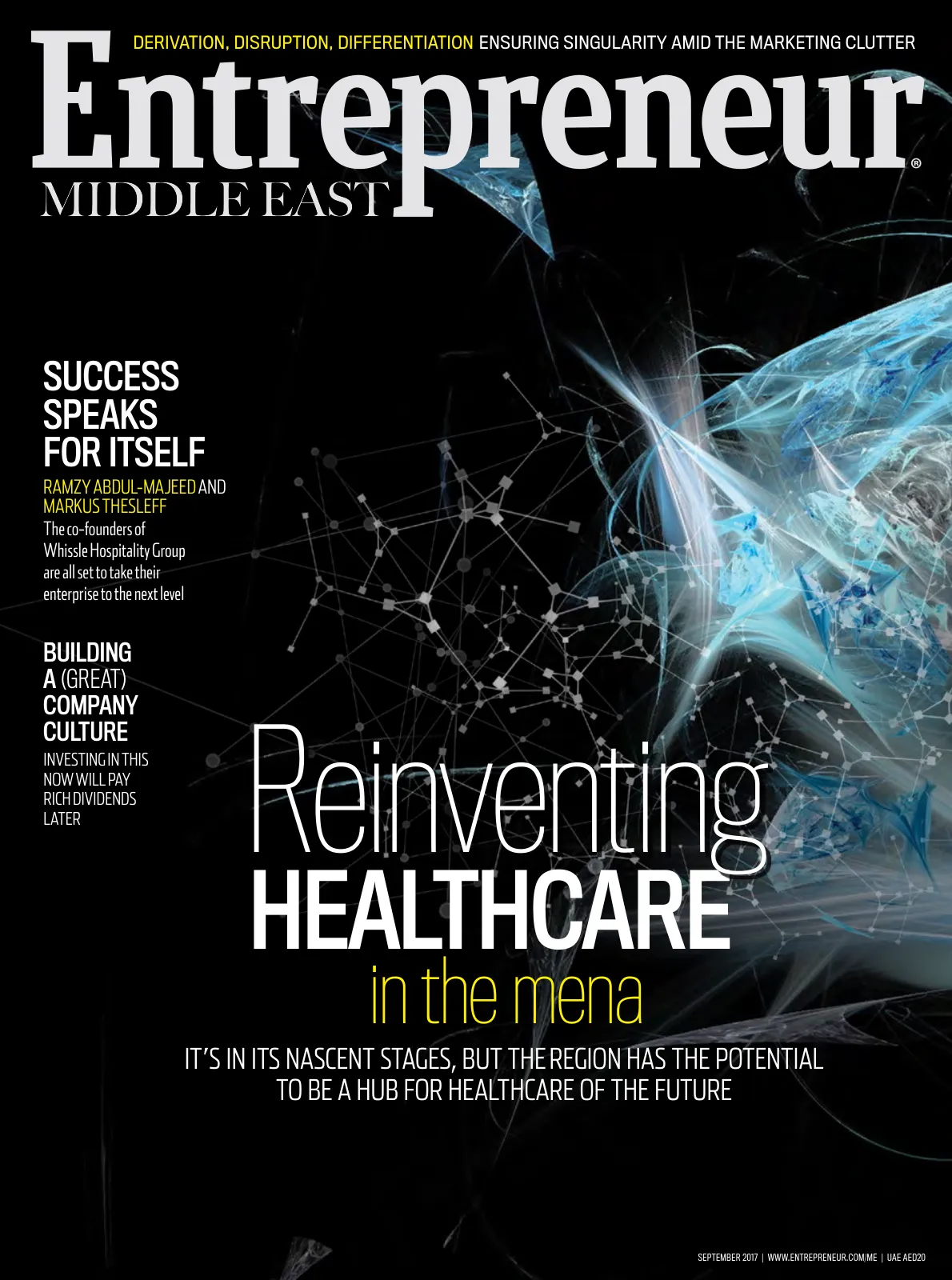
Entrepreneur Middle East, September 2017
Page 1
healthcare
Reinventing
in the mena
Derivation, disruption, differentiation Ensuring singularity amid the marketing clutter
Success
speaks
for itself
Ramzy Abdul-Majeed and
Markus Thesleff
Building
a (great)
company
culture
Investing in this
now will pay
rich dividends
later
The co-founders of
Whissle Hospitality Group
are all set to take their
enterprise to the next level
september 2017 | www.entrepreneur.com/me | UAE AED20
It’s in its nascent stages, but the region has the potential
to be a hub for healthcare of the future
Page 2
Page 3
september 2017 Entrepreneur
3
CONTENTS
SEPTEMBER 2017
25 Okku Japanese restaurant, bar & lounge
18
Lachlan Jackson,
founder, Ecocoast
24
INNOVATOR:
Success speaks for
itself
Ramzy Abdul-Majeed and
Markus Thesleff, co-founders
of Whissle Hospitality Group
are all set to take their
enterprise to the next level.
18
INNOVATOR:
RISING TO THE OCCASION
The marine industry may not
the most popular of industries
for entrepreneurs to get into-
but Ecocast founder Lachlan
Jackson managed his way into
it (and is now there to stay).
28
START IT UP:
ECOSYSTEM
Reinventing healthcare in
the MENA
Healthcare tech may be in
its nascent stages, but the
region has the potential to
be a hub for the sector in
the future.
70
START IT UP:
Q&A
Beware of the underdog
Nooruldeen Agha, founder
and CEO, Elabelz, on the
e-commerce startup’s track
record and what makes it
one to watch out for.
60
‘TREPONOMICS:
PRO
Experience matters
It’s not the shopping
platform, but the shopping
mindset that really matters,
says Ahmed Galal Ismail,
CEO, Majid Al-Futtaim
Ventures.
34
‘TREPONOMICS:
PRO
Money talks
Suhail Masri, VP of
Employer Solutions at
Bayt.com, offers a primer on
how you can determine your
employees’ salaries.
Page 4
Page 5
Page 6
Page 7
Page 8
Entrepreneur september 2017
8
CONTENTS
41 Galaxy Note8
68
Andy Meikle,
founder, 10
45 Cadillac’s “Arabs of New York” campaign with Mohamed Fairouz
SEPTEMBER 2017
68
TECH:
MOBILE TECH
From concept to launch
Want to launch an app in
the MENA region?
Andy Meikle, founder of
sports app 10, offers a
useful roadmap you can
follow.
50
CULTURE:
DESIGN
Form follows function
Design Haus Medy CEO
Medy Navani explains how
you can attract, engage and
retain the right people for
your enterprise, using your
office space.
44
‘TREPONOMICS:
MARKETING
Inspiring trailblazers
Cadillac’s new brand
campaign “Arabs of New
York” celebrates innovative
minds from the Middle East.
42
CULTURE:
TRAPPINGS
‘Trep gear
The executive selection for
the entrepreneur on your
list that has everything.
Okay, maybe for a little self-
reward as well.
46
‘TREPONOMICS:
ESQUIRE GUY
Productive meals
The Esquire Guy writes on
navigating the tricky terrain
of a business lunch.
40
TECH:
SHINY
#TamTalksTech
Gadgets and doodads
that you might’ve missed
out on, sourced by a tech
aficionado. Yes, it’s okay
to want them all… and no,
it’s not our fault.
Page 9
Page 10
Entrepreneur september 2017
10
72
CONTENTS
SEPTEMBER 2017
54 The link between entrepreneurship and happiness,
by the in5 team
Nooruldeen Agha,
founder and CEO,
Elabelz
78
START IT UP:
STARTUP FINANCE
“We got funded!”
A look at how STARZ PLAY
Arabia and Wego secured
their latest fundraising
wins- and what one can
expect to see from them in
the future.
58
CULTURE:
LIFE
The two words every
leader must use
Colin Cauffield, Executive
Director, Upper GCC at EFS
Facilities Services Group,
on the power of using
“Thank You” at work.
74
START IT UP:
Q&A
Shazam for cars
UAE-based AI-powered
Seez app is all set to change
the way you buy cars.
64
FRANCHISE
Keep it local
As the Partner & Operator
of McDonald’s chain in the
UAE, Rafic Fakih explains
the importance of localizing
your franchise approach.
14
EDITOR’S NOTE
By Aby Sam Thomas
48
CULTURE:
LIFE
Master the fundamentals
James Clear makes the
case for why you need to
do more of what already
works.
36
‘TREPONOMICS:
PRO
Put the consumer in the
driving seat
Kunal Kapoor, founder of
The Luxury Closet, believes
that for luxury brands
to thrive in the current
market landscape, they
must embrace digital.
Page 11
60 YEARS OF ADVENTURE
AND DISCOVERY
Page 12
Entrepreneur september 2017
12
SUBSCRIBE
Contact subscriptions@bncpublishing.net to receive
Entrepreneur Middle East every issue
EDITOR IN CHIEF Aby Sam Thomas editor@bncpublishing.net
CEO Wissam Younane wissam@bncpublishing.net
MANAGING DIRECTOR Walid Zok walid@bncpublishing.net
DIRECTOR Rabih Najm rabih@bncpublishing.net
CREATIVE LEAD Odette Kahwagi
MANAGING EDITOR Tamara Pupic
STARTUPS SECTION EDITOR Pamella de Leon
COLUMNIST Sindhu Hariharan
COLUMNIST Tamara Clarke
COLUMNIST Shoug Al Nafisi
COLUMNIST Erika Widen
EVENTS LIAISON Mark Anthony Monzon
PO Box 502511 Dubai, United Arab Emirates
P +971 4 4200 506 | F +971 4 4200 196
For all commercial enquiries related to
Entrepreneur Middle East contact
sales@bncpublishing.net
All rights reserved © 2016.
Opinions expressed are solely those of the contributors.
Entrepreneur Middle East and all subsidiary
publications in the MENA region are officially licensed
exclusively to BNC Publishing in the MENA region by
Entrepreneur Media Inc.
No part of this magazine may be reproduced or
transmitted in any form or by any means without written
permission of the publisher.
Printed by Raidy Emirates Printing Group LLC
www.raidy.com
Images used in Entrepreneur Middle East are credited when necessary. Attributed use of
copyrighted images with permission. All images not credited otherwise Shutterstock.
Suhail Al Masri
Colin Caulfield
Fida Chaaban
James Clear
Rafic Fakih
Ahmed Galal Ismail
Abdulwahed Juma
Kunal Kapoor
Moustafa Mahmoud
Ross McCammon
Andy Meikle
Medy Navani
Alexander Rauser
Wissam Youssef
CONTRIBUTING WRITERS
www.entrepreneur.com/me
Access fresh content daily on our website!
MIDDLE EAST
EntMagazineME
@EntMagazineME
Entrepreneur-me
EntrepreneurMiddleEast
EntMagazineME
EntMagazineME
EntMagazineME
MIDDLE EAST
In addition to our print edition, we’re bringing
you all sorts of industry news on our web
mediums. Joining us online means getting
relevant business and startup content in
real-time, so you’re hearing about the latest
developments as soon as we do. We’re looking
forward to interacting with our readers on all of
our social media and web platforms- like any
thriving business, we’re looking to give and take.
#TrepTalkME is already happening on all of our
digi platforms, and all good conversations go
both ways. See you on the web!
Page 13
Re - Imagining
Realities
The event for transformative global technology
Because digital business doesn’t wait
Future Tech is synonymous with Dubai.
Witness the revolution first hand with
straight from R&D products, prototypes and
the freshest ideas in the Future Tech Hall
From the back of an envelope to a
billion $ business. It’s not all on the show
floor in 2017, serendipity can happen at
1 of 100 events in GITEX Fringe
New Sectors for 2017!
Smart Manufacturing, Global Smart Cities,
Robotics and Vehicle Tech.
Plus, the latest in AI, VR and AR
D I S C O V E R
I N N N O V A T E
T R A N S F O R M
gitex.com
Dubai, is a city of the future, a dynamic innovation hub, a bridge between
east and west, a pioneer in technology innovation & early adoption that
makes theoretical technology a mass-consumption reality.
Dubai attracted USD 7 billion in Foreign Direct Investment in 2016, with 73% directed to tech projects
GITEX Technology Week gives your business access to these game-changing initiatives
Dubai’s digitisation
initiatives could
generate a potential
USD 4.87 billion in
value by 2019
JOHN CHAMBERS, CHAIRMAN, CISCO, 2017
“
“
CALL US TODAY FOR ACCESS TO THE MIDDLE EAST & AFRICAN MARKETS
To find out how about this year’s participation opportunities
contact us on +971 4 308 6282 / 4090 / 6566 / 6077
or sales@gitex.com
Organised by
Strategic Sponsor
VIP Majlis Lounge
Partner
Business
Transformation
Partner
Exclusive Digital
Transformation
Partner
Official Airline
Partner
Official Courier
Handler
Autonomous & Robotics Partner
Finance Vertical
Title Partner
Finance
Vertical Title
Partner
Online Registration
Sponsors
Official
Publisher
Official
Publication
Page 14
Entrepreneur september 2017
14
EDITOR’S NOTE
Aby Sam Thomas
Editor in Chief
@thisisaby
aby@bncpublishing.net
Finding common
ground
Conflicts are to be expected at startups and, as an entrepreneur,
you need to know how to tackle them
I
n an ideal world, the office
shouldn’t be a setting for any
kind of conflict, but let’s be
real, such situations are to be
expected when people work
with each other in close proximity,
day in and day out. Be it among
employees, or among co-founders
even, there are plenty of avenues
for strife to occur within an orga-
nization, and as the entrepreneur
running the business, it’d serve you
well if you are prepared to handle
and manage these kinds of eventu-
alities. Rest assured that avoiding
or ignoring such issues isn’t going
to be in your company’s best inter-
est- unresolved conflict can lead
to anything from staff turnover,
to, well, bigger problems- Harvard
Business School professor Noam
Wasserman, when researching for
his book The Founder’s Dilemma,
found that 65% of startups fail as
a result of co-founder conflict.
So, if conflicts are to be expected in
your business, how do you, as the
entrepreneur running the show,
go about tackling them? With the
disclaimer that I am not at all an
expert in this arena, and that I am
simply looking back at my own
experiences and things that I have
seen, heard and read, here’s my
take on what you need to do to
resolve a conflict:
1. Start by listening to both sides
Regardless of how you became
aware of a crisis within the work-
place, make it a point to talk to
(and understand the perspectives
of) people on either end of the
conflict. It is absolutely impera-
tive that you do not -do not- have
a go at one of the parties in the
conflict after having heard just the
other’s point of view. Startups are
emotional places, yes, but when
managing these kinds of situations,
it’s important to remember to stay
as objective as you can, look out for
the facts, and, well, just be wiser
about things- though that’s easier
said than done.
2. You now know the story-
interpret it in your company’s best
interests I equate this part of my
conflict resolution process with the
way I react to “inspiring” quotes
that I see on Instagram: all of that’s
great and all, but how does that
affect me? From a managerial point
of view, this is when you need to
consider what you have learned
about the conflict, and figure out
how it relates to your company- it’s
not really about choosing one side
over the other; your role is to get
the issue resolved in a way that is
good for your business in the long
term.
3. Make a decision (and then stick
to it) Conflict resolution shouldn’t
take on the form of a never-ending
debate- after all, you don’t want
these situations to fester, as let-
ting things go without finding a
solution will almost certainly lead
to feelings of resentment within
the workplace. A positive company
culture is something that’s vital for
your business’ success, and so, you
don’t want to have a workforce on-
board that’s low on morale. Make
an informed decision with respect
to solving the conflict- your focus
should essentially be on preventing
it from happening again.
When it comes to resolving con-
flicts, getting it done may take
some time- but doing it right will
serve you and your company well
in the long run. Don’t shy away
from such situations- it’s always
better to tackle them head on at
the first instance.
Page 15
DISCOVER HOW TO ACCELERATE YOUR BUSINESS
Powered by Thomson Reuters, Accelerate SME is the gateway to the
SME ecosystem in MENA; providing access to the resources and solutions
needed to support you at any business stage.
We have joined forces with some of the region’s most powerful financial
and workflow solution providers to service and support your specific needs.
As a member of Accelerate SME you can access a wide range of business
resources including, funding, online community, industry insights, tools
and easy-to-use templates.
ACCELERATE SME
CONTRIBUTE. ENGAGE. GROW.
FIND OUT MORE AT ACCELERATESME.COM
Page 16
Entrepreneur september 2017
16
IN THE LOOP
Chinese ride-hailing giant Didi Chuxing
invests in Careem
Driving growth
images courtesy paytabs, careem
Global ambitions
GCC startup PayTabs looks to expand internationally
with a US$20 million funding
The Careem app
PayTabs online payment
Abdulaziz F. Al Jouf, founder and
CEO, PayTabs
T
he Middle East
(and global) ride-
hailing technology
space has taken an
exciting turn as the
Dubai-headquartered Careem
announced a strategic partner-
ship with Chinese ride-hailing
giant Didi Chuxing, with the
latter making an undisclosed
investment in the company as
well. According to a statement
on the deal, this marks Didi’s
first collaboration in the MENA
region, and Careem expects the
endorsement to “strengthen its
leading market position, and
further enhance its reliable
transportation offerings across
the region.”
“Didi Chuxing brings leading
edge AI capabilities, insight
and expertise to our organi-
zation as we enter our next
phase of growth” says Mudas-
sir Sheikha, co-founder and
CEO, Careem, in the statement.
“This evolution in our long
relationship will enable Careem
to more effectively pursue
growth opportunities through
continued innovation and sus-
tainability. DiDi’s investment is
yet another endorsement of the
significant regional opportunity
to leapfrog traditional infra-
structure, and improve the lives
of people in our communities.”
“Careem is the region’s tech-
nology and market leader,”
noted Cheng Wei, founder and
CEO, Didi Chuxing. “Through
technology exchange and
co-development, we look to
support continued growth and
transformation of the region’s
transportation industry, tap
into the significant potential of
the local internet economy and
foster more innovative services
for a broader network of com-
munities around the world.”
As reported by Techcrunch,
the Careem-Didi partnership is
an extension of Didi’s current
global empire, as well as its
continuing push against its big-
gest rival in the business, Uber,
with it having recently made
an undisclosed investment
in Taxify, another Uber-like
service operating in Europe and
Africa. Not just that, Didi also
holds stake in Lyft in the US,
in India’s Ola Cabs, 99 in Latin
America, and Southeast Asia’s
Grab, besides owning equity in
Uber itself, through the acqui-
sition of Uber’s China business
in 2016.
M
ENA-based pay-
ment processing
startup PayTabs has
announced a US$20 million
investment raise in a Series A
round from undisclosed private
investors. Starting out of the
Kingdom of Saudi Arabia
(KSA) in 2014 and growing
their base there, PayTabs sub-
sequently entered Bahrain, and
its current fundraising is direct-
ed towards further expansion
in the MENA region, Southeast
Asia, India, Africa, and Europe
in the next two years. Not just
that, the fintech startup also
counts product development
as a key priority, and seeks
to “engage in key strategic
acquisitions to further expand
our portfolio of products and
services.”
As a B2B payment solution
provider, PayTabs enables
businesses to execute their
online payment capabilities,
thus empowering small and
medium enterprises, and
e-commerce ventures in the
region. The company believes
that its “unique technology
and exclusive partnerships with
fraud prevention systems”
sets them apart from other
electronic payment companies
in this part of the world.
Explaining PayTabs’ differen-
tiation amid a cluttered MENA
fintech market, Abdulaziz F.
Al Jouf, founder and CEO,
PayTabs says, “When you talk
about global scale, we offer
160+ currencies alternative
payment methods. We are in
the process of building a better
checkout flow, which will offer
a seamless experience. Secu-
rity is very critical at PayTabs,
hence we have an advanced
fraud management system in
place, with the highest level of
PCI-DSS compliance. Apart
from systems, we have a dedi-
cated dispute resolution team
along with 24-hour customer
support.”
Al Jouf refers to the fund-
raising process as “fairly long
drawn and time consuming,”
and says the challenge was
to convince investors that a
fintech startup operating out
of the GCC can not just aspire
to be a global player, but
also achieve it. “Through the
proposed expansion plan, we
aim to create over 4000 direct
and indirect jobs in the next
two years, across the world,”
he adds.
Page 17
Page 18
Entrepreneur september 2017
18
innovator
Page 19
september 2017 Entrepreneur
19
the occasion
Rising to
founder and Managing Director, Ecocoast
Lachlan Jackson
By Tamara Pupic
L
achlan Jackson, founder
and Managing Director
of Ecocoast, a Dubai-
based specialist marine
contracting and coastal
protection services
company, wasn’t at the
company’s headquarters
at Dubai Investment Park when I arrived
there, as I was (obviously) a bit too early
for our interview. In those extra min-
utes, I looked around the bright meet-
ing room I had been seated in: besides a
table and about six or eight chairs, the
room contained a shelf with books (which
were mostly entrepreneurship-themed),
and the wall behind it was plastered
with posters. Next to that, there was a
whiteboard stocked with dry erase mark-
ers, and yellow and pink colored sticky
notes scattered all over it, indicating
that spontaneous brainstorming sessions
often happen here to encourage frequent,
efficient, and concise knowledge-sharing.
Perhaps the most eye-catching element of
all in the room was a wall decked in black
chalkboard paint, allowing the team to
write down ideas and plans in different
vivacious colors. If you want to under-
stand how the Ecocoast team functions,
just consider that one wall- it is a simple,
practical, and not-very-expensive DIY
solution, but even scribbling on it with a
dusty chalk is a way of making the team
members more deeply attached to and
aligned with the commitments they have
taken on. As another testament to this,
later on in our conversation, Jackson
would tell me that there are two executive
coaches who work with the team, himself
included, on a regular basis to hold them
accountable for their goals. “Everything
we do, every product or service that we
start doing, we approach them like we are
pioneers,” says Jackson, remaining valid
and succinct throughout the interview.
“We are either the first to bring it to the
region, or we take an existing idea and
make it better. We have a very narrow
focus with what we do, but we dive deep
back into the value chain, and we control
the supply of our materials, the manu-
facturing, the project execution, and the
engineering behind it.”
The marine industry may not the most popular of industries for entrepreneurs to get into-
but Ecocast founder Lachlan Jackson managed his way into it (and is now there to stay)
Page 20
Entrepreneur september 2017
20
innovator
“I think there is
enough support,
VC funding, and
backing for
tech companies,
whereas the
support to
traditional
industries is
still lacking.”
Geobags coastal protection
by Ecocoast
Lachlan Jackson,
founder and
Managing Director,
Ecocoast at the
Marine & Coastal
Engineering
Conference in 2016
Launched in 2009, Ecocoast
Contracting provides specialist
marine contracting and coastal
protection services -covering
the full lifecycle of a marine or
coastal project from develop-
ment and protection, marine
infrastructure, to operation
and maintenance- to develop-
ers, contractors, operators and
governments, primarily in the
UAE. These services encom-
pass two main areas -coastal
protection and marine infra-
structure- mainly focusing on
the installation of marinas,
marine piling, beach cleaning
and maintenance. Since 2014,
Ecocoast has cleaned over
2,800,000 square meters of
area and removed over 2,240
cubic meters of debris from
beaches and golf courses,
equating to over 5,180 tons
or 50 trailer loads. Today,
Ecocoast Contracting is a
parent company to Ecobar-
rier Manufacturing, a marine
manufacturing firm Jackson
set up in 2012, that designs,
manufactures and distributes a
range of marine protection and
demarcation barriers under
the brand Ecobarrier. Not too
long into our conversation, it
is clear why Jackson’s plans
for the company require a large
vertical surface to be devised
onto. Over the last five years,
the company has installed over
165,000 meters of marine pro-
tection barriers to protect GCC
coastlines and waterways in
construction projects that are
valued at over US$100 billion.
Since inception, it has also
constructed berthing instal-
lations for over 40 marinas
and marine service stations
throughout the UAE.
In one corner of the meet-
ing room, there is a nearly
flipchart-sized poster on the
wall showcasing Ecocoast’s
vision summary, including its
core values (integrity, pride,
curiosity, solutions, and trans-
parency), core purpose (to
innovate), and brand promises
(100% delivery guarantee).
In itself, the poster serves as
a great visual to answer why
Jackson started the company-
exactly a decade ago, the then
24-year-old Australian moved
to Dubai to launch a branch
office of his father’s coastal
engineering consultancy, but
quickly realized that only few
products which his father
used to offer in their home
market were manufactured or
available here. “At that time
[2008/2009], the market
definitely was not advanced
in this sector, in terms of a
lot of the solutions; it was
maybe 10 to 15 years behind
Australia or even Europe,” he
says. “There were a lot of big
companies, but due to licens-
ing restrictions and capital
requirements, there weren’t
any small companies, so a lot
of the structures that were
being built were simply a copy
and paste version of large-
scale structures. There wasn’t
anyone to come in, move
quickly and take the risk on
smaller structures.” Jackson
spotted a gap of a fairly decent
size between mega projects
worth more than $10 million
and smaller size projects of
up to that sum, which were
of no interest to large compa-
nies. “That gave us the first
step up,” he remembers. “We
were fortunate in a way that
we started exactly when the
downturn hit in 2009, the
market fell out completely,
and that took out a lot of big
projects, but there were still a
lot of requests from develop-
ers, hotels, and so on, for small
size projects. In a way, we were
lucky that in the first three
years, we survived largely on
the work from private devel-
opers and the hotels which
hadn’t fallen out.”
Before long, he was able to
again marshal the necessary
focus to spot another market
inefficiency- no one was locally
manufacturing environmental
protection barriers, such as silt
screens. Starting the manu-
facturing unit in 2012, despite
Page 21
images courtesy ecocoast
“We have a very
narrow focus with
what we do, but we
dive deep back into
the value chain,
and we control
the supply of our
materials, the
manufacturing, the
project execution,
and the engineering
behind it.”
Ecocoast was contracted
to design and install
access platforms and
tubular piles for pontoons
in 4 locations in Dubai
Marina, in order to expand
the berthing capacity
being challenged by a limited
access to key components and
raw materials in the region,
explains Jackson’s approach
to not only innovation but the
company’s competitors. “We
are not the cheapest option, we
don’t compete on price, and we
don’t work on a product or a
service unless we can be num-
ber one whether immediately,
the minute we start, or in the
next one to two years,” he says.
“If we cannot be number one,
it is of no interest to us. We
never compete when it just
comes down to price, because
I believe that the race to the
bottom destroys value. The
minute products or services
commoditize and it all be-
comes about price, innovation
is dead. The race to the bottom
kills it for the client, for the
manufacturer, and for the
industry. There are better ways
to compete. Take silt screens
for example. There wasn’t a
high uptake of silt screens in
the region, they were made of
poor quality materials, they
weren’t engineered properly,
they weren’t made well. So,
the companies used to buy and
the municipality said they had
to use them, but the contrac-
tors didn’t want to use them
as they knew they would fail.
So, we started working with
the concerned companies to
build something that is basi-
cally fit for purpose and that
increased the acceptance of
products, They then supported
the product, and that helped
them start working with the
municipality.”
Ecocoast operates in 14 coun-
tries around the world: UAE,
Bahrain, Qatar, KSA, Oman,
Kuwait, Jordan, Gabon, Tanza-
nia, Mozambique, Mauritius,
Hong Kong, Maldives, Mexico.
“For services, we are primar-
ily focused on the UAE, but we
do supervision works outside
the east coast of Africa and
throughout the Gulf,” Jackson
says. “Products-wise, we ship
all through the GCC, Africa, as
well as to Hong Kong, Mexico,
and so on. Primarily, we
focus on emerging markets.
We don’t have an interest of
moving into Europe or too far
into Asia or America, be-
cause there is already market
saturation to some degree,
whereas this region is still
underserved. The other reason
is the shipping and transport
of products, so we use the
UAE as our manufacturing and
shipping base, and anywhere
within a two-week shipping
radius is our core focus. The
challenges of expanding into
other markets relate to the
acceptance of the products.
We are fortunate that a lot of
our clients are multination-
als, and they pull us into new
markets. So, we analyze where
our clients are going, which
is usually a good indication
of where the projects are. We
come in quite early in the pro-
ject, and when it is awarded,
we generally come in quickly
afterwards. But we still do
need to do the hard work with
consultants, municipalities
and governments to help them
understand the quality of the
product and what problem we
are solving. Once we have done
one or two projects, we decide
whether that market has
more opportunities to explore
further.”
Ecocoast has grown at a
CAGR of 56%, counting eight
of the top 10 dredging compa-
nies among its more than 90
clients across the Middle East,
Africa and Asia. No single cli-
ent makes up more than 20%
of the company’s revenue,
and 60% of revenue this year
has come from repeat clients,
Jackson states. “The market
at the moment is not great,
but there are still so many op-
portunities here compared to
other places in the world, and
you really can build something
here,” he adds. “It is not easy,
but that is half the thrill and
half the challenge of it. Now,
you mustn’t slow down. When
people start comparing price
on price, you need to find
other ways to compete, and no
matter what they say, having a
profitable business is a mission
behind every business. If you
are not profitable, you can’t
reinvest, you can’t grow and
innovate, and that is where the
market stagnates. I think that
it is very easy to start cutting
prices to compete, but it is not
the right thing to do. The best
thing to do is to double down
and reinvest everything you
have and do things differ-
ently. For example, if this area
starts to commoditize and the
competition starts to build
up, maybe we can focus on
another area or do things in a
different way. The competition
does catch up quickly. In many
products and services that >>>
Page 22
Entrepreneur september 2017
22
we do, there are copycats right
behind us. At a certain point,
you have to work out that you
are not doing anything any
different than the rest of the
competition, so that’s when
we take a step back and look
at what we are doing now- Is
it pioneering? Is it chang-
ing things? Is it improving
the industry? If the answer
is no, we take another shot
at it.” However, regardless of
running a thriving company
today, Jackson still remembers
the struggle of its first days.
Therefore, he’ll be keeping an
eye on the local startup scene,
particularly on those non-
tech entrepreneurs bound for
greater things than their pos-
sibly challenging beginnings
in business dictate. “I would
look to invest in startups but
outside the [marine] industry,
yet still in more traditional
industries,” he says. “I think
there is enough support, VC
funding, and backing for tech
companies, whereas the sup-
port to traditional industries is
still lacking.”
From a personal perspec-
tive though, to ensure that
his future plans are not fits of
irrational grandiosity, Jackson
makes it a point to regularly
advises with his peers- he is
an Endeavor Entrepreneur,
a global accolade awarded to
high-impact entrepreneurs
with the greatest potential for
economic and social impact
in their respective regions, as
well as an active member of
Entrepreneurs’ Organization.
From his more experienced
peers, he is mainly seeking
advice on talent acquisition
and retention as it is a press-
ing issue he is currently trying
to solve. “It’s about managing
70 staff,” he says. “You do need
someone to be in a full-time
role just for that. A larger com-
pany can afford that. It is also
about talent acquisition and
talent retention, like for eve-
ryone else, because it is a big
issue in the region. Six months
ago, we assembled a team of
six, myself included. That was
extremely challenging. Finding
people in the region with the
experience in the industry is
extremely difficult, particularly
at what we do. People come
from other larger companies or
other industries, so we don’t
hire based on experience, but
on value and personality. Then
our training comes in in terms
of how quickly we can skill
them up. But, finding them
through the network of con-
tacts wasn’t a great success. It
was mainly through LinkedIn
and external head hunters. We
relied on that a lot and then we
had an extremely long vetting
process. We would take three
to six months to fill a role.”
When it comes to entre-
preneurship, Jackson is now
on his second (successful)
attempt. Prior to starting Eco-
coast, as a fresh international
finance graduate, he co-found-
ed an Australian fashion label
in 2003 with a manufacturing
facility in Vietnam. However,
he notes that starting up in the
capital- and resource-intensive
marine industry was a par-
ticular challenge. He opted to
bootstrap the business, and is
still its sole shareholder. “That
makes you appreciate the
value of every single dollar and
every single business decision
that you make,” he explains.
“You have grown. If I could
imagine myself here seven
years ago, I think I would have
been amazed with what I have
achieved. I would love to say
that when I started, I wanted
to take over the world. But I
really wasn’t. I was very much
focused on a problem, I knew
I could solve that problem,
and that was what drove me
very much at the start. I was
very involved in the product
development and the service
development, and that was
what motivated me. Only after
three to four years did I start
to look outside and focus on
the bigger picture and that sort
of opened my horizons. Now, I
don’t want to build something
for a fast exit, that is not the
point. I am proud of what I
do and what we have built.
Building something just to
profit and just to sell is not my
approach.”
innovator
‘TREP TALK
Ecocoast founder and
CEO Lachlan Jackson’s
tips for entrepreneurs
1. If it was easy,
everyone would
do it
“This is one of the key man-
tras we live by at Ecocoast.
You need grit and determi-
nation as an entrepreneur,
even more so when you are
doing something new in a
traditional industry. Nobody
ever says it is easy, and if
you’re constantly pushing
yourself it doesn’t get easier,
but the payoff is more than
worth it.”
2. Know your why
“Before starting any busi-
ness, in addition to having
a crystal-clear purpose and
vision for the business, it is
important to know your per-
sonal reason for being and
what you hope to achieve
out of it. Are you building a
legacy business that you will
scale, or are you building it
for an exit? I cannot stress
how important this is for an
entrepreneur, as it will influ-
ence how you structure your
business and guide every
decision you make. Know
your why, and always keep it
top of mind in any strategic
business decision.”
3. Establish a
support network
“Surround yourself with a
solid community you can
turn to for support, whether
that be mentors or peers.
There are some incred-
ible organizations such as
Entrepreneur’s Organization
and Endeavor, whose core
purpose it is to support
entrepreneurs like us. But it
is not a one-way street, and
you should be prepared to
give back. One of the best
things about being part of
these networks is being able
to reciprocate the support to
your fellow entrepreneurs.”
Beach
nourishment
& profiling
by Ecocoast
“The challenges
of expanding into
other markets
relate to the
acceptance of the
products. We are
fortunate that a lot
of our clients are
multinationals, and
they pull us into
new markets.”
Page 23
september 2017 Entrepreneur
23
Page 24
Entrepreneur september 2017
24
Ramzy Abdul-Majeed and Markus Thesleff
Success
speaks
for itself
R
amzy Abdul-Majeed and Markus Thesleff set up Whissle Hospitality Group in Dubai
in 2009 (with the vision for it starting in 2005); however, unless you are particularly
familiar with the region’s hospitality and F&B scene, there is a good chance that you
probably haven’t heard of the company before. But while other entrepreneurs with
enterprises as old as Whissle may find this scenario a cause for concern, Abdul-
Majeed and Thesleff don’t seem to be really perturbed by it at all- their reasoning is
that though you may have not heard of Whissle, you certainly couldn’t have missed
the many award-winning brands under this boutique hospitality group’s portfolio.
The co-founders of Whissle Hospitality Group
–the company behind F&B brands like Okku, Claw and more in Dubai-
are all set to take their enterprise to the next level
By Aby Sam Thomas
Entrepreneur september 2017
24
Page 25
september 2017 Entrepreneur
25
For one, there’s Okku, the
homegrown Japanese res-
taurant, bar and lounge that
started Whissle’s story, which
is today a Dubai institution
with a slew of awards to its
credit. Other concepts that fall
under Whissle’s purview in-
clude Claw, an American-style
barbecue and seafood eatery,
Sophie’s Café, a gastro-café
with a menu of wholesome
home-style meals, Cielo Sky
Lounge, a roof terrace destina-
tion, Casa de Tapas, a Spanish
restaurant, Riva Beach Club, a
Mediterranean cuisine-themed
retreat, and- well, I could go
on, but it should be clear by
now that Whissle is behind
some of the most popular F&B
venues in Dubai. And given the
success these concepts have
seen, it’s fair to say that Abdul-
Majeed and Thesleff’s strat-
egy to let the world know of
Whissle’s brands on their own
merit –with the company as
such (and themselves too) tak-
ing a backseat in the process-
has indeed been a winning one.
“Our focus has been on our
brands,” Thesleff declares.
“Let our brands speak for us-
because they don’t need
to know us, but [they
should know] our brands
and our people.”
In a landscape where
there is (arguably) a ten-
dency for entrepreneurs
to want the limelight to
be shone on themselves
as opposed to their busi-
nesses, such statements
by Thesleff and Abdul-
Majeed are a welcome
departure from what is
often the norm in this
space. In terms of per-
sonalities, Abdul-Majeed
is the one who seems
calm and collected,
while Thesleff looks to
be the more emphatic,
enthusiastic one of the
two, and together, they
make for a rather well-matched
entrepreneurial duo, who were
friends for a long while before
they became business partners
as well. While Abdul-Majeed
comes from a finance back-
ground, Thesleff has had both
family business and entrepre-
neurial experience, and the two
had been talking about setting
up a business together for a
long while before they eventu-
ally did so with the launch of
Okku in 2009. At the time,
Dubai’s F&B scene was quite
unlike what it is today- the
tendency then was to bring in
concepts from outside of the
UAE and transplant it here,
and the market was then more
receptive to ideas brought for-
ward by large, well-established
players, as opposed to, well,
people they hadn’t really heard
a lot about. But Thesleff and
Abdul-Majeed weren’t keen on
being a part of the herd, so to
speak- sure, they could have
also imported existing con-
cepts, but they had a different
vision in mind. “We said, let’s
create a hospitality group, and
let’s do it based out of Dubai,”
Abdul-Majeed remembers. >>>
images courtesy whissle hospitality group
Abdul-Majeed and
Thesleff’s strategy to let
the world know of Whissle’s
brands on their own merit
–with the company as
such (and themselves too)
taking a backseat in the
process- has indeed been
a winning one.
innovator
OKKU interior
Ramzy Abdul-Majeed, co-founder,
Whissle Hospitality Group
Markus Thesleff,
co-founder,
Whissle Hospitality
Group
“We said,
let’s create a
hospitality group,
and let’s do it
based out of Dubai.
Let’s create our
own brands, and
then take them
overseas- we
wanted to actually
have something
born and bred in
Dubai.”
Page 26
Entrepreneur september 2017
26
“Let’s create our own brands,
and then take them overseas-
we wanted to actually have
something born and bred in
Dubai.”
And this was the principle
that drove the creation of Okku
(and Whissle, by default)- it
was a singular ambition, and
the co-founders readily admit
that it was hard to get people
to buy into them and their
ideas. After all, a Japanese con-
cept like Okku was completely
new at the time in the market,
but Thesleff and Abdul-Majeed
were also using this fact to
their benefit, as they were all
set to be the first mover in
this space in Dubai. However,
this didn’t pan out as they
hoped, and they had a whole
other hurdle to face. Delays in
construction caused them to
postpone Okku’s launch date,
and Zuma, a successful Japa-
nese restaurant concept from
London, unveiled its Dubai lo-
cation in September 2008, five
months before Okku was able
to open its doors. “We were
supposed to launch way before
Zuma,” Abdul-Majeed says.
“And then [when we opened],
everyone was saying, oh, you
just copied them. But you can’t
do that in five months… So
that was in itself a challenge,
because suddenly, we were
looked at, when we opened, as
a copycat.” At around the same
time, another global Japanese
concept, Nobu, also opened
here in Dubai, and this was a
less than ideal scenario, to say
the least, and one can imag-
ine how frazzled the Whissle
co-founders were. “Our whole
concept was [about] being the
first mover,” Thesleff recalls.
“Our whole strategy was about
being these two guys, [with
a] homegrown idea, and be-
ing a first mover… And all of
a sudden, [we were] getting
leapfrogged by not just names,
but, like, superpower names.”
But there was a silver lining:
Thesleff notes that the opening
of Zuma and Nobu gave Okku
a benchmark to challenge, and
they wholeheartedly embraced
that opportunity. Fast forward
a couple of years, and not only
is the Okku brand now firmly
on the same pedestal as both
Zuma and Nobu, it has also
garnered a slew of industry
awards testifying to its excel-
lence, which has in turn made
Whissle a force to reckon with
in the region’s F&B landscape.
The manner in which the
Whissle co-founders chose to
tackle competition –and that
too, at such an early stage of
their business- should serve as
an important lesson for other
entrepreneurs. “Strategy-wise,
the objective [we used] was to
do what we wanted to do, cre-
ate what we wanted to create,
be who we are,” Abdul-Majeed
says. “Don’t really care about
the competition so much,
because if you spend all your
time worrying about them,
you don’t do what’s right for
you- that takes care of itself
if you do a good enough job.”
“You got to focus on yourself,
because where focus goes, en-
ergy flows,” Thesleff adds. “You
got to take care of yourself.” By
following this principle, Abdul-
Majeed and Thesleff man-
aged to successfully elevate
the Okku brand, but doing so
didn’t mean they were done
with their dreams though- they
had a bigger vision for Whissle.
“Most people would have
taken Okku, and focused on
Okku, and only done Okku, and
expanded it,” Abdul-Majeed
says. “We just had this vision
of- we wanted to change the
hospitality industry in the re-
gion. It can’t be this big hotel,
big franchise thing, and that’s
it- there’s got to be creativity
here. We wanted to be pioneers
in that.” As per Abdul-Majeed
and Thesleff, if Dubai were to
realize the aspirational goals
that the UAE’s leaders had set
for the Emirate, then with re-
spect to the hospitality indus-
try, the city needed to have an
indigenous pool of talent to tap
into- there had to be creative
concepts that were born here,
ideas that originated from here
that could be exported to other
parts of the world.
To say this dream is an ambi-
tious one would probably be
an understatement- but this
is what drove (and indeed,
continues to drive) Abdul-
Majeed and Thesleff forward
in building up the Whissle en-
terprise. Of course, their past
experience does back them up
well: the duo have previously
seen success with Pangaea, the
award-winning lounge and club
concept in London, New York,
and Marbella, and they’ve also
had Aviva, a private members
club in London at the Baglioni
Hotel- this concept is set to
open soon in Dubai as a roof
terrace as well. Today, besides
Okku, Whissle’s original
concepts like Claw, Riva Beach
Club, and others can be seen
as Dubai institutions in their
own right, with each of them
having their own particular
USPs that make them stand out
from their peers in the market.
However, this represents the
realization of just one part of
the Whissle vision. “We were
doing two things,” Abdul-
Majeed explains. “We were
creating a bunch of brands
here that we make successful
in this market… Then, from
that, the vision was, 8-9 years
down the road, having created,
roughly, a brand a year, then
we start the expansion and
franchising process aggres-
sively.” And that is indeed
innovator
OKKU interior
Page 27
september 2017 Entrepreneur
27
the plan that the Whissle
co-founders are now working
on- the company is getting set
to take its best brands outside
of Dubai and the UAE, and
make their presence felt not
just in the neighboring GCC
market, but internationally as
well. Okku, for instance, is set
to open a new flagship, Okku
at the Fairmont Hotel on The
Palm later this year, with the
new addition of Okku Beach,
providing a refined luxury chic
pool and beach experience to
discerning guests. Okku Riyadh
is under construction as well,
with it slated to open its doors
in early 2018. At the same
time, a new Sophie’s is set to
open by the end of this year
at Barsha Heights in Dubai,
while three new Claw locations
are slated for the GCC region
in the next two years. Besides
scouting for locations around
the world that would be a good
fit for their existing concepts,
Abdul-Majeed and Thesleff
reveal that they are also build-
ing new brands to add to these
new markets as well as their
own repertoire- one of these,
they tell me, will be Nama, a
Japanese bistro concept that’s
set to be an offshoot of Okku,
which already has two loca-
tions in the pipeline- in fact,
the Dubai Marina outlet is set
to open mid-2018. As for long-
term goals, Whissle hopes to
be in the business of operat-
ing hotels someday- with the
team having managed to excel
as F&B operators, they believe
that they are well-suited for
delivering superior experiences
as hoteliers as well. How-
ever, both Abdul-Majeed and
Thesleff tell me that they are a
long way away from realizing
this particular dream- but
it’s an aspiration they have in
mind for Whissle all the same.
It’s interesting to note here
how these two entrepreneurs,
while dreaming big in whatever
they set out to do, are willing
to take their time in realizing
their ambitions. Consider what
they have done with Whissle so
far, for instance- Abdul-Majeed
and Thesleff were keen on hav-
ing the company set up a strong
base, a strong foundation with
their brands here in Dubai
first, from which their further
growth could be engineered
in a successful manner. Be it
with the setting (and mainte-
nance) of strong standards at
all of their different outlets, or
with the laying out of proper
governance structures and legal
frameworks that ensure the
business’ continuity and excel-
lence, the Whissle co-founders
have been (and continue to
be) patient about building up
their enterprise. But if there’s
one factor that these entrepre-
neurs make a point to consist-
ently focus on throughout their
business lifecycle, then that
would be on the people they
have at Whissle. As Thesleff
and Abdul-Majeed point out,
one of the paradigms that
Whissle works with is
that “we don’t hire staff,
we recruit family,” and
it is this principle that
essentially governs their
management styles in the
organization. While they
may be the ones with
the grand visions and
ideas in their heads, Abdul-
Majeed and Thesleff are quite
emphatic about the fact that
the people they have on board
the company are the ones that
will actually help them realize
it, and so, they don’t wish to
cut corners when it comes to
treating their staff well. “You
won’t hear people working for
us,” Thesleff says. “They work
with us; we work with them.
And that’s what we are about.”
Given that they operate in a
sector that’s all about treating
customers to great experiences,
it’s safe to say that Abdul-Ma-
jeed and Thesleff know a thing
or two about treating people
well, and this approach extends
to their workforce as well. And
if Whissle’s current status
and planned trajectory is any
indication, then yes, their
modus operandi does seem to
be paying off- and their future
looks promising as well.
“Don’t really
care about
the competition
so much,
because if you
spend all your
time worrying
about them, you
don’t do what’s
right for you-
that takes care
of itself if
you do a good
enough job.”
Thesleff and Abdul-Majeed
point out that one of the
paradigms that Whissle
works with is that “we
don’t hire staff, we recruit
family,” and it is this
principle that essentially
governs their management
styles in the organization.
The Seez team
Today, besides Okku,
Whissle’s original
concepts like Claw,
Riva Beach Club, and
others can be seen
as Dubai institutions
in their own right,
with each of them
having their own
particular USPs that
make them stand out
from their peers in
the market.
images courtesy whissle hospitality group
OKKU interior
OKKU
Page 28
healthcare
Reinventing
in the mena
It’s in its nascent stages, but the region has the potential
to be a hub for healthcare of the future
start it up
ecosystem | who’s got VC | Q&A | STARTUP FINANCE
Entrepreneur september 2017
28
A
ccess, quality, and cost– the three words the
MENA region’s healthcare policy makers often
find too difficult to contemplate. Regional govern-
ments have been aiming to solve a not even seemingly
simple equation for ensuring affordability and access to
higher quality healthcare to all. There have been many
attempts to work out the value of, let’s say, X, when Y
represents the currently lagging healthcare system char-
acterized by different levels of state financial assistance
and personal income, varying stages of rural and urban
developments, and the shortage of quality healthcare
practitioners- just a few of the issues that are pertinent
to the region. Increased healthcare spending has been
laid on the table quite often- from US$30.4 billion in
2003, government spending in healthcare across the re-
gion is expected to reach $144 billion by 2020, according
to Al Masah Capital. Yet, the problem still appears in-
surmountable. Instead of this less efficient expenditure,
solving this equation might today be about rearranging
the terms inside of it, or, to put it simply, allowing and
encouraging new faster, better, cheaper models of deliv-
ering healthcare- a whole new X, if you will.
Page 29
september 2017 Entrepreneur
29
Jalil Allabadi, founder of Altibbi,
a Jordan-based digital health provider
“We operate in a very critical industry touching human
lives directly, yet in the US and the UK, there have
been examples of laws that encourage new models of
delivering healthcare to more people and this is what
we would need our governments to focus on.”
www.altibbi.com
Altibbi provides 1.5 million pages of comprehensive medical content in Arabic, in addition
to a database of 12,000 registered doctors available for online consultations 24/7
Due to the so-called “con-
nected care” revolution
spreading around the world
over the last few years,
technological advances have
been shifting our focus from
traditional asset-heavy hos-
pital-related developments to
pioneering medtech devices;
to new sector niches, such as
digital health, including its
subcategories mobile health,
wearable devices, telehealth
and telemedicine, and per-
sonalized medicine; or more
recently, to increased chatter
about augmented reality
and robotics applications in
medicine. But for all of that
to actually materialize, legal
and regulatory constraints
are the first to be cited as one
of the key hurdles in fully im-
plementing these innovations
across the MENA region.
A case in point: telehealth.
Often used interchangeably
with the narrower term
“telemedicine,” telehealth
is, according to the World
Health Organization, a
description of the remote
diagnosis and treatment of
patients by means of ICT
technology. Now, while the
region does boast of great
infrastructure in this area,
telehealth, however, has not
yet found a broader enabling
environment. Although Saudi
Arabia and the UAE did
make it a central part of their
healthcare policies, in the
UAE, for example, Health Au-
thority - Abu Dhabi (HAAD),
Dubai Health Authority
(DHA) and Dubai Healthcare
City Authority (DHCCA) have
made incomplete attempts to
regulate telehealth practice
in their jurisdictions- infor-
mation security and medical
liability are reportedly among
the few issues that still need
to be defined with more clar-
ity and consistency.
“Unfortunately, there is
no regulatory framework
for telehealth,” says Jalil Al-
labadi, founder of Altibbi, a
Jordan-based digital health
provider. “The only part of
the Arab world that has a
law regulating telehealth
is in Abu Dhabi, and it is
completely inadequate in its
restrictiveness, not making
it easy for any company to
access the market. In other
places, such as Dubai, the
regulations are in the mak-
ing and we only hope they
don’t follow Abu Dhabi’s
example, but be more flex-
ible, for restrictiveness kills
innovation and hinders new
ideas.” The idea for Altibbi,
which was launched in Am-
man in 2011, evolved from
Allabadi’s intention to make
an extensive Arabic-language
medical dictionary written
by his father, general surgeon
Dr. Abdul Aziz Allabadi,
available online for all Arabic
speakers around the world.
The company today provides
1.5 million pages of com-
prehensive medical content
in Arabic, in addition to a
database of 12,000 registered
doctors available for online
consultations 24/7. Altibbi’s
28-strong team covers 10
Arab countries from their
offices in Amman, Dubai and
Gaza, with a plan to open an
office in Cairo and Riyadh in
the near future. “In the rest
of the Arab world, we operate
in a grey area yet, but we are
confident that with our poli-
cies and procedures, which
follow the example of Ameri-
can laws, we are well placed
to adhere to any forward-
looking regulations,” Allabadi
adds. “We operate in a very
critical industry touching hu-
man lives directly, yet in the
US and the UK, there have
been examples of laws that
encourage new models of
delivering healthcare to more
people and this is what we
would need our governments
to focus on.”
Despite operating in an
ambiguous and restric-
tive regulatory framework
across the region, Altibbi
now boasts 350,000 unique
visitors per day, of which
50,000 are subscribers
to their premium service
“Call A Doctor,” which al-
lows patients to make an
unlimited number of calls to
doctors per month, with the
doctors’ average response
rate being 40 seconds. This
growth has been fueled by
the capital injections from
the founder’s family and
friends and three external
funding rounds, as well as
advertising revenue. As with
many other entrepreneurs
trying to solve problems in
their own local communities,
raising funds has been one of
Allabadi’s biggest challenges.
“First of all, health tech is
new everywhere, so there are
not many past experiences to
learn from which increases
the risk for health tech start-
ups,” he says. “Secondly, not
many investors understand
this field unlike e-commerce,
for example, where VCs
understand the drivers for
success. Thirdly, it is again
the regulatory environment,
which is not yet clear, and
increases the risk for anyone
who wants to invest in this
industry. On the other hand,
one should not ignore the
opportunities for health tech
in our region, which is in dire
need for better quality and
better delivery of healthcare.”
But one country in the region
is trying to turn this situa-
tion around- and that is the
UAE, with the 46-year-old
nation attempting to leapfrog
much more mature health-
care systems. The country’s
singular focus on marching
forward has included the
2014 launch of the UAE
National Agenda outlin-
ing, among other targets, a
specific blueprint to provide
world-class healthcare by
2021 to coincide with the
UAE’s 50th National Day;
last year’s fast-paced imple-
mentation of the Dubai 10X
initiative, urging the Govern-
ment of Dubai to embrace >>>
Page 30
Entrepreneur september 2017
30
start it up
ecosystem | who’s got VC | Q&A | STARTUP FINANCE
“We are crossing a new
boundary and saying that
this is actually a physical
general practitioner’s
practice in a box because
everything inside this clinic
is the same as you would
regularly have. Everything
is so similar, but it’s digital.”
Sam Amory, founder of Alpha Systems,
a Dubai-based startup specializing in
telehealth solutions.
disruptive innovation for the
city to become 10 years ahead
of all other cities; as well as
this year’s announcement
of the UAE Centennial 2071
plan, aimed at sustaining the
country’s development into
its 100th anniversary. Along-
side all of that, the country’s
drive towards innovation has
gained immense momentum
with last year’s establish-
ment of the Dubai Future
Accelerators (DFA) program,
a government-supported
accelerator that pairs public
and private entities with
entrepreneurs in order to
jointly build, test, and deploy
futuristic innovations. Its
first cycle saw the participa-
tion of 30 companies trying
to solve global challenges set
by seven government enti-
ties, which resulted in the
signing of 19 memorandums
of understanding (MoUs).
The second cohort resulted
in 28 MoUs being signed be-
tween some of the 12 public
and private entities and 35
companies participating.
The DHA has taken part in
the DFA program from the
outset.
Since enrolling in the ac-
celerator’s first cohort, Sam
Amory, founder of Alpha Sys-
tems Group, a Dubai-based
startup specializing in tele-
health solutions, has worked
with the DHA to develop an
autonomous digital mobile
booth which replicates a
medical doctor’s clinic, al-
lowing physicians to perform
live consultations. Despite
working on a government-
backed idea, Amory also cites
inadequate regulations as the
main impediment. “First and
foremost, it’s the law, that’s
the main issue,” he says.
“In general, there is no law
around telemedicine yet, it is
still being developed. Today,
traditional medicine states
that you must see a doctor
first and have a face-to-face
consultation where a physi-
cian must be able to touch
you. The law today still states
that your first consultation,
not every consultation but
the first one, must be with a
doctor. Our booth has been
designed in a way that there
is the same length between
you and the video screen
as you have from a doctor
sitting in front of you. We
have made so much accuracy
around it that it feels like you
are sitting right next to the
doctor. That law is what we
are trying to change today.”
Amory’s aim of creating a
concept of a digitally con-
nected health city in the
UAE by establishing a broad
network of those consult sta-
tions to satisfy the healthcare
needs of the country’s popu-
lation is not far-fetched.
At the time of the interview,
Alpha Systems Group’s smart
mobile booths were stationed
in a number of government
entities. “They just need to
add the next phase [in the
law],” he adds. “The way to
do that is to have a project,
and we are that project. We
are crossing a new boundary
and saying that this is actu-
ally a physical general prac-
titioner’s practice in a box
because everything inside
this clinic is the same as you
would regularly have. Every-
thing is so similar, but it’s
digital. So, we will help fa-
cilitate the alterations of the
law. We are going to be that
proof of concept for them to
say, ‘This is why this works,
and why we should do it.’”
The consulting stations can
be installed at multiple dif-
ferent locations, allowing all
stakeholders involved to ben-
efit from the shift to digital.
“The public sector absolutely
loves it, because they have
85% of people going into
Accident and Emergency, and
leaving the same day, which
means that it is unnecessary
for them to go to there in
the first place,” Amory says.
“That’s a massive waste, and
it’s taking away from the doc-
tors who should be allowed
to spend more time doing the
things that they should focus
on. The private sector loves it
because if they have one hos-
pital and ten of those consult
stations, all of a sudden, they
actually have 10 hospitals.
So, they are reaching their
breadth- anybody walking
into that station becomes
their patient. The insurance
companies like it even more
because they are saying, ‘I am
getting charged AED1,000
every time someone goes to
Accident and Emergency,
if I could reduce those by
50%, I would be saving so
much money.’ Lastly, a lot
of patients don’t want to go
Page 31
september 2017 Entrepreneur
31
www.dabadoc.com | www.alphasystemsgroup.com
Morocco-based
Zineb Drissi
Kaitouni, co-founder
of DabaDoc,
a doctor-to-patient
online platform
Stephane Richard, founder, Blaise Barrelet, CEO, and the team of CureMatch, a San Diego-
based digital health startup developing a system to choose the best cancer treatment
options for patients based on genomic data.
to hospital because they are
afraid of catching something
even worse. They want to go
downstairs in their building,
see the doctor, print out the
prescription, go to the phar-
macy, and it’s done.”
Farther afield, Morocco-
based Zineb Drissi Kaitouni,
co-founder of DabaDoc, a
doctor-to-patient online
platform, also had to build
rapport with concerned
stakeholders, but to reach a
different target- to encour-
age a sustainable behavioral
change in the market. Since
its inception in 2014, the
homegrown telehealth
startup has enabled more
than 3.5 million patients
to connect with more than
4,000 doctors in 90 different
specialties across 40 cities
in three markets: Morocco,
Tunisia, and Algeria. “Our
biggest challenge was to
change mindsets because we
came with a new technology
that required them to change
old habits,” Kaitouni says.
“Doctors were used to receiv-
ing phone calls from patients
and having their assistants
scribble the patient’s name
on notepads, and so on, and
then we had to explain to
them how technology was
going to change all of that
and actually help them better
manage their appointments.
Also, we had to educate
both doctors and patients
to respect the time of the
appointments. Getting to the
doctor’s office sometimes
means that you have to
wait for an hour or two,
depending on the number of
patients and the doctor you
are visiting. With our online
booking system, however,
each doctor can set up their
own agenda. It helps them
reduce the no-show, or the
patients being late through
all the reminders that we
send to them. So, it included
explaining to both doctors
and patients that they had
to be punctual. Also, the tool
enables patients to book ap-
pointments 24/7 versus call-
ing during the office hours
only, allowing them to see the
availability of doctors in real
time and in all transparency.
So, we transformed the way
people book appointments
and streamlined the patient-
doctor relationship.”
For some entrepreneurs,
however, a lack of more inti-
mate knowledge of an emerg-
ing market proved too big an
obstacle or required them
to adopt new approaches.
Two examples come from
the UAE. Part of the DFA’s
agenda is to look outward for
big tech ideas. The concept
includes sponsoring air
tickets, accommodation, and
office space for the selected
international teams to enable
them to work on their proj-
ects in Dubai. Yet, Stephane
Richard and Blaise
Barrelet of Cure-
Match, a San Diego-
based digital health
company that helps
oncologists to select
appropriate thera-
pies, who took part
in the accelerator’s
first cohort, didn’t
find the local condi-
tions ripe for their
business ideas to
spring into life. “We
started talking to
people in the medical sector
to see whether they were
routinely using these kind of
information, and it seemed
it was something very novel
for them,” Barrelet recalls.
“They were kind of familiar
with it but not necessar-
ily incorporating it in their
standards of care. That was
making it difficult for us to
analyze the data because
there was no data. If we were
to do it again, or set up a
collaboration in the UAE, the
important part would be to
find partners on the ground
that would be able to help us,
meaning that previously we
were limited to only collabo- >>>
Page 32
Entrepreneur september 2017
32
start it up
ecosystem | who’s got VC | Q&A | STARTUP FINANCE
“When we started working
with the DHA and several
of their hospitals, we had
to communicate the value
of our technology in terms
of the language that they
understood, which means
focusing on their pain points
first.”
Nathan Ramasarma, co-founder and
CEO of ArcSecond, a San Diego-based
digital healthcare startup piloting the use
of wireless, wearable motion sensors in
physical therapy and rehabilitation.
rate with the DHA, whereas
there were some private
clinics which might be more
advanced in their use of ge-
nomics. Had we been helped
to cooperate with them, we
would have started working
with a private clinic and then
extended our experience to
the public sector. We ended
up not being able to set up
this relationship. It was a
fantastic experience to go to
Dubai, but it basically helped
us focus on our priorities.”
Nathan Ramasarma,
co-founder and CEO of
ArcSecond, took a different
approach. ArcSecond, his
San Diego-based digital
healthcare startup piloting
the use of wireless, wearable
motion sensors in physical
therapy and rehabilitation
participated in the DFA’s sec-
ond cohort and became one
the three startups awarded
an MoU by the DHA at the
end of the program. “The
most important decision
that I made was that since
we knew our backyard, the
US, very well, we should see
what would happen if we
went to a completely new
place, what the reception
of our technology would be
from both the government
side and the private sector
side,” Ramasarma says. “We
went with a completely open
mind and absolutely no
expectations, but I did my
homework by speaking with
several startups from the
first cohort and I got an idea
on what they did and didn’t
learn. More importantly,
my approach was that when
given an opportunity, I was
to make the best use of it, as
opposed to taking something
back from it, I would give it
all that I had. Also, I thought
this would be a good oppor-
tunity for the team to work
in a place they hadn’t been to
before.”
And the challenges were
instant, says Ramasarma.
“Dubai is a completely differ-
ent market when it comes to
how customers perceive new
technologies,” he explains.
“We had to learn firsthand
how to communicate the
value of the technology really
clearly. The US is a market
that understands technol-
ogy, but when we started
working with the DHA and
several of their hospitals,
we had to communicate the
value of our technology in
terms of the language that
they understood, which
means focusing on their pain
points first. Also, we had to
work with the government,
which works in its own way,
but we were open about
it, we often worked with
them in their own settings
to understand their pain
points. We understood that
in the region personal face
time is very important, so
we started doing that. In the
US or in Europe, emails and
phone calls are fine, but in
the Middle East you have
to establish that personal
relationship. Since I grew
up in India, I was exposed to
that early on, but the rest of
the team didn’t understand
that. For me, letting them be
exposed to that was very im-
portant because we live in a
global market today and we
cannot just say that our solu-
tion doesn’t work somewhere
else. If it’s valuable, it has
to work everywhere. So, the
value of the product has to
be communicated in person
in the Middle East for people
to understand it. Thus, it was
more of a learning experience
than a challenge.”
Another inevitable part of
the future of healthcare are
AI and robotics. A recent
report by PwC, What Doctor?
Why AI And Robotics Will
Define New Health, revealed
that when questioned about
receiving care from a non-
human healthcare provider,
the willingness of MENA
consumers outpaced their
Western counterparts. About
44% of respondents in the
UAE and 45% in Saudi
Arabia would undergo a
major surgery performed by
a robot, which is significantly
higher than 27% in the UK.
In the UAE, customized
robotic solutions have been
introduced in a number of
sectors, from the country’s
first Robocop joining Dubai
Police last May, to developing
the world’s first humanoid
robot customs inspector, or
exploring robotic applica-
tions in the education sector.
However, Hamish Clark,
Partner at PwC’s ME Health
Industries, says that the
capabilities and insights from
AI and robotics still need to
come more firmly into the
region’s healthcare regulatory
system in order to allow it to
be ahead of disruption- not
behind it. “The existing legal
framework tends to focus
on what we call old health,
Page 33
september 2017 Entrepreneur
33
“We think that the UAE could
become a world class center of
excellence for AI and robotics.
“All the conditions are here,
you have an innovative economy,
forward-thinking leadership,
a digitally-savvy population, as
well as the opportunities such
as Expo 2020 coming up, to make
the UAE really leapfrog the
West.”
www.arcsecond.co | www.curematch.com
Hamish Clark, Partner at ME Health
Industries, PwC.
which means that it is very
focused on hospital-based
systems,” he says. “There
could be more pace to this
disruption in the UAE,
because if you drive along
Sheikh Zayed Road, you will
see many advertisements for
what I call old health. There
are not many references
to anything that does not
include coming to hospitals.
I think that the implementa-
tion challenge is a mindset
one, because where there is a
will, there is a way. There are
many hospitals being built at
the moment, but healthcare
is a knowledge-based busi-
ness. The implementation
now is about getting clini-
cians and leaders to think in
a very different way about it,
and then the regulation will
catch up.”
With local entrepreneurs
solving problems of their
own, smaller communities
across the MENA region, and
with the increasing flows
of know-how towards the
region, particularly to the
UAE, the big question now
is whether the region will be
just a transit point or it has
the ability to influence and
shape the future of the whole
healthcare industry.
“We think that the UAE
could become a world class
center of excellence for AI
and robotics,” says Clark. “All
the conditions are here, you
have an innovative economy,
forward-thinking leadership,
a digitally-savvy population,
as well as the opportunities
such as Expo 2020 coming
up, to make the UAE re-
ally leapfrog the West. More
established health systems,
like Germany or the UK, are
not that willing to embrace
these new technologies [AI
and robotics], there is a far
more vested interest in what
I call the old health system of
bricks and mortar hospitals.
The health systems here
are not as mature because
they haven’t been around
for long as in other parts of
the world, and they are more
open-minded to having care
through AI and robotics.” Ra-
masarma believes that Dubai
and the whole Middle East
have a geographical advan-
tage in exposing locally-based
entrepreneurs to 1 billion
people within just a four to
six-hour reach. However,
he says, the region’s main
strength is its talent pool. “I
was introduced to excellent
gaming companies based in
Jordan, Lebanon and Syria,”
he explains. “All these coun-
tries have rich talent, but the
problem is that they cannot
enter the US or European
market for political reasons.
The GCC can solve that prob-
lem by becoming a hub where
it can consolidate talent from
parts of Asia, parts of Europe,
parts of the Middle East, and
become that hosting solution
of technology.”
In addition, Ramasarma
opines that the region should
expand its currently limited
knowledge base. “People
come to the Middle East,
do business, and then they
disappear,” he says. “I think
that the Middle East should
invest research money, not
just commercial money,
so that the technologies
can stay in the region. For
example, companies like us
come to the Middle East,
we see a huge market, we
become successful, but what
is the incentive for us to de-
velop that technology further
in that region? I would love
to establish a research center
in Dubai and get talent from
Jordan or other countries,
which, as a US company, I
cannot do otherwise. So, the
government and other enti-
ties in Dubai need to support
a knowledge-based economy,
not a commercial-based
economy, which is happening
today. If this is taken into ac-
count, the MENA region can
become a larger knowledge
hub or a technology player.
The government is on the
right path, but accelerators
are just one part of it. There
are many things that need to
be done.”
So, how long will it take?
According to Amory, intro-
ducing change is more fea-
sible in this region, especially
in the UAE, than in other
parts of the world. “There is
a reason why I started here
[UAE],” he says. “There is
a very quick path to getting
things done. If I was to do
that in the UK, it might take
me 10 years. Here you have
enthusiastic people who love
innovation, they want to be
the first, they want to do
things that nobody else has
done before. They want to be
ahead of the curve, they want
to be riding the wave. Other
places have the ambition, but
they don’t have that drive.”
This kind of thinking often
does not come easily to regu-
lators and decision-makers
across the MENA region,
but in the UAE, government
officials obviously do not
lack the spark that is often so
prevalent in entrepreneurs.
Therefore, the country seems
set to change the region’s
healthcare equation- it seems
to be only a matter of time.
Page 34
Entrepreneur september 2017
34
Pay scales
are typically
a function
of human
resources
but are
determined
with the
input and
approval of
management.
ETHICS | ESQUIRE GUY | SKILLSET | MARKETING | PRO
TREPONOMICS
Money talks
Determining your employees’ salaries By Suhail Al-Masri
One thing to keep
in mind is that
salaries aren’t set
in stone. Most
often than not, job
candidates and
employers engage
in a negotiation
phase. This could
start during the job
interview.
www.bayt.com
Here are some of the most essential elements
and tools that can be used to make salary
decisions easily and much more accurately:
1. Internal pay scales Most established
companies have a specific pay scale that they
generally adhere to. The pay scale usually
plots salary ranges for different positions in
each unique department. It also indicates
the salary progression as the employee
accumulates more years of experience and
tenure with the same employer. Using pay
scales, the employer gains an idea of the cost
of their employees’ salaries over a longer
period of time, which as a result enables
them to make well-planned decisions
regarding annual raises, bonuses, and such.
Pay scales are typically a function of human
resources but are determined with the input
and approval of management. At the end of
the day, the manager of each department or
team is the most involved in the inputs and
outputs and has the most accurate idea on
the appropriate compensation for the type of
work the employees are accomplishing.
The point is: pay scales should recognize the
level of knowledge, skills, education, years
of experience, and any other competencies
that are essential for a particular job. These
elements come together to determine an
appropriate salary at each career level, but
also serve as a general framework for what a
particular company or organization affords to
pay its employees.
2. Industry and market benchmarks
Without doubt, managers and HR
professionals do not arbitrarily pick their
salary ranges and pay rates. Even when
constructing their own pay scales, they often
need to look at labor laws, market averages,
and industry benchmarks beforehand. This
is to make sure that they do not under-
compensate or over-compensate their
employees for their work, that they stay in a
competitive position among other employers,
and that they do not violate any minimum
wage or union laws.
But researching all of these different
elements and coming up with a number that
addresses the aforementioned concerns
can still be very cumbersome and time-
consuming. Employers are often too busy to
dedicate the time for such a process and may
not even have the expertise or the tools to
conduct an in-depth compensation analysis.
Because companies truly need a tool to
help them benchmark and gain in-depth
salary information, Bayt.com introduced
S
alaries are one of the most critical
aspects of talent management. Although
employees care about a multitude of
different attributes when selecting a
job, such as the job responsibilities,
management style, opportunities for
career advancements, as well as training
and development, money remains a very
important factor in the equation of hiring
and retaining talent.
Many companies find it quite challenging
to come up with their salary decisions. There
are so many different factors to be taken into
consideration. What is the employee’s career
level? How much value will they add to the
company? How profitable is the company?
What is the state of the economy like? What
are the laws and regulations? What is the
cost of living?
You will quickly realize that the salary
question takes into account much more than
the amount companies afford to give away
at the end of each pay period. With so many
elements at stake, the decision becomes
more and more complicated.
Although determining salaries and pay
structures is a concern for all businesses and
organizations, startups and infant businesses
may have a bigger challenge in this matter.
Having to make such critical decisions for
the first time, they may be unaware of the
many tools and strategies that companies
can use to determine their salaries and pay
structures.
Page 35
september 2017 Entrepreneur
35
Suhail Al-Masri is the VP of Employer Solutions at Bayt.com. Al-Masri has more than 20 years of experience in sales leadership,
consultative sales, account management, marketing management, and operations management. His mission at Bayt.com goes in line with
the company’s mission to empower people with the tools and knowledge to build their lifestyles of choice.
the region’s first Salary Search tool.
Thousands of employers across
the Middle East and North Africa
(MENA) are using this tool to search
salaries based on specific locations,
industries, positions, career levels,
and many more criteria. For example,
an employer can request to view the
average salaries for everyone who
works in digital marketing in Dubai.
Another employer may want to
view the salary ranges for industrial
engineers in Kuwait.
Such information is nowadays easily
accessible and of great value. Using
a tool like Bayt.com Salary Search,
employers can benchmark against
real-time industry data; analyze
and compare employees, positions,
or entire pay structures; and make
confident decisions regarding their
salaries.
3. Previous salaries Another
tool that employers commonly rely
on when determining their pay rates
is knowing the candidates’ previous
salaries. On a job application or
during the interview stage, an
employer may ask the job candidate
how much they were paid in their
previous position(s). The number
given by the job seeker would be used
as the benchmark and would help
the employer determine how much
to offer. Job seekers who use Bayt.
com have the option of listing their
previous salaries as well as their
target salary, which helps employers
screen candidates before conducting
an interview or moving forward with a
particular applicant.
Likewise, employers have the option
of stating their salary on their job
descriptions. However, at Bayt.com,
we discourage employers from doing
that. Studies suggest that the party
who reveals the salary expectations
first will have a weaker position during
the negotiation process. Further, when
you reveal salary information in a job
posting, candidates might be swayed
by the money and not even care about
the type of role being offered. You
don’t want to hire employees who
are money-minded. There are several
more precautions that you may need
to be aware of when it comes to
revealing salaries that you can check
out on Bayt.com.
4. Negotiation
One thing to keep
in mind is that
salaries aren’t set
in stone. Most
often than not, job
candidates and
employers engage
in a negotiation
phase. This could
start during the
job interview.
Employers often
ask about salary
expectations,
which would let
them know if the
job candidate will
fit or break their
hiring budget.
Job seekers are
sometimes first to
bring up the salary
question during
their interview.
Once a job offer is extended,
negotiation often takes place in order
to arrive at the most reasonable
compensation. Some companies,
however, are inflexible and do not
negotiate their offers. It all depends
on what you have budgeted for the
position. However, it is advised that
you begin by offering a smaller amount
than what you can actually pay the
employee and, if necessary, negotiate
up.
5. The full package Another thing
to remember is that compensation
includes more than just the salary.
Most compensation packages
include benefits. Things like health
insurance, transportation, housing,
education allowances and such are
to be considered when looking at and
negotiating a salary. These benefits
have monetary value that you could
even list and explain for a potential
employee.
Some companies prefer offering
lucrative benefits in lieu of higher
salaries. Others offer competitive
salaries but little to no benefits. In
either case, it is important to look at
the value of the compensation package
as a whole.
6. Added value Finally, keep in
mind that salary decisions can also
be circumstantial. If a company is
interviewing an outstanding candidate,
who has a very impressive experience
and skillset, yet an expensive salary
expectation, it is not unwise to bend
the salary ranges a little bit.
When employers are truly interested
in hiring the best of the best, the
chances are they will need to offer
more in return. As a result, hiring
managers need to evaluate the “added
value” of a new hire in order to
determine how much they should be
compensated. Ask yourself questions
like, “how much is their experience
worth?”, “Are their skills in demand?”
What about their education? Their
potential? These questions are often
answered on a case-by-case basis to
determine the right compensation
package.
Page 36
Entrepreneur september 2017
36
Put the consumer in the driving seat
TREPONOMICS
ETHICS | ESQUIRE GUY | SKILLSET | MARKETING | PRO
Founder of The Luxury Closet, Kunal Kapoor is a serial entrepreneur with a background in luxury and fashion. He built a successful sportswear
brand in India, and then received an MBA from INSEAD in France. Kunal subsequently landed in Dubai, working for the French fashion empire Louis
Vuitton. In 2011, Kunal founded The Luxury Closet, the largest marketplace for luxury items in the Middle East. This successful and unique venture
sees luxury products from Louis Vuitton, Chanel, Rolex, Cartier, Louboutin and 100 other top brands sold, for up to 70% off the original price.
www.mrporter.com
For luxury brands to thrive in the current market
landscape, they must embrace digital
By Kunal Kapoor
T
he luxury sector
is being shaken
up like never
before as it des-
perately fights
to protect itself
from fakes, with
the anti-counterfeit market set
to grow to US$4.2 billion by
2020. And with many leading
brands experiencing declining
sales in key consumer markets
such as the US, Europe and
China, the business of luxury
is at a crossroads.
It is still a hugely lucrative
industry, but how can a sector
that is traditionally associated
with physical buying survive in
this brave new digital world?
According to Bain & Com-
pany, the global luxury goods
market is expected to grow by
2-4% to $296-302 billion in
2017, driven by healthier local
consumption in China and in-
creased tourism and consumer
confidence in Europe.
However, the gulf between
the winners and the losers
continues to widen. To win in
the new consumer landscape,
where Red Bull is as powerful
a brand as Rolex or Louis Vuit-
ton, brands must think much
more innovatively when it
comes to how they engage with
a changing consumer base.
The obvious starting point
is the consumer. Even when
the landscape is changing so
dramatically, focusing on the
consumer is always the way
to stay anchored to what’s
important.
Let’s take a look at Net-
flix, Airbnb and Spotify.
These “disruptive” brands
use a range of sophisticated
algorithms to learn their
customers’ tastes and make
ever-more personalized and
relevant suggestions. By doing
so, they offer their customers
experiences that are enrich-
ing, rewarding, insightful and
meaningful.
Of course, none of this would
have been possible had it not
been for the digitalization
of their markets but what’s
important is that it’s the
consumer who’s in the driving
seat; they are more empowered
and informed than ever before.
But the luxury sector is a
special case, isn’t it? Not nec-
essarily so.
Leading luxury brands in
the fashion world are built
on exclusivity, which until
recently has meant a minimal
online presence. But shoppers’
dependence on the internet
-and slowing luxury sales- has
pushed even high-end retailers
to embrace digital technology.
Digital can make a transform-
ative difference in a brand’s
ability to connect with and
keep their customers. Luxury
goods and services are now
pursued, tested and purchased
in very different ways than
they were in the past; consum-
ers expect efficient e-com-
merce, engaging and exciting
interactions on social media,
and multiple channels through
which to interact with brands.
Look at Net-a-Porter. By
examining the ways in which
their customers are interacting
with brands as well as study-
ing their changing consump-
tion and purchasing habits, the
company has created a seam-
less omni-channel presence
across a variety of mediums in
mobile, tablet and desktop.
Tapping into the chang-
ing attitudes and behaviors,
expectations and aspirations,
of existing and new consum-
ers provides opportunities for
luxury brands to innovate and
grow. By embracing digital
technology, luxury retailers can
reach their target consumers
directly, and perhaps expand
their audience to customers
who would otherwise struggle
to find them.
Consumers would enjoy more
access to some of their favorite
brands while for investors, a
brand’s online engagement
with luxury shoppers could
mean stronger sales and new
avenues for growth.
Most luxury good sales are
now digitally influenced-
meaning shoppers either
researched online and bought
at the store, shopped in the
store but bought online, or
purchased entirely online.
With relatively low pen-
etration of e-commerce and
social media by many of the
leading luxury brands, there
is an opportunity to boost
direct-to-consumer engage-
ment, particularly as younger
consumers, such as millenni-
als, spend increasing amounts
of time online.
Millennials view brands
much more differently than
previous generations. They’re
not as worried about brand
names and will switch brands
at a moment’s notice. The
exception is brands that they
trust. Millennials will often
stick with a brand through
Page 37
september 2017 Entrepreneur
37
O
ften, the concept of digital strat-
egy is not paid enough attention
to when building and launching a
startup. It is important to understand that
digital strategy, unlike digital marketing,
is the foundation businesses must create
in order to digitalize their brand, services,
or product. It will define how a business is
going to transform digitally, and reveal the
general objectives of the business from a
digital perspective.
With the surge in IoT and a rapidly
growing use of technology and internet,
digital strategy proves vital to this startup
generation.
Digital strategy involves not only actual
technology, but also user experience,
marketing, mobile, customer service and
all other parts of a business that require
digital tools. When creating your digital
strategy, it is important to get a clear
understanding of where you are today, and
where you want to be in the future.
As a startup, it is important to create a
solid digital strategy at start in order to
make the right decisions. It includes mak-
ing the right technology decisions, such
as selecting the right tools, software and
services to run the business, all to ensure
well-informed decisions to produce scal-
able results. This also helps the marketing
perspective as digital strategy will help
enable a startup to grow efficiently.
The setback in not having a digital
strategy in place can play a huge role in
determining the brand’s digital future.
There are different issues that could come
as a result, such as technical debt and the
implementation of a vast number of tools
that may create a defragmented offering
of the business to customers.
In addition, many startups focus on ROI,
but are missing critical plans on how to
acquire actual customers. The days when
startups were built around the concept of
“we will figure out how to monetize the
service later” are unfortunately over.
In short, by defining your digital strategy,
you will manage your opportunities and
risks effectively and prepare your company
for successful digital presence.
It is also important to remember, to carry
out a full-fledged digital strategy, pro-
cesses must be managed by efficient team
members, especially those most efficient
with digital. Without setting a clear digital
strategy, there is no chance to consolidate
or optimize your digital activities.
So, what does digital strategy entail?
1. Define challenges and objectives
The first step is to define the organiza-
tion’s challenges and objectives. These
need not be just digital issues, but overall
issues faced. Does the business need more
sales or a boost in brand awareness, does
customer support need to be enhanced
or simplified? What are competitors do-
ing? Strategy should address all of these
challenges. The same goes for objectives–
does the brand want to transform digitally,
become more customer-centric, and
expand to new markets? Digital strategy
must consider all of these objectives.
2. Create guidelines
The next step is to create guidelines and
sub strategies for each objective. What
is the plan to increase brand awareness?
How will the business increase sales?
Guidelines, measurement plans, scope and
road maps will guide the business towards
effective execution of strategy. It will also
help iterate and measure progress to
achieve continuous improvement.
3. Roll out in achievable steps
Finally, it’s time to execute strategy. This
is vital. The worst thing that can happen
is a business spending years working on
a plan only for business direction to shift
or experience damaging and costly delays.
Iteration plays a crucial role here. Getting
data, learning and improving is the only
way to succeed. It is best advised to roll
out projects in chunks so startups can
test the next steps without losing out on
time and money. At this stage, it should
be clear that a digital strategist is the key
player for this task.
These days, with the rapid rise in
startups leading to competition, creat-
ing a digital strategy is a challenging job,
especially when time is of the essence.
However, it brings a lot of opportunities
to the table, promotes efficient analysis of
the brand, and promotes digital standing.
-By Alexander Rauser
Alexander Rauser is the founder and CEO of Prototype, a digital agency based in Dubai specialized in designing and developing interactive solutions.
Since 2010, Prototype has continuously worked with leading brands from various industries across the region and contributed to shaping their
digital presence. Talk to Alexander on Twitter at @ARauser.
Putting this together early on
will enable your startup to grow efficiently
What’s your digital strategy?
| the fix |
Most luxury good
sales are now digitally
influenced- meaning
shoppers either re-
searched online and
bought at the store,
shopped in the store but
bought online, or pur-
chased entirely online.
hard times, if that brand has
developed an authentic rela-
tionship with them. Similarly,
trust is central to the relation-
ship between GCC consumers
and luxury brands. The culture
in the Gulf is still highly an-
chored in passing down habits
and customs; a notion that
creates reassurance through
long-term commitment. When
purchasing luxury items,
especially online, it is this
sense of trust that is so vitally
important.
So, while the future will
undoubtedly bring many new
and exciting things for brands,
it’s the experiences that will
increasingly drive sales by
providing a sense of belonging,
connection, authenticity and
relatedness.
With this in mind, brands
that succeed will be those
that inspire and are able to
deliver on their customers’
needs. New consumers, digital
disruption of channels and
business models, and changing
attitudes to the idea of luxury,
are quickly transforming the
world of luxury brands. It’s
either evolve or die.
Every luxury brand needs
to innovate, to seize the op-
portunities to reinvent and
drive future growth. By nature,
luxury brands create a dis-
tance between the brand and
their customers, generating
the elusive aura and scarcity
that rationalizes the price tag.
But now is the time to bring
your consumers along on your
journey.
Page 38
Entrepreneur september 2017
38
Moustafa Mahmoud is the founder and CEO at Cognitev, a technology company that creates marketing and advertising products powered by
artificial intelligence. He is responsible for scaling up the business, establishing an experienced team and developing the brand’s key products,
AdRelated.com and Instascaler.com, in an effort to deliver a new approach to advertising using artificial intelligence and semantic technologies.
Prior to setting up Cognitev, Mahmoud was the CEO of ShopShopMe.com, the Middle East’s first and only shopping search engine, which allowed
consumers to search for products across a number of online and offline stores from one single platform. Mahmoud holds a Master’s degree in
Computer Science from the University of California, Berkeley.
Machine-powered
marketing
ETHICS | ESQUIRE GUY | SKILLSET | MARKETING | PRO
TREPONOMICS
How artificial intelligence can improve your marketing strategy
By Moustafa Mahmoud
A
rtificial intelligence (AI) is
a hot topic at the moment,
mainly due to the applica-
tions it can have in so many
fields, and its ability to
transform every industry. It
has the potential to be the
most revolutionary technology since
computing itself.
Online marketing is the first in line
for disruption, and it is a ripe field for
automation and machine intelligence
as well. When you think of any mar-
keting campaign aimed at acquiring
new customers to your online pres-
ence, there are five main components
that would go into preparing for such
a campaign.
Here’s a look into those five compo-
nents, and how artificial intelligence
can provide significant opportunities
for improvement in each:
1. Marketing channel
Also known as your “traffic source,”
this is the platform where you plan
to execute your marketing campaign
such as Google, Facebook, Pinter-
est, etc. The choice for the marketing
channel will depend on the type of
audience you are looking for, mainly
their “intent.” If someone is actively
searching for your product on Google,
their intent is completely different
from someone simply browsing their
Facebook feed with no active intent
to look for your product. Artificial
intelligence can automate the selection
of the marketing channels for your
campaign based on your objectives and
the historical data from your previous
campaigns. It also can continuously
optimize the selection of these chan-
nels for future campaigns based on
the results it achieves. The output of
each campaign serves as an input to
the learning algorithm to help the AI
improve on its next run.
2. Targeting
You can choose a great marketing
channel for your business, but target-
ing is what enables you to reach the
exact audience that is relevant to your
business. In order to focus the delivery
of your company on acquiring users
relevant to your business, you need to
first think of the targeting criteria you
will use on the marketing channel to
zoom in on that audience. For example,
if you are doing search advertising you
will want to focus on people searching
for keywords that could show they’re
interested in your product. If you
are doing Facebook advertising, you
might want to show your audience to a
demographic you feel represents your
typical customer. AI can help in this
area by using your historical data to
actually identify gaps in your targeting
and run experiments with enhanced
targeting parameters in order to reach
a more refined audience.
3. Placements
Each marketing channel provides you
a selection of placements where you
can show your message to users- for
example, these can be right-hand side,
in-feed, full page pop up, and more,
depending on the channel. However,
each placement will have different
results even if it’s running the same
ad. AI can automatically identify the
best performing placements for any
campaign based on historical data, and
by running multiple tests for each new
campaign on multiple placements.
4. Creatives
The creative is ultimately what your
audience sees. What are you going
to show the prospects to incentivize
them to click through and land on your
website? This is usually a very design
intensive process, with people often
having to go great lengths to design a
perfect creative that performs well.
AI can actually dynamically gener-
ate creatives and banners for your
campaign using the image and text
that exist on your website, in a very
unique process that often results in a
majority choice of the marketing chan-
nel. But the ability to run tests on each
of those creatives, and automatically
select the winning ones is what makes
this approach extremely attractive. We
personally use this in our own product
(instascaler.com), and we can create
thousands of banners for any URL in
under one minute- and it’s all done
automatically with no human inter-
vention whatsoever.
Page 39
september 2017 Entrepreneur
39
I
ndustrial IoT is not a new concept; in
fact, it has been around for decades. It
is currently defined as a blend between
cyber and physical systems that incor-
porate connected machinery that, with
the help of software and big data, can not
only analyze and make decisions but are also
predictive, using sensor data that comes
from a wide array of dispersed sources. For
years, many factories have been relying on
smart sensors to monitor and control their
production lines. Part of Industry 3.0, car
and food factories for example have already
been configured to be monitored by such
sensors. A few years ago, this was an ex-
pensive privilege reserved for the few, today,
in industry 4.0 these sensors have not only
become smarter, but cheaper. As a result,
perfecting the processes in manufacturing
has become easier than ever, and in turn the
technology at our disposal also allows us to
maximize production efficiency.
The technology itself is slowly moving
towards self-sufficiency and reliance. Think-
ing of the inevitable emergence of artificial
intelligence (AI), companies will no longer
need to solely depend on the input of their
employees, which will definitely contrib-
ute to reducing human error. Interestingly
enough, companies are also looking to
reduce machine downtime especially since
we are approaching a point where every-
thing is expected to be monitored by robots
and where the sole purpose of the human
resource would be to manufacture, but to
manufacture more robots. With artificial
intelligence, the robots, our very own crea-
tions, will thus be designed
to do our jobs so much better
than we can; an ironic fact of
our day and age.
Industrial IoT will eventu-
ally produce an indiscernible
amount of big data which
can be utilized to make AI a
reality. The possibilities are
endless, and predictive self-
sufficient machinery are only
one example. Analyzing this
sum of data however won’t
be easy, a task that even the
most brilliant of humans cannot possible
carry out. For that reason, it is detrimental
that we enhance the speed and accuracy of
big data analysis.
Moving on, Industry 4.0 is taking shape
given three key characteristics. The first of
those is interoperability which is defined as
“the ability of computer systems or software
to exchange and make use of information.”
In other words, interoperability refers to
the ability to integrate different systems
together and work smoothly without human
intervention. While companies are adopting
hybrid systems, buying from different sup-
pliers/manufacturers/vendors to reduce cost,
they are also going through a process of
integration, to connect their equipment, and
disintegration, to secure them.
The second characteristic is decentraliza-
tion, getting rid of those bulky centralized
data centers, and instead creating an IoT
network of connected devices. These, of
course, come with a set of security chal-
lenges that can and will be addressed with
the rise of powerful digital and cybersecurity
giants across the world. The third character-
istic is operating in real time, or the ability of
devices and systems to seamlessly connect,
communicate and react in real time based on
the data they share.
In a nutshell then, industrial IoT is all
about creating “intelligent cyber-physical
systems” that can think and act for them-
selves, reducing human error, cost, wasted
time, and ultimately do the job that we, the
masterminds behind it all, could only dream
of doing ourselves. -By Wissam Youssef
Wissam Youssef is the co-founder and General Manager of CME, a technology consulting firm that
provides end to end engineering solutions from consulting to design and development, across hardware
and software. Wissam co-founded CME in 2003, and with nothing but a small office in Beirut, a few desks
and $100 worth of capital, Wissam’s hard work and determination made CME flourish, earning a track
record among top US Fortune 500 companies after just 13 years. Today, CME is a multi-national company with 300+
engineers located in Argentina, China, India, Lebanon and the United States, implementing groundbreaking industrial
IoT solutions with unique engineering capabilities that place the company on top of the Lebanese technology sector.
Industry 4.0 is taking shape
The future of manufacturing
| the fix |
5. Pricing
This is where you define
how much you will pay for
your campaign and the exact
pricing model. AI can help
tremendously in cost optimi-
zation. For example, if you are
running a search campaign it
can help by adjusting bids dy-
namically based on the quality
of the traffic across multiple
channels and the metrics you
are monitoring which other-
wise would need continuous
human monitoring and tweak-
ing. Artificial intelligence
can help in each of the areas
mentioned above in different
ways, such as its ability to find
patterns in massive amounts
of data, infinite real-time
testing, make suggestions for
improvement, execute deci-
sions automatically, as well
as control spending, optimize
budgets and reduce waste.
Artificial intelligence today
isn’t simply another buz-
zword; it absolutely has a
place in marketing technol-
ogy, and will yield substantial
benefits. We’ve arrived at the
inflection point where legiti-
mate AI-powered marketing
solutions align with market-
ers’ readiness. To prepare
for the future of marketing,
brands just need to advance
their understanding of AI, and
start testing solutions today.
It must be noted here that
AI will not replace market-
ers; they will just be able to
skip the boring stuff, and let
AI take care of it. Machines
demonstrated that they’re
just much better than humans
when it comes to leveraging
massive amounts of data to
guide billions of repetitive
decisions that drive trillions
of dollars in consumers spend-
ing.
We are at the very beginning
of a really exciting future-
when we look at the results
we are generating using the
automation technology we’re
working on, we can clearly see
that we’ve barely scratched
the surface of the possibilities
ahead of us.
Page 40
Entrepreneur september 2017
40
TECH SHINY | WEBSITE TO WATCH | GEEK | MOBILE TECH | ONLINE ‘TREP | THE FIX
Gadgets and doodads that you might’ve missed out on, sourced by a tech aficionado.
Yes, it’s okay to want them all… and no, it’s not our fault.
A work of art
Samsung The Frame TV
The Frame TV was
included in an exhibition
entitled “Painting or
Not” at Kaviar Factory
in Loften, Norway
IMAGES COURTESY: samsung, nikon, lg
Samsung has successfully
merged art and technology
with the release of The Frame
TV. The product is just what
its name suggests- a televi-
sion that looks like a framed
piece of artwork. Here’s how it
works. With the help of tech-
nology, The Frame TV looks
like a picture frame hanging on
a wall when its “Art Mode” is
on. Instead of fading to black
like a conventional televi-
sion, The Frame TV displays
custom-designed art pieces
that you can select. With
more than 100 art pieces in 10
different categories –includ-
ing landscape, architecture,
wildlife, action, drawing and
more– to choose from, you’re
sure to find something you
love. There are options for
art layouts and colors, as well
as customizable accessory
options like interchangeable
bezels and an optional Studio
Stand. The Frame TV is
outfitted with Samsung’s
new Invisible Connection and
No Gap Wall-mount, which
allows it to hang anywhere
and blend seamlessly into any
living space without unsightly
wires or cables. The Frame
TV is available in 56-inch and
65-inch models, and it’s a
television that you’ll want to
watch- whether it’s switched
off, or on.
Page 41
september 2017 Entrepreneur
41
#TAMTALKSTECH Tamara Clarke, a former software development professional, is the tech and lifestyle enthusiast behind The Global Gazette, one of
the most active blogs in the Middle East. The Global Gazette has been welcomed and lauded by some of the most influential tech brands in the region.
Clarke’s goal is to inform about technology and how it supports our lifestyles. See her work both in print regional publications and online on her blog
where she discusses everything from how a new gadget improves day-to-day life to how to coordinate your smartphone accessories.
Visit www.theglobalgazette.com and talk to her on Twitter @TamaraClarke.
TECH
SHINY | WEBSITE TO WATCH | GEEK | MOBILE TECH | ONLINE ‘TREP | THE FIX
Nikon
D850
Snap it up
Nikon D850
The cooler side of
conservation
LG Electronics targets the region with
energy efficient air conditioners
See more, do more
Samsung GALAXY Note 8
Samsung Galaxy Note 8
DUALCOOL
air conditioning
The D850, Nikon’s latest FX-
format camera, combines high
speed and high resolution to
render superior photos and 4K
video. It features an EXPEED
5 image-processing engine
which enables up to nine frames
per second (fps) continuous
shooting, a 45.7-megapixel
CMOS sensor, silent photography
in both photo and video modes,
and a wider viewfinder. The
camera is equipped with a tilting
3.2-inch touchscreen, focus
shift shooting mode, and a
rechargeable lithium ion battery.
It also supports 4K Ultra HD
video recording and slow motion
up to 120 fps at 1080p. The
Nikon D850 rounds out with
Bluetooth and built in Wi-Fi
making it an ideal choice for
both hobbyists and professional
photographers.
Samsung has officially restored
the Galaxy Note Series with
the release of the Note 8. The
device is back with a larger
Infinity Display, and a 6.3-inch
screen giving you more space
to use the S Pen. Although it’s
larger, the smooth, seamless
body is still easy to hold and
manipulate. Thanks to the
18.5:9 aspect ratio and Multi
Window Mode, you can see and
do more at the same time. The
fingerprint scanner is virtually
flush with the back of the
device, and the Home button
is embedded underneath the
display, thereby rendering a
clean, minimal design. The
Note 8 truly shines with its
12MP dual camera technology
that includes features like live
focus, dual capture and the
bokeh effect. Its telephoto lens
allows you to zoom in clearly
with 2x optical zoom, and both
cameras have optical image
stabilization. The Note 8’s
wide-angle camera captures
more light with its 1.4 pixel and
bright F1.7 lens, making it ideal
for use in low light situations.
It includes 6GB RAM, dual
SIM capability, biometric
authentication and expandable
memory up to 256GB via
microSD card. With these
improvements, plus standard
Galaxy features like dust and
water resistance, the Samsung
Galaxy Note 8 is definitely back
with a bang.
LG Electronics responds to regional
concerns about energy consumption
with the introduction of DUALCOOL
air conditioning units in the Middle
East and Africa. Government entities
throughout the region have been
embracing innovations that put its
residents on the path toward energy
conservation- for instance, in the UAE,
the Emirates Authority for Standard-
ization and Metrology (EASM) devel-
oped a national energy efficiency poli-
cy which includes minimum efficiency
standards for air conditioning units and a product
labeling system to educate consumers. With the
landscape moving in this direction, DUALCOOL,
LG’s latest flagship residential air conditioning
solution, uses a Tropical Inverter Compressor to
improve efficiency and performance.
“The compressor is the most important ele-
ment of any air conditioner. It must withstand
high temperatures and harsh environments,”
says Kevin Cho, Vice President of Air Solutions.
According to Cho, the top three buying factors
for Middle East consumers are durability, fast
cooling and energy savings, and that’s the basis
on which DUALCOOL is developed. With By-Pass
Cycle technology to disperse heat build-up, the
new Tropical Compressor helps the air condi-
tioner function reliably in temperatures up to 65
degrees Celsius. Coupled with Gold Fin, which
shields the heat exchanger from corrosion caused
by hot, dry and dusty conditions, DUALCOOL
is built to withstand extreme desert climates, a
promise that LG backs with a 10-year warranty.
DUALCOOL is also equipped with an array of
smart features that gives consumers greater con-
trol over cooling. The Smart Diagnosis interface
allows users access to setup, installation, trouble-
shooting data and other information directly
from their smartphone. In addition, the SIMs
chip allows users to easily monitor the status of
the air conditioner as well as the current indoor
or outdoor temperature. An added benefit of
DUALCOOL air conditioners is the built-in Plas-
master Ioninzer, which sterilizes harmful airborne
substances such as bacteria and allergens. With
DUALCOOL, LG Electronics combines innovation
with smart technology to offer the region a tailor-
made solution to decrease energy consumption
as it relates to cooling.
Page 42
Entrepreneur september 2017
42
images courtesy sandro
business unusual | LIFE | TRAVEL | DESIGN | TRAPPINGS
CULTURE
‘Trep trimmings
SMOOTH SAILING
Sandro Summer/Spring 2017
Founded in 1984 in Paris, the House of Sandro
ventured into menswear in 2007, which was also
when the label came under the creative direction
of Ilan Chétrite. For Sandro’s SS17 line, Chétrite
takes in aesthetic influences from nautical themes:
it includes wide, pleated trousers over loose, fluid
shirts, with sharp double-breasted or two-button
suits. The collection offers plenty to choose from
and mix up, since the pieces are also sold separately,
making it easy for you to transition from a board-
room look, to a more laidback statement. If you like
your suits tailored with an understated noncha-
lance, this is the label for you. us.sandro-paris.com
From better goods to better wardrobe bests, every issue we choose
a few items that make the approved executive selection list. In this
issue, we present our selections from the Sandro Summer/Spring
2017 range, a worthy addition to your skincare routine, and a list of
dos and don’ts when it comes to male grooming.
The executive
selection
Page 43
september 2017 Entrepreneur
43
images courtesyHarvey Nichols Dubai, ManCave UAE
business unusual | LIFE | TRAVEL | DESIGN | TRAPPINGS CULTURE
Editor’s pick
NIOD
For all of the late nights you
spend at the office (and the
stress that comes with it), this
new find will help you treat
all those unwanted fine lines,
dark circles and puffiness
around your eyes. NIOD’s
Fractionated Eye Contour
Concentrate is non-greasy
and absorbs quickly, soothing
and firming the skin around
the eyes. After cleansing and
toning, morning and night,
use your ring finger for a light
touch, and apply moderately
with a soft patting motion
around the eye area.
www.niod.com
A GUIDE TO BETTER BEARDS
An explainer by ManCave UAE founder and CEO Yasin Valimulla
Yasin Valimulla
Products by ManCave UAE
Stay moisturized
“Understanding your facial
hair and having a barber
who knows his stuff are two
major keys to unlocking your
beard’s potential. Moistur-
izing daily with the right stuff
is key. There are millions
of products out there, but
stick to the natural organic
products, beard oils balms
and waxes.”
Fight the itch
“At some point on your
journey to facial freedom,
your skin may fight back. The
dreaded itch is no joke, but
it’s no reason to reach for
your razor. Just keep sham-
pooing and moisturizing,
and your face will eventually
adjust to its newfound glory.
We suggest using a beard
shampoo that is delicate for
facial hair.”
Stay brushed
“It’s key that the beard hair
is maintained and brushed /
combed with beard specific
products like [our] boar bris-
tle brushes and pear wood
combs to evenly distribute
products, and keep the
beard clean and in place.”
Shape it up
“Once you’ve conquered a
month of maintaining your
skin, growing your hair and
fighting the itch to shave
it all off, you should have a
perfect canvas with which to
sculpt a facial masterpiece.
Some guys like to keep it
sharp, others like to go natu-
ral. It all depends on your
face shape, so grow your
beard accordingly.”
www.mancave-uae.com
When Yasin Valimulla, Associate Partner at Keller Wil-
liams Realty Dubai, found the region’s market to be
lacking when it came to grooming products for men, he
decided to fill the gap by setting up ManCave UAE in
2016. As an e-commerce enterprise, ManCave UAE fo-
cuses on beard care, skincare and hair products, as well as
suits tailoring and men’s accessories. Along with its own
branded products, the startup collaborates with other brands
to offer a variety of choices for its customers. Given ManCave
UAE’s focus on beard care, we asked Valimulla his tips for
keeping one’s facial hair in style- here’s what he told us:
Page 44
Entrepreneur september 2017
44
ETHICS | ESQUIRE GUY | SKILLSET | MARKETING | PRO
TREPONOMICS
ETHICS | ESQUIRE GUY | SKILLSET | MARKETING | PRO
TREPONOMICS
Inspiring
trailblazers
Cadillac’s new brand campaign
“Arabs of New York”
celebrates innovative minds
from the Middle East
“As a brand, New York is
at our core, and we want
to showcase our home
and our brand to the
Arab world. We decided
to do this by celebrating
talented Arab individuals
who have succeeded,
despite social obstacles,
in becoming ambassadors
of the Arab world. They
have reached great heights
in their careers, and
demonstrate what it truly
means to ‘Dare Greatly.’”
Nadim Ghrayeb,
Regional Marketing
Manager, Cadillac
Middle East
F
or a brand that has
been in the Middle
East for 85 years,
it’s safe to say that
iconic luxury auto
brand Cadillac knows a thing
or two about the passions that
drive the people of the Arab
world, and its newest market-
ing campaign looks to be a
testament to this. Set to be
released toward the middle of
September, Cadillac’s “Arabs
of New York” campaign is set,
as the name suggests, in the
home city of the brand, and is
a showcase of a select group
of inspiring personalities
originating from the Middle
East who have, through their
innate talent and sheer drive,
made their presence felt in The
Big Apple. According to Nadim
Ghrayeb, Regional Marketing
Manager, Cadillac Middle East,
“Arabs of New York” is a nod
to “Dare Greatly,” the global
tagline of the Cadillac brand,
with its narrative showcasing
Arabs who live by the same
ideals and principles.
“With this campaign, we are
aiming to celebrate a handful
of the many talented Arabs in
the world that have pushed
their personal boundaries to
realize key achievements in
their respective domains,”
Ghrayeb explains. “We are
not saying they are the most
daring, but a representation
of the many who have dared
greatly. They are examples
that represent the ‘Arabs
of New York’ for their great
contribution to the city of
New York, and to their Arabic
identity, across diverse realms
including music, art, design,
architecture and media. We
hope that by seeing what these
individuals have achieved, oth-
ers in the Arab world will also
be inspired to find the ‘daring’
person within themselves. To
demonstrate creativity and
aptitude, and combine this
with persistence and courage,
to achieve their dreams.”
Mohamed Fairouz is one of
the entrepreneurial Arabs that
will be featured in this Cadil-
lac campaign. The 31-year-old
Fairouz, an award-winning
Emirati composer based in
New York, has been praised by
BBC World News as being “one
of the most talented compos-
ers of his generation,” with his
music having been performed
at locations around the world,
including in the United States,
the Middle East, Europe and
Australia. Besides Fairouz,
“Arabs of New York” also
showcases Michel Abboud,
a Lebanese-born artist and
architect, whose prolific design
ethos has been translated into
projects located at a host of
major cities like Los Angeles,
Baku, Beirut and Dubai, as
well as Hala Abdul Malek, a
Lebanese-born New Yorker
with her own design consul-
tancy studio called The Design
Critic. >>>
Page 45
september 2017 Entrepreneur
45
google image © shutterstock
Cadillac’s “Arabs
of New York”
campaign
Clockwise from
top left:
Mohamed Fairouz,
Hala Abdul Malek,
Michel Abboud.
With Fairouz, Abboud and
Malek headlining “Arabs of
New York,” Ghrayeb hopes that
the campaign will be able to
create an emotional connec-
tion with their audience in the
Middle East, giving them the
required confidence to go out
and achieve their ambitions
in life. “We hope that people
in the Arab world take away
two important elements of the
campaign,” Ghrayeb replies.
“The first is Cadillac’s drive
to celebrate talented Arab
individuals, located across the
globe, who have dared greatly,
and succeeded in spite of
social, economic and political
obstacles and become ambas-
sadors of our region. The
second is that we hope those
across the Arab world would
see this and feel inspired to
push their own boundaries,
and if they felt apprehensive
about trying something new
or taking a chance, that they
would feel empowered, despite
any obstacles.”
Page 46
Entrepreneur september 2017
46
TREPONOMICS
ETHICS | ESQUIRE GUY | SKILLSET | MARKETING | PRO
The Esquire Guy on navigating the tricky terrain
of a business lunch
By Ross McCammon
KEY TECHNICAL MATTERS
What you need to know before setting up a business lunch
Productive meals
• No sandwiches.
• No red sauce.
• No sandwiches involving red sauce.
• Always pay.
• But never pay with a coupon or gift
card. (Or change from the petty-cash
drawer.)
• Say “appetizers,” not “apps.” At
a business lunch, it might not be
immediately apparent which kind of
“app” you’re referring to.
• “Guac” presents no such confusion.
• If your plate is at least one-third
fuller than the other person’s, you
are talking too much.
• If your plate is at least one-third
emptier than the other person’s, he or
she is talking too much.
• If your plate is at least one-third
larger than the other person’s, you
have (perhaps) ordered too much.
• If the other person checks their
watch, immediately ask for the check.
• If the other person checks their
drink, immediately order them
another.
• If the other person checks their
pulse, immediately ask for an
ambulance. And maybe refine your
pitch a little.
The worst way to have a business
lunch is to sit directly in front of
the other person- all that eye con-
tact is a little awkward, and you
might have to talk loud enough
that other people can hear you.
T
he business lunch exists
so that two people may
converse about busi-
ness matters (which is
a meeting), while doing
something they had to do anyway
(which is eating). It is formal, yet
it is human. It is committal, yet it
is noncommittal. It is awkward, yet
it is tasty. The business lunch is a
paradox.
Lunch? Lunch.
We’ll assume you’re meeting your
counterpart one-on-one. And we’ll
assume the other person is, pretty
much, a stranger. And we’ll assume
you’re the one who is in need: of
money, of a partnership, of a con-
tract. You’re the one pitching, and
you’ve made the invitation.
You should make the invitation, but
it may be a bad idea: Because the
business lunch is more lunch than
business. The invitee can request a
downgrade, like a meeting in their
office. Or meeting for coffee. So,
throw the lunch out there, but keep
in mind: it’s a bold move.
“My philosophy is that lunch is
not the most productive place to do
business,” says Eric Manlunas, co-
founder and Managing Partner at
Wavemaker Partners, an early-stage
cross border venture capital firm
dual headquartered in Los Ange-
les and Singapore. “I like to invite
people in for a meeting in the office,
in the conference room. If the idea
is something we like and we believe
we can get comfortable eventu-
ally investing in, then we may have
lunch. Lunch means they’ve made it
through the first filter.”
The point is, whether at the first
meeting or the second meeting, if
you get someone to agree to lunch,
you’re in. You might be out by the
time the flourless chocolate cake
is served, but for at least the first
hour or so, you’re in.
Before your guest arrives
The choice of restaurant is cru-
cial. The place should be clearly
convenient for the other person. It
should not be in some sort of mid-
dle ground- it should be a place the
other person need not travel far to
get to. The message should be clear:
for the purposes of this meal, the
other person is to be catered to-
even before the lunch starts.
It helps if you’ve been there be-
fore. Because if you’ve been there,
you know how you’ll be treated. You
want a place that understands ser-
vice. And good service as it relates
to the business lunch is a place
where you’re seated immediately
and tended to immediately.
“If a guest needs a lot of peace and
quiet and no attention, then I need
to seat that person in an area that’s
away from everyone else in the din-
ing room, and I need to make sure
my service person knows they don’t
need to provide a lot of attention to
the table in terms of social interac-
Page 47
september 2017 Entrepreneur
47
The hierarchy of business
meals
(in descending order of
productivity)
• Lunch
• Dinner
• Breakfast
• Post-convention breakfast
• Brunch
• Sharing a Twix from the vending
machine
• Popcorn Wednesdays!
• Monthly employee-recognition
birthday cake time! Make it if you
can!
• Monthly employee-recognition
birthday cake time. Mandatory.
See this article in its entirety at Entrepreneur.com
You go to the place, you order the
food, you do the pitch and then
you have an actual conversation
with an actual human being- about
business or not.
tion,” says Richard Coraine, Chief
of Staff at the New York-based
Union Square Hospitality Group,
which operates restaurants such as
Gramercy Tavern and Union Square
Cafe and Shake Shack. “The more
we know about what you need, the
better we are going to be at exceed-
ing your expectations.”
Ask yourself if the restaurant you’re
going to is looking to exceed your
expectations. That’s the kind of
place you want.
You want to walk in seven minutes
before the meeting. (Ten, and your
table might not be ready; five, and
your counterpart might beat you.
So, seven.) You want to sit down
at the quiet table your assistant
requested, one where business
may be conducted. Not a booth. A
table. Four-top. That your assistant
requested. (Note: Those who do not
have an assistant must, for the sake
of reservation-making, deputize
someone -the receptionist, a friend,
the delivery guy, Mom- to be their
assistant. It changes everything. As-
sistants get good tables. If you call,
you get a two-top for two people.
If your “assistant” calls, you get a
four-top in the corner for two peo-
ple. That’s the best table.)
Service-oriented places are used
to specific requests. They welcome
them. Says Coraine: “The more the
assistant can tell us ahead of time,
the less intrusive we have to be.
We don’t have to try and figure out
what your agenda is. So, if your as-
sistant says you want a quiet table
and you want to sit by the window,
it’s great for us.”
You want a four-top. You want to
sit next to each other, around one
corner. The worst way to have a
business lunch is to sit directly in
front of the other person- all that
eye contact is a little awkward, and
you might have to talk loud enough
that other people can hear you. The
corner is a little intimate, sure, but
lunch is an intimate thing. The key
with corner seating is that it allows
you to avoid the awkwardness, and
it facilitates discretion. Which is
occasionally important.
Before your counterpart arrives,
you want to order some sort of
beverage and scan the menu. You
want to look around, you want to
get comfortable and you want to
be ready to receive your guest. The
other person has the upper hand
(since you’re the one who needs
something, and this place may be a
place the other person suggested),
but by getting there early, being
seated early, getting a good table
and deciding what you’ll have -by
being relaxed- you’ve made this
place your place.
When your counterpart arrives,
subtly direct him or her to the chair
next to you. Pull the chair out,
gesture toward the chair. (Note: do
not pat the seat of the chair while
smiling. Unless your counterpart is
a five-year-old.)
The meeting
The lunch part is easy. You eat, you
talk. The business part is a little
trickier. Because lunch is mostly
about socializing and not business,
it might help to wrangle your pitch
into something that can be deliv-
ered quickly and then dispensed
with. Says Jared Goralnick, Group
Product Manager at LinkedIn:
“Lunches are more about furthering
the relationship than they are about
furthering the deal. If I’m calling a
lunch, I have a goal, but that goal is
small, and it might be a five-minute
thing. The rest of it is making them
comfortable with that five-minute
thing or making them comfortable
just being around me.”
You go to the place, you order the
food, you do the pitch and then you
have an actual conversation with an
actual human being- about busi-
ness or not. What the other person
wants to see is someone who is
comfortable being around a poten-
tial new business partner and to
confirm that you and your business
are as interesting as they initially
thought. You can relax. You can
have an interesting conversation.
You can have an interesting meal. If,
after you’ve done your five minutes,
they want to bring up the business
again, let them.
The best part about the business
lunch is that it forces us to do
something we don’t do enough in
our professional lives: be ourselves.
And eat at a table for more than 15
minutes. But mostly, be ourselves.
Page 48
Entrepreneur september 2017
48
James Clear writes at jamesclear.com, where he uses behavior science to share ideas for mastering your habits, improving your health,
and increasing your creativity. To get useful ideas on improving your mental and physical performance, join his free newsletter
jamesclear.com/newsletter. To have James speak at your entrepreneurial event contact him jamesclear.com/contact
CULTURE
business unusual | LIFE | TRAVEL | DESIGN | TRAPPINGS
By James Clear
Master
the fundamentals
Here’s why you need to do more of what already works
image credit atul gawande
This pattern is just as present
in our personal lives as
it is in corporations and
governments. We waste the
resources and ideas at our
fingertips because they don’t
seem new and exciting.
I
n 2004, nine hospitals in Michi-
gan began implementing a new
procedure in their intensive care
units (I.C.U.). Almost overnight,
healthcare professionals were
stunned with its success.
Three months after it began,
the procedure had cut the infec-
tion rate of I.C.U. patients by 66%.
Within 18 months, this one method
had saved US$75 million in health-
care expenses. Best of all, this single
intervention saved the lives of more
than 1,500 people in just a year and
a half. The strategy was immediately
published in a blockbuster paper
for The New England Journal of
Medicine.
This medical miracle was also
simpler that you could ever imagine.
It was a checklist.
The power of never skipping
steps
The checklist strategy implemented
at Michigan hospitals was named
the Keystone ICU Project. It was led
by a physician named Peter Pronov-
ost, and later popularized by writer
Atul Gawande.
In Gawande’s best-selling book,
The Checklist Manifesto, he de-
scribes how Pronovost’s simple
checklist could drive such dramatic
results. In the following quote, Ga-
wande explains one of the checklists
that was used to reduce the risk of
infection when installing a central
line in a patient (a relatively com-
mon procedure):
On a sheet of plain paper,
[Pronovost] plotted out the steps
to take in order to avoid infections
when putting a line in. Doctors are
supposed to (1) wash their hands
with soap, (2) clean the patient’s
skin with chlorhexidine antiseptic,
(3) put sterile drapes over the entire
patient, (4) wear a sterile mask,
hat, gown, and gloves, and (5) put
a sterile dressing over the catheter
site once the line is in. Check, check,
check, check, check.
These steps are no-brainers; they
have been known and taught for
years. So it seemed silly to make a
checklist just for them. Still, Pro-
novost asked the nurses in his I.C.U.
to observe the doctors for a month
as they put lines into patients, and
record how often they completed
each step. In more than a third of
patients, they skipped at least one.
This five-step checklist was the sim-
ple solution that Michigan hospitals
used to save 1,500 lives. Think about
that for a moment. There were no
technical innovations. There were
no pharmaceutical discoveries or
cutting-edge procedures. The physi-
cians just stopped skipping steps.
They implemented the answers they
already had on a more consistent
basis.
New solutions vs. old
solutions
We have a tendency to undervalue
answers that we have already discov-
ered. We underutilize old solutions
Page 49
Mohammad Bin Rashid Fund partners with Metis Management Consultancy
for post-fund monitoring of its portfolio companies
Strategic support
| IN THE LOOP |
Representatives
of MBRF and Metis
at the signing
Saeed Matar Al Marri, Deputy CEO, Dubai SME and Director of
MBRF, and Nayef Shahin, founder and Managing Partner, Metis
Management Consultancy, sign the partnership.
image courtesy Metis Management Consultancy
Here’s the problem: “Everybody
already knows that” is very
different from “Everybody
already does that.” Just
because a solution is known
doesn’t mean it is utilized.
september 2017 Entrepreneur
49
-even if they are best practices- be-
cause they seem like something we
have already considered.
Here’s the problem: “Everybody
already knows that” is very differ-
ent from “Everybody already does
that.” Just because a solution is
known doesn’t mean it is utilized.
Even more critical, just because a
solution is implemented occasion-
ally, doesn’t mean it is implement-
ed consistently. Every physician
knew the five steps on Peter Pro-
novost’s checklist, but very few did
all five steps flawlessly each time.
We assume that new solutions are
needed if we want to make real pro-
gress, but that isn’t always the case.
Use what you already have
This pattern is just as present in
our personal lives as it is in corpo-
rations and governments. We waste
the resources and ideas at our
fingertips because they don’t seem
new and exciting.
There are many examples of
behaviors, big and small, that have
the opportunity to drive progress
in our lives if we just did them
with more consistency. Flossing
every day. Never missing workouts.
Performing fundamental business
tasks each day, not just when you
have time. Apologizing more often.
Writing “Thank You” notes each
week.
Of course, these answers are bor-
ing. Mastering the fundamentals
isn’t sexy, but it works. No matter
what task you are working on, there
is a simple checklist of steps that
you can follow right now -basic
fundamentals that you have known
about for years- that can immedi-
ately yield results if you just prac-
tice them more consistently.
Progress often hides behind boring
solutions and underused insights.
You don’t need more information.
You don’t need a better strategy.
You just need to do more of what
already works.
M
ost entrepreneurs in the
Middle East (and indeed
the world over) would
agree that managing
operations and funds is
as important as all of the
effort put in for sealing a
fundraising round. It is in recognition
of this scenario that the Mohammed
Bin Rashid Fund (MBRF), a fund
established by H.H. Sheikh Mohammed
bin Rashid Al Maktoum, Vice President
and Prime Minister and Ruler of Dubai,
to finance the UAE’s youth and small
and medium enterprise (SME) projects,
has now set up a post-fund monitoring
service for its portfolio companies.
Appointing Metis Management
Consultancy to carry out this special
service, Dubai SME (the agency looking
after Dubai’s SME and entrepreneurship
initiatives) said in a statement that
the partnership would provide support
to SMEs “whenever they need to ask
questions, bounce new ideas, or even
re-plan or budget their forecasts.”
MBRF currently provides three loan
schemes to SMEs (credit bank, seed
capital loan and invoice/LPO finance),
and Metis will now be responsible for
representing MBRF with
all the SMEs they fund by
handling the post-fund
monitoring operations.
Speaking about the
partnership, Nayef Shahin,
founder and Managing
Partner, Metis Management
Consultancy, notes that,
under this agreement,
Metis will now arrange for
routine meetings with the
companies funded by MBRF.
“Some meetings will be
bi-monthly while [some]
quarterly depending on the
category assigned by MBRF to the
company,” he says. “During these
meetings, Metis will go through the
overall strategy, marketing plan and
operating model as well as the review
the financial performance against the
business plan.” Metis will then, in turn,
submit its report to MBRF detailing the
performance of the company against
certain pre-designed and agreed KPIs,
and additionally, will also be responsible
for flagging off any potential risks that
the companies could face.
“By this arrangement, Metis will
be working closely with the SMEs/
entrepreneurs and will be able to
provide advice and support where
needed,” Shahin says. “We believe
in the potential for growth of these
companies, however, entrepreneurs or
SMEs sometimes lack the tools and
the skills necessary to make informed
decisions. Big corporations can afford
to hire a full-fledged finance team,
strategy team and marketing teams but
SMEs can’t do that. We hope, through
our highly experienced team at Metis,
to bridge the gap, and enable those
companies to achieve, and better yet,
surpass their targets.”
Page 50
Entrepreneur september 2017
50
When designing your office space, remember that it should
aim at attracting, engaging and retaining the right people
for your enterprise By Medy Navani
Form follows
function
Medy Navani is the CEO of Design Haus Medy. Established in 2006, Design Haus Medy is an award-winning architecture and interior design
practice based in Dubai. With over 233 projects completed, Design Haus Medy uses a bespoke approach for each client, rich in intellectual rigor and
creativity, to develop inspiring places with a powerful visual impact.
business unusual | LIFE | TRAVEL | DESIGN | TRAPPINGS
CULTURE
A project by Medy Navani
O
ver the past dec-
ade, the dialogue
surrounding
design and its
impact on productiv-
ity and creativity in the
workplace has contin-
ued to gain momentum
across the architecture,
interior and psychology
landscape. From a psycho-
logical standpoint, such a
discussion makes perfect
sense- the unity between
accomplishment and suc-
cess goes hand in hand
with feeling great. Further,
from a design perspective,
we know as designers and
architects that there are
indeed many aesthetic and
practical elements that
have a direct impact on the
mood, mindset and well-
being of an individual or
team. Both as a business
owner and designer, I can
attest to being a fervent
advocate of support-
ing corporate clients to
explore new ways to create
healthy, inspiring, and
sustainable workplaces in
which employees can feel
good about where they are,
and what they do.
Environmental psycholo-
gists have come to pour
great amounts of focus
over how design affects
mood, and as recently
concluded by Harvard
Business Review, “via a
chain of psychological
reactions, mood influ-
ences worker engagement,
with more positive moods
linked to higher levels of
engagement.” Therefore,
we must focus on design-
ing for engagement, to
make those positive moods
more likely. Thankfully,
more and more compa-
nies are beginning to take
notice of the real impact
workplace design has on
a company’s bottom line.
Recent research from
Gensler, a global architect
and design firm, revealed
that poor workplace design
was estimated to cost US
businesses a whopping
US$330 billion in lost
productivity each year.
Page 51
september 2017 Entrepreneur
51
images courtesy design haus medy
‘TREP TALK
A project by Medy Navani
Medy Navani,
CEO, Design
Haus Medy
For those startup and SME own-
ers reading this in dismay, believ-
ing that they must hit an annual
forecasted turnover before they can
invest in productive design, allow me
to allay your disillusionment. Rest
assured that successful design for
increased productivity, happiness
and creativity needn’t hinge on huge
budgets making way for indoor put-
ting greens, slippery slides, foosball
tables, or giant hammocks, reminis-
cent of Google’s global offices. In fact,
what we are beginning to see more of
as consultants, are offices seeking to
become more mature and the trend
of having the “coolest” office space
being trumped by the desire to create
more sophisticated work environ-
ments. Increasingly, we see work-
spaces reflecting the brand, organi-
zational ethos and company culture,
as opposed to focusing on trendy
yet potentially superfluous bells and
whistles that are possibly best served
as fodder for Instagram.
Globally, we are also witnessing
a strong surge in competition to
attract top young talent, and hav-
ing an inspiring and engaging office
space helps that talent to identify
themselves with the environment
and the brand, whilst dually serv-
ing to maximize productivity. With
that said, what are some of the basic
elements we should consider when it
comes to shaping the optimum office
environment through design, which
serves to attract, engage and retain
the right people?
It can be as simple as ensuring the
right light temperature and lumen
is applied during work hours, which
has been proven to help people sleep
better at night, and hence do great
things for individual productivity the
following day. Sleep problems are
also associated with both short- and
long-term sick leave, resulting in yet
lower productivity and consequently
higher operational costs for the
business. Along with proper lighting,
ensuring there is a supply of fresh air
at the correct temperature is also im-
portant in making people more calm,
mellow and happy at work.
Further, colors are known to have a
direct impact on mood, and can thus
profoundly affect how productive we
are. Research has shown that blue
colors affect your mind, yellow, your
emotions, red, your body, and green,
your balance. A recent University of
Texas study found that bland gray,
beige and white offices induced
feelings of sadness and depression,
especially in women. Men, on the
other hand, experienced similarly
gloomy feelings in purple and orange
workspaces. Some of the other key
positive workplace design elements
to consider include flexibility to
move, creating a sense of outdoors
(green, natural light, natural motifs),
mixed space (multi-level, lounges,
break rooms, conference areas, open
and closed spaces), quiet spaces, as
well as color and texture (earthy/
mineral tones, natural fibers and
fabrics, natural materials such as
wood/metal/stone, patterns found in
nature).
Creeping beyond the discussion
around sheer aesthetic in workplace
design, another important facet I
believe is important for business
leaders to consider is that smart
needs to become smarter in the
modern workplace. Generation Z
is now entering the workforce, and
they make up the young, dynamic
and hungry cohort of talent that we
identified earlier. They are a genera-
tion highly advanced in technology,
very well connected socially and have
the means and know-how to access
to huge volumes of information and
the push of a button.
So, what does this mean for design-
ing workplaces conducive to the
skillsets, behaviors and preferences >>>
Page 52
Entrepreneur september 2017
52
Snappcard users
have collected
4,000 snaps or
points per day,
resulting in US$2.2
million worth of
rewards to date.
Ultimately, a smart office needs to understand its users’ needs,
habits and interactions. It watches, learns and transforms to provide
the optimum playground for young, agile talent.
A project by Medy Navani
A project by Medy Navani
business unusual | LIFE | TRAVEL | DESIGN | TRAPPINGS
CULTURE
of Generation Z? Undeniably, they
require offices which are smarter,
and which leverage state-of-the-art
high technology that enables them to
unlock their sharp skills and digital
savviness, and perform at work to
their full potential. Offices need to
adapt their work settings to support
unique work modes, maximizing
output without compromising on
employee satisfaction or happiness.
Ultimately, a smart office needs to
understand its users’ needs, habits
and interactions. It watches, learns
and transforms to provide the op-
timum playground for young, agile
talent.
For example, in the next few years,
virtual and augmented reality will
reshape the employee experience as
we know it. The technology is still in
the early stages, but the opportuni-
ties for young talent to express ideas
are exciting. One example is offering
employees futuristic-style immersive
training, which inserts the indi-
vidual into “real life” experiences of
training and confrontation. I imagine
this will not only become very
relevant and effective for police or
emergency worker training, but also
in corporate sectors. Think real life
sales pitches in a room full of sharks,
or presenting a brand-new product
in front of a conference of thousand
people. We have very interesting and
exciting times ahead for this style of
technology-driven training, so stay
tuned.
As both an interior designer and
CEO with my own concerns for the
wellbeing and productivity of my
team, people often ask me: “What
do you then consider as the perfect
office?” I have to say it is an office
which does not feel like “work.” It
is a place so well designed that it
doesn’t actually look complete, it
gives the final user an opportunity
to add their “cherry on top,” it al-
lows the individual to add that final,
personalized touch to their space. It
is an environment filled with oppor-
tunities to become creative. A space
that nurtures potential and facili-
tates the expression of unique skills
and passions. A place where both
myself and my team can both focus
and get distracted. A place which
sounds, smells, looks and feels good.
Ultimately, when it comes to busi-
nesses both large and small making
the best use of their current office
space, I always like to start by sug-
gesting organizational leaders ask
the actual users of the office -i.e.
their employees- for their needs
and wants when it comes to office
design and features. From there, the
designer can provide you with the
answers by working closely with you
to develop a custom-made solution.
Be sure to avoid anything unneces-
sary if it has no use, as form follows
function in an office space.
One final tip from me is that if you
are in the exciting position to be cre-
ating a new office space completely
from scratch, bring the design expert
on board from the beginning of the
project, as engaging from the very
first idea with an architect or inte-
rior designer will make a significant
difference to the whole project. Good
luck!
Page 53
Page 54
Entrepreneur september 2017
54
in5 is an enabling platform for entrepreneurs and startups, offering five key benefits through its robust startup framework, creative spaces and specialized industry
centers, training and mentorship programs, community-wide networking events and access to investors, in5 nurtures ideas and businesses to their next phase
of growth. Launched in 2013 by TECOM Group, in5’s three specialized Innovation Centres provide aspiring students, entrepreneurs and startups with access to a
diverse community of creative minds, facilitating the constant exchange of knowledge and passionate debate conducive to ideation.
start it up
ecosystem | who’s got VC | Q&A | STARTUP FINANCE
People are happy
when they
share an idea
or brainstorm
with a like-
minded person
from another
part of the
community. This
is how innovation
happens and it is
a good feeling.
By the in5 team
(And yes, there’s research to back it up)
The link between entrepreneurship
and happiness
F
or many peo-
ple, being an
entrepreneur
is not mainly
about money
or ambition,
but about do-
ing what makes them happy.
And given that happiness is
such an important theme in
the UAE, perhaps we should
consider an increase in
entrepreneurship as a way to
also increase national happi-
ness. The connection makes
intuitive sense, but there is
also research to back it up.
Yes, entrepreneurs face
struggles and risks galore,
but they also have the free-
dom to be their own boss
and drive their own destiny.
That is the intuitive part.
And research from Europe
confirms it. Martin Binder
and Alex Coad are German
economists who wrote a
2010 paper entitled Life Sat-
isfaction and Self-Employ-
ment: A Matching Approach.
They looked at a large
sample of data from the Brit-
ish Household Panel Survey
for 1996 through 2006. The
British survey asks people
how satisfied they are with
their lives overall, and also
measures their mental well-
being through a series of 12
questions. Binder and Coad
made an important distinc-
tion, separating people who
became self-employed as a
matter of choice from people
who became self-employed
as a matter of necessity.
What did they find? That
for the necessity group –
those who moved to become
their own bosses– happiness
outcomes were little dif-
ferent than for people who
moved into or in between
regular jobs. But for the
opportunity group, who had
moved voluntarily, it was a
different story. Binder and
Coad reported “significant
positive effects on happiness
of switching from employ-
ment to self-employment,
compared to a matched
sample of those who remain
where they are.”
In their conclusion, the
researchers suggest that “the
autonomy enjoyed by ‘being
one’s own boss’ more than
compensates entrepreneurs
for the hardships otherwise
associated with self-employ-
ment.”
From our base in Dubai,
we at in5, TECOM Group’s
enabling platform for en-
trepreneurs and startups
in the region, have a few
more ideas on why being an
entrepreneur can make you a
happier person.
Entrepreneurs are more
exposed to positive influ-
ences, which, by themselves
or in unison, promote happi-
ness. These include opti-
mism towards the future,
motivation to do one’s best,
self-confidence, wealth,
power and societal. The
satisfaction derived from
social entrepreneurism –a
type of entrepreneurship
that provides innovative
solutions so that society can
use them to advantage– is
another important source of
happiness.
Page 55
september 2017 Entrepreneur
55
N
ow seems to be the
right time for the
aspiring entrepreneurs
of the Arab region to take a
leap of faith with a business
idea that they have always
wanted to execute. Under
the directives of H.H.
Sheikh Mansour Bin Zayed
Al Nahyan, UAE’s Deputy
Prime Minister and Minister
of Presidential Affairs,
the Arab Youth Center
has launched the Arab
Youth Startup Marketplace
(AYSM), a platform that
strives to create a supportive
community of aspiring Arab
startups and entrepreneurs.
Aspiring youth entrepreneurs
in the Arab world can thus
stand to gain from AYSM’s
core objectives of creating
a space to “showcase
innovations, exchange
knowledge, and empower the
youth.” The event will also
connect startups to regional
and international mentors,
speakers and investors, and
reward innovations in the
process.
To be held annually, the first
edition of the event will be
held on October 3-5, 2017
at Emirates Towers in Dubai,
where startups, spearheaded
by Arab entrepreneurs,
are invited to participate
and present their ventures
to investors and other
ecosystem stakeholders,
and thereby generate
opportunities for growth, and
get connected to mentors.
The event will also host a
pitch competition to discover
and award the best startups
with cash prizes and other
non-monetary rewards. The
event also hosts a startup
exhibition, and intends to
feature some of the top
innovative businesses of the
Arab world as part of it.
In order to be successful
in creating a collaborative
environment for the Arab
region’s startups, AYSM
invites entrepreneurs,
investors, mentors,
incubators, and other
supporters to collaborate
with them and play a key part
in the event’s first edition.
As for the entrepreneurs
themselves, if you are an
early-stage Arab-owned
startup (from any sector)
with a tech or non-tech
oriented product or solution
to offer, you can visit the
official website to know more
about the application process
to be a part of AYSM 2017.
aysm.arabyouthcenter.org
Calling Arab innovators
Arab Youth Startup Marketplace in Dubai will to
showcase MENA’s youth entrepreneurs
| in the loop |
A workshop at
in5 Dubai
image courtesy in5
That is not to say that en-
trepreneurs are immune to
negative sentiments. They
are susceptible to the fear
of failure, the uncertain-
ties from volatile market
conditions, a nagging worry
concerning revenues, or even
the pressures that come with
the day-to-day running of
the business. For some as-
piring entrepreneurs in the
UAE, these negative senti-
ments are the hurdles that
prevent them from achieving
their potential. But many of
these reservations are being
addressed.
The Government of the
UAE recognizes the chal-
lenges faced by entrepre-
neurs. A lot is at stake,
since entrepreneurs are the
progenitors of the small and
medium businesses that are
the lifeblood of the economy
and generate 42% of the
workforce and contribute
around 40% to the total
value add generated in
Dubai’s economy according
to government agency Dubai
SME.
With this knowledge, the
Government of Dubai is
building a business ecosys-
tem that nurtures entre-
preneurship. The principles
that support happy entre-
preneurs are articulated in
Dubai Plan 2021. The plan,
with the aim of happiness at
its core, aspires to lead the
Emirate into a happy place–
a city where people feel crea-
tive and empowered, a smart
city, a global hub which has
the wherewithal to serve as
the financial, trade, logistic
and touristic hotspot.
Communities such as
Dubai Internet City, where
in5 is located, contribute to
another aspect of entrepre-
neurs’ happiness: collabora-
tion.
Humans are social animals
and it is our nature to want
to work together. It gives
context and meaning to our
work. Communities bring
businesses with similar goals
into a common space and
encourage this sort of in-
teraction. People are happy
when they share an idea or
brainstorm with a like-
minded person from another
part of the community. This
is how innovation happens
and it is a good feeling.
It is true many entrepre-
neurs begin solo as a busi-
ness entity, and that thought
in itself is quite challenging.
But they absolutely don’t
have to go it alone. Dubai
has a solid support system in
place where they can receive
practical help, guidance, ca-
maraderie and the network.
This is why we chose to
write this article as a team,
the in5 team, rather than
have it be the work of one
person. Because not only are
we stronger when united,
but happier too.
Page 56
Entrepreneur september 2017
56
If there is anything
recruiters have
learnt about
millennials, it
is that they are
looking for tailored
employment
that supports
their needs and
accepts their
individuality.
ETHICS | ESQUIRE GUY | SKILLSET | MARKETING | PRO
TREPONOMICS
ETHICS | ESQUIRE GUY | SKILLSET | MARKETING | PRO
TREPONOMICS
a (great)
company culture
Building
Investing in this now will pay rich dividends later
By Tarek Bayaa
W
e’ve got a great culture here” is a phrase
that’s thrown around during interviews,
scribbled at the top of job descriptions,
and a perk that millennials are often
desperate to hear about in companies
wishing to employ them. In recent years, there has been
a monumental shift towards nurturing this thing called
culture, but what is it, why is it important, and what are
some of the ways you can work towards it?
THE WHAT
Company culture defines
the environment in which
employees work. It includes
a variety of elements, such as
work environment, company
mission, value, ethics, expecta-
tions, and goals.
When you consider com-
panies with a clear company
culture, names like Google,
Facebook, Zappos, Twitter,
and Zenefits come to mind,
with their offices featuring no
doors, motivational slogans
strewn across the walls, apps
to help manage benefits, com-
puter rooms alongside football
tables down the hallway– your
home away from home, as it
were.
While offices don’t have to
be as eccentric or eclectic
as these, there is a definite
paradigm shift towards exu-
berant and welcoming offices
that commemorate this move
away from the stoic and cold
corporate way of life by remov-
ing traditional office features
-bland walls, cubicles, dull
hanging prints from Ikea- and
replacing it with chill-out
rooms, mobile cafes, and
casual dress codes.
How you choose to express
your company character is up
to you, so do your research not
on what everyone else is doing,
but who your current employ-
ees are, including their demo-
graphic, interests, and whether
they are creative or techy, and
if you are starting fresh, what
kind of employees you want to
attract and how you are going
to go about it.
THE WHY
While we could pretend that
corporations are growing soft
and finally recognize the need
to treat employees as people,
it is important not to delve
too far into fantasy. One of
the principal reasons for this
budding interest in fashion-
ing a unique and overarching
company culture is the genera-
tional shift in the workforce.
Millennials are taking over.
In 2015, more than one
in three American workers
today were millennials- adults
aged 18 to 34. In 2017, they
surpassed Generation X to
become the largest share of the
American workforce, according
to new Pew Research Center
analysis of US Census Bureau
data. This is even more true
for young populations, such as
India and Dubai, where a sig-
nificant majority of workforce
are already part of this well-
researched generation.
And if there is anything
recruiters have learnt about
millennials, it is that they are
looking for tailored employ-
ment that supports their needs
and accepts their individuality.
If you are not going to provide
that, they aren’t going to grit
their teeth and stick around-
they will leave. Having a
strong company culture is the
ticket to keeping millennials
happy, because, if done right,
it should reflect their interests
and values and make them feel
part of the company they are
investing in.
Fundamentally, creating
an interactive and engaging
culture -if done right- will
strength the bonds between
company and its employees,
which for most businesses is
fairly abysmal. The workplace
should not be something that
people dread every morning.
Staff should feel energized
about their role and find
something to look forward to.
Challenges, their co-workers,
the hour they get to play on
the Playstation at work- all of
these should galvanize them.
Stress at work is inevitable,
there is no business model
that removes this element
entirely. Nevertheless, a strong
support network in form of
a great company culture will
alleviate it.
This is why culture matters.
Culture sustains employee
enthusiasm- the charger that
fuels them when they are low
and awards them when they
have accomplished something.
Regardless of the challenges
and potential pitfalls, it will be
there to soften the blow.
Finally, happy employees are
Page 57
september 2017 Entrepreneur
57
The workplace
should not be
something that
people dread
every morning.
Staff should
feel energized
about their
role and
find something
to look
forward to.
Creating an interactive
and engaging culture
-if done right- will
strength the bonds
between company and
its employees, which
for most businesses is
fairly abysmal.
The Seez team
google image © shutterstock
Tarek Bayaa is the Chief Commercial Officer at Bayzat, and he is responsible for establishing a world-class sales and delivering exceptional customer
service. He has been involved in the company on an advisory basis since 2013, and joined the company full-time as the Chief Commercial Officer
in April 2015.
Google headquarters in Mountain View, San Francisco, USA
productive. They work over-
time, they go the extra mile to
help their colleagues, and they
are constantly innovating on
your behalf. No one does extra
for people/business they don’t
like. If you’re willing to invest
a little capital in building and
nourishing their culture, you
will be repaid threefold.
Another reason for invest-
ing in your company culture is
so that you attract and retain
top talent. One of the first
things you learn about Google
is that it receives millions of
job applications a year. Why?
Because its benefits and com-
pany culture are incredible.
Although it must be one of the
most stressful industries to
work in, hundreds of thou-
sands of people around the
globe flock to its careers page.
Culture is a recruiting tool. If
you have established your-
self as a company that treats
its employees well, it is not
going to stay secret for long.
Your employees will tell their
friends, will share pictures of
last weeks’ pizza day at the
office on social media- word
about what a workplace it is
will quickly get out, attracting
those looking for that level of
care and support.
In short: giving employees
prodigious professional experi-
ences will transform them
from staff to ambassadors, and
help you recruit and retain the
top talent your business needs
to flourish.
THE HOW
Start by assigning a leader for
this purpose: that person will
be your cultivator, groomer,
nurturer, and all the things in-
between. For most companies,
this will take the form of your
HR Director or Manager. They
will be the vanguard of this
fledging thing that will become
your office culture. Now, this
is not a one-person job, but it
does require direction, respon-
sibility and ownership- a dedi-
cated official who will water it
with new ideas and concepts,
and prune it of unsuccessful
ones when necessary.
As your staff grows, so will
your culture. It is inevita-
ble that something that was
visualized by one or two key
players will become a dream
shared and shaped by many.
While the core values should
never change -after all, they
are the pillars on which the
company rests upon- you need
to ask your team about it. How
can you improve it? What ele-
ments would they like to see
incorporated into the existing
structure? If there are echoes
of advice coming from your A-
players, it might be a good idea
to listen and integrate them.
Also, don’t be afraid to rear-
range your structures. There is
something to be said about the
throng of corporations shifting
from archetypal management
styles. Open offices without
doors (metaphorical and
literally) are picking up speed,
and the logic for it is sound:
if you want your employees to
feel equal, to feel more than
a small cog on a big wheel,
having an open system where
they can go with their ideas
to department heads or even
CEOs without getting buried
under the hierarchy ladder is a
great move to empower them,
and build a culture that values
everyone equally.
Now, culture can seem like
this all-powerful thing with
the potential to unite hearts
and minds and turn a profit,
but it is also an incredibly
fragile thing too. Frequently
communicate, internally and
externally, what your culture
is. Like a corporate mantra, it
will keep everyone focused on
what is important, and remind
them of what they are work-
ing towards. Reward those
who embrace and exude your
core beliefs, be honest and
upfront with those who aren’t.
That way, there will be less
disturbances and disruptions,
and your original culture pitch
remains at the heart of its
constantly evolving form.
Page 58
Entrepreneur september 2017
58
They may be simple- but their power shouldn’t
be underestimated By Colin Caulfield
The two words
every leader must use
Colin Caulfield is Executive Director, Upper GCC at EFS Facilities Services Group.
the power paradox image cover © dacher keltner
CULTURE
business unusual | LIFE | TRAVEL | DESIGN | TRAPPINGS
B
eing in a position of
leadership can be a
double-edged sword.
For some, it is a burden
that is placed upon
them and unwillingly ac-
cepted; for others, it is a goal
achieved and embraced like
an old friend. Either way,
when a person finds them-
selves in a leadership positon,
their team is looking at them
to lead, so lead they must.
Over the last 30 years, I
have observed many leader-
ship styles, and borne witness
to the various reactions that
accompany each one. I have
seen autocratic leaders mak-
ing decisions in isolation with
an inflexible expectation,
democratic leaders encour-
aging team input, and at
the other end of the leader-
ship spectrum, laissez-faire
leadership, which appears a
free-for-all management style
with the inevitable negative
consequences.
But however a person finds
themselves in a leadership
position, or whatever leader-
ship style they adopt, there
are two words that all leaders
must use every day.
It’s not “Good morn-
ing,” though very polite and
definitely encouraged, and it’s
most certainly not “Be quiet”
or “Shut up,” unless you’re
rude and uncaring- in which
case you should seek real
help! No, the two simple -yet
highly effective- words you
need to use are: “Thank You.”
In May this year, Dacher
Keltner a professor of psy-
chology at University of Cali-
fornia, Berkeley, published
The Power Paradox (How We
Gain and Lose Influence). Af-
ter its launch, Keltner wrote
an article for The Guardian,
in which he says: “Expres-
sions of gratitude create
strong, collaborative ties,
and pave the way for greater
influence. Studies find that
individuals who express grati-
tude to others as groups are
forming stronger ties within
the group months later. Ro-
mantic partners who express
gratitude to their partners
in casual conversations were
more than three times less
likely to break up six months
later. When experimenters
touch participants on the arm
in a friendly fashion, those
individuals are more likely to
sign petitions and co-operate
with a stranger. When teach-
ers encourage students with
a pat on the shoulder, those
students are three to five
times more likely to try solv-
ing hard problems. Simply
being thanked for completed
work led participants to be
twice as likely to volunteer for
more.”
But if saying “Thank You”
is such a simple and effective
way to enforce teamwork,
encourage engagement, and
seek volunteers rather than
hostages to achieving busi-
ness goals, then why do some
leaders seem to find it so
difficult to say? In her blog
for HuffPost, Diane Gottsman
identified at least four rea-
sons why saying “Thank You”
may not occur:
The leader feels
uncomfortable
Being socially anxious, which
results in poor communica-
tion, or worse, no commu-
nication at all, is something
that a leader has to overcome.
Communication is critical
to the success of the team,
and personal anxiety towards
displays of outward emotion
need to be wrestled with and
pushed aside. It’s appreciated
that that’s easy to say, but
not so easy to do for socially
awkward leaders, but it’s
imperative to read each situa-
tion and be comfortable with
your gratitude.
The leader is distracted
This is a two-way street.
Leaders can often become dis-
tracted when they “step out
of their helicopter and work
in the weeds.” Remaining ho-
listic is essential as this will
allow leaders to identify who
is delivering and conversely
who is not. It’s also important
to identify who is “overwork-
ing,” either to meet business
deadlines or because someone
else in the team isn’t carry-
ing their weight. The leader
has to identify the resourcing
challenges of the business and
overcome them, meanwhile
thanking the individuals and
team for pulling together in
the meantime.
The leader doesn’t
recognize the effort
If you walk into your office
each day and don’t see the
floors shining, the security
officer uniformed who greets
you with a smile or the
administrator who photocop-
ied and scanned thousands
of documents to support
the business, then you have
fallen into a trap. Every effort
should be recognized, and
as a leader you should place
those efforts into context.
Rewarding business develop-
ment executives for clinching
deals, but ignoring the rest of
the team is just poor leader-
ship and a sure-fire way to
break morale. The next time
you see the cleaner buffing
the floors you should thank
them for protecting the image
of the business. After all, if a
prospective client walks into
a filthy building, it will reflect
on the business– they may
think there is lack of care, a
lack of process. Acknowledg-
ing the efforts of the “entire”
team is critical.
The leader has some
unresolved conflict
Hostility towards another
member of the team is a
business killer. Leaders need
to get over any grudges and
communicate their issue with
their colleague so they can
move on. Once the issue is
aired and the matter closed,
saying “Thank You” should
not be a challenge.
There is a moral here, and
it’s uncomplicated and clear:
the words “Thank You” are
simple and will take you far in
life. Leaders shouldn’t under-
estimate them.
Page 59
Page 60
Entrepreneur september 2017
60
matters
Experience
TREPONOMICS
ETHICS | ESQUIRE GUY | SKILLSET | MARKETING | PRO
It’s not the shopping platform-
it’s the shopping mindset that really matters
By Ahmed Galal Ismail
While some people
always want “to
shop” and others
are almost
addicted to the
thrill of “going
shopping,” most
alternate between
the two mindsets.
images © primark, amazon, najm
H
ave a think about
the last time you
made a pur-
chase– maybe you
ordered food for
delivery online, or
picked up a new
pair of shoes from the mall, or you
may even have sourced a hand-
made gift made by a local designer
on Instagram. Was it a smooth
and seamless experience? Maybe
not. Could it have been better?
Almost definitely. No matter how
you shop, it is safe to say shop-
ping consumes a large amount of
our time, so surely it should be
painless, rewarding, and satisfying,
rather than a source of frustration.
Omni-channel has been a buz-
zword recently, and it’s a regular
fixture at conferences and trade
shows, and frequently tops the
agenda in corporate boardrooms.
Its premise is simple– deliver of-
ferings across multiple offline and
online channels to help fulfil the
needs and expectations of custom-
ers, while opening up new revenue
streams. But while the theory is
sound, the message is misleading.
To be successful, you can’t think
channel first– build it and they
will come. You need to think expe-
rience first– build it but only if it
strengthens your overall experi-
ence and offers your customers
more “emotional value.” This is
because, as branding expert Martin
Lindstrom once put it, “Emotions
are the way in which our brains
encode things of value.” Customers
think in experiences, not channels.
Armed with this “experience”
and “emotion” mindset, you may
decide that expanding into new
channels is not even necessary.
Take Primark, for example. While
other major high street retailers
with significant omni-channel
presences have been floundering,
Primark has consistently posted
strong revenue and profit growth,
and it doesn’t sell a single product
online. It remains, at the face of it,
a classic brick and mortar retailer.
It just delivers an extremely com-
pelling experience, rooted in the
principle that purchasing fashion-
able items at price points acces-
sible to everyone creates guilt-free
pleasure when going shopping.
Another good example is Water-
stones, the British bookstore. It
was struggling for some time and,
after failed attempts to embrace
the digital world, changed its
direction. Under the vision of help-
ing people fall back in love with
books, the company reshaped its
stores to make them more welcom-
ing, tranquil and immersive. It also
trained its staff on great stories
and authors, so they could more
passionately provide both compel-
ling and accurate product recom-
mendations.
Of course, the answer is by no
means always to focus on the
physical. There are a number of
omni-channel success stories, too.
Walmart, for example, recognized
that one of the biggest causes
of stress and frustration among
its customers were long queues.
Rather than opening more check-
outs, it created the innovative
Walmart Scan & Go app, which
allows customers to scan items’
UPC codes on their phone, check
out via a simple ecommerce-style
cart, and then walk straight out of
the store after showing a security
guard their digital receipt.
The immersive experience of Wa-
terstones is vastly different from
the efficiency of Walmart’s Scan &
Go app, but which should retailers
offer? If you look at how consum-
ers shop, there are two distinct
types of shopper mindsets– either
“I need to shop,” or “I want to
go shopping.” The first is a very
functional and planned process.
An extreme example would be the
grocery shopping list where you
have things that you need to tick
off as quickly as possible.
Page 61
september 2017 Entrepreneur
61
Ahmed Galal Ismail is the Chief Executive Officer of Majid Al-Futtaim Ventures, a subsidiary of Majid Al Futtaim Holding, and the Chairman of the
Board of Directors for Enova, and both Majid Al Futtaim Finance and Cinemas. He manages the company’s strategic relationships with the Presidents
and CEOs of various international partners, and oversees Majid Al Futtaim’s Cinemas, Leisure and Entertainment, Fashion, Healthcare, Finance
business, as well as its involvement in both its F&B and energy management joint ventures.
data by itself doesn’t
automatically lead to delivering
a successful omni-experience-
to truly understand our
customers’ mindsets, we need
to look at the journeys they
take and use this data to target
them with a hyper-personalized
and memorable experience that
keeps them coming back.
On the other end of the
spectrum is more of an
experiential journey where
customers want to “go shop-
ping.” They are looking for a
more interactive, immersive
experience that goes beyond
simply purchasing a product.
While some people always
want “to shop” and others
are almost addicted to the
thrill of “going shopping,”
most alternate between
the two mindsets. A work-
ing mother could be in a
“to-shop” mentality when
buying groceries for the
house during the week, but
in an exploratory mood of
“going shopping” with her
girlfriends on the weekend.
The key here is for brands to
understand which mindset
customers are in at any given
moment, and shape the
core customer experience
accordingly– if a customer is
coming “to shop,” make that
functional experience even
quicker, more seamless and
hassle-free. If your cus-
tomers are in the frame of
mind to “go shopping,” you
know they are looking for an
inherently entertaining and
social experience. Retail-
ers need to be prepared to
cater to customers’ varying
mindsets through an omni-
experience offering.
It is tempting to simplify
the situation by assert-
ing that customers tend
“to shop” online, but “go
shopping” offline. However,
there are pioneering exam-
ples of brands that deliver
exceptionally experiential
online shopping journeys.
Take Amazon, for example.
Amazon, who mastered
convenience with one-click
shopping online, only opened
their physical grocery store
Amazon Go once they could
offer that convenience if
not better with zero click
shopping; just pick up the
vvgroceries and walk out.
Whilst it may not be pos-
sible to change a person’s
mindset, I believe there are
ways in which brands and
companies can look to alter
their behavior, depending on
the product type, shopper
persona, time, and geogra-
phy. By delivering a super-
focused omni-experience,
brands can even influence
buying moods and density of
purchase, which is hugely ex-
citing for the retail industry.
So, if we know that people
display different mindsets
when it comes to shopping,
how do brands go about
identifying these, in order
to shape the core customer
experience accordingly?
I believe it all comes down
to the smart use of relevant
data. At Majid Al Futtaim,
we are in the unique posi-
tion of being able to collect
customer data at multi-
ple touchpoints, whether
someone is grabbing a coffee,
purchasing new jeans, catch-
ing the latest film or just
window shopping. We do
this by combining data from
a range of sources, including
Wi-Fi connectivity, point of
sale, card transaction data
and mobile payment apps.
However, we recognize that
data by itself doesn’t auto-
matically lead to delivering a
successful omni-experience-
to truly understand our
customers’ mindsets, we
need to look at the journeys
they take and use this data
to target them with a hyper-
personalized and memorable
experience that keeps them
coming back.
Let’s look at the example
of our personal finance
business Najm, that partners
with Carrefour to offer
shoppers special promo-
tions available only to Najm
credit card holders, but
through data analysis it was
noticed that there was a gap
to be filled. By tracking the
customer journey, it became
apparent that many shop-
pers who didn’t have Najm
cards wanted access to these
promotions, but by the time
they applied for the card and
received the standard ap-
provals, the promotions were
no longer available. Najm
then leveraged its technology
and solutions provided by
the Etihad Credit Bureau to
offer Instant Card Issuance,
which allows customers
to apply, get approval, and
receive their credit cards for
immediate purchase in store
within just 15 minutes.
Understanding customers’
needs and responding to
them effectively and ef-
ficiently has set companies
apart from the competition
since the dawn of time. In
our fast-moving, multi-
channel world, it is easy
to get distracted and stray
from this proven path. The
secret is to keep striving to
truly understand what your
customers want, constantly
seek new ways to enhance
your experiences, and deliver
more value for your company
by creating more emotional
value to your customers.
Page 62
Entrepreneur september 2017
62
ETHICS | ESQUIRE GUY | SKILLSET | MARKETING | PRO
TREPONOMICS
Abdulwahed Juma is Executive Vice-President of Brand and Corporate Communications
at du.
differentiation
Derivation, disruption,
Ensuring singularity amid the marketing clutter
By Abdulwahed Juma
S
trategic brand differentiation is becoming
increasingly challenging for brands in today’s digital
age, where competing for a share of voice has become
even more competitive amongst traditional players
and disruptors. Today, a marriage of creativity and service
excellence is a must for marketers to make a mark on
consumers, and with loyalties flailing, brands have no option
but to make a big impression every single time.
The new reality of
branded content
sees creative
narrative becoming
human again.
We see the latest
reality of creative
brand experiences,
beyond just
activations
directed at
educating and
familiarizing.
What does this mean for marketers? It means running multi-
ple, simultaneous campaigns in a manner that is fresh and new
each time. It means creating and co-creating interesting con-
tent, driving synergies with consumers through partnerships
that will drive an emotional/brand love quotient, and it means
taking more risks to reach more customers.
Loyalty amongst consumers is flailing– this is a fact. Accord-
ing to a 2015 study by Catalina, a leading digital and consumer
marketing firm, 90% of consumer packaged goods brands ex-
perienced share declines, driven predominantly by the fact that
customers are switching, and loyalty is playing a smaller role.
Having said that, in the consumer technology space, one
company seems to continue getting the loyalty formula right–
Apple. In fact, Apple has become a benchmark for many when
it comes to marketing and driving consumer behavior. Apple
credits its continued customer devotion to offering an innova-
tive, differentiated product, and ensuring a satisfaction rate
that is consistently in the upper 90 percentiles.
Driving brand affiliation and resonance is a key point of dif-
ferentiation; in addition to offering a superior service, we need
to consider a number of avenues that brands can take to ensure
singularity in a cluttered environment.
Derivation: sticking to our roots
As a local brand, championing the heritage
of the brand roots is a strategy that drives
affinity amongst consumers. A whole lot more
than merely creating products for a particular
market, it is, in fact, creating a conversation
amongst consumers and serving them in a
way that is familiar. Humanizing the brand to
become a valued member of the community
through the formation of highly customized
interactions, through products and services, is
an important driver of brand loyalty. Accord-
ing to Deloitte’s 2016 Millennial Survey, 73%
of millennials said that business must have a
positive social impact on society, as such com-
panies that integrate within local communities
are far more likely to drive brand affinity.
At du, amongst our many customer service
touchpoints, which include in-store, digital/
online and social media amongst others, we
also have a 100% Emirati call center for na-
tional customers. Not only are we proud of our
heritage, we are also forward-looking and cater
to our customers in a way that they are becom-
ing more and more accustomed to, by offering
more digitization and automation in our ser-
vices. At the same time, we continued to stay
true to our roots by integrating with the local
communities through a variety of initiatives
including our annual Mawaed Al Rahman ini-
tiatives, as well as socially relevant campaigns
such as #digitalfasting and #postwisely.
Today, when a brand stands behind a social
cause, its power can be amplified even further
afield owing to this incredible proliferation of
the internet and social media that we are wit-
nessing– and when its messaging is emotional
and speaks to the consumer on an individual
level, social change can happen. When brands
take on the onus of driving a social conver-
sation and inspiring positive change, they
become more than their product and corporate
image– they become aspirational.
Disruption: changing the game
As technology continues to change the way
that we live and do business, it’s also chang-
ing our relationship with our customers. In
today’s consumer driven market, it is up to us
as a business to tap into that market’s mood
and offer an exciting and viable solution– this
is where disruptive marketing takes its cue.
What we have seen globally is that disruptive
marketing goes hand in hand with innovation-
one of the go-to brands as a success bench-
mark is Red Bull: the company has become a
publishing empire that happens to sell a drink.
The company has consumers excited about the
brand.
By tapping into individual sensibilities,
and catering to them, a brand differentiates
itself from its offering to drive affinity. At
du, we believe in creating platforms for
Page 63
september 2017 Entrepreneur
63
Maximize your potential
The Thomson Reuters Accelerate SME platform has resources
aplenty for MENA entrepreneurs
| ecosystem |
www.acceleratesme.com
our consumers to achieve
their dreams, and we have
done this successfully at a
grass roots level with our
Agent 055 Network and the
duFC platform, as well as
various initiatives with Zayed
University and the American
University in Dubai. Today, our
customers know that we are
their number one supporters,
and this helps us further
entrench ourselves in their
lives.
Differentiation:
standing out
While communicating a
product, consumers weigh its
success based on its delivery of
promise. Is the product good?
Is service delivery sufficient?
Does it meet the standards
set in the communication?
If a product falls short of its
promise of differentiation,
consumers lose trust. In a
cluttered market, product dif-
ferentiation is key– but how do
we showcase that differentia-
tion through the clutter? As
marketers, we have to speak to
consumers in a way that they
are now accustomed to. We
have to humanize the brand,
give it personality, and our
offering and marketing strategy
will ensure it stands out.
The new reality of branded
content sees creative narrative
becoming human again. We
see the latest reality of creative
brand experiences, beyond just
activations directed at educat-
ing and familiarizing. We see a
new reality of digital influenc-
ers and digital natives. As such,
content has become king, and
there has been a migration
from a monologue to a dialogue.
No matter how secure a brand
may feel in its market position,
it should never feel comfort-
able. Every single brand has a
responsibility to its consumers
to strive for differentiation,
from competitors and from
itself to deliver a fresh and ex-
citing proposition- a promise of
relevant, differentiated benefits
will ensure increased customer
loyalty.
T
he Thomson Reuters Accelerate SME
platform was launched in September
2016 with an aim to become the digital
gateway for the SME ecosystem in the MENA
region, and with over 4,000 entrepreneurs,
startups and small business owners having
already signed up for its offering, the portal
now seems to be well on its way to realizing its
vision.
It’s easy to see the reason for these good
figures though- not only is it a one-stop-shop
providing access to resources and solutions
for business owners at any stage in their
enterprise lifecycles, Accelerate SME is also
completely free to join, making it a valuable
resource for cash-strapped enterprises in the
region.
“We offer an extensive and growing reposito-
ry of industry insights, practical advice guides,
business tools and easy-to-use templates,”
explains Tina Ghanem, Head of Accelerate
SME. “Members are able to create a profile and
get their services listed on Accelerate SME, or
simply connect and network with other busi-
ness owners and entrepreneurs via our online
community hub. We have also joined forces
with some of the region’s premier firms to cre-
ate a marketplace for fast-track funding and
financing solutions, and discounted business
services on Accelerate SME. Our members are
able to quickly search, view and apply directly
online via our platform for the services they
need.”
With the platform having already secured
a sizeable audience in the region, Acceler-
ate SME is now gearing up to broaden its
scope and build itself up further. “We hope to
continue growing our community and onboard
a wider network of financial, government and
technology partners from across the MENA
ecosystem,” Ghanem says. “Our future plans
for Accelerate SME also involve launching a
network of country-spe-
cific portals to provide
SMEs with access to
localized resources
and partners, which
we’re very excited
about. First up, we are
launching Acceler-
ate SME Jordan in
partnership with Bank
al Etihad.”
Accelerate SME is
built in such a way
that it has something
to offer businesses
at all stages of their
lifecycles. “For businesses in the early-stage
and growth-stage, we provide a wide array
of business resources to help them plan for
business expansion to new markets, lever-
age digital marketing to grow their customer
base, improve management of their cash flow,
among others,” Ghanem explains. “Through
our business services marketplace, every-
one from startup companies to established
businesses can find what they’re after. We
have built a curated marketplace, partnering
with various providers, to create discounted,
ready-to-go service packages exclusive to our
members with anywhere up to 15% discount
on the providers’ standard rates. Our members
can apply for discounted services ranging from
internal and external audit support, credit and
financial advisory, insurance and much more.”
For an entrepreneurial ecosystem that’s
growing so quickly, Accelerate SME’s presence
in the MENA region bodes well for the upstarts
that are making inroads into this realm.
“We offer a great starting point for any new
entrepreneur or startup owner simply look-
ing to arm themselves with the insights and
knowledge to handle some of the big decisions
required when setting up a new company,”
Ghanem notes. “Our online Community Hub
also provides a fantastic space for them to
connect with other entrepreneurs who are
looking to make the leap, and bounce ideas
off of. For startup founders, we offer specific
how-to guides, custom toolkits, and other re-
sources to support many of their key decisions
and business activities from the start. We help
them figure out where to set up their business,
how to price their products or services, how to
pitch to investors, and much more.” Suffice to
say, there are a lot of benefits entrepreneurs
can enjoy by joining Accelerate SME—so, what
are you waiting for? Head to AccelerateSME.
com and sign up now!
Page 64
Entrepreneur september 2017
64
Rafic Fakih is the Managing Director of Emirates Fast Food Company and Partner & Operator of McDonald’s restaurants in the United Arab Emirates.
He is responsible for managing and growing McDonald’s in the UAE. Rafic has played a crucial role in the success and growth of McDonald’s in the
country since the first store opening in 1994.
franchise
By Rafic Fakih
Keep it local
The importance of localizing your franchise approach
A McDonald’s outlet
New franchisees
can avoid a lot of
the mistakes startup
entrepreneurs
typically make,
because the
franchisor has
already perfected
daily operations
through trial and
error.
Conducting market re-
search before entering a
new market is incredibly
important, giving the fran-
chisor greater confidence
that there is a demand for
the product or service.
B
rands that have grown
exponentially to enjoy
widespread success in
their country of origin
but are approaching
saturation point can find
themselves at a juncture
of choices. Does the brand
continue to grow steadily yet
incrementally within a famil-
iar market, or does it take the
leap to a new territory, one
abundant with new consum-
ers but with unique nuances
to navigate?
The Middle East is a region
that undoubtedly offers
attractive opportunities to
brands looking to expand
their international foot-
print. A long list of foreign
companies have recognized
this opportunity and jumped
into new markets such as
the UAE with the hopes of a
warm welcome from its new
customer base. This can be
seen through a recent CBRE
report within which Dubai
was listed as having one of
the highest levels of brand
integration in the world,
second only to London.
Franchising can be one of
the most effective ways to
amplify business growth.
Within the thriving food
and beverage category in the
region, it is a model that has
proved particularly compel-
ling.
While the UAE represents
a supportive market, these
opportunities do not equal
a challenge-free process. In
the UAE and across the GCC,
there have been numerous
instances of popular brands
entering the Middle East
only to fail shortly after,
often pulling out entirely. So
why is this? Why doesn’t an
international track record
equal regional success?
First, some context. The UAE
is a common point of entry
for international brands that
want to expand into the GCC
and the wider Middle East
and North Africa region, due
to its growing economy and
proximity to other regional
markets. When considering a
new market, understanding
the regulatory and legislative
frameworks will make all the
difference, helping pro-
spective franchisors deftly
preempt and navigate the
hazards.
Know your brand
The franchising model is al-
most instinctive in the retail,
hospitality and F&B sectors,
especially in the GCC where
each of these sectors have ex-
perienced significant growth
over the past few years.
When it comes to “first to
the region” brands, there
are guidelines that both the
franchisor and the franchisee
should follow before taking
the plunge in a partnership.
From the franchisor’s per-
spective, the first of which
is to explore the brand’s
history, looking into the her-
itage of a brand and at how
that will fit into the local
market. Additionally, brand
awareness is a key factor for
franchisors. Is this a brand
that local consumers covet
but don’t have access to?
Has its online or social media
presence penetrated the
local market? If the brand
is unknown here, its launch
may get lost in the already
internationally integrated
restaurant landscape that the
region has to offer.
Page 65
september 2017 Entrepreneur
65
A McDonald’s outlet
images courtesy mcdonald’s
When a business is success-
ful, expansion is practically
inevitable for the ambitious
brand. This sort of expansion
is significantly profitable
and can have a strong positive
effect on the lifespan of a
business.
A McDonald’s outlet
Scope out the
competition
Conducting market research
before entering a new market
is incredibly important,
giving the franchisor greater
confidence that there is a
demand for the product
or service. Failing to do
adequate market research is
one of the biggest mistakes
independent entrepreneurs
typically make.
Throughout the market
research process, fran-
chisors should also look into
competitors. Competitors
will always be in the picture,
but is there “space” in the
market, or is the competition
too fierce for your potential
brand to thrive?
Do not only think about
space in the market, but also
within your existing port-
folio. Consider if this brand
would be a strategic fit for
your existing franchise port-
folio, if it doesn’t mesh with
the others or, on the other
hand, if it conflicts them.
Especially within the quick
service restaurant market,
looking into which of your
potential competitors have
already made it (or failed) in
the region is crucial informa-
tion.
Stick to brand
guidelines
The brand equity you’re
acquiring is not the only
advantage, but logistically
there are a lot of benefits
that aren’t available to the
entrepreneur starting a busi-
ness from scratch. Perhaps
the most significant is that
you get a proven system of
operation and training in
how to use it.
When I began my journey
with McDonald’s, I worked
for nine months in two
locations around the world,
learning how to construct
the perfect burger in Singa-
pore and prepare our world-
famous fries in Philippines.
The level of “McDonald’s
way” practical training I re-
ceived on both a service and
business level was unparal-
leled to anything I could have
taught myself.
New franchisees can avoid
a lot of the mistakes startup
entrepreneurs typically
make, because the franchisor
has already perfected daily
operations through trial
and error. This also ensures
brand-level quality and
consistency internationally;
making sure businesses are
offering their customers the
same quality service that
they’ve received or would re-
ceive at locations elsewhere.
Localize the brand
Not every aspect of the busi-
ness internationally will be
as easily adaptable to a new
market as processes. The
arguably most important as-
pect to consider is who you’ll
now be selling to and how
they and their environment
are different to your prior
experiences.
Selling to a different audi-
ence means you have to
consider the appeal of the
product to the region’s
culture, and the Middle East
is the ultimate challenge
for most brands in doing so.
Local trends, customs and
consumption habits must be
taken into account, includ-
ing everything from halal
requirements to something
as personal as taste.
At McDonald’s we’ve of
course covered the basics of
making sure all of our offer-
ings are halal and adhere to
the local health regulations,
but we’ve also introduced
new menu items such as the
McArabia to appeal to the
local audience.
You must think of more
than just product adaptation,
as product compliance for
a new country’s regulations
may be a hurdle. If there are
regulations restricting some
of your products from enter-
ing the country due to safety
and quality regulations
outlined in consumer protec-
tion laws, you could incur
legal penalties and fines for
breach.
When a business is suc-
cessful, expansion is prac-
tically inevitable for the
ambitious brand. This sort
of expansion is significantly
profitable and can have a
strong positive effect on
the lifespan of a business.
Though doing business in a
new market can be testing at
times and requires both care
and extensive research and
due diligence, the dividends
can be great. To grow domes-
tically, location is crucial,
but to grow internationally,
the onus is on localization.
Page 66
Entrepreneur september 2017
66
advertorial
Honoring
visionaries
Shortlist revealed for
coveted Cityscape Awards
for emerging markets-
organisers confirm
highest number of
submissions received in
Awards history; projects
selected from across the
world represent best in
architectural design
For more information on the exhibition go to www.cityscapeglobal.com,
or call +971 4 407 2579.
T
he shortlist for the City-
scape Awards for Emerg-
ing Markets has been re-
vealed, announcing the best real
estate and architecture innova-
tors behind some of the world’s
most renowned new projects.
With more than 300 submis-
sions received – the highest
in the Awards’ history – a
total of 45 projects have been
selected by an independent
panel of experts. Representing
13 countries including the UAE,
USA, Brazil, Egypt, India, Turkey
and Hong Kong, the projects
will compete in 11 categories at
the upcoming award ceremony
on Monday 11 September
2017 at Conrad Hotel, Dubai.
The panel comprised 18 experts
from prominent organisations
including the Royal Institu-
tion of Chartered Surveyors,
Mace Macro International,
and HLM Architects.
Christopher Seymour, Regional
Development Director and Head
of Markets MESA, at Mott
MacDonald and one of the
judges of the Cityscape Awards
for Emerging Markets 2017
said: “The quality of entrants
continues to improve and this
year we saw a welcome return
of some of the big names in
regional property development
underlining the prominence
of the Awards in our industry.
Sustainability as a theme is as
strong as ever but we are also
seeing a much needed increase
in the planning and application
of facilities management – this
is something that the judg-
ing panel has been expecting
to see emerge over a number
of years and demonstrates
continuing maturity in the
clients’ portfolios where cost of
operation is becoming just as
important as the cost of build.”
Covering categories across sec-
tors such as Commercial, Lei-
sure & Hospitality, Community,
Culture & Tourism, Residential,
Retail, and Sustainability, the
Cityscape Awards for Emerg-
ing Markets offer international
architects and leading real
estate developers a platform to
communicate a shared vision
for the future, from cultur-
ally integrated city skylines to
sustainable urban communities.
Carlos Arnaiz, Principal at
CAZA, shortlisted for the
Commercial Project Award –
Future with the BCDA Iconic
Building in Taguig City in the
Philippines believes that there
are enormous opportuni-
ties in the socio-economic
milieu of emergence. He said:
“People are hungry for new
ideas, the market is search-
ing for different ways to cope
with challenges and, as a
result, architecture has the
potential to produce qualitative
change in how people will live
in countries in the emerging
world. Our design research has
been focused on this unique
phenomenon and our goal is
to transform it into an architec-
tural trend. It is an honour to
be recognised for our efforts.”
Muhammad BinGhatti, CEO
and Head of Architecture at
Binghatti Developers, who are
shortlisted in two categories
with UAE projects Binghatti
Pearls and Binghatti Stars,
said: “We are absolutely thrilled
to be selected as finalists for
the 2017 Cityscape Global
Awards for Emerging Markets.
It is an incredible honour to be
recognised for our efforts on
an international level by such
a prominent and reputable
organisation like Cityscape.”
The Cityscape Awards for
Emerging Markets are spon-
sored by VitrA as Platinum
Awards Sponsor and Crystal
Gallery - Official Crystal Trophy
Supplier, while the Cityscape
Global exhibition is supported
by Foundation Partners: Dubai
Properties, Nakheel PJSC;
Platinum Sponsors: Al Marjan
Island, Binghatti Developers,
Union Properties PJSC; Gold
Sponsors: Tamleek Real Estate
Registration Trustee, and Silver
Sponsor: Maryapi Real Estate
Development; Project Market-
ing Sponsor: Aqua Proper-
ties and Strategic Partner:
Dubai Land Department.
Page 67
THE HOME OF
REAL ESTATE INVESTMENT
REGISTER ONLINE » SAVE AED100
Cityscape Global 2017 is the largest and most influential real
estate investment and development event for emerging markets
globally. Bringing together investors, developers, government
officials and real estate professionals, there is no better place to
find investment opportunities and new business partners.
THE LARGEST AND MOST INFLUENTIAL REAL ESTATE INVESTMENT AND
DEVELOPMENT EVENT FOR EMERGING MARKETS GLOBALLY
Dubai World Trade Centre, UAE
11 - 13 SEPTEMBER 2017
+9714 336 5161 info@cityscapeglobal.com www.cityscapeglobal.com
Visit the show
for EXCLUSIVE
DISCOUNTS AND
OFFERS!
Official Business
Website
Business Partner
Regional TV News
Partner
Official Russian
Publication
Property Portal
Partner
Global media
Partner
Co-located with
Research Partner
Organised by
TV
Partner
Foundation Partners
Offical Arabic
Newspaper
Strategic Partner
Projects Marketing
Sponsor
Silver Sponsor
Gold Sponsor
Platinum Sponsors
Page 68
Entrepreneur september 2017
68
From concept
to launch
Want to launch an app in the MENA region?
Here’s a roadmap you can follow
By Andy Meikle
[The how-to]
Whether your strategy
will allow you to
bootstrap and grow, or
if you believe investment
will be needed,
understanding the way in
which your idea will make
money is imperative.
TECH SHINY | WEBSITE TO WATCH | GEEK | MOBILE TECH | ONLINE ‘TREP | THE FIX
Andy Meikle is an entrepreneur and founder of sports app, 10. Launched in August 2017, 10 is set to revolutionize fan engagement with sport by giving
them the tools and destination to react, capture, share and chat about key moments with friends. Personalized sports updates act as the catalyst for
fans to film or snap their reactions, giving them a fun and safe space to share their emotion about the sporting moments that matter to them.
10 sports app
There’s no doubt about it:
first impressions in the tech
and digital world matter a
great deal. On average, al-
most 80% of apps are never
used again 72 hours after
they are downloaded. So,
what is the key to success,
particularly in the MENA
region, where smartphone
usage is topping the charts?
First and foremost, assess
the opportunity and where
it’s at its greatest. For exam-
ple, whilst there is a global
shift in how fans are con-
suming sports content, we
identified the MENA region
as the best market to launch
a social sports app. The
MENA region has a higher
smartphone penetration
than anywhere else in the
world, more time spent on
social media than anywhere
else in the world, and most
importantly (to us!), sport,
social and photo/video apps
make up three of the top six
app download categories in
the region. So, before you
go about actually launching
something, spend the time
to do your research, think
carefully about your target
audience, and the problem
you’re solving.
Furthermore, ask your-
self if it is scalable. If your
business is successful in
Dubai, for example, will
it be successful in Saudi
Arabia, Egypt, and the rest
of the region? Of course, the
MENA region is certainly a
great place to launch a new
tech product or service; the
cost per acquisition com-
pared to the value per user,
coupled with the uptake
of new technology, makes
the MENA very attractive.
Should you then identify an
opportunity to exploit, it’s
important to ensure that
your product offering caters
to the users’ wants and
needs. Spend time design-
ing and building prototypes,
and testing them with your
target audience. User testing
can be performed on as little
as five people (any more in a
specific test session can be
counterproductive) to get a
true understanding of what
does and does not work.
You’re not necessarily going
to get it right the first time,
and as much as research and
user testing will help you,
your product will evolve
once it is live, based on
technological advances and
shifting consumer behavior.
Don’t become disheartened;
remain persistent, yet agile.
Along with identifying
what your platform, prod-
uct or service will offer, you
must also establish what
your business model will
be. Whether your strategy
will allow you to bootstrap
and grow, or if you believe
investment will be needed,
understanding the way in
which your idea will make
money is imperative. Either
way, relationships are key to
make this happen, so take
the time to network with
potential customers, clients,
partners and investors. I
believe this is especially im-
portant in the MENA. Whilst
the region offers huge poten-
tial, it is a “small town,” so
build relationships and grow
to understand who is looking
for what. Ask direct ques-
tions and push for answers;
fairly often, manners and
respect can make it difficult
for people to tell you that
what you’re offering is not
actually for them.
The danger here is wast-
ing time focusing on a lead
-be it a potential customer,
Page 69
september 2017 Entrepreneur
69
www.10.me
10 sports app
Andy Meikle, founder, 10
client, partner or investor–
because they haven’t said
yes, but they still haven’t
said no! Whilst having such
conversations you may have
concerns over confidential-
ity. I’m often asked whether
NDAs should be signed
before speaking to anyone
about your world-changing
(or even region-changing)
plans. The reality is, if there
isn’t any competition now,
there probably will be soon
enough. Approach each
conversation at your own
discretion, but don’t forget
that the key to overcoming
the challenge of someone
replicating your idea is to be
as agile, focused and com-
petitive as you can be so that
you win!
Once you have recognized
the opportunity, estab-
lished your product offering,
developed a business model,
defined your target audience,
and designed a smooth user
experience, it’s time to focus
on your brand identity. Make
sure your target audience
resonates with both your
brand and product in equal
measure. For us, as sport is
enjoyed by all nationalities
and as the region is a melt-
ing pot of such, we selected
“10” and trademarked our
logo, as it’s a number that is
synonymous with sport, but
also universal, unlike many
words or names. At this
point, consider also what
name, tone, languages and
color schemes will appeal
to your target audience. You
should perform this exercise
before you start building
your product, as identity and
brand guidelines should be
consistent across your mar-
keting efforts and product.
Whilst it isn’t fun, if you
haven’t done it yet, then
now is certainly the time to
complete your administra-
tive tasks. When setting up
a business, you’ll need to
be well positioned to hire
additional staff, raise invest-
ment, generate revenue or
whatever it is that your
strategy demands. Now,
it’s time to start building!
From experience, when pos-
sible and should financial
resources permit, don’t cut
corners. Having grown my
previous business to over
three million users, the big-
gest challenge we faced was
ensuring our product could
scale, having cut corners
when we initially built our
app- it was an important
lesson we learned! Consum-
ers aren’t very forgiving; if
an app is slow, or they come
across glitches and bugs then
they’re probably not going
to come back. In fact, over
60% of apps are deleted af-
ter being used once because
of technical issues such as
crashing or error messages.
That said, if financial re-
sources do not permit you to
build your dream team from
day one, then build yourself
a minimum viable product,
and take it to market or a
beta group of users. This will
allow you to validate your
offering, proving the concept
to either monetize and grow,
or raise investment to build
your business.
There are several key stages
to launching and building a
tech startup in the MENA
region, and whilst all of
the above are essential to
get your business up and
running, one of the most im-
portant components is cash!
Some may argue that your
budget should dictate your
strategy; however, one can
also argue that the strategy
that will lead your business
to success should dictate
your budget. If you can
proceed with the latter, then
this approach will give you a
better chance of succeeding.
With 10, we’re very fortu-
nate to have the support and
belief from institutional and
individual investors in the
region, who share our vision
for changing the way that
fans will consume sports
content, not just here, but
globally.
While all of the above may
seem like an exhausting list
or a tedious approach to
launching your tech startup
in the region, I’d highly
recommend going through
the motions anyway. You’re
going to be spending a lot of
hours building this business,
and hopefully, for many
years to come, so before you
set off on the journey, make
sure you’ve planned well
before you start executing.
Yes, it may feel like it’s a
race to produce and launch
your tech idea before some-
one else does, and it often
is; however, to avoid that
infamous 80% bucket, the
most important thing is to
get it done right!
Page 70
Entrepreneur september 2017
70
This e-commerce startup’s track record and growth rate so far
makes it one to watch By Tamara Pupic
Beware of
the underdog
Nooruldeen Agha,
founder and CEO, Elabelz
“We are working on
finalizing our first
major round of
funding from venture
capitalists. We are
talking with multiple
regional investors
with a plan to close
the round within
the next six to eight
weeks.” I
n October last year, reports
came out about a Dubai-
based fashion e-commerce
venture entering the very
nascent Iraqi e-commerce
market, having developed
a customized solution of
delivery and payment for the
country’s large, increasingly
tech savvy and often deep-
pocketed youth population.
The online fashion e-com-
merce platform, described by
its founder as “officially the
world’s first international
e-commerce company that
directly caters to the Iraqi
market,” had already been
operational in Saudi Arabia,
Kuwait, Bahrain, Oman and
Qatar, in addition to the UAE.
Surprisingly, this news bit
wasn’t about some of the
region’s leading e-commerce
players, who have (arguably) a
stronger brand power and
substantial resources at their
fingertips, but about Elabelz,
an online fashion retailer
that had, at the time, been
established only four months
earlier. Since its launch in
May 2016, Elabelz’s website
and Android and iOS apps
have offered over 21,000 fash-
ion products for men, women
and children from high
profile local and international
brands, adding 250 new prod-
ucts every day. Their target
audience are young consum-
ers, aged 30 and below. The
company has been enjoying a
steady 40% growth month on
month, beating even its most
ambitious expectations and
plans.
“So far, we have been low
key, gathering strength, expe-
rience and brain power while
enjoying being the under-
dog,” says Nooruldeen Agha,
founder and CEO of Elabelz.
“We needed to build our
operations by integrating the
best practices from the region
and beyond, and we wanted to
ensure that we could offer to
our pool of customers a ser-
vice they had always dreamt
of having in the region.” As
of now though, given all that
the Elabelz team have ac-
complished so far, the startup
is now all set on growing its
operations.
“With a proven track record
and amazing growth rate
over the past 10 months, we
are now ready to scale our
operations in multiples of
10 in a very short period of
time, putting what we have
built to work, and starting to
gain a sizeable market share,”
Agha reveals. “We are working
on finalizing our first major
round of funding from venture
capitalists. We are talking
with multiple regional inves-
tors with a plan to close the
round within the next six to
eight weeks.”
A graduate of the Ameri-
can University of Sharjah,
Agha started his career as a
software engineer in 2010,
climbing up the ranks in the
region’s oil and gas compa-
nies. However, it was in 2013
that he decided to carve out
his own path by co-founding
Elephant Nation, a branding
and digital advertising agency,
with his wife Rand Al Maeeni.
Having gathered a team of
“creative tech savvy enthu-
siasts from around the world
who are hungry for innova-
tion, new design experiences
and intelligence,” the wife-
and-husband entrepreneurial
duo left their mark on the
region’s branding and digital
advertising sector, having
worked with more than 100
clients, including the Govern-
ment of Dubai, Emaar Proper-
ties, and DP World, to name
but a few.
Page 71
september 2017 Entrepreneur
71
www.elabelz.com
Elabelz offers over 21,000 fashion products
for men, women and children
The Elabelz platform
start it up
ecosystem | who’s got VC | Q&A | STARTUP FINANCE
In mid 2015, with Elephant
Nation reaching its stable
phase, Agha decided that it
was time for his “next big
thing’, utilizing the data and
knowledge the company had
enabled him to acquire. On
the first day of 2016, he says,
it was clear to him that his
goal was to enter the region’s
e-commerce sector and
build “an Amazon for trendy
fashion buyers.” “I believe
that our region had not been
ready for e-commerce until
2015,” he says. “Even today,
we are still in the very early
days of e-commerce in the
MENA region. The total
available market is grow-
ing every day and doubling
every year. It is one of the
very few sectors that are
actually seeing such growth.
I believe that the state of the
e-commerce sector is just
getting started in 2017, with
the Amazon entry into the
market, and the Noon ven-
ture. The appetite to invest
in the sector is now growing,
and I believe it will reach
a peak in late 2017 till the
end of 2018. The reason is
that the MENA’s total spend
online compared to offline is
still very low when compared
to the US and Europe. We
always catch up four or five
years later. So, the four years
of us catching up with the
rest of the world has started
in 2017, which simply means
that the e-commerce market
is only going to grow in the
next four years in the MENA,
even more than it grew in
the past 10 years combined.
Furthermore, the fashion
e-commerce front still has a
lot of room for another big
company in the market. The
competition in what we offer
is still limited to a company
or two. Needless to say, the
margins in the fashion in-
dustry are much higher than
electronics which will get
us closer to profitability in
a shorter period of time com-
pared to other e-commerce
businesses.”
Elabelz is incorporated in
the British Virgin Islands,
and has registered offices in
the UAE, Saudi Arabia and
Iraq. Following a transition
period of a few months, Al
Maeeni took full charge of
Elephant Nation by the end
of 2016, enabling Agha to
fully focus on the new ven-
ture. Putting his analytical
mind and business acumen
to good use, especially when
facing powerful e-commerce
competitors across the
region, Agha decided not to
squander the opportunity
of being at the bottom. In
less than a year and without
much fanfare, the Elabelz
team has grown from 18 to
over 170 people, grouped
among different depart-
ments, including operations,
sourcing, technology and
development, photography
and marketing. “In the be-
ginning, the biggest challenge
was to assemble the right
team, to gather the people
who believe in the vision
of what we want to build,
although building the right
team requires a continuous
effort throughout the life of
the company,” Agha says.
“We have big a photography
team that is shooting 24/7 as
our studio is always run-
ning. As fast as we shoot the
products, they get on the
website for our customers.
Our sourcing and data entry
team is big as well because
every single day we add over
250 new styles to the web-
site. That is one of the most
important things we offer.
Our product range is always
updated; every single day
you will find new products
on our website.”
This rapid growth has, of
course, not been without
challenges. “Exactly because
our growth is so fast-paced
and our plans are so big,
our other major struggle has
been to get employees, inves-
tors, and suppliers to believe
that we actually can deliver
on the promise and the ag-
gressive numbers we have
sought out to achieve. Today,
we have a proven track
record and a concept that
has achieved and sustained
growth rates at or above the
expected benchmarks, during
which we have gained great
traction. It is only due to us
believing in our vision.” >>>
Page 72
Entrepreneur september 2017
72
‘TREP TALK
Elabelz CEO Nooruldeen
Agha’s tips for entrepreneurs
start it up
ecosystem | who’s got VC | Q&A | STARTUP FINANCE
“the good thing about starting
in Dubai, in particular, is the
availability of talent. A lot of
eager young minds want to be a
part of a vision, want to take part
in a success story. People want
to build something big and/or
be part of something big, which
makes a great environment for
startups in the region.”
Nooruldeen Agha,
founder and CEO, Elabelz
Although hesitant to talk
about the company’s finan-
cials, Agha reveals that he
put his own skin in the game,
and later received funding
from four angel investors.
“When it comes to tech or
e-commerce, there is still
resistance from investors to
understand and believe that
this sector is the future,” he
explains. “It is where the
world is going and where
money should be shifting to,
just like that shift happened
in the US before. We are
getting there, but at a slower
pace than we should. Still,
I believe our region today is
very attractive for entrepre-
neurs and investors since it
is going through its biggest
growth ever. In addition, the
good thing about starting in
Dubai, in particular, is the
availability of talent. A lot of
eager young minds want to
be a part of a vision, want to
take part in a success story.
People want to build some-
thing big and/or be part of
something big, which makes
a great environment for
startups in the region.”
Not long after the Elabelz
team built a solid base in
Dubai and a few of the neigh-
boring countries, their eyes
were set on Iraq, which was
a case study of how quickly
and how well they could
enter an underdeveloped
market, Agha remembers.
“We wanted to test and see
if we would be able to enter
and operate in a market that
had hardly seen the concept
of buying online before,”
he adds. “Our customers in
Iraq have one main ques-
tion, and that is: ‘How do I
buy?’ It was something that
we had in the UAE in 2009
and 2010 when e-commerce
had just started, but no one
understood how exactly it
should work. Also, a very
important note here is that
Iraq doesn’t have infra-
structure that supports the
e-commerce sector like we
have in the GCC. That meant
that we had to build our
on-the-ground operation,
from consolidating to ship-
ping to collect on delivery
(COD) service. We do it all
in-house. Being a pioneer in
a market as big as Iraq, with
30 million people and with
customers who are eager
to get the same quality of
services offered in the GCC,
is one of the most important
things we needed to achieve
in order to build a brand
name that would be associ-
ated with fashion all over the
region and beyond.”
As Elablez gets set for its
next phase of growth, Agha
notes that one of the main
challenges the company
will face will be sustaining
the same customer service
level that they are provid-
ing at the moment. “The key
in e-commerce is how good
the products are and how
fast and seamless can we
get them to our customers,”
Agha says. “This is one of
the main aspirations that we
have at Elabelz- to deliver
a service to our custom-
ers which we have always
dreamed of receiving as
customers. For that rea-
son, we will continue to be
relentless in maintaining and
improving the service level
delivered to them.”
1. As an entrepreneur,
you live by a different
set of rules
“From the moment you start
up your business, no day will
be ‘business as usual.’ In the
fast-growing entrepreneurial
ecosystem that we have today,
you need to be vigilant, fast
and on point in every action
you take. Clearing out your
email inbox is not your main
target anymore. Getting the
world to move in the direction
you want is what you wake
up to do every day as an
entrepreneur.”
2. Get a great team
together “A company is
simply a group of people. Make
sure you have the greatest
people you can find in order to
build with them the greatest
company in the world.”
3. Manage your
resources (and your
time)
“Learn the art of delegation.
You can never do everything
right, and your opinion will
not always be right. As an
entrepreneur, you will always
be changing your mind, so
let your team be creative and
give them the freedom to
make mistakes and learn from
them. Your job is to guide this
creativity to serve the bigger
vision which you and your team
share.”
4. Set clear goals for
your business
“Be clear on how you will
make money and how you
can be profitable. Don’t start
a company thinking, ‘I want
to do what I love.’ Sometimes
what you love cannot generate
scalable revenue. That is called
having a hobby, which costs
money, and doesn’t make you
an entrepreneur.”
www.elabelz.com
Page 73
NEW
THINKING.
HOW FAST,
HOW MUCH.
WHAT’S
NEXT.
Learn how to think like a
Silicon Valley VC with Sunny
Dhillon, Founder of Signia
Venture Capital
Matt Spence, Partner at
Andreesen Horowitz, world’s
biggest VC, tells you why
funding in AI is booming
Putting together a
crowdfunding campaign, from
Andrea Baldereschi, Founder,
Remedi and Daniel Zywietz,
CEO of Enerwhere
Social ads that pooled in
$1.5 million in 4 weeks,
Jonathan Wichmann, Founder,
Wichmann/Schmid
Patrick Grove, Founder of iflix,
on taking 4 companies from
startup to IPO and beyond
Learning how to grow business,
from the mobile only continent
of Africa, Toby Shapshak, Editor
in Chief, Stuff Magazine
Explore how blockchain can
liberate the music industry
with Benji Rogers, Founder of
PledgeMusic
The journey of foldable smart
scooters – from crowdfunding
to selling on Amazon
Say hello to Nadia, an
emotionally intelligent chatbot
built by Soul Machines
3 content-rich conferences covering:
Official Travel
and Tourism
Partner
Startup
Movement
Supporter
Investment
Knowledge
Supporter
Event Partners
Official Investment
Media Partner
Startup Robotics Sponsors
Best Arab & African
Startup Sponsor
Entrepreneurship
Enabling Sponsors
Talent Partner
Collaboration
Partner & Innovation
Cup Sponsor
Knowledge
Partner
Co-Located
with
Organised
By
Official
Business
Publication
Official
Business
Website
Dubai World Trade Centre
8-12 Oct 2017
Save AED 600! Book with promo code STARS
Visit www.gitexfuturestars.com/emeconfreg
www.gitexfuturestars.com
For three days only, we’re bringing
the world’s top startup experts to
be your business advisors.
Dubai in Conversation
with 150+ Global &
Silicon Valley Leaders
Page 74
Entrepreneur september 2017
74
W
e’ve all been there: asking for
recommendations from social circles,
relying on online classifieds, and visiting
numerous showrooms before we zero down on a
car to buy. In fact, according to Tarek Kabrit, the
co-founder and CEO of tech startup Seez, people
spend an average of 17 hours in this process,
and he believes that as our cities get smarter,
our efforts to buy a car should evolve positively
as well. Seez is an app that helps you search,
shortlist, and negotiate deals on a car of your
choice- but it isn’t just another cars marketplace.
The AI-powered Seez app is all set to
change the way you buy cars
By Sindhu Hariharan
start it up
ecosystem | who’s got VC | Q&A | STARTUP FINANCE
Tarek and Andrew Kabrit,
co-founders, Seez
Seez is more like Shazam for
cars- if you spot the make/
model of a car you’d like to
own on the roads, click an
image of it on the app, and its
machine learning and artificial
intelligence capabilities will
find out someone around you
who’s selling it, assess its fair
market value for you, and its
personal car buying concierge
chat bot Cesar will also aid the
negotiation process.
So, how did Seez come into
being? “We were walking on
the street in Beirut, and saw
a Mini Cooper we liked, so we
started checking it out and
wondering how much a car
like that would cost… While
we were peeking into the car,
the owner came by and we
chatted with him, [and it]
turned out the car was actually
for sale,” Kabrit remembers.
This got him thinking about
a technology that could help
enable transactions of a similar
nature. “Cars are usually the
second most expensive things
people buy, and to have such
inefficiencies in the process
doesn’t make sense,” he says.
Seez was founded in 2015 by
Tarek and Andrew Kabrit, and
the app launched with two key
features- a machine learning
enabled search engine feature
that provides information on
cars with images as input, and
other, a marketplace model
wherein people can list their
cars with Seez to receive bids
and offers from potential buy-
ers.
Given that any enterprise
with a search engine model
needs critical mass before
chasing monetization, Kabrit
says the Seez team is currently
focusing on two key things-
proving that the service can
be monetized, and building
a product that solves a real
problem for users. The startup,
however, has planned for
various revenue streams to tap
in the near future, including
a freemium model for users
“seezing” cars, and charging
sellers a fee to connect with
prospects, among others. “Over
the past year, we added two
new features that had a great
reception with our users,”
Kabrit says. “The first is a price
estimator to find the value
of any car, and the second is
location-based contextual mar-
keting. We realized that one of
the problems for buyers or sell-
ers is connecting logistically,
and finding a time that works
for both to meet and check out
the car. So, we introduced the
ParkCar feature, which allows
buyers to park the car they are
interested in, and next time
they drive into a mall or a
complex, they get a notification
telling them that there are 2-3
cars similar to the ones they
want at the mall at that point
that are for sale.”
As the region welcomes a
new generation of car buyers
open to new models and ways
of buying, Kabrit believes such
a trend has been met with an
equal evolution in marketplac-
es. As companies like SellAny-
Car, Dubizzle, CarSwitch, and
others are addressing the need
by coming up with value-added
services, Kabrit stresses that
he doesn’t see Seez fighting for
a piece of the marketplace pie.
“We see ourselves as a pure
tech company, where we use
AI and machine learning in
almost all of our features- im-
age recognition, price predic-
tor, and chatbot. We obviously
augment the AI systems with
manual/human work to ensure
a seamless experience for our
users, but with time, we aim
to fully automate the search
process for buyers.” But are
the region’s consumers ready
to make one of their major
investments relying on a niche
tech with high novelty factor?
Kabrit believes so. “Initially,
Seez might be a niche solution,
but over time, we definitely
see it as more of a mass market
solution,” he says. “At this
stage, it is free and not mutu-
ally exclusive, so there is very
little opportunity cost to try it
in parallel with your manual
Page 75
september 2017 Entrepreneur
75
www.seez.co
start it up
ecosystem | who’s got VC | Q&A | STARTUP FINANCE
“I think we surely
underestimated
the technical
complexity of
what we were
building when
we first started,
probably
because I am
not a technical
founder.”
Seez recently
launched a “slimmed-
down version” of the
app called Seez R,
which focuses on
three key utilities:
image search, price
estimator, and a
personal concierge
chatbot.
The Seez team
The NOW Money app
search. That said, like every
new tech there will surely be
an education period to explain
our service and features to the
users. But regional users have
proven to be more than ready
to take up new technologies in
the past.”
With over 16,000 cars cur-
rently listed in the marketplace
side of the business, and 80%
of users said to be returning
to the app with an average
of three daily sessions, Seez,
which is based out of the UAE,
seems to have had a fairly posi-
tive run till date. Even as the
lean team perseveres at adding
new features to the app, it has
grown its returning users by
over 80% since the launch,
and says a steady stream of
inquiries on big-ticket partner-
ships have also been coming in.
Perhaps it’s on the back of this
growth trajectory, coupled with
the founders’ strong industry
experience (Tarek and Andrew
each have around 10+ years ex-
perience in management con-
sulting/private equity and big
data/IT project management
respectively) that the startup
has managed to raise US$1.8
million in seed funding just a
couple of years into the launch.
Pitching in for this round were
undisclosed regional angels and
three MENA-focused venture
capital firms Wamda Capital
(where Tarek was a Managing
Partner earlier), Phoenician
Funds, and B&Y Ventures in
June 2017. “We have been
fortunate enough to raise some
funding that allows us to keep
focusing on the product for the
short-term, before the pressure
to monetize at scale kicks in,”
Kabrit says.
With a founding team that
has a wealth of tech and busi-
ness management experience,
one may think they have had it
all fall in their laps, but Kabrit
says that it wasn’t at all easy.
The team has had its share of
delays and obstacles along the
way, but believe they are over-
all still on track on their “road
to one million downloads”
strategy. Kabrit admits that
finding tech talent in the region
proved to be a huge challenge,
leading to bringing in a team of
five Danish engineers special-
izing in machine learning to
Dubai. As for markets, Seez
is clear that while the MENA
region is the perfect launch
pad for them, they consider
themselves a global service. A
cryptic Kabrit says their next
market “can be KSA, but it
can also be the UK, or even the
US.” Along with constant addi-
tions and revisions to the app’s
features, Seez also launched
recently a “slimmed-down
version” of the app called Seez
R, which focuses on three key
utilities: image search, price
estimator, and a personal con-
cierge chatbot.
They say fortune favors the
brave, and one can’t help but
notice that the Seez team has
been quite brave to pack in
various emerging technologies
from AI to image recognition
to geo-marketing etc. into its
product. I ask Kabrit if that
strategy has worked well for
them, or if they have bitten off
more than they can chew, >>>
Page 76
and his plain-speak response
is sure to be useful for all
you emerging entrepreneurs.
“I think we surely underesti-
mated the technical complex-
ity of what we were building
when we first started, probably
because I am not a technical
founder,” he says. “If I knew
two years back what I know
now, I would surely not have
launched all those features
together, but we did, we strug-
gled at times, but we made
it. Going forward, we want to
simplify things and focus on
one problem, and solve it really
well- the car search problem.”
As for Kabrit himself, he’s
pretty glad about having moved
from the corporate world to
life at a startup. “Working
on a startup has been very
refreshing in a way; there are
no politics, perception, and
other things that are common
in the corporate world… There
is just you, your product, and
your users- so you better make
it count.”
Tarek Kabrit
Co-founder
and CEO, Seez
start it up
ecosystem | who’s got VC | Q&A | STARTUP FINANCE
U
AE-based fintech
startup NOW Money
has managed to attract
US-based venture capital (VC)
firms Accion Venture Lab and
Newid Capital with its technol-
ogy that promotes financial
inclusion of the Middle East’s
unbanked population. The
startup announced in August
that it has raised an investment
of US$700,000 from the afore-
mentioned VC firms as part
of its seed round, a year after
raising an initial seed funding of
$500,000 from an undisclosed
investor. NOW Money plans to
extend the reach of its services
across the UAE, and also ex-
pand to other GCC nations with
the latest financial boost.
Commenting on the invest-
ment, Ian Dillon, co-founder,
NOW Money said, “Accion
Venture Lab and Newid Capital
are specialist VCs for fintech
companies that work towards
financial inclusion. This means
that the expertise and support
that they can offer is unparal-
leled.” Owing to the nascent
fintech ecosystem in the region,
which, according to Dillon, “isn’t
very well understood globally,”
the NOW Money team spent
considerable time explaining
their business impact to the
investors. “We hope this will be
the first of many US venture
capital investments in the
region, and will help to grow the
ecosystem further,” he said.
Dillon added that while they
didn’t specifically chase funding
from investors based in the
West, it was a conscious deci-
sion to work with Accion and
Newid, given their expertise in
this space. Both Accion Venture
Lab and Newid Capital are
investment entities focused on
ventures that positively impact
the financially underserved. Ac-
cording to a statement by Amee
Parbhoo, Director of Invest-
ments, Accion Venture Lab,
the firm’s investment in NOW
Money marks a number of firsts
for them- “our first investment
in the Middle East region, our
first investment into a wholly-
digital neobank, and our first
opportunity to focus on reaching
low-income migrant workers.”
NOW Money is a mobile bank-
ing technology service that aims
to bring the migrant blue-collar
workers in the Gulf region and
other low-income population
into the ambit of the financial
systems, and also offers them
a range of low-cost remittance
options. Over the last two
years, the fintech startup has
been carving a brand reputation
for itself within the region with
recognitions like being declared
IBM’s Startup of the Year 2016,
Global Women in STEM Best
Startup 2016, and also as the
GCC regional winner of The Ven-
ture 2017, a challenge organized
by Chivas that seeks to reward
social enterprises from all over
the world.
A boost for financial
inclusion
NOW Money raises US$700,000 from Accion
Venture Lab and Newid Capital
‘TREP TALK
Entrepreneur september 2017
76
What are your top tips for
an entrepreneur to start a
business here in the MENA
region?
“After completely indulging
in this space, I noticed that
there is very little new infor-
mation that you can’t get
by reading a few books and
articles: pick the right team,
big market, solve a problem,
listen to users, do things
that don’t scale etc. But in
reality, it is not just about
‘knowing’ these things, but
about figuring out what to
apply, when, and how.
That said, if I really need
to summarize three key
findings I would say: [First],
make sure your timing
is not off, so many great
companies came too early
and eventually went under.
[Second], make sure your
product solves a real prob-
lem and double check that
people actually care about
you solving that problem.
Some founders jump to
conclusions about what us-
ers want because it sounds
logical or because they think
that way themselves, but
in reality, most of these are
just assumptions that need
to be very well tested before
jumping in. [Finally], no
need to try and be original
for the sake of it, there are
many great businesses in
the West that we can adapt
and bring to the region. No
need to reinvent the wheel
as adapting something that
exists elsewhere mitigates
a lot of the market and
tech risks associated with
startups; then it becomes
an execution game.”
What is your outlook on
the MENA’s tech startup
ecosystem?
“I think the ecosystem is
definitely evolving fast in
the region. From VC funds
to accelerators to support
systems, and even govern-
ments, there seems to be
a very healthy buzz around
startups lately. This coupled
with a few success stories
has gotten people excited
about this space. For the
longest time, whenever
people wanted to talk about
exits it was always Maktoob
and Zawya only, now there
are over 20 sizable exits
including Souq with close
to a $1 billion valuation,
and Careem seems to be
on track for an even higher
valuation. Those two com-
panies have proven that you
can build billion-dollar busi-
ness focusing on the Middle
East. With over 300 million
people and very favorable
young demographics and
exceptional mobile penetra-
tion, there is no reason why
the region can’t be a very
sizable and lucrative market
for most startups.”
Page 77
Tonye Cole
Nigerian oil tycoon & member, UN advisory board for
SDG fund.
Went from bankruptcy to co-found energy giant
Sahara Group.
Founder of Nehemiah Youth Empowerment.
www.wilforum.com
Hear from him and other champions of
change at #GWEF17.
Page 78
Entrepreneur september 2017
78
”We got funded!”
start it up
ecosystem | who’s got VC | Q&A | STARTUP FINANCE
A look into how STARZ PLAY Arabia and Wego
secured their latest fundraising wins- and what one
can expect to see from them in the future
“The MENA media ecosystem is go-
ing through a major shift as the
business model of broadcast and
linear TV gives way to on-demand
streaming behaviors. The chal-
lenges to this legacy business
model are creating opportunities
for emerging players such as
STARZ PLAY.”
By Sindhu Hariharan
IMAGE credits starz play arabia
Maaz Sheikh,
CEO, STARZ PLAY Arabia
STARZ PLAY Arabia
arabia.starzplay.com
STARZ PLAY Arabia, a sub-
scription video on-demand
service catered toward the
Middle East, announced
in July that it had raised
a third round of funding,
which now brings the total
amount of investment in the
2015-founded enterprise to
US$125 million. The finan-
cial boost comes in from new
and existing investors in-
cluding international media
and entertainment company
STARZ, global asset manager
State Street Global Advisors,
and technology investment
firms SEQ Capital Partners
and Delta Partners. The
digital streaming service
plans to utilize the new
funding proceeds to primar-
ily enhance its customer
experience, acquire new
programming content, and
enter additional markets.
STARZ PLAY Arabia is
American television network
STARZ’s first branded
streaming service outside of
the US. Besides having a col-
lection of Hollywood movies,
international TV series, and
children’s entertainment,
the digital service also
streams dedicated Arabic
content to 19 countries
across the MENA region.
“We initially launched with
around 3,000 hours of
content, and this has now
increased to 6,500 hours
in 2017,” says Maaz Sheikh,
CEO, STARZ PLAY Arabia.
“Since our launch, we have
also introduced Arabic and
French language content as
part of our service. Our aim
is to continue to add more
relevant and up to date TV
series and movies as the year
progresses.”
With industry giants Netflix
and Amazon having recently
entered the region, Sheikh
acknowledges that while
they have an opportunity
to get acquainted with best
practices of such peers,
STARZ PLAY Arabia “con-
tinues to stay ahead of the
game by offering value for
money, exclusive content,
and a localized user experi-
ence.” With its current
pricing model starting at
AED30 per month, Sheikh
considers their service “a
premium yet affordable”
service catered specifically
toward this region, with one
of its differentiating factors
being partnerships with the
region’s telecom operators,
which allow for customers
to easily subscribe to the
STARZ PLAY Arabia service.
Sheikh credits this and a
“continued support from
industry giants and strategic
investors” for STARZ PLAY
Arabia’s success in introduc-
ing various service enhance-
ments over the years. This
includes a download function
for offline viewing enabling
subscribers to save their
favorite content to personal
Page 79
september 2017 Entrepreneur
79
Based on your track record
of raising funds in the
MENA region, what would
be your top tips for the re-
gion’s small businesses and
startups to pitch and clinch
funding for their ventures?
“Beyond the obvious idea,
market size, and business
plan, I think investors invest in
a team. When starting from
nothing, ambition and convic-
tion are good, but humility
and flexibility are even more
important. For us, having an
experienced management team
was the most important aspect
of our fundraising success.
When pitching for funding,
entrepreneurs should always
think of creating lasting and
long-term shareholder value. Fi-
nally, despite one’s zeal to raise
funds, entrepreneurs should not
compromise on the type and
number of investors.”
What is your take on the
MENA region’s current busi-
ness ecosystem?
“For our industry, the MENA
region offers a unique op-
portunity due to a combination
of favorable factors such as
population, demographics,
smartphone penetration, and
mobile broadband growth. The
MENA media ecosystem is go-
ing through a major shift as the
business model of broadcast
and linear TV gives way to on-
demand streaming behaviors.
The challenges to this legacy
business model are creating op-
portunities for emerging players
such as STARZ PLAY.”
‘TREP TALK
Maaz Sheikh, CEO, STARZ PLAY Arabia
“Beyond the obvious idea, market
size, and business plan, I think
investors invest in a team. When
starting from nothing, ambition
and conviction are good, but
humility and flexibility are even
more important. For us, having an
experienced management team
was the most important aspect
of our fundraising success.”
IMAGE credits wego
devices and watch offline,
additional telecom partner-
ships in North Africa, and
content agreements with
major Hollywood studios.
“During the last three years
our team has acquired a
unique e-commerce skillset
for the high-growth mar-
kets in the world. We will
continue to leverage that
skillset, and plan to expand
beyond the MENA region
into markets that offer simi-
lar economic opportunities
in the media and entertain-
ment sectors,” he says.
Headquartered in Dubai,
STARZ PLAY Arabia says
it has signed up more
than 700,000 new paying
subscribers since its launch
in 2015. In May 2017, the
platform reported a total of
95 million viewing sessions
across the MENA region,
earning them the status of
11th most visited website
in Saudi Arabia, and 25th
in the UAE, according to
SimilarWeb’s data. Speaking
about the company’s long-
term strategies, Sheikh be-
lieves that “even a year can
seem like an eternity” in an
industry such as theirs. “We
have adjusted and pivoted
elements of our business
hundreds of times since
our inception three years
ago, and we will continue to
listen to our fan base while
creating long-term value in
the company,” he says.
WEGO
www.wego.ae
Online travel marketplace Wego has
got into a strategic partnership with
Middle East media conglomerate MBC
Group, with the latter making a “sig-
nificant amount” of investment in the
online travel marketplace. It is a part
of the portal’s larger Series E funding
round, valued at US$12 million.
Wego uses a proprietary technology
that searches and compares travel
deals from “hundreds of airlines, hotels
and travel agency websites,” thus help-
ing users find the best deal. Founded
in Singapore in 2005, during the early
days of the marketplace model, Wego
is now dual-headquartered in Dubai
and Singapore, after experiencing rapid
growth across the MENA region. Prior
to the current round, Wego had already
raised close to $45 million over four
rounds (Series A to D) from global
tech investors including the US-based
Tiger Global Management, Singapore’s
Crescent Point, and SquarePeg Capital
from Australia.
According to Wego co-founder and
CEO Ross Veitch, MBC was the “obvi-
ous people” for them to reach out to
for its Series E round given the media
company’s support to various online
companies. “We’ve worked with vari-
ous teams at MBC for several years
now, but the investment conversation
became serious after an introduction to
Amin El Husseini [MBC’s Mobile Busi-
ness Development and Senior Product
Manager] and Fadel Zahreddine
[MBC’s Group Director of Brand Man-
agement- Marketing] by some venture
capital friends,” he says, alluding to the
importance of professional networks
for entrepreneurs. “MBC is not unfa-
miliar with the online travel category
and we weren’t surprised to learn that
they shared our views on the size >>>
Page 80
Entrepreneur september 2017
80
start it up
ecosystem | who’s got VC | Q&A | STARTUP FINANCE
IMAGE credits wego
‘TREP TALK
Ross Veitch, co-founder and
CEO, Wego
Based on your experience in
raising funds in the MENA
region, what are your three
top tips for the region’s
startups to pitch for funds?
“[Firstly], keep in mind that
all startups are different, so
be very careful when taking
generalized advice from other
entrepreneurs about anything,
including how to go about rais-
ing investment.
[Second], I personally engage
in some tech angel investing
and see a lot of startups at
a really early stage. I often
advise founders to forget about
fundraising and instead focus
on getting a 1.0 version of the
product out the door, and iter-
ate until they get some signifi-
cant traction with real users. At
that point you can have a more
meaningful conversation with
potential investors, and you’ll
end up giving away less of your
company in the process.
[Third], for early rounds you
really need to run the process
yourself rather than hiring an
advisor to do it for you. All
investors want to meet the
founders or promoters before
investing, and for an early-
stage company being able to
hustle enough to get in front of
investors and then pitch them
convincingly is a good proxy
for the skills you’ll need to get
your company off the ground.
For later rounds I encourage
founders to engage an advisor,
typically an investment banker,
to help manage the process.
It’s still a lot of work but the
process will run a lot smoother,
faster, and with a higher prob-
ability of a successful outcome
if you have a dedicated team
focused on the task rather than
you trying to do it all yourself
on top of everything else
involved in running a company.
In our case we worked with the
investment banking team at
Arqaam Capital, who were very
professional.”
Ross Veitch,
co-founder and CEO,
Wego
Wego
office in
Dubai
Fadel Zahreddine, MBC’s Group Director of Brand
Management signing the partnership with Wego co-founder
Ross Veitch
of the opportunity and the
king-making role that TV
advertising can play.”
As part of the partnership,
Wego’s app and website
will be promoted across
MBC Group’s various media
platforms, throughout the
year. “As we incorporate
more video-based edito-
rial content and product
merchandising to Wego’s
online travel marketplace,
there is obvious cross-over
potential between MBC’s
programming and Wego’s
online services,” says Veitch.
He adds that proceeds from
the round will be used
primarily in marketing,
both online and
offline. “MBC
obviously has
some powerful
media platforms,
production
capabilities,
and knows more
than a thing
or two about
building strong
brands in the re-
gion, so we plan to leverage
our new partner as much as
possible.” Wego also aims
to focus on team building,
and says it’s on the look out
for “talented and passion-
ate digital marketers, data
scientists and designers” to
join them in Dubai
and Cairo.
It’s taken a good
12 years for Wego
to reach where
it is today, and
Veitch notes that
it wasn’t an easy
journey by any
means. “Our big-
gest miscalculation
was market tim-
ing,” he says. “Back in 2005,
when we first launched
Wego, we were targeting
the markets of Southeast
Asia, and there just wasn’t
enough online travel agen-
cies or suppliers selling
online at scale at the time.
We were obviously aware
of this, but believed that
the online travel markets
would develop a lot faster
than they actually did… But
what doesn’t kill you makes
you stronger, and we learnt
quite a few things along the
way that turned out to be
very good conditioning for
approaching the markets of
the Middle East.”
Page 81
T&Cs apply
Simply visit www.vz.ae/referral and fill out the form to introduce
your friends and get their business started today.
Do you know anyone who needs help
setting up a business in the UAE?
VZAE
8923
We are giving away up to AED 2,500 for every referral.
Page 82
Entrepreneur september 2017
82
Five Middle East startups among 29 winners of Expo Live’s
grant for social enterprises
Innovation for good
in pictures
images © expo live
A
s Dubai’s much-awaited Expo
2020 promises to bring in oppor-
tunities for small businesses and
entrepreneurs, one of its initia-
tives implementing this objective, Expo
Live, has announced monetary grants to
29 social innovation projects from 22
countries, including five Middle Eastern
startups. According to a statement, Expo
Live, while not disclosing the amount
for each project, says it would grant up
to US$100,000 per initiative under its
Innovation Impact Grant program.
Launched by Dubai Expo 2020, Expo
Live with a fund of $100 million on offer,
seeks projects “offering creative solu-
tions to pressing challenges that impact
people’s lives or help preserve our
world- or both.” Kicked off in January
2017, Expo Live says it will support win-
ning projects through “funds, business
guidance, promotion and acceleration.”
In addition to the aforementioned sup-
port, the winners also get an opportunity
to showcase their work at Expo 2020,
a world Expo in the Middle East, Africa
and South Asia region that expects large-
scale attendance from businesspersons
and policymakers worldwide.
Among the 29 projects that have
benefitted from the first set of grants are
five Middle East-based startups -three
from the UAE, and two from Egypt- that
aim to improve lives of people across the
globe with their digital solutions. The
three UAE-based organizations include a
digital learning platform for blue-collar
workers Smart Labour, the International
Center for Biosaline Agriculture (ICBA),
a non-profit agricultural research center
established to develop agricultural pro-
duction systems in desert environments,
and Ver2 Digital Medicine, an e-health
services platform. The beneficiary
startups from Egypt are Yomken.com, a
“crowd-solving platform” that connects
businesses to the right solutions from
the crowd, and Transport for Cairo,
a digital solution attempting to solve
Egypt’s road congestion by mapping the
city’s formal and informal transport
networks.
Commenting on how the Expo Live
grant can help bring a change, Expo Live
Vice President Yousuf Caires said in a
statement, “These are real change-mak-
ers addressing our world’s most pressing
challenges; they are visionaries who are
determined to see their projects bring
meaningful change to those that need it.
We are fortunate to have them on our
program, and look forward to walking by
their side on their path to success.” Be-
sides the MENA, the other recipients of
the grant originate from countries such
as Bangladesh, Rwanda, Chile, Nepal,
Kenya, Slovenia, among others.
The Innovation Impact Grant program
is open for submissions twice a year
(next cycle opens in September 2017),
and it recognizes creative solutions fall-
ing in the purview of Dubai Expo 2020’s
themes of opportunity, mobility and
sustainability. Organizers say they re-
ceived 575 responses to their initial call
for proposals, which was then narrowed
down to the 29 winners.
www.expo2020dubai.ae/Expo-Live
Winners of the Expo
Live grant at the
presentations day
The jury panel
at Expo Live grant
presentations
Abu Muadh, founder,
Smart Labour presenting
at Expo Live
Dionyssia Lyra,
founder, ICBA
presenting at
Expo Live
Page 83
Page 84