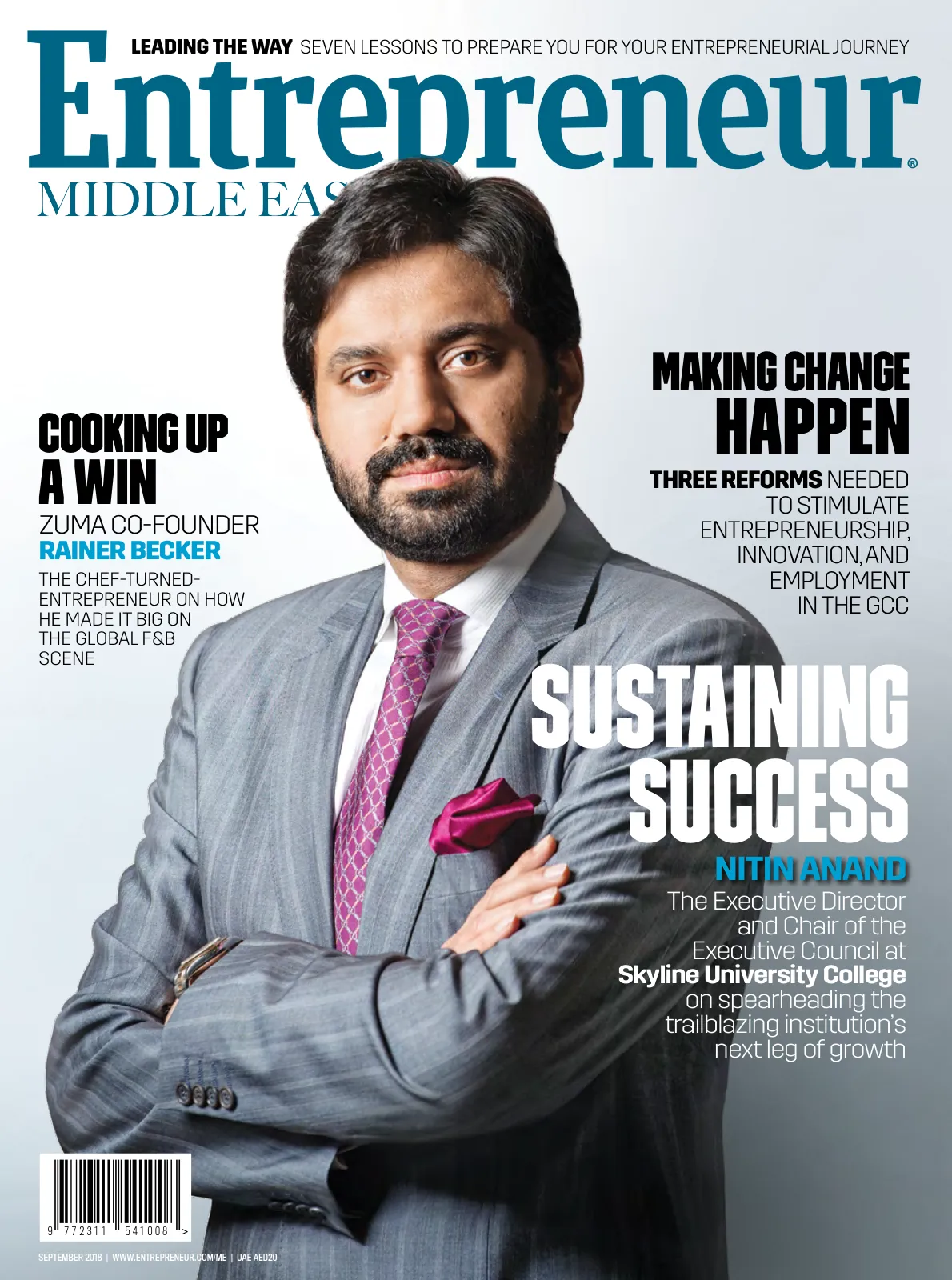
Entrepreneur Middle East, September 2018
Page 1
THE CHEF-TURNED-
ENTREPRENEUR ON HOW
HE MADE IT BIG ON
THE GLOBAL F&B
SCENE
SEPTEMBER 2018 | WWW.ENTREPRENEUR.COM/ME | UAE AED20
9
7 7 2 3 1 1
5 4 1 0 0 8
>
LEADING THE WAY SEVEN LESSONS TO PREPARE YOU FOR YOUR ENTREPRENEURIAL JOURNEY
MAKING CHANGE
HAPPEN
COOKING UP
A WIN
SUSTAINING
SUCCESS
The Executive Director
and Chair of the
Executive Council at
Skyline University College
on spearheading the
trailblazing institution’s
next leg of growth
NITIN ANAND
THREE REFORMS NEEDED
TO STIMULATE
ENTREPRENEURSHIP,
INNOVATION, AND
EMPLOYMENT
IN THE GCC
ZUMA CO-FOUNDER
RAINER BECKER
Page 2
idealz.com/app
Page 3
Download the Idealz app
Buy a Hashtag Hoodie from the
Deals on Wheels campaign
Get your complimentary tickets!
3
EASY
3
STEPS
* Terms and conditions apply.
3
2
1
Page 4
Wake up to
Following outstanding sales in phases 1, 2 & 3,
ARADA presents Nasma Residences Phase 4.
Located in the lush surroundings of
a record-breaking community.
from AED 899,000
*
BAREEM TOWNHOUSES
800-ARADA (27232)
arada.com
• No service fee for life
• Pay 60% on completion
• Up to 10% ROI
Visit our Sales Office
Badriyah Ballroom,
Radisson Blu Resort, Sharjah
10am – 7pm
*T&C apply
No residency visa required to buy property
Open to all nationalities
Page 5
3
September 2018 / ENTREPRENEUR.COM /
32 The nook space
22
Nitin Anand,
Executive Director and
Chair of the Executive
Council, Skyline
University College
SEPTEMBER 2018 CONTENTS
22
INNOVATOR:
SUSTAINING SUCCESS
Nitin Anand
The Executive Director
and Chair of the Executive
Council at Skyline University
College on spearheading
the institution’s next leg of
growth.
32
INNOVATOR:
RIDING HIGH
Having built a thriving
business over the last decade,
Ravi Bhusari, the co-founder
of Duplays talks about his
new entrepreneurial venture
nook, a co-working space
dedicated to the health and
fitness industry.
28
INNOVATOR:
COOKING UP A WIN
Zuma co-founder Rainer
Becker on how he made it big
on the global F&B scene.
44
‘TREPONOMICS:
PRO
Live your values, engage
your people, and never stop
learning
Promoth Manghat, the
Executive Director at Finablr,
and CEO of UAE Exchange
Group, explains a three-
step guide to a sustainable
business culture.
46
‘TREPONOMICS:
PRO
Get (back) in the zone
Bayt.com’s VP of Employer
Solutions Suhail Al Masri
offers a guide to keep the
momentum up and going in
your company.
58
START IT UP:
ECOSYSTEM
Roadblocks to innovation
Small business owners in
the UAE sound off on their
experience working with
the country’s financial
institutions.
Page 6
Use roaming on
your business trip.
Stay connected this summer with 2.5 GB
weekly roaming data for AED .٠٠٢
SMS ‘W’ to 5102
Page 7
Page 8
Page 9
Page 10
Page 11
Page 12
Page 13
Page 14
12 / ENTREPRENEUR.COM / September 2018
64 Andreas Gollwitzer, head of MINI Middle East, and Vilhelm Hedberg,
CEO and co-founder, ekar
SEPTEMBER 2018
CONTENTS
28
66
START IT UP:
ECOSYSTEM
Boosting potential
What can an accelerator
do for your startup? We
asked participants in
Sheraa Sharjah’s program to
share their experiences for
aspiring entrepreneurs.
84
‘TREPONOMICS:
MARKETING
Rediscovering courage
Serene Touma, Strategic
Planning Manager, FP7,
explains why the advertising
industry doesn’t need more
data, but it needs more
creativity.
Rainer Becker,
co-founder, Zuma
54
START IT UP:
ECOSYSTEM
Making change happen
The three reforms needed to
stimulate entrepreneurship,
innovation and employment
in the GCC, as explained
by Huda Al Lawati, Chief
Investment Officer, Savola
Group.
52
‘TREPONOMICS:
PRO
The CFO of the future
Adam Man-Cheung,
Operating Director of
UAE Finance, Banking
and Secretarial teams at
Michael Page, tells you why
the CFO is no longer just
“the finance guy.”
18
EDITOR’S NOTE
By Aby Sam Thomas
42
CULTURE:
TRAPPINGS
‘Trep gear
The executive selection for
the entrepreneur on your list
that has everything. Okay,
maybe for a little self-reward
as well.
82
START IT UP:
Q&A
Making travel smarter
(and easier)
UAE startup DUBZ wants to
enhance your travel experi-
ence.
78
START IT UP:
Q&A
Megha Merani talks to
entrepreneur Osama Natto,
who wants to help those
feeling lost in life to find
their way with his startup
Visoul.
Page 15
Page 16
14 / ENTREPRENEUR.COM / September 2018
66
SEPTEMBER 2018
CONTENTS
20
IN THE LOOP:
Driving fintech forward
A look at what to expect
at FinTech Abu Dhabi
2018 this September- an
event that’s all set to
bring together the region’s
emerging and established
fintech talent.
72
START IT UP:
STARTUP FINANCE
We got funded!
Summer slowdown? Not
for startups The Luxury
Closet, Mawdoo3, and
Crowd Analyzer that sealed
large funding rounds in this
period!
36
MONEY:
ECON
Funding the future
Dr. Peter H. Diamandis,
co-founder of Singular-
ity University, says an
unprecedented era of
capital abundance is all
set to massively accelerate
innovation in the world as
we know it.
40
TECH:
SHINY
#TamTalksTech
Gadgets and doodads
that you might’ve missed
out on, sourced by a tech
aficionado. Yes, it’s okay
to want them all… and no,
it’s not our fault.
64
‘TREPONOMICS:
SKILLSET
Leading the way
Vilhelm Hedberg, the
co-founder and CEO, ekar,
offers seven lessons (from
firsthand experience)
to prepare you for your
entrepreneurial journey.
66 Mashal Waqar, co-founder
and CEO, The Tempest
Sheraa space
40
Galaxy
Note 9
Page 17
A rare jewel in the rocky contours of the vast Saiq Plateau on Oman’s fabled
Green Mountain, Anantara Al Jabal Al Akhdar Resort is the highest five star
luxury resort in the Middle East. In this extraordinary destination, the true source
of adventure is revealed through Anantara’s distinctive natural luxury
and innovative Omani hospitality.
Telephone: +968 2521 8000
Email: reservations.aaja@anantara.com
Your #MountainEscape awaits.
CAMBODIA CHINA INDONESIA MALDIVES MOZAMBIQUE PORTUGAL OMAN QATAR
SRI LANKA THAILAND UNITED ARAB EMIRATES VIETNAM ZAMBIA
LIFE IS A JOURNEY. Visit anantara.com
Book at anantara.com and get resort credit of up to OMR 20.
A rare jewel in the rocky contours of the vast Saiq Plateau on Oman’s fabled
Green Mountain, Anantara Al Jabal Al Akhdar Resort is the highest five star
luxury resort in the Middle East. In this extraordinary destination, the true source
of adventure is revealed through Anantara’s distinctive natural luxury
and innovative Omani hospitality.
Telephone: +968 2521 8000
Email: reservations.aaja@anantara.com
Page 18
16 / ENTREPRENEUR.COM / September 2018
SUBSCRIBE
Contact subscriptions@bncpublishing.net to receive
Entrepreneur Middle East every issue
EDITOR IN CHIEF Aby Sam Thomas editor@bncpublishing.net
CEO Wissam Younane wissam@bncpublishing.net
DIRECTOR Rabih Najm rabih@bncpublishing.net
CREATIVE LEAD Odette Kahwagi
MANAGING EDITOR Tamara Pupic
STARTUPS SECTION EDITOR Pamella de Leon
FEATURES EDITOR Sindhu Hariharan
GROUP SALES DIRECTOR – B2B GROUP Joaquim D’Costa
COLUMNIST Tamara Clarke
EVENTS LIAISON Mark Anthony Monzon
PO Box 502511 Dubai, United Arab Emirates
P +971 4 4200 506 | F +971 4 4200 196
For all commercial enquiries related to Entrepreneur Middle East
contact sales@bncpublishing.net
All rights reserved 2018.
Opinions expressed are solely those of the contributors.
Entrepreneur Middle East and all subsidiary publications in the
MENA region are officially licensed exclusively to BNC Publishing
in the MENA region by Entrepreneur Media Inc.
No part of this magazine may be reproduced or transmitted in any
form or by any means without written permission of the publisher.
Printed by United Printing and Publishing
www.upp.ae
Images used in Entrepreneur Middle East are credited when necessary. Attributed use of
copyrighted images with permission. All images not credited otherwise Shutterstock.
Huda Al Lawati
Suhail Al Masri
Fida Chaaban
Dr. Peter Diamandis
Vilhelm Hedberg
Adam Man-Cheung
Promoth Manghat
Megha Merani
Serene Touma
Saad Umerani
CONTRIBUTING WRITERS
www.entrepreneur.com/me
ACCESS FRESH CONTENT DAILY ON OUR WEBSITE!
MIDDLE EAST
EntMagazineME
@EntMagazineME
Entrepreneur-me
EntrepreneurMiddleEast
EntMagazineME
EntMagazineME
EntMagazineME
MIDDLE EAST
In addition to our print edition, we’re bringing
you all sorts of industry news on our web
mediums. Joining us online means getting
relevant business and startup content in
real-time, so you’re hearing about the latest
developments as soon as we do. We’re looking
forward to interacting with our readers on all of
our social media and web platforms- like any
thriving business, we’re looking to give and take.
#TrepTalkME is already happening on all of our
digi platforms, and all good conversations go
both ways. See you on the web!
Page 19
Page 20
18 / ENTREPRENEUR.COM / September 2018
O
ne of the recurring
themes in the con-
versations I have had
lately with people in the
MENA entrepreneurial
ecosystem is about how
we often shy away from
admitting to or publicly talking
about the days when everything
seems to be going, well, belly up in
our respective startup enterprises.
It’s something we at Entrepreneur
have noticed quite a few times as
well- in interviews, when we ask
entrepreneurs to tell us about the
challenging times they have faced
while building up their businesses,
there have been cases where there
was either a flat-out refusal to
talk about such episodes, or just a
vague allusion to the hurdles faced,
without going into the depths of
how these happened, or how they
got past it. But this kind of behavior
from those of us who work in start-
ups is completely understandable,
of course- nobody really ever wants
to talk about the times they were
“losing it” at a fledgling enterprise;
breakdowns and meltdowns are
things that all of us are only too glad
to sweep under the carpet anyway.
But shouldn’t such discussions be a
part of the larger discourse on entre-
preneurship today?
It is thus in the spirit of sharing
that I figured I will, well, walk the
talk, and use this note to go into a
particularly tortuous week at work
recently, when I seemed to be, in
the words of a one observer, “falling
apart.” What happened was this:
a project that I was managing had
been hit by a series of unexpected
impediments, which resulted in it
descending into what I perceived
as a complete mess that I was both
unprepared for and overwhelmed
by. Panic reigned supreme in my
head, and that anxiety was further
crippling my attempts to pull myself
out of this situation. Despite this,
I kept a stiff upper lip and tried my
best to go about business as usual-
which, in hindsight, was definitely a
mistake, as by pretending that there
wasn’t a problem, I was essentially
exacerbating the issue for myself at
work.
Redemption came, perhaps ironi-
cally, when I finally broke, and let
people around me know that I was
in this apparently dire state of af-
fairs. Friends rallied around me,
and my team too- I was especially
gratified to see people who were out
on holiday still take the time out to
offer both support and solutions to
the conundrum I was in. With the
various sets of advice now at my dis-
posal, I forced myself to take a break
from all of the tasks on my plate, and
a rethink of the situation then fol-
lowed- delegation became the order
of the day, as opposed to trying to fix
everything by myself. Once I realized
that there were people out there
who I could depend on and actually
had my back, things began to look a
lot better- sure, it was still not the
best of times, but it was no longer
the worst of times either.
The ultimate boost came during
a meeting later with my project’s
stakeholders, when I realized that
despite all of the hurdles along the
way, things were actually still under
control, and not as bad as I had
perceived it to be. All said and done,
I came out of this episode with this
lesson: when you think you’re “los-
ing it,” make sure you let someone
around you know about it as soon
as you can. Don’t be afraid to ask for
help- it will only ever do you good.
Aby Sam Thomas
Editor in Chief
@thisisaby
aby@bncpublishing.net
A perspective on what to do when things seem to be going out of control
Support systems
EDITOR’S NOTE
Page 21
Page 22
20 / ENTREPRENEUR.COM / September 2018
F
inTech Abu Dhabi 2018, a
MENA-wide event bringing
together the region’s fintech
talent in Abu Dhabi, UAE, is
back for its second edition
after its inaugural confer-
ence in October 2017. Held
under the patronage of H.H.
Sheikh Hazza bin Zayed Al Nahyan, Vice
Chairman of the Abu Dhabi Execu-
tive Council, FinTech Abu Dhabi 2018
will be held on September 17, 2018 in
Abu Dhabi at the Fairmont Bab al Bahr
Hotel, and is organized by Abu Dhabi
Global Market (ADGM), an interna-
tional financial center and business hub
based in Abu Dhabi.
FinTech Abu Dhabi’s 2017 edition re-
ported receiving almost 3,000 requests
for attendance from across the regional
and global financial services and tech-
nology world, and this year’s edition of
the event aims to provide a comprehen-
sive look at the latest developments in
MENA’s fintech industry through deep
dives into select sectors and technolo-
gies. The program will deliver on this
objective through keynotes, fireside
chats, and discussions with local and
global leaders from the fintech, govern-
ment, and private sectors.
Some of the new elements intro-
duced this year include a Bootcamp
Day exclusively for fintech startups on
September 16, which shall offer fintech
startups sessions on topics such as
legal advice, fintech investing, among
others. Entrepreneurs will also have
the opportunity to meet and network
with investors and potential customers,
who will have been invited by ADGM
to be a part of the bootcamp. Further,
the Bootcamp Day also features demos
from ADGM RegLab member firms, and
access to global fintech accelerator Plug
and Play and their network.
For fledgling fintech ventures, FinTech
Abu Dhabi 2018 will also host the In-
novation Challenge, an initiative of Abu
Dhabi Global Market in collaboration
with KPMG to support the develop-
ment of fintech, by
enabling collabora-
tions between the
region’s financial
services institu-
tions and fintech
startups. In this
year’s challenge,
selected start-
ups will work to
develop a prototype
solution address-
ing business issues
identified by
UAE-based institu-
tions (“Corporate
Champions”).
Each startup and
Corporate Cham-
pion will then present the outcome of
their collaboration before an audience
of financial institutions, regulators,
corporates and media at the Demo Day
scheduled on September 17.
A few speakers who are set to share
their insights at the event include
Jan Reinmueller, partner and head of
Digital Village in Singapore, Mei Gao,
Partner, IDG Capital, Wai Lum Kwok,
Executive Director, ADGM Financial
Services Regulatory Authority, Na-
jla Al-Midfa, CEO, Sheraa - Sharjah
Entrepreneurship Center, and Brian
Meenagh, Partner, Latham & Watkins
LLP, among others.
www.fintechabudhabi.com
IN THE LOOP
FinTech Abu Dhabi 2018 is all set to be held on September 17, 2018
Driving fintech forward
WeWork goes meat-free as
part of its environmental policy
TOWARD A MORE
SUSTAINABLE FUTURE
Here’s to a company that is walking
the talk when it comes to doing its
part for the environment. WeWork, a
US-based real estate and co-working
startup valued at approximately
US$20 billion, announced that it will
no longer have any company events
that include meat, and employees
will not be able to expense meat as
well (Reuters). In an internal policy
sent to staff, WeWork co-founder
Miguel McKelvey commented how the
decision was based on the company’s
aim to reduce its environmental
impact, saying, “New research
indicates that avoiding meat is one of
the biggest things an individual can do
to reduce their personal environmental
impact, even more than switching to
a hybrid car.” Though the new policy
removes red meat, poultry, and other
meats from company menu and
expenses policy, the company is not
prohibiting WeWork staff or members
from bringing meat-based products to
the workplace. In addition to its new
policy, the company, along with sf.citi
is also hosting an affiliate event of the
2018 Global Climate Action Summit
in San Francisco called The Future of
Food: Tech’s Menu for Sustainability
on September 13, 2018, which will
bring “bring together leaders from the
private and public sector to discuss
how tech can be a leader in building
a more sustainable future through
food innovation.” Speakers at this
forum include HRH Prince Khaled bin
Alwaleed bin Talal, founder of KBW
Investments, Josh Tetrick, CEO of
JUST, and more.
www.globalclimateactionsummit.org
The fourth cohort of Dubai Future Accelerators
H.E Ahmed Al Sayegh, Chairman of ADGM addresses attendees
at FinTech Abu Dhabi 2017
WeWork office in NYC
IMAGECREDIT FINTECH ABU DHABI, WEWORK
Page 23
C O M E TO T H E B L U ,
S TAY F O R T H E V I E W
TAKE IN THE SPECTACULAR VISTAS OF THE DUBAI SKYLINE, THE DUBAI CANAL AND BURJ KHALIFA
FROM THE NEW RADISSON BLU HOTEL, DUBAI WATERFRONT. THE PERFECT PLACE TO CAPTURE THAT ULTIMATE
PICTURE MOMENT, WHETHER THAT’S FROM THE HOTEL’S PRIVATE ROOM BALCONIES, MEETING ROOMS,
SPA OR RESTAURANT TERRACES. THE HOTEL IS IN THE HEART OF THE ACTION AND WALKING DISTANCE
TO THE BEST SHOPPING AND ENTERTAINMENT IN DUBAI.
NOW OPEN IN BUSINESS BAY
Radisson Blu Hotel, Dubai Waterfront, Business Bay, PO box 16021, Dubai
T: +971 4 249 7800 info.waterfront.dubai@radissonblu.com radissonblu.com/hotel-dubaiwaterfront
Page 24
22 / ENTREPRENEUR.COM / September 2018
“WITH OUR DEDICATION
TO PROVIDE THE HIGHEST
QUALITY EDUCATION,
SKYLINE HAS BECOME
ONE OF THE MOST
SUCCESSFUL INSTITUTIONS
TO OFFER BUSINESS AND
MANAGEMENT PROGRAMS
IN THE REGION.”
INNOVATOR
22 / ENTREPRENEUR.COM / September 2018
Nitin Anand, Executive Director
and Chair of the Executive Council,
Skyline University College
Page 25
23
September 2018 / ENTREPRENEUR.COM /
Anand received his master’s
degree in business adminis-
tration from Skyline in 2004,
and today, he drives and
oversees the various business
units under the organiza-
tion’s umbrella, which also
sees him play a leading role in
its inroads into other MENA
markets, as well as coun-
tries like Pakistan, Nigeria,
Kazakhstan, and Tajikistan.
“Through my journey of
Skyline, I have witnessed how
it has evolved to stay abreast
of the latest developments in
education, to realize its vision
of becoming a university that
nurtures the spirit of innova-
tion and creativity, in order
to build a knowledge-based
society,” Anand notes. From
his time as an eager student
at Skyline, taking in all that
the institution had to offer
then, Anand now holds the
challenging responsibility of
understanding the changes in
the way students learn today,
and how the educational
institution needs to adapt
to this dynamic world. On a
typical day at work, Anand
can be seen doing everything
from meeting the university’s
various stakeholders, to guid-
ing the administrative and
office support teams, while
also developing and executing
plans to ensure that Skyline
is on the right track with
respect to securing its future.
“Building relationships with
leaders in different indus-
tries, and communicating
with them the mission and
values of Skyline Interna-
tional Group as a whole
are also important aspects
of my role,” he says. “I am
handling different businesses
under different industries,
so I make sure to allocate a
few hours of the day keep-
ing myself updated with the
latest trends. I also deem it
essential to maintain good
relationships with Skyline’s
F
rom ensuring the organization is being steered in the right
direction, to maintaining and building its stakeholder relations,
while also developing strategic plans for its future, Nitin Anand
is someone who seems to have a lot on his plate in his role as
the Executive Director of the Skyline International Group, which
has, among its many enterprises under it, Skyline University
College (SUC) in Sharjah, UAE, where he enjoys the designation
of both Executive Director and Chair of the Executive Council. But while
others may have found themselves flustered with the tasks at hand in
such a position, Anand seems to be managing it all quite effortlessly, and
having everything quite under control. So, how does he do it? The secret
perhaps lays in the fact that Anand’s professional growth has mirrored
that of Skyline’s own evolution. As an educational institution that grew
from rather humble origins in the early 90’s to become one of the UAE’s
(and the region’s) trailblazing universities, it is Skyline’s growth and
resilience that Anand, the nephew of its Founder President Kamal Puri, has
tried emulating in his own career trajectory, from being a student at Skyline
once upon a time, to becoming a key player in its top management today.
SUSTAINING
SUCCESS
NITIN ANAND
THE EXECUTIVE DIRECTOR AND CHAIR OF THE EXECUTIVE
COUNCIL AT SKYLINE UNIVERSITY COLLEGE ON SPEARHEADING
THE INSTITUTION’S NEXT LEG OF GROWTH by SINDHU HARIHARAN
>>>
Page 26
24 / ENTREPRENEUR.COM / September 2018
staff, as I strongly believe in
the power of teamwork and
collaboration to make the en-
terprise excel in all sectors.
We want each enterprise of
Skyline International Group,
particularly Skyline Univer-
sity College, to become an
organization that encourages
innovation and creativity.”
It is this emphasis on
innovation that has seen
Skyline University College
grow from a two-classroom
college in 1990 offering di-
plomas in travel and tourism
(it was also the first private
educational institution in
Sharjah to offer a bachelor’s
degree), to counting over
8,000 alumni today for its
portfolio of courses compris-
ing of business education,
information technology sys-
tems, strategic management,
leadership, and much more.
The campus is currently
spread across 40 acres of
land in Sharjah’s University
City, and fulfills the talent
needs of a variety of sectors,
including hospitality, tour-
ism, marketing, technology,
finance, and more. One of
its characteristic features is
its Corporate Affairs Office
(CAO), which brings together
the student community with
the industry players in the
form of guest lectures, indus-
try visits etc. to ensure the
employability of its students
and bridge the skills gap.
“With our dedication to pro-
vide the highest quality edu-
cation, Skyline has become
one of the most successful
institutions to offer business
and management programs
in the region,” Anand says.
“One of the things I am
proudest of about Skyline is
that it evolves with the time.
Although our institution has
the highest respect when it
comes to tradition, it em-
braces change.” An instance
of this is Skyline’s support
to the UAE Vision 2021,
which aims at developing a
knowledge-based economy-
on recognizing that the UAE
government’s initiatives to
drive the growth of the ICT
sector can succeed only if
there is a pool of skilled pro-
fessionals to participate in it,
Skyline launched its School
of Information Technology
that offers Bachelor of Sci-
ence in Information Technol-
ogy-Enterprise Computing
(BSIT-EC), which includes
courses on robotics, Artificial
Intelligence, Internet of
Things, cloud computing,
and big data, among others.
“We have partnered with top
IT companies such as Oracle
Academy, CISCO Academy,
Virdi, and EC Council to
advance our teaching strate-
gies and nurture students’
technological curiosity,”
Anand adds.
A major driver for the uni-
versity to continually evolve
and cater to changing times
is its firm conviction that
every person should have
access to good education- re-
gardless of their nationality
or social status. “There has
been a significant progress
in the enrolment and at-
tendance in schools in the
MENA region,” Anand says.
“However, access to edu-
cational institutions is still
limited in some parts of the
region, and unlike in other
markets, the cost of educa-
tion here is staggering.”
While Skyline has continued
to invest in and maintain its
leading position in the UAE,
Anand notes that the insti-
tution has, over the years,
established offices in other
locations like Morocco, Paki-
stan, Nigeria, Kenya, Ghana,
and other countries, to assist
prospective students. “And,
to give students a chance to
achieve a quality education
at a reasonable fee, Skyline
offers several scholarship
programs,” Anand adds.
“Skyline [has also] entered
into memorandums of
understanding with univer-
sities abroad, social clubs,
consulate, foreign embassies,
and the local government to
offer financial assistance to
deserving students.” Howev-
er, Skyline’s mission extends
beyond democratizing access
to college-level education for
youth. Anand explains that
at Skyline, they also work to
ensure that their students
attain their academic goals,
while simultaneously devel-
oping “the right attitude and
skills that will help them
become socially responsible
professionals and competent
players in the international
stage.” This strategy, he says,
gains more significance with
the MENA’s education sector
seeing a rise of internation-
INNOVATOR
“WE HAVE PARTNERED
WITH TOP IT
COMPANIES SUCH AS
ORACLE ACADEMY,
CISCO ACADEMY,
VIRDI, AND EC
COUNCIL TO ADVANCE
OUR TEACHING
STRATEGIES AND
NURTURE STUDENTS’
TECHNOLOGICAL
CURIOSITY.”
Nitin Anand, Executive Director
and Chair of the Executive Council,
Skyline University College
Page 27
25
September 2018 / ENTREPRENEUR.COM /
alization. “In line with this,
it is important for students
to learn about international
competency,” Anand ex-
plains. “Skyline encourages
its students to develop an
international attitude. We
strike partnerships with uni-
versities abroad and create
programs to expose students
to other cultures and allow
them to collaborate with
people overseas. Skyline
established an agreement for
transfer of credits with vari-
ous universities across the
world like the US, UK, and
Canada, among others.”
With the youth making up
a significant proportion of
the Arab populace, and with
the World Economic Forum
pegging youth unemploy-
ment at 27% in 2017, there
is a dire need for the region’s
policy makers and private
sector to empower MENA
youth, and drastic measures
in the sphere of education
and entrepreneurship could
be the most effective tool to
do that. Anand and his team
at Skyline are cognizant of
the fact that as educational-
ists, it is their responsibility
to play a leading role in this
issue, and that’s why the
business leader is quite suc-
cinct when he says that Sky-
line wants to help foster the
entrepreneurial spirit in its
students, and not just sup-
port them in their dreams
of working for multinational
companies. “More than any-
thing, we want them to build
their own dreams; create
their own businesses so they
can provide jobs for others,”
he says. “The MENA region
attracts interest from global
investors. The UAE, particu-
larly, has been labeled the
forerunner entrepreneurial
hub. And education plays an
important role in teaching
young people leadership and
entrepreneurial skills that
will give them the confidence
to innovate and become
business owners, thereby
contributing more to their
country’s economy. Hence,
in Skyline, our programs
and approach to learning are
tailored not just to prepare
students to become capable
professionals, but also to
instill in them the spirit of
entrepreneurship so they
can generate employment
later on. To promote entre-
preneurship and innovation,
Skyline has allocated funds
for students who have quali-
fied and feasible business
plan and who aim to start a
business venture. Moreover,
Skyline established the
Entrepreneurship and Inno-
vation Club Centre, a facility
dedicated to showcasing the
business plans and enhanc-
ing the entrepreneurial skills
of students.”
With respect to Skyline
International Group, Anand
notes that the organization
today boasts of interests
in a variety of sectors,
with the company having
made the decision to build
a diversified portfolio for
itself way back in 2005,
which it started by mak-
ing advances in the UAE’s
real estate industry. More
recently, in 2011, the Group
EFS at the IFMA event, April 2018
“I STRONGLY BELIEVE IN THE POWER OF
TEAMWORK AND COLLABORATION TO MAKE
THE ENTERPRISE EXCEL IN ALL SECTORS.”
“TO GIVE STUDENTS
A CHANCE TO ACHIEVE
A QUALITY EDUCATION
AT A REASONABLE
FEE, SKYLINE OFFERS
SEVERAL SCHOLARSHIP
PROGRAM.”
Skyline University College
>>>
25
September 2018 / ENTREPRENEUR.COM /
Page 28
26 / ENTREPRENEUR.COM / September 2018
acquired a state-of-the-art
raw material processing unit
for plastic with the produc-
tion capacity of 1,000 tons
per month, and this year,
Skyline is opening a new
plant in SAIF Zone with a
monthly production capacity
of 2,500 tons. Growing in
other markets was also on
Skyline’s agenda. “In 2011,
we saw great opportunities
in Africa, particularly in
Nigeria,” Anand says. “We
studied the market, and
analyzed how we can expand
our operations as a group
there. As our core strength is
education, we initiated the
process and started seeking
the approval of the National
Universities Commission
(NUC) of Nigeria to establish
the first private university
in the region of Kano; hence,
Skyline University Nigeria
(SUN) opened on the 19th
of July.” But that’s not all.
Post the early successes
tasted in various industries,
the Group is now also mov-
ing into other areas. “It is
targeting high-end inter-
national curriculum school
set-ups,” he notes. “We are
also venturing into the F&B
industry. We are looking
into establishing food chains
that offers international cui-
sines. We also see potential
in the IT and infrastructure
sectors. In the hospitality
sector, we are planning to
include four- and five-star
hotels in our global port-
folio. And for the health
sector, we want to establish
clinics and hospitals.”
Anand says that all these
(and more) are targets the
Group aims to accomplish in
“a phased-out manner over
next five years.”
At this point, given all of
the initiatives that Anand
is spearheading at Skyline,
one is now bound to wonder
about what’s driving the
Executive Director to do all
that he does. “As the person
at the helm of Skyline’s
organizational ship, Kamal
Puri, Skyline’s Founder
President, has inspired me
to be resilient, determined,
and to always keep Sky-
line’s vision and mission in
mind in whatever decisions
I make,” Anand replies. “He
dreams of a university where
creativity and innovation are
nurtured. This challenges
me to become a leader that
inspires creativity and in-
novation among Skyline em-
ployees. His example leads
me to always create new and
better ways of doing things.”
But, surely, the road ahead
isn’t going to be as smooth
as he makes it out to be.
“There will be a lot of chal-
lenges in the future,” Anand
admits. “But I am confident
because the university’s 28
years of existence is a proof
that by embracing change,
using the lessons from the
past to move forward, and
by keeping true to Skyline’s
mission, we can realize the
Founder President’s dream
for this university.” And
that’s something we are all
looking forward to seeing-
here’s to the future.
INNOVATOR
“WE STRIKE
PARTNERSHIPS
WITH UNIVERSITIES
ABROAD AND CREATE
PROGRAMS TO
EXPOSE STUDENTS
TO OTHER CULTURES
AND ALLOW THEM TO
COLLABORATE WITH
PEOPLE OVERSEAS.”
Tariq Chauhan,
Group CEO, EFS
“IN SKYLINE, OUR PROGRAMS AND APPROACH TO LEARNING ARE
TAILORED NOT JUST TO PREPARE STUDENTS TO BECOME CAPABLE
PROFESSIONALS, BUT ALSO TO INSTILL IN THEM THE SPIRIT OF
ENTREPRENEURSHIP SO THEY CAN GENERATE EMPLOYMENT LATER ON.”
Kamal Puri,
Founder President, Skyline
Nitin Anand, Executive Director
and Chair of the Executive Council,
Skyline University College
Page 29
wges.ae #WGES2018
24–25th October, 2018
Dubai International Convention
and Exhibition Centre.
Towards a
Greener
World
Page 30
28 / ENTREPRENEUR.COM / September 2018
INNOVATOR
“SUCCESS IN
THE PAST DOESN’T
SECURE SUCCESS
IN FUTURE– YOU HAVE
TO KEEP PUSHING
FORWARD, AND DON’T
TAKE YOUR EYE OFF
THE BALL.”
Rainer Becker, co-founder, Zuma
IMAGES COURTESY ZUMA
Page 31
29
September 2018 / ENTREPRENEUR.COM /
Z
uma is one of
those places in
Dubai that one
may assume
to have been
in the Emirate
since time im-
memorial, and
so, it may come
as a surprise to learn that
the multiple award-winning
Japanese restaurant is actu-
ally celebrating its tenth
anniversary in the city just
this year. Located at Dubai
International Financial Cen-
ter since September 2008,
Zuma’s first outpost in the
UAE can well be called one
of Dubai’s premier dining
destinations, with its win-
ning combination of setting,
cuisine, and service making
it an undisputed leader in
the city’s burgeoning F&B
industry. But, hey, you don’t
have to take just my word for
it- I asked Zuma co-founder
Rainer Becker to share any
business figures that would
reflect Zuma Dubai’s current
standing in the market, and
his reply was: “The revenue
for Zuma Dubai is upwards
of US$30 million a year. In
terms of profits or any other
financial information, all
I will say is that we can’t
complain!”
Becker founded the very first
Zuma along with business
partner Arjun Waney in
London in 2002, and since
then, the concept –which is
a celebration of the Japanese
izakaya style of dining, and
focuses on giving patrons “a
truly inspired dining experi-
ence”- has found its way
(successfully) to several cit-
ies around the world, includ-
ing Dubai. With respect to
its origin story though, Zuma
came into being essentially
thanks to Becker spending
six years in Japan as the
Executive Chef of the Park
Hyatt in Tokyo, during which
he fell in love with the food,
tradition, and culture char-
acteristic of the place. “My
time in Japan inspired me in
many ways,” he remembers.
“And when I returned to
London, my goal was to
open a Japanese restaurant
that would appeal to a more
Western palate, whilst still
respecting the ingredients
and traditions I had learnt.”
With Waney by his side,
Becker went on to then open
the first location of Zuma
in London’s Knightsbridge
neighborhood, and well, it
just blew up from there. “We
were only ever planning to
open one restaurant,” Becker
admits. “As the business
organically flourished, we
started to look at other
cosmopolitan locations;
destinations where our
existing customers travelled
to regularly, [and] this led us
to Hong Kong, Istanbul, and
then, Dubai.”
But Zuma’s growth story
didn’t stop at Dubai- the
restaurant has since made its
presence felt in other food
capitals like Bangkok, Rome,
and New York; the UAE got
a second Zuma location in
Abu Dhabi in 2014. Zuma’s
global success can seem a bit
perplexing when one consid-
ers how simple its offering
is- but the outstanding
quality it professes makes it
stand above the rest. Indeed,
this is exemplified at Zuma
Dubai, which, despite the
multitude of restaurants
that have opened up in the
Emirate since its launch,
remains a favorite of diners
not just in the city, but the
entire country and the whole
MENA region as well. >>>
COOKING UP
A WIN
THE CHEF-TURNED-ENTREPRENEUR ON HOW HE MADE IT BIG
ON THE GLOBAL F&B SCENE by ABY SAM THOMAS
ZUMA CO-FOUNDER RAINER BECKER
“I AM VERY FORTUNATE
THAT WE HAVE AMAZING
PEOPLE WORKING FOR
US, MANY OF WHOM
HAVE BEEN WITH THE
COMPANY FOR MORE
THAN 10 YEARS. OUR
BUSINESSES WOULD NOT
BE SUCCESSFUL
WITHOUT THEM.”
“AS THE BUSINESS
ORGANICALLY
FLOURISHED, WE
STARTED TO LOOK AT
Zuma Dubai
Page 32
30 / ENTREPRENEUR.COM / September 2018
“The concept of Zuma, and
therefore the key factors
[of its success], are actually
relatively simple,” Becker
says. “High quality products
are always at the forefront of
Zuma, whether that is food,
drinks, music, or design. The
team and service are also
just as important. When
your product is good, and the
service is on point, it makes
for success.” When asked
how he’d describe Zuma
to a layperson, he stresses
again on the simplicity of it
all. “How would I describe
Zuma… It’s a contemporary
Japanese restaurant that is
informal, yet sophisticated,
with great food, service,
and cocktails. The USP goes
back to product, but also the
consistency– we have guests
who dine in our restaurants
all over the world, and the
spicy beef, for example,
should be of equal quality
everywhere along with the
service. We work incredibly
hard as a business to main-
tain this.”
This insistence on main-
taining quality and stan-
dards can be drawn to Beck-
er’s time as a chef before he
became an entrepreneur by
launching Zuma- this experi-
ence, bolstered by the skill-
sets of his co-founder, has
clearly served the enterprise
well. “My heart is still in the
kitchen, but I always loved
every aspect of running a
restaurant,” he says. “Having
learned the ins and outs of it
at the German Meisterbrief
(the master tradesman
certification), and combined
it with my experiences at
the time, I had the whole
concept from A to Z worked
out in my head, when we
opened Zuma 15 years ago.
Arjun Waney, on the other
hand, my business partner,
was instrumental in comple-
menting my knowledge and
experience with his business
acumen. I would also say
that you have to be a very
disciplined person to become
a successful entrepreneur,
and I believe I am a very
disciplined person– a lesson
that is my father’s legacy.”
Becker also gives due credit
for Zuma’s success to the
people he has got onboard
the venture. “One of the
most important aspects of
the business is the team,” he
says. “I am very fortunate
that we have amazing people
working for us, many of
whom have been with the
company for more than 10
years. Our businesses would
not be successful without
them– they are passionate,
they truly understand and
believe in the concept! They
work towards the evolution,
and not the revolution of the
concept. Truly understand-
ing the formula and funda-
mentals behind the Zuma
brand is what makes the
business a global success.”
Speaking about the Dubai
location specifically, Zuma’s
success is especially note-
worthy considering that it
launched at a time when the
restaurant scene was mark-
edly different from what it is
today. “I am very proud that
Zuma Dubai has stood the
test of time,” Becker says.
“Every restaurant that we
open has an element of risk.
Dubai, in particular, was a
very new marketplace at the
time, and the F&B offering
wasn’t as extensive as it
is now. When we opened
in DIFC ten years ago, it
was a very different place;
there was only one other
restaurant [in the locality].
In more recent years, other
restaurants have moved in to
the area, and it has created
a dining destination, which
drives customers, as there is
INNOVATOR
“YOU HAVE TO BE A VERY
DISCIPLINED PERSON TO BECOME
A SUCCESSFUL ENTREPRENEUR.”
IMAGES COURTESY ZUMA
“THE REVENUE FOR ZUMA
DUBAI IS UPWARDS OF
US$30 MILLION A YEAR.
IN TERMS OF PROFITS
OR ANY OTHER
FINANCIAL INFORMATION,
ALL I WILL SAY IS THAT
WE CAN’T COMPLAIN!”
Zuma Dubai
Page 33
31
September 2018 / ENTREPRENEUR.COM /
so much choice.” Becker ac-
knowledges the rise in com-
petition in Dubai’s fine din-
ing space, but claims to be
not too fazed by it- accord-
ing to him, it just keeps him
and his team on their toes.
“The market has changed
significantly,” Becker says.
“For one, it is now a lot more
competitive, there has been
an influx of international
restaurant names. The Dubai
market is crowded, but not
more so than anywhere
else; it is probably just felt
more, because it happened
relatively quickly. I don’t
think it’s a negative though-
it just means that you have
to ensure you are at the top
of your game at all times–
which is what we try to
ensure in all our restaurants
anyway.”
As for what’s next for
Becker and Zuma: the pos-
sibilities are open. For Zuma,
we are always looking for
sites,” Becker says. “The next
opening is scheduled for
Boston next year, and after
that, who knows! I would
never say never to opening
another Zuma in the Middle
East, but currently our focus
is on opening Roka Dubai,
which is one of our other
brands, next year. Recently, I
have also been occupied with
the new restaurant we just
rolled out in London called
Inko Nito– it is basically a
mid-market contemporary
Japanese grill restaurant.
So, as you can see, we are
constantly keeping busy!
Depending on its success we
might as well consider put-
ting one in the Middle East-
watch this space.” If this
response is any indication,
then it’s clear that Becker’s
entrepreneurial journey is
far from done- in fact, there
seems to be more in the off-
ing! But, looking back, would
Becker have done anything
differently along his career?
“Honestly, I would not do
anything differently, I would
do it all again in exactly the
same way!” he replies. “I
don’t have personal mantras
as such, but I do always
try to remember to keep
two feet on the ground, be
humble, and don’t get ahead
of yourself! Success in the
past doesn’t secure success
in future– you have to keep
pushing forward, and don’t
take your eye off the ball.”
1. Be knowledgeable
“You cannot ask people
to do things that you are
not able or prepared to
do yourself. Learn every
aspect of your craft,
regardless of your position.”
2. Be passionate
“The restaurant industry
is tough, hours are
unsociable, it can be
stressful, etc. If you are not
passionate, you will not
succeed.”
3. Failure (most of the
time!) is part of success
“You will not always fly
high, sometimes you fail.
The important part is that
you pick yourself back up
and learn from it. But don’t
make the same mistake
twice!”
‘TREP TALK
ZUMA CO-FOUNDER
RAINER BECKER’S TIPS
FOR ENTREPRENEURS
IN THE F&B SPACE
“MY GOAL WAS
TO OPEN A JAPANESE
RESTAURANT THAT
WOULD APPEAL
TO A MORE WESTERN
PALATE, WHILST STILL
RESPECTING
THE INGREDIENTS AND
TRADITIONS I HAD
LEARNT.”
Rainer Becker,
co-founder, Zuma
Zuma Dubai
Page 34
32 / ENTREPRENEUR.COM / September 2018
I
f there were a secret
to breaking into
the sports industry,
it might be too
naïve to think that
organizing a pick-up
game of ultimate
frisbee could lead to
a business boasting
upward of 130,000
registered members,
raising more than US$1.2
million of outside invest-
ment, alongside expansions
into other markets and
business verticals. However,
this statement sums up a
decade for Ravi Bhusari, who
co-founded his Dubai-based
sports league business,
Duplays, with Davinder Derv
Rao in 2007.
Founded as a community for
expats by expats, Duplays
has grown its customer
base by offering affordable
and organized amateur
sports opportunities, while
shouldering the burden of
registration, communication,
and scheduling. Its strong
market traction did not
pass unnoticed by regional
investors -namely Wamda
Capital and BECO Capital-
but Bhusari notes that he
and his co-founder were
keen on not stopping at just
that. Duplays is currently
going through a transition
stage by moving away from a
pay-to-play sports services
(events management) model,
to a platform model that will
help empower others to ac-
tualize their sports interest.
“This means continuing to
build our technology offer-
ing to make playing sports
easier, but rather than just
connecting the community
to play in our own managed
sports leagues, we want to
make it easier for people to
book sports facilities via our
app and website,” Bhusari
adds. “We are trying to build
Booking.com for sport, fo-
cusing initially on our home
market of the UAE, and the
growth market of KSA.” Ac-
cording to Bhusari, Duplays
is currently servicing only a
fraction of their membership
base with its weekly leagues,
which has opened an oppor-
tunity for future growth, by
Having built a thriving business over the last decade, the co-founder
of Duplays is now embarking on a new entrepreneurial pursuit
with
, a co-working space dedicated to the health and fitness
industry by TAMARA PUPIC
Riding high
RAVI BHUSARI
INNOVATOR
IMAGE CREDIT DUPLAYS
“THE SPORTS, FITNESS
AND WELLNESS
MARKETS ARE
UNDERSERVED IN THE
REGION. AT NOOK, OUR
VISION IS TO PIONEER
AN INDUSTRY SPECIFIC
PLATFORM FOR THE
DEVELOPMENT OF
THESE SECTORS OF THE
ECONOMY.”
Ravi Bhusari,
co-founder,
Duplays
nook’s workspace is located at One JLT,
Dubai’s Jumeriah Lakes Towers
Page 35
33
September 2018 / ENTREPRENEUR.COM /
connecting their users with
more sports facilities. In this,
Bhusari adds, lies the com-
pany’s unique proposition-
building a true platform to
connect sports enthusiasts
(demand side), with access
to third party and internally
developed sports facilities
(supply side), thereby
providing a seamless user
experience.
Last year, Duplays made
headlines by forming a joint
venture with its local partner
and Saudi Arabia-based
developer, Al Hokair Group,
to build community sports
facilities in the Kingdom at
scale using air-supported
dome technology, for an un-
disclosed amount. The first
in a series of new privately-
owned football sports com-
plexes has now been built in
Jeddah, and should become
operational by October 2018.
With wins like these in the
bag, Bhusari is definitely
someone other entrepreneurs
can learn from- and he’s
happy to offer advice for oth-
ers wanting to secure success
for their startup ventures.
“Firstly, don’t take the first
‘no’ for an answer,” Bhusari
says. “If you believe in what
you are doing, treat objec-
tions as opportunities, and
figure out a way to get to a
‘yes.’ Entrepreneurs are de-
signed to challenge the status
quo, and if you believe in
your business mission, then
follow it through. Secondly,
entrust your team to make
decisions. I’m a big believer
in hiring people better than
yourself that complement
your key skill sets. And
lastly, be amenable to
change. The phrase ‘the only
constant is change’ definitely
rings true. Ten years on, the
conversion of Duplays from
Dubai’s only de facto adult
sport and social club, to now
becoming a developer of
community sports facilities
and central platform for
sport, can only happen with
an openness and willingness
to accept change, and the
buy-in of your team to help
you drive your evolving com-
pany mission.”
This year has seen Bhusari
and Rao take a step further
with their business by
partnering with Dubai Multi
Commodities Centre (DMCC)
to establish nook by Duplays,
dubbed as the region’s first
sports and wellness co-
working space. The concept
behind nook is to provide
all the necessary tools for
aspiring entrepreneurs to
seize opportunities pre-
sented by the UAE’s growing
sports, fitness, and wellness
industry. Bhusari sees nook
as a natural evolution of
Duplays’ business strategy.
He adds, “The sports, fitness
and wellness markets are
underserved in the region. At
nook, our vision is to pioneer
an industry specific platform
for the development of these
sectors of the economy. We
want to provide the best
possible service and solu-
tions for the industry, to help
foster its long-term develop-
ment and success.”
Nook’s 10,000 sq. ft. work-
space at One JLT in Dubai’s
Jumeriah Lakes Towers
neighborhood offers monthly
workspace rental plans
ranging from AED2,500 for
a shared space, to AED3,000
for a fixed desk, to AED4,450
for private offices- not inclu-
sive of the yearly AED11,000
DMCC-subsidized trade
license, and the monthly
nook membership fees and
company registration start-
ing at AED499. For industry
professionals and companies
not requiring physical office
space, nook also offers a flex-
ible Mobile Startup package
that includes a number of
time-saving features and
services. Flexible payment
terms are also available as
an additional launch sup-
port service for startups
getting their businesses off
the ground. “We currently
have the capacity to offer
200 professional licenses
covering 35+ industry ac-
tivities,” Bhusari says. “nook
secured more than 10% of
its license allocation in the
first three weeks of its pre-
launch phase, and expects
to achieve full membership
within the first 12 months
of operation. Expansion of
“EXPANSION OF THE NOOK
CONCEPT INTO OTHER
LOCATIONS AND MARKETS
IS EXPECTED WITHIN THE
NEXT 18 MONTHS, AND
WILL MIRROR DUPLAYS’
EXPANSION ACROSS
THE REGION. PRIORITY
MARKETS INCLUDE SAUDI
ARABIA, FOLLOWED BY
OTHER GCC COUNTRIES.”
nook studio
nook studio
>>>
Page 36
34 / ENTREPRENEUR.COM / September 2018
the nook concept into other
locations and markets is
expected within the next 18
months, and will mirror Du-
plays’ expansion across the
region. Priority markets in-
clude Saudi Arabia, followed
by other GCC countries.”
The idea for nook was born
in 2015, and Bhusari credits
Ahmed Bin Sulayem, Execu-
tive Chairman of DMCC, for
his tremendous support
in its implementation and
realization today. This kind
of support and mentorship
is one of the most unique
aspects of the professional
networks in the UAE, he
says. “Mentorship in this
region is key,” Bhusari adds.
“We leave our families, our
friends, our professional
networks at home, and come
to a new city. Taking the
plunge into entrepreneurship
is terrifying (and exhilarat-
ing) enough, to say nothing
of the additional financial
risks one has to stomach
here. We have been grateful
over the years not just to
receive mentorship from En-
deavor UAE [The Duplays co-
founders became members of
Endeavor UAE in 2013] and
our existing investors, but
from friends and business
acquaintances, who are more
than willing to give advice
and help us. Most people are
no more than a LinkedIn or
networking event away, and
I have met so many incred-
ibly helpful people over the
years.”
When asked about the
main lessons he has grasped
from three most critical
moments in Duplays’ growth
–i.e. raising capital from
outside investors, focusing
on the Kingdom of Saudi
Arabia (KSA) as a growth
market, and being amenable
to change- Bhusari’s replies
make it clear that he has
taken the time to reflect on
all of his entrepreneurial
pursuits so far. “On the
investment front, most en-
trepreneurs aspire to achieve
a certain level of success
or market traction in order
to scale their business, and
investment is key for that
to happen,” Bhusari says.
“We have been fortunate to
have supportive and patient
investors who have champi-
oned us. For entrepreneurs,
the key lesson to consider
is not to rush to accept the
first investors who express
an interest in your business.
What is important is to build
a relationship with these
people, and they will be with
you for the long haul.”
“On the KSA expansion side,
the key lesson is patience,”
he continues. “Tapping into
this market is not something
you can do from the comfort
of your Dubai office. Business
is always relationship driven,
but even more so in KSA.
KSA is a unique, fascinating
market and you have to put
in the time on the ground to
assess the opportunities and
build relationships with key
partners- the Dubai experi-
ence does not easily translate
into Saudi.” And as for being
open to change? “On the
change side, business in this
region is much faster paced
than other markets,” Bhusari
notes. “Be open to change,
and adapt as conditions
alter. Do not be set in your
ways, and pivot where pos-
sible if your product-market
fit isn’t working. Don’t be
overly in love with your idea,
if your customers are not.”
INNOVATOR
1. Build your tribe
“Surround yourself ASAP
with good people, whether
that’s co-founder(s) or key
first hires.”
2. Focus on your finances
“Be laser focused on cash
flow- it is the lifeblood of
your organization; if you
have a business model that
has a longer or variable
sales cycles, ensure you
have adequate capital to
get you through the rough
patches- everyone will
eventually face them.”
3. Look for smart money
“Find supportive investors
who provide not just capital
but active mentorship; be
open to advice.”
4. Be kind to yourself
“Protect your personal
free time and invest in
yourself; you are no good
to your business or your
employees if you are not of
sound body and mind.”
5. Give back whenever
you can “Don’t forget to
thank the people who have
helped you along your way.”
‘TREP TALK
RAVI BHUSARI,
CO-FOUNDER, DUPLAYS,
SHARES FIVE TIPS FOR
ENTREPRENEURS
“KSA IS A UNIQUE,
FASCINATING MARKET
AND YOU HAVE TO PUT
IN THE TIME ON THE
GROUND TO ASSESS
THE OPPORTUNITIES
AND BUILD
RELATIONSHIPS WITH
KEY PARTNERS.”
nook studio
Ravi Bhusari,
co-founder,
Duplays
Page 37
OCTOBER 29-30, 2018
APPLY NOW! WWW.ABUNDANCE360.COM/DUBAI
IN PARTNERSHIP WITH:
Being offered for the first time in
the Middle East, Africa & South
Asia, Abundance 360 is Peter H.
Diamandis' mastermind for CEOs,
entrepreneurs, executives, investors
entrepreneurs, executives, investors
and government leaders. Join
Peter's Community and attend the
Abundance 360 Dubai Summit to
learn about the most exciting
developments in disruptive
technology and innovation.
Topics will include Computation,
Topics will include Computation,
Sensors, Networks/loT, Artificial
Intelligence, Longevity, Robotics,
Virtual Reality, Augmented Reality,
3D Printing and Blockchain.
LEVERAGE EXPONENTIAL
TECHNOLOGIES, TRANSFORM YOUR
ORGANISATION AND DISRUPT
YOUR INDUSTRY
Page 38
Funding
the future
An unprecedented era of capital abundance
is all set to massively accelerate innovation
in the world as we know it by DR. PETER H. DIAMANDIS
36 / ENTREPRENEUR.COM / September 2018
MONEY ASK THE MONEY GUY | VC VIEWPOINT | YOUR MONEY | ECON
Page 39
37
September 2018 / ENTREPRENEUR.COM /
N
othing accelerates
technological in-
novation like cash.
Lots and lots of
cash. More bucks
mean more Buck
Rogers.
More cash means more people
building, experimenting, fail-
ing, and eventually driving
breakthroughs.
This past decade, and in the
decades ahead, we will experi-
ence an unprecedented era of
capital abundance that will
massively accelerate innova-
tion, and fund crazy ideas and
moonshots. Where is all this
cash coming from? I’ll highlight
four areas:
1. Crowdfunding
2. Venture funding
3. Initial Coin Offerings (ICOs)
4. Sovereign wealth funds and
mega funds
Let’s dive in.
1. CROWDFUNDING
At the low end of capital
abundance is crowdfunding, a
peer-to-peer network where
any person can present their
product or service to the world,
and ask for funding.
Funding can come in the form
of a loan, an equity investment,
a reward, or an advanced pur-
chase of the proposed product
or service.
Since I first discussed crowd-
funding in my last book BOLD,
the phenomenon has exploded
onto the scene, making it vastly
easier for an entrepreneur any-
where in the world to digitally
pitch their idea, and raise the
funds to start their business.
The total worldwide volume
of crowdfunding, inclusive
of peer-to-peer lending, was
US$34 billion in 2017, with
375 crowdfunding platforms in
North America alone. But this
too, like many digital plat-
forms, is experiencing double-
digit growth. Experts project
crowdfunding to reach $300
billion by 2025.
Kickstarter, one of the
most popular reward-based
crowdsourcing platforms, has
launched almost 400,000 pro-
jects, and over $3 billion has
been pledged on the site. The
most successful Kickstarter to
date, Pebble Time, raised just
over $20 million in only 37
days.
Ultimately, crowdfunding
fully democratizes access to
capital, allowing anyone with a
good idea, anywhere, to get the
cash they need to get going. No
surprise that Goldman Sachs
described crowdfunding as
“potentially the most disrup-
tive of all the new models of
finance.”
2. VENTURE FUNDING
In contrast, venture funding
has been a more traditional
source of startup capital over
the past five decades, helping
to birth household names from
Apple and Google, to Amazon
and Uber.
Venture capitalists, better
known as VCs, raise money
from individuals, corporations
and institutional investors (e.g.
pension funds), and invest that
money in exchange for equity
into high-growth companies.
Depending on the stage of
the company, and the size of
the fund, these investments
range widely- from a hundred
thousand dollars invested dur-
ing a seed stage, to hundreds
of millions of dollars invested
to support later growth-stage
companies.
Here again, the world is
experiencing staggering global
growth. In 2017, we saw new
records set in venture invest-
ing:
• In the US, venture invest-
ments reached $84 billion
• In Asia, venture peaked at
$48 billion
• European venture reached
a new all-time high of $19.1
billion
Where is this money being
invested? Investments in artifi-
cial intelligence companies are
on the rise, doubling from $6
billion in 2016 to $12 billion
in 2017, at the same time that
biotechnology experienced
massive year-over-year growth
from $12.2 billion to $16.6
billion.
3. INITIAL COIN OFFERINGS
(ICOS)
New to the scene of capital for-
mation is the Initial Coin Offer-
ing, or ICO, a new fundraising
tool emerging out of the crypto-
currency-blockchain realm. An
ICO is a way to crowdfund your
business venture by issuing
your own tokens that can then
be used to redeem value in the
ecosystem of your startup.
In some cases, the tokens
have a clear utility in a com-
pany- for example, they may
be used to vote in a prediction
marketplace. In other cases,
they may be used as a security-
they may represent a fractional
share of a piece of real estate
listed on the blockchain. If
you do a good job selling your
vision, people will buy those
tokens, and you’ll end up with
the capital you need to start
your venture.
A lot of these tokens (coins)
can also be traded on major
cryptocurrency exchanges.
That means that if your project
goes well, your tokens will rise
in value, and investors will
be able to sell them for a nice
profit. Perhaps best of all, for
the entrepreneur, the capital
that comes in via an ICO is
non-dilutive, meaning you give
investors no equity -i.e., no
ownership and no control- in
your company, no matter how
much your ICO might raise.
ICOs are still highly con-
troversial, though. Their
unregulated nature means
that scammers have plenty
of opportunities to line their
pockets.
According to The Wall Street
Journal, the total amount
invested in ICOs has risen from
$6.6 billion in 2017 to $7.15
billion in the first half of 2018,
despite regulatory uncertainty
and restrictions in many major
countries, such as China and
South Korea.
ICOs are famous for rais-
ing money fast and in vast
amounts. There are hundreds
of examples that will make your
head spin, and make you won-
der why you haven’t already
launched your own ICO.
MONEY
ASK THE MONEY GUY | VC VIEWPOINT | YOUR MONEY | ECON
WWW.EOS.IO | WWW.KICKSTARTER.COM
>>>
Page 40
38 / ENTREPRENEUR.COM / September 2018
Filecoin, for example, is a
blockchain-based decentralized
data storage network. The pro-
ject allows blockchain partici-
pants to provide their servers
and share their storage. If you
let someone store their data on
your server or your computer,
you get Filecoins, and receive a
reward.
The Filecoin project raised
$257 million - split into a $52
million presale and $205.8
million in the second round - in
only 30 days, the first $135 mil-
lion of which was raised in the
first hour alone.
King among the ICOs is a
fierce competitor to the Ethere-
um network called EOS, which,
according to some, stands for
“ethereum on steroids.”
EOS is one of the most popu-
lar cryptocurrencies trading on
the market today. Block.one,
the developer behind EOS, has
already raised a record-break-
ing $4 billion from its year-long
ICO between June 26, 2017 and
July 1, 2018. During this period,
EOS sold over 900 million
ERC-20 tokens worth nearly
$4 billion.
The number of ICO’s per
quarter has also ballooned,
from roughly a dozen in Q1 of
2017 to over 100 in Q4 of 2017.
4. SOVEREIGN WEALTH FUNDS
AND MEGA FUNDS
When it comes to the moth-
erlode of deployable capital,
look no further than sovereign
wealth funds (SWFs), which
hold an estimated $6.59 trillion
in assets. As the promise and
economic potential of exponen-
tial startups continue to climb,
it’s no surprise that SWFs are
lining up to invest in the tech
startup world, searching to
yield outsized returns. A recent
PWC study confirms that SWFs
in the Middle East are directing
a greater proportion of their
assets away from traditional
investments such as equity and
bonds, and towards alternative
assets, following a global trend.
Globally, in 2017, there were
42 SWF deals valued at some
$16.2 billion last year, accord-
ing to the Sovereign Wealth Lab
research center at Madrid’s IE
Business School.
But this $16.2 billion pales in
comparison with the passion
and checkbook of Masayoshi
Son’s mega fund, the Vision
Fund, an initial $100 billion
which he hopes to grow tenfold
in the decade ahead.
Why raise such an enormous
fund? “I totally believe this
concept,” he said, of the Sin-
gularity. “In next 30 years this
will become a reality. I truly
believe it’s coming, that’s why
I’m in a hurry– to aggregate the
cash, to invest.”
And aggregate the cash he has
done.
The Vision Fund had its start
in September 2016 when Saudi
Arabia Crown Prince Moham-
med bin Salman, then Deputy
Crown Prince of the Kingdom,
flew to Tokyo in search of
mechanisms to diversify his
country’s oil-dominated future.
There he met with Son, who
pitched him the idea of setting
up the largest investment fund
in history to finance technology
startups.
In less than an hour, Prince
Salman agreed to become the
cornerstone investor.
“45 minutes, $45 billion,”
Son later said on The David
Rubenstein Show. “One billion
dollars per minute.”
Quickly thereafter, other LPs
like the UAE-based Mubadala
Investment Company and
private companies like Apple,
Foxconn, and Qualcomm joined
in.
Softbank, largely a one-man
show when it comes to deals,
made about 100 investments in
the first year, worth $36 billion,
which is more in dollar terms
than Silicon Valley’s top two
heavyweights, Sequoia Capital
and Silver Lake, combined.
Perhaps even more exciting in
our abundance of capital thesis
are Masa Son’s plans to 10x his
Vision Fund.
The $100 billion Vision Fund
is just “the first step,” ac-
cording to Son, who said he is
already working to establish a
second Vision Fund in the next
two or three years.
“We will briskly expand the
scale,” he told Nikkei. “Vision
Funds 2, 3, and 4 will be estab-
lished every two to three years.”
“We are creating a mecha-
nism to increase our funding
ability from 10 trillion yen to
20 trillion yen to 100 trillion
yen,” Son said. 100 trillion yen
equals roughly $880 billion
based on current currency
rates.
Son said that SoftBank plans
to invest in at least 1,000 tech
companies in areas like artifi-
cial intelligence and robotics
over the next 10 years. SoftBank
has already invested in a wide
range of companies this year,
including Brain Corp, Mailbox,
Boston Dynamics, Improbable,
Nvidia, Slack, WeWork, One-
Web, Didi, and Uber.
FINAL THOUGHTS
For entrepreneurs, this is an
exciting time.
Between crowdfunding sites,
ICOs, and SWFs, there is no
capital-related excuse to put off
pursuing your massively trans-
formative purpose (MTP) and
moonshot- for those opportuni-
ties that will solve the world’s
biggest challenges.
Helped by the exponential
power of new technologies and
these abundant sources of capi-
tal, the speed at which we can
go from “I’ve got an idea,” to “I
run a billion-dollar company”
is moving faster than ever.
Dr. Peter H. Diamandis is an
international pioneer in the fields of
innovation, incentive competitions,
and commercial space. In 2014, he
was named one of “The World’s
50 Greatest Leaders” by Fortune
Magazine. In the field of innovation, Diamandis is
founder and Executive Chairman of the XPRIZE
Foundation, best known for its $10 million Ansari
XPRIZE for private spaceflight. Diamandis is also
the co-founder and Vice-Chairman of Human
Longevity Inc. (HLI), a genomics and cell therapy-
based diagnostic and therapeutic company focused
on extending the healthy human lifespan.
He is also the co-founder and Executive Chairman
of Singularity University, a graduate-level Silicon
Valley institution that studies exponentially
growing technologies, their ability to transform
industries and solve humanity’s grand challenges.
In the field of commercial space, Diamandis is
co-founder/Co-Chairman of Planetary Resources,
a company designing spacecraft to enable
the detection and prospecting of asteroid for
precious materials. He is also the co-founder of
Space Adventures and Zero-Gravity Corporation.
Diamandis is The New York Times bestselling
author of Abundance – The Future Is Better Than
You Think and BOLD – How to go Big, Create
Wealth & Impact the World.
He earned an undergraduate degree in Molecular
Genetics and a graduate degree in Aerospace
Engineering from MIT, and received his M.D. from
Harvard Medical School. www.diamandis.com
MONEY ASK THE MONEY GUY | VC VIEWPOINT | YOUR MONEY | ECON
SoftBank Vision Fund
Left to right: Khaldoon Khalifa Al Mubarak, Group CEO of Mubadala Investment Company,
Masayoshi Son, Chairman & CEO of SoftBank Group Corp., and H.E. Yasir Al Rumayyan,
Managing Director of the Public Investment Fund of the Kingdom of Saudi Arabia
IMAGE CREDIT SOFTBANK VISION FUND
Page 41
VZAE
8923
Earn up to AED 3,000 in 3 simple steps
Go to vz.ae/referral for more information
Here is your chance to make up to AED 3,000 simply by referring a friend who is
looking to start a company.
With over 14,000 companies incorporated since 2009, we are proud that the
majority of our clients have been referred to us by other happy clients.
Your friends can trust us to help get their businesses off to a flying start.
T&Cs apply
Send your friend’s
contact details to us.
Once the company
is successfully set up,
you will receive your
referral fee.
We will contact your
friend and provide
the most suitable
company set-up
solution.
Page 42
40 / ENTREPRENEUR.COM / September 2018
If you depend on your phone
all day, the new Galaxy
Note 9 might be right for
you. It sports a 4,000mAh
battery for long-lasting
power, so you can talk,
text, and play games for
as long as you like. Galaxy
Note 9 builds on Samsung’s
industry-leading camera
technologies with new
capabilities that make
capturing the perfect
picture easier. For example,
a notification will appear if
an image is blurry, or the
subject blinked, or if there’s
a smudge on the lens, giving
you the opportunity to fix
the flaw. The device features
dual rear 12MP cameras
with 2X optical zoom, 10X
digital zoom, and Optical
Image Stabilization (OIS).
And that’s not all; there’s an
8MP rear facing camera too.
The S Pen, the signature
feature of the Note series,
is now equipped with
Bluetooth Low-Energy (BLE)
support. With just a click,
it’s now possible to take
selfies and group pictures,
present slides, pause and
play video, and more. Galaxy
Note 9 has a 6.4-inch
Super AMOLED Infinity
Display, complemented
by AKG stereo speakers,
which makes it ideal for
entertainment. But don’t
fret- when it’s time to
get work done, you can
count on DeX for a PC-like
experience. Simply connect
the phone to a monitor
using HDMI adapters, and
Galaxy Note 9 can power
a virtualized desktop.
Galaxy Note 9 is a powerful
smartphone with a 10nm
processor, and support
for the fastest network
speeds available in the
market (up to 1.2 gigabits
per second) to stream and
download without slowing
down. Galaxy Note 9 is
available with two internal
storage options- 128GB or
512GB. Plus, you can insert
a microSD card, giving you
enough space to keep your
favorite photos, videos,
and apps. Combine these
features with Samsung’s
proprietary Water Carbon
Cooling system, and you’ve
got yourself a pretty slick
handheld gaming console
as well. The feature-packed
Galaxy Note 9 is yours for
both work and play.
GADGETS AND DOODADS THAT YOU MIGHT’VE MISSED OUT ON, SOURCED BY A TECH AFICIONADO.
YES, IT’S OKAY TO WANT THEM ALL… AND NO, IT’S NOT OUR FAULT.
WORK HARD, PLAY HARD
GALAXY NOTE 9
TECH SHINY | WEBSITE TO WATCH | GEEK | MOBILE TECH | ONLINE ‘TREP | THE FIX
IMAGE CREDIT SAMSUNG, PANASONIC
Galaxy Note 9
Galaxy Note 9
Page 43
41
September 2018 / ENTREPRENEUR.COM /
TECH
SHINY | WEBSITE TO WATCH | GEEK | MOBILE TECH | ONLINE ‘TREP | THE FIX
#TAMTALKSTECH Tamara Clarke, a former software development professional, is the tech and lifestyle enthusiast behind The Global Gazette, one
of the most active blogs in the Middle East. The Global Gazette has been welcomed and lauded by some of the most influential tech brands in the
region. Clarke’s goal is to inform about technology and how it supports our lifestyles. See her work both in print regional publications and online on
her blog where she discusses everything from how a new gadget improves day-to-day life to how to coordinate your smartphone accessories.
Visit www.theglobalgazette.com and talk to her on Twitter @TamaraClarke.
Dressing for success just
got easier with Panasonic’s
GSE040 Garment Steamer.
The steamer, which boasts
1600 watts of power, takes
only 55 seconds to heat up,
and renders up to 30g of
continuous steam per minute
to remove wrinkles and
creases from your clothes. As
the vapor releases wrinkles,
it also permeates the fabric
to sanitize and deodorize
clothes. It features a two-
level steam selector for
smart garment care, and you
can adjust the length of the
steam based on the textile
material– standard steam
for delicate and thin fabrics,
or long steam for cotton and
thick pieces. In addition to its
effortless wrinkle-removing
technology, GSE040 has a
lightweight steamer head and
a detachable two-liter water
tank for easy filling. Last but
not the least, maintenance
is totally hassle-free with
its calc-cut auto-cleaning
system, which prevents
mineral build-up on the
steam holes. GSE040 thus
cuts costs and gives you
control over your professional
attire.
FULL STEAM AHEAD
PANASONIC GSE040 GARMENT STEAMER
Panasonic has updated
the LUMIX TZ220 with
enhanced zoom power to
15x, and a one-inch large
High Sensitivity MOS Sensor
that offers versatility, high
picture quality and ultra-high
resolution 4K video. This
popular compact camera,
known as the Travel Zoom,
features a
new 24mm
ultra-wide-
angle LEICA DC
VARIO-ELMAR
lens and 5-Axis
HYBRID O.I.S.+
(Optical Image
Stabilizer Plus),
which supports
any angle of
view, while
suppressing
handshakes in both photo
and video recording. It also
enables stunning macro
shots as close as 3cm. For
even more creative snaps,
this camera integrates
a new L.Monochrome
mode to produce stunning
monochrome images.
LUMIX TX220 has a ton of
convenience features too
like Bluetooth 4.2 and Wi-Fi
2.4GHz for instant image
sharing, long battery life with
AC/USB power charging, and
an Aperture Bracket that lets
users have multiple shots
with different depth of field.
Before you set off on your
next adventure, consider
getting the latest LUMIX
Travel Zoom to capture it.
CAPTURE IT ALL
PANASONIC LUMIX DMC-TZ220
LUMIX TZ220
LUMIX TZ220
Panasonic
GSE040
Garment Steamer
Page 44
THE EXECUTIVE
SELECTION
From better goods to better wardrobe bests, every issue we choose a few items that
make the approved executive selection list. In this issue, we present a new timepiece from
Breitling that’s caught our attention, a fresh eau de toilette for the season, and more.
‘TREP TRIMMINGS
CULTURE
BUSINESS UNUSUAL | LIFE | TRAVEL | DESIGN | TRAPPINGS
Breitling
Navitimer 8 B01
CLASS ACT
BREITLING
Launched as one of the first
new watches under Breitling’s
new CEO Georges Kern, the
Breitling Navitimer 8 B01 is all
set to impress. The collection
takes in a clear influence of
historical Breitling timepieces,
including a reverse panda dial.
For an aviator’s watch, the
collection goes for a minimalist
look- the Breitling logo has been
simplified with its winged “B”
removed, and only the brand
name is shown in a sans serif
font. Powered by the brand’s
own Breitling Manufacture
Caliber 01, the self-winding
43mm watch holds a power
reserve of more than 70 hours.
Available in black or blue dial,
in 18k red gold with a bronze
dial, it comes with distinctive
designs of various sub-dials.
For a clean and functional go-to,
here’s your timepiece.
www.breitling.com
42 / ENTREPRENEUR.COM / September 2018
Page 45
43
September 2018 / ENTREPRENEUR.COM /
BERLUTI
If you’re aiming to complete
your ensemble with fine
leather, you might as well go
with a brand that is adept to
it. Dating back to 1895, the
house of Berluti has been
making a name for itself in the
craftsmanship of shoemaking.
For its SS18 show, the house
brings in the Luciano, which
takes its inspiration from one
of the brand’s signature style,
the Lorenzo. This time, the
Luciano is more modern and
finer, with better cuts and fit,
but as comfortable as ever. For
a dapper look in and out of the
boardroom, pick up a pair of
these and you’re good to go.
www.berluti.com
CULTURE
BUSINESS UNUSUAL | LIFE | TRAVEL | DESIGN | TRAPPINGS
KEEP CALM
AZZARO
Concocted by perfumer Quentin
Bisch, the Solarissimo Marettimo
is reminiscent of refreshing
breezes in the Mediterranean.
A fresh scent with aquatic notes
and accords of citrus and wood,
the Eau de Toilette comes in a
blue bottle evoking the sun and
sea. www.azzaro.com
Billionaire
SS18
FOR THE URBAN EXPLORER
Yes, cufflinks may well be forgotten as
you put together your ensemble, but
don’t underestimate the oomph it can
give your suit- and Audemars Piguet
gives you plenty of options to choose
from in its Royal Oaks line. Available
in stainless steel with a blue, black, or
silver pattern in the center, it features the
company’s signature octagonal shape.
www.audemarspiguet.com
AUDEMARS PIGUET
EDITOR’S PICK
Audemars Piguet
Royal Oaks cufflinks
Solarissimo Marettimo
Eau de Toilette
Berluti Luciano
SS18
Berluti
Luciano SS18
Audemars
Piguet
Royal Oaks
cufflink
IMAGES COURTESY BREITLING, AZZARO, BERLUTI, AUDEMARS PIGUET
Page 46
44 / ENTREPRENEUR.COM / September 2018
C
ulture. Every
organization has
one. It reflects
your values, your
vision, and your
mission. If the
culture of your
organization isn’t right, it
can harm people’s ability to
function effectively, mak-
ing it more difficult –and
sometimes painful– to reach
your goals.
From my perspective, as
someone leading a global
business that is active in
over 45 countries and has a
diverse workforce of more
than 16,000 people, the im-
portance of culture cannot
be overstated. Much of our
growth has come from ac-
quisitions, adding a layer of
inherited corporate culture
to the multiple geographical
cultures. Understanding
the importance of culture
striving to integrate not
only business units, but the
people who make up those
business units, can be one of
the most important aspects
of all merger and acquisition
activity. Getting it wrong can
have painful consequences,
whereas getting it right ben-
efits everyone.
It would be wrong to
attempt to homogenize
corporate cultures though.
As part of the integration
process, you have to
encourage the cultural
differences within different
parts of your organization.
It breeds tolerance and that
is good for business and
good for people. Research
from McKinsey & Company
shows that cultural diversity
within a team encourages
more objective decision
making and has the potential
to improve financial
performance.
So how then do you create
a unified organizational cul-
ture while also encouraging
the differences and celebrat-
ing the diversity?
BUILDING THE LEADERS OF
TOMORROW
Your vision and your mis-
sion are fundamentally
important, not only to the
commercial success of the
business, but to its cultural
success too. That means you
need to look for opportuni-
ties to initiate changes to
the way people interact, the
way teams are structured, so
you foster a culture everyone
engages with.
A few years ago, in one
part of the group, there were
issues with people failing
to collaborate effectively,
and relying too heavily on
meetings. It seemed to me
that these meetings were
taking up time, and slowing
down the decision-making
process– this was a cultural
issue, meetings were within
everyone’s comfort zone.
So, I decentralized that part
of the business to create
regional business units, and
then empowered the heads
of those divisions to act with
more autonomy. In this way,
we created new leaders, and
changed the culture without
resorting to top-down rules.
Of course, while you’re
shaping the organization
and its culture, an effective
leader should always be open
to learning new ideas– you
won’t always have the ideal
template to impose on ev-
eryone else. For example, the
importance of structured,
planned communication
–both internal and external–
was really brought home to
me via one of our business
units. It was a great learning
experience personally, and
has really benefited the rest
of the group.
TAKING THE LONG VIEW
All businesses have a goal to
succeed and grow. But the
way in which you evaluate
your progress toward that
goal tends to be dictated by
culture. Not just the culture
of your organization, but
the wider societal culture
in which you are based. For
some, success is all about
short-term revenue targets
and sales outputs, whereas
others focus on longer-term
outcomes.
Understanding these
differences in outlook can
help overcome a great deal
of potential confusion. If
hitting a target jeopardizes
an established relationship,
risking loss of business in
the future, the importance of
that target will seem differ-
ent, depending on where you
are in the world.
A sales-oriented culture
may struggle to comprehend
another where maintaining
sustainable relationships
with customers and sup-
pliers is seen as more im-
portant than a few revenue
points– and vice versa. But
both have their merits, and
both seek to benefit the bot-
A three-step guide to a sustainable business culture
LIVE YOUR VALUES, ENGAGE YOUR PEOPLE,
AND NEVER STOP LEARNING
by PROMOTH MANGHAT
‘TREPONOMICS ETHICS | SKILLSET | MARKETING | PRO
Page 47
45
September 2018 / ENTREPRENEUR.COM /
tom line. It is crucial that
the business leader has the
vision and drive to identify
the right balance, and strike
a happy medium between
differing cultural outlooks
where necessary.
In his book Breaking Bad
Habits, Freek Vermeulen
–a professor of strategy and
entrepreneurship at London
Business School– talks
about just this. He demon-
strates how quick wins can
lull firms into being longer-
term losers, how outsourcing
can quickly boost profits,
but also lead to knowledge
erosion in the future, for
example.
It is only by establishing
the right organizational
culture that employees will
have the freedom to raise
concerns over the longer-
term implications of deci-
sions that appear to have
obvious benefits. Fostering a
culture in which collabora-
tion and long-term thinking
become second nature can
help avoid some of those
challenges. I am a great
believer in learn fast, fail
fast, and this is an outlook
we work hard to instil into
the Finablr culture. From
inclusive decision-making
to transparent internal com-
munications, if your people
understand your vision and
the company’s mission,
they will become naturally
disengaged from short-term
thinking, and more inspired
to achieve longer-term sus-
tainable growth.
BREAKING THE MOLD
It is also important to
remember that changing
a business culture takes
time– especially in the wake
of mergers and acquisitions.
It will never be as simple as
flicking a switch, no matter
how much you wish it was.
If you overlook the impor-
tance of culture and cultural
alignment, you could find
yourself pondering the ines-
capable truth of the saying,
“culture eats strategy for
breakfast.”
Getting culture right across
merged organizations is hard
work. But the price of failure
is even more hard work. So,
it really is worth the effort.
Make sure you back all your
plans up with communica-
tion and engagement. Make
yourself available, and stay
committed to the process
over the long-term. It can’t
all be done over emails and
intranets– it must be high
touch and personal.
There is no substitute for
personal interaction– of
the real face-to-face kind.
It helps you understand
the individuals you will be
leading, and how you can
inspire them. It helps them
gain trust in you and your
vision. And when it comes
to avoiding the trap of
stereotyping people, nothing
is more effective than
actually getting to know
people.
When we started work-
ing in the UK, I would visit
our operations there every
month, so I could spend
time with colleagues. You
need to invest an entire day
in someone. As well as the
meetings, make sure you
have time to eat lunch with
them, and maybe even din-
ner too. Then, you can start
to understand each other.
They will become one of the
key players in your vision–
the nucleus of change. Over
time, you can gradually ex-
pand that nucleus, bringing
more people into the fold.
Gradual change should be
the objective.
To give another example, as
part of our commitment to
open dialogue and transpar-
ency, we started doing town
hall meetings. But we soon
discovered nobody wanted
to ask questions– either out
of fear, or respect, or some
other worry. So, we changed
things. People were asked
to submit their questions in
advance, we would respond,
and they could then ask
about those responses if
they wanted to. There were
one, two, three, four town
halls where no one spoke up.
But by the fifth one, a few
people asked questions in
the open. And that’s when
you know that the process of
change is really underway.
Such differences may seem
inconsequential, but they
are important when it comes
to establishing a working
culture. At the heart of
that culture is the way your
values are expressed through
people’s everyday actions–
the way you live out those
values, and the way you
bring them to life.
In the final analysis,
the way people behave
at all levels within the
organization reflects the
very essence of the company.
Get the culture right, and
you’ll be in a strong position
to grow a vibrant and
successful business.
‘TREPONOMICS
ETHICS | SKILLSET | MARKETING | PRO
Promoth Manghat is Executive Director at Finablr, and Chief Executive Officer at UAE Exchange Group.
www.finablr.com | www.uaeexchange.com
IT IS ONLY BY ESTABLISHING THE RIGHT
ORGANIZATIONAL CULTURE THAT
EMPLOYEES WILL HAVE THE FREEDOM TO
RAISE CONCERNS OVER THE LONGER-TERM
IMPLICATIONS OF DECISIONS THAT APPEAR
TO HAVE OBVIOUS BENEFITS.
UAE Exchange team
IMAGE CREDIT UAE EXCHANGE
Page 48
46 / ENTREPRENEUR.COM / September 2018
I
f your company is already finding success in the
industry, and you believe that the overall perfor-
mance is up to standards, then you most likely
feel that there isn’t sufficient reason to switch
directions or experiment in your business, and
risk dropping the ball entirely. However, it is a common
occurrence for some companies that start out well to
reach the point of hitting a solid wall, and then begin-
ning to fail through a mix of insufficient experience,
unmotivated employees, and sluggish growth.
THE ULTIMATE GUIDE TO KEEP MOMENTUM UP
IN YOUR COMPANY by SUHAIL AL-MASRI
‘TREPONOMICS ETHICS | SKILLSET | MARKETING | PRO
GET (BACK)
IN THE ZONE
GRAPHS © BAYT.COM
Indecisiveness is
what often prevents
us from developing or
improving. However,
decisions are what
turn a plan written on
a piece of paper into
reality and, hopefully,
success.
BEGIN MAKING
THE TOUGH
CHOICES. FOCUS
ON GETTING ACTION
TO FLOW AGAIN
BY INTRODUCING
THE PLAN AND
SEEING IT THROUGH
COMPLETION.
Just like many other things in life, busi-
nesses go through cycles of growth,
inertia, decline, and repeat. Although the
launch stage such as startup kick offs and
new product introductions can be incred-
ibly difficult to master, when established
businesses go through a stagnant phase
or a crippling decline in performance, the
challenge can become insurmountable.
But on a positive note, there are usually
several signs that will show if your busi-
ness is losing its momentum, and falling
into a trap of stagnation. These signs can
be used to detect inertia early on, and
with the application of some corrective
measures, momentum can be restored and
kept at high levels.
Here are the signs that show a company or a
business is losing momentum:
1. LOSING FOCUS OF YOUR COMPANY VISION
One of the clear signs that show your busi-
ness is going through an unwanted slow pe-
riod is your inability to apply your vision, or
see it in action. It is very easy for companies
to lose focus when balancing numerous tasks
and priorities, and the company quickly be-
comes obsessed with “doing things” with no
attention to strategy, improving processes, or
reconnecting with the end goals.
Having the right balance at work is vital for
a business; it helps you stay focused on what
will actually grow and enhance performance.
This is why it is necessary to regularly revisit
projects and tasks and evaluate priorities
and how everything connects back to the
company’s goals and vision. Doing so may
also necessitate changing operations, staff-
ing, or resource allocation.
2. INCONSISTENT BRANDING
Businesses live off consumer as well as
employer branding strategies, which are
mainly the marketing responsibilities with a
crossover to the HR department. Optimum
marketing strategies highlight the added
value to your audience. For consumers,
they should always know why they need to
make a purchase or become a partner with
you. Likewise, employer branding can shape
your future and existing workforce and their
contribution towards your company success.
In fact, the Bayt.com Employer Branding Poll
showed that 95% of MENA job seekers want
companies to engage with them via online
job sites, so that they understand what their
brand is all about.
Now, the issue here often is either lack of
balance between consumer and employer
branding, or the inconsistency in brand
definition and communication. Externally,
inconsistent consumer branding will confuse
clients and reduce their likelihood of con-
tinuing to do business with you, as they no
longer comprehend your value proposition.
Internally, an inconsistent employer brand
will frustrate your employees and deter
potential talent. Both factors are likely to
damage your momentum and performance as
a business.
3. LIVING IN THE SAFE ZONE
New and mature businesses need a steady
supply of fuel to continue expanding. That is
not only done by attracting new clients and
converting leads, but also by actively seeking
Page 49
47
September 2018 / ENTREPRENEUR.COM /
new ideas, projects, partnerships, product
developments, and such. When your com-
pany sits in the “safety zone” for too long
and stops hunting for new business op-
portunities, then the needed momentum
to grow and avoid dips is washed away.
Momentum requires momentum. Be-
ing active is the main driver of business
success. For a sales department as an
instance, this means not relying solely
on existing client stacks and expanding
to new territories. For management, this
means experimenting with new products
or forging new partnerships.
4. NEGLECTING KEY CLIENTS
Clients who believe in the quality of the
work and services being delivered to them
will continue to do business with you.
However, feeling ignored and neglected
will automatically send your most loyal
clients straight to your competitor.
The issue often is that businesses stop
nurturing relationships with clients and
partners once they’ve checked off their
short-term objectives (i.e. sold a service,
signed an agreement). If you have noticed
that you are losing some of your key cus-
tomers, then this is a sign that progress
and momentum have been lost, especially
in terms of how much you invest in main-
taining your relationship and added value
to the consumer.
Now, as these signs start to arise at your
company, you must always be aware and
prepared to lessen their impact on perfor-
mance and growth. Here is the reality: to
manage growth, you must face some risk.
Think about it this way, risk is always ac-
companied with either an opportunity or
a failure. However, if risk is handled right,
then opportunity is its companion.
Here is how to embrace growth in your
business without losing momentum:
1. INVEST IN YOUR TALENT
It all goes back to who are the brains and
hands that are operating your business
and determining its activity level. This
means, investing in the right tools for
talent acquisition can on its own ensure
you are prepared for challenges, and have
the capacity to maintain high business
momentum.
But investing in talent is not just about
sourcing, screening, assessing, and hiring.
The process goes beyond these steps,
and extends to onboarding, training, and
professional development.
A Bayt.com poll showed that 85% of
MENA professionals would leave their job
for better training and career develop-
ment. What’s more, nearly two-thirds
of respondents (63.3%) cited increased
productivity as the greatest advantage of
training and professional development,
while the remaining one-third (28.7%)
cited increased productivity in addition to
increased employee satisfaction, im-
proved employer brand and culture, and
improved succession planning.
‘TREPONOMICS
ETHICS | SKILLSET | MARKETING | PRO
The Bayt.com
Employer Branding
Poll showed that
95% of MENA
job seekers want
companies to
engage with them
via online job sites.
BEING ACTIVE IS THE MAIN
DRIVER OF BUSINESS SUCCESS.
FOR MANAGEMENT, THIS MEANS
EXPERIMENTING WITH NEW
PRODUCTS OR FORGING NEW
PARTNERSHIPS.
>>>
Page 50
48 / ENTREPRENEUR.COM / September 2018
‘TREPONOMICS ETHICS | SKILLSET | MARKETING | PRO
Suhail Al-Masri is the VP of Employer Solutions at Bayt.com, the #1 job site in the Middle East with more than 40,000 employers and over 30,600,000
registered job seekers from across the Middle East, North Africa and the globe, representing all industries, nationalities and career levels. Masri has more
than 20 years of experience in sales leadership, consultative sales, account management, marketing management, and operations management. His
mission at Bayt.com goes in line with the company’s mission to empower people with the tools and knowledge to build their lifestyles of choice.
Of course, you will need the input and
buy in from your teams to ensure that
decisions are accepted and acted upon as
well as to resolve any existing issues or
concerns.
3. PLAY TO WIN
Every business wants to win. Nonetheless,
if you notice that your business strategy
changes with time to become a defensive
one, then growth is likely to either slow
down or stop altogether.
Even if this is merely at the psychological
level, running a business with the goal to
avoid danger or losses is completely differ-
ent from a business that uses a mindset of
non-stop growth and experimentation.
Communicating to your teams that the
goal is to always grow, but also support-
ing such message with the right environ-
ment and tools, will instill in them the
drive, creativity, risk taking, and forward-
thinking abilities that are necessary for
maintaining high business momentum.
4. EMBRACE CHANGE
The most harmful action that any busi-
ness can take is being unwilling to change.
Success isn’t a one-time event, and it begs
for change in order to keep going. Success
specifically either drives the company to a
bigger success if done right, or to a disas-
trous point.
From a leadership point of view, you
must first accept constant change, seek to
understand it, and develop mechanisms to
deal with it to your benefit. Trusting the
people that you manage, and leading them
to implement the change will also help
you keep your operations steady in face of
turbulences.
Innovation is often the key ingredient in
dealing with changes. Create an environ-
ment where change is seen as a challenge
to overcome, not a threat or an excuse to
let performance slow down.
Simply put, reaching the short-term
desired profits and outcomes should never
serve as your business’s ultimate goal. In
order to keep growth and business momen-
tum at its highest level, both a long-term
mindset orientation for your teams as well
as investments in the right tools and re-
sources will guarantee that a good moment
does not turn sour.
Companies that do not regularly invest
in talent acquisition, development, and
retention tools will sooner or later face
the threat of diminishing productivity and
poor performance.
2. MAKE THE TOUGH CALL
As human beings, indecisiveness is what
often prevents us from developing or im-
proving. However, decisions are what turn
a plan written on a piece of paper into
reality and, hopefully, success. At times,
where no decisions are being made regard-
ing major business challenges or unclear
situations, then your company becomes
stale and the business declines.
Begin making the tough choices.
Whether that includes phasing out a fail-
ing product, restructuring a dysfunctional
department, or hiring new talent, focus on
getting action to flow again by introducing
the plan and seeing it through completion.
It all goes back
to who are the
brains and hands
that are operating
your business and
determining its
activity level.
INVESTING IN THE
RIGHT TOOLS FOR
TALENT ACQUISITION
CAN ON ITS OWN
ENSURE YOU ARE
PREPARED FOR
CHALLENGES, AND
HAVE THE CAPACITY
TO MAINTAIN
HIGH BUSINESS
MOMENTUM.
Page 51
Page 52
50 / ENTREPRENEUR.COM / September 2018
ADVERTORIAL
W
hen assessing the relative performance of key
nations in the Gulf and Middle East, the IMF
World Economic Outlook predicted that in 2018,
Bahrain would continue as the fastest-growing
GCC economy. While Bahrain has long been
seen as one of the key gateways into the region - especially in
terms of its prowess in financial services - the kingdom is now
offering powerful advantages as a hub par excellence, with the
top performance of its own economy being the ideal platform for
reaching the $1.5tn market of the GCC.
Indeed, Bahrain is currently enjoying non-oil growth in excess of
5%, according to the Bahrain Economic Quarterly, the prestigious
market barometer prepared by the Economic Development
Board. What’s more, that non-oil growth is observed across an
amalgam of key sectors, embracing advanced hi-tech fields as
well as traditional skillsets. For example, Bahrain is seen as a
Centre of Excellence for high-value manufacturing and industrial
services, while also providing state-of-the-art environments for
healthcare and medical equipment, engineering services and - very
significantly - renewable energy.
THE SME EQUATION
As is also the case with near-neighbours the UAE and Oman,
SMEs play a key role in driving economic growth in Bahrain - and
are also prime movers in delivering some of the trending changes
as to how and where the work is done. Interestingly, Bahrain
(much like Oman in this regard) has a high proportion of micro-
businesses: there are no fewer than 85,000 micro enterprises
in the kingdom, alongside 6,735 fully-fledged SMEs. Economic
success and change is being driven very much ‘from the ground
up’ in Bahrain, with an environment offering a very pure seed-bed
for entrepreneurship.
Start-up, business growth and in-bound investment are all
within the remit of the Bahrain Economic Development Board
(EDB). While being the first point of contact for investors looking
to establish their businesses in the kingdom, the EDB is a key
resource for SMEs throughout their journey from set-up to
enterprise-level operation. The EDB exists to enhance the ease of
doing business and reduce any hindrances to successful set-up -
thereby helping significantly boost an economy in which micro-
business and SMEs play a formative role.
Change-maker and catalyst
SERVCORP EMPOWERS BUSINESSES IN BAHRAIN,
THE GCC’S FASTEST-GROWING MARKET
Bahrain Financial Harbour
Page 53
51
September 2018 / ENTREPRENEUR.COM /
SERVCORP AND THE ‘NEW’ WORKING ECONOMY
Fuelled by economic growth and the commitment of the EDB
to encourage and incentivise business start-up, we are seeing
another factor becoming increasingly important: where and how
can a business best set up an office? Plus, how should it do so
in a way that is affordable, fast and projects a highly professional
image from Day One?
Enter Servcorp - providers of the world’s finest flexible workspace
solutions - a company that is itself part of the economic story
of Bahrain, deeply rooted in local market dynamics and with a
presence in Manama since December 2006. Representing 40,000
members worldwide, across 54 cities in 23 nations, Servcorp is
also well-placed to understand the very particular requirements of
SMEs, multinationals and micro-businesses, with their need for
value and a time-saving, one-stop platform.
With its finger very much on the pulse of change, Servcorp
works closely with the EDB to create initiatives and working
environments that fully reflect changing workplace trends and
preferences. A key focus here is the Virtual Office - a concept
effectively created and pioneered by Servcorp more than three
decades ago - which offers a practical, innovative and highly
affordable route to market.
A Virtual Office allows small and medium businesses to benefit
from all the advantages of a prestigious address, landing phone
numbers and office support, without committing to dedicated
office space. The reality is that Servcorp has invested more than
$100 million in IT and telecoms to ensure clients receive the
best service possible. Plus, as a specialist in Flexible Workspace
solutions, Servcorp can meet the needs of many styles of
business, meeting the needs of the spectrum of industries
represented in the Bahrain economy.
Examples of the world-class solutions on offer include Servcorp’s
ownership of two floors in the prestigious Bahrain Financial
Harbour (BFH), totalling in excess of 20,000 sq. feet and
featuring state-of-the-art facilities and fit-out. All of which
represents one of the foremost suites of serviced offices in
Bahrain. In addition, Servcorp provides more than 80 registration
desks in the Diplomatic Commercial Office Tower, enabling
businesses to receive a CR (Commercial Registration) from the
Ministry of Industry and Commerce. The focus is to provide a
solution for everyone, suited to individual businesses’ workspace
requirements, with the options of a serviced office, virtual office,
business registration desk or Coworking space.
CELEBRATING
PARTNERSHIP
Servcorp’s Flexible
Workspace
innovations reflect a
close understanding
of the methods
and policies of the
EDB - and indeed,
this relationship
was celebrated at a
recent event, taking
place on July 1st in
the Servcorp facility
on Level 22 of the Bahrain Financial Harbour, and dedicated to
discussing the EDB’s activities and initial results for 2018.
The event was the first in a series titled ‘Servcorp Community Meets’,
dedicated to networking and the sharing of market intelligence
between Servcorp members and expert agencies and practitioners.
The Guest of Honour was Dr. Simon Galpin, Managing Director of
the Economic Development Board, Bahrain.
As part of his well-received keynote speech, Dr. Galpin spoke
about the activities of the EDB and the measures being taken
to empower SMEs in their critical role at the centre of economic
growth. He emphasized his commitment to core factors such
as reducing capital outlay and removing - wherever possible
- the formal hurdles to growth. In this respect he referenced
the initiatives undertaken by Servcorp as a proponent of the
Virtual Office, and the key advantages offered by the prestigious
new BFH facility - which is closely aligned with the values and
innovations that the EDB is currently pioneering.
Commenting on Servcorp’s role in supporting the development of
Bahrain’s important SME and micro sectors - and alignment with
the aims of the EDB - Laudy Lahdo, General Manager, Servcorp
Middle East, said: “Servcorp has always been driven by the need
to provide solutions in markets where the dynamics of business
are changing rapidly and where
entrepreneurs have to move
quickly and cost-effectively
in order to take advantage of
economic growth. Offering
a wide variety of workspace
solutions in Bahrain is part of
that commitment to the ease
of doing business, providing
practical, innovative and
affordable workspaces. We are
primarily facilitators - and this
drives our close relationship
with the EDB, who work on
behalf of investors and the
business community to make
Bahrain a regional leader
across diverse industry sectors.
Together, we see Flexible Working as a passport to channelling and
nurturing growth and to propelling the kingdom’s role as a regional
powerhouse economy.”
www.servcorp.bh
ADVERTORIAL
Dr. Simon Galpin, Managing Director of the Economic
Development Board, Bahrain
Laudy Lahdo, General Manager,
Servcorp Middle East
Servcorp’s offices
in Bahrain
Page 54
52 / ENTREPRENEUR.COM / September 2018
We, at Michael Page, have had
front-row seats in witnessing
the CFO’s evolution from a
back-office bookkeeper to a
strategic, tech savvy business
partner. As the demands of
business have grown with
heightened competition,
access to education and tech-
nology, and global connected-
ness, so have the number of
hats worn by the CFO, who
was initially a finance man-
ager, or, more generically, a
“finance guy.”
Gone are the days of the
rigid job description entailing
budgeting, book-keeping, and
tax reporting. Today’s CFO
is, among others, a leader,
a trusted advisor to senior
executives, a systems and
operations expert, a master
negotiator, and a technical
specialist. The expansion of
the CFO’s scale and scope
remains underway, present-
ing a host of challenges and,
naturally, opportunities for
the modern-day business.
How best to tackle the chal-
lenges and appreciate the
opportunities at hand? Enter
Michael Page’s CFO and
Financial Leadership Insights
report. The culmination of
extensive primary research by
way of surveying top global
CFOs and industry experts,
our Insights report adds con-
creteness to the sometimes
“fuzzy” nature of the modern
CFO’s job description.
Our analysis sheds light on
four broad ideals the best
CFOs must personify in deal-
ing with new-age business
issues such as compliance,
technological disruption,
talent management, and
cybersecurity. These ideals
are, in no particular order,
that of Coach, Pilot, Scientist,
and Engineer. As a Coach,
the CFO must project strong
leadership and mentorship
to motivate their troops. As
a Pilot, the same CFO must
align policies and strategy in
order to navigate turbulent
markets. The Scientist within
the CFO must guide their
organization to the bleeding
edge, whilst the Engineer
develops feasible solutions
across the business to achieve
business goals at all horizons.
We find, and indeed agree,
that the top CFOs must not
only rigorously master each
ideal, but also diplomatically
prioritize between them on a
circumstantial basis.
In a similar manner, the
top business issues identi-
fied by our CFO network are
interconnected. In fact, this
interconnectedness is expo-
nentiated by the ideal chosen
-Coach, Pilot, Scientist, or
Engineer- when evaluating a
problem. Resultant solutions,
again, are fluid and related.
Consider the issue of com-
pliance. Studies by Thomas
Risk Management, a U.S-
based insurance firm, reveal
that a fresh regulatory alert
occurs every 12 minutes with-
in a business. 2018 heralded a
complete rethink of user data
compliance with the Euro-
pean Union’s introduction of
the General Data Protection
Regulation (GDPR). At first
glance, the impact of the
GDPR was a seemingly trivial
surge in privacy policy update
The CFO of the future
by ADAM MAN-CHEUNG
‘TREPONOMICS ETHICS | SKILLSET | MARKETING | PRO
Adam Man-Cheung is the Operating Director of the UAE Finance, Banking and Secretarial teams for the Michael Page, Middle East. He is
responsible for a team of consultants who cover executive c-level positions through to middle management finance and banking roles. During
his tenure within the Group, he has specialized in key hires for both local and MNC organizations. His sector coverage includes, but is not
limited to oil & gas, banking & financial services, FMCG, retail, hospitality engineering, manufacturing, shipping, mining, consultancies and
business services. Adam has nine years of specific Middle East Finance experience, and originally joined Michael Page in 2003, where one of his
achievements was setting up a brand new office in Kent. He graduated from the University of Sheffield, UK in 2002 with an Accounting and
Finance degree. www.michaelpage.ae
(No, they are no longer just the “finance guy”) by ADAM MAN-CHEUNG
A
ll competent businesses have competent chief financial officers
(CFOs). Indeed, it is difficult to envision any serious business venture
-startup, local corporate, or multinational- without a CFO at the helm,
spearheading value creation, strategy development, and, of course,
financial reporting. A brief survey of history, however, reveals that the
spirit of the CFO is, quite likely, still in its infancy. The birth, so to speak, of the CFO
position can be traced back to as recently as the 1960s, following which it has
experienced a drastic flux in terms of duties and responsibilities.
Page 55
53
September 2018 / ENTREPRENEUR.COM /
e-mails by companies. Behind the scenes,
however, their respective CFOs spent
many months tinkering with updated
data warehousing systems as Scientists,
managed expectations across all levels
of their firms as Coaches, and executed
feasible implementations to maintain
compliance as Engineers, with a strate-
gic, birds-eye perspective as Pilots.
Cybersecurity -once a buzzword within
academia and industry- is now a house-
hold term demanding attention across
all units of society. By some estimates,
north of a million cybersecurity attacks
occur globally every day. WannaCry
remains fresh in our memories as a
ransomware that almost instantaneously
plagued entities across 150 countries
last year. Needless to say, businesses
must fortify their armor. Surely, the CFO
mustn’t be responsible! On the contrary,
the Scientists within our research group
strongly expressed the importance of IT
skills; the Coaches focusing on providing
related training across the board. The Pi-
lot sees a warning light while relaxing in
their metaphorical cockpit, immediately
tasking the Engineer with securing the
business’ digital assets. A task for a team
of experts- who also happen to be key
characters assumed by the same person!
At this juncture in our discussion of
deeply detailed, technical matters, it
is instructive to take a step back, and
appreciate the value of optimality in
operations: not too much, and surely not
too little.
“Information overload,” perhaps one of
the severest problems faced by society at
large, was first introduced as a concept
by the philosopher Denis Diderot in
1755. Nearly three centuries later, our
CFO respondents, such as Philippe de
Briey (EU CFO, Monsanto), posit that
time-consuming, transactional aspects
of finance and business in general be
automated, freeing up resources for
strategizing by the Pilot, and soft skills
development by the Coach. Ryan Man-
gold (CFO, Taylor Wimpey) interestingly
claims that “the soft skills of the CFO
are ultimately more important than the
technology,” and rightfully so. The Pilot
needs to negotiate high-level matters,
whilst the Coach nurtures their teams to
eventually do the same; though “they”
would be greatly hindered without the
laborious systems implementation by
the Scientist and the Engineer. Thus,
the modern-day CFO is tasked with the
rather elusive goal of developing granular
data streams and encouraging their
analysis within a perspective prioritizing
commercial feasibility and broader busi-
ness objectives.
Michael Gary Scott -from the hit US
comedy, The Office- is perhaps known
more for his comical antics than his
words of wisdom. Nonetheless, he once
told his subordinate that “people will
never run out of business.” Our research
respondents resonate with that state-
ment, adding that the battle for (techni-
cal) talent in finance has never been
fiercer. In particular, it is critical to get
“the right people in the right roles,” says
Bob Braasch (CFO, Marathon Capital).
One of these right people will inevitably
become CFO of an organization, con-
sequently being required to uphold the
four characters introduced earlier. In this
respect, our CFO respondents believe it
is their responsibility to develop strategy,
vision, and a clear path. Florence Rocle
(VP Global Finance Services, Sodexo)
says that “if you define too many objec-
tives, or the strategy is vague, you can
go in so many different directions and
end up doing nothing.” The Engineer and
Scientist must implement an appropriate
talent pipeline for the Finance function,
and perhaps the broader business, whilst
the Pilot leverages incoming talent with
a chessboard view incorporating the
nurturer approach of the Coach.
Our hypothetical characters’ strengths,
competencies and solutions to a vast
array of issues -in addition to the above-
are studied at length in our Insights
report, accessible on our website. To
reign in our discussion, there are some
key value-generating takeaways I wish to
emphasize.
Multinational behemoths benefit from
high caliber CFOs just as much as garage
startups. Said high caliber CFOs must
now amalgamate competence and experi-
ence in technical finance, management
and leadership, systems and controls,
risk management, technology, and
strategy, to name a few. To clarify, any
perceived burden generated by these
demands is completely overpowered by
the potential represented by top finance
executives, focusing on the four charac-
ters with an eye toward the important is-
sues raised in our report. An increasingly
synchronized world with consistently di-
versifying business institutions demands
all-embracing CFOs. Our Insights report
will help navigate your journey to find, or
become, a CFO of the future. I conclude
with the almost deceptively utilitarian
advice of Jim McNey (Senior VP & CFO,
North Kansas City Hospital): “You’ve
got to go out. You’ve got to get educated.
You’ve got to stay current on what’s go-
ing on. You can’t ever quit learning.”
Check out Michael Page’s CFO and Financial
Leadership Insights report online:
www.michaelpage.ae/cfo-financial-leadership-insights
AS A COACH, THE CFO MUST
PROJECT STRONG LEADERSHIP
AND MENTORSHIP TO MOTIVATE
THEIR TROOPS. AS A PILOT, THE
SAME CFO MUST ALIGN POLICIES
AND STRATEGY IN ORDER TO
NAVIGATE TURBULENT MARKETS.
WWW.MICHAELPAGE.AE
Page 56
54 / ENTREPRENEUR.COM / September 2018
MAKING CHANGE
HAPPEN
Three reforms needed to stimulate entrepreneurship,
innovation, and employment in the GCC
by HUDA AL LAWATI
START IT UP ECOSYSTEM | WHO’S GOT VC | Q&A | STARTUP FINANCE
54 / ENTREPRENEUR.COM / September 2018
Page 57
55
September 2018 / ENTREPRENEUR.COM /
I
n the GCC, the con-
tribution of small and
medium enterprises
(SMEs) to the overall
gross domestic prod-
uct (GDP) remains
small, and the pace
of innovation, while
accelerating, is still
in need of major im-
provement. SME con-
tribution stands at 20% of GDP
in Saudi Arabia. By contrast, in
Europe, SMEs represent 58% of
GDP according to Eurostat, and
they create 70% of all jobs.
Our governments recognize the
importance of the SME sector,
especially as a tool to create
jobs, and have put in a lot of
effort to stimulate young minds
to innovate and/or set up and
run their own businesses. SME
funds, VC funds, incubators,
and accelerators focused on
the tech space, one-stop shops
aimed at easing complexity,
conferences and hubs that
aim to congregate talent in an
ecosystem have all been set up
in recent years. Large organiza-
tions are also playing their part
as corporate social responsibil-
ity increasingly becomes a
measure for rating companies
and their leadership teams.
However, some key areas fun-
damental to the development of
the SME sector, and essential
for entrepreneurs and innova-
tors to thrive, have not been
addressed properly to date.
Before young men or women
even get to the stage of requir-
ing funding or an ecosystem to
work within, they have to arrive
at the stage of ideation, followed
by a decision to take risks. Fol-
lowing successful fundraising,
these individuals enter a new
stage of competition, and strive
for survival in an environment,
where, historically, a culture
of monopolistic tendencies by
large family-owned and other
firms has developed. Let’s take
each of these stages, and exam-
ine the challenges associated
with them.
EDUCATION REFORM
THE IDEATION STAGE
Ideation needs a foundation of
relevant and decent education,
or access to information. We are
spending a lot of resources of
time and money in startup work-
shops, conferences, and acces-
sible information platforms, but
the reality of the matter is that
by the time you are at the age of
benefitting from these initiatives,
you have already missed out on a
lot of preparation.
Where we need to intervene
is at the early stages of elemen-
tary and preparatory education.
Granted, this investment will
take time to bear fruit, but it is
essential. Private schools still
represent less than 20% market
share across the GCC according
to UNESCO, where English is
introduced in grade 4. In today’s
world, that already puts public
school graduates at an early dis-
advantage vis-à-vis their coun-
terparts. A lot of them struggle.
In 2017, UAE started taking some
measures to teach more science
subjects in English for grades 10,
11, and 12 as many public school
pupils fail the high school exit
test that measures their level of
English readiness in grade 12.
Holistic education is also a gap
within the public system. Where-
as private schools run entrepre-
neurship camps and have career
counselors to help kids think
about future aspirations, public
school kids are often reliant on
what is known to their parents or
what they access on social media,
which tends to be skewed towards
fashion and food, limiting ambi-
tion horizons considerably.
A memorizing and regurgitation
approach is encouraged at the ex-
pense of a thinking and problem-
solving approach across the
board. An enhancement of the
schooling systems particularly
public syllabi, is one of the most
important areas of focus when
looking to diversify our econo-
mies, and build an SME growth
engine for healthy, productive
countries.
LEGAL REFORM
THE RISK-TAKING DECISION
In Silicon Valley, you can meet
any number of people who call
themselves serial entrepreneurs,
and wear their one, two, or
three startup failures as badges
of honor. Here though, we find
it difficult to embrace failure
as part of any learning journey.
Culturally, we are not very toler-
ant of failure, but this is only a
very small part of the real issue
at hand.
There is a more tangible,
practical aspect of risk-taking
associated with starting up or
running a business in many of
the region’s markets, which is
embedded in the lack of a true
limited liability regime. The
capitalist system has thrived on
the concept of limited liability,
whereby the risk that you take
with a venture is limited to that
which has been contributed
into the venture, and nothing
more. However, we have not
implemented this truly into our
corporate law.
In fact, even today, and despite
being signatories to human
rights charters that forbid debt
imprisonment, many of our
markets continue to put failed
entrepreneurs owing money
and crooks who have defrauded
others out of money in the same
place– jail. There have been
measures to improve bankruptcy
laws in the recent past, but this
There is a more
tangible, practical
aspect of risk-taking
associated with
starting up or running
a business in many of
the region’s markets,
which is embedded
in the lack of a true
limited liability regime.
The capitalist system
has thrived on the
concept of limited
liability, whereby the
risk that you take with
a venture is limited to
that which has been
contributed into the
venture, and nothing
more.
START IT UP
ECOSYSTEM | WHO’S GOT VC | Q&A | STARTUP FINANCE
SOME KEY AREAS
FUNDAMENTAL TO
THE DEVELOPMENT
OF THE SME
SECTOR, AND
ESSENTIAL FOR
ENTREPRENEURS
AND INNOVATORS
TO THRIVE,
HAVE NOT BEEN
ADDRESSED
PROPERLY TO DATE.
>>>
Page 58
56 / ENTREPRENEUR.COM / September 2018
Huda Al Lawati’s career has spanned 16 years in strategy,
investment and portfolio management across emerging market
private equity and corporates. As Chief Investment Officer for
Savola Group, a strategic investment holding group comprising
one of the largest food and retail businesses in the MENA
region ($5.5 billion market cap), her role encompasses strategy,
portfolio management, M&A and investor relations functions. Prior to being
Chief Investment Officer at Savola, Huda was a Partner and Chief Investment
Officer for MENA at the Abraaj Group, as well as a member of the Global
Investment Committee. Her experience has spanned several sectors from both
investment and operations gaining including F&B, retail, FMCG, insurance,
ecommerce, ride sharing, hospitality, healthcare, education, temporary power,
and oil and gas. She started her career in 2002 with Schlumberger in Oman.
She serves on the board of directors of Panda Retail Company, Herfy and
Savola Foods Company, as well as on the board of directors the Young Arab
Leaders. She is also a co-founder of a Dubai-based social startup, Bilbareed. Al
Lawati holds a Bachelor of Science degree in Neuroscience and a Bachelor of
Arts degree in Business Economics (Honors) from Brown University.
imprisonment law, combined
with authority to issue travel
bans due to money owed by
people, is a real risk that entre-
preneurs in developed markets
do not have to take.
The law has actually led to
a weak credit rating system,
whereby instead of investing in
strong credit check and diligence
departments, lenders simply
rely on postdated checks and
IOUs, because no matter how
well intentioned you are, they
can put you behind bars to get
their money back. Once impris-
oned, most of the systems have
no exit other than repayment or
settlement, meaning that it acts
a bit like a ransom case.
On top of this, even directors
and officers of any entity that
is in default of payment are at
risk of imprisonment and travel
bans, so companies that are new
and therefore risky, or those
that are in distress and in need
of experts, actually find it dif-
ficult to enroll the support they
need.
It is imperative that the lim-
ited liability concept is properly
and completely embedded into
our legal systems. Without this,
the funding initiatives are not
truly supportive of entrepre-
neurs, and could, in fact, end up
being exploitative.
REGULATORY REFORM
COMPETING AS A STARTUP
GCC markets are considered
tax havens given the low or
zero level of corporate taxation
depending on the country you
are in. However, in many cases,
this is compensated by exorbi-
tant set up and running costs,
as well as fees that can scarcely
be absorbed by a struggling
startup.
Despite the many one-stop
shops and investor friendly
campaigns, the reality remains
that in the UK, you can be up
and running as a new business
for as little as GBP100- that is
an impossibility in our region.
Even recent freelancer licensing
schemes entail over AED7,500
of costs before accounting for
any visa needs that you may
have.
For businesses setting up
under specific regulators,
multiple authorities (economic
departments, relevant ministry,
municipality, civil defense, etc.)
pose a huge challenge. The au-
thorities seldom communicate
with each other, and what may
pass with one can be blocked by
another.
Furthermore, barring a few
free zones that offer “flex-
idesks” at exuberant rates, no
authority would even agree to
look at any application without
reference to the “premises”
being used. The practical rami-
fication of this requirement is
that many entrepreneurs burn
hard earned money in renting
space they cannot use for up to
a year in some cases, especially
if food, municipality, or health-
care authorities are involved.
Costs of operations are
also high regardless of size–
whether you are an established
multi-billion-dollar group or a
startup, the same level of visa
costs has to be paid to secure
expat workers.
Unfortunately, all these are
the ingredients for perpetuating
monopolies and putting them at
a permanent advantage versus
newcomers. Large groups, with
existing cash flows from estab-
lished presence in various sec-
tors, are always better placed to
bear the set up, rental, visa, and
other costs of a new business or
concept.
When comparing this to an
environment with corporate tax,
it’s easy to see why the latter is
more supportive of entrepre-
neurs– you do not pay taxes if
you are making losses, whereas,
in the former, you are paying
high fees (albeit not termed tax-
es), regardless of performance
or stage of growth.
START IT UP ECOSYSTEM | WHO’S GOT VC | Q&A | STARTUP FINANCE
GCC markets are
considered tax havens
given the low or zero
level of corporate
taxation depending on
the country you are in.
This is compensated
by exorbitant set up
and running costs as
well as fees that can
scarcely be absorbed
by a struggling startup.
LARGE GROUPS,
WITH EXISTING
CASH FLOWS FROM
ESTABLISHED
PRESENCE IN
VARIOUS SECTORS,
ARE ALWAYS
BETTER PLACED TO
BEAR THE SET UP,
RENTAL, VISA, AND
OTHER COSTS OF A
NEW BUSINESS OR
CONCEPT.
Page 59
Page 60
58 / ENTREPRENEUR.COM / September 2018
T
he relationship
between banks
and small-scale
ventures in the
UAE has always
been close (by
its very nature),
but also quite intense- by
choice, apparently.
On one hand, the local bank-
ing sector often loudly trum-
pets its support to SMEs,
shrugging off practices that
have left those ventures
feeling sidelined by more
established business players.
On the other hand, almost
two-thirds (65%) of UAE
entrepreneurs find banking
services very challenging,
according to a recent white-
paper by Dubai Startup Hub
(DSH), the entrepreneur-
ship support arm of Dubai
Chamber of Commerce and
Industry, in partnership
with global consulting firm
Roland Berger.
In order to analyze the
reasons behind this discon-
tent, we at Entrepreneur
Middle East put together an
online survey that sought
responses from UAE-based
entrepreneurs on their
experiences with banks in
the region. The feedback was
then analyzed to identify the
important themes and issues
emerging, after which a few
of the respondents were
additionally interviewed via
phone or email. In addition,
we contacted a number of
locally-based banks request-
ing them to comment on
how challenging they find
working with entrepreneurs
and small businesses; the re-
sponses of those who replied
have been reproduced in this
article.
The DSH whitepaper stated
opening a bank account
as being the number one
obstacle faced by entrepre-
neurs here. The majority of
entrepreneurs and founders
surveyed by DSH noted that
it took them one to three
months just to open a bank
account. Rachel McArthur,
the founder of Digital Ink
Media, a content services
provider for digital, broad-
cast and print businesses,
conducted a thorough
research of all the available
options when opening a bank
account. This process started
with her requesting assis-
tance from the free zone in
which Digital Ink Media was
registered. “As far as I am
aware, free zones believe it
is not their responsibility to
give financial advice; there-
fore, you may ask, but don’t
expect to get any information
on what banks to go for,”
McArthur says.
START IT UP ECOSYSTEM | WHO’S GOT VC | Q&A | STARTUP FINANCE
Small business owners in the UAE sound off
on their experience working with the country’s
financial institutions by TAMARA PUPIC
65 %
61 %
53 %
BANKING
FUNDING
$
AFFORDABLE OFFICE SPACE
Top 3 challenges for entrepreneurs in the UAE
[% of respondents qualifying topic as (very) challenging]
Roadblocks
to innovation
“SOME PEOPLE WAIT
A FEW MONTHS,
USING A SAVERS
ACCOUNT IN THEIR
PERSONAL BANK
ACCOUNT IN THE
MEANTIME, TO MAKE
SOME CASH BEFORE
OPENING THEIR
ACCOUNT.”
INFOGRAPHIC COURTESY DUBAI STARTUP HUB
Page 61
59
September 2018 / ENTREPRENEUR.COM /
“During my search, which
just involved visiting differ-
ent banks, a friendly cus-
tomer service representative
of a bank told me that there’s
no point even applying,
because my business was
too small for them to care. I
thought that was hilarious.
Some banks are definitely
anti-SMEs. They see them as
a waste of time, because they
cannot make much money
from them. From personal
and friends’ experiences,
UAE-owned banks are better
for SMEs than international
brands, because you’ll find
those that offer a reason-
able minimum amount, plus
they’re more clued in to free
zone regulations, and connect
some services to their online
banking system.”
As the co-founder and CEO
of ChefXChange, an online
platform to search and hire
chefs locally for private or
corporate events, Karl Naim
led the processes of setting
up his business in three
different markets- the UAE,
the UK, and Lebanon. From
his experience, the process
of opening a bank account
in the UK is straightforward
and quick, often lasting only
a week, whereas he describes
the same as painful in Leba-
non since he was requested
to submit a lot of paperwork,
previously obtained from
different ministries, and
to deposit share capital of
LBP30 million (US$20,000)
in cash- wire transfer or
other payment options were
not accepted. When asked
about the UAE, Naim says,
“It is straightforward, pro-
vided that you have already
registered your company and
have all the requested docu-
ments. However, depending
on whether the UAE company
is owned by individuals or a
foreign holding company, the
needed documentation can
become complex and require
certification that comes at a
cost. The whole process can
take up to a month.”
Jimmy James, founder of
Plantshop.ae, a green online
store launched in the UAE in
November 2015, points out
to a lack of expertise amongst
bank employees when
dealing with more complex
startup cases. Plantshop.
ae was initially registered as
a UAE mainland company,
but earlier this year it was
re-registered as a holding
company under ADGM in
Abu Dhabi in order to receive
investment from 500 Start-
ups. That was when James’
challenges started. “We had
to open a holding company
account, because investors
outside the UAE will invest
only in a holding company
which is registered in a free
zone,” James says. “So, when
we went to a bank to open
a holding company account,
their compliance department
failed to understand our
business model. The officer
who took our application
didn’t know that this kind of
company existed in the UAE.
I had to educate him what it
actually was. Then, the com-
pliance department rejected
it again, also because they
weren’t able to understand
it. We talked to other banks,
and eventually we found one
person in one of the banks
who understood our busi-
ness model.”
“SMEs represent over 60% of
the GDP growth in the UAE, and
as such, they are considered as
the economy’s backbone. Due
to many reasons shaping the
macroeconomic climate, we have
seen entrepreneurs voicing their
concerns over the lack of funding
to the sector. The reality is that
many banks have exited the sec-
tor completely, and many have
still not returned to SME lending,
often citing the risks associated
with the sector. As for NBF, we
pride ourselves for being the
best financial partner for our
clients focused on supporting
their needs and growth aspira-
tions. Testament to this, the
bank has continued with SME
lending when a number of other
banks stopped financing to
the sector following massive
losses, as the economy
slowed due to the three-year
slump in oil prices.
As such, NBF has been
the steady player in the
segment, and this approach
has benefited us very much
as we see stress subsiding
for the sector and growth
opportunities emerging.
Lending to small and
medium-sized enterprises is
one of the core pillars of our
business with SME lending
traditionally ranges between
20-25% of total loans. Given
the consistent support we
have provided to SMEs, we
currently have 8-10% of
the UAE’s SME business in the
banking sector as a whole.
Based on our experience, we
understand that each SME
has its own set of challenges
and needs. As such, the bank
doesn’t follow a one size fits
all approach. Instead, we work
closely with business owners
to understand their challenges,
and recommend products and
services that help them meet
their needs. This in-depth
understanding builds towards
trust-based relationships and
take away the tension that other
banks may face when working
with SMEs, as we put transpar-
ency and client-centricity at the
core of this relationship.”
www.nbf.ae
Rehan Ali, Head of Business Banking, Corporate and
Institutional Banking, National Bank of Fujairah (NBF)
on working with the UAE’s small businesses
BANKER VIEWPOINT
The DSH whitepaper
stated opening a bank
account as being the
number one obstacle
faced by entrepreneurs
here. The majority of
entrepreneurs and
founders surveyed by DSH
noted that it took them
one to three months just to
open a bank account.
Rachel McArthur, founder, Digital Ink Media
“SOME BANKS ARE
DEFINITELY ANTI-
SMES. THEY SEE
THEM AS A WASTE OF
TIME, BECAUSE THEY
CANNOT MAKE MUCH
MONEY FROM THEM.”
>>>
Page 62
60 / ENTREPRENEUR.COM / September 2018
The DSH whitepaper also
shed light on the difficulties
arising from insufficient
guidance and lack of clarity
relating to often complex
documentation and verifica-
tion processes, as well as
limited empathy and com-
petence of bank staff. One of
the report’s recommenda-
tions was to urge banks to
focus on emerging business
banking procedures, and
help build a (better) system
that helps foster innovation.
However, Charles Wright,
founder of Geem, a digital
e-sports platform, estab-
lished in April 2017, says
that a limited awareness on
startups is not limited to the
banking sector, but extends
to payment gateway ser-
vices providers as well, who,
ironically, are often startups
themselves. Wright says,
“The payment gateway sys-
tem here is fundamentally
flawed, in such that some of
them will only accept new
companies, if they’ve got
minimum transaction orders
every month. But how can
somebody who has just set
up a business have a mini-
mum transaction amount?
So, I think that the whole
ecosystem is flawed and very
tentative around startups,
and I personally don’t think
that entrepreneurs of today
should be punished for the
errors of the entrepreneurs
from the years gone by.”
Back to the banking sector,
another similar issue –banks
failing to keep pace with
UAE’s innovative decision-
makers and regulators– was
raised by an Entrepreneur
reader who requested to
remain anonymous. TECOM
Group and Dubai Creative
Cluster Authority recently
launched the Go Freelance
initiative, offering a freelance
permit to education and
media experts for an annual
fee of AED7,500. However,
local banks’ capabilities to
enable its implementation,
in terms of staff training
and clear guidance, appears
to be questionable at the
moment. “I went to them
to request a reference letter
for my freelancer permit
application, and I explained
what I needed the letter for,
asking about the procedure
that would take place once
my current company can-
celled my visa. All that was
explained clearly, meaning
that once my final salary
would be sent to my account,
the account would be frozen.
Once we got to the next
part, it was a bit hazy. New
documents for the unfreez-
ing would be required, and
a salary certificate/contract
was mentioned. I pointed
out I would not have a salary
certificate, because I was not
going into the traditional
full-time employment, but
would be freelancing. I then
had to go through the painful
exercise of explaining what a
freelancer actually is. I then
had to hear vague answers
START IT UP ECOSYSTEM | WHO’S GOT VC | Q&A | STARTUP FINANCE
“SMEs and startups play
a critical role in the UAE
economy, representing over
90% of the total number of
companies in the country.
As a leading Islamic financial
institution and as part of our
efforts to contribute towards
the growing entrepreneurial
ecosystem in the UAE, Emir-
ates Islamic is committed
to supporting startups and
SMEs with best in banking
solutions, supported by su-
perior customer service. The
bank provides financing solu-
tions to manage cash flow,
asset acquisition and
expansion requirements
for business owners
with Business Banking
Packages ranging from
Business Platinum,
Business Gold to Busi-
ness Premium, to suit
the needs of different
business types.
As part of our com-
mitment to SMEs and
startups, we recently
signed an agreement
with Dubai Economy
to offer a customized
banking package for
e-traders with lower
balance requirements, no
monthly fees and reduced
transaction charges. Emirates
Islamic also provides online
banking solutions under the
smartBUSINESS platform
to facilitate on-the-go bank-
ing. Via smartBUSINESS,
transactions such as local
and international remittances,
requests for Demand Drafts,
telegraphic transfer etc. are
all made possible with the
click of a button, aimed at
enhancing the productivity
and efficiency of businesses.”
www.emiratesislamic.ae
Wasim Saifi, Deputy CEO - Consumer Banking and
Wealth Management, Emirates Islamic Bank on
working with the UAE’s small businesses
BANKER VIEWPOINT
“THE LAST THING
I NEEDED WAS TO LOCK
A LARGE PORTION
OF MONEY AWAY IN
A BANK ACCOUNT,
WHICH, I THOUGHT,
COMPLETELY DEFIED
THE OBJECT OF
STARTING A BUSINESS.”
Charles Wright, founder, Geem
Page 63
61
September 2018 / ENTREPRENEUR.COM /
about what would hap-
pen with unfreezing, what
happens to credit cards,
timelines, with the answer,
‘Well, just get all the docu-
ments and then let’s see. We
must have other customers
like this.’”
Shelina Jokhiya, a former
corporate lawyer, was also
put in an awkward position
when founding DeCluttr
Me, the UAE’s only licensed
home and office professional
organizing service, five years
ago. She set up the business
in a free zone in which, she
later learnt, local banks did
not place great trust in, and
thus rejected her applica-
tion to open a bank account
with them on those grounds.
Eventually, she found a bank
that accepted her applica-
tion. “There is an issue there
with banks not trusting a lot
of free zones,” Jokhiya says.
“I went to several banks,
and, in the end, opened with
a bank I was happy with,
and also because they had
the best minimum balance
requirement, which was AED
1,000 for an SME account.
However, last year, we were
suddenly informed that the
minimum balance had to be
AED50,000, and if you don’t
meet it, you’ll have to pay
AED250 per month. Obvi-
ously, I’m a micro SME, and
I’m not making AED50,000
a month, and thus I have to
pay that fee every month.
It has all become onerous.
For micro-SMEs and SMEs,
a lot of them won’t reach
that minimum amount every
month, so it’s an issue.”
Jokhiya’s experience is
in line with a note in the
DSH whitepaper saying that
requests relating to mini-
mum balance requirements
left room for significant
improvement, which was
reconfirmed by all our
interviewees. Wright adds,
“We are a product-based
business, so we needed
to set up an account, and
we needed some kind of a
payment gateway, and to
open a payment gateway, we
again needed to work with a
bank, so I began the pursuit
of finding a bank account
I would be happy with. I
looked at online portals,
comparing the accounts, and
there were some which had
very low minimum balance.
We are a startup, and cash is
king at that stage.
Issue 1: It often takes 3-1 months to open a bank account
3 - 1
MONTHS
7 - 1
DAYS
account stated by entrepreneurs
Typical account approval time
stated on banks websites
The DSH whitepaper
also shed light on the
difficulties arising from
insufficient guidance
and lack of clarity
relating to often complex
documentation and
verification processes, as
well as limited empathy
and competence of bank
staff. One of the report’s
recommendations was
to urge banks to focus
on emerging-business
banking procedures,
and help build a (better)
system that helps foster
innovation.
“WE WERE SUDDENLY
INFORMED THAT THE
MINIMUM BALANCE
HAD TO BE AED50,000,
AND IF YOU DON’T
MEET IT, YOU’LL HAVE
TO PAY AED250 PER
MONTH [...] IT HAS ALL
BECOME ONEROUS.
FOR MICRO-SMES AND
SMES, A LOT OF THEM
WON’T REACH THAT
MINIMUM AMOUNT
EVERY MONTH, SO IT’S
AN ISSUE.”
Shelina Jokhiya,
founder and CEO,
DeCluttr Me
INFOGRAPHIC COURTESY DUBAI STARTUP HUB
>>>
Page 64
62 / ENTREPRENEUR.COM / September 2018
START IT UP ECOSYSTEM | WHO’S GOT VC | Q&A | STARTUP FINANCE
So, the last thing I needed
was to lock a large portion
of money away in a bank
account, which, I thought,
completely defied the object
of starting a business. Basi-
cally, it was giving the bank
my money for them to sit on.
That is difficult when you
don’t have funds to burn,
and that can really stifle
what you are up to.”
Eventually, Wright chose a
bank with the lowest mini-
mum balance requirement
(AED25,000); however,
as in Jokhiya’s case, he is
obliged to pay an AED400
penalty per month when
he is not able to maintain
it. “We were looking for a
bank that was going to give
us the most fertile ground
for growth, and by that, I
mean having cash in the
position in which we can
use it,” he says. “I have
put a lot of money into the
business myself to be told
that GBP5,000 to GBP7,000
worth of money will be
blocked, and I couldn’t touch
it. But at the same time,
we need a bank account,
so what is one to do? It’s
binary. You either get one or
you don’t, so you are almost
forced into this position. I
have a lot of friends in the
UK who have set up their
businesses with GBP5,000
or GBP10,000, and they have
grown their businesses im-
measurably over the years.
But if you have only that
amount of money here, it
would be impossible to set
up the business. In terms of
entrepreneurship as pushing
boundaries and taking risks,
with this, you really limit the
opportunities for people to
enter the market.”
McArthur agrees that to
be asked for a minimum
balance of a certain amount
is not convenient for most
small business owners, since
they usually start off with
very little capital. “Some
people wait a few months,
using a savers account in
their personal bank account
in the meantime, to make
some cash before opening
their account,” she says.
“Bear in mind though, that
the sooner you open your ac-
count the better, particularly
if your free zone requires
for you to submit a financial
audit report every year. It
certainly makes accounting
easier. The downside to the
minimum balance is that you
can consider it as cash you
cannot use. Go under the
balance and you’ll have to
pay a fine.”
Another issue raised by the
DSH whitepaper relates to
high transaction fees. Naim
has found those services
to be very expensive in the
UAE. He states that local
transfers are free or AED1,
whereas international
transfers can cost up to $50,
and this is in addition to
a monthly fee of AED200
charged by his bank. In both
the UK and Lebanon, these
services are much cheaper,
he says. McArthur agrees
and adds, “This is where
they make their money,” she
says. “You also need to pay a
monthly fee for the privilege
of having an SME account.
Another thing to look out
for is that your bank will try
to sell you things you prob-
ably don’t need. Like some
types of insurance, or an
investment portfolio. They
will make you think that you
cannot legally run a business
without certain add-ons, but
check with your accountant
before signing up to any-
thing. A lot of the time, it’s
just a sales pitch. At the end
of their day, they’re doing
their job, but the process
can be so overwhelming that
you might think it’s critical
to sign up to add-ons. Take
your time.”
There is one more explana-
tion for the lack of motiva-
tion of bank staff to service
startup and freelance clients
properly. Namely, banks
hardly see new ventures as
commercially attractive as
other customer segments,
due to their low initial busi-
ness volume and unproven
ability to survive and ex-
pand. Wright notes: “We are
in the beta stage, and our
numbers are not going to
be good for some time, and
I told them that from the
outset, but I’ve been with my
bank for 12 months now, and
I’ve had only one call from
our relationship manager,”
he says. “I have a friend who
has a recruitment company,
and is putting a lot of money
in his account, and he is
getting a call once a week or
once a month. So, there is a
clear focus on the accounts
that are bringing in cash, as
opposed to fledging busi-
nesses that are really trying
to do something progressive,
and which haven’t quite hit
the jackpot yet. In my opin-
ion, the whole ecosystem
for banks is geared towards
protecting themselves with
very little leeway towards
entrepreneurs and busi-
nesses who are trying to do
something a little bit differ-
ent.”
In 2014, Standard
Chartered made headlines
when it announced it was
winding up thousands of
SME accounts in the UAE.
It aimed to almost entirely
exit the SME banking sector
in the UAE, retaining only
a small number of high-
value customers. Jokhiya
warns that a similar action
by locally-based banks
would be detrimental to the
UAE’s economy after the
VAT introduction. “In my
“WHEN WE WENT TO A
BANK TO OPEN A HOLDING
COMPANY ACCOUNT,
THEIR COMPLIANCE
DEPARTMENT FAILED
TO UNDERSTAND OUR
BUSINESS MODEL. THE
OFFICER WHO TOOK OUR
APPLICATION DIDN’T
KNOW THAT THIS KIND OF
COMPANY EXISTED IN THE
UAE. I HAD TO EDUCATE
HIM WHAT IT ACTUALLY
WAS.”
“A CORPORATE CREDIT
CARD CAN ONLY BE
ISSUED AFTER SIX
MONTHS OF OPERATIONS
AND ACTS MORE AS
A DEBIT CARD GIVEN
YOU NEED TO HAVE AN
AMOUNT BLOCKED ON
YOUR CURRENT ACCOUNT.
THAT’S NOT IDEAL FOR
CASH FLOW PURPOSES.”
Karl Naim, co-founder, ChefXChange
Jimmy James, founder, Plantshop.ae
Page 65
63
September 2018 / ENTREPRENEUR.COM /
case for example, I am at a
threshold of AED135,000
to pay VAT, and if you meet
that threshold, you have to
open a bank account, and so
firstly, what if banks don’t
want to open a bank account
for you?” she says. “And
secondly, what if banks
choose to close our bank ac-
counts? I paid my VAT a few
weeks ago, so I’m trying to
do everything legitimately,
but if they choose to close
our bank accounts, how can
I pay my VAT then? The
banks are trying to alleviate
their risk, but don’t know
how to help the SME sec-
tor.”
Overall, Naim explains that
he has found the UAE bank-
ing system to still be lagging
behind the UK, especially
in terms of technology and
costs, but to be much more
advanced than Lebanese
banks. He adds, “Most of
the UAE banks have decent
online banking which is a
must for a startup like ours.
We do a lot of transfers to
our suppliers (chefs) on a
regular basis. The ability to
do this from your laptop,
adding beneficiaries and lo-
cal/international transfers,
is vital. Having to have to go
to the bank for these would
be detrimental. The only
downside of UAE banks we
have dealt with is they do
not provide credit facilities
to startups. A corporate
credit card can only be
issued after six months of
operations and acts more as
a debit card given you need
to have an amount blocked
on your current account.
That’s not ideal for cash
flow purposes.”
In conclusion, Wright is
keen to offer practical advice
to the country’s banking
sector. “They are very happy
to offer gym membership
to their credit card holders,
but when it comes to entre-
preneurs, there is nothing,”
he says. “For example, one
bank can say, ‘We’ll give you
$5,000 Google AdWords
credit or similar.’ I would be
all over that. But nobody is
doing anything progressive
here to try and lure entre-
preneurs in. If it was me, I
would incentivize, and try
to be a bank that is incubat-
ing the best startups in the
region.”
“SME customers can help
facilitate the process of
opening a new bank account
better by ensuring availability
of clear documents required
to start a new banking
relationship such as a
valid trade license, board
resolutions where applicable,
operating instructions and
information on ownership.
Potential borrowers can make
the loan application process
quicker and easier
by maintaining clear
and transparent
book keeping and
accounting practices,
regular preparations
of annual audited
balance sheets,
ensuring routing
of all transactions
through the banking
system, robust
financial planning
and budgeting
processes, a well
thought out strategy
and business plan, and
strong corporate governance
in place to provide the right
level of information and
added comfort. Maintaining
adequate capital to meet both
working capital requirements
and long-term commitments
are also important
requirements to ensure
continued financial health of
the business.”
www.emiratesnbd.com
Hussam Alhashimi, Executive Vice President, Head of
Priority Banking and Business Banking, Emirates NBD,
on working with the UAE’s small businesses
BANKER VIEWPOINT
Page 66
64 / ENTREPRENEUR.COM / September 2018
T
he road to creating a
brand that you want
consumers to love, and
most importantly use,
is one riddled with
pitfalls and stress.
But, ultimately, when you make
your dream a reality and bring
your idea to conception, the re-
wards far outweigh this some-
times problematic journey.
Four years ago, I was in my
swimming pool –where all the
best ideas happen– talking with
friends about my positive car
share experience in Europe,
and saying it was a shame that
the UAE didn’t offer the same
mobility solution.
Fast forward to today, I am
fortunate to be CEO of the first
and most rapidly growing car
share program in the Middle
East, ekar, boasting more than
50,000 members who pay per
minute to use over 500 cars via
a mobile app.
Thanks to the guidance and
support I received from the
early stages of ekar’s humble
beginnings, I now envisage the
Middle East as having car share
members outnumber car own-
ers by 2025.
This vision will be achieved
in major part by successful
capital raising and staffing. We
are achieving a 20% average
month-on-month growth since
inception, and secured over
US$4.5 million by our Series
A in January 2017, and are now
closing our Series B round with
a $20 million capital injection.
Since the launch of ekar’s
partnership with the RTA,
Etihad, and Emirates in 2017,
we have witnessed a car share
revolution– but it could not
have been possible with the
mentorship of those around
me. ekar had three employees
in December 2016, and will
have over 100 employed by end
of 2018, making ekar one of
the fastest-growing startups in
UAE history. As such, I wanted
to share my key learnings with
other budding entrepreneurs,
in a bid to share the valuable
lessons learned.
1/ Be smart with your
business plan
The business plan is where that
little idea you came up with in
a swimming pool becomes more
than just a thought. Seeing
your idea on paper is exciting,
but tread with caution. It is
good business practice to over-
estimate costs and underesti-
mate the potential success of
your new venture. Forecasts are
never perfect, they are a guide,
but why add undue stress to
yourself by making unrealistic
figures that you may not end up
hitting? The most important
factor is not numbers, but the
vision and passion you put into
creating your brand; we have
no crystal ball, but you can
count on grit and determina-
tion to be your friends in the
process.
2/ Build your tribe
It is said that, as an individual,
you are the culmination of
the five people you spend the
most amount of time with. If
these five people are sporty,
most likely, you will be too; if
they are into video games, you
will no doubt spend quite a bit
of time on the sofa doing the
same. When I started ekar, I de-
cided that I wanted to surround
myself with like-minded en-
trepreneurs who I could share
ideas with, and talk openly
about any issues or difficulties I
was facing.
3/ Mentor up
Be sure to have mentors, and
surround yourself with the
grey-haired rockstars who have
been through the set-up cycle,
and have learnt lessons in the
process. One of my key mentors
throughout the startup process
was Bob Farrow, who now sits
on the ekar board as an advisor.
Bob poked holes in the business
Seven lessons (from firsthand experience) to prepare you
for your entrepreneurial journey by VILHELM HEDBERG
Leading the way
‘TREPONOMICS ETHICS | SKILLSET | MARKETING | PRO
Vilhelm Hedberg is the co-founder and CEO of ekar, the Middle East’s fastest
growing car share app. Vilhelm was born in Caracas, Venezuela to Norwegian
parents. After spending his adolescence in England, his family later moved
to Florida in 1993 where he attended high school and later graduated with a
BBA from the University of Florida. Vilhelm later went on to earn an MBA in
International Business from EAE Barcelona. Vilhelm holds over 10 years of
experience in the fields of Quality Management and Logistics, his first role in
the UAE being at Wilhelmsen Lines, where he was responsible for the shipment
of over one million automobiles throughout the Middle East. His career quickly
progressed and he soon became Partner at QMS Global, one of the largest
ISO Certification companies in the world where he was responsible for the
development of QMS Global FZ LLC, representing Asia and Africa. 2016 saw
the launch of Ekar, the Middle East’s first pay-as-you-go hourly car rental
service. In 2016, Ekar was selected by the RTA as the provider for 100 vehicle
car share project, and with other key clients, including Emirates Airlines and
Etihad Airways, the success of the company can only develop. www.ekar.ae
Left to right: Andreas Gollwitzer, head of MINI Middle East, and Vilhelm Hedberg, CEO and co-founder, ekar
Ekar app
IMAGE CREDIT EKAR
Page 67
65
September 2018 / ENTREPRENEUR.COM /
plan, and grounded my expectations, which
was just what I needed, and looking back,
ekar couldn’t be where it is without his
advice and mentorship.
4/ Cater your business
to the customer
Having spent most of my working life
handling B2B companies and campaigns,
I can’t reiterate enough how completely
different the B2C market is. And as such,
market research is key, and something to
invest time and energy into. Doing the
research legwork upfront at the start will
diminish costs in the backend. Also, speak
with other players in your market to learn
about their experiences.
5/ Your enterprise has to be social
Social media is your friend! This is the best
way to communicate with your existing and
potential consumers. Don’t worry if you
don’t feel confident in handling any social
media campaigns yourself– this can be
outsourced (and at great pricing) to make
sure that you don’t miss out on reach,
which is crucially important as you gear up
to launch your company.
6/ Put together a dream team
When building your team, remember that
the compatibility between partners, inves-
tors, and employees is equal to, or even
more important than, their skillset. Your
corporate culture is what builds a great
brand, and ensuring that all involved are
aligned to the same vision is critical. Each
and every person who works for with ekar
is a potential brand ambassador, with a
wide network of connections to positively
endorse the brand, so we work to ensure
that there is strong compatibility between
all stakeholders.
7/ Find investors who are right for your
enterprise
Building capital is so crucial in launching
your brand so selecting the best investors
is critical. When we were speaking with
partners for our Series A raise we had
four interested parties offering four very
different services. In the end we chose to
work with Audacia Capital as they wanted
to not simply invest financially but also
added huge value in investing their time
to offer counsel and strategic insight, they
became an extension of our team and we
enjoy working with them collaboratively to
this day.
The stock prices of food giants may be dropping- but interest
in food startups is on the rise by SAAD UMERANI
THE FUTURE OF FOOD
Here’s a look at some of the news head-
lines in the food business that we’ve been
exposed to in the recent past:
• The Hershey Co., maker of the epony-
mous Kisses, announced in December
2017 that it is to acquire SkinnyPop parent
Amplify Snack Brands for about US$1.6
billion.
• RXBar, maker of “whole food” protein
bars, was bought by Kellogg’s in a $600
million deal in 2017.
• Hormel Foods Corporation acquired Jus-
tin’s Nut Butters for $286 million in 2016.
• Also in 2017, Danone acquired White
Wave, whose portfolio of branded
businesses specializes in organics and
health-focused products that command a
price premium. The $12.5 billion deal was
Danone’s biggest in over a decade.
• Meanwhile, the retail world is still reeling
over Amazon’s $13.7 billion deal to acquire
Whole Foods in June 2017.
• In a substantial $2.3 billion deal, Nestlé,
the maker of Kit Kat bars and DiGiorno’s
frozen pizza, acquired Atrium Innovations,
a global leader in nutritional products, in
2017 as well.
As the above headlines show, companies
like Nestlé have been hit by the pervasive
trend for healthier, more natural food,
which has reduced demand for Nestlé’s
crucial confectionary. As consumer aware-
ness grows, people are looking for better
healthier alternatives to the usual “full-of-
sugar snacks.” Bigger brands are also try-
ing to get into the healthy game by acquir-
ing healthy food players. The healthy food
market is growing at 30% year-on-year as
compared to 3% of conventional packaged
foods– presenting a huge opportunity.
But why are these guys acquiring com-
panies instead of creating new brands?
As customers move towards the
healthier food trend, they have started
to lose trust in the larger companies to
produce something that’s actually healthy,
and rightly so– we know that “Diet Coke”
is not really “diet,” some people claim it’s
actually worse than the normal version of
the soft drink.
At the same time, larger players are also
looking to maximize margins. Whereas
smaller companies are creating products
out of a real need to bring something
that’s good for people into the market.
Customers are trusting these smaller
players more, given their authenticity
and personal stories, as opposed to yet
another product from a conglomerate.
Not only is it hard for the larger players
to build trust in the healthy food space,
they also tend to lack innovation when it
comes to producing something new. Who
would have thought of healthy popcorn,
or healthy truffles- the latter is some-
thing we do at my enterprise, Protein
Bakeshop.
As for the rise in acquisitions: large
F&B conglomerates are buying food
startups, because we have something
they don’t: we have a story, a heritage,
an authenticity. The food giants can’t
recreate authenticity within a brand that
is already standing- for example, consider
Snickers Protein: it’s still a Snickers, thus
people will be wary of trusting it as a
protein snack.
Keeping this in mind, it makes sense for
the big corporations to buy the little fish,
as the storytelling is done, the trust has
been created, and it’s already bought into
by the consumer. The latter is one of the
hardest parts in creating a trustworthy,
popular food business- especially in this
health conscious, considered purchas-
ing day-and-age where people buy into
a story or reputation more than ever. Up
and coming brands are more innovative-
this is innovation happening at the grass
roots!
One can expect to see a lot more of this
kind of consolidation in the future, where
bigger guys will continue to buy the
smaller healthy snack players, and build a
healthy food portfolio. There is also going
to be a lot more innovation in form, price,
and taste for healthy foods. It certainly
looks to be a good time to be in the food
business- especially when it’s healthy.
Watch this space.
Saad Umerani is the co-founder and CEO of Protein Bakeshop, a Dubai-based
healthy snacks company founded in 2014. Protein Bakeshop develops healthy, guilt-
free snacks that don’t compromise on taste. The inspiration for the flavors comes
from existing snacks that people know and love. Saad is also the Founding Partner at
Enabling Future, a venture capital firm based out of Dubai that makes seed and early
stage investments in companies in the US and MENA. www.proteinbakeshop.com
Page 68
66 / ENTREPRENEUR.COM / September 2018
A
s an early-stage
entrepreneur,
a typical day in
your life may see
you juggling the
art of refining
your product,
along with your efforts to
capture those initial sales
to win over the market. And
though you may be quite
adept at this juggling act, you
may agree that businesses
are rarely built in a vacuum.
With a prominent and well-
promoted boom in the region
today in the entrepreneurship
and startups space, there are
countless programs, ranging
from incubators, accelerators,
startup hunts, and other sup-
port organizations, to help
you grow your company. The
challenge then lies in under-
standing the value of each of
these drivers, and ascertain-
ing which one is right for you
and your startup.
Consider startup accelera-
tors, for instance. Accelera-
tors are playing an increas-
ingly critical role in building
and nurturing entrepreneur-
ial communities around the
world, including emerging
economies. If you’ve been
keeping track of the pace at
which new accelerators seem
to be launching across the
MENA region, you’d be happy
to hear what Ian Hathaway in
the Harvard Business Review
has to say about the role of
accelerators: “Early evidence
demonstrates significant
potential of accelerators to
improve startups’ outcomes,
and for these benefits to spill
over into the broader startup
community.” However, the
author is quick to note that
“the measurable impact”
accelerators have on the eco-
system and its participants
is the most important factor-
but that’s also not too easy to
measure. “Not all accelerators
are created equally; quality
matters,” he notes.
So, what exactly are ac-
celerators, and what is it
that makes them a valuable
support system for startups,
that are often vying with
one another to get into an
accelerator? Typically, ac-
celerators select startups
(usually in their early stages)
in batches, and in return for a
small share of equity, they of-
fer advice, space, sector guid-
ance, investor connections,
and mentorship. Programs
usually culminate in what’s
usually called a “demo day,”
where startups have a chance
to pitch to a gathering of
investors. While the benefits
may seem attractive for any
entrepreneur just starting
What can an accelerator do for your startup?
We headed to Sharjah and asked participants in Sheraa’s program to tell us
their experiences by SINDHU HARIHARAN
START IT UP ECOSYSTEM | WHO’S GOT VC | Q&A | STARTUP FINANCE
IMAGE CREDIT SHERAA
Accelerators
are playing an
increasingly critical
role in building
and nurturing
entrepreneurial
communities
around the world,
including emerging
economies.
Ian Hathaway,
Harvard Business Review
“EARLY EVIDENCE
DEMONSTRATES
SIGNIFICANT
POTENTIAL OF
ACCELERATORS
TO IMPROVE
STARTUPS’
OUTCOMES,
AND FOR THESE
BENEFITS TO SPILL
OVER INTO THE
BROADER STARTUP
COMMUNITY.”
Sheraa space
Page 69
67
September 2018 / ENTREPRENEUR.COM /
out, and current trends too
are heavily stacked in favor
of an accelerator program
for your early-stage venture,
it would be safe to say that
entrepreneurs remain quite
confused when it comes to
decisions on accelerator pro-
grams- more so in a nascent
entrepreneurship community
like that of this region.
So, is an accelerator the
right choice for you? If so,
what are a few key factors you
must be cautious about before
getting into one? Well, the
journeys of your peers could
come in handy to help you
navigate your way through
this critical decision- and so
we talked to a bunch of UAE-
based entrepreneurs who have
gone through the accelerator
program at the Sharjah-based
entrepreneurship enabler
Sheraa to share their experi-
ences with us- and what the
rest of you can learn from
them.
RETHINKING THE BUSINESS
Co-founders (and sisters)
Zaina and Rania Kanaan of
UAE-based startup Chari-
cycles are entrepreneurs who
stress that an accelerator’s
biggest benefit is to help give
you a bigger picture of your
business and its direction. “It
pulls you away from your dai-
ly roller coaster, and lets you
see far beyond your next step,
which if accelerated in the
right time could be a pivotal
point for any business,” say
the duo. The entrepreneurs,
who graduated from Sheraa
earlier this year, believe they
have more clarity today on
their market and business
thanks to the stint.
There’s also the intense
and immersive experience of
What are the key challenges
that early-stage startups that
enter an accelerator typically
face?
“The main challenge that
startups in the accelerator face
is raising funds in the region.
They need support in not only
getting investor-ready, but also
connecting to the right investors
and pitching their idea in an
investor-friendly way. Other than
that, they also come in with a
lack of focus. They need help in
pinpointing their key focus areas
and sharpening their growth
ambitions. In most startups,
one other key challenge is the
founding team leading and
executing all tasks. This leads
to founders finding themselves
overwhelmed and overstressed
by the amount of work and
drowning in the details of the
day-to-day. They need help in
pulling themselves out of the
daily grind to get a bigger picture
of their business, where it is
headed, and then set priorities
accordingly.”
ACCORDING TO YOU, WHAT
ARE A FEW ASPECTS IN WHICH
ACCELERATORS IN THE MIDDLE
EAST SHOULD DIFFER FROM
THEIR GLOBAL COUNTERPARTS?
“Accelerators in the region are
catering to a younger ecosystem,
rather than the more mature
markets that can be found
globally. This means that one of
the key pillars in the program is
the education component, which
highlights the entrepreneurial
mindset and differentiates the
way startups run from the more
commonly known corporate
structure. Accelerators are the
foundation of the entrepreneurial
ecosystem, building up the
startups and providing them with
the support needed on each
stage of their journey.
1. Support in business set-up
As policies and procedures
for business set up is not
transparent in emerging markets
and early-stage startups can’t
afford expensive consultancy
services, accelerators come
in to help with the paperwork.
A majority of the time, just
the hassle of the set up can
deter aspiring entrepreneurs
from going any further. In an
accelerator program, not only is
the process laid out in a more
clear and concise way, but the
experts are always around to
help with any hiccups, allowing
the founders to focus more time
on the startup itself.
2. Intermediary between
investors and startups As
investors -both from the region
and globally- don’t have the
most trusting view towards
the founders from the region,
accelerators are building an
integral intermediary platform.
Accelerators are the entities
brining together both parties.
Therefore, it is important that
accelerators in the region should
have a different operating model,
instead of getting startups
onboard for the sake of equity.
Accelerators need to work
closely with the startups to
identify their unique growth
needs, which would make them
ready for investors. The trainings
are tailored to the problems
startups face specifically in this
region, while also utilizing latest
growth tools and techniques. The
end result is a more confident
startup, with better market-fit
and more investor-ready.”
www.sheraa.ae
ECOSYSTEM ENABLERS
Q&A with Sheraa’s Venture Growth Manager Tarek Ahmed
“IT PULLS YOU AWAY
FROM YOUR DAILY
ROLLERCOASTER, AND
LETS YOU SEE FAR
BEYOND YOUR NEXT STEP,
WHICH IF ACCELERATED
IN THE RIGHT TIME COULD
BE A PIVOTAL POINT FOR
ANY BUSINESS.”
Zaina Kanaan
and Rania Kanaan,
co-founders,
Charicycles
Tarek Ahmed
Vaibhav
Doshi,
co-founder,
RentSher
>>>
Page 70
68 / ENTREPRENEUR.COM / September 2018
the programs that compress
years’ worth of practical
learning into a few months.
For instance, Vaibhav Doshi,
co-founder and CEO of
UAE-based online rental
portal RentSher, says a good
accelerator can provide one
or more of the following: a
tailored agenda and support
for growth, quick access to
network of investors and
mentors, a conducive co-
working space, seed funding,
and industry specific exper-
tise. Advising entrepreneurs
on the decision to enter an
accelerator, Doshi says, “If
you are in need of two or
more of the above, then look
for a good accelerator, else
look for specific support.”
RentSher too graduated from
Sheraa earlier this year. “This
was our first experience with
any accelerator… Sheraa
team, the mentors, and the
curriculum forced us to re-
think why we are doing what
we are doing, and to formu-
late the core strategy. Where
we benefited the most was
getting concrete feedback on
our value proposition, brand
positioning, and the growth
strategy,” says Doshi.
For Mashal Waqar, the
co-founder and CEO of The
Tempest, a digital media and
technology entity, the process
of evaluating an accelerator
begins with a self-assessment
by entrepreneurs of their own
strengths and weaknesses.
“Joining an accelerator takes
commitment in the form of
time and efforts- both need
to be effectively utilized by
entrepreneurs,” she says.
“You’ve got to be smart about
where you invest your time
and what you commit to.”
Her pick for key aspects to
consider include institutional
partners to the accelerator,
the investor network, the
time commitment, and other
The process
of evaluating
an accelerator
begins with a
self-assessment by
entrepreneurs of
their own strengths
and weaknesses.
“JOINING AN
ACCELERATOR
TAKES
COMMITMENT IN
THE FORM OF TIME
AND EFFORTS-
BOTH NEED TO
BE EFFECTIVELY
UTILIZED BY
ENTREPRENEURS.”
“YOU’VE GOT TO
BE SMART ABOUT
WHERE YOU
INVEST YOUR TIME
AND WHAT YOU
COMMIT TO.”
Mashal Waqar,
co-founder and CEO, The Tempest
Sheraa space
Mashal Waqar,
co-founder
and CEO,
The Tempest
Page 71
69
September 2018 / ENTREPRENEUR.COM /
portfolio startups, among
others. “During our accelera-
tor program, all the startup
founders got to pitch to
Sheraa’s VVIP board, which
included the likes of H.E.
Sheikha Bodour Al Qasimi,
Fadi Ghandour from the
Wamda Group, and Badr Jafar
from Crescent Enterprises,”
she says, when speaking about
her experience at Sheraa.
Alper Celen and Ritesh
Tilani, co-founders of joigifts.
com (summer 2018 graduates
of Sheraa), point to a dilemma
in every first-time entrepre-
neur’s mind- the funding that
the accelerator can provide
and how much equity they’ll
have to give up for it. “There
are more important consid-
erations,” say the duo. “If an
accelerator specializes in the
vertical or domain that your
venture is focused on, you’ll
get much more out of the pro-
gram.” They wish to remind
founders of the larger benefits
of an accelerator: “They
[accelerators] are especially
great for less experienced
entrepreneurs, who could use
help putting some structure
around the challenges they
face.”
Yousif Al Abd, the co-found-
er of Solva Technologies, an
electric scooter manufactur-
ing startup, emphasizes on
perhaps one of the biggest
gains from an accelerator
experience- being surrounded
by like-minded ambitious
founders. “From our experi-
ence, we learnt that being
part of an accelerator gives
you a family that supports
you to endure rough times,
which are so often in a start-
up’s life,” says Al Abd. Not to
mention, the entire process
of being associated with a
prestigious accelerator also
acts as a positive validation
for your startup- for potential
investors, and for the public
in general.
THE RIGHT FIT
While the benefits of an ac-
celerator program are clearly
aplenty, like any business de-
cision, there are also challeng-
es that you need to consider
and work around. As joi’s
Celen and Tilani point out, all
said and done, going through
an accelerator program can
definitely be “a bit of a dis-
traction from the actual busi-
ness,” given the demands on a
founder’s time. “It’s a balanc-
ing act, and spending time
going through the program
requires a trade-off with time
working on the actual busi-
ness’s day-to-day activities,”
say the entrepreneurs. This
is why Charicycles’ founders
Zaina and Rania Kanaan too
ZAINA AND RANIA KANAAN
Co-founders,
Charicycles
“It’s in being surrounded by
so many other ideas and
startups that are learning and
growing, and also in particular
having access to leaders in
their industries during the fire
side chat, which allowed for
learning transparently on what
these leaders are doing right
and what they’ve done wrong.”
VAIBHAV DOSHI
Co-founder and CEO,
RentSher
“[Firstly], B2B business
development support- through
the support of Sheraa, and
under the Arab Supply Chain
Impact Initiative we were able
to get a MoU with Shurooq
Sharjah and contracts from
other Sharjah-based entities
to be their rental partners.
We already secured business
of more than AED100,00.
[Second], strong exposure-
we had the opportunity to
present the RentSher story
to an esteemed audience at
Sheraa showcase day. [Finally],
mentorship- Sheraa had some
high-quality faculty members
and mentors guiding us during
the program. Also, the Sheraa
team itself is very supportive
and worked closely with us to
shape our growth strategy and
priorities.”
YOUSIF AL ABD
Co-founder and CEO,
Solva Technologies
“Working with Sheraa and The
Catalyst [a tech startup accel-
erator based in Masdar City Free
Zone] has given us access to the
following advantages. [Firstly],
visibility to investors and access
to capital- Many investors are
invited to different presentations
during the programs which help
entrepreneurs get connected
directly to interested investors
who are on the look for the next
big thing. Both Sheraa and The
Catalyst invest in startups that
show the industry serious nov-
elty in the solutions they bring to
the market.
[Second], market access- the
advance publicity can help vali-
date your product/service and
give you a structured timeline to
work through. So, you keep those
future partners ready and wait-
ing for your launch, which builds
your momentum in the market by
providing you with the so-called
early adopters. [Third], acceler-
ated learning- the intensive
program enables rapid improve-
ment of essential business skills
such as sales, marcomm, finance
and even some technical skills
in such a short time. [Finally],
continued support- building
relationships during the program
allows entrepreneurs to seek
support, reach to investors, or
get feedback as they proceed.”
Entrepreneurs on the key benefits their startups enjoyed
thanks to their time at Sheraa Sharjah
‘TREP TALK
Yousif Al Abd and
Mohamed Al Abd,
co-founders,
Solva Technologies
START IT UP
ECOSYSTEM | WHO’S GOT VC | Q&A | STARTUP FINANCE
>>>
Page 72
70 / ENTREPRENEUR.COM / September 2018
consider the skill of “keeping
the ball rolling” very critical
for entrepreneurs in this
phase, so that traction isn’t
lost. Another pitfall from the
time at an accelerator could
be the presence of too many
opinions floating around
you- while offered with good
intent, it can often be very
confusing, and at times frus-
trating for any entrepreneur,
says RentSher’s Doshi. “If
you work on incorporating
every bit of feedback you get,
you may be completely lost.
So, as a founder you need to
be clear on what is the core
idea, what is negotiable and
what is not and work accord-
ingly,” he adds. “Too many
cooks can spoil the broth,”
add joi’s Celen and Tilani,
who urge founders to collect
as much feedback as possible,
and then “sift through” the
guidance.
One also needs to be clear
on what the accelerator actu-
ally offers you as a startup.
“It’s possible that your
startup may be at a much-
later growth stage, and the
program caters to startups
at an earlier growth stage- in
such a case, the mentors,
resources, and program
structure may not be as ef-
fective to you, as it would to
another startup,” says The
Tempest’s Waqar. She also
warns on potential burn-out
for entrepreneurs trying to do
it all. “This is where having
good co-founders can prove
to be invaluable,” she notes.
Al Abd of Solva Technolo-
gies also sounds a warning
note about resource burn
as well. “With a turbulent
vision and a certain extent of
flexibility, accelerators might
indirectly channel entrepre-
neurs into different visions
and approaches, resulting in
a higher cash burn, which
leads to ending the life of a
startup,” he says.
Luckily for entrepreneurs,
there are some straightfor-
ward ways in which they
can ensure they extract the
best out of an accelerator.
The first rule, and perhaps
an obvious one, is to make
sure you do your homework,
Waqar notes. “Identify where
you need help, and where you
want to grow. Don’t go into a
program clueless,” she says.
“Understand that proactive-
ness and researching how the
program can benefit you most
is your job.” Celen and Tilani
also advocate a similar mind-
set, urging entrepreneurs to
“talk to as many people as
possible. You never know
when or where you’ll find
your next mentor, advisor, or
customer.”
Waqar also advises keeping
an open mind when it comes
to receiving feedback from
mentors. “If they’re able to
point out flaws, that’s actu-
ally really good feedback,”
she notes. “When you’re
completely delved into your
product and your startup,
you may be missing out on a
third-person/outsider per-
spective. It definitely helps to
START IT UP ECOSYSTEM | WHO’S GOT VC | Q&A | STARTUP FINANCE
“WE’VE CONTINUED
TO SCALE UP,
PARTLY BECAUSE
OF THE SOUL-
SEARCHING WE DID
WHILE WE WERE AT
SHERAA, AND THE
RESULTING FOCUS.”
Ritesh Tilani
and Alper Celen,
co-founders,
joigifts.com
Sheraa Ramadan Majlis 2018
A dilemma in
every first-time
entrepreneur’s mind
is the funding that
the accelerator can
provide and how
much equity they’ll
have to give up for it.
“IF AN
ACCELERATOR
SPECIALIZES IN
THE VERTICAL
OR DOMAIN THAT
YOUR VENTURE
IS FOCUSED ON,
YOU’LL GET MUCH
MORE OUT OF
THE PROGRAM.”
Ritesh Tilani and Alper Celen,
co-founders, Joigifts.com
Page 73
71
September 2018 / ENTREPRENEUR.COM /
be able to get good feedback
in that aspect.” Al Abd adds,
“It won’t be an overstatement
to say that during our partici-
pation in Sheraa, we benefit-
ed from casual conversations
as much as we did in classes
or coaching sessions. Prepara-
tion is always important and
increases entrepreneurs’
chances for success.”
For the Charicycles found-
ers, benefitting from an
accelerator is all about some
good ol’ time management.
“Being part of an accelerator
and benefiting from it means
making time to actually do
the work, show up to the
classes, and hold extra meet-
ings outside of the scope of
the program.” RentSher’s
Doshi agrees, and believes
that to maximize value out of
the experience, entrepreneurs
should “review each agenda
item, and communicate with
the accelerator team, if they
want to focus on some other
topics, or be exempt from a
particular session.”
WHAT HAPPENS AFTER
And for those among you
who prefer to go by tangible
evidence to back up these
claims by your peers, you’d be
happy to hear how the stint at
Sheraa has changed the lives
of the entrepreneurs we spoke
to, and how it impacted the
trajectory of their enterprises.
For RentSher, for instance,
the Sheraa stint has led to
betterment of critical areas of
their business. “I would say
that we became more orga-
nized on some aspects of the
business, increased internal
communication within the
founding team as well as the
rest of talent, and lastly start-
ed to work with some other
cohort members for business
partnerships,” says Doshi. The
joi founding team too admits
of noticeable differences in
their operations. “We’ve
continued to scale up, partly
because of the soul-searching
we did while we were at
Sheraa, and the resulting fo-
cus,” say Celen and Tilani. “It
allowed us to identify some
of our strengths and cut out
some of the noise. It helped
us widen our network a little
bit; we also got more exposure
in Sharjah, which is a market
we were keen to tap into, and
we now have some additional
corporate contacts in that
market thanks to Sheraa.”
With respect to a digital
media company like The Tem-
pest, the gains on the brand
recognition front have been
one of the biggest advantages.
“There’s a lot of growth that
happens professionally and
personally- I’ve grown as
an entrepreneur in a way
I’d never imagined!” Waqar
claims. “Being a younger
entrepreneur, I found the
network access to seasoned
entrepreneurs invaluable…
We’ve worked on a stronger
offline and online presence
through partnerships and re-
taining monthly users. We’re
focusing on the metrics that
really matter, and the biggest
achievement- successfully
closing a fundraising round in
the summer!”
For a very early-stage
venture such as Solva Tech-
nologies, Sheraa has been
a support to it right from
creation to establishment.
“The monetary grant we re-
ceived helped us develop our
hardware division, which was
crucial to initiating our oper-
ations,” Al Abd says. “Thanks
to Sheraa, we have strategized
ourselves in the UAE market,
as they’ve granted us access
to many government entities,
investors and clients. Today,
having Masdar and BP invest-
ment, we are expanding our
team, accelerating our growth
and strategizing to tap into
other countries in the region,
while building the ‘brain’
that will drive the electrifica-
tion process of the logistics
industry through utilizing big
data analytics and blockchain
technologies.”
All said and done, it’s
pretty clear that participat-
ing in an accelerator can
be helpful to your startup,
but there’s not much doubt
that entrepreneurs should
be extremely discerning in
choosing a program that fits
their specific needs. While a
good accelerator program can
send entrepreneurs into the
orbit of greater success, one
can’t put too much onus on
the accelerator alone to be
the magic potion- as hustlers,
the responsibility is on you
to make best use of the oppor-
tunity. Carpe diem!
A lecture at Sheraa
“BEING PART OF
AN ACCELERATOR AND
BENEFITING FROM IT
MEANS MAKING TIME
TO ACTUALLY DO THE
WORK, SHOW UP TO
THE CLASSES, AND
HOLD EXTRA MEETINGS
OUTSIDE OF THE SCOPE
OF THE PROGRAM.”
Page 74
72 / ENTREPRENEUR.COM / September 2018
THE LUXURY CLOSET
www.theluxurycloset.com
The Luxury Closet, a Middle
East luxury resale market-
place, has successfully raised
US$8.7 million in growth
funding in a round led by
existing investors Middle East
Venture Partners (MEVP)
along with participation from
Wamda Capital, Precinct
Partners, Tech Invest Com,
Saned, and Equitrust. At
a time when fundraising
concerns dominate the minds
of small businesses across
the region, The Luxury Closet
has managed to steadily raise
finances in the market over
the years- in April 2015, the
e-commerce startup raised
$2.2 million in a seed round,
and closed a $7.8 million Se-
ries B round in October 2016,
with its investors continuing
to back the startup on its suc-
cessive rounds. The current
funding proceeds, however,
are quite different in their
utility for the startup’s
founder and CEO Kunal
Kapoor. “In the earlier invest-
ments, the company helped
create a solid foundation in
terms of bringing the team
and the required infrastruc-
ture in place, and getting the
second-hand model right,”
notes Kapoor. “[But] we
now have clear metrics and
strategy of where the future
growth needs to come from,
and the funding will allow
us to achieve these goals,” he
says.
The Luxury Closet is a
Dubai-based luxury e-com-
merce portal that specially
focuses on the pre-owned
segment with over 60%
of their sales reported to
come from high-end luxury
brands like Louis Vuitton,
Chanel and Rolex- brands
that rarely discount their
merchandise. The startup,
however, gives consumers
a choice to buy their wish
list of items pre-owned at
“a discount averaging 60%
from retail.” According to a
statement by the company,
with studies estimating that
there’s likely $500 billion
worth of luxury goods sit-
ting in closets globally, The
Luxury Closet is striving “to
bring the untapped supply of
luxury items online.” With
respect to what the startup
intends to do with the latest
capital injection, Kapoor says
their top priority would be to
edge closer to their mission
statement- to build “the
largest community of sellers”
from the region, and ensure a
seamless experience for them.
“The funding will also allow
us to expand our warehousing
facility, and build a client
experience center. We also
plan on growing our team and
bringing in top talent to be a
part of our road to success,”
adds the entrepreneur.
Explaining the steps that
constituted the fundraising
process, Kapoor notes that
the round was “overwhelm-
ingly subscribed by existing
investors.” As for the pitches
made to other external inves-
tors, the startup started with
Summer slowdown? Not for these startups that sealed large funding
rounds in this period! by SINDHU HARIHARAN
START IT UP ECOSYSTEM | WHO’S GOT VC | Q&A | STARTUP FINANCE
“WE NOW HAVE 22,000
UNIQUE ITEMS ON THE
SITE, WHICH MAKES
THE CATALOGUE
COMPARABLE TO SOME
OF THE BIGGEST MALLS
IN THE REGION.”
Cartier Blue Stainless Diver’s Wristwatch
available at The Luxury Closet
“WE GOT FUNDED!”
Kunal Kapoor,
Founder and CEO,
The Luxury Closet
IMAGES COURTESY THE LUXURY CLOSET
Page 75
73
September 2018 / ENTREPRENEUR.COM /
analyzing how big the busi-
ness can be, and then went on
translating this into a finan-
cial business plan using his-
torical metrics, plus assump-
tions on how the metrics
needed to further evolve. “In
addition to the financial plan
we built an info memo that
explained to investors the key
highlights of the company, the
model, plan, how we are going
to get there. The process took
about two months to com-
plete,” says Kapoor. “Next, we
started our marketing phase,
which was to reach out to
regional and international
prospective investors, and
narrowed on the right partner
through multiple rounds of
meetings.” As for some of
the key aspects that excites
the company about aligning
with such top tier investors,
Kapoor says that the solid
industry understanding and
the wealth of advice that such
investors bring in can come in
very handy for them in scal-
ing their business. “Investors
also know what other inves-
tors look for and have a wide
network; their assistance in
fundraising is key. However,
most importantly, they are
our ambassadors who are
constantly spreading the
word about the company and
connecting us with others
who will help us build the
company we dream of!”
The entrepreneur is also
optimistic of the potential
of the market they operate
in. Kapoor cites analysts’
predictions that the MENA
luxury market could be
worth over $12 billion by
2021, with the second-hand
vertical by itself expected
to be over $900 million.
“In developed markets, one
in ten luxury purchases are
pre-owned, while if we look
at watches alone, it’s one in
five purchases,” Kapoor notes.
“We are barely scratching the
surface as in the Middle East,
the segment is underserved
and there is massive room for
growth. We now have 22,000
unique items on the site,
which makes the catalogue
comparable to some of the
biggest malls in the region.
However, this number can be
multiplied many times over.”
This brings us to the startup’s
key business proposition,
which did turn heads when
it launched, but one can’t ig-
nore the substantial improve-
ments in the luxury industry
since then, with brands real-
izing the importance of get-
ting online. However, Kapoor
believes that perhaps the only
way to buy high-end brands
at a discounted price today
in the region is to buy them
pre-owned, and that’s where
The Luxury Closet stands out.
“We see this as a competitive
edge that will allow us to
build unique business and a
focal point for luxury buyers
and sellers across the world.
Dubai is an amazing city to
start a luxury company, and
we hope to expand further
outside the region,” he says.
The mention of Dubai also
brings to light Kapoor’s own
entrepreneurial journey-
quitting his job as a Sales
Manager at Louis Vuitton in
2010, with the aim of starting
his own business, Kapoor
came up with his statement
of purpose as “to build a
saleable company that sold a
product that I loved, where I
had some expertise.” Talking
about how he arrived at a
model to make luxury goods
more affordable for people,
Kapoor says, “I researched
the model, and found two
variations- an offline-only
model operating in coun-
tries like Japan and Hong
Kong, and an online model
prevalent in the US. We later
adapted the two together, an
online store with an option
to pick up items.” As for the
startup’s plans to keep the
momentum going, along with
an eye on “unlocking the best
closets in the region,” Kapoor
says they also plan to sign
contracts with major retail-
ers in the region, which will
facilitate access to supply of
new items. “On the demand
side, we will grow our inter-
national buyer base; for ex-
ample, the US is a fast grow-
ing market for us accounting
for over 20% of our sales,”
says Kapoor. Seems that sky
is the limit for this startup,
and we, at Entrepreneur, wish
them all the best!
Ahmed Wadi,
founder and CEO,
Moneyfellows
What are your top tips for
the region’s entrepreneurs
to secure funding for their
ventures?
“In terms of tips, I think that
what I learned most is that you
have to choose a business that
has a large addressable market.
Going after something small will
take much more effort, ending
up in a smaller business.
The second tip is in creating
a team. Great people give you
tailwind, and not so great ones
give you headwind. It’s key to
hire the right people at the right
time, while it’s impossible to get
it 100% right, it’s an area where
you have to make most deci-
sions right.
The third tip is to have technol-
ogy at the core of the business
and automate processes once
you get them right. I think the
combination of the three will
make a fast growth business
that can run the marathon that’s
required.”
‘TREP TALK
Kunal Kapoor, founder
and CEO, The Luxury Closet
Mont Blanc
Alexandre Dumas
available at
The Luxury Closet
Kunal Kapoor,
Founder and
CEO,
The Luxury
Closet
Chanel Classic Mini
Flap Bag available at
The Luxury Closet
Page 76
74 / ENTREPRENEUR.COM / September 2018
MAWDOO3
www.mawdoo3.com
Jordan-based Mawdoo3.com,
an Arabic content website
that reports more than
45 million unique users a
month, has raised US$13.5
million in a Series B round
led by UK-based investment
firm Kingsway Capital with
participation from US-based
investors Endure Capital.
Launched in 2010, Mawdoo3
hosts nearly 150,000 articles
online covering a wide-
range of topics ranging from
lifestyle, health, education
and food. The company took
its aim to create an Arabic
content repository online a
notch above earlier this year,
as it announced plans to
launch Salma, an Arabic ver-
sion of voice assistants such
as Siri and Alexa. According
to Mawdoo3, Salma will be
deployed to answer ques-
tions from their platform,
thus creating a new channel
for Arabic content. “Salma
will be used as an Arabic
voice interface service for
businesses in multiple
sectors including travel, au-
tomobile, telecom and elec-
tronics, enabling consumers
to engage and transact with
these businesses via voice,”
says a statement by Maw-
doo3.
The startup aims to utilize
the funding proceeds to
expand Mawdoo3’s library
of Arabic content, and lever-
age emerging tech like AI to
provide users easy access to
content in their mission to
enrich the state of Arabic
language online. “Serving
B2B solutions by using Ara-
bic Natural Language Pro-
cessing (NLP) tools kit for
companies that want to cater
to Arab users, as well as
investing in our own prod-
ucts and services through
ai.mawdoo3.com [are some
of our objectives],” says
Rami Al-Qawasmi, co-
founder and CEO, Mawdoo3.
com. “Our success story with
Mawdoo3 [has] built for us
many investment opportuni-
ties with different investors
on both local and foreign
funds... As a result, we
selected the investors who
[had] belief and trust in our
mission and vision, along
with our capability to con-
tinue our journey forward to
success.”
Commenting on the fund-
ing, Tarek Fahim, Partner,
Endure Capital, said, in a
statement: “If you think be-
ing the number one Arabic
destination worldwide
with more than 45 million
monthly unique visitors is
enough, think again: this is
just the beginning. Maw-
doo3’s unique data sets and
technical talents give them a
head start on the AI race. We
at Endure Capital are proud
to be a part of their journey.”
START IT UP ECOSYSTEM | WHO’S GOT VC | Q&A | STARTUP FINANCE
Mawdoo3 co-founders
Mohammad Jaber and
Rami Al-Qawasmi
“OUR SUCCESS STORY
WITH MAWDOO3
[HAS] BUILT FOR US
MANY INVESTMENT
OPPORTUNITIES WITH
DIFFERENT INVESTORS ON
BOTH LOCAL AND FOREIGN
FUNDS... AS A RESULT, WE
SELECTED THE INVESTORS
WHO [HAD] BELIEF AND
TRUST IN OUR MISSION
AND VISION, ALONG
WITH OUR CAPABILITY TO
CONTINUE OUR JOURNEY
FORWARD TO SUCCESS.”
IMAGES COURTESY MAWDOO3
Page 77
75
September 2018 / ENTREPRENEUR.COM /
CROWD ANALYZER
www.crowdanalyzer.com
Gone are the days when
social media used to be just
a communication platform.
Business owners today real-
ize that they need to leverage
the role of social media as
a marketing tool to reach
the right people at the right
time. And for this, compa-
nies need to make sense of all
the unstructured data that’s
produced by way of conver-
sations on the internet. This
activity -popularly referred
to as social media listening-
is what Dubai-based startup
Crowd Analyzer specializes
in, and in its endeavor to
revolutionize the social
media marketing industry,
the startup has raised US$1.1
million in a pre-Series A
round led by Dubai’s Wamda
Capital alongside Kuwaiti
VC firms Arzan VC and Faith
Capital, and Saudi Arabia’s
Raed VC.
Launched in 2013, Crowd
Analyzer aims to provide
companies across sectors
in the Middle East with the
“monitoring and analytics
tool” they need to grow their
businesses. “We are taking
solid and steady steps to re-
cruit and hire the right cali-
ber of developers and experts
to maintain the standard of
our services,” says Ahmed
Saad, co-founder and CEO,
Crowd Analyzer, commenting
on how they intend to make
best use of the financial
boost. “Also, we are expand-
ing in the region. We already
have our head office in
Dubai, an office in Cairo, and
will soon open an office in
Riyadh. The rationale behind
this expansion is to stay very
close to our clients and pros-
pects in the region,” he adds.
As for how they clinched the
investment, Saad says the
team followed a practice of
“planning and facilitating
their fundraising process a
year ahead by keeping our
investors up to date with
our progress and news on a
quarterly basis. We reached
a point where our investors
already know what funds will
be allocated for.”
The startup, which counts
major large corporations
as clients across the UAE,
Egypt, Saudi Arabia, Jordan,
and other GCC nations,
wants to “change how every-
one looks at social media,”
with their Arabic-focused
social media monitoring
service. “It all started when
Bahaa Galal [the co-founder
I ask Al-Qawasmi about
the fact that their latest
round seems to have come
from investors outside the
region, and what could be its
implications for the startup,
and the entrepreneur admits
that “existence of foreign in-
vestors will give [Mawdoo3]
access and reach to interna-
tional markets, and give us a
global perspective that will
facilitate the recruitment of
talent to raise the level of
our work and develop it on
with global standard.”
Mawdoo3, according to
Al-Qawasmi, is a result of
observing a huge gap be-
tween trusted and credible
Arabic content online and
the number of Arabic inter-
net users who search for the
information in their native
language. “According to in-
ternetworldstats.com, there
are more than 421 million
Arabic speakers worldwide,
with 184 million of them are
internet users; on the other
hand, the Arabic content
available online forms
less than 1% according to
w3techs.com, which include
a lot of untrusted sources
like user-edited or generated
blogs and forums,” says Al-
Qawasmi. The co-founders
(Al-Qawasmi and Moham-
mad Jaber, who first met
during a volunteering event)
thus decided to “empower
Arabic language” with Maw-
doo3.com. Jumping spon-
taneously into the world of
entrepreneurship, the duo
borrowed the required initial
money from their families,
and registered their com-
pany. “[We] started with a
very basic website that was
developed internally with
very limited resources,” says
Al-Qawasmi. Being pleased
with the progress -which
was not without challenges
such as finding high quality
writers- the duo developed
and trained an eager team
to scale Mawdoo3. And the
entrepreneur believes that
with Salma, Mawdoo3 us-
ers will now also be able to
reach information they seek,
simply with their voice and
dialects.
And as for what sets the
startup apart from other con-
tent platforms, Al-Qawasmi
says that along with hosting
the largest Arab user base
in the world, Mawdoo3 has
“set standards to ensure that
[their] contributors provide
trusted content to the
readers.” The friendly user
interface also helps them
provide an enjoyable user
experience for the tech-savvy
Arab audience, he adds.
According to Al-Qawasmi,
the improved adoption and
acceptance of entrepreneur-
ship in the MENA region,
and specifically nations like
the UAE, has also rubbed off
on Mawdoo3, helping the
enterprise gain more atten-
tion as a success story in the
digital/online industry. Along
with this, developments in
the areas of emerging tech
such as artificial intelligence,
and support of government
entities like Smart Dubai
are a few other factors that
make the Mawdoo3 team op-
timistic about the company’s
future.
“MAWDOO3’S UNIQUE
DATA SETS AND
TECHNICAL TALENTS
GIVE THEM A HEAD START
ON THE AI RACE. WE AT
ENDURE CAPITAL ARE
PROUD TO BE A PART OF
THEIR JOURNEY.”
IMAGE COURTESY CROWD ANALYZER
Ahmed Saad and
Bahaa Galal, co-founders,
Crowd Analyzer
>>>
Page 78
76 / ENTREPRENEUR.COM / September 2018
of Crowd Analyzer] was
developing a software that
understands Arabic content,
and analyzes its sentiment,”
recalls Saad. “Alongside, I
was intending to start a tool
that conducts market re-
search by analyzing content
on social media. It was very
primitive, we didn’t have
much of a structure, but
we realized that our ideas
complemented each other,
and we took off from there.”
From then on, participating
in several industry chal-
lenges, and also winning
them with their solution,
the duo launched a beta
version of the tool in 2013.
“The highest social media
penetration in the world is in
the Middle East. Hence, the
need for social media listen-
ing is growing more and more
crucial for all businesses and
industries.” Having com-
mercially launched in 2017,
Crowd Analyzer serves vari-
ous purposes for companies
that employ their services-
from monitoring brand repu-
tation, campaign analysis,
competitive analysis, crisis
spotting, and much more.
Reporting a growth of 349%
in 2016-2017 (the year of its
launch), and a 30% growth
rate quarterly in 2018, Saad
says the startup is developing
their product to cover more
functions, and is revenue
generating since January
2016. “We made a profit
even before raising funds,”
he adds.
For the uninitiated, Saad
explains social media listen-
ing as essentially the collec-
tion and monitoring of data
relating to a keyword that a
company is looking to moni-
tor. This collection of data is
done from Twitter, Facebook,
Instagram, various other so-
cial forums, blogs, and news
websites, and a tool (such
as that of Crowd Analyzer’s)
gathers data in real-time,
and analyzes it instantly. Ad-
mitting that the startup may
not necessarily be the only
social media listening tool
out there in the market, Saad
adds that they are proud to
be the ones that provide “the
most accurate analysis” for
Arabic content. “Hence, we
are developing a tool that
will, and must be used by all
enterprises that have cus-
tomers or prospects on social
media. Who’s not on social
media anyway?,” rightly asks
the entrepreneur.
IMAGE CREDIT CROWD ANALYZER
START IT UP ECOSYSTEM | WHO’S GOT VC | Q&A | STARTUP FINANCE
Based on your current expe-
rience in raising funds, what
would be your three top tips
for the region’s startups
to secure funding for their
ventures?
“[First], keep your investors
close, and potential investors
closer; send them updates to
inform them about your busi-
ness, and keep your company
known until it’s ready to receive
their funds. [Second], processes
are really important. We already
have records since 2017, and
that is very useful for our fun-
draising. Keep the documents
ready for investors. Our records
are very accurate and available
all the time. [Finally], keep on
developing and growing. You
don’t want to help a company
[just] survive or [to] keep it
safe- you need to validate what
these funds are going to be
spent on. Something is wrong
if you have too much cash, or if
you don’t have any cash.”
‘TREP TALK
Ahmed Saad, co-founder and
CEO, Crowd Analyzer
Crowd Analyzer team
“THE HIGHEST SOCIAL
MEDIA PENETRATION IN
THE WORLD IS IN THE
MIDDLE EAST. HENCE, THE
NEED FOR SOCIAL MEDIA
LISTENING IS GROWING
MORE AND MORE CRUCIAL
FOR ALL BUSINESSES AND
INDUSTRIES.”
Page 79
Cityscape Global has grown to become the largest and most
trusted annual meeting point for the property market to
stimulate cross-border investment, promote transparency in
the market, and propel the industry across the globe. The event
attracts a dynamic list of investors, homebuyers, developers,
government authorities, and real estate professionals.
THE HOME OF
REAL ESTATE INVESTMENT
Dubai World Trade Centre | UAE
2 - 4 OCTOBER 2018
+9714 336 5161 info@cityscapeglobal.com www.cityscapeglobal.com
HELPING YOU MAKE THE INTELLIGENT CHOICE
REGISTER
ONLINE AND
SAVE AED100
Strategic Partner
Official Airline
Platinum Sponsor
Platinum Sponsor
Platinum Sponsor
Official Arabic
Newspaper
Official Business
Magazine
Organised by
Regional Media
Partner
�����������
Regional TV News
Partner
Property Portal
Partner
Official Russian
Publication
Page 80
78 / ENTREPRENEUR.COM / September 2018
S
oul searches
don’t typically
begin when
we’re feeling
fulfilled. Most
seekers admit
that it’s usu-
ally when you
hit your low-
est point that you embark on
a quest for answers. Because
it’s only when you’re at your
highest peak that a fall can
hurt so much that it drives
you to look inwards. That, in
a nutshell, is how Visoul was
born– a “Visualizing the In-
visible Workshop-In-A-Box”
kit that allows people to dis-
cover the inner self through a
visual, self-executed, guided
experience. While Visoul
hasn’t officially launched yet,
it has, interestingly enough,
already sold more than 400
kits to people belonging to
90 different nationalities
across three continents. The
comprehensive four-part
“personal accelerator” series
is essentially a response to
the question: “Do you feel lost
in life?” It includes art sup-
plies, diagrams, symbol cards,
and a creative range of other
thought-provoking tools with
step-by-step instructions
designed to give individuals
tools to “find” themselves,
and move on to the next
chapter of their lives. After
finding your life’s purpose in
stage one, the following stages
empower you to disengage
from obstacles, and create a
goal-oriented 18-month plan
while embracing empowering
beliefs.
How did Visoul come to be?
“This started from a very
dark moment in my life,”
admits Osama Natto, founder
of Visoul, a product built by
his startup, Natto Innovation
Labs. Natto, a Saudi national
who moved to Dubai four
years ago, chokes up as he de-
scribed how he felt just “dis-
connected” from himself and
his life at that point in time.
“I was at the height of my
career. I was launching suc-
cessful entrepreneurial pro-
grams in universities to help
student entrepreneurs launch
businesses. I was making a lot
of money... millions... I was
being invited to speak inter-
nationally... I was very highly
sought after and celebrated.
However, what people didn’t
know is that this was a very
dark time in my life… I wasn’t
happy, I wasn’t fulfilled, and
money did not have a value.
So, it was, like, one day, I have
AED200,000 in the account,
and the next day, I wouldn’t
even have enough to pay for
a ticket for a flight I missed,
and I would literally be crying
at the airport because my
phone is disconnected, my
credit card is blocked, and
I can’t even take a Careem
or Uber back. This is a true
story.”
He adds: “It affected my
health big time. It affected
my relationship with my
kids, and it also affected my
marriage, leading to an ended
relationship.” Watching his
world collapse around him,
Natto bravely decided to take
some time off from work, in
order to confront his inner
demons and went into a self-
discovery phase. As a single
dad, he also needed to stay
home to take care of his kids.
“I started to wake up before
sunrise and take walks bare-
foot or swim at the beach to
try to connect with nature,”
he says. “I would walk a lot.
It was winter time and very
foggy at the Dubai Marina. I
would ask questions: who am
I? Why am I here? Why am in
this place, in this situation?
And... what went wrong?”
Unable to answer his own
questions, Natto started to
seek explanations from books
and people.
From studying different
religious texts and cultures,
to consuming books and
reaching out to professionals
from different specialties
worldwide including neuro-
science, psychology, coaching
and art therapy, Natto read all
he could and spoke to anyone
who might help him find an-
swers. Slowly, bit by bit, the
fog in his mind began to clear.
“I started to see different
elements of what each person
is trying to say from the dif-
START IT UP ECOSYSTEM | WHO’S GOT VC | Q&A | STARTUP FINANCE
Seeing the bigger picture
Feeling lost in life? Osama Natto’s Visoul can help you find your way
by MEGHA MERANI
IMAGES COURTESY VISOUL
Founder Osama Natto presenting Visoul
at a Dubai Startup Hub event
Page 81
79
September 2018 / ENTREPRENEUR.COM /
ferent domains,” he explains.
“Being an engineer, I would
go back and use software to
diagram things. So, I actually
diagrammed emotions, feel-
ings, human needs... and as
I put all these diagrams on
screen, I started to see the full
picture, and I started to use
that as my own cockpit to pi-
lot me through life.” Through
this self-designed process,
Natto was able to slowly go
back, and improve his health
and his relationship with his
children.
One day, Natto met a
former colleague and friend
who wanted his advice on
some important life and
career decisions. “On the
table, I asked him to flip
the paper mat and draw the
same diagram,” Natto says.
“An hour later, he found all
the answers, and asked me
where I got this. I told him
it was something I invented
for me, and he immediately
said: ‘Why don’t you sell it?’
And I said, who is going to
pay for this?” But while Natto
pushed away the idea then,
a few months later, he began
toying with the premise of
selling his mind map diagram
to help others explore their
own responses to the eternal
questions. Natto’s initial idea
was to print the diagram on
an A1-sized chart and give it
to people to color it in and
write on it. But this felt too
“confined”, he says, which
is when he moved to images
that people could place within
instead. The well-researched
visual images in the kit are
designed to trigger people to
unconsciously project their
true answers to realize what
they truly want. “Today if you
ask people ‘Who are you?’,
they will say something like
I’m a Master’s degree holder,
or a banker, or something like
that… Basically, something
about their job and educa-
tion,” he explains. “But really,
who are you?”
Printing images on his
home printer, while his kids
and their friends helped him
cut them out, Natto’s vision
slowly formed into a product
spread out on his dining table.
And the idea of packaging
the kit as a box was born
thanks to his then 15-year-old
daughter Dana. “My daughter
just went to her room and got
a shoebox, and started putting
things in because the dining
table was getting messy,” he
says. “Because it’s just what
we had at home.” As for the
supplies to create all of this,
Natto would head down to the
nearest hypermarket to shop
at the lowest possible prices.
An unfathomable contrast
to his former technology
business life -where he had
64 people and three agencies
working for him on a single
project- Natto, with his lim-
ited funds, then went about
designing his own flyers using
Microsoft PowerPoint, and
further distributed the flyers
himself in his neighborhood
to test waters for his could-be
product. He also placed a
Facebook ad, but targeted it
to appear within a limited
vicinity. “I didn’t want [too
many] people to see it from
where they know me, and
say ‘Oh, what’s Osama doing
now?’” And Natto’s efforts
paid off that same evening.
“I remember, on that day, at
8.36 p.m., I got a notification
that said payment received,”
he says, a tremor of both still
incredulous pride and deep
humility in his voice as he re-
lives the overwhelming burst
of emotions. “That was a life-
changing moment. I couldn’t
believe it. People found it
and actually went and paid
without knowing who is this
guy and what’s this product.
It was exciting.” There was no
looking back after that.
Visoul, as a process, is made
up of four stages titled Real-
ize, Disengage, Fulfill, and
Submit. The first stage, Real-
ize, takes about two hours,
and is about realizing what
you truly want in life. “People
think, ‘this is what I want, the
university I want, the degree,
the job, the spouse, the car…’
But you’ll be surprised,” says
Natto. “This is the first slap
in the face. It’s like oops!
I’m a medical student but I
want to run a business, or
I’m in Dubai but I should be
in Newcastle– true stories.”
The charting -a combination
of pictures, writing, colored
lines, and symbols- drills
deep into one’s self, layer
after layer, until you arrive
at “This is what I really want
to do with my life.” The next
step is to Disengage, and
“find out what’s holding you
back, and how to get rid of
it.” Natto remarks: “It’s a
very difficult stage. You can’t
skip the visuals, and if there’s
something you’re hiding
“I ACTUALLY
DIAGRAMMED
EMOTIONS, FEELINGS,
HUMAN NEEDS...
AND AS I PUT ALL
THESE DIAGRAMS ON
SCREEN, I STARTED TO
SEE THE FULL PICTURE,
AND I STARTED TO
USE THAT AS MY OWN
COCKPIT TO PILOT ME
THROUGH LIFE.”
The Visoul kit
Osama Natto,
founder, Visoul
A user making
use of the Visoul kit
>>>
Page 82
80 / ENTREPRENEUR.COM / September 2018
inside you -childhood trauma,
a grudge from a relationship,
a situation with a teacher or
boss- and you haven’t dealt
with it properly, then it’s go-
ing to come out.” The visuals
include walls, bricks, chains,
weights, broken or bleeding
hearts, daggers –and other
representations that translate
to who or what your obstacles
are– which then leads to
“Chapter 99.”
“‘Chapter 99’ is the final
chapter in your lousy life,”
Natto explains. “It’s a
book that’s empty and the
participant is required to
write the story of how he or
she broke all those chains,
demolished all those walls,
dropped all the heavy weights
and achieved everything. So,
they write it in past tense
like it’s already happened.”
Stage three, Fulfill, then helps
simulate the route to fulfilling
all your desires the way you
want. “You will actually see
your roadmap,” Natto insists.
“This is the magic of science.”
The final stage, Submit, deals
with “submitting and creating
a belief system for yourself
regardless of your spiritual,
religious, or cultural back-
ground,” he says, crediting
Dubai’s multicultural commu-
nity for the push to develop a
product that doesn’t conflict
with anyone’s beliefs, yet still
helps them reach what they
want.
Natto’s drive to keep iterat-
ing with Visoul was, and is,
propelled by two big motiva-
tors: first, that he found his
own purpose, which includes
helping people; and second,
more importantly, that he’s
been inundated by a flood
of gratitude-filled messages
from happy customers im-
pacted by the life-changing
exercise. Now was the time
to start looking at how he
could create a business that
he could grow and expand. So
far, his company has received
US$200,000 in investment,
of which $100,000 came
from revenue, while Natto
invested $100,000 of his own
money. To get a cost-effective
business license, Natto
approached Dubai SME, a re-
source for UAE nationals that
provides support, information
and outreach for the growing
small and medium enterprise
sector. “I went told them my
situation, showed them pic-
tures of my dining table, and
explained that I can’t afford to
pay to set up an office,” Natto
says. “What I love about the
UAE is that they treat Saudis
just as they do Emiratis. They
asked me to come meet a
committee. At the meeting,
the committee simply said,
‘We are not here to interview
you, we are here to see what
you need to help you.’ It was
really a touching moment,
and a week after I received an
email with a license for a year
for a nominal amount. I think
of them as angels, and thank
them every day.”
The founder has also re-
ceived support and guidance
from Dubai Startup Hub,
the entrepreneurship arm of
the Dubai Chamber of Com-
merce, on how to fine tune his
product for the market and
specifically the corporate sec-
tor. “Both these organizations
have been like angels sent to
help me,” he insists, applaud-
ing the support available to
startups in the UAE. “For
those who say it’s not possible
to start a business from home
in the UAE or reach maturity
working from home, I am liv-
ing proof.” With his legal and
operational structure now
in place, and all his past-life
entrepreneurial experience
kicking in, Natto says his
company is now ready to
receive investors and is look-
ing to attract money “not to
build, but to expand.” “We
do have money to take us till
the end of the year, so we are
building the business to at-
tract high quality investors at
a higher valuation,” he adds.
Natto Innovation Labs has
plans to both upsell and
cross-sell its Visoul kits, as
well as develop new special-
ized kits focusing on career,
relationships and a deeper
version to delve even further
into the soul’s journey. The
company also intends to
create an online subscription
model where people can get
updates and upgrades. Natto
is also looking to integrate
technology and potentially
create the same experience in
virtual reality. Most impor-
tantly, however, the founder
is eager to quantify results to
derive research and observe
trends. Currently available
in both Arabic and English,
Natto says Visoul has even
been used by people from
Turkey and Germany with
limited English proficiency.
“They still managed to do it,
which just shows you how
simple it is. It’s pieces of the
puzzle, and you look and say,
‘Oh my God!’” Having hoisted
himself out of a dark crevasse
to commence his journey to
his current peak gives Natto
unquestionable faith in his
product and its future. He
says: “I was seeking answers,
and this tool changed my life
personally.”
START IT UP ECOSYSTEM | WHO’S GOT VC | Q&A | STARTUP FINANCE
“FOR THOSE WHO SAY
IT’S NOT POSSIBLE TO
START A BUSINESS
FROM HOME IN
THE UAE OR REACH
MATURITY WORKING
FROM HOME, I AM
LIVING PROOF.”
Participants making use
of the Visoul kit
Page 83
International Franchise Exhibition is your opportunity to meet with hundreds of the best proven
franchises, who are looking to meet people like you,it is an excellent platform where you can
explore the brands, gather all the information & advise you require and walk away with
the franchise of your dream!
THERE IS NO BETTER TIME TO CONSIDER INVESTING IN A
FRANCHISE, WHY NOT MAKE 2018 THE YEAR YOU START
YOUR FRANCHISE AND BECOME YOUR OWN BOSS!
16
2018
17 - 16
16 - 17
EVER DREAMED OF BECOMING YOUR OWN BOSS?
28 Countries
Represented
+150 Exhibitors
Representing 10
Different Sectors
Tickets to the event are completely FREE, what are you waiting for?
Save the Date and register your visit today.
For general enquiries, please contact:
+971 2 234 8414 | q.khalid@onecmg.com
Strategic Partner
Supporter
Supporting Partners
Research Partner
Eco System Partner
Media Partners
www.ife-ad.com
Page 84
82 / ENTREPRENEUR.COM / September 2018
I
t’s the last day of
your holiday, and as
you check out of your
hotel, you wonder how
you can spend those
extra few hours in a
foreign city, without
having to lug around your
luggage. Say hello to DUBZ
then, which is a luggage
pickup, storage and delivery
service in Dubai, offering
travelers time and comfort
by getting bags picked up
or dropped off, stored, and
even checked in (yes, from
your hotel or home, instead
of the airport) during the
day- a convenient service
for every traveler. How did
DUBZ come about? Out
of firsthand experience, of
course. “I was on a personal
trip in Georgia,” DUBZ co-
founder and CEO Omar Abou
Faraj says as he recalls the
origins of his enterprise. “My
last day in the country was
spent dragging my suitcases,
as my flight was late in the
evening, and my hotel check-
out time had been at noon.”
Facing the usual hassle with
luggage, Faraj says, “This was
not the first time I had faced
such an issue. Despite all the
advancements in travel and
aviation, luggage remains a
key hindrance for travelers
around the world.” In a bid
to solve this pain point,
Faraj, along with Mustafa
Maghraby, Chief Commercial
Officer, and Samer Sobh,
Chief Operations Officer,
launched DUBZ in 2017 to
enhance the traveler’s expe-
rience, starting off by provid-
ing a pick-up service from
and to the Dubai airport.
Today, through the DUBZ
website, travelers can ar-
range a pick-up, and have
their luggage checked in and
collected by a dnata agent
from their home or hotel
anywhere in Dubai, allowing
travelers to then enjoy their
day baggage-free. Users can
then save time by skipping
baggage drop-off and check-
in queues at the airport,
with their boarding pass and
baggage tags provided on the
spot. As for their business
strategy, Faraj asserts their
four key pillars: “maximized
efficiency of our logistics,
experimental customer
acquisition process, fully
digitized sales and customer
service processes, and plug
and play model with airport
operations.” The CEO notes
that a key enabler of their
business model is “continu-
ous authority alignment to
ensure that DUBZ processes
meet security requirements
and are compliant with
airport procedures.” He also
commends the startup’s
USP: “Our vision is to create
luggage freedom.” He lists
three main features: home
check-in, where passengers
can check in their baggage
early in the day from their
doorstep, and at the airport,
they can head directly to
their flight without queuing.
Next up, belt pick-up and
delivery, wherein passengers
don’t have to wait for their
bags to arrive in the airport,
as DUBZ would collect
customers’ baggage from the
belt and deliver them to the
customers’ location. And,
finally, deliver to airport,
wherein passengers can
handover their carry-on bags
early in the day from their
doorstep, and collect them
later when they arrive to
the airport. In a video pitch
on their YouTube channel,
co-founder and COO Sobh
notes that their operations
is also a key strength, as
they have their own fleet and
agreement with key logistic
partners within Dubai. The
startup also has a cloud-
based backend, with their
security solution approved
by Dubai Police, which
includes their processes like
securely locking and sealing
every single bag they receive.
The startup’s revenue model
MAKING TRAVEL
SMARTER
(AND EASIER)
DUBZ wants to enhance your travel experience
by PAMELLA DE LEON
START IT UP ECOSYSTEM | WHO’S GOT VC | Q&A | STARTUP FINANCE
What are your top tips to
entrepreneurs starting a
business in MENA?
1. Team, team, team. “It is
critical to have a founding team
that, one, has complimentary
skillsets, and, two, have an
efficient and transparent
communication process.”
2. Figure out ways to
do more with less. “As a
startup, especially in the early
stages, resources are quite
scarce, hence the founding
team has the duty to achieve
positive results and establish
visibility in the market through
continuously hustling and find
creative and low-cost solutions
to their business needs.”
3. Accept failure and bounce
back. “In a startup, facing
challenges and even failures are
commonplace. Hence, learning
from failures and finding the
strength to bounce back is
critical to achieve success down
the line. At the end of the day,
the only people who do not fail
are those who do not try.”
‘TREP TALK
Omar Abou Faraj, CEO, DUBZ
IMAGE CREDIT DUBZ
Omar
Abou Faraj
DUBZ team
Page 85
83
September 2018 / ENTREPRENEUR.COM /
is based on a fee per bag
charged to customers, though
Faraj says they’re looking to
increase their services and
revenue streams to grow
their target customer base.
And it’s gaining in that
arena- a few months into
launch, the startup joined
and graduated as one of the
winners of Intelak’s first
cohort, an aviation, travel
and tourism incubator. Fol-
lowing that, in June 2018,
dnata, an air service provider
and part of the Emirates
Group, acquired a major-
ity stake in DUBZ, which
also saw it forging strategic
relationships with flydubai,
Saudia Airlines and flynas.
“This puts us on the path
of strong growth, as within
a very short time, we were
able to serve hundreds of
passengers,” says Faraj. The
CEO commends that their
involvement with Intelak
propelled them to gain inter-
est from other investors;
however, the team knew
dnata would be the ideal
partner as it offers “both
financial strength, strong
expertise and connection in
travel and aviation.” Prior
to the completion of the ac-
quisition, Faraj recalls, that
they spent significant time
working closely with dnata
to develop new products,
build strong partnerships
with airlines, and assess the
commercial viability of their
services. “This period was
instrumental in not only
allowing us to launch with a
strong impact, but also work
on perfecting the partnership
and governance model with
dnata,” says Faraj. For the
partnership, Faraj and his co-
founders evaluated potential
partners based on “financial
strength, leadership in travel
and aviation, and openness
to innovation.” Partnering
with dnata certainly has its
perks: Faraj says that with
dnata, they can offer custom-
ers a “seamless experience,”
as they are easily integrated
with airport operations, plus
leverage dnata’s brand and
their connections with travel
players to build more stra-
tegic partnerships, and thus
increase the credibility and
appeal of their brand to the
market. As a startup that’s
partnered with a corpora-
tion, Faraj advises other en-
trepreneurs in the process of
making similar decisions to
find a partner that believes
in the team, is willing to take
risks, and has faith in the
startup. Most importantly,
Faraj points out how the
partnership should bring in
a “clear and differentiating
competitive advantage,” and
provide your enterprise the
“stability to innovate and
experiment in the market.”
As for what’s next, with the
boost from their partner-
ship with dnata, the startup
is looking for significant
growth. Faraj asserts that in
the next few months, it’s all
about strong growth, new
partnerships, and further
innovation in their product
lineup. They plan to do so
by expanding their airline
coverage, building strategic
partnership with key travel
players and assessing inter-
national opportunities by
leveraging dnata’s interna-
tional presence. “Our goal
is to scale up the business,
while maintaining the agility
and service standards we’ve
achieved since inception.”
What factors led to dnata’s
decision in acquiring a stake in
DUBZ?
“As one of the world’s largest air
services provider, we are always on
the lookout for new ways to expand
our service portfolio and improve
customer experience, while embracing
innovation and new technology. We
also constantly seek new acquisition
and partnership opportunities that
complement our business streams
and deliver value to the company and
our stakeholders. The airport baggage
service is a relatively new innovation
in the industry supported by the latest
technology. We felt that engaging
with innovative entrepreneurs would
be the most agile way of building
and understanding this market and
therefore this mix of experience and
reputation with entrepreneurialism
is a perfect fit. DUBZ has a solid
business plan and a great team,
which has already proven its ability
to deliver outstanding results as a
winner of Intelak, a travel, aviation
and tourism incubator co-founded by
the Emirates Group, GE, and Dubai
Tourism. With its customer-oriented
approach, innovative services and
proven business model, in DUBZ, we
found the partner we’re looking for.”
Do you see dnata evolving as a
profitable business with their
model? Financially, what excites
dnata in the deal?
“Since its launch, the company
has seen strong demand for its
services. dnata’s meet & greet and
lounge services provider, marhaba,
international airlines, flydubai, flynas
and Saudia, as well as several hotels
and malls have already added DUBZ
services to their offering and there
are ongoing discussions with other
partners as well. DUBZ brings us a
new way to drive service excellence
and delight our customers and we
are confident that our partnership
will benefit all stakeholders and
contribute to the continued success of
the business.”
THE INVESTOR’S
VIEWPOINT
Steve Allen, Divisional Senior
Vice President, UAE Airport
Operations, dnata
Steve Allen
DUBZ website
Page 86
84 / ENTREPRENEUR.COM / September 2018
O
ne of my favorite quotes,
which I happily brandished
as shield and weapon during
my social and digital media
marketing days is: “Half the
money I spend on advertis-
ing is wasted; the trouble
is I don’t know which half.” Coined by
John Wanamaker, a successful American
merchant, religious leader and political
figure in the early 1920s, considered by
some to be a pioneer in marketing, the
phrase is laden with mystery- a sense
of “if only I knew!” In dramatic fashion,
I would then pull up the spreadsheets
riddled with numbers and URLs, and
proudly show off that we did know
which half, and went about proudly re-
allocating those budgets to optimize for
conversion.
Sexy, right?
Not really, but what made the advent of
social and digital media marketing so
special is that it removed the mystery.
We did away with the unknown. Phew.
I even went so far as to wonder aloud
and obnoxiously why anyone would even
buy a billboard ad, with no CTR data
attached, to promote their product or
brand. Because at the end of the day,
it didn’t answer the million-dollar (or
more) question: what actually drove
those sales?
Today conversion pixels will tell you
exactly which Facebook ad sold exactly
which pair of artisan shoes to exactly
which 34-year-old female with an
interest in artisan handbags. It was like
magic, but also like looking behind the
curtain in Oz, and finding some wires,
switches, and lines of code- but sadly,
no wizard.
Data. A four-letter word if I ever
heard one.
Now that I’m back in the completely
comfortable yet completely exciting
world of Advertising with a capital A,
I can’t help but think about just how
much has changed.
Professionally, I’m torn. Watching
reruns of Mad Men, I find myself longing
nostalgically for an era I am inexplicably
jealous I didn’t get to experience; a time
when creative work was printed out on
solid boards and stood to attention, loy-
ally at the side of the creative director
who would perform for the crowd, and
managing to wow the account team too
while he (almost always a he) was at it.
The skeptical but hopeful client would
revel in the private performance as he
(almost always a he too) snacked on
a feast of shrimp cocktail and pas-
trami sandwiches in a Madison Avenue
boardroom. The account team would
schmooze, while the creative direc-
tor, a mythical force and bottomless
well of ideas (as far as the client was
concerned), would breeze in and out
of the room, anointing it with an air of
creativity and cool. Before the day was
out, as cocktail hour came to a close, the
creative would be sold and the campaign
sent to print.
Romantic, right?
Maybe. But who knew if the billboard
sold any cars? Or if the print ad really
moved the needle in convincing men
going through a midlife crisis to buy a
Jaguar over a Mustang. There was no
way of really knowing, and by not really
knowing, ad men like Don Draper could
continue to sell their performance,
and sell the creative that may not have
necessarily converted the consumer, but
that may have instead inspired them to
dream.
The absence of hard and fast conver-
sion data made linking sales objectives
to marketing ones nebulous. There was
no CTR to review, no optimization of
creative, and certainly no tracking pixels.
And free from performance driven KPIs,
ad agencies were free to do true brand-
building work; the kind of work that
helped build the most iconic brands of
our time, from Coca-Cola and Nike, to
McDonald’s and Volkswagen.
Today, we are faced with a deluge of
due diligence when it comes to ideas. At
every opportunity, ideas are shut down.
Risky creative, previously the name of
the game, is now seen as unmeasured.
For the would-be game changers and
trailblazers, creativity itself starts to feel
like a very lonely, tough and uphill battle.
When making decisions from a place of
fear, rather than a place of boldness, data
becomes a really easy shield to hold up. A
defensive weapon in the face of risk. The
“what ifs” by the devil’s advocates weigh
too heavy, collapsing the idea away.
But it’s not the 50s or 60s anymore,
and half a century later, as a woman with
thoughts and ideas in my own right, I’m
grateful for that. When I consider Peggy
Olson, and watch her pitch creative
work that draws on intelligent insights
and ultimately points to undeniable
human truths, I’m reminded that there
is a happy medium. A balance between
knowing your consumer and category,
and trusting your gut and intuition. And
taking a risk.
With a background in PR, digital and social media and content marketing, Serene Touma has a passion for finding new and creative ways to
build brands, and is always in relentless pursuit of insight- and outcome-led strategy and execution. She is an objective-driven thinker who is
always in search of the most effective big idea. Today, she is part of a growing team of strategic planning managers at FP7/Momentum where
she helps big brands tell meaningful stories.
The advertising industry doesn’t need more data-
it needs more creativity by SERENE TOUMA
Rediscovering courage
‘TREPONOMICS ETHICS | SKILLSET | MARKETING | PRO
Page 87
Business Data SIM plans.
The power of high-speed data on the move.
• Special promotional prices
• Range of the latest tablets
• Live tracking of data consumption
du.ae/businessdatasim
Page 88