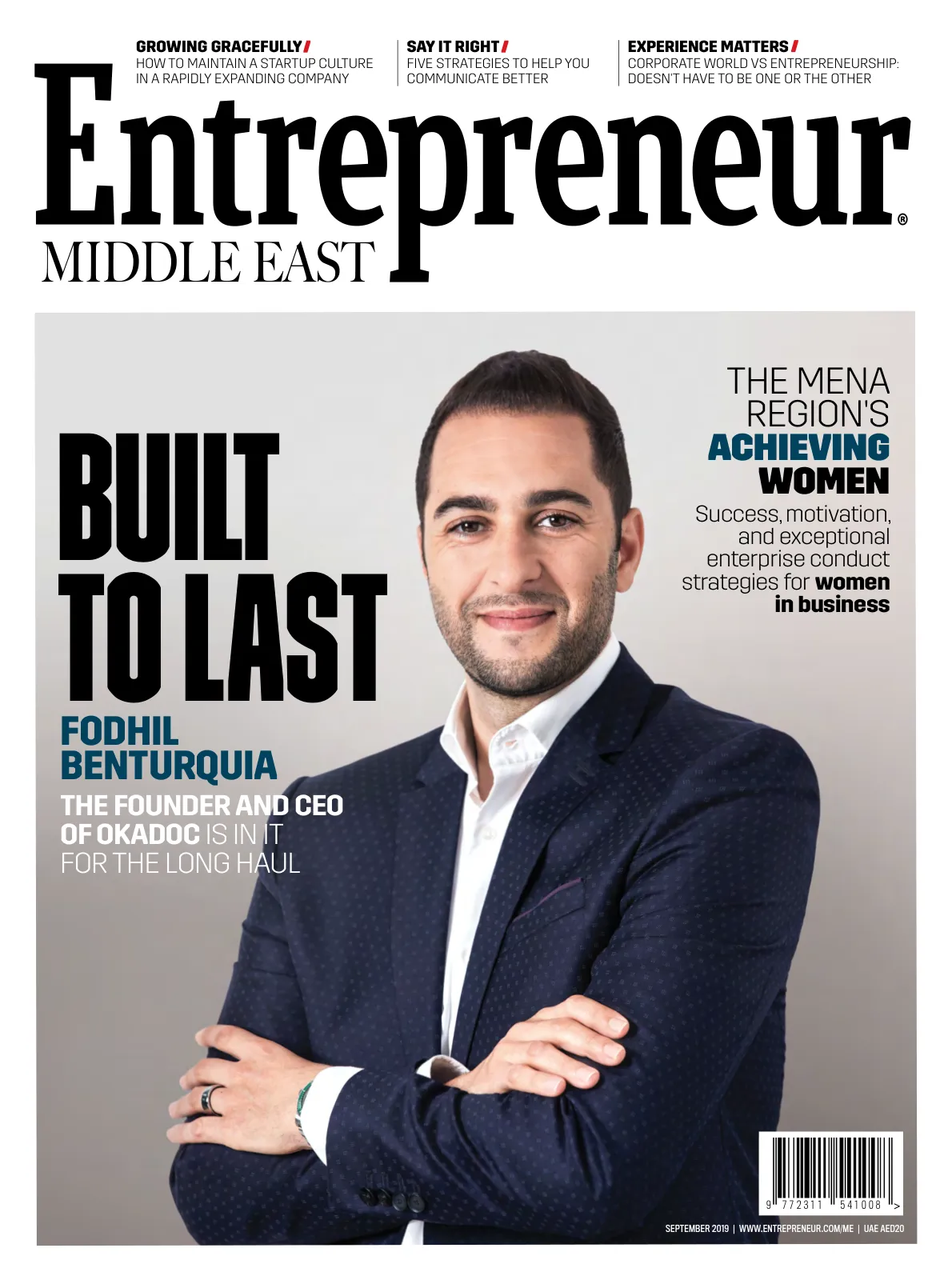
Entrepreneur Middle East, September 2019
Page 1
SEPTEMBER 2019 | WWW.ENTREPRENEUR.COM/ME | UAE AED20
9
7 7 2 3 1 1
5 4 1 0 0 8
>
GROWING GRACEFULLY
HOW TO MAINTAIN A STARTUP CULTURE
IN A RAPIDLY EXPANDING COMPANY
EXPERIENCE MATTERS
CORPORATE WORLD VS ENTREPRENEURSHIP:
DOESN'T HAVE TO BE ONE OR THE OTHER
SAY IT RIGHT
FIVE STRATEGIES TO HELP YOU
COMMUNICATE BETTER
BUILT
TO LAST
THE FOUNDER AND CEO
OF OKADOC IS IN IT
FOR THE LONG HAUL
FODHIL
BENTURQUIA
THE MENA
REGION'S
ACHIEVING
WOMEN
Success, motivation,
and exceptional
enterprise conduct
strategies for women
in business
Page 2
experience
downtown
living
The UAE’s most exciting new destination.
A journey of discovery for the whole family.
Where nature, fun and entertainment
come together.
800-Arada (27232)
arada.com
Page 3
3
September 2019 / ENTREPRENEUR.COM /
24
CONTENTS SEPTEMBER 2019
Fodhil Benturquia,
founder and CEO,
Okadoc
52
21 Hala Badri,
Director General,
Dubai Culture & Arts
Authority
56
INNOVATION FOR
IMPACT
Driven by growth
Megha Merani looks
into the rise of
accelerators, incubators,
and other collaborative
spaces for startups in
Saudi Arabia.
66
CULTURE
LIFE
From despair to
determination
Paul Evans, co-founder and
Managing Director of the
Solutions Leisure Group,
presents his autobiography
“When I Woke Up”.
52
INNOVATOR
BUILT TO LAST
Fodhil Benturquia
The founder and CEO of
Okadoc is in it for the
long haul.
20
INNOVATOR
ACHIEVING WOMEN 2019
ANOUSHEH ANSARI
H.E. MARYAM AL MHEIRI
DEENAH ALHASHEMI
ASIL ATTAR
HALA BADRI
DR. IMAN BIBARS
DALAL BUHEJJI
CAMMIE DUNAWAY
HUDA KATTAN
JO MALONE
NADINE MEZHER
MEDEA NOCENTINI
DINA SIDANI
DR. HAYAT SINDI
MASHAL WAQAR
82
‘TREPONOMICS
PRO
Growing gracefully
Jawanna Sawalha, a PR
specialist at Tamatem,
explains why startup
culture is the place where
employees watch managers
and mirror their actions.
74
‘TREPONOMICS
MARKETING
Say it right
Rapp’s account
management lead Hanna
VanKuiken offers five
strategies to help you
communicate (and
collaborate) better with
your audience.
16
EDITOR’S NOTE
By Aby Sam Thomas
Page 4
Elevate your work
performance.
Get the all-new Samsung Galaxy
Note10+ with our Business
Mobile Plans at zero upfront.
du.ae/note10business
Page 5
Page 6
Page 7
Call: 800 UPSALE | up.ae
*Terms and conditions apply
MOTOR CITY
Own Your Dream Home In Dubai
& Move In Today
Aed 80,000*
30 months
Post-Handover Payment Plan
50% DLD
Fee Waiver
1,2,3,4
Bedroom Apartment
Page 8
Page 9
Page 10
COVER THE CITY
Unlocking the Power
of Digital Signage Advertising
Page 11
WITH YOUR ADS
Visit www.lifeonscreen.com
Page 12
12 / ENTREPRENEUR.COM / September 2019
Anousheh Ansari,
CEO, XPRIZE Foundation
22
CONTENTS SEPTEMBER 2019
62
Rolex Datejust 36
59 Forward KSA startup workshop
ANOUSHEH ANSARI IMAGE © THE COMMONS
77
‘TREPONOMICS
SKILLSET
Experience matters
PDSi’s Managing Director
Dawn Metcalfe highlights the
importance of understanding
that entrepreneurship takes
on many different shapes
and forms.
60
TECH
SHINY
#TamTalksTech
Gadgets and doodads
that you might’ve missed
out on, sourced by a tech
aficionado. Yes, it’s okay
to want them all… and no,
it’s not our fault.
80
START IT UP
Q&A
Ease on demand
UAE startup CAFU offers
on-demand fuel delivery
service, saving time queuing
up at fuel stations.
75
‘TREPONOMICS
PRO
Team work makes the
dream work
Omar Jackson’s alternative
approach to building a team
that defines the success of the
modern-day Berkeley Assets.
64
CULTURE
LIFE
The tao of success
Genny Ghanimeh, founder
of Mind Cloud, on why
entrepreneurs should look
toward realizing lasting
success.
76
‘TREPONOMICS
PRO
Employment as a pathway
to entrepreneurship
Andrew Baird, President
and CEO of Education For
Employment Network,
analyzes the role that first
jobs play in paving the path
for founder success.
Page 13
Page 14
14 / ENTREPRENEUR.COM / September 2019
SUBSCRIBE
Contact subscriptions@bncpublishing.net to receive
Entrepreneur Middle East every issue
EDITOR IN CHIEF Aby Sam Thomas editor@bncpublishing.net
CEO Wissam Younane wissam@bncpublishing.net
DIRECTOR Rabih Najm rabih@bncpublishing.net
CREATIVE LEAD Odette Kahwagi
MANAGING EDITOR Tamara Pupic
STARTUPS SECTION EDITOR Pamella de Leon
EDITORIAL ASSISTANT Junaid Seraj
GROUP SALES DIRECTOR – B2B GROUP Joaquim D’Costa
COLUMNIST Tamara Clarke
PO Box 502511 Dubai, United Arab Emirates
P +971 4 4200 506 | F +971 4 4200 196
For all commercial enquiries related to Entrepreneur Middle East
contact sales@bncpublishing.net
All rights reserved 2019.
Opinions expressed are solely those of the contributors.
Entrepreneur Middle East and all subsidiary publications in the
MENA region are officially licensed exclusively to BNC Publishing
in the MENA region by Entrepreneur Media Inc.
No part of this magazine may be reproduced or transmitted in any
form or by any means without written permission of the publisher.
Printed by United Printing and Publishing
upp.ae
Images used in Entrepreneur Middle East are credited when necessary. Attributed use of
copyrighted images with permission. All images not credited otherwise Shutterstock.
Megha Merani
Fida Chaaban
Farooq Salik
Jawanna Sawalha
Paul Evans
Hanna VanKuiken
Dawn Metcalfe
Omar Jackson
Genny Ghanimeh
Andrew Baird
CONTRIBUTORS
entrepreneur.com/me
ACCESS FRESH CONTENT DAILY ON OUR WEBSITE!
MIDDLE EAST
EntMagazineME
@EntMagazineME
Entrepreneur-me
EntrepreneurMiddleEast
EntMagazineME
EntMagazineME
EntMagazineME
MIDDLE EAST
In addition to our print edition, we’re bringing
you all sorts of industry news on our web
mediums. Joining us online means getting
relevant business and startup content in
real-time, so you’re hearing about the latest
developments as soon as we do. We’re looking
forward to interacting with our readers on all of
our social media and web platforms- like any
thriving business, we’re looking to give and take.
#TrepTalkME is already happening on all of our
digi platforms, and all good conversations go
both ways. See you on the web!
Page 15
ONLINE BANKING,
DESIGNED FOR YOU.
Call 8008NBF(623)
to start our partnership
nbf.ae
NBF Direct
User-friendly
Interface
Secure
Biometric
Access
Easy
Balance
Transfers
Simplified
Trade
Finance
Real-time
Status
Alerts
Customised
Dynamic
Reports
Experience real-time banking at your fingertips
with NBF. Much more secure, convenient and
further simplified using your biometrics to attend
to your personal or corporate banking needs.
Page 16
16 / ENTREPRENEUR.COM / September 2019
Celebrity life… or something “like” it
Noisemakers
Aby Sam Thomas
Editor in Chief
@thisisaby
aby@bncpublishing.net
EDITOR'S NOTE
T
here is an adage of sorts
that gets thrown about
a lot these days, which
is that all of us need to
be “creating content,”
and that all of us need
to be taking advantage
of all the tools at our disposal to
“tell and share stories” with the
world at large. Now, at the face
of it, all of this sounds well and
good, but of late, I’m beginning
to realize an important caveat
is missing in these missives for
entrepreneurs and profession-
als in the social media age. You
see, I believe that we shouldn’t
be promoting just the creation
of content- instead, we should
be promoting the creation of
good content. There is a massive
difference between those two
things- one is just noise that adds
no value to anyone and is either
just throwaway information or, at
best, self-promotional swagger,
while the other is something that
has been thought about, worked
on, and developed with the idea
that it will be of use to someone
else out there.
As entrepreneurs, while
one cannot really deny the
importance of pitching and
presenting yourselves as brands
in your own right, there is a fine
line to be walking when you’re
doing this- after all, in the long
run, rest assured that it’s your
work that will speak for you. As
such, all of the content you put
out there in your name, whether
that be a self-aggrandizing image
on Instagram, or a sanctimonious
comment about anything and
everything on Twitter, all of
that should, I believe, never take
precedence over the business
that you’re trying to develop
and build. At this point, I
should probably state that sure,
everyone is essentially free to
say what they want and when
they want to, but, as a Spider-
Man comic famously once said,
“with great power, comes great
responsibility,” and with that
thought in mind, it’s really not
too much to ask to put some care
and thought into what one is
shouting into these megaphones
on the internet.
In the world we live in today,
I’ve been noticing a seemingly
craven urge among people around
me to put themselves up as
celebrities of a sort, and while I
guess there’s nothing too wrong
about wanting to be famous,
I feel it’s a problem when you
try to achieve this by focusing
on building up your profile and
prominence, as opposed to honing
your talent or work, and letting
that be the vehicle to take you
to the big league. After all, that’s
what matters in the long run-
the good work that you do and
actually put out to the world.
Because everything else is, well,
just noise anyway.
Page 17
CLEMENTINE MALIM
ASSOCIATE - MIDDLE EAST
clementine.malim@savills.me
+971 50 558 2853
WHY SAVILLS
INTERNATIONAL RESIDENTIAL
MIDDLE EAST
international@savills.me
+971 4 365 7700
IN-DEPTH KNOWLEDGE
AND INSIGHT OF THE
CURRENT MARKET
WE ARE ONSITE IN LONDON AND READY TO
TAKE YOU ON AN EXCLUSIVE SITE VISIT WITH
ONLY THE BEST DEVELOPMENTS
LOCALLY AVAILABLE TO HELP NAVIGATE
YOUR INVESTMENT JOURNEY FROM
THE UAE THROUGH TO LONDON
TRIPTYCH
BANKSIDE
KING’S ROAD
PARK
GRAND
UNION
LINCOLN
SQUARE
A SELECTION OF THE FINEST
NEW RESIDENTIAL HOMES
L O N D O N
BATTERSEA
POWER STATION
Page 18
18 / ENTREPRENEUR.COM / September 2019
IN THE LOOP
EMIRATI WOMEN INSPIRE AT EVENT STAGED BY YOUNG ARAB LEADERS
AND DUBAI FUTURE ACADEMY
CELEBRATING EMIRATI WOMEN'S DAY 2019
IMAGE CREDIT YOUNG ARAB LEADERS AND DUBAI FUTURE ACADEMY
Left to right: H.E Manal Ataya, Director General of Sharjah Museums Authority; H.E Najla Al Midfa, CEO of Sharjah
Entrepreneurship Centre and Vice-Chairwoman of Young Arab Leaders; Eng. Suaad Al Shamsi, the first female Emirati
aircraft engineer; and Farah Al Qaissieh, founder of Stutter UAE.
E
ach year, the United
Arab Emirates cel-
ebrates the Emi-
rati Women’s Day
on August 28. This
day was launched
by Sheikha Fatma Bint
Mubarak, Chairwoman of
the General Women’s Union,
Supreme Chairwoman of
the Family Development
Foundation, and President
of the Supreme Council for
Motherhood and Childhood
in 2015 to recognize the
key role of women in the
United Arab Emirates. It is a
national celebration to high-
light the contribution of the
country’s women in advanc-
ing the UAE’s interests and
promoting its initiatives.
From Olympic gold medal-
ists to ministers making vital
decisions and even aspiring
scientists and astronauts
planning to make a trip into
space, women have always
been in the forefront of the
UAE’s culture and society. To
quote the late President and
Founder of the UAE, H.H.
Sheikh Zayed bin Sultan Al
Nahyan: “The woman is half
of the society, any country
which pursues development
should not leave her in pov-
erty or illiteracy. I am on the
woman’s side; I always say
this in order to uphold her
right to work, and partici-
pate in the building process
of her country.”
This year, Young Arab
Leaders and Dubai Future
Academy came together to
honor the groundbreaking
achievements of women
across the Emirates by
organizing a session com-
memorating the fifth
Emirati Women’s Day under
the theme, “Emirati Women:
Icons of Tolerance,” at the
3D Printed Office at Emir-
ates Towers in Dubai. The
session included a panel
discussion with the par-
ticipation of H.E Najla Al
Midfa, CEO of Sharjah En-
trepreneurship Centre and
Vice-Chairwoman of Young
Arab Leaders; Eng. Suaad Al
Shamsi, the first female Emi-
rati aircraft engineer; Farah
Al Qaissieh, the Founder of
Stutter UAE; and H.E Manal
Ataya, Director General of
Sharjah Museums Authority.
During the discussion,
when the speakers were
asked about how the UAE
has empowered and helped
each of them to become who
they are today, Eng. Suaad
Al Shamsi notably shared,
“Both the UAE government
and my mother supported
me, appreciated what I plan
to achieve, respected my
ambitions, and helped me to
make my dreams come true.”
As an engineer working in a
male-dominated sector, Al
Shamsi spoke about being
driven to succeed in her
role. “My experiences made
me realize my weaknesses,
explore my strengths, build
my character, and learn to
balance and focus on what
I need to accomplish,” she
said.
Manal Ataya, Director-
General of Sharjah Muse-
ums Authority, thanked the
event’s organizers for giving
her the privilege of moderat-
ing this discussion panel.
“Listening to these women’s
journeys and experiences
over the past 15 years is
truly motivational and em-
powering for young women,”
Ataya said. “It will inspire
others to seize opportunities
and work hard to assume
their roles in the society.”
Nabra Al Busaidi, Execu-
tive Director of Young Arab
Leaders, added, “We are
fortunate in the UAE for
our wise leadership, who
believes in the capabilities
of Emirati women, and the
importance of empowering
them to enhance their roles
in the sustainable develop-
ment of this nation. The
UAE is a country of endless
possibilities, and the rulers
set an example. The UAE is
eager for young Emiratis to
take advantage of the op-
portunities out there, and
to contribute towards the
society. This makes it a sym-
bol for the region, in proving
that Emirati women are
contributing to the progress
of the UAE and representing
the country regionally and
globally.’’
Page 19
Page 20
20 / ENTREPRENEUR.COM / September 2019
REAPING THE REWARDS
SUCCESS, MOTIVATION, AND
EXCEPTIONAL ENTERPRISE CONDUCT STRATEGIES
FOR WOMEN IN BUSINESS
ANOUSHEH ANSARI
H.E. MARYAM AL MHEIRI
DEENAH ALHASHEMI
ASIL ATTAR
HALA BADRI
DR. IMAN BIBARS
DALAL BUHEJJI
CAMMIE DUNAWAY
HUDA KATTAN
JO MALONE
NADINE MEZHER
MEDEA NOCENTINI
DINA SIDANI
DR. HAYAT SINDI
MASHAL WAQAR
THE MENA
REGION'S
ACHIEVING
WOMEN
20 / ENTREPRENEUR.COM / September 2019
Page 21
21
September 2019 / ENTREPRENEUR.COM /
"AS AN ADVOCATE OF RESEARCH,
PLANNING, AND STRATEGIZING,
I ALSO CONSISTENTLY SEEK
EXCELLENCE AND BEST PRACTICES,
AS WELL AS SET EXPECTATIONS TO
EMPOWER PEOPLE AND MY TEAM
AS A COLLECTIVE, FOR THEM TO
CONSISTENTLY BE AT THEIR BEST,
SO THAT THEY MAY UPLIFT THE
AUTHORITY, AND, CONSEQUENTLY,
DUBAI AND THE UAE AS A WHOLE.”
>>>
HALA BADRI
Director General Dubai Culture & Arts Authority
by ABY SAM THOMAS
THE MENA
REGION'S
ACHIEVING
WOMEN
IMAGE CREDIT HALA BADRI
E
very day is an op
portunity to learn
something new.”
That’s how Hala
Badri chooses to
characterize the
lessons she has
learnt along the way of her
illustrious career, which
has seen the Emirati profes
sional work at prominent
UAE entities like ENOC, du,
Dubai Properties, and AD
NOC, among others, before
settling into her current role
as Director General of Dubai
Culture & Arts Authority
earlier this year. “It is diffi
cult to identify an individual
moment that defined my
current path,” Badri says,
as she reflects on her career
so far. “As someone who is
inspired by and grateful for
everything around me, I have
been blessed with a life full
of moments that inspire me
to surpass my potential. I
regard every experience and
situation I go through as an
opportunity to learn some
thing new. In effect, I am the
result of all my stories and
journeys over the years.”
As someone who has been
consistently lauded for lead
ing teams with creativity and
innovation, Badri seems to
be well placed in her current
role at Dubai Culture, which
was established in 2008
by UAE Vice President and
Prime Minister and Ruler Of
Dubai, H.H. Sheikh Moham
med Bin Rashid Al Maktoum
to position the Emirate as
a “vibrant, global Arabian
metropolis that shapes cul
ture and arts in the region
and the world.” According
to Badri, her aim in this role
is to have Dubai be seen as
“an incubator for creativity
and creative people,” and
that is the ethos with which
she leads her team at Dubai
Culture as well. “Emphasiz
ing team cohesion, and
pushing the team to work
towards strengthening the
creative economy in Dubai
has to be one of the most
important pillars of my
tenure at the Authority,”
she explains. “I believe in
people, and empowering
them to always aim higher,
and think outside the box.
Having a hands-on approach
is integral to my leadership
style, and makes me the
team player that I am. As
an advocate of research,
planning, and strategizing, I
also consistently seek excel
lence and best practices,
as well as set expectations
to empower people and my
team as a collective, for
them to consistently be at
their best, so that they may
uplift the Authority, and,
consequently, Dubai and the
UAE as a whole.”
It should be clear here that
Badri is uninhibited about
her drive and dedication for
the UAE, with her happily
paying credit to the nation
for having enabled all of
what she has achieved so
far. “I grew up inspired by
the guidance of our wise
leadership, inspired by
the vision that they set
in place for this nation,
which instilled me with
the drive to progress upon
my path of development
and accomplishment,”
she declares. “Under the
guidance of H.H. Sheikh
Mohammed bin Rashid
Al Maktoum, we are
privileged to be living in an
environment that supports
and empowers women, and
consolidates their important
roles in society. This is not
only symbolically recognized
and celebrated on Emirati
Women’s Day, but also
through tangible milestones
and results set in place for
them. I am proud to see the
culture domain in the UAE,
driven by leading examples
of thriving women that I
personally look up to, such
as H.H. Sheikha Latifa bint
Mohammed bin Rashid Al
Maktoum, Vice Chairman
of the Board of Directors,
Dubai Culture; H.H. Sheikha
Mariam bint Mohamed bin
Zayed Al Nahyan, the Chair
of the Board of Trustees of
the Abu Dhabi-based Salama
bint Hamdan Al Nahyan
Foundation, who directs the
vision towards art, culture,
heritage, health, and early
childhood development; and
H.E. Noura bint Mohammed
Al Kaabi, UAE’s Minister
Page 22
22 / ENTREPRENEUR.COM / September 2019
ANOUSHEH ANSARI
CEO XPRIZE Foundation
by ABY SAM THOMAS
THE MENA
REGION'S
ACHIEVING
WOMEN
IMAGE CREDIT ANOUSHEH ANSARI
of Culture and Knowledge
Development. Female leaders
in this space have paved the
way to integrating the past
with the present, creating
opportunities for the future.
I strongly believe in the
positive impact that women
in their community can have,
and I am proud that 63% of
Dubai Culture’s workforce
comprises women.”
When I ask Badri for her
advice for professionals in
the entrepreneurial and
business arena, she replies
by sharing insights that have
actually worked for her over
the course of her career. “The
most prominent lesson is the
importance of communica
tion, and the need to establish
a transparent relationship
with those you work with,”
she says. “The human experi
ence is one we should all
treasure, as there is so much
you can learn from the people
around you.” This brings
Badri to her next pointer for
business professionals, which
is about always remember
ing to play well as a team.
“Another lesson was that of
motivation and empower
ment, and how, when shared,
comes back to you ten-fold,”
Badri explains. “Empowering
those around you should be
a necessity, as those same
people you will uplift will
come back to lift you when
you need them most.” On a
personal note though, Badri
is emphatic about the impor
tance of building oneself up to
always be receptive of the op
portunities that are around us
every day. “Of all the lessons
I have retained, however, the
thirst to learn kept my spirit
alive, and encouraged me to
strive to excel at everything
I do,” Badri says. “Keep an
open heart and mind, and
the world will present itself
to you it in its most beautiful
form.”
T
he world as we know it has
recorded only 563 people as
having been to space so far,
and that fact alone is enough to
understand my excitement at
coming face to face with XPRIZE
Foundation CEO Anousheh
Ansari -the world’s first female private
space explorer- at the Abundance 360
(A360) Summit in Dubai earlier this year.
Ansari’s journey to space in 2006 has led
her to being immortalized in history, with
the Iranian American entrepreneur also
forever going to be remembered as the
first Muslim woman in the world to travel
to space. “Going to space was a dream of
mine since I was very, very young,” Ansari
said, as she recounted how she managed
to realize this notable achievement. “I
always imagined, as a young girl in Iran,
that perhaps I would create something,
sort of invent something so amazing that,
you know, NASA would have to take me to
space.” Now, her dreams and ideas about
space back then (bolstered by her fascina
tion with the Star Trek television series)
may not have played a direct role in how
she got aboard a Russian Soyuz rocket
to spend a few days at the International
Space Station- but it’s certainly safe to say
that they did lay the foundation of Ansari’s
foray into space in the long run.
Ansari has had a rather circuitous route
to get to space. After migrating to the
United States from Iran in 1984 at the age
of 16, she went on to secure an education
in electrical engineering (she remembers
being one of the few women in her classes
then), following which she started her
career at the now-defunct American tele
com firm MCI, which was where she also
met her husband, Hamid. In 1993, Ansari,
along with her husband and brother-in-
law Amir, founded Telecom Technologies
Inc., a technology provider for telecom
companies, which was acquired by Sonus
Networks (a global leader in secure and
intelligent cloud communications, now
called Ribbon Communications) for about
US$750 million in 2003. Now, through all
of these years, Ansari’s dreams to explore
space might have taken a backseat- but
they remained in her mind all the same,
and it was the sale of her company that
Page 23
23
September 2019 / ENTREPRENEUR.COM /
THE MENA
REGION'S
ACHIEVING
WOMEN
"I HAVE BEEN A SPOKESPER-
SON, A BOARD MEMBER, AN
ADVOCATE, A SPONSOR, AND
ONE OF XPRIZE’S BIGGEST
FANS, AND I AM GRATEFUL FOR
THE OPPORTUNITY TO WORK
WITH SUCH A PASSIONATE
GROUP OF INDIVIDUALS
DEDICATED TO CHANGING THE
WORLD FOR THE BETTER.”
Anousheh Ansari,
CEO, XPRIZE Foundation
>>>
allowed her the time to
revisit those ambitions. “I
always had this desire and
this feeling that I need to
somehow find my way back
to space,” she told me. “And
when we sold our company,
it was my first opportunity,
where I went back to school,
started studying astronomy
again, and I started looking
for how would I make this
[dream] happen. And as I
was searching for a solution,
the universe brought me to
Peter [Diamandis, founder
of the XPRIZE Foundation],
and the Ansari XPRIZE was
launched out of it.”
As a non-profit organiza
tion, the XPRIZE Foundation
is today known for launching
global competitions that aim
to spur the development of
technological innovations
for the good of humanity.
However, back when Ansari
first met Diamandis, XPRIZE
was in its very early days,
but the two found common
ground in their pursuit
of moonshots- and space
exploration was something
they were both very keen on.
At that time in the US, space
travel was considered to be
exclusively a government
affair, and, as the XPRIZE
website notes, “space explo
ration for the private sector
was neither possible nor af
fordable.” Ansari wanted to
turn this around, of course,
and it was her association
with Diamandis that led to
her and her family sponsor
ing the first competition
under the XPRIZE banner,
the $10million Ansari
XPRIZE, which was aimed
at enabling “the creation
of a reliable, reusable,
privately financed, manned
spaceship.” In 2004, the
winner of this prize ended
up being a company called
Mojave Aerospace Ventures,
with its technology later
getting licensed by legend
ary entrepreneur Richard
Branson to establish Virgin
Galactic- this competition is
thus said to have essentially
kickstarted the creation of
the $2 billion private space
industry.
“What was very significant
was the fact that a $10 mil
lion prize attracted a hun
dred million in an invest
ment from teams across the
globe,” Ansari recalls. “And
then an industry that was
going to be worth about hun
dreds of billions of dollars
was created out of it.” Now,
it was around this time that
the term “space tourism”
also started to get thrown
about- American millionaire
Dennis Tito had already
made headlines in 2001 by
paying private space flight
company Space Adventures
to fly him to (and spend
time in) space. In February
2006, Ansari secured an
opportunity to serve as the
back-up for Japanese busi
nessman Daisuke Enomoto
on a Space Adventures flight
to the International Space
Station. In August that same
year, Enomoto was medically
disqualified for the trip, and
Ansari got to occupy the
space that had now become
available on this particular
flight. With that, on Septem
ber 18, 2006, Ansari found
herself being a part of the
Expedition 14 crew of the
Soyuz TMA-9, which blasted
into space for an eight-day
expedition aboard the Inter
national Space Station.
For someone who was
realizing a lifelong dream,
Ansari likens her experience
of being in space as a sort
of homecoming- space, she
says, felt like where she was
always meant to be. “The
experience is transforma
tional in many different
ways,” Ansari says. “When
you see earth from space,
you sort of can put things in
a new perspective. So, you
shift your priorities. And you
become all of a sudden, if
you weren't already, you've
become more of a global
person, where you see our
planet as just one home, one
planet. There is no separa
tion between anyone living
on the planet, and problems
and opportunities become
global. So, when I returned,
anything that I worked on,
I could not just narrow it
down to one location; it had
to be global, at a global scale.
And also, your priorities and
your relationships with the
environment, with your fam
ily, with what's important
in life, changes, because you
also realize the fragility of
our lives, and our planet,
and our environment… It's
like time and space come
to have a different meaning
for you. You start thinking
about, well, what's impor
tant in life. You know, who's
important for me to connect
to, and you start thinking
about your purpose more
than ever, and how you want
to spend the rest of your
life.”
Page 24
24 / ENTREPRENEUR.COM / September 2019
“I ALWAYS IMAGINED, AS
A YOUNG GIRL IN IRAN,
THAT PERHAPS I WOULD
CREATE SOMETHING, SORT
OF INVENT SOMETHING SO
AMAZING THAT, YOU KNOW,
NASA WOULD HAVE TO
TAKE ME TO SPACE.”
IMAGE CREDIT ANOUSHEH ANSARI
Anousheh Ansari, CEO, XPRIZE Foundation
at the Abundance 360 Summit in Dubai
THE MENA
REGION'S
ACHIEVING
WOMEN
After Ansari returned from
space, she found herself
making use of her entre
preneurial chops as one of
the co-founders of Prodea
Systems, which she had once
again launched with her
family, incidentally on the
very day she shot off to space
in 2006. In her role at the
helm of a company that bills
itself today as “disrupting
the internet of things mar
ket,” Ansari believes she was
tapping into the lessons she
had learned from her trip to
space, wherein everything
she worked on had to be
not only cutting-edge, but
also to look at solving global
problems. One can safely
say that this was the same
ideology that governed her
move into her latest role- in
2018, Diamandis and the
board of directors at XPRIZE
(of which she had been a
member as well) asked her
to become the entity’s CEO.
In a statement released
about her appointment, An
sari noted, “As I take on the
helm at XPRIZE, I feel the
same exhilaration as I did
the day I was sitting in my
capsule atop of my Russian
Soyuz rocket– waiting impa
tiently to be launched into
the infinity of the universe
that I had dreamed about
as a child, and in nervous
anticipation of the enormous
possibilities in front of me.
I have been a spokesperson,
a board member, an advo
cate, a sponsor, and one of
XPRIZE’s biggest fans, and I
am grateful for the opportu
nity to work with such a pas
sionate group of individuals
dedicated to changing the
world for the better.”
For all of the outstanding
achievements she has had
so far, Ansari remains well
aware that she, as a woman
in the technology space, is
still in the minority in this
particular field- it’s some
thing that she has noted ever
since she was one of the few
women in her engineering
classes at university. “As a
tech entrepreneur, the sub
ject of woman in technology
is very important for me,”
she says. “We're at A360
here, and, with Peter and
everyone talking about ex
ponential technologies, and
how it would transform our
world, and I've been in those
rooms, where these tech
nologies are designed and
discussed, and there are not
that many women in there.
And the possibility of using
all these technologies for
the detriment of humanity
is very high. The first use of
many of these technologies
are in military use. However,
I know that for sure, because
I've sat at those tables, and
I've seen other women sit at
those tables, when there is
a woman at the table, they
try to look for opportunities
to use these technologies,
design these technologies, for
good. And that's why I want
more women in technology,
and that's why I want more
women in these boardrooms,
making decisions that will
shift the direction of these
technologies for good. And
frankly, that's why I left
Prodea, and I am at XPRIZE,
because I was trying to figure
out how can I have an impact
on how these technologies
get developed. It was like
Page 25
25
September 2019 / ENTREPRENEUR.COM /
"IF YOU KEEP YOUR EYES ON
THE TARGET, AND THEN JUST BE
FLEXIBLE WITH HOW YOU GET
THERE, YOU'LL EVENTUALLY GET
THERE. AND SPACE WAS ONE OF
THOSE THINGS FOR ME."
THE MENA
REGION'S
ACHIEVING
WOMEN
amazing, at the same time,
when I got the offer to from
the board of XPRIZE to join
XPRIZE as the CEO. I'm like,
this is the perfect platform,
because we're all about using
the power of exponential
technologies to solve grand
challenges, and this is how
I can have an impact, and
hope to shift the direction
of the development and
advancement of these tech
nologies, for the betterment
of humanity.”
It should be quite appar
ent here as to why Ansari
is considered a role model
by people around the globe,
and especially so for women
and girls in the world today.
While Ansari claims that she
never set out to have this
kind of influence, she also
understands the significance
and responsibility she has
in this respect. “To be hon
est with you, whatever I
did was not to become the
first of this, or first of that,”
Ansari says. “But I also
know, especially for young
girls, how important role
models are. So, for a young
girl to say, ‘I want to be like
her,’ it will help her develop
a plan together. And they're
not that many, you know,
women role models in tech.
Unfortunately, you see all
these other types of women
role models, who should
not be a role model at all, in
entertainment and certain
industries, they're sort of
put on a pedestal. So instead
of young girls wanting to be
like, you know, me or other
woman astronauts, other
woman scientists, who have
made a big difference, they
see these other options. So,
for me, what's important
is, you know, if my story
and my life can serve as an
example for a young girl to
choose a path that will be
in science and technology,
that would be a great honor.
I go talk at a lot of schools,
especially younger girls who
are more impressionable,
and you can leave a lasting
impact. And I've been doing
this now long enough that I
actually meet young girls at
events, and they come to me
saying, ‘Oh, you came to my
high school, and you talked,
and you inspired me, and
I'm like getting my engineer
ing degrees in this, or I am
getting my aeronautic engi
neering degree now, or I am
working for SpaceX…’ And
I'm like, this is amazing, it
gives me goosebumps every
time I hear them talk about
that. It's always fun to see
someone like that.”
As someone who realized a
dream that she had made in
her childhood (and let’s not
forget how unreal that dream
might have been to Ansari
at that age and time), I ask
her how the rest of us can
follow her lead in terms of
going after those impossible
goals that we may have set
for ourselves at one point
in time or the other. “I tell
all entrepreneurs [that] you
sort of have to figure out
where you want to go, but
you can never plot an exact
path to get there,” Ansari
replies. “You have to be very
flexible, look for opportuni
ties, just go with the flow,
and take advantage of what
life throws at you to get to
your destination. But you
need to keep your eye on the
target. If you take your eyes
off the target, then you'll get
lost. But if you keep your
eyes on the target, and then
just be flexible with how you
get there, you'll eventually
get there. And space was one
of those things for me. I kept
my eye on the target. I came
across opportunities, I took
them one by one, and they
eventually got me to where I
wanted to go.”
When it comes to women
in this part of the world, An
sari is emphatic about how
societal standards on them
need to change for them to
prosper further. “Women
are brought up to be perfect
girls, perfect wives, perfect
sisters, and perfect daugh
ters… And being perfect
in all those aspects, and
[that often means] putting
yourself second, and, I guess
for the lack of a better word,
being submissive to the
needs of others. It really cre
ates a burden on women, and
especially if you want to try
new things. For a woman en
trepreneur, because they've
been brought up to think
they have to be perfect, so
[they believe] they can't fail.
And at the core of entrepre
neurship is failure. So, if you
think you cannot fail, you
won't try things, you won't
try things that you may fail
at. Or you would practice
in private forever until you
come out, which means that
you're not learning from
anyone, no one can help you
succeed at what you want
to do… So, support from
parents, encouragement that
it's okay for you not to be
perfect, and you can fail, and
we still love you, and we'll
still support you. And espe
cially for married women in
the region, [it’s important
for them] to have the sup
port of their husbands to
share the burden of running
a household, taking care of
the kids, which is unheard
of sometimes in this region.
It's important to allow the
woman to flourish, and to
explore new possibilities. I'm
hoping, maybe like another
generation or two before we
get there, but I see signs that
it is moving in that direction,
and it gives me hope.”
At this point, I also ask An
sari what her advice would
be to some young girl, out
here in the Middle East, who
might be dreaming as big as
Ansari herself did, once upon
a time, out of this particular
region as well. “My message
for that little girl is don't
give up on your dreams,” An
sari says. “That's the most
important thing, because the
rest, you'll figure out. But if
you give up on your dream,
you will never know [how it
could have been realized],
and you will never figure
it out. But whatever your
dream is, never give up on it.
And keep it like a sacred sort
of source of power inside of
you. Tap into it, let yourself
dream about that every night
you go to bed, let yourself
read about it, have little
reminders around you. Even
if your life takes a different
turn and you sort of end up
someplace completely differ
ent from where you thought
you would be or wanted to
be, don't let that stop you
from dreaming it, because
eventually, you'll find your
path back to it.”
Page 26
26 / ENTREPRENEUR.COM / September 2019
“I THINK THAT THERE
WILL BE AN EVEN BIGGER
SHIFT IN THE WORLD, AND
PEOPLE WILL NEED TO BE
VULNERABLE ENOUGH
TO BE ABLE TO EXPOSE
THEIR IMPERFECTIONS IN
A WAY THAT CAN BE VERY
CHALLENGING."
"GETTING OUR
INVESTMENT MEANT
THAT WE WERE
NOW GOOD ENOUGH,
AND IT MADE ME
QUESTION TO WHOM
I WAS TRYING TO
PROVE IT."
HUDA KATTAN
Founder and CEO Huda Beauty
by TAMARA PUPIC
PHOTOGRAPHY FAROOQ SALIQ
THE MENA
REGION'S
ACHIEVING
WOMEN
Up until now, Huda has
used a makeup brush as
an empowerment tool to
guide women on how to
paint their own stories of
betterment on their own
faces. Over almost a decade,
with the aid of her sisters
Mona and Alya Kattan, her
brainchild Huda Beauty
has grown from a blog to
a beauty brand that now
offers 213 products across
five categories (complex
ion, lips, eyes, body, and
tools), the newly-launched
sub-brand Kayali, while
an arsenal of the brand’s
skincare products is also in
the works. However, what
makes the story of Huda
Beauty extraordinary is that
Huda is now willing to take
all those layers of makeup
off, confront her insecuri
ties, and learn how to feel
truly confident inside- while
sharing it all with her 40
million and more followers,
of course. “A lot of issues
from my childhood were
driving me, and I had no
idea,” she says, adding that
she has been working with
a life coach over the last
couple of years. “I never felt
like I belonged in society,
I never felt really comfort
able in my own skin, and
there are literally billions
of people who feel like that.
However, I never understood
that it was the thing that
gave me my drive, that I
always wanted to prove that
I was good enough.”
A turning point for Huda
(and Huda Beauty) hap
pened in 2017 when the
Kattan family agreed to sell
a small stake in the business
to TSG Consumer Partners,
a San Francisco headquar
tered private equity firm
focused exclusively on the
branded consumer sector. It
was a positive change that
hard work and persever
ance had brought to Huda
Kattan, but surprisingly, it
also uncovered that, in her
mind, she was partially still
a person she used to be: an
American-born daughter of
Iraqi immigrants exposed
to daily bullying due to
her ethnicity. “Getting our
investment meant that we
were now good enough,
and it made me question to
whom I was trying to prove
it,” she says. “I actually
went through a lot of getting
to know myself after that
happened. It’s crazy, because
you think it’s the best thing
that could ever happen, but
I’ve heard it from so many
of our friends, and it is that
after they get these crazy
valuations and crazy invest
ments, they hit rock bottom,
because all of a sudden, they
realize that they have been
doing everything for society,
and never for themselves.
And then, they have to ques
tion themselves, like, ‘Why
do I actually care?’ and that
is such a hard conversation
to have with yourself.”
In opening up on this
topic, Huda proved that she
is a part of the millennial
I
n person, Huda Kattan, the driving force behind
one of today’s fastest-growing beauty brands, Huda
Beauty, radiates steely self-assurance. Not that I have
expected anything different from a woman who is cur
rently ranked 36 on Forbes’ list of “America’s Richest
Self-Made Women.” Sitting beside me at the brand’s
headquarters in Dubai, she looks as striking as ever-
the abundant curls of black hair frame her flawless face,
complete with immaculate makeup, and she is dressed for
not just any but exactly the type of success she wants in a
sequined power suit. And, during the interview, she wants to
broach the topic I least expect. “When you hit a certain level
of success, you realize that it can cause some really serious
issues to come up,” Huda says. “And if you don’t find the
right way to deal with it, it could make you very depressed,
very purposeless. It’s scary.”
Page 27
27
September 2019 / ENTREPRENEUR.COM /
NADINE MEZHER
Co-founder and CMO Sarwa
by PAMELLA DE LEON
IMAGE CREDIT SARWA
Nadine Mezhar,
co-founder & CMO, Sarwa
THE MENA
REGION'S
ACHIEVING
WOMEN
generation that is prioritiz
ing purpose over profits-
according to Deloitte’s
2018 Millennial Survey,
80% of millennials believe
businesses should make a
positive impact on society
and the environment. On
her part, Huda is eager to
inspire an honest dialogue
around different self-
confidence related personal
challenges. “They [millen
nials] want to buy from
brands that are sustainable
because they want to be a
part of the companies that
are doing something good
for this world,” she says.
“I think that there will be
an even bigger shift in the
world, and people will need
to be vulnerable enough
to be able to expose their
imperfections in a way that
can be very challenging. It’s
really hard to actually say,
‘I don’t love myself enough,’
but it’s such an important
conversation to have, be
cause you can only get over
those things when you start
talking about them. People
see me from the outside,
all this hair and makeup
and our glamour team that
does all this stuff, and think
I cannot not feel self-love,
but I do, and I see it in other
people. It’s like a wound that
they carry with themselves.”
Her wound, which she
described to us as the ugly
child syndrome, inspired
her passion for cosmetics,
turned her into an expert
on beauty products, and be
came the main pillar of her
brand. “The heartbeat of the
company is definitely that
transformational idea, the
idea that you can transform,
and be beautiful,” Huda
explains. “The vision of the
company is definitely to
allow people to understand
their capabilities, and how
far they can go.”
E
very enterprise has a moment
that sparked its creation. For
Nadine Mezher, it was the
realization that “the traditional
financial industry was not de
signed to be fair. It was designed
to make money for the ones that
can afford it.” Mezher saw firsthand how
a close relative who, after working for 40
years in Kuwait, came to Dubai to put
part of his savings in MENA real estate,
with the intention of investing the rest.
Though it was a decent sum, Dubai-based
financial advisors with whom he consulted
expressed disinterest, and felt it was too
small for their minimum requirements.
“You have so many more stories like that,
and you quickly realize that the story
needs to change,” Mezher says. At the
same time, Mark Chahwan and Jad Sayegh,
both based in Canada then, were familiar
with how robo-advisors were transforming
the wealth industry by reducing fees and
account minimums, and they noticed that
the Middle East lacked access to financial
services to allow everyone to invest. They
started developing the idea in 2016, and
contacted Mezher, who was in Dubai then,
through common friends to understand
the market. Around that time, Dubai
International Financial Centre (DIFC)
announced the launch of the region’s first
fintech accelerator, DIFC FinTech Hive,
and that led to September 2017, when,
with the support of the accelerator, they
joined forces to launch Sarwa, a regulated
hybrid robo-advisor in the region catering
to young professionals, with a lowered
minimum of US$500 to open up an ac
count.
With the mission to change the mindset
that investing is a luxury by making it
inclusive and accessible, Sarwa makes
investing simple and affordable by com
bining proven investment strategies with
technology to drive down costs- meaning
Page 28
28 / ENTREPRENEUR.COM / September 2019
“WE DO A JOB SO WELL, AND WORK SO
HARD, AND EXPECT THAT SOMEONE WILL
NOTICE, AND PUT A TIARA ON OUR HEADS…
UNFORTUNATELY, THIS DOES NOT HAPPEN.
YOU HAVE TO VOICE YOUR VALUE.”
Nadine Mezher, co-founder and CMO, Sarwa,
on the most common misconceptions when
it comes to finance and investing
QUICK TAKES
1. “I don’t have enough information. It sounds too
complicated.”
“Sarwa believes in democratizing investment and mak-
ing it inclusive and accessible. This is why we launched
a series of educational content that showcases
actionable lessons learned from the personal finance
journeys of interesting individuals: from community
icons to innovators, entrepreneurs to ambitious profes-
sionals. We also have videos on the 101 of investing
and most asked questions to show how easy it is to
just start. The near unanimous answer we get when we
ask about the reason for not investing is: ‘I don’t know
how to start.’ And this is how we are tackling this. There
is a lot of information in there about the dos and don’ts
and it is just done in a way that speaks to everyone, and
removes all the jargon and scary words that traditional
advisors would use to make it sound complicated.”
2. “I don’t have enough money.”
“Traditionally, investment firms often required a very
high minimum and came with a lot of charges that
impact bottom line, such as maintenance fees, annual
fees, and even account-closing fees. A platform like
Sarwa allows you to start with just $500 and has an
annual fee of only 0.85% of your account- and none
of the other surprise charges. This makes investing a
lot more accessible for new investors and seasoned
investors alike.”
3. “I want to wait for the perfect time/perfect
investment to start.”
“Waiting for the ‘best’ time to invest is rarely a suc-
cessful strategy. For investors seeking to grow wealth
over the long term, the best approach is almost always
to just start investing right away. Statistics and data
show over and over again that no one can consistently
time the market. It’s not a winning game. Waiting for the
perfect moment is worse than bad timing. In fact, the
data shows that ‘badly-timed’ investments in stocks
are better than making no investments at all. Diversify-
ing investment is the best strategy, whether it’s your
first investment or you are savvy investor. If you feel
passionate about one product, or you really want to
invest in your friend’s idea, use a very small percentage
of your savings to do so, to ‘gamble’ with. But make sure
that the bulk of your investments goes to a fully diversi-
fied portfolio. The old adage, ‘time in the market is better
than timing the market,’ holds true, and the best time to
start is now!”
THE MENA
REGION'S
ACHIEVING
WOMEN
lessened maintenance fees
and reduced minimum
requirements. “We help
our clients build their
wealth with a personalized,
low-cost, diversified port
folio and provide access to
on-demand investment ex
perts,” says Mezher. The co-
founders hail from a wide
background: CEO Chahwan
has worked in consulting for
Canada’s financial institu
tions as part of Accenture
Strategy’s Financial Services
practice, as well as in asset
management at pension
fund company Caisse de de
pot et placement du Quebec,
while CTO Sayegh brings in
his experience building soft
ware systems at hedge fund
Vigilant Global, ranging from
cloud-based distributed
services to data visualiza
tion and web applications
focused on user experienced,
and CMO Mezher comes
from a multi-disciplinary
background of consulting in
retail strategy with clients
including the Office of H.H.
The Crown Prince of Dubai,
OSN, and Nestle, as well as
stints in Dubai Tourism and
Commerce Marketing.
There’s a certain pressure
that is innate on one’s path
to success, and Mezher is
open about pressures she
has faced, especially point
ing towards the Tiara Syn
drome, which she defines
as when “we do a job so
well, and work so hard, and
expect that someone will no
tice, and put a tiara on our
heads… Unfortunately, this
does not happen. You have
to voice your value.” Mezher
also states how it’s not just
a culture or region-specific
problem as women in busi
nesses are currently at a mi
nority, especially at a senior
management level. “Men
have more affinity with men,
and unconscious bias de
velop out of that, and out of
the values that are ingrained
in us from childhood. There
are certain stereotypes that
society boxes us in, and we
also box ourselves in. It only
takes awareness to start
seeing changes.” She recalls
having her focus questioned
as she’s a mother, when in
fact, she says, motherhood
has allowed her to learn how
to efficiently manage time
and people. “I feel like I can
do anything now! I used to
listen to these voices. Now,
I wear the fact that I am
a working mom proudly,
and I would not change a
thing.” Obstacles to success,
whether due to internal or
external factors, are always
present, and the best thing
you can do for yourself,
Mezher says, is surrounding
yourself with people who
inspire you, make you grow
as an individual, but most
importantly, remember that
you are your biggest sup
porter.
This personal intention
of taking charge of one’s
continuous growth is also
evident in her enterprise-
Mezher is keen to clear up
people’s aversion to invest
ments, encouraging people
to seek out advice and
develop confidence to make
Page 29
29
September 2019 / ENTREPRENEUR.COM /
Sarwa team
THE MENA
REGION'S
ACHIEVING
WOMEN
better finance decisions.
Sarwa’s onboarding process
indicates a simple procedure
that determines your initial
risk profile, after which you
are given a recommended
portfolio that is based on
your financial goals and
other personal factors that
will be adjusted as you ma
ture as an investor. With its
fees starting at 0.85%, and
0.5% for larger accounts,
and no entry, withdrawal,
or exit fees, the platform
allows users to have different
account types -conventional,
joint account, halal and
Socially Responsible Invest
ment (SRI) portfolios- and
offers on demand advice
with a financial advisor and
customer support. Users can
also be assured of a secured
account: “Since Sarwa works
with a brokerage firm/custo
dian bank called Interactive
Brokers based in the US, all
accounts are insured by SIPC
for up to $500,000 in cash
and securities, including up
to $250,000 in cash. We
also use state-of-the-art
security measures, are regu
lated by the DFSA, and are
backed by top regional and
international VCs.”
The startup’s growth is
striking- they currently have
around 10,000 registered
users and a client database
growing at a 25-30%
month-over-month rate.
It raised a seed round with
angel investors at its incep
tion, after which Shorooq
Investments joined as a VC,
followed by a pre-series A
bridge round in September
2018 joined by MEVP, 500
Startups, Women’s Angel
Investor Network, Hala Ven
tures and Saned Partners,
bringing the startup’s total
funding to over $1.5 million,
according to Mezher. In the
coming months, besides
growing their market base,
and with the lack of formal
pension funds for UAE
expats, Sarwa aims to work
with the corporate sector
to offer employees savings
scheme plans and extend
its offering from individuals
to companies. “We are on a
mission to make investing
super easy and accessible for
all young professionals in the
Middle East, allowing them
to get expert advice and
reach their financial goals,
whatever they are,” she says.
“We’re planning on going
above and beyond to help
them achieve their goals by
partnering with leading plat
forms and service providers,
and continue improving
our products, platform, and
clients’ experience.”
Mezher describes her entre
preneurial journey in two
words: ups and downs. She
comments that growth starts
from focusing and building
on small victories by leverag
ing the power of your team.
It also helps to put in place
proper corporate governance
from the get-go, as stream
lined operations can help
the productivity of you and
your team. To aspiring ‘treps,
Mezher advises that it’s
worth looking into your in
dustry and community when
you are thinking of launching
a business- similar to the
support they’ve received
from FinTech Hive. And
just like investing, Mezher
advises that when it comes to
business, just start. “Keep in
mind though that a great idea
does not necessary translate
into a great business. Find an
idea that you believe solves a
problem, a need in the mar
ket and then equip yourself
with focus, patience and a
business mind that keeps you
on track to implement the
best practices of corporate
governance.”
Page 30
30 / ENTREPRENEUR.COM / September 2019
CAMMIE DUNAWAY
Chief Marketing Officer Duolingo
by PAMELLA DE LEON
IMAGE CREDIT DUOLINGO
DUOLINGO SCALED TO
OVER 300 MILLION TOTAL
LEARNERS WITHOUT ANY
PAID MARKETING- A RARE
FEAT FOR COMPANIES TO
ACHIEVE, BUT ONE THAT
SPEAKS OF THE STARTUP’S
ORGANIC USER ACQUISITION
THROUGH STRONG PR AND
WORD OF MOUTH.
THE MENA
REGION'S
ACHIEVING
WOMEN
One of the leading executive
forces of this fast-growing
tech education venture
is Chief Marketing Of
ficer, Cammie Dunaway.
Dunaway’s path to the
startup world after years
of ascending the corporate
ladder may seem to be an
unexpected leap, but one
that she describes as a natu
ral transition. With more
than 25 years of experience
as a seasoned executive,
Dunaway has led marketing
and general management
of prominent brands such
as Frito-Lay (an American
subsidiary of PepsiCo which
manufactures snack foods)
in various sales and market
ing positions, Nintendo as
Executive VP of Sales and
Marketing, followed by Ya
hoo! as CMO, and KidZania
as US President and Global
CMO, besides being on the
public board of directors
of various entities. With a
business administration de
gree from the University of
Richmond and an MBA from
Harvard Business School,
the American marketer’s
background spreads across
digital, consumer products,
entertainment, technology
and retail industries.
So, what prompted her
jump to a startup venture?
“I wanted to put my heart
and my energy into helping
grow a company that makes
a difference in the world,
and it’s important for me
to work with people who
are smart and passionate,”
Dunaway replies. “Duolingo
has both of those qualities
in spade.” The venture’s
mission of making educa
tion free and accessible for
everyone was a major factor
towards her decision- in
fact, in July last year, she
was Duolingo’s first official
marketing hire since its
launch in 2011, an indica
tion that the tech education
venture is ready to boost
its marketing efforts. The
CMO now leads a team of
11 people across marketing,
PR, and community, who are
working towards the lofty
goal of making Duolingo a
household name. Working
in a startup comes with
key differences compared
to larger companies, and
Dunaway calls it a reward
ing experience, particularly
the culture of encouraging
innovation amongst em
ployees at all levels of the
company. “When someone
has a good idea for a new
feature or product, there are
real opportunities for those
ideas to be heard, and ulti
mately, implemented,” says
Dunaway. “In general, things
move much faster here,
relative to larger companies
with more complex team
structures and organiza
tions.”
Valued at US$700 million,
Duolingo has raised $108.3
million, with its most recent
funding round being Series
E in July 2017, according
to its releases. Duolingo’s
revenue in 2018 was US$36
million, with 2017’s revenue
at $13 million, and its inves
tors including Union Square
Ventures, Kleiner Perkins,
NEA, Capital G (formerly
Google Capital), Drive Capi
tal, Ashton Kutcher, and
Tim Ferris. It offers over 30
language courses, including
Latin, Navajo and Gaelic,
as well as two fictional
languages (Klingon from
I
f you’ve ever received push notifications such as,
“Learning a language requires a little practice every
day,” to “These reminders don’t seem to be work
ing. We’ll stop sending them for now,” and finally
to “You made Duo sad,” then you would probably
know about Duolingo, a renowned US-headquartered
language-learning platform known for heavily utiliz
ing gamification to engage users, which includes everyone
from Bill Gates and Jack Dorsey, to Syrian refugees in
Turkey and Jordan. Downloaded by more than 300 million
people globally, that plump green owl, the startup’s iconic
mascot, is determined that you continue to learn your
chosen languages, even inspiring Internet memes based on
its persistent notifications for you to study.
Page 31
31
September 2019 / ENTREPRENEUR.COM /
“MANY TIMES, I WAS TEMPTED TO LOWER
THE BAR JUST A LITTLE, BUT THE AMAZING
TEAM I HAVE ASSEMBLED HAS TAUGHT ME
THE VALUE OF PATIENCE AND PERSISTENCE.”
Duolingo office
THE MENA
REGION'S
ACHIEVING
WOMEN
>>>
the Star Trek universe and
High Valyrian from HBO-hit
Game of Thrones), recruiting
the help of volunteers to
help produce more courses.
With 180 employees, the
enterprise has debuted
a partnership with live
streaming gaming platform
Twitch, wherein selected
multilingual streamers help
you learn a language faster,
bringing another immer
sion experience to study
a language. Plus, it also
recently launched the Arabic
course for English speakers,
along with more courses
for Arabic speakers, which
Dunaway says, has proved to
be extremely popular, as it
reportedly reached over half
a million learners within
less than two months of
launching.
Dunaway points out that
Duolingo scaled to over
300 million total learners
without any paid marketing-
a rare feat for companies to
achieve, but one that speaks
of the startup’s organic user
acquisition through strong
PR and word of mouth.
Since joining the team,
Dunaway comments that
she’s been focused on three
aspects. First, on brand
ing and marketing, which
included creating a set of
unified and consistent brand
guidelines. Since Duolingo
has only recently begun
to do marketing, Dunaway
states that the challenge
is in educating people
internally about topics like
brand positioning, and how
components of marketing
are executed and measured,
among others. Second is on
performance marketing to
boost their efforts in paid
user acquisition, particularly
on Facebook and Instagram;
and finally, on international
expansion, which kicked off
with hiring key marketing
managers in vital markets
like the UK, China, and
most recently, Mexico, all of
whom have brought localized
knowledge and expertise.
As someone with her ex
perience and role, Dunaway
points out that throughout
her career, there’s been one
element that guided her
along. “One principle that
has served me well is to re
sist the strong pull of other
people’s expectations and
definitions of success, and
try to stay centered on the
true north of who I am, and
what is most important to
me right now,” she reveals.
“At critical times, I stop to
ask myself what my heart
would regret if I looked back
a year from now, and it had
not happened.” She also re
calls that at the beginning of
her career, she aimed to “get
as far as I could, as fast as I
could.” While at other points
of her career, she sought role
models, challenging assign
ments, as well as shifted her
goals around to balance fam
ily and work. At one point,
she also worked part-time
to help her husband start a
business, and at another, she
took a summer off to make a
cross-country trip with her
family. With these experi
ences behind her, Dunaway
offers this advice for women
in business: “It is helpful to
recognize that your career
is a journey, and it is okay
for your goals to shift along
the way. Have the courage to
follow what your heart tells
you to do.”
The CMO is also candid
on how her leadership style
has evolved. As someone
who went to Harvard Busi
ness School in the late 80s,
she admits that they were
then taught that leaders
were “strong and decisive,”
and that they should speak
with confidence and know
how to invigorate a room to
achieve their goals. “Early
in my career, I tried to sup
press my natural empathetic
style, and prioritize logic
over emotions,” she recalls.
As her career progressed,
she learned to reflect the
bosses who inspired her best
performance. “I started to
realize it was okay to bring
my heart to work. I started
to observe that when people
feel cared for, they are more
innovative and produce
better results… Today, my
greatest desire as a leader
is to create an environment
where employees thrive,
and contribute fully to the
success of the company.”
As a leader, her aim is to
take the time to get to know
her team as individuals,
including their aspirations
not just within their career,
but for their other goals as
well. She lists a few simple
actions such as starting
staff meetings with people
Page 32
32 / ENTREPRENEUR.COM / September 2019
“IT IS HELPFUL TO
RECOGNIZE THAT YOUR
CAREER IS A JOURNEY,
AND IT IS OKAY FOR YOUR
GOALS TO SHIFT ALONG
THE WAY. HAVE THE
COURAGE TO FOLLOW
WHAT YOUR HEART TELLS
YOU TO DO.”
DUOLINGO.COM
Cammie Dunaway, CMO, Duolingo in a panel
THE MENA
REGION'S
ACHIEVING
WOMEN
sharing their personal and
professional wins, and mak
ing personal goals as part of
their development plans and
discussing them frequently.
Coffees and lunches with
employees are also one of
her to-dos, as she wants to
try to be transparent about
her career trajectory, so
they be comfortable open
ing up, and takes it as an
opportunity to build trust
with employees. When
it comes to encouraging
underperforming employees,
Dunaway says, “I don’t shy
away from having difficult
conversations and sharing
tough feedback, but I start
from a place of caring and
a desire to help them do
their best possible work.”
When employees struggle,
Dunaway aims to start from
being understanding why-
from whether they grasped
the goals and expectations,
to whether they lacked the
necessary training, as well
as considering if there’s
other factors outside of work
that affects their abilities.
As any other woman
in business, Dunaway
has also had her share of
hurdles- she recalls how
she frequently was the only
woman in the room, pushing
her to “stretch beyond her
comfort zone,” and be more
prepared for meetings, and
bolder in asking for more
opportunities. She advises
others to nurture their com
munication skills, take
initiative, and assert one’s
confidence. Fostering diver
sity and elevating women in
leadership is a core part of
Duolingo’s culture, Dunaway
remarks. “Over half of Duol
ingo’s learners are women,
so it’s incredibly important
that our team reflects this.”
Last year, Dunaway states
they achieved 50:50 gender
ratio for their new software
engineer hires, and achieved
it with this year’s new
software engineer hires too,
with 70% people of color.
“Both of these milestones
involved making some pretty
big changes to our recruiting
strategy, including making
the decision to only recruit
at universities with at least
18% of women represented
in their computer science
departments, in order to
reflect or beat the national
percentage in the US.” In
her current role, hiring
without comprising their
standards (“especially when
that meant that some jobs
stayed open for months”) is
one of their main hurdles.
“Many times, I was tempted
to lower the bar just a little,
but the amazing team I have
assembled has taught me
the value of patience and
persistence.” This brings up
their next hurdle of creat
ing a sense of team for its
employees in China, UK,
Mexico, Seattle, New York
and Pittsburgh. “There is lit
erally no time of day we can
have a team meeting without
someone having to get up
in the middle of the night!”
Dunaway’s team tackles
this by scheduling regular
in-person meetings, rotating
times for weekly team video
meetings, and encouraging
everyone to keep up with
one another on Slack. “As
companies become more
global and as employees de
mand more flexibility, learn
ing to lead remote teams is
a skill most managers will
need to develop.”
Besides Dunaway’s ulti
mate goal for Duolingo to
scale its growth numbers
and brand recognition glob
ally, more so, she also wants
to focus on the criticality
of its core offering. In 2018,
Duolingo’s short docu
mentary Something Like
Home showcased a glimpse
of the impact of language
and education on the lives
of four Syrian refugees in
Turkey and Jordan. This,
says Dunaway, is the impact
she wants to address. “I
never want to lose sight of
the impact that our product
has had, and continues to
have, on real people from all
walks of life,” she says. “As a
company, we are incredibly
mission-driven, and the fact
that we have been able to
make a lasting impact on
many people’s lives has been
very rewarding and motivat
ing. I would love to be able
to continue telling these
types of powerful, moving
stories that give both a face
and a heart to the language-
learning journey.”
Page 33
33
September 2019 / ENTREPRENEUR.COM /
"WE HAVE TO WORK
HARD, AND FOCUS
ALL OUR EFFORTS IN
ENSURING THAT WE
GROW FROM STRENGTH
TO STRENGTH.”
ASIL ATTAR
CEO Damas Jewellery
by ABY SAM THOMAS
IMAGE CREDIT DAMAS JEWELLERY
THE MENA
REGION'S
ACHIEVING
WOMEN
F
or a brand that has over 100
years of history behind it, the
Dubai-headquartered Damas
Jewellery had a very note
worthy addition to its saga
in February this year, when
it appointed Asil Attar as the
CEO of the enterprise, making her the
first ever woman in that position for
the company. With Damas being one of
the region’s most prominent names in
jewellery and watch retail, Attar looks
like a natural lead for the organization,
given her 25 years of experience in
the industry, working with brands like
Majid Al Futtaim, Al Yasra Fashion,
Coach, and The Giorgio Armani Group.
And the significance of her appoint
ment at Damas isn’t lost on Attar- after
all, she’s been someone who has been
championing the cause of women in
leadership roles all through her career.
“I am honored to hold the seat at the
forefront of this organization as its first
female CEO,” Attar says. “My career
has been achieved through merit, hard
work, and ambition. I am passionate
about women empowerment and will
champion this internally and exter
nally. Women have an amazing ability
to multitask and have empathy, whilst
delivering the role in an emotionally
engaged manner. I always say that as
an ambassador for empowerment, I
act with my mind, and think with my
heart.”
In her role at Damas, Attar is spear
heading an enterprise that was founded
in 1907, with its first store setting up
shop in Dubai’s Gold Souq in 1959.
Since then, the company has grown
massively, with Damas now seeing
230 of its stores spread across the
Arab world. “My vision for Damas is to
maintain and claim our status as the
number one destination for jewellery
in the Middle East,” Attar said. “Damas
has a strong heritage of over 100 years,
and this foundation has secured us
this position. This means we have to
work hard, and focus all our efforts in
ensuring that we grow from strength to
strength.” And in order to ensure that
progress, Attar told us that in her first
three months at Damas, she managed
to travel to nine cities in six countries
where her enterprise has a presence,
interacting with over 1,800 people
who work with the company across the
region. “I am a transformational leader,
whose leadership style centers around
emotionally engaging every single
individual in my business, from the
bottom up,” Attar said. “I am passion
ate about driving my teams through
empowerment and ownership with an
entrepreneurial mindset and with a
single focus, which is making a differ
ence to everyone.”
Attar has also wasted no time in plac
ing her personal stamp on a number of
Damas’ initiatives. “Part of our vision
is to speak to our female consumer in
a language that is relatable, which they
understand,” Attar notes. “Women are
at the focus of our strategy. The ‘Feel
Precious’ campaign that we launched
in March with our Dubai Mall flag
ship launch did not use any of our
products, like all the other typical
global campaigns. Instead, we placed
24-carat gold leaf on our muse. This
was a powerful message, a statement
that says it is our customer who is our
focus, and they are the precious ones.”
At the same time, Attar is keen on mak
ing it clear to her team at Damas that
they rank high on her list of priorities
as well- in her first three months at
Damas, she has managed to travel to
nine cities in six countries where her
enterprise has a presence, interacting
with over 1,800 people who work with
the company across the region. “I am a
transformational leader, whose leader
ship style centers around emotionally
engaging every single individual in my
business, from the bottom up,” Attar
says. “I am passionate about driving
my teams through empowerment and
ownership with an entrepreneurial
mindset and with a single focus, which
is making a difference to everyone.”
Page 34
34 / ENTREPRENEUR.COM / September 2019
"NO MATTER HOW WELL YOU ARE
DOING, YOU SHOULD ALWAYS
REMAIN FOCUSED ON THE NEXT
TARGET OR GOAL. THERE IS ALWAYS
ROOM FOR IMPROVEMENT.”
DEENAH ALHASHEMI
Founder and CEO Sxill
by PAMELLA DE LEON
IMAGE CREDIT SXILL
THE MENA
REGION'S
ACHIEVING
WOMEN
With positive feedback
from the get-go, Sxill
designed their workshops
intentionally for a small
number of students to allow
customization and focused
attention. “We believe there
is a gap in the modern-day
curriculum that we are
looking to fill. Our aim is
to offer workshops that
familiarize the community
with unique concepts and
practical skills. There is a
huge demand from the youth
and professionals who want
to challenge themselves
and learn something new.”
Alhashemi comments that
people here often want to
learn new skills unrelated
to their job or area of study,
and there’s a strong rising
demand for workshops
that require a short-term
commitment where skills
can be acquired and applied
on the spot. And for Sxill’s
part, they’ve catered to
these unconventional learn
ing methods: they’ve had
workshops on 3D printing,
farming, fragrance making,
and more- quite different
from topics usually covered
in after-school programs
or corporate training ses
sions. They’ve worked with
Kalimat Publishing to offer
workshops on creating chil
dren stories, learning about
investments in property us
ing gamification with Emaar,
as well as a workshop on
the basics of woodworking
(which turned out to be one
of the community’s favor
ites) with in5 and Dubai
Youth Council. They also
count the Ministry of Edu
cation and Dubai Culture
and Arts Authority as their
supporters. Starting with
AED35,000 as seed capital,
the company has conducted
20 workshops with 540
attendees as of date, with
more upcoming workshops
before the end of the year.
They have a database of
25 mentors across differ
ent skills, with the intent
to work with self-taught
mentors and bring retired
employees back to the com
munity to share their knowl
edge in vocational skills.
Alhashemi describes the
entrepreneurial path as
hectic, fast, and unpredict
able- involving many all-
nighters and weekends spent
working, And so, if you’re
thinking about this career
route, make sure you have
the time, drive, and mental
energy to go the extra mile.
“If you do have an idea that
you are passionate about,
it should be your duty to
pursue it. If you ignore or
fail to act on this idea, it
will always be in the back of
your mind, and keep you up
at night, as you keep think
ing to yourself: ‘What if?’
Whether you succeed or fail,
the entrepreneurial journey
itself is a great learning
experience that will chal
lenge you, and bring you a
strong sense of personal and
professional fulfillment.” At
the same time, as an Emirati
entrepreneur, there’s a no
tion that she’s had it easier
than others, and when I
asked her regarding this,
H
aving inadequate know-how to fix simple
household items can certainly leave one
frustrated, and for Deenah Alhashemi, that
sparked an idea for an entrepreneurial venture.
Driven by the motivation to be independent
and share practical knowledge with the com
munity, while also helping people learn and
attain skills, Alhashemi established Sxill, kicking off its
first workshop on creating children’s stories, which ended
up being fully booked and indicated the market’s interest
in the concept. Soon enough, the possibilities of the enter
prise consumed Alhashemi’s day job as an international re
lations executive at Dubai Chamber of Commerce & Indus
try. “I couldn’t help but focus my thoughts and creativity
towards this concept,” she says. “It was almost [as if] I was
treating the business idea as a child at home that I needed
to nurture and give more time.” She recalls working on
the venture after office hours, but she kept feeling that she
wasn’t giving it the attention and care it needed, and even
tually, she made the jump to entrepreneurship full-time.
In September 2017, Sxill launched as a training company
providing experimental and vocational workshops, with the
mission “to make you more independent.”
Page 35
35
September 2019 / ENTREPRENEUR.COM /
"WE BELIEVE THERE IS A
GAP IN THE MODERN-DAY
CURRICULUM THAT WE ARE
LOOKING TO FILL. OUR AIM
IS TO OFFER WORKSHOPS
THAT FAMILIARIZE THE
COMMUNITY WITH UNIQUE
CONCEPTS AND PRACTICAL
SKILLS. "
Sxill team
Creative investment workshop with Emaar
THE MENA
REGION'S
ACHIEVING
WOMEN
>>>
Alhashemi is open on the
advantage she has- but
she’s quick to assert that
it is no excuse. “Although
Emirati entrepreneurs do
receive some support when
it comes to business setup,
it is their responsibility
alone to build, manage, and
grow their business, and
this is something that you
must take full ownership of,”
she reiterates. “Starting a
business is [a] draining and
challenging journey, regard
less of one’s background or
nationality. The burden and
responsibility of making
a business profitable and
sustainable is one that is
shared by all entrepreneurs.
Success stories are defined
by the hard work and deci
sions made by entrepreneurs
who had to make sacrifices,
overcome obstacles, and
execute their ideas at the
right time.” Commending the
nation as a positive breed
ing ground for homegrown
ideas, she is encouraged
to see the many positive
changes in policies and new
incentives for entrepreneurs
to set up shop in UAE. She
points out how it’s easy to
find likeminded people in
the ecosystem- she feels
it’s a key characteristic of
millennials and the younger
generation today as they no
longer have their hearts set
on climbing the corporate
ladder, but instead strive to
secure their own future and
financial independence.
Throughout the chat,
Alhashemi often mentions
how supportive people and
entities have been a key pil
lar of the business. Though
she admits dreading going to
networking events, she also
counts their power as an
aspect that shouldn’t be un
derestimated or overlooked
by entrepreneurs, especially
for her enterprise, which
counts itself as being driven
by the community. She’s
also quick to point out that
it’s okay to ask for help and
“leave your pride behind,”
adding that many of Sxill’s
team members were previ
ously volunteers who decid
ed to help during workshops
when the startup was under
employed. Sxill’s workforce
now consists of eight women
from different fields like
psychiatry, international
relations, design, and chemi
cal engineering. On forming
your team, Alhashemi trusts
in relying on other people’s
strengths: “Hire people
who are smarter than you,
and who see your cause as
theirs and take their input
into consideration.” She also
believes in communicat
ing well, and providing an
inclusive environment to
encourage collaboration and
new ideas.
Page 36
36 / ENTREPRENEUR.COM / September 2019
DR. HAYAT SINDI
Founder and CEO i2 Institute for Imagination and Ingenuity
by TAMARA PUPIC
"I BELIEVE THAT IF WE HAVE
WOMEN IN DECISION-
MAKING POSITIONS, WE
WON’T HAVE FAST CARS
AND NUCLEAR WEAPONS,
AS MUCH AS MORE
CURES, MEDICINES, MORE
HUMANITARIAN GOALS
ACHIEVED."
IMAGE CREDIT THE COMMONS
THE MENA
REGION'S
ACHIEVING
WOMEN
O
riginally from
Makkah, Saudi
Arabia, Dr.
Hayat Sindi
is the first
woman from
the Gulf to earn
a PhD in biotechnology,
studying at King’s College
London, the University
of Cambridge, the Mas
sachusetts Institute of
Technology, and Harvard
University. As a woman, a
young scientist, and later
on, an entrepreneur, she
was resolute to get the best
out of all three cultures,
which have had a lasting
impact on her personal
development. “Having been
raised in Saudi Arabia, I
was fortunate to get this
strong foundation of self-
belief,” Dr. Sindi says. “My
culture, my family, and my
faith have all contributed
to that foundation. I had a
father who could teach me
anything I wanted. When
I moved to England, it was
also a great platform for
me to discover who I was
as a scientist. In Britain,
they are really good at how
they shape your skills and
talents, because they throw
challenges at you, and ask
you to go and figure it out.
In the beginning, it was
tough, but when you adapt
a little bit, you realize
that it is amazing how a
human can adapt to dif
ficult situations and excel.
When I went to the US, I
experienced another type
of culture in terms of the
concept ‘why not,’ meaning
that you can try anything,
and not fear failure.”
When it comes to women in
science, however, statistics
certainly don’t paint a
positive picture- according
to the UNESCO Institute of
Statistics, less than 30%
of the world’s researchers
are women, despite the
male-to-female ratio among
PhD students and younger
post-doctoral graduates
being roughly 50:50. The
beginning of Dr. Sindi’s in
terests and career in science
was not much different, and
she is now resolute to em
power more women across
the Arab world to follow in
her footsteps. “It is really
important for women to
have role models,” she says.
“I used to ask my father
whether scientists were
true human beings, because
I could not see any women
among them. And the key
thing for anyone in the
world, something that if you
don’t have, even if you have
the highest PhD, if you don’t
have self-confidence, no
one will trust you. Women
really need to believe that
It’s often your principles
that can make or break you
and your business’ daily
decisions, especially dur
ing critical times. On the
business side, Alhashemi
says, it’s all about knowing
your customers: “Your ideas
and concepts should stem
from a real market need or
demand.” She also believes
that as an early startup,
it’s not necessary to get
investors on board from the
get-go, as it will give you
more room to experiment.
This leads to her next point
of maximizing available
resources, such as utilizing
co-working spaces, build
ing your own website until
you’re ready with a budget
for it, and taking advantage
of Dubai’s platforms, groups,
and events that provide
support to women entrepre
neurs. On a personal level,
Alhashemi advises that
before taking the leap to en
trepreneurship, it’s impor
tant to fully trust your own
idea. And how can you can
reach that point? By doing
due diligence and market re
search, she says. Once you’re
working on your enterprise,
she encourages turning your
full focus to your vision,
especially once you reach a
milestone. “I have seen so
many businesses lose their
drive and ambition once
they reach a certain level of
success. No matter how well
you are doing, you should
always remain focused on
the next target or goal. There
is always room for improve
ment.” And finally, she
regards hard work as a vital
key to success: “There is no
substitute for hard work.
Connections and money can
open a door or two, but it
is the amount of time and
commitment that you put
into a business that will
determine its success.”
Page 37
37
September 2019 / ENTREPRENEUR.COM /
MEDEA NOCENTINI
Co-founder and CEO Consult and Coach for a Cause
by TAMARA PUPIC
“BEING CHALLENGED IS PAINFUL,
AND IT CREATES MORE WORK, BUT
IT IS THE ONLY WAY TO EVOLVE AND
PROVIDE BETTER PRODUCTS OR
SERVICES, AS WELL AS A BROADER
AND DEEPER SOCIAL IMPACT.”
IMAGE CREDIT MEDEA NOCENTINI
THE MENA
REGION'S
ACHIEVING
WOMEN
>>>
they are amazing, talented,
articulate, beautiful, and they
really should believe that they
can do anything. In science,
they are better engineers than
men, because they don’t give
up, they seek solutions, and
they always persist.” Dr. Sindi
adds, “Another important
thing is that sometimes we
put heroes of the past on such
a great height, as if no one is
allowed to challenge Sir Isaac
Newton or Albert Einstein.
And why not?”
Today, Dr. Hayat Sindi is
one of the world’s leading
biotechnologists, and her
LinkedIn profile lists a num
ber of high profile posts: a
member of the Consultative
Assembly of Saudi Arabia,
a member of the Scientific
Advisory Board created by
H.E. Mr. Ban Ki-moon, the
UN Secretary-General, and
the founder and CEO of the
i2 Institute for Imagination
and Ingenuity, a non-profit
organization that seeks to
create an ecosystem of en
trepreneurship and social in
novation for scientists, tech
nologists and engineers in
the Middle East. “If you look
at statistics, we miss women
in leadership positions in
science to decide on the
direction of science, where
we should invest money and
on what type of innovation,”
she said. “Because I believe
that if we have women in
decision-making positions,
we won’t have fast cars and
nuclear weapons, as much as
more cures, medicines, more
humanitarian goals achieved,
and so on.” And as a true
scientist, she had facts to
prove her statements. “Who
designed the bullet? A man
[Henri-Gustave Delvigne, in
ventor of the cylindrical bul
let]. Who designed a bullet
shield? A woman [Stephanie
Louise Kwolek, inventor of
Kevlar],” concludes Dr. Sindi.
F
or a while now, the UAE has
been recognized for its efforts
to encourage social entrepre
neurship. Just this year saw
the establishment of the Ma’an
Authority for Social Contribu
tion in Abu Dhabi, a government
entity providing social entrepreneurs with
funding, mentorship, office space, business
expertise, and access to investors, while an
example from Dubai could be Expo 2020
Dubai’s Expo Live US$100 million fund for
projects solving social and environmental
challenges. However, this support system
for enterprising individuals with a willing
ness to use their business acumen to make
a positive impact on the world took some
time to develop. “A key challenge for Con
sult and Coach for a Cause (C3) at an early
stage was the lack of an entrepreneurial
ecosystem and, more so, the lack of aware
ness about social enterprise models and
early success stories,” says Medea Nocenti
ni, co-founder and CEO of C3, a UAE-based
organization fostering social enterprise in
the MENAT region that launched in 2012.
“In order to help the community to grow,
we had to be a one-stop-shop for all the
business needs of our entrepreneurs. To
day, with access to traditional accelerators
and with social enterprise concepts better
known, we can focus on what we do best:
social innovation, impact measurement,
governance, and connections with impact
experts and investors. And therefore, one
of the best things we learnt is to focus on
our strengths and assets, while partnering
with other organizations to provide the
rest.”
Page 38
38 / ENTREPRENEUR.COM / September 2019
"THE MOST CHALLENGING THING
IS FINDING THE RIGHT BALANCE
BETWEEN FINANCIAL RESULTS AND
SOCIAL IMPACT. IN PARTICULAR,
KNOWING WHEN AND ON WHAT TO
REINVEST PROFITS TO GROW THE
BUSINESS STRATEGICALLY."
THE MENA
REGION'S
ACHIEVING
WOMEN
Nocentini is one of a growing number
of UAE-based professionals using
their spare time to build commercially
sustainable solutions for social issues.
Upon obtaining an MBA from Columbia
Business School, USA, a MSc in me
chanical engineering from Politecnico
di Torino, Italy, and an engineering
diploma from Ecole Centrale Paris,
France, Nocentini’s career has included
stints at Booz Allen Hamilton, OSN,
and she currently serves as the Chief
Strategy Officer at the AW Rostamani
Group. C3 was launched while she was
a media executive at OSN. “In C3’s
early days, people would ask me, ‘Why
are you doing this? What’s in it for
you? Are you sure it is the right time
and place to start such a platform?’”
Nocentini remembers. “And I would not
have many answers other than, ‘There
are change-makers out there, who are
making the world a better place thanks
to our support, so I can’t stop now.’”
Initially, the C3 network counted only
about 15 experts, and fewer than 10
social entrepreneurs. However, together
with co-founder Anna-Liisa Goggs,
Nocentini managed to get on board a
variety of partners, including corporate
partners such as Bain and Company,
academic institutions such as Hult
Prize and MIT Arab Enterprise Forum,
and government entities such as Dubai
Future Accelerators and Emirates
Foundation. These partnerships have
resulted in launching multiple social
enterprise programs and social innova
tion initiatives in the region. Nocentini
states that so far, C3’s social entrepre
neurship and innovation programs have
helped more than 350 entrepreneurs,
and engaged more than 2,000 experts.
For the first five years, Nocentini and
Goggs had bootstrapped the business,
investing their personal savings, and in
2017, they started providing services to
corporate clients, such as Dubai Cares,
Dubai Chamber of Commerce and
Industry, MBC Academy, KSA General
Culture Authority, and local Emirati
conglomerates. Before long, C3 was
awarded the first international Social
Enterprise Mark issued by Social En
terprise Mark CIC, an international so
cial enterprise accreditation authority,
and was recognized as a United Nations
Sustainable Development Goals (SDGs)
Pioneer for outstanding contribution to
Goal #17, “Partnerships for the Goals.”
These recognitions contributed to
HSBC deciding to sponsor C3’s flagship
program, the Social Impact Accelerator,
in four regional countries. Furthermore,
the partnership has now been renewed
for three more years for the program to
expand to eight countries in MENAT-
UAE, KSA, Kuwait, Oman, Bahrain,
Egypt, Algeria, and Turkey.
When it comes to lessons learnt along
the way of building C3, Nocentini
highlights the criticality of asking for
-and listening to- feedback. “When
clients and beneficiaries took the time
to do so, we have sought to delve deeply
into their responses (both positive or
negative), sometimes by asking more
questions, sometimes by comparing our
offering with what others provide, and
always feeding back those improvement
ideas into the next program, or testing
them out with some willing partici
pants,” she says. “Being challenged is
painful, and it creates more work, but
it is the only way to evolve and provide
better products or services, as well as
a broader and deeper social impact.”
In terms of advice for social entrepre
neurs, Nocentini says that those who go
down this route need to be committed
to it for the long run. “Creating and
managing a social enterprise is a dif
ficult journey,” Nocentini says. “The
most challenging thing is finding the
right balance between financial results
and social impact. In particular, know
ing when and on what to reinvest prof
its to grow the business strategically.
In those occasions, I normally discuss
options at length with Anna-Liisa and
the team, and also ask C3’s board of
advisors to share their point of view.
Also, I find it difficult to stick to the
traditional strategy around construct
ing a three to five-year plan. Over the
years, I have found the lean business
approach to testing in an idea will work
or fail to be more applicable to C3. By
heading in a general direction and test
ing out the details as we go along, we
have been able to respond quickly to a
rapidly changing work environment.”
And what should social entrepreneurs
do when they find themselves in a situ
ation when the odds seem to be against
them? “Even in the worst moments,
there is always a way to keep going,”
Nocentini declares. “Social entrepre
neurs can always scale down, pivot, find
a way to support themselves financially
with short-term consulting projects,
but I firmly believe they should never
put aside their dreams and passion;
when difficult times come, they should
ask for help, and work harder.”
Page 39
39
September 2019 / ENTREPRENEUR.COM /
>>>
H.E. MARYAM AL MHEIRI
CEO Media Zone Authority – Abu Dhabi (MZA) and twofour54
by TAMARA PUPIC
"STARTUPS ARE PLAYING
SUCH AN IMPORTANT ROLE.
THEY ARE THE DISRUPTORS
THAT ARE ATTUNED TO
THE CHANGING DEMANDS
OF A RELATIVELY YOUNG
AUDIENCE, AND THEY HAVE
THE FLEXIBILITY TO ADAPT
AND INNOVATE TO MEET
THESE NEEDS.”
IMAGE CREDIT MARYAM AL MHEIRI
THE MENA
REGION'S
ACHIEVING
WOMEN
H
.E. Maryam Al
Mheiri oversees
Abu Dhabi’s
Media Zone
Authority and
its commercial
arm, twofour54,
which were set up in 2008
to develop Abu Dhabi’s na
scent media and entertain
ment industry. “Our vision
at twofour54 is to become
the capital for content cre
ators, and my role is to lead
our dedicated team on this
journey, and of course, there
have been challenges along
the way,” Al Mheiri states.
“The two biggest were devel
oping the talent pool and in
frastructure. We recognized
from the start that these
were vital to creating a sus
tainable and thriving media
industry. When twofour54
was first established in
2008, we didn’t have the in
frastructure in place that we
do today that allows media
firms to so easily do busi
ness, such as world-class
studios, a backlot, and sup
port services. We’ve had to
develop this infrastructure,
both hard and soft, piece by
piece, with the support of
our partners and the Abu
Dhabi Government. Today,
we have world-class facili
ties that not only attract top
media firms to join us, but
also enable the businesses
of our existing partners to
thrive.” In a departure from
most other executives in
large corporations, Al Mheiri
considers startups to be
integral allies for creating a
sustainable and thriving me
dia industry in Abu Dhabi.
“One of the keys to building
a sustainable media industry
is ensuring the value chain
is strong across all points,”
she says. “The media in
dustry is one of the world’s
fastest-changing sectors,
finding new ways for people
to consume content, giving
them the power not only to
decide what they want to
consume, but how they want
to consume it. This is why
startups are playing such an
important role. They are the
disruptors that are attuned
to the changing demands of
a relatively young audience,
and they have the flexibility
to adapt and innovate to
meet these needs.”
Being inspired by the UAE’s
Father of the Nation, H.H.
Sheikh Zayed bin Sultan
Al Nahyan, seems to be
Al Mheiri’s solution to all
kinds of complications a
leader may encounter, and it
informs a lot of her conver
sation. “Hard work, self-im
provement, and contributing
to society are my guiding
principles, and ones that I
practice every day in my per
sonal and professional life,”
she says. “Whenever I have a
choice to make, I ask myself
one simple question, ‘What’s
best for Abu Dhabi and the
UAE?’ It’s simple: lead by
example. I would never ask
someone in my team to do
something I wasn’t prepared
to do myself. I want those
around me to be part of our
journey, not bystanders
watching as we go by. I want
Page 40
40 / ENTREPRENEUR.COM / September 2019
MASHAL WAQAR
Co-founder and COO The Tempest
by ABY SAM THOMAS
"THE UAE IS A COUNTRY
THAT HAS ALWAYS VALUED
WOMEN AS A KEY PART OF
SOCIETY, AND NURTURED
AND ENCOURAGED
THEIR DEVELOPMENT,
BOTH PERSONALLY AND
PROFESSIONALLY."
IMAGE CREDIT MASHAL WAQAR
THE MENA
REGION'S
ACHIEVING
WOMEN
them to understand what we
are working towards, why
and how they can contribute.
This is a journey that we
need to go on together, hand
in hand.” And when it comes
to women being leaders in
their respective industries,
Al Mheiri’s approach is as
practical and pragmatic as in
all other areas of her career.
She notes that women have
always been supported in
whatever they set out to
do in the UAE. “I don’t see
having a successful career
as a matter of gender, it is
a question of attitude and
how you approach your
work,” she says. “The UAE
is a country that has always
valued women as a key part
of society, and nurtured and
encouraged their develop
ment, both personally and
professionally. But it is also
a country that has always
valued its human capital as a
whole, so, my advice applies
to everyone: male and female,
young and old. Firstly, I
believe to be successful, you
need to listen and learn from
those around you. Success is
based on collaboration, not
isolation. Also, think care
fully about your reputation.
After everything is said and
done, this is the one thing
you will be left with. It is
vital that people understand
the type of person you are,
and know you will deliver.
And never forget that we live
in a country that believes in
you, so it is up to us to seize
the opportunities around us,
and grow with our nation.” M
ashal Waqar is today
known as the co-
founder and COO of the
2016-founded global media
startup, The Tempest- but
her role at the company
didn’t start out like that.
She joined the enterprise as an edito
rial fellow when she was still a senior
in college studying computer security
and international business, after feeling
what she calls “a strong pull” toward the
platform founded by CEO Laila Alawa in
the United States. She soon found herself
in the role of Tech Editor at The Tempest,
but even then, she hadn’t considered it
to be a full-time job for herself- she was
actually gearing up for a full-time role in
the cybersecurity sector at that point in
time. Having said that, she found herself
working closely with Alawa on a number of
different initiatives at the startup, mostly
because, as she put it, “I loved the mission
of empowering women to take ownership
of their voice.” There was a synergy there
that both Waqar and Alawa found difficult
to ignore, and soon enough, Alawa had
invited Waqar to join her at The Tempest
as a co-founder. “My love for the company,
and her sheer belief in me, were driving
forces- so it didn’t take too long for me
to say yes, as I officially started as the
CTO and co-founder at The Tempest.” A
few months into this role, The Tempest
started to get significant traction among
readers in the UAE and Saudi Arabia, and
the co-founders decided to work on having
the platform have a dedicated focus on the
Middle East region- at this point, Waqar
found her role at the enterprise change
again, this time to COO. “It’ll be three
years in a few months,” Waqar says, as she
reflects on her time at The Tempest. “And
during this time, we’ve grown our traction
Page 41
41
September 2019 / ENTREPRENEUR.COM /
"WE’VE GROWN OUR TRACTION
FROM TENS OF THOUSANDS TO
CROSSING TEN MILLION IN A
MONTH LAST YEAR, CLOSED A
PRE-SEED FUNDRAISING ROUND,
AND BUILT A STRONG BRAND.
WE’VE ALSO GRADUATED OVER
500 FELLOWS FROM OUR FEL-
LOWSHIP PROGRAMS, GROWN TO
NINE BRANDS, AND MADE OUR
CONTENT ACCESSIBLE AS WELL.”
“OUR TEAM IS THE VERY AUDIENCE
WE’RE TRYING TO REACH- DIVERSE
WOMEN, WHO SHARE, FEEL, AND
CLAIM THEIR VOICES- AND POWER.”
THETEMPEST.CO
THE MENA
REGION'S
ACHIEVING
WOMEN
>>>
from tens of thousands to
crossing ten million in a
month last year, closed a
pre-seed fundraising round,
and built a strong brand.
We’ve also graduated over
500 fellows from our fel
lowship programs, grown to
nine brands, and made our
content accessible as well.”
While the digital media
landscape can be seen
as quite a cluttered and
crowded one, Waqar points
toward The Tempest’s offer
ings as having enabled it to
stand out in this field. “What
sets us apart is we’re very
data-driven in our approach,
and in the way we’re bring
ing forward authentic story
telling, and how it speaks to
and represents the world,”
Waqar says. “Our team is the
very audience we’re trying to
reach- diverse women, who
share, feel, and claim their
voices- and power.”
It’s safe to say here that
Alawa and Waqar are aided
in their vision to make The
Tempest “a next generation
global media company for
women” by virtue of the fact
that they are both young,
female entrepreneurs in
this particular industry-
however, this has come with
its own share of drawbacks
as well. Waqar recalls a
particular moment when
she was fundraising for the
company, shortly after it had
registered itself in the UAE.
“We’d had several meetings
with an individual who was
interested in becoming our
lead investor, but after a few
meetings, he made inap
propriate verbal advances,”
she remembers. “I was a bit
traumatized, and we actu
ally paused fundraising for
that period. How did I work
around it? Well, I cut off all
contact, and thankfully, Laila
was super supportive about
it. We worked around this
by being extremely careful
with who we reached when
we finally fundraised, and
we made sure to do our due
diligence first.”
That instance alone is
enough to understand the
close bond that Waqar
shares with Alawa, and it’s
easy to see that it’s been
a key factor for not just
The Tempest’s success and
growth, but also for her in
dividual self. “I’m privileged
in the sense that Laila has
strongly believed in me, and
given me room to grow, to
challenge, and to innovate,”
Waqar says. “I also have
a strong support system
around me, and incredible
people who have mentored,
coached, and supported me
during my journey. Entre
preneurship can be a lonely
journey, and you don’t get
through it alone. I’ve mostly
learnt through experience
and online resources during
my first year and a half, by
the second, I’d learnt to ask
for advice, and to learn from
much more experienced
folks.” Waqar also admits
that she has struggled with
feeling like an outsider in
all of what she has set out
to do in her career- part of
this is because, she says,
she never saw herself as an
entrepreneur growing up,
and as such, it took her a
while to take ownership
of her work and her voice.
“I’m an introvert, so a lot of
the public speaking, sales
meetings, and pitching that
I’ve had to do has only been
possible, because I’ve forced
myself to get out of my
comfort zone,” she explains.
“Big groups and crowds
make me uncomfortable, and
I used to be harsh on myself
for not enjoying events, or
the more ‘public-facing’ side
of things.” How did she get
past these hurdles? “Deep
breathing and mental prepa
ration are the first step,”
Waqar replies. “The second
is creating a small goal that
I’m more comfortable with-
so, for example, at events, I’ll
set a goal of talking to one
new person, and learning
more about them. The last
one I have Laila to thank for,
and this is for my imposter
syndrome, is by writing, ‘I
am good enough, I deserve to
be here’ on my phone notes,
repeatedly.”
As a Pakistani Muslim
woman who was born and
raised in Saudi Arabia,
Waqar has also had to deal
with incorrect (and often
demeaning) external percep
tions of herself. “A common
experience, although I don’t
think it’s got as much to do
with my gender, is I get to
hear that I ‘speak English
very well,’” she says. “And
every time folks ask that,
I can almost see them try
ing to place me in a box, or
trying to connect the dots
between my background,
and the way I sound. I
used to find this statement
amusing, but over the years,
I’ve grown to realize this
statement comes with an
underlying assumption or a
stereotype about how some
one from South Asia living
in this region should not be
Page 42
42 / ENTREPRENEUR.COM / September 2019
The Tempest co-founder and COO
Mashal Waqar shares her tips for
building rewarding careers
‘TREP TALK
1. You are your biggest asset- invest in
yourself “This is incredibly important, and
even more so if you’re a young founder.
Constantly keep learning, and growing. We’re
in an age where we have access to a wealth
of online resources, programs, and mentors. If
I know how to scale a startup, it’s because I’m
constantly learning.”
2. Invest in people- and not just from a
monetary perspective “Investing in your
team seriously pays off. Learn what they’re
passionate about, what drives them- both
personally and professionally. Invest your time
and resources in supporting and facilitating
their goals, to whatever capacity you can. Build
them up in a way where their working in your
organization becomes a stamp of credibility.”
3. Learn to listen “I used to have a very short
attention span, but over the years, I’ve worked
on getting better and actively listening. There’s
so much more you can learn, and that you can
get done, when you learn to listen- whether it’s
stakeholder meetings or personal ones.”
4. Never respond when you’re emotional
“This is intertwined with learning how to
communicate better, but genuinely, if you’re
feeling some type of way- please don’t
respond. A few hours to mull things over calmly
is worth 100x more than regretting words you
can’t take back.”
5. Be in it for the long haul “Always keep the
long-term mission in mind, and connect it to
how the company’s growth ties in with each
individual’s growth. It’s easy to get caught up
in the day-to-day, but having clarity on this and
being able to connect the dots is extremely
valuable.”
6. Be resilient “Get over the fear of rejection.
What’s the worst people will do? Say no?
And then what? You try again, and maybe
differently? Till you have an answer, or an
alternative way. Someone will always have it
better, or easier. Just because you have more
obstacles does not mean you can’t get over
them. Learn to become resilient.”
"I DON’T WANT YOUNG FOUNDERS LIKE MYSELF TO
BE DISCOURAGED DUE TO A LACK OF RESOURCES.
IF COLLEGE GRADS CAN GO ON TO BUILD
UNICORNS IN SAN FRANCISCO, I WANT TO SEE
THAT BECOME A REALITY IN THIS REGION TOO."
THE MENA
REGION'S
ACHIEVING
WOMEN
‘speaking well.’ It’s subtly racist.”
While acknowledging the discon
certing nature of such incidents,
Waqar has learnt to deal with them
over time- and with a stronger
belief in herself. “I can’t change my
gender, age, or ethnicity- so it is
what it is,” she says. “If the person
I’m talking to has implicit and/or
explicit bias, that has very little
to do with me. Two things helped-
when I’d feel my heartbeat rising,
I’d use the 4-7-8 rule (breathe in
for four seconds, hold your breath
for seven, and breathe out for eight
seconds), and the second is re
membering why I’m there. Not by
luck or accident, but because I’m
bringing value to the table- both
through insights based on first-
hand data, and experiences.”
It’s one thing to be an entrepre
neur and have to struggle with
things like setting up, finding
funds, and operating a business-
but it’s another thing altogether
to do all of that and also deal with
the aforementioned kind of issues
that Waqar has faced in her career
trajectory so far. Indeed, many
would find it hard to put their head
around all of the things that oc
cupy Waqar’s mind at a particular
point in time- so, the question
then becomes, well, why does she
continue to do what she does?
Barring the idea of having to sus
tain and provide for oneself, what
are the factors that drive Waqar
on a day-to-day basis? She replies
to my query with a couple of stats
from the global entrepreneurial
arena. “Only 2.2% of female
founders got funding out of a $100
billion in VC funding in the US last
year,” she notes. “In the MENA
region, we haven’t done much bet
ter- only 3.3% of female founders
(with no male co-founders) got
funding last year.
The numbers are abysmal, and
the reality is, it’s 2019, but there’s
still a lot of challenges women in
the startup ecosystem face. I want
to see a time where women are
actively investing, getting funding,
and starting up is realistically
accessible. I don’t want young
founders like myself to be discour
aged due to a lack of resources. If
college grads can go on to build
unicorns in San Francisco, I want
to see that become a reality in
this region too. That’s what drives
me- I want to see The Tempest
become a success story, and to see
every individual who works in our
startup to be part of this change.
I want to invest in women-led
startups, and I want to see gender
parity- in my lifetime.”
“The work we do is important,”
Waqar continues. “Because we’re
changing the face of media, and
empowering women to take
ownership of their voice. Years
ago, when I read my first article
on The Tempest, I realized it
was the first media platform
with content I could resonate
with. We have that impact with
millions of readers around the
world today- where we give our
audience a sense of community,
identity, and belonging. I’d love
to see The Tempest become a
household name globally, one day.
To have women from the around
world trust our brand, and believe
in the fact that there’s a media
platform they can turn to. Success
means different things at different
stages: two years ago, reaching a
million readers was success; today,
ensuring we build a sustainable
company, where we’re actively
investing in content creators,
storytellers, and making media
accessible to people around the
world, is success to me.”
Page 43
43
September 2019 / ENTREPRENEUR.COM /
JO MALONE
Founder Jo Loves
by TAMARA PUPIC
“SUCCESS DOESN’T MAKE
YOU RICHER, SMARTER,
PRETTIER, OR HAPPIER; IT
JUST GIVES YOU A CHOICE.
THAT’S ALL THAT IT DOES.
SOMETIMES PEOPLE STRIVE
FOR SUCCESS, AND THEY
MISS THE JOURNEY.”
IMAGE CREDIT JO MALONE
A Jo Malone store
THE MENA
REGION'S
ACHIEVING
WOMEN
T
he story of Jo
Malone serves as
a testament that
entrepreneur
ial spirit never
fades. In 1983,
the then 21-year-
old Malone started up her
fragrance and scented candle
business Jo Malone London
from her kitchen, opened
her first store in London in
1994, and five years later,
sold the company to Estée
Lauder Companies for an
undisclosed amount, re
maining its Creative Director
until leaving the enterprise
in 2006. Then, owing to a
non-compete agreement
signed with Estée Lauder,
Malone was prevented from
launching a new fragrance or
skincare brand for five years.
“When it came towards the
end of that period, I realized
that the desire to create fra
grance was just too powerful
for me,” Malone says. “And
so, I decided to try one more
time, and see if I could build
it again.” And that’s how the
Jo Loves brand came to be,
Malone’s new scent, bath,
body and candle collection,
which she launched in 2011.
“Success doesn’t make you
richer, smarter, prettier, or
happier; it just gives you
a choice,” Malone notes.
“That’s all that it does.
Sometimes people strive for
success, and they miss the
journey. Success is about
today, right now, every mo
ment; so, at the end of each
day, I think to myself about
what I did that took me one
step ahead. On some days,
I’ll run a thousand steps
ahead, and on some days,
it’ll be just one step, or I’ll
stand still- but I never want
to go back in life. For me,
success is one step, and even
if it’s only one step towards
my goal and my dream that
I’ve made, it’s been a suc
cessful day. It’s a good mind
set because it makes me pro
ductive, and it doesn’t make
me bitter. Sometimes, if you
can’t grasp hold of success,
you can get frustrated, in
stead of creative. That’s the
flip side of me, and I have to
watch myself on that.”
Malone applies this sort of
awareness to her business as
well. “As fragrance houses,
we are looking at predicting
what the future will bring,
but there is a lot of respon
sibility with this, because
sustainability is coming into
that, meaning that if we
take raw ingredients from
certain parts of the world,
how can we give back to
those communities and sup
port them?” she explains.
“It is not just about buying
something, but about what
you give back, and what
is a longer-term goal. It is
important to me what the
fragrance houses that I work
with give back to the next
generation.” And Malone’s
next goal has the potential
to lift her on to a path that
will garner her new respect,
which she undoubtedly
deserves. “One of the big
gest things that I think
about at the moment is the
responsibility for the next
generation, and I want to see
entrepreneurialism taught
to any child across our
country, and then hopefully
across the world,” Malone
concludes. “I want that gen
eration to believe that there
is an army of entrepreneurs
here to help them, that they
are not on their own.”
Page 44
44 / ENTREPRENEUR.COM / September 2019
Vice President Ashoka: Innovators for the Public
Regional Director Ashoka Arab World
by TAMARA PUPIC
“I MYSELF HAVE EXPERIENCED
SOME OF THESE GENDER-
BASED NUANCES,
ENCOUNTERING MEN WHO
ARE NOT COMFORTABLE
WITH MY LEADERSHIP ROLE,
OR THE MALE TENDENCY TO
OVER-EXPLAIN CONCEPTS
TO EXPERIENCED WOMEN
LEADERS."
DR. IMAN BIBARS
IMAGE CREDIT ASHOKA
THE MENA
REGION'S
ACHIEVING
WOMEN
the region, and difficult to
embed in a culture where
funding for social causes
was typically charity-ori
ented or political. Although
there did exist numerous
social innovators across
the MENA region operating
through diverse models of
impact, many were unsure
of their position in the
larger ecosystem, and did
not perceive themselves as
entrepreneurs. Through our
intensive process of search
and selection, Ashoka
was able to identify these
change leaders, direct more
support toward their work,
and construct a powerful
network of over 100 Ashoka
Fellows. It was our intro
duction of social entrepre
neurship that helped spark
the development of the rich
and thriving ecosystem that
exists today.”
More than a decade and
a half later, there does not
appear to be any social
entrepreneurship-related
topic Dr. Bibars cannot
delve into. For quite a
while, she has not shied
away from emerging discus
sions around the concept of
today’s social enterprises,
and their power to tackle
structural societal prob
lems and develop stable
markets, but she has been
especially emphatic about
the still present lack of
support for MENA-based
social entrepreneurs trying
to make these changes.
“The majority of Ashoka’s
funding stems from outside
of the Arab world,” Dr.
Bibars says. “While orga
nizations and foundations
within the MENA region
are willing to sponsor
events or smaller-scale
projects, these investors are
typically more interested in
providing charity-oriented
support, rather than invest
ing in long-term social
impact. Business execu
tives and philanthropists
in the MENA region need
to reconsider their ability
to transform markets and
simultaneously create
social change through more
targeted and diversified
investments. At the same
time, entrepreneurs work
ing toward social change
need to identify clearer
models for measuring their
impact, in order to better
convey the larger influence
of their work to the busi
ness world and investors
within the MENA region.”
Within Ashoka, Dr. Bibars
explains, there are two
central guiding principles:
a belief in the power of
creating systemic change,
and a vision of creating an
“Everyone a Changemaker”
(EACH) world– one in
which every individual is
empowered and equipped
with the tools to create
positive social change. At
their core, these principles
speak to all of us, but only a
few have managed to find a
way to take action on them.
Dr. Bibars is one of these
few, and her solutions has
involved grasping the power
of networking. “Throughout
my career, I have built a
powerful network of lead
ers and changemakers
based around the globe and
operating in different sec
tors, and I have approached
every event, every gather
ing, every interaction as
an opportunity to learn, as
well as engage others in my
T
oday, the name of Dr. Iman Bibars needs no intro
duction, as she is widely credited with having in
troduced the concept of social entrepreneurship to
the Arab world. Dr. Bibars is the Vice President of
Ashoka: Innovators for the Public, and the Regional
Director of Ashoka Arab World, a regional office of
Ashoka, a US-headquartered international organi
zation that promotes social entrepreneurship. Since launching
Ashoka Arab World in 2003 in Egypt, Bibars has expanded the
organization’s operations to 11 countries across the MENA re
gion, identifying and building the capacities of over 100 Arab
social entrepreneurs elected as Ashoka Fellows, and raising
more than US$12 million to sustain Ashoka’s global activities.
Speaking of Ashoka’s beginnings in the region, Dr. Bibars says,
“The unique value of social entrepreneurship was unknown to
Page 45
45
September 2019 / ENTREPRENEUR.COM /
"IT’S ESSENTIAL THAT WOMEN LEADERS
CONTINUOUSLY SEEK OUT NEW NETWORKS
THAT CAN BE BROUGHT INTO THE FOLD OF
THEIR WORK, AND SUPPORT THE REALIZATION
OF THEIR VISION.”
An Ashoka event
THE MENA
REGION'S
ACHIEVING
WOMEN
>>>
visions of social change,” she
says. “Networks are the most
powerful systems that social
entrepreneurs can leverage
to elevate their work and
transform communities.
I would urge women in
business, and particularly
social entrepreneurs, to try
to adopt this mindset, but
most women leaders do, in
fact, already practice this…
Women social entrepreneurs
in particular have a greater
tendency to scale deeply–
transform relationships,
and shift cultural values and
beliefs. It’s thus essential
that women leaders continu
ously seek out new networks
that can be brought into the
fold of their work, and sup
port the realization of their
vision.”
Within Ashoka, Dr. Bibars
is currently leading the
Women’s Initiative for
Social Entrepreneurship
(WISE), a global initiative
aimed at elevating the power
and place of women social
entrepreneurs and redefin
ing success from a gender
perspective. And according
to Ashoka Arab World’s Cel
ebrating ChangemakHERS
report, the organization has
already made a significant
progress when it comes to
empowering women: 38%
of the Ashoka Fellowship
network -over 3,500 people
in 92 countries- are women,
a rate that surpasses the
level of representation and
leadership in many other
fields. The report states that
these women are leaders
of their own organizations
and initiatives, which they
launched based on systems-
changing solutions they
created in response to a
pressing societal problem.
A staunch advocate of the
rights of women, Dr. Bibars
is also the founder and
chairperson of the Associa
tion for the Development
and Enhancement of Women
(ADEW), a leading Egyptian
civil society organization
that provides credit and
legal aid for impoverished
women, while making sub
stantial changes at the policy
and the community levels to
empower these women and
their families.
Throughout all this work,
Dr. Bibars has witnessed the
inequalities that have long
affected women in the busi
ness and entrepreneurship
sector, she says, explaining
that they range from the
disproportional support
directed to women-led ven
tures, the challenge of bal
ancing familial responsibili
ties with their work, and the
lack of adequate recognition
given to successful women
leaders, among others. “I
myself have experienced
some of these gender-based
nuances, encountering men
who are not comfortable
with my leadership role,
or the male tendency to
over-explain concepts to
experienced women leaders,”
she explains. “One of the
imbalances that has struck
me the most throughout my
career is the different labels
assigned to men and women.
For example, when a woman
is perceived as assertive,
she is labeled as aggressive,
while a similar man would
be labeled as confident.”
However, Dr. Bibars insists
that these gender-based
obstacles and imbalances
are not only characteristic
of the MENA region, but
of the entire world. In the
MENA region, she adds, they
stem from both the business
world and family obligations
or expectations, whereas
in the West, they manifest
themselves in different
forms and are often even
more institutionalized.
Fighting against these
obstacles, Dr. Bibars ex
plains, is in choosing what
one should focus on. “As
a fervent believer in the
power of women leaders and
a leading women’s activist
in the MENA region, I have
long been of the mindset
that I cannot only focus on
these obstacles in order to
achieve transformation,” she
says. “I have driven myself
to create more opportunities
–both for myself and other
women around me– and urge
other women to do the same.
The unique power of social
entrepreneurs and change
makers is that they detect
opportunities, the potential
for growth and change, in
every challenge that crosses
their path. Being a social
entrepreneur myself, I’ve
tapped into this mindset and
inner drive to overcome the
gender-based challenges I’ve
encountered in both my per
sonal life and career.” While
she is a proven advocate of
the unique power of women
to achieve meaningful im
pact, Dr. Bibars is also eager
to warn them not to under
value their achievements.
“Given mainstream conc
ptions of success and scaling,
so many women understate
Page 46
46 / ENTREPRENEUR.COM / September 2019
DINA SIDANI
Head The Greenhouse by Chalhoub Group
by TAMARA PUPIC
“WE PARTNER WITH
EXTERNAL STARTUPS
THROUGH THE RETAIL
TECHNOLOGY SOLUTIONS
ACCELERATOR PROGRAM,
PILOTING THEIR SOLUTIONS
IN OUR STORES, AND
ROLLING THEM OUT TO MORE
STORES OR BRANDS IF
THEY’RE SUCCESSFUL."
IMAGE CREDIT DINA SIDANI
"ENTREPRENEURS WORKING
TOWARD SOCIAL CHANGE NEED
TO IDENTIFY CLEARER MODELS
FOR MEASURING THEIR IMPACT,
IN ORDER TO BETTER CONVEY
THE LARGER INFLUENCE OF
THEIR WORK TO THE BUSINESS
WORLD AND INVESTORS WITHIN
THE MENA REGION.”
THE MENA
REGION'S
ACHIEVING
WOMEN
N
ot too long
ago, Chal
houb Group,
a Middle
East luxury
retail con
glomerate,
started on
its quest for tech startups
capable of addressing ever-
evolving retail challenges.
The Group’s approach has
been two-fold: employees
can test their ideas through
Ibtikar, its internal innova
tion lab, while promising
entrepreneurs outside of the
company can apply for The
Greenhouse, an equity-free
accelerator program aimed
at enabling new solutions to
be deployed within the retail
giant. “The Greenhouse
is the Chalhoub Group’s
space for entrepreneur
ship and innovation, and
it was born from the need
to disrupt ourselves before
being disrupted,” explains
Dina Sidani, Head of The
Greenhouse, on how this ini
tiative fits into the Group’s
plans to digitally and
culturally transform itself
from a traditional distribu
tor into a hybrid retailer.
“We partner with external
startups through the retail
technology solutions ac
celerator program, piloting
their solutions in our stores,
and rolling them out to more
stores or brands if they’re
successful. This not only im
proves our customer journey
through innovative solutions
to our pain points, but also
keeps our finger on the pulse
of retail innovation out
there.”
Taking place in the Group’s
headquarters in Dubai
Design District, each of the
annual three-month Green
house programs is designed
to offer to selected retail-
tech startups a US$20,000
grant, as well as market
access and retail expertise
through the Group’s part
nerships with over 300
brands and more than 600
retail outlets, as well as in-
depth regional coverage of 14
countries. “Equally as im
portant, we run an internal
incubator program called Ib
tikar offering Chalhoub team
members an opportunity to
test their disruptive ideas
with dedicated time, fund
ing, and mentorship, aiming
to create sustainable growth
for the Group,” Sidani adds.
“And finally, we run a com
munity space where we host
events, speaker sessions,
and hackathons, where we
hope to create what I call
‘cultural osmosis’ between
their successes and dismiss
the larger impacts of their
work,” she says. “My advice
to other women, particularly
those in the MENA region,
would be to reevaluate the
way they perceive their own
successes, and underscore
the incredible work and
impact they achieve. I have
always driven myself to high
light my achievements, and
have learned to quantify the
impact I achieve through my
work, in order to better com
municate my successes.”
Last but not least, Dr. Bibars
has a special piece of advice
for young individuals at
tracted by the media hype
around today’s business and
entrepreneurship sectors-
she urges young entrepre
neurs to equip themselves
with the practical skills and
critical mindset needed to
successfully implement their
ventures. “Many individuals
in today’s ecosystem often
become wrapped up in the
excitement of realizing a new
idea, without focusing their
attention first on identifying
a real market need, develop
ing impact indicators, and
carefully studying existing
businesses and target
communities,” Dr. Bibars
concludes. “This challenge
is rooted in the support
structures that make up the
business and entrepreneur
ship ecosystem in the MENA
region – the universities,
incubators, and trainers that
are not urging individuals
to hone in on these skills,
before diving directly into
starting a business.”
Page 47
47
September 2019 / ENTREPRENEUR.COM /
“IT TOOK A LOT OF CONVINCING TO
GET MY PARENTS TO SUPPORT MY
MOVE HERE, AND I’M SO GLAD I WAS
PERSISTENT ENOUGH TO MAKE SURE
THAT HAPPENED."
The Greenhouse Head
Dina Sidani’s tips for
female executives
‘TREP TALK
1. Be positive and passion-
ate, and surround yourself
with a team that is the
same “I know those are two
different things, but they
go hand in hand, and are
the foundation of exceed-
ing expectations in work
and personal life. When I’m
passionate about something,
I give it my all and will not
compromise on the quality of
my work.”
2. Be confident in your opin-
ion, and be assertive “Some
might call that bossy, particu-
larly in women, but I’m bossy
and proud. Even if you’re not
right, speaking up will always
result in a better decision
making due to considering all
angles.”
3. Build strong relationships
throughout your career, as
they will always be where
your best opportunities
come from “You don’t need
to be loved by everyone, but
you need to build the right
relationships.”
4. Challenge the status
quo “Strive for continuous
improvement- just because
things were done a certain
way in the past, doesn’t mean
it’s the best way.”
THE MENA
REGION'S
ACHIEVING
WOMEN
the Chalhoub teams and the
entrepreneurial ecosystem.”
Sidani herself is no
stranger to being open to
bold and disruptive ideas,
both personally and profes
sionally. “When I moved
to Dubai from Lebanon in
2004, it still wasn’t common
for Lebanese women to work
in Dubai,” she recalls. “It
took a lot of convincing to
get my parents to support my
move here, and I’m so glad
I was persistent enough to
make sure that happened.
According to my mother, it
was my progressive Palestin
ian grandmother who rallied
with me to convince my
parents that it was an impor
tant move. Dubai has been
integral in giving me the op
portunities I needed to grow
in my career.” Once she had
gained a few years of experi
ence in PwC offices in Dubai,
Sidani decided to pursue
an MBA education, and was
soon faced with a difficult
choice: deciding between
an MBA at Columbia or at
Harvard Business School, to
both of which she had got ac
cepted. Eventually, she opted
for Harvard Business School,
and some time later, armed
with its degree, moved back
to Dubai determined to start
a career in the retail sector.
“And the Chalhoub Group
was the obvious choice in
retail,” Sidani says. “Heading
finance for several different
business units and depart
ments within Chalhoub,
the most noteworthy role
I had was at Level Shoes,
where I worked alongside the
General Manager to develop
and grow the business, con
tributing to different parts of
it such as finance, strategy,
legal, merchandise planning,
and e-commerce. After a
couple more roles within
the Group, I was interested
in getting more involved in
e-commerce when Noon
was announced. I took the
leap, and moved to Noon to
head finance there, learn
ing a lot about the digital
world, before moving back
to Chalhoub Group to take
on what I would call the
ultimate dream job, heading
The Greenhouse.”
Prior to The Greenhouse,
all of Sidani’s roles were
mostly in finance and inter
nally facing, and therefore
taking up this new position
required her to move out
of her comfort zone, and
learn new skillsets in dif
ferent areas. “It’s been the
first project I’ve led and
developed end to end from
idea phase- a startup of
startups we like to call it,”
Sidani explains. “I was given
the freedom by the CEO
and Chief Transformation
Officer to build the strategy
and subsequently execute on
it, really giving me a sense
of ownership of the project.
While we continue to gain
adoption internally, I also
need to spend a lot of time
in conferences and events
sourcing and selling to the
startup ecosystem. And given
that we are doing something
that is unique, both in the
region and globally, I spend
a lot of time presenting
The Greenhouse and what
we do. Since I started this
role, my network has grown
exponentially, and I’m also
constantly learning from the
entrepreneurs and intrapre
neurs at The Greenhouse,
about their challenges, their
opportunities, and their
relentless mindset.”
When asked about the
obstacles to success she has
faced as a successful female
executive, Sidani exclaims,
“One of my pet peeves is
a mansplainer! I will im
mediately call a man out for
mansplaining!” And here is
why: “My family members
are all very opinionated- din
ner at our house tends to end
in loud debates, which meant
growing up, I had to be
outspoken to have my voice
heard,” Sidani explains. “I
took that with me through
out my career. Of course,
there’s always societal pres
sure from other places, but
I tend to ignore that; I focus
on the things that are in my
control. I don’t have a family
of my own yet, but I believe
that is where the most pres
sure will come from, having
to juggle raising a family,
and being committed to my
work.”
Perhaps unsurprisingly,
the first thing Sidani men
tions when listing her final
pieces of advice for young
women eager to follow in her
professional footsteps is “to
be authentic and honest in
everything they do.” Sidani
adds, “I’m often called blunt,
but I believe that I’m not do
ing anyone any favors by not
telling people what I really
think. Second, continuous
improvement. Always strive
to add value. ‘If you don’t
ask, you don’t get’ is one of
the very few things I remem
ber a professor saying at
my business school. I think
women tend to shy away
from demanding what is
their right- negotiating their
salaries, asking for a promo
tion, stating their achieve
ments. I make it a point to
encourage women to always
ask for what they deserve!
My mother, also Palestinian,
always pushed me to do the
same- I think there’s a theme
here.”
Page 48
48 / ENTREPRENEUR.COM / September 2019
THE US$100 MILLION
BAHRAINI WOMEN
DEVELOPMENT PORTFOLIO
FUND IS DESIGNED
TO SUPPORT FEMALE
ENTREPRENEURS IN THE
EARLY PHASES OF THEIR
BUSINESSES WITH FINANCIAL
SUPPORT, TRAINING, AND
ADVICE THROUGH INITIATIVES
SUCH AS ITS RIYADAT
INCUBATOR CENTER.
(for outsized returns)
Equal opportunity
In the Middle East, supporting female entrepreneurs
has a significant knock-on impact on society
Dalal Buhejji
by DALAL BUHEJJI
Dalal Buhejji is Senior Manager, Financial Services at the Bahrain Economic Development Board and Chair of Women in Fintech Bahrain. bahrainedb.com
THE MENA
REGION'S
ACHIEVING
WOMEN
I
t will be some time yet before
the term “entrepreneur” is not
preceded by a gender qualifier
when referring to a self-made
woman. According to the World
Economic Forum’s most recent
report, at current rates, it will
take 108 years for the overall
global gender gap to close. But
when it comes to entrepreneurship,
some nations are bridging that chasm
quicker than others as technology
removes business and social impedi
ments– and in a region you might not
expect: the Middle East.
The region’s enthusiastic embrace of
the tech sector as its nations race to
diversify their economies has been a
strong driver of women into business.
As a young industry that is new to the
Arab world, technology does not share
the male-dominated hallmarks of more
traditional fields. Thanks to lower
entry and funding barriers, anyone can
be a tech entrepreneur. Gender is irrel
evant to tech startups, and the field’s
flexible nature allows Arab women
to realize professional dreams from
within their homes.
Today, Middle Eastern countries
boast a higher per capita ratio of
women in tech than their Western
counterparts. Indeed, 35% of the
region’s tech entrepreneurs are women,
and women own 49% of all commercial
registrations. Some 18% of startups in
Bahrain are founded by women, beating
internationally-recognized hubs such
as Silicon Valley (16%) and London
(15%), according to the 2019 Global
Startup Ecosystem Report (GSER), the
world’s most comprehensive and wide
ly read research on entrepreneurship.
The report named the Kingdom one
of the world’s top 10 startup environ
ments. Regional peers such as the UAE
(15%) are following close behind.
Perhaps this impressive performance
is not so surprising after all. Women
have long been key decision-makers
across the GCC, with several notable
role models in the public and private
sectors. Bahrain, Kuwait and the UAE
have a history of female ministers, and
at policy level, too, female leaders are
helping shape strategy. This is most
notable in Bahrain, where our own
Women in Fintech initiative is helping
drive the country’s fintech approach by
widening the path to career opportuni
ties in finance and technology both
locally and globally, while fostering
diversity and inclusion in business,
education, entrepreneurship, and in
novation.
Initiatives like Women in Fintech
are bolstered across the region by
infrastructural changes and investment
incentives aimed at fostering the right
conditions for entrepreneurs –and
women in particular– to flourish.
Increasingly, startup programs are
targeting ventures aimed at women and
supporting gender diversity in tech.
The US$100 million Bahraini Women
Development Portfolio Fund is de
signed to support female entrepreneurs
in the early phases of their businesses
with financial support, training, and
advice through initiatives such as its
Riyadat Incubator Center. Elsewhere,
Dubai’s Womentum early-stage ac
celerator aims to boost the pipeline of
women entrepreneurs in the regional
ecosystem, while enabling women’s
business networks.
At the end of the day, investing in
women makes sense. Supporting
female entrepreneurs has a significant
knock-on impact on society: women-
owned businesses have been proven
to be 1.7 times more productive than
male-owned companies, and generate
double the return for every dollar of
funding. However, getting a business
up and running is hard enough having
to worry about high costs and jump
ing through bureaucratic hoops. For
women standing up to social norms,
that process is often infinitely more
difficult. By stepping back and play
ing the role of enabler, while allowing
entrepreneurs to concentrate on what
they do best, governments can unlock
value across the entire economy– for
everyone.
Page 49
Official Business Website
Broadcasting Partner
�����������
Regional Media Partner
Official Business Magazine
Organised by
DUBAI WORLD TRADE CENTRE
25-27 September 2019
TO REAL ESTATE INVESTMENT
THE GATEWAY
Page 50
50 / ENTREPRENEUR.COM / September 2019
ARE WOMEN
THE POWERHOUSE
IN PROPERTY?
ADVERTORIAL
Lucy Bush, Head of Residential Sales and Leasing for Savills
We often hear that women always have the last
word in real estate. Is that also the case in the
Middle East market?
Over the past few years, the property market has witnessed
a growing trend. In an industry that used to be male-
dominated, recent reports and studies have shown that
women are making up a significant percentage of the total
buyers. According to the Dubai Land Department, women
account for 30% of acquisition in Dubai. Given that the World
Bank estimates the population of Dubai to be made up of
28% women, this means that the female population are
demonstrating real purchasing power.
Lucy Bush, Head of Residential Sales and Leasing for
Savills said: “Women are often great negotiators and see
opportunity in properties that perhaps need a little bit more
time or care to upgrade. This can often lead to good value
purchases, particularly as female investors tend to balance
a wish list drawn from financial, practical and the emotive to
come to a decision that suits their needs.”
Page 51
51
September 2019 / ENTREPRENEUR.COM /
Clementine Malim, Savills’ Associate Director for
International Residential Sales Middle East adds: “Female
investors are savvy and well learned when it comes to
investing. Women value working with a company that has a
good reputation in the market and often listen to word-of-
mouth recommendations. Location, safety and security are
some of the main drivers for those looking at family home
buying.”
Female investment in the real estate sector reached over
AED 10 billion in 2018 and Emirati women acquired the
lion’s share. This has been possible thanks to UAE’s wise
leadership which has continuously, since its foundation,
given a lot of attention to women’s empowerment to support
the building and vision of the country.
Women play a major role in the process of buying a
property either as the owner or the main driver behind
the purchase decision for their high sense of trust and
confidence. Studies show that women tend to further
relate to investment properties than stock markets. Women
are discerning buyers and see properties from a wide
perspective. They also tend to look at the finer details that
can be overlooked by men.
Nicole Locher, Head of Residential Agency for Savills in
Oman said: “Women tend to be faster decision makers and
look at different details to men. Our female clients look at the
layout functionality – how will they live their lives with their
families in the space provided. Men are more interested in
the construction finishes rather than the practicalities of the
living space.”
ADVERTORIAL
Clementine Malim, Savills’ Associate Director for International
Residential Sales Middle East
Helen Tatham, Prime Residential specialist
Nicole Locher, Head of Residential Agency for Savills in Oman
Suzanne Everleigh, Head of Sharjah for Savills
Helen Tatham, Prime Residential specialist agrees: “Women
pay attention to the family area, kitchens, wardrobes and
cupboard space, as well as ensuring there is a nice garden,
particularly in prime residential properties.”
On the field, being a woman working in real estate can be a
real asset. First of all, there is the quality of the welcome.
Women are often more pleasant, they smile and are sincere,
helping to build lasting relationships. They know how to take
the time to listen to understand their client's needs. They care
about the details, check all aspects of a file and are best able
to detect any anomalies that could cost a lot.
Overall, women are strong at providing consultancy. Those
who engage in real estate, whether as a real estate agent,
property manager or even real estate investor, listen to
clients, provide relevant advice, persevere in their approach
and build one-to-one relationships. All these qualities work
together: it's because female advisors know how to listen that
a woman is able to give good advice and support her clients in
their real estate approach.
Women are also good balancing their professional activity
with family life, which helps them relate to clients who need
flexibility when setting appointments and property viewings.
Indeed, family is an important factor when investors finally
make that decision to invest in property.
Suzanne Everleigh, Head of Sharjah for Savills sums it up: “It
depends on the individual requirements but for those looking
at a family home it will come down to loving the property and
location, but just as important as the investment value are
other factors such as being near to friends and family. Women
tend to be more subtle negotiators than men and as such can
often find a better deal as they look at the bigger picture and
find practical solutions to secure a strong investment.”
Page 52
52 / ENTREPRENEUR.COM / September 2019
BUILT TO LAST
THE FOUNDER AND CEO OF OKADOC IS IN IT FOR THE LONG HAUL
by ABY SAM THOMAS | PHOTOGRAPHY FAROOQ SALIK
FODHIL BENTURQUIA
INNOVATOR
A
s someone who has been
a part of the Middle East’s
startup ecosystem for a while
now, it should come as no
surprise that Okadoc founder
and CEO Fodhil Benturquia
often finds himself subjected
to a plethora of pitches from
both aspiring and current
entrepreneurs in the region,
all of whom are seeking
validation for their respective
ideas. Now, when I find myself in a situation similar to
Benturquia’s, I usually choose to listen to the person’s
idea, comment on the positive aspects that I can
glean from it, and then wish them the best of luck with
their venture. Benturquia, however, makes use of a
drastically different tactic when responding to those
who come to him for his feedback on their ventures.
“What I do is I go and destroy the idea,” Benturquia
tells me. “I really go ballistic, and I tell them why it will
never work.”
Now, this blistering feedback leaves most people
understandably disheartened, and they even think
about dropping their entrepreneurial ambitions
altogether- and that’s when Benturquia shares
with them a sort of addendum to his criticism. “I tell
them, ‘you let me destroy your dream- you should
not let anybody do that.’” According to Benturquia,
entrepreneurs need to be prepared to be challenged
at every turn on the trajectory they are on- if you’re
not ready to be challenged, you’re not ready to
be an entrepreneur, he says. Going by that logic,
it’s safe to say that Benturquia is a fully-fledged
entrepreneur: as the founder of an enterprise that’s
essentially reimagining the healthcare experience
in the Middle East, he’s been on the receiving end of
a lot of blowback for his idea- yet, none of that has
stopped him from pushing ahead with his venture. As
for how he has managed to do that, consider what
Benturquia thinks to be the worst advice he has got
as an entrepreneur: have a plan B, in case his startup
idea doesn’t pan out. “That’s the worst piece of advice
I have ever got, I think,” he says. “Because if you really
believe in your idea, there is no plan B. The moment
you think about a plan B, you’ve set yourself up for
failure. A lot of people say, ‘Okay, but what if it doesn’t
work?’ And I have never thought about, I will never
think about it. Because if it doesn’t work, I will find a
way to make it work.”
Page 53
53
September 2019 / ENTREPRENEUR.COM /
BUILT TO LAST | OKADOC IS IN IT FOR THE LONG HAUL
Page 54
54 / ENTREPRENEUR.COM / September 2019
“SAUDI ARABIA IS THE
NEXT COUNTRY WE ARE
LAUNCHING IN. RIGHT NOW,
WE ARE PREPARING THE
OPERATIONS FOR SAUDI
ARABIA; THE LAUNCH SHOULD
BE HAPPENING VERY SOON.
WE’VE ALREADY GOT SOME
GREAT PARTNERS THERE, WITH
WHOM WE ARE PREPARING
OUR LAUNCH.”
INNOVATOR
"THE
MOMENT
YOU THINK
ABOUT A
PLAN B,
YOU’VE SET
YOURSELF
UP FOR
FAILURE."
OKADOC.COM
It’s this principle that one can
draw as being the central ethos
driving Benturquia’s leadership
of Okadoc, which he founded
in the UAE in 2018. Billed
as “the region’s first online
appointment booking plat
form” in the healthcare space,
Okadoc is aiming at doing away
with the hassle that is often
part and parcel of the process
when one wants to meet with
a doctor in this region- in fact,
Benturquia set upon conceptu
alizing his healthtech startup
after having experiencing this
problem himself. “At that
time, two things shocked me,”
he remembers. “One is that
everything takes less than a
minute nowadays, but it took
me more than 15 minutes to
get an appointment. So, that’s
definitely a big problem.” The
second aspect of this whole
experience that irked Bentur
quia was due to his background
in the region’s e-commerce
space, with him having worked
at MarkaVIP, Souq, and Noon
prior to launching Okadoc.
“In e-commerce, or the tech
field in general, in a call center,
when a customer calls you, we
don’t let them wait for more
than 20 seconds, because we
know that the drop rate will be
50% if you let anybody wait
for that long. And that’s for
retention purposes usually,
not for acquisition, because
people transact online, and
if they call you, that means
there’s a problem, and so you
want to make sure that you are
there for them. But here [in the
healthcare space], it’s not even
for retention, it’s for acquisi
tion- so, if you’re a patient, and
you’re calling for the first time,
you are made to wait 15 min
utes. So, to me, it felt like there
were so many things that could
be done [to improve this]…
Nobody should have to wait
more than 20 seconds over the
phone, and second, why should
they call? They have to call just
to see availabilities, and book
an appointment. So, I felt that
there was a great opportunity
here- I felt that a lot of people
like me would love to have this
problem solved.”
And Benturquia’s intuition
certainly seems to have been
on the right track, judging
by the reception Okadoc has
received in the UAE’s health
care space. Having onboarded
more than 1,800 facilities and
over 16,000 medical practi
tioners, Okadoc today lists
1,000 doctors in the UAE who
are available for users to book
instant appointments with.
While that number is set to
further increase in the coming
months, Benturquia notes
that Okadoc has already got
a 10% market penetration in
the UAE- after just one year in
operation. “I think the team
we have has done a great job,”
he says. “Our target is to reach
30% market penetration by
2021.” With respect to users,
Benturquia says that Okadoc
crossed half a million visits on
its website in July this year,
while its mobile apps have had
more than 55,000 downloads
so far. “The traffic is growing
at 20%, month on month,”
he continues. “The number of
bookings [made on Okadoc],
I can’t disclose this num
ber, but it’s also quite high,
and increasing on a monthly
basis.” Okadoc’s appeal has
also been boosted thanks to
the partnerships it has made
with noteworthy healthcare
entities in the UAE- these
include names like Zulekha
Healthcare Group, Emirates
Healthcare Group, and Dubai
Healthcare City. While the
UAE market has been where
Okadoc has been focused on
so far, Benturquia says that
he and his team are already
considering expanding in the
region. “Saudi Arabia is the
next country we are launching
in,” he reveals. “Right now, we
are preparing the operations
for Saudi Arabia; the launch
should be happening very soon.
We’ve already got some great
partners there, with whom we
are preparing our launch.” In
terms of funds, Benturquia
reveals that Okadoc had gone
through a seed funding round
last year, and are now in the
process of closing a Series A
round. While he didn’t disclose
the exact amounts that were
raised as part of these rounds,
Benturquia proudly states
that these funds together will
“make Okadoc the best funded
healthtech startup in the GCC.”
In terms of the startup’s
business model, Benturquia ex
plains that doctors are charged
a monthly subscription fee to
be on Okadoc, as a result of
which they are allowed to make
themselves available for as
many bookings as they please.
“It is a business model that
is existing,” Benturquia says,
pointing toward examples like
the US-based Zocdoc, which
famously had a US$1.8 billion
valuation in 2015, as well as
Doctolib in Europe, which had
a valuation of EUR1 billion ear
lier this year. As for why doc
tors are attracted to Okadoc in
Page 55
55
September 2019 / ENTREPRENEUR.COM /
"If you’re a patient, and you’re calling
for the first time, you are made to wait
15 minutes. So, to me, it felt like there
were so many things that could be done
[to improve this]."
BUILT TO LAST | OKADOC IS IN IT FOR THE LONG HAUL
Okadoc founder and CEO Fodhil Benturquia
the first place, besides its obvi
ous ease and usability, one of
the key reasons can be drawn
to the fact that the platform
makes sure their time is made
use of in the most efficient
and effective way possible.
A big problem doctors in the
UAE face is when people make
appointments with them, and
then fail to show up. Okadoc’s
research on this phenomenon
of “no shows” found that 50%
of patients in the UAE miss
appointments because they
forgot that they had made
these in the first place. In ad
dition, the study noted that
40% of patients who tried to
reschedule their appointments
found themselves unable to do
so, either because they tried
to do so during out-of-work
hours for the doctor, or simply
because they had to wait too
long to do just that. It is in how
Okadoc solves this problem
that one gets to understand
why Benturquia says his
company’s mission to make the
healthcare experience better
for everyone involved- the
startup’s solutions cater to not
just the needs and demands
of patients, but also to those
of doctors as well. As a fully
automated platform, Okadoc’s
offering makes it easy for a
user to not just book appoint
ments, but also cancel and
reschedule them- without ever
needing human intervention
for any of these actions. At
the same time, Okadoc tries to
ensure that those who make
these bookings show up for
them by giving them notifica
tions and reminders- Ben
turquia proudly declares that
Okadoc has been able to reduce
no shows by 75% for doctors
on its platform.
At this point, I find myself
asking Benturquia his vision
for Okadoc- where does he
see his enterprise going in the
long-term, since, after all, the
potential of a massive exit for
the startup is hard to ignore,
especially when you consider
the stories of its contemporar
ies in the global market like
Zocdoc and Doctolib? “For me,
solving problems with technol
ogy is something that I really
love,” Benturquia replies. “It’s
a proven, profitable business
model, so there are, I think,
plenty of exits possible for
both the investors and for
ourselves. But as for how we
see ourselves, well, we are
enjoying what we are doing.
So, we’d love to build Okadoc
for a very long period of time- I
see myself with Okadoc for,
I don’t know, hopefully, 10,
15, 20 years. I think exits are
important for investors, but I
think my dream would really
be to build a company that is
meaningful, which is, I think,
the case with what we are
doing, but also one that does
not finalize its success by being
acquired.”
Benturquia’s hope is thus to
build an enterprise out of the
Middle East that follows the
stories of companies like Ama
zon and Apple, one that will
stand the test of time, and have
a legacy that will be remem
bered as well. “I think seeing
a company, a tech company,
startup from the region to stay
as a name, as a company, that’s
something that will make me
really proud and happy as an
entrepreneur and a business
man,” he explains. “And it’s not
just me, it’s the team as well.
They ask, ‘why do we want to
sell, why do we have to sell?’ If
we can become profitable, if we
are meaningful, if we can grow,
if the opportunity is there
(even beyond the Middle East,
in Asia and Africa), why don’t
we go there, and just sustain
the company for a long time?
So, sustainability is something
that we are looking at differ
ently.” At a time when short-
term ambitions are largely the
order of the day when it comes
to entrepreneurial dreams in
the Middle East, it’s definitely
refreshing to hear Benturquia
think differently when it comes
to the goals he has set for him
self and his enterprise.
Page 56
56 / ENTREPRENEUR.COM / September 2019
INNOVATION
FOR IMPACT
BROUGHT TO YOU BY
56 / ENTREPRENEUR.COM / September 2019
THE DEVELOPMENT OF SAUDI ARABIA'S ENTREPRENEURIAL
ECOSYSTEM IS BEING AIDED WITH THE RISE OF
ACCELERATORS, INCUBATORS, AND OTHER COLLABORATIVE
SPACES FOR STARTUPS IN THE COUNTRY
DRIVEN BY GROWTH
by MEGHA MERANI
T
he number of incubators and accelerators
across the globe has multiplied by nearly
five times over the last decade– up from
560 back in 2009 to 2,616 in 2018, according
to a report published by global consultancy
Roland Berger earlier this year.
But 2018 was different, the study says. For the first
time since the phenomenon struck, and famously
became credited for Silicon Valley successes the
likes of Uber, Dropbox, and Airbnb, the growth of the
number of slots has stagnated.
Researchers attribute the stagnant growth to the
“maturing ecosystem” for startups, mostly in the U.S.
and Europe, which means that founders seem to be
now in “less need” of services offered by incubators
and accelerators. They also have more alternatives
in the form of corporate venturing and private equity
firms in search of the next unicorn.
In the Gulf Arab region's largest economy however,
the boom is just beginning.
From incubators and accelerators, to co-working
spaces, education programs and funding, the
Kingdom of Saudi Arabia (KSA) is seeing a
surge in the number of organizations to support
entrepreneurs- with an opportunity to learn from
international models as well as customize them for
the greater good of the up-and-coming regional
ecosystem.
Page 57
57
September 2019 / ENTREPRENEUR.COM /
THE NUMBER OF
ENTREPRENEURSHIP SUPPORT
ORGANIZATIONS IN SAUDI,
INCLUDING INCUBATORS,
ACCELERATORS, CO-WORKING
SPACES AND FUNDS, NEARLY
TRIPLED, GROWING FROM 13
BETWEEN 2006 AND 2010, TO 36
BETWEEN 2011 AND 2015.
FORWARD.ASTROLABS.COM
Mustafa Nabelsi, Country Director, AstroLabs KSA
Mohamed Nawito,
Incubator and
Accelerator Program
Manager, Wadi Makkah
>>>
UNPRECEDENTED SUPPORT
“The startup ecosystem landscape in
Saudi Arabia has never been better,”
says Mustafa Nabelsi, Country Direc
tor, AstroLabs KSA. “There's a boost in
all possible angles. The government is
providing unprecedented support for
startups in terms of regulations, fund
ing, and opening up new sectors. VCs
are injecting more and more funds into
startups, and, culturally, people are more
welcoming in general, which leads to
more brilliant Saudis moving towards
having their own startups.”
AstroLabs, a Dubai-based co-working
community and learning academy for
digital technology companies, received
its incubator license from the Saudi
Arabian General Investment Authority
(SAGIA) in December 2018, becoming
the first international incubator in the
Kingdom. The license permits AstroLabs
to act as a SAGIA partner and help tech
startups expand to Saudi with expedited
licensing procedures and no capital
requirements.
“In response to the growing demand,
we decided to open a Riyadh office,”
Nabelsi says. “There is strong global de
mand from startups wanting to expand
to Saudi and also from local-born start
ups… Just last month, we announced
our Forward KSA Accelerator, and we
had hundreds of applications. As an
ecosystem enabler, AstroLabs is working
closely as a partner of SAGIA to help
international scalable startups set up in
Saudi, and expand their market reach.
This is a win-win situation, as these
successful startups will have a positive
impact on the economy, job creation,
and they will benefit from being in the
largest market in the region as they scale
their businesses.”
AstroLabs has helped more than 45
international startups expand to Saudi
so far, Nabelsi adds. “And this is just a
small fraction of the requests we have
been receiving.”
In 2016, Saudi Arabia’s Crown Prince
Mohammed bin Salman announced Vi
sion 2030, a package of economic and
social reforms designed to diversify the
economy away from its dependence on
oil, attract foreign investment and create
jobs for citizens. Raising the current
contribution of small and medium-sized
enterprises (SMEs) to the GDP from
20% to 35% by 2030 is listed as a top
priority for the Gulf state's prosperity.
In line with Vision 2030, the govern
ment established Monshaat, Saudi's
Small and Medium Enterprises General
Authority in 2016, to regulate, support
and develop the country's SME sector,
and to create and regulate incubators
and accelerators. A report by Wamda
Research Lab (WRL) in 2017 noted that
the number of entrepreneurship sup
port organizations in Saudi, including
incubators, accelerators, co-working
spaces and funds, nearly tripled, growing
from 13 between 2006 and 2010, to 36
between 2011 and 2015.
Older players include Badir Technology
Incubators and Accelerators Program,
created in 2007 by the King Abdulaziz
City for Science and Technology. Since
its launch, Badir has established mul
tiple business incubators across the
Kingdom, serving hundreds of startups.
Incubation programs include a biotech
nology incubator in King Fahd Medical
City, Riyadh, and a technology incubator
in partnership with Saudi Electricity
Company.
Badir also runs an Inventions Transfer
Accelerator to activate patents through
a variety of services with an aim to
accelerate the implementation, develop
ment and marketing of inventions within
six months. Badir states that it is now
focusing on further expanding its inno
vation and entrepreneurial hubs across
the country in order to achieve its KPIs
of creating 600 startups and 3,600 jobs
by 2020.
QUALITY AND FOCUS
“The Kingdom needs more incubators
and accelerators with stable long term
funds, as the numbers of entrepreneurs is
increasing exponentially, and the market
has a lot of gaps to be filled,” says Mo
hamed Nawito, Incubator and Accelerator
Program Manager, Wadi Makkah, an
incubator, accelerator and VC program,
focused on technology investments.
Page 58
58 / ENTREPRENEUR.COM / September 2019
"SOME OF THE LOCAL ACCELERATORS
AND INCUBATORS HAVE GROWN
TO CONTRIBUTE SIGNIFICANTLY TO
THE ECOSYSTEM, IN ADDITION TO
MANY NEW INTERNATIONAL PLAYERS
ENTERING THE MARKET. NOW,
WE NEED MORE EDUCATION AND
AWARENESS TO HELP CHANGE THESE
FORMER PERCEPTIONS."
DRIVEN BY GROWTH | THE DEVELOPMENT OF SAUDI ARABIA'S ENTREPRENEURIAL ECOSYSTEM
Osama Alraee,
Director of Entrepreneurship,
Misk Innovation.
Bahar AlHarbi,
founder and
Managing Partner,
Startups House
“Tech startups are not only a great in
vestment but also support the economy
in job creation and delivering quality
innovative solutions as well. Due to the
increase of seed investment programs in
the last years, we can see a number of
[startups] with stable income and high
recruiting power in different place in the
kingdom.”
But there's still space -and a need- for
a “lot more” high quality and clearer fo
cused accelerators and incubators, says
Osama Alraee, Director of Entrepreneur
ship at Misk Innovation. “The earlier
incubators and accelerators in Saudi
started in around 2011, and they were
new concepts at the time,” he explains.
“So, while they added a fair amount of
value to the ecosystem, it was a learning
curve for them too. Unfortunately, be
cause of this initial learning phase, en
trepreneurs are under the misconception
that accelerators and incubators haven't
quite got all their ducks in a row, and
that their value-add is weak. But this is
not true today. On the contrary, some
of the local accelerators and incubators
have grown to contribute significantly to
the ecosystem, in addition to many new
international players entering the mar
ket. Now, we need more education and
awareness to help change these former
perceptions, and motivate entrepreneurs
to join these initiatives.”
It is this understanding that led Alraee
and the Misk Innovation team to go with
a different approach when it came to
building their own programs in this field.
Last year, Misk Innovation -a branch of
the non-profit Misk Foundation, founded
by the Crown Prince to empower young
people in Saudi Arabia and around the
world to be active participants in the
knowledge economy- launched Misk
500 Startups Accelerator, a partnership
with U.S.-based early-stage venture fund
and seed accelerator 500 Startups that
offers up to SAR200,000 in funding.
The program's second cohort received
more than 500 applications from across
the Middle East and North Africa. Misk
also runs a growth accelerator powered
by Seedstars and VisionVentures with
up to SAR375,000 up for grabs, which
had received more than 300 applica
tions for its latest cohort. Besides having
these programs attempt to elevate the
discourse around accelerators and
incubators in Saudi Arabia, Alraee high
lights that Misk Innovation also held a
bootcamp for local accelerator managers
to enable knowledge-sharing in this
domain.
But private incubators and accelera
tors are not as commonly known among
the public, says Bahar AlHarbi, founder
and Managing Partner, Startups House,
an incubator and accelerator in King
Abdullah Economic City that works with
businesses from early to growth stages.
“The concept needs more targeted
awareness,” he echoes. Startups House
offers multiple sector-agnostic programs
including a Market Entry Program that
facilitates access for foreign startups
into the Saudi market, a fee-based
incubation program, an in-kind services
for equity pre-acceleration program and
an investment-for-equity acceleration
program.
Startups House's programs are in
spired by Vision 2030 aiming towards
a linear ecosystem, with its accelerator
program average ticket size at about
SAR100,000, co-matched with another
SAR100,000 by Saudi Venture Capital
Company. “In total, startups should ex
pect SAR200,000,” AlHarbi says, noting
a growing interest among college stu
dents and fresh graduates to work and
signup for training at startups. But in
addition to funding, AlHarbi says, start
ups have a “serious need for incentives”
such as social security subsidies and the
activation of employee share ownership
plans in order to retain talent.
More also needs to be done to shift
mindsets on both the benefits and
realities of working at a startup, Misk's
Alraee adds. “It's hard to find the qual
ity startups, especially for the growth
stage companies in Saudi,” he says.
“Many entrepreneurs underestimate
the value the program will bring to their
startup and their careers, even if the
startup fails later. They are not willing
to commit full-time even after receiving
SAR375,000 and some over value their
startups, which leads them to negotiate
too much on the valuation, and refuse to
compromise to enter the program.”
Page 59
59
September 2019 / ENTREPRENEUR.COM /
Forward KSA startup workshop
Meanwhile, as the concept of co-working
begins to pick up in Saudi, AstroLabs'
Nabelsi says “there still remains a bias
for closed offices and isolation.” “We are
always preaching the benefits of a more
collaborative approach to work, where
the exchange of knowledge between
individuals and companies occurs on a
continuous basis.”
“THE OPPORTUNITIES ARE ENDLESS”
In 2016, the Business Incubators and Ac
celerators Company (BIAC), a subsidiary
of the Saudi Technology Development
and Investment Company (TAQNIA),
was established by royal decree to focus
on setup, operation, and management of
business incubators and accelerators, as
well as other entrepreneurship support
platforms in line with the Kingdom's Vi
sion 2030. The initiative includes sup
porting the launch of the first business
accelerator specialized in supporting
and developing the works of projects in
the Hajj and Umrah sector, such as those
related to crowd management, travel and
transportation. The company also col
laborated to host a healthcare innovation
hackathon at Princess Nourah University
in Riyadh last year.
In addition, Saudi Arabia’s Public
Investment Fund (PIF), the kingdom’s
sovereign wealth fund, set up a four
billion Saudi Riyal fund (US$1 billion)
to provide access to capital for SMEs.
“The opportunities are endless in the
Saudi market across the sectors,” Misk's
Alraee says. “Saudi is going through a
deregulation across many sectors and
industries, creating opportunities for
disruption. Industries to watch include
education, tourism, logistics, retail,
e-commerce, healthcare, fintech, con
struction, legal, and govtech.”
His advice to startups is to consider
joining an accelerator full-time when
they get to the interview stage. “Get to
know the program really well,” he says.
“Understand what it will cover so you
can clearly see how it will support your
startup and help you take it to the next
level.” Based on this understanding,
Alraee recommends joining “only if you
have a 100% will to commit” to the
program and then agree on the valuation
of your company accordingly. “Also,
once you've joined the program, focus
on experimenting what you have learned
from the workshops and the one-on-one
mentor sessions, and network with other
co-founders and investors,” he adds.
“Some of the founders grow 2-4x during
the program, while others grow 20-50x-
you grow as much as the work you put in
the program.”
Other notable platforms in the Gulf
state include Blossom, Saudi Arabia’s
first and only female focused accelerator,
and Wa’ed, Saudi Aramco's Entrepre
neurship Center that offers a range of
support services for the local economy,
including debt and equity funding, busi
ness development training, mentorship,
and business incubation. The Kingdom's
first fintech accelerator program, pro
vided by Monshaat in partnership and
the National Commercial Bank, was also
launched in July.
But what will truly shift the youth
mindset exponentially is having many
success stories of startups that made
it, says AstroLabs' Nabelsi. “Startups
that started from nothing, and grew to
astonishing numbers- the more of these
stories we help building and creating in
the region, the more inspired the youth
will be. That will eventually turn this
economy into a digital one.”
Earlier this year, Saudi-based whole
sale grocery platform Sary announced
that they have raised seed funding
and while the size of the investment
was not disclosed. Sary is among the
startups that were part of Saudi Telecom
Company (STC)'s InspireU initiative to
incubate and support ICT and digital
innovation startups. InspireU provides
seed funding up to SAR100,000,
mentorship, office space and logistics
support, along with STC Infrastructure.
STC's VC fund, established in 2011, was
among the initial institutional investors
in homegrown ride hailing app Careem
that was acquired by Uber for a record-
setting $3.1 billion.
Meanwhile, as AstroLabs plans to
grow its community in the Kingdom
fivefold, Nabelsi believes incubators
and accelerators across Saudi should
align to work together. “The number of
startups emerging monthly is high, and
they all need support,” he says. “That's
why I believe there's no competition
between accelerators and incubators
but an opportunity to collaborate and
serve as much of the market as possible.
Although there's a commercial gain ex
pected, but also we all serve the greater
good of taking this ecosystem to the next
level.”
Page 60
60 / ENTREPRENEUR.COM / September 2019
GADGETS AND DOODADS THAT YOU MIGHT’VE MISSED OUT ON, SOURCED BY A TECH AFICIONADO.
YES, IT’S OKAY TO WANT THEM ALL… AND NO, IT’S NOT OUR FAULT.
POWER PLAY
SAMSUNG GALAXY NOTE10
IMAGE CREDIT SAMSUNG, OSMO, BELKINI
TECH SHINY
Samsung Galaxy Note10
Samsung Galaxy Note10
brings next level power
to Galaxy lovers. For the
first time ever, the Galaxy
Note comes in two sizes:
a compact version with a
6.3-inch cinematic infinity
display, and a larger version
with a 6.8-inch display,
making it the biggest Note
yet. The sleek, slim device
features edge-to-edge
design, an AMOLED display
with HDR10+, superfast
charging and Wireless Pow-
erShare, which allows you
to recharge accessories like
the Galaxy Watch, Galaxy
Buds, and other Qi-enabled
devices. Of course, Note10
builds on the capabilities of
past models with Samsung
DeX, which gives you the
flexibility to work between
your smartphone and PC or
Mac, as well as the evolution
of the iconic S Pen. With
Handwriting to Text, Note10
lets you jot down notes,
and instantly converts your
handwriting to digital text
in Samsung Notes for safe
keeping. Galaxy Note10
rounds things out with a
pro-grade camera featuring
up to four cameras depend-
ing on the model you choose
-a 16MP ultra-wide camera,
a 12MP wide-angle camera,
a 12MP telephoto camera,
and a 10MP selfie camera–
giving you everything you
need to capture whatever
life brings.
Page 61
61
September 2019 / ENTREPRENEUR.COM /
#TAMTALKSTECH Tamara Clarke, a former software development professional, is the tech and lifestyle enthusiast behind The Global Gazette, one
of the most active blogs in the Middle East. The Global Gazette has been welcomed and lauded by some of the most influential tech brands in the
region. Clarke’s goal is to inform about technology and how it supports our lifestyles. See her work both in print regional publications and online on
her blog where she discusses everything from how a new gadget improves day-to-day life to how to coordinate your smartphone accessories.
Visit theglobalgazette.com and talk to her on Twitter @TamaraClarke.
POWER TRIP
BELKIN BOOST↑UP POWER BANK
#TAMTALKSTECH | GADGETS AND DOODADS THAT YOU MIGHT’VE MISSED OUT ON
Osmo Mobile 3
Belkin
BOOST↑UP
Power Bank
Osmo Mobile 3
Belkin keeps you and your
device going all day long
with BOOST↑UP, its high
capacity power bank. The
BOOST↑UP Power Bank
20K and included USB-C
cable charges all of your
most coveted devices,
including MacBook, iPad,
Surface Pro, and even
Nintendo Switch, while
on-the-go. This gadget is
small but powerful, boasting
of a 20100mAh battery,
which supports USB Power
Delivery 2.0 30W to rapidly
power up any device, and
keep you charged up and
ready to go.
STEADY ON
OSMO MOBILE 3
The renowned Osmo series
is expanding with Osmo
Mobile 3, their most travel-
friendly gimbal to date.
This foldable, mobile phone
stabilizer allows you to
capture ultra-steady photos
and video footage. Using
the DJI Mimo app and its
intelligent new features,
you can also create unique
content. Portability is the
name of the game for this
gadget, which has a locking
mechanism for easy folding,
and promises up to 15 hours
of battery life. Osmo Mobile
3 has other useful features
including conveniently
placed buttons on the
handle, quick roll to rotate
between portrait, landscape,
and selfie modes with ease,
as well as a dedicated zoom
tracker to keep your subject
in clear view.
Page 62
62 / ENTREPRENEUR.COM / September 2019
Brioni SS19
Brioni SS19
CULTURE TRAPPINGS
IMAGE CREDIT ROLEX
‘TREP TRIMMINGS
THE EXECUTIVE SELECTION
From better goods to better wardrobe
bests, every issue we choose a
few items that make the approved
executive selection list. In this
issue, we present our picks for your
timepiece collection, a chic device for
your skincare regime, and a Parisian
brand with a leather goods and
jewelry set worth checking out.
Rolex Datejust 36
Rolex Datejust 36
NEVER GO OUT OF FASHION
ROLEX
Fresh from this year’s edition of the
international watch and jewelry show
Baselworld is the Rolex Datejust 36. As a new
version of the signature timepiece launched in
1945, this watch, running on the brand’s new
Calibre 3235, is encased in a 36mm corrosion-
resistant Oystersteel, which boasts of a water
resistance of up to 100 meters. This particular
timepiece comes in two variants: one with a
refined, black sunray-finish dial and fluted
bezel, while the other combines a white mother-
of-pearl dial with 10 diamond hour markers in
18 ct. white gold settings and a bezel set with 52
brilliant-cut diamonds. Perfect for anyone with
a penchant for timeless style. rolex.com
Page 63
63
September 2019 / ENTREPRENEUR.COM /
EDITOR’S PICK
'TREP TRIMMINGS | THE EXECUTIVE SELECTION
FRESH FACE
MANDARIN ORIENTAL JUMEIRAH
IMAGE CREDIT CERRUTI, FOREO, MANDARIN ORIENTAL
by TAMARA PUPIC
Cerruti 1881
Foreo UFO mini
Luxury hotel brand Mandarin Oriental’s first foray into
the UAE is refreshing to say the least, and it’s especially
so when it comes to its spa offerings. Mandarin Oriental
Jumeirah offers Mandarin Oriental’s signature treatments,
all aimed at achieving a balance between body, mind,
and spirit, but for this review, we focused on their facial
treatments. The spa offers advanced facials (either by
LING New York that fuses Asian health principles with the
latest technology, or the results-driven Aromatherapy
Associates), and holistic facials based on Subtle
Energies, a natural skincare brand blending ayurveda and
aromatherapy. The latter includes the 24K Gold Age-Defying
Facial, the Rose Infinity Facial, and the Soothe and Enrich
Advanced Antioxidant Facial, the last of which was my
choice for this session at The Spa. It is a restorative facial
designed for dry, sensitive, and damaged skin, revitalizing
it with a nutrient-rich elixir. The process will see your skin
be infused with advanced antioxidants and essential fatty
acids to fight free radical damage, thereby protecting it
from visible signs of ageing. After an hour-long treatment,
my skin was radiant, smooth, and soft, and my mood relaxed,
so I would say that the treatment is for those who put a
premium on promoting health and radiance from within.
When it comes its other spa treatments, Mandarin Oriental
Jumeirah also features Hammamii, a locally produced line
of Hammam skincare, as well as Mandarin Oriental’s own
bespoke products. In addition to nine treatment rooms, the
2000 sq. m. spa’s other interesting facilities include indoor
vitality pools, dry saunas, steam rooms, heated relaxation
lounges, experience showers, and ice fountains- a bit of
something for everyone. mandarinoriental.com
HIS AND HERS
CERRUTI 1881
Founded in 1967, the Parisian brand Cerruti 1881 is the brainchild of
Italian stylist Nino Cerruti. The brand offers a variety of luxury ready-to-
wear, fragrances, sportswear and more, but our eye is on its distinctive
accessories this time around. For the ladies, we point toward taking a
look at Cerruti 1881’s intricately crafted jewelry, while the gentlemen
can add a touch of elegance in their ensembles with the brand’s
signature cufflinks. cerruti.com
LOOKING GOOD (ON THE GO)
FOREO
For the entrepreneur who’s out
and about, here’s one nifty device
to step up your skincare routine.
Whether you’re home, at your
holiday destination (or even on the
plane), Foreo’s new UFO mini takes
sheet masks to a whole new level.
The UFO mini combines LED light
therapy (ranging from anti-aging,
brightening and acne-fighting),
cryotherapy and thermotherapy
and T-sonic pulsations- all under
90 seconds. Launched with a
morning mask and an evening
treatment option, it features
hydrating hyaluronic acid to
moisturize, as well as ginseng and
olive oil to nourish and revitalize
to give the skin the replenishment
it needs overnight. The palm-sized
mask is secured to the device,
and controlled via an app to
adjust intensity and heating and
cooling features. With a 10-year
quality guarantee, it’s worth the
investment. foreo.com
Page 64
64 / ENTREPRENEUR.COM / September 2019
The tao of success
Stop aspiring for 15 minutes of fame, and instead
look toward realizing lasting success by GENNY GHANIMEH
CULTURE LIFE
I
am not a basketball fan,
but I stumbled on the late
basketball coach John
Wooden’s definition of
success, and I found myself
loving it. He said: “Success
is peace of mind, which is a
direct result of self-satisfaction
in knowing you made the effort
to do your best, to become the
best that you are capable of
becoming.”
Wooden was addressing
basketball players, who have
already defined for themselves
the parameters required to
become the best they are
capable of becoming– the game
itself. We can extrapolate this
approach to success to other
aspects of our lives, such as
professional, financial, close
relationships, intellectual, aca-
demic, personal development,
wellness, self-expression, and
so forth. Is it that simple? And
how does that apply to entre-
preneurs?
SUCCESS FOR ENTREPRENEURS:
TRAPS AND MISCONCEPTIONS
Moving on from basketball
players, how is success any
different for entrepreneurs? I
interviewed five successful en-
trepreneurs I know, and asked
them two questions:
1. What is success?
2. What are the traps and mis-
conceptions of success?
Here is how they answered:
Entrepreneur 1: “Success for
me is being able to wake up
every morning with drive and
motivation, happy to start the
day with all its wins and losses.
The trap for me is to define
myself as an entrepreneur
through the money we raise or
make.”
Entrepreneur 2: “My biggest suc-
cess came from accomplishing
the execution map we set out
to do in the beginning of the
journey with all its milestones.
Every little task and milestone
felt like the biggest success.
The trap for entrepreneurs is
to define themselves through
the big picture, and fail in tak-
ing into account small wins.”
Entrepreneur 3: “Our success
is measured by numbers, how
many customers we have, and
how much revenues we are
making as a startup. The trap
for successful entrepreneurs is
to fall into complacency.”
Entrepreneur 4: “I define success
through how many clients we
empowered and helped, how
many returning customers
we have, and how much we
learn from our customers. The
trap for me is not to manage a
work-life balance.”
Entrepreneur 5: “Success is
about being able to always
work on new innovative stuff to
keep the excitement and drive
going. The trap in that is not
taking enough time to ground
the work and personal innova-
tions, and fall into unjustified
boredom.”
While the definition of success
and its traps was different
from one entrepreneur to the
other, successful entrepreneurs
seem to share some common
attributes like passion, focus,
and obsession. Whereas these
are great attributes to have,
they can also lead to danger-
ous blind spots, and spell the
demise of the same successful
entrepreneurs.
DEFINING SUCCESS
I wanted to dive deeper into
the definition of success, so
I extended my study to other
random people around me.
I came up with a few more
definitions. For some, it is
amassing a certain amount of
money. For those who had or
made money, the definition
of success shifts to making an
impact around them, pursu-
ing personal achievements, or
being present in the lives of
their loved ones. As for those
battling with a physical illness,
success is only about regaining
their wellbeing.
So yes, success shifts from
one person to another, from
phase to phase, and from
situation to situation. There
is no one-size-fits-all answer.
However, when asked, all
those interviewed seemed to
focus their definition on one
aspect of their lives, at that
Page 65
65
September 2019 / ENTREPRENEUR.COM /
THE TAO OF SUCCESS | STOP ASPIRING FOR FAME
Genny Ghanimeh is the founder of Mind Cloud Academy, a unique business and entrepreneurship academy founded in 2016 in the UAE. From the
outset, Mind Cloud Academy gathered around it a group of successful and inspirational entrepreneurs committing to share their knowledge and
experience with the wider crowd eager to join this ecosystem. Prior to Mind Cloud, Genny founded Pi Slice, a crowd-lending platform for micro-
finance in the MENA region. She was spearheading financial inclusion, impact investing and fundraising for regional micro-entrepreneurs to help
them realize their dreams and support their families. Through the course of five years, 300+ unbanked micro- entrepreneurs were able to grow
their small businesses with Pi Slice’s support. mindcloudacademy.com
SUCCESS IS TEMPORARY AND
TEMPORAL, BUT ALSO ELUSIVE,
AND THUS REQUIRES HUMILITY
AND CONSTANT THRIVING, WHILE
AT THE SAME TIME LEARNING TO
JUST TAKE A BREAK FROM THAT
CONSTANT THRIVING, SO WE
CAN RECHARGE AND BE ABLE TO
MAKE BETTER DECISIONS.
particular time. Maybe real
success is success on all fronts,
while maintaining a balance?
For what is financial success
without accomplished close
relationships? Or what is pro-
fessional success without being
physically and emotionally
healthy? Or what is intellectu-
al and creative success without
the ability to pay our bills?
Some coaches and psycholo-
gists say that success is about:
- defining goals and objectives,
and writing them down
- making a plan of execution
within a defined and realistic
timeline
- having the will and the disci-
pline to execute the plan
- believing that we have the
capacity to succeed, and that
we deserve to succeed
All this is nice, but it also
seems very time-bound and
limited. There is also the mys-
terious factor of luck, the good
one, and the bad. Account-
ing for the element of chance
allows us to understand that
while we are responsible for
our plans and execution, we are
not in control of everything.
There is also the obsessive
pursuit of success that puts
the mind in a constant state
of unrest; and when the mind
can’t rest into silence, we can
never feel happiness and peace
of mind.
Andy Warhol rightly pre-
dicted, back in 1968, that there
will be a time in the future
where everyone will have their
“15 minutes of fame,” and
today’s social networks like Fa-
cebook, Instagram, and Twitter
have got us there. Those chan-
nels are flooded with people
flashing their extreme fitness
workouts, the many places
they travel to, the fashionable
clothes they change every day,
the glitzy social events they
get invited to- the list goes on.
We imagine these people to
be successful, because of their
number of posts, following, or
likes. In reality, we know noth-
ing about these people aside
from what they display on their
social networks, and the reality
can often be quite the opposite
from that projected image. So,
instead of asking about what
defines success, I went asking:
what defines our feeling of
lasting success?
UNDERSTANDING LASTING
SUCCESS
From almost everyone inter-
viewed, it was essential that
the feeling of lasting success
always be linked to something
they set goals and objectives
for, and then put the effort
towards. Winning something
accidently or with no merit
doesn’t provide a feeling of
success. Lasting success has
the element of achievement in
it, with defined external goals
and objectives that we can
measure, such as wealth, fit-
ness, fame, etc.
Aside from defining goals
and objectives and putting the
effort, it also seems that for
some of the interviewees, the
feeling of success is tightly
linked to having defined in
advance what is a successful
outcome for every action, en-
deavor, or dream. Others stated
that the feeling of success is
linked to putting in their best
possible effort, while maintain-
ing self-honesty, self-integrity,
and a detachment from the
outcome. Thus, lasting success
is interweaved with feelings of
contentment, and awareness
about how we see ourselves
and see life.
Another finding from the
interviews is that the feeling
of success was always linked
to the feeling of not hav-
ing compromised something
else along that road, such as
values, principles, health, or
relationships. Moreover, the
feeling of success was personal,
personalized, and not meas-
ured towards being the best,
or towards some celebrities
in the field. What naturally
follows is an emphasis on one’s
sense of purpose and peace of
mind, which contributes to
our own self-growth. (One of
my favorite quotes by Jordan
Peterson is to not to compare
ourselves to others, but to
compare ourselves today to the
person we were yesterday.) As
such, a byproduct of lasting
success is a sense of purpose,
peace of mind, worthiness, and
continuous self-growth.
And finally, lasting success
was unequivocally about leav-
ing a legacy behind, not in the
material sense, but more in
the sense of impact and values.
Success comes by putting
effort towards what we want,
what we can be good at, what
we can impact others with, and
what we can feel happy about.
We spend days, weeks, and
years putting in that effort, and
we do it in the context of last-
ing success.
We do that every morning
while we wake up in bed, while
we deal with our personal lives,
our challenges, our breakups
and make-ups. We do it while
we support a friend through
the illness of a parent, and
while we take care of ourselves,
what we eat and how we move-
we keep moving forward, and
we put a smile on our face. We
do that also by dealing with
our past, our mistakes, our
shortcomings, our regrets, our
arguments– we learn to be
more tolerant with ourselves,
while still wearing that smile
on our face.
TO CONCLUDE, WHAT IS THE TAO
OF SUCCESS?
Success is about patience,
tolerance, discipline, and hon-
esty, equally towards others as
towards ourselves.
Success is validating and
validated, without seeking
validation.
Success is simultaneously
rational and emotional, and
thus requires our own values
to be aligned.
Success is temporary and
temporal, but also elusive, and
thus requires humility and
constant thriving, while at the
same time learning to just take
a break from that constant
thriving, so we can recharge
and be able to make better
decisions.
Success is about believing
in ourselves, believing in our
destiny and never letting go,
without being completely at-
tached to those beliefs.
Success, whether it is
through a personal challenge
or through a work accomplish-
ment, is also to be recognized
as never done by us alone, but
also by everyone around us
who supported and helped us
to get to that moment.
Success then becomes a path,
not an objective- a brick build-
er on the road to self-growth,
purpose, and legacy. In that
sense, success is essentially
joyful, energizing, contributive
and expansive. Success invites
us to love the person we are
today, and embrace the growth
that will make us become who
we so eagerly know we can be.
Page 66
66 / ENTREPRENEUR.COM / September 2019
"EMBRACE THE CHALLENGE.
IT’S MEANT TO BE HARD-
THAT’S THE THRILL,
THAT’S WHAT MAKES IT
ALL WORTHWHILE, THAT’S
WHAT GIVES IT A PURPOSE.
IT’S TAKEN ME YEARS TO GET
TO THAT POINT IN MY VISION."
CULTURE LIFE
66 / ENTREPRENEUR.COM / September 2019
IMAGES COURTESY PAUL EVANS
Page 67
67
September 2019 / ENTREPRENEUR.COM /
FROM DESPAIR TO DETERMINATION | PAUL EVANS RELIVES A FEW MOMENTS FROM HIS CHILDHOOD
FROM DESPAIR
TO DETERMINATION
The co-founder and Managing Director of the Dubai-headquartered
Solutions Leisure Group relives a few moments from his childhood in the U.K.,
when he, as a dyslexic child, found his entrepreneurial kicks
PAUL EVANS
by PAUL EVANS
>>>
D
uring one
of our many
frank chats
in the car on
the way home
from a day
on the lake,
I told Dad
that I thought
there was
something dif
ferent about
my brain, compared with the other kids
in school. I explained that being dyslexic
was like having a mental disease. Natu
rally, he was alarmed that I had said such
a thing about myself.
But instead of responding sympatheti
cally, he said that I should take an IQ test.
His suggestion took me completely by
surprise. At first, I thought he was joking.
After all, he of all people knew that I’d
never passed a single academic test in
my life. Despite my hesitation, I thought,
what the heck, it can’t hurt. And so, the
next day, Dad arranged for me to take the
test.
When at last the letter from Mensa
dropped through the letterbox, I sat
nervously with my parents at the kitchen
table to open it. I held the envelope in my
hand and closed my eyes in prayer before
I unsealed it and removed the contents.
The results melted my face from a look of
fear to utter disbelief.
My score, to my shock and amazement,
was 143! I couldn’t believe it. I was in the
genius category! The report explained
that as few as 1 in 1,000 students are
of similar intelligence. My jaw dropped.
I was completely lost for words as my
parents jumped up and hugged me, giddy
with excitement.
Until that point, I had genuinely be
lieved that I was stupid. I had believed
that my school teachers were right to
nark me, but that was all about to change.
With my IQ score, I at last had the proof I
needed to show them that I didn’t belong
at the bottom of the class! When Mum
and Dad showed my results with pride to
the school headmaster at the start of the
next school term, I was moved up from
the bottom set of all my subjects.
Of course, it took a while for the change
to sink in, and it certainly wasn’t as if my
dyslexia vanished overnight. However,
with 143 fixed in my mind, I finally had a
tangible reason to believe in myself.
I settled back into school much better,
and Dad began traveling a lot more for
work. At that time, he owned a successful
sales-and-marketing company, and it must
be said, although school was less painful,
I probably got a better education from lis
tening to him and watching him work than
I did from all my school days put together.
I loved it when he worked from home. I
would sit on the floor with my ear to his
office door and listen to him. I could hear
the warmth and confidence in his voice
always making his clients chuckle. They
never seemed to notice that they were
falling for his smooth sales techniques
hook, line, and sinker. I would applaud
when he used the “rabbit punch,” which
Dad defined as “an irresistible offer that
comes out of the blue, and hits the client
between the eyes, leaving them so stunned
that they simply can’t decline.” A sales
man’s proverbial kill.
Page 68
68 / ENTREPRENEUR.COM / September 2019
THE REPORT EXPLAINED THAT AS
FEW AS 1 IN 1,000 STUDENTS
ARE OF SIMILAR INTELLIGENCE.
MY JAW DROPPED. I WAS
COMPLETELY LOST FOR WORDS.
CULTURE LIFE
Around the same time, I
landed my first job.
Dad’s best friend, Andy, and
his wife, Lindy, lived next door
to us in Middlewich, and the
couple had been like a second
set of parents ever since I
could remember. Our two
families did almost everything
together. Andy owned a very
successful beauty salon sup
plies business, and on week
ends, he ran a stall that sold
electrical items at enormous
liquidation markets around
the country.
Andy was the type of man
who’d wake up asking himself,
“How can I make a pound?”
I knew there was so much to
learn from him and his busi
ness ethos. He always aimed to
make every pound matter,
which was a tiny yet essential
detail that would stick in my
mind forever. There is no ques
tion that Andy was integral in
showing me the grit required
in business.
One evening when we were
at Andy’s house having dinner,
he offered to make me his
assistant at the market. I
was so excited to be offered
my first job! From then on,
without fail every Friday after
school, I would race across to
his house to load up his van
with microwaves, televisions,
radios, toasters and washing
machines. At 5 a.m. the
following morning, Lindy
would open her front door,
yawning in her dressing gown,
to find me waiting eagerly with
a pack of sandwiches, ready to
hit the road.
Every weekend, the market
was in a different town, and
not before long we covered
the majority of the north of
England. The market doors
opened at 9 a.m., and business
would be nonstop until they
closed at 5 p.m. On an average
weekend, 15,000 bargain-hun
gry customers came through
the doors. Andy and I would
place bets with each other to
see who could make the most
sales.
Desperate to win, I’d climb
on top of a washing machine to
see over everyone’s heads and
hawk our wares at the top of
my voice to the passing crowd.
I was determined to be the
top seller, and each week I’d
get closer to the target. At the
end of each day, we’d count
our takings: 12,000 pounds,
15,000 pounds, sometimes
even 17,000 pounds!
Andy would proudly hand
me my percentage of the profit
and holding my wages in my
hand, I would feel so grown
up. While other kids my age
were washing cars or picking
strawberries on the weekend
for a mere 10 pounds of pocket
money, I was raking it in.
Soon, I began to see the
potential to make money
almost everywhere. Influenced
by Dad and Andy, I became
obsessed with thinking up
enterprising ideas. I loved
negotiating and the thrill of
making a sale and generating
cash. The whole process
seemed to come naturally
to me. One day, a money-
making opportunity at school
presented itself that was too
good to ignore.
During lunch break that day,
I couldn’t help overhearing a
conversation between two boys
in front of me when we were
walking the short distance
from the amusement arcade
back to the school gates.
“I’ve only got a quid left,”
said one boy, regretting that
he had gambled away all of his
pocket money.
“My dad gave me a fiver this
morning, and now I’ve only got
30 pence,” groaned the other.
“I had two watermelons lined
up on the fruit machine, and
when I hit the nudge button,
I was sure it was going to be
another, and then I would have
had the jackpot.”
“Yeah, me too!” the other boy
said, beating the air with his
fist. “I put all of my 10 pence
coins into the sliding drawer
machine. I swear, I just needed
a few more and I’d have won
them all back. It was so close.”
Little did they know, as they
dragged themselves back to
school with empty pockets,
that they had just given me a
fantastic idea.
I noticed that the kids who
went to the arcade on Mon
day all had the same financial
problem on Tuesday. They
always spent all of their lunch
money on games, and then had
no means to buy food for the
remainder of the week. I saw
an opportunity to solve their
lunch money deficit problems.
Most students owned a Parker
fountain or rollerball pen. I
Page 69
69
September 2019 / ENTREPRENEUR.COM /
This is an edited excerpt from When I Woke Up –
The True Story of Paul Evans as told by Carolyn Coe,
one man’s inspiring story of starting rough, making
mistakes, personal suffering, and the raw grit it takes
to get back up when life deals the heaviest blows.
Told with his authentic humor and frank wit, this is
an upfront and personal account of a life of full of
jaw-dropping, gut-wrenching, and heartwarming
events that will leave you reeling in disbelief, and full
of admiration for one man’s spirit to survive, and live
life to the full. wheniwokeup.com
POWER POSE | BUILDING THE HUDA BEAUTY MEGABRAND OUT OF DUBAI
A passionate, ambitious go-getter, Paul Evans
began his career in the financial services sector.
Recognized as GE Capital’s “Golden Boy” of sales,
a coincidental meeting with club entrepreneur
Freek Teusink on a Hurghada beach saw him make
the bold decision to move to Egypt permanently in
2001. It was here the two formed the pioneering,
multi-award-winning Solutions Leisure group.
Re-inventing Egypt’s nightlife scene through the
introduction of house music and European bands
to the region, Paul and Freek developed and grew
the Hurghada Marina Boulevard to become the
number one destination in the Red Sea. Following
the violence and disruption of the Arab Spring
and the Egyptian revolution, Paul re-established
Solutions Leisure in Dubai, UAE in 2011. Identifying
a gap in the hospitality industry, not yet developed
within the region, Evans and his team tapped
into the middle-man sector with the build of Q43
on the 43rd floor of Media One Hotel. Today, the
group is the most heavily-awarded in the region,
having owned and operated over 34 venues
internationally, with seven brands and nine venues
in the UAE and an international expansion into
Eastern Europe in play. They welcome over 140,000
visitors monthly across Q43, Lock, Stock & Barrel
Barsha Heights, Lock, Stock Barrel JBR, Karma Kafé,
Asia Asia, STK JBR, and STK Downtown. Having
created a multi-million-dollar business, Paul’s
perseverance to his vision, dedication, and loyalty
to his goals and objectives have significantly set
him apart from the fierce competition he faces
daily. solutions-leisure.com
Let's start with your reasons for
writing the book--why did you think
this was a project you wanted to
undertake, and what do you hope
readers would take away from the
stories/messages in your book?
I have reached a point in my life
where I thrive off helping others to
grow and develop, more so than I do
over my own achievements. There
are a number of lessons learned
from all the things I have gone
through, and I wanted to be able to
pass this on to a wider audience,
than just the people I work with on a
daily basis. I also have some aspects
of my life that I’m not proud of, in
addition to things that I have kept
hidden inside of me, and never really
spoken about. Writing the book and
talking about my reflections was
something that really helped me to
become a better person, to forgive
myself for the mistakes I have made,
and understand that those mistakes
were what shaped me to be the man
I have become. The traumatic parts
of my life have all played a part in
the person I am now. I hope that the
readers will be able to identify with
some instances in my life, and use
the book as a guide to get through
them. I’m sure I can make them laugh
with some of the crazy things I got
involved in, and teach them that it is
okay to be different, and to find your
own genius by focusing on what
you love to do, and not thinking at all
about what you can’t do.
Having completed your book
now, what does this particular
achievement mean for you as an
entrepreneur/businessman?
Honestly, it’s given all the stuff I
have been through, whether that’s
falling into a coma, or losing a busi-
ness, a reason for it all happening.
I’m happy for all of it- I would not
change one single bit of the pain I
have been through. I’ve embraced
it all, as it makes me the man I am
today. It’s humbled me so much. I
was a dyslexia school dropout, died
on an operating table, and yet today,
I’m here, loving what I do. All these
things happened for a reason, and
even when I read my story over and
over again during the edits, I had
to pinch myself that I’m still here! I
made it! Knowing people will read
the book and take inspiration from
my story makes me smile so much.
I’m proud that I am able to give back.
This drives me to continue to be a
better version of myself. I’m just a
guy that found his genius, and a guy
who loves what he does.
Looking back on your career so
far, what would you say are the
biggest or most important lessons
you have learned in your time as an
entrepreneur?
It’s been said a million times before,
but the three most important things
I have learnt are hard work, dedica-
tion, and to find that something you
absolutely adore. See money and
success as the byproduct of doing
something you love. I have never
built one venue with a P&L in mind.
My thought process is totally the
other way- we build venues to be
the best we can in the given sector.
My thoughts are that the more
people who love a certain type of
concept, the more people will come,
the more people who come, the
more product they will buy, the more
product they buy, the more revenue
you will generate. Money is just the
byproduct of doing something well in
all industries, and guess what, if you
love what you do, then the chances
are you will do it well, and so the
circle continues. My other advice is
a little less common, try not to find
everything out before you start, find
out enough to start, and then start.
If we all knew everything that we
need to do make it in business, none
of us would even start. Once you’re
on the way with something you love,
and a problem comes along, you will
always find a way to overcome it,
because you have to. Naivety is a
great thing at times.
Finally, if there is one bit of advice
you would give those who wish
to follow in your footsteps (and rep-
licate your success in the business
arena), what would
that be?
Embrace the challenge. It’s meant
to be hard- that’s the thrill, that’s
what makes it all worthwhile, that’s
what gives it a purpose. It’s taken
me years to get to that point in
my vision, but today I sit thinking
no challenge can’t be faced, and
there isn’t a problem which can’t be
solved. I want the challenges, I need
the challenges, I don’t want it to be
easy. After all, overcoming those
challenges makes the success
taste even better. Have that thought
process on day one that “of course,
it’s hard, it’s meant to be hard”-
that’s what makes it fun. Then, you’re
golden, you’re all set, and you’ll never
moan about a single issue you have
to endure in any aspect of your life.
Q&A WITH PAUL EVANS, CO-FOUNDER, SOLUTIONS LEISURE
GROUP, AND AUTHOR, WHEN I WOKE UP
MEET THE AUTHOR
knew each pen had a retail value of 10 to
12 pounds. So, I offered all those broke
students the chance to sell me their pen
for one pound. They could buy their pen
back from me at any time before their
parents noticed it was missing, but for
two pounds.
It worked like a treat! Everyone went
to the arcade on Monday, sold me their
pens on Tuesday, bought them back from
me the following week, and I doubled
my money. Within a matter of weeks,
my school bag was bursting with various
styles and colors of Parker pens.
With the market sales on the weekends
and my pen-pawning business during the
week, I was racking up earnings of over
100 pounds every week.
Not bad for a 14-year-old kid with
dyslexia and a grim future.
Page 70
70 / ENTREPRENEUR.COM / September 2019
National Bank of Fujairah
raises the innovation bar
in its journey to digitisation
ADVERTORIAL
New technologies in banking are transforming the financial sector,
and the traditional banking landscape is set to rapidly change
in the next few years. Companies and financial institutions are
navigating a fast-paced and shifting technological environment
with one goal in mind: to enhance the customer experience. In an
ever-evolving climate, maintaining convenience, efficiency, and
security is imperative for a successful end-user experience.
As a dedicated financial partner, NBF has strived to create
experience-led solutions that aim to provide customers with a
seamless experience that best suits their needs. Its segmented
approach allows it to better understand the needs of both retail
and corporate and as such, design banking experiences that cater
to their requirements. With customers being at the forefront of
NBF’s innovation efforts, the bank is rolling out various initiatives
that will substantially elevate the customers’ digital experience.
Blockchain technology, digital banking applications as well as
Robotics Process Automation (RPA) have been focal points in
NBF’s digital strategy. With the mass spreading of Blockchain
technology, NBF is utilising the benefits of Ripple-Net to provide
frictionless experience for sending and receiving money globally
and is working with other banks to implement Ripple in 2019.
With regards to digital banking applications and services, NBF
will be among the first national banks to go live with Emirates
Digital Wallet ‘klip’, which is set to remove cash usage from UAE’s
economy by providing every person in the UAE with access to a
convenient, safe, and efficient way of making payments digitally.
NBF is also part of the UAE Trade Connect, a nation-wide
trade finance platform for banks to address the risk of double-
financing and other risks. Moreover, the bank will soon become
part of Marco Polo Network which provides an open enterprise
software platform for trade and working capital finance
to banks and corporates that allows for the seamless and
secure exchange of data and assets between all participants.
The bank has also embarked upon an initiative to develop
predictive analytic capabilities for greater product and services
personalisation.
While these experience-led innovations are enhancing the end-
user experience, they also come at a price of increased likelihood
of fraud and security threats. As consumers are predominantly
looking for convenience and efficiency, they are also seeking
safe and secure channels for all their digital transactions. As
such, NBF has implemented a Risk Based Intelligent adaptive
Authentication system that applies a precise level of security for
each unique customer interaction. No more, no less. Intelligent
Adaptive Authentication offers a truly friction-appropriate
approach which ensures the best possible user experience.
Finally, partnering with the region’s finest Fintech hubs is a strong
step that brings value from an outside perimeter of excellence.
Such partnerships and the direct collaboration with FinTech
startups ensure a new way to build product and services and
that best practices and standards are implemented to bring
NBF’s customers the best-in-class innovations.
Page 71
ORGANIZED BY
#WGES2019
20 – 21 st October 2019
Dubai International
Convention & Exhibition Centre
UNITED ARAB EMIRATES
WORLD GREEN
ECONOMY SUMMIT
Page 72
72 / ENTREPRENEUR.COM / September 2019
Leading the UAE’s ICT transformation by HANY ALY
Hany Aly is Executive Vice President Enterprise Business, Commercial, du. Hany brings more than 18 years of experience to his position at du, with
his past experience leaving him well-positioned to do this, having worked in diverse sectors such as marketing, sales, customer experience and
relationship management, with a strong foundation of financial skills. Prior to joining du in 2013, Hany worked with Vodafone in Egypt, where he
spent 13 years working up to the position of Chief Business Officer. Hany started his professional career with Procter and Gamble in Egypt. Hany
holds a Master of Business Administration from Columbia Business School in New York, from which he graduated with honors. du.ae
The rise of 5G
TECH THE FIX
T
he UAE’s digital
infrastructure
will drive its
future prosperity.
We need powerful
robust and secure
networks that
enable pervasive
and data-intensive communi
cations between everyone and
everything. Mobile communi
cations and the introduction
of 5G would not only become
significant enablers for the
UAE’s digitalization vision,
but would also transform the
ICT sector with connectivity
on an unprecedented scale.
5G will bring a new level of
performance and new char
acteristics to the telecom
networks, in order to facilitate
new services, ecosystems, and
revenue streams.
By developing a smart infra
structure fully prepared to run
5G and allow all customers
–individuals and business– to
reap its benefits while pushing
the digital agenda forward,
we could be a step closer to
empowering digital transfor
mation that will benefit the
various economic and social
sectors within the UAE.
Frontrunners grow faster
With the future of 5G coming
closer to reality than ever
before, the people of the UAE,
businesses, and government
entities must be ready to har
ness the endless benefits and
advantages provided by this
technology.
The market potential of 5G
can be estimated by looking at
the impact of 4G, when it was
introduced in 2011 to 2012.
One thing we learned from the
introduction of 4G is that first
movers grow faster. Operators
who rolled out 4G ahead of
competitors enjoyed increased
revenue and market share. To
take advantage of this window
of opportunity, operators need
to set their 5G deployment
strategies as the commercial
roll-out of 5G is approaching.
In fact, enhanced mobile
broadband will be the first
large-scale global use case for
5G, which is a key factor to
remember as it drives the next
wave of productivity within
the ICT sector. In the near
future, 5G can help telecom
operators efficiently improve
their business by providing
capacity to handle growing
data traffic, as well as present
opportunities for operators
to grow top-line and improve
their consumer business.
While the 5G ecosystem will
be expanded year on year, mo
bile networks will no longer be
limited to the connectivity lay
er. Instead, they will empower
the enterprise sector with an
end-to-end service layer based
on network slicing, mobile
edge computing, and the open
API interface from the 5G
network. This will enable a
wide range of enterprise use
cases in the near future such
as collaborated robots, critical
IoT, and virtualized networks
as a service. Moreover, this
will help the enterprise sector
reduce operational costs and
improve overall efficiency by
relying on the operator net
work and the related offered
service level agreements for
each service.
Devices for optimal
performance
There’s no doubt the mobile
device is becoming the hub
in a growing ecosystem of
services, including digital
voice assistants, mixed real
ity solutions with live feeds.
But it’s not all about what’s
new. Consumers primarily
associate 5G with benefiting
from already familiar services,
including social and communi
cation apps, home security,
and online shopping experi
ences. However, 5G must show
significant improvements in
service quality to avoid disap
pointed customers.
To fully benefit from 5G
network capabilities, a high
penetration of 5G-enabled
devices is essential. Through
proactive device strategies, op
erators could achieve an even
faster uptake of 5G devices,
and further benefit from 5G
capabilities. This will require
targeted marketing efforts to
promote a shift to new type of
5G devices, as well as poten
tial partnerships with device
manufacturers and content
creators.
This strategic plan will posi
tion operators to lead the 5G
market and provide customers
with cutting-edge technologies
like hologram calls, con
nected vehicles, virtual tactile
shopping, and lifesaving
applications that will have a
major impact on consumers’
lifestyles and day-to-day
activities.
Towards a more connected
world
In the UAE today, a number
of companies and cities are
deploying existing technology
solutions that are paving the
way for digitalization. In the
future, digitalization will take
a step further in intelligent
devices including sensors
and other connected devices
coupled with flexible network
capabilities. This will enable
never before seen data analyt
ics that will result in social
and economic benefits includ
ing things like traffic allevia
tion, smart building design
and energy management- all
informed using advanced in
telligent networking capability.
As a pragmatic enabler
of world-class technology
that empowers consumers,
businesses, and government
entities all over the UAE, du
is proud to be revealing 5G in
novations that will shape the
connected future of tomorrow
and provide an advanced plat
form for the 5G ecosystem and
its related developments.
Clearly, 5G is at the front
of everyone’s mind– but it
should also be remembered
that this is just the beginning
of a major technology shift,
with many challenges ahead.
Page 73
Get Free Entry to the
Conference and Meeting Programme
Register Now
Page 74
74 / ENTREPRENEUR.COM / September 2019
Five strategies to help you communicate
(and collaborate) better with your audience
by HANNA VANKUIKEN
Hanna VanKuiken leads account management for Rapp, a global advertising agency and creative consultancy. She has over eight years of
experience leading teams in branding and design agencies as well as traditional advertising agencies. In the span of her career, she has led
work with Proctor and Gamble, Mondelez International, FedEx, Hewlett Packard Enterprise, CA Technologies and MetLife. She is passionate
about cross-functional collaboration and breaking down silos in order to achieve business goals and deliver to consumers and buyers in new
and innovative ways. Originally from the US, Hanna is currently based in Dubai. rapp.ae
‘TREPONOMICS MARKETING
SAY IT RIGHT
T
here is no shortage of lines of communication in
today’s work environment. Email, teams, phone
calls, Slack, WhatsApp- the list goes on, and
communication is constant. But while communication
is widely accessible, how effectively are we really
communicating with our colleagues, managers, or clients?
We must think about how to improve our
communication techniques- to collaborate
and build ideas together, and leverage
others’ expertise. This is how to truly
impact business, rather than simply getting
caught up in it. To do that, it is essential
to think about our individual approach
to communication in order to enable
collaboration. A thoughtful approach to
communicating with others will enable us
to get the most from them and benefit from
their input or expertise.
By strategically approaching our daily
interactions, we can ensure that we are
truly taking advantage of the knowledge
and experience that surrounds us. Here
are a few strategies to keep in mind the
next time that you need to collaborate
with your team or stakeholders, to get the
most from them. These strategies focus on
putting your audience, those that you are
collaborating with, at the center of your
approach- to empathize with them, and to
create an environment in which they can
truly contribute and lend their expertise to
making your idea better.
1. CHAMPION OBJECTIVITY
Subjective collaboration or feedback can
be dangerous, and it means that you’re not
truly benefiting from the expertise that you
are seeking. Rather, emotion is driving the
outcomes. Objectivity means thinking in
terms of effectiveness, instead of personal
sentiments.
To enable an objective response from your
audience, think about how to make your
idea or proposition concrete, relative, or
specific, instead of abstract or theoretical.
Use past examples or data to support an
idea. Make your idea relatable by using
metaphors to describe your proposition
or predicted outcome. Classify options or
solutions to better collectively assess which
to act upon.
2. COME WITH YOUR OWN POINT OF VIEW
Demonstrate your own commitment and
contribution to collaboration by thinking
about your own point of view, before calling
a meeting or consulting a co-worker. This
can also provide a springboard for your con-
versation, as you can first provide a starting
idea to react to, and collectively build upon.
Share your recommendation, and, most
importantly, have a rationale for why you
think this way. And then listen to your
stakeholders or your team. Consider how
multiple options can be used for viable ways
forward, and how to use that collaboration
to make your approach more considered,
holistic, and effective.
3. LISTEN TO UNDERSTAND
Whether consulting with a cross-functional
team of experts, or working with clients,
when you deliberately listen, you’re able to
better understand how their past experi-
ence informs their current perspective. To
take advantage of expertise within your
team, it’s not enough to just understand
what they think, but to listen for why they
think that.
Listen first. Ask why and how, second.
Asking questions to truly understand
another point of view will enable you
to better comprehend all aspects of the
input and build to a more specific solution
together. Collaboration doesn’t just mean
contribution; you must be mindful of the
other side of the collaboration equation,
and be able to also absorb.
Page 75
75
September 2019 / ENTREPRENEUR.COM /
by OMAR JACKSON
SAY IT RIGHT | FIVE STRATEGIES TO HELP YOU COMMUNICATE BETTER WITH YOUR AUDIENCE
RETHINK HOW YOU GO ABOUT HIRING FOR YOUR ENTERPRISE
TEAM WORK MAKES THE DREAM WORK
Omar Jackson is a Partner at Berkeley Assets and Director of Cryptech, a Berkeley Assets owned blockchain technology business. Omar
oversees all opportunities to maximize the potential of their diversified portfolio on behalf of investors and institutions. He has set up and
run numerous successful businesses in the UK and the Middle East, sourcing investment for start-ups and acting on behalf of a portfolio
of clients. He is responsible for leading a transformational change within the organization towards a goal of making private equity more
accessible and transparent. berkeley-assets.com
A
t Berkeley Assets, our office
culture is quite different
from the average private
equity (PE) firm. Everything moves
like clockwork without any tension,
with friendly remarks passed
around, professional phone calls
made, and movement all around.
The average age of the Berkeley
Assets employee is also lower
than the expected bracket found
in finance industries, especially in
PE firms. Considering the company
raises significant capital, which
is deployed across a vast range
of development deals, and also
boasts of a proven track record,
the team efficiency has had
a flawless success rate. From
hiring people from outside of the
PE industry, to crafting an office
culture like no other in the industry,
here’s my alternative approach
to building a team that defines
the success of the modern-day
Berkeley Assets:
1. Choose the person over the CV
For us at Berkeley Assets, a CV
is just part of the hiring process-
in essence, it does not play an
essential role. We hire personality
over the resume, and the key
is to make the right impression.
Their appearance, how they
present themselves, and how they
answer questions is paramount.
The attitude is the deal breaker;
therefore, look at the person as an
asset to the company profile, and
not at the list of their experience.
Experience in the field is a plus,
but not a necessity to land the job.
Every employee at Berkeley Assets
is a reflection of the business,
therefore the above is key. Our
team represent and communicate
our brand to our clients, current
and prospective.
2. Look for the necessary skillsets
The primary skill that every
potential employee should have
is a positive and strong attitude–
that’s top of the list for being
part of Berkeley Assets. If the
employee has the right attitude,
they will acquire any necessary
skills and knowledge for the job,
and master them. You can train a
person on certain aspects of the
job; however, you cannot build an
attitude.
3. Invest in your team We believe
in investing in the team, finding
people who can bring in new ideas,
and yet be able to learn certain
work ethics. Be supportive and
invest time in people, because
once they achieve their goals,
they become invaluable members
of the team, without bad habits. If
we take someone on, we invest in
them heavily; their thirst and desire
to succeed and meet their own
goals, is far more rewarding for the
firm, as opposed to employees set
in their ways, not wanting to be
flexible, or develop in their ways of
working.
4. Create an office culture Globally,
culture is at the forefront, as this
is something that transcends
through the entire firm. Every
single person must be able to
fit into the team. In contrast to
a competitive and stern office
culture, we form an atmosphere of
respect and support. While having
aligned communication, anyone
from the team can drop a note or
e-mail to the managing partner
if necessary- we don’t have
unnecessary boundaries, it’s a
team in the truest sense. It’s “work
hard, play hard,” but as a team.
There’s nothing more motivating
for an employee than to celebrate
wins of the firm, and each other–
it builds relationships that far
surpass the office hours.
5. Lead by example Earn respect
by the work you do as a leader,
and the team will offer their all
out of respect for you. Internally,
they will see it as a duty to earn
yours and the team’s respect back,
motivating them to work harder
than they typically would.
4. KNOW THEM AS A PERSON, AND THEIR
OWN TENDENCIES
We are all human, and with that, context
is everything. It’s up to you to think about
your audience’s context. Perhaps you real-
ize that your audience is distracted with a
deadline today, but tomorrow, they will be
able to offer more attention to your idea. Or,
perhaps, you must speak with a stakeholder
who actually knows very little about the
need for your new idea or approach.
You first must put yourself in your audi-
ence’s shoes- what is their day like, or what
other pressures they might be experienc-
ing. Have they been involved with your
type of work before, or do you first need
to spend time to bring them up to speed?
You want to get your collaborators at their
best, so thinking about when that might be
is important. Your collaborators should be
comfortable with you and the situation in
order to deliver undistracted input.
5. KNOW THE OUTCOME YOU NEED TO DRIVE
(AND MAKE THAT CLEAR) To move ideas
and business forward, you must keep your
eye on the next step. What are you driving
toward? Perhaps there is a tight deadline to
meet, or there’s further vetting anticipated.
Make sure your audience knows what
the next step or gate is, so that they can
consider that as they input.
Set the situation and the next steps at the
onset. Before delving into details, tell your
audience what you need from them in order
to move the work forward. Be specific with
what type of feedback or guidance you need,
or how you need them to contribute or
support the next steps. Once people know
what is expected of them, they can more
accurately fulfill those expectations.
The next time you message your co-worker
or have a meeting about the next new
business idea, think about if you are setting
up the conversation to enable collaboration,
and getting the most from your audience.
Thoughtful, meaningful communication is
just good business.
Page 76
76 / ENTREPRENEUR.COM / September 2019
The experience one gains in a first job can be a critical
factor in success or failure in starting a business
by ANDREW BAIRD
Employment as a pathway
to entrepreneurship
‘TREPONOMICS SKILLSET
I
f youth want to succeed in starting a company, it helps to work
at one. However, first jobs for youth are a critical -but often
overlooked- component in the entrepreneurship ecosystem.
From the United Nations Sus-
tainable Development Goals
(SDGs), to municipal govern-
ment policies, youth employ-
ment is recognized as one of
the most pressing issues facing
the Middle East and North
Africa (MENA) today. With
a youth unemployment rate
of 30%, the MENA region con-
tinues to be the hardest place
in the world for young people
to land a job. Nearly 60% of
the region is under 30 years
old, and governments face
certain social and economic
crisis if they fail to gener-
ate economic opportunities.
There is an equally dramatic
potential upside, too, if youth
are enabled to contribute to
economic growth and stability
in the region. If the region can
grow employment by just half
a percent, real GDP growth
would accelerate to 5.5%
per year, and real per capita
income would rise annually by
3.8%, according to the IMF.
With 5.5 million young peo-
ple entering the labor market
annually in a region that cre-
ates only 3.6 million jobs each
year, many posit entrepre-
neurship and self-employment
as an antidote to the current
and growing youth employ-
ment crisis facing MENA. The
International Monetary Fund
(IMF) estimates that 27 mil-
lion new workers will enter
the labor force over the next
five years. With public payrolls
decreasing, and low levels of
investments creating new jobs,
it is natural to look to entre-
preneurship to create employ-
ment opportunities that cur-
rently do not exist. After all,
in most developed economies
the majority of new jobs are
created by small business. In
the United States, for example,
64% of new jobs were created
by small businesses over the
last decade, with most jobs
added by firms with fewer
than 20 employees. A report
Page 77
77
September 2019 / ENTREPRENEUR.COM /
Corporate world or entrepreneurship?
It doesn’t have to be one vs. the other
by DAWN METCALFE
EXPERIENCE MATTERS
I
t seems like everybody and her best friend wants to
be an entrepreneur today.
Whether we’re talking coding for six-year-olds,
building leadership skills in tweens, or a 19-year-old
with a staff of 20 developers, the focus on finding the
next Musk, Zuckerberg or, closer to home, Sheikha
and Olsson, is relentless.
And why not? Who wouldn’t want to be the next
disruptor, changing the world, and making more
money than you could ever spend while doing it?
Who wouldn’t want to be the nation that can take
great credit for creating an environment where such
people could not only survive and take these risks,
but also get supported in doing so?
But that’s just the point- those disruptors don’t
do it alone. They need support. Nobody can do
it alone. Even the most successful self-made
entrepreneur didn’t do it alone. Whether it was the
state school system who educated them, or the Bank
of Mum and Dad bankrolling rent and living costs,
or the government funding that lead to the tech
breakthroughs they use, all startups rely on others.
We are all part of a wider ecosystem.
And, just like in nature, a successful ecosystem
is a diverse one, comprising of startups (tech,
e-commerce, agriculture, etc.), fast-growth
companies in other areas, long-established firms
and government agencies, as well as the myriad of
SMEs that live to serve all of these. So, yes, we should
encourage entrepreneurship, but we must remember
that entrepreneurship takes on many different
shapes and forms– perhaps we can consider it a
mindset, rather than a job role to better understand
its potential.
It’s our job, in the “corporate” world, to help highlight
which roles exists/will exist in the enterprise of the
future– to identify and develop young talent who can
thrive in these roles, and help us build and take full
advantage of an innovative, knowledge economy.
Corporate may not seem “cool,” but even the coolest
startup won’t be that way forever- as it scales, >>>
EMPLOYMENT AS A PATHWAY TO ENTREPRENEURSHIP
A FIRST JOB PROVIDES YOUTH
WITH VALUABLE KNOWLEDGE OF
A SECTOR, AND A NETWORK OF
RESOURCES AND CONTACTS TO
DRAW UPON. THIS IS PARTICULARLY
IMPORTANT FOR ASPIRING
YOUNG PROFESSIONALS WHO
MAY BE FROM LESS ADVANTAGED
BACKGROUNDS, AND LACK FAMILY
AND SOCIAL CONNECTIONS.
>>>
by Endeavor Insight posited that
for every ten successful new
enterprises, more than 2,500
jobs are directly created. So, the
question becomes: how do we
equip the MENA’s tremendous
youth population to succeed in
becoming job creators?
Barriers to entrepreneurship in
the MENA region
There is little doubt that en-
trepreneurship is on the rise in
the MENA region. Programs to
support the development of en-
trepreneurs and teach entrepre-
neurial thinking are common, yet
they have mixed results. While
many success stories exist, a
number of obstacles to reach the
scale of entrepreneurial growth
desired in the MENA region re-
main. In many MENA countries,
aspiring entrepreneurs contend
with challenged such as insuf-
ficient access to financing and
financial services, entrenched
incumbents that stifle competi-
tion, onerous business registra-
tion procedures, policies that
disincentive hiring full-time
employees, and other persistent
bureaucratic barriers to start up
and operate.
Many obstacles go beyond
policy and competitive environ-
ment, and they are rooted in
culture and traditional orienta-
tions towards risk-taking. In
much of the region, failure in
business leaves a social stigma
on an individual and their family.
Real or perceived, fear of failure
prevents many from considering
entrepreneurship as a pathway.
With entrepreneurship still
nascent in the region, another
challenge that many young
entrepreneurs face, especially
those outside of urban areas, is a
lack of a supportive network.
What’s more, few youth are
exposed to professional work
environments early in their
lives. They miss out on op-
portunities to develop critical
soft skills such as collaboration
and teamwork, communica-
tion, conflict resolution, and
critical thinking. This can be
especially true for women, who
tend to have more constrained
professional exposure in many
countries in the region, leaving
them with smaller networks and
less professional experience to
draw upon. Additionally, the lack
of opportunities for apprentice-
ships, internships, or mentorship
makes it harder for young people
to develop a holistic understand-
ing of how sectors and industries
operate, making it difficult to
craft effective startup business
models that compete with major
plays or disrupt established ways
of doing business. So, how can
MENA’s youth overcome these
obstacles?
Employment as a pathway to
entrepreneurship
The experience one gains in a
first job can be a critical factor
in success or failure in starting a
business.
Entrepreneurship and employ-
ment are most often considered
as two separate pathways to eco-
nomic opportunity. Governments
and the private sector are given
the responsibility of creating
jobs, while entrepreneurship is
often perceived as an individual
opportunity within a broader
business ecosystem. Programs
are designed to support one or
the other. However, a strong case
can be built for the role of em-
ployment, and in particular one’s
first job, as a breeding ground
of future entrepreneurs. This is
particularly crucial in the MENA
region. Therefore, this is not a
question of either/or, rather it is
and/and.
Page 78
78 / ENTREPRENEUR.COM / September 2019
‘TREPONOMICS SKILLSET
Andrew Baird is the President and CEO of the global hub of
the Education For Employment Network, a nonprofit working
to connect MENA’s youth to the world of work. efe.org
FEW YOUTH ARE EXPOSED TO
PROFESSIONAL WORK ENVIRONMENTS
EARLY IN THEIR LIVES. THEY MISS
OUT ON OPPORTUNITIES TO DEVELOP
CRITICAL SOFT SKILLS SUCH AS
COLLABORATION AND TEAMWORK,
COMMUNICATION, CONFLICT
RESOLUTION, AND CRITICAL THINKING.
THIS CAN BE ESPECIALLY TRUE
FOR WOMEN, WHO TEND TO HAVE
MORE CONSTRAINED PROFESSIONAL
EXPOSURE IN MANY COUNTRIES IN
THE REGION.
Dawn Metcalfe is a workplace culture advisor,
author, speaker and managing director of
PDSi, which helps individuals, teams and
organizations change behaviors. Her team
is behind the UAE’s Workplace Readiness
Programme, bridging the gap between students and the world
of work. Having lived and worked all around the world, she’s
written two books (Managing the Matrix and The HardTalk
Handbook) on workplace communication, and what’s needed
to succeed. pds-i.com
A first job may provide one of
the strongest tools to spur youth
entrepreneurship, and overcome
many of the cultural barriers
described above. A first job
provides youth with valuable
knowledge of a sector, and a net-
work of resources and contacts
to draw upon. This is particular-
ly important for aspiring young
professionals who may be from
less advantaged backgrounds,
and lack family and social con-
nections that can support them
in their entrepreneurial journey.
A first job can also help to
build the confidence required to
launch an entrepreneurial activ-
ity, and overcome the fear of fail-
ure. The confidence that comes
from seeing first-hand how a
business operates, or identify-
ing an opportunity can help to
counterbalance the perception of
risk that often dampens entre-
preneurial appetite.
Finally, a first job provides the
opportunity to develop essential
skills required to succeed as an
entrepreneur, including collabo-
ration, communication, and in-
novative and critical thinking. As
an employee, young profession-
als learn how to set and meet
deadlines, and hold themselves,
and their teammates, account-
able. Testing these skills as an
employee can help potential
founders to adopt a more mature
and empathetic management
style as they select and grow
teams.
Employment exposes potential
entrepreneurs to industry stand-
ards, familiarizes them with
business practices, and enables
them to develop both the hard
and soft skills that prepare them
for success. If we want to cata-
lyze entrepreneurship in MENA,
we need to acknowledge the role
that first jobs play in paving the
path for founder success.
>>> processes have to be put in place, investors
must be kept happy, and while there might be a play
hard mentality (foosball tables, beanbags, Xbox
tournaments at lunch), it certainly comes second to
work hard (late nights, pressure to meet deadlines,
etc.)
Working in an established organization, or for
an SME has its own rewards. A track record of
profitability, reputation, and stability to see a long-term
vision turn into reality- these aren’t small things. And
they might just outweigh the foosball table and Xbox
in the long run.
And, of course, working in a corporate environment
doesn’t mean giving up on innovation, or having
autonomy- two of the most appealing reasons to join
an entrepreneurial environment. It is possible to build
a culture within existing organizations that supports
failing fast, a culture of candor (honest, real-time
feedback), and a culture that supports those who ask
questions and “disrupt” at every level.
When we support intrapreneurship –bringing
an entrepreneurial mindset into a corporate
environment– we can make big changes. Do you have
any idea how much time and money is wasted every
year on unnecessary processes, simply because
nobody is speaking up? An entrepreneurial culture
is one where everyone is expected to try and make
things better- if we could do that in the corporate
environment, perhaps we wouldn’t have a situation
where tech startups are seen as the only answer.
Of course, it’s amazing that there are so many
young startup founders, but guess what? There are
lots of people who want to contribute differently,
who want different experiences. Maybe they want
to learn things on the “inside” to bring it outside
later. Maybe not. Life doesn’t end at 30, if you’re
not the founder of a multi-billion dirham empire.
There is increasing research that shows the most
successful entrepreneurs are older ones. It makes
sense– think of all the incredible experiences you
will absorb throughout your life, both professionally
and personally. The smartest people understand that
all experiences offer learning opportunities, even if
they’re bad.
It’s truer now than ever before: you’re going to be
working a long time, and in an environment that’s hard
to imagine right now, doing jobs that may not exist.
You’re going to do more than one thing over a long life.
Just make sure you do something that’s right for you.
Page 79
www.mantoushe.com
04 277 8170
Call us
ORDER ON INSTAGRAM
OR FB MESSENGER
15% OFF
ONE TIME SETUP
PAY ONLINE
REDEEM LOYALTY POINTS
ALL ONLINE ORDERS!
Page 80
80 / ENTREPRENEUR.COM / September 2019
Ease on demand
UAE app CAFU brings the fuel to wherever you
(and your vehicle) may be by PAMELLA DE LEON
START IT UP Q&A
CAFU signed a partnership
agreement with ENGPHIL Enterprise
LLC for CAFU Essentials
Rashid Al Ghurair,
founder, CAFU
IMAGES COURTESY CAFU
I
f you ever find yourself too busy
or impatient to wait in line to get
fuel at the gas station, here’s one
venture that you should perhaps
be looking into. Joining the
world of on-demand services is
UAE startup CAFU, which offers
an on-demand fuel delivery service,
thereby saving time queuing up at fuel
stations, reducing chances of spillage,
providing ease during emergencies, as
well as gaining easy access to fuel any
time- all with the click of a button. The
app-based venture is the brainchild of
Rashid Al Ghurair, who’s also a board
member of Al Ghurair Investments,
and the founder and sole shareholder
of MENA Energy, a privately-owned
energy trading and shipping house in
the Middle East based in Dubai, with
the MENA, Africa, and Europe as its
key markets. Having worked in the
oil and gas industry for more than 10
years, Al Ghurair had noticed the lack
of digital disruption in the sector, and
thus, “wanted to combine innovation
and technology in a way that disrupts
this sector.” He also adds that he was
inspired by the UAE government’s
objective to be a leading hub for tech
and innovation. With CAFU, Al Ghurair
says he hopes to provide smarter ways
of living that will “allow them to spend
more time doing things they like,” by
providing an efficient fuel delivery ap
plication to reach consumers wherever
they are.
Billed as the region’s first fuel on-
demand delivery app, Al Ghurair kicked
off with initial planning in December
2017, followed by hiring team members
in February 2018, with a pilot truck
launch in July of the same year. It
successfully launched to the public in
November 2018, and reached 500,000
downloads on both the iOS store and
Google Play Store in August 2019. Once
an order has been made through the
app, users just need to provide their
Page 81
81
September 2019 / ENTREPRENEUR.COM /
BILLED AS THE REGION’S
FIRST FUEL ON-DEMAND
DELIVERY APP, AL GHURAIR
KICKED OFF WITH INITIAL
PLANNING IN DECEMBER 2017,
FOLLOWED BY HIRING TEAM
MEMBERS IN FEBRUARY 2018,
WITH A PILOT TRUCK LAUNCH
IN JULY OF THE SAME YEAR.
EASE ON DEMAND | UAE APP CAFU BRINGS THE FUEL TO WHEREVER YOU (AND YOUR VEHICLE) MAY BE
CAFU to provide
on-demand vehicle
maintenance
services with
‘CAFU Essentials’
in partnership with
ExxonMobil
“IT IS AN INSPIRATION TO LIVE IN A
COUNTRY WHOSE LEADERS PLACES
SO MUCH EMPHASIS ON INNOVATION
TECHNOLOGY- I FEEL IT IS THE
RIGHT TIME TO BUILD HOMEGROWN
INNOVATION FOR GLOBAL IMPACT.
WITH TECHNOLOGIES THAT CAN
HELP PREDICT MAINTENANCE
NEEDS, TO ARTIFICIAL INTELLIGENCE
AND MACHINE LEARNING, THERE
IS A GLOBAL NEED TO INNOVATE
AND STAY AHEAD OF THE DIGITAL
TRANSFORMATION CURVE.”
location, and CAFU will
dispatch a fuel tanker to
your location with a team
member who will fill up
your car, with a promise of
10 minutes on average for a
delivery. While each order is
subject to an AED18 service
charge, the fuel is acquired
from UAE petroleum brand
Emarat, and charged at
the same price as a typical
station. If you wish, you
can also schedule deliveries
to your car at your conve
nience. There’s also a CAFU+
membership feature, where
for AED45 a month, custom
ers can get their cars filled
up as often as they want in
a month- a pretty afford
able membership deal for
anyone with a car. Though
they’re currently focused on
automobiles, they’ve also
recently expanded to provide
fuel deliveries to motorbikes,
yachts, other boats and even
jet skis. The startup has also
expanded to introduce CAFU
Essentials, wherein it will
provide on-demand main
tenance services such as oil,
battery, and tire changes, as
well as fuel system cleaning
for motorists across Dubai,
Sharjah, and Ajman. With
currently 300 employees,
the enterprise claims to
have AED100 million of total
investments, and more than
80 CAFU trucks on the road.
Getting a predominately
offline industry to integrate
tech takes effort, and for
CAFU, Al Ghurair states that
one of the main challenges
has certainly been changing
consumer behavior. “We be
lieve that we can overcome
such challenges through con
sistent awareness campaigns
and continuous product im
provements,” he notes. “Giv
ing people back their pre
cious time to do what they
love doing, without having to
worry about fuel, has made
us an attractive proposi
tion, and helped us acquire
customers since the start.”
He reiterates that consistent
awareness campaigns,
customer incentives, and
product improvements are
key to acquiring customer
loyalty. Since CAFU’s launch,
Al Ghurair says they’ve re
ceived “overwhelming posi
tive” feedback, with most
users acknowledging that the
startup has addressed a fre
quent hassle of long queues
at gas stations in the UAE.
In the two months since its
launch, the startup claims
to have served more than
15,000 orders. Along with
CAFU’s recent provision of
services for yachts, boats,
and jet skis, Al Ghurair and
his team have also debuted
plans for a research and
development (R&D) center in
Sharjah Research Technology
and Innovation Park, aligning
with the UAE’s vision and
CAFU’s goals of being a key
local contributor in tech,
mobility, and energy.
On starting a business in the
region, Al Ghurair expresses
his admiration for the bur
geoning startup ecosystem.
He commends the UAE
government’s support on
its startup’s efforts, as what
he and his team does tick
three areas of UAE’s 2030
vision within the technology,
transport and energy sector.
“It is an inspiration to live
in a country whose leaders
place so much emphasis on
innovation technology- I
feel it is the right time to
build homegrown innova
tion for global impact. With
technologies that can help
predict maintenance needs,
to artificial intelligence and
machine learning, there is
a global need to innovate
and stay ahead of the digital
transformation curve.” Al
Ghurair’s drive to stir the
industry he operates in is
also evident in the way he
handles mistakes and fail
ures. He says, “One of our
strongest values is that we
are not afraid of making mis
takes, as long as they are not
fatal. We believe in learning
from every experience we go
through, and analyzing what
we did right or wrong, with
actual facts and figures sup
porting our judgments.” This
mindset, he says, has made
the startup become more
resilient and a forward-
thinking organization. To
fellow entrepreneurs, he
advises them to, “think
big, think possible, think
problem-solving, and be
consistent about it. We
humans know how to create
problems and solve them!”
As for future plans, he re
marks, “Our focus has been
to build a truly advanced
product to enhance people’s
lives and scale it to different
cities and metropolitans,
globally… We see a day that
every driver on the CAFU
platform will be able to get
all what they need for their
journeys in a smart and
convenient way.”
Page 82
82 / ENTREPRENEUR.COM / September 2019
How to maintain a startup culture in a rapidly expanding company
by JAWANNA SAWALHA
Jawanna Sawalha is the Media and PR specialist at Tamatem in Amman, Jordan. Tamatem is the Arab region's leading mobile games
publisher and developer that focuses on serving Arabic smartphones users with tailored mobile games for the language and culture of
the Arab region. tamatem.co
Growing gracefully
‘TREPONOMICS SKILLSET
A
nyone who worked in a
startup and then moved to
an established corporate
will tell you that they might
not be missing the lower
salary, the crunch periods,
or the fast-paced environ
ment, but they’ll definitely tell you these
things were nothing to moan about
when you consider the other aspects of
a startup culture. These include things
like the social atmosphere, or the more
relaxed working hours, which are what
often keep people happy with their
work at the enterprise. But once these
dedicated employees feel that the family
environment they grew to love is gradu
ally changing to a corporate one, there
may be a perception that the company is
starting to lose its soul, and with that, its
good and creative employees as well. So,
here are a couple of things to consider
when you want to keep your startup
culture alive and kicking, even while the
company is growing and expanding:
1/ Transparency and honesty One of the
truly beautiful things about startups is
that every single milestone the company
reaches –be it big or small– reflects
the success of each one working in the
company, and is celebrated as such, of
course. This strong emotion among both
the employees and employers can only be
genuinely felt when these people see the
actual numbers their company is spend
ing and making, and in some instances,
question it. This lets everyone feel a bit
like a CEO, and with it, shoulder part of
the responsibility. This will incentivize
them to think and work more to achieve
better numbers in the next quarter or
milestone. So, be proactive. Share these
numbers, and make everyone feel their
presence is important, and that their
voice is heard.
2/ Continuous learning What startups
distinctly recognize is that new infor
mation and studies don’t simply stop
because you’re not keeping up. Startups
know that the market is swift and brutal,
the entire dynamics of platforms we
use on a daily basis can change in an
instant, and such, it falls upon us to
stay up-to-date and remain abreast of
all these changes around us. That’s why
you often see startups offering a range of
free online and offline courses, trainings,
and workshops for all of their employees,
in order to make sure that everyone is
continuously growing and reaching new
heights at what they do. Don’t let things
go stale at your office, and make sure
each employee can hold their own in any
event.
3/ Celebrations and social activities
Startups are known to throw awesome
parties and celebrations for their em
ployees. Awesome in this case doesn’t
translate to lavish or luxurious. You can
have a party in the fanciest hotel you can
book, but that doesn’t mean your people
want to be there. The essential difference
that would make or break your company
activity is: what is your employees’
perception? Are they hanging out with
friends or colleagues? And that’s what
startup culture is all about. It creates
a mixture between family and friends,
where everyone feels safe to express
themselves, ask questions, interact,
and make jokes with one another. This
can also be watered down and applied
to a lesser degree for special occasions.
Whether it is a birthday, or someone
just finished their master’s, you should
make sure the whole company is in on
the celebration and happiness. To create
a comprehensive atmosphere of socially
comfortable engagement, and build that
familial and friendly environment, it is
also a good idea to have normal company
activities, where employees can interact
more extensively together in different
ways than just talking. You can arrange
for everyone to go out and have a friendly
game of laser tag, karting, or any other
competitive sport, so they can build a
strong bond with one another, while hav
ing fun at the same time. This is impor
tant for people working together, because
they will feel that more people have their
back– both literally and figuratively, if
you choose the right game.
4/ Lead by example This might be a
widespread cliché that you’ll hear from
everyone in every sector, but it still holds
water. Startup culture is the place where
employees watch managers and mirror
their actions in one way or another. When
your employees see your commitment
and hard work, they’re just going to be
more motivated to do the same. Your ac
tions convey your orders better than any
set of emails and speeches. It’s an easy
formula really- you want your company to
shine, make sure your people want that,
and that they are working tirelessly to
achieve it. If you want them to work tire
lessly, then you need to start by showing
them the true meaning of that word.
Page 83
du.ae/note10business
Elevate your work performance.
Get the all-new Samsung Galaxy Note10+ with
our Business Mobile Plans at zero upfront.
Page 84