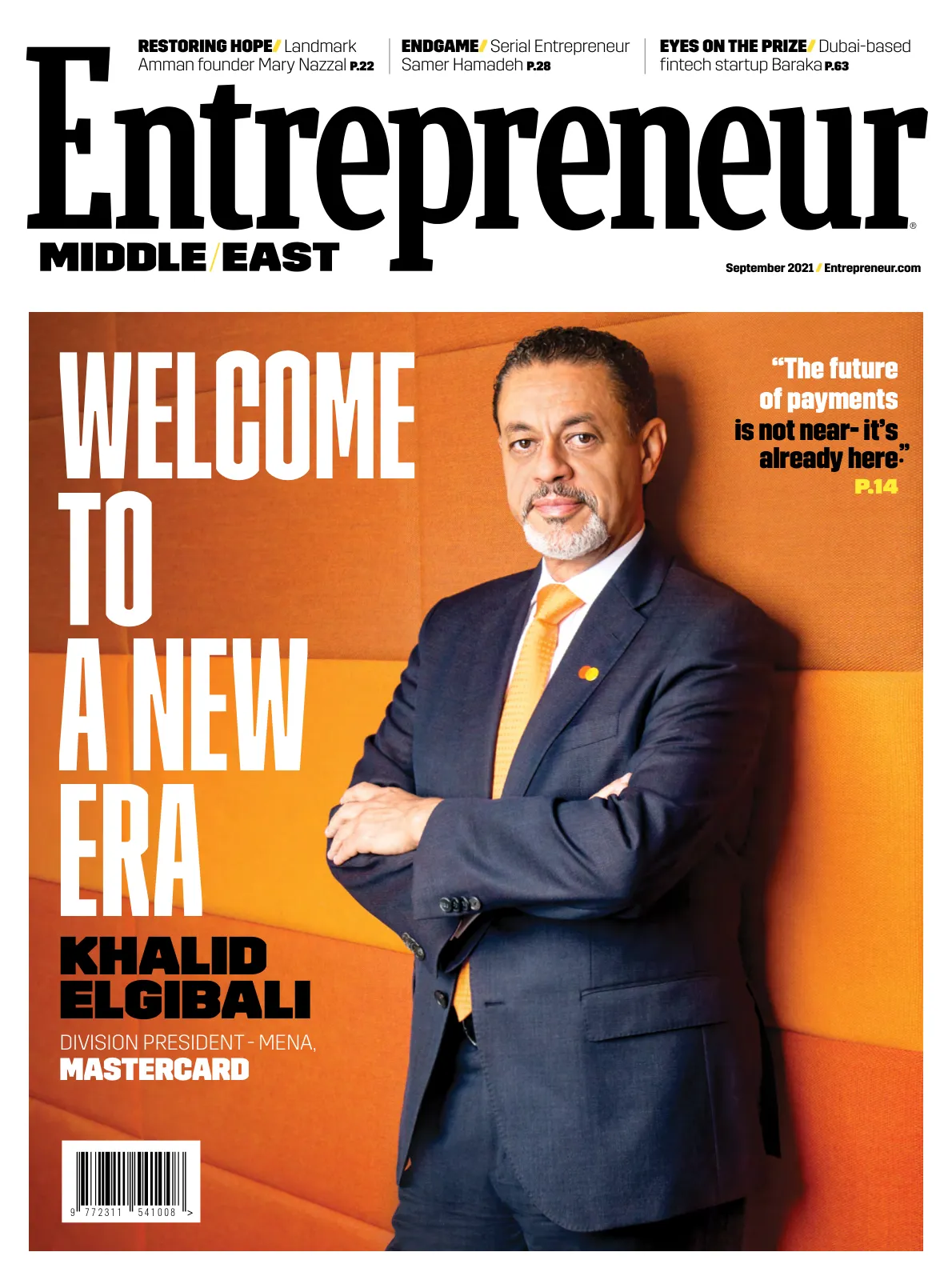
Entrepreneur Middle East, September 2021
Page 1
WELCOME
TO A NEW
ERA
KHALID
ELGIBALI
DIVISION PRESIDENT - MENA,
MASTERCARD
“The future
of payments
is not near- it’s
already here.”
P.14
September 2021 Entrepreneur.com
9
7 7 2 3 1 1
5 4 1 0 0 8
>
ENDGAME/ Serial Entrepreneur
Samer Hamadeh P.28
EYES ON THE PRIZE/ Dubai-based
fintech startup Baraka P.63
RESTORING HOPE/ Landmark
Amman founder Mary Nazzal P.22
Page 2
Page 3
Page 4
Page 5
sbe.com/sls-dubai
@slsdubai
A blend of lifestyle & luxury in
a timeless elegant atmosphere
Page 6
6 / ENTREPRENEUR.COM / September 2021
P.35
Cool Customer
Jihad Sadiq’s UAE-based
enterprise FortyGuard is
making use of cutting-
edge tech to tackle one
of the Middle East’s most
pressing climate-related
issues.
by PAMELLA DE LEON
P.40
Changing
the Game
Luxury audio brand Bang
& Olufsen is attempting
to reverse industry
trends when it comes
to sustainability and
technology obsolescence.
by ABY SAM THOMAS
P.14
Welcome
To a New
Era
Khalid Elgibali, Division
President of MENA,
Mastercard, explores
Mastercard’s role as Expo
2020 Dubai’s Official
Payment Technology Partner,
and how the enterprise
is shaping the future of
payments around the world.
by TAMARA PUPIC
P.22
Restoring
Hope
Mary Nazzal, founder
of Landmark Amman, is
doing her part to revitalize
Jordan’s business
landscape.
by TAMARA PUPIC
P.28
Endgame
Akiba Dori founder Samer
Hamadeh on what makes
him tick as an entrepreneur.
by ABY SAM THOMAS
FEATURES
Contents/September 2021
ON THE COVER AND THIS PAGE
Photography by Farooq Salik
BUSINESS
UNUSUAL
Page 7
الشركاء االستراتيجيون
Strategic Partners
تـرشــــح اآلن
2021 سبتمبـــر15 حتـى
Nominate Now
Till 15th September, 2021
المجد
لمـن يصنعــهGlory Belongs To Those Who Make It
Page 8
8 / ENTREPRENEUR.COM / September 2021
49 The CEO Cheat Sheet
LAURA GERRITS-GEDVILE gives
a primer on what every CEO
should do in their first 90 days.
52 Breaking Patterns
ANNABEL HARPER on the problem
with unconscious bias in the
Middle East’s workplaces (and
how to manage it).
56 Let The Family Build
(And Then Let The
Professionals Run)
THOMAS KURUVILLA, Managing
Partner, Arthur D. Little Middle
East shares thoughts on how
family businesses in the Middle
East can thrive in the long term.
60 The How-To
SAKSHI TULSIAN, co-founder
and Chief Revenue Officer of
POSist Technologies, gives a
guide on what it takes to build
a solid culture in early-stage
startups.
‘TREPONOMICS
EDITOR IN CHIEF Aby Sam Thomas
aby@bncpublishing.net
CEO Wissam Younane
wissam@bncpublishing.net
DIRECTOR Rabih Najm
rabih@bncpublishing.net
CREATIVE LEAD Odette Kahwagi
design@bncpublishing.net
MANAGING EDITOR Tamara Pupic
tamara@bncpublishing.net
STARTUPS SECTION EDITOR Pamella de Leon
pamella@bncpublishing.net
FEATURES WRITER Aalia Mehreen Ahmed
aalia@bncpublishing.net
DIGITAL SOLUTIONS DIRECTOR
Mahdi Hashemi mahdi@bncpublishing.net
HEAD OF INNOVATION
Sarah Saddouk sarah@bncpublishing.net
GROUP SALES DIRECTOR – B2B GROUP
Joaquim D’Costa jo@bncpublishing.net
COLUMNIST Tamara Clarke
CONTRIBUTING WRITERS
Fida Chaaban, Laura Gerrits-Gedvile, Annabel Harper,
Thomas Kuruvilla, Ihsan Salhia, Sakshi Tulsian
SUBSCRIBE
Contact subscriptions@bncpublishing.net to receive
Entrepreneur Middle East every issue
COMMERCIAL ENQUIRIES
sales@bncpublishing.net
ENTREPRENEUR.COM
Access fresh content daily on our website
All Rights Reserved 2021. Opinions expressed are solely those of the contributors. Entrepreneur
Middle East and all subsidiary publications in the MENA region are officially licensed exclusively to
BNC Publishing in the MENA region by Entrepreneur Media Inc. No part of this magazine may be
reproduced or transmitted in any form or by any means without written permission of the publisher. Images
used in Entrepreneur Middle East are credited when necessary. Attributed use of copyrighted images
with permission. All images not credited otherwise Shutterstock. Printed by United Printing and Publishing.
PO BOX 502511 DUBAI, UAE
P +971 4 4200 506
Contents/September 2021
63 Eyes On The Prize
Dubai-based fintech startup
Baraka is on a mission to help
everyone in the MENA -yes,
everyone- to invest.
by TAMARA PUPIC
74 Bridging borders
As Dubai gets set to host
Global Business Forum Africa
2021 in October, the stage
is set for the bolstering of
business ties between the
UAE and the African continent.
by TAMARA PUPIC
80 In Focus
A roundup of the up-and-
coming enterprises you should
be keeping an eye on.
by AALIA MEHREEN AHMED
STARTUP
SPOTLIGHT
↑ FORTYGUARD WAS
LAUNCHED IN 2020 with
the aim to reduce the risk
of extreme heat waves
caused by the UHI effect.
P.35
EntMagazineME
Entrepreneur-me
Page 9
Page 10
10 / ENTREPRENEUR.COM / September 2021
Editor’s Note/
EVER FELT LIKE YOU’VE REACHED A DEAD END?
Perhaps in your life, or maybe in your
entrepreneurial dreams.
Maybe it’s because you have encountered what
appears to be an insurmountable obstacle on
the road to achieving your goals. Or perhaps
it’s because the powers that be have thrown a
spanner into the works, and essentially put a
halt to everything that you had going on.
(Thanks for nothing, COVID-19.)
No matter what the reason may be, such
situations can make us feel like we’ve suc
cumbed to failure despite all of our best efforts
and contingencies, and that we’ve reached the
end of the road for our ambition.
But if you do find yourself in such a situation,
at that seeming rock bottom of despair and
darkness, hold on for a moment, and turn your
attention to what Dubai-based serial
entrepreneur Samer Hamadeh told me during
an interview for this month’s issue of
Entrepreneur Middle East.
“Nothing is the end of the world, ever,”
Hamadeh said. “Even when it feels like it, it
absolutely is not.”
I remember looking at Hamadeh quite
quizzically when he said this- that doesn’t make
sense, I thought to myself then.
But after pondering on his words for a
moment or two, I realized that Hamadeh had
actually made a deeply profound point that all
of us need to remember, especially when we feel
like, well, it’s the end of the world.
“Whatever wall you find yourself hitting, or
whatever dire situation you think you’re in, you
might think that it’s the worst thing ever,”
Hamadeh went on. “But know that it is not the
worst thing ever.”
Because, according to Hamadeh, if whatever
stalemate you found yourself in was actually
“the end of the world,” well, then you wouldn’t
really be here worrying about it.
And therefore, if you’re still here, your story
simply cannot be over.
Maybe you just need to look for a different way
to go about it. Or perhaps it’s a matter of just
rejigging and rehashing the dreams you had for
yourself in the first place.
But no matter how devastating it feels like in the
moment, and regardless of all the odds that
seem to be stacked against you, none of it
signifies that it’s curtains for whatever you set
out to do.
On the contrary, it may just be heralding the
start of something new.
Aby Sam Thomas
Editor in Chief
@thisisaby
aby@bncpublishing.net
It ain’t over till it’s over
This is not your rock bottom moment
Page 11
Page 12
Page 13
Page 14
14 / ENTREPRENEUR.COM / September 2021
WELCOME
TO A NEW
ERA
THE FUTURE OF PAYMENTS
IS NOT NEAR-
IT’S ALREADY HERE,
SAYS KHALID ELGIBALI,
DIVISION PRESIDENT - MENA,
MASTERCARD
by TAMARA PUPIC | PHOTOGRAPHY FAROOQ SALIK
Page 15
15
September 2021 / ENTREPRENEUR.COM / 15
September 2021 / ENTREPRENEUR.COM /
Page 16
16 / ENTREPRENEUR.COM / September 2021
“WE’VE PLANNED
AN IMMERSIVE
EXPERIENCE FOR ALL
EXPO VISITORS,
SO THAT THEY CAN
NOT ONLY SEE, BUT
TRULY BE A PART
OF THE
TRANSFORMATION
THAT WE’RE
EXPERIENCING NOW.”
O
ver the 50 years of its history,
Dubai -and the UAE as a
whole- has succeeded in
achieving goals that have
wowed the world, and the
upcoming Expo 2020 Dubai
will surely be no exception.
The six-month-long mega
event starting in October this
year promises to reimagine
visitor experiences as we
know it, and Mastercard, the
globally renowned innovator
and technology leader in
payments, has been put in
charge of one particular
aspect of this commitment
to greatness- to ensure
a seamless and cashless payment
experience for the over 25 million people
expected to be a part of it.
According to Khalid Elgibali,
Division President – MENA, Mastercard,
his company’s appointment as Expo 2020
Dubai’s Official Payment Technology
Partner was a natural consequence
of the two entities aiming to find new
ways “to connect everyone to priceless
opportunities.” “As the Official Payment
Technology Partner of the event,
Mastercard will be showcasing the latest
in payment technologies and tools that
are changing the way that people pay,
shop, and connect with each other,”
Elgibali says. “We’ve planned an immersive
experience for all Expo visitors, so that
they can not only see, but truly be a
part of the transformation that we’re
experiencing now. In addition, we will be
bringing to the forefront the most relevant
concerns pressing us today on a global
platform, and exploring solutions for these
in collaboration with our partners.”
→ EXPO 2020 DUBAI WILL REDEFINE
THE PAYMENTS EXPERIENCE THANKS
TO A NEW PREMIER PARTNERSHIP
WITH MASTERCARD that includes
exploring the use of innovative new
payment technologies through
immersive experiences powered by
virtual reality.
Leading Mastercard’s efforts in this
arena will be Elgibali, who is well-
versed in the MENA region’s financial
landscape not only because of his role
at the helm of his company’s evolving
regional network, but also due to the
wealth of experience he gained by
previously holding several senior
positions at the region’s leading
banking institutions. His steely
confidence in digital payments thus
stems from this extensive expertise, but
Elgibali notes that even difficult
periods, such as the ongoing COVID-19
crisis, offer proof that the so-called
“future of payments” is not near, but
already here. “From our learnings from
the pandemic, we have realized just
how powerful digital payments are in
ensuring the continuity of commerce,
especially for small and medium
enterprises which have suffered the
most from the COVID-19 outbreak,”
Elgibali explains. “Hence, Mastercard
has a dedicated program that will be
geared towards digital and financial
inclusion of SMEs, with a particular
focus on women-owned SMEs.”
Page 17
17
September 2021 / ENTREPRENEUR.COM /
B
efore we delve into the details of Mastercard’s
impressive commitment to provide small businesses
with the financial tools, technology, products,
funding, and data insights necessary to weather the
COVID-19 crisis, Elgibali emphasizes that Master
card is “a company that cares.” And it is for that reason its
partnership with Expo 2020 Dubai encompasses not just
payments, but many other areas that matter a
lot in today’s world. One example of this is its
Priceless Planet Coalition initiative, which
will employ a forest restoration model
dedicated restoring of 100 million trees by
2025 of forests in geographies that represent
the greatest global need. “With climate
change at the forefront of our minds,
Mastercard is making its Priceless Planet
Coalition one of the pillars of our partnership,
having welcomed Expo 2020 Dubai, Emirates
NBD and Network International into our
network to fight to preserve the environ
ment,” Elgibali explains. “What we’re most
excited about is the opportunity to bring this
coalition to a global stage, where every visitor
attending Expo will be able to participate and
contribute to saving the planet.”
Expo 2020 Dubai will also give Elgibali and his team an
opportunity to bring to life Mastercard’s efforts in gender
diversity and inclusion on an unprecedented scale. “We will be
a key player in the Expo Women’s Pavilion, and have commit
ted significant resources to knowledge-sharing, mentoring and
fundraising initiatives for our women-focused programs across
the world,” Elgibali says. “Inclusion, opportunity, and the
empowerment of girls and women are global priorities at
Mastercard, and we are truly excited to leave a long-standing
legacy through our partnership.” This follows Mastercard’s
Corporate Sustainability Report 2020, which
presented its activities in four areas (inclusive
growth, people and culture, environmental
stewardship, and ethical and responsible
standards), all of which are geared towards
delivering on the company’s mission to build a
more inclusive, sustainable world with a digital
economy that works for everyone, everywhere.
This report, which was released in July 2021,
notes that Mastercard has already achieved its
goal of financially including 500 million people,
and that it is now planning to reach a total of 1
billion people by 2025. “Amidst the many
challenges of the COVID-19 pandemic for most
small businesses, our research also found that
the impact on women entrepreneurs have been
especially devastating, given their over-repre
sentation in the worst-hit sectors,” Elgibali says.
“That’s why we have pledged globally to connect 50 million
small businesses to the digital economy by 2025, with a direct
focus on supporting 25 million women entrepreneurs.” }
“We will be a key
player in the Expo
Women’s Pavilion,
and have committed
significant resources
to knowledge-
sharing, mentoring
and fundraising
initiatives for our
women-focused
programs across the
world.”
↑ EXPO 2020 DUBAI HAS
JOINED A GLOBAL COALITION,
LED BY ITS OFFICIAL PAYMENT
TECHNOLOGY PARTNER
MASTERCARD, that seeks to
tackle the global climate crisis
by planting 100 million trees
worldwide and re-growing
forests over five years.
Page 18
18 / ENTREPRENEUR.COM / September 2021
While Mastercard’s efforts in the sustainability realm is
obviously widespread and touches the lives and livelihoods of
hundreds of millions of people, its focus on small businesses is
especially noteworthy in this regard. According to Elgibali,
the impact of the COVID-19 crisis, with its movement
restrictions and a behavioral shift to contactless interactions,
has highlighted just how important it is for small businesses
and micro merchants to have a digital presence, to pay, get
paid, and obtain capital. “Mastercard is committed to
empower every business through our technology, insights, and
global expertise,” Elgibali says. “We’ve created products and
solutions to unlock potential and keep SMEs moving forward.
Additionally, we have pledged assistance of $250 million
globally to support SMEs with digital tools and training
during the pandemic.”
With Mastercard aiming to address sustainability in the
digital economy by helping move businesses at the margins to
digital growth into the mainstream, Elgibali believes the
company’s extensive experience with financial inclusion
makes it uniquely suited to lead at this critical inflection
point. “Mastercard is locking arms with trusted industry
partners, governments, and banks to empower every busi
ness,” he says. “We’re democratizing access to solutions that
have long been the domain of larger corporations, and
building commercially sustainable and scalable social impact
products and programs for SMEs. We’re also providing free
access to tools, education, and timely insights to help them
secure and enable their digital worlds. These include the
Mastercard Center for Inclusive Growth, which is working
with grantees around the world to help address the challenges
facing micro-businesses during the COVID-19 crisis, includ
ing digital training, sanitation kits, online mentoring, and
access to working capital.”
A
t Mastercard MENA, Elgibali’s niche expertise is
focused on three areas: business growth, emerging
technology payment opportunities, and business
alliances with key partners and stakeholders. His daily
insights deriving out of these duties assure him that Master
card is clearly redefining the future of payments. “Through
our digital-first strategy, we are working to serve our partners
as a single technology provider of choice that connects telcos,
digital retailers, and fintech companies to their customers,”
Elgibali says. “We are providing technology solutions,
platforms and propositions that enable a superior digital
experience, simplify adoption of innovation and drive greater
inclusion for people across the globe.”
← KHALID ELGIBALI
IS RESPONSIBLE for leading
the company’s evolving
Middle East and North Africa
network, to drive business
growth, execute emerging
technology payment
opportunities and deepen
business alliances with key
partners and stakeholders.
Page 19
At this point, Elgibali notes that Mastercard’s offering of
cutting-edge solutions is thanks to the enterprise’s historical
insistence on always enhancing its own capabilities through
the introduction of innovative products, strong partnership
programs with innovators and acquisitions of industry-lead
ing companies. This commitment to excellence, he continues,
originally began with Mastercard’s acquisition of real-time
payments provider Vocalink in 2017, which is currently
transforming the payments infrastructure in economic hubs
around the world, including Saudi Arabia, Singapore,
Thailand, and the UK. This was then accelerated through the
acquisitions of Transfast, a global cross-border payments
network provider, as well as Nets Corporate Services, which
allows consumers to get a payment platform for recurring bill
and credit transfer transactions to more than 250,000
corporate companies.
Such transactions are an indication of Mastercard’s belief
that its commitment to connecting 50 million SMEs globally
to the digital economy by 2025 will surely enhance its own
innovative capabilities in the years to come. At the same time,
it is also this focus on the future that is underlining Master
card’s efforts at keeping sustainability as a key point of
consideration when going about its day-to-day business. “As I
mentioned, the Priceless Planet Coalition has been established
as one of our flagship initiatives to promote
sustainability in the UAE and wider region,”
Elgibali explains. “By building a network of
strategic partners that include heavyweights,
such as HSBC, Emirates NBD, Emirates
Islamic, Network International, we are rallying
efforts to make a difference within the commu
nities we operate in. Simultaneously, we have
also pledged net zero emissions from our
operations by 2050 on a global scale. We
continue to work with our partners here and
across the world to realize this vision.”
M
eanwhile, the Mastercard New
Payments Index, a global survey about
omni-channel commerce, payment
shifts, and consumer behavior trends post the
COVID-19 crisis, has pointed out the rising
adoption of new payment technologies and
growing consumer appetite for new, fast and flexible digital
experiences. “SMEs must adapt to a hybrid environment
where omni-channel payment strategies and choice are key,”
Elgibali says, adding that consumers across the MENA region
have also irreversibly embraced new and emerging payment
methods. “95% of MEA consumers will consider using at least
one emerging payment method, such as cryptocurrency,
biometrics, contactless, or QR code, over the next year,” he
says. “61% of MENA consumers say they would avoid
businesses that do not accept electronic payments of any kind.
Three in four UAE consumers say that digital payment
methods help them save money. These are not small numbers,
and hence indicate a permanent change in the years to come.”
Examples of Mastercard’s support to small businesses across
the MENA region to grow digitally include its SME-in-a-Box
solution, a one-stop solution that helps business owners build
their online platforms and sell their products and service
through e-commerce. There’s also Simplify Commerce, an
offering which allows SMEs to make use of a plug-and-play
e-commerce store builder that offers an instant online
checkout. Another solution Mastercard is championing is
Click to Pay, which removes the friction of
entering card details each time a shopper
wishes to checkout, and with it being rolled
out to businesses of all sizes, it promises to
become the gold standard of tomorrow’s
shopping experience. Elgibali also points
out Mastercard’s work in expanding
Tap-On-Phone technologies within the
MENA region, which makes use of contact
less technology to turn a smartphone into a
payment acceptance device, and thus
becoming a powerful and cost-effective
tool for small businesses to quickly be able
to accept digital payments in line with
consumer expectations.
Elgibali adds that one part of the region’s
digital economy that is maturing very
quickly is its fintech ecosystem, with the
MEA region already having over 1,200
fintech players, covering everything from credit and insur
ance, to wealth management offered through a centralized
cloud-based platform. “Recognizing the important role fintech
companies play in the world’s rapid digital transformation,
Mastercard is continuously diversifying its business by
diversifying its perspective: looking to new partners, new
markets, and new ways to build on its core competency as a
payments network,” he says. “We’re engaging in multiple
strategic partnerships with innovators, regulators, and
financial institutions to enhance the ecosystem and support
the growth of capabilities like open banking in the region.”
According to Elgibali, Mastercard’s Fintech Express and
Engage Programs, which are designed to build a network of
partnerships, are proof of the company’s support to fintech
innovation, boosting financial inclusion, and enhancing the
payment experience for consumers. }
↑ MASTERCARD CONTACTLESS
PAYMENTS allow consumers to pay
using their contactless cards or
payment-enabled devices.
“We’re engaging in
multiple strategic
partnerships
with innovators,
regulators, and
financial institutions
to enhance the
ecosystem and
support the growth of
capabilities like open
banking in the region.”
Page 20
20 / ENTREPRENEUR.COM / September 2021
G
iven this landscape, Elgibali notes that while
digital transformation and the digital economy
are evolving rapidly, cybersecurity remains a
growing issue- and especially so for entrepreneurial
businesses. “That is why we protect
and secure SMEs in the accelerated
shift to digital,” he says. “Considering
nearly one in five small businesses
experience cyber-attacks or data
breaches, we provide the tools and
solutions they need to secure every
interaction. The Global Cyber
Alliance and Mastercard released the
free online Cybersecurity Toolkit to
arm small business owners with basic
security controls and guidance,
operational tools, how-to materials,
and recognized best practices to
protect themselves from ever-evolv
ing cyber risks.” Another type of this
kind of support is Mastercard’s free
online Cyber Readiness Program, a
free practical step-by-step guide for
SMEs focused on four critical cyber
issues: authentication and passwords,
software updates, phishing, and USBs
and removable media.
“Mastercard is constantly adapting by creating new
programs and partnerships to empower digital transfor
mation, create diversification, and accelerate the
emergence of new market players,” Elgibali adds. “In
MENA, we partnered with Hub71 to accelerate innova
tion in the UAE’s fintech startup community. The
partnership identifies relevant companies for Master
card Start Path, opening up market access for Hub71’s
startups and Start Path companies– for mutual benefit.
We’ve also invested in UAE-based Network Internation
al, which is growing a presence in Saudi Arabia, having
been included in an innovation sandbox created by the
Saudi Arabian Monetary Authority.” This leads into his
top tips for entrepreneurs in the region. “My advice to
businesses would be three-fold: be aware of the latest
tools and technologies available to you, utilize them to
your advantage, and keep your eyes
laser-focused on what your customers
want from you, which is the only way to
be truly successful and sustainable,”
Elgibali says.
In conclusion, Elgibali points toward
Mastercard’s inaugural Middle East and
Africa SME Confidence Index released
in June 2021, which has shown that
88% of SMEs in the UAE are optimistic
about the following year, with two-
thirds (66%) projecting revenues that
would either grow or hold steady.
“SMEs in the MENA have identified
better data and insights, training and
upskilling staff, and access to digital
training and development support as
the top drivers for growth,” says Elgibali,
reiterating the importance of digital
transformation and human capital for
the future growth of any business. But
Elgibali stresses that the MENA region is currently
moving through a fascinating moment in its history,
with many regional countries making great advances in
non-oil economic diversification, and investing in
so-called “giga-projects” and events like Expo 2020
Dubai- and all of that is setting up the region as a great
place to do business in right now. “There is a narrative of
investment, diversity, inclusive growth and competitive
ness that is tangible– and it can be seen right across the
region,” Elgibali concludes. “If you look at the volume of
SMEs coming to the fore, you get a sense of how
communities are thinking, and what the next generation
is feeling about its potential.”
“We have
pledged globally
to connect
50 million small
businesses
to the digital
economy by 2025,
with a direct focus
on supporting
25 million women
entrepreneurs.”
← MASTERCARD
IS A GROWTH COMPANY
with a constant
commitment and
dedication to delivering
value to consumers,
businesses and
shareholders.
Page 21
21
September 2021 / ENTREPRENEUR.COM /
Tips for entrepreneurs from Khalid Elgibali,
Division President – MENA, Mastercard
}Always keep your end
consumer in mind
“It is necessary to approach your product or service
from the viewpoint of the end-consumer. Every
organization today is a B2C organization, not a B2B or
a B2G, because ultimately the work you do will have a
considerable impact on individual lives. It is that
impact that you must look to positively transform, to
achieve exponential innovation.”
}Work on building a sustainable
business
“The first thing would be to look internally, and invest
in those technologies and solutions that aim to disrupt
existing technologies– you could call this
futureproofing. In the era of the Fourth Industrial
Revolution, emerging technologies such as artificial
intelligence, internet of things, machine learning,
robotic process automation, and blockchain provide
us with the best tools possible to futureproof our
operations.”
}Your competitors could
become your partners
“I would suggest that entrepreneurs view other
startups not as competition, but as potential strategic
partners that can help them achieve exponential
innovation. Looking at the positive sentiment that
Careem and Souq received this past year after being
acquired is a clear indication that the region is
increasingly becoming a hotbed of unicorn startups,
and it makes business sense to leverage this
opportunity.”
}Don’t go at it alone- look for
collaborations
“You can see superb examples in the MENA region of
popular apps which enable consumers to purchase
their food, travel and clothing anytime and anywhere
simply from their smartphones. For this to happen,
several stakeholders need to work together. The app
itself needs to ensure that the consumer has an
easy-to-understand user experience that allows them
to make the purchase seamlessly.”
}Keep inventing,
keep innovating
“Smart Dubai recently stated that the number of
things connected to the internet surpassed the
number of humans, and that it is expected to reach
20.4 billion by 2020. The boundaries of technologies
continue to expand, and there has never been a better
time in history for innovators to experiment, build, and
test new solutions.”
THE EXECUTIVE
SUMMARY
Page 22
22
→ MARY NAZZAL IS ON A MISSION
to revitalize Jordan’s business
landscape
IMAGES COURTESY LANDMARK AMMAN
/ ENTREPRENEUR.COM / September 2021
Page 23
HOPE
The founder of Landmark Amman is doing her part
to revitalize Jordan’s business landscape
RESTORING
Mary Nazzal
by TAMARA PUPIC
23
September 2021 / ENTREPRENEUR.COM /
Page 24
24 / ENTREPRENEUR.COM / September 2021
To kick off Landmark 2.0, Landmark Amman and
Endeavor Jordan opened their call to both individu
als and companies, which are based in or able to relo
cate to Amman for the duration of the program, that
“possess a vision for an innovative idea or initiative
that can impact the hospitality sector.” Nazzal reveals
that the first cohort of successful applicants for
Landmark 2.0 was selected in August, with her team
now working on customizing the support package to
suit each project. The selected participants will be
given full access to Landmark Amman’s premises as
a front-end and back-end support space for their
operations, on-site execution, and product testing, as
well as access to capital, coaching, mentorship, and
local B2B matching services to help them scale and
grow their product or service offerings.
G
iven how the tourism
and hospitality industries
around the world have been
severely impacted by the
COVID-19 pandemic, the
world has been showing
a lot of solidarity and
compassion towards
the entrepreneurs and
enterprises in these
segments. But that’s not to
say that support is being
showcased by only those
who are on the outside of
these businesses- on the
contrary, there are also
players within these sectors
that are attempting to
ensure the revival of both themselves
and their peers.
That is the story of Mary Nazzal,
founder of Landmark Amman, a
homegrown premium hotel brand in
Jordan, which has recently partnered
with the country’s branch of Endeavor
(“the world’s leading community
of high-impact entrepreneurs”) to
launch a new project: Landmark 2.0.
Envisioned as an innovation hub that
will support Jordanian startups, SMEs,
and entrepreneurial individuals in
the tourism and hospitality sectors,
Nazzal’s goal for this project is two-fold.
Firstly, it allows her to inject innovation
into the hotel, as the project invites
interested participants to leverage the
Landmark Amman’s “local, authentic,
sustainable, and inclusive” experience
for launching their newly-developed
solutions. And by supporting these
innovations, Landmark 2.0 also helps
realize Nazzal’s second goal- to restore
a level of hope and optimism in Jordan’s
tourism and hospitality sectors.
Page 25
25
September 2021 / ENTREPRENEUR.COM /
“Entrepreneurs have indicated that their biggest
challenge is reaching potential customers and being
able to test their products and services,” Nazzal says.
“With Landmark 2.0, selected participants will be
presented with an actual business opportunity- they
will be able to test their products within the Landmark
Hotel, and to access the Landmark’s network of
partners and customers. In addition, selected partici
pants will receive one-to-one coaching to tackle major
business challenges relating to finance, human
resources, business development, rules and regulations,
and even their own wellbeing and growth mindset.”
Nazzal’s leadership of Landmark 2.0 won’t come as a
surprise to those who have been following her efforts to
support the local community over the course of her
career. Some of the most transformative projects she
has implemented in her time at Landmark Amman
include the creation of free on-site daycare for the
children of all Landmark employees, inclusive hiring of
women and people with disabilities, and the establish
ment of an on-site aquaponics dome called “Green Hub
by Landmark,” which provides the hotel with vegeta
bles grown on its own roof. Nazzal has also led
Landmark Amman’s partnership with Social Enter
prise Project Jordan (SEP Jordan), which operates
from the Jerash “Gaza” Camp, Jordan’s fifth-most
populated Palestinian refugee camp- over 500
embroidery artists from this location have now got
their products showcased in a shop located in the hotel
premises.
The aforementioned list of projects serve as a good
indication of the perspective with which Nazzal runs
the show at Landmark Amman. “We can no longer run
businesses or make investments without simultane
ously considering how we can further social impact
through our operations,” she says. “This is why I
transformed Landmark. Doing well by doing good is
not a cliché, it is our only option moving forward.
Conducting business as usual has led us to our current
situation of environmental degradation and inequality.
We have to progress towards a social enterprise or a B
Corporation model, where businesses embed social
impact or sustainability objectives.”
“The same approach should apply to investments and
how we think about the purpose of capital,” Nazzal
adds. “All investments have to evolve into the so-called
impact investments, where we not only refrain from
causing harm to people and planet, but where we
intentionally look to further some measure of social
impact, equality or sustainability.” This explains why
Nazzal, besides her role at Landmark Amman, is also
serving as the Executive Chairperson of 17 Ventures, an
impact investment and advisory firm specialized in
projects related to the UN Sustainable Development
Goals (SDGs) and innovative finance in the MENA
region. 17 Ventures co-designed Jordan’s first impact
fund to further the UN SDGs, and partnered with
SEAF (Small Enterprise Assistance Funds), a Washing
ton, D.C.-based impact fund manager investing in
growth-oriented SMEs in emerging markets, in order
to raise capital for the SEAF Jordan Growth and
Impact Fund.
Nazzal explains that the latter is an SME growth
vehicle for Jordan and Palestine, with a clear intention
to support companies to integrate women, youth, and
people with disabilities into the workforce, by creating
an inclusive and enabling environment. “Under my 17
Ventures hat, I’m also working alongside other
advocates of social entrepreneurship to support the
government to establish a regulatory framework that
would govern the establishment and regulation of
social enterprises,” Nazzal says. “My partnership with
SEP Jordan, which spans almost a decade, has affirmed
to me time and time again the need to support
businesses that have a hybrid nature designed to both
do well and do good at the same time.” }
↑ THE LANDMARK AMMAN
is known for its "local,
authentic, sustainable, and
inclusive" experience
SELECTED PARTICIPANTS WILL BE ABLE TO TEST THEIR
PRODUCTS WITHIN THE LANDMARK HOTEL, AND ACCESS THE
LANDMARK’S NETWORK OF PARTNERS AND CUSTOMERS.
Page 26
26 / ENTREPRENEUR.COM / September 2021
← NAZZAL PARTNERED
WITH ENDEAVOR JORDAN
TO LAUNCH LANDMARK
2.0., an innovation hub to
support Jordanian SMEs in
the tourism and hospitality
sectors.
NAZZAL IS ALSO THE
EXECUTIVE CHAIRPERSON
OF 17 VENTURES, an impact
investment and advisory
firm specialized in projects
related to the UN SDGs and
innovative finance in the
MENA region.
26 / ENTREPRENEUR.COM / September 2021
Page 27
27
September 2021 / ENTREPRENEUR.COM /
When speaking about her work as an advisor for a global
investment fund for refugees, Nazzal reiterates that an
area of long-standing importance for her relates to the
forcibly displaced people and their host communities. “I
am proud to be working with the US-based Refugee
Investment Network (RIN) on an initiative for inclusive
investment to identify innovative approaches to financing
the whole spectrum of marginalized
communities within Jordan,” she says.
“I have also worked alongside SEAF
in the design of a global investment
fund called SEAF Globally Displaced
Peoples Fund, intended to invest in
companies that disproportionately
benefit displaced people and/or host
communities. I am also an advisor for
Impact Hub Jordan, which is looking
to infuse the entrepreneurship scene
with values of inclusion and social
mobility.”
As someone who’s often been called
one of the Middle East’s top business
women, Nazzal believes that she has a
responsibility to help other women
move up the career ladder as well,
and it’s something she’s has actioned
in all the ventures she leads. “As soon
as I assumed responsibility at
Landmark, I started creating an
environment that would allow me to
recruit, retain, and promote more
women at the company,” she says. “At
17 Ventures, we are all women. I will
always do my best to boost young
women around me. I also am acting
as a Principal Advisor in an excellent
program in Jordan called ‘Get on
Board,’ which has supported a
distinguished group of women to
become certified corporate board
members.”
Interestingly enough, despite the number of businesses
and initiatives that Nazzal aligns herself with, this mother
of three admits that she often feels that she hasn’t done
enough for her work, for the causes she supports, or even
for her family. But she has learned to work around this
feeling too- as she puts it: “I think that, ultimately, we can
only do our best, and our best is good enough.” At the
same time, she points out the importance of constant
learning- Nazzal proudly notes that she managed to
complete four executive education courses in 2021 alone.
When asked about the challenges she has had to
overcome on her entrepreneurial journey, Nazzal replies
that dwelling on problems is not part of her personality.
“My modus operandi has always been to jump into a
problem-solving mode and execution, but some of the
challenges that I did learn from happened for example
when, having successfully expanded the Landmark Hotel
into Palestine, I registered the
trademark throughout the Levant
with the intention to open hotels
regionally, but the Arab Spring
ensued shortly after and derailed
my expansion plans,” she remem
bers. “Also, I went into a business
partnership twice, which ultimate
ly ended in disappointment, so I
would say that a definite lesson is
to choose partners very carefully, if
you choose to partner at all.”
In conclusion, Nazzal opines that
Jordan has the potential to excel in
multiple business sectors,
including healthcare, education,
tech, wellness and adventure
tourism, and the creative indus
tries, because she considers that
local entrepreneurs are very
motivated to make a difference.
“However, the country is also
facing several challenges, espe
cially post-the COVID-19 pan
demic, and it needs to allow the
private sector to lead, if it wants to
emerge as a model of sustainable
and innovative growth for the
region,” she says. “As the private
sector, we are continuously having
to deal with new rules and
inefficiencies. We have a huge
challenge when it comes to youth
unemployment, and we have one of the lowest rates of
female participation in the work force.” In her opinion,
Jordanian women and youth need to be integrated
quickly and strategically into the country’s economy, as
they are key to achieving sustainable growth. “We need
bold and decisive leadership for the country, which charts
a path and sticks to it,” Nazzal concludes. “We have too
many cooks in the kitchen and little consistency, which
sometimes makes it unsettling to those of us working to
build a future here.”
DOING WELL
BY DOING
GOOD IS NOT
A CLICHÉ,
IT IS OUR
ONLY OPTION
MOVING
FORWARD.”
“
WE CAN NO LONGER RUN BUSINESSES OR MAKE
INVESTMENTS WITHOUT CONSIDERING HOW WE CAN
FURTHER SOCIAL IMPACT.
Page 28
28 / ENTREPRENEUR.COM / September 2021
ENDGAME
Serial Entrepreneur
Samer Hamadeh
Akiba Dori founder shares the why, what and how
of his quest for agency and independence
by ABY SAM THOMAS
I OFTEN LIKE TO ASK the entrepreneurs that I
interview about the endgame they have in mind for
themselves, as in, what’s the target they are aiming to
personally hit by launching and running the businesses
that they do. And for Samer Hamadeh, the founder of
Dubai-born F&B concept Akiba Dori, the answer to
that question was that he aspires to reach a point in his
life where he is able to -wait for it- “do nothing.”
I’ll admit to being taken aback by Hamadeh’s reply
at first, but when I pondered on it for a moment or
two, his goal made perfect sense to me. Most of the
entrepreneurs to whom I’ve asked this query to have
told me that their objective is to make a lot of money
that they can then use to feed their materialistic
desires, but in Hamadeh’s case, he’s clear that wealth,
per se, isn’t a driver for him- as he put it: “As long as
I’ve got the cash to do what I want to do, I don’t care
how much of it I have.” As such, Hamadeh’s motiva
tions as an entrepreneur thus seem to be centered on
this vision of his endeavors allowing him to be free to
do whatever catches his fancy at any given point in
time, which may be, say, an entirely new creative
undertaking, or, heck, to simply “do nothing.” “I don’t
think I have a specific driver other than the idea of
having complete ownership of my time,” he tells me,
over the course of a lunch at Akiba Dori’s flagship
location in Dubai Design District. “Some people say
that their ultimate goal is to have US$10 million in
their bank account, have a house here, have a house
there, and that’s it. When it comes to me, it’s like, take
that, and make it ‘time’- so, my ultimate goal is to
have what I do with my day, what I do at, say, 2pm on
a Wednesday, be my decision, and mine alone. As
long as that continues to be the case, that’s what
keeps me going. And I will do whatever I need to do
to keep that lifestyle going.” }
IMAGES COURTESY AKIBA DORI | SAMER HAMADEH
Page 29
29
September 2021 / ENTREPRENEUR.COM /
Page 30
30 / ENTREPRENEUR.COM / September 2021
It’s a simple enough ideology, and it’s one that he
says has governed his career for as long as he can remember.
Indeed, one of the first jobs he took following his graduation
from the American University of Beirut in Lebanon was as a
production assistant for the Hollywood movie, Syriana, as it
was being filmed in the UAE in 2004. While Hamadeh
declares his time working on this George Clooney-starrer as
having been “one of the most fun experiences” he’s had in life,
he also remembers his father -a corporate exec- admonishing
him for taking on this job in the first place. After Syriana,
Hamadeh started working at the Dubai offices of creative
advertising agency Impact BBDO, where he soon found big
accounts like that of Dubai Holding falling under his purview.
And while Hamadeh’s father looked at this career move of his
in a much more favorable light, that joy proved short-lived-
Hamadeh ended up resigning from Impact BBDO before he
even finished a year at the company. “The reason I decided to
quit was because I heard somebody say something that made
me think that someone else owns me at that point,” Hamadeh
recalls. “They own my time, they can tell me what to do, they
can tell me what not to do… That invoked a sort of fear in
me- I didn’t want to feel like that. And so, I quit.”
Hamadeh’s resignation then caught the attention of Impact
BBDO founder Alain Khouri, who was the company’s
Chairman at the time, and remains someone that he tremen
dously respects. “Khouri calls me to his office, and he says,
and I’m quoting, ‘I bothered to learn your name- you’ve been
here only a few months, you’re a junior, where are you going?’
And I replied, ‘I want to do my own thing; I don’t want to do
this anymore.’ And he’s like, ‘Why? You are on a good career
path here, why would you want to leave?’ To that, I said, ‘Well,
are you ever going to make me a Partner here?’” Khouri
started laughing at this point, Hamadeh says- after all, he had
been working at Impact BBDO for not even a full year then.
“And he’s like, ‘Don’t be like one of those Lebanese cowboys.’
But I said to Khouri, ‘I’m not; I’m just asking you a question.
People have different ambitions, right? My ambition is to own
a company, or be a Partner in a company- that’s where I want
to go. So, is that going to happen for me here?’ And Khouri
looked at me as if I was being ridiculous.”
→ AKIBA DORI features seven unique
storefronts serving Japanese street food,
baked goods, coffee, a bar serving everything
from Japanese beer to bottles of wine, a
pizzeria named Tokyopolitan which serves
Tokyo-style Neapolitan pizzas baked in a
wood fired oven, and a full-fledged arcade
room for some old skool fun and banter.
I WANTED AKIBA DORI TO BE SOMETHING THAT I CAN SELL TO OTHER CITIES, AND
SO, I WANTED IT TO BE UNIVERSAL. AND THE WAY TO DO THAT IS BY CREATING A
MENU THAT EVERYONE WOULD LIKE- AND WHEN I SAY EVERYBODY, I MEAN
APPEAL TO AS MANY TASTES AS POSSIBLE.
Page 31
31
September 2021 / ENTREPRENEUR.COM /
For someone who had only just started on his career trajec
tory, Hamadeh’s aspirations, and the speed with which he
wanted to realize them, could have been perplexing for others
to understand, and perhaps even misconstrued as arrogance,
but it was actually just a rather honest showcase of his
entrepreneurial bent of mind. “I wasn’t great as an employee,
for sure,” Hamadeh declares. “I’m horrible as an employee- I
don’t follow directions, I never took notes, I never did the
reports that I was supposed to do, I never did any of that stuff.
I didn’t know what the hell I was doing; I was kind of just
winging it. But I kept the business going, and the clients liked
me; however, from an agency perspective, I just didn’t see
myself fit in that corporate structure, and I knew that I
wanted out.” And once Hamadeh came to the realization that
he simply wasn’t cut out to be an employee, he started to look
for a way to explore his entrepreneurial instincts- this is what
resulted in him striking a deal with Dubai-based event
management agency Chillout Productions, which would see
him open up a corporate events arm for the business in
exchange for a 50% stake in this new enterprise. And how’d
that go? “Long story short, fast forward a year later, I think I
made more money that first year for myself, than I would have
done at 10 years at an agency,” Hamadeh reveals. “So, I was
like, ‘I’m not ever going back to corporate.’”
In his time at Chillout Productions, Hamadeh worked on a
number of high-profile events in the UAE
and the region (including the now defunct
Dubai International Film Festival), and he
found himself becoming a master in the
art of creating experiences for people-
which came in handy in his next undertak
ing as an entrepreneur. Hamadeh was
known among his friends as someone who
had a knack for throwing great parties,
which, at the end of the day, is all about
making sure people have fun experiences
in that particular setting. And Hamadeh’s
skillsets in this domain is what got him the
chance to do it on a day-to-day basis with
guests at the One On One club at The
Monarch Hotel in Dubai (now called The
H Hotel) in 2010. Hamadeh took over the
space, invested in it, and livened it up, and
while he got to work with it for only three
months, One on One swiftly became known as one of the most
happening places in Dubai then. “It was very successful,”
Hamadeh recalls. “We used to have queues outside to the
point where hotel security would be like, ‘You have to stop, you
have to close it!’” One On One ended up becoming the
stepping stone for Hamadeh’s next venture, Republique, a
nightlife concept that launched in 2011 at The Address Dubai
Mall hotel. With its retro music and unpretentious vibes, not
only did Republique manage to implant itself in the list of
Dubai’s most popular locations then, it was also one of the
most profitable venues in town- as Hamadeh reveals: “This
was a small, 4000 sq. foot space that was making over a
million dollars a month.”
Republique closed in 2013 after the hotel in which it was
housed attempted a renegotiation of the rent it paid- Hama
deh wasn’t a fan of the new terms being offered, and so, he
decided to shutter the place down. A break from work
followed (in Hamadeh’s words: “I did nothing for a year!”),
and he made use of the time he had to travel and discover new
cities around the world. But when he eventually returned to
Dubai, Hamadeh found himself bored and itching to do
something new again, and that’s what led him to launch a new
club -Stereo Arcade- at the DoubleTree by Hilton hotel in
Dubai’s Jumeirah Beach Road neighborhood in 2015. The
independent nightlife concept was a hit from the get-go, with
its arcade-cum-bar-cum-club ethos easily finding favor with
Dubai’s party crowd- it became one of those
places that you absolutely had to go to when
you were in the Emirate. But Stereo
Arcade’s fortunes started to change in 2018,
when the effects of the global economic
recession that year began to make its impact
felt in Dubai. “I saw everything fall off a cliff
after summer 2018,” Hamadeh says. “I
mean, you had a club that was making
almost a million dollars a month, and then
suddenly, it was making half a million. That
was a problem, and that had nothing to do
with the venue or the concept- it was a
market issue.”
Stereo Arcade went on to close in 2019,
but by then, Hamadeh had already gotten
started on his next entrepreneurial
endeavor. Having played a founding role in
the opening of the Dubai branch of the
Beirut-born Couqley French Bistro & Bar in 2014, Hamadeh
had been toying with idea of creating a concept that he could
eventually franchise for quite a while now, and that essentially
was the premise with which he launched his Japanese fusion
restaurant Akiba Dori in Dubai in 2018. While Hamadeh
admits Dubai had plenty of places presenting Japanese fare at
the time, the offering stretched between two extremes- it was
either super traditional, high-end restaurants (think Tomo at
the Raffles Hotel in Dubai), or the cheaper, fast food-like
concepts (think the Yo! Sushi chain eatery). There was no
middle ground, Hamadeh says, and so he created Akiba Dori
to fill this void as an affordable, high-quality Japanese
restaurant and bar located in Dubai Design District. And
Hamadeh made sure Akiba Dori didn’t look like any other
Japanese F&B concept out there- there’s none of the zen,
earthy vibes one would typically associate with such a
restaurant; instead, diners are treated to a kaleidoscopic }
As an entrepreneur,
you have to be
logical about what
you do, and take
emotion completely
out of the equation.
Page 32
32 / ENTREPRENEUR.COM / September 2021
interior that has references to Tokyo’s
neon signs and street culture strewn
about everywhere. “I wanted it to look
like something that the social media
generation wouldn’t get bored in,”
Hamadeh says. “I like to call it a
Japanese restaurant for people that have
never been to Japan.”
Akiba Dori is thus yet another
indication of Hamadeh’s penchant for
building spaces that will create enjoyable
experiences for people- but, this time,
he’s built the concept in a way that it
would work not just in Dubai, but in
pretty much any other location around
the world. “I wanted Akiba Dori to be
something that I can sell to other cities,
and so, I wanted it to be universal,” he
explains. “And the way to do that is by
creating a menu that everyone would like- and
when I say everybody, I mean appeal to as many
tastes as possible.” That thus explains Akiba Dori’s
menu, which includes everything from sushi, to
pizza, to cheesecake, and it’s therefore one that will
almost certainly attract diners, regardless of where
they may be located. Of course, the proof of the
pudding is in the eating, and that’s what Hamadeh
is gunning for as he now gears up for an aggressive
expansion phase for Akiba Dori. In the UAE, for
instance, there are two new locations of Akiba Dori
set to open in Dubai in the near future, alongside
one at the Yas Bay development in Abu Dhabi. In
the meantime, a Saudi Arabia franchise of Akiba
“I LIKE TO CALL IT
A JAPANESE RESTAURANT
FOR PEOPLE
THAT HAVE
NEVER BEEN
TO JAPAN.”
→ AKIBA IS SHORT FOR AKIHABARA,
a Tokyo shopping district known for
video games, anime, manga, and
computer goods, and DORI SIMPLY
MEANS ‘STREET’ – has become the
Middle East’s beacon of Tokyo-style
urban culture.
Page 33
33
September 2021 / ENTREPRENEUR.COM /
Dori is already in the works in Jeddah, and Hamadeh reveals
that plans are underway for locations in Bahrain and Egypt as
well. Outside of the MENA region, Hamadeh says that he is
exploring locations for Akiba Dori in Europe and the US- he
also mentions that conversations are underway for a potential
spot in Pakistan as well.
Obviously, there’s a lot in the works for Akiba Dori, and
Hamadeh seems to have his hands full as he attempts to make
the enterprise a global phenomenon. “I know the potential of
this brand- there’s nothing stopping Akiba Dori from being
another Wagamama,” he says, using the example of the
London-born global restaurant chain (also offering Asian food
inspired by Japanese cuisine) that was acquired by The
Restaurant Group in the UK for GBP559 million in 2018. At
this point, Hamadeh also freely admits that he’s hoping for
Akiba Dori to have a similar business trajectory like Waga
mama. “At the end of the day, I’m building this brand to sell it,”
he says. “I’m not building it to run it forever.” In fact, Hamadeh
believes that he will be able to take Akiba Dori to where he
aspires to see it, revenue-wise, in two years, which will also be
when it becomes an especially attractive, healthy business for a
potential buyer. As for what he’d do once he realizes this sale,
well, turn back to the beginning of this article, when Hamadeh
outlined his vision for a future where he’d be able to “do
nothing,” and spend his time in whichever manner he wishes
to. “It took me about 12 years to get to a point where I have a
brand I can franchise,” he says. “I will never do that again- I
will not spend 12 years to get to a point where I can franchise
or sell something. Now, I want to take all my knowledge and
use it to find out what I can package and sell in, say, 18 months
from now, and that’s what I’ll work on.”
As I come to the end of my conversation with
Hamadeh, I find myself enthralled by the attitude he exhibits
towards his life and work, which I like to describe as being so
confident and brave that it runs the danger of being perceived
as haughty or flippant. But there’s really nothing negative
about Hamadeh’s aura; he has no airs and graces about him,
he’s just remarkably sure about how he wants to live his life- in
fact, he has a rather clear mantra or philosophy guiding all of
his decisions he makes. “I’m a guy who always looks at the
worst-case scenario,” he says. “In everything I’ve ever done,
whether it’s personal or professional, if I cannot accept the
worst-case scenario, then I won’t do it.” But how does this
principle of his work in an entrepreneurial setting? “As an
entrepreneur, you have to be logical about what you do, and
take emotion completely out of the equation,” he says. “For
instance, if you work on something for, say, two years, and
then at the end of that period, you’ve got nothing to show for
it, would you be okay with that? If yes, then it’s something you
should definitely go ahead with. But if you were to not succeed
in this endeavor, and you’d think of yourself as a failure as a
result, or if you’d never give it a go again, then, don’t do it. It’s
not for you.” It’s a clear-cut formula that Hamadeh espouses,
and it’s definitely something that has worked out well for him
so far- and chances are that it will remain the case for
whatever lies ahead for him as well. Here’s hoping!
I WANT TO TAKE ALL MY KNOWLEDGE
AND USE IT TO FIND OUT WHAT I
CAN PACKAGE AND SELL IN, SAY,
18 MONTHS FROM NOW.
Page 34
Page 35
35
September 2021 / ENTREPRENEUR.COM /
Cool Customer
Jihad Sadiq’s UAE-based enterprise FortyGuard is making use of cutting-edge tech
to tackle one of the Middle East’s most pressing climate-related issues by PAMELLA DE LEON
Page 36
36 / ENTREPRENEUR.COM / September 2021
LAUNCHED IN 2020
with the aim to reduce the
risk of extreme heat waves
caused by the UHI effect,
this cleantech startup has
built an urban cooling
system that uses state-of-
the-art proprietary sensing
services, software plat
forms, and advanced
industrial materials to
mitigate expanding heat
emergencies at local levels
in a cost-effective manner.
Sadiq was inspired to
launch FortyGuard after
seeing a Los Angeles
municipality project in
2019 that painted roads
with a white seal coat to
reflect much more of the
sun’s rays, and thereby
reduce the impact of the
UHI effect. However, Sadiq
found that this exercise was
quite an expensive endeav
or (its application cost
about US$40,000 per
mile), and it also turned out
to be harmful to pedestri
ans and not operationally
effective when executed at
W
hen cities replace natural land cover
with dense concentrations of
pavements, buildings, and other
surfaces that absorb and retain heat,
this results in the creation of the urban
heat island (UHI) effect, which then
becomes responsible for increasing
energy costs, air pollution levels, and heat-related
illnesses. It’s thus to tackle this effect that’s especially
prevalent in the Middle East that entrepreneur Jihad
Sadiq launched his UAE-based enterprise, FortyGuard.
IMAGES COURTESY FOURTYGUARD
B/The Big Idea
→ LAUNCHED IN 2020 with the
aim to reduce the risk of
extreme heat waves caused
by the UHI effect, Jihad Sadiq’s
cleantech startup has built an
urban cooling system that
uses state-of-the-art
proprietary sensing services,
software platforms, and
advanced industrial materials
to mitigate expanding heat
emergencies at local levels in
a cost-effective manner.
Page 37
37
September 2021 / ENTREPRENEUR.COM /
scale. That led Sadiq and his
team to investigate alterna
tive coatings that can
mitigate the risk of heat,
without changing the surface
structure. Soon enough,
through their engagements
with international and local
market players, the team
concluded that such an
offering did not yet exist- and
they decided to make a
solution by themselves, while
also adding to a software
monitoring tool to measure
the UHI effect, and thereby
help in strategic planning
and the monitoring of
success rates post-applica
tion.
WITH A MISSION THUS
TO ESSENTIALLY COOL
CITIES, Sadiq says that
FortyGuard’s urban cooling
system operates as a
“turn-key solution with a heat
reduction capability” that’s
able to mitigate expanding
heat emergencies at local
levels. “We utilize a two-layer
sensing service to collect data
from areas and roadways
made of interlock or asphalt,”
he explains. “FortyGuard’s
software baselines the data to
make better decisions;
guided by our industrial
technology and synced with
the client’s objectives, we
strategically place our
material enhancement
technology to reduce multiple
surface temperatures in a
cost-effective manner.” Be it
on a school yard that uses
interlock paving, or an
asphalt highway running
across a city, the startup’s
offering can be used in a
variety of locations like
residential developments, car
parks, cycling and jogging
paths, schools, golf course
facilities, marine ports and
public and sporting arenas,
among others.
Born and raised in Abu
Dhabi, Sadiq is a serial
entrepreneur who began
working in this realm at the
age of 21 in Abu Dhabi, and
has since racked up more
than 15 years of experience in
international business. The
FortyGuard team currently
consists of 14 people, who
come from a range of
experienced backgrounds in
data, software, chemical,
road, mechanical, industrial,
environmental and aerospace
engineering. Given how the
startup tackles an issue that
many may not be aware of, I
was curious on his process of
approaching prospective
partners and clients without
knowledge about this
particular domain. Indeed,
Sadiq confirms that “roughly
over 95%” of the clients and
investors they met didn’t
know what the UHI effect
signified. “While many people
definitely understand the
pressing stress of heat in our
cities, many of the people we
engage with don’t understand
the approach of addressing
mitigation of heat through
roadways, especially consid
ering they make up to 40% of
our city footprints,” he says.
“This, coupled with their
predominantly dark color,
intensifies the energy
imbalance. Funnily enough,
when we started to pitch our
idea, many investors were
surprised that nobody
thought about it from this
simple position before.
Naturally, this was hugely
inspiring for us in the early
days.” As such, the team
received positive reactions
from UAE government
entities they pitched the
concept to. Indeed, the team
had noticed that while there
are many initiatives being
launched to meet the UAE’s
goal to reduce its carbon
footprint of power generation
by 70% by 2050, the impact
that the country’s roadways
could have on achieving a
more balanced distribution of
energy wasn’t really being
talked about. Sadiq says that
FortyGuard has concentrated
on building partnerships
with influential entities in the
UAE that can influence the
application of its tech in a
broad, connective manner
from a governmental level,
and thereby have a holistic
impact on the country and its
residents. “By engaging with
the government and other
international research
institutions and corporations,
we identified a strategic gap,
established our business
strategy to bring our
technology to the market,
and made sure that we are
building it for a demand that
exists,” Sadiq explains. “We
have decided to establish and
test our tech here in the
harshest climactic conditions,
before we take it to the wider
region and the rest of the
world.”
TODAY, THE STARTUP IS
BACKED BY ABU DHABI-
BASED BUSINESS
INCUBATOR HUB71,
having been selected as part
of its latest program earlier
this year. The incentives that
Hub71 offers has proved to be
hugely beneficial for the
startup, with Sadiq saying,
“Within days of receiving the
amazing news that we had
been accepted into the
program, we were actively
being presented to potential
investors and partners.” But
that’s not all- the venture was
also recently accepted to be a
part of the Mohammed Bin
Rashid Innovation Fund
(MBRIF) accelerator
program. Sadiq says that the
program has allowed his
startup to advance its
strategic direction and
business model, while getting
access to markets and clients,
funding, talent and supple
mentary research, and
services such as accounting,
audit and legal, with
technical support from
market experts, as well as
mentorship opportunities. At
the same time, the startup is
also putting its enterprise
system to use within Masdar
City in Abu Dhabi. “The team
at Masdar were interested to
deploy the solution, because
it’s fully integrated with the
sustainable cities offering
and supports providing
efficiency to Masdar’s
green-energy resources, while
also bringing comfort to the
outdoors,” Sadiq notes.
Besides this, the team is also
in the process of expanding
its production capacity to
work with other market
leading organizations in the
public and private sector in
the UAE and the GCC. }
GUIDED BY OUR INDUSTRIAL TECHNOLOGY AND SYNCED WITH
THE CLIENT’S OBJECTIVES, WE STRATEGICALLY PLACE OUR
MATERIAL ENHANCEMENT TECHNOLOGY TO REDUCE MULTIPLE
SURFACE TEMPERATURES IN A COST-EFFECTIVE MANNER.
Page 38
38 / ENTREPRENEUR.COM / September 2021
LAUNCHING
IN A YEAR that was
headlined by the global
coronavirus pandemic
doesn’t seem to have
deterred the startup at
all- while the team spent
their early days bouncing
ideas in co-working spaces
such as the Youth Hub in
Emirates Towers, they
transitioned into a remote
work setup fairly easily as
well. Today, the startup has a
“small powerful team” with
members spread across Abu
Dubai, Dubai, Sharjah,
Kuala Lumpur, and Virginia
in the United States. As for
the business itself, Sadiq
says that the startup has
potentially 1,300 private
customers belonging to
different disciplines like
operators, contractors,
developers and suppliers.
“We estimate being awarded
contracts in the UAE with a
minimum fee of $78 million
in the first 18 months of our
roadway application
commercialization, and we
plan to target 6% revenue
from $4.2 billion dollars
spent annually in the UAE
on roadway projects,” he
elaborates.
As a self-funded startup,
Sadiq admits that he and
his team were concerned
that funding for startups
such as FortyGuard would
be reduced rapidly through
the course of 2020 and
after. After all, many
cleantech startups start
operating with debt, Sadiq
notes, and so, the startup
made sure to have a clear
strategy for its road ahead.
“Our target today is not to
prove that we are an
attractive startup, but to
generate enough traction to
be the first in demand for
the cleantech market, which
is going to expand dramati
cally in the near future,”
Sadiq says. “We keep
shaping our technology and
systems to offer an extensive
commercial plan to disrupt
or compliment current
practices, and build a
multi-skilled startup,
offering solutions which can
be used across a range of
industries, aside from
cooling cities.” This would
thus explain Sadiq and his
team’s plans for FortyGuard
in the short term. First on
the list is to initiate a seed
funding round later this year
to continue its research and
development requirements,
while also continuing to
develop a mandate for its
technical requirements by
engaging with vital policy
makers in the UAE.
Sadiq reveals here that
following FortyGuard’s
Masdar City project, the
company has seen a lot of
interest from other private
and government partners to
execute initial trials, which
he and his team hopes will
be followed up by commer
cial agreements. In terms of
long-term plans, Sadiq says
he hopes to have FortyGuard
go public in the next five
years. “Until then, we plan to
work with international
operations to continue
developing additional
technologies, which will
diversify FortyGuard’s
offering for another 10 years
and pave the way for our
business to stay far from
competition,” he says.
“FortyGuard will become a
$10 billion company within
five years, and $100 billion
in 10 years. Our team will
never hesitate to make
ambitious big goals. It might
be daunting and perhaps
risky, but the adventure,
excitement, and challenge to
prove our beliefs is what
inspires us to maintain the
momentum to succeed with
our goals.”
} Keep the passion
alive.
“Stay insanely curious and
passionate about what you are doing,
embracing change for a new future,
and with that future vision, be realistic
about the opportunity and challenges
you are facing. It takes a great team
to build a startup, because the
difference between winning and
losing in the startup world can be
directly traced to the team. Work with
a group of believers to keep your
negative tendencies in check, and
balance each other, so the total is
greater than the sum of the parts.
Great ideas are not executed by one
person; they are achieved by a team
who believe in doing everything
required to advance the company’s
vision.”
} Go directly to your
customers. “Once you have
identified an opportunity, try to bring
innovation to the marketplace by
directly engaging with your
customers, showing them the
solutions in the environment of their
own problems, while discussing how
those problems can be solved with
those solutions you create. Often, it's
easier to identify a problem or a
solution from a position outside of a
traditional industry, and your
market-fit is essential to survive,
coupled with funding.”
} Don’t shy away from
difficult
conversations.
“It is absolutely ok to ask for help,
and it’s essential to listen to people
who can tell you the things that you
won’t like to hear. Founders with a
clear vision and direction are very
distinctive, but they will require
getting advice from trusted advisories
in order to achieve the reality of their
visions. This, coupled with curiosity,
passion, and pragmatism, are
powerful tools for any startup.”
FortyGuard founder
Jihad Sadiq’s tips for
entrepreneurs
'TREP
TALK
B/The Big Idea
Page 39
lyveglobal.com
E-COMMERCE
MADE EASY
Supercharge your ecommerce and online operations
with Lyve. Get fast, flexible, and full-featured delivery and
technology solutions that meet your customers’ needs
and allow you to focus on what you do best.
Go Lyve Today �
lyveglobal.com/ecommerce
#golyve
Page 40
40 / ENTREPRENEUR.COM / September 2021
One enterprise that certainly seems
to be cognizant of this paradigm
shift in customer mindsets is
Danish luxury audio brand, Bang &
Olufsen. But that’s not to say
sustainability has been an entirely
new concept for the business to
wrap its head around- on the
contrary, it has been an extension
of the company’s foundational
beliefs, notes Mads Kogsgaard
Hansen, Senior Global Manager,
Product Circularity and Classics
Changing the Game
Danish luxury audio brand Bang & Olufsen is attempting to reverse industry trends when
it comes to sustainability and technology obsolescence by ABY SAM THOMAS
A
2019 survey on global consumer trends conducted by
Euromonitor International had found that customers
around the world are becoming increasingly keen on
being part of a waste-free society, and as such, it looks
like they are making concerted attempts at realizing it
too. A BCG-Altagamma True-Luxury Global Consumer
Insight Survey conducted the same year noted that 59%
of customers in the luxury sector took sustainability
into consideration before they decided on making a purchase- and that’s
something companies in this domain should certainly keep in mind when
conceptualizing products catered toward the consumers of today.
B/What's Next?
← MADS KOGSGAARD HANSEN
is Senior Global Manager,
Product Circularity and Classics
Program, for Bang & Olufsen.
He is responsible for product
innovation and business
development, incorporating his
passion for the circular economy
and human-centered design
within this role.
IMAGES COURTESY BANG & OLUFSEN
Page 41
41
September 2021 / ENTREPRENEUR.COM /
Program, for Bang &
Olufsen. Indeed, creating
long-lasting design and
enduring magical experi
ences has always been part of
the Bang & Olufsen DNA, he
points out. “But this ambition
has been challenged heavily
by the exponential increase
in pace of technological
development and changing
formats of music and
television,” he says. “We have,
on an industry level, seen a
substantial decrease in
average product lifecycle
durations over the last few
decades, which goes against
our principles, and creates
concerning growth rates in
waste created from electronic
devices and equipment.”
Hansen is alluding to the
rising global issue of e-waste,
which refers to electronic
products that are nearing or
at the end of their useful
lives, or are simply obsolete
and not wanted anymore.
According to the Global
E-Waste Statistics Partner
ship, the world generated
53.6 million tons of e-waste
in 2019, and that figure is
expected to become 74.7
million tons by 2030- which
is why it’s being seen as a
sizeable problem that needs
to be tackled sooner than
later. And it’s thus to Bang &
Olufsen’s credit that the
company has decided to
tackle this issue head-on in
its specific industry. “Creat
ing an audio product, in the
way the consumer electronic
Industry operates in the
present, is not a sustainable
process in an absolute sense,”
Hansen notes. “Virgin
materials are extracted,
energy is consumed during
processing and use, transpor
tation at global scale creates
emissions, and increasing
amounts of electronic waste
is also created. However, we
at Bang & Olufsen do believe
that there must be a better
way- a better way to create
more long-lasting and more
sustainable audio products
than what we see in the
industry today. We have the
ambition to lead the way in
reversing the trend of
decreasing product lifecycle
duration and increase waste
creation.”
It’s this approach to
building products that’s
being showcased in one of
Bang & Olufsen’s newest
launches, the Beosound Level
wireless home speaker. At
first glance, it is a device that
sort of checks all the boxes
when it comes to one’s
expectations of a Bang &
Olufsen product- but there’s
more than what meets the
eye in this particular case.
“Beosound Level has been
created to solve a use case of
portable and adaptable
sound in and around the
home, without needing to
compromise on the sound
performance and music expe
rience,” Hansen says. “Its slim
design makes it intuitive to
grab and move around. Its
flexibility in placement
options makes it relevant in
multiple contexts, and its
ability to automatically adapt
sound tuning to the exact
placement makes it unique
on the market. Furthermore,
Beosound Level has been
designed with modularity in
mind, and with the ambition
to keep it relevant from a
user perspective through at
least a decade.”
It’s this last point that
makes the Beosound Level
especially interesting in the
context of the e-waste
problem in the world right
now- as Hansen explains,
Bang & Olufsen has doubled
down on a design that will
help increase its lifetime as a
product. “The speaker’s front
cover can easily be custom
ized to fit the taste and visual
appearance over the period of
use,” Hansen notes. “The
battery pack can be replaced
if or when battery perfor
mance or play time degrades
over the years (as caused by
the current limitations in
lithium-ion battery technol
ogy), and the streaming
module can be upgraded to
new technology many years
from now to fit future
standards for connectivity
and need for processing
power. Now, it should be
noted here that the Beosound
Level has been front-loaded
with excessive processing
power- it only uses 50% of
the processing power from
launch. This leaves the
speaker with plenty of extra
power to evolve further via
software updates that
introduce new features and/
or improved performance.”
BANG & OLUFSEN HAS DOUBLED DOWN
ON A DESIGN THAT WILL HELP INCREASE
ITS LIFETIME AS A PRODUCT.
→ BEOSOUND LEVEL IS
DESIGNED WITH A
MODULAR APPROACH, so it
is easy to maintain,
service, and repair the
product with the purpose
of expanding the lifetime
substantially beyond
industry standards.
Page 42
42 / ENTREPRENEUR.COM / September 2021
It’s thanks to Bang &
Olufsen’s focus on details
like these that the Besound
Level stands out as a product
in the audio realm today,
which, in turn, is a reinforce
ment of the company’s status
as an iconic brand, with a
heritage of sound, design,
and craftsmanship that’s
second to none. “Modularity
is not a new design principle
at Bang & Olufsen,” Hansen
says. “But with the Beosound
Level design, we have tried to
use this as a core principle to
optimize the Beosound Level
for maintenance, repair,
upgrade, and recycling after
its final useful lifecycle.” But
it’s not just about the sustain
ability aspect- designing
luxury products like the
Beosound Level with the
flexibility to adapt to future
needs can have a positive
impact on the industry at
large as well. “The user
benefits of succeeding with
longevity as an outcome are
multiple,” Hansen explains.
“First of all, extending the
lifetime beyond conventional
in the industry also changes
the perception of value and
pricing. Moving towards a
total cost of ownership
perspective will also mean
that value is conserved, and
annual ‘cost’ is decreasing. If
even resale value is added to
the equation, it becomes
clear that there is a huge
potential in rethinking how
value is perceived for audio
products.”
Designing for longevity thus
allows users to see products
as investments keeping their
value- and there’s an
additional positive effect
when considering their
carbon footprint, Hansen
says. “When creating physical
products, environmental
investments are made in
materials and energy,” he
explains. “By extending the
useful product lifecycle (or
even extending with multiple
useful lifecycles), these
environmental investments
will be written off over a
longer period, meaning a
reduction in average annual
emissions related to that
product, as long it is relevant
enough to supersede (or
postpone) the consumer
need to purchase a new prod
uct.” These are the kind of
principles that have governed
the design of the Beosound
Level- after all, there’s no
point in making a product
sustainable if no one is going
to want to buy it. “One of the
great things with the
Beosound Level design is
that no real compromises are
made,” Hansen adds.
“Performance is great,
durability and material
quality are very high, and the
look and feel is as fantastic as
any Bang & Olufsen prod
uct.”
This is, yet again, a
reiteration of the central
themes that govern every
thing that Bang & Olufsen
produces as a business- and
it bears repeating as it’s
something that every
enterprise out there can
definitely take to heart in the
way they operate. “When
designing a Bang & Olufsen
product, it always starts with
building a deep understand
ing about the user problem
or use case to be solved,”
Hansen concludes. “So, vast
amounts of user research are
conducted in order to build a
strong foundation of user
insights. It can sound kind of
obvious, but getting it right is
the most critical challenge to
solve in order to create the
right user desirability,
attractiveness, and relevance.
We will never be able to
create a long-lasting (and
potentially timeless) design if
we are not solving a real
problem, and if we aren’t
able to establish trust and
attachment with the
product.” And at the end of
the day, this is what drives
Hansen and his fellow
colleagues at Bang &
Olufsen- the idea that they
are building something of
significance. “ “The greatest
part of working at Bang &
Olufsen is the passion and
pride we are able to create
with customers, partners and
colleagues, and, basically, the
humble feeling of being part
of creating history with every
new product introduction,”
Hansen concludes.
B/
Mads Kogsgaard
Hansen/ Senior Global
Manager, Product
Circularity and Classics
Program, Bang & Olufsen
What, according to you,
are the key factors that make
a good product?
“As I see it, a great product is a
combination of several things,
which should drive the product
vision:
}It needs to solve a real,
meaningful, and value-creating
use case.
}It should aim at having qualities
that stand the test of time.
}It needs to have an appealing,
unique meaningful narrative
attached to it.
}It needs to deliver on
fundamental performance
parameters, be it with respect to
technology, or durability and
craftsmanship.
}It needs to dare to step outside
of the conventional- but it needs
to be different for a purposeful
reason.
}The use and experience related
to the product should be flawless,
intuitive, and convenient beyond
reason.
}The use of materials should
be performance-driven and
selected with closed material
loops in mind.”
The Executive
Summary
↑ BANG & OLUFSEN’S NEW
REPLACEABLE STREAMING MODULE has
been frontloaded with enough
processing power and connectivity
technology to receive new
performance updates and features for
many years to come.
What's Next?
Page 43
43
September 2021 / ENTREPRENEUR.COM /
Pack a punch ↑
Acer Swift X /
Acer’s new Swift X laptop boasts an AMD Ryzen
5000 Series Mobile Processor with Zen 3
architecture as well as the the latest NVIDIA GeForce
RTX 3050 Ti Laptop GPUs. True to the Swift family,
all this hardware has been fitted into a metal chassis
that’s just 17.9 mm thin, making it ultra portable.
Swift X also has a fast-charging 59W battery that
offers up to 17 hours of use and up to 2 TB of SSD
storage, allowing you to save and access your work
on the go. The device features a 14-inch FHD IPS
display with an 85.7% screen-to-body ratio, and an
array of useful ports including USB Type-C to ensure
ultra-fast data transfer, video streaming, and battery
charging. For greater security, the notebook includes
a fingerprint sensor for sign-ins through Windows
Hello. Built with heavier work sessions in mind, the
new Swift X has a fan with 59 0.3 mm blades and a
pair of D6 copper heat pipes on deck. Between its
thin, ultra lightweight profile and its thermal
efficiency, Swift X ensures that you remain cool and
productive, always.
B/Gear
#TamTalksTech
Gadgets and doodads that you might’ve missed out on,
sourced by a tech aficionado. by TAMARA CLARKE
↑ For your eyes only
BenQ Eye Care Monitor GW2480T/
BenQ proves that all monitors aren’t created equal with
its GW Series of eye care monitors. The GW2480T is
designed with students in mind, but it can give a health
conscious boost to any work setup. The monitor
features BenQ's Brightness Intelligence Technology
(B.I. Tech), which automatically adjusts the monitor's
brightness according to ambient light. It also has Low
Blue Light Technology that filters out harmful blue light
to minimize the negative impact it has on eyes and
even sleep patterns. The GW2480T has an ergonomic
design that can be adjusted by height, tilt, pivot, and
swivel, thereby making it customizable for any user.
Connecting to a laptop is simple- the GW2480T offers
three connection ports, including HDMI, DisplayPort,
and D-sub, offering a better viewing experience, no
matter what the task.
← Wake up
(the right way)
Philips SmartSleep Wake-up Light /
Getting proper rest is essential for productivity, and
how you wake up can set the tone for the rest of the
day. Inspired by nature’s sunrises, the Philips
SmartSleep Wake-up Light gradually fills your room
with bright yellow light over a period of 30 minutes.
This process of increasing light mimics a sunrise and
thus stimulates your body to wake up naturally. As light
fills the room, so does an enchanting sound. You can
choose from five natural sounds -Forest Birds,
Buddha, Yoga, Ocean Waves, and Nepal Bowls- to
wake up slowly and tackle the day ahead.
TAMARA CLARKE, a former software development professional, is the tech and lifestyle enthusiast behind The Global Gazette, one
of the most active blogs in the Middle East. The Global Gazette has been welcomed and lauded by some of the most influential tech
brands in the region. Clarke’s goal is to inform about technology and how it supports our lifestyles.
Talk to her on Twitter @TAMARACLARKE. theglobalgazette.com
IMAGES COURTESY ACER | BENQ | PHILIPS
Page 44
44 / ENTREPRENEUR.COM / September 2021
B/Gear
Launched in Paris in 1717, the House of
Fauré Le Page has been billed as the oldest
maroquinier in the world, with the French
luxury brand today globally known for its
handbags, luggage, and small leather
goods. As such, Fauré Le Page’s latest line
of jacquard bags is certainly living up to its
timeless legacy- crafted by Italian weavers,
the collection features a canvas armor
that’s designed for endurance, with it
featuring 23,000 stitches per square
centimeter. So, regardless of whether
you’re setting out for brunch or for a
summer break, you can rest assured that
Fauré Le Page has a bag that suits your
occasion. faurelepage.com
READY TO GO / Fauré Le Page
The Executive
Selection
From better goods to better wardrobe bests, every
issue, we choose a few items that make the
approved executive selection list. In this issue, our
picks include a new addition to your skincare
essentials, and more.
Page 45
45
September 2021 / ENTREPRENEUR.COM /
SHADES OF SUMMER /
Persol
A great pair of sunglasses can not only
elevate your look, but it can also boost your
mood. Having seen them on the runway of
Persol’s Spring 2021 collection, we’re a fan
of the brand’s vintage-inspired glasses that
pay homage to new architecture and design
trends, which comes through easily in their
sophisticated construction and
unconventional shapes. If you’re someone
who likes to stand out with your style,
Persol’s collection of shades is definitely
worth your while. Persol.com
EDITOR’S PICK
SunKiss/
With a focus on sustainability and
environmental conservation, luxury
sun care brand, SunKiss, has been
making its presence felt in the UAE.
Founded in 2020 by Clare Maskall
and Joanna Barclay, the brand offers
premium natural, cruelty-free and
vegan products that provide a
broad-spectrum sun protection
factor (SPF) protection.
With reusable, refillable, and
recyclable aluminum bottles, the
mineral-based, water-resistant SPF
products contains ingredients such
as shea butter, coconut oil, aloe
vera, jojoba, and red raspberry seed.
Available in SPF 15 and 30, the
range includes the SunKiss Coconut
sunscreen, as well as an unscented
version for men, kid-friendly
products, and after-sun care
products as well. sunkissme.com
NEED FOR SPEED /
Rolex
This one’s for the racers- you’ll definitely
want to add the Rolex Oyster Perpetual
Cosmograph Daytona to your collection of
timepieces. Having debuted in 1963, this
chronograph was carefully designed to meet
the high-performance world of professional
racing drivers, and its newest edition
continues to transcend time. Powered with
Rolex’s own self-winding mechanical
chronograph movement Calibre 4130, it
delivers a power reserve of 72 hours. Suited
for the race circuit, it enables drivers to
measure elapsed time and check average
speeds up to 400 kilometers per hour on its
trademark tachymeter bezel. An iconic
symbol of motor sport, the Cosmograph
Daytona is available in platinum and white,
yellow, and Everose gold. rolex.com
IMAGES COURTESY FAURÉ LE PAGE | PERSOL | ROLEX | SUNKISS
Page 46
46 / ENTREPRENEUR.COM / September 2021
W
ith an aim to revolutionize
the luxury industry, The
Luxury CEO Catalin
Dascalu is getting set to
launch Luxandia.com, a
new project that he expects to result in a
complete reimagination of this high-end
sector. Excerpts from a conversation with the
entrepreneur:
To start with, can you tell us
about your new project,
Luxandia.com, and what it’s
all about?
Luxandia.com is a project
that will revolutionize the
luxury industry by connect
ing real life with a virtual
world into a unique project
that contains dozens of
virtual malls that will
provide rental space for
luxury brands to be
customized to the smallest
details, leisure locations,
cinemas, clubs, restaurants,
car showrooms, and a single
location for the expo.
Imagine that in the
comfort of your own home,
you put on a pair of VR
glasses and enter Luxandia.
Maybe you want to buy a
dress, and in Luxandia, you
will also have the opportu
nity to change the colors,
sizes, to see how the dress
looks on a mannequin, and
if you like it, you can add it
to your shopping cart and
the order will arrive at your
home. Or, maybe you want
to see a 3D movie, and then
you choose one of the
cinemas available in
Luxandia, you pay the
ticket, you sit comfortable,
and the movie will run into
a cinema atmosphere.
The possibilities are
basically unlimited, and we
will offer an open source
development platform to
allow the interested
communities to develop
their own businesses in
Luxandia.
You have said that Luxandia
aims “to revolutionize the
luxury industry by leaping
into the metaverse”—can you
elaborate on that?
We have been active in the
luxury industry for 10 years
now, offering luxury
concierge services for ultra
high net worth (UHNW)
customers. Over time, we
have accumulated the neces
sary experience, and we
have managed to have a
psychological portrait of the
perfect client for our
industry. Knowing their
behavior as clients, knowing
even intimate details, from
allergies, to the position of
the most important events
in their lives, we have the
necessary basis for the
Luxandia project. We know
that a number of brands in
the luxury industry are
interested in the metaverse,
and that some of them have
projects in development, but
at the moment, Luxandia is
a unique initiative, far too
complex to be developed by
another company. We
believe that we have a
starting advantage, and the
determination of our teams
will make a difference in the
near future.
Reimagining an Industry
The Luxury CEO Catalin Dascalu on the upcoming launch of Luxandia.com
Advertorial/Q&A
Page 47
47
September 2021 / ENTREPRENEUR.COM /
Take us through some of your
ongoing projects/initiatives at
The Luxury. What can
customers expect to see or
gain from these new endeav
ors?
From luxury concierge
services, we switched to
blockchain technology out of
necessity, and as we deep
ened this industry, we
realized how many opportu
nities we have, so we created
The Luxury Bank, which in
practice is not a bank in its
own right, but it is a func
tional platform that includes
a series of satellite projects,
such as the marketplace
where every business in our
industry can have its own
store, to accept payments
with cryptocurrencies, to
launch marketing campaigns
through rewards functions
available on the platform, as
well as to offer this platform
to our existing customers.
The luxury industry is
extremely divided, contrary
to expectations, and we know
that such an initiative does
not exist, although we are
talking about a US$224.8
billion industry. We avoid
saying that they lack the
courage, because already a
series of brands have stepped
into the non-fungible token
(NFT) area, but we still don’t
feel that impulse towards
digitalization. Adoption will
probably be a difficult
process, only to the point
where we take the first clients
on board.
Can you explain how your
business is going to stand out
not just now, but for the
foreseeable future as well?
How are you safeguarding the
business for the long term?
We have already launched our
digital currency with a market
cap of $110 million, which is
going through a rebranding
process these days, based on
the experience gained from
the first listing on exchanges
until now. Thus, The Luxury
Coin (TLB) becomes The
Luxury (TLX), and it is
already used in our platform
(theluxurybank.com), as well
as on the application available
on Google Play. We already
have the crypto payment
solution, and now, we are
working on the necessary
licenses to allow us to
implement it in different
jurisdictions around the
world. We estimate that by
the end of the year we will be
present in over 100 locations
with our crypto PoS, TLPoS.
All these, gathered with the
experience obtained by
offering luxury concierge
services, gives us stability,
and provides us with the
necessary funds to develop
Luxandia.
Finally, what’s your personal
vision for Luxandia, and for
yourself as an entrepreneur?
What’s your strategy to make
sure your dreams for the
business come true?
I am a person who learns
from my mistakes, and most
importantly, I am careful not
to repeat them. I want the
beta version of Luxandia to be
on the market by the end of
the year, and in the first half
of next year, to have at least
50 brands with us. I have
formed a series of teams that
are side by side with me in the
projects I carry out; we also
have a community formed on
Discord where every evening,
I answer their questions. I am
connected with them at least
one hour a day, and it’s a
growing community seeing
with their eyes and from
whom we get the most real
feedback, considering that a
large part of them are
practically future users of
Luxandia. At this point, I
have gone over the user
experience, I established the
architecture, and I have now
moved on the programming
stage. In the next period, we
will open the waiting lists for
the first 1000 who will test
Luxandia starting on
December 1, 2021.
WE ALREADY HAVE THE CRYPTO PAYMENT SOLUTION, AND NOW, WE
ARE WORKING ON THE NECESSARY LICENSES TO ALLOW US TO
IMPLEMENT IT IN DIFFERENT JURISDICTIONS AROUND THE WORLD.
Page 48
FUN COMES
GUARANTEED
YOU DECIDE WHEN THE PARTY
STOPS WITH 24HR FOOD & DRINK.
NOW OPEN AT DUBAI DIGITAL PARK.
RADISSONHOTELS.COM/RED
Page 49
49
September 2021 / ENTREPRENEUR.COM /
The CEO Cheat Sheet
What every CEO should do in their first 90 days by LAURA GERRITS-GEDVILE
THE POSITION OF CEO COMES WITH HIGH EXPECTATIONS.
Irrespective of their past credentials, any CEO new to a business is
under pressure to hit the ground running. They carry the
responsibility to deliver breakthrough results, above and beyond
any of their predecessors.
This means that the first 90 days of their tenure is critical. Yet
with the unknowns of a new role, the pressure to perform, and the
need to be accepted as a new leader by an established team, it can
be difficult to know where to start.
The fact is that most new CEOs are appointed to bring a new
perspective and fresh ideas. They are there to look from the
outside in, and to connect the dots of the whole enterprise,
sharper and faster than anyone on the inside.
There’s an old saying, “you can’t read the label when you’re
sitting inside the jar,” and this is precisely where new CEOs come
in. The first 90 days should be dedicated to scanning the business
as a whole, and identifying the leverage points that can break
vicious cycles that are preventing optimal results.
So, how can this be achieved in practice? Having worked with
dozens of CEOs in different industries, from information
technology, higher education, and healthcare to real estate,
construction, and more, we’ve put together a cheat sheet that lays
down a clear set of actions– the dos and don’ts during the first
three months. }
Page 50
50 / ENTREPRENEUR.COM / September 2021
‘T/Pro
DO/
Collaborate and communicate with
managers
Gather the leadership team for 5-7 days. Split
these days over the period of a month.
Identify milestones that the whole
organization can monitor
Monitor daily milestones across the
end-to-end process so the entire organization
can understand where the challenges and
bottlenecks lie. This helps to improve
performance throughout the whole process,
rather than individual functional areas.
Implement daily end-to-end performance
planning and accountability
Conduct a daily 15-30 min (virtual or physical)
stand-up team meeting around a visual display
of the end-to-end business process. The visual
representation allows managers to see how
performance is built upon the interdependen
cies between functions, rather than a
top-down management approach. This insight
brings a radical change; for the first time,
leaders understand the need to work
horizontally across the business rather than
protecting their own vertical functions.
DON’T
Focus on lagging key performance
indicators (KPIs)
Traditional KPIs can’t help to foresee and
navigate daily business risks. Don’t ask the
leadership team to focus on efficiency; they
will only work on their own area and create
more waste in the form of queuing orders,
lower overall throughput etc.
Rely on organizational structure
The traditional business organization chart
should be discarded, as it does not reflect the
interdependencies needed to function
effectively and deliver value to the customer.
Build the accountability from the shop
floor
Reporting responsibilities should reflect the
fact that success is achieved horizontally
across an organization. Leaders must be
accountable for ensuring the interconnected
ness across functions.
DO/
Identify where the customers’ voice is
first heard, and listen to it
Whether it’s customer services, sales, or
the quality department, it’s important to
start by spending two full days listening to
customer calls, reading their emails, and
observing sales meetings. This should be
done in collaboration with the department
head, so that they are part of the process,
and see the new CEO’s interest in creating
end-to-end value.
Understand how customer promises
are delivered
Spend another two days exploring what
information and criteria are used to deliver
customers promises. Does the team
evaluate delivery capacity, its constraints
and bottlenecks? Or do they set
expectations blindly, because departments
work in silos, and don’t have full end-to-end
information in real time?
Establish the current customer
experience metrics from end-to-end
Spend a week gathering data to
understand how many customers are
waiting for the company to deliver their
promises, and how much money is
outstanding from unpaid, overdue
invoices- for example, late remittances of
five days, 15 days, or 30-60 days.
Involve managers in identifying
system flaws
Invite the leadership team to spend three or
four days together in those same settings.
Listen to customer calls, read customer
messages, and together study the
promise-giving moments and the fulfillment
milestones. This will create the collective
knowledge and urgency to change old
managerial habits that may have been
obstructing optimal performance.
DON’T
Stay out of sight
Sitting in an office asking department
chairs to deliver data won’t help you
understand the detailed systems and
processes behind it. It will only leave more
questions unanswered and time wasted.
Act authoritarian
Don’t ask your leadership team to simply
report to you. Go out and study the system
for yourself end-to-end.
Assume knowledge
Don’t overestimate the understanding of
the leadership team. If they are only
concentrating on delivering in their own
area, they are unlikely to know how the
enterprise works as a system from
end-to-end.
THE FIRST 30 DAYS
DAYS 30-60
Page 51
51
September 2021 / ENTREPRENEUR.COM /
DO/
Take time to “zoom out”
After zooming in on the business process with
daily end-to-end planning, it’s time to “zoom
out” and identify the weaknesses in the
system. Work with the leadership team to
pinpoint one fault or bottleneck that is
creating a vicious cycle and preventing
optimal performance. Expect to spend 6-9
days in total to define the challenge and
create a strategy around it.
Acknowledge flaws in current systems
99% of the time, the vicious cycle is rooted in
the current strategy, KPIs, or process rules. For
example, a call center has the KPI to respond
to customers within two minutes, a sales
team’s KPI is to focus on new and lucrative
customers, while the production team KPI is to
shorten lead times. Everybody is busy and
doing their best separately, but mediocre
results are being delivered– all because the
KPIs of the different departments are
disconnected from the end-to-end process.
Dismantle failing and outdated
approaches
Work with the leadership team to identify the
cause of the vicious cycle, and create a
strategic plan to break through it horizontally.
The plan should have a maximum of 1-2
strategic objectives annually, 3-5
cross-functional initiatives quarterly, with a
clear owner and team. That team needs to
meet 3-4 hours weekly to work hands-on to
execute the plan. Establish monthly routines
to review the strategic initiatives based on a
recognized process or system improvement
strategy, such as plan-do-study-act (PDSA), or
the agile lifecycle.
DON’T
Dive in blindly
Often a founder or board will develop a
strategy without understanding the
enterprise as a whole. A new CEO must take
the time to get to know the organization,
identify the vicious cycles, and create a
strategy that addresses them.
Take the vertical approach
New plans and strategies need to be
developed and deployed horizontally to
improve organizational performance.
Expect instant effects
Don’t presume that the leadership team
knows what it takes to execute a strategy.
Long term-commitment and discipline is
vital.
Through this 90-day process, a new CEO
will develop a thorough understanding of
their organization, its customers, its
functional interdependencies, and develop
a strategic plan to shift from mediocre
performance to achieve end-to-end
business excellence.
Laura Gerrits-Gedvile is
the CEO of The Holistic
Enterprise, a team of
experts helping CEOs to
implement new management strategies
that enable organizations to adapt to a
changing world. Since 2010, they have led
and worked hands-on with Scandinavian
and Northern European CEOs and
business owners in more than 27 different
industries. theholisticenterprise.com
DAYS 60-90
← THE FIRST 90 DAYS AS CEO
You can’t understand the
business as a holistic system
from inside the jar, you need
to see it outside-in
DON’T PRESUME THAT THE LEADERSHIP TEAM
KNOWS WHAT IT TAKES TO EXECUTE A
STRATEGY. LONG TERM-COMMITMENT AND
DISCIPLINE IS VITAL.
ILLUSTRATION © HOLISTIC ENTERPRISE
Page 52
52 / ENTREPRENEUR.COM / September 2021
I
n 2019, Dr. Tasha
Stanton, Associate
Professor of Clinical
Pain Neuroscience at the
University of Southern
Australia, found herself
talking to a male
delegate at an Australian
Physiotherapy Association
Conference. When he learned about
her area of interest, he
recommended that she read a paper
by Stanton et al. That paper was, of
course, her own. He had made an
assumption that a woman couldn’t
be the author.
Stanton tweeted about the
incident, explaining that they had
been able to laugh about the
mistake once this person got over
his shock and discomfort. But she
also made the point that it was
important to call this out, even
though she realised there was no
bad intention in the comment.
Stanton went on to say that it often
happens to women, particularly in
academia, and people won’t learn if
situations like these aren’t
challenged. Her post was retweeted
more than 16,000 times.
‘T/Skillset
Breaking Patterns
The problem with unconscious bias in the Middle East’s workplaces (and how to manage it)
by ANNABEL HARPER
by ANNABEL HARPER
The problem with unconscious bias in the Middle East’s workplaces (and how to manage it)
by ANNABEL HARPER
by ANNABEL HARPER
Page 53
53
September 2021 / ENTREPRENEUR.COM /
Reactions like these, made
in the moment, are often the
result of unconscious or
implicit biases that are built
into us through societal
influences as we develop
from children into adults.
These influences come from
our family life, friendship
circles, education, faith, and
how we observe behaviours
in others. Many of these
influences are nuanced:
mannerisms, body language,
eye contact, tone of voice.
Some cause us to have biases
against something, some
lead to bias in favour of
something. In addition, the
culture into which we are
born will have inherent
biases of its own.
I
n the Middle East,
culture and tradition
run deep into the fabric
of the region. Uncon
scious assumptions and
biases have developed
through centuries-old
traditions built principally
on faith and laws, and their
impact on society and family
life. Having worked
internationally with a wide
variety of global and
multicultural organisations,
the impact of these tradi
tions holds true in the
Middle East in a different
and profound way, and this
is borne out through my
consultancy work in the
region and my research over
several years. The significant
difference is connected to
the expectations of girls and
boys growing up, and the
assumptions that develop
about the roles they take on
as adults. This is why
understanding and raising
awareness of unconscious
bias in the Middle East can
be challenging.
We are not born with
biases, but by the time we
reach adulthood, they are
firmly hardwired. We all
have them, and they help us
to make decisions based on
previous experiences and
memories. Unlike explicit
biases, which we knowingly
state as preferences,
unconscious biases are
implicit and beyond our
awareness. The ability to
sort and categorize is crucial
to our survival. Our brains
are very clever. The brain
looks for patterns, and when
they emerge, our neural
pathways start binding them
together, which means that
whenever we come across
the same pattern in the
future, we make the same as
sumptions, and draw the
same conclusions. We need
this unconscious library to
help us function in the
world. When we meet
people, our unconscious self
makes assumptions about
them. It’s called social
categorization, and it affects
our behaviours towards
them.
The tricky aspect of this
unconscious thinking, which
is quick and automatic, is
that it can lead to incorrect
assumptions and judgments.
Renowned psychologist and
economist Professor Daniel
Kahneman describes this as
System 1 thinking. On the
other hand, System 2
thinking, as Kahneman puts
it, is more measured and
logical. This is the thinking
we need to access when we
want to manage assump
tions and biases.
HOW IMPLICIT BIAS
SHOWS UP AT WORK:
OUR UNCONSCIOUS
LIBRARY
Biases are often grouped
into categories, and the
ones that seem to show up
the most at work are affinity
bias, confirmation bias,
attribution bias, compari
son bias, halo bias, and
reverse-halo bias.
1/ Affinity bias
In the same way that much
of your social circle will
include people similar to
you, you are likely to
gravitate towards people
like you at work. This can
become problematic if you
are making hiring decisions.
In an interview, are you
making your decisions
based on the candidate’s
similarity to you, or on
whether they are the best fit
for the job?
2/ Confirmation bias
We risk categorizing people
according to our existing
unconscious library, and
make decisions based
purely on how people look,
speak, their cultural
background, their age, their
gender. We don’t see who
they really are.
3/ Attribution bias
This sometimes shows itself
in a self-serving way: “I didn’t
get that promotion, because
that manager has always had
it in for me,” when, in fact, it
might have been because the
candidate was not yet ready
for promotion.
4/ Comparison bias In the
Middle East, status is highly
significant. At work, this
kind of bias means that we
sometimes feel negatively
towards our peers if we
think they’re doing better
than us or earning more
than us.
5/ Halo bias If we think a
person is sociable and kind,
we will often think they are
clever as well- even if they
are not!
6/ Reverse-halo bias In
contrast to the Halo bias,
this kind may be based on
just one perceived negative
trait of a person which then
colours all of the perceptions
about them, even if they’re
not justified.
A
few years ago, I was
contracted to work
with the all-male
senior leadership
team of a large
‘Magic Circle’ law firm in
London. The culture of the
firm was quite formal, and I
had chosen to wear a dark
business suit to a meeting to
discuss a proposed leader
ship development program,
which would include
unconscious bias training. }
IN THE MIDDLE EAST, CULTURE AND TRADITION RUN DEEP INTO THE FABRIC
OF THE REGION. UNCONSCIOUS ASSUMPTIONS AND BIASES HAVE
DEVELOPED THROUGH CENTURIES-OLD TRADITIONS BUILT PRINCIPALLY ON
FAITH AND LAWS, AND THEIR IMPACT ON SOCIETY AND FAMILY LIFE.
Page 54
54 / ENTREPRENEUR.COM / September 2021
I was first to arrive, and I was joined a
few minutes later by a member of the
senior team.
With no introduction, he asked me to
pour him a coffee. I introduced myself,
and said I’d be happy to oblige.
Embarrassed and apologetic, he
explained he had “assumed” I was part
of the hospitality team. Unconsciously,
he’d made this assumption based on my
gender, and what I was wearing. This
still happens to many women when they
are the only female in the room. And
even if there are several women in a
meeting, one of them will frequently be
asked to take notes, and probably also
arrange the next meeting.
The issue for women in the Middle
East is that they will sometimes accept
these requests, because they’re hard
wired to do so. They are brought up to
be the nurturers, and put others first.
It’s not easy for men either. They are
hardwired to expect women to do this.
Men grow up with the expectation that
they will be the breadwinners and
providers. Many senior leadership roles
are held by men, some of whom have
been in post for a long time, and those
with a more traditional mindset often
have an implicit bias against women
working. This can also present problems
when younger women are promoted
over their male colleagues and become
their line managers.
WHAT NEEDS
TO CHANGE
When unconscious bias is allowed to
persist, it becomes embedded in the
culture. It doesn’t stay static. On the
contrary, it grows and spreads toxicity
and lack of respect. Companies are also
missing out on the great strengths that a
diverse and inclusive workforce brings
in terms of performance, innovation,
and wellbeing of staff. Being open and
honest about what needs to change
creates psychological safety– a sense of
belonging.
In order to really make a difference,
any behavior associated with uncon
scious bias should be called out and
challenged each and every time it
occurs. The difficulty is that it’s not
always very obvious and usually not
intentional. Words and phrases can
seem quite innocuous, when in fact
they’re actually a subtle put-down or a
back-handed compliment. They are
often referred to as micro-aggressions.
These examples have been said to
some of my female clients in the Middle
East by male colleagues or line manag
ers:
“That presentation you gave at the
meeting was surprisingly good and
informative.”
CODE I didn’t think you, as a female,
would be able to manage that level of
understanding.
FACT My client wrote the presentation,
and she was the subject matter expert.
“Your comments about the financials
sounded like you really understood
them.”
CODE You managed to do this even
though you’re not a finance expert like
me.
FACT My client was an experienced
auditor and more senior than the
person who made the remark.
“You are quite articulate when you’re
talking.”
CODE As a man, I expect to have the final
say, you aren’t recognizing my status, so
I’m not going to take any notice of what
you’re saying.
FACT My client was challenging her
colleague’s solution to a problem that
she felt lacked some detail. She was
proved right, but she still didn’t get the
credit.
“I didn’t tell you about that job
opening, because I didn’t think you’d be
interested”
CODE You’ve just got married, and there’s
no point in promoting you, because
you’ll want to leave the organization to
start a family.
FACT Even though she had recently
married and did want to have children,
my client had every intention to
continue her career alongside a family.
Even people in the public eye with a
young family aren’t immune to this kind
of thinking. When actress Keira
Knightley was asked by a female
journalist at a 2020 awards ceremony
how she balanced her career and
personal life, Knightley deftly turned
the question around and asked the
journalist if she was also planning to
pose the question to all the men
attending the event.
The COVID-19 pandemic has put back
many of the advances in global gender
equality. Latest figures from the World
Economic Forum show it will take more
than 135 years to close the gender gap
globally based on current trends, and
more than 142 years in Middle East and
North Africa. In spite of this, my
research in 2020 shows that women are
‘T/Skillset
LATEST FIGURES FROM THE WORLD ECONOMIC
FORUM SHOW IT WILL TAKE MORE THAN 142
YEARS TO CLOSE THE GENDER GAP IN MIDDLE
EAST AND NORTH AFRICA.
Page 55
55
September 2021 / ENTREPRENEUR.COM /
more determined than ever to move on in their
careers, and push even harder for organizations to
be more diverse and inclusive.
Rooting out unconscious bias will accelerate the
process. Unconscious bias training is important for
all employees, but on its own, it is not enough. It
should not be a tick-box or sheep-dip exercise. The
aim is not to fix a problem, or have diversity and
inclusion as an add-on. Rather, it should be part of
a systemic overhaul, and the heartbeat of the
organization.
Critically, it has to be championed at leadership
level, openly and publicly supported. If companies
don’t address this, they won’t attract fresh talent,
and they’ll lose talented people whose values are
not being met. Respecting people’s diverse perspec
tives and opinions is a powerful and positive
resource to create a connected and collaborative
organization, which can innovate, adapt, and
positively transform, not just during the pandemic,
but beyond it.
Annabel Harper is a Middle East
specialist, experienced international
leadership coach, facilitator, and
published author. With over three decades
of experience, she has worked with senior executives
from a wide variety of industries across the public and
private sectors. In 2020, she published her first book,
Shujaa’ah: Bold Leadership for Women of the Middle
East, which was a finalist in the Business Book Awards
2021. Shujaa’ah explores the meaning of leadership in
general, and for women in the Arab world more
specifically. In addition to her coaching work, Annabel
is lead coach on a
number of leadership
programs at London
Business School,
including the
Executive MBA in
Dubai. She is also a
tutor for Cambridge
University’s Diploma
in Coaching. Prior to
founding her coaching
business, Annabel was
a senior broadcast
journalist in the UK,
before moving into
management at the
BBC. Annabel holds an MA in Middle Eastern Studies
from King’s College, University of London, an MA in
Coaching and Mentoring Practice from Oxford Brookes
University, and a Diploma in the Neuroscience of
Leadership. changeconnections.com
Page 56
56 / ENTREPRENEUR.COM / September 2021
‘T/Pro
As the CEO, the son of the
owner of the Middle Eastern
conglomerate was preventing
the company from reaching its
potential, with his decisions
losing the company large sums
of money. It wasn’t a question
of intelligence or capability; he
simply wasn’t ready for the
job, and he lacked the kind of
experience that only the
outside world can offer. So, the
decision was made that he
would leave, and work for a
competitor in another
geography. Now, he’s back, and
he’s one of the best CEOs in
his field.
15 years ago, the company
had money, but not manage
ment. Today, it has both, and
when it comes to running a
business, these are the ingredi
ents that matter. It is a simple
formula, but unless an
organization is professionally
run, it’s impossible to achieve/
attract good people and invest
ment.
Professionalizing is
futureproofing
First, let’s be clear about what
professional looks like. It
means proper governance
guidelines on how the
business is run. It means
regular board meetings. It
means official and transparent
hiring policies, with remu
neration based on document
ed performance evaluation.
Crucially, it means family
members are treated -and
compensated- in exactly the
same way as employees hired
from outside. Owners should
only receive additional
financial benefits in the form
of dividends or value apprecia
tion.
Going further, being
professional involves develop
ing a clear organization
structure, key performance
indicators, and a succession
Let the Family Build
(And Then Let the Professionals Run)
Thoughts on how family businesses in the Middle East can thrive
in the long term by THOMAS KURUVILLA
I
n the early 2000s, I was working on a project for a large
family business in the Middle East, and in a matter of a few
months, I had advised the owner’s son to take a break from
the company and gain industry experience outside.
Fast forward a decade- and I now sit on the board of that
company, at the request of the very same man.
Lesson number one: people appreciate honesty.
Lesson number two: family members aren’t always
naturally equipped to run family businesses beyond the startup phase.
Page 57
57
September 2021 / ENTREPRENEUR.COM /
plan that offers a vision for
the future. The bottom line:
at professional organizations,
everyone knows how they are
compensated, what they’re
doing, why they’re doing it,
and what’s next.
Without these components,
family companies face a
lose-lose situation. If they
stick to the family-only
approach, their success will
diminish with each passing
generation. In fact, research
from Arthur D. Little shows
that by the fourth generation,
less than 5% of family-run
businesses globally remain
operational without profes
sionalizing.
Meanwhile, if they decide to
hire from outside, the absence
of clear governance, evalua
tion processes, and opportu
nities for progression will
ward off the best talent. Or, if
they do manage to secure a
strong candidate, limiting
their potential will be a costly
waste of ability.
You can’t pass on passion
Of course, running a
company professionally is not
the only success factor. Why
did Amazon and Google
initially become successful?
It’s not necessarily because
the founders were
professional, but because they
were passionate.
Uber is a particularly
interesting case, and one that
demonstrates the virtues of
both passion and profession
alizing. The co-founder of the
ride-sharing platform, Travis
Kalanick, turned out to be a
public relations liability, and
he was eventually voted off
the company board- a sign of
professionalism in action.
Yet, without Kalanick, there
would be no Uber. It is not
realistic for a startup to be
“professional,” and there is a
valid reason why most
successful new ventures are
founded by young entrepre
neurs.
What gets a startup off the
ground is enthusiasm, belief
-even obsession- and in this
sense, a family set up is often
the best way to begin. The
problems come later. When a
mother or father starts a
company, it is built on
passion, but it is a stretch to
assume that their children
will be passionate about the
same topic.
They may have been educated
abroad, they may be wealthy,
and while they might be
passionate, they will almost
certainly lack the same kind of
drive and motivation that it
took to first build the
business. So, while family
members can make perfect
founders, it is almost
inappropriate for the second
generation to remain solely in
charge.
The outsider perspective
As a business matures, it is
essential to bring in people
with experience, and for a
founder to assume that his or
her child is the most knowl
edgeable person out there, is
fundamentally flawed. Of
course, a family member can
be passionate, but that
passion is often better
channelled through the role of
board member than executive
decisionmaker. On the board,
a family member can still hold
a position of seniority and
offer valuable input, without
responsibility for running the
business day to day.
That should fall to profes
sional managers, and the
advantages of hiring from
outside the family are
manifold. First, they are free
from the complexities of
family dynamics. Profession
alizing in the Middle East,
and other parts of the world
where respect for seniority
runs deep, can be particularly
tough. A young family
member -even if they were the
company CEO- would find it
extremely difficult to chal
lenge an older relative,
making a professional
working relationship almost
impossible to achieve.
Second, an outsider is more
likely to prioritize the business
over personal performance.
For a hired professional,
demonstrating the ability to
grow a business is valuable
curriculum vitae (CV)
material and a ticket to career
progression. By contrast,
family members aren’t going
anywhere.
The winning formula
The prevailing advice,
however, is not to eradicate
“family” from family business.
Quite the opposite: by
professionalizing, families can
protect their reputations and
ensure their hard-earned
legacies live on. What’s
important is reaching a happy
medium, where family and
external employees work in
harmony for the good of the
business.
One Saudi industrials giant is
a case in point. When I
started advising the multi-
billion-dollar conglomerate,
family permeated every
level– and it still does, but
with external involvement in
all the right places. After a
period of consultation, the
founder decided to replace
family with professional
managers across the group’s
20+ businesses. He also
insisted that each profes
sional manager be given
shares in the company,
thereby providing similar
incentives that family
members would be offered.
Meanwhile, as owner, he
retained the power to make
swift and important deci
sions, with input from family
members where it matters.
If finances are to go by, the
strategy is paying off. This
industrial giant, witnessed
more than 50% growth in net
income year-on-year for the
last five years.
Family businesses are the
backbone of Middle Eastern
economies, and by profes
sionalizing, they can make
sure it remains that way- not
just for this generation, but
for many more to come.
Thomas
Kuruvilla is the
Managing
Partner of
Arthur D. Little Middle East.
adlittle.ae
BY PROFESSIONALIZING, FAMILIES CAN
PROTECT THEIR REPUTATIONS AND ENSURE
THEIR HARD-EARNED LEGACIES LIVE ON.
Page 58
58 / ENTREPRENEUR.COM / September 2021
Natalia Sycheva/
Senior Manager – Special
Projects & Entrepreneurship,
Dubai Chamber of Commerce
and Industry
Natalia Sycheva, Senior
Manager – Special Projects
and Entrepreneurship, Dubai
Chamber of Commerce and
Industry, kicked off the discus
sion by noting how the growth
of the MENA’s gig economy
was an indicator of the
population’s rising interest in
entrepreneurship as well.
“What we see is that the
entrepreneurship spirit
remains very strong,” Sycheva
said. “This is based on the
numbers and figures that
we’ve seen at Dubai Startup
Hub, the entrepreneurship
initiative launched by Dubai
Chamber of Commerce and
Industry in 2016. Since then,
we have served more than
10,000 entrepreneurs and
founders, predominantly in
the tech field.” Even with the
onset of the COVID-19
pandemic in 2020, Dubai
Startup Hub’s membership
saw a growth of more than
200%, which Sychev referred
to as “an unprecedented
growth rate.” She also credited
the UAE government’s role in
ensuring that startups get the
support they needed. “Dubai
and the UAE government have
emphasized entrepreneurs
and SMEs as the key part of
transitioning to the digital
economy, and building a
knowledge-based economy,”
she said. “What’s important
when we speak about this is
that it shouldn’t be about
anticipating and figuring out
what entrepreneurs and
startups would like to have,
but instead about having these
mature, established dialogues
and collaborations between
the government and startups
and entrepreneurs.”
Zaheer Merchant/
Director of Corporate Affairs,
QI Group
Given his role as Director of
Corporate Affairs at QI Group,
Zaheer Merchant pointed out
how his enterprise’s field of
expertise -i.e. direct selling-
sits in the sweet spot when
connecting micro-entrepre
neurship and the gig economy.
As an especially people-orient
ed industry, direct selling is,
according to Merchant,
finding itself being driven by
current trends in the digital
space, which include social
selling, data analytics, and
influencer marketing. The rise
of tech savvy consumers who
are open to developments in
the space like enterprise and
blockchain technology,
omnichannel experiences,
artificial intelligence, or
virtual and augmented reality
is also set to spur this
ecosystem ahead. “With that
entire mix, when there’s a tech
factor and a direct sales
element attached to it, it’s just
a massive positive for the
industry,” Merchant said.
Given that the interest in
micro-entrepreneurship and
industries like direct selling is
only set to grow in the months
and years to come, Merchant
also highlighted the impor
tance of creating a conducive
environment that would
enable such trends to further
develop and grow.
Leena Khalil/
Co-founder and CCO,
Mumzworld.com
In her perspective as a
UAE-based entrepreneur,
Mumzworld.com co-founder
and CCO Leena Khalil noted
that entrepreneurs, regardless
of the industry they serve or
the type of business they run,
need to make the effort to
effectively know their
customers, whilst keeping in
mind their limited attention
span and the data overload
they are exposed to on a
day-to-day basis. “It’s more
fun than ever to try to reach
the consumer, but it’s more
important than ever to
understand who your target
market is,” she said. “Small
PARADIGM SHIFT
Developing the MENA Region’s
Gig Economy
Insights from an #EntMELive discussion by PAMELLA DE LEON
U
nder the title “Paradigm Shift: Developing The MENA Region’s
Gig Economy,” the latest instalment of Entrepreneur Middle
East’s #EntMELive online webinar series had key players from
the MENA business ecosystem commenting on the state of the
regional gig economy, as well as the steps that need to be
taken in order to bolster it in the long term. Moderated by
MediaPix Limited Director Aly Ramji, the discussion was
livestreamed to over 400 attendees online- here’s a rundown
of the key points brought up by the speakers in the event.
‘T/Econ
Page 59
59
September 2021 / ENTREPRENEUR.COM /
brands are going viral globally
and with very little marketing
budget. It’s all about knowing
your customer and trying to
be very, very creative.” Taking
her own enterprise as an
example, Khalil said that
Mumzworld.com’s growth in
the years since its inception
(and its recent acquisition
earlier this year) was a result
of the business always
keeping its target customers
at the heart of what it did and
offered. “It was all about
understanding the mom’s
journey, what a mom is going
through, from her point of
view,” she said. “If I was
launching a company today, I
would feel that I need to have
access to the relevant
consumer group, and then, all
I had to do was to understand
them.”
Maria Paula Oliveira/
MENA Innovation Leader,
Ernst & Young
Having described her role as
someone who “helps compa
nies develop innovation
muscles that enable them to
thrive through change,” Maria
Paula Oliveira, MENA
Innovation Leader at Ernst &
Young, suggested that
entrepreneurs need to make
sure they are exercising their
“innovation muscles” as they
navigate the region’s gig
economy. “You, as a founder,
need to learn how to run
disciplined experiments,” she
said, but she also noted that
entrepreneurs need to always
be sure that their businesses
are continually showing proof
of progress by reaching key
performance indicators in
sales, customer retention, and
other similar growth rate
metrics. “All of these are
innovation metrics if you do
disciplined experiments-
which you can later showcase
to your investors to convey
certainty and security,” she
said.
Abdelhameed Sharara/
Founder and CEO,
RiseUp Egypt
Abdelhameed Sharara,
founder and CEO of RiseUp
Egypt, one of the biggest
entrepreneurship summits in
Egypt and the Middle East,
emphasized the importance
of building long-lasting
relationships in a community
of changemakers and
trendsetters so as to solve
today’s pressing issues. “We’re
in a very fragile world right
now, and part of this
resilience that we can see in
this community is because
they’re under one purpose or
larger vision for a better
world,” he said. “They’re all
looking at problems and
challenges as potential
solutions, and trying to create
new things in order to make
the world better/easier going
forward.” Sharara also noted
that while a community
offered belonging, it could
also help in developing
user-centric and human-
oriented solutions, as well as
access to customers, insights,
and likeminded people-
something that can be of
great use when operating in a
gig economy.
BY THE NUMBERS
With the direct selling
market being a key part of
the gig economy, here’s
what the industry looks like
in figures:
}Retail sales of the direct
selling market worldwide in
2020/ US$180.5 billion
}Leading direct selling
markets worldwide in 2020/
US: US$40.1 billion, China:
$19.8 billion, Germany: $17.97
billion
}2020 top 10 direct selling
companies/ Amway ($8.5
billion), Natura & Co ($7.16
billion), Herbalife Nutrition
($5.5 billion)
}Largest product category
of the direct selling market
in 2020/ Wellness
}Top selling sales by product
category in US in 2020/
37.4% wellness, 22.6%
services, 17.9% home and
family care, 12.9% personal
car, 6.1% clothing and
accessories, 3.1% leisure and
educational
}Number of direct sellers in
US in 2020/ 0.9 million
full-time, 6.8 million part-time
Source: Statista.com, Dsa.org,
Directsellingnews.com, Dubai
Economy and Visa Middle
East, Fitch Solutions Data
Page 60
60 / ENTREPRENEUR.COM / September 2021
A
company’s culture can generally be
interpreted as the shared set of
values, goals, and practices that
make it unique. It also includes other facets
such as how well different teams function
together and the employee experience.
Building a strong company culture and set
of values for an early-stage startup is
essential to ensuring its success in the long
term. After all, startups are often praised for
their high energy and open culture.
In my journey of building POSist for over a
decade, which today serves over 9,000
restaurants with its cloud-based restaurant
management software and has presence over
35 countries, my co-founder and I have been
at the forefront of building an energetic,
innovative, and high-performance culture at
our enterprise. Here are a few tips from my
experience that startup leaders can adopt to
identify and form their culture:
1/ DEFINE THE COMPANY’S MISSION
AND VISION For startups, by defining the
company’s mission and vision, all the
organization’s employees can be kept on the
same page, and aligned to a single binding
vision. As the startup grows and new
employees are hired, it would also help them
understand the company’s ethos and work
independently, and make decisions that
align with the mission and vision.
2/ CHECK CULTURE FIT BEFORE
HIRING Hire employees for their resume
and who they are, as well as their values. For
early-stage startups, the first few hires are
the most important, as they set the tone for
the company’s budding culture and the
founders. For this, keep cultural fit as an
essential pillar while evaluating potential
hires, and also ask employees to recommend
future employees. However, make sure you
do not hire the same type of employees time
and again, as having diverse people from
different backgrounds with complementary
strengths are an added asset for any
organization. At POSist, we consciously hire
and work with talent from diverse back
grounds from different countries, and due to
this diversity of viewpoints, we have been
able to solve some of the complex challenges
of running restaurants across continents.
3/ PROVIDE A PLEASING WORK
ENVIRONMENT Working in a positive work
environment enhances employees’ produc
tivity and motivation. Invest in decor for
your office, choose themes and colors that
reflect your company’s values and industry,
but don’t be shy of adding some fun
elements to it in the form of quirky posters,
murals, etc. Furthermore, include a
break-out area in your workplace- it shows
employees that taking a break is encouraged,
and it also allows them to engage more freely
with other employees. At POSist, we have
different recreation zones in our office
premises, and employees are free to access
them any time of the day.
4/ FOCUS ON TEAM BONDING
EXERCISES The culture of a company is
much more than its values and mission; it is
also defined by how well different teams
work interact with each other. To ensure
this, it is essential to invest time in company
retreats and offsites, as they act as a great
way to boost inter team spirit and synergy.
The idea here is to bring employees from
different teams together who usually don’t
get to work with each other. For instance, at
POSist, we regularly plan “workcations,”
wherein the team travels to different cities
and work remotely from there.
5/ ALLOW ROOM FOR FAILURE By giving
employees the freedom to fail and learn from
their mistakes, you will let them take
ownership of their work and enhance their
accountability. In a startup environment,
some projects might eventually not work out
as planned, since that is part and parcel of
working in a space that changes rapidly as it
grows. Allow innovation in product and
ways of working, and in case something
doesn’t work out, help your team fix it, and
encourage your team members to record
learnings from this experience, and try
again.
6/ RECOGNIZE THAT CULTURE FLOWS
FROM THE TOP While the leadership must
take time to identify its core values, it is also
essential for them to embody those values.
Building a solid company culture takes time
and continuous effort, and employees often
look at their leaders to take cues as to how to
behave in challenging situations. Engage
with your employees regularly, be authentic
and transparent in your interactions, and
your employees would likely behave in the
same way.
7/ BUILD A HIGH-PERFORMANCE
CULTURE While building your startup
culture, you should also focus on making it a
high-performance culture. Each employee
should understand what is expected of them
from the day they join the company, and
how to achieve those goals. For this, set up
SMART -specific, measurable, attainable,
relevant and time-based- goals for each team
member. Allow team members to take
ownership of their work, and abstain from
micromanaging; employees don’t feel
trusted when you micromanage them.
Ensure a healthy competition between
teams, but at the end of the day, everyone
should realize how they are a part of one
single team, i.e., the company at large.
Sakshi Tulsian is the
co-founder and Chief Revenue
Officer of POSist Technologies,
a leading cloud-based
restaurant technology platform used by over
9,000 restaurants across the Middle East,
UK, US, Southeast Asia, and LATAM. In her
role, Sakshi is responsible for translating the
company’s vision to make restaurants
prosperous globally. posist.com
Building a Solid Culture
in Early-Stage Startups
[The how-to] by SAKSHI TULSIAN
‘T/Skillset
Page 61
61
September 2021 / ENTREPRENEUR.COM /
‘T/Skillset
T
he Bedaya Center for
Entrepreneurship and
Career Development,
a joint initiative of
Qatar Development
Bank and Silatech, has
collaborated with Fifty One
East, Qatar’s leading depart
ment store, to organize an
exhibition to highlight the
talented work of Qatari
entrepreneurs in the fashion
domain.
Entitled “Tomorrow’s
Designers,” the collaboration
between the two entities will
facilitate the provision of a
dedicated space at Fifty One
East aiming to support
talented and creative Qatari
entrepreneurs by offering
them the opportunity to
showcase their fashion
collections.
Besides this, Fifty One East
will also conduct a workshop
for the selected entrepreneurs
on themes relating to the
fashion industry such as
current trends in global
fashion, consumer strategies,
purchasing processes, best
pricing practices, and other
such important topics.
Commenting on the
collaboration, Abdulla Faleh
Al Saeed, Board Member and
General Manager of Bedaya
Center, said, in a statement,
“We are pleased to collaborate
once again with Fifty One
East, one of the leading names
in the fashion and retail sector
in Qatar. The extensive
experience of Fifty One East
will enable us to highlight the
potential of talented Qatari
entrepreneurs in the fashion
industry, an industry that is
gaining momentum and
popularity around the world.
Our collaboration will provide
them with a unique opportu
nity to display their designs in
one of the most prestigious
luxury department stores in
Qatar.”
Bader Al-Darwish, Chairman
and Managing Director of
Fifty One East, said, “As we
partner with Bedaya Center,
we seek to support Qatari
entrepreneurs interested in
the fashion industry by provid
ing a platform that enhances
their aspiration to be among
the leading designers in the
local, regional and interna
tional markets, thanks to Fifty
One East’s valuable experience
and knowledge spanning more
than 70 years in this field.
Encouraging emerging Qataris
in realizing their ambition has
always been, and will continue
to be, our duty, as they are the
foundation of our future and
valuable contributors to the
economic and social develop
ment of tomorrow’s Qatar.”
The “Tomorrow’s Designers”
exhibition is scheduled to run at
Fifty One East for two weeks
from September 18 to October
2, 2021, from 10 am to 10 pm
daily. For more details, head to
www.bedaya.qa.
Tomorrow’s Designers
Bedaya Center joins hands with Fifty One East to host a fashion exhibition
showcasing the work of talented Qatari entrepreneurs
Page 62
02 – 04 NOVEMBER 2021
DUBAI EXHIBITION CENTRE
GET INVOLVED TODAY
Next generation mobility
and logistics event
3,000+ VISITORS | 200+ SPEAKERS | 100+ HOURS OF CONTENT
hypermotion@uae.messefrankfurt.com
www.hypermotiondxb.com
Page 63
63
September 2021 / ENTREPRENEUR.COM /
Eyes on the Prize
Dubai-based fintech startup Baraka is on a mission to help everyone in the MENA
-yes, everyone- to invest by TAMARA PUPIC
→ FERAS JALBOUT FOUNDED
BARAKA to connect young,
urban millennials to numerous
investment opportunities
through a vibrant ecosystem.
This statement, coupled with the seamless user
experience that the Baraka app offers, explains why
it already boasts more than 5,000 downloads despite
launching only in early August 2021. While it
received regulatory authorization from the Dubai
Financial Services Authority in June 2021, Jalbout
says that the app has a waitlist of over 10,000 users
from across the Middle East, which was opened last
March to test the region’s appetite for the commis
sion-free online trading app sector. “Generally, the
greatest strength of commission-free trading apps is
that they provide market access to a much wider
group of underserved investors,” Jalbout explains. }
O
ur biggest advantage is that we’ve built a
platform in the region, for the region,” says Feras
Jalbout, founder and CEO of Baraka, a fintech
startup on a mission to educate, enable, and
empower retail investors in the Middle East.
“We’ve really gotten to know our audience, and created a
product that speaks to them. We did that by taking an
approach that would empower our target demographic. Plus,
the majority of people who have been developing the Baraka
app, whether in terms of tech, user experience, or content,
are exactly the people we want to be using it.”
Page 64
64 / ENTREPRENEUR.COM / September 2021
This statement, coupled with the seamless user experience
that the Baraka app offers, explains why it already boasts
more than 5,000 downloads despite launching only in
early August 2021. While it received regulatory authoriza
tion from the Dubai Financial Services Authority in June
2021, Jalbout says that the app has a waitlist of over
10,000 users from across the Middle East, which was
opened last March to test the region’s appetite for the
commission-free online trading app sector. “Generally, the
greatest strength of commission-free trading apps is that
they provide market access to a much wider group of
underserved investors,” Jalbout explains.
“With the exception of transaction fees when transferring
funds, individuals can start investing immediately at no
extra cost. This opens the market up to everyone, as it
allows for much smaller investment amounts where, in
theory, you can start with as little as US$1. That makes the
investment community a lot more inclusive and accessible,
which encourages and enables younger investors to start
investing sooner rather than later.
J
albout adds that, currently, the sector consists of many
apps which are “generic, complex, and not tailored to
specific audiences.” He notes that this is the exact
problem that he and his team wanted to tackle when
building Baraka. “One of our priorities from day one has
been to develop a regionally relevant platform,” he says.
“Our core audience is based in the Middle East, so every
thing from the user experience on the app, to the tone and
language of the content we produce, is personalized to
them.” As such, the Baraka app is now available to download
from both the Apple App Store and Google Play Store for all
residents and citizens over the age of 18 in the UAE, Saudi
Arabia, Bahrain, Oman, and Kuwait. It provides free and
direct access to over 5,000 US-listed securities, including
stocks, exchange traded funds, and fractional shares with no
minimum investment requirements. Besides that, the
Baraka app also features a simplified dashboard for
investors to monitor and track their portfolio, a content hub
that includes daily market news, as well as an investment
academy for users to build and test their knowledge. For
more savvy investors, Baraka also offers the option of a paid
tier that includes world class equity research from its
industry partner, Refinitiv.
↑ THE BARAKA TEAM IS ON A MISSION
to educate, enable and empower
first-time investors and those who
want to take full control of their
portfolio.
IMAGES COURTESY BARAKA
S/Q&A
Page 65
65
September 2021 / ENTREPRENEUR.COM /
G
rowing support for
Baraka’s proposition
has garnered signifi
cant interest from the regional
and international investment
community. The startup has
become the fourth UAE
company to be accepted into
the highly sought-after Y
Combinator accelerator
program as part of its Summer
2021 cohort. Following its
initial $1 million pre-seed
round, Baraka has raised an
additional $4 million with
investment from Global
Founders Capital, FJ Labs,
Raptor Group, Tribe Capital,
Nuwa Capital, VentureSouq,
and Class 5 Global. The funds
will be used to enhance
product features and expand
baraka’s user base across the
wider Middle East and North
Africa region. Khaled Talhouni,
Managing Partner at Nuwa
Capital, notes that investing in
Baraka is his fund’s first
investment in the commis
sion-free online trading app
sector, and that is due to the
conviction the company has in
Baraka’s founder and team, as
well as the potential of its
offering in the MENA region.
“Baraka has built its service on
top of a strong financial
literacy offering,” Talhouni
adds. “The company is offering
some of the best content we’ve
seen startups craft in the
region.”
Baraka’s rise follows the birth
to a new wave of retail
investors amid the global
COVID-19 crisis who have
made use of social media chat
groups and other communica
tion platforms and low-cost
trading apps to enter this
particular sector. This group of
users are distinctly different
from the investor groups that
have historically been a part of
this industry, who often belong
to higher income segments and
are known to be traditional
and rigid with respect to their
bets. But it’s this newer set of
investors that were responsible
for the meteoric rise of the
shares of the US-based
brick-and-mortar video game
retailer GameStop in May last
year, most of whom were
trading from the comfort of
their homes. The UK’s biggest
investment platform, Harg
reaves Lansdown, also
reported the rise of a new
group of investors, with the
average age of its users
declining from 54 years in
2012, to 37 years in 2021. And
while its average new account
size fell, the number of new
users still caused a jump in
Hargreaves Lansdown’s
first-half 2021 profits, with it
being explained by the fact that
though younger users have less
to invest, they do not hesitate
to do so.
S
igns of this change in
investor profile are
being in the Arab world
as well, Talhouni says. “The
MENA region’s appetite for
investing has been steadily
increasing, similarly to what
we’ve been seeing globally,” he
says. “Globally, if you consider
[the commission-free stock
trading and investing app]
Robinhood, the company has
over 18 million users, with
80% of them coming from
organic channels, which is a
strong validation of the
market’s need for solutions
democratizing access to
trading.” Another investor in
Baraka, VentureSouq Partner
Tammer Qaddumi, agrees with
this notion, saying that the
increasing ability of “the
long-tail” -i.e. a broad number
of smaller, retail investors- to
move capital markets is fitting
into a broader global trend that
has tremendous significance
and far-reaching implications.
“We are no longer talking
about the mass affluent with
access to traditional investing
platforms here, or globally,”
Qaddumi explains. “What
Baraka and its peers are doing
are basically removing all
friction stands in the way of
this long-tail actively trading in
the markets. Any operator that
is able to gain critical mass will
therefore have influence and
prospects for growth.”
At the same time, both Talhouni
and Qaddumi point out that
today’s MENA retail investors
are severely underserved.
“While global platforms do
exist, they are not always
accessible to investors in our
markets, and if they are, the
costs associated with making a
trade can quickly accumulate to
a point where they make up a
sizeable percentage of the value
of the trade,” Talhouni explains.
“This is in part why there is a
very solid case for a regional
player.” Indeed, when it comes
to the MENA’s new generation
of retail investors, Jalbout notes
that the growth of Baraka is an
indication of both their activity
and acumen. }
INDIVIDUALS CAN START INVESTING IMMEDIATELY AT NO
EXTRA COST. THIS OPENS THE MARKET UP TO EVERYONE,
AS IT ALLOWS FOR MUCH SMALLER INVESTMENT AMOUNTS.
Page 66
66 / ENTREPRENEUR.COM / September 2021
“They are also a lot more
‘conscious’ as investors, which
means they are particular
about the companies and
causes they want to back,”
Jalbout says. “The rise in retail
investment apps has given
them the opportunity to be
more involved in the brands
that they consume. Similarly,
investors today are making
much more of a concerted
effort towards learning about
how the markets work, and
being actively involved in the
decision-making around how
their wealth is managed.”
Jalbout also notes that the
Baraka team has been
witnessing a trend away from
more passive investment,
traditionally driven by financial
advisors, as an increasing
number of people take the
steps to educate themselves
and take control of their
portfolios. “They are also much
more discerning around the
fees attached to these services,
and they look closely at the
value they get from what they
are paying,” he adds.
T
he MENA’s rising retail
investment community
is huge -it’s pegged as
being between 350 and 450
million people, of whom 70%
of the population are under the
age of 30- offering a great
advantage to homegrown
solutions built for the region’s
target audience. According to
Talhouni, if Middle East-based
companies can capture this
audience by building engaging
and altruistic products, it will
not be long before we start
seeing these apps being
adapted and exported to other
markets, giving regional
platforms the chance to make
their mark globally. “Home
grown apps have a great advan
tage of reaching and engaging
this population by building
culturally relevant products,”
he says. “This doesn’t just
include dual-language options–
it’s just as important to
integrate cultural nuances,
and, in effect, establish a real
community. Companies like
Baraka are better positioned
than global counterparts to
understand both the gaps in
access, and what the market
needs and expects in terms of
tools, user experience and cost.
Baraka is also working
alongside regulators, and can
grow its offering as the market
it services matures.”
Qaddumi adds here that
supporting homegrown
solutions, such as Baraka, sits
at the heart of VentureSouq’s
investment thesis for one
specific reason. “When
evaluating technology startups
in this region, there’s one thing
that’s always on our mind: the
challenges and the correspond
ing opportunities that the
fragmented nature of the
MENA region presents to
companies. Apps that are able
to gain a critical mass of users
across many markets, each
with different regulatory rules
and user preferences, will have
the benefit of a major moat. It
will be very hard for other
global operators to step in and
replicate breadth of coverage
across the region, so they will
either acquire, or stay away.
Both outcomes are good for the
leading regional apps,”
Qaddumi concludes.
FOLLOWING ITS INITIAL $1 MILLION PRE-SEED ROUND, BARAKA HAS
RAISED AN ADDITIONAL $4 MILLION WITH INVESTMENT FROM GLOBAL
FOUNDERS CAPITAL, FJ LABS, RAPTOR GROUP, TRIBE CAPITAL, NUWA
CAPITAL, VENTURESOUQ, AND CLASS 5 GLOBAL..
S/Q&A
↑ BARAKA MARKS NUWA CAPITAL'S FIRST
INVESTMENT in the commission-free online
trading app sector.
Page 67
18TH IRF WORLD MEETING & EXHIBITION
R O A D S TO TO M O R R O W
7-10 NOVEMBER 2021 | DUBAI | www.irf2021.global
4
DAYS
CONFERENCE
TRACKS
SESSIONS
SPEAKERS
ATTENDEES
60
12
250
2500
DELIVERING SOLUTIONS TO THE WORLD’S MOBILITY CHALLENGES
FOR MORE INFORMATION VISIT
www.irf2021.global
PLATINUM
SPONSORS
BRONZE
SPONSORS
MEDIA
PARTNERS
GOLD
SPONSORS
SILVER
SPONSORS
Page 68
68 / ENTREPRENEUR.COM / September 2021
(And Better)
Besides showcasing how technology is redefining the way we live and work,
GITEX Global 2021 will shed light on the revolutionary role of female tech entrepreneurs
in building the future by TAMARA PUPIC
A
s the biggest sourcing and networking
tech event of the year, the newest
edition of GITEX, which will be held
in-person on October 17-21, 2021 at
Dubai World Trade Centre, is all set to
bring the world’s foremost names
together in Dubai to redefine the
future- making the Emirate and GITEX
the undisputed tech capital of the world
for five days. Indeed, the incredible
support and presence from the global tech communities
gathering at GITEX this year has led to the brand now
revamping as GITEX Global.
Taking place in a landmark year of Expo 2020 Dubai and
the UAE’s “Year of the 50th” jubilee celebrations, GITEX 2021
will spotlight innovation, creativity and cutting-edge
technologies with the mission of “creating a bolder digital
future together.” Besides getting access to six events that
will be happening in parallel (GITEX Global, Ai everything,
GITEX Future Stars, Future Blockchain Summit, Fintech Surge
and Marketing Mania), visitors will also be treated to many
inspiring new initiatives like GITEX Global Visions, GITEX
Creative Economy, GITEX YouthX, and DevSlam by GITEX.
3,000+ tech brands, 700+ startups from over 100 countries,
which include 40% first-time exhibiting companies, a
power-packed lineup of 450+ inspiring speakers on stage–
the numbers speak volumes of the scale of the show in 2021.
Add to that, the biggest lineup of women-led startups and
35% women speakers– GITEX Global is set to feature the
largest participation of women in tech.
Besides the female leaders taking prominence in the
conference programme, the show will also host the global
final of the TiE Women pitch competition, where shortlisted
women-led startups from 40+ cities will come on stage to
pitch their startup and win equity-free cash prizes, mentor
ship, investor networking, exposure and more.
While TiE Women’s big final will take place on October 19th at
GITEX Future Stars, the show will also host the launch of the
MENA chapter of the Women in AI & Data initiative by She
Loves Data. Globally, over 14,000 women have benefitted from
the initiative with exclusive training, mentorship and network
ing on tech– and now, the initiative marks its debut in the
region at GITEX.
In this feature, we are taking a closer look at the women in
tech taking centerstage at the show- make sure to keep an
eye out for them at GITEX Global!
Ecosystem
S/
Bolder
← GITEX AND GITEX
FUTURE STARS are the
largest and most
influential annual tech
show that takes place in
Dubai, UAE at the Dubai
World Trade Centre.
Page 69
69
September 2021 / ENTREPRENEUR.COM /
G
ITEX 2021’s
GITEX YouthX has
been envisioned as
a platform to help cultivate
young tech talents
including a special focus on
universities and student
startups participating at
the GITEX YouthX
Unipreneur program.
Among those supporting
the youth at GITEX to
realize their full potential
will be 2021 Dubai Youth
Council Member Reem
AlMosabbeh, who is the
CEO of Retech, a UAE-
based software develop
ment, technology, and branding services provider.
AlMosabbeh says that starting her technology company was
empowering; however, being one of the youngest Emirati women
to have co-founded an IT software company did not come without
challenges. “The best part of being an entrepreneur is getting to
meet so many talented entrepreneurs, changemakers, and
passionate people, but the experience of being a woman in the tech
field is indeed challenging,” AlMosabbeh says. “I struggled to be
taken seriously as a female founder of an IT software company
with a background in engineering. I had moments of doubt and
felt like I couldn’t deliver my ideas, and that they were not
innovative enough.”
However, AlMosabbeh explains that these struggles actually
helped her shape her future, turning her into the person she has
become today. “I invested in my skills, focusing on my strengths,
and started confidently contributing my ideas in meetings,” she
says. “These are some of the little things that can make a big
difference in transforming stereotypical ideas. Therefore, I
cultivated a positive attitude to focus on the things that I can
control. Finding a support system, a mentor, is also very important
for women in tech, be it a relative or someone in the tech industry.
Understanding that I wasn’t alone was so powerful for me and
having a community.” This is perhaps why AlMosabbeh is insistent
that her peers make use of GITEX 2021 to meet other women in
tech and build relationships that can serve them well in the long
run. “My advice is to master your business pitch and have your
marketing materials and business cards ready to engage with
people out there who can give you great ideas,” AlMosabbeh says.
“You might even find your potential co-founder, like I did!”
W
hen Claire Mutaka, co-founder of the Kenya-based
Artificial Intelligence Centre of Excellence (AICE), chose
to pursue a degree in statistics, the terms “data scientist”
or “artificial intelligence” were almost foreign to her- but she
remembers following through on her education because, as she puts
it, she was “just a girl who loved math.” Today, Mutaka is known as a
champion for artificial intelligence (AI) in Africa, who is armed with
an ambitious plan to empower other young African engineers,
especially those who are female. “It is a well-known fact that there
are considerably fewer women than men in the tech field,” she notes.
“However, over recent years, women have taken the leap and joined
the tech workforce. While the number may not be considerably high,
it is an improvement, and we should work towards encouraging
more women to play crucial roles in tech, especially as leaders.”
At AICE, she aims to build AI-driven systems that solve problems
for her community, Africa, and the world at large, particularly in the
agricultural and health industry. And Mutaka hopes that female Afri
can engineers will be the ones who realize this goal. “While building
a data science team at AICE, I got to meet and interact with a
number of young, passionate, and gritty women in the same field,”
she says. “They did not have many years of experience, nor a belt of
academic achievements, but they had all the skills required to make
an impact with what they knew. This served as a milestone and
encouragement to myself and others, and resulted in having the team
at AICE being mainly composed of women.”
As a speaker at GITEX 2021, Mutaka will be sharing her experi
ences as an entrepreneur in Kenya’s tech ecosystem, with her noting
that one of the key challenges she faced was in terms of people’s false
suppositions of what AI actually entails. “There is still a fear, and
while a large number of businesses are using AI to do a few things,
some are not willing to scale their potential just yet,” she says. “This
was quite disappointing at first, but I have chosen to focus on what
can be done with the businesses that are ready for this technological
revolution.” Claire will run an AI Workshop at GITEX on 20th October
“ U n d e r s ta n d i n g t h at I wa s n ’ t a l o n e
wa s s o p o w e r f u l f o r m e .”
Reem AlMosabbeh
C E O , R E T E C H
2 0 2 1 D U B A I Y O U T H C O U N C I L M E M B E R
“ W e s h o u l d w o r k t o wa r d s
e n c o u r a g i n g m o r e w o m e n t o p l ay c r u c i a l
r o l e s i n t e c h , e s p e c i a l ly a s l e a d e r s .”
Claire Mutaka
C O - F O U N D E R ,
A R T I F I C I A L I N T E L L I G E N C E C E N T R E
O F E X C E L L E N C E ( A I C E )
Page 70
70 / ENTREPRENEUR.COM / September 2021
B
efore founding
V-Origin Technology
in 2019, Yong Hua Lin
was director of IBM Research
China, where she worked for 16
years and was also appointed as
an IBM Distinguished
Engineer to lead global
artificial intelligence (AI)
system innovation. Her
industry accolades include
being recognized by Analytics
Insight Magazine as one of the
10 most influential women in technology in 2021, and also
being elected as one of 50 science and technology women
leaders in China in 2019.
Starting her career at IBM, a company that champions
inclusivity and diversity, has shielded her from the usual
challenges of women working in the tech field, Lin says. “I
experienced lots of policies which strongly support the women
working in tech,” she says. “Around 20 years ago, IBM
deployed the global strategy requiring technical managers to
reach the 30% female hiring and included it into management
KPI. That is one example of how this tech giant opens as much
as possible job opportunities to women in tech.”
Founding the IEEE Women in Engineering Beijing affinity
group in 2018 was thus a consequence of Lin’s desire to drive
diversity in the field of science and technology in China and
beyond. In the meantime, in her current role at V-Origin
Technology, Lin is figuring out how AI can be used to
transform traditional industries like agriculture and manufac
turing. “Nowadays, there are much fewer young people willing
to work in factories,” Lin notes. “And this trend triggers two
questions we want to solve utilizing AI innovation: can AI be
applied to build smart machines which can totally release
human from traditional factories, and can machine be trained
to learn experience from experienced workers.”
It’s topics like these that Lin hopes to explore at GITEX 2021,
and she’s also expecting to learn a lot from the event as well.
“The COVID-19 pandemic has made lots of changes for our
lives, our work, and our businesses from all over the world,”
she says. “I believe there will be new tech trends towards these
challenges, which I really expect to learn at this year’s event.”
Yong will speak in the Telecom + 5G track on 19th October
D
r. Sara Al Madani is an Emirati fashion designer, restaurant
owner, and serial entrepreneur whose accomplishments have
led her to be appointed a board member at Sharjah Chamber of
Commerce and Industry, as well as a board member of the UAE SME
Council by the Ministry of Economy of Dubai. “I became a tech
entrepreneur as I wanted to introduce more ethics in the industry,
because I can see the tech industry taking over and forgetting the
importance of humans by focusing only on robotics and automating
things,” Al Madani says. “I wanted to be that entrepreneur that takes
tech, and makes it part of our future, without forgetting the importance
of humans. Business is about making money, but it’s also about how you
make your money. Business has ethics and morality as well.”
As a female entrepreneur, Al Madani believes her strong convictions
and beliefs in her work and ideas have protected her from any gender-
based setbacks in the industry. “If you feel like your gender is an issue,
then your gender will always be an issue,” she says. “I feel like we’re all
humans, and there’s no difference between men and women. I remem
ber attending a tech conference in Los Angeles, where a man was on
stage saying that technology is a man’s industry. In that moment, I
swore and made a promise to become a tech entrepreneur to prove that
women are huge in tech, and that they shape the future. My first tech
company was in Los Angeles, and not in my hometown, because I
wanted to show people that I can do it. So, yes, women are taking over
the tech space too- it will take us time, but we will get there.”
As a speaker at GITEX this year, Al Madani says she will be highlighting
why a city like Dubai is the place to be as an entrepreneur in the world
today. “It’s a city that pushes us to be great, gives us the opportunity, and
has the vision,” Al Madani says. As such, expect the unexpected is Al
Madani’s best advice for those attending GITEX 2021. “If you are a tech
entrepreneur that loves innovation, if you have a story to showcase and
bring it to the world, if you are a technology junkie, then GITEX is the
home for it all,” she concludes. Al Madani will talk on Future Mobility on 20th
October and on the Creative Economy stage at GITEX Future Stars
“ I e x p e r i e n c e d l o t s o f p o l i c i e s
w h i c h s t r o n g ly s u p p o r t t h e w o m e n
w o r k i n g i n t e c h .”
Yong Hua Lin
F O U N D E R & C E O , V - O R I G I N T E C H N O L O G Y
C H A I R P E R S O N & C E O ,
I E E E W O M E N I N E N G I N E E R I N G B E I J I N G
“ I f y o u f e e l l i k e y o u r g e n d e r i s a n i s s u e ,
t h e n y o u r g e n d e r w i l l a lway s b e a n i s s u e .”
Dr. Sara Al Madani
S E R I A L E N T R E P R E N E U R
Ecosystem
S/
Page 71
71
September 2021 / ENTREPRENEUR.COM /
“ T h e r e c l e a r ly i s d i s pa r i t y
b e t w e e n t h e s u p p o r t f o r m e n i n t e c h
a n d w o m e n i n t e c h .”
“ I h av e n e v e r t h o u g h t a b o u t m y g e n d e r
d o i n g m y j o b .”
E
stonia-based
Endangered
Wildlife OÜ
is developing the
first of its kind
Biodiversity
Valuator software-
as-a-solution (SaaS)
solution that
calculates the
financial value of
individual species of
biodiversity in
specific locations.
“The world is a
monetary economy, and it is believed that until people can
understand and relate to the value of biodiversity, they will
not understand their responsibility to conserving and not
over utilizing it,” says CEO Shana Gavron. “The Biodiver
sity Valuator financially quantifies the benefit of biodiver
sity, and thereby adds value to sustainability reporting and
decision-making by allowing corporates and investors to
integrate biodiversity into the decision-making process, to
financially measure and disclose their environmental
impact, and to calculate an impact return on investment.”
As if the challenges of working in such a niche space
weren’t enough, Gavron admits feeling that she had more
hurdles to face as a woman in this industry. “There clearly
is disparity between the support for men in tech and
women in tech, and some of my experiences and discus
sions certainly highlight the need for women to become
more involved in tech,” she says. “I have actively partici
pated in events to promote women in tech, and, although I
do not believe there should be any difference between men
and women in the field, there is clearly a bias towards men
over women. Within Endangered Wildlife OÜ, we have a
corporate culture to promote gender equality, and we have
an almost equal split between men and women in the
team.”
According to Gavron, events like GITEX can help women
in tech increase their exposure to potential investors,
partners, and customers. “These events give women the
opportunity to stand out and show to the world that
women can have equal, if not better, ideas than men, and
that tech does not need to ‘belong’ to men,” she declares.
Endangered Wildlife OÜ will be exhibiting at GITEX Future Stars,
Za’abeel Halls 4-6
W
ith industrial processes today becoming quite compli
cated due to a lot of data flowing back and forth between
different machines and control centers, Italy-based
Augmented City hopes to help streamline things with its offering of
an augmented reality (AR) assistant for the sector. “The ability of
showing the data that goes to and from different machines and
control centers to operator is very limited, small screens at best, and
when the environmental conditions allow,” says CEO Katherina
Ufnarovskaia, as she explains her company’s solution. “But in AR, it
is possible to show a whole lot more information about the undergo
ing processes in real-time, all personalized depending on who is
watching, where he/she is standing, and what he/she is looking at.
Nothing is impossible!”
In her role at Augmented City (which is a part of Lanit-Tercom, a
service company offering artificial intelligence and computer vision
services and solutions for industries), Ufnarovskaia feels that she
hasn’t had to face many obstacles as a woman in tech. “I have never
thought about my gender doing my job,” she says. “I just do what I
believe in, together with my team, who are mostly women too. I
think the industry should observe a sustainable balance between
opinions and opportunities for everyone, men and women. Women’s
ideas and opinions must be heard, but they should be implemented
on a competitive basis, so that eventually the quality of a technical
solution and business success won’t depend on gender differences.”
According to Ufnarovskaia, events like GITEX can help people look
beyond traditional gender roles and encourage everyone to realize
their personal potential to the fullest. And from a tech perspective,
GITEX’s location in Dubai is especially apt, she says. “Everything
here gives inspiration for high tech– from the history of the promptly
developed territory of the city with its futuristic architecture, to the
attitudes and open minds of the people.” When it comes to advice for
entrepreneurs visiting GITEX 2021, Ufnarovskaia says that they
shouldn’t miss out on their chance to get valuable feedback for their
businesses from people around the world. “GITEX is the perfect
place for that,” she concludes. Augmented City will be exhibiting at GITEX
Future Stars, Za’abeel Halls 4-6
Shana Gavron
C E O , E N D A N G E R E D W I L D L I F E O Ü
Katherina Ufnarovskaia
C E O , A U G M E N T E D C I T Y
Page 72
72 / ENTREPRENEUR.COM / September 2021
D
ude Just Dude is
a Dubai-based
marketplace that
aims to “allows anyone to
turn their ‘hobby’ into a
business,” with founder
Ashi Karun proudly
stating that the portal
has been developed by
Gen Z creatives in the
UAE to enable creators,
designers, and influences
to monetize their work.
“The rise of influencers
on social media has
created a talented and
trendsetting workforce of individuals with the potential to turn
opinions into sales,” Karun says. “By solving the current need for
a market that connects creators with their potential customer
bases, what we want to accomplish can be summed up in one
simple sentence: to scale to become the next Amazon or Noon,
but for creators.”
While Karun says that she has not had to deal with any
gender-related issues that typically come with being a woman in
tech, she admits that being a 20-year-old entrepreneur has come
with its own set of strings attached- although she refuses to let
any of them hold her back. “I’ve learnt that being consistent,
trusting myself and doing what I believe in, even without those
often repeated ‘10 years of experience,’ is the only way to achieve
everything I want to with Dude Just Dude, and any other
ventures that begin along the way,” she notes. Karun adds that
her entrepreneurial journey so far has been an incredible
learning curve, with her location in Dubai being a major plus
point. “Dubai to me is a magnet for tech talents from around the
world,” Kasun says. “There is still a lot for me to learn, but I
know without a doubt that I am starting off in the right place.
We have access to the whole world from this city, so it couldn’t
get better than that.”
This would also explain Karun’s participation in GITEX 2021,
where she expects to meet with a lot of interesting people and
businesses- and she’s eager to encourage her peers in Dubai to be
a part of it as well. “Make sure to save the dates for an event you
do not want to miss,” Karun says. “Personally, I’m really looking
forward to learning about companies working in artificial
intelligence and machine learning, which are tech trends that
have notable effects on the way we live life, work, and even play.
This will also open doors for so many new jobs in the field.”
Dude Just Dude will be exhibiting at GITEX Future Stars, Za’abeel Halls 4-6
W
inged IT is a
Polish business
that provides
consulting, tech professionals’
recruitment, and IT outsourc
ing services, and with its
mission being to help tech
companies around the world
to find highly qualified IT
specialists- making GITEX
2021 an obvious and
must-attend event for the
enterprise. “Personally, I
expect to make some
important contacts for future
win-win collaborations at
GITEX 2021, as well as to
find out how COVID-19 has
changed business models,
including forms of employ
ment, and what opportunities
globalization offers in this case,” says Anna Stolarz, co-owner and
Chief Operating Officer, Winged IT. “For example, in Poland
today, we see a significant increase in investment by foreign
companies, setting up branches in our country, or creating remote
IT teams. Many employers around the world are switching to a
remote or hybrid working model, and I want to discuss with
colleagues from all over the world how such trends are changing
our businesses and what opportunities they create for interna
tional collaboration.”
Stolarz’s career in the industry goes back to 2008, when she
started her journey in tech recruitment. “In recent years, I have
already built two companies in the Polish IT industry, and of
course, as everywhere in the world, the local IT industry is
dominated by men, although the situation is changing quite
dynamically,” she says. Not having a technical background,
according to Stolarz, often makes it harder for her to find a
common language with customers, partners, and even her own
employees; however, she believes that being a woman in the tech
sector still helps more than hinders her. “I also try to build
friendly, empathetic, and respectful relations with each person,
regardless of gender or other differences,” she says. “There are
living people behind every technology and every innovation, and I
believe they are the tech industry’s greatest asset. The moment we
find the right approach to different people and are able to
communicate properly and effectively, the results are almost
always positive- both in business and in human relations.”
Winged IT will be exhibiting at GITEX Future Stars, Za’abeel Halls 4-6
Ashi Karun
F O U N D E R & C T O , D U D E J U S T D U D E
Anna Stolarz
C O - O W N E R & C O O , W I N G E D I T
Ecosystem
S/
“ b e i n g a w o m a n i n t h e t e c h s e c t o r
s t i l l h e l p s m o r e t h a n [ i t ] h i n d e r s .”
“ T h e r e i s s t i l l a l o t f o r m e t o l e a r n ,
b u t I k n o w w i t h o u t a d o u b t t h at I a m
s ta r t i n g o f f i n t h e r i g h t p l a c e .”
Page 73
Page 74
74 / ENTREPRENEUR.COM / September 2021
Now, however, a new trend is
being seen as businesses from
Africa increasingly look at
Dubai as a gateway for them
to expand into markets across
the GCC, Asia, and Europe.
“Dubai remains a major hub
for African companies that
want to do business with our
part of the world, and expand
their footprint abroad,” Khan
explains. “African companies
that are keen on entering the
UAE market can capitalize on
the competitive advantages
that the country offers, such as
its strategic geographic
location, world-class infra
structure, excellent logistics
facilities, 100% foreign
ownership, long-term
residency, attractive free
zones, and a business-friendly
environment.”
}Ngozi Nzekwue, co-owner
and Managing Director of
Hatfield Solution Ltd, a
London-based commodity
solution provider with
operations in Uganda,
confirms that the sheer
number of benefits that the
UAE offers to foreign
businesses is what led her to
set up a branch of her business
in Dubai. For her enterprise’s
expansion into the Emirate,
she engaged a UAE-based
PRO (Public Relations
Officer) company to help ease
the licensing process, and that
allowed her to concentrate on
business development from
day one. “A good knowledge of
the local laws will help one to
harness the intricate require
ments comprising formation
and registration procedures,”
Nzekwue says. “Without this
knowledge at hand, obtaining
the wrong license could be a
costly mistake with financial
implications that could
significantly set you and your
team back.”
And this sentiment under
lines her advice for any of her
fellow African entrepreneurs
that want to set up a business
in the Emirates. “When it
comes to the UAE, be clear on
your objectives, state them
with the passion with which
you conceived them, and then
shape the collaborative
strategy with clarifying
questions that are welcomed
in this part of the world,” she
explains. According to
Nzekwue, the UAE offers a
market for any high-quality
product, and that’s why
businesses would be wise to
tap into it. “Plus, a product
catering for locals can be
upsized for wider distribution,
and therefore, is ripe for
ground-level purchase,” she
continues. “Another tip is
learning key salutations and
customs in Arabic, and having
the appropriate respect for
prayer times. These gestures
show the respect that goes a
long way in any foreign land,
and they are valued as
rapport-building aspects,
thereby enabling a business to
thrive between the involved
parties.”
BRIDGING BORDERS
As Dubai gets set to host Global Business Forum Africa 2021 in
October, the stage is set for the bolstering of business ties between
the UAE and the African continent by TAMARA PUPIC
F
or years, the UAE, and Dubai in particular, has served as a hub
that global businesses have used to launch and run their opera
tions in the African continent. At the same time, Dubai has, over
the last couple of years, continued to lead the GCC region in the
volume of foreign investment that flows into Africa- Dubai
Chamber of Commerce and Industry’s Director of International
Offices Omar Khan points out the Emirate’s non-oil trade with
Africa was up 11.8% in 2020, compared to 2019. Dubai’s focus on
the African continent has also been evident through the Global Business
Forum Africa event series staged by Dubai Chamber over the years, with
its sixth edition set to run this year from October 14–16, 2021.
↑ OMAR KHAN, Director, International Offices, Dubai Chamber
↑ NGOZI NZEKWUE, CEO,
Hatfield Solutions
Ecosystem
S/
Page 75
75
September 2021 / ENTREPRENEUR.COM /
INVESTMENT
FLOWS INTO
SUB-SAHARAN
AFRICA
13–14
Oct. 2021
Expo 2020 Dubai, UAE
}Another example of an
African entrepreneur who has
made inroads into the UAE
market is Bernard Kingsley
Annoh, the founder and
Group CEO of The Berlin
Group International, a
Ghana-based umbrella
company for Berlin Cosmet
ics, which is perhaps best
known for its Black Secrets
brand of products. When
talking about kicking off his
business in the UAE, Annoh
notes the straightforward and
quick set up process that, he
says, gave him the confidence
that the UAE was well
prepared to receive foreign
entrepreneurs. “I would
advise entrepreneurs looking
to seize opportunities in the
UAE market after the
COVID-19 pandemic to start
researching online, but to
know that since most of the
registration fees and rates
have been reduced for new
companies, this is the ideal
time for African companies to
get into this market,” Annoh
says. “It might be a good idea
also to come together and
form one entity with different
products or services in order
to save cost.” Integrity and
truthfulness are what he calls
the key values that govern
doing business in the UAE.
“There have been no short
cuts or undercover in my
dealings, and I have only
experienced transparency and
the win-win mindset,” he
declares.
According to Annoh, doing
business in the UAE has been
made especially easy thanks
to the support of the country’s
government, which, he says,
“operates more like the
private sector.” This means
that entrepreneurs wanting to
set up shop in the country
don’t have to worry about
governmental red tape, and
can concern themselves with
aspects that can ensure the
success of their businesses
instead. “The UAE takes
standards seriously, and
therefore, African businesses
should pay particular
attention to product and
service standards in the
country,” Annon notes. “The
UAE is also home to many
brands from many countries,
from the US to New Zealand,
and each market category has
so many competing compa
nies, and therefore, you must
be well prepared to compete
in order to win some of the
market share.” As for the
advantages Dubai presents
for any business operating in
the Emirates, Annoh first
points toward its top-notch
logistics infrastructure,
saying, “In addition to
Emirates Airline and its
cargo, the Emirate’s sea ports
are one of the best in the
region.” Another detail he
highlights is the talent pool
that’s available in Dubai. “One
of my major considerations
before coming to the UAE
had to do with finding the
personnel to work with, and
interestingly, personnel are
never in short supply in the
UAE,” he notes. “Professionals
from all over the world are
available to join in your
company!”
But even as Dubai rolls out
the red carpet for businesses
from Africa, Dubai Chamber’s
Khan notes that companies in
the UAE would be wise to
look at opportunities in the
African continent that they
can capitalize on as well.
“Africa is a market of strategic
importance to Dubai
Chamber, and a major focus
of our international expan
sion strategy,” Khan says,
noting that the Chamber
already has its representative
offices in Ethiopia, Ghana,
Mozambique, and Kenya, all
of which play an active role in
identifying opportunities in
those markets that offer the
most potential for the
business community in
Dubai. “At the same time,
they focus their efforts on
attracting African companies
to set up in the Emirate,”
Khan adds. “The ever-ex
panding trade links between }
A NEW TREND IS BEING SEEN AS BUSINESSES
FROM AFRICA INCREASINGLY LOOK AT DUBAI
AS A GATEWAY FOR THEM TO EXPAND INTO MARKETS
ACROSS THE GCC, ASIA, AND EUROPE.
↑ BERNARD KINGSLEY ANNOH,
founder and Group CEO,
The Berlin Group International
IMAGES COURTESY DUBAI CHAMBER
Page 76
76 / ENTREPRENEUR.COM / September 2021
Africa and Dubai are a
positive sign that our efforts
are bearing fruit. We look
forward to exploring invest
ment opportunities in new
sectors and areas that UAE
companies can benefit from.”
Khan points toward a recent
Dubai Chamber survey that
found that 61% of global
traders and investors believed
that agriculture represented
the most lucrative area for
investment in the sub-Saharan
region of Africa, followed by
telecommunications (45%).
The abundance of natural
resources was the factor
identified as having the most
positive impact on investment
opportunities, ahead of
economic growth, demograph
ics, domestic markets, a large
low-cost labor force, and the
political and social environ
ment.
When it comes to advice for
Dubai-based entrepreneurs
who are keen on entering the
African market, Annoh says
that they need to be prepared
for the red tape and cultural
differences when doing
business in the continent.
“Firstly, businesses coming to
Africa should bear in mind
that the issues of bureaucracy
and corruption might affect
their capital, if not managed
well, “ he says. “Government
support is not available, and
one must pay attention to
taxes, which tend to be very
high, as African governments
often consider them as their
main revenue tools. Secondly,
in most African countries
things are not done as quickly
as you would do the same in
the UAE, so because of the
informal nature of the market,
you may be frustrated in the
beginning. There are no
properly structured and
standardized ways of doing
things, therefore, one must
study and understand the
makeup of the Africa system
in order to do business here.”
Annoh also talks about
logistical challenges within
the continent, since “it can be
quite problematic to move
goods from country to country
in Africa.”
But despite such challenges,
he remains insistent on the
fact that the African continent
is ripe for improvement and
innovation, which is easily
evident through its high
consumption of foreign
goods- a good point to know
for all UAE businesses
thinking of exporting their
products into Africa. Annoh
also says that knowing the key
differences between the
working styles of African and
their Arabian counterparts
can also come in handy when
doing business in the conti
nent. “While GCC/UAE-based
entrepreneurs are concerned
about growing beyond the
borders of UAE, those in
Africa only think about
growing and succeeding in
their individual countries,” he
notes. “Secondly, partnerships
and cooperation seem to be
common in the Gulf region,
whereas African entrepre
neurs mostly run one-person
companies. Another difference
is that GCC/UAE business
owners tend to pay attention
to details and are more orderly
than African entrepreneurs.
Lastly, they invest large capital
when getting started, as
against Africans doing small
businesses when getting
started.”
A RECENT DUBAI CHAMBER SURVEY FOUND THAT 61% OF GLOBAL TRADERS
BELIEVED THAT AGRICULTURE REPRESENTED THE MOST LUCRATIVE AREA
FOR INVESTMENT IN THE SUB-SAHARAN REGION OF AFRICA.
Retail
Pharmaceuticals
Oil and gas
Food and beverages
Renewable energy
Healthcare
Telecommunications
Manufacturing
Travel and tourism
Banking and finance
Infrastructure / Construction
Mining and metals
Technology
61% agree that agriculture is the most lucrative sector to invest in
What are the most profitable industries in Sub-Saharan Africa to invest in?
Agriculture
0%
10% 20% 30%
40%
50%
60% 70% 80%
90% 100%
3
Ecosystem
S/
Page 77
77
September 2021 / ENTREPRENEUR.COM /
For her part, Nzekwue agrees
with the notion that socioeco
nomic disparities have a huge
impact on the approach
African entrepreneurs have
towards business. “There is
more urgency to close in
executing business deals in
Africa, which will show in the
contracts and stepped-up
timeframes when compared
to those in the GCC/UAE,”
she says. “GCC/UAE entre
preneur entities need to
understand that the African
farming markets produce raw
materials, and need funds to
set up processor/production
plants to add the value that
will bring viability to
investment considerations.
GCC/UAE and Africa need to
meet in the middle with the
amount of collateral required
in proportion to the level of
finance required.” As such,
when it comes to advice for
Dubai-based entrepreneurs
who are keen on entering the
African market, Nzekwue
says that international
businesses should always
keep in mind that Africa is a
vast continent of 54 coun
tries, each of them having
their own sets of laws,
regulations, procedures, and
social customs. “Engaging
with the African Continental
Free Trade Area (AfCFTA)
will ease the successful
completion of multi-jurisdic
tional business transactions,”
she says, while noting that
AfCFTA, although aimed at
eliminating 90% of tariffs and
creating a single market with
free movement of goods and
services across Africa, hasn’t
been ratified by all countries
on the continent. As such,
Nzekwue says it falls on the
entrepreneurs themselves to
properly educate themselves
about the particular African
country/market that they
want to do business in. “Be
aware that Africa does lack
infrastructure, which heavily
impedes the fluidity of
importing and exporting,” she
says. “Security is also a major
factor; therefore, find the
right local partner to navigate
issues and provide appropri
ate accompaniment.”
}At the end of the day,
however, Nzekwue highlights
the fact that the African
market indeed is developing,
with its fast-growing,
innovative, and entrepreneur
ial population seeking
financial resources and
development expertise to take
their businesses to the next
level. As such, if there are any
UAE-based companies out
there hoping to capitalize on
these opportunities, Nzekwue
advises them to consider
forming joint ventures with
African companies, and to
also ensure their presence in
the local market. “Have
liquidity ready to push to the
front of the line,” she
concludes. “Demonstrate your
cultural knowledge and
consideration, and of course,
keep contact with the nearest
Dubai Chamber of Commerce
and Industry branch.”
IN FOCUS
Global Business Forum Africa 2021:
Transformation Through Trade
October 13-14, 2021 | Dubai, UAE
The Global Business Forum Africa 2021, held under the
patronage of H.H. Sheikh Mohammed bin Rashid Al Maktoum,
Vice President and Prime Minister of the UAE and Ruler of
Dubai, will be organized on the sidelines of Expo 2020 Dubai to
shed light on the global economic recovery following the
coronavirus pandemic, with a particular focus on Africa’s
economic development post the COVID-19 crisis.
“As the Official Business Integration Partner for Expo 2020,
Dubai Chamber is organizing a wide range of high-profile
events during the mega event that will provide local and
international companies access to networking and
collaboration opportunities,” said H.E. Hamad Buamim,
President and CEO of Dubai Chamber. “Among these is the
sixth Global Business Forum Africa, which serves a catalyst
for expanding trade links and economic cooperation between
Africa and Dubai.”
With participants from 173 countries and 24 international
organizations, the Forum will present Dubai’s competitive
advantages as a gateway for African companies that can be
leveraged to expand their global footprint. The event will
encompass the following three tracks: GBF Insight, a curated
program of high-level keynotes and plenary sessions; GBF
Connect, a business matching and networking service; and
The Expert Hub, a special platform reserved for African
representatives to present investment opportunities in their
respective countries to the audience directly.
Key topics to be discussed include the outlook for the African
economies, the expected impact of the African Continental
Free Trade Area, the evolution of global trade, the adoption of
advanced technologies, and the role of innovation in
strengthening capital markets, as well as promising
investment opportunities emerging in a post-COVID-19 world.
globalbusinessforum.com/africa
↑ The Forum is held under the
patronage of His Highness
Sheikh Mohammed Bin Rashid
Al Maktoum, Vice President
and Prime Minister of the UAE
and Ruler of Dubai.
IMAGES COURTESY DUBAI CHAMBER
Page 78
78 / ENTREPRENEUR.COM / September 2021
Letswork /letswork.io/
S/Q&A
A roundup of the up-and-coming enterprises you should be keeping an eye on
by AALIA MEHREEN AHMED
IN FOCUS
Y
our office outside the office, across
the UAE.” That’s how Dubai-based
marketplace and membership
platform Letswork describes the
essence of its services. Founded in
2018 by Omar AlMheiri and Hamza
Khan, the startup enables its users
to access and use on-demand workspaces, private
offices, and meeting rooms. Its offering has proved to be
in demand post the ongoing global coronavirus
pandemic, which has brought about one major shift in
how traditional offices function- they’re no longer
restricted by space or geography. “With remote working
becoming a permanent aspect of millions of people’s
lives, we’re enabling people to find and access
affordable, flexible, and inspiring workspaces outside
their home or office,” AlMheiri notes. “Users can either
sign up for a Letswork membership to come work from
our partner network of over 100 workspaces across
the UAE with a single pass. Or, they can browse,
compare, and instantly rent offices and meeting rooms
across the country on a pay-as-you go basis.”
→ OMAR ALMHEIRI AND HAMZA KHAN, co-founders, Letswork
Page 79
79
September 2021 / ENTREPRENEUR.COM /
}In addition to co-working spaces, Letswork also provides
access to private offices and meeting rooms across business
centers and hotels located in the UAE. It is a move that
AlMheiri hopes will ensure that his startup capitalizes on a
very specific area of the sharing economy. “We’re digitizing
the commercial real estate and hospitality sectors by
connecting excess supply to demand,” he says. “Our plan is to
do what Classpass did to the fitness sector, and what Airbnb
did for hospitality, but to the commercial real estate sector
instead. We plan on building a global lifestyle brand that
enables people to work from literally anywhere.” Indeed,
while Letswork’s services are open to all, users who opt for a
membership get to enjoy certain additional benefits. While
access to all of Letswork’s many workspace options is a
highlight, they also get to avail unlimited Wi-Fi service and
beverages at a given creative space, as well as reserve seating
next to a power plug- no more worrying about the laptop
running out of charge in the middle of a presentation!
}Letswork’s operational model seems to have held the
company in good stead over the years. “Our business has
grown strength to strength over the past two years of
operation,” says AlMheiri. “We’re currently a team of 12 based
between Dubai and India. We have grown to over 100 partner
spaces in the UAE and having created a profitable business
here, we plan on replicating our success in other markets in
Q4 of 2021 and beyond.” But AlMheiri notes that all of this
has been possible because the UAE, and the Emirate of Dubai
in particular, has been open to the idea of new workplace
solutions. And it’s clear that there has been a need for new
solutions owing to the many organizational shifts that have
occurred over the past year. After all, a 2021 study by the
Society for Industrial and Organizational Psychology cites
“team effectiveness across virtual and distributed environ
ments” and “building cultures of agility and adaptability” as
two of the top ten global workplace trends for 2021.
}AlMheiri believes the UAE is the right place to do a litmus
test of the ideas that cater to such trends spreading across the
globe. “One of the key benefits of operating in Dubai has been
the ability to trial our product in a forward-thinking environ
ment with access to a global network,” he says. “Dubai, as
cheesy as it sounds, is a crossroads of the East and the West,
and we have been able to use the city as a test-bed for our
product, and give us an idea as to how it could be iterated in
other markets.” Being a part of the Mohammed Bin Rashid
Innovation Fund (MBRIF) accelerator program has also
helped the startup with realizing its goals. “From the pitch
practice sessions to the financial modelling workshops, we
have benefitted massively from the expertise of the MBRIF
team, the mentors, as well as the other startups,” AlMheiri
says. “Joining the MBRIF program happened at a very
opportune time for us, as we are about to embark on a
journey of taking our business out of our cocoon in Dubai, to
the rest of the world.” It thus looks like Letswork has an
exciting road ahead of it- and the rest of us should be
cheering it along the way. Carpe diem!
W
hat if there was a way to detect
potential rare diseases in a new
born by creating a “digital twin” of
the baby at birth? That’s pretty
much what P4 Medical Laboratory
(P4ML), an Irish precision medicine
company located at Dubai’s Area
2071, is attempting to do, with its offering aiming to
help save the lives of millions of newborn babies. The
importance of what P4ML is doing can be better
understood when looking at the stats surrounding
rare diseases among newborns. According to a
recent study by the Centre for Arab Genomic Stud
ies, 30% of hospital admissions of newborns are due
to rare diseases, which are then known to also
cause 50% of the deaths among children under the
age of five. In fact, research by P4ML has found that
these rare diseases in newborns and genetic
disorders have resulted in the healthcare budgets of
Arab countries exceeding AED110 billion a year.
“Current newborn screening methods only screen
for 0.5% of potential rare diseases in infants, missing
up to 99.5% of potentially life treating conditions at
birth,” notes Patrick J. Moloney, founder and CEO,
P4ML. “Through cooperation with healthcare institu
tions in the GCC region, P4ML employs the concept
of digital twinning within its medical research for
early and accurate detection of diseases that may
threaten the lives of newborns. Our approach will
change the way care is delivered to patients with
the rarest of diseases; by implementing a digital twin
at birth, dramatically reducing misdiagnosis and
healthcare costs globally.”}
P4ML /p4ml.com/
→ PATRICK J. MOLONEY,
founder and CEO, P4ML
Page 80
80 / ENTREPRENEUR.COM / September 2021
}Before delving further into the company’s work, it is perhaps
best to gauge an understanding of what digital twinning entails.
In simple terms, it refers to the idea of being able to simulate a
person’s organs, muscles, or sometimes even the entire body.
Through this, medical experts can run tests and arrive at
diagnoses and treatments that show the highest probability of
success and also flag possible side-effects of a given treatment.
This is essentially what is being proposed to be used for
newborns by the P4ML team. “From pregnancy to newborn
screening, P4ML utilizes both genomic and multiomic data sets
that enable a large number of digital twins for each case in the
trial,” Moloney explains. “It then virtually examines the effect of
thousands of therapeutic drugs on each digital twin using
artificial intelligence (AI) and machine learning to identify the
most appropriate treatment and provide it to the patient after
the trial ends.”
P4ML’s methods come at a particularly interesting time for
precision medicine in the UAE and the extended region. There
has been an extensive focus on genomics -a field dedicated
primarily to identifying genes and genetic variants associated
with a disease or in response to certain drugs and medication- in
the country through the Emirati Genome Program. “Today,
many countries are investing in proactive health strategies,”
Moloney says. “The UAE too has adopted an advanced approach
to address genetic diseases through the Emirati Genome
Program, which aims to develop genetic maps for the country’s
citizens based on genetic sequence tests, integrate them with
their individual health data and provide personalized healthcare
accordingly.” And in that stead, Moloney hopes his firm will be
able to make breakthroughs in this particular field of treating
rare diseases in newborns. One major step towards that has been
the company signing a memorandum of understanding with the
S/Q&A
P4ML EMPLOYS THE CONCEPT OF DIGITAL TWINNING WITHIN
ITS MEDICAL RESEARCH FOR EARLY AND ACCURATE DETECTION
OF DISEASES THAT MAY THREATEN THE LIVES OF NEWBORNS.
→ P4ML IS USING ITS PRESENCE IN
DUBAI to raise its first seed round of
funds amounting to US2.5$ million,
while also leveraging its
participation in the Emirate’s
entrepreneurial support initiatives,
Page 81
81
September 2021 / ENTREPRENEUR.COM /
Dubai Health Authority to continue its
studies that started in Dubai Hospital and
Latifa Hospital with 10 high-risk deliveries in
each facility, which now focus on inborn
errors of metabolism and whole-genome
sequencing at the time of birth. “Our company
aspires to diagnose up to 7,000 rare diseases
leveraging advanced genomics technologies
and mass spectrometry to perform a compre
hensive analysis of rare diseases among
newborns and children using AI, deep
learning, and direct collaboration with
physicians specifically with the Dubai Health
Authority,” Moloney adds.
}P4ML is now in the process of recruiting
more hospitals in the UAE, Oman and Saudi
Arabia to participate in its future trials.
According to Moloney, it is extremely
important more medical facilities in the
region support his company’s initiatives. “The
current evaluation process during pregnancy,
which takes 28 to 30 days, includes sending
samples to countries such as Germany and
the USA to monitor the chromosomes that
may cause diseases,” he says. “However, P4ML
aims to open laboratories in Dubai to do tests
locally and get faster results within two days,
by offering EOLAS, a non-invasive prenatal
test. At the time of birth, the company will
then provide whole genome sequencing and
multiomics to truly understand rare diseases
in newborns.” At the same time, P4ML has
also entered into strategic partnerships with
medical bodies in Ireland, where its main
branch is headquartered. “Our startup has
also initiated partnerships with Thermo
Fisher Scientific, Trinity College Dublin,
Royal College of Surgeons in Ireland and
other relevant entities to help advance its
groundbreaking research that has the
potential to shape the future of healthcare,”
Moloney notes.
}In the meantime, P4ML is using its presence
in Dubai to raise its first seed round of funds
amounting to US$2.5 million, while also
leveraging its participation in the Emirate’s
entrepreneurial support initiatives like the
Dubai Future Foundation and the Moham
med Bin Rashid Innovation Fund accelerator
program to bolster its growth and develop
ment for the long term. “We were ecstatic to
be awarded a UAE Golden Visa in April,”
Moloney says. “It gives the company stability
and security for 10 years to scale into the
MENA region.”
W
ith the UAE building the world’s largest solar
power plant in Abu Dhabi, there probably
hasn’t been a better time to invest in
renewable energy. Unsurprisingly, many
startups in the nation have taken
advantage of this momentum in the move
towards a sustainable future. With a similar
vision in mind, Wahaj Investment L.L.C. -better known as
Wahaj Solar- was launched in September 2017 with an aim to
produce low-cost solar power that can be used across an
array of applications. But this Dubai-based startup is looking
to break through the field of solar energy in an innovative
way by using a patented invention of its co-founder and
Managing Director Ayman Adnan Al-Maaitah called Ayman
Solar Concentrator (ASC). “The technology aims at producing
low-cost solar power with storage for various applications
including 24/7 modular scale electricity production, solar
water desalination, green hydrogen production and solar
heat for industrial processes,” Al-Maaitah explains . “The ASC
technology is categorized as a concentrated solar power
(CSP) technology, and with the UAE establishing the largest
CSP plant in the world, it made sense to me to launch this
innovation here.”}
Wahaj Solar
/wahajsolar.com/
→ KHALIFA UNIVERSITY
AND WAHAJ SOLAR
tested and verified a
prototype in the
Concentrated Solar
Power (CSP) industry at
the Masdar Institute.
Page 82
82 / ENTREPRENEUR.COM / September 2021
}But all of this did not happen over a fortnight, Al-Maai
tah notes. “The business started based on a deep
knowledge of solar energy, including thirty years of
research and development,” he says. “After successfully
testing a lab-scale model, a commercial scale unit was
built and tested at Khalifa University’s Masdar Institute
Solar Platform and produced excellent results which
exceeded expectations.” Today, Al-Maaitah’s ASC
technology is patented in over 150 countries, including
the USA, China, India, South Africa, as well as some
GCC countries. So, it comes as no surprise that the
startup has managed to stay booked and busy, despite
the repercussions of the ongoing COVID-19 crisis. “Even
with the delay due to the pandemic, the company
managed to acquire an international reputation which
qualified it to start obtaining orders from some of the
world’s most famous solar energy landmarks,” Al-Maai
tah reveals. “Currently, the final contract for a solar water
desalination plant in NEOM City at Saudi Arabia is
being drafted, after the ASC technology was verified and
approved with NEOM City technical consultants. The
project should start execution this year with a value
around US$3.5 million.”
Al-Maaitah also notes that his company has also signed a
letter of intent with the Jordanian Phosphate Mining
Company (JPMC) to supply solar heat for its phosphate
driers. “The project’s expected value at Phase I is around
$12 million, and for Phase II, it is $36 million,” he adds.
“Moreover, the company is going with a strategic
relationship with the UK’s Solar Water PLC for futuristic
projects valued at around $100 million in the foreseeable
future.” With an inflow of many such multi-million-
dollar projects, Al-Maaitah is clearly upbeat about the
future. But the success the startup sees today didn’t come
without hurdles. “The largest one was to obtain funding
to cover the cost of the concept pilot as well as covering
the cost of living,” Al-Maaitah says. “I had probably
underestimated the cost of living in Dubai, and overesti
mated the potential to get funds for green field innova
tions. However, I managed to cover it up with the help of
my co-founder, who is an old friend of mine.”
}Wahaj Solar is currently self-funded by its founders,
but Al-Maaitah is hoping its success so far will entice
external investors to fund his startup in the future.
“Currently, as the company is showing definite commer
cial valuation, I hope to get investors to help the
accelerated growth that the company promises,” he
concludes.
S/Q&A
TREP TALK
Ayman Al-Maaitah /
Co-founder and Managing Director,
Wahaj Solar
Your startup is a part of the Mohammed Bin Rashid Innovation
Fund (MBRIF) accelerator program. How would you describe
your experience with the initiative?
“The MBRIF startup program was a great opportunity for me
to elevate the company’s professional appearance and
valuation. The program included me with a group of interna-
tional startups who shared some of my challenges, and I
learned a lot from them. The MBRIF team is highly profes-
sional and quite passionate about helping startups and giving
them all the support they need.
One of the biggest benefits from joining the program is that
I learned how to present my company professionally to
investors, and how to make a realistic and scientific valuation
of it. I also was introduced to some interesting investors that
have great potential of realizing a final lucrative output.
Opportunities to be presented at an international platform is
also a great benefit which I obtained from the MBRIF
program.
In fact, by providing many high-level services and support
free of cost, MBRIF helped me greatly in reducing the
operation cost of my startup. To obtain such professional
help, I would have needed to spend a lot, and maybe would
not have gotten the outcome that I obtained from the MBRIF
program and its professional team. I will highly recommend
any startup to join the MBRIF program, as this will result in
huge benefits to the young startups.”
I HOPE TO GET INVESTORS TO
HELP THE ACCELERATED
GROWTH THAT THE COMPANY
PROMISES.
Page 83
83
September 2021 / ENTREPRENEUR.COM /
}To cater to this issue, Dubai-based tech startup WideBot has
come up with a chatbot that incorporates the different dialects
used in formal and informal Arabic. Notably, it also claims to
pick up on intangible linguistic factors such as sentiment and
tone. “WideBot is a B2B software-as-a-service (SaaS) platform
that empowers businesses to build smart, artificial intelligence-
enabled chatbots that speak both formal and informal Middle
Eastern languages,” explains WideBot founder Mohammed
Nabil. “Our intelligent bots are spun up with zero lines of code in
a few minutes. The WideBot platform has the most powerful
artificial intelligence engine for Arabic dialects, trained by
millions of annotated data.” What this means is that, say, slangs
that are used in day-to-day vernaculars, or jargon that are specific
to a particular Arabic dialect or region, can be picked up by
WideBot’s chatbot technology. According to Nabil, this has the
potential of opening up new doors of opportunity for businesses
in the region to offer better customer service and also attract new
customers. “We help companies to grow faster by automating
their operations and customer service,” he adds.
}Having made the decision to base Widebot’s operations out of
Dubai, Nabil believes that the location has since proved to play a
vital role in the enterprise realizing its objectives and goals.
“Dubai is the Silicon Valley for MENA startups,” he says. “The
ecosystem is very promising and has a lot of flexibility, and we
generated a lot of leads from governmental and enterprise
sectors. The main challenge here is the cost of the expensive
operations, but it will be handled after closing many deals.” Nabil
also points toward Widebot’s participation in the Mohammed
Bin Rashid Innovation Fund (MBRIF) accelerator program as
having been a shot in the arm for its operations in the region.
“MBRIF is an amazing program!” he declares. “They gave us a lot
of support in business growth, financial and legal. They also
helped us to generate many leads, and access amazing perks and
learning courses.” And today, with more than 6,000 of the
enterprise’s chatbots having served over 50 million end users
since its launch, Widebot definitely seems to be on the right path
when it comes to realizing its long-term goals. “We are in our
growth stage, and we make 15% month-on-month growth,” Nabil
reveals. “We just closed a bridge round for expansion across the
GCC, and we have also started preparation for our Series A round
for further growth across the region.”
H
i! How can I help you?” This question is
one that most internet users have
probably been asked one too many
times by a chatbot. What follows is a
series of questions that are often very
straightforward and deal with the
product/service that is being offered
on the website or platform. But what is
typical of these online “conversations”
is the obvious lack of human touch and interaction,
which stems from a variety of factors that need to be
fine-tuned in the chatbot’s software application.
While it is true that machine learning has the
potential to learn and decipher vast data on its own,
it cannot always fully comprehend how different
people phrase their queries or structure their
sentences. For businesses, this could entail the
potential loss of customers, because they either
don’t receive the information they require, or they
simply get disinterested. In the Arab world, chatbots
have an additional handicap in that they often don’t
take into account the nuances of the different
dialects of Arabic used across the region.
WideBot /widebot.net/
→ MOHAMED NABIL is the founder of
WideBot, the first-ever Arabic-focused
bot builder platform
Page 84
84 / ENTREPRENEUR.COM / September 2021
T
hey say that if you love what you do, then you will never work
a day in your life. I don’t know if that’s entirely true, because I
find myself working 10 times harder at what I love doing. But I
can tell you one thing: one of the main reasons I became an
entrepreneur was to have the freedom to do more of what I
love doing, without anyone telling me it’s time to go home.Preparing,
strategizing, and executing are all part of an entrepreneur’s exercise
routine, and seeing the results after has such a satisfying feeling that
makes you want to do more. This is just one of the reasons why I
became an entrepreneur.
IHSAN EID SALHIA (perhaps better known as The Guy, aka TG) is the founder and CEO of TG Media Productions LLC.
Follow him on Instagram @TGFROMDUBAI. tgmproductions.com
Doing What You Love
Musings on entrepreneurship
WORDS & PHOTOGRAPHY by IHSAN EID SALHIA
What Inspires Me/
IMAGE COURTESY TG MEDIA PRODUCTIONS
Page 85
arada.com
At Arada, we build high quality communities.
Diverse neighbourhoods that come to life when
people share, exchange and celebrate.
arada.com
At Arada, we build high quality communities.
Diverse neighbourhoods that come to life when
people share, exchange and celebrate.
discover
Page 86