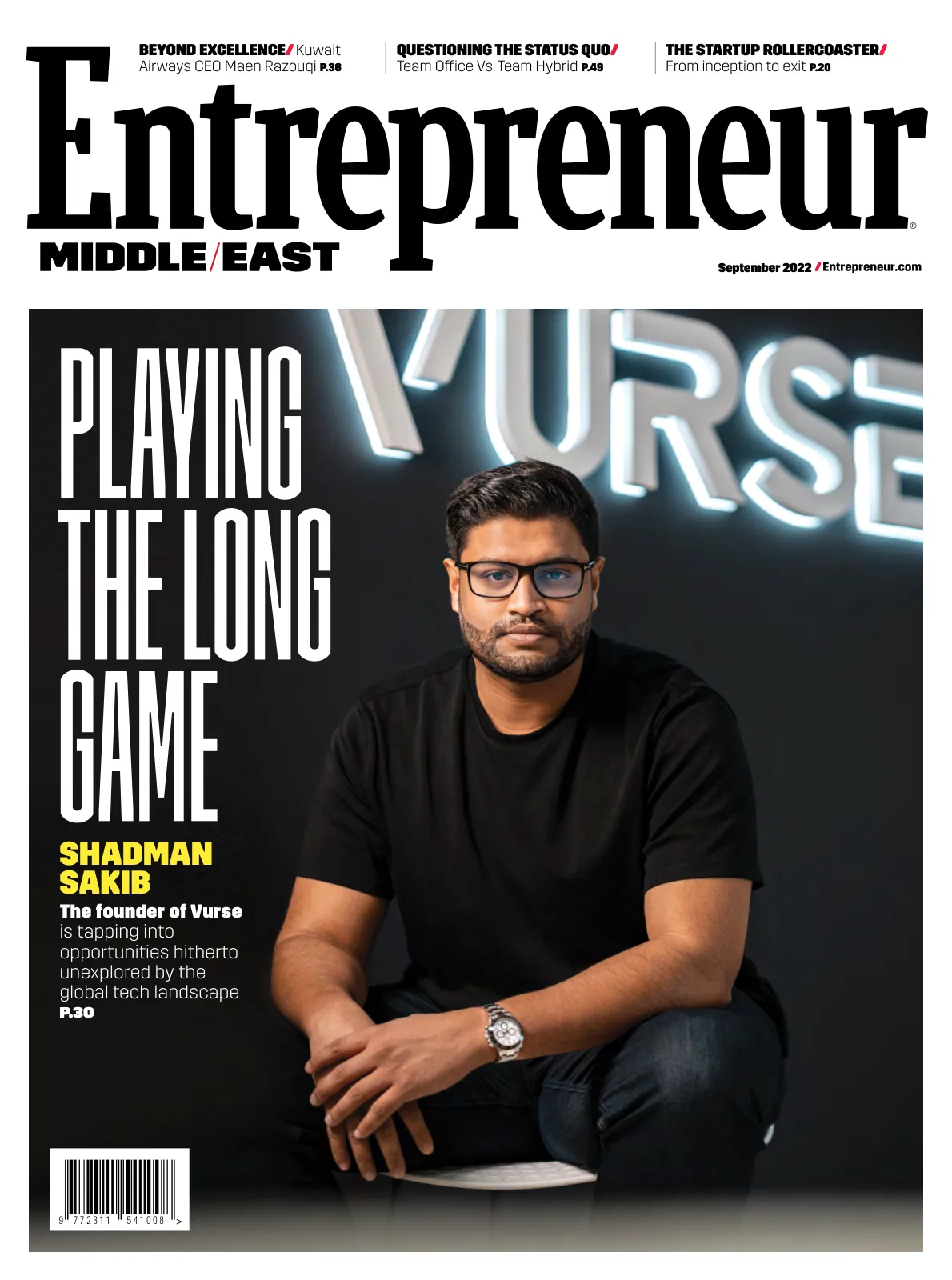
Entrepreneur Middle East, September 2022
Page 1
QUESTIONING THE STATUS QUO/
Team Office Vs. Team Hybrid P.49
9
7 7 2 3 1 1
5 4 1 0 0 8
>
September 2022
THE STARTUP ROLLERCOASTER/
From inception to exit P.20
PLAYING
THE LONG
GAME
The founder of Vurse
is tapping into
opportunities hitherto
unexplored by the
global tech landscape
P.30
SHADMAN
SAKIB
BEYOND EXCELLENCE/ Kuwait
Airways CEO Maen Razouqi P.36
Page 2
100,000+
regional and
international visitors
500+
tech expert
speakers
750+
global tech
exhibitors
400+
cutting-edge
start-ups
Feb 6-9, 2023
Riyadh Front Expo Centre
Saudi Arabia
Join us in
February 2023 as
we take the LEAP
Into New Worlds
Page 3
Co-organised by:
Join us online to
discover more and carry
on the conversation
@LEAPandInnovate
#LEAP23
Will you take the LEAP?
Register now for free
Page 4
SIGN UP & SAVE 30% ON STAYS WITH BREAKFAST INCLUDED
ALL.COM
SUMMER OF
Page 5
Page 6
Page 7
Page 8
8 / ENTREPRENEUR.COM / September 2022
Contents/September 2022
P.30
Playing the
Long Game
Shadman Sakib, founder of Vurse,
is tapping into opportunities hitherto
unexplored by the global tech
landscape.
by TAMARA PUPIC
P.15
Breaking
the Mould
Haj He Yi, the co-founder
and Chief Marketing Officer of
Binance (really) in her new role as
the Head of Binance Labs.
by TAMARA PUPIC
P.36
Beyond
Excellence
Kuwait Airways CEO Maen Razouqi
is on a mission to bolster the future
of Kuwait’s national airline.
by ABY SAM THOMAS
FEATURES
IMAGE COURTESY BINANCE
← BINANCE announced in
August this year that its
co-founder, He Yi, will
become the head of Binance
Labs, its venture capital and
incubation division that
currently manages US$7.5
billion in total assets.
Page 9
Page 10
10 / ENTREPRENEUR.COM / September 2022
EDITOR IN CHIEF Aby Sam Thomas
aby@bncpublishing.net
CEO Wissam Younane
wissam@bncpublishing.net
DIRECTOR Rabih Najm
rabih@bncpublishing.net
CREATIVE LEAD Odette Kahwagi
design@bncpublishing.net
MANAGING EDITOR Tamara Pupic
tamara@bncpublishing.net
STARTUPS SECTION EDITOR Pamella de Leon
pamella@bncpublishing.net
FEATURES WRITER Aalia Mehreen Ahmed
aalia@bncpublishing.net
DIGITAL SOLUTIONS DIRECTOR
Mahdi Hashemi mahdi@bncpublishing.net
HEAD OF INNOVATION
Sarah Saddouk sarah@bncpublishing.net
GROUP SALES DIRECTOR – B2B GROUP
Joaquim D’Costa jo@bncpublishing.net
COLUMNIST Tamara Clarke
CONTRIBUTING WRITERS
Abdallah Abu Sheikh
Fida Chaaban
Muhannad Ebwini
Sharene Lee
Chris Scanlan
Suraya Turk
SUBSCRIBE
Contact subscriptions@bncpublishing.net to receive
Entrepreneur Middle East every issue
COMMERCIAL ENQUIRIES
sales@bncpublishing.net
ENTREPRENEUR.COM
Access fresh content daily on our website
All Rights Reserved 2022. Opinions expressed are solely those of the contributors.
Entrepreneur Middle East and all subsidiary publications in the MENA region are
officially licensed exclusively to BNC Publishing in the MENA region by Entrepreneur
Media Inc. No part of this magazine may be reproduced or transmitted in any
form or by any means without written permission of the publisher. Images used in
Entrepreneur Middle East are credited when necessary. Attributed use of copyrighted
images with permission. All images not credited otherwise Shutterstock. Printed by
United Printing and Publishing.
PO BOX 502511 DUBAI, UAE
P +971 4 4200 506
Contents
September 2022
‘TREPONOMICS
78 To Raise or Not to Raise?
That Is the Question
A guide for entrepreneurs
wondering whether it’s time to seek
funds to grow their startups.
72 In Focus
A roundup of the up-and-coming
startups in the Dubai-based
Mohammed Bin Rashid Innovation
Fund accelerator program you
should be keeping an eye on.
70 Bolstering an Ecosystem
The GUESSS 2021 report highlights
the need to foster and support the
entrepreneurial spirit in Qatar’s
youth.
66 Lean and Mean
UAE-based B2B startup
MeatoDoor is taking a bite out of
the GCC’s meat industry.
64 Ditching cash
Mohammed Al Delaimi’s SkipCash
is on a mission to enhance
contactless digital payments in
Qatar.
STARTUP
SPOTLIGHT
BUSINESS
UNUSUAL
EntMagazineME
Entrepreneur-me
↑ SHARENE LEE AND MORRAD IRSANE,
the husband-and-wife entrepreneurial
duo who founded Melltoo, with
MOHAMMED SLEIMAN, founder and
CEO of Cartlow P.20
20 The Startup Rollercoaster
Looking back from its inception to
exit, serial entrepreneur Sharene
Lee reflects on the entrepreneurial
journey of her tech startup Melltoo.
59 For the People
(and By the People)
Malak Yacout’s The Volunteer Circle
is on a mission to mobilize the next
generation towards active social
impact in the Middle East and
beyond.
49 Questioning the Status
Quo
There are now two sides to the
“work from home” (WFH) debate:
Team Hybrid and Team Office. We
pick the minds of four UAE-based
startup founders to find out which
side they’re on- and why.
54 Back to the Basics
Move over, super apps- the MEA
needs ultra platforms that have user
experience at their centers.
Page 11
Page 12
12 / ENTREPRENEUR.COM / September 2022
Editor’s Note/
Editor’s Note/
D
on’t be afraid to fail” is a statement that often gets
thrown about in entrepreneurial circles. It is a
motivational trope we often tell people with the
stated aim being that they shouldn’t be afraid to
think differently, to voice original ideas, or to
simply attempt something new. And while that is
all well and good, I’ve begun to notice that what
many of us say in this regard is in stark contrast to how
we actually react when one among us makes a misstep.
Now, don’t get me wrong- I belong to the school of
thought that mistakes should be called out, and that
critiques, as painful as they can be, still present an
opportunity for things to be done in a better or
wholesome manner. However, it’s one thing to state that
something displeases us; it’s another thing altogether to
call fire and fury on it to show our distaste. The latter is
the kind of behavior that I now see a lot of people
showcase -mostly on social media- when they come
across something that disagrees with them.
Their ire is often directed toward whomever they’ve
deemed responsible for the gaffe that has so assaulted
their senses- personal insults are thrown about,
character attacks are aplenty, and even lawsuits are
suggested as a valid response. But consider for a moment
that the issue at the center of it all -the offense in
question- might just be an unfortunate lapse in
judgement made by a person or a group of people.
Keeping this in mind, are they really deserving of all of
the vitriol that’s being thrown at them?
Also, let’s consider the message actions like these send
to those around us- sure, we’re happy to spout cliches
that tell them to, say, “not let the fear of failure stop
them,” but if this is the kind of response that they can
expect should they slip up, aren’t all of our words just hot
air? Imagine a young person out there presenting
something new, which, unfortunately, is riddled with
honest oversights or unintended inaccuracies- do we
expect them to still dare to put themselves out there
when this is the kind of backlash they can potentially
receive?
The world of social media often puts us in binary
thought traps, where everything is assumed to be one or
the other. But the truth is that things are rarely, if ever, so
black and white, and such a forced demarcation simply
doesn’t allow for nuanced thinking, and neither does it
treat new ideas -even if flawed- with openness, and,
perhaps more importantly, with kindness. Again, the
issue here is not with calling out a wrong- it’s with the
manner in which we do just that. After all, mistakes are a
part of any innovator’s journey- let’s simply not make
them the end of it.
Aby Sam Thomas
Editor in Chief
@thisisaby
aby@bncpublishing.net
TO TRY OR NOT TO TRY
Experimentation is fair game
Page 13
Page 14
Page 15
15
September 2022 / ENTREPRENEUR.COM /
Breaking the Mould
He Yi, co-founder and Chief Marketing Officer of Binance, is setting out to change
the world (really) in her new role as the Head of Binance Labs by TAMARA PUPIC
→ BINANCE announced in
August this year that its
co-founder, He Yi, will
become the head of Binance
Labs, its venture capital and
incubation division that
currently manages US$7.5
billion in total assets.
IMAGES COURTESY BINANCE
Page 16
16 / ENTREPRENEUR.COM / September 2022
Binance, which is a
combination of the words
that mean crypto and safety
in Chinese, has lived up to
its name during the
significant drop in crypto
prices throughout the first
half of 2022. There have
been no reports of Binance
cost-cutting, laying off staff,
or something even worse- to
the contrary, Binance has
been focused on the future
by, among many other
things, being on a constant
hiring spree, as well as by
appointing Yi as the head of
its venture capital and
incubator arm, Binance
Labs. With US$7.5 billion at
its disposal, Binance Labs
already supports more than
200 portfolio projects
(which include success
stories like Web3 trailblaz
ers Polygon and FTX), and
it enjoys a 2,100% rate of
return on its investments
since launching in 2018.
And now, with Yi at its
helm, it is expected to do
even better. “I want to build
the standard for the Web3
industry,” Yi explains. “I
think that people have a lot
of anger about our industry
and that’s normal, and so,
we need time to build the
right standard and to make
people understand what’s
really true about this
industry. For me, Web3 is a
symbol, it’s more about
sharing- like your commu
nity and users make you
successful, so you can and
should give back to them.
That’s Web3 for me.”
In Web3, Yi continues, the
growth of a company does
not depend on funds it
raises from venture
capitalists (VCs), but on the
power of one’s community.
“It’s about this relationship
change, and for that reason,
I think that smart public
chains are more efficient
ways for people to raise
money for their businesses,
as opposed to getting it
from VCs,” she says. “So, we
need to let people know
how this industry functions
and what kind of people
drive it, and we need to
make them understand the
logic behind blockchain. For
one billion people to start
really using it, you need to
understand the technology
behind it.” And when asked
about the kind of startup
founders that can count on
the support from Binance
Labs, Yi describes them as
“people who know that the
sign of a really good
business is making the
world more efficient,
making people save money,
or helping the world to
become better.” She adds,
“I’m leading Binance Labs,
because I’m one of oldest
OGs in this space, and so, I
know a lot of people, and I
know this industry.
T
his year, I have met He Yi on three separate occasions- at the Binance Blockchain Week
in Dubai in March, Binance’s fifth anniversary celebrations in Paris in July, and over a
Zoom call from our respective kitchens in Dubai in early August. The last of these
encounters proves that the life of a Binance co-founder is not only about glittering
affairs; however, I should be forgiven for assuming so, because, over the same time
period, fellow Binance co-founder and CEO Changpeng Zhao – more popularly known as
CZ- has been globe-trotting and meeting nation heads in a bid to secure permissions
from their respective financial regulators- i.e. facilitate mass crypto adoption. And so, the
proof that some seriously hard work is required to maintain what is reportedly the
world’s biggest cryptocurrency exchange is in witnessing Yi keeping up with a pace that
is as frenetic as the one she pursued back in 2017 when she joined the startup. ”After
you, I’ll have another interview, and then one more one-on-one,” she tells me, as we talk at
about 8pm in Dubai. “I usually have breakfast at lunchtime, and lunch at dinner time.”
B/What’s Next?
Page 17
17
September 2022 / ENTREPRENEUR.COM /
Secondly, I have a good gut feeling to
recognize the right person, and thirdly,
I have a clear vision of our industry, and
what we want to build in the future.”
At this point, I’m becoming increasingly
interested in what the woman sitting
across my Zoom screen is actually
about, and to be more precise, and
where her unshaken belief is coming
from. To begin with, Yi seems to be
capable of placing absolute trust in a
person or idea when her inner criteria
are met, and even though real world
parameters might be showing the
opposite. For example, in 2017, Yi was
enjoying a good employment package at
Chinese mobile video sharing tech
company Yixia Technology, when CZ,
her former colleague from Chinese
cryptocurrency-to-fiat exchange
OKCoin, invited her to join his fledgling
startup: Binance. “We were preparing
for an initial public offering, and at that
moment, CZ wrote a white paper for
Binance, and began to raise money, and
he asked me to do some consulting
work for them,” Yi recalls. “A lot of
people do consulting for startups and
ask for a percentage or a token, but I
did it for free because I believed in CZ-
he was ambitious, hard-working, and so
I believed that he could be successful.”
And when Binance began to take off, Yi
found herself drawn back to the
enterprise. “When they raised the first
$50 million, CZ called me and said,
‘Tomorrow, binance.com will launch,
and we will grow, so join us,’” she
remembers. “And it was a difficult
situation for me, because I had a
better-paying job, but then, I told him
that I didn’t want his company to be
successful only in China, but that I
wanted a bigger challenge. It was
already 3am or 4am in the morning,
and it was just an offer over the phone,
but I finally said yes.”
However, Yi’s belief in Binance was
tested the very next day. “The next
morning, I had just quit from my
current job at the time, telling them
that I wanted to start up a business
with my former colleague, and I went
back to my desk only to see the 50%
crash of BNB coin,” Yi recalls. “That was
a very interesting moment. But I had
run exchanges before, and I knew these
things could happen, so in a month, I
joined Binance.” Patiently working one’s
way through difficult situations might
be not only Yi’s best career tip, but also
her advice for overcoming fears of
fluctuations on the crypto market as it
stands today. “People make a lot of
drama about prices dropping, but the
trust factor is always so important,” she
says. “At that moment in 2017, I knew
that I trusted myself and CZ, and I
knew that money was not important for
me, but what I wanted to do in life. I
knew that I’m good at branding,
marketing, operations, but that I didn’t
have a tech background, so I needed a
partner. I cannot be successful just by
myself. Since I wanted to take on a
global challenge, I knew that CZ was
the best partner for me. Although the
offer that I had from him looked worse
at that very moment, I still accepted it,
as I knew that we could build great
things together.”
And the rest, as the saying goes, is
history. However, much before Yi
demonstrated her belief in Binance, she
had to learn to put this strong faith in
herself first. “My mum didn’t believe
that I could be successful,” she says.
“When I was a kid and I would tell my
mum that, when I grew up, I would go
to another country, she didn’t believe
that. I’m from a small village, so when I
→ IN HER ROLE AT BINANCE LABS,
YI’S VISION is to drive the future
adoption of Web3 and blockchain
technology by “building the
standard for the blockchain
industry.”
WE NEED TO MAKE THEM UNDERSTAND THE LOGIC
BEHIND BLOCKCHAIN. FOR ONE BILLION PEOPLE TO
START REALLY USING IT, YOU NEED TO UNDERSTAND
THE TECHNOLOGY BEHIND IT.
Page 18
18 / ENTREPRENEUR.COM / September 2022
talked with my mum about going to
another country, how could she believe
that? Growing up, I’ve got my power
from two places- reading and the inter
net.” Originally from a prefecture-level
city in the southwestern province in
China, Yi was born into a family of
teachers, and for the most part, she
was raised by a single mother, as her
father passed away when Yi was only
nine years old. “It was a poor family,
but the good thing is that my family
gave me a good base in reading and
learning,” she says. “My mum hoped
that I would be a teacher, because in
her mind, women should be teachers or
assistants, but never bosses. So, I think
that the internet has changed that a lot,
as women of my generation have
started learning about inspirational
examples from around the world.”
Before Yi entered the crypto world in
2014 by joining a fintech enterprise in
the realm, her career trajectory by
then had seen her take on roles as
varied as a university professor, a
psychological advisor, and a host for a
travel television show. “There were a
couple of times in my life that I was
trying different types of jobs, and
trying to find out who I was,” she
recalls. “I always challenge myself- one
example is how I fought to get the job
as a television host, because when they
asked me what was my advantage, I
said that I knew how to do my own
makeup, so they would save money on
that. That got me the job. And then, I
was not a famous television host, but I
was still somehow known, and no one
believed that a television host would
go into a crypto startup, because at
that time, people thought that crypto
was a scam, but I did do that.”
And today, Yi is firm about the
power of crypto and Web3 to change
the world as we know it, and she
hopes to contribute to making it
happen with her role at Binance Labs.
“We want to know how we can help
more Web3 startups to be really
successful,” she says. “The industry is
much bigger than one crypto ex
change, and there are definitely many
fantastic use cases that really can
make people’s lives better, but we
don’t know which project can be
successful, and so, I’m always asking
where’s the best founder, where’s the
best solution, where’s the best product
that will really help people.” By this
point, we had been talking for about
an hour, and even though it was past
9pm, Yi hasn’t lost her zest, and
seemed to be brimming with enough
energy to take her through her next
two appointments as well. But I
decide to end our conversation then,
and my final question to her was
about what she would like to be
known for. “I don’t really hope that
people will know about me,” Yi replies.
“I feel that everyone comes to this
world with something that they need
to do, and I want to do that one thing
that is mine.” And, maybe, changing
the world might just be that “one
thing” that Yi is here for.
TODAY, YI IS FIRM ABOUT THE POWER OF CRYPTO
AND WEB3 TO CHANGE THE WORLD AS WE KNOW IT,
AND SHE HOPES TO CONTRIBUTE TO MAKING IT
HAPPEN WITH HER ROLE AT BINANCE LABS.
Binance co-founder Yi He’s
tips for women in business
‘TREP TALK
}Adopt a growth mindset “For every
woman, it’s important how you define
yourself. Women should not limit themselves
too much. I strongly recall that, when I was a
television host, a friend was telling me about
her dream of getting married, while I dreamt
about changing the world. Three years later,
when I was working for a mobile video
company, a media company in China wrote
about me, and she messaged me, "You did
it!” Yet, that was much before Binance and
the impact I can have now.”
}Stay the course “Consistency is very
important. Repeat, repeat, repeat. People
tend to change focus too much, but I believe
that the power of knowledge, understanding,
and gut feeling actually develop from being
persistent, from practice, from your day to
day training.”
}Develop (all) your skills “There is
too much talk about female power, or people
call it soft skills, but I don’t believe that it’s
the right way. You should truly understand
the power of your skills, and not define them
as male or female.”
→ UNDER YI’S LEADERSHIP, Binance
Labs will have an additional emphasis
on investing in capable, driven
founders who will play a role in shaping
the future of the industry.
B/What’s Next?
Page 19
lyveglobal.com
E-COMMERCE
MADE EASY
Supercharge your ecommerce and online operations
with Lyve. Get fast, flexible, and full-featured delivery and
technology solutions that meet your customers’ needs
and allow you to focus on what you do best.
Go Lyve Today �
lyveglobal.com/ecommerce
#golyve
Page 20
20 / ENTREPRENEUR.COM / September 2022
B/The Big Idea
Page 21
21
September 2022 / ENTREPRENEUR.COM /
AN ENTREPRENEURIAL STORY- FROM INCEPTION TO EXIT
by SHARENE LEEROLLERCOASTER
THE STARTUP
T
ime flies. It’s been eight years since my husband and co-founder, Morrad Irsane, and I
launched Melltoo, our tech startup based in the UAE and Saudi Arabia. In between, we’ve
become a family of nine (yes, we have seven children), we’ve moved from the UAE to
Saudi Arabia, we’ve gone through a pandemic, and we are now living through a “global
recession.” From an entrepreneurial perspective though, after eight years of occasionally
exhilarating, heart-wrenching, euphoric, ulcer-inducing moments in our startup journey,
we finally have a happy ending with the acquisition of Melltoo by Cartlow. For those of you who
are thinking of launching a startup, are in the middle of building a startup, or are close to exiting a
startup, this story is for you. Read on as I recount a few harrowing experiences from my startup
journey, from running out of cash, to pivots and investor fails.
21
September 2022 / ENTREPRENEUR.COM /
Page 22
22 / ENTREPRENEUR.COM / September 2022
B/The Big Idea
THE LAUNCH
Build it and they will come? Not
really
Melltoo is a peer-to-peer transactional
marketplace for secondhand items.
The vision has always been to reduce
the friction inherent in secondhand
marketplaces by using technology to
bring together a community of buyers
and sellers in a fair and transparent
marketplace. In August this year,
Melltoo was acquired by fellow
UAE-born startup Cartlow to further
that vision, and to join Cartlow’s
journey toward dominating the
recommerce marketplace in MENA.
How did it all begin, you ask?
It started in late 2013, when Morrad
and I conjured up the idea for Melltoo
while on a teaching stint in Ha’il,
Saudi Arabia. We were serial
entrepreneurs, and we quickly tapped
into our existing knowhow and
networks to get the company off the
ground. While it wasn’t our first
business, tech was new to us. Because
Dubai was the startup hub of the
MENA at the time, we moved back to
the UAE, and we started building in
earnest. By then, we had seen the
“overnight” successes of Facebook,
Whatsapp, Souq.com, and a number of
tech startups that were coming up at
the time. So, we figured that since we
were smart, experienced
entrepreneurs, we were the one in a
million, and that we would, of course,
be able to make it.
It didn’t quite happen like that
though.
Thinking back, I’m ashamed at just
how arrogant we were. We were like
teenagers who think they know
better than their parents. We thought
our incumbent competitors were
clueless and out of touch. We thought
we could build better technology
with an outsourced team (!!) than
established players. We attended
startup events, and we practically
scoffed at mentors who pointed out
flaws in our business plan- to these
mentors, you know who you are, I am
sorry!
Approximately six months after we
started building, we launched our app
in the app store and then… crickets.
Someone suggested that we buy cheap
downloads on Android, so we started
burning our own cash to buy low
quality downloads that were not
converting to users and actual
business. But hey, the business was
“growing,” said our vanity metrics. We
went to all the startup hubs and did
“mini launches,” and some of our kind
and charitable fellow entrepreneurs
attended to hear us give our spiel.
But no one was using the product.
More importantly, no one really cared.
People will never say anything negative
to your face (they usually reserve their
negativity for Twitter), so those we
spoke to were always agreeable and
encouraging, but no one cared enough
about what we were doing to use the
product. We soon came to realize that
the best feedback was usually critical,
and, thankfully, those alarm bells
finally got through. After blowing
through a lot of our own cash buying
useless downloads for a product that
was substandard, we pivoted our
product and growth “strategy”- after
all, it wasn’t so much a strategy as an
answer to “What should we do today to
get more downloads?”
In this time, we had hired a Chief
Technology Officer (CTO), who, little
did we know, couldn’t code, but still
managed to build a strong tech team
around him. However, after several
months of careful maneuvering, we
managed to extricate ourselves from
our no-code CTO. We were introduced
to a clever app store hack by a fellow
entrepreneur, which involved cloning
our app, and naming the clones as
popular search terms, and things
started to grow organically.
“WE SOON CAME TO
REALIZE THAT THE BEST
FEEDBACK WAS USUALLY
CRITICAL, AND,
THANKFULLY, THOSE
ALARM BELLS FINALLY
GOT THROUGH.”
Melltoo at the turn8 launch event in 2014
IMAGES COURTESY MELLTOO
Page 23
23
September 2022 / ENTREPRENEUR.COM /
FUNDRAISING FAILS
Running out of money 101
At this point in our startup’s lifecycle, we were able
to raise some amount of funding that we put
toward aggressively growing our user base. That’s
when we launched the first iteration of our referral
program. It was uncapped, and referrals were
unverified- and things got exciting as we were
essentially giving away free money to customers. In
fact, we were tripling our gross merchandise
volume month-on-month.
To be fair, the referral program got out of
hand, because we were unable to iterate the
technology fast enough. We needed to add
in a number of verification mechanisms and
limitations for the program to be unit-economical
ly viable. However, growth is addictive, and
repairing an airplane’s engine as it is ascending is
never an easy thing. We were cognizant that this
growth strategy was a risky one, but we didn’t
really have a choice, and we needed to continue
growing to get us to our next round of funding.
And, you know what, we almost made it… almost.
We were in talks with the most important venture
capitalists (VCs) in town (this was 2015, so there
were, like, three of them) who all wanted to lead
our bridge round. Cocky in our hypergrowth, we
kept burning cash with the expectation that more
was on the horizon. Unfortunately, MENA VCs do
not have the risk tolerance of Softbank CEO
Masayoshi San, and after several months of deep
due diligence, it dawned on them that we were not
being prudent with our growth strategy. One
pulled their term sheet, another then decided
against taking us to the investment committee, and
the last said an emphatic no.
Now, at this point, we were in deep doo-doo. This
period of time was the most stressful in my entire
life. Don’t get me wrong, we have run out of money
many times since then, but the first time is always
the most traumatic. I remember calling my mother
in tears, asking her to loan me US$30,000- she
ended up mortgaging her house to help us. We sold
the last of our gold (yes, we were gold bugs, now
bitcoiners) to keep the company afloat. Each day, I
woke up with a pit in my stomach, and at the end
of it, I went to sleep stressing about how to pay
creditors. We really scrambled, we tried to
scrounge up a last-minute funding round, we
reached out to potential acquirers who may have
been interested in a fire sale, and we even ended
up in the home of a Russian oligarch- no further
comment.
Those were dark days.
↓ SHARENE LEE AND MORRAD IRSANE, the husband-and-wife
entrepreneurial duo who founded Melltoo, with MOHAMMED SLEIMAN,
founder and CEO of Cartlow
"At the end of the day, we build companies to benefit customers,
employees, investors, and to leave the world a bit better than
before," said Melltoo CEO Morrad Irsane, after news broke that
his classifieds platform for second-hand items that he
co-founded with his wife, Sharene Lee, was acquired by
UAE-based reverse logistics platform Cartlow. "The exit is just
one part of the journey; what goes before it is much more
important. As long as we benefited customers, employees,
investors, and have left the world a better place, we are
satisfied."
The acquisition will see customers of Melltoo's 30 categories
and over 500,000 products now be automatically redirected to
Cartlow's platform to shop or sell their pre-loved and never-used
items while also enjoying features like free delivery, 10-day return
policies, and 12-month warranties. As for Cartlow, founder and
CEO Mohammed Sleiman believes that the deal will allow the
enterprise and its cloud-based technology to get a better
foothold on the global reverse logistics market, which is
projected to reach a value of US$958 billion in 2028.
Commenting on the process of the acquisition, Sleiman says
that there is no specific formula governing the same. "It lies
under one simple principle- understand that acquiring a
business is not about integrating but instead about accelerating
the overall vision of the company," he said. When asked about
the key lessons he learned in the process, he first points toward
the importance of remaining focused on one's future goal.
"In most cases, the negotiation stage is where people get stuck,"
Sleiman said. "The company that you are trying to acquire will
have a certain vision, and it's crucial to highlight how this vision
will blend into your own company's vision and objectives to
ensure success in the long run."
"WE GOT ACQUIRED!"
Cartlow buys out fellow UAE-born
startup, Melltoo
Page 24
24 / ENTREPRENEUR.COM / September 2022
Fortunately, Morrad is tough as nails, and he stayed positive,
and he kept hustling. We had to announce to our team that a
round of funding fell through, and that we couldn’t pay them.
We had to lay off half the team, and we asked everyone
remaining to go part-time. Some of the team even stayed on
as volunteers. To this day, I am grateful to them for their
support. We had to call suppliers and explain that we
couldn’t pay them- these were the same people we had sold
dreams of grandeur to. We had to call customers and tell
them that we had to delay payouts. Morrad made these
dreadful calls- you would think that he would have been
devastated by each call, but in fact, people were often
sympathetic, and our proactive effort to reach out salvaged
those relationships, and allowed us to continue the business.
This was 2016.
RISING FROM THE ASHES
Pivot, pivot, pivot
There is simply no shortcut to building and growing a
business. All of those so-called overnight successes mask
years and years of iteration and hard work. Once we
stabilized the finances, it was time to get back to work. By
that time, we had spent countless nights trying to figure out
how to get rid of the business only to realize that we were
both still bullish about its prospects, and that it was not time
to give up. As Morrad would say, stick around long enough,
and you’ll be the last man standing.
But getting back to work wasn’t easy either. It’s one of the
most difficult things for a startup that is growing rapidly to
reset to zero, and then try to restart growth again. That was
the situation we were in. We started by putting the needed
guardrails in place around our referral program, which
dramatically reduced our revenue, and it felt like starting
from scratch. We needed to go back to the drawing board to
figure out what really brought value to our customers, and
why people were using our product. In other words, we had
to -as Ross in Friends put it- pivot, pivot, and pivotttttt!
You see, the underlying business model was sound, but the
product was immature, and our focus on growth was
misplaced. We had to start building out operations in other
directions, and also open up new revenue streams in order to
bootstrap the business. I believe that the near-death
experience taught us the humility we needed to talk to
investors. We were transparent about what went wrong, and
it was on this basis that we began to regain investor trust,
and be able to raise funding again to continue building out
the new business streams.
I cannot overemphasize the importance of resilience in
startup life. It’s not talent, networks, experience that matter
when times are tough; it’s resilience. You keep going even if
there doesn’t seem like a future, you keep going even if there’s
nowhere to go, you keep digging until you break through to
the surface- or you end up buried and dead. If you’re not
prepared to be resilient, then give up now.
The story doesn’t end here, and we went through several
more years of highs and lows. Funding opportunities missed,
a lack of focus causing us to go off-course at times, almost
running out of cash multiple times. But all throughout, we
continued to build our product, and grow our customer base.
The thing I am most proud of is that we brought value to our
customers, and that we became a small -but important- part
of their lives. It was always a pleasure to hear from our
customers, even when they were complaining- I recalled the
days when nobody even cared to complain, and I was happy
to hear them passionately bashing our customer service. And
the compliments were even sweeter. People cared about what
we did, and they supported us- and there is nothing better
than that.
HONORABLE MENTIONS
A few (noteworthy) odds and ends
One day, perhaps, I will write a book about my startup
journey, but today is not the day. However, I’d like to include
a few fun stories as honorable mentions.
B/The Big Idea
“I CANNOT OVEREMPHASIZE THE
IMPORTANCE OF RESILIENCE IN STARTUP
LIFE. IT’S NOT TALENT, NETWORKS,
EXPERIENCE THAT MATTER WHEN TIMES
ARE TOUGH; IT’S RESILIENCE.”
Sharene Lee at the 2017 Global Ventures summit pitch
Page 25
25
September 2022 / ENTREPRENEUR.COM /
Sleiman also suggests both parties in an acquisition process
to make the effort to build rapport with the other side, as "it is
more likely both parties will reach an agreement if they spend
time getting to know each other and each individual's overall
goal for the business." In addition, Sleiman also advises them to
be open to smart trade-offs. "During negotiation, both parties
are often stuck on specific challenges," he explained.
"Therefore, capitalizing on the presence of those challenges is
more likely to get both parties to reach an agreement."
For his part, Irsane believes that understanding why the
acquirer wants to buy one's business is a good starting point.
"This is very important in negotiations in order to create a
win-win situation," he said. "Also, this understanding helps you
assess how far you can push in negotiations. Then, my second
learning is to be patient, as so much in the closing of
acquisition deals is outside of individual control." His ultimate
tip for other entrepreneurs is to be radically transparent, as "it
will prevent delays and help all parties avoid unnecessary
conflict." Irsane added, "Being clear (and getting things in
writing) is necessary. Often, deals get thrown off course by
small misunderstandings. Disclosing as much as legally
possible from the beginning will smoothen the path."
Melltoo's acquisition comes after Lee and Irsane, who
launched the company in 2014, have gone through three
fundraising rounds for the startup, with the process seeing
them talk with a total of 40 investors in total. "When we first
started, startups were chasing investors, and venture capital
was still a very small industry in MENA," Irsane recalled. "Fast
forward eight years, there is a lot of money chasing startups
now, and the landscape has changed." Having said that, Irsane
says that there's a certain momentum within every fundraising
process that startups need to maintain in order to have a
smooth journey in this regard.
"While startup life is never predictable, and growth is never
linear, startups are still expected to progress along a certain
trajectory in order to get funded," Irsane explained. "This is one
of the many challenges of fundraising in the MENA, as
investors are not particularly forgiving when a startup doesn't
follow the expected trajectory. To overcome this, startups have
to be extremely honest and self-aware- don't try to fudge the
numbers, or attempt to skirt around the issue. Address
whatever failings your startup has head-on with investors; this
is the only way to build credibility and trust."
When we first launched, I had a three-month-
old baby that I was dragging around to events
and meetings, including investor pitches. He
was a quiet baby, and so, while I did get a lot
of stares and raised eyebrows, it was generally
uneventful. However, during one unfortunate
investor pitch, my baby woke up, and he was
hungry, and so, I proceeded to discreetly
nurse him while continuing our pitch.
Normally, he would fall back asleep, but on
this day, he was annoyed, and he started
fussing. To keep him quiet, I got up, and I
started pacing around the room while rocking
the baby. As it turned out, he had had a giant
bowel movement, and it was leaking all over
his white pajamas. But I kept a poker face,
and I continued to discuss the financial model
with the investor. The investor was extremely
polite and cool about everything, but,
needless to say, we didn’t get that investment.
On more than one occasion, we’ve been
either directly told or indirectly hinted at to
rethink our Muslim “costumes”- Morrad is
heavily bearded, and I wear a niqab. One
investor even said that he was sure that he
would succeed in getting Morrad to shave his
beard after some time. Another investor told
me that there is no need for my niqab, and that
there’s no point in me wearing it. But despite
such comments, we have not changed our
“costumes,” and we have no plans to. Having
said that, interestingly enough, despite their
misgivings, the aforementioned investors (and
many others) did invest in us. I think they
understood that our convictions in our personal
lives reflected our convictions in our profes
sional lives. The lesson here: stay true to
yourself.
Six months after we first launched, our biggest
competitor (and the market leader) -the one we
don’t speak of- launched a copycat product of
ours that was well-funded, well-designed, and
heavily marketed. We were then told by
well-meaning fellow entrepreneurs that this
competitor would crush us. But from the very
outset, this new product struggled, and they
kept mimicking us in whatever we did, from
product to marketing. At one point, because we
were able to scalp many of their customers, they
even sent us a cease and desist letter. We were
intimidated at first, but then we realized that
they were pretty much as clueless as we were.
They shut down three years later in a whimper.
We barely noticed.
Morrad Irsane at the the 2019 World Economic Forum
Page 26
26 / ENTREPRENEUR.COM / September 2022
B/The Big Idea
TIME TO LET GO
Our baby is all grown up
Fast forward to 2022, and Melltoo
has now been acquired by Cartlow.
The acquisition was a journey in
itself, and it’s perhaps best left for
another discussion. One chapter of
my life has concluded, and a new one
is about to begin. While I’m pleased
with the outcome in general, I am
also wistful as I’m suddenly faced
with an empty nest. So much of my
mind space in the past eight years
has been filled with Melltoo, and
now, there is a void.
Since the acquisition has been
announced, many have reached out
to congratulate us, and we are grate
ful. I have spent the bulk of this
story focused on our failures, even
though we’ve had a lot of successes.
After all, we’ve won a bunch of pitch
competitions, got funded by the top
VCs in the region, mentored a
bunch of young people who I believe
have been positively influenced, and
built a company of value that
customers have benefitted from.
Along our journey, we’ve worked with
many amazing people, whether
investors, team, partners, or custom
ers, and I’m grateful for you all.
Nonetheless, I am telling this story
through the lens of our failures,
because nobody ever talks about their
failures. There is a damaging false
narrative that startup life is going
from one success to the next. That’s
not true at all- startup life is going
from failure to failure, with occasion
al stops for successes.
Everyone is there with you to
celebrate the wins, but no one is there
for the losses. So, I hope my story will
be a companion to you in your startup
journey, especially when things get
tough. Be comforted in the knowl
edge that the startup journey is one of
many failures, and that if you
persevere, you will find a way
through.
EPILOGUE
Starting up from scratch…
again
I always thought that when we
finally exited Melltoo, we would find
an island somewhere, and then stay
there and ponder life for our
remaining days. And I used to scoff
at founders who sold their compa
nies only to turn around and start a
new one- what were they thinking?
After years of toil and hard work,
why would anyone do this again?
Well… it turns out that entrepre
neurs are crazy. No, really. We love
the thrill of the chase. I suppose it’s
like spicy food- it burns the tongue,
but once you get used to it, every
thing else tastes bland. After years of
riding the highs and lows of the
startup rollercoaster, normal life
feels bland. And as such, we’re ready
to get back on.
Today, we’ve found a new passion,
and each day that I’m immersed in
it, I grow more passionate. Web3 is
the future. The ethos of decentral
ization and the flurry of startup
activity around it reminds me of the
early days of the internet. So much
is new, and so much is being built- a
whole new world is arising. And
we’ve found our new calling:
TAKADAO.
TAKADAO is Shariah-compliant
takaful insurance built as a
decentralized asset organization
Melltoo won the Best Female Led Startup title at GITEX in 2017
Melltoo at the 2017 Sharjah Entrepreneurship Festival
Page 27
27
September 2022 / ENTREPRENEUR.COM /
THE ACQUIRER'S
VIEWPOINT
Cartlow founder and CEO
Mohammed Sleiman on what to
keep in mind when considering
an acquisition
1/ Consider the rationale behind
the acquisition "Why are you
acquiring this business, and what is
your end goal? This needs to be a
very strategic move for you in the
market. Do you know the ins and
outs of the business you are
planning to acquire, and what can it
help you achieve in the long run?"
2/ Know your competitors and
market "Most entrepreneurs spend
more time on their product than
they do on getting to know the
competition and the market. Always
focus on what sets you apart from
competition, and how acquiring a
startup/another business can
potentially benefit your overall
ecosystem."
3/ Assess the impact on your
financials "Basically, get to know
how the acquisition will impact
your financials, whether it will
improve or decrease your profit
margins, and how it will impact your
revenues."
THE ACQUIREE'S
VIEWPOINT
Melltoo co-founder and CEO
Morrad Irsane on what to keep
in mind when considering an
exit via an acquisition
1/ Networking is critical "Exits
happen in strong ecosystems, and
ecosystems are built on networks.
Be open to building long-term
relationships with others in the
ecosystem that are not purely
transactional in nature. Don't be
afraid to talk to your competitors.
Our exit began with getting the
right people to see value in our
business, and this arose organically
through a willingness to build
relationships within the
ecosystem."
2/ Look for a win-win "Business
acquisitions and mergers are
based on value-added- not
necessarily monetary value, but
certainly, the value that can be
generated through the acquisition.
Founders tend to be focused on
getting the maximum financial
return for their company, but
approaching an acquisition from
this angle results in an adversarial
relationship between parties, which
means that the deal is volatile and
susceptible to falling through."
3/ Involve the team "Acquisitions
impact the team to a large extent.
It's important to get buy-in from the
team and investors, and to involve
them in the process. It's inevitable
that hiccups occur in the course of
an acquisition, and having the team
be a part of the process means
stability in business operations
even when things look bleak, which
is critical to ensure the completion
of the deal."
(DAO) on the blockchain. Takaful is the
OG decentralized insurance community
that existed since the days of the Prophet
Muhammad, peace be upon him. Now,
with the advent of Web3, TAKADAO can
now be built as a global community
mutually protecting one another across
national borders. It is only with crypto
and blockchain technologies that this
vision is now possible, and we are excited
and emboldened to commence our new
startup journey.
Will you join us for this new ride?
Sharene Lee is the co-founder
of TAKADAO, a Shariah-
compliant takaful insurance-
alternative built as a
decentralized autonomous
organization (DAO) on the blockchain.
Previously, she was the co-founder and
COO of Melltoo, a peer-to-peer transac
tional marketplace for second-hand
items, which was acquired by fellow
UAE-born startup, Cartlow, in 2022.
Sharene is a serial entrepreneur with
two prior exits in the analog economy
and one in web2. She was born and raised
in Singapore, but she lived in the United
States prior to moving to the Middle East;
she now lives in Riyadh. Her passions
include Islamic finance and Web3; in
particular, how blockchains and crypto
are a fertile ground for the growth of new
financial paradigms. Sharene also enjoys
mentoring and working with fellow
female entrepreneurs. She is a mother of
seven. takadao.io
“BE COMFORTED IN
THE KNOWLEDGE THAT THE
STARTUP JOURNEY IS
ONE OF MANY FAILURES,
AND THAT IF YOU
PERSEVERE, YOU WILL FIND
A WAY THROUGH.”
Page 28
come as
you are.
Page 29
@ / # 25hourshotels
#hellodubai
we are now open!
25% off,
book via
enjoy
25hours-hotels.com
Overlooking the museum of the future, near dubai international
financial centre, 25hours hotel one central boasts 434 rooms
and suites in addition to flexible events and co-working spaces.
A total of four characterful restaurants and bars take guests on
a culinary trip around the world from northern india to the beer
gardens of bavaria: this is where urban nomads meet desert
flowers, where local heroes meet the well-traveled. Alongside
rental of mini cars and schindelhauer bikes the hotel will also
feature the extra hour spa, rooftop pool and dubai's first
mixed-gender rooftop sauna.
434 rooms | co-working spaces | monkey bar | tandoor tina
ernst | nomad dar bar | rooftop pool & sauna | spa | gym
Page 30
30 / ENTREPRENEUR.COM / September 2022
PLAYING
THE LONG GAME
The founder of Vurse is tapping
into opportunities hitherto
unexplored by the global tech
landscape
SHADMAN
SAKIB
I
n Dubai, it is as if we are living inside a metaverse,
and although I had come for only 12 days on my first
trip here, it did not take me long to understand that
Dubai will become the next Silicon Valley,” says
Shadman Sakib, founder of Vurse, a Dubai-based
venture developing cutting-edge technologies. “I
knew that this should become my life, so I set up my
company in Dubai in December 2021.” And just like
that, Sakib turned Dubai from a vacation destination into
a base for his future life and business activities. It was
thus from his office in the Emirate that Sakib and I
engaged in a conversation about what he has got up to
with Vurse, and quite quickly I realize that he is the type
of an entrepreneur who talks about his plans only in
whispers, and then lets them speak for themselves
when they materialize in the real world. But it is also
clear that Sakib believes that he is working on
something that’s set to make its impact felt -in a big
way- on the world at large, and, as such, the rest of us
can get ready for that celebratory moment by learning
as much about Vurse as we can at the moment.
by TAMARA PUPIC
Page 31
31
August 2022 / ENTREPRENEUR.COM / 31
September 2022 / ENTREPRENEUR.COM /
IMAGE COURTESY VURSE
→ According to Shadman Sakib,
his company, Vurse, could
well be the harbinger of
cutting-edge tech that can come
out of the UAE and, indeed, the
wider MENASA region.
Page 32
V
urse currently counts 35 people as team
members and Sakib aims to grow it into
having a 5,000 - strong team in Dubai
over the next five years. His Dubai-
focused plans have been boosted also by
the announcement of the Dubai
Metaverse Strategy, which is designed to
ensure that the contribution of the
metaverse sector to the Emirate’s
economy increases to US$4 billion by
2030. “Because Dubai is already known
for its beautiful infrastructure, I think
it’s time for it to be known for its digital
vision and cutting
edge deep-tech sector
too,” Sakib says. The
Emirate’s history
seems to have also
inspired Sakib’s
philosophy for his
business, in that he is
eager to give it strong
foundations that are
expected to both
empower and uphold
its digital development in the future.
This is especially evident through
Sakib’s choice to simultaneously work
on the three verticals of Vurse, which
include an interactive short video
platform, a blockchain-based
ecosystem for content creators, and a
Vurse metaverse.
Starting with the Vurse short video
platform, Sakib says that its key
differentiator lies in the fact that it is
not focused on user consumption, but
user interaction. “One of our key drivers is to enable
young people to make smarter choices in the way they
interact with and consume content,” he says. “What I see
today is that people’s consumption of social media is not
correlated with the quality of the content or the value
they can drive out of their time on it. With Vurse, we’re
also trying to enhance the creators’ experience by
supporting them in producing content that is intellectu
ally stimulating, entertaining, and driving economic
value. Once that happens, consumption will happen
organically.” Meanwhile, for Vurse’s blockchain arm,
Sakib has walked an extra mile in order to make a shift
in the content creator economy. “Leveraging the
blockchain technology, we are decentralizing the core
foundation that exists for content creators, because we
believe that they are the future driver of marketing,” he
explains. “So, what we’re trying to do is to use technolo
gies like Web3 and blockchain to enhance the interac
tion with the content they create and the transparency
around the economies of VURSE community and hence
the overall experience. We believe that they will feel the
excitement and motivation to do what they do.” Last but
not the least are Sakib’s plans to build a completely new
and independent metaverse for the Vurse community
and essentially the world. “Since the metaverse is like
the future version of the internet, I believe that this is
where the entire world is going to shift to eventually,
and so, we’re building our own ecosystem,” he says. “So,
once that happens, not even the sky is the limit. At
Vurse, we are very excited to see where we’ll go.”
At this point, it becomes clear why Sakib will need to
hire thousands of skilled tech talents to
work on his three grandiose projects,
but that in itself sounds as a task hard
enough, keeping in mind the current
state of the blockchain technology.
“People who work with this technology
and have gathered experience that
matters are actually very few,” Sakib
agrees. “For Vurse, we brought people
from 12 countries here to Dubai to
complement our global team. At the
same time, we maintain a fun and open
culture. We are all fun-loving, so we try
to keep our work and entertainment all
in one place, and that helps with
recruiting the best. And for other
entrepreneurs also seeking to recruit
such talent, my advice would be to make
sure you present your vision to them,
and if they are aligned with that, they
will jump on board, because the most
talented people in the world are never
actually driven by monetary factors.”
S
akib’s plans for his enterprise have also recently
got a shot in the arm thanks to investors who
did not hesitate to put their funds into Vurse.
“We recently closed one funding round, where
we invested ourselves, along with other
institutional investors who previously invested
in other decentralized technology platforms and
reputed companies,” he says. “For our next round, we
aim to raise US$1 billion, because our plan is to grow
as quickly as possible, blossom as fast as possible, and
show people something that will wow their mind.”
Sakib adds here that raising funds, according to him, is
all about maintaining relationships. “The best way to
raise funds is not to work on raising it at all, so don’t
ask for money, but instead, show your vision, and
motivate the investors, because, at the end of the day,
investors are people like you and me, and they would
also like to understand what the vision is,” he says.
IMAGES COURTESY METAHERO | EVERDOME
“ONE OF OUR KEY
DRIVERS IS TO ENABLE
YOUNG PEOPLE TO
MAKE SMARTER
CHOICES IN THE
WAY THEY INTERACT
WITH AND CONSUME
CONTENT.”
→ According to Sakib, THE VURSE SHORT VIDEO
PLATFORM key differentiator lies in the fact that it is not
focused on user consumption, but user interaction.
Page 33
← For Sakib, just seeing someone
use Vurse will be one of the most
rewarding things he expects to
gain from launching the enterprise.
“I would love to see someone
using it when I’m walking on the
street,” he says. “I just literally live
for that.”
Page 34
34 / ENTREPRENEUR.COM / September 2022
“Most importantly, when you want to build a
company at a global scale, you want investors
who have the same mindset as you, and who
hold a long-term vision, because patience goes a
long way. It’s not like we can get a return on our
investment tomorrow; no, it’s a long run.”
M
ass blockchain adoption might follow
the opposite trajectory, Sakib added,
in that it will happen sooner than we
expect. “Blockchain is an emerging
technology, and people are getting
more serious about it, because those
younger generations are very tech and business
savvy,” he says. “If you ask them about tokens or
coins, they will give you all sorts of ideas, so I
can say that adoption is happening at a very
rapid pace and will accelerate even more.” The
missing part, according to Sakib, is creating
blockchain technology solutions “that can be
used even by a five-year-old, and that can be
explained in like two sentences, literally.” But
Sakib adds that he believes this will happen
sooner than later. “We are coming closer to this
and that is why, in my opinion, this period is a
great time to invest. Let’s not look at what
happened before, but let’s look at what’s going to
happen in the future, because that’s where we
are going to live,” Sakib concludes.
“FOR OUR NEXT
ROUND, WE
AIM TO RAISE
US$1 BILLION,
BECAUSE
OUR PLAN
IS TO GROW AS
QUICKLY
AS POSSIBLE.”
→ Sakib’s chose to simultaneously work on the
THREE VERTICALS OF VURSE, which include an
interactive short video platform, a blockchain-based
ecosystem for content creators, and a Vurse
metaverse.
}BUILD THE UNBUILDABLE
“Try to build something
that’s like impossible to
build.”
}PATIENCE IS KEY
“Play the long game,
not the short game.”
}SURROUND YOURSELF
WITH THE BEST
“Hire in a way that the next
one is better than the last
one, but build a family.”
Vurse founder Shadman Sakib’s
tips for entrepreneurs
TREP TALK
‘
Page 35
Page 36
36 / ENTREPRENEUR.COM / September 2022
KUWAIT AIRWAYS CEO MAEN RAZOUQI
BEYOND
EXCELENCE
by ABY SAM THOMAS
Meet the man on a mission to bolster the future
of Kuwait’s national airline
→ MAEN RAZOUQI is a global
leadership executive who is
currently the Chief Executive
Officer of Kuwait Airways. Prior
to his current role at the
state-owned national airline of
Kuwait, he was the President
and General Manager for the
northern Middle East
operations of Schlumberger,
the world's largest offshore
drilling company.
IMAGES COURTESY KAMEH/NATELEE COOKS
IMAGES COURTESY KUWAIT AIRWAYS
Page 37
37
September 2022 / ENTREPRENEUR.COM /
Page 38
38 / ENTREPRENEUR.COM / September 2022
D
o you remember, Aby, who was
the second person to walk on the
moon?” When Kuwait Airways CEO
Maen Razouqi posed this question
to me when I interviewed him in
August this year, I must admit that
in that moment, I found myself
stumped for an answer. A Google
search later reminded me that the
person who followed in American
astronaut Neil Armstrong’s historic
first steps on the moon was his
colleague on the space mission,
Buzz Aldrin, but the fact that I
couldn’t recall his name off the
top of my head allowed Razouqi
to make his point. You see, at the
time, Razouqi was telling me about
Beyond Excellence (BE), the transformation
program that he had initiated at Kuwait Airways
earlier this year, and I had quizzed him on
the reasoning behind the name he chose for
the digitally focused initiative. “I come from a
personal belief that you have to be number one,
and being number two, to me, means you’re
the first in the biggest line of losers,” he says.
“So, coming second is not something anybody
remembers. Do you remember, Aby, who was the
second person to step on the moon?” And as I
shook my head in response, Razouqi reiterated
his reasons for wanting Kuwait Airways -the
state-owned national carrier of Kuwait- to
aspire to be at the top of its industry. “Within
our capabilities and abilities, excellence is not
satisfactory,” he declares. “I want us to achieve
beyond excellence, because beyond excellence,
there is no limit to how far you can go.”
→ AS THE FLAG CARRIER OF KUWAIT,
Kuwait Airways aims to be associated
with success and excellent
performance.
T
he BE program is one of the most
significant initiatives that Razouqi
has kickstarted at Kuwait Airways
since his announcement as its CEO in
October 2021. The initiative, which was
launched as part of the 68th anniversary of
the enterprise, has been built on the
directions on the strategy and goals set by
the shareholders and board of directors of
Kuwait Airways. Currently, the airline has
34 aircrafts under its purview that operate
57 direct routes, plus 82 in partnership
with other airlines, with a workforce of
around 6,000 employees. In 2021, Kuwait
Airways was declared to be “an official
five-star major airline” by the Airline
Passenger Experience Association (APEX),
whose rating program is the first of its kind
in the global aviation industry that’s based
solely on certified passenger feedback.
From an operations perspective, Razouqi
points out that the aviation sector is still
trying to return to the high it saw in 2019,
its best-performing year before the world
was hit by the COVID-19 crisis, and that’s
the case for Kuwait Airways as well. “The
Middle East specifically will most likely not
get to that stage before 2024,” he says. “It’s
not a recognition of the lack of capabilities,
but, obviously, the readiness of the
infrastructure and resources that are
required to go back to that stage.” As an
example, Razouqi highlights here the 110%
year-over-year (YoY) rise seen in the price
of jet fuel lately, which can hamper the
recovery being pursued by the aviation
industry- however, he notes that there are
factors working in its favor as well.
“The good news is that the expected
passenger growth will continue to be
positive, at a compound annual growth rate
(CAGR) of around 4% YoY,” Razouqi
explains. “The expectation is that the
number of total travelers around the world
should reach double of what it was in 2019,
which is around eight billion globally. So,
the industry will grow. It’s the right
industry to invest in, as the number of
passengers will continue to grow globally.”
And it’s this projected scenario that
Razouqi believes Kuwait Airways can
capitalize on as it moves into the future.
You see, the growth in the number of global
passengers is expected to be driven by
people from the Asia-Pacific, especially
from China and India, and Kuwait Airways,
by virtue of its location in this region,
stands to gain a lot if it can become the
carrier of choice for the populations of
Page 39
39
September 2022 / ENTREPRENEUR.COM /
↑ ESTABLISHED IN 1954, KUWAIT AIRWAYS celebrated its
68th anniversary this year, and the occasion saw the airline
launch its Beyond Excellence transformation program, which
is focused on enhancing its efficiency and sustaining
growth, while also maximizing returns.
these nations. At the same time, the government of
Kuwait has been trying to privatize the carrier for a
long while now, and while those attempts haven’t
panned out in the past, Razouqi is determined to make
it happen in his time as the CEO of the enterprise. “I
have come into this role to achieve three main objec-
tives in three years,” Razouqi says. “The first objective is
basically around transformation and restructuring the
organization, both internally and externally. The
second, and most important, is to potentially
accelerate its profitability in the aviation industry.
And last but not the least, considering the privatiza-
tion law that was passed prior to the onset of the
COVID-19 crisis, the third is to decide how to
implement it, in the right time, with the right value,
for our shareholders.”
A
major restructuring process is thus underway at
Kuwait Airways, with its target being both the
workforce (the aim is to reduce the overall
management structure cost by 20%, Razouqi reveals),
as well as its assets, with the Kuwait Airways fleet set to
average 50 planes by 2025 that will cover 60 point-to-
point destinations, and 150 overall through partner-
ships. Meanwhile, the enterprise’s transformation is
also ongoing- Razouqi’s stewardship of the BE program
has seen the airline engage more strongly with both its
clientele and its employees to deliver on its overarching
goals. Growth, performance, customer experience, and
sustainability form the building blocks of the BE
program, and Razouqi and his team’s efforts in these
domains do seem to be bearing fruit. For instance,
Razouqi points out that the second quarter of 2022 has
seen the airline’s revenue growth increase by 9%
compared to its performance in the first, and there’s
also been a profit improvement of 42% with respect to
the first half of the year. Passenger numbers have been
steadily increasing (a 17% rise from the year’s first
quarter), and a host of new destinations -from Salalah
and Sharm El Sheikh, to Malaga and Vienna and
more- have been added to the Kuwait Airways portfolio
as well. Razouqi is also determined to give his custom-
ers the best possible experience when they choose
“BEYOND
EXCELLENCE,
THERE IS NO LIMIT
TO HOW FAR
YOU CAN GO.”
Page 40
40 / ENTREPRENEUR.COM / September 2022
Kuwait Airways for their journeys-
and this goes all the way from them
simply thinking about booking a
flight, to them picking up their
luggage at their final destinations.
That would explain, for instance,
Kuwait Airways’ new home check-in
offering that it provides to its
premium class customers, or its
creation of a new “platinum” tier in
its loyalty program. Meanwhile, the
airline’s use of the Airbus A320neo
family of aircraft -which are known
to achieve fuel savings of up to
20%- has been contributing to its
environmental, social, and gover-
nance (ESG) goals as well.
A
t the end of the day, all of these
efforts are meant to serve a
singular goal that Razouqi has
outlined for Kuwait Airways, and it’s
one that encompasses all of the
enterprise’s different components,
from aviation to catering, and
engineering to training, and more.
“Our target is to be the most
efficient airline,” he declares. “And to
be the most efficient airline, you don’t
need to have 200 planes- all you need
are two planes to benchmark your
efficiency and performance. And we
want to be the most efficient airline
in the world.” Now, this can perhaps
be considered to be a lofty goal for
Kuwait Airways, but then again,
consider the drive and dedication
being exhibited by the person driving
the enterprise to achieve it- I can
personally state that Razouqi’s bullish
and buoyant demeanor is hard to
dismiss. Plus, he has come to lead
Kuwait Airways with a wealth of
experience from an illustrious career
that has seen him work in various
operational and managerial roles in
the Middle East, Africa, Europe, and
North America- in fact, his last role
was as the President and General
Manager for the northern Middle
East region at Schlumberger, the
world’s largest offshore drilling
company. Add to that the fact that
Razouqi, as a Kuwaiti national,
considers his current role as a part of
his national duty, and that adds a
whole another level of drive to what
he has set out to accomplish.
“It was an exciting challenge,”
Razouqi says, as he explains his
reasons for taking up his current job.
“It’s a very challenging position to be
in. And that’s the drive. If we were
the number one airline in the world,
I may not be in this position, or even
attracted to be in this role. But the
fact that I want us to go down that
route is what drove me to be here
today.” Razouqi’s ambitions are
clearly sky-high, and that bodes well
for Kuwait Airways’ future as well-
here’s hoping it takes off.
↓ BESIDES HIS ROLE AT KUWAIT AIRWAYS,
Maen Razouqi is a co-founder and Executive
Director at Afkar Ventures, a MENA-focused
energytech investment enterprise.
“To be the most efficient airline, you don’t need
to have 200 planes- all you need are two planes
to benchmark your efficiency and performance.”
Page 41
Homes from
AED587,000
*
*T&C apply
Boulevard living in harmony with nature
Invest in upscale 1, 2 and 3 bedroom apartments featuring direct access to green parks
with sports facilities and a busy boulevard with retail and dining experiences. Enjoy exclusive
access to a residents’ only gym and swimming pool, and benefit from smart home features
and premium white goods included as standard with every home.
Page 42
FUN COMES
GUARANTEED
YOU DECIDE WHEN THE PARTY
STOPS WITH 24HR FOOD & DRINK.
NOW OPEN AT DUBAI DIGITAL PARK.
RADISSONHOTELS.COM/RED
Page 43
43
September 2022 / ENTREPRENEUR.COM /
IMAGES COURTESY SAMSUNG GALAXY | SONY | BELKIN
From A to Z →
/Samsung Galaxy Z Fold2
B/Gear
#TamTalksTech
Gadgets and doodads that you might’ve missed out on,
sourced by a tech aficionado. by TAMARA CLARKE
Power Up ←
/Belkin 10W Wireless Charging Pad
Running out of battery power on your
smartphone on a busy day at work? Avoid
such instances by getting the Belkin 10W
Wireless Charging Pad, which offers fast
wireless charging up to 10 watts. Just lay your
phone onto the pad for a quick and easy
power boost. You can power up any Qi-
compatible phone across a number of brands
using this single charger, as the device has
been engineered to charge Apple and
Samsung smartphones at the fastest possible
speeds, while delivering five watts of power to
all other Qi-enabled devices. This “stand up”
charger is also well designed with matte
rubber for the flat charging surface, as well as
“arms” that keep your phone from sliding off
the surface. However, the only downside is
that the Belkin 10W Wireless Charging Pad
only charges smartphones, and not iPads or
smartwatches.
TAMARA CLARKE, a former software development professional, is the tech and lifestyle enthusiast behind The Global Gazette, one
of the most active blogs in the Middle East. The Global Gazette has been welcomed and lauded by some of the most influential tech
brands in the region. Clarke’s goal is to inform about technology and how it supports our lifestyles.
Talk to her on Twitter @TAMARACLARKE. theglobalgazette.com
When folded shut, Samsung Galaxy Z Fold2 5G has a
6.2-inch screen, but it opens up as a 7.6-inch display
thanks to the device’s proprietary Ultra Thin Glass,
which gives you more room to play with it- regardless
of whether you’re using it to text, talk, or game. The
screen size also completely changes the game when
it comes to productivity. With the upgraded multi-
window layout and the app continuity function, you
can multitask with two apps on the cover screen,
move it to the main screen, open a third app as a split
screen, and then simply tap to work or play where you
need to. The screen also emits less blue light, so you
can unfold to a tablet-sized viewing experience, and
enjoy it for hours on end without being too worried
about eye strain. Meanwhile, the hideaway hinge
design on Galaxy Z Fold2 enables fluid folding motion,
and it also offers you the ability to take photos and
videos from angles that most smartphones can't- no
extra equipment needed! This smartphone also
features three 12MP main cameras along with a 10MP
front camera for optimal shooting; plus, its flex mode
couples with auto framing to make capturing vlogs
hands-free. Galaxy Z Fold2 comes in two striking
colors, mystic bronze and mystic black, with a
contrasting hinge.
Sounds Good ↓
/Sony LinkBuds S
Weighing in at approximately 4.8 grams, Sony
LinkBuds S is the smallest and lightest noise-
canceling, high-res wireless headphones in the
world today, and it’s all thanks to its compact
driver and integrated Bluetooth audio system-on-
chip. Despite its size, the headphones reproduce
powerful bass and crystal-clear vocals in music,
movies, and podcasts, and, with enhanced
noise-cancelling technology, LinkBuds S provides
less distractions too. It gives you the best of both
worlds- transparent ambient sound when you
want to interact with the world around you, and
high quality noise cancelling when you need to
focus. Also, depending on where you are and
what you're doing, LinkBuds S automatically
switches between ambient sound and noise-
cancelling modes. Even better, adaptive sound
control helps to customize your listening
experience by sensing where you are and what
you’re doing, and then adjusting ambient sound
settings for the ideal listening experience. Over
time, the device learns your behaviors, and tailors
sound to suit the situation you’re in. Furthermore,
LinkBuds S fit like a charm owing to a shape that
perfectly matches the human ear. With precise
voice pickup technology that controls
microphones on both the outside and inside of
the earbud, you can also have clear
conversations, even in noisy environments.
Page 44
44 / ENTREPRENEUR.COM / September 2022
B/Gear
From better goods to better wardrobe bests, every issue, we choose a
few items that make the approved executive selection list. In this issue,
our picks include a timepiece that pays homage to the speed of the
1950s, a summer scent from Ex Nihilo, and more.
The Executive Selection
Inspired by the dashboard of the iconic Porsche
356 Speedmaster from the mid-1950s, the
Reservoir Kanister Silver has a distinctive design
that will appeal to enthusiasts of both luxury
timepieces and vintage speedsters. On its
curious silver dial layout, instead of the usual
twelve-hour format often seen on timepieces,
we see a retrograde minute setup, where the
minute hand starts at zero, counts up to 60, and
then returns back to zero at the end of the hour.
Crafted by Telos, the Swiss manufacturer of
complicated horological mechanisms, the
Reservoir Kanister Silver features a 41.5mm
diameter case, and it has also been equipped
with screw-down crown and sapphire crystal
glasses on both sides. Meanwhile, if you look
under the hood, you’ll see that the timepiece is
powered by the new Reservoir RSV-240 self-
winding mechanical caliber.
reservoir-watch.com
OFF TO THE RACES →
Reservoir
44 / ENTREPRENEUR.COM / August 2022
44 / ENTREPRENEUR.COM / September 2022
Page 45
45
September 2022 / ENTREPRENEUR.COM /
If you’re looking for a new scent that
will sweep you off your feet, take a look
at Ex Nihilo’s Fleur Nacrotique Extrait
de Parfum. With gentle floral and
woody notes, the scent has been
concocted by renowned French
perfumer Quentin Bisch, and it was
released in the summer of 2022.
Reminiscent of peonies enveloped in
woody accords, it also features notes
of moss and musk, topped with scents
of lychee, jasmine, and orange
blossom. ex-nihilo-paris.com
Designed in London and handcrafted in Italy, the Malone Souliers Spring/
Summer 2022 men’s collection is an ode to time spent as relaxed and idle
days under the Mediterranean sun. Featuring a range of laidback loafers,
lace-ups, and sneakers, it’s hard to pick a favorite from this line created by
Malone Souliers founder and Creative Director Mary Alice Malone. Having
said that, for workdays, we’re definitely leaning towards the Jean, a fun
take on a lace-up shoe with a signature strap, whilst for after-work hours
and weekends, we’d opt for the Tema, a contemporary suede loafer in soft
caramel. malonesouliers.com
← THE RIGHT NOTES
Ex Nihilo
↑ PUT YOUR BEST FOOT FORWARD
Malone Souliers
IMAGES COURTESY RESERVOIR | EX NIHILO | HERMES | FISIO
Feeling like you’ve got a lot of knots in your
body? Get them untangled by the good people
at Fisio. Created by the Omorfia Group -the
beauty and spa industry leader that brought
Tips and Toes, Jazz Lounge Spa, and more to
the UAE- Fisio is one of Dubai’s newest
specialized clinics that aims to redefine
recovery and make it an accessible part of your
lifestyle. The center embodies a modern and
minimal aesthetic, with warm lighting that
highlights its incorporation of natural elements
like wood and marble. Focusing on
preventative health and physical recovery, its
treatment lists offers specially curated
therapies guided, of course, by licensed and
trained physiotherapists. A key treatment we’re
particularly a fan of its massage therapy- but
don’t think of it as a typical soft, relaxing
session you’d expect from a spa. Instead, the
focus here is on making use of deep tissue and
sports techniques that target strenuous and
painful trigger points. Unlike your usual
masseuse, the therapists at Fisio make the
effort to understand your anatomy, and then
work on a tailored approach for more effective
results- the emphasis here is on preventative
treatment, and that makes all the difference.
fisio.ae
EDITOR’S PICK
↓ FISIO
Page 46
46 / ENTREPRENEUR.COM / September 2022
W
alk into the Radisson Collection
Hotel, Grand Place Brussels on a
sunny morning in the capital of
Belgium, and it’s almost impos
sible to not be taken in by the
grandiose atrium at the center of
this post-modernist edifice. A
seven-story-high skylight allows natural light to flood over this
particular space, which is easily one of the most striking
aspects of this building designed by Belgian architect Michel
Jaspers in 1989. But that’s not the only thing about this hotel
that will impress you if you stay as a guest here- rest assured
that you’ll also be finding yourself bowled over by the service
you’ll be getting here from General Manager Herman Klok and
his team.
From a more practical standpoint, regardless of whether
you’re in Brussels for work or leisure, you’d want to be stay at a
location that gives you easy access to all of what the city has to
offer, and in that regard, the Radisson Collection Hotel, Grand
Place Brussels certainly doesn’t disappoint. “We are fortunate
to be within walking distance of the Grand Place of Brussels (a
UNESCO heritage site), the Royal Opera House (La Monnaie),
the Royal Galleries, and the most beautiful museums of the
city,” Klok explains. “Our guests are also spoiled for choice
when it comes to shopping and dining in the immediate
vicinity of the hotel.”
Radisson Collection Hotel, Grand Place Brussels
ENTREPRENEUR ESCAPES
B/Bleisure
Radisson Collection Hotel, Grand Place Brussels
Page 47
47
September 2022 / ENTREPRENEUR.COM /
But when it comes to food, guests
at the Radisson Collection Hotel,
Grand Place Brussels don’t have to
look too far for options, Klok notes.
“Our property is a culinary
destination in itself with two
restaurants,” he explains. “Eneko
Basque showcases the signature
recipes of three-starred chef Eneko
Atxa for guests to enjoy premium
modern Basque cuisine. Mean
while, Shanghai Kitchen offers
typical dishes from this particular
Chinese region in an elegant
setting where you can watch the
chef in action behind his kitchen
counter.”
According to Klok, 60% of guests
who stay at the Radisson Collec
tion Hotel, Grand Place Brussels
are visitors who are in the city for
business. The hotel itself houses a
large conference center that can
accommodate up to 500 guests,
which only adds to the allure it
presents for the B2B segment of its
clientele. Of course, its provision of
technologically-sound rooms and
other incentives -like corporate
rates- also help. “We strive to meet
the changing needs of our clientele,
especially in challenging times,
when we all have to adapt to new
standards, regulations, or rapidly
changing lifestyles and work
practice,” Klok adds.
Such efforts are a clear reflection
of the Radisson mantra when it
comes to hospitality, and it’s one
that is especially adhered to by
Klok and his team at this hotel.
“Guest satisfaction is at the heart
of our commitment, and among
our most appreciated services, our
Clefs d’Or concierge and his team
bring a genuine personalization
and added value to the guest
experience,” Klok says. “With 15
years of experience and a great
passion for his profession, Gregory
Van Bulck has the keys to the city,
and he is attentive to the needs and
tastes of each visitor to guide them
in the activities to enjoy during
their stay, or to organize the
smallest details of it.”
Keeping all of this in mind, it’s
safe to say that the next time you’re
in Brussels, whether it be for
business, leisure, or bleisure, you
now know the address you need to
head to- Klok and his team at the
Radisson Collection Hotel, Grand
Place Brussels will be waiting.
REGARDLESS OF WHETHER YOU’RE IN BRUSSELS FOR WORK OR
LEISURE, YOU’D WANT TO BE STAY AT A LOCATION THAT GIVES
YOU EASY ACCESS TO ALL OF WHAT THE CITY HAS TO OFFER,
AND IN THAT REGARD, THE RADISSON COLLECTION HOTEL,
GRAND PLACE BRUSSELS CERTAINLY DOESN’T DISAPPOINT.
Q&A with Radisson
Collection Hotel, Grand Place
Brussels General Manager
Herman Klok
What can business travelers expect at the
Radisson Collection Hotel, Grand Place
Brussels?
“We offer nine room categories, ranging
from 27 to 110 square meters:
• Collection Room
• Superior Room collection
(located on our top floor)
• Family Room
• Premium Room collection
(can accommodate 3 guests)
• Executive Room collection
(access to the executive lounge)
• Junior Suite
• Suite
• Premium Suite
• Presidential Suite
Guests staying in Collection Executive
rooms and Suites benefit from exclusive
access to our Executive lounge. Business
travelers also enjoy free high-speed wifi, a
comfortable desk, an espresso machine and
tea tray, and 24/7 room service is available.
One of our most spacious Suites, as well as
the Presidential suite, feature a kitchenette,
which is very convenient for longer stays.”
THE EXECUTIVE
SUMMARY
Radisson Collection Hotel, Grand Place Brussels Executive Room
IMAGES COURTESY RADISSON COLLECTION HOTEL | HERMAN KLOK IMAGE © MAURINE TOUSSAINT
Page 48
Page 49
49
September 2022 / ENTREPRENEUR.COM /
I
n 2010, the Bruno Mars song saying, ‘I wanna be a
billionaire,’ was trending. Now, trending Instagram
Reels deal with mental health advocacy and boundar
ies at work.” This statement from Bhoomika Ghagada,
co-founder of UAE-grown marketing agency Street
FZC, is one way to describe the ongoing global
phenomenon wherein employees have begun to
prioritize their wellbeing over financial rewards and
security (think: The Great Resignation). Born out of
the many business ecosystem shifts that have trans
pired over the course of the COVID-19 crisis, it is a
changed perception that is tied to the ongoing debate
of whether, after a long period of being forced to work from
home (WFH), employees should return to work from their
offices full-time, or if a hybrid working model is better suited
for the new normal.
Indeed, Tesla founder Elon Musk sparked quite the (online)
furore when it was revealed that he had confronted his
employees with an ultimatum in June this year: return to the
office for at least 40 hours a week, or leave the company.
While he got a fair bit of backlash for his views, Musk’s stance
on this topic has since been supported by popular names in
the business domain, a list that includes Netflix CEO Reed
Hasting, JPMorgan Chase CEO Jamie Dimon, as well as
Canadian author Malcolm Gladwell. But this is not a debate
that’s restricted to the global business elite- it has definitely
Questioning the Status Quo
Distilling both sides of the debate between office work and hybrid work by AALIA MEHREEN AHMED
Page 50
50 / ENTREPRENEUR.COM / September 2022
become a bone of contention among
entrepreneurs leading enterprises all
around the world, and we got firsthand
evidence of that when we talked to a
couple of startup founders in the UAE.
Ghagada, for instance, pointed out that
the hybrid working model is something
she and her team at Dubai Design
District-based Street FZC are extremely
familiar with- in fact, she says that this
structure has been in place for nearly a
decade at her company. “At Street FZC,
we’ve followed a hybrid model since
2014, when we began,” she says.
“Flexible work has become the norm,
especially post-pandemic, to retain
talent. I think it’s a brilliant shift in
what we value, in part due to a
generation that questions the archaic
ideas we’ve built our lives around, and
correcting our over-identification with
work.”
}One of the key arguments often made
by those who staunchly oppose hybrid
work models is that remote work is not
conducive to collaboration and
productivity. Indeed, this was what
Gladwell -who, by the way, is also the
co-founder and President of audio
production company Pushkin Indus
tries- alluded to in a recent interview
on The Diary Of A CEO podcast. “It’s
not in your best interest to work at
home,” Gladwell said. “I know it’s a
hassle to come into the office, but if
you’re just sitting in your pajamas in
your bedroom, is that the work life you
want to live? Don’t you want to feel part
of something?” But Ghagada opines
that such statements are measly in the
grand scheme of things. “I think the
bigger question is not how hybrid work
affects productivity -that’s a fairly
narrow view of hybrid- but how it helps
build a fuller life for everyone who
works with us,” she says. “We are not
robots! You can use the time between
work tasks at home to replenish, take
care of family members (which some of
our team members do), and do chores,
so that your weekends are used for
what they were originally intended for:
relaxing! This naturally leads to better
morale, since we’re acknowledging the
full human, not just a team member’s
‘productive parts.’” Ghagada’s senti
ments are mirrored by Siddiq Farid,
founder and CEO of Dubai-based real
estate investment platform Smart
Crowd, and that perhaps explains why
his enterprise too had allowed hybrid
working structures much before the
onset of the COVID-19 pandemic. “We
are of the opinion that while work and
life may rarely be in perfect harmony,
‘T/Culture
FLEXIBLE WORK HAS BECOME THE NORM, ESPECIALLY POST-
PANDEMIC, TO RETAIN TALENT. I THINK IT’S A BRILLIANT SHIFT IN
WHAT WE VALUE, IN PART DUE TO A GENERATION THAT QUESTIONS
THE ARCHAIC IDEAS WE’VE BUILT OUR LIVES AROUND, AND
CORRECTING OUR OVER-IDENTIFICATION WITH WORK.
← BHOOMIKA GHAGADA,
co-founder, Street FZC
Page 51
51
September 2022 / ENTREPRENEUR.COM /
work-life balance is a vital
aspect of any healthy
working environment,” Farid
says. “At SmartCrowd, our
hybrid work styles enable
each employee to fit their
work and life together in a
way that works for them.
This reduces stress, and
helps boost employee
productivity.”
But while employers and
employees continue to have
increasingly different views
about returning to the office
post pandemic, a 2022 study
by LinkedIn has shown that
70% of professionals in the
UAE and Saudi Arabia have
considered leaving, or have
already left, their jobs
because of a lack of flexibility.
The study -which sampled
2,000 full-time working
adults- then highlights how
employees believe that
flexible polices would help
them thrive at their work
places- something that Farid
can testify to firsthand at
SmartCrowd. “We believe in
hiring the right people and
empowering them; such
autonomy and empowerment
is key to our employee
satisfaction,” he says. “If you
provide full autonomy and
decision-making on how,
where, and when your team
members work, employee
satisfaction tends to
skyrocket. By encouraging a
culture that views remote
work as a positive alternative
to completing high-focus
tasks in the office, our teams
find a good balance of
creativity and collaboration.
Employees who need peace
and quiet to focus, or who
thrive in an office setting, are
given the choice to work
where and when they’re most
productive.”
}But all of this is not to say
that Farid and Ghagada have
entirely discarded the
significance of a physical
office space. On the contrary,
Ghagada argues that a hybrid
model actually allows for a
complete reimagination of
how an office space is used.
“I’ve found that the energy of
in-person is crucial for
brainstorming or intellec
tual/creative discussions,” she
says. “I value this energy
deeply, and instead of
allowing it to dwindle, or use
it for meetings that could be
emails, hybrid allows me to
consider: if we have two or
three days in the office, how
do we use them best? On
office days, we reserve time
for weekly growth training
sessions, creative pitch
meetings, or major workflow
re-evaluations. We don’t feel
rushed on these days -since
we do our solo work on
work-from-home days- and
the lulls are a great time for
bonding/chatter.”
Perhaps unsurprisingly, this
sentiment from “Team
Hybrid” is one that many
advocates of “Team Office”
acquiesce to as well. And it
BY ENCOURAGING A CULTURE THAT VIEWS
REMOTE WORK AS A POSITIVE ALTERNATIVE TO
COMPLETING HIGH-FOCUS TASKS IN THE
OFFICE, OUR TEAMS FIND A GOOD BALANCE OF
CREATIVITY AND COLLABORATION.
↑ LAURA MANNING, founder
and Managing Director, BRW Society
↓ SIDDIQ FARID, co-founder
and CEO, SmartCrowd
IMAGES COURTESY STREET FZC, SMARTCROWD, BRW SOCIETY
Page 52
52 / ENTREPRENEUR.COM / September 2022
was evident when we spoke to two
UAE-based startup founders -Laura
Manning, founder and Managing
Director of tea mixologist brand BRW
Society, and Ibtissam Ouassif, co-
founder of buy-now-pay-later platform
Cashew Payments- who have had their
teams return to working fully from the
office, following a a two-year-long
work-from-home period. In fact, both
Manning and Ouassif endorse the view
that an office space leads to a greater
sense of belonging. “We are a new
startup business; we are all still getting
to know each other- so, I strongly
believe that bringing the team back to
the office will create a stronger office
culture, and keep everyone engaged
and connected to the brand,” Manning
says. “I believe that the office environ
ment increases productivity and helps
the team stay aligned. I also think it
makes team collaboration less
challenging, and people feel part of the
team in every aspect.”
Cashew Payments’ Ouassif agrees
with Manning- she too co-founded her
startup in the middle of the pandemic,
and she feels there are definite
advantages to having her team work
together from an office today. “When it
comes to collaboration, within teams
and across departments, we’ve seen
increased performance and productiv
ity working from the office, as so much
of what we do requires ideation and
brainstorming,” Ouassif says. “We’ve
seen an increase in productivity, where
working in the same office has allowed
us to problem solve much faster and
better meet deadlines. It is important
not to neglect the social aspect of an
office work environment too. Connect
ing with like-minded people has been
great for our team’s general morale,
and we’ve found that working from the
office has provided our team with
better mental well-being overall while
working.”
}A 2022 report by technology solutions
provider Poly and subscription-based
knowledge platform Worktech
Academy that looked into the hybrid
working phenomenon noted that
nearly two-thirds of the 3,000
employees that were surveyed, across
nine European countries, now exhibit
an increasing reluctance to return to
the office. But Manning claims to have
witnessed no such change in attitude
from her team at BRW Society- and
she thinks that may well be because
not all employees are cut out for a
WFH culture. “After working from
home for two years, my team had had
enough of working in isolation, plus
some team members’ homes were not
conducive to working from home,”
Manning explains. “They found it
stressful and difficult to manage; some
found it lonely. Wellbeing is key, and I
want to ensure my team has a good
work-life balance. Returning to the
office has really helped to reinforce
‘T/Culture
CONNECTING WITH LIKE-MINDED PEOPLE HAS BEEN GREAT
FOR OUR TEAM’S GENERAL MORALE, AND WE’VE FOUND THAT
WORKING FROM THE OFFICE HAS PROVIDED OUR TEAM WITH
BETTER MENTAL WELL-BEING OVERALL WHILE WORKING.
↓ IBTISSAM OUASSIF, co-founder,
Cashew Payments
Page 53
53
September 2022 / ENTREPRENEUR.COM /
this. I encourage my team to do their
daily work and then enjoy their personal
time and holidays. When my team
finishes work, they leave their laptops in
the office, and completely switch off.”
The point Manning raises here is yet
another valid response to criticism that
has largely questioned the efficiency of
the WFH culture: mental burnout.
Recent studies by mental health
institutions like Australia-based
Workplace Mental Health Institute and
UK-based Mind have shown the
dangers of turning homes into eternal
office spaces. “I think when people work
from home or work remotely, the lines
can become blurred, and people
struggle to switch off,” Manning adds. “I
have personally struggled with this. You
feel like you have to work 24/7, and you
cannot leave things until tomorrow…
That is not right. Returning to the office
thus helps manage people’s time; my
team is more focused at work with less
distractions, and then they can switch
off, and take time for themselves,
without feeling guilty.”
}When the “office versus hybrid”
debate was made public, one of the
biggest backlashes faced by those who
ardently opposed remote working was
that they were being too rigid. But that
is certainly not the kind of demeanor
being exhibited by Manning and
Ouassif. “We do still maintain that some
flexible working opportunities for our
team are important,” Ouassif says. “For
example, offering ‘work from home
Fridays’ provided enough balance and
an option that our team was happy
with. We understand that the work
environment requires nuance, and we
have found that a one-size-fits-all
solution is also unproductive.” Mean
while, as advocates of hybrid working,
Ghagada and Farid believe in the
permanence of this model. “Remote
work isn’t going anywhere, hence the
challenge for employers is to work out
how to optimize it, rather than worry
about any disadvantages,” Farid says. As
for Ghagada, she believes employee
autonomy is what will ultimately create
a good working environment. “We don’t
simply operate with [only] the bottom
line in mind,” she says. “We have
different agency objectives -yet
unquantifiable within traditional
models- like being the best place to
work in the UAE.”
}At this point, taking into account the
views expressed by Ghagada, Farid,
Manning, and Ouassif, it seems
apparent that the future of work isn’t
one that should be decided by someone
in their ivory tower, nor is it to be based
upon the whims of an armchair warrior
on social media. Every organization
needs to make a decision on this matter
on its own terms- Ouassif perhaps put it
best when she urges business leaders to
never feel coerced to go only one way or
the other. “The issue with blanket
statements is that it implies that all
employees, all teams and all companies
think and act the same, which is
untrue,” she explains. “Certain indus
tries require physical work environ
ments, with manufacturing etc. Remote
working has helped a lot of companies,
and the hybrid model offers the
flexibility that caters to the individual
needs of an organization’s employees.
For us, we see value in working from the
office, but ultimately, the impetus is on
leaders to figure out what works best for
their teams.”
↑ CASHEW PAYMENTS has seen the positive social impacts of
using an office space, which co-founder Ibtissam Ouassif
believes adds to employee mental wellbeing
IMAGES COURTESY CASHEW PAYMENTS
Page 54
54 / ENTREPRENEUR.COM / September 2022
T
he above story is my approximation of how the idea of
super apps probably came about in the MEA region.
Basically, it was a massive idea to allow for more
funding and more hypothetical profit in the future,
with complete disregard to user behavior.
It’s no surprise then that the premise of trying to do
all sorts of things by coercing user behaviors has
proved to be a complete failure. For instance, you see taxi apps
attempting health care services, and food platform apps trying
to offer neo bank services.
Businesses are jumping from one offering to the next, chasing
the idea that they can force their users into a profitable unit
economic behavior, which, as a concept, is bound for failure if
the fundamentals are flawed in the first place.
‘T/Pro
Move over, super apps- the MEA needs ultra platforms that have user experience at their centers
by ABDALLAH ABU SHEIKH
Back To the Basics
“Well, our business has been losing money for the past decade, our unit economics will never ever make sense, and we are about to run out of cash.
What do we do?” a senior executive asks. “Everything,” responds the brilliant Chief Financial Officer (CFO).
Everyone in the room looks at him as if he has just discovered fire.
“But how do we pitch it to investors?” the senior executive questions. “It’s super… It’s a Super App. Like WeChat in China,” the CFO responds.
Page 55
55
September 2022 / ENTREPRENEUR.COM /
The continuous bust of bad
unit economic companies and
devaluations is, therefore, not
surprising, and investors are
taking note. They have begun
to see that the super app
rhetoric is becoming nothing
more than a false promise to
future profitability. And this is
where Astra Tech’s ultra
platform stands apart.
I am the co-founder and CEO
of Astra Tech, a UAE-
headquartered development
and investment group that is
building the first-ever ultra
platform from the MEA region.
The company intends to create
a profitable business model
that serves everyone using its
ecosystem, which includes end
consumers, businesses, and
vendors. This would be a
platform that will not be
skewed towards one side of the
marketplace, and instead aims
to create value for all its
stakeholders. Simply put– the
ultra platform will
revolutionize the way users and
businesses interact, engage,
and transact with each other by
making it a lot more seamless,
faster, and intuitive.
Unlike super apps, Astra’s
ultra platform will not rely on
rented growth or jumping from
one business line to another.
The way the platform would be
structured will avoid the
unnecessary and unnatural
alteration of user behavior that
often leads to platform fatigue.
Instead, it will help users
reimagine the possibilities of a
limitless and interconnected
digital ecosystem and deliver
value. Also, the platform’s
partners and vendors will not
be subjugated with unrealistic
and unsustainable commission
structures.
We have a clear vision and
aim for what this ultra platform
needs to be, and what it needs
to deliver. Our vision for this
platform is one where
innovation and experience are
at the center of everything. Our
aim is to reduce the cognitive
dissonance they face in their
daily lives by simplifying the
way they communicate, shop,
pay, and transact with each
other.
We will strip away the
complexity for users by
providing them with an ultra
seamless, fast, and intuitive
experience, and, at the same
time, support the commercial
ambitions of suppliers and
businesses in a sustainable and
healthy way. Astra’s ultra
platform will thus not be a
platform with links and
compound commission
structures that burden both the
suppliers and the buyers from a
financial as well as an
experience perspective.
We at Astra Tech have already
announced the acquisition of
some very powerful user-
centric consumer platforms.
These acquisitions will
supercharge the ultra platform
with cutting edge machine
learning and artificial
intelligence systems in
incredibly smart ways, which
will make the platform
intelligent and ultra-fast right
from day one.
The future is indeed exciting.
Ultra platforms > super apps.
Abdallah Abu-Sheikh is one
of the top serial
entrepreneurs in the MENA
region. He is globally
renowned for launching
ground-breaking future-
ready platforms centered on
sustainability, mobility, and
digitalization, led by
unconventional strategies
and strong business ethics.
As the co-founder and CEO
of Astra Tech, a UAE-based
technology investment and
development group,
Abdallah is spearheading
the launch of a revolutionary
new app-based ultra
platform, which will bring
together select consumer
technologies, products, and
services, and is specifically
designed to address the
“platform fatigue” many
users are experiencing today.
Another of his highly
successful projects is Rizek, a
localized digital marketplace
launched in 2020, which
was later acquired by Astra
Tech in 2022. Rizek aims to
meet the lifestyle needs of
UAE residents through
verified service providers.
Abdallah also leads Barq, a
first-of-its-kind tech-driven
network of electric vehicles
built to serve the MENA
region’s last mile delivery
sector. As the co-founder and
CEO of Barq, he heads a
team that offers ground-
breaking solutions to
address the transport
industry’s much-needed
demand for efficiency,
comfort, and rider safety.
astratech.ae
UNLIKE SUPER APPS, ASTRA’S ULTRA PLATFORM WILL NOT RELY ON RENTED
GROWTH OR JUMPING FROM ONE BUSINESS LINE TO ANOTHER. THE WAY THE
PLATFORM WOULD BE STRUCTURED WILL AVOID THE UNNECESSARY AND
UNNATURAL ALTERATION OF USER BEHAVIOR THAT OFTEN LEADS TO PLATFORM
FATIGUE.
→ A SUPER APP
IS A MOBILE OR WEB
APPLICATION that can
provide multiple
services including
payment and financial
transaction processing,
effectively becoming an
all-encompassing
self-contained
commerce and
communication online
platform that embraces
many aspects of
personal and
commercial life.
Page 56
Page 57
Page 58
Page 59
59
September 2022 / ENTREPRENEUR.COM /
For the People (and By the People)
Malak Yacout’s The Volunteer Circle is on a mission to mobilize the next generation
towards active social impact in the Middle East and beyond by PAMELLA DE LEON
→ Aided by a small
crowdfunding campaign in
2019, MALAK YACOUT SET
OUT TO LAUNCH THE
VOLUNTEER CIRCLE with
mission to better harness
the power of volunteerism
in the Middle East.
IMAGES COURTESY THE VOLUNTEER CIRCLE
Page 60
60 / ENTREPRENEUR.COM / September 2022
And so, after meeting former
co-founder and current board
member Nadine Makarem, Yacout,
aided by a small crowdfunding
campaign in 2019, launched The
Volunteer Circle as a digital social
enterprise that links individuals or
groups to volunteer opportunities
in Lebanon, Egypt, and other
countries in the MENA. Yacout
positions volunteering as a gateway
solution to solve some of the most
pressing national challenges, such
as unemployment and lack of
funds for impact entrepreneurship.
As such, The Volunteer Circle
offers an artificial intelligence-
powered platform, along with skills
development opportunities. The
platform matches volunteers,
non-profit organizations, and
institutions, and thus, connects the
supply of skills from volunteers to
community needs, on-demand. It
also offers short and long-term
volunteering with different levels
of commitment, such as remote-
only, one-shot, regular, skill-based,
or time-based. “This is where you
experience the sweet spot between
a startup culture and social impact
models,” Yacout says. “We’re
innovative, real, and committed to
supporting the MENA region by
providing a smarter way to
navigate volunteering, and
positioning it as the primary
touchpoint for sustainable
development and employability.”
Following its launch, the team at
The Volunteer Circle certainly had
their work cut out for them as
Lebanon had undergone a number
of crises at the time, which
included the civil protests in
October 2019, followed by the
onset of the COVID-19 pandemic,
and then the explosion at the Port
of Beirut on August 4, 2020. Such
instances saw Yacout, along with
her team, make use of the platform
to mobilize more than 6,000
volunteers to aid more than 250
organizations. In its early days,
Yacout recalls wearing multiple
hats as a founder- from operations,
to strategy, and marketing, as well
as being a tech wizard, mentor, and
a first responder with participating
organizations. “No two days looked
the same since the beginning of
our journey,” Yacout recalls. “The
early days were mostly 2am calls
with our web developers, then
testing at 5am, back-to-back
pitching, and not wasting time. As
a woman and a young entrepre
neur, society severely underesti
mated what I can accomplish every
other day, especially in Lebanon,
where you don’t have the proper
infrastructure to operate.”
I
magine a country on the brink of collapse, yet with no entry point of support
beyond donor money.” This was what Malak Yacout told herself when she
declined a job at her dream multinational company and decided to start The
Volunteer Circle to tap into the potential of disrupting the volunteering
landscape in Lebanon. “Volunteering was inaccessible when my home country
was going through so many crises,” she says. “It did not make sense that
amidst the refugee crisis, the environmental problem, and a presidential hiatus,
we still had no way to find an opportunity to volunteer our time or skills in a
meaningful way. I couldn’t just stand and watch.” Having thus witnessed
firsthand the lack of human resources management in realizing social impact,
Yacout set out on her entrepreneurial endeavor with a mission to better
harness the power of volunteerism in the Middle East.
→ Shortly after its launch, THE VOLUNTEER
CIRCLE had their work cut out for them as
Lebanon had undergone several crises at
the time.
Q&A
S/
Page 61
61
September 2022 / ENTREPRENEUR.COM /
But gradually, as the team
successfully fulfilled volun
teer requests, they estab
lished trust and relationship
with partner organizations
and volunteers. The enter
prise saw the number of
volunteers rise from just
three people to a community
of more than 10,000, and it
also saw the number of
non-profit organizations it
supported rise from 27 to
over 230 of such entities
across various sectors and
locations. “Up to this point,
the cost-saving for local
authorities by The Volunteer
Circle amounts to
US$2,740,107,” Yacout
declares.
The Volunteer Circle’s grow
ing traction, coupled with the
multiple community needs it
received, led Yacout and her
small team to take on
multiple roles in parallel,
while also learning new skills
through it all. This led The
Volunteer Circle to start
offering skills development
training to volunteers, with
the goal of matching them to
jobs prospects later.
“Through volunteering, one
gains upskilling experiences
and can secure a job that
matches their professional
ambitions, and this is mainly
what we have been focusing
on since August 2020,” says
Yacout. The team have also
been testing the option of
replicating the platform’s
functionality for employabil
ity and talent matching,
while encouraging the
inclusion of profiles with
previous volunteering
experience. So far, Yacout
states that 57 people have
been able to secure jobs
through The Volunteer
Circle- and that happened in
a span of just three months.
The enterprise has also been
approached by regional and
international employers to
source talent with volunteer
ing experience. “We have
been experimenting with a
new referral-based revenue
model where we connect
skilled volunteer talent to
full-time jobs,” Yacout adds.
In June 2021, the platform
launched The Volunteer
Leadership Masterclass,
which comes with a fee and is
now a pre-requisite to join
the platform. Initially taught
in-person, it was turned to a
comprehensive online
solution that includes 12
episodes to explore the tools
that organizations and
volunteers need to maximize
their qualitative and
quantitative impact. Its other
revenue stream is from
fulfilling volunteer requests
on behalf of institutions and
organizations- which
includes assisting them with
attracting the right volun
teers, and then retaining
them as well. The startup has
also developed an accelerator
program, which, Yacout says,
trains young talent “to
become community champi
ons in their areas, and
decentralize volunteering
SO FAR, ACCORDING TO YACOUT, 20% OF THE ENTERPRISE’S
FUNDS HAS COME FROM THE SERVICES THEY PROVIDE, AND
80% FROM CROWDFUNDING CAMPAIGNS, GRANTS,
COMPETITIONS, AND AWARDS WON.
→ THE DIGITAL SOCIAL
ENTERPRISE links individuals or
groups to volunteer opportunities
in Lebanon, Egypt, and other
countries in the MENA.
Page 62
62 / ENTREPRENEUR.COM / September 2022
for causes that represent them.” The
graduates of this program by The
Volunteer Circle are called “Mayors of
Impact,” with Yacout calling them “a pil
lar of our progress, just like we have
unlocked many growth opportunities
for them.”
So far, according to Yacout, 20% of the
enterprise’s funds has come from the
services they provide, and 80% from
crowdfunding campaigns, grants,
competitions, and awards won. As for
the future, Yacout hopes that impact
investors will be a part of The Volunteer
Circle story going forward. “To catalyze
more change and have a more signifi
cant impact, we need to encourage
more venture philanthropists in the
space of impact investing,” she says.
“Moving forward with our vision, we
will be launching our pre-seed
funding round in 2023 to boost our
expansion and scalability plans in the
MENA region.” At the same time,
Yacout and the team are planning to
grow The Volunteer Circle across the
region- they’re kicking it off with
online volunteering awareness
campaigns, while also scaling their
activity to other locations with the
support of strategic partners abroad.
The company is also voicing its
support for legislation around policies
regarding volunteering and its
importance- indeed, The Volunteer
Circle itself published an official
report on the impact of volunteering
in Lebanon with comparable qualita
tive and quantitative data. “Our dream
vision is to become the go-to platform
[for volunteering] in the MENA
region and beyond,” Yacout says. “We
are working to create the exemplary
resource volunteer hub that the world
needs- for the people, by the people.”
Of course, Yacout’s journey with The
Volunteer Circle hasn’t been a joyride.
Creating awareness about a need that
people didn’t know existed was the first
challenge. Before positioning the
platform as a tool that transforms
traditional volunteering systems into a
personalized and effective experience,
Yacout says that she and her team first
had to create a market around it. “Our
concept resonated with people deeply,”
she recalls. “Every time we would pitch
the idea, people’s eyes would light up,
and so many times, they would say,
‘Where have you been all my life?’” But
Yacout and her team also learned that
they had to constantly personalize their
tone and approach, depending on the
stakeholder or issue they were address
ing, and the needs of the hour. “From
one crisis to another, the civil uprisings,
the global pandemic, Lebanon going
bankrupt, and the Beirut blast, we were
operating in triage mode, and many of
our legal documents were halted,”
Yacout recalls. “This episode allowed us
to develop the agility of a startup, yet
the hyper-responsiveness of a non-
profit.” Such experiences have also led
Yacout and her team to be better
equipped to deal with any new hurdle
that might come their way. “The more
we get into it, the more we learn and
unlearn important principles to
succeed,” she says. “By this point,
whatever challenge comes our way, it
always brings us back to our purpose
front and center. As an impact entre
preneur, I don’t see my job and purpose
as separate paths. My job is to utilize my
purpose, to unlock opportunities and a
better life for anybody who has been
robbed of it, including myself.”
Although Yacout is honest about
sometimes feeling disheartened with
her journey, the founder still believes
that the hardships have been worth it
nevertheless. “Many times, I felt
discouraged to continue growing The
Volunteer Circle,” she says. “I built my
UP TO THIS POINT, THE COST-SAVING
FOR LOCAL AUTHORITIES BY THE VOLUNTEER
CIRCLE AMOUNTS TO US$2,740,107.
→ THE AI-POWERED PLATFORM
matches volunteers, non-profit organiza
tions, and institutions, and thus, connect
the supply of skills from volunteers to
community needs, on-demand.
Q&A
S/
Page 63
career capital alongside
building it, so I did not have
access to a readily existing
network and resources to
channel and make it a loud
success since the beginning.”
The most prominent lesson,
she states, has been realizing
there’s no other path she
would have rather taken.
“Being an impact entrepre
neur allows me to put my
purpose into practice. I
engaged in all cognitive/
mental gymnastics until I
reached a point where I go to
bed at peace, knowing that
we have created a wheel of
impact that keeps opening
opportunities for those who
need it the most,” she says. In
fact, through building The
Volunteer Circle, Yacout
notes that that she has
acquired insights on
challenges and gaps in the
market that should be
addressed immediately, and
in fact, that has pushed her to
start building a second social
enterprise. “With our
constant renewal of energy
and resources, I learned that
there are no ends, only new
beginnings. To create a
substantial impact in
Lebanon means you create
value, then water it yourself-
with little to no state
assistance. Kudos to all the
mountain movers, the
entrepreneurs, the innova
tors… They grow gardens in
the shade.”
Tips on making social impact
from The Volunteer Circle
founder Malak Yacout
‘TREP TALK
}Learn by doing “At the beginning of
your journey, when it is common to struggle
to find resources, or to achieve your mission,
don’t be afraid to fly without a safety net,
especially if you are pioneering the market,
and there is no benchmark for you to rely on
or to compare to. Keep working well and
with quality; funding and support will follow.
Action is the best device for learning. You
make a decision, take action, look at the
result, and learn. This learning informs your
following action and your next.”
}Impact over everything “If you
don’t have an opportunity to be an impact
entrepreneur, help one. Impact
entrepreneurship is the future. The world
does not need more capitalists. We can no
longer afford to look at our challenges
mindlessly, where we only search for ways
to make money. The world needs more
people who leverage their journeys to create
a legacy that improves livelihoods, while
solving the most pressing challenges we
face. Building a legacy means that the
impact would remain, even if your business
moves outside the industry.”
}Serve first, lead later “The most
successful entrepreneurs are the number
one volunteers in their field. Volunteer
frequently for the groups you serve, and
always be the first responder to whatever
your enterprise or partners need. This is how
you keep learning and stay ahead. Between
pitching and funding rounds, it is easy to
lose sight of why we started our enterprises
in the first place. Don’t miss out on the
growth in between.”
}Take the plunge “It is what you do
with what you have that matters. Channel
your time and energy where they cannot be
easily replaceable. The journey from idea to
reality is thrilling. And on most days, this is
enough to keep going, despite all the
challenges.”
Page 64
64 / ENTREPRENEUR.COM / September 2022
idea for SkipCash whilst exploring shopping and
payment experiences in both online and offline
scenarios. “We wanted to solve the problem for
both consumers and merchants when they do a
cashless and digital transaction,” Al Delaimi says.
As he explains it, SkipCash aims to solve three
main issues that pop up in such situations: one,
merchants need a POS device to accept cashless
transactions, two, they have to acquire a POS
device from a bank, which can prove difficult
owing to cost and bank requirements, and, three,
such POS devices are only useful within a store,
and cannot be used for deliveries and other
on-the-move services.
}Licensed by the Qatar Financial Center and
regulated by the Qatar Central Bank, SkipCash,
which was launched in December 2020, offers
consumers and merchants with a suite of payment
solutions, such as a mobile app, payment gateway,
and payment links. The app (available on Android
and iOS devices) enables users to securely add their
credit card, track spending, and organize payment
receipts. It can also send and receive payments
using mobile numbers, enable virtual accounts for
children and family members, and give access to
vouchers, coupons and cashback offers from
merchant partners. Meanwhile, for merchants, the
startup reduces the need for cash transactions,
physical cards, and POS devices by enabling
transactions electronically using a proprietary QR
code for in-person payments, as well as online
payment gateway solutions. “We want to make it
pleasant to pay, have peace of mind, and unify this
pleasant experience for all payment scenarios- on
line, offline, and in-person,” Al Delaimi says. “We
stand out by building a reputable fintech brand
through solid partnerships, a great user interface
and experience, customized payment methods, a
holistic view of the business from different
channels, the flexibility of the solutions, as well as
prompt customer support.”
}SkipCash’s business model involves taking a
percentage from every successful transaction from
the merchant, with a monthly subscription
available for a customized payment solution. And
so far, its strategy is working- Al Delaimi says that
since its launch, the app has been downloaded
more than 32,000 times, onboarded over 530
merchants, and processed more than 50,000 trans
actions. In a span of two years, the startup has
achieved noteworthy growth too: in July 2020, the
startup received QAR700,000 (approximately
US$192,000) from the Qatar Science and
Technology Park’s product development fund, a
grant awarded to Qatar SMEs for offerings that
I
n the wake of the COVID-19 pandemic, global retail commerce has
increasingly gone cashless, and contactless payments have taken on
a different level of adoption. It is in this landscape that Qatari
entrepreneur Mohammed Al Delaimi is introducing SkipCash,
a fintech platform he founded that offers a convenient payment
experience for consumers and merchants alike, in order to reduce
the need for cash, physical cards, and point-of-sale (POS) devices.
Al Delaimi, who holds a master’s degree in strategic business unit manage
ment from HEC Paris and serves as an Executive Director of Strategy and
Corporate Planning at Qatari satellite company Es’hailSat, stumbled on the
S/Q&A
Mohammed Al Delaimi’s SkipCash is on a mission
to enhance contactless digital payments in Qatar
by PAMELLA DE LEON
Ditching Cash
Page 65
65
September 2022 / ENTREPRENEUR.COM /
address local market needs. In
the same month, the startup
also joined Visa’s Fintech Fast
Track Program, with which
SkipCash was able to easily
integrate and leverage the
capabilities and security of
VisaNet, the latter’s global
payment network. As part of
the program, SkipCash also
had access to Visa’s extensive
partner network and experts
who offered support and
guidance. The following year,
SkipCash went on to raise an
additional QAR7 million
($1.92 million) in a pre-seed
funding round from private
Qatari investors, enabling the
startup to expand its data
infrastructure and services
across Qatar.
}In 2021, SkipCash struck a
strategic alliance with online
food ordering and delivery
service provider, Foodak,
which ended up being a timely
collaboration as consumers
specifically sought out
contactless payment options
given the onset of the
COVID-19 crisis. SkipCash
customers were able to save
their credit cards on the food
delivery app, and then pay for
their orders (and tip as well)
upon delivery by simply
scanning a QR code, without
any extra fees. This year, in
February, the startup signed a
memorandum of understand
ing with Microsoft Qatar to
help SkipCash scale and grow
its features and capabilities
using the cloud computing
platform Microsoft Azure. As
part of the one-year agree
ment, Microsoft will offer
guidance and introduce the
SkipCash team to its partner
ecosystem, as well as offer
opportunities to join upskilling
workshops. Another recent
partnership SkipCash
engineered was with beIN
Media Group, the global sports
and entertainment broadcast
er that holds exclusive
broadcasting rights in the
MENA region to some of the
biggest international sporting
events like the FIFA World
Cup, English Premiere League,
and more. With the collabora
tion, SkipCash will be
integrated into beIN’s
payment options, allowing
customers to link their credit
cards in the app and pay at
beIN kiosks and store outlets
using the QR code.
}Commenting on the
entrepreneurial journey he has
been on, Al Delaimi states that
the biggest challenge he faced
(and continues to face) is the
fact that the local startup
ecosystem is still underdevel
oped. But even though such
hurdles exist, Al Delaimi notes
that there are certain
advantages of building a
business in the peninsula too.
“Qatar’s high gross domestic
product makes every startup
want to operate here,” he
points out. “Although the
population is very low, the
market potential is lucrative.
Business relations here are
built on trust and networks,
and with the right network
and good representation, you
could scale rapidly.” When it
comes to advice for his fellow
entrepreneurs, Al Delaimi
urges them to always look at
things with a collaborative
mindset, be it with their own
team, or with partnerships
with external entities. Cash
flow is another thing he thinks
startups should always keep an
eye on, saying, “Preserve your
funding, and plan for the
worse. Think long-term, and
be patient.” As for what’s next
on the horizon for SkipCash,
Al Delaimi says that he and his
team are currently in
discussions with stakeholders
for an expansion in Oman, and
a regional expansion is part of
their long-term goals too. Al
Delaimi is also gearing up to
raise a seed funding round for
his company, and thereby get
SkipCash one step closer to its
final goal, which he states is
for SkipCash to “be the most
flexible payment solution
startup in the region.” Fingers
crossed for SkipCash!
IMAGES COURTESY SKIPCASH
WE STAND OUT BY BUILDING A REPUTABLE FINTECH BRAND THROUGH
SOLID PARTNERSHIPS, A GREAT USER INTERFACE AND EXPERIENCE,
CUSTOMIZED PAYMENT METHODS, A HOLISTIC VIEW OF THE BUSINESS
FROM DIFFERENT CHANNELS, THE FLEXIBILITY OF THE SOLUTIONS, AS
WELL AS PROMPT CUSTOMER SUPPORT.
← AS PART OF ITS
PARTNERSHIP WITH
MICROSOFT QATAR,
SkipCash will utilize the
cloud computing
platform Microsoft Azure
to grow and scale its
capabilities, as well as
have access to
Microsoft’s partner
ecosystem
Page 66
66 / ENTREPRENEUR.COM / September 2022
}Before she launched MeatoDoor, Khan had essayed a
variety of roles in her career, which saw her doing
everything from starting a clothing company to leading
sales partnerships for a media publication. Looking out
for opportunities is thus something Khan is well-versed
in, and that is how she got the idea for MeatoDoor as
well. “I remember that one day, we had a dinner party,
and we had ordered meats from a butchery in Karama
in Dubai,” she recalls. “I often buy my meats from my
local butchers, as the supermarkets nearby my home do
not stock the kind of meats we consume. The ordering
process is always a hassle, as I either have to drive too
far from my neighborhood to get the meats, or expect
delayed/wrong orders if ordered over the call.” But the
problems she faced when ordering meats for that
particular gathering is what kickstarted her entrepre
S/Q&A
UAE-based B2B startup MeatoDoor is taking a bite
out of the GCC’s meat industry by PAMELLA DE LEON
Lean and Mean
→ AMBREEN KHAN IS THE
FOUNDER OF MEATODOOR, a
B2B online marketplace that
is digitizing the meat
ordering process.
With a focus on building a
vertical e-commerce
solution for the meat
industry, MeatoDoor's
distinguishing feature is its
reverse auction technology
for procurement.
M
uch like many an
entrepreneur out there,
Ambreen Khan’s foray
into the startup world
was ignited when she
couldn’t find a suitable
solution to a particular
hurdle she was facing.
In Khan’s case, her
issue was in acquiring
premium meats, as well
as in a lack of access
to transparent data on their quality and
pricing in the UAE and KSA. “The meat
supply chain is highly unorganized with
multiple suppliers, stock availability
challenges, variation in quality and
pricing, and lack of transparency,” Khan
says, while adding that they are all major
pain points for the US$40 billion meat
industry in the Middle East and Africa,
which has more than 60% of meats
imported into the region. It is thus with a
mission to solve these issues -while also
tapping into the sizeable market opportu
nity- that Khan launched MeatoDoor, a
B2B online marketplace that is digitizing
the meat ordering process by offering a
one-stop solution that ensures quality
standardization, transparency, and
convenience in the procurement process.
Page 67
67
September 2022 / ENTREPRENEUR.COM /
neurial endeavor. “I would say
the issues I faced ordering
meat for the party that day
was the trigger to start
MeatoDoor,” Khan says. “The
meats did not come on time
that day, and they were not
the same cuts I had ordered.
When I discussed this at the
party, everybody there told me
they had the same problem of
getting wrong orders, meats
not cut to their exact
specifications, not knowing
when the delivery will come,
and not having cash at home
to pay for the order, and so
forth.”
Having witnessed the digital
acceleration of online grocery
platforms during the onset of
the global pandemic, Khan
was sure that there had to be a
better way to make buying
meat more effortless. She
started to do her own
research, which started by
discussing meat-buying
hassles with everyone in her
social circle, followed by a
quick market survey of
butcheries and the problems
they faced- that was how she
found out that these vendors
too would like a platform to
showcase their products, and
get support in deliveries and
digital payments. “For the
next month, I executed orders
using WhatsApp connecting
customers from Dubai’s
suburban communities with
the local butcheries located
centrally to test if there was a
gap, and how effectively I
could fill it using technology,”
Khan recalls, and all of these
efforts eventually lead to the
official launch of MeatoDoor
in July 2021. “I built a
platform aggregating over 70
community butcheries in
Dubai, digitizing their
ordering process, and
providing payments and
logistics solutions.”
MeatoDoor soon went on to
showcase over than 10,000
products in 10 different
categories, but in December
2021, in a bid to better
understand the meat supply
chain and also gain control
over quality of meats, Khan
and her team decided to
relaunch MeatoDoor as a B2B
marketplace while also
increasing its offerings. Khan
says that the business model
has since further evolved to
become a safe and reliable
meat trading community
between importers and
exporters, traders, wholesal
ers, distributors, and food
businesses. “We are creating
an ecosystem for the meat
industry by combining
technology and data intelli
gence to make efficient local
and cross-border trades
possible,” Khan adds. “We
thus provide a trusted trade
community for buyers and
suppliers to connect, interact,
negotiate, and do business
with each other seamlessly
through our tech.” Given her
startup’s focus to build a
vertical e-commerce solution
for the meat industry, Khan
states that MeatoDoor’s
distinguishing feature is its
reverse auction technology for
procurement. With the
platform, customers can
inquire about products easily,
get instant replies to their
requests for quotations
(RFQs), compare prices, and
place orders with local and
international suppliers.
“The platform also allows
suppliers to bid for the
customer’s RFQs, make
data-driven intelligent
purchases, and liquidate their
excess inventory through the
platform using the auction
feature,” Khan adds. “We are
disrupting the B2B meat
supply chain by creating a
marketplace to eliminate
inefficiencies in the supply
chain.” The platform also
offers industry analytics to
help food service providers
make informed purchase
decisions and avoid stock
waste. In addition, the startup
also aims for its transactions
to be secure between verified
buyers and sellers by offering
trade finance options, credit
insurance, inspection, and
quality testing services that
are crucial for the meat trade
industry. Meanwhile, its focus
on the B2B market has
allowed MeatoDoor a
significant advantage as well.
“While there are many
direct-to-consumer grocery
and meat players, the B2B
space is primarily served by
the traditional distributors
giving us an opportunity for
innovation,” Khan explains.
“Being the first in the region,
we have the first-mover
advantage.”
IMAGES COURTESY MEATODOOR
I BUILT A PLATFORM AGGREGATING OVER 70 COMMUNITY
BUTCHERIES IN DUBAI, DIGITIZING THEIR ORDERING PROCESS,
AND PROVIDING PAYMENTS AND LOGISTICS SOLUTIONS.
Page 68
68 / ENTREPRENEUR.COM / September 2022
S/Q&A
}Khan and her team at MeatoDoor went
on to participate in the Riyadh Techstars
Accelerator program in November 2021,
which concluded in February 2022. As a
program backed by Raed Ventures and
the Saudi Ministry of Communications
and Technology, Khan describes her
participation in it as having been a
wonderful experience meeting and
learning from the community of mentors
and fellow founders. Today, the startup is
operational in the UAE, and it has also
closed an undisclosed pre-seed funding
round which has seen participation from
the Dubai Angel Investment Network,
along with other angel investors from
Kuwait and the UAE. In October of this
year, the startup also aims to raise a seed
funding round, with Khan also noting
that since its relaunch in December 2021,
MeatoDoor has grown by 65%, month-
over-month. “We have crossed $1 million
in gross merchandise value, and tracking
close to $3.6 million for the year,” says
Khan. “Currently serving more than 300
food businesses in the UAE, we have
processed closed to 5,000+ B2B
transactions and sold 350+ tons of meat.”
But while the startup’s growth is
something to be proud about, Khan
admits that she and her team have faced
unique challenges at every stage of the
enterprise. Khan reveals that putting
together an in-house technology team in
the UAE turned out to be too costly, and
so, they started to look for remote talent
to build the platform, and today,
MeatoDoor has engineers in four
countries coordinating in real-time to
work on the enterprise. Another
challenge MeatoDoor faced in its early
days was in onboarding suppliers, as they
resisted revealing their pricing strategy
on the platform fearing competitors. “We
enhanced our product to overcome these
hurdles by creating [our] reverse auction
technology,” Khan notes. “We now have
more than 100 local suppliers listed on
our platform.” Besides all of this, starting
a venture in the middle of the COVID-19
pandemic was also a daunting aspect for
Khan- however, she didn’t let her fears
get the better of her either.
“I quit my job to follow my dream of
entrepreneurship,” Khan says. “It was a
significant risk, but I believe taking risks
is one of the most vital qualities of a
successful entrepreneur.” But this is not
to say that Khan took a blind leap of faith
to start her business- indeed, her advice
for fellow upstarts wanting to follow her
lead is to be rational and take calculated
risks when embarking on their own
entrepreneurial journeys. “If you have a
business idea that’s driving innovation,
disrupting traditional practices, and you
have the fire in your belly to execute it,
the craziness that makes you jump out of
bed every morning, and the resilience to
stay strong during the most challenging
times, then start today, as now is always a
good time,” Khan says. “Founders
shouldn’t get daunted by the COVID-19
crisis and the current global economic
downturn, but rather, trust their gut and
take a leap.” Khan also urges founders to
validate their ideas, focus on a sole
product, customer, and market, listen
and take feedback from customers, and
pivot the business model whenever
needed. “Follow test-and-learn methods
to constantly evolve [your] business
model, and take funding early on to grow
fast,” she adds.
}As for Khan herself, she believes her
enterprise is well-placed to capitalize on
what is a burgeoning industry. Khan
points out that with a supply chain that is
complex, fragmented, and unorganized,
there’s a massive opportunity to “digitally
eliminate the inefficiencies and address
customers’ pain points using RFQ-based
procurement, fintech solutions and
cross-border services to create a secure
and trusted meat trading community.”
Indeed, the team is keen to “build a
global meat community” as Khan and her
team at MeatoDoor have started
onboarding sellers from meat exporting
countries such as Kenya, Ethiopia, India,
Pakistan, and South Africa, to connect
with the platform’s regional buyers.
Headquartered at the Abu Dhabi Global
Market, it has a representative office in
KSA, and it will soon be establishing
offices in India, Pakistan, Kenya,
Australia and Brazil as well. “We aim to
return to serving the customers as the
end goal, where we control the entire
supply chain from farm to fork to
encourage responsible sourcing,
minimize waste, and provide accurate
information to take sustainable action,”
she concludes.
CURRENTLY SERVING MORE THAN 300 FOOD
BUSINESSES IN THE UAE, WE HAVE PROCESSED
CLOSED TO 5,000+ B2B TRANSACTIONS AND SOLD
350+ TONS OF MEAT.
→ MEATODOOR TEAM wins
the Smart Innovation Award
at the Future Workforce
Summit & Awards 2022
Page 69
69
September 2022 / ENTREPRENEUR.COM /
I
t is often said that how we
talk about others says more
about us than them, and I
remember this when talking
with Dr. Jowhara Al Qahtani
who describes Qatari women
as “strong, ambitious,
creative, and clever,” adding that they
not only seize opportunities but create
new ones for others. But what is
interesting to note is that with these
words, Dr. Al Qahtani is truly describ
ing herself as well- indeed, the posses
sion of those three skillsets have
allowed her to become a surgeon, a
marathoner, and a running coach.
As a surgeon, Dr. Al Qahtani practices
acute care surgery at the Hamad
Medical Corporation in Doha, and as a
marathoner, she has completed five
marathons so far. Dr. Al Qahtani
believes that running has helped her
change her life, and that’s why she
founded Run The World, Qatar’s first
female-only running team, with the aim
to help other women live their best lives
as well. “Running has changed me a lot,
and made me cope with different levels
of stress and convert that into doses of
happiness and positivity,” Dr. Al
Qahtani explains. “I tell my ladies that
every one of them has her own story
and journey, and it is up to them how
they want to share their stories, but we
can do it together through running.”
At this point, one might ask: where
do all of Dr. Al Qahtani’s diverse
interests and activities come from? She
explains that they all stem from her
goal to create a happy and different
future for herself and her family. “This
goal made me climb mountains, and
overcome many challenges and
obstacles, just to be the person I am
now,” she says. “I develop a new skill
every time I face a hardship. Most
learned skills are centered around
myself; however, recently, I started
working on skills that involve my
interaction with others, such as
emotional intelligence and time
management.”
As I piece together Dr. Al Qahtani’s
formula for success, she points out that
it all started with her mother, who
supported her pursuit of a career for
herself. ”I grew up in a very conserva
tive Bedouin community,” Dr. Al
Qahtani explains. “The expectations of
me were typical of any community, to
get married, and so on. But my mother
pushed me to study hard, and to
become something big in the future.”
This explains how Dr. Al Qahtani went
on to earn a bachelor’s degree in
molecular biology from the University
of Colorado in the USA, and a medical
degree with honors in community
services from Weill Cornell Medicine in
Qatar.
Dr. Al Qahtani’s work experience also
includes working as a teaching assistant
at a college and an associate researcher
in an oil company, but she says, “All this
wasn’t as satisfying as studying
medicine, and becoming a surgeon.
Currently, I am doing two masters, and
completing my sub-specialized surgery
training in emergency surgery. So, I
won’t say I had everything given to me
on a silver plate, because life was full of
twists and hardships.” And to those
wanting to follow her lead in building a
successful life for themselves, being
“focused, goal-oriented, and disciplined,
paying attention to details” is what
matters, Dr. Al Qahtani says. “But it is
[also] about how to utilize those skills
to reach what you want,” she adds.
S/Motivation
Dr. Jowhara Al Qahtani, Qatari surgeon, marathoner, and
running coach on how she does it all by TAMARA PUPIC
The Success Equation
Page 70
70 / ENTREPRENEUR.COM / September 2022
The report was
co-authored by
Allan-Villegas Mateos,
Research Associate,
HEC Paris in Qatar,
Mahmoud M. Abdella
tif, Director, Center of
Entrepreneurship at
Qatar University, and
Mokter Hossain,
Assistant Professor,
Qatar University. In
comparing entrepre
neurial career inten
tions and underlying
motivations of univer
sity students in Qatar
with those in 58
countries, the GUESSS
report aimed at
understanding the role
of Qatar-based
universities in fostering
and supporting the
entrepreneurial spirit.
With the country
transitioning into a
knowledge-based
economy, the report
identified three key reasons for
students opting not to pursue
entrepreneurial careers- the
absence of a strong entrepreneur
ship culture among younger
generations, the role of family
expectations and backgrounds in
influencing motivations and
attitudes towards entrepreneur
ship, and a lack of alignment
between university courses and the
accepted notion that entrepreneur
ship involves a process of develop
ing appropriate mindsets and skills
through curricular and co-curricu
lar programs.
According to Mateos, while culture
has a significant impact on desired
career paths, mandatory entrepre
neurship courses and other ways of
engaging with students can
eventually lead to creating a wider,
society-wide impact in shifting
preconceived notions. “Many who
study entrepreneurship may not go
on to set up their own business, but
with a greater understanding of
setting up and running a business –
including the challenges, sacrifices
needed, opportunities, and rewards–
go on to become investors, corporate
entrepreneurs, or supporters of
S/Ecosystem
GUESSS 2021 REPORT HIGHLIGHTS THE NEED TO FOSTER AND SUPPORT THE ENTREPRENEURIAL
SPIRIT IN QATAR'S YOUTH by AALIA MEHREEN AHMED
Bolstering an Ecosystem
T
he number of
active and
nascent entrepre
neurs in Qatar has
been found to be
above the regional
and global
average, accord
ing to a 2021
National Report of
Qatar released by
the Global Univer
sity Entrepreneurial Spirit
Students’ Survey (GUESSS).
The report also showed that
entrepreneurship is a preferred
career choice for current
university graduates in Qatar,
despite 87% of them not
having taken an entrepreneur
ial university course and 37%
of the students not having
taken a related module.
Notably, however, the GUESSS
study also revealed that most
students’ entrepreneurial drive
fizzled out within the first five
years after graduation- this,
despite 89% of them being
aware of business incubation
and accelerator programs
within the country.
→ ALLAN-VILLEGAS MATEOS,
Research Associate,
HEC Paris in Qatar
Page 71
71
September 2022 / ENTREPRENEUR.COM /
startup entrepreneurs,”
Mateos said, in an interview
with Entrepreneur Middle
East. “Entrepreneurship
courses help create more
than knowledge of how to
start a business; they develop
leadership, a culture of
business and innovation,
professional development
capabilities, and networking
skills– all facets that can lead
to success within the
corporate world. The
difficulty, however, is to bring
entrepreneurship courses to
non-business schools like
engineering, medicine, arts,
etc.”
Mateos’ statement aligns
with what the report
suggests are important ways
to bring about the develop
ment of a successful and
sustainable university-based
entrepreneurial ecosystem,
including offering mandatory
entrepreneurship courses at
all educational levels, and
increased efforts to reach
student communities as well
as faculty members through
better communication,
hosting and sponsoring
entrepreneurship activities,
and ensuring access to
business infrastructure.
The report also highlights
the need to develop robust
and effective organizational
infrastructure including the
training of faculty involved in
teaching, research, and
curriculum development,
advancing, and managing
entrepreneurship initiatives
tied to research incentives
and rewards, and outreach
using business incubators,
technology parks, knowledge
transfer offices, co-working
spaces, and other infrastruc
ture. A fourth action point
the report indicates is
ensuring that ecosystem
leaders, sponsors, and
champions readily have the
financial and non-financial
resources needed to support
young entrepreneurs.
When it comes to the last
point, Mateos shared that
stakeholders in the entrepre
neurial ecosystem need to
look beyond just seeking
investments. “The lack of
access to capital is not always
due to lack of liquidity or
investment avenues but can
be associated with the
investment readiness of
projects,” he said. “Entrepre
neurs must validate their
business ideas, build
minimum viable products,
and be innovative to show
the potential to scale rapidly
with the proper investment.
Therefore, in the short term,
the founders must focus on
that readiness and practice
their pitches before ap
proaching an investor. In the
long term, I think there is a
vicious cycle that needs to be
broken, which is that the best
investors are former
successful entrepreneurs that
have exited and reinvested in
the next generations of
founders. It is a multiplier
effect that brings to the
company they invested
access to networks and
knowledge of the sector.”
Mateos also raised one
more key point for new
entrepreneurs to keep in
mind before venturing out
into the business world. “The
problem right now is that
most investors are wealthy,
not because they are former
entrepreneurs, and they tend
to expect quick returns on
investments- the new
entrepreneurs need to
understand this landscape,
so that they can address the
issue and raise funding
properly.”
With the FIFA World Cup
2022 right around the corner
in Qatar, Mateos believes it is
the right time to start
making necessary changes in
the country’s startup
ecosystem. “Any entrepre
neurial ecosystem needs to
create success stories to
attract more investments and
human capital- so, the FIFA
World Cup brings the
opportunity to showcase to
the rest of the world the
business opportunities
available and the options to
settle and come to live in
Qatar,” Mateos concluded.
IMAGES COURTESY HEC PARIS IN QATAR
I THINK THERE IS A VICIOUS CYCLE THAT NEEDS TO BE
BROKEN, WHICH IS THAT THE BEST INVESTORS ARE FORMER
SUCCESSFUL ENTREPRENEURS THAT HAVE EXITED AND
REINVESTED IN THE NEXT GENERATIONS OF FOUNDERS.
HEC Paris in Qatar
Page 72
72 / ENTREPRENEUR.COM / September 2022
S/Q&A
B
y 2030, the adoption of circular
economy models can yield
economic benefits of up to
US$4.5 trillion, according to a
2022 study by the World
Economic Forum. But the same
report also highlights that only
a mere 8.6% of the global economy is
circular. It is in this landscape that Brazil-
based biotechnology startup Biosolvit
makes an impression as a firm that uses
“nature as a source of inspiration,” and
has engineered all its services to
showcase some of the many benefits of
the circular economy. “Our business
always has the same starting point: the
development of new materials from
renewable raw material sources,”
Guilhermo Queiroz, co-founder and CEO of
Biosolvit, says. “We reuse discarded waste
in other production processes, and
generate value from this by
manufacturing what we believe are
ecologically correct products that
contribute to the preservation of the
environment. Our researchers use
residues from the most diverse origins as
raw material, and transform them into
innovative products, promoting the
concept of circular economy.”
→ GUILHERMO QUEIROZ,
co-founder and CEO, Biosolvit
IMAGES COURTESYBIOSOLVIT
Biosolvit /biosolvit.com /
A roundup of up-and-coming startups in the Dubai-based Mohammed Bin Rashid
Innovation Fund accelerator program that you should be keeping an eye on
by AALIA MEHREEN AHMED
IN FOCUS
Page 73
73
September 2022 / ENTREPRENEUR.COM /
}Launched in 2018 in the
Brazilian city of Rio de
Janeiro, Biosolvit was
conceptualized by Queiroz
along with fellow co-founders
Wagner Martins and Edson
Fantini. Its offerings are
demarcated into two main
business verticals: BioBlue,
which aims to industrialize
products meant for the
preservation of water (these
include three product lines
for oil absorption, and one
for oil containment), and
BioGreen, which is a
completely sustainable
gardening line of products,
which include its 100%
biodegradable pots known as
Xaxim Pots, substrates, as
well as soil. “Both lines have
very impressive solutions,”
Queiroz says. “BioBlue’s most
innovative product is a
natural oil or derivatives
absorber called BioBlue
Natural Absorber. And
according to the France-
based international team of
experts in accidental water
pollution at Cedre Institute,
it is the most efficient in the
world.” Queiroz goes on to
explain that Biosolvit’s
BioBlue line of products cater
to industries such as oil and
gas, mining, as well as steel
mills, but he especially
highlights the BioBlue
Natural Absorber’s impor
tance, given that oil spills are
among the greatest risks
involved in the oil and gas
industry.
}While the great oil spills of
Exxon Valdez (1989) and
Gulf Coast (2010), and more
recently the one in Mauritius
(2020) and Orange County
(2021), may have made
headlines, a lot of recent
studies have shown the
prevalence of smaller oil
spills that happen much
often than most people are
led to believe. As such, the
relevance of Biosolvit’s
innovations cannot be
understated. “BioBlue
Natural Absorber has at least
twice the absorption capacity
than any competitor in the
market, in addition to being
at least twice as fast,” Queiroz
says. “Besides, our product is
the only one that allows the
reuse of up to 95% of the oily
residues that are absorbed.
And all this is without
mentioning its origin- since it
is a natural line, BioBlue
Natural Absorber is made
from reused organic waste
from several crops in Brazil.”
Meanwhile, with the
BioGreen line of products,
Biosolvit offers items that can
be used by those blessed with
the green thumb, or simply
anyone interested in
gardening more sustainably.
“Analyzing the industry of
palm fiber, we identified that
only 3% of a given tree is
used, while the other 97% is
discarded- we thus reuse this
biomass to create Xaxim
Pots, a 100% ecological
garden pot,” Queiroz says. “It
thus allows plant roots to be
incorporated into their walls
after their development. It is
free of tannin [a class of
biomolecules that have been
found to disrupt iron
absorption in plants], and
has a high water and nutrient
absorption rate.”
But while BioBlue and
BioGreen are two of
Biosolvit’s key verticals,
Queiroz adds that there is a
third area the company
focuses on, and that is
research and development
(R&D). “The breadth of our
business gives us a ‘vertical
ization differential’ that
makes us very competitive in
the markets in which we
operate, and the search for
innovation is in our com
pany’s DNA,” he says. “We
have the BioCollab platform
where researchers from all
around the world may submit
their projects to be analyzed
by our R&D team. If an idea
or project gets approved,
Biosolvit will connect the
THE BREADTH OF OUR BUSINESS GIVES US A ‘VERTICALIZATION
DIFFERENTIAL’ THAT MAKES US VERY COMPETITIVE
IN THE MARKETS IN WHICH WE OPERATE, AND THE SEARCH FOR
INNOVATION IS IN OUR COMPANY’S DNA.
↑ THE BIOSOLVIT TEAM
Page 74
74 / ENTREPRENEUR.COM / September 2022
researcher with investors to start working on it.
The main idea is to work on sustainable new
solutions and products. So, Biosolvit depends on
both innovation and minds!” Of course, a business
needs funds too- and while it was initially boot
strapped by its three co-founders, Biosolvit has
since received funding from Brazilian bank Banco
BMG, as well as Brazil-based family office GHT4
(previously known as MCLC4). “In terms of growth,
we’ve been growing amazingly, even during the
COVID-19 pandemic,” Queiroz says. “In 2022, we
achieved 27 times the revenue of 2019, all of 2020’s
revenue in just one month, and the entirety of
2021’s revenue in six months.”
}With the confidence that stems from such
growth, the Biosolvit team is now aiming to make
its presence felt in the Middle East and Africa
(MEA)- and joining the MBRIF program has been
the first step in this new journey. “We joined the
MBRIF program because of the market perspec
tives and connections it offers in the MEA,” Queiroz
adds. “This market is super important for our
BioBlue line, and it’s a market that has been
growing so fast during the past years. We are still
participating and getting ready with the help of the
MBRIF, and until now, it has been an amazing
program. It’s helping us understand this market
better, and to get an approach to possible partners
and clients.” Although Biosolvit’s services are not
yet offered in the MEA, the startup is currently
seeking business partners to work with as well as
investment opportunities. “The main objective for
Biosolvit now is to create its own operation in the
region, and to better attend to the growing market,”
Queiroz concludes. “And as for the impact we
expect, and hope to create, it would be the increase
in Biosolvit’s revenue, and the application of
sustainable, innovative, and more efficient products
to our future clients, and at the same time, helping
them reduce costs.”
↑ PREDICTIV CO-FOUNDERS Sajung Yun and Sijung Yun
↑ THE BIOBLUE line aims to industrialize products meant for
the preservation of water- these include three product lines
for oil absorption and one for oil containment
IMAGES COURTESY PREDICTIV
S/Q&A
F
or brothers Sajung Yun and Sijung Yun, the
co-founders of Silicon Valley-based DNA
testing firm Predictiv, the inspiration to
create the startup came from a place of
personal agony. You see, a few years ago,
the twins’ father had been diagnosed with
a rare type of cancer. “He is okay now, by
the way,” Sajung reveals. “But it was later,
while I was researching at the National
Institutes of Health, and teaching genomics at
Johns Hopkins University, that I analyzed my
father’s DNA, together with my twin brother, Sijung
(who is also a DNA analytics expert), and found
out that this cancer could have been predicted
and prevented. We therefore wanted to provide
this opportunity to other people before it’s too
late. That is why we built Predictiv.”
Predictiv
/predictivcare.com /
Page 75
75
September 2022 / ENTREPRENEUR.COM /
}Conceptualized in July
2020, Predictiv was built
with an approach wherein
the platform “integrates your
health history, your lifestyle,
and your genes.” This
involves three primary steps:
DNA collection, DNA
sequencing analysis, and
genetic counseling. By
sequencing DNA from a
patient’s fingernail tips,
Predictiv aims to identify
genetically susceptible
diseases based on the DNA
variants in a given patient’s
genes. “Basically, Predictiv
offers a DNA-based digital
twin to predict and prevent
diseases as well as predict
adverse drug reactions,”
Sajung, who is the startup’s
CEO, says. “Once digital
twins are made, we can use
them to find medically
relevant information and
simulation of drugs before
taking them, in order to
reduce side effects and
increase the efficacy. Our
goal is to ensure that no one
dies or gets permanent
damages from preventable
diseases or preventable side
effects of drugs anymore.”
}Genetic testing is quickly
becoming one of the most
widely used services in
precision medicine- a Global
Market Insights report notes
that the genetic testing
market size surpassed
US$14.8 billion in 2020,
and that it is expected to
grow at over 11.6% com
pound annual growth rate
till 2027. Aware of the
market’s sudden boom, the
Yun brothers took an
intentional decision -very
early in their entrepreneur
ial journey- to differentiate
Predictiv from its industry
peers. “Other companies
analyze selected genes or
diseases; however, we
analyze all 20,000 genes
humans have,” Sajung
explains. “Other companies
also make PDF reports to
provide genetic sequencing
results. However, we provide
a summary PDF report as
well as a digital twin
platform where they can
Google their own DNA
concerning health and
medications. Our company
thus has a truly human-
based approach.”
}Since its services first
became available to the US
market in 2021, Predictiv
has already completed its
beta testing phase. “Three
months after we first
established Predictiv in
2020, we received our first
institutional funding from
Plug and Play Ventures in
Silicon Valley,” Sajung says.
“We then received another
funding from California-
based early-stage venture
capital firm Draper Associ
ates. For our pre-seed round
that was closed in 2021, we
raised $1.15 million, and for
the seed funding in 2022, we
received investment from
AIDG and South Korean
online platform Naver. We
have also made partners in
eight different countries
including Thailand,
Singapore, Korea, Spain,
UAE, Malaysia, and KSA.”
Having secured these
funding rounds, the
Predictiv team is making
inroads into the MENA and
Southeast Asia regions, and
the UAE has proven to be
the perfect launchpad for
the enterprise. Indeed, it is
now home to Predictiv
Middle East, a 100%
subsidiary company of
Predictiv, based in Abu
Dhabi, led by Sajun and
Mhy-Lanie Adduru.
}Having already received a
commercial license during
the firm’s time at Abu
Dhabi-based tech incubator
Hub71, Sajung says joining
the MBRIF’s accelerator
program only felt like the
next right step for Predictiv.
“As Dubai is very active in
businesses, we too wanted to
expand into the city, and the
MBRIF brought us great
opportunities for business
partnerships,” he says. “And
as for the next step for
Predictiv, we now expect to
engage with several national
level digital health projects
in order to achieve our aim
of elongating healthy
lifespans.”
OTHER COMPANIES ALSO MAKE PDF REPORTS TO PROVIDE GENETIC SEQUENCING RESULTS.
HOWEVER, WE PROVIDE A SUMMARY PDF REPORT AS WELL AS A DIGITAL TWIN PLATFORM
WHERE THEY CAN GOOGLE THEIR OWN DNA CONCERNING HEALTH AND MEDICATIONS.
Page 76
76 / ENTREPRENEUR.COM / September 2022
Here, Al Senaidi emphasizes that all
these ideas are driven by one sole
purpose. “What inspires us is the youth,
since they are the main asset of all
economies,” he says. “Furthermore, we
have realized that there are no limits to
content production. Thus, we believe
that we can create a variety of content
that will be admired by viewers, and
will show our capabilities as an Emirati
company in this field.” While Al Senaidi
is clear about Cino Trends’ offerings
today, he admits that this wasn’t the
case when he first set out to
conceptualize his venture- but this was
where his participation in the MBRIF
accelerator program helped. “The
business model at the beginning was
too broad, and was focusing on future
revenue only, rather than present
revenue,” he recalls. “The MBRIF
helped a lot in clearing the bigger
picture for us, in order to build a legit
and strong business plan. In addition,
the MBRIF connected us with many
important experts in the field to make
sure that we had a strong base, and
arranged workshops as well to widen
our horizons.”
As the Cino Trends team now gears up
for its official launch, Al Senaidi
remains conscious about the fact that
they are about to deliver to an audience
that consumes a lot of online content as
it is. In 2021, as per a report by Statista,
the top monthly online content activity
of 66% of Internet users in the UAE
was watching videos. Another study by
Global Media Insights shows that, as of
2022, there are 9.978 million active
social media users in the UAE out of a
total population of 10.08 million. Given
this landscape, it’s easy to see why Al
Senaidi is planning to make use of a
variety of plans for his enterprise to
cater to it. “We are always focusing on
quality and the benefits that our
customers will gain from our platform
and products, and therefore Cino
Trends is aiming to make it feasible for
everyone to use the platform to
advertise- especially home and small
business owners, as well as any
individual that wants to present his or
her show/product on our channel,” Al
Senaidi explains. “We are thus
collaborating with Galeria application,
a mobile application platform for all
home business owners and small
businesses to sell their products on.
Moreover, as we previously said, we are
aiming to create a unique Emirati
cartoon character that will be a model
worldwide that will assist us in reaching
our vision.”
Part of the vision Al Senaidi alludes to
includes the production of “cinematic
animation movies with Emirati
characters that will mainly focus on the
UAE,” as well as organizing
competitions with prizes to ensure
audience engagement. But through it
all, Al Senaidi believes there is one
aspect that will remain crucial to his
firm’s future success. “Innovation is
what will make us standout among the
crowd,” he says. “We have many
innovative ideas that will be executed at
the right time and the right moment; so
please stay tuned to see our latest
innovations!”
↑ CINO TRENDS co-founders Sanad Al Senaidi
and Kamel Al Kintar
CINO TRENDS IS AIMING TO MAKE IT FEASIBLE FOR
EVERYONE TO USE THE PLATFORM TO ADVERTISE-
ESPECIALLY HOME AND SMALL BUSINESS OWNERS, AS WELL
AS ANY INDIVIDUAL THAT WANTS TO PRESENT HIS OR HER
SHOW/PRODUCT ON OUR CHANNEL.
S/Q&A
IMAGE COURTESY CINO TRENDS
F
or UAE-born platform Cino Trends, the vision that underlies its
creation is simple: to become an Emirati media company that
produces locally made animated content for the youth of the
nation. Co-founded by CEO Sanad Al Senaidi and General
Manager Kamel Al Kintar, and based in the capital city of Abu
Dhabi, a YouTube channel has already launched as part of Cino
Trends’ offerings, and the platform itself is expected to launch by
the end of September 2022. “Cino Trends is creating a YouTube
channel that will have diverse shows, one of which is a new
Emirati cartoon character that will be used for our branding and
advertisement,” Al Senaidi explains. “We are also planning to produce
some animated series for our channel and other media platforms.
Additionally, we aim to create comics, as well as sell gadgets, stationeries,
and toys that are related to our shows. Finally, we are building an
advertisement platform for both companies and individuals.”
Cino Trends
Page 77
A
s someone who began his music career at the age of 14, DJ
and music producer Julien Passeron -professionally known
as Moojo- is well versed with the ins and outs of how the
music industry works. But when certain hurdles related to
record labels kept becoming a persistent thorn in his
journey, he decided to tackle them by taking matters into his
own hands by launching electronic music label Calamar
Records. “The ultimate vision for the Calamar Records label is
simple- for it to grow around the globe, and for us to be able to
launch parties with the label in several cities, which we have
already done in Hong Kong and Saint Tropez,” he says. “The
vision is to always set the goal higher. The motto of the label
speaks for itself: ‘we rise by lifting others.’”
Moojo launched the label with eight of his close friends in the
industry, who he emphasizes are “more like family than friends.”
Originally from France, and with Calamar Records headquar
tered at Hong Kong, Moojo is now hoping to bring his record
label’s house and indie music expertise to the UAE as well. “The
UAE music market is growing step by step,” he says. “But,
honestly, I believe it’s missing out on a lot of local talent, because
I know there are quite a few, especially in the electronic music
industry. The country has so much to offer, in my opinion, and
I’m talking particularly about the nightlife industry.”
Excerpts from a chat with Moojo:
How have you been able to balance your passion for music and
your responsibilities as the founder of Calamar Records?
It’s a lot of work, but mostly, it’s also my passion. I feel like my
“music label owner” title is fitting me well, but it’s also so
interesting to discover new talents, help your friends on their
projects, share ideas, and making people discover your world
through your music and your label. I believe it’s a long-term
vision, a form of storytelling.
How similar, or different, are the processes of producing music
and running a business?
Music is my passion, but it’s a business too. My vision on this is
that you should work with a team full of people that you trust. I
don’t believe any business in the world is one that you can make
by yourself- it’s team work, and there is always going to be
someone better than you at something. So, you just need to be
smart and patient.
Could you describe the kind of artists you like to work with
at your label?
I like people with talent, but I especially appreciate people with
ambition and charisma. You need to feel good in your sneakers,
and be confident about yourself to make it as an artist. After all
this, of course, musically, it’s important to have a signature
sound- to sound different from others. Nothing is impossible,
however. If you have a dream, you need to give it your 1000% if
you want to make it. But as an artist, my dream is to collaborate
with known names such as Jorja Smith, Burna Boy, and Drake in
the future. I’m sure that if we mix something from our different
musical universes, it can be dope. I already have so many ideas!
How do you maintain an approach where you can stay true
to yourself and the art you create?
Honestly, I don’t look that much at what others do. I’ve always
wanted to do music the way I love it, and if people like it, it’s
simply a bonus. I don’t try to follow a trend or whatever. I believe
you should follow your first intention. Besides, there is so much
music released everywhere, every day, that you can’t really
follow everything. So, just stay true to your art, and believe in
yourself.
S/Q&A
IN CONVERSATION WITH MUSIC PRODUCER
AND DJ JULIEN PASSERON, AKA MOOJO,
FOUNDER, CALAMAR RECORDS
DRIVEN
BY PASSION
77
September 2022 / ENTREPRENEUR.COM /
Page 78
78 / ENTREPRENEUR.COM / September 2022
TIMING IS EVERYTHING/
In business, timing is everything. Many people think timing is down to luck,
but nothing could be further from the truth. If you can harness timing to
your advantage, it is a critical success factor in terms of establishing
sustainable operations and growing your startup.
If you are considering whether it is the best time to start raising capital, it’s
time to ask some direct questions:
• Have you run out of cash to continue to self-fund your startup?
• Are you reluctant to risk your personal assets, such as leveraging a home
mortgage?
• Are you looking to avoid additional risk by using new lines of credit?
BOOTSTRAPPING/
Don’t just raise capital because you are a startup. It should be because you
want to increase the value of the business and facilitate growth. Bootstrap
ping may be a better option if you are already growing well from existing
and projected revenue from your customers or clients. Cash from external
investors may not be the best plan in this scenario, as they will dilute your
equity stake. Bootstrapping also gives you time to build traction, gain higher
valuation, and demonstrate growth.
However, if bootstrapping is not an option, and it’s definitely time to raise
funds, its important to make sure you are in a strong position to attract
To Raise or Not To Raise?
That is the Question
A guide for entrepreneurs wondering whether it’s time to seek funds to grow their startups
by SURAYA TURK
A
ccording to a recent
survey, approximately 9
out of 10 business
startups fail in the first
year, and one of the
most common reasons
for this is a lack of
funds.
So, are you wondering whether it is the
right time to raise funds for your startup?
The answer will be different for every
company. The first place to start is to ask
yourself what you need the funds for, and
then decide which funding option is most
suitable for your business.
If you’ve decided it might be the time to
raise funds, then here is your guide to
tackling the question of capital raising.
Startup Finance
S/
Page 79
79
September 2022 / ENTREPRENEUR.COM /
investors. Make them feel that
they will be missing out if they
do not invest in your startup.
Consider raising funds when
you are celebrating a business
win or milestone that you can
boast about to a potential
investor.
WHAT DO INVESTORS WANT
TO SEE?/
Ready to start pitching to
investors? Building a basic
financial model for your
startup is crucial. This model
will provide a roadmap in
terms of cash required for
your next business milestone
and future business targets.
You will also be able to
pinpoint your short- and
long-term capital needs.
Understanding your
startup’s growth, projections,
and legal structure, delivered
in a punchy pitch, is also
important. Investors will
need to understand your
vision, projected growth and
opportunities, and legal
structure they are investing
in, delivered in a concise and
engaging pitch that they
won’t forget.
CHOOSING THE RIGHT
INVESTOR/
Investors provide a vital
monetary injection, but they
can also bring fresh ideas,
concepts, and their unique
life experiences to the table.
Key questions to consider
when choosing an investor
include:
• Can friends or family meet
your funding requirements?
• Do you need a more
significant investment via
formal series rounds?
• Would your business benefit
from a professional network,
including legal and financial
professionals as well as an
inspirational mentor?
• Does your investor provide
opportunities for growth and
expansion?
Successful startups typically
have a network of industry
professionals they can reach
out to in order to support
them through the develop
ment period. In the UAE, this
includes investor communi
ties, startup hubs and angel
investors. Tapping into these
resources will help you answer
these questions and choose
the right funding option for
your startup.
So, how can startups
structure their raise? Here are
a few options:
FAMILY & FRIENDS Many
startups look close to home by
raising capital from family
and friends. This funding
route is pretty common in the
early stages of a business
startup, but it can also be an
option in later stages. Your
family and friends will be
emotionally invested in you,
and they are likely to value
your success over any returns
on their investment. However,
making sure you give them a
fair deal is important, as they
are not professional investors.
ANGEL INVESTORS Network
ing will help you meet angel
investors, who typically invest
smaller amounts of capital
into various startups. Angels
will have different goals,
possibly rapid growth or
cutting-edge projects as well
as risk-adjusted returns,
particularly in the current
economic climate. Focus on
developing a demonstrable
product or service, strong sup
port team, and well-thought-
out financial plan.
INSTITUTIONAL VENTURE
CAPITALISTS (VCs) Approach
ing a venture capital fund may
be the best option if you have
left the seed round, and your
business is still growing. VCs
can provide a large-scale
investment in exchange for an
equivalent level of control in
terms of your business.
Attracting an experienced and
visionary VC requires the ability
to demonstrate rapid growth,
traction and the potential for
scalability.
CORPORATE VENTURE
CAPITALISTS/INVESTORS Many
larger companies directly invest
corporate funds into external
startup companies. They
operate in the same way as
institutional VCs, but often
tend to invest in companies
they wish to acquire in the
future.
OVERSEAS VENTURE
CAPITALISTS Seeking out
international investment from
the US, UK, and Europe can
offer you limitless possibilities
in terms of market size and
capacity. This typically happens
once you have moved past the
development phase to the later
stages of funding. A good
approach here is to look at your
future target market, and
network with international
investors in this industry. You
also need to consider the
difference in legal systems,
particularly in terms of due
diligence and business
negotiations, as well as
addressing cost and tax implica
tions of a potential relocation to
the VC’s country of origin.
THE LAST WORD
Raising capital is an exciting
time for your business.
Embrace this challenge as you
take your business forward to
its next stage of growth and
development. When raising
capital, you need to determine:
• Current levels of risk
• Growth projections
• Structure of the raise
• Investment terms and the
level of investor control
Critical to your success will be
the ability to connect with the
right professionals who can
share your vision, and deliver
the right type of expertise.
Suraya Turk is the
Managing Partner
of Legal Circle, a
UAE-based law
firm uniquely
positioning itself as a
frontrunner in the area of
technology in the vital sectors.
Legal Circle provides startups,
SMEs, multinational companies,
and government entities with
practical and innovative legal
and commercial solutions to
navigate and develop the
regulatory landscape.
As a former Managing Director of
international and local law firms
in the UAE, and prior to that as
an Australian qualified lawyer,
Suraya has led law firms and
legal specialist teams. She is
currently leading and cementing
Legal Circle’s strong reputation
for being an agile, nimble,
adaptive, and innovative law
firm which provides practical
legal and innovative commercial
solutions for clients. legalcircle.co
NETWORKING WILL HELP YOU MEET ANGEL INVESTORS, WHO TYPICALLY
INVEST SMALLER AMOUNTS OF CAPITAL INTO VARIOUS STARTUPS. ANGELS
WILL HAVE DIFFERENT GOALS, POSSIBLY RAPID GROWTH OR CUTTING-
EDGE PROJECTS AS WELL AS RISK-ADJUSTED RETURNS, PARTICULARLY IN
THE CURRENT ECONOMIC CLIMATE.
Page 80
80 / ENTREPRENEUR.COM / September 2022
U
AE-based online store
management platform
Dukkantek has raised US$10
million in a pre-Series A
funding round led by
Dubai-based venture capital
firm BECO Capital. The
round also saw the participa
tion of California-headquartered
early-stage venture capital fund
Rocketship, as well as London-based
early-stage technology venture fund
Colle Capital, with other strategic
investors in the round including Comma
Capital, AMK Investment Office, Chaos
Ventures, and Wamda Capital.
A platform that launched in the midst
of the COVID-19 crisis in January 2021,
Dukkantek’s ultimate mission is to help
traditional merchants ease into the
process of building a digital presence.
“Our aim was to provide smaller
businesses with the opportunity to
facilitate online ordering and digital
payments,” says Sanad Yaghi, who
co-founded Dukkantek along with
co-founders Shadi Joulani and Ali
Alsayegh. “The types of small and
medium enterprises (SMEs) that we
focus on were late adopters of e-com
merce solutions- it wasn’t until the
pandemic that these merchants were
even open to the idea of having a digital
presence. However, once the significance
and value of e-commerce was clear, it
was up to us to deliver a solution that
would be simple and effective.”
The Dukkantek platform offers
advanced in-store boxes fitted with a
point-of-sale system that can be
accessed online by merchants from
anywhere in the world. Its cloud-hosted
software also enables easy tracking of
transactions, monitoring of sales, and
generating of reports, amongst other
offerings. “However, providing the
technology is one thing; driving end
consumer engagement is another,” Yaghi
adds. “As we continue to expand our
product offerings, we have prioritized
automated marketing tools and other in
novative solutions to aid our merchants
in utilizing e-commerce channels not
just for retention but also for growth.”
This round of funds marks the second
round of investment this year for the
platform. In March of this year, the firm
had raised a seed round of $5.2 million,
which played a pivotal role in catalyzing
its expansion into Kuwait, Qatar,
Bahrain, Saudi Arabia, Oman, and
Turkey. With the new infusion of capital,
Yaghi and his team have two major goals
in sight for Dukkantek. “The first is to
continue to provide value through
innovative product improvements and
solutions, and the second is to realize
our global ambitions and become the
world’s market leader for empowering
SMEs in the digital world,” he says.
The Dukkantek co-founders admit to
not having it easy along their fundrais
ing journey, but they were helped in the
fact that their venture had started out as
an entirely bootstrapped enterprise in its
pre-seed stage. “The challenges we faced
in this fundraise were driven by
externalities, the main externalities
being the economic climate,” Yaghi
explains. “Conversations were dramati
cally different to those in our seed
round, with greater focus on margin
optimization strategies, rather than the
growth-at-all-costs mentality that
reigned for the prior years. However,
due to our bootstrapped history, we were
well prepared for the deep strategic
questions that challenged our structure,
our go-to-market strategy and our
ability to sustain similar levels of growth
from a larger base.”
This reflects how Yaghi and his fellow
co-founders look back at the initial
phase of their journey- and it is a
learning curve that other budding
entrepreneurs may find worth gleaning
from. “Bootstrapping our pre-seed
period was critical to the overall success
that we’ve had to date!” Yaghi says. “It
led us to have to really prioritize our
resource allocation, drive sustainable
growth and be very aware of churn,
among many other things. These first
principal pillars meant that even in an
economic downturn we were an
investable business with high growth
and healthy margins.”
UAE-based Dukkantek secures US$10 Million
in a pre-Series A funding round to further its mission of
digitally empowering SMEs in the MENA region
by AALIA MEHREEN AHMED
IMAGE COURTESY DUKKANTEK
“We Got Funded!”
← DUKKANTEK CO-FOUNDERS
Ali Alsayegh, Sanad Yaghi, and Shadi Joulani
S/Startup Finance
Page 81
Page 82